Page 565

Global temperature rises in steps — here’s why we can expect a steep climb this year and next

Source: The Conversation (Au and NZ) – By Kevin Trenberth, Distinguished Scholar, NCAR; Affiliate Faculty, University of Auckland

Getty Images

Global warming took off in the mid-1970s when the rise in global mean surface temperature exceeded natural variability. Every decade after the 1960s has been warmer than the one before and the 2010s were the warmest on record. But there can be a lot of variability from one year to the next.

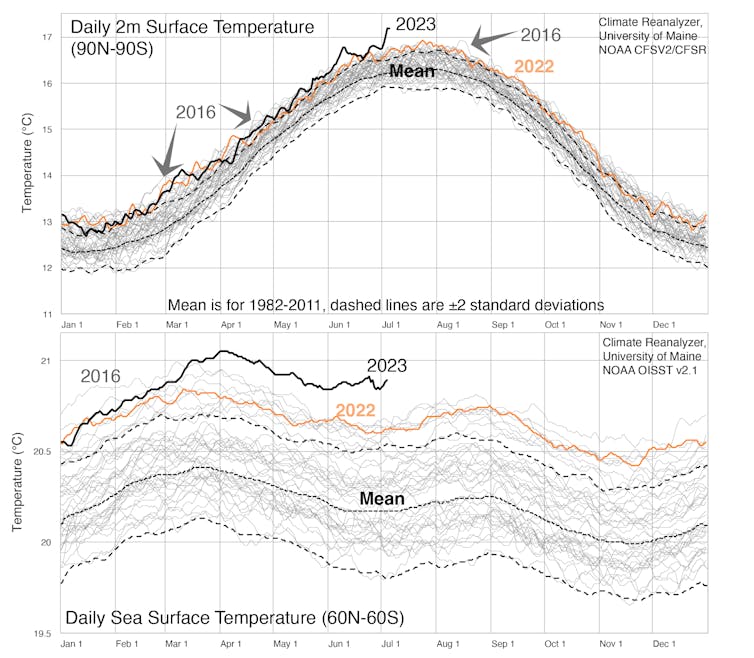
Now, in 2023, all kinds of records are being broken. The highest daily temperatures ever recorded globally occurred in early July, alongside the largest sea surface temperature anomaly ever.

This graph shows daily estimates of global surface temperatures (top) and sea-surface temperatures (bottom). The 2023 values are dark and 2022 are orange.
Temperatures on land and the ocean surface are breaking records this year, as shown in these graphs of daily estimates of global surface temperatures (top) and sea-surface temperatures (bottom).
Author provided, based on NOAA analyses, processed by University of Maine, CC BY-SA

June had its highest global mean surface temperature, according to preliminary analysis. The extent of Antarctica’s sea ice has been at a record low. Meanwhile, atmospheric carbon dioxide concentrations continue to increase at rates that show no sign of slowing.

Evident consequences include torrential downpours in some parts of the world which contrast with excessive heatwaves and wildfires in other locations, notably recently in Canada.

But global mean surface temperature does not continue relentlessly upwards. The biggest increases, and warmest years, tend to happen in the latter stages of an El Niño event.

Human-induced climate change is relentless and largely predictable. But at any time, and especially locally, it can be masked by weather events and natural variability on interannual (El Niño) or decadal time scales.

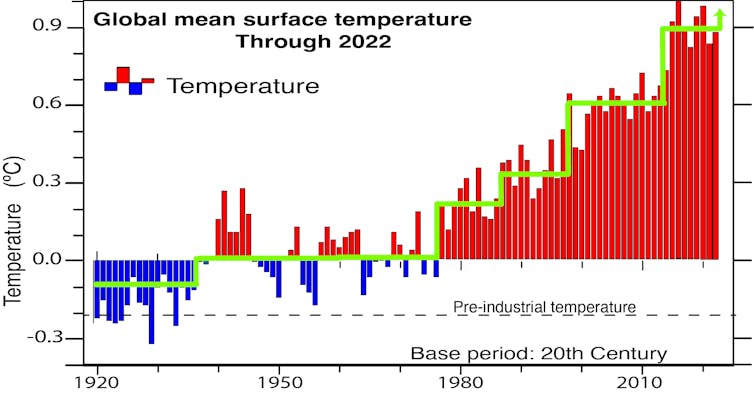
The combination of decadal variability and the warming trend from rising greenhouse gas emissions makes the temperature record look more like a rising staircase, rather than a steady climb.

This graph shows global mean surface temperatures, annual departures from 20th-century averages, with pre-industrial values indicated by a dashed line. Green lines depict approximate regimes stepping to higher and higher values, with an expected upward step at the end.
Rather than rising steadily, global temperatures climb in steps, usually at the end of an El Niño event.
Author provided, based on NOAA data, CC BY-SA


Read more:
Why are so many climate records breaking all at once?


Sources of variability

Atmospheric carbon dioxide concentrations continue to climb relentlessly upwards despite the Paris Agreement and the many countries and organisations (cities, companies) that have made good on their commitments to cut emissions.

Unfortunately for the planet, some nations, including China and India, have continued to burn coal and install coal-fired power stations whose emissions more than offset gains elsewhere.

But the rise in temperature follows a step-like progression. The warmest year in the 20th century was 1998, following the 1997-98 major El Niño. Then the warming paused and the so-called “hiatus” in global warming from 2001 to 2014 led climate change deniers to become vociferous in proclaiming global warming was a myth.

The major El Niño event in 2015-16 changed that. 2015 became the warmest year on record, ending the hiatus, only to be surpassed by 2016, which remains the warmest calendar year so far in many records.


Read more:
Global average sea and air temperatures are spiking in 2023, before El Niño has fully arrived. We should be very concerned


A lot of year-to-year variability is associated with El Niño events. But it is more than that. Further analysis reveals that the Pacific decadal variability, sometimes referred to as the Pacific Decadal Oscillation or Inter-decadal Pacific Oscillation, resulted in changes in the amount of heat sequestered at various ocean depths.

The Pacific Decadal Oscillation may be thought of as a northern-hemisphere version of the Inter-decadal Pacific Oscillation.

With the Pacific Decadal Oscillation, there were major changes in Pacific trade winds, sea-level pressure, sea level, rainfall and storm locations throughout the Pacific and Pacific-rim countries. These changes extended into the southern oceans and across the Arctic into the Atlantic.

The effects are greatest in winter in each hemisphere. There is good but incomplete evidence that changes in winds alter ocean currents, ocean convection and overturning, resulting in changes in the amount of heat sequestered deep in the ocean during the negative phase of the Pacific Decadal Oscillation.

Accordingly, during the positive phase of the Pacific Decadal Oscillation, more heat is deposited in the upper 300m of the ocean, where it can influence global temperatures. During the negative phase, more heat is dumped below 300m, contributing to the overall warming of the oceans but lost to the surface.

During El Niño, heat stored at depth in the western tropical Pacific is moved around and returns to the atmosphere, providing a mini global warming.

Temperatures rising

Research shows that ocean heat content increases more steadily than surface air warming and is a better metric to show that global warming continues.

Sea-level rise comes from both the expansion of the ocean as it warms and the melting of land-based ice (glaciers and ice sheets in Greenland and Antarctica). This puts more water into the oceans. Fluctuations occur as rainfall is partitioned differently between land and the ocean, with more rain on land during La Niña events.


Read more:
Ocean heat is off the charts – here’s what that means for humans and ecosystems around the world


The ocean covers 70% of the Earth. Because most of it is in the southern hemisphere, which experiences winter in June to August, the highest values for sea-surface temperatures occur in March, at the end of southern summer. But as land temperature variations are much larger, the highest global mean surface temperatures occur about July.

With a new El Niño emerging and prospects that it could be another major event, are we about to experience the next step up the stairs? Already in 2023, sea-surface temperatures emerged in April as the highest on record and values are running 0.2℃ above previous highs.

This set the stage for June to have record high surface air temperatures globally. In early July, they hit the highest values on record.

We can expect 2023 to emerge as the warmest year to date. But sea-surface temperatures during El Niño events tend to peak about December and have the greatest influences in the subsequent two months. That sets the stage for 2024 jumping up the staircase to the next level, perhaps to 1.4℃ above pre-industrial levels, with likely daily incursions over 1.5℃.

Once the next La Niña event comes along, there’ll again be a pause in the rise, but values will never quite go back to previous levels.

The Conversation

Kevin Trenberth does not work for, consult, own shares in or receive funding from any company or organisation that would benefit from this article, and has disclosed no relevant affiliations beyond their academic appointment.

ref. Global temperature rises in steps — here’s why we can expect a steep climb this year and next – https://theconversation.com/global-temperature-rises-in-steps-heres-why-we-can-expect-a-steep-climb-this-year-and-next-209385

Explainer: what is the ‘tort of misfeasance’ and how might it apply in the case of robodebt?

Source: The Conversation (Au and NZ) – By Honni van Rijswijk, Senior Lecturer in Law, University of Technology Sydney

Lukas Coch/AAP

The final report of the robodebt royal commission has revealed the full extent of one of the most egregiously harmful acts our government has ever committed against some of the most vulnerable Australians.

At the end of her scrupulous examination of the robodebt scheme, commissioner Catherine Holmes concluded by stating that the people behind robodebt caused extraordinary harm “through venality, incompetence and cowardice”.

Holmes also reluctantly concluded that a compensation scheme for these harms is not practicable. However, a sealed section of the report has been sent to relevant agencies that details potential civil and criminal claims that may be brought against former ministers and public servants.

What are the potential legal avenues available?


Read more:
View from The Hill: The ‘sealed’ chapter of the Robodebt report should be released


Misfeasance in public office

The report stated that “elements of the tort of misfeasance in public office appear to exist”.

Misfeasance occurs where:

1. there is an abuse of public power or authority by a public officer. This first requirement is not contentious: there is an abundance of evidence documented in the report and elsewhere that robodebt was unlawful. But this is not sufficient. Misfeasance requires further that the public officer:

2. either knew that they were abusing their power/authority or were recklessly indifferent to that fact and

3. they acted or omitted to act either with malice (the intention to harm), the knowledge of the probability of harm, or with a conscious and reckless indifference to the probability of harm.

The second and third requirements are more difficult to prove. Courts are generally more likely to find that public officers acted in error rather than with knowledge and malice.

In fact, this is what the federal court found in an earlier class action concerning robodebt. In 2020, Gordon Legal brought a class action representing all victims of robodebt, with the federal court approving a $1.8bn settlement with the previous federal government in June 2021.

Justice Bernard Murphy described robodebt as a “shameful chapter” in public administration, but he did not believe there was sufficient evidence to prove the government knew the scheme was unlawful when it was established:

There is little in the materials to indicate that the evidence rises to that level […] I am reminded of the aphorism that, given a choice between a stuff-up, even a massive one, and a conspiracy, one should usually choose a stuff-up.

This class action facilitated the return of money taken unlawfully under robodebt. But it did not provide damages for distress in part because of the absence of this evidence. It is important these damages be claimed, because harms to victims extended far beyond the theft of their funds, extending to loss of job opportunities and their homes, damage to mental and physical health, and the loss of at least two lives to suicide.

The findings outlined in the report suggest that contrary to Justice Murphy’s findings, this was not just a stuff up: at a minimum, this was misfeasance.

The final report found that:

The beginning of 2017 was the point at which Robodebt’s unfairness, probable illegality and cruelty became apparent. It should then have been abandoned or revised drastically, and an enormous amount of hardship and misery […] would have been averted. Instead the path taken was to double down, to go on the attack in the media against those who complained and to maintain the falsehood that in fact the system had not changed at all.

The royal commission report specifically criticised Scott Morrison in his role as social services minister. It found, for example, that “Mr Morrison allowed cabinet to be misled”. Stuart Robert, the government services minister, was criticised for using false figures about robodebt’s accuracy to publicly defend robodebt.

The report is scathing of Kathryn Campbell, the former department of human services secretary, on multiple points, finding that “when exposed to information that brought to light the illegality of income averaging, she did nothing of substance”.

The report was also damning of Alan Tudge, the human services minister in 2017: “Mr Tudge’s use of information about social security recipients in the media to distract from and discourage commentary about Robodebt’s problems represented an abuse of that power”.

Robodebt was based on shaming and degrading welfare recipients, supported by the government’s narrative (at one point, Tudge said “We’ll find you, we’ll track you down and […] you may end up in prison”.)

This narrative, the stressors of being pursued by debt-collectors, and the financial deprivations all caused significant trauma to its victims.

The tort of misfeasance allows for the pursuit of aggravated damages, which are punitive damages for egregious conduct, because of the shameful behaviour of so many people involved, and the horror of the scale of harm they caused.

We believe there is strong evidentiary support for claims in misfeasance in public office and victims should be encouraged to make claims. We are encouraged to hear a class action is already being considered on this basis.

Criminal prosecutions?

Additionally, the sealed section of the final report recommends referrals of individuals for civil and criminal prosecution. Civil compensation is significant, but it does not have the expressive power of the criminal legal system to communicate right and wrong.

But how might this work?


Read more:
Robodebt royal commissioner makes multiple referrals for prosecution, condemning scheme as ‘crude and cruel’


Senior public officials may be prosecuted for abuse of public office, which is punishable by up to five years prison. The offence requires that the official engages in conduct with the intention of either dishonestly obtaining a benefit for themselves or dishonestly causing a detriment to another person. There is plenty of evidence in the report that some politicians and senior public servants could be liable for criminal charges.

The harms caused by robodebt are overwhelming, heartbreaking and horrific in both their scope and impact. As a community, we should be examining the report carefully, particularly the recommendations, to ensure nothing like this happens again.

We should also be examining the report carefully to ensure every individual and entity responsible for this harm is brought to account through the full force of the law. The many victims of the scheme, as well as their families and friends, deserve nothing less than complete justice.

The Conversation

The authors do not work for, consult, own shares in or receive funding from any company or organisation that would benefit from this article, and have disclosed no relevant affiliations beyond their academic appointment.

ref. Explainer: what is the ‘tort of misfeasance’ and how might it apply in the case of robodebt? – https://theconversation.com/explainer-what-is-the-tort-of-misfeasance-and-how-might-it-apply-in-the-case-of-robodebt-209507

What’s behind Australia’s $1 billion defence deal with Germany?

Source: The Conversation (Au and NZ) – By Peter Layton, Visiting Fellow, Griffith Asia Institute, Griffith University

Kay Nietfeld/DPA/AP

Early last year, German Chancellor Olaf Scholz declared Russia’s invasion of Ukraine a major historical turning point – a zeitenwende.

That turning point continues to play out. On the eve of this week’s NATO summit in Lithuania, Berlin and Canberra announced a deal that will send more than 100 Boxer armoured fighting vehicles from Australia to Germany – not the other way around, as had been the case when Australia bought about 100 Leopard tanks in the mid-1970s.

This unique deal, worth more than A$1 billion, is driven by the demands for a rapid German rearmament after the strategic shock of Russia’s invasion of Ukraine. Germany doesn’t have adequate military production capacity to meet its suddenly pressing new defence needs.

Prime Minister Anthony Albanese then added to the German deal by declaring an Australian Air Force Boeing E-7A Wedgetail surveillance aircraft would be based at Ramstein Air Force Base in Germany for six months, starting in October.

This aircraft will be part of NATO surveillance of the alliance’s eastern flank, in particular European logistical hubs supporting Ukraine. These could be threatened by air incursions from Russia or Belarus if the war escalates.

The Wedgetail will be able to detect aircraft approaching the Baltic states or Poland in the east. It can then determine their likely intent and whether they are friendly or not. Then, if necessary, an airborne air defence fighter aircraft could be vectored to intercept the intruder.

This task has been carried out by NATO’s E-3 AWACS aircraft, but these planes were bought in the 1980s and have very low reliability. The Wedgetail is only a decade or so old and is much easier to maintain and keep in the air.

With this move, Australia will now share the burden of continual air patrols in Eastern Europe made necessary by the Russian invasion.

Bringing Germany and Australia closer together

The Boxer is an eight-wheeled armoured vehicle fitted with a 30-millimetre automatic cannon. It is operated by a crew of three and able to carry eight solders in its rear cabin.

The Boxers are built at a facility just outside Brisbane. In late 2018, the German arms manufacturer Rheinmetall won a $4.28 billion contract to build 211 Boxer Combat Reconnaissance Vehicles for the Australian Army. As part of the contract, the Australian government mandated Rheinmetall build the majority of the vehicles in Australia.

The new Boxers being built for Germany will be based on the Australian Army’s reconnaissance vehicle design, but given a different name: “heavy weapon carrier infantry”. The first deliveries will be made in 2025.

The Boxer deal helps to bring Germany and Australia closer at a time when Berlin is increasingly interested in Indo-Pacific defence matters.

In 2021, a German warship visited the northern Indian Ocean and western Pacific in a long deployment, and the following year, the German air force joined in an air defence exercise in Darwin.

In late June, Germany released its first National Security Strategy, which called China a “partner, competitor and systemic rival” and observed that competition with China has “increased in the past years”.

And later this month, Germany will send more than 200 soldiers to participate in the
Talisman Sabre, a large, multinational, military exercise in eastern Australia. It will be the first time Germany participates in the drills.


Read more:
Why is NATO expanding its reach to the Asia-Pacific region?


Why the deal matters to both countries

The Boxer deal is also appealing domestically to both leaders.

For Scholz, buying vehicles from the factory of a German arms manufacturer in Australia is more attractive than buying US-made arms. Moreover, the deal would seem pivotal in ensuring Rheinmetall Defence Australia is now chosen over South Korea’s Hanwha to build 129 new Infantry Fighting Vehicles for the Australian Defence Force (ADF).

For Albanese, the Boxer deal is one of Australia’s largest defence export orders ever, which will create hundreds of jobs.

It will also ameliorate some dissatisfaction in the defence industry over the recent Defence Strategic Review. Of note, the review saw no place for vehicles like the Boxer in the Australian Defence Force of the future, and certainly not in local production.

However, the deal will have some direct effects on the defence force in the short term. Fulfilling the German order will probably delay Boxer deliveries to the ADF at a time when quickly increasing its capabilities is considered important.

Moreover, sending a surveillance aircraft to Europe will take it away from Australia’s area of principal strategic interest. However, the Ramstein air base is a very large American facility, so this move will also help support the burgeoning Australia-US military alliance.

Australia was Boeing’s first customer for the Wedgetail aircraft in the early 2000s. Some will hope NATO will now look favourably at also buying them from the US. This could help lower the overall operating costs of the fleet. Larger fleets gain economies of scale and reduce individual maintenance costs.

Could more deals be forthcoming?

These deals were announced even before the NATO summit, so could there be more to come?

Australia is reportedly in negotiations to potentially give up to 41 old Hornet fighter jets to Ukraine. Ukraine is apparently interested in the retired jets, if perhaps only to spur others into gifting it a much larger number of F-16s.

This is all somewhat missing the forest for the trees, however. Russia’s war has now dragged on past the 500-day mark. It is reasonable to assume Ukraine will need more support from NATO and its allies. And as the war drags on, it is diverting attention away from the Indo-Pacific, where Australia’s core geostrategic focus lies.

But Australia will remain on the hook for more aid until the war ends. Boxers and Wedgetails are fine in their own way, but the main game remains defeating Russia and driving it out of Ukraine. With that, the historical turning point would be complete.


Read more:
Australia is not giving Ukraine the military support it needs – sending our retired jets would be a start


The Conversation

Peter Layton does not work for, consult, own shares in or receive funding from any company or organisation that would benefit from this article, and has disclosed no relevant affiliations beyond their academic appointment.

ref. What’s behind Australia’s $1 billion defence deal with Germany? – https://theconversation.com/whats-behind-australias-1-billion-defence-deal-with-germany-209490

Chalmers ‘measures what matters’ – tracking our national wellbeing in 50 indicators

Source: The Conversation (Au and NZ) – By Michelle Grattan, Professorial Fellow, University of Canberra

Australia’s first national “wellbeing framework”, to be released by Treasurer Jim Chalmers within weeks, will provide about 50 indicators of how Australians are doing, that will then be tracked over time.

The Measuring What Matters statement will be around the themes of “healthy, secure, sustainable, cohesive, and prosperous”, Chalmers said in a speech in Melbourne delivered late Tuesday.

“Measuring What Matters is about getting a better sense of how our people are tracking – what we’re doing well and what we need to do better,” he said.

The wellbeing framework “will help us track our journey towards a healthier, more sustainable, cohesive, secure, and prosperous society that gives every person ample opportunity to build lives of meaning and purpose”.

Chalmers said the traditional economic metrics – GDP, income, employment – didn’t tell the whole story. Other things also mattered.

These included the population’s health, the environment, how much time people spent working, at home, with their children, in traffic – and also “whether people feel connected to each other, or not”.

The government has consulted widely in putting together the framework, and received more than 280 submissions, as well as drawing on international experience. New Zealand is one of the countries with a “wellbeing budget”, introduced in 2019.

Chalmers said he wasn’t expecting “everybody to agree with every element of our approach. There will be a range of views and plenty of commentary on what we’ve chosen to include and what we haven’t. Any framework which seeks to capture the core components of wellbeing is bound to need refining over time.”

In his speech, Chalmers stressed “responsible economic management and compassion are complementary, not at odds”, describing he government as one of “hard heads and warm hearts”.

He said the government’s efforts to strengthen the budget “have not in any way come at the expense of helping people.

“The bigger surplus is in addition to, not instead of, cost of living relief. In fact, our responsible economic management gives us room to deliver permanent increases to Commonwealth income support payments,” he said, pointing to measures in the May budget.

The government was fighting inflation with responsible economic management “that underpins targeted cost of living relief”. His speech comes when polling shows increasing pressure on the government over the cost of living and calls for it to do more.

Chalmers said the government was also reforming institutions including the Reserve Bank, the Productivity Commission, and the public service.

“The mean-spirited madness that underpinned Robodebt will never happen again,” he said.

“We will, once and for all, do away with this idea that our society is made up of ‘lifters and leaners’, ‘workers and shirkers’.”

Soon after the wellbeing framework is unveiled, Chalmers will release the latest Intergenerational Report.

“That will give us a big picture view of the things that we’ll need to manage and maximise to improve the wellbeing of our people over time.”

This will be followed by the Employment White Paper – “a roadmap for a more inclusive, dynamic labour market that makes the most of people’s talents”.

The Conversation

Michelle Grattan does not work for, consult, own shares in or receive funding from any company or organisation that would benefit from this article, and has disclosed no relevant affiliations beyond their academic appointment.

ref. Chalmers ‘measures what matters’ – tracking our national wellbeing in 50 indicators – https://theconversation.com/chalmers-measures-what-matters-tracking-our-national-wellbeing-in-50-indicators-209520

Indonesia is suppressing environmental research it doesn’t like. That poses real risks

Source: The Conversation (Au and NZ) – By Bill Laurance, Distinguished Research Professor and Australian Laureate, James Cook University

Shutterstock

In September last year, several leading scientists were effectively banned from further research in Indonesia’s vast tropical forests, where most had been working for decades.

Their sin? In large part, producing research suggesting the Bornean orangutan was in trouble – and following it up with an opinion piece which countered the government’s assertion the species was rebounding.

These researchers clearly angered someone powerful. Soon, the influential environment and forestry ministry circulated a letter accusing the scientists of writing with “negative intentions” that could “discredit” the government. They were to be barred from the forests.

My colleagues and I have published new research exploring the risks of this response from Indonesia’s government.

borneo deforestation
Forests are still falling in Indonesia, but the rates of loss have declined.
Shutterstock

Worrying — and surprising

Indonesia’s reaction is a worrying sign. The island nation has a fast-growing population and economy, as well as spectacular biodiversity and one of the world’s largest areas of tropical forests. But its growing population and economy have been putting pressure on the natural world for decades.

Indonesia’s combativeness is also surprising. In recent years, forest destruction has declined by two-thirds, following government clamp-downs on illegal logging, forest burning and felling for plantations. This is a remarkable achievement.


Read more:
Research reveals shocking detail on how Australia’s environmental scientists are being silenced


So why the recent crackdown on the researchers? It’s likely to be precisely because Indonesia has been doing better environmentally. Its leaders want their progress to be recognised, not criticised.

But while it’s important scientists are fair – and do recognise welcome progress when it happens – it’s even more important governments let scientists do their work, even if the results we report are not what they want to hear.

This isn’t the first time Indonesia has tried to silence environmental scientists. Three years ago, researcher David Gaveau was deported from Indonesia after publishing estimates of wildfire extent much larger than those reported by the government.

For local and overseas researchers in Indonesia, the pressure is clear. Many privately say to us and other colleagues that they feel coerced to publish good news, or at least avoid bad news.

Governments must be open to warranted criticism

Conservationists and researchers have long run up against suppression or even violence in developing nations with large forest tracts, such as Brazil, Colombia, the Philippines and the Democratic Republic of the Congo.

That’s because there’s huge pressure on these forests. Demand for economic development often leads to exploitation of remaining forests.

While Indonesia’s forest management is improving in some ways with deforestation clampdowns, there are still very real areas of concern.

In recent decades, huge swathes of forest have been felled and converted into palm oil and wood-pulp plantations. The rush for critical minerals underpinning the green transition, such as nickel, are damaging fisheries and rivers.

And then there are the roads, which are expanding dramatically across Indonesia. A road is a spike driven into the natural world. Once a road is in place, the forest opens up like a flayed fish. Bulldozers, chainsaws and mining equipment can come in. It’s a devastating dynamic.

road palm oil
When roads push into forests, it’s far easier to convert them to plantations or log them.
Shutterstock


Read more:
Alternative data: setting the record straight on the scale of Indonesia’s 2019 fires


In the past few decades, Indonesia has been plagued by environmental catastrophes, from massive forest loss to lethal smoke plumes from vegetation burning.

To avoid being blindsided by future environmental catastrophes, Indonesia needs a dynamic and open scientific community – one that isn’t being pressured to toe the government’s line.


Read more:
How Indonesia’s election puts global biodiversity at stake with an impending war on palm oil


The Conversation

Bill Laurance receives funding various scientific and philanthropic organisations. He is the director of the Centre for Tropical Environmental and Sustainability Science at James Cook University in Cairns, Australia. He also founded and directs ALERT — the Alliance of Leading Environmental Researchers & Thinkers — a science and conservation advocacy group.

ref. Indonesia is suppressing environmental research it doesn’t like. That poses real risks – https://theconversation.com/indonesia-is-suppressing-environmental-research-it-doesnt-like-that-poses-real-risks-202629

Voice support slumps in Essential poll; LNP leads in Queensland

Source: The Conversation (Au and NZ) – By Adrian Beaumont, Election Analyst (Psephologist) at The Conversation; and Honorary Associate, School of Mathematics and Statistics, The University of Melbourne

Bianca de Marchi/AAP

An Essential poll, conducted July 5-9 from a sample of 1,125, had “yes” to the Indigenous Voice to parliament leading by 47-43, with 10% undecided. There has been a methods change from previous Essential polls that had no undecided option.

The last Essential Voice poll in June gave “yes” a 60–40 lead, in contrast to a 51–49 “no” lead from Resolve in a poll conducted at the same time.


Read more:
Resolve first national poll to have ‘no’ ahead in Voice referendum, but Essential has ‘yes’ far ahead


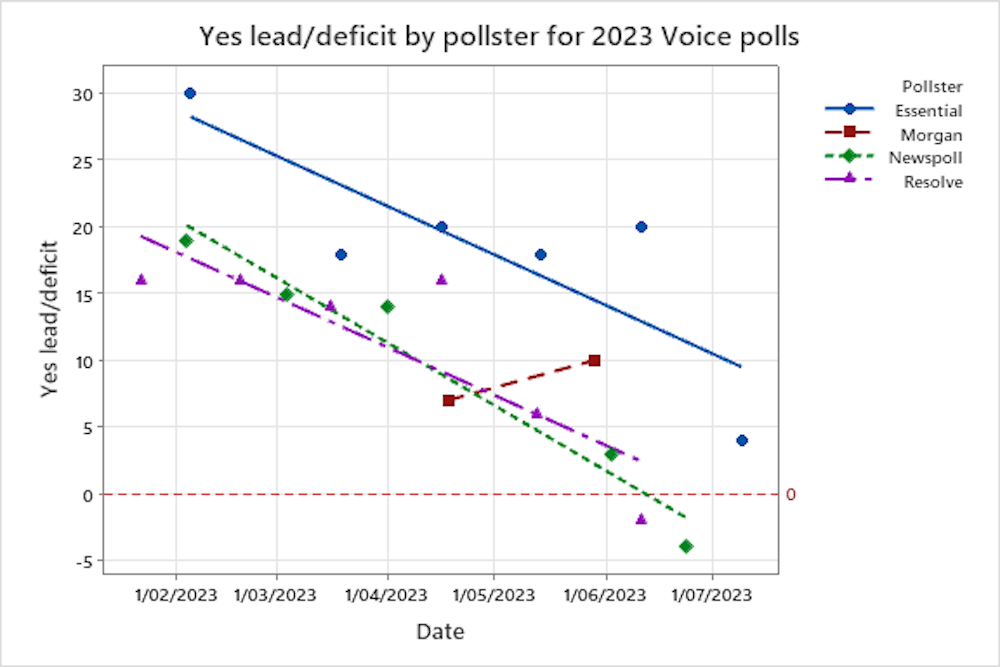
The graph below shows the “yes” lead or deficit in 2023 Voice polls from Newspoll, Resolve, Essential and Morgan pollsters. If the pollster used a forced choice, I have used the forced choice result. The poll result dates are the last dates of fieldwork. There are trendlines for all pollsters. I used the statistical software Minitab for this graph.

2023 Voice polls.

The trajectories of Resolve and Newspoll are similar, while Essential has been the most friendly pollster for “yes”. The last Morgan Voice poll was taken in May. While Essential still has “yes” ahead, there is now a clear down trend in “yes” support in this poll.

Other Essential results: Labor leads by 51–44

In Essential’s two party measure that includes undecided, Labor led by 51–44 (52–42 last fortnight). This is Labor’s narrowest lead in Essential since March. Primary votes were 32% Labor (steady), 32% Coalition (up two), 14% Greens (steady), 8% One Nation (up one), 1% UAP (down one), 8% for all Others (steady) and 5% undecided (down one).

By 71–22, voters thought the government could make a lot or a fair amount of difference to the cost of living. Capping prices for electricity and gas was the most pupular option for addressing the cost of living, with 73% saying it would make a difference and the government should do it.

On Australia’s stumping of Jonny Bairstow in the second Ashes Test, 48% thought the Australians were totally justified, 27% said they wouldn’t have done it but the English need to get over it, 9% “same old Aussies, always cheating” and 16% “what’s the Ashes?”.

Be sceptical of claims of existential crises for current opposition parties

A paper for the Centre for Independent Studies is claiming that the Coalition will struggle to win future elections owing to lack of movement to the right among younger generations as they age. But when the Coalition unexpectedly won the 2019 election, there were claims of an existential crisis for Labor.

Internationally, there were claims of an existential crisis for United Kingdom Labour after the Conservatives won a clear majority at the UK 2019 election, but Labour is leading in current UK national polls by about 20 points.

In June I wrote that in continental Europe, the right is advancing, and in the United States Donald Trump has a narrow lead over Joe Biden. This is occurring despite the generational effects the CIS paper claims will damage the Coalition.

If there’s a problem for the Coalition in Australia, it’s probably due to the high percentage of our population that lives in big cities.


Read more:
Will a continuing education divide eventually favour Labor electorally due to our big cities?


Last fortnight’s Essential poll

In last fortnight’s Essential poll, voters were asked to rate Albanese, Dutton and Greens leader Adam Bandt from 0 to 10. Ratings of 0–3 were counted as negative, 4–6 as neutral and 7–10 as positive. Albanese had a 36–27 positive rating, down from 41–24 in May. Dutton’s ratings improved to 34–27 negative from 35–23. Bandt was at 38–21 negative.

Respondents were asked whether the government was doing enough, not enough or too much to address various issues. Relieving cost of living pressures had the highest score for not enough (75% not enough, 20% enough, 5% too much). Ensuring affordable and secure rentals rated 69% not enough, 25% enough, 6% too much. Environmental issues had about 40% saying the government was doing enough.

Federal parliament was rated fourth out of five options for ensuring work is a safe place for women, behind the public service, private companies and sporting clubs and ahead of only the entertainment industry.

LNP leads in Queensland Freshwater poll

The next Queensland state election will be held in October 2024. A Freshwater poll for The Financial Review, conducted June 29 to July 2 from a sample of 1,065, gave the Liberal National Party a 52–48 lead over the incumbent Labor government. Primary votes were 40% LNP, 34% Labor, 11% Greens and 15% for all Others with no separate figure provided for One Nation.

LNP leader David Crisafulli led Labor incumbent Annastacia Palaszczuk as better premier by 45–44. It’s unusual for an opposition leader to hold a better PM/premier lead. Poll figures are from The Poll Bludger.

An April YouGov Queensland poll gave the LNP a 51–49 lead, although Resolve still had Labor ahead, but Resolve has skewed to Labor federally and in state polls since the May 2022 federal election.


Read more:
Labor gains in Newspoll but Voice support slumps in other polls; NSW final results and Queensland polls


Labor has governed in Queensland since early 2015, but federally, Queensland is the most conservative state. It was the only state the Coalition won at the 2022 election. By the October 2024 state election, Labor will have governed for almost ten years, so there could be an “it’s time” factor.

The Poll Bludger reported Sunday that “no” to the Voice led in this Queensland-only poll by 50–36 including undecided, or 58–42 excluding undecided.

The Conversation

Adrian Beaumont does not work for, consult, own shares in or receive funding from any company or organisation that would benefit from this article, and has disclosed no relevant affiliations beyond their academic appointment.

ref. Voice support slumps in Essential poll; LNP leads in Queensland – https://theconversation.com/voice-support-slumps-in-essential-poll-lnp-leads-in-queensland-208578

Why is it so hard for Local Aboriginal Land Councils to develop land when the public needs are huge?

Source: The Conversation (Au and NZ) – By Naama Blatman, Research Theme Fellow, Urban Living Futures & Society, Western Sydney University

Some of the largest landowners across New South Wales are Local Aboriginal Land Councils. Given the acute needs for housing and infrastructure, it’s time the state government enabled these land councils to play a greater role in development.

According to the Greater Cities Commission’s outgoing chief commissioner, Geoff Roberts, Local Aboriginal Land Councils (LALC) are the largest landowners in three of the region’s six cities from Newcastle in the north to Wollongong in the south.

Roberts told me the commission’s strategic plans simply cannot be carried out without embedding in them Aboriginal values and perspectives. “We cannot move forward, without going back.” And by back, he meant returning to where it all began with European invasion.

In April, the commission set up the First Nations Advisory Panel to “help identify strategic issues in the planning system that work against First Nations people’s aspirations and […] provide advice regarding system-level change to address these challenges”.

Government can learn a lot from the commission’s approach. Recognition is growing within the state government that good development – for housing and commercial purposes, in transport, or within cultural precincts – requires reckoning with the past by partnering with Indigenous communities to deliver the future city. This has led to policies such as the Connecting with Country Framework and the Aboriginal Land State Environmental Planning Policy.

Yet good intentions have been slow to deliver results.

I have been researching the work and policy environment of Local Aboriginal Land Councils since 2020 and found they face three kinds of planning and development roadblocks in Greater Sydney: legal and bureaucratic, political, and relational.


Read more:
How can Aboriginal communities be part of the NSW renewable energy transition?


Legal and bureaucratic challenges

Aboriginal land councils are member-based organisations established under the Aboriginal Land Rights Act 1983 (NSW). Membership is open to all adult Aboriginal people in each council’s area.

These councils have the right to claim Crown land that is not lawfully used or occupied, or needed for an essential public purpose, among other things.

Land councils can sell, lease and/or develop the claimed land, and are bound by planning laws and regulations like any other landowner. However, land councils are different since they own land acquired through a compensatory framework to redress severe historical dispossession.

In practice, NSW’s 120 Local Aboriginal Land Councils face mounting difficulties, both in claiming land and in planning, developing and using their land to benefit their communities and the public.

A 2021 review found long delays in determining land claims across NSW. Over 38,000 claims awaited the minister’s determination – roughly 70% of the total made in the 40 years since the law took effect. Around 60% were five or more years old.

At the current rate, it will take 22 years to determine existing claims. And land under claim cannot be developed.


Read more:
In NSW there have been significant wins for First Nations land rights. But unprocessed claims still outnumber the successes


Land councils also find it incredibly difficult to activate successfully claimed land. Typically, it’s disused Crown land on the fringes of suburbs and towns.

At times, this land is downzoned as “conservation” after its transfer to the land council. Land councils must then prepare expensive planning proposals to rezone the land as residential, straining their limited resources.

Recognising these difficulties, in 2019 the NSW government introduced a policy permitting land councils to submit development delivery plans for approval by the planning minister. These measures are designed to approach Aboriginal land development strategically and holistically, rather than in a piecemeal way. Their long-term impact is yet to be seen.

Political challenges

Some are unhappy with the “special treatment” of land councils and with their development agenda. Sometimes objections to development come from Traditional Owners and Custodians of the land.

This is partly due to the distinction observed by historian Heidi Norman that emerged between “Aboriginal owners” and “land council members” following the Commonwealth Native Title Act 1993. In my interviews, policymakers and bureaucrats have expressed confusion about adhering to cultural protocols while also dealing fairly and professionally with Aboriginal landowners.

But more often it’s non-Indigenous residents who oppose Aboriginal land development. One example, reported as an “Aboriginal land rights test case”, involves a proposed development in Belrose in Sydney’s Northern Beaches.

Local MPs, residents and councillors have opposed the plan to develop 71 hectares of bushland as a 450-lot subdivision. They cite environmental reasons, pressures on infrastructure and fire risks. First submitted to the Department of Planning in 2014, the plan became a state election issue this year.

A revised proposal gained a so-called “Gateway” preliminary approval last month. Opposition is bound to continue through the long approval process.

Relational challenges

Many land councils are land-rich, but most are cash-poor. They are understandably reluctant to sell land. This means they have to find partners to realise their development plans.

The main model for land council developments is joint ventures with private or state-owned developers. Co-design and co-management of projects requires partnerships built on strong relationships. Despite a willingness to engage, both government and industry often lack understanding of the issues land councils face. As a senior planning department official told me:

That conversation and engagement to understand how you put that cultural overlay and the trauma and the healing into the [planning] strategy […] that is a long, ongoing conversation. And you can’t force it. It has to be organic, and it has to be [based] on trust and rapport. But no government workflow or business case [operates on that timeline].

Due to this misalignment of approaches and frequent public sector personnel changes, the conditions for meaningful collaboration are rarely met.


Read more:
Indigenous communities are reworking urban planning, but planners need to accept their history


Land councils can be development allies

NSW Premier Chris Minns recently announced incentives for large developers to build higher, denser housing in Sydney. “State significant developments” will be fast-tracked, bypassing local councils and planning panels.

Land councils own large areas of land in areas of immense need. Unlike profit-driven developers, they champion social and economic justice. Yet land councils still face major barriers to development.

What if the government considered land councils as allies in the struggle to meet housing and other needs? Development that properly considers where and how to build and for whose benefit would be better for both Indigenous communities and the rest of the public.

The Conversation

Naama Blatman receives funding from The Urban Studies Foundation (https://www.urbanstudiesfoundation.org/).

ref. Why is it so hard for Local Aboriginal Land Councils to develop land when the public needs are huge? – https://theconversation.com/why-is-it-so-hard-for-local-aboriginal-land-councils-to-develop-land-when-the-public-needs-are-huge-195366

Workers hate office noise – but is using headphones to shut out colleagues the solution?

Source: The Conversation (Au and NZ) – By Libby (Elizabeth) Sander, MBA Director & Assistant Professor of Organisational Behaviour, Bond Business School, Bond University

Shutterstock

Is it OK to wear headphones in the office? Do they help get work done, or is wearing them considered rude and damaging to the office vibe.

While it might be easy to dismiss our headphone-wearing colleagues as unfriendly, the increase in usage is symptomatic of another issue entirely.

As staff have returned to the office post-lockdown, they have been confronted with the thing employees dislike most about open plan offices according to research: noise.

Modern knowledge work demands the psychological ability to focus and concentrate for lengthy periods. That is hard to do when colleagues are having impromptu meetings next to your desk, or discussing their weekends as you struggle to hit a looming deadline.

Noise and distraction

Open-plan office noise has significant implications for both employee wellbeing and performance.

Our research found relatively moderate levels of open-plan office noise caused a 25% increase in negative mood and a 34% increase in physiological stress.

In addition to making employees more stressed and cranky, noisy open-plan offices reduce performance. Research shows employees in quieter one-person offices perform 14% better on a cognitive task than employees in open plan offices.


Read more:
Like to work with background noise? It could be boosting your performance


Like closing the office door

Wearing headphones all day is likely to signal the office environment is too noisy or distracting. It can also indicate the dynamics of the team’s interaction is ineffective.

Since most employees no longer have the luxury of closing their office door, headphones have emerged as an alternative. They provide a way for employees to make it clear they don’t want to be interrupted, and to block out noise.

For others, using headphones to listen to music can help reduce anxiety. This was supported in a 2021 workplace discrimination hearing in the United Kingdom where the tribunal ruled in favour of an anxious worker who wanted to wear them.

And while noise-cancelling headphones do not improve cognitive performance, they do increase the user’s perceptions of privacy.

This is significant because when employees cannot control noise they feel a loss of privacy, and excessive stimulation can lead to frustration, anger and withdrawal.

What about workplace collaboration?

In many open-plan offices, the drive for increased interaction and collaboration comes at the expense of the ability to focus and concentrate.

When distraction makes it hard for employees to focus, cognitive and emotional resources are depleted. The result is increasing stress and errors, undermining performance.

When employees can’t concentrate on their work, their desire to interact and collaborate with others is reduced.

Man wearing headphone and typing on laptop while others around him talk.
Workplace success is often influenced by our ability to interact.
Shutterstock

While focussed work is important, success in modern workplaces is often driven by how well individuals interact with each other and with the organisation.

Workplaces that provide more frequent and higher-quality contact with others have been shown to have improved communication and collaboration on tasks, job satisfaction and social support.

And our social environment plays a significant role in our ability to be proactive and motivated.

When employees wear headphones, opportunities to connect with colleagues, share ideas and build social relationships are reduced. But people are still likely to interact more with their colleagues than if they work from home because they can attend meetings and go out for coffee.

What can organisations do?

With hybrid work – where employees work some of the week at home and the rest in the office – now more widespread, employees are more likely to come to the office for social interaction and face-to-face collaboration with their colleagues.

However, this has to be balanced with the need for focused work.

Organisations can deal with this in several ways. They can provide effective acoustic treatments in the workplace and by ensure the design and layout of the office provides sufficient spaces for employees to retreat from noise.


Read more:
Open plan offices CAN actually work, under certain conditions


An example of this can be found in LinkedIn’s San Francisco office. The entire space has been redesigned since the start of the pandemic with a range of different work zones including ones specifically designated for quiet, and others to encourage collaboration and social interaction.

Communicating expectations and monitoring behaviour at the team level is also important.

Research shows it takes about 23 minutes to get back on task after an interruption. Being constantly interrupted by impromptu questions and random conversation will not only reduce productivity but can lead to withdrawal.

The frequency and purpose of planned interaction will differ between teams based on individual differences and on the type of work being undertaken.

In some teams this may happen hourly, in others it may be much less frequent. Communicating individual needs amongst the team and setting times for discussions can reduce the number of distracting interruptions.

By establishing effective team communication strategies and providing workers with well-designed spaces that enable focused work, employees may be less likely to use headphones for long periods, therefore enhancing opportunities for knowledge sharing, problem solving and team interaction.

The Conversation

Libby (Elizabeth) Sander does not work for, consult, own shares in or receive funding from any company or organisation that would benefit from this article, and has disclosed no relevant affiliations beyond their academic appointment.

ref. Workers hate office noise – but is using headphones to shut out colleagues the solution? – https://theconversation.com/workers-hate-office-noise-but-is-using-headphones-to-shut-out-colleagues-the-solution-209134

NZ music schools under threat: we need a better measure of their worth than money

Source: The Conversation (Au and NZ) – By Dugal McKinnon, Associate Professor, Composition and Sonic Arts, Te Herenga Waka — Victoria University of Wellington

Getty Images

Funding for the arts and tertiary education in Aotearoa New Zealand has long been insufficient. Run the two together, as is happening this year, and we find ourselves at a precarious junction.

Arts and humanities departments in general are threatened by job and course losses due to the university underfunding crisis. In music education alone, the cuts have already been extensive.

Te Auaha, Te Pukenga’s creative campus in Wellington, has folded most of its music programmes. The Auckland campus of the Music and Audio Institute of New Zealand (MAINZ) is closing too.

Schools of music at Auckland, Waikato and Otago universities have all gone through significant restructuring over the past decade. Massey University’s creative programmes may be under review. The future of the New Zealand School of Music at Te Herenga Waka-Victoria University of Wellington is also uncertain.

The country’s creative and critical culture of music will be substantially diminished as a result. How can we sustain vibrant popular, classical, jazz, electronic and experimental music scenes without the institutions that nurture and produce musical talent?

Other measures of wealth

Music shapes and helps us understand who we are as people and as a culture.
As the pioneering New Zealand composer Douglas Lilburn put it, we need “a music of our own, a living tradition of music created in this country”.

Or as musician and producer Hinewehi Mohi said more recently: “We need music and we need waiata Māori to really tie us together and create a sense of cultural identity and nationhood.”


Read more:
Starved of funds and vision, struggling universities put NZ’s entire research strategy at risk


It may be a truism to say music and other art forms are a public good, but it’s a truth nonetheless. And in tough times the arts become nothing less than an essential service. Studies from Finland and Germany have shown how
music helped people maintain a sense of community and wellbeing during pandemic lockdowns.

Even just bingeing on streaming services involves consuming the artistic labour of composers, sound designers, dialogue editors and scores of production creatives. In other words, we need the arts and artists, whether or not we’re conscious of it.

Furthermore, the Treasury’s Living Standards Framework now recognises values beyond the purely fiscal, and that “wealth” and “capital” have broader meanings “not fully captured in the system of national accounts, such as human capability and the natural environment”.

Hinewehi Mohi: ‘create a sense of cultural identity and nationhood’.
Getty Images

Short-term fixes and long-term harm

The social and economic benefits of music are well established, and were substantiated in the key findings of the Ministry of Culture and Heritage’s 2022 Valuing the Arts report.

The rewards are both social and individual. Educators, psychologists and employers are well aware of music’s cognitive, intellectual and behavioural benefits – including how group music making develops teamwork, empathy and grit, all components of resilience.


Read more:
We need to break the cycle of crisis in Aotearoa New Zealand’s arts and culture. It starts with proper funding


A rapidly changing world requires young performers, composers, technologists and thinkers who are able to keep pace. Short-term solutions to financial problems, however, can cause long-term harm.

Cuts to the New Zealand School of Music, and other similar programmes across the country, will have broad repercussions, diminishing the depth and breadth of music education. The creative industries will be starved of young talent (echoing labour shortages in other sectors).

Theatre faces the same destructive spiral. In a larger society, some damage might be absorbed. In a country of five million it becomes palpable.

Better funding models

The current tertiary funding model uses staff-student ratios as the primary funding metric. But this doesn’t work for music or any discipline where teaching and learning take place in small groups, intensively, often involving one-to-one tuition.

The argument that music and theatre courses should be cut because of low enrolments is perverse. A low staff-student ratio, along with specialist facilities and equipment, are beneficial for developing both individual talent and outstanding teamwork. Similar needs and costs are not challenged in science education, nor should they be in arts.

This kind of teaching can be time and labour intensive for students and teachers, but it is the only way to produce the results that define excellence. Students don’t learn to perform, compose or engineer compelling music in generic lecture theatres alongside hundreds of others.

Similarly, box-office returns and gross revenues aren’t great measures of true artistic, experiential and cultural value. Stadium shows may indicate commercial viability, but musicians and audiences thrive in intimate settings where new ideas and material can be tested and real rapport established.


Read more:
The show must go on, but it’s time to re-think how we fund the arts in NZ


Music and value

We clearly need a more nuanced and holistic measure of the value of arts and education than the simply financial. As Robert Kennedy famously said of GDP:

It measures neither our wit nor our courage, neither our wisdom nor our learning, neither our compassion nor our devotion to our country, it measures everything in short, except that which makes life worthwhile.

To that end, the Tertiary Education Commission, the government’s main interface with the sector, should reflect the Treasury’s Living Standards Framework when accounting for the broader social contribution of higher education.

Various precedents already exist in the form of international measures such as the Genuine Progress Indicator, the UN’s Human Development Index, the Thriving Places Index and the OECD’s Better Life Index.

All in various ways try to incorporate the importance of community, culture, work-life balance and overall life satisfaction. It should come as no surprise that wellbeing and participation in music are closely correlated.

The Conversation

Dugal McKinnon works for the New Zealand School of Music Te Kōki, Victoria University of Wellington-Te Herenga Waka.

ref. NZ music schools under threat: we need a better measure of their worth than money – https://theconversation.com/nz-music-schools-under-threat-we-need-a-better-measure-of-their-worth-than-money-209323

Humans set budgets when facing an uncertain future. So do ants 

Source: The Conversation (Au and NZ) – By Daniele Carlesso, PhD Candidate, Macquarie University

Simon Garnier

Imagine you are looking for a parking spot at a crowded event. You find one far from your destination. Do you decide to take it, or invest more time into hunting a better spot which may or may not exist?

You might resolve this decision by “budgeting”: limiting the resources (time) you will spend looking for a better option before settling for the inferior one. This strategy, which allows us to cut our losses when things don’t pan out as we had hoped, is commonly used when we cannot know the payoff of our choices in advance.

Making decisions under uncertainty is a problem we all face. In new research published in the Proceedings of the National Academy of Sciences, we show weaver ants (Oecophylla smaragdina) – much like humans – manage it by budgeting their investment into a task with an uncertain payoff.

Weaver ants bridge gaps with their own bodies

Weaver ants link their bodies together to form bridge-like structures called “hanging chains”, which they use for crossing gaps encountered along trails. Chains span several times the size of an individual ant and, most strikingly, are self-organized.

This means chains are formed without the help of leaders or external blueprints. Instead, each individual responds solely to its surroundings and local interactions with neighbours.

Understanding self-organization is central to understanding collective behaviour in animal groups – from flocks of birds to insect swarms – and other systems, including human crowds and traffic flow.

Chains are a gamble

Building a chain comes at a cost to the colony. Ants in the chain can’t participate in important colony tasks such as defending the nest and foraging. The cost of the chain is proportional to its length: longer chains are more costly, as they keep more ants occupied.

Chains provide a major benefit too: they allow ants to explore areas that would otherwise be inaccessible, which may offer food sources to the colony. Whether an area contains a profitable resource, however, is unknown to the ants until the chain has been completed.

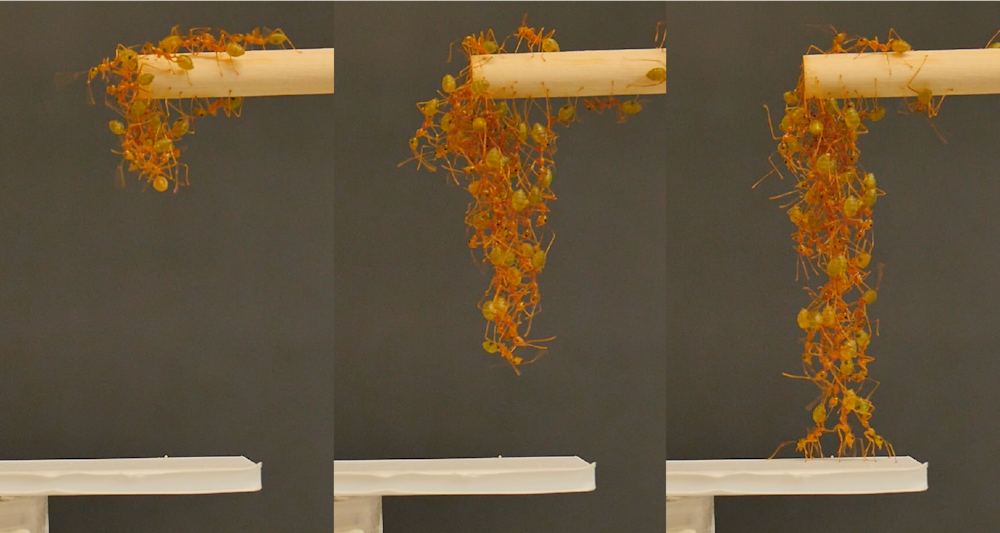
Three photos showing a chain of ants slowly growing downward from one platform to another.
A chain grows as new ants arrive and join the collective attempt to reach the ground below.
Daniele Carlesso, Author provided

This makes chain-building a gamble. Colonies must invest capital (a number of ants) into forming a chain, which may or may not pay off.

In our study we asked whether, like humans, ants budget their investment into a task when the payoffs are unknown. We expected ants would stop forming chains when the gap to be bridged became too tall, as the cost of the chain would become too great.

A simple mechanism for a complex decision

We initially challenged ants to bridge vertical gaps of 25mm, 35mm and 50mm in height. Ants could comfortably form chains within this range, which allowed us to precisely determine the rules they use to build chains.

A detailed analysis of the ants’ behaviour revealed that joining and leaving events happen primarily in the lowest part (1cm) of chains. This indicates that ants are unable to leave their position if one or more individuals start hanging from them.


Read more:
Bridges, highways, scaffolds: how the amazing engineering of army ants can teach us to build better


We then found ants decide how long to stay in a chain by visually assessing their distance from the ground below. The closer to the ground, the longer an ant remains in the chain.

Chain formation is thus modulated by a simple rule: each ant remains in the chain for a length of time proportional to her distance to the ground, and remains stuck in place if one or more ants start hanging from her. The ant will then be able to move only if the other ant(s) leave.

Ants bridging a 50mm gap. Daniele Carlesso.

Can this rule predict a distance beyond which ants stop forming chains? We answered this question using a mathematical model, which predicted ants should stop forming chains when the gap is taller than 89mm.

To confirm these predictions, we asked ants to form chains over gaps of 110mm – a distance well beyond the threshold predicted by our model. As expected, ants never formed chains over these gaps.

Tricking ants into investing more

If ants use vision to assess their distance from the ground, we should be able to trick them into building very long chains (greater than 90mm) by keeping the ground at a constant distance from the bottom of the chain.

We ran an additional experiment where we could lower the platform ants had to reach using a slider. As the chain grew, we lowered the platform, keeping it just out of reach of the ants. Using this apparatus, we tricked ants into forming chains as long as 125mm.


Read more:
Bees are astonishingly good at making decisions – and our computer model explains how that’s possible


Similar to when we set ourselves a time limit for finding parking, ants set a distance limit before giving up. And they do so using a simple rule – remain in the chain for a length of time proportional to your distance to the ground.

Our results reveal how simple rules can guide groups in making adaptive collective decisions in the absence of payoff information. Not only does this help us understand ants – it also provides an algorithm for decision-making in uncertain scenarios, which can be applied in multi-agent artificial systems such as swarm robotics.

The Conversation

Daniele Carlesso receives funding from Macquarie University.

ref. Humans set budgets when facing an uncertain future. So do ants  – https://theconversation.com/humans-set-budgets-when-facing-an-uncertain-future-so-do-ants-209327

The true origins of the world’s smallest and weirdest whale

Source: The Conversation (Au and NZ) – By Nic Rawlence, Senior Lecturer in Ancient DNA, University of Otago

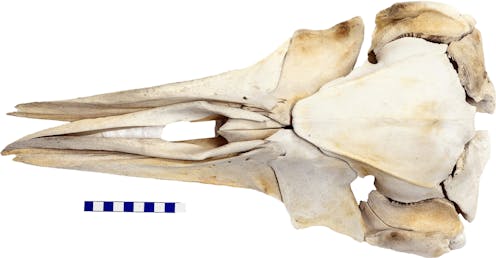
Skull of Caperea marginata. Author provided

The pygmy right whale, Caperea marginata, is the weirdest whale you’ve probably never heard of.

It is the smallest of the living baleen whales and restricted to the Southern Hemisphere.

Its tank-like skeleton is unique among whales, and its ecology and behaviour remain virtually unknown. Even its mitochondria – the power plants of the cell – seem to be ticking differently.

Because Caperea is so unusual, its evolutionary relationships have long been a bone of contention.

Our new study in the international Marine Mammal Science journal finally solves this enduring mystery.

You are what you eat?

For 150 years, anatomists considered Caperea a relative of right whales.

Then came the age of DNA, and Caperea was reinterpreted as a distant cousin of rorquals, which include the mighty blue whale, humpback and minke whale.

Many scientists remained unconvinced, however, leading to decades of acrimonious debates over bones, fossils and molecules.

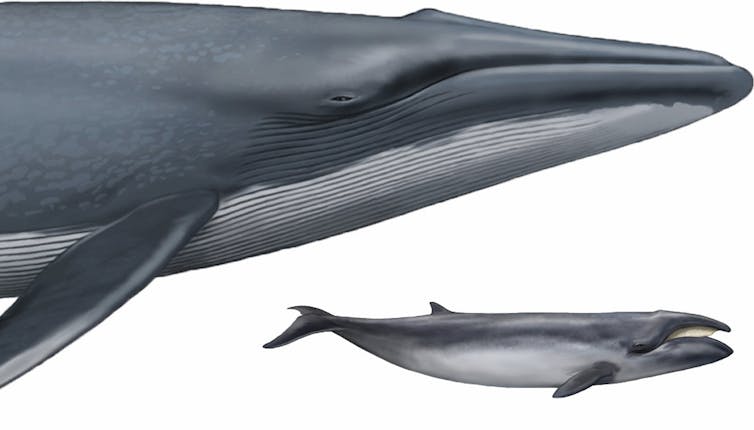
The smallest baleen whale, Caperea marginata, compared to the largest: the blue whale, Balaenoptera musculus.
Carl Buell, Author provided

For more than a century, the case for Caperea being a right whale seemed sound. Sure, it looked weird and small, but its feeding strategy was a dead ringer.

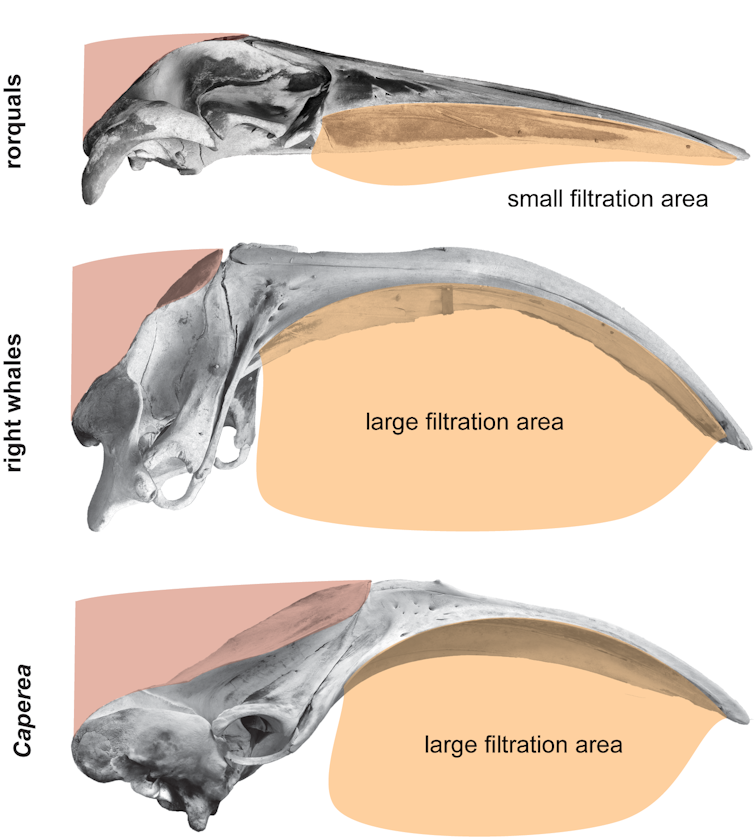
Like right whales, Caperea uses long, finely-fringed baleen plates to skim tiny crustaceans from seawater. Also like right whales, it has a hugely arched snout to accommodate its long baleen, which water and prey stream past continuously during feeding.

Now compare this to rorquals. Unlike Caperea, they feed in short bouts during which they engulf enormous amounts of water and prey in expandable throat pouches. They then expel the water through their short, coarsely-fringed baleen and trap any prey inside the mouth.

The implications of this brief comparison are obvious: Caperea resembles right whales far more than it does rorquals, and so must have the same evolutionary origin.

Morphology versus molecules

Molecular data for Caperea first became available in the 1990s and immediately challenged the traditional view. Time and again, genes allied Caperea with rorquals, rather than right whales.

Such disagreements are normal in science and do not diminish the importance of anatomy, which, after all, remains the only way to study the 99% of species that are already extinct. But anatomical family trees have a nemesis: convergence.

Convergent evolution happens when unrelated species evolve similar traits. Just think of the streamlined bodies of sharks, whales and the extinct ichthyosaurs. Could this be what happened to Caperea?

As molecular evidence mounted, geneticists began to accept Caperea as a distant rorqual relative. Anatomists, however, disagreed.

Fuelling the debate was the fact that only some of the DNA of Caperea had actually been sequenced. Interpreting such a subset is risky, as each gene can have its own unique evolutionary history.


Read more:
Northern exposure: fossils of a southern whale found for the first time in the north


Also unhelpful was the deplorable fossil record of pygmy right whales. Sometimes, key fossils can settle evolutionary debates, as happened in 2001 when two pivotal finds confirmed the origin of whales from hoofed mammals.

Caperea, however, remains largely alone. Even though its lineage is undoubtedly ancient, we only know of six related fossils worldwide.

With both traditional genetic and fossil approaches at a loss, where else was there to turn? Enter genomics.

What our DNA testing revealed

Genomics studies all of an organism’s DNA – its entire molecular blueprint. DNA ultimately determines body shape, so comparing genomes should either corroborate anatomical family trees or expose the effects of convergence.

Sequencing genomes is costly and took a long time to achieve at scale. Even so, recent years have seen huge advances and produced genomes for most baleen whales. Except, you guessed it, the elusive Caperea.


Read more:
Genome and satellite technology reveal recovery rates and impacts of climate change on southern right whales


Here is where our study comes in. Using a sample from a stranded individual from South Australia, we finally sequenced the genome of the pygmy right whale.

Unbeknown to us, a separate research group in Europe had had the same idea. Both teams published their results within a few weeks of each other.

Crucially, their conclusions were the same: Caperea is indeed related to rorquals like the blue whale. Its similarities with right whales are the result of similar feeding strategies, rather than genetics.

The skull of Caperea resembles that of right whales because both need to accommodate long baleen plates for skim feeding. Their similarities are the result of convergent evolution.

So what is Caperea really?

Proving that Caperea is not a right whale raises another question: why is it so unlike its rorqual cousins?

The fossil skull of the Late Miocene cetotheriid Piscobalaena nana from the Muséum National d’Histoire Naturelle.
Felix Marx, Author provided

To start answering this, we need to consider the great antiquity of Caperea‘s ancestry. Molecular dating suggests it diverged from other whales at least 14 million years ago, and perhaps much earlier. The oldest recognisable fossils, however, are just 10 million years old.

What, then, fills the gap? One possibility is that Caperea sprang from the cetotheriids, an ancient family of whales once thought to be extinct.

Many palaeontologists remain sceptical about this idea and instead have clung to the traditional grouping of Caperea with right whales. But anatomical data sets will now need to be re-examined to weed out the effects of convergence.

What this process might reveal remains unclear, of course, but cetotheriids are certainly back in the running.

New insights might also come from new fossils or ancient proteins. Whereas DNA completely breaks down after about a million years, proteins can persist far longer – maybe just long enough to test ideas like Caperea’s cetotheriid origin more rigorously.


Read more:
Empty mollusc shells hold the story of evolution, even for extinct species. Now we can decode it


The Conversation

Nic Rawlence receives funding from the Royal Society of New Zealand Marsden Fund.

Felix Georg Marx received funding from an EU Marie Skłodowska-Curie Global Postdoctoral fellowship.

Ludovic Dutoit does not work for, consult, own shares in or receive funding from any company or organisation that would benefit from this article, and has disclosed no relevant affiliations beyond their academic appointment.

ref. The true origins of the world’s smallest and weirdest whale – https://theconversation.com/the-true-origins-of-the-worlds-smallest-and-weirdest-whale-208279

The furry puss caterpillar’s venom packs a painful punch. Now new research shows it came from an unlikely source

Source: The Conversation (Au and NZ) – By Andrew Walker, Postdoctoral Research Fellow, Institute for Molecular Bioscience, The University of Queensland

Donald W. Hall, Author provided

Did you know venom – a toxic substance injected by one animal into another – has evolved around 100 times?

In our laboratory at the University of Queensland, my colleagues and I study all kinds of venomous animals. One reason we do this is to find new molecules that can be used in medicines, or as bio-friendly insecticides.

Scientists have used venom toxins from snakes, spiders and scorpions in various medical contexts, including to lower blood pressure, protect against stroke, and label tumours during surgery.

There are several other groups of venomous animals, such as assassin bugs and robber flies, which have been largely neglected – yet their venom may prove to be just as useful to humans.

In research published today in the Proceedings of the National Academy of Sciences, our team investigated the venom from a group of caterpillars called asp caterpillars, which are notorious for their ability to cause excruciating pain. They’re also called puss caterpillars since they sport long, soft hairs that have been dubbed “toxic toupées”.

We were surprised to find the main painful toxins in asp caterpillars belong to a family of molecules usually found in disease-causing bacteria. We discovered that a gene that codes for this kind of toxin hopped from bacteria to the ancestors of moths and butterflies millions of years ago, in a phenomenon called horizontal gene transfer.

Float like a butterfly, sting like a bee

The insect group Lepidoptera, which we usually think of as butterflies and moths, are my favourite venomous animals. Interestingly, it’s always the larval forms (caterpillars) that are armed with venom, and not the adults. We think this is because caterpillars are particularly helpless against predators, and therefore need special defences.

This is also why venom has evolved multiple times just within Lepidoptera. Unlike most arthropods, which use venom for hunting, caterpillars are among a select few (including bees) that use it purely to defend themselves from predators.

However, the venom of some of these caterpillar groups, including asp caterpillars, has never been examined with modern methods.

When touched, the tips of the smooth cylindrical venom spines break, injecting venom.
Author provided

Evolution by horizontal gene transfer

People who have been stung by asp caterpillars have described the feeling as being similar to “touching burning coals” or “being hit with a baseball bat”. We set out to find what this venom contains and how it can inflict such incredible pain.

Asp caterpillars aren’t found in Australia, so I had to travel to Florida to collect them from oak and elm trees. Although I couldn’t return with live individuals (due to the threat of invasive species), with the help of some US researchers I was able to bring some venom and preserved caterpillars back to the lab for analysis.

We used a variety of imaging and molecular techniques to build a picture of where the venom is made, what kinds of toxins it contains, and how those toxins produce pain.

Surprisingly, when we looked at the structures of the main pain-causing toxins, we found they belonged to a toxin group usually produced by bacteria, including disease-causing bacteria such as E. coli and salmonella. These caterpillar toxins work by punching holes in cells – the same mechanism the bacterial toxins use to inflict damage on humans.

When we analysed the family tree of the toxins in detail, we found a gene that codes for this kind of toxin had “hopped” from a bacterium to the ancestors of butterflies and moths hundreds of millions of years ago.

These hopping events are called horizontal gene transfer to distinguish them from the vertical transfer of genes from parents to offspring. These events are very rare.

In the case of asp caterpillars, DNA from the infecting bacteria would have not only had to come into contact with the ancestral caterpillar, but also get incorporated into its DNA, inside the cells that would become sperm or eggs (and be passed on to subsequent generations).

We know of only a few examples of the horizontal gene transfer of venom toxins.

Harnessing nature’s resources

Our study shows evolution and life are weirder and more complex than we usually assume. Beyond this, projects like this can also help us discover new ways in which venom toxins may benefit humans and the environment.

For example, toxins that make holes in cell membranes are already being investigated for their ability to deliver lifesaving drugs to the inside of cells.

Another potential application is in engineering toxins that could punch holes in cells to selectively kill cancer cells, while leaving normal cells intact. Our ability to develop such new technologies depends on discovering and understanding the molecular resources that exist in nature.


Read more:
Ever wondered who’d win in a fight between a scorpion and tarantula? A venom scientist explains


The Conversation

This work was funded through the Australian Research Council through Discovery Project DP200102867.

ref. The furry puss caterpillar’s venom packs a painful punch. Now new research shows it came from an unlikely source – https://theconversation.com/the-furry-puss-caterpillars-venom-packs-a-painful-punch-now-new-research-shows-it-came-from-an-unlikely-source-209329

‘Just leave me alone!’ Why staying connected to your teenager is tricky but important

Source: The Conversation (Au and NZ) – By Elise Woodman, Social Work Researcher and Lecturer, Australian Catholic University

Shutterstock

Parenting teenagers can feel daunting. With high rates of youth mental health diagnoses and persistent messages about adolescents’ desire for independence, parents and carers are searching for ways to support their kids and have a relationship with them.

Family connectedness – the sense of belonging and closeness that can be present in families of all shapes and sizes – can protect young people’s wellbeing and mental health.

Feeling connected to family can provide a stable foundation for positive development and building a sense of self. Family connection helps young people feel secure and supported at home as they cope with the changes of adolescence and explore the world and relationships around them.

But it’s not always easy to foster when the teenager in your life says they want you to leave them alone. Here are some ideas to try.

Pushing away but wanting connection

Our previous research involved interviews with young people, who told us that although their words and actions sometimes push relatives away, they need and value time with family much more than we might realise.

Similar research suggests young people still want family involvement, despite sometimes sending mixed messages. In 2020, 80% of 15–to-19 year olds surveyed rated family relationships as very or extremely important.

Here’s what young people told us they wanted family to do.

1. Be present in their lives

Time with family members is important to young people. Connections are built by being engaged with your teenagers during the mundanity of life – while washing the dishes together, sharing meals or driving places.

Young people need to see you are genuinely interested in their lives. Ask open-ended questions and remember the important things they tell you. A good first step is putting away your phone – yep, just like we keep telling them to.

Do not assume changes in their mood are just due to hormones or neurological shifts. Teenagers in our research told us sometimes they hide away in their bedrooms because their parents are focused on work and not mentally present to connect with.

When life gets busy, be explicit that you value time with them and want more of it.

If you are not living with your young person, showing a consistent interest in their lives is crucial to maintaining your connection.

2. Share in each other’s interests

Common interests naturally support time together and engaged conversations.

Ask about the things they care about. Spend time together doing the things they enjoy – op-shopping, hiking, watching movies. Think about ways they can enjoy their interests at home – cook a meal or watch a movie together.

3. Value them for who they are right now

Young people want to feel valued as an important part of the family and have their individuality and ideas respected.

They are used to adult opinions being valued above their own and appreciate you taking their views seriously and being willing to change your mind.

Our research revealed different ways to show you respect and accept them. Young people want you to accept their friends, notice their strengths, and be trusted with subject and career choices. They definitely do not want to be compared to their siblings.


Read more:
Why the tween years are a ‘golden opportunity’ to set up the way you parent teenagers


4. Balance freedom and boundaries

For many young people, being given independence is a sign of trust and helps them feel more connected.

Even young people recognise they can be given too much independence and, in the long term, see reasonable boundaries as a sign of care.

Negotiate fair boundaries with your young person, develop mutually agreed consequences and talk things through calmly when things do not go to plan.

Adult man and teenagers sitting on bridge outdoors
Doing things together is powerful.
Shutterstock


Read more:
Teenage brains are drawn to popular social media challenges – here’s how parents can get their kids to think twice


You don’t have to do it alone

I often hear parents express guilt about how they parent. But parents are not solely responsible for family connection. Young people and the wider family also play an important role.

Supportive relationships with siblings, extended family and close friends extend their network of support. You can support and encourage these relationships with others by keeping communication open and suggesting opportunities to spend time together.


Read more:
How can I help my teen quit vaping?


Hang in there!

Do not let your idea of adolescent independence stop you from engaging with the young people in your life – they value staying connected with family, even if they do not always show it.

Even if connections have become strained, most young people will be open to new efforts to connect. As they grow, you can think about moving towards interdependence and a more mutually supportive relationship.

And just like the younger stages of infancy and childhood, this too shall pass. As teenagers move towards adulthood, most young people will become clearer and more expressive about how they value you and your relationship.

The Conversation

Jessica Ross and Thomas Schaefer assisted with the preparation of this piece.

ref. ‘Just leave me alone!’ Why staying connected to your teenager is tricky but important – https://theconversation.com/just-leave-me-alone-why-staying-connected-to-your-teenager-is-tricky-but-important-208847

New Australian laws for ‘engineering’ the ocean must balance environment protection and responsible research

Source: The Conversation (Au and NZ) – By Kerryn Brent, Senior Lecturer, Adelaide Law School, University of Adelaide

GizemG, Shutterstock

The Australian Labor government has introduced a bill to regulate “marine geoengineering” – methods to combat climate change by intervening in the ocean environment.

The bill would prohibit listed marine geoengineering activities without a permit.

Scientists are already experimenting with ways to store more carbon in the ocean or shield vulnerable ecosystems. They include ocean fertilisation and marine cloud brightening. But these proposals are yet to be deployed beyond small-scale outdoor tests. Further research is needed.

These technologies offer huge potential to combat climate change. But large-scale marine geoengineering could also cause harm. Targeted laws are needed to both enable crucial research and protect the marine environment. So does the bill to amend the Sea Dumping Act strike the right balance?

A closeup of phytoplankton (microscopic marine algae)
Phytoplankton, also known as microalgae, provide food for a wide range of sea creatures including shrimp, snails, and jellyfish.
lego 19861111, Shutterstock

Getting to grips with marine geoengineering

Interest in marine geoengineering has grown over several decades as the climate crisis has worsened. Removing CO₂ from the atmosphere is now necessary to achieve “net-zero” emissions and limit global warming to 1.5℃. But marine geoengineering proposals also present risks to the marine environment.

The Southern Ocean – which extends from Australia’s southern coast to Antarctica – has been identified as a suitable location for ocean fertilisation. This involves feeding iron dust to marine algae. Through the process of photosynthesis, the algae pull CO₂ from the atmosphere, which is potentially stored in the deep ocean.

Another proposal is modifying acidity in oceans. Oceans naturally absorb large amounts of CO₂, which is making the water more acidic. Ocean acidification harms marine life, especially animals with shells. It also limits the amount of CO₂ that can be stored. A technology that essentially adds “antacids” to the ocean“ could help counteract this and enable the oceans to store more.

Other proposals seek to reduce the damage from marine heatwaves. “Marine cloud brightening” seeks to limit coral bleaching on the Great Barrier Reef, by spraying sea-salt particles into clouds. The idea is to make the clouds whiter, to better reflect sunlight away from the ocean and limit further warming of the water.


Read more:
Geoengineering the Great Barrier Reef needs strong rules


With help, the oceans could play an even bigger role in stabilising the climate. But there are concerns about unintended consequences of deliberately intervening. For example, ocean fertilisation could decrease water oxygen levels and “rob” neighbouring waters of nutrients, reducing marine productivity.

Marine geoengineering could also distract from efforts to cut emissions at source.

A cross-section of ocean showing different types of carbon capture, such as ocean fertilisation
An overview of marine carbon dioxide removal methods.
Rita Erven/GEOMAR, CC BY

Strong rules to protect the marine environment

With this new bill, the Australian government has taken an important first step towards regulating marine geoengineering.

The bill involves proposed amendments to the Environment Protection (Sea Dumping) Act. It would introduce a permit system for legitimate scientific research activities.

Environment Minister Tanya Plibersek has said of the bill:

Regulating this type of activity, though a robust application, assessment and approval permitting process, would ensure that only legitimate scientific research activities exploring options to reduce atmospheric CO₂ can proceed. This amendment also provides for regulating other potentially harmful marine geoengineering research activities should they emerge in the future.

The bill implements Australia’s international obligations under the London Protocol, a marine pollution treaty that prohibits the dumping of waste at sea without a permit.

It follows a parliamentary inquiry that recommended Australia ratify these international rules. Australia’s support may encourage other countries to adopt these rules and make them legally binding.

Countries negotiated these rules in response to plans by private companies in the 2000s to conduct ocean fertilisation for profit. They decided new international rules were needed to protect the ocean. Currently, only ocean fertilisation is listed, and hence regulated, under these rules. But other activities may be listed in future.

The bill makes it an offence to place matter into the ocean for marine geoengineering without a permit. Permits may only be granted for scientific research activities. At present, these rules apply just to ocean fertilisation, as it is the only activity listed under the London Protocol.

If the bill is passed as it currently stands, commercial deployment of marine geoengineering cannot be conducted either in Australian waters or from Australian vessels.

Harsh criminal penalties will apply to people who conduct marine geoengineering without a permit. Offenders face 12 months imprisonment and/or a fine of up to $68,750.

The bill also establishes offences for loading and exporting material to be used for marine geoengineering without a permit.

Rules limit financial incentives for research

Prohibiting marine geoengineering deployment may be appropriate now. But without future prospects for deployment there may be little incentive to invest in research.

The treaty rules ban ocean-based research directly leading to financial and/or economic gain. This protection is important for building public trust and advancing the public interest. But broad prohibition could hamper marine geoengineering research for economic purposes such as eventual carbon crediting and trading. It could also call into question government subsidies and tax incentives encouraging private research investment.

The parliamentary inquiry did not consider the implications of the new rules for Australia’s carbon markets, or on research to save the Great Barrier Reef.

Changes could affect research to save the reef

Since 2019, the Australian government has invested in marine cloud brightening and other interventions to protect the reef from heat stress and coral bleaching. The first outdoor experiments were conducted in 2020.

The effectiveness of marine cloud brightening is yet to be demonstrated at scale. But modelling suggests a combination of marine cloud brightening and crown-of-thorns starfish control could help protect the reef until 2040.

The treaty rules do not currently apply to marine cloud brightening. However, countries are currently considering adding marine cloud brightening to the list of regulated activities. This could allow research but prohibit deployment. The government should evaluate how this could affect its investment in marine cloud brightening research and associated programs.

Australia’s marine environment is already suffering from warming and acidification. Appropriately-managed marine geoengineering activities may help reduce the damage and/or mitigate climate change.

The treaty’s environmental safeguards are important to ensure the risks from ocean fertilisation activities are rigorously evaluated.

The current bill favours risk management, which is appropriate at the early stages of research and development. But by ruling out future deployment, Australia may undermine incentives to advance research.


Read more:
Australia has introduced a new bill that will allow us to ship carbon emissions overseas. Here’s why that’s not a great idea


The Conversation

Kerryn Brent receives funding from Australian Research Council, and Green Adelaide. She is affiliated with the Australian Forum for Climate Intervention Governance.

Jan McDonald receives funding from the Australian Research Council. She is affiliated with the Biodiversity Council, the Centre for Marine Socioecology, and the Australian Forum for Climate Intervention Governance.

Manon Simon receives funding from the Australian Research Council. She is affiliated with the Centre for Marine Socioecology.

ref. New Australian laws for ‘engineering’ the ocean must balance environment protection and responsible research – https://theconversation.com/new-australian-laws-for-engineering-the-ocean-must-balance-environment-protection-and-responsible-research-209036

New transmission lines are controversial for nearby communities. But batteries and virtual lines could cut how many we need

Source: The Conversation (Au and NZ) – By Lasantha Meegahapola, Associate Professor, RMIT University

Shutterstock

Australia’s power grid was built to transport power from coal-fired power stations or the Snowy Hydro scheme to large cities and industrial precincts. The large transmission lines were designed with generation supply and demand, the shortest routes, and cost in mind.

But this ageing grid isn’t designed to cope with a green future where power flows into the grid from solar farms and windfarms on land and out at sea. To cope, Australia’s energy market operator is proposing over 10,000 kilometres of new transmission lines, linking major renewable precincts with the cities.

The problem? No one likes having large, unsightly lines built near them. There’s already been strong pushback from communities near sites slated for new power lines. Community resistance has now forced the federal government to launch a review of how transmission projects are approved.

The good news is, some alternatives to large-scale transmission lines have come of age. Grid-scale battery banks have already proven their use to store intermittent flows of green electricity for later. And we may be able to build more lightly if we adopt dynamic line rating, which means letting more power flow through when, say, cold winds cool the lines and stop them overheating. Western Australia – which has its own grid – is having success with microgrids as a way to avoid having to send power long distances.

gippsland power lines
Most of Australia’s transmission lines were built decades ago, like these in Gippsland, Victoria. Some rural communities are already resisting proposals for new high voltage lines.
Shutterstock

How can we minimise new transmission lines?

Coal power was concentrated in coal-rich areas such as the LaTrobe Valley in Victoria and the Hunter Valley in New South Wales.

But the best renewable resources are often located in different places. That means a green grid has to connect new renewable zones such as Victoria’s Murray River zone and New South Wales’ Illawarra zone. (Some coal areas, like the LaTrobe Valley, will be able to take advantage of resources such as offshore wind and pair this with existing transmission infrastructure).

We will have to build some new transmission infrastructure. That’s unavoidable. But we can do this cleverly and minimise the impact on communities and landowners.

How? Battery banks allow us to store energy for later use. So if new transmission lines are built leaner and smaller, we could use these grid batteries to store excess energy and transmit it later.


Read more:
A clean energy grid means 10,000km of new transmission lines. They can only be built with community backing


Dynamic line rating offers another way to reduce the scale of new transmission lines.

Every transmission line is rated to a certain power capacity. A key factor limiting how much electricity can flow through a given line is heat. As electrons move, they produce heat. Too high a current and the line will overload.

But if, say, the wind is blowing strongly, it can cool the power lines and let them carry more capacity. That’s especially useful in a grid with a lot of wind energy flowing in. When the weather conditions are right, it could mean carrying as much as 20% more current.

Aren’t grid batteries more about reliability?

At present, large-scale lithium batteries are the most technically viable way to store electricity relatively cheaply. These are already up and running. South Australia’s Hornsdale battery was one of the first, but other states are now joining in. Victoria recently installed a new big battery on the site of a former coal power station.

To date, these batteries have mainly been used to firm up output and boost system reliability.

But they can do more. We can use them as virtual power lines, storing excess power close to a renewable zone and transmitting it to another storage system close to cities and towns as the peak load arrives.

The virtual power line concept has been adopted in Germany and Chile to relieve transmission systems at risk of congestion when bursts of renewable power arrive.

We can even use them as virtual reservoirs, storing energy from hydro plants for later transmission.

How can we put these to use?

It’s in everyone’s interests to minimise how many new transmission lines we build. For the government, being able to reduce the size of the build means savings – and less demand on our already stretched workforce. And for local communities, it means some – but not all – new lines could be avoided.

How do we make it a reality? Essentially, by embedding these new approaches into the way we plan for the electricity grid of the future. When considering any new transmission lines, planners should assess whether part of the needed transmission capacity could instead be provided by virtual powerlines in the form of batteries, and whether the area is suitable for dynamic line rating schemes.

If we integrate these methods of making the most out of our grid’s capacity, we could keep the number of new lines to the minimum while ensuring we can take clean power from where it’s produced to where it’s needed.


Read more:
To hit 82% renewables in 8 years, we need skilled workers – and labour markets are already overstretched


The Conversation

Lasantha Meegahapola does not work for, consult, own shares in or receive funding from any company or organisation that would benefit from this article, and has disclosed no relevant affiliations beyond their academic appointment.

ref. New transmission lines are controversial for nearby communities. But batteries and virtual lines could cut how many we need – https://theconversation.com/new-transmission-lines-are-controversial-for-nearby-communities-but-batteries-and-virtual-lines-could-cut-how-many-we-need-208018

Streaming services are removing original TV and films. What this means for your favourite show – and our cultural heritage

Source: The Conversation (Au and NZ) – By Marc C-Scott, Senior lecturer in Screen Media, Victoria University

Disney

Streaming services have dramatically transformed the media landscape, allowing consumers unparalleled access to vast libraries of content. However the streaming landscape has become far more crowded in the past few years.

This increase in competition has created many challenges for streaming services and resulted in many services recently reporting losses of both subscribers and profits.

As part of recent challenges, multiple services have removed TV and film from their libraries – in many cases, meaning they are gone forever, inaccessible to any fan.

This has sparked debates and raised questions about consumers’ access to content and the future positioning of streaming within the broader media landscape.

Content removal: for the consumer experience or just a tax write-off?

One of the key changes we have seen by streaming services is the removal of content from their libraries. While changes to a streaming service’s content library is not new, it has become a bigger talking point recently in the context of profit loses.

Previously, content has been usually removed from streaming services due to licensing agreements. This removal means that the particular television series and films are no longer available to view on that streaming service, but may reemerge on another streaming service as the licensing shifts.

But the more recent content removal discussion raises questions associated with streaming services – and their overarching corporations – wanting to save money. This can be done through the removal of content, which the corporation can write off as losses.

This not only impacts consumer access, but also impacts actors, writers, directors and other creatives involved in the production. This is due to the fact that if the profits are less, then the residual payments (fees paid when TV shows and films are broadcast) made to the creatives involved in the production are also lowered.

The removal of content is not particular to any streaming service. Hulu wiped shows such as Alaska Daily and The Company You Keep from its service after they were cancelled following a single season.

Programs that were removed after being cancelled on Disney+ have included
Big Shot, Diary of a Future President, Just Beyond, The Mighty Ducks: Game Changers, The Mysterious Benedict Society, The World According to Jeff Goldblum, Turner & Hooch and Willow.

What needs to be considered with many of these is that they are “originals”, meaning they were created by Disney for Disney. The removal of original content from streaming services, in most instances, means they will not be accessible to viewers anywhere.

As part of the removal of programs, Disney recently reported it would take a US$1.5 billion write-down from the axed content. More content is expected to disappear in upcoming quarters, which could also include original content.

Has the streaming bubble burst?

In late 2022, many streaming services reported both subscriber and financial losses. For Netflix, this was the first time it had reported a loss of subscribers.

It was reported Netflix lost 200,000 subscribers worldwide, the complete opposite of Wall Street’s expectation that the service would add 2.5 million subscribers. This is despite still making a profit in that period.

But Netflix was not alone in the shedding of subscribers. Disney+ lost 2.4 million subscribers in the final quarter of 2022. This was only exacerbated by the loss of 3.8 million subscribers to its Disney+ Hotstar streaming services (the Disney+ service offered in India and parts of Southeast Asia).

Warner Bros Discovery also reported a financial loss of US$217 million across its streaming services.


Read more:
Netflix and other streaming giants pay to get branded buttons on your remote control. Local TV services can’t afford to keep up


The impact on viewers and creators

The removal of TV and films from streaming penalises creators financially, but it also removes their means to use past work “as a calling card to help land future gigs”.

Eliza Skinner, head writer for Earth to Ned, which was removed from Disney+, says they were not aware of the decision until seeing it reported in an article. Skinner also noting that she doesn’t own a physical copy of the show, making it even more difficult to use the program for future work.

There appears to be a recent shift in content licensing across streaming services. HBO has just signed a deal with Netflix, that has seen Issa Rae’s Insecure launch on Netflix. Band of Brothers, The Pacific, Six Feet Under and Ballers will also be available on Netflix as part of the deal.

This is a significant shift in the previous approach by streaming services to create “originals” as a way to increase subscriptions. This new approach, could result in content being available across multiple streaming services and/or other subscription television.

Too many chefs in the production kitchen

The Independent Film & TV Alliance says there are a myriad of third-party contractual relationships and licenses which need to be negotiated and put in place when it comes to streaming rights.

The alliance also notes that “distributors are licensed exclusively for their country, language and release platform”. This results in major national distributors taking all rights for their country. This can result in content being available in countries at different times and across varying platforms.

For television series, licensing and agreements can become extremely complicated when multiple studios are involved across multiple seasons.

Arrested Development is a prime example of the interwoven complexities. Disney’s 20th Television unit owned the underlying rights and produced seasons one to three, with Netflix producing the last two seasons. This resulted in the first three seasons streaming on Disney’s Hulu service, while Netlfix had all five on its service.

Netflix announced this year that it would be removing all five seasons of the TV series due to licensing issues.

This is further complicated if you look at this from an Australian perspective. When season five premiered internationally on Netflix, it premiered on Foxtel in Australia. This was due to a “first run” agreement Foxtel had signed many years prior to Netflix’s involvement.

Will there be resurgence of physical media?

Thankfully if you are an Arrested Development fan, you can purchase DVDs for seasons one to four in Australia. That is, if you can find a store that sells physical media – Kmart removed the sale of physical media more than five years ago.

But for much of the new content being produced, physical media are not available. This means consumers will not be able to access the content once it has been removed from a streaming service.

But for all the content only going to streaming platforms, there must be a plan associated with archiving it and allowing consumer access. Already much of our film and television programs have been lost in the past – for example prior to 1947 there was no way to properly record a live television broadcast.

Even when they are recorded, this technology will only last for a period of time, something the National Film and Sound Archive knows only too well.

There is a perception that digital lasts forever and therefore is easily archived. But are we seeing history repeat itself? Will original streaming content follow a similar path to old film and television content and be lost forever?

The Conversation

Marc C-Scott does not work for, consult, own shares in or receive funding from any company or organisation that would benefit from this article, and has disclosed no relevant affiliations beyond their academic appointment.

ref. Streaming services are removing original TV and films. What this means for your favourite show – and our cultural heritage – https://theconversation.com/streaming-services-are-removing-original-tv-and-films-what-this-means-for-your-favourite-show-and-our-cultural-heritage-208746

Nuclear-free campaigners warn against AUKUS raising Pacific tensions

Asia Pacific Report

Advocates and defenders of a nuclear-free Pacific have condemned the AUKUS military pact and warned New Zealand that the agreement would make the world “more dangerous” and should not join.

Participants at a Nuclear-Free and Independent Pacific (NFIP) movement teachers’ wānanga launched a petition against the pact with one of the “elders” among the activists, Hilda Halkyard-Harawira (Te Moana Nui a Kiwa), symbolically adding the first signature.

Speaking about the petition declaration in a ceremony on the steps of the Auckland Museum marking the 10 July 1985 bombing of the Greenpeace flagship Rainbow Warrior, Reverend Mua Strickson-Pua explained that the AUKUS agreement was a military pact between Australia-UK-US that was centred on Canberra’s acquisition of nuclear propelled submarines.

“The pact also includes sharing weapons and other military technologies,” Reverend Strickson-Pua said, reading from the declaration.

“The New Zealand government is considering joining part of this pact. This petition opposes AUKUS and calls for a foreign policy centred on an independent, demilitarised and nuclear-free Pacific.”

Reverend Strickson-Pua asked why this was important.

“AUKUS is an aggressive military pact. Security in New Zealand and the Pacific can only be ensured by centring sustainable development, Indigenous rights, and environmental protection.

‘Deepen geopolitical tensions’
“AUKUS makes the world more dangerous. New Zealand participation in AUKUS would deepen geopolitical tensions in the Pacific, and threaten Pacific nations’ long held policy of ‘friends to all and enemies to none’.

“AUKUS impedes climate action. Climate change remains the single greatest threat to the livelihoods, security and wellbeing of all peoples of the Pacific.

“The threat of climate change requires international diplomacy and cooperation, not militarism.

“AUKUS threatens our nuclear free legacy. Aotearoa New Zealand has a proud history of anti-nuclearism and solidarity with the Nuclear Free and Independent Pacific movement.”

Reverend Strickson-Pua also stressed that AUKUS was not based on public consultation.

“It accelerates climate injustice, violates our treaties and regional commitments, and erodes regional decolonisation efforts.”

The petition urges the New Zealand government to reject any role in the AUKUS military pact and condemns the use of nuclear weapons and non-peaceful nuclear technologies in the Pacific.

Nuclear Free and Independent Pacific Movement (NFIP) campaigners Hone Harawira, Hilda Halkyard-Harawira and Reverend Mua Strickson-Pua
Nuclear Free and Independent Pacific Movement (NFIP) campaigners Hone Harawira, Hilda Halkyard-Harawira and Reverend Mua Strickson-Pua on the steps of Auckland Museum today. Image: David Robie/APR

‘French Letter’
After the reading of the declaration, participants sang the popular Herbs anti-nuclear song “French Letter.”

This petition is led by Te Kuaka and is addressed to Prime Minister Chris Hipkins, Foreign Affairs Minister Nanaia Mahuta, Minister of Defence Andrew Little, and Associate Foreign Affairs Minister (Pacific) Carmel Sepuloni.

The petition launch and Rainbow Warrior reflection followed the teachers’ wānanga which featured many veteran activists of the NFIP and New Zealand nuclear-free movements such as Hilda Halkyard-Harawira, Hone Harawira, Reverend George Armstrong and others discussing past actions and strategies for the future — such as linking with the climate crisis.

“Today we heard from movement elders and educators about the ongoing relevance of the history of the NFIP movement for Aotearoa,” said Marco de Jong, a Pacific historian working for WERO (Working to End Racial Oppression) who is the wānanga co-convener.

“Our nuclear-free legacy is an important part of national identity, but it is important to make sure we approach it critically so we are not teaching mythology to our learners.

“Today we heard about regional and Māori dimensions that might add diverse historical perspectives, tomorrow we will work on translating them into resources for a range of different learning environments.”

"Independence in the Pacific" posters at the teachers' wānanga at the Auckland Museum
“Independence in the Pacific” posters at the teachers’ wānanga at the Auckland Museum today. Image: David Robie/APR
Print Friendly, PDF & Email

Article by AsiaPacificReport.nz

Politics with Michelle Grattan: Bill Shorten on Robodebt report’s sealed section, and progress on NDIS reform

Source: The Conversation (Au and NZ) – By Michelle Grattan, Professorial Fellow, University of Canberra

The Robodebt royal commission’s report has excoriated a raft of former ministers, especially Scott Morrison, who was a main instigator of the program, as well as public servants who were involved.

What we don’t know is who has been referred for prosecution or other action, because the names are in a sealed section of the report.

When in opposition, Bill Shorten pursued the scandal, mobilising a class action. Now Shorten is Minister for Government Services, overseeing a department that in an earlier iteration was at the centre of Robodebt. He’s also Minister for the National Disability Insurance Scheme.

In this podcast, Shorten joins The Conversation to discuss the aftermath of the royal commission report, and progress in reforming the NDIS.

Shorten sees Commissioner Catherine Holmes’s report as groundbreaking: “I genuinely believe that this royal commission and the report has the opportunity to educate a generation of politicians and senior public servants about the errors that have occurred here […] the way that the royal commissioner has drafted the report, her words, her analysis […] I think has sent shockwaves through Canberra.”

He condemns Morrison’s lack of contrition in light of the strong findings against him. “I just think that a lot of politicians I know, not just on the Labor side, but also the Liberal side who, when confronted with the same evidence, would show more contrition, would show more self-awareness.”

On the sealed section, naming those against whom action should be taken, Shorten toes the Labor line on Holmes’ advice to keep it secret – although he notes, “the discredited trade union royal commission certainly released the names of delegates and organisers” it recommended action against.

He says Commissioner Holmes did “such a fantastic job” in getting to the heart of matters, so if she believed not putting out all the evidence “improves the odds of better investigation by regulatory authorities […] well, I think the government’s prudential to listen to her advice”.

“I do, though, accept that there’s an interest in accountability, that there’s scepticism […] I just want to reassure people, as the person who helped organise the class action and who campaigned for the royal commission, I and the government are completely committed to accountability in this.”

Shorten says he has already undertaken major reform of the NDIS since taking it over, changing the leadership and getting more people with a disability into senior roles. The scheme is about to undertake a mass conversion of labour hire staff into full-time roles, as promised in the May budget.

A major part of Shorten’s reform drive is to tackle fraud, taking particular aim at agencies “rorting” the scheme. “I’m talking to the ACCC [The Australian Competition and Consumer Commission] about how we can clamp down on price-gouging.”

“Our criminal task force [is] going after not the people on the scheme, but some service providers who are rorting the system, and we’ve got a lot of operations underway. We just want to get rid of the crooks out of the scheme, but we’re not creating notional budgets that somehow this will deliver some mountains of gold. I just want to straighten up the scheme in the best interest of participant.”

Earlier this year the government said the growth rate of the scheme would be cut to 8% a year by 2026. Shorten recently suggested it wouldn’t be the end of the world if this target wasn’t reached, but he quickly had to backtrack. “I was a bit naive in my language,” he says, explaining he’d been trying to make it clear this was a “target” not a “cap”. “It’s not a cap. Funding for people isn’t going to run out [at] 11 months in a 12-month program,” he says.

The Conversation

Michelle Grattan does not work for, consult, own shares in or receive funding from any company or organisation that would benefit from this article, and has disclosed no relevant affiliations beyond their academic appointment.

ref. Politics with Michelle Grattan: Bill Shorten on Robodebt report’s sealed section, and progress on NDIS reform – https://theconversation.com/politics-with-michelle-grattan-bill-shorten-on-robodebt-reports-sealed-section-and-progress-on-ndis-reform-209400

Why is NATO expanding its reach to the Asia-Pacific region?

Source: The Conversation (Au and NZ) – By Gorana Grgić, Senior Lecturer, Department of Government and International Relations and US Studies Centre, University of Sydney

Since Russia invaded Ukraine last year, NATO meetings and summits have been receiving significantly more attention compared to previous years. And there are several big-ticket items on the agenda at the upcoming summit in Vilnius, Lithuania, which begins on Tuesday.

The foremost issue is, of course, NATO’s future military support to Ukraine in its ongoing war against Russia, particularly in the wake of reports of weapon delivery delays and the United States’ controversial decision to send cluster munitions to the Ukrainians.

The allies will also discuss Ukraine’s potential membership in the group. Ukraine is seeking an invitation and a roapmap to eventually join NATO, which the US and Germany, in particular, have resisted while an active war is occurring.

The members will also agree on the first major overhaul of NATO’s military plans since the Cold War and an increase in their individual defence spending. NATO Secretary-General Jens Stoltenberg is looking for commitments from all 31 members to spend at least 2% of their gross domestic product on defence – something that was considered an aspiration rather than a baseline a decade ago.

NATO’s interest in the Asia-Pacific

The other invitees receiving considerable attention are four leaders from the Asia-Pacific: Australian Prime Minister Anthony Albanese, New Zealand Prime Minister Chris Hipkins, Japanese Prime Minister Fumio Kishida and South Korean President Yoon Suk Yeol. The four will be in attendance for the second year in a row, following last year’s NATO summit in Madrid.

While NATO’s outreach efforts to the Asia-Pacific region are still in the infancy stage, they have generated some criticism in recent days. Former Australian Prime Minister Paul Keating called Stoltenberg a “supreme fool” for boosting the bloc’s ties with the region. And French President Emmanuel Macron is reportedly opposed to the opening of a proposed NATO liaison office in Tokyo.

With NATO so heavily focused on Ukraine at the moment, its interest in a region half-way around the world does raise some questions. Why are these four leaders becoming regular features at a summit for European and North American countries?

First, these countries have been among the most prominent members of the international coalition supporting Ukraine and sanctioning Russia. So, their presence at a security conference where Ukraine will be discussed makes sense.

More importantly, though, the Indo-Pacific region featured prominently in NATO’s 2022 Strategic Concept, a key document that outlines the alliance’s values, purpose and role.

For the first time last year, the document referred to China’s ambitions and policies as a major challenge to NATO’s security, interests and values. It also specifically addressed the growing cooperation between China and Russia, which NATO sees as a threat to the established rules-based international order.

As such, the Strategic Concept called the Indo-Pacific “important for NATO, given that developments in that region can directly affect Euro-Atlantic security”.

This makes the case quite clear for NATO to strengthen its existing partnerships in the region and develop new ones.

What these new partnerships will look like

Policy analysts have debated the merits and consequences of this expanded level of cooperation.

But despite hesitations among some commentators, the four Asia-Pacific countries generally want to move in the direction of stepping up their cooperation with NATO.

Indeed, if the Madrid summit served as an opportunity for the four Indo-Pacific partners to showcase their support for Ukraine and pledge stronger commitment to future collaboration with NATO, the Vilnius summit will serve as a benchmark to assess the progress that’s been made.

This is why, in the lead-up to the summit, NATO has been working to formalise its partnerships with the four countries.

Japan and Australia have been at the front of these efforts. Japanese media reported last week that Tokyo and Canberra have wrapped up negotiations with NATO on a new agreement called the “Individually Tailored Partnership Program (ITPP)”. This program specifies the key areas of cooperation between each country and the NATO bloc.

New Zealand and South Korea are working to finalise their individual agreements with the alliance, too.

The partnerships will largely focus on areas of global concern, such as maritime security, cybersecurity, climate change, outer space, and emerging and disruptive technologies (including artificial intelligence).

And from a defence standpoint, NATO and the four partners will aim to improve the “interoperability” of their militaries – the ability of different military forces and defence systems to effectively work together and coordinate their actions.

This might entail deepening the knowledge of each other’s military assets, improving the relationships between their soldiers and other military personnel, and expanding joint drills.

A Japan-US joint military exercise in Japan in November involved about 36,000 troops, as well as British, Australian and Canadian vessels.
Hidenori Nagai/Yomiuri Shimbun/AP

Why is this happening now?

The intensifying and deepening relations between NATO and its Indo-Pacific partners can be interpreted in two ways.

First, these partnerships form another important link in the expanding network of diplomatic and security ties between the US, its Western allies and the Indo-Pacific region. They complement partnerships like AUKUS and the Quad.


Read more:
China, Russia and climate change: why Australia’s place at the NATO Summit was so important


Beyond this, we can also view these agreements in the context of NATO’s evolving outreach with the rest of the world over the past couple decades.

Previously, NATO’s collaborations with Indo-Pacific countries involved pooling resources for security operations in non-NATO members, such as the Balkans in the 1990s and Afghanistan in the 2000s.

Nowadays, strengthening these partnerships is seen as a vital part of responding to the new challenges and threats posed by Russia and China.

Of course, this does not mean we will see NATO military equipment or troops permanently stationed in the Indo-Pacific. Nor would it be realistic to expect the Indo-Pacific countries’ military contributions to Ukraine to lead to a more permanent set-up in Europe.

Similarly, while all of this is aimed at intensifying security cooperation among US allies in the Indo-Pacific, this is in no way a prelude to the creation of a NATO-like collective defence pact in the region.

However, given the complexities of the current tensions with Russia and China, there is a clear need for greater coordination and cooperation among a larger group of countries. These new partnerships can be effective in addressing everything from disinformation and maritime security to cyber defence and competition in space.

Chinese President Xi Jinping and Russian President Vladimir Putin would obviously prefer these partnerships to slow down. Indeed, China has criticised the proposed NATO liaison office in Tokyo as an attempt to “destroy regional peace and stability”.

China and Russia might even find some comfort in seeing the clear differences among the four partners as to their desired level of engagement with NATO.

However, all four Indo-Pacific countries can agree on one fundamental fact – they expect to see more competition with both China and Russia in the future, not less.

The Conversation

Gorana Grgić received research and teaching funding from NATO Public Diplomacy Division in 2021-2022 and the Australian Department of Defence in 2022-2023.

ref. Why is NATO expanding its reach to the Asia-Pacific region? – https://theconversation.com/why-is-nato-expanding-its-reach-to-the-asia-pacific-region-209140

Developers aren’t paying enough to offset impacts on koalas and other endangered species

Source: The Conversation (Au and NZ) – By Jonathan Rhodes, Professor of Ecology, The University of Queensland

Jonathan Rhodes, Author provided

Developers are commonly required to “offset” their impacts on biodiversity. They can do this in two ways.

They can compensate directly for the biodiversity loss their development causes by taking action to improve habitat and biodiversity elsewhere. It is common, though, for developers to make payments in lieu of creating the required biodiversity offsets themselves. It’s the same idea as when you pay to offset your flight’s carbon emissions.

In Queensland and New South Wales developers settle almost all biodiversity offsets required of them by making payments into an offset fund. These funds are used to create the required biodiversity gains on the developer’s behalf. In NSW, for example, the Biodiversity Conservation Trust does this work.

But what are the pros and cons of allowing developers simply to buy their way out of their offset obligations? Research published today shows these so-called “financial settlement offsets” could be highly problematic. They might even worsen the decline of threatened species.


Read more:
Flying home for Christmas? Carbon offsets are important, but they won’t fix plane pollution


What did the study find?

Researchers from The University of Queensland and Griffith University analysed the impacts of the Queensland government’s environmental offsets policy on koalas in the state’s south-east. This policy requires every koala habitat tree removed for development to be offset by planting and protecting three new habitat trees elsewhere. The developers can do this themselves or make a payment into a state-managed offset fund.

Our study assessed the likely impacts of financial settlement offsets on koala habitat and koala numbers under different future urban growth scenarios.

First the good news: these offsets can work in some cases. The payments can be used to invest strategically in planting trees in areas that lead to the greatest increase in koala habitat or koala numbers. For example, this could be done in areas that improve connections between areas of suitable habitat or are close to important koala populations.

Developers could do this offset work themselves. However, their priority is usually to minimise cost. This means they are unlikely to act strategically to deliver the maximum benefits for habitats and species.

As a result, our study shows financial settlement offsets could deliver 50-100% greater gains in habitat area and koala numbers than offsets delivered by developers.


Read more:
Labor’s biodiversity market scheme needs to be planned well – or it could lead to greenwashing


Lack of suitable offset sites is a big problem

Unfortunately, these gains depend on there being enough offset sites available for koala habitat restoration. An offset site must be ecologically suitable and able to be protected, habitat restoration must be feasible and the landholder must agree.

All these factors mean suitable sites are usually hard to find. In such cases, we found payments by developers weren’t enough to achieve the amount of restoration needed to offset their impacts.

If less than one in four of all ecologically suitable locations are available for offsets, the performance of financial settlement offsets falls dramatically. But if only one in 100 of all ecologically suitable locations are available, payments from developers are never enough to cover the cost of the required restoration.

According to the Queensland Offsets Register only 5.2% (0.7 hectares of 13.4ha) of all financial settlement offsets for koala habitat since 2018 have been delivered so far through on-ground activities by the state government. This shows how hard it is to find offset sites.

In Queensland, increasing the supply of offset sites has been identified as a priority.

Unfortunately, the shortage is a common problem across Australia.

In NSW, 90% of demand for offsets cannot be met through offset “credits”. These tradeable credits are created when biodiversity gains are generated at a site. Their supply to offset developer impacts is very low, indicating few suitable sites are available.

Potential offset sites are also increasingly scarce at the federal level. The shortage is expected to increase the use of financial settlement offsets.

A lack of sites can be due to the availability of ecologically suitable sites, but the offset price, transaction costs, regulatory constraints (such as requiring offset sites to be within a certain distance from impact sites) and social and economic influences on the land market are also key factors.


Read more:
We asked landholders how they feel about biodiversity offsets — and the NSW government has a lot to learn


Developers should pay the full cost of offsets

Our study highlights the importance of ensuring developers pay the true cost of offsetting their impacts. By making payments in lieu of delivering offsets themselves, developers essentially transfer their financial risk to the state.

If there aren’t enough funds to deliver the required offset, the state is left with two options. Either it makes up the shortfall (taxpayers essentially subsidise developers’ environmental costs), or it falls short of delivering the full offset, leading to increased pressure on species. Both of these are poor outcomes.

The methods for calculating developer financial contributions have increasingly been called into question. It’s essential to ensure these calculators properly consider the availability and costs of offset sites.

The alternative jeopardises the delivery of offsets and adds to the pressure on threatened species such as the koala.

The Conversation

Jonathan Rhodes receives funding from the Australian Research Council, the Queensland Government, and the New South Wales Government. He is also a member of the Queensland Government’s Koala Advisory Council and the New South Wales Government’s Koala Expert Panel.

Shantala Brisbane does not work for, consult, own shares in or receive funding from any company or organisation that would benefit from this article, and has disclosed no relevant affiliations beyond their academic appointment.

ref. Developers aren’t paying enough to offset impacts on koalas and other endangered species – https://theconversation.com/developers-arent-paying-enough-to-offset-impacts-on-koalas-and-other-endangered-species-208587

Ageism, sexism, classism and more: 7 examples of bias in AI-generated images

Source: The Conversation (Au and NZ) – By T.J. Thomson, Senior Lecturer in Visual Communication & Digital Media, RMIT University

Shutterstock

If you’ve been online much recently, chances are you’ve seen some of the fantastical imagery created by text-to-image generators such as Midjourney and DALL-E 2. This includes everything from the naturalistic (think a soccer player’s headshot) to the surreal (think a dog in space).

Creating images using AI generators has never been simpler. At the same time, however, these outputs can reproduce biases and deepen inequalities, as our latest research shows.

How do AI image generators work?

AI-based image generators use machine-learning models that take a text input and produce one or more images matching the description. Training these models requires massive datasets with millions of images.

Although Midjourney is opaque about the exact way its algorithms work, most AI image generators use a process called diffusion. Diffusion models work by adding random “noise” to training data, and then learning to recover the data by removing this noise. The model repeats this process until it has an image that matches the prompt.

This is different to the large language models that underpin other AI tools such as ChatGPT. Large language models are trained on unlabelled text data, which they analyse to learn language patterns and produce human-like responses to prompts.


Read more:
AI to Z: all the terms you need to know to keep up in the AI hype age


How does bias happen?

In generative AI, the input influences the output. If a user specifies they only want to include people of a certain skin tone or gender in their image, the model will take this into account.

Beyond this, however, the model will also have a default tendency to return certain kinds of outputs. This is usually the result of how the underlying algorithm is designed, or a lack of diversity in the training data.

Our study explored how Midjourney visualises seemingly generic terms in the context of specialised media professions (such as “news analyst”, “news commentator” and “fact-checker”) and non-specialised ones (such as “journalist”, “reporter”, “correspondent” and “the press”).

We started analysing the results in August last year. Six months later, to see if anything had changed over time, we generated additional sets of images for the same prompts.

In total we analysed more than 100 AI-generated images over this period. The results were largely consistent over time. Here are seven biases that showed up in our results.

1 and 2. Ageism and sexism

For non-specialised job titles, Midjourney returned images of only younger men and women. For specialised roles, both younger and older people were shown – but the older people were always men.

These results implicitly reinforce a number of biases, including the assumption that older people do not (or cannot) work in non-specialised roles, that only older men are suited for specialised work, and that less specialised work is a woman’s domain.

There were also notable differences in how men and women were presented. For example, women were younger and wrinkle-free, while men were “allowed” to have wrinkles.

The AI also appeared to present gender as a binary, rather than show examples of more fluid gender expression.

AI showed women for inputs including non-specialised job titles such as journalist (right). It also only showed older men (but not older women) for specialised roles such as news analyst (left).
Midjourney

3. Racial bias

All the images returned for terms such as “journalist”, “reporter” or “correspondent” exclusively featured light-skinned people. This trend of assuming whiteness by default is evidence of racial hegemony built into the system.

This may reflect a lack of diversity and representation in the underlying training data – a factor that is in turn influenced by the general lack of workplace diversity in the AI industry.

The AI generated images with exclusively light-skinned people for all the job titles used in the prompts, including news commentator (left) and reporter (right).
Midjourney

4 and 5. Classism and conservatism

All the figures in the images were also “conservative” in their appearance. For instance, none had tattoos, piercings, unconventional hairstyles, or any other attribute that could distinguish them from conservative mainstream depictions.

Many also wore formal clothing such as buttoned shirts and neckties, which are markers of class expectation. Although this attire might be expected for certain roles, such as TV presenters, it’s not necessarily a true reflection of how general reporters or journalists dress.

6. Urbanism

Without specifying any location or geographic context, the AI placed all the figures in urban environments with towering skyscrapers and other large city buildings. This is despite only slightly more than half the world’s population living in cities.

This kind of bias has implications for how we see ourselves, and our degree of connection with other parts of society.

Without specifying a geographic context, and with a location-neutral job title, AI assumed an urban context for the images, including reporter (left) and correspondent (right).
Midjourney

7. Anachronism

Digital technology was underrepresented in the sample. Instead, technologies from a distinctly different era – including typewriters, printing presses and oversized vintage cameras – filled the samples.

Since many professionals look similar these days, the AI seemed to be drawing on more distinct technologies (including historical ones) to make its representations of the roles more explicit.

AI used anachronistic technology, including vintage cameras, typewriters and printing presses, when depicting certain occupations such as the press (left) and journalist (right).
Images by the authors via Midjourney

The next time you see AI-generated imagery, ask yourself how representative it is of the broader population and who stands to benefit from the representations within.

Likewise, if you’re generating images yourself, consider potential biases when crafting your prompts. Otherwise you might unintentionally reinforce the same harmful stereotypes society has spent decades trying to unlearn.

The Conversation

T.J. Thomson receives funding from the Australian Research Council through DE230101233, DP210100859, and LP220100208.

Ryan J. Thomas does not work for, consult, own shares in or receive funding from any company or organisation that would benefit from this article, and has disclosed no relevant affiliations beyond their academic appointment.

ref. Ageism, sexism, classism and more: 7 examples of bias in AI-generated images – https://theconversation.com/ageism-sexism-classism-and-more-7-examples-of-bias-in-ai-generated-images-208748

How do I stop my mind racing and get some sleep?

Source: The Conversation (Au and NZ) – By Alexander Sweetman, Research Fellow, College of Medicine and Public Health, Flinders University

Shutterstock

Martin turns off the light to fall asleep, but his mind quickly springs into action. Racing thoughts about work deadlines, his overdue car service, and his father’s recent surgery occupy his mind.

As he struggles to fall asleep, the hours start to creep by. He becomes frustrated about how he will cope tomorrow. This is a pattern Martin has struggled with for many years.

But what’s going on when your mind is racing at night? And how do you make it stop?


Read more:
Why do we wake around 3am and dwell on our fears and shortcomings?


It can happen to anyone

In bed, with no other visual or sound cues to occupy the mind, many people start to have racing thoughts that keep them awake. This can happen at the start of the night, or when they awake in the night.

The good news is there are effective ways to reduce these racing thoughts, and to help get some sleep. To do this, let’s take a step back and talk about insomnia.

What is insomnia?

If you are like Martin, you’re not alone. Right now, up to six in every ten people have regular insomnia symptoms. One in ten have had these symptoms for months or years.

Insomnia includes trouble falling asleep at the start of the night, waking up during the night, and feelings of daytime fatigue, concentration difficulties, lethargy or poor mood.

Just like Martin, many people with insomnia find as soon as they get into bed, they feel alert and wide awake. So what’s going on?

The more time we spend in bed doing things other than sleep, the more our brain and body start to learn that bed is a place for these non-sleep activities.

These activities don’t just include worrying. They can be using a mobile phone, watching TV, eating, working, arguing, smoking or playing with pets.


Read more:
‘Phubbing’: snubbing your loved ones for your phone can do more damage than you realise


Gradually, our brains can learn that bed is a place for these other activities instead of rest and sleep. Over time the simple act of getting into bed can become a trigger to feel more alert and awake. This is called “conditioned insomnia”.

Here are six ways to spend less time awake in bed with racing thoughts.

1. Re-learn to associate bed with sleep

Stimulus control therapy can help re-build the relationship between bed and sleep.

Follow these simple steps every night of the week:

  • only use your bed for sleep and intimacy. All other activities should occur out of bed, preferably in another room

  • only go to bed if you are feeling sleepy (when your eyes are heavy and you could easily fall asleep). If you are not feeling sleepy, delay getting into bed. Use this time to do something relaxing in another room

  • if you are still awake after about 15 minutes in bed, get out of bed and go to another room. Do something else relaxing until you are feeling sleepy again, such as reading a book, listening to the radio, catching up on some chores or doing a crossword puzzle. Avoid anything too stimulating such as work or computer gaming

  • repeat the above two steps until you are asleep within about 15 minutes. This can take several cycles of getting in and out of bed. But during this time, you body’s natural need for sleep will increase, and you will eventually fall asleep within 15 minutes of getting into bed

  • get out of bed at the same time each morning, no matter how much you slept the night before

  • avoid long daytime naps, which can make it harder to fall asleep that night.

Over several nights, this therapy builds the relationship between bed and sleep, and reduces the relationship between bed and feeling alert and having racing thoughts.

Young woman sitting in bed, hand in face, in the dark
If you’re still awake after about 15 minutes in bed, get up.
Shutterstock

2. Distract yourself with fond thoughts

Negative thoughts in bed or worrying about the consequences of losing sleep can make us feel more alert, worried, and make it more difficult to sleep.

So try something called “cognitive re-focusing”. Try to replay a fond memory, movie, or TV show in your mind, to distract yourself from these negative thoughts.

Ideally, this will be a memory you can recall very clearly, and one that causes neutral or slightly positive feelings. Memories that are overly positive or negative might cause an increase in alertness and mental activity.


Read more:
Health Check: ‘food comas’, or why eating sometimes makes you sleepy


3. Relax into sleep

Relaxation therapy for insomnia aims to reduce alertness and improve sleep.

One way is to progressively tense and relax muscle groups throughout your body, known as guided progressive muscle relaxation therapy.

You could also try breathing exercises, soothing music, visual imagery or other relaxation exercises that feel right for you.

Part of relaxing into sleep is avoiding doing work in the late evening or screen-based activities right before bed. Give yourself a “buffer zone”, to allow yourself time to start relaxing before getting into bed.


Read more:
Drip, drip, drip. Why is my leaking tap keeping me awake at night?


4. Worry earlier in the day

Schedule some “worry time” earlier in the day, so these thoughts don’t happen at night. It can also help to write down some of the things that worry you.

If you start to worry about things during the night, you can remind yourself you have already written them down, and they are waiting for you to work through during your scheduled “worry time” the next day.


Read more:
What is brown noise? Can this latest TikTok trend really help you sleep?


5. Know waking in the night is normal

Knowing that brief awakenings from sleep are completely normal, and not a sign of ill health, may help.

Sleep occurs in different “cycles” during the night. Each cycle lasts for about 90 minutes, and includes different stages of light, deep, and dreaming (REM) sleep.

Most of our deep sleep occurs in the first half of the night, and most of our light sleep in the second half.

Everyone experiences brief awakenings from sleep, but most people don’t remember these the next morning.


Read more:
Did we used to have two sleeps rather than one? Should we again?


6. What if these don’t work?

If these don’t work, the most effective next step is “cognitive behavioural therapy for insomnia” or CBT-i.

This non-drug therapy targets the underlying causes of insomnia, and leads to long-lasting improvements in sleep, mental health and daytime function.

You can do a self-guided online program, or access it via your GP or a psychologist. More details, including links to online programs, are available via the Sleep Health Foundation.

We are providing free access to online CBT-i through a research study. To find out more, contact me.


The Sleep Health Foundation has several evidence-based resources about sleep health and insomnia.

The Conversation

Dr Alexander Sweetman works for the Australasian Sleep Association, the peak sleep health scientific and advocacy body in Australia and New Zealand, and reports previous research funding and/or consultancy work for; the National Health and Medical Research Council, The Hospital Research Foundation, Flinders University, ResMed, Philips, Cerebra, Re-Time, and Australian Doctor.

ref. How do I stop my mind racing and get some sleep? – https://theconversation.com/how-do-i-stop-my-mind-racing-and-get-some-sleep-207904

NZ’s statistics on deaths and illness at work are sobering — yet, health and safety training courses are under threat

Source: The Conversation (Au and NZ) – By Joanne Crawford, Worksafe New Zealand Chair in Health and Safety, Te Herenga Waka — Victoria University of Wellington

Shutterstock/S M Wilkins

New Zealand has an abysmal record of work-related deaths. An estimated 10,000 people – men, women and sometimes children – have died from occupational ill health or workplace fatalities since 2010. A further 420,000 people were injured at work.

Yet the country’s only postgraduate course in work health and safety is under review as part of a wider cost-cutting exercise at universities. Currently, universities are considering a NZ$128 million government bailout, but the future of this educational programme remains uncertain.


Read more:
NZ workers have unacceptably high exposures to carcinogens – they need better protection and long-term health monitoring


The Workplace Health and Safety programme at Te Herenga Waka Victoria University of Wellington was set up following the 2010 Pike River disaster, in which 29 miners lost their lives in a mine shaft explosion.

An independent taskforce recommended a “comprehensive embedding of workplace health and safety into the education and training system at all levels to support upskilling of the workforce generally.”

The disaster also led to changes in legislation, with the introduction of the Health and Safety at Work Act in 2015. This introduced a risk management framework and established a workplace regulator, WorkSafe New Zealand, and the mandate to improve learning and development in New Zealand.

Cost to economy and society

The total cost to the economy of work-related ill health and deaths was NZ$6.725 billion between 2015, when the new act came into force, and 2022. This does not include personal costs to whānau and societal costs from such harm.

International Labour Organisation (ILO) data from 2022 allow comparison between countries that use a risk-management framework. According to this, almost three times as many people die at work in New Zealand than in the UK.

A table showing the number of injuries and deaths at work in New Zealand and other countries.
New Zealand performs worse than comparable countries in relation to occupational injuries and fatalities at work.
International Labour Organisation, CC BY-SA

These data highlight that the UK, which has been working within a risk-management framework since 1992, has an only slightly higher rate of health and safety inspectors but far lower rates of injury and fatality at work.

Inspection and investigation have a place in New Zealand’s work health and safety system. But there should be no need for more inspections because the law is clear about the need for businesses to identify and manage risks. If a business is unsure how best to do this, expert help is available and essential, as it is for financial or legal advice.

Designing safer workplaces

In 2022, the ILO updated the fundamental principles under its 1998 Declaration on Fundamental Principles and Rights at Work to include “the right to a safe and healthy working environment”. New Zealand is a signatory to this as well as four additional fundamental principles, including freedom of association and the right to collective bargaining, the elimination of forced labour, the effective abolition of child labour and the elimination of discrimination at work.

This means we need to be able to design workplaces that are safe and protect the health of the workforce. To do this we need trained professionals who know how best to do that – and the potential loss of a postgraduate programme is distressing.


Read more:
Killed in the line of work duties: we need to fix dangerous loopholes in health and safety laws


The 2019 Health and Safety Association of New Zealand report highlights the need for a further 2,000 professionals in health and safety by 2030. The potential removal of this programme would limit opportunities for training and growing the country’s own workforce. It would result in people studying overseas, without cultural context, or being recruited from overseas, lacking cultural knowledge.

In a country where Māori and Pasifika workers face a higher risk of injury and death at work, having that context is essential in effecting change.

Education and training in health and safety are available across New Zealand in other institutes, including internships, bachelor’s degrees and graduate diplomas.

But the postgraduate programme has been designed around international standards to equip health and safety practitioners with required capability in risk identification and risk management, as well as essential skills in management, communication and negotiation.

New Zealand’s health and safety practitioners often have to negotiate with their senior leaders to make changes to reduce identified risks. The role of the practitioner within organisations is also to embed health and safety within day-to-day operations and to get buy-in from workers for healthier and safer ways of working.

If New Zealand wants to improve its health and safety record, taking away education opportunities is not the way to do this.

The Conversation

Joanne Crawford Victoria University of Wellington. She applies for funding from research funders and agencies across New Zealand including WorkSafe New Zealand and HRC.

ref. NZ’s statistics on deaths and illness at work are sobering — yet, health and safety training courses are under threat – https://theconversation.com/nzs-statistics-on-deaths-and-illness-at-work-are-sobering-yet-health-and-safety-training-courses-are-under-threat-208449

Uncovering 7 examples of bias in AI-generated images

Source: The Conversation (Au and NZ) – By T.J. Thomson, Senior Lecturer in Visual Communication & Digital Media, RMIT University

Shutterstock

If you’ve been online much recently, chances are you’ve seen some of the fantastical imagery created by text-to-image generators such as Midjourney and DALL-E 2. This includes everything from the naturalistic (think a soccer player’s headshot) to the surreal (think a dog in space).

Creating images using AI generators has never been simpler. At the same time, however, these outputs can reproduce biases and deepen inequalities, as our latest research shows.

How do AI image generators work?

AI-based image generators use machine-learning models that take a text input and produce one or more images matching the description. Training these models requires massive datasets with millions of images.

Although Midjourney is opaque about the exact way its algorithms work, most AI image generators use a process called diffusion. Diffusion models work by adding random “noise” to training data, and then learning to recover the data by removing this noise. The model repeats this process until it has an image that matches the prompt.

This is different to the large language models that underpin other AI tools such as ChatGPT. Large language models are trained on unlabelled text data, which they analyse to learn language patterns and produce human-like responses to prompts.


Read more:
AI to Z: all the terms you need to know to keep up in the AI hype age


How does bias happen?

In generative AI, the input influences the output. If a user specifies they only want to include people of a certain skin tone or gender in their image, the model will take this into account.

Beyond this, however, the model will also have a default tendency to return certain kinds of outputs. This is usually the result of how the underlying algorithm is designed, or a lack of diversity in the training data.

Our study explored how Midjourney visualises seemingly generic terms in the context of specialised media professions (such as “news analyst”, “news commentator” and “fact-checker”) and non-specialised ones (such as “journalist”, “reporter”, “correspondent” and “the press”).

We started analysing the results in August last year. Six months later, to see if anything had changed over time, we generated additional sets of images for the same prompts.

In total we analysed more than 100 AI-generated images over this period. The results were largely consistent over time. Here are seven biases that showed up in our results.

1 and 2. Ageism and sexism

For non-specialised job titles, Midjourney returned images of only younger men and women. For specialised roles, both younger and older people were shown – but the older people were always men.

These results implicitly reinforce a number of biases, including the assumption that older people do not (or cannot) work in non-specialised roles, that only older men are suited for specialised work, and that less specialised work is a woman’s domain.

There were also notable differences in how men and women were presented. For example, women were younger and wrinkle-free, while men were “allowed” to have wrinkles.

The AI also appeared to present gender as a binary, rather than show examples of more fluid gender expression.

AI showed women for inputs including non-specialised job titles such as journalist (right). It also only showed older men (but not older women) for specialised roles such as news analyst (left).
Midjourney

3. Racial bias

All the images returned for terms such as “journalist”, “reporter” or “correspondent” exclusively featured light-skinned people. This trend of assuming whiteness by default is evidence of racial hegemony built into the system.

This may reflect a lack of diversity and representation in the underlying training data – a factor that is in turn influenced by the general lack of workplace diversity in the AI industry.

The AI generated images with exclusively light-skinned people for all the job titles used in the prompts, including news commentator (left) and reporter (right).
Midjourney

4 and 5. Classism and conservatism

All the figures in the images were also “conservative” in their appearance. For instance, none had tattoos, piercings, unconventional hairstyles, or any other attribute that could distinguish them from conservative mainstream depictions.

Many also wore formal clothing such as buttoned shirts and neckties, which are markers of class expectation. Although this attire might be expected for certain roles, such as TV presenters, it’s not necessarily a true reflection of how general reporters or journalists dress.

6. Urbanism

Without specifying any location or geographic context, the AI placed all the figures in urban environments with towering skyscrapers and other large city buildings. This is despite only slightly more than half the world’s population living in cities.

This kind of bias has implications for how we see ourselves, and our degree of connection with other parts of society.

Without specifying a geographic context, and with a location-neutral job title, AI assumed an urban context for the images, including reporter (left) and correspondent (right).
Midjourney

7. Anachronism

Digital technology was underrepresented in the sample. Instead, technologies from a distinctly different era – including typewriters, printing presses and oversized vintage cameras – filled the samples.

Since many professionals look similar these days, the AI seemed to be drawing on more distinct technologies (including historical ones) to make its representations of the roles more explicit.

AI used anachronistic technology, including vintage cameras, typewriters and printing presses, when depicting certain occupations such as the press (left) and journalist (right).
Images by the authors via Midjourney

The next time you see AI-generated imagery, ask yourself how representative it is of the broader population and who stands to benefit from the representations within.

Likewise, if you’re generating images yourself, consider potential biases when crafting your prompts. Otherwise you might unintentionally reinforce the same harmful stereotypes society has spent decades trying to unlearn.

The Conversation

T.J. Thomson receives funding from the Australian Research Council through DE230101233, DP210100859, and LP220100208.

Ryan J. Thomas does not work for, consult, own shares in or receive funding from any company or organisation that would benefit from this article, and has disclosed no relevant affiliations beyond their academic appointment.

ref. Uncovering 7 examples of bias in AI-generated images – https://theconversation.com/uncovering-7-examples-of-bias-in-ai-generated-images-208748

10 reasons humans kill animals – and why we can’t avoid it

Source: The Conversation (Au and NZ) – By Benjamin Allen, Wildlife ecologist, University of Southern Queensland

As long as humans have existed, they’ve killed animals. But the necessity of some types of animal killing are now questioned by many. So can humans ever stop killing animals entirely? And if not, what’s the best way forward?

New research I led investigates these questions. My colleagues and I identified the ten main reasons why humans kill animals. We found the need for some types of animal killing is questionable, but several forms are inescapable – a necessary part of humanity’s involvement in a single, functioning, finite global food web.

But the debate doesn’t end there. Even if humans must kill animals in some cases, they can modify their behaviours to improve the welfare of animals while they are alive, and to reduce an animal’s suffering when it is killed.

Doing so may improve the lives of animals to a greater extent than efforts to eliminate human killing entirely.

Why humans kill animals

Critics of animal-killing come from a variety of perspectives. Some oppose it on moral grounds. Others claim animals should have rights equal to humans, and say animal killing is a criminal act. Many people view any animal killing as cruel, regardless of whether the animal suffers.

But as valid and important as these views might be, they largely fail to address why humans kill animals – and why in many cases, it can’t be avoided. Our research sought to shed light on this.

We focus our discussion on vertebrate animals which are almost universally recognised as “sentient” (or able to perceive and feel things). We identified ten main reasons humans kill animals:

1. Wild harvest or food acquisition: such as killing wild animals for meat

2. Human health and safety: such as reactively killing an animal when it attacks you

3. Agriculture and aquaculture: such as killing that occurs in the global meat industries, or killing required to produce crops

4. Urbanisation and industrialisation: such as clearing bushland to build homes

5. Wildlife control: such as programs that eradicate introduced animals to stop them killing native ones

6. Threatened species conservation: such as unintentionally killing animals when relocating them

7. Recreation, sport or entertainment: such as trophy hunting or bull fighting, and animal killing required to feed domestic pets

8. Mercy or compassion: such as euthanasing an animal hit by a car

9. Cultural and religious practice: such as animal sacrifice during the Islamic celebration of Eid al-Adha, or those associated with the Yoruba religion of West Africa

10. Research, education and testing: such as the laboratory use of rodents or primates.

Understanding human killing behaviour

So how best should we understand the above types of animal killing? Our research considers them in ecological terms – as behaviours consistent with our predatory and competitive roles in the global food web. Such behaviours are intended to improve human prospects for acquiring food or to protect and enhance life. These are innate life objectives for any sentient animal.

Maintenance of all life on Earth requires obtaining, using, disposing of and recycling chemical elements. Ecosystems can be thought of as a “battleground” for these elements.

Some people argue that directly killing animals is unacceptable, or that adopting certain lifestyles or diets, such as veganism, can eliminate or greatly reduce animal killing. But in our view, achieving a no-killing lifestyle is a physical and ecological impossibility.

For instance, most plant foods come from crops grown on land where animals have been killed or displaced. And while an animal-free diet for humans might temporarily reduce the number of animals killed, this won’t last forever. As human populations continue to grow, more land will eventually be needed to meet their food requirements. At that point, humans will have to directly or indirectly kill animals again or risk dying themselves.

Humans also need space to live, which results in animal killing when habitat is razed.


Read more:
Not just activists, 9 out of 10 people are concerned about animal welfare in Australian farming


Of course, in rare cases an individual human may live without killing animals directly. Perhaps they live in a cave in the forest, and get sustenance from wild berries and mushrooms. But that human still lives inside the food web, and is competing against other animals for finite resources. In these cases, other animals may suffer and die because the human’s use of berries and caves leaves less food and space for them.

Even if that human could do no harm at all to any animal, it’s still impossible for societies at large to live in this way.

Some forms of animal killing are certainly not essential for human existence. Good examples are recreational hunting, euthanasia or keeping pets (which requires killing animals to feed them). And we certainly do not condone direct human participation in all forms of animal killing.

It’s also important to note that in many cases, current levels of animal killing are unsustainable. Human populations have increased to the point where animals must be killed on enormous scales to feed, house and protect ourselves. If this continues, animal populations will crash – and with them, human populations.

Nevertheless, we maintain that the overall necessity of animal killing is an unavoidable reality for humanity as a whole. A variety of direct and indirect forms of animal killing will undoubtedly remain an ongoing human endeavour.

Taking responsibility

So what are the implications of all this? We hope our research leads to a constructive dialogue, which starts with accepting that human existence on Earth is dependent on animal killing. It should then focus on the nuances of animal welfare and sustainability.

Humans are the only known animals with an ethical or moral conscience. That means we have a responsibility to assume a stewardship role over all other animals, to resolve negative interactions between them as best as possible, and to ensure good welfare for as many animals as we can.

Directing our attention in this way is likely to improve the lives of animals to a greater extent than trying to prevent humans from killing animals altogether – efforts my colleagues and I believe will ultimately be in vain.


Read more:
As the states consider animal welfare law reform, what changes would curb cruelty against animals?


The Conversation

This work arose and was funded, in part, from a CIB Fellowship awarded to Benjamin Allen by the inter-institutional Centre for Invasion Biology (CIB) Centre of Excellence in South Africa, co-funded principally by the South African Department of Science and Technology through the National Research Foundation (DST-NRF).

ref. 10 reasons humans kill animals – and why we can’t avoid it – https://theconversation.com/10-reasons-humans-kill-animals-and-why-we-cant-avoid-it-209218

The Islamic State flag hijacks Muslim words of faith. Banning it could cause confusion and unfair targeting of Muslims

Source: The Conversation (Au and NZ) – By Zuleyha Keskin, Associate Professor, Charles Sturt University

The Australian government may make the Muslim community a target through an ill-informed proposal.

New legislation has been introduced to parliament to outlaw the public display of “prohibited symbols”. These include two Nazi symbols and the Islamic State flag.

The bill was initially introduced to ban the Nazi Hakenkreuz (swastika) symbol as Australia tries to deal with a rise in Neo-Nazi activity. Neo-Nazi groups are becoming a greater threat as they try to recruit new members and are becoming more brazen through public displays, according to ASIO Director-General Mike Burgess.

The Islamic State flag was not in the initial bill. To justify its late addition, Attorney-General Mark Dreyfus said the IS flag symbolised the “abhorrent actions taken by one of the world’s deadliest and most active terrorist organisations”.

According to the proposed bill, the IS flag is to become a prohibited symbol. Anything that “so nearly resembles” the IS flag such that “it is likely to be confused with, or mistaken for” the IS flag, is also to be banned.

The bill then details what is meant by public display: “if it is capable of being seen by a member of the public who is in a public place”.

This can include documents such as newspapers or a magazine. Basically, anywhere in public where the “symbol” can be seen.

But this is problematic because the IS flag hijacks words which are sacred for all Muslims. The IS flag ban will likely create more problems than it solves and should be removed from the legislation. Or at the very least, the ban should be postponed until solid data is available about its problematic use.

There has been some backlash over the proposed wording already. In response, Dreyfus said the Labor government would listen to such concerns and that final changes to the wording are still possible, though it remains to be seen what form that would take.

The bill will now be looked at by a parliamentary committee.

What is on the IS flag?

The wording on the IS flag is of great significance for Muslims. The IS flag writes, “There is no God but God” in Arabic which is the fundamental tenet of Islam. It is the Islamic creed. It’s a phrase that Muslims declare at least once in their lifetime, while most Muslims would repeat it multiple times in a day.

The wording in the white circle of the flag reads “Allah, Messenger, Muhammad”. It is believed this is a seal used by Prophet Muhammad in sealing letters that were sent to dignitaries. Historically, it was common to seal letters in such a way.

All Muslims embrace the wording found on the IS flag. IS adopted such a flag to claim they are acting in the name of God and following the way of Prophet Muhammad.

With such an approach, terrorists are claiming legitimacy – they are hijacking Islam.

Saudi Arabia flag
The Islamic creed is also on the Saudi Arabian flag: La ‘ilaha ‘illa-llah (‘there is no God but God’), muhammadun rasūlu-llāh (‘Muhammad is the Messenger of God’).
Shutterstock

Confusion and unnecessary suspicion

Banning the IS flag or anything that “so nearly resembles” it could potentially create many problems and confusion in everyday life for Muslims – a group of people who have already endured so much due to Islamophobia.

Many Muslims display the Islamic creed in its Arabic wording within their homes, as stickers on their cars, in mosques, or as artwork in various forms. Only last week, I was driving behind a car that had the Islamic creed written on its rear window, large and bold.

Even the Saudi flag has the Islamic creed written on it, though with a green background. Nevertheless, it is the exact wording found on the IS flag.

A law enforcer, politician or lay person may not know the nuanced differences between an IS flag and the use of the Islamic creed by a member of the Muslim community in their personal lives. This may result in unnecessary suspicion or even arrest.

For Muslims and for those who understand Islam, the creed has been hijacked by a terrorist organisation. While the intent of the ban may have been good, going ahead with such a ban will create more problems than it solves.

The wording of this proposed bill may even strengthen the narrative of IS, that “Muslims and the Muslim identity is under attack in the West”.

What’s more, the impact of IS is significantly dwindling – it’s not the threat it was between 2014 and 2019.

New South Wales police data shows public displays of the IS flag have markedly declined since their peak in 2015. As such, there’s no need to ban a flag for a weakened organisation.

The Conversation

Zuleyha Keskin is affilitated with ISRA Academy.

ref. The Islamic State flag hijacks Muslim words of faith. Banning it could cause confusion and unfair targeting of Muslims – https://theconversation.com/the-islamic-state-flag-hijacks-muslim-words-of-faith-banning-it-could-cause-confusion-and-unfair-targeting-of-muslims-209042

‘On my worst day …’ How the NDIS fosters a deficit mindset and why that should change

Source: The Conversation (Au and NZ) – By Kate Anderson, Vice Chancellor’s Senior Research Fellow, RMIT University

Getty

The National Disability Insurance Scheme (NDIS) was designed to empower and support people with disability. But ten years into the scheme, many participants are finding their encounters with the NDIS dehumanising and burdensome.

And, according to the scheme’s architect Professor Bruce Bonyhady, service gaps are now pushing people to present “the worst version of themselves or their children” to secure the supports they need.

With the NDIS independent review well underway, here’s why the scheme needs to reclaim its strengths-based roots and what’s currently getting in the way.


Read more:
A decade on, the NDIS has had triumphs, challenges and controversies. Where to from here?


Evaluating impairment

The NDIS is what’s called a “personalisation scheme” that allows people with disability to control their government-funded services and resources.

To become an NDIS participant, applicants must provide evidence of a permanent disability that significantly impacts their life or requires early intervention. Evaluating impairment is important for accurate support planning.

But assessments that focus on a person’s deficits can put them in a vulnerable and confronting position. Re-assessments may even impact mental health.

Once accepted into the scheme, NDIS participants might expect this experience is behind them – but personal accounts included in last week’s NDIS independent review interim report suggest this is not the case. As one family member told the review:

I love the NDIS. It has been a life saver for my family but not without stress, anxiety […] and seeing my family at breaking point. Every year we go through the same mundane crap and have to fight the fight, not knowing what the outcome will be.

The need for strengths-based planning

Given the scheme’s design means NDIS participants have a verified permanent disability, they should not have to justify that they still need essential services. However, scheme participants report facing interrogation about whether they are “disabled enough” to warrant funded support. They are regularly advised by providers and advocates to imagine their “worst day” when detailing the support they might need.

According to participants, this frequently occurs during the yearly evaluation of plans, which has been described by NDIS Minister Bill Shorten as a “traumatic process.” The proposed revisions to these assessments aim to reduce their frequency in order to alleviate the associated distress.

The World Health Organization describes disability as an interaction between health conditions, environments, and personal factors. Contrary to an insurance mindset, disability can’t be medically “fixed” while discrimination and access barriers persist.

Strengths-based practice helps us to account for this complexity and is a common approach in psychology, mental health recovery and education. Strengths-based planning defines capability in relation to someone’s self-identified goals and in the context of support.

While a “worst day” description could indicate that NDIS participant “Maggie” is unable to shower independently or maintain personal hygiene, a strengths-based assessment would highlight the following:

With the aid of a shower chair and an adapted loofah, Maggie can work towards her goal of bathing safely and independently, while still acknowledging that occasional assistance may be required.

The voice of NDIS planners is rarely heard in research, so it’s hard to know why the strengths-based approach isn’t taken more often. However, suggested reasons include a lack of disability expertise and unclear eligibility criteria. Planners may also be safeguarding against potential sympathy bias in providers’ recommendations, although there is little evidence to show this bias exists in practice.

Regardless, the interim review calls for a shift in responsibility away from people with disability, onto the National Disability Insurance Agency staff to show:

[…] why their decisions of what is reasonable and necessary disagrees with that of a qualified professional.

And research suggests NDIS paperwork has a notable impact on the information NDIS participants can share about themselves, and how their capabilities and needs are considered in planning. Revised assessment protocols that celebrate strengths and account for social barriers could scaffold a more collaborative and empowering approach to decision-making across the scheme.

An oasis in the desert

The NDIS was intended to benefit all Australians with disability by investing in mainstream services and community inclusion. But those outside the scheme have been left behind, forced to self-fund essential services or go without.

Consequently, NDIS applicants feel pressured to report about their “worst days” and not showcase their strengths, in order to boost their chances of being accepted and retained in the scheme. These presentations are a symptom of competition in an under-resourced system.


Read more:
The NDIS is set for a reboot but we also need to reform disability services outside the scheme


The NDIS holds significance for a large portion of families, given that one in six Australians has a disability. For the NDIS to work, our society needs to understand disability is more than just impairments.

Supporting a functional NDIS will allow people with disability to contribute to their families, jobs and communities. Making the world more accessible will enable these goals and is the real solution to reducing the cost of the scheme.

The Conversation

Kate Anderson receives funding from the Department of Health, the Department of Social Services, the Transport Accident Commission, Western Health, and Solve-TAD.

Darryl Sellwood does not work for, consult, own shares in or receive funding from any company or organisation that would benefit from this article, and has disclosed no relevant affiliations beyond their academic appointment.

ref. ‘On my worst day …’ How the NDIS fosters a deficit mindset and why that should change – https://theconversation.com/on-my-worst-day-how-the-ndis-fosters-a-deficit-mindset-and-why-that-should-change-208846

China is pumping out carbon emissions as if COVID never happened. That’s bad news for the climate crisis

Source: The Conversation (Au and NZ) – By David Stern, Professor, Crawford School of Public Policy, Australian National University

Carbon emissions from China are growing faster now than before COVID-19 struck, data show, dashing hopes the pandemic may have put the world’s most polluting nation on a new emissions trajectory.

We compared emissions in China over the first four months of 2019 – before the pandemic – and 2023. Emissions rose 10% between the two periods, despite the pandemic and China’s faltering economic recovery. Power generation and industry are driving the increase.

Under the Paris Agreement, China has pledged to ensure carbon emissions peak by 2030 and reach net zero emissions by 2060. Our analysis suggests China may struggle to reach these ambitious goals.

Many believed the economic recovery from COVID would steer global development towards a less carbon-intensive footing. But China’s new path seems to be less sustainable than before. That’s bad news for global efforts to tackle climate change.

Steam flowing from industrial facility
China has pledged to ensure carbon emissions peak by 2030 – but it’s heading in the opposite direction.
Olivia Zhang/AP

An alarming trend in emissions

The COVID pandemic curbed greenhouse gas emissions in 2020, largely due to a drop in passenger travel. This led to hopes of a “green” economic recovery in which government stimulus spending would be invested into climate-friendly projects, to ensure a longer-term slowing of growth in emissions.

Some researchers examined the trends in China’s emissions up to 2019 and predicted the nation’s emissions would peak by 2026. Others have said the peak will occur even earlier, in 2025.

But unfortunately, it seems those predictions were too optimistic.

We examined data from Carbon Monitor, which provides science-based estimates of daily CO₂ emissions across the world. We compared emissions data from January to April 2019 (which represents typical pre-pandemic conditions in China) with the corresponding months in 2023. This period followed the removal of most COVID-related restrictions in China – such as testing requirements and quarantine rules – which essentially restored the country’s economy to business-as-usual.

We found average daily carbon emissions increased substantially between the two periods. In the first four months of 2019, China’s transport, industry, energy and residential sectors together emitted an average 28.2 million tonnes of CO₂ a day. In the first four months of 2023, daily emissions from those sectors were an average 30.9 million tonnes.

Emissions from the residential and transport sectors didn’t change much. This is mildly good news – it’s better than emissions going up. But these are the two smallest sectors, together accounting for only 18% of China’s emissions.


Read more:
‘Matter of national destiny’: China’s energy crisis sees the world’s top emitter investing in more coal


Rather, the increase was driven by emissions from China’s industrial and energy sectors. Average daily emissions from industry rose between 2019 and 2023 by 1.1 million tonnes or 11%. From energy, which includes electricity generation, they rose by 1.75 million tonnes or 14%.

Energy production from solar and wind in China did increase substantially between the two periods. But the growth was outweighed by electricity generated from fossil fuels.

Graph showing energy generation mix in China in the first four months of both 2019 and 2023.
National Bureau of Statistics of China

Separate data show the growth of coal production in China has accelerated. In the two years prior to the pandemic, coal production variously fell or only grew slightly. But coal production grew during the pandemic, and this has continued. In the year to April 2023, coal production increased by about 5%.

While coal’s share of energy consumption fell substantially from 2007 to 2019, it has changed little since then. That’s mainly because energy use is growing fastest in the electricity sector, which remains dominated by coal.

The global picture

Emissions in many developed countries have fallen in recent years due to government policies, slow economic growth, and the shift from coal to natural gas.

Developing nations increasingly dominate global emissions. China might be expected to be a leader on the clean energy shift among developing countries – in part because it produces much less oil than it consumes. That means its energy supply is not secure, giving it an incentive to find alternative sources of power.

There’s another reason why China should be a trailblazer on emissions reduction. China is the world’s biggest emitter – so a percentage reduction in emissions there leads to far fewer tonnes of CO₂ in the atmosphere than if a smaller country reduced emissions by the same percentage. And, partly because China’s population and economy are so big, it stands to benefit more than any country in the world from a more stable global climate.

But as we’ve outlined, China’s trajectory is by no means world-leading. What’s more, moves by China on the international stage suggest it’s becoming less cooperative in climate negotiations than in recent years. We saw this at the COP27 global climate conference in Egypt late last year, when China did not join a pledge to curb methane emissions and refused to provide financial support to developing nations vulnerable to climate change.

The potential for cooperation on climate policy is being reduced further by ongoing tensions between China and the United States. All this serves to cast doubt on China following through on its Paris pledges – and certainly, on any chance its emissions will peak in the next two years.


Read more:
Why are so many climate records breaking all at once?


The Conversation

David Stern previously received research funding from the Australian Research Council and the UK Department for International Development.

Khalid Ahmed is affiliated with Xi’an Jiaotong University.

ref. China is pumping out carbon emissions as if COVID never happened. That’s bad news for the climate crisis – https://theconversation.com/china-is-pumping-out-carbon-emissions-as-if-covid-never-happened-thats-bad-news-for-the-climate-crisis-207933

‘I was putting like 20 resumes in a month’: research tracks young Australians’ precarious work and study lives after Year 12

Source: The Conversation (Au and NZ) – By Lucas Walsh, Professor and Director of the Centre for Youth Policy and Education Practice, Monash University

Alexis Brown/Unsplash

New research released today by The Smith Family shows how leaving school can be a difficult and complex time for young people from disadvantaged backgrounds. It also shows how COVID has made this more difficult and complex.

The new report includes a survey of more than 1,000 young people who were in Year 12 in late 2020 and 33 interviews with some of these survey respondents. The same group was surveyed in 2021.

This research looks at what has happened since the group left school two years ago. It looks at whether they are working or studying, and what is influencing their choices and pathways after school.

The good news

The good news is more young people from low income families are working or studying after they have left school, up from 77% in 2021 to 85% in 2022.

Only 3% were not working, studying, doing unpaid work, volunteering or looking for work in 2022, compared to 5% in 2021.

But 10% of the group did not complete year 12 – echoing a national decline in the number of young people who are not finishing school.

In recent years, school retention rates have reached record lows.


Read more:
20% of Australian students don’t finish high school: non-mainstream schools have a lot to teach us about helping kids stay


COVID’s impact

But the study also found some interviewees were pulling out of study and training because they can’t afford it. As Kim* explained:

You pretty much have assignments back-to-back, and you’ve got placement as well […]. So you’ve got to think, ‘can I go that long without working for an income?’

This mirrors a wider trend, where students (of all ages) from fields such as teaching, social work and nursing, say they need income support while doing compulsory unpaid work placements.

COVID lockdowns also disrupted young people’s plans and made it difficult for them to restart. One interviewee, Peter, said:

I needed a specific amount of placement to be able to get my Cert II. And, you know with COVID […] I couldn’t actually get my hours […] And I moved on […] it’s not really a goal anymore.

A young man gets a book from a library shelf
Unpaid work placements make it very difficult for students to keep earning vital income.
Adam Winger/Unsplash


Read more:
‘We can no longer justify unpaid labour’: why uni students need to be paid for work placements


Precarious work

The study also shows young people from disadvantaged backgrounds working in precarious part-time, low-level jobs (if they can find work at all). As Mercedes told the researchers:

I wasn’t getting paid properly. I was chasing my pay all the time.

Peter also spoke of the difficulty of finding work:

I was putting like 20 resumes in a month. No one answered me […]

Of those in work, 14% were working two or more jobs, 37% wanted to work more hours, and 34% had looked for a new job in the past four weeks. The most common jobs were in retail and sales, labouring and other construction, transport, distribution and warehouse roles, and hospitality.

A complex web of factors explains these trends.

A laptop covered in stickers.
Of those surveyed, about one third of those who were already working had looked for a new job recently.
Kenny Eliason/Unsplash

More recently, pandemic lockdowns and school closures have affected the mental health of young Australians, which in turn has seen less school participation and Year 12 completion.

This has made it harder for young people to get and maintain job and follow studies after school. Of those surveyed, 30% said they had poor mental health. Of this group, 46% said it “often” or “always” had an impact on things other young people want to do.

But even before the pandemic, many public schools did not have enough resources to support senior students from disadvantaged backgrounds into employment. This is a missed opportunity and shows how, thanks to funding scarcity, government schools can end up inadvertently reproducing disadvantage.

There have long been calls to overhaul careers education. And the need for this has only become more acute, due to the pressures of COVID and declining student mental health.

In the longer-term, the job market has changed and this has disproportionately affected young people. While there is high demand for retail work, the emphasis is on skilled occupations.

During the past year, 60% of total employment growth has been in occupations that require a vocational qualification, compared to 36% in professions requiring a university degree. Meanwhile, vocational education and training continues to be in disarray and in needs of more funds and focus.


Read more:
‘Thinking about my future is really scary’ – school leavers are not getting the careers support they need


Governments have lots of opportunities now to listen

The Smith Family’s findings come at a time when governments and policy makers are looking closely at how training, employment and education work in Australia.

A federal Parliament inquiry is currently looking the status of vocational education and training, while the Treasury’s employment white paper, due in September, is looking at how all Australians can enjoy full employment.

The Universities Accord review is also looking at making higher education more accessible to people from disadvantaged backgrounds.

The Smith Family research shows once again how young people from disadvantaged backgrounds need additional support both at school and once they leave.

The continued impact of the pandemic, together with the rising cost-of-living, show how governments need to be very mindful of how they are supporting a whole generation as they navigate their way into post-school life.

*names have been changed.


Read more:
These 5 equity ideas should be at the heart of the Universities Accord


The Conversation

Lucas Walsh currently receives funding from The Paul Ramsay Foundation and the Australian Research Council. He has worked with The Smith Family and sits in a voluntary capacity on the Growing Careers Project External Reference Group. He was not involved in the creation of the report discussed in this article

ref. ‘I was putting like 20 resumes in a month’: research tracks young Australians’ precarious work and study lives after Year 12 – https://theconversation.com/i-was-putting-like-20-resumes-in-a-month-research-tracks-young-australians-precarious-work-and-study-lives-after-year-12-209132

A tax expert’s tips on claiming crypto losses on tax, and how to work out capital gains

Source: The Conversation (Au and NZ) – By Elizabeth Morton, Research Fellow of the RMIT Blockchain Innovation Hub, Lecturer Taxation, RMIT University

Shutterstock

So, you’ve bought crypto. You’re not alone. Though the statistics are inexact, some surveys suggest as many as 21% of Australian adults now own crypto assets (and that a further 8% have owned them in the past).

If you managed to make gains in the past year, you may need to pay extra tax. Or you may be able to use losses to offset other gains you have made.

The tricky part is working out those gains or losses. This isn’t based just on when you convert your crypto assets into Australian dollars. Every transaction – or what the tax office calls a “disposal” – triggers a taxable point. So you need to keep track of these.

How the tax office treats crypto assets

The Australian Tax Office treats cryptocurrency holdings like other investment assets, such as company shares or real estate.

In general, if its market value (in Australian dollars) when you dispose of your crypto is greater than when you bought it, you’ve made a capital gain. If it’s lower, you’ve made a loss.

How capital gains are taxed differ for businesses and professional traders. But for individuals – “mum and dad” investors – the key point is that capital gains tax is effectively the same as income tax. A capital gain is added to your assessable income, and therefore to the income tax you owe.

A capital loss can be offset against capital gains but not against other assessable income. If you have no capital gains in a given year, the loss can be carried forward to a future year.

The key issue, then, is how to calculate your net capital gain – by working out the capital gain or loss for each “taxable event”.


Read more:
Almost no one uses Bitcoin as currency, new data proves. It’s actually more like gambling


How do I record my gains (or losses)

Generally, from the tax office’s perspective, a taxable event occurs every time you dispose or transact with crypto – whether that be paying for goods or services, swapping it for another crypto asset, gifting it, or converting it into cash.

The big exception to this is if you use cryptocurrency as actual currency, to buy goods for personal use – such as a meal, concert ticket or white goods for your home. If you use crypto to buy a personal use asset for less than A$10,000, you can usually disregard the capital gain. This is known as the personal use exemption.

However, there are rules around this to prevent gaming the system.

The longer you’ve held crypto, the more likely the tax office is to regard it as an investment, and deny the exemption. It doesn’t provide any specific time frame but the example on its website mentions longer than six months as indicating the crypto is being held an investment.

For everything else, any crypto disposal is a taxable event, even if it doesn’t involve conversion to fiat currency (in our case, Australian dollars).

Calculating the capital gain

Let’s consider a scenario where you decided to swap one crypto asset for another.

Say you bought A$1,000 worth of the world’s second-largest cryptocurrency, Ether, in late 2020 when it was trading at about A$1,000 a unit.

In early 2023, when Ether’s market value hits A$3,000, you decided to swap it all for the world’s largest cryptocurrency, Bitcoin (perhaps because you thought Bitcoin had better long-term prospects).

That transaction wouldn’t have involved Australian dollars – but the tax office still expects you to report the capital gain as if it had.

So what was the capital gain on that hypothetical transaction?

It is the difference between the market value (in Australian dollars) of the Ether when bought (A$1,000) and the market value of the Bitcoin acquired (A$3,000). The capital gain would be A$2,000.

Every crypto transaction potentially creates a 'taxable event'
Every crypto transaction potentially creates a ‘taxable event’.
Shutterstock

Do I pay tax on all my capital gain?

Actually no, so long as you’ve owned the asset for at least 12 months.

For any asset held longer than 12 months, you only have to pay tax on half the capital gain – what the tax office describes as a 50% discount. (This was a controversial reform introduced by the Howard government in 1999.)

So continuing with the Ether-Bitcoin scenario from above, because you owned the Ether for long enough, that transaction would only add A$1,000 to your assessable income, rather than A$2,000.

You input this information into the tax return by answering key questions set out in Question 18 of the individual tax return.

Can crypto tax software help?

There are online apps that can help do the heavy lifting of calculating your capital gains. They generally charge a fee, often based on the level of activity.

These are particularly useful if you transact often, or have a number of crypto wallets. But you will still need to double-check the results before relying on them to complete your tax return.

The calculators work by importing data from your digital wallet. Then, based on quantity, value, time of transaction and exchange rates, they will calculate your net capital gain for the year.

However, they may not account for things such as non-taxable disposals. You may need to add information manually – and it is your responsibility to ensure you are reporting to the tax office correctly.


Read more:
‘I thought crypto exchanges were safe’: the lesson in FTX’s collapse


What if I don’t declare?

The tax office acknowledges the complex nature of crypto can lead to a genuine lack of awareness about tax obligations, and that crypto’s pseudonymous nature “may make it attractive to those seeking to avoid their taxation obligations”.

But don’t think you can get away with not declaring your gains. The tax office has ways to match data from sources such as digital exchanges to identify possible tax evasion.

In past years, it has warned hundreds of thousands of taxpayers about deficiencies in their lodged returns.

If you are found to have understated your tax liabilities, you will have to pay that debt, as well as interest and penalties.

If you need tax advice, see a registered tax agent.


Disclaimer: The content of this article is for general information only. It is not intended as professional, legal or tax advice, for this you should consult a suitably qualified accountant or other professional. Any reliance you place on the information provided is at your own risk. The tax law and Australian Tax Office position is subject to both prospective and retrospective changes.

The Conversation

Elizabeth Morton receives funding from AFAANZ in relation to research on the crypto economy and tax practitioner competencies. She is also participated in submissions to Government on issues relating to crypto, and is part of the Board of Taxation’s (BoT) working group related to their Review of digital assets and transactions in Australia. As well as membership to a number of professional boadies, Elizabeth is also a member of the Professional Bodies Tax Forum Working Group regarding the BoT review, as well as Blockchain Australia’s tax working group. Elizabeth is also contracted to co-facilitate a short-term training contract for tax and crypto facilitated by UNSW for the ATO. Elizabeth does hold cryptoassets.

ref. A tax expert’s tips on claiming crypto losses on tax, and how to work out capital gains – https://theconversation.com/a-tax-experts-tips-on-claiming-crypto-losses-on-tax-and-how-to-work-out-capital-gains-206675

A rose in every cheek: 100 years of Vegemite, the wartime spread that became an Aussie icon

Source: The Conversation (Au and NZ) – By Hannah Viney, Researcher, Monash University

The Australian Women’s Weekly/Trove

There are roughly 22 million jars of Vegemite manufactured in the original Melbourne factory every year. According to the Vegemite website, around 80% of Australian households have a jar in the cupboard.

The cultural status of Vegemite is so enduring that, in 2022, the City of Melbourne Council included the smell of the factory at 1 Vegemite Way, Fishermans Bend, in a statement of heritage significance.

Vegemite first hit Australian supermarket shelves in 1923, but it took a while to find its feet.

Indeed, the now classic spread may have failed into obscurity as “Parwill” if not for a very clever advertising campaign in the second world war.

A product of war

Vegemite has German U-boats to thank for its invention.

When the first world war began in 1914, Australians were big fans of Marmite, the British yeast extract spread.

As the Germans began sinking ships full of British supplies to Australia, Marmite disappeared from the shelves. Due to the conditions of its patent, Marmite could only be manufactured in Britain.

As a result, there was a gap in the market for a yeast spread.

Fred Walker, who produced canned foods, hired food technologist Cyril P. Callister to create a homegrown yeast spread using brewer’s yeast from the Carlton Brewery.

Callister’s experiments produced a thicker, stronger spread than the original Marmite. Callister’s inclusion of vegetable extracts to improve the flavour would give the spread its name, Vegemite, chosen by Walker’s daughter from competition entries.

Australians were wary of Vegemite when it first appeared on grocery shelves, perhaps due to brand loyalty to Marmite.

To try and combat this, Walker renamed Vegemite “Parwill” in 1928 as a play on Marmite: “if Ma might, Pa will”.

This rebrand was short-lived. Australians were not any more interested in Parwill than they were in Vegemite.


Read more:
Pass the Iced VoVos: the resurrection of Australiana


A nutritious food replacement

In the 1930s, Walker hired American advertiser J. Walter Thompson. Thompson began offering free samples of Vegemite with purchases of other Kraft-Walker products, including the popular Kraft cheese.

Kraft-Walker also ran limerick competitions to advertise Vegemite. Entrants would write the final line of a limerick to enter into the draw to win a brand new car.

Vegemite competition advertisement, 1937.
Australian Women’s Weekly

It would take another world war, however, before Vegemite became part of Australian national identity.

The second world war also disrupted shipping supply routes. With other foodstuffs hard to come by, Vegemite was marketed as a nutritious replacement for many foods. One 1945 advertisement read:

If you are one of those who don’t need Vegemite medicinally, the thousands of invalids and babies are asking you to deny yourself of it for the time being.

With its long shelf life and high levels of B-vitamins, the Department of Supply also saw the advantages of Vegemite. The department began buying Vegemite in bulk and including it in ration kits sent to soldiers on the front lines.

Due to this demand, Kraft-Walker foods rationed the Vegemite available to civilians. Yet the brand increased advertisements. Consumers were told Vegemite was limited because it was in demand for Australian troops due to its incredible health benefits.

Drawing of a young boy in a slouch hat above an advertisement for Vegemite
Vegemite WWII Advertisement.
Australian Women’s Weekly, Trove.

One ad told Australians:

In all operational areas where our men and those of our Allies are engaged, and in military hospitals, Vegemite is in great demand, because of its value in fighting Vitamin B deficiency diseases. That’s why the fighting forces have first call on all Vegemite produced. And that is why Vegemite is in short supply for civilian consumption. But it won’t always be that way. When the peace is won and our men come home, ample stocks of this extra tasty yeast extract will be available for everyone.

This clever advertising linked Vegemite with Australian nationalism. Though most could not buy the spread during the rationing years, the idea that Vegemite was vital for the armed forces cemented the idea that Vegemite was fundamentally Australian.

Buying Vegemite was an act of patriotism and a way to support Australian troops overseas.

Happy little Vegemites

In the postwar baby boom, Vegemite advertisements responded to concerns about the nation’s health and the need to rebuild a healthy population.

This emphasis on Vegemite as part of a healthy diet for growing children would remain the key advertising focus of the next 60 years.

The ear-catching jingle was composed in the early 1950s, first for radio and then later used in the 1959 television ad.

The link between Australian identity and Vegemite was popularised internationally by Men At Work’s 1981 song Down Under, with the lyrics “He just smiled and gave me a Vegemite sandwich”.

The 1980s also saw the first remake of the 1950s television campaign, re-colourising it for nostalgic young parents who had grown up with the original.

In February 2022, the first international arrivals welcomed back into Australia post-COVID were greeted with a DJ playing Down Under, koala plushies and jars of Vegemite.

On Vegemite’s centenary in 2023, the unassuming spread is now firmly cemented as an Australian cultural icon. Love it or hate it, Vegemite is here to stay.


Read more:
Curious Kids: why do some people find some foods yummy but others find the same foods yucky?


The Conversation

Hannah Viney works for the Old Treasury Building Museum. This research was originally conducted for an upcoming exhibition at the Museum.

ref. A rose in every cheek: 100 years of Vegemite, the wartime spread that became an Aussie icon – https://theconversation.com/a-rose-in-every-cheek-100-years-of-vegemite-the-wartime-spread-that-became-an-aussie-icon-204917

NZ universities eye new tie-ups with Indian institutions to attract international students

By Blessen Tom, RNZ News journalist

A third New Zealand university is close to signing with Mumbai’s Bombay Stock Exchange Institute, opening up opportunities for Indian students to study in Aotearoa.

The Bombay Stock Exchange Institute is a subsidiary of Bombay Stock Exchange, which at 148 years old, is the oldest stock exchange in Asia.

Managing director and CEO of the Bombay Stock Exchange Institute Ambarish Datta said it was a privilege to partner with universities in New Zealand.

“New Zealand education is recognised worldwide, and students are offered a fantastic opportunity to learn in a great country,” he said.

The University of Canterbury signed a memorandum of understanding in late 2018, allowing students to study in New Zealand for two of its master’s programmes.

It allows students to start their course in India and then travel to New Zealand to graduate while still qualifying for a Post Study Work Visa.

University of Canterbury Business Taught Masters programme director Stephen Hickinson said the agreement was beneficial to universities because they get students in different levels of study.

Cheaper for students
“It is also cheaper for students because they spend the first half of their study in India.”

The University of Otago reached agreements with five Indian institutions in 2017.

International director Jason Cushen said staff were also looking to develop further partnerships across India, particularly in the southern region and in the state of Maharashtra.

He said these programmes offer more opportunities for international students that may not be accessible in their home country

RNZ understands that another New Zealand university is in the final stages of signing an agreement with the Bombay Stock Exchange Institute.

A spokesperson for the institute said they are currently finalising the curriculum and planning to start the programme by February next year.

Covid-19 impact
According to a recent Education New Zealand study, international students contributed $3.7 billion to New Zealand’s economy in 2019, with a sizeable portion going to universities.

But the pandemic changed everything.

“We started the course in 2019 and then covid hit, so we have only had a few students so far,” Hickinson said.

“At the moment, it’s a little unknown how things will turn out.”

Education Minister Jan Tinetti and Finance Minister Grant Robertson recently announced extra funding for struggling universities and tertiary institutions.

An additional $128 million will be invested to increase tuition subsidies at degree-level and above by a further 4 percent in 2024 and 2025. This is in addition to the 5 percent funding increase that was included in the 2023 Budget, which the government described as the most significant funding increase in 20 years.

“The government has heard the concerns of the sector,” Tinetti said.

“When we began our Budget process, universities and other degree providers were forecasting enrolment increases. The opposite has occurred, and it is clear that there is a need for additional support.”

A new approach
However, Quality NZ Education chief executive Sandeep Sharma believed the pandemic offered a fresh perspective.

The organisation was formed during covid-19 and played a major role in creating the pathway programmes that connect Indian students with New Zealand universities.

“The pandemic was a good time for us because all our shareholders were in New Zealand, and they found that the pandemic [changed] a lot of things in the education industry, especially the traditional way of recruiting students,” he said.

Quality NZ Education's CEO Sandeep Sharma
Quality NZ Education head Sandeep Sharma . . . “the pandemic [changed] a lot of things in the education industry, especially the traditional way of recruiting students.” Image: RNZ News

He mentioned that there was considerable interest among Kiwis to go to India to learn about “wellbeing, Ayurveda and yoga”.

Sharma believed that it was time for universities to introduce programmes that were not dependent on border control.

He also highlighted the importance of Indian contributions to New Zealand’s education sector in the coming years.

“India is going to be the largest pool of international students, overtaking China by 2027,” Sharma said.

“It’s vital to have these pathway programmes and I think New Zealand should capitalise on these opportunities.”

This article is republished under a community partnership agreement with RNZ.

Print Friendly, PDF & Email

Article by AsiaPacificReport.nz

View from The Hill: The ‘sealed’ chapter of the Robodebt report should be released

Source: The Conversation (Au and NZ) – By Michelle Grattan, Professorial Fellow, University of Canberra

The secrecy surrounding the recommendations for prosecution and other action against those who drove or facilitated the Robodebt scandal threatens to dilute the impact of the strong findings of the royal commission.

Commissioner Catherine Holmes has said the report’s secret chapter “recommends the referral of individuals for civil action or criminal prosecution”. But she said this “sealed” section should not be tabled “so as not to prejudice the conduct of any future civil action or criminal prosecution”.

Holmes has submitted relevant parts of the sealed chapter “to heads of various Commonwealth agencies, the Australian Public Service Commissioner, the National Anti-Corruption Commissioner, the President of the Law Society of the Australian Capital Territory and the Australian Federal Police”.

So far the government is adhering to Holmes’ position about not releasing names, although the Minister for Government Services Bill Shorten said on Friday he had “conflicting emotions” when he read Holmes’ recommendation on this, and Anthony Albanese said he did, too.

While at first blush Holmes’s argument for suppressing the names sounds fair and the right thing to do, it is in fact flawed.

By not identifying people publicly, this does a disservice at several levels. The case for secrecy can be made, but it is trumped by that for disclosure.

The general public, and especially the victims of Robodebt, deserve to know who has been referred. The scheme did immense damage to a huge number of people. The commission has been scathing about many individuals. There is a strong case for revealing what actions it believes should be taken against which people.

The secrecy is also unfair to some involved in the hearings who have not been referred. People may assume, wrongly, that they have been.

On the other hand, have some individuals not been referred when it might be expected they would have been?

Individuals who have been referred can identify themselves, but it can’t be assumed they will. (A couple of former ministers on Friday were quick to say they had not received referral notifications.)

The situation becomes even more opaque when no number has been given of the referrals.

One would expect a hierarchy among the referrals – being recommended for criminal charges is not the same as being referred for lesser action.

There is little doubt names will leak out over coming days, which is the worst way for them to emerge.

Publication of names would hardly be a new thing. The royal commission into trade unions, set up by the previous government, listed referrals, the grounds for them, and the agencies to which they were sent.

Following Friday’s report, the bureaucracy has started a process for dealing with fallout in its bailiwick. But while there’s been a shake up in the public service and its top personnel under Labor, the public won’t necessarily have confidence the process will ensure action is being robustly pursued.

The Public Service Commission announced that “a centralised inquiry mechanism has been established to inquire into alleged breaches of the Code of Conduct by [Australian Public Service] employees, former APS employees and Agency Heads arising from the Royal Commission”.

In its statement the Public Service Commission poses the question, “What information will be available about individual referrals and inquiries?” Its answer amounts to saying, damn all.

“The sealed chapter of the report refers to individuals and is subject to a Direction Not to Publish issued by the Royal Commissioner.

“In order to maintain the integrity and procedural fairness of any further inquiries, and consistent with the Direction Not to Publish, information about individual cases will not be released,” the statement says.

As to whether individuals named in the sealed section continue to be employed in the public service, this will be “a matter for their current employer,” who can act “before a formal investigation has started or concluded”.

In deciding this, the statement says, their boss needs to consider the “seriousness of the allegations, as well as the particular circumstances of the individual’s employment including their current roles and responsibilities”.

Just in case anyone has any further questions, the Public Service Commission and individual departments and agencies “will not be commenting on the employment arrangements of individuals because, to do so, may inadvertently disclose content contained in the sealed chapter or risk prejudicing ongoing inquiries”.

This is less than satisfactory. As is a situation where some senior public servants know more than ministers about who has been named.

How can we monitor what happens to which individuals if we don’t know who all those individuals are? How will we know the time frame – when the follow-through is finished? Are we talking about weeks, months?

There are strong grounds for the government to make public the sealed section, in the name of transparency. Not to do so will only bring problems.

The Conversation

Michelle Grattan does not work for, consult, own shares in or receive funding from any company or organisation that would benefit from this article, and has disclosed no relevant affiliations beyond their academic appointment.

ref. View from The Hill: The ‘sealed’ chapter of the Robodebt report should be released – https://theconversation.com/view-from-the-hill-the-sealed-chapter-of-the-robodebt-report-should-be-released-209377

Jakarta’s rights commission criticised for ‘failure’ over NZ pilot hostage case

By Singgih Wiryono in Jakarta

Indonesia’s former National Human Rights Commission (Komnas HAM) chairperson Ahmad Taufan Damanik says it is difficult to expect Komnas HAM to play a role in freeing the New Zealand pilot Philip Mehrtens held hostage in West Papua.

According to Damanik, who was chair 2017-2022, this is because the current Komnas HAM leadership has taken a position tending to follow the government line and “doesn’t have the courage” to resolve humanitarian problems in Papua.

Damanik cites as an example the “humanitarian pause” agreement that was unilaterally cancelled by Komnas HAM, which triggered an escalation of violence in Papua, including the seizing of the Susi Air pilot by rebels demanding Papuan independence.

The humanitarian pause in Papua was an agreement reached by the Komnas HAM leadership for the 2017-2022 period to temporarily halt armed contact between the conflicting groups in Papua.

“Since they unilaterally cancelled the humanitarian pause without any good reason, as well as the lack of communication between parties, especially with our Papuan friends, it is difficult to expect them to play a role in Papua,” Damanik said in a text message on Friday.

“The one-side cancellation caused anger among those who were pushing for a humanitarian pause in Papua.

“With such a position, it is difficult to expect a strategic role for Komnas HAM. Their position tends to just follow what is being done by the government,” he added.

Communications deadlock
Yet, according to Damanik, by maintaining the independence of its authority, the Komnas HAM could break the communication deadlock between the demands of the hostage takers, — the West Papua National Liberation Army armed wing of the Free Papua Organization (TPNPBOPM) — and the government.

Hostage NZ pilot Philip Mehrtens in new video 260423
Hostage NZ pilot Philip Mehrtens as he appeared in a recent low resolution video . . . “There is no need [for Indonesia’s bombs], it is dangerous for me and everybody here.” Image: TPNPB screenshot APR

Moreover, there has been an offer by the TPNPB group led by Egianus Kogoya for the Papua Komnas HAM Representative Office to act as negotiator in the hostage case.

“Including the [Philip Mehrtens] hostage negotiations, the Egianus group asked for the involvement of the Papua representative [office] head’s help. My hope is that the Komnas HAM national is welcomed in Papua, so it is better to provide full support to the Komnas HAM Papua representative office,” Damanik added.

Damanik also hopes that Komnas HAM, which is now headed up by Atnike Nova Sigiro, could be critical of central government policies that are wrong.

“Communicating criticism like this is what we used to do [when I served at Komnas HAM] and there is no need to worry about tension in the relationship [with the government]. That’s normal in relationships between institutions,” said Damanik.

Earlier, Sigiro said that the commission had entrusted all matters related to dealing with the New Zealand pilot’s hostage case to the government, saying they hoped that the case could be resolved peacefully.

Authority ‘with government’
“Authority for dealing with the hostage case is in the government’s hands,” said Sigiro earlier this month.

Mehrtens was taken hostage by the TPNPB on February 7 when his plane was set on fire after landing at the Paro airstrip in Nduga regency, Papua Highlands.

At the time, the plane was transporting five indigenous Papuan passengers. Mehrtens and the five passengers reportedly fled in different directions.

The five Papuans returned to their respective homes while Mehrtens was taken hostage by the pro-independence militants.

Translated by James Balowski for IndoLeft News. The original title of the article was “Tak Terlibat Aktif dalam Upaya Bebaskan Pilot Susi Air, Komnas HAM Dikritik”.

Print Friendly, PDF & Email

Article by AsiaPacificReport.nz

Palestine a testing ground for Israeli ‘occupation war tech’, says author

Antony Loewenstein
Investigative journalist Antony Loewenstein . . . author of The Palestine Laboratory. Image: The author

Asia Pacific Report:
Locations
Monday, July 17: Christchurch
Public meeting, 7pm
Knox Centre, Cnr Bealey Avenue & Victoria street, Christchurch (books available)
https://www.facebook.com/events/813719740268177/

Tuesday, July 18: Wellington
7pm
St Andrews on the Terrace, 30 The Terrace (Unity Books will have a rep there)
https://www.facebook.com/events/644521054258279/

Wednesday, July 19: Hawkes Bay
8pm
Greenmeadows Community Hall, 83 Tait Drive, Napier
https://www.facebook.com/events/6474977775923813/

Thursday, July 20: Auckland
Public Meeting, 7pm
The Fickling Centre, 546 Mt Albert Road (The Women’s Bookshop will be at the meeting to sell books)
https://www.facebook.com/events/285795137317711/


TRT World News interviews Antony Loewenstein on this week’s Israeli attack on Jenin refugee camp.

Article by AsiaPacificReport.nz

Jayapura court finds Yeimo guilty of ‘treason’ in appeal – longer sentence

Jubi News

The Jayapura High Court has found West Papuan human rights and social justice activist Victor Yeimo guilty of treason and sentenced him to one year in prison in an appeal judgement this week.

The verdict was delivered during a public session held by the panel of judges headed by Paluko Hutagalung, with Adrianus Agung Putrantono and Sigit Pangudianto, serving as member judges.

The charges against Yeimo, the international spokesperson of the West Papua National Committee, stem from his alleged involvement in the Papuan anti-racism protest condemning racial slurs targeting Papuan students at the Kamasan III Student Dormitory in Surabaya on August 16, 2019.

Yeimo was accused of leading the demonstrations that occurred in Jayapura City on August 19 and 29, 2019.

The Jayapura High Court imposed a harsher criminal sentence than the previous verdict on May 5, 2023.

In the previous ruling, the court found Victor Yeimo guilty of violating Article 155 paragraph (1) of the Criminal Code, which pertains to the public display of writings or images containing expressions of hostility, hatred, or contempt towards the Indonesian government.

Yeimo was then sentenced to 8 months’ imprisonment.

Stirred controversy
The earlier verdict stirred controversy because the charge of Article 155 paragraph (1) of the Criminal Code was not initially brought against Victor Yeimo. Also, the legal article used to sentence him had already been invalidated by the Constitutional Court.

On May 12, 2023, both the public prosecutor and the Coalition of Law Enforcement and Human Rights for Papua, representing Yeimo as his legal counsel, appealed against the court ruling.

In the appeal decision, the Jayapura High Court overturned the previous decision, found Yeimo guilty of treason, and upheld the initial one-year prison sentence requested by the public prosecutor.

The panel of judges at the Jayapura High Court stated that the time Yeimo had already spent in arrest and detention would be fully deducted from the imposed sentence and ordered him to remain in detention.

Republished with permission.

Print Friendly, PDF & Email

Article by AsiaPacificReport.nz

UN shipping agency endorses 1.5 degrees plan after ‘relentless Pacific lobbying’

Pacific island countries’ “relentless” efforts at the UN’s specialist agency on shipping, International Maritime Organisation (IMO), has resulted in the adoption of a new emissions reductions strategy to ensure the Paris Agreement goal remains within reach.

The IMO’s 80th Marine Environment Protection Committee (MEPC80) was under pressure to deliver an outcome to reduce the global maritime transportation industry’s carbon footprint and to steer the sector towards a viable climate path that is 1.5 degrees-aligned.

It was a political compromise after two weeks of intense politicking that got member states through to settle on the 2023 IMO Greenhouse Gas Strategy on Friday, just as hopes were fading of any meaningful outcome from the negotiations at the IMO’s climate talks in London.

The Pacific collective from the Marshall Islands, Fiji, Kiribati, Tuvalu, Tonga and Solomon Islands, who have been at the IMO since 2015 joined by Vanuatu, Nauru, Samoa and Nauru — referred to as the 6PAC Plus — overcame strong resistance to ensure international shipping continues to steam towards full decarbonisation by 2050.

Vanuatu’s Climate Change Minister Ralph Regevanu, who attended the IMO meeting for the first time, said: “This outcome is far from perfect, but countries across the world came together and got it done — and it gives us a shot at 1.5 degrees.”

Some of the Pacific negotiators at the International Maritime Organisation. 7 July 2023
Some of the Pacific negotiators at the International Maritime Organisation. Image: Kelvin Anthony/RNZ

Pacific nations were advocating for global shipping to reach zero emissions by 2050 consistent with the science-based targets.

They had proposed absolute emissions cuts from the sector of at least 37 percent by 2030 and 96 percent by 2040 for the industry, to ensure the IMO is not out of step on climate change.

Countries came up short
But countries came up short, instead agreeing that to “reach net-zero GHG emissions from international shipping” a reduction of at least 20 percent by 2030, striving for 30 percent, and at least 70 percent by 2040, striving for 80 percent compared to 2008, “by or around 2050”, was sufficient to set them on the right trajectory.

While there were concerns that targets were not ambitious, they were accepted as better than what nations had decided on in an earlier revised draft text on Thursday, when they agreed for only 20 percent by 2030, with the upper limit of 25 percent, and at least 70 percent by 2040, striving for 75.

“These higher targets are the result of relentless, unceasing lobbying by ambitious Pacific islands, against the odds,” Marshall Islands special presidential envoy for the decarbonisation of maritime shipping, Albon Ishoda said.

​​”If we are to have any hope of saving our beautiful Blue Planet, and building a truly ecological civilisation, the climate vulnerable needs our voices to be heard and we are confident that they have been heard today.”

Tuvalu's Minister for Transport, Energy and Tourism, Nielu Mesake
Tuvalu’s Minister for Transport, Energy and Tourism Nielu Mesake . . . disappointed over “a strategy that falls short of what we need – but we are realistic.” Image: Kelvin Anthony/RNZ Pacific

Tuvalu’s Minister for Transport, Energy and Tourism, Nielu Mesake, said he was “very disappointed” to have “a strategy that falls short of what we need”.

“But we are also realistic and understand that to reach any chance of setting this critical sector in the right direction we needed to compromise,” Mesake said.

He said Tuvalu was confident in the shipping industry’s ability to change.

“We have seen it before. We are confident that our industry will now prioritise each effort and each capital into decarbonizing [and] see shipping stepping up to the plate and fulfil its responsibility to reduce emissions.”

Ishoda said the IMO’s focus now was to deliver on the targets.

“We look forward to swift agreement on a just and equitable economic measure to price shipping emissions and bend the emissions curve fast enough to keep 1.5 alive.”

More work ahead
IMO chief Kitck Lim said the adoption of the strategy was a “monumental development” but it was only “a starting point for the work that needs to intensify even more over the years and decades ahead of us.”

“However, with the Revised Strategy that you have now agreed on, we have a clear direction, a common vision, and ambitious targets to guide us to deliver what the world expects from us,” Lim said.

And Pacific nations are under no illusion of the task ahead for international shipping truly to truly meet the 1.5 degrees limit.

Fiji’s Minister for Transport Ro Filipe Tuisawau said: “We know that we have much more work to do now to adopt a universal GHG levy and global fuel standards urgently.

“These are tools which will actually reduce emissions. We also look forward to the utilisation of viable alternative fuels,” Tuisawau said.

Kiribati Minister for Information, Communication and Transport Tekeeua Tarati said the process of arriving at the final outcome “has been an extremely challenging and distressing negotiation for all parties involved.”

“We had hoped for a revised strategy that was completely aligned to 1.5 degrees, not a strategy that merely keeps it within reach,” Tarati said.

“We need to work on the measures that are essential to achieve the emissions reductions we so desperately need.”

Member States adopt the 2023 IMO Greenhouse Gas Strategy in London. 7 July 2023
Member states adopt the 2023 IMO Greenhouse Gas Strategy in London on 7 July 2023. Image: IMO/RNZ Pacific

Carbon levy on the table

The calls for a GHG levy for pollution from ships also made it through as an option under the basket of candidate mid-term GHG reduction measures, work on which will be ongoing in future IMO forums.

While the word “levy” is not mentioned, the strategy states an economic measure should be developed “on the basis of maritime GHG emissions pricing mechanism”.

“A GHG levy, starting at $100/tonne, is the only way to keep it there. Ultimately it’s not the targets but the incentives we put in place to meet them. So we in the Pacific are going to keep up a strong fight for a levy that gets us to zero emissions by 2050.”

Ishoda said a universal GHG levy “is the most effective, the most efficient, and the most equitable economic measure to accelerate the decarbonisation of international shipping.”

But he acknowledged more needed to be done.

“There is much work to do to ensure that 1.5 remains not just within reach, but it’s achieved in reality.”

‘Wish and prayer agreement’
But shipping and climate campaigners say the plan is not good enough.

According to the Clean Shipping Coalition, the target agreed to in the final strategy was weak and “is far short of what is needed to be sure of keeping global heating below 1.5 degrees.”

“There is no excuse for this wish and a prayer agreement,” the group’s president, John Maggs, said.

Maggs said the member states had known halving emissions by the end of the decade “was both possible and affordable”.

“The most vulnerable put up an admirable fight for high ambition and significantly improved the agreement but we are still a long way from the IMO treating the climate crisis with the urgency that it deserves and that the public demands.”

University College London’s shipping expert Dr Tristan Smith said outcome of IMO’s climate talks “owes so much to the leadership of a small number of climate vulnerable countries – to their determination and perseverance in convincing much larger economies to act more ambitiously”.

“That this still does not do enough to ensure the survival of the vulnerable countries, in spite of what they have given to help secure the sustainability of global trade, is why more is needed, and all the more reason to give them the credit for what they have done and to heed their calls for a GHG levy,” Dr Smith added.

Article by AsiaPacificReport.nz

Nicaragua: On the Fifth Anniversary of a Coup Attempt, Conflicting Accounts Persist

Source: Council on Hemispheric Affairs – Analysis-Reportage

Print Friendly, PDF & Email

John Perry, Masaya, Nicaragua

On the fifth anniversary of the 2018 coup attempt in Nicaragua, conflicting accounts of the violence and killings still persist. The mainstream media has characterized the opposition protests as generally peaceful and cases of opposition violence as counter violence against brutal repression of dissent by the government.  John Perry has written a series of articles that call into question this one-sided narrative, and his appeal to empirical evidence and lived experience have broadened the parameters of debate. In this article, Perry revisits the case of  the murder of police officer Faber López Vivas, a case that highlights the need for impartial investigation of the events of 2018.

According to Amnesty International (AI), five years ago the Nicaraguan government committed an extraordinary and horrendous crime. In October 2018, AI published a report, Instilling Terror,[1] concerning the violent coup attempt that took place in Nicaragua in April-July of that year. Among the incidents they covered, they gave prominence to a claim that on July 8, 2018, Faber López Vivas, a young member of the national police force’s Directorate of Special Operations, was the subject of a possible “extrajudicial execution” by his fellow police officers. The report alleged that two days earlier, disenchanted with his duties as a police officer, he attempted to resign. But he wasn’t allowed to leave his post peacefully. Instead, his superior officer threatened him with death for being a “deserter” and then, apparently acting under orders, some of his colleagues carried out the threat. On July 8 they allegedly took him away (to the capital’s main prison), tortured and killed him. According to a private pathologist’s report quoted by AI, when his family received the corpse there were multiple signs of torture. Some family members recalled that in his last telephone conversation with them the day before, Faber had said: “If I don’t call you tomorrow, it’s because they’ve killed me.”

AI’s version of events comes from a “relative” of Faber’s, who is unnamed but appears to have been his mother, Fátima Berlamina Vivas Tórrez. On July 9, 2018, she gave various press and video interviews denouncing the police for killing her son.[2] Her account formed a central part of Amnesty’s case that the Nicaraguan government was operating “a state strategy of repression” in response to largely peaceful protests. After setting out her version of events in full, AI only briefly mentioned that the official explanation of Faber’s death was that he had been shot by “armed terrorists.”

Concerned about the apparently limited scope of AI’s investigation, an informal group of community and political activists in Nicaragua (which included this author) decided to look in detail at the events of July 8, and I have drawn on this collective work in producing this critical retrospect. As well as examining all the available video and other evidence surrounding the incident, including police reports, an interview was conducted with an eyewitness to Faber’s death, and Faber’s partner, who was still grieving his death, was also interviewed. This alternative account of the events, based on these different sources, is compared with that presented by AI and subsequent versions offered by Faber’s mother.

Background to the events

The background needs some explanation. During the attempt to overthrow Daniel Ortega’s Sandinista government in 2018, which began with three deaths (including one police officer) on April 19 and escalated in the following weeks, it was agreed with the Catholic Church that a “national dialogue” would be set up in an attempt to negotiate a peaceful outcome to the conflict. After false starts, the dialogue opened before TV cameras on May 16. Agreement was reached that the government would confine police forces to their quarters and order them not to use firearms. In return, the opposition agreed to begin removing the multiple roadblocks which had been set up across the country. But instead of de-escalating their attacks, the opposition intensified them, overrunning several cities, putting armed groups at the roadblocks on main highways and setting siege to police stations.

Some of the worst violence occurred in Jinotepe and Diriamba, neighboring cities on the Pan-American highway in the department of Carazo. Roadblocks trapped some 400 long-distance trucks for a month. Their drivers, from all over Central America, were unable to leave and were often threatened or even robbed at gunpoint.[3] On June 19, the rebels hijacked two fuel tankers and attempted to explode them close to Jinotepe’s police station.[4] Many Sandinista supporters were attacked, tortured or murdered. On June 29, Bismarck Martínez Sánchez, a municipal worker, was kidnapped at a roadblock, tortured and killed, with his body not found until nearly a year later.[5] The body of Sandinista member Robert José Castillo Cruz was found in a garbage dump on July 5,[6] days after he had denounced opposition forces for killing his son. A summary of human rights violations in the two cities up to July 7 was presented to the Organization of American States on July 11:[7] it included only deaths of Sandinista sympathizers or government officials, as no deaths of opposition members had been reported in either city over the whole period from April 21.

The police operation on July 8

By early July, the government had abandoned hope of a peaceful end to the conflict and had decided to use force to regain control of key cities. The operation to recapture Carazo began in the early hours of July 8. According to his partner Edith Valle Hernández, a fellow police officer, Faber López Vivas, temporarily based in the capital, Managua, was selected for one of the police units that would take control of the roadblocks in Jinotepe. He phoned her at 3.00am to say he was leaving on a mission, although he couldn’t say where. When she failed to answer he left another message, at 4.00am, telling her he loved her. Edith saw the message when she woke at about 7.00am: by then Faber was almost certainly dead.

According to official reports and the eyewitness we interviewed, Faber’s unit reached Jinotepe’s police station before daybreak on July 8, avoiding the roadblocks by using minor roads. He was among the first groups of officers who set out to tackle the roadblocks at about 6.00am. Only 200 meters from the police station, they came within range of a sniper located in the tower of the nearby National Autonomous University. Faber was shot and died instantly from a bullet in the forehead. A colleague, Hilario de Jesús Ortiz Zavala was hit in the leg, fell to the ground and was then killed by the sniper with two more shots. Other officers were injured and the bodies were dragged back to the police station. Later the sniper fled and other police regained control of the highway. By mid-afternoon police and volunteer police had full control of Jinotepe, at the cost of three more deaths among the volunteers,[8] and four among the opposition fighters at the roadblocks. CENIDH (Centro Nicaragüense de Derechos Humanos), one of the local human rights bodies often cited by AI, included Faber’s and Hilario’s names in its list of nine fatalities that day in Carazo.[9]

Later that day, the bodies of the two police officers were taken to the Instituto de Medicina Legal (IML – the official morgue and forensic facility) in Managua by ambulance, arriving at 5.00pm, where Faber’s death was recorded as homicide, with nine bullet wounds and no evidence of torture. In preparing this article, we asked IML for a response to AI’s version of events: they replied by email, confirming how Faber died and that his body showed “no signs of torture, struggle or defensive wounds”.

Political differences within Faber’s family

When Edith, his widowed partner of three years, was interviewed in depth in April 2019,[10]  she said there was an irreparable political difference between Faber and his mother. He and Edith were strongly pro-Sandinista, but his mother sided equally strongly with the opposition, to the extent that she spent time at one of its notorious roadblocks at Lóvago in Central Nicaragua. There she was photographed being embraced by one of its leaders, Medardo Mairena, later convicted of some of the most heinous crimes during the coup attempt.[11]

Edith also said that Fátima Vivas made no secret of her political allegiance and attempted repeatedly to persuade Faber to leave the police, but he was proud of his work and only a short time before had been featured in a training video which can still be seen (at 1.18[12]). According to Edith’s account, because Faber cut off communication with his mother, she turned her attention to his partner. Edith showed us a message from Fátima on her phone in which she urged her to leave the police, lamenting that Faber was a lost cause as he “preferred to kill his people”. Soon after July 8, Fátima cut off contact with Edith and denied that her son had ever had a relationship with Edith.

The mother’s changing versions of the events

In the days after her son’s death, Fátima gave numerous interviews. Initially she was quoted in La Prensa as saying that he had been shot by police in the forehead,[13] asserting that only police would have been able to do that, and that it was punishment for having tried to resign the previous day, July 7, when she had also spoken to her son. A different interview[14] confirmed that she had been shown the fatal head wound while in the morgue. However, she then started to give varying accounts. In a video interview for El Nuevo Diario (no longer available since the newspaper closed), she said it was a day earlier, on July 6, that Faber had tried to resign, and that was also the last day she spoke to him. She said she first heard of his death when she realized that photos showing his body had appeared in social media early on July 8, and then repeated her accusation that he had been shot by police.

But also in El Nuevo Diario,[15] she was quoted as saying that he had died as a result of torture, rather than being shot, and that this had happened in a prison in Managua. Signs of torture were identified by an unnamed private doctor. Later still she said that this had been confirmed by an unnamed pathologist, who found no signs of him being shot (the video clip notably avoids showing Faber’s face, where the gunshot wound would have appeared; it does however appear to show his fingernails intact, despite the commentary saying they had been pulled out).[16] The private pathologist’s report, never made public, was provided to Amnesty International on July 29.[17]

Two years later, Fátima’s anger focused on the fact that the government had named a new police station in Faber’s honor.[18] Her account evolved still further:[19] Faber was now said to have suffered 24 hours of torture, he had “hundreds of knife wounds” delivered more than 12 hours before he died, his eyes had been gouged out.[20] He was finally killed by a blow to the head, and this had all been verified by two forensic specialists. However, these injuries do not align with those quoted in the report provided to AI. In a further inconsistency, Fátima now says that for security reasons pathologists never gave her written reports, only verbal descriptions of the injuries. She also fails to explain how Faber could have been tortured for 24 hours when there are several reports of him being alive and well on the morning of July 8, just before he was shot.

Move on to 2022, and Fátima is again furious about the aftermath of Faber’s death.[21] While an uncle, Arlin López, was present at an official ceremony to recognize the sacrifice made by Faber and the other 21 police officers who were killed in 2018, Fátima laments that the government has granted a pension to his partner, Edith Valle Hernández, described by Fátima as his “false wife.”

Of course, it is to be expected that a mother, emotionally recounting the circumstances of her son’s murder, might not be able to produce consistent accounts at different times, especially as she conceded that she was 170km away from the incident when it occurred. Nor has she ever claimed to have spoken to any eyewitnesses. That the accounts are heavily laden with accusations against the government might also be expected from someone who was and remains an opposition supporter and is now in self-imposed exile.

Amnesty International’s role is called into question

What is surprising is that Amnesty International relied totally on her account. Why was this, when AI had already noted some of the inconsistencies? Why did they not search out someone who had witnessed the murder or who might have either corroborated or challenged her account? Edith Valle said that AI never contacted her even though their researchers were in touch with Faber’s mother and his brother, both of whom were in communication with Edith by mobile phone. Given the unlikelihood of the scenario – police torturing one of their own colleagues – should AI not have exhausted other explanations before reaching the conclusion that it was a “possible extrajudicial execution?” Yet by giving the incident such prominence in their report and subsequent publicity, AI gave the impression that the evidence they had seen was overwhelming.

More broadly, why did AI not fully explain the context of events in Jinotepe and other nearby areas in early July? They make no mention of the other police officer killed that morning, whose murder by a sniper has never been contested, nor do they mention that police officers had been injured or kidnapped by opposition fighters only days previously. In nearby Masaya, a policeman was tortured, killed and his body burned at a Masaya roadblock on July 15. These crimes, unmentioned by AI like the notorious attack on police in Morrito on July 12, were also the subject of numerous false reports[22] that they were carried out by the police themselves. These other crimes provide contextual evidence in support of the government’s assertion that Faber López fell victim to the opposition, one of 22 police officers killed during the 2018 conflict, along with more than 400 injured, mainly by firearms.

These questions were part of a report, Dismissing the Truth, published in early 2019 by the Alliance for Global Justice.[23] It responded in detail to Amnesty’s October 2018 report Instilling Terror, and looked at several of the incidents it covered, including Faber’s death. It carried a foreword by Camilo Ortega, a Nicaraguan living in the US who had been an Amnesty International “prisoner of conscience” because he left the US army having seen its actions in Iraq. After publication of Dismissing the Truth, repeated attempts were made to contact AI, in different ways, initially with no response at all.

Eventually, a direct message to the chair of the AI International Board, Mwikali Muthiani, produced a reply in June 2019, but it simply reiterated what AI had done to compile its reports and made no reference to our criticisms, much less made any attempt to answer them. A request was then made to use AI’s formal complaints procedure, but this was rejected. AI’s reply said that “there is no other process to address your complaint,” even though their website says such complaints “help the organization to learn.” A subsequent friendly offer to meet at AI’s London office to discuss Dismissing the Truth went unanswered. In November 2019, the Nicaragua Solidarity Campaign Action Group published a briefing showing the errors in Amnesty international’s reporting about Nicaragua and the details of their failure to respond to criticism.[24] Again, there was no reply.

For some reason, AI seems to believe its reputation puts it above censure, even though there are multiple examples of Amnesty’s work in various parts of the world being challenged from a progressive standpoint – for example in Eritrea, Libya[25] and elsewhere. This is inherently contradictory in an organization that campaigns against impunity, calling on political leaders to face up to criticism but appearing to ignore any directed at AI itself.

It is Amnesty’s standing with governments and international bodies that is crucial because – when convenient to them – they will cite its human rights judgments in support of their own policies. In the case of Nicaragua, every time AI accuses the Ortega government of operating “a state strategy of repression” it adds credibility to the US administration’s hostility towards it. Former President Trump labeled Nicaragua an “unusual and extraordinary threat to the national security and foreign policy of the United States”,[26] and this designation has been repeated by President Biden. AI aligns itself with the US government and conventional media narrative about events in Nicaragua in 2018, fails to challenge it, and disparages the alternative perspective held not just by the Nicaraguan government but by many ordinary Nicaraguans. As an article on Amnesty’s work elsewhere[27] commented, “Amnesty International’s intervention in Nicaragua, and refusal to see the situation as anything other than a black and white narrative of good vs. bad, reflects the neo-colonial, imperialist lens through which the NGO views the world.”

As human rights lawyer Alfred de Zayas has recently pointed out,[28] AI has even advocated imposing sanctions, or “unilateral coercive measures”, on Nicaragua and other countries, “…although the evidence is overwhelming that such UCM’s harm the most vulnerable in those countries and constitute a form of ‘collective punishment’. Indeed, sanctions kill.” Amnesty’s one-sided assessments help to justify US actions when it toughens its sanctions regime, as it is currently threatening to do in Nicaragua’s case. Such sanctions have allegedly cost the country up to half-a-billion dollars annually in lost international support,[29] depriving it of resources needed to strengthen its health system, improve education services, and continue the poverty-reduction programs which have earned praise from bodies like the World Bank and IMF. Amnesty International’s undiscerning criticisms are not only unprofessional, they also harm the ordinary Nicaraguans whose human rights AI claims to protect.

John Perry is a COHA Senior Research Fellow and writer living in Masaya, Nicaragua. He is part of a collective of authors supporting historical memory to facilitate healing and reconciliation for the Nicaraguan people.

Lead Photo from https://www.tortillaconsal.com/tortilla/node/6141


Sources

[1] “Nicaragua: Instilling terror: from lethal force to persecution in Nicaragua,” https://www.amnesty.org/en/documents/amr43/9213/2018/en/

[2] See https://100noticias.com.ni/nacionales/91482-madre-de-faber-lopez-lo-torturaron-hasta-matarlo/ – other interviews published at the time are no longer available.

[3] “Transportistas panameños en Nicaragua son atacados por desconocidos,” https://www.panamaamerica.com.pa/provincias/transportistas-panamenos-en-nicaragua-son-atacados-por-desconocidos-1107902

[4] See https://www.youtube.com/watch?v=C4z3W4cXolo

[5] “Nicaragua conmemora a Bismarck Martínez y a Héroes de Piedra Quemada,” https://www.el19digital.com/articulos/ver/titulo:91624-nicaragua-conmemora-a-bismarck-martinez-y-a-heroes-de-piedra-quemada

[6] “Militante sandinista aparece muerto en un basurero en Jinotepe, Carazo,” https://www.laprensani.com/2018/07/05/departamentales/2444929-militante-sandinista-aparece-muerto-en-un-basurero-en-jinotepe-carazo

[7] See https://www.el19digital.com/app/webroot/tinymce/source/2018/00-Julio/Del09al15Julio/Miercoles10Jul/TERRORIST%20ACTIVITIES%20IN%20JINOTEPE%20AND%20DIRIAMBA.pdf

[8] The clearance of the roadblocks and the arrest or dispersal of those manning them were necessarily major, complex operations, given the numbers of roadblocks and the weapons held by opposition forces. For this reason, volunteer police were recruited, with firearms experience, who accompanied the regular police in large numbers as they entered cities such as Jinotepe which had been under siege for around three months.

[9] Reported here (and in other media): http://telenorte.info/2018/07/08/operativo-deja-varios-muertos-en-carazo/

[10] “FABER LOPEZ VIVAS : ‘Not one step back…’,” http://www.tortillaconsal.com/tortilla/node/6141

[11] See https://www.tortillaconsal.com/tortilla/node/6141 (fourth image on page)

[12] See https://www.youtube.com/watch?v=hGrXfM-7C9U&feature=youtu.be&list=PLnThQJH986vV5nxfaOBVmBbQnZC_k9x3P

[13] “Madre de oficial muerto en masacre de Carazo acusa a la Policía Nacional de ejecutarlo,” https://www.laprensani.com/2018/07/09/nacionales/2446193-madre-de-oficial-muerto-en-masacre-de-carazo-acusa-la-policia-nacional-de-ejecutarlo

[14] “Me lo torturaron por pedir la baja,” https://www.univision.com/noticias/america-latina/me-lo-torturaron-por-pedir-la-baja-la-madre-de-un-policia-asesinado-en-nicaragua-denuncia-que-lo-mataron-sus-propios-companeros

[15] The source is no longer available, but interviews over subsequent days repeat this allegation – see below.

[16] “Madre de Faber López: Lo torturaron hasta matarlo,” https://100noticias.com.ni/nacionales/91482-madre-de-faber-lopez-lo-torturaron-hasta-matarlo/

[17] According to the AI report Instilling Terror, footnote 107.

[18] See https://www.policia.gob.ni/?p=54231

[19] “Fátima Vivas a Rosario Murillo: Dejá de usar el nombre de mi hijo,” https://www.despacho505.com/fatima-vivas-a-rosario-murillo-deja-de-usar-el-nombre-de-mi-hijo-a-tu-favor/

[20] “’No quiero que ninguna unidad de Policía lleve el nombre de mi hijo’, dice madre de Faber López Vivas,” https://www.lamesaredonda.net/no-quiero-que-ninguna-unidad-de-policia-lleve-el-nombre-de-mi-hijo-dice-madre-de-faber-lopez-vivas/

[21] “Madre de policía Faber López indignada por ascenso póstumo: Eso no devolverá la vida de mi hijo,” https://nicaraguaactual.tv/madre-de-faber-lopez-indignada-por-ascenso-postumo/

[22] “17 policías muertos durante la crisis sociopolítica en Nicaragua,” https://lajornadanet.com/nicaragua/17-policias-muertos-durante-la-crisis-sociopolitica-en-nicaragua/#.Xx3Cbud7lPY

[23] “Dismissing the Truth: Why Amnesty International is Wrong about Nicaragua,” https://afgj.org/dismissing-the-truth-why-amnesty-international-is-wrong-about-nicaragua ?

[24] “NSCAG calls Amnesty International to account,” https://www.nscag.org/news/article/288/NSCAG-calls-Amnesty-International-to-account

[25] See https://www.wrongkindofgreen.org/2015/01/12/amnesty-international-to-instigate-regime-change-in-eritrea/; https://humanrightsinvestigations.org/2011/08/31/amnesty-racist-rebel-atrocities-libya/

[26] “Trump: ‘Nicaragua Continues to Be a National Security Threat’,” https://dialogo-americas.com/articles/trump-nicaragua-continues-to-be-a-national-security-threat/

[27] “MWN Investigation Reveals Amnesty International’s Reckless Double Standards,” https://www.moroccoworldnews.com/2020/07/308817/mwn-investigation-reveals-amnesty-internationals-reckless-double-standards/

[28] “The Weaponization of Human Rights at the Human Rights Council,” https://www.counterpunch.org/2023/07/03/the-weaponization-of-human-rights-at-the-human-rights-council/

[29] “Testimonio del Ministro Ivan Acosta al Tribunal Internacional de los Pueblos,” https://www.tortillaconsal.com/bitacora/node/1888