An Australian advocacy group supporting West Papuan self-determination has appealed to Foreign Minister Penny Wong to press Indonesia to halt all military operations in the region following new allegations of Indonesian atrocities reported in The Guardian newspaper.
In a letter to the senator yesterday, the Australia West Papua Association (AWPA) protested against the report of torture and killing of civilians in West Papua.
Quoting Raga Kogeya, a West Papuan human rights activist, the report said:
“Wity had been interrogated and detained along with three other boys and two young men under suspicion of being part of the troubled region’s rebel army.
“They were taken by special forces soldiers who rampaged through the West Papuan village of Kuyawage, burning down houses and a church and terrorising locals.
“Transported by helicopter to the regional military headquarters 100km away, the group were beaten and burnt so badly by their captors that they no longer looked human.
“Kogeya says Wity died a painful death in custody. The other five were only released after human rights advocates tipped off the local media.
“‘The kids had all been tortured and they’d been tied up and then burned,’ says Kogeya, who saw the surviving boys’ injuries first-hand on the day of their release.”
The AWPA letter by spokesperson Joe Collins said: “Numerous reports have documented the ongoing human rights abuses in West Papua, the burning of villages during military operations and the targeting of civilians including children.”
The most recent cited report was by Human Rights Monitor titled “Destroy them first… discuss human rights later” (August 2023), “brings to attention the shocking abuses that are ongoing in West Papua and should be of concern to the Australian government”.
“This report provides detailed information on a series of security force raids in the Kiwirok District, Pegunungan Bintang Regency, Papua Pegunungan Province (until 2022 Papua Province) between 13 September and late October 2021.
“Indonesian security forces repeatedly attacked eight indigenous villages in the Kiwirok District, using helicopters and spy drones. The helicopters reportedly dropped mortar grenades on civilian homes and church buildings while firing indiscriminately at civilians.
“Ground forces set public buildings as well as residential houses on fire and killed the villagers’ livestock.”
The AWPA said Indonesian security force operations had also created thousands of internal refugees who have fled to the forests to escape the Indonesian military.
“It has been estimated that there are up to 60,000 IDPs in the highlands living in remote shelters in the forest and they lacking access to food, sanitation, medical treatment, and education,” the letter stated.
In light of the ongoing human rights abuses in the territory, the AWPA called on Senator Wong to:
urge Jakarta to immediately halt all military operations in West Papua;
urge Jakarta to supply aid and health care to the West Papuan internal refugees by human rights and health care organisations trusted by the local people; and to
rethink Australia cooperation with the Indonesian military until the Indonesian military is of a standard acceptable to the Australian people who care about human rights.
A New Zealand advocacy group has also called for an immediate government response to the allegations of torture of children in West Papua.
“The New Zealand government must speak out urgently and strongly against this child torture and the state killing of children by Indonesian forces in West Papua this week,” said the West Papua Action Aotearoa network spokesperson Catherine Delahunty.
Source: The Conversation (Au and NZ) – By Adrian Beaumont, Election Analyst (Psephologist) at The Conversation; and Honorary Associate, School of Mathematics and Statistics, The University of Melbourne
Yesterday’s 1News-Verian poll, and the Newshub-Reid Research poll reported earlier in the week, both show flattening trend lines – but they are still moving to the right of the political spectrum.
For the purposes of this analysis, the National and ACT parties are counted as the right coalition; Labour, the Greens and Te Pāti Māori/the Māori party are the left coalition. I am not counting NZ First towards either coalition, as they have supported both left and right in the past.
Since my previous analysis two weeks ago, there have been three more polls released. The two weekly 1News-Verian polls have given the right coalition two 7.1-point leads, after an 8.4-point lead in mid-September.
The most recent Verian poll was taken between September 23 and 26 from a sample of 1,002 people. The Reid Research poll was taken just before that, between September 17 and 23. More dramatically, it saw the right dip to a 5-point lead, down from 8.8 points in the previous poll in early September.
NZ First on the rise
The graph below shows the right coalition’s lead or deficit against the left coalition in all polls conducted since March. While the left regained some ground in the latest polls, the trend to the right remains evident.
Significantly, NZ First has moved over the 5% threshold required to enter parliament without winning a single-member seat, with the latest Verian poll giving the party 6% and Reid Research 5.2%.
The Māori Party is expected to win single-member Māori-roll seats, giving it parliamentary representation with a vote share well under 5%.
If NZ First makes the 5% threshold, it may be in the “kingmaker” role. Reid Research gives all parties’ support to one decimal place, so the 5.2% for NZ First is greater than the right’s 5-point lead over the left in that poll.
Verian only gives decimal figures for parties below 5%. The right’s lead of 7.1 points implies it could do without NZ First’s 6%.
However, the pollster’s seat totals use the decimals. Using the decimal figures to project seats in parliament, the right would win 60 of the 120 seats, the left 52, and New Zealand First eight. In this case, the right would be one seat short of a majority.
Although New Zealand First supported the left from 2017 to 2020, it is unlikely to do so again. So it’s only a question of whether National and ACT can govern alone, or will need NZ First as well.
If there has been movement against the right recently, a plausible reason is voter anxiety over ACT having a larger voice in government. In the past, ACT has been a minnow party, with National dominating the conservative vote.
This election, however, has seen more voters signalling support for parties other than Labour or National. At the 2020 election, ACT won 7.6% of the party vote, up from just 0.5% in 2017, and is now mostly polling in the double digits. So is the Green Party, well up from 7.9% at the previous election.
Labour, meanwhile, has crashed from 50% in 2020 to the high 20s in recent polls, with National up from 25.6% to the high 30s. If National and ACT are able to form a two-party coalition government, ACT could drive New Zealand to the right.
What role NZ First and its leader Winston Peters might play remains (not for the first time) the great imponderable as the October 14 election draws near.
Adrian Beaumont does not work for, consult, own shares in or receive funding from any company or organisation that would benefit from this article, and has disclosed no relevant affiliations beyond their academic appointment.
New Zealand Parliament Buildings, Wellington, New Zealand.
New Zealand Politics Daily is a collation of the most prominent issues being discussed in New Zealand. It is edited by Dr Bryce Edwards of The Democracy Project.
Source: The Conversation (Au and NZ) – By Cameron Shackell, Sessional Academic and Visitor, School of Information Systems, Queensland University of Technology
Shutterstock AI
There’s no doubt generative AI’s ability to rapidly produce new texts, images and audio is shaking up creative jobs.
At the same time, however, AI tools are often seen as a springboard to next-level human creativity. Technologies such as Anthropic’s chatbot Claude and OpenAI’s ChatGPT and Dall-E 3 offer a seductive creative experience.
Will these tools help us survive and thrive as a creative species? Or are they the death knell of creativity as we know it?
In her book The Creative Mind, cognitive science expert Margaret Boden distinguishes between two types of human creativity.
Psychological or personal (p-type) creativity happens when an individual thinks something for the first time – even if others have thought it separately before. One example is a child realising water can take any shape.
Essentially, p-type creativity is learning something useful and, in the process, synchronising our thoughts with others.
Historical creativity (h-type), on the other hand, happens when an individual thinks something that has never been thought before. One example would be Archimedes’s “eureka” moment in the bath, which supposedly led to him discovering the law of buoyancy.
The more someone’s creativity subsequently affects other people’s thinking, the more momentous and enduring we consider their legacy.
This is why Wandjina rock art in the Kimberley, Homer’s Iliad, Pablo Picasso’s Guernica, Frank Lloyd Wright’s Fallingwater house and Albert Einstein’s Annus Mirabilis papers are all considered exceptional works left behind by exceptional humans. They are important because they continue to shape our thinking.
Generative AI doesn’t belong in either category
AI obviously has the potential to promote both p-type and h-type creativity. It can lead us to insights about biology, history and mathematics, and help us create texts and images that may be useful or thought-provoking.
But there is one key difference between human creativity and AI-driven creativity: the latter doesn’t stem from the evolutionary clash of mind and world.
AI models don’t contain reality. They rely on the complex statistical abstraction of digital data. This limits their real-world creative significance and their capacity to produce “eureka” moments.
To differentiate AI-driven creativity from old-fashioned creativity, I have proposed a new term: generic, or g-type, creativity. It formalises the fact that while AI models are capable of provoking new thought, they are limited by the underlying data they have been trained on.
We can expect an explosion in g-type creativity in our future. The danger here is that our increasing use of AI could make us think too much alike, leading to a decrease in cognitive diversity and an increase in cultural tightness.
In this scenario, societies would become more rigid in the norms they enforce, and less tolerant of deviations from the status quo. At a population level this would be a creativity killer.
The threat isn’t just AI-generated movies, TV, books and art. In the future, the homes we live in, the cars we drive (or won’t have to drive) and our shared public spaces will all be shaped by AI. We may see our thinking become homogenised under the pressure of increasingly similar environments and experiences.
This sameness further put us at risk of a generic spiral. AI models are trained on content we create. So the more we use AI for g-type creativity, the more generic our content will become – and since this will be used to further train AI, the more generic AI outputs will become.
While this might be useful for certain specialist tasks – such as consistently interpreting law – it’s worrying to contemplate the kind of Orwellian political economy a generic spiral might give rise to.
Can we enjoy AI and also preserve creativity?
Balancing and reconciling human creativity with AI isn’t as simple as going for regular walks in nature – although that will probably help.
Generative AI may well be a transformative technology to rival the printing press or steam engine. Such juggernauts are difficult to resist; we collectively get swept up in the change, uncertainty and alienation they foment.
Some of the best minds of our generation are already abandoning other pursuits to try their luck at building and using advanced AI models.
Our best chance to remain truly creative is to protect and privilege the human over the artificial. Intellectual property law is key. Any further moves towards legal personhood for AI – such as allowing AI a “fair use” right to train itself on copyrighted material, or have copyright applied to AI outputs – will erode our creative system and risk a generic spiral in human creativity.
Cameron Shackell does not work for, consult, own shares in or receive funding from any company or organisation that would benefit from this article, and has disclosed no relevant affiliations beyond their academic appointment.
In the days immediately following Russia’s invasion of Ukraine in February 2022, the Ukrainian government filed a case against Moscow in the UN’s highest court, the International Court of Justice.
Ukraine accuses Russia of violating the Genocide Convention by falsely claiming its invasion was required because Ukraine’s government and military were committing genocide against Russian speakers in eastern Ukraine. Ukraine argues Russia has abused the convention by using these claims to justify its invasion.
Over the past fortnight, both sides finally had their day in court. The ICJ heard from Ukraine, Russia and 32 other countries in hearings that will determine if the case moves forward. Even though the court has little power to enforce its judgments, the results of this case will still have huge symbolic importance.
Ukraine is arguing that the court should have jurisdiction because Article IX of the Genocide Convention – to which both Russia and Ukraine are parties – permits it to hear cases relating to the “interpretation, application or fulfilment” of the convention.
Russia is arguing the ICJ does not have jurisdiction to proceed with the case. It says the court can only hear a case when states have consented to its jurisdiction ahead of time, and where the dispute relates to the subject matter covered by the Genocide Convention.
Russia contends its war in Ukraine has nothing to do with genocide, but rather is justified under the UN Charter and customary international law that governs the use of force between states.
As such, there is no dispute between it and Ukraine regarding the “interpretation, application or fulfilment” of the Genocide Convention. Russia says Ukraine is instead attempting to “shoehorn” a claim about the legality of the 2022 invasion into an argument about the interpretation of the Genocide Convention.
What happened at the hearings?
The oral statements were replete with barbs directed at each side. Russia’s representative, Gennady Kuzmin, referred to Ukraine’s “Western handlers” and alleged Ukrainian Nazi associations no less than 37 times.
Ukraine’s representative, Anton Korynevych, boldly declared that “every missile that Russia fires at our cities, it fires in defiance of this court”.
A casual listener may not have realised the parties were talking about the same case, so far apart were their presentations on the facts and the law.
Ukraine presented significant evidence that Russia did refer to genocide before the invasion – rather a lot. As a result, it argued the case falls within the confines of the Genocide Convention.
Ukraine also argued that if a state believes another state is committing genocide, it cannot act unlawfully (in this case, using military force) to prevent that genocide. This would be in breach of Article 1 of the convention.
Russia denies outright that it ever based its invasion on the Genocide Convention.
Russia also argues that by adopting Ukraine’s interpretation of the Genocide Convention, the court will then be empowered to rule on the overall legality of the invasion – a question that is not governed by the convention.
Dozens of other countries also appeared before the court, largely European states, but also Australia, New Zealand and Canada. This was an unprecedented event; never before in the court’s history have so many countries intervened in a case.
As such, the court had to organise the proceedings carefully. With all of these countries coming, rather explicitly, in support of Ukraine, the court was faced with a situation that could have called into question its impartiality: one side would have a much longer time to argue its case than the other.
The court therefore limited the 32 countries to time slots of 10-15 minutes to present their submissions, which were restricted to offering their views on whether the court has jurisdiction. And it gave Russia twice as much time to reply.
This was an important step to ensure the equality of the parties before the court. The ICJ has taken great pains to ensure its proceedings in this case are impartial and legitimate.
What happens next?
The court will now retire to decide whether it has jurisdiction. The case is not open and shut. The fact that 32 countries considered it necessary to intervene at this stage attests to that.
If the court accepts one of Russia’s arguments, the case may end here. But if it rejects all of Russia’s objections, the case will proceed to a hearing on the merits. This is when the court would decide whether or not Russia has contravened the Genocide Convention and made false allegations of genocide against Ukraine.
Ukraine has also requested the court order Russia to pay compensation for the damage caused by the war.
If this is what international justice looks like, is it useful?
Given recent history suggests it’s unlikely Russia will comply with any judgment the court issues, one may be tempted to conclude the proceedings are, for want of a better word, pointless.
But any order from the court – including one ordering compensation – would remain binding on Russia and could feasibly be implemented by a new Russian government at some point in the future.
However, this is the limit of the court’s power. It cannot enforce its judgment using an international police force, for no such thing exists. It cannot – in contrast to the International Criminal Court – issue a warrant for Putin’s arrest. (The ICC did this in March in a separate case.)
Despite the court’s limitations, the importance of these hearings lies predominantly in symbolism and politics.
Russia used the court’s platform to rail against NATO and Ukraine’s “32 partisans” despite the fact this had nothing to do with the case; it scores points at home and with Russia’s allies.
For Ukraine, there is now an opportunity to secure a “win” in a protracted war. The battle for hearts and minds is just as important as the one on the ground – and it is one in which Ukraine presently has the ascendancy.
Juliette McIntyre has been personally sanctioned by the Russian government for her previous publications in respect of the war in Ukraine.
Many people are waiting keenly to hear how the recommendations can make a difference to the lives of people with disability. Others are unsure how the royal commission could improve people’s safety and wellbeing.
Since it was established in mid-2019, the disability royal commission has held 32 public hearings with evidence from 837 witnesses and received 7,944 submissions – 55% from people with disability and 29% from family members.
While we wait for the report to be made public, we can learn from how government action from the previous child abuse royal commission helped improve people’s lives.
What was involved
The disability royal commission was a big and long investigation. Over four and half years, it held hearings, heard stories from witnesses, received submissions and conducted research. All the evidence shared by people about their experiences and the poor quality of our current policies means many now have high expectations that the commission must generate change.
High rates of violence and harm against people with disability have not improved very much over many decades. The impact of this ongoing history of violence was evident in the grief and trauma expressed by the thousands of people at the commission’s public and private hearings.
Research about violence, harm prevention and personal safety shows change needs be in two parts.
Making changes to specialist systems such as the National Disability Insurance Scheme (NDIS) – currently under review – will help those involved. Bigger change is also needed to address the social problems and criminal acts that compromise the safety and wellbeing of people with disability. This fundamental change is urgently needed.
Violence can happen when people with disability are seen as less valuable, or even less than human – a perspective called “othering”.
People with disability are often treated in ways that are not acceptable for any member of society. When people without disability are prioritised, it is called “ableism”. When people with disability are viewed or treated as inferior, it is called “disablism”.
An example of these types of discrimination is when a waiter asks a carer what a person with disability wants, instead of asking the person themselves. Or when a person with disability is expected to live with strangers who hit them, because that is the only housing available.
You might think excluding people in these ways does not happen anymore or does not matter. But our current social structures make it depressingly common.
Children with disability report high rates of loneliness and bullying at school. People using disability services are grouped together and called “clients” or “participants” instead of by their names. People cannot reliably find a usable, accessible toilet when they are out and this can stop them from leaving their home at all.
These daily problems set a norm where violence is usual and less likely to be checked or punished.
The disability royal commission listened to people with disability, family members and organisations about what they want to happen. A consistent view is that it is not enough to focus on stopping violent acts where they are happening now. We need strong government responses that address the root causes of segregation, discrimination and exclusion.
Law and policy must prioritise people with disability and their allies in the way solutions are found and implemented.
We know from the government responses to the previous child abuse commission that four factors made an immediate difference to the safety and wellbeing of children:
bringing child sexual abuse into public discussion
prioritising the voices of children and survivors in policy and practice about them
compulsory compliance for any organisation in contact with children to meet safety standards
requiring any organisation with a history of child abuse to participate in a redress scheme, with sanctions if they refuse or delay.
The disability royal commission recommendations and government responses should follow the example set by the child abuse commission. The need for a voice, compliance and quality standards remains relevant to people affected by disability policy.
And the responsibility for real change stretches beyond government. Change happens when the responsibility to listen and act is taken up by all organisations, communities and members of the public.
What happens next
The disability royal commission recommendations to the government will be important not only for preventing and responding to violence, but also for how people with disability are treated fairly by every person, every day.
Equally, how the government responds to the recommendations is vital. Immediate action, as we saw in the child abuse commission, will demonstrate priority for the rights of people with disability.
Everyone’s contribution to changing attitudes, building belonging and recognising people’s shared humanity is needed to defeat exclusion and prevent violence.
Poet Andy Jackson recited his work Listen at the disability royal commission’s ceremonial closing sitting two weeks ago. His words were a powerful call to action, including the lines:
Here in this awkward, sacred stillness open your mouth, ears, hands
The air is full of seeds
This time let your discomfort mean something
This cannot be the end of listening but its beginning[.]
Sally Robinson receives research funding from the Australian Research Council and Australian Federal and State governments.
Karen R Fisher receives funding from Australian Research Council, state and federal governments and nongovernment organisations.
As Qantas faces up to tough questioning from a Senate committee and a claim from the Australian Competition and Consumer Commission (ACCC) for as much as A$600 million for allegedly selling tickets on more than 8,000 “ghost flights” it had already cancelled, its customers might be thinking things are about to get better.
But there are reasons to think they won’t. At the heart of both the ACCC’s lawsuit, and the airline’s separate refusal to quickly refund hundreds of millions of dollars worth of credits for flights cancelled during COVID, lies the indifference to customers typical of a duopolistic market.
Qantas does face competition on international routes, although the government’s action in denying Qatar Airways extra landing rights has constrained that competition.
But, with only one exception – Virgin – it faces very little competition within Australia, given the limited offerings by airlines such as Rex and Bonza.
On Wednesday former ACCC Chair Rod Sims told the Senate inquiry into air service agreements Qantas was able to use its leading market position to charge higher prices than it would otherwise have been able to.
One could put it more generally: Qantas had the power to treat customers worse than it would otherwise have been able to.
What the ACCC alleges
The ACCC alleges Qantas engaged in false, misleading or deceptive conduct in breach of the Australian Consumer Law in 2022 by selling tickets for flights that had already been cancelled, and by falsely representing to consumers who already had tickets that their flights had not been cancelled.
Under the law, where liability for “misleading or deceptive conduct” is concerned, the reasons for the conduct don’t matter, meaning all that is likely to matter is whether the commission’s claims about Qantas’s conduct are true.
Section 18 of the Australian Consumer Law simply says:
a person must not, in trade or commerce, engage in conduct that is misleading or deceptive or is likely to mislead or deceive.
For online bookings, the commission is suggesting Qantas may have made several misleading representations, including indicating flights were available when they were not, confirming bookings for flights that were not available, and displaying unavailable flights on customers’ “manage booking” pages.
While the ticket contracts may have included disclaimers, these would be unlikely to have force in the face of Section 18. The law does not permit contractual language to exclude liability for contraventions of this provision.
A disclaimer can be relevant to the factual question of whether a party was misled but, given 98% of online consumer contracts are unread, it’s unlikely Qantas would be able to rely on disclaimers to claim customers weren’t misled.
Even if the commission is successful in getting the Federal Court to award a penalty amounting to hundreds of millions, such a fine is likely to be manageable for Qantas given its $1.7 billion 2022-23 profit.
Qantas ill-prepared for questions
At Wednesday’s Senate hearing Qantas chief executive Vanessa Hudson and Chairman Richard Goyder were not prepared to answer several questions, asking for them to be put on notice.
They also passed up the opportunity to provide the committee with a written statement addressing the formal topic of its inquiry which was the impact of government decisions about landing rights on competition in the aviation industry and the cost of living pressures on Australian families and businesses.
Pressed on whether Qantas would publish a redacted version of its representations to the government about foreign airlines’ bids for landing rights, Hudson declined, although she said Qantas would provide them in confidence.
Goyder told the hearing Qantas had “genuine contrition for where we are at” but had “sound commercial reasons” for many of the decisions it took during the years since the outbreak of COVID, including what the High Court subsequently found was an illegal decision to sack 1,700 ground staff.
While there is little that can be done to make Qantas more responsive to its customers while it dominates the domestic aviation market, freeing up landing slots at airports would help loosen that dominance.
The current rules allow incumbent airlines such as Qantas to apply for more slots at airports such as Sydney than they will require, so long as they use them 80% of the time.
In a report to the government in 2021 former Productivity Commission chief Peter Harris recommended overhauling the system at Sydney Airport to make it easier for new entrants to get slots.
Among the recommendations was an independent audit of cancellations by a “reputable, unconflicted auditor”.
The government has yet to respond to the report, although when releasing the government’s aviation green paper earlier this month, Transport Minister Catherine King indicated she soon would.
Implementing needed reforms to free up slots at key airports would help to promote better consumer outcomes. However, profound change in Australian air travel seems unlikely for the foreseeable future.
Mel Marquis has in the past collaborated with the ACCC on unrelated matters. He has no involvment or interest in the pending litigation discussed in this article.
Neerav Srivastava does not work for, consult, own shares in or receive funding from any company or organisation that would benefit from this article, and has disclosed no relevant affiliations beyond their academic appointment.
The National Party’s pledge to apply sanctions to unemployed people receiving a welfare payment, if they are “persistently” failing to meet the criteria for receiving the benefit, has attracted plenty of comment and criticism.
Less talked about has been the party’s promise to index benefits to inflation to keep pace with the cost of living. This might at least provide some relief to those struggling to make ends meet on welfare, though is not clear how much difference it would make to the current system of indexing benefits to wages.
In any case, this alone it is unlikely to break the cycle of poverty many find themselves in.
One of the major drivers of this is the way the welfare system pushes some of the most vulnerable people into debt with loans for things such as school uniforms, power bills and car repairs.
The government provides one-off grants to cover benefit shortfalls. But most of these grants are essentially loans.
People receiving benefits are required to repay the government through weekly deductions from their normal benefits – which leaves them with even less money to survive on each week.
Broadly, there are three levels of government benefits in our current system.
The main benefits (such as jobseeker, sole parent and supported living payment) pay a fixed weekly amount. The jobseeker benefit rate is set at NZ$337.74 and sole parents receive $472.79 a week.
Those on benefits have access to a second level of benefits – weekly supplementary benefits such as an accommodation supplement and other allowances or tax credits.
The third level of support is one-off discretionary payments for specific essential needs.
Those on benefits cannot realistically make ends meet without repeated use of these one-off payments, unless they use assistance from elsewhere – such as family, charity or borrowing from loan sharks.
This problem has been building for decades.
Benefits have been too low for too long
In the 1970s, the Royal Commission on Social Security declared the system should provide “a standard of living consistent with human dignity and approaching that enjoyed by the majority”.
In 2018, the Welfare Expert Advisory Group looked at how much money households need in two lifestyle scenarios: bare essentials and a minimum level of participation in the community, such as playing a sport and taking public transport.
The main benefits plus supplementary allowances did not meet the cost of the bare essentials, let alone minimal participation.
The Labour government has since increased benefit rates, meaning they are now slightly above those recommended by the advisory group. But those recommendations were made in 2019 and don’t take into account the sharp rise in inflation since then.
Advocacy group Fairer Future published an updated assessment in 2022 – nine out of 13 types of households still can’t meet their core costs with the current benefit rates.
How ‘advances’ create debt traps
When they don’t have money for an essential need, people on benefits can receive a “special needs grant”, which doesn’t have to be repaid. But in practice, Work and Income virtually never makes this type of grant for anything except food and some other specific items, such as some health travel costs or emergency dental treatment.
For all other essential needs – such as school uniforms, car repairs, replacing essential appliances, overdue rent, power bills and tenancy bonds – a one-off payment called an “advance” is used. Advances are loans and have to be paid back.
There are several issues with these types of loans.
First, people on benefits are racking up thousands of dollars worth of debts to cover their essential needs. It serves to trap them in financial difficulties for the foreseeable future.
As long as they remain on benefits or low incomes, it’s difficult to repay these debts. And the Social Security Act 2018 doesn’t allow the Ministry of Social Development (MSD) to waive debts.
Contradictory policies
Another problem is that people on benefits have to start repaying their debt straight away, with weekly deductions coming out of their already limited benefit.
Each new advance results in a further weekly deduction. Often these add up to $50 a week or more. MSD policy says repayments should not add up to more than $40 a week, but that is often ignored.
This happens because the law stipulates that each individual debt should be repaid in no more than two years, unless there are exceptional circumstances. Paying this debt off in two years often requires total deductions to be much higher than $40.
The third issue is that one-off payments can be refused regardless of the need. That is because there are two provisions pulling in opposite directions.
On the one hand the law says a payment should be made if not making it would cause serious hardship. But on the other hand, the law also says payments should not be made if the person already has too much debt.
People receiving benefits and their case managers face the choice between more debt and higher repayments, or failing to meet an essential need.
Ways to start easing the burden
So what is the fix? A great deal could be achieved by just changing the policies and practices followed by Work and Income.
Case managers have the discretion to make non-recoverable grants for non-food essential needs. These could and should be used when someone has an essential need, particularly when they already have significant debt.
Weekly deductions for debts could also be automatically made very low.
When it comes to changing the law, the best solution would be to make weekly benefit rates adequate to live on.
The government could also make these benefit debts similar to student loans, with no repayments required until the person is off the benefit and their income is above a certain threshold.
However we do it, surely it must be time to do something to fix this poverty trap.
Hanna Wilberg has collaborated with advocacy organisations such as Auckland Action Against Poverty to help people on benefits.
Pacific youth and first time voters in Aotearoa New Zealand feel forgotten and ill equipped ahead of the election.
Pasifika are the fastest growing youth population in New Zealand and their main concerns are the cost of living and beating the dire statistics stacked against them.
Although Pasifika have been long established in areas like Timaru and Christchurch, their voices have not always been heard.
“I don’t feel part of the conversation . . . just sitting in the background,” Timaru Boys High Year 13 student Kaluseti Moimoi said.
Moimoi grew up in Oamaru and the upcoming election marks his first time voting. He has enrolled to vote but does not quite know where to start.
“Not really sure who I am going to vote for. Not really sure about the parties or what they are doing. I don’t think there is much education around that.”
Year 13 student at Timaru Boys High Kaluseti Moimoi . . . “Not really sure about the parties or what they are doing.” Image: RNZ Pacific/Eleisha Foon
More than half of New Zealand’s Pacific population is under 25 years old.
Wanting to feel empowered The growing group wants to feel empowered to speak up on issues like climate change and creating a better future for their families.
But a lack of civic information has left people in the dark, with less than one month to go until they are expected to make cast their vote.
Rangiora New Life School head girl Avinis Siasau Ma’u also has concerns.
“I don’t get any information about this at school. The only information is on the news or from friends. This is the society we are going to live in so it’s key to know what kind of party is going to lead our country,” Ma’u said.
Although she was still learning the names and values of each party, she plans to vote for a party that prioritised Pacific language weeks and addressed the cost of living.
“Back then $20 could get you a lot, but now $20 can only get you three things,” she said.
She said almost everyone she knew had complained about the cost of food.
Periods of family stress “Every family will go through periods of time where it’s just stress and paying off debt and asking will we have enough for groceries.”
Head girl of Rangiora New Life School Avinis Siasau Ma’u . . . “”Every family will go through periods of time where it’s just stress and paying off debt and asking will we have enough for groceries.” Image: RNZ Pacific/Eleisha Foon
Kaluseti Moimoi’s family was also feeling the pressure and he hopes a “good education” and gaining a degree at the University of Canterbury to become an accountant would change that.
“That is my main goal; to work for the good of my family. That’s what my mum taught me. I’ve got five siblings at home. My parents work really hard.”
Timaru Tongan Society general manager Sina Latu said her community was often left out of the conversation.
The Electoral Commission told RNZ Pacific it was working alongside Pacific leaders and churches, yet Latu said she had not heard a word from them.
“They haven’t approached our Tongan Society or our churches, I think it really shows how we are not heard because we are down south.
Pasifika aren’t just in South Auckland, “they need to reach out everywhere, not just in the big cities. It’s not good enough,” she said.
Encouraging young ones “We ourselves are trying to encourage young ones to enroll to vote but if we didn’t do that then the majority of them wouldn’t vote.”
Tonga Society South Canterbury . . . “They haven’t approached our Tongan Society or our churches, I think it really shows how we are not heard because we are down south.” Images: RNZ Pacific/Eleisha Foon
Penieli Latu moved to New Zealand from Tonga in 2000 and has never voted until now.
“I turned 50 this year, I am happy to have finally enrolled to vote. I can’t wait to do two ticks.”
Latu wants the next government to make sure the Ministry for Pacific Peoples stays.
For him their language weeks foster a deep sense of Pacific pride and belonging — especially for Pasifika in the South Island.
This article is republished under a community partnership agreement with RNZ.
In a major electoral upset, Kanak independence politician Robert Xowie has won one of Kanaky New Caledonia’s two seats in the French Senate in Paris.
His second-round electoral victory over Loyalist leader Sonia Backès came on September 24, the 170th anniversary of France’s annexation of its Pacific dependency.
Xowie is the Mayor of Lifou and a former provincial president in the outlying Loyalty Islands.
He will take his seat in Paris alongside Georges Naturel, the Mayor of Dumbea and a dissident member of Rassemblement-Les Républicains, who ran against the endorsed candidate of the conservative anti-independence party.
The two new senators will replace the incumbents Pierre Frogier, the Senator from Rassemblement-Les Républicains first elected in 2011, and Gérard Poadja of the Calédonie Ensemble party, who won his seat at the last poll in 2017.
Unlike the popular vote for deputies in the French National Assembly, Senators are elected by 578 New Caledonian MPs, provincial assembly members and local government delegates.
The unexpected victory of two new senators is a major success for the Front de Libération Nationale Kanak et Socialiste (FLNKS), with the independence movement gaining a seat in the French Senate for the first time, while dealing a stinging blow to the Loyalist bloc.
Naturel elected in first round In the first round of voting on Sunday, Naturel won his seat with a majority of 351 votes against Robert Xowie (259), Sonia Backès (225), Pierre Frogier (180), Gérard Poadja (48), Macate Wenehoua (6) and Manuel Millar (2).
In the second-round run-off, incumbents Frogier and Poadja and Manuel Millar withdrew their candidacies. Xowie faced off against Loyalist leader Sonia Backès, who already serves as President of New Caledonia’s Southern Province and as a minister for citizenship in the Borne government in Paris.
Given the FLNKS could only count on about 250 of the 578 possible voters, Xowie’s second-round score of 307 suggests that many anti-independence politicians and mayors backed him over Backès, who only won 246 votes in the run-off (the third candidate Wenehoua gained just 2 votes).
Local news media had suggested Backès would use her profile to win the seat, then hand it to her alternate Gil Brial while keeping her ministerial post — an arrogance that raises questions about her political judgement.
The election result is a major blow to Backès, who stood as a representative of French President Emmanuel Macron’s Renaissance party and was publicly endorsed by France’s Overseas Minister Gérald Darmanin.
His support for Backès angered the FLNKS, who condemned the minister’s statement as a breach of the supposed impartiality that the French State often proclaims. This outcome reflects poorly on the Overseas Minister, who is due to travel again to Noumea in late October, hoping to advance negotiations over a new draft political statute for New Caledonia.
As a member of the independence party Union Calédonienne, Xowie will now be supported by his alternate Valentine Eurisouke of the Party of Kanak Liberation (Palika).
Crucial time in Paris He takes up the Senate post alongside Georges Naturel at a crucial time in Paris, as President Macron plans revisions of the French Constitution in early 2024, to change the electoral rolls in New Caledonia before scheduled Congressional and Assembly elections next May.
As supporters and opponents of independence debate new structures to replace New Caledonia’s 1998 Noumea Accord, Xowie stressed the importance of his new post in Paris:
“It is important that when we are going to talk about constitutional revision, the debate takes place involving us. We have a chance to be able to present the views of the FLNKS directly in the plenary sessions.”
Nic Maclellanis a correspondent for the Suva-based Islands Business news magazine. Republished with the author’s permission.
With the sudden announcement that Daniel Andrews will be stepping down as premier of Victoria at 5pm today, the Labor Party has been working to find the best replacement.
Deputy Premier Jacinta Allan, from the Socialist Left faction, was widely tipped to become the next premier, especially as she had Andrews’ endorsement. But some late challenges from the Right made it more complicated, with Transport Minister Ben Carroll also throwing his hat in the ring.
In the end, the party room voted for Allan as premier and Carroll as deputy.
But who is Jacinta Allan and what challenges await her as premier?
From Bendigo East to premier
Allan, 50, is a highly experienced political operator. She became the youngest female elected to the Victorian parliament when she first won the seat of Bendigo East at age 25 in 1999. That was the election in which Steve Bracks led Labor to an unexpected victory over the Jeff Kennett-led Coalition.
After holding several ministerial positions, Allan was selected as the deputy leader of the Labor Party, and therefore deputy premier of Victoria, in 2022.
This was interpreted as a clear indication that Premier Daniel Andrews had anointed her to take over if he was to retire before the next election.
Allan comes from the Socialist Left – the same faction as Andrews. There have been some major shifts in the factions of Victorian Labor in recent months, with the Socialist Left strengthening its influence.
Following the 2022 election, for example, several MPs aligned with the Right faction moved to the Left. Within this context, Allan should enjoy strong support from parliamentary colleagues to become leader.
Andrews has dominated the Victorian Labor Party since he won his first election in 2014. Such was his dominance, and the media’s interest in him, that other ministers have often struggled to increase their public profile.
Allan has arguably developed a stronger public profile than other potential challengers. However, this has also come at a difficult time for Labor in Victoria. The past few months presented the Andrews government with some major policy challenges.
The decision to back out of hosting the 2026 Commonwealth Games, for instance, attracted some strong criticism. As the minister responsible for the games, Allan was the target of the opposition’s attacks on the government. Some Labor MPs were also reportedly critical of Allan’s performance in the infrastructure portfolio, when projects such as the Airport Rail project were delayed.
Victoria’s second female premier
The late Joan Kirner made history in 1990 when she became the first woman to be premier of Victoria. Kirner replaced John Cain junior but was left with a range of major economic problems, which the onset of a national recession at the time made even more difficult.
Kirner was also left with a divided Labor Party that had been in power since Cain first led the party to victory in 1982. By 1992, voters in Victoria had turned against Labor. They handed the Kennett-led Coalition a comfortable victory in the election that year.
The circumstances of Allan’s rise share some similarities with those of Kirner. Rather than a recession, it has been COVID-19 that has had major social and economic impacts. The new premier must now work through the fallout from the pandemic.
These conditions remind us of a phenomenon called the “glass cliff”, where organisations often turn to women to take on leadership roles in less-than-ideal circumstances – and they must bear the consequences.
Indeed, Allan will have much work ahead to lead the state in the post-COVID period. She will also have to make what is near to being a ten-year government appear to have new and fresh ideas. By the time of the next election in 2026, it will be a 12-year government, which is hard to sell no matter its record.
At the same time, uniting the Labor Party and its fraught factional system will be high on the agenda.
Moreover, the new premier will have to face an opposition that may get greater visibility and resonate with more voters in the post-Andrews period, assuming the Liberal Party can present as a more united and cohesive force than it has managed to date.
With three years to go until the next election, Victorian politics will look very different with Daniel Andrews out of the picture.
Zareh Ghazarian does not work for, consult, own shares in or receive funding from any company or organisation that would benefit from this article, and has disclosed no relevant affiliations beyond their academic appointment.
Carotenoids are natural pigments that give red, orange and yellow colours to fruits and vegetables. Think of them as nature’s paint.
There are many carotenoids including lutein, lycopene, alpha-carotene and beta-carotene. Beta-carotene is the carotenoid responsible for a carrot’s vibrant orange colour.
Once a beta-carotene containing food is digested, special cells in the gut break it into two molecules of retinol (also known as vitamin A). This vitamin A is then used in various critical bodily functions such as vision, reproduction, immunity and growth.
The body controls the conversion of beta-carotene into vitamin A based on what it needs. So, when the body has enough vitamin A, it slows down or stops converting beta-carotene into vitamin A.
Any extra beta-carotene is then either stored in the liver and fat tissue, excreted through poo, or removed via sweat glands in the outer layer of the skin. This is when the orange skin “tan” can happen. In medicine, this is called carotenoderma.
Carotenoderma gives your skin a yellow/orange pigment that is not the same colour you’d turn from a sun tan. It is concentrated in the palms of the hands, the soles of the feet and smile lines near the nose.
Eating lots of carrots can give your skin an orange tone. Shutterstock
Carrots are not the only food that contains beta-carotene. Dark-green leafy vegetables, some (not all) other yellow- and orange-coloured vegetables and fruits also contain high amounts. Beta-carotene is also found in parsley, basil, chives, chilli powder, sun-dried tomatoes and some dietary supplements.
How many carrots are we talking?
A few days of high carrot intake will unlikely result in a change in skin colour.
No high quality trials have been conducted to test the relationship between number of carrots eaten per day and skin colour changes or other outcomes. However, there is evidence that carotenoderma appears when blood levels get higher than 250-500 µg/dL.
One published case report (where researchers talk about one patient’s case) found eating around 3 kilograms of carrots per week (about seven large carrots a day) induced skin colour changes.
Other experts suggest you would need to eat at least ten carrots per day, for at least a few weeks, for colour changes to occur. Most people would find this carrot intake challenging.
The amount of carrots needed to change skin colour will also depend on the variety of carrot, its size and ripeness, the way the carrot is prepared (raw or cooked) and whether or not the carrot is eaten with a source of fat. A person’s weight and gastrointestinal health will also impact the amount of beta-carotene absorbed.
Is it dangerous to eat too much beta-carotene?
Vitamin A comes in two main forms, preformed vitamin A and provitamin A.
Preformed vitamin A is the active form of vitamin A found in animal-based foods including liver, fish liver oil, egg yolks and dairy products. When you eat these foods the preformed vitamin A is already ready to be used by the body.
Provitamin A compounds (including beta-carotene) are the precursors to vitamin A. Provitamin A compounds need to be converted into active vitamin A once inside the body.
Preformed vitamin A can be toxic if consumed in large amounts.
However, provitamin A compounds don’t cause vitamin A toxicity in humans because the body tightly regulates the conversion of provitamin A compounds to vitamin A. For this reason, there are no recommended limits on how much beta-carotene a person can safely consume each day.
There is, however, someevidence that taking high-dose beta-carotene supplements (20 mg per day or more) increases lung cancer risk in people who smoke cigarettes or used to smoke. This may be due to changes to chemical signalling pathways.
The Cancer Council therefore recommends avoiding high doses of beta-carotene supplements (more than 20 mg per day), especially if you smoke. This does not relate to wholefoods though, so people who smoke should still consume fruits and vegetables that have beta-carotene.
You can still use food to look great without focusing on eating carrots. Incorporating various colourful vegetables, particularly those high in carotenoids, into your diet may promote a natural radiance and a gentle enhancement in skin tone.
Rather than processed foods, a high variety of fresh vegetables provide various nutrients, and some may have what others lack. So it’s important to have a balanced diet that doesn’t depend on a single type of vegetable.
No matter how many carrots you eat in a day, it’s important to protect your skin with sunscreen when going outside.
Lauren Ball works for The University of Queensland and receives funding from the National Health and Medical Research Council, Queensland Health, Mater Misericordia and the Royal Australian College of General Practitioners. She is a Director of Dietitians Australia, a Director of the Darling Downs and West Moreton Primary Health Network and an Associate Member of the Australian Academy of Health and Medical Sciences.
Earlier this year, China updated its anti-espionage law amid an intensifying rivalry with the US and growing distrust of the Western-led international order.
The law broadens the scope beyond what it originally sought to prohibit – leaks of state secrets and intelligence – to include any “documents, data, materials, or items related to national security and interests.”
The law also empowers authorities with new surveillance powers. These include the ability to access people’s emails or social media accounts on electronic devices.
The Chinese government is clearly using the new catch-all provision to cast a wider net to identify “spies”. It is targeting not only Westerners working in China, but also Chinese nationals who work for foreign companies or organisations or interact with foreigners in any way.
The law is more than just theoretical – it has teeth. Last month, a new national campaign was launched with rewards of up to 500,000 renminbi (just over A$100,000) for anyone reporting suspicious individuals or suspected espionage activities.
Red banners have started appearing on Chinese streets, proclaiming
Implement the new anti-espionage law, mobilise collective efforts to safeguard national security.
Posters with a hotline number for reporting suspicious individuals can now be found on public transport, as well.
Hotline number for reporting suspicious activities. Author provided
These visible signs serve as reminders that spies could be anywhere, potentially feeding sensitive information to foreign entities that pose threats to China’s national security and interests.
Implications of the new law
The new law has sent a chill through multinational corporations, Chinese companies and other organisations.
State-owned companies or those affiliated with the government are distancing themselves from
multinationals offering legal, investment and consultancy services, fearful of being associated with foreign entities.
Multinationals themselves were once welcomed with open arms to help accelerate China’s economic and technological development. Now, they find themselves entangled in a complex web of regulations governing the cross-border transfer of data and other information. Many are considering decoupling their data and IT systems from China.
From an individual standpoint, anyone with foreign affiliations, including those who have returned from overseas, feel as if they are on a kind of community “watch list” upon arrival in China.
Some Chinese firms indicate in recruitment drives for new employees they will not consider applicants who have returned from certain overseas regions. The perception is they may have been exposed to foreign forces who use money, friendship or even romance to coerce them into becoming an undercover agent or informant.
An invisible net has been cast over every stratum of Chinese society. Many Chinese people will no doubt become more hesitant in their interactions, cautious in their communication and sceptical in their collaborations. This will only further encourage people to retreat into silence or resort to coded language in both face-to-face conversations and social media.
And those perceived as having divergent political or ideological views will especially be under scrutiny. This includes private businesspeople, entrepreneurs and those working in non-government sectors who openly voice political or ideological values that go against the Communist Party.
The expansive nature of the law evokes memories of the Cultural Revolution, an era in which little trust existed in society and even among family members.
An unsettling divide is emerging today between those in governmental circles and everyone else. Having a foreign diploma or other affiliation was once seen as a positive, offering one a different perspective and international experience. Now, however, it could be seen as a liability or even a crime.
The first iteration of the anti-espionage law was enacted in 2015 and was aimed at bolstering national security and generally protecting against espionage activities detrimental to the country’s interests.
The updated law comes in a changed world. The rivalry between the US and China has escalated in recent years in trade, technology, defence and influence over global institutions. Both nations are actively engaging in intelligence operations to understand each other’s capabilities, intentions and vulnerabilities.
Because the new law is so expansive and ambiguous, however, the implementation and enforcement could be difficult. And it could diverge significantly from the initial objectives of lawmakers.
When laws are ambiguous, it leaves ample room for interpretation and potential exploitation. The lack of clarity with the revised anti-espionage law could give rise to witch hunts, leaving people vulnerable to accusations that lack substantial evidence. The ripple effect could extend beyond China’s borders, affecting academic exchanges, technological cooperation and diplomatic relations.
If collaboration with the outside world becomes secondary to perceived threats, it could also deter both foreign investment and domestic private enterprises in China, stifling economic growth.
At a time when the Chinese economy is grappling with domestic challenges and an increasingly hostile global environment, this could hasten the “decoupling” from China that many in the West are advocating for.
Marina Yue Zhang does not work for, consult, own shares in or receive funding from any company or organization that would benefit from this article, and has disclosed no relevant affiliations beyond their academic appointment.
Science is hard. The science of consciousness is particularly hard, beset with philosophical difficulties and a scarcity of experimental data.
So in June, when the results of a head-to-head experimental contest between two rival theories were announced at the 26th annual meeting of the Association for the Scientific Study of Consciousness in New York City, they were met with some fanfare.
The results were inconclusive, with some favouring “integrated information theory” and others lending weight to the “global workspace theory”. The outcome was covered in both Science and Nature, as well as larger outlets including the New York Times and The Economist.
And that might have been that, with researchers continuing to investigate these and other theories of how our brains generate experience. But on September 16, apparently driven by media coverage of the June results, a group of 124 consciousness scientists and philosophers – many of them leading figures in the field – published an open letter attacking integrated information theory as “pseudoscience”.
The letter has generated an uproar. The science of consciousness has its factions and quarrels but this development is unprecedented, and threatens to do lasting damage.
What is integrated information theory?
Italian neuroscientist Giulio Tononi first proposed integrated information theory in 2004, and it is now on “version 4.0”. It is not easily summarised.
At its core is the idea that consciousness is identical to the amount of “integrated information” a system contains. Roughly, this means the information the system as a whole has over and above the information had by its parts.
Many theories start by looking for correlations between events in our minds and events in our brains. Instead, integrated information theory begins with “phenomenological axioms”, supposedly self-evident claims about the nature of consciousness.
Notoriously, the theory implies consciousness is extremely widespread in nature, and that even very simple systems, such as an inactive grid of computer circuitry, have some degree of consciousness.
Three criticisms
This open letter makes three main claims against integrated information theory.
First, it argues this is not a “leading theory of consciousness” and has received more media attention than it deserves.
If [integrated information theory] is either proven or perceived by the public as such, it will not only have a direct impact on clinical practice concerning coma patients, but also a wide array of ethical issues ranging from current debates on AI sentience and its regulation, to stem cell research, animal and organoid testing, and abortion.
The third claim has provoked the most outcry: integrated information theory is “pseudoscience”.
Is integrated information theory a leading theory?
Whether you agree with integrated information theory or not – and I myself have criticised it – there is little doubt it is a “leading theory of consciousness”.
A survey of consciousness scientists conducted in 2018 and 2019 found almost 50% of respondents said the theory was either probably or definitely “promising”. It was one of four theories featured in a keynote debate at the 2022 meeting of the Association for the Scientific Study of Consciousness, and was one of four theories featured in a review of the state of consciousness science that Anil Seth and I published last year.
By one account, integrated information theory is the third-most discussed theory of consciousness in the scientific literature, out-stripped only by global workspace theory and recurrent processing theory. Like it or not, integrated information theory has significant support in the scientific community.
Is it more problematic than other theories?
What about the potential implications of integrated information theory – its impact on clinical practice, the regulation of AI, and attitudes to stem cell research, animal and organoid testing, and abortion?
Consider the question of fetal consciousness. According to the letter, integrated information theory says “human fetuses at very early stages of development” are likely conscious.
The details matter here. I was the co-author of the paper cited in support of this claim, which in fact argues that no major theory of consciousness – integrated information theory included – posits the emergence of consciousness before 26 weeks gestation.
All theories of consciousness inevitably have ethical and legal implications. Shutterstock
And while we should be mindful of the legal and ethical implications of integrated information theory, we should also be mindful of the implications of all theories of consciousness.
Are the implications of integrated information theory more problematic than those of other leading theories? That’s far from obvious, and there are certainly versions of other theories whose implications would be every bit as radical as those of integrated information theory.
Is it pseudoscience?
And so, finally, to the charge of pseudoscience. The letter provides no definition of “pseudoscience”, but suggests the theory is pseudoscientific because “the theory as a whole” is not empirically testable. It also claims integrated information theory wasn’t “meaningfully tested” by the head-to-head contest earlier this year.
It’s true the theory’s core tenets are very difficult to test, but so too are the core tenets of any theory of consciousness. To put a theory to the test one needs to assume a host of bridging principles, and the status of those principles will often be disputed.
But none of this justifies treating integrated information theory – or indeed any other theory of consciousness – as pseudoscience. All it takes for a theory to be genuinely scientific is that it generates testable predictions. And whatever its faults, the theory has certainly done that.
The charge of pseudoscience is not only inaccurate, it is also pernicious. In effect, it’s an attempt to “deplatform” or silence integrated information theory – to deny it deserves serious attention.
That’s not only unfair to integrated information theory and the scientific community at large, it also manifests a fundamental lack of faith in science. If the theory is indeed bankrupt, then the ordinary mechanisms of science will demonstrate as much.
Tim Bayne is affiliated with the Canadian Institute for Advanced Research (CIFAR).
Citizen science isn’t new anymore. For decades, keen amateur naturalists have been gathering data about nature and the environment around them – and sharing it.
But what is new is the rate at which citizen scientists are collecting and sharing useful data. Last year, 10 million observations of species were collected. Our new research shows 9.6 million of those came from citizen scientists. It makes intuitive sense. There are only so many professional researchers. But nearly everyone now has a smartphone.
But if anyone can contribute data, how do you know it’s reliable? Was it really an antechinus, or was it a black rat? Despite the growing success in collecting data, there has long been scepticism over how reliable the data are when used to, say, estimate how abundant a threatened species is.
It turns out, citizen science is extremely useful – especially when paired with professionally collected data.
How did we test it?
It’s now much simpler and quicker to be a citizen scientist than it used to be. You might take a photo of an unusual mammal you spot at a campground, record your observations, and upload it to an app or website. This, in turn, has helped standardise the data and make it even more useful. Around Australia, thousands of people contribute regularly through platforms like iNaturalist, DigiVol, 1 Million Turtles, FrogID and Butterflies Australia.
When you upload your observation, it’s recorded in the database of the individual app. But data from all major citizen science apps is also shared with the Atlas of Living Australia, Australia’s largest open-source open-access biodiversity data repository.
That’s important, because it means we can aggregate sightings across every app to get a better sense of what’s happening to a species or ecosystem.
To tackle the question of data reliability, we looked at what proportion of total records added to the data repository came from citizen scientists.
Then we chose three common species – shingleback lizards, Peron’s tree frog, and the red-browed firetail finch – and compared citizen science observations with professionally recorded data across their distribution.
For the shingleback lizard (Tiliqua rugosa), the majority of locations where it was sighted came from professional projects such as government programs and museums, with only 18.5% of locations drawn largely from citizen science.
These three figures show species observations by citizen science method (green) and non-citizen science (purple). This is for the shingleback lizard. Author provided, CC BY-NC-ND
Peron’s tree-frog (Litoria peronii) had 33.5% of its locations mainly contributed by citizen scientists.
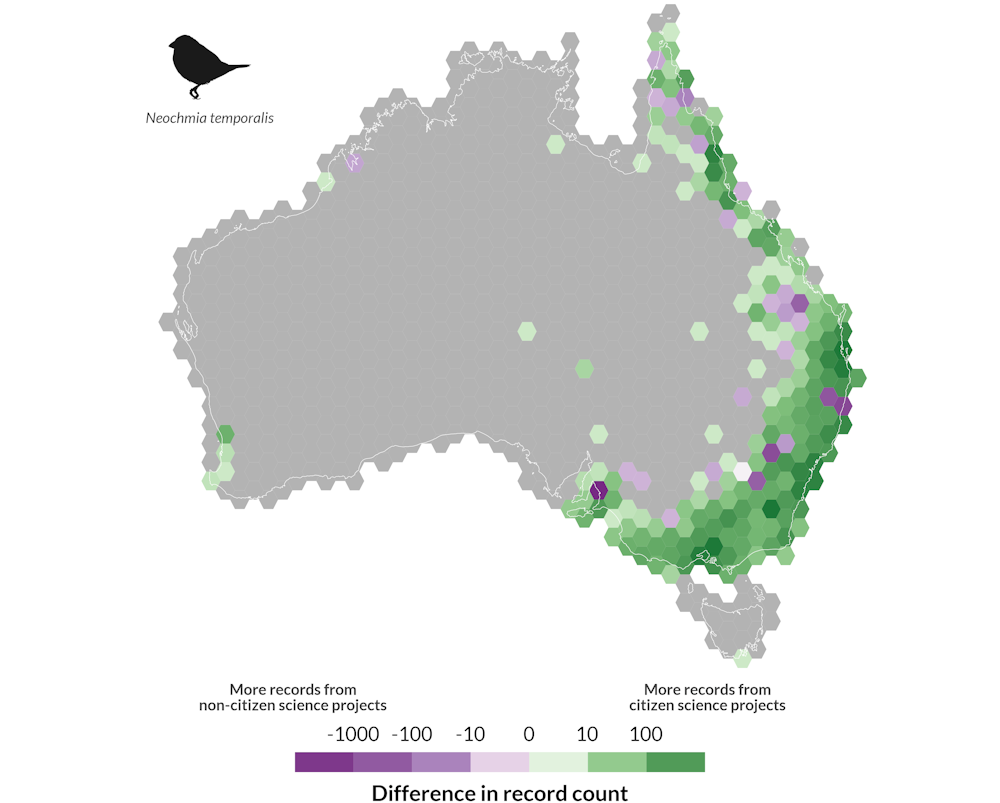
But for the red-browed firetail (Neochmia temporalis), citizen science was the main contributor in over 86.5% of its locations.
Red-browed firetail finch. Author provided, CC BY-NC-ND
Why the difference? We believe it’s due to the impact of long-running citizen science projects driven by enthusiasts. Birders are a large enthusiast community, while people who go herping (looking for reptiles) are a smaller group.
As a reflection of community enthusiasm, birds make up nearly 50% of all species observation records in the Atlas of Living Australia, with the Australian magpie the most commonly recorded species.
Next, we looked at several species with fewer than 1,000 records to find out whether citizen science contributes less data when species are less conspicuous.
In fact, the reverse was often true. For some rare species, citizen science is proving invaluable in ongoing monitoring.
Take the threatened black rockcod (Epinephelus daemelii), a large, territorial fish which been decimated by spearfishing and other pressures.
Here, citizen science proved its worth, adding 63% of observations. Most data came from a few high profile projects, such as annual reef and fish surveys.
This map shows black rockcod observations by citizen scientists and non-citizen scientists. Author provided, CC BY-NC-ND
Citizen science is coming of age
For decades, citizen science has struggled to feed data into professional monitoring and conservation efforts.
But this is increasingly unfair. By combining citizen science data with professionally collected data, we can get the best of both worlds – a much richer picture of species’ distributions.
It’s only going to get better, as observation and citizen scientist numbers grow each year. There’s a large spectrum of projects, many with excellent data quality controls in place.
Citizen science has come a long way. The data created by keen amateurs is now of better quality, aided by new technologies and support from researchers.
Apps which add automatic time stamps, dates and locations make it much easier to validate observations.
This suggests there’s untapped potential for citizen science to contribute consistent data over significant parts of many species’ ranges, though the strength of this contribution will vary by species.
There’s still more to do to help citizen scientists contribute as usefully as they’d like to. For instance, observations tend to cluster in the regions around cities, because that’s where citizen scientists live. Citizen scientists can also favour larger, charismatic and brightly coloured species.
One method of improving collection could be to focus the interest of citizen scientists on a wider range of species.
For citizen scientists themselves, a big part of the appeal is the ability to create useful data to help the environment. Citizen scientist Jonathon Dashper, for instance, spends his spare time looking for frogs and recording fish. Why? He told us:
My drive to contribute to citizen science is to further my understanding of the natural world and contribute to decision making on environmental matters. Using citizen science platforms, I have been able to learn so much about harder-to-identify organisms.
As a former competitive snowboarder and instructor, and later a researcher of snow sports, I’ve been lucky to enjoy ski resorts around the world. But nothing compares to Mount Ruapehu on a good day.
Holidaying with my family last week, we fell in love with the natural terrain of both the Whakapapa and Tūroa fields – the latter enjoying the biggest snow base in the world at the time.
We were not alone. A strong winter season has seen many thousands making the most of the great conditions: 5,614 guests on Whakapapa’s busiest day of July 15, and 3,500 at Tūroa on July 28.
But this apparently positive picture makes it easy to overlook the fact that both ski fields on the North Island volcano have faced huge economic uncertainty over the past year. And one great season does not necessarily mean long-term recovery.
Sustainability amid uncertainty
After difficult pandemic years and a poor 2022 snow season, Ruapehu Alpine Lifts (RAL), which operates both Tūroa and Whakapapa, went into receivership. Ski resorts everywhere are facing an uncertain future, with climate change making seasons hard to predict.
Despite various longer-term rescue proposals, including a (now dropped) buyout bid by Ngāti Tūwharetoa (one of several iwi shareholders), the future of skiing and snowboarding on Mt Ruapehu remains uncertain.
Understandably, this is causing anxiety among those whose livelihoods – and favourite sporting and leisure pursuits – are at risk. Beyond those immediate concerns, however, lies the place of the maunga (mountain) itself in the historical and cultural fabric of Aotearoa New Zealand.
Cultural and geological significance
Ruapehu is much more than a place for leisure tourism. Located in the heart of the 80,000-hectare Tongariro National Park, one of three world heritage sites in New Zealand, it is a unique and special place.
In fact, Tongariro has dual world heritage status for its important Māori cultural and spiritual associations, as well as its distinctive volcanic features.
Ruapehu is particularly significant to Māori, being part of the origin story of te Ika-a-Māui (the North Island). And the ski fields are bound up in the unresolved Treaty of Waitangi claim to Tongariro National Park.
The scale of that claim, which involves cultural redress more than the return of land, puts the future of the ski fields in a much wider perspective. Added to that is the question of environmental sustainability, with ski resorts increasingly reliant on snow-making for their survival.
Behind the human activity, of course, sits Ruapehu’s great geological significance. As my nine-year-old son proudly explained upon arrival, it is a stratovolcano (also called a composite cone volcano), built up by successive layers of andesite lava and ash deposits.
Rising impressively from the ancient native forest on one side and the beautiful tussock on the other, the maunga is a striking presence in the landscape. Light and clouds constantly change its appearance as they dance off its jagged peaks.
Ruapehu is also New Zealand’s largest active volcano. There are frequent minor eruptions and more significant events every 20 to 30 years. This makes it an unusual skiing experience, to say the least, with a lahar alarm and warning system in place, and signs everywhere reminding skiers and snowboarders of the lively nature of this powerful mountain.
Over my many years researching snow sport cultures around the world, I’ve witnessed their unique social dynamics. Unlike many sports that separate people based on gender, ability and age, the slopes offer a space for shared experiences. And they can be a wonderful place for families.
But skiing and snowboarding have long been highly privileged activities. Often they are available only to those with the free time and disposable income. Travel, accommodation, lift tickets and equipment are expensive.
Perhaps unsurprisingly, the clientele of ski resorts in New Zealand and around the world have been described as “white as the snow”.
And yet I am struck by the diversity on Ruapehu. At $84 for an adult mid-week day pass, and $54 for a child day pass, it’s much more accessible than the more expensive South Island experience ($160 for an adult day pass at the Remarkables or Cardrona).
RAL also offers heavily discounted or free season passes and day passes to local iwi, schools, defence force staff and emergency services, among other groups.
In contrast to the often international staff of most ski resorts, RAL workers are predominantly local, with 53% identifying as New Zealand European and 16% Māori.
Reimagining Ruapehu
While more can be done to ensure ski resorts are more inclusive and accessible for all, the various innovations by RAL to respond to the pandemic, seasonal disruption and ongoing economic uncertainty are a good start.
But its great cultural, social and geological significance makes Ruapehu a taonga (treasure) for all New Zealanders. Personally, I hope to enjoy riding with my family on Ruapehu for many years to come, but the issue is bigger than that.
With or without skiing, Ruapehu offers New Zealanders an opportunity to know mountain places as culturally significant landscapes, to learn about their histories and to reimagine their collective futures.
There is untapped potential in using the existing resort facilities as educational spaces for future generations to learn about the cultural and geographical significance of this special place.
And while relationships with the mountain (and views on its future) will vary based on people’s different cultural, social and economic perspectives, acknowledging Ruapehu’s place in the Māori experience of colonisation and dispossession must be central too.
As the economic modelling continues, and various parties seek financial sustainability for the ski fields, it’s important we don’t lose sight of this bigger picture of a remarkable maunga in the heart of te Ika-a-Māui.
Holly Thorpe does not work for, consult, own shares in or receive funding from any company or organisation that would benefit from this article, and has disclosed no relevant affiliations beyond their academic appointment.
A Charles Sturt University journalism academic says the evolving communication course at his institution in Australia continues to feed the ranks of the irrepressible “Mitchell Mafia’”.
Cheetham said he was surprised to wake up and read a media report in late July suggesting journalism was not being taught separately at Charles Sturt University.
Quality journalism has never been more important, and Charles Sturt has an enviable reputation for producing some of the world’s best, most-renowned journalists.
“That day I spent six hours teaching news and media, also known as ‘journalism’,” he said.
“Actually, on that Tuesday we had ABC veteran Trevor Watson visit us on campus to give a guest talk on journalism, specifically news writing, which was also streamed to online students.
“Before that talk, I spent two hours with a class analysing media coverage of The Voice to Parliament Referendum campaigns. After Trevor’s talk, I held a news writing tutorial doing practice exercises on the hard news style of reporting.”
‘Pretty journalistic day’ He said it was a “pretty journalistic” day.
“We’re still teaching journalism, with practical opportunities to work in newsrooms, such as National Radio News,” he said.
Cheetham emphasised that quality journalism had never been more important, and Charles Sturt had an enviable reputation for producing some of the world’s best, most-renowned journalists.
As the original ABC article noted, over the past five decades, the university has nurtured some of the nation’s most high-profile communicators, including Andrew Denton, Melissa Doyle, Samantha Armytage, Hamish Macdonald, Chris Bath, and current ABC News Europe correspondent Nick Dole.
“Charles Sturt University will continue to educate and train journalists for the evolving media landscape,” Cheetham said.
“At the University campus in Bathurst we continue to have cutting-edge facilities, such as a TV studio, a community broadcasting radio station, and editing suites, for our students to gain skills and insights into working in their chosen fields.
“We’re also investing substantial funds in the communications hub that will provide new facilities for our future students.”
For example, graduates from 2021 include 7News (Central West) journalist Reuben Spargo who won the 2021 JERAA Ossie Award for ‘national student journalist of the year’.
“Charles Sturt threw practical skills at me and helped grow my confidence as a communicator,” Spargo said.
“The connections I made and the experiences I shared allowed me to hit the ground running within the industry.”
Keeping pace Cheetham said to keep pace with the ever-changing media industry and digital advancements, Charles Sturt had launched a new communication course with its first intake last year, 2022.
“The new Bachelor of Communication offers specialisations in strategic communication, news and media — journalism, which I teach — and design and content creation,” he said.
“Teaching the critical role of journalism is still very much a priority at Charles Sturt. The changes represent a transition from one version of the journalism degree, which we have offered for more than 50 years, intoa new degree program.
“The philosophy behind the new course remains the same — we’re aiming to produce people who are good storytellers.” Image: CSU
“The philosophy behind the new course remains the same — we’re aiming to produce people who are good storytellers. We have retained a lot of the strongest elements of the old course bringing them into the new course.”
Having industry and alumni co-design the course with academic staff offers students a unique combination of academic, discipline-specific specialisations with a sound understanding of the industry through the networking and industry connections embedded within the course.
The format of the new degree combines first-hand industry knowledge and advice, and to have industry professionals sharing knowledge, expertise and daily experiences will be a real game changer for the students.
The New Zealand government has given its full blessing to Cook Islands and Niue establishing diplomatic relations with the United States.
At the US-Pacific summit on Monday (Washington time), President Joe Biden said he recognised the two island nations as sovereign and independent states, an announcement which the US Embassy in Aotearoa has labelled as “historic”.
Both countries are self-governing in ‘free association’ with New Zealand.
Prime Minister Chris Hipkins acknowledged that and responded to questions around what the US’s move means for both countries’ relationship with Aotearoa.
“That’s the way that the American system works,” Hipkins said.
“So in order to recognise those specific countries, the wording that they use is they recognise their sovereignty but actually they also recognise, through diplomatic channels, the unique constitutional relationship that those countries have with New Zealand as well.”
The establishment of diplomatic relations does not change the constitutional relationship Aotearoa New Zealand has with either the Cook Islands or Niue, a Ministry of Foreign Affairs and Trade spokesperson said.
“Aotearoa New Zealand welcomes the establishment of diplomatic relations between US, Cook Islands and Niue,” the MFAT spokesperson said.
Diplomatic relations
“The Cook Islands has diplomatic relations with 61 countries, and Niue has diplomatic relations with 21 countries.
US Secretary of State Antony J. Blinken in a joint statement signing ceremony with Niue Premier Dalton Tagelagi at the Department of State. Image: Screenshot/US Department of State/RNZ Pacific
“[The NZ government] expects that the establishment of diplomatic relations[with the US] will better enable close engagement.”
In his speech, Biden said building a better world started with stronger partnerships.
“And that’s why the United States is formally establishing relations with the Cook Island’s . . . and Niue,” Biden said.
Pacific Islands Forum chair and Cook Islands Prime Minister Mark Brown has hailed the move as a milestone that marks an “era of change”.
He said Niue and the Cook Islands were “celebrating”.
“These milestones celebrate era’s of change and demonstrate that with unshakable resolve and leadership, remarkable achievements are possible,” Brown said.
Brown thanked the US President for his elevated level of engagement with the Pacific over the last year.
Development funding
Massey University’s defence and security analyst Dr Anna Powles said formalising diplomatic ties was “very much about ensuring that Cook Islands and Niue are able to receive development assistance funding”.
“There’s obviously also a strategic benefit from the United States perspective to have diplomatic presence, or at least diplomatic reach, into both of those countries.”
On top of the diplomatic ties talk, Biden also announced climate assistance at the summit.
He told Pacific leaders more than US$20 million is being injected into climate assistance.
Suluafi said not all nations were being ambitious enough when it came to climate ambition.
“What are the commitments that they will make to financing those most vulnerable to climate change, including those in their, their very ocean, their neighbours in the Pacific,” Suluafi said.
“[Countries] really need to talk about how they will phase out fossil fuels.”
But President Biden wanted to be clear that the Pacific’s stance on the climate crisis was the US’s position too.
‘I hear you’ – Biden on climate crisis
“I want you to know I hear you, the people in the United States and around the world hear you,” Biden said.
“We hear your warnings of a rising sea that they pose an existential threat to your nations. We hear your calls for reassurance that you never, never, never will lose your statehood, or membership of the UN as a result of the climate crisis.”
The President also announced the doubling of US-Pacific exchange student spots.
He committed to a free, open, prosperous and secure Indo-Pacific region.
Biden also plans on investing US$5 million into co-funding a fisheries and ocean science vessel.
It is expected to be used to manage the region’s tuna resources and for ocean science research.
This article is republished under a community partnership agreement with RNZ.
New Zealand Parliament Buildings, Wellington, New Zealand.
New Zealand Politics Daily is a collation of the most prominent issues being discussed in New Zealand. It is edited by Dr Bryce Edwards of The Democracy Project.
Food waste is a global problem with approximately 1.3 billion tonnes of food wasted each year throughout the food lifecycle – from the farm to food manufacturers and households.
In a recent study published in Bioresource Technology Reports, we have found a way to use food waste for making a versatile material known as nanocellulose. In particular, we used acid whey – a significant dairy production waste material that it usually difficult to dispose of.
Mixing waste with bacteria
Nanocellulose is a biopolymer, which means it’s a naturally produced long chain of sugars. It has remarkable properties – bacterial nanocellulose is strong, chemically stable and biocompatible, meaning it’s not harmful to human cells. This makes it a highly marketable product with applications in packaging, wound treatments, drug delivery or food production.
The traditional approach for making nanocellulose can be expensive, uses large amounts of energy and takes a long time. Some types of nanocellulose production also use a chemical process that produces unwanted waste byproducts.
By contrast, our new approach uses just food waste and a symbiotic culture of bacteria and yeasts (SCOBY) – something you may be familiar with as a kombucha starter. Our process is low cost, consumes little energy and produces no waste.
We used a runny waste liquid known as acid whey from a local cheese manufacturer in Melbourne, Australia. In the dairy industry, acid whey is often disposed of as wastewater in large amounts (more than 100 million litres of acid whey are produced annually in Australia alone), despite it being rich in carbohydrates and proteins. This is because it’s hard to process into other products due to a high lactic acid content.
We heat-treated the liquid and supplemented it with sugar and yeast extract before adding the key ingredient, SCOBY (obtained commercially from a Melbourne-based kombucha company).
Over four days as our mixture fermented, the bacteria worked to create nanocellulose material which floated to the top. Lovers of home-brewed kombucha may actually be familiar with the raw nanocellulose material – it forms as a floating off-white structure called a pellicle. Some people already use this kombucha by-product as vegan leather.) A similar pellicle formed on our acid whey mixture.
The pellicle – the white stuff that grows on top of a homemade kombucha brew – is actually a type of nanocellulose. Shutterstock
A growing market
Demand for nanocellulose is growing worldwide. The global market was valued at US$0.4 billion in 2022 (A$0.6bn) and is expected to grow to US$2 billion by 2030 (A$3.1bn). Bacterial nanocellulose produced from food waste can help to satisfy this demand.
This growth is in part due to how we can use nanocellulose instead of petroleum-based and other non-renewable materials in things like packaging. Among its desirable properties, nanocellulose is also fully biodegradable.
Manufacturers around the globe are seeking sustainable sources of raw material for producing composite materials with various properties. Nanocellulose is easily customised in this way. For example, infusing nanocellulose with a compound called glycerol enhances its flexibility and makes it more pliant. As a food-safe material, we are now investigating nanocellulose as “smart” packaging by infusing nanocellulose with indicators that signal when food is no longer safe to eat.
Additionally, using a single source of food waste (such as acid whey in our example) means we can produce highly pure nanocellulose – ideal for biomedical applications, such as wound dressings, pharmaceutical compounding and cell cultures.
An example of nanocellulose material that could be used for wound dressing. Shutterstock
Efficient circular economy
A circular economy attempts to minimise waste and extend the lifecycle of products for as long as possible. Our study demonstrates an efficient circular economy approach for upcycling a dairy industry waste product into sustainable nanocellulose.
Additionally, the sediment residue we produced has a high nutrient value and potentially has commercial value as a fertiliser or animal feed, while the liquid culture can be reused for the next batch.
Our study was limited to a single source of food waste within a laboratory environment. A future challenge will be taking this approach out of the lab and scaling it up for commercial use. This will involve a series of steps throughout the value chain from waste collection and transport through to commercial production.
We also hope to explore alternative mediums such as mixed food waste. More research also needs to be done on how nanocellulose can be most effectively customised for various applications, such as different types of food packaging.
Overall, our proof-of-concept study demonstrates potential for producing nanocellulose in a sustainable, environmentally sound manner – from food waste to significant value.
The authors do not work for, consult, own shares in or receive funding from any company or organisation that would benefit from this article, and have disclosed no relevant affiliations beyond their academic appointment.
Source: The Conversation (Au and NZ) – By Jacob Prehn, Associate Dean Indigenous College of Arts, Law, and Education; Senior Lecturer – Indigenous Fellow, Social Work, University of Tasmania
The lead-up to the Voice referendum is already affecting the health and wellbeing of Aboriginal and Torres Strait Islander people. These impacts will likely worsen during and after the vote.
A quick search of any social media platform about the Voice referendum reveals a range of strong perspectives on voting “yes” or “no”. But in the loosely regulated world of social and news media, many conversations are becoming toxic and racist, and turning into hate speech.
Aboriginal and Torres Strait Islander people are already disproportionately affected by mental ill health, including hospitalisations and troubling rates of suicide. This is why we must take extra care and adopt strategies to support Indigenous Australians and each other.
The issues hate speech bring
Research following the marriage equality postal survey in 2017 found the intense public debates and media messaging had negatively affected the mental health of LGBTIQ+ communities. As we approach the Voice referendum it’s imperative we learn from this.
Aboriginal and Torres Strait Islander people experience worse health and wellbeing outcomes than non-Indigenous people in Australia. A government health performance summary report, released in July, revealed about one-third of Aboriginal and Torres Strait Islander people experience elevated levels of psychological distress.
For Aboriginal and Torres Strait Islander people to achieve equity with non-Indigenous Australians on measures such as life expectancy, education and income, there needs to be systemic change. This type of change would likely include constitutional amendments, legislative revisions, the establishment of treaties, embracing truth-telling and other significant measures.
Undoubtedly, such transformative steps would spark national discussion and debate. Discussion is important to fostering understanding and driving progress in society. The problem lies in the politicisation of debate about marginalised people and the amplifying effect on their psychological distress and mental health. This should be a pressing concern for all Australians.
Aboriginal and Torres Strait Islander leadership in mental health during the Voice referendum is crucial. Dr Clinton Schultz, a Gamilaroi man, for example, is leading work with the Black Dog Institute
to encourage respectful conversations and protect the wellbeing of Indigenous people.
We also invite non-Indigenous people to provide support for First Nations people during this time, and always.
1) Set boundaries when discussing the Voice referendum
Aboriginal and Torres Strait Islander people have the right to choose whether they wish to engage in conversations about the Voice referendum, or answer questions. If you are non-Indigenous, be mindful unsolicited questions about the referendum, particularly from acquaintances or strangers, could inadvertently make someone feel burdened, uncomfortable or unsafe.
2) Disconnect and spend less time looking at social media and news
We have witnessed a surge in offensive, harmful and racist content online. For everyone, limiting exposure to social media and the news can be essential for mental wellbeing. Disconnecting and restricting how much energy we put into such content is something we can control.
If you are non-Indigenous and encounter such comments online, please report them. We can all play a part in fostering a safe and respectful community.
3) Stay connected with others and avoid isolation
Social isolation can take a toll on health and wellbeing.
Prioritise quality time with friends, family and community, exploring conversations beyond the referendum. Embrace opportunities to stay connected with others through meaningful physical, social and cultural interactions.
4) Personal and community-care practices
Self-care is often viewed as an individual activity. Find ways to create, maintain and enhance personal and community-based care practices. Consider opportunities for including others in activities such as exercise, time outside or crafting cultural items. Organisations can lead and facilitate these collective care initiatives.
5) Make time for your body, mind and spirit
Set aside regular time for physical activity, stimulate your mind with enjoyable pursuits and nurture your spiritual dimensions if they hold significance for you. This could include connecting with country, attending church or practising yoga.
Crafting cultural items alone or with community can be an act of self care. GettyImages
6) Spend time on Country and practice Indigenous culture
Spend time on Country in your favourite place, undertake cultural practices and invite others to join you. If you are non-Indigenous, seek out opportunities to deepen cross-cultural connection, understanding and appreciation by participating in Indigenous cultural practices.
7) Know the signs and seek help
Emotional distress and triggers can arise unexpectedly. Recognise the signs within yourself and among Aboriginal and Torres Strait Islander people around you. If you or anyone else is feeling unwell, we suggest moving away from the cause, spending time with people and places that bring you peace, and if needed seeking help.
The enduring resilience shown by Aboriginal and Torres Strait Islander people is deep, but not inexhaustible. All Australians should make caring for each other a focus in these complex and challenging times.
If you are experiencing distress, there are First Nations-led resources available:
The authors do not work for, consult, own shares in or receive funding from any company or organisation that would benefit from this article, and have disclosed no relevant affiliations beyond their academic appointment.
As former Labor minister Barry Jones has wisely noted, the Voice referendum feels like 2016 all over again.
The shock from the Brexit vote in the United Kingdom in June of that year set the stage for what came next: the off-the-charts upheaval of the Donald Trump earthquake in the US presidential election. The only consolation was that Trump did not win a majority of votes in the United States. He won the presidency through the arcane, undemocratic workings of the Electoral College.
Maybe the Voice will prevail, as Senator Pat Dodson says:
I believe Australians are better than this. I believe Australians will look at this on the day and say, ‘Well this is a decent, honourable, good thing for us to do’.
But given current projections, the best outcome on the referendum may well be a majority vote for “yes” nationally, but constitutional recognition of First Nations peoples and establishment of the Voice denied by the requirement that the measure be approved by a majority of the states. That can be a moral victory – that Australia’s heart did not go cold on its Indigenous peoples.
But we may not even get there. As with the Trump shock, it is hard to process how support for a benign, straightforward measure that opens the Constitution to Indigenous Australians and establishes an advisory committee on issues and policies crucial to their welfare could dissipate from 65% a year ago to just 43% today.
And how a proposal that enjoys unprecedented backing from the most powerful and influential institutions in the country, including those in business, labour, sport and culture, could be devoid of uplift and land with a thud.
A campaign defined by fear-mongering
US President Franklin D Roosevelt famously said when he first took office 90 years ago, “We have nothing to fear but fear itself”. Which is exactly how the prime minister has framed the Voice. Anthony Albanese has said there is “nothing scary, nothing to be fearful of here”.
You can’t change a country for the better through fear. You can only change it for the better through hope and optimism and being positive.
But it is fear that is prevailing at this moment. The Advance Australia and Fair Australia telephone banks and their TikTok algorithms are infused with it. Fair Australia callers are telling undecided voters they have “heard” the Voice will mean monetary compensation to Aboriginal people, that the Voice will lead to the abolition of Australia Day, and that Voice proponents will push for a treaty.
The poison is spreading across the political landscape. Liberal Party politicians have been warned that those who support the Voice will lose their pre-selection for seats in parliament. Former ACT Chief Minister Kate Carnell has said
This has been politicised to the point that people aren’t comfortable to campaign for what they believe in because of the politics.
Perhaps this is baked in for the Liberal Party from its opposition to the Voice from the last three prime ministers: Tony Abbott, Malcolm Turnbull and Scott Morrison. (Turnbull has since fully converted.) They never presented a referendum even on just constitutional recognition.
In “Trump’s Australia”, my study of what could happen to Australia’s democracy and society if Trump returns to the presidency in 2024, I argue that approval of the Voice would help insulate Australia’s political culture from the corrosive effects of Trumpist messages from the news and social media.
Trump was the most divisive president America has ever had. In addition to his core values of “America First” nationalism, protectionism and isolationism, he also promoted nativism – fear of “the other.”
Australia, with its historically pervasive atmosphere of fear around Indigenous aspirations, is fertile territory for Trump and his rhetoric on race.
Trump knows how to push the fear buttons on race. He does not dog whistle. Take, for instance, his public demand in 1989 that New York reinstate the death penalty to punish the “Central Park Five” – the Black and Latino youths wrongly convicted of raping a woman in Central Park. Trump shouts his views from the podium. And we hear it here.
What could Australia’s democracy and society look like if Trump wins? What we are already hearing today from those leading the “no” campaign is an echo chamber of Trumpist sentiments for his supporters and acolytes here.
If he returns to power, Australia will undoubtedly see a steady flood of these messages via his social media posts and pronouncements from the Oval Office. His racially tinged views will only further harden the divisive sentiments on issues of racial equity here.
Trump is especially vocal in siding with police when acts of brutality have occured and when violent crime has broken out in major cities. “Law and order” will be a recurrent theme in the 2024 presidential election, should Trump be the Republican candidate again. Trump supporters in Australia, including some who hold or aspire to public office, will pick up those messages and propagate them here.
We have already seen a dry run of these themes by his Australian allies at the Conservative Political Action Conference in Sydney in August – an offshoot of Trump’s CPAC base in the US.
The core message from the Sydney event: the Voice is racially divisive and is being foisted on the country by “the elites”.
Right on cue, neo-Nazis then marched in the streets of Melbourne last weekend under a banner that read “Voice = Anti White.” It had the same look and feel as the infamous white supremacist rally in Charlottesville, Virginia, in 2017, which Trump said included some “very fine people”.
Why the Voice could insulate Australia from Trumpism
These messages are designed to kill the hope and buttress the fear expressed by Professor Marcia Langton, co-chair of the senior design group on the Voice:
A ‘yes’ vote delivers recognition through a voice and all the hope and healing it represents […] or a ‘no’ vote which binds us all closely – all of us – to a broken status quo.
If the Voice is approved, it will be able to call out policies that are not truly responsive to the needs of Indigenous Australians, including programs that do not get to the heart of, or try to resolve, the disparity between First Nations people and their fellow Australians. This can help shape more effective responses to issues where no progress has been made for decades.
The existence of the Voice will mean that Trumpism is unlikely to derail what the body is intended to achieve. If the Voice is defeated, however, change for the better is severely compromised.
If most Australians vote “no” the country will be reeling. The victorious opponents of the Voice, with their echoes of Trumpism, will be poised to keep advancing their agenda. The default position of the political culture on race, reconciliation and equity will have gone backwards, making it harder to redress historical issues of racial disparities.
The world is watching. As George Megalogenis recently concluded, “A ‘no’ vote would revive both the colonial ghost of dispossession and the federation ghost of the White Australia policy.”
That would be a victory for Trumpism in Australia, even before Trump’s fate is decided next year by voters in America.
Bruce Wolpe is a non resident Senior Fellow at the United States Studes Centre at the University of Sydney. He has worked with the Democrats in the US Congress and served on the staff of former Prime Minister Julia Gillard. He is not a member of any political party.
While COVID in children has generally been milder than in adults, there are concerns long COVID may be a major consequence for children and young people arising from the pandemic.
Long COVID, also known as “post-COVID condition” is an umbrella term for a range of symptoms that can persist for months after the initial acute phase of COVID. Long COVID may include fatigue, post-exertional malaise, disordered sleep, cognitive difficulties, pain, anxiety and depression. These symptoms can impact people of any age, including children.
Recognition and support from health-care professionals is important in recovering from long COVID. Identifying it early and implementing management strategies can prevent symptoms becoming entrenched, and prevent more significant problems in the future.
Defining long COVID has been difficult due to varied symptoms and time frames that make it difficult to consistently characterise and compare the condition.
A review of long COVID research in children found mood symptoms, fatigue and sleep disorders were the symptoms most commonly reported. In total, more than 40 symptoms were included, ranging from mental health, gastrointestinal, cardiac and respiratory symptoms.
However many studies on long COVID have lacked a control group (meaning comparisons with children who didn’t have COVID), making it difficult to separate the symptoms of long COVID from the indirect impacts of the pandemic on children.
For example, high rates of depression and anxiety have been observed in children, likely related to the effects of lockdowns, school closures and social isolation. These conditions share many features with long COVID and complicate the interpretation of research into the condition.
More recentstudies that have included a control group identified only a very small increase in long-COVID symptoms following mild COVID infection, compared with those who tested negative for COVID. This potentially means long COVID in kids is quite rare.
What we see in our COVID clinic for kids
Our COVID follow-up clinic at The Royal Children’s Hospital Melbourne was running from mid-2020 to mid-2023. We saw more than 600 children throughout that time.
In our experience, most children recover fully after COVID in a similar way to other viruses.
A small proportion experience prolonged symptoms including fatigue, post-exertional malaise, concentration difficulties and pain. These symptoms are similar to other post-viral syndromes such as chronic fatigue syndrome (also known as myalgic encephalitis), for which viruses are a common precursor. Some patients we saw fulfilled the criteria for chronic fatigue syndrome following their COVID infection.
Another group of children in our clinic developed physical complaints, such as headache and chest pain. But most of these children had normal test results, which is reassuring. However the symptoms can still have an impact on day-to-day functioning such as participation in school and other activities.
Recognition and support of children with long COVID symptoms is often delayed. Children and families report that they don’t feel heard or are misunderstood by others, including health-care providers.
It’s hard to live with the uncertainty of not knowing how long symptoms will last.
In our experience with long COVID, most children experience complete recovery or significant improvement from three to six months after infection.
There has typically been minimal impact on functioning. However there have been rare severe cases, with more debilitating fatigue impacting attendance at school and activities. These patients generally receive a diagnosis of chronic fatigue syndrome and are managed accordingly.
How is long COVID in kids managed?
Children and families feel frustrated because there is no specific treatment or cure.
While there are trials underway in adults, there is no medication or cure available for long COVID.
The Australian government has announced $50 million for research into long COVID, which will provide further avenues of support and treatment.
The current recommended approach for managing long COVID in children is based on the recognised management of chronic fatigue syndrome.
This approach may involve a range of health professionals including GPs, paediatricians, physiotherapists, exercise physiologists and psychologists, according to the needs of the child. They support the patient to build up to managing daily tasks such as going to school, exercising, or participating in activities, taking into consideration how much energy they have at each stage to prevent burnouts.
Symptoms such as trouble sleeping, dizziness and cognitive difficulties may be managed through lifestyle modifications such as sleep hygiene practices (going to bed at the same time, no screens before bedtime), or medication.
It’s important activities continue, at a level that’s appropriate for the patient’s stage of recovery. This includes school and social outings.
While a cure for long COVID is not yet available, self-management and attempting to minimise secondary impacts such as missed school are crucial to preventing mental health issues and physical deconditioning (the body becoming accustomed to doing less).
I think my child has long COVID, what should I do?
It’s important to seek medical attention if COVID-related symptoms such as fatigue persist for more than four weeks. A review with your GP or paediatrician is a good place to start if you have concerns for your child.
This article was co-authored by Colette Reveley and Eva Sudbury, paediatricians in the Department of Adolescent Medicine and General Medicine at the Royal Children’s Hospital, Melbourne.
Shidan Tosif is supported by a Murdoch Childrens’ Research Institute Clinician Scientist Fellowship.
If you’re a whale, there’s often not too much to see out in deeper water. Perhaps that’s why so many whales get playful with kelp and other seaweed.
Once might have been chance. But we’ve collected over 100 examples on social media of whales playing with seaweed, known as “kelping”. It’s not just one species – gray whales, southern and northern right whales, and humpback whales all do it.
To date, there’s far more social media and news reports on whale play with seaweed than scientific literature. A 2011 study in New South Wales described these interactions as playful behaviour. Other researchers have documented instances of whales moving logs through the water in Colombia or interacting with jellyfish on the United States east coast.
Our new research compiles data from over 100 kelping events captured on social media. From this, we deduced two things. First, it is playful. And second, it’s likely to have a useful component, such as using the seaweed to scratch an itch (hard without hands), brush off baby barnacles, or flick away whale lice – parasites that drive the whales mad.
How do whales find kelp – and what do they do with it?
Sightings of this behaviour tend to occur in regions where kelp is abundant. That’s no surprise. Kelp is a very strong seaweed and can take the punishment a whale can dish out.
Most videos and photos capturing this behaviour are of humpback whales as they migrate. That’s also not surprising. Humpback whales are one of the most common species. They tend to migrate closer to shore. And they do more activities at the surface compared to other baleen whales, which is why beach goers and whale-watching boats most often see humpback whales.
Until now, kelp play has been documented in Australia, the United States and Canada. But this is likely due to the fact these regions have a larger number of people who do whale-watching and who use social media platforms to share their observations.
Drones have given us a new way of studying this behaviour. In several drone videos, we can see humpback whales actively seeking out seaweed. These interactions aren’t just fleeting – whales can play with it or use it for up to an hour.
During kelping, whales tend to lift the seaweed up and balance it on their rostrum, their flat upper head.
They also seem willing to share their kelp patches with other whales, engaging in cooperative behaviours such as rolling, lifting and balancing the seaweed together.
So is it play? In part, yes. When animal researchers look at a behaviour, it has to meet three criteria to be play. First, it seems voluntary and enjoyable. Second, it’s different to more serious behaviours. It can be exaggerated or deliberately incomplete. And third, the animals don’t seem stressed or hungry, suggesting they’re in good health. Kelping meets all three of these.
For animals, play has long-term benefits such as boosting their coordination and movement skills. Balancing seaweed may also be stimulating for the whales, as their rostrums have fine hair follicles. It could even be ticklish.
Kelping might be more than just play
Toying with seaweed might have benefits other than just being fun. Some of us enjoy seaweed wraps at a spa or as a facial mask.
It might be the same for whales. Some seaweed species have been found to reduce bacterial growth, which could be useful for whales, as their skin hosts a range of viruses and bacteria. Whales have to constantly shed their skin to keep on top of bacterial growth.
There are other possibilities. Pushing through seaweed again and again could also help whales rid themselves of unwanted guests, such as the early life stages of barnacles and sea lice. Because whales are so large, many species of invertebrates hitch a lift or spend their lives on these creatures – and often to the whale’s annoyance. Grey whales off the coast of Mexico have repeatedly approached humans for help in keeping down numbers of itchy whale lice, which are actually more closely related to a shrimp or small crab than to lice.
Humpback whale interacting with kelp in California
Similar self-medication behaviour has been reported in other marine mammals, such as when Red Sea dolphins rub over sponges and soft corals to, scientists believe, help skin conditions. Even green sea turtles use corals and rocks to clean their carapace.
As more of us use drones and better cameras, we’re likely to see more whale kelping caught on camera and shared in the coming years.
Kelping shows us how much we still have to learn even about well-studied whale species such as the humpback whale. The gentle and inquisitive nature of these whales shines through when we see them play or use seaweed. Even now, there are many mysteries yet to be uncovered in nature.
Olaf Meynecke receives funding from a private charitable trust as part of the Whales & Climate Research Program and is the CEO of Humpbacks & High-rises Inc
The Green Party has run a strong campaign. With a 14.2% share in the latest Newshub-Reid Research poll, up by 1.9 percentage points since the previous poll, that is more than half the Labour Party’s 26.5%.
The gain seems to have come from voters unimpressed by Labour’s centrist shift under leader Chris Hipkins, which leaves the Greens to fill a wider void on the left.
The party can claim policy success in several areas – environment and climate, housing quality, family and sexual violence prevention. But has it achieved the social and economic changes required for the climate resilient society it campaigns for? The answer has to be a categorical no.
One reason is that the party continues to battle internal tensions between idealism and pragmatism.
The Greens have been a continuous presence in parliament since the start of the MMP era in 1996. But the party’s policies appear too radical for some members, and not radical enough for those who want to see fewer compromises on issues such as climate action and social justice.
Distinctive party rules
These internal tensions spilled over last year when James Shaw initially failed to get the required 75% support to be reelected as co-leader before being reinstated.
Changes to the party constitution in May last year scrapped the requirement for a male co-leader. Instead, there is now a requirement to have a Māori co-leader of any gender, along with a woman co-leader.
The Greens’ 2023 party list reflects both new talent and greater ethnic diversity than in the past.
Far more than any other political party (save Te Pāti Māori), the distinctive leadership structure and decision-making rules allow the Greens to give effect to their commitments to te Tiriti o Waitangi/Treaty of Waitangi, gender equity and grassroots democracy.
Their processes may look messy to those looking in from the outside, but it works. They keep leaders accountable and ensure they stay connected, with a driven and committed membership.
If getting the policy architecture in place to facilitate implementation is one measure of political success, then the Greens have achieved credible action on many fronts.
These and many other initiatives, reflect much required movement. But despite ambition, implementation has fallen short.
For some party insiders, the Greens’ climate agenda has been hamstrung by the ministerial responsibilities they have had under a Labour government. As critics pointed out after the 2021 UN climate summit in Glasgow, the climate change ministerial portfolio headed by a Green MP failed to reform the emissions-heavy agribusiness sector, instead focusing on reducing carbon emissions through offshore carbon credits.
Ultimately, the Greens’ policy positions on a range of issues are more radical than the outcomes that have been achieved under the Labour government.
Even many of the gains made by the Greens in forging cross-party consensus on climate action are showing signs of shrivelling away during this election campaign, with a National-ACT coalition promising to reverse most climate policy measures.
Ending poverty and tax reform
Working within the market-led political system has been a disappointment for some party supporters loyal to core Green principles. However, there is no question the Greens have shifted the terms of the debate on poverty in Aotearoa.
Reminiscent of the Nobel Prize winning economist Amartya Sen’s powerful argument that famines were caused not by natural disasters but by the absence of a functioning democracy, the Greens have positioned poverty as a political choice that no country needs to make.
The party’s Ending Poverty Together policy proposes an income guarantee that would ensure everyone, including students, receives at least NZ$385 a week after tax. Its reconfigured tax structure claims to benefit an estimated 95% of all tax payers, a much broader group than National’s proposed tax cuts would affect.
To pay for these changes, the Greens want to introduce a wealth tax of 2.5% a year on assets above $2 million per individual.
While the details of the Greens’ tax policy would undoubtedly need refining, the potential to eliminate poverty and ensure free dental care for all offers a glimpse of what truly transformational policy can look like.
The reluctance of New Zealand (the only wealthy country without any form of wealth tax) to impose fairer taxes has led to deep inequality, with devastating consequences for the poorest. As social commentator Max Rashbrooke points out in his latest book Too Much Money:
The wealthiest tenth own one quarter of the country’s assets, while the poorest half of the country has just 2%.
This situation did not just happen; it is the direct consequence of political decisions. Just as government policies previously kept inequality in check through taxes, regulations and a shared commitment to a well-funded welfare state, policy changes allowed the inequality we see now. And it is policy reform that can remedy it.
Future direction
The Green Party’s core voter base appears to be solid, ensuring it will continue its presence in parliament.
At 14.2% in the polls, the party is closing in on its highest ever level of 15%, reached in 2017 in a TVNZ poll. This was taken before then co-leader Metiria Turei’s revelations of misleading WINZ as a solo parent, though, and the party only achieved 6.3% in that year’s election.
If current polling holds up and translates into a significantly expanded caucus, it may allow the Greens to more actively pursue their ideals.
Even if they end up on the opposition benches, they can still remain the loudest voices on climate change and social justice. They can get issues on the parliamentary agenda, ask questions of ministers and introduce members’ bills.
They can also effectively shape public debate on unchecked economic growth – the default position of the major parties – and its resulting environmental degradation and social inequality.
The beating heart of the Green Party is their Green Charter, with its four principles of ecological wisdom, social responsibility, appropriate decision making and non-violence. This underpins the moral voice the Greens bring to a wide range of issues.
Currently, both centrist parties are showing signs of moving towards the right – away from social justice and environmental issues, for example – although in varying degrees. This leaves a void on the left for the Greens to fill, while further eroding Labour’s base.
Priya Kurian has received funding from The Deep South National Science Challenge for research on climate adaptation, The Rockefeller Foundation for research on climate justice, and the Royal Society of New Zealand’s Marsden Grant.
National Party leader Christopher Luxon made claims about health outcomes that were clearly false. Why was he left unchallenged?
In the TVNZ leaders’ debate last night, Luxon and Labour’s Chris Hipkins had a testy exchange over Māori healthcare.
Hipkins held firm on the creation of a Māori Health Authority, established last year, arguing strongly that the persistent gaps in health outcomes and care justified it.
Luxon was equally clear in opposition to it. He framed his critique of the authority around an alleged complete lack of progress on Māori health outcomes. He was very specific.
“Every single health outcome has gone backwards under Chris’s government,” Luxon said.
“Six years, not one has improved for Māori or for non-Māori.”
While sweeping in nature, Luxon’s claim did not get a direct response from Hipkins.
Luxon repeated a similar line later in the debate.
“Gone backwards. Chris, under your government, every single health outcome for Māori or non-Māori [has gone backwards]. You can’t have that.”
Hipkins did push back on this occasion, citing the ongoing reduction in rates of smoking.
Luxon’s claim was far from true — there are a number of areas where health outcomes for Māori and non-Māori have improved while Labour has been in charge.
But it is perhaps understandable that Hipkins was not quick to correct Luxon because the data — even though it’s better in many respects — is still grim. Maybe Hipkins did not wish to dwell on this.
Improved health outcomes There are a number of health outcomes where, for Māori, statistics have improved.
Perhaps Labour’s biggest boast is their track record on bringing down lung cancer and smoking rates for Māori.
Lung cancer is the second leading cause of death for Māori in Aotearoa. But according to the Ministry of Health, rates of lung disease for Māori have come down.
In 2017, the rate per 100,000 people was 79.9 for Māori. By 2019, it was down to 68.4. This also aligns with smoking rates among Māori dropping.
Pre-colonisation, Māori did not smoke. However, when tobacco was introduced to Aotearoa in the 18th century that quickly changed.
Smoking has been particularly harmful for Māori who have higher smoking rates than non-Māori and experience greater rates of death and tobacco-related illness.
In 2017/18, the smoking rate for Māori adults was 35.3 percent. By 2021/22, it was down to 20.9 percent (approximately 127,000 people).
Rates were falling under National but they have continued to drop under Labour, which has rolled out a number of initiatives in an effort to reduce nation-wide smoking rates.
As part of the Smokefree 2025 Action Plan, historic and world-leading legislation mandated an annually rising smoking age that will mean that anyone born on or after 1 January, 2009, will never be able to purchase tobacco products.
Other cancers Overall, cancer registrations rates among Māori fell from 416 per 100,000 people in 2017 to 405.7 in 2019.
Breast cancer registration rates for Māori women fell from 140.7 per 100,000 people in 2010 to 122.5 per 100,000 in 2019. Prostate cancer registration rates for Māori fell from 105.5 for Māori in 2017 to 103.5 in 2019.
For non-Māori, overall cancer registration rates increased slightly from 323.2 (2017) to 332.4 (2019).
Life expectancy The life expectancy gap between Māori and non-Māori may be the most telling indicator of all when it comes to inequities.
According to the latest available data from 2019, life expectancy at birth for Māori men in 2017-2019 was 73.4 years, up 3.1 years from 2005-2007 data.
The life expectancy for non-Māori men is 80.9 years. For Māori women, it was 77.1 years, up 2 years from 2005-2007. Non-Māori women are expected to live to 84.4 years.
While Māori life expectancy has increased over time, the gap to non-Māori persists.
At the current rate of progress it will be more than a century before Māori and non-Māori have equal life expectancy, a study by the Association of Salaried Medical Specialists found in 2021.
Child immunisation In the debate, after Hipkins raised smoking as an area of improvement, Luxon said child immunisation was a concern. On this, he was correct.
Over the past six years, child immunisation rates have steadily fallen.
In 2017, 86.2 percent of eligible Māori five year olds had completed all of their age-appropriate immunisations. As of last year, the rate had shrunk to only 71.8 percent. That is an alarming 16 point drop in the period Labour has been in power.
In April of this year a report commissioned by Te Whatu Ora’s Immunisation Taskforce found that immunisation failed to achieve “adequate on-time immunisation rates in young tamariki” and to immunise Māori, meaning those who were most susceptible to “vaccine-preventable disease” had the lowest immunisation coverage.
The report highlighted the worst rate in the country — just 34 percent of Māori children in South Auckland were fully vaccinated. It attributed part of the problem to vaccinators being diverted to the country’s covid-19 pandemic response.
“This caused childhood immunisation rates to plummet. These rates are now the lowest they have ever been and ethnic disparities have further expanded,” it said.
The report outlined 54 recommendations covering funding, delivery, technology, communications and governance across the programme.
In the debate, Hipkins suggested the anti-vaccine movement was part of the problem, which he sought to link with National.
National has proposed an immunisation incentive payment scheme. The plan would see GP clinics paid a lump sum for achieving immunisation targets, including full immunisation for two-year-olds, MMR vaccines for ages 1-17, and influenza vaccines for ages 65+.
The clinics would have to either achieve 95 percent coverage for their childhood patients, and 75 percent for the flu shots, or achieve a five percentage point increase for each of those target groups, by 30 June 2024 to receive the payment.
Labour has also failed to halt type 2 diabetes, the country’s biggest and fastest growing health condition.
Ministry of Health figures show that in 2021 there were 302,778 people with diabetes, predominantly type 2. Since the Labour government came into power in 2017, the estimated rates of the number of Māori with diabetes per 1000 has risen from 66.4 to 70.1 in 2021.
The rates for non-Māori have also climbed from 27.8 in 2017 to 30.1 in 2021. It is also important to note that the rate of diabetes in Aotearoa has been steadily rising over the past 50 years.
Type 2 diabetes can also lead to devastating health conditions and complications, including heart failure, kidney failure, strokes and limb amputation.
According to Ministry of Health data obtained by RNZ under the Official Information Act, since 2011 there has been a 39 percent increase in diabetic limb amputations across the whole population.
For Māori, the number has more than doubled in the past decade from 130 in 2011 to 211 in 2021. Under Labour, the number of Māori diabetic limb amputations rose by 15 percent.
Māori are still 2.8 times more likely to have renal failure, another complication of diabetes.
Mental health According to Te Whatu Ora, the rate of suspected suicide per 100,000 Māori population in 2021/22 was 16.1. This is not a statistically significant change from the average of the past 13 years.
This article is republished under a community partnership agreement with RNZ.
A recent webinar hosted by the Pacific Network on Globalisation (PANG) brought together minds from across the region to delve into the intricate issues of the digital economy and data value.
The webinar’s focus was clear — shed light on who was shaping the rules of the digital landscape and how these rules were taking form.
At the forefront of the discussion was the delicate matter of valuing and protecting indigenous knowledge.
PANG’s deputy coordinator, Adam Wolfenden, emphasised the need for open conversations spanning various sectors.
“It is a call to understand and safeguard the wisdom embedded in Pacific worldviews and indigenous knowledge systems as we venture into the digital world,” he said.
But amid the promise of the digital age, challenges persisted.
Wolfenden said the Pacific’s scattered islands faced the formidable obstacle of connectivity.
“Communities yearn to tap into online technologies, yet structural barriers stand tall. The connectivity challenges and structural barriers that are faced by the Pacific region are substantial and there is no easy, cheap fix,” he said.
He underscored the necessity of regional partnerships, even beyond the Pacific.
“As they sought to build advanced digital infrastructures, they realised that strength lay in unity. The journey towards progress means joining hands with fellow developing nations.
“It is a testament to the shared dream of progress that transcends geographical boundaries.”
The first step, Wolfenden believed, was awareness.
He said the Pacific region needed to be fully informed about ongoing negotiations, what rules were being carved, and how these might affect the region’s autonomy and data sovereignty.
“Often, these negotiations remain hidden from public view, shrouded in secrecy until agreements were reached. This has to change; transparency is vital,” Wolfenden said.
Beyond this, there was a call for broader discussions during the webinar. The digital economy was not just about buyers and sellers in a virtual marketplace.
It was about preserving culture, empowering communities, and ensuring that indigenous knowledge was never left vulnerable to the whims of the digital age.
Ema Ganivatu and Brittany Nawaqatabu are final year journalism students at The University of the South Pacific. They are also senior editors for Wansolwara, USP Journalism’s student training newspaper and online publications. Republished in a collaborative partnership with Asia Pacific Report.
Daniel Andrews, who has announced he will step down after nearly nine years as premier, leaves office as a titan of Victorian politics. An activist premier, a gifted political communicator and a hard man of politics, he has been an enormously consequential leader and one of national significance. He is the fourth-longest serving premier in Victorian history, and the longest-serving Labor premier.
While his government has had more than its share of controversies, such as the so called “red shirts” scandal and, more recently, the debacle of the cancelled 2026 Commonwealth Games, Andrews will nonetheless be remembered as a progressive premier whose social reforms and massive infrastructure program have transformed the state.
And he was enormously successful with it, winning three elections, most recently another landslide victory in November 2022. Over that time, he has dominated his party and the state. And even after nine years in office, recent opinion polls have still shown his government enjoying a commanding lead over the opposition.
From the time he entered office, Andrews was an activist and was assertive with power. There were at least two aspects at play here. The first that it’s his natural style – Andrews is a classic strong leader, command and control is his modus operandi. When he encounters an obstacle his instinct is to barge through it, and when he is criticised he doubles down, denying there is any case to answer.
The second aspect is that during his time as opposition leader between 2010 and 2014 he witnessed a becalmed Victorian government, led by Liberals Ted Baillieu and Denis Napthine. By 2014 when Andrews won power, it was evident the public was yearning for activity. Victoria’s infrastructure was run down and no longer fit for purpose, unable to cope with its booming population.
During his first term, Andrews unleashed a gargantuan infrastructure program, including railway level crossing removals, the metro rail link, the suburban rail loop and an array of road extensions and upgrades.
But his government wasn’t solely focussed on changing the physicality of the state. Andrews understood that in Victoria, perhaps more than anywhere else in Australia, there was leeway to pursue a progressive social agenda. He did this successfully, too, despite the inevitable controversy the reforms engendered, leading the way on the Safe Schools program, Voluntary Assisted Dying legislation, and a Treaty with Indigenous Victorians, among other issues.
In doing so, he made Victoria an incubator for social reform, providing a catalyst for other states to follow its lead on these issues.
However, Andrews was not progressive on every issue. On law and order, for example, his instincts were conservative. For example, on his watch discriminatory bail laws contributed to Indigenous Australians being incarcerated in disproportionate numbers.
He has also chafed at being accountable, leading to a democratic deficit on his watch. His approach when under pressure – most recently demonstrated in the Commonwealth Games cancellation – is to double down and refuse to budge, taking a “nothing to see here” approach.
Under Andrews, power has become highly centralised in his private office, and there have been troubling signs of the politicisation of the public service.
His dominance has been reinforced by the dysfunction of the Liberal Party. Indeed, so supreme has Labor been that Victoria has effectively turned into a one-party state, an unhealthy state of affairs that should be of concern to all Victorians.
#IstandwithDan v #DictatorDan
It was during the COVID pandemic that Andrews became a leader of national prominence. His daily press conferences during the darkest days of the crisis were eagerly watched across the nation.
With the harshest and longest lockdowns in the country, social media gave the impression of a deeply polarised state: those who said #IstandwithDan and those who were enraged by #DictatorDan.
In truth, the polarisation was mostly a myth. Certainly, there were partisans at both ends of the spectrum, but the “Dictator Dan” group was only ever a noisy rump, egged on by the strident opposition to Andrews by conservative commentators at the Herald Sun and Sky News.
Indeed, one of the notable aspects of Andrews as a public figure is that his combination of progressive boldness, political effectiveness and forceful leadership has driven conservatives to distraction. They are hyperbolic about him – they characterised him as something akin to North Korean leader Kim Jong-Un, a supreme leader grown democratically untouchable.
Why? Because he was so effective – here was a socialist left premier leading one of the largest states in the country, and bucking political shibboleths such as that governments ought not go into substantial debt and deficit.
And he kept winning elections, and handsomely, making his conservative critics look foolish.
Andrews kept winning because he was an activist, assertive, and got things done. Victorians didn’t necessarily love him, but they respected him. In more recent times his forcefulness had morphed into something darker. As I have written, his leadership had grown oppressive. He rarely smiled; he looked and sounded tired. His going in that sense is a healthy thing: it will disturb the power relations that have centred on him.
So what now? Deputy Premier Jacinta Allan has effectively been the heir apparent since Andrews anointed her as his successor last year during a major exit of ministers.
He will leave an enormous vacuum, both in the party he has led for 13 years and the government he’s led for nine. It was once said that another political titan, Robert Menzies, was the banyan tree under which nothing would grow, and there is an element of that about Andrews.
Whoever becomes premier will have to tackle some significant economic challenges, including ballooning infrastructure spending, and the fallout from massive COVID spending. Moreover, by the time of the next state election in 2026, Labor will have been in power for 12 years, and no matter how dominant and activist a government might be, an “it’s time” factor will inevitably kick in.
“Glass cliff” is a term used in political science for situations in which women inherit a leadership position when things are falling apart. Will this be Allan’s lot?
Paul Strangio does not work for, consult, own shares in or receive funding from any company or organisation that would benefit from this article, and has disclosed no relevant affiliations beyond their academic appointment.
New Zealand Parliament Buildings, Wellington, New Zealand.
New Zealand Politics Daily is a collation of the most prominent issues being discussed in New Zealand. It is edited by Dr Bryce Edwards of The Democracy Project.
The principal measure of economic success in the mainstream narrative is economic growth. The pointy heads associated with that narrative will correctly point out that its economic growth per capita that matters, and which serves as a crude proxy for ‘living standards’. This conventional wisdom says that annual economic growth of two percent per capita represents the ‘just right’ Goldilocks zone. In the context here, that translates to biennial economic growth of four percent per person in the population.
So, what does the data say on the achievement of this? The data used here is sourced from the IMF (International Monetary Fund), noting that the most recent data is subject to revision next month and further revision next year. The IMF dataset for GDP (gross domestic product) starts in 1980; so annual GDP growth data commences in 1981, and biennial growth data commences in 1982. (For biennial data from 1983 to 2022, I compare real GDP for the year concerned with the average of the three prior years. Real GDP is also called ‘GDP at constant prices’, making it a valid measure of marketed output.)
Any time the plotted lines in either chart fall below zero percent indicate a ‘per capita recession’. (Though some technical per capita recessions will have been missed. A technical recession is calculated from bi-annual seasonally adjusted data; that is, a six-month period for which marketed output is less compared to the previous six-months.)
From the first chart, we see that New Zealand has had per capita recessions in 1983, 1988, 1989, 1990, 1991, 1992, 1998, 2008, 2009, and 2020. New Zealand has had more years in per capita recession – ten – than the other countries, with Canada coming next.
The recessions are closely synchronised between the four countries, meaning that the main causes of these events are international, and therefore tell us little about the performance of the national governments concerned. We also note that, in the 2010s, all countries fell below the goldilocks standard for most of that decade. Government policy may contribute to the varying extent of each international recession; comparative analysis points the way to evaluating the contribution of domestic policy.
There are three years in which just one country was in per capita recession. New Zealand’s recession in 1998 was internationally transmitted, a result of the 1997 Asian financial crisis. New Zealand was more vulnerable to a major economic downturn in East Asia than perhaps all other western countries, given the percentage of New Zealand’s output being destined for sale in East Asia. United States was worst hit by the ‘dotcom’ recession of 2001, mainly for reasons domestic to that country. I cannot explain Canada’s recession of 2015 to 1016, though it looks to be related to domestic policymaking in that country.
Some periods of high growth represent a rebound effect; it’s common to have a year or two of unusually high growth after a period of recession, especially after a prolonged recession such as that in New Zealand from 1988 to 1992. We also see this in the United States after 1982, the year the Reaganomics was quietly scuttled.
The second chart, showing biennial economic growth, gives the best overview of differences between the countries. There were three periods in which New Zealand was performing better than the other three countries: the early 1980s (Muldoon years), early 2000s (Clark/Cullen years), and mid-2010s (Key/English years). The first of these was the most politically challenging; New Zealand rode out these early 1980s’ years surprisingly well, with a later, a shorter, and a shallower recession. At that time, New Zealand was adversely affected by rapidly deteriorating terms of trade after 1973.
The standout feature of this chart is the strong correlation between poor economic performance and Rogernomics. The Fourth Labour Government was in power from July 1984 until November 1990. This period – set politically by Finance Minister, Roger Douglas – had profound economic consequences for Aotearoa New Zealand. Before 1985, New Zealand’s per capita incomes were similar to those in these other countries, particularly noting the similarity between New Zealand and Australia.
After the prolonged financial crises (which saw the Bank of New Zealand fail twice) and recession, New Zealand living standards fell significantly below those of Australia. This completely upset the dynamic of the relationship between the two countries. The ensuing disturbed and skewed trans-Tasman dynamic remains as strong as ever, given that New Zealand never secured any gain that could be attributed to the pain of the long Rogernomics recession.
2023
New Zealand is currently in a per capita recession. Despite Statistics New Zealand’s upwards revision of recent GDP data, New Zealand’s increase in output over the last year of 0.9 percent is smaller than the increase in population. According to Statistics New Zealand, in the year to June 2023, New Zealand’s net immigration was 96,000. And the natural increase – births minus deaths – was 19,000. That’s a 2.3% annual increase in population, meaning New Zealand is now in a per capita recession of -1.4%. New Zealand’s tepidly growing economic output must be shared between 2.3% more people.
Of course, economic growth is not everything. I see no signs that many in either the Old Right Elite or the New Left Elite are experiencing falling living standards. Just as neither did in the 1990s. Non-elites are bearing the burden.
The elite narrative is the reason for the lack of economic debate in New Zealand during this election campaign. What we see is a contest between the two ruling elites as to who can outdo the other in their ‘fiscal conservatism’. This is appalling, given that the single biggest cause of the Great Depression of the early 1930s – the most prolonged sequence of per capita recessions last century, beginning in the 1920s – was entrenched fiscal conservatism, practiced by both Social Democratic and Conservative governments in the ‘liberal capitalist’ world order of that time.
It’s as if these elites have relocated to another planet; at least to a wonderland of the mind.
*******
Keith Rankin (keith at rankin dot nz), trained as an economic historian, is a retired lecturer in Economics and Statistics. He lives in Auckland, New Zealand.
As the National Party gets closer to government, lobbyists and business interests will be lining up for influence and to get policies adopted. It’s therefore in the public interest to have much more scrutiny and transparency about potential conflicts of interests that might arise.
One of the key individuals of influence in National is former Cabinet Minister and now businessman, Steven Joyce. His continued sway with National and various business interests is a useful case study in how New Zealand politics works.
Steven Joyce – Minister of Everything, and now Adviser on Everything?
Steven Joyce is a figure who continually comes up as key to much of National’s policy development. He has fingers in many pies, and is close to decision-makers in National. So, if you want to know what the new government is going to do, it’s instructive to keep an eye on Joyce’s business activities and lobbying.
Joyce, of course, has been a major figure in National for the last two decades. He led the restructuring of the party in the Don Brash years, and then ran National’s election campaigns from 2005 to 2017. Upon entering Parliament in 2008 he was instantly appointed as a Cabinet Minister, and eventually became Minister of Finance (as well as becoming known as The Minister of Everything and Mr Fixit).
His time in politics was not uncontroversial. Joyce was criticised for an approach that many saw amounted to cronyism – especially because of his deal with SkyCity to build Auckland’s convention centre – and was sometimes compared to Robert Muldoon in his pragmatism and style. Once John Key and Bill English departed, Joyce ran for the leadership but lost out to Simon Bridges, which led to his resignation from Parliament in 2018.
Joyce had been a businessman before entering politics, and returned to this in 2018, setting up Joyce Advisory, a company specialising in business strategy, consultancy, brand management and reputation. In addition to this, Joyce has been appointed to and employed by an array of businesses, from property development through to engineering. Some of these clients have developed close relationships with the National Party under leader Christopher Luxon.
Joyce has also stayed extremely close to his old party, and has obviously remained influential – especially in terms of policy development. According to some party insiders, National’s lack of policy development has made Joyce’s advice invaluable in helping fill the void.
Winton property developers
The most politically controversial business Joyce has joined is the major property developer Winton, a company that is currently locked in a legal battle with the Government. Winton claims Kāinga Ora is stymying its “Sunfield” development plans in South Auckland by not giving the company a fast-tracked development under the new Urban Development Act. In appointing Joyce, the company put out a press release to say that Joyce “has not been appointed for government relations or political lobbying.”
The company is associated with some big donations to the National Party. Back in May 2022 the party received $52,000 from a holding company called Speargrass, which is owned by Winton’s CEO Chris Meehan. This year Meehan has donated $103,260 to National and $50,000 to Act.
National and Act have both come out publicly this year in favour of Winton in their fight with Kāinga Ora, with the parties’ respective housing spokespeople Chris Bishop and Brooke van Velden issuing press releases pushing Winton’s case.
National had already received the first donation when Bishop went public with his support for Winton, but he failed to declare this. In fact, Bishop later told Newsroom that he wasn’t aware of the big donations and could not give further comments due to Winton’s court case. He also told Newsroom that there was no conflict of interest, and any question of whether the property developer would get a meeting with an incoming National prime minister was an issue for after the election campaign.
National’s foreign buyer tax policy
When National announced that its new tax policy would involve a partial abolition of Labour’s ban on house sales to foreign buyers, political commentator Matthew Hooton suggested in the Herald that, “incredibly”, the policy had been created “with the help of lobbyists” for “the property-development industries”.
Certainly, property companies would stand to benefit from National’s new policy as, if implemented, all properties worth over $2m could be sold to foreign buyers, increasing the market and demand for the houses being sold by property developers.
This week Hooton has expanded on his claim that National designed the policy with the help of property developers, pointing to Winton and its close relationship with National, and suggesting that property developers have been able to help shape National’s housing-tax policies. Hooton says, “It may well be that National has thought through its tax policy much more carefully than it has been given credit for.”
He points out that the new policy could raise a lot of tax revenue and profit: “If Winton, say, sold 5000 residences for $2m+ over four years to foreign buyers, that alone would raise half the $20b of houses and apartments National needs to make its books balance. And, of course, some would be worth more than $2m. Some of the properties Winton has in its pipeline are planned to be sold for $10m+.”
Hooton therefore suggests that with a change of government, and a new minister in charge of Kāinga Ora and housing, there might well be a law change and the green light given to property developers to proceed with high-end developments.
Waikato University’s work with National
National has also released its tertiary education policy, including the promise to create a new $300m medical training school at Waikato University. The party worked closely with the University, and particularly its vice-chancellor Neil Quigley, to come up with the policy. The University even helped pay for National’s announcement, and Quigley emailed Health Spokesperson Shane Reti to say the policy could be “a present” to a future National government.
RNZ’s Guyon Espiner has uncovered how closely the University and National Party worked together on the policy development, and how Steven Joyce’s consultancy company Joyce Advisory was paid nearly a million dollars for helping with “lobbying advice” on such issues. On top of this, one of Joyce’s former Beehive political advisors, Anna Lillis, was contracted to sell the policy.
Espiner notes that Labour-aligned lobbyist Neale Jones has previously been employed by Waikato University to try to get the Labour Government to pay for a new medical school. But Joyce essentially took over this work from Jones, helping get the policy adopted by National instead.
SkyCity’s deals with National
National’s latest tax policy included trying to squeeze tax out of the foreign gambling websites that sell their services to New Zealanders. National has been upfront in stating that the SkyCity Casino advised on this policy. A confidential report from SkyCity was used by National to pull together the figures suggesting that $176m per year could be raised in tax.
National’s tax policy would also benefit SkyCity, because a tax on foreign gambling sites would reduce the competitiveness of their opponents and, in some cases, it might mean those offshore websites will be blocked from operating in this country.
Of course, the National Party has a long-running association with SkyCity. The last National Government negotiated a deal with the casino operators to build a convention centre for Auckland in exchange for concessions on the tight regulations on the number of SkyCity casino tables and pokie machines. The deal was partly brokered by Steven Joyce when he was Minister of Economic Development.
Joyce’s influence in National and business
Steven Joyce has become a useful nexus between National and the business community, which means he is able to help advise on policy for the party that bolsters their credibility with captains of industry.
It helps that Joyce is still very close to many in National. Chris Bishop, for example, has always been a close ally of Joyce, starting as an adviser for Joyce when he was a Cabinet Minister. Now a senior member of the National caucus, Bishop is chairing National’s election campaign.
Joyce used to run National’s campaigns, and his right-hand person was another former Beehive adviser Jo de Joux, who was his campaign manager. She is now a lobbyist, but has come back to run the party’s campaign in 2023, and is said to still be very close to Joyce.
As well as giving “lobbying advice” to Waikato University, Joyce is now on the University’s Management School Business Advisory Board. Of course, this is also useful and unsurprising given he’s a former Minister for tertiary education. He also writes regularly for the media about tertiary education policy, adding to his influence in this area.
As well as becoming a director of the Winton property company, Joyce has joined other company boards – Icehouse Ventures (a venture capital fund manager), Hammerforce (a technology and IP company), and RCP (a property and construction project management consultancy).
Time for more scrutiny of National-Business relationships
The roles played by these businesses or individuals advising National are to be expected in a liberal capitalist democracy. And individuals such as Steven Joyce or National’s business donors should be allowed to pursue the agendas of their companies and political parties.
However, it is imperative that these relationships are heavily scrutinised. At the moment much of the election campaign is lightweight and hollowed out. More focus on the influences behind the policies and those who are set to benefit from them would be beneficial to public debate and an informed electorate.
This is especially the case for National, which looks almost certain to lead the next government. Matthew Hooton is well-placed to comment on some of this, having experience as a lobbyist as well as a National Party spin-doctor and insider. He wrote yesterday in his regular email newsletter on politics that “National promises a ‘full economic plan’ in the next day or so. It will likely consist of another set of random bullet points gathered together from lobbyists and industry associations, similar to the ‘business growth agenda’ brochures of the Key years.”
If National’s policies are being created by or with the help of vested interests, then the public would be advantaged by knowing about these details. Leaving this until after the election might be too late.
Treasurer Jim Chalmers says the federal government’s employment white paper is “ambitious”. I’m not convinced.
A clearly ambitious statement would have specified a target for unemployment, ideally one that was a bit of a stretch.
The Keating Labor government’s Working Nation statement did that in 1994. Released at a time when unemployment was almost 10%, it specified a target unemployment rate of 5% – an ambition that served as a beacon for decades.
That target certainly needs to be updated. Unemployment is now well below 5%, meaning “full employment” is now much less than 5%. Yet the Albanese government has passed up a historic opportunity to say how much less, which it could have done by setting its own target.
Setting our sights below 5%
The white paper released on Monday defines full employment as a state in which “everyone who wants a job should be able to find one without searching for too long”. That means our unemployment target ought to be somewhere between zero and 5%.
Of course, the unemployment rate can never be zero.
There will always be people out of work while they are moving between jobs, what the white paper calls “frictional” unemployment. That will also be true when Australia’s mix of employers changes – what the paper calls “structural” unemployment, as new industries requiring one sort of training replace old industries that required another.
The white paper says what matters in addition to unemployment (539,700 Australians) is “underemployment” in which people work fewer hours than they want (1 million) and “potential workers” who would like work but aren’t actively looking and so aren’t counted as unemployed (1.3 million).
I get that these things matter. I get that we need, in the words of the white paper, “a higher level of ambition than is implied by statistical measures”.
What gets measured gets done
But that higher level of ambition ought not replace targets.
If a target isn’t specific, it isn’t a target at all (or at best it’s a fuzzy target). That means it’s less likely to be aimed at and less likely to be hit.
That’s how it’s been with full employment itself. In 1996 Treasurer Peter Costello and the man he appointed Reserve Bank governor, Ian Macfarlane, signed what became the first Statement on the Conduct of Monetary Policy, an agreement that’s been updated six times.
As with all of the agreements since, that first statement set out an inflation target (“between 2% and 3%, on average, over the cycle”) but not an employment target – even though both are meant to be objectives under the Reserve Bank Act.
As a result, Governor Macfarlane was able to step down ten years later, secure in the knowledge that on average he had hit the middle of the target band: 2.5% inflation. His successor Glenn Stevens stepped down ten years further on, quietly boasting the same thing.
But neither could make any boast about hitting the employment target – because there wasn’t one.
How failing to set a target costs jobs
The governor who has just retired, Philip Lowe, looks like he’ll hit an inflation average of 2.8%, which is pretty low given how high inflation has been lately.
But an estimate by former Reserve Bank staffer Isaac Gross, prepared using the Reserve Bank’s own economic model, suggests that in doing so he kept unemployment a good deal higher than it needed to be between 2016 and 2019 – the equivalent of 270,000 people being out of work for one year.
Lowe wasn’t held to account for the extra unemployed in the same way as he is being held to account for his performance on inflation. Why? Because he was never actually given an unemployment target.
I am quite prepared to acknowledge that other measures of employment matter, underemployment among them. But here’s the thing: they move in line with unemployment.
When Australia’s unemployment rate falls, Australia’s underemployment rate falls, almost in tandem.
It’s easy to see why. As employers find it hard to hire new workers, they get existing workers to put in more hours. And retirees and others who haven’t been looking for work begin putting themselves out there.
Australia’s participation rate measures the proportion of the population making itself available for work. As unemployment has fallen, it has climbed to an all-time high.
Our unemployment rate is a proxy for what matters
This makes the unemployment rate just about the perfect proxy for everything else about the labour market that matters, and just about the perfect number to target.
The Albanese government could have recognised that this week – setting a stretch target of 3% (or even 4%) as an aspiration. Even that would have been less “ambitious” than Keating choosing 5%, when the rate was twice as high.
Treasurer Chalmers says the government didn’t set a target because apparently the unemployment rate doesn’t capture “the full extent of spare capacity in our economy or the full potential of our workforce”.
The saving grace is this government has a second chance at this. Chalmers is about to update the Reserve Bank’s statement of expectations, the one that until now hasn’t included a target for unemployment.
It would be open to him to put a specific target in there – making the RBA as accountable as it is now on inflation.
At the moment, it looks more likely Chalmers will adopt a recommendation of the independent review of the bank, which reported in March.
That review recommended the bank be required to produce its own “best assessment of full employment at any point time”, including its estimate of the lowest rate of unemployment that can be sustained without accelerating inflation.
It would be a small step forward. That full employment estimate would become a number to watch, in the same way as the bank’s performance on inflation is at the moment.
But it still won’t be an official government target. The Albanese government had an opportunity to live up to its ambitious rhetoric – and it passed.
Peter Martin does not work for, consult, own shares in or receive funding from any company or organization that would benefit from this article, and has disclosed no relevant affiliations beyond their academic appointment.
Dan Andrews has announced he is quitting, after nine years as premier and three election wins.
Andrews’ surprise announcement came early Tuesday afternoon. He said his resignation would take effect at 5pm Wednesday.
He told a news conference it was not an easy decision “because as much as we have achieved together, there’s so much more to do. But when it’s time, it’s time”.
He said recently, in talking to his family, “thoughts of what life will be like after this job has started to creep in.
“I have always known that the moment that happens it is time to go and to give this privilege, this amazing responsibility, to someone else.”
Andrews, 51, who became premier in December 2014, has been a highly controversial state leader, instigating the toughest lockdowns in the country during COVID. But despite criticisms of that, he won the November 2022 election handsomely. Andrews said he had never been focused on being “100 per cent popular”.
He said he came to his decision fairly recently. But it was right to “go when they are asking you to stay”.
“I am worse than a workaholic,” he said, with every waking moment consumed with the work. He did not know what he would do next. He wouldn’t do much for a while.
Andrews said when he had previously declared he would stay for the duration of this parliamentary term, “it was true then”. He had since changed his mind.
The state caucus will meet on Wednesday to anoint a new premier, with Deputy Premier Jacinta Allen widely favoured. Andrews said if there was a ballot he would be voting.
He had spoken to Prime Minister Anthony Albanese who was “a bit shocked”. “I thanked him for the partnership.”
Earlier this year another longstanding Labor premier, Mark McGowan in Western Australia, resigned unexpectedly.
Michelle Grattan does not work for, consult, own shares in or receive funding from any company or organization that would benefit from this article, and has disclosed no relevant affiliations beyond their academic appointment.
As part of the new employment white paper, the federal government has announced it is thinking seriously about a national skills passport.
It has set aside A$9.1 million to prepare a business case for the passport to “help workers promote their qualifications and businesses find more skilled workers”.
What might this involve? And is it a good idea? As our research shows, skills passports can build trust between employers and employees.
At this stage, the national skills passport is just a proposal and the government says it still needs to consult with businesses and state governments.
Treasurer Jim Chalmers says the government wants to develop a business case to “define the scope, outcomes and benefits” of a skills passport.
It would apply to anyone undertaking post-school vocational education and training or higher education. The idea is it would make it easier for employees to demonstrate their skills and for employers to hire candidates possessing the specific skills and qualifications they require.
Similar to other personal data on other government systems (such as My Health Record), it will create a one-stop, secure online repository where you can view and manage your skills, certificates and training. There would also be a digital certification system that would allow for information to be verified.
Where did the idea come from?
The idea of a skills “passport” (also known as a skills portfolio, learning passport, human capital account, life work portfolio, career passport and cumulative record of learning achievement) emerged at the end of the 1990s.
In recent years, skills passports have gained more attention due to the changing nature of work and education. This includes rapid changes in technology, combined with improved transport and communication systems and globalisation. This means workers are much less likely to stay in one job for a significant length of time.
Instead, they will have to retrain and learn new skills regularly to keep up with these changes. They may have different careers in multiple locations in different phases of life.
A skills passport should not just include transcripts (or results), but also other evidence of an individual’s skills and qualifications. This could include microcredentials, digital badges, portfolios, resumes and references.
The concept of a skills passport has grown as workers have needed to retrain more often. Anamul Rezwan/Pexels
Our 2023 research has shown digital initiatives that improve transparency – such as skills passports – help overcome information and trust gaps between employers and employees.
Besides showing relevant information about potential candidates in a standardised, unbiased manner, skills passports verify qualifications.
This reduces the problem of fake certificates and wrong information. Further, by showing all the skills on one platform, skills passports can help individuals, employers and educational institutions recognise more easily the skills individuals have developed at school, work and through life experiences.
Not only does it help people get jobs, it helps them plan how to further their skills.
What happens in other countries?
In 2004, the European Union launched the Europass initiative – a set of documents that help individuals communicate their skills and qualifications and make skills and qualifications more transparent and comparable across the EU. The Europass includes a CV, language passport, mobility document and qualifications supplement.
In 2019, Singapore introduced a digital skills passport. This is a digital record of an individual’s skills and qualifications, issued by accredited schools, polytechnics, universities and other training providers.
In the United States, large companies are taking the lead. In 2019 financial services firm JP Morgan created its own skills passport. This helps employees assess their skills and provides learning suggestions based on their current skills and role requirements.
What about Australia?
Australia’s national training authority started consulting on a skills passport as far back as the late 1990s. But progress has been slow. This is largely because of the complexities of the skills, training, education and employment systems in Australia.
Since 2015, Australia has had a “unique student identifier” for all vocational students. This is a unique reference number made up of ten numbers and letters and tracks students’ learning and qualifications. Since 2021, this has also applied to all new university students.
Would it work here?
In many ways, the national skills passport is a natural extension of the unique student identifier.
But it may be difficult to gain consensus quickly on why there is a need to extend the current unique student identifier to a skills passport.
This is because it will involve different education sectors, different employment sectors, different levels of governments, and different states, territories as well as professional bodies and industries.
But as a way to make getting a job, hiring and planning career development easier, this is an important idea to pursue.
The authors do not work for, consult, own shares in or receive funding from any company or organisation that would benefit from this article, and have disclosed no relevant affiliations beyond their academic appointment.
New Zealand’s Green Party says it will double the Best Start payment from $69 a week to $140 — and it will also make it available for all children under three years.
Greens co-leader Marama Davidson announced the policy today, saying it is part of a “fully costed plan” paid for with a fair tax system.
“One in 10 children are growing up in poverty. For Māori, it is one in five. How is it possible that in a wealthy country like ours, there are thousands of children without enough to eat, a good bed, warm clothes, and decent shoes?,” she asked.
“That is why the Green Party would ensure all families have what they need for these early years, by doubling Best Start from $69 a week, to $140, and make it universal for all children under three years.”
Currently, families can receive the $69 weekly Best Start payment until their baby turns one, no matter the income.
However, they do not get that payment while they are receiving the paid parental leave payment. After the first year, only families earning under $96,295 are eligible to receive the payment until their child turns three.
The doubling of the Best Start payment is part of the Green Party’s Income Guarantee plan.
“This universal payment for the first three years recognises that just like in our older years through superannuation, the very first years of a new baby’s life are a time when every family needs extra support,” Davidson said.
Fairer Working for Families “Under this plan we’ll also reform Working for Families into a simpler, fairer system.
“This will provide a payment of up to $215 every week for the first child, and $135 a week for every other child, in addition to the Best Start payments.
“With the Green Party in government, we can take action to guarantee every whānau has enough to get by no matter what.
“There is no reason for any child in Aotearoa to go hungry or to live in a damp, cold house. Poverty is a political choice.
“Our plan will provide lasting solutions that will guarantee everyone has what they need to live a good life and cover the essentials — even when times are tough.”
Source: The Conversation (Au and NZ) – By Christiane Gerblinger, Visiting Fellow, Australian National Centre for the Public Awareness of Science, Australian National University
Shutterstock
Australia’s public service is no stranger to reform. In the past nine years, it has undergone threesignificantreviews of its policy advising capabilities, all of which broadly agreed that its policy advice tends towards reticence and needs to be strengthened.
While these reviews triggered reform processes to improve how policy advice is built, a glaring gap remains largely unexplored: the language of policy advice itself. How public servant policy advisers articulate arguments, communicate ideas and influence decision-makers has profound implications for how their policy recommendations land and whether the public interest is served. It’s an area urgently in need of reform.
Policy advice is not just about data and analyses – it’s about conveying arguments, views and a compelling narrative that resonates with decision-makers and serves the broader public.
This means language wields immense power. It shapes perceptions, frames issues and influences decisions. Yet reviews of the Australian Public Service (APS) have not explicitly focused on the language used in policy advice.
Language can stymie policy. A convoluted, risk-averse document that avoids uncomfortable knowledge in case it is controversial or requested under Freedom of Information laws almost always obscures the proposal’s merits. This in turn can make it difficult for people to gauge if it is in their interest.
Policy advice serves a dual audience: government decision-makers and the public. The language used to communicate policy directions must understand the needs of these audiences. And advisers must remember that policies are not only shaped by those in power, but are made in the public interest.
Moreover, the public’s ability to access and scrutinise policy advice has expanded dramatically. If policy language remains inaccessible and opaque, public trust erodes – not just in governments but within departments.
A language that shows context, addresses dissent, and provides clear directions fosters understanding and trust. This enables everyday citizens to make informed judgments about whether their interest has been served. Addressing the language used in policy advice is not a surface concern – it is a crucial factor in strengthening democratic participation and accountability.
Rectifying the challenge posed by policy language is not a straightforward undertaking. However, several potential avenues could lead the public service towards resolution.
As a first step, the importance of language to policy success must be explicitly acknowledged. This might spark a cultural transformation, where language becomes a cornerstone of policy advising rather than the afterthought it so often is. The public service also needs to explore why its language is as weak and ambiguous as it is.
From here, professional development focused on finding and distilling complex ideas into accessible language is also key. However, simply providing resources for plain language writing or increasing the amount of communication misses the mark. As has been observed, the answer to better policy-advising is not to produce more rigorous, more relevant, less ambiguous, more timely or more appealingly presented evidence. Rather, it is for policymakers to develop a better awareness of how to communicate their ideas.
Finally, interdisciplinary and lateral collaboration could revolutionise policy advising as a fully robust form of knowledge communication. As former Australian Public Service Commissioner Peter Woolcott has noted, policymakers need to “get better at engaging in policy discussions with civil society to ensure a full understanding”.
Following this thinking, collaborations between science communicators, social scientists, citizen experts, organisational linguists and policy advisers could yield innovative approaches to framing and conveying policy ideas.
The public service’s effectiveness hinges on its willingness to stare into the abyss of policy language. The language used in policy advice is not an inconsequential detail, but a pivotal determinant of success.
If it does not address this problem, the public service risks becoming an unwitting participant in its own decline. The path forward demands not just a cursory nod to the issue but a profound shift in policy advisers’ perception and prioritisation of policy language, as well as the culture in which it exists.
Only then can the public service empower its policy advisers to communicate with impact, cultivate public trust and navigate the complex landscape of policy-making in the 21st century.
Christiane Gerblinger does not work for, consult, own shares in or receive funding from any company or organization that would benefit from this article, and has disclosed no relevant affiliations beyond their academic appointment.
In 2022, the burning of fossil fuels provided 82% of the world’s energy. In 2000, it was 87%. Even as renewables have undergone tremendous growth, they’ve been offset by increased demand for energy.
That’s why the United Nations earlier this month released a global stocktake – an assessment on how the world is going in weaning itself off these energy-dense but dangerously polluting fuels. Short answer: progress, but nowhere near enough, soon enough.
If we consult history, we find that energy transitions are not new. To farm fields and build cities, we’ve gone from relying on human or animal muscle to wind and water to power sailboats and mill grain. Then we began switching to the energy dense hydrocarbons, coal, gas and oil. But this can’t last. We were first warned in 1859 that when burned, these fuels add to the Earth’s warming blanket of greenhouse gases and threatening our liveable climate.
It’s time for another energy transition. We’ve done it before. The problem is time – and resistance from the old energy regime, fossil fuel companies. Energy historian Vaclav Smil calculates past energy transitions have taken 50–75 years to ripple through societies. And we no longer have that kind of time, as climate change accelerates. This year is likely the hottest in 120,000 years.
So can we learn anything from past energy transitions? As it happens, we can.
We’ve drawn heavily on the strength of animals until very recently. This image shows rural residents riding an ox-drawn cart in Madagascar. Shutterstock
Energy shifts happen in fits and starts
Until around 1880, the world ran on wood, charcoal, crop residue, manure, water and wind. In fact, some countries relied on wood and charcoal throughout the 20th century – even as others were shifting from coal to oil.
The English had used coal for domestic heating from the time of the Romans because it burned longer and had nearly double the energy intensity of wood.
So what drove the shift? Deforestation was a part. The reliance on wood worked while there were trees. In the pre-industrial era, cities of 500,000 or more needed huge areas of forests around them.
In some locales wood seemed boundless, free and expendable. The costs to biodiversity would become apparent only later.
Britain was once carpeted in forest. Endemic deforestation drove the change to coal in the 16th and 17th centuries. Most English coal pits opened between 1540 and 1640.
When the English figured out how to use coal to make steam and push a piston, it made even more possible – pumping water from deepening mining pits, the invention of locomotives, and transporting produce, including the feed needed by working animals.
Yet for all this, coal had only reached 5% of the global market by 1840.
In North America, coal didn’t overtake wood until as late as 1884 – even as crude oil became more important.
Why did America first start exploiting oil reserves? In part to replace expensive oil from the heads of sperm whales. Before hydrocarbon oil was widely available, whaling was depended upon for lubricants and some lighting. In 1846, the US had 700 whaling vessels scouring the oceans for this source of oil.
Crude oil was struck first in Pennsylvania in 1859. To extract it required drilling down 21 metres. The drill was powered by a steam engine – which may have been fired by wood.
Steam and muscle
The 19th century energy transition took decades. It wasn’t a revolution so much as a steady shift. By the end of that century, global energy supply had doubled and half of it was from coal.
When they were first invented in 1712, steam engines converted just 2% of coal into useful energy. Almost 150 years later they were still highly inefficient at just 15%. (Petrol-powered cars still waste about 66% of the energy in their fuel).
Even so, steam sped up early proto-industries such as textiles, print production and traditional manufacturing.
But the engines did not free us from the yoke. In fact, early coal mining actually increased demand for human labour. Boys as young as six worked at lighter tasks. Conditions were generally horrific. Alongside human muscle was animal strength. Coal was often raised from pits by draft horses.
In 1850s New England, steam was three times more expensive than water flows powering textile mills. Vaclav Smil has shown industrial waterwheels and turbines “competed successfully with steam engines for decades”. The energy of flowing water was free. Digging up coal was labor-intensive.
Why did steam win? Human ecologist Andreas Malm argues what really drove the shift to steam-powered mills was capital. Locating steam engines in urban centres made it easier to concentrate and control workers, as well as overcoming worker walk-outs and machine breaking.
The question of who does the work is often overlooked. When energy historians refer vaguely to human muscle, we should ask: whose muscles? Was the work done by slaves or forced labourers?
Even in the current energy transition there can be gross disparities between employer and worker. As heat intensifies, some employers are giving ice vests to their migrant workers so they can keep working. That’s reminiscent of coal shovelers in the furnace-like stokeholes of steam ships being immersed in ice-baths on collapse, as historian On Barak has shown.
Pit ponies were widely used in coal mines. Author provided, CC BY-NC-ND
What does this mean for us?
As Vaclav Smil points out, “every transition to a new energy supply has to be powered by the intensive deployment of existing energies and prime movers”. In fact, Smil argues the idea of the “industrial revolution” is misleading. It was not sudden. Rather, it was “gradual, often uneven”.
History may seem like it unfolds neatly. But it doesn’t at all. In earlier transitions, we see overlaps. Hesitation. Sometimes, more intense use of earlier energy sources. They start as highly localised shifts, depending on available resources, before new technologies spreads along trade routes. Ultimately market forces have driven – or hindered – adoption.
Time is short. But on the plus side, there are market forces now driving the shift to clean energy. Once solar panels and wind turbines are built, sunlight and wind are free. It is the resistance of the old guard – fossil fuel corporations – that is holding us back.
Complexity is all around us, from the daily fluctuations of financial markets to the intricate web of neurons in our brains.
Understanding how the different components of these systems interact with each other is a fundamental challenge for scientists trying to predict their behaviour. Piecing together these interactions is like deciphering a code from an intricate set of clues.
Scientists have developed hundreds of different methods for doing this, from engineers studying noisy radio channels to neuroscientists studying firing patterns in networks of interacting neurons. Each method captures a unique aspect of the interactions within a complex system – but how do we know which method is right for any given system sitting right in front of us?
In new research published in Nature Computational Science, we have developed a unified way to look at hundreds of different methods for measuring interaction patterns in complex systems – and working out which ones are most useful for understanding a given system.
A scientific orchestra
The science of complex systems can be, well, complex. And the science of comparing and combining different ways of studying these systems even more so.
But one way to think about what we’ve done is to imagine each scientific method is a different musical instrument playing in a scientific orchestra. Different instruments are playing different melodies with different tones and in different styles.
We wanted to understand which of our scientific instruments are best suited to solving which types of problems. We also wanted to know whether we could conduct all of the instruments to form a harmonious whole.
By presenting these methods as a full orchestra for the first time, we hoped we would find new ways of deciphering patterns in the world around us.
Hundreds of methods, more than 1,000 datasets
To develop our orchestra, we undertook the mammoth task of analysing more than 200 methods for computing interactions from as many datasets as we could get our hands on. These covered a huge range of subjects, from stock markets and climate to brain activity and earthquakes to river flow and heart beats.
In total, we applied our 237 methods to more than 1,000 datasets. By analysing how these methods behave when applied to such diverse scientific systems, we found a way for them to “play in harmony” for the first time.
In the same way that instruments in an orchestra are usually organised as strings, brass, woodwind and percussion, scientific methods from areas like engineering, statistics and biophysics also have their traditional groupings.
But when we organised our scientific orchestra, we found that the scientific instruments grouped together in a strikingly different way to this traditional organisation. Some very different methods behaved in surprisingly similar ways to one another.
This was a bit like discovering that the tuba player’s melody was surprisingly similar to that of the flute, but no one had noticed it before.
Our weird and wonderful new orchestral layout (which sometimes places cello and trumpet players next to the piccolo player), represents a more “natural” way of grouping methods from all across science. This opens exciting new avenues for cross-disciplinary research.
The orchestra in the real world
We also put our full scientific orchestra to work on some real-world problems to see how it would work. One of these problems was using motion data from a smartwatch to classify activities like “badminton playing” and “running”; another was distinguishing different activities from brain-scan data.
Properly orchestrated, the full ensemble of scientific methods demonstrated improved performance over any single method on its own.
To put it another way, virtuosic solos are not always the best approach! You can get better results when different scientific methods work cooperatively as an ensemble.
The scientific ensemble introduced in this work provides a deeper understanding of the interacting systems that shape our complex world. And its implications are widespread – from understanding how brain communication patterns break down in disease, to developing improved detection algorithms for smartwatch sensor data.
Time will tell what new music scientists will make as they step up to conduct our new scientific orchestra that simultaneously incorporates diverse ways of thinking about the world.
Ben Fulcher receives funding from the National Health and Medical Research Council.
Source: The Conversation (Au and NZ) – By Melinda Jackson, Associate Professor at Turner Institute for Brain and Mental Health, School of Psychological Sciences, Monash University
Shutterstock
You’re lying in bed, trying to fall asleep but the racing thoughts won’t stop. Instead, your brain is busy making detailed plans for the next day, replaying embarrassing moments (“why did I say that?”), or producing seemingly random thoughts (“where is my birth certificate?”).
Many social media users have shared videos on how to fall asleep faster by conjuring up “fake scenarios”, such as a romance storyline where you’re the main character.
But what does the research say? Does what we think about before bed influence how we sleep?
It turns out people who sleep well and those who sleep poorly have different kinds of thoughts before bed.
Good sleepers report experiencing mostly visual sensory images as they drift to sleep – seeing people and objects, and having dream-like experiences.
They may have less ordered thoughts and more hallucinatory experiences, such as imagining you’re participating in events in the real world.
For people with insomnia, pre-sleep thoughts tend to be less visual and more focused on planning and problem-solving. These thoughts are also generally more unpleasant and less random than those of good sleepers.
People with insomnia are also more likely to stress about sleep as they’re trying to sleep, leading to a vicious cycle; putting effort into sleep actually wakes you up more.
People with insomnia often report worrying, planning, or thinking about important things at bedtime, or focusing on problems or noises in the environment and having a general preoccupation with not sleeping.
Unfortunately, all this pre-sleep mental activity can prevent you drifting off.
One study found even people who are normally good sleepers can have sleep problems if they’re stressed about something at bedtime (such as the prospect of having to give a speech when they wake up). Even moderate levels of stress at bedtime could affect sleep that night.
Another study of 400 young adults looked at how binge viewing might affect sleep. The researchers found higher levels of binge viewing were associated with poorer sleep quality, more fatigue, and increased insomnia symptoms. “Cognitive arousal”, or mental activation, caused by an interesting narrative and identifying with characters, could play a role.
The good news is there are techniques you can use to change the style and content of your pre-sleep thoughts. They could help reduce nighttime cognitive arousal or to replace unwanted thoughts with more pleasant ones. These techniques are called “cognitive refocusing”.
For people with insomnia, pre-sleep thoughts tend to be less visual and more focused on planning. Shutterstock
What is cognitive refocusing?
Cognitive refocusing, developed by US psychology researcher Les Gellis, involves distracting yourself with pleasant thoughts before bed. It’s like the “fake scenarios” social media users post about – but the trick is to think of a scenario that’s not too interesting.
Decide before you go to bed what you’ll focus on as you lie there waiting for sleep to come.
Pick an engaging cognitive task with enough scope and breadth to maintain your interest and attention – without causing emotional or physical arousal. So, nothing too scary, thrilling or stressful.
For example, if you like interior decorating, you might imagine redesigning a room in your house.
If you’re a football fan, you might mentally replay a passage of play or imagine a game plan.
A music fan might mentally recite lyrics from their favourite album. A knitter might imagine knitting a blanket.
Whatever you choose, make sure it’s suited to you and your interests. The task needs to feel pleasant, without being overstimulating.
Cognitive refocusing is not a silver bullet, but it can help.
One study of people with insomnia found those who tried cognitive refocusing had significant improvements in insomnia symptoms compared to a control group.
How ancient wisdom can help us sleep
Another age-old technique is mindfulness meditation.
Meditation practice can increase our self-awareness and make us more aware of our thoughts. This can be useful for helping with rumination; often when we try to block or stop thoughts, it can make matters worse.
Mindfulness training can help us recognise when we’re getting into a rumination spiral and allow us to sit back, almost like a passive observer.
Try just watching the thoughts, without judgement. You might even like to say “hello” to your thoughts and just let them come and go. Allow them to be there and see them for what they are: just thoughts, nothing more.
Research from our group has shown mindfulness-based therapies can help people with insomnia. It may also help people with psychiatric conditions such as bipolar disorder, obsessive-compulsive disorder and schizophrenia get more sleep.
Try just watching your thoughts, without judgement, as you lie in bed. Shutterstock
What can help ease your pre-sleep thoughts?
Good sleep starts the moment you wake up. To give yourself your best shot at a good night’s sleep, start by getting up at the same time each day and getting some morning light exposure (regardless of how much sleep you had the night before).
Have a consistent bedtime, reduce technology use in the evening, and do regular exercise during the day.
If your mind is busy at bedtime, try cognitive refocusing. Pick a “fake scenario” that will hold your attention but not be too scary or exciting. Rehearse this scenario in your mind at bedtime and enjoy the experience.
You might also like to try:
keeping a consistent bedtime routine, so your brain can wind down
writing down worries earlier in the day (so you don’t think about them at bedtime)
adopting a more self-compassionate mindset (don’t beat yourself up at bedtime over your imagined shortcomings!).
From Elle Woods in Legally Blonde to Jennifer Walters in She-Hulk, Atticus Finch in To Kill a Mockingbird to Denny Crane in Boston Legal, our popular culture is often where we first see and witness legal practice.
Sometimes this comes via the silver screen, other times television. But it would be wrong to think that all we see on legal television shows is accurate – even when it claims to capture reality.
Most legal dramas are terrible at capturing the realities of law.
Not accurate: Law(less) and (dis)Order
Law and Order (1990-) innovated television drama by showcasing both the investigation of a crime by police, and then its prosecution in court. With its multiple spin-offs, including Law and Order: Special Victims Unit (1999-) and the shortlived Law and Order: Trial by Jury (2005-2006) (which had the best theme song of all the series), the Law and Order franchise is a televisual legal juggernaut.
As with most serials, Law and Order presents the criminal justice system as moving quicker than you can say dun dun. This couldn’t be further from the truth. The mean duration of criminal law matters in Australian higher courts was almost one year (50 weeks) across 2021-22.
While procedural rules in civil matters require courts to facilitate the “just and efficient resolution of disputes at minimum expense”, in criminal law, speed and efficiency must not be prioritised over accuracy: a person’s liberty is at stake.
Most criminal matters do not proceed to a full trial as an accused will often plead guilty to the charges. As a result, the matter proceeds to sentencing without prosecutors needing to prove the offence. The rates of this occurring are quite alarming. Data across 2021-22 reveals over 75% of defendants in Australian courts entered a guilty plea, and almost four in five criminal convictions (79%) resulted from a guilty plea.
Research suggests defendants plead guilty for a variety of reasons, including to avoid the cost of a trial and to receive a lesser sentence. Data from the United States suggests the pressures of the pandemic led to innocent people pleading guilty to crimes they didn’t commit.
If Law and Order was a more accurate reflection of criminal law, matters would proceed immediately to sentencing due to guilty pleas. And should an accused be found guilty, a chunk of their sentence would be reduced by time served awaiting trial.
Not accurate: Suits
Suits (2011-19) centres around law firm partner Harvey Specter (Gabriel Macht) and his mentorship of Mike Ross (Patrick Adams) – the “lawyer” who never graduated law school and provides legal advice thanks to his photographic memory.
This is, obviously, a brutal ethical breach for all involved, and clearly fraud. In Australia, law students who present themselves to be lawyers are subject to sanctions by the Legal Services Commission. They can cause harm to clients who have hired their services. And the Legal Admissions Board may deny their entry into the profession.
(Spoilers) Ross is eventually sentenced to two years in prison for this fraud, a similar sentence to a recent case in the United States, but he only serves three months before solving a crime and earning early release. More unrealistic than this early release is that Ross does fairly quickly thereafter gain admission to the profession, which seems unlikely to occur so soon after such an act of fraud.
While Suits has left its mark(le) on the popular imagination of law, it fails to address one of the primary duties of civil litigation: the duty of disclosure.
The MacGuffin-ing of law is common in TV serials. It’s the “smoking gun” found on the day of the trial, or for the lawyers in Suits, the random document which shows up during the trial to turn the case – dramatically presented by our protagonists as they flail into court armed with this data sans ethics.
This is not quite accurate.
In adversarial legal systems like Australia, New Zealand, the UK and the US, civil litigation rules require parties to disclose to one another all documents in their possession or control which are directly relevant to a matter in dispute.
This is a continuing duty, so if you discover such a document at any time during the case, it must be disclosed. While exceptions based on various privileges may apply, this essentially means civil litigation must be run in an “all cards on the table” manner. Randomly producing undisclosed material at trial requires the leave of the court and may result in orders of contempt and cost penalties.
It’s not like the lawyers of Suits have ever really been concerned about ethics, though.
Not accurate: How to Get Away with Murder(ing rules of evidence)
While most lawyers would support making it a criminal offence to critique Viola Davis, How to Get Away with Murder (2014-20) presents one of the most common offences within legal dramas: the haphazard approach to rules of evidence.
Annalise Keating (Davis) and her ragtag team of morally illiterate law students (although I never see them studying?!?!) manipulate people to obtain evidence and then dramatically prompt witnesses on the stand to read this information into the record, or otherwise “sneak” it into the trial.
This is not accurate. And it ignores the basic reality that so much of legal practice is about not just obtaining evidence, but ensuring that evidence is admissible in court.
One of the most important rules of evidence deals with hearsay evidence. A court cannot allow evidence to be considered if its reliability is unable to be interrogated. Witnesses can only present evidence that they saw, heard or perceived themselves. Unless an exception to the hearsay rule applies, such evidence would be inadmissible.
Like in Suits, these approaches to presenting evidence may have serious implications. This poor trial management results in delays to criminal trials..
Accurate: Fisk
Fisk (2021-) follows Helen Tudor-Fisk (Kitty Flanagan), an established contract lawyer whose personal dramas lead her to move to the boutique Melbourne probate law firm of Gruber and Gruber (played by Marty Sheargold and Julia Zamero).
Fisk excels in showing the importance of lawyer-client relations and the word-of-mouth that sustains much of small legal practice. It’s the anti-Suits, and Fisk is more powerful for it.
The discussions of wills and estates and most basic legal principles in Fisk are mostly sound – and the show doesn’t need to get into “legalese” as matters are resolved out-of-court.
This is a distinct reality of law: litigation is a last resort. Forms of alternative dispute resolution, including mediation, negotiation and conciliation, have become the primary way of resolving legal disputes.
Fuelled by legislative changes which require the exhaustion of alternative dispute resolution measures before proceeding to litigation, and a pursuit of reduced costs, the drama of trial is not something anyone should yearn for.
Accurate: Rake
Cleaver Greene, a character said to be loosely based on the career of a Sydney barrister, shows us the absolute madness of work as a “silk”. Rake excels at showing the reality of law. The show raises interesting and accurate questions of law (yes, it is true there is no explicit offence of cannibalism in New South Wales) and presents Australian court process accurately.
Thankfully, there’s not a gavel in sight. Australian courts do not use gavels, and their presence in legal dramas in Australian and UK courts shows a lack of attention to detail. The presence of the gavel as a symbol of justice is an entirely American invention.
Rake is accurate, in part, because the site of drama is rarely the courtroom, but rather Greene’s personal life. The accuracy of that element for law I will leave up to the jury. But with a 2014 study finding 35% of lawyers engaged in hazardous or harmful drinking and another showing high rates of anxiety and depression in the legal profession, the evidence is compelling.
Dale Mitchell does not work for, consult, own shares in or receive funding from any company or organisation that would benefit from this article, and has disclosed no relevant affiliations beyond their academic appointment.