

Page 1235

The ‘nuclear free’ Vanuatu girl with the enchanting smile

]]>

Report by David Robie. This article was first published on Café Pacific


Riding out from Aneityum Island to the grass airstrip for the return flight back to Tanna.

By DAVID ROBIE

She had the most enchanting smile, even though she had lost her baby teeth. Her toothless grin turned out to be perfect for the role.

The five-year-old girl had her face painted with a black anti-nuclear symbol – different motifs on both her cheeks.

Beside her was a neatly drawn poster: “No nukes: Please don’t spoil my beautiful face”.

This was the scene in Port Vila’s Independence Park in 1983 during the region’s second Nuclear-Free and Independent Pacific Movement conference.

It was during the heady days of nuclear-free activism with Vanuatu, the world’s newest nation only three years old and founding Prime Minister Walter Hadye Lini leading the way.

I was there that day as an independent journalist taking many photographs for my series of articles for Pacific and international media.

One person who really stood out was the little girl with the beautiful smile. But I never knew her name back then.
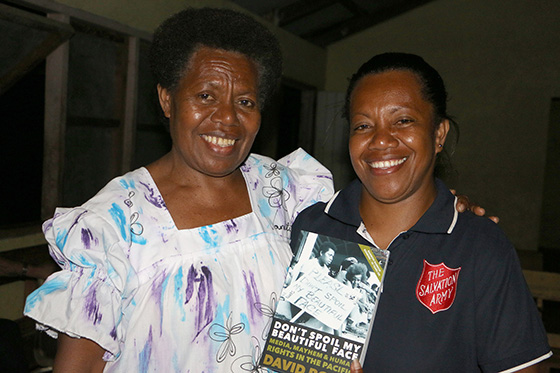
June Warigini and her copy of Don’t Spoil My Beautiful Face with her and her mother, Annie Keitadi, featured
in the cover photograph. Image: Del Abcede

33 years on

Thirty-three years have passed since then and my wife, Del Abcede, and I have just visited Aneityum (“Atomic”) Island in Vanuatu this week to meet that girl –
June Keitadi and her family.

She is now June Warigini, mother of three, grandmother and a Salvation Army volunteer living on her home island. And she still has that stunning smile.

I wanted to present her with a copy of my 2014 book, Don’t Spoil My beautiful Face, that was inspired by her and she is featured on the cover.

Not only June, her mother Annie Keitadi is featured there too. Her father, Jack Keitadi, was deputy curator of the Vanuatu Kaljoral Senta at the time and he later became curator.

It was a delight and a privilege for Del and me to be able to visit the family on Aneityum and to be treated to a “royal” welcome by the extended family and tribe.

June remembers that day in 1983 really well. It left a deep impression on her in later life.

“They wanted someone young who could go on their behalf to the French Embassy and present a petition calling on France to halt its nuclear tests in the Pacific – so they chose me,” she recalls.

Symbolic of N-ravages
She remembers her toothless smile was regarded as symbolic of the ravages of nuclear testing in the Pacific, not only by France, but also the United States and Britain.

“But the ambassador left in a hurry out the back. I don’t know why he was afraid of a little girl.”

Faced with persistent protests in the Pacific, France eventually ended all nuclear testing in 1996, thirteen years after that rally. But the campaign for full compensation for the victims of nuclear testing continues.

June feels that her experience at that young age helped give her an inner strength for the challenges of life today and inspiring her in her desire to help others in her church work.

Del and David Robie in ceremonial headdress on Aneityum.
Ironically, both Del and I met her by chance on Christmas Day at the end of last year, but had no idea at that time of her connection with my book.

While visiting Aneityum for a day, we shared in a “olden days” traditional food and customs exposure in a model 18th century village on the island.

When we eventually discovered her identity – after my appeals on my blog Café Pacific and an NFIP network had failed and Vanuatu Daily Digest came to the rescue earlier this year – and we saw photographs of her, my wife exclaimed:

“That’s her, the June we have met.”

We realised that the guide “June” we had met that day on the island was indeed June Keitadi now Warigini.

Idyllic island
Aneityum, the southernmost island in Vanuatu, currently has a population of 1740. It is not part of Vanuatu’s electricity grid and islanders rely on solar power. The island has no cars, or even a road.

The air connection is only two return flights a week from the Tafea provincial capital on Tanna. There is also no doctor, although a dispensary is now operating with two nurses and a midwife.

On the other hand, for visitors like ourselves, island life seems idyllic, a byword for “paradise”.
Aneityum has a wonderful healthy lifestyle for youngsters, remote from the world’s conflicts and problems.

There are three primary schools and a boarding secondary school – one that attracts students from other outer islands whose parents want an education where the traditional way of life is important and free from the urban ills of Port Vila.

June is assistant bursar at Teruja secondary school.

She tells a delightful story about a recent excursion for students from Aneityum who went on a “field trip” adventure by island cargo ship to Tanna to visit the famous Mt Yasur volcano.

The island’s micro economy is self-sustaining and is augmented by occasional cruise ship visits and tourism days on Mystery Island. It appears that Aneityum is remote from government services or assistance and the support of cruise shipping companies, such as P&O, is crucial for the islanders.

Annie Keitadi, Jack Keitadi and their daughter June with author David Robie. Image: Del Abcede
Thank you June, for your hospitality and sharing your life and family: husband Ruyben; daughter Letisha and granddaughter Pauline Rose; eldest son Alphonse (away on Efate Island) and youngest son Ray.
And we enjoyed meeting your parents, Annie and Jack Keitadi, along with the extended family, your cousins, uncles and aunts, on our all too short visit.


Tank yu Tumas


June and Ruyben Warigini and their youngest son Ray. Image: Del Abcede 

]]>

Across the Ditch: NZ Exporters Facing Tough Times + The Olympic Heroes’ Return

Across the Ditch: Australian radio FiveAA.com.au’s Peter Godfrey and EveningReport.nz’s Selwyn Manning deliver their weekly bulletin Across the Ditch. This week they discuss how the latest statistics show how exporters are finding it tough to get a decent return – it’s all due to the NZ dollar being too high against the US greenback. And the NZ Reserve Bank and the Government seem to be powerless to do anything about it. ALSO, NZ’s Olympic heroes have returned to New Zealand to huge excitement. First up: Weather comparison, Headlines Roundup. INDEPTH – ITEM ONE: NZ Exporters Facing Tough Times With the NZD sustaining its climb against the USD, Kiwi exporters are finding it touch going. It seems the current policy-set used by the Reserve Bank to keep inflation between 1 and 3% is failing. Reductions to the Official Cash Rate are failing to bring the dollar down, and failing to see a further marked reduction in mortgage interest rates. That width between the OCR which is 2% and the rates offered by banks upwards around 4% is an attractive return, keeping the demand for the NZ Dollar high – all this at a time when exporters need a lower dollar to maximise the returns for their goods and services. As wisdom suggests, the higher the NZ dollar goes against the Greenback, the less money exporters get back for their work. It’s the same story for Australian exporters. Here in New Zealand it’s becoming a big problem, not just for farmers and share milkers, but also for rural New Zealand and the broader New Zealand economy. Take Wednesday’s release from Statistics NZ: * Overall, meat and edible offal exports in July were down 19 percent on July 2015, to $408 million. The largest fall was in lamb exports, which fell 29 percent in value and 25 percent in quantity. * Dairy exports also fell in July down $88 million. Milk powder fell $118 million but was partly offset by rises in butter and natural milk constituents. The fall in value of milk powder was ‘price-driven’, as the quantity rose 0.9 percent. * The balance between overall exports and imports meant a goods trade deficit of $433 million in July. (ref. ForeignAffairs.co.nz ) Wednesday’s NZ dollar sat around 0.728 US cents for every NZ$1, after pushing up to 73.3 cents yesterday. In May, former Governor of the Reserve Bank Don Brash said to me, the closer to 80 US cents our dollar goes, the higher the risk that rural NZ will become an economic desert. The current Government is remarkably silent about what to do about this situation. And Labour’s finance spokesperson is far too quiet about what tool-sets he would present to the Reserve Bank should it become government next year. Meanwhile, exporters are struggling to make a decent buck, while politicians wait until election year before rolling out their parcels of policy. ITEM TWO: The Heroes’ Return New Zealand won more Olympic medals than ever before. At Rio Kiwis won 18 medals, including 4 Gold medals, 9 Silver medals, and 5 Bronze medals. And most of our Olympic athletes returned home yesterday to huge crowds and applause. The country is very pleased indeed and in particular with the manner in which the athletes competed. National pride is good and strong. ALSO: The All Blacks beat the Wallabies 42-8 at Sydney last Saturday night. If you can stand it, www.AllBlacks.com has all the detail, including an evaluation of the Wallabies as they head to Wellington NZ for the second of three tests for the Bledisloe Cup. I hate to say it Peter but the All Blacks have held the Bledisloe Cup since 2003. Sorry about that. The stats are against Australia on this one: The Wallabies haven’t beaten the All Blacks on Kiwi soil since August 11 2001. But Australian Rugby great, Peter FitzSimons said on Radio New Zealand last week the Wallabies have what it takes to remove the All Blacks’ grip of the Bledisloe Cup. Perhaps this Saturday, at Wellington’s Cake Tin, they will do it. Across the Ditch broadcasts live each week on Australia’s radio FiveAA.com.au and webcasts on EveningReport.nz, LiveNews.co.nz and Foreignaffairs.co.nz.]]>

Tony Alexander’s New Zealand Economic Overview 18 August 2016

]]>

Analysis by BNZ Economist Tony Alexander. This week we note that if booming retail spending and [caption id="attachment_11124" align="alignleft" width="150"]BNZ Economist, Tony Alexander. BNZ Economist, Tony Alexander.[/caption] employment growth are not causing the rate of inflation to rise then trying to encourage people to borrow more and spend more via lower interest rates probably won’t help the RB reach its goal of inflation back near 2%. Yet two more interest rate cuts remain likely in November and February.

We also list official Statistics NZ projections of population growth for each NZ region and local authority area. This is so all those people looking at investing in regional housing markets do so with full awareness of how local population pressures are likely to develop. For your guide, in some locations in the media recently with people buying very low priced properties the projections are for rapidly declining populations. Be careful when you leave the bright city lights. Download document pdf 358kb Trying To Boost Inflation The Reserve Bank are cutting interest rates in the hope that this will stimulate people to borrow more money and spend it or to save less and spend it, and that this will cause inflationary pressures which will get the annual inflation rate back above 1%. They are failing (along with almost all central banks these days) and we got good insight into this failure last Friday when the Retail Trade Survey numbers appeared. They showed that during the June quarter inflation and seasonally adjusted spending rose by a massive 2.6%. Growth from a year before was 6.4% and for the entire year 5%.
Consumers are already opening their wallets and spending up large and if this recent massive growth is not driving inflation then it is hard to imagine whatever stimulus coming from lower interest rates will make much difference.
Similarly, we learnt yesterday that the labour market may be booming, but analysis is difficult. Job numbers are reported to have surged by 2.4% during the June quarter and by 4.5% from a year earlier. However Statistics NZ have lifted their estimate of employment starting this quarter to better capture people who are self-employed. Thus there is a definite upward bias to the 2.4% quarterly growth rate but we don’t know by how much.
Suffice to say that all reports from employers are that staff are hard to find in spite of fewer Kiwis leaving the country and more coming back, plus a few more foreigners coming in to work than four years ago.
Yet, as previously noted, in spite of strong jobs growth and lowish unemployment at 5.1% from 5.5% a year ago there is no sign that wages growth is accelerating. The Labour Cost Index measure we prefer was ahead 2.8% in the June quarter from a year ago from a 2.5% rise one year ago, 2.9% two years ago, 2.8% three years ago, and 3.4% four years ago.
So no inflation coming from the labour market it seems in spite of rising remuneration in the construction sector and a booming tourism industry.
And it is hard to see much upward pressure on prices coming from the dairy sector in the near future even though average prices improved another 12.7% at this week’s auction after rising 6.6% two weeks ago. The rises are good but they won’t stop dairy farmers from continuing to crunch their expenses and pull back from wasteful supplementary feeding systems.
Housing
Starting from over a year ago Auckland investors began flooding into the regions looking for bargains, smaller mortgages, and better yields in the residential property sector. Once they appeared and snapped up property the locals woke from their slumber and piled in. Now there are major listings shortages all around the country and people are desperate to buy anything they can get their hands on – which means we are in the part of the cycle where those owning rubbish they have wanted to sell for the past nine years can finally get rid of it.
History tells us that at this point in the housing cycle people tend to invest in the regions with a view that there will be a population surge as Aucklanders flood out of their expensive city and baby boomers retire to their beautiful location. This never happens to the degree people expect. Worse than that, there are many parts of the country where short of Mount Rangitoto blowing up population is not going to grow at all.
To get a feel for how populations are likely to change in different locations we make use of the Statistics NZ Population Projections available at the following link.
http://www.stats.govt.nz/browse_for_stats/populati on/estimates_and_projections/SubnationalPopulat ionProjections_HOTP2013base.aspx
There is a good graphic showing projected average annual rates of population growth by region with Auckland showing strong growth followed by Canterbury, then Waikato and Bay of Plenty. On the West Coast, Southland, Gisborne, Manawatu-Wanganui, Hawkes Bay and Marlborough statistics show no or minimal growth projected out to 2043.
This following table shows projected total regional population growth from 2013 – 2043 under the Medium scenario which assumes a net annual migration gain for NZ of 12,000 p.a.
Projected % Population Change 2013-43
Auckland 49.3%
Canterbury 29.5
North Island 29.0
NZ 26.9
Waikato 21.9
South Island 20.4
Bay of Plenty 17.5
Otago 14.8
Nelson 14.8
Taranaki 14.6
Wellington 12.7
Northland 11.1
Tasman 10.7
Marlborough 4.5
Hawkes Bay 3.8
Manawatu-Wanganui 1.5
Gisborne 1.3
Southland 0.8
West Coast 0.6
All regions are projected to enjoy some population growth – but not all local authorities, and buyers of regional property would be advised to pay attention to this following list before selling up in Auckland to buy a few houses elsewhere thinking that capital gains will be the same.
2013-43 %
Upper Harbour 93.0%
Selwyn district 91.4
Waitemata 86.7
Franklin 83.3
Rodney 73.3
Queenstown-Lakes district 70.4
Papakura 68.7
Maungakiekie-Tamaki 62.0
Henderson-Massey 56.0
Hibiscus and Bays 56.0
Whau 54.5 Auckland 49.3
Waimakariri district 49.1
Tauranga city 43.7
Puketapapa 43.5
Howick 42.6
Hamilton city 41.7
Orakei 41.6
Mangere-Otahuhu 41.3
Waikato district 38.5
Albert-Eden 37.3
Waiheke 36.7
Otara-Papatoetoe 35.9
Ashburton district 31.9
Devonport-Takapuna 30.8
Total, New Zealand 26.9
Waipa district 24.0
Waitakere Ranges 23.9
Hurunui district 22.9
Christchurch city 22.5
Kaipatiki 22.2
Wellington city 22.0
New Plymouth district 21.7
Carterton district 20.1
Whangarei district 19.2
Central Otago district 18.4
Kapiti Coast district 18.3
Palmerston North city 18.3
Western Bay of Plenty district 16.5
Mackenzie district 15. 1
Nelson city 14.8
Upper Hutt city 12.3
Manurewa 12.1
Tasman district 10.7
Manawatu district 9.5
Waimate district 8.8
Hastings district 8.2
Porirua city 7.3
Timaru district 7.0
Buller district 6.6
Great Barrier 6.3
Dunedin city 5. 8
Waitaki district 5.6
Kaipara district 4.9
Napier city 4.9
Matamata -Piako district 4.9
South Wairarapa district 4.6
Marlborough district 4.5
Southland district 3.3
Invercargill city 3.0
Far North district 1.7
Taupo district 1.4
Gisborne district 1.3
Stratford district -0.2
South Taranaki district -0.7
Westland district -0.8
Kaikoura district -0.8
Masterton district -1.7
Lower Hutt city -2.1
Grey district -2.9
Thames -Coromandel district -4.0
Rotorua district -4.7
Wanganui district -7.6
Whakatane district -7.6
Clutha district -7.8
Horowhenua district -8.3
Hauraki district -8.6
Central Hawke’s Bay district -9.1
Otorohanga district -10.3
Tararua district -13.2
Gore district -13.3
South Waikato district -14.9
Rangitikei district -15.5
Chatham Islands territory -18.3
Waitomo district -21.7
Wairoa district -24.6
Opotiki district -27.4
Ruapehu district -34.3
Kawerau district -39.8.
NZ Dollar
As previously noted, the Kiwi dollar sitting close to USD65 -70 cents is where it goes after our international dairy prices have collapsed by about 60%. Now those prices have recovered to just 40% off their peak with a 19% average rise the past fortnight.
Now throw in new weak economic data out of the US, UK, and Japan. Add in a spreading realisation that US monetary policy might not tighten at all from current levels for a very long time, plus strong NZ economic data on retail spending this week and it is only a matter of time before the Kiwi dollar powers through very hefty resistance at 73 cents to settle perhaps near 75.
Basically we have the same message here. The Kiwi dollar sticks out as well supported in a world failing to get onto a firm growth track post -GFC.
And for your guide, generally the dollar and house prices move in the same direction, with migration flows on the same boat.
This afternoon the NZD was trading against the greenback near 72.4 cents from 72.9 last week, unchanged against the Australian dollar near 94.5 cents, and down marginally against the Yen, Pound and Euro near 72.7, 55.6, and 64.2 things respectively.
If I Were A Borrower What Would I Do?
Given some of the good data this past week we have pushed out our expectation for the next and probably (hopefully!) final two OCR cuts from September and December to November and February.
The direction in rates remains slightly downward but be careful in placing too much weight on any specific set of interest rate forecasts given the way basic economic relationships have radically altered post -GFC. Thankfully we have been giving that message for seven years now. Doesn’t much help anyone trying to optimally structure their risk management however.
Were I borrowing at the moment I would have a portion floating and fix the rest in the two or three year area. Five years at 5.15% is a nice low rate which will suit conservative borrowers. However I struggle to see monetary policy being sustainably tightened for quite a number of years so personally would feel little need to insulate against much upside risk at this stage.
The Weekly Overview is written by Tony Alexander, Chief Economist at the Bank of New Zealand. The views expressed are my own and do not purport to represent the views of the BNZ. To receive the Weekly Overview each Thursday night please sign up at www.tonyalexander.co.nz To change your address or unsubscribe please click the link at the bottom of your email. Tony.alexander@bnz.co.nz
]]>

Across the Ditch: NZ Govt Set To Increase Spy Powers + Olympics Roundup and Happy Kiwis

Across the Ditch: Australian radio FiveAA.com.au’s Peter Godfrey and EveningReport.nz’s Selwyn Manning deliver their weekly bulletin Across the Ditch – This week: NZ Government introduces to Parliament intelligence law reform that will make it legal for the spy agencies to spy on its own people. Plus: Olympic highlights from week two of the games. ITEM ONE: Spy Law Reform. The New Zealand National-led Government introduced legislation into Parliament that if passed will enable the country’s intelligence agencies to spy on New Zealand citizens. The legislation is called the New Zealand Intelligence and Security Bill and will make it lawful for the Government Communications Security Bureau (GCSB) to turn its electronic surveillance on Kiwis. Until now, it has been unlawful for the GCSB to place New Zealand citizens and permanent residents under surveillance. The Security Intelligence Service has been permitted to investigate and surveil Kiwis but only with a warrant signed by the Prime Minister. The new legislation will bring the two major intelligence agencies under one piece of law. It will also lower the authorisation bar, requiring surveillance to only be signed off by the Attorney-General and a Commissioner of Warrants. The Government states that only Kiwis that are suspected of being a danger to the country’s national interest will risk being spied on. Also, the Bill will make it easier for the agencies to access private and confidential information relating to New Zealand citizens and held by other agencies such as Customs, Immigration, and Inland Revenue. The new laws will also make it illegal for whistleblowers to make revelations in the public interest. It will be an offence under the new Act for anyone to go to the media or make public classified information, reveal illegal practice, inappropriate or excessive use of the surveillance and interception powers that Parliament is asked to give the spy agencies. It is a warning to anyone who holds a government ‘security clearance’ that if they “wrongfully communicate, retain, or copy classified information” they will be charged. The Prime Minister John Key stated on Monday the legislation will be the most significant reform of the intelligence agencies in New Zealand’s history. Labour leader Andrew Little is considering whether his party will support the reform. Since coming into office in 2008, Key has introduced widespread reform of the spy agencies, including the invasive Telecommunications (Interception Capability and Security) Act and GCSB reform legislation of 2013. The reform began in earnest after the GCSB was found to have been operating illegally, spying on New Zealanders and permanent residents. ITEM TWO: Olympics Highlights and Update. Olympics Update – Summary of the medal winners and what to expect over the next few days. Gold Medals to date: Rowing M2 Skulls – Hamish Bond and Eric Murray Rowing Single Skulls – Mahe Drysdale K1 200 – Lisa Carrington TBA – Gold – Yachting in the 49ers, Blair Tuke and Peter Burling have won the gold with two races to spare. Once the races complete the medals will be confirmed. Big names yet to compete: Lydia Ko (ranked Golf’s number one in the world) begins her competition Thursday. Double gold medalist Lisa Carrington will compete in the K1 500 NZ women’s Hockey are going very well. And there might be some good results yet on the cycling track and on the water in with the sailors. Across the Ditch broadcasts live on Australia’s radio FiveAA.com.au and webcasts on EveningReport.nz LiveNews.co.nz and ForeignAffairs.co.nz.]]>

Across the Ditch: NZ’s Big Freeze + Olympics Trans Tasman Rivalry

Across the Ditch: Australian radio FiveAA.com.au’s Peter Godfrey and EveningReport.nz’s Selwyn Manning deliver their weekly bulletin Across the Ditch. This week they discuss: Weather comparison Headlines roundup ITEM ONE: The Big Freeze – For the past week New Zealand has been in the grip of a snow monster. The South Island has experienced heavy snowfalls, and the North Island has certainly had its fair share of snow too. For example, the Desert Road that cuts through the Central Volcanic Plateau has seen heavy snow, bringing superb skiing conditions to the North Island ski fields of Turoa and Whakapapa on the sides of Mt Ruapehu. Also, the Napier-Taupo Highway that connects the Hawke’s Bay’s Pacific coast towns and cities to their northern counterparts had been closed due to heavy snowfalls from Friday through to Tuesday. Schools were closed and power outages plagued the art deco city of Napier. Speaking of power, Kiwis are in for some huge electricity bills once the August power-metres are read. Estimates suggest over $4 million dollars extra will be paid by families to their respective power companies for their power usage for last week alone. ITEM TWO: The Olympics – It’s been a challenging start for Kiwis competing at the Olympics. But there’s been some surprises too. But generally, big news here was the NZ Rugby Sevens (women team) being beaten for Gold by Australia. On becoming the Silver Medalists to Australia’s Gold Medal win, he Kiwi Sevens women performed and dedicated a Haka in Australia’s honour. Another KIWI silver medalist, Natalie Rooney surpassed pundits back home, coming through the competition to go head to head against her Australian fellow competitor, Catherine Skinner. It was a tense shootout which saw Australia win the gold. But a lot of coverage here centred on how Skinner fired the winning shot, but retained her silent composure so the Kiwi, Rooney could make her final shot for the silver. It was a great Olympic moment.]]>

“Roots” (2016): persistence of power… and the enduring spirit of resistance

]]>

Review by Carolyn Skelton – Roots (2016) My first post on the 2016 TV miniseries, Roots, highlighted the brutality of silvery, and the ways the US slave masters aimed to erase the true identities and history of African chatel slaves in the 18th and 19th centuries. A theme of the miniseries is the importance of naming, and how the slaves maintain their true names and by telling and re-telling their family line and stories to each new generation. In episodes 3 and 4 we follow the life of Chicken George (Regé-Jean Page) the son by rape of Kunte Kinte’s (Malachi Kirby) daughter Kizzy (Anika Noni Rose), and an Irish slave owner, Tom Lea (Jonathan Rhys Meyers) in North Carolina. Tom came from a poor Irish American background, and considers he has been successful when his fighting cocks gain him enough money to buy a farm and slaves. He is never accepted by the wealthy, powerful and bigoted Anglo men in the area: they consider themselves Tom’s superior. Chicken George has a way with words, using an evangelical style of oratory to captivate white people as he successfully trains and manages Tom’s fighting roosters. Like Tom, the young George sees the acquisition of money as the best way to achieve freedom, and equality. George later reconsiders, and chastens Tom for his hollow belief in the soulless power of money. Money, and the evils associated with it, are another recurring theme in the series. After a lost cock fight, Tom Lea is bankrupted. This results in George being sold to an Englishman, and taken to England for over 20 years, leaving behind his wife Matilda (Erica Tazel) and several children. In the final episode of the series, it is a bewildering moment for Kinte’s descendants and the community of slaves, when they slowly come to realise that the Civil War has ended, General Lee has capitulated, and they are no longer slaves. Chicken George’s wife Matilda says, she won’t be dancing in celebration as she has lost so much: 3 children sold to distant slave owners, and her, now liberated husband, back in the US. [caption id="attachment_11049" align="alignleft" width="300"]Roots (2016): Chicken George, Matilda, Marcellus, Kizzy. Roots (2016): Chicken George, Matilda, Marcellus (Michael James Shaw), Kizzy. [Black Film website][/caption]George had to leave his family because vicious white men use loopholes in the law to brutally exert their power over black people, whether they are slaves or not. If George had stayed with his family he would have been tormented, re-enslaved, or killed. An older, wiser and reformed George joined the struggle to support and protect other black people. Towards the final episode, following the end of the US Civil War and the abolition of slavery, we see the liberated slaves take the first tentative steps to negotiating their their terms for selling their labour to their previous slave masters. Roots: the next generations This matches the history outlined in Steve Fraser’s 2015 book*. The abolition of slavery was replaced by what often was referred to as “wage slavery”, with a large number of young black men, and some poor white men, in the south of the US, working for little money in harsh, prison-like conditions. A high proportion of black such men ended up in prison. There they became cheap labour for the developing enterprises of the rapid industrialisation of the US, and the rise of capitalism (Fraser, pp. 50-3).

And while young African American males languished in industrial and agricultural prison camps, black women (if they weren’t also working in prisons, sometimes as unpaid prostitutes), once the helpmates of their husbands on small family plots, found work instead as wage earners in canning and tobacco factories, as domestics, in mechanized laundries and textile mills, and in the fields.” (Fraser, p.53)

High unemployment was a frightening reality. The US’s early phases of industrialisation developed on the backs and bodies of the poor, a high proportion of them being black people.

“… 35,000 workers died each year in industrial accidents, many of them skilled mechanics.

The bones of thousands of workmen were encased in the concrete of dams and bridges…”  (Fraser, pp. 56-57)

The history of the subordination, discrimination and bigotry endured by the majority of African Americans since the Civil War, shows how the legacy of the past impacts on the present and future. Some of this is shown in the 1979 TV series Roots: the next generations, available on youtube (see also imdb). [caption id="attachment_11047" align="alignleft" width="300"]"Roots: the next generations" (1979) - poster, youtube “Roots: the next generations” (1979) – poster, youtube. Tom, top left.[/caption] In episode 2 of Roots: the next generations (1979), Chicken George and Matilda’s son Tom Harvey (Georg Stanford Brown) has been proud to be able to vote every election after the Civil War. Then, a new generation of white men conspire to prevent black people from voting with vote registration rules targeting African Americans. This includes the requirement to have paid poll tax, and to be literate. Tom fronts up the registration office, shows his poll tax records, and maintains his dignity in front of the sneering white men, while haltingly reading part of the Tennessee constitution he’s given. They then disqualify him from registering because he is unable to explain the meaning of the piece he has read. The legacy of African American slave history in the present In the past few weeks, some in the US have tried to use similar methods of targeting African Americans with rules to prevent them from registering to vote. (Se The Guardian 3 August 2016  and The New York Times 31 July 2016  ) Those kinds of actions, plus the statistics that show African Americans continue to be over-represented in the poorer sections of society, while also being victimised by the police and other institutions, shows how the legacy of brutalising slavery, still continues into the present, as does resistance to it in the #blacklivesmatter movement. (See, for instance, the post by The Political Scientist showing the persistence of poverty experienced by African Americans over generations.) Berklee Black Lives Matter perform a beautiful version on Nina Simone’s “Four Women”, bringing the past into the present, highlighting the continuing impact of slavery, and long-term oppression of black people into the 21st century. The refrain in Nina Simone’s song is “What do they call me? My name is…”. At the end of Berklee Black Lives Matter’s version the reprise the refrain for 3 of the women by highlighting that the name is what “they call me”. The powerful diminish and hide the true identities, experiences and histories of slaves and their descendants in the way they name them.  In covering the song, the Berklee women retell the history of this oppression and resistance to it. https://youtu.be/eDF3RLSI07s * Fraser, Steve, The Age of Acquiescence: The life and death of American resistance to organized wealth and power, New York, Boston, London, Little Brown and Company, 2015.]]>

“Roots” (2016): enslavement and the politics of naming

]]>

Review by Carolyn Skelton. See also, Part Two: “Roots” (2016): persistence of power… and the enduring spirit of resistance Roots (2016, TV series) is disturbing but also compelling: a story of horrific brutality endured, and of the resistant warrior spirit, struggling for freedom. It tells of how the past impacts on present and future generations. It shows the best and worst of humanity, and points to the way both continue today. (Episodes 3 and 4 available on demand on TVNZ website for another week.) Alex Haley’s fictionalisation of his search for his African (become African-American) ancestry was first written as a novel (Roots: The making of an American family, 1976 ). It begins with the story of the enslavement of Kunte Kinte, taken from his Gambian home town of Juffure. The family saga was made into an acclaimed 1977 TV series (See PBS on “Miniseries: Roots Special” 2013) The accuracy of Haley’s family history is disputed, but the story and context seems pretty true to the social history of slavery and the continuing struggles of African Americans. Compared with the 1977 TV series, the 2016 version has been updated to include more accurate historical information. The new version characterises Juffure as “a busy commercial trade post” rather than a rural backwater. In 2016 Kunta Kinte is portrayed as a warrior, compared with the more childlike version of 1977. (Caitlin Gallagher on the differences) The 2016 TV series re-make begins with the story of Kunta Kinte (Malachi Kirby), born in Juffre and trafficked as a teenager to Virginia in the 1770s. The story begins in some of the earliest phases of globalisation that accompanied the shift from feudalism, through mercantile trading, to industrial capitalism. (See also Wikipedia on the 2016 version and imdb) The rise of the use of African slaves in the southern states of the US followed from use of Irish, Scottish, English and German people as well as Africans as indentured servants in early 17th century colonial America. In the 17th century there was a gradual shift from indentured servitude to the use of Africans as chattel slaves, whereby humans are owned as property and have no personal freedom or rights. (History of Slavery in America, Berkley University) The series shows the lives and struggles of Kinte and his descendants across several decades, until the end of the US Civil War and the abolition of slavery in the 1860s. The politics of naming, the importance of family, and of teaching each generation their family lineage, are recurring themes throughout the generations. So to is the recurring treachery, bigotry, misogynistic rape, inhumanity and brutality endured. It starkly portrays the exploitation and abuse carried out by the slave masters in order to acquire and maintain their wealth, status and power over others. And it shows the ways in which each new generation follows Kinte’s example with brave bids for freedom as well as resistance to enslavement in small and large ways: there are moments of success, but their oppression continues, and sometimes changes with other social and economic changes. (See the History website and the Civil War Trust website) The 2016 series adds the story of Kinte and his contemporaries participation in the American War of Independence in 1782, and his grandson Chicken George (Regé Jean-Page) in the US Civil War (1861-65). Both re-tellings show how the slaves were viciously betrayed by the armies they pledged to support in return for promises of freedom. The black men were cynically used as inadequately armed canon fodder. The family bonds, love, solidarity, support, and the selfless sacrifice to protect others among the community of slaves makes their lives durable. For the viewer this is both distressing and uplifting. Kinte and his descendants endeavour to make the best of the circumstances that enslave them. The first aim is to survive. Individuals make choices about when to fight, and when to be prepared to die to protect others. Those that colonise others as a means to maintain their power and status, do so in part by denying the impact of the legacies of the past on present and future lives. The aim of the slave managers is to make the slaves forget their past lives and heritage, by giving them a slave name, and constructing false, and demeaning traditions for them to follow. Kunte Kinte’s supreme act of resistance is to continue to say his name, “I am Kunte Kinte”, as the slave master viciously whips the skin off his back. Eventually, near death, Kinte chooses to live, and says his slave name, “Toby.” But, as The Fiddler (Forest Whitaker) tells him, Kinte will keep his true name, and the spirit it signifies, inside hm. It is necessary to know your name and lineage to know who you are (and what you can be). In part II I will say more about Roots (2016) and the impact of past oppressions on present and future lives. Nina Simone wrote and sang a powerful song, describing four women, whose lives have been constructed out of the legacy of slavery. Each woman is characterized by a slave naming, first as a lament, then, for the fourth woman, her name is sung with anger and bitter irony. https://youtu.be/4grGAYx9koA]]>
