

Across the Ditch: Australian radio FiveAA.com.au’s Peter Godfrey and EveningReport.nz’s Selwyn Manning deliver their weekly bulltin Across the Ditch. This week they discuss how the Kiwi dollar continues to climb against all its major trading partners + A southerly icy blast has hit most of New Zealand bringing snow flurries over much of the South Island and also the North Island’s Central Plateau region, closing roads and uprooting trees. Also, a Colin McCahon painting sold this week for a record price in New Zealand. First up: Weather comparison Headlines roundup ITEM ONE: Kiwi Dollar Continues Its Climb NZ Dollar continues to climb against major trading partners, including against the soaring Aussie dollar. If South Australians are planning a skiing holiday this month in Queenstown, the snow will be good but the Kiwi dollar will not give you much of a cash injection. ITEM TWO: Freezing Winter Blast Hits All NZ Islands The last big icy breath of winter is sweeping over both main islands bringing snow to most of the South Island and down to 500 meters above sea level in the North Island. The wind-chill factor is causing concerns for farmers as the polar blast threatens livestock including thousands of new-born lambs. And this coming season’s horticulture and viticulture sectors could be hit if this weather system is backed by blistering frosts. ITEM THREE: Colin McCahon Painting Sells For Record $1,350,000.00 A painting by Kiwi artist, the late Colin McCahon, sold Wednesday night for $1,350,000. That’s a record for the most expensive painting ever sold at auction in New Zealand. The painting is known as The Canoe Tainui and was being auctioned on behalf of the estate of Tim and Sherrah Francis. The late Tim Francis, who was a former NZ permanent representative to the United Nations and ambassador to the USA. According to the NZ Herald, Tim Francis once wrote about the moment he first spotted the painting: “It was stunning, lyrical, subtle, glowing … You know, up to that point, I had been – apprehensive I think is the word – about Pakeha taking Maori objects, symbols, even history, and making it into something of their own. But this was not like that. The words, the names, were handled reverently. The whole feel of the painting was one of honouring Maori, acclaiming Maori culture … here is a profoundly expressive celebration of Maori identity, Maori nationality.” See also: NZHerald.co.nz. By the way, the painting was bought in 1969 for $550.00. Across the Ditch broadcasts live each week on FiveAA.com.au and webcasts on EveningReport.nz, LiveNews.co.nz and ForeignAffairs.co.nz.]]>
Oxfam slams NZ’s Pacific climate funds- too ‘business focused’

AsiaPacificReport.nz
Oxfam New Zealand says the Government’s finance towards Pacific climate change is business focused and does not benefit families in need.
Rachael Le Mesurier, Oxfam New Zealand’s executive director, said because of this the Government needs to change its funding focus within Pacific climate finance.
“While New Zealand’s role in helping Pacific communities to access clean, efficient energy is helpful…the Government’s climate finance model is designed to be business focused, and not to benefit families living on the frontline of climate change.”
“These families need resources to adapt to rising seas and turbo-charged cyclones. The New Zealand Government’s climate finance program isn’t helping them do that,” Le Mesurier said.
‘unmet commitments’
Her statement complied with Oxfam’s research report, released this week, which assesses the “unmet” commitments of the New Zealand and Australian governments towards Pacific climate funds.
After Paris: Climate Finance in the Pacific Islands reveals the proportion of New Zealand’s climate finance dedicated to adaptation has dropped by 20 percent since 2013. It instead urges investment in resilience building.
It also states that Australia has not increased its contribution for international climate finance since 2010.
“Australia has failed to increase its contribution to international climate finance in line with the goals of the Paris Agreement or in keeping with stronger commitments from other developed nations.”
- The report comes as the most senior politicians in the Pacific gather for the 47th Pacific Islands Forum. The five-day event began today in Pohnpei, the capital of the Federated Sates of Micronesia, and will end on Sunday.
Constitutional Coups.

36th Parallel Assessments – Headline: Constitutional Coups.
A disturbing development in democratic politics is the emergence of a new form of forced ouster of presidents. Although military-led coups continue to occur, they have increasingly been met with disapproval at home and abroad. In their place have emerged “constitutional coups” whereby impeachment is used as a weapon against executive branch incumbents by disloyal oppositions in the legislature. In this analytic brief 36th Parallel Assessments outlines the phenomenon and its implications.
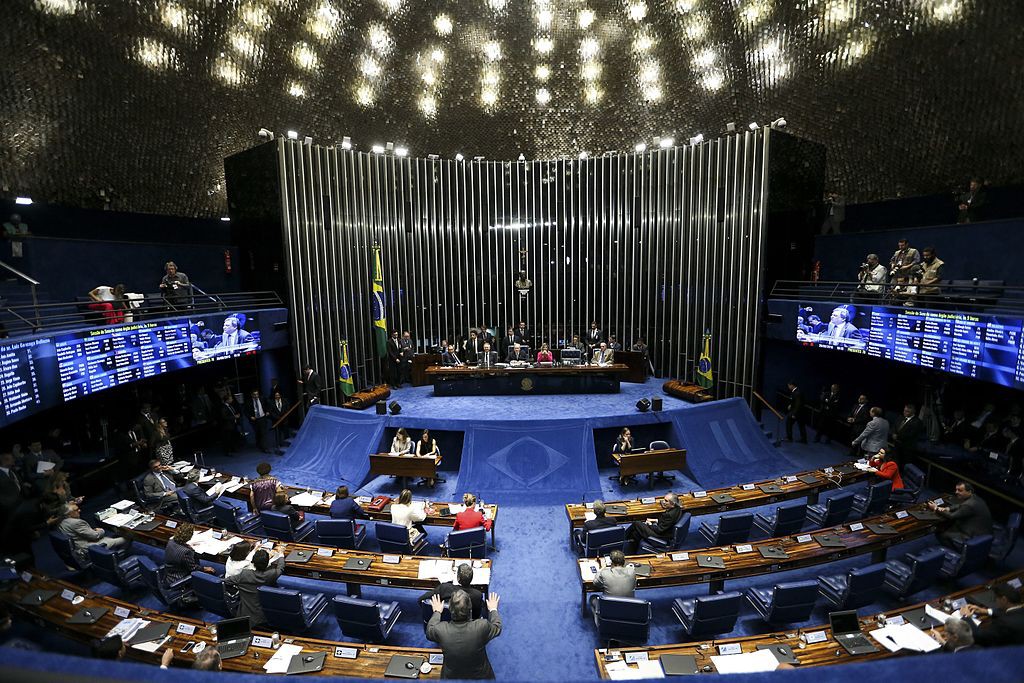 Brazilian Senate conducts the impeachment trial of President Dilma Rousseff, August 26, 2016. Credit: Marcelo Carmargo/Agencia Brasil via Wikimedia Commons.
When people think about coups d’etat, they tend to think about armed interruptions of the constitutional order, usually perpetrated by the military against an elected government. Such was the case with the abortive coup staged by elements of the Turkish military against the government of Recep Erdogan last July. Note that I do not say “democratically” elected governments, as usurpations of the constitutional order can also happen in electoral authoritarian regimes such as that of Hosni Mubarak in Egypt in 2011 (only to be followed by a “full” coup against the subsequently elected Muslim Brotherhood government of Mohamed Morsi in 2013).
The traditional origins of coups as forms of regime change, known as golpes de estado in Spanish, do in fact hark back to military interventions against civilian governments, and that remains its most common form. But another form of coup has emerged, minus the bloodshed and state of emergency so often associated with military-led coups (I say military-led because it is very seldom the case that the armed forces act alone when moving against the government of the day). Rather than an interruption and suspension of the institutional process by military means, it is a usurpation from within the institutional order by constitutional means. Instead of bullets fired by soldiers it is ballots cast by politicians that overturn the will of the people prior to scheduled elections. The insurrectionists belong to and work within the political system. This is what is now known as a constitutional coup. In order to understand this new form of “golpismo” we need to consider two background factors.
First, liberal democracy comes in two forms: presidential and parliamentary systems. Although it is possible that constitutional coups can happen in parliamentary systems (such as the removal of governments by Governor Generals in Pakistan in 1953 and Australia in 1975), they most often happen in presidential systems. By their very nature parliamentary systems have built-in insurance against constitutional coups because there are established means to remove a government, specifically via votes of no-confidence followed by snap elections. The rules governing both the vote and the election may vary from country to country, and there may be a ruckus surrounding such events, but they are an integral part of parliamentary democracy and, some might argue, a much finer tuned aspect of democratic governance than that allowed by its alternative.
Presidential systems provide no such mechanism for the removal of governments prior to their end of term. By definition, any such move constitutes an institutional crisis as the system is based on a separation of executive power from legislative authority. In parliamentary systems the executive (in the form of cabinet) continues to act as a parliamentary faction, to include ministers discharging responsibilities as members of parliament. In presidential systems that is not the case and executive authority can often be confronted by or exercised against legislative majorities (as is currently the case in the US). No matter what the majority in the legislature may wish, it cannot simply call for a vote of no-confidence in the government of the day. In fact, it has no legal basis to do so.
When the legislative and executive branches in presidential systems are locked in impasses or stalemates over any number of potential issues, the resolution mechanism boils down to supermajorities in the former and veto powers in the latter. Ideally, in bicameral legislatures the resolution sequence is usually this: the president introduces or supports a bill submitted for approval by the legislature. The opposition obtains a supermajority against the bill in the lower house, which is vetoed by the president, which is then upheld or overturned by a supermajority in the upper house. In unicameral legislatures the sequence is either one and done or a second legislative supermajority vote is taken after a veto in order to ratify or overturn the veto. Neither of these resolution paths provide a mechanism for the removal of the executive.
This process is cumbersome but offers the benefit of providing space for compromise between the executive and legislature as a bill winds its way through the ratification process. But what about removal of an elected government before its term is up? That is where the second key backdrop factor comes into play: disloyal opposition.
Before we examine the role of disloyal oppositions in constitutional coups, here is a summary of what constitutes loyal and disloyal opposition in a democracy (there is no point in using those terms in authoritarian regimes).
Loyal oppositions are those that, having been defeated in elections or confronted by an opposing party in executive office (remember, the problem is unique to presidential systems), abide by the rules of the political game and wait for the next electoral opportunity to gain executive power. During the meantime they work as much as possible to find areas of compromise so that the machinery of governance can continue to serve the public good (or at least be seen as doing so). Even if token, concessions are exchanged so that consensus on issues of policy can be achieved. Only in the most egregious case of executive misconduct, usually involving criminality or gross negligence, does a loyal opposition begin to contemplate the unthinkable, which comes in the form of impeachment (that is, forcing the resignation of the executive under pressure from the legislature backed by the authority of law enforced by state security agents).
Disloyal oppositions are those that refuse to accept the outcome of elections and/or the legitimacy of a particular government and use their political influence and power to bring down that government by any means short of force. This includes being deliberately obstructionist when it comes to passing legislation, flaunting rules governing acceptable political discourse, manipulating or colluding with media to plant false accusations against incumbents, refusing to authorise budgets and confirm executive appointments, and generally acting in every possible way to stymie government policy initiatives, make it impossible for the executive branch to function effectively within the tripartite, separation of powers framework of constitutional government, and to promote discontent with and distrust of the government and its political supporters.
The classic modern instance of a disloyal opposition was the Christian Democratic led opposition to Salvador Allende’s Unidad Popular government in Chile from 1970-73. The result of that disloyalty is well known.
Brazilian Senate conducts the impeachment trial of President Dilma Rousseff, August 26, 2016. Credit: Marcelo Carmargo/Agencia Brasil via Wikimedia Commons.
When people think about coups d’etat, they tend to think about armed interruptions of the constitutional order, usually perpetrated by the military against an elected government. Such was the case with the abortive coup staged by elements of the Turkish military against the government of Recep Erdogan last July. Note that I do not say “democratically” elected governments, as usurpations of the constitutional order can also happen in electoral authoritarian regimes such as that of Hosni Mubarak in Egypt in 2011 (only to be followed by a “full” coup against the subsequently elected Muslim Brotherhood government of Mohamed Morsi in 2013).
The traditional origins of coups as forms of regime change, known as golpes de estado in Spanish, do in fact hark back to military interventions against civilian governments, and that remains its most common form. But another form of coup has emerged, minus the bloodshed and state of emergency so often associated with military-led coups (I say military-led because it is very seldom the case that the armed forces act alone when moving against the government of the day). Rather than an interruption and suspension of the institutional process by military means, it is a usurpation from within the institutional order by constitutional means. Instead of bullets fired by soldiers it is ballots cast by politicians that overturn the will of the people prior to scheduled elections. The insurrectionists belong to and work within the political system. This is what is now known as a constitutional coup. In order to understand this new form of “golpismo” we need to consider two background factors.
First, liberal democracy comes in two forms: presidential and parliamentary systems. Although it is possible that constitutional coups can happen in parliamentary systems (such as the removal of governments by Governor Generals in Pakistan in 1953 and Australia in 1975), they most often happen in presidential systems. By their very nature parliamentary systems have built-in insurance against constitutional coups because there are established means to remove a government, specifically via votes of no-confidence followed by snap elections. The rules governing both the vote and the election may vary from country to country, and there may be a ruckus surrounding such events, but they are an integral part of parliamentary democracy and, some might argue, a much finer tuned aspect of democratic governance than that allowed by its alternative.
Presidential systems provide no such mechanism for the removal of governments prior to their end of term. By definition, any such move constitutes an institutional crisis as the system is based on a separation of executive power from legislative authority. In parliamentary systems the executive (in the form of cabinet) continues to act as a parliamentary faction, to include ministers discharging responsibilities as members of parliament. In presidential systems that is not the case and executive authority can often be confronted by or exercised against legislative majorities (as is currently the case in the US). No matter what the majority in the legislature may wish, it cannot simply call for a vote of no-confidence in the government of the day. In fact, it has no legal basis to do so.
When the legislative and executive branches in presidential systems are locked in impasses or stalemates over any number of potential issues, the resolution mechanism boils down to supermajorities in the former and veto powers in the latter. Ideally, in bicameral legislatures the resolution sequence is usually this: the president introduces or supports a bill submitted for approval by the legislature. The opposition obtains a supermajority against the bill in the lower house, which is vetoed by the president, which is then upheld or overturned by a supermajority in the upper house. In unicameral legislatures the sequence is either one and done or a second legislative supermajority vote is taken after a veto in order to ratify or overturn the veto. Neither of these resolution paths provide a mechanism for the removal of the executive.
This process is cumbersome but offers the benefit of providing space for compromise between the executive and legislature as a bill winds its way through the ratification process. But what about removal of an elected government before its term is up? That is where the second key backdrop factor comes into play: disloyal opposition.
Before we examine the role of disloyal oppositions in constitutional coups, here is a summary of what constitutes loyal and disloyal opposition in a democracy (there is no point in using those terms in authoritarian regimes).
Loyal oppositions are those that, having been defeated in elections or confronted by an opposing party in executive office (remember, the problem is unique to presidential systems), abide by the rules of the political game and wait for the next electoral opportunity to gain executive power. During the meantime they work as much as possible to find areas of compromise so that the machinery of governance can continue to serve the public good (or at least be seen as doing so). Even if token, concessions are exchanged so that consensus on issues of policy can be achieved. Only in the most egregious case of executive misconduct, usually involving criminality or gross negligence, does a loyal opposition begin to contemplate the unthinkable, which comes in the form of impeachment (that is, forcing the resignation of the executive under pressure from the legislature backed by the authority of law enforced by state security agents).
Disloyal oppositions are those that refuse to accept the outcome of elections and/or the legitimacy of a particular government and use their political influence and power to bring down that government by any means short of force. This includes being deliberately obstructionist when it comes to passing legislation, flaunting rules governing acceptable political discourse, manipulating or colluding with media to plant false accusations against incumbents, refusing to authorise budgets and confirm executive appointments, and generally acting in every possible way to stymie government policy initiatives, make it impossible for the executive branch to function effectively within the tripartite, separation of powers framework of constitutional government, and to promote discontent with and distrust of the government and its political supporters.
The classic modern instance of a disloyal opposition was the Christian Democratic led opposition to Salvador Allende’s Unidad Popular government in Chile from 1970-73. The result of that disloyalty is well known.
 Chilean Military Junta, 1973. Source: Biblioteca del Congreso Nacional de Chile (Library of the Chilean National Congress), via Wikimedia Commons.
Not all disloyal opposition need result in full fledged military coups. Instead, they can veer down the path of the constitutional coup. Consider the case of Bill Clinton’s impeachment in 1998-99. In late 1998 the Republican controlled House of Representatives voted to impeach Clinton on two counts of perjury and two counts of obstruction of justice. The charges related to his accounts of the affair he had with White House intern Monica Lewisky, the salacious details of which were vividly spelt out by Independent Counsel Ken Starr (Starr has recently been forced to resign from his position as president and chancellor of Baylor University for his role in covering up sexual assaults on females by football players). Mr. Starr was appointed by the Speaker of the House at the time, Newt Gingrich, he of the three marriages and many affairs (including with subordinates).
In 1999 the Republican controlled Senate held a trial and voted on the charges. Needing a two thirds (67 seat) majority for the impeachment to succeed and with 55 Senators on the Republican side, the impeachment vote failed when 50 voted in favour on the obstruction charge and 45 voted in favour on the perjury charge. Clinton remained in office, albeit significantly hamstrung by his near-miss.
The issue here is that the impeachment was over a private sexual affair, not an act of public malfeasance . It was led by people who themselves had similar skeletons in their closets and who did so in part just to weaken the president even if their efforts to impeach him failed (given media coverage of the story). More specifically, it was not about gross incompetence, criminal behaviour, military mismanagement, or even lying to Congress about any matter of policy. Instead, it was about the president receiving fellatio from and using a cigar as a sex toy on Ms. Lewinsky during trysts in the Oval Office, then trying to cover it up. It is doubtful that the founding fathers, in Article Two (Section Four) of the Constitution, had this in mind when they wrote that impeachment was to be used only in exceptional circumstances involving “treason, bribery or other high crimes and misdemeanours.”
That is a slippery slope. And nowhere is the bottom of that slope more evident than in the recent impeachment of leftist President Dilma Rousseff of Brazil.
Brazil has history with impeachment. In 1992 then president Fernando Collor de Mello resigned after Congress voted in favour of his impeachment on charges of bribery and misappropriation of funds. Similar charges of “budgetary mismanagement” were brought against Ms. Rousseff in 2016 by a Congress dominated by the center-right PMDB, Brazil’s largest party, which has the most seats in Congress (66) and is the one to which her vice president Michel Temer belongs (the coalitional aspects of Brazilian politics are too complex to get into here but suffice it to say that Rousseff was trying to keep her friends and allies close and her enemies closer. That did not work out as planned). By the time the first reports of fiscal irregularities surfaced in 2015, the PMDB-led majority in Congress had gone full-blown disloyal in a context of economic stagnation and assorted crises (Zika, lack of Olympic preparations) and were itching to find a reason to remove Rousseff (who was not anywhere as popular as her Workers Party predecessor Luis Ignacio “Lula” da Silva). The investigation into financial wrongdoing gave them their window of opportunity.
The charges against Rousseff stemmed from “Operation Car Wash” (Operacao Lava Jato) into bribery and corruption involving the state oil monopoly Petrobras, assorted construction firms, politicians, bureaucrats and financial entities. Without going into the details, let’s just say three things: First, corruption is a way of life in Brazil, not just an aspect of how the economic and political elite behave (hence the phrase fazer jeito, or ” a way of doing things” on the sly). Of those legislators demanding her impeachment and who voted against her at the Senate trial, over a dozen are being investigated or have been charged with corruption themselves, including now-president Temer. Included among the luminaries who voted to oust her is a former Army officer who was involved in her torture when she was imprisoned by the military dictatorship in the early 1970s, and who said during the proceedings that it would have been best that she were killed while in custody.
Secondly, creative accounting by Brazilian governments is a time-honoured tradition that crosses party lines. Most reputable political and financial analysts agree that not only was Ms. Rousseff not personally involved or benefitted by dodgy Treasury figures, but that in the scheme of things the book fiddling done by her government was not criminal but in fact par for the course in Brazil. Unfortunately for her, Article 85 of the Brazilian constitution and the Fiscal Responsibility Law specifically prohibit mismanagement and disregard for the federal budget. This was the seldom used rope that Congress hung her with.
Thirdly, no impeachment in Brazil can occur without the tacit assent of the armed forces. Of all the sordid aspects of Rousseff’s impeachment, this is the most sobering one. 30 odd years after they returned to the barracks, Brazil’s military still sees forced removal of elected presidents as a viable option–so long as it does not involve them directly.
This is why what happened in Brazil a week or so ago was a constitutional coup.
Although there have been variations on the theme, impeachment is the weapon of choice for constitutional coup plotters. They may use institutional means, but their intentions are disloyal and their objectives sinister at heart. Their motivations have nothing to do with honesty and transparency in government or defending democracy. Instead, they are about playing the system for tactically opportunistic partisan gain.
Brazil is not the only Latin American country that has witnessed a congressional coup. In 2012 Paraguayan President Fernando Lugo was impeached and removed from office, ostensibly over his mishandling of a land occupation that ended in violence. He was given two hours to prepare his defense and was replaced by his vice president, who sided with the legislative opposition. Subsequent publication of US embassy cables by Wikileaks revealed that as early as 2009 opposition leaders had begun to make plans to use impeachment as a way of removing Lugo from office (Lugo was elected in 2008). They eventually succeeded.
Chilean Military Junta, 1973. Source: Biblioteca del Congreso Nacional de Chile (Library of the Chilean National Congress), via Wikimedia Commons.
Not all disloyal opposition need result in full fledged military coups. Instead, they can veer down the path of the constitutional coup. Consider the case of Bill Clinton’s impeachment in 1998-99. In late 1998 the Republican controlled House of Representatives voted to impeach Clinton on two counts of perjury and two counts of obstruction of justice. The charges related to his accounts of the affair he had with White House intern Monica Lewisky, the salacious details of which were vividly spelt out by Independent Counsel Ken Starr (Starr has recently been forced to resign from his position as president and chancellor of Baylor University for his role in covering up sexual assaults on females by football players). Mr. Starr was appointed by the Speaker of the House at the time, Newt Gingrich, he of the three marriages and many affairs (including with subordinates).
In 1999 the Republican controlled Senate held a trial and voted on the charges. Needing a two thirds (67 seat) majority for the impeachment to succeed and with 55 Senators on the Republican side, the impeachment vote failed when 50 voted in favour on the obstruction charge and 45 voted in favour on the perjury charge. Clinton remained in office, albeit significantly hamstrung by his near-miss.
The issue here is that the impeachment was over a private sexual affair, not an act of public malfeasance . It was led by people who themselves had similar skeletons in their closets and who did so in part just to weaken the president even if their efforts to impeach him failed (given media coverage of the story). More specifically, it was not about gross incompetence, criminal behaviour, military mismanagement, or even lying to Congress about any matter of policy. Instead, it was about the president receiving fellatio from and using a cigar as a sex toy on Ms. Lewinsky during trysts in the Oval Office, then trying to cover it up. It is doubtful that the founding fathers, in Article Two (Section Four) of the Constitution, had this in mind when they wrote that impeachment was to be used only in exceptional circumstances involving “treason, bribery or other high crimes and misdemeanours.”
That is a slippery slope. And nowhere is the bottom of that slope more evident than in the recent impeachment of leftist President Dilma Rousseff of Brazil.
Brazil has history with impeachment. In 1992 then president Fernando Collor de Mello resigned after Congress voted in favour of his impeachment on charges of bribery and misappropriation of funds. Similar charges of “budgetary mismanagement” were brought against Ms. Rousseff in 2016 by a Congress dominated by the center-right PMDB, Brazil’s largest party, which has the most seats in Congress (66) and is the one to which her vice president Michel Temer belongs (the coalitional aspects of Brazilian politics are too complex to get into here but suffice it to say that Rousseff was trying to keep her friends and allies close and her enemies closer. That did not work out as planned). By the time the first reports of fiscal irregularities surfaced in 2015, the PMDB-led majority in Congress had gone full-blown disloyal in a context of economic stagnation and assorted crises (Zika, lack of Olympic preparations) and were itching to find a reason to remove Rousseff (who was not anywhere as popular as her Workers Party predecessor Luis Ignacio “Lula” da Silva). The investigation into financial wrongdoing gave them their window of opportunity.
The charges against Rousseff stemmed from “Operation Car Wash” (Operacao Lava Jato) into bribery and corruption involving the state oil monopoly Petrobras, assorted construction firms, politicians, bureaucrats and financial entities. Without going into the details, let’s just say three things: First, corruption is a way of life in Brazil, not just an aspect of how the economic and political elite behave (hence the phrase fazer jeito, or ” a way of doing things” on the sly). Of those legislators demanding her impeachment and who voted against her at the Senate trial, over a dozen are being investigated or have been charged with corruption themselves, including now-president Temer. Included among the luminaries who voted to oust her is a former Army officer who was involved in her torture when she was imprisoned by the military dictatorship in the early 1970s, and who said during the proceedings that it would have been best that she were killed while in custody.
Secondly, creative accounting by Brazilian governments is a time-honoured tradition that crosses party lines. Most reputable political and financial analysts agree that not only was Ms. Rousseff not personally involved or benefitted by dodgy Treasury figures, but that in the scheme of things the book fiddling done by her government was not criminal but in fact par for the course in Brazil. Unfortunately for her, Article 85 of the Brazilian constitution and the Fiscal Responsibility Law specifically prohibit mismanagement and disregard for the federal budget. This was the seldom used rope that Congress hung her with.
Thirdly, no impeachment in Brazil can occur without the tacit assent of the armed forces. Of all the sordid aspects of Rousseff’s impeachment, this is the most sobering one. 30 odd years after they returned to the barracks, Brazil’s military still sees forced removal of elected presidents as a viable option–so long as it does not involve them directly.
This is why what happened in Brazil a week or so ago was a constitutional coup.
Although there have been variations on the theme, impeachment is the weapon of choice for constitutional coup plotters. They may use institutional means, but their intentions are disloyal and their objectives sinister at heart. Their motivations have nothing to do with honesty and transparency in government or defending democracy. Instead, they are about playing the system for tactically opportunistic partisan gain.
Brazil is not the only Latin American country that has witnessed a congressional coup. In 2012 Paraguayan President Fernando Lugo was impeached and removed from office, ostensibly over his mishandling of a land occupation that ended in violence. He was given two hours to prepare his defense and was replaced by his vice president, who sided with the legislative opposition. Subsequent publication of US embassy cables by Wikileaks revealed that as early as 2009 opposition leaders had begun to make plans to use impeachment as a way of removing Lugo from office (Lugo was elected in 2008). They eventually succeeded.
Political Risk and Sustainable Enterprise.

36th Parallel Assessments – Headline: Political Risk and Sustainable Enterprise.
 Boomslang canopy walkway, Kirstenbosch Botanical Gardens, Cape Town, South Africa.
The terms “political risk” and “sustainable enterprise” are not often associated. They should be. The degree of sustainability of an enterprise has direct and long- term cultural, economic, social and political ramifications for the communities in which it is located. The less sustainable the business, the higher the political risk. Conversely, the more sustainable the business the lower the degree of political risk associated with it. The calculation for businesses thinking about whether to go one way or the other is one of long term versus immediate gain: whether to maximize short term profit by focusing on immediate gains while ignoring broader non-economic externalities, thereby incurring higher political risk in pursuit of short-term profit, or reduce political risk by pursuing longer-term gains at a restrained and sustainable rate of profit that factors in non-economic externalities.
The reason that political risk increases with unsustainable business practices is because commerce does not occur in a vacuum. If a business violates workers’ civil or labour rights, if it degrades the environment by polluting the air, ground, and/or water, if it dumps rubbish illegally, causes noise, visual or olfactory pollution, allows unsafe working conditions, bribes local politicians or community leaders, fails to pay a fair share of taxes, ignores cultural mores and conventions, then it runs the risk of alienating the people on which it depends for its success. Those people are not elites who may offer short-term benefits for business. They are the community at large in which a firm operates, and that goes well beyond local luminaries and short time horizons.
Cutting corners and playing loose with rules may help maximize short term gains but set the stage for long-term community resentment and failure. Investors may see short-term unsustainable business opportunity as a means of getting in and out of an economic sector while profitability is at its peak, but that leaves subsequent investors, managers and employees holding the bag when it comes to diminishing returns in a climate of hostility towards the business. Such “cowboy capitalism” is therefore not only unsustainable but also counter-productive to longer-term viability of firms and economic sectors.
There is an even more important reason why sustainable enterprise is preferable in terms of political risk: it promotes and reinforces democracy. Democracy, in turn, provides a safer long-term investment climate because it offers a level playing field and universal rules for competitors that are enforced by a politically neutral state bureaucracy and judicial apparatus, unlike the arbitrary and often capricious nature of authoritarian rule.
As a political system democracy rests on self-restraint and compromise by political actors who are held accountable by the electorate and are subject to the rule of law and transparency in decision-making. Rather than a winner-take all system such as dictatorships, democracies seek mutual second best outcomes whereby political actors, knowing that the pursuit of preferred outcomes by everyone leads to conflict, moderate their objectives in search of compromise. This extends to elections, where parties aim to capture the political center by broadening their campaign appeal, losers agree to abide by the results because institutional guarantees are in place that allow them to compete again at regular intervals, and winners agree to subject their rule to voter scrutiny at those times.
Democracy also involves an implicit compromise between workers and business. Workers agree to contribute to business success by being productive in exchange for business treating them fairly in terms of wages and working conditions. The material terms of the exchange are hashed out via collective bargaining in which agents from both sides, acting as equals, seek to emulate the strategic approaches seen in the political sphere. The more this exchange is reproduced throughout the economy, the more stable is the economic system. The more this exchange is reproduced beyond the shop floor and extended into the social division of labour, the more sustainable the investment climate. The combination of economic stability and social sustainability rests at the substantive core of democracy as not only a form of governance, but as a type of community as well.
Boomslang canopy walkway, Kirstenbosch Botanical Gardens, Cape Town, South Africa.
The terms “political risk” and “sustainable enterprise” are not often associated. They should be. The degree of sustainability of an enterprise has direct and long- term cultural, economic, social and political ramifications for the communities in which it is located. The less sustainable the business, the higher the political risk. Conversely, the more sustainable the business the lower the degree of political risk associated with it. The calculation for businesses thinking about whether to go one way or the other is one of long term versus immediate gain: whether to maximize short term profit by focusing on immediate gains while ignoring broader non-economic externalities, thereby incurring higher political risk in pursuit of short-term profit, or reduce political risk by pursuing longer-term gains at a restrained and sustainable rate of profit that factors in non-economic externalities.
The reason that political risk increases with unsustainable business practices is because commerce does not occur in a vacuum. If a business violates workers’ civil or labour rights, if it degrades the environment by polluting the air, ground, and/or water, if it dumps rubbish illegally, causes noise, visual or olfactory pollution, allows unsafe working conditions, bribes local politicians or community leaders, fails to pay a fair share of taxes, ignores cultural mores and conventions, then it runs the risk of alienating the people on which it depends for its success. Those people are not elites who may offer short-term benefits for business. They are the community at large in which a firm operates, and that goes well beyond local luminaries and short time horizons.
Cutting corners and playing loose with rules may help maximize short term gains but set the stage for long-term community resentment and failure. Investors may see short-term unsustainable business opportunity as a means of getting in and out of an economic sector while profitability is at its peak, but that leaves subsequent investors, managers and employees holding the bag when it comes to diminishing returns in a climate of hostility towards the business. Such “cowboy capitalism” is therefore not only unsustainable but also counter-productive to longer-term viability of firms and economic sectors.
There is an even more important reason why sustainable enterprise is preferable in terms of political risk: it promotes and reinforces democracy. Democracy, in turn, provides a safer long-term investment climate because it offers a level playing field and universal rules for competitors that are enforced by a politically neutral state bureaucracy and judicial apparatus, unlike the arbitrary and often capricious nature of authoritarian rule.
As a political system democracy rests on self-restraint and compromise by political actors who are held accountable by the electorate and are subject to the rule of law and transparency in decision-making. Rather than a winner-take all system such as dictatorships, democracies seek mutual second best outcomes whereby political actors, knowing that the pursuit of preferred outcomes by everyone leads to conflict, moderate their objectives in search of compromise. This extends to elections, where parties aim to capture the political center by broadening their campaign appeal, losers agree to abide by the results because institutional guarantees are in place that allow them to compete again at regular intervals, and winners agree to subject their rule to voter scrutiny at those times.
Democracy also involves an implicit compromise between workers and business. Workers agree to contribute to business success by being productive in exchange for business treating them fairly in terms of wages and working conditions. The material terms of the exchange are hashed out via collective bargaining in which agents from both sides, acting as equals, seek to emulate the strategic approaches seen in the political sphere. The more this exchange is reproduced throughout the economy, the more stable is the economic system. The more this exchange is reproduced beyond the shop floor and extended into the social division of labour, the more sustainable the investment climate. The combination of economic stability and social sustainability rests at the substantive core of democracy as not only a form of governance, but as a type of community as well.
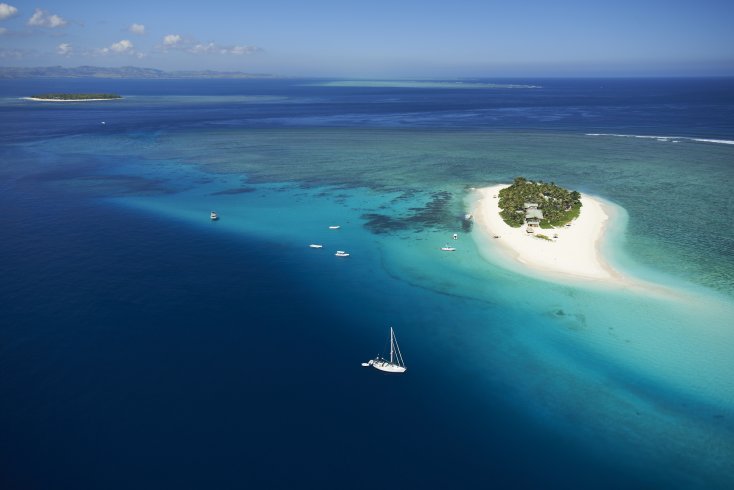 Source: Tourism Fiji.
Sustainable enterprise is to capitalism what democracy is to politics: both rely on self-limitation, mutual understanding, compromise, long-term orientation and pursuit of the common good as well as self-interest. Exceptions to the rule and the tidal nature of contemporary democratic politics notwithstanding, the maturity of democracy as a form of social organization rests on these foundations.
That is its most important virtue. Sustainable enterprise has the effect of improving the social and economic foundations of democracy in which the bottom line is measured as much in quality of life and the contentment of the community as it is in material gain.
Trouble in paradise.
The situation in the South Pacific is disappointing on both counts. In the last decade, in spite of myriad attempts to promote good governance and sustainable enterprise, the South Pacific has seen the retrenchment of authoritarian politics and the expansion of non-sustainable approaches to commercial opportunity. Throughout the region unsustainable enterprise has been closely linked with corruption, environmental degradation, human exploitation and undemocratic governance. The fishing, forestry, mining and petroleum and gas industries have been most closely associated with these unsavoury traits as well as the use, in some instances, of private militias and/or corrupt local security forces implicated in the assault and murder of activists, unionists and others.
Source: Tourism Fiji.
Sustainable enterprise is to capitalism what democracy is to politics: both rely on self-limitation, mutual understanding, compromise, long-term orientation and pursuit of the common good as well as self-interest. Exceptions to the rule and the tidal nature of contemporary democratic politics notwithstanding, the maturity of democracy as a form of social organization rests on these foundations.
That is its most important virtue. Sustainable enterprise has the effect of improving the social and economic foundations of democracy in which the bottom line is measured as much in quality of life and the contentment of the community as it is in material gain.
Trouble in paradise.
The situation in the South Pacific is disappointing on both counts. In the last decade, in spite of myriad attempts to promote good governance and sustainable enterprise, the South Pacific has seen the retrenchment of authoritarian politics and the expansion of non-sustainable approaches to commercial opportunity. Throughout the region unsustainable enterprise has been closely linked with corruption, environmental degradation, human exploitation and undemocratic governance. The fishing, forestry, mining and petroleum and gas industries have been most closely associated with these unsavoury traits as well as the use, in some instances, of private militias and/or corrupt local security forces implicated in the assault and murder of activists, unionists and others.
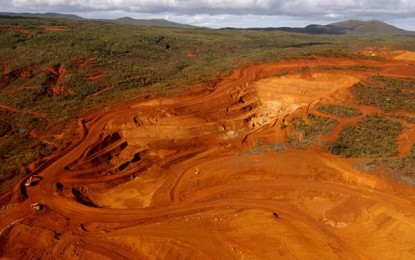 Nickel mine, Santa Isabel Island, Solomon Islands.
They are not alone. Even industries such as tourism have been accused of engaging in corrupt practices in order to circumvent environmental or basic health and safety regulations. The combination of poorly educated populations, self-serving and unaccountable governments (some dominated by “nobility”) and foreign investors unconcerned about or even opposed to business and government transparency and long-term socio-economic and cultural impact are the key ingredients in the witches brew that facilitates continuation of unsustainable business practices throughout the region.
This is of concern because, taken in aggregate it appears that there is a direct link between unsustainable enterprise, corruption and undemocratic governance in the South Pacific. Although this may favour those involved in the short term, the long term legacies of these practices, as has been mentioned, are deleterious on governance, equitable economic progress and quality of life. All of this takes place against a backdrop of accelerated climate change that has the very real potential for creating the first climate refugees coming from inundated Micronesian island states. In fact, given the limited land masses of even the largest Pacific island states, the adverse consequences of unsustainable commerce and undemocratic governance could precipitate environmental-related political instability sooner rather than later. The time horizons for a change towards sustainability are therefore limited.
Nickel mine, Santa Isabel Island, Solomon Islands.
They are not alone. Even industries such as tourism have been accused of engaging in corrupt practices in order to circumvent environmental or basic health and safety regulations. The combination of poorly educated populations, self-serving and unaccountable governments (some dominated by “nobility”) and foreign investors unconcerned about or even opposed to business and government transparency and long-term socio-economic and cultural impact are the key ingredients in the witches brew that facilitates continuation of unsustainable business practices throughout the region.
This is of concern because, taken in aggregate it appears that there is a direct link between unsustainable enterprise, corruption and undemocratic governance in the South Pacific. Although this may favour those involved in the short term, the long term legacies of these practices, as has been mentioned, are deleterious on governance, equitable economic progress and quality of life. All of this takes place against a backdrop of accelerated climate change that has the very real potential for creating the first climate refugees coming from inundated Micronesian island states. In fact, given the limited land masses of even the largest Pacific island states, the adverse consequences of unsustainable commerce and undemocratic governance could precipitate environmental-related political instability sooner rather than later. The time horizons for a change towards sustainability are therefore limited.
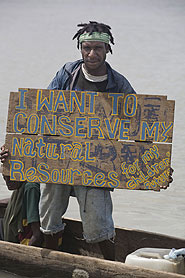 Papuan campaigner against deforestation, 2008. Source: Greenpeace
This does not mean that there are no glimmers of hope for a reversal of this toxic combination. A variety of agencies, including international, non-governmental and civil society organisations, as well as some foreign governments and private business, have endeavoured to promote sustainable development and good governance practices. The problem resides in that most of the agencies are focused parochially on one or the other rather than on the linkage between sustainability and governance. It is there, as a matter of issue linkage between sustainable enterprise, development and democracy, where the most effort and resources need to be directed.
36th Parallel Assessments stands ready to assist current and potential stakeholders in addressing issues of sustainability and governance in the South Pacific and beyond. Through its research and facilitation services it can offer insight into and potential paths towards the promotion of both.
An earlier version of this essay appeared in sustainnews.co.nz, March 3, 2016.
Papuan campaigner against deforestation, 2008. Source: Greenpeace
This does not mean that there are no glimmers of hope for a reversal of this toxic combination. A variety of agencies, including international, non-governmental and civil society organisations, as well as some foreign governments and private business, have endeavoured to promote sustainable development and good governance practices. The problem resides in that most of the agencies are focused parochially on one or the other rather than on the linkage between sustainability and governance. It is there, as a matter of issue linkage between sustainable enterprise, development and democracy, where the most effort and resources need to be directed.
36th Parallel Assessments stands ready to assist current and potential stakeholders in addressing issues of sustainability and governance in the South Pacific and beyond. Through its research and facilitation services it can offer insight into and potential paths towards the promotion of both.
An earlier version of this essay appeared in sustainnews.co.nz, March 3, 2016.
Preparing Pasifika for the digital world is vital, says NZQA chief

AsiaPacificReport.nz
By TJ Aumua in Auckland
The importance of preparing our Pasifika youth to succeed in a digitally connected world was a key message delivered this week by the NZQA, chief-executive, Karen Poutasi.
Speaking at the Pacific Tertiary Education Forum held in Auckland this week Poutasi said there needs to be a greater leverage between education and the opportunities of digital technology.
“We live in a different world at the moment, it’s global, digital and connected.
“As an education system we need to reflect the world that they are growing up in and the world they will be employed in.”
Poutasi said it is not as easy task for teachers as many didn’t grow up in a “digital enabled world”.
“Yet it is vital that we actually use technology, exploit the opportunity and manage the risks and therefore tutors and teachers are needing to grapple with it.”
‘But never underestimate the power of teachers in influencing Pasifika success’, she added.
Future employment
In her presentation Poutasi referred to a World Economic Forum survey, which suggest 16 skills needed for employment in the 21st century.
This is what international employers want, Poutasi said.
“These are the skills education in some way, shape or form need to deliver.”
Listen to the full audio story on Pacific Media Centre’s SoundCloud:
]]>Air Niugini operates special ‘hub’ flight services to FSM

AsiaPacificReport.nz
The government of the Federated States of Micronesia has thanked Papua New Guinea for connecting both countries through air services that are being operated by Air Niugini.
Assistant Secretary for Civil Aviation of the Department of Transportation, Communications and Infrastructure, Massy Halbert, said this new flight route would strengthen trade links and provide more business opportunities.
It would also promote a sense of “Pacificness” between both countries.
Halbert also added that it was historical and both countries will work together to ensure this service is sustained.
“Absolutely, I will continue to do my part, so plans for December to begin the passenger schedule service can proceed,” he said.
Air Niugini has begun operating the special services to Chuuk and Pohnpei in FSM and is flying a special service to FSM for the Pacific Islands Forum leaders summit whose preparatory meeting opens tomorrow.
There were 70 divers, and others, by chance were booked on the first flight PX 4072, operated by Boeing 737-700.
After 2 hr 40 min, the Bird of Paradise touched down at Chuuk. From Chuuk, it took another hour to Pohnpei.
Sharing costs
Air Niugini chief executive officer, Simon Foo, says the partnership is about sharing costs involved in operating this service.
Industries like tourism will be promoted.
“It will be twice a week, from Port Moresby to Chuuk then Pohnpei and back the next day,” he said.
This service saves time and cost.
A passenger, Quinton Devlin who works in the Solomon Islands, said it now only took three hours to Pohnpei rather than connecting through different countries.
“From Honiara, this is the best route with less time,” he said
It’s always a privilege for operating crews, like Ethel Samlai, because normally they are randomly selected.
“I am very privileged and I thank Air Niugini for selecting the team which I was part of,” she said.
Foo said the establishment of this direct service from Papua New Guinea to the Federated States of Micronesia represented a major expansion of Air Niugini in the Pacific and for Port Moresby to become the Pacific’s “hub in the aviation industry”.
EMTV News reporter
]]>Women victims tell chief judge of Marcos-era martial law torture

AsiaPacificReport.nz
By Patty Pasion in Manila
Victims of horrifying acts of torture during Martial Law in the Philippines have recounted their painful experiences before Chief Justice Maria Lourdes Sereno.
Etta Rosales, former chairperson of the Commission on Human Rights (CHR) who experienced the atrocities of the dictatorship under Ferdinand Marcos, recounted: “They had a gun and they threatened me to answer the question, otherwise they [would] shoot [me].”
She was also raped, tortured, and went through electric shock and Russian roulette.
Rosales is among the petitioners asking the Supreme Court to stop the burial of the late dictator at the Libingan ng mga Bayani, which President Rodrigo Duterte had allowed supposedly for the country to be able to move on from that period of history 1972-1981.
Another petitioner in one of the cases, Trinidad Herrera, told the Chief Justice about her terrible experience under the dictatorship.
“‘Pinatanggal nila ang aking blusa at ‘nilagay ang linya ng kuryente sa suso ko. Pumasok pa ang kuryente sa katawan ko hanggang di ko na nakayanan,” Herrera tearfully recalled during oral arguments on the petition against a hero’s burial for the late president Ferdinand Marcos.
(They ordered me to remove my blouse and they applied electric shock on my breast. Electricity went through my body until I couldn’t take it anymore.)
“They even put water on the floor so that the electricity would enter my body,” she added in Filipino.
‘Touching me’
Another victim, Fe Mangahas, shared: “They would scare me again by touching me and breathing down my neck and then I felt something like naihi ako (I peed). I figured it was blood because at the time I did not realize I was two months pregnant.”
“When they found out I was pregnant I was released, but I was asked to report weekly about my whereabouts. I had to do this every Saturday for a year,” she added.
Other victims also detailed what they went through when they were captured by uniformed men.
Maria Christina Rodriguez said her captors burned her skin with cigarette. Her fingers were swollen because of bullet-pressing.
Maria Christina Bawagan said her thighs were hit until they looked like rotten vegetables. She was sexually abused, with her captors inserting objects into her vagina and touching her breasts while blindfolded. She said she may never know who exactly tortured her, but she clearly remembered their voice.
Each of these women remembered the exact date they were captured and went through the life-scarring experience.
Sereno asked the petitioners, who are claimants for compensation under Republic Act 10368 or the Human Rights Victims Reparations Act, to speak before the court. (What the gov’t still owes Martial Law victims)
She told them, “The Court is listening.”
Not about the money
During her interpellation of former Akbayan Representative Ibarra Gutierrez III, lawyer for one of the petitioning groups, Sereno asked if the monetary compensation for the victims was not sufficient.
Gutierrez responded: “No, your Honor, because the law explicitly acknowledges to recognize the [victims and their heroism and sacrifices].”
He also said that money is not equivalent to the restoration of dignity of the victims.
The late strongman’s state burial, he said, would “prolong and extend” the suffering of the victims.
Human Rights Victims Claims Board (HRVCB) Chairperson Lina Sarmiento, who was one of the resource persons invited, said that out of over 75,000 claims, they have only finished processing 17,000.
HCRVB can only start distributing the compensation after every case has been settled because the P10 billion funds allotted will be divided according to the intensity of human rights violations experienced by each victim.
Sarmiento said they are hoping to finish the work before May 12, 2018, when their office expires.
Non-repetition
Also appearing as a resource person, CHR Chairperson Chito Gascon said the state has an obligation for “non-repetition” of the trauma they experienced during Martial Law.
“There is a commitment on the part of the state [to] non-repetition, [that] the victims should not be exposed to re-traumatization,” he told Chief Justice Sereno.
Gascon stressed that local and international laws acknowledge reparations as a “positive act that the stake must undertake to [prevent] impunity.”
Patty Pasion writes for Rappler.
Dan McGarry: Silence in the face of Florence’s bravery an indictment

AsiaPacificReport.nz
ANALYSIS: By Dan McGarry
Justice Richard Chetwynd acquitted the three men accused of intentional assault on Florence Lengkon on Friday, accepting the defence’s submission that they had no case to answer on those specific charges.
The people of Vanuatu, however, have still to answer for their silence.
Judge Chetwynd ruled that there was indisputable evidence that Ms Lengkon was struck once “forcefully” on the head on March 13, and said that if that was the case then it is impossible that all three men could be guilty of landing the blow.
The prosecution’s case rested almost entirely on a statement submitted by two police officers, who stated that co-accused Elton Worwor put them at the scene of the crime.
But the police officers didn’t ask some very basic questions during that interview, such as how Worwor knew they were involved, whether he actually saw them strike Lengkon, and if so, which of the three of them actually struck her.
Ultimately, the evidence was ruled inadmissible. The three men charged with the assault on Florence Lengkon had no case to answer, and they were therefore acquitted of this serious charge.
But… Justice Chetwynd paused meaningfully before continuing. He scanned the packed courtroom and stated that the fact that over 50 people could have seen what happened and not one of them stepped forward to identify the culprit is “an indictment” on our society.
Evident ignorance
Anyone who has been following the case is within their rights to criticise the lack of thoroughness shown by the investigating officers. Their evident ignorance of basic interrogation and investigative procedure certainly contributed to the lack of a conviction on the assault charge.
One wonders what their Australian Federal Police (AFP) advisers have been doing this past decade.
The judge had no alternative but to acquit the three accused of assault because there was nothing that conclusively proved that any one of them struck the blow that left Lengkon’s eye bruised and swollen shut. We know that someone hit Florence Lengkon, but we still don’t know who it is.
It is admittedly a difficult thing to confront—even passively—a large group of angry men. Florence found that out yet again when she sat alone in the witness box last Tuesday and gave her testimony. Her bravery should be an example to us all.
As the week wore on, more and more people turned up to show support, but on Tuesday she stood alone.
It’s possible to sympathise with the difficult role the police play when they are required to confront an angry crowd, such as the group that gathered that day in March when tempers flared over events down at the wharf.
But let’s not make any bones about it: It’s a tough job, yes. But that’s the job you choose when you choose to join the police force.
Two-way street
In fairness to the police, though, this is a two-way street. If people showed a little more respect for the uniform, if they showed a little more respect for the law, then maybe these situations wouldn’t be so fraught.
I’ve spoken with ex-colonial policemen on a number of occasions, and without exception, they pine for the days when police officers were respected. It’s likely they were as much feared as respected, but let’s not put too fine a point on it.
One thing that was certainly missing then, and is still missing today, is a common understanding of the basic principles of justice and the law. It’s all well and good to complain that the law is an artificial and imposed construct that doesn’t match well with Melanesian sensibilities. That’s all true.
But that doesn’t mean it’s without value. The basic principle that each person has the same rights as all the others is a good thing. The principle that nobody is above the law is a belief that this nation cleaved to when the bribery case was unfolding.
And if we accept those two precepts, then we have to accept that every single one of us has a responsibility to act to uphold the law.
Justice Chetwynd had the unenviable task of defending the accused against the inadequacy of their prosecution. He would never have been placed in that position had even one of the more than 50 men who saw what happened actually believed in the law enough to take a stand against brutality.
That is an indictment against our society.
Dan McGarry is editorial director of the Vanuatu Daily Post group.
]]>Vanuatu rights advocate Jenny Ligo blasts failed case against accused drivers

AsiaPacificReport.nz
By Len Garae in Port Vila
Vanuatu gender and human rights advocate Jenny Ligo has called on the Minister of Justice to “revisit resources” made available to curb violence against women.
Ligo, chairperson of Women Against Crime and Corruption (WACC) and Gender Equity in Parliament, made the call after the Supreme Court on Friday acquitted the three drivers – Glen Kovoi, Ben Koro and Charlie Kasuali – on charges of intentional assault against tourism manager Florence Lengkon.
“I believe Vanuatu is producing far too many reports without implementing them because it seems as if the more reports are produced, the less action is seen to be taken against alleged trouble makers,” she said.
She said the acquittal of the three bus and taxi drivers accused of the assault of Lengkon at the Main Wharf last March 13, confirmed that Vanuatu had many “dishonest individuals”.
Justice Richard Chetwynd acquitted the three men on the grounds that they had no case to answer to because no witness came forward to identify them as the assailants of the victim.
Although three names were recorded in statements provided by two police officers, there was no evidence on how Elton Worwor (president of Port Vila Land Transport Association) knew that the three individuals were involved in the assault.
Ligo said it was sad that more than 50 drivers of the PVLTA were present at the Main Wharf on the day and yet none of them could come forward to identify the person or persons who caused the brutal attack on Lengkon.
Kidnapped from workplace
The victim took the case to court after she was kidnapped from her workplace and driven to the Main Wharf, where she was punched, leaving one of her eyes swollen and closed, and forced to apologise to the drivers for criticising their aggressive behaviour at the wharf on Facebook.
The outspoken North Ambaean leader said what happened indicated that women would continue to be denied their right to justice.
“This is especially true when our leaders often remind us that no one is above the law and justice is for everybody,” she said.
Ligo said a second investigation should be ordered into the assault, and the justice system revisited with a view to making relevant changes where necessary.
“When one woman is denied [her right to] justice, then how many other women are also denied their rights?” she asked.
Ligo said what it “boils down to” was an abuse of women and girls’ human rights.
She said she was not afraid to speak out for the voiceless when the public seemed indifferent to “barbaric criminal acts” against women and girls or were too afraid to speak out against the perpetrators.
Obama addresses Pacific climate change during visit to Hawaii

AsiaPacificReport.nz
‘No nation is immune from a changing climate,’ says President Barack Obama. Video: The White House.
President Barack Obama addressed Pacific Island leaders and acknowledged their efforts towards dealing with rising temperatures and sea levels that are posing severe threats to the low-lying islands.
During his speech at the Pacific Island Conference of Leaders 2016, in Honolulu, Hawaii last week, Obama noted the effects on agriculture as well as forced relocation as consequences of climate change.
“Few people understand stakes better than our Pacific Island leaders because they are seeing already the impact,” he said.
“While some members of the US congress still seem to be debating whether climate change is real or not, many of you are already planning for new places for your people to live.
“Crops are withering in the Marshall Islands. Kiribus brought land in another country because theirs may someday be submerged. High seas forced villagers from their homes in Fiji,” said Obama.
‘Turning point’
According to Reuters the US and China, the worlds highest emitters of greenhouse gases, ratified the Paris deal at the G20 summit in Hangzhou, China on Saturday.
The Paris deal aims to limit warming to 1.5 degrees above pre-industrial levels.
Obama said the the Paris deal is a “turning point” for our planet.
- A UN report states that Small Island Developing States (SIDs) like those in the Pacific, are responsible for less than one percent of global green houses gases, yet they are the most vulnerable to the effects of climate change.
Nothing Else healthy snack bar takes on commercial market

AsiaPacificReport.nz
By Denise Yeo
The AUT Food Network has celebrated the commercial launch of the Nothing Else bar, a milestone achievement after years of rigorous research and taste trials.
The Nothing Else bar is a healthy snack bar, made up of just eight simple ingredients – the date and almond flavour contains oats, dates, almonds, oat bran, manuka honey, sunflower oil, flaxseed (linseed) and cinnamon.
The bars are not only more nutritious than typical muesli bars, but also have a low glycaemic index (GI) to keep hunger pangs at bay for longer.
The bars are now being manufactured and distributed by South Auckland food manufacturer AB Foods, in consultation with Auckland University of Technology’s professor of nutrition Elaine Rush and advertising creativity lecturer Dave Brown, who created the Nothing Else brand.
The product has been four years in the making, and was commercialised through AUT Enterprises Ltd (AUTEL).
Professor Rush says the collaboration brought organisations, experts and partners from many disciplines together, with the goal of providing a healthier food choice for consumers.
“Globally, there is a call for better value food. Yet there’s no shortage of unhealthy food in the market, so we need to work harder to improve the nutrition of New Zealanders – one bar at a time,” she says.
Ingredient transparency
On the creation of the Nothing Else brand, Brown explains it was specifically designed to be transparent about products’ ingredients.
“Consumers are surrounded by product labels with tempting yet questionable health claims. By being upfront and displaying the familiar, natural ingredients that go into Nothing Else products, we’re making it easier for customers to make their own choices,” he says.
The Nothing Else team has also introduced a vegan option for consumers, adding to the original date and almond bar with the addition of a cranberry and cashew version.
“The new flavour contains the sugar in the sweetened cranberries, rather than honey, making this bar a suitable option for consumers following a vegan diet,” says Professor Rush.
]]>Security services set to end for controversial detention centres

AsiaPacificReport.nz
Wilson Security has confirmed that it will not renew its contract for its security service in the controversial Papua New Guinea and Nauru detention centres.
This means, the Australian government-run centres will no longer have operating security where evidence of ongoing abuse have been reported.
The company’s decision follows the announcement of its sub-contractor, Broadspectrum, who will also be ending their contract in the detention centres.
A media release confirms both contracts for these providers will conclude in October 2017.
Earlier last month the Australian government confirmed that both detention centres will be closed.
Amnesty International said this was the “first step” in ending the human rights abuses of refugees and children that are happening in the centres.
But a time frame for the closure of the detention centres has still not be confirmed.
]]>Somare’s answer to Singapore claims: ‘I have never received inducements or bribes’

AsiaPacificReport.nz
Sir Michael apologised in a statement to the people of East Sepik and the country as a whole for the shame and embarrassment caused by a report in Singapore about a money laundering case that names him.
A Singaporean woman and her American husband were both jailed for sentences for five years or longer in a money laundering case involving US$3.6 million, according to The Straits Times. They reportedly plan to appeal.
The Grand Chief said he would be seeking legal advice on the matter in a few days’ time.
“I wish to make this address to the nation of Papua New Guinea in response to recent reports from Singapore.
“A court case has found two persons in Singapore guilty of money laundering offences and subsequently names me as a recipient of some funds.
“I have taken steps to get clarification and legal advice on this matter, but I would like to state from the outset that at no time in my political career have I received inducements or bribes.
“At first glance these charges say otherwise. Therefore, during the next few days, I will consult with my family and legal counsel and consider how to address this matter.
Apology to the nation
“Nonetheless, I take this opportunity to apologise to the people of Papua New Guinea, my people of East Sepik and my family for the shame and embarrassment these reports may have caused.
“I have no further remarks to make at this time.”
The Singapore court found a married couple guilty for laundering US$3.6 million from Papua New Guinea in 2010 meant to set up community colleges in the country – then gave US$784,000 of it to the country’s then Prime Minister, Sir Michael.
According to The Straits Times, Singaporean Lim Ai Wah, 61, was given five years’ jail last Thursday (September 1), while her 68-year-old American husband Thomas Doehrman got five years and 10 months.
They were each found guilty on one count of falsification of accounts and five charges of transferring the benefits of criminal conduct.
Doehrman had been the trustee of a fund set up by the PNG government to establish community colleges in the country.
The Straits Times reported that in June 2010, the trust hired ZTE Corporation for US$35 million to supply telecom equipment for the project and the couple conspired with a ZTE employee, Li Weiming, 34, for the company to pay a secret “commission” to them.
Concealing payment
The news source stated that to conceal the true nature of the payment, Doehrman and Lim acquired a British Virgin Islands shell company, Questzone Offshore, and signed a fictitious US$3.6 million contract with ZTE.
No services were provided, but a Questzone invoice was created.
Doehrman and Lim gave Li, a Chinese national, US$850,000 via two transactions to his wife’s Hong Kong bank account, according to the newspaper account of the case.
They gave Sir Michael three cheques worth a total of USD$784,000 in late 2010, all of which were paid into his Singapore bank account.
In their police statements, Lim and Doehrman said bribes had to be paid to the then-Prime Minister, Sir Michael, in order to get business from PNG.
Freddy Mou is chief reporter of Loop PNG.
]]>Sue Bradford: Introducing the ESRA ‘think tank’ vision

AsiaPacificReport.nz
By Sue Bradford
For decades activists and intellectuals as diverse as Bruce Jesson, Annette Sykes, Brian Easton, Jane Kelsey and Bryce Edwards have lamented the lack of any progressively oriented policy institution capable of mounting a serious challenge to the neoliberal hegemony which has dominated New Zealand’s political life since the 1980s.
The NZ Business Round Table, the Maxim Institute, the NZ Institute and more recently the NZ Initiative have all played major roles as think tanks influencing and advocating on economic and social issues.
When I commenced doctoral research (2010 – 2013) exploring the reasons why we had no major left think tank in New Zealand, two of the most frequent responses received were that we’d never succeed because we don’t have the money and because the left is too fragmented and factionalised.
On the question of money, there is no question that ESRA is very much on the back foot. There is no secret source of funding for ESRA and so far no substantial donors have emerged, although of course such support will always be welcomed as long as our kaupapa remains uncompromised.
What has enabled us to commence and sustain the project so far has been the tremendous goodwill, time and commitment shown by a large group of skilled activist and academic volunteers, backed by a comparatively low but steady stream of donations and automatic payments from supporters.
We don’t have enough money, but we make the most of what we have… and every dollar you contribute is another step towards our sustenance and growth.
At the core of ESRA’s being we are the opposite of the major think tanks mentioned above. While we don’t have their financial resources, we do have the ability to harness and nurture a collective determination to build a counterhegemonic institution capable of quality research, acute comment, and the generation of lively public debate and thoughtful policy development.
In touch with realities
We will become a very different kind of think tank to those which already exist, grounded in the unions and community-based organisations whose interests we wish to serve, and closely in touch with the realities of life for the ever growing numbers of people who are paying the price in poverty, homelessness, alienation and despair for New Zealand’s love affair with neoliberal capitalism.
The second barrier raised to the potential development of a major think tank on the left was that traditional left factionalism had the potential to impede such a project right from the start. This has not proved to be the case at all. In the slow, careful process of establishing ESRA we have aimed to put a stake in the ground, inviting those who support the initiative to become part of it, but not seeking to colonise or take over people and organisations whose political interests lie elsewhere.
ESRA in fact looks forward to the day when other substantial left think tanks will emerge. Meanwhile, we will always welcome debate and interaction with other entities, no matter their place on the political spectrum.
It is cautious, deliberative work building an organisation without major funding support. Our ability to progress all the activities in which we would ideally like to engage is inhibited by a lack of paid staff and resources.
But we have come a long way already and feel sure that our current model of quiet, determined long-haul organising will lay the groundwork for a thriving ESRA, working for the better, more hopeful future to which we are committed.
Sue Bradford is a former Green MP, researcher and activist. She gave this address at the launch of ESRA at the Counterfutures conference at Victoria University of Wellington on Friday night.
Across the Ditch: New Zealand Crime Rates Worsen + AllBlacks Wallabies Rivalry Turns Septic
Across the Ditch: Australian radio FiveAA.com.au’s Peter Godfrey and EveningReport.nz’s Selwyn Manning deliver their weekly bulletin Across the Ditch. This week, New Zealand’s crime statistics are out and show a marked deterioration, increases in burglaries and robberies. Also, the Trans-Tasman rivalry between the All Blacks and the Wallabies has turned septic. First up: Weather comparison and the Headlines Roundup. ITEM ONE: New Zealand Crime Rate Worsens: After a winter of record homelessness and hiking house prices, New Zealand’s burglary rate has also increased. Across the nation, Statistics New Zealand reported yesterday burglaries increased by 11.9% in the twelve months to July. And the negative trend has been deteriorating for some time. The latest statistics show burglaries up 29% over a two year period with robberies are up 44% and assaults have increased by 10%. The New Zealand Police Association puts this down to fewer police officers. Its president, Greg O’Connor, said yesterday “While many offence types can fluctuate, burglary figures tend to be a very good litmus test of how much criminal activity is taking place in the community.” He added: “What is clear is that the public are now becoming concerned that the crime situation is deteriorating, an inevitability after many years of under-investment. “We are now seeing political parties, including the government, accepting there is a need to increase police numbers. But it cannot wait for an election – this government must find the money now to increase police numbers across the board so that community concerns about crime can be addressed.” Labour leader Andrew Little said: ““John Key has broken his own 2008 election promise to have one police officer for every 500 people. There is now one police officer to every 526 people. “Police are desperately under-resourced and have been told there will be no staffing increases until 2020. “It’s unsurprising the regions are experiencing massive crime hikes with Rotorua burglaries up 66%, and up 100% in the Hutt Valley.” The National-led Government’s Minister of Police Judith ‘Crusher’ Collins said the Government would have more police recruits soon so that the Police could attend all burglary complaints. ITEM TWO – All Blacks Wallabies Rivalry Turns Septic: The All Blacks and Wallabies Trans-Tasman rivalry has become rather septic since last Saturday’s Bledisloe Cup test in Wellington. The All Blacks beat the Wallabies 29-9, following a first test win of 42-9. During the second test in Wellington, the Wallabies played a hard up-front and physical game, receiving a number of controversial penalties and a yellow card. It led to accusations that the referee was biased in favour of the All Blacks. There was also an alleged eye gauging by an All Black player on a Wallaby. At one point, a Wallaby pulled the boot off an All Black and through it off the field. The tension spilled over into the aftergame period with the Wallaby coach accusing the All Black couch of having met with the referee before the game and without his Wallaby counterpart present. The allegation was denied. Former Wallaby great Peter FitzSimons said on Radio New Zealand this week, that the allegations of referee bias were ridiculous and the debate should be focused on improving basic skills that in his day were drummed into players at club level. It seems fortunate that the third test between Australia and New Zealand is scheduled to be played in over a month’s time. Across the Ditch broadcasts live each week on FiveAA.com.au and webcasts on EveningReport.nz, LiveNews.co.nz, and ForeignAffairs.co.nz.]]>
UPNG’s ban on student protest leaders ‘illegal’, claims lawyer

AsiaPacificReport.nz
By Peter S. Kinjap in Port Moresby
The University of Papua New Guinea administration’s decision to ban eight students from continuing their studies is illegal, claims lawyer Peter Dumu, a former member of the Students Disciplinary Committee at UPNG.
The students were protest leaders during the recent two months of boycott of classes and demonstrations against Prime Minister Peter O’Neill that climaxed with PNG police opening fire on peaceful protesters on June 8, wounding up to 30 people.
Dumu, who was a UPNG disciplinary committee member in 2013, said the decision was procedurally wrong and unconstitutional for these reasons:
1. Firstly, according to the bylaws of UPNG (Students Disciplinary Committee statute), a student who has breached any laws must be given 7 or 14 days’ notice by the SDC to respond to their charge(s) in writing. The SDC will then call up a meeting to hear the student’s response, which means there must be a quorum to hear students matters. Following the hearing, the SDC would make its ruling or decision to whether suspend or terminate students from studies depending on the nature of the offence.
2. Secondly, students will then be awarded their rights under the regulations to appeal to the Students Disciplinary Appeal Committee.
3. If the appeal committee upholds the decision of the SDC then the aggrieved student(s) will have no option but to go to the National Court for a judicial review after exhausting the administrative procedures.
Lawyer Dumu said: “We all understand crystal clear that the administration of UPNG or the University Council have no power at all under the laws, either with the UPNG Act or SDC statute, to terminate students right away. The harsh decision made by the UPNG administration is ultra-vires and illegal from the start.
“I would say its unconstitutional because their right to be heard (principles of natural justice) was not awarded to them accordingly. Therefore, the UPNG administration should reconsider its decision, and at least go by the book,” he said.
‘Lessons needed’
There are many similar case precedents, he said.
Some lessons needed to be learned by people “advising the administration on legal stuff”.
Student Representative Council vice-president Arthur Amos said in a press conference yesterday that some of the excluded students who had already received their termination letter by hand had written back to the school administration asking it to reconsider their decision and reinstate the students.
Amos said the school showed no sign of allowing any verbal communication between both parties but only through written documentation.
He and a handful of his terminated SRC members have done as requested.
In the meantime, they will await the Council Appeals Committee’s decision after they go through the students appeal.
Classes are scheduled to start on Monday.
]]>Café Pacific: The ‘nuclear free’ Vanuatu girl with the enchanting smile

Pacific Media Centre
By DAVID ROBIE on Aneityum, Vanuatu
She had the most enchanting smile, even though she had lost her baby teeth. Her toothless grin turned out to be perfect for the role.
The five-year-old girl had her face painted with a black anti-nuclear symbol – different motifs on both her cheeks.
Beside her was a neatly sketched poster: “No nukes: Please don’t spoil my beautiful face”.
This was the scene in Port Vila’s Independence Park in 1983 during the region’s second Nuclear-Free and Independent Pacific Movement conference.
It was during the heady days of nuclear-free activism with Vanuatu, the world’s newest nation only three years old and founding Prime Minister Walter Hadye Lini leading the way.
I was there that day as an independent journalist taking many photographs for my series of articles for Pacific and international media.
One person who really stood out was the little girl with the beautiful smile. But I never knew her name back then.
33 years on
Thirty-three years have passed since then and my wife, Del Abcede, and I have just visited Aneityum (“Atomic”) Island in Vanuatu this week to meet that girl – June Keitadi and her family.
She is now June Warigini, mother of three, grandmother and a Salvation Army volunteer living on her home island. And she still has that stunning smile.
I wanted to present her with a copy of my 2014 book, Don’t Spoil My beautiful Face, that was inspired by her and she is featured on the cover.
Not only June, her mother Annie Keitadi is featured there too. Her father, Jack Keitadi, was deputy curator of the Vanuatu Kaljoral Senta at the time and he later became curator.
It was a delight and a privilege for Del and me to be able to visit the family on Aneityum and to be treated to a “royal” welcome by the community and tribe.
June remembers that day in 1983 really well. It left a deep impression on her in later life.
“They wanted someone young who could go on their behalf to the French Embassy and present a petition calling on France to halt its nuclear tests in the Pacific – so they chose me,” she recalls.
Symbolic of N-ravages
“But the ambassador left in a hurry out the back. I don’t know why he was afraid of a little girl.”
She remembers her toothless smile was regarded as symbolic of the ravages of nuclear testing in the Pacific, not only by France, but also the United States and Britain.
Faced with persistent protests in the Pacific, France eventually ended all nuclear testing in 1996, thirteen years after that rally. But the campaign for full compensation for the victims of nuclear testing continues.
June feels that her experience at that young age helped give her an inner strength for the challenges of life today and inspiring her in her desire to help others in her church work.

Ironically, both Del and I met her by chance on Christmas Day at the end of last year, but had no idea at that time of her connection with my book.
While visiting Aneityum for a day, we shared in an “olden days” traditional food and customs exposure in a model 18th century village on the island.
When we eventually discovered her identity – after my appeals on my blog Café Pacific and an NFIP network had failed and Vanuatu Daily Digest came to the rescue earlier this year – and we saw photographs of her, my wife exclaimed:
“That’s her, the June we have met.”
We realised that the guide “June” we had met that day on the island was indeed June Keitadi now Warigini.
Idyllic island
Aneityum, the southernmost island in Vanuatu, currently has a population of 1740. It is not part of Vanuatu’s electricity grid and islanders rely on solar power. The island has no cars, or even a road.
The air connection is only two return flights a week from the Tafea provincial capital on Tanna. There is also no doctor, although a dispensary is now operating with two nurses and a midwife.
On the other hand, for visitors like ourselves, island life seems idyllic, a byword for “paradise”.
Aneityum has a wonderful healthy lifestyle for youngsters, remote from the world’s conflicts and problems.
There are three primary schools and a boarding secondary school – one that attracts students from other outer islands whose parents want an education where the traditional way of life is important and free from the urban ills of Port Vila.
June is assistant bursar at Teruja secondary school.
She tells a delightful story about a recent excursion for students from Aneityum who went on a “field trip” adventure by island cargo ship to Tanna to visit the famous Mt Yasur volcano.
The island’s micro economy is self-sustaining and is augmented by occasional cruise ship visits and tourism days on Mystery Island. It appears that Aneityum is remote from government services or assistance and the support of cruise shipping companies, such as P&O, is crucial for the islanders.

Asia-Pacific journalism for Filipinos – double billing with PMC educator

Pacific Media Centre

Professor Crispin Maslog (centre) with Dr David Robie (right) in Dubai last year. Image: PMC
Event date and time:
Saturday, September 17, 2016 – 09:00 – 12:30The University of Santo Tomas Journalism programme of the Department of Communication and Media Studies and the UST Journalism Society have joined with the Pacific Media Centre to co-organise back-to-back lectures featuring two veterans in Asian journalism and journalism/communication research in Manila,. Philippines, next month.
One is a lecture on Martial Law and Philippine journalism for millennial journalists by Dr Crispin Maslog. Dr Maslog is an alumnus (1955, magna cum laude [Faculty of Philosophy and Letters]) of the UST Journalism program, a product of The Varsitarian, and professor emeritus of the University of the Philippines College of Development Communication in Los Baños, Laguna. Dr Maslog has published numerous books on communication and journalism in the Philippines. He is currently chair of the Asian Media Information and Communication Centre (AMIC) in Manila. For his lecture from 9 to 10:30 am, Dr Maslog will orient journalism students about Martial Law and how journalists covered the event.
Afterwards, Dr. Maslog will give a soft launch of his book Grassroots Journalism.
From 11 am to 12:15 pm, director Dr. David Robie of the Pacific Media Centre of Auckland University of Technology (AUT) will give a visiting lecturer’s presentation on Asia Pacific Report: A campus-based journalism digital strategy. Dr Robie founded the PMC as a media resource and research center on journalism in the Oceania region and, by extension, the Asia-Pacific region. This full professor of AUT’s School of Communication Studies had authored numerous books on South Pacific media and politics. Dr Robie is founding editor of the research journal Pacific Journalism Review and previously headed the journalism programmes of the University of Papua New Guinea and the University of South Pacific (Fiji).
This day-long event is a springboard for UST Journalism’s prospective partnership with the Pacific Media Centre.
]]>Tanna hosts Vanuatu’s first ‘slow foods’ festival – big success

AsiaPacificReport.nz
A Café Pacific video at the Tupunis festival on Tanna island.
By Odile Guiomar in Lenakel, Tanna
Tanna Island has hosted the first Slow Food festival in Vanuatu – Tupunis Slow Food Festival – and it was a resounding success.
Tupunis, in Tannese language, is a term used for the people in charge of taking care of the land and sea resources.
Tupunis Slow Food festival on Tanna Island last week promoted and highlighted Melanesian traditional food and preservation methods that have been used for years by the ancestors, which ensures Melanesian people live a good healthy life in their islands.
Local food crops play a huge part in times of disaster that are part of every day life in Vanuatu such as cyclones, earthquakes, tsunamis, droughts, and a “modern” danger — non communicable diseases such as diabetes, cholesterol, high blood pressure and obesity.
The Slow Food movement is a global movement that was initiated few years ago to promote and revive the traditional and local foods endangered by the fast food global wave.
Everybody knows “fast food” — processed food, genetically modified seeds that resist bugs and pests, but never germinate, industrial farms and slaughter, loss of old crops, overuse of processed food wrapped under plastic, overuse of preservatives, colorants, chemicals and other additives.
Fast Food plays an important place in our diet, even if it is not healthy and the traditional and local recipes are lost.
In Melanesia the tradition is still strong and Tupunis Slow Food Festival has been organised to give the old and wise persons the chance to share their skills.
Tupunis Food festival, organised by the Slow Food committee in Vanuatu, and funded by Christensen Fund gave a wonderful opportunity to gather some representative foods from different Melanesian countries – Kanaky, Solomon Islands, PNG and Bougainville, and Fiji with the aim to showcase local crops and local recipes and talk about tradition, culture and resilience in their own culture.
Representatives of Minister of Agriculture and Bio-security, Minister of Climate Change, Health, and a panel of specialists and fieldworkers shared their knowledge, while Torba, Penama, Shefa, Tafea, Sanma and Malampa participants showcased their local recipes, local crops and traditional preservation methods, in the purpose to revive and highlight their ability to face climate disaster – cyclone, drought, or heavy rains.
Tupunis Slow Food festival re-enforces the benefit to keep Melanesian traditions alive.
Odile Guiomar is a Vanuatu Daily Post reporter.
Festival success for young filmmakers

AsiaPacificReport.nz
Forgotten Dawn Children’s official trailer.
By TJ Aumua in Auckland
Filmmakers Joshua Iosefo and Corey Larry Sio found out this month that their short film Forgotten Dawn Children will be screened in Sydney later this year at the Pasifika Film Festival.
The best friends are still overwhelmed saying it is a dream come true to have a film accepted into a festival.
Originally made for final year assignment at university, Sio, the films producer, says he is “shocked but humbled” at the news.
“I didn’t think we would submit it into anything…but he did!” Sio laughs pointing to the films director, Iosefo, who is sitting next to him.
“As we were making it I was like, yeah, this is going be in a film fest!” 22-year-old Iosefo admits.
“I just had this big dream that even though this was supposed to be an end of year assignment, I wanted to make it way more than that.”
“For it to be recognised in a film festival adds value to the film,” says Iosefo.
This is especially important to a film that is based on a shamefully true event that itself, has received little value and little recognition in New Zealand’s history.
The film follows main character, Ioane, a middle-aged man, who is haunted by his memories of the dawn raids, and the struggle of growing up as a Pacific Islander in mid-1970s Auckland.
While going about his daily life, Ioane’s flash backs, show us the unjustifiable arrests of many Pacific Islanders whose homes were raided by police in what is now today’s trending suburbs of Ponsonby, Grey Lynn and Mount Albert.
Honoring the struggle
“The Dawn Raids is not taught in New Zealand schools- it’s not in the curriculum,” Iosefo explains.
It wasn’t until a year-12 drama teacher in high school taught him about the dawn raids when he became “obsessed” with learning about it.
“I feel that, that was quite late in my life to learn something that concerns my people and my history in New Zealand,” Iosefo says, who is a proud Samoan/Niuean.
“Hence Forgotten Dawn Children.
“I felt that there needed to be something to honor that, to honor the struggle, as well as the memories of people…memories that have just been forgotten.”
‘Our people’
‘We don’t take credit for the film,’ they both say. ‘We are just telling the story of our people and what happened.’
Twenty-eight-year-old Sio, says seeing the film come to life has created a new found respect for his Pacific family.
“It’s made me realise how strong and resilient our people are. We are some of the greatest survivors of all time. We really, really, really are strong!
“It makes me even more proud to be Samoan.”
When asked of the most memorable moment in the film, Sio said it was the last scene.
“It was this police scene we filmed on a street in Māngere. We had cops chasing five Pacific Islanders down the street-we had to shoot it so many times.
“People were coming down the street, I think people thought it was real, seeing everyone watching-that will forever stay in mind.
“We were almost done, that was our last and biggest scene and we had no energy left.”
“We were so exhausted that night,” Iosefo adds.
“I fainted in the car…while I was sitting down!” he laughs.
‘Home grown’
It took an eight-member-crew made up of fellow students in their class to make the film which they refer to as “totally home grown”.
Family, friends, and a childhood music teacher were also “shoulder tapped” and generously donated their talent, time and money to making the film.
“At least three quarters of the cast are my family,” says Iosefo.
He credits his dad, who not only acted in the film, but also played the role of transport, errands runner and provided food for the cast and crew throughout the long hours of shooting.
Both Sio and Iosefo say they will be launching a new film project next year.
In the meantime, they are still feeling overwhelmed by their films success and will be flying to Sydney in November for the screening of Forgotten Dawn Children at the Pasifika Film Festival.
We wish them all the best!
]]>PACER Plus not final – PNG says no, Fiji lukewarm, Vanuatu undecided

AsiaPacificReport.nz
By Bob Makin in Port Vila
Some eight years of negotiations on the legal texts have gone into deciding what the Pacific free trade agreement would comprise.
The last day of such discussions was on Friday in Christchurch, New Zealand.
The whole idea, with the best of intentions of all the island states and the two big wealthy countries, Australia and New Zealand, has been to create jobs, raise standards of living and encourage sustainable economic development in the island countries.
Trade ministers from all the island members of the Pacific Islands Forum have been discussing final texts and where their talks have reached politically.
There is no agreement as yet. And there is an interesting point of view from Vanuatu.
A petition calling for suspension of any decision until there was more worker representation arrived at last week’s New Zealand conference of ministers and officials.
Lack of worker representation was expressed. And prior to that Papua New Guinea declared its withdrawal from the agreement.
Fiji reservations
Fiji was still expressing reservations leading up to the final conference.
Vanuatu wants all of the government MPs to view the whole text before it decides whether to join or not.
A Council of Ministers’ decision a fortnight ago said exactly that when chief negotiator Sumbue Antas released drafts of some of the texts to government MPs at that time.
This is the position as described by Lands Minister Regenvanu on Tanna last week.
In the past, government MPs have never seen the texts of these trade details before they are signed by trade officials, and then the minister responsible.
They are then just obliged to vote on them in Parliament, without actually seeing them in full first of all.
A similar situation occurred when there was an outcry and the “Say No to the WTO” posters of nearly 10 years ago.
Eleventh hour
This was when the likelihood of Vanuatu joining the World Trade Organisation had reached the eleventh hour.
Ill-informed legislation can lead to problems within a country and political movements.
MP Ralph Regenvanu voted against the WTO accession and that led to his being removed from government at that time.
The Council of Ministers is now getting big issues like this one, PACER-Plus, better into perspective.
Elected MPs will actually have the advantage of seeing what they are voting on first of all: the full text, and in writing. They will know it all before they vote on it.
And those who haven’t paid much attention to what PACER-Plus really is should get to know a lot more about it now.
The negotiations are said to offer an opportunity to help Pacific Islands Forum countries benefit from enhanced regional trade and economic integration.
Bob Makin is an independent journalist and contributor to Vanuatu Daily Post and Vanuatu Daily Digest.
]]>UPNG student leaders banned from studies

AsiaPacificReport.nz
By Peter Kinjap in Port Moresby.
The University of Papua New Guinea (UNPG) Administration has permanently excluded all the Student Representative Council (SRC) members and student leaders who led the recent strike against the PNG Prime Minister,Peter O’Neill, last June.
The accused students received letters from the UPNG acting pro-vice-chancellor, professor Mange Matui, which stated they have been de-registered from studies and are no longer UPNG students from 2016 and beyond.
A student leader said they had been given two-weeks to appeal the decision.
Abstracts from the letter read: “The University of Papua New Guinea administration has credible evidence that, in your capacity as the SRC member of 2016, you have been involved in the 2016 May to July student unrest and boycott.
“Based on the reports I have received, and after careful considerations of relevant evidences and circumstances, you have breached all laws of Papua New Guinea, including the Criminal Code Act and the Summary Offences Act.
“By virtue of the disciplinary powers bestowed on me by section 7 of the Student Discipline Statute Ch. 169, and acting in accordance with the powers granted under section 5 (3)(b) (i) of the Student Discipline Statute Ch. 169, you are hereby excluded permanently from the University of Papua New Guinea.”
Mammoth task
Meanwhile, the SRC’s lawyer, Laken Lepatu Aigilol, has been sued by UPNG for aiding the students.
Aigilol said he hopes to challenge the action taken against him when it is heard in court next month on September, 13th.
“I call upon all the excluded student leaders to provide me copies of your termination letters so that I can look at seeking the court’s mercy and review this decision.
“It would be a mammoth task defending myself and the student leaders,” the lawyer said.
More members of the SRC are expected to receive the letter.
]]>UPNG student leaders issued permanent termination from studies, while their lawyer faces court

AsiaPacificReport.nz
By Peter Kinjap in Port Moresby.
The University of Papua New Guinea (UNPG) Administration has permanently excluded all the Student Representative Council (SRC) members and student leaders who led the recent strike against the PNG Prime Minister,Peter O’Neill, last June.
The accused students received letters from the UPNG acting pro-vice-chancellor, professor Mange Matui, which stated they have been de-registered from studies and are no longer UPNG students from 2016 and beyond.
A student leader said they had been given two-weeks to appeal the decision.
Abstracts from the letter read: “The University of Papua New Guinea administration has credible evidence that, in your capacity as the SRC member of 2016, you have been involved in the 2016 May to July student unrest and boycott.
“Based on the reports I have received, and after careful considerations of relevant evidences and circumstances, you have breached all laws of Papua New Guinea, including the Criminal Code Act and the Summary Offences Act.
“By virtue of the disciplinary powers bestowed on me by section 7 of the Student Discipline Statute Ch. 169, and acting in accordance with the powers granted under section 5 (3)(b) (i) of the Student Discipline Statute Ch. 169, you are hereby excluded permanently from the University of Papua New Guinea.”
Mammoth task
Meanwhile, the SRC’s lawyer, Laken Lepatu Aigilol, has been sued by UPNG for aiding the students.
Aigilol said he hopes to challenge the action taken against him when it is heard in court next month on September, 13th.
“I call upon all the excluded student leaders to provide me copies of your termination letters so that I can look at seeking the court’s mercy and review this decision.
“It would be a mammoth task defending myself and the student leaders,” the lawyer said.
More members of the SRC are expected to receive the letter.
]]>Pacific choir records for big budget Disney film ‘Moana’

AsiaPacificReport.nz
The University of the South Pacific’s (USP) Pasifika Voices group have secured a contract to feature on the soundtrack of the much anticipated Hollywood Disney animation, Moana.
The choir which includes members from Fiji and the Solomon Islands is led by well-known performing arts creative, Igelese Et, who is also the Head of Performing Arts at the USP Oceania Centre in Suva.
An elated Ete said this contract is a feat of great magnitude and acknowledgement to the talents of the people of the Pacific.
“It is fair to say that a Hollywood Disney animation is the ‘olympics’ of the entertainment world,” he said.
The choir will attend the global premiere of Moana in November-“rumour has it the Hollywood megastar Dwayne ‘The Rock’ Johnson will be attending,” Ete said.
Rendezvous with the ‘nuclear free’ Vanuatu cover girl after 33 years

AsiaPacificReport.nz
By David Robie on Aneityum, Vanuatu
She had the most enchanting smile, even though she had lost her baby teeth. Her toothless grin turned out to be perfect for the role.
The five-year-old girl had her face painted with a black anti-nuclear symbol – different motifs on both her cheeks.
Beside her was a neatly sketched poster: “No nukes: Please don’t spoil my beautiful face”.
This was the scene in Port Vila’s Independence Park in 1983 during the region’s second Nuclear-Free and Independent Pacific Movement conference.
It was during the heady days of nuclear-free activism with Vanuatu, the world’s newest nation only three years old and founding Prime Minister Walter Hadye Lini leading the way.
I was there that day as an independent journalist taking many photographs for my series of articles for Pacific and international media.
One person who really stood out was the little girl with the beautiful smile. But I never knew her name back then.
33 years on
Thirty-three years have passed since then and my wife, Del Abcede, and I have just visited Aneityum (“Atomic”) Island in Vanuatu this week to meet that girl – June Keitadi and her family.
She is now June Warigini, mother of three, grandmother and a Salvation Army volunteer living on her home island. And she still has that stunning smile.
I wanted to present her with a copy of my 2014 book, Don’t Spoil My beautiful Face: Media, Mayhem and Human Rights in the Pacific, that was inspired by her and she is featured on the cover.
Not only June, her mother Annie Keitadi is featured there too. Her father, Jack Keitadi, was deputy curator of the Vanuatu Kaljoral Senta at the time and he later became curator.
It was a delight and a privilege for Del and me to be able to visit the family on Aneityum and to be treated to a “royal” welcome by the community and tribe.
June remembers that day in 1983 really well. It left a deep impression on her in later life.
“They wanted someone young who could go on their behalf to the French Embassy and present a petition calling on France to halt its nuclear tests in the Pacific – so they chose me,” she recalls.
Symbolic of N-ravages
“But the ambassador left in a hurry out the back. I don’t know why he was afraid of a little girl.”
She remembers her toothless smile was regarded as symbolic of the ravages of nuclear testing in the Pacific, not only by France, but also the United States and Britain.
Faced with persistent protests in the Pacific, France eventually ended all nuclear testing in 1996, thirteen years after that rally. But the campaign for full compensation for the victims of nuclear testing continues.
June feels that her experience at that young age helped give her an inner strength for the challenges of life today and inspiring her in her desire to help others in her church work.
Ironically, both Del and I met her by chance on Christmas Day at the end of last year, but had no idea at that time of her connection with my book.
While visiting Aneityum for a day, we shared in an “olden days” traditional food and customs exposure in a model 18th century village on the island.
When we eventually discovered her identity – after my appeals on my blog Café Pacific and an NFIP network had failed and Vanuatu Daily Digest came to the rescue earlier this year – and we saw photographs of her, my wife exclaimed:
“That’s her, the June we have met.”
We realised that the guide “June” we had met that day on the island was indeed June Keitadi now Warigini.
Idyllic island
Aneityum, the southernmost island in Vanuatu, currently has a population of 1740. It is not part of Vanuatu’s electricity grid and islanders rely on solar power. The island has no cars, or even a road.
The air connection is only two return flights a week from the Tafea provincial capital on Tanna. There is also no doctor, although a dispensary is now operating with two nurses and a midwife.
On the other hand, for visitors like ourselves, island life seems idyllic, a byword for “paradise”.
Aneityum has a wonderful healthy lifestyle for youngsters, remote from the world’s conflicts and problems.
There are three primary schools and a boarding secondary school – one that attracts students from other outer islands whose parents want an education where the traditional way of life is important and free from the urban ills of Port Vila.
June is assistant bursar at Teruja secondary school.
She tells a delightful story about a recent excursion for students from Aneityum who went on a “field trip” adventure by island cargo ship to Tanna to visit the famous Mt Yasur volcano.
The island’s micro economy is self-sustaining and is augmented by occasional cruise ship visits and tourism days on Mystery Island. It appears that Aneityum is remote from government services or assistance and the support of cruise shipping companies, such as P&O, is crucial for the islanders.
Dr David Robie, director of the Pacific Media Centre, is currently on sabbatical from Auckland University of Technology. He is author of the book Don’t Spoil My Beautiful Face: Media, Mayhem and Human Rights in the Pacific and many other books. This article is republished from his blog Cafe Pacific.
]]>Keith Rankin’s Chart for this Month: Immigration

Headline: Chart for this Month: Immigration
Analysis: by Keith Rankin
[caption id="attachment_11162" align="aligncenter" width="979"] Net Migration chart: Not what we hear.[/caption]
We hear constantly about record levels of immigration into New Zealand, and claims that this immigration drives the increasingly overpriced Auckland housing market.
There are many statistics about people arriving in and departing from New Zealand; interestingly filed under tourism rather than in the economic categories. Yet one important statistic appears not to be collected: arrivals and departures for New Zealand passport holders. And, by subtraction, arrivals and departures for non-New Zealand passport holders.
I have taken the latest quarterly A-Z Information Release for ‘International Travel and Migration’. That source indicates, for the year to June 2016, that New Zealand has a substantial net immigration of “New Zealand resident travellers”. This category is defined, for arrivals, as “New Zealand residents arriving in New Zealand after an absence of less than 12 months”. And, for departures, as “New Zealand residents departing New Zealand for an absence of less than 12 months”.
Net inflows of ‘all others combined’ was about 4,000 for the year, and has been negative from 2011 to 2015.
While this is all very baffling, we must remember that a substantial proportion of New Zealand residents are not New Zealand passport holders. Further, how long people stay for – and go away for – often differs from their stated intention. What seems likely is that the key dynamic is that of more New Zealanders returning after being away for less time than they expected to be away for, combined with more foreign‑resident New Zealand ‘permanent residents’ (only some of which will be using New Zealand passports) coming to New Zealand expecting not to be in New Zealand for more than a year, but actually staying longer. There is a large floating population of global citizens with residential rights in New Zealand. This decade, relatively more of those floaters have spent more of their time in New Zealand.
New Zealand has no reliable intercensal data on domestic immigration.
So what of Auckland’s allegedly high net rate of immigration? First, one of the biggest drivers of net migration is a reduction of people migrating to (mainly) Australia from provincial New Zealand. That suggests that provincial New Zealand – not Auckland – is a major ‘beneficiary’ of net immigration. This would likely be true also for returning New Zealanders; largely provincial New Zealanders disillusioned with the places they had been living in, and not largely drawn to the supposed Auckland magnet and therefore not driving Auckland house prices up inexorably.
We also hear plenty of anecdotal stories about Aucklanders selling up and moving ‘down country’, and people (such as teachers) from provincial New Zealand resisting coming to Auckland, largely on account of housing costs and commuting inconveniences.
This morning there was a Radio New Zealand report about overcrowding in Auckland schools, written as if it was a reflection of Auckland’s burgeoning population. But the schools mentioned were both in Manurewa. Within the Auckland ‘Super-City’ there is net migration from the increasingly underoccupied leafy isthmus suburbs, towards in the likes of overcrowded Manurewa where rents are still a little lower.
We have no evidence that hordes of foreigners and returning cashed-up New Zealanders are descending on Auckland as their future place of permanent residence. Rather the anecdotal evidence suggests that net migration gains are disproportionately affecting non-Auckland New Zealand; a significant contrast with previous decades.
We should discuss immigration issues with the aid of more facts and fewer assumptions.]]>
Net Migration chart: Not what we hear.[/caption]
We hear constantly about record levels of immigration into New Zealand, and claims that this immigration drives the increasingly overpriced Auckland housing market.
There are many statistics about people arriving in and departing from New Zealand; interestingly filed under tourism rather than in the economic categories. Yet one important statistic appears not to be collected: arrivals and departures for New Zealand passport holders. And, by subtraction, arrivals and departures for non-New Zealand passport holders.
I have taken the latest quarterly A-Z Information Release for ‘International Travel and Migration’. That source indicates, for the year to June 2016, that New Zealand has a substantial net immigration of “New Zealand resident travellers”. This category is defined, for arrivals, as “New Zealand residents arriving in New Zealand after an absence of less than 12 months”. And, for departures, as “New Zealand residents departing New Zealand for an absence of less than 12 months”.
Net inflows of ‘all others combined’ was about 4,000 for the year, and has been negative from 2011 to 2015.
While this is all very baffling, we must remember that a substantial proportion of New Zealand residents are not New Zealand passport holders. Further, how long people stay for – and go away for – often differs from their stated intention. What seems likely is that the key dynamic is that of more New Zealanders returning after being away for less time than they expected to be away for, combined with more foreign‑resident New Zealand ‘permanent residents’ (only some of which will be using New Zealand passports) coming to New Zealand expecting not to be in New Zealand for more than a year, but actually staying longer. There is a large floating population of global citizens with residential rights in New Zealand. This decade, relatively more of those floaters have spent more of their time in New Zealand.
New Zealand has no reliable intercensal data on domestic immigration.
So what of Auckland’s allegedly high net rate of immigration? First, one of the biggest drivers of net migration is a reduction of people migrating to (mainly) Australia from provincial New Zealand. That suggests that provincial New Zealand – not Auckland – is a major ‘beneficiary’ of net immigration. This would likely be true also for returning New Zealanders; largely provincial New Zealanders disillusioned with the places they had been living in, and not largely drawn to the supposed Auckland magnet and therefore not driving Auckland house prices up inexorably.
We also hear plenty of anecdotal stories about Aucklanders selling up and moving ‘down country’, and people (such as teachers) from provincial New Zealand resisting coming to Auckland, largely on account of housing costs and commuting inconveniences.
This morning there was a Radio New Zealand report about overcrowding in Auckland schools, written as if it was a reflection of Auckland’s burgeoning population. But the schools mentioned were both in Manurewa. Within the Auckland ‘Super-City’ there is net migration from the increasingly underoccupied leafy isthmus suburbs, towards in the likes of overcrowded Manurewa where rents are still a little lower.
We have no evidence that hordes of foreigners and returning cashed-up New Zealanders are descending on Auckland as their future place of permanent residence. Rather the anecdotal evidence suggests that net migration gains are disproportionately affecting non-Auckland New Zealand; a significant contrast with previous decades.
We should discuss immigration issues with the aid of more facts and fewer assumptions.]]>
Vanuatu’s Romeo and Juliet epic Tanna nominated for Oscars

AsiaPacificReport.nz
By Thompson Marango in Port Vila
Tanna, the movie shot on Tanna Island, Vanuatu, has been picked by Screen Australia as its official entry for best foreign language film at the 2017 Oscars.
The plot follows a young girl, Wawa, who falls in love with the chief’s grandson but is unknowingly betrothed to another as part of a peace deal hatched between two warring tribes.
The chief of Yakel village plays Chief Charlie and the Yakel medicine man plays the Shaman.
Mungau, who plays the chief’s grandson Dain, was chosen by consensus because he was considered the “most handsome” man of the village.
Sydney Morning Herald entertainment writer Linda Morris reported that since its limited Australian release, Tanna has collected a series of international awards.
The Romeo and Juliet tale is directed by Australian documentary filmmakers Bentley Dean and Martin Butler.
The trailer says: “The young lovers run away, but are pursued by enemy warriors intent on killing them.
“They must choose between their hearts and the future of the tribe, while the villagers must wrestle with preserving their traditional culture and adapting it to the increasing outside demands for individual freedom.”
True story
Tanna is based on a true story in 1984 that led to custom changes on arranged marriage and the film is performed by the people of Yakel.
It was voted best film and best cinematographer at the Venice International Film Festival, and the best direction and best feature film at the Australian Directors Guild Awards.
It was also featured in the New Zealand International Film Festival last month.
The Venice jury said: “The eye behind Tanna captures the subtleties and complexities of a culture under threat and provides the audience with a clear vision of that world.”
The chief executive of Screen Australia Graeme Mason said: “Tanna does what all great films aspire to do: transport you out of your seat and keep you completely riveted as you dive into another world.
“It’s a simple and universal story told with such impressive nuance and looks extraordinary on screen. It’s a great privilege to submit Tanna to the Academy on behalf of Australia, the filmmakers and the people of Yakel.”
The movie will be released in New York City and Los Angeles on September 16 and 23 respectively.
]]>Gallery: Auckland’s Whau Pacific Festival celebrates young artists

AsiaPacificReport.nz
The Whau Pacific Festival is a five-day event celebrating Pacific culture and art. Held in the west Auckland suburb of Avondale this year, workshops included Pacific language classes, artist showcases, Pacific food tasting, and screenings of short films. Husain Malvi reports.
This festival brings people together through music, food and art and allows young creatives to showcase their work.
Emma Olphert was one of the featured artists who displayed her work at the All Goods Gallery in Avondale during the festival.
Olphert’s artworks depict musa leaves (banana leaves) in different colours.
Also studying creative technologies at the Auckland University of Technology (AUT), Olphert said she has digitally edited her paintings to evoke texture and add more depth to her images.
Also at the festival was artist Curly Elias Ismail. Originally from Zimbabwe, Ismail has been living in Auckland for five-years and said he paints women which he sees in his day to day life.
“Women are not treated equally in many cultures and I believe they should be given equal rights. I like to share that same message through my paintings,” he added.
Young creative Neishun Lopati shared the wisdoms of her nana with everyone at the event through her collection titled ‘From my nana to you’.
The collection displayed her artwork which she has made into postcards. Printed on them are her favourite quotes said to her by her nana.
“One can write a small message on that postcard and give it to their loved ones.”
Organised by Deahne Lakatani and her partner Malcom Lakatani, from the Creative Souls Project, it was the first year this festival was held.
‘Various music sessions were held, there was a craft session where the elders taught 10-year-olds how to weave and various cooking sessions of Pacific dishes were enjoyed by people from various communities,’ Deahne Lakatani said.
“We live in a diverse society and we are celebrating that through this festival,” she said.
]]>Gallery: Auckland Whau Festival celebrates young artists

AsiaPacificReport.nz
The Whau Festival is a five-day event celebrating Pacific culture and art. Held in the West Auckland suburb of Avondale this year, workshops included Pacific language classes, artist showcases, Pacific food tasting, and screenings of short films. Husain Malvi reports.
This festival brings people together through music, food and art and allows young creatives to showcase their work.
Organised by Deahne Lakatani and her Partner Malcom Lakatani, from the Creative Souls Project, it was the first year this festival was held.
‘Various music sessions were held, there was a craft session where the elders taught 10-year-olds how to weave and various cooking sessions of Pacific dishes were enjoyed by people from various communities,’ Deahne Lakatani said.
“We live in a diverse society and we are celebrating that through this festival,” she said.
]]>The ‘nuclear free’ Vanuatu girl with the enchanting smile

Report by David Robie. This article was first published on Café Pacific
Riding out from Aneityum Island to the grass airstrip for the return flight back to Tanna.
By DAVID ROBIE
She had the most enchanting smile, even though she had lost her baby teeth. Her toothless grin turned out to be perfect for the role.
The five-year-old girl had her face painted with a black anti-nuclear symbol – different motifs on both her cheeks.
Beside her was a neatly drawn poster: “No nukes: Please don’t spoil my beautiful face”.
This was the scene in Port Vila’s Independence Park in 1983 during the region’s second Nuclear-Free and Independent Pacific Movement conference.
It was during the heady days of nuclear-free activism with
Vanuatu, the world’s newest nation only three years old and founding Prime
Minister Walter Hadye Lini leading the way.
I was there that day as an independent journalist taking
many photographs for my series of articles for Pacific and international media.
One person who really stood out was the little girl with the beautiful smile. But I never knew her name back then.
 |
| June Warigini and her copy of Don’t Spoil My Beautiful Face with her and her mother, Annie Keitadi, featured in the cover photograph. Image: Del Abcede |
33 years on
Thirty-three years have passed since then and my wife, Del Abcede, and I have just visited Aneityum (“Atomic”) Island in Vanuatu this week to meet that girl – June Keitadi and her family.
She is now June Warigini, mother of three, grandmother and a Salvation Army volunteer living on her home island. And she still has that stunning smile.
I wanted to present her with a copy of my 2014 book, Don’t Spoil My beautiful Face, that was inspired by her and she is featured on the cover.
Not only June, her mother Annie Keitadi is featured there too. Her father, Jack Keitadi, was deputy curator of the Vanuatu Kaljoral Senta at the time and he later became curator.
It was a delight and a privilege for Del and me to be able to visit the family on Aneityum and to be treated to a “royal” welcome by the extended family and tribe.
June remembers that day in 1983 really well. It left a deep impression on her in later life.
“They wanted someone young who could go on their behalf to the French Embassy and present a petition calling on France to halt its nuclear tests in the Pacific – so they chose me,” she recalls.
Symbolic of N-ravages
She remembers her toothless smile was regarded as symbolic
of the ravages of nuclear testing in the Pacific, not only by France, but also
the United States and Britain.
“But the ambassador left in a hurry out the back. I don’t know why he was afraid of a little girl.”
Faced with persistent protests in the Pacific, France eventually ended all nuclear testing in 1996, thirteen years after that rally. But the campaign for full compensation for the victims of nuclear testing continues.
June feels that her experience at that young age helped give her an inner strength for the challenges of life today and inspiring her in her desire to help others in her church work.
 |
| Del and David Robie in ceremonial headdress on Aneityum. |
While visiting Aneityum for a day, we shared in a “olden days” traditional food and customs exposure in a model 18th century village on the island.
When we eventually discovered her identity – after my appeals on my blog Café Pacific and an NFIP network had failed and Vanuatu Daily Digest came to the rescue earlier this year – and we saw photographs of her, my wife exclaimed:
“That’s her, the June we have met.”
We realised that the guide “June” we had met that day on the island was indeed June Keitadi now Warigini.
Idyllic island
Aneityum, the southernmost island in Vanuatu, currently has
a population of 1740. It is not part of Vanuatu’s electricity grid and
islanders rely on solar power. The island has no cars, or even a road.
The air connection is only two return flights a week from the Tafea provincial capital on Tanna. There is also no doctor, although a dispensary is now operating with two nurses and a midwife.
On the other hand, for visitors like ourselves, island life
seems idyllic, a byword for “paradise”.
Aneityum has a wonderful healthy lifestyle for youngsters,
remote from the world’s conflicts and problems.
There are three primary schools and a boarding secondary school – one that attracts students from other outer islands whose parents want an education where the traditional way of life is important and free from the urban ills of Port Vila.
June is assistant bursar at Teruja secondary school.
She tells a delightful story about a recent excursion for students from Aneityum who went on a “field trip” adventure by island cargo ship to Tanna to visit the famous Mt Yasur volcano.
The island’s micro economy is self-sustaining and is augmented by occasional cruise ship visits and tourism days on Mystery Island. It appears that Aneityum is remote from government services or assistance and the support of cruise shipping companies, such as P&O, is crucial for the islanders.
 |
| Annie Keitadi, Jack Keitadi and their daughter June with author David Robie. Image: Del Abcede |
And we enjoyed meeting your parents, Annie and Jack Keitadi, along with the extended family, your cousins, uncles and aunts, on our all too short visit.
Tank yu Tumas
 |
| June and Ruyben Warigini and their youngest son Ray. Image: Del Abcede |
Ox and Palm not a biosecurity risk, says PNG minister on impending trade feud with Fiji

AsiaPacificReport.nz
Trade Minister Richard Maru said in Parliament that he had summoned the Fiji High Commissioner on Monday and would write to Fiji’s government to lift the ban or face consequences. Video: EMTV
By Nadia Marai in Port Moresby
The Ox and Palm ‘trade war’, as it has been referred to by regional news outlets, between Papua New Guinea and Fiji was heightened this week with PNG’s Minister for Trade, Commerce and Industry saying Fiji lied about the products biosecurity risks.
While addressing Parliament on Monday Maru said, “I have confirmed in writing from the National Agriculture Quarantine & Inspection Authority (NAQIA) that there are no biosecurity risks, if there is, the Fijian government has never communicated such finding.’’
According to regional news reports the Biosecurity Authority of Fiji (BAF) claimed PNG’s Ox and Palm was a biosecurity risk.
However, Maru said the NAQIA of Papua New Guinea has revealed that Fiji does not have an established biosecurity pathway (or import protocol) for PNG’s Ox & Palm so there is no real biosecurity threat to Fiji.
Loop PNG reported that Fiji’s biosecurity risks and therefore ban on Ox and Palm into the country is only a “cover” to stop competition with Fiji’s Island Beef brand.
Agreements breached
“In our view Fiji breached some of the international agreements, including the World trade Organisation (WTO) agreements and MSG TA2 agreements,” said Maru.
He said PNG would not be tolerating such impediments to trade.
“Fiji has been very unfair in its trade practices and the government will not tolerate this anymore. We are going to put our foot down and take them to the appropriate forums to deal with Fiji.”
It has been almost two-weeks since PNG’s looming ultimatum to Fiji to respond to the issue.
]]>Across the Ditch: NZ Exporters Facing Tough Times + The Olympic Heroes’ Return
Across the Ditch: Australian radio FiveAA.com.au’s Peter Godfrey and EveningReport.nz’s Selwyn Manning deliver their weekly bulletin Across the Ditch. This week they discuss how the latest statistics show how exporters are finding it tough to get a decent return – it’s all due to the NZ dollar being too high against the US greenback. And the NZ Reserve Bank and the Government seem to be powerless to do anything about it. ALSO, NZ’s Olympic heroes have returned to New Zealand to huge excitement. First up: Weather comparison, Headlines Roundup. INDEPTH – ITEM ONE: NZ Exporters Facing Tough Times With the NZD sustaining its climb against the USD, Kiwi exporters are finding it touch going. It seems the current policy-set used by the Reserve Bank to keep inflation between 1 and 3% is failing. Reductions to the Official Cash Rate are failing to bring the dollar down, and failing to see a further marked reduction in mortgage interest rates. That width between the OCR which is 2% and the rates offered by banks upwards around 4% is an attractive return, keeping the demand for the NZ Dollar high – all this at a time when exporters need a lower dollar to maximise the returns for their goods and services. As wisdom suggests, the higher the NZ dollar goes against the Greenback, the less money exporters get back for their work. It’s the same story for Australian exporters. Here in New Zealand it’s becoming a big problem, not just for farmers and share milkers, but also for rural New Zealand and the broader New Zealand economy. Take Wednesday’s release from Statistics NZ: * Overall, meat and edible offal exports in July were down 19 percent on July 2015, to $408 million. The largest fall was in lamb exports, which fell 29 percent in value and 25 percent in quantity. * Dairy exports also fell in July down $88 million. Milk powder fell $118 million but was partly offset by rises in butter and natural milk constituents. The fall in value of milk powder was ‘price-driven’, as the quantity rose 0.9 percent. * The balance between overall exports and imports meant a goods trade deficit of $433 million in July. (ref. ForeignAffairs.co.nz ) Wednesday’s NZ dollar sat around 0.728 US cents for every NZ$1, after pushing up to 73.3 cents yesterday. In May, former Governor of the Reserve Bank Don Brash said to me, the closer to 80 US cents our dollar goes, the higher the risk that rural NZ will become an economic desert. The current Government is remarkably silent about what to do about this situation. And Labour’s finance spokesperson is far too quiet about what tool-sets he would present to the Reserve Bank should it become government next year. Meanwhile, exporters are struggling to make a decent buck, while politicians wait until election year before rolling out their parcels of policy. ITEM TWO: The Heroes’ Return New Zealand won more Olympic medals than ever before. At Rio Kiwis won 18 medals, including 4 Gold medals, 9 Silver medals, and 5 Bronze medals. And most of our Olympic athletes returned home yesterday to huge crowds and applause. The country is very pleased indeed and in particular with the manner in which the athletes competed. National pride is good and strong. ALSO: The All Blacks beat the Wallabies 42-8 at Sydney last Saturday night. If you can stand it, www.AllBlacks.com has all the detail, including an evaluation of the Wallabies as they head to Wellington NZ for the second of three tests for the Bledisloe Cup. I hate to say it Peter but the All Blacks have held the Bledisloe Cup since 2003. Sorry about that. The stats are against Australia on this one: The Wallabies haven’t beaten the All Blacks on Kiwi soil since August 11 2001. But Australian Rugby great, Peter FitzSimons said on Radio New Zealand last week the Wallabies have what it takes to remove the All Blacks’ grip of the Bledisloe Cup. Perhaps this Saturday, at Wellington’s Cake Tin, they will do it. Across the Ditch broadcasts live each week on Australia’s radio FiveAA.com.au and webcasts on EveningReport.nz, LiveNews.co.nz and Foreignaffairs.co.nz.]]>
Pacific activists call for urgent action over next two years to address violence against women and girls

AsiaPacificReport.nz
Outcomes of a regional Pacific meeting addressing violence against women and girls concluded with strategic steps and an urgent work plan to address the issue over the next two-years.
The week-long seventh Pacific Women’s Network on Violence Against Women (PWNAVAW) meeting, which ended last Friday, brought together practitioners and policy-makers in the field.
Key areas
They identified key areas that needed improvement in order to provide better support systems for womens and girls who have or are currently experiencing any form of violence:
- Increased services for survivors of violence against women and girls
- Improving access to justice through better working relationships with police forces and sensitive and urgent response from police personnel
- Increased and ongoing training in gender equality
- Urging Pacific governments to put global conventions on women and girls into practice
Network members agreed that to move commitments forward specific actions needed to take place within sorcery related violence, culture and religion, disability and organising male advocates for womens humans rights.
The committee also called for the meeting to be held every two years, instead of the usual four-years, because of the breadth of work that remains.
More than 60 women and men from around the Pacific attended the meeting which was held in Singatoka from the 12th-19th August, 2016.
It is organised by the Fiji Women’s Crisis Centre (FWCC) and funded by Australia’s Department of Foreign Affairs and Trade.
]]>‘Zero mention of human rights abuses during the Aus govt’s visit to Indonesia’, says HRW director

AsiaPacificReport.nz
Earlier this year West Papuan and Pacific leaders gathered together in the British parliament to call for an Internationally Supervised Vote to determine the future of West Papua. On the same day, people in West Papua held peaceful demonstrations to show their support, but over 1700 of them were arrested by Indonesian police. Video: Free West Papua Campaign
The deputy director of Human Rights Watch’s Asia Division has said the Australian government has ignored Indonesia’s human rights abuses and particularly those in West Papua.
He published an article through online newspaper, The Conversation, in which he stated that when the Australian Attorney-General, George Brandis, visited Indonesia this month he failed to mention the ongoing oppression and human rights abuses in West Papua by the Indonesian government.
“Brandis’ Papua trip report references visits to ‘border facilities and a traditional market’ and reiterates Australia’s recognition of Indonesian sovereignty over Papua, but makes zero mention of human rights,” the article stated.
He referred to Brandis’ trip to Indonesia, which began in Papua, as a “blind eye” on Indonesia’s human rights abuses.
“[It is] an unfortunate reflection of the Australian government’s tendency to rarely raise concerns publicly about human rights violations in countries with which it co-operates on border protection matters or has significant trade relationships,” the article reported.
The full article can be read online at The Conversation.
]]>Hides landowners sign MOU with PNG government to end blockade

AsiaPacificReport.nz
By Peter S. Kinjap in Port Moresby
Papua New Guinea’s Hides gas landowners from PDL 1 and 7 have signed a memorandum of understanding with the Papua New Guinea government team, paving the way for a return to “normalcy” at the troubled LNG project.
Petroleum and Energy Minister Nixon Duban was present at the signing of the MOU and agreed to honour all the issues in the landowners’ petition and tied them in the time frame. He signed the document.
All the points in the points in the petition were locked in with the MOU and the minister confirmed to take it with him to the national executive council for further action.
The government showed proof of a bank print out of royalty money held in the Bank of the South Pacific (BSP) and Bank of PNG. The government officers flew in yesterday to start the clan vetting process and to open up the bank account for locals so the payments can be made.
Bank officers and NID officers will fly in next week and complete process within 30 days to pay the royalties to the individual landowners.
The landowners achieved their demands in the petition mission in 13 days.
They have promised to lift their blockade today.
]]>Tony Alexander’s New Zealand Economic Overview 18 August 2016

Analysis by BNZ Economist Tony Alexander.
This week we note that if booming retail spending and
[caption id="attachment_11124" align="alignleft" width="150"] BNZ Economist, Tony Alexander.[/caption]
employment growth are not causing the rate of inflation to rise then trying to encourage people to borrow more and spend more via lower interest rates probably won’t help the RB reach its goal of inflation back near 2%. Yet two more interest rate cuts remain likely in November and February.
BNZ Economist, Tony Alexander.[/caption]
employment growth are not causing the rate of inflation to rise then trying to encourage people to borrow more and spend more via lower interest rates probably won’t help the RB reach its goal of inflation back near 2%. Yet two more interest rate cuts remain likely in November and February.
The Weekly Overview is written by Tony Alexander, Chief Economist at the Bank of New Zealand. The views expressed are my own and do not purport to represent the views of the BNZ. To receive the Weekly Overview each Thursday night please sign up at www.tonyalexander.co.nz To change your address or unsubscribe please click the link at the bottom of your email. Tony.alexander@bnz.co.nz
]]>Confirm a ‘timeframe’ for Manus Island detention centre closure, demand NGO

AsiaPacificReport.nz
Young children are among the hundreds that are kept on the islands detention centre where there are reported instances of physical and sexual abuse. Video: Al Jazeera
Australia and Papua New Guinea have confirmed the Manus Island detention centre will be closed. This comes after numerous international investigations have revealed ongoing abuse in the centre.
Amnesty International’s Senior Director for Research Anna Neistat is calling on the Australian government to now confirm the next steps in the closing process.
“Amnesty International calls on Australian Minister for Immigration and Border Protection, Peter Dutton, to urgently confirm the timeframe by which it will close the detention centre and safely settle refugees in Australia.
“Offshore processing can no longer be part of Australia’s response to those attempting to arrive here by boat seeking protection.”
But in a Guardian report published yesterday Dutton confirmed that no one from the centre will “ever be settled in Australia” however will be supported in their move to their country of origin.
Neistat added: “We must not forget that the Government set up a system of deliberate abuse of and cruelty towards almost two thousand people in two detention centres who are simply looking for a safe place to rebuild their lives.”
Deliberate abuse
Amnesty International have said that there investigations in Nauru in 2013 found patterns of deliberate abuse at the hands of the Australian government.
“It is high time the people currently trapped on Manus Island in PNG and on Nauru to be immediately brought to Australia to assess their refugee claims and live in the community.
“The Australian Government must be held accountable for the many years of harm it has inflicted upon people seeking its protection, as well as shoulder its share of responsibility and treat people seeking asylum fairly.”
]]>Fiji flag to remain unchanged for foreseeable future, says PM

AsiaPacificReport.nz
The Fiji government has announced that it will retain its current flag, after more than year of debating that its colonial symbols were no longer relevant to the country.
Prime Minister Voreqe Bainimarama said the decision is influenced by national priorities, such as the recovery from Tropical Cyclone Winston, that caused devastation to the country in February this year.
“The cost of any flag change is better spent at the present time assisting Fijians back on their feet.
“While I remain convinced personally that we need to replace some of the flag’s colonial symbols with a genuinely indigenous expression of our present and our future, it has been apparent to the Government since February that the flag should not be changed for the foreseeable future.”
Bainimarama added that he was “deeply moved” when he saw Fijians rally around the national flag when Fiji’s rugby sevens team won an Olympic gold last week.
“I urge every Fijian to display our flag when our victorious sevens team returns to Fiji on Sunday and during our special national holiday on Monday. It is a time to celebrate not only their remarkable achievement but our collective unity and national sense of purpose,” he said.
]]>Across the Ditch: NZ Govt Set To Increase Spy Powers + Olympics Roundup and Happy Kiwis
Across the Ditch: Australian radio FiveAA.com.au’s Peter Godfrey and EveningReport.nz’s Selwyn Manning deliver their weekly bulletin Across the Ditch – This week: NZ Government introduces to Parliament intelligence law reform that will make it legal for the spy agencies to spy on its own people. Plus: Olympic highlights from week two of the games. ITEM ONE: Spy Law Reform. The New Zealand National-led Government introduced legislation into Parliament that if passed will enable the country’s intelligence agencies to spy on New Zealand citizens. The legislation is called the New Zealand Intelligence and Security Bill and will make it lawful for the Government Communications Security Bureau (GCSB) to turn its electronic surveillance on Kiwis. Until now, it has been unlawful for the GCSB to place New Zealand citizens and permanent residents under surveillance. The Security Intelligence Service has been permitted to investigate and surveil Kiwis but only with a warrant signed by the Prime Minister. The new legislation will bring the two major intelligence agencies under one piece of law. It will also lower the authorisation bar, requiring surveillance to only be signed off by the Attorney-General and a Commissioner of Warrants. The Government states that only Kiwis that are suspected of being a danger to the country’s national interest will risk being spied on. Also, the Bill will make it easier for the agencies to access private and confidential information relating to New Zealand citizens and held by other agencies such as Customs, Immigration, and Inland Revenue. The new laws will also make it illegal for whistleblowers to make revelations in the public interest. It will be an offence under the new Act for anyone to go to the media or make public classified information, reveal illegal practice, inappropriate or excessive use of the surveillance and interception powers that Parliament is asked to give the spy agencies. It is a warning to anyone who holds a government ‘security clearance’ that if they “wrongfully communicate, retain, or copy classified information” they will be charged. The Prime Minister John Key stated on Monday the legislation will be the most significant reform of the intelligence agencies in New Zealand’s history. Labour leader Andrew Little is considering whether his party will support the reform. Since coming into office in 2008, Key has introduced widespread reform of the spy agencies, including the invasive Telecommunications (Interception Capability and Security) Act and GCSB reform legislation of 2013. The reform began in earnest after the GCSB was found to have been operating illegally, spying on New Zealanders and permanent residents. ITEM TWO: Olympics Highlights and Update. Olympics Update – Summary of the medal winners and what to expect over the next few days. Gold Medals to date: Rowing M2 Skulls – Hamish Bond and Eric Murray Rowing Single Skulls – Mahe Drysdale K1 200 – Lisa Carrington TBA – Gold – Yachting in the 49ers, Blair Tuke and Peter Burling have won the gold with two races to spare. Once the races complete the medals will be confirmed. Big names yet to compete: Lydia Ko (ranked Golf’s number one in the world) begins her competition Thursday. Double gold medalist Lisa Carrington will compete in the K1 500 NZ women’s Hockey are going very well. And there might be some good results yet on the cycling track and on the water in with the sailors. Across the Ditch broadcasts live on Australia’s radio FiveAA.com.au and webcasts on EveningReport.nz LiveNews.co.nz and ForeignAffairs.co.nz.]]>
Murray Horton: Spies given more powers in spite of their failures

AsiaPacificReport.nz
OPINION: By Murray Horton
The Government Communications Security Bureau (GCSB) and the Security Intelligence Service (SIS) are being handed more powers by the New Zealand government, and given legal backing for spying on New Zealanders — in spite of yet another example of their wrongdoings being exposed this week.
It has been revealed by The Intercept and Television New Zealand that in 2012 the two agencies harassed and persecuted a New Zealander, Tony Fullman, whose only activity had been expressing negative opinions about the post-2006 coup military backed Fiji government.
This new episode is just another example of a long line of repressive actions against New Zealand citizens who pose absolutely no threat to this country whatsoever – the cases of David Small, Aziz Choudry, Ahmed Zaoui and Kim Dotcom are good examples of citizens or residents who suffered from mistaken and/or illegal surveillance by the spies.
And the total number of “terrorists” uncovered and brought to justice numbers exactly zero.
New government legislation is based on the Cullen-Reddy Report which recommended extending the powers of the spies and instituting a more rigorous warrant system.
However, past experience shows “oversight” always fails; in 2014 the GCSB could not properly give account of the number of warrants it was operating, and Sir Michael Cullen himself, when he was a senior minister in the 1999-2008 Labour government, lied to the country about spying on New Zealanders when he presided over a warrant system that failed.
In the unlikely event that warrants are properly constituted the evidence above suggests they are likely to be used to make innocent people suffer.
The GCSB and the SIS have demonstrated incompetence and victimisation over many years.
It is not the time to give them greater powers but is the time to close them down completely.
Close down the GCSB and its Waihopai spy base and pull out of the Five Eyes system.
Close down the SIS and transfer its functions to the Police who (theoretically at least) have to justify their actions in a court of law.
Murray Horton is organiser of the Anti-Bases Campaign in Christchurch, New Zealand.
One of the “Thumbs up for democracy” in Fiji videos, 3 June 2011. Video: Truth for Fiji
