Page 1169

Is it time to move beyond the limits of ‘built environment’ thinking?

]]>

Source: The Conversation (Au and NZ) – By Christian Tietz, Senior Lecturer in Industrial Design, UNSW

The constructed world around us provides the stage for our daily life. The term “built environment” is in the past tense, describing a scenario after the fact. What does it actually mean beyond the obvious connotation of buildings and parks?

A house in Füssen, Schrannengasse 11, Bavaria, Germany, first recorded mention in 1398, last renovated in 1996, still lived in today. Christian Tietz, Author provided

If we look closely at these two words they tell a hidden story. We have built, which is made, created and manufactured, and environment, which can be either human-made or natural. The term links the made world with our natural world. It describes the world we made so far. But the two are separated.

The interesting thing is that the made world, the one we created, is mentioned first. The setting it creates or into which the buildings are placed comes second. There is a hierarchy here that relegates the environment to second place.


Read more: Sustainable cities? Australia’s building and planning rules stand in the way of getting there


Yet when we pay respect at a formal occasion to the traditional peoples of Australia it is generally referred to as Acknowledgement of Country. Here we acknowledge the environment (country) first and then the custodians of it.

Today we are at pains to integrate environmental concerns into our building efforts. We are discussing how to meet climate targets, reduce heat island effects and limit the impacts of the built environs, which have harmed our planet. The term built environment seem to come from a time when we felt the need to dominate nature; now we are desperately trying to work with it.

Viewed from a different perspective, the built environment is a constructed historical record of how societies developed and applied their technical skills to express the culture of their time. It is all the infrastructure, power grids, water pipelines, dams, refineries, cargo terminals and industrial manufacturing sites that enable our urban existence.

The term also speaks about the expertise of the various trades and the craftsmen involved. But not so much about the professions that negotiate the abstract world of policies, council guidelines, building codes and the laws – not only of physics but also of the legal framework of contracts and workers’ rights. Together it creates visible structures that allow for comfortable living, business activities and transport networks.

Piraeus Port, Greece. Milan Gonda/Shutterstock

Looking beyond buildings

The term built environment in an academic setting describes a suite of disciplines engaged in studying and therefore aiming to improve it. The late architect Col James “made housing a verb”. He did so not only to reflect the human agency involved in the processes but to provide a more equitable and just living environment for people who don’t have the means to get their own architect to design a dream home for a cool US$2 billion.

The built environment looks like the material world conceived by planners, designed by architects and constructed by builders and labourers. Yet, if we look closer, we can see that these structures are only one part of the equation. These build things (buildings) on their own can not simply be populated by people. People would have nothing to do in these buildings were it not be for the fixtures, fittings, furnishings and products within them.

These elements enable and activate these environments and make them usable and productive for their intended purposes. If the products within them fail they can make buildings harmful.

Who’d want to live in a home without a fridge? Filipe B Varela/Shutterstock

These products are not so much built in the traditional sense, but are mass-produced high-volume items. From window frames to light switches, phones and furniture, these are products conceived, designed and specified by professionals like industrial designers. They form an integral part of the built environment.

Even buildings themselves are not built in the traditional sense anymore, but are more and more the result of complex manufacturing processes. Project managers and builders are orchestrating a vast range of pre-manufactured items, which they assemble skilfully into an environment fit for human use.

A ready-made kitchen at Ikea. Tooykrub/Shutterstock

If we are at a hospital, train station or playground, these environments are populated with equipment that speaks explicitly to the use of the space. In hospitals we see kidney analysis machines, hospital beds and infusion stands. The station has signage, trains and turnstiles. And at the playground the equipment lets us play and have fun.

Without these things these places wouldn’t be what they are. They could not perform the function that is their reason for being. Therefore it is the things in these environments that give them their meaning and function, because they enable it.

Our environment is and always has been integrated with products that help us with access to the services and infrastructure available at the time.

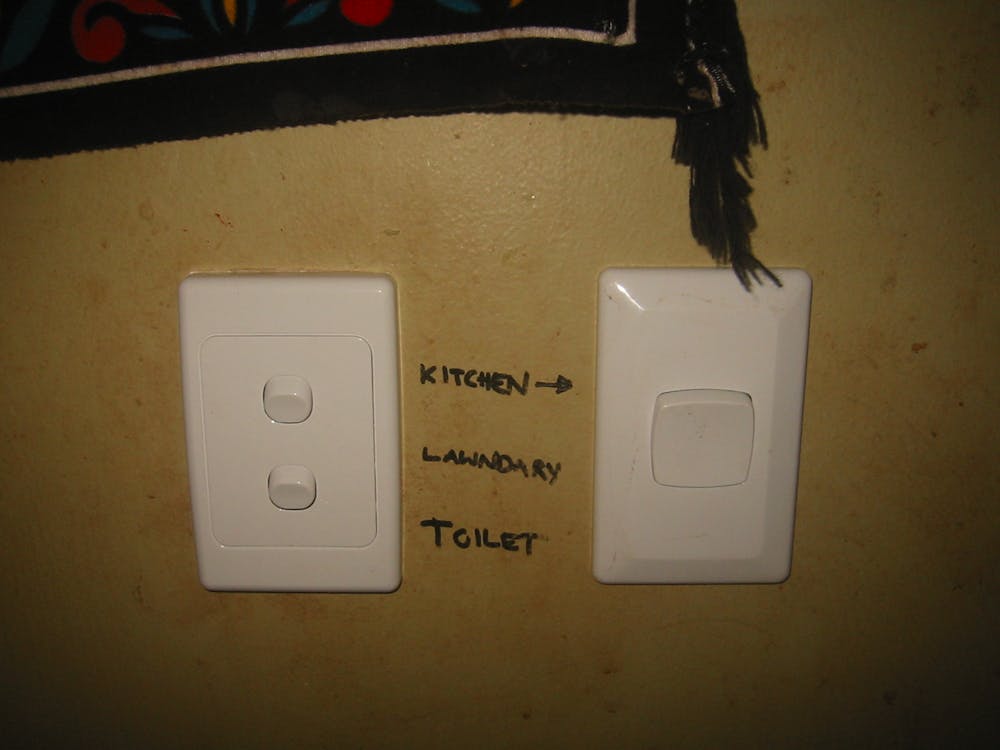
A light switch is a deceptively simple element of making a building liveable. Author provided

Take for example the prosaic light switch. It activates the enormous resource-intensive electricity-generating industry, which delivers power over vast distances, from its massive powerplants, through its extensive grid via high-voltage cables, in and out of substations and transformers and finally through to the consumer switchboard into the home of the end user. Who, with an unremarkable flick of a switch, can power up a light, laptop, TV, heater or whatever else.

Without this user interface of the switch – or tap, or stove knob – these entire huge networks are useless. It is the integration of these seemingly insignificant humble “actors” and their affordances that enables entire utility networks to be adjusted and controlled to create an enjoyable and healthy living environment for people.

ref. Is it time to move beyond the limits of ‘built environment’ thinking? – http://theconversation.com/is-it-time-to-move-beyond-the-limits-of-built-environment-thinking-102774]]>


Local film and TV content makes up just 1.6% of Netflix’s Australian catalogue

]]>

Source: The Conversation (Au and NZ) – By Ramon Lobato, Senior research fellow, RMIT University

Over the last few years we have been studying the catalogues of Netflix and Stan to see how much local screen content each service carries and how this compares to international benchmarks.

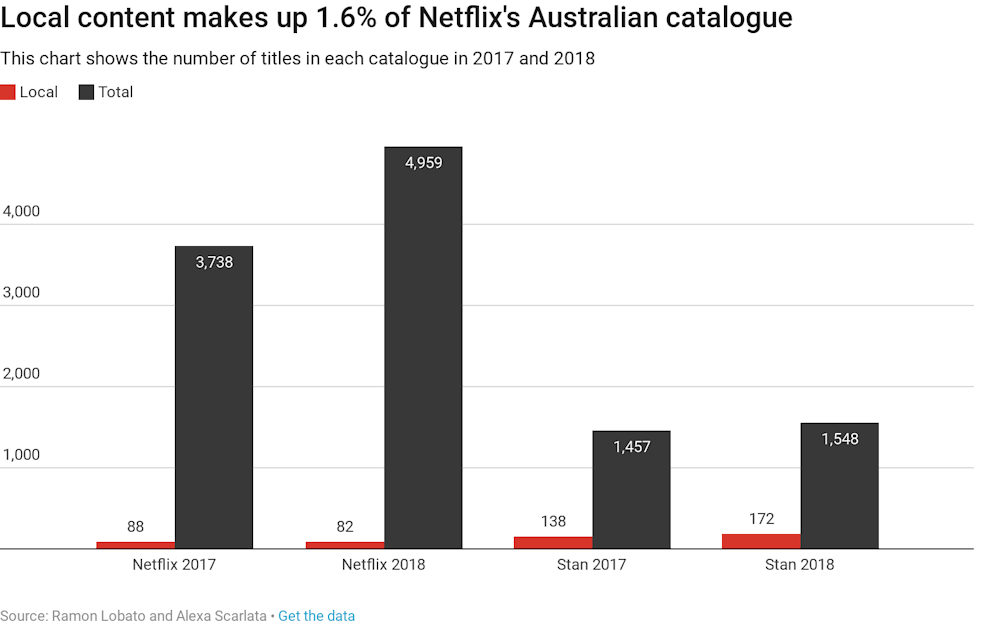
Our first report in 2017 found that the Netflix Australia catalogue carried around 2-2.5% local content, much of it licensed from the ABC. Stan’s local content level was slightly higher, at 9.5%.

Our latest report finds that Netflix’s local content level has fallen to 1.6% (82 Australian titles out of 4,959). This is due to Netflix’s overall catalogue growth, rather than any significant decrease in the absolute number of Australian titles available. Stan’s local content level has risen to 11.1% (172 titles out of 1,548).

While these figures may seem alarming, we should remember that, unlike free-to-air TV, subscription video-on-demand services are not regulated for local content. Netflix also plays a big role in promoting Australian content overseas.

Behind the figures

Digital access to local content, particularly on services like Netflix, has become a big issue for policymakers around the world. The European Parliament recently approved a minimum 30% European content quota for video-on-demand services operating in the region.

In Australia, groups such as Screen Producers Australia and APRA AMCOS (a music rights organisation) are calling for new regulation to be introduced here. This could include local production spending requirements for video streaming services, or playlist quotas for music streaming services.

Tysan Towney in Stan’s reboot of Romper Stomper. IMDB

In this context, Netflix’s 1.6% local content ratio might seem alarming, especially when compared to the minimum 55% local content quotas that apply to free-to-air television in prime-time hours. But there’s more to the story. Comparing free-to-air TV and video streaming services is like comparing apples and oranges: one is regulated for local content while the other is not.

Netflix’s local content figures are arguably more in line with other parts of the screen industry. On pay-TV channels, where a local content expenditure requirement rather than an hours quota applies, local content levels are generally lower. At the local cinema box office, Australian films have historically made up around 9% of releases and 4% of takings.

Australia has long been an importer of screen content, and subscription video streaming simply extends that tradition into the digital age.

The changing TV ecology

Another way to approach the problem is to think about such services as part of a wider audiovisual ecology, with some parts regulated for local content and others not. Despite all the hype about the streaming revolution, Netflix and Stan do not simply replace free-to-air TV; they complement and interact with it.


Read more: As local networks retreat, Netflix is filling the gap in teen TV


Our research found, for example, that the ABC remains a very important supplier to both Netflix and Stan. Almost 60% of the licensed local television content on Netflix and 37% of the local television content on Stan was initially commissioned and distributed by the ABC.

Rachael Blake and Susie Porter in Stan feature film The Second. IMDB

The algorithms that determine how content is displayed to viewers on streaming services also complicate things. Users of Stan and Netflix experience the catalogue as a curated, personalised library rather than as a raw list. Hence, the visibility of Australian content in each portal will vary from user to user, depending on viewing history.

The bright side

There is a bright side to this story. Our research also looked at the availability of Australian content in Netflix’s international catalogues. We found, for example, that Netflix’s US catalogue contains more Australian content than the Australian Netflix catalogue does (both in the number of titles and the overall proportion of the library).

What’s more, Netflix markets a number of its Australian co-productions and exclusive acquisitions as Netflix originals in international territories, even though these are not available in the Australian Netflix catalogue (because the local co-production partners and commissioners typically have exclusivity).

So, the low levels of local content in the Australian catalogue must be considered alongside Netflix’s significant capacity to distribute and promote Australian content internationally.

The trailer for Nanette, an Australian production that has travelled internationally via Netflix.

What do the platforms have to say?

We invited both Stan and Netflix to check our figures. Netflix’s global public policy manager, Josh Korn, responded and provided some interesting context.

Emphasising Netflix’s international distribution function, Korn confirmed that Hannah Gadsby’s Nanette – Netflix’s first Australian stand-up original title – had been viewed by Netflix subscribers in over 190 territories. Similarly, he noted that 95% of Netflix viewing hours for the Australian kids show, Mako Mermaids: An H20 Adventure, were from outside Australia, with similar numbers claimed for the dramas Miss Fisher’s Murder Mysteries and Glitch.

Mako Mermaids is one of the Australian shows Netflix has promoted overseas. IMDB

Netflix also points to the Australian shows in its production pipeline, including Pine Gap, Tidelands, Motown Magic, an untitled Chris Lilley project, and live stand-up comedy performances by Joel Creasey and Nazeem Hussein.

Stan, which was the first streaming video platform to commission local original content, has also recently released a new Romper Stomper reboot and its first feature, The Second, which add to the service’s existing Australian originals (such as No Activity, The Other Guy and Wolf Creek). New drama series Bloom and The Gloaming are in production.


Read more: Romper Stomper reboot is a compelling investigation into Australia’s extremist politics


This is all good news for Australian screen producers, who now have a bigger pool of buyers and new sources of production finance. But adding these new productions to both catalogues is unlikely to significantly increase the overall local content ratio in each service.

We may need to come to terms with the fact that Netflix and Stan cannot do the job of broadcast television when it comes to local content.

ref. Local film and TV content makes up just 1.6% of Netflix’s Australian catalogue – http://theconversation.com/local-film-and-tv-content-makes-up-just-1-6-of-netflixs-australian-catalogue-104773]]>

O’Neill replies on Maseratis, shuns ‘racist’ critic as opponents call strike

]]>

Prime Minister Peter O’Neill says the Papua New Guinean government will not spend any money on the purchase of 40 Maserati luxury sedans to be used to ferry APEC world leaders next month. Video: EMTV News

Pacific Media Centre Newsdesk

Prime Minister Peter O’Neill says all 40 Maserati executive vehicles being delivered to Papua New Guinea for the use of world leaders at the Asia-Pacific Economic Cooperation (APEC) summit next month will be sold to the private sector by public tender after use.

He confirmed this would be conducted in a transparent process right after the APEC leaders’ summit on November 17-18 as frustrated opposition MPs have called for a national strike this Thursday and Friday.

Opposition MP Bryan Kramer announced on social media he had spoken to Oro Governor Garry Juffa and East Sepik Governor Allan Bird at the weekend. They agreed to call the strike as a “nonviolent act of defiance”.

READ MORE: Uproar as PNG buys 40 Maseratis for APEC summit

“We agreed that we are sick to death of seeing our people suffer while our own members of Parliament who were mandated to fight for our people’s welfare are instead colluding with overseas opportunists only to steal from our people,” Kramer said.

-Partners-

“We are disgusted. We have heard your views and expressions on social media and we share the same concerns about the corruption and scandals led by the O’Neill government.

“I asked for the support from governors Juffa and Bird and we have agreed that enough is enough. If we continue to sit back and watch you struggle to put your children through school in the hope of a job that will never exist, if the economy continues as it is, how can we call ourselves leaders?

“The degree of mismanagement and corruption is overwhelmingly out of control. If we are to wait any longer there will be nothing left to fight for.”

Former PM’s backing
A former prime minister, Sir Mekere Morauta, MP for Moresby North-West, also supported the strike call in protest at what he branded the “continuing corruption” by the O’Neill government.

“Astonishing revelations in the last couple of days about the crooked contract to buy luxury Maserati cars for APEC, and then secretly sell them to private sector cronies, is the last straw,” he said.

Prime Minister O’Neill said the government was doing nothing secret but was prepared to host a successful APEC summit next month.

When asked by Loop PNG to give a response to a statement by Australian politician Pauline Hanson about the 40 Maseratis, he said he did not respond to “racist” Australian politicians who had no idea about Papua New Guinea.

The prime minister added there had been no cuts to the PNG health budget as speculated on but the government had increased spending to combat the polio outbreak.

Increasing awareness
O’Neill said the government was also increasing awareness that parents must allow their children to be immunised early to avoid such diseases.

He added that like all previous events hosted by governments in the past, all vehicles would be sold to the private sector in a public tender.

The prime minister said all APEC hosting nations, including Australia, had provided appropriate standard vehicles for all leaders in the past.

O’Neill said it would be inappropriate for the country to transport national leaders in landcruisers.

One Nation Party Leader and Queensland Senator Pauline Hanson said she was furious with the government of PNG over the purchase of the Maserati vehicles, and called for the withdrawal of Australian aid.

The minister responsible for APEC, Justin Tkatchenko, described Hanson’s statement as not only defaming the country but a “total disgrace”.

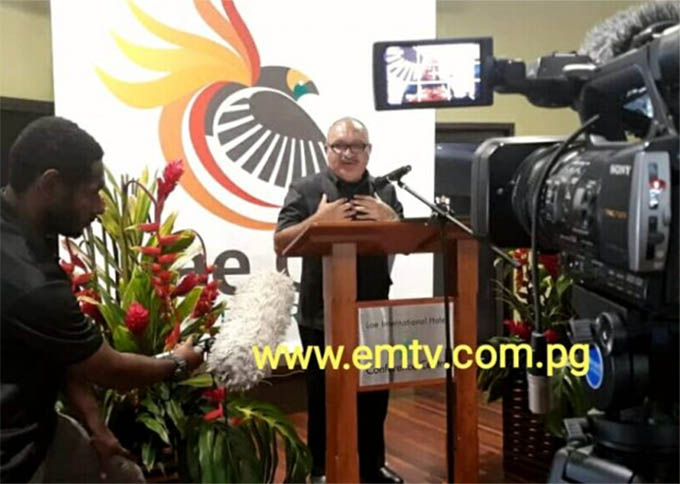
Prime Minister Peter O’Neill explaining to media about the Maserati car purchase for APEC 2018 next month. Image: EMTV News screenshot

Previous practice
Theckla Gunga of EMTV News reports: the practice of importing expensive vehicles for hosting APEC leaders’ summits has been adopted by host countries in the past.

In 2017, the Vietnamese government, through a public-private-partnership, imported Audi vehicles to use during the APEC leaders’ week.

Two years earlier, the Philippines imported 200 BMW sedans to ferry world leaders and delegates during the APEC summit.

After the meetings, those vehicles were sold to the public, or bought by the private sector.

The Pacific Media Centre has a content sharing arrangement with EM TV News.

Print Friendly, PDF & Email

Article by AsiaPacificReport.nz

]]>

Timor-Leste state media group sacks editor over role on Press Council

]]>

GMN news editor Francisco Simões Belo … elected to represent Timor-Leste journalists in the TL Press Council. Image: RTTL

Pacific Media Watch Newsdesk

The news editor for National Media Group (GMN) in Timor-Leste has been dismissed due to his role as the TL Press Union (TLPU) representative on the country’s Press Council.

The International Federation of Journalists (IFJ) and its affiliate the TLPU has condemned the dismissal of the editor as “outrageous” and called for his immediate reinstatement.

Francisco Simões Belo, news editor of GMN received a letter from GMN information director Francedes Sun on September 27 stating that he was dismissed from his position because his role with the Press Council did not benefit GMN, according to a report by the IFJ Asia-Pacific website.

READ MORE: Bid to unite Asia-Pacific press councils takes off in Timor-Leste

The letter also said that Belo “could not concentrate” on the GMN newsroom while he was representing journalists at the Press Council.

Belo was elected by TLPU members to represent TLPU on the Press Council. He has registered his case and mediation is due to begin on October 29.

-Partners-

The IFJ said: “The sacking of a journalist for simply fighting for the rights of fellow journalists is outrageous.

“Francisco has worked hard for journalists across Timor-Leste, and should not be punished for this work. We demand GMN immediately reinstate his employment.”

Print Friendly, PDF & Email

Article by AsiaPacificReport.nz

]]>

Paga Hill iconic human rights documentary banned from PNG festival

]]>

Report by Dr David Robie – Café Pacific. –

Activist lawyer Jose Moses as he appears in a Frontline Insight item about the Paga Hill struggle for justice
in Papua New Guinea. Video: Reuters Foundation
By Pacific Media Watch

An internationally acclaimed investigative documentary about Paga Hill community’s fight for justice from the illegal eviction and demolition of their homes in Papua New Guinea’s capital of Port Moresby has been banned from screening today at the PNG Human Rights Festival.

“The ban highlights the lingering limits on free speech in our country and the continued attempts to censor our story of resistance against gross human rights violations,” claimed Paga Hill community leader and lawyer Joe Moses, the main character in The Opposition film who had to seek exile in the United Kingdom after fighting for his community’s rights.

“This censorship comes as a deep disappointment for my community who have suffered greatly over the past six years.”

The Opposition tells the David-and-Goliath battles of a community evicted, displaced, abandoned – their homes completely demolished at the hands of two Australian-run companies, Curtain Brothers and Paga Hill Development Company, and the PNG state.

What was once home to 3000 people of up to four generations, Paga Hill is now part of the Asia-Pacific Economic Co-operation (APEC) summit “AELM Precinct” which will take place this November.

The PNG Human Rights Film Festival.
Image: Programme screenshot

Moses said: “We appreciate the PNG Human Rights Film Festival for choosing to screen The Opposition film at their Madang and Port Moresby screenings.

“It is shameful that our government continues to limit free speech and put such pressure on our country’s only annual arts and human rights event. How does this make us look to the world leaders who will be coming here for the APEC meeting in November?”

‘Speak up today’
Under the theme “Tokautnau long senisim tumora” (Speak up today to change tomorrow) the mission of the PNG Human Rights Film Festival includes: “We are all born free and equal in dignity and rights”.

The international and local human rights films screened “promote increased respect, protection and fulfillment of human rights in Papua New Guinea”.

Paga Hill youth leader Allan Mogerema, who also features in the film said: “The right to freedom of speech and freedom of press is provided for under Section 46 of the PNG Constitution. By banning our story, the PNG government is in breach of our Constitution and our rights as Papua New Guinean citizens.”

The Opposition trailer.

As a human rights defender, Mogerema has been invited to the 2018 Annual Human Rights and People’s Diplomacy Training Programme for Human Rights Defenders from the Asia-Pacific Region and Indigenous Australia organised by the Diplomacy Training Programme (DTP) and the Judicial System Monitoring Programme (JSMP) to share his story of the illegal land grab, eviction and demolition of his community.

“The film has already been screened in settlements across PNG and at the Human Rights Film Festival’s Madang screenings. No matter how hard they try to censor us, our story continues to live, and our fight for justice continues to thrive,” added Mogerema.

“No matter how long it takes, our community will get justice.”

Dame Carol Kidu is also featured in The Opposition film. Initially an advocate for the Paga Hill community, Dame Carol turned her back on them by setting up a consultancy to be hired by the Paga Hill Development Corporation, on a contract of $178,000 for three months’ work.

In 2017, she launched a legal action in the Supreme Court of NSW to censor the film. In June that year, the court ruled against Dame Carol’s application.

#Justice4Paga

Frontline Insight: The Paga Hill struggle. Video: Reuters Foundation

This article was first published on Café Pacific.]]>

Paga Hill iconic human rights film banned from PNG festival

]]>

A Frontline Insight item about Joe Moses and the Paga Hill struggle for justice in Papua New Guinea. Video: Reuters Foundation

Pacific Media Watch Newsdesk

An internationally acclaimed investigative documentary about Paga Hill community’s fight for justice from the illegal eviction and demolition of their homes in Papua New Guinea’s capital of Port Moresby has been banned from screening today at the PNG Human Rights Festival.

“The ban highlights the lingering limits on free speech in our country and the continued attempts to censor our story of resistance against gross human rights violations,” claimed Paga Hill community leader and lawyer Joe Moses, the main character in The Opposition film who had to seek exile in the United Kingdom after fighting for his community’s rights.2,3

“This censorship comes as a deep disappointment for my community who have suffered greatly over the past six years.”

READ MORE: Paga Hill resettlement mothers plead for help from Governor Parkop

The PNG Human Rights Film Festival. Image: Programme screenshot

The Opposition film tells the David-and-Goliath battles of a community evicted, displaced, abandoned – their homes completely demolished at the hands of two Australian-run companies, Curtain Brothers and Paga Hill Development Company, and the PNG state.

-Partners-

What was once home to 3000 people of up to four generations, Paga Hill is now part of the Asia-Pacific Economic Co-operation (APEC) summit “AELM Precinct” which will take place this November.

Moses said: “We appreciate the PNG Human Rights Film Festival for choosing to screen The Opposition film at their Madang and Port Moresby screenings.

“It is shameful that our government continues to limit free speech and put such pressure on our country’s only annual arts and human rights event. How does this make us look to the world leaders who will be coming here for the APEC meeting in November?”

‘Speak up today’
Under the theme “Tokautnau long senisim tumora” (Speak up today to change tomorrow) the mission of the PNG Human Rights Film Festival includes: “We are all born free and equal in dignity and rights”.

The international and local human rights films screened “promote increased respect, protection and fulfillment of human rights in Papua New Guinea”.

Paga Hill youth leader Allan Mogerema, who also features in the film said: “The right to freedom of speech and freedom of press is provided for under Section 46 of the PNG Constitution. By banning our story, the PNG government is in breach of our Constitution and our rights as Papua New Guinean citizens.”


The Opposition trailer.

As a Human Rights Defender, Mogerema has been invited to the 2018 Annual Human Rights and People’s Diplomacy Training Programme for Human Rights Defenders from the Asia-Pacific Region and Indigenous Australia organised by the Diplomacy Training Programme (DTP) and the Judicial System Monitoring Programme (JSMP) to share his story of the illegal land grab, eviction and demolition of his community.

“The film has already been screened in settlements across PNG and at the Human Rights Film Festival’s Madang screenings. No matter how hard they try to censor us, our story continues to live, and our fight for justice continues to thrive,” added Mogerema.

“No matter how long it takes, our community will get justice.”

Dame Carol Kidu is also featured in The Opposition film.

Initially an advocate for the Paga Hill community, Dame Carol turned her back on them by setting up a consultancy to be hired by the Paga Hill Development Corporation, on a contract of $178,000 for three months’ work.

In 2017, she launched a legal action in the Supreme Court of NSW to censor the film.

In June that year, the court ruled against Dame Carol’s application.

#Justice4PagaHill

Paga Hill homes being destroyed in May 2012. Image: Frontline Insight screenshot
Print Friendly, PDF & Email

Article by AsiaPacificReport.nz

]]>

Police shut down Bali people’s global conference against World Bank

]]>

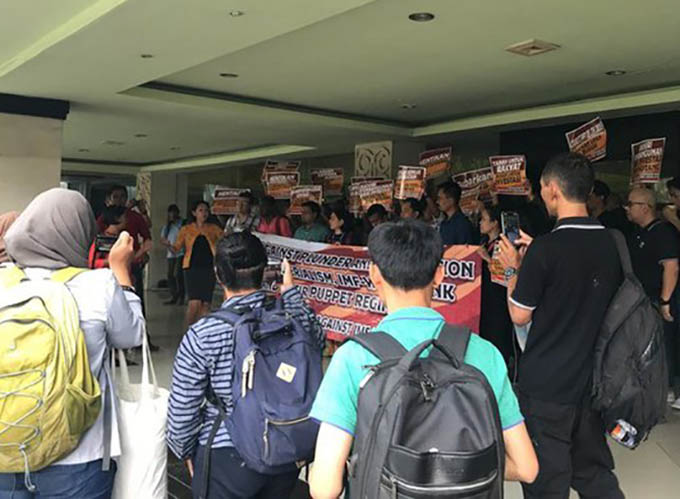
Protesters picket the Nirmala Hotel after the second cancellation of the People’s Global Conference in Bali. Image: PGC

By Rio Apinino in Denpasar, Bali

Indonesian police have closed down the Peoples’ Global Conference Against the IMF-World Bank which should have opened earlier today at the Radio Republic Indonesia (RRI) Auditorium in Denpasar, Bali.

As its name suggests, the conference opposes the annual International Monetary Fund-World Bank meeting which is currently being held in Nusa Dua, Bali.

The event, organised by the People’s Movement Against the IMF-WB — which is made up of a number of Indonesian non-government and social organisations — was to have several discussion panels on a variety of themes broadly aimed at trying to present an alternative to the narrative promoted by the IMF and World Bank.

READ MORE: People’s global conference hassled

The event however had to be cancelled after being blocked by police.

Agrarian Reform Movement Alliance (AGRA) chairperson Rahmat Ajiguna, who is on the conference organising committee, told Tirto that until the evening of October 10 all of the preparations for the event had proceeded smoothly. All of the technical issues related to the conference had been completed.

-Partners-

“But in the end, the venue was cancelled by the RRI [radio] management”, Rahmat told Tirto last night.

The organisers tried to find an alternative venue and finally found one at the Nirmala Hotel and Convention Centre, also located in the capital Denpasar.

Hotel cancellation
Once again, however, the event was cancelled by the hotel management at the last minute on the grounds that the organisers did not have a permit from police.

After being pushed on the issue, said Rahmat, the management admitted that “the hotel had been approached by police intel [intelligence officers] and were told that we are not allowed to hold the event there”.

The conference participants were not just from Indonesia but also included international guests.

Several international organisations were to take part including, among others, the Asia Pacific Mission for Migrants, the Asia Pacific Research Network, the Asian Peasant Coalition, the Indigenous Peoples’ Movement for Self Determination and Liberation and People Over Profit.

Rahmat said that all of the participants agreed that the IMF-World Bank annual meetings brought no benefits to the majority of people.

In fact they result in the majority of the world’s people “falling into poverty, hunger, unemployment and long-term suffering. It’s like they [the IMF-World Bank] are the gods that determine humanity’s lives from the beds they sleep in to their [lives] outside the home”, he said.

The participants were only told about the cancellation when they arrived at the venue. They then formed a line holding banners in front of the hotel lobby and give speeches, which resulting in an argument between the participants and the hotel management.

Hotel security
When hotel security personnel tried to remove them one of the overseas guests said: “You’re working class. You should be with us!”

In the end they were forced to disband and participants are now trying to find an alternate venue so that the conference can still go ahead.

Rizal Assalam, one of the conference guests, said the “operation” against the conference had in fact being going on for several days.

On October 7, Peoples’ Global Conference posters appeared on WhatsApp with the logo of the Hizbut Tahrir Indonesia (HTI), yet the alliance has no links with the radical Islamic organisation which was outlawed by the government last year.

“Then on October 8, at the Puputan Margarana park [in Renon, Denpasar], out protest action was forcibly broken up by intel officers who claimed to be local residents. Police continued to harass [us] until the action disbanded and while participants waited to be picked up to leave the location,” Rizal said.

“On the evening of October 10, police came to the Bali LBH [Legal Aid Foundation]. Students who were staying overnight there were ordered to leave,” he added.

Earlier this morning, Rizal said, several police officers were also at the Nirmala Hotel and Convention Centre taking pictures of the participants.

Translated by James Balowski for the Indoleft News Service. The original title of the article was “Diskusi Tandingan IMF-WB Diberangus Kepolisian Bali”.

Print Friendly, PDF & Email

Article by AsiaPacificReport.nz

]]>

We need to know more about charities to be sure they are helping their cause, not themselves

]]>

Source: The Conversation (Au and NZ) – By Ushi Ghoorah, Associate lecturer, Western Sydney University

The case of Eman Sharobeem, the NSW Australian of the Year finalist who stole almost $800,000 from charitable organisations she ran, highlights major problems with transparency throughout the nonprofit sector.

Sharobeem managed two organisations that received funds to help immigrant women. She stole the money over more than 10 years, using it to buy items such as jewellery and a Mercedes.

That she was got away with it for so long is indicative of the nonprofit sector’s general lack of accountability. The overwhelming majority of organisations make no public financial disclosures. Generally the only ones that do are those required to by law.

Only nonprofit groups registered as charities have to lodge information with the sector’s regulator, the Australian Charities and Not-for-Profit Commission (ACNC). The degree of information depends on their annual revenue. Only charities earning more than A$1 million a year must submit audited financial statements.


The commission is now considering increasing this threshold to A$5 million.

My research suggests this will make publicly available financial disclosures extremely rare. This means donors, volunteers, employees and taxpayers will have even less assurance that charity dollars are being spent efficiently on their intended cause.


Read more: Australian charities are well regulated, but changes are needed to cut red tape


The Australian nonprofit sector

Australia’s nonprofit sector numbers about 600,000 organisations. Despite the sector’s scale and social importance, we don’t know much about it. Most information is limited to the 56,000 registered charities that have to submit a basic Annual Information Statement to the charities regulator to be tax-deductible.


Read more: Celebrity charities just compete with all other charities – so why start one?


These charities receive more than A$140 billion in annual revenue as well as 328 million unpaid hours from almost 3 million volunteers.

Voluntary disclosure is rare

My research on financial disclosures looked at 342 nonprofit organisations. They covered four areas: social services, culture and recreation, education and research, and environment.

Just 55 (16%) made their annual reports and financial statements public. Of those, 52 had annual revenues of at least $A1 million. Just three charities earning less than A$1 million made their financial statements voluntarily public.

This suggests most nonprofit organisations are unlikely to make financial disclosures if not required to do so.

Differences between sub-sectors

Among those making financial disclosures, there is no consistency in approach taken. This was particularly glaring among social services organisations, which made up 34 of the 52 organisations in my study earning more than A$1 million a year.


This graph shows the best and and worst disclosure scores within the four sub-sectors.

The score indicates the extent of voluntary financial disclosures above and beyond what is required by law. These include the amount of grants received, total donation revenue, program expenses, administration expenses, management expenses and the value of volunteer contributions.

Each organisation received a score of one for each voluntary disclosure within its published financial statement.

The lack of consistency illustrates the failure of the charity regulator’s reporting requirements to create a level playing field. For example, religious charities of any size do not have to answer financial questions or submit financial reports.

Elaborate narratives, limited financial disclosures

Most crucially, there is no obligation under the existing reporting standard for any organisation to specifically disclose what it spends on its core social mission.

So while most of the 52 organisations provided elaborate narratives about their social mission, few disclosed the actual amount of money spent on their mission.

As a result, it’s hard for donors to assess how many cents in the dollar go to the cause they want to support.

Public’s right to greater transparency

These limited, inconsistent and vague disclosures are an impediment to the nonprofit sector. It is difficult to assess if an organisation is deploying its resources consistent with its mission.

Charitable nonprofit organisations are eligible for many tax benefits and government subsidies. These benefits should oblige them to put their financial records in the public domain.


Read more: Charity regulators should not assume that donors always know best


What needs to be done

Rather than making financial disclosure even rarer, the Australian Charities and Not-for-Profit Commission should make three key regulatory changes.

First, there needs to be a reporting system where all nonprofit organisations have to make minimal financial disclosures of funds received and spent. This should be irrespective of their size or status.

Second, there needs to be a standardised approach to disclosures, so anyone can know what an organisation spends, and how much goes to its core social mission rather than other costs such as fundraising. This would enable the performance of organisations with similar missions to be compared.

Third, the nonprofit regulator needs to create a platform to make all financial disclosures easily accessible to the public.

These reforms are crucial for people to have confidence in the nonprofit sector and the organisations to which they donate.

ref. We need to know more about charities to be sure they are helping their cause, not themselves – http://theconversation.com/we-need-to-know-more-about-charities-to-be-sure-they-are-helping-their-cause-not-themselves-103881]]>

Leek orchids are beautiful, endangered and we have no idea how to grow them

]]>

Source: The Conversation (Au and NZ) – By Marc Freestone, PhD Candidate, Australian National University

Sign up to Beating Around the Bush, a series that profiles native plants: part gardening column, part dispatches from country, entirely Australian.


Leek orchids don’t have many friends. Maybe it’s because they lack the drop-dead gorgeous looks of many of their fellow family members. Or perhaps it’s because they’re always the first to leave the party: as soon as sheep or weeds encroach on their territory, they’re out of there. Whatever the reason, you don’t see leek orchids around very often.


Read more: Secrets of the orchid mantis revealed – it doesn’t mimic an orchid after all


Leek orchids are small, ground-dwelling native Australian orchids, so called for their single spring-onion-like leaf, which shoots up from an underground tuber each autumn. In the spring, if there’s been enough rain, they produce a spike of small brown, green or white flowers.

Like many native orchids, they are battling extinction. My research involves trying to find the secret to propagating them – something we still don’t fully understand.

Marc Freestone/The Conversation

Extinction

Australia is quite rich in orchids with more than 1,300 native species (by contrast, there are only about 200 species in all of North America). About 140 of these are leek orchids, and most live in bushland remnants across the south of Australia.

With a preference for fertile soils and relatively high rainfall, these little plants suffered severely during the period of agricultural expansion in the southeast of the country during the first half of last century. Rabbits, weeds, inappropriate fire regimes, and declining rainfall patterns continue to plague those that survive, which often hang on in narrow roadsides, beside rail lines or in rural cemeteries – tiny pockets of land that were never ploughed.


Read more: Bunya pines are ancient, delicious and possibly deadly


Almost one-third of all leek orchid species are at risk of extinction. Some are already extinct, such as the Lilac Leek-orchid (Prasophyllum colemaniae). It once grew in Melbourne’s outer eastern suburbs, but disappeared when an upgrade of a rail line in the 1970s destroyed the last population. Standing half a metre tall, with fragrant purple-white flowers, it was said to be the most beautiful of all leek orchids.

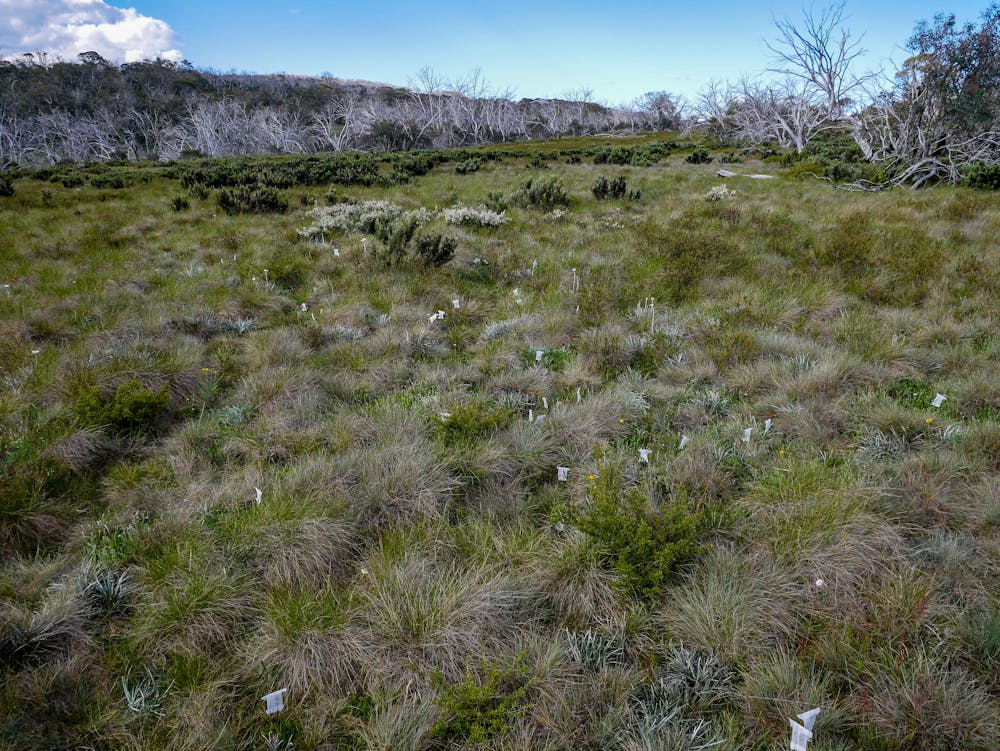
Collecting seed in the Alpine region. Marc Freestone

Native orchids are rebounding – but not leek orchids

Fast forward to 2018 and things have changed. The Royal Botanic Gardens Victoria now hosts the largest orchid conservation program in the world. Dozens of critically endangered native orchids from the southeast mainland are being brought back from the brink of extinction through propagation and reintroduction programs.

But not leek orchids.

That’s because we still don’t know how to grow leek orchids successfully. In fact, growing any type of orchid is hard work. For a start, orchid seed is microscopic. It is so small it doesn’t contain any food for the germinating orchid seedling.

Instead, all orchids rely on symbiotic fungi that live in their roots and the surrounding soil and are required to inoculate the orchid seed – the fungus literally pumps food into the seeds to get them to germinate. We have no idea why these fungi do this, but we can replicate this scenario in the lab by carefully extracting fungi from the roots of a wild orchid plant, growing the fungi in a petri dish, and sprinkling in the orchid seed. But for some reason, leek orchid seed rarely germinates, and if it does, the young seedlings usually brown off and die.

Three month old baby leek orchid seedlings. Of the few seeds that germinate, most won’t survive past this point. Marc Freestone

How to grow leek orchids is the subject of my PhD project with the Australian National University, based at the Royal Botanic Gardens Victoria. We have many theories about what might be going on and we’re looking at seed viability, growing conditions, and the relationship between leek orchids and their symbiotic fungi.

It’s a race against time to work out how to grow them before more species – like the Shelford Leek-orchid (Prasophyllum fosteri) from western Victoria, which is now down to only a handful of wild plants – go extinct.

Why should we care?

At first glance, leek orchids do not appear to be particularly useful for anything. They can’t cure cancer or be traded for Bitcoin. So who cares if they go extinct?

There are only a few hundred coast leek orchids remaining. Marc Freestone

Well, the first point is we don’t know enough about leek orchids to be able to conclude that they are indeed completely useless to the human race. Second, leek orchids probably used to play an important ecosystem role in the lowland grasslands of southeastern Australia.

Up in the Australian Alps there are several species of leek orchid that are still very common, their flowers providing an important food source for insects. Seeing the massed flowering of the Alpine Leek-orchid (Prasophyllum tadgellianum) in summer really gives you a feel for what the lowland grasslands would have been like once upon a time, when species like the Gaping Leek-orchid (Prasophyllum correctum) would have numbered in the millions. Now there are perhaps 10 plants left.

If it goes extinct, Australia will have lost part of what makes it unique. A small part, perhaps, but when added to all the other threatened species in this country, a significant part.


Read more: ‘The worst kind of pain you can imagine’ – what it’s like to be stung by a stinging tree


Personally, I find leek orchids delicate and utterly defenceless against humans, who have engulfed their world. Ironically, some species are now totally dependent on us for their survival. I feel a great sense of responsibility to help them.

Sign up to Beating Around the Bush, a series that profiles native plants: part gardening column, part dispatches from country, entirely Australian.

ref. Leek orchids are beautiful, endangered and we have no idea how to grow them – http://theconversation.com/leek-orchids-are-beautiful-endangered-and-we-have-no-idea-how-to-grow-them-103224]]>

VIDEO: Michelle Grattan on the contest in Wentworth, the Religious Freedom report leak and fast-tracking tax cuts

]]>

Source: The Conversation (Au and NZ) – By Michelle Grattan, Professorial Fellow, University of Canberra

Michelle Grattan speaks to Director of the University’s Institute for Governance and Policy Analysis Mark Evans about the week in Australian politics. They discuss the Wentworth byelection campaign, the leaks from the Ruddock inquiry into religious freedom, and Scott Morrison’s announcement that the government will fast-track the company tax cuts for small and medium businesses.

ref. VIDEO: Michelle Grattan on the contest in Wentworth, the Religious Freedom report leak and fast-tracking tax cuts – http://theconversation.com/video-michelle-grattan-on-the-contest-in-wentworth-the-religious-freedom-report-leak-and-fast-tracking-tax-cuts-104850]]>

Honey, I hid the kids: Australia’s screen industry is letting down carers

]]>

Source: The Conversation (Au and NZ) – By Sheree Gregory, Lecturer, Western Sydney University

Women in Australia’s screen industry are finding it difficult to juggle their working lives with their caring roles, according to our study released today.

In our online survey of 600 people working in the industry about the impacts of parenting and caring responsibilities on their paid working lives, we found that 74% of carers felt their caring responsibilities had a negative impact on their career. Of these, 86% were women.

One parent responded:

I have been careful to not mention my child [at work]; pretending not to have a child.

This sums up what many workers conveyed to us about the current work-care dynamics in the industry and the lengths women go to in order to hide their status as parents. It says something of the disapproval that parents and carers feel – both sharply and painfully.

While in the 21st century women are reminded to “lean in” and celebrate their choices, the reality is that many women in the screen industry are managing and navigating their working realities by “leaning out”. They work as though they don’t have children, and parent as though they don’t have a job.

The report also reveals that 73% of respondents find it difficult to impossible to vary their work hours or access the amount of payment needed for caring support. Given 60% of carers are freelance or self-employed, it’s not surprising that long hours, financial uncertainty and unpredictable paid work commitments are major concerns.


Read more: Women aren’t the problem in the film industry, men are


Parents and carers in the Australian screen industry are acutely aware that the current work culture is unfriendly towards caring.

One respondent said they “have been overlooked for a role where it was expected that I couldn’t do the hours” (rather than anyone asking me before offering it to someone else).

Another commented: “Returning to work after time off for babies is slow. Even though I can work full-time, employers are reticent to offer me full-time roles because I have small children.”

There has been a swift response. The South Australian Film Corporation today announced new measures to address the impact of caring on film workers.

These include:

  • a requirement that major projects hire at least one crew member who is returning to work after a caring role
  • incentives for films that use different methods of production, such as more flexible shooting schedules that allow people to work and care
  • a program that keeps employees skilled while they are away from work to care for others.

These responses are all in line with our report recommendations.

‘Fatherhood bonus’

Compared to the invisibility of mothers behind the screen, one man experienced the opposite. Paradoxically, his caring status helped his career:

I swear I get some gigs with repeat clients just so they can hear about or catch up with my son. He is a pretty awesome kid. Has also made many appearances on sets and gets taken seriously as being helpful and intelligent from a pretty young age.

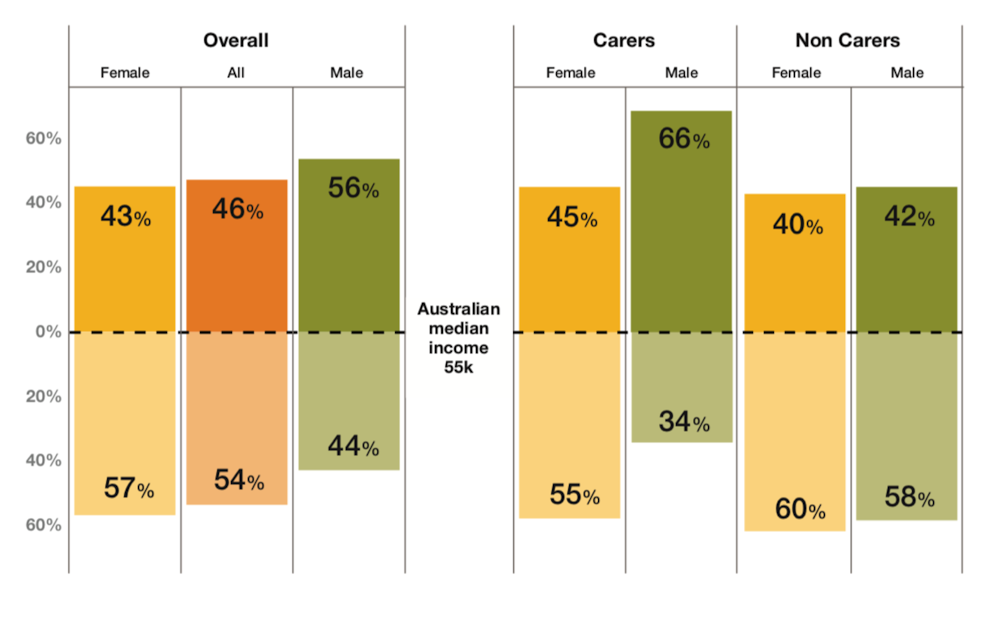
His experience is supported by other findings from the survey. Approximate pre-tax earnings from the screen industry for the last financial year show that men who are carers earned substantially more than women who are carers, and receive a substantial income boost – the “fatherhood bonus” – compared to men without children.

Erin Joly

Read more: Three ways Screen Australia can actually improve diversity in the industry


Doing better

Working parents and carers taking the survey identified long and inflexible hours, typical of the screen industry, as their key challenge. This confirms findings from previous reports, including a UK survey that this Australian study was adapted from. This UK report yielded similar responses, with 79% of carers saying they fared badly compared to non-carers.

We suggest a number of policy recommendations to help address the unwritten rules that hide parenting and caring in the screen industry. These include:

  • measures for supporting carers to return to work such as funding incentives, subsidies for childcare, flexible work arrangements, and more predictable working hours
  • industry incentives that reward inclusive production structures and processes
  • recognition of carers as productive industry members
  • actions to redress the negative impact of attitudes to carers in the workplace
  • the introduction of care-sensitivity in funding agency processes.

Households wrestle with the challenge of balancing work and care, often by crafting their own private solutions. Our survey and report recognises this is a problem that is best solved by employers and industry decision-makers who are in a position to make change happen at the broadest level. Households and workers know this and are calling out for support from policymakers.

ref. Honey, I hid the kids: Australia’s screen industry is letting down carers – http://theconversation.com/honey-i-hid-the-kids-australias-screen-industry-is-letting-down-carers-104843]]>

Five in a row – the planets align in the night sky

]]>

Source: The Conversation (Au and NZ) – By Tanya Hill, Honorary Fellow of the University of Melbourne and Senior Curator (Astronomy), Museums Victoria

For the second time this year, the five brightest planets can be seen at the same time. You can catch them by looking towards the western sky after sunset. The planets will form a line rising up from the horizon.

Mercury and Venus are low to the west, with bright Jupiter shining just above. Higher up in the northwestern sky is Saturn, and completing the set of five is the red planet Mars, high overhead.

On Friday October 12 a beautiful crescent Moon sits just to the right of Jupiter. Keep watching the planets night after night and you can track the progression of the Moon.


Read more: More ‘bright’ fast radio bursts revealed, but where do they all come from?


As the Moon zips around Earth each month, its apparent motion in the sky is much faster than the more leisurely motion of the planets in their orbits around the Sun.

After sunset around Australia, the five bright planets can be seen in the western sky this week. Museums Victoria/Stellarium

By Monday October 15, the Moon will have moved higher in the sky to sit near Saturn, and a few days later, on October 18, the Moon will partner with Mars.

That will also be a perfect evening to see the planets, as Venus and Mercury will be sitting side by side. Of all the five planets, Mercury is the faintest and therefore hardest to see, so having bright Venus as a signpost to Mercury is always an advantage.

In about a week’s time, Venus, which has been the bright evening star for most of this year, will move into the glare of the Sun and out of the night sky.

Five planets, two groups

The planets have been doing a merry dance in the night sky over the past few months.

Back in July, they also came together in the evening sky, but on that occasion they were stretched right across the sky. Mercury and Venus could be found in the west, while Jupiter, Saturn and Mars were rising in the east.

The five planets were last seen together in the western sky, August 2016. Alex Cherney

As Mercury and Venus are the inner planets, orbiting closer to the Sun than Earth does, we only ever see these two low to the west after sunset, or low to the east before sunrise. They are the planets either following or leading the Sun.

In contrast, the outer planets of Mars, Jupiter and Saturn can drift right across the sky, which is exactly what they have been doing since July. The trio has moved from east to west, and now they join Mercury and Venus to put on the five-planet show.

There’s more in store

It may seem like a common occurrence, since the five planets have come together again in the space of just a few months. But it’s only possible because Jupiter and Saturn are currently on the same side of the Sun and therefore near each other, relatively speaking.

The five planets have come together twice this year and twice in 2016, but before that there was a decade when it just wasn’t possible. The two gas giants were too far apart.

Watch the planets come together.

As Jupiter and Saturn pair up in the sky, it’s only a matter of time before the other planets fall into the right configuration to bring them all together.

The next time this occurs will be in July 2020, but it will be harder to see compared to this week. The planets will be stretched across the sky rather than all clustered together in the west as they are right now.

So it’s still special to spot the five planets coming together. There’s great satisfaction in being able to tick off all five planets in a single viewing.

Up for a challenge?

Not only are the five easy-to-see planets visible in the evening sky, but they are joined by Uranus and Neptune to complete the planetary set.

Voyager 2 flew by Uranus in 1986 and Neptune in 1989 capturing stunning close-up images. NASA/JPL-Caltech (Uranus) and NASA (Neptune)

These two ice giants that orbit beyond Saturn are modern-day planets. They were not known in ancient times because their discovery needed the aid of a telescope and an understanding of gravity to know how the Solar System works.

But while they may not be seen with the naked eye, Uranus is low in the east at sunset and Neptune is higher up, about midway to Mars.

Practised observers, viewing the sky from a dark country site, have been able to see Uranus with the naked eye by knowing exactly where to look. Through binoculars, Uranus appears like a faint star but a good telescope will show its slightly bluish disc.


Read more: Aboriginal traditions describe the complex motions of planets, the ‘wandering stars’ of the sky


It is best to wait until later in the evening, when Uranus has risen higher, to try to observe it. But now is an ideal time, as the planet is approaching opposition on October 24, when it will be at its best.

Neptune is about the same size as Uranus but much further away, making it harder to see. Even with a modest telescope it appears as a bluish star, while the right observing conditions and a high-quality telescope are needed to reveal Neptune’s disc.

Lastly, and not to be left out, even the dwarf planet Pluto joins the crowd. It’s much too small and distant to be seen but currently sits about midway between Saturn and Mars.

Even with a high-quality telescope Pluto only ever appears as a faint star-like object, and it will be a challenge for most (myself included) to find it in its current position among all the stars near the bright Milky Way.

If you are up for the challenge, a free astronomy program such as Stellarium is ideal to help locate the planets. But it’s just as rewarding to enjoy the five bright planets, observed since ancient times, briefly coming together in the western sky.

ref. Five in a row – the planets align in the night sky – http://theconversation.com/five-in-a-row-the-planets-align-in-the-night-sky-104387]]>

World politics explainer: the Russian revolution

]]>

Source: The Conversation (Au and NZ) – By Mark Edele, Hansen Chair in History, University of Melbourne

This article is part of our series of explainers on key moments in the past 100 years of world political history. In it, our authors examine how and why an event unfolded, its impact at the time, and its relevance to politics today.


For most people, the term “Russian Revolution” conjures up a popular set of images: demonstrations in Petrograd’s cold February of 1917, greatcoated men in the Petrograd Soviet, Vladimir Lenin addressing the crowds in front of the Finland station, demonstrators dispersed during the July days and the storming of the Winter Palace in October.

What happened?

These were all important events that forced the Tsar to abdicate, brought the Bolsheviks to power, took Russia out of the first world war, prompted British, American, and Japanese interventions, and careened the Romanov empire towards years of bloody civil war.

Among revolutionary socialists, they still inspire daydreams of future revolutions. Historians on the political right, by contrast, promote them as warnings of what happens if you try to change the world. In Russia, meanwhile, they pose complex challenges for constructing a past that can inspire the present.

The standard story summarised by these pictures goes something like this:

Demonstrations in Petrograd, February 1917. Wikicommons Riot on Nevsky Prospekt, July 1917. Viktor Bulla/Wikicommons Storming of the Winter Palace, October 1917. Wikicommons

The Russian empire, already under severe political and social strain in 1914, broke apart under the pressures of modern warfare. In 1916, a massive uprising against conscription to work shook central Asia.

In 1917, it was the turn of the Russian heartland. Industrial strikes, protests over food shortages, and women’s demonstrations combined to create a revolutionary crisis in Petrograd, the capital of the empire.

Eventually, this crisis convinced both the political and the military elites to pressure the Tsar to abdicate. These events are known as the February revolution.

They turned out to be only the first step. Throughout 1917, the revolution radicalised until in October, the most radical wing of the Russian Social Democrats – Lenin’s Bolsheviks – took power in the name of the revolutionary working class. The October revolution, in turn, triggered the Russian Civil War which was eventually won by the Bolsheviks.

But this focus on events in Petrograd in 1917 is misleading. If we want to understand the significance of the Russian revolution for today’s world, we need to understand both its position in a wider historical process and its very complexity.


Read more: Friday essay: Putin, memory wars and the 100th anniversary of the Russian revolution


The larger context

What happened in 1917 was not just a beginning. It was also a moment in the larger trajectory of the Romanov empire (the pre-Soviet Russian Empire) embroiled in a world war it was poorly prepared to fight.

1917 is part of the story of how an empire, built between the 15th and the 18th century on the basis of peasants tied to the land of their master (serfdom) and the indisputable power of the Tsar (autocracy) tried to come to grips with a changing world in the 19th and early 20th centuries filled with overseas empires, industrialisation, and the emerging mass society.

It is but a snapshot in the history of imperialism, economic and social change, and decolonisation. These are all ongoing processes that still trouble the region today.

This sequence of events began with the lost Crimean War of 1853-56, which triggered the Great Reforms of the 1860s and 1870s.

Together with a determined push in the 1890s to industrialise the country, these reforms brought a new, more modern, more urban, and more educated society into being.

This more complex society then faced its first test in 1904-05. A disastrous war against Japan destabilised the empire enough to trigger a first revolution in 1905. It forced the Tsar to make concessions towards modern politics through the creation of a pseudo-parliament, legal parties, and decreased control of the media.

Then came the first world war. The military campaign went poorly, disgruntling the elites with an obviously incompetent regime, dislocating populations on a massive scale, intensifying national feelings in this multi-ethic empire, triggering an economic crisis of immense proportions, and further polarising social divisions between the haves and have-nots.

The result was a cluster of wars, revolutions, and civil wars that dragged on to the early 1920s. The Union of Soviet Socialist republics that emerged from this catastrophe united most of the lands the Romanovs had ruled. Finland, Latvia, Estonia, Lithuania, and Poland went their own way, meanwhile, at least until the second world war.

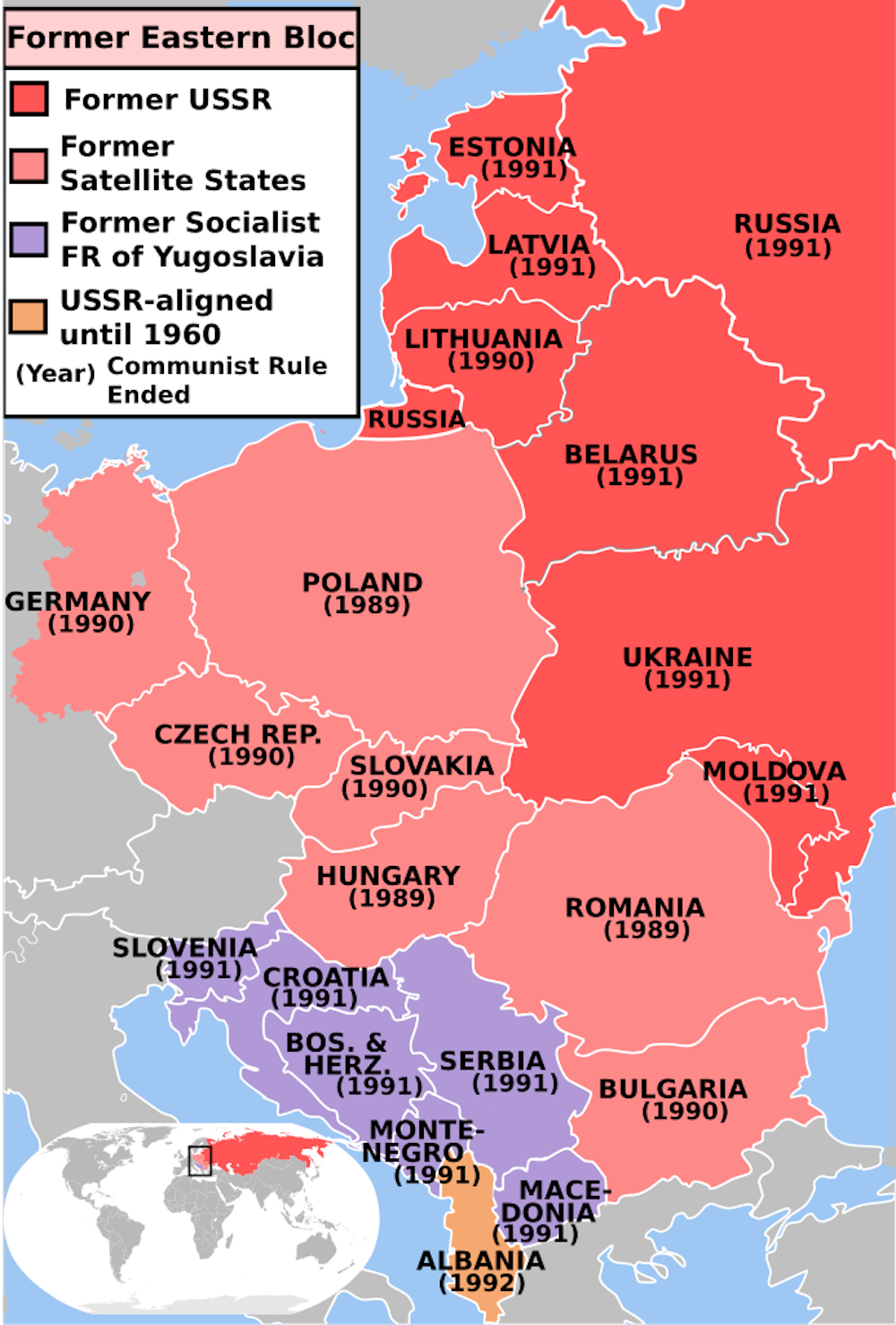
Map of former USSR States. Wikicommons, CC BY-SA

Contemporary relevance

The “Russian revolution”, then, was not just Russian and not just a revolution. It was also a moment when modern nations were born.

Notwithstanding earlier histories, today’s Ukraine, Belarus, Lithuania, Latvia, and Estonia began their lives in the crucible of war and revolution. Independent Finland and Poland, too, saw the light of day in 1917.

As one historian has pointed out in a compressed overview over events in Ukraine, “the Ukrainian revolution is not the Russian revolution.” Neither were the more democratic revolutions in Omsk, Samara, and Ufa, the same as the Bolshevik revolution in Petrograd, to say nothing of those beyond the peaks of the Caucasus, or the grassroots rural revolutions all over the empire. These other revolutions, often forgotten but as much part of the process as the iconic events in Petrograd, amounted to the catastrophic breakdown of the empire in 1918.

But the revolutionary period saw more than just the replacement of one empire by another. It also changed matters decisively. For one, the Soviet empire was not capitalist, notwithstanding the limited market mechanisms allowed under the New Economic Policy (NEP), introduced in 1921 to deal with the catastrophic economic crisis engendered by war, revolution, and civil war.

The new empire was also much more national in form than its Romanov predecessor had been. The aspirations of the non-Russian peoples had to be accommodated in some way and hence a pseudo-federal state was erected, where “Union republics” (such as Ukraine, Belarus, or Russia) were joined together in a Union of Soviet Socialist Republics (or USSR). In 1991, it would break apart along the borders of these Union republics, lines drawn, by and large, as a result of the reconquest of the Romanov lands by the revolutionary Red Army.

These lines became more significant over time, because of a second far reaching aspect of the national transformation of the multi-ethnic Romanov empire in the crucible of the “Russian” revolution. In order to deal with the threat of nationalism, the Soviet Union became an “affirmative action empire”, which gave non-Russian minorities space and resources to develop their languages and cultures. This affirmation of the national principle was meant to disarm nationalism and help the development of socialism. Instead, it inadvertently “promoted ethnic particularism”.

As a result, many of the nationalisms we encounter in the region today are to a considerable degree a result of this paradoxical Soviet nation making.

ref. World politics explainer: the Russian revolution – http://theconversation.com/world-politics-explainer-the-russian-revolution-100669]]>

You may not like reality TV but How ‘Mad’ Are You? rightly tests our assumptions about mental illness

]]>

Source: The Conversation (Au and NZ) – By Fincina Hopgood, Lecturer in Screen Studies, University of New England

In recent years, Australia’s public broadcasters have been willing to program innovative, thought-provoking content to coincide with Mental Health Week. This year is no exception, with SBS taking a gamble on a new format in a two-part series How ‘Mad’ Are You?, which began last night.

The series is produced by Blackfella Films, which also made the factual series First Contact and Filthy, Rich and Homeless. Much like these shows, How ‘Mad’ Are You? adapts the reality TV format of “the social experiment” to examine a complex social issue.


Read more: Go back to where you came from: Reality TV encounters the refugee crisis


This format – in which a group of strangers is placed in shared living arrangements and assigned tasks by the producers to create unscripted drama – was pioneered by Big Brother and has become a familiar trope of reality TV, most commonly associated with the melodrama of The Bachelor or Survivor franchises.

How ‘Mad’ Are You? shows the compassion and support of a diverse group of people who have willingly participated in this social experiment to combat the stigma of complex mental health conditions such as schizophrenia, obsessive compulsive disorder, anorexia nervosa, clinical depression and bipolar disorder.

Perhaps most importantly, the series offers a platform for five people with a lived experience of these conditions to tell their stories.

Who is ‘mad’ anyway?

Using this reality TV format to explore mental illness – specifically its diagnosis and the social stigma that accompanies it – was bound to be provocative, as some early comments on social media indicate.

The series’ title alone is a provocation, but it also offers an invitation (How ‘Mad’ Are You?) to place ourselves in the shoes of the participants.

By using quote marks, the title actively questions the term “mad” and invites us to consider its shifting definition in different contexts. This also alerts us to the show’s intention, as declared by SBS, to “challenge assumptions about what it means to have a mental illness.”


Read more: Go back to where you came from: Reality TV encounters the refugee crisis


How ‘Mad’ Are You? highlights the importance of collaboration between the screen industry and the mental health sector. As part of the show’s mission to challenge the social stigma of mental illness, Blackfella Films consulted with SANE Australia for expert advice to ensure the series would be responsible, not exploitative, in its handling of this sensitive issue and the participants.

In keeping with the Mindframe guidelines for media portrayals of mental illness, the show’s broadcast on SBS will provide viewers with contact information for mental health support services.

Questioning the diagnosis

How ‘Mad’ Are You? is based on a two-part 2008 BBC Horizon/Discovery Channel Co-Production of the same title (minus the quotation marks).

The BBC program was inspired by the 1972 Rosenhan Experiment in which the American psychologist David Rosenhan and colleagues faked symptoms of mental illness to see if they would be admitted to psychiatric hospitals.


Read more: Hoax highlights the pitfalls and perils of open access publishing


The experiment raised questions about the validity of psychiatric diagnosis, and was part of a broader social movement in the 1970s that highlighted the social construction of mental illness.

The Australian production follows the BBC format closely: ten volunteers, five of whom have a history of a mental illness diagnosis, complete a series of tests and challenges, such as performing stand-up comedy or solving a complex puzzle.

The participants undergo a range of tests to see how they function and perform. SBS/Blackfella Films

Their performance is observed by a panel of three mental health experts. After each test, the experts have to decide which of the five has a history of a mental illness diagnosis and what that diagnosis might be.

In the British version, the three experts included a psychiatrist, a professor of clinical psychology, and a psychiatric nurse: for the Australian version, the experts are Professor Jayashri Kulkarni, director of Australia’s largest psychiatry research centre; senior psychiatric nurse Jan Macintire; and clinical psychologist Professor Tim Carey.

The proverbial thin line between mental well-being and ill-health is visualised in How ‘Mad’ Are You? when the experts are asked to place photos of the participants on either side of a dividing line between mental health and illness.

The expert mental health panel try to guess who has been diagnosed with a metal illness in the past – and what type – and who hasn’t. SBS/Blackfella Films

This is a crude device, but it serves as the catalyst for reflective conversation between the experts, who become increasingly exasperated with the demands of the task and the scanty evidence on which they have to base their conclusions. “This is not what we normally do!” protests Professor Kulkarni.


Read more: Mental illness on screen – a new world of hopes and aspirations


The task of diagnosing an individual’s mental health solely on the basis of their performance in a series of tests, with both participants and experts being filmed by a camera crew, is unquestionably an artificial abstraction of mental health practice.

But what this experiment reveals is how stereotyping and snap judgements based on appearance and other social cues influence our wider perceptions of mental ill-health. The three experts navigate this minefield with tact and critical self-awareness.

The panellists acknowledge the difficulties of trying to diagnose someone based on observation alone. SBS/Blackfella Films

The series provides insight into the complex decision-making underpinning diagnosis and it is refreshing to see mental health experts willing to admit their uncertainty about the conclusions they are reaching.

Their empathy and compassion for the people they have been asked to scrutinise is palpable.

Under the guise of “entertainment” through the reality TV format, How ‘Mad’ Are You? will certainly start conversations about the role of diagnosis in the lived experience of mental ill-health.

While some viewers may object to the show’s central concept, How ‘Mad’ Are You? offers a new way of telling stories about mental health on screen and brings all of us into the conversation.

How ‘Mad’ Are You? is available on SBS On Demand. Part two airs next Thursday October 18 at 8.30pm.


For help or information call Lifeline on 13 11 14 or visit beyondblue.org.au.

ref. You may not like reality TV but How ‘Mad’ Are You? rightly tests our assumptions about mental illness – http://theconversation.com/you-may-not-like-reality-tv-but-how-mad-are-you-rightly-tests-our-assumptions-about-mental-illness-104764]]>

Archaeology can help us prepare for climates ahead – not just look back

]]>

Source: The Conversation (Au and NZ) – By Amy Prendergast, Lecturer in Physical Geography, University of Melbourne

This article is part of our occasional long read series Zoom Out, where authors explore key ideas in science and technology in the broader context of society and humanity.


Watching the weather for today and tomorrow is relatively easy with apps and news programs – but knowing what the climate was like in the past is a little more difficult.

Archaeological evidence can show us how humans coped with long-gone seasonal and environmental changes. For me, it’s fascinating because it reveals what life was like back then. But it’s useful beyond that too. This body of data helps us understand and build resilience to climate change in the modern world.

Archaeological data is now of a standard where it can map past climate variability, offer context for human-induced climate change, and even improve future climate predictions.


Read more: Friday essay: how archaeology helped save the Franklin River


Surviving all the seasons

As Earth takes its annual trip around the Sun, temperature, daylight hours and water availability vary through the seasons. These dictate natural cycles of animal breeding and migration, and plant fruiting and flowering. Such cycles control the availability of food, shelter, and raw material resources.

People living in cities might notice the changing seasons: autumn leaves turn a golden hue, and in summer fresh berries fill the supermarket shelves.

However, modern technology and global trade networks lessen the impact of the seasons on our daily lives. We can buy strawberries at any time of year (if we pay a premium). We can escape summer heatwaves by turning on air conditioners.

In most parts of Australia, our lives no longer depend on tracking the changes in plants and animals throughout the year. But in the past, if you weren’t in tune with seasonal patterns, you wouldn’t survive.

In my work I study how past people interacted with seasonal changes, using evidence from archaeological sites around the world.

Past and present seasonal patterns have changed due to climate change, causing cooler winters, warmer summers, or altered rainfall. Different seasons may occur earlier or later, last longer or be more extreme.

These changes have flow-on effects that can be detected in the archaeological record.


Read more: Sustainable shopping: want to eat healthy? Try an eco-friendly diet


Life in ancient Libya

One archaeological site where seasonal changes have been well studied is the Haua Fteah cave in the Gebel Akhdar region of Libya.

The entrance to the Haua Fteah cave site, Libya. Giulio Lucarini, University of Cambridge

The Haua Fteah covers the transitions from prehistoric hunter-gatherers (beginning around 150,000 years ago), and prehistoric farmers (beginning around 7,500 years ago), right the way through to more recent times.

We found the Haua Fteah experienced the most arid and highly seasonal conditions just after the last global ice age. This changed the plant and animal resources available in the local landscape over 17,000 to 15,000 years ago.

However, despite the climate and resource instability, human activity was the most intense during this period.

To investigate this, we compared climate records from the Gebel Akhdar and adjacent regions of North Africa.

It turns out that even though the Gebel Akhdar had an arid and highly seasonal climate, it was not as arid as surrounding regions at this time. Scientists believe that increasingly dry conditions elsewhere led to population increases at the Haua Fteah – people were simply seeking a less hostile place to live.

Additionally, use of shellfish as a food source changed from a predominantly winter-focused activity to a year-round activity during this period.

Year-round shellfish reliance was probably an adaptation to supplement the diet when other resources were less available. A mixture of climate and population pressures likely drove the restriction of resources and reliance on shellfish.


Read more: Curious Kids: Why do crab and prawn shells go red after they have been cooked?


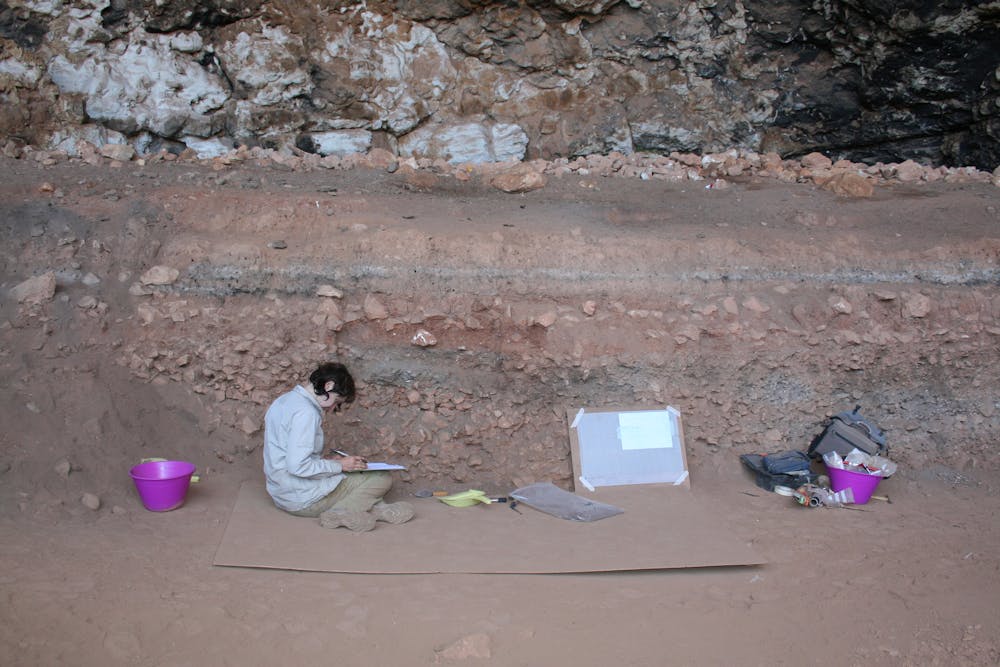
Amy Prendergast excavating a shell rich layer from the archaeological site of Haua Fteah. Giulio Lucarini, University of Cambridge

But beyond just knowing what people ate, and when, hiding in such shells (and other items) are clues about regional differences in seasonality.

Here’s how it works.

The remains of ancient meals

Archaeologists are essentially trash sifters. We use clues preserved in artefacts, plant and animal remains that people threw away or left behind to reconstruct the past.

Hard animal parts, including mollusc shells, teeth, fish ear bones (otoliths) and antlers, are routinely preserved in archaeological sites. These items accumulate from hunting, fishing, farming, and foraging activities.

The growth of these animal parts over time forms periodic growth rings, or increments. Much like tree rings in dendrochronology, the structure and chemical composition of these increments is influenced by the environment. By analysing these increments, we can understand what the environmental conditions during the animal’s life may have been like.


Read more: How ‘bling’ makes us human


Seasonal variations in climate parameters such as temperature, rainfall, and humidity can be reconstructed by analysing the chemical composition of these growth increments using the presence of stable isotopes and trace elements.

Analyses of the annual — and in some cases, fortnightly, daily and even tidal — increments allow us to reconstruct a detailed timeline of environmental change. This field of study is known as sclerochronology and it has expanded exponentially in the past couple of decades.

Image of shell growth increments from a limpet shell. A shows where the shell is cut to reveal the cross section in B. The shell cross section in C has been stained to enhance the visibility of the increments. Amy Prendergast

The shells, teeth and animal bones that we analyse are the remains of food collected and consumed by people. Therefore climate reconstructions from them can be directly linked to human activity.

We can establish the animal’s season of death and season of exploitation by humans by examining the growth pattern or chemistry of the most recent growth increment. For example, we can use oxygen isotopes to reconstruct the sea surface temperature when the animal died. A very cool temperature tells us that the animal was collected by humans during the winter.

Marine mollusc shells (Phorcus turbinatus) from the Haua Fteah archaeological site. Amy Prendergast

My colleagues and I recently wrote a review article and edited a journal special issue highlighting some of the latest research using these methods. The studies – which included evidence from prehistoric hunter-gatherers in the Mediterranean to historic Inuit sites in Canada – show how people dealt with seasonal variability in the past.

Learning from the past

Climate change is one of the most pressing issues in today’s world.

However, our understanding of how human-induced climate change fits into natural climate variability (pre-industrial) is limited by the instrumental record, which rarely extends beyond a century or so.

Proxy records of past climate variability — such as increments from animal teeth or mollusc shells — extend our understanding of long-term climate variability.

Such abundant archaeological evidence can fill in the gaps from climate records about seasonal and sub-seasonal variation.


Read more: Rising seas will displace millions of people – and Australia must be ready


We need the robust, quantitative, detailed data we are now getting from archaeological sites around the globe. It helps to contextualise current and future climate change, and to form baselines for environmental monitoring.

Additionally, these climate records are useful for testing and refining global and regional climate models. More accurate climate models give us a better understanding of the overall climate system, and an enhanced ability to predict future climate change.

Such data may help us build resilience to climate change in our modern world.

So next time you tuck into your shellfish dinner, or juicy steak, take a moment to reflect on all of the useful information preserved in the intricate hard parts these creatures leave behind.

Will archaeologists of the future study your discarded shells and bones?

ref. Archaeology can help us prepare for climates ahead – not just look back – http://theconversation.com/archaeology-can-help-us-prepare-for-climates-ahead-not-just-look-back-101823]]>

On gender and sexuality, Scott Morrison’s ‘blind spot’ may come from reading the Bible too literally

]]>

Source: The Conversation (Au and NZ) – By Robyn J. Whitaker, Senior Lecturer in New Testament, Pilgrim Theological College, University of Divinity

Why is our prime minister so poor on matters of gender and sexuality? Why won’t he clearly state that no institution in Australia, including schools, should be able to discriminate against children on the basis of their sexuality? Why won’t he condemn gay conversion therapy, despite widespread agreement within the medical community that it has no therapeutic value and is likely to harm?

This week, Morrison has hidden behind the phrase “it’s existing law” to defend religious schools’ right to discriminate against LGBT+ students.

He has previously stated that he is open to “preventative legislation” to protect religious freedoms and has talked about sending his daughters to an independent Christian school because he doesn’t want the values of the Safe Schools program imposed on them.

Some colleagues even claim Morrison has a “blind spot” when it comes to debate about religious freedom.

As a Pentecostal Christian, Morrison’s faith has already received much commentary. Yet, Pentecostalism alone does not explain Morrison’s views on gender and sexuality.


Read more: Explainer: what is Pentecostalism, and how might it influence Scott Morrison’s politics?


The Pentecostal movement was once at the vanguard of Christianity for its inclusion of women (and black) preachers, precisely because of its belief that the Holy Spirit endows gifts on whomever she chooses, not on the basis of gender, race, education, or any other criteria. Hence, it is not unusual to see a woman preaching in a Pentecostal church.

The key issue, as always, is how the Pentecostal church understands and interprets the Bible (hermeneutics). On this matter, the Pentecostal church sits within a wider strand of Christianity that reads the Bible in a “plain sense” or rather literalistic way. That is, it doesn’t have a robust scholarly tradition when it comes to the interpretation of this complex, ancient text, which can lead to pretty simplistic interpretation and a misunderstanding about the nature of biblical knowledge and truth.

Take, for example, the very first chapter of the Bible, which is often a basis for Christian conceptions of gender. Genesis 1 famously describes six “days” of creation and one day of divine rest.

Scholars agree that it is a form of Hebrew poetry that ultimately makes Sabbath/Shabbat the pinnacle of creation. The days are not literal 24 hour periods, but rather reflect the weekly pattern to life that undergirds Jewish life and laws about Shabbat. It was never intended to be a description of the science nor mechanics of creation. Instead, Genesis 1 offers a deep theological statement about the goodness of creation and God’s gift to that creation in mandating and blessing rest (for humans, animals, and land).

Yet, many Christians have and do interpret Genesis 1 in a more literalistic way: as actual action over six days that decrees the way God intended things to be or, worse still, as a scientific description of creation. So when they read “so God created humankind in his image, in the image of God he created them; male and female he created them” they interpret it to mean God intended only two genders. It seems pretty straightforward, right?

Well, no. Genesis 1 is full of poetic binaries: light and dark, day and night, land and sea, male and female. Just because we have light and dark does not mean we don’t have dusk and dawn. Just because we have land and sea does not mean we do not have beaches and tidal plains. These are not absolute categories, but rather a shorthand for the breadth of creation.

By extension, then, just because humans are created male and female, does not mean we don’t have diverse gender expressions that lie somewhere in between, nor that these diversities are not also part of the creation God declared to be good.

The Horizon church that Scott Morrison attends has no statement about gender or sexuality on its website. It is affiliated with the Australian Christian Churches, which also does not have an explicit statement on gender or sexuality. But it does say this about the Bible:

We believe that the Bible is God’s Word. It is accurate, authoritative and applicable to our every day lives.

Another statement claims the Bible is “infallible”. Words such as “accurate” and “infallible” commonly denote a worldview that considers the Bible to be the supreme authority on all knowledge, including scientific knowledge, putting it in fundamental conflict with science. It is a misunderstanding of what the Bible claims to be and the complex diversity of perspectives and genres therein.

The problem is, the Bible is neither accurate nor infallible on several measures. It is inconsistent, repeatedly historically inaccurate, and a text that reflects the cultural assumptions of its time (slavery is assumed, for example).

If you were to keep reading Genesis, you’d discover that Genesis 2 also describes creation, but this time it occurs in the opposite order (a human first) out of a dry dusty place (not watery chaos). Which is true? It can’t be both if “accuracy” means something measured in literal, factual, or scientific terms.


Read more: Ruddock report constrains, not expands, federal religious exemptions


Herein lies the problem. Beliefs about biblical “accuracy” are faith claims and are best framed in terms of theological truths about God. Taken in this light, biblical stories about gender and sexuality are not scientific evidence that sets Christianity against current medical and scientific knowledge, but rather ways that ancient believers expressed their understanding of God, life, and one another.

Morrison’s conservatism about gender and sexuality implies a worldview shaped by a conservative approach to the Bible where “biblical truth” is viewed as at odds with medical and scientific knowledge.

The dichotomy does not need to be there. One can hold belief in biblical authority and give credence to scientific knowledge on matters of gender, sexuality, or even climate change if one understands what the Bible does and does not claim to do. It is simply a matter of better interpretation.

ref. On gender and sexuality, Scott Morrison’s ‘blind spot’ may come from reading the Bible too literally – http://theconversation.com/on-gender-and-sexuality-scott-morrisons-blind-spot-may-come-from-reading-the-bible-too-literally-102843]]>

Focusing on people at ‘high risk’ of suicide has failed as a suicide prevention strategy

]]>

Source: The Conversation (Au and NZ) – By Helen Stallman, Hospital Research Foundation Fellow, University of South Australia

Many current suicide prevention interventions focus on raising awareness of suicide or on preventing it only at the point just prior to it occurring. But despite decades of government investment in suicide awareness programs, the rate of deaths by suicide in Australia is the second highest it’s been in ten years.

Clearly, we must expand our efforts.

Suicide occurs when a person can’t identify any other effective strategy to reduce their distress. It comes at a point when a person has reached the end of their tether. Australia’s National Mental Health and Suicide Prevention Plan 2017–2022 largely focuses on this kind of endpoint when people are about to die or have died of suicide. The focus is also on people with serious psychiatric illnesses or those considered at “high risk” of suicide.

To bring down Australia’s suicide rate, Australia must stop focusing on the suicide itself and put more effort into helping people find ways to cope. It should invest on helping people reduce their emotional reactivity, rather than waiting to intervene until the last minute before someone dies.


Read more: Three charts on: why rates of mental illness aren’t going down despite higher spending


Getting there earlier

There is often discussion about which age groups (adolescents, older adults or middle-aged adults), life circumstances (homelessness, domestic violence, workplaces, childhood abuse), or professions (doctors, lawyers, veterans, FIFO workers) have highest rates of deaths by suicide. This can distract from the underlying biological, psychological and social factors that contribute to suicide.

The factors contributing to distress and emotional reactivity are well-established. They are unhealthy environments (physical, social, cultural and economic), inadequate parenting, social isolation and unhealthy behaviours (sleep, nutrition and exercise), healthy coping, lack of resilience and lack of access to physical and psychological treatments.


Read more: Five types of food to increase your psychological well-being


Most of these factors don’t feature in Australia’s National Mental Health and Suicide Prevention Plan 2017–2022. Where the plan does address psychological and social issues, it does so in relation to people who already have a serious psychiatric illness or those considered “at high-risk” of suicide.

In our overburdened health systems, often only those determined to be at “high risk” get access to immediate services. Despite assessing risk for suicide being the prevailing model, more than 50 years of data has shown this approach is ineffective at the individual level – as everyone is different and the issue is complex.

If a person is deemed to be at risk, health professionals in Australia and internationally generally make decisions as to what shall be done to the person and what services they can receive. Such practices often end up detaining, monitoring and reducing access to possible methods of suicide.

Each person is different so the same strategy might not work for everyone. from shutterstock.com

While such strategies can help prevent someone from dying by suicide in any given moment, failure to address overwhelming stressors and improve everyday coping strategies leave a person vulnerable in the future. These practices can also make patients feel traumatised and unsupported.

Address the complex factors

There are three areas that need attention if we truly want to help people reaching the end point: prevention, evaluation and support.

Nationally, we have high rates of those factors associated with emotional instability: inadequate sleep, poor nutrition, and inadequate exercise. These are some obvious population targets to improve mental health in all Australians and prevent long-term risk of suicide. Meeting people’s basic needs for housing, parenting, and belonging are also important.

Health practitioners need to be skilled at identifying the primary drivers of distress and mental illness, and providing treatments. They must have links for patients to access community resources (such as financial aid, domestic violence support, housing, sleep, nutrition and physical activity interventions) where necessary to support their health and well-being and reduce distress.


Read more: Five lifestyle changes to enhance your mood and mental health


People who are distressed need to be supported to cope and access the right intensity of support when they ask for help. Too many people who ask for help are assessed as “not at high risk” and later die by suicide. Others are discharged from inpatient services without adequate support and later die. We must invest in supporting all Australians to cope, rather than waiting until the moment before we think they may die from suicide.

Focusing on suicide as a suicide prevention strategy has not been effective in reducing the prevalence of suicide. While we continue to fund band-aid solutions, rather than addressing the complex factors that contribute to emotional problems and overwhelming distress, it is unlikely rates of death by suicide in Australia will decline.

There is talk of setting targets for suicide prevention, which is also a very low measure of success. Similar to observing and monitoring vital signs of inpatients with suicidal thoughts to ensure they are alive, it ignores the mental life and quality of life of those who are alive.

Our long-term mental health strategy needs to focus on preventing distress through improved health and well-being, improved coping, and providing timely and adequate access to evidence-based treatments for all those who ask for help.


Anyone seeking support and information about suicide can contact Lifeline on 131 114 or beyondblue 1300 22 46 36.

ref. Focusing on people at ‘high risk’ of suicide has failed as a suicide prevention strategy – http://theconversation.com/focusing-on-people-at-high-risk-of-suicide-has-failed-as-a-suicide-prevention-strategy-104002]]>

Farmers’ climate denial begins to wane as reality bites

]]>

Source: The Conversation (Au and NZ) – By Sarah Ann Wheeler, Professor in Water Economics, University of Adelaide

Australia has been described as the “front line of the battle for climate change adaptation”, and our farmers are the ones who have to lead the charge. Farmers will have to cope, among other pressures, with longer droughts, more erratic rainfall, higher temperatures, and changes to the timing of seasons.

Yet, puzzlingly enough to many commentators, climate denial has been widespread among farmers and in the ranks of the National Party, which purports to represent their interests.


Read more: The Nationals have changed their leader but kept the same climate story


Back in 2008, only one-third of farmers accepted the science of climate change. Our 2010-11 survey of 946 irrigators in the southern Murray-Darling Basin (published in 2013) found similar results: 32% accepted that climate change posed a risk to their region; half disagreed; and 18% did not know.

These numbers have consistently trailed behind the wider public, a clear majority of whom have consistently accepted the science. More Australians in 2018 accepted the reality of climate change than at almost any time, with 76% accepting climate change is occurring, 11% not believing in it and 13% being unsure.

Yet there are signs we may be on the brink of a wholesale shift in farmers’ attitudes towards climate change. For example, we have seen the creation of Young Carbon Farmers, Farmers for Climate Action, the first ever rally on climate change by farmers in Canberra, and national adverts by farmers on the need for climate action. Since 2016 the National Farmers Federation has strengthened its calls for action to reduce greenhouse emissions.

Our latest preliminary research results have also revealed evidence of this change. We surveyed 1,000 irrigators in 2015-16 in the southern Murray-Darling Basin, and found attitudes have shifted significantly since the 2010 survey.

Now, 43% of farmers accept climate change poses a risk to their region, compared with just 32% five years earlier. Those not accepting correspondingly fell to 36%, while the percentage who did not know slightly increased to 21%.

Farmers’ attitudes to climate change have shifted over the course of this decade. Centre for Global Food and Resources, Author provided (No reuse)

Why would farmers deny the science?

There are many factors that influence a person’s denial of climate change, with gender, race, education and age all playing a part. While this partly explains the attitudes that persist among farmers (who tend to be predominantly male, older, Caucasian, and have less formal education), it is not the full story.

The very fact that farmers are on the front line of climate change also drives their climate change denial. For a farmer, accepting the science means facing up to the prospect of a harsher, more uncertain future.

Yet as these changes move from future prospect to current reality, they can also have a galvanising effect. Our survey results suggest farmers who have seen their farm’s productivity decrease over time are more likely to accept the science of climate change.

Doing it tough. AAP Image/Lukas Coch

Many farmers who have turned to regenerative, organic or biodynamic agriculture talk about the change of mindset they went through as they realised they could no longer manage a drying landscape without major changes to their farming practices.


Read more: Farmers experiencing drought-related stress need targeted support


In addition, we have found another characteristic that is associated with climate change denial is whether farmers have identified a successor for their farm. Many farmers desire to turn their farm over to the next generation, hopefully in a better state than how they received the farm. This is where the psychological aspect of increased future uncertainty plays an important role – farmers don’t want to believe their children will face a worse future on the farm.

We all want our children to have better lives than our own, and for farmers in particular, accepting climate change makes that very challenging. But it can also prompt stronger advocacy for doing something about it before it’s too late.

What can we do?

Whether farmers do or do not accept climate change, they all have to deal with the uncertainty of weather – and indeed they have been doing so for a very long time. The question is, can we help them to do it better? Given the term “climate change” can be polarising, explicit climate information campaigns will not necessarily deliver the desired results.


Read more: To help drought-affected farmers, we need to support them in good times as well as bad


What farmers need are policies to help them manage risk and improve their decision-making. This can be done by focusing on how adaptation to weather variability can increase profitability and strengthen the farm’s long-term viability.

Farming policy should be more strategic and forward-thinking; subsidies should be removed for unsustainable practices; and farmers should be rewarded for good land management – both before and during droughts. The quest remains to minimise the pain suffered by all in times of drought.

ref. Farmers’ climate denial begins to wane as reality bites – http://theconversation.com/farmers-climate-denial-begins-to-wane-as-reality-bites-103906]]>

The science is clear: we have to start creating our low-carbon future today

]]>

Source: The Conversation (Au and NZ) – By Alan Finkel, Australia’s Chief Scientist, Office of the Chief Scientist

This week’s release of the special report from the Intergovernmental Panel on Climate Change (IPCC) has put scientific evidence on the front page of the world’s newspapers.

As Australia’s Chief Scientist, I hope it will be recognised as a tremendous validation of the work that scientists do.

The people of the world, speaking through their governments, requested this report to quantify the impacts of warming by 1.5℃ and what steps might be taken to limit it. They asked for the clearest possible picture of the consequences and feasible solutions.


Read more: The UN’s 1.5°C special climate report at a glance


It is not my intention in this article to offer a detailed commentary on the IPCC’s findings. I commend the many scientists with expertise in climate systems who have helped Australians to understand the messages of this report.

My purpose is to urge all decision-makers – in government, industry and the community – to listen to the science.

Focus on the goal

It would be possible for the public to take from this week’s headlines an overwhelming sense of despair.

The message I take is that we do not have time for fatalism.

We have to look squarely at the goal of a zero-emissions planet, then work out how to get there while maximising our economic growth. It requires an orderly transition, and that transition will have to be managed over several decades.

That is why my review of the National Electricity Market called for a whole-of-economy emissions reduction strategy for 2050, to be in place by the end of 2020.


Read more: The Finkel Review at a glance


We have to be upfront with the community about the magnitude of the task. In a word, it is huge.

Many of the technologies in the IPCC’s most optimistic scenarios are at an early stage, or conceptual. Two that stand out in that category are:

  • carbon dioxide removal (CDR): large-scale technologies to remove carbon dioxide from the atmosphere.

  • carbon capture and sequestration (CCS): technology to capture and store carbon dioxide from electricity generation.

It will take a decade or more for these technologies to be developed to the point at which they have proven impact, then more decades to be widely deployed.

The IPCC’s pathways for rapid emissions reduction also include a substantial role for behavioural change. Behavioural change is with us always, but it is incremental.

Driving change of this magnitude, across all societies, in fundamental matters like the homes we build and the foods we eat, will only succeed if we give it time – and avoid the inevitable backlash from pushing too fast.

The IPCC has made it clear that the level of emissions reduction we can achieve in the next decade will be crucial. So we cannot afford to wait.

Many options

No option should be ruled off the table without rigorous consideration.

In that context, the Finkel Review pointed to a crucial role for natural gas, particularly in the next vital decade, as we scale up renewable energy.

The IPCC has made the same point, not just for Australia but for the world.

The question should not be “renewables or coal”. The focus should be on atmospheric greenhouse emissions. This is the outcome that matters.

Denying ourselves options makes it harder, not easier, to get to the goal.

There also has to be serious consideration of other options modelled by the IPCC, including biofuels, catchment hydroelectricity, and nuclear power.

My own focus in recent months has been on the potential for clean hydrogen, the newest entrant to the world’s energy markets.


Read more: How hydrogen power can help us cut emissions, boost exports, and even drive further between refills


In future, I expect hydrogen to be used as an alternative to fossil fuels to power long-distance travel for cars, trucks, trains and ships; for heating buildings; for electricity storage; and, in some countries, for electricity generation.

We have in Australia the abundant resources required to produce clean hydrogen for the global market at a competitive price, on either of the two viable pathways: splitting water using solar and wind electricity, or deriving hydrogen from natural gas and coal in combination with carbon capture and sequestration.

Building an export hydrogen industry will be a major undertaking. But it will also bring jobs and infrastructure development, largely in regional communities, for decades.

So the scale of the task is all the more reason to press on today – at the same time as we press on with mining lithium for batteries, clearing the path for electric vehicles, planning more carbon-efficient cities, and so much more.

There are no easy answers. I hope, through this and other reports, there are newly determined people ready to contribute to the global good.

ref. The science is clear: we have to start creating our low-carbon future today – http://theconversation.com/the-science-is-clear-we-have-to-start-creating-our-low-carbon-future-today-104774]]>

Newsflash. For most, energy remains affordable

]]>

Source: The Conversation (Au and NZ) – By Ben Phillips, Associate Professor, Centre for Social Research and Methods, Director, Centre for Economic Policy Research (CEPR), Research School of Economics, Australian National University

Electricity prices have doubled in the past ten years, climbing 117%, which is 76% more than inflation. Gas prices climbed 89%, 53% more than inflation.

In a report to be released on Friday by the Australian Council of Social Service and the Brotherhood of St Laurence, we examine what these climbing prices have actually cost different types of households, after taking full account of energy use and government concessions and rebates, including solar energy rebates.

Our modelling is based on the Bureau of Statistics Household Expenditure Survey. We use the changes between the 2003-04, 2009-10 and 2015-16 surveys to develop estimates for the changes between 2008 and 2018.

For most, it’s as affordable as it was ten years ago

A perhaps surprising finding is that, despite those strong price rises, there has been relatively little change in the amount households spend on gas and electricity as a proportion of their incomes.

The average proportion of household income spent on electricity and gas has climbed just 0.1% over the decade, from 2.3% to 2.4%.


Read more: Capping electricity prices: a quick fix with hidden risks


Prices have climbed more sharply than spending, but some households have responded to higher prices by using less energy in order to keep costs in check. This has been achieved partly by taking advantage of improvements in the efficiency of devices such as air conditioners, and also by being more frugal.

But not for renters, or the unemployed

Low-income households, in particular households whose main source of income is a government payment such as Newstart, are spending much more of their (already small) budgets on energy.


In 2008 energy costs took up 5.9% of low-income households’ disposable income. By 2018 they took up 6.4%.

In contrast, the highest-earning households spend just 1.5% of their income on energy, up from 1.4%.


One in four low-income households spend at least 9% or more of their income on energy.

Renters pay a higher proportion of their income than home owners, and have also suffered much bigger increases in costs, perhaps because they have less scope to make the sorts of changes to their homes needed to get costs down.


By region, costs are the highest in Adelaide (on average about 3.4% of disposable income) and the lowest in Sydney and Brisbane (about 2%).

If you’re wealthy, you can go solar

Another perhaps surprising finding is that the take-up of solar panels is fairly evenly distributed across the income spectrum. Among the bottom four in ten households the take-up is 15%. Among the top four in ten, it is 17%.


Read more: Are solar panels a middle-class purchase? This survey says yes


But high wealth households are far more likely than low wealth households to take up solar. For the most wealthy the take-up is 23.5%, for the least wealthy it is 4%.

Typical savings are about A$500 a year. High wealth households saved much more than low wealth households.

It’s the high payers that are paying more

For most, energy remains as affordable as it was ten years ago. That’s because, for most, incomes have been climbing – although not to the same extent as energy prices. Even pensioners received quite big increases in 2009.


Read more: Higher energy prices are here to stay – here’s what we can do about it


It’s also because many households have been able to cut back their use of externally supplied energy, especially high wealth households that can afford solar panels, and those who own the home they live and have the right to modify it.

For others, especially households who rent, and those headed by people on non-pension benefits, energy costs are climbing sharply. Already paying much more of their income than others, they’re trapped into spending even more.

ref. Newsflash. For most, energy remains affordable – http://theconversation.com/newsflash-for-most-energy-remains-affordable-104541]]>

Vital Signs: Amazon has lifted its wages, but the implications aren’t as good as you might think

]]>

Source: The Conversation (Au and NZ) – By Richard Holden, Professor of Economics and PLuS Alliance Fellow, UNSW

Amazon has just voluntarily raised its employees’ minimum wage to US$15 an hour. Retail giant Costco has moved to US$14. This might not sound like a lot – and it is sure not a lot to live on – but with the US federal minimum wage at US$7.25 it is a big shift.

Why are they paying more?

The cheap answer is that Amazon in particular has buckled to external pressure.

Democrat senator Elizabeth Warren, a possible 2020 presidential contender, has suggested regulating it and other technology companies with a version of the depression-era laws used to curb the power of banks.

Senator Bernie Sanders and Representative Ro Khanna have already introduced the Stop Bad Employers by Zeroing Out Subsidies Act. Also known as the Stop BEZOS Act. Oh, the subtlety. But Amazon founder Jeff Bezos didn’t get to be the world’s richest man by pre-emptively giving into these kind of folks.

A more interesting answer is this. The US labour market is incredibly tight right now. Unemployment is running at 3.7%. Standard economic theory says that as unemployment goes down employers have to pay more to attract workers. So wages go up. People like me normally draw a nice, smooth curve in economics 101 to represent that relationship.

Trouble with the curve

But maybe the curve isn’t smooth. It could be that, especially in large companies such as Amazon, wage rises come in jumps, not smooth increments.

Imagine yourself Bezos for a day and consider what happens if you raise wages a modest amount for all your nearly 550,000 employees. That costs a ton. You could raise wages more frequently but by just a few cents an hour, which would of course cost less.

Yet we know from behavioural economics people tend to think of small raises as zero. So it costs you something but your workers don’t care. That’s a bad trade.


Read more: Is faster profit growth essential for a pick-up in wages growth?


How does this shake out? Well, it takes getting unemployment down a lot before you are willing to raise wages; and when you move, it will be a big enough move to be appreciated.

Now this is just a theory. But perhaps the explanation that sluggish wage growth can be blamed on the excessive power of big employers is incomplete.

Perhaps it is more accurate to say that power manifests itself in slow wages growth only for moderate movements in unemployment. With really big changes – like the huge decline in unemployment seen in the US – things are different.

Only big steps count

If this is right then one unmistakable implication is that Australia also needs a big step down in unemployment to get past its sluggish wage growth. For the past five years or so wages growth has barely kept up with inflation.

Perhaps we need to get unemployment down from its current level of 5.6% to something more like 4.5% before employers will offer significant wage rises.


Read more: This is what policymakers can and can’t do about low wage growth


For the Reserve Bank of Australia, stimulating the economy to reduce the jobless rate would mean cutting, not raising, the cash rate from 1.5% now to perhaps 1% or so. With less fear about property bubbles thanks to tighter lending standards – and less fear still if Labor is elected and cuts back negative gearing perks – there is more room to cut.


I have just laid out a kind of “what if” theory. Economists test such theories with data – in this case identifying the causal effect of unemployment changes on wage bargaining outcomes – and by using some natural experiment (like an unexpected war) or clever empirical strategy (think Steve Levitt and Mark Duggan’s statistical evidence for cheating in Sumo Wrestling).

Economics research like this typically takes a couple of years. But the RBA has to set interest rates every month based on its best guess of the answer. It can’t just wait two years for the research to come in.

This is the kind of time pressure economic policy makers have had to deal with over the past decade. The world is different than it was. The old economic models of unemployment and the macroeconomy don’t work very well. Intuitions need to be rethought and instincts rewired.

ref. Vital Signs: Amazon has lifted its wages, but the implications aren’t as good as you might think – http://theconversation.com/vital-signs-amazon-has-lifted-its-wages-but-the-implications-arent-as-good-as-you-might-think-104687]]>

Friday essay: where are the female academics on film?

]]>

Source: The Conversation (Au and NZ) – By Tom van Laer, Reader (Associate Professor) of Marketing, City, University of London

The 2016 science-fiction drama Arrival, starring Amy Adams as linguistics professor Dr Louise Banks, was a ceiling-shattering moment for female academics. The film, directed by Denis Villeneuve, presented Adams’ character in a race against time to avert a war by finding a way to communicate with extraterrestrial visitors.

Banks’s character was groundbreaking because for decades, men have been portrayed as brilliant, heroic academics in American and British films. Movies such as A Beautiful Mind, The Imitation Game, The Theory of Everything, Good Will Hunting and Wonder Boys are not only all set at a university or in research institutes – and mostly excellent works of art – but are also all dramas of academic masculinity.

In these movies, women are extras who exist only to offer comfort, help, love, lust and support to the great man until they are assaulted, dumped or divorced.

Women make up 49.3% of academia in America, 45.7% in Britain and 45.6% in Australia. Yet female academics have barely appeared as rounded characters in movies.

I still remember my joy and shock at watching Alfonso Cuarón’s Gravity, five years ago, in which Sandra Bullock plays Dr Ryan Stone, a medical engineer who is stranded in space after the mid-orbit destruction of her space shuttle. Here was a blockbuster movie starring a complex, female academic character. Yet Gravity was not the breakthrough for which I had hoped. A single momentous work cannot, by itself, change things.

The absence of these characters in mainstream film matters, because most women in academia must still fight to tell their own stories and fight against the stories that distort or erase them. And on the rare occasions when women have appeared as academics in Hollywood films, their depictions have often been awful.

The most notorious examples are characters such as the naive palaeontologist Dr Sarah Harding (Julianne Moore) in The Lost World: Jurassic Park, or worse, the talented PhD student Hannah Green (Katie Holmes) in Wonder Boys, who lusts after her male supervisor.

While Dr Harding is ostensibly an intelligent academic, in The Lost World she more accurately serves as a damsel-in-distress. Ironically, it is Dr Harding’s supposed intelligence that puts her in distress in the first place. (Bring the baby Tyrannosaurus rex aboard the mobile home? Sure mommy, the nine-ton predator will never smell a baby or hear its cries in there!) When Dr Harding’s scientific shortsightedness leads to trouble, she proves she can wail on par with any princess in jeopardy.

Julianne Moore in The Lost World: Jurassic Park (1997). IMDB

The Wonder Boys’ Hannah Green is the ideal student for hyper-masculine academics. She is beautiful, brilliant, and innocent. She lives for her studies. And she has a crush on her male professor. Moon-eyed, she gushes:

I was thinking it’s like all your sentences seem as if they’ve always existed, waiting around up there, in Style Heaven, or wherever, for you to fetch them down.

In short, she is the perfect muse.

Women wince at these unrealistic portrayals. They hurt because many viewers will take these stereotyped depictions and transfer them to any female academic they later encounter.

The brilliant women who deserve movies

One solution to all this is to change how and what stories are told. So here are my picks of women with brilliant minds who deserve movies of their own.

  • Hypatia, the Egyptian astronomer who built an astrolabe, the first instrument for calculating the position of the sun, moon, and stars at any given time. She taught astronomy and philosophy in ancient Alexandria and her classes where always popular. Students and other scholars would crowd in to hear her explain that you must reserve your right to think – for even to think wrongly is better than not to think at all.

  • Maria Reiche, the 20th century German archaeologist who found that hundreds of mysterious lines etched into the dry Peruvian desert, called Nazca Lines, actually correspond to the constellations in the night sky. She flew helicopters and planes to map the lines and used so many brooms to clean them that some people thought she was a witch.

A hummingbird depicted in the Nazca lines. Maria Reiche figured out the lines corresponded to constellations. Shutterstock.com
  • Ada Lovelace, the British mathematician who in 1843 wrote the first computer program in history, way before modern computers were invented!
A portrait of Ada Lovelace circa 1840, possibly painted by Alfred Edward Chalon. Wikimedia
  • Grace Hopper, the American computer scientist. Thanks to the programs she wrote for the first computer, called Mark I, and its successors, US forces were able to decode secret messages their enemies sent during the second world war.

  • Marie Curie, the scientist who found out that some minerals are radioactive, give off powerful rays and glow in the dark. Born in Poland in 1867, she moved to France to study. She discovered two new radioactive elements – polonium and radium – and won two Nobel prizes for her work. She died in France in 1934 due to exposure to radiation.

  • Jane Goodall, the British primatologist who has discovered that chimpanzees have rituals and use tools, that their language comprises at least 20 different sounds, and that they are omnivores.

  • Maria Montessori, an Italian physician and educator who lived from 1870 to 1952. Instead of applying old teaching methods, she watched children to see how they learnt. Her innovative teaching method is applied in thousands of schools and it helps children all over the world grow independent and self-sufficient.

Jane Goodall, who first went to study chimpanzees in Tanzania in 1960. IMDB
  • Mae C. Jemison, the first African-American woman in space. She graduated in African-American studies, chemical engineering, and medicine and learnt to speak Japanese, Russian, and Swahili. After becoming a doctor and volunteering in Cambodia and Sierra Leone, she then applied to NASA to become an astronaut. Dr Jemison was selected and sent into space on board the space shuttle. She carried out tests on other members of the crew. Since she was not only an astronaut but also a doctor, her mission was to conduct experiments on weightlessness and motion sickness. When Dr Jemison came back to Earth, she realised that her true passion was improving health in Africa. So, she quit NASA and now runs a company that uses satellites to do just that.

Signs of progress

Filmmakers continue to produce movies with male actors (The Martian), with academic characters played by male actors (Doctor Strange) and with research institutes led by men (Interstellar).

Mae C. Jemison became the first African-American woman in space in. Wikimedia

Nevertheless, the developments since Arrival are encouraging. 2017 saw Hidden Figures, the movie about the three brilliant African-American women at NASA – Katherine Johnson (Taraji P. Henson), Mary Jackson (Janelle Monáe), and Dorothy Vaughan (Octavia Spencer) – who served as the brains behind one of the greatest operations in history: the launch of astronaut John Glenn (Glen Powell) into orbit. It was a stunning achievement that restored the US’s confidence, turned around the Space Race, and galvanised the world.

And this year, Annihilation was launched. Based on Jeff VanderMeer’s bestselling Southern Reach Trilogy, the movie stars Natalie Portman (as a cellular biologist), Jennifer Jason Leigh (as a psychologist), Tuva Novotny (as an anthropologist), Tessa Thompson (as a physicist), and Gina Rodriguez (as a paramedic). If Gravity chipped the ceiling for female academics; Arrival appears to have finally smashed it.

If Arrival does succeed in transforming how filmmakers perceive and represent women and female academics, it is due not only to this one movie being good and profitable, but also to the long, slow work by female and male actors, agents, directors, producers, researchers, writers and others that has gone before it. For decades, people have been researching gender representation in media and advocating for equal representation of women.

Still, Arrival should really have been just a science-fiction drama about a linguistics professor, who happens to be female, leading an elite team of investigators. Yet, with so few movies about female professors, or female humanities scholars, or female lead investigators, or female academics in general, it became highly symbolic.

The real test of how far things have progressed will be when a female academic has the luxury of being the star of a bad movie. That is one measure of equality — the right to be bad and not suffer for it, rather than the demand, placed on female academics and actresses, to be exceptional just to be seen.

ref. Friday essay: where are the female academics on film? – http://theconversation.com/friday-essay-where-are-the-female-academics-on-film-102986]]>

Media prize a ‘defeat’ for Australian refugee censorship, says author

]]>

Behrouz Boochani … Australian government used “systematic censorship” to control refugee information. Image: Hoda Afshar/Behrouz Boochani/RNZ Pacific

By RNZ Pacific

A refugee journalist detained on Papua New Guinea’s Manus Island says winning an Italian award for investigative journalism could end censorship of offshore detention in the Australian media.

Behrouz Boochani, who has made a documentary and written a book during his five years in exile, has won the Anna Politkovskaya Prize for Press Freedom from the Italian magazine Internazionale.

Boochani regularly contributes to The Guardian and the Saturday Paper in Australia but said other publications supported the Australian government’s efforts to restrict information about its offshore detention regime.

READ MORE: Australia needs a moral revolution

“The Australian government couldn’t keep 2000 people, including children and women, in a harsh prison camps on Manus and Nauru without systematic censorship,” Boochani said.

“I have many experiences working with the media in Australia and also internationally over the past five years and I know that the government always tries to manage the information and censor the situation,” he said.

-Partners-

“But after five years I think they are defeated because international media and public opinion are aware completely of what the government has done on Manus and Nauru.”

Condemning a fact
The Guardian reported that the award’s organisers paid tribute to Boochani’s “commitment to condemning a fact which has been intentionally kept out of the spotlight”.

The prize was a symbol of the struggle of the refugees who had spoken out from offshore detention as well as their advocates, human rights defenders and independent journalists who had covered their stories, the journalist said.

“I think it is very important because our work is acknowledged and recognised internationally.”

This article is republished under the Pacific Media Centre’s content partnership with Radio New Zealand.

Print Friendly, PDF & Email

Article by AsiaPacificReport.nz

]]>

Vanuatu Daily Post … latest news hot off the free press

]]>

“How your newspaper gets to you” … Vanuatu Daily Press press rolling with the day’s news. Video: VDP

Pacific Media Watch Newsdesk

The Vanuatu Daily Post, only daily newspaper in Vanuatu, and a leading champion of a free press in the South Pacific, has posted a video of its printing press in action in Port Vila.

It is a rare insight into small press publishing in the region. The video of the Seattle-manufactured Web Leader has been posted on the newspaper’s social media to inform readers.

Launched in 1993 as The Trading Post, the newspaper quickly established itself as a pioneer of freedom of press in Vanuatu and has broken practically every major news story first since its launch by English-born publisher Marc Neil-Jones.

The publisher faced enormous difficulties in the early years and was subject to deportation, jailing and assaults.

However, those days have passed on, the newspaper reports on its website and has had local Ni-Vanuatu editors since 2003.

-Partners-

Currently the editor is award-winning Jane Joshua, backed up by the group media director Dan McGarry.

“As Vanuatu’s largest privately owned media company, employing nearly 50 people, Trading Post Ltd has successfully moved in publishing the official tourism newspaper of the Vanuatu Tourism office called What To Do In Vanuatu and has launched a popular radio station called 96 BUZZ FM,” the paper says.

Vanuatu Daily Post is a successful and profitable newspaper and is consistently been the first choice for all advertising in Vanuatu.”

The striking Vanuatu Daily Post logo.
Print Friendly, PDF & Email

Article by AsiaPacificReport.nz

]]>

Grattan on Friday: Malcolm Turnbull is gone but son Alex keeps the climate faith

]]>

Source: The Conversation (Au and NZ) – By Michelle Grattan, Professorial Fellow, University of Canberra

In a Thursday video for the Wentworth byelection, Malcolm Turnbull’s son Alex has denounced “extremists on the hard right” who, he says, have taken over the Liberal Party.

The younger Turnbull called on voters in his dad’s old seat to register a protest about the party’s direction, and deliver a message on climate change. “If you want to pull the Liberal party back from the brink, there is one clear signal you can send,” he said, urging people not to vote Liberal.

Apart from the leadership coup Turnbull, a Singapore-based investment manager, highlighted energy policy to make his point about the hard right’s “crazy agenda”.

“As an investor in energy, I’ve seen that in particular there’s no way coal can compete anymore. Renewables have gotten too cheap, firming costs are reasonable, and really there’s no trade off any more between lowering your power bills and reducing emissions. And yet still some would like to prosecute a culture war over this issue”.

Kerry Schott, head of the Energy Security Board, is coming from a rather different place but at the Australian Financial Review’s energy summit this week she delivered an equally blunt message about the politics of energy, describing “the general state of affairs right now as anarchy”.

Schott spearheaded the development of the National Energy Guarantee, a plan that had widespread backing, only to be slain by the Liberal party’s right in the exercise that felled Turnbull. Schott likened her feelings to “going through the stages of grief”, saying “I haven’t left anger yet”.

Anyone with an eye for decent policy, for getting some order into an area that’s long been the plaything of chaotic hyper-partisanship, would be there with Schott. As for investors in the sector, they’re in despair.

Scott Morrison stepped into the prime ministership amid the smouldering ruins of the NEG – which he quickly declared dead – and the Liberal right wingers’ scepticism about emissions reduction targets and hostility to the Paris climate agreement.

His approach has been to load all the emphasis onto price, with Angus Taylor “the minister for getting electricity prices down”. As for emissions, the 26%-28% on 2005 levels by 2030 reduction target has stayed, but it is played down, with Morrison’s line being that it will be reached “in a canter”.

Morrison has, however, fended off the right’s persistent calls for Australia to get out of Paris. Tackled this week by shock jock Alan Jones, the Prime Minister gave his usual two reasons for declining to exit.


Read more: View from The Hill: The uncivil Mr Jones


Australia should stick with agreements it had made, he said, pointing out that the Abbott government (not a Labor one) had signed up. And climate change was an “enormously important issue” to the Pacific countries, which in turn were important to Australia strategically.

More broadly though, Morrison avoids dwelling on the significance of climate change.

To deal with energy in all its aspects – policy and politics – a government requires a linked, multi-pronged approach that manages, at the most efficient price, the inevitable transition to cleaner energy.

For business, the policy needs to set an investment framework providing predictability; for consumers it has to constrain prices; for the general citizenry, it should pay regard to their concerns about global warming.

The Morrison government isn’t doing much on the first or the third requirement, and is likely, when the election comes around, to have fallen short of significant progress on the second.

After the collapse of the NEG there is no certainty for investors. According to one independent source close to the industry, business has given up on this government. Another source says business is trying to work out its own way ahead.

Business is more tuned into, and willing to talk about, the emissions challenge and climate change than the government is. For the government, going there takes it down the alley of internal ideological conflict.

When the Intergovernmental Panel on Climate Change’s report came this week, the Coalition was unimpressed by its call for the international community to phase out coal by mid-century in order to contain the temperature rise. After all, the government is still under internal pressure to underpin investment in new coal-fired power, if investors can be found.

In contrast, Alex Turnbull said in his video the IPCC report “frankly was terrifying … and it’s seemingly insane to me that we could not be doing something about this and soon”.


Read more: IPCC 1.5℃ report: here’s what the climate science says


Obviously the government is correct when it judges voters are focused on power prices. But it errs in its apparent belief that the public don’t care much about emissions, and it under-estimates people’s commitment to renewables.

In this year’s Lowy poll, 59% agreed with the proposition: “Global warming is a serious and pressing problem. We should begin taking steps now even if this involves significant costs”.

The survey found 84% agreed with the statement: “The government should focus on renewables even if this means we may need to invest more in infrastructure to make the system more reliable”.

Only 14% agreed: “The government should focus on traditional energy sources such as coal and gas, even if this means the environment may suffer to some extent”.

And yet the government refers to dispatchable power as “fair dinkum” power. It doesn’t just go to the problems that have to be addressed with renewables, but often in its rhetoric gives them something of a second-class status.

The government’s near-total focus on prices translates into what it characterises as a “big stick” approach towards companies – a degree of intervention it would roundly condemn if it were being pursued by a Labor government.

The biggest stick can only do so much, and prices will still be high when people vote.

Taylor told the AFR summit, “If the industry focuses on consumers, customers and their interests, government can return to the light touch regulations that we would always prefer”.

But while measures at the consumer end have an essential place, the core of the issue is further back in the chain – getting the proper settings to encourage investment.

That is what the government can’t achieve, because of its own divisions.

As on other fronts, the Coalition has handed an advantage to Labor on energy and climate policy.

The ALP has a controversially ambitious target for emissions reductions (45 per cent reduction on 2005 levels by 2030), but the government’s ability to run a scare campaign about the implications for price and reliability is diminished by its own gaping policy hole.

Labor is looking to pick up the discarded NEG. It is currently grappling with the question of how, if it brought in a NEG, it could maximise certainly for investors in a political situation where a Coalition opposition could play “the politics of repeal” – as Tony Abbott did when the then ALP government introduced its carbon policy.

After the government’s shambles, Labor has a reasonable story to tell investors. But the story those investors really wanted to hear was a bipartisan one, and that won’t be delivered.

ref. Grattan on Friday: Malcolm Turnbull is gone but son Alex keeps the climate faith – http://theconversation.com/grattan-on-friday-malcolm-turnbull-is-gone-but-son-alex-keeps-the-climate-faith-104797]]>

We need more carbon in our soil to help Australian farmers through the drought

]]>

Source: The Conversation (Au and NZ) – By Nanthi Bolan, Professor of Enviornmental Science, University of Newcastle

Australia has never been a stranger to droughts, but climate change is now super-charging them.

Besides taking a toll on human health, droughts also bake the earth. This means the ground holds less water, creating a vicious cycle of dryness.

Our research has investigated ways to improve the health and structure of soil so it can hold more water, even during droughts. It’s vital to help farmers safeguard their soil as we adapt to an increasingly drought-prone climate.


Read more: Australia moves to El Niño alert and the drought is likely to continue


Soil moisture is key

The immediate effect of drought is complete loss of soil water. Low moisture reduces soil health and productivity, and increases the loss of fertile top soil through wind and water erosion.

To describe how we can improve soil health, we first need to explain some technical aspects of soil moisture.

Soil with good structure tends to hold moisture, protecting soil health and agricultural productivity. Author provided

Soil moisture is dictated by three factors: the ability of the soil to absorb water; its capacity to store that water; and the speed at which the water is lost through evaporation and runoff, or used by growing plants.

These three factors are primarily determined by the proportions of sand, silt and clay; together these create the “soil structure”. The right mixture means there are plenty of “pores” – small open spaces in the soil.


Read more: How to fight desertification and drought at home and away


Soils dominated by very small “micropores” (30-75 micrometres), such as clay soil, tend to store more water than those dominated by macropores (more than 75 micrometers), such as sandy soil.

If the balance is skewed, soil can actually repel water, increasing runoff. This is a major concern in Australia, especially in some areas of Western Australia and South Australia.

Improving soil structure

Good soil structure essentially means it can hold more water for longer (other factors include compaction and surface crust).

Farmers can improve soil structure by using minimum tillage, crop rotation and return of crop residues after harvest.

Another important part of the puzzle is the amount of organic matter in the soil –it breaks down into carbon and nutrients, which is essential for absorbing and storing water.

There are three basic ways to increase the amount of organic matter a given area:

  • grow more plants in that spot, and leave the crop and root residue after harvest

  • slow down decomposition by tilling less and generally not disturbing the soil more than absolutely necessary

  • apply external organic matter through compost, mulch, biochar and biosolids (treated sewage sludge).

Typically, biosolids are used to give nutrients to the soil, but we researched its impact on carbon storage as well. When we visited a young farmer in Orange, NSW, he showed us two sites: one with biosolids, and one without. The site with biosolids grew a bumper crop of maize the farmer could use as fodder for his cattle; the field without it was stunted.

The farmer told us the extra carbon had captured more moisture, which meant strong seedling growth and a useful crop.


Read more: On dangerous ground: land degradation is turning soils into deserts


This illustrates the value of biowastes including compost, manure, crop residues and biosolids in capturing and retaining moisture for crop growth, reducing the impact of drought on soil health and productivity.

Improving soil health cannot happen overnight, and it’s difficult to achieve while in midst of a drought. But how farmers manage their soil in the good times can help prepare them for managing the impacts of the next drought when it invariably comes.


The author would like to thank Dr Michael Crawford, CEO of Soil CRC, for his substantial contribution to this article.

ref. We need more carbon in our soil to help Australian farmers through the drought – http://theconversation.com/we-need-more-carbon-in-our-soil-to-help-australian-farmers-through-the-drought-102991]]>

Why some kids are more prone to dental decay

]]>

Source: The Conversation (Au and NZ) – By Mihiri Silva, Paediatric dentist and PhD candidate, Murdoch Children’s Research Institute

A quarter of children have dental decay by the time they start school. This occurs when bacteria in the mouth break down sugar to produce acid, which attacks and dissolves the teeth.

Avoiding sugary food and drinks and brushing regularly with an age-appropriate fluoridated toothpaste remain the best ways to ensure children have healthy teeth. But despite parents’ best efforts, some children’s teeth are inherently weak and decay more easily.

Historically this was thought only to affect a very small minority (0.1%) of people who had rare genetic conditions such as amelogenesis imperfecta (enamel malformation).

But more recent Australian studies have reported that up to 14% of pre-schoolers may have “hypomineralised second primary molars” (HSPM), where the enamel (outer layer) of the second baby molars doesn’t develop properly, making them weak and prone to damage.

The second primary molars (marked in purple) are the back ‘baby’ or ‘milk’ teeth. Shutterstock

What it means for kids

The teeth of children with hypomineralised second primary molars may have white or yellow patches with rough areas where the weak enamel has broken off.

The teeth can be so weak that they’re unable to cope with the demands of chewing and break down soon after they come through the gums.

These teeth are often highly sensitive and children may avoid brushing them because they hurt. Such sensitivity, combined with the weak enamel, means dental decay occurs more readily.


Read more: How to (gently) get your child to brush their teeth


Providing dental care for children with these teeth is challenging, as the usual anaesthetic agents to numb teeth are less effective, and teeth often hurt during treatment.

The usual filling materials, which work by sticking to the enamel, don’t last as long because of the poor enamel quality, so these children need to have dental treatment more often.

All of this has been shown to lead to higher rates of dental anxiety and phobia.

The bad news doesn’t end there. If the baby teeth are affected, the adult teeth are also more likely to be affected.

Causes

Tooth enamel is formed long before the teeth come through the gums. The baby molars start to form halfway through pregnancy, and are essentially completely formed by birth.

Unlike skin and bone, tooth enamel can’t naturally heal, so any damage would still be present when the second primary molars erupt, at around two years of age.

Despite the recommendation for children to have a dental checkup by the age of two, only one in three children has seen a dentist by age four. Defective teeth are sometimes not noticed until they break down and become infected. In such cases, they may need to be removed.


Read more: Child tooth decay is on the rise, but few are brushing their teeth enough or seeing the dentist


A recent study of twin children found that the causes may not be genetic, but rather due to something that happens during pregnancy or birth. Hypomineralisation of second primary molars has been linked to maternal illness, smoking and alcohol use in pregnancy, and research is ongoing to clarify these links.

Treatment

Conditions that weaken enamel mean that while a healthy diet and good brushing help, additional precautions are needed.

Dentists can help detect signs of weak teeth before they break down. They can help protect these teeth using seals or fillings that cover weak parts.

In badly affected teeth, this window of time is narrow, so it’s important to have regular dental visits, starting as early as 12 months of age, or when the teeth first come through.


Read more: Bad teeth? Here’s when you can and can’t blame your parents


ref. Why some kids are more prone to dental decay – http://theconversation.com/why-some-kids-are-more-prone-to-dental-decay-100961]]>

First Man: a new vision of the Apollo 11 mission to set foot on the Moon

]]>

Source: The Conversation (Au and NZ) – By Alice Gorman, Senior Lecturer in Archaeology and Space Studies, Flinders University

The Apollo 11 lunar landing was the first time humans stepped on another celestial body, and the events leading up to that historic moment – which celebrates its 50th anniversary next year – are depicted in the new movie First Man, out in cinemas today.

Director Damien Chazelle has delivered an intense film about astronaut Neil Armstrong, who made those iconic first steps.

But this is no triumphant paean to the Cold War Space Race, and you’ll find no trite comparisons of Apollo technology to the computing power of today’s smart phones here.

Drawn from the official biography by James R Hansen, Armstrong is portrayed with muscular introversion by Ryan Gosling, grappling with Armstrong’s renowned discomfort with the public demands of the space program, his role of husband and father, the intellectual and physical challenges of the quest for the moon, and a series of deeply personal tragedies.


Read more: Curious Kids: Why can I sometimes see the Moon in the daytime?


In other words, the First Man on the Moon is shown to be a fallible and complex human being.

The man and the Moon

In a quiet opening scene, Armstrong sings a lullaby, I See the Moon, to his infant daughter, echoing the transcendental fascination with the Moon held by generations of sleepless parents and children over the course of our evolution.

Ryan Gosling as Neil Armstrong the father. Daniel McFadden

Armstrong is haunted by the Moon and death throughout the film. His lunar quest is tied indelibly to his relationship with his daughter.

Shot often from Armstrong’s perspective, this film is an exploration of apparent emptiness – of space, the Moon, and a man in grief, accustomed to loss and most comfortable when cut off from those closest to him.

The Moon landing is the backdrop, the ultimate distraction from his world of pain, and Gosling plays it beautifully.

We’ve been there before, in film

For almost as long as there have been moving pictures, we have had movies imagining space flight. In 1902 Georges Méliès directed and starred in what is considered the first science fiction film, the influential A Trip to the Moon (Le Voyage Dans La Lune).

Space films developed a few recurring themes since then. There’s the heroic manly astronaut addicted to risking life and limb. With the notable exception of Hidden Figures, women tend to be shown marooned at home, anguished and accommodating of their physically and emotionally distant husbands. Then there’s the passionate flight director, swearing to all who will listen that he’ll get the astronauts home safe.

It’s a real triumph that First Man (mostly) avoids these cliches and genuinely gives us something new, and somehow more real.

The dangers of space were not exaggerated, and started with the terrestrial training. Neil Armstrong (Ryan Gosling) ejected seconds before the Lunar Landing Research Vehicle crashed and burned at Ellington Air Force Base. Daniel McFadden

There are a respectful number of references to other movies such as The Right Stuff, Apollo 13, and 2001 A Space Odyssey that embed First Man within the well-established tradition of cinematic space flight.

These references highlight this film’s differences, drawn from the well-grounded depictions of Armstrong and his wife Janet, played by Claire Foy. The sequences between husband and wife are emotionally charged, rather than sentimentalised. The scenes where she listens to the radio feed from the landing are riveting. It is hard to imagine more Oscar-worthy contenders.

An emotional time on Earth for Janet Armstrong (Claire Foy). Daniel McFadden

Flagging outrage

The film does not sanitise the space program. Embracing the politics of the day, Chazelle recreates the protests around the Apollo missions.

Many people are shown questioning its value. Journalists demand to know how much it is worth, in lives lost and in dollars.

But First Man refocuses the emphasis of the Apollo 11 mission from US nationalism to Armstrong’s personal journey, and this doesn’t sit well with the current far right in Trump’s America.

Republican Senator Marco Rubio is angry that the planting of the US flag – an action symbolising the colonisation of territory – is not shown (although the flag appears more than once).

Some are calling for a boycott over the flag issue. Armstrong’s colleague on the Apollo 11 mission, astronaut Buzz Aldrin, has also implied his dissatisfaction with the film in a tweet.

Chazelle, the Oscar-winning director of La La Land, said the omission was not political; instead he chose to focus on the “unfamous stuff” as well as Armstrong’s experience and character.

The flag was controversial even at the peak of the Cold War. The United Nations Outer Space Treaty, ratified by the US just two years before, forbids territorial claims in space. How could an American mission claim to represent humanity if it included a symbolic act of American colonialism?

Fortunately, the response of the international community was to celebrate the collective human achievement rather than the national one.

More than a national effort: (left to right) Buzz Aldrin (Corey Stoll), Mike Collins (Lukas Haas) and Neil Armstrong (Ryan Gosling) head for the Moon. Daniel McFadden

There were numerous international contributions made to the Apollo missions. Australia provided tracking stations – famously, Armstrong’s first footfalls on the Moon were transmitted through the Honeysuckle Creek station, outside Canberra.

Australian space scientist Professor Brian O’Brien, then at Rice University in Texas, designed a dust-detecting experiment that was left on the surface of the Moon.

When the Moon is not enough

There is an element of anti-climax about the film’s conclusion. As with Apollo 13, we know how it’s going to end.


Read more: I’ve Always Wondered: could someone take ownership of a planet or a moon?


But First Man does so on a carefully crafted note, a plausible hypothesis suggested by biographer Hansen that may have been designed to further humanise the inscrutable astronaut. The scene implies that the emotional distances he has to travel on Earth are greater than those which he crossed to the Moon.

Where we go from here is the question. Do we show the moral courage to take on the difficult tasks and solve the earthbound crises facing us today, or do we channel our energies and enterprise into becoming a multi-planet species?

Now that we have “conquered” the Moon, perhaps the only mission worthy of Armstrong’s legacy is to be humble, thoughtful and inspired about our place in the universe, while we still have one.

ref. First Man: a new vision of the Apollo 11 mission to set foot on the Moon – http://theconversation.com/first-man-a-new-vision-of-the-apollo-11-mission-to-set-foot-on-the-moon-104050]]>

Perfect information: the customer reviews most likely to influence purchasing decisions

]]>

Source: The Conversation (Au and NZ) – By Tom van Laer, Reader (Associate Professor) of Marketing, City, University of London

Whether you are booking a hotel room, choosing a restaurant, deciding on what movie to see or buying any number of things, it is likely you have read online reviews before making your decision.

What makes a consumer review persuasive, though? No matter how short, it tells a story in much the same way as a novel does. Yet, like a journalism report, it starts with its takeaway rather than saving that to the end.

These are among the key findings of research my colleagues and I have done into what gives consumer reviews their power to influence consumer choices.

In view of the influence reviews have, there is considerable interest among marketers, social media influencers and software developers in knowing the qualities that make them compelling and persuasive. So it’s smart for you as a consumer to understand them too.


Read more: Spot the fake: shoppers get help with online reviews


In a recent article in the Journal of Consumer Research, my colleagues Jennifer Escalas, Stephan Ludwig, Ellis van den Hende and I argue that persuasiveness lies in the experience of “transportation”. The level of this transportation depends on the degree and power of narrative offered.

Our theory was that the same elements that grip the reader of a novel might also exist in reviews, because reviews are essentially short stories too. To test that theory, we developed a new computerised technique for measuring a text’s degree of “narrativity”. We then conducted three studies.

Showing who, where, and when

In the first, we analysed almost 200,000 reviews from the “things to do in Las Vegas” category on the travel-related review site TripAdvisor. Our computerised technique showed the relationship between combinations of words used and the helpfulness of reviews, as measured by reader ratings.

We found the more a review offered insight into the writer’s state of mind, the greater its helpfulness. Take, for example, this extract from a review of Kà, a circus show in Las Vegas:

There was a lot of action. That I love in this show. I would totally go see it again.

Conveying a sense of place and a sequence of events were also elements that contributed to greater helpfulness. For example, this is a review of the musical Vegas! The Show:

The first half seemed to drag on until the bird trainer and his buddies came on. Because they were hilarious and their performance seemed to add life to the show and energise the crowd. The second half of the show was a lot of fun!

Emotional curves, not linear narratives

We also used our computerised technique to tally how many positive and negative words each review contained and where they featured. This analysis tested the effect of the emotional thread in the stories.

Reviews that exhibited emotional curves in their story line, moving from positive to negative and back for example, were rated as more helpful than those that provided a linear narrative. An example is the following review of Mystery Adventures, a live action role-playing game organised in Las Vegas:

This is definitely an unusual thing to do in Las Vegas, but can be a wonderful change of pace. Max seemed nervous at first with lots of ‘uhhh’s and ummmms, but warmed up quickly. Very exciting and worth the effort we put into it.

As mentioned above, reviews starting with their takeaway, or most dramatic revelation, tended to be more helpful too. The following opening of a Graceland Wedding Chapel review is an example:

I was so upset, I did not get married at Graceland Chapel! On our wedding night, there we were….

In the second study, panellists on Amazon Mechanical Turk, a crowdsourcing platform, were asked to rate the transportation and helpfulness of a selection of reviews. In the third study, we asked 156 students to read reviews about a trip to Agra, India. As before, the participants were asked to rate how transporting and helpful the reviews were, as well as how much they wanted to travel to Agra after reading them.

We confirmed in those two studies that the more narrative elements were present, the more the reviews were regarded as captivating and persuasive. We concluded that the most persuasive reviews tell who did what, where, when and why, and have their emotional transitions and climaxes at the beginning.


Read more: How to split the good from the bad in online reviews and ratings


Implications for you

Our results show that what story is being told as well as how it is being transferred affect you. If you are aware of this influence, you can make more conscious choices.

When reading online reviews, you should consider what the reviewers’ state of mind was, where and when their experience took place, how emotions flow across the review, and where the climax is. In that way, you consider who is writing the texts and what their helpfulness really is.

Reading critically is a practice we should all adopt, no matter the publication. Narrative qualities are among the hardest ones to fake – so looking out for them minimises the chance that fake reviews sway your opinion.


Read more: From dating profiles to Brexit – how to spot an online lie


ref. Perfect information: the customer reviews most likely to influence purchasing decisions – http://theconversation.com/perfect-information-the-customer-reviews-most-likely-to-influence-purchasing-decisions-103904]]>

Why police and prosecutors don’t always disclose evidence in criminal trials

]]>

Source: The Conversation (Au and NZ) – By Jarryd Bartle, Sessional Lecturer in Criminal Law, RMIT University

In the final episode of Exposed, the ABC documentary series on the conviction of Keli Lane, the fairness of her trial was called into question due to admitted flaws in the police investigation.

The Bridge of Hope Innocence Initiative, a group dedicated to investigating claims of wrongful conviction in Australia, is examining whether those deficiencies also include a failure by police to disclose hours of recordings to Lane’s defence lawyers.

The failure of prosecutors and police to disclose material that was not used at criminal trials has emerged as a potential cause of wrongful convictions and other miscarriages of justice in cases across Australia.

Prosecutors are obliged under the common law to disclose any relevant evidence they possess to defence lawyers, even if that material hurts the prosecutor’s case.

These obligations are also laid out in the rules that govern the conduct of members of the bar, such as the Victorian Legal Profession Uniform Conduct (Barristers) Rules 2015, which provides that prosecutors must disclose to their opponents “as soon as practicable” all available material that could be relevant to the guilt or innocence of an accused person.

Despite these obligations, cases of non-disclosure continue to be brought to light, both in Australia and other countries.

Repeated cases of disclosure failures

In the Lane case, the apparent failure of police to disclose an estimated 2,000 potentially crucial recordings was only discovered following meticulous reviews of the case materials by our researchers.

Lane was convicted of the 1996 murder of her infant daughter, Tegan. The police had placed intercepts on her phone and a listening device in her house over several weeks in 2004 and 2008, but only a selection of those recordings was disclosed as part of the prosecution’s case.

We have made a freedom of information request to access to any undisclosed recordings and determine their exculpatory value. This application is currently under review by the Information and Privacy Commission NSW.


Read more: A criminal record: women and Australian true crime stories


The 1995 wrongful conviction of Andrew Mallard demonstrates the role of disclosure errors in miscarriages of justice. Mallard had been convicted of murdering a jeweller in her shop with a weapon that was never found. The prosecution case was based on a series of admissions alleged to have been made by Mallard in police interviews, including a drawing of a wrench that he said he had used in the murder.

However, only one interview was recorded by the police. After the trial, it was revealed the prosecution had not disclosed crucial evidence to the defence, including police enquiries that challenged the use of a wrench in the killing.

Mallard spent 12 years in prison before being exonerated when another man’s palm print was found during a cold-case review. He was later given an A$3.25 million compensation payment by the WA government.

In the UK, a recent report by a House of Commons Select Committee found that so-called “disclosure errors” were widespread in that country, too, and the Crown Prosecution Service had yet to recognise “the extent and seriousness of [these] failures”.

The report was sparked by the case of Liam Allan, who was accused of a number of sexual offences. Allan’s lawyers requested various pieces of evidence from the prosecution, including text messages they believed were potentially exculpatory. However, the prosecution failed to disclose this material, noting that the request was not “proportionate or necessary”. The evidence was only handed over following repeated requests and a change of barristers.

It was later revealed at trial that 40,000 text messages had not been disclosed. Once the text messages came to light, the prosecution concluded there was no longer sufficient evidence to support a conviction, and the case was dropped.

The police and Crown Prosecution Service later apologised to Allan.

Why the failure to disclose?

The UK Commons report found that failures to disclose evidence were at least partly due to perceptions by police and prosecutors that this is a common courtesy rather than a core obligation of their jobs.

Policing culture is often associated with a lack of transparency and resistance to external examination.


Read more: Truth or lies: overturning wrongful convictions


This was illustrated in a 2013 review of Queensland police led by former Australian Federal Police Commissioner Mick Keelty. Keelty found that police in the state did not see themselves as public servants and actively resisted attempts at interaction from other government departments. He referred to it as the “blue iron curtain”, and raised issues about a lack of transparency and the service being too risk-averse.

Though there are no mechanisms currently in place to monitor and ensure disclosure of evidence in Australia, prosecutors are generally obliged to do this in the interest of justice. However, their role is often influenced by institutional and public pressure to act as partisan agents of the state. This in turn means they are wary of disclosing evidence that could hurt the prosecutor’s case.

What can be done to change things?

In Australia, one of the chief barriers to remedying the situation is a lack of understanding of the prevalence of the problem. The limitations of freedom of information laws also make it difficult for lawyers, journalists and advocates to establish the existence or extent of non-disclosure after trial.

The UK Commons report had three key recommendations that are worthy of consideration in Australia:

  • a shift in culture towards viewing disclosure as a core justice duty, and not an administrative add-on

  • the right skills and technology to review large volumes of material that are now routinely collected by the police

  • clear guidelines on handling sensitive material for police and prosecutors

Ultimately, the criminal justice system needs to be oriented to a culture of full disclosure to ensure exculpatory material is not ignored, potentially leading to wrongful convictions. A fair defence requires an open investigation and prosecution.

ref. Why police and prosecutors don’t always disclose evidence in criminal trials – http://theconversation.com/why-police-and-prosecutors-dont-always-disclose-evidence-in-criminal-trials-104317]]>

Decoding the music masterpieces: Debussy’s only opera, Pélleas and Mélisande

]]>

Source: The Conversation (Au and NZ) – By Madeline Roycroft, PhD candidate and tutor in music history, University of Melbourne

Claude Debussy’s Pélleas and Mélisande holds a unique place in the repertoire of turn-of-the-century France. For his only completed opera, Debussy rejected the musical and dramatic conventions of the genre, crafting a work that is as captivating as it is perplexing.

For years, Debussy had searched for the perfect text upon which to set his first opera. In 1899, he described his ideal librettist (the person who writes the words for an opera) as “a poet who deals in hints”, and his ideal characters as those “whose story belongs to no time or place, who submit to life and fate, and who do not argue”. It was in Maurice Maeterlinck’s Symbolist play Pelleas and Melisande (1892) that he found his ideal libretto.

Pélleas and Mélisande was scheduled to premiere at the Théâtre de l’Opéra-Comique in April 1902. Despite his initial blessings, Maeterlinck boycotted the production, and reportedly challenged Debussy to a duel over the decision to not cast his lover, Georgette Leblanc, in the leading role. A week before the premiere, Maeterlinck published a note in the newspaper Le Figaro, in which he distanced himself from the production, and wished for “its immediate and resounding failure”.


Read more: Pistols at dawn: why there’s more to duelling than what’s seen on our screens


Pélleas and Mélisande tells a story of forbidden love between its title characters. Set in the fictitious kingdom of Allemonde, Prince Golaud discovers the lost and frightened Mélisande while hunting in the forest. Without learning anything about the mysterious young woman, he decides to make her his wife, and takes Mélisande back to his family’s castle. Here, she meets his half-brother, Pélleas.

Pélleas and Mélisande develop a special bond that causes Golaud to become increasingly jealous and suspicious. When the pair finally confess their love for one another, Golaud suddenly arrives and kills Pélleas with his sword.

Soon after, the seemingly uninjured Mélisande is struck with an unknown illness. Filled with remorse, Golaud begs his wife to tell him “the truth” about her affair with Pélleas, but Mélisande’s responses are meaningless, and she dies without answering him.

An ideal libretto

Debussy received permission to set Maeterlinck’s text to music in 1893, and he completed the vocal score within two years. Although opera libretti are generally adapted from existing texts, Pélleas and Mélisande fit the composer’s brief so well that he barely changed a word, cutting only four of Maeterlinck’s original 19 scenes.


Read more: Decoding the Music Masterpieces: Debussy’s Clair de Lune


Debussy also went further than a simple rejection of the conventional aria and recitative forms (where the singers alternate between sung speech and accompanied vocal pieces). In Pélleas and Mélisande, the rhythm and pitch of the vocal parts are aligned as closely as possible to Maeterlinck’s original French prose, leaving no room for the singers to interpret them with their own emotional inflections.

The result is a quintessentially French work that is impossible to translate accurately into any other language. For example, an eloquent English translation of Mélisande’s opening phrase “Ne me touchez pas ou je me jette à l’eau” (“Don’t touch me or I’ll throw myself into the water”) compromises the rhythmic integrity and intonation of Debussy’s original line.

On the other hand, G. Schirmer’s 1902 English translation is akin to spoken French, but the phrase “No, no touch me not or I shall throw me in” is both awkward and disruptive of the plain, child-like speech patterns that characterise the entire opera.

Golaud finds Mélisande: ‘Ne me touchez pas

A Symbolist score

When the production company Opéra-Comique accepted Pélleas and Mélisande in 1898, Debussy finished the orchestration, adding several interludes to enable complex scene changes. While his score calls for an extended array of instruments, Debussy opts for colour rather than volume, and scarcely directs the ensemble to play in unison.

To mirror the suggestive hints and gestures of the original Symbolist text, Debussy weaves fleeting contributions from across the orchestra to create a subtle and allusive body of sound.

Act 1 interlude.

Pélleas and Mélisande also breaks from tradition in that it does not begin with an overture: the standard orchestral introduction. In fact, Debussy never directs the orchestra to accompany in the traditional sense. He envisioned that it would “take over what the voices are powerless to express”, and instead he tasks the instrumentalists with evoking the eerie, dream-like character of the Kingdom of Allemonde.

Debussy’s declaration that Pélleas was “an opera after Wagner, not inspired by Wagner” can be understood not only in the important role given to orchestra, but also in the musical motifs (particular phrases or sounds) used to represent Pélleas, Mélisande, and Golaud.

These frequently elicit critical comparison to Wagner’s recurring “leitmotifs”; however, Debussy’s themes are distinct in that they transform according to the emotional state of their corresponding characters, rather than simply announcing their entrance.


Read more: Explainer: Wagner’s Ring Cycle, Der Ring des Nibelungen


The premiere

After a disastrous public dress rehearsal, during which loyal Opéra-Comique subscribers expressed their distaste for the work, Pélleas and Mélisande enjoyed a lukewarm reception on opening night.

Fortunately, a collective of forward-thinking Paris Conservatoire students attended the premiere and were able to counteract the hostility of Debussy’s many opponents. The opera’s director, André Messager, described the first performance as “certainly not a triumph, but no longer the disaster of two days before”.

With time, the opera developed a cult following, and within ten years it had become a staple of the Opéra-Comique repertoire. In an interview in 1908, Debussy reflected on the subject matter and length of Pélleas and Mélisande, and explained why it remained his only completed opera:

I am not quite sure that people want any more long works … In view of modern intellectual processes, operas in five acts are tedious. I don’t mind owning that I think my own Pélleas and Mélisande far too long. In which act? Oh, it is generally too diffuse. But that is the fault of the story.


Pélleas and Mélisande is being staged by Victorian Opera until October 13 2018.

ref. Decoding the music masterpieces: Debussy’s only opera, Pélleas and Mélisande – http://theconversation.com/decoding-the-music-masterpieces-debussys-only-opera-pelleas-and-melisande-104691]]>

World politics explainer: the end of Apartheid

]]>

Source: The Conversation (Au and NZ) – By David Robinson, Lecturer of History, Edith Cowan University

This article is part of our series of explainers on key moments in the past 100 years of world political history. In it, our authors examine how and why an event unfolded, its impact at the time, and its relevance to politics today.


Racial divisions emerged in South Africa as early as the 1600s, due to Dutch settlement. It began with the Europeans maintaining segregation and hierarchy between themselves, their slaves (many from Asia), and local African populations.

Once the Cape of Good Hope was seized by the British during the Napoleonic period, race-based policies in the colony became increasingly formalised.

The 1806 Cape Articles of Capitulation, which secured the Dutch settlers’ surrender in exchange for the protection of their existing rights and privileges, bound the British to respect prior Dutch legislation and gave segregation an enduring place within the legal system of the South African colonies.

What happened?

Under British control during the 1800s, various laws were passed to limit the political, civil and economic rights of non-whites in South Africa.

This included denying them the right to vote, limiting their right to own land, and requiring the carrying of passes for movement within colonies.

Despite resistance to discriminatory laws in the first half of the 20th century by groups like the African National Congress (ANC), these laws persisted over the decades.

Signage in Durban reflecting apartheid values, 1989. Guinnog/Wikicommons, CC BY-SA

However, social change accelerated in South Africa during the second world war, with African labourers increasingly drawn to urban areas. This was due to industrial production increasing to service Europe’s wartime demands for minerals and local manufacturing replacing imports, empowering rebellious workers and ANC activists in the process.

The threat of social change was palpable, leading South Africa’s white population to elect the Afrikaner-dominated Herenigde Nasionale Party (National Party) in 1948, over the more progressive United Party.

The National Party, which then ruled South Africa until 1994, offered white South Africans a new programme of segregation called Apartheid – which translates to “separateness”, or “apart-hood”.

Apartheid was based on a series of laws and regulations that formalised identities, divisions, and differential rights within South Africa. The system classified all South Africans as “White”, “Coloured”, “Indian”, and “African” – with Africans classified into 10 tribal groups.

From 1950, the Population Registration Act and the Group Areas Act assigned all South African citizens a racial status, and determined in which physical areas of South Africa different races could live.

Future legislation would embed these regional divisions, and provide a façade of self-government for the African regions.

The 1949 Prohibition of Mixed Marriages Act and 1950 Immorality Act outlawed interracial romantic relationships, and by 1953 the Reservation of Separate Amenities Act and Bantu Education Act segregated all kinds of public spaces, services and amenities.

Sign erected during the apartheid era. Shutterstock

Racial policies also intermingled with rhetoric against communism. The 1950 Suppression of Communism Act was central to banning any party advocating a subversive ideology. Virtually any progressive opponent of the National Party regime could be defined as communist, particularly if they disrupted “racial harmony”, which severely limited anti-Apartheid activists’ ability to organise.

More generally, the government also maintained very socially conservative laws for all citizens regarding sexuality, reproductive health, and vices like gambling and alcohol.

The impact of and response to apartheid policies

In this context, the ANC youth wing (including a young lawyer by the name of Nelson Mandela) came to dominate the party and adopt a confrontational black nationalist programme. This group advocated strikes, boycotts and civil disobedience.

In March 1960, police attacked a demonstration against Apartheid’s racial pass system in the Sharpeville township. They killed 69 people, arrested over 18,000 more, and implemented a ban of the ANC and the smaller Pan-Africanist Congress.

Painting of the Sharpeville massacre in 1960. Godfrey Rubens/Wikicommons, CC BY-SA

This pushed resistance towards more radical, underground tactics. Following authorities’ further brutal treatment of a 1961 labour strike, the ANC launched armed struggle against Apartheid through a military wing: Umkhonto we Sizwe (MK). As a leader of MK, Nelson Mandela was arrested in 1962 and subsequently sentenced to life in jail.

Anti-Apartheid resistance dimmed during the 1960s due to the harsh repression of activist activities and the arrests of many anti-Apartheid leaders. But in the 1970s, it was revitalised by a growing Black Consciousness Movement.

The independence of nearby Angola and Mozambique from Portugal, and discriminatory education policies that led to the 1976 Soweto Uprising, were hopeful examples of change. By the 1980s, township rebellions, boycotts, union militancy, and growing political organisations pushed South Africa’s Botha government into a state of emergency, forcing dramatic concessions that escalated to negotiations with Mandela.

Despite the British and American governments classifying the ANC as a terrorist organisation during the 1980s, the growing international criticism of Apartheid, spurred by disruptive resistance in South Africa, and the undermining of the anti-Communist imperative due to the end of the Cold War, also moved those states to finally implement trade sanctions against Apartheid.

In 1990, President Frederik de Klerk freed Mandela and unbanned anti-Apartheid political parties, to allow negotiations for a path to majority-rule democracy.

Frederik de Klerk (left with Nelson Mandela, 1992. World Economic Forum/Wikicommons, CC BY-SA

Despite right-wing backlash and outbreaks of violence, the white minority did overwhelmingly approve negotiations for democratic transition. Mandela sought peaceful racial reconciliation, through a negotiated process of transition to free, inclusive elections, and the post-Apartheid operations of the Truth and Reconciliation Commission.

Receiving the 1993 Nobel Peace Prize and then winning South Africa’s 1994 elections, Mandela was thus personally integral to the peaceful transition from Apartheid to multiracial democracy.

Contemporary relevance

What legacy has the end of Apartheid thus left?

Globally, Mandela became an icon, associated with resistance, justice, and Christ-like self-sacrifice. The popular perception of Mandela and the anti-Apartheid movement, though acknowledging some elements of the struggle’s history, generally demonstrates a shallow understanding of what actually occurred.

These narratives predominantly fail to engage with Mandela’s leadership of military struggle, and the widespread militant, and violent, action that forced the Apartheid regime to negotiate. They often highlight international campaigns against Apartheid, but are mute on the strong military and financial support for Apartheid South Africa by western states throughout the Cold War.

While leaving a general message that opposition to injustice can win, the anti-Apartheid movement’s history encapsulated by Mandela is probably as well understood as the iconic image of Che Guevara printed on t-shirts.

Shutterstock

Regionally, the end of Apartheid ended much of Southern Africa’s conflict, and allowed black-ruled states to unite in far greater cooperation for social and economic development.

The intervention of South African troops (and mercenaries) throughout Africa was also greatly reduced. However, conflict has continued in many areas of Africa, as have operations of the African Union and increasingly the United States’ Africa Command.

Meanwhile, though still a regional hegemon, post-Apartheid South Africa failed to effectively support neighbouring democracies, allowing questionable regimes such as Mugabe’s ZANU-PF in Zimbabwe to persist without adequate intervention. Newly stable southern Africa was also increasingly open to trade and investment from China – their enhanced global reach and influence an unforeseen result of freedom in many developing countries.

Nationally, though entering power with principles seeking redistribution of wealth and a general raising of living standards, the ANC gradually embraced neoliberal policies that have only led to an increase in poverty and inequality in South Africa over the past two decades.

The ANC’s overwhelming dominance of government throughout this period – with an absolute majority – has stifled development of effective parliamentary democracy (though South African civil society remains vibrant and active). And corruption throughout the ANC and the South African state has become endemic. Though narratives of “white genocide” in South Africa are not supported by facts, although crime and racial enmity remain virulent in South African society. But, South Africa also persists as one of the world’s most multicultural and inclusive countries.

Despite its troubles, South Africa is a nation with an inspiring story of struggle – even though an accurate vision of the country’s past and present requires engagement with many complexities.

The South African example shines a light on sometimes unpleasant realities of history, as well as enduring aspects of human nature. For those who are willing to seek out the details and contemplate the contradictions, the end of Apartheid leaves a legacy of insight most valuable in our turbulent age.

ref. World politics explainer: the end of Apartheid – http://theconversation.com/world-politics-explainer-the-end-of-apartheid-101602]]>

Media Files: Guardian Australia’s Katharine Murphy and former MP David Feeney on the digital disruption of media and politics

]]>

Source: The Conversation (Au and NZ) – By Andrea Carson, Incoming Associate Professor at LaTrobe University. Former Lecturer, Political Science, School of Social and Political Sciences; Honorary Research Fellow, Centre for Advancing Journalism, University of Melbourne

Today on Media Files, a podcast about the major issues in the media, we’re taking a close look at the role of the news media in politics.

As the Wentworth by-election looms, we’re asking: is digital disruption changing the rules of journalism and politics in Australia?

It is easy to miss how disorienting it can be to work in the always-on-at-fire-hydrant-strength world of political journalism these days, as Guardian Australia’s political editor Katharine Murphy recounts in her recent essay-book On Disruption. Matthew Ricketson speaks with her to understand the media’s role (if any) in the political turmoil that cost Malcolm Turnbull the prime ministership, triggering this month’s hotly contested by-election.


Read more: Media Files: Spotlight’s Walter V. Robinson and the Newcastle Herald’s Chad Watson on covering clergy abuse – and the threats that followed


Long time Labor Member for Batman, David Feeney, announced his resignation early in 2018. DAVID CROSLING/AAP

One person who’s seen up close the sometimes difficult relationship between reporters and politicians is former federal Labor MP David Feeney.

Speaking to Andrea Carson about falling media trust and increased political polarisation, he asks: “In today’s Australia, where do you have a public conversation? Because there are so many different filter bubbles, there are no agreed facts… we are losing the capacity to build a consensus.”


Read more: Media Files: What does the Nine Fairfax merger mean for diversity and quality journalism?


Media Files is produced by a team of journalists and academics who have spent decades working in and reporting on the media industry. They’re passionate about sharing their understanding of the media landscape, especially how journalists operate, how media policy is changing, and how commercial manoeuvres and digital disruption are affecting the kinds of media and journalism we consume.

Media Files will be out every month, with occasional off-schedule episodes released when we’ve got fresh analysis we can’t wait to share with you. To make sure you don’t miss an episode, find us and subscribe on Apple Podcasts, in Pocket Casts or wherever you find your podcasts. And while you’re there, please rate and review us – it really helps others to find us.

You can find more podcast episodes from The Conversation here.


Recorded at the University of Melbourne’s Centre for Advancing Journalism. Producer: Andy Hazel.

Additional audio

Theme music by Susie Wilkins.

ref. Media Files: Guardian Australia’s Katharine Murphy and former MP David Feeney on the digital disruption of media and politics – http://theconversation.com/media-files-guardian-australias-katharine-murphy-and-former-mp-david-feeney-on-the-digital-disruption-of-media-and-politics-103243]]>

More ‘bright’ fast radio bursts revealed, but where do they all come from?

]]>

Source: The Conversation (Au and NZ) – By Ryan Shannon, Postdoctoral fellow, Swinburne University of Technology, Swinburne University of Technology

Fast radio bursts (FRBs) are one of the great astrophysical mysteries. They are brief, bright flashes of radio waves that last a few milliseconds. Despite happening frequently – thousands occur over the entire sky every day – only a couple dozen have ever been seen.

But we’ve found 20 more bursts, averaging one for every 14 days of observing, with the results published in Nature today.

There are two main reasons why astronomers like me are really excited by FRBs.


Read more: ASKAP telescope speeds up the hunt for new Fast Radio Bursts


First, they represent a new, very unusual, unexpected phenomenon. The bursts come from other galaxies, meaning incredible amounts of energy are required to produce them – some bursts contain more energy than our Sun produces in decades.

Second, FRBs have the potential to be a new tool that we can use to understand the structure of matter in the universe.

The key property of the bursts that could turn them into a valuable tool is their dispersion: shorter (bluer) wavelength radio waves arrive at the telescope before the longer (redder) ones.

This dispersion is the result the radio waves passing through hot gas (plasma), which slows down the radio waves by an amount that depends on the wavelength. The amount of dispersion tells us how much matter the bursts have travelled through, and until now it has been unclear where that matter is.

An FRB’s journey to Earth.

A fast radio burst leaves a distant galaxy (see the video above), travelling to Earth over billions of years and occasionally passing through clouds of gas in its path. Each time a cloud of gas is encountered, the different wavelengths that make up a burst are slowed by different amounts.

Timing the arrival of the different wavelengths at a radio telescope tells us how much material the burst has travelled through on its way to Earth and allows astronomers to to detect “missing” matter located in the space between galaxies.

Location, location, location

There are two places where this matter could be. It could be in the FRB host galaxy, in this case FRBs would be coming from relatively close galaxies.

The other, exciting possibility is that the dispersion is the result of matter in between galaxies. This matter, referred to as the cosmic web, is nearly impossible to study any other way.

Cosmic web simulation. Galaxies and clusters of galaxies reside on filaments, which are separated by almost empty regions called voids. Surrounding the filaments is diffuse gas that can be probed by fast radio bursts. NASA, ESA, and E Hallman (University of Colorado, Boulder)

Figuring out where it resides is another outstanding problem in astronomy. In this case, the FRBs would be coming from more distant objects.

Our collaboration decided the first step to solve the FRB mystery was to find more of them, and find them quickly.

To do this we decided to go wide and simultaneously stare at as much sky as possible. We used the Australian Square Kilometre Array Pathfinder (ASKAP), a radio telescope in regional Western Australia that consists of 36, 12-metre dish antennas.

Each antenna is equipped with phased array feeds – radio cameras that would enable searches 36 times wider than could be seen with older technology.

We further widened the searches by pointing the antennas in different directions like a fly’s eye. While these searches would be less sensitive than those that found bursts previously, mostly with the 64-metre Parkes radio telescope in New South Wales, we were relatively confident bright ones existed in sufficient numbers that we should find more.

To conduct the searches, we used six to nine of the ASKAP antennas, while the rest were used for other observing projects. Our first discovery came after just over three days of observing, as mentioned earlier in The Conversation.

It turns out that we were a bit lucky to find the first one as soon as we did. I was responsible for scheduling the observing, which could run 24/7, and searching the data.

It was an exciting time, and I was very happy to be on the front line and be the first one to spot a new burst. Over the course of the next year, we found the 19 additional bursts reported.

The ASKAP FRB sample. For each burst, the top panels show what the FRB signal looks like when averaged over all frequencies. The bottom panels show how the brightness of the burst changes with frequency. The bursts are vertical because they have been corrected for dispersion. Ryan Shannon and the CRAFT collaboration

Not the usual FRB

As the burst count started to rise, we noticed differences with the previously detected ones. The ASKAP bursts have less dispersion than the ones found at Parkes.

This, combined with the fact that the ASKAP bursts are much brighter, indicates that there is a correlation between burst brightness and dispersion. If all the dispersion was coming from within host galaxies, this would not be the case.

We were now able to confidently say that the bursts are experiencing the effects of the diffuse matter in the cosmic web. It also says that bursts are coming from vast distances – from galaxies half way across the universe.

A second key result of our survey is that none of the bursts repeated. As part of our searches, we observed the same regions of sky almost daily, and in total we had spent 12,000 hours (500 days) staring at the positions where we found FRBs.

This makes the bursts different than the best studied, known as FRB 121102 – aptly called “the repeater” – from which hundreds of pulses have been detected.

Are there two classes of FRBs? It can be scientifically fraught to subdivide phenomena such as FRBs into sub-classes when so few are known. But the differences between the repeater and the rest of the FRBs are starting to become too big to ignore.

On closer inspection

The next step for our project is to commission a mode for ASKAP that can be used to localise bursts.


Read more: How we found the source of the mystery signals at The Dish


Instead of using the fly’s eye approach, we’ll point all of the antennas in the same direction, search for bursts in real time, and then make an image of the sky for the millisecond the FRB emission was passing by Earth.

We’ll be able tie bursts to host galaxies and accurately measure their distances. By combining the distances with the dispersions we’ll be able to start making a 3D map of the cosmic web.

Keith Bannister, Jean-Pierre Macquart, and Ryan Shannon describe their work on fast radio bursts (FRBs) and the telescope used for their discovery. Credit: CSIRO.

ref. More ‘bright’ fast radio bursts revealed, but where do they all come from? – http://theconversation.com/more-bright-fast-radio-bursts-revealed-but-where-do-they-all-come-from-104488]]>

New research shows how Australia’s newsrooms are failing minority communities

]]>

Source: The Conversation (Au and NZ) – By Usha M. Rodrigues, Senior Lecturer in Journalism, Deakin University

Australians from culturally diverse backgrounds often feel frustrated about media coverage of news events and issues that portray them in a negative light. A new study analysing media coverage of issues related to multicultural Australia found that more than a third of stories reflected a negative view of minority communities.

Traditionally, so-called “hard news” stories are straight reports of “what happened”. This means they are reported in an objective and balanced manner, taking in diverse views on the issue.

Our study analysed 1,366 media articles, examining the sentiment towards minority communities in them. We found that over a third of hard news stories contained negative sentiments towards minority communities, while more than half of the editorials and commentary pieces portrayed minority communities in a negative light.

The sample included about 80% news stories, 4% features and 16% editorials and commentaries on selected events and issues during a six-month period.

It focused on six news topics with some level of public controversy around the issue of multicultural Australia. These included Section 18C of the Racial Discrimination Act; a discussion of Islam as a religion; US President Donald Trump’s refugee ban in January 2017; the Bourke Street attack in Melbourne’s central business district; youth gang crime, particularly in Melbourne; and the London terror attack on March 22, 2017.

The study collected articles from five mainstream online news sites: the ABC, the SBS, The Age, the Herald Sun and The Australian.


Read more: Australians born overseas prefer the online world for their news


In our analysis, we found only a quarter of the stories about minority communities incorporated another point of view in the story. For example, this could be a member of the relevant minority community group, a scholar who may be able to provide an alternative view or comment on the bigger picture, or a shadow minister.

Most of the stories analysed between September 2016 and March 2017 were based either on a reporter’s observations (41%) or included a government source (31%). Only about 26% of stories had a second source (a non-government source, an individual or expert).

Issues such as Section 18C and the controversy surrounding the former president of the Australian Human Rights Commission, Gillian Triggs, received extensive coverage in The Australian (211 stories compared to the next highest coverage of 82 stories in The Age).

Similarly, youth crime received above average coverage in the Herald Sun (46 stories compared to the next highest coverage of 22 stories in The Australian).

The Age published the highest number of stories (82) on the issue of Islam as a religion, and 13 news stories on youth crime in Melbourne.

Social media spikes on minority issues

A recent audience survey has shown that culturally diverse Australians are twice as likely to use social media and Internet sources to access news of interest.

Our study also looked at the tone of Twitter conversations on the same six events and issues during these six months. We examined about 239,000 tweets from over 29,000 accounts featuring the hashtags #trumpban, #bourkestreet, #humanrights, #refugees, #immigration, #muslim, #racism, #islam and #reclaimaustralia.

Although there was a low hum of conversation about #muslim, #muslims and #racism during the six-month period, Twitter conversations peaked with breaking news around these events and issues.

For example, there was spike in tweets including #refugees around October 30, 2016, when the mainstream media reported then Prime Minister Malcolm Turnbull saying that refugees and asylum seekers on Manus Island and Nauru would never come to Australia.

Again, the #refugees hashtag was trending around January 30 when Trump’s refugee ban story gained currency. And when the news broke that Triggs’ term would not be extended beyond the end of her contract in mid-2017, #humanrights peaked.

The study used automated sentiment detection software to evaluate how “positive”, “negative” or “neutral” the social media conversations were. Overall, the tenor of conversations for the 11 hashtags we followed was more negative than positive. About 30% of the tweets were neutral.

Lack of minority viewpoints

The two content analyses provide insights into the mainstream news coverage and social media conversations circulating in the Australian public sphere.

Journalists may believe they are merely reporting or commenting on controversial news stories impacting on multicultural Australia. But our study showed there is a lack of balance in these news stories, as nearly three-quarters of them fail to provide a point of view other than that of the journalist’s own observations and government sources.


Read more: Australian media are playing a dangerous game using racism as currency


We believe newsrooms in Australia need more diversity in their workforce to provide better representation of views and perspectives in their coverage. Given that 26% of Australians were born overseas and over 49% have a parent born overseas, our newsrooms and the coverage of events and issues in Australia need to reflect this diversity.

Australia’s news coverage remains largely monolithic, with events often covered according to how the white population perceives it. Similarly, culturally diverse communities see news as creating an “us” and “them” chasm in the broader community.

The quick fix is what journalists should already be doing when covering events and issues pertaining to minority communities. They should strive to give news stories more context and balance by including a variety of views, such as non-government sources and minority voices.

There also needs to be a concerted effort to change the makeup of Australia’s newsrooms so that the leadership and journalists reflect the cultural diversity in Australia.

ref. New research shows how Australia’s newsrooms are failing minority communities – http://theconversation.com/new-research-shows-how-australias-newsrooms-are-failing-minority-communities-104569]]>

You can’t ‘erase’ bad memories, but you can learn ways to cope with them

]]>

Source: The Conversation (Au and NZ) – By Carol Newall, Senior Lecturer in Early Childhood, Macquarie University

The film Eternal Sunshine of the Spotless Mind pitched an interesting premise: what if we could erase unwanted memories that lead to sadness, despair, depression, or anxiety? Might this someday be possible, and do we know enough about how distressing memories are formed, stored, and retrieved to make such a therapy possible?

Cognitive behaviour therapy (CBT) is a common treatment for anxiety disorders. The basic idea of CBT is to change the fear-eliciting thoughts that underlie a client’s anxiety.


Read more: Explainer: what is cognitive behaviour therapy?


Imagine the instance where a person has a dog phobia. They are likely to believe that “all dogs are dangerous”. During CBT, the client is gradually exposed to friendly dogs to cognitively reframe their thoughts or memories into something more realistic – such as the belief “most dogs are friendly”.

CBT is one of the most scientifically supported treatments for anxiety disorders. But unfortunately, a recent US study indicates that in around 50% of patients, old fear memories resurface four years after CBT or drug treatment. Put another way, the old fear memories seem impermeable to erasure through gold-standard therapy or drug treatment.

Eternal Sunshine of the Spotless Mind was an interesting thought experiment into whether it’s better for your well-being to erase painful memories. Focus Features/Anonymous Content/ This Is That Productions/IMDb

Why distressing memories are difficult to ‘erase’

Fear memories are stored in an old part of the brain called the amygdala. The amygdala developed early in our evolutionary history because having a healthy dose of fear keeps us safe from dangerous situations that might reduce our chances of survival.


Read more: We’re capable of infinite memory, but where in the brain is it stored, and what parts help retrieve it?


Permanent storage of dangerous information is adaptive. While we might learn some things are safe sometimes (encountering a lion in a zoo) we also need to be aware they not safe in many other circumstances (meeting a lion in the wild).

This permanent storage of a fear memory explains why relapse occurs. During therapy, a new memory – say, “most dogs are friendly” – is formed. But this new safe memory is bound to a specific context (friendly dog in the therapy room). In that context, the rational part of the brain, the prefrontal cortex, puts a brake on the amygdala and tells it not to retrieve the old fear memory.

The prefrontal cortext can put a brake (blue line) on the amygdala, if it doesn’t want it to retrieve the old memory. from shutterstock.com

But what happens when a patient encounters a new context, such as a dog in a park? By default, the brain retrieves the fear memory that “all dogs are dangerous” in any context, except the one where the new safe memory occurred. That is, old fear memories can be renewed with any change in context.

This default has helped humans survive in dangerous environments throughout our evolutionary history. However, for anxious clients whose fear is unrealistic and excessive, this default to distressing memories is likely one important basis for the high rates of anxiety relapse.

So is it erasure ever possible?

There are a few instances that suggest “erasure” is sometimes possible. For example, relapse is not seen early in life with non-human animals. This may be because the brake signals from the prefrontal cortex to the amygdala mature late in development. As there are no brakes, perhaps erasure of fear memories occurs instead.

By extension, this suggests early intervention for anxiety disorder is important as children may be more resilient to relapse. However, the jury is still out on whether erasure of fear memories occurs at all in children and, if so, at what age.

It’s important to expose yourself to your fear in as many different contexts as possible. Marcus Benedix/Unsplash

So, given the high rate of relapse, is there a point to pursuing treatment at all? Absolutely! Having some respite from anxiety allows for significant moments of sunshine and improves quality of life, even if it is not eternal. In these moments, the typically anxious person might attend parties and make new friends or handle a stressful job interview successfully – things they would not have done because of excessive fear.


Read more: Memories of trauma are unique because of how brains and bodies respond to threat


One way to reduce the chances of relapse is to confront irrational fear at every opportunity and create new safe memories in many different contexts. Anticipating contextual factors that are trigger points for relapse, such as changing jobs or relationship break-ups, can also be adaptive. Strategies can then be used to manage the re-emergence of distressing thoughts and memories.

While erasure of negative memories may be the goal of the characters in Eternal Sunshine, the film also emphasises the importance of these memories. When processed rationally, stressful memories motivate us to make better decisions and become resilient. Being able look back on unpleasant memories without excessive distress allows us to move forward with greater wisdom and this is the ultimate goal for all therapeutic frameworks.

ref. You can’t ‘erase’ bad memories, but you can learn ways to cope with them – http://theconversation.com/you-cant-erase-bad-memories-but-you-can-learn-ways-to-cope-with-them-103161]]>

The informal water markets of Bangalore are a view of the future

]]>

Source: The Conversation (Au and NZ) – By Georgina Drew, Lecturer, University of Adelaide

Bangalore is home to some ten million people. It might also be the next city to experience “day zero”: when it runs out of ground water entirely.

But in settlements just outside the city centre, people already live without municipal water supplies. Our research found that families – largely women – must piece together drinking, cooking and washing water through a mixture of limited tap supply, communally bought canned water, and “water ATMs”.

It takes enormous time, energy and money to negotiate these water markets. Bangalore offers a glimpse of a possible future, as more cities around the world approach “day zero”.


Read more: ‘Day Zero’: From Cape Town to São Paulo, large cities are facing water shortages


Beyond municipal water

In settlements just outside the city centre, the reach of the official water board is limited. These areas are not serviced by the municipality’s supply of Kaveri River water. Low-income households, especially migrants, living in these neighbourhoods have to negotiate limited water sources that are available in a narrow window of time.

The Bangalore water board does supply a range of tanker water services. However, tanker water is typically used for washing, cleaning, and other household purposes, but not for cooking and drinking. Residents feel that this tanker water is “dirty” and complain that it causes sore throats and gastrointestinal problems when consumed directly.

A water tanker supplies water to a home in Bangalore. Shutterstock

To access drinkable water, some of the more fortunate areas have access to pipe connections where water flows once a week for an hour or so. However, the bore wells connected to these pipes are continually at risk of being depleted.


Read more: India’s colonial legacy almost caused Bangalore to run out of water


The “lineman” of a given neighbourhood is the one who decides which area will get water from these pipes, and at what hours. However, such decisions are limited by the availability of groundwater, which has to remain untouched periodically to create sufficient “recharge” of groundwater for adequate discharge. This limited supply forces the households to look for elsewhere for drinking and cooking water.

Some places have access to water kiosks or water “ATMs”. These water kiosks are also connected to groundwater sources and water filters. A household pays 5 Indian rupees (INR) for 20 litres of water.

If kiosk water is limited or absent, residents have to depend on “canned” water for drinking and cooking purposes. One such plastic can of 20 litres costs between 25 to 35 INR depending on locality and frequency of purchase.

Men deliver water cans in Bangalore. Shutterstock

The more reputable brands cost as much as 70 INR, which is far beyond the reach of the poor. An average household of five members needs about three to five cans a week.

If a “can” delivery service refuses to deliver to households in one of these remote neighbourhoods, entrepreneurs arise to fill in the supply gap. Geetamma*, who runs a small eatery in one such neighbourhood, buys 20-litre cans in bulk and resells these to households with a small profit margin of 2 INR per can.

When municipally supplied or purchased tanker water is insufficient, households purchase water from private tankers. It is priced at 300-500 INR per tanker for 4,000-5,000 litres. Households collect the water in underground concrete tanks or in 200 litre plastic drums. In some neighbourhoods, residents collectively buy tanker water by pooling resources. The poorest migrants often resort to the collective option, or even to buying in smaller per-bucket quantities of 15 litres for 2 INR.

The range of ways that people access water in peri-urban Bangalore demonstrates that some transactions are formal, some are informal, and that others are a peculiar combination of both.

A huge cost

To secure water supplies from all these varied sources, people must spend a huge proportion of their income. A back-of-the-envelope calculation suggests that the monthly spend on water for a low-income household is between 5-8% of total income. Despite this relatively high rate of expenditure, such households are still far below the minimum target supply of 70 litres per person per day.

This limited water supply also comes at the cost of time. Based on our sampling of experiences in seven neighbourhoods of southeast Bangalore, adult women such as Manjula* typically spend between 3 and 5 hours a week working to secure water supplies – time that could be used to supplement household income.


Read more: What can other cities learn about water shortages from ‘Day Zero’?


The water markets in Bangalore rely heavily on interpersonal relationships and collective action. These communities have so far been resilient and resourceful, but the formal and informal systems are in a delicate balance. One big supply-side shock can at any time distort this equilibrium.

ref. The informal water markets of Bangalore are a view of the future – http://theconversation.com/the-informal-water-markets-of-bangalore-are-a-view-of-the-future-103684]]>

Why block subjects might not be best for university student learning

]]>

Source: The Conversation (Au and NZ) – By Jason M Lodge, Associate Professor of Educational Psychology, School of Education & Institute for Teaching and Learning Innovation, The University of Queensland

Block subjects is a model of teaching students one subject at a time over two to four weeks, rather than several subjects at a time over ten to 13 weeks in a semester.

For some, like Victoria University, the model is a stunning success. There are already tangible improvements in pass rates in the first year of implementation.

What’s less clear is what the long term implications of these approaches are for student learning. It may seem, on the surface, that focusing on shorter subjects one at a time is better than the traditional semester model. But research on effective learning shows learning over a long period and studying multiple subjects at a time is more effective.

Massed vs. spaced learning

Research on learning shows “massed” learning is inferior to “spaced” learning. In other words, when learning is spread out over a longer time-frame, the retention of and capacity for using the knowledge is better than when it’s blocked together.


Read more: Revising for exams – why cramming the night before rarely works


The best example of massed learning is cramming – as in “cramming” for an exam. Information might be adequately stored for a short time – enough to complete an exam – but it doesn’t stick as well as it would if it had been studied over a longer period.

Research consistently shows cramming, bingeing or otherwise learning for a short, focused period isn’t the most effective way to remember new information.

In addition to spacing study out, there are also benefits to mixing up study across different topics. This process of switching is called “interleaving” and it might also point to a benefit provided by studying multiple subjects at the same time.

Research shows ‘cramming’ for an exam is less effective than learning over a longer period of time. from www.shutterstock.com

The advantages of spaced practice and interleaving are shown in robust findings in the psychology laboratory. But basic research on learning in the brain and mind is difficult to make sense of in the real world. There are many complexities in university education that cannot be tested or controlled for in laboratory studies.

The evidence about what constitutes quality learning is difficult to see in the university classroom.

This makes it difficult to know if studying subjects in short blocks will lead to the same problems as cramming or not. Students might pass, might report greater levels of satisfaction but might not be able to remember and use what they have learned as effectively long-term.

The evidence problem

It isn’t clear whether block subjects are a form of cramming or not. So it’s not certain there are any long-term negative effects of this approach.

The recent national discussion about effective delivery of higher education has been dominated by economists, consultants and accounting firms. Economic indicators provide a crude but easy proxy and have been prioritised over quality learning in policy and practice. In the process, the link between indicators such as completion rates or student satisfaction and learning is being lost.

This means universities are making substantial changes without necessarily knowing what they mean for student learning. University students might be satisfied, complete their degrees and get a job. But there is a real risk they may not have the necessary knowledge and skills to thrive and adapt in the 21st Century.

Testing innovations

The role played by the now disestablished Office for Learning and Teaching (OLT) was critical for this kind of problem. The OLT provided a vital mechanism for testing out innovations such as the block model.

An OLT project could have examined under what conditions the model is most effective, for which students and how to get it to work best in different disciplines and year levels. While important, crude indicators such as pass rates and satisfaction are not enough to provide this kind of evidence base.

Innovations in student testing need to be rigorously examined to ensure they’re effective. from www.shutterstock.com

Sadly, the small investment in a mechanism for ensuring these kinds of questions could be answered was deemed too expensive for the federal government. It’s now difficult to systematically figure out whether approaches like the block model are good for learning in the long term and whether they’ll work elsewhere.

This lack of a mechanism for rigorously testing innovations also risks our global reputation for high quality higher education. Micro-credentials, artificial intelligence and other innovations are poised to have a substantial impact on higher education in the near future.


Read more: Six things Labor’s review of tertiary education should consider


There is currently no mechanism to fund rigorous, national studies into how Australian higher education can remain competitive in this rapidly evolving environment.

There is every likelihood the students who complete their studies in a block model are receiving quality instruction, leading to quality learning. The results at Victoria University certainly look promising. But it’s difficult to determine this until student learning and development are made the priorities over crude economic indicators.

ref. Why block subjects might not be best for university student learning – http://theconversation.com/why-block-subjects-might-not-be-best-for-university-student-learning-102909]]>