Page 1165

Sabrina the teenage witch is back, with a darker look for our times

]]>

Source: The Conversation (Au and NZ) – By Emma Quilty, PhD Candidate, School of Humanities and Social Science. Research Officer at Everymind, University of Newcastle

Netflix is releasing the Chilling Adventures of Sabrina this week. Unlike its predecessor, the sitcom Sabrina the Teenage Witch (1996), this version looks like it will be a much darker revamp.

The previous Sabrina series featured the comedic high school adventures resulting from Sabrina’s new witchy powers – with commentary provided by Salem the talking cat. The new series follows Sabrina as she tries to decide between the witchy world and the mortal realm. Based on the trailer, this decision looks like it will involve some dark themes including a sweet 16 “dark baptism” and dinner time with Satan.

The new series will join a lineage of other witches in current pop culture, including those from the American Horror Story and Salem television series. The new film Suspiria, a remake of the 1977 film of the same name starring a coven of witches at a dance academy, will also be released around Halloween.


Read more: A murky cauldron – modern witchcraft and the spell on Trump


The original Sabrina, along with other witchy shows from the ’90s such as Charmed and Practical Magic, have been, in part, responsible for inspiring young people to pursue witchcraft as a form of spirituality.

According to the 2016 Australian Census results, 15,222 Australians identify with the pagan belief system, and 6,616 practise witchcraft — numbers that are slightly down from the 2011 census.

Witchcraft offers women an alternative to prescriptive definitions of what it means to be female. A “traditional” definition of a good woman is someone who aspires to be married, obey their husband and take care of the home.

Witchcraft also gives women a sense of control over the world and a feminist politics that goes beyond hashtags like the #MeToo movement, which showed how widespread misogyny is.

The changing face of witchy women

As women’s politics have changed, so have the witches on our screens. In the ’90s, glamorous witches, such as those in Charmed and Practical Magic, represented the rise of liberal feminism that focused on individual freedom as feminist liberation.

For example, the adventures of the Charmed ones often focused on the importance of having a male romantic partner. The happy ending in Practical Magic featured one sister finding love and the “wild” sister being tamed. And each show featured a narrow range of characters who were predominately heterosexual, white and able-bodied.

Alyssa Milano, Holly Marie Combs and Shannen Doherty in Charmed (1998-2006) IMDB

Today, witches are more gothic, darker and edgier, pointing towards a more radical feminist politics.

Season three of American Horror Story, for instance, featured women with Down syndrome and Marie Laveau as the Voodoo Queen of New Orleans. The Salem television series features the main character Mary, the queen of the witches, who controls the town of Salem by subjugating her high-ranking husband.

These shows move beyond surface-level liberal-feminist concerns by tackling more complex issues including racial politics, disabilities and class. It will be interesting to see if the new Sabrina series will embrace radical feminism and be transgressive, or simply reproduce outdated stereotypes of women.

Teen witches

The other interesting feature of the new Sabrina is the age of its protagonist. Teenage witches have been featured in a number of series since the ’90s, such as Buffy the Vampire Slayer (1996-2003) and, more recently, in Coven, the third season of the American Horror Story television series.

Witches from Miss Robichaux’s Academy in New Orleans from the third series of the American Horror Story television show. IMDB

The figure of this style of teen witch arguably began with the release of The Craft (1996). This film was one of the first to show images of teenagers gathering at night to light candles and practise magic.

Each of these stories shows young women coming into young adulthood and discovering their power. The main characters are outcasts or “weirdos” who use witchcraft to change the world around them. At the same time, they face the gritty reality of being teenagers facing issues such as divorce, racism and suicide.

The allure of witchcraft

In the 2015 horror film The Witch, adolescent women are tempted into witchcraft by Satan, depicted in the film as a goat called Black Phillip. The film, set in 1630s America, plays on a Puritan family’s beliefs and fears. Black Phillip speaks to the eldest daughter of the religiously devout family, tempting her with the lure of a “delicious” life:

Wouldst thou like the taste of butter? A pretty dress? Wouldst thou like to live deliciously?

The final scene shows her being drawn into the forest where she undresses and joins a coven of witches dancing and levitating around a bonfire.


Read more: The Witch – excellent supernatural fodder


The new Sabrina trailer features very similar imagery, featuring witches gathering in the woods. Satan also makes several appearances in the trailer – in the woods he looks wild and insidious, in Sabrina’s house he looks like a gentleman in his tailored suit.

Nature can be understood as a symbol of the wild and feminine, which sits in opposition to society, which embodies infrastructure and the masculine. By entering a pact with Satan, witches symbolically escape institutional and patriarchal control.

The rise of the dark and powerful witch in popular culture stems from the need for female role models capable of fighting the ugly and violent reality of the world they live in.

ref. Sabrina the teenage witch is back, with a darker look for our times – http://theconversation.com/sabrina-the-teenage-witch-is-back-with-a-darker-look-for-our-times-103915]]>

Dr Paul Buchanan’s 36th Parallel Analysis: Confronting Sharp Power

]]>

Dr Paul Buchanan’s 36th Parallel Analysis: Confronting Sharp Power [caption id="attachment_18492" align="aligncenter" width="768"] Source: http://akross.info/?k=List+of+magical+weapons++Wikipedia.[/caption] International relations is about exercising power to achieve objectives on the global stage. The actors that do so are states, companies, non-governmental organizations or criminal and non-state political actors acting directly or as proxies. The tools they employ have traditionally included hard power, which is the threat and use of diplomatic, economic and military coercion; soft power, which involves the persuasive appeal of diplomatic, cultural and economic engagement; and smart power, which is a hybrid, carrot and stick approach where hard and soft power is combined into a package of positive and negative incentives for cooperation and dissuasion. International norms are designed to encourage soft and smart power solutions to contentious issues, with hard power used as the weapon of last resort. Recently a new form of approach has emerged on the world scene, one that is wielded by authoritarian regimes that seek to alter or undermine the ideological consensus and institutional stability of liberal democracies. It is called sharp power. Sharp power is an extension of smart power but with a subversive, norm-violating twist. Its purpose is to condition the internal narrative of democratic states in ways that are favorable to the authoritarian state employing it. This includes influence operations like those used by the People’s Republic of China in New Zealand, where so-called United Front organizations (such as community organizations and business associations) are employed as “magical weapons” designed to influence the way in which New Zealand political and economic elites view the world system and more specifically, to align these elites with Chinese positions on international affairs. Taking advantage of opaque campaign finance laws, financial donations have been used by Chinese front organizations as a means of currying favor in the New Zealand political system, much in the way the PRC’s so-called cheque book diplomacy has shifted foreign policy perspectives throughout the community of Pacific island states. Sharp power also includes undertaking disruption operations where, via cyber-hacking and disinformation campaigns on social media, popular faith in the institutions governing everyday life are undermined. These include the placement of so-called fake news stories in major social media outlets, malicious hacking of banking systems and government bureaucracies responsible for basic public good provision, and hidden control of targeted media outlets. These malevolent activities run in parallel and at times overlap with traditional espionage and influence operations in a multi-faceted strategy aimed at subverting the ideological and institutional foundations of democratic societies. A loss of faith and trust in liberal democracy is seen as a win by the sharp power-wielders. Although the government has soft-peddled the issue, the GCSB has given three warnings this year about disruption activities undertaken by foreign states that have an impact on New Zealand. More darkly, sharp power has been deployed with murderous or criminal intent. Be it recent Russian poisoning campaigns against dissidents and renegade intelligence agents in the UK, the murder of a Saudi journalist by state agents in the Saudi consulate in Istanbul, the killing of Kim Jung-un’s half brother in the Kuala Lumpur airport or the physical intimidation of expat Chinese communities in Australia, authoritarians have grown bolder in flouting international norms on sovereignty and non-intervention. Even New Zealand may have been touched by such authoritarian interference: the burglaries of the home and office of an academic critic of the PRC’s foreign influence operations are believed to have likely been carried out at the behest or on behalf of the Chinese state since no valuables were taken while research tools and materials were. New Zealand security authorities have stated that the investigation has moved overseas and been transferred to INTERPOL, the international police agency. That means that the perpetrators are believed to have left New Zealand, something that would be unusual for local common criminals given the low level of the crime and the nature of what was taken. But let there be no mistake: if the involve a foreign power, the burglaries of Ann Marie Brady’s home and office are crimes committed on sovereign New Zeaaland soil and therefore a step up from influence operations and into direct intimidation of a New Zealand citizen and her family. All of this occurs against a backdrop where strong authoritarian states like the PRC and Russia have brazenly violated international norms by laying claim to, built islands on and militarily fortified reefs in international waters while ignoring international arbitration decisions against it (China in the South China Sea) or seized and annexed large swathes of a neighbors territory in the face of international condemnation (Russia is Georgia and the Ukraine). The Saudis are leading a vicious war in Yemen against Iranian-backed rebels in which war crimes are committed on industrial scale. Myanmar’s military is engaged in the ethnic cleansing of its Rohinga community, causing a multi-national humanitarian crisis. These and scores of authoritarian atrocities go unpunished because the liberal democratic world has neither the will or the capabilities to stop them. That is a weakness that authoritarians seek to exploit with their sharp power projection, and in this they may have been encouraged by the US abandonment of its support for the liberal institutional world order under the Trump administration. The question is how to respond to the use of sharp power against New Zealand? As a small, economically vulnerable state that is dependent on trade in agricultural commodity exports, tourism and foreign student education from a number of authoritarian states, particularly the PRC, New Zealand has to tread delicately when confronting violations of its sovereignty and/or overt or covert meddling in its internal affairs. On the other hand, as a staunch supporter of the rule of law and norm adherence in international affairs as well as a long-term member of the community of mature liberal democracies, New Zealand cannot afford to cast a blind on on such offenses less it encourage more and from other actors as well. In fact, its response has to be both broad and specific, with it coupling repudiation for international norm violations as a matter of principle with specific targeted remedies taken against those who employ sharp power on New Zealand soil or against its interests. It is a conundrum that will not be resolved easily. Analysis syndicated by 36th Parallel Assessments -]]>

Here’s how to design cities where people and nature can both flourish

]]>

Source: The Conversation (Au and NZ) – By Georgia Garrard, Senior Research Fellow, Interdisciplinary Conservation Science Research Group, RMIT University

Urban nature has a critical role to play in the future liveability of cities. An emerging body of research reveals that bringing nature back into our cities can deliver a truly impressive array of benefits, ranging from health and well-being to climate change adaptation and mitigation. Aside from benefits for people, cities are often hotspots for threatened species and are justifiable locations for serious investment in nature conservation for its own sake.

Australian cities are home to, on average, three times as many threatened species per unit area as rural environments. Yet this also means urbanisation remains one of the most destructive processes for biodiversity.


Read more: Higher-density cities need greening to stay healthy and liveable


Despite government commitments to green urban areas, vegetation cover in cities continues to decline. A recent report found that greening efforts of most of our metropolitan local governments are actually going backwards.

Current urban planning approaches typically consider biodiversity a constraint – a “problem” to be dealt with. At best, biodiversity in urban areas is “offset”, often far from the site of impact.

This is a poor solution because it fails to provide nature in the places where people can benefit most from interacting with it. It also delivers questionable ecological outcomes.


Read more: EcoCheck: Victoria’s flower-strewn western plains could be swamped by development


Building nature into the urban fabric

A new approach to urban design is needed. This would treat biodiversity as an opportunity and a valued resource to be preserved and maximised at all stages of planning and design.

In contrast to traditional approaches to conserving urban biodiversity, biodiversity-sensitive urban design (BSUD) aims to create urban environments that make a positive onsite contribution to biodiversity. This involves careful planning and innovative design and architecture. BSUD seeks to build nature into the urban fabric by linking urban planning and design to the basic needs and survival of native plants and animals.

Figure 1. Steps in the biodiversity sensitive urban design (BSUD) approach (click to enlarge). Author provided

BSUD draws on ecological theory and understanding to apply five simple principles to urban design:

  1. protect and create habitat
  2. help species disperse
  3. minimise anthropogenic threats
  4. promote ecological processes
  5. encourage positive human-nature interactions.

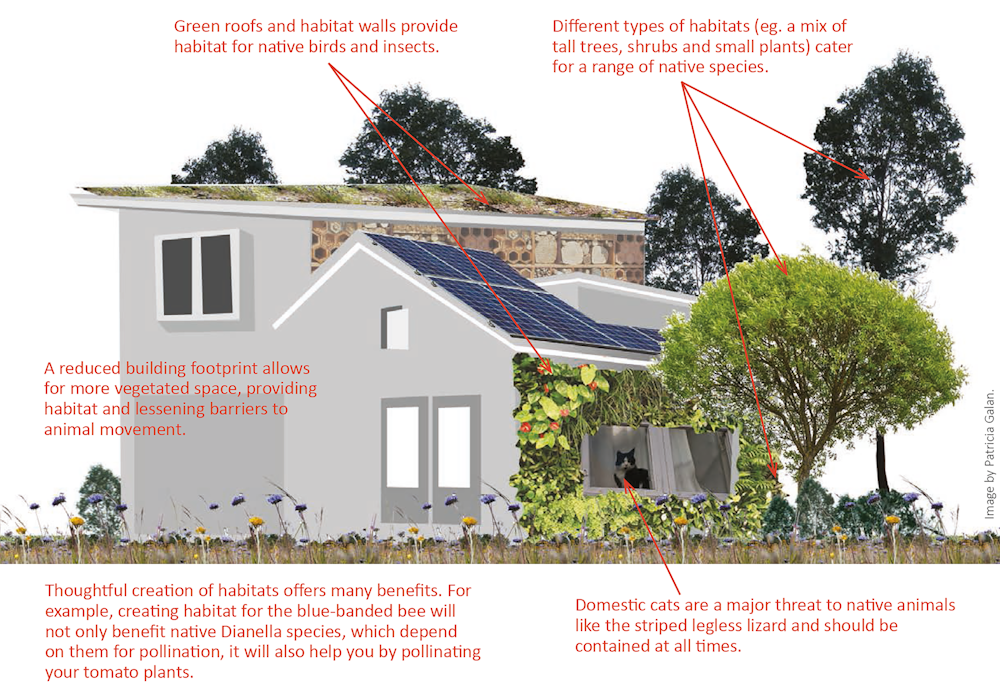
These principles are designed to address the biggest impacts of urbanisation on biodiversity. They can be applied at any scale, from individual houses (see Figure 2) to precinct-scale developments.

Figure 2. BUSD principles applied at the scale of an individual house. Author provided

BSUD progresses in a series of steps (see Figure 1), that urban planners and developers can use to achieve a net positive outcome for biodiversity from any development.

BSUD encourages biodiversity goals to be set early in the planning process, alongside social and economic targets, before stepping users through a transparent process for achieving those goals. By explicitly stating biodiversity goals (eg. enhancing the survival of species X) and how they will be measured (eg. probability of persistence), BSUD enables decision makers to make transparent decisions about alternative, testable urban designs, justified by sound science.

A striped legless lizard. John Wombey, CSIRO/Wikimedia, CC BY

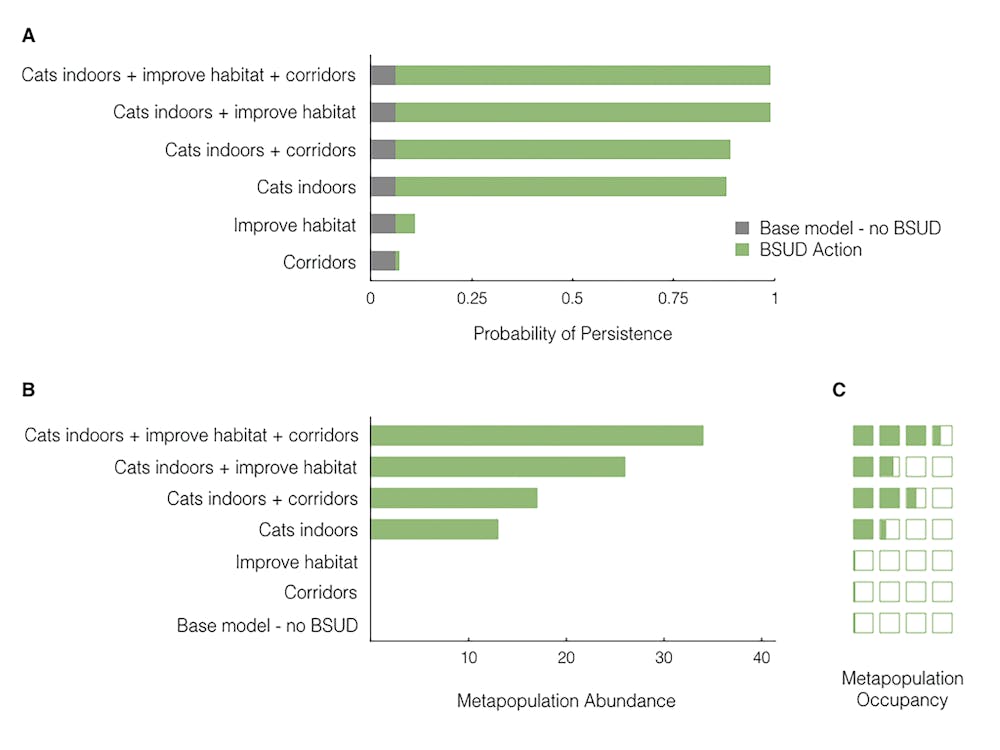
For example, in a hypothetical development example in western Melbourne, we were able to demonstrate that cat containment regulations were irreplaceable when designing an urban environment that would ensure the persistence of the nationally threatened striped legless lizard (Figure 3).

Figure 3. Keeping cats indoors greatly enhances other measures to protect and increase populations of the striped legless lizard. Author provided

What does a BSUD city look, feel and sound like?

Biodiversity sensitive urban design represents a fundamentally different approach to conserving urban biodiversity. This is because it seeks to incorporate biodiversity into the built form, rather than restricting it to fragmented remnant habitats. In this way, it can deliver biodiversity benefits in environments not traditionally considered to be of ecological value.

It will also deliver significant co-benefits for cities and their residents. Two-thirds of Australians now live in our capital cities. BSUD can add value to the remarkable range of benefits urban greening provides and help to deliver greener, cleaner and cooler cities, in which residents live longer and are less stressed and more productive.


Read more: Why a walk in the woods really does help your body and your soul


BSUD promotes human-nature interactions and nature stewardship among city residents. It does this through human-scale urban design such as mid-rise, courtyard-focused buildings and wide boulevard streetscapes. When compared to high-rise apartments or urban sprawl, this scale of development has been shown to deliver better liveability outcomes such as active, walkable streetscapes.

Mid-rise, courtyard-focused buildings and wide boulevard streetscapes created through a biodiversity sensitive urban design approach. Graphical representation developed by authors in collaboration with M. Baracco, C. Horwill and J. Ware, RMIT School of Architecture and Design, Author provided

By recognising and enhancing Australia’s unique biodiversity and enriching residents’ experiences with nature, we think BSUD will be important for creating a sense of place and care for Australia’s cities. BSUD can also connect urban residents with Indigenous history and culture by engaging Indigenous Australians in the planning, design, implementation and governance of urban renaturing.


Read more: Why ‘green cities’ need to become a deeply lived experience


What needs to change to achieve this vision?

While the motivations for embracing this approach are compelling, the pathways to achieving this vision are not always straightforward.

Without careful protection of remaining natural assets, from remnant patches of vegetation to single trees, vegetation in cities can easily suffer “death by 1,000 cuts”. Planning reform is required to move away from offsetting and remove obstacles to innovation in onsite biodiversity protection and enhancement.

In addition, real or perceived conflicts between biodiversity and other socio-ecological concerns, such as bushfire and safety, must be carefully managed. Industry-based schemes such as the Green Building Council of Australia’s Green Star system could add incentive for developers through BSUD certification.

Importantly, while BSUD is generating much interest, working examples are urgently required to build an evidence base for the benefits of this new approach.

ref. Here’s how to design cities where people and nature can both flourish – http://theconversation.com/heres-how-to-design-cities-where-people-and-nature-can-both-flourish-102849]]>

What causes multiple sclerosis? What we know, don’t know and suspect

]]>

Source: The Conversation (Au and NZ) – By Trevor Kilpatrick, Professor of neurologist and clinical director, Florey Institute of Neuroscience and Mental Health

US actress Selma Blair announced on the weekend she has been diagnosed with multiple sclerosis. “I have probably had this incurable disease for 15 years at least,” she wrote. “And I am relieved to at least know.”

Selma Blair shared the news on Instagram. Instagram

Multiple sclerosis is an autoimmune disease, where the body mistakenly attacks the brain and spinal cord. It does this by damaging myelin – the protective coating around the nerves. When myelin is damaged, messages can no longer be clearly transmitted from the brain and spinal cord to other parts of the body.

The resulting symptoms include extreme tiredness, loss of concentration and memory, numbness, sensitivity to heat and cold, difficulties walking and balancing, spasms, dizziness and low mood.


Read more: Explainer: multiple sclerosis


Blair, aged 46, is one of 400,000 people in the United States with MS. The prevalence is similar to that in Australia, where around 25,000 people live with the disease. The average age of onset for MS is 30, and around three-quarters of those affected are women.

There’s still a lot we don’t know about the causes, but so far the research indicates our genes and environment each have a role in driving susceptibility to MS.

Genetics

Genetics plays an important role in the development of MS, with more than 200 genetic markers implicated in the disease. Collectively, the identified genes may account for up to 25% of the genetic component of MS risk, but each gene in isolation carries only a small risk.

Because of this, it’s not possible to generate a “genetic risk score” that accurately conveys the risk any given person has of developing MS. So we cannot single out the individuals who are at greater risk, even if we know how many of them might exist in the community.

When myelin is damaged, messages can no longer be clearly transmitted from the brain and spinal cord to other parts of the body. from shutterstock.com

Researchers are now trying to adopt a more sophisticated genetic approach to help identify individuals at risk by focusing on families who have more than one relative with the disease. We know, in some instances, family members who don’t have symptoms could still harbour asymptomatic disease. This could mean the MS is either at an earlier stage, less severe or “blocked” before it has become clinically overt.

Identifying mutations common to affected family members could help understand the genes likely to be directly relevant to the cause of MS. The unanswered question is whether findings in families can be extrapolated to the general population.

Viruses

There is a strong association between the Epstein-Barr virus, which often results in glandular fever in young adults, and development of MS. If you have not been exposed to the virus, you will likely not get the disease.

There are many theories for how the virus may be implicated in MS. The virus infects a type of white blood cell important for the immune system. Infection of the cell could then cause corruption of the immune response, which could lead to the autoimmunity of MS.

But the Epstein-Barr virus is not sufficient on its own to trigger MS, as more than 90% of people who aren’t affected by MS have been exposed to the virus.


Read more: Humans are to blame for the rise in dangerous viral infections


Sunlight

Sunlight, or more specifically exposure to ultraviolet (UV) radiation, decreases with increasing distance from the equator.

The further away from the equator you live the greater your risk of developing MS. In Australia, those living in northern Queensland are seven times less likely to develop MS than those in Tasmania.

Ultraviolet light is known to have many effects on the immune system and our synthesis of vitamin D. In particular, UV appears to have an impact on immune activity, making immune cells more tolerant and in some instances suppressing immune activity.

Smoking significantly increases a person’s chances of developing MS. Mathew MacQuarrie/Unsplash

Hormones

The fact women are more likely to develop MS than men may be related to hormonal changes.

We know disease activity drops during pregnancy. We also know women who have multiple children are on average less likely to get the disease and, if they do, it is likely to be less severe.

Lifestyle

Smoking significantly increases a person’s chances of developing MS. Smokers, and people exposed to second-hand smoke, are almost twice as likely to develop MS. In particular, they are more likely to develop progressive forms of MS.

For people who already have MS, there is good evidence that stopping smoking reduces the severity of disease progression.

Although the subject of ongoing research, it would appear smoking influences the production of certain proteins in the lungs that may trigger immune cells to become more alert. At the extreme, this could set off the immune response.


Read more: Explainer: what is inflammation and how does it cause disease?


What we suspect

There is a great deal of interest in the role nutrition and diet could play in the development and management of MS. These studies are complex due to the many potential nutritional components found in our diets.

It is possible that keeping cholesterol and fats in a healthy range could help MS symptoms, such as reducing levels of fatigue. However, this is an ongoing area of research.

There is stronger evidence when it comes to body weight and obesity and the risk of MS. Studies have shown that being overweight or obese, particularly during adolescence, is associated with an increased risk of developing MS. It is also associated with worse outcomes in people who have MS. Not much is known about the mechanisms that may be responsible for this.

The results of physical therapy for people with MS are varied but have been associated, at least in the short term, with some benefit, such as improved balance and coordination.

ref. What causes multiple sclerosis? What we know, don’t know and suspect – http://theconversation.com/what-causes-multiple-sclerosis-what-we-know-dont-know-and-suspect-105491]]>

While PNG promotes APEC big money, youth are building grassroots resilience

]]>

The countdown to the Asia-Pacific Economic Cooperation (APEC) summit in Papua New Guinea is well underway. As the PNG government finalises preparations for this high-level meeting next month, instability is growing from pressing development issues. But, reports Pauline Mago-King of Asia Pacific Journalism,  some of the youth are committed to strengthening their country’s resilience.

The reoccurring theme in bridging various social gaps remains to be sensitisation for young people.

For Papua New Guinea, issues ranging from gender relations to health have worsened over the years, making them a norm for the people.

While the PNG government buckles down for the APEC summit, polio has emerged, tuberculosis persists due to multidrug resistance, and violations of human rights are ever-present as in cases like that of the Paga Hill villagers struggle.

APJS NEWSFILE

Papus New Guinea’s progress may seem obscure. However, this should not overshadow the mobilisation of young Papua New Guineans at the community level.

According to the United Nations Population Fund (UNFPA), around 60 percent of young people under 25 account for PNG’s population 8.5 million.

The disproportionate percentage of young Papua New Guineans calls for more engaging avenues that will translate into overall development at community levels.

-Partners-

Executive director of UNFPA Dr Natalia Kanem says the investment in young people’s capabilities, as well as creating opportunities for them, will build peaceful, cohesive and resilient societies.

Cultural settings
Equally important, these opportunities require sustainability so that they are also contextually relevant to PNG’s diverse cultural settings.

As the PNG government focuses on “unlocking” its economic potential, the mobilisation of youth largely rests with non-governmental and faith-based organisations such as The Voice Inc., Equal Playing Field, Youth Against Corruption Association – to name a few.

Last month, PNG’s Foreign Minister Rimbink Pato told the United Nations General Assembly that the “government recognises the importance of putting in place the building blocks needed to enable inclusive and participatory development.”

He added that it was their priority to create employment opportunities that would match the needs of Papua New Guinean youth.

Concrete action in this area, however, remain bleak, particularly in light of 500 procured APEC-vehicles, outbreak of preventable diseases and drug shortages in hospitals around PNG.

As such, the work of various organisations to equip youth in shaping civic affairs is paramount.

Education at the grassroots level, along with platforms to communicate the acquired information, provide a bridging factor for youth to spread “sensitisation” during a time when governance is questionable.

Changing mindsets
This can be seen in movements such as the newly homegrown project SKILLZ PNG.

Last month, the Young Women’s Christian Association (YWCA) PNG in partnership with adolescent health organisation Grassroots Soccer, launched SKILLZ.

The project uses soccer as a vehicle for at-risk youth “to overcome their greatest health challenges… and be agents for change in their communities”.

The same way one manoeuvres a soccer ball, the same can be done in life when it comes to health and gender risks. Image: Pauline Mago-King/PMC
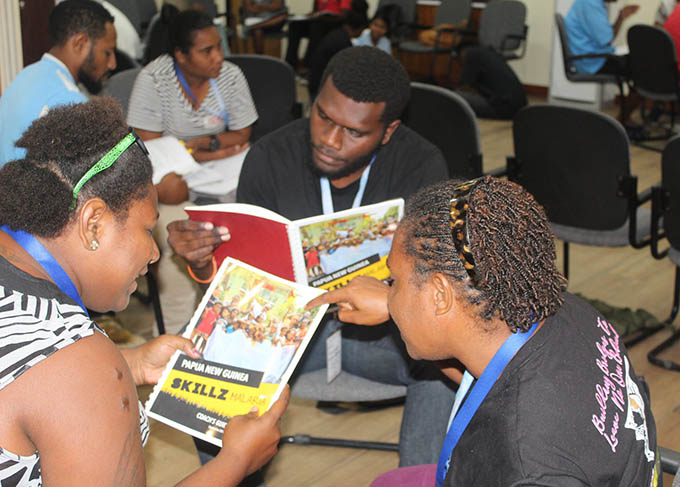
Grassroots Soccer Master trainer Nicole Banister says the project gives participants the platform to express themselves.

“It was incredible for me to see how some of the shyer participants really blossom throughout the training. They really found their voice in terms of facilitating, working with their peers, praise openly and build personal connections across organisations, different sexes, different ages and cultures – all of which are important to build a community in PNG.”

For a country like PNG, SKILLZ offers a continuum of care for youth to combat prevalent issues such as gender-based violence.

In addition, it provides a conducive environment for youth to develop a better understanding of PNG’s health system and their own health needs.

Training of coaches
Over a period of two weeks, 20 youth participants from varying backgrounds underwent SKILLZ PNG’s “training of coaches” workshop.

SKILLZ PNG participants during a session. Image: YWCA PNG

To an outsider, this workshop may seem just any other ordinary event.

It is, in fact, a necessary movement for young Papua New Guineans especially when high levels of violence can provide a sense of “disillusionment”,  as stated by The Voice Inc.’s chairperson, Serena Sumanop.

For Joshua Ganeki, a 27-year-old participant, SKILLZ PNG gave him a chance to do something purposeful.

Having graduated from Port Moresby Business College in 2014, he found it difficult to secure employment and thus resorted to doing odd jobs, and then eventually volunteering with YWCA.

His passion for helping young people led him to SKILLZ PNG and prompted a self-reflection on gender expectations.

Rights, responsibilities
“One thing I learnt is our society has gender expectations, especially for women and that is wrong. We need to break these norms and become equal team players and partners in life.

“SKILLZ PNG is trying to make us more aware of our rights, responsibilities as men and women.”

For others such as 21-year-old Kevlyne Yosia, the training strengthened her confidence in being an agent of change.

“Back in year 11, my class was having a discussion on politics and a male classmate told me that my place was in the kitchen so I have no place talking about such things. It made me feel bad because I knew other women are told the same thing.

“But it also made me stand my ground that I have a right to voice my opinion, and so do other women,” said Yosia.

She added that the training enabled herself and others to realise that support and appreciation for genders is essential in fostering healthy relationships.

Development goals
While projects such as SKILLZ PNG are vital, so are their alignment with the United Nations Sustainable Development Goals (SDG).

For YWCA PNG, its work with Grassroots Soccer has empowered more youth to be SDG champions in a political climate that is self-serving.

SKILLZ PNG’s coverage of goals such as “good health and wellbeing”, “gender equality” and “partnership for goals” means that more young people will feel empowered and equipped to participate in civic engagements.

Although this project has seen only one group graduate onto becoming coaches in their communities, Grassroots Soccer master trainer Alex Bozwa said: “I’m incredibly optimistic for the work that these people will be doing with other young people.”

SKILLZ PNG is currently limited to the capital of Port Moresby but it is a positive step towards leveraging Grassroots Soccer’s large success in the African continent, so that youth on a national level can also participate.

In the meantime, hope remains in young people like Kevlyne Yosia.

“I want to see a better PNG, where I can feel safe as a woman.”

Pauline Mago-King is a masters student based at Auckland University of Technology and is researching gender-based violence in Papua New Guinea. She compiled this report for the Pacific Media Centre’s Asia-Pacific Journalism Studies course.

Twitter: @iamatalau04

Print Friendly, PDF & Email

Article by AsiaPacificReport.nz

]]>

Tweaking just a few genes in wild plants can create new food crops – but let’s get the regulation right

]]>

Source: The Conversation (Au and NZ) – By James Hereward, Research fellow, The University of Queensland

The crops we rely on today have been bred over thousands of years to enhance certain characteristics. For example, sweetcorn started life as a wild grass called teosinte.

But every time we select for a trait through breeding – such as repeatedly crossing selected plants to produce bigger fruits – we lose genetic diversity which is the essential variation for other traits like disease resistance. This leaves our crops vulnerable to pests and disease.

Precise gene editing technologies could offer a solution.

CRISPR gene editing has been successfully used to re-domesticate wild tomato plants. One research group edited only six genes and produced a commercially sized fruit in a wild relative of tomato, Solanum pimpinellifolium. Another group achieved a similar result by editing only four genes.


Read more: A fresh opportunity to get regulation and engagement right – the case of synthetic biology


As a society we need to work out how such technology and plants will be regulated to ensure safety and acceptability.

The new domestication

The new approach, termed “de novo domestication” or “new domestication”, allows the genetic diversity of the wild plant to feature in a new crop. These new tomato lines retain all of the diversity of their ancestors, providing protection against disease.

They taste good too, apparently.

This was possible thanks to years of painstaking research into the genes that underpin the essential traits related to domestication. Without this, scientists wouldn’t know which genes to target and edit.

Some of the genes were identified by crossing plants with different traits (like large versus small fruits). Others were discovered by comparing wild relatives with domesticated plants.

Could we do this with other wild species?

We currently rely on very few plant species for the majority of the world’s food production. More than half of our plant-derived energy intake comes from just three grasses (wheat, rice and corn). Gene editing could provide a way to expand this.


Read more: Fewer crops are feeding more people worldwide – and that’s not good


Showing the broader value of the tomato approach described above, another research group applied the same method to an orphan crop Physalis pruinosa (known as the ground cherry). Orphan crops are those that have been neglected and escaped modern agriculture for various reasons. They receive little investment, research or breeding effort.

The researchers hope the ground cherry will one day find its place alongside the strawberry, blueberry, blackberry and raspberry in large-scale agriculture.

Ground cherry could be a new berry crop. Pixabay/Alexas_fotos

The “de novo domestication” approach potentially provides a way to domesticate any edible wild plant. With an estimated 20,000 known edible species, the possibilities for domestication could be extraordinary – particularly in Australia, where broad, economically successful crop domestication of native foods has been mostly limited to the macadamia nut.

Gene sequencing getting cheaper

To create new crops, we need good working knowledge of the gene targets, and the genome sequence (which contains the complete code of all genes inside each cell) of the plant species that we want to domesticate.

Genome sequencing used to cost many millions of dollars and require massive research teams. It’s now increasingly cheap and routine.

Our understanding of the target genes comes largely from studies of major agricultural crops. Some domestication genes will only work in species that are closely related to the crop in which they were discovered.

Versions of the domestication genes targeted in the tomato studies are found in many plant species, so the approach might well work in more distantly related species too.

How should we regulate this?

We should be fostering this kind of innovation, but we need to do it safely.

Worldwide, policymakers have wrestled with the implications of the new genetic tools. Debate has sprung up around how to regulate genome editing, compared with existing genetic modification methods.

Editing genes in a crop is different to traditional genetic modification, or transgenics – in which a gene from a different species is inserted into a plant.

In contrast to both of these approaches, classic crop breeding has relied on random processes like irradiation to induce new genetic diversity. CRISPR editing is similar but more efficient and precise, because it targets a specific desired mutation.

In July, European courts ruled that edited plants fall under the same regulation as transgenics. This places them under very strict regulations that create significant hurdles to enter the market, potentially driving talent and funding out of Europe.

In contrast, the US Department of Agriculture (USDA) said it would not regulate genome-edited crops.

A balanced approach

A reasonable balance between these two regulatory approaches is probably the most sensible way forward. Genome editing shouldn’t completely escape regulation.

If it can be demonstrated that the edited plant doesn’t contain any new genes (including CRISPR machinery) then the regulation should be much less stringent than for transgenics, because the changes are so similar to conventional plant breeding. Sequencing the genome of the edited crop is a good way to provide evidence of this.

In Australia, genetically modified organisms are regulated by the Office of the Gene Technology Regulator (OGTR). The current legislation defines genetic modification very broadly, but is under review. South Australia is an exception to this, with a ban on genetically modified crops.


Read more: Organic farming with gene editing: An oxymoron or a tool for sustainable agriculture?


Ideally, regulation should focus more on questions around the types of genetic modifications that we should allow in our crops than the way that they were introduced and where they came from.

But edited organisms shouldn’t be completely excluded from regulation. Evidence should be requested, and provided, that new crops are functionally equivalent to the products of conventional breeding and the subsequent approval process should reflect this.

The primary priority for policymakers and regulators is to ensure crop safety. Maintaining an open and transparent dialogue will be crucial so that the public can trust the decisions.

ref. Tweaking just a few genes in wild plants can create new food crops – but let’s get the regulation right – http://theconversation.com/tweaking-just-a-few-genes-in-wild-plants-can-create-new-food-crops-but-lets-get-the-regulation-right-104490]]>

The fair go is a fading dream, but don’t write it off

]]>

Source: The Conversation (Au and NZ) – By Garry Barrett, Professor and Head of School, School of Economics, University of Sydney

This article is the first in the Reclaiming the Fair Go series, a collaboration between The Conversation, the Sydney Democracy Network and the Sydney Peace Foundation to mark the awarding of the 2018 Sydney Peace Prize to Nobel laureate and economics professor Joseph Stiglitz. These articles reflect on the crisis caused by economic inequality and on how we can break the cycle of power and greed to enable all peoples and the planet to flourish. The 2017 Sydney Peace Prize will be presented on November 15 (tickets here).


In June 2017, Australia achieved a world record of sorts – 26 years of uninterrupted economic growth. This was achieved with a mix of good luck and good management. The resources boom, prudent fiscal management and some difficult economic decisions guided Australia through the global financial crisis with an economy that continued to grow.

Throughout much of this period, Australia has experienced declining unemployment and growing wages. On the surface this might suggest Australia is a “Goldilocks economy”, avoiding the boom and bust cycle.

However, beneath the veneer it is clear not all have shared in the prosperity generated over the past 27 years. We have seen an enduring rise in economic inequality over the past four decades.


Read more: Don’t believe what they say about inequality. Some of us are worse off


Since the late 1970s, there has been a clear and persistent increase in individual earnings and family income inequality. Since the late 1980s, much of the gain in real income has been concentrated at the very top of the distribution.

From an international perspective, Australia now ranks among the more unequal of the OECD economies.

What has happened to pay packets?

A good place to begin to understand how inequality has increased is by examining the labour market. Studies based on Australian Bureau of Statistics and other data sources show a significant increase in wage inequality across workers since the late 1970s.

A range of forces have driven this increase. These include technological change such as computerisation and developments in IT that have fundamentally altered business practices and organisational forms. This has delivered substantial wage gains for some high-skilled workers, while minimal wage growth for low-skilled workers has led to increasing polarisation.

Of course, one of the defining features of the Australian economy over the past three decades has been its internationalisation. Globalisation has exposed more jobs and workers to international competition. This has left some workers, especially the low-skilled, with relatively smaller pay packets.


Read more: How rising inequality is stalling economies by crippling demand


Many institutions are no longer recognisable from those that shaped Australia from the beginning of the 20th century. Unions and centralised wage bargaining traditionally played a pivotal role in protecting the lowest-paid workers’ wages.

Together these forces have contributed to greater wage volatility. The result is that much of the recent gains in real wages have been concentrated toward the very top of the wage distribution.

Families matter

Families can help limit the impacts of the market forces generating inequality. By coordinating work, caring, spending and saving decisions, families can dampen the effects of market-generated volatility and inequality on economic well-being.

Indeed, the rise in earnings and income inequality across families is less pronounced than the inequality across individuals. Nonetheless, “assortative matching”, whereby individuals tend to partner with a similarly educated and skilled individual, has led to a growing gap between the resources of the “haves” and “have-nots”.

The state’s helping hand

As in other countries, there has been a general trend of the Australian state providing less social protection and so acting less as an “equaliser”. For the unemployed, the safety net offered by the Newstart program has been progressively diminished. Access to the Disability Support Pension is increasingly restrictive, and delayed access to the Age Pension means these programs have become less generous over time.

Beyond the labour market, changes to the tax codes have reduced the progressivity of the system.

In total, the broad direction of changes to the tax-transfer system in recent decades has been to reduce the equalising influence of the state.

Intergenerational mobility

The high level of economic inequality at a point in time cannot be readily dismissed as an artefact of a dynamic and mobile economy. Research has shown that Australia’s high level of economic inequality is also associated with lower intergenerational mobility.

Recent evidence based on longitudinal data indicates children’s earnings are strongly related to their parents’. From an international perspective, Australia is relatively immobile. This means the economic advantages and disadvantages we see today may persist over future generations.


Read more: The inequality you can’t change that lasts a lifetime


One may well ask: is Australia witnessing the end of the “fair go”?

Is it all doom and gloom?

Despite these developments, there is cause for some optimism. Sustained community pressure has led to policy reforms that improved equality. A recent study showed that the one-off 19.5% increase in the Age Pension for singles (7.9% for couples) recommended by the Harmer Review significantly reduced poverty and inequality among the elderly.

The introduction of the National Disability Insurance Scheme in 2012 represents an important expansion of social protection, which may substantially reduce economic inequality.

Community reaction to the evidence presented at the ongoing Royal Commission into Misconduct in the Banking, Superannuation and Financial Services Industry has led to a commitment to increase the funding and powers of corporate regulators.

Similarly, the Gonski Report of 2012 refocused policy debate on school funding toward needs-based models.

These developments have been driven in part by strong community concerns and a recognition that those most in need have missed out on the prosperity generated by over a quarter of a century of uninterrupted economic growth. Together, they provide hope the fair go has not gone forever.

ref. The fair go is a fading dream, but don’t write it off – http://theconversation.com/the-fair-go-is-a-fading-dream-but-dont-write-it-off-105373]]>

New Zealand politics: foreign donations and political influence

]]>

Source: The Conversation (Au and NZ) – By Simon Chapple, Director, Institute for Governance and Policy Studies, Victoria University of Wellington

New Zealand’s opposition National Party is embroiled in a rolling controversy that erupted last week when former National MP and senior whip Jami-Lee Ross accused his leader Simon Bridges of corruption. Bridges has vehemently denied these accusations, and the evidence released does not support any allegations of illegality.

One dimension of the controversy that has attracted less attention is the connected issues of political party donations and foreign influence on New Zealand’s democratic system.


Read more: New Zealand’s Pacific reset: strategic anxieties about rising China


Foreign influence

The discussion of foreign influence in New Zealand politics plays out mostly in terms of the activities of the People’s Republic of China. The local debate was initiated by Professor Anne-Marie Brady’s “Magic weapons” paper last year. Despite her warnings that China’s foreign influence activities have the potential to undermine the sovereignty and integrity of the political system of targeted states, the dominant view among New Zealand’s main political parties might best be described as “nothing to see here, time to move on”.

Reactions in New Zealand contrast sharply with the situation in Australia, where there has been a much more open democratic debate on the issue of China’s influence, as well as law reform designed to mitigate foreign interference.


Read more: Soft power goes hard: China’s economic interest in the Pacific comes with strings attached


Former New Zealand National Party member Jami-Lee Ross speaking to media. Boris Jancic, CC BY-ND

Last week, Jami-Lee Ross released a recording of a conversation he had with opposition leader Simon Bridges in June (full transcript). The transcript alleges that Zhang Yikun, a wealthy Chinese immigrant and a former member of the People’s Liberation Army with ongoing links to the Chinese state, made a donation to the National Party of $100,000. The conversation then turned to new candidates for the National party list, and the possible candidature of Colin Zheng, manager of a construction company owned by Zhang.

Keeping track of political donations

At a national level, there are rules under the Electoral Act 1993 regarding political donations to both candidates and to political parties. For candidates, a donor’s name and address must be reported for donations of more than $1,500. For party donations, the name and address of the donor must be reported where donations exceed $15,000.

For both candidates and parties, foreign donations (defined as from people who are not citizens or residents on the electoral roll or from incorporated or unincorporated bodies outside New Zealand) exceeding $1,500 are forbidden. Each registered political party must file an annual return of party donations with the Electoral Commission, which are then made public. In terms of party donations which hit a $30,000 threshold, a return must be filed within ten working days, as opposed to annually.

There are also restrictions on how much can be spent during a general election period, which also effectively constrain donations. Political party spending is capped at just over $1.1 million, plus $26,200 per electorate contested, for a total election spend of just under $2.7 million if all 60 electorates are contested.

Spending limits also apply to persons or groups who are not contesting the election directly but seek influence. They can spend up to $12,600 on election advertising during the regulated period without having to register with the Electoral Commission. A person or group whose spending exceeds that amount must register and they can spend a maximum of $315,000 on election advertisements.

Who raises what from whom

In 2017, National raised $4.6 million in party donations, vastly exceeding Labour’s $1.6 million, as well as busting the limits of what they could spend in that year’s election. $3.5 million of the National’s donations (76%) were anonymous under the $15,000 threshold, compared with 0.7 million of Labour’s (44%). The Green Party raised $0.8 million, with 72% under the disclosure threshold, and New Zealand First raised $0.5 million, with 84% under the threshold.

There is no requirement for political parties to report the amounts of overseas donations under $1,500. Consequently the public does not know how many foreign donations come in under that amount.

It would be easy for a foreign state to funnel money into a political party from a large number of foreign donors, all under the $1,500 threshold. Equally, if that state had access to local actors, it could funnel money into the system at amounts above or below the $15,000 threshold.

What donors get for their donations is unclear. At its least malign, donors seek to passively promote a political ideology which they consider to be beneficial. Where donations are part of developing a long-term quid pro quo relationship along multiple dimensions, donors’ and receivers’ motivations and exactly what is traded is very difficult to pin down from the outside.

Transparency International reports that New Zealand political parties are one of the weakest pillars supporting local transparency and good governance. Within this weak pillar, one of the weakest strands involves political finance and donations.

They argue that with the demise of mass political participation, parties are increasingly dependent on donations to function. This weakness means that local politicians are more likely to seek to “supply” influence, or at least dangle the prospect of influence, in front of wealthy bidders.

The “demand” to buy political influence has also risen. With the increase in worldwide inequality and kleptocracy, there are more rich people for whom buying influence is the norm. Specifically in New Zealand, there has been an influx of wealthy expatriates from China, where buying influence is an accepted practice. They often retain close links to the Chinese Communist Party, which runs an authoritarian, anti-democratic and oppressive regime. It is thus not surprising that issues of donations and foreign influence are increasingly entering into domestic political debates.

ref. New Zealand politics: foreign donations and political influence – http://theconversation.com/new-zealand-politics-foreign-donations-and-political-influence-105489]]>

MASI aims to develop regional journalism with USP boost

]]>

Media Association of Solomon Islands president Charles Kadamana, a University of the South Pacific journalism alumni, with wantok student journalists Rosalie Nongebatu (left) and joint top award winner Elizabeth Osifelo. Image: Harrison Selmen/Wansolwara

By Geraldine Panapasa in Suva

The Media Association of Solomon Islands (MASI) plans to work closely with the University of the South Pacific journalism programme to develop journalists in the region, says president Charles Kadamana.

Kadaman, a senior journalist with the Solomon Star daily newspaper, says past collaboration with USP Journalism has been successful, including a recent week-long training on anti-corruption reporting in the Solomon Islands.

He said the training was timely as the Solomon Islands government was in the process of debating the Anti-Corruption Bill.

USP 50 YEARS

“In Solomon Islands, there are about 36 USP journalism alumni now holding top jobs in the media industry, the government and in the private sectors,” said Kadamana, who was a guest at last week’s 18th USP Journalism Students Awards ceremony at Laucala campus in Suva.

“Looking at the list of journalism alumni, it is evident that the USP journalism programme has produced a lot of communications professionals in different areas contributing to our countries.

“Fiji and other Pacific countries also have USP journalism alumni in top posts.

-Partners-

“Today, there is growing interest of journalists studying at USP. I am also happy to see the number of students from Solomon Islands is increasing.”

Dominated awards
Eleven student journalists are currently with the USP programme and they dominated the awards.

As educated young people, Kadamana encouraged student journalists to take up leadership roles, adding taking up journalism was not an easy task.

“There will be people who will stab you in the back. To avoid disaster, all you have to do is produce the results.

“Do not be the person who only wants the position for status and glory,” Kadamana said.

The USP journalism alumni said the university had been the breeding ground for nurturing future journalists to meet the needs of the region during the past 50 years.

Wansolwara News and the Pacific Media Centre have a content sharing arrangement.

Print Friendly, PDF & Email

Article by AsiaPacificReport.nz

]]>

Boy Erased is a safe and predictable take on the horrors of gay conversion

]]>

Source: The Conversation (Au and NZ) – By Stuart Richards, Researcher and Lecturer in Screen and Cultural Studies, University of Melbourne

I always try my hardest to go into every film with an open mind and not write off anything before I see it. This was particularly hard to do with Joel Edgerton’s Boy Erased. I was trepidatious about going to see the film. Call me cynical, but I am always wary when a queer film directed by a straight filmmaker receives Oscar buzz. I’m looking at you Danish Girl, Dallas Buyers Club and The Imitation Game.

Based on Garrard Conley’s 2016 memoir, Lucas Hedges plays Jared, the son of a Baptist preacher who is sent to a gay conversion camp, a form of reparative therapy that attempts to change someone’s sexual orientation or gender identity through psychological or spiritual means. Russell Crowe and Nicole Kidman play his parents who genuinely seem to care for his welfare, albeit in a horribly misguided fashion.


Read more: ‘Treatments’ as torture: gay conversion therapy’s deep roots in Australia


Gay conversion therapy is widely condemned as unethical and damaging by peak psychology bodies internationally, including in Australia, the US and the UK. The United Nations condemns the practice as it breaches the prohibition on torture and ill-treatment. The UN labels it “unethical, unscientific and ineffective and, in some instances, tantamount to torture”.

Many people are surprised to hear that conversion therapy still happens in the US. The banning of the practice is under debate in Australia after the Senate passed a Greens motion condemning its use. The end credits for Boy Erased state that over 700,000 Americans have undergone such programs. Only 14 states in America have deemed it illegal.

This is the second film this year to tackle the topic. The first is Des Akhavan’s The Miseducation of Cameron Post, which is based on a 2012 novel by Emily Danforth and stars Chloe Grace Moretz. That film is a subtly affective coming-of-age story that speaks to the power and importance of queer friendship.

Ealier, Jamie Babbit’s 1999 comedy But I’m a Cheerleader — starring Natasha Lyonne, Clea Duvall, Mink Stole and Rupaul Charles no less — also tackled gay conversion. It is a cult classic that has a special place in many a queer heart, including yours truly.

Interestingly, while Cameron Post has been reviewed slightly more favourably, it’s Boy Erased that is getting the Oscar buzz. This is a fact that isn’t lost on Cameron Post’s Moretz. Hollywood, she says, is:

… still backing first and foremost the straight white man who is going to be putting out the movie that’s the safer bet. They want something that’s a pretty package, but that’s still tolerable and acceptable.

While I don’t think queer films can only be made by queer filmmakers, Boy Erased is indeed a safe film. The film is finely made albeit heavy-handed in its melodrama. This is all very familiar.

Where Cameron Post concerns the central character forming resilient friendships to cope with the camp, Boy Erased is about navigating the pressures of parents who are labouring under a misapprehension about what is good for their son. Rather than demonise Jared’s parents, the film goes to great lengths to paint them as folk who just want to protect their son. Audiences are made to identify with Nicole Kidman’s character just as much as Hedge’s Jared. This focus on the parents makes the film more “tolerable and acceptable” to a wider audience.

Melanie Lynskey in But I’m a Cheerleader. IMDB

Read more: Gay conversion therapy: a short history of an ongoing problem


Boy Erased’s non-linear story contextualises the “Love in Action” therapy with Jared’s memories that lead him to come out to his parents. These memories, however, offer little insight into Jared’s feelings on his therapy.

Interestingly, both Jared and Cameron leave us to infer their thoughts on the whole process until their films’ respective third acts. Are they buying it? Do they genuinely want to change? While Jared remains fairly isolated throughout the film, Cameron develops strong friendships at her camp, which makes her resilience significantly more pleasurable to watch.

Hedges is quietly powerful in the film as he navigates between perceived shame, pride and acceptance. Hedges recently gave a surprisingly honest interview with Vulture in which he speaks of sexuality existing on a spectrum: “I recognise myself as existing on that spectrum: Not totally straight, but also not gay and not necessarily bisexual.” This candidness, along with the supporting cast featuring Troye Sivan, Cherry Jones and Xavier Dolan, adds somewhat of a queer legitimacy to the film.

Writing for CBC Art’s Queeries, film critic Peter Knegt labels the film as one that isn’t for queer audiences but rather for an audience “that doesn’t quite understand why gay conversion therapy is so deeply harmful”. It’s this aspect of the film that left me cold.

With the exception of a particularly disturbing scene featuring sexual assault, the film’s emotional notes are fairly predictable. The cast of other queer patients are all in a predictably heartbreaking survival mode and no serious friendships are formed. Even when the film reaches its predictable devastating low in the third act, this is all content that has been done before.

The film means well and I genuinely find it heartbreaking that a film such as this is being written about as being needed. It would be near impossible to leave this film without being aware of the fact that gay conversion therapy is tantamount to torture. For that, Edgerton, Hedges and all others involved should be commended. Regardless, my preference is still for Cameron Post and But I’m a Cheerleader.

ref. Boy Erased is a safe and predictable take on the horrors of gay conversion – http://theconversation.com/boy-erased-is-a-safe-and-predictable-take-on-the-horrors-of-gay-conversion-104841]]>

Curious Kids: Why is a magpie’s poo black and white?

]]>

Source: The Conversation (Au and NZ) – By Gisela Kaplan, Emeritus Professor in Animal Behaviour, University of New England

Curious Kids is a series for children, where we ask experts to answer questions from kids. All questions are welcome: find out how to enter at the bottom. You might also like the podcast Imagine This, a co-production between ABC KIDS listen and The Conversation, based on Curious Kids.


Why is a magpie’s poo two different colours (black and white)? – Anjali, age 9, Melbourne.


Dear Anjali,

This is a very good question.

In humans and all mammals there are two exits for all the things the body does not need or cannot digest. We have a bladder (for the liquid) and an anus to get rid of solids. The fluid we call urine. It is fluid because we drink a good deal but the part that has to be expelled is called urea. It is toxic and that’s why it has to leave the body. Urea dissolves in water and it is in our urine.

The body has a clever way of separating out what is not good for us. All that work is done in the kidneys, which capture the toxins and then send these bad parts on their way out of the body.

In birds, it’s slightly different. Like reptiles, they do not have two separate exits from the body. They have one, and it is called the cloaca. It is quite similar to the human anus but expels both indigestible bits and toxins.

It’s black and white. Creative Commons, CC BY

The solids (the indigestible and non-usable parts of what they eat) in birds are the black part of their poo. The toxins they expel, also filtered out in the kidneys, are white (called uric acids). Birds do not drink as much as humans so the toxins are also in solid form, not liquid as in human urine. Hence, the white solid uric acid gets expelled together with the indigestible solids (the black part).

As you can see, their bodies therefore do not need two separate channels to get the waste products expelled because both are solid. The composition of black and white differs between species. Some splatter more of the uric acid (white), some have more black (indigestible solids). It depends on their diet.

There is a third exit path for indigestibles, and quite a few bird species have this capacity. It is the ability to regurgitate “roughage” before it gets into the digestive system- in birds of prey this roughage may be feathers, bones, or hair from small animals they have eaten.

In birds, including magpies and currawongs, bits of hard wings of beetles for instance, also get expelled via the beak. Wikimedia, Pratyeka – Own work, CC BY-SA 4.0, CC BY-SA

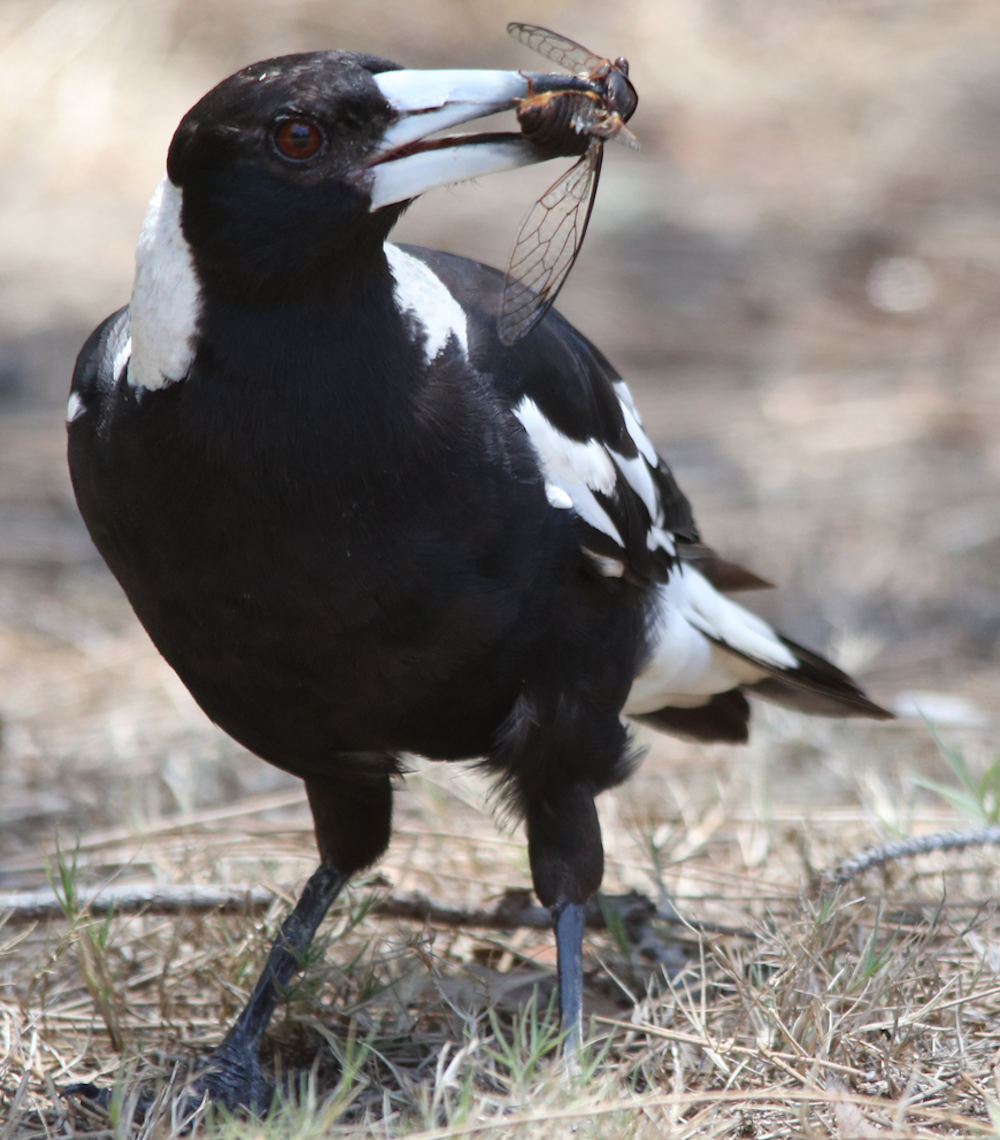
In birds, including magpies and currawongs, bits of hard wings of beetles for instance, also get expelled via the beak. These pellets look like small olive stones. Some seeds are also too hard to digest so they can get embedded in these pellets.

A regurgitated pellet from an Australian Magpie, consisting of beetle legs and hard-shelled outer parts of a beetle (called exoskeleton). Such pellets are usually quite small, the maximum length is about 3cm. Shutterstock

Nature has a clever trick here. Currawongs are very important for many native plants. As fruit eaters, they ingest quite a few seeds. These seeds end up in the pellets which get expelled via the beak and are therefore unharmed by the process of digestion. The seeds get their own little seeding environment in these pellets and they can then develop and grow, often a long way away from the parent tree on which the fruit originally grew. So it is a good way for the tree to spread its offspring around.

To come back to poo: As in humans, one can often judge the state of health of an individual just by looking at the poo.

In birds, when the white part turns a slightly green or yellow colour, one knows immediately that something is very wrong: perhaps the bird has had too little in fluids, perhaps it is ill.

If the black solids turn very fluid, the bird may be suffering from diarrhoea. That is often a clear sign that the bird is very, very sick and needs to go to a vet immediately.

Best wishes,

Professor Gisela Kaplan.


Read more: Magpies can form friendships with people – here’s how


Hello, curious kids! Have you got a question you’d like an expert to answer? Ask an adult to send your question to us. They can:

* Email your question to curiouskids@theconversation.edu.au
* Tell us on Twitter

CC BY-ND

Please tell us your name, age and which city you live in. You can send an audio recording of your question too, if you want. Send as many questions as you like! We won’t be able to answer every question but we will do our best.

ref. Curious Kids: Why is a magpie’s poo black and white? – http://theconversation.com/curious-kids-why-is-a-magpies-poo-black-and-white-104920]]>

‘Be courageous in your quest for truth,’ journalism academic tells graduates

]]>

Professor David Robie presenting the Best Mobile Journalism Documentary prize sponsored by Internews and Earth Journalism Network at the annual University of the South Pacific journalism awards. Pictured is Kirisitiana Uluwai of Fiji in the runner-up team. Image: Harrison Selmen/Wansolwara

By Geraldine Panapasa in Suva

Pacific journalism academic Professor David Robie believes the media play a critical role in exposing abuses of power in a world increasingly hostile towards journalists.

However, journalists in the Pacific are frequently “persecuted by smallminded politicians with scant regard for the role of the media”, he says.

Speaking at last week’s 18th University of the South Pacific (USP) Journalism Student Awards ceremony at Laucala campus in Suva, Fiji, Dr Robie said despite the growing global dangers surrounding the profession, journalism was critically important for democracy.

READ MORE: David Robie’s full USP journalism awards ‘media phobia’ speech

USP 50 YEARS

Dr Robie said while such “ghastly fates” for journalists – such as the extrajudicial killing of Saudi dissident writer Jamal Khashoggi in Turkey earlier this month – may seem remote in the Pacific, there were plenty of attacks on media freedom to contend with, while trolls in the region and state threats to internet freedom were “also rife”.

“Next month, Fiji is facing a critically important general election, the second since the return of democracy in the country in 2014. And many graduating journalists will be involved,” Dr Robie said.

-Partners-

“Governments in Fiji and the Pacific should remember journalists are guardians of democracy and they have an important role to play in ensuring the legitimacy of both the vote and the result, especially in a country such as this which has been emerging from many years of political crisis.

“But it is important that journalists play their part too with responsibilities as well as rights. Along with the right to provide information without fear or favour, and free from pressure or threats, you have a duty to provide voters with accurate, objective and constructive information.”

Professor David Robie presenting a Te Matau a Maui – Mau’s fishhook – to USP journalism coordinator Dr Shailendra Singh for the newsroom to mark the “NZ connection”. Image: Harrison Selmen/Wansolwara
Tribute to whistleblowers
Dr Robie also paid tribute to two whistleblowers and journalists in the Pacific.

“Firstly, Iranian-born Behrouz Boochani, the refugee journalist, documentary maker and poet who pricked the Australian conscience about the terrible human rights violations against asylum seekers on Manus Island and Nauru,” Dr Robie said.

“He has reminded Canberra that Australia needs to regain a moral compass.

“And activist lawyer communicator Joe Moses, who campaigned tirelessly for the rights of the villagers of Paga Hill in Port Moresby.

“These people were forced out of their homes in defiance of a Supreme Court order to make way for the luxury development for next month’s APEC summit.

“Be inspired by them and the foundations of human rights journalism and contribute to your communities and countries.

“Don’t be seduced by a fast foods diet of distortion and propaganda. Be courageous and committed, be true to your quest for the truth.”

Professor Robie is the director of the Pacific Media Centre and professor of journalism in the School of Communication Studies at Auckland University of Technology. He is also editor of Pacific Journalism Review research journal and the news website Asia Pacific Report. He is a former USP Journalism Coordinator 1998-2002.

Geraldine Panapasa is editor-in-chief of USP’s Wansolwara journalism newspaper.

Pacific Media Centre director Professor David Robie and MASI president Charles Kadamana with graduating student journalists at the University of the South Pacific. Image: Harrison Selmen/Wansolwara
Print Friendly, PDF & Email

Article by AsiaPacificReport.nz

]]>

Do chatbots have a role to play in suicide prevention?

]]>

Source: The Conversation (Au and NZ) – By Jo Robinson, Senior Research Fellow, Orygen, The National Centre of Excellence in Youth Mental Health, University of Melbourne

Australia’s first suicide prevention chatbot for the family and friends of those in crisis was launched last week by Lifeline, a nonprofit organisation dedicated to crisis support and suicide prevention.

The chatbot, developed in partnership with Twitter, is called #BeALifeline Direct Message (DM) Chatbot. It seeks to help the family and friends of those at risk to quickly and easily start a conversation about suicide.

Users must have a Twitter account to converse with the chatbot, which directs people to Lifeline resources, including contact details for telephone or online support, advice and information.

This is a big shift in the way Lifeline provides support to young people in need. It raises the question of what role, if any, chatbots and other conversational agents should play in suicide prevention.


Read more: How AI is helping to predict and prevent suicides


Suicide among young people is increasing

Some 3,128 Australians lost their lives to suicide in 2017. That’s an increase of 9% from 2016. Young people aged between 15 and 24 years accounted for 13% of these deaths.

The suicide rate among young people has increased at an alarming rate over the past ten years. Suicide rates in young men have increased by 34%, and in young women by 76%.

Given these numbers, there is clearly a need for innovative and youth-friendly approaches to suicide prevention that can meet the needs of those at risk – whether they are looking for information or direct support.

The ubiquitous presence of social media in young people’s lives offers an unprecedented opportunity to potentially revolutionise suicide prevention. And as a sector, we have begun to seize these opportunities.

Meeting young people where they are

Globally, young people are avid users of social media and digital technologies. They use these platforms for a range of purposes – including for communicating about suicide.

Dr Dan Reidenberg, of US-based nonprofit Suicide Awareness Voices of Education (SAVE), believes social media chatbots can be used in several ways to aid suicide prevention – including to help identify people at risk early on, to provide people with options for seeking help, and potentially even to provide direct support.

Others we have spoken to in the digital media sector agree, stating that bots are definitely a part of the future – especially for people seeking help, or for those who want to help others, but who don’t necessarily have the skills or confidence to do so.


Read more: Why predicting suicide is a difficult and complex challenge


Young people are asking for chatbots

Our own work has shown that young people want chatbots. We have received funding from the Commonwealth government to develop guidelines, called #chatsafe, to facilitate safe peer-to-peer communication about suicide online.

We conducted a series of workshops with 85 young people across Australia, seeking their views on the guidelines and how to bring them to life online. Participants have repeatedly told us that they want to be able to talk safely online about suicide, but that they need help to do so. They see chatbots as a key tool to facilitate this process.

They want chatbots that can identify when a conversation about suicide is underway, and offer assistance to:

  • help people talk about their own experiences with suicide
  • reach out to a friend
  • manage closed groups and suicide memorial pages.

This work is in its infancy, but young people have identified that if a chatbot had the capacity to initiate a conversation that they may not otherwise be able to start, it could help them help each other, and direct them to professional resources when necessary.

There is limited research in this field

Researchers have started to look at the use of chatbots in suicide prevention, but little empirical evidence exists to date.

To our knowledge, only one paper specifically discussed the use of chatbots in suicide prevention. A 2017 paper reviewed six studies examining how conversational agents (think Siri on your iPhone) could be used to deliver support. Researchers developed conversational agents that acted both as virtual counsellors for people in need, and as virtual patients for people being trained in responding to people in need.

Another paper reviewed multiple studies that examined the use of conversational agents in health care – including mental health care – more generally. It found that task-oriented agents that help the user perform a specific activity, such as conducting a diagnostic assessment, were the most common. Users generally reported high levels of satisfaction. One of the studies reviewed reported a decrease in depressive symptoms.

But patient safety was rarely evaluated in these studies – a critical factor if this type of technology is to be applied to suicide prevention.

Our own work in this area has shown social media generally to be an acceptable tool in suicide prevention. Young people, academics and organisational stakeholders all cite advantages such as the ability to reach more at-risk people, the familiarity of the medium, and the fact that is accessible.


Read more: Teaching chatbots how to do the right thing


The limitations of chatbots

While the conversational abilities of chatbots are rapidly improving, they can’t yet provide sufficiently empathetic responses, or adequately handle natural human dialogue. This could lead to inappropriate responses to those seeking help.

Work is underway to advance the capacity of chatbots, and artificial intelligence systems generally. But accurately predicting risk is a challenge even for experienced clinicians, meaning that suicide risk could be underestimated. There are also complex issues relating to privacy, trust and data security that need to be addressed.

These crucial questions require careful consideration before intelligent systems, such as chatbots become fully integrated into health care and suicide prevention. One would also hope that they would never fully replace good clinical care.

But with suicide rates rising, particularly among young people, new approaches are required. Conversational agents, such as chatbots, have the potential to provide at least part of a solution.

ref. Do chatbots have a role to play in suicide prevention? – http://theconversation.com/do-chatbots-have-a-role-to-play-in-suicide-prevention-105291]]>

New research shines light on sexual violence at Australian music festivals

]]>

Source: The Conversation (Au and NZ) – By Bianca Fileborn, Lecturer in Criminology, UNSW

As the weather warms up, it can only mean one thing for young music enthusiasts: the Australian summer music festival season is here. For many young people, this is a time of great anticipation, excitement and meticulous planning of outfits.

Unfortunately, it also raises the issue of sexual violence that has blighted festivals in recent years.

This issue has attracted increased public agitation and attention, as illustrated through media reporting, activism, and the gradual introduction of festival policies and prevention efforts.

Despite this, there has been virtually no research on sexual violence at music festivals. This is surprising, given that they bring together a range of factors that are associated with a heightened risk of sexual violence, such as high levels of drug and alcohol consumption.


Read more: How music festivals can change the tune on sexual violence


As one international exception, a recent survey by YouGov shed some initial light on the issue, with findings indicating that two in five young women (and approximately one in five young men) had experienced sexual harassment at festivals in the UK.

But beyond this study, there is very little documented evidence about sexual violence at music festivals, and none within Australia.

To address this gap, my colleagues and I conducted the first study into perceptions and experiences of sexual violence at Australian music festivals. We focused on forms of sexual violence ranging from sexual harassment (such as wolf-whistling and unwanted verbal comments) through to behaviours that might meet legal thresholds for sexual assault.

We conducted an online survey of 500 people who attend Australian music festivals on their perceptions of safety and sexual violence at festivals.

We also spoke to 16 individuals who had either experienced sexual violence, or been involved in responding to an incident, at music festivals across the country.

General perceptions of safety

Most of our participants felt safe most of the time at Australian music festivals, with 61.5% saying that they “usually” felt safe, and 29% responding that they “always” feel safe at festivals.

This is an important finding, as it cautions us to resist viewing festivals as inherently risky or dangerous spaces, and to avoid perpetuating the moral panic that often accompanies youth leisure practices.

Men more consistently said they felt safe compared to women and LGBT participants. For example, men were equally as likely to say they either “always” (47%) or “usually” (46%) felt safe, with 3% of men saying they “sometimes” felt safe. In comparison, 20.4% of women said they “always” felt safe, 68.8% “usually” felt safe, and 8.4% reported that they only “sometimes” felt safe. This finding resonates with previous research on gender, sexuality and safety across a range of contexts.

The presence of friends was the most significant factor influencing parcipants’ sense of safety. However, this is a double-edged sword when it comes to sexual violence, given that we are most at risk of perpetration from someone we know.

Conversely, other patrons’ drug and alcohol consumption and overcrowding were the factors participants most commonly associated with feeling “unsafe” at a festival.

Perceptions of sexual violence

An overwhelming majority of participants thought that sexual harassment (87.5%) and sexual assault (74.1%) occurred at music festivals. Certainly, this perception is consistent with the emerging international and anecdotal evidence.

Sexual harassment was perceived to be a common occurrence at festivals. The majority of participants believed it happened “often” (31.2%) or “very often” (30.2%). In contrast, participants believed sexual assault was less common, with the majority of participants saying that it happens “sometimes” (33%) or “not very often” (26.5%).

Participants recognised the gendered nature of these experiences, with women seen as most likely to experience sexual harassment (86.7%) and sexual assault (86%).

Experiences of sexual violence

Experiences shared by interview participants spanned a range of “type” of sexual violence, from harassing behaviours such as verbal comments, through to acts that would likely meet legal thresholds for sexual assault.

Sexual harassment was particularly common, in line with survey participants’ perspectives. Notably, most of our participants had multiple experiences of sexual violence, and/or knew friends who had similar experiences.

Interview participants’ experiences further illustrated how the environmental and contextual features of festivals could be used to facilitate and excuse perpetration.

Crowded spaces such as the mosh pit were most frequently identified as sites of sexual violence. For example, perpetrators were able to use the packed nature of these spaces to create a level of ambiguity about, or “get away with”, their behaviour. In such settings, it was often difficult for participants to know if an incident was intentional, or just the unfortunate result of a crowded, often physically aggressive space.

In less ambiguous situations, perpetrators could easily disappear into the crowd, making it difficult to do anything about the incident.


Read more: Rape, sexual assault and sexual harassment: what’s the difference?


Such experiences can and do profoundly impact women’s ability to fully participate in music festivals. Participants often said they changed the way they dressed, were less likely to inhabit crowded spaces (such as the mosh), and were often hyper-vigilant.

In short, sexual violence reduced the ability of women to enjoy these important social and cultural events, in addition to the well documented impacts of sexual violence.

So now we know, what next?

Our research provides some important initial insights into the issue of sexual violence at music festivals. It supports what the mounting anecdotal evidence has suggested: that sexual violence in various forms is a significant issue at music festivals.

Of course, it is important to remember that sexual violence occurs across many spaces. In fact, it is most likely to occur in private residential areas. So, it is vital not to demonise festivals as particularly problematic spaces.

Nonetheless, in order to prevent sexual violence, we must address it wherever it occurs. It is heartening that many festivals in Australia and internationally have begun to implement policies to tackle this behaviour.

Our research highlights the importance of these developments, and the need to ensure such responses are implemented and evaluated consistently across festivals.

Our findings also point to the need for responses that are tailored to the unique dynamics of music festivals. A “one-size-fits-all” approach is unlikely to be effective.

If we take these steps, we can start to change the tune of sexual violence at festivals.

ref. New research shines light on sexual violence at Australian music festivals – http://theconversation.com/new-research-shines-light-on-sexual-violence-at-australian-music-festivals-104768]]>

What is ‘quality’ in aged care? Here’s what studies (and our readers) say

]]>

Source: The Conversation (Au and NZ) – By Joseph Ibrahim, Professor, Health Law and Ageing Research Unit, Department of Forensic Medicine, Monash University

A challenge facing the recently announced Royal Commission into Aged Care Quality and Safety will be to define “quality”.

Everyone has their own idea of what quality of care and quality of life in residential aged care may look like. The Conversation asked readers how they would want a loved one to be cared for in a residential aged care facility. What they said was similar to what surveys around the world have consistently found.

Characteristics that often appear as the basis for good quality of life include living in a home-like rather than an institutionalised environment, social connection and access to the outdoors. Good quality of care tends to focus on providing assistance that is timely and appropriate to individual needs.


Read more: Australia’s residential aged care facilities are getting bigger and less home-like


A bleak view of aged care

A mature judgment to determine good quality requires us to recognise that many people have an instinctive and distressingly bleak view of ageing, disability, dementia and death. Some people express this as death being preferable to living in aged care, as the tweet below shows.

Twitter

This doesn’t necessarily reflect an objective assessment of the actual care being delivered in residential facilities, but it does speak to the fear of losing independence, autonomy and identity.

In a survey of patients with serious illnesses hospitalised in the US, around 30% of respondents considered life in a nursing home to be a worse fate than death. Bowel and bladder incontinence and being confused all the time were two other states considered worse than death.

Aged care facilities will be the final residence for most before they die. This means the residents’ sense of futility and the notion one is simply waiting to die can and should be addressed.


Read more: How our residential aged-care system doesn’t care about older people’s emotional needs


Loose-leaf tea can make someone feel at home. Matt Seymour/Unsplash

Our reason for being is usually expressed through social connections. This a recurring theme for residents who define quality of care as whether or not residents have friendships and are allowed reciprocity with their caregivers.

A systematic review that drew together a number of studies of quality in aged care found residents were most concerned about the lack of individual autonomy and difficulty in forming relationships when in care.

Good staff

The need for positive social connections for residents extends to the relationships between staff and families. Achieving this requires staff with a positive attitude who work to build trust and involve family in their loved one’s care. They must also engage on issues that have meaning to the individuals.

Good staff should be both technically proficient and, perhaps more importantly, good with people.

Dianne Wintle comment. Facebook screenshot

Idyllic, or the way it should be?

A home-like setting – which may include having a pet and enjoying time in nature, as the Tweet below describes – may seem idyllic. However, more contemporary models of care are moving towards smaller home-like environments that accommodate fewer people and are more like a household than a large institution.

Twitter

The ability to relate and personalise care to a small group of 10-12 residents is surely easier than catering to 30-60 residents. Some studies in the US have shown residents in such smaller units have an enhanced quality of life that doesn’t compromise clinical care or running costs.


Read more: Caring for elderly Australians in a home-like setting can reduce hospital visits


This cluster-style housing still has limitations that need to be addressed. These include selecting residents who are suitable together and catering for the changing clinical and care needs of each individual.

Pets and the outdoors

Research into the value of pets in aged care has largely focused on the benefits to people living with dementia. Introducing domestic animals, typically dogs, has been shown to have positive effects on social behaviours, physical activity and overall quality of life for residents.

Pets improve quality of life for people living with dementia. from shutterstock.com

Similarly, providing accommodation where the physical environment and building promote engagement in a range of indoor and outdoor activities, and allow for both private and community spaces, is associated with a better quality of life.

Good food

Another major determinant of quality of life in residential aged care is the quality of food. This becomes even more important as people age. Providing high-quality food and enriching meal times is more challenging as many diseases such as dementia and stroke affect older people’s dentition and swallowing.

Twitter

Aged care services need proactive and innovative approaches to overcome these deficits and better promote general health.

A key feature often overlooked is the cultural significance of food. Providing traditional foods to residents strengthens their feeling of belonging and identity, helping them hold on to their cultural roots and enhance their quality of life.

Safety, dignity, respect and choice

Twitter

While the focus is often on preventing abuse, neglect and restrictive practices in aged care, the absence of these harmful events doesn’t equate to a positive culture. Residents want and have a right to feel safe, valued, respected and able to express and exercise choice. Positive observation of these rights is essential for quality of life.

Clinical and personal care

Time is a factor in aged care, as staff often don’t have enough time to spend with each resident. A recent ABC Four Corners investigation into quality in aged care found personal care assistants had only six minutes to help residents shower and get dressed. No wonder, then, that staff often don’t have the personal time to be able to spend with residents who need life to be a little slower, as the Facebook comment below shows.

Jo Art comment. Facebook

Clinical care is another important aspect of quality aged care. A resident cannot enjoy a good quality of life if their often multiple and chronic conditions such as diabetes, heart failure and arthritis are poorly managed by their doctors and nurses.


Read more: Australia’s aged care residents are very sick, yet the government doesn’t prioritise medical care


Residents in aged care are the same as those who live in the community. They are people with the same needs and wants. The only difference is they need the community to give the time, effort and thought to achieve a better life.

ref. What is ‘quality’ in aged care? Here’s what studies (and our readers) say – http://theconversation.com/what-is-quality-in-aged-care-heres-what-studies-and-our-readers-say-104852]]>

We must look past short-term drought solutions and improve the land itself

]]>

Source: The Conversation (Au and NZ) – By David Lindenmayer, Professor, The Fenner School of Environment and Society, Australian National University

With drought ravaging Australia’s eastern states, much attention has been given to the need to provide short-term solutions through drought relief. But long-term resilience is a vital issue, particularly as climate change adds further pressure to farmers and farmland.

Our research has found that helping farmers improve the rivers, dams, native vegetation and trees on their land increases productivity, the resilience of the land to drought, and through this the health and well-being of farmers.


Read more: Helping farmers in distress doesn’t help them be the best: the drought relief dilemma


Now is the time to invest more heavily than ever in vital networks in regional Australia, such as Landcare and natural resource management groups like Local Land Services and Catchment Management Authorities.

Research shows that trees, dams and native vegetation are essential to increase agricultural productivity. Shutterstock/Olga Kashubin

Growing pressures on agricultural land

Some researchers suggest that up to 370 million hectares of land in Australia and the Pacific is degraded. This diminished productivity across such a large area has significant implications for the long-term sustainability of agricultural production.

Australia also has one of the worst records for wildlife diversity loss, including extensive loss of biodiversity across much of our agricultural land. The problems of degradation and biodiversity loss are often magnified under the pressure of drought.


Read more: Is Australia’s current drought caused by climate change? It’s complicated


The good news is that there are ways to strengthen the resilience of the farmland. One key approach is to invest in improving the condition of key natural assets on farms, like shelter belts, patches of remnant vegetation, farm dams, and watercourses.

When done well, active land management can help slow down or even reverse land degradation, improve biodiversity, and increase profitability.

Better lands make more money

Many studies have shown improving the natural assets on an farm can boost production, as well as avoid the costs of erosion and flood control. For example, restored riverbank vegetation can improve dry matter production in nearby paddocks, leading to greater milk production in diary herds and up to a 5% boost in farm income.

Lines of trees, called windbreaks or shelterbelts, can protect and improve the fields next to them. Peter Fenda/Flickr, CC BY-NC-SA

Similarly, shelter belts (tree lanes planted alongside paddocks) can lower wind speeds and wind chill, and boost pasture production for livestock by up to 8%, at the same time as providing habitat for biodiversity.


Read more: Recent Australian droughts may be the worst in 800 years


Our own long-term work with farmers who invested in their natural assets prior to, or during, the Millennium Drought in New South Wales suggests these farmers are currently faring better in the current drought.

Investing in resilience for the long-haul

Groups like Landcare bring their expertise to land management. Shutterstock/Darryl Smith

Well-supported and resourced organisations like Landcare groups are pivotal to supporting effective land management, which improves degraded land and helps farmland (and farmer) through tough times.

However, Landcare and other natural resource management agencies have been subject to major budget cuts over the past decade.

They are also a key part of the social fabric of rural communities, bringing together landowners to exchange ideas and support each other. Indeed, the Australian Landcare model is so well regarded globally it has been adopted in 22 other countries.


Read more: Australia moves to El Niño alert and the drought is likely to continue


This drought is a critical decision point. The need to invest in maintaining and improving our vegetation, water and soil has never been more apparent than it is now. We have a chance to determine the long-term future of much of Australia’s agricultural land.

ref. We must look past short-term drought solutions and improve the land itself – http://theconversation.com/we-must-look-past-short-term-drought-solutions-and-improve-the-land-itself-105485]]>

Working out what makes a good community where young children can thrive

]]>

Source: The Conversation (Au and NZ) – By Sharon Goldfeld, Deputy Director, Center for Community Child Health Royal Children’s Hospital; Co-Group Leader, Policy and Equity, Murdoch Children’s Research Institute; and Professor, Department of Paediatrics, University of Melbourne

The international research is clear. Stimulating and positive environments early in life provide optimal foundations for children’s ongoing development into adulthood. This in turn makes a difference to the productivity of society at large.

Communities are important environments in which young children grow and develop. There is limited research, however, on how communities can best influence early childhood development.


Read more: A city that forgets about human connections has lost its way


To address this evidence gap, the Kids in Communities Study (KiCS) set out to investigate the influence of community-level factors on young children’s development. This research has identified a promising set of factors (listed in table 1) that lay the foundations of a good community for early childhood development.

What we currently know is that by the time Australian children start school, those in more disadvantaged communities have three times the level of developmental vulnerability compared with those who are most advantaged (18.4% vs 6.7%). In simple terms, young children living in Australia’s poorer areas are already on a more disadvantaged trajectory. The evidence suggests these trajectories are challenging to change once established.

What is it about where you live that makes a difference?

The design of communities can impact the healthy development of children. In particular this involves family access to resources to promote good development.

International research shows that disadvantaged communities with limited resources and opportunities can generate poor child development outcomes. And these can then persist from one generation to the next.

Conversely, there are also many factors that can promote healthy child development, even in low-income communities. These factors include parents and families who actively participate in the community, active community organisations, and neighbourhoods that are safe to walk in and have good places to play.


Read more: Young people want walkable neighbourhoods, but safety is a worry


As Australia faces increasing pressure to accommodate population growth, well-designed communities offer real potential as a platform for impact. Indeed, there is interest globally – e.g. “child-friendly cities” – and in Australia – e.g. “collective impact” – in place-based approaches. This is stimulating the policy agenda at all levels of government.

This policy agenda recognises “communities” as central for delivering better and more equitable early childhood development. However, this enthusiasm is hampered by the limited available evidence about the most effective ways communities can support good early childhood development.

The Kids in Communities Study

The Kids in Communities Study investigated the potential influence of community-level factors in five domains on early childhood development. These domains are:

  • physical environment
  • social environment
  • socio-economic factors
  • access to services
  • governance.
The Kids in Communities Study (KICS) conceptual framework. Author provided

A mix of surveys, focus groups and interviews were conducted with community members (families, service providers, stakeholders). The results were combined with data from 25 Australian urban and regional communities. This mixed methods approach was essential to better understand local context and make sense of the data.

We were particularly interested in understanding why some communities, when matched by disadvantage, showed better (“off-diagonal”) or as expected (“on-diagonal”) child development outcomes relative to their socio-economic profile. This is measured by the Australian Early Development Census. Teachers complete this census every three years for all children starting school.

Foundational community factors: using data to drive action

From this work, KiCS identified the set of foundational community factors associated with early childhood development. These are the factors that lay the foundations of a good community for early childhood development.

Foundational community factors can help better understand what helps or hinders early childhood development at the community level. They provide a source of local information that can contribute to developing interventions that move beyond the individual level, which have shown limited sustained success, to the broader community level (e.g. place-based initiatives), which has the potential to benefit many children and families in the long term.

They are a combination of factors that showed a difference in disadvantaged communities that had “good” versus “poor” early childhood development outcomes (differentiating factors), as well as those that most KiCS communities perceived as important for families with young children (important factors). Table 1 shows which foundational community factors were related to these outcomes.

Foundational community factors are important; they allow us to move beyond anecdotal information to a discussion grounded in evidence about how the community is tracking to inform place-based initiatives.

These factors help communities strengthen stakeholder engagement and can inform policy recommendations using the best local data. Examples include informing and involving local residents and organisations, discussing key “shared” issues, identifying priorities, planning and implementing community interventions, and monitoring change over time.

This can empower communities to better understand and recognise their resources and opportunities to improve early childhood development. That in turn helps to direct effort into areas that make the most sense.


The full technical report on Foundational Community Factors for Early Childhood Development: A report on the Kids in Communities Study is available here.

For the manual of data collection please email: kics.study@mcri.edu.au.

ref. Working out what makes a good community where young children can thrive – http://theconversation.com/working-out-what-makes-a-good-community-where-young-children-can-thrive-104933]]>

Supermarkets are not milking dairy farmers dry: the myth that obscures the real problem

]]>

Source: The Conversation (Au and NZ) – By Gary Mortimer, Associate Professor in Marketing and International Business, Queensland University of Technology

Australia’s federal agriculture minister, David Littleproud, has called for a boycott of supermarket-branded milk. He is angry about lack of support for a “milk levy” of 10 cents a litre wanted by the dairy industry to support drought-stricken farmers.

Fellow National Party colleagues have called for nothing less than a royal commission into the supermarkets’ support for farmers. Nationals leader, and deputy prime minister, Michael McCormack, has said he is open to the idea.

Amid intense price competition across many supermarket categories, the price of milk stirs passions like nothing else.

But calls to boycott supermarket-branded milk are misguided; and a royal commission would not be money well-spent.

The widely held belief that supermarkets are hurting dairy farmers by driving down the price of milk is incorrect.

It overlooks basic supply chain dynamics and the findings of the 18-month-long inquiry by the Australian Competition and Consumer Commission, which was ordered by then federal treasurer Scott Morrison to investigate the low milk prices paid to dairy farmers.


Read more: Helping farmers in distress doesn’t help them be the best: the drought relief dilemma


Indirect relations

Looking at the supply chain for fresh milk helps show why the retail price of supermarket-branded milk does not determine the price paid to farmers as some claim.

There are many players within a food supply chain: producers, processors, wholesalers, retailers and consumers.


Fresh dairy supply chain volume map: Department of Agriculture, Fisheries and Forestry

Dairy farmers typically sell their milk to processors, who then sell to supermarkets. There is a relationship between the supermarket and processor, not supermarket and farmer. Whether the supermarket sells a litre of milk at $2, $3 or $4 has no direct relationship on the price the processor pays to the farmer.

In the words of the final report of the competition watchdog’s Dairy Inquiry, “the farm-gate price paid to farmers for milk used to fulfil private label milk contracts is not directly correlated with private-label milk retail prices”.

Blame dairy processors

The ACCC’s report does identify a range of market failures due to bargaining power imbalances and information asymmetry, but these are crucially between dairy farmers and processors.


Read more: Murray Goulburn and Fonterra are playing chicken with dairy farmers


Dairy farmers’ weak bargaining power means any higher price paid by supermarkets to processors would not necessarily result in higher farm-gate prices. The ACCC report notes that farmers get no more money for the milk that is sold at higher retail prices (such as branded milk).

Processors, not supermarkets, set farm-gate prices in response to market conditions (global and domestic demand), at the minimum level required to secure necessary volumes. Farmers are not paid according to the type or value of the end product their milk is used in. They are paid the same price for their raw milk regardless of what brand goes on the container.


Distribution of revenue from sale of private label vs branded fresh drinking milk: ACCC Dairy Inquiry

Also blame consumers

Supermarkets are under pressure to keep food prices low, particularly on staples such as bread, milk and eggs. This is evident from the fact that campaigns to get shoppers to exercise their power as ethical consumers quickly run out of steam.


Read more: We are what we eat: the demise of the ethical grocery shopper


In April 2016, for example, national attention on the plight of dairy farmers led to a campaign encouraging shoppers to leave “supermarket branded milk” on the shelves. In a single month the supermarket brands’ share of milk sales dropped from 66% to 51%. Then it began to rise again. Within a year it was back to nearly 60%.


Adding to confusion

While a milk levy to directly help farmers during the drought has many supporters, the disconnect within the supply chain means it is near impossible for retailers to pass the money directly to the intended beneficiaries. That, again, depends on those who buys the milk from the farmers – the processors.

Despite this, and because the ACCC inquiry’s findings have so far done little to dispel myths about the price of milk, retailers such as Woolworths have seen it as prudent to embrace the levy idea and publicly demonstrate support for dairy farmers.


Read more: Time to get regulation back into Australian dairy?


All the additional proceeds (minus tax) from its “Drought Relief” milk go back to processor Parmalat, who is responsible for distributing the money to suppliers in drought-affected areas. Coles, meanwhile, has slapped a 30 cent levy on its three-litre milk containers, with the funds going to the Coles Nurture Fund.

These measures arguably add to continuing confusion about how the milk market works and the relationship between farm-gate and retail prices.

In the court of public opinion the supermarkets probably had no option but to go along with the charade.

A minister for agriculture, however, should know better.

ref. Supermarkets are not milking dairy farmers dry: the myth that obscures the real problem – http://theconversation.com/supermarkets-are-not-milking-dairy-farmers-dry-the-myth-that-obscures-the-real-problem-105300]]>

The internet has done a lot, but so far little for economic growth

]]>

Source: The Conversation (Au and NZ) – By Chris Doucouliagos, Professor of Economics, Department of Economics, Deakin Business School and Alfred Deakin Institute for Citizenship and Globalisation, Deakin University

The internet is transforming every aspect of our lives. It has become indispensable. But, so far, according to a new meta-analysis we have published in the Journal of Economic Surveys, the internet has done next to nothing for economic growth.

Vast resources have been thrown at information and communication technologies. Yet despite exponential growth in ICT and its integration into almost all aspects of our lives, economic growth is not demonstrably faster (and at the moment is demonstrably slower) than it was beforehand.

As Nobel Prize-winning economist Robert Solow famously put it, “you can see the computer age everywhere but in the productivity statistics.”


Read more: What is 5G? The next generation of wireless, explained


This productivity paradox has caused angst and raised questions about whether the trillions invested in ICT could have been better invested elsewhere.

Our study of studies

We reassessed ICT through a meta-analysis of 59 econometric studies incorporating 466 different observations in both developed and developing countries. We divided ICT into three categories: computing, mobile and landline telephone connections, and the internet. For developed countries, we found that computing had had a moderate impact on growth. Mobile and landline telephone technologies also had a small effect.


Read more: How landline phones made us happy and connected


But the internet has had no effect, at least not as far as can be ascertained from the research to date.

The promise not yet delivered

Ever since the Industrial Revolution, innovation and technological change have driven rising productivity and economic growth.

Information and communications technologies ought to follow in those footsteps.

Instead, productivity growth in US manufacturing has slid from 2% per year between 1992 to 2004 to minus 0.3% per year between 2005 and 2016.

Where ICT innovations do lead to an increase in productivity, it’s often a one-off boost rather than an ongoing increase year after year.

Where the internet sends us backwards

More disquieting, there is some evidence suggesting that rather than contributing to economic performance, some parts of ICT can harm it.

The internet can be an enabler of procrastination. Cyberslacking can take up to three hours of work a day.

It isn’t all bad. Many of us get a lot of joy from catching up on social media and watching dog and cat videos. But if everyone is distracted by it, little gets done.


Read more: Ten reasons teachers can struggle to use technology in the classroom


The internet has also enabled greater flexibility in work, another plus. But if it contributes little to economic growth, it is worth asking whether our economic managers should continue to fund its expansion.

No saviour for developing nations

For developing countries, generating economic growth is pressing because resources are scarce. ICT has been held out as a saviour.

Yet, it has almost always been found that more obvious innovations, such as running water, electricity, and primary education for girls, have bigger payoffs.

Our own findings show that developing countries benefit from landline and mobile phone technologies but not at all from computing, at least not yet. ICT might need to reach a critical size before its effects matter.

But maybe later, down the track

The time it takes for ICT investment to generate economic growth might be longer than expected, and it might need to reach an even bigger critical mass before that happens.

But it’s hard to avoid the conclusion that, for the immediate future, growth will continue to depend upon more traditional sources: trade between nations, education, new ideas, the rule of law, sound political institutions, and curtailing inequality.


Read more: How rising inequality is stalling economies by crippling demand


Unfortunately, these are under threat from growing nationalism and protectionism in the United States and elsewhere. The evidence to date suggests that we would be better off fighting those threats than investing still more in an information technology revolution that has yet to deliver.

ref. The internet has done a lot, but so far little for economic growth – http://theconversation.com/the-internet-has-done-a-lot-but-so-far-little-for-economic-growth-105294]]>

Vanuatu student journalist launches first poetry collection and aims higher

]]>

Telstar Jimmy with her poetry book Journey of Truth at USP’s Laucala campus in Suva … now keen to help others publish. Image: Harrison Selmen/Vanuatu Daily Post

By Harrison Selmen in Suva, Fiji

Vanuatu student journalist Telstar Jimmy launched her first poetry book in Fiji last week and vows bigger plans ahead to to help boost publishing in her country.

Although it took her several years to achieve her passion, Jimmy was proud that everyone around her is enjoying the moment.

“I feel relieved that I was finally able to publish, and overjoyed that I can now be able to share my poems with others – not just in Vanuatu but in the Pacific, because friends from Solomon Islands, Fiji and Nauru have already started buying the book and giving me a lot of positive feedback on it,” she says.

Jimmy’s plan now is to find other poets in Vanuatu and promote their work in anthology collection that can give them recognition.

“I know many have the potential but they lacked the opportunity to shine and share their stories,” she says.

While on the verge of completing her Bachelor degree at the University of the South Pacific majoring in journalism and language and literature at the end of this year, the launch of her book marks a double highlight in her academic journey.

-Partners-

The title of the book is Journey of Truth with four chapters and 76 pages.

Oceanic views
The poems cover global issues, oceanic views of the Pacific, family values and love stories.

She says the title of the book reflects the many stories in the book depicting real life events and journeys of life.

When asked who inspired her develop her poetry and why she decided to write a book, Jimmy answers, “Grace Molisa [an acclaimed ni-Vanuatu politician, poet and campaigner for women’s equality in politics] was my big inspiration … but then she passed away so soon”.

She said one of the main reasons to publish the book is to create a resource for Vanuatu generations with the Oceania and Pacific context.

As a mother of three children and mentor for many young Vanuatu students at Laucala during her three years of study, Telstar Jimmy describes the poems as a voice for all the silenced women – especially in a male-dominated country like Vanuatu.

Many student journalists at USP have posted messages on social media to congratulate the Vanuatu journalist for her poetic talents.

“Writing was fun and easy but publishing was quiet hard,” she says, thanking her family for funding her publication in Fiji.

Never give up
Jimmy’s message to her peers is never give up in life, even if it takes many years to achieve their dream.

“Don’t neglect the potential that you have.”

She thanked her families, especially her parents, siblings, children and husband for their support.

“Not forgetting Tony Alvero and Jerome Robert for the artistic designs, my English teachers at Malapoa and literature lecturers at USP, colleagues and friends and most importantly the almighty God for the wisdom and blessings,” she says.

  • Telstar Jimmy featured in a Pacific Media Centre climate change video last year by AUT student journalists Julie Cleaver and Kendall Hutt. Asia Pacific Report has a content sharing arrangement with Vanuatu Daily Post.

Print Friendly, PDF & Email

Article by AsiaPacificReport.nz

]]>

View from The Hill: Scott Morrison eases refugee policy while talking tough

]]>

Source: The Conversation (Au and NZ) – By Michelle Grattan, Professorial Fellow, University of Canberra

There is an interesting and notable point of detail about the “lifetime ban” legislation that remains a sticking point in the argument between the government and Labor over the resettling of offshore refugees in New Zealand.

The ban would not apply to the refugee children. The bill – which has so far failed the hurdle of the Senate – excludes anyone who was under 18 when transferred to a regional processing country.

So if the legislation were passed in its present form and people were sent to New Zealand, the parents could never travel to Australia but their offspring, if they later became NZ citizens, could eventually do so.

The row over the “lifetime ban” bill, which the government wants before a deal with NZ, is just one aspect in what is a complex set of manoeuvres to find an end to the limbo situation of the refugees on Nauru and Manus.

For years, their plight has been an international embarrassment. But now the government knows the issue is resonating domestically and Prime Minister Scott Morrison, pragmatic on this as on most else, accepts he has to do something about it and has already started to move quite decisively.

Admittedly the deal with the US under President Obama, which President Trump accepted under protest, is getting some people settled in America, but progress is slow and the number still modest.

Several Liberal backbenchers began to twist Morrison’s arm over the plight of the children some weeks ago. Morrison responded, with the sickest children quietly and fairly quickly removed to Australia.


Read more: Government raises glimmer of hope for New Zealand deal on refugees


Saturday’s Liberal disaster in the Wentworth byelection, in which refugee policy was an issue, underlined the political necessity of being seen to do more.

Then Cathy McGowan and Rebekha Sharkie, crossbenchers in the House of Representatives, with a view to their enhanced clout in the coming hung parliament, further turned the screws with public comments.

By Tuesday even the Wiggles had joined the push, in a video appealing to politicians to “work together and get all the kids off Nauru”.

Nauru is the focus, and the 52 children there. That was the number as of Tuesday, after 11 children arrived in Brisbane late Monday with their families – a contingent of 27 in all.

As part of the rapidly evolving policy, whole families are being transferred – there is apparently no attempt now to keep a parent in Nauru to try to get people to return after medical treatment.

The reality is that those coming here won’t be sent back.


Read more: As children are airlifted from Nauru, a cruel and inhumane policy may finally be ending


Morrison told a news conference on Tuesday: “I’m interested in getting children off Nauru. Over 200 children have already come off Nauru. More children have already come off in recent times under the quiet, effective management of these issues that the government is pursuing. We’re not here to grandstand on this. We’re just here to get the job done.”

But the government wants to keep its rhetoric tough – both to retain a debating distance with Labor over border policy (which has served it well as political weaponry in the past) and to send as loud a message as possible to people smugglers and their prospective clients not to try to reopen the pipeline.

Labor is under pressure to pass the “lifetime ban” legislation – if it doesn’t, it will be cast as frustrating a deal with New Zealand.

The ALP has softened its opposition to the legislation, putting forward a revised position. It wants to see a tangible deal with NZ. It also says the “lifetime ban” should apply only to those settled in NZ, and to the provision that allows open movement from NZ to Australia (thus these people would be allowed to make tourist visits here).

It’s not clear what Home Affairs Minister Peter Dutton thinks about the present subtle but distinct policy shift. In Tuesday’s question time Dutton focused on 13 children on Nauru in families in which adults had been “the subject of adverse security assessments from the United States”.

If Dutton had been the victor in the August coup, very likely the policy movement now underway would not be happening.

Dutton, however, would contest the proposition there has been a shift, on the grounds that transfers happened before. But many of those were on court orders, or under the shadow of court action. And, as Morrison flagged, more are happening.

While the shift should be welcomed, it also should be kept in perspective. There is so far no deal with NZ – though there is great pressure to get one in place, through mutual compromise between government and Labor.

But even if the NZ deal comes to pass, on previous indications it would only involve a limited number – the offer was for 150 annually, and there are currently 635 people on Nauru including the children.

And in all the talk, the hundreds of single men on Manus hardly get a mention.

ref. View from The Hill: Scott Morrison eases refugee policy while talking tough – http://theconversation.com/view-from-the-hill-scott-morrison-eases-refugee-policy-while-talking-tough-105527]]>

Politics Podcast: Barnaby Joyce on facing the drought and rural women

]]>

Source: The Conversation (Au and NZ) – By Michelle Grattan, Professorial Fellow, University of Canberra

Some in the Nationals would like Barnaby Joyce back in the leadership before the election. Joyce speaking to The Conversation repeats that if the leadership were offered, he would be up for it – though he insists he is not canvassing.

But his critics think he would have a “woman problem” – and Joyce acknowledges that to win support back from rural women he “would certainly have a lot of work to do”.

The former deputy prime minister is the government’s special drought envoy, and ahead of Friday’s Drought Summit he says there’s still a lot to be done. While there’s been some recent rain, even for those farmers who have received it “the real relief does not become evident until such time as the money turns up at the bank”.

ref. Politics Podcast: Barnaby Joyce on facing the drought and rural women – http://theconversation.com/politics-podcast-barnaby-joyce-on-facing-the-drought-and-rural-women-105517]]>

As children are airlifted from Nauru, a cruel and inhumane policy may finally be ending

]]>

Source: The Conversation (Au and NZ) – By Alex Reilly, Director of the Public Law and Policy Research Unit, Adelaide Law School, University of Adelaide

Australia’s off-shore detention policy is unravelling. Predictably, after five years of detention, the mental health of adults and children who have been left in indefinite detention on Nauru is collapsing. On Monday, 11 children and their families were flown to Australia for urgent medical attention.

The New Zealand deal, under which some asylum seekers could be resettled in New Zealand as long as they are banned from ever coming to Australia, is now being seriously considered.

Good politics, bad policy

From the middle of 2013, when off-shore processing was re-started on Nauru and Manus Island, the Rudd government, and later the Abbott government, made bold and irresponsible claims that no asylum seeker attempting to enter Australia by boat would ever be resettled here.

This played well to an Australian public spooked by a dramatic rise in boat arrivals under the Rudd government between 2009 and 2013, and set the foundation for a policy that has systematically brutalised hundreds of innocent people.


Read more: Same old rhetoric cannot justify banning refugees from Australia


The claim, in the name of deterrence, relied on hopes Australian governments would find places to resettle the asylum seekers and refugees on Nauru and Manus Island in other countries. But there was no plan as to where they might go and, predictably, resettlement proved very difficult.

An agreement with the Cambodian government failed because Cambodia lacks the capacity to resettle people of such different ethnic and cultural backgrounds.

Malcolm Turnbull seemed to have stumbled upon a resolution when the Obama administration agreed to take sone refugees from Nauru and Manus.

The current US administration has resettled 276 people from Nauru and rejected a further 148. There may be more resettlements to come, but there is no clear timetable, and it will be a resolution for only some of the 652 people remaining on Nauru.

Inexplicably, the Australian Government has repeatedly rejected an offer from New Zealand to resettle 150 refugees there, fearing that people will take advantage of open migration between Australia and New Zealand and will end up resettling here.

Under renewed pressure from opposition parties, the government is reconsidering the New Zealand offer, but only if there is a travel ban preventing refugees ever coming to Australia. Prime Minister Scott Morrison has drawn, once again, on the tired justification that to allow asylum seekers any right of entry to Australia may encourage people smuggling.

Why the people smuggling argument does not stack up

The people smuggling narrative does not withstand reasonable scrutiny. How much cruelty to innocent people on Manus and Nauru is really needed to stop the boats?

A comparison with the Howard years is instructive. From 2001 to 2008, of the 1,153 refugees and asylum seekers resettled on Nauru and Manus Island, 705 went to Australia, 401 to New Zealand and 47 to other Western countries. Most were resettled between 2002 and 2004.


Read more: Resettling refugees in Australia would not resume the people-smuggling trade


These resettlements were not followed by a resumption of the people smuggling trade. From 2002 to 2007, 18 boats arrived with 288 asylum seekers. In addition, one boat was turned back with 14 passengers.

What remained important for deterrence was the possibility of being detained offshore with no guarantee of being settled in Australia and New Zealand. Only when this possibility was removed (when the new Rudd government dismantled the Howard government’s offshore processing and turn-back policies) was there a dramatic spike in asylum seekers arriving by boat.

The message of deterrence is clear

The systemic cruelty of detaining refugees in offshore detention centres indefinitely has sent an unequivocal message to any asylum seekers who might contemplate seeking asylum in Australia by boat. No person would countenance subjecting themselves to the mental and physical trauma suffered by detainees on Nauru and Manus Island for the chance of receiving protection in Australia. And no parent would risk subjecting their child to a lifetime of mental illness.

The Australian government has proved its mettle. It is prepared to subject innocent people to the cruellest of punishments, to disregard basic principles of human dignity, and to ignore its obligations under international law. This is deterrent enough for any prospective boat rider.

Time to end an inhumane policy

It is well past time to resettle every refugee and asylum seeker on Manus and Nauru in Australia. If this is done while the policies of boat turn backs and offshore detention remain in place, this will not lead to a resumption of people smuggling operations. And if I am wrong in this, we can be confident of stopping the boats again, as the government did with startling effectiveness in 2001 and 2013.

It seems that the government may finally be softening its untenable hard line. With no other resolutions on the table, most of the refugees on Nauru and Manus must end up in Australia or New Zealand.

Until this happens, the mental health of refugees stuck on Nauru and Manus will continue to deteriorate, and courageous whistleblowers will continue to risk their employment revealing the brutality and trauma of conditions in detention.

All this pain and suffering, and economic cost, for a deterrent that is not needed.

ref. As children are airlifted from Nauru, a cruel and inhumane policy may finally be ending – http://theconversation.com/as-children-are-airlifted-from-nauru-a-cruel-and-inhumane-policy-may-finally-be-ending-105487]]>

‘Soil probiotics’ promise bigger, healthier crops, but there’s a downside

]]>

Source: The Conversation (Au and NZ) – By Adam Frew, Postdoctoral Research Fellow, Charles Sturt University

More than half the world’s plant-derived energy intake comes from just three crops: rice, wheat and maize. These crops, like most land plants, live in an evolutionarily ancient partnership with a certain type of fungus, called arbuscular mycorrhizal fungi.

These fungi penetrate plants’ roots, even entering the root cells themselves. In a win-win relationship, the fungi provide the plants with crucial nutrients and the plant provides the fungi with sugar.

Fungi associate with plant roots, forming a symbiotic relationship. Created with BioRender

By helping plants take up nutrients from the soil, these fungi can enhance crop yields, increase pest resistance, and reduce the need for fertiliser. So it’s hardly surprising that there has been a long-held interest in harnessing these soil-dwelling fungi for agriculture.

But our research shows that in some cases these fungi can harm crops instead of helping them. This means we need to proceed with caution in pursuing the benefits of using these fungi as fertilisers.

Biofertilisers

The idea of using arbuscular mycorrhizal fungi as “biofertilisers” is not new. Many companies already sell fungal products that boost crop growth and mineral uptake.

Yet the effects of these biofertilisers on crops are actually highly variable. And despite the growing market interest, there is little proof they are necessarily beneficial in every situation.

Biofertilisers can boost plant growth and pest resistance, but this effect often depends on the context. Different species of arbuscular mycorrhizal fungi can provide different benefits, or sometimes no benefit at all.

Results can vary between crops too. One cultivar might get a significant boost from biofertiliser, whereas another one may not. Differences in soil type, nutrient availability, and even season can also affect the outcome.

Arbuscular mycorrhizal fungi associate with plants by colonising their roots.

To work properly, fungal biofertilisers also need to be compatible with local conditions, including the microbes that are already present in the soil. A crucial question is whether the inoculant fungi are superior competitors to the “native” fungi already established? What’s more, little is known of the long-term effects of introducing these fungi to the soil and surrounding ecosystem.

Fungal friends or foes?

Mycorrhizal fungi can also have negative effects on crops. In our research, my colleagues and I explored the effects of an arbuscular mycorrhizal fungal community on the growth of wheat and its resistance to tiny worms that attack the roots. These pests, called plant-parasitic nematodes, cause an estimated US$80 billion per year in crop damage.

Arbuscular mycorrhizal fungi reduced crop growth and suppressed important defence-related compounds which may have caused an increase in nematode populations in the soil. Created with ‘Biorender’

We found that fungal inoculation actually reduced plant growth and suppressed important defence-related compounds in the roots. We also observed an increase in nematode populations in the soil, potentially due to lowered plant defences.

Of course this is only one example. And this experiment was not done in the field. Yet it is not the only study to have identified potentially negative consequences of biofertilisers.


Read more: We need more carbon in our soil to help Australian farmers through the drought


Soil probiotics

Biofertilisers are similar to gut probiotics, in that both approaches aim to inject “good” microbes into places where they will prove beneficial. But just as the widely touted health benefits of gut probiotics don’t work for everyone, our results paint a similar picture for soil fungi.

Put simply, there isn’t a one-size-fits-all fungal biofertiliser that will boost every crop in every environment. But that doesn’t mean we shouldn’t work towards improving our ability to use these fungi. In fact, this should be a priority – biofertilisers can be a powerful tool to help tackle the challenges posed by population growth and climate change.

In the right situation, biofertilisers can dramatically increase crop yields and pest resistance, potentially helping us grow more food, more sustainably. But we need to learn more before we can turn this ancient symbiosis between plants and fungi to our advantage.

ref. ‘Soil probiotics’ promise bigger, healthier crops, but there’s a downside – http://theconversation.com/soil-probiotics-promise-bigger-healthier-crops-but-theres-a-downside-103236]]>

The English-only NT parliament is undermining healthy democracy by excluding Aboriginal languages

]]>

Source: The Conversation (Au and NZ) – By Ben Grimes, Lecturer in Law, Charles Darwin University

After Yingiya Guyula was elected as a member to the NT Legislative Assembly in 2016, he rose to give his inaugural speech and started speaking in his first language, Yolngu Matha.

Yolngu Matha is dominant language of Guyula’s electorate, and the third-most commonly spoken language in the NT. Nevertheless, he was interrupted by the speaker, Kezia Purick, because he wasn’t complying with recently enacted standing orders that placed barriers on speaking languages other than English in parliament.

A year earlier, another member, Bess Price, was repeatedly told she could not use the Warlpiri language when addressing the Legislative Assembly. The speaker told her:

should a member use a language other than English without the leave of the Assembly it will be ruled disorderly and the member will be required to withdraw the words.

The NT is the most linguistically rich state or territory in Australia, with 70% of Aboriginal residents speaking an Aboriginal language. Despite this, it is the only Australian jurisdiction where parliament has formally enacted standing orders limiting the use of non-English languages and interpreters.

The standing orders prohibit the use of interpreters in parliament and limit the use of non-English languages to pre-prepared remarks when a written English translation has been provided by MLAs in advance.


Read more: Reviving Indigenous languages – not as easy as it seems


As a result, the Legislative Assembly has become what is effectively an English-only body.

After his inaugural speech, Guyula formally requested changes to allow for extemporaneous bilingual speech and interpreters in the chamber. But the standing orders committee refused the request. The committee’s single concession was that it would allow further submissions in 2018, but it has given no indication it will reverse its decision.

How a monolingual approach stifles democracy

Australian politicians representing predominantly English-speaking electorates have used Aboriginal languages without restrictions in other parliaments for symbolic purposes. But in the NT, Aboriginal politicians who represent electorates where Aboriginal languages are predominantly spoken are prevented from using their first languages, even for communication purposes.

Purick has justified the English-only approach by saying it’s “fair” and that it doesn’t create inequality within the Legislative Assembly. The chair of the standing orders committee has also questioned whether parliament should have to “tolerate” members who can’t do business in English.

But this approach actually serves to weaken our representative democracy in several ways:

  • Excluding potential candidates – This required English proficiency could exclude potential candidates. According to government statistics, 42% of NT residents speak a non-English language at home. We would not accept parliamentary practices that exclude candidates on the basis of gender, religion or race, so it is not acceptable to exclude candidates from full participation on the basis of language

  • Full participation – Government accountability comes through robust scrutiny and debate. Under current practices, Aboriginal MLAs may not have the same access to information or ability to express themselves as their English-speaking counterparts. The NT needs more Aboriginal input into laws and policy, so we should not create barriers for those who are trying to contribute

  • An informed electorate – Healthy democracies also rely on voters having equal access to information that affects their lives. English-speaking voters are able to understand parliamentary debate on issues, but those not fully fluent in English could be at a disadvantage.


Read more: Why more schools need to teach bilingual education to Indigenous children


  • An engaged electorate – Only half of eligible Aboriginal residents in the NT are enrolled to vote, and voter participation is even lower. The Australian Electoral Commission has said the electoral system lacks relevance for Aboriginal people. If MLAs were permitted to speak their own languages in the Legislative Assembly, this could help engage Aboriginal electorates and boost voter turn-out.

  • Recognition – Rejecting someone’s language means rejecting their identity. In the recent Barunga Agreement, the NT government acknowledged that:

there has been deep injustice done to the Aboriginal people of the NT, including … the repression of their languages and cultures … which have left a legacy of trauma, and loss that needs to be addressed and healed.

Rejecting the requests of elected Aboriginal MLAs to use the languages of their electorates seems to be another example of “repression of language”. Reconciliation is not just something parliamentarians should direct others to do, it’s something that needs to happen within parliament itself.

Multilingualism works in other parliaments

Dozens of countries around the world have bilingual and multilingual parliaments. In New Zealand, Maori interpreters have been provided in parliament since 1868 and legislation has been translated into Maori from 1881. Today, interpreters are available for all parliamentary sittings and parliamentarians have the absolute right to speak in Maori.

Wīremu Haunui, Maori interpreter in the New Zealand Parliament.

Although the European Commission uses English, French and German as its working languages, the European Parliament has hundreds of translators and interpreters on hand to translate all speeches and documents into the bloc’s 24 official languages. The parliament says:

it is a fundamental democratic principle that every EU citizen can become a Member of the European Parliament, even if he or she does not speak one of its working languages.

The way forward for the NT Legislative Assembly is not difficult. Each MLA could be given an allowance to use for interpreters in the languages and topics most relevant to their constituencies. Aboriginal-language speeches or questions in the assembly could also be sent to an interpreter service for translation into English and inclusion in the Hansard.

Non-Aboriginal MLAs representing large Aboriginal electorates would also benefit from this provision in order to better connect with their constituencies.


Read more: A new way to recognise an Indigenous nation in Australia


Providing interpreters in five Aboriginal languages for every day of parliamentary sittings would cost around A$110,000 per year (based on the set rate of A$70/hour paid by the Aboriginal Interpreter Service). Multilingual Aboriginal interpreters are already in use in far more challenging and complex situations, such as in NT courts and hospitals.

And allowing MLAs to give extemporaneous bilingual speeches and questions wouldn’t require interpreters and would therefore cost nothing other than time.

The NT is a rich, multilingual society. How can the Legislative Assembly claim to fully represent the breadth of NT society when it chooses to be monolingual? It’s time to recognise the rightful and beneficial place of Aboriginal languages in places of power.

ref. The English-only NT parliament is undermining healthy democracy by excluding Aboriginal languages – http://theconversation.com/the-english-only-nt-parliament-is-undermining-healthy-democracy-by-excluding-aboriginal-languages-105048]]>

A priest says sceptics should stop demanding proof of climate change, as that’s not how science works

]]>

Source: The Conversation (Au and NZ) – By Chris Mulherin, Lecturer, Executive Director of ISCAST–Christians in Science, and Anglican minister, University of Melbourne

As an Anglican priest teaching in philosophy and in climate change at two universities, I am often asked about the difference between science and my own faith convictions.

“Isn’t science about objective proof and evidence and certainty,” they ask with a quizzical look. The question then trails off but the implication is obvious, “and isn’t your faith about subjective, personal belief and values?”

Their quizzical looks arise from a misunderstanding about the nature of scientific knowledge, and more generally about what it means to make a truth claim, that lies behind climate scepticism.


Read more: Where’s the proof in science? There is none


Any announcement on climate change opens the door to climate sceptics and deniers who doubt that human activities have a significant influence on global climate.

But the sceptics have a point: there is no proof. If that shakes your confidence as a true climate change believer, think again.

We have been led to believe that science offers proof and certainty, and anything less than that is just a theory or not even science at all.

But the problem isn’t with the science, it’s with our naïve and impossible expectations of science. And the climate change sceptic often has unrealistic standards of evidence that we simply do not accept in everyday life.

Forensic proof: ‘beyond reasonable doubt’

In most of life the unwritten rules for what counts as evidence are those of the law court: proof beyond reasonable doubt. What is considered beyond reasonable doubt is left for a juror to decide.

Even in mathematics – where proof has a more fixed meaning – some axioms need to be accepted to start raising the edifice of knowledge.

In natural science, just as in economics or sociology or history, theories are provisionally accepted because they seem to make the most sense of the evidence as it is understood.

What counts as evidence is determined according to the sort of truth claim being made. Particle physics seeks different evidence to historical claims; economics offers different sorts of evidence to moral philosophy. It’s horses for courses when it comes to evidence and truth claims.

In climate science, empirical observations blend with theories and modelling. Theories and models are tested as far as possible but in the end no amount of testing and confirmation can absolutely prove the case.

This is the nature of the inductive thinking that grounds science. “All swans are white” was accepted as true (because all the evidence pointed that way) until Europeans visited Australia and found black swans.

The latest special report from the Intergovernmental Panel on Climate Change (IPCC) is based on the scientific consensus of the experts in their respective fields.

One of the IPCC report’s authors is Professor Ove Hoegh-Guldberg, head of the University of Queensland’s Global Change Institute, and he said that it:

…strongly concludes that climate change is already affecting people, ecosystems and livelihood all around the world, and that it is beyond reasonable doubt that humans are responsible.

While we may have good reasons for believing in climate change and for taking action, that still does not constitute proof or absolute certainty – which brings us back to the sceptics.

The fallacious sceptical argument

Here’s one way the climate change sceptical argument works:

  • Premise 1: Science gives us proof and certainty.

  • Premise 2: Climate change is not proven or certain.

  • Conclusion: Climate change is not science.

This argument is good in one sense: it is logically coherent. So if you want to challenge the conclusion you need to challenge one or other premise.

But it would be a (common) mistake to challenge Premise 2 by arguing the unwinnable case that climate science is proven to be true in some absolute sense. In fact, the problem is with Premise 1, as explained above: science does not offer the sort of proof or certainty that the sceptic demands.

This provisionality is recognised in the careful wording of the IPCC which does not speak of proof: just look at page 4 of the latest report where the word “likely” appears seven times and where “high” or “medium confidence” appear nine times. Careful science speaks of degrees of confidence.

Eminent scientist turned philosopher of science, Michael Polanyi, was one of the first to highlight the provisionality of scientific claims. His purpose in writing his main work, Personal Knowledge, was:

…to achieve a frame of mind in which I may hold firmly to what I believe to be true, even though I know that it might conceivably be false.

John Polkinghorne, former professor of mathematical physics at Cambridge University (and also an Anglican priest) observed in his book One World: The Interaction of Science and Theology that science results in:

…a tightening grasp of a never completely comprehended reality.


Read more: The UN’s 1.5°C special climate report at a glance


Nobel Prize winning physicist Richard Feynman said:

Scientific knowledge is a body of statements of varying degrees of certainty, some most unsure, some nearly sure, but none absolutely certain.

Despite the sceptics’ muddying of the waters, climate science is good science, the stakes are enormous, and we proceed with business as usual at our peril. While the evidence does not amount to certain proof, it is beyond reasonable doubt and leaves no room for delay.

ref. A priest says sceptics should stop demanding proof of climate change, as that’s not how science works – http://theconversation.com/a-priest-says-sceptics-should-stop-demanding-proof-of-climate-change-as-thats-not-how-science-works-104413]]>

Digital diagnosis: How your smartphone or wearable device could forecast illness

Source: The Conversation (Au and NZ) – By Caleb Ferguson, Senior Research Fellow, Western Sydney Local Health District &, Western Sydney University

What if you could forecast sickness, before you even had any symptoms? Your smartphone and digital data might be able to help.

If you carry your smartphone with you everywhere, then it’s probably already tracking a lot of data about you and your behaviour. If you have a wearable device, you’ll be generating a multitude of fitness data too. Put it all together and you get your “digital phenotype” – a comprehensive picture of your health and well-being, kind of like a digital jigsaw puzzle.

When collated with data obtained from clinical assessment, such as blood tests and diagnostic imaging, it could generate valuable insights for health professionals to inform care planning. And there is increasing evidence that web data can be useful to digitally detect disease, and predict suicide, influenza outbreaks or new cases of HIV.


Read more: ‘Use this app twice daily’: how digital tools are revolutionising patient care


What do your digital devices know about you?

As you get out of bed, your smartphone captures your usual time of waking, and possibly the amount and quality of sleep you had that night. If you commute to work, it captures your journey – as well the amount of time spent sitting or standing during that travel period – via GPS and geographical data.

Over the course of the day, it tracks your physical activity – distance walked or climbed, standing time, and an estimate of the exercise undertaken and energy expended – via accelerometers.

You might have logged your medical history, diet and weight data through an app or a smart scale. Your heart rate and rhythm could be recorded via your smart watch. Your device usage, including screen time and internet browsing history, is captured by your phone itself, or via various apps you may have downloaded.

How could this information help?

Take the example of chronic heart failure. An estimated 480,000 Australians are living with this common and burdensome cardiovascular condition, which is increasingly prevalent among older adults. It’s also common for these individuals to live with other health conditions.

While heart failure is a progressive and terminal condition, there are often signs and symptoms preceding periods of deterioration. These include ankle or leg swelling (oedema), shortness of breath (dyspnoea), fatigue, and reduced capacity for exercise.


Read more: Robots in health care could lead to a doctorless hospital


If someone living with heart failure was being monitored via a smartphone, the data could highlight increasingly disrupted sleep patterns, reduced physical activity, changes in weight, and irregularity in vital signs, such as heart rate. These changes in a persons daily functioning would clearly indicate a deteriorating condition that should, ideally, trigger a visit to their nurse, GP or emergency department.

Taking it a step further, the changes could trigger an alert to a health professional, allowing timely clinical assessment and intervention. This would not only save significant health costs, but improve symptom management and unwanted deterioration.

Are health professionals using this information?

Globally, the population is living longer and with multiple chronic health conditions. But few health care professionals are currently tapping into the digital phenotype to inform clinical decisions.

There isn’t a lot of education about how to access these data, or how to routinely apply it within a practice, at the bedside or in the clinic. Protocols, procedures and platforms for collecting, analysing and integrating these data into medical record systems aren’t common either.

Some forms of remote health monitoring already exist. For example, telehealth and telemonitoring systems allow clinicians to remotely deliver health care via telephone and web-based platforms. But their uptake in routine clinical care has been relatively slow – perhaps because it requires both patients and clinicians to manually log data. This is in contrast to the kind of passive data collection that occurs with smartphone and wearable devices.


Read more: AI can excel at medical diagnosis, but the harder task is to win hearts and minds first


The next frontier of health care

We urgently need innovative models of health care that support patient monitoring in those with chronic conditions, and the early detection of symptoms. That means establishing data feedback loops between patients and clinicians. Passive data collection via smartphones and wearable devices may provide monitoring technology as a low cost, accessible solution that doesn’t put a huge burden on the provider and patient for data input.

It is critical to embed these technologies within the existing medical data and electronic medical record systems. But these technologies present complex clinical, legal, ethical and health systems challenges.

Patients must consent to health professionals accessing and using their personal digital data to inform their healthcare. There must be data security all along the chain. And we must not overlook value of a direct and personal relationship between the patient and clinician.

Monitoring data alone cannot improve outcomes, but it may be used to identify deterioration in the patients condition and thereby enable timely clinical assessment and intervention.

ref. Digital diagnosis: How your smartphone or wearable device could forecast illness – http://theconversation.com/digital-diagnosis-how-your-smartphone-or-wearable-device-could-forecast-illness-102385]]>

Blood type, Pioppi, gluten-free and Mediterranean – which popular diets are fads?

]]>

Source: The Conversation (Au and NZ) – By Clare Collins, Professor in Nutrition and Dietetics, University of Newcastle

Each year, new weight loss diets appear that promise to reveal the ultimate secret of success – if only you buy the book, pills or potions.

Fad diets might achieve short-term results but they are difficult to sustain in the long term.

They often eliminate entire food groups, which means they’re unlikely to provide adequate amounts of key nutrients that are essential for our health and well-being.

Fad diets and rapid weight loss can also increase the risk of serious health problems such as gall bladder disease and gallstones.


Read more: Health Check: six tips for losing weight without fad diets


When assessing whether a diet is a fad, ask yourself, does the diet:

  1. contradict advice from qualified health professionals?
  2. promote or ban specific foods or whole food groups?
  3. promote a one-size-fits-all strategy?
  4. promise quick, dramatic or miraculous results with minimal effort?
  5. focus only on short-term results?
  6. promote “miracle” pills, supplements or products touted to “burn fat”?
  7. make claims based on personal testimonials or one random study?

If the answer to two or more of these questions is “yes”, it’s probably a fad.

So, how do today’s popular diets measure up? Here we road-test the blood type, Pioppi, gluten-free, and Mediterranean diets.

Blood type diet

The blood type diet has been around for some time. It’s based on the idea that your blood type is a key factor in predicting your body weight, nutritional requirements, risk of chronic disease, and overall well-being.

According to this diet, those with blood type A should follow what resembles a vegetarian diet. Type Os are supposed to limit carbohydrates and increase their protein intake. Type Bs should avoid chicken, corn, wheat, lentils, tomatoes, peanuts, and sesame seeds; while type ABs should avoid caffeine, alcohol, and cured meats.

People with type B blood can still eat chicken and corn. Shutterstock

But a comprehensive review of 16 studies found there is no scientific literature to back up this list of dos and don’ts.

Verdict: Fad diet. It’s highly restrictive and may increase the risk of nutrient deficiencies.

Pioppi diet

The Pioppi diet is promoted as resembling the food patterns of people living in the small village of Pioppi, southern Italy, who live long, healthy lives.


Read more: Low carb, Paleo or fasting – which diet is best?


The traditional eating habits of the people of Pioppi are in line with the Mediterranean diet, and include lots of vegetables, legumes, grains, fruit, fish, olive oil and nuts, as well as modest amounts of cheese, yoghurt, coffee and red wine, small amounts of meat, and very little sugar or highly processed foods.

But the 21-day Pioppi plan is very different to this. It forbids bread and other grains typically consumed in the Mediterranean. It promotes foods not usually consumed by the people of Pioppi, such as coconut fat.

People who follow the Pioppi diet might lose weight because they’re consuming less energy, having eliminated entire food groups. But consuming saturated fats (polyunsaturated fat) and cutting out grains goes against the current evidence for good heart health.

Verdict: Fad diet.

Gluten-free diet

Gluten is a protein naturally found in wheat, rye and barley, plus some food additives.

People with diagnosed coeliac disease must eliminate gluten from their diet to avoid serious damage to their gut, but many people choose to avoid gluten as a weight-loss strategy.


Read more: If you don’t have coeliac disease, avoiding gluten isn’t healthy


Eliminating gluten does not automatically reduce your kilojoule intake or induce weight loss. But some gluten-containing foods such as pizza, bread, pasta and cakes are energy-dense, so removing them completely will reduce your total energy intake, which may lead to weight loss.

Gluten-free alternatives can be just as high in kilojoules as the gluten containing version, and sometimes can be higher in kilojoules.

Removing gluten-containing without considering what foods will replace them can also reduce your intake of important nutrients such as fibre, folic acid and other B vitamins.

There’s no need to forgo whole grains unless you have coeliac disease. Shutterstock/wideonet

Recent studies discourage unnecessary gluten-free diets due to the reduced intake of beneficial whole grains, which are key to a healthy diet and are associated with lower heart disease and cancer risk.

Verdict: Fad diet when used for weight loss in people who don’t have coeliac disease.

Mediterranean diet

The Mediterranean diet has a strong focus on intake of core foods in addition to olive oil, coffee and wine, and low intake of meat, sugar and highly processed foods.

While the main focus of the Mediterranean diet is not weight loss, when combined with a kilojoule restriction, it can be effective for weight loss.

Among studies that did not prescribe an energy restriction, following the Mediterranean diet was not associated with gaining weight. The Mediterranean diet has also been shown to improve components of metabolic syndrome, even without weight loss.

Verdict: The Mediterranean diet isn’t a fad but it doesn’t guarantee weight loss unless you also restrict your total kilojoule intake.


Read more: Health Check: what’s the best diet for weight loss?


The best approach to weight loss is to follow a healthy, balanced eating plan and to be physically active. Try to make small changes to your usual eating habits that you can live with.

If you need help or to check whether you are meeting your nutrient needs, consult your GP or a dietitian.

If you would like to learn more about weight loss, you can enrol in our free online course The Science of Weight Loss – Dispelling Diet Myths.

ref. Blood type, Pioppi, gluten-free and Mediterranean – which popular diets are fads? – http://theconversation.com/blood-type-pioppi-gluten-free-and-mediterranean-which-popular-diets-are-fads-104867]]>

Requiem or renewal? This is how a tropical city like Darwin can regain its cool

]]>

Source: The Conversation (Au and NZ) – By Lawrence Nield, Professor of Practice, School of Architecture and Built Environment, University of Newcastle

On my way to work, I walk across the intersection of Knuckey and Wood streets. Most days a homeless man on his haunches is mouthing bureaucratic platitudes:

Let’s workshop this? We need to have meeting about this! Can you give me the heads-up on this? Do we have numbers on this? Has a C/B been done?

Is he an old bureaucrat? Or is he just a parable of planning – platitudes, words and little action? Wishes, words and workshops are not the currency of urban design; skilled drawings, urban history, science and continuous public dialogue are.

The concern in most Australian cities, and particularly in Darwin, should be with the public form of the city – with building frontage, with the streets, squares and parks, and with what is needed to make them safe, cool and enjoyable. Such street-form-based planning should replace “tidy town” zoning planning and code-based roads that ignore heat, landscape and the public.

July 2018 in Darwin was 2℃ hotter than any previous July and the record heat has continued in recent months. Surveys show that people are leaving Darwin because of the heat.

What has gone wrong?

In the city centre, every second shop is closed and dark. Shops, offices and apartments have a 50% vacancy rate. There is no appreciation of the urban history of the decline: the growth of outer urban shopping malls, the closing of Woolworths in Knuckey Street in 2010; the changing in 2012 of the key Smith Street Mall – removing trees, installing canopies and dark pavement, and thus increasing temperatures.

The decline has not happened overnight but has been accelerated by the completion of a vast LNG project, by new shopping malls and chain stores, and by the impact of internet shopping. The Waterfront (mixed uses with a crocodile-safe “plage”) finished in 2013 is subsidised at a cost of millions every year. It is cut off from the city centre.

Traffic is reducing while more roads are being built. Darwin is over-roaded with roundabouts, pedestrian “seagulls” and refuges.

I have calculated that over 35% of the city centre is unshaded blacktop bitumen, which lifts ambient and surface temperatures. There is only 14% green canopy compared to nearly 50% in tree-loving Singapore.

Every day the temperature rises above 30℃. The city centre can be up to 6℃ hotter. The bitumen surfaces reach temperatures of 66℃!

What can be done about this?

Professor Mat Santamouris of UNSW and the Northern Territory government has been studying heat in central Darwin for the past year using drones and 15 weather stations on light poles. Ambient heat, surface heat, humidity and wind have been mapped, eight heat islands (6℃ above ambient) and four heat sinks (cool areas below ambient) have been identified for the northerly (The Wet) and southerly (The Dry) weather regimes.

A predictive computer model has been built to evaluate proposed strategies to reduce heat impacts. Santamouris has recommended across the city centre:

  • fountains and pools (very effective up to 50m away)
  • white roofs, and green roofs and walls
  • coating streets, footpaths and surface parking to make “cool pavement” (very effective)
  • increases in green canopy shade (effective in the right location).
An extensive cooling vine-covered shade structure is being erected in Cavanagh Street. Glenn Campbell, Author provided

The government is using one block of Cavenagh Street as a heat mitigation trial. The 30m-wide street is the hottest street in the city centre. Due to lack of shading, surface temperatures in the afternoon exceed 60℃. The street also acts as a breezeway, “ducting” to the inner blocks hot, dry winds in the dry season and hot, humid winds in the wet season.

Black bitumen surface will be treated with more reflective cool pavement coatings and more trees will be planted. At the southern end a long cooling vine shade structure I have designed (with the structural engineer Max Irvine) is being constructed. Equivalent to 24 trees, it completely spans the roadway with a huge curved stringybark lattice prefabricated by the Gumatj in northeast Arnhem Land.

This large living shade structure has advantages over trees. It can be built in four months, does not interrupt underground services and resists cyclones. The vines will cover the roadway in 18 months. Trees take five years.

The vine shade structure will be equivalent to 24 trees but will shelter the street in months rather than taking years to grow. Author provided

But Cavenagh Street is only one of 30 blocks in Darwin. If the proposed mitigation strategies were fully implemented across the city centre, ambient temperature could be reduced by 2.7℃. This would not only make the city more comfortable for commerce but save lives and energy.

Principles for a cool Darwin

Like most cities, there is no overall urban management and coordination at the street level. Darwin’s centre is formed by the NT Planning Scheme. But within the scheme, public servants can play by their own rules: Planning, Transport, Roads, the Waterfront Authority, the City of Darwin (the council) and PowerWater. The result: Darwin streets are series of accidents.

I propose these administrations be replaced in the city centre by a Cool Darwin Authority (small with highly qualified people, and with a Larrakia elder), to develop and implement, with genuine public dialogue and discourse (not so-called “consultation”), an urban design plan.

The first principle of this plan should be reducing the ambient temperature by 2.7℃. Heat stops walkability and wandering past shops.

This could be accompanied by a second principle – a “toolbox” for cool street design. This would including limiting bitumen area.

A “toolbox” for shop regeneration would be among other important principles. This would involve limits on chain stores, disincentives for landlord keeping shops empty, incentives for filling them (even with temporary uses) and support for historic businesses. Shop closure is contagious. Where shops are empty and streets deserted you find graffiti, sleeping rough and dilapidation.

Streets are central to urban cooling. There is over 300,000m2 of black unshaded bitumen. Shading and street canopies (that do not trap heat) should be ubiquitous.

The urban order and scale from the 1869 Goyder Plan have been lost, as has the central square that would give an urban focus. Cities with closely spaced intersections seem to thrive more than cities with bigger grids. It seems the more corners the better; people bump into each other more often. There is “propinquity”.

Darwin has worked hard over many years closing its arcades and cross streets (Peel, McLachlan and Lindsay). The centre needs more effective interconnection: the high town (the mall/State Square) and low town (Waterfront) with a grand flight of stairs; the mall/State Square to Old Hospital Site/Myilly Point with a cooling lineal park, via a new (old) central square.

A view of proposed waterfront stairs providing a shaded link between the high town and the low town. Author provided

Streets are the music of the city. The buildings are the lyrics. Both should come together as a musical or an opera. The music can only begin if there is a network of shade, greenery, easy walking and buildings of all types interacting with the street.

Requiem or renewal? Darwin sees itself as a laid-back larrikin city with crocs and barra. Renewal and a new character can emerge by the implementation of principles. We cannot wish for a new character.

What might emerge? Perhaps a cool-in-both-senses city: a cosmopolitan tropical capital with tree canopy, vine shade structures and fountains. Perhaps a cool international waterfront city – an eight-hour voyage by fast ferry from Indonesia. Perhaps the full urban recognition of the Larrakia, the saltwater people, and their places: beaches, fish traps, middens, yarning circles, meeting places and cultural centres.

ref. Requiem or renewal? This is how a tropical city like Darwin can regain its cool – http://theconversation.com/requiem-or-renewal-this-is-how-a-tropical-city-like-darwin-can-regain-its-cool-102839]]>

Helping farmers in distress doesn’t help them be the best: the drought relief dilemma

]]>

Source: The Conversation (Au and NZ) – By Neal Hughes, Senior Economist, Australian Bureau of Agricultural and Resource Economics and Sciences (ABARES)

Two years ago we were celebrating just about the best year for farmers ever. Now many farmers – particularly in New South Wales and southern Queensland – are in the grip of drought.

It underlines just how variable the Australian climate can be.

While attention is focused on responding to the current situation, it is important to also think long-term. In our rush to help, we need to make sure well-meaning responses don’t do more harm than good.

The drought policy debate

The recent drought has stimulated much empathy for farmers from the media, governments and the public. Federal and state governments have committed hundreds of millions of dollars in farmer support. Private citizens and companies have also given generously to the cause.

While there appears to be overwhelming public support for helping farmers through drought, concerns have been raised by economists as well as farmer representatives – including both the former and current head of the National Farmers’ Federation.

A central concern is that drought support could undermine farmer preparedness for future droughts and longer-term adaptation to climate change.

Another concern is that simplistic “farmer as a victim” narrative presented by parts of the media overstate the number of farmers suffering hardship and understates the truth that most prepare for and manage drought without assistance.

Sensationalist media coverage can also damage Australia’s reputation as a reliable food producer Images of barren landscapes, stressed livestock and desperate farmers send the wrong signals to customers and trading partners.

An acute policy dilemma

The tension in drought policy is real.

To remain internationally competitive Australian farmers need to increase their productivity.

Agricultural productivity depends on two main factors. First, innovation – adopting new technologies and management practices. Second, structural adjustment – shifting resources towards the most productive sectors and most efficient farmers.

Supporting drought-affected farms has the potential to slow both these processes, weakening productivity growth.

This gives rise to an acute dilemma: should we support farmers in distress, or support the industry to be the best it can be?


Read more: To help drought-affected farmers, we need to support them in good times as well as bad


Factoring in climate change

While it is difficult to attribute any specific event to climate change, it is clear Australia’s climate is changing, with significant consequences for agriculture.

Australian average temperatures have increased by about 1℃ since 1950. Extreme heat events have become more frequent and intense. Recent decades show a trend towards lower average winter rainfall in the southwest and southeast.

Research by the Australian Bureau of Agricultural and Resource Economics and Sciences shows climate change has negatively affected the productivity of cropping farms, particularly in southern Australia.

This research also shows evidence of farmers adapting to maintain productivity and reduce their sensitivity to climate.


Key southwestern and southeastern agricultural zones have been especially impacted by climate change. ABARES

There is still much uncertainty over what climate change will mean for agriculture in the future.

However, the evidence we do have points to more frequent and more severe droughts, if only because of higher temperatures and evaporation rates.

Farming isn’t like other industries

Although businesses in other industries are expected to manage risk without assistance, agriculture has some special aspects that help build a case for a government policy response.

First, risk in agriculture is generally greater than in other industries. Farmers are vulnerable to variation in international commodity prices as well as droughts and other extreme events.


Second, most farm businesses are also farm households.

While many other risky industries are made up of large corporate businesses (generally with diversified assets and ownership), agriculture is dominated by family farms.

Third, financial markets both in Australia and internationally struggle to provide viable risk management products for farmers – particularly drought insurance.

This means farming is an unusually risky business. Farmers must therefore be more conservative about financing and operating their businesses, which constrains investment, innovation and ultimately productivity.

Helping farms without making things worse

In 2008 a Productivity Commission review recommended a national farm income support scheme.

This led to the Farm Household Allowance program.

It provides a fortnightly payment, usually set at the rate of the Newstart unemployment allowance. There is also a financial assessment of the farm business and funding to help develop skills or get professional advice.

Those welfare programs provide an important safety net for farm households. Because they provide targeted support to households, rather than businesses, they result in fewer economic distortions than alternative approaches.

Past reviews have consistently recommended against subsidising farm business inputs or supporting output prices. This includes providing subsidies for livestock feed.

While these measures might provide short term relief, if they become routine they risk weakening the incentives to manage farms properly, by for instance destocking sheep and cattle ahead of likely droughts.


Read more: Drought is inevitable, Mr Joyce


Looking to the future, it is possible insurance could have an important role to play.

While drought insurance has failed to thrive in Australia to date, advances in data could allow more viable forms of insurance to emerge.

In particular, index-based insurance products where payouts are based on weather data rather than an assessment of farm damages.

Such insurance, if done well, could provide farmers with better protection from climate risk, while also supporting adaptation and productivity growth – effectively sidestepping our current drought policy dilemma.

ref. Helping farmers in distress doesn’t help them be the best: the drought relief dilemma – http://theconversation.com/helping-farmers-in-distress-doesnt-help-them-be-the-best-the-drought-relief-dilemma-105281]]>

Australian literature’s legacies of cultural appropriation

]]>

Source: The Conversation (Au and NZ) – By Michael R. Griffiths, Lecturer in English and Writing, University of Wollongong

Non-Indigenous Australian writers face a dilemma. On the one hand, they can risk writing about Aboriginal people and culture and getting it wrong. On the other, they can avoid writing about Aboriginal culture and characters, but by doing so, erase Aboriginality from the story they tell.

What such writers are navigating is the risk of cultural appropriation: the often offensive taking of another’s culture. It is particularly problematic when the appropriator is in a dominant or colonising relationship with a culture’s custodians. Australian literature has a long history of appropriating and misrepresenting Aboriginal culture.

Take anthropologist A.P. Elkin and his associate W.E. Harney. These white men collaborated in the 1940s on a book translating Aboriginal songlines into anglophone ballads.

In “Our Dreaming”, a dedicatory poem to the resulting collection Songs of the Songmen, the pair open with a self-aggrandising appropriation. This opening text emphasises their ownership of works that they are merely translating.

Together now we chant the ‘old time’ lays,
Calling to mind camp-fires of bygone days.
We hear the ritual shouts, the stamping feet,
The droning didgeridoos, the waddies’ beat.

An unpublished 1943 revision by Harney, altered by Elkin, even more noticeably emphasises the two authors’ claim on these songlines. The poem is titled “To You My Friend” and the first line reads, “To you my friend I dedicate these lays,” as though Harney is bestowing this culture on Elkin directly.

The pair claim to write:

not of their huts, the bones, the dirt,
Nor the strange far look in a native’s eyes,
As he looks to his country ‘ere he dies.

Rather than this vision of the apparently doomed “native”, Songs of the Songmen would purport to extol the romantic figure of the noble savage. The poem continues:

Tis not of these we muse today:
For the ‘Dreaming’ comes, and we drift away
Into myth and legend where we’ve caught
The simple grandeur of their thought.

The pair’s poetry claims in this way to be able to salvage and recapture the “Dreaming”, represented as no longer accessible to Aboriginal people themselves.

This example shows how appropriation, far from innocent, is bound up with attitudes such as the idea of a “doomed race”. It can also be connected to such projects as assimilation and child removal; Elkin advocated both.

The Jindyworobak group

The most famous literary movement in Australia to be engaged in appropriation formed in the 1930s. They were the Jindyworobak group, their founder Rex Ingamells drawing the word from his friend James Devaney’s book The Vanished Tribes, which included a Woiwurung word list.

Jindyworobak means “to annex” or “to join” in Woiwurung. The practices of its writers were, however, more annexation of Aboriginal culture than any inclusive joining together.

Ingamells’ knowledge of Aboriginal culture came from white translators and not from Aboriginal people themselves. He visited Harney on several occasions. The Jindyworobaks both believed in the myth that Aboriginal people were doomed to extinction and advocated the appropriation of Aboriginal culture.

Another writer who found Harney to be a useful source was Xavier Herbert. Herbert drew on Harney’s notes on the Yanyuwa kinship system (Harney spelled the name Anula) and turned skin names into character names in his 1976 epic Poor Fellow My Country. He had Harney’s permission but not that of the Yanyuwa themselves. Herbert’s novel arguably offers a distorted view of Aboriginal kinship.

Contemporary currents

Some of Les Murray’s verse can be read as inheriting from Jindyworobak and its legacy of appropriation – notably his 1977 Buladelah-Taree Holiday Song Cycle, which presents a non-Indigenous family holiday as sacred to the equivalent of an Indigenous song cycle. Murray’s poetry is often innovative, but its progenitor is also famous for positing a near equivalence between non-Indigenous and Indigenous belonging

Murray has lent his name and ability to publications such as Quadrant, whose editors famously denied the existence of a Stolen Generation. Even where the poetry might be compelling for some, Murray’s reputation is nonetheless associated with Quadrant’s dismissal of Aboriginal perspectives on history and self-representation.

This history of appropriation is dispossession, using another’s culture for gain and without their permission. Yet some have been calling recently for Australian literature to return to and revive these legacies.


Read more: Read, listen, understand: why non-Indigenous Australians should read First Nations writing


Critic and poet R.D. Wood has rhetorically asked, in the context of a discussion about the translation of song-cycles, “what might a Jindyworobak project for the 21st century look like?”. Such a project augurs poorly as a means of engagement for non-Indigenous writers.

South African-born, Western Australian poet John Mateer has used Noongar words in poems such as In the Presence of a Severed Head. The Western Australian poet John Kinsella has contextualised Mateer’s poetry, by saying that it:

utilises borrowings and usages from a number of languages in order to reconstitute their original implications, while also building in the agency of new meaning in the language in which they are being deployed.

But I would argue this is exactly where we need to be careful. While such transnational borrowings can enrich the English they emerge in, what is the effect on the speakers of the original language who are still recovering their culture in the face of colonisation?

As Noongar writer Kim Scott suggests in relation to Mateer’s work:

… there are very few forums for Noongar people to come to terms with the ideas of their ancestors … so it can feel doubly wrong when recent arrivals use those representations for their own purposes.

Others, more globally, have taken umbrage with critiques of appropriation. Kwame Anthony Appiah, for instance, has recently suggested that the idea of cultural ownership is vested in the commodity and not useful for thinking about cultural borrowing. Yet, he does not consider the numerous ways in which Indigenous culture is non-transferable – because it is a form of property grounded in kinship and Country.

Some poets who engage ethically with Aboriginal ways of writing and using language include Phillip Hall and Stuart Cooke. Hall engages with the same Gulf of Carpentaria Indigenous people, the Yanyuwa, from whom Herbert stole, but he does it through a reciprocal and ethical engagement. Hall has permission to write about these relationships. Cooke’s work includes translations of song cycles from the West Kimberley, for instance one written with the permission of George Dyunjgayan.

Non-Indigenous writers, if they wish to engage ethically with Indigenous culture, must learn to respect it as a form of property grounded in kinship and Country.


Michael Griffiths is the author of The Distribution of Settlement: Appropriation and Refusal in Australian Literature and Culture (UWAP).

ref. Australian literature’s legacies of cultural appropriation – http://theconversation.com/australian-literatures-legacies-of-cultural-appropriation-103672]]>

Bougainville voters need to present unified front, says Momis

]]>

Bougainville President John Momis … need to be united. Image: Ramumine

Pacific Media Centre Newsdesk

The people of Bougainville should present a unified front at the dawn of the referendum to secure a viable option of self-determination, says Autonomous Bougainville Government President Dr John Momis.

If Bougainville can secure more than 90 percent of the popular vote next year, it would have the bargaining power to negotiate with the Port Moresby national government, he added, reports The National.

“After the referendum vote, we will still have to negotiate with the national government before the referendum result is ratified by parliament,” Dr Momis said.

“Securing a majority vote on one option of the referendum question secures support from the international community and it proves to the national government that this is what our people have chosen as the new path for our future.

“Apart from presenting a unified front, it is imperative that we implement the Bougainville Peace Agreement.

“It does not matter if the government is failing to honour the peace agreement, we must continue to strive to implement it so that when it comes to the ratification of the outcome of the referendum, we can proudly say that we implemented it in its entirety.”

-Partners-

Dr Momis said it was the moral and legal obligation of the Bougainville government to honour the peace agreement despite capacity constraints which had hampered the full implementation of the autonomous arrangements on Bougainville.

He urged factions who have been causing problems for the government to end their dissension.

“We must realise that we stand on the threshold of a definitive period in our history yet we continue to be diametrically opposed to the government and the rule of law,” Dr Momis added.

Print Friendly, PDF & Email

Article by AsiaPacificReport.nz

]]>

Gallery: Pacific student journalists show their stuff on USP awards night

]]>

Pacific Media Watch Newsdesk

Student journalists have celebrated the end of the academic year with their 18th annual awards at the University if the South Pacific.

They were in jovial spirits as 14 awards and cash prizes to the tune of $6000 were awarded to many of the students in a ceremony on Friday evening.

Solomon Islands students did especially well, taking away many of the prizes.

Keynote speaker was a former coordinator of the USP journalism programme, Professor David Robie, director of the Pacific Media Centre.

Media Association of the Solomon Islands (MASI) president Charles Kadamana, a senior Solomon Star journalist who graduated from the USP programme last year, also spoke.

Full awards list | Professor David Robie’s speech

  • Photographers: Harry Selmen, Jovesa Naisua and David Robie

USP1: Graduating final year students and their awards with USP journalism coordinator Dr Shailendra Singh (left) and PMC director Professor David Robie. Image: Harry Selmen/Wansolwara
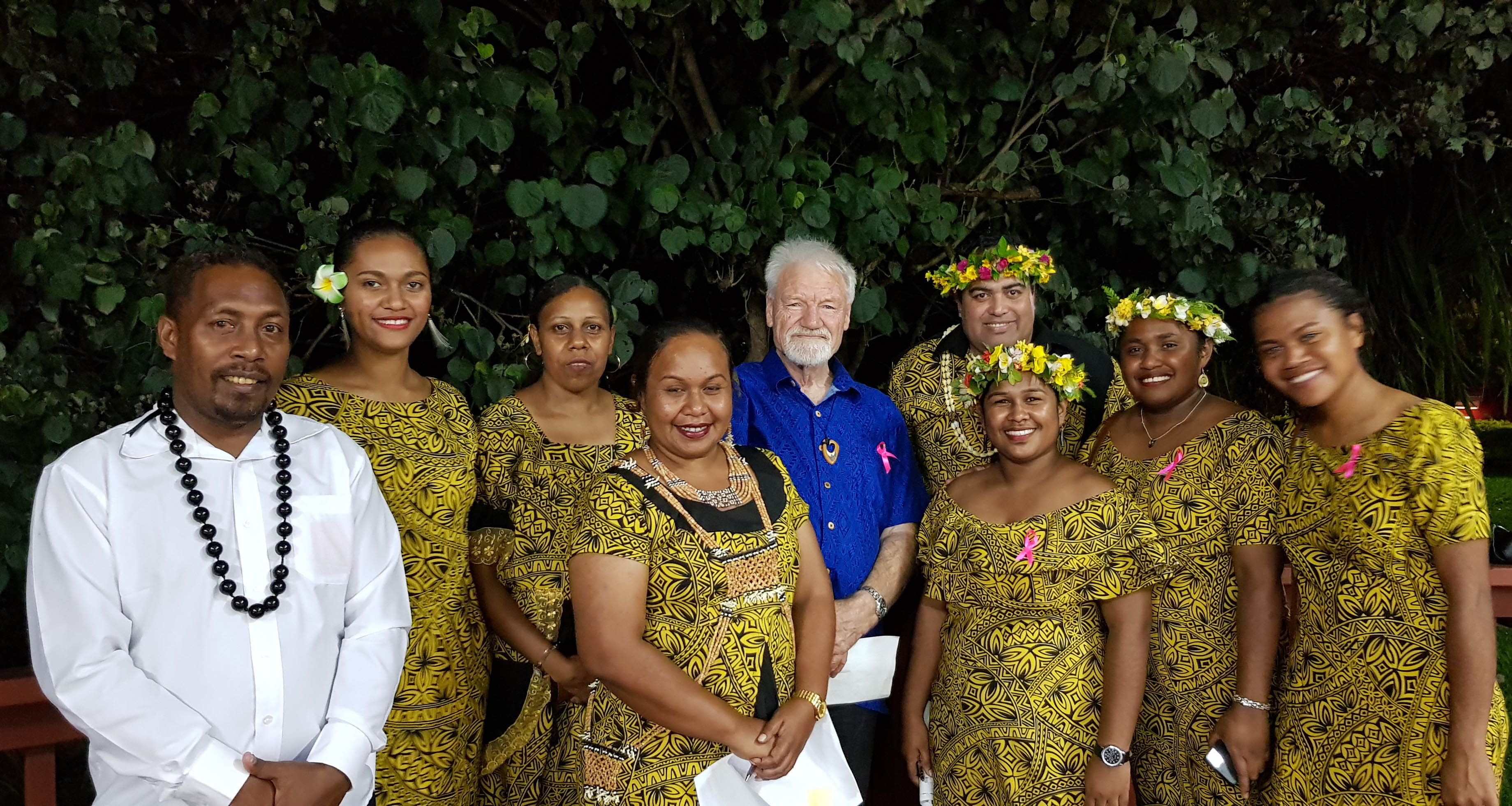
ISP2: Part of the crowd at the USP journalism awards night. Image: Harry Selmen/Wansolwara

USP3: Invited speakers … USP journalism programme coordinator Dr Shailendra Singh (from left) with Pacific Media Centre’s professor David Robie, head of the School of Literature and Media (SLAM), and MASI president Charles Kadamana. Image: Harry Selmen/Wansolwara

USP4: MASI president Charles Kadamana and PMC director professor David Robie with graduating student journalists. Image: Harry Selmen/Wansolwara

USP5: PMC’s Dr David Robie speaking at the USP journalism awards. Image: Harry Selmen/Wansolwara

USP6: Keynote speaker Professor David Robie (left) presents a koha from New Zealand to USP journalism programme coordinator Dr Shailendra Singh during the awards ceremony. Image: Jovesa Naisua/Fiji Times

USP7: PMC’s Professor David Robie, Fiji Times editor-in-chief Fred Wesley and USP journalism coordionator Dr Shailendra Singh at the awards. Image: Harry Selmen/Wansolwara

USP8: Fiji Times editor-in-chief Fred Wesley presenting an award with the Storyboard in the background. Image: David Robie/PMC

USP9: PMC’s David Robie making a prsentation at the awards. Image: Harry Selmen/Wansolwara

USP10: Second year student journalists – smartest dress award? Image: David Robie/PMC

USP11: Kava not Fiji Gold. Image: David Robie/PMC

USP12: USP Journalism’s Geraldine Panapasa amd PMC’s Professor David Robie share a joke. Image: Harry Selmen/Wansolwara

Print Friendly, PDF & Email

Article by AsiaPacificReport.nz

]]>

Report recommends overhaul of My Health Record, but key changes not supported by Coalition

]]>

Source: The Conversation (Au and NZ) – By Robert Merkel, Lecturer in Software Engineering, Monash University

The Senate Standing Committee on Community Affairs report into the My Health Record system was released last Thursday. It has recommended several substantial changes to the way My Health Record operates that attempt to address security and privacy concerns raised about the system.

Key recommendations were supported by Labor and Greens committee members, but not by Coalition committee members. Health Minister Greg Hunt has also rejected the recommendation to extend the opt-out deadline. There is less than four weeks until the opt-out period ends on November 15.


Read more: My Health Record: the case for opting out


My Health Record is a centralised digital repository of individual health information. It was originally proposed as an “opt-in” system in 2011. But in a process originally planned to be complete by October 2018, it was switched to “opt-out”, meaning records will be created for all Australians unless they explicitly choose not to have one. This change has generated controversy.

Experts in information technology, high-profile doctors (including the apparent member-elect for Wentworth Kerryn Phelps) and privacy experts have all expressed reservations about the security and privacy protections of the system. Hunt announced several changes to My Health Record in late July in response, including delaying the opt-out date until November 15.

But the Standing Committee has recommended further substantial changes.

Secondary use of data and access by insurers

The Committee takes the view that My Health Record has considerable potential to improve health care if it’s widely adopted by practitioners and recipients, so it doesn’t recommend the abandonment of the system. Nor does it propose switching back to an opt-in system.

Of its 14 recommendations, 11 were supported by the entire committee. These can be summarised as:

  • an outright prohibition on the secondary use of My Health Record data for commercial purposes
  • requiring explicit consent for secondary use of identifiable data from an individual’s My Health Record, such as for public health research purposes
  • prohibiting employers and insurance companies from accessing My Health Record data
  • prohibiting access to a deleted My Health Record stored in backups
  • extending the ability to suspend a My Health Record for longer periods to protect victims of domestic violence
  • better education about the system, particularly for vulnerable users.

Coalition members don’t accept key recommendations

The Labor and Greens members making up a majority on the committee made several further recommendations, which weren’t accepted by the Coalition committee members.

The committee recommended that record access codes should be required as the default. A record access code is roughly akin to a PIN code on your My Health Record, which a health care provider ordinarily requires to gain access. At present, the vast majority of My Health Records do not have a record access code set, as they are only set if you explicitly choose to do so.

This recommendation also proposed tighter restrictions on the ability of practitioners to “break glass” and access a My Health Record in an emergency without a record access code.

Under the current system, parents of children between 14 and 17 years of age have access to My Health Record information about their children. The committee recommended changing the policy to require that parents only have access if explicitly requested by the child.

Finally, the report recommended that the opt-out period be extended by 12 months, so that the issues discussed in the committee’s report can be dealt with.


Read more: My Health Record: Deleting personal information from databases is harder than it sounds


A good starting point, but more work needed

The committee has done a fair job of synthesising concerns surrounding My Health Record given the complexity of the issues raised, the limited time frame, and the fact that My Health Record has become a partisan political issue.

Many of the recommendations, such as the implications of banning secondary “commercial use” of My Health Record data, are in areas beyond my academic expertise. But some of the recommendations, if adopted, would go some way to addressing several concerns I have about the security and privacy of the system.

The consensus recommendation to prohibit access to backups of a deleted My Health Record is a positive step – if not the absolute assurance that actual complete deletion would offer.

The adoption of record access codes as the default, and restricting “break glass” access, would make My Health Record a considerably harder target for hackers seeking individuals’ health data. These changes would also prevent many potential privacy breaches from insiders with legitimate access to the system, who could use it for purposes other than providing health care.

While there other serious security problems with the My Health Record system, the adoption of these recommendation would be a considerable improvement from a security and privacy standpoint. The change to default use of access code would, however, be contentious. While supporting many of the other recommendations, the professional body of general practitioners, the RACGP, has reiterated its opposition to having access codes be the default.


Read more: Freezing out the folks: default My Health Record settings don’t protect teens’ privacy


Opt-out deadline looms

If the minister sticks to his position, the opt-out period for My Health Record will end on November 15, 2018. If you haven’t opted out by then, a record will be created for you.

But it’s worth considering that a federal election is likely to be held by May next year. Labor spokeperson for health, Catherine King, has endorsed the committee’s findings, and repeated a call for the creation of records under “opt-out” to be suspended until amendments have been made. The RACGP, despite their opposition to some recommendations, have also called for the opt-out process to be suspended until amendments are made.

Personally, I opted out some time ago, and am happy to remain out – at least until there is some clarity on what an amended My Health Record will look like. With the lack of political consensus, and the technical complexity of changing such a broadly scoped system, that is still some time away.

ref. Report recommends overhaul of My Health Record, but key changes not supported by Coalition – http://theconversation.com/report-recommends-overhaul-of-my-health-record-but-key-changes-not-supported-by-coalition-105290]]>

Chocolate Labradors die earlier than yellow or black, and have more disease

]]>

Source: The Conversation (Au and NZ) – By Paul McGreevy, Professor of Animal Behaviour and Animal Welfare Science, University of Sydney

Chocolate-coloured Labrador retrievers have, on average, 10% shorter lives than black or yellow Labradors, according to a study we co-published today in Canine Genetics and Epidemiology. Ear infections and skin diseases are also more common in chocolate Labradors than non-chocolate Labradors.

We looked at the UK veterinary records more than 33,320 Labrador retrievers through the VetCompass program. We then extracted data on death and disease from a random sample of 2,074 (6.2%) of these dogs.


Read more: Is your dog happy? Ten common misconceptions about dog behaviour


Some diseases were far more prevalent in chocolate dogs. The prevalence of pyo-traumatic dermatitis (sometimes called wet eczema or hot-spot) in black dogs was 1.1%, in yellow dogs it was 1.6% of but rose to 4% in chocolate dogs. Meanwhile, otitis externa (ear infection) was found in 12.8% of black dogs, 17.0% of yellow dogs and 23.4% of chocolate dogs.

Research in humans has suggested a link between inflammation and shorter life expectancy and lower quality of life. It’s possible that, by a similar process, repetitive inflammatory skin and ear infections in chocolate dogs create an immunological burden that effectively shortens their lives.

Breeding for colour, not health

Colour might not seem linked to health at first glace, but some connections between coat colour and disease in dogs are well established. The Piebald or “S” gene variants can increase the amount of white in a dog’s coat and lighten its eyes to blue, but also cause high rates of deafness in one or both ears.


Read more: Are you walking your dog enough?


Dogs with merle coats are popular, but prone to deafness and sight problems. Shutterstock

In another example, the Merle or “M” gene variant gives dogs a pale speckled coat and often blue eyes, but has been also linked with high rates of blindness and deafness. Rarer examples include cyclic neutropaenia (“Grey Collie Syndrome”) and colour dilution alopecia.

Even when the coat colour genes themselves are not themselves bad for dogs’ health, problems can still arise when an unusual colour becomes popular. The genes for some colours may be quite rare in the population or else hidden inside a parent of a different colour, meaning breeders may be tempted to overuse dogs they know for sure either show or hide the rare gene.


Read more: Animal emotions stare us in the face — are our pets happy?


This is the case for our chocolate Labradors: chocolate is a recessive trait, which means both parents must carry it. Breeding chocolate puppies from this shallower gene pool carries with it additional risks of ill health and disease.

And it’s not only physical health with has surprising links to coat colour – behaviour has been linked to coat colour too. For example, there appears to be an association between coat colour and aggression in self-coloured (golden and black as distinct from roan) cocker spaniels.

Colour has been linked to temperament in cocker spaniels. Shutterstock

While it is not clear whether coat colour affects the widely prized personality of the Labrador, chocolate Labradors have different retinas to their yellow and black counterparts and retinal differences in various other breeds are thought to account for some behavioural differences in other breeds (for example in the chasing behaviour of so-called sighthounds, such as whippets, greyhounds and Afghan hounds).

The power of preference

Surprisingly, even if it turns out that the colour of Labradors doesn’t affect how they behave around us, there is some evidence that it may affect how we humans behave towards them. One study found people who look at photos of yellow and black dogs rate the yellow dogs significantly higher in agreeableness, conscientiousness and emotional stability.

Similarly, a study found pedestrians perceived pale-coloured dogs as being friendlier than dark-coloured dogs. Indeed, black dogs have been maligned by no less a figure than Winston Churchill, who referred to his own depression as a black dog. It is even possible that breeders may have selected the tan eyebrows of breeds such as Rottweilers and Kelpies because the contrast on their expressive eyebrows make their faces easier to read.

We may like dogs with high-contrast eyebrows because it’s easier to read their expressions. Shutterstock

Read more: Do dogs have feelings?


But whatever our first impressions of a dog in a photograph, a dog on the street, or the new puppy we’ve just brought home, any dog owner can tell you that our relationships with our canine companions matter far more than appearances.

There are estimates that over 43,000 dogs are euthanased in shelters and pounds annually in Australia and evidence that 65% of owners report a behavioural reason for surrendering their dogs, often because the dogs have been poorly socialised, trained and managed. It is safe to say these dogs were not sent to shelters because of their colour.


Read more: Animal emotions stare us in the face — are our pets happy?


With every generation in a breeding program, one can make only a certain number of strides. Since breeders have to take into account the many detailed traits specified in breed standards, there’s limited opportunity to also breed for traits that boost welfare and adaptability to urban environments.

Breeders could focus more on selecting for good temperament and health, but only if less attention were paid to superficial traits. After all, a dog can never be the “wrong” colour.

ref. Chocolate Labradors die earlier than yellow or black, and have more disease – http://theconversation.com/chocolate-labradors-die-earlier-than-yellow-or-black-and-have-more-disease-105366]]>

Decoding the music masterpieces: Rossini’s opera, Otello

]]>

Source: The Conversation (Au and NZ) – By Peter Tregear, Honorary Principal Fellow, University of Melbourne

If you attend Rossini’s opera Otello (1813) expecting something close to the structure and poetry of Shakepeare’s original – as Lord Byron did when he went to a performance in Venice in 1818 – you will be disappointed. “They have been crucifying Othello into an opera,” Byron later wrote despairingly to a friend.
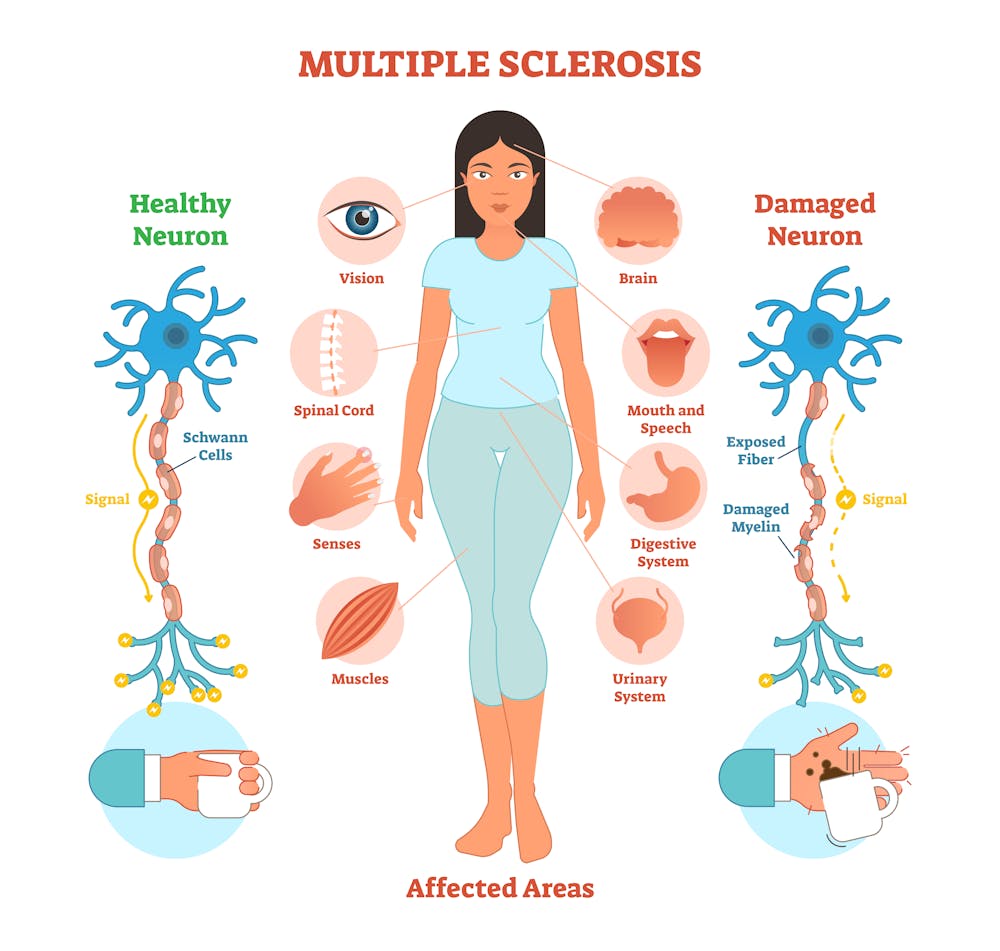
Even before examining Rossini’s Otello on its own terms, however, it is worth remembering that Shakespeare’s play was itself an adaptation based on a short story by Giraldo Cinthio (1504–1573), first published in 1565.

Set in Venice and on the Venetian colony of Cyprus, Shakespeare’s play centres on the titular Othello, a Moor and general in the Venetian army. Othello has secretly married Desdemona, the daughter of a senator. He is ultimately undone by the plotting of a vengeful soldier, Iago, when they all travel to Cyprus, who plays on Othello’s jelousy with deadly effect.

Rossini’s opera follows this broad plot outline. Rossini’s librettist, Francesco Berio di Salsa (1765–1820), a minor Italian nobleman and author, chose, however, to place the opera entirely in Venice. He also makes the role of Rodrigo, the hapless suitor for Desdemona, much bigger, Jago [Iago] much smaller, and eliminates Cassio (a lieutenant) altogether.


Read more: Decoding the music masterpieces: Debussy’s only opera, Pelléas and Mélisande


We should not be put off by these changes. For one thing, there is a good deal of truth in George Bernard Shaw’s witty observation that “instead of Otello being an Italian opera written in the style of Shakespeare, Othello is a play written by Shakespeare in the style of an Italian opera”. Shaw noted in particular that the character of Desdemona was already “a prima donna, with handkerchief, confidante, and vocal solo [the “Willow Song” in the play], all complete”.

Desdemona’s ‘Willow Song’ from Rossini’s Otello, sung by Frederica von Stade.

Rossini’s setting proved in any case to be a tremendous success, only being overshadowed by Verdi’s setting of 1886. But its modern revival has been hampered by a prejudice against Rossini himself as a composer capable of truly serious intent. Indeed, when Rossini met Beethoven in 1822 the latter congratulated him on his latest triumph, Il barbiere di Siviglia (1816), with the, well, barbed remark:

Never try to write anything but opera buffa [a comedic opera]; any attempt to succeed in another style would endanger your nature.

Beethoven’s remark suggests an attitude that has proved hard for us subsequently to shake, one that would seek a divide between music that is venerated and that which entertains.

Foregrounding race

Rossini’s Otello, however, well deserves to be taken seriously. The composer’s sonically thrilling decision to exploit the vocal resources of the Teatro del Fondo Naples, where it received its first performances in 1816, and make Otello, Rodrigo and Jago all high tenors, for instance, has the effect of focusing our attention on that perennially relevant aspect of the work, racial prejudice.

So does the libretto. When we first encounter him, Otello appeals to the Doge (and, by extension, the people of Republican Venice) for equality as a good citizen of the city-state:

I am a stranger, and a proud son of Africa
But if you find this heart worthy of you
Since I have shown my respect for your country, admire it, and love it
All I ask is acceptance as a son of Adria.

Otello then asks:

But can you really respect me? I was raised under an ungrateful sky.
My customs and my appearance must seem so strange to you.

For the people of Venice, the answer is straightforward. They love Otello for his heroic deeds and noble demeanour, and this love conquers any and all prejudice. They go on to note that it is our failure to love generously that we should fear most of all, not the presence of an outsider per se.

Without ardour love may sour,
Tyranny may start to grow
Without love then ardour’s power
May turn pleasure into woe.

In early 19th-century Italy, such a politics of inclusion based in sentimental love was the logical consequence of Enlightenment humanism. If love can exist across political, racial and religious divides, then so must the rights and protections that a state affords its citizens. Mirroring traditional Christian doctrine, the answer to the question “Who is our neighbour?”, then must be: “Everyone!”


Read more: Decoding the music masterpieces: Rossini’s William Tell, and its famous overture


Otello’s eventual self-destruction as a result of Jago’s scheming, aided and abetted by a lovelorn Rodrigo and a Machiavellian father-of-the-bride (Elmiro), is thus all the more shocking. While it was the staging of a suicide that most likely first attracted the ire of the censors in Rome when it was performed there in 1820, the tragic ending also contained an implicit political critique.

That year had also witnessed an attempted revolution in Naples, which sought the establishment of liberal constitutional rule across the whole of Italy. In any case, Rossini was obliged to compose an alternative “happy ending” in which all plots are revealed in the nick of time and all wrongdoers forgiven — an ending now itself consigned to history.

Musical innovation

Many of the particular musical innovations in Otello, however, proved much more lasting and influential. New approaches to operatic form are evident from the moment the curtain rises after the overture.

A lengthy Introduzione, involving both the chorus and a number of principals, is used to establish not only the core interpersonal conflicts but also a broader, political context for them. In so doing, Rossini provided a model for what was later to become known as “Grand Opera”. A delicious parody of this type of theatrical set piece, also set in Venice, can be found in the opening of Gilbert and Sullivan’s The Gondoliers (1889).

Another innovative device that Rossini liberally deployed in Otello is the ensemble dramatic freeze, where the protagonists seem to take “time out” to reflect upon a particular conflict that has arisen. This is arguably opera at its purest and not one, but two, extended sections of such a “freeze” occur in the Act I finale of Otello, evoking similar instances in later operas by Donizetti and Verdi, among others.

Act I finale (except) from Rossini’s Otello (Blake, Cuberli, Merritt & Runey)

Perhaps the most extraordinary musical feature of Otello, however, is Rossini’s musical treatment of Desdemona. She is of course the play’s other great victim, maybe even more so given that she becomes a blameless victim of domestic violence. Rossini created a famously virtuosic soprano role (the premiere in Paris on June 5 1821 notably cast the great 19th-century diva Giuditta Pasta), but it is no mere “show pony” part. Indeed, Rossini gives Desdemona no formal “entrance aria” in the first act, nor any grand “love duet” with Otello. Her musical characterisation, instead, is conveyed via much more supple and original musical means.

Her bedroom scene in the third act, for instance, incorporates an orchestral representation of a storm, which, in the words of the Rossini expert Philip Gossett, makes Otello “the watershed between opera of the 18th century and that of the 19th”.

And, just before it, Rossini draws on a contemporary Venetian tradition by including an off-stage gondolier singing lines of poetry. In this case his words are taken from the fifth canto of Danto’s Inferno: “There is no greater sorrow/Than to remember happiness In time of grief.”

Gondolier’s Song (“Nessun maggior dolore”)

In the estimation of that great master of Grand Opera, Giacomo Meyerbeer (1791–1864), it was this third act that established Otello’s reputation so firmly that a thousand errors could not shake it. He declared it to be:

… really godlike, and what is so extraordinary is that its beauties are quite un-Rossini-like. First-rate declamation, continuously impassioned recitative, mysterious accompaniments full of local colour … brought to highest perfection.

Like Beethoven’s before him, however, Meyerbeer’s ever-so-slightly caustic comment ultimately reveals a bigger truth: Otello actually represents Rossini the music dramatist at his finest.

ref. Decoding the music masterpieces: Rossini’s opera, Otello – http://theconversation.com/decoding-the-music-masterpieces-rossinis-opera-otello-104760]]>

Why children in institutional care may be worse off now than they were in the 19th century

]]>

Source: The Conversation (Au and NZ) – By Nell Musgrove, Senior Lecturer in History, Australian Catholic University

Prime Minister Scott Morrison’s national apology to the victims of child sexual abuse was a moment of reckoning for the government – an admission of the country’s failures to protect children from abuse in institutions ranging from churches and schools to orphanages and foster homes.

We too often hear about child protection when there is a scandal or crisis. For young people who grow up in out-of-home care, however, we need to go beyond simply reacting to terrible incidents like these and focus more attention on whether our systems are delivering the outcomes they should on a daily basis and for the long-term benefit of young people.

Rectifying failures of the system time and again

A series of national inquiries has found that hundreds of thousands of children have suffered lifelong consequences due to the failures of the country’s child protection policies.

The Bringing Them Home report in 1997 examined the separation of Aboriginal and Torres Strait Islander children from their families, and the enormous impact this had on these communities.

Similar testimonies of lifelong sorrow emerged from the 2001 inquiry into child migration, the 2004 inquiry into out-of-home care abuse and neglect and the 2012 inquiry into forced adoptions.

Then, of course, there were the shocking stories of abuse that emerged from the recent Royal Commission into Institutional Responses to Child Sexual Abuse.

All of this was hard for Australians to hear, but as a nation we bore witness. The federal government developed a National Framework for Protecting Australia’s Children 2009-2020 and we enjoyed a moment of optimism and hoped that recognising past injustices might put us on a path to a better future.


Read more: Child protection report lacks crucial national detail on abuse in out-of-home care


But reality returned. Indigenous children are still over-represented in the child protection system. Advocacy groups like CREATE are still helping young people leaving out-of-home care to overcome stigma and shame, educational disruption and difficulties establishing secure, independent lives.

The South Australian Child Protection Systems Royal Commission concluded in 2016 that the risk of sexual abuse in out-of-home care “has not diminished” and action to address it is “long overdue”. And the Royal Commission into Child Sexual Abuse acknowledged the extent of abuse in out-of-home care nationwide remains unknown.

A widening gap for foster care kids

Worryingly, things may actually be getting worse for young people leaving out-of-home care and trying to transition to adulthood. Let’s take three snapshots from the past 150 years: the mid-19th century, the mid-20th century and today.

By the 1860s, most Australian colonies had government-run systems to take guardianship of children through court orders. These systems were less concerned with social justice than they were with preventing children from growing up to become criminals.

This meant preparing children from ages 12 to 15 for work placements. Most girls were sent to work as domestic servants, most boys were placed as general servants or farm labourers. Importantly, welfare departments took responsibility for finding them employment after their training.


Read more: The faulty child welfare system is the real issue behind our youth justice crisis


Although many children were unhappy with their situations and had little power to change their lives, they were at least entering work around the same age as their working-class peers and had long-term prospects for employment.

By the mid-20th century, the comparison looked different. Children in government systems were typically given the minimum legal education and then funnelled into the same types of jobs they had entered in the 19th century – domestic servants, farm labourers, and other low-skilled work.

However, on leaving their arranged work placements, these young people had to compete for work with their more-qualified peers, who were increasingly staying on longer at school. The long-term stability offered by these fields was no longer guaranteed.

The result was a widening gap between those who had grown up in out-of-home care and those who hadn’t.

How does this compare to today?

Our research into the history of foster care has shown that children who grow up in the system continue to suffer educational disadvantages with lifelong consequences. There are, of course, complex reasons for this.

The former foster kids we spoke with in our study said that movement between foster homes caused massive disruption to their educations. There has been more attention in recent years on bringing stability to young people in out-of-home care, including a reconsideration of adoption as a preferred alternative to foster care.

But our research subjects had mixed feelings about permanent care schemes because they often provide less financial support than foster care and fewer support services. An inquiry into local adoption by SNAICC also found that adoption can pose serious issues for Aboriginal and Torres Strait Islander children, including loss of culture and family connections.


Read more: Australia failing to safeguard cultural connections for Aboriginal children in out-of-home care


Another systemic factor – one we could more easily address – is the problem of “aging out” of the system.

The National Framework for Protecting Australia’s Children recognised that young people need the state to act as a “good” parent for a few years after they leave care at age 18. After all, young Australians everywhere are continuing to live longer with their families to help ease their transitions to further study or long-term employment.

Victoria, South Australia and Tasmania have committed to extending payments to foster and kinship carers until young people turn 21. The royal commission in South Australia has also recommended that some aspects of government support should continue to age 25.

But the National Framework made no reference to supporting university attendance for young people leaving care. A few universities – such as La Trobe and Federation – provide bursaries, scholarships and dedicated support staff to these young people, but there is no national commitment to extend this support across the country.

This is in stark contrast to the UK and US, where efforts to increase the numbers of care leavers at university have been in place for almost two decades.

National apologies for the travesties committed in institutional care are important, but it’s also vital we recognise other severe deficiencies in the system. The gap between what the state delivers to care leavers and what a typical family might provide its own children is wider now than it has been in 150 years.

Extending financial aid and other services into young adulthood, and helping care leavers at university, are two direct ways the government can demonstrate its ongoing commitment to some of the most vulnerable people in society.

ref. Why children in institutional care may be worse off now than they were in the 19th century – http://theconversation.com/why-children-in-institutional-care-may-be-worse-off-now-than-they-were-in-the-19th-century-104395]]>