 Former French Polynesian President Oscar Temaru joins Daniel Goa, president of Union Caledonienne (UC) and FLNKS spokesperson at a festival for independence at Ponerihouen, New Caledonia, earlier this month. Image: Nic Maclellan
France under fire for ‘manipulated’ ousting of Temaru from Assembly

By RNZ Pacific
French Polynesia’s pro-independence opposition has continued to attack the French government and judiciary for removing its leader Oscar Temaru from the Territorial Assembly.
After last week’s French court ruling that he had breached election campaign rules, Temaru was today absent from the Assembly debate for the first time in 32 years.
The Tavini Huiraatira party’s Antony Geros accused the judiciary of being manipulated by the government in Paris which he said acted to punish Temaru for taking all living French presidents to the International Criminal Court (ICC).
READ MORE: French Polynesian party lashes out at France over court ruling
 NEW CALEDONIA OR KANAKY? THE INDEPENDENCE VOTE
The legal action alleges that by ordering nuclear weapons tests in the South Pacific, the presidents committed a crime against humanity.
Geros also raised last week’s decision of the Court of Cassation, France’s highest court, which quashed the 1959 conviction of the pro-independence leader Pouvanaa a Oopa who had been jailed for eight years.
Geros said only an independent judiciary could help the families hit by the consequences of the nuclear tests.
A total of 193 nuclear tests were detonated at the French Polynesian atolls of Moruroa and Fangataufa over three decades between 1966 and 1996.
Temaru also visited New Caledonia earlier this month advocating support for the Kanak campaign for independence.
Temaru’s seat has now gone to the Tavini’s Cecile Mercier.
New Caledonia faces a vote on independence this Sunday under the provisions of the 1988 Matignon and 1998 Noumea accords after unrest and demands for independence in the 1980s.

Article by AsiaPacificReport.nz
]]>View from The Hill: When you’re not PM but behave like you are

Source: The Conversation (Au and NZ) – By Michelle Grattan, Professorial Fellow, University of Canberra
Malcolm Turnbull was correct, in policy terms, when this week he called out Scott Morrison’s ill-judged plan for Australia to consider moving its embassy from Tel Aviv to Jerusalem.
The inevitable political consequence, however, is that the ex-prime minister has highlighted that his successor is expedient and a foreign affairs amateur.
Morrison sent Turnbull to Indonesia as head of Australia’s delegation to a conference about ocean sustainability. The trip was in the former PM’s diary when he was deposed; at the time Morrison decided to stick by the arrangement, the “Jerusalem” issue hadn’t arisen.
That announcement only came in the final week of the Wentworth byelection, with Morrison desperately trying to shore up the Jewish vote for the Liberals.
As Turnbull is personally close to President Joko Widodo, when the announcement ruffled Indonesian feathers, it was apparently hoped that Turnbull could do some smoothing.
If this were the thinking it was naïve, to the extent it ignored the inevitable consequences of putting Turnbull centre stage.
The trip might have been unremarkable if Turnbull’s activities had been confined to the oceans conference. But it looks very strange to have a recently-sacked PM conducting top-level talks with the Indonesian government about a highly controversial Australian initiative – with which he personally disagrees.
An observer – or the Indonesians – might ask: would the real prime minister please stand up?
After his Monday meeting with the President, Turnbull made it clear how off-the-cuff the Morrison announcement looked – in contrast to his own administration’s policy.
He said the conclusion he and his government had taken “after very careful and considered advice was that a policy that is well over 40 years old, 50 years old, should remain exactly the same as it is”.
Turnbull said Widodo had told him, as he had Morrison, of the very serious concern held in Indonesia about the prospect of the embassy being moved.
“There is no question, were that move to occur, it would be met with a very negative reaction”, in the heavily Muslim Indonesia, Turnbull said.
The hasty nature of Morrison’s announcement had already been exposed. At Senate estimates last week it was revealed that Foreign Minister Marise Payne had been informed only on the Sunday before the Tuesday announcement. The secretary of her department, Frances Adamson wasn’t told until the Monday, the same day officials of the Prime Minister’s department and the Defence department also learned of it.
There’d been no proper public service process sitting behind such a consequential proposal.
Morrison early on tried to fudge the immediate Indonesian blowback, although it was obvious via leaking. Turnbull has not just reiterated that criticism directly from the Indonesian President, but backed it up with his own support for making no change.
Forced to respond on Tuesday to Turnbull’s remarks, Morrison said a decision has not yet been taken, and “we will follow a proper process” – which seems rather late in the piece. He also stressed that “Australia decides what our foreign policy is and only Australia”.
Morrison is in an awkward situation. An outcome has been promised by year’s end. If the government opts against moving the embassy, it will disappoint Israel, which welcomed the rethink, as well as making even more obvious what a sham the original announcement was.
If it endorses the move, there will be a fresh reaction from Indonesia and others. And Turnbull’s critique will be already on the record.
The rightwingers inside the Liberal Party and among the commentariat opposed Turnbull being sent to the oceans conference, and they will feel vindicated following his remarks about the embassy.
Turnbull must know his comments are damaging to his successor. But like his refusal to help with a robo call or a letter in Wentworth, he’s going to do things his way now. Whether this will mean further interventions before the election remains to be seen. He has declared himself “retired” from politics but he’s also said “I’ll continue to have things to say about important matters of public interest”.
From another ex-prime ministerial corner Tony Abbott, without a blush, has started calling for party unity, an appeal that’s hard to take seriously given the disunity he’s caused.
Writing in Monday’s Australian Abbott argued: “Scott Morrison won’t have the problems that I had as PM because no one is stalking him for his job.
“He won’t have the problems Turnbull had as PM because he is a much more tribal Liberal, and because he’s done the best he could, under the circumstances, to acknowledge the two biggest personalities on his backbench”. (A rather immodest reference to himself and Barnaby Joyce, and their “envoy” jobs.)
Now that Abbott has seen the fall of the man who brought him down, he is apparently willing to behave better, despite Morrison declining to meet the hard right’s agenda on such matters as quitting the Paris climate agreement.
As he talks togetherness, some believe Abbott has his eye on post-election opposition leadership. More immediately, possibly he’s looking to his seat, where his wrecker image could be a liability if he faces a credible independent.
Whatever the motive, many Liberals will be cynical about the unity pitch, though the Prime Minister might be relieved. Given Abbott’s bitterness about Morrison after the 2015 coup, relations between the two are always delicate.
The continuing federal government shenanigans can only be causing despair in the Liberals’ Victorian division, as the state campaign begins, with the Coalition opposition trailing 46-54% in the latest Newspoll.
Although people do distinguish between state and federal when they vote, there is also overlap and the dumping of Turnbull was unhelpful for the Victorian Liberals. In the Newspoll, three in ten people said the federal leadership change had made them less likely to vote for the state Liberals.
If the state Liberals are trounced, some of the blame is likely to be tossed Canberra’s way, adding to Morrison’s pre-Christmas woes.
– ref. View from The Hill: When you’re not PM but behave like you are – http://theconversation.com/view-from-the-hill-when-youre-not-pm-but-behave-like-you-are-105996]]>The new electric vehicle highway is a welcome gear shift, but other countries are still streets ahead
Source: The Conversation (Au and NZ) – By Iftekhar Ahmad, Associate Professor, Edith Cowan University
Perhaps buoyed by a 67% increase in the sale of electric cars in Australia last year – albeit coming off a low base – the federal government this month announced a A$6 million funding injection for a network of ultra-fast electric vehicle recharging stations.
Eighteen stations will be located no more than 200km apart on the main highway linking Brisbane, Sydney, Canberra, Melbourne and Adelaide. A further three stations will be built near Perth. All will be powered by renewable energy.
The network will address the issue of “range anxiety” – the fear that your car will run out of puff before reaching its destination – that particularly concerns motorists in a country as big as Australia. If your electric vehicle needs charging every 200km or so, that’s a lot of stopping between Sydney and Melbourne – and what if you can’t find a charging station?
The newest electric vehicles can cover up to 594km on a single charge. That improvement, together with the new charging network, will do much to address range anxiety. But as is often the case, the devil may be in the detail.
Read more: Australia’s ‘electric car revolution’ won’t happen automatically
We don’t yet know how many fast-charging ports will be available at each station, but the number of ports is often limited due to high infrastructure costs. Even a fast charge takes about 15 minutes, so queues are likely. If a 10-minute wait at your local petrol station irritates you, imagine waiting an hour or more at an electric recharge station.
But the new network is undoubtedly a step forward, and such progress is necessary to keep electric-curious prospective motorists in the game. Of that 67% increase in electric vehicles sales mentioned earlier, the vast majority are business fleet vehicles. Private car buyers are still slow to take the plunge.
Australia is in the midst of a classic chicken-and-egg situation when it comes to growing the electric vehicle market, with the result that we’re well behind where we should be. Buyers want to see more infrastructure and perhaps some government-funded incentives (just look what a A$2,000 subsidy scheme did for the LPG market). But governments need to be confident that people will definitely buy electric cars before taking the plunge.
The power you’re supplying… it’s electrifying
Now that there’s some movement afoot from both parties, there’s a third player to consider: the electricity utilities.
If most electric vehicle owners plug in their vehicle when they get home from work of an evening – just as many of us let our phone run down during the day and then throw it on the kitchen-bench charger when we walk in the door – this could pose significant problems for the electricity grid.
According to one British estimate, as few as six cars charging at the same time on a street at peak times could lead to local brownouts (a drop in voltage supply). That might sound extreme, but it’s fair to say that daily electric car charging collectively shortens the life of electricity infrastructure such as transformers.
For this reason, my colleagues and I have researched smart charging strategies aimed at preventing the peak load period for electric car charging from overlapping with the residential peak.
The issue is even more acute when using domestic renewable energy, because of the “duck curve” – which shows the timing imbalance between peak demand and peak renewable energy production. As the name suggests, the graph is shaped like a duck.
Read more: Slash Australians’ power bills by beheading a duck at night
The duck curve can be smoothed out with the help of power storage technologies such as batteries, and by behavioural change on the part of consumers (such as temporal load shifting).
The right network
Our model can also help electric vehicle owners find a nearby charging station with the least estimated waiting time and cost, in real time. This also opens up a new avenue for the electric utilities, which can work with charging service providers to adjust the prices at different charging locations so as to to distribute the load evenly across the charging network, and reduce waiting times into the bargain.
Unfortunately the utility companies don’t seem particularly interested yet, perhaps because it’s not an immediate problem. But it soon will be if the take-up of electric vehicles continues on its current trajectory.
Read more: Negative charge: why is Australia so slow at adopting electric cars?
It’s unfortunate that Australia is lagging behind other developed countries when it comes to electric vehicle adoption. But this can work in our favour if we learn from other countries and take a more systematic approach. A lot can be achieved through proper planning.
In Australia we’ll need to see continued and better marketing of both the advantages of reducing emissions (electric vehicles are essential for the long-term decarbonisation of the electricity and transport sectors), as well as clearer cost-benefit analysis of the economic savings that can be made through personal and government investment in electric vehicles.
– ref. The new electric vehicle highway is a welcome gear shift, but other countries are still streets ahead – http://theconversation.com/the-new-electric-vehicle-highway-is-a-welcome-gear-shift-but-other-countries-are-still-streets-ahead-105509]]>Politics with Michelle Grattan: Satirist Jonathan Biggins on sending up the pollies
Source: The Conversation (Au and NZ) – By Michelle Grattan, Professorial Fellow, University of Canberra
Jonathan Biggins, who has been sending up politicians as part of The Wharf Revue for almost two decades, has some sharp words about social media – “the enemy of democracy, not its ally” – and a warning on political correctness.
“We are entering an age of a new puritanism that is actually not only driven by the censorious right but by the equally censorious left who are saying this is no longer acceptable,” he tells The Conversation.
“We’ve always had a free rein at the wharf but I can see shadows looming at the door”.
– ref. Politics with Michelle Grattan: Satirist Jonathan Biggins on sending up the pollies – http://theconversation.com/politics-with-michelle-grattan-satirist-jonathan-biggins-on-sending-up-the-pollies-105982]]>Labor is making big promises for a Pacific development bank, but questions remain

Source: The Conversation (Au and NZ) – By Matthew Dornan, Research Fellow, Australian National University
This week, Opposition leader Bill Shorten used a major foreign policy speech at the Lowy Institute to announce that, if elected, a future Labor government would establish an infrastructure investment bank for the Pacific islands.
The announcement comes at a time of increased public scrutiny of Australian aid to the Pacific, driven by concerns over China’s heightened presence in the region. Many have argued that Australia’s “benign neglect” of the region has led Pacific governments to seek more assistance from China.
Read more: Soft power goes hard: China’s economic interest in the Pacific comes with strings attached
Nowhere is this more evident than in infrastructure. China is believed to have a comparative advantage over Australia in infrastructure lending in the region, given its own rapid development in recent years. Infrastructure lending is also at the heart of the new China-led Asian Infrastructure Investment Bank, or AIIB.
Australian aid, by comparison, has been criticised for focusing too heavily on governance projects instead of infrastructure investments. The Vanuatu government, for instance, has justified the construction of a China-funded wharf and roads by saying:
No donor was willing [to] help provide assistance on these projects although the economic benefits [are] huge.
A shift in Labor policy
Though not entirely a surprise, Shorten’s announcement does represent a change in Labor’s approach to aid. In February, Shadow Foreign Minister Penny Wong gave a speech outlining Labor’s future aid policy that focused on health, education, gender and climate change, but made no mention of infrastructure. Then, in July, she shifted tone, calling for greater emphasis on infrastructure in the Pacific.
The Coalition has also responded to rising Chinese influence in the region, committing to the construction of underseas internet cables to the Solomon Islands and Papua New Guinea to head off earlier bids by Chinese companies.
A dilapidated road in Vanua Levu, Fiji. Matthew Dornan, Author providedAustralia has for many years effectively delegated infrastructure lending to multinational development banks: the World Bank and Asian Development Bank (ADB). Shorten is now flagging that under a Labor government, Australia will itself provide concessional loans for projects like this on a bilateral basis.
None of this is to suggest that Australia has been completely absent from the infrastructure sector in the past, though its focus has traditionally been stronger in other areas, such as education and disability projects.
Australia has also invested heavily in “soft” infrastructure in the Pacific, or the technical and managerial expertise and institutions needed to manage new infrastructure projects, such as bridges, roads and ports.
Such support is important, even if outcomes are difficult to measure. Without managerial or technical expertise, as well as appropriate institutions, infrastructure projects often fall into disrepair. A stark example is the tragic account of the decline of a village in Papua New Guinea following the deterioration of its airstrip.
A new reliance on concessional loans
Australian aid has been used on occasion for infrastructure projects in the Pacific, mainly through grants to complement World Bank and ADB loans. But Australia has not been in the business of providing its own loans for infrastructure development. That much is clear. And in this respect, Shorten’s announcement is significant.
If Australia is determined to move more firmly into the infrastructure game to counter Chinese lending in the region, it makes sense to fund such projects with loans.
Grants are ill-suited for infrastructure projects for which there is a strong commercial case (such as the Solomon Islands internet cable). They distort market incentives and divert scarce aid resources away from other priorities.
Read more: Pacific nations aren’t cash-hungry, minister, they just want action on climate change
There are clearly potential benefits for the region from a new infrastructure bank. The Pacific suffers from an enormous infrastructure deficit, particularly in remote rural areas. There is also considerable evidence that points to the importance of infrastructure for economic development and poverty alleviation.
China Exim Bank loans, though concessional, are generally not great value for money, with higher interest rates and shorter repayment periods than those offered by other lenders, including presumably any new Australian infrastructure bank.
A large number of unanswered questions
Having said that, we should put the hubris in Shorten’s speech to one side. It makes no sense to aspire, as he said, for Australia to become the Pacific’s “partner of choice” for infrastructure projects. We can only finance a small fraction of the region’s needs, and Pacific nations will have good reason to look to other infrastructure providers, such as China. We’re not that special.
Turning from rhetoric to policy, more detail is needed before we can determine conclusively whether such a bank would be positive for the region. Shorten’s speech only indicated that Labor would:
…actively facilitate concessional loans and financing for investment in these vital, nation-building projects through a government-backed infrastructure investment bank.
That leaves a lot of questions unanswered.
Should the new bank lend to governments or the private sector, or both? To what extent will projects be selected on the basis of rigorous benefit cost analysis? How will “bankable” projects be identified? Will loans be available to all Pacific island countries, including those currently in debt distress? Will concessional loans come at the expense of existing aid priorities, including Australian funding for “soft” infrastructure?
The answers to such questions are important. After all, it is Australia’s overall approach towards infrastructure that will ultimately drive long-term impacts.
– ref. Labor is making big promises for a Pacific development bank, but questions remain – http://theconversation.com/labor-is-making-big-promises-for-a-pacific-development-bank-but-questions-remain-105853]]>Mr Darcy as vampire: a literary hero with bite

Source: The Conversation (Au and NZ) – By Eric Parisot, Lecturer in English, Flinders University
Ever since Colin “Wet-Shirt” Firth got hearts racing across the globe in Andrew Davies’ BBC adaptation of Jane Austen’s Pride and Prejudice (1995), the cult of Mr Darcy has been in full swing. To many Austen fans, he is a dreamboat — brooding, handsome, not to mention filthy rich.
For others, as heard recently at the Cheltenham Literature Festival, Darcy’s behaviour is ghastly, bullish, and emotionally manipulative, while his mythic romantic status has had an “insidious effect on dating culture”. But these two responses aren’t mutually exclusive, especially given the recent literary incarnation of Mr Darcy as a blood-sucking vampire.
This post-Twilight merging of two of the most popular literary cults helps to focus on what modern readers value in both Austen and the vampire tradition: undying love. Together, they promise an eternal love of a different sort, not one that persists beyond death and into an incorporeal afterlife, but one that can be enjoyed physically forever.
Read more: Friday essay: the revolutionary vision of Jane Austen
Riding on the wild success of Seth Grahame-Smith’s Pride and Prejudice and Zombies (2009), fan fiction writers have rewritten Emma Woodhouse (from Austen’s Emma) as a proto-Buffy vampire slayer, and even transformed Austen herself into a vampire. But in modern, vampiric depictions of Darcy we have a new idealisation of the romantic lover, staking a claim (bad pun intended) alongside Lord Byron, Dracula and Edward Cullen as literature’s sexiest monster— but a monster, nevertheless.
In Susan Krinard’s novella Blood and Prejudice (published in the 2010 collection Bespelling Jane Austen), Darcy is a business executive who flies into modern-day Manhattan to investigate a potential new acquisition, Bennet Laboratories. But when Darcy meets Lizzy, he becomes less interested in a corporate takeover and more interested in a corporeal one.
When Lizzy notices Darcy “staring at me with his piercing indigo eyes as if we were the only two people in the room and he was about to eat me for lunch,” the simultaneous vampiric pun and sexual innuendo of being “eaten” by Darcy becomes obvious.
The vampire’s bloody, penetrative bite has long been associated with coitus, and it is no different here — much to Lizzie’s tortured delight. But after resisting vampire Wickham’s predatory advances, and warding off an indecent proposal from a vampiric Mr Collins — let’s face it, he would suck the life out of anyone, so why not make him a vampire? — Lizzy is finally convinced that she is not being enthralled by Darcy’s preternatural charms, but is indeed falling in love.
The association of feeding with sex suggests that while this might be an undying love, it is one that Lizzy will have to physically share with others, or risk being consumed to death. “It’s all right, Darcy. I know you can’t live on me alone. I won’t be jealous… Well, maybe just a little.” The solution? Lizzie’s conversion into a vampire, and a polyamorous marriage; after all, Lizzie doesn’t want to have Darcy for “a lifetime,” but “for an eternity.”
Read more: Older than Dracula: in search of the English vampire
Saucier and saucier
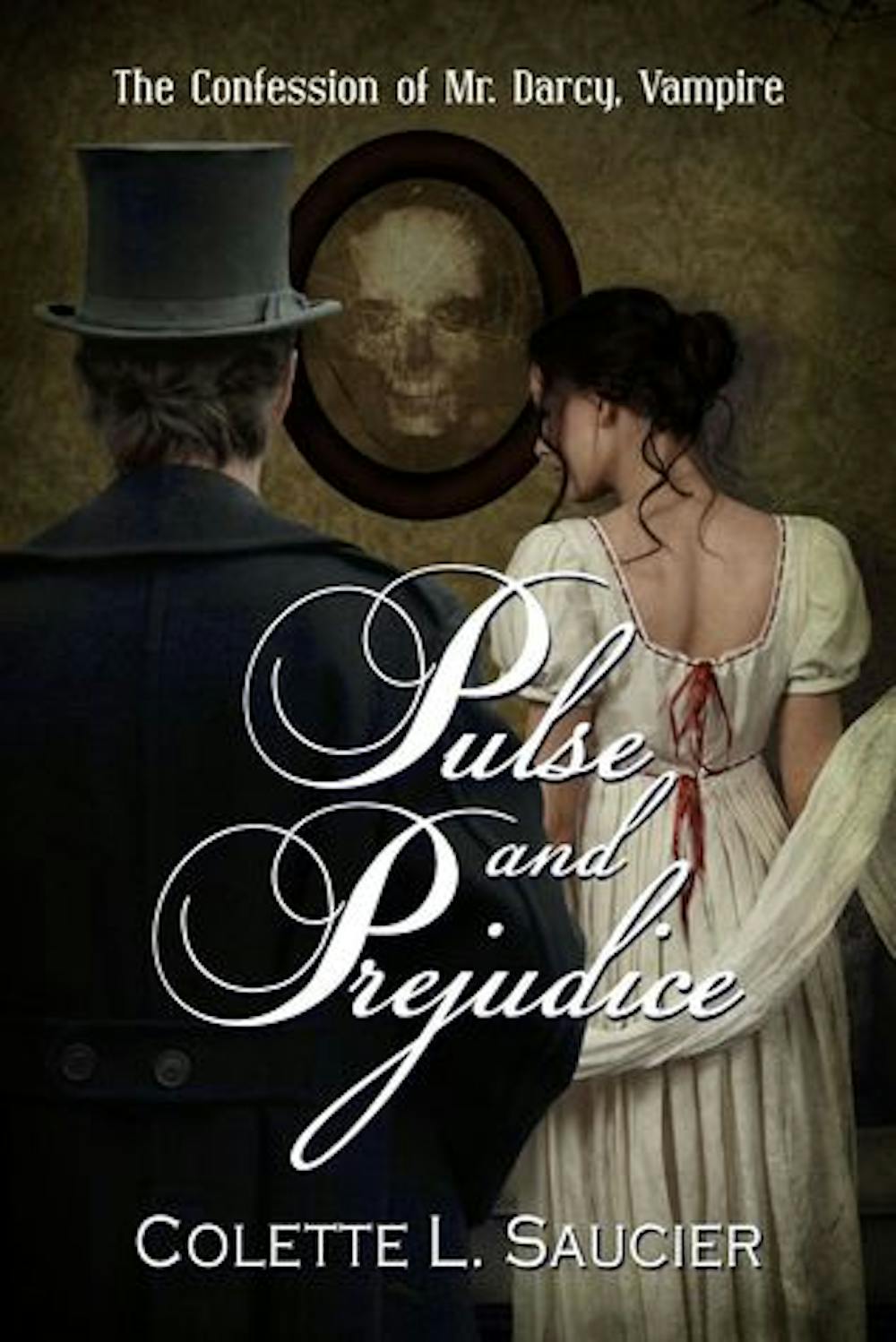
Colette L. Saucier’s Darcy, in Pulse and Prejudice (2015), is a post-Twilight vampire set in Regency England. Excruciatingly honourable throughout, he is a rather tortured Byronic being, unable to conceal his growing desire for Elizabeth. As measure of his integrity he almost exclusively sustains himself on the blood of animals—served in fine chalices, of course. And as he falls for Elizabeth, he works hard to separate Darcy the man from Darcy the monster.
But Colette is Saucier by name, and saucier by nature. In a finale detailing the pre-marital beginnings of Darcy’s and Elizabeth’s sex life, Darcy takes Elizabeth’s virginity. The “sweet metallic taste of blood, her blood, on both their lips” becomes an “exquisitely erotic” one for Elizabeth.
Here, she resembles the young Anastasia of E. L. James’s Fifty Shades of Grey — itself a rewriting of Twilight — who also tastes “the faint metallic taste” of her own hymeneal blood during her first sexual encounter. It would appear that Lizzie’s desires can only be satisfied by a combination of Darcy the man and monster, the upstanding gentleman of society, and the demon in the sack.
Marrying a hyper-masculine monster, however, carries great risk, as the image of Lizzie with swollen and bloodied lips might suggest; in a different context, this might just as well be an image of domestic violence. Darcy also horrifyingly admits that all sexual restraint had been washed away, to the point that “had she not invited him in, he would’ve taken her still.”
While the novel presents vampire Darcy as a romantic ideal, a perfect combination of integrity, restraint and libidinous passion, the malevolent and deep-seated literary roots of the vampire, as a sexual fiend, cannot be entirely repressed.
Amanda Grange offers instead a sequel to Pride and Prejudice in Mr Darcy, Vampyre (2009), a Continental honeymoon adventure that is part Dracula, part Twilight, part Da Vinci Code and part Indiana Jones. This Darcy even transforms into a bat at one point, loitering outside Elizabeth’s bedroom window.
But Elizabeth, puzzled as to why they have not yet consummated their marriage, cannot see her husband for what he truly is until an ancient vampire comes to claim his right to primae noctis. Protecting Elizabeth with all his super-human strength from this brute, Darcy also reveals that his abstinence comes from a place of love, fearing he too might hurt her. A conversion, it would appear, is needed before he consummates their marriage.
This time, it is Darcy who wishes to be converted back into a human, by way of the only force that can effect his transformation: true love. (Awww!) The vampire is extinguished, and the mortal man restored, as they set their course towards Pemberley, England. This Elizabeth’s wildest desires are met by normality — a physically mortal, but spiritually eternal, love, enjoyed in a comfortable, domestic setting.
So while the fantasy of Mr Darcy as a vampire — handsome, protective, virile, noble, affluent, and most notably, immortal — might be a titillating one, these incarnations serve to remind us that as hard as we might try, the monster always lurks within.
(Mr Darcy Halloween costume, anyone?)
– ref. Mr Darcy as vampire: a literary hero with bite – http://theconversation.com/mr-darcy-as-vampire-a-literary-hero-with-bite-105649]]>Waiting for better care: why Australia’s hospitals and health care is failing
Source: The Conversation (Au and NZ) – By Stephen Duckett, Director, Health Program, Grattan Institute
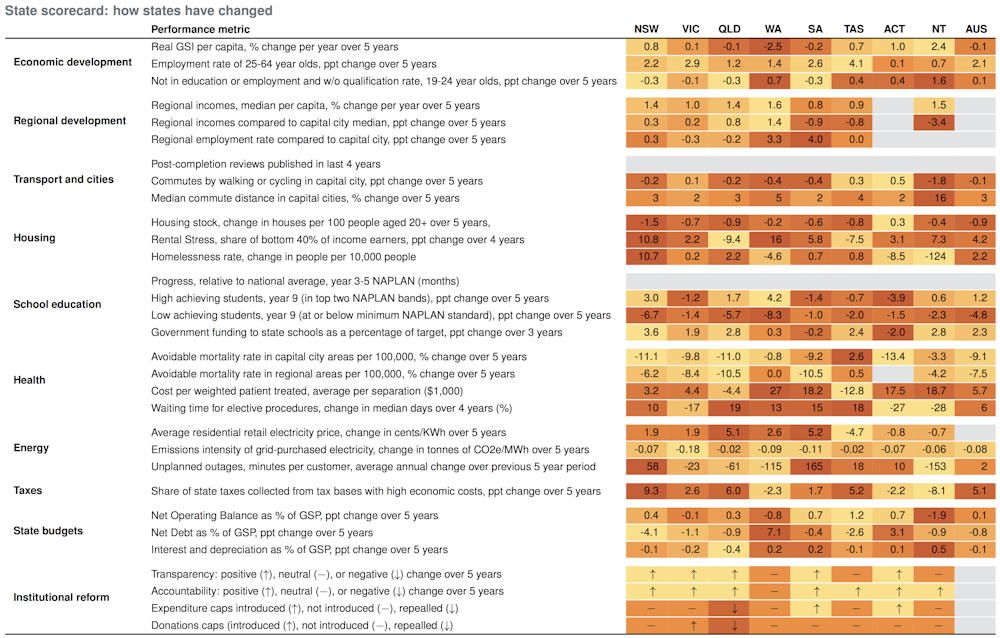
This week we’re exploring nine different policy areas across Australia’s states, as detailed in Grattan Institute’s State Orange Book 2018. Read the other articles in the series here.
Australia has a good health system by international standards, but it has to get better. Half of all patients across Australia wait more than a month for an elective hospital procedure, such as a hip replacement. This is in addition to waiting for an outpatient visit so they can be added to the elective procedure wait list.
“Elective” here doesn’t mean the patient can do without the procedure – they may be in pain or having trouble moving around while waiting. Elective simply means it doesn’t have to be done immediately and can be scheduled.
Read more: To keep patients safe in hospitals, the accreditation system needs an overhaul
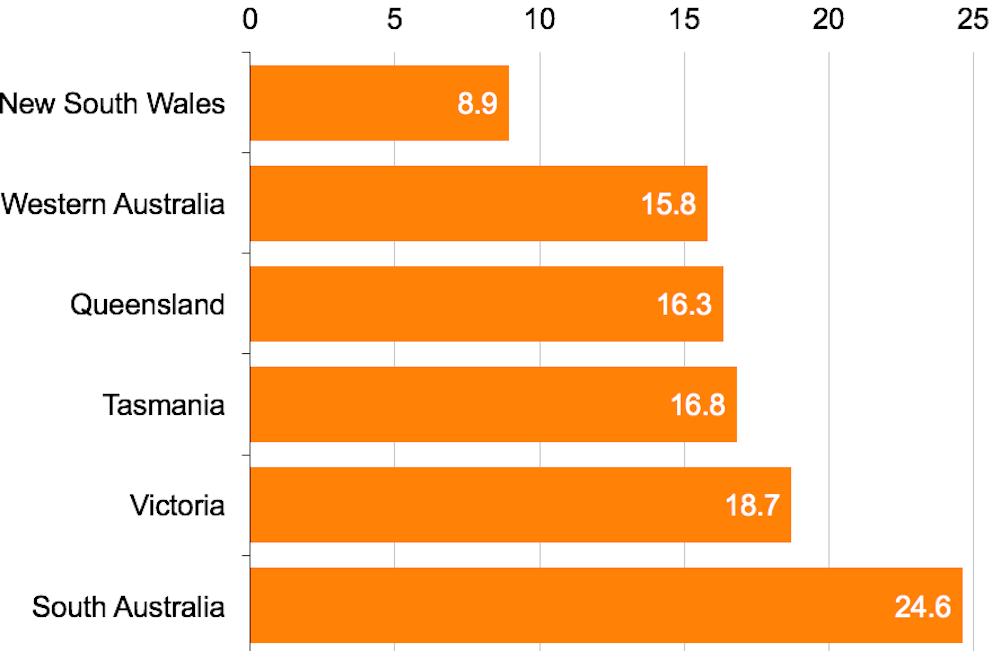
About 9% of people in New South Wales and about 25% in South Australia wait more than a year for public dental services, such as fillings, extractions and root canals.
Physicians report nearly one-third of patients with an acute mental illness wait more than eight hours in hospital emergency departments.
The Grattan Institute’s State Orange Book 2018 charts the performance, maps a route to improvement, and recommends penalties for states that fail to meet waiting list targets.
Why hospitals are always key state election issues
Health is the largest single component of state government expenditure in every state of Australia, and has been growing rapidly. About two-thirds of state government health spending – excluding transfers from the Commonwealth – is on public hospitals.
Just over half the population does not have health insurance and so relies on public hospitals for all their care. Even for people with private insurance, public hospitals are their principal source of emergency care.
Even Australians with private health insurance use public emergency departments. Annette Shaff/ShutterstockState governments are responsible for public hospitals, so hospital care is always a key issue in state elections. It is therefore no surprise state governments love to tell us how much they are doing for public hospitals, and election campaigns are often jam-packed with promises of new or expanded hospitals.
The politicians, at least in states with growing populations, are right that more beds are needed. What matters for the public, though, is not how many beds there are, but whether there are enough. One way of measuring that is waiting times, and here the picture isn’t as rosy as campaigning politicians would like us to believe.
Waiting for elective hospital procedures
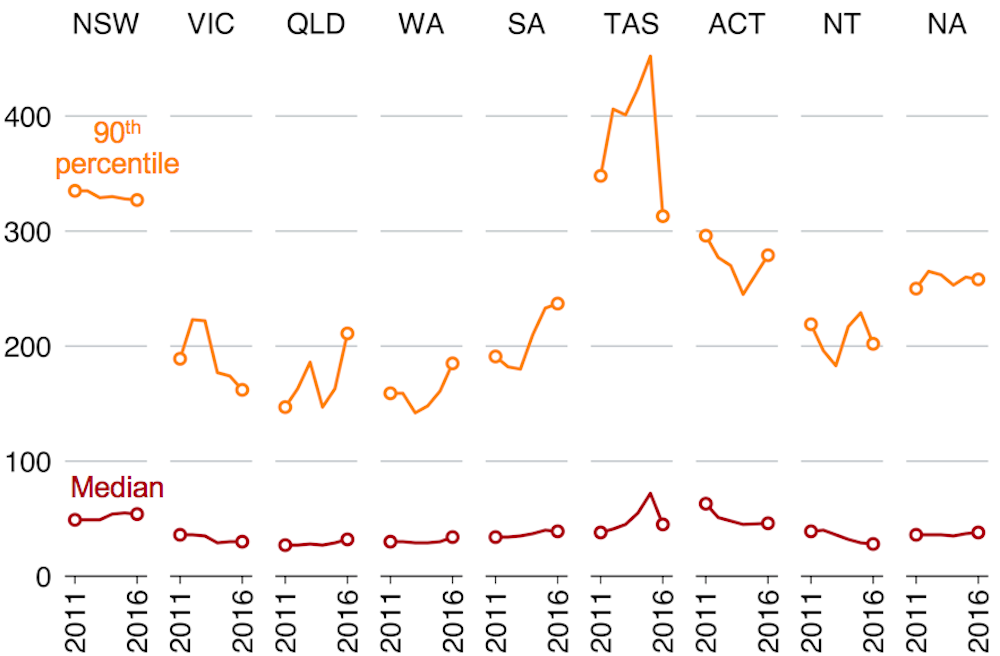
It’s bad enough half of all patients across Australia wait more than a month for an elective procedure from the time they were booked. What’s worse is that about 10% wait more than six months.
In our smallest state, Tasmania, 10% of patients wait about a year. In the biggest state, NSW, the situation is almost as bad.
This graph shows the waiting time (days) for elective procedures, 2012-13 to 2016-17, for the 10% of patients who wait longest (orange) and the median (maroon):
Grattan Institute/Australian Institute of Health and WelfarePublicly reported data focus on elective procedure or elective surgery waiting times, but there is another important wait: from the time a patient is referred to the hospital to the time they are seen in an outpatient clinic. This is sometimes called the “hidden waiting list”.
Read more: Getting an initial specialists’ appointment is the hidden waitlist
For the patient, the wait for an appointment with an outpatient clinic matters – it delays diagnosis and treatment. Yet these waits are not publicly reported in NSW, Western Australia, the Australian Capital Territory or the Northern Territory. And the states that do report outpatient clinic wait times do not use consistent measures.
Our state and territory governments should strengthen hospital accountability to reduce combined outpatient and inpatient waiting times. There should be clear consequences and penalties for failure to meet targets.
First you have to wait to get on the waiting list. Then you get booked in for your procedure. Shutterstock/cvmWaiting for public dental care
The COAG Health Council (made up of Commonwealth, state and territory health officials) says current funding for public dental services allows for treatment of only about 20% of the eligible population.
The remaining 80% have to wait for long periods, pay for relatively expensive care in the private sector, or go without care entirely.
Waiting times vary significantly among states. And in several states, notably Vic and SA, waiting times have got longer in recent years.
Boosting public dental services will improve people’s health and reduce the strain on hospitals.
In 2015-16, there were 67,266 hospital admissions for potentially preventable dental conditions – more than one-fifth of all hospital admissions for potentially preventable acute conditions.
Read more: Poor and elderly Australians let down by ailing primary health system
Unforgivably, our state governments have not delivered on a 2012 commitment to monitor waiting times for public dental care through a National Healthcare Agreement performance indicator. Data inconsistencies mean it is not possible to reliably compare public dental waiting lists across states and territories.
NSW does not provide data on public dental waiting lists at all, citing concerns about the potential for misleading comparisons. The only comparable data we have is from an Australian Bureau of Statistics sample survey, which shows more than 10% of patients across the country wait more than a year for public dental care.
This graph shows the proportion of people who waited more than a year for public dental services:
Notes: The figures in smaller states should be regarded as approximate; the percentages are of those who have been seen, and do not include those still waiting at the time of the survey. Grattan Institute/Australian Bureau of StatisticsWaiting for mental health care
Campaigners say Australia has reached a “tipping point” on access to mental health care. Physicians report nearly one-third of patients with an acute mental illness wait more than eight hours in emergency departments.
We know this does damage: long waits for access to community mental health services can result in poorer outcomes for patients, as a condition may be harder to control the longer it persists. Long waits may also place additional pressure on families or friends who face the consequences of their friend or family member’s behaviour.
Yet there is no information about the adequacy of community mental health services in Australia. The 2017 National Mental Health and Suicide Prevention Plan only tracks the use of services, not their adequacy.
Read more: More Australians can stay healthier and out of hospital – here’s how
In contrast, Canadian governments have agreed that a wide range of mental health and addictions indicators will be collected and reported from 2019.
Australian voters should demand their state governments do the same thing. We should wait no longer for a better health system.
– ref. Waiting for better care: why Australia’s hospitals and health care is failing – http://theconversation.com/waiting-for-better-care-why-australias-hospitals-and-health-care-is-failing-104862]]>The search for the source of a mysterious fast radio burst comes relatively close to home
Source: The Conversation (Au and NZ) – By Elizabeth Mahony, Research Scientist, CSIRO
Fast radio bursts (FRBs) are just that – enormous blasts of radio waves from space that only last for a fraction of a second. This makes pinpointing their source a huge challenge.
Our team recently discovered 20 new FRBs using CSIRO’s Australian Square Kilometre Array Pathfinder in the Western Australian outback, almost doubling the known number of FRBs.
In follow-up research, published today in The Astrophysical Journal Letters, we have taken one of these new detections – known as FRB 171020 (the day the radio waves arrived at Earth: October 20, 2017) – and narrowed down the location to a galaxy close to our own.
Read more: More ‘bright’ fast radio bursts revealed, but where do they all come from?
This is the closest FRB detected (so far) but we still don’t know what causes these mysterious radio bursts that can contain more energy than our Sun produces in decades.
Waves in space
As radio waves travel through the universe they pass through other galaxies and our own Milky Way before arriving at our telescopes.
The longer radio wavelengths are slowed down more than the shorter wavelengths, meaning that there is a slight delay in the arrival time of longer wavelengths.
This difference in arrival times is called the dispersion measure and indicates the amount of matter the radio emission has travelled through.
An FRB’s journey to Earth.FRB 171020 has the lowest dispersion measure of any FRB detected to date, meaning that it hasn’t travelled from half way across the universe like most of the other FRBs detected so far. That means it originated from relatively nearby (by astronomical standards).
By using models of the distribution of matter in the universe we can put a hard limit on how far the radio signal has travelled. For this particular FRB, we estimate that it could not have originated from further than a billion light years away, and likely occurred much closer. (Our Milky Way galaxy is about 100,000 light years across.)
This distance limit, combined with the sky area we know the FRB came from (an area half a square degree – or roughly two full Moons across) enormously narrows down the search volume to look for the host galaxy.
Closing in
A region of the sky this size typically contains hundreds of galaxies. We used giant optical telescopes in Chile – including the appropriately named Very Large Telescope and Gemini South – to derive distances to these galaxies by either measuring their redshifts directly, or by using their optical colours to estimate their distance.
This allowed us to drastically reduce the number of possible galaxies within the distance limit to just 16.
By far the closest, and we believe most likely to host the FRB, is a nearby spiral galaxy called ESO 601-G036. This is 120 million light years away – making this FRB host almost our next door neighbour.
Optical image of the search area from the Digitized Sky Survey (DSS). The circles mark possible host galaxies for FRB 171020, but these are all much further away than the most likely galaxy ESO 601-G036, shown in the lower left as a three-colour image from the VLT Survey Telescope (VST) ATLAS survey. ESO, Digitized Sky Survey and VST-ATLAS, Author providedWhat is particularly striking about this galaxy is that it shares many similar features to the only galaxy known to produce FRBs: FRB 121102.
This FRB is also known as the repeating FRB due to its – so far unique – property of producing multiple bursts. This helped astronomers locate it to a small galaxy about more than 3 billion light years away.
ESO 601-G036 is similar in size, and forming new stars at about the same rate, as the host galaxy of the repeating FRB.
But there is one intriguing feature of the repeating FRB that we don’t see in ESO 601-G036.
Other emissions
In addition to repeat bursts of radio emission, the repeating FRB emits lower energy radio emission continuously.
Using CSIRO’s Australia Telescope Compact Array (ATCA) in Narrabri, NSW, we have searched for this persistent radio emission in ESO 601-G036. If it was anything like the repeater’s galaxy, it should have a boomingly bright radio source in it. We saw nothing.
The Australia Telescope Compact Array (ATCA) used in the follow-up observations. CSIRO, Author providedNot only did we find that ESO 601-G036 doesn’t have any persistent radio emission, but there are no other galaxies in our search volume that show similar properties to that seen in the repeating FRB.
This points to the possibility that there are different types of fast radio bursts that may even have different origins.
Finding the galaxies that FRBs originate from is a big step towards solving the mystery of what produces these extreme bursts. Most FRBs travel much further distances so finding one so close to Earth allows us to study the environments of FRBs in unprecedented detail.
The hunt for more
Unfortunately, we can’t say with absolute certainty that ESO 601-G036 is the galaxy that FRB 171020 came from.
Read more: A Goblin could guide us to a mystery planet thought to exist in the Solar system
The next big hurdle in understanding what causes FRBs is to pinpoint more of them. If we can do that we’ll be able to work out not only exactly which galaxy an FRB occurred in, but even where within the galaxy it occurred.
If FRBs occur within the central nuclei of galaxies, this could perhaps point to black holes as their source. Or do they prefer the outskirts of galaxies? Or regions where a lot of new stars have recently formed? There are still so many unknowns about FRBs.
Several radio telescopes around the world are commissioning systems to pinpoint bursts. Our study has shown that by combining observations from radio and optical telescopes we’ll be able to paint a complete picture of FRB host galaxies, and be able to finally determine what causes these FRBs.
– ref. The search for the source of a mysterious fast radio burst comes relatively close to home – http://theconversation.com/the-search-for-the-source-of-a-mysterious-fast-radio-burst-comes-relatively-close-to-home-105735]]>Keith Rankin’s Chart for this Month: Allocation of New Zealand’s GDP under Economic Capitalism
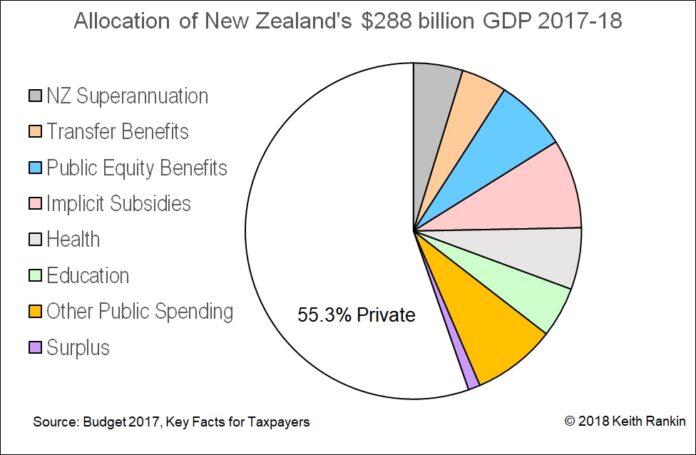
Chart analysis by Keith Rankin.
This month’s chart looks at New Zealand’s 2017-18 GDP (of $288 billion). The chart uses official data, with appropriate re-accounting, as presented to this year’s New Zealand Association of Economists’ Conference (also here, and see slides here); and taking note of our need to move from “primitive capitalism” to “economic capitalism” (see article here).
In the chart, the figures for ‘NZ Superannuation’, ‘Transfer Benefits’, ‘Health’, ‘Education’, ‘Other Spending’, and ‘Surplus’ are exactly as in the May 2017 Budget Statement. (I avoided using the 2018 Budget, because the presentation of information for public consumption this year was far too opaque. In previous years, Key Facts for Taxpayers gave a succinct summary of public revenue and expenses, albeit using our time-worn outdated public accounting conventions.)
My innovations have been to redefine Gross Public Revenue – giving a more accurate and intuitive measure of the size of the public hemisphere (refer to my Liberal Mercantilism and Economic Capitalism) – and then to reclassify income tax concessions as ‘Public Equity Benefits’ (refer to my Policy Observatory Report, Public Equity and Tax-Benefit Reform) and to expose the large remaining share of public income as ‘Implicit Subsidies’.
In the pie-chart, the coloured slices together (44.7%) represent the public hemisphere of the 2017-18 New Zealand economy. By subtraction, the remaining 55.3% represents the ‘private hemisphere’. The public hemisphere is calculated as 33% of GDP (gross domestic product, the total economic ‘pie’), plus indirect taxes, plus government income from sources other than taxation. (The true public hemisphere would be closer to 50% of GDP if we added local government rates. In the interests of simplicity, local government has been left out of my picture. I have also excluded Accident Compensation levies.)
Public Equity Benefits represent the accumulation of implicit cash benefits arising from the 10.5%, 17.5% and 30% concessionary rates of personal income tax. These benefits are regressive, and unconditional, presently maxing at $9,080 per year ($175 per week) for individuals in receipt of $70,000 (or more) before tax. Persons receiving $48,000 before tax presently receive an annual Public Equity Benefit of $8,420. (These figures have been – and will be – valid for the entire 2010s’ decade.)
Wearing my accountant’s hat, I am not advocating what benefits people should get; simply I am describing what people do receive, unconditionally, from public revenue. (Most of us receive income from private and public sources.) Like democracy, however (and changing my hat), universal public benefits must be good; the problem is that higher earners get more than their share, just as before 1890 (in democracy’s early years) men of property had more general election votes than other men (and women got no votes at all).
Implicit Subsidies are largely received by organisations and land-owners; many can be classed as corporate welfare. They include the five cents in the dollar discount on company taxation (the statutory company tax rate is 28%, in contrast with the personal tax rate of 33%). They include all other corporate tax concessions. They include the proceeds of tax avoidance and evasion. They also include tax concessions to charities. And they include tax not paid on rent attributable to owner-occupied properties.
Implicit Subsidies are more regressive than are Public Equity Benefits. Though some of them are justifiable, nevertheless we require public accounting standards that make all subsidies explicit.
Good public accounting standards inform good policy. Good capitalism acknowledges both economic hemispheres, private and public. Bad capitalist accounting disguises (even to intelligent people) how underprivileged people receive less than their democratic share of publicly-sourced income. Transparent public hemisphere accounting is the necessary sunlight that disinfects primitive capitalism.
Public Equity Benefits and Implicit Subsidies belong in the public hemisphere, not the private hemisphere.
Australian cricket’s wake-up call on a culture that has cost it dearly

Source: The Conversation (Au and NZ) – By Steve Georgakis, Senior Lecturer of Pedagogy and Sports Studies, University of Sydney
On the face of it, there is much to celebrate about Australian cricket right now. The sport has money to burn thanks to recent large pay-TV deals, the Big Bash has strong TV ratings; the women’s cricket team is one of the most successful and highly regarded Australian sporting teams. There has been a surge in junior participation, and many Australians still regard it as our national sport – it is certainly the dominant sport of the summer.
By contrast, cricket in the media is lurching from one crisis to another, with the fallout from the now-infamous ball-tampering episode still reverberating. Yesterday, the sport was dealt another blow.
An independent review of Cricket Australia’s culture was released, concluding that “winning without counting the costs” was largely responsible for the recent ball-tampering scandal and sledging – the on-field verbal abuse and taunting – that has been an entrenched habit of the Australian team for decades.
Read more: Just not cricket: why ball tampering is cheating
The review found the sport was riddled with cultural problems that exerted so much exerted pressure to win that it manifested in cheating and sledging, covertly sanctioned by the administrators. With 42 recommendations, it is clear Cricket Australia needs to change.
The biggest cultural issue for the sport at the moment is sledging, and one of the recommendations calls for cricket’s anti-harrassment code to address abusive behaviour.
While niggling a player might have been an acceptable part of the game, sledging has reached a point where a strict code of ethics needs to be drawn up and adhered to. While this may take away some of the unique nature of the sport, in the long run it will bring the focus back to the play.
Sledging matters because it is a type of cheating. The rise in cheating, whether it be via match-fixing or sledging, is linked to the rise in commercialisation and gambling in sport.
Australian cricket has formed commercial relationships with major sport betting agencies and an official partnership with Bet365. There have been numerous accusations regarding international match-fixers. And the ball-tampering scandal has confirmed that Australians no longer hold the moral high ground.
The relentless pressure to win has infected the sport at all levels. Sledging is but one of the symptoms.
Why does this matter so much to Australians? A clue may lie in what else is going on: a recent bank inquiry, fears related to immigration, contempt for politicians, growing distrust of public institutions, poor performance and declines in international educational testing, wage stagnation and declines (despite a world record run on economic growth), concern over high house prices and power bills. In 2018, Australians have much to be anxious and angry about.
Read more: Can the cricketers banned for ball tampering ever regain their hero status? It’s happened before
Cricket has always been held above everyday concerns, and has been a source of national pride and a salve in times of fear. Throughout the history of colonial Australia, cricket has been a source of inspiration, an institution that has provided strong links to our communities (school, geographical district, state and territories) and helped define Australian identity.
Modern Australians’ first organised sport in both schools and the community setting was cricket. Our first sporting wins against the “home country” – England – were in cricket Test matches. Cricket was responsible for giving us legitimacy.
Our best cricketers became heroes. Generations looked upon Don Bradman, Dennis Lillee, Steve Waugh and Mark Taylor as role models. It was the hegemonic sport and the cricketers best represented what Australian masculinity was about. If you played the sport, you played in a tough way (even though it is not a contact sport) within the highly revered rules; cricket could help you learn that gracious defeat is as admirable as victory.
Also, especially from about 1990 onwards, the Australian men’s team was outstanding. They won Test series and one-dayers with continued all-round brilliance, producing some of the greatest players the game has ever seen.
But, in the past few years, Australian cricket’s legitimacy has waned. Many of us who love the sport and all it represents have felt disillusioned by recent events at the elite level. This was confirmed to us yesterday with the report – which, thankfully, did not sugar-coat the diagnosis.
So what is the cure? A revised, strict and well-policed ethical code for staff and players will not be enough. Cricket needs to work with commercial partners, or abandon them if they can’t meet high ethical standards too.
Commercial and betting agendas create pressures to cheat, yet Sport 2030, our national plan for sport, under the banner “strengthening the sector’s integrity” suggests:
organisations… adopt a more efficient, model of governance which can best position sports to be able to drive greater commercial outcomes, reduce reliance on funding, increase autonomy and support innovation.
And there is the dilemma.
– ref. Australian cricket’s wake-up call on a culture that has cost it dearly – http://theconversation.com/australian-crickets-wake-up-call-on-a-culture-that-has-cost-it-dearly-105855]]>Five questions (and answers) about casual employment
Source: The Conversation (Au and NZ) – By Jeff Borland, Professor of Economics, University of Melbourne
Right now, it seems as if everyone’s talking about casual work.
Claims about what is (or is not) happening to casual employment are at the fore in debates about working conditions. Claims about what should (or should not) be the entitlements of casual workers have become the focus of a major Federal Court case in which the government has decided to intervene.
In the midst of these debates, it’s useful to take a step back and ask what is really happening to casual work and what we know about the consequences of casual work.
1. What is casual employment?
It may come as a surprise that there is no standard definition of a casual employee. The Fair Work Act 2009 (Cwth), for example, doesn’t include a definition.
Nevertheless, there is general agreement that a worker is a casual employee if their employer doesn’t make any advance commitment to ongoing employment or the amount or timing of work they will be asked to do.
Read more: FactCheck: has the level of casual employment in Australia stayed steady for the past 18 years?
An extra dimension comes from awards. Employees classified as casual in awards do not have a legal entitlement to many types of paid leave (mainly annual leave and sick leave) and other benefits such as severance pay. Instead, they get a 25% premium on their hourly wage.
Ambiguity about the definition has caused ambiguity in the data. The most commonly cited statistics on casual work, from the Australian Bureau of Statistics, classify workers as casual if they report not having entitlements to paid leave.
The main alternative approach is for casual workers to self-identify. With each approach there is some doubt about whether what is being measured corresponds to what most people think of as casual work.
2. Why are there competing claims about trends?
Is the proportion of the workforce in casual employment increasing, as trade unions and some workplace commentators would have you believe, or is it unchanging, as the government claims?
The answer is both, depending on the time period you look at.
In the graph below I have used ABS data to show the proportions of male and female employees in casual work (more precisely, work without paid leave entitlements) from the early 1980s onwards.
For about 20 years, from the early 1980s to early 2000s, casual employment was on the rise for both men and women.
Then from the early 2000s to the present, there was little change, for both men and women.
So the time period matters. If you begin in the early 1980s and compare it to the present, the incidence of casual work has certainly increased.
But if you start in the early 2000s, there’s no evident long-run increase.
There is, however, an interesting pattern within the period from the early 2000s to the present.
Until the early 2010s the proportion of casual employees was actually in decline, falling from about 25.5% to 23.5%.
In the past few years the proportion has climbed back to its previous level of about 25.5%. It’s too early to tell whether this is the start of a new trend.
3. Who is working casually?
We know quite a bit about who works casually. Women are more likely to be in casual jobs than men, although the gap is narrowing. More than half of all part-time employees are in casual jobs, but only about 10% of full-time employees.
Workers on regular daytime shifts are less likely to be in casual jobs than those who work in the evening or at night.
Read more: Precarious employment is rising rapidly among men: new research
Casual employment being concentrated in part-time jobs means it accounts for a larger share of the number of people employed than it does of hours worked.
For example, in August 2018 more than one-quarter of employees were in casual jobs, but only 17% of the hours worked were in casual jobs.
As can be seen from the graphs below (each from the most recent year for which figures are available) casual employment is highest among the youngest workers and those in the least skilled occupations.
4. What comes after casual work?
Uncertainty over job security and hours of work and the absence of entitlements in casual jobs mean that some casual workers would prefer to be in permanent jobs.
Certainly, a variety of studies using data from the Melbourne Institute’s Household Income and Labour Dynamics (HILDA) Survey find that casual employees report lower levels of job satisfaction than comparable employees in other types of jobs.
As a result, a concern that is often expressed is that workers might get trapped in casual jobs.
To see if this is the case, I have summarised the findings of a recent study by Inga Lass and Mark Wooden.
They use HILDA Survey data from 2001 to 2015 to determine how workers move between types of employment over time.
It is apparent that workers in casual jobs do move on to permanent jobs, but it can take time.
From one year to the next about half of all casual workers remain in casual employment, with 30% moving to other types of work and 15% no longer working.
Pushing the time horizon out to five years shows more mobility. More than half move to other types of employment, although around one-quarter still remain casual.
Read more: Eviction from the middle class: how tenuous jobs penalise women
A potential counter to concerns about being trapped in casual work is that casual employment can be an important entry point to paid work.
The same study by Lass and Wooden shows that of people who a year ago had been unemployed or out of the labour force, and who 12 months later had been able to move into work, almost half had taken casual jobs.
5. Does ‘casual’ tell us what we need to know?
In recent public commentary, the word “casual” has come to be a catch-all term – used to encapsulate everything we need to know about work conditions.
That’s unfortunate for several reasons.
First, while casual employment might create the scope for workers to be more easily terminated or to have less stable hours of work or earnings, for many casual workers that doesn’t happen.
It’s more useful to study the outcomes we care about, such as job security and earnings stability.
Read more: Self-employment and casual work aren’t increasing but so many jobs are insecure – what’s going on?
Second, casual employment doesn’t tell us how many workers are in other – less stable – forms of employment where there might be concerns about conditions, such as independent contracting or the gig economy.
Third, we can’t be entirely sure what types of jobs are captured by existing measures of casual employment.
A Productivity Commission study in the late 1990s found that about one-third of all employees identified as casual by the criterion of not having paid leave entitlements were in fact owner-managers or permanent employees.
“Casual” means less than we might think.
– ref. Five questions (and answers) about casual employment – http://theconversation.com/five-questions-and-answers-about-casual-employment-105745]]>Newsletter: New Zealand Politics Daily – October 30 2018
Newsletter: New Zealand Politics Daily – October 30 2018
Editor’s Note: Here below is a list of the main issues currently under discussion in New Zealand and links to media coverage.
[caption id="attachment_297" align="aligncenter" width="640"] The Beehive and Parliament Buildings.[/caption]
Immigration, Karel Sroubek residency decision
Dileepa Fonseka and Steve Kilgallon (Stuff): Immigration NZ fields more tip offs about scams than it can manage
1News: Jacinda Ardern defends decision not to deport Czech drug smuggler – ‘There’s other information, obviously’
Derek Cheng (Herald): Prime Minister Jacinda Ardern backs her minister over not deporting Czech drug smuggler Karel Sroubek
Zane Small (Newshub): ‘This is now a decision for him’: Jacinda Ardern defends drug lord’s residency
Barry Soper (Newstalk ZB): Public deserve an explanation of Karel Sroubek decision
Derek Cheng (Herald): PM Jacinda Ardern says Karel Sroubek decision was difficult for Immigration Minister Iain Lees-Galloway
Scott Palmer and Anna Bracewell-Worrall (Newshub): ‘Not an easy one’: Jacinda Ardern defends decision to grant drug lord Karel Sroubek residency
RNZ: Czech smuggler previously had residency – under a false identity
Derek Cheng (Herald): Immigration Minister releases letter setting out residency conditions for Karel Sroubek
Collette Devlin (Stuff): Drug smuggler Karel Sroubek’s ‘strict conditions’ to remain in New Zealand
1News: Czech drug smuggler granted NZ residency under strict conditions, Immigration Minister says
Dan Satherley (Newshub): Immigration Minister Iain Lees-Galloway reveals Karel Sroubek’s residency conditions
Derek Cheng (Herald): National MP to travel to Czech Republic if Govt fails to give immigration answers
Northland Age: MP protest after drug smuggler granted residency, Switzer care worker deported
Dan Satherley (Newshub): Immigrant drug lord Karel Sroubek should be ‘gone by lunchtime’ – Simon Bridges
RNZ: Minister criticised over drug smuggler’s residency
Harrison Christian (Stuff): Couple struggling to remain in NZ disgusted drug dealer Karel Sroubek was granted residency
David Farrar: What the Parole Board said
David Farrar: The full background of the guy given residency by Labour
Health and disability
Hannah Martin (Stuff): Regulating junk food, alcohol, tobacco marketing could assist cancer prevention – experts
Newshub: Junk food marketing needs to be changed to reduce risk of obesity induced cancers
Karen Brown (RNZ): One Year On: The cost of accessible healthcare
Ananish Chaudhuri (Herald) Racial bias unlikely in resuscitation attempts for premature births
Oliver Lewis (Stuff): Health cuts feared as boards ordered to reduce deficits
Libby Wilson (Stuff): Waikato DHB launches crackdown on expected $56m deficit
RNZ: Sunday Morning: Dr Nick Wright: eating a plant-based diet
Elena McPhee (ODT): Benefits to higher excise tax: research
1News: ‘Alarming’ new study shows 33 per cent of Kiwis are drinking hazardously their entire adult lives
Dennis Maga (Stuff): Ambulance workers deserve better pay
Karen Brown (RNZ): World shortage of HPV vaccine disrupts immunisation in NZ
Annette Lambly (Stuff): Whangarei council votes for more outdoor spaces smokefree by 2020
Mike Houlahan (ODT): War kept killing after 1918: study
Herald: New study finds WWI cast a long shadow over New Zealanders’ health
Aine Kelly-Costello and Mitch McCann (Newshub): Blind Foundation members break down barriers in the newsroom
Newshub: The amazing story of June Hieatt
Phil Pennington (RNZ): Porirua community demands help after six suicides: ‘It’s just too many’
Housing
Herald: Criticism over new KiwiBuild buyers’ suitability, housing minister says homes not for low-income families
Susan Edmunds (Stuff): KiwiBuild not for low-income families, says housing minister
Scott Palmer (Newshub): KiwiBuild ‘not aimed at low-income families’ – Phil Twyford
David Farrar: Yes it is like winning Lotto
Eva Corlett (RNZ): Barrier to compensation over flawed meth testing leaves bitter taste
Derek Cheng (Herald): PM hopes compensation for flawed meth tests by Xmas
Michelle Cooke and LIsa Owen (RNZ): Checkpoint: Law change ‘likely’ before meth compensation can be paid out
Deena Coster (Stuff): $750K grant breathes life into kaumātua housing initiative
Susan Edmunds (Stuff): Aussie property market slowdown might (and might not) be contagious
Government
Colin James (RNZ): Polls show coalition well-placed in second year of govt
ODT Editorial: Labour’s satisfactory first year
David Cormack (Herald): The politics of doing jack-all
Bryce Edwards (Herald): Political Roundup: Verdicts on the Government’s first year
Jenée Tibshraeny (Interest): Are criticisms that the Labour Party is the ‘tax party’ are well-founded?
Whena Owen (1News): Shane Jones’ tari: ‘Welcome to the lair’
Online voting, party membership, parliament
Liam Hehir (Stuff): Political parties benefit from having a broad base of members
Josie Pagani (Stuff): The politics of ‘tribal’ membership
Janine Rankin (Manawatū Standard): Online voting no cure for apathy, says academic
David Farrar:Huge increase in overseas votes because of e-voting
Katie Fitzgerald (Newshub): Christians return to Parliament to protest removal of Jesus from prayer
Jason Walls (Herald): Speaker Trevor Mallard ‘has no plans’ to reintroduce Jesus into Parliamentary prayer
Abortion
Liz Beddoe (Newsroom): Abortion law change at last in sight
RNZ: Simon Bridges: Abortion law change a ‘conscience issue’ for MPs
1News: Should abortion be a health issue, rather than in the Crimes Act? Q+A debate
Bob McCoskrie : The Q+A abortion debate
Foreign affairs
Jo Moir (RNZ): ‘The days of treating you as pests are over’
Derek Cheng (Herald): Winston Peters flags $70m for nurturing Pacific NGOs
1News: The Story with John Campbell: Trapped on Nauru
Thomas Coughlan (Newsroom): Ardern softly raises concern over Uighurs
Primary industries, animal welfare
Pat Deavoll (Stuff): The light and the dark sides of the pork industry
Gerard Hutching (Stuff): Countdown sells Kiwi free farmed fresh pork only
Ewan Sargent (Stuff): Lamb hunter: ‘They have a good life, then bang’
Tamsyn Parker (Herald): Kiwi firm Craft Meat Company launches meat-free mince
Farah Hancock (Newsroom): Taking animals out of the lab
Jamie Gray (Herald): NZ dairy farm prices drop 18 pct as environmental, foreign investment concerns bite
Stuff: Walker raises concerns about new farming rules
Heather Chalmers (Stuff): Ngāi Tahu Farming replaces forestry with 14,000 cows at Eyrewell
Environment and conservation
Rachael Kelly (Southland times): Salmon company wants exclusive use of Stewart Island coastal area
Alexander Robertson (Herald): Local Focus: Multi-kill traps deployed to save our rarest duck, the whistling whio
Zane Small (Newshub): Tauranga Mayor calls for restrictions on so-called ‘flushable’ wet wipes
Oil and gas exploration ban
Mike Joy (Newsroom): Energy makes the economy go round
Richard Harman (Politik): Ardern has to defend high speed legislative process
Hamish Rutherford (Stuff): Prime Minister says offshore oil permit ban legislation offers ‘complete certainty’ to industry
Jenée Tibshraeny (Interest): Ardern defends short consultation period on oil/gas exploration ban
Education
Peter Lyons (ODT): Bid to bring in teachers shows up sad status of profession
Luke Kirkeby (Stuff): Foreign teachers bridging New Zealand’s shortage
Laura Walters (Newsroom): Teachers want long-term solutions
Adele Redmond and Josephine Franks (Stuff): One third of early childhood centres struggling to fill vacancies, sector survey says
Jessie Chiang (RNZ): ‘We’re known to be nurses, social workers – you name it’
Dave Armstrong (Stuff): Science shouldn’t be a ‘nice to have’ in schools
Joanna Kidman and Vincent O’Malley (Briefing Papers): The New Zealand Wars and the School Curriculum
Josh Williams (Herald): Apprenticeships and training a tertiary education success story
Local government
Liz McDonald (Stuff): Mayor sticks to short showers as council urges water restraint
Bernard Orsman (Herald): $1.5m needed to fix deteriorating turf at Eden Park to guarantee continuation of All Black tests and T20 cricket matches
Robin Martin (RNZ): Rubbish offer forces councils to reconsider $42m landfill plan
Deena Coster (Stuff): Waitara residents upset by MP’s no show at leaseholders’ meeting
Transport
Todd Niall (Stuff):It’s time to ensure scootering stays fun for everyone
Press Editorial: Teething problems no reason to simply abandon trial
Newshub: No changes needed for Lime electric scooters – Gerry Brownlee
Nita Blake-Persen (RNZ): Number of e-scooter ACC claims rises to 38
Alice Webb-Liddall and Ella Prendergast (Newshub): The substantial number of Lime scooter ACC injury claims in NZ already
Mike Yardley (Stuff): Footpaths should be a no-no for scooters
Debrin Foxcroft (Stuff): ACC numbers reveal a 27-fold increase in e-bike related accidents in last five years
Damian George (Stuff): At least 30 Wellington bus routes need fixing as network continues to struggle
RNZ: Wellington bus strike called off
Zane Small (Newshub): Car battery callouts spike in wake of rising fuel prices
Colin Williscroft (Stuff): Speed limits as low as 60kmh proposed for parts of SH1 near Kaikoura
Kawe Roes (Māori TV): New railway line to Marsden Point being investigated by KiwiRail
Employment
Gerard Hutching (Stuff): Construction and agriculture serious injuries on the rise
Rob Stock (Stuff): Multi-national corporation breaches New Zealand bargaining law
Herald: Bidfood found to have breached employment laws
Newshub: Bidfood New Zealand found to have breached employment laws
Business
Nona Pelletier (RNZ): SME confidence collapses as revenue falls sharply
Catherine Harris (Stuff): Influencers lay out plan to get more women on boards
Royal visit
Laura O’Connell Rapira (Spinoff): At Government House with the royals, 183 years after we declared our independence
Herald Editorial: Harry and Meghan royalty with a difference
Jason Walls (Herald): PM Jacinda Ardern gifts Prince Harry a Shapeshifter CD and Meghan a pair of Boh Runga earrings
Stuff: Prime Minister gifts music album and earrings to Prince Harry and Meghan
Peter de Graaf (Northern Advocate): ‘Star-struck’ Northland MP Willow-Jean Prime talks period poverty with Duchess
Eleanor Ainge Roy (Guardian): Meghan Markle praised for speaking Māori in New Zealand suffrage speech
Other
John Armstrong (1News): The sad truth for Simon Bridges is that the vast proportion of the public simply don’t like him
Cate Broughton (Stuff): EQC’s disaster fund to get $50m Government top up, months earlier than forecast
Tom Pullar-Strecker (Stuff): NZ experts cautious about following UK with new tax on digital giants
Simeon Brown (Spinoff): A middle ground on drug laws: Simeon Brown responds to Chlöe Swarbrick
Gia Garrick (RNZ): Whistleblower protection: firms and charities may face tougher reporting
Mike Dinsdale (Northern Advocate): Twenty-one kids in state care commit crimes in Tai Tokerau in a year
Gareth Vaughan (Interest): Five things to look for in the Financial Markets Authority and Reserve Bank report on New Zealand banks’ conduct and culture
Paul McBeth (BusinessDesk): RBNZ’s Orr ‘off-the-record’ speech
Ian Taylor (ODT): Govt must be shown how region is behind project
Amber-Leigh Woolf (Stuff): Te Papa lacking enough internal staff to look after entire collection, experts say
1News: Police investigate ‘date rape’ complaint at Auckland K Road bar amid calls for better reporting
RNZ: Samoa to tighten adoption laws to counter slave labour
Pam Jones (ODT): Freedom camping rules push
Jessica Tyson (Māori TV): Documentary series on Ihumātao land protest wins top award
Greg Moyle (Herald): A museum at Le Quesnoy will remember our war contribution
Conor Twyford (Spinoff): We asked a trans woman to speak on our #metoo panel. Then the abuse began.
Stuff: John Campbell launches podcast, looks at trains during first six weeks at TVNZ]]>
The Beehive and Parliament Buildings.[/caption]
Immigration, Karel Sroubek residency decision
Dileepa Fonseka and Steve Kilgallon (Stuff): Immigration NZ fields more tip offs about scams than it can manage
1News: Jacinda Ardern defends decision not to deport Czech drug smuggler – ‘There’s other information, obviously’
Derek Cheng (Herald): Prime Minister Jacinda Ardern backs her minister over not deporting Czech drug smuggler Karel Sroubek
Zane Small (Newshub): ‘This is now a decision for him’: Jacinda Ardern defends drug lord’s residency
Barry Soper (Newstalk ZB): Public deserve an explanation of Karel Sroubek decision
Derek Cheng (Herald): PM Jacinda Ardern says Karel Sroubek decision was difficult for Immigration Minister Iain Lees-Galloway
Scott Palmer and Anna Bracewell-Worrall (Newshub): ‘Not an easy one’: Jacinda Ardern defends decision to grant drug lord Karel Sroubek residency
RNZ: Czech smuggler previously had residency – under a false identity
Derek Cheng (Herald): Immigration Minister releases letter setting out residency conditions for Karel Sroubek
Collette Devlin (Stuff): Drug smuggler Karel Sroubek’s ‘strict conditions’ to remain in New Zealand
1News: Czech drug smuggler granted NZ residency under strict conditions, Immigration Minister says
Dan Satherley (Newshub): Immigration Minister Iain Lees-Galloway reveals Karel Sroubek’s residency conditions
Derek Cheng (Herald): National MP to travel to Czech Republic if Govt fails to give immigration answers
Northland Age: MP protest after drug smuggler granted residency, Switzer care worker deported
Dan Satherley (Newshub): Immigrant drug lord Karel Sroubek should be ‘gone by lunchtime’ – Simon Bridges
RNZ: Minister criticised over drug smuggler’s residency
Harrison Christian (Stuff): Couple struggling to remain in NZ disgusted drug dealer Karel Sroubek was granted residency
David Farrar: What the Parole Board said
David Farrar: The full background of the guy given residency by Labour
Health and disability
Hannah Martin (Stuff): Regulating junk food, alcohol, tobacco marketing could assist cancer prevention – experts
Newshub: Junk food marketing needs to be changed to reduce risk of obesity induced cancers
Karen Brown (RNZ): One Year On: The cost of accessible healthcare
Ananish Chaudhuri (Herald) Racial bias unlikely in resuscitation attempts for premature births
Oliver Lewis (Stuff): Health cuts feared as boards ordered to reduce deficits
Libby Wilson (Stuff): Waikato DHB launches crackdown on expected $56m deficit
RNZ: Sunday Morning: Dr Nick Wright: eating a plant-based diet
Elena McPhee (ODT): Benefits to higher excise tax: research
1News: ‘Alarming’ new study shows 33 per cent of Kiwis are drinking hazardously their entire adult lives
Dennis Maga (Stuff): Ambulance workers deserve better pay
Karen Brown (RNZ): World shortage of HPV vaccine disrupts immunisation in NZ
Annette Lambly (Stuff): Whangarei council votes for more outdoor spaces smokefree by 2020
Mike Houlahan (ODT): War kept killing after 1918: study
Herald: New study finds WWI cast a long shadow over New Zealanders’ health
Aine Kelly-Costello and Mitch McCann (Newshub): Blind Foundation members break down barriers in the newsroom
Newshub: The amazing story of June Hieatt
Phil Pennington (RNZ): Porirua community demands help after six suicides: ‘It’s just too many’
Housing
Herald: Criticism over new KiwiBuild buyers’ suitability, housing minister says homes not for low-income families
Susan Edmunds (Stuff): KiwiBuild not for low-income families, says housing minister
Scott Palmer (Newshub): KiwiBuild ‘not aimed at low-income families’ – Phil Twyford
David Farrar: Yes it is like winning Lotto
Eva Corlett (RNZ): Barrier to compensation over flawed meth testing leaves bitter taste
Derek Cheng (Herald): PM hopes compensation for flawed meth tests by Xmas
Michelle Cooke and LIsa Owen (RNZ): Checkpoint: Law change ‘likely’ before meth compensation can be paid out
Deena Coster (Stuff): $750K grant breathes life into kaumātua housing initiative
Susan Edmunds (Stuff): Aussie property market slowdown might (and might not) be contagious
Government
Colin James (RNZ): Polls show coalition well-placed in second year of govt
ODT Editorial: Labour’s satisfactory first year
David Cormack (Herald): The politics of doing jack-all
Bryce Edwards (Herald): Political Roundup: Verdicts on the Government’s first year
Jenée Tibshraeny (Interest): Are criticisms that the Labour Party is the ‘tax party’ are well-founded?
Whena Owen (1News): Shane Jones’ tari: ‘Welcome to the lair’
Online voting, party membership, parliament
Liam Hehir (Stuff): Political parties benefit from having a broad base of members
Josie Pagani (Stuff): The politics of ‘tribal’ membership
Janine Rankin (Manawatū Standard): Online voting no cure for apathy, says academic
David Farrar:Huge increase in overseas votes because of e-voting
Katie Fitzgerald (Newshub): Christians return to Parliament to protest removal of Jesus from prayer
Jason Walls (Herald): Speaker Trevor Mallard ‘has no plans’ to reintroduce Jesus into Parliamentary prayer
Abortion
Liz Beddoe (Newsroom): Abortion law change at last in sight
RNZ: Simon Bridges: Abortion law change a ‘conscience issue’ for MPs
1News: Should abortion be a health issue, rather than in the Crimes Act? Q+A debate
Bob McCoskrie : The Q+A abortion debate
Foreign affairs
Jo Moir (RNZ): ‘The days of treating you as pests are over’
Derek Cheng (Herald): Winston Peters flags $70m for nurturing Pacific NGOs
1News: The Story with John Campbell: Trapped on Nauru
Thomas Coughlan (Newsroom): Ardern softly raises concern over Uighurs
Primary industries, animal welfare
Pat Deavoll (Stuff): The light and the dark sides of the pork industry
Gerard Hutching (Stuff): Countdown sells Kiwi free farmed fresh pork only
Ewan Sargent (Stuff): Lamb hunter: ‘They have a good life, then bang’
Tamsyn Parker (Herald): Kiwi firm Craft Meat Company launches meat-free mince
Farah Hancock (Newsroom): Taking animals out of the lab
Jamie Gray (Herald): NZ dairy farm prices drop 18 pct as environmental, foreign investment concerns bite
Stuff: Walker raises concerns about new farming rules
Heather Chalmers (Stuff): Ngāi Tahu Farming replaces forestry with 14,000 cows at Eyrewell
Environment and conservation
Rachael Kelly (Southland times): Salmon company wants exclusive use of Stewart Island coastal area
Alexander Robertson (Herald): Local Focus: Multi-kill traps deployed to save our rarest duck, the whistling whio
Zane Small (Newshub): Tauranga Mayor calls for restrictions on so-called ‘flushable’ wet wipes
Oil and gas exploration ban
Mike Joy (Newsroom): Energy makes the economy go round
Richard Harman (Politik): Ardern has to defend high speed legislative process
Hamish Rutherford (Stuff): Prime Minister says offshore oil permit ban legislation offers ‘complete certainty’ to industry
Jenée Tibshraeny (Interest): Ardern defends short consultation period on oil/gas exploration ban
Education
Peter Lyons (ODT): Bid to bring in teachers shows up sad status of profession
Luke Kirkeby (Stuff): Foreign teachers bridging New Zealand’s shortage
Laura Walters (Newsroom): Teachers want long-term solutions
Adele Redmond and Josephine Franks (Stuff): One third of early childhood centres struggling to fill vacancies, sector survey says
Jessie Chiang (RNZ): ‘We’re known to be nurses, social workers – you name it’
Dave Armstrong (Stuff): Science shouldn’t be a ‘nice to have’ in schools
Joanna Kidman and Vincent O’Malley (Briefing Papers): The New Zealand Wars and the School Curriculum
Josh Williams (Herald): Apprenticeships and training a tertiary education success story
Local government
Liz McDonald (Stuff): Mayor sticks to short showers as council urges water restraint
Bernard Orsman (Herald): $1.5m needed to fix deteriorating turf at Eden Park to guarantee continuation of All Black tests and T20 cricket matches
Robin Martin (RNZ): Rubbish offer forces councils to reconsider $42m landfill plan
Deena Coster (Stuff): Waitara residents upset by MP’s no show at leaseholders’ meeting
Transport
Todd Niall (Stuff):It’s time to ensure scootering stays fun for everyone
Press Editorial: Teething problems no reason to simply abandon trial
Newshub: No changes needed for Lime electric scooters – Gerry Brownlee
Nita Blake-Persen (RNZ): Number of e-scooter ACC claims rises to 38
Alice Webb-Liddall and Ella Prendergast (Newshub): The substantial number of Lime scooter ACC injury claims in NZ already
Mike Yardley (Stuff): Footpaths should be a no-no for scooters
Debrin Foxcroft (Stuff): ACC numbers reveal a 27-fold increase in e-bike related accidents in last five years
Damian George (Stuff): At least 30 Wellington bus routes need fixing as network continues to struggle
RNZ: Wellington bus strike called off
Zane Small (Newshub): Car battery callouts spike in wake of rising fuel prices
Colin Williscroft (Stuff): Speed limits as low as 60kmh proposed for parts of SH1 near Kaikoura
Kawe Roes (Māori TV): New railway line to Marsden Point being investigated by KiwiRail
Employment
Gerard Hutching (Stuff): Construction and agriculture serious injuries on the rise
Rob Stock (Stuff): Multi-national corporation breaches New Zealand bargaining law
Herald: Bidfood found to have breached employment laws
Newshub: Bidfood New Zealand found to have breached employment laws
Business
Nona Pelletier (RNZ): SME confidence collapses as revenue falls sharply
Catherine Harris (Stuff): Influencers lay out plan to get more women on boards
Royal visit
Laura O’Connell Rapira (Spinoff): At Government House with the royals, 183 years after we declared our independence
Herald Editorial: Harry and Meghan royalty with a difference
Jason Walls (Herald): PM Jacinda Ardern gifts Prince Harry a Shapeshifter CD and Meghan a pair of Boh Runga earrings
Stuff: Prime Minister gifts music album and earrings to Prince Harry and Meghan
Peter de Graaf (Northern Advocate): ‘Star-struck’ Northland MP Willow-Jean Prime talks period poverty with Duchess
Eleanor Ainge Roy (Guardian): Meghan Markle praised for speaking Māori in New Zealand suffrage speech
Other
John Armstrong (1News): The sad truth for Simon Bridges is that the vast proportion of the public simply don’t like him
Cate Broughton (Stuff): EQC’s disaster fund to get $50m Government top up, months earlier than forecast
Tom Pullar-Strecker (Stuff): NZ experts cautious about following UK with new tax on digital giants
Simeon Brown (Spinoff): A middle ground on drug laws: Simeon Brown responds to Chlöe Swarbrick
Gia Garrick (RNZ): Whistleblower protection: firms and charities may face tougher reporting
Mike Dinsdale (Northern Advocate): Twenty-one kids in state care commit crimes in Tai Tokerau in a year
Gareth Vaughan (Interest): Five things to look for in the Financial Markets Authority and Reserve Bank report on New Zealand banks’ conduct and culture
Paul McBeth (BusinessDesk): RBNZ’s Orr ‘off-the-record’ speech
Ian Taylor (ODT): Govt must be shown how region is behind project
Amber-Leigh Woolf (Stuff): Te Papa lacking enough internal staff to look after entire collection, experts say
1News: Police investigate ‘date rape’ complaint at Auckland K Road bar amid calls for better reporting
RNZ: Samoa to tighten adoption laws to counter slave labour
Pam Jones (ODT): Freedom camping rules push
Jessica Tyson (Māori TV): Documentary series on Ihumātao land protest wins top award
Greg Moyle (Herald): A museum at Le Quesnoy will remember our war contribution
Conor Twyford (Spinoff): We asked a trans woman to speak on our #metoo panel. Then the abuse began.
Stuff: John Campbell launches podcast, looks at trains during first six weeks at TVNZ]]>
New Zealand politics: how political donations could be reformed to reduce potential influence
Source: The Conversation (Au and NZ) – By Simon Chapple, Director, Institute for Governance and Policy Studies, Victoria University of Wellington
In the aftermath of the controversy surrounding former MP Jami-Lee Ross and opposition National party leader Simon Bridges, discussions have focused on possible reforms of political donations in New Zealand.
My colleagues Bryce Edwards and Michael Macaulay have raised the issue of taxpayer funding of political parties. So too has Minister of Justice Andrew Little.
Green Party MP Marama Davidson has suggested the donation threshold for the disclosure of a donor’s name and address be lowered from NZ$15,000 to NZ$1,000. She has also proposed banning foreign donations outright and capping individual donations at NZ$35,000.
Several of these proposals warrant further discussion and contextualisation.
Read more: New Zealand politics: foreign donations and political influence
Donations and foreign money
Foreign interference in domestic politics is an increasing phenomenon worldwide.
Currently in New Zealand foreign donations to a party of up to NZ$1,500 are permissible. Moreover, foreign donations below this amount are not individually or collectively disclosed.
It would be easy for a foreign state or corporate body seeking political influence to channel a large number of donations into the system just under the threshold via numerous proxies. Whether such interference has been happening is unclear, since New Zealanders do not know how much money currently comes in to political parties via foreign actors.
Even if foreign donations are not a problem now, one could rapidly develop. A strong argument can be made that foreign money has no place in democracy, including New Zealand’s.
New Zealand would not be going out on an international limb by banning foreign donations. Foreign donations to political parties are not permissible in the [United Kingdom, Ireland and the United States. They are also banned in Canada but unfortunately a significant loophole exists. Australia is currently in the process of banning foreign donations.
Lowering threshold for anonymous donations
As noted, the threshold below which political donations can be anonymous could be lowered. A lower threshold would make it more difficult to evade name disclosure rules by splitting donations and attributing each part to a different donor.
Splitting may be what happened to the alleged NZ$100,000 Yikun Zhang donation. The NZ$1,000 threshold proposed by the Greens would be a huge improvement on the status quo. A donor of NZ$100,000 seeking to evade legislation and to remain anonymous would have to coordinate 100 individual donors, rather than seven.
But New Zealand could go lower still, to NZ$200, without being radical. Giving NZ$200 to a political party is huge for an ordinary New Zealander, and the reality is only a very small minority would need to disclose their names under such a law.
There is international precedent for setting much lower thresholds for anonymity than the Greens propose. For example, in Canada, the maximum amount of an anonymous donation was set at C$200 in 2015, while in Ireland it is currently €100.
Donor privacy versus transparency
One concern with non-anonymity is that it delivers public transparency at the cost of private donor privacy. Currently the Electoral Act 1993 contains a mechanism for anyone wanting to donate to a political party and not wanting their identity disclosed to either the public or to the party receiving the donation. To obtain such anonymity, the donation needs to be more than NZ$1,500.
The Electoral Commission aggregates all such donations. It passes them on to parties at regular intervals. It does not identify the dollar amount of individual donations, or the number or names of donors.
Not many donors use this protected disclosure avenue. For example, between September 2015 and June 2018, the commission passed on only NZ$150,000 in anonymised money to parties via this channel. At the same time amounts well in excess of NZ$10 million were passed on by donors identifiable to political parties (but not necessarily to the public).
A preference for identifiable channels suggests current donors get value from non-anonymity. It implies most donors feel they are buying something. The fact that donors feel they are buying something should be cause for concern.
Capping donations and individualising donors
The Greens have suggested NZ$35,000 as a maximum cap on donations. Again, New Zealand could go much lower without being out of step with other countries. For example, in Canada donations to each political party are capped at C$1500 a year. Like Canada, Ireland has a maximum annual cap of €2500.
However, Geoff Simmons, leader of the Opportunities Party, has argued that a cap would make it difficult for small parties to get started. Simmons’ party was kick-started by large donations from multi-millionaire Gareth Morgan, who was also the party’s first leader.
Another possibility for the reform agenda is the Canadian approach of only permitting donations from individual people. Corporate and trade union donations are banned. However this proposal is unlikely to be popular with neither National, which receives considerable corporate donations, nor Labour, which traditionally gets significant trade union funding.
All these proposals, inevitably, have pros and cons and possible unintended consequences. They are deserving of wide public debate. One hopes that the current government can provide the public with a credible forum for such discussions, and a clear pathway to sensible future reform.
– ref. New Zealand politics: how political donations could be reformed to reduce potential influence – http://theconversation.com/new-zealand-politics-how-political-donations-could-be-reformed-to-reduce-potential-influence-105805]]>From lascars to skilled migrants: Indian diaspora in New Zealand and Australia

Source: The Conversation (Au and NZ) – By Sekhar Bandyopadhyay, Professor of Asian History , Victoria University of Wellington
More than half a million people of Indian descent live in Australia and New Zealand. The history of the Indian diaspora in these countries is older than many might imagine, going back 250 years.
Indians are today widely acknowledged as a successful ethnic community that makes significant contributions to their host societies and economies. Yet, although Indian migration to North America and the United Kingdom has been studied extensively, the Australian and New Zealand stories have rarely been told.
Read more: Who are the Sikhs and what are their beliefs?
From lascars to migrant workers
We are co-editors of Indians and the Antipodes: Networks, Boundaries and Circulation, a book in which scholars from both sides of the Tasman and beyond trace the development of Indian involvement in New Zealand and Australia, from 18th-century sepoys and lascars (soldiers and sailors) aboard visiting European ships, through 19th-century migrant labourers and the 20th century’s hostile policies to the new generation of skilled professional migrants of the 21st century.
Indians and the Antipodes juxtaposes Australian and New Zealand stories to underline that the trajectories of migration and experiences of settlement of these two southern-most outposts of the Indian diaspora have certain connections.
The story of Indians in New Zealand dates back to December 1769, just two months after the first European landing in the country by Captain James Cook. Todd Nachowitz draws on previously published muster rolls and ships logs to trace Indians’ early part in New Zealand nation building, thereby complicating the traditional bicultural European-Māori historical narrative.
Historian John Dunmore’s translations of early ship’s logs, along with additional archival sources, have allowed Nachowitz to identify the first Indians to set foot on New Zealand soil. They were the sole survivors of a crew of more than 50 Indians. The rest died of scurvy or other conditions before their ship, the Saint Jean Baptiste, reached New Zealand.
Nachowitz can even put names to two of the Indians:
Picnic in Island Bay, Wellington. Photo originally supplied by Kanjibhai Bhula., CC BY-NDThe first is recorded as Mamouth Cassem in the original log, whose real name was probably Mahmud Qāsim, born in Pondicherry about 1755. The second is listed as a Bengali named Nasrin, aged about sixteen or seventeen years, on the muster roll. Given their names, it can be assumed that both were Muslims. Both are recorded as dying in Peru on 14 April 1770, where the ship sailed after leaving Aotearoa under duress.
Early settlers
Nineteenth and early 20th-century Indian settlement in Australia and New Zealand was the culmination of complex journeys. From the British-Indian empire, Indians were moving to Mauritius, Fiji, South Africa, British Guyana and the Caribbean. From parts of French India, such as Pondicherry, they were travelling to New Caledonia in the French Pacific.
Read more: Oceans as empty spaces? Redrafting our knowledge by dropping the colonial lens
Some of them eventually migrated from these initial destinations to settle in Australia and New Zealand. Many also migrated directly from India. This circulation of people of Indian origin occurred both through and because of the imperial networks set up by the various East India companies.
In the later 19th and early 20th centuries, the labour demands of sugar plantations in the Pacific and Caribbean provided further incentives for migration. The indenture system was an early migration driver. After its abolition, opportunities for free passage offered avenues for work and hopes of citizenship.
Racial barriers
In Australia and New Zealand, along with other self-governing dominions such as South Africa and Canada, conflict evolved between the demand for cheap labour by the colonial economies and the racial prejudice and moral panic of their white settlers.
The term Australasia was used as an identifier for the region not to signify its geographical proximity to Asia but to distinguish it from Asia, the much despised other.
A shared perception of the threat of being swamped by “unwanted” Asians led to Australia and New Zealand raising immigration barriers to ensure their exclusion. Once the barriers were complete – in 1901 in Australia and 1920 in New Zealand – the racial ring fences remained in place until the onset of decolonisation in the aftermath of the second world war. In some cases, this took even longer.
Although the rules did not stop Indian migration totally, they did mean that very few Indians lived in “White Australia” and “White New Zealand”. In 1921, there were only 2,000 in Australia and 671 in New Zealand.
New migrants
As immigration restrictions were gradually lifted in the post-war period, the number of Indian migrants rose. The relaxation was partly in response to the increasing demand for English-educated, technologically skilled white-collar workers who could contribute to the countries’ rapidly globalising economies.
In both countries, India became the largest source of skilled migrants in the 21st century. According to the 2011 Australian census, 390,894 people of Indian origin lived in the country. The 2013 New Zealand census recorded 155,178 people of Indian origin.
Previous Indian professional migrants were middle class, highly educated and settlers. The migrants of the past decade or so have been younger, less educated, from the lower rungs of the Indian social ladder and often on temporary work or student visas. They are more often single, male and from district towns and villages. They also remain more closely connected to their families at home and in many cases go back after their studies or employment contracts finish.
The new migrants bring fresh challenges for the diaspora community. It is now more diverse, not only culturally and economically, but also in its histories of migration.
In Auckland, for instance, as recorded by Alison Booth, the majority of recent Indian migrants are young professionals and students from the Punjab and north India. Their cultural preferences are different from those of earlier generations of settlers, who are more conservative in their social attitudes.
As a result, there are divergent views on what constitutes authentic Indian culture. This clash between “traditional” and “pop” cultures is reflected in debates over publicly funded events such as the city’s Diwali festival.
Such debates highlight the inner pluralism of the Indian diaspora and the need for multiculturalist policies in both Australia and New Zealand to avoid outdated assumptions of homogeneity. The Indian community in the two countries is big and broad-ranging — just like its story over the past 250 years.
– ref. From lascars to skilled migrants: Indian diaspora in New Zealand and Australia – http://theconversation.com/from-lascars-to-skilled-migrants-indian-diaspora-in-new-zealand-and-australia-99288]]>Indonesia sees PNG as a top ‘non-traditional’ market priority for APEC

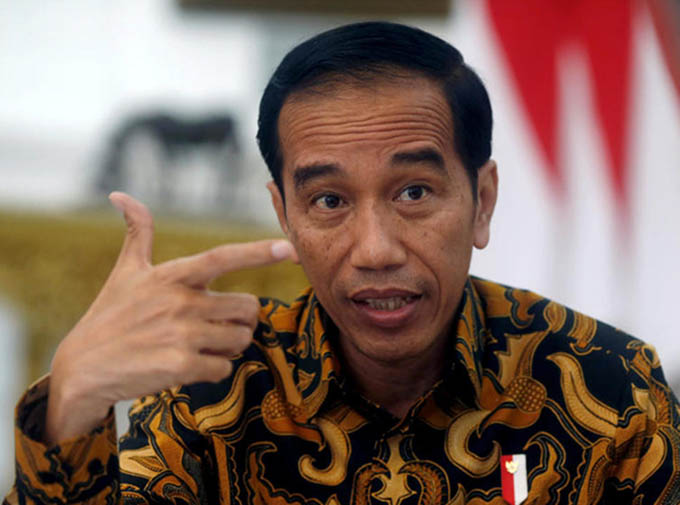 President Joko Widodo … Madang keen on taking advantage of Indonesia’s trade interest in PNG. Image: TodayOnline
Pacific Media Centre Newsdesk
Papua New Guinea has been placed as one of Indonesia’s top non-traditional market priorities as the country leader President Joko Widodo prepares for his visit Port Moresby next month for the Asia Pacific Economic Cooperation (APEC) leaders summit, reports the PNG Post-Courier.
President Widodo addressed the 33rd Trade Expo Indonesia (TEI), the largest annual tradeshow in Indonesia, last week where he talked about reaching out to Indonesia’s non traditional markets, of which PNG now tops their agenda.
Madang Governor Peter Yama and his entourage had a session with Indonesia’s Chamber of Commerce and Trade team led by president and chairman Bernardino M Vega Jr.
 Madang provincial administrator John Bivi gave a presentation on Madang’s investment proposal to Indonesia identifying where they needed attention most.
Bernardino said one of the major agendas when they attend APEC in Port Moresby on November 17-18 will be to look at investment opportunities in PNG, singling out Madang.
Article by AsiaPacificReport.nz
]]>How flashing lights and catchy tunes make gamblers take more risks

Source: The Conversation (Au and NZ) – By Charles Livingstone, Senior Lecturer, School of Public Health and Preventive Medicine, Monash University
Lights and sounds coming from electronic gambling machines – also known as EGMs, pokies or slots – contribute to their addictive potential according to new research published today.
Scientists from the University of British Columbia, Canada, set up experiments with human subjects using gambling tasks and “sensory cues” such as flashing lights and catchy tunes.
They found that people made riskier decisions and were less able to interpret information about their probability of winning when exposed to cues associated with previous wins.
Read more: Removing pokies from Tasmania’s clubs and pubs would help gamblers without hurting the economy
It was known from earlier animal studies that sensory cues, such as flashing lights or sounds, when paired with a reward, lead to “riskier” decision making. Prior to the new study, this had not previously been demonstrated in humans. However, it is not unexpected, given what we know of Pavlovian, or classical, conditioning.
Classical conditioning has been understood for over a century as the mechanism for training animals (including humans). Thus, training a dog to sit becomes easier if the reward (food, or some other pleasurable event) and the command (the cue) are associated.
How pokies work
Electronic gambling machines (pokies) combine rewards and cues in abundance.
Many of us working to understand pokie addiction have developed a model that combines the principles of two types of conditioning – operant (focusing on the reward structure) and classical (looking at the cues) – and tie these with how the brain’s reward system operates.
As well as rewards and cues, environmental, social and economic factors also play a significant role in the establishment of gambling addiction. However, the pokie itself is increasingly seen as a crucial element of this addiction system.
Read more: Bright lights, big losses: how poker machines create addicts and rob them blind
In their new study, lead authors Catharine Winstanley and Mariya Cherkasova subjected humans to rewards accompanied by sensory cues such as flashing lights and casino sounds. This increased arousal, or excitement – measured by dilation of the pupils of the eye. It also lead to a decline in sensitivity to information about odds and probabilities.
Decision making became more risky. Risky decision making, in turn, is associated with increased likelihood of addiction, as the new study argues.
Losses disguised as wins
“Losses disguised as wins” provide an important example of risky decision making and increased likelihood of addiction.
Losses disguised as wins occur when a pokie user bets on multiple “lines” on a machine. This makes it possible to get a “reward” that is less than the amount staked. For example, with a bet of $5, the user may “win” fifty cents. The game will celebrate this $4.50 loss with the usual sounds and visual imagery associated with an actual win.
The result is that the stimulus provided echoes that for an actual win. This appears to make users overestimate their winnings. It also effectively doubles the amount of reinforcement achieved by the game, at no cost to the operator.
Read more: Australia has a long way to go on responsible gambling
In the Australian states of Tasmania and Queensland, losses disguised as wins are prohibited on consumer safety grounds – no stimulus is permitted when the “win” is less than the stake. The paper published today provides strong evidence for extending this prohibition to other jurisdictions.
The new research also helps fill in one of the gaps in our detailed understanding of the addictive potential of pokies, and provides additional evidence to support more effective regulation of pokies.
Along with social and other research, this can help to reduce the significant harm associated with pokies, and other forms of gambling.
– ref. How flashing lights and catchy tunes make gamblers take more risks – http://theconversation.com/how-flashing-lights-and-catchy-tunes-make-gamblers-take-more-risks-105852]]>Why Australia should be wary of the Proud Boys and their violent, alt-right views on race

Source: The Conversation (Au and NZ) – By Kaz Ross, Lecturer in Asian Studies, University of Tasmania
Australia has become a destination for a legion of far-right speakers from North America and the UK in recent months.
Milo Yiannopoulos’ controversial visit last December resulted in violent clashes between protesters and a A$50,000 bill for Yiannopoulos for extra policing. (He never paid it.) Nonetheless, Yiannopoulos is planning a return in late November.
In March, the Canadian psychologist Jordan Peterson packed out auditoriums in three cities for speeches railing against feminism, political correctness and hate speech laws.
This was followed by the visits of Canadians Lauren Southern and Stefan Molyneaux, which sparked more anti-fascist protests and resulted in another large police bill that remains unpaid. Southern’s “It’s Okay to be White” T-shirt served as the inspiration for Senator Pauline Hanson’s recent Senate motion declaring the same message.
Read more: Speaking with: journalist David Neiwert on the rise of the alt-right in Trump’s America
And Brexit-er Nigel Farage toured Australia seven weeks later with his anti-immigration message.
None of these speakers has yet to attract an organised movement of followers in Australia. But these tours are certainly having an impact on society, as Hanson’s Senate motion illustrates.
An ABC investigation revealed that the NSW Young Nationals were infiltrated by members with links to the neo-Nazi fight club that provided security for the Southern/Molyneaux and Farage tours. And Yiannopoulos was even given a platform to speak at Parliament House, the invited guest of Senator David Leyonhjelm.
Yiannopoulos alongside Leyonhjelm at Parliament House last year. His appearance was vehemently opposed by the Greens. Lukas Coch/AAPWith the imminent visit of Canadian Gavin McInnes, the leader of the far-right group Proud Boys, Australia could be about to witness an acceleration of organised alt-right activity.
Originally scheduled for next week, McInnes’ tour has been postponed until December. Now dubbed “The Deplorables Tour”, it has been expanded to include Tommy Robinson, the founder of the far-right street gang English Defence League and the most prominent anti-Muslim voice in the UK.
‘The Leader of the Patriarchy’
McInnes and the global Proud Boys fraternity he founded in 2016 is engaged in a culture war against political correctness, Islam, feminism and all that is supposedly destroying Western civilisation.
A recent promotional video of his upcoming tour of five Australian cities sets the tone for his brand of hate-filled rhetoric:
I’d like to identify the elephant in the room. Which is you, you are a fat woman.“
Over the next minute, McInnes is exulted as “the leader of the patriarchy, the ultimate male, the legendary Western warrior and a proud Western chauvinist”. He talks about punching people in the face while footage shows him doing exactly that. As Mcinnes states very clearly:
‘This is a civil war. My job is to fight,’ McInnes says.This is a civil war. My job is to fight.
Who are the Proud Boys?
The bearded, bespectacled McInnes was recently described by The New York Times as a “former Brooklyn hipster turned far-right provocateur”. One of the co-founders of Vice Magazine, he has used his trademark aggressive style in recent years to carve out a career in the alt-right media sphere as an outrageous cultural agitator.
The Proud Boys is McInnes’ fan club. The male-only group now has chapters across the US, Australia, Canada and UK, all formed in the past 18 months. Proud Boys members, many of whom wear signature black and gold Fred Perry shirts, have become a conspicuous presence at many violent protests in the US. One member, Jason Kessler, organised the “Unite the Right” rally in Charlottesville, Virginia, that resulted in one woman’s death.
Read more: Explainer: Australia’s tangled web of far-right political parties
Videos of numerous street fights involving Proud Boys members have circulated widely online in recent months. On the eve of the one-year Charlottesville anniversary, Twitter decided to delete several Proud Boy accounts, including McInnes’ account, due to the violent extremism of the group.
Last week, five Proud Boys were arrested for brawling after McInnes “re-enacted” the 1960 assassination of the head of the Japanese Socialist Party at the Republican Party’s Met Club in Manhattan.
McInnes claims the Proud Boys only fight in self-defence, yet he frequently states the mantra:
You’re not a man until you’ve been beaten up. And you’ve beaten up someone else.
Indeed, to become a fully-fledged member of the Proud Boys, a man must take a beating and also engage in violence in “service to the cause”. The aim is to achieve what McInnes calls the “fourth degree”. The first degree is a declaration of a belief in Western chauvinism, the second is to take a friendly beating while reciting breakfast cereal names, the third is a Proud Boys tattoo and the final degree is to engage in battle.
This commitment to violence is deeply concerning. Already, the small Australian Proud Boy chapters have started to make their presence felt at conservative rallies despite claiming to be apolitical. And McInnes’ upcoming visit could give members the opportunity to reach the “fourth degree” through the type of violence frequently seen in the US.
Shadow Immigration Minister Shayne Neumann has called for McInnes’ visa to be denied on grounds he poses a “significant risk” to Australia.
And a petition against Mcinnes’ visit has thus far attracted 33,000 signatures.
Proud Western chauvinists
Despite the group’s history of violence, its Western chauvinism should be of even more concern to Australians.
When members are admitted to the Proud Boys, they are required to make a public declaration:
I am a proud Western chauvinist and I refuse to apologise for making the modern world.
What exactly does this mean? McInnes has made some of his views clear in the past, stating:
I think the west is the best, But I don’t think other cultures are different, I think they are worse
And in a blatant admission on YouTube:
I’m an Islamophobe, a xenophobe and pretty darn sexist
Clarifying his views after being criticised as a white supremacist, McInnes said the Proud Boys are not racist or homophobic and that members of any ethnicity or sexual orientation can join.
But the group clearly has a belief in the superiority of Western civilisation. Potential immigrants are ranked according to their assumed commitment to Western civilisation. McInnes puts Western Christians at the top, and ranks Indians higher than Chinese. Muslims are deemed undesirable due to their supposed inability to integrate and their “animosity to the West”.
Read more: The far-right’s creeping influence on Australian politics
This is racist dog-whistling. A recent quote by pornographer and Penthouse publisher Damien Costas, who is funding McInnes’ Australian tour, shows how this works:
These people are not white supremacists, they’re Western supremacists, they believe in the great values that built the Western world … Free speech is the cornerstone of western civilisation
This is an effective strategy to appear non-racist while also propagating the myth that Western civilisation is under attack through migration.
In Australia, this debate over Western civilisation has been playing out through the attempt by the conservative Ramsay Centre to set up a university course on Western civilisation.
Speakers like McInnes provide fuel for this frequently uncivil and indignant response to complex issues like immigration and ethnicity.
Why Australia? And why now?
McInnes has called Australia the last vestige of masculinity in the “free world”. And Yiannopoulos has called the country the last remaining bastion of free speech.
Until recently, Australia has been an untapped market for the far right. Figures like McInnes are now seen as celebrities. They tour packed-out auditoriums like rock stars. Case in point: even at A$1,000 a head, the upcoming private boat cruise with Yiannopoulos and far-right commentator Ann Coulter on the Gold Coast is sold out.
Each tour pushes the public debate in Australia further to the right, with more scope for conflict. And as the Australian social media sphere becomes increasingly integrated with right-wing commentators from overseas, this rhetoric is also having an effect. Many in Australia’s right-wing movements are clearly moving further to the right.
For the eager Australian Proud Boys, McInnes’ visit is seen as a chance to earn their “fourth degree” through battle. For the rest of us, it’s an opportunity to debunk spurious racism dressed up as a defence of Western civilisation.
– ref. Why Australia should be wary of the Proud Boys and their violent, alt-right views on race – http://theconversation.com/why-australia-should-be-wary-of-the-proud-boys-and-their-violent-alt-right-views-on-race-104945]]>If we’re to have another inquiry into mental health, it should look at why the others have been ignored

Source: The Conversation (Au and NZ) – By Sebastian Rosenberg, Fellow, Centre for Mental Health Research, Australian National University
Victorian Premier Daniel Andrews has promised to hold a royal commission into mental health if Labor wins the November state election. Last week’s announcement comes a couple of weeks after the federal government asked the Productivity Commission to inquire “into the role of mental health in the Australian economy and the best ways to support and improve national mental well-being”.
The recently established Royal Commission into Aged Care Quality and Safety is also likely to deal with mental health care in residential care settings.
Inquiries are not new in mental health. There were 32 separate statutory inquiries into the sector between 2006 and 2012 alone, typically gathering first-person experiences. Despite years of stories and recommendations, very few, if any, have been implemented.
Storytelling in mental health is often traumatic. Healing comes not just with recognition but also through genuine action. If there must be a new inquiry, perhaps what is really needed is a community review into the failed implementation of mental health reform.
Read more: Insurance changes not enough to drive real mental health reform
Past inquiries
In 1983, New South Wales released a report from the Inquiry into Health Services for the Psychiatrically Ill and Developmentally Disabled (also known as the Richmond report), which consisted of 400 pages and 102 recommendations. One of these was the establishment of multidisciplinary community mental health teams. Yet, to this day, the vast majority of state-funded mental health services are still provided as either hospital inpatient, outpatient or emergency services.
In 1993, more than 450 witnesses shared mainly personal stories during the National Inquiry into the Human Rights of People with a Mental Illness. This was established in response to reports these rights were being ignored or violated. The 1,008-page report had more than 100 recommendations, which included that mental health care occur in the “least restrictive” setting.
Change in this area has been slow. Mental health patients endured seclusion close to 12,000 times and physical or mechanical restraint 13,000 times in 2016-17. And 22 people died in Victoria between 2011 and 2014 while in mental health inpatient units. Such incidents occur regularly across Australia, leading to yet more inquiries, such as the Inquiry into the Management of Health Care Delivery in NSW, which released its report in September 2018.
Read more: Should we be forcing people with severe mental illness to have treatment they don’t want?
People again told their stories in 2005 as part of an inquiry into Experiences of Injustice and Despair in Mental Health Care in Australia, conducted by the Human Rights and Equal Opportunity Commission and the Mental Health Council of Australia. The aim was to assess the system’s performance against published national mental health standards and promote greater accountability. The 1,006-page report came with 26 recommendations, which included better funding for mental health.
Perhaps in contrast to what the community might think, this recommendation has also not been actioned. In 1992-93, the first year of the National Mental Health Strategy, mental health accounted for 7.25% of the total health budget. In 2015-16 this was 7.67%. That’s a negligible increase and quite out of proportion with the 12% contribution made by mental illness to the total burden of disease.
Storytelling in mental health is often traumatic. Jeremy Perkins/UnsplashIn 2006, the Australian Senate conducted another inquiry to assist the Council of Australian Governments’ consideration of mental health. More stories were told and published. The 600 pages and 13 recommendations included advice for national investment in up to 400 new community mental health centres across Australia – again a proposal left unfulfilled.
More recently the National Mental Health Commission’s 2014 Contributing Lives Review produced a 1,000-page report with 25 recommendations. One of these suggested that A$1 billion of growth funding (over five years) earmarked for hospital-based mental health services be redirected towards regional services provided in the community.
The federal government, which had commissioned the report, ruled this out even before the review had been formally released.
Where to focus
In recent years, almost all Australian jurisdictions (except the Northern Territory and Tasmania) have established mental health commissions. These are not all the same, but they do share common functions – to drive reform and improve accountability in the sector. How these bodies work with other “special” commissions is unclear. One job could be to ensure recommendations are fulfilled, but this is not a role they currently play.
Looking back on reports over the years, high-value targets include:
-
early intervention (with a focus on children and youth) in any episode of illness
-
better access to mental health support in regional areas
-
safety, including ending seclusion and restraint (as promised in 2007)
-
putting people and families at the centre of care, including in policy and planning
-
building non-hospital alternatives, particularly for acute care but also across the whole service spectrum
-
empowering the community sector to manage psychological and social rehabilitation, housing, social welfare, employment and education support
-
using new technologies to improve the access, quality and accountability of care.
Read more: Mental health funding in the 2017 budget is too little, unfair and lacks a coherent strategy
Royal commissions often investigate impropriety and apportion blame. But impropriety is not the issue. The key challenge in mental health is finding the political will and the financial, community and professional resources to do what has already been described in thousands of pages and hundreds of recommendations.
Consumers, carers, health professionals and service providers could interrogate politicians, past and present, as to why they have spent so much time (and money) finding out what needed to be done in mental health, only to ignore the advice they received.
– ref. If we’re to have another inquiry into mental health, it should look at why the others have been ignored – http://theconversation.com/if-were-to-have-another-inquiry-into-mental-health-it-should-look-at-why-the-others-have-been-ignored-105728]]>It’s clear why coal struggles for finance – and the government can’t change that

Source: The Conversation (Au and NZ) – By Samantha Hepburn, Director of the Centre for Energy and Natural Resources Law, Deakin Law School, Deakin University
The federal government has announced a raft of new measures ostensibly designed to secure energy pricing, boost investment in new “reliable” energy generation, and improve competitiveness in the retail energy market.
At a meeting of state and federal energy ministers last week, it also rejected the greenhouse emissions reductions outlined in the previous National Energy Guarantee, and proposed supporting new coal-fired power stations as part of a plan to boost investment in new electricity generation.
Read more: The Morrison government’s biggest economic problem? Climate change denial
One of the main reasons new coal projects do not proceed is because of the “unquantifiable” financial risk of carbon. Clean Energy Finance Corporation chief executive Oliver Yates has argued that coal-fired power generation would not be financially backable without the government providing indemnity against future carbon taxes.
He may have meant it as a reason not to proceed with coal at all, but federal energy minister Angus Taylor has signalled that he is seriously considering such a move.
In outlining his policy position, Taylor has also effectively expanded the definition of new electricity generation to include old facilities that would have been retired but may be revived with financial assistance.
Differing recommendations
The federal government says its new proposals are based on recommendations made in a July report by the Australian Competition and Consumer Commission (ACCC), aimed at ensuring affordable electricity. But there are some key differences between the report’s recommendations and the government’s plans.
The crucial one, at least as far as coal’s fortunes are concerned, is the proposal for the government to enter into contracts called “energy offtake agreements”. Under this approach, the government would agree to buy future electricity at a set price, from new generation projects that could include coal-fired electricity from either new coal plants or refitted coal plants. This, the government argues, would keep power prices in line while also providing greater investment certainty and make energy projects easier to finance.
The ACCC report did indeed recommend underwriting new power generation investments, but not with the obvious goal of propping up coal. Rather, it recommended that this support be directed to “appropriate new generation projects which meet certain criteria”, so as to reduce prices by boosting market competition.
It is hard to see how the government’s desire to artificially sustain the life of coal-fired electricity – in the face of ever-worsening economic prospects – is consistent with either the ACCC’s rationale of supporting sustainable, new generation energy projects in order to improve competition in the energy market.
Federal shadow climate change minister Mark Butler has indicated he would not support the inclusion of coal in any such agreements, and that the plan could cost taxpayers billions.
Is coal ‘new generation’ or not?
Taylor has argued that the backing and guarantees for new electricity generation could well include coal, because “it may well be that the best options we have available to us are expansions of existing coal facilities”.
But the reality, given our climate targets, is that coal can only be an option where it is supported by clean technology. And even the cleanest of “clean coal” is not on a par with renewable energy.
The latest generation of high-efficiency “ultra-supercritical” coal-fired plants are very expensive to build and run, particularly if they include carbon capture and storage – which they would certainly need to. If all of Australia’s existing coal plants were replaced with ultra-supercritical ones that did not include expensive carbon capture and storage technology, emissions would fall by between 26 million and 40 million tonnes by 2030. But Australia’s climate target calls for a reduction of 160 million tonnes by that deadline.
On the other hand, with carbon capture and storage, the emissions reductions would be much greater, but the electricity could cost up to three times the current wholesale price. This would mean the government would be effectively subsidising the production of electricity that is more expensive and more environmentally damaging than renewables.
Read more: Renewables will be cheaper than coal in the future. Here are the numbers
This raises the ultimate question of why – given Australia’s emissions targets and its responsibilities under the Paris Agreement – the government is prepared to subsidise coal-fired electricity at all.
There is no doubt that climate change is an important public concern. The attempt to characterise Taylor as “minister for getting power prices down” belies the fact that energy policy is not just about price and reliability, but about broader social and environmental welfare too. Electricity absolutely must be sustainable as well as affordable.
This is what energy security means today. Carbon-intensive energy production is neither environmentally sustainable nor financially viable. It is that simple. That is precisely why the financial risks of carbon are so high.
– ref. It’s clear why coal struggles for finance – and the government can’t change that – http://theconversation.com/its-clear-why-coal-struggles-for-finance-and-the-government-cant-change-that-105837]]>Infrastructure splurge ignores smarter ways to keep growing cities moving

Source: The Conversation (Au and NZ) – By Marion Terrill, Transport Program Director, Grattan Institute
This week we’re exploring the state of nine different policy areas across Australia’s states, as detailed in Grattan Institute’s State Orange Book 2018. Read the other articles in the series here.
It’s already started. We may be only entering the formal election campaign in Victoria tonight, but massive transport announcements are in full swing from the state Labor government, the Coalition opposition and the Greens. And with an election due next March in New South Wales, we can be sure the major parties in that state won’t be far behind.
Expanding the capacity of the transport network always gets far more attention than other ways of managing a fast-growing population. In reality, though, governments have a far bigger menu of options to keep Australia’s capital cities moving – and they should use them all.
Read more: We hardly ever trust big transport announcements – here’s how politicians get it right
Big spending promises all round
The swag of promises in Victoria to date has been big on rail. The Andrews government would, if returned, build a 90km suburban rail loop connecting all major suburban lines. Work is to start in 2022 at an announced cost of A$50 billion.
A Matthew Guy-led Coalition government would, if elected, build high-speed-rail to regional cities. The first trains would come into operation within four years, at an announced cost of A$15-19 billion.
Opposition Leader Matthew Guy is also committing billions to rail projects in Victoria. Daniel Pockett/AAPAnd the Greens? They would upgrade suburban rail signalling and add 100 extra high-capacity trains, at a cost of A$8.5 billion.
Read more: Missing evidence base for big calls on infrastructure costs us all
If talkback radio is any guide, these plans are popular. People love the idea of a magnificent new rail system that perhaps they’ll use or, more likely, that they hope all those people who currently clog up the roads will use instead. After all, Melbourne is a very car-dependent city. And, with three-quarters of all the jobs dispersed all over the city, that’s unlikely to change much any time soon.
People also love big new infrastructure because it feels as though it comes for free. While a politician may have to pick just one from a menu of large projects, voters don’t have to confront this kind of choice.
Rather, we face the difference between a new station or service near our home, or no such new station or service. If you are the beneficiary of a new rail service, you may support the candidate promising it. By contrast, the losers are dispersed, and it’s hard to get too agitated about services we never had.
Look more closely at what is happening
But new transport infrastructure is far from the only way to cope with population growth. Even though Melbourne has had extremely high population growth, averaging 2.3% a year over the five years to 2016, commuting distances and times have remained remarkably stable.
The median commute distance for Melburnians barely increased, from 8.6km to 8.7km, over the five years to the most recent Census in 2016. The median commute time has remained at 30 minutes each way since 2007.
Notes: Working-age respondents to the Hilda Survey report commuting times for a typical week. These are converted here to times for an individual trip. BITRE (2016) finds that the travel times HILDA respondents report closely match other measures of travel times, further supported by Grattan analysis of Transport for Victoria (2018). Source: Grattan analysis of HILDA (2016), Author providedRead more: Our fast-growing cities and their people are proving to be remarkably adaptable
These stable commute times and distances have coincided with a period of only limited new infrastructure construction. Victoria’s additions – Regional Rail Link, Peninsula Link and the M80 Ring Road – are modest compared to Queensland and NSW’s. The road stock in Melbourne increased by 4.3% over the five years to 2015, significantly less than the population increase of 11.9%.
The A$1.3 billion CityLink Tullamarine widening project finished recently, and the A$8.3 billion level crossing removal project is more than half-completed, but these projects are too new to explain the remarkable stability of commutes over the period of booming population.
Despite only modest new infrastructure, people have adapted. Some have changed job or worksite, and working from home is on the rise. Some people moved house, or even left the city. And some changed their method of travel, leaving the car at home and catching the train, tram or bus to work. Other people simply accepted a longer commute, at least for a time, and particularly if they were earning more.
Of course, not everyone is better off when the population grows rapidly. Some people elect not to take a new job that’s too far from home; some pay higher rent, or cannot afford a place they once could have. But the lesson from Melbourne is that people are not hapless victims of population growth, depending for their well-being on governments building the next freeway or rail extension.
So what are the best ways to help cities cope?
The Grattan Institute’s State Orange Book 2018 recommends that governments work with, not against, the adaptations that people make. Here are three ways state governments can help:
- They should stop making it so hard to move house, by replacing stamp duty with a broad-based land tax.
- They should stop locking new residents out of their preferred locations, by combining a relaxation of zoning restrictions on residential density with clear assignment of on-street parking rights.
- The incoming governments of Victoria and NSW should introduce time-of-day road congestion charges in the most congested parts of Melbourne and Sydney (offset by a cut to vehicle registration fees), with the funds earmarked for public transport improvements.
Let’s see what the vying parties can do.
– ref. Infrastructure splurge ignores smarter ways to keep growing cities moving – http://theconversation.com/infrastructure-splurge-ignores-smarter-ways-to-keep-growing-cities-moving-105051]]>Expecting autistic people to ‘fit in’ is cruel and unproductive; value us for our strengths

Source: The Conversation (Au and NZ) – By Peter Sun San Wong, Researcher, Southern Cross University
Just 16% of adults with autism are in full-time paid employment, and this situation is not improving. The Economist has described this as “a tragic toll, as millions of people live idle and isolated outside the world of work”.
When people with autism do get a job, they face bullying, discrimination and isolation in the workplace.
I know the harsh reality from personal experience. Who better to research and write about productivity and employment outcomes than someone who has experienced autism and 40 years of competitive employment?
Autism is a lifelong phenomenon. It’s in the genes. It will never go away.
At school I was called retard, crazy horse and other stupid names. Even worse, I was expelled eight times. Teachers did not understand that I could not identify non-verbal cues to behaviour. That I needed to move and to run to cope. That I spoke loudly and was perfectly clear about my perspective with teachers and peers but could not reciprocate appropriately in school interactions.
I found school tasks based on rote learning very challenging. I had difficulty processing sound information. I could concentrate for long periods on tasks of interest to me, but was unable to respond to teacher cues about where to direct my attention. I was punished repeatedly without really knowing why.
Read more: Why you should never assume anything about people with autism
But my mother never gave up on me. Time after time she found another school so I could continue my education. Thank you, Mum. You are the greatest.
These school expulsions traumatised me so much that I vowed never to let a workplace terminate me. When a job was not working out, I quit and found another – 28 times in 27 years.
Then, at age 47 I found a job I held for 15 years, until I retired.
These experiences have informed my research into strategies to improve employment rates and work enjoyment for other people with autism.
Focus on strengths, not deficits
Mainstream psychiatry frames autism as a spectrum of disorders. Really? Do we have to act like somebody else to be judged normal?
Laurent Mottron, a psychiatry professor at the University of Montreal, argues against a “deficit-based” approach to children with autism. The premise is that “treatment” should change them, make them conform, suppress their repetitive behaviours and moderate their “obsessive” interests.
Read more: How our autistic ancestors played an important role in human evolution
This approach, Mottron says, has done nothing to improve employment outcomes for people with autism.
In my own case, attempts by teachers and work managers to make me behave “normally” often just triggered my autism. My reactions at school led to expulsions. At work I would quit.
So I agree with Mottron and others autism researchers that want to move beyond studying autism as a deficit and to emphasise the abilities and strengths of people with it.
It’s the key to high productivity
Part of the economic rationale for funding Australia’s National Disability Insurance Scheme (NDIS) is based on the scheme leading to productivity gains by increasing people’s independence and participation in the workforce. The whole scheme will be compromised if we fail to promote better productivity and employment outcomes for people with autism, who make up 29% of participants in the scheme with approved plans.
Research by the Gallup Organisation shows people who use their strengths every day are 8% more productive and 15% less likely to quit their jobs, six times more likely to be engaged at work, and are three times more likely to report an excellent quality of life.
Performance reviews that emphasise personal strengths improve organisational performance. Singling out people with autism by focusing on their deficits alone does not make sense.
Connecting personal insights
My academic method is auto-ethnographic – involving deep reflection on my personal experiences over a lifetime of living with autism and connecting this experience to wider cultural, political and social understanding.
Read more: Autistic academics give their thoughts on university life
Three key insights for enhancing employment outcomes have emerged.
- First, enable strengths. Build on employee knowledge, skills and willingness to engage meaningfully and productively at work.
For example, providing a predictable structure and routine and the chance to contribute and plan for change enabled my strengths as a sales consultant to benefit the organisation. Those strengths included being goal-focused, persistent, analytical, logical and free from the restrictions of procedure others took for granted.
- Second, treat every individual as an asset to grow and retain.
This idea builds on the theory of knowledge-worker productivity proposed by Peter Drucker, the father of modern management. An employer can define a worker’s job tasks but should allow the knowledge worker to work out how to do a task most efficiently.
In my case, I compensated for a lack of neuro-typical social skills by convincing management to give me autonomy because I created value for the business. This strategy proved its worth in my final, and by far longest, period of employment.
- Third, be aware of and avoid autism triggers.
These triggers, however trivial they may seem to others, can set off acute stress reactions. Triggers include unexpected and unexplained changes to routines and expectations, interactions involving implied but ironic criticism, casual off-the-cuff negative feedback, and visual or auditory distraction during periods of stress.
In my final workplace, for example, my managers and I used a mediator to avoid confrontations over work issues that would have been too stressful. As a result I could circumvent the pressures that had previously led me to resign.
The verdict
The hallmark of an enlightened society should be its level of inclusion. Wanting to change a person’s autistic behaviours is like attempting to correct left-handedness or sexual preference. It is cruel, unnatural and doomed to fail. It does not foster inclusion but emphasises exclusion.
We can change the significant social and employment disadvantage experienced by people with autism by seeing their assets rather than their liabilities. By rethinking their management attitudes and practices, workplaces can harness as strengths and advantages the attributes that usually disadvantage people with autism.
– ref. Expecting autistic people to ‘fit in’ is cruel and unproductive; value us for our strengths – http://theconversation.com/expecting-autistic-people-to-fit-in-is-cruel-and-unproductive-value-us-for-our-strengths-103888]]>Bryce Edwards’ Political Roundup: Verdicts on the Government’s first year

Bryce Edwards’ Political Roundup: Verdicts on the Government’s first year
[caption id="attachment_15332" align="aligncenter" width="800"] Prime Minister Jacinda Ardern, Deputy Prime Minister Winston Peters and the Governor General of New Zealand Dame Patsy Reddy – image taken at the swearing in of the new Labour-led Government, October 26, 2017.[/caption]
The Verdicts are in. The last week has seen a plethora of evaluations of the Labour-led Government’s first year in office. They’re mostly positive, but not without criticisms or warnings of future problems.
Of course, the one verdict that the Government would have paid particular attention to was last week’s TVNZ Colmar Brunton poll which had Labour in first place, with 45 per cent support. In his latest Poll of Polls update published today, Colin James argues that the Government is in a good place after a year, and the problems of recent months have not proved harmful – see: Polls show coalition well-placed in second year of govt. In addition, he argues that “inter-party coalition disagreements are now being better managed behind Beehive walls.”
Looking at poll results from the UMR polling company, James also says “Ardern’s approval rating has been consistently in the 72-76 percent range since March, comparable with Sir John Key at his most popular.” What’s more, “Consistent with the coalition’s firm support, UMR has consistently shown strongly positive assessment that the country is going in the ‘right direction’. The right direction figure has fluctuated very close to 60 percent since May – only slightly down from the peak after the government was formed.”
Many commentators are giving plaudits to the coalition and the Prime Minister. Heather du-Plessis Allan wrote in the Herald yesterday that: “The Coalition Government’s past year is really the story of two people: Jacinda Ardern and Winston Peters. They two should take the credit for making this arrangement work for the past 12 months. Sure, it hasn’t always been easy and there have been a number of silly mistakes and deliberate trip ups. But things held together, it seems, because of the way these two work together” – see: Hats off to Ardern and Peters.
No one is saying that the Government hasn’t had problems, but rather that these have not proved particularly damaging, and Ardern herself has escaped relatively unscathed. For instance, Claire Trevett says, “while her Government has had its hiccups, Ardern herself has rarely stumbled” – see: Ahoy! One year down but pirates ahead for PM Jacinda Ardern.
Trevett summarises the state of the Government after a year: “Ardern got through the first year in a stronger position than she began it. Labour’s polling is now at a respectable level for the major governing party. While the hubcaps got a few chips along the way, the wheels remain on the car.”
The Press newspaper also gives a pass mark to Ardern’s government, saying in an editorial that its “first 12 months find it stronger rather than weaker” – see: The Government is in good shape on its first anniversary.
The editorial gives much of the credit to Ardern’s “personal appeal”, also pointing out that “it has been a long time since anyone tried to claim a working mother was somehow unable to lead the country”. But Peters also gets credit for his stint as Acting Prime Minister.
RNZ political editor Jane Patterson gives credit to the Prime Minister, saying “Ms Ardern has performed strongly overall, facing questions about her leadership along the way, but settling into the shoes of a prime minister and gaining credibility with voters” – see: One Year On: Rating the government’s performance.
It’s hard to find critics who give the Government a poor evaluation overall. Even Newstalk ZB’s Mike Hosking says the Government deserves 8 or 9 out of ten “in terms of cohesiveness and professionalism, and staying on message, and out of coalition-type trouble” – see: Coalition has held together and prospered.
However, in what might be seen as a continuation of this topsy-turvy situation, the most critical commentary has come from the political left. The epitome of this is leftwing blogger Martyn Bradbury, who has written two interesting anniversary posts – one evaluating the three political parties in power, and the other looking at progress in various policy categories.
In terms of the parties, Bradbury gives New Zealand First the highest grade – a B+ –saying “they’ve done enough to keep their voters happy” – see: One year of the new Government: The faded hope of a hollow promise – grading Labour, NZ First & Greens.
The Greens fare the worst, getting only a C+. After making a list of list of the various mistakes they’ve made over the last year, Bradbury concludes: “The Greens have become a middle class vehicle for alienating woke identity politics and my fear is they will get mauled by TOP in the 2020 election and slip beneath the 5%. I just don’t believe they have the strategic skills not to get crushed and Marama’s outbursts on Twitter seem deeply destabilising.”
Bradbury gives Labour a B-, and outlines a list of important wins for the party, but adds that not enough is being done for those in poverty: “at some point the pain of those on the bottom must shame this party into actually doing something, not just pretty words and symbolism”.
In terms of policy, here are the marks Bradbury gives the Government: Education: D, Corrections/Police: C-, Social Welfare: D–, Kiwibuild: D, Housing NZ: F, International Affairs: A-, Immigration: B-, Climate Change: B-, Economy: B+, and Relationship with Māori: A- – see: One year of the new Government: The faded hope of a hollow promise – grading the issues.
There are a number of reports that back up some of Bradbury’s complaints – see, for example, John Gerritsen’s One Year On: Teachers disappointed and frustrated and Eva Corlett’s One Year On: Govt exceeds some social housing promises – fails on others.
For a thorough and analytical take on complaints that this Government hasn’t been delivering on its promises of radical change, see Thomas Coughlan’s One year on: Change worthy of its name?. He says there’s been a lot of rhetoric from government politicians and the Prime Minister about “transformation”, “transition”, and being a “government of change”, but in reality a lot of the administration has been characterised by cautiousness.
Although Ardern has spoken of climate change being her generation’s “nuclear-free moment, Coughlan suggests an appropriate response might be: “Pardon me, but I think I can smell the methane on your breath”.
Coughlan pinpoints an explanation: “The problem for this Government is that it knows what change looks like and it’s afraid. It knows that true change is ugly and real people get hurt.”
As an example of the cautiousness, Coughlan points to the lack of movement on housing and infrastructure: “Faced with a housing and infrastructure crisis, it has shown it prefers to commit to its completely arbitrary and (frankly) nonsensical Budget Responsibility Rules instead of using the exceedingly low cost of additional debt to borrow more and invest in the country’s future. On this score, the Government could even be described as averse to change.”
Some academic commentators have been kinder to the Government in their evaluations. For example, Jennifer Curtin of the University of Auckland is reported in the Guardian as arguing “that the slow pace is proof that Ardern’s government is aiming for true transformational change, and isn’t interested in ‘tinkering’ with the status quo” – see Eleanor Ainge Roy’s Ardern’s first year: New Zealand grapples with hangover from Jacindamania.
In contrast, union organiser Joe Carolan is quoted saying there is “huge anger” in terms of “the high cost of housing and transport, and many workers feel betrayed that a Labour-led government is not doing enough, fast enough to improve their everyday lives.”
For a different view, Massey University’s Richard Shaw draws attention to the unique leadership of Jacinda Ardern in this first year, saying that she “occupies political time and space in a way no previous New Zealand prime minister has” – see: One year on for Ardern’s coalition government in New Zealand.
Shaw details the important symbolism of the new Prime Minister and her situation (“our cultural politics are changing”), but also points out that the actual delivery of results from the first year are “patchy”.
Also interested in the results from the first year is rightwing political commentator Brigitte Morten who says: “Governments should be judged on what they deliver to their constituents, not on how well they get along. Unfortunately, most of the commentary after one year of the Labour-NZ First government seems focused on how well the political parties got on, rather than what they delivered to taxpayers” – see: Few fireworks in Labour-NZ First marriage, but is govt delivering?
Morten says some very bad decisions have been made in the first year: “spending $2.8 billion to give tertiary students their fees free in the first year, and an uncanvassed decision to ban further oil and gas exploration.”
Finally, in a parallel universe, Toby Manhire reports on the last twelve months, saying that in National, “English has done well to promote emerging talent, too. Jami-Lee Ross has proven himself the kind of minister who will drive through the night for his country. Maureen Pugh is very useful”, while in Labour “It is only a matter of time until the outspoken front-bencher Clare Curran mounts a leadership challenge” – see: On their first birthday, how is the National-NZ First government getting on?]]>
Prime Minister Jacinda Ardern, Deputy Prime Minister Winston Peters and the Governor General of New Zealand Dame Patsy Reddy – image taken at the swearing in of the new Labour-led Government, October 26, 2017.[/caption]
The Verdicts are in. The last week has seen a plethora of evaluations of the Labour-led Government’s first year in office. They’re mostly positive, but not without criticisms or warnings of future problems.
Of course, the one verdict that the Government would have paid particular attention to was last week’s TVNZ Colmar Brunton poll which had Labour in first place, with 45 per cent support. In his latest Poll of Polls update published today, Colin James argues that the Government is in a good place after a year, and the problems of recent months have not proved harmful – see: Polls show coalition well-placed in second year of govt. In addition, he argues that “inter-party coalition disagreements are now being better managed behind Beehive walls.”
Looking at poll results from the UMR polling company, James also says “Ardern’s approval rating has been consistently in the 72-76 percent range since March, comparable with Sir John Key at his most popular.” What’s more, “Consistent with the coalition’s firm support, UMR has consistently shown strongly positive assessment that the country is going in the ‘right direction’. The right direction figure has fluctuated very close to 60 percent since May – only slightly down from the peak after the government was formed.”
Many commentators are giving plaudits to the coalition and the Prime Minister. Heather du-Plessis Allan wrote in the Herald yesterday that: “The Coalition Government’s past year is really the story of two people: Jacinda Ardern and Winston Peters. They two should take the credit for making this arrangement work for the past 12 months. Sure, it hasn’t always been easy and there have been a number of silly mistakes and deliberate trip ups. But things held together, it seems, because of the way these two work together” – see: Hats off to Ardern and Peters.
No one is saying that the Government hasn’t had problems, but rather that these have not proved particularly damaging, and Ardern herself has escaped relatively unscathed. For instance, Claire Trevett says, “while her Government has had its hiccups, Ardern herself has rarely stumbled” – see: Ahoy! One year down but pirates ahead for PM Jacinda Ardern.
Trevett summarises the state of the Government after a year: “Ardern got through the first year in a stronger position than she began it. Labour’s polling is now at a respectable level for the major governing party. While the hubcaps got a few chips along the way, the wheels remain on the car.”
The Press newspaper also gives a pass mark to Ardern’s government, saying in an editorial that its “first 12 months find it stronger rather than weaker” – see: The Government is in good shape on its first anniversary.
The editorial gives much of the credit to Ardern’s “personal appeal”, also pointing out that “it has been a long time since anyone tried to claim a working mother was somehow unable to lead the country”. But Peters also gets credit for his stint as Acting Prime Minister.
RNZ political editor Jane Patterson gives credit to the Prime Minister, saying “Ms Ardern has performed strongly overall, facing questions about her leadership along the way, but settling into the shoes of a prime minister and gaining credibility with voters” – see: One Year On: Rating the government’s performance.
It’s hard to find critics who give the Government a poor evaluation overall. Even Newstalk ZB’s Mike Hosking says the Government deserves 8 or 9 out of ten “in terms of cohesiveness and professionalism, and staying on message, and out of coalition-type trouble” – see: Coalition has held together and prospered.
However, in what might be seen as a continuation of this topsy-turvy situation, the most critical commentary has come from the political left. The epitome of this is leftwing blogger Martyn Bradbury, who has written two interesting anniversary posts – one evaluating the three political parties in power, and the other looking at progress in various policy categories.
In terms of the parties, Bradbury gives New Zealand First the highest grade – a B+ –saying “they’ve done enough to keep their voters happy” – see: One year of the new Government: The faded hope of a hollow promise – grading Labour, NZ First & Greens.
The Greens fare the worst, getting only a C+. After making a list of list of the various mistakes they’ve made over the last year, Bradbury concludes: “The Greens have become a middle class vehicle for alienating woke identity politics and my fear is they will get mauled by TOP in the 2020 election and slip beneath the 5%. I just don’t believe they have the strategic skills not to get crushed and Marama’s outbursts on Twitter seem deeply destabilising.”
Bradbury gives Labour a B-, and outlines a list of important wins for the party, but adds that not enough is being done for those in poverty: “at some point the pain of those on the bottom must shame this party into actually doing something, not just pretty words and symbolism”.
In terms of policy, here are the marks Bradbury gives the Government: Education: D, Corrections/Police: C-, Social Welfare: D–, Kiwibuild: D, Housing NZ: F, International Affairs: A-, Immigration: B-, Climate Change: B-, Economy: B+, and Relationship with Māori: A- – see: One year of the new Government: The faded hope of a hollow promise – grading the issues.
There are a number of reports that back up some of Bradbury’s complaints – see, for example, John Gerritsen’s One Year On: Teachers disappointed and frustrated and Eva Corlett’s One Year On: Govt exceeds some social housing promises – fails on others.
For a thorough and analytical take on complaints that this Government hasn’t been delivering on its promises of radical change, see Thomas Coughlan’s One year on: Change worthy of its name?. He says there’s been a lot of rhetoric from government politicians and the Prime Minister about “transformation”, “transition”, and being a “government of change”, but in reality a lot of the administration has been characterised by cautiousness.
Although Ardern has spoken of climate change being her generation’s “nuclear-free moment, Coughlan suggests an appropriate response might be: “Pardon me, but I think I can smell the methane on your breath”.
Coughlan pinpoints an explanation: “The problem for this Government is that it knows what change looks like and it’s afraid. It knows that true change is ugly and real people get hurt.”
As an example of the cautiousness, Coughlan points to the lack of movement on housing and infrastructure: “Faced with a housing and infrastructure crisis, it has shown it prefers to commit to its completely arbitrary and (frankly) nonsensical Budget Responsibility Rules instead of using the exceedingly low cost of additional debt to borrow more and invest in the country’s future. On this score, the Government could even be described as averse to change.”
Some academic commentators have been kinder to the Government in their evaluations. For example, Jennifer Curtin of the University of Auckland is reported in the Guardian as arguing “that the slow pace is proof that Ardern’s government is aiming for true transformational change, and isn’t interested in ‘tinkering’ with the status quo” – see Eleanor Ainge Roy’s Ardern’s first year: New Zealand grapples with hangover from Jacindamania.
In contrast, union organiser Joe Carolan is quoted saying there is “huge anger” in terms of “the high cost of housing and transport, and many workers feel betrayed that a Labour-led government is not doing enough, fast enough to improve their everyday lives.”
For a different view, Massey University’s Richard Shaw draws attention to the unique leadership of Jacinda Ardern in this first year, saying that she “occupies political time and space in a way no previous New Zealand prime minister has” – see: One year on for Ardern’s coalition government in New Zealand.
Shaw details the important symbolism of the new Prime Minister and her situation (“our cultural politics are changing”), but also points out that the actual delivery of results from the first year are “patchy”.
Also interested in the results from the first year is rightwing political commentator Brigitte Morten who says: “Governments should be judged on what they deliver to their constituents, not on how well they get along. Unfortunately, most of the commentary after one year of the Labour-NZ First government seems focused on how well the political parties got on, rather than what they delivered to taxpayers” – see: Few fireworks in Labour-NZ First marriage, but is govt delivering?
Morten says some very bad decisions have been made in the first year: “spending $2.8 billion to give tertiary students their fees free in the first year, and an uncanvassed decision to ban further oil and gas exploration.”
Finally, in a parallel universe, Toby Manhire reports on the last twelve months, saying that in National, “English has done well to promote emerging talent, too. Jami-Lee Ross has proven himself the kind of minister who will drive through the night for his country. Maureen Pugh is very useful”, while in Labour “It is only a matter of time until the outspoken front-bencher Clare Curran mounts a leadership challenge” – see: On their first birthday, how is the National-NZ First government getting on?]]>
Scott Waide: Let’s be honest! Nearly every PNG public health facility is facing medicine shortages

 Merut Kilamu being given the last bottles of Amoxycillin suspension for her baby. Image: Scott Waide/My Land, My Country blog
COMMENTARY: By Scott Waide
In Lae City, Papua New Guinea’s second-largest city, there are seven urban clinics, each serving between 100 and 150 patients a day. They get their medical supplies form the Government Area Medical Store (AMS) in Lae.
The AMS in Lae also supplies the Highlands and the rest of Momase.
For the last six years, staff at the clinics have been battling medicine shortages. You can see, first hand, how the medicine shortage affects people in Lae.
READ MORE: PNG faces ‘catastrophe’ if no crisis action taken
At Buimo Clinic on Friday, a mother and baby came in for treatment. She was told that the last bottles of Amoxicillin suspensions would be given for her child and that she would have to go to a pharmacy to complete the treatment course.
The woman’s name is Merut Kilamu. She lives with her family at Bundi Camp in Lae. She is not just a statistic. She is a real person who is bearing the brunt of the ongoing medicine shortages.
“Sometimes, we are able to buy the medicine,” she says. “Other times, when we don’t have the money, we can’t buy what we need.”
Patients go from the clinics to Angau Hospital in the hope that they will get the medicines they need. But Angau can’t handle the numbers. Hospital staff have even posted on Facebook saying they too need the basic supplies of antibiotics, antimalarial drugs and consumables like gauze, gloves and syringes.
Hospitals and clinics have become little more than prescription factories channeling their patients to pharmacies who charge the patients upwards of K40 (about NZ$18) for medicines. Pharmacies are profiting from the desperation and ill health of the Papua New Guineans.
Prices increased
In 2017, when clinics ran out of antimalarial drugs, pharmacies increased the prices.
In some instances, officers in charge of clinics felt the need to negotiate with pharmacies to keep their prices within an affordable range. It is difficult for staff in smaller clinics to send away patients knowing they can’t afford to pay for medicines.
“Sometimes, we can’t send them away. Staff have to fork out the money to help them pay,” says Miriam Key, nurse manager at Buimo clinic.
This is a nationwide medicine shortage!
As much as the politicians dislike it, social media gives a pretty accurate dashboard view of the health system from the end user. Charles Lee posted on Facebook about how the medicine shortage was affecting his family in Mt Hagen.
“Relatives in Hagen have flown to POM to seek medical treatment because of a shortage of drugs in Hagen.”
His post drew more than 20 comments.
Gloria Willie said from Mt Hagen:
“They just discharged a relative from ICU and we are taking her to Kundjip (Jiwaka Province) today and if they are not allowed to receive medical attention then, we are also planning to bring her to port Moresby. It is really frustrating. But because of our loved ones, we are trying any possible way to have them treated.”
‘Stay at home’
Melissa Pela responded saying:
“Same here in Kavieng. Patients told to buy Panadol and keep at home. If you feel something like fever/running nose etc.. just take it. They say treat it before it becomes serious because there is simply no medicine.”
The officer in charge of Barevaturu clinic in Oro Province, Nigel Tahima, said by phone, the they are seeing an increase in the number of patients because other clinics just don’t have medicine.
The reports are flooding in from all over the country. There are too many to mention in one blog post.
If urban clinics are a gauge to measure the flow of medicines from the AMS to the patient, you can imagine what rural clinics are going through.
They are too far from the AMSs and too far to adequately monitor. The only way to get an understanding of their problems is when staff make contact or when you go there.
Scott Waide’s blog columns are frequently published by Asia Pacific Report with permission. He is also EMTV deputy news editor based in Lae.
Article by AsiaPacificReport.nz
]]>French human rights body warns over ‘colonial reality’ before key Pacific vote

Caledonia TV’s report on the recent indigenous Kanak and Socialist National Liberation Front (FLNKS) conference on a “post-independence” future for New Caledonia. Video: NCI TV
By RNZ Pacific
Irrespective of the outcome of New Caledonia’s independence referendum next weekend, certain conditions need to be met to maintain peace, the French Human Rights League says.
In a statement before the vote next Sunday, the league said the decolonisation process must continue just like the strengthening the basis to create a New Caledonian citizenship.
While improperly declaring themselves to be impartial, consecutive French governments had impeded decolonisation by refusing to tackle the economic system which had a deeply inegalitarian situation to the detriment of the Kanaks and Pacific Islanders, the league said.
READ MORE: Kanak independence struggle gains Maohi support
NEW CALEDONIA OR KANAKY? THE INDEPENDENCE VOTE
The fight against racism and discrimination as well as the involvement of civil society remained issues that had been ignored or negated, it said.
Since the beginning of the 20th century, the league said it had denounced the colonial reality in New Caledonia, with its monopolies and domination, which had triggered multiple Kanak revolts.
No matter how the independence vote goes, social justice will remain a precondition for peace, it said.
- If the vote fails, New Caledonians will have opportunities to vote again in 2020 and 2023 if one third of the local parliamentary assembly members agree to allow those votes to be held.
This article is republished under the Pacific Media Centre’s content partnership with Radio New Zealand.
Article by AsiaPacificReport.nz
]]>Health Check: how to tell the difference between hay fever and the common cold
Source: The Conversation (Au and NZ) – By Reena Ghildyal, Associate Professor in Biomedical Sciences, University of Canberra
You wake up with a runny nose and, come to think of it, you’ve been sneezing more than usual. It feels like the start of a cold but it’s October – the start of hay fever season – so what is the more likely affiliation?
Hay fever and colds are easy to confuse because they share the clinical category of rhinitis, which means irritation and inflammation of the nasal cavity.
The mechanisms share some similarities too, but there are some key differences in symptoms – notably, itchiness and the colour of your snot.
Read more: Health Check: what is the common cold and how do we get it?
Similar mechanisms
The common cold is a viral infection of the upper respiratory tract, usually caused by rhinoviruses. Colds spread easily from one person to the other via coughing, sneezing and touching infected surfaces.
Hay fever, on the other hand, can’t spread from person to person. It’s an allergic response to an environmental irritant such as pollen or dust.
The nasal cavity contains cells that recognise foreign substances such as bugs and pollen. Once the body detects a bug or irritant, it activates an army of T cells that hunt down and destroy the substance. This is known as an immune response.
In hay fever, the irritant triggers the same immune cells as viruses. But it also causes the release of IgE antibodies and histamines to produce an ongoing blocked nose, impaired sense of smell, and nasal inflammation.
How you tell the difference
Both hay fever and the common cold causes sneezing, runny or stuffy nose and coughing.
One of the key differences is the colour of the nasal discharge (your snot): it’s more likely to be yellowish/green in colour in colds, due to secondary bacterial infection; while in hay fever, it’s clear.
Read more: Curious Kids: Why does my snot turn green when I have a cold?
Facial itchiness – especially around the eyes or throat – is a symptom typically only seen with hay fever.
If someone is allergic to a seasonal environmental trigger such as pollen, their symptoms may be restricted to particular seasons of the year. But if you’re allergic to dust or smoke, symptoms may last all year long.
Hay fever, like asthma, is an allergic disease and can sometimes cause similar symptoms, such as coughing, wheezing and shortness of breath.
A sore throat, on the other hand, is generally a precursor to cold. If you have cold-like symptoms and a sore throat or have had one in the last few days, your condition is more likely to be the common cold.
If your throat is sore, it’s probably the start of a cold. nito/ShutterstockWhat if you’ve never had hay fever before?
You’re more likely to catch viral infections during winter when more bugs are circulating, but it’s possible to catch a cold any time of the year.
It’s possible to develop hay fever in adulthood. This may be due to genetic predisposition that manifests only when certain other contributing factors are present, such as a high level of airborne pollen. Or it may be due to a major change in lifestyle, such as a move to a different location or change in diet.
Most adults will get two to three colds per year, while hay fever affects nearly one in five Australians.
Around 10-20% of hay fever sufferers grow out of hay fever at some point in their lives and about half find their symptoms get less severe as they get older (which means that for the majority of sufferers, hay fever can last a long time.
How are they treated?
An allergy test, using a skin prick or blood test, for allergen-specific IgE could inform you of the specific irritants that trigger your condition. These tests can be organised through your GP or pharmacist.
Read more: Health Check: what are the options for treating hay fever?
Oral antihistamines are effective in hay fever patients with mild to moderate disease, particularly in those whose main symptoms are palatal itch, sneezing, rhinorrhoea, or eye symptoms hay fever treatments.
Generally, treatment isn’t necessary for a cold but over-the-counter medications such as paracetamol and ibuprofen can help relieve some of the symptoms.
– ref. Health Check: how to tell the difference between hay fever and the common cold – http://theconversation.com/health-check-how-to-tell-the-difference-between-hay-fever-and-the-common-cold-104755]]>Some questions for Simon Birmingham, from two researchers whose ARC grant he quashed

Source: The Conversation (Au and NZ) – By Brett Hutchins, Professor of Media and Communications Studies, Monash University
We are two of the researchers affected by Simon Birmingham’s intervention in last year’s Australian Research Council (ARC) funding grants. The title of our application, “Greening Media Sport: The Communication of Environmental Issues and Sustainability in Professional Sport”, was on a list of 11 projects rejected by the then minister for education and training’s office after the ARC had recommended these for funding.
Birmingham’s action has been condemned across the higher education sector and reported extensively. The UK Times Higher Education Supplement noted that this “censoring” of humanities research sits uncomfortably alongside the free speech credentials of the government Birmingham represents.
Read more: Simon Birmingham’s intervention in research funding is not unprecedented, but dangerous
One of the motivations of our project was to try to move beyond needlessly partisan political debate by investigating the capacity of professional sport – arguably the most popular form of media on the planet – to communicate environmental issues and awareness.
The potential for sport in this area is shown by any number of widely publicised examples including the International Olympic Committee’s Sustainability Strategy, the efforts of Formula One racing teams to achieve carbon-neutral status and the Melbourne Cricket Ground’s investment in large-scale waste and water recycling facilities.
Our project seeks to investigate and map a growing range of environmental programs and initiatives around the world, and to help Australia – in the face of serious ecological challenges – capitalise on the fact that it is a sporting nation. It is certainly an objective thought worth pursuing by members of the Sports Environment Alliance, which include the AFL, Tennis Australia, Netball Australia and Cricket Australia.
One cannot help but wonder: did the minister or any of his staff read our application or any of the other ten he chose to reject?
Simon Birmingham. Lukas Coch/AAPOur decision to speak publicly is to pose necessary questions about what has happened here and why. As professors in the discipline of communications and media studies, we are familiar with the risks and realities of producing research on matters of social, cultural and political significance.
Both of us have, for example, made unexpected appearances in news stories and state and federal parliamentary Hansards at different points in our careers. This speaks to the sometimes contradictory nature of producing university-based research. Depending on the issue at hand, evidence-based research is invoked by political actors and citizens to support a particular position and declared hopelessly arcane and out-of-touch by those who hold a different position. This is precisely why decisions about ARC funding are usually made at arm’s length from government.
We can live with rejection – it is a professional byproduct of producing research. However, the rules through which funding decisions are reached should be transparent and the reasons for rejection should be communicated clearly to researchers and their universities. Neither has occurred on this occasion.
A lack of transparency
Last November, we received the following notification from the ARC about Greening Media Sport, relayed via the Monash Research Office: “This proposal is in the Top 10% of unsuccessful proposals within the discipline panel”.
It was not until last Friday morning, when news of a video posted by Labor Senator Kim Carr to YouTube started to circulate, that the truth of why our project was deemed unsuccessful became apparent.
Given that our project was, in fact, recommended for funding by the ARC and then sent to the minister’s office for sign-off, it turns out that the ARC’s November 2017 statement – in the context of its Humanities and Creative Arts discipline panel – was demonstrably incorrect. Who is ultimately responsible for this misleading statement? The minister? His office? The ARC?
This intervention raises a number of further questions. Why has it taken almost 12 months for information about the exclusion of the 11 grants to be made public? Why was this information not disclosed to the applicants and the universities that employ them? It might have at least stopped many of the researchers, including us, rewriting and resubmitting applications regarded as undeserving of ministerial sign-off.
Researchers should have the right to know if the minister has introduced an additional criterion for funding into the grant system. Birmingham has defended his intervention with confidence on Twitter. Can he further explain why he rejected the applications – and why his actions remained concealed until last week?
Why were the 11 projects targeted by the minister attached to only one panel out of eight: Humanities and Creative Arts? If different rules apply to applications sent to this panel, reviewers, panel members and possibly the ARC itself should be informed of this fact.
Finally, a new round of ARC grants will be announced shortly. Is the current minister for education, Dan Tehan, about to exercise the same discretion as his predecessor in relation to these?
The lives and careers of researchers are negatively affected, sometimes heavily, by funding decisions. This reality needs to be remembered in the midst of political debate about this issue. One applicant in the Discovery Early Career Researcher Award scheme has communicated that he and his family had to move overseas for employment because the minister rejected his application.
We all rely on the transparency, if not fairness, of institutional decision-making in order to accept the legitimacy of the systems that govern our lives. Academics are no different to other citizens and professionals in this respect.
– ref. Some questions for Simon Birmingham, from two researchers whose ARC grant he quashed – http://theconversation.com/some-questions-for-simon-birmingham-from-two-researchers-whose-arc-grant-he-quashed-105838]]>Uncomfortable comparisons. Why Rod Sims broke the ACCC record
Source: The Conversation (Au and NZ) – By Caron Beaton-Wells, Professor, Melbourne Law School, University of Melbourne
The Royal Commission into Misconduct in the Banking, Superannuation and Financial Services Industry released its interim report last month.
This month Rod Sims was re-appointed as chairman of the Australian Competition and Consumer Commission (ACCC).
The reappointment, the second by a Coalition government after the then Labor treasurer, Wayne Swan, appointed Sims in 2011, will give him an unprecedented third term.
The two events might seem unrelated, but it pays to take a closer look.
Compare the pair
Royal Commissioner Kenneth Hayne’s preliminary diagnosis was that fault lay, at least in part, with the financial system regulators; in particular the Australian Securities and Investments Commission (ASIC).
His chapter on “the regulators” is peppered with comparisons between ASIC and the ACCC. These do not favour ASIC.
ASIC plays too nice
The report charges ASIC with bending over backwards to negotiate agreed outcomes with offenders. Instead of litigating in pursuit of sanctions, too often ASIC has resorted to enforceable undertakings, the terms of which were heavily manipulated by the offending entity, or infringement notices that involved no admission of guilt. The report states:
… ASIC’s starting point appears to have been: How can this be resolved by agreement?
The starting point should be: Why would it not be in the public interest to bring proceedings to penalise the breach?
The agreements focused on remediation measures, which, as Hayne also notes, took far too long to reach. While it is important to compensate victims, it is not a substitute for penalties that punish wrongdoers and deter others.
As Hayne put it:
The regulator must do whatever can be done to ensure that breach of the law is not profitable.
Limited resources are no excuse. Allocation of ASIC’s limited resources is a process of prioritisation. Bringing cases against wrongdoers appears to have been low on its list of priorities.
The ACCC plays tough
The ACCC has the same tools at its disposal as ASIC and makes good use of negotiated agreements. But it is also prepared to escalate its approach from negotiation to litigation.
By contrast, under ASIC oversight, financial institutions have been allowed to think, in Hayne’s words, that they could “decide when and how the law will be obeyed or the consequences of breach remedied”.
Read more: Criminal charges against banking ‘cartels’ show Australia is getting tough on competition law
Comparisons between the volume of proceedings brought by each regulator are difficult given the differences in their responsibilities and the provisions governing them.
However, it is hard to imagine a charge of litigating too little being made against the ACCC.
Enforcement has been at the centre of the ACCC’s mission under Sims, and under Allan Fels before him.
The ACCC takes on the big end of town
Hayne bemoans the fact that 70% of ASIC’s enforcement actions have been against small business. A healthy proportion of the ACCC’s have been against large businesses including the big supermarkets, the airlines, telecommunication companies and banks.
Over the past decade the ACCC has racked up A$366 million in fines for breaches of just one of the many prohibitions that it is responsible for enforcing: the prohibition against cartel conduct.
Read more: Cartel case shows not all corporate misbehaviour goes unpunished
Aided in part by an upward adjustment in the statutory maximum size of the penalty it is able to obtain, its average over the past ten years has been double that of the preceding ten years.
In May this year, the ACCC persuaded the Federal Court to impose Australia’s highest civil penalty for anti-competitive conduct to date – A$46 million. This topped the A$36 million against cardboard giant Visy that had stood as the record for more than 10 years.
The fresh record was an important step in the Sims-led campaign to lift the benchmark for corporate fines.
Read more: Cartels caught ripping off Australian consumers should be hit with bigger fines
Not content with higher civil penalties, Sims also oversaw the first criminal prosecutions for cartel behaviour. The first produced a penalty of A$25 million against a Japanese shipping company, discounted by half for cooperation. Further prosecutions against a regional healthcare company and three major banks swiftly followed.
The value of such litigation goes beyond public denunciation, beyond punishment and beyond deterrence. It strengthens respect for and support for the law.
In an age in which distrust in institutions is verging on acute, it has been one of the ACCC’s most important contributions.
ASIC avoids risks
The report further charges ASIC with failing to take necessary risks in its litigation strategy, by shying away from “strategically important” cases.
When it does go to court, ASIC’s success rate has averaged above 90%.
That “seeming accomplishment”, according to Hayne, “has concerning implications”. It suggests the agency largely picks low-hanging fruit.
Contrast this from Sims in his first major speech on his appointment:
The ACCC’s success rate in first instance litigation stands at almost 100%. This is frankly too high. It may sound strange to say so, but benchmarking against our international counterparts we are sitting at a much higher level of success. Of course I’m happy with the implication that ACCC staff handle cases well, but the flip side is that we have been too risk-averse. We need to take on more cases where we see the wrong but court success is less assured.
The ACCC tests boundaries
For Sims, legal losses are neither a waste of resources nor a stain on the agency’s reputation.
They are an important mechanism for providing the business community with greater certainty about its obligations and a constant reminder that the ACCC will proceed in a way that reflects the seriousness and culpability of the conduct, without fear or favour.
Showcasing its appetite for testing uncharted territory were the cases brought against Coles and Woolworths for unconscionable conduct against their suppliers, a win and a loss respectively.
The ACCC also proceeded quickly to flex its muscles in enforcing the unfair contracts provisions that took effect in 2016.
Hayne went to lengths to compare the ACCC’s boldness to ASIC’s timidity in seeking compliance with these reforms.
The ACCC is prepared to be unpopular
The ACCC has been on the end of its fair share of criticism.
For some, it has been too soft on mergers – banking acquisitions included (although it should be noted these were waved through pre-Sims under then chairman Graeme Samuel).
For others, it has overstepped the mark in its use of the media.
For my own part, the ACCC’s approach to cooperating offenders could be sharpened. It could do more to secure compensation for cartel victims and review its merger decisions after the fact.
But law enforcement is not a popularity contest and, as the indomitable Fels was fond to remark, if there’s criticism, then we must be doing something right.
While ASIC tries to accommodate
Hayne pointedly observed that the major banks could not “find a word of criticism for ASIC”.
The royal commission is still to produce recommendations to deal with the suite of issues exposed to date.
Read more: Banking Royal Commission’s damning report: ‘Things are so bad that new laws might not help’
But clearly Hayne favours more effective enforcement of the laws we have, rather than the creation of new ones.
What’s next?
Hayne says there is a case for a new statutory body to ensure regulators are subject to regular critical review and held to greater account for their performance – a sort of body to watch over the regulators that are supposed to be watching over us.
An alternative would be to ask them to “watch Sims”.
– ref. Uncomfortable comparisons. Why Rod Sims broke the ACCC record – http://theconversation.com/uncomfortable-comparisons-why-rod-sims-broke-the-accc-record-105730]]>Dancing Grandmothers offers a moment of communion

Source: The Conversation (Au and NZ) – By William Peterson, Senior Lecturer in Drama, Flinders University
Review: Dancing Grandmothers, Adelaide
“Age and grow fat; dance and grow fat.” This phrase, which appears on a screen midway through Dancing Grandmothers, suggests that we can have our cake and eat it too, that whatever is inevitable, dancing will always bring us great joy. If we come out of the womb dancing, as I’ve always liked to imagine, then we must grow old dancing.
Korean choreographer Eun-Me Ahn’s Dancing Grandmothers, an Australian premiere which provided a thrilling opening to Adelaide’s 12th OzAsia Festival, shows us how. Ahn has travelled up and down her native land, videotaping older women dancing. In a video sequence embedded in the show we see grannies dancing everywhere, in the most improbable of spaces and while engaging in activities seemingly unsuitable for dance. They dance in parks, fish farms, forests, fields, food stalls, and in impossibly small shops.
But where the grannies truly amaze and delight us is when they appear onstage, following an opening sequence featuring Ahn herself and an energetic troupe of highly-accomplished younger dancers. While the younger dancers thrill us with their energetic twists, twirls, and leaps across the stage in an infinite variety of colourful clothing, it is the amateur troupe of 11 senior women, the eldest being 83, who are the stars of the show.
The amateur troupe of 11 senior women are the stars of the show. Eunji ParkWhen the grannies appear they are carefully and delicately danced onto the stage, each paired with a younger dancer. The women are then seated on the floor, facing upstage, clapping to a soul number as two shirtless young men fly across the stage in moves as gymnastic as they are dancerly.
The women are soon up on their feet, with three dancing energetically to a Korean pop song with a 1970s vibe. Their moves are somehow distinctively Korean, perhaps because traditional Korean folk dances involve extensive, graceful use of the arms, a focal point enhanced by costumes with long sleeves that are flicked up and extend the space and expressive range of the body.
But here the women dance in clothes worn by women over 60 on the Seoul subway or while going shopping. These grannies are not afraid of colour or busy floral patterns, polka dots, or bold stripes. And whether wearing blouses and dresses or jackets and pants, the stage is always awash with brightly coloured clothing that demands attention.
The grandmothers are complemented by younger dancers. Josang Young Mo ChoeAmong the standout sequences were the following:
An elegant silver-haired woman in a bright, knit full-length kaftan-style dress, moving slowly with grace and poise to a ballad filled with longing, her expressive arm gestures swirling outward and over her head, dancing in a world of slowly falling snow.
Then dancing to a tango beat, another elegant woman, this one with the ubiquitous highly-permed hair-do of Korean women over 60, in a frilled white blouse and pink dress, is joined by a sexy, dapper young man in a top hat. The couple mirrors one another’s moves and in a moment of infinite connection, the young man picks up the grannie in his arms, dances, then sets her down. She seems embarrassed. Or seems to be so, which only adds to the charm of the moment.
Another solo, this time with another silver-haired woman, resplendent in a deep blue dress, moving with impeccable grace and fluidity while the screen behind her shows images of fish and sea creatures seemingly mirroring her movements in the water. Here the live and the virtual become one in an oddly karaoke-inflected musical and visual world. If karaoke could dance, at this moment it does so.
Young and old dance together. Josang Young Mo ChoeThe final group dance has the grannies enter the stage holding beach-ball sized glitter balls. As smaller versions of these balls fall from above the stage, theirs are linked to hooks and raised aloft, creating a shared space between audience and stage that felt like the biggest disco on the planet since 1979. A bouncy pop song animates the group and disco inferno ensures. Suddenly, the music stops and the lights dim and we hear only the sound of bodies breathing while dancing as we all collectively sink into darkness.
It is a thrilling communal moment to be sure.
But not to end there, those of us sitting on or near the ends of aisles are compelled to join the full company of dancers onstage. I find myself dancing with one of the most graceful of the women and unconsciously I pick up her moves, feeling like we’re sharing some part of our bodies and our souls. Whether we actually dance onstage or not, surely an impossible moment of communion is the gift of the dancing grannies.
Dancing Grandmothers was staged as part of the OzAsia Festival, Adelaide.
– ref. Dancing Grandmothers offers a moment of communion – http://theconversation.com/dancing-grandmothers-offers-a-moment-of-communion-105839]]>Poll wrap: Morrison’s ratings slump in Newspoll; Wentworth’s huge difference in on-the-day and early voting
Source: The Conversation (Au and NZ) – By Adrian Beaumont, Honorary Associate, School of Mathematics and Statistics, University of Melbourne
This week’s Newspoll, conducted October 25-28 from a sample of 1,650, gave Labor a 54-46 lead, a one-point gain for Labor since last fortnight. Primary votes were 39% Labor (up one), 36% Coalition (down one), 9% Greens (down two) and 6% One Nation (steady). Rounding probably assisted Labor in this poll.
41% were satisfied with Scott Morrison (down four), and 44% were dissatisfied (up six), for a net approval of -3, down ten points. Bill Shorten’s net approval was up three points to -13. While Shorten’s ratings are poor, this is his best net approval this term. Morrison led Shorten by 43-35 as better PM (45-34 last fortnight).
58% thought Morrison should hold the election when due next year, while 33% thought he should call an early election before the end of this year.
Since Morrison became PM, his net approvals have been +2, +5, +7 and now -3. Turnbull’s first four net approvals were +18, +25, +35 and +32. It took six months for Turnbull to receive his first negative Newspoll net approval, it has taken Morrison just two months.
According to analyst Kevin Bonham, even if Morrison never receives another positive Newspoll net approval, he will still have more positive net approvals than either Tony Abbott (two) or Paul Keating (zero) did as PM.
Morrison’s slump could be caused by the Liberals’ loss of Wentworth, but it could also be due to increasingly bad perceptions of the Coalition over issues such as climate change. The falls in the stock market and house prices are likely to impact consumer confidence, and governments usually perform worse when the economy is not perceived to be doing well.
Essential: 53-47 to Labor
Last week’s Essential poll, mostly taken before the Wentworth byelection, gave Labor a 53-47 lead, unchanged from three weeks ago. Primary votes were also unchanged, with the Coalition on 38%, Labor 37%, the Greens 10% and One Nation 7%. This poll was conducted October 18-21 from a sample of 1,027.
Essential uses the previous election method to assign preferences, assuming One Nation preferences split about 50-50. Since December 2017, Newspoll has assumed One Nation preferences split about 60-40 to the Coalition. If Essential and Newspoll used the same method, there would probably be a two-point gap between the two. Since Morrison became PM, Newspoll has given Labor better two party results than Essential despite the One Nation adjustment.
60% (up nine since April) cited cost-of-living as one of their top three issues, while 37% cited health (up one), 29% housing affordability (steady) and 27% creating jobs (down five). Income and business tax cuts were at the bottom with just 12% and 5% respectively who thought they were important issues.
59% thought the change of PM had made no difference and the Morrison government was still the same government, while 20% thought it was a new government. By 35-28, they preferred Morrison to Turnbull as PM (57-29 among Coalition voters).
63% (down one since September 2017) thought that climate change was caused by human activity, while 25% (up one) thought we were just witnessing a normal fluctuation in the earth’s climate. 56% (steady) thought Australia was not doing enough to address climate change, 23% (up three) thought we were doing enough, and 7% (down one) thought we were doing too much.
37% did not support a separate national day to recognise Indigenous Australians, 36% supported a separate day alongside Australia Day, and just 14% supported a separate day instead of Australia Day.
Massive difference between on-the-day and early voting in Wentworth
With probably fewer than 1,000 postal votes to come before Friday’s deadline for reception, independent Kerryn Phelps won the October 20 Wentworth byelection by a 51.2-48.8 margin over Liberal Dave Sharma, a vote margin of 1,783, and a swing of 18.9% against the Liberals. Primary votes were 43.1% Liberal (down 19.1%), 29.2% Phelps, 11.5% Labor (down 6.2%) and 8.6% Greens (down 6.3%).
Read more: Wentworth byelection called too early for Phelps as Liberals recover in late counting
Early on election night, Wentworth was called for Phelps owing to her strong performance on election-day booths. Pre-poll and postal votes counted by October 21 were much stronger than expected for Sharma, as this tweet from the ABC’s Antony Green shows.
Green also tweeted that there has been a big drop in Sharma’s percentage share of the postals as later batches are counted. Sharma was at 64.4% on postals counted by the morning of October 21, but dropped to just 44.3% in postals counted October 25. Later postals would have been sent closer to the election date.
Later postals tend to be less conservative-friendly than earlier ones, but not to this extent. It is clear from this data that Wentworth voters shifted decisively against the Liberals in the final days.
I think the most important reason for this shift was Coalition senators voting with Pauline Hanson on her “It’s OK to be white” motion. This motion would have absolutely no appeal to an electorate with a high level of educational attainment relative to the overall population.
Victorian Galaxy poll: 53-47 to Labor
The Victorian election will be held on November 24. A Galaxy poll for the Bus Association, conducted last week from an unknown sample, gave Labor a 53-47 lead, unchanged since September. Primary votes were 40% Labor (down two), 39% Coalition (down one) and 12% Greens (up two). This poll was probably close to 54-46 to Labor.
44% approved of Premier Daniel Andrews (up four), and 35% disapproved (down seven), for a net approval of +9, up eleven points. Opposition Leader Matthew Guy’s net approval was up one point to -18.
Since the change in PM, there have been two 53-47 to Labor results from Galaxy, and a 52-48 from ReachTEL. Labor is likely to win the Victorian election, though they could be forced into a minority government if the Greens take inner city seats.
US midterm elections, and far-right wins Brazil presidential election
US midterm elections will be held on November 6. I wrote for The Poll Bludger on Saturday that Democrats are likely to win the House, but Republicans are likely to retain the Senate. Trump’s ratings dropped from highs last seen in March 2017. The recent far-right terrorist events may shift public opinion.
The Brazilian presidential election runoff was held Sunday after no candidate won an outright majority in the first round on October 7. The far-right candidate, Jair Bolsonaro, defeated the left-wing Workers’ Party candidate, Fernando Haddad, by a 55.1-44.9 margin. Bolsonaro has made comments sympathetic to the 1964-85 Brazil military dictatorship. Corruption by the established parties and a recession are key reasons for this result.
– ref. Poll wrap: Morrison’s ratings slump in Newspoll; Wentworth’s huge difference in on-the-day and early voting – http://theconversation.com/poll-wrap-morrisons-ratings-slump-in-newspoll-wentworths-huge-difference-in-on-the-day-and-early-voting-105657]]>Newsletter: New Zealand Politics Daily – October 29 2018
Newsletter: New Zealand Politics Daily – October 29 2018
Editor’s Note: Here below is a list of the main issues currently under discussion in New Zealand and links to media coverage.
[caption id="attachment_297" align="aligncenter" width="640"] The Beehive and Parliament Buildings.[/caption]
Government
Tracy Watkins (Stuff): The Government no-one saw coming just turned one
Heather du-Plessis Allan (Herald): Hats off to Ardern and Peters
Claire Trevett (Herald): Ahoy! One year down but pirates ahead for PM Jacinda Ardern
Brigitte Morten (RNZ): Few fireworks in Labour-NZ First marriage, but is govt delivering?
Martyn Bradbury (Daily Blog): One year of the new Government: The faded hope of a hollow promise – grading Labour, NZ First & Greens
Martyn Bradbury (Daily Blog): One year of the new Government: The faded hope of a hollow promise – grading the issues
1News: Ardern and Peters say coalition ‘better than expected’ on first anniversary, Bridges sees ‘disarray’
Newshub: The Project: Jacinda Ardern word association game
TVNZ: Marae: Labour’s deputy leader brought to tears during candid TV interview
National Party
Graham Adams (Noted): Has National weathered the Jami-Lee Ross storm?
Cameron Slater: Another hit job from David Fisher which I must correct and tell the truth that the National party fails to
David Fisher (Herald): Jami-Lee Ross: New text from ‘homeless’ MP reveals the tipping point
Cameron Slater: Why are the journalists facing a dilemma?
Martyn Bradbury (Daily Blog): In their haste to crucify a MeToo villain, did Newsroom become a snuff blog?
Newshub: ‘Silly and pointless’ to hold confidence vote – Simon Bridges
John Anthony (Stuff): National president named chairman of Chinese conference by alleged donor Zhang
Martyn van Beynen (Stuff):How do we handle a mentally unwell MP?
Lizzie Marvelly (Herald): Why I sympathise with Jami-Lee Ross
Steve Braunias (Herald): Secret Diary of … Judith Collins
Mike Williams (Hawkes Bay Today): Must be time for a post Jami-Lee Ross National Party clean-out
Peter Griffin (Listener): Covert recordings and the laws and ethics behind them
Political finance
Dan Satherley and Simon Shepherd (Newshub): State-funding political parties ‘not our culture’ – Andrew Little
Liam Hehir (Spinoff): The case for anonymous political donations
Parliament
Chris Trotter: Too Close For Comfort
Tim Watkin (Pundit): Don’t give me culture – change it
Collette Devlin (Stuff): How parties plan to stomp out sexual harassment in political arena
Deborah Hill Cone (Herald): Can something positive come out of Jami-Lee Ross mess?
Peter Wilson (RNZ): Week in Politics: Who would want to lead National right now?
The Standard: An Ineffectual Opposition Is Bad News
Housing
Bernard Orsman (Herald): First KiwiBuild families continues Labour tradition of providing decent, warm, dry homes
1News: Concern Government creating greater inequality with KiwiBuild homes
Jenna Lynch (Newshub): Housing crisis to worsen despite Government’s KiwiBuild policy
Pacific Media Centre: Housing trust chief slams ‘short cuts’ approach to NZ homes crisis
Eva Corlett (RNZ): First KiwiBuild families welcomed to new Papakura homes
Laine Moger (Stuff): First KiwiBuild families welcomed to new homes by Prime Minister
Herald: First KiwiBuild families welcomed by PM Jacinda Ardern at Papakura launch
Katie Fitzgerald and Emma Cropper (Newshub): Jacinda Ardern, Phil Twyford welcome first families to new KiwiBuild development
Katie Fitzgerald (Newshub): ‘This is obviously a citrus tree’ – PM responds to ‘mischievous’ comments about KiwiBuild gift
Herald: ‘Thank you Ms Jacinda’ – PM shares heartwarming note from youngest KiwiBuild resident
No Right Turn: Climate Change: Labour isn’t serious
Jacob McSweeny (Whanganui Chronicle): Former Rent Centre inspector says company used incoming bonds to pay outgoing tenants
Ben Leahy (Herald): Herne Bay homes make almost 20 times more money in one year than average city worker
Catherine Harris (Stuff): Falling Australian house prices a warning for NZ: commentator
Lydia Lewis (Newshub): Homeless advocate fights back as Auckland Council tears down makeshift homes
Abortion
Southland Times Editorial: Law Commission steps up on abortion
Dan Satherley and Simon Shepherd (Newshub): Justice Minister Andrew Little backs removing legal restrictions on abortions up to 22 weeks
RNZ: Abortion law reform options an improvement – advocate
Liz Bedoe (Newsroom): Time to change outdated abortion laws
Eleanor Ainge Roy (Guardian): New Zealand pro-choice campaigners hail move towards abortion law reform
Jackie Edmond (Spinoff): Explaining the Law Commission’s alternative approaches to abortion law
1News: NZ’s first major step in abortion law reform in 40 years gets support from PM
Melanie Earley and Hannah Martin (Stuff): Government considers three options for abortion law reform
Stuff: Law Commission proposes Govt repeals criminal offences in abortion law reform
Thomas Coughlan (Newsroom): Three options for abortion law reform
Anna Whyte (1News): Law Commission’s alternative approaches to abortion released, if it is removed from the Crimes Act
Katie Fitzgerald and Anna Bracewell-Worrall (Newshub): Abortion Law review findings released
Jo Moir (RNZ): Abortion not a crime if Labour delivers on law change
Lucy Bennett (Herald): Law Commission proposes repealing criminal offences for abortions
David Farrar: Three options for abortion reform
No Right Turn: Reforming abortion law
Education
Simon Collins (Herald): Early childhood teacher shortage means teachers can get ‘whatever they want’
John Gerritsen (RNZ): One Year On: Teachers disappointed and frustrated
Nicholas Boyack (Stuff): Employment Relations Authority to facilitate in teachers’ strike
1News: Talks planned to try and stop teachers strikes next month
Adele Redmond (Stuff): NZEI and Education Ministry ‘urgently’ seek independent facilitation as primary teachers and principals vote for further strikes
1News: Union wants Government to prioritise cash for teachers, in wake of $5.5 billion surplus
Jason Walls (Herald): Chris Hipkins is ‘disappointed but not surprised’ with teachers’ decision to strike next month
Amber-Leigh Woolf (Stuff): Education Minister says Government sympathises with frustrated teachers: ‘We’ve got a lot of work to do’
Alex Baird (Newshub): Classrooms of 40 students: Primary school teachers vote to strike over pay and work conditions
Jamie Ensor (Newshub): Government’s $5.5 billion surplus gives Chris Hipkins more options to deal with teachers’ strikes than National had – Nikki Kaye
RNZ: ‘The recruitment into teaching is not really the big problem’ – Education Secretary
Tom Dillane (Herald):The parent trap: How to navigate the minefield of intervening in your child’s bullying
Chris Morris (ODT): 165 sign request to rename college
Jason Walls (Herald): Fees-free education keeping cost of living down for high-spending households, Stats NZ data shows
Cameron Bagrie (Herald): It’s time to end interest-free student loans
Aine Kelly-Costello (Newshub): Outrage and sadness as eminent flute Professor farewelled
Point of Order: Sir Ernest Rutherford today could go to university and learn how to synthesise his science with Māori belief
Ruwani Perera (Newshub): Meet Tamatha Paul, Victoria University’s first wahine student president
Health
Rowan Quinn (RNZ): Up to 46 weeks’ wait for potentially life-saving heart scans
1News: NZ dentists hopeful subsidies could help get more Kiwis looking after their mouths
Cate Broughton (Stuff): Natural toothpaste will lead to epidemic of dental decay: dentists
Emma Russell (Herald): ‘I am scared’: South Auckland woman’s plea to end obesity-cancer epidemic
Eleanor Ainge Roy (Guardian): One in three New Zealanders drink dangerously through their entire lives – study
Cate Broughton (Stuff): ACC says bogus case managers for “high risk” claimants legal
RNZ: One social insurance scheme could work better – expert
Tom Hunt (Stuff): Leaky pipes threaten Wellington hospital operating theatres
LIbby Wilson (Stuff): Hunt on for nurses at Waikato DHB in wake of safer staffing agreement
Lincoln Tan (Herald): Burnout leaving hospital doctors ‘unable to care’, putting patients at risk
Oliver Lewis (Stuff): Christchurch Hospital contractor breached consent over non-approved pipes
Brian Easton (Pundit): Should We Tax Sugar?
Jo McKenzie-McLean (Stuff): Concern for patients as Central Otago after hours health service cut
Dale Husband (E-Tangata): Fa’afetai Sopoaga: Connecting communities in Dunedin
Laura Macdonald (Newshub): Kiwis’ slip, slop, slap and wrap knowledge slipping away
RNZ: Beyond the Beehive: What the govt should do about mental health
John Boynton (RNZ): Many kaumātua feel isolated – report
Jess McAllen (RNZ): History repeating – New Zealand’s mental health inquiries
Bridget Grace (Newshub): ‘Bark up’ rural mental health campaign launches
Drugs
Spinoff: Reeferendum: what should the question on cannabis legalisation be?
Finn Hogan (Newshub): New Zealand ‘well-behind’ on lifesaving drug reform – Helen Clark
1News: Greens and NZ First at odds over how to deal with deadly synthetic cannabis crisis
Vicki Anderson (Stuff): Crying on a P pipe’: Rachel’s life on meth
Immigration
Matthew Rosenberg and Paul Mitchell (Stuff): Jailed drug-dealer escapes deportation as Government grants him NZ residency
Catherine Harris (Stuff): Drug dealer’s residency exemption not the norm
Lucy Bennett (Herald): National wants answers after convicted drug-smuggler Karel Sroubek granted residence
Jamie Ensor (Newshub):Immigration Minister ‘under threat’ after granting foreign drug importer NZ residency – Mark Mitchell
RNZ: Czech drug smuggler gains residence in NZ
Steve Kilgallon and Dileepa Fonseka (Stuff): The Big Scam: ‘Marriages for sale’ in alleged visa rort
Skara Bohny (Stuff): Immigration to take more regional approach, says minister
Colin Craig vs Cameron Slater
Andrew Geddis (Pundit): The only winning move is not to play
Sam Brooks (Spinoff): All the biggest burns in the Colin Craig v Cameron Slater judgment
Fuel taxes and petrol prices
Fran O’Sullivan (Herald): Will Ardern’s fondness for ‘captain’s calls’ come back to bite her?
Newshub: Home support workers ‘having to pay out of our pockets’ to keep working thanks to high petrol prices
Jessie Chiang (RNZ): Petrol station boycott sparks response from thousands
Protection for whistleblowers
Catherine Harris (Stuff): Organisations may face stiffer obligations to whistle-blowers
Lucy Bennett (Herald): State Services Commission reports back on possible stronger protections for whistle-blowers
Zane Small (Newshub): Whistleblowers to get more safety under proposed law changes
Foreign affairs
Michael Appleton (Spinoff): An eye, an ear, a voice: 75 years of New Zealand in the world
MIchael Reddell: New Zealand, the PRC, and our traditional partners
Sam Sachdeva (Newsroom): Kiwis keeping the peace in Korea
Nauru refugees
Jamie Ensor (Newshub): Overwhelming support from Australians for Nauru refugees to be moved to New Zealand poll
AAP (Guardian): Almost 80% of voters support NZ resettlement for children on Nauru, poll shows
Waleed Aly (Sydney Morning Herald): New Zealand, asylum seekers and nonsense: An Australian perspective
Paul Little (Herald): What to do about Saudi Arabia?
Justice, corrections
Rob Mitchell (Stuff): The struggle to house child sex offenders and keep society safe
David Farrar: Disappointed National voted against
Stuff: Retired Supreme Court judge John McGrath dies
Police
Mike Wesley-Smith and Finn Hogan (Newshub): Revealed: No GPS trackers in NZ Police fleet
Te Kuru o te Marama Dewes (Māori TV): A sign of the times
Annette Lambly (Stuff): Northland’s new top cop to focus on leadership
RNZ: Cop who made racist remarks wins $11,000 police payout
Treaty
RNZ: Little confident in proposed Ngāpuhi Treaty settlement model
Rukuwai Tipene-Allen (Māori TV): Hapū outraged at ‘rushed’ voting process
Te Aniwa Hurihanganui (RNZ): Ngāpuhi vote soon on model for biggest ever treaty settlement
Environment and conservation
Rod Oram (Newsroom): The crucial but contentious methane decision
Sean Connelly (ODT): Food system needs new ‘sense’
Jonathan Milne (Stuff): To cull protected fur seals or to consign muttonbirding to history?
Rachael Kelly (Stuff): Southern Māori ask to ‘control’ protected fur seal population to save muttonbirding heritage
Amber-Leigh Woolf (Stuff): It’s ‘Save The Kiwi’ month, yet they’re declining at 2 per cent a year
Farah Hancock (Newsroom): Sweeping measures needed to halt biodiversity crisis
Eloise Gibson (Newsroom): A message from NZ to other Antarctic-faring nations
Claudia Palmer (Spinoff): The oil and gas ban shows NZ as a true leader on the hardest issue of our times
Cameron Madgwick (Spinoff): If the oil and gas ban is really a good idea, why are they rushing it through?
Sophie Barclay (Stuff): Photo essay: Battling Big Oil in the dangerous southern ocean
Tracy Neal (RNZ): Plan to burn treated timber in landfill kiln gets binned
Bayley Moor (Stuff): Volunteer groups contribute $1million in unpaid pest control
Newshub: Funeral to be held for endangered Hector and Māui dolphins killed in 2018
Nicholas Boyack (Stuff): Trio call for ‘common sense’ after defying closure and walking Te Mata track
Caley Callahan (Newshub): ‘He was a legend’: Beloved DoC ranger Paul Hondelink killed in Wanaka helicopter crash farewelled
Primary industries
Waikato Times Editorial: The chicken conundrum
Sally Rae (ODT): Food, fibre fund open for business
RNZ: Large-scale Canterbury irrigation project in new hands
Tess Brunton (RNZ): Agritourism with a touch of Southern hospitality
Newshub: Ministry for Primary Industries catches group of 11 people poaching crayfish and kina
Herald: Six adults, five kids caught with dozens of crayfish poached from Gisborne marine reserve
Regional development
1News: Rail corridor from Whangarei to Marsden Point gets underway
Mere McLean (Māori TV): 150 new jobs set for Kawerau
Mere McLean (Māori TV):$2mil of Provincial Growth Fund to be invested into Kawerau
MSD, welfare
Kirsty Johnston (Herald): Ministry of Social Development to stop using fake names for staff dealing with ‘high risk’ clients
Nic Blakeley (Newsroom): For all the Jaydens out there
Katie Doyle (RNZ): Teen in Oranga Tamariki care left to roam streets: ‘One night he slept in the cinema’
Business
Lucy Bennett (Herald): Small Business Council to consider future of Small Business Council
Ben Mack (Idealog): How the World Indigenous Business Forum is empowering rangatahi and supporting Māori business
RNZ: Women still scarce on boards of NZ’s top companies
Chris Keall (Herald):Researchers reveal best and worst NZ companies for women on boards, call for action
Media and broadcasting
Tom Pullar-Strecker (Stuff): Government could help pave way towards a solution for the media
Jeremy Rose (RNZ): Politics, sex and the media
Glen McConnell (Stuff): The future for TVNZ: How it plans to win the war against Sky TV and Netflix
Mere McLean (Māori TV): Māori radio excellence acknowledged
Kim Knight (Herald): John Campbell: ‘It’s not easy being the world’s most uptight man’
Nevak Rogers (E-Tangata): Windows into other worlds
Defence Industry Association forum
Tom Hunt (Stuff): Defence Force slammed in banners erected overnight on road to Wellington Airport
John Hinchcliff (Manawatū Standard): Mysterious Defence ‘forum’ an insult to democracy
Darroch Ball (Stuff): Protesters overlook importance of industry to New Zealand and their right to have a say
Janine Rankin (Manawatū Standard): Appeal made to councillors to stop Defence Forum road blocks
Local government
1News: Dunedin mayor wants local councils in control of gambling machine policies – ‘Communities have no power’
Laura Dooney (RNZ): Councils feel powerless to stop gambling harm
RNZ: Dunedin alcohol sale restrictions to come into force next year
Thomas Manch (Stuff): Drunk and disorderly in Kilbirnie could prompt liquor clampdown
Dan Dalgety (RNZ): New Christchurch stadium will be shaped by community feedback
RNZ: Fizzle or fire: Should Auckland Council ban fireworks?
1News: Auckland Council suggests Government ban on public sale of fireworks
Christchurch
Tina Law (Stuff): Public access to two of Christchurch’s treasured heritage buildings restricted
RNZ: Christchurch’s first new preschool since quakes to open next year
RNZ: Twisted bridge to return to the banks of the Avon
Royal visit
1News: Duke and Duchess of Sussex’s NZ royal tour day one wrap
Herald Editorial:Tour de force
Barry Soper (Newstalk ZB): Do we get value for money from Harry and Meghan’s visit?
1News: Almost half of Kiwis consider Duke and Duchess’ $1m visit bad use of taxpayer money
Stuff: Nearly half of Kiwis think the royals’ visit is a bad use of taxpayer money
Oscar Kightley (Stiuff): The royals should have at least gone halves in the Pacific tour
1News: Duchess of Sussex draws applause as she greets the crowd in Te Reo Māori during speech on women’s suffrage
Stuff: Governor-General Dame Patsy Reddy hosts reception honouring 125 years since women’s suffrage
Sophie Bateman (Newshub): NZ Government House event for Prince Harry, Meghan Markle evacuated
Newshub: Haka for Meghan Markle, Prince Harry at New Zealand’s Govt House
RNZ: Rapturous welcome for royals in Wellington
RNZ: Wellington mayor urges public to be courteous ahead of royal visit
Nicole Lawton (Stuff): Jacinda Ardern opens up on the pleasure of being a new mum ahead of royal visit
RNZ: The history of Māori and visiting British royalty
Aimee Shaw (Herald): Royal duties: The businesses gearing up to host Prince Harry and Meghan Markle
Māori Party
Mānia Clarke (Māori TV): Bentham Ohia new Māori Party co-Vice President (Tāne)
Kelvin McDonald (Māori TV): Māori Party AGM to turn strategy into action
Aadam Hollingsworth (Newshub): Māori Party want to learn from New Zealand First’s successes and fight back at next election
Transport
Phil Pennington (RNZ): Suspended vehicle engineer defends his work
Newshub: More e-scooters hit the streets of Auckland
Herald Editorial: Let’s not be too quick to slap regulations on scooters
Finn Hogan (Newshub): Former Auckland Deputy Mayor Penny Hulse says we need a moratorium on motorways
Employment
Alexia Russell (Newsroom): Time to put the ‘health’ into Health and Safety
Jennifer Eder (Stuff): Demolition workers worried after company exposes them to asbestos twice
Alexandra Nelson (Newshub): Hamilton company celebrates disabled worker’s 50th anniversary
Samantha Gee (Nelson Mail): Nelson man proves Down syndrome no barrier to employment
NZ Wars
Alexander Gillespie (Herald): Let’s not forget those who fell in the New Zealand Wars
Aaron Leaman (Stuff): Waipā District commemorates NZ Wars
KIwi values
Rob Mitchell (Stuff): Five ways NZ has changed beyond recognition – and changed for the better
Chris McKeen and Melanie Earley (Stuff): I’m proud of how chill we are’: Golriz Ghahraman and Guy Williams on what makes them ‘Kiwi as’
Consumer rights
Susan Edmunds and Catherine Harris (Stuff): Is New Zealand’s supermarket duopoly ripping us off?
RNZ: WORLD accepts ‘made in NZ’ tag may have broken law
Other
Rob Stock (Stuff): AMP era ends, impacting hundreds of thousands of Kiwis
ODT: Life is a risky business
RNZ: Pike River re-entry plan to be delivered this week
Joss Miller (ODT): Free speech must be cherished, lest it slips away from us
Eleanor Wenman (Stuff): Wellington charity HELP takes look at explosion of #MeToo movement
Damien Grant (Stuff): Let’s not forget the presumption of innocence
Meghan Lawrence (Herald): Family holiday ruined by racist tirade: ‘This country is for white people only’
Stuff: The secrets even the woman they’re about can’t know
Herald: Injured soldier who was refused compensation wins top award at Invictus Games
Damon Rusden (Stuff): Migrants aren’t the reason Super is costing more – it’s bad planning
Aaron Leaman (Stuff): Government pledges $1m for app that aims to lock out cyber intruders
Tod Niall (Stuff): C&R retains hold in record low turnout Entrust election
Eden More (RNZ): Rare chance to see taonga from Māori King’s private collection
Herald: Vegans outraged after animal fat used to make NZ banknotes
Mike Hosking (Newstalk ZB): Blatant discrimination – why are all the artificial intelligence assistants women?
James Maclaurin, Colin Gavaghan & Alistair Knott (Stuff): ‘Human oversight’ does not remove all the risks of AI
Russell Craig (Stuff): Maximising our AI opportunities – without trampling our ethics and destroying jobs
RNZ: Steel & Tube must repay customers, says lawyer
RNZ: Why sharemarkets are so volatile right now
Newshub: Dunedin named New Zealand’s most beautiful city]]>
Australia’s dangerous fantasy: diverting population growth to the regions
Source: The Conversation (Au and NZ) – By John Daley, Chief Executive Officer, Grattan Institute
This week we’re exploring the state of nine different policy areas across Australia’s states, as detailed in Grattan Institute’s State Orange Book 2018. Read the other articles in the series here.
A dangerous fantasy is taking hold in Australia: that government policy can divert population growth from our bulging capital cities to our needy regions. It’s a fantasy because a century of Australian history shows it won’t work. And it’s dangerous because it gives governments an excuse to avoid the hard decisions on planning and transport needed to make housing more affordable and cities more liveable.
Since Federation, state and federal governments have tried to lure people, trade and business away from the capital cities. These efforts have mostly been expensive policy failures.
Despite substantial government spending on regional development aimed at promoting decentralisation, Grattan Institute’s State Orange Book 2018 shows the trend to city-centred growth has accelerated in the past decade. Less than a third of us now live outside the capital cities.
Grattan Institute State Orange Book 2018With the exception of Western Australian and Queensland mining regions, capital city economies over ten years have grown faster than regional economies. That’s mainly because their populations have grown faster.
Incomes per capita, on the other hand, have generally grown at about the same pace. Employment participation for women is similar too, although 25-to-64-year-old men in regions are 7% less likely to work than men in cities.
Grattan Institute State Orange Book 2018Why do most people choose to live in cities?
These are global trends. Large cities around the world are typically growing much faster than less densely populated areas. Even in Japan, where the national population is declining, Tokyo continues to grow.
The economic advantages of cities over regions appear to be increasing as people spend more of their incomes on services rather than goods. Services businesses often prefer to be close to other services businesses, typically in large cities.
Regional growth programs in Australia have a poor record of trying to push economic water uphill against these trends.
Take for example the New South Wales home buyers’ grant of $7,000 for people who move from cities to regions. Some 10,000 people were expected to take up the offer in the first year. In fact, only 4,800 grants were made over three years. Many of those probably went to people who would have moved anyway – perhaps to retire to “the bush”.
The key problem is that people will only move to regions if there are extra jobs. And policies to encourage more jobs in regional areas also have a poor track record. The money on offer from government is rarely enough to outweigh the economic advantages for a business of locating in a city instead.
Most of the time we don’t even know whether regional development programs work because they are so badly administered. Auditors-general in NSW, Victoria, Queensland and WA have all found substantial regional development money being spent with no business case, or poor documentation, or without reference to application guidelines, and with no evaluation of whether the programs achieved the promised outcomes.
Grattan Institute State Orange Book 2018The overwhelming impression is that governments don’t really want programs evaluated because they know all too well what the answers will be.
What if regional population policies did work?
In the unlikely event that government policy actually succeeded in encouraging many more people and employers to move to regional areas, it would probably slow growth in incomes. Cities are more productive, and this is reflected in higher wages.
Cities are important for innovation and economic growth. Cities offer more opportunities to share ideas, which both attracts skilled people and increases their skills once they arrive. Despite the rise of the internet and reduced telecommunication costs, innovation seems to rely on regular face-to-face contact between people in different firms, which therefore tend to aggregate in large cities.
So pushing extra people to regional areas runs the risk of reducing Australia’s productivity growth and per capita incomes.
So what about regional ‘dormitory’ suburbs?
Another strategy, much discussed in Victoria as it heads into a state election campaign, is to encourage the growth of regional towns as dormitory suburbs for people working in cities. Obviously this only works for regional towns that are relatively close to capital cities, with good transport links. Hence the big-spending promises to upgrade regional rail services.
But it is unclear why regional dormitories should be considered better than building suburbs on the city fringe. These fringe suburbs often provide access to more jobs in the other suburbs nearby.
In any case, the transport infrastructure needed to ferry people from homes in regional areas to jobs in the city is not cheap. Far better to relax planning laws to allow higher-density living where people want to live and can be close to a wide range of jobs – that is, in the established middle and inner suburbs of the capital cities.
The danger of distorted spending priorities
The fantasy that governments can divert population growth from cities to regions is also dangerous because it distorts spending priorities in regions. Government services probably improve regional lives more than government spending that is supposed to promote business growth. Government spending on regional arts and sports facilities probably has a much bigger impact per dollar than an extra kilometre of dual-lane highway.
Government spending per person on education and health is in fact already higher in regions than in cities, even if service levels are often lower because they cost more to deliver. But if governments are going to spend more on regional services, the money may need to be spent differently.
Grattan Institute State Orange Book 2018Grattan Institute analysis shows that poorer health and educational outcomes in some regional areas are primarily the result of socio-economic status and other risk factors – not remoteness. In health, for example, the substantial gap in mortality between regions and cities appears to result not from more distant hospitals but from people in regions tending to exercise less and have poorer diets.
Economic theory and policy experience, in Australia and other advanced economies, expose the “repopulate the regions” push as wishing thinking. As this series of articles based on Grattan Institute’s State Orange Book 2018 will show, there are better ways for governments to promote a growing Australia.
– ref. Australia’s dangerous fantasy: diverting population growth to the regions – http://theconversation.com/australias-dangerous-fantasy-diverting-population-growth-to-the-regions-105052]]>Curious Kids: Is there anything hotter than the Sun?
Source: The Conversation (Au and NZ) – By Brad Carter, Professor (Physics), University of Southern Queensland
Curious Kids is a series for children, where we ask experts to answer questions from kids. All questions are welcome: find out how to enter at the bottom. You might also like the podcast Imagine This, a co-production between ABC KIDS listen and The Conversation, based on Curious Kids.
I am 4 and I live in Melbourne, Australia. Is there anything hotter than the sun? – Carys Mae, age 4, Melbourne.
Yes, Carys; there are lots of places in our Universe where it’s much hotter than the Sun.
Our Sun is a giant ball of gas that is 6000 degrees Celsius at the surface and millions of degrees in the centre. That is very hot! A kettle of boiling water is scalding hot and it’s “only” 100 degrees Celsius.
Our Sun gets so hot because the gas inside burns in a special way that turns some of the gas into lots of energy.
The Sun is a star – and the stars of the night sky are Suns a bit like our own. Some stars are much bigger than our Sun (and weigh a lot more too), and are even hotter inside. In some cases it’s hundreds of millions of degrees inside the star!
The only reason stars don’t explode straight away is that they are so heavy that the force of gravity keeps the star together. In the same way, our Sun’s own gravity holds it together in a nice steady way for a very long time – billions of years. Lucky for us.
An image of supernova remnant Cassiopeia A. NASA/CXC/SAO, CC BYRead more: Curious Kids: Why is a magpie’s poo black and white?
For stars that are heavier than our Sun, the gas inside burns a lot quicker and can suddenly run out of energy. The inner part of the star falls towards the star’s centre because of gravity. The outer part of the star first falls inwards too, but bounces off into space. This spectacular event is called a supernova, and can produce temperatures of millions of degrees.
When a massive star supernovas, the really dense part leftover can either be what scientists call a neutron star or a dark black hole. These tiny, yet incredibly heavy objects can suck up gas and dust around them, creating a lot of heat – sometimes temperatures in the millions of degrees.
Two neutron stars can fuse together to become one, in an event called a kilonova, and that makes things very hot too – million of degrees.
It’s actually a very good thing that stars are hot places.
Stars shine because they are hot, and so they light up the night sky in a beautiful way. Lots of heat is also made by stars as they shine, and especially when a star dies in a supernova, or a kilonova occurs.
The amazing thing is that this heat also makes new atoms – tiny particles that have made their way long ago from stars to us. Atoms are like building blocks – everything in your life, even your own body, is made of atoms. Lots of different atoms made by far away stars have found their way here, to make up the Earth, Moon, the Sun and you.
So stars don’t just make heat, but have also made the atoms of our bodies and everything we see around us here on Earth.
As the astronomer Carl Sagan said, we are all “star stuff” – and this is because stars are very hot places!
Read more: Curious Kids: Why do flies vomit on their food?
Hello, curious kids! Have you got a question you’d like an expert to answer? Ask an adult to send your question to us. They can:
* Email your question to curiouskids@theconversation.edu.au
* Tell us on Twitter
Please tell us your name, age and which city you live in. You can send an audio recording of your question too, if you want. Send as many questions as you like! We won’t be able to answer every question but we will do our best.
– ref. Curious Kids: Is there anything hotter than the Sun? – http://theconversation.com/curious-kids-is-there-anything-hotter-than-the-sun-105748]]>Why car sharing had a slow start in Australia – and how that’s changing
Source: The Conversation (Au and NZ) – By Jennifer Kent, Research Fellow, University of Sydney
Car sharing arrived on the Australian scene in the early 2000s. These are commercial services that give people access to vehicles they can rent by the hour.
Services in Australia currently include GoGet and Car Next Door. While GoGet has a fleet of vehicles available for rent, Car Next Door supports private vehicle owners renting out their cars to others in the community (kind of like Airbnb).
Car sharing is now an established transport option in most major Australian cities, but it’s faced its fair share of teething problems. Some of these are unique to Australia, with its powerful system of private car dependency. We’re now on track to overcome many of these issues, but more work is required to really make Australian car sharing a success.
Read more: 1,000 cars and no garage – why car-sharing works
Why is car sharing important?
Car sharing is key component of any transition away from a dependence on private cars. Most of us are now aware that using private cars is one of the most carbon intensive and least healthy ways to get around.
To challenge the place of the private car, we need to supply a network of options. The hope is that owning a car will one day become unnecessary in an integrated system of public and active transport options, where shared cars would play a role in more complex or load-carrying trips.
Car sharing is particularly important in a world on the cusp of the arrival of autonomous vehicles (AVs). AVs could herald either “carmageddons” of congestion, where private autonomous vehicles roam the city at the whim of their owners, or a more palatable system, where on-demand AV services seamlessly match trips to riders. Which version of the future we get depends on whether AVs are shared or privately owned.
Here are some key factors that will shape future success of car sharing in Australia.
1. Car sharing is an inner city thing
Heading the list of barriers to increased uptake of car sharing is that it’s currently a service that is generally contained within the inner urban core of our cities.
Commercial options – where companies maintain their own fleet of vehicles – rely on a critical mass of people, the allocation of prized on-street car parking, and a viable public transport system to satisfy the day-to-day mobility needs of their members. These things generally don’t exist outside of the inner city, so neither does commercial car sharing.
Peer-to-peer (P2P) options – where the carsharing company facilitates the sharing process between individuals – offer some hope of a breakthrough in this space. P2P car sharing is more likely to succeed in lower density areas because it does not need the critical mass of users, nor the gift of on-street car parking.
While the slow creep of P2P services into the suburbs is a process bound by the notorious sluggishness of cultural adjustment, we are witnessing some increased suburbanisation of car sharing as a result of P2P services.
2. Australians don’t share
The need for cultural adjustment raises a second key barrier to car sharing in Australia. Anyone living through the recent bike sharing fiasco in Sydney or Melbourne, where bikes were dumped in parks and rivers, will attest to the fact that (some) Australians are not great at respecting property that is shared. In fact, there are indices of national culture that could have easily predicted the vandalism associated with this catastrophe.
And when it comes to our cars, we are a nation particularly attached to the independence, autonomy and privacy of our own vehicle. Sharing – whether it be lending your own car to a stranger, or making use of a car regularly driven by others – challenges these notions.
But parts of our cities are slowly but surely adapting to living in closer proximity to one another – albeit by necessity, not by choice. And as a nation, we are becoming less attached to owning the spaces and objects we depend upon.
This shift away from personal space and private ownership can primarily be seen in changes to residential densities and tenure-types. But it’s also seen in the way we work, play and eat. Think of the rise of hot-desking, the shift from private backyards to public parks, and the move from the family table to the café.
Read more: Freeing up the huge areas set aside for parking can transform our cities
3. It’s all too hard
At first, car sharing wasn’t easy. Car sharing parking spaces were few and far between, insurance arrangements were somewhat obtuse, and the platform for sharing enforced rigid time frames and payment structures.
The pioneers of car sharing in Australia – both the business entrepreneurs and the policy makers – have had to navigate some pretty tricky regulatory, legislative and technological territory.
Commercial operations have negotiated with local government for parking space, and P2P ventures have had to work through complex registration and insurance regulations that vary from state to state. Both approaches have had to design and implement technology that allows cars to be booked and accessed seamlessly.
Fortunately, for those doing the sharing, a lot of these barriers have now been broken down. Most metropolitan local councils now maintain a policy for the allocation of car sharing parking spaces. Insurance cover for P2P sharing is now a standard option.
Read more: Cars cost more in the country: here’s some ways around it
The future of car sharing
There are changes on the horizon all designed to make the concept of sharing even easier. One of the most interesting is the imminent arrival of “share ready” cars on the Australian market.
Designed primarily for the P2P market, these are cars that come with an app, which connects owners’ vehicles to their phones, enabling them to list their car for rent on car sharing websites. The sharer will then be able to access and drive the vehicle using their smart phone, entirely negating the need for traditional keys.
Involvement of the auto-industry is always an interesting development in car sharing. It has been proven empirically that people who use car sharing services drive less and own less cars. This implies less business for car manufacturers. Does this mean the car industry is accepting fissures in the dominance of private cars and protecting whatever share of the transport market it can? Or is it another way of keeping cars king in our cities?
Only time will tell. For the time being, car sharing’s survival is one positive sign that a sustainable transport future is possible.
– ref. Why car sharing had a slow start in Australia – and how that’s changing – http://theconversation.com/why-car-sharing-had-a-slow-start-in-australia-and-how-thats-changing-104389]]>State governments are vital for Australian democracy: here’s why
Source: The Conversation (Au and NZ) – By Frank Bongiorno, Professor of History, ANU College of Arts and Social Sciences, Australian National University
As Victorians head to the polls in less than four weeks, there is a wider question worth considering than whether or not the Andrews government is likely to be given another term. Do state governments actually matter?
Imre Salusinszky, a former adviser to then- New South Wales premier Mike Baird, recently tweeted: “State government in 2018 is about running four or five businesses. The whole Westminster thing is preposterous. An efficient model would be a six-person executive guided by a People’s Convention meeting biennially for a month. Doesn’t need party politics and chocolate soldiers”.
That seems unlikely, but the idea that state governments have become too municipal to be taken seriously is familiar. For decades, federal politicians with a high opinion of themselves have treated the state government as beneath their notice or contempt.
Read more: Three areas to reform federal-state financial relations
The exposure of the rorting and corruption of a number of state politicians – notoriously Eddie Obeid and Ian Macdonald during the most recent period of Labor government in New South Wales – has also fuelled a more general contempt for state politics. But the states at least have well-developed integrity systems that have landed a few crooks in prison. It would be mischievous as well as libellous to explore whether their some of their federal counterparts have been cleaner or luckier.
The habit of treating state government as a poor relation might not be recent. Most of the big names in colonial politics headed straight into the Commonwealth parliament in 1901. Later, it is doubtful whether a federal politician would have ridiculed a Jack Lang or Ted Theodore – New South Wales and Queensland Labor premiers respectively – as dealers in triviality. But they, too, eventually headed for national politics.
With their eyes on the growing power and prestige of federal government as it acquired ever stronger control of national finances, historians have underestimated the continuing significance of the states in major policy areas. Land has always been a big one, as it is today in relation to housing affordability and urban development.
In earlier periods, closer settlement, soldier settlement and land taxation were all state matters. There is also mining. When he was Western Australian minister for industrial development in the 1960s, Charles Court was practically running an arm of Australia’s international policy in his negotiations with the Japanese over new iron-ore projects.
Large fields of activity remained predominantly state matters after federation – education, health and hospitals, public transport and roads, local government, and law and order. The capacity of the Commonwealth to act in a range of fields was either untested, or tested and found wanting.
In the area of social security, it was far from clear before the second world war that the Commonwealth would become predominant. The Commonwealth also left some fields to the states even where its authority to act was unquestioned – such as in marriage and divorce law before 1959-61.
For much of the twentieth century, most major public utilities, such as railways, were controlled by the states. Many became massive government bureaucracies and monopolies. On a smaller scale, Queensland had state-owned butcher shops and pubs.
In social, industrial and conservation policy, the New South Wales Labor governments of the 1940s, 1950s and 1960s showed that caution was not inconsistent with policy innovation. Rather more adventurously, Don Dunstan’s South Australian Labor governments of the late 1960s and especially the 1970s, provided a blueprint for the social progressivism associated with the Whitlam revolution. Dick Hamer’s progressive Liberal government in Victoria complemented the Whitlam agenda.
South Australian premier Don Dunstan lead a socially progressive government associated with the Whitlam revolution. The Centre of Democracy, South AustraliaThe 1980s revealed some of the limits for state governments in economic policy. The Victorian Cain Labor Government’s economic interventionism won the active dislike of Bob Hawke and Paul Keating. It ran up against the barrier of national economic policy and, eventually, political turmoil and financial scandal. Other governments were dogged either by corruption, as in the case of Western Australia and Queensland, or financial mismanagement, as in South Australia.
These results pushed the following generation of Labor leaders and governments towards notable caution and probity. By the mid-2000s, the credit ratings agencies were taking on the role of de facto third chamber of the state legislatures.
Still, the Bracks Labor government in Victoria sought use its personnel and resources to influence the national policy debate. It contributed a National Innovation Agenda, which the Rudd Government took up as a starting point for its own efforts in that field.
The nature of the compact John Howard formulated to get his Goods and Services Tax up, which saw revenue going to the states according to an agreed formula, also provides premiers with a captive national audience whenever the issue of tax policy reform arises.
Read more: From ‘Toby Tosspot’ to ‘Mr Harbourside Mansion’, personal insults are an Australian tradition
Where does this leave state government today? In the first place, it shares with federal government control over areas that are among the most controversial and difficult for government. Energy policy is near the top of the list. And no one would regard Victoria’s new euthanasia law as anything other than a matter of high seriousness.
State government’s capacity for innovation and experimentation in fields that matter, and are not dependent on federal control of the purse-strings, remains alive. The Council of Australia Governments, or COAG, offers a forum in which such influence can be exercised. State governments in Victoria and South Australia have been pursuing the idea of a Treaty with Indigenous people, at a time when the issues of constitutional recognition, an Indigenous voice to parliament, and a Treaty or Makarrata have stalled at the national level. At the territory level, it was the ACT government that passed Australia’s first bill of rights law in 2004.
State governments provide Australians with choice and a government that, for most people, will be less physically and spiritually distant from their daily lives than Canberra. There are also the benefits of variety. For some years during the time John Howard was dominating the federal scene, every state and territory government was controlled by Labor.
Today, there is a more even division between the parties. It remains true, however, that in a time of disillusionment and distrust of politicians, state government provides electoral choice, checks on federal government power, and a large array of the services that Australians think of as peculiarly the province of government.
– ref. State governments are vital for Australian democracy: here’s why – http://theconversation.com/state-governments-are-vital-for-australian-democracy-heres-why-101109]]>Ensuring children get enough physical activity while being safe is a delicate balancing act
Source: The Conversation (Au and NZ) – By Lisa Nicole Sharwood, Injury epidemiologist, University of Sydney
A Sydney playground was closed earlier this year after children and adults suffered a spate of injuries including broken bones, burns and bruises on a giant tube-slide. The Hilltop Playground had been open for less than one month. The injuries were described as “horrific” and the media questioned “how the 30m-long, 14m-tall slide passed safety rules”.
Meanwhile SA Health and KidsafeSA have initiated an awareness campaign calling for certain baby and toddler products, such as walkers and exercise jumpers (known as Jolly Jumpers), to be banned. They’ve claimed these are associated with issues such as developmental delay and stiff muscles in children.
SA Health’s Deputy Chief Medical Officer warned:
Excessive time in walkers and jumpers teaches babies to stand up on their tip-toes, causing calf muscle tightening, affecting their ability to walk, and in some cases requiring treatment with casting or surgery.
Child injury prevention programs may seek to limit risky play. But is the consequence of this a negative impact on children’s physical activity, motor skill development and mental health and well-being?
New designs such as the Hilltop slide ought to have been tested and commissioned prior to opening. ParraParentsA review of studies into this question shows greater positive effects of risky outdoor play on health compared with the risks of inactivity in children. Though, as we write today in the Medical Journal of Australia, parents must be aware of the limitations in product safety standards and understand the delicate balance between healthy play, parental or carer surveillance and safety standards.
Read more: What is physical activity in early childhood, and is it really that important?
Who is responsible?
Injury surveillance data are limited in Australia, and likely underestimate the true picture. A recent report shows around 686,409 Australian children were hospitalised following an injury between 2002-2012. Roughly 1,000 children died soon after an injury, more due to transport accidents than other injury causes.
Some parent groups are calling for children’s products such as baby walkers to be banned. from shutterstock.comOf the hospitalisations in this report, 8.3% of children were injured in playground and equipment falls. Children under five years suffered the most head injuries. No child deaths were attributed to playground equipment falls, and we’re not aware of any deaths in Australia from non-domestic playground equipment.
The development, application and utility of product standards is poorly understood by the broader community, medical practitioners and parents. When injuries occur while children are at play, the question often asked is “who is responsible?”. There is a misconception that product standards can prevent all injuries. But this is never their intended purpose.
All product standards set minimum design requirements to facilitate consumer safety, contemplating “reasonably foreseeable use” and patterns of “reasonably foreseeable misuse”. They cannot prevent all injuries. Rather, they concentrate on preventing or mitigating more serious injuries based on existing evidence of injury patterns.
Read more: Without mandatory safety standards, indoor trampoline parks are an accident waiting to happen
New information can update our understanding of associated risks, just as our understanding evolved about the risk of cancer caused by cigarettes. New product designs, such as the Hilltop slide, can create new hazards that existing standards didn’t anticipate. Injury surveillance data do not exist yet for these either. So, new designs such as the Hilltop slide ought to have been tested and commissioned prior to opening.
How safety standards work
Australia’s safety standards for playground equipment and surfaces are voluntary, unless the owners or developers of the site require the contractor to abide by them. The standards aim to address both industry governance and injury prevention, but it is vital the community at large (parents and health professionals specifically) understand the limitations and scope of current Australian standards.
Standards Australia is a not-for-profit organisation that develops voluntary Australian standards through expert technical committees. Similar to other product standards in Australia (particularly children’s products), these cover design, installation, product conformity, test methods, labelling and consumer safety.
Only a minority of products in Australia actually have mandatory standards applied to them. Many available play products provide play spaces that offer children containment for safety, while parents attend to other tasks. However, they can have unanticipated risks.
Read more: Yes, car seats protect children. But you need the right restraint, fitted properly
Baby walkers are one product that do have a mandatory standard. This aims to prevent anticipated injury by requiring braking mechanisms to prevent falls down steps or stairs, or any over-balance.
But such design and performance constraints don’t cover recent evidence of developmental delay suffered from too much time in these devices as well as in exercise jumpers known as jolly jumpers.
It’s worth remembering that the evidence shows the benefits of physical activity outweigh the risks of injury. Keeping a child safe involves ensuring parental supervision and safety standards are at work at all times.
– ref. Ensuring children get enough physical activity while being safe is a delicate balancing act – http://theconversation.com/ensuring-children-get-enough-physical-activity-while-being-safe-is-a-delicate-balancing-act-105645]]>How a near-perfect rectangular iceberg formed
Source: The Conversation (Au and NZ) – By Sue Cook, Ice Shelf Glaciologist, Antarctic Climate & Ecosystems CRC, University of Tasmania
NASA scientist Jeremy Harbeck was on a surveying flight over the Antarctic Peninsula earlier this month when he spotted an iceberg that looked like no other. It was almost perfectly rectangular, with square sides and a flat top that made it look more human-made than natural.
“I thought this rectangular iceberg was visually interesting and fairly photogenic so, on a lark, I just took a couple photos,” Harbeck said. These photos have since been shared around the globe.
Read more: Volcanoes under the ice: melting Antarctic ice could fight climate change
Despite its eerily perfect shape, this iceberg is completely natural, and in fact not even that unusual. Ice has a crystal structure that means it prefers to break along straight lines. In the northern hemisphere, ice sheets sit on bedrock, and the friction between the ice and the ground means icebergs form in the irregular shapes that most of us picture when thinking of an iceberg.
Icebergs of this shape are call ‘tabular’. Cover Images/AAPIn contrast, the edges of the Antarctic ice sheet are mainly made of floating ice shelves. These ice slabs are free to break along their natural crystal structure, resulting in icebergs that often have straight edges and smooth tops. We often see icebergs with geometric shapes, although such a perfect rectangle is admittedly unusual.
The walls of this new iceberg are sharp and almost perfectly vertical, suggesting they formed recently. As time goes on, waves will start to erode these edges, creating large arches and caving in its walls. The iceberg will also continue to break and crack, losing chunks of ice around the edge, and possibly even fragmenting into smaller pieces.
The iceberg will also start to travel away from where it formed. As Antarctic icebergs drift, ocean currents move them around the coast. The cold air and sea temperatures mean they melt slowly, and large icebergs can survive for many years. They can even move further north outside Antarctic coastal waters, and are tracked in satellite imagery by the US National Ice Center in case they enter shipping lanes.
The largest iceberg ever observed, named B-15, was released from Antarctica in 2000, and some fragments of it still exist today near the island of South Georgia. Other fragments of B-15 left the Southern Ocean, appearing only 60km off the coast of New Zealand in 2006.
The paths these icebergs take are important to scientists because, as they travel, they release freshwater and micronutrients into the ocean, changing its chemical properties and affecting both local ocean currents and biology.
The reason Iceberg B-15 has survived so long is because of its whopping size: 295km by 35km. Our unique rectangular iceberg is barely more than 1km long and won’t last anywhere near as long. It is likely to move further around the coast, and slowly disintegrate and melt before it leaves Antarctic waters. As it moves it will lose its photogenic shape, with its edges eroding away and losing their perfectly straight lines.
Read more: Short-term changes in Antarctica’s ice shelves are key to predicting their long-term fate
The rectangular iceberg may be small, but it is also part of a bigger story. In July 2017 the nearby Larsen C ice shelf lost an enormous iceberg, leaving it at the smallest extent ever observed. Around Antarctica, other regions have had increasing rates of iceberg production. With so many more icebergs on the move, the chances of seeing more rectangular icebergs in the future may well increase.
– ref. How a near-perfect rectangular iceberg formed – http://theconversation.com/how-a-near-perfect-rectangular-iceberg-formed-105655]]>Crowd-mapping gender equality – a powerful tool for shaping a better city launches in Melbourne
Source: The Conversation (Au and NZ) – By Nicole Kalms, Director of XYX Lab + Senior Lecturer in the Faculty of Art, Design and Architecture at Monash University, Monash University
Inequity in cities has a long history. The importance of social and community planning to meet the challenge of creating people-centred cities looms large. While planners, government and designers have long understood the problem, uncovering the many important marginalised stories is an enormous task.
Technology – so often bemoaned – has provided an unexpected and powerful primary tool for designers and makers of cities. Crowd-mapping asks the community to anonymously engage and map their experiences using their smartphones and via a web app. The focus of the new Gender Equality Map launched today in two pilot locations in Melbourne is on equality or inequality in their neighbourhood.
Read more: To design safer parks for women, city planners must listen to their stories
How does it work?
Participants can map their experience of equality or inequality in their neighbourhood using locator pins. Author providedCrowd-mapping generates geolocative data. This is made up of points “dropped” to a precise geographical location. The data can then be analysed and synthesised for insights, tendencies and “hotspots”.
The diversity of its applications shows the adaptability of the method. The digital, community-based method of crowd-mapping has been used across the globe. Under-represented citizens have embraced the opportunity to tell their stories as a way to engage with and change their experience of cities.
CrowdSpot and Monash University have developed the Gender Equality Map with support from the Victorian government. It will enable local government to tackle the issues of socio-cultural exclusion that have proven so elusive. The map will help uncover real experiences of gender inequality in public places, from local sports facilities to public transport, community services and infrastructure, to simply walking down the street.
Read more: Gender makes a world of difference for safety on public transport
How will the data be used?
Melton and Darebin city councils will pilot the project. These councils are committed to engaging with the data in future decision-making with direct impacts on their communities and neighbourhoods.
The map is open to all genders with residence of Darebin and Melton encouraged to use the web app to tell their story. While we expect to see stories from women and men of a range of ages, the Gender Equality Map is also an opportunity to hear about the nuanced experiences of LGBTIQ+ people.
More than a new narrative of city life, the Gender Equality Map and crowd-mapping projects more broadly reflect a shift in how we understand cities, architecture and urban planning. To understand patterns of inclusion and exclusion, to consider individual perceptions of cities – ones that may not align with our own – is one of the greatest challenges place-makers face.
Trained as an architect and landscape architect and as the director of a university research lab, my research is committed to understanding the nexus of urban place and gender inequity. My recent research focuses on the possibilities and power of crowd-mapping as a method for shaping urban space. Recognising that cities need to be gender-sensitive, I seek to understand the stories of gender, equity and identity in cities – not fictional ones but real-life stories of individual people.
Read more: Safe in the City? Girls tell it like it is
Leading to more inclusive urban design
As a democratic process, crowd-mapping can lead to action that helps solve real-world issues. To design “inclusively” is more than a matter of providing community buildings, public transport and amenity. It’s about the determination to seek out the tricky stories of social justice – those of access, equity and diversity – and to actively shape our cities with these goals as our priority.
Considering how communities can advance agendas and unlock many of the complex and diverse needs of cities requires a tactical approach. Feminist architect and activist Lori Brown states:
Design is not a passive act. It is a critical engagement with community and you have to be cognisant of the power that you have and how you use it.
Crowd-mapping engages with community but also brings with it a particularly powerful form of activism – especially when it comes to gender inequity. Projects such as Everyday Sexism in the UK; Safetipin in New Delhi, Jakarta, Bogota and Nairobi; Harassmap in India; and Free to Be in Australia and internationally, have publicly charted the ways women, in particular, experience inequity in cities.
Read more: Sexism and the city: how urban planning has failed women
One obvious advantage is that web-based crowd-sourcing can challenge the historically disproportionate contribution of usually male voices in urban policy and design. One of the reasons crowd-mapping has been successful at engaging with women and girls is that it allows them to report when and where it suits them. What more will we learn about inclusion when we open up the tool to all genders?
The ubiquity of smartphone technology over the past decade has driven exponential growth in the volume of data about cities and their citizens. We have less data, however, about gender and inequity. More data and deeper insights will make these issues central to the design and strategy of local, urban decision-making.
Read more: Mansplaining Australian cities – we can do something about that
– ref. Crowd-mapping gender equality – a powerful tool for shaping a better city launches in Melbourne – http://theconversation.com/crowd-mapping-gender-equality-a-powerful-tool-for-shaping-a-better-city-launches-in-melbourne-105648]]>
Grattan Institute Orange Book 2018. State governments matter, vote wisely
Source: The Conversation (Au and NZ) – By John Daley, Chief Executive Officer, Grattan Institute
This week we’re exploring the state of nine different policy areas across Australia’s states, as detailed in Grattan Institute’s State Orange Book 2018. Read the other articles in the series here.
Election season is looming.
Voters in Victoria go to the polls within weeks; in New South Wales within months.
State policy has rarely been more important. But what should the priorities be, not only for the governments in Australia’s two biggest states, but also for the other states whose elections are further away?
In this series for The Conversation, based on our State Orange Book 2018, the Grattan Institute outlines where state and territory governments should focus to improve Australia.
There are problems a plenty
The problems aren’t hard to find. Per capita income has been flat for five years as the mining boom subsided. Home ownership is falling fast among the young and the poor. Those on low incomes are spending more on housing, and homelessness is rising, particularly in NSW.
Our schools are not keeping up with the best in the world. In most states, people are waiting longer for medical treatments. Electricity prices have increased significantly over the past few years while the climate policy wars rage on.
A new State Scorecard compiled by Grattan Institute compares states and territories on the most important outcomes for each policy area. In many cases, some states are much better than others because their governments have implemented important reforms – often without much fanfare.
Victoria’s hospitals cost less per patient and contribute more to better health than elsewhere. Queensland’s school students learn more in Years 3 to 5, and they are performing much better than they used to. Many Western Australian school outcomes are also much better.
The Australian Capital Territory has started to replace inefficient stamp duties with a much more efficient broad-based property tax. NSW has used the good times to improve its budget position. NSW, Victoria, South Australia and the ACT have all increased the transparency of political decision-making and tightened controls over money in politics.
But each state can learn from the others
Every state and territory can learn from others and do better.
State governments – particularly NSW and Victoria – face population pressures. They need to resist political pressure to wind back planning reforms that have helped to increase housing supply, and instead go further to ensure enough housing is built, particularly in established suburbs, to accommodate rapidly growing populations.
NSW and Victoria should commission work to enable the introduction of time-of-day road and public transport pricing to manage congestion in Sydney and Melbourne.
All states should stop announcing transport projects before they have been analysed rigorously. They should also evaluate completed projects properly.
There’s much states can do
Although the Commonwealth controls many economic levers, there are many others that are primarily state government responsibilities.
Land-use planning policies don’t only affect housing affordability. They are also amongst the biggest policy levers for state governments to boost economic growth.
Geography matters a lot to economic growth. An advanced economy like Australia is dominated by services industries, which often benefit from co-location and tend to concentrate in major cities.
How much businesses can co-locate is affected by planning rules that guide the availability of land both for businesses and the homes of the people who work in them.
Read more: RBA research shows that zoning restrictions are driving up housing prices
Fewer restrictions on land use and subdivision will increase economic growth by enabling more people to access more jobs, while allowing firms to optimise their location.
There are other economic levers. All states should follow the lead of the ACT and replace stamp duties with broad-based property taxes.
States should reform electricity markets to encourage reliability and reduce emissions – whether or not the Commonwealth cooperates.
And much states should not do
States should stop promising to restrict competition in order to increase the sale price of assets like ports.
And they should accept that no amount of regional spending is likely to do much to accelerate regional growth beyond what is going to happen anyway.
The State Orange Book 2018 shows that the states and territories could deliver services better.
Each can be guided by the best
Other states should follow Victoria’s lead and reduce the cost of each procedure in public hospitals, and the variations between them.
And they should develop more community-based prevention programs to reduce the disparity between regional and urban health outcomes.
States should lift progress for all school students by identifying and spreading good teaching practices at the same time as strengthening the evidence base on what works best in the classroom.
They should also invest more in early learning for the most disadvantaged students.
And make their decisions more open
Institutional reforms are needed.
States need more visibility of their long-term budget positions.
While institutional accountability is improving in many states, Western Australia, Tasmania and the Northern Territory need to limit election spending and make political donations and lobbying more transparent.
Because they matter
State government doesn’t always get as much attention as our federal politics. Often the important things sound a bit boring: the management of hospitals and schools; the rigorous assessment of proposed transport projects; and the minutiae of planning schemes.
But when these things are done well, they make a big difference to people’s lives.
So when people cast their votes in the Victorian and NSW elections, there is a lot at stake.
We hope this series will help voters to understand the key issues, and perhaps help leaders in every state understand the difference they can make.
– ref. Grattan Institute Orange Book 2018. State governments matter, vote wisely – http://theconversation.com/grattan-institute-orange-book-2018-state-governments-matter-vote-wisely-105376]]>The ancient origins of werewolves
Source: The Conversation (Au and NZ) – By Tanika Koosmen, PhD Candidate, University of Newcastle
The werewolf is a staple of supernatural fiction, whether it be film, television, or literature. You might think this snarling creature is a creation of the Medieval and Early Modern periods, a result of the superstitions surrounding magic and witchcraft.
In reality, the werewolf is far older than that. The earliest surviving example of man-to-wolf transformation is found in The Epic of Gilgamesh from around 2,100 BC. However, the werewolf as we now know it first appeared in ancient Greece and Rome, in ethnographic, poetic and philosophical texts.
These stories of the transformed beast are usually mythological, although some have a basis in local histories, religions and cults. In 425 BC, Greek historian Herodotus described the Neuri, a nomadic tribe of magical men who changed into wolf shapes for several days of the year. The Neuri were from Scythia, land that is now part of Russia. Using wolf skins for warmth is not outside the realm of possibility for inhabitants of such a harsh climate: this is likely the reason Herodotus described their practice as “transformation”.
A werewolf in a German woodcut, circa 1512. WikimediaThe werewolf myth became integrated with the local history of Arcadia, a region of Greece. Here, Zeus was worshipped as Lycaean Zeus (“Wolf Zeus”). In 380 BC, Greek philosopher Plato told a story in the Republic about the “protector-turned-tyrant” of the shrine of Lycaean Zeus. In this short passage, the character Socrates remarks: “The story goes that he who tastes of the one bit of human entrails minced up with those of other victims is inevitably transformed into a wolf.”
Literary evidence suggests cult members mixed human flesh into their ritual sacrifice to Zeus. Both Pliny the Elder and Pausanias discuss the participation of a young athlete, Damarchus, in the Arcadian sacrifice of an adolescent boy: when Damarchus was compelled to taste the entrails of the young boy, he was transformed into a wolf for nine years. Recent archaeological evidence suggests that human sacrifice may have been practised at this site.
Read more: Friday essay: the female werewolf and her shaggy suffragette sisters
Monsters and men
The most interesting aspect of Plato’s passage concerns the “protector-turned-tyrant”, also known as the mythical king, Lycaon. Expanded further in Latin texts, most notably Hyginus’s Fabulae and Ovid’s Metamorphoses, Lycaon’s story contains all the elements of a modern werewolf tale: immoral behaviour, murder and cannibalism.
An Athenian vase depicting a man in a wolf skin, circa 460 BC. WikimediaIn Fabulae, the sons of Lycaon sacrificed their youngest brother to prove Zeus’s weakness. They served the corpse as a pseudo-feast and attempting to trick the god into eating it. A furious Zeus slayed the sons with a lightning bolt and transformed their father into a wolf. In Ovid’s version, Lycaon murdered and mutilated a protected hostage of Zeus, but suffered the same consequences.
Ovid’s passage is one of the only ancient sources that goes into detail on the act of transformation. His description of the metamorphosis uses haunting language that creates a correlation between Lycaon’s behaviour and the physical manipulation of his body:
…He tried to speak, but his voice broke into
an echoing howl. His ravening soul infected his jaws;
his murderous longings were turned on the cattle; he still was possessed
by bloodlust. His garments were changed to a shaggy coat and his arms
into legs. He was now transformed into a wolf.
Ovid’s Lycaon is the origin of the modern werewolf, as the physical manipulation of his body hinges on his prior immoral behaviour. It is this that has contributed to the establishment of the “monstrous werewolf” trope of modern fiction.
Lycaon’s character defects are physically grafted onto his body, manipulating his human form until he becomes that which his behaviour suggests. And, perhaps most importantly, Lycaon begins the idea that to transform into a werewolf you must first be a monster.
The idea that there was a link between biology (i.e. appearance) and “immoral” behaviour developed fully in the late 20th century. However, minority groups were more often the target than mythical kings. Law enforcement, scientists and the medical community joined forces to find “cures” for socially deviant behaviour such as criminality, violence and even homosexuality. Science and medicine were used as a vehicle through which bigotry and fear could be maintained, as shown by the treatment of HIV-affected men throughout the 1980s.
However, werewolf stories show the idea has ancient origins. For as long as authors have been changing bad men into wolves, we have been looking for the biological link between man and action.
– ref. The ancient origins of werewolves – http://theconversation.com/the-ancient-origins-of-werewolves-104775]]>PNG to host first Pacific APEC – but is it leaders’ hoo-ha before people?



/
RSS Feed
RNZ’s Insight visits Papua New Guinea, which is due to host an APEC Leaders Summit next month. Video: RNZ Pacific
Papua New Guinea is about to host some of the world’s most powerful leaders at the APEC summit. But as PNG’s moment in the spotlight approaches, RNZ Pacific journalist Johnny Blades asks in a special Insight report how the poorest of APEC’s members is looking after its citizens at a time of social turmoil in the country.
Driving through the countryside on our way to Port Moresby, the surrounding hills were so parched it seemed that only the hardiest of trees could ever grow here.
But as my Papua New Guinean friend Junior said from behind the wheel of the Land Cruiser, the city was growing so fast it would probably soon spread well beyond the trees anyway.
Half an hour out of PNG’s capital we stopped to get a drink at a roadside stall, where the desolation of not only the landscape but the local people came into sharp focus.
LISTEN: Johnny Blades previews APEC on RNZ Insight
A middle aged man approached our Land Cruiser and asked whether we could give him, his wife, and their two small children a lift into PNG’s capital.
His brow was pursed in troubled lines, the gauntness of his wife was striking. They climbed in, out of the searing dry heat of the Central Province seaboard, and the man introduced himself as Ken Auda.
He explained that he and family were heading from their village to Port Moresby General Hospital.
Despite chronic drug shortages at the hospital, they were desperate to get hold of painkillers for his wife who had cervical cancer, a leading killer of PNG women.
Struggling for a cure
“According to doctors’ examination, they found that ‘your wife will not live (for much longer)’,” Auda explained.
“It gives me financial problems, but I know that I’m struggling my best for my wife to be cured.”
His wife next to him stared out the Land Cruiser’s front window, neither engaging in the conversation nor meeting eye. Their two kids were pre-schoolers. It was hard to tell the age of Auda and his wife. They looked around 60 but they could have been 40 – Papua New Guineans do not generally enjoy longevity.
Cervical cancer is just one of numerous health crises in PNG. Amid chronic shortages of medicines and complacencies around vaccination programmes, meant diseases like polio, malaria and TB have re-emerged, HIV AIDS is resurgent.
Shortages of basic drugs and supplies, echo shortages of health workers, rather like the situation in schools, where there are often not enough teachers for overcrowded classrooms, where up to 70 students can be taught at once, or funding shortfalls force closure.
Grassroots communities around this country of eight million people are resilient, but there’s no escaping the lapsing state of basic services around the country.
Yet according to the current government, led by Prime Minister Peter O’Neill, a unique opportunity for prosperity looms on PNG’s near horizon.
Biggest event
For the past four years, it has increasingly been preoccupied with preparing to host a meeting of leaders from major world powers, the biggest event to take place in this country.
 APEC Haus … a grand new national identity building shaped as a traditional sea vessel. Image: Johnny Blades/RNZ Pacific
Now, just a couple weeks out from the APEC Leaders Summit, big road and venue constructions are nearing completion and APEC Haus, a grand new national identity building shaped as a traditional sea vessel, has been unveiled on Port Moresby’s waterfront.
“In school I found out that APEC stands for Asia Pacific Economic Cooperation,” Auda said, “but actually… what is APEC?”
APEC, according to PNG’s Deputy Prime Minister and Treasurer Charles Abel, was “part of selling the country”.
“We need investment, we need partnerships, we need capital to develop our country. So APEC is going to present a wonderful marketing opportunity,” he explained.
“Because there’s so many opportunities with the natural wealth that we have and the beautiful people that we have and the wonderful culture that we have. This Asia Pacific region is going to be the major growth driver in the coming years. PNG is well placed here.”
Here at the junction of Asia and the Pacific, 2018 is turning out to be a landmark year, but perhaps for reasons other than what the government projected
Tribal violence
Tribal violence surged again in the Highlands, adding to the death toll from lingering fighting between supporters of rival candidates in last year’s elections. It’s worsened the suffering of a region reeling from February’s magnitude 7.5 earthquake disaster which caused almost 200 deaths and widespread devastation of homes and buildings.
As if that wasn’t enough, a state of emergency was declared in Southern Highlands after major political unrest erupted again in June. The sight of one of the national carrier’s planes destroyed at Mendi airport during the unrest was shocking for Papua New Guineans. Then last month they saw images of a second Air Niugini plane written off, sinking in the sea off an airstrip in Micronesia
Symbolism means a lot in APEC year, and the government’s many critics see signs the country is on the verge of social breakdown.
But the government has trucked on relentlessly with its infrastructure drive for APEC, depending heavily on assistance from the likes of China, with Australia, New Zealand and others chipping in significantly to help PNG pull off the summit.
While Port Moresby may have newly sealed roads in time for the summit, the highway leading into the capital was frequently pot-holed, and even a skilled driver like Junior was having troubled navigating them.
Gripping at the seat, Auda said, in Port Moresby this year, it has been impossible to escape the APEC hoo-ha. But prepared to give it a chance, he suggested APEC could be a potential band-aid for his country.
“APEC should be supplying us some kind of services like education, road infrastructure and health,” he explained.
 Hanuabada village in stilts and Port Moresby’s city skyline … ordinary people are hoping for infrastructure benefits from APEC 2018. Image: Johnny Blades/RNZPacific
Election plan
Auda revealed that he intended to stand for a seat in the next local level government election.
“If I win a seat, then I will start putting my submission to (the government), a strategy plan for pushing through government services.”
As Auda outlined his practical plans for the future, his wife, who would probably not live to see him don his campaign rosette, continued to stare out the window.
Only when her little kids started arguing over a fidget spinner did she snap out of it, tending to them affectionately, before taking up a thousand-yard stare again
Promises of “development” have long been a feature of the country’s politics, but rarely come to fruition. Some big resource projects have got off the ground, but the benefit flows have been uneven.
It’s hard for people to swallow the government’s claims that hosting APEC, all its hundreds of meetings this year and the big upcoming summit, will benefit PNG’s general population.
“People say that because of this APEC, all the funds are being misused on APEC,” said Ken, shaking his head
Maserati outcry
This month there was a public outcry over the government’s purchase of 40 Maserati cars and other luxury vehicles to use for transporting leaders at the summit.
The cars were “being committed to be paid for by the private sector…at no overall cost to the State”, PNG’s APEC Minister Justin Tkatchenko said.
We came into the city by the seaside village of Hanuabada, with its houses on stilts above the inshore waters of the harbour.
Here we dropped off the family where they’d be able to catch a bus onwards.
“I have a hope which is Jesus Christ, that my wife will stay until whatever God wants,” said Auda before getting out of the vehicle.
His wife was still staring far away as we drove on. I followed her gaze, which led across the bay to the growing skyline of Port Moresby’s CBD.
The afternoon light bounced off the big buildings.
Just around the corner, on the reclaimed foreshore, APEC Haus stood glistening. Ready or not, PNG’s moment in the sun is coming.
The APEC summit begins on the November 17.
This article is republished under the Pacific Media Centre’s content partnership with Radio New Zealand.
Article by AsiaPacificReport.nz
]]>