Page 1153

Health Check: how long should I wait between pregnancies?

]]>

Source: The Conversation (Au and NZ) – By Amanda Henry, Senior Lecturer, School of Women’s and Children’s Health, UNSW

Women often wonder what the “right” length of time is after giving birth before getting pregnant again. A recent Canadian study suggests 12-18 months between pregnancies is ideal for most women.

But the period between pregnancies, and whether a shorter or longer period poses risks, is still contested, especially when it comes to other factors such as a mother’s age. It’s important to remember that in high-income countries most pregnancies go well regardless of the gap in between.

What is short and long

The time between the end of the first pregnancy and the conception of the next is known as the interpregnancy interval. A short interpregnancy interval is usually defined as less than 18 months to two years. The definition of a long interpregnancy interval varies – with more than two, three or five years all used in different studies.

Most studies look at the difference every six months in the interpregnancy interval makes. This means we can see whether there are different risks between a very short period in between (less than six months) versus just a short period (less than 18 months).

Most subsequent pregnancies, particularly in high-income countries like Australia, go well regardless of the gap. In the recent Canadian study, the risk of mothers having a severe complication varied between about one in 400 to about one in 100 depending on the interpregnancy interval and the mother’s age.

The risk of stillbirth or a severe baby complication varied from just under 2% to about 3%. So overall, at least 97% of babies and 99% of mothers did not have a major issue.

Most pregnancies in developed countries go well regardless of the gap in between. from shutterstock.com

Some differences in risk of pregnancy complications do seem to be related to the interpregnancy interval. Studies of the next pregnancy after a birth show that:


Read more: Explainer: what is pre-eclampsia, and how does it affect mums and babies?


What about other factors?

How much of the differences in complications are due to the period between pregnancies versus other factors such as a mother’s age is still contested. On the one hand, there are biological reasons why a short or a long period in between pregnancies could lead to complications.

If the gap is too short, mothers may not have had time to recover from the physical stressors of pregnancy and breastfeeding, such as pregnancy weight gain and reduced vitamin and mineral reserves. They may also not have completely recovered emotionally from the previous birth experience and demands of parenthood.

If the period between pregnancies is quite long, the body’s helpful adaptations to the previous pregnancy, such as changes in the uterus that are thought to improve the efficiency of labour, might be lost.


Read more: Chemical messengers: how pregnancy hormones affect the body


However, many women who tend to have a short interpregnancy interval also have characteristics that make them more at risk of pregnancy complications to start with – such as being younger or less educated.

Studies do attempt to control for these factors. The recent Canadian study took into account the number of previous children, smoking and the previous pregnancy outcomes, among other things. Even so, they concluded that risks of complications were modestly increased with a lower-than-six-month interpregnancy period for older women (over 35 years) compared to a 12-24-month period.

Other studies, however, including a 2014 West Australian paper comparing different pregnancies in the same women, have found little evidence of an effect of a short interpregnancy interval.

So, what’s the verdict?

Based on 1990s and early 2000s data, the World Health Organisation recommends an interpregnancy interval of at least 24 months. The more recent studies would suggest that this is overly restrictive in high-resource countries like Australia.

Although there may be modestly increased risks to mother and baby of a very short gap (under six months), the absolute risks appear small. For most women, particularly those in good health with a previously uncomplicated pregnancy and birth, their wishes about family spacing should be the major focus of decision-making.


Read more: Better health and diet well before conception results in healthier pregnancies


In the case of pregnancy after miscarriage, there appears even less need for restrictive recommendations. A 2017 review of more than 1 million pregnancies found that, compared to an interpregnancy interval of six to 12 months or over 12 months, an interpregnancy interval of less than six months had a lower risk of miscarriage and preterm birth, and did not increase the rate of pre-eclampsia or small babies.

So, once women feel ready to try again for pregnancy after miscarriage, they can safely be encouraged to do so.

ref. Health Check: how long should I wait between pregnancies? – http://theconversation.com/health-check-how-long-should-i-wait-between-pregnancies-106079

Curious Kids: What are some of the challenges to Mars travel?

]]>

Source: The Conversation (Au and NZ) – By Paulo de Souza, Science Leader – Sensor Networks, CSIRO

Curious Kids is a series for children. If you have a question you’d like an expert to answer, send it to curiouskids@theconversation.edu.au You might also like the podcast Imagine This, a co-production between ABC KIDS listen and The Conversation, based on Curious Kids.


What are some of the challenges humans will face as we make plans to travel to and explore Mars? – Lynlee, age 10, Arlington, Tennessee.


Hi Lynlee. You’re not the only one wondering what a trip to Mars might be like. Elon Musk, a US businessman who has a company called SpaceX, said his spaceship will be ready for short trips to the red planet by 2019.

Meanwhile, the Mars One project, run by a Dutch company, aims to build a permanent human settlement on Mars.

I’ve worked as a collaborating scientist with NASA’s Mars Exploration Rover Project for the past 16 years. If you managed to get yourself a ticket to Mars on a spaceship, here’s how I’d advise you to prepare.

An artist’s concept portrays a NASA Mars Exploration Rover on the surface of Mars. NASA/JPL, CC BY


Read more: An Opportunity for life: finding Mars’ most liveable mud


The journey to Mars

You might be travelling with other astronauts in a journey that will take between seven and 12 months, packed in a tight space. So you’ll need to stretch and probably find a way to have part of the spacecraft spinning to create artificial gravity. Having no gravity for a long time can cause a lot of painful health problems for astronauts.

Then there’s the powerful cosmic radiation that comes mostly from our Sun. It can damage electronic equipment on board and create health problems for the crew. You and the crew will have to solve these problems on your own.

You must know every detail of the spacecraft inside out and draw on your extensive astronaut training to fix problems using only what you brought with you. You may have to 3D print spare parts from materials like titanium (using tech invented by Australia’s national science agency CSIRO).

You’ll probably also need stuff like carbon fibre, printable solar cells, 3D mapping, robotics and cybersecurity technology. The good news for you is that CSIRO (where I work) is tackling this with its new space roadmap.

Communication will be difficult. Expect any message you send to Earth to take 20 minutes to reach its destination. Video conferencing will not be possible. Social media is still accessible, but tweets or Facebook posts will take 20 minutes to appear and responses from Earth will take up to 40 minutes to arrive.

Life on Mars

If you make it to Mars, the real challenge begins. Gravity on Mars is a fraction of what it is on Earth so everything will seem very light. A thing that weighed 100kg on Earth would weigh just 38kg on Mars.

You will need to live in Mars’ punishing environment. Dust storms with winds reaching 400km/h could leave you in the dark for several weeks. It’s mostly pretty cold. The temperature variation between day and night is in excess of 120℃.

The atmosphere is not breathable: it is only 1% the thickness of our atmosphere, mostly made of carbon dioxide, argon, and nitrogen with only a small amount of oxygen.

The most interesting challenge, in my opinion, is the Martian day (also known as “sol”). It is around 40 minutes longer than a day on Earth. I had the privilege of working with the Mars rovers Spirit and Opportunity and whilst doing that I had to live on Martian time.

I arrived at NASA’s Jet Propulsion Laboratory every day at 8am (on Martian time). If that was 8am in California, then the next day I had to arrive 8:40am, then 9:20am, 10am, 10:40am. It was like having a summer daylight savings every single day.

Here’s a Mars Rover. Scientists on Earth can control and drive it along Mars’ surface to inspect geological features. NASA/JPL, CC BY

Growing plants on Mars is not going to be easy. The soil is really salty and acidic. It is still unclear if we should bring bacteria to Mars to help plants grow (as they do on Earth).

Finally, I would say any mistake in flight or during the exploration can hurt or kill you. The room for error is really narrow.

Why on Earth would you engage into such a dangerous, life-threatening endeavour?

I guess the answer lies in what has made humans explore throughout the centuries. We are always looking for the next frontier.


Read more: Curious Kids: What plants could grow in the Goldilocks zone of space?


Hello, curious kids! Have you got a question you’d like an expert to answer? Ask an adult to send your question to us. They can:

* Email your question to curiouskids@theconversation.edu.au
* Tell us on Twitter

CC BY-ND

Please tell us your name, age and which city you live in. You can send an audio recording of your question too, if you want. Send as many questions as you like! We won’t be able to answer every question but we will do our best.

ref. Curious Kids: What are some of the challenges to Mars travel? – http://theconversation.com/curious-kids-what-are-some-of-the-challenges-to-mars-travel-105030

Labor’s policy can smooth the energy transition, but much more will be needed to tackle emissions

]]>

Source: The Conversation (Au and NZ) – By Frank Jotzo, Director, Centre for Climate Economics and Policy, Crawford School of Public Policy, Australian National University

The Labor party’s energy policy platform, released last week, is politically clever and would likely be effective. It includes plans to underwrite renewable energy and storage, and other elements that would help the energy transition along. Its approach to the transition away from coal-fired power is likely to need more work, and it will need to be accompanied by good policy in other sectors of the economy where greenhouse emissions are still climbing.

The politics is quite simple for Labor: support the transition to renewable electricity which is already underway and which a large majority of Australians support, and minimise the risk that its proposed policy instruments will come under effective attack in the lead-up to the 2019 election.


Read more: Grattan on Friday: Labor’s energy policy is savvy – now is it scare-proof?


By aiming for 50% renewables at 2030, the party has claimed the high ground. That goal and perhaps a lot more is achievable, given that the large investment pipeline in electricity consists almost entirely of wind and solar projects, and that new renewables are now typically the cheapest options to produce energy with new plants.

The question then is what policy instruments Labor would use to facilitate the transition from coal to renewables.

The government’s abandoned National Energy Guarantee (NEG) policy is now a political asset for Labor. If the Coalition were to support it under a Labor government, the policy would effectively be immune to political attack. If the Coalition were to block it, Labor could blame many future problems in electricity on the Coalition’s refusal to endorse a policy that it originally devised.

The NEG has many warts. Some of the compromises in its design were necessary to get it through the Coalition party room. That no longer matters, and so it should be possible to make improvements. One such improvement would be to allow for an explicit carbon price in electricity under the NEG, by creating an emissions intensity obligation for electricity generators with traded certificates. This is better than the opaque model of contract obligations on electricity retailers under the original version.

Underwriting renewables

But the real action under a Labor government might well come from a more direct policy approach to push the deployment of renewables. In his energy policy speech last week, Shorten foreshadowed that Labor would “invest in projects and underwrite contracts for clean power generation, as well as firming technologies like storage and gas”.

As interventionist as this sounds, it has some clear advantages over more indirect support mechanisms. First, it brings the costs of new projects down further by making cheap finance available – a tried and tested method in state-based renewables schemes. Second, it allows for a more targeted approach, supporting renewable energy generation where it makes most sense given demand and transmission lines, and prioritising storage where and when it is needed. Third, it channels government support only to new installations, rather than giving free money to wind farms and solar plants that are already in operation.

Managing coal exit

Where renewables rise, coal will fall. Labor’s approach to this issue centres on the affected workers and communities. A “just transition authority” would be created as a statutory authority, to administer redundancies, worker training, and economic diversification.

This is a good approach if it can work effectively and efficiently. But it may not be enough to manage the large and potentially rapid shifts in Australia’s power sector.

Contract prices for new wind farms and solar plants now are similar to or lower than the operating costs of many existing coal plants. The economics of existing coal plants are deteriorating, and many of Australia’s ageing coal power plants may shut down sooner than anticipated.

All that Labor’s policy says on the issue is that all large power plants would be required to provide three years’ notice of closure, as the Finkel Review recommended. But in practice this is unlikely to work.

Without any guiding framework, coal power plants could close very suddenly. If a major piece of equipment fails and repair is uneconomic, then the plant is out, and operators may find it opportune to run the plant right until that point. It’s like driving an old car – it runs sort of OK until the gearbox goes, and it’s off to the wreckers right then. It is unclear how a three-year rule could be enforced.

This is effectively what happened with the Hazelwood plant in Victoria. That closure caused a temporary rise in wholesale power prices, as new supply capacity gradually fills the gap.

One way to deal with this would be to draw up and implement some form of specific exit timetable for coal power plants. This would give notice to local communities, provide time to prepare investment in alternative economic activities, and allow replacement generation capacity to be brought online. Such a timetable would need a mechanism to implement it, probably a system of carrots and sticks.

Batteries, energy efficiency and the CEFC

Most public attention was given to a relatively small part of Labor’s energy policy platform: the promise to subsidise home batteries. Batteries can help reduce peak demand, and cut electricity bills for those who also have solar panels. But it is not clear whether home batteries are good value for money in the system overall. And the program would tend to benefit mostly upper middle-income earners.


Read more: Labor’s battery plan – good policy, or just good politics?


Labor’s platform also foreshadows a renewed emphasis on energy efficiency, which is economically sensible.

Finally, Labor promises to double the Clean Energy Finance Corporation’s endowment with another A$10 billion, to be used for revolving loans. The CEFC is already the world’s biggest “green bank”, co-financing projects that cut emissions and deliver financial returns. Another A$5 billion is promised as a fund for upgrading transmission and distribution infrastructure. These are big numbers, and justifiably so – building our future energy system will need massive investments, and some of these will be best made by government.

Big plans for electricity, but what about the rest?

Overall, Labor’s plan is a solid blueprint to support the electricity transition, with strong ambition made possible by the tremendous technological developments of recent years.

But really it is only the start. Electricity accounts for one-third of national greenhouse emissions. Emissions from the power sector will continue to fall, but emissions from other sectors have been rising. That poses a huge challenge for the economy-wide emissions reductions that are needed not only to achieve the 2030 emissions targets, but the much deeper reductions needed in coming decades.

A national low-carbon strategy will need to look at how to get industry to shift to zero-emission electricity, how to convert road transport to electricity or hydrogen, and how to tackle the difficult question of agricultural emissions. More pre-election announcements are to come. It will be interesting to see how far Labor will be willing to go in the direction of putting a price on carbon, which remains the economically sensible but most politically charged policy option.

As difficult as electricity policy may seem based on the tumultuous politics that have surrounded it, more seismic shifts are waiting in the wings.

ref. Labor’s policy can smooth the energy transition, but much more will be needed to tackle emissions – http://theconversation.com/labors-policy-can-smooth-the-energy-transition-but-much-more-will-be-needed-to-tackle-emissions-107565

Why regulating facial recognition technology is so problematic – and necessary

]]>

Source: The Conversation (Au and NZ) – By Liz Campbell, Francince McNiff Professor of criminal jurisprudence, Monash University

The use of automated facial recognition technology (FRT) is becoming more commonplace globally, in particular in China, the UK and now Australia.

FRT means we can identify individuals based on an analysis of their geometric facial features, drawing a comparison between an algorithm created from the captured image and one already stored, such as a driving licence, custody image or social media account.

FRT has numerous private and public-sector applications when identity verification is needed. These include accessing a secure area, unlocking a mobile device or boarding a plane. It’s also able to recognise people’s moods, reactions and, apparently, sexuality.

And it’s more valuable for policing than ordinary CCTV cameras as it can identify individuals in real time and link them to stored images. This is of immense value to the state in criminal investigations, counter-terrorism operations and border control.

How it impinges on rights to privacy

But the deployment of FRT, which is already being used by the AFP and state police forces and by private companies elsewhere (airports, sporting venues, banks and shopping centres), is under-regulated and based on questionable algorithms that are not publicly transparent.

This technology has major implications for people’s privacy rights, and its use can worsen existing biases and discrimination in policing practices.

The use of FRT impinges on privacy rights by creating an algorithm of unique personal characteristics. This in turn reduces people’s characteristics to data and enables their monitoring and surveillance. These data and images will also be stored for a certain period of time, opening up the possibility of hacking or defrauding.


Read more: Close up: the government’s facial recognition plan could reveal more than just your identity


In addition, FRT can expose people to potential discrimination in two ways. First, state agencies may misuse the technologies in relation to certain demographic groups, whether intentionally or otherwise.

And secondly, research indicates that ethnic minorities, people of colour and women are misidentified by FRT at higher rates than the rest of the population. This inaccuracy may lead to members of certain groups being subjected to heavy-handed policing or security measures and their data being retained inappropriately.

This is particularly relevant in relation to communities that are already targeted disproportionately in Australia.

What lawmakers are trying to do

Parliament has drafted a bill in an effort to regulate this space, but it leaves a lot to be desired. The bill is currently in second reading; no date has been set for a vote.

If passed, the bill would enable the exchange of identity information between the Commonwealth government, state and territory governments and “non-government entities” (which haven’t been specified) through the creation of a central hub called “The Capability”, as well as the National Driver Licence Facial Recognition Solution, a database of information contained in government identity documents, such as driver licences.

The bill would also authorise the Department of Home Affairs to collect, use and share identification information in relation to a range of activities, such as fraud prevention, law enforcement, community safety, and road safety.

It would be far preferable for such legislation to permit identity-sharing only for a limited range of serious offences. As written, this bill relates to people who have not been convicted of any criminal offences – and, in fact, need not be suspected of any offence.


Read more: Police mugshots: millions of citizens’ faces are now digitised and searchable – but the tech is poor


Also, the Australian people have not consented to their data being shared in this way. Such sharing would have a disproportionate effect on our right to privacy.

Importantly, the breach of the right to privacy is compounded by the fact that the bill would permit the private sector to access the identity matching services. Though the private sector already uses image comparison and verification technologies to some degree, such as by banks seeking to detect money laundering for instance, the bill would extend this. The bill does not provide sufficient safeguards or penalties for private entities if they use the hub or people’s data inappropriately.

The prevalence of false-positives in identity matches

In a practical sense, there are also concerns about the reliability and accuracy of FRT, which is developing rapidly but is not without major problems. Whether these problems are just bugs or a feature of FRT remains to be seen.

Experience from the UK illustrates these issues clearly. South Wales Police, the national British lead on facial recognition technology, used the system developed by a private Australian company called Neoface at 18 public gatherings between May 2017 and March 2018. It found that 91% of matches, or 2,451 instances, incorrectly identified innocent members of the public as being on a watchlist. Manual oversight of the program revealed the matches to be false-positives.


Read more: Facial recognition is increasingly common, but how does it work?


The London Metropolitan Police is also running an FRT pilot. It recorded somewhat better figures, but still had a false-negative identification rate of 30% at the Notting Hill Carnival and 22% at Remembrance Day, both in 2017.

The central role of private companies in the development of this technology is also important to flag. FRT algorithms are patented, and there is no publicly available indication of the measurement or standard that represents an identity “match”.

Legislating in a fast-moving, technologically driven space is not an enviable task. There is some benefit to a degree of flexibility in legal definitions and rules so the law doesn’t become static and redundant too soon. But even the most generous interpretation of the bill would admit that it is a flawed way of regulating the use of a powerful and problematic technology that is here to stay, like it or not.

ref. Why regulating facial recognition technology is so problematic – and necessary – http://theconversation.com/why-regulating-facial-recognition-technology-is-so-problematic-and-necessary-107284

Unscrambling the egg: how research works out what really leads to an increased disease risk

]]>

Source: The Conversation (Au and NZ) – By Sean Martin, NHMRC ECR Fellow, University of Adelaide

This article is part of the series This is research, where we ask academics to share and discuss open access articles that reveal important aspects of science. Today’s piece looks at disease itself – and how scientists known as epidemiologists work out what factors are involved.


Science is only ever as good as the research that sits behind it.

That means the methods we use to conduct science must be robust, repeatable and suitable to the questions we want to ask.

When these questions become very complex – for instance, why are some groups of people more likely to get diabetes than others? – we need to ensure that the tools we use are capable of handling such complexity.

This is really important when it comes to teasing apart the impact of distinct but sometimes interrelated factors, like ethnic background and socioeconomic factors. We need accurate answers so we can design successful health programs.


Read more: We’ve made ‘smart egg-cartons’ to transport cells to cure diabetes


How do we know what truly increases disease risk?

Some disease processes seem quite straightforward – bacteria like Salmonella can give you food poisoning, the HIV virus can lead to AIDS if untreated. Conditions like sickle cell anaemia and cystic fibrosis are the result of a single genetic mutation.

However non-infectious diseases – think cancer, heart disease or Alzheimer’s – are much more complex. In such cases, is a person’s risk for disease primarily determined by their genetics? Their cells? What about their organ systems? How about the role of social and cultural influences? What about their diet or other factors in their surroundings. And lastly what about their race or ethnicity?

Epidemiology – the science of understanding the patterns and causes of diseases in populations – aims to answer these questions.

A particular approach known as multi-level modelling can tease apart the roles of different risk factors – let’s look at type 2 diabetes as an example.

Type 2 diabetes

Diabetes, particularly type 2 diabetes, has reached epidemic levels in most developed (and some developing) countries.

Many risk factors for type 2 diabetes have been identified in the past 20 years alone. These include genetic, lifestyle and behavioural risk factors. There’s also an increasing recognition that cultural and environmental factors, including your ancestry, also influence your risk of disease. This is supported by evidence that type 2 diabetes occurs at different rates among different ethnic and racial groups.

Multi-level modelling allows epidemiologists to study the influence of these factors at two or more levels (e.g. within an individual and at the neighbourhood level) to generate models that account for the influence of these factors alone, and in combination, to influence type 2 diabetes risk.

Multi-level modelling as a technique has its origins in the behavioural and social sciences, but is now successfully adapted to suit the study of many phenomena, including complex human diseases.

Race and ethnicity, or…

In this paper, the authors wanted to work out how race and ethnic background might interact with other factors to increase type 2 diabetes risk.

The data was collected as part of the third wave of large, representative cohort study from Boston – in total, 2,764 men and women were extensively examined.

The researchers pooled results into five possible groups of factors that influence type 2 diabetes: biological, socioeconomic, environmental, psychosocial and lifestyle/behavioural.

Then they performed analyses to work out how each of these factors were linked, both directly and indirectly, to the type 2 diabetes risk for people in different racial and ethnic groups.

The results showed, as expected, that diabetes was more prevalent in black and Hispanic study participants compared to white participants. But – counter to the prevailing view – this was only in small part due to biological and lifestyle/behavioural factors. Such factors were only found to account for a combined 15% and 10% of the total direct effect of black and Hispanic race on type 2 diabetes.

By contrast, approximately 22% and 26% of the total direct effect were the result of socio-economic factors alone – especially income, health literacy, and health care access.

This suggests it’s social circumstance, and not biology, that explains most of the differences in the occurrence of diabetes among racial and ethnic groups.

This multilevel modelling study design allowed the researchers to unravel very complex, interwoven factors that contribute to type 2 diabetes.


Read more: The curious case of the missing workplace teaspoons


No model is perfect

Almost no epidemiological model can perfectly predict the occurrence and causes of a disease process. And multilevel modelling is not without its limitations.

In this instance, the groupings of factors used in this modelling process are often defined by researchers, and may not precisely reflect their occurrence in the real world.

Nevertheless, in an era of precision public health, and where funding for expensive population interventions and targeted treatments is under intense pressure, approaches such as this are promising.

The right research techniques may provide ways to optimise strategies to tackle the growing inequality that is already apparent in many diseases.


The open access research paper for this analysis is Relative Contributions of Socioeconomic, Local Environmental, Psychosocial, Lifestyle/Behavioral, Biophysiological, and Ancestral Factors to Racial/Ethnic Disparities in Type 2 Diabetes.

ref. Unscrambling the egg: how research works out what really leads to an increased disease risk – http://theconversation.com/unscrambling-the-egg-how-research-works-out-what-really-leads-to-an-increased-disease-risk-103990

Ambulance call-outs for pregabalin have spiked – here’s why

]]>

Source: The Conversation (Au and NZ) – By Shalini Arunogiri, Addiction Psychiatrist, Lecturer, Monash University

Pregabalin (sold under the brand name Lyrica) is prescribed as an anti-epileptic and a painkiller for nerve pain. Australian prescriptions of pregabalin have risen significantly in the past five years. It’s now in the top ten most expensive medications for the Pharmaceutical Benefits Scheme (PBS).

We’ve also seen a rise in “off-label” prescription of pregabalin. This means it’s being prescribed for conditions for which there is limited evidence of effectiveness. Pregabalin is often prescribed for chronic or persisting pain, for example, even when there is no clear nerve-related cause.


Read more: Explainer: why are off-label medicines prescribed?


Pregabalin is thought to have effects in the brain similar to those of benzodiazepines such as diazepam (Valium) by indirectly increasing levels of the neurotransmitter GABA.

Until recently, researchers and doctors did not think pregabalin was addictive. But now studies suggest pregabalin may also have an indirect effect on the brain’s reward chemical, dopamine.

Our research, published today in the Medical Journal of Australia, shows ambulance call-outs associated with the misuse of pregabalin have increased tenfold in Victoria since 2012. This mirrors an increase in prescription rates.

Growing evidence of misuse

In 2010, the first study was published that reported on a trend of pregabalin misuse.

Since then, several international research articles have documented misuse, including using higher doses than are recommended. At higher-than-prescribed doses, pregabalin causes sedation and euphoria.

People who use opioids – painkillers like oxycodone, or illicit opioids such as heroin – have a particularly high risk of misusing pregabalin. So do those with a history of substance use problems.

People who use illicit drugs report often using pregabalin in combination with other drugs. Pregabalin has been implicated in drug-related deaths in individuals who weren’t prescribed the medication, and often in combination with other sedative medications or illicit drugs.

High rates of pregabalin use are also reported in secure environments, such as prisons, in both Australia and the United Kingdom.

Two-thirds of call-outs for pregabalin were for people who also used other sedatives. Paul Miller/AAP

What did we find?

We analysed a unique database (the Ambo Project) that documents all ambulance attendances related to alcohol and drug use and mental health in Victoria.

We found pregabalin-related ambulance attendances increased tenfold between 2012 and 2017, from 0.28 cases per 100,000 population to 3.32 cases per 100,000. Pregabalin misuse contributed significantly to 1,201 call-outs from 2012 to 2017.

Pregabalin has a sedative effect, which can be compounded when used with other drugs that cause sedation, including alcohol, or other prescribed medications such as benzodiazepines and sleeping tablets (such as Valium).


Read more: Despite escalating prescriptions, nerve pain drug offers no relief for sciatica


More than two-thirds of pregabalin-related ambulance call-outs were for people who also used other sedatives. Almost 90% required transport to hospital. In some situations, such sedation could be life-threatening.

Our findings of rising harms, especially from co-use with other drugs, echo findings from a New South Wales research group that used data from poisons hotline calls, hospital admissions, and coronial reports from drug-related deaths.

How to reduce the harms

Doctors need to ensure patients are provided with the opportunity for careful and considered informed consent.

Pregabalin is a high-risk medication, especially when used with other sedatives. Although some doctors are aware of the side effects and harms associated with pregabalin, many are not.

The Royal College of General Practitioners recently warned doctors to carefully assess the risks when prescribing these medications, particularly for people who are also prescribed opioids or benzodiazepines. NPS MedicineWise also recently highlighted the need for prescribers to exercise caution.


Read more: Health Check: why can you feel groggy days after an operation?


Better regulation is also needed.

Some Australian states including Victoria plan to implement real-time prescription monitoring (RTPM). This would allow authorities to monitor and regulate access to high-risk medications such as opioid painkillers (oxycodone or similar) or benzodiazepines.

But pregabalin is not on the list of medications that will be captured by real-time prescription monitoring. To reduce the high risk of harm from pregabalin misuse, we should consider adding this drug to the list.

In the United Kingdom, pregabalin will become a “scheduled” or controlled medication from April 2019. This means doctors will need to apply for a permit before prescribing it.

If this is found to be successful, Australia should consider following suit.

ref. Ambulance call-outs for pregabalin have spiked – here’s why – http://theconversation.com/ambulance-call-outs-for-pregabalin-have-spiked-heres-why-106163

Mindfulness can help PhD students shift from surviving to thriving

]]>

Source: The Conversation (Au and NZ) – By Karen Barry, Senior Lecturer, Plant Pathology, University of Tasmania

Undertaking a PhD can be very stressful, due to a range of challenges. These include having to develop discipline expertise as well as generic skills (such as academic writing and maintaining motivation) during a largely solo pursuit.

Concern has been growing about the prevalence of mental health issues (such as depression and anxiety) among PhD candidates. A survey of more than 2,000 graduate research students from 26 countries published this year found they were six times as likely to experience depression or anxiety as the general population.


Read more: Doing a PhD can be a lonely business but it doesn’t have to be


A study of PhD students in the United States showed that of those who identified as experiencing depression or anxiety, 84% did not seek help from university support services. Perhaps, then, the best way to help PhD candidates is to give them the skills and strategies to manage their stress.

Earlier this month, we published a study in the Journal of American College Health. It provides evidence that practising mindfulness can help reduce stress, improve levels of depression and anxiety, and enhance feelings of hope, optimism, resilience and self-efficacy about completing a PhD.

How mindfulness can help

In recent years, mindfulness has become increasingly popular as a method for managing feelings of stress and distress.

Mindfulness research has exploded in the past five years. A medline (the major medical literature search engine) keyword search on the topic today reveals 5,815 search results, with more than 70% of these in the last five years. The quality of this research is also increasing, with 584 systematic reviews (the strongest level of evidence that combines lots of similar studies) included in these results.

Mindfulness techniques like meditation or guided breathing activities can help PhD students manage stress and anxiety. from www.shutterstock.com

Our research is the first to examine the psychological impacts of mindfulness in a controlled trial with PhD students. It followed the findings of a randomised controlled trial conducted at our institution by Emma Warnecke.

Her study showed that a guided mindfulness practice could significantly decrease perceived stress and anxiety among 66 undergraduate medical students. This is a relatively small study, but it used the gold standard design of a randomised controlled trial, and showed statistically and clinically significant results.

Our new study used the same guided mindfulness practice over an eight-week period as a daily intervention in a randomised control trial design. More than 80 students at our university volunteered to take part, and were randomly allocated to a control or intervention group.

How we measured stress

Psychological distress was measured before and after the eight-week trial period using the perceived stress scale (PSS) and the Depression, Anxiety and Stress scale (DASS).

We also measured levels of psychological capital, which is a positive psychological state of development composed of four psychological resources: feelings of hope, optimism, resilience, and self-efficacy.

Psychological capital was originally developed in the field of positive organisational behaviour, and previous research has primarily explored how psychological capital influences workplace attitudes, behaviours and performance. In recent years, scholars have begun to explore how it may also influence educational performance.

PhD students are six times more likely than the general population to experience depression or anxiety. Shutterstock.com

Pre- and post-intervention surveys collected from both groups provided data on the stress candidates experienced, how it affected their studies, the strategies they used to manage things that stressed them out, and their experiences of completing the intervention. Some 14 members of the intervention group also volunteered to be interviewed about their experiences.

For some candidates, mindfulness practice provided a period of peace and calm which gave them a time to relax, regroup, and recharge their batteries. For others, it provided an opportunity to deal with negative feelings and then shake them off. Some said the practice gave them more clarity and focus, new ways to deal with challenges, or enabled more productive work.


Read more: PhD completion: an evidence-based guide for students, supervisors and universities


Several candidates felt increased confidence in their ability to complete their PhD, for example by giving them a tool to deal with challenging times. Candidates also reported that completing the practice regularly had its own particular benefits, such as by helping them become more disciplined and structured in their habits.

Room for improvement

The study showed completing the mindfulness practice significantly reduced candidates’ reported levels of depression and improved their psychological capital. Perhaps just as importantly, these effects occurred even though study participants actually practised the mindfulness meditation much less often than requested.

The intervention group was asked to complete the 30-minute mindfulness intervention daily, a total of 56 practices over eight weeks. But the average number of sessions completed was 35.


Read more: Ten types of PhD supervisor relationships – which is yours?


An even greater effect may be possible if students practised more often. Alternatively, a daily practice may not be required in participants who are used to learning new complex skills so often. Or, shorter practices (such as 5-10 minutes) could be used with similar effect, such as those available through apps such as smiling mind.

Placing attention not only on the academic but also the psychological aspects of learning is key to successful outcomes and well-being. Self-help strategies such as mindfulness now have a proven place for supporting the PhD journey. Integration of these approaches with peer support programs such as the Write Smarter Feel Better program developed by the CRC for Mental Health provides a win-win to reduce loneliness on the journey to a PhD, and turn surviving into thriving.

ref. Mindfulness can help PhD students shift from surviving to thriving – http://theconversation.com/mindfulness-can-help-phd-students-shift-from-surviving-to-thriving-106608

Four ways our cities can cut transport emissions in a hurry: avoid, shift, share and improve

]]>

Source: The Conversation (Au and NZ) – By Hussein Dia, Chair, Department of Civil and Construction Engineering, Swinburne University of Technology

The UN Intergovernmental Panel on Climate Change recently warned that global warming could reach 1.5℃ as early as 2030. The landmark report by leading scientists urged nations to do more to avert an impending crisis.

We have 12 years, the report said, to contain greenhouse gas emissions. This includes serious efforts to reduce transport emissions.


Read more: New UN report outlines ‘urgent, transformational’ change needed to hold global warming to 1.5°C


In Australia, transport is the third-largest source of greenhouse gases, accounting for around 17% of emissions. Passenger cars account for around half of our transport emissions.

The transport sector is also one of the strongest factors in emissions growth in Australia. Emissions from transport have increased nearly 60% since 1990more than any other sector. Australia is ranked 20th out of 25 of the largest energy-using countries for transport energy efficiency.

Cities around the world have many opportunities to reduce emissions. But this requires renewed thinking and real commitment to change.

Our planet can’t survive our old transport habits

Past (and still current) practices in urban and transport planning are fundamental causes of the transport problems we face today.

Over the past half-century, cities worldwide have grown rapidly, leading to urban sprawl. The result was high demand for motorised transport and, in turn, increased emissions.

The traffic gridlock on roads and motorways was the catalyst for most transport policy responses during that period. The solution prescribed for most cities was to build out of congestion by providing more infrastructure for private vehicles. Limited attention was given to managing travel demand or improving other modes of transport.


Read more: Stuck in traffic: we need a smarter approach to congestion than building more roads


Equating mobility with building more roads nurtured a tendency towards increased motorisation, reinforcing an ever-increasing inclination to expand the road network. The result was a range of unintended adverse environmental, social and economic consequences. Most of these are rooted in the high priority given to private vehicles.

What are the opportunities to change?

The various strategies to move our cities in the right direction can be grouped into four broad categories: avoid, shift, share, and improve. Major policy, behaviour and technology changes are required to make these strategies work.

Avoid strategies aim to slow the growth of travel. They include initiatives to reduce trip lengths, such as high-density and mixed land use developments. Other options decrease private vehicle travel – for example, through car/ride sharing and congestion pricing. And teleworking and e-commerce help people avoid private car trips altogether.


Read more: City-wide trial shows how road use charges can reduce traffic jams


Shanghai’s Hongqiao transport hub is a unique example of an integrated air, rail and mixed land use development. It combines Hongqiao’s airport, metro subway lines, and regional high-speed rail. A low-carbon residential and commercial precinct surrounds the hub.

Layout of Shanghai Hongqiao integrated transport hub. Peng & Shen (2016)/Researchgate, CC BY

Shift strategies encourage travellers to switch from private vehicles to public transport, walking and cycling. This includes improving bus routes and service frequency.

Pricing strategies that discourage private vehicles and encourage other modes of transport can also be effective. Policies that include incentives that make electric vehicles more affordable have been shown to encourage the shift.

Norway is an undisputed world leader in electric vehicle uptake. Nearly a third of all new cars sold in 2017 were a plug-in model. The electric vehicle market share was expected to be as much as 40% within a year.

An electric vehicle charging station in the Norwegian capital Oslo. Softulka/Shutterstock


Read more: The new electric vehicle highway is a welcome gear shift, but other countries are still streets ahead


Share strategies affect car ownership. New sharing economy businesses are already moving people, goods and services. Shared mobility, rather than car ownership, is providing city dwellers with a real alternative.

This trend is likely to continue and will pose significant challenges to car ownership models.

Uber claims that its carpooling service in Mumbai saved 936,000 litres of fuel and reduced greenhouse gas emissions by 2,662 metric tonnes within one year. It also reports that UberPool in London achieved a reduction of more than 1.1 million driving kilometres in just six months.

UberPool is available in inner Melbourne suburbs. Trip must begin and end in this area. Uber

Improve strategies promote the use of technologies to optimise performance of transport modes and intelligent infrastructure. These include intelligent transport systems, urban information technologies and emerging solutions such as autonomous mobility.

Our research shows that sharing 80% of autonomous vehicles will reduce net emissions by up to 20%. The benefits increase with wider adoption of autonomous shared electric vehicles.

Autonomous vehicles can offer first- and last-kilometre solutions, especially in outer suburbs with limited public transport services. Monopoly919/Shutterstock


Read more: Utopia or nightmare? The answer lies in how we embrace self-driving, electric and shared vehicles


The urgency and benefits of steering our cities towards a path of low-carbon mobility are unmistakable. This was recognised in the past but progress has been slow. Today, the changing context for how we build future cities – smart, healthy and low-carbon – presents new opportunities.

If well planned and implemented, these four interventions will collectively achieve transport emission reduction targets. They will also improve access to the jobs and opportunities that are preconditions for sound economic development in cities around the world.

ref. Four ways our cities can cut transport emissions in a hurry: avoid, shift, share and improve – http://theconversation.com/four-ways-our-cities-can-cut-transport-emissions-in-a-hurry-avoid-shift-share-and-improve-106076

Why Christians prefer classical music and non-believers like heavy metal

]]>

Source: The Conversation (Au and NZ) – By Haydn Aarons, Senior Lecturer in Sociology, Australian Catholic University

When Prime Minister Scott Morrison bizarrely used a Fatman Scoop track embedded in a tweet, and then quickly retracted it, he shed perhaps unwitting light on the moral dimensions of our musical taste.

Morrison’s tweet used a section of the rap song with the cheerful lyrics “You got a hundred dollar bill, get your hands up! You got a fifty dollar bill, get your hands up!”. However, as many social media users pointed out, the lyrics become much more explicit in the following lines. Morrison retracted the tweet, stating that it was “just not OK”.

It may be that Morrison’s religious beliefs played a role in this incident. My research shows there are major differences in musical taste between religious and non-religious people, and between deeply religious and less committed religious people.


Read more: Why Scott Morrison’s white, male music playlists matter


These patterns represent forms of moral evaluation, based on the perceived reputations of genres such as rock, rap, and heavy metal. Highly committed Christians, for example, are far more likely to consume “highbrow” genres and attend classical music concerts. They also avoid, in much greater proportions, genres such as rock, blues, and pop.

Data reveal that regular church attendees are more than twice as likely to avoid live music venues such as nightclubs, pubs, and concerts. Of those who never attend religious services, 44.6% go to venues often, compared with only 20.6% for regular church attendees.

More theologically conservative Christian groups are also much more likely to shun popular forms of music than the non-religious. Evangelical groups, for example, were five times less likely to listen to or state a preference for rock, heavy metal, and alternative rock than the non-religious.

Conversely, Christians and committed churchgoers lead the way for highbrow genres such as classical music and opera. Of regular church attendees, 43% regularly attended classical music concerts and operas, compared with 29% of those who never attend church.

The greater differences in musical preference between the religious and non-religious are at the extremes. Avoiding rock, heavy metal, and alternative rock perhaps suggests moral aversion based on a perceived incitement to sex and violence associated with the lyrical content. Classical music is less explicit on such themes, and has also been central to some Christian liturgy.

Religion in my study also combines with class and education to produce taste patterns. These reflect an older Australian sectarian and social cleavage between Protestant and Catholic (Protestants are more in favour of highbrow genres, although Catholics are more highbrow than those who are not religious). Religious musical taste seeks to define moral boundaries through symbolically distancing some groups from others, much as class-based patterns maintain prestige and privilege.

Non-believers are less likely to attend classical music concerts. Shutterstock

Moral outrage

We usually think of musical taste in terms of class or education, using crude terms like “highbrow” or “lowbrow”. These divisions matter because they reveal our symbolic distance from each other, which in turn can produce real economic consequences. For instance, people who are thought to have “good taste” are likely to get better jobs.

Kath and Kim’s satirical take on “bad taste” led to plummeting sales of chardonnay. But, as my research and the Fatman Scoop incident demonstrate, taste also has a moral dimension.

We can see moral judgments at work in many areas of culture, from video games to film to visual art. We’re also seeing morality at work in the response to the #metoo movement, as audiences vote with their feet against artists who offend their values.

But there are dangers in mixing morals and music. Jazz, rock, heavy metal and blues have often been demonised (literally as “the devil’s music”) for their potential to incite particular passions. These genres were eventually appropriated by religious groups themselves, but my research suggests discomfort remains still in their secular guises.

Music in general has been moralised, feared, and suppressed by various authorities – both religious and secular – for its perceived power to arouse certain kinds of emotion, particularly in the young. There is a long tradition of such cultural politics that has sought to guard sexual integrity, quell violent impulses, and curb political protest, from Plato’s suspicion of certain music in The Republic through to rock music’s status as illegal in contemporary Iran.

Morality and music today tends to be confined to the private sphere. As in many other areas of cultural life, most people, including the religious, prefer an open society where people are free to listen to what they like, taste differences notwithstanding.

While there are standards (such as derived by classification bodies such as Classification Australia) that should delimit expression, access to culture, including the “devil’s music”, should be permitted.

ref. Why Christians prefer classical music and non-believers like heavy metal – http://theconversation.com/why-christians-prefer-classical-music-and-non-believers-like-heavy-metal-103691

View from The Hill: Labor’s 55-45% Newspoll lead adds to Liberals’ weekend of woe

]]>

Source: The Conversation (Au and NZ) – By Michelle Grattan, Professorial Fellow, University of Canberra

Labor has maintained a 55-45% two-party lead in the latest Newspoll, in a weekend of woe for the Morrison government, which is trying to play down the federal contribution to the Victorian Liberal wipeout.

The Coalition’s primary vote fell for the third consecutive time, to 34%, in a poll that if replicated at an election would see a loss of 21 seats. Labor’s primary vote remained at 40%. One Nation rose 2 points to 8%; the Greens were steady on 9%.

Scott Morrison boosted his lead over Bill Shorten as better PM to 12 points, leading 46-34% compared with 42-36% a fortnight ago. Morrison has a net positive satisfaction rating of plus one, improving from minus 8 in the last poll.

The poll will reinforce Coalition gloom after Saturday’s Victorian election which saw a swing to the Labor government estimated by ABC election expert Antony Green at around 4% in two-party terms. While an ALP win was expected, the stunning size of it came as a surprise.


Read more: Labor has landslide win in Victoria


Even assuming the Victoria election was mainly won (or lost) on state issues, there are clearly federal factors and lessons in this smashing of the Liberals, which if translated federally would potentially put at risk half a dozen Victorian seats.

As Premier Daniel Andrews said, Victoria is a “progressive” state. It stands to reason that Liberal infighting and the dumping of Malcolm Turnbull, the trashing of the National Energy Guarantee and the talking down of renewables, and the broad rightward lean of the federal Coalition alienated many middle-of-the-road Liberal voters.

The anecdotal evidence backs the conclusion that Victorians were sending strong messages to the Liberal party generally, including the federal party.

But are the federal Liberals willing to hear those message? And anyway, does Morrison have the capacity to respond to them effectively?

Morrison has so far demonstrated no personal vision for the country, and his play-for-the-moment tactics are being increasingly seen as unconvincing.


Read more: Victorian Labor’s thumping win reveals how out of step with voters Liberals have become


Morrison took the unusual course of not saying anything about Victoria on Saturday night or Sunday. He will meet the Victorian federal Liberals on Monday to discuss the outcome.

Ahead of that meeting Treasurer Josh Frydenberg – who is from Victoria and is deputy Liberal leader – played down the federal implications. While conceding “the noise from Canberra certainly didn’t help”, he claimed in an ABC Sunday night interview that the lessons to be learned federally were about grassroots campaigning and the need to rebut “Labor lies”. He would not concede a recalibration of policy was needed.

Some in the right will try to write Victoria off as unrepresentative of the nation, just as they did Wentworth. This flies in the face of reality – there were big swings in the eastern suburbs and the sandbelt, previously Liberal middle class strongholds.

The government needs to pitch much more to the centre in policy terms but it will be hard to do so.

Given its current positioning, how could it sound moderate on energy and climate policy? It can’t go back to the NEG. It is stuck with its obsessions about coal and its distrust of, or at least equivocation about, renewables, as well as its business-bashing threat of divestitures.

On issues such as coal and climate change, the party’s eyes have been turned obsessively to Queensland, where there is a raft of marginal seats, without sufficient regard to those in Victoria and NSW. Even in relation to Queensland, there has been a failure to adequately recognise that that state is not monolithic when it comes to issues and priorities.

The right is unlikely to stop its determined effort to take over the party, whatever the cost. Indeed some on the right will argue that the Morrison strategy should be to sharpen the policy differences further, rather than looking to the centre.

The right’s mood will be darkened by the dumping of rightwing senator Jim Molan to an unwinnable position on the NSW Liberal ticket. Molan has pulled out from Monday’s Q&A program; the ABC tweeted that he’d said he could “no longer defend the Liberals”.

As if the Victorian result was not sobering enough, the government this week begins the final fortnight of parliament in minority government, with independent Kerryn Phelps sworn in on Monday as Turnbull’s replacement in Wentworth.

The government wants the focus on national security legislation but other issues will be political irritants for it.

Crossbenchers and Labor are pushing the case for a federal anti-corruption body – the sort of initiative that would appeal to voters highly distrustful of politicians.

Crossbenchers Cathy McGowan and Rebekha Sharkie will introduce a private member’s bill. 34 former judges have signed an open letter advertisement calling for a national integrity commission.

They said: “Existing federal integrity agencies lack the necessary jurisdiction, powers and know-how to investigate properly the impartiality and bona fides of decisions made by, and conduct of, the federal government and public sector.”

The government is resisting a new body but will need some convincing alternative response.

The government will also be under pressure over Morrison’s pledge to legislate to remove the opportunity for religious schools to discriminate against gay students. Negotiations with the opposition have been at an impasse, although the government says it still wants legislation through this fortnight.

In the middle of the fortnight Morrison attends the G20, where he is expected to have a meeting with Donald Trump. One would assume they will canvass the Australian government’s consideration of moving our embassy to Jerusalem, with Trump urging Morrison to go ahead with the controversial move.

ref. View from The Hill: Labor’s 55-45% Newspoll lead adds to Liberals’ weekend of woe – http://theconversation.com/view-from-the-hill-labors-55-45-newspoll-lead-adds-to-liberals-weekend-of-woe-107583

PNG Media Council says bring back Waide – stop attacking free media

]]>
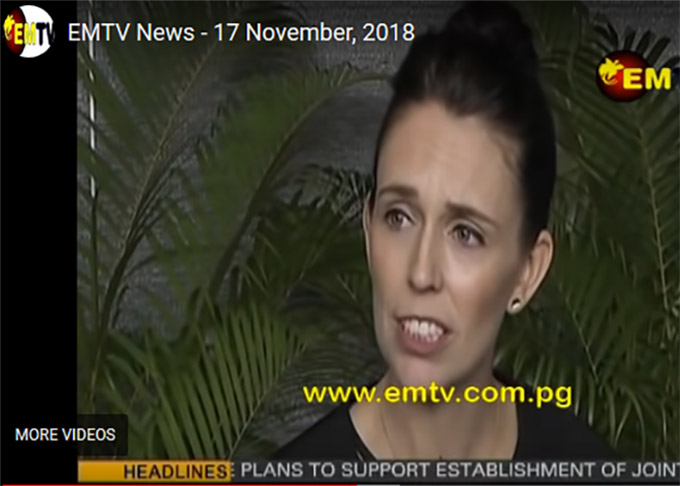
NZ Prime Minister Jacinda Ardern as she appeared on the “negative” EMTV News during APEC – she refused to ride in a Maserati luxury sedan and criticised the funding. Image: PMC screenshot from EMTV News

Pacific Media Watch Newsdesk

The Media Council of PNG has called on the board and management of Media Niugini
Limited to allow senior EMTV journalist Scott Waide to return to active duty.

This follows Waide’s suspension for reportedly broadcasting a “negative” news story on national EMTV News relayed by the New Zealand Newshub television from Port Moresby that criticised PNG’s purchase of 40 Maserati luxury sedans for the Asia Pacific Economic Cooperation (APEC).

In the story, visiting NZ Prime Minister Jacinda Ardern is featured saying that none of the NZ$15 million in aid money went towards buying the Maseratis and she would not travel in one in one of the cars.

“I will not and I have been advised that I will be travelling in a Toyota Highlander, I believe,” she added at the time.

READ MORE: EMTV suspends senior journalist Scott Waide over NZ Maserati news story

“Reinstate Scott Waide” … currently a popular meme on PNG social media. Image: PMC

The news item on November 17 was considered “negative” by the EMTV state ownership – MNL board, the Kumul Telikom Holdings board and the Kumul Consolidated Holdings board.

-Partners-

“The Media Council (MCPNG) sees this as a clear case of ignorance on the part of the chairmen and members of these boards, about the business of reporting the news,” the council said in a statement.

“The media in PNG is in the business of reporting the truth. Regardless of whatever form
it may take.

“It is clear that the owners of EMTV, do not appreciate the strength and commitment of
its news team, to tell the truth.

“EMTV News has been at the forefront of setting new ways of covering and reporting
the news, that is now international standard.

“Mr Waide and the EMTV News team has been leading this change. It is a step backward for democracy, and development in the The MCPNG maintains that the job of portraying a positive image of the country rests solely with the government of the day.

“The media is not responsible for this aspect of a country’s well-being. Its sole responsibility is to the people, and not to government, regardless of whether it owns some, or all of any media company’s shareholding.

“The media must not bend to the whims of insecure politicians, and spineless ‘yes-men’ who flaunt their authority, with impunity, and against all moral and ethical judgement.

“We in the media are in the business of reporting the truth. Journalists should not be looking over their shoulders, every time they work on a sensitive story, just because it may not paint the government of the day, in a good light.”

Print Friendly, PDF & Email

Article by AsiaPacificReport.nz

Open letter from MP for Wabag: EMTV move ‘dictatorship before our eyes’

]]>
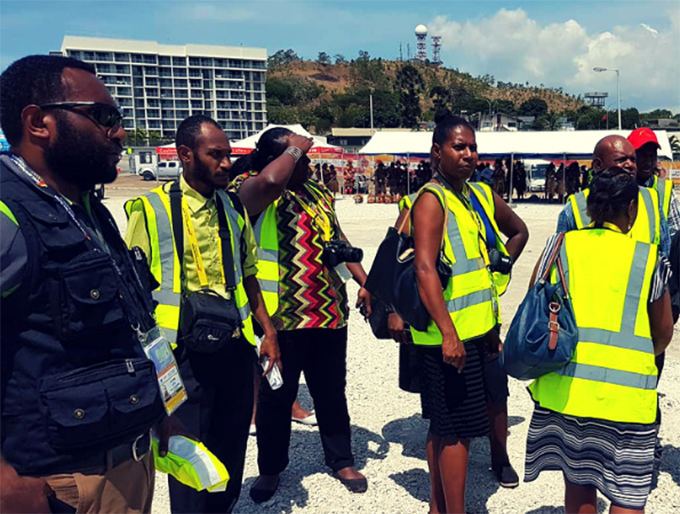
Papua New Guinean journalists at APEC 2018 … “freedom of speech and expression are a fundamental right … and entrenched in the constitution”. Image: Loop PNG

OPINION: By Dr Lino Jeremaih Tom, MP for Wabag

The suspension of EMTV deputy news editor Scott Waide has brought us to a new low in Papua New Guinea’s downward spiral.

Freedom of speech and expression are a fundamental constitutional right entrenched in the constitution, are pillars of democracy and this suspension is a breach of this fundamental right.

We have become a dictatorship in essence and it’s happening right before our eyes. Leadership comes with the territory, and scrutiny and criticism are part of this package and the media plays a big part.

Wabag MP Lino Jeremaih Tom … “sad day for PNG for one of its most loved journalists to be treated this way”. Image: PNG Parliament
Biased reporting is not healthy for this country and it is indeed a sad day for PNG for one of its most loved journalists to be treated this way.

In fact, it’s disgusting and nauseating witnessing the gross abuse of power in recent times by those vested few in their bid for survival.

Desperation calls for desperate measures. All our oversight institutions and laws have been raped and plundered to a point where the remains are a dysfunctional wreck.

-Partners-

If we can’t condemn this stupid and selfish act then all of us leaders should resign in shame as we’d have failed miserably our mandated responsibilities as freedom of speech and expression is one of the foundation principles of any democratic society.

This is totally wrong EMTV. What’s your role as a media outlet in nation building in PNG? The management should hang their heads in shame for stooping this low.

Print Friendly, PDF & Email

Article by AsiaPacificReport.nz

EMTV suspends senior journalist Scott Waide over NZ Maserati news story

]]>

The Maserati item from New Zealand’s Newshub screened on EMTV News on 17 November 2018.

By Vincent Moses in Port Moresby

The Papua New Guinean state-owned media company EMTV has been forced to act against its wishes and media ethics to suspend one of the country’s best reporters, their award-winning Lae bureau chief and senior journalist Scott Waide.

In an email sent to all staff of EMTV, the HR manager informed staff that EMTV management were forced by the government to take the action of suspending Waide.

READ MORE: The inside story of China’s ‘tantrum diplomacy’ at APEC

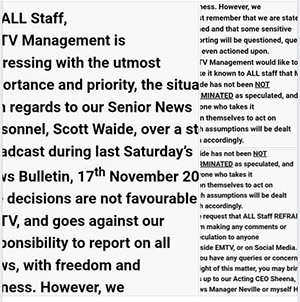
The email said: “EMTV is addressing with the utmost importance and priority, the situation with regards to our senior news personnel, Scott Waide, over a story broadcast during last Saturday’s news bulletin, 17th November 2018.

The EMTV memo shared widely on Pacific region social media.

“The decisions are not favourable to EMTV, and goes against our responsibility to report on all views, with freedom and fairness. However, we must remember we are state owned and that some sensitive reporting will be questioned, queried and even actioned upon.

-Partners-

“EMTV management would like it known to all staff that Mr Waide has not been NOT TERMINATED as speculated, and anyone who takes it upon themselves to act on such assumptions will be dealt with accordingly….” 

The poor management is not to be blamed for this action. After all EMTV is now state-owned and must adhere to instructions from their owners who happen to be Prime Minister Peter O’Neill-led government.

Scott Waide … suspended EMTV deputy news editor responsible for APEC news. Image: FB

The challenge is now on Communications Minister Sam Basil who was a very strong critic of media control when he was Deputy Opposition Leader to see if he will maintain his stand as a strong advocate of free media and do something to save this senior news reporter.

This action by the dictatorship O’Neill PNC government is not new. The same thing happened in 2013 when very senior staff and reporters of NBC Television were sacked, suspended and demoted for reporting about O’Neill’s nationalisation of OK Tedi copper and gold mine.

A freeze frame from the Maserati item on EMTV News on November 17. Image: PMC screenshot

Peter O’Neill is acting like another Chinese dictator in Papua New Guinea by exerting control over both state-owned and private media to not report truths and facts that expose his government and their corrupt acts to PNG and the world.

This is a huge attack on media freedom in PNG and must be condemned by everyone both in government, opposition, media council, Transparency International, media organisations both local and international and everyone in PNG.

Pacific reaction
Reaction around the Pacific on social media to this action by EMTV has been widely condemned. Reaction included:

Dr Shailendra Singh, journalism coordinator of the University of the South Pacific, said: “That Scott Waide was suspended for carrying out his journalistic duty is despicable and deplorable, but not unexpected or unusual in PNG, where tensions between media and government are increasing in proportion to the rise in alleged corruption, with one story after another to report in quick succession, and government lashing out to prevent exposure and to warn and intimidate journalists.”

The Pacific Media Centre director Professor David Robie described the action as “shameful and a blow to media independence and freedom of information in Papua New Guinea”.

He said it was understood the item objected to by the PNG government was a NZ Newshub item about the Maseratis controversy rebroadcast by EMTV News on November 17.

Dr Robie said it was clear to anybody monitoring PNG affairs and issues that Scott Waide was one of the country’s outstanding journalists with a great deal of courage and integrity, and an example to all reporters in the Pacific.

Dr Robie is also convenor of the PMC’s Pacific Media Watch freedom project.

Print Friendly, PDF & Email

Article by AsiaPacificReport.nz

Coalition pares back losses in late counting, as predicted chaos eventuates in upper house

]]>

Source: The Conversation (Au and NZ) – By Adrian Beaumont, Honorary Associate, School of Mathematics and Statistics, University of Melbourne

On election night, the ABC had Labor winning 58 of the 88 seats, to 20 for the Coalition. After late counting of pre-poll and postal votes, the ABC now shows Labor has won 52 of the 88 lower house seats, the Coalition 24, two Independents and ten seats are undecided, with 71% of enrolled voters counted.


Read more: Labor has landslide win in Victoria


Statewide primary votes are currently 42.9% Labor (up 4.8% since the 2014 election), 35.8% Coalition (down 6.3%) and 9.8% Greens (down 1.6%). As much of the Coalition-favouring pre-polls and postals have been counted, I expect the Greens to gain in late counting as left-leaning polling-day absent votes are counted.

In two party Labor vs Coalition terms, The Poll Bludger has Labor winning by 56.0-44.0 in seats that currently have such a count – that is, excluding Labor vs Greens counts in inner city seats, and Coalition vs independents in the regions. In seats with a two party count, the swing to Labor is 5.3%, which would be a 57.3-42.7 thrashing if projected to the whole state.

The Liberals have lost eastern suburbs heartland seats such as Mount Waverley, Burwood, Ringwood and Box Hill to Labor, but they have retained Caulfield and likely Sandringham, which looked likely to be losses earlier in the night. In Hawthorn, the Liberals lead by 53 votes, with many absent votes to come.

While the ABC currently lists Melbourne as in doubt, Greens-favouring absent votes will easily win it for the Greens. Labor leads the Greens by 72 votes in Brunswick, and will probably lose on absent votes. Labor has clearly retained Richmond against the Greens, and will regain Northcote, which they lost at a byelection. In Prahran, whichever of Labor or Greens finishes second will defeat the Liberals on the other’s preferences.

An independent has gained Mildura from the Nationals, and an independent has retained Shepparton. According to analyst Kevin Bonham, independents are some chance in Geelong, Benambra, South-West Coast, Morwell, Melton and Pascoe Vale; in some of these seats, independents are currently third, but could move ahead of a major party, then receive that major party’s preferences. These seats do not yet have a two candidate count against the independent; the ABC is guessing the two candidate result.

Micro parties could win ten upper house seats

The ABC’s upper house calculator currently has Labor winning 19 of the 40 upper house seats, the Coalition ten, the Greens one, and ten from other parties. These others include four Derryn Hinch Justice, two Transport Matters, one Aussie Battler, one Animal Justice, one Liberal Democrat and one Sustainable Australia.


Read more: Poll wrap: Labor’s worst polls since Turnbull; chaos likely in Victorian upper house


Overall upper house vote shares were 40.8% Labor, 28.2% Coalition, 9.2% Greens, 3.4% Hinch Justice and 0.6% Transport Matters. It is ludicrous that a party with 0.6% of the vote could win one more seat than a party with 9.2%, or that a party with 3.4% could win three more seats than the Greens.

The upper house count is only at 42.5%, while the lower house is at 71.1%. The pre-poll and postal votes that have assisted the Coalition in the lower house have not yet been tallied for the upper house. When they are counted, Labor will drop back and the Coalition will gain.

The below-the-line vote rate increased to about 10% at this election, from 6% in 2014. As the ABC calculator assumes that all upper house house votes are above-the-line ticket votes, errors can occur if the calculator margin at a critical point is close. Bonham thinks the Coalition will do a bit better at the expense of micro parties, but he still thinks there will be at least six micro party members.

If Labor wins 19 upper house seats, they will be in a strong position in the upper house. Since the election was a Labor landslide, they performed well in the upper house. Had Labor done worse, there would have been some incentive for them to attempt to reform group voting tickets, but this is now unlikely to happen.

ref. Coalition pares back losses in late counting, as predicted chaos eventuates in upper house – http://theconversation.com/coalition-pares-back-losses-in-late-counting-as-predicted-chaos-eventuates-in-upper-house-107516

Victorian Labor’s thumping win reveals how out of step with voters Liberals have become

]]>

Source: The Conversation (Au and NZ) – By Paul Strangio, Associate Professor of Politics, Monash University

The commanding return to office of the Andrews government emphatically reaffirms that Labor is the natural ruling party in Victoria. By the time the state’s next election is due in November 2022, Labor will have presided over Spring Street for three-quarters of the previous four decades.

That ascendancy is replicated in federal election results: the ALP has won the two-party preferred vote in Victoria on 12 of the past 14 occasions. The flipside is that Victoria has become foreign ground for the Liberal Party. It seems almost unimaginable that this was once the state dubbed the “jewel in the Liberal crown”.

If Labor’s re-election consolidates an established trend in Victorian politics, the scale of the victory (it has invited comparisons with the ALP’s Steve “Bracks-slide” of 2002) and the terms on which it has been won are remarkable.


Read more: Victoria election: the scandals, sloganeering and key issues to watch


From the moment he won office in 2014, Daniel Andrews styled himself as an assertive and activist premier. This has been exemplified by an ambitious infrastructure agenda, but also a willingness to barge his way through controversies unapologetically.

Andrews’ buttoned-up Clark Kent like exterior has also belied an adventurism on social reform highlighted by Victoria becoming the first Australian state to legalise voluntary assisted dying and other initiatives such as embarking on negotiating a treaty with the local Indigenous community.

Lacking the every-man touch of Bracks, Andrews has never seemed especially fussed about courting popularity and has mostly eschewed media contrivances to leaven his image. Neither has he sought to disguise that he is unambiguously a creature of the Labor Party, nor camouflaged his government’s closeness to the trade union movement.

Only last month, Andrews boldly marched at the head of an ACTU-organised rally in support of strengthened industrial rights and improved conditions for workers. On Saturday night, he made a conspicuous point of thanking the labour movement in his victory speech. All of this has inflamed his detractors (not least News Limited’s Herald Sun), yet Andrews has remained defiantly unmoved.

Arguably, there is a risk in this audacity that might grow greater with Andrews emboldened by winning a second term. And there remains a danger that, despite Labor’s expansive infrastructure program, his government will be overwhelmed by Melbourne’s exponential growth and the enormous strains this is placing on services.

For now, though, one cannot deny Andrews’ achievement. Pledged to serve another four years, he is on track to become the state’s second longest-serving Labor premier and he has bequeathed his party a victory so sweeping it should guarantee two further terms.

For the Liberal Party, this is an abject result. It rubs salt into the wounds of the Coalition’s first-term defeat in 2014. Twice in Labor’s era of dominance of the past four decades, the Liberals have squandered office.

A combination of policy inertia and ill-discipline sowed the seeds of the premature fall of the Ted Baillieu-Denis Napthine government in 2014, while in 1999 Jeff Kennett’s tenure was cut short by hubris and insensitivity to rural and regional Victoria that paved the way for an 11-year Labor reign under Bracks and John Brumby.

For the second state election in succession, the Victorian Liberals have also been handicapped by the actions of their federal counterparts. When Victorians voted in 2014, the politically poisonous first budget of Tony Abbott’s government was still exercising their minds, while on this occasion there was the backdrop of the upheaval surrounding Malcolm Turnbull’s deposal as prime minister.

But this result shows the Liberal’s difficulties in Victoria run far deeper to matters of identity and philosophy (and organisation). Though Matthew Guy gestured towards broadening his election pitch through decentralisation policies, everything in the Liberal campaign was ultimately dwarfed by a muscular conservative law and order agenda.

It was both narrow and discordant in a community of progressive sensibility and one that is defined by complexity and diversity. It is a community where, for example, there are electorates in which greater than 50% of people were born in non-English speaking countries, electorates where more than 30% of the population are of Muslim faith, and electorates where nearly 50% have no religion. The contemporary Liberal Party appears bereft of a vocabulary to speak to this pluralism.

Liberal leader Matthew Guy concedes defeat on Saturday night. AAP/David Crosling

This problem of being out of step with the nation’s second largest and fastest growing state besets the Liberal Party federally as well. Yet Scott Morrison and many of his colleagues have shown scant evidence of recognising let alone addressing this dilemma.

Instead, they seem intent on appealing to a Queensland-focused “base”. The cost of this hewing to the right and what it potentially augurs for next year’s federal election in Victoria is now plain to see.

In a more immediate sense, there is a serious chance that the Morrison government will be further destabilised by the recriminations flowing from this result. It is likely to deepen the divide in Liberal ranks between those who appear hell bent on remaking the party in their own conservative self-image regardless of electoral consequences and those who understand that this is folly.

Lastly, what of the Greens? Since 2002, the Greens have stalked Labor in its once traditional heartland in Melbourne’s inner city. Buoyed by a heady triumph in the Northcote by-election 12 months ago, the Greens looked forward to this contest convinced they were on an irresistible forward march.


Read more: The Greens set to be tested on a number of fronts in the Victorian election


That optimism was dented by defeat in the federal byelection in Batman in March. Now, after an unhappy campaign during which the party became mired in controversy over its culture towards women and struggled for traction against a progressive-credentialed government, the Greens have lost ground. Some experienced observers are speculating that we have witnessed “peak Green”.

That is probably premature. Yet, for Labor, the sullying of their tormentor’s image and disruption of their momentum is icing on its glorious election victory cake.

ref. Victorian Labor’s thumping win reveals how out of step with voters Liberals have become – http://theconversation.com/victorian-labors-thumping-win-reveals-how-out-of-step-with-voters-liberals-have-become-105574

Labor has landslide win in Victoria

]]>

Source: The Conversation (Au and NZ) – By Adrian Beaumont, Honorary Associate, School of Mathematics and Statistics, University of Melbourne

With 42% of enrolled voters counted in the Victorian election, the ALP has had an emphatic win. So far, the ABC has called 58 of the 88 seats for Labor, just 20 for the Coalition, one Green, two Independents and seven seats are undecided. Projected primary votes are currently 43.7% Labor (up 5.7% since the 2014 election), 34.9% Coalition (down 7.0%) and 10.5% Greens (down 1.0%). These projections are of what the final vote will be.

There was a large amount of pre-poll voting at this election, and perhaps the pre-poll swing to Labor is lower than the election-day swing. Pre-poll votes will be counted later in the night. However, Labor has clearly won a thumping victory.

I believe the Liberals law and order campaign was too right-wing for Victoria. The Liberals suffered large swings in their eastern suburb heartland seats such as Hawthorn, Sandringham and Box Hill. In these seats, voters with high levels of educational attainment would have been angered by the Liberals’ campaign, which could have been perceived as racist.

In the final pre-election Newspoll, Labor led the Liberals by 43-42 on handling the economy, a decline from a 45-37 lead in late October. However, the economy is traditionally a Liberal strength. The Victorian economy is good, and this undoubtedly helped Labor in its rout.

Labor had the advantage of being a first-term government with an unpopular federal Coalition government. The ousting of Malcolm Turnbull would not have gone down well among voters with high levels of educational attainment, and contributed to the swings against the Liberals.

The final four Victorian state polls had Labor’s two party vote between 53% and 54%, which would represent merely a 1 to 2% swing to Labor from the 2014 election. While we will not know the final two party result for at least two weeks, Labor has clearly performed far better than expected. Polls sometimes miss in the direction that surprises commentators.

For example, Trump’s US victory in 2016, the UK’s Brexit referendum in 2016, UK Labour’s forcing the Conservatives into a hung Parliament in 2017, and Emmanuel Macron’s blowout victory over Marine Le Pen in 2017 were all occasions where the polls missed in a way contrary to how conventional wisdom thought.

I will have more details tomorrow on the Victorian election including what happened in the upper house.

ref. Labor has landslide win in Victoria – http://theconversation.com/labor-has-landslide-win-in-victoria-107514

Mary-Louise O’Callaghan: Time we heard the Pacific’s take on the Pacific

]]>
Covering the Pacific … “we might even learn a thing or two about the nations and the region within which we live .” Image: Shane McLeod/The Interpreter

ANALYSIS: By Mary-Louise O’Callaghan

It is both apt and overdue that veteran ABC correspondent Sean Dorney was last night awarded the Outstanding Contribution to Journalism at the 2018 Walkley ceremonies.

Judged by the trustees of the Walkley Foundation, this award not only recognises Dorney’s extraordinary body of work built over four decades chronicling life and politics in the Pacific, especially Papua New Guinea, but pays homage to one of the last of a near extinct breed of old-time expat Pacific correspondents who lived and breathed their rounds as long-term residents of the communities upon which they were reporting.

Australian newsrooms, instead of panting and pontificating about the growing influence of China, might be better served by tapping into Pacific conversations.

READ MORE: Podcast by Bond academic, student wins Walkley Award for journalism excellence

Mary-Louise O’Callaghan … “not uncommon in the two decades either side of the turn of the century for Pacific correspondents to report on unfolding events such as the Bougainville secession crisis or expose corrupt or inept governance.” Image: The Interpreter


Sprung from the bad-old and arrogant days of colonial dispatches referencing “restless natives” and “strange customs” when first nation’s peoples served merely as the backdrop for the white man’s conquering and efforts to “civilise”, it can be argued that for a time these rusted-on corros (who not infrequently through their marriages, gained the privilege of the unique insight of living life within a Pacific family), served as useful intermediary interlocutors in the transitional societies of post-independent Pacific states.

As nations such as PNG, Fiji, Solomon Islands, and Vanuatu fought to different degrees to shake off their colonial framing and fashion a culture of accountability of their own, correspondents like myself and Dorney strove to facilitate and amplify indigenous views of events in these nations. This was both in our reporting for Australian audiences, or, in Dorney’s case, for the entire region. His reports were broadcast back into the countries he covered by Radio Australia, the ABC’s once wonderful but now defunct shortwave radio service.

-Partners-

Reporting crises
With the additional resources afforded our first-world news bureaus, it was not uncommon in the two decades either side of the turn of the century for Pacific correspondents to report on unfolding events such as the Bougainville secession crisis or expose corrupt or inept governance that indigenous journalists literally couldn’t afford to do.

As late as 2003, my “scoop” as The Australian’s South Pacific correspondent on the Howard government’s decision to dispatch a 2000-strong Australian-led Pacific intervention force to restore the rule of law in Solomon Islands after several years of unrest, was lifted by the national newspaper, The Solomon Star to run as their frontpage splash.

The only difference being that, unlike The Solomon Star’s newsroom, I worked for a media outlet that could bear the exorbitant cost of international phone calls; I had the means to contact Solomon Island government officials to confirm the story after their meetings in Canberra.

Much has been written in the past decade or so warning about the dangers of the disappearing resident Pacific correspondent, as first Australian Associated Press, then Fairfax closed their bureaus in Suva, Port Moresby, and Honiara, and in many cases wound down the network of stringers who reported for them elsewhere in the region.

The ABC is now the only Australian media outlet still maintaining a permanent presence in the South Pacific region with its bureau in Port Moresby.

But as we are all learning, with disruption comes new opportunities and with digital disruption, in particular, has come new ways of gathering, reporting, and disseminating news.

Hear from the people
Here’s the rub: should we really be lamenting the passing of the old-fashioned foreign correspondent, particularly in our own region?

Or is this a chance to embrace the opportunity to hear from the people of the Pacific in their own voices with analysis from their perspectives and news priorities that reflect Pacific agendas?

There is today a prolific cohort of indigenous journos, bloggers, and social commentators already daily reporting, dissecting, and disseminating their nations and region’s affairs with the insight only an indigenous member of an indigenous society can have.

Australian and New Zealand newsrooms, instead of panting and pontificating about the growing influence of China, might be better served tapping into these conversations.

If we joined them, we might even learn a thing or two about the nations and the region within which we live.

Mary-Louise O’Callaghan lived and reported on the Pacific as a foreign correspondent with Australian metropolitan daily newspapers for more than two decades. In 1997 she won the Gold Walkley for Excellence in Journalism for her investigative reporting exposing the Papua New Guinean government’s ill-conceived decision to hire foreign mercenaries to end a war for secession on the island of Bougainville. Her book Enemies Within, Australia, PNG and the Sandline Mercenary Affair, was published the following year. She is now working for World Vision Australia where she leads the Public Affairs team. This article is republished from the Lowy Institute’s Interpreter with permission.

Print Friendly, PDF & Email

Article by AsiaPacificReport.nz

Scott Waide: PNGFM news boss calls for investigations, penalties for troops who assaulted journalists

]]>
Parliament Haus in Waigani … scene of the reported assault against PNGFM journalists. Image Scott Waide’s blog

Scott Waide’s blog highlights an open letter by Genesis Ketan, director of news, PNGFM:

As director of News for PNGFM, I am very disappointed at the manner at which two of my reporters – one male and one female – were assaulted by disciplinary officers while covering the storming of Parliament on Tuesday,  20 November 2018.

They were simply there to do their jobs and cover the proceedings of what was happening at National Parliament when they were accosted by a group of inflamed disciplinary officers, both police and correctional service officers.

Upon seeing the journalists – one officer called out “Em ol Reporter ya, ol laik kisim wanem kain story, paitim ol”. (“They are reporters, what kind of story are they here for, beat them up.”)

READ MORE: RSF condemns exclusion of PNG journalists

Police Commissioner Gary Baki … received PNGFM’s assault complaint. Image: Loop PNG

The female journalist was manhandled by a group of police officers who pulled at her shirt attempting to rip it:

“One of the police officers pulled out my camera from my bag and smashed it right in front of me. While I was trying to take in what was happening, another officer pulled my bag causing the leather handle of my bag to break. He then threw my bag on the ground, kicked it towards the other officers, they in turn kicked the bag back to him, emptying out all my belongings in my bag. Another officer picked up my phone and smashed it while others were shouting and yelling abusive languages.”

-Partners-

She was pushed back and forth during the commotion with just one elderly officer attempting to assist her and help her out to safety.

At the same time, the male reporter was separated from his colleague, then told to put his camera away and not film or take shots.

“During the struggle, I was attacked by a Correctional Service officer at first, which then led to police officers surrounding me and attacking me. During the incident, I was trying to see what was happening to my colleague, but kept getting punched until one Police Mobile Squad officer pulled me away to safety. I had my vest broken, my note book gone and the company camera destroyed by the officers.”

PNGFM has written a letter of complaint to Correctional Service Commissioner Stephen Pokanis and Police Commissioner Gary Baki calling for those involved to be penalized.

Such an attack is an attack on our media freedom when journalists should be protected and not be subjected to such attacks for merely doing their jobs.

Meanwhile, at separate media conferences on Thursday, November 22, both Commissioner Pokanis and Commissioner Baki were informed of the assault against our journalists and have given assurance they will investigate this matter thoroughly.

– Genesis Ketan, director of news, PNGFM

Scott Waide’s blog columns are frequently published by Asia Pacific Report with permission. He is also EMTV deputy news editor based in Lae.

Print Friendly, PDF & Email

Article by AsiaPacificReport.nz

The latest citizenship-stripping plan risks statelessness, indefinite detention and constitutional challenge

]]>

Source: The Conversation (Au and NZ) – By Sangeetha Pillai, Senior Research Associate, Andrew & Renata Kaldor Centre for International Refugee Law, UNSW Law School, UNSW

This week, Prime Minister Scott Morrison and Home Affairs Minister Peter Dutton announced the federal government’s intention to introduce changes to Australia’s citizenship-stripping laws. The proposed changes would likely make Australia’s regime for citizenship-stripping the most expansive in the world. I’ll outline how the proposal would change the current law, and analyse its key elements.

What are Australia’s current citizenship-stripping laws?

In 2015, Australia introduced one of the most expansive regimes anywhere for citizenship deprivation on national security grounds. Under the current law, people can lose Australian citizenship against their will in two key ways:

  • Conduct-based citizenship deprivation: In certain circumstances, a citizen outside Australia can lose citizenship where the person has engaged in activities defined by reference to national security offences. A person does not need to be convicted of an offence to lose citizenship in this manner.

  • Conviction-based citizenship deprivation: The Minister for Home Affairs also has the power to revoke a person’s Australian citizenship where the person has been convicted of particular national security offences, and sentenced to at least six years’ imprisonment. This is generally the only way in which people within Australia can be stripped of Australian citizenship against their will.


Read more: Proposals to strip citizenship take Australia a step further than most


Currently, it is possible for the government to strip a person of Australian citizenship only if the person is a dual citizen. This means that, at present, Australian law does not allow a person to be deprived of Australian citizenship if this would render them stateless.

Dutton has said that the existing citizenship-stripping laws have been used to deprive nine people of their Australian citizenship. Very little information on the circumstances of these deprivations is available. However, it is clear that at least six of these instances involved citizens outside Australia who lost their citizenship on the basis of conduct committed overseas. There has been no reported instance of a person within Australia being deprived of Australian citizenship, or of the conviction-based ground for citizenship deprivation having been used.

What changes would the proposed laws introduce?

The government’s new proposal would make it easier for people to be stripped of their Australian citizenship in two ways.

Changes to the dual citizenship requirement

If the proposed changes become law, it will no longer be necessary for a person to definitively hold dual citizenship before losing Australian citizenship. A joint media release from the offices of Morrison and Dutton states:

The Government will…change the threshold for determining dual citizenship. This change aims to improve the minister’s scope to determine a person’s foreign citizenship status.

A bill has yet to go before parliament, and it is not clear from this statement exactly what the government envisages. One possibility is the legislation will give the minister the power to decide whether or not a person is a foreign citizen. This is likely to raise constitutional difficulties. As the High Court has made clear on many occasions, whether a person is a foreign citizen is a question determined by the law of the foreign country concerned.

Another possibility is that the legislation will allow a person to be stripped of Australian citizenship where the minister thinks it is reasonably likely, but not certain, the person has dual citizenship. As the recent referrals of multiple federal parliamentarians to the High Court over potential foreign citizenship illustrate, it can often be difficult to conclusively determine when a person has foreign citizenship. However, many people – including those born in Australia to Australian parents – hold dual citizenship as a result of a familial connection to a foreign country.

A change of this nature could also raise constitutional problems. The High Court has not yet determined the extent of the Commonwealth’s power to deprive a person of Australian citizenship. There is a plausible argument that certain citizens, especially those who hold only Australian citizenship or who have no substantive connection to a foreign country, are part of the Australian constitutional community, and are protected against citizenship deprivation.


Read more: Government’s own ‘freedom commissioner’ Tim Wilson questions citizenship plan


On a practical level, enabling the minister to revoke a person’s Australian citizenship without it being clear the person has citizenship in a foreign country creates a very real risk of rendering the person stateless. This would place Australia in violation of its obligations under Article 8 of the 1961 Convention on the Reduction of Statelessness, which prevents signatory countries from depriving people of their nationality if it would render them stateless.

Australia has signed up to an international agreement not to render people stateless. Shutterstock

Where a person inside Australia is deprived of Australian citizenship they become vulnerable to removal from Australia, and immigration detention until removal is possible. Where it is not clear that the person has citizenship in a foreign country, there is a likelihood of such detention being lengthy, or even indefinite.

Changes to the minimum sentence for conviction-based deprivation

The government’s media release also says:

The proposed changes would enable the minister to cease the citizenship of anyone who is convicted of a terrorism offence in Australia, irrespective of the sentence they receive. This removes the current requirement that a terrorist offender must be sentenced to at least six years’ imprisonment.

Currently, the minister has power to revoke a person’s citizenship only on conviction-based grounds where a person is convicted of a select list of national security offences. It is not clear whether the government intends to retain or expand this select list of offences.

An anti-terrorism exercise at Cologne Bonn airport in Germany on November 20. Marius Becker/dpa

Either way, the proposal is concerning. In 2015, before the current citizenship revocation laws were introduced, the Abbott government attempted to attach citizenship revocation to a much wider range of national security offences, with no requirement for a minimum sentence. A number of experts advised that this ran a risk of falling foul of the Constitution.

The more limited current legislation was ultimately arrived at following an inquiry by the Parliamentary Joint Committee on Intelligence and Security. It found that restricting the list of offences and requiring a minimum six year sentence was necessary to “appropriately target the most serious conduct that is closely linked to a terrorist threat”. Since 2015, the national threat level has not changed.

In this context, the government should clearly explain why removing the six year sentence threshold for conviction-based citizenship deprivation is necessary and proportionate. Given that the conviction-based citizenship-deprivation powers have not been used since their introduction, the need for a clear justification is particularly strong. The government’s media release states:

We now need to focus attention on strengthening the citizenship loss provisions which commenced in 2015 as they relate to terrorists within Australia, in order to protect our community.

As the Law Council has stated, this justification is not nearly strong enough.

ref. The latest citizenship-stripping plan risks statelessness, indefinite detention and constitutional challenge – http://theconversation.com/the-latest-citizenship-stripping-plan-risks-statelessness-indefinite-detention-and-constitutional-challenge-107439

Explainer: how a dust storm, and hazardous air quality, can harm your health

]]>

Source: The Conversation (Au and NZ) – By Mark Patrick Taylor, Professor of Environmental Science, Macquarie University

A major dust storm swept through Sydney and regional New South Wales this week. Red skies over Broken Hill on Wednesday night and Sydney on Thursday resembled those seen during intense bushfire activity and the massive 2009 dust storm.

The NSW government updated its air quality index to “hazardous”. People were advised to stay indoors unless it is essential to go outside, minimise strenuous physical activity and seek emergency medical assistance if they experience breathing difficulties, chest pains, or if other serious health concerns arise.

The hazardous air quality warning arose because fine dust levels were high relative to Australian air quality standards. Air quality levels of PM10 – particles at or less than 10 microns (µg) – were more than twice the Australian standard, of 50 µg/m³ measured over a 24-hour period, on Friday morning. They remained high throughout the day.

Perhaps of greater concern are the smaller PM2.5 dust particles, which were above the Australian standard of 25 µg/m³ at St Marys in Sydney’s west on Friday morning. Fine PM2.5 dust particles can penetrate deep into the lungs and cause respiratory difficulties. Short-term exposures aggravate asthma, increasing the number of emergency department visits, as well as causing wheezing and breathing difficulties.

Even for those not affected by asthma, exposure can cause coughing, a sore throat and a runny nose. Elevated dust exposure can also aggravate heart conditions. For example, increased short-term exposure to both PM10 and PM2.5 has been linked to increased death and hospitalisation rates due to heart disease, arrhythmias (palpitations) and stroke.

The city of Newcastle is experiencing much worse conditions. On Friday morning PM10 levels were four times the Australian standard of 50 µg/m³ due to additional smoke particles from local bushfires. Throughout the day PM2.5 levels in Newcastle have remained just below the maximum acceptable upper value of 25 µg/m³.

Fine dust particles are usually too small to see individually but high concentrations make them visible as a brown haze. Even as the dust begins to clear, the unseen fine particles outside or even inside your house can still present a health risk.


Read more: We can’t afford to ignore indoor air quality – our lives depend on it


It’s advisable to use any prescribed relieving medications and seek medical advice if symptoms do not improve. For those who own an air conditioner, it may be appropriate to use it as long as the fresh air intake is closed and the filter is clean, preventing particles from being drawn into the home.

It is also important to keep an eye on air quality, which can be done in real-time via the NSW government’s air quality monitoring network.

The 2009 dust storm also turned Sydney skies red. DAN PELED/AAP Image

The previous major dust storm in 2009 was made of predominantly natural elements – aluminium, silicon and iron. These originate from desert soils and did not contain significant concentrations of toxic elements. The current dust storm is likely similar in composition.

While there is some evidence the source and composition of dust has health implications, the most critical factor is the size of the particles. Evidence shows there is no safe level of fine PM2.5 dust.

Dust storms like this and the one in 2009 are unlikely to present a long-term health risk. However, they are concerning in the short term, especially for the elderly, people with pre-existing respiratory conditions and children, who breathe more air per kilogram of body mass than adults.

A health impact assessment of the 2009 dust storm showed marked increases in emergency admissions for asthma and respiratory conditions but no significant increase in cardiovascular (heart and vessel) hospital admissions. The age groups most affected were those known to be most vulnerable – people older than 65 and those aged five and younger.


Read more: Toxic chemicals and pollutants affect kids’ brain development


A similar situation is being experienced in California, where wildfires are causing high concentrations of dust and smoke in the air and significant concerns about human health.

Australia generally enjoys good air quality, which is not the case for many lower- to middle-income countries. According to the World Health Organisation (WHO), more than 600,000 children died in 2016 due to air pollution.

Air quality is a global public health issue. Around 91% of the world’s population live in areas where the WHO’s fine particle (PM2.5) guidelines are not met.


For those concerned about dust, Macquarie University’s DustSafe program will provide information on the dust in your home free of charge.

ref. Explainer: how a dust storm, and hazardous air quality, can harm your health – http://theconversation.com/explainer-how-a-dust-storm-and-hazardous-air-quality-can-harm-your-health-107499

Building our own warships is Australia’s path to the next industrial revolution

]]>

Source: The Conversation (Au and NZ) – By Giselle Rampersad, Associate Professor in Innovation, Flinders University

Naval defence procurement is very big business. Nine Hunter-class frigates will cost Australian taxpayers A$35 billion; the 12 submarines to replace the existing Collins-class subs at least A$50 billion.

Although both the frigates and submarines will be built by foreign companies – the frigates by Britain’s BAE, the subs by France’s Naval Group – part of the deal is that they build locally.

The federal government isn’t shy about spruiking the local economic benefits. “We make no apologies for deciding to invest in Australian-built ships, creating Australian jobs and using Australian steel,” said Christopher Pyne, the then defence industry minster and now the defence minister, in May.

There are critics. The Australian National Audit Office, for instance, has flagged the risks of cost blowouts in a local build. These risks will need to be proactively managed.

But the local shipbuilding program does present a tremendous economic opportunity. It provides a platform to invigorate advanced manufacturing and ride the wave of the next industrial revolution.

We need to focus on how to maximise the benefits by leveraging the program to create competitive new industries and jobs.

Mapping the manufacturing ecosystem

Transitioning the Australian economy towards advanced manufacturing is not easy. It is tempting to simply import cheaper products. A good example can found in the renewable energy sector. With a few exceptions, the majority of solar panels and wind farm components are imported. This is a missed opportunity.


Read more: On windmills and warships


We can avoid making the same mistake in shipbuilding. Our research shows that building ships locally has huge flow-on effects, and can help underpin other advanced manufacturing.

To facilitate this process, we have developed a map of the advanced manufacturing ecosystem in Australia. The aim is to help boost the visibility of Australian organisations capable of supplying components or services to these projects.

An emerging defence innovation ecosystem in Australia, with business, university, government and other key stakeholders.

This will assist in initiating partnerships. Several Australian businesses and universities have already begun to secure relationships with the international shipbuilders. More are in the pipeline.

Industry opportunities

Building ships presents many opportunities for Australian organisations.

In Australia, X-ray and imaging products are examples of complex products we have been able to competitively export. This technology is obviously relevant to medical imaging devices. It can also be applied to surveillance systems for the defence sector.

Conversely local manufacturers that develop capabilities in defence shipbuilding can leverage their expertise to supply to non-defence-related supply chains and for export.

Relevant technologies include autonomous vehicles and systems, energy management, cyber-security, robust and maintainable materials, acoustics and digital technologies. These technologies can have flow-on effects for advanced manufacturing in transport, renewables, health, space and information technology.

In these sectors, making complex products is vital for competitiveness.

A Hobart-class air warfare destroyer under construction in Adelaide in 2013. AAP Image/Lukas Coch

Anchoring industry 4.0

It is wrong to think advanced manufacturing is not viable in Australia. Britain and Germany are two economies with high labour costs, yet both have been able to sustain manufacturing sectors.

The success of advanced manufacturers in Europe is based on an approach called industry 4.0. The “4” refers to the advent of the fourth industrial revolution since the 18th century – integrating information and communication technology in industrial production.

During a visit to European manufacturing sites we saw how this involved the use of robots, cobots (or collaborative robots), digital twins and driverless vehicles.


Read more: Does the next industrial revolution spell the end of manufacturing jobs?


Automation means that shipbuilding will not provide the sorts of jobs it did in the past. In Germany’s automotive industry, for example, human labour that cost 40 euros an hour has been replaced by robots that cost 5-8 euros an hour to operate – even cheaper than a Chinese worker. But other other jobs have been created, particularly in computing and engineering. There are now 100,000 more jobs in Germany’s auto industry than in 2010.

Another feature of industry 4.0 is digitisation of the supply chain. Information about parts can be captured and used in new ways. When a component needs be serviced or replaced can now be predicted with high accuracy. This is important in any large ship, built to be operational for decades and using vast numbers of components from thousands of suppliers. It’s even more important in a naval ships, where a breakdown could be catastrophic.

Digital transformation will make our factories more competitive. Additionally, economic gains will come from defence procurement that encourages the local development of complex and competitive products. If done well, defence investment will make as powerful a contribution to the nation’s economic prosperity as its military security.

ref. Building our own warships is Australia’s path to the next industrial revolution – http://theconversation.com/building-our-own-warships-is-australias-path-to-the-next-industrial-revolution-105984

Innovation could just mean a better kind of co-operation

]]>

Source: The Conversation (Au and NZ) – By Professor Lars Coenen, City of Melbourne Chair in Resilient Cities, University of Melbourne

It seems Australia’s experiment at being a world leader at “innovation” is over, with the abrupt departure of its champion, Malcolm Turnbull.

The then prime minister made headlines with his 2015 Innovation Statement, which sought to move the Australian economy beyond dependence on natural resource extraction into an “ideas boom”.


Read more: No clear target in Australia’s 2030 national innovation report


But his replacement with Prime Minister Scott Morrison three months ago has seen innovation disappear off the government’s radar. Even the job of innovation minister was scrapped – to the consternation of the tech and start-up sectors.

Where does this leave us? Not poised to make the most of the 21st century, according to the Global Innovation Index, which last year ranked Australia a lowly 76th in terms of innovation efficiency.

But we cannot afford to turn our back on innovation. Our major sustainability problems – transitioning energy, future-proofing cities, reducing carbon emissions – need us to move past “business as usual”.

Rethinking innovation

As my research on innovative cities and regions in Europe and Australia shows, we urgently need to rethink what innovation is and how to go about it.

Too often it’s framed in purely economic or technological terms. But innovation should be much more than a buzzword or a techno-fix.

Our economy faces some intractable sustainability challenges, which must be prioritised. We’re struggling to stay within a safe climate envelope – despite (or even because of) technological advances. Around the world, social polarisation is deepening, even in cities that rank highly on livability and innovation indices.

We need a notion of innovation based on solving problems collectively, with solutions that are relevant to society – not just to economists.

What does this look like? We need to combine scientific and technological solutions with expertise from the social sciences and humanities, and to that mix we need to add real-world lessons from practice-based knowledge and experimentation.

Wind turbines located off the coast of Copenhagen, Denmark. Vadim Petrakov/Shutterstock

Consider the extraordinary success of wind power in Denmark, a small country which is a world leader on renewable energy. Denmark was an early mover in acting on the 1970s oil crisis and acknowledging – not ignoring – warnings of climate change.

The early development of wind turbines blended scientific expertise with farmers’ knowledge, with grassroots organisations involved too. New forms of partnerships were trialled between the private sector, government, universities and civil society organisations. The Danish government acted as an entrepreneurial state, which actively contributed to creating a market for wind energy.

Overall, the Danes took an approach of being resilient in a crisis and pursuing diversity of knowledge and cross-sector collaboration. It has paid off.

Innovation as collective problem-solving

So we need to have a broader understanding of what innovation really is: it’s collective problem-solving, not just something that’s done by heroic entrepreneurs. Even though there is no one-size-fits-all strategy, it will always be a messy process of trial and error, and it will always take time. Beware of politicians promising swift results.

The majority of innovation projects fail. Yet it is in the failures we find the interesting stories that we can learn from, as the brilliant Museum of Failure captures. We have to accept failure and share the lessons from it. This is a challenge for politicians, who tend to be risk-averse and preoccupied with cost.

Australia’s formal approach to innovation could use a shake-up, but since moving to Australia two years ago I’ve found plenty going on at ground level. I’ve been interested by the work of Farmers for Climate Action, who show how innovation in agriculture can be effective while largely flying under the radar.


Read more: Farmers’ climate denial begins to wane as reality bites


Then there’s the Resilient Melbourne Strategy, which was endorsed two years ago and aims to help the city prepare for change and whatever the future may hold. My (Lars) research into the strategy demonstrates the challenge of combining citizen engagement with large corporations, elite universities and governments (which can operate in silos) – but we need these cross-sector partnerships to make innovation work.

Meanwhile, back in my former home town of Malmö in Sweden, a former shipbuilding factory has been transformed into an experimental, sustainable “maker space” bringing together technology, crafts, art and culture.

Tailoring innovation to a specific place – whether it’s Melbourne or Malmö – reminds us why we need innovation in the first place. Getting innovation right is particularly important for places coping with the potential loss of their major industry, like Australia’s coal regions. We can’t afford to get this one wrong.


This is an edited extract of the MSSI Oration 2018, given by Lars Coenen at the Melbourne Sustainable Society Institute on November 20, 2018.

ref. Innovation could just mean a better kind of co-operation – http://theconversation.com/innovation-could-just-mean-a-better-kind-of-co-operation-106856

What skills does a cybersecurity professional need?

]]>

Source: The Conversation (Au and NZ) – By Joanne Hall, Lecturer in Mathematics and Cybersecurity, RMIT University

Cyber crime is a threat to every organisation that operates internet-connected devices. It’s highly profitable, highly disruptive, and hard to police due to the transnational nature of cyberspace.

Incidences of cyber crime might include fraud, identity theft or privacy breaches, which can have a high personal impact. Ransomware, which locks a system and demands payment, can have widespread economic or healthcare implications.

In the past year, 25% of the Australian adult population was impacted by cyber crime. If we want a robust and resilient society, we need cybersecurity professionals defending every organisation from cyber attack.

Cybersecurity professionals might work in software development, network testing, incident response, or policy development to ensure the security of an organisation.

In popular culture, these experts are often portrayed as lone hackers in hoodies. But in reality, cybersecurity professionals must regularly communicate with a variety of audiences. They must also display a high degree of personal integrity.


Read more: What teenagers need to know about cybersecurity


What cybersecurity professionals do

To ensure our cybersecurity classes are teaching skills relevant to industry, we consult with security professionals about the skills they are looking for.

As well as technical skills, they tell us they want those they hire to have communication skills, work well in teams, and show empathy and integrity.

The following scenarios show what cybersecurity professionals do on a daily basis. (Names and details have been changed.)

Ensuring systems are compliant

Anna is a software developer for an online retailer. She notices that one of their systems is processing credit card transactions in a way that does not comply with the Payment Card Industry Standards.

The technical project leader does not understand the legal jargon of the PCI standard. The business and legal staff do not understand the software processes behind credit card transactions.

It’s Anna’s job to bring together technical, legal, and business operations staff to discuss the resources required to fix this problem.

Identifying vulnerabilities

Basim is a security specialist working for a consulting company. His team has been contracted by a superannuation fund to conduct a simulated attack on the fund’s network.

Basim’s team grabs a round of coffees and sits around the whiteboard to develop a plan. That afternoon they find a way to change the password of every customer, using a commonly known vulnerability.

Basim immediately calls the super fund to notify them of the dangerous vulnerability. He then spends the rest of the afternoon working with the super fund’s IT team to begin to fix the issue.

The team continues with the simulated attack for three more days and finds a few (less urgent) vulnerabilities. The team collates the attack notes and writes a comprehensive report. The next day Basim hands over the report and delivers a presentation to key members of the super fund.


Read more: Some cybersecurity apps could be worse for privacy than nothing at all


Monitoring and responding to attacks

Chiyo works in the Security Operations Centre of a university. Her team has set up monitoring systems that alert them to any malicious software (malware) on the university network.

The monitoring system alerts her to some unusual activity with a staff email account, and automatically disables that account. She investigates and finds that a staff member has opened an email attachment containing malware.

Chiyo calls the staff member to notify them that their account has been disabled and discusses the process to regain access. A member of Chiyo’s team configures the email filter and firewall to block the source of malware.

Meanwhile Chiyo walks over to the staff member’s office and erases all data on the infected computer. She then works with the staff member to reinstate the email account, set up software, and retrieve documents from backup storage.

Preventing data breaches

Dimitry works in the cyber security team for a government department. His team is asked to analyse the policies, procedures, and structures of the department to look for risks to citizens’ privacy. He discusses the current laws and best practices with a colleague from the Office of the Australian Information Commissioner.

Dimitry’s team identifies five processes where there is a high risk for personal data to be leaked. They analyse each process, determine the likelihood of each type of problem, and examine the possible outcomes of each risk scenario. Dimitry develops a plan and budget to reduce each of the risks. He presents a report to the Minister and the Department Secretary.

The Department Secretary determines that there is a strong case to implement the plan for two of the risky procedures immediately. The other three risky procedures are deemed low-priority, and will be re-examined in six months’ time. Dimitry sets up a team to implement the remediation plan.


Read more: It’s time for governments to help their citizens deal with cybersecurity


Integrity and communications skills are essential

These scenarios highlight that, in addition to their technical skills, cybersecurity professionals need to work in teams and communicate with a variety of people.

In each case, the security professional had access to information that could easily be sold on the black market, or exploited for personal gain. Anna could have stolen credit card details. Basim’s team knew about some vulnerabilities three days before they informed the super fund. Chiyo had access to a staff member’s entire email history. Dimitry knows about three vulnerable processes that will not be changed for six months.

Personal integrity is crucial to maintain the security of these highly sensitive systems.

Communication with non-technical staff is essential to ensuring that best practice is implemented across an organisation. A strong ethical framework is an absolute necessity for security staff. The best technical staff will only build a safer organisation if their communication skills are strong and their personal integrity is unwavering.

ref. What skills does a cybersecurity professional need? – http://theconversation.com/what-skills-does-a-cybersecurity-professional-need-106521

VIDEO: Michelle Grattan on Labor’s energy plan, and the government’s anti-terrorism measures

]]>

Source: The Conversation (Au and NZ) – By Michelle Grattan, Professorial Fellow, University of Canberra

Michelle Grattan speaks with University of Canberra Vice-Chancellor Deep Saini about the week in Australian politics. They discuss Labor unveiling it’s energy plan, Minister for Women Kelly O’Dwyer’s announcement of the women’s economic statement, the government’s anti-terrorism measures, and what to expect in Parliament’s final sitting fortnight of the year.

ref. VIDEO: Michelle Grattan on Labor’s energy plan, and the government’s anti-terrorism measures – http://theconversation.com/video-michelle-grattan-on-labors-energy-plan-and-the-governments-anti-terrorism-measures-107503

In the post-APEC scramble to lavish funds on PNG, here’s what the country really needs

]]>

Source: The Conversation (Au and NZ) – By Mark Moran, Chair of Development Effectiveness, The University of Queensland

If you set out by dinghy from the northern-most inhabited part of Australia you will make landfall in Papua New Guinea (PNG) fairly soon.

Boigu Island, part of Queensland, is the most northern island in the Torres Strait. With its own Australia Post outlet, it is less than ten kilometres from the PNG coast, an area known as South Fly District, part of Western Province. (Fly refers to Fly River, a major feature of the area.)

PNG, a country often overlooked by the Australian public, is enjoying the fierce competition among foreign powers for influence in the country after APEC ended in stalemate and heightened US-China tensions. APEC was held in Port Moresby, PNG’s capital, earlier this week.


Read more: As tensions ratchet up between China and the US, Australia risks being caught in the crossfire


For PNG, the attention may well translate to development funds. Already, the US has pledged to work with Australia to upgrade Lombrum naval base on Manus Island, in what is widely seen as a counter to rising influence from Beijing in the region.

Fishermen at Daru, the capital of PNG’s Western Province, pictured in 2006 as local police cracked down on illegal fishing. Royal PNG Constabulary

But if foreign powers really want to make a difference to PNG, one of the poorest in the region, then funding equipment like telecommunications gear and solar power kits would be widely welcomed. One key benefit would be using mobile phones to transfer money – instead of traipsing long distances to a bank in town.

No fewer than 85% of PNG citizens live in rural and remote areas, it is estimated – so items like these are capable of making an enormous difference in their lives.

Much talk of infrastructure of late has involved the heavy duty type – ports, rail, military bases and the like. But as we all know, the biggest revolution around the globe is internet access.


Read more: If there’s one thing Pacific nations don’t need, it’s yet another infrastructure investment bank


Stepping into remote villages in the South Fly, one is viscerally confronted with the lack of national expenditure or international finances of any kind.

Life in rural PNG has been described in terms of its “subsistence affluence.” The people are friendly and the land is fertile, with reliable rainfall.

But the lack of roads or public transport, and access to cash, means that opportunities for enterprise and employment remain extremely low. Everyone is searching for markets for their produce and crafts, so they can get cash to buy consumables and health services, and pay school fees.

One option for transferring money in these remote areas is via mobile phones.


Read more: Mobile money transfers have taken off in Somalia. But there are risks


Recent research by Tim Grice found that people living in urban centres and rural towns in PNG are already using mobile money to send money to one another.

It is yet to take off in the South Fly but it could do soon, as people are already exchanging mobile phone credits used to top-up their phones.

Across the South Fly, villagers receive money from relatives living in urban centres like Port Moresby – or from Australian relatives in the Torres Strait – through the mail service Post PNG or the “bricks and mortar” Bank South Pacific (BSP) branch in Daru.

Households affected by the nearby Ok Tedi mine receive compensation payments into their bank accounts. The payments relate to extensive environmental damage to the area, especially the Fly River, when BHP Billiton operated the mine. But this could be done via phone payments too.

And then there are public servants or retired public servants, who burn up mcuh of their government pay or pensions just to get to the bank and back. Mobile phone payments would improve life here too.

Paying government salaries and pensions by phone would be far easier

In the South Fly, officials get payments from the PNG government for community work projects. These officials keep careful records of the hours each villager works, but sometimes spend months in Daru, repeatedly asking the district administrator to release the funds. When the funds finally arrive, the elected official journeys home, surrounded by relatives as bodyguards, and hand delivers payments to each worker.

Much of the money goes on transport and accommodation in Daru. Again, this money could be sent via mobile phones.

PNG’s new Ireland province tested the idea of social payments for aged and disability pensions – with great success. The World Bank assessed the idea and said an electronic payment system was needed across the country.

In many South Fly villages, the shared mobile phone is found dangling from a tree or a window, in the one place where reception appears intermittently.

A lack of infrastructure maintenance and coastal corrosion have seen mobile phone coverage in the South Fly deteriorate. Work is underway to replace failing towers, ahead of moves to bring in 3G internet coverage.

A young girl in traditional dress uses a mobile phone as she waits for then Prime Minister Tony Abbott in Port Moresby in March 2014. Alan Porritt/AAP

Maintaining mobile phone towers is cheaper than building roads

The cost of installing and maintaining mobile phone infrastructure is lower than building roads across river deltas and flood-prone savannah. And the higher the demand for transferring money via mobile phones, the more viable an upgrade to mobile coverage becomes.

International donors like China are increasingly funding infrastructure projects in PNG, though often with strings attached. Australian Prime Minister Scott Morrison just announced an infrastructure financing facility.

Two major mobile network operators, Digicel and B-Mobile, already provide mobile money services in partnership with BSP, Westpac, and ANZ.

Foreign aid could be sent via mobile phones, cutting out the middlemen

Foreign aid could be distributed this way, to a community-based organisation, for example. And cash flowing in means better-off citizens and more economic activity.

Another big potential benefit to all this could be tackling absenteeism among teachers and medical workers. They are often off work travelling long distances to towns to get their pay and do grocery shopping.

But there are risks. Giving the cash directly to people and organisations – where previously it was funnelled through the central government – will fundamentally shift the politics between citizens, leaders, bureaucrats, and international actors, and not necessarily for the better. Some people who may be benefiting from current arrangements may oppose change to protect the privileges they enjoy.

PNG is a place of great complexity, with a development landscape littered with failed efforts. If such changes are made, there will be winners and losers – but surely it’s worth considering new approaches, given how little money is getting to these villages now.

ref. In the post-APEC scramble to lavish funds on PNG, here’s what the country really needs – http://theconversation.com/in-the-post-apec-scramble-to-lavish-funds-on-png-heres-what-the-country-really-needs-107286

Couple remanded in big Vanuatu human trafficking, slavery case

]]>

By Richard M. Nanua and Royson Willie in Port Vila

Vanuatu’s Magistrates Court has remanded a Bangladeshi couple over what is alleged to be the biggest human trafficking and slavery case in Vanuatu and the region.

Sekdah Somon and Buxoo Nabilah Bibi – the owners of the “Mr Price” home and furniture store in Vanuatu – were arrested and charged with 12 counts of human trafficking.

Somon and Bibi are also facing 12 counts each of slavery, contrary to section 102 (a) and 11 additional counts of money laundering against section 11 (3) (a) of the Penal Code.
advertisement

The Vanuatu Daily Post was reliably informed that between September 21, 2018 and November 2018 Somon and Bibi allegedly brought in 12 people from Bangladesh illegally to find jobs in Vanuatu.

Reliable sources confirmed that complainants have filed complaints within the Vanuatu Police Force (VPF) and the proceedings commenced after the arrest of the accused in Port Vila.

They said 92 people had been allegedly illegally brought to Vanuatu by the couple and their cases are yet to be dealt with and brought before the court.

-Partners-

The Daily Post was also informed the couple were from Bangladesh but the husband had a Zimbabwe passport while his wife was using a Mauritius passport.

Other passports
The couple were denied bail in the Magistrates Court on Wednesday amid concerns the couple may have other passports in their possession that made them a possible flight risk as they are originally from one country but evidence indicated they are using passports from different countries.

The Magistrates Court said that any bail should be obtained at the higher court after considering the seriousness of the offending is of public importance.

The couple were rejected bail because they might interfere with the witnesses.

The victims were placed in various locations in Port Vila.

Sources confirmed while the case was still under investigation there might also be some breaches in Vanuatu immigration laws, labour laws and Vanuatu Financial Service Commission (VFSC) laws.

They said it was likely that more people would be charged depending on the findings of the investigation.

The Daily Post was told the couple allegedly arranged and facilitated their entry in Vanuatu using deception, denial of their freedom of movement, coercion or threat of violence exploited and placed them in servitude.

Bangladeshi workers
They said after the 12 Bangladeshi workers came to Vanuatu, the couple allegedly subjected them to slavery by engaging them in work under oppressive terms and conditions, under menace of penalty and without freedom to leave at any time.

There were allegations these workers were promised good money for jobs in Vanuatu but they have to pay them some money in return for the offer.

The sources said that some of them allegedly paid $US2000 to the couple, some paid $US3900, $US4000, $US5000, $US6000 and $US8000.

They said the couple were alleged to have directly and indirectly made arrangements that involved property that they knew or ought to have known to be proceeds of crime when they procured those amounts from the victims.

The Minister of Internal Affairs, Andrew Napuat, has confirmed the arrest of the investor behind “Mr Price” in relation to alleged money laundering and human trafficking.

While the couple are known as owners of Mr Price, sources said the investigation was still underway to check whether or not the company had a link with the global Mr Price.

This is not the first time that Mr Price Asian Junction has been in the spotlight in Vanuatu as in June this year 21 work permits were revoked for workers brought in from overseas by the company.

Buzz 96FM interview
“We didn’t want to come out in the media to talk about the case because of the sensitivity of it,” Minister Napuat told Buzz 96FM’s Kizzy Kalsakau.

“But since people are already talking about, I felt that it’s good that we come out and provide initial clarifications.”

After the revocation of work permits, the investors appealed to the minister and the revocations were reversed but with conditions to employ ni-Vanuatu and for imported workers to do work they came to do.

The minister said the investigation would take a while.

He said appropriate authorities such as the Vanuatu Investment Promotion Authority (VIPA) and Customs Department and Ministry of Finance that are responsible for business licenses will have to be consulted.

Napuat said those brought to work under Mr Price would be treated as witnesses in the case against the investor behind Mr Price.

He denied rumours that people were brought in from overseas in containers.

False information
Minister Napuat is appealing for members of the public not to spread false information about the issue.

Meanwhile, Acting CEO of Vanuatu Investment Promotion Authority Kalpen Silas said due diligence was carried out before Mr Price’s application was forwarded to the VIPA board for approval.

However, Silas said one of the requirements under the VIPA Act was that any investor who breaks any Vanuatu law through provision of false information would be penalised.

He said VIPA was aware of investigations currently being carried out on Mr Price.

The case is expected to resume within two weeks.

Human trafficking has been defined as the action or practice of illegally transporting people from one country or area to another, typically for the purposes of forced labour or commercial sexual exploitation.

The maximum penalty for this in Vanuatu as set out in section 102 (b) of the Penal Code Act [CAP 135] is 20 years behind bars.

This article is republished from the Vanuatu Daily Post with permission.

Print Friendly, PDF & Email

Article by AsiaPacificReport.nz

Tennis, running, netball: do I really need a specific shoe for a specific sport?

]]>

Source: The Conversation (Au and NZ) – By Daniel Bonnano, Lecturer (Teaching and Research) and PhD Candidate, La Trobe University

Over the past 40 years the “modern” sports shoe has evolved from the all-purpose sneaker to an abundance of sport-specific shoes. Given we have so much choice – and with encouragement from big brands and keen shop assistants – it seems logical to select footwear designed specifically for each activity.

But what does the evidence say? Do we really need to wear a unique shoe for each activity we participate in?

The answer is a little less clear than you might imagine.


Read more: Children should spend more time barefoot to encourage a healthier foot structure


What you want in a shoe

Before we look at the evidence, let’s think about what we want from our sports shoes.

For me, there are three key considerations that can help guide the shoe selection process:

  1. the selected shoe should minimise the risk of injury in light of the sports it will be used for, and with respect to the uniqueness of the person wearing it
  2. our sports shoe should allow us to maximise our athletic performance, but not at the expense of increasing injury risk (let’s face it, if you get injured then your athletic performance is likely to decrease anyway!)
  3. our shoes should be comfortable – this may sound obvious, but some of the world’s most esteemed footwear researchers suggest that increased footwear comfort is associated with fewer injuries and improved sporting performance.

With this in mind, we need to consider the unique physical demands of each sport and what shoe features are required to help prevent injury and maximise performance.

For some sports, the benefits of using a specific shoe are quite obvious. Most would agree that football boots with built-in spriggs will help maintain traction while avoiding a tackle, while a stiff-soled cycling shoe will help power production through bike pedals during a hill climb.

However, the benefits of using a sport-specific shoe during other activities may not be as apparent. For example, is there really that much difference between netball, basketball and tennis shoes?

Court shoes versus running shoes

With the exception of basketball shoes typically having a “high-top” upper, all other features of court shoes can be quite similar – they all aim to provide support, cushioning and traction during multi-directional movements.

My high tops sure do look good. Gold Chain Collective/Unsplash, CC BY

To achieve this, common features among court shoes include having a re-enforced toe, a slightly “flared” forefoot, a relatively flat sole, and being made from strong and durable materials in the uppers and outsoles (the base).

In contrast, running shoes are traditionally designed for repetitive straight line movements performed over long distances. So running shoes are generally lightweight and have a highly cushioned midsole – which is intended to dampen impact forces – while also being flexible through the forefoot to assist with propulsion.

These differences in shoe design all sound good in theory, but are they actually effective in reducing injury and maximising performance?

Unfortunately the science on this topic is scarce, but let’s look at what we know.


Read more: Sustainable shopping: how to rock white sneakers without eco-guilt


The evidence is scarce

A clinical trial found using high-top shoes for basketball does not help prevent ankle sprains – and a separate study found that high-top shoes actually decrease vertical jump height and running performance.

Some of these shoes may be ok for running – mostly depending on whether you find them comfortable or not. from www.shutterstock.com

Based on these studies, I rarely recommend that people seek out a high-top shoe for court sports (but I don’t avoid them either). The priority should be on selecting a court shoe that fulfills the needs of each individual (current and past injuries must be considered) and their sport. All court shoes – irrespective of whether they are labelled a tennis, basketball or netball shoe – should be looked at. Much of this process is guided by theory and comfort given the lack of research in this area.

With respect to running, you may be surprised to learn that choice of running shoes for prevention of injury is also still largely theoretical.

Over the past decade there has been an increase in research focused on determining the features of running shoes that are most important for the prevention of injury, but none have investigated how running shoes compare to other sport-specific shoes for this purpose.

Although there is uncertainty around the benefits running shoes provide for the prevention of running injuries, we do know that running performance is improved as shoes get lighter. As running shoes are generally lighter than all other footwear options, using them will likely result in greater athletic performance compared to non-running shoes.


Read more: From tech to fetish, shoes in fairy tales are a mark of status


Can I buy all-purpose shoes?

A common question is whether a single all-purpose sports shoe is OK.

Science can’t answer this without the right evidence. But in general terms, an all-purpose shoe (i.e. something branded as a “cross-trainer” in the shops) will generally be fine for someone who participates in an array of activities, particularly if being completed at low intensities.

However, if you’re playing sports at a competitive level, or doing the same activity regularly, then it makes sense to wear sport-specific shoes – although more research is needed to confirm this recommendation.

It’s also worth stating that if you have been injury free in your current sports shoe, and you’re performing at a level you are happy with, then you may already have the right shoes on your feet.

And don’t forget, make sure your shoes are comfortable!

ref. Tennis, running, netball: do I really need a specific shoe for a specific sport? – http://theconversation.com/tennis-running-netball-do-i-really-need-a-specific-shoe-for-a-specific-sport-106068

Why Canada’s immigration system has been a success, and what Australia can learn from it

]]>

Source: The Conversation (Au and NZ) – By Jock Collins, Professor of Social Economics, UTS Business School, University of Technology Sydney

Immigration policy will be a critical issue in forthcoming state (Victoria, NSW) and federal elections. The disproportionate impact of immigration on population growth and public infrastructure in Sydney and Melbourne is the key issue.

If we look to the example of another immigrant-friendly country, Canada, however, we can see how giving states and territories a greater role in immigration target setting and selection can help take the pressure off major cities without drastically reducing immigration rates.

Immigration certainly impacts on Australia’s population to a greater degree than most Western nations. Among OECD countries, only Switzerland and Luxembourg have a higher percentage of foreign-born people than Australia.

Today, 28% of the Australian population was born overseas. The key issue for Australia is that immigrants are more likely to live in large cities than smaller cities or regional areas. According to the Australian Bureau of Statistics, 85% of immigrants live in major urban areas, compared to just 64% of Australian-born people.


Read more: Refugees are integrating just fine in regional Australia


Indeed, according to the International Organisation for Migration (IOM), Sydney is now equal-fourth in the world (with Auckland and Los Angeles) with the highest percentage of foreign-born residents (39%), while Melbourne is not far behind (35%). Nearly two-thirds of residents in Sydney, Melbourne and Perth have at least one parent who was born overseas.

A new state-based approach?

The stress that rapid population growth has placed on Melbourne and Sydney has recently become a topic of much debate. This week, Prime Minister Scott Morrison pledged to reduce the annual permanent immigration cap of 190,000. Australia accepted just 162,417 immigrants last year, the lowest level in a decade.

Morrison has also called for a major rethink of the “top-down” approach to immigration in Australia, allowing states and territories to request the number of skilled migrants they’d like to admit each year.

The states and territories currently have a limited ability to nominate applicants for certain skilled visas. But state-nominated and regional visa approvals have fallen in recent years to just over 36,000 last fiscal year following tighter restrictions.

Morrison wants to see a bigger role for states and territories:

This is a blinding piece of common sense, which is: how about states who plan for population growth and the Commonwealth government who sets the migration levels, actually bring this together?

What we can learn from Canada

The Canadian government gave provinces a say in setting targets and selecting economic immigrants – similar to Australia’s skilled migration intake – in the early 1990s. Quebec was first to receive a high degree of autonomy in the process – it was given the right to set its own level and selection criteria for all economic immigrants. (The ability to speak French was a must.)


Read more: How Canada is inspiring Scandinavian countries on immigration


Quebec was also granted the right to set all of its integration programs, funded by Ottawa every year. The payments reached C$540 million this fiscal year, or C$13,500 for each newcomer.

After Quebec was given this authority, the other Canadian provinces demanded the same. But they received far more limited rights than Quebec. They can nominate the number of economic migrants they need as part of the national immigration target set by the federal government, but they can’t independently set their intake target and selection criteria like Quebec.

While provinces nominate – or in Quebec’s case, decide – annual intakes, all cases are still routed through Ottawa for application integrity testing and vetting for criminality, health and security. Ultimately, final approval rests with Ottawa.

Last year, the Canadian government set an ambitious target of admitting 1 million total immigrants from 2018-2020. The target for next year is 330,000 immigrants, of which about 190,000 will be economic migrants. The remainder will enter under the family reunification category and the refugee, humanitarian and protected category.

About one-third of the economic migrants (61,000) will be admitted through the Provincial Nominee Program. This figure excludes Quebec, which will set its numbers separately.

How the Canadian system encourages rural immigration

Giving the provinces a greater immigration policy role has helped to dramatically shift the settlement of immigrants beyond Canada’s biggest cities.

According to immigration statistics, 34% of economic migrants in 2017 landed in destinations outside Canada’s three most populous provinces, Ontario, Quebec and British Columbia – compared to just 10% in 1997.

After immigrants arrive, the key issue for the provinces is retention, since immigrants can leave at any time. The provinces put a strong emphasis on ensuring that economic migrants receive a strong welcome on arrival and are provided with support programs, including education, access to local migrant community networks and assistance finding a job for those who are not sponsored by employers.


Read more: Newcomers find jobs, prosperity in Atlantic Canada — if they stay


One of the biggest success stories of the Provincial Nominee Program is thinly populated Manitoba, which has added 130,000 migrants since 1998. Ninety percent have gotten a job within a year of arriving and nearly the same number has ended up staying in Manitoba permanently. New arrivals also express some of the greatest feelings of belonging of all immigrants in western Canada.

Most immigrants to Australia end up in Sydney or Melbourne, but other states and territories need them more. Joel Carrett/AAP

Why this could work in Australia

South Australia, Tasmania and the Northern Territory – as well as other regional and rural areas across Australia – want more immigrants and refugees.

Attracting immigrants to less-populated states is the easy part: those willing to settle outside Sydney and Melbourne can receive more points if they are skilled migrants, possibly making the difference as to whether they come to Australia or not. The key issue is retention.


Read more: Where are Chinese migrants choosing to settle in Australia? Look to the suburbs


My fieldwork with refugees in Australia has shown that the majority of these migrants love living in regional communities and have received a warm welcome from locals. Our research also found they are willing to stay in regional areas if they can get jobs there. Another way of encouraging more immigrants to settle in regional areas could be to offer them priority in the family reunion process.

Importantly, Canada also doesn’t politicise immigration policy. Australia should follow Canada’s lead by giving the states a bigger seat at the immigration policy table and resisting the temptation to blame immigration for complex growth problems in our overcrowded cities.

Reducing the immigration intake cap will have no significant impact on reducing congestion or strain on public infrastructure in Sydney and Melbourne, but it could severely constrain economic growth.

ref. Why Canada’s immigration system has been a success, and what Australia can learn from it – http://theconversation.com/why-canadas-immigration-system-has-been-a-success-and-what-australia-can-learn-from-it-107283

No, crying doesn’t release toxins, though it might make you feel better… if that’s what you believe

]]>

Source: The Conversation (Au and NZ) – By Leah Sharman, PhD Candidate School of Psychology, The University of Queensland

Crying is a big part of being a kid. As you grow older, you may find you’re crying less than during childhood and adolescence.

Studies show, on average, adult women tend to cry two to three times in a given month, and men only once. Although research is limited, it suggests crying frequency is highly influenced by social and cultural factors, our beliefs about the value of crying and how it is evaluated.

This is particularly exaggerated in many Western countries, where women report crying more often than those from non-Western countries. And in non-Western countries the difference in crying frequency between men and women is smaller. In some instances, it’s non-existent.

We cry less often as we grow up. from shutterstock.com

Scientists have long speculated why we cry and what happens in our bodies when we’re doing it. Some have suggested crying may be expelling chemicals that are built up during feelings of distress, or that crying causes a chemical change in the body that reduces stress or increases positive feelings. But we don’t actually know that much about crying and most of the studies out there are based on self-reporting.

Here’s what we do know.

Whether crying is good for you is subjective

The most pervasive idea about crying is that we do it because it’s helpful in some way; perhaps it provides relief or catharsis. But the research on this is mixed, with crying sometimes showing an improvement in mood and sometimes a worsening.

The longer it is since the last time you cried, or the more generally you think about your crying experiences as a whole, the more likely you are to consider crying as helpful. But if the crying event is fairly recent, people are less likely to report feeling better afterwards; they often report feeling much worse than before they cried.

On the other hand, people appear to cry to make themselves feel better, which is likely why we have an entire film genre (tearjerkers) dedicated to making us cry. Some have suggested crying is a self-soothing behaviour, so we cry because crying on its own is soothing.


Read more: Why bad moods are good for you: the surprising benefits of sadness


Crying in itself may be a soothing behaviour.

These authors also suggest crying could be a form of self-signalling, which means it’s like an alarm that lets us know something is wrong, forcing us to engage in other behaviours that help reduce feelings of distress, perhaps through distraction or meditation. We might otherwise seek out others to help us feel better in an act of social soothing.

Despite the overwhelming perception crying is useful at a personal level, most research suggests crying is more of a social phenomenon. Crying is an extremely effective signal to others that something is wrong and that you may be in need of help and comfort. Experiments and surveys show viewing images of crying faces compared to faces without tears not only make the face appear sadder, but also elicit greater sadness in the observer, more emotional support, less avoidance, and more overall helping behaviours.


Read more: Understanding others’ feelings: what is empathy and why do we need it?


But before you go crying in front of others for support, just remember other studies show doing so may actually lead to feelings of shame and embarrassment.

What happens in our body when we cry?

Crying seems, at best, to do not much at all, and, at worst, to increase our physiological arousal. In our laboratory research we attempted to test whether crying reduces or interferes with the levels of the stress hormone (cortisol), and whether it may be able provide some other physical benefit, such as numbing, which could explain why we cry when we are in either emotional and physical pain.

We found crying had no effect on stress levels and people weren’t able to withstand pain more readily than those who did not cry. But those who cried were more in control of their breathing rate. This suggests people may hold their breath during crying in a bid to calm themselves down, and perhaps use the crying behaviour to initiate the calming strategy.


Read more: Curious Kids: Why do tears come out of our eyes when we cry?


There are theories crying could have a numbing effect on pain. from shutterstock.com

Women do cry more often than men

There are exceptions, but generally women cry more than men. This difference emerges around the age of 11. Despite speculation these differences occur because of female development during puberty, no reliable link has been found between crying frequency and menstruation. The differences are more likely driven by decreased crying in boys during adolescence, rather than an increase among girls.

Perhaps the reason men cry less as they reach adolescence is because of the cultural expectations of masculinity. Men are “tough” and considered as having emotional reserve while being emotionally expressive is considered feminine. This may be why ratings of shame in crying are much higher among men compared to women.


Read more: How the desire for masculinity might drive some disadvantaged young men to substance abuse


Interestingly though, studies find men who cry in appropriate emotional contexts are rated as more likeable than those who don’t, and are not seen as more feminine.

Men who cry aren’t seen as any more feminine than men who don’t. from shutterstock.com

Some studies show that men report crying more often over a death, a break-up, the death of a pet, and at farewells. However, women across cultures still report crying more frequently and often say they feel better after crying compared to men.

There is no right amount of crying

Crying is a personal process. Whether you cry, and how often, may be related to your culture, gender, and emotional expressiveness. Unless you are physically unable to cry, there is no such thing in the literature as crying either too much or not enough.

It is important to remember that crying is part of expressing an emotion, not necessarily part of experiencing an emotion.

Whether crying actually helps is also part of our personal judgement. Some say crying makes them feel worse than if they didn’t cry. Others may cry because they believe it is helpful and cathartic. However, if you feel you are crying more than you normally do, it might be useful to consider why this may be the case and if you need external support.


Read more: The emotion centre is the oldest part of the human brain: why is mood so important?


ref. No, crying doesn’t release toxins, though it might make you feel better… if that’s what you believe – http://theconversation.com/no-crying-doesnt-release-toxins-though-it-might-make-you-feel-better-if-thats-what-you-believe-106860

FactCheck: does Victoria have Australia’s lowest rate of public school funding?

]]>

Source: The Conversation (Au and NZ) – By Jennifer Buckingham, Senior Research Fellow, The Centre for Independent Studies; Associate Investigator, ARC Centre of Excellence in Cognition and its Disorders, Macquarie University

Victoria has the lowest funding rate for public schools of any state in Australia. – Victorian Greens state election pamphlet, circulated in the seat of Melbourne, November 2018

Victorian Greens state election pamphlet, November 2018.

The Australian Greens party this week outlined its federal public education policy, saying it would spend an extra A$20.5 billion on public schools over the next 10 years, legislate to remove the cap on Commonwealth contributions to the sector, and cancel what it described as special deals for private schools, among other proposals.

In the lead-up to Saturday’s Victorian election, the Victorian Greens shared campaign pamphlets arguing the state’s education funding needed to be brought up to the national average, stating that “Victoria has the lowest funding rate for public schools of any state in Australia”.

We asked the experts to check the numbers.

Checking the source

In response to The Conversation’s request for sources and comment, a spokesperson for the Victorian Greens provided the following:

According to the most recent publicly available information from the Productivity Commission’s Report on Government Services 2018, recurrent funding per student in Victoria in 2015-16 was the lowest in the country at A$13,301 per student, which is A$1,589 lower than the national average of A$14,890.

The next lowest spending state is Tasmania, spending A$14,372 per student, and the highest spending state is Western Australia at A$17,306.

The relevant figures can be found in the attached table at tab 4A.14.


Verdict

The statement made by the Victorian Greens is correct: Victoria does have the lowest funding rate for public schools of any state or territory in Australia. Total government funding for Victorian government schools in 2015-16 was A$15,656 per student.

Victoria has had the lowest per student government funding for public schools in Australia for at least a decade, due to relatively low levels of state government funding compared with other states and territories.

Nonetheless, Victorian students’ performance on national and international assessments is generally above average.


Response to the sources provided by the Victorian Greens

The figures provided by the Greens spokesperson are not the total government funding for Victorian public schools; they are state government funding only.

All schools in Australia – both government (public) and non-government (Catholic and independent) — receive public funding from both the federal government and their respective state or territory government.

Under the Commonwealth Constitution, school education is the responsibility of state governments. As such, most government funding for schools comes from state governments.

In 2015-16 (the most recent year of finalised accounts provided by the Productivity Commission), total government funding for schools was A$55.7 billion. This comprised 28% from the federal government and 72% from state and territory governments.

(The funding figures for government schools include a non-cash accounting element called user cost of capital that is not included in non-government school funding figures. This complicates comparisons between the government and non-government sectors, but does not substantially affect state-by-state comparisons of government schools).

However, the balance of funding sources in the government and non-government school sectors is very different.

Non-government schools receive most of their funding from the federal government, whereas government schools receive most of their funding from state and territory governments.

Funding for government schools

In 2015-16, 86% of funding for government schools came from state and territory governments, and 14% from the federal government. The latter was an increase over the past decade from the 9% of federal funding for government schools in 2006-07.

In Victorian government schools, the federal government’s share of funding increased from 9% to 15% in the decade to 2015-16.

This increase in the federal government contribution is largely the result of the various iterations of the school funding model that arose from the Gonski review of school funding in 2011.

The current funding model under the Australian Education Act 2013 has two components: a base level of funding, and additional loadings for disadvantage. All government schools are allocated 100% of the base level, while non-government schools have their base level adjusted according to the socioeconomic status of the school population.

The loadings — which are allocated for socioeconomic disadvantage, indigenous students, students with limited English language proficiency, students with disabilities, and small/remote schools — are not subject to any means-test adjustments.

The funding model sets each school a theoretical or aspirational Schooling Resource Standard (SRS) that combined federal and state/territory funding should meet. As the SRS represents a large increase in funding for some school sectors, it is being phased in over several years.

What’s Victoria’s share?

While both levels of government produce budget forward estimates projected over four years, it’s not possible to predict funding levels or enrolments with sufficient precision to know whether Victorian government schools will continue to have lower per student funding than other states in the future.

In 2015-16, total government funding for Victorian government schools was A$15,656 per student – the lowest rate in Australia.

Does lower funding mean poorer outcomes?

No, lower average funding does not necessarily mean lower average performance.

Victorian government and non-government school students have been at least above average and often among the highest achieving states in the National Assessment Program for Literacy and Numeracy (NAPLAN), frequently outperforming the higher funded schools in the Australian Capital Territory.

In the Program for International Student Assessment 2015 (PISA), Victoria’s average performance in reading, mathematical and scientific literacy was among the top three states and territories (but Victoria had relatively low proportions of high-achieving students).

In the Trends in International Maths and Science Study 2015 (TIMSS), the average performance of Victorian students in maths and science in Years 4 and 8 was either equal first or second among Australian states and territories. – Jennifer Buckingham


Blind review

The verdict is correct: Victorian government schools have the lowest level of government funding of any state. This is true when all government funding is counted (as the fact-checker correctly argues it should be, given the original statement) or just state government funding (the figures provided by The Greens.)

Comparing funding as a percentage of Schooling Resource Standard (SRS) gives a more nuanced comparison of relative funding, by taking into account the individual needs of each school. But it doesn’t change the answer: in 2016, Victorian government schools got just 82% of their SRS target, 6 percentage points lower than the next lowest funded state.

It’s even harder to make a clear link between funding levels and student outcomes. The data provided on average achievement levels in NAPLAN, PISA and TIMSS cover all school sectors, not just government schools. State-wide averages do not account for the fact that Victoria has fewer disadvantaged students than many states. And while it is formally true that Victoria is in the top three in PISA and top two in TIMSS, Victoria’s performance was not statistically higher than the national average in any of these international tests in 2015. Determining the impact on outcomes of Victoria’s low funding levels is a subject for another discussion. – Peter Goss


The Conversation FactCheck is accredited by the International Fact-Checking Network.

The Conversation’s FactCheck unit was the first fact-checking team in Australia and one of the first worldwide to be accredited by the International Fact-Checking Network, an alliance of fact-checkers hosted at the Poynter Institute in the US. Read more here.

Have you seen a “fact” worth checking? The Conversation’s FactCheck asks academic experts to test claims and see how true they are. We then ask a second academic to review an anonymous copy of the article. You can request a check at checkit@theconversation.edu.au. Please include the statement you would like us to check, the date it was made, and a link if possible.

ref. FactCheck: does Victoria have Australia’s lowest rate of public school funding? – http://theconversation.com/factcheck-does-victoria-have-australias-lowest-rate-of-public-school-funding-106772

Labor’s battery plan – good policy, or just good politics?

]]>

Source: The Conversation (Au and NZ) – By Guy Dundas, Energy Fellow, Grattan Institute

Federal Labor obviously likes the politics of giving rebates of up to A$2,000 each to 100,000 households of prospective voters so they can install domestic batteries. But is this good policy that will support Australia’s transition to a reliable, affordable, low-emissions energy system, or is it just middle-class welfare?

The Grattan Institute has previously been critical of solar subsidies similar to this program. In 2015 we found that household solar photovoltaic (PV) installations driven by state and federal government subsidies cost Australia around A$9 billion. Many solar incentive programs were uncapped, and their costs blew out as the price of PV systems dropped rapidly.

The parallels with battery technology are clear: batteries may be expensive and uncommon today, but many commentators expect them to drop rapidly in price.


Read more: Households to get $2000 subsidy for batteries under Shorten energy policy


More recently, my colleagues and I have lamented the Victorian government’s return to the bad old days of solar subsidies. Its Solar Homes program promises A$1.24 billion in subsidies over 10 years and would roughly triple the level of household solar in Victoria. Yet most households will be financially better off installing solar even without this subsidy. If fully implemented, it will be a great waste of taxpayers’ money.

The case for public subsidies for household batteries is stronger than for household solar panels. Batteries are better able to help cut the cost of the entire energy system and so don’t just benefit the people who install them – they also benefit electricity consumers more generally. By releasing stored power when most needed, batteries can reduce reliance on expensive “peaking” power plants that operate only at times of high demand. And they can reduce the cost of expanding network capacity to supply all customers at peak times.

By contrast, solar primarily eats into midday demand, which is already low due to the output of the large existing fleet of solar panels. While solar has historically reduced peak demand to some degree, the Australian Energy Market Operator considers that this effect is reducing as solar has pushed peak demand later in the day.


Read more: Slash Australians’ power bills by beheading a duck at night


Impact of rooftop solar PV on peak demand. AEMO 2018, The NEM Reliability Framework

In a perfect world, households would have enough private incentive to install batteries when they benefit the entire system. If households faced higher electricity prices at times of peak demand, they would be rewarded for reducing system-wide costs by installing batteries.

But we do not live in this perfect world. Governments are reluctant to mandate that households pay higher prices during peak periods, and retailers find it hard to convince households to accept these more complex tariffs. Cost-reflective pricing is unlikely to become widespread any time soon, meaning there is a case for public subsidy to household batteries – provided the subsidies are capped, and end when battery prices inevitably fall.

Using smart controls to coordinate multiple batteries can maximise their benefits. These so-called “virtual power plants” allow the controller to reduce a household’s draw on the grid at peak times, thus reducing costs for both the household and the system. Federal Labor should increase the benefits of its policy by mandating that people who receive a subsidy participate in such a scheme, and by targeting installations to areas where the network most needs support.


Read more: Virtual power plants are in vogue, but they can be like taking a sledgehammer to a nut


On balance, federal Labor’s policy appears to be a sensible step towards a smarter, lower-emissions electricity grid. It can be tweaked to maximise benefits to the whole system, not just to the lucky households that get government assistance. And its cost is capped, which reduces the risk of the sort of cost blowouts that have plagued solar subsidy schemes.

Unlike some of the Coalition’s policies, such as its plan to underwrite new generation, Labor’s battery policy is likely to help rather than hinder Australia’s energy transition.

ref. Labor’s battery plan – good policy, or just good politics? – http://theconversation.com/labors-battery-plan-good-policy-or-just-good-politics-107434

Designing cities to counter loneliness? Let’s explore the possibilities

]]>

Source: The Conversation (Au and NZ) – By Tanzil Shafique, PhD Researcher in Urban Design, University of Melbourne

Do you feel lonely? If you do, you are not alone. While you may think it’s a personal mental health issue, the collective social impact is an epidemic.

You may also underestimate the effects of loneliness. The health impact of chronic social isolation is as bad as smoking 15 cigarettes a day.

How to know if you are lonely? Melbourne School of Design, Author provided (No reuse)

Loneliness is a global issue. Half-a-million Japanese are suffering from social isolation. The UK recently appointed a minister for loneliness, the first in the world. In Australia, Victorian state MP Fiona Patten is calling for the same here. Federal MP Andrew Giles, in a recent speech, said:

I’m convinced we need to consider responding to loneliness as a responsibility of government.

What do cities have to do with loneliness?

“The way we build and organise our cities can help or hinder social connection,” reads a Grattan Institute report.

Think of the awkward silence in a lift full of passengers who never communicate. Now think of a playground where parents often begin chatting. It’s not that the built environment “causes” interaction, but it can certainly either enable or constrain potential interaction.

Winston Churchill once observed that we shape the buildings and then the buildings shape us. I have written elsewhere about how architects and planners, albeit unwittingly, are complicit in producing an urban landscape that contributes to an unhealthy mental landscape.

Can we think of different ways to be in the city, of a different architecture that can “cure” loneliness?

Taking this question as a point of departure, I recently conducted a graduate design studio at the Melbourne School of Design. The students, using design as a research methodology, came up with potential architectural and urban responses to loneliness.

Have you ever waited at a rail station, killing time without engaging with the person next to you? Diana Ong retrofitted the Ascot Vale rail station with multiple “social engagement paraphernalia” to promote conversations and activity. Michelle Curnow proposed to convert railway carriages into “sensory experience cabins” that attract people to explore the in-built gallery spaces and listen to other people’s stories while commuting. Who said commuting had to be boring?

The Loneliness Express. Melbourne School of Design, Author provided (No reuse)

Having a pet is one of the most effective ways to tackle loneliness, but often people don’t have enough time to care for one. Zi Ye came up with “Puppy Society”, an app that connects a pet with multiple owners. The dogs are housed in a shared facility where the owners come to pet the dog.

Puppy Society. Melbourne School of Design, Author provided (No reuse)

Denise Chan studied the Melbourne CBD laneways and found many of them are quite dead, despite being an icon of Melburnian liveliness. She reimagined the laneways revitalised with community plant gardens, book nooks and furniture to entice people to enter them and connect, say, during office lunch hours.

Revitalising laneways. Melbourne School of Design, Author provided (No reuse)

Are you one of those people who have a hard time eating alone? Fanhui Ding is, and she came up with a student-run restaurant for the University of Melbourne. Students get credit working on the aquaponic farms that supply the restaurant, which can be used to pay for a meal. People also get discounts for dining at the same table, encouraging students to interact over food. Given the many international students who suffer from loneliness, her concept used cooking, food and farming as therapeutic activity.

Beverley Wang looked at loneliness in the ageing population. She came up with a project called “Nurture”, for which she designed a kindergarten co-housed with a nursing home. Designing spaces for storytelling, she brought the elderly into the kindergarten as informal learning aides, giving them a sense of purpose.

There is an utterly different kind of loneliness that accompanies the loss of a loved one. Malak Moussaoui, taking note of this, designed an installation that grows flowers on itself to be inserted into cemeteries. Instead of just buying some flowers on the way, Malak’s design is meant to bring people together, introduce flower gardening as a therapeutic measure and give people spaces to mourn together. They might then meet other people who share similar stories of loss and connect.

Memento mori: gardening in a cemetery. Melbourne School of Design, Author provided (No reuse)

Other students tackled more familiar cases, such as designing more social interaction spaces in high-rise apartment buildings and redesigning supermarkets to make them places for people to visit on a Sunday morning. The student work can be viewed here.

Moving beyond merely analysing the problems, the research output shows that an alternative, less lonely future is indeed possible. Without claiming to solve loneliness, design can be a important tool in response to it.

ref. Designing cities to counter loneliness? Let’s explore the possibilities – http://theconversation.com/designing-cities-to-counter-loneliness-lets-explore-the-possibilities-104853

Barley is not a random choice – here’s the real reason China is taking on Australia over dumping

]]>

Source: The Conversation (Au and NZ) – By Weihuan Zhou, Senior Lecturer and member of Herbert Smith Freehills CIBEL Centre, Faculty of Law, UNSW Sydney, UNSW

This week China launched its first ever anti-dumping investigation against Australia, targeting barley exports.

Australia’s barley industry is upset because it doesn’t believe it has been dumping.

But that isn’t the point. China’s main concern isn’t barley, and it isn’t the dumping of Australian products. It’s Australia’s use of anti-dumping against China.

What is dumping?

Dumping is essentially price discrimination, in which a producer sells a product to an export market at a lower price than it sells it at home.

As such, it is often condemned as “unfair trade practice” which accords exporters a competitive advantage over producers of similar goods in the market of importation.

While the question of whether dumping is “unfair” or a legitimate commercial practice remains highly controversial, anti-dumping actions are permitted under the rules of the World Trade Organisation and are used frequently by many nations, including Australia.

In an anti-dumping action, the designated authority investigates whether there is dumping, whether the relevant domestic industry has suffered a “material injury”, and if so, whether the injury was caused by the dumped imports.


Read more: Blocking Chinese gas takeover won’t damage Australia’s foreign investment pipeline


A “yes” answer to all three leads to the imposition of anti-dumping measures, which are typically customs duties on the goods involved.

What’s really worrying China

Australia’s use of anti-dumping action has been on the rise over the past decade.

Most of the actions, and most of the eventual anti-dumping measures, have been aimed at China.

While China’s steel industry has been the main target, many other Chinese industries have also been targeted; including aluminium products, clear float glass, stainless steel sinks, road wheels, solar panels or modules, A4 copy paper, and railway wheels.

Of the 30 measures currently in force, 18 apply to China.

However, what’s been annoying China more has been Australia’s treatment of it as a non-market economy in anti-dumping investigations.


Read more: Shorten’s plan to triple anti-dumping penalties misunderstands the law


The designation flies in the face of a commitment Australia made as long ago as 2005 to treat China as a market economy as a precondition for the negotiation of the China-Australia Free Trade Agreement.

It means that the costs and prices actually charged in China aren’t used to determine whether or not it has been dumping. Instead, prices and costs in a third country are used to work out what is meant to be normal.

As I warned in a previous article, if the practice continues it could drag Australia into a trade dispute that would harm the interests of Australian industries.

China is embracing anti-dumping

While not being a traditional user of anti-dumping measures, China has been a fast learner.

Including the barley investigation, China has taken 276 anti-dumping actions since the introduction of its anti-dumping law in 1997 – somewhat less than the 326 cases initiated by Australia.

Until now, in contrast with Australia’s frequent anti-dumping actions against China, China has never initiated action against Australia.


Read more: The many ways Australia isn’t as pro-trade as we claim


This might be because it needs Australia’s exports and needs them cheaply.

But China is becoming a sophisticated player in the global trading system and is gaining experience using anti-dumping measures for the purpose of retaliation.

So far, the main targets have been the United States and the European Union. Often, it has imposed anti-dumping duties that exceed 100%.

It isn’t in Australia’s interest to join the club.

Barley is far from a random choice

Barley is not a random choice. To push Australia to abandon its attachment to anti-dumping measures, China has strategically targeted one of Australia’s major exports.

China is Australia’s biggest customer for exported barley. It pays A$1.2 billion for 4.2 million tonnes, around 68% of Australia’s barley exports to its top ten markets.

Barley producers and exporters are spread across many Australian states, and they had been relying on the recently signed China-Australia Free Trade Agreement, which eliminated Chinese tariffs.


Read more: Australia should steer clear of the sanction fight between the US and China


As of July 31, 2015, 70 barley exporters were registered with China’s import inspection and quarantine authority.

But China has many other suppliers from which to choose. It can restrict imports of high-quality Australian barley while continuing to import high-quality barley from elsewhere.

It promises years of turmoil

China’s investigation might take a year. However, it is able to impose preliminary duties after 60 days.

After any final determination to impose anti-dumping duties, these measures are likely to remain in place for five years, with the possibility of an extension for a further five years.

Only ten Australian barley producers and exporters are identified in the application lodged by the China Chamber of International Commerce, but it would be wise for the others to cooperate with the investigation.

Uncooperative exporters will face significantly higher duties.


Read more: ‘Trade wars are good’? 3 past conflicts tell a very different story


Australia can challenge the barley investigation in the WTO, but the rules suggest it can only do so after China’s ministry of commerce has made a final decision.

And the challenge might take years, during which time the anti-dumping duties would stay in place and China had become used to sourcing barley from elsewhere.

Unless China relents

Another possibility is that China might terminate the investigation or any duties imposed for other reasons.

Earlier this year, China decided not to include Australia in an anti-dumping investigation into grain sorghum imports after bilateral consultations.

But if Australia continues to launch repeated anti-dumping investigations against China and continues to classify China as a non-market economy, in breach of its earlier commitments, the action against barley growers is unlikely to go away in a hurry.

ref. Barley is not a random choice – here’s the real reason China is taking on Australia over dumping – http://theconversation.com/barley-is-not-a-random-choice-heres-the-real-reason-china-is-taking-on-australia-over-dumping-107271

Blocking Chinese gas takeover won’t damage Australia’s foreign investment pipeline

]]>

Source: The Conversation (Au and NZ) – By Simon Segal, PhD research candidate, Business, Macquarie University

The Morrison government’s decision to block Hong Kong’s largest infrastructure company from buying one of Australia’s key infrastructure companies seems to make a complicated relationship with China even more fraught.

Rejections of foreign takeover bids are extremely rare. This is just the sixth such decision in nearly two decades.

It might be argued the blocking of the A$13 billion bid for gas pipeline operator APA Group by Cheung Kong Infrastructure (CKI) Holdings reflects increasing politicisation of Australia’s process for reviewing foreign investment.

But this is not a political shot across the bows like China’s announced anti-dumping probe into imports of Australian barley. This takeover proposal was always doubtful. News of its knock-back potentially damaging relations with China, or foreign investment more generally, are greatly exaggerated.


Read more: As tensions ratchet up between China and the US, Australia risks being caught in the crossfire


Always unlikely

APA Group owns 15,000 km of natural gas pipelines and supplies about half the gas used in Australia. It owns or has interests in gas storage facilities, gas-fired power stations, and wind and solar renewable energy generators.


APA Group’s infrastructure assets. APA


Back in September, after APA accepted the takeover offer from a CKI-led consortium, the investment research company Morningstar judged it unlikely that Australia’s Foreign Investment Review Board would approve the bid.

The board is only an advisory body. The final decision rests with the federal treasurer. Josh Frydenberg signalled his intention to block the deal in early November, giving CKI a few weeks to change its proposal, either by selling assets or finding other investment partners, enough to change his mind.

That did not happen. Frydenberg’s final decision to block the bid was based, he said, on “a single foreign company group having sole ownership and control over Australia’s most significant gas transmission business”.

He emphasised the government remained committed to welcoming foreign investment: “foreign investment helps support jobs and rising living standards.”

It’s not all about CKI

CKI is not state-controlled. It is headed by the son of Hong Kong’s richest man, Li Ka-shing, and has a history of considerable success in investing in Australia.

Nonetheless speculation about the rejection damaging the Australia-China relationship has ensued. In the words of the South China Morning Post: “As the most China-dependent developed economy, Australia potentially has a lot to lose should relations with its biggest trading partner deteriorate further.”


Read more: Australia and China push the ‘reset’ button on an important relationship


Let’s put this into perspective.

First, there is broad bipartisan agreement that foreign investment is crucial to Australia’s economic prosperity.

Second, as already mentioned, this is just the sixth major public foreign investment proposal blocked since 2000. (All but one, notably, have been by Liberal treasurers.)

Third, all six rejections have been case-specific. Each bid has been considered on its merits.

This case arguably has less to with CKI being Chinese linked than with the size and significance of APA, whose transmission system includes three-quarters of the pipes in NSW and Victoria.

In 2016 CKI’s A$11 billion bid for NSW electricity distributor Ausgrid was also blocked (by then-treasurer Scott Morrison) on national security grounds.

But in 2017 CKI won approval for its A$7.4 billion bid for West Australian-focused electricity and gas distribution giant DUET. And in 2014 CKI’s acquisition of gas distributor Envestra (now Australian Gas Networks) was also cleared.

Shifting emphasis

This is not to deny that politics played a part in Frydenberg’s decision.

The seven-person FIRB board was divided (the exact votes are not known). The Treasurer’s call could have gone either way.

Forces within the Liberal Party that opposed Malcolm Turnbull’s leadership have also been deeply hostile to APA’s sale to CKI. Among the most vociferous was NSW senator Jim Molan, who warned of “hidden dragons” in the deal.

For a minority government lagging in the polls and just months away from an election, such views have assumed inflated importance.

Nonetheless the APA decision was not a surprise. Greater scrutiny is now part and parcel of the Foreign Investment Review Board process. In particular, the emphasis has firmly shifted over the past few years to scrutinising national security and taxation areas.


Read more: How Australia can help the US make democracy harder to hack


The Critical Infrastructure Centre within the Department of Home Affairs, which became fully operational this year, brings together capability from across the federal government to manage national security risks from foreign involvement in Australia’s critical infrastructure. It’s particularly focused on telecommunications, electricity, gas, water and ports.

David Irvine, who has chaired the Foreign Investment Review Board since April 2017, is a former head of the Australian Security Intelligence Organisation.

This shifting emphasis does not equate to a bias against foreign investment per se. There is no evidence investors, including Chinese, are being discouraged or significantly deterred from investing in Australia.

CKI itself demonstrates, by returning to Australia despite previous rejections, that foreign investors will not give up so long as the next deal stacks up. There is already speculation CKI has moved on, and now has its eyes on Spark Infrastructure, an ASX-listed owner of energy asset.

ref. Blocking Chinese gas takeover won’t damage Australia’s foreign investment pipeline – http://theconversation.com/blocking-chinese-gas-takeover-wont-damage-australias-foreign-investment-pipeline-103902

Friday essay: 50 shades of Shakespeare – how the Bard sexed things up

]]>

Source: The Conversation (Au and NZ) – By Stuart Kells, Adjunct Professor, College of Arts, Social Sciences and Commerce, La Trobe University

It’s hard to imagine a more literary or successful author than William Shakespeare, formerly of Stratford-upon-Avon. Around the world his plays are widely taught and expensively performed. Journalists and scholars look to him for social and political insights. In Washington DC, notionally the capital of the free world, the Folger Shakespeare Library stands near the Capitol building and the Library of Congress as a grand memorial to the Immortal Bard.

Is there another author whose reputation could ever rival Shakespeare’s? Certainly not from the 16th century, nor the 17th. Perhaps Johnson or Swift from the 18th? Austen or a Brontë from the 19th? Woolf, Joyce or Hemingway from the 20th? There are contenders, to be sure, but no one has put Shakespeare in the shade.

And yet there is a problem with Shakespeare.

Thought to be the most authentic portrait of William Shakespeare. Wiki Commons

Johnson, Austen, the Brontës, Woolf, Hemingway and Joyce all left behind evidence of their authorial lives. We can study diaries, letters, manuscripts, even juvenilia – a fulsome literary paper trail. With Shakespeare, though, the trail is meagre. Most of what we know of his life has come to us from arid official records, or via cryptic comments from contemporaries who hint at something mysterious or disreputable in the background.

What we notice most starkly is a documentary gap, one that people have attempted to fill in all manner of ways – by contacting Shakespeare through seances, or searching tombs and riverbeds for hidden manuscripts, or probing for secret messages in the plays, or positing all manner of “secret author” theories. According to those theories, William Shakespeare of Stratford was just a frontman for the true author of the Shakespeare oeuvre.

Many credible writers and scholars have embraced Shakespearean heresy. Disraeli, Emerson, Freud, William James, Mark Twain, Orson Welles and Walt Whitman all doubted Shakespearean authorship. Henry James was “haunted by the conviction that the divine William is the biggest and most successful fraud ever practised on a patient world”.

The heretics are right to be sceptical. Apart from the documentary gaps, there are good reasons to doubt Shakespearean authorship of at least some of the plays. They were published by men with a track record of fraud, and the printed versions conceal much about how they were produced, including the role of collaborators.

Fundamentally, though, the heretics are wrong. Thanks to four centuries of scholarship, we know William Shakespeare was an author. And we know a great deal about what kind of author he was.

Gerard Langbaine’s Dramatick Poets includes this anecdote about Titus Andronicus:

…the Play was not originally Shakespear’s, but brought by a private Author to be acted, and [Shakespeare] only gave some Master touches to one or two of the principal Parts or Characters: afterwards he boasts his own pains; and says, That if the Reader compare the Old Play with his Copy, he will find that none in all that Author’s Works ever receiv’d greater Alterations, or Additions; the Language not only refined, but many scenes entirely new: Besides most of the principal Characters heightened, and the Plot much increased.

The first significant reference to Shakespeare as a dramatist – Robert Greene’s famous “Shake-scene” attack – is a complaint about him taking credit, as an “upstart crow”, for the writings of others. There is other evidence, too, that much of his work consisted of revising and retouching plays by other people.

What did it mean for a play to undergo the Shakespeare treatment? We know the answer to that, too. It seems a lot of the treatment involved sexing things up.


Read more: Friday essay: How Shakespeare helped shape Germaine Greer’s feminist masterpiece


Lewd Venus

Today, William Shakespeare’s surname is utterly respectable. In the 16th century, however, the name had very different connotations. It was an old and earthy name, even a rustic one, akin to “Sheepshanks” and “Silcock” and “Wetherhogg”. His peers were always making fun of his provincial origins. People spoke of his “killcow conceit” – simultaneously an allusion to his father’s humble position in the Warwickshire leather trade, and a suggestion that Shakespeare’s cobbled-together plays were heavy with crude imagery.

Shakespeare Venus and Adonis. Wiki Commans

The name “Shakespeare” had another connotation as well. Shakespeare’s first reputation was as a poet, and particularly as a sex poet. In his three main books of poetry – Venus and Adonis, Lucrece, and the Sonnets – bawdy and erotic content is paramount.

Shakespeare made his first appearance in print with Venus and Adonis. Published in 1593, that book immediately earned a salacious reputation as an aid to what Michael Schoenfeldt called “solitary pleasure”. It is referred to in the anonymous Parnassus plays (1598–1602), in which the character Judico expresses love for the poem and its sweet, “hart throbbing” lines, and the character Gullio promises to “worship sweet Mr Shakespeare, and to honour him will lay his Venus and Adonis under my pillow”.

John Davies’ 1625 A Scourge for Paper Persecutors also mentions the poem, and suggests another way to enjoy it:

Making lewd Venus with eternall lines
To tye Adonis to her loves designes:
Fine wit is shown therein, but finer ’t were
If not attired in such bawdy geer:–
But be it as it will, the coyest dames
In private reade it for their closet-games.

Samuel Johnson would later list Venus and Adonis as one of the most scandalous and corrupting poems of the late 16th century.

He sex and she sex

William Shakespeare was very much alive above the ears and below the waist. A surprisingly high proportion of the documentary trail concerns his racy and bawdy exploits.

An important anecdote, from John Manningham’s 1601 diary, concerns a performance of the play we now call Richard III. Richard Burbage played the king and caught the attention of a beauty in the audience. The lady was so impressed by Burbage’s performance that she invited him to her home that evening — as long as he promised to stay in costume and character. Shakespeare got wind of the assignation and went first to the lady’s residence. Burbage arrived at the appointed time but Shakespeare was already inside, being “entertained and at his game”.

Copy of the anonymous history play Richard III. Wiki Commons

When the lovers were informed that Burbage was at the door, a triumphant Shakespeare sent his colleague a mischievous reply that contained a sharp lesson in English history. “William the Conqueror,” he said, “was before Richard the Third.”

Jane Davenant, mistress of the Crown Tavern in Oxford, is rumoured to have been another of Shakespeare’s lovers. Her son William, the future poet laureate, inferred on multiple occasions that Shakespeare was his father in more than just a poetical sense.

By the time Shakespeare’s Sonnets were published in 1609, they were somewhat old-fashioned and enjoyed little success. But an earlier manuscript version had circulated in the 1590s. According to the clergyman Francis Meres, Shakespeare’s “private friends” had devoured these “sugared sonnets” with relish.

Today, no copies of the Sonnets manuscript are known to exist. An enduring fantasy for bibliophiles and book-hunters, the manuscript is also a puzzle. The printed edition is a fascinating shandy of hetero- and homosexual flavours. Apart from being more raw and racy, the manuscript Sonnets may have been differently organised, perhaps into sections according to whose appetites were being served. The manuscript may also have included more prefatory matter – such as a letter from the author – that explained what he was up to.

Willy Shake-Spear

A painting of the intimate relationship between Desdemona and Othello in Shakespeare’s play Othello. Daniel Harris/flickr

Printed versions of Shakespeare’s plays started appearing in the mid-1590s, but not until 1598 did they carry his name on their title pages. The men and women who bought these thin quarto editions knew exactly what to expect. They had already been conditioned by the outputs of William Shakespeare, sex poet.

Like those of his closest peers – men such as Greene and Christopher Marlowe – Shakespeare’s plays are noteworthy for their bawdy and disreputable content. Everyone knows the scene from Othello in which Desdemona and Othello make “the beast with two backs”. There are hundreds of comparable examples. In Hamlet, the prince and Ophelia trade spicy banter:

Hamlet: That’s a fair thought to lie between maids’ legs.
Ophelia: What is, my lord?
Hamlet: Nothing.

Falstaff’s speech in Henry IV Part 2 speaks of Justice Shallow in terms such as these:

…the whores called him mandrake: [he] came ever in the rearward of the fashion, and sung those tunes to the overscutched huswives that he heard the carmen whistle.

In Love’s Labour’s Lost, Adriano de Armado makes a striking confession about the king:

…it will please his grace, by the world, sometime to lean upon my poor shoulder, and with his royal finger, thus, dally with my excrement, with my mustachio; but, sweet heart, let that pass.

OK let’s not get too carried away: “excrement” probably meant “beard”, but the contact is still intimate.

Passages of this flavour are what Shakespeare’s contemporaries meant when they said he wrote in a raw manner, “from nature”. And they are what Thomas and Henrietta Bowdler removed to make their 19th century Family Shakespeare. (They excised, for example, the “beast with two backs”.) Johnson wasn’t far from the Bowdlers in his views about the raw parts of Shakespeare. “There are many passages mean, childish, and vulgar; and some which ought not to have been exhibited, as we are told they were, to a maiden Queen.”


Read more: Shakespeare’s lost playhouse – now under a supermarket


Shakespeare’s Hamlet was probably more vital and bawdy than its predecessor version, possibly written by Thomas Kyd and now lost. Certainly Shakespeare’s King Lear is racier and more involving than the anonymously authored prior play, King Leir, which was registered in 1594.

The Bard had good reason to rev things up. Playwrights sometimes shared in the extra profits from the performance of successful plays. Writers were smart to add spicy content that would appeal to audiences from all classes.

Saucy sources

Apart from adapting earlier plays, Shakespeare took material from histories and poems and novels. His extensive use of sources shows there was no “secret author” behind the scenes who reliably fed him texts. His own library of sources performed that role.

Shakespeare’s personal collection of books and manuscripts has never been found, but one conception of it is compelling: an erotic library rich with imported Dutch and Italian smut along with English works such as Thomas Cutwode’s scandalous The Bumble-Bee (1599) and Giles Fletcher’s equally disreputable Licia, or Poemes of Love (1593).

The field of Shakespeare studies is all about mystery and discovery. There are many uncertainties about Shakespeare, but his achievement as a libidinous “sexer upper” allows us to put one precious stake in the ground.

Although sex is the unlikely key to understanding Shakespeare’s achievement as an author, for a long time the academy shunned his racy side. That side was not, however, wholly overlooked.

Nothing like the Sun, a story of Shakespeare’s life by Anthony Burgess. Alexis Orloff/flickr

The New Zealand-born lexicographer Eric Partridge compiled the remarkable Shakespeare’s Bawdy (1947), which presents, among other things, scores of Shakespearean synonyms and euphemisms for vagina. Nothing Like the Sun (1964) by the novelist Anthony Burgess is “A Story of Shakespeare’s Love Life”; the covers of the Heinemann hardback and the 1966 Penguin softback show Shakespeare with his mistress, the mysterious “dark lady” of the sonnets.

Still, the Shakespeare of Partridge and Burgess is very different to the respectable, mainstream one. How did Shakespeare pull off the transformation from sex poet to literary monument?

Even in his lifetime he was shape-shifting, from boisterous lyricist and tearaway playwright to old-fashioned sonneteer and retired bookman. In the decade after his death, men tidied up his authorial legacy – and possibly added to it – but Shakespeare was still one writer among many, his reputation on a par with those of Marlowe and Middleton, and behind those of Jonson, Milton and Spenser.

But Shakespeare was tailor-made for the Romantic and Victorian eras, whose actors, scholars and hacks embraced and refashioned the Bard. Bowdlerising editors cut many of the ruder bits and added happier endings. By the 20th century, Shakespeare’s preeminence was immutable, his works as sublime and respectable as Beethoven’s symphonies or Mona Lisa’s smile. Things, though, could have been very different.


Professor Stuart Kells is the author of Shakespeare’s Library: Unlocking the Greatest Mystery in Literature (Text Publishing).

ref. Friday essay: 50 shades of Shakespeare – how the Bard sexed things up – http://theconversation.com/friday-essay-50-shades-of-shakespeare-how-the-bard-sexed-things-up-106783