Page 1134

Forty years on from the Iranian Revolution, could the country be at risk of another one?

]]>

Source: The Conversation (Au and NZ) – By Naser Ghobadzadeh, Senior lecturer, National School of Arts, Australian Catholic University

Iran’s ruling clergy are celebrating the 40th anniversary of the 1979 revolution, during which Shi’ite Islamists, led by religious leader Ayatollah Khomeini, toppled Mohammad Reza Shah’s secular monarchy.

The linchpin of the Islamic Republic’s political system is Ayatollah Khomeini’s doctrine of Wilayat-i Faqih, or guardianship of the jurist, which makes a Shia religious jurist the head of state. The jurist’s legitimacy to hold the most powerful position in the state is claimed to be based on divine sovereignty.

As its name suggests, the Islamic Republic of Iran’s current system combines theocratic and republican elements. The president and parliament are democratically elected, while the members of powerful institutions such as the Guardian Council and the judiciary are appointed by the Supreme Leader (Walī-yi Faqīh).

The Guardian Council oversees elections and the final approval of legislation. According to the Constitution of the Islamic Republic, all legislation, policies and programs must be consistent with the observance of Islamic principles. The Guardian Council has a duty to monitor all legislative decisions and determine whether their implementation would cause a violation.


Read more: World politics explainer: the Iranian Revolution


This unprecedented political system brought in four decades of internal conflict. The established Islamic Republic of Iran also ceased being a US ally and instead became an enemy. International sanctions, along with the clergy’s mismanagement and endemic corruption, have resulted in a dire economic situation. There is a strong fear the high unemployment and inflation rate will continue to rise.

Under these circumstances, there are now doubts the Islamic Republic can survive. And some wonder whether we may soon see another revolution. So, what is the situation in Iran 40 years after the Shah was overthrown and who is agitating for change?

Decades of unrest

After Ayatollah Khomeini died in 1989, a more conservative Supreme Leader, Ayatollah Khamenei, came to power and strengthened the theocracy.

The reformist movement emerged in the mid-1990s to counter the newly established conservative regime. They had little chance of gaining power through theocratic institutions, so they focused on the electoral side. They campaigned for women’s rights, democratic rule and a civil-military divide.

Hassan Rouhani swept into power on promises of modernising Iran. ABEDIN TAHERKENAREH/AAP

Reformists gained power twice: from 1997 to 2005 and from 2013 – with the election of the relatively moderate president, Hassan Rouhani – until now. In these years, reformists controlled electoral institutions such as the presidency and the parliament.

For decades, reformers have struggled to limit the power of theocratic institutions – while still broadly complying by the laws of the clergy, and the principles set in place by Khomeini – and expand the power of republican institutions. However, they were no match for the Khamenei-led resistance, and theocratic institutions are more powerful today than they were in the mid-1990s.

Iran has also continually had tense relations with the international community. In addition to eight years of war with Iraq, Iran has been under sanctions for almost all of the past four decades. These have been imposed by the US, the EU, and the United Nations over claims Iran breached its nuclear obligations.


Read more: Why the Iran nuclear agreement is a deal worth honouring


Today, the Donald Trump-led US government is pursuing an extremely hostile approach to Iran. Crucially, the US has withdrawn from a nuclear deal negotiated with the Obama administration – under which Iran agreed to limit its nuclear program. The US has reapplied previous sanctions (which were lifted under the deal) and imposed new ones. Iranians are also the most affected of the Muslim majority countries included in Trump’s travel ban.

Reformists have made some progress towards easing economic hardship, loosening social control, and initiating a temporary easing of tensions with the outside community. But the parlous nature of the political structure empowers the theocrats to manipulate the system and stymie any reform effort that promises a path to democratisation.

Reformists or pro-regime opposition

The protests that swept Iran between December 2017 and January 2018 showed that many Iranians don’t consider the reformists capable of bringing about meaningful change. Protestors expressed their anger over increasing economic hardship, as well as Iran’s support and funding for foreign conflicts, namely the civil wars in Yemen and Syria. They also chanted slogans calling for an end to the rule of clerics.

Rampant corruption, the failure of Rouhani to fulfil his promises – such as boosting the economy, extending individual and political freedoms, ensuring equality for women and men, and easing access to the internet – and the return of sanctions have combined to shatter hope of reform. This has been expressed in global protests by the Iranian diaspora calling for a change to the government.

Iranians all over the world, such as these in France, are calling for a change of government. ETIENNE LAURENT/AAP

It seems unlikely the reformists will be able to maintain their positions in the country’s electoral institutions. The sad reality is that even if they have another chance, the result will only compound their failures.


Read more: Why Iran’s protests matter this time


These circumstances have led to another stream of opposition – one agitating for a toppling of the Islamic Republic and regime change – gaining currency. Most members of this group are in exile, including Iran’s ex-prince and son of the Shah overthrown by the revolution, Reza Pahlavi.

But there is profound disagreement between the opposition groups in exile. Although they share a similar goal, they have consistently proven unable to agree on an overarching framework. The profound divisions among the groups has drained both their resources and intellectual capacity, which has rendered them incapable of contesting the country’s ruling clergy.

Those advocating for regime change have also been incapable of articulating a viable alternative to the Islamic Republic. All opposition groups overuse the abstract notion of “secular democracy” without clearly explaining what exactly they have in mind.

Pahlavi’s desire is reportedly not to put himself back on the throne, but to let the people decide what the political system would look like. He has said:

It’s not the form that matters, it’s the content; I believe Iran must be a secular, parliamentary democracy. The final form has to be decided by the people.

While this is a legitimate statement, figures like Pahlavi ought to offer viable alternatives that would help bring opposition groups together. Potential alternatives should also be structured to appeal to the masses, a considerable segment of whom have expressed disillusionment with the ideal of an Islamic state.

Opposition groups are absorbed in delegitimising the Islamic Republic, questioning the way the clergy run the country. In doing so, they forget the the people who have already expressed widespread dissatisfaction with the clergy.

The opposition needs to skilfully craft an alternative to the Islamic Republic and a comprehensive plan for the transition to democracy. Until an alternative political system is formulated and popularised, the opposition will remain impotent and unable to initiate a transformation in the country.

Of course, change is not impossible. A military confrontation with Israel or the US, the departure of 79-year-old Ayatollah Khamenei, or a spontaneous mass uprising could prove a game changer.

ref. Forty years on from the Iranian Revolution, could the country be at risk of another one? – http://theconversation.com/forty-years-on-from-the-iranian-revolution-could-the-country-be-at-risk-of-another-one-110693

Killings, arrests as military ‘flush out’ Mindanao environmental defenders

]]>
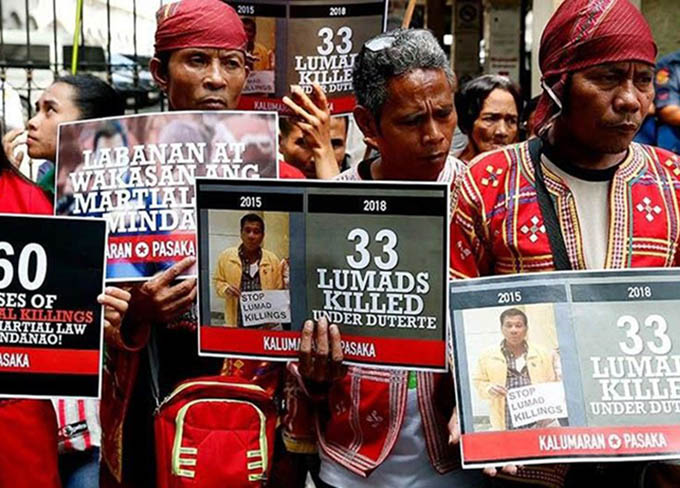
An international non-government organisation, The Global Witness, has reported that 48 individuals were killed in the country last year, a majority related to agribusiness. Image: Philstar

By KEN E. CAGULA in Davao City

The massive human rights violations committed against indigenous peoples or Lumads and peasants are designed to silence the opposition to the continuing operations of large-scale mining and plantations in Northern Mindanao and the rest of Caraga Region.

This was the assessment made by the environmental group Kalikasan People’s Network for the Environment or Kalikasan PNE.

“The military is trying to flush out the opposition to mining and plantation interests in Northern Mindanao and Caraga region,” said Kalikasan PNE coordinator Leon Dulce.

READ MORE: Philippines had highest number of killed environmental defenders in Asia

Dulce points out that these Lumad and peasant leaders are the environmental defenders that continue to stand and oppose the large-scale mining and plantation operations in areas of Mindanao.

At present, these environmental defenders are protecting around 243,163 ha of forest and agricultural lands within their ancestral domains and farmlands against the encroachment of these extractive and destructive projects in Northern Mindanao and Caraga Region, he said.

-Partners-

Hundreds of Lumad residents from Sitio Manluy-a, Panukmoan, and Decoy in Barangay Diatagon, Lianga town in Surigao del Sur fled from their homes after the Armed Forces of the Philippines (AFP) conducted a series of artillery bombardment and harassments last month.

On January 24, two Manobo farmers identified as Randel Gallego and Emel Tejero, all residents of Km. 16, Brgy. Diatagon went missing after they were allegedly fired upon by soldiers while hauling abaca products.

Dead farmers
The families of the two farmers found their dead bodies at a military detachment six days after they were reported missing.

The 401st Infantry Brigade of the Philippine Army claimed that Gallego and Tejero were killed in a clash between soldiers and the New People’s Army (NPA) rebels.

But human rights advocates belied the military’s claim, saying that the two were unarmed civilians.

“The Lumad communities in Lianga are standing firmly against the coal and gold mining exploration and development projects attempting to grab lands and resources from their ancestral lands ensconced within the Andap River Valley Complex. For this, they are constantly being attacked by the military,” Dulce said.

These areas in Surigao del Sur are one of the largely militarised areas in Caraga region, prompting the exodus of IPs out from their lands due to the continuing presence of soldiers and paramilitary groups in their communities.

Kalikasan PNE also slammed the “illegal arrest” of Datu Jomorito Goaynon, chairperson of the Kalumbay Regional Lumad Organisation and Ireneo Udarbe, chair of Kilusang Magbubukid ng Pilipinas in Northern Mindanao Region on January 28.

The police named the two leaders as “top NPA leaders” which Kalikasan PNE said is a “repeated accusation” to justify the illegal arrest.

“Goaynon and Udarbe are stalwarts of the struggles of indigenous people and peasants against agri-industrial plantations in Northern Mindanao. They have also effectively exposed military-affiliated indigenous paramilitary groups such as the New Indigenous People’s Army Reform who have been attacking Lumad lands to pave the way for mining deals,” Dulce said.

Martial law
With the continued declaration of martial rule, Kalikasan PNE said that attacks against environmental defenders continue to worsen.

At least 28 cases of environmental-related killings in Mindanao were recorded by the group since it was first declared by President Rodrigo Duterte in May 23, 2017.

They noted the “growing trend” of killed defenders vilified as members or supporters of the NPA

“The Duterte government is trying to depict our fellow environmental defenders as rebels or terrorists to justify the militarization of their bastions of natural wealth. We demand that Goaynon and Udarbe be freed and that military troops wreaking havoc in Lianga be withdrawn as soon as possible.

“Justice for the murdered defenders must be delivered and the bloody reign of Duterte’s martial law over Mindanao must be lifted immediately,” Dulce said.

Print Friendly, PDF & Email

Article by AsiaPacificReport.nz

If Beale Street Could Talk is a sumptuous, emotional follow up to Moonlight

]]>

Source: The Conversation (Au and NZ) – By Stuart Richards, Lecturer in Screen Studies, University of South Australia

Following the great success of Barry Jenkins’ 2016 film Moonlight is no easy feat. The movie was exquisite: every shot added meaning, the heartbreak was visceral and Nicholas Britell’s score was divine. The film won the Academy Award for Best Picture, as well as Best Actor in a Supporting Role (Mahershala Ali) and Best Adapted Screenplay (Barry Jenkins and Tarell Alvin McCraney).

Thankfully, If Beale St Could Talk is a wonderful accompaniment to Jenkins’ Moonlight. The film’s premiere at the Toronto International Film Festival in 2018 was met with critical acclaim, and it has earned nominations for Best Adapted Screenplay, Best Original Music Score, and Best Supporting Actress (Regina King) in this year’s Academy Awards.

Based on James Baldwin’s novel of the same name, the title is a nod to a 1917 W. C. Handy blues song Beale Street Blues, which refers to the epicentre of African American music in Memphis, Tennessee.

The film opens with a quote from Baldwin’s text:

Every black person born in America was born on Beale Street, born in the black neighbourhood of some American city, whether in Jackson, Mississippi, or in Harlem, New York. Beale Street is our legacy.

Many African American cultural critics have since written about how Baldwin’s writings on racism and injustice reverberate throughout all of American society .

The official trailer for If Beale St Could Talk.

Jenkins’ film sees a young woman, Tish (Kiki Layne in a breakthrough performance) go through pregnancy as her fiancé, Fonny (Stephan James), is convicted of rape and sent to prison; a crime he did not commit.

Tish and her family, her parents Sharon and Joseph Rivers (Regina King and Colman Domingo) and quick-fired sister Ernestine (Teyonah Parris), fight to prove Fonny’s innocence and secure his release. Importantly, Fonny’s accuser, a Puerto Rican woman named Victoria Rogers (Emily Rios) is never portrayed as an antagonist, but as another victim of circumstance. The other women in the film never question whether or not she was raped. Her pain in the film is acknowledged.

Performances are consistently strong in this ensemble. Regina King, who is fantastic in Southland, The Leftovers and American Crime, has received a noteworthy amount of critical acclaim for her performance and is favourite to win the Academy Award for Best Actress in a Supporting Role.

Regina King in If Beale St Could Talk. Entertainment One

One standout scene sees Sharon preparing to meet Fonny’s accuser, Victoria Rogers, and contemplating how to present herself. Does she wear a wig or her natural hair? Without any dialogue, King’s performance is a proud affirmation of blackness.

The film’s plot is non-linear as it cuts between Fonny’s incarceration and earlier moments depicting the blossoming of Tish and Fonny’s deep love for each other. The narrative uses ellipses to create a series of moments in their relationship that bounce from sorrow to hope.

Tish’s voiceover is melancholic in some parts – “I hope that nobody has ever had to look at anybody they love through glass” – and angry in others, as the film breaks into a documentary-style detailing of systematic racism of America.

These documentary-like moments are directly inspired by Balwdin’s rhetoric, which evokes recent documentary based on his work I Am Not Your Negro. In fact, every scene in the book was apparently filmed, but not all made the film’s final cut. Most notably, there are omissions from the film’s ending, which creates a focus solely on Tish and Fonny.

If Beale Street Could Talk is the story of Tish (Kiki Layne) and Fonny (Stephan James), who are separated by Fonny’s wrongful incarceration. Entertainment One

As with Moonlight, Jenkins’ aesthetic continues to be lush. He is fond of shooting his actors front on, which was an aspect of Moonlight that I loved. This engagement with character is something he spoke of at length in an interview with The Atlantic’s David Sims:

If I can feel that the actor’s in a place where the thinking has receded and they’re in a meditative state, then we pull that shot out. It’s important for the audience to have a direct connection to the character, and when an actor’s performing, there’s always some degree of distance. If the performance goes away, and there’s this perfect fusion between actor and character, then I want the audience to look right into that person’s eyes.

In this film, these moments predominantly feature Tish and Fonny as they lovingly look into each other’s eyes. In turn, however, they look directly at us demanding validation. I found a similar motif used in Sebastián Lelio’s recent films A Fantastic Woman and Disobedience. There is one scene in A Fantastic Woman in particular, where Daniela Vega’s character literally grabs the camera and forces us to look at her. In Beale Street, though, I did find that these moments became repetitive, which diminished their impact.

Barry Jenkins’ visual style has been influenced by several directors, most notably Spike Lee and Wong Kar-wai. In particular, Beale Street is most reminiscent of the vibrant colours and minimal dialogue of Wong Kar-wai’s In the Mood for Love.

Regina King, Teyonah Parris, and Kiki Layne in If Beale St Could Talk. Entertainment One

Finally, Nicholas Brittel’s score is an important component of the film’s beauty. His work with Jenkins on both Beale Street and Moonlight is where he demonstrates his strength as a composer. The score is also punctuated with jazz greats, such as Miles Davis, John Coltrane and Nina Simone. The music evokes heartbreak, falling in love and trepidation for what the future could hold.

Interestingly, Brittel says that emotions are his first inspiration for his scores, before seeing any footage.

Brittel’s score swells during iconic shots of the actors looking directly into the camera. Flurries of brass and horns – trumpets, flügelhorns, cornets and French horns – emphasise the excitement of Tish and Fonny’s world.

The strings symbolise the various forms of love the characters have for each other, but this pleasant soundscape is broken when Fonny’s friend Daniel shares his experience in prison. The dominant score makes way for a sinister, uneasy sound, which Brittel describes as “a horrific doppelgänger of the music of love”.

If Beale Street Could Talk is a sumptuous film that explores the emotions of joy, fear, anger and, above all, love. Jenkins’ sights and sounds are a wonderful follow up to his brilliant Moonlight.

ref. If Beale Street Could Talk is a sumptuous, emotional follow up to Moonlight – http://theconversation.com/if-beale-street-could-talk-is-a-sumptuous-emotional-follow-up-to-moonlight-111336

Poll wrap: Labor maintains Newspoll lead but Morrison’s ratings up, and Abbott behind in Warringah

]]>

Source: The Conversation (Au and NZ) – By Adrian Beaumont, Honorary Associate, School of Mathematics and Statistics, University of Melbourne

This week’s Newspoll, conducted February 7-10 from a sample of 1,570, gave Labor a 53-47 lead, unchanged from last fortnight. Primary votes were 39% Labor (up one), 37% Coalition (steady), 9% Greens (steady) and 5% One Nation (down one) – One Nation’s lowest Newspoll vote since February 2018.

43% were satisfied with Scott Morrison (up three), and 45% were dissatisfied (down two), for a net approval of -2, up five points. Bill Shorten’s net approval was down two points to -15. Morrison led Shorten by 44-35 as better PM (43-36 last fortnight).

There has been much debate in the last fortnight about Labor’s proposal to abolish franking credit cash refunds. Voters were opposed by 44-35, but this is down from 48-30 opposition in December. Opposition was strongest among those aged over 65 (59-28 opposed).


Read more: Words that matter. What’s a franking credit? What’s dividend imputation? And what’s ‘retiree tax’?


Voters supported reducing investor tax breaks, such as negative gearing and capital gains tax deductions, by a 51-32 margin (47-33 in November).

It has been over five months since Morrison replaced Malcolm Turnbull as PM in late August 2018. In nine Newspolls, his net approval has been in the single digits, positive or negative.

The last three Newspolls of 2018 were all 55-45 to Labor, while the first two of 2019 have been 53-47. I believe the Coalition has been assisted by Morrison’s relative popularity and a greater distance from the events of last August.

In Turnbull’s last four Newspolls as PM, the Coalition trailed by just 51-49, but Turnbull’s ratings were weaker than Morrison’s, with a peak net approval of -6. However, Turnbull’s ratings would have been better if not for the hard right’s hatred of him; it is plausible that 10% of the electorate disliked him from the right. Morrison has no problem with his right flank.

The Coalition is perceived as too close to big business (see Essential below), and Greg Jericho wrote in The Guardian that the latest data are not good for the Australian economy. A key question is whether Morrison’s ratings eventually fall due to the unpopularity of most Coalition policies. Economic credibility is likely to be important if the economy slows.

Essential poll: 52-48 to Labor

Last week’s Essential poll, conducted January 23-31 from a sample of 1,650, gave Labor a 52-48 lead, a one-point gain for the Coalition since Essential’s mid-January poll. Primary votes were 38% Coalition (steady), 36% Labor (down two), 10% Greens (steady) and 7% One Nation (steady).

The fieldwork period and the sample size were both larger than usual for Essential – normally Essential is conducted over four days with a sample a bit over 1,000.

By 47-41, voters agreed that one of the reasons why there are relatively few female MPs is that women choose not to get involved with politics. By 46-39, they disagreed with the proposition that voters preferred to elect men, rather than women. By 72-20, they disagreed with women being less capable politicians. Gender quotas were supported 46-40, but Coalition voters were opposed 50-37.

37% supported a separate national day to recognise Indigenous Australians alongside Australia Day, 15% thought Australia Day should be replaced, and 40% did not support a separate day.

At least 50% thought that private health insurance companies, big banks, mining companies and big business wanted the Coalition to win the next election. Labor had a lead on this question with pensioners and people with a disability, and at least 50% with families with young children and the unemployed.

Seat polls of Warringah, Stirling and Pearce

A ReachTEL poll of the NSW seat of Warringah for GetUp, from a sample of 622, gave independent Zali Steggall a 54-46 lead over incumbent Tony Abbott. Primary votes and fieldwork dates were not included in the media report. In 2016, Abbott won Warringah by 61.6-38.4 against the Greens, and 61.1-38.9 against Labor.

60% thought Abbott’s performance as a local member poor, and 60% said they were more likely to vote for a candidate who would tackle climate change – 78% among those who had defected from Abbott.

A Labor internal poll of the WA seat of Stirling, conducted after Michael Keenan announced his retirement from a sample of 950, gave Labor a 1.5% lead after preferences. In 2016, Keenan won Stirling by a 6.1% margin. Labor and the Liberals were tied at 36% each on primary votes with 6.8% undecided.

A GetUp ReachTEL poll of the WA seat of Pearce, conducted January 16 from a sample of 674, gave the Liberals a 52-48 lead over Labor (53.6-46.4 at the 2016 election).

Seat polls are very unreliable, but Stirling and Warringah are inner metropolitan seats, while Pearce is outer metropolitan. I believe the Coalition will struggle most in better-educated inner metropolitan seats.

The three seat polls were commissioned by left-aligned groups. However, ReachTEL asks for voting intentions first. Media-commissioned polls are superior to polls from political interest groups, but seat polls are unreliable in any case.

SA byelections and NSW pill testing Newspoll

Byelections occurred on Saturday in the South Australian state seats of Cheltenham and Enfield, following the resignations of Labor’s Jay Weatherill and John Rau respectively. Labor retained both seats easily, with primary vote swings to Labor of 6.6% in both Cheltenham and Enfield since the March 2018 election. The Liberals did not contest either seat.

In an additional question conducted with last fortnight’s NSW Newspoll that had a 50-50 tie, voters were in favour of the NSW government providing a pill testing service at music festivals by a 56-35 margin. Over 70% of Labor and Greens voters supported pill testing, while Coalition voters were narrowly opposed 49-45.


Read more: Poll wrap: Coalition gains in first Newspoll of 2019, but big swings to Labor in Victorian seats; NSW is tied


US government shutdown aftermath

On January 25, the US government shutdown ended when President Donald Trump accepted a bill that would reopen the government until February 15 without funding for the southern border wall he had demanded. The 35-day shutdown was the longest, beating the previous record of 21 days from 1995-96. Trump has suggested declaring a national emergency if Congress cannot agree to fund the wall by February 15.

In the FiveThirtyEight poll aggregate, Trump’s ratings fell to 39.3% approve, 56.0% disapprove on January 26. Since then, his ratings have recovered to 40.2% approve, 55.1% disapprove. However, Trump’s ratings among Republicans are well over 80% approve.


Read more: Record US government shutdown harms Trump’s ratings, plus Brexit chaos and Australian Essential poll


A second shutdown could occur after talks between Democratic and Republican members of Congress broke down. To avert a shutdown, new funding must be passed by Friday (Saturday Melbourne time).

Given strong opposition to Trump in the polls, he needs the US economy to stay strong to have a reasonable chance of re-election in 2020. Despite the January shutdown, the economy added 304,000 jobs in that month.

ref. Poll wrap: Labor maintains Newspoll lead but Morrison’s ratings up, and Abbott behind in Warringah – http://theconversation.com/poll-wrap-labor-maintains-newspoll-lead-but-morrisons-ratings-up-and-abbott-behind-in-warringah-111523

Health Check: why do we itch?

]]>

Source: The Conversation (Au and NZ) – By Yuan Lei, Graduate Student, Institute of Neuroscience, Chinese Academy of Sciences

We’ve all experienced the unpleasant sensation of being itchy. For many years, scientists suspected that pain and itch were the same thing, only differentiated by their intensity: itch was just light pain, and pain was strong itch.

But we now know these two sensations are perceived very differently. Recent research found itch is sensed through its own dedicated nerves, independent of the pain pathway.


Read more: Health Check: what causes bloating and gassiness?


How do we feel itch?

Acute itch (medically known as pruritus) is usually caused by something harmful, such as biting insects or allergic chemicals on the skin, as a warning signal to protect us from potential threat.

After detecting this stimuli, cells in the skin (called keratinocytes) communicate with immune cells between the layers of the skin. In order to clear away any potential invading pathogens, the immune cells release chemicals such as histamine, serotonin, and proteases. These then activate sensory fibers which initiate the transmission of a warning message.

Several different molecules and cells in the nerves and brain of animal models have been shown to mediate the transmission of the itch signal from skin to brain through the spinal cord.

Traditionally, itch is separated into two pathways, depending on whether they respond to anti-histamine medicine or not (this is the medicine you take to prevent hay fever). Histamine activates its own sensors, while the other type (non-histaminergic pruritogens) use other receptors to fire the itch-detecting cells.


Read more: Health Check: how do I tell if I’m dehydrated?


The interaction between itch and pain/touch

Pain and itch are clearly distinct sensations that provoke different responses. When your hand senses a fire, you will definitely withdraw your hand immediately; by contrast, when you get bitten by a mosquito, you’ll scratch to get rid of the irritation without hesitation. This tells us something about the threat level involved with each sensation.

Although itch has its own messengers, the sensation does also share some sensors with the sensations of pain and touch. This is why pain can counterbalance the sensation of itch – like when you apply frozen peas to an itchy skin condition such as eczema. And why a light touch can provoke itch (tickling).

Why scratching both quenches and enhances itch

Usually when we feel an itch, we scratch it. But sometimes the more we scratch, the itchier we feel. This vicious itch-scratch cycle becomes a serious problem for patients with dry skin and dermatological conditions such as atopic dermatitis and psoriasis.

This is because excessive scratching damages your skin or causes a secondary infection (such as a fungal infection), which worsen the itching.


Read more: Health Check: does green mucus mean you’re infectious and need antibiotics?


Treatment of itch

Scratching might be the most convenient and effective way to remove irritants when you feel itchy from an insect bite or poisonous plant. But for strong itch stemming from other factors such as dry skin (xerosis), eczema, liver disease or kidney failure, you may have to seek medical treatment.

Your doctor will prescribe a medicated cream to apply to the site of the itch. This might be an anti-fungal cream to kill the fungus that has developed.

Using cool water, menthol or anti-itch creams can help numb the itch sensory fibers and reduce the itch intensity. Antihistamine drugs such as loratadine (brand name Claratyne) and fexofenadine (brand name Telfast) can help relieve the unrelenting itchiness caused by allergies or insect biting.

For the chronic itch associated with skin conditions, internal diseases, neurological diseases or other emotional problems, unfortunately, there is currently no effective treatment for itch as we’re not entirely sure what’s happening in the brain to cause itch in these circumstances. If itching persists or worsens, stop scratching and go see a doctor.

ref. Health Check: why do we itch? – http://theconversation.com/health-check-why-do-we-itch-109435

Don’t click that link! How criminals access your digital devices and what happens when they do

]]>

Source: The Conversation (Au and NZ) – By Richard Matthews, Lecturer Entrepreneurship, Commercialisation and Innovation Centre | PhD Candidate in Image Forensics and Cyber | Councillor, University of Adelaide

Every day, often multiple times a day, you are invited to click on links sent to you by brands, politicians, friends and strangers. You download apps on your devices. Maybe you use QR codes.

Most of these activities are secure because they come from sources that can be trusted. But sometimes criminals impersonate trustworthy sources to get you to click on a link (or download an app) that contains malware.

At its core, a link is just a mechanism for data to be delivered to your device. Code can be built into a website which redirects you to another site and downloads malware to your device en route to your actual destination.

When you click on unverified links or download suspicious apps you increase the risk of exposure to malware. Here’s what could happen if you do – and how you can minimise your risk.


Read more: How suppliers of everyday devices make you vulnerable to cyber attack – and what to do about it


What is malware?

Malware is defined as malicious code that:

will have adverse impact on the confidentiality, integrity, or availability of an information system.

In the past, malware described malicious code that took the form of viruses, worms or Trojan horses.

Viruses embedded themselves in genuine programs and relied on these programs to propagate. Worms were generally stand alone programs that could install themselves using a network, USB or email program to infect other computers.

Trojan horses took their name from the gift to the Greeks during the Trojan war in Homer’s Odyssey. Much like the wooden horse, a Trojan Horse looks like a normal file until some predetermined action causes the code to execute.

Today’s generation of attacker tools are far more sophisticated, and are often a blend of these techniques.

These so-called “blended attacks” rely heavily on social engineering – the ability to manipulate someone to doing something they wouldn’t normally do – and are often categorised by what they ultimately will do to your systems.

What does malware do?

Today’s malware comes in easy to use, customised toolkits distributed on the dark web or by well meaning security researchers attempting to fix problems.

With a click of a button, attackers can use these toolkits to send phishing emails and spam SMS messages to eploy various types of malware. Here are some of them.

  • a remote administration tool (RAT) can be used to access a computer’s camera, microphone and install other types of malware

  • keyloggers can be used to monitor for passwords, credit card details and email addresses

  • ransomware is used to encrypt private files and then demand payment in return for the password

  • botnets are used for distributed denial of service (DDoS) attacks and other illegal activities. DDoS attacks can flood a website with so much virtual traffic that it shuts down, much like a shop being filled with so many customers you are unable to move.

  • crytptominers will use your computer hardware to mine cryptocurrency, which will slow your computer down

  • hijacking or defacement attacks are used to deface a site or embarrass you by posting pornographic material to your social media

An example of a defacement attack on The Utah Office of Tourism Industry from 2017. Wordfence


Read more: Everyone falls for fake emails: lessons from cybersecurity summer school


How does malware end up on your device?

According to insurance claim data of businesses based in the UK, over 66% of cyber incidents are caused by employee error. Although the data attributes only 3% of these attacks to social engineering, our experience suggests the majority of these attacks would have started this way.

For example, by employees not following dedicated IT and information security policies, not being informed of how much of their digital footprint has been exposed online, or simply being taken advantage of. Merely posting what you are having for dinner on social media can open you up to attack from a well trained social engineer.

QR codes are equally as risky if users open the link the QR codes point to without first validating where it was heading, as indicated by this 2012 study.

Even opening an image in a web browser and running a mouse over it can lead to malware being installed. This is quite a useful delivery tool considering the advertising material you see on popular websites.

Fake apps have also been discovered on both the Apple and Google Play stores. Many of these attempt to steal login credentials by mimicking well known banking applications.

Sometimes malware is placed on your device by someone who wants to track you. In 2010, the Lower Merion School District settled two lawsuits brought against them for violating students’ privacy and secretly recording using the web camera of loaned school laptops.

What can you do to avoid it?

In the case of the the Lower Merion School District, students and teachers suspected they were being monitored because they “saw the green light next to the webcam on their laptops turn on momentarily.”

While this is a great indicator, many hacker tools will ensure webcam lights are turned off to avoid raising suspicion. On-screen cues can give you a false sense of security, especially if you don’t realise that the microphone is always being accessed for verbal cues or other forms of tracking.

Facebook CEO Mark Zuckerberg covers the webcam of his computer. It’s commonplace to see information security professionals do the same. iphonedigital/flickr

Basic awareness of the risks in cyberspace will go a long the way to mitigating them. This is called cyber hygiene.

Using good, up to date virus and malware scanning software is crucial. However, the most important tip is to update your device to ensure it has the latest security updates.

Hover over links in an email to see where you are really going. Avoid shortened links, such as bit.ly and QR codes, unless you can check where the link is going by using a URL expander.

What to do if you already clicked?

If you suspect you have malware on your system, there are simple steps you can take.

Open your webcam application. If you can’t access the device because it is already in use this is a telltale sign that you might be infected. Higher than normal battery usage or a machine running hotter than usual are also good indicators that something isn’t quite right.

Make sure you have good anti-virus and anti-malware software installed. Estonian start-ups, such as Malware Bytes and Seguru, can be installed on your phone as well as your desktop to provide real time protection. If you are running a website, make sure you have good security installed. Wordfence works well for WordPress blogs.

More importantly though, make sure you know how much data about you has already been exposed. Google yourself – including a Google image search against your profile picture – to see what is online.

Check all your email addresses on the website haveibeenpwned.com to see whether your passwords have been exposed. Then make sure you never use any passwords again on other services. Basically, treat them as compromised.

Cyber security has technical aspects, but remember: any attack that doesn’t affect a person or an organisation is just a technical hitch. Cyber attacks are a human problem.

The more you know about your own digital presence, the better prepared you will be. All of our individual efforts better secure our organisations, our schools, and our family and friends.

ref. Don’t click that link! How criminals access your digital devices and what happens when they do – http://theconversation.com/dont-click-that-link-how-criminals-access-your-digital-devices-and-what-happens-when-they-do-109802

Curious Kids: is it more dangerous for police to pursue a suspect than to call off the pursuit?

]]>

Source: The Conversation (Au and NZ) – By Terry Goldsworthy, Associate Professor in Criminology, Bond University

Curious Kids is a series for children. Send your question to curiouskids@theconversation.edu.au. You might also like the podcast Imagine This, a co-production between ABC KIDS listen and The Conversation, based on Curious Kids.


Is it more dangerous for police to pursue a suspect than to call off the pursuit? – Hugo, age 12, Melbourne.

There is no simple answer to your question. Police officers do a difficult job – every day they are faced with dangerous situations. One of the most difficult situations a police officer can face is being involved in a pursuit.

I was a police officer in Queensland for 28 years and spent some years in the traffic branch as a motorcyclist, before I later became a detective. When I was in the traffic branch, I was involved in many pursuits. I also had to do accident investigation duties where I had to investigate serious and even fatal accidents.


Read more: Curious Kids: who were the Spartans?


Why and when can police start a pursuit?

Police are allowed to break certain traffic laws – such as going over the speed limit and going through red lights – if they are pursuing a suspect. But there are conditions. For instance, most police services require the police vehicle to come to a stop before going through the red light, even when they have their lights and siren on.

Generally, though, the police are not allowed to drive dangerously when pursuing a suspect. In fact, it is a criminal offence. So if the pursuit becomes dangerous, the police are supposed to stop chasing the suspect. Unfortunately that doesn’t always happen, and people can die as a result of a police pursuit.

Police are trained to drive fast in case they need to pursue a suspect. But initiating a pursuit is a very serious thing. It’s a difficult decision to make, and often has to happen very quickly and under a lot of pressure.

Who decides if the police pursuit continues?

Once a pursuit is initiated, police need to radio their operations centre and advise that they are in pursuit of a suspect. They will describe the actions of the suspect, speeds, location, and any dangerous acts committed by the suspect.

Once the police officers in the car call in the pursuit, a more senior officer at the operations centre will make a decision on when to allow the pursuit to continue and when to stop it.

The senior officer will consider many factors, including:

  • danger to the public

  • the seriousness of the offence that led to the pursuit being started

  • whether the police know the identity of the suspect

  • the type of police vehicle involved

  • the time of day

  • weather conditions.

If the senior officer says to end the pursuit, all the police pursuing the suspect must stop chasing them. Most police services have policies that guide police officers on how to conduct pursuits.

How common are police pursuits?

In Australia each year there are more than 3,000 police pursuits. Fewer than 1% of those pursuits result in a fatal accident. Most pursuits start as the result of minor offences.

An Australian Institute of Criminology study identified that:

  • in 2009 there were 3,806 pursuits

  • in 2010 there were 3,865 pursuits

  • in 2011 there were 4,175 pursuits across Australia.

The study concluded that:

…males under the age of 25 accounted for a large proportion of individuals who died as a result of a police pursuit and it was found that almost nine in every 10 alleged offenders who died driving the vehicle being pursued had consumed alcohol, drugs or both prior to the incident. Findings also highlighted that pursuit fatalities were more likely to have occurred late at night and in urban areas. While the average speeds of vehicles involved in fatal pursuits have increased slightly, the average duration of fatal pursuits has declined considerably.

The study found that between 2000 and 2011 there were 218 deaths in 185 crashes. Of those killed, 38% were bystanders, while the other 62% of deaths involved the driver or passenger of the pursued vehicle.

Traffic matters and stolen motor vehicles were the most common offences that led to a fatal pursuit.


The same study concluded:

Finally, this study revealed that police agencies are very aware of the risks associated with pursuits and restrictive reforms to pursuit policies have been introduced in some jurisdictions.

These restrictions mean police are generally only supposed to pursue suspects for more serious offences and only if there is no danger to the police or public.

This is because police have been criticised for pursuits that have ended with people – including innocent bystanders – being killed.

Pursuits are really difficult situations for police. As a Victoria Police report on pursuits said:

The fallout public opinion and media commentary that follows a pursuit indicates it truly is the case of damned if you do, damned if you don’t.


Read more: Curious Kids: what’s the history of aircraft squawk codes and how do they work?


Hello, curious kids! Have you got a question you’d like an expert to answer? Ask an adult to send your question to us. You can:

* Email your question to curiouskids@theconversation.edu.au
* Tell us on Twitter by tagging @ConversationEDU with the hashtag #curiouskids, or
* Tell us on Facebook

CC BY-ND

Please tell us your name, age and which city you live in. You can send an audio recording of your question too, if you want. Send as many questions as you like! We won’t be able to answer every question but we will do our best.

ref. Curious Kids: is it more dangerous for police to pursue a suspect than to call off the pursuit? – http://theconversation.com/curious-kids-is-it-more-dangerous-for-police-to-pursue-a-suspect-than-to-call-off-the-pursuit-109440

Understanding Hayne. Why less is more

]]>

Source: The Conversation (Au and NZ) – By Elise Bant, Professor of Law, University of Melbourne

One of the most important lessons to come out of last week’s banking royal commission is one of the least likely to grab attention, certainly not in the way the resignation of NAB chair Ken Henry did.

It’s that, in the view of Royal Commissioner Kenneth Hayne, when all is said and done the complex patchwork of rules that regulate financial institutions can be boiled down to six simple requirements:

  • obey the law

  • do not mislead or deceive

  • act fairly

  • provide services that are fit for purpose

  • deliver services with reasonable care and skill, and

  • when acting for another, act in their best interests

Yet, under our current law, these six principles are expressed in different terms in multiple pieces of legislation that run to thousands of pages and even more regulations, at both state and federal levels.

The labyrinth is arguably unnavigable for even sophisticated parties with access to good legal advice.

It wholly fails as a way of communicating the law to ordinary people, the businesses and citizens who are bank customers. It also provides an endless supply of “stall and evade” opportunities for wrongdoers who can clog up the courts with technical and strategic debates over how to interpret the labyrinth.

Legislative porridge

Even the best-intentioned plaintiff or prosecutor can end up pleading every possible permutation of the law to try and cover all bases.

The inevitable result is to “delay the proceeding and increase legal expenses”, in the words of a recent Federal Court judgement.

Take the core prohibition of “misleading or deceptive” conduct.

Research conducted at Melbourne Law School finds the same prohibition in slightly different forms, with different requirements, different defences, and different remedies and penalties in more than 30 pieces of state and federal legislation.

The result has been described by another Federal Court judge as a “legislative porridge”.

For many Australians it makes the use of the courts to resolve financial disputes with banks and insurance companies simply not possible.

As a result, we have developed a parallel “soft law”, that doesn’t work badly.

The Banking Code of Practice sets out what banks should do and the Financial Complaints Authority resolves disputes.

The Authority’s guiding principle is as simple as could be – that its decision be fair in all the circumstances.


Australian Financial Complaints Authority Operational Guidelines


It raises the question of why the law needs to be so complex when the alternative to it doesn’t need to be.

Simplification has to start somewhere

Hayne wants to simplify the law, but he says the overall task is wider.

It will require examination of how the existing law fits together and identification of the policies given effect by the law’s various provisions. Only once this detailed work is done can decisions be made about how those policies can be given better and simpler legislative effect.

Our Australian Research Council Discovery project on Rationalising the Law of Misleading Conduct is undertaking precisely this task for the rules about misleading conduct, trying to track how the various laws and regulations overlap and interact with the ancient, evolving and equally complex general laws governing contracts, torts and equitable principles.

This initial “mapping” task requires sustained and expert attention, so much that it might seem beyond governments’ usual attention-spans.

But, faced with the enormity of the task, Commissioner Hayne doesn’t engage in a counsel of despair. Instead, he picks two easier steps that could be done quickly in order to make a real difference.

First, get rid of exceptions, carve-outs and qualifications. An example he uses is the special treatment given to grandfathered commissions, but carve-outs are everywhere.

Reducing their number and their area of operation is itself a large step towards simplification. Not only that, it leaves less room for “gaming” the system by forcing events or transactions into exceptional boxes not intended to contain them.

We should be clear about what is at stake. The rule of law demands that like cases must be treated alike. It follows that exceptions need to be strongly justified. And they haven’t been. Instead, exceptions and carve-outs reflect the lobbying of powerful industry groups concerned to preserve their own self-interest. And in some cases a failure on the part of the drafters to understand how the regime as a whole fits together and works.

The second step is to draw explicit connections in the legislation between the particular rules that are made and the fundamental principles to which they are intended to give effect.

Drawing that connection will have three consequences. It will explain to the regulated community (and the regulator) why the rule is there and, at the same time, reinforce the importance of the relevant fundamental norm of conduct. Not only that, drawing this explicit connection will put beyond doubt the purpose that the relevant rule is intended to achieve.

But a serious concern remains: how to do it without complicating the law further.

It might be time to take the leap and go back to basics: to reduce the legislation to the core principles and leave the detailed explanation of how they work in practice to “soft law” guidelines.

On how this might look, see our contribution Statutory interpretation and the critical role of soft law guidelines in developing a coherent law of remedies in Australia in R Levy et al (eds) “New Directions for Law in Australia: Essays in Contemporary Law Reform”.


The Conversation


ref. Understanding Hayne. Why less is more – http://theconversation.com/understanding-hayne-why-less-is-more-110509

Jakarta media activist threatens to sue Facebook for shutting accounts

]]>
Facebook announced last week that it had taken down hundreds of pages, groups and accounts with ties to Saracen, an online syndicate believed to have been involved in creating hoaxes for money. Image: Panchenko Vladimir/Jakarta Post/Shutterstock

By Marguerite Afra Sapiie in Jakarta

Indonesian social media activist Permadi Arya has threatened to file a Rp 1 trillion (NZ$107 million) lawsuit against Facebook after the tech giant shut down his account in a crackdown on fake news in Indonesia.

Permadi, also known as Abu Janda, said Facebook had made serious allegations by accusing him of being part of fake news group Saracen and shutting down his Facebook pages and accounts.

In a video posted to his Twitter account @permadiaktivis, the activist said his lawyers had sent a legal notice to Facebook demanding that the company clear his name and restore all his pages and accounts.

“Otherwise we will take this to the court and sue Facebook for Rp 1 trillion for immaterial damages,” said Permadi, who chairs an organisation called Cyber Indonesia.

Permadi is known as a supporter of President Joko “Jokowi” Widodo, while the Saracen group is believed to have produced fake news and hate speech that attacked the sitting president.

“I am a well-known antiterrorism activist at the forefront of battling fake news. I am not a part of fake news. So obviously Facebook has made a great mistake,” he said, adding that his reputation was tarnished and freedom threatened.

-Partners-

Facebook announced last week that it had taken down hundreds of pages, groups and accounts with ties to Saracen, an online syndicate believed to have been involved in creating hoaxes for money, systematically engaging in “deceptive behaviour” and manipulating public debate within the platform.

The tech giant removed a total of 207 Facebook pages, 800 accounts, 546 groups and 208 Instagram accounts believed to be linked to Saracen, one of which was Permadi Arya’s Facebook page.

According to Facebook, the Saracen-linked networks worked together to manage fake accounts and mislead others about “who they are and what they are doing”. The company also removed all ways of accessing accounts related to the network.

Permadi also threatened to report Facebook to the police for allegedly violating the Electronic Information and Transactions Law.

Marguerite Afra Sapiie is media affairs writer of The Jakarta Post.

Print Friendly, PDF & Email

Article by AsiaPacificReport.nz

Melting Himalayan glaciers: a big drop in a bucket that’s already full

]]>

Source: The Conversation (Au and NZ) – By Anthony Dosseto, Associate Professor, University of Wollongong

A new report has warned that even if global warming is held at 1.5℃, we will still lose a third of the glaciers in the Hindu Kush-Himalaya (HKH) region. What does that mean for rivers that flow down these mountains, and the people who depend on them?

The HKH region is home to the tallest mountains on Earth, and also to the source of rivers that sustain close to 2 billion people. These rivers supply agriculture with water and with sediments that fertilise soils in valleys and the floodplain.

Some of these rivers are hugely culturally significant. The Ganges (or Ganga), for instance, which flows for more than 2,525km from the western Himalayas into the Bay of Bengal, is personified in Hinduism as the goddess Gaṅgā.

The Ganga River at Rishikesh, as it exits the Himalayas. Anthony Dosseto


Read more: Warm ice in Mount Everest’s glaciers makes them more sensitive to climate change – new research


When it rains, it pours… literally

Before we get to the effect of melting glaciers on Himalayan rivers, we need to understand where they get their water.

For much of Himalayas, rain falls mostly during the monsoon active between June and September. The monsoon brings heavy rain and often causes devastating floods, such as in northern India in 2013, which forced the evacuation of more than 110,000 people.

2013 floods in Uttarakhand, India.

But the summer monsoon is not the only culprit for devastating floods. Landslides can dam the river, and when this dam bursts it can cause dramatic, unpredictable flooding. Some of those events have been linked to folk stories of floods in many cultures around the world. In the Himalayas, a study tracking the 1,000-year history of large floods showed that heavy rainfall and landslide-dam burst are the main causes.

When they melt, glaciers can also create natural dams, which can then burst and send floods down the valley. In this way, the newly forecast melting poses an acute threat.

The potential problem is worsened still further by the Intergovernmental Panel on Climate Change’s prediction that the frequency of extreme rainfall events will also increase.

Come hell or high water

What will happen to Himalayan rivers when the taps are turned to high in this way? To answer this, we need to look into the past.

For tens of thousands of years, rivers have polished rocks and laid down sediments in the lower valleys of the mountain range. These sediments and rocks tell us the story of how the river behaves when the tap opens or closes.

Rock surfaces tell us where the river was carving into its bed. Anthony Dosseto

Some experts propose that intense rain tends to trigger landslides, choking the river with sediments which are then dumped in the valleys. Others suggest that the supply of sediments to the river generally doesn’t change much even in extreme rainfall events, and that the main effect of the extra flow is that the river erodes further into its bed.

The most recent work supports the latter theory. It found that 25,000-35,000 years ago, when the monsoon was much weaker than today, sediments were filling up Himalayan valleys. But more recently (3,000-6,000 years ago), rock surfaces were exposed during a period of strong monsoon, illustrating how the river carved into its bed in response to higher rainfall.

Sediments laid down in Himalayan valleys support agriculture, but also tell us the ancient story of rivers that carried them. Anthony Dosseto

So what does the past tell us about the future of Himalayan rivers? More frequent extreme rainfall events mean more floods, of course. But a stronger monsoon also means rivers will cut deeper into their beds, instead of fertilising Himalayan valleys and the Indo-Gangetic plain with sediments.


Read more: Devastating Himalayan floods are made worse by an international blame game


What about glaciers melting? For as long as there are glaciers, this will increase the amount of meltwater in the rivers each spring (until 2060, according the report, after which there won’t be any meltwater to talk about). So this too will contribute to rivers carving into their beds instead of distributing sediments. It will also increase the risk of flooding from outburst of glacial lake dams.

So what is at stake? The melting glaciers? No. Given thousands or millions of years, it seems likely that they will one day return. But on a more meaningful human timescale, what is really at stake is us – our own survival. Global warming is reducing our resources, and making life more perilous along the way. The rivers of the Himalayas are just one more example.

ref. Melting Himalayan glaciers: a big drop in a bucket that’s already full – http://theconversation.com/melting-himalayan-glaciers-a-big-drop-in-a-bucket-thats-already-full-111345

Words that matter. What’s a franking credit? What’s dividend imputation. And what’s “retiree tax”?

]]>

Source: The Conversation (Au and NZ) – By Peter Martin, Visiting Fellow, Crawford School of Public Policy, Australian National University

You’re forgiven for being confused.

Newspapers need to economise on words. Television and radio reporters need to economise on seconds. So they use shorthand: words like “dividend imputation”, “franking credits”, and yes, “retiree tax”

Which is fine if you already know what they mean, and pretty fine if you don’t, because you probably don’t need to. They speed things along.

Until now. Suddenly, because of their prominence in the upcoming election campaign, we are going to have to know what they mean. We are even going to have to know that one of them doesn’t mean what it seems to mean. The election might depend on it.

So here goes:

Taxable profits

If a company’s income exceeds its expenses, it has made a profit, which in ordinary circumstances is taxed at the leglislated rate, which for big companies such as Telstra and the big banks is 30 cents in the dollar.

Dividends

After the tax is taken out, companies can pay some of what’s left to shareholders as a dividend, one for each share.

Last September Telstra paid shareholders a dividend of 15.5 cents per share. The previous March it was 11 cents.

Income tax

Australians pay tax on what they earn, unless the income is classified as not taxable or is below the A$18,200 tax-free threshold. The marginal rate (the rate on extra income) climbs with income, so that anyone earning more than A$180,000 (the top threshold) pays 45 cents on each extra dollar earned.

Dividends are taxable and so are taxed along with other income.

Dividend imputation

In 1987 in what he hailed as a world first, Labor treasurer Paul Keating introduced a rebate for each each tax-paying dividend recipient.

Taken off their tax would be the company tax the company had paid on the part of the profit that had been handed to them as a dividend.

It “would greatly reduce the existing bias in the tax system which taxed interest income once, but dividend income twice”.

Here’s how it was to work at today’s tax rates.

  • Jill owns 1,000 Telstra shares

  • Over the period of a year she gets dividends of A$265

  • To provide them, Telstra made a profit of A$379 on which it paid A$114 tax

  • Jill pays tax on the full $379 but gets a credit of A$114 that can be taken off any other tax she owes that year

  • As with other tax credits, it can be used to cut Jill’s tax bill as far as zero, but not to turn it negative. It can’t be handed to her in cash.

As Keating put it, the tax paid at the company level would be imputed, or allocated to shareholders by means of imputation credits.

But not to all of them. Non-resident (overseas) shareholders couldn’t get them, and nor could shareholders whose dividends hadn’t been franked.

Franking credits

As Keating explained, the tax credit only applied to the extent to which full Australian company tax had been paid; to the extent to which the dividends had been franked (stamped) to indicate that tax had been paid.

Not every company pays the full 30 cents in the dollar in every year. Often it is carrying forward previous losses. Only dividends from profits on which full tax had actually been paid were to be marked “fully franked”. Dividends on which tax had been partly paid were to be marked “partly franked”.

Fully franked dividends became sought after, because they brought with them the biggest franking credits. In a useful side effect, dividend imputation encouraged companies that wanted to look after their shareholders to pay full tax.

Refunds to non taxpayers

Although the particular Australian design arguably was a world first, dividend imputation or something similar is not unusual. Many countries have systems in place that to a greater or lesser degree ensure company profits are taxed only once – among them Canada, New Zealand, Chile, Mexico, Malaysia and Singapore, whose system is called “one-tier” tax.

Many that did adopt it later moved away from it, using the money saved to cut headline tax rates; among them Britain, Ireland Germany and France.

What is unusual is what Australia did next. In 2001 after more than a decade of dividend imputation, the Howard government supercharged it, paying out franking credits in cash to shareholders who didn’t have any or enough tax to offset.

From the point of the view of these non-taxpayers, dividend imputation became a negative income tax: instead of them paying the government money, the government paid them money.

As far as is known, it is an enhancement that has not been copied anywhere.

On one hand, it makes sense because it treats non-taxpayers the same as taxpayers by refunding them the same amount of company tax.

On the other hand, it does not make sense because it means that instead of being taxed once (at either the company or the personal level) as was the original intention, company profits can escape tax altogether.

Untaxed super

From 2007 the change mattered to many more retirees.

The Howard governments “Simplified Superannuation” package made super benefits paid from a taxed source (that’s most super benefits outside of the public service) tax free when paid to people aged 60 and over.

A quirk in the wording of the Act went further. Not only did super withdrawals become tax free, they also became no longer included in “taxable income” and so didn’t need to be declared on tax forms.

This meant that many retirees on reasonable super incomes were no longer taxed at reasonable rates on their other income, including income from shares which could be untaxed if it fell below the tax free threshold.

And because of the 2001 decision to send dividend imputation cheques to shareholders who were untaxed, these retirees who suddenly found themselves untaxed also got imputation cheques mailed to them from the government.

Self-managed super funds, whose income is tax exempt in the retirement phase, also got imputation cheques.

In July 2017 the Turnbull government wound back tax free super by placing a limiting it to accounts with less than A$1.6 million. The restriction was to hit 1% of super-fund members.

Labor’s proposal

Treasury’s 2015 tax discussion paper prepared for the Abbott government referred to “revenue concerns” about dividend imputation cheques.

They cost the budget just A$550 million in the year the Howard government introduced them, but A$5 billion per year by 2018 and were on track to cost A$8 billion.

Labor’s proposal, announced in mid March 2018, was to return the divided imputation system to where it had been before Howard changed it in 2001, and to where it still is elsewhere. Tax credits could be used to eliminate a tax payment but not to turn it negative.

Labor allowed exceptions for tax exempt bodies such as charities and universities who would continue to receive imputation cheques alongside dividends.

Pensioner guarantee

Two weeks later, in late March, Labor amended its policy by adding a “pensioner guarantee”. Pension and allowance recipients, even part pensioners, would be exempt from the changes and would continue to receive cash payments.

Also exempt would be self-managed super funds with at least one member who was receiving a pension or part-pension at the date of Labor’s announcement, 28 March 2018.

The change cost relatively little (the budget saving over the next four years fell to A$10.7 billion from A$11.4 billion) because most of the imputation cheques go to Australians with too much wealth to get even a part pension.

Self Managed Super Funds

Retail and industry super funds pool their members contributions, and so almost always have tax to reduce, meaning most are would be unaffected by the withdrawal of cash credits.

Self Managed funds usually represent just one person, or a couple; their funds aren’t pooled with anyone else’s. This means that in the retirement phase, where fund earnings are untaxed, most do to have enough tax to reduce. So they get imputation cheques, which they would no longer get when Labor’s policy was implemented.

The Parliamentary Budget Office expects some self-managed funds to change their investment mix and some owners of self-managed funds to transfer their investments to retail or industry funds.

Retirement tax

There is no such thing. The phrase is shorthand for Labor’s proposal to withdraw dividend imputation cheques from dividend recipients who are outside the tax system.

ref. Words that matter. What’s a franking credit? What’s dividend imputation. And what’s “retiree tax”? – http://theconversation.com/words-that-matter-whats-a-franking-credit-whats-dividend-imputation-and-whats-retiree-tax-111423

The science of parkour, the sport that seems reckless but takes poise and skill

]]>

Source: The Conversation (Au and NZ) – By James L Croft, Lecturer, Motor Control and Skill Acquisition, Edith Cowan University

People climbing up walls and jumping off buildings in films such as Brick Mansions, Assassin’s Creed, and Casino Royal aren’t tricks of cinema.

The athletes that perform these stunts are part of a global community that practise parkour – a gymnastics-like activity that developed from military obstacle courses. The objective of parkour is to move rapidly and effectively through a complex physical environment.

Our research shows that science can help you practise better parkour – through running up walls more efficiently, and expanding your landing options.

Even if you don’t plan to take up the sport, it’s an incredible thing to watch.

This is parkour.

Traceurs and traceuses

Although parkour has been recognised as an official sport in some countries, it’s impossible to determine how many people are involved worldwide. It’s an activity that is generally unorganised, which may be part of its sub-culture appeal.

To a casual observer, parkour athletes may appear reckless – but most train very hard, practising a broad set of individual skills that they use as they run through the environment. Men and women in the sport are referred to as “traceurs” and “traceuses” respectively.

Some of the individual movements in parkour parallel those of other sports, such as gymnastics, athletics, and trail running.

But much less research has been done on parkour than on more mainstream sports. This is unfortunate because they shared fundamental principles of generating and redirecting momentum. A better understanding of these can benefit all of these activities.

A woman who does parkour is called a traceuse.

Running up walls

One impressive feat that catches the eye of many parkour observers is the way traceurs run up high walls to get onto buildings.

To climb high structures, parkour athletes run toward the wall and then kick off it with one (or more) contacts. This technique allows them to reach much higher than using a standing vertical jump, and also allows them to keep moving efficiently through the urban environment.

To investigate how athletes accomplish this wall run efficiently we embedded a force plate in the ground and a second force plate in the wall. We then filmed study participants as they approached the wall.

We watched how the athletes redirected their body by using a consistent transition strategy that depended on specific actions of the legs on the floor and wall.

Although some parkour guides recommend athletes straddle the floor and wall simultaneously, we did not observe this – the traceurs always left the floor before they contacted the wall.

Testing the launching capability of a traceur performing parkour. James Croft, Author provided

Redirecting momentum

We wanted to better understand the most efficient foot placement on the ground and the wall, and the effect of different approach speeds. So we built a computer simulation that could optimise each.

The model corresponded well with what we observed – an intermediate run-up speed is best – and allowed us to understand why.

During the run up you create horizontal momentum (the product of speed and body weight). Some of this horizontal momentum can be redirected into vertical momentum at take-off by keeping the leg on the ground rigid – a bit like a pole vault with a rigid pole.

If the approach run is slow there is less horizontal momentum to transfer to vertical momentum. Then the take-off leg has to create vertical momentum by using the leg muscles – which is less efficient.

With a very fast run-up, the take-off leg must act as a shock absorber, which wastes energy and wipes out the benefits of a faster approach.

So, traceurs naturally select an intermediate run-up speed, allowing them to use the least amount of energy to scale the wall.

To scale higher walls a faster approach may be required, but this also requires an ability to generate sufficient leg force. Greater speed does provide greater momentum but it also reduces the time available for the leg to generate the impulse (the product of force and time) necessary to scale the wall.

Parkour involves strategic transfer of force and momentum. objetivarte/flickr, CC BY

Returning to ground

What goes up must come down!

Our research on jumping off walls shows that the type of landing that traceurs choose is influenced by their height, body mass, and leg power.

Landing safely involves managing a number of different forces. Imagine you step or jump off an object – your body accelerates due to gravity. Upon landing, your body has a certain momentum that is determined by your weight and your speed. And the higher the object you jump off, the faster your landing speed and vertical momentum prior to landing.

The main task in landing is to dissipate your momentum in a way in which the load and speed (making up the accumulated energy level) do not exceed biological limits (leading to a muscle tear or tendon rupture).

The impact of momentum on the landing can be reduced by increasing the time over which landing forces apply.

Landing right is the key to injury prevention. Daniel Petty/flickr, CC BY

For instance, allowing the supporting joints to flex (that is, bend) over a greater range can gradually decrease momentum.

Alternatively, it is possible to redirect the force by converting momentum into rotational momentum with a roll. This means that force becomes oriented in a direction that does least harm.

The strategies that are available to an individual vary based on their body characteristics (such as height, weight, bone, joint and muscle strength, flexibility, and coordination). If the chosen strategy is insufficient to manage the momentum, injury to muscles or bones will result.

Roll into it

Unsurprisingly, through our research we found individuals were more likely to roll when landing from higher drops. Our study subjects (nine men and two women) ranged in height from 1.58-1.87 metres, and in weight from 54–92 kg.

At some heights a two-footed landing is not feasible. But in this study the maximum drop height was only 2.4 m and some traceurs chose not to roll even at this height.

People with long legs can apply a smaller force over a longer time as they gradually flex their legs to absorb the momentum, and we found evidence that shorter traceurs rolled at lower heights.

Not Spiderman, but not far off. THOR/flickr, CC BY

People who weigh a lot have more momentum when dropping from the same height as lighter people. We found this influenced the likelihood of rolling – heavier athletes were more likely to choose a roll landing when dropping from a lower height.

Athletes with greater leg power appeared capable of managing impulse absorption through their legs up to a greater drop height. And those with less explosive leg power were more likely to transition to a roll landing at a lower height.

While you can’t do much about your height, you can change your body mass and leg power through training. In practice, this gives more flexibility because you can select a landing strategy based on the situation rather than having to roll to dissipate momentum.

ref. The science of parkour, the sport that seems reckless but takes poise and skill – http://theconversation.com/the-science-of-parkour-the-sport-that-seems-reckless-but-takes-poise-and-skill-110881

Could Tony Abbott lose to an independent? If the zeitgeist is any guide, he’s on thin ice

]]>

Source: The Conversation (Au and NZ) – By Mark Kenny, Senior Fellow, Australian Studies Institute, Australian National University

Strangely enough, there’s a link between “Kevin07” as an electoral phenomenon and the recent successes of independents such as Kerryn Phelps (Wentworth), Cathy McGowan (Indi), and Rebekha Sharkie (Mayo). All three now hold once safe Coalition seats.

And the link is one that may prove influential in 2019, particularly for Zali Steggall, who is challenging Tony Abbott in Warringah.

As in the case of Kevin07, the formerly Coalition-friendly independents, which is also how Steggall positions herself, found a way of giving life-long centre-right voters permission to break ranks without feeling like they were being disloyal.

The trick is to present as essentially similar to the incumbent conservative, but better. Modernised. Updated.

The implicit message to voters was that it was their party that had left them, not the other way around.

Such a sentiment may be ripe for expression in Warringah which, while economically conservative, has emerged as demonstrably more progressive than its long-time MP, Abbott. The blue-ribbon jewel was among the most pro-equality electorates in the country in the 2017 postal survey.

Beaten only by Wentworth, the two inner-Sydney electorates were the leading Liberal-held “yes” seats in NSW.

And it is to these voters that new and fresh quasi-independent candidates like Steggall seek to speak – voters whose Liberal loyalties have been tested by Abbott’s blunt antipathy for social reform and particularly his denial of tough Australian action against global warming.


Read more: Liberals trounced in huge Wentworth swing, bringing a hung parliament


Labor’s unusual ‘07 campaign

The trick is to be close but not the same and it has a record of working in conservative minded electorates.

Underpinning Kevin Rudd’s defeat of John Howard in 2007 was a carefully calibrated reassurance that Howard’s Australia – in which political correctness had been demonised and social reform moved at a glacial pace – would continue even with a change to a Labor government.

Labor’s plan was to strip the election of the usual contrast between parties, reducing the choice before voters to John Howard or a kind of John Howard 2.0.

Howard lost in 2007, in part because Rudd positioned himself as a safe alternative. DEAN LEWINS/AAP

In a number of ways, Rudd presented as a prime ministerial simulacrum, updated but only where required to: prioritise “working families”, take faster action on climate change, and offer an exciting public investment bridge to the digital future (the NBN).

So successful was this unusual proposition, it tended to minimise other policy differences between the parties and neutralise the usual fear of change itself among cautious voters.

From a marketing perspective, it was daring given Rudd was in fact the leader of the opposing Labor Party.


Read more: Democracy is dead, long live political marketing


Crucially, it sought simultaneously to share in the government’s credit for economic stewardship – moderate inflation, strong employment, and a healthy budget surplus again – while outflanking Howard on his right.

Of course there was more to the 2007 changeover than mere campaigning, not least being Howard’s odious industrial relations laws (WorkChoices), an inconvenient mid-campaign cash rate hike (to 6.75%), and simple fatigue after a dozen years of Coalition rule.

Even so, there’s no denying that with his lay-preacher persona, non-union background, and claim to be fiscally conservative, Rudd deftly positioned himself as the safe choice for those voters considering change but still concerned with budget discipline and creeping permissiveness.

Similar to Labor’s 2007 strategy, Phelps, McGowan and Sharkie have offered the tribally conservative voter a reduced-risk alternative to the status quo. Or, as some have coined it, “continuity through change”.


Read more: Politics Podcast: Cathy McGowan and Rebekha Sharkie on the role of community candidates


But there are also key differences. While Rudd promised measured economic modernisation in a socially-conservative manifesto – opposing same-sex marriage, for example – the new breed of once-were-Liberals flip that around.

They tend to emphasise the low tax, pro-business instincts of conservatives, but are more left-leaning on social policy and the environment. This turns out to reflect much of the electorate also – including many Liberal voters.

Can Steggall do the same in Warringah?

It’s a formular with a particular piquancy now given that 2019 marks ten years since Tony Abbott rolled Malcolm Turnbull for the Liberal leadership over emissions trading.

An acrimonious decade on, and with no government climate or energy policy to speak of, voters’ patience has been strained to breaking point. The endless point-scoring and division has nudged moderately inclined Liberals within the grasp of new independents.

Barrister and former world champion skier Zali Steggall may be Tony Abbott’s downfall. LUKE COSTIN/AAP

Fittingly, these events are coming to a head most threateningly for the government in Abbott’s own stronghold of Warringah.

Abbott’s vulnerability turns on three things: the standing of the Morrison government come polling day (which may or may not have improved), the campaign prowess of the Steggall operation (unknown), and the extent of declining loyalty by once solid supporters in his electorate. All are in flux.

Steggall’s threshold objective must be to drive Abbott’s primary vote south of 45%. That will not be easy. In 2016, his primary vote tanked by some 9% but he still managed to hold the seat without need for second preferences at 51.65.

Still, if the zeitgeist is any guide, Steggall’s presentation as “the Liberal for the future against the Liberal for the past” will be appealing to those voters peeved at Abbott’s undermining of Turnbull and specifically the right-wing insurgency against the government’s National Energy Guarantee.

It could also resonate strongly with Liberal backers who were appalled at Abbott’s starring, if roundly ineffective, campaign against marriage equality.

Despite its unwavering support for Abbott through nine elections, Warringah voted “yes” to legalising same-sex marriage at the rate of 75% compared to the national rate of 62%. It even exceeded support in the most progressive jurisdiction – the ACT.

Steggall’s backers believe Abbott’s famous resistance to a reform his constituents found uncontroversial proves it is his failure to move with the times that has forced them to move their votes.

ref. Could Tony Abbott lose to an independent? If the zeitgeist is any guide, he’s on thin ice – http://theconversation.com/could-tony-abbott-lose-to-an-independent-if-the-zeitgeist-is-any-guide-hes-on-thin-ice-111422

Physical restraint doesn’t protect patients – there are better alternatives

]]>

Source: The Conversation (Au and NZ) – By Joseph Ibrahim, Professor, Health Law and Ageing Research Unit, Department of Forensic Medicine, Monash University

It’s an uncomfortable image to consider: an elderly person – perhaps somebody you know – physically restrained. Maybe an aged care resident deemed likely to fall has been bound to his chair using wrist restraints; or someone with dementia acting aggressively has been confined to her bed by straps and rails. These scenarios remain a reality in Australia.

Despite joining the global trend to promote a “restraint free” model, Australia is one of several high income countries continuing to employ physical restraint.

The Australian government has recently moved to regulate the use of physical and chemical restraints in aged care facilities. This comes ahead of the Royal Commission into Aged Care Quality and Safety.

Certainly this is a step in the right direction – but banning physical restraint is unlikely to remove it from practice. If we want to achieve a restraint free approach we need to educate the sector about viable alternatives, which aren’t always pharmacological.


Read more: There’s no need to lock older people into nursing homes ‘for their own safety’


The scope of the problem

The rate of physical restraint in Australia is difficult to ascertain. One study across five countries examining the care of residents over one week reported between 6% (Switzerland) and 31% (Canada) of residents had been physically restrained.

These figures suggest a substantial, ingrained issue with multiple contributing factors. Issues might include inadequate staff knowledge and skills, insufficient resources, and difficulty accessing specialist services.

Empirical evidence demonstrates that physical restraints cause premature death as well as other serious physical and psychological harms.

While injuries caused directly by physical restraint could include falls and nerve injury, the impacts go beyond this. A significant consequence of restraint is its immobilising effects which can lead to incontinence, cognitive decline and a general deterioration in a person’s physical condition.

In physically restraining residents, staff are failing to employ other evidence‐based interventions. Behavioural and psychological symptoms of dementia can be managed by strategies such as improving sleep, controlling pain, music therapy, orientation therapy, and, if required, one-to-one care.

Preventing falls requires a multi-pronged approach including strengthening, balance training, medication review and co-ordination of care between doctors, nurses and therapists.

Physical restraint breaches a person’s human rights and dehumanises older members of our community.

Restraints don’t work

Our recent review of studies into the practice identified 174 deaths of nursing home residents due to physical restraint. The eight studies reviewed came from the US and Europe between 1986 and 2010.

This research reaffirmed the view that restrained individuals still experience falls, which the restraints often seek to prevent. But perhaps most compelling were the findings that physically restraining patients with dementia increases agitation, worsens behavioural and psychological symptoms, and hastens their cognitive decline.

Care staff need to be better equipped to look after patients without resorting to physical restraint. From shutterstock.com

We’ve also undertaken a detailed analysis of resident deaths in Australian nursing homes reported to the coroner between 2000 and 2013. This uncovered only five deaths due to physical restraint. All residents had impaired mobility and the physical restraints had been applied to prevent falls. The residents died from neck compression and entrapment caused by the restraints.

Current processes

Most would expect the use of physical restraints would be closely monitored, with any harm reported to a regulatory or professional body. This is not necessarily the case in Australia.

Reporting often lags due to an unclear understanding about what constitutes physical restraint, and perhaps because little is forthcoming in the way of alternatives to address these residents’ care needs.

The only systematic voluntary scrutiny that could apply exists in principle, though not largely in practice, via the National Aged Care Quality Indicator Program. Fewer than 10% of aged care providers around the country participate in the quality indicator program, and the results of these audits are yet to be released publicly.

It’s only when a death occurs that a report to an independent authority – the Coroner’s Court – is made.


Read more: Elder abuse report ignores impact on people’s health


Why legislating doesn’t go far enough

Similar laws introduced in other countries to ban physical restraint haven’t worked. In the US, there was an initial decrease in use of restraint and then a gradual return to previous levels.

Abolishing the use of physical restraints on nursing home residents remains challenging because of the widespread but incorrect perception that physical restraints improve resident safety. Nursing staff report using physical restraints to guarantee residents’ safety; to control resident behaviour while fulfilling other tasks; or to protect themselves and others from perceived harm or risk of liability.

Changing laws does not change attitudes. Education and training is required to dispel the myths and inform that better options than physical restraint already exist. Otherwise staff, family and the general public will continue with a mistaken belief it is safer to restrain a person than allow them to move freely, or that restraint is necessary to protect other residents or staff.

Our team convened an expert panel to develop recommendations for addressing the issue. We considered three of our 15 recommendations to prevent the use of physical restraint among nursing home residents the most important.

The first is establishing and mandating a single, standard, nationwide definition for describing “physical restraint”. A universal definition of what constitutes physical restraint enables consistent reporting and comparability in nursing homes.

Secondly, when there are no viable alternatives to physical restraint, any use should trigger mandatory referral to a specialist aged care team. This team should review the resident’s care plan and identify strategies that eliminate the use of physical restraint. This requires improved access to health professionals with expertise in dementia and mental health when a nursing home calls for help.

Thirdly, nursing home staff competencies should be appropriate to meet the complex needs of residents, particularly those with dementia. This is the long term solution to eradicate the need to apply physical restraint and is achievable with national education and training programs.

The harm from physical restraint is well documented, as are the potential solutions. Changing the legislation is a necessary step, but will not change practice on its own. Addressing as many of the underlying contributing factors as possible should commence alongside the government’s call for tougher regulations.

ref. Physical restraint doesn’t protect patients – there are better alternatives – http://theconversation.com/physical-restraint-doesnt-protect-patients-there-are-better-alternatives-111060

Universities have made progress on responding to sexual assault, but there’s more to be done

]]>

Source: The Conversation (Au and NZ) – By Nicola Henry, Associate Professor & Vice-Chancellor’s Principal Research Fellow, RMIT University

Four years ago, the Hunting Ground documentary explored the failure of university administrations to adequately respond to sexual assault on college campuses in the United States. Universities in Australia and elsewhere also came under the spotlight. Reports from advocacy groups and journalists detailed the shocking rates of sexual violence in Australian university settings and poor university responses to them.

With funding from the Hunting Ground Australia project, the Australian Human Rights Commission (AHRC) conducted a national survey on the prevalence and nature of sexual assault and sexual harassment at Australian universities. Almost 31,000 students participated. The landmark AHRC report, Change the Course, was released in August 2017.

The report highlighted high rates of sexual violence against university students in Australia, massive under-reporting, and a lack of adequate university policies and practices to address the problem. The message was clear: universities need to do more.

Australian universities have a unique opportunity to show leadership to the rest of the community on sexual assault and sexual harassment. But how much progress have Australian universities made since the release of the AHRC’s report in August 2017?

A widespread problem

Sexual violence and sexual harassment are not unique to university settings. These behaviours are also widely reported in other institutions such as the military, detention centres, workplaces, schools, the legal profession, politics, the medical profession, the media, religious institutions and the entertainment industry.


Read more: Hazing and sexual violence in Australian universities: we need to address men’s cultures


The AHRC survey found one in 15 university students (6.9%) reported having been sexually assaulted on at least one occasion in 2015 and 2016 (1.6% in a university setting). One in two students (51%) reported having been sexually harassed on at least one occasion in 2016 (26% in a university setting).

As described in the Red Zone report, approximately 21,000 students have been sexually assaulted in a university setting in 2015 and 2016. Approximately 200 sexual assaults occur in a university setting each week, or around 30 sexual assaults per day.

A student from ANU participates in a protest after the release of the AHRC survey in Canberra, August 2017. Lukas Coch/AAP

We don’t yet know whether the efforts and actions to improve university responses have helped to reduce rates of sexual assault and sexual harassment.

There have been a number of investigations and reports following the release of the AHRC findings. These reports suggest sexual violence continues to be rife in Australian universities. The AHRC survey will be repeated every three years and the next survey will provide insight into how things have changed.

But survey results must be interpreted cautiously. Some participants may not label their experiences as “sexual assault” or “sexual harassment”. Also, surveys conducted in English might not adequately capture the experiences of international students because of cultural and language barriers.

Under-reporting

The AHRC survey found sexual assault and sexual harassment were rarely reported to universities. The survey found 87% of students who were sexually assaulted, and 94% of those who were sexually harassed, didn’t make a formal report or complaint to their university.


Read more: Rape, sexual assault and sexual harassment: what’s the difference?


The study found domestic students were more likely than international students to report experiencing sexual assault and sexual harassment. But international students were almost two times less likely to seek support from someone in their faculty or school.

Overall, only 4% of students thought their university was doing enough to provide clear and accessible information on sexual assault procedures, policies and support services.

How far have universities come?

In February 2016, the Respect. Now. Always. campaign was introduced by Australia’s 39 universities. The campaign sought to raise awareness of sexual assault and sexual harassment, make support services for students more visible and accessible, obtain data to guide further improvement in university policy and practice, and help universities share best practice resources.

The Universities Australia ten-point plan includes initiatives to bring awareness to sexual assault and harassment. David Moir/AAP

As part of the campaign, Universities Australia also developed a ten-point action plan. This includes initiatives such as respectful relationships education and specialist training for university staff and counsellors.

In July 2018, Universities Australia introduced a set of non-binding guidelines for universities. These guidelines refer to recording data, timeframes for reporting, resolutions and criminal investigations – among other things.

The AHRC has conducted two audits of the actions taken by Australian universities in response to the Change the Course report. One in December 2017, and the other in August 2018. The audits are based on information submitted to the federal Sex Discrimination Commissioner, Kate Jenkins, by 39 vice chancellors about how their universities have responded to the nine recommendations of the AHRC report.

Kate Jenkins, the Sex Discrimination Commissioner, speaking after the release of the AHRC survey in 2017. David Moir/AAP

As of July 2018, the majority of universities have implemented the following measures, or are committed to doing so in the future:

  • establish an advisory body or working group to develop an action plan
  • implement training and education for students in relation to sexual assault, sexual harassment and respectful relationships
  • take steps to increase the availability and visibility of support services
  • implement a review of existing university policies and response pathways
  • identify and train staff members and student representatives who are most likely to receive disclosures
  • implement practices to ensure information about disclosures and reports is collected and stored confidentially
  • express commitment to conduct the national survey on sexual assault and sexual harassment every three years.

The 2017 and 2018 audits also provide examples of the practical measures put in place by some universities. They include providing students with access to specialist sexual assault and trauma counsellors on campus, independent evaluations or audits, anonymous reporting tools and education and awareness campaigns.


Read more: University sexual assault policies are often ‘inconsistent’ and ‘confusing’


Responses showcasing how individual universities have responded to each of the AHRC’s nine recommendations can be found on the AHRC website.

In January this year, the Tertiary Education Quality and Standards Agency (TEQSA) released their report to the federal minister of education on higher education provider responses to sexual assault and harassment. Overall, TEQSA found the majority of universities have done the following:

  • accepted the Change the Course recommendations and are responding to the issue of sexual assault and sexual harassment
  • established a sexual assault/sexual harassment taskforce
  • implemented or strengthened a policy on sexual assault and sexual harassment
  • conducted external or internal reviews of existing policies and response pathways
  • offered online and face-to-face training for university staff and support services
  • offered counselling services (some of whom collaborate with external rape/sexual assault support services)
  • reported incident data internally.

Only some universities report their incident data publicly and/or have conducted reviews of their counselling services and student accommodation.

TAFEs have done less than universities to respond to sexual assault and harassment. from www.shutterstock.com

TEQSA also reported on the responses and actions of 126 independent and TAFE higher education providers. TESQA found independent and TAFE higher education providers have taken far less action. For instance, only 58% reported having a policy in relation to this issue. Only 13% had completed a review of sexual assault and harassment policy and practice.

Preventing sexual assault and harassment

This month, it was announced that Our Watch has partnered with universities and the Victorian government to develop a new evidence-informed respectful relationships education course. The online module will be trialled with students over the next 18 months.


Read more: Everyday rape: let’s turn the spotlight on known perpetrators


The initiatives and actions taken to date by the majority of Australian universities are commendable. But so much more needs to be done within and beyond universities.

The biggest challenge we face in addressing sexual assault and harassment is much bigger than the university sector. It involves massive cultural change across our entire society. But Australian universities have the opportunity to show leadership on this issue. Let’s not waste that opportunity.


The National Sexual Assault, Family & Domestic Violence Counselling Line – 1800 RESPECT (1800 737 732) – is available 24 hours a day, seven days a week for any Australian who has experienced, or is at risk of, family and domestic violence and/or sexual assault.

ref. Universities have made progress on responding to sexual assault, but there’s more to be done – http://theconversation.com/universities-have-made-progress-on-responding-to-sexual-assault-but-theres-more-to-be-done-111343

Police use snake to interrogate Papuan, apologise for ‘racist’ torture

]]>
A still from a video showing Indonesian police interrogating a man suspected of theft in Wamena, Papua. Image: Jakarta Post

Pacific Media Watch Newsdesk

Indonesian police have apologised for wrapping a snake around an indigenous Papuan they suspected of theft, reports The Jakarta Post.

A video of the incident, which took place while the police were interrogating the suspect, has been circulating on social media.

The officers involved in the incident are currently being investigated for ethical violations, said police spokesman Ahmad Mustofa Kamal.

“We apologise for that incident,” he said in a statement on Friday quoted by kompas.com.

Jannus P. Siregar, who heads the Papua Police’s internal affairs division (Propam), said the officers were using the snake to intimidate the suspect so that he would confess to the crime.

The incident reportedly took place in Wamena, Jayawijaya.

-Partners-

Jayawijaya Police chief Adjutant Senior Commander Tonny Ananda Swadaya promised that his men would work professionally.

Netizen criticism
“We have taken action against the officers who did the misconduct. We are moving them to other places,” he said.

The video has sparked criticism from netizens.

Human rights lawyer Veronica Koman wrote on her Twitter account @VeronicaKoman that the suspect should be presumed innocent until proven otherwise and should not be tortured to force an admission to a crime, regardless of whether the charges leveled against him were true.

“Given the context of the persecution in Papua, this torture has features of racism,” she wrote.

Some locals, however, appeared to support the police’s actions.

Hengki Heselo, a leader in Jayawijaya regency, said the community supported the police’s stern measures to curb crime, including the use of snakes to threaten suspected criminals.

“We have felt the effects of recent police actions. The number of drunk people who carry machetes is decreasing,” he said quoted by kompas.com.

Print Friendly, PDF & Email

Article by AsiaPacificReport.nz

No progress on press freedom, impunity under Jokowi’s watch

]]>

By Dieqy Hasbi Widhana in Jakarta

Indonesia’s National Press Day (HPN), which falls on February 9 – yesterday, is a reminder of the murder of Radar Bali journalist Anak Agung Gede Prabangsa in 2009.

Based on the results of an investigation by the Alliance of Independent Journalists (AJI), which was later published under the title “The Bloody Trail After News, Prabangsa was murdered because he wrote at least three articles on the manipulation of project budgets valued at around 40 billion rupiah (NZ$47 billion) in Bangli regency, Bali.

The three reports were titled, “Supervision after a Project is Running”, “Sharing the Bangli Education Office P1 Project” and “Agency Head’s Document Deemed Flawed”.

READ MORE: The Bloody Trail After News [Bahasa Indonesian]

The mastermind behind Prabangsa’s murder was Susrama, a contractor who routinely handled contract and procurement tenders for several government offices and agencies in Bangli, Bali.

Susrama is also the younger brother of Bangli Regent I Nengah Arnawa, who at the time was an Indonesian Democratic Party of Struggle (PDI-P) legislative candidate in the 2009 elections, and was then elected as a member of the Bangli Regional House of Representatives (DPRD). Susrama was subsequently sentenced to life imprisonment for Prabangsa’s murder.

-Partners-

The irony, however, is that Susrama’s life sentenced has been commuted by President Joko “Jokowi” Widodo.

Through a sentence remission contained in Presidential Decree Number 29/2018, Widodo reduced Susrama’s sentence from life to 20 years imprisonment. Susrama was the 94th in a list of 115 convicts who received sentence remissions.

Convict profiling
Legal Aid Institute for the Press (LBH Pers) executive director Ade Wahyudin says that the Susrama’s remission failed to consider a variety of aspects.

“What was missed in the convict profiling study, was what were the case details, the social effect of a case such as this”, Wahyudin told Tirto.

In the same vein as Wahyudin, AJI chairperson Abdul Manan said that Widodo’s decision was very disappointing because the remission given to Susrama completely ignored the public’s sense of justice.

On Friday afternoon, Wahyudin and Manan met with the Director-General for Correctional Institutions at the Ministry for Justice and Human Rights (Kemenkum HAM), Sri Puguh Budi Utami.

Accompanied by a representative from the Indonesian Legal Aid Institute (YLBHI), the two conveyed their complaints over the remission and handed over a petition put together by AJ, the LBH Pres and YLBHI.

“We asked that the remission for Prabangsa’s murder be revoked,” said Manan explaining the demands they took to the president.

Poor press freedom ranking
According to Manan, using the standards set by Paris-based global media freedom agency Reporters Without Borders, the state of press freedom in Indonesia is indeed very dim. Indonesia’s ranking is 124th out of 180 countries, lower even that Timor-Leste.

“It’s below 100, that’s in the underdog league, right. Categorised very bad,” said Manan.

Widodo has indeed routinely appeared at annual celebrations of National Press Day organised by the Indonesian Journalists Association (PWI). However, explained Manan, this has not automatically translated into efforts to strengthen press freedom in Indonesia.

“The February event commemorated by PWI was largely ceremonial. Totally inadequate to show that he sides [with journalists]”, he said.

There are many things that Widodo should be able to do rather than just taking part in ceremonial National Press Day commemorations. For example, said Manan, asking the Kemenkum HAM to look at the proposed revisions to the Criminal Code (KUHP), specifically the new on “contempt of court”.

The current formulation is problematic because journalists can be sentenced to five years jail if their journalistic work influences a judges’ verdict.

In addition to this, there is Article 494 on revealing confidential information. Likewise, Article 309 Paragraph (1) which has the potential for multiple interpretations and is susceptible to being used to criminalise journalists.

Articles too vague
“He should, if he wants to defend the press, [be able] to initiate the creation of regulations that support a climate of press freedom. Annul the articles which endanger the independence of the press because they are too vague,” he said.

The need to revise these problematic articles is becoming more urgent bearing in mind that in the last year there have been two efforts to criminalise journalists.

Those who have fallen victim were the former editor of Serat.id, Zakki Amali and Manan himself. The two were criminalised for investigating alleged plagiarism by Semarang State University (Unnes) rector Fathur Rokhman and the IndonesiaLeaks “red book” scandal allegedly involving National Police Chief (Kapolri) General Tito Karnavian.

“The Serat.id case was clearly just a press dispute. Police should be very careful in handling this. Ideally, pushing for the case not to be handled as a criminal case, so that it can be resolved though the mechanisms of the UU Pers (Press Law), namely by asking Unnes to submit a complaint with the Press Council”, explained Manan.

“Meanwhile the IndonesiaLeaks case is very clear cut and if they want to make an issue out of reports which were carried by five different media outlets, it’s inappropriate it to deal with it as a crime. The party that feels injured, if that’s Kapolri, should set an example by dealing with the case through mechanisms which are already provided for by the UU Pers”.

Still lots of homework
There is lots of homework that Widodo which needs to prioritise in order to protect press freedom in Indonesia.

Take for example his vision, mission and action program when he first ran as a presidential candidate in the 2014 presidential election. Widodo pledge to reorganise the ownership of broadcast frequencies in the hope of preventing monopolies by groups of people or broadcasting industry cartels.

According to doctoral research by Ros Tapsell from the Australian National University which was publish as a book titled “Media Power in Indonesia” (2017), there are eight media conglomerates that monopolise the public broadcast frequencies.

Aside from the problem of media conglomerates, Widodo also needs to fix the problem of the clearing house, a mechanism aimed at screening requests for permits by foreign journalists wanting to report on Papua.

The clearing house involves 19 working unit from 12 different ministries and is known for being convoluted and time consuming.

When he attended the great harvest in Marauke regency in Papua on May 10, 2015, Widodo asserted that these procedures would be abolished. Widodo declared that there should be a transparent mechanism with objective standards used to evaluate foreign journalist permit requests to report on Papua.

Journalists spied on
“Journalists find it difficult to obtain permits to report [on Papua], they are even spied on. In other cases their fixers are intimidated”, he said.

The other no less important problem is intimidation. Based AJI’s advocacy team’s records, during Widodo term in office new patterns of violence against journalists have emerged in the form of harassment and releasing private information through social media.

In 2018 there were three cases of journalists being persecuted in the online media. The victims were journalists from kumparan.com and detik.com. Their private data was publically released after they reported on the “211 Defend Islam Action” by a group who objected to the reports that they wrote.

“No legal action is ever taken in case journalists being persecuted. But, several cases of persecution where the victims were not journalists have been pursued legally. The president must show a clearer commitment to press freedom, particularly in its real application,” he said.

Wahyudin also raised the issue of poor protection for journalists under Widodo’s watch.

“There has been absolutely no progress. He’s been exactly same as the SBY [Susilo Bambang Yudhoyono] era, Jokowi. He hasn’t given attention to press freedom. Perhaps he thinks it’s already safe or resolved. Yet every year there are [incidents] of violence against journalists,” said Wahyudin.

Concrete steps
The government’s role, said Wahyudin, should be to guarantee that press freedom is protected. Yet Widodo has not fully realised this.

“It’s not enough. The government must take concrete steps in resolving murder cases. [Otherwise] the effect of ignoring cases of murder and valence will just be mushrooming impunity. Our democracy [itself] will become sick,” he said.

“In general terms, Widodo’s [new] vision and mission does not address press freedom. It more prioritises infrastructure but the aspect of civil freedoms are still very lacking.”

Translated by James Balowski for the Indo-Left News Service in partnership with the Pacific Media Centre. The original title of the article was “Hari Pers Nasional: Tak Ada Progres Kebebasan Pers di Era Jokowi“.

Print Friendly, PDF & Email

Article by AsiaPacificReport.nz

Miriori fires broadside at ‘rogue’ Bougainville mining rights bid

]]>
Destruction in the Arawa Hospital during the 1980s Bougainville civil war, sparked by a mining and environment dispute. Image: PNG Mine Watch

Pacific Media Centre Newsdesk

A highly controversial proposal by an unknown and newly registered company, Caballus Mining, is attempting to grab a monopoly over all large scale mines in Bougainville, reports PNG Mine Watch.

It is alleged that the Caballus plan is to override the fundamental principle of the Bougainville Mining Act – Customary Landowner ownership of the minerals in Bougainville and confer ownership on a McGlinn entity, Bougainville Advance Mining (BAM).

“Are Caballus the next rogue that is trying to take advantage of us, the customary owners and steal our minerals?” asked Philip Miriori, chairman of the Special Mining Lease Osikaiyang Landowners Association (SMLOLA).

READ MORE: Bougainville mining plan faces outrage

Miriori claimed Caballus had no relevant mine development experience.

“Caballus has no assets, and yet is demanding a monopoly on all major large scale mining projects in Bougainville.

-Partners-

“They are demanding an initial 40 percent interest, which will increase further over time, without any upfront cash and only a shallow promise of future money if he is granted those rights first.”

Miriori said that when Caballus was presented to representatives of SMLOLA earlier last year, they were officially rejected in writing.

Clear position
“This is where it gets confusing as despite that clear position from the owners of the minerals at Panguna, Caballus is now demanding that the most fundamental principle of the Bougainville Mining Act (BMA) – customary ownership will now be stripped from the BMA.”

SMLOLA special adviser Lawrence Daveona said that by avoiding all the protection afforded to them under the BMA, which is fundamental to the Peace Agreement and the Bougainville constitution – “in fact the very grant of autonomy”, they would be stripped of their rights.

“The central tenant of our Peace Agreement is good governance.

“We will fight this to the end and hope our ABG will step in first and protect all customary owners in Bougainville.”

Miriori said it appeared some people were trying to take advantage of a severe funding crisis which their government faced in the lead up to the referendum on Bougainville this year. They were promising money but only if they were first given the keys to every large scale mine in Bougainville with zero up-front investment – “unbelievable”.

“Whoever puts up the money will ultimately control BAM, and all of Bougainville’s mines.”

Print Friendly, PDF & Email

Article by AsiaPacificReport.nz

The Crown is Māori too – citizenship, sovereignty and the Treaty of Waitangi

]]>

Source: The Conversation (Au and NZ) – By Dominic O’Sullivan, Associate Professor of Political Science, Charles Sturt University

This week, New Zealand marked Waitangi Day, which commemorates the 1840 signing of the Treaty of Waitangi.

The treaty allowed Britain to establish government over its settlers (Article One), guaranteed ongoing Māori authority over their own affairs (Article Two) and gave Māori the rights and privileges of British subjecthood, which over time has become New Zealand citizenship (Article Three).


Read more: Explainer: the significance of the Treaty of Waitangi


The debate about the treaty’s precise meaning continues to this day. For some, it is a blueprint for constitutional order and justice. For others, a path to ethnic privilege – a Māori “birth right to the upper hand”. There are many interpretations in between and the treaty has important public policy significance.

Treaty debate focuses mostly on the agreement’s first two articles, and I argue that its third promise, of citizenship, is not getting enough attention. Discussions tend to place Māori and the Crown in a “them” and “us” binary, but citizenship means that Māori are also the Crown.

From subject to citizen

In 1840, British subjecthood was a limited promise. It contained few “rights and privileges”. There was certainly no right to participate in government. No expectation that one’s voice mattered.

But subjecthood evolved. In 1949, New Zealand citizenship became a legal category. Citizenship is much more than the right to vote, receive a welfare benefit or go to school. It is a body of political capacities – the capacity to have a meaningful say in how society works. Not just in the decisions that governments make, but in working out the values that inform decision making.

It means that Māori values should count in public affairs. For example, the five central concepts underlying Māori philosophy that the legal scholar Carwyn Jones describes:

  • Whānaungatanga – the centrality of relationships to Māori life
  • Manaakitanga – nurturing relationships, looking after people, being careful how others are treated
  • Mana – the importance of spirituality, sanctioned authority and the limits on Māori leadership
  • Tapu/noa – respect for the spiritual character of all things
  • Utu – the principle of balance and reciprocity.

Read more: Strong sense of cultural identity drives boom in Māori business


Beyond the bicultural treaty

During the 1980s and 1990s, the concept of biculturalism that treats Māori and Pākehā (non-Māori New Zealanders) as neatly separable cohesive political communities and “as if they ran on separate parallel train tracks” dominated treaty discussions. While this approach made important contributions to Māori policy, it was also limited.

In 2019, it competes with alternative possibilities for self-determination. For example, several iwi (Māori tribes) have received financial and land settlements in compensation for confiscations that breached the treaty’s promises. Māori language and culture are continuing to grow in strength. A better educated population and the continuation of intermarriage mean that this kind of biculturalism – a “them” and “us” worldview – provides an increasingly limited way of thinking about political possibilities. It stops people thinking about what it means to be a Māori citizen – what it means to help determine the ways in which the state works.

From biculturalism to binationalism

While the English version of the treaty’s first article surrendered Māori sovereignty to the British Crown, the Māori text (which was the signed document), used the term kāwanatanga (governorship). In 2014, the Waitangi Tribunal, the body that deals with alleged breaches of the treaty, accepted Ngā Puhi’s argument (widely shared among Māori) that the treaty did not cede sovereignty.

Nevertheless, then minister of Treaty of Waitangi negotiations, Chris Finlayson, argued that:

There is no question that the Crown has sovereignty in New Zealand. This report doesn’t change that fact … The tribunal doesn’t reach any conclusion regarding the sovereignty the Crown exercises in New Zealand. Nor does it address the other events considered part of the Crown’s acquisition of sovereignty or how the treaty relationship should operate today.

But what is the Crown, what is sovereignty and how do these relate to citizenship as it has developed from the British subjecthood that the treaty promised?


Read more: The Treaty of Waitangi and its influence on identity politics in New Zealand


Sovereignty and citizenship

Sovereignty is not an absolute and indivisible power, exercised over subjects by an all-powerful Crown, as it was in 1840. It is a collective political authority in which all citizens participate. Helping to shape public sovereignty is an essential part of what it means to be a citizen.

At the same time, citizenship is not a panacea for creating just political relationships between Māori and others. Nor does it guarantee the political space for Māori to exercise rangatiratanga (authority) over their own affairs. But it does mean that sovereignty belongs to Māori as much as it belongs to anybody else. At least theoretically, it is not an oppressive force.

Bringing that theory into practical politics requires that article three receive much greater attention in treaty discourse. Guaranteed Māori representation in parliament is an example of Māori exercising the right to citizenship in a distinctive way, but sovereignty is not found in parliament alone.

Questions of where else Māori might exercise their citizenship and what it means to do so in authentically Māori ways are not thought about as widely as their importance justifies. This is because the Crown/Māori bicultural binary continues to separate Māori from the collective authority of national citizenship.

As the former Waitangi Tribunal Chairman Justice Williams suggested:

The Crown is also Māori. If the nation is to move forward, this reality must be grasped.

ref. The Crown is Māori too – citizenship, sovereignty and the Treaty of Waitangi – http://theconversation.com/the-crown-is-maori-too-citizenship-sovereignty-and-the-treaty-of-waitangi-111168

Frydenberg is wrong to support Ivanka and Donald Trump on the World Bank. It’d be better to let it die

]]>

Source: The Conversation (Au and NZ) – By Mark Crosby, Professor, Monash University

Treasurer Josh Frydenberg has offered support to Donald Trump’s pick for the World Bank Presidency.

David Malpass is currently Under Secretary of the United States Treasury with responsibility for International Affairs, and his previous experience includes being chief economist at Bear Stearns prior to their collapse.

Our Treasurers support is wrong headed.

No matter what the strengths of David Malpass, the next World Bank President should not be American.

After World War Two the victors designed many of our global institutions, including the World Bank, and the International Monetary Fund. Major global institutions were headquartered in Europe or the United States, and there was an agreement that the World Bank President would be a US citizen, while the IMF would be headed by a European.

This cosy arrangement was fine for most of the 20th century, but is at odds with our 21st century world.

Trump’s unspoken ultimatum

David Malpass, Donald Trump’s pick for World Bank President. Jim Lo Scalzo/EPA

It has been suggested that Trump would follow his usual negotiating tactics and withdraw support from the World Bank if the next chief is not American, which is presumably why some countries including Australia are likely to support Malpass.

The search for the US nomination was headed by Steven Mnuchin and Ivanka Trump, with Invanka Trump herself mentioned as a possible nomination.

Malpass may be a better candidate than the President’s daughter, but I doubt it.

Malpass has been a critic of World Bank lending to China and at Bear Stearns he ignored warning signs of crisis in 2007.

But it’s not so much Malpass’ dubious credibility that is the problem, but the idea that the President should always be American.

The American might not be the best candidate

Important global institutions should be led by the best candidate. The views and expertise of emerging market candidates, particularly from larger economies such as China, India, Brazil, Nigeria and Indonesia should be taken more seriously.

In recent years the IMF would have been much better led by a non-European. The decision to bail out French and German banks at the expense of the Greek economy in 2012 was a poor decision made by the French head of the IMF.

The IMF rightly supported restructuring of banks and financial markets after the Asian Financial Crisis in 1997, but did not push for the same for European or US banks after 2008.

So what if Australia and other middle powers did not support Malpass’ nomination?

Better off withoug the World Bank?

A US withdrawal from the World Bank would probably see its demise. But so what?

The World Bank has become relatively toothless.

Last year China lent more money to emerging market economies than the World Bank.

And this is the point. China needs to be brought into the World Bank and other institutions more fully, not sidelined.


Read more: A Trump-aligned World Bank may be bad for climate action and trade, but good for Chinese ambitions


Problems with governance and other issues with China’s Belt and Road initiative would be much better handled by a multilateral agency, whether that is a properly renewed World Bank or a new institution.

ref. Frydenberg is wrong to support Ivanka and Donald Trump on the World Bank. It’d be better to let it die – http://theconversation.com/frydenberg-is-wrong-to-support-ivanka-and-donald-trump-on-the-world-bank-itd-be-better-to-let-it-die-111434

Asia-Pacific journalists plan strategy for gender-based violence reporting

]]>
Former Pacific Media Watch editor and now Tagata Pasifika journalist Alistar Kata (left) and AUT masters research student Pauline Mago-King from Papua New Guinea who attended this week’s gender-based violence media workshop. Image: Star Kata/Instagram

By Pauline Mago-King

Seventeen women journalists from the Asia-Pacific region gathered in the Victorian capital of Melbourne this week to work on an empowerment strategy for reporting on gender-based violence against women.

Organised by the Canadian-based Centre for Women’s Global Leadership (CWGL), the workshop on gender-based violence against women (GBVAW) at Monash University was a key step toward ensuring better collaboration with the media.

The media plays a vital role in influencing the attitudes toward gender-based violence, especially in environments where the development of women and girls is overlooked.

“A world without violence is possible.” Image: Pauline Mago-King/PMC

Within the Asia-Pacific region, a common thread is the vulnerability of women and girls in the face of gender inequality and sociocultural norms identified by the United Nations Fund for Population Activities (UNFPA).

From Papua New Guinea to the Philippines, putting gender-based violence into context remains a challenge in terms of recognising women’s rights as human rights.

The Rutgers University-based centre has been instrumental in raising awareness of the issue through its 16 Days of Activism Against Gender-Based Violence Campaign.

-Partners-

It has recognised the need for journalists in different spaces to be well informed and equipped on covering the issue.

Support needed
The centre says journalists need support when it comes to reporting challenges such as data, resources and logistics, newsroom culture, and state accountability.

Throughout the two-day workshop, journalists shared their experiences in reporting gender-based violence against women and highlighted the gaps that could be filled in their countries.

News framing of survivors was stressed as essential toward changing a culture of victim-blaming.

Women journalists themselves are vulnerable when covering stories on gender-based violence.

Although strategies on improving gender-based violence coverage are still a work in progress, the centre’s workshop provided a needed forum for Asia-Pacific journalists.

Papua New Guinean television journalist Quintina Naime found suggestions on improving reporting on gender-based violence especially helpful.

Passionate reporting
“Coming from a country with diverse cultures and where domestic violence has become a norm, I’m privileged to have met other influential female journalists who are passionate about reporting on gender-based violence issues affecting the most vulnerable in society,” she says.

“I’m encouraged that my contribution will contribute to the professional development and networking opportunities of journalists reporting on the issues. I’m privileged to have represented Papua New Guinea and PNGTV.”

Other countries represented in the consultation were Australia, Fiji, Indonesia, New Zealand, Philippines and Samoa.

The centre will continue to convene with journalists from other regions to improve reporting of gender-based violence against women and to hopefully change attitudes.

The centre has already hosted workshops in the South Asia and Middle East regions.

It is hoped that the dialogue emerging from all these workshops will help develop a tool or guideline that will assist journalists in tackling the issues.

Pauline Mago-King is a masters student at Auckland University of Technology’s Pacific Media Centre researching gender-based violence issues in Papua New Guinea. She was a participant in the gender-based violence against women workshop.

Participants at the Asia-Pacific workshop on gender-based violence against women. Image: CWGL/PMC

Print Friendly, PDF & Email

Article by AsiaPacificReport.nz

The Queensland Dragon Heath is like a creature in the mist

]]>

Source: The Conversation (Au and NZ) – By Fanie Venter, Postdoctoral Research Fellow, James Cook University

Sign up to Beating Around the Bush, a series that profiles native plants: part gardening column, part dispatches from country, entirely Australian.


The Queensland Dragon Heath, or Dracophyllum sayeri, is a small, open-branched tree that grows up to 8 metres tall. It also looks decidedly as if someone has stuck pineapple plants or bromeliads on to the tips of its branches.

It has very specific habitat requirements, and is restricted to mountaintops where it receives high rainfall and misty conditions for at least 30 days of the year. The curved and pendulous leaves move in the slightest breeze, looking like they are dancing.


Read more: Queensland’s new land clearing bill will help turn the tide, despite its flaws


Walking towards Queensland Dragon Heath plants in the mist evokes a prehistoric feeling. I’m always subconsciously looking out and listening for approaching dinosaurs. One would think that the Dragon Heath plants, with their strap-shaped leaves, would be easy to spot in the vegetation. Not really: it is part of their camouflage on par with the stripes of tigers. When you are further than about 20 metres from a tiger in the bush, it melts into the vegetation.

For this reason, it is easier to spot the stems, with their flaky bark, than the bromelioid leaves of the Dragon Heath. It is of course another story searching for Dragon heaths in New Zealand. In the land of the long white cloud, Dragon Heath species vary from flat cushions, a mere centimetre high, to trees 18m tall, reminiscent of their Queensland counterpart.

It’s rather fun doing fieldwork there looking, at Dragon Heath in the hot sun at the foot of the mountains, then a few hours later trying to take notes with teeth chattering in blizzard conditions. Studying the New Zealand Dragon Heaths is definitely not for the faint-hearted.


Queensland Dragon Heath. The Conversation


The dragon family

The Queensland Dragon Heath belongs to the Ericaceae, a large family of 126 genera and about 4,260 species that grow everywhere from icy tundra to steamy tropical rainforests. Ericaceae includes heathers, rhododendrons, azaleas, and blueberries.

The Dragon Heath genus was first described by French biologist Jacques-Julien Houtou de Labillardière, based on a plant he collected in New Caledonia in April 1793. The leaves and stature of the plant reminded him of the dragon trees (Dracaena draco) of the Canary Islands; hence the name Dracophyllum. He described this plant in a book about his travels, aptly named Relation du voyage a la recherche de la Perouse, published in 1800.

Canary Islands dragon tree, inspiration for the Dragon Heath’s name. Frank Vincentz/Wikimedia Commons, CC BY-SA

Dragon Heaths grow across Australia, on the sub-Antarctic islands of New Zealand and New Caledonia. In Australia, they grow from Tasmania in the south to the tropical forests of Far North Queensland, as well as on Lord Howe Island.

Dragon Heaths vary widely, from tiny cushion plants 10mm tall (such as the cushion inka, Dracophyllum muscoides) to a much-branched tree 18m tall (the mountain neinei, D. traversii). The first DNA studies done on the genus Dracophyllum showed that they originated in Australia with two subsequent dispersals at least 16.5 million years ago, one to New Zealand and the other to New Caledonia.

The seeds of Dracophyllum are extremely light, similar to the dust-like seeds of orchids. They can travel very long distances by wind, making it easy to disperse to far-off places, especially during cyclones.

D sayeri flowers Bellenden Ker. Photo: Fanie Venter

But the Queensland Dragon Heath is far more localised than its cousins. It is only known to grow on three mountaintops in Queensland (Mt Bellenden-Ker, Mt Bartle Frere, and the eastern slopes of Mt Spurgeon), all above 1,300m elevation. The species name D. sayeri is after the naturalist W.A. Sayer, who collected the type specimen in 1886 on Mt Bellenden-Ker, the second highest peak in Queensland.

It prefers to grow in fairly open low rainforest on mountain ridges where there is lots of air movement, and it can grow in thin layers of humus-rich granitic soils. Temperatures on the mountain peaks are normally low, with a maximum of 25℃ during the day and a minimum of 15℃ in the evenings.

A unique feature is the strap-shaped leaves that are parallel-veined, a character normally associated with monocots (lilies, grasses, sedges, and so on) rather than with dicots (plants with net-like veins).

The waxy light pink flowers are arranged in erect, loose-branching clusters. They produce ample nectar, which is popular with our feathered friends, the honeyeaters, which use their brushed-tip tongues to collect it.


Read more: Bunya pines are ancient, delicious and possibly deadly


Unfortunately the Queensland Dragon Heath is difficult to grow. It is really a plant for gardens in cooler climates and the chances of growing this plant is enhanced if the soil is inoculated with micorrhiza (fungal strands that exchange nutrients between their surroundings and their host plant) and the soil is kept moist. A thick layer of leaf mulch will keep the fine roots moist and cool.

I have succeeded in growing most of the New Zealand Dracophyllum species but had limited success with the alpine species. My next challenge is to grow the Queensland Dragon Heath successfully so that we can introduce this ancient-looking gem into horticulture.

ref. The Queensland Dragon Heath is like a creature in the mist – http://theconversation.com/the-queensland-dragon-heath-is-like-a-creature-in-the-mist-109644

Cladding fire risks have been known for years. Lives depend on acting now, with no more delays

]]>

Source: The Conversation (Au and NZ) – By Geoff Hanmer, Adjunct Lecturer in Architecture, UNSW

The fire at the Neo200 building on Spencer Street in the Melbourne CBD this week has eerie similarities to the Grenfell Tower disaster. Fortunately, instead of 72 people dead as at Grenfell, only one person was hospitalised for smoke inhalation.


Read more: Cladding fires expose gaps in building material safety checks. Here’s a solution


Nevertheless, the building industry has responded straight from the Grenfell song sheet. Rydon, the main contractor for the Grenfell Tower cladding, said the work:

… met all required building regulations – as well as fire regulation and Health & Safety standards – and handover took place when the completion notice was issued by Royal Borough of Kensington and Chelsea building control.

Rydon chief executive Robert Bond said:

I will do all I can to assist in this investigation in order to establish what caused this tragedy.

The Neo 200 architect, Hayball, stated:

Neo 200 achieved certification and approval from the building certifier and relevant authorities at the time. We welcome the opportunity to support any investigation into the incident by authorities.

This appears to be the property sector’s version of “thoughts and prayers”. We’re very sorry, but there’s nothing we can do.

Sadly, this is far from the truth. We have known of the risk for years and the problem can be rectified.

Governments must act to ensure the cladding identified as a fire risk on hundreds of buildings is replaced. Further delay in fixing an identified threat to life is unacceptable.

Before the Grenfell and Neo200 fires, Melbourne had a cladding fire at the Lacrosse building in 2014. This led to an audit of external wall cladding on buildings by the Victorian Building Authority.

Following the Grenfell fire, states conducted further audits. In October 2018, an update by the Victorian Cladding Taskforce stated:

Our investigations found dangerous materials are widely used on buildings throughout Victoria, a finding that is consistent with inquiries carried out interstate and internationally.

We now know that hundreds of residential buildings are rated as either a moderate or high risk by the New South Wales and Victorian governments. Over 350 buildings in Melbourne alone are rated “high risk”. Neo200 was regarded as only a “moderate risk”.

Residential buildings are particularly vulnerable to the effects of a cladding fire because people can be asleep and windows are often left open. The amount of smoke generated by the recent Neo200 fire is frightening.

Combustible cladding allowed the fire to spread rapidly up the Neo200 building.

In the UK, the central government has given local authorities the power to replace risky cladding. We should do the same here.

Governments should take rectification out of the hands of dithering strata committees and, if necessary, carry out the necessary work directly and recover the costs from the responsible parties.

How did we get to this point?

Polyethylene-cored aluminium sandwich panels – often referred to as aluminium composite panels (ACP), PE or PU panels – were developed 50 years ago, patented in 1971 and marketed as Alucobond. When the patent expired in 1991 other manufacturers entered the market, including products marketed as Reynobond (originally Reynolds Aluminium) and Alpolic (Mitsubishi Chemicals). Now, it is estimated over 200 manufacturers around the world produce ACP panels.

By the 1990s, ACP was gaining a level of acceptance in the Australasian construction market. This was aided by the introduction of performance requirements to replace a previous blanket ban on combustible materials being used on tall building facades. The timing of the relaxation of the Building Code of Australia and the introduction of ACP panels to the Australian market by multinational companies could be a coincidence.

By the end of the 1990s, there was growing evidence that the performance-based approach to facade fire protection was not working. Combustible cored sandwich panels were implicated as contributors to serious injuries and death. A notable example was a 1993 fire in the Sun Valley food-processing factory in Hereford in which two firefighters died. In 1997, the Museum of New Zealand (Te Papa) experienced a cladding fire during construction.

The general and technical press, including architectural magazines with wide circulation, reported cladding fires in various types of materials, including ACP.

What can be done to reduce the risk?

The Neo200 fire spread rapidly through cladding from its source, which firefighters said was a discarded cigarette on a balcony. MFB/AAP

Clearly, a facade fire has serious consequences. The bedrock of all modern fire regulations is that a fire in a tall building must be confined to a single storey. A fire spreading from one floor to the next completely undermines all the elements of protection and control that make egress routes and firefighting viable.

As we saw at Grenfell, a fire that spreads up the facade and involves nearly every storey in the building can’t be brought under control.

By 2000, there was widespread concern among fire professionals and some regulators that ACP was a bomb waiting to go off. A paper by Dr Gordon Cooke clearly outlined the risks. It makes chilling reading in the light of the Grenfell disaster.

Luckily, most tall residential buildings in Australia with combustible ACP cladding have internal sprinkler systems – unlike Grenfell. We might also be able to buy some time by banning barbecues and smoking on balconies, but it is doubtful this will be 100% effective. Another possibility is to physically secure balcony doors shut, but many owners and tenants might strongly resist this draconian measure.


Read more: Don’t overlook residents’ role in apartment building safety


These measures still will not eliminate the risk of arson highlighted by the Victorian government.

As the Neo200 fire demonstrates, even a moderate risk is still quite risky. It is extraordinary that a fire allegedly lit by a single smouldering cigarette could spread so quickly across seven floors and generate so much potentially deadly smoke.

An urgent cladding replacement program certainly has its challenges. A campaign that involves working on several hundred buildings at once in Melbourne and Sydney might overload the industry.

Nevertheless, the situation has been created by a lack of action by governments. Only decisive government action can rectify it. No more “thoughts and prayers”, enquiries or investigations; just replace the cladding now.

ref. Cladding fire risks have been known for years. Lives depend on acting now, with no more delays – http://theconversation.com/cladding-fire-risks-have-been-known-for-years-lives-depend-on-acting-now-with-no-more-delays-111186

Tim Wilson’s ‘retirement tax’ website doesn’t have a privacy policy. So how is he using the data?

]]>

Source: The Conversation (Au and NZ) – By Andre Oboler, Senior Lecturer, Master of Cyber-Security Program (Law), La Trobe University

A growing debate over Labor’s policy to end cash rebates for excess franking credits has led to calls for the chair of parliament’s economics committee, Liberal MP Tim Wilson, to resign.

Labor has accused Wilson of using a parliamentary inquiry into the policy to spearhead a partisan campaign against it.

Part of the controversy revolves around a website Wilson is promoting – stoptheretirementtax.com – that initially required people who wanted to register to attend public hearings for the inquiry to agree to put their name to a petition against the policy. Wilson described this as a “mistake” that has since been fixed.

But there’s another issue with the website that’s worth taking a look at: if it complies with privacy law.

Political parties are exempt from the usual privacy rules, so we need to know if stoptheretirementtax.com is a Liberal party website or government website. The answer has implications for whether privacy law may have been breached, and if the data collected can be used for political campaigning in the upcoming federal election.


Read more: Australia should strengthen its privacy laws and remove exemptions for politicians


A party or parliamentary website?

Stoptheretirementtax.com was registered anonymously on October 31. While it’s a requirement of website registration for owners to be publicly listed, in this case a domain privacy service was used to hide those details.

By mid-November the site was being shared by a financial services company with their clients, who said that Wilson had sent the website details to them. In several tweets promoting the inquiry in November, Wilson didn’t mention the site.

The site was promoted publicly in January, when Wilson tweeted six times that people should use it to register for hearings in Queensland and New South Wales.

In these tweets, Wilson identified himself as both the Liberal MP for Goldstein and the Chair of the Economics Committee.

By contrast, stoptheretirementtax.com doesn’t mention Wilson’s electorate or political party. The bottom of the site has the Australian coat of arms with the words “Chair of the House Economics Committee”. Wilson’s parliamentary contact details appear alongside a statement that reads:

Authorised by Tim Wilson MP, Chair of the Standing Committee on Economics.

The confusion around whether stoptheretirementtax.com is an official government website begins with the website’s domain name. It’s based on a slogan coined by Wilson Asset Management, a financial services company that is actively campaigning against Labor’s policy on franking credits. The site also uses a photograph the company has used in their campaign, and Wilson has said Wilson Asset Management were consulted in the site’s development.

Then there is the text, which reads:

At the next election your financial security will be on the ballot … Labor are attacking your full tax refund. After the election they want to scrap refundable franking credits. That will hit your security in retirement and risk pushing many vulnerable retirees below the poverty line.


Read more: The Australian public cares about privacy: do politicians?


What data is being collected?

Stoptheretirementtax.com is collecting personal information. Visitors who wish to send a submission to the inquiry or register to attend public hearings are required to provide their name, email address, mailing address and phone number.

Visitors who want to send a submission to the standing committee on economics are offered a box with pre-filled text. A small note reads: “feel free to edit, or write your own”. A second box invites visitors to share their story.

Design features such as the colouring of the text could be seen to discourage editing of the first box while directing people to the second, meaning many people who submit a response will likely end up including the pre-filled text in their submission.

When registering for the public hearings, users are offered two check boxes (pre-checked), which state:

I want to be registered for the petition against the retirement tax

I want to be contacted on future activities to stop the retirement tax.

Until Sunday, it was impossible to register for a hearing without also signing the petition. Tim Wilson has said this was an “error”. The required check box for hearings and the design of the submission boxes may in fact be a dark pattern – a use of design feature to manipulate users into making the decision the site owner wants.

The site contains no privacy policy or indication of who the data is shared with or how it will be used.

On Monday, a page for the inquiry was added to the Australian Parliament’s website describing itself as the “the official page of the committee”. It states that submissions to the inquiry can be made via the Parliament’s submission system or by email. It also explains that “pre-registration is not required to participate” in the hearings.

A matter of privacy

Australian privacy is largely regulated by the Privacy Act and the Australian Privacy Principles it contains. Registered political parties are exempt, but stoptheretirementtax.com does not appear to come from a registered political party.

To assert it is campaign material from a registered political party at this stage would raise electoral law issues. The Commonwealth Electoral Act requires that registered political parties identify themselves in the authorisation statement on their political materials. Stoptheretirementtax.com has no such authorisation.

The Privacy Act does apply to government agencies, including ministers, departments and people:

holding or performing the duties of an appointment… made… by a Minister.

The Chair of a Standing Committee is “appointed by the prime minister”, making them an agency subject to the Australian Privacy Principles.

The Australian Privacy Principles requirements for government agencies include:

  • being open and transparent about how personal information is managed, including having a privacy policy
  • explaining why they are collecting, holding, using or disclosing personal information
  • only collecting personal information if it is reasonably necessary or directly related to one of their function or activities
  • only collect personal information by lawful and fair means
  • disclosing who else the personal information would usually be shared with

A failure to comply with the Australian Privacy Principles may put personal information at risk and can attract the attention of the Information Commissioner, who regulates privacy.

What about parliamentary privilege?

The Australian Law Reform Commission noted in 2008 that:

Ministers engaging in their official capacity are bound by the Privacy Act, while MPs engaging in political acts and practices are not.

A Committee Chair would likely be similarly bound only while acting in that capacity.

Some of the time, while acting in their capacity, they may be effectively exempt from the Privacy Act due to parliamentary privilege.

Section 16(2) of the Parliamentary Privileges Act reasserts a right of immunity going back to the Bill of Rights of 1688. It covers:

all words spoken and acts done in the course of, or for purposes of or incidental to, the transacting of the business of a House or of a committee.

That doesn’t mean the principles don’t apply, just that enforcing corrective action may be beyond the reach of the courts. Parliament has its own processes that could still be used to address concerns.

The usual rules, enforceable by the courts, may still apply in circumstances where a committee chair is acting in that capacity, but outside the business of the committee.

Advocacy activities, like running a petition or soliciting contact details for political action may not be something “for the purpose” or “incidental” to the business of a committee. In fact, publishing an overtly political website may itself step outside the protection – as it is the committee and its parliamentary work, not the activities of the chair per se, that attract the privilege.


Read more: Australians’ trust in politicians and democracy hits an all-time low: new research


Reaching a resolution

The best resolution would be for Tim Wilson to take down the site (particularly in light of the new official site), pass to the Committee Secretariat any information they require (such as submissions), then delete all personal information he has collected through the stoptheretirementtax.com website.

A full disclosure of who data may have been shared with, where it was held and how it was secured would also help. If data has been disclosed to anyone other than the Parliamentary Committee, those who have been impacted should be informed. The Information Commissioner should be consulted for guidance and assistance.

The broader lesson is that privacy must be taken seriously. The Australian Privacy Principles are designed to ensure transparency and accountability. The lack of a privacy policy on the website should have served as a warning.

ref. Tim Wilson’s ‘retirement tax’ website doesn’t have a privacy policy. So how is he using the data? – http://theconversation.com/tim-wilsons-retirement-tax-website-doesnt-have-a-privacy-policy-so-how-is-he-using-the-data-111076

I have PCOS and I want to have a baby, what do I need to know?

]]>

Source: The Conversation (Au and NZ) – By Sara Holton, Research Fellow, Deakin University

Most women want and expect to have children. But women who have a chronic health condition such as polycystic ovary syndrome (PCOS) often have concerns about childbearing, including whether they can become pregnant.

PCOS is a complex hormonal condition which affects up to one in five women of reproductive age. Most women with PCOS have elevated levels of a type of hormone called luteinising hormone, which brings about ovulation, and reduced levels of a hormone called “follicle stimulating hormone”, which is essential for pubertal development and the function of women’s ovaries and men’s testes.

Women with PCOS also have an underproduction of oestrogen (“female” hormones) and an overproduction of androgens (“male” hormones). This causes tiny cysts on the surface of the ovaries.

Due to these hormonal imbalances, women with PCOS often have irregular menstrual cycles because they don’t ovulate or ovulate only occasionally. So women with PCOS are more likely to have trouble conceiving than other women.

While most women who have PCOS become pregnant, they often take longer to fall pregnant and are more likely to need fertility treatment than women without PCOS.

In a recent study by Monash University, women with PCOS took part in an online discussion group. They talked about their concerns about pregnancy and what they could do to improve their chances of falling pregnant, the sort of information they would like about fertility and PCOS, and when they would like to receive this information.

Their greatest worry was about whether they would be able to get pregnant. They also wanted to know how best to prepare for pregnancy and what they should do before trying to conceive. They had trouble finding up-to-date, relevant and reliable information.


Read more: Explainer: what is polycystic ovary syndrome?


How to increase chance of pregnancy

As for all women, being in the best possible health before trying for a baby increases the chance of pregnancy and gives the baby the best start in life.

According to the international evidence-based guideline for the assessment and management of PCOS, adopting a healthy lifestyle – including being in the healthy weight range, not smoking, cutting back on alcohol, eating a healthy diet, getting plenty of regular exercise and enough sleep – is the first thing to do to improve a woman’s chances of becoming pregnant and having a healthy baby.

To get the right kind of advice and support, women planning to get pregnant should have a preconception health check with their GP. This is also an opportunity to discuss a plan of action in case the PCOS causes fertility difficulties.

For women with PCOS who are overweight or obese, a modest weight loss sometimes results in more regular ovulation, which increases the chance of pregnancy. For those who know they ovulate, having sex during the “fertile window” (the five days leading up to and including ovulation) boosts the chance of conception.

Overall, women with and without PCOS have a similar number of children. john looy unsplash


Read more: Women’s fertility: does ‘egg timer’ testing work, and what are the other options?


What are my options?

If you have tried for a baby for 12 months without success (or six months if you are aged 35 or over) it’s time to seek medical advice. Your GP is your first port of call, but she might refer you to a fertility specialist.

If you have very irregular or only sporadic periods, this is an indication you are not ovulating and need medical help to have a baby. The first line of medical treatment is ovulation induction. This involves a course of tablets or injections to stimulate the ovaries to release an egg that can be fertilised, either during intercourse or through intra-uterine insemination (IUI).

If this doesn’t work, there may be other reasons why pregnancy can’t be achieved and more invasive treatments such as IVF may be needed.

IVF involves a course of injections to stimulate the ovaries to produce multiple eggs. When they’re mature the eggs are retrieved in an ultrasound-guided procedure under light anaesthetic. Sperm are added to the eggs in the laboratory for embryos to form.

A few days later, an embryo is placed in the uterus where it may implant and grow into a baby. If there is more than one embryo, these can be frozen for later use if there is no pregnancy.

While IVF is safe in the hands of specialists, there are some possible health effects to be aware of, including ovarian hyperstimulation syndrome. This is an over-response to the fertility drugs that are used to stimulate the ovaries to produce multiple eggs. This can lead to abdominal pain, nausea and vomiting, rapid weight gain and blood clots.


Read more: Better health and diet well before conception results in healthier pregnancies


For more information

The Your Fertility website has more information on PCOS and fertility. The Centre for Research Excellence in Polycystic Ovary Syndrome has also produced a list of questions for women with PCOS to use in conversations with their healthcare provider and a fact sheet about PCOS, fertility and pregnancy.

While fertility problems are common among women with PCOS, it’s reassuring that, overall, women with PCOS and women without PCOS have similar numbers of children. And, although PCOS is associated with fertility difficulties, women with PCOS should also be aware conception is possible and effective contraception is needed to avoid pregnancy when it’s not wanted.


This article was co-authored by Louise Johnson, CEO of the Victorian Assisted Reproductive Treatment Authority (VARTA). Louise has no conflicts of interest to note.

ref. I have PCOS and I want to have a baby, what do I need to know? – http://theconversation.com/i-have-pcos-and-i-want-to-have-a-baby-what-do-i-need-to-know-109800

Lawyer X and police informants: what is a lawyer’s duty to their client and are there exceptions?

]]>

Source: The Conversation (Au and NZ) – By Elyse Methven, Lecturer in Law, University of Technology Sydney

The police-informer relationship has come under scrutiny in the case of Lawyer X – a barrister who acted as counsel for a number of prominent criminal defendants. Victoria police initially reported Lawyer X had been registered as an informant between 2005 and 2009. This week, it was revealed Lawyer X was first registered as early as 1995.

Victorian Premier Daniel Andrews announced a Royal Commission in December, 2018 to determine if any criminal convictions have been affected by the scandal. The Commission is also expected to assess whether changes need to be made to how Victoria Police manages informants in the future.

The High Court criticised Lawyer X’s actions as “fundamental and appalling breaches” of her obligations to her clients and to the court. And Victoria police were admonished for their “reprehensible conduct in knowingly encouraging” the barrister to inform against her clients.

Police Chief Graham Ashton has defended the use of Lawyer X noting the gangland wars in Victoria were a dangerous time. ELLEN SMITH/AAP

So, what are the obligations of a lawyer to their client, and what rules govern a police-informer relationship?

Why use informers?

Police informers are critical to the gathering of criminal intelligence. Human source information is also essential to intelligence gathered by organisations such as the Australian Security Intelligence Organisation (ASIO), the Australian Secret Intelligence Service (ASIS), the Australian Crime Commission and the NSW Crime Commission.

But the organisation-informer relationship can be ethically fraught. Informers could fabricate or exaggerate facts in exchange for benefits, such as monetary payments, and reductions in criminal charges and sentences. Unreliable or false information can in turn result in unjustified convictions.

The relationship between the informer and handler of information is regulated by internal policies and protocols. There is little by way of legislation to circumscribe how law enforcement agencies select and use informers. This lack of regulation, and the covert nature of the relationships, means they largely evade external scrutiny.


Read more: Victorian royal commission into policing needs to take a broad approach: here’s why


In addition, rigid secrecy provisions can dissuade whistleblowers from reporting potentially unethical conduct relating to informers. Without such scrutiny, we cannot know how many Australian lawyers or barristers may be registered as human sources.

On Thursday, the ABC reported up to six additional lawyers may be registered as informants with Victoria Police.

It is not known if other law enforcement agencies have lawyers “on their books”. The ABC’s Fran Kelly asked NSW barrister, Arthur Moses SC, President of the Law Council of Australia, if he “was aware of whether NSW police or indeed the police of any other jurisdiction” used criminal defence lawyers as informants.

Moses replied he wasn’t at liberty to disclose any matters he “may have come into possession of through some other means.” This raises the possibility additional lawyers are registered as informants.

A lawyer’s duty to their client

Disclosing client communications to law enforcement may conflict with a lawyer’s obligations to their client. These include duties relating to confidentiality, promoting their client’s best interests, and avoiding and disclosing any conflicts of interest. It may consequently compromise a client’s right to a fair trial.

Rule 114 of the Legal Profession Uniform Conduct (Barristers) Rules 2015 (Vic) provides that a barrister must not disclose or use confidential information obtained in the course of practice concerning any person to whom the barrister owes some obligation to keep the information confidential.

This is consistent with the observations of Dr Matthew Collins QC, President of the Victorian Bar, that:

All Australians are entitled to know that, when they seek legal advice, the information they provide to their lawyer will be treated in the strictest confidence.

Rule 35 stipulates a barrister must “fearlessly” promote and protect their client’s best interests to the best of the barrister’s skill and diligence. They must do this without regard to their own interest.

A barrister must also refuse to accept or retain a brief if:

  • the client’s interest in the matter is or would be in conflict with the barrister’s own interest; or
  • where he or she has already discussed the facts of the matter in any detail (even on an informal basis) with another party with an adverse interest (rule 101).

But, there are exceptions

Victoria Police Commissioner Graham Ashton has defended the use of Lawyer X as an informant. He argued Victoria’s gangland wars – in which Lawyer X was said to have been used as a “weapon” – were “a desperate and dangerous time” where “a genuine sense of urgency was enveloping the criminal justice system, including police”.

On this issue, rule 87 states:

A barrister whose client threatens the safety of any person may … if the barrister believes on reasonable grounds that there is a risk to any person’s safety, advise the police or other appropriate authorities.

In other words, a barrister may report confidential client communications to police where their client has threatened the safety of another person, for example, the client intends to seriously injure or kill someone. From what has been reported about the Lawyer X case, it is not clear whether her covert communications were limited to discrete instances where her clients threatened imminent harm.

Aside from the disclosure of confidential client information, the registration of criminal lawyers as informants in any circumstances may undermine the nature of the criminal trial. Where lawyers or barristers are registered as a human source, this may conflict with their duties to their client and their role as an officer of the court.


Read more: The Lawyer X scandal is a massive blow to the criminal justice system: here’s why


Revelations additional lawyers may be registered as police informants have the potential to undermine public confidence in the integrity of the criminal justice system. To maintain or restore this confidence, there is a need to review how legislation regulates lawyers’ disclosures of confidential client information to law enforcement.

Aside from legal profession rules, no legislation expressly prohibits lawyers from acting as human sources. The Royal Commission presents an opportunity to consider if new laws are needed to clarify the circumstances (if any) in which lawyers may act as a human source.

ref. Lawyer X and police informants: what is a lawyer’s duty to their client and are there exceptions? – http://theconversation.com/lawyer-x-and-police-informants-what-is-a-lawyers-duty-to-their-client-and-are-there-exceptions-111349

VIDEO: Michelle Grattan on the backlash to the banking report and the medical transfer bill

]]>

Source: The Conversation (Au and NZ) – By Michelle Grattan, Professorial Fellow, University of Canberra

University of Canberra Vice-Chancellor Deep Saini speaks with Michelle Grattan about the week in politics. They discuss the political implications of the royal commission report into banking, and the suspense as parliament returns around the refugee medical transfer legislation.

ref. VIDEO: Michelle Grattan on the backlash to the banking report and the medical transfer bill – http://theconversation.com/video-michelle-grattan-on-the-backlash-to-the-banking-report-and-the-medical-transfer-bill-111417

Philippine website accused in ‘absurd’ seven-year-old media libel case

]]>
“This indictment is evidence that the law has been weaponised – the NBI’s own lawyers recommended the case be thrown out,” says Rappler CEO Maria Ressa. Image: Rappler

Pacific Media Watch Newsdesk

Reporters Without Borders (RSF) has condemned the latest “absurd charges” that the Philippine Justice Department is planning to bring against the news website Rappler – this time libel charges in connection with an article posted in 2012 – and has called for the case to be dismissed.

The Justice Department has announced that Rappler, its editor and CEO Maria Ressa, and one of its former reporters, Reynaldo Santos Jr., are to be charged over a 2012 article about alleged ties between businessmen Wilfredo Keng and the then president of the country’s Supreme Court.

The charges, which carry a possible 12-year jail sentence, are based on the complaint that Keng brought five years later, in October 2017, under a cyber-crime law that was enacted several months after the article’s publication.

READ MORE: DOJ to indict Rappler for cyber libel

The National Bureau of Investigation dismissed the complaint in February 2018 because the law was not retroactive and because of a one-year moratorium on filing complaints, but reversed its decision the following month.

The Justice Department is reviving the case on the grounds that a principle of “continuous publication” can be applied to websites.

-Partners-

‘Grotesque persecution’
“The judicial harassment used by President Rodrigo Duterte’s administration to persecute Rappler’s journalists is becoming grotesque,” said Daniel Bastard, head of RSF’s Asia-Pacific desk.

“It would be almost laughable if it weren’t for the terrible judicial precedent that this decision would set, if upheld. We urge the court that handles this case to show independence and wisdom by dismissing it once and for all.”

The authorities have been systematically targeting Rappler for more than a year with the aim of intimidating its journalists. Four charges of tax evasion and failing to file income tax returns were brought against Rappler and Ressa in November.

A fifth, “completely spurious”, charge was brought in December, said RSF.

In January 2018, the Securities and Exchange Commission (SEC) announced that it was revoking Rappler’s licence on the grounds that it had violated a ban on foreign ownership of media outlets, spuriously claiming that, by issuing Philippine Depositary Receipts to raise funds, it had sold some of its stock to foreign investors.

RSF referred this “unacceptable attack on media independence” to various international bodies.

In response to Rappler’s appeal against the SEC decision, a court ruled in July that the website should be allowed “reasonable time” to resolve any dispute about its financial structure.

The Rappler reporter assigned to covering the Malacañang presidential palace was meanwhile denied entry to the palace in February 2018 on Duterte’s personal orders.

The Philippines is ranked 133rd out of 180 countries in RSF’s 2018 World Press Freedom Index.

The Pacific Media Centre collaborates with Reporters Without Borders.

Print Friendly, PDF & Email

Article by AsiaPacificReport.nz

New Caledonian crows smart enough to plan three steps ahead to solve tricky problem

]]>

Source: The Conversation (Au and NZ) – By Alex Taylor, Senior Lecturer, University of Auckland

My ideas about animal behaviour were turned upside down in 2002 when I watched Betty, a New Caledonian crow, fashion a hook from a piece of wire and use it to pull a small container with meat from a tube.

Betty’s behaviour captivated scientists because it seemed so creative: there was no obvious solution to the problem yet Betty had found a way. How could this crow be thinking, given it was separated from humans by 620 million years of independent evolution?

Our latest research, published today, helps us answer this question. It provides conclusive evidence that, like a chess player thinking several moves ahead, New Caledonia crows can plan out a sequence of three behaviours while using tools in order to solve a problem.

New Caledonian crows demonstrate that they can remember the location of out-of-sight tools while planning a three-stage sequence of behaviour.

Clever birds

Over the past 20 years, New Caledonian crows have produced a variety of behaviours that have suggested they might be highly intelligent. But creating conclusive evidence for what is actually going through the mind of an animal is tricky.


Read more: Bird-brained and brilliant: Australia’s avians are smarter than you think


In past work, we have given crows problems that require longer and longer sequences of behaviour. But to really understand if New Caledonian crows can plan, we needed to distinguish between online planning and preplanning.

Online planning involves making a plan on a moment-to-moment basis. It can be thought of as essentially planning on the fly; you make one move, assess the effects, and then plan the next. Preplanning is true planning. You plan a sequence of steps ahead, such as when thinking two or three moves ahead in chess, and then carry out those steps.

Seventeen years on from Betty’s hook bending, thanks to a training breakthrough by three of our team (Romana Gruber, Martina Schiestl and Markus Boeckle), we were finally able to design an experiment to test the birds’ planning skills.

Solving complex problems

We presented the crows with a difficult problem. Crows had to use a short stick to pull a stone from a tube, and then use this stone to release a platform to get meat, while ignoring another tube that contained a long stick. The catch was that each stage of the problem was out-of-sight of the others, hidden by a wooden shield that prevented the crows from seeing more than one part of the problem at a time. To make things harder, we swapped the position of the two tubes randomly between trials, so crows had to remember where they had last seen the correct tool.

This diagram shows the setup the crows had to navigate to get their reward. Alex Taylor, CC BY-ND

This meant that as the crows approached the problem, they had to mentally represent where the long stick, stone and meat were, and then use these representations to form a plan of what to do once they had picked up the short stick. Solving the problem on a moment-to-moment basis (i.e. by online planning) would lead them to make mistakes.

Highly surprisingly, some of the crows we presented with this problem did exceptionally well. One individual, Saturn, actually never made a mistake on this task.

Evolution of planning

These results show New Caledonian crows can pre-plan three behaviours into the future. While they suggest that Betty planned out her wire bending behaviours, the implications of these results go far beyond explaining her behaviour.

New Caledonian crows have so far sparked such interest because they are a highly useful model species to understand the evolution of tool use. Our results mean we can now use these birds to understand something even more fundamental: the evolution of planning itself.

Planning is one of the most powerful cognitive abilities humans have. When combined with our tool use it has allowed us to reach the heights of civilisation we currently enjoy. This combination is therefore at the heart of what is means to be human.

Now we know another species, a tool-using crow, living on an island in the Pacific, can also combine these abilities. Understanding their story, of how they came to be able to possess these skills, will teach us much about our own story, about why we evolved to think the way we do today.

ref. New Caledonian crows smart enough to plan three steps ahead to solve tricky problem – http://theconversation.com/new-caledonian-crows-smart-enough-to-plan-three-steps-ahead-to-solve-tricky-problem-110431

Why do parents kill their children? The facts about filicide in Australia

]]>

Source: The Conversation (Au and NZ) – By Terry Goldsworthy, Associate Professor in Criminology, Bond University

A six-month-old baby was killed earlier this week in what is suspected to be a murder-suicide. Police are investigating whether the child was killed by its father, after their bodies were found in a car on the Sunshine Coast.

At least one child in Australia is killed by a parent each fortnight, according to a report into filicide released by the Australian Institute of Criminology this week. Filicide is a general term referring to the killing of a child by a parent or parent equivalent – which in Austrlaia includes the custodial parent, non-custodial parents and step-parents.

The report shows that between 2000-01 and 2011-12 there were 238 recorded incidents of filicide in Australia, with 260 offenders involved in these incidents. Males constituted 52% (124) of offenders and females 48% (114).

As the graph below shows, the rate of filicide offending for males has decreased in Australia in recent years, while the rate for females has increased.

Filicide accounts for about 10% of all homicides (murders) in Australia. By comparison, a 2014 US study that looked at around 94,000 cases of filicide found it accounted for 15% of murders over that period.

Between 2002-03 and 2011-12, children accounted for 21% of domestic homicide victims, the second most frequent group after intimate partners. The AIC study showed 96% of filicide victims were aged 0-17 years.

The role of gender in filicides

Filicide is one sub-classification of domestic homicides. The others being intimate partner, parricide (killing of a parent) and siblicide (killing of a sibling). Filicide differs from the other sub-classifications in the nature of the gender of offenders.


Read more: Children who have lost a parent to family violence need to be listened to


Where the other sub-classifications are generally committed in higher levels by males, the gender of the offenders is equally distributed in filicide. A 2015 AIC report into domestic homicide identified that between 2002-03 and 2011-12 males committed 77% of intimate partner homicides, 80% of parricides and 89% of siblicides.

This gender neutral trend follows the pattern of other child abuse behaviours. A 2018 study into child maltreatment found that females accounted account for just over half of those responsible for maltreatment.

However, within this, females were more likely to be responsible for neglect, whereas male offenders were responsible for physical, emotional and sexual abuse. In terms of filicide, the recent report found the method of killing varied between genders, with males more likely to use more violent methods.

Why do they do it?

We often see filicide as an act of an evil person. I spent many years examining the concept of evil and concluded that usually an evil act can be committed by a rather ordinary person.

Generally I found one or more of three emotive elements was necessary in the act to allow us to call it evil. These are: the perceived senselessness of the act, the perceived innocence of the victim and the uniqueness of the act. Filicide contains all three.

It is useful to try to understand why people may commit filicide. Seeking understanding is not the same as condoning, nor may the reasons appear rational. In a 2016 article, psychiatry professor Phillip Resnick identified five major motivations for filicide, as set out in the table below.

We could, perhaps, put one of the worst cases of filicide in Australia into the first category. In 2014, Raina Mersane Ina Thaiday, stabbed to death seven of her biological children and a niece. She was eventually found unfit for trial due to suffering a psychotic episode triggered by undiagnosed schizophrenia at the time of the murders.

What are the triggers for filicide

All the studies mentioned in this article have highlighted notable rates of mental health issues among those who commit filicide. A 2013 study from the UK , which examined filicides in England and Wales between 1997-2006, found that 40% of filicide offenders had a recorded mental illness. Young age in the offender was also a factor.

Other risk factors include acrimonious relationship breakdowns and post-separation parenting disputes. Alcohol, drug use, previous offending, a history of domestic violence and suicidal tendencies all increase the risk of offending.


Read more: Understanding the triggers for filicide will help prevent it


Preventing filicide is difficult as the cause of the offence and relationships between the offender and victim vary. In terms of basic responses, enhanced case management and co-operation and communication between agencies have been suggested as starting blocks to identify and prevent potential filicide.

Ultimately, children are the most vulnerable of victims, and as a society we have a duty to ensure we do all in our power to protect them.

ref. Why do parents kill their children? The facts about filicide in Australia – http://theconversation.com/why-do-parents-kill-their-children-the-facts-about-filicide-in-australia-111338

In debates about drug use, fun is important

]]>

Source: The Conversation (Au and NZ) – By Jennifer Power, Senior Research Fellow at the Australian Research Centre in Sex, Health and Society, La Trobe University

Millions of Australians use, or have used, illicit substances at some point in their life, while millions more are regular users of legal drugs such as alcohol, tobacco or sleeping pills.

While some people become heavy users of alcohol or other drugs as a way of coping with past trauma or mental illness, this is not the story for millions of others. Young (and older) people use drugs and alcohol for fun, enjoyment and socialisation.


Read more: Three Charts on who uses illicit drugs in Australia


NSW Greens MP Cate Faehrmann summed it up well when she explained why she had used MDMA (ecstacy) in her 20s (and since):

We knew there were risks but we were prepared to take them because having a good time was our priority … The ‘Just Say No’ message was around then too. We ignored it. Some things never change.

“Fun” or “having a good time” as a reason for drug use is often dismissed as trivial or inconsequential. Why would people risk their health or life for simple fun?

Let’s look at the evidence for why people use three different types of drugs: party drugs, such as MDMA (ecstasy), cocaine or crystal methamphetamine (ice/crystal meth); marijuana; and alcohol.

Party drugs

The party drug category includes a range of drugs commonly used for dance parties, particularly MDMA (ecstasy), cocaine or gamma hydroxybutyrate (GHB), as well as crystal methamphetamine (ice).

In studies exploring motivation for party drug use, fun and pleasure are central. Users describe party drugs as giving them energy to dance and socialise, reducing inhibition and enhancing feelings of connection to others.

For some, party drugs also intensify sexual experience.

In these studies, party drug users’ descriptions of fun often relate to the quality of social relationships – drugs are fun because they allow for intense and disinhibited experiences with friends and lovers.


Read more: What do young people gain from drug use?


Some studies have suggested that party drug use can lead to social benefits that carry through into other areas of life, including building friendship networks and social connections through which people derive support.

Fun, in this sense, is not just about hedonism, but about the experience of belonging and developing social bonds.

Marijuana

Marijuana is the most commonly used illicit drug in Australia, with 35% of the nation trying it at least once.

One in three Australians have used marijuana. Thought Catalog

There are many studies examining reasons why people use marijuana. For some, it is about coping and managing stress or difficult emotions. However, most people tend to use marijuana for fun, enjoyment, or relaxation in a social setting.

In the 1950s, sociologist Howard Becker described the ritual of smoking marijuana as a process in which people formed social ties and established a sense of group identity as they learned how to derive pleasure from the act of smoking marijuana.

For young people, marijuana use can also symbolise independence and a sense of freedom – a change in their social status.

Alcohol

Understanding what motivates people to drink alcohol is a complex task, given that unlike illicit drugs, alcohol is integrated into mainstream rituals and routines of modern life. We drink together to mark success, to celebrate marriages, to commiserate loss. Bars, pubs and restaurants are the focal points of most adults’ social lives.

The physical effects of alcohol – relaxation and disinhibition – are part of the pleasure associated with alcohol. But this can be hard to disentangle from the pleasure of participation in social rituals.

Here’s what happens when we take the first, second and fifth drink.

As with other drugs, studies which ask people why they drink cite social reasons – fun, enjoyment and disinhibition – as common motivations for drinking.

Why is this relevant?

Emphasising the social nature of drug use should not detract from the recognition that drug and alcohol use can devastate the lives of some individuals.

There is also a valid argument that the legitimised social status of alcohol allows us to ignore its health risks.


Read more: History, not harm, dictates why some drugs are legal and others aren’t


However, understanding the social nature of drug use reveals why fun-seeking is so compelling. When people describe fun, they are often talking about an experience of social connection and belonging. Fun is not insignificant in human lives.

Understanding this might help to make sense of why “just say no” messages are so often ignored.

ref. In debates about drug use, fun is important – http://theconversation.com/in-debates-about-drug-use-fun-is-important-110696

Shark Bay: A World Heritage Site at catastrophic risk

]]>

Source: The Conversation (Au and NZ) – By Matthew Fraser, Postdoctoral Research Fellow, University of Western Australia

The devastating bleaching on the Great Barrier Reef in 2016 and 2017 rightly captured the world’s attention. But what’s less widely known is that another World Heritage-listed marine ecosystem in Australia, Shark Bay, was also recently devastated by extreme temperatures, when a brutal marine heatwave struck off Western Australia in 2011.

A 2018 workshop convened by the Shark Bay World Heritage Advisory Committee classified Shark Bay as being in the highest category of vulnerability to future climate change. And yet relatively little media attention and research funding has been paid to this World Heritage Site that is on the precipice.


Read more: Shark Bay stromatolites at risk from climate change


Shark Bay. Openstreetmap.org/Wikimedia Commons, CC BY-SA

Shark Bay, in WA’s Gascoyne region, is one of 49 marine World Heritage Sites globally, but one of only four of these sites that meets all four natural criteria for World Heritage listing. The marine ecosystem supports the local economy through tourism and fisheries benefits.

Around 100,000 tourists visit Shark Bay each year to interact with turtles, dugongs and dolphins, or to visit the world’s most extensive population of stromatolites – stump-shaped colonies of microbes that date back billions of years, almost to the dawn of life on Earth.

Commercial and recreational fishing is also extremely important for the local economy. The combined Shark Bay invertebrate fishery (crabs, prawns and scallops) is the second most valuable commercial fishery in Western Australia.

Under threat

However, this iconic and valuable marine ecosystem is under serious threat. Shark Bay is especially vulnerable to future climate change, given that the temperate seagrass that underpins the entire ecosystem is already living at the upper edge of its tolerable temperature range. These seagrasses provide vital habitat for fish and marine mammals, and help the stromatolites survive by regulating the water salinity.

Stromatolites are a living window to the past. Matthew Fraser

Shark Bay received the highest rating of vulnerability using the recently developed Climate Change Vulnerability Index, created to provide a method for assessing climate change impacts across all World Heritage Sites.

In particular, extreme marine heat events were classified as very likely and predicted to have catastrophic consequences in Shark Bay. By contrast, the capacity to adapt to marine heat events was rated very low, showing the challenges Shark Bay faces in the coming decades.

The region is also threatened by increasingly frequent and intense storms, and warming air temperatures.

To understand the potential impacts of climatic change on Shark Bay, we can look back to the effects of the most recent marine heatwave in the area. In 2011 Shark Bay was hit by a catastrophic marine heatwave that destroyed 900 square kilometres of seagrass – 36% of the total coverage.

This in turn harmed endangered species such as turtles, contributed to the temporary closure of the commercial crab and scallop fisheries, and released between 2 million and 9 million tonnes of carbon dioxide – equivalent to the annual emissions from 800,000 homes.


Read more: Climate change threatens Western Australia’s iconic Shark Bay


Some aspects of Shark Bay’s ecosystem have never been the same since. Many areas previously covered with large, temperate seagrasses are now bare, or have been colonised by small, tropical seagrasses, which do not provide the same habitat for animals. This mirrors the transition seen on bleached coral reefs, which are taken over by turf algae. We may be witnessing the beginning of Shark Bay’s transition from a sub-tropical to a tropical marine ecosystem.

This shift would jeopardise Shark Bay’s World Heritage values. Although stromatolites have survived for almost the entire history of life on Earth, they are still vulnerable to rapid environmental change. Monitoring changes in the microbial makeup of these communities could even serve as a canary in the coalmine for global ecosystem changes.

The neglected bay?

Despite Shark Bay’s significance, and the seriousness of the threats it faces, it has received less media and funding attention than many other high-profile Australian ecosystems. Since 2011, the Australian Research Council has funded 115 research projects on the Great Barrier Reef, and just nine for Shark Bay.

Coral reefs rightly receive a lot of attention, particularly given the growing appreciation that climate change threatens the Great Barrier Reef and other corals around the world.

The World Heritage Committee has recognised that local efforts alone are no longer enough to save coral reefs, but this logic can be extended to other vulnerable marine ecosystems – including the World Heritage values of Shark Bay.

Safeguarding Shark Bay from climate change requires a coordinated research and management effort from government, local industry, academic institutions, not-for-profits and local Indigenous groups – before any irreversible ecosystem tipping points are reached. The need for such a strategic effort was obvious as long ago as the 2011 heatwave, but it hasn’t happened yet.


Read more: Marine heatwaves are getting hotter, lasting longer and doing more damage


Due to the significant Aboriginal heritage in Shark Bay, including three language groups (Malgana, Nhanda and Yingkarta), it will be vital to incorporate Indigenous knowledge, so as to understand the potential social impacts.

And of course, any on-the-ground actions to protect Shark Bay need to be accompanied by dramatic reductions in greenhouse emissions. Without this, Shark Bay will be one of the many marine ecosystems to fundamentally change within our lifetimes.

ref. Shark Bay: A World Heritage Site at catastrophic risk – http://theconversation.com/shark-bay-a-world-heritage-site-at-catastrophic-risk-111194

Don’t overlook residents’ role in apartment building safety

]]>

Source: The Conversation (Au and NZ) – By Matthew Bell, Senior Lecturer and Co-Director of Studies for Construction Law, University of Melbourne

For many of us, the reality of Australian homes now sits many storeys up in the sky. High-rise apartment buildings have sprouted across the nation’s cities. In recent weeks – on Christmas Eve at the Opal Tower building in Sydney and on February 4 at the Neo200 Building in Melbourne – that reality has turned into the nightmare for hundreds of residents of being turned out of their homes with little more than the clothes they were wearing.


Read more: The big lesson from Opal Tower is that badly built apartments aren’t only an issue for residents

Read more: Cladding fires expose gaps in building material safety checks. Here’s a solution


The Opal Tower evacuation was due to structural cracking. At Neo200, a fire raced up the building, fuelled by flammable cladding on part of its facade.

The rapid spread of the fire, and its apparent origin in a smouldering cigarette on the balcony, was eerily reminiscent of the Lacrosse building fire in Melbourne in 2014. It also brings to mind the Grenfell Tower inferno in London (probably originating in a small electrical fire). This catastrophe took the lives of 72 people and devastated the lives of many more.

Flammable cladding on parts of the Neo200 building facade appears to have helped the fire spread rapidly. AAP


Read more: Grenfell: a year on, here’s what we know went wrong


Media reports of the Neo200 fire included two concerning aspects:

Such behaviours and lack of knowledge compromise critical safety-related equipment. This represents both a challenge to, and reinforcement of, the critical role of residents in ensuring high-rise buildings are safe.

In the final report of the post-Grenfell “Building a Safer Future” review for the UK government, Dame Judith Hackitt observed:

Residents need to be safe, and feel safe, in their homes … they also have a responsibility towards their fellow residents to ensure that their actions do not compromise the safety of the building.

Six elements of residential building safety

The Hackitt Review joins a raft of reports that have influenced ongoing reform of residential construction regulations. In Victoria, notable recent contributions include the Auditor-General’s 2015 report on the consumer protection framework, and Shergold and Weir’s 2018 report for the Building Ministers’ Forum.

There is significant agreement between these reviews. Their vision for an effective regulatory scheme can be distilled into six elements, which need to interact holistically:

  1. Information: all parties who have an influence on occupant safety need sufficient information about the risks in the building to make decisions consistent with protecting occupant safety.

  2. Responsibility: while the “buck stops” with an adequately resourced regulator, all parties in the residential construction supply chain need to discharge clearly expressed, risk-based and complementary responsibilities.

  3. Standards: people with appropriate expertise (for example, about how building materials interact) should set standards to be enforced throughout the supply chain.

  4. Competence: where work requires particular skills and experience, only people who have these should do it.

  5. Quality assurance: inspection regimes need to provide a robust “last line of defence” to catch defects before they threaten occupants’ safety.

  6. Rectification: recognising that litigation is slow and expensive, dispute avoidance processes and insurance should expedite rectification.

Multiple elements are involved in avoiding safety issues of the sort that led to Opal Tower residents being unable to stay in their apartments since Christmas Eve. Mick Tsikas/AAP

The Victorian regulatory regime for residential construction mainly comprises the Building Act 1993, its recently updated regulations, the National Construction Code which underpins those regulations, and the Domestic Building Contracts Act 1995. Justifiably, much of the recent reform focus has been on the role of the regulator under element 2 – the Victorian Ombudsman’s 2012 report led to the Victorian Building Authority replacing the Victorian Building Commission – and elements 3-6. Contributors to The Conversation have, for example, noted:

The regulatory response on each of these four elements remains a matter for ongoing debate. This is justified given that the performance-based nature of most standards-setting results in increased competence requirements.

What about the role of residents?

The Neo200 experience highlights, however, that the role of residents can be underestimated. In particular, where regulatory elements 1 and 2 refer to “parties”, this very much includes dwelling occupants and others who enter these buildings. It also includes the designers, builders and other construction professionals who are the primary concern of elements 3-6.

Given the diverse ways in which people visit, live or work in high-rise buildings, it will always be a challenge to devise ways to make sure occupants:

  • have enough information to understand the risks of being in such buildings (whether or not there is combustible cladding)
  • act in ways that reflect their responsibility to keep themselves and their fellow residents safe.

As recent moves in Victoria to register and inspect backyard pools and spas arguably demonstrate, there seems to be robust community support for intruding into people’s homes where the safety risk is seen as high. Is it time, therefore, to mandate airline-style safety briefings in apartments, regular inspections of apartments to make sure smoke detectors are working, and other similar interventions? Certainly, a recognition of occupants as active stakeholders would suggest such measures are appropriate in pursuit of a deeply held community goal of dwelling safety.

As a society, though, are we ready for such state-based assaults on our homes – upon what the Kerrigans regarded as their “castle”? Time will tell. In the meantime, the residents of the Neo200 building – like those at the Opal building before them – are left searching for alternative accommodation, and for answers.

ref. Don’t overlook residents’ role in apartment building safety – http://theconversation.com/dont-overlook-residents-role-in-apartment-building-safety-111255

Defence mechanisms. Why NAB chairman Ken Henry lost his job

]]>

Source: The Conversation (Au and NZ) – By Clare JM Burns, Sessional academic in management, PhD student, Griffith University

Defensive, some say arrogant, behaviour just cost Ken Henry his job.

Between 2001 and 2011 Henry was the highly regarded head of the federal treasury. He steered Australia through the global financial crisis, led the Henry Tax Review, gave birth to the goods and services tax and the mining tax, and laid the groundwork for the emissions trading scheme.

In the private sector he rose to be chairman of the National Australia Bank, where he was also well-regarded until a disastrous appearance at the banking royal commission in which he offered the counsel assisting not a hint of contrition.

Do you accept that the board should have stepped in earlier?

I wish we had, let me put it that way. I wish we had – I still don’t know.

I would like you to answer my question, Dr Henry. Do you accept that the board should have stepped in earlier?

I have answered the question how I can answer the question.

I’m sorry. Is it a yes or a no, Dr Henry?

I’ve answered the question the way I choose to answer the question.

Well, I would like you to answer my question. Do you accept that the board should have stepped in earlier?—I wish we had?

I’m going to take that as a yes, Dr Henry.

Well you take that as a yes. All right.

Late on Thursday Henry and his chief executive Andrew Thorburn stepped down, Henry telling Leigh Sales on ABC 7.30 he did not perform well at the commission and had reflected on the criticism.

The more I thought about it, and I can’t tell you how many times I’ve relived that appearance, I understand the criticism. I did not perform well. I really should have performed quite differently. I should have been much more open.

At the time, were you feeling defensive and resentful of being there?

I wasn’t feeling resentful. No. But I can understand why I came across that way. I was feeling defensive and I should not have been.

Defence mechanisms arise when the social order someone has become accustomed to is challenged. They try to restore stability through projection, denial, games, blame, or rationalisation.


In Henry’s case, his first defence mechanism was to deny that his board had engaged in serious misconduct.

One of his opposite numbers at the Commonwealth Bank, chief executive Matt Comyn, tried to suggest that he had had little choice but to continue to sell junk insurance policies on which most people couldn’t claim.

When he was in a more junior position as head of the retail division he complained to the then chief executive Ian Narev, and was told to “temper your sense of justice”.


Three months after that discussion, the bank released a report espousing its commitment to financial literacy and was named “industry mover” on the Dow Jones Sustainability World Index.

Directors may not have sought to directly hurt vulnerable people, but the indirect consequences of their behaviour can’t be ignored: farmers have lost their land, dead people have been charged fees for no service, and First Nations people have been targeted for financial products they could not use.

Despite multiple previous inquiries the industry’s behaviour didn’t change because for the most part its directors’ assumptions didn’t change. Cognitive and emotional barriers to unlearning protected the assumption that it was OK to pursue profit at the expense of customers.

Strong financial success and weak law enforcement made it easier.


Since the global financial crisis there has been an increase in reports and brochures about corporate social responsibility as well as advertising espousing values. Some have labelled them window-dressing and organised hypocrisy, but it’s just as easy to see them as projection, as the directors and executives fooling themselves.

The finance industry is known to have weaker honesty norms than other industries. Commissioner Hayne was justified in concluding in his final report:

Overall, my fear, that there may be a wide gap between the public face NAB seeks to show and what it does in practice, remains.

The gap between what people say and do isn’t new. Ancient Greeks said deeds are fruit and words were only leaves. The Chinese proverb says talking does not cook rice.

In the days after the release of the final report, Henry and his chief executive said they were taking the recommendations “very seriously” and were the right people to drive cultural change.

Henry was right. Directors are the ones to drive change. It is what they are there for. They are the sense-givers, their staff and the public are the sense-makers.

When a director says one thing in public but another within the bank, it fosters cynicism and mistrust among their staff.


Read more: Six questions our banks need to answer to regain trust


To create sustainable change, stated values have to become the practised ones.

When done well it can “unleash tremendous amounts of energy towards a shared purpose and foster an organisation’s capacity to thrive”.

Directors wanting to embed a culture based on the commission’s recommendations would do well to observe the lessons from organisation culture theory on primary embedding mechanisms:

  • Pay attention to, measure, and control culture on a regular basis – this role cannot be outsourced to HR or PR departments and measurement cannot come from one-dimensional statistics finding customers are happy

  • Be aware of how you react to critical incidents and organisational crises – jumping to defensive mechanisms where undiscussed things remain undiscussed can no longer be the modus operandi

  • Allocate enough resources to embed the new culture

  • Deliberately role model desired behaviour for the whole organisation that meets and goes above society’s expectation

  • Allocate rewards and status for the desired behaviour

  • Recruit, select, promote, and excommunicate in accordance with your organisation’s value.

Organisational theorists say the best time to investigate culture is when there is a problem

Replacing defensive mechanisms with mechanisms for changing a culture isn’t easy. Giving evidence to the Commission Ken Henry said it could take as much as ten years, although on 7.30 on Thursday he said he expected the NAB to do it more quickly.

The steps to take appear common sense – in hindsight. One of the first is to acknowledge the defensive mechanisms that exist. Then you can start untangling them at the top and then throughout the organisation.


Read more: NAB’s Andrew Thorburn and Ken Henry quit after royal commission lashing


ref. Defence mechanisms. Why NAB chairman Ken Henry lost his job – http://theconversation.com/defence-mechanisms-why-nab-chairman-ken-henry-lost-his-job-111182

Vital Signs. If needed, this man can and will cut rates during the election campaign

]]>

Source: The Conversation (Au and NZ) – By Richard Holden, Professor of Economics, UNSW

It was a great story.

Philip Lowe had taken over as Reserve Bank governor after 25 years of uninterrupted economic growth. The Australian economy was transitioning nicely away from the country’s biggest-ever mining boom. Interest rates had been cut to historic lows in the wake of the 2008 financial crisis and had bottomed out. Inflation and wages growth were about to pick up. Unemployment was falling. And the new governor would preside over a return to “new normal”, with gradual rate rises up to a cash rate of 3.5-4.0%.

Then a funny thing happened on the way to the fairytale ending.

In a remarkable speech at the National Press Club on Wednesday, Lowe essentially admitted that the bank might well need to take extra remedial action to get the economy moving again.

Gone was the mantra that “the next movement in interest rate will likely be up”. Rather, Lowe said:

…here are scenarios where the next move in the cash rate is up, and other scenarios where it is down. Over the past year, the next-move-is-up scenarios were more likely than the next-move-is-down scenarios. Today, the probabilities appear to be more evenly balanced.

Translation: “I don’t want to freak you out, but we’re probably going to have to cut rates. And do it sooner rather than later.”

Consider the two main things driving the Reserve Bank’s decision.

Inflation is stubbornly low. As I pointed out last week, the bank has long had an inflation target of 2-3%, but it keeps undershooting it, and not just missing the centre, but missing the lower bound. In two and a half years with Lowe as governor, inflation has averaged just 1.87% – and has never been inside the target band. The latest figure is 1.8%.


Related to that, wages growth is anaemic. For five years it has barely kept up with inflation.

This is broadly true in advanced economies around the world (although our wages are doing worse than those in the United States) and suggests the unemployment rate will need to be pushed down further than in the past in order to reignite wages pressure and hence inflation. That suggests we’ll need even lower interest rates than we’ve got in order to provide what the boffins call monetary stimulus.


And the Reserve Bank’s cash rate — the rate that most other rates are set in reference to — is already the lowest on record, at just 1.5%.

Meanwhile, the housing market has taken a big hit, which isn’t over. Nationwide, the market is down 6.1% from its October 2017 peak. In Sydney and Melbourne, the falls are double that.

They are the mainly the result of a credit crunch that flowed from the Australian Prudential Regulation Authority’s decision to wake from its multi-year slumber and tighten lending rules at about the same time the banks responded to the royal commission by impersonating frightened turtles.

Sinking property prices sink spending

Sliding property prices shrink household spending, which makes up roughly 60% of economic activity.

On Tuesday, in the statement it released after its first board meeting for the year, the bank obliquely signalled that it had cut its GDP growth forecasts, mentioning forecasts of 3% this year and less in 2020 instead of the 3.5% this year and less in 2020 it had mentioned after its December meeting.

Add in the global headwinds from the US-China trade tensions and the fallout from the bungled Brexit, and it’s hard to find much that’s encouraging about the Australian economy in the year ahead.

Lowe didn’t want to state explicitly that he might have to cut rates between now and the election (and if necessary during the campaign itself), but he didn’t need to. He has been as clear as governors get.

Rates could be cut on budget day

A decent bet is the bank will cut 25 points on the first Tuesday in May, after the release of the updated (and possibly weak) inflation data on April 24.

Another possible date is the first Tuesday in April, April 2, after the March release of the December quarter economic growth figures, especially if economic growth turns negative. Coincidentally, April 2 is the day the government has set aside for the early budget, so it can hold the election in May.

If it does there will be some who will try to spin it as good news. In 2007 John Howard campaigned under the slogan that rates would be “lower under the Coalition”.

Don’t think it couldn’t happen

His treasurer Peter Costello was under the impression the bank wouldn’t dare move rate during the campaign, unwisely telling broadcaster Jon Faine it would keep them put.

“He looked me in the eye. He put his thumb down as he sat there…and he said, ‘There will not be a rate rise in November. Take it from me’,” Faine said.

Having marked out the territory, there is no doubt the bank will use it if needed. To do otherwise would be to invite questions about whether it had favoured one party or the other by holding off.

The hard truth is that we live in a secular-stagnation world, with too much saving chasing too few profitable investment opportunities.

Rates no longer need to be particularly high

That means that interest rates don’t need to be anything like as high as they once did to attract enough money to fund good ideas. And even if the ideas are good, it is likely they won’t need as much money as they did. Whereas once it took tens of billions of dollars to create a globally significant company (like BHP or US Steel) all it takes now is maybe $2,000 and a laptop, as with Facebook and Google.

A massive mining boom caused by the transition of China to a market economy and then a huge property bubble masked the new reality here for while.

Now it is here for all to see, the Reserve Bank governor included.


Read more: No surplus, no share market growth, no lift in wage growth. Economic survey points to bleaker times post-election


ref. Vital Signs. If needed, this man can and will cut rates during the election campaign – http://theconversation.com/vital-signs-if-needed-this-man-can-and-will-cut-rates-during-the-election-campaign-111254

Friday essay: lost and found in the Tasmanian bush

]]>

Source: The Conversation (Au and NZ) – By Cassandra Pybus, Adjunct Professor in History, University of Tasmania

This piece is republished with permission from GriffithReview 63: Writing the Country (Text), ed Ashley Hay.

When I was in my middle thirties, I abruptly abandoned a long-term relationship and impulsively moved from Sydney to Melbourne, having accepted a job as a senior policy advisor on affirmative action for which I was manifestly unfit.

Marooned in my office on the 23rd floor of Nauru House, I would survey the smog-drenched city and bitterly resent the lonely burden of trying break the glass ceiling. Behind my desk I installed an oversized picture of Simone de Beauvoir to reinforce my stance of aggressive self-assurance. Every day, stern Simone looked over my shoulder, but she never managed to quell the insistent voice in my head: “Stupid girl! I told you so! Now no one will ever love you.”

Nauru House in Melbourne. timsdad/Wikimedia Commons, CC BY-SA

After a day spent wrestling with my own accusations of inadequacy, I would stumble back to my dark cottage in ungentrified Collingwood and pour a stiff drink. My house was a scene of domestic mutiny: clothes left where I had stepped out of them, meandering trails of damp towels, the remains of half-eaten takeaways hardening in their foil containers, overflowing ashtrays and empty wine bottles. Altogether too many wine bottles. In my befuddled state I would rail at feminists who sold me a shoddy bill of goods by urging me to be strong, independent, ambitious and self-directed. I was none of those things.

I read and re-read Elizabeth Smart’s By Grand Central Station I Sat Down and Wept (Editions Poetry, 1945), a rendering of self-deluded emotion as raw and throbbing as a fresh cut. And always there was Judy Garland, my midnight companion, belting out lyrics while I pulled the cork in yet another bottle of Cabernet Shiraz.

The night is bitter,

The stars have lost their glitter…

Alone in my disordered cell through a long, grey winter I spiralled into a deep depression where suicide hovered as a pathological flicker at the edge of my perception. I came to regard commonplace items in my kitchen and bathroom as ready-to-hand vehicles of annihilation.

Walking without destination

Sundays saved me. As the weather warmed I got into the habit of wandering down to the nearby Collingwood Farm where a series of garden allotments permitted access to the Yarra River. After admiring the neat rows of vegetables I would drift aimlessly onto the foot-worn path that ran along the riverbank. Once on the path, my steps became a steady stride, fitting the involuntary rhythm of my beating heart.

Walking is the most natural thing in the world. Heel to toe, heel to toe, without conscious effort, my body perambulated to the steady intake and output of breath. Paying no attention to my feet, I moved forward effortlessly, obeying my body’s intuition in a kind of loping dream. On rare occasions a person would pass from the other direction, but in the main my only companions were startled ducks flapping out of the sedges to glide to the safety of the river.

The Yarra River in Melbourne. Mick Stanic/flickr, CC BY-NC

Unbidden thoughts floated in and out of consciousness like the twigs and leaves on the surface of the river while I absorbed the sunlight dancing on the variegated trunks of the river gums, the ripples in the sepia-toned water and the perpetual forming and reforming of the clouds. I heard myself repeating lines from a favourite poem by Wallace Stevens:

In my room, the world is beyond my understanding;

But when I walk I see that it consists of three or four hills and a cloud.

I would walk without destination until the slanting golden light of impending dusk forced me to regretfully turn on my heels and retrace my steps. The delicate call of the bellbirds, like the continuous tinkling of a glass bell, never failed to melt whatever tension remained locked in my tired body. For the first time I comprehended the simple proposition that my life was unfolding without my willing it.

Arrival

Taking stress leave from my job, I made a spur-of-the-moment decision to have a holiday in Tasmania because it was only a short plane ride away. To all intents I had forgotten this was the place where I spent my early childhood.

Suspended beneath Australia like a heart-shaped pendant of sapphire, emerald and tourmaline, Tasmania is where the world peters out in a succession of rugged peninsulas that ultimately crumble into the vast expanse of the Southern Ocean. Peering through the small window as the plane descended across the jagged Freycinet Peninsula into the tiny Hobart airport, I felt an inexplicable surge of pure satisfaction. It was as if Constantine Cavafy spoke directly to me: Arriving there is what you are destined for.

Looking across to Bruny Island, Tasmania. Cassandra Pybus

I hired a car and drove toward the long, brooding brow of Mount Wellington, with its cap of snow gleaming against a cornflower blue sky. Entering the town I admired the fine stone warehouses that lined the docks and the handsome Georgian buildings along the main thoroughfare. In the blink of an eye, it seemed, I had driven through the modest town and was climbing up the lowering mountain, passing grand colonial mansions in elaborate gardens that made me whistle through my teeth.

Soon there was nothing but the road and untamed bush. Silver spars of thousands of dead gum trees rose above the forest cover, stretching their twisted, ghostly limbs toward the dolerite columns of the pinnacle’s snow-capped face. As the road continued to climb and narrow, eucalypt forest encroached on both sides, progressively obscuring the eerie view. Negotiating the hairpin bends, I drove on as if mesmerised, somehow knowing what to expect around each bend, knowing where the road was taking me.

At the tiny village of Fern Tree I stopped and stepped out to look at a diminutive wooden church nestled in a bower of tall fern trees. A potted history pinned in the porch entry told me a massive bushfire swept across the mountain in 1967, destroying every building except for this lovely church. Walking about the grounds, I was swept into a vivid memory of my four-year-old self, cake-smeared, snotty-nosed and wailing because I hadn’t won the Princess Doll in a raffle at the church fete, while my mother, her pretty face flushed with angry embarrassment, was roughly shaking me to make me stop.

Fern trees were a source of solace for Cassandra Pybus as a child. Cassandra Pybus

A mile or so further along the road a break in the trees revealed the quilted blue of the Derwent River estuary as it swept around the tail of the Tasman peninsula and into the wide expanse of Storm Bay. The sight caused my breath to quicken with anticipation. At the next hairpin bend tears flooded my eyes. Nothing but the contour of the road triggered this surge of emotion, but I knew exactly what it was.

Catastrophic bushfire had swept away every vestige of my childhood home, yet my mind’s eye could conjure a dilapidated timber cottage nestled in an unfenced, rambling garden that had largely surrendered to the bush. Absurdly named “Bide-a-Wee”, the house was set high on a steep bush block above the highway that connected Hobart with the hinterland of the Huon Valley. My earliest memory of that house was hiding in a hollowed-out space under an unruly mass of mauve and magenta rhododendrons while sucking sticky sweetness from the end of each blousy flower.

About the spaces I inhabited inside Bide-a-Wee, I could recall little, except the deep sunroom with a wooden floor that ran the length of the house. I saw myself curled up in the L-shaped window box, devouring the many books that littered the ramshackle house. Sometimes I would lift my eyes to the glass and look out over the blue water broken by grey-green fingers of land dissolving into an endless expanse of ocean. It seemed as if I was living on the rim the world.

My young mother was much distracted by her excoriating unhappiness and the gruelling demands of domestic chores in a primitive house, where the sole source of heating and cooking was a fuel stove that needed to be kept alight day and night. My father was rarely home. Left largely to my own devices, I would scramble through the back garden, up a rough track that wound through the rhododendrons and past the chook pen, where I might steal an egg or two, to the back boundary where a gate hung precariously on one hinge to open onto the Pipeline.

Built nearly a hundred years earlier to carry water to Hobart, the Pipeline ran from the village of Fern Tree, a couple of kilometres away from Bide-a-Wee, all the way around the side of the mountain to the water source. Cutting a wide swathe through the towering forest, the Pipeline track was framed on either side by resplendent fern trees. Delicate tendrils of water seeped from every crevice in the rockface and a spongy carpet of variegated moss and tiny ferns colonised the decomposing leaf litter beneath.

Tasmanian tree ferns. Cassandra Pybus

In winter, a dusting of snow hung on the fern fronds and a thin crackle of ice glittered in the leaf litter. It was my fantasy land: dank, magical and, above all, secret. My mother permitted my solitary excursions onto the Pipeline on the understanding that I would only walk toward Fern Tree where there were friendly neighbours for me to visit. I was not allowed to go in the other direction where the Pipeline continued for many kilometres around the mountain. The track was regularly maintained by the water corporation and perfectly safe. I had sturdy boots and knew to stamp my feet to warn any sunbaking snakes that I was approaching.

About 200 metres along the Pipeline the track diverged around an old stone well, covered by a strong metal mesh cage. Pulling myself up onto the lichen-encrusted lip I would peer into the mysterious depths, listening for the melodious plink of my pebble making contact with the water. Nearby, in a deep glade of tree ferns, I created a little den beneath a cascade of drooping fronds with a soft underfloor of fallen fern litter that was completely obscured from view. In this musty, magical hideaway, the sun filtering through the delicate malachite filigree of fern, I would enter the realm of wood sprites absorbed from Arthur Rackham’s intoxicating illustrations of the Brothers Grimm.

Freed from surveillance in my ferny den, I took to making cakes in imitation of my mother, who seemed to be perpetually beating eggs with sugar, sifting flour and greasing tins to make cakes for the weekly stall at the church to raise money to establish a kindergarten at Fern Tree. Breaking my purloined eggs into a chipped enamel bowl, I would beat them with a stick, mixing in soil and leaf litter to make a batter that I would turn out to harden in the sun. My father would have been furious if he ever found out about my cakes. It was such a source of exasperation that his hens laid so few eggs.

At age six I became a pupil at Princes Street Primary School, located below the mountain in the elite suburb of Sandy Bay, where my predilection for noisy chatter and mess-making caused me no end of grief. I was taunted and humiliated by a succession of teachers, which made me a target for playground bullies. Children of unconventional parents who lived on the mountain were considered to lower the tone of the school.

“Riff-raff” was the term applied by the headmaster on the occasion that my infuriated teacher dragged me along to his office for punishment. Having encountered schoolteachers, I became much more distrustful of authority. It was inevitable that I would turn in the opposite direction on the Pipeline toward the forbidden unknown, intrigued to know what might be around the next bend. From my first brief foray in the wrong direction the track beckoned me around more and more bends. There was nothing for me to find around these bends, no paths leading down to welcoming houses, only the forest of massive eucalyptus trees offering a muted colour palette of olive and brown, tawny and beige.

Eucalyptus trees in Tasmania. flickr

As I walked further the majestic ferns disappeared and pressing in on both sides of the track was a thicket of spindly sassafras trees with dark, narrow leaves that I liked to crush between my palms to release their pungent, peppery smell. I would lose my unhappy self in the aromatic smells of the bush, the cascade of tawny bark peeling from the massive blue gums, the sun striking the marbled cream and grey of their new skin, the peeping of little wrens scratching among the tangled floor of bark, and flashes of rainbow as a flock of rosellas lifted off from the high branches.

Returning home

Over a quarter of a century later, unexpectedly back at the site of my lonely, unhappy childhood, I still knew where to locate the track up to the Pipeline. And it was just the same: the old wishing well and the giant fern trees. Stepping along the Pipeline I could vividly recall my child self, dreamily putting one foot in front of the other, processing the trauma of the perpetual tension between my parents and the bullying and rejection of school. None of which I had explicitly remembered till that moment. Yet somehow, 30 years later when I was again mired in misery, the implicit memory of it had kicked in.

“Neurons that fire together, wire together.” Like a nursery rhyme, I could chant this melodic phrase first coined by Canadian psychologist Donald Hebb. It serves as snappy shorthand for the way the brain anticipates and responds to the immediate future by accessing associative linkages that were formed in the distant past, then automatically firing off clusters of neurons that had fired together in past situations where there were associative linkages. So even though the encoded memories of my early childhood did not enter my awareness, the implicit memory of my childhood had impelled me onto the path along the Yarra in order to save myself from despair.

After retracing my steps back along the Pipeline, I drove my hire car along the highway as it wound down into the long verdant Huon Valley, where I drank cold white wine in a rose-filled garden beside the river. The tannin-stained river was the colour of chewy toffee and mirrored in the limpid water were orchards in blossom, emerald hills and the snowy saw-edge of a distant mountain range. Gazing at those jagged white peaks I reminded myself that I had reached Ultima Thule: the end of the known universe. Beyond the mountains lay a terrible vastness of empty ocean and the continent of ice.

Continuing to drive along the highway down to North-West Bay, I passed through the village of Snug, where the highway dipped down to graze the edge of the bay. Here I took an impulsive turn onto a narrow dirt road barely wide enough for the car. The old station road was cut between a wall of sandstone, and the glistening water that lapped at the road’s ragged edge meandered toward a picturesque jetty where four rowboats were winched up under a red roof.

The Pybus Jetty at Lower Snug. Cassandra Pybus

I could scarcely believe what my eyes were seeing. I had walked along this road so many times in my dreams, without ever knowing what it was or where it might be taking me. Coming close I saw, painted on the side of the jetty in big red letters, the name of my father’s brother, Ken Pybus. Then the road took a right-angled turn away from the water to climb to the brow of a hill where the broad waterway of the D’Entrecasteaux Channel opened out before me.

Wind and currents created swirls of cobalt and cerulean so that the surface of the water looked like the endpapers of an old book. Across this marbled water, Bruny Island was two craggy fists of land, joined by a long thin neck and dominated by the blue defiance of the great fluted cape at its distant southern end. I knew Bruny Island because my father had boasted that thousands of hectares on this offshore island and the land across the channel at Oyster Cove had once belonged to our family. Spread out before me was the home to my family for six generations. My Ithaca. Arriving there was what I was destined for.

Returning along the old station road I came to a stop just above the jetty next to a vertical-board house in faded turquoise. Leaving the car I opened the gate and walked in. My uncle Ken welcomed me as if I had never been away. Over a cup of tea he told me the place was getting too much for him and so I arranged to buy it, then and there. A month later I was unemployed in Lower Snug. Not knowing what would become of me I decided to just wait and see.

Each morning I would pull apart the curtains to reveal the shimmering water of North-West Bay framed by the Prussian-blue silhouette of the Wellington mountain range, which looked for all the world like Walt Disney’s Sleeping Beauty. Behind my house a vast area of bush reserve extended over the hills between North-West Bay and D’Entrecasteaux Channel, providing me with crucial space for self-transcendence.

The silhouette of the Wellington mountain range. Cassandra Pybus

I would spend hours following faint trails that crisscrossed the bush, impulsive short cuts that over generations of use had become imprinted on the land. Such habits of the landscape are known as desire lines. I could never resist the desire to follow where they led. I would set out on a walk with a sense of purpose to resolve some troubling concern, but such thoughts would soon dissipate in the play of light and shade through the ragged forest, the pair of sea eagles coasting effortlessly on the wind currents high above their nest, the delicate logarithmic spiral of the unfurling bracken, the startling red of the native heath fallen like droplets of blood into the leaf litter.

Hours of walking alone did not empty my mind so much as fill it with an entirely different sense of purpose. The French philosopher Frédéric Gros has suggested that by walking we escape our constructed identity and ego-driven narrative of self because the walking body is just an eddy in the stream of immemorial life. I did not understand it that way then, just knew that every day it was an imperative for me to head into the bush, steadily putting one foot in front of the other.

More often than not I would get completely lost in the maze of desire lines, never so lost that I could not eventually find my way home, though not in good time, and never quite the same person who started out so many hours before. I see now that I was wilfully losing myself in a landscape where there were no signals, no signposts, and no well-rehearsed strategies to direct my steps. Immersing myself in the uncertainty and transience of life, I was getting lost in order that I might be found.

Henry Harrison Pybus’s house at Oyster Cove. Cassandra Pybus

Contained within the landscape is our accumulated past as well as our immediate present, and traversing the landscape of one’s life – putting one foot in front of another – is a way to arrive at a special sort of knowledge. As Rebecca Solnit has observed, the rhythm of walking generates a rhythm of thinking and the passage through a landscape simulates the passage through a series of thoughts. Which suggests that the mind is also a landscape of sorts and that walking is a way to traverse it. Certainly that was how it was for me. Putting one foot in front of the other along the desire lines behind my house slowly revealed to me how to be in the world. Walking made me into a writer.

‘Every path tells’

My first book was written as a direct result of a long walk I took on the bicentennial of British settlement, 28 January 1988, following the old station road beside my house to its end on the D’Entrecasteaux Channel. This was the original carriage road built in the 1820s to run over the hills to the old convict station at Oyster Cove that was next to the homestead of my colonial ancestor, Henry Harrison Pybus.

The old station was built on sour and swampy ground, too low and damp for prolonged dwelling, so no convicts ever lived there. Instead it was the place where the very last of the original people of Tasmania were sent to die, their remains unceremoniously buried in unmarked graves on land that belonged to Henry Harrison Pybus and his business partner, William Crowther. Later Crowther and his son located these graves, dug them up and sent the skulls and bones to collectors in England.

Walking the old station road to its melancholy terminus, I was following in the footsteps of another of my colonial kin, James Calder, the author of Some Account of the Wars, Extirpation, Habits, &c., of the Native Tribes of Tasmania. On a sunny April morning in 1855, Calder walked from Hobart to the old convict station to observe the few survivors of the native tribes who continued to cling to life at that place.


Read more: Friday essay: journey through the apocalypse


Walking over the hills between North-West Bay and the Channel, he described passing through huge forests with an occasional opening that revealed a magnificent vista of hills and waterways, but at his journey’s end his joy at the glory of the landscape was obliterated by the forlorn spectre of the derelict station. Shocked and indignant, Calder insisted something had to be done to improve the awful conditions to “repay the debt we owe a race whom we have forcibly dispossessed of everything but mere existence”. No one paid him any heed.

Walking along behind him, over 130 years later, I too felt a wave of the melancholy that infused the long-deserted station. Standing at the entrance my emotions were in havoc, nothing as intimate and corrosive as guilt, just a powerful sense of complicity. Unable to will my feet into the station I kept walking to the house of Henry Harrison Pybus, inherited by my great-grandfather, where my grandfather was born, where I visited with my family as a small child.

Across the road in the Oyster Cove churchyard I located the overgrown grave of my great-grandfather. Kneeling to clear away the weeds, I felt my whole body trembling. On my knees beside the grave of my ancestor I understood it was my moral responsibility to write about this place, to recover the intimate pathos of those individual lives that were extinguished to make way for me. “A walk is only a step away from a story”, Robert Macfarlane reminds me, “and every path tells”.

ref. Friday essay: lost and found in the Tasmanian bush – http://theconversation.com/friday-essay-lost-and-found-in-the-tasmanian-bush-110876