Page 1132

Poll wrap: Labor’s lead narrows to just 51-49 in Ipsos, but is it an outlier?

]]>

Source: The Conversation (Au and NZ) – By Adrian Beaumont, Honorary Associate, School of Mathematics and Statistics, University of Melbourne

An Ipsos poll conducted for Nine newspapers – previously Fairfax papers – gave Labor just a 51-49 lead, a three-point gain for the Coalition since the last Ipsos poll in mid-December. Primary votes were 38% Coalition (up two), 33% Labor (down four), 13% Greens (steady) and 16% for all Others (up two). The poll was conducted February 12-15 from a sample of 1,200.

This is the narrowest lead for Labor in any national poll since Scott Morrison replaced Malcolm Turnbull. The movement towards the Coalition will be attributed to Labor’s support for the Medevac bill, which saw the Coalition defeated in the House of Representatives on February 12.

Ipsos has a reputation for being volatile, and it always has the Greens too high. Both the volatility and the high Greens vote may be explained by Ipsos being the only live phone pollster in Australia – Newspoll, Essential and ReachTEL use either robopolling, online methods or a combination.

49% approved of Morrison’s performance (up two), and 40% disapproved (up one), for a net approval of +9. Bill Shorten’s net approval was down three points to -12. Morrison led Shorten by 48-38 as better PM (46-37 in December). Ipsos gives incumbent PMs far better ratings than Newspoll.

Labor’s Chris Bowen was preferred as Treasurer over incumbent Josh Frydenberg by a narrow 31-30 margin – a strong result for Bowen on an issue that is usually perceived to favour the Coalition. Voters trusted Labor by a 49-34 margin over the Liberals to respond to the banking royal commission. Labor’s proposal to abolish franking credit cash refunds was opposed by 43-40; last week’s Newspoll had opposition at 44-35.


Read more: Poll wrap: Labor maintains Newspoll lead but Morrison’s ratings up, and Abbott behind in Warringah


While the Medevac bill could have assisted the Coalition, a Queensland YouGov Galaxy poll, conducted February 13-14 – at about the same time as Ipsos – gave federal Labor a 52-48 lead.

At the 2016 election, the Coalition’s Queensland two party vote was 3.7% higher than its national vote, and in 2013 the difference was 3.5%. Even in 2007, when Queenslander Kevin Rudd was very popular, the Coalition still performed 2.3% better in Queensland than nationally.

If the Queensland Galaxy result is correct, Labor is very likely ahead nationally by at least 55-45, in contrast to Ipsos. YouGov Galaxy is the pollster that conducts Newspoll.

While the Queensland Galaxy suggests that Ipsos is an outlier, we cannot know until we get more polls. Next Sunday night’s Newspoll release will be keenly anticipated.

Queensland Galaxy: 52-48 to federal Labor

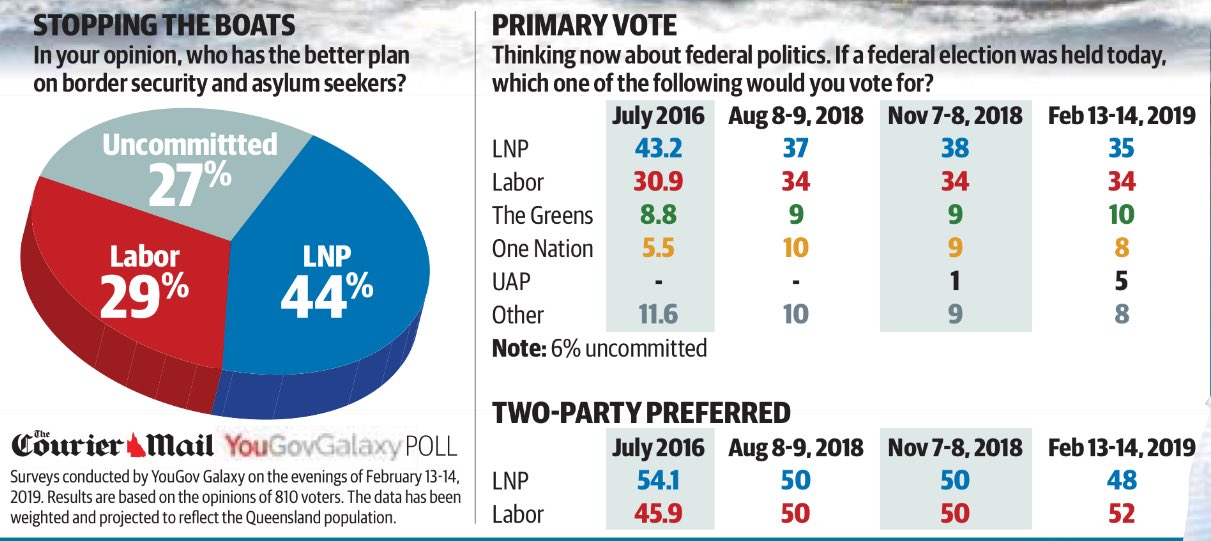
A Queensland Galaxy poll for The Courier Mail, conducted February 13-14 from a sample of 810, gave federal Labor a 52-48 lead, a two-point gain for Labor since November. Primary votes were 35% LNP (down three), 34% Labor (steady), 10% Greens (up one), 8% One Nation (down one) and 5% for Clive Palmer’s United Australia Party (up four).

The Coalition holds eight Queensland seats by margins of 4% or less. This poll implies a 6% swing to Labor in Queensland since the 2016 election.

The Coalition led Labor by 44-29 on best plan for border security and asylum seekers. This question did not ask about the medevac bill. It is a general question on an issue where the Coalition is perceived to have an advantage.

In the state politics part of this poll, primary votes were 35% Labor (down one since November), 35% LNP (up one), 11% Greens (steady), 8% One Nation (down two) and 4% Katter’s Australian Party (steady). No two party estimate was given, but Labor was ahead by 52-48 or 53-47.

48% approved of Premier Annastacia Palaszczuk’s performance (steady) and 38% disapproved (up one), for a net approval of +10. Opposition Leader Deb Frecklington’s net approval fell ten points to -4. Palasczuk had a 47-27 lead as better Premier (43-26 in November).

At the November 2017 Queensland election, One Nation contested 61 of the 93 seats and won 13.7% of the statewide vote – their vote would probably have been about 18% had they contested every seat.


Read more: Labor wins a majority in Queensland as polling in Victoria shows a tie


In both the state and federal polls, One Nation is down to 8% in Queensland. I believe One Nation has been identified as a right-wing party, not a populist party. Under Turnbull, there was space to the Coalition’s right, but with Morrison that space has been reduced.

National Essential: 55-45 to Labor

Last week’s national Essential poll, conducted February 6-11 from a sample of 1,067, gave Labor a 55-45 lead, a three-point gain for Labor since Essential’s late January poll. Primary votes were 38% Labor (up two), 34% Coalition (down four), 10% Greens (steady), 7% One Nation (steady) and 11% for all Others (up two). This poll was taken before the medevac bill passed the House.

28% thought the banking royal commission would lead to significant changes in the way banks operate, 47% thought it would lead to minor changes and 25% no real difference.

Showing disillusion with both sides of politics, 27% trusted Labor to implement the royal commission’s recommendations, 23% the Liberals and 35% thought there was no difference, with another 15% undecided.

By 59-11, voters agreed that Morrison should not end parliament before it deals with the royal commission’s recommendations. By 55-15, they agreed that the banks have more power than politicians, and will find a way to block meaningful reform.

Newspoll economy questions

In additional questions from last week’s Newspoll, Morrison led Shorten by 48-33 on more capable of handling the economy (50-32 in October). In general, incumbents benefit from this type of question, and the economy is perceived as a strength for the Coalition. The 15-point gap is narrower than any Turnbull lead over Shorten on this question in the six times it was polled while Turnbull was PM.

33% thought the government should prioritise increased funding of government services, 30% paying down government debt and 27% cuts to personal income tax.

The Westpac February consumer confidence rebounded to 103.8, up from 99.6 in January – the first month since late 2017 the index had fallen below 100. While Australian economic data for December has been weak, stocks have continued to rise.

NSW Essential: 51-49 to Labor

The New South Wales election will be held on March 23. An Essential poll, conducted February 6-11 from a small sample of 544, gave Labor a 51-49 lead. Primary votes were 39% Coalition, 36% Labor, 9% Greens and 8% One Nation. Premier Gladys Berejiklian had a 35% positive rating, 25% negative. Opposition Leader Michael Daley had a 27% positive rating, 20% negative.

ref. Poll wrap: Labor’s lead narrows to just 51-49 in Ipsos, but is it an outlier? – http://theconversation.com/poll-wrap-labors-lead-narrows-to-just-51-49-in-ipsos-but-is-it-an-outlier-111980

Papuans plan to boycott Indonesian elections, say independence activists

]]>
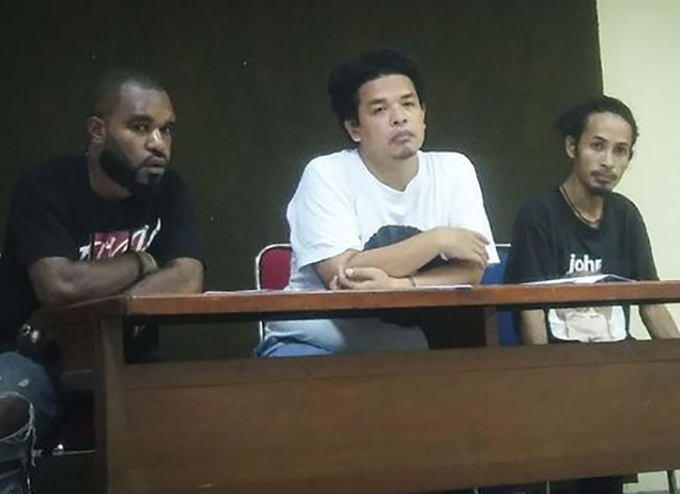
Indonesian People’s Front for West Papua spokesperson Surya Anta (centre) speaking at LBH Jakarta last week. Image: CNN Indonesia

Pacific Media Watch Newsdesk

West Papuan people will not take part in Indonesia’s 2019 presidential and legislative elections, say the Indonesian People’s Front for West Papua (FRI-WP) and the Papuan Student Alliance (AMP).

This is because they accuse the Indonesian government of illegal political practices in Papua, of failing to uphold the rights of the Papuan people and because both presidential candidates have a bad track record on Papua.

“Indonesia is a state which since the declaration of the Trikora operation on December 19, 1961, has conducted illegal political activities in the territory”, said FRI-WP spokesperson Surya Anta at the Jakarta Legal Aid Foundation (LBH Jakarta) offices in Central Jakarta last week.

READ MORE: Surprise at no mention of Papua in presidential hopefuls’ speeches

“Because of this we are taking a position and declaring that we will not take part in the 2019 presidential or legislative elections,” he said.

Anta explained that what they mean by the territory of West Papua was an area extending from Numbai to Merauke, Raja Ampat to Baliem and Biak Island to Adi Island.

-Partners-

The groups also believe that the contestants in the 2019 election on April 17 are the same as those in previous elections where candidates are only interested in gathering votes from the Papuan people.

However, there has been no effort by the legislative, presidential or vice-presidential candidates to uphold the rights of the West Papuan people, they say.

Maintaining colonialism
Speaking in the same vein, Student Struggle Center for National Liberation (Pembebasan) national collective secretary-general Samsi Mahmud said that the Papuan people were not interested in the 2019 elections.

Aside from Indonesia’s illegal political activities, according to Mahmud none of the political parties are articulating the wishes of the Papuan people and the elections are only aimed at maintaining the practice of colonialism.

“[The elections] are a tool for the colonial government to put local power holders in place to safeguard their interests”, said Mahmud.

AMP member Erepul Sama said there was no difference between the two presidential candidates, incumbent President Joko “Jokowi” Widodo and Prabowo Subianto, particularly in their handling of human rights violations.

“Prabowo himself has a bad track record in Papua such as the Mapenduma incident. But this doesn’t mean that Jokowi is any better”, said Sama.

“Jokowi has allowed human rights violations to occur again and again, for example in the bloody Paniai case which has still not been resolved”, he added.

Aside from declaring that they will not take part in the 2019 elections, the FRP-WP and the AMP made three other demands:

  • West Papuans be given the right to self-determination,
  • All organic and non-organic troops be withdrawn from Papua, and
  • Journalists be given free access to Papua.

Background
Operation Trikora was declared by Indonesian founding President Sukarno in the Central Java city of Yogyakarta on December 19, 1961.

It was an Indonesian military operation aimed at harassing and forcing the Dutch out of Netherlands New Guinea in 1961-62 rather than one intended to suppress a nascent independence movement.

The Mapenduma operation was a botched rescue operation in the remote Mapenduma area of West Papua led by then Kopassus commander Prabowo Subianto in 1996 to secure the release of World Wildlife Fund researches taken hostage by the Free Papua Movement.

The attempt ended in a military attack on Geselema village resulting in the death of up to eight civilians.

On December 8, 2014, barely two months after Widodo was sworn in as president, five students were killed and 17 others seriously injured when police and military opened fire on a group of protesters and local residents in the town of Enarotali, Paniai regency.

Shortly after the incident, Widodo personally pledged to resolve the case but four years into his presidency no one has been held accountable for the shootings.

Translated by James Balowski for the Indo-Left News Service. The original title of the article was “Golput, Aktivis West Papua Tuding Jokowi Prabowo Sama Saja”.

Print Friendly, PDF & Email

Article by AsiaPacificReport.nz

Just like HAL, your voice assistant isn’t working for you even if it feels like it is

]]>

Source: The Conversation (Au and NZ) – By Nathalie Collins, Academic Director (National Programs), Edith Cowan University

Of all the fictional virtual assistants we know from pop culture, few stand up to the original and perhaps most famous: the HAL 9000 from the 1968 Stanley Kubrick film 2001: A Space Odyssey.

We should probably be thankful for that. After all, Alexa may shut your lights off, but she won’t turn against you and wreak havoc on your life. Or will she?

Amazon Alexa, Samsung Bixby, Google Assistant, Apple Siri, Microsoft’s Cortana, IBM Watson and other virtual assistants are advertised as a cross between your friend, your servant, your helpful companion and sidekick.

HAL presents us something more sinister, but perhaps more realistic. While tech companies push virtual assistants as integral to a better, easier life, 2001: A Space Odyssey asks: at what cost?

The film illustrates the technological ecosystem companies are really competing to own – one where we trade in our privacy for small conveniences.


Read more: Do I want an always-on digital assistant listening in all the time?


‘I want to help you’ – HAL

In 2001: A Space Odyssey, HAL is introduced to the crew of a spaceship as one of them. But with cognitive capabilities well beyond those of his human companions, HAL is omnipresent – and embedded in the technology keeping the crew alive.

The crew trust HAL, eschewing privacy for the sake of his aid in controlling the whole ship. It doesn’t occur to them that the people who designed HAL might not have had the crew’s best interests at heart. Or that HAL’s loyalty is to Mission Control and, beyond that, his programming.

Likewise, although it is clear that the function of modern virtual assistants are driven by profit, it isn’t obvious to the average consumer exactly how their presence is being monetised. Consumers may be more educated about their online privacy these days, yet the consequences of the virtual world intruding into the physical hasn’t properly permeated public consciousness.

Allowing a machine to record you 24/7 in exchange for convenience is a high price to pay. It might not seem that way because virtual assistants wear the halo of trust earned by the other services they are known for – Google’s search is unparalleled and Amazon’s retail experience leads the global marketplace.

Like HAL, these machines process incredible amounts of data. So much so, that even their creators are not quite sure of their capabilities, or how they will reach their goal. The commercial benefit of virtual assistants lies in their ability to predict your behaviour through what they capture, and create opportunities for transactions. Mining big data for predictive analytics is all the rage in the business world.

So, while companies are marketing virtual assistants as your “assistant”, they are in fact your “analyst”.


Read more: There’s a reason Siri, Alexa and AI are imagined as female – sexism


‘I could see your lips move’ – HAL

In 2001: A Space Odyssey, the crew clearly never read the HAL “Quick Start Guide”. They didn’t know he could lie, and they were also unaware he could read lips. When the crew steps out of the ship to have a moment of privacy, HAL’s cameras could still see them and got the gist of their not-so-private conversation. Then push came to shove… and well, eventually the crew ended up getting the shove.

An unintended consequence of having a virtual assistant at our beck and call is that it is always listening, and it may also be recording. No surprise, that’s exactly what Amazon’s been doing. If companies are recording you in your home, slip ups like sending recordings to the wrong person, unintentionally releasing information, or accidentally allowing someone to listen in are inevitable.

Oh, and if you believe you are protected by the terms and conditions, you are likely mistaken. But that’s OK – like the 2001: A Space Odyssey crew, you probably don’t understand or read them anyway.


Read more: ‘Alexa, call my lawyer!’ Are you legally liable if someone makes a purchase using your virtual assistant?


‘I am afraid I can’t do that, Dave’ – HAL

Kubrick used 2001 to illustrate technological, physical and psychological enslavement. HAL first controls the physical environment and then attempts to exert his control over the psychological one. If we re-imagine 2001: A Space Odyssey with HAL as the hero, then he’s quite right to kill the crew. After all, these pesky humans are unpredictable because they’re likely to let their emotions mess up the mission.

If we re-imagine our lives with Google as the hero, well then we are the “assistant”, helping Google get the data it needs to better monitor and predict your behaviour – for shareholders.

Luckily, humanity still has time to adjust before the machines fully take over our lives on behalf of tech companies. As long as people still have their parrots ordering food from Amazon it will be clear to the public that trusting that machine may not be such a good idea.

Still, artificial intelligence improves at a rapid pace. Eventually we will have to decide if want consumer privacy to triumph, and blow the constant monitoring out of an airlock.

ref. Just like HAL, your voice assistant isn’t working for you even if it feels like it is – http://theconversation.com/just-like-hal-your-voice-assistant-isnt-working-for-you-even-if-it-feels-like-it-is-111177

A peace agreement in Afghanistan won’t last if there are no women at the table

]]>

Source: The Conversation (Au and NZ) – By Susan Hutchinson, PhD Candidate, Australian National University

Over the past weeks, the US government has been in peace negotiations with the Taliban. It has been 17 years since US and allied troops first deployed to Afghanistan to overthrow the Taliban and support a democratically elected government.

The current peace negotiations have progressed further than any other attempted during the conflict. But they have two serious problems. Firstly, they have have not included the democratically elected government of Afghanistan, led by President Ashraf Ghani. Secondly, they have failed to include a single woman.

The situation so far

Peace negotiations can take many forms. At their most basic, they cover ceasefires and division of territory. But they often go further to address underlying causes of conflict and pave the way for durable solutions. They include extensive informal discussions before any formal agreement is signed.

In 1996, the Taliban took control of Afghanistan. It banned women from attending school and denied them their most basic rights. The Taliban provided safe haven for those responsible for the attacks against the US on September 11, 2001.

The US is keen to withdraw its remaining troops. But they want to secure a commitment from the Taliban that Afghanistan will not be home to terrorist groups planning attacks against the United States.

The most recent reports show the Afghan government controls 56% of Afghan districts, or 65% of the population. The Taliban controls 15% of the districts, with 29% remaining contested.

Peace negotiations are often fraught with tension about who is allowed at the table. So far, the Taliban has refused to allow the government of Afghanistan to participate in the current negotiations. The chief US negotiator, Zalmay Khalilzad, has been briefing the Afghan government on the progress of negotiations taking place in various Gulf States.


Read more: Afghanistan: the tensions inside the Taliban over recent US peace talks


Khalilzad is under pressure from US President Donald Trump to move the negotiations forward. But excluding the government is problematic. It could indicate the likely failure of negotiations, end up making the government look even weaker than it is and/or pave the way for a return to deeply conservative religious rule for Afghanistan.

It is often tempting for power brokers to prioritise the participation of armed groups in peace negotiations. But it’s important to ensure broader participation of civil society.

Research examining every peace agreement since the Cold War shows the participation of civil society makes a peace agreement 64% less likely to fail. The key reason is the peace process is perceived as more legitimate if civil society is included. But including civil society also ensures the concerns of the broader community are accounted for and that those who carried arms do not receive positive reinforcement by monopolising the benefits negotiated in the agreement.

What about the women?

Afghan women are angry about being excluded from the peace negotiations. The country’s leading women’s rights group, the Afghan Women’s Network, released a statement calling for “the full, equal and meaningful participation of women” in the negotiations.

Life for women in Afghanistan remains hard. The latest Reuters Poll said Afghanistan was the second most dangerous country to be a woman, down from the most dangerous five years earlier. The country still makes the top of the list for violence against women, discrimination, and lack of access to health care.

But significant progress has been made in the past 17 years. Data from the UN Development Program show gender inequality dropped by ten percentage points between 2005 and 2017.

Women have strengthened their political, economic and social presence through efforts to advance their status and respect for their rights. Girls have been able to go to school. Women have become members of parliament, governors and police.


Read more: Trump and Turnbull have little cause for satisfaction over progress in Afghanistan


Afghanistan’s 2004 constitution includes a hard won provision that enshrines the equality of men and women. But the Taliban is calling for a new constitution and it is highly unlikely if this was agreed, such a provision would survive.

Research drawing on extensive quantitative and qualitative data has shown that the way a country treats its women is the best indicator of its peacefulness. This is a better indicator than wealth, ethnic and religious identity or democracy.

We also know that women’s participation in peace processes makes for a more effective outcome. A peace processes is 35% more likley to last at least 15 years if women are at the negotiating table, have observer status, or participate in consultations, inclusive commissions or problem-solving workshops.

Women can negotiate with the Taliban

Even so, men and people from the international community often believe the struggles faced by Afghan women mean they are not in a position to negotiate with the patriarchal Taliban.

But Afghan women like Palwasha Hassan have been working for years to pursue peace with the Taliban. Hassan sits on the country’s High Peace Council and has seen how women across the country have already negotiated with local Taliban leaders. She says “the international community is failing to value what we have achieved together and the progress we have made so far.”

She conducted a workshop in 2010 with women across local communities. Stories included one woman who had negotiated to keep a local girls’ school open by arguing that educated girls could do better in Islamic studies, including learning to read the Quran. She also guaranteed to her Taliban interlocutors that a prayer space in the school would be reserved strictly for women and girls only.

Another woman explained how she and others negotiated the release of hostages being held by the local Taliban commander. She appealed to Islamic values of life and justice, and persuaded the captors that the hostage was being held unjustly.

International agreements

The importance of women’s participation in international peace and security was codified by UN Security Council resolution 1325 nearly 20 years ago.


Read more: As Australia takes the world stage, it’s time to fulfil promises to Afghan and Syrian women


Seventy-nine countries, including Afghanistan, have National Action Plans to guide the resolution’s implementation and the subsequent seven Security Council resolutions on Women, Peace and Security.

In October 2017, the US became the first country in the world to pass a Women, Peace and Security Act, signed off by President Trump himself. It was passed explicitly to

ensure that the United States promotes the meaningful participation of women in mediation and negotiation processes seeking to prevent, mitigate, or resolve violent conflict” across the world.

Democratic Senators have urged the Trump administration to ensure Afghan women’s involvement in the peace negotiations. But so far no one has invoked the new law.

There are few who wouldn’t hope for peace for Afghanistan, but as Palwasha Hassan says, the negotiations “have to include women, both to protect our rights and also to ensure the durability of the peace that follows.”

ref. A peace agreement in Afghanistan won’t last if there are no women at the table – http://theconversation.com/a-peace-agreement-in-afghanistan-wont-last-if-there-are-no-women-at-the-table-111820

It’s time to change our drug dog policies to catch dealers, not low-level users at public events

]]>

Source: The Conversation (Au and NZ) – By Caitlin Hughes, Senior Research Fellow – Criminologist and Drug Policy Researcher, UNSW

In the early 2000s New South Wales became the first Australian state to introduce drug detection dogs for policing, with the aim of “targeting drug supply” and “attacking the root causes of drugs” in society. It gave police powers to use specially trained dogs to sniff for drugs in designated public places without the use of a warrant.

Drug dog policies have since expanded across all states of Australia and many other parts of the globe.

But our new research shows it’s an ineffective tool for targeting drug supply because it catches low-level users rather than suppliers. We also show this is an inevitable byproduct of where drug dogs are deployed: public settings such as licensed premises and festivals.

After almost 20 years of such policies, it’s time for reform.


Read more: Why drug-detection dogs are sniffing up the wrong tree


The wrong targets

In 2006 the NSW Ombudsman released a comprehensive review of the dogs, finding evidence of a high “false positive” rate. In 74% of occasions when a dog indicated they smelled a prohibited substance, no drugs were found.

The review also found dogs predominantly targeted young male drug users and not suppliers.

This led the Ombudsman to conclude the dogs were an “ineffective tool”. The Ombudsman also questioned whether the additional powers to use drug dogs should be retained.

But since then, these powers have expanded, including across the entire Kings Cross entertainment precinct and all Sydney public transport lines. Concern about their use continues to grow.

Drug dogs are now used at Sydney train stations. NSW Police/AAP

Nothing has changed

Our new research provides the most comprehensive analysis of the use of drug detection dogs since the NSW Ombudsman review more than a decade ago. We used data on all recorded criminal incidents and persons of interest involving drug detection dogs that led to a formal police response from June 2008 to June 2018.

We found little has changed in the police use of drug detection dogs.

The main group detected by the dogs were young males detected for use or possession offences (86.4% of incidents). Supply offences were only detected in 4.8% of incidents. Use or possession detections were 18 times more likely than those for supply.

Most of the young people who were detected had only small quantities of cannabis or ecstasy. These are the least harmful of all illicit drugs.


Read more: Three Charts on who uses illicit drugs in Australia


Target dealers, not users

We also looked at when and where drug detection dog encounters occurred, and whether circumstances for detection of suppliers differed. Our findings showed they did.

Consumer offences (use or possession) were most detected on weekends and in licensed premises, on public transport or in public places. In contrast, supply offences were most detected midweek in residential premises.

But only 10.9% of all deployments were at residential settings (compared with 83.3% at public settings).

Our research provides the first evidence that if dogs were deployed differently – less at recreational settings and more at residential premises with the use of a warrant – they could be more effective at detecting drug suppliers.

When police dogs are deployed at residential premises, suppliers are detected in 52.5% incidents. In contrast, suppliers are only detected in 5.9% and 13.4% of incidents when dogs are deployed on public transport or at licensed premises, respectively.


Read more: Our drugs policies have failed. It’s time to reinvent them based on what actually works


The current deployment strategy will not be able to detect drug suppliers and will disproportionately target drug users and young people. This raises both civil liberty concerns about the use of public searches and concerns for the safety of people who use drugs in recreational and public settings.

Time for policy reform

Research has suggested the presence of drug detection dogs at festivals and other public places seldom deters drug-taking. But it often leads to more risky drug behaviour from people who use drugs, such as purchasing drugs inside rather than outside festivals, switching to less detectable but more harmful drugs, and hurried consumption of drugs upon sight of dogs.

The deployment of drug detection dogs at festivals raises particular concerns in light of five recent deaths at festivals in Sydney, and the broader debates about how to improve festival safety.

The use of drug dogs rarely deters people from taking drugs at festivals and public events. Shutterstock

Our new study adds to existing research and continued opposition by various groups, including NSW Greens MP David David Shoebridge and drug harm reduction group Unharm. It suggests that a change in the deployment of drug dogs is possible and could lead to the detection of drug suppliers, not drug users.

Policy reform could reduce some of the unintended consequences of the current policies governing drug detection dogs, such as the risks to public health, and ensure a better use of scarce drug policy resources.

ref. It’s time to change our drug dog policies to catch dealers, not low-level users at public events – http://theconversation.com/its-time-to-change-our-drug-dog-policies-to-catch-dealers-not-low-level-users-at-public-events-111710

The battle against bugs: it’s time to end chemical warfare

]]>

Source: The Conversation (Au and NZ) – By Lizzy Lowe, Postdoctoral researcher, Macquarie University

Insects are important wildlife often overlooked in urban habitats. What we do notice are the cockroaches, ants and mosquitoes in and around our homes. All too often we reach for the insect spray.

But not all insects are pests – a wide variety of them help keep our cities healthy. They pollinate plants, feed other wildlife, recycle our rubbish, and eat other insect pests. Insects are vital to our well-being.

Unfortunately, like many other wild animals, insects are under threat. A recent study warned that 40% of the world’s insect species face the prospect of extinction, amid threats such as climate change, habitat loss, and humanity’s overenthusiastic use of synthetic chemicals.

Australians use large amounts of pesticides to tackle creepy crawlies in their homes and gardens. But our fondness for fly spray has potentially serious impacts on urban ecosystems and public health.

We need a more sustainable way to deal with urban insect pests. Our recently published article in the Journal of Pest Science outlines some of the ways to do it.

What’s wrong with pesticides anyway?

Since becoming publicly available in the 1950s, insect sprays have been a popular way to deal with cockroaches, flies, moths, and ants around the home and backyard, and are also widely used by local councils to keep pests at bay. But what may have been effective in the past won’t necessarily work in the future, or may have unintended consequences.

Many pests, such as mosquitoes, are now becoming resistant to commonly used products. In parts of the world affected by diseases such as dengue, this jeopardises our ability to control outbreaks.


Read more: Chemical or natural: what’s the best way to repel mozzies?


Another, perhaps wider, problem is that indiscriminate use of insecticides can kill more than just pests. Many species on which we rely for keeping our backyard gardens, bushland, wetlands and parks healthy can become collateral damage. This includes predatory species that can themselves help keep pests under control. As pest species often reproduce faster than their predators (a pattern that’s likely to be reinforced by climate change), we can get trapped in a cycle in which pest numbers bounce back higher than ever.

Many wasps are predatory and specialise in eating insects that can be pests around the home. Manu Saunders


Read more: Five reasons not to spray the bugs in your garden this summer


How do we do things differently?

Fortunately, there are alternatives to chemical pest control that don’t harm your household or the environment. For centuries, sustainable agriculture systems have used environmentally friendly approaches, and city-dwellers can take a leaf from their books.

Integrated pest management is one such sustainable approach. It focuses on prevention rather than treatment, and uses environmentally friendly options such as biological control (using predators to eat pests) to safeguard crops. Chemical insecticides are used only as a last resort.

There are many other farming practices that support sustainable pest control; these focus on behavioural change such as keeping areas clean, or simple physical controls such as fly mesh or netting around fruit trees.

Adopting these methods for urban pest control isn’t necessarily straightforward. There might be local regulations on particular pest control activities, or simply a lack of knowledge about urban pest ecology.

For urgent pest situations, it may be more expensive and time-consuming to set up a biological control program than to arrange the spraying of an insecticide. Insecticides take effect immediately, whereas biological control takes longer to have an effect. Prevention, the cornerstone of integrated pest management, requires careful planning before pests become a nuisance.

The goal of integrated pest management is not to eliminate insect pests entirely, but rather to reduce their numbers to the point at which they no longer cause a problem. By this logic, chemical insecticides should only be used if the economic damage caused by the pests outweighs the cost of the chemicals. If you hate the idea of a single cockroach living anywhere nearby, this might require you to adjust your mindset.

What can I do at home?

Don’t give pests opportunities. Be mindful of how we produce and dispose of waste. Flies and cockroaches thrive in our rubbish, but they can be effectively managed by ensuring that food waste is stored in insect-proof containers, recycled, or properly disposed of. Don’t leave buckets of water around the backyard, as this invites mosquitoes to breed.

Don’t open your door to pests. Seal cracks and crevices in the outside of your house, and ensure there are screens on your doors and windows.

Support the animals that control insect pests – they’ll do the hard work for you! In particular, don’t be so quick to kill spiders and wasps, because they prey on pests in your home and garden.

Spiders like this leaf curler will happily eat a range of pests, including ants, around your home. jim-mclean/flickr


Read more: The secret agents protecting our crops and gardens


What can we do as a community?

Urban communities can learn a lot from sustainable farming. First, there needs to be better education and support provided to the public and policy makers. Workshops run by local councils and information sessions with local gardening groups are a great way to start.

We can also work together to help debunk the popular myth that most insects are damaging or unwanted pests. Reaching for the fly spray might be easy, but remember you may end up killing friends as well as foes.

ref. The battle against bugs: it’s time to end chemical warfare – http://theconversation.com/the-battle-against-bugs-its-time-to-end-chemical-warfare-111629

I Need to Know: ‘is it normal to get sore down there after sex?’

]]>

Source: The Conversation (Au and NZ) – By Melissa Kang, Associate professor, University of Technology Sydney

I Need to Know is an ongoing series for teens in search of reliable, confidential advice about life’s tricky questions. If you’re a teen, send us your questions about sex, drugs, health and relationships, and we’ll ask an expert to answer it for you.


Hi! I only recently have gotten a boyfriend and have started having regular sex. After 2 or more days, it starts to get a bit sore down there. Is that normal? I just assumed it was pain from friction, but I don’t know if that’s right and I’ve never sought help because it’s a bit embarrassing!

Sandra, 17, in Sydney

Key points

  • Sex should never hurt
  • if it does, tell the person to stop
  • get checked out by a GP or sexual health clinic to make sure it’s not something that needs to be treated – better safe than sorry.

Hi, and thanks for your question! You’re not alone in finding that sex isn’t always straightforward. By sex, I assume you mean intercourse. What I’m not sure about is where you mean by “down there”. In a woman’s body, down there is lots of places!


The Conversation, CC BY-ND


To start with, sex shouldn’t hurt, and if it does, a good tip is to say “stop”, no matter what! The aftermath of sex also shouldn’t hurt – whether it’s two minutes, two hours or two days later.

Even very vigorous intercourse where there’s lots of friction should not actually hurt. It can happen if there’s not enough natural (or artificial) lubrication or if there’s some muscle tension in the vagina. Both of these can be signs of not being fully aroused (turned on) beforehand or during sex, or being a bit anxious about having sex.


Read more: Female sexual dysfunction or not knowing how to ask for what feels good?


A new partner or relationship can bring some anxiety for each person. It can affect the way a woman’s body (or a man’s) gets aroused and how comfortable sex feels. Good communication with your partner about what feels good is really helpful.

If you have background worry about sexually transmitted infections (STIs) or pregnancy, that can definitely affect enjoyment of sex. Getting armed with knowledge and equipment to prevent any unwanted consequences of sex should be a routine part of getting into a relationship for both parties.

The cause of your pain also depends on where it is – is it at the opening of the vagina, or other parts of the vulva? Is it related to peeing, and is it always in the same place?

Inflammation (redness and soreness) can cause pain – this could be from inside the vagina such as with a thrush infection (which is not sexually transmitted) or from the skin in the vulva (which could be from dermatitis or a skin condition).

Some STIs cause pain in the genital area, for example herpes (caused by the cold sore virus), but you would be likely to notice the sores as well. A common STI such as chlamydia often has no symptoms, but could cause pain higher up in the pelvic area or when you wee. A condition known as vulvodynia causes chronic pain, not just from having sex – it can also be triggered by the conditions mentioned above.


Read more: Health Check: what controls our sex drive? When and why do we feel like sex?


You deserve to be enjoying a happy and healthy sex life, and not feeling embarrassed about one of the most natural experiences in the world – even if it’s not always going right. It’s important you do get personal advice, since this could be something that needs treatment. It would be good to have a doctor or sexual health clinic check up, and this can all be done completely confidentially.


If you’re a teenager and have a question you’d like answered by an expert, you can:

  • email us at jsyk@theconversation.edu.au
  • submit your question anonymously through Incogneato, or
  • DM us on Instagram.

Please tell us your name (you can use a fake name if you don’t want to be identified), age and which city you live in. Send as many questions as you like! We won’t be able to answer every question, but we will do our best.

ref. I Need to Know: ‘is it normal to get sore down there after sex?’ – http://theconversation.com/i-need-to-know-is-it-normal-to-get-sore-down-there-after-sex-111744

The decoy effect: how you are influenced to choose without really knowing it

]]>

Source: The Conversation (Au and NZ) – By Gary Mortimer, Associate Professor in Marketing and Consumer Behaviour, Queensland University of Technology

Price is the most delicate element of the marketing mix, and much thought goes into setting prices to nudge us towards spending more.

There’s one particularly cunning type of pricing strategy that marketers use to get you to switch your choice from one option to a more expensive or profitable one.

It’s called the decoy effect.

Imagine you are shopping for a Nutribullet blender. You see two options. The cheaper one, at $89, promotes 900 watts of power and a five-piece accessory kit. The more expensive one, at $149, is 1,200 watts and has 12 accessories.

Which one you choose will depend on some assessment of their relative value for money. It’s not immediately apparent, though, that the more expensive option is better value. It’s 50% more powerful but costs almost 80% more. It does have more than twice as many plastic accessories, but what are they worth?

Now consider the two in light of a third option.

This one, for $125, offers 1,000 watts and nine accessories. It enables you to make what feels like a more considered comparison. For $36 more than the cheaper option, you get four more accessories and an extra 100 watts of power. But if you spend just $24 extra, you get a further three accessories and 200 watts more power. Bargain!

You have just experienced the decoy effect.

Asymmetric dominance

The decoy effect is defined as the phenomenon whereby consumers change their preference between two options when presented with a third option – the “decoy” – that is “asymmetrically dominated”. It is also referred to as the “attraction effect” or “asymmetric dominance effect”.

What asymmetric domination means is the decoy is priced to make one of the other options much more attractive. It is “dominated” in terms of perceived value (quantity, quality, extra features and so on). The decoy is not intended to sell, just to nudge consumers away from the “competitor” and towards the “target” – usually the more expensive or profitable option.

The effect was first described by academics Joel Huber, John Payne and Christopher Puto in a paper presented to a conference in 1981 (and later published in the Journal of Consumer Research in 1982).

They demonstrated the effect through experiments in which participants (university students) were asked to makes choices in scenarios involving beer, cars, restaurants, lottery tickets, films and television sets.

In each product scenario participants first had to choose between two options. Then they were given a third option – a decoy designed to nudge them toward picking the target over the competitor. In every case except the lottery tickets the decoy successfully increased the probability of the target being chosen.

These findings were, in marketing terms, revolutionary. They challenged established doctrines – known as the “similarity heuristic” and the “regularity condition” – that a new product will take away market share from an existing product and cannot increase the probability of a customer choosing the original product.

How decoys work

When consumers are faced with many alternatives, they often experience choice overload – what psychologist Barry Schwartz has termed the tyranny or paradox of choice. Multiple behavioural experiments have consistently demonstrated that greater choice complexity increases anxiety and hinders decision-making.

In an attempt to reduce this anxiety, consumers tend to simplify the process by selecting only a couple of criteria (say price and quantity) to determine the best value for money.

Through manipulating these key choice attributes, a decoy steers you in a particular direction while giving you the feeling you are making a rational, informed choice.

The decoy effect is thus a form of “nudging” – defined by Richard Thaler and Cass Sunstein (the pioneers of nudge theory) as “any aspect of the choice architecture that alters people’s behaviour in a predictable way without forbidding any options”. Not all nudging is manipulative, and some argue that even manipulative nudging can be justified if the ends are noble. It has proven useful in social marketing to encourage people to make good decisions such as using less energy, eating healthier or becoming organ donors.


Read more: ‘Nudging’ people towards changing behaviour: what works and why (not)?


In the market

We see decoy pricing in many areas.

A decade ago behavioural economist Dan Ariely spoke about his fascination with the pricing structure of The Economist and how he tested the options on 100 of his students.

In one scenario the students had a choice of a web-only subscription or a print-only subscription for twice the price; 68% chose the cheaper web-only option.

They were given a third option – a web-and-print subscription for the same price as the print-only option. Now just 16% chose the cheaper option, with 84% opting for the obviously better combined option.

In this second scenario the print-only option had become the decoy and the combined option the target. Even The Economist was intrigued by Ariely’s finding, publishing a story about it entitled “The importance of irrelevant alternatives”.

Subscription pricing for The Australian today replicates this “irrelevant alternative”, though in a slightly different way to the pricing architecture Ariely examined.

Why would you choose the digital-only subscription when you can get the weekend paper delivered for no extra cost?

In this instance, the digital-only option is the decoy and the digital+weekend paper option is the target. The intention appears to be to discourage you from choosing the more expensive six-day paper option. Because that option is not necessarily more profitable for the company. What traditionally made print editions profitable, despite the cost of printing and distribution, was the advertising they carried. That’s no longer the case. It makes sense to encourage subscribers to move online.

Not all decoys are so conspicuous. In fact the decoy effect may be extremely effective by being quite subtle.

Consider the price of drinks at a well-known juice bar: a small (350 ml) size costs $6.10; the medium (450 ml) $7.10; and the large (610 ml) $7.50.

Which would you buy?

If you’re good at doing maths in your head, or committed enough to use a calculator, you might work out that the medium is slightly better value than the small, and the large better value again.

But the pricing of the medium option – $1 more than the small but just 40 cents cheaper than the large – is designed to be asymmetrically dominated, steering you to see the biggest drink as the best value for money.

So have you just made the sensible choice, or been manipulated to spend more on a drink larger than you needed?

ref. The decoy effect: how you are influenced to choose without really knowing it – http://theconversation.com/the-decoy-effect-how-you-are-influenced-to-choose-without-really-knowing-it-111259

Sailors’ journals shed new light on Bennelong, a man misunderstood by history

]]>

Source: The Conversation (Au and NZ) – By Brett Goodin, Postdoctoral fellow in the Program in Early American Economy & Society, at the Library Company of Philadelphia.., Australian National University

The natives of new Holland are perhaps the quickest fighters in the world … They remind me of Homer’s description of his heroes. The warriors throw themselves into the same attitudes, they harangue, they brandish and cast their spears in a manner similar to that described by the celebrated poet, “so saying, swaying back and forth, he launched his long-shadowed spear”.

Benjamin Bowen Carter , 1798

This laudatory account of a group of Indigenous Australians, including Woollarawarre Bennelong, has been collecting dust in Rhode Island since 1798, when the fledgling United States was just beginning to stretch into the Asia-Pacific region, led by private merchant sailors.

It is contained in one of two 220-year-old journals from the merchant ship Ann & Hope (held in the John Carter Brown Library and the Rhode Island Historical Society respectively) penned by sailors Benjamin Page, Jr. the teenage son of the ship’s captain and Benjamin Bowen Carter, the ship’s surgeon.

They have been largely forgotten by historians, bar one or two, but shed light on Bennelong in particular: a celebrated yet misunderstood man. For much of white Australian history, Bennelong was portrayed as a tragic victim of alcoholism and cultural homelessness. Captured in November 1789 under orders from Governor Arthur Phillip to be taught English and serve as a cultural intermediary, he was later taken to England, returning to his homeland in 1795.

In their 11-month journey around the world, the Ann & Hope’s crew spent just four days in Sydney. But Page and Carter wrote thousands of words about New Holland’s people, environment, and trading prospects. Chief among their fascinations was witnessing Bennelong adjudicate an unusually messy payback punishment, which they recorded in excruciating and bloody detail.

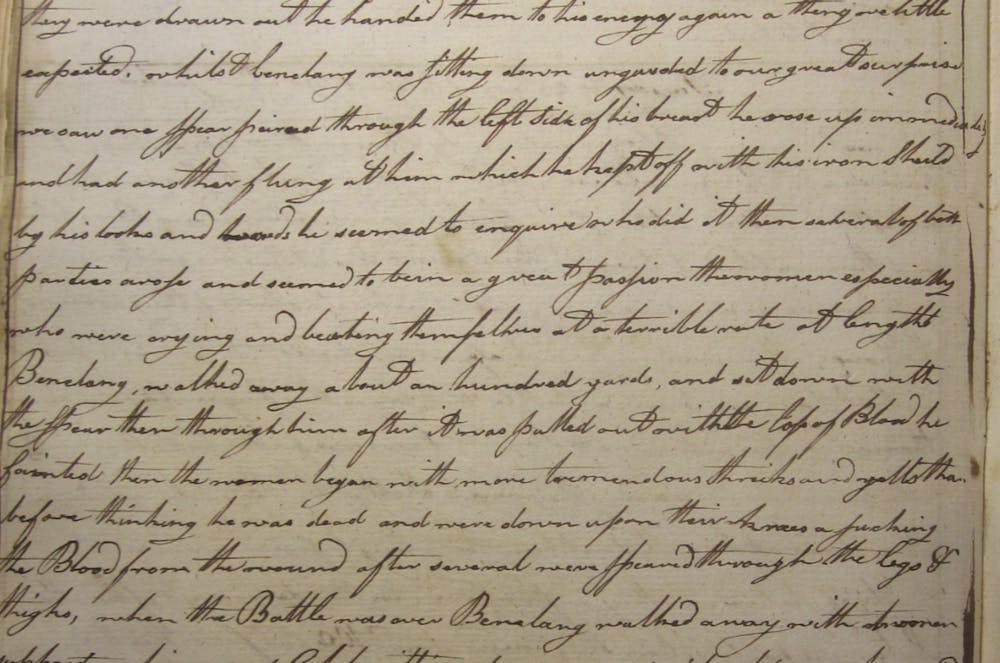
Benjamin Page Jr., Ann & Hope logbook, 1798-1799, Brown & Ives Records, Box 715, folder 1, John Carter Brown Library, Rhode Island. Author provided.

In doing so, they inadvertently reveal that Bennelong continued to hold positions of authority long after his return from the UK – in contrast to accounts by many eminent historians and popular authors that depicted him as lost between two worlds, comfortable in neither.

According to writer and academic Deborah Bird Rose, in Aboriginal communities,

reciprocity designed to re-establish social relations ruptured by wrong-doing is called ‘payback’. It is physical violence that is expected to be roughly equivalent to the offence. Its purpose is to restore a sense of balance and to effect a form of closure.

Echoing this desire for balance, Carter observed in 1798 that:

The generosity of these people is singular. When their enemies have discharged their spears, they will return them and prepare themselves for another assault. They frequently during the battle ran up to the opposite party and received their spears from the enemy. Nor did their antagonists throw a foul spear or improve in the least the advantage put into their hands, of killing an enemy when alone or unguarded.

Unfortunately, this protocol went awry when Bennelong decreed (apparently unconvincingly) that the appropriate punishment had been met.

He was violently rebuffed and, according to Page:

Whilst Bennelong was sitting down unguarded to our great surprise we saw one spear pierced through the left side of his breast he rose up immediately and had another flung at him which he kept off with his iron shield by his looks and words he seemed to enquire who did it then several of both parties arose and seemed to be in a great passion the women especially who were crying and beating themselves at a terrible rate at length.

Bennelong walked away about a hundred yards and sat down with the spear then through him after it was pulled out with the loss of blood he fainted then the women began with more tremendous shrieks and yells than before thinking he was dead and were down upon their knees a sucking the blood from the wound after several were speared through the legs & thighs.

Benjamin Page Jr., Ann & Hope logbook, 1798-1799, Brown & Ives Records, Box 715, folder 1, John Carter Brown Library, Rhode Island. Author provided

Nearly being killed while adjudicating a payback punishment does not paint Bennelong in the most favourable light. But the fact that as late as 1798 he was given the honour of adjudicating such a ceremony challenges much of the outdated historiography about him.

Bennelong has been mistakenly remembered for centuries, encouraged by national institutions such as the Australian Dictionary of Biography. The dictionary is currently rewriting its entry on Bennelong and other Indigenous Australians to reflect the new findings of scholars such as Shino Konishi, Keith Vincent Smith, Kate Fullagar, and Emma Dortins.


Read more: Indigenous lives, the ‘cult of forgetfulness’ and the Australian Dictionary of Biography


Bennelong’s 1966 entry in the dictionary is especially careless for highlighting how, after being the first Aboriginal man to visit England in 1792, he returned to Sydney,

and thereafter references to him are scanty, though it is clear that he could no longer find contentment or full acceptance either among his countrymen or the white men. Two years later he had become “so fond of drinking that he lost no opportunity of being intoxicated, and in that state was so savage and violent as to be capable of any mischief”.

Less disparagingly, Inga Clendinnen argues that, after returning from Europe, Bennelong, “with his anger and his anguish, simply drops from British notice”.

In reality, he dropped from official British records, but certainly not from positions of authority or from visiting American sailors’ notice.

The New South Wales government’s pledge to build a memorial on the land where Bennelong is buried certainly could not come at a better time.

Meanwhile, historians who have been diligently rewriting Bennelong’s history are finally being written about in the mainstream press. And who knows, maybe there are more dusty journals scattered around the world that will contribute to this rewriting over the next 200 years.

The author thanks Josiah Ober of Stanford University for translating from Greek the Iliad quote at the top of this page.

ref. Sailors’ journals shed new light on Bennelong, a man misunderstood by history – http://theconversation.com/sailors-journals-shed-new-light-on-bennelong-a-man-misunderstood-by-history-111266

Indonesian smear campaigns target Jokowi ahead of presidential election

]]>

By Ainur Rohmah in Jakarta

Fake news and hate speech are inundating Indonesia on and offline with the country’s general election just two months away and with presidential candidates Prabowo Subianto and incumbent Joko Widodo locked in a contest for the top spot.

Jokowi, as the president is known, remains clearly in the lead with as much as 20 percent of the voters picking him despite his being the target of torrents of fake news, according to several recent surveys.

The Prabowo team claims the race is closer based on internal surveys – which they decline to share.

READ MORE: Meet the fake news trolls who influenced the US and Indonesian polls for money

A survey by the Indonesian Survey Institute (LSI) shows Jokowi and his partner, Islamic leader Ma’ruf Amin, with voter approval at 54.8 percent, while Prabowo and his running mate, businessman Sandiaga Uno, are well behind at 31.0 percent.

But in an example of the depth of misleading advertising, survey results of the Indonesian Telematics Society (Mastel) say nearly 45 percent of 1,116 respondents surveyed said they receive fake news and hoaxes every day.

-Partners-

Unfortunately, 30.3 percent of respondents say they have difficulty checking the truth of such reports, with more than 75 percent of respondents agreeing that false news can disrupt community harmony.

Political issues dominate the fake news transmissions, according to the survey, followed by misleading reports on religion and health.

Chat applications
They can take the form of photos, videos, and narratives, and are mostly distributed via social media (Facebook and Twitter) and chat applications such as Whatsapp.

Among Indonesia’s 265.4 million population, fully half or 132.7 million are internet users, based on research conducted by We Are Social, with almost all of them – 130 million – active social media users.

At least 192 million voters will select the president and their representatives in parliament simultaneously across the country on April 17.

The latest research by the social media monitoring site PoliticaWave found that hoaxes mostly target Jokowi.

“From the presidential elections in 2014 to 2019, it appears that Jokowi is a victim of political hoaxes,” said executive director PoliticaWave Jose Rizal at a press conference in Jakarta.

PoliticaWave also found that the numbers of hoax issues have been rising. The 10 biggest hoax issues relating to the 2019 election include a fake attack on activist Ratna Sarumpaet, who first accused the Jokowi camp of being behind it.

She later switched her allegiance to the president. Others deal with reports of very large government debt; allegations that several containers filled with ballots had been discovered as already cast for Jokowi; toll electronic transactions associated with debt to China; and fake e-KTPs from China.

Many accusations
Jokowi has been accused of being a member of the Indonesian Communist Party (PKI), of being a closet Christian, of using foreign consultants and of having a fake high school certificate.

Others include that 10 million workers from China have entered Indonesia; and that vice presidential candidate Ma’ruf Amin will be replaced by the former Jakarta governor Basuki “Ahok” Tjahaya Purnama, who was arrested on trumped up blasphemy charges that played an integral role in his defeat.

“The ten biggest hoax issues are aimed at attacking Jokowi,” said Yose.

Claiming that he was fed up with accusations and hoaxes against him, Jokowi in recent speeches has sought to clarify the various negative allegations and to go after his political opponents.

In early February, he hinted – without mentioning specifically – a campaign team that carried out so-called “Russian propaganda,” a name that has gained increased currency with spectacular charges over Russian interference in the 2016 US election.

The term is construed as an accusation against Prabowo’s camp.

“The problem is that there is a campaign team that prepares Russian propaganda which is (marked) at any time to issue a blast of slander and hoax,” Jokowi said while addressing thousands of supporters in the city of Surabaya.

Foreign consultants
Jokowi accused the Prabowo camp of hiring foreign consultants, who he said were only oriented to victory without considering that their strategy could potentially divide society. He also criticised the opposition for often accusing him of being pro-foreigners even though they themselves used the services of foreigners.

“Their consultants are foreign consultants,” he said. “Then who is the foreign stooge? Do not let us be treated continuously by lies. Our people are smart, whether in the city or in the village,” he said.

Gerindra deputy chairman Fadli Zon denied the allegations.

“We do not use foreign consultants. We can’t afford to pay (foreign consultants),” he said.

Prabowo’s team responded by accusing Jokowi himself of using the services of a foreign consultant named Stanley Greenberg. The accusation was based on an article on a website stating that Stanley had been a consultant to Jokowi.

“A note for all these inquiries,” Greenberg responded publicly. “I have never worked for Mr Widodo in any way. The website you mention is not accurate nor affiliated with me in any capacity.

“Accurate information on our past clients is listed on my official website,” Greenberg wrote through his Twitter account @stangreenberg, attaching his official website.

‘Russian propaganda’
The controversy about “Russian propaganda” also provoked the Russian Embassy in Jakarta to comment.

“We underline that Russia’s principal position is not to intervene in domestic affairs and electoral processes in foreign countries, including Indonesia which is our close friend and important partner,” wrote the Russian Embassy through its official Twitter account @RusEmbJakarta.

But Jokowi’s special team of Cakra 19 said it was convinced that “Russian propaganda” was now being applied in Indonesia, by adopting what is known as “firehoses of falsehoods,” an operation used by Russian hackers between 2012-2017 in the Crimea crisis, the Ukrainian conflict and the civil war in Syria.

“In Russia, this modus operandi has emerged as long ago as the 1870s through the Narodniki movement. This movement was used to bring down the Russian Czar by continually raising negative issues,” said the chairperson of the Cakra 19 team, Andi Widjajanto in a written statement.

“Operation blast of slander aims to make lies defeat the truth. This operation wants to destroy public trust in political authorities, including the media,” said the former Cabinet Secretary and defense expert.

Prabowo’s campaign team, known as the National Winning Agency (BPN), has launched allegations that the Jokowi government has used legal means to get rid of political opponents ahead of the upcoming election.

“Now people who have the potential to gain votes in the BPN circle have begun to be crushed one by one,” Gerindra Party general secretary Ahmad Muzani said.

Hate speech
He charged that a musician-turned politician, Ahmad Dhani, and a cleric leading the Movement 212 – a group of conservative Muslims who held a series of demonstrations against former Jakarta governor Basuki – named Slamet Ma’arif had been the target of what he called “criminalisation”.

Dhani was sentenced to 18 months in prison at the end of January on a charge of hate speech. Ma’arif members are now suspected of a series of alleged campaign violations.

Several other names in Prabowo’s camp were also involved in legal cases or even jailed. Muzani claimed the police were quick to investigate cases involving Prabowo’s sympathizers but not with cases involving or suspected of involving Jokowi’s supporters.

“We have submitted many reports (to the police), but it seems that there is not enough evidence. Whereas when our party was reported, (it was said) there was enough evidence. This is no longer inequality, it is bias,” Muzani said.

Presidential Chief of Staff Moeldoko denied Muzani’s allegations, emphasizing that the government did not intervene in the legal process.

“That there are (BPN members) who are entangled in legal matters, look to yourselves. It may be something that is wrong (with themselves). So don’t always blame the government,” Said Moeldoko as quoted by kompas.com

Print Friendly, PDF & Email

Article by AsiaPacificReport.nz

Timorese journalists protest outside Philippine embassy over Ressa arrest

]]>
Timor-Leste Press Union president Francisco Belo condemning the arrest and charge of “cyber libel” against Rappler publisher Maria Ressa. Image: Antonio Dasiparu/TLPU

Pacific Media Watch Newsdesk

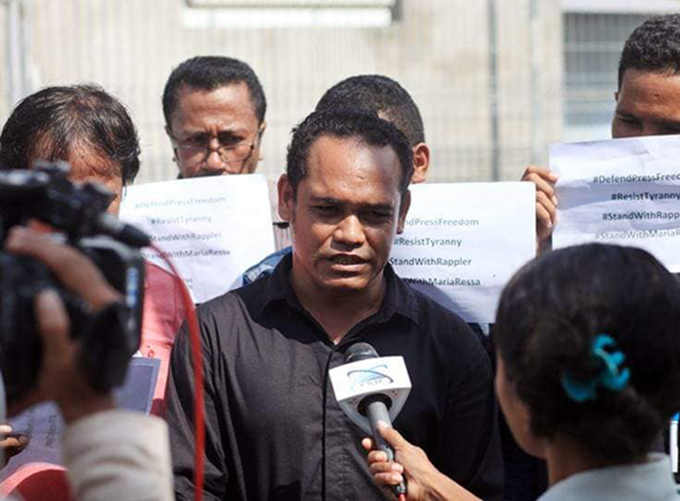
The Timor-Leste Press Union has protested in front of the Philippine Embassy in the capital Dili in solidarity with indicted Journalist Maria Ressa over her “persecution” and in defence of freedom of the press.

Rappler CEO and editor Maria Ressa is known and respected for her work as a journalist in bringing the plight of the suffering people of Timor-Leste under a quarter century of Indonesian occupation prior to renewed independence in 1999.

The Timorese journalist protest was broadcast by the public broadcaster RTTL.

The Philippine Daily Inquirer, one of the leading Philippine national dailies, reported today that Ressa had accused President Rodrigo Duterte’s administration of acting like a dictatorship and using the law as a weapon to muzzle dissent.

READ MORE: Rappler’s Maria Ressa sees threat to democracy

“What we’re seeing … is a level of impunity that I frankly haven’t seen, and I’ve been a journalist for more than 30 some odd years,” Ressa said after posting bail in a Manila court on Thursday.

-Partners-

Ressa, who was selected by Time magazine as one of its Persons of the Year last year, is the head of Rappler Inc., which has aggressively covered Duterte’s administration.

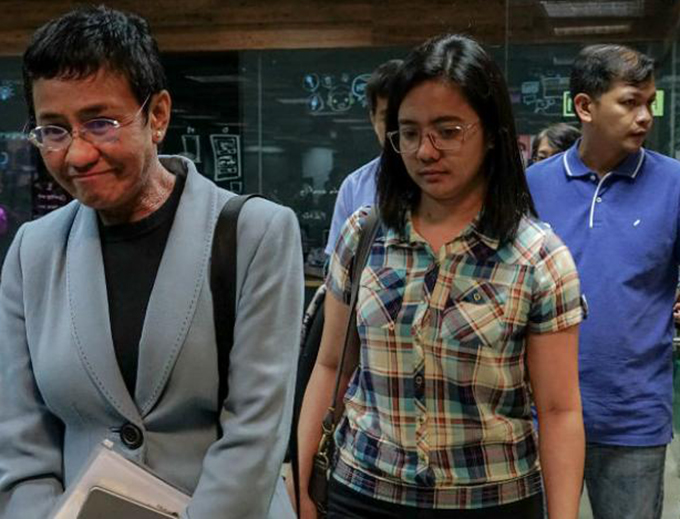
Rappler publisher Maria Ressa speaking at a media conference after her release on bail in Manila. Image: Philippine Daily Inquirer

She was arrested Wednesday over a libel complaint from a businessman. Duterte’s government claimed the arrest was a normal step in response to the complaint and had nothing to do with press freedom.

Universities condemn arrest
University leaders and student groups in the Philippines have also condemned the arrest of Ressa, saying schools must defend the truth and press freedom, reports Rappler.

Ateneo de Manila University (ADMU) president Father Ramon Jose Villarin and De La Salle Philippines president Brother Armin Luistro urged the universities’ communities to speak out and defend democracy.

“The university shares Maria’s challenge to shine the light on power and be brave in witnessing to the truth. Veritas liberabit vos (The truth will set you free),” Villarin said.

“Lies and false promises of unbridled power, when met with silence, will only make us a nation of slaves,” he added.

Luistro urged Lasallians to “vote with their feet” in the upcoming 2019 elections and make their voices heard to defend press freedom.

Ressa was arrested in connection with a cyber libel case filed by the Justice Department.

The University of the Philippines (UP) Diliman Student Council and ADMU publication The Guidon denounced the arrest, saying students would continue to hold the line with Ressa and Rappler.

‘Make our voices heard’
Here are the statements of support from various schools:

Brother Armin Luistro FSC, president of De La Salle Philippines:

“Let’s give our all out support as Lasallians to Rappler. Let’s defend press freedom. Let’s make our voices heard. Let’s vote with our feet and stand with Maria Ressa!”

Father Jose Ramon Villarin SJ, president of Ateneo de Manila University (ADMU):

“In my statement of 13 October 2017, I had occasion to ‘call on everyone in the community to defend our democratic institutions” and to state that “[t]his call to defend our democratic institutions is not even a matter of political partisanship or persuasion. It is a call that is borne out of our conviction about what is right and just and truly democratic.’

“While such pronouncements then pertained to government institutions in particular, the same should be said with regard to freedom of speech, of expression and of the press. No less than the Philippine Constitution recognises ‘the vital role of communication and information in nation-building’ (Constitution, Art. II. Sec. 24) and ‘the freedom of speech, of expression, or of the press’ (Constitution, Art. III, Sec. 4).

“There are several rights and freedoms necessary for a democratic society to function. The right to life, the right to due process, the sweet freedoms of speech and of the press – all of these were once considered sacred, inviolable. But as of late these have been called into question; mocked, attacked, degraded.

Rappler, and its brave leader Maria Ressa, have consistently held the line against the erosion of these liberties. It is journalists like her who keep us all informed about the state of our nation, covering different areas of our national life, contributing immeasurably to the wealth and value of our country.

“Too often these days, it is they who wage daily battles against fake news, expose corruption and bring to light illegal practices and wrongdoing by those who lead us.”

Print Friendly, PDF & Email

Article by AsiaPacificReport.nz

‘Don’t be silent,’ says defiant Maria Ressa in fight for press freedom

]]>

Rappler publisher condemns Duterte government’s “abuse of power”. Video: ABS-CBN

By Iris Gonzales in Manila

The Philippine press has seen many dark days but Maria Ressa’s arrest this week is among the worst.

It signals dangerous times for our country’s democracy, 33 years since it was restored in 1986.

Ressa is a veteran journalist who founded the news website Rappler – and a thorn in the side of President Rodrigo Duterte.

READ MORE: Journalist’s arrest in Philippines sparks demonstrations, fears of a wider crackdown

The feisty journalist, hailed as Time Person of the Year for 2018, was arrested around 5 pm on Wednesday, February 13, by officers of the National Bureau of Investigation (NBI).

Maria Ressa … “You have to be outraged like what I’m doing now.” Image: Maria Ressa FB

-Partners-

The arrest warrant was issued by a local court the day before in connection with a “cyber-libel” case filed by the Philippine Department of Justice against Ressa and former Rappler researcher Reynaldo Santos Jr.

The case relates to a story published in May 2012. However, the cyber libel law the story allegedly violated was enacted in September 2012 – some four months later.

The Justice Department filed the case following a complaint lodged by business person Wilfredo Keng, whom Rappler identified in an article as having alleged links to illegal drugs and human trafficking, based on intelligence reports.

‘Abuse of power’
Ressa described her indictment and arrest this week as an “abuse of power” and “weaponisation of the law” against a citizen. She had to spend a night at the NBI office because her warrant was served at 5 pm – a time when government offices were already closed, making it impossible for Ressa to post bail.

The following day she was granted temporary liberty, after posting a P100,000 (US$1900) bail bond at a Manila court.

“These legal acrobatics show how far the government will go to silence journalists, including the pettiness of forcing me to spend the night in jail,” she said.

While Keng had every right to seek redress in the courts, Ressa’s arrest indicates a readiness of government officials to use their power and weaponise the law to go after individuals they perceive as enemies or threats.

Every journalist or critic of the administration is vulnerable. Every action which the government may not like may be put under scrutiny and brought to court.

Let us not forget that President Duterte’s critic, Senator Leila de Lima, is still in jail because of trumped up drug-related charges.

This time, it’s Ressa who is being harassed by the government. But she won’t take it sitting down.

‘Be outraged’
“I’m saying and I’m appealing to you not to be silent, especially if you’re next. You have to be outraged like what I’m doing now,” she said minutes after posting bail.

In a statement, Rappler warned: “No one is safe.”

Apart from cyber-libel, Ressa and Rappler are facing five tax cases. In December 2018, Ressa posted bail twice over alleged violation of the Tax Code. Rappler has also faced revocation of its corporate registration papers by the Securities and Exchange Commission

But, headed by some of the country’s best investigative journalists, Rappler said it would not be cowed by attempts at intimidation and vowed to continue its journalistic duties. ‘We will continue to tell the truth and report what we see and hear. We are first and foremost journalists.’

Ressa’s case will come up in March but her lawyer JJ Disini said they would file a motion to quash and question the information regarding the cyber libel case filed against his client.

The Consortium on Democracy and Disinformation, a group of journalists, bloggers and other cause-oriented individuals, has condemned what happened and strongly denounced the continuing harassment of Ressa.

“Her arrest,” it said, “is a betrayal of the guarantees of press freedom and freedom of expressed enshrined in the Constitution. More, its callous execution is an indictment of a weakened justice system; its devious grounds a dangerous fabrication that affects not just journalists, but everyone.”

The international Committee to Protect Journalists (CPJ) and Reporters Without Borders (RSF) have also denounced Ressa’s arrest as “an outrage”.

What happened to Ressa can happen to anyone in my country. Every freedom-loving Filipino must realize this and should stand up against any action that will curtail our freedom as individuals.

As Rappler says, we must all hold the line.

Print Friendly, PDF & Email

Article by AsiaPacificReport.nz

Putting babies under general anaesthetic won’t affect their development, new research shows

]]>

Source: The Conversation (Au and NZ) – By Michael Vagg, Clinical associate professor, Deakin University School of Medicine and Pain Specialist, Deakin University

Making the decision to operate on a baby or toddler can be complex and confronting for parents. It involves weighing the risks versus the expected benefits for the child.

One of the questions impacting the decision has traditionally been whether general anaesthesia is safe for vulnerable, rapidly developing brains.

Parents in this situation can be reassured after a new study published in The Lancet this week showed a single episode of general anaesthesia in infancy had no detectable impact on subsequent brain development.


Read more: When your child has to go to hospital it is always hard – even when it is for the best


Why the worry?

The Food and Drug Administration in the United States sounded a note of caution as long ago as 2007 after some studies showed some of the gases used in general anaesthesia seemed to have permanent negative effects on the developing brains of rats and monkeys.

Research was planned and funded to settle this issue by examining evidence in the real world. After all, human brains are not the same as rat brains.

Studies that had been done in humans were observational (backward-looking). This makes it hard to differentiate the effect of the anaesthesia from effects of the condition for which the surgery was being performed, or other factors affecting the child.

What this study offers

The strengths of the study are significant. First, it was large, involving 722 participants from children’s hospitals across seven countries, including Australia.

It was also well-designed. In particular, this was a prospective (forward-looking) study with a design that enabled researchers to clearly discern the isolated effect of the anaesthesia.

This was achieved by comparing the same procedure done for the same reason using either spinal anaesthesia, where the patient is numb in the area of surgery but awake, or conventional general anaesthesia, where the patient is unconscious.

Parents are often worried about the effect an anaesthetic will have on their baby. From shutterstock.com

The procedure chosen for the study was the repair of a groin hernia, a condition where internal tissues of the abdomen protrude through a weak spot in the abdominal muscle. People who undergo the surgery overwhelmingly have good outcomes and low complication rates. It’s also performed in children who are generally otherwise fairly healthy.

This surgery is usually done within the first couple of months of a child’s life to prevent abnormal development of the lower abdominal wall which would make the hernia difficult and painful to repair later. It also decreases the risk of requiring emergency surgery.

The children recruited into this study were all younger than six months old at the time of surgery.

Another major strength of the study was the length of time the children were followed. Those who were operated on stayed under assessment until they turned five. At this age, the children were given standard tests of brain function which are known to be good at predicting future development. Normal testing at this age would show with a lot of confidence that there was no detriment from the general anaesthesia. And this was found to be the case.

Each of these attributes means the findings are likely to be reliable and able to be generalised from country to country.


Read more: Looking online for info on your child’s health? Here are some tips


Some things to be aware of

The only real weakness of the study was that the population assessed was overwhelmingly male (84% of participants) as groin hernia is much more common in baby boys. The authors acknowledge this and highlight the need for future studies to include more girls.

It’s also important to emphasise that in order to enable a clear and definite answer, this study only looked at a single episode of general anaesthesia. It was not designed to assess the risk of repeated or unusually prolonged exposure to general anaesthesia. So it provides a piece of the puzzle, but not the complete picture.

Taken as a whole, this study is reassuring for parents of children undergoing elective surgery at an early age. In a practical sense, it allows other factors such as surgical risk, or the impact of deferring or avoiding the operation, to take a more important place in decision-making.

Parents can put concerns about general anaesthesia harming their baby’s brain to bed for now, at least as far as one-off operations go.

ref. Putting babies under general anaesthetic won’t affect their development, new research shows – http://theconversation.com/putting-babies-under-general-anaesthetic-wont-affect-their-development-new-research-shows-111727

There’s little reason for optimism about Closing the Gap, despite changes to education targets

]]>

Source: The Conversation (Au and NZ) – By Melitta Hogarth, Lecturer, University of Southern Queensland

This week saw the release of the annual Closing the Gap report. Much like the previous decade of reports, we learned progress was lacking, failure was apparent and in 2018, only two of the seven targets were on track.

This is hardly a surprise. Each year, we’ve heard of the failures and the inability to make a significant impact on the gap.


Read more: Four lessons from 11 years of Closing the Gap reports


When handing down his report, Prime Minister Scott Morrison indicated a shift in the approaches to addressing the disparities between Aboriginal and Torres Strait Islander peoples and non-Indigenous Australians. This shift has been the result of Closing the Gap Refresh, a review of the original goals set in the more formally known, National Indigenous Reform Agreement.

He also looked to embed some of the recommendations made by Special Envoy of Indigenous Affairs, Tony Abbott. Morrison and Abbott have focused specifically on education as a means to address inequities, but there’s little reason to think this will affect real change.

What has changed?

There are three new targets in the Closing the Gap Refresh that will act as drivers in education. They are:

  • to increase the proportion of Aboriginal and Torres Strait Islander students in the top two bands of NAPLAN reading and numeracy for years three, five, seven and nine by an average of 6% by 2028

  • to decrease the proportion of Aboriginal and Torres Strait Islander students in the bottom two bands of NAPLAN reading and numeracy for years three, five, seven and nine by an average of 6% by 2028

  • to have 47% of Aboriginal and Torres strait islander peoples (aged 20-64 years) complete a Certificate III or above by 2028.

The original target set in 2008 to halve the gap in attainment of year 12 or equivalent qualifications between Aboriginal and Torres Strait Islander and non-Indigenous 20-24 year olds by 2020 has been maintained. Presumably, this is because this target, unlike the others, has not expired yet.

The first two targets are ambitious, but also selective in their focus. NAPLAN testing only looks at reading, writing, language conventions and numeracy.

The 2019 Closing the Gap Report indicates there has been significant gains made in reading and numeracy in certain year levels in the national data. The focus may be placed on these two areas because progress has already been seen, so they’re not “doomed to fail”.

Notably, in the other two targets, the original target measured the number of Aboriginal and Torres Strait Islander people who had completed year 12 or a Certificate II. The shift in focus from a Certificate II to a Certificate III is significant. And it hides a political agenda shared within the Closing the Gap report.

That is, by improving educational outcomes and expectations of Aboriginal and Torres Strait Islander peoples, the government can anticipate “a return on investment through reduced service dependency, reduced health and justice interventions and improved education and employment participation” (found on page 59 of the report).

In other words, there is an expectation that education will improve health, reduce incarcerations and minimise welfare dependency.

No more top-down approach to policy-making?

Another significant change is the approach in policy-making and decision-making by addressing the top-down approach and providing space for Indigenous voice. The Council of Australian Governments (COAG) has made a commitment to form a partnership with Aboriginal and Torres Strait Islander representatives through the formation of a Ministerial Council on Closing the Gap.


Read more: Closing the gap on Indigenous education must start with commitment and respect


In my PhD, I analysed the National Aboriginal and Torres Strait Islander Education Strategy. The Aboriginal and Torres Strait Islander Education Advisory Group was predominantly made up of non-Indigenous peoples. There were only two Indigenous representatives within the Advisory Group.

My fear is that this Ministerial Council will simply become a re-branding of the Advisory Group. The power of the non-Indigenous representatives on the Advisory Group had the potential of silencing the Indigenous representatives. The non-Indigenous representatives were drawn from the then-named Australian Education, Early Childhood Development and Youth Affairs Senior Officials Committee (AEEYSOC).

It’s not encouraging to read that the proposed Ministerial Council will be made up “with Ministers nominated by jurisdictions” (found on page 154 of the report). Ironically, partnerships through the Indigenous Education Consultative Bodies (IECBs) existed up until late 2014 when they were defunded by federal government. Only some states and territories maintained their Consultative Bodies.

The sharing of responsibility potentially shifts the failures from federal government to states and territories, and Aboriginal and Torres Strait Islander peoples themselves. This shift can then be used to further perpetuate disadvantage and stereotypes.

Waiving HECS fees for teachers working in remote Indigenous communities

Tony Abbott, as Morrison’s Special Envoy of Indigenous Affairs, has suggested waiving HECS fees for some 3,100 teachers in some 300 schools. He proposes this will give initial teachers incentive to consider beginning their career in remote locations.

But as Linda Burney so aptly reminds her colleagues, the majority of Aboriginal and Torres Strait Islander peoples live in urban areas.

As a former classroom teacher who worked in an Indigenous community for almost ten years, I’ve seen many “fresh” teachers come and go in community. The demands and dynamics of teaching in a community where suddenly you’re the visible minority while you’re still learning the craft and the various other community factors in play, requires maturity and an ability to reflect rather than react.

Now, as an academic working in Initial Teacher Education, I see many teachers who have these qualities. But, many of these students have families and other demands that would potentially hinder their chances to make such a commitment.


Read more: To really close the gap we need more Indigenous university graduates


We also need to ask how systems and schools will ensure the teachers being selected to take on this opportunity are “the very best teachers”, as Indigenous Affairs minister Nigel Scullion put it.

The National Exceptional Teaching for Disadvantaged Schools program, coordinated out of Australian Catholic University, could provide some answers here. Teachers in this project are selected on the basis of their deep content knowledge as well as commitment to social justice.

What’s next?

It’s not lost that we’re only months out from an election. It could explain why the government that outrightly rejected the Uluru Statement of the Heart is now calling for and formalising partnerships with Aboriginal and Torres Strait Islander peoples.

Morrison says “we should […] embrace the requirement to change, we simply will not succeed by continuing to work in the same way” (found on page 7 of the report). It’s hard not to be cynical and think it’s just words and hollow promises.


Read more: Three reasons why the gaps between Indigenous and non-Indigenous Australians aren’t closing


We shouldn’t have to wait for answers. We need further clarification on the strategies put forward. We need action – not just snippets of what comes next. Don’t leave us hanging, hoping that the very thing Aboriginal and Torres Strait Islander peoples called for in the Uluru Statement occurs, that “we will be heard”.

ref. There’s little reason for optimism about Closing the Gap, despite changes to education targets – http://theconversation.com/theres-little-reason-for-optimism-about-closing-the-gap-despite-changes-to-education-targets-111840

Pages and prejudice: how queer texts could fight homophobia in Australian schools

]]>

Source: The Conversation (Au and NZ) – By Annamarie Jagose, Dean of the Faculty of Arts and Social Sciences, University of Sydney

Recently, the Australian Association for the Teaching of English (AATE) — the peak professional body for Australian English teachers — published a special issue of the journal English in Australia entitled “Love in English.” It addressed the continued marginalisation of some genders and sexualities within the classroom.

One article in this journal analysed sample text lists provided by the Australian Curriculum, Assessment and Reporting Authority (ACARA). The article found only two of the 21 fiction texts portrayed non-heterosexual protagonists, named characters, experiences, or relationships. Before you go imagining radical queer literature stealthily making its way into the secondary classroom, the texts in question were Twelfth Night and The Great Gatsby.


Read more: Telling the real story: diversity in young adult literature


An extensive amount of educational research has demonstrated schools are enjoyable and productive places for some students, but not others. As much as we would like to think otherwise, it’s clear schools do not serve all members of the population equally well.

Schools are sites of learning about social, cultural, political and economic positions, rights and possibilities. Schools can either double-down on social inequalities or they can help change attitudes.

The queer experience at school

Consider the situation of the many Australian school students who consider themselves sexually or gender diverse. A 2015 study of over 700 LGBTIQ+ Australian youth indicated 94% had heard homophobic language at school. Some 58% of these young people heard homophobic language on a daily basis.

Additionally, 45% of participants had witnessed physical harassment of classmates who were perceived as being sexually and/or gender diverse.

Including queer texts in the curriculum could help change negative attitudes towards people who identify as LGBTQI+. from www.shutterstock.com

These findings are consistent with other research that indicates homophobic violence is increasing in Australian schools. The Writing Themselves In report indicated that in 1998, 69% of sexually or gender diverse young people reported homophobic violence. In 2004, this figure rose to 74%, and by 2010 it was 80%.

Understanding difference

Being provided with a safe learning environment is not the only thing queer young people are being denied. They’re also being denied the opportunity to learn about the histories and experience of people like themselves.

As researchers at Sydney and Western Sydney University have noted:

Discrimination can be perpetuated by what is present — and what is noticeably absent — in the curriculum.

Queer inclusions in curricula have the potential to make a meaningful difference to schooling environments, especially in understanding and confronting inequalities. The entire national English curriculum identifies teaching young Australians to contribute to “a democratic, equitable and just society that is prosperous, cohesive and culturally diverse” as its core purpose.

In addition to this admirable aim, the Australian Curriculum’s General Capabilities and Cross-Curriculum Priorities emphasise developing respect, reciprocity, empathy and open-mindedness. While all of these things might be assisted by the expansion of the Australian English curriculum to include more explicit representations of LGBTIQ+ lives, it ain’t necessarily so. That’s where teachers come in.


Read more: The art of seeing Aboriginal Australia’s queer potential


The literary texts students spend time on in school allow opportunities to explore different lives and life chances.

Even when the texts are mainstream, they can still be alternative, as Eve Kosofsky Sedgwick has influentially argued. Think about the queer subtexts of Euripides. Think Virgil. Think Plato and Socrates.

How about all the LGBTIQ+ discussions of Marlowe, Spenser, Milton or Shakespeare? Or Dickens, Dickinson, James, Melville, Proust, Wilde, Woolf? One of the most powerful things about mainstream literature is its capacity to undo itself.

Taught well, literature encourages new ways of understanding difference. Even taught badly, literature allows students to safely explore and test their beliefs.

Queer youth are more than an ‘at risk’ group

One reason to include books with transparently queer characters in the recommended reading for secondary students is it allows students to push back against the assumption queer youth are inherently “at risk.”

There is clear and overwhelming evidence that the well-being, mental health and educational achievement of LGBTIQ+ young people is often poorer than their cisgender and heterosexual peers.

The queer experience isn’t just adversity – there’s joy too. from www.shutterstock.com

But it’s important to acknowledge the resilience, strength and joy of queer students too. Queer kids and the people who love them need to know they can survive and thrive while we wait for the ideal of an inclusive Australia to arrive.

Simply setting texts that present diversity doesn’t mean teachers will support their messages, that students won’t resist and reject them, or that the books won’t perpetuate negative attitudes towards queer people. Diversity can no more be guaranteed than love. Not even the love of books.

Ask the kids

Perhaps a more useful way to approach this issue would be to ask students themselves what they want to read and why. At the University of Sydney, we’re working with young people and other marginalised communities to understand what they’re interested in and what they think would benefit them.

We could rely on our expertise and suggest any number of compelling literary texts that might be included in the Australian English curriculum: Christos Tsiolkas’s Barracuda, Audre Lorde’s Zami: A New Spelling of My Name, Jordi Rosenberg’s Confessions of the Fox, Peter Polites’ Down the Hume or Patricia Highsmith’s The Price of Salt, to name just a few.


Read more: Friday essay: transgenderism in film and literature


But, rather than continuing to make decisions on behalf of youth, we are determined to open more channels for them to tell us about their wants and needs in education, and more broadly. Young people are often a topic of discussion. It’s time for them to be included in discussions, and discussion around the school curriculum should not be an exception.

What might a crowdsourced queer-friendly English curriculum look like in Australia? Please contribute in the comments below this article.

ref. Pages and prejudice: how queer texts could fight homophobia in Australian schools – http://theconversation.com/pages-and-prejudice-how-queer-texts-could-fight-homophobia-in-australian-schools-111437

VIDEO: Michelle Grattan on reopening Christmas Island and One Nation’s shenanigans

]]>

Source: The Conversation (Au and NZ) – By Michelle Grattan, Professorial Fellow, University of Canberra

University of Canberra Vice-Chancellor Deep Saini and Michelle Grattan talk about the week in politics. They discuss including the government’s historic defeat in the House of Representatives on the medevac legislation, plans to reopen the Christmas Island detention facility, One Nation’s embarrassing conduct and the push for a royal commission into the treatment of disabled people.

ref. VIDEO: Michelle Grattan on reopening Christmas Island and One Nation’s shenanigans – http://theconversation.com/video-michelle-grattan-on-reopening-christmas-island-and-one-nations-shenanigans-111910

The glowing ghost mushroom looks like it comes from a fungal netherworld

]]>

Source: The Conversation (Au and NZ) – By Alison Pouliot, Australian National University

Sign up to Beating Around the Bush, a series that profiles native plants: part gardening column, part dispatches from country, entirely Australian.


It’s worth tolerating the mosquitoes and the disconcerting rustle of unseen creatures that populate forests after dark, for the chance to encounter the eerie pale green glow of a less-known inhabitant.

Australia is a land of extremes, of curious organisms with quirky adaptations. Even our ghosts are more perplexing than your regular spook, and you don’t need a Geiger counter or infrared camera to track them down. Ghosts feature fantastically in folklore across the globe, but Australia’s ghost collective has a special fungal addition. Stealing the limelight, or rather the twilight, is the ghost fungus, Omphalotus nidiformis.

Ghost fungi are large, common and conspicuous, yet they manage to escape the gaze of most. As interest in fungi grows in Australia, the ghost fungi is getting a curious new look-in.


The Conversation


Fungi are well known for their perplexing traits and peculiar forms. One of the more mesmerising – and other-worldly – traits is luminosity. A conspicuous quirk, luminosity has been recognised for a good while. Aristotle (384–322 BC) was among the first to have reported terrestrial bioluminescence (bios meaning living and lumen meaning light) in the phenomenon of “glowing wood” or “shining wood” –luminescent mycelia in decomposing wood.

However, well before Aristotle’s time, Aboriginal Australians knew about the luminescence of fungi. Early settlers in Australia recorded the reactions of different Aboriginal groups to what we think was the ghost fungus. Some, such as the Kombumerri of southeastern Queensland, associated luminous fungi with evil spirits and supernatural activities of Dreamtime ancestors. West Australian Aboriginal people referred to the ghost fungus as Chinga, meaning spirit.

Ghost fungi often grow en masse in large overlapping clusters around the bases of both living and dead trees. Author provided

Similarly in Micronesia, some people destroyed luminous fungi believing them to be an evil omen, while others used them in body decoration, especially for intimidating enemies.

In California, miners believed them to mark the spot where a miner had died. This seemingly inexplicable glowing trait gave rise to rich and colourful folk histories.

Lighting up the night

The ghost fungus contains a light-emitting substance called luciferin (lucifer meaning light-bringing). In the presence of oxygen, luciferin is oxidised by an enzyme called luciferase. As a result of this chemical reaction, energy is released as a greenish light. The light from the ghost fungus is often subtle and usually requires quite dark conditions to see. To experience ghost fungi at their most spectacular you need to allow your eyes time to adjust to the darkness, and don’t use a torch.

Ghost fungi have been widely recorded across Australia, especially in the forests of the south-eastern seaboard. They often appear in large overlapping clusters around the bases of a variety of trees, commonly Eucalyptus, but also Acacia, Hakea, Melaleuca, Casuarina and other tree genera as well as understorey species.

The large funnel-shaped mushrooms (the reproductive part of the fungus) are variable in form and colour, but are mostly white to cream coloured with various shades of brown, yellow, green, grey, purple and black, usually around the centre of the cap. On the underside, the lamellae (radiating plates that contain the spores) are white to cream coloured and extend down the stipe (stem).

This adaptable fungus obtains its tucker as both a weak parasite of some tree species and as a saprobe, which means it gets nutrition from breaking down organic matter such as wood.

Young ghost fungi can appear remarkably similar to edible oyster (Pleurotus) mushrooms, but be warned, ghost fungi are toxic. Author provided

Although fungal bioluminescence has been well documented, little research has been done to establish why fungi go to the trouble of glowing. While some experiments have shown that bioluminescence attracts spore-dispersing insects to particular fungi, this appears not to be the case with the ghost fungus.

Researchers who tested whether insects are more readily attracted to the ghost fungus concluded that bioluminescence is more likely to be an incidental by-product of metabolism, rather than conferring any selective advantage.

Those who find this scientific explanation rather unimaginative might prefer to stick with the theory that these fungi help guide fairies (or perhaps a bilby or bandicoot) through the darkened forest.

If you stumble across ghost fungi in daylight, however, they look far less puzzling. It does bear a superficial resemblance to the delicious oyster mushroom (and were once classified in the same genus), but unfortunately they are toxic. Ghost fungi possess a powerful emetic that causes nausea and vomiting. (And who knows, it might even cause you to glow terrifyingly green…)

Returning to darkness

We live in the Age of Illumination, plagued by light pollution. Earth’s nights are getting brighter and many scientists are concerned about the effects on wildlife as well as how they stymie human appreciation of nature. Artificial lights disorient birds, especially those that migrate at night and other species such as hatching turtles that confuse artificial light with that of the moon. Exposure to artificial light also affects human health.

A nighttime wander through the forest reveals its nocturnal inhabitants and may reward one with the pleasures of finding ghost fungi. Only in darkness is their magic revealed.


Alison Pouliot will be launching her book on Australian fungi, The Allure of Fungi, in Melbourne, Daylesford, Apollo Bay and Shellharbour. For more details on these events go here.

Sign up to Beating Around the Bush, a series that profiles native plants: part gardening column, part dispatches from country, entirely Australian.

ref. The glowing ghost mushroom looks like it comes from a fungal netherworld – http://theconversation.com/the-glowing-ghost-mushroom-looks-like-it-comes-from-a-fungal-netherworld-111607

The Catholic Church is headed for another sex abuse scandal as #NunsToo speak up

]]>

Source: The Conversation (Au and NZ) – By Kathleen McPhillips, Senior Lecturer, School of Humanities and Social Science, University of Newcastle

All eyes will turn to Rome between 21-24 February, when senior church clerics across the world meet to discuss how to handle the widening sexual abuse crisis in the Catholic Church. Until recently, this has been focused on the abuse of children. But now Pope Francis has admitted – for the first time – sexual abuse by priests against religious women exists and must be acknowledged.

And Catholic women are speaking out, under the #NunsToo hashtag.

Twenty-five years ago, Irish nun, Maura O’Donohue prepared an extensive report for the Vatican on the abuse of nuns internationally by priests. Her report was based on information supplied by priests, doctors and others, and she had been assured records existed for several of the incidents. But the report was covered up.

In late November, influenced by the success of the #MeToo movement, a group of women theologians convened a meeting – called Voices of Change – in Rome to share their stories of sexual harassment and abuse at the hands of male clerics, and decry the patriarchy of the Catholic hierarchy.

Doris Wagner, a German theologian, recalled her terror as a young woman in a mixed-gender religious order. A superior of the order entered her room one night and raped her. She knew if she were to report this, she would be told it was her fault, so she kept quiet. Years later, she did tell her superior, who did exactly as she feared – she blamed her, and asked if she had used contraceptives.


Read more: Rape, sexual assault and sexual harassment: what’s the difference?


Wagner said she was later groomed by priest Hermann Geissler. He worked in the Congregation for the Doctrine of Faith, the Vatican organisation that deals with complaints of child sexual abuse. This led to a series of sexual assaults in the confessional, which she reported.

Geissler was found to have acted inappropriately but was not removed from his job, despite working on child sex abuse cases. He was publicly outed and resigned only after Wagner disclosed the story at the meeting in Rome last year. But the priest who committed the rape is still ordained and living in a religious community with young women.

Wagner also read from a report that estimated up to 30% of Catholic sisters had been sexually abused and many more are at risk of clerical sexual abuse.

In Australia, reports suggest the number of Catholic women abused by priests vastly outnumber the survivors of child sexual abuse uncovered by the royal commission into the issue. These women and men often came from strict religious families, and had little experience of the world or sexual matters.

As this group finds its voice and begins to speak out, the leadership of the Church will face another crisis of legitimacy and round of public inquiries.


Read more: Royal commission hearings show Catholic Church faces a massive reform task


It is clear the sexual abuse of women, children and vulnerable adults has been normalised in Catholic clerical culture. Abuse is exercised at every level of ministry, from parish priest to the most senior clerics. Perpetrators are protected and victims silenced. This is aided by a culture of clerical entitlement and opportunity.

The child sex abuse royal commission’s final report provided ample evidence of this. It states:

Few survivors of child sexual abuse that occurred before the 1990s described receiving any formal response from the relevant Catholic Church authority when they reported the abuse. Instead, they were often disbelieved, ignored or punished, and in some cases were further abused.

Recently, a number of international cases have seen very senior Catholic clerics accused of protecting perpetrators of child sexual abuse. A Philadelphia Grand Jury recently found Church leaders protected more than 300 priest perpetrators. Australia’s royal commission also noted:

… the avoidance of public scandal, the maintenance of the reputation of the Catholic Church and loyalty to priests… largely determined the responses of Catholic Church authorities when allegations of child sexual abuse arose… Complaints of child sexual abuse were not reported to police or other civil authorities…

There are also cases of high-level clerical sexual abusers, including serial offender US Cardinal Theodore McCarrick, who is now being defrocked, and Argentian bishop Gustavo Zanchetta, who has been accused of sexual misconduct with young seminarians. Pope Francis’ response was to remove Zanchetta from Argentina and promote him to a position of power in the Vatican’s finance office.

Nuns have kept quiet about sexual abuse for far too long. from shutterstock.com

Francis has not adequately handled a number of crises. This includes last year, when he defended a Chilean bishop who had covered up cases of child sexual abuse. As US feminist theologian Mary Hunt says, “you can’t make this stuff up”.


Read more: George Pell and the requirement for the mandatory reporting of sex predator priests


Little information has been provided about the agenda for the upcoming, so-called “protection of minors in the Church” meeting in late February. But it’s clear there will be no survivors, lay women or men in attendance – just the bishops, senior Vatican officials and Pope Francis.

This is the cohort who has protected priest perpetrators, covered up hundreds of cases, failed to report criminal activity to the police, blamed victims and promoted the guilty to positions of power. It is clear the answers to this catastrophic problem will not come from Church leaders. Instead, it is victims, survivors, lay people and experts in institutional change that need to be leading the dialogue, and enacting change. And one such group may be the Voices of Change.

ref. The Catholic Church is headed for another sex abuse scandal as #NunsToo speak up – http://theconversation.com/the-catholic-church-is-headed-for-another-sex-abuse-scandal-as-nunstoo-speak-up-111539

Australia: well placed to join the Moon mining race … or is it?

]]>

Source: The Conversation (Au and NZ) – By Andrew Dempster, Director, Australian Centre for Space Engineering Research; Professor, School of Electrical Engineering and Telecommunications, UNSW

It’s 50 years since man first stepped on the Moon. Now the focus is on going back to our nearest orbiting neighbour – not to leave footprints, but to mine the place.

Australia has a well-earned reputation as a mining nation. We are home to some of the largest mining companies (such as Vale, Glencore, Rio Tinto, and BHP), some of the best mine automation, and some of the best mining researchers.


Read more: How realistic are China’s plans to build a research station on the Moon?


But do we have the drive and determination to be part of any mining exploration of the Moon?

To the Moon

As far as space goes, the Moon is sexy again. Within the past three months:

  • the Chinese landed a rover on the Moon’s far side

  • NASA announced it is partnering with nine companies to deliver payloads to the Moon, consistent with its new push for more Moon missions

  • the Moon Race competition has been announced, looking at entries in four themes: manufacturing, energy, resources, biology

  • the European Space Agency (ESA) announced its interest in mining the Moon for water

  • a US collaborative study was released about commercial exploitation of water from the Moon.

Not to be outdone, there is an Australian angle. We at the Australian Centre for Space Engineering Research (ACSER) announced our Wilde mission to extract water from the shaded craters at the Moon’s poles.

Australian interests

The Australian angle is important. With the establishment of Australia’s Space Agency, there is a need for us to try to establish niches in space, and it makes sense to exploit our strengths in mining to do so.

This is consistent with one of the agency’s priorities of:

… developing a strategy to position Australia as an international leader in specialised space capabilities.

As the agency’s chief executive Megan Clark told the subscription newsletter Space and Satellite AU earlier this month:

Rio Tinto is developing autonomous drilling and that’s the sort of thing you will need to do on Mars and on the Moon. While we’re drilling for iron ore in the Pilbara, on the Moon they might be looking for basic resources to survive like soils, water and oxygen.

The CSIRO has also put space resource utilisation into its space road map (which can be downloaded here). At each of the two most recent CSIRO Space 2.0 workshops, the attendees voted space resource utilisation (off-Earth mining) to be the most promising opportunity discussed.

The ultimate aim of space mining is to exploit asteroids, the most valuable – known as 511 Davida – is estimated to be worth US$27 quintillion (that’s or 27×1018 or 27 million million million dollars). Another estimate puts that value closer to US$1 trillion, which is still a lot of potential earning.

Risky business

The opportunities are enormous, but the risks are high too – risks with which mining companies are currently not familiar. The high-level processes are familiar such as exploration (prospecting), mining methods, processing, transportation, but the specifics of doing those things in such challenging conditions – vacuum, microgravity, far from Earth, and so on – are not.

The research we are proposing for the Wilde project aims to start chipping away at reducing those perceived risks, to the point where big miners are more comfortable to invest.

One of the important risks in any mining is the legal framework. Two international treaties apply quite specifically in this case: the Outer Space Treaty of 1967 (ratified by 107 countries and signed by a further 23) and the Moon Agreement (or Moon Treaty, ratified by 18 and signed by a further four) of 1979. Australia has ratified both.

When it comes to trying to determine from these treaties whether space mining is allowed, there are two problems.

First, the treaties were drafted at a time when the problems they were trying to avoid were geopolitical. Space activity was considered to be the realm of nation states and they wanted celestial bodies not to be considered property of any nation states.

Second, commercial exploitation of resources is never explicitly mentioned. (A third problem could be that the treaties have never been tested in court.)

This creates a situation in which the interpretation of the treaties can lead to strong support to both sides of the argument. For instance, Article 1 of the Outer Space Treaty says:

The exploration and use of outer space, including the Moon and other celestial bodies, shall be carried out for the benefit and in the interests of all countries, irrespective of their degree of economic or scientific development, and shall be the province of all mankind.

This could preclude commercial development.

But the same article also states:

Outer space, including the Moon and other celestial bodies, shall be free for exploration and use by all States without discrimination of any kind, on a basis of equality and in accordance with international law, and there shall be free access to all areas of celestial bodies.

This could enshrine the right to use those same resources.

For all humanity

There are similar disputes about what exactly was meant when other articles in that treaty refer to sovereignty, appropriation, exploration and use.

The Moon Treaty deals with scientific and non-scientific use of space resources. Article 11 states that the Moon and other celestial bodies and their resources are the common heritage of all mankind (a less gender-specific phrase would be “all humanity”), and that the exploitation of resources would be governed by an international regime, not defined in the treaty. It also dictates “an equitable sharing by all States Parties in the benefits derived from those resources”.


Read more: Curious Kids: How does the Moon, being so far away, affect the tides on Earth?


On the face of it, this may appear to put signatories to this agreement at a disadvantage, by constraining them as to what they can do.

Other global commons such as the high seas, Antarctica and geostationary orbit are well regulated by comparison, and given that the Moon Treaty envisages that “regime” of rules, then it may be time to define that regime, and, as a Treaty signatory with an interest in space resources, Australia has the motivation to lead that discussion.

How that initiative will evolve will depend on various factors, but the next time it gets a public airing, at the Off-Earth Mining Forum in November, we hope to have made significant progress.

ref. Australia: well placed to join the Moon mining race … or is it? – http://theconversation.com/australia-well-placed-to-join-the-moon-mining-race-or-is-it-111746

You need more than just testes to make a penis

]]>

Source: The Conversation (Au and NZ) – By Mark Green, Merck Serono Senior Lecturer in Reproductive Biology, University of Melbourne

In prenatal ultrasounds or at delivery, many new parents look between their baby’s legs: the presence of a penis is taken as a strong sign that it’s a boy.

For humans and other animals, development of a penis was thought to be driven by “male hormones” (androgens) produced entirely by the testes of the male fetus as it grows in the uterus.

However, a new paper released today indicates this might not be the case. Instead, some of the masculinising hormones that drive penis development may come from other sources in the developing fetus. These include the liver, the adrenals (small glands found on the kidneys) and placenta.

For the first time, this work comprehensively looks at the possible sites of hormone production outside the testes and their role in regulating masculinisation – the process of gaining typical male characteristics. This helps us see how we develop as embryos, and might feed into a bigger picture of why disorders of penis development are increasing.


Read more: Our relationship with dick pics: it’s complicated


Testosterone is not enough

The penis develops from an embryonic structure called the genital tubercle or GT.

The GT is present in both males and females, and develops into either a clitoris or penis, depending on its exposure to hormones secreted by the developing gonads (ovaries or testes).

In females, the developing ovaries do not produce early hormones and the GT becomes feminised, forming a clitoris.

In males, the developing testes produce testosterone. This circulates in the developing fetus and causes masculinisation of target tissues and induces penis development from the GT.

Testosterone itself is a relatively weak hormone. It is converted in the penis to another hormone called dihydrotestosterone (DHT), which has a much more potent masculinising effect.

It is the local conversion of testosterone to DHT within the tissue that is important for penis development and other changes.

There are several ways in which the fetus can make DHT. The most simple is via conversion from testicular testosterone (the so-called “canonical” pathway). However, DHT can also be produced via other steroid hormone pathways active in many tissues, which is explored further in this new paper.


Read more: What makes you a man or a woman? Geneticist Jenny Graves explains


Common birth defects

Understanding the pathways that control penis development is important. Disorders affecting penis development are among the most common birth defects seen in humans, with hypospadias (a disorder affecting development of the urethra) currently affecting around 1 in every 115 live males born in Australia, and rates are on the rise.

The urethra, the hole through which urine passes out of the body, is found in a range of different locations in the disorder known as hypospadias from www.shutterstock.com

In fact, the incidence of hypospadias has doubled over the past 40 years. Such a rapid increase in incidence has been attributed to environmental factors, with endocrine disrupting chemicals (EDCs) being proposed as a major cause. EDCs are man-made chemicals used in many industries – for example, in the production of plastics, cosmetics, flame retardants and pesticides. They can interfere with hormone and metabolic systems in our bodies.

Of the 1,484 EDCs currently identified, a large number are known to negatively affect male reproductive development.

Many studies have identified how EDCs negatively affect organs, such as the liver and adrenals, leading to diseases and disorders which damage the health of these organs and disturb male development.

Backdoor pathway

By measuring hormones from blood samples and tissues during the second trimester of human fetal development, this new research helps us understand the pathways driving the production of DHT, and masculinisation of the penis.

It suggests that in addition to the canonical pathway (testosterone from the testis converted to DHT in the GT and driving penis development), male steroids are synthesised by other organs, such as the placenta, liver and adrenal gland via a process called the “backdoor” pathway to contribute to masculinisation. Notably, the backdoor pathway was first discovered through research conducted here in Australia on marsupials.

The findings of this research suggest that EDCs might have effects in non-reproductive tissues, including the adrenals and liver, and then cause male reproductive diseases such as hypospadias.

Also, it indicates that placental defects, such as intrauterine growth restriction that results in babies being born small, might contribute to male reproductive diseases in humans.

Further research is now required to follow-up on these interesting findings to explore possible new causal pathways of disorders that begin during pregnancy.

ref. You need more than just testes to make a penis – http://theconversation.com/you-need-more-than-just-testes-to-make-a-penis-111625

Explainer: who are the Uyghurs and why is the Chinese government detaining them?

]]>

Source: The Conversation (Au and NZ) – By Anna Hayes, Senior Lecturer in Politics and International Relations, James Cook University

The Uyghurs are Turkic-speaking Muslims from the Central Asian region. The largest population live in China’s autonomous Xinjiang region, in the country’s north-west. The Uyghurs are one of a number of persecuted Muslim minorities in Xinjiang, including the Kazakhs, Uzbeks, Turkmen, Kyrgyz and Hui.

The region’s name suggests the Uyghurs have autonomy and self-governance. But similar to Tibet, Xinjiang is a tightly controlled region of China.

Many Uyghur communities also live in countries neighbouring China, such as Uzbekistan, Kyrgyzstan and Kazakhstan. An estimated 3,000 Uyghurs live in Australia.

China’s President Xi Jinping has overseen a hardline approach towards Muslim minorities living in Xinjiang, especially the Uyghurs. In recent years, the government has installed sophisticated surveillance technology across the region, and there has been a surge in police numbers.

Muslim minorities are being arbitrarily arrested and imprisoned. It’s estimated around one million Uyghurs have been detained in what China calls “vocational training centres”.

These are purpose-built detention centres, some of which resemble high-security jails. A recent ABC investigation found 28 detention camps had expanded across Xinjiang as part of China’s program of subjugation.

There is growing evidence of human rights violations inside the centres as well as reports of deaths in custody and forced labour.

Members of the Uyghur diaspora have been reported as requesting “proof of life” from Beijing over disappeared family members back in Xinjiang. The Guardian recently reported an estimate that 80% of Uyghurs in Australia would have a relative who has disappeared into the camps.


Read more: What China’s censors don’t want you to read about the Uyghurs


History of discrimination

The People’s Republic of China annexed Xinjiang in 1949. At this time, it was estimated the Uyghur numbered around 76% of the region’s population. Han Chinese – the country’s majority ethnic group – accounted for just 6.2%, with other minority groups making up the remaining total.

Since 1949, Han migration to the region has diluted the ethnic ratio. Official statistics show the population is now made up of 42% Uyghurs and 40% Han.

The largest population of Uyghurs live in China’s Xinjiang province, in the country’s north-west. from shutterstock.com

Beijing does not recognise the region as a colony. But the 1949 annexation represents colonisation to Xinjiang’s Muslim minorities and segments of the population have resisted Beijing’s rule. Many refuse to speak Mandarin, while others campaign for independence.

Beijing regards any discontent or criticism of the Chinese Communist Party to be threatening. Minority dissent is treated as a danger to state security. This is even if it involves moderate voices calling for improvements in health, education and employment.

To Beijing, territorial integrity is of utmost importance. It does not tolerate any expression contrary to the official position that Xinjiang has always been part of China.

Beijing has long considered Xinjiang and the Muslim minorities such as the Uyghurs to be “backward”. During the Communist Party’s Great Leap Forward (1958-1962), ethnicity and religion were singled out as both “obstacles to progress” and “backwards custom”.

Brutal crackdowns in the 1980s and 90s led to significant numbers of Uyghurs fleeing China to seek asylum.


Read more: China’s Uyghur re-education centres in Xinjiang will not produce a loyal and obedient population


Current situation

Repeated attempts at rapid and forced assimilation, discriminatory and oppressive policies, and a cycle of what commentators have labelled “repression-violence-repression” have led to periodic protests across Xinjiang.

In extreme cases, acts of terrorism – such as the Kunming train station attack – have been carried out both inside Xinjiang and in other parts of China.

In recent decades, Beijing has recast the Uyghur ethnic group as a terrorist collective. This has allowed Beijing to justify its transformation of Xinjiang into a surveillance state. There has also been a marked rise of Islamophobia across China.

Some Uyghurs have been employed by the state to spy on other Uyghurs, reporting any suspicious or illegal behaviour. This includes if someone has given up smoking, refuses to drink alcohol or even if a Uyghur refuses to watch Chinese news broadcasts.

The Chinese government is intolerant of the religion and other traditions of minorities, particularly the Uyghurs. MICHAEL REYNOLDS/AAP

Beijing’s surveillance includes face and voice recognition, iris scanners, DNA sampling and 3D identification imagery of Uyghurs. These were introduced following Xi’s 2016 appointment of Chen Quanguo as Xinjiang Party Chief. Chen’s previous appointment was in Tibet, where he implemented similar control measures over the Buddhist population.

Beijing claims the detention centres across Xinjiang are for “vocational training”, but a US Congressional hearing on the camps and subsequent report characterised them as “political re-education” centres. The education involves daily indoctrination into Communist ideology and attempts at eradicating minority culture, language and religion.


Read more: Patriotic songs and self-criticism: why China is ‘re-educating’ Muslims in mass detention camps


Recent reports have identified more than 100 Uyghur intellectuals including writers, poets, journalists and university professors are now among those detained. The persecution of intellectuals, who speak out against oppression, and continue traditional practice, occurs even if they are moderate in their views and working towards reconciliation.

In 2014, Beijing arrested Ilham Tohti, an economics professor who rejected separatism and promoted reconciliation in Xinjiang. He is currently serving a life sentence after being falsely accused of being a separatist.

Pressuring the Chinese government

Xinjiang is geographically important to China’s Belt and Road initiative – a development strategy involving infrastructure and investments in Europe, Asia and Africa. This could provide an avenue for the international community to apply diplomatic pressure in the way of sanctions. Another option is suspension of, or withdrawal from, existing Belt and Road agreements.

Outside countries have a duty to intervene and force Beijing to comply with international human rights.

ref. Explainer: who are the Uyghurs and why is the Chinese government detaining them? – http://theconversation.com/explainer-who-are-the-uyghurs-and-why-is-the-chinese-government-detaining-them-111843

For people at risk of mental illness, having access to treatment early can help

]]>

Source: The Conversation (Au and NZ) – By Nicholas T. Van Dam, Senior Lecturer in Psychological Sciences, University of Melbourne

How can we best help Australians who are at risk of developing a mental health disorder? A new recommendation to expand the Better Access initiative would open up government-subsidised psychological care to this effect.

The recommendation is one of 14 put forward by the Mental Health Reference Group, part of the Medicare Benefits Schedule Review Taskforce.

Determining who should actually be classified as “at risk” is difficult. And we’re yet to fully understand what the most effective treatments for this cohort are.

But while there may be a lack of detail accompanying this recommendation, targeting this group is worthwhile. The recommendation aligns with evidence that preventing mental illness is both achievable and cost effective.


Read more: Stroke, cancer and other chronic diseases more likely for those with poor mental health


What the evidence says

A recent review of 32 studies showed psychological treatment for healthy children and adolescents could reduce the likelihood of developing anxiety or depression in the following year by 14-34%.

Looking specifically at people deemed at risk of mental illness, another review found cognitive behaviour therapy holds promise as a means to prevent the development of depression. Preventative cognitive behaviour therapy resulted in about a 26% reduction in the risk.

In terms of psychotic disorders, several studies have now been conducted to explore the effectiveness of various treatments to halt illness progression. Analysis of this research found receiving treatments such as low‐dose antipsychotic medication, cognitive behavioural therapy, or omega 3 fatty acids reduced the risk of developing a first episode of psychosis within the following two years by 37%.

More research is still required to support these findings.

Increasing the availability of mental health services would also have significant global economic benefit. For every dollar invested in mental health, economic returns would be $2.50.

How this proposal would change things

Currently, with a diagnosis of a mental disorder by a GP, a mental health treatment plan allows people to receive up to ten psychological therapy sessions annually.

Some people who are at risk of mental illness may already receive treatment under the current system by being diagnosed under the label “not otherwise specified”.

But a major talking point from the review is the suggestion to formalise the provision of Medicare-funded sessions with a psychologist for those considered at risk of mental illness. They would be entitled to up to ten subsidised sessions each year.

This doesn’t propose anyone who “just wants to have a chat” with a psychologist will get to do so on the taxpayer’s dollar. Rather, it suggests people who are highly likely to develop a mental disorder within the next year should be given access to preventative care.

Defining risk

While considerable funding has gone towards investigating markers of risk for mental illness, these endeavours have been largely unsuccessful.

Perhaps the best examples are psychotic disorders such as schizophrenia, which affect around 1-2% of the Australian population, and are most likely to develop before a person turns 25.

Considerable efforts have been invested in trying to predict who will develop a psychotic illness by combining known risk factors, such as family history of psychosis, with the type of experiences young people describe early in the development of their illness. These might include occasionally hearing voices or experiencing passing paranoid thoughts.

A review of 27 studies in specialist mental health settings found only about 18% of those who were classified as at risk developed a psychotic illness within a year. These results indicate our efforts to accurately identify those truly at risk of psychosis have some way to go.

Face-to-face sessions with a psychologist are just one way to treat people who may be at risk of developing a mental health disorder. From shutterstock.com

Our prediction of more common mental disorders such as depression is marginally better: one population-based study found around 27% of young people reporting depressive symptoms not severe enough to justify diagnosis met diagnostic criteria for a depressive disorder within a year.

We have little to no data on our ability to identify people at risk of mental illness in general practice. One recent study even concluded screening for risk of anxiety disorders in primary care was not feasible.

Providing the right treatment

The second issue is we don’t currently know how best to provide treatment to at risk groups.

A “staging model” of mental disorders – similar to that used for cancers – suggests low level treatments, such as psychotherapy, should be provided to at-risk groups.

The model argues more intensive treatments, such as medications (which have more side effects), should be reserved for people showing signs of a fully developed disorder.


Read more: Three charts on: why rates of mental illness aren’t going down despite higher spending


This staging model is still being developed. We don’t yet have well-validated criteria that enable us to identify the exact stage of illness a person is at. And we don’t yet have established guidelines for the most appropriate treatments for people at the various stages.

Possibilities worth exploring for those at risk include phone apps, web-based therapy, group therapy, and one-to-one psychotherapy. Digital technologies may be more economical than traditional forms of psychological treatment.

A strong starting point

Despite these issues, providing mental health services to people at risk of mental illness could be a really good thing, both for the individuals and the Australian economy.

Mental illness is estimated to cost A$60 billion annually in Australia. Given such high costs, preventing, or even just dealying, the onset of mental disorders would result in massive savings.

We have growing evidence we can prevent the onset of disorders such as depression and psychosis, but there is still much we don’t know.


Read more: Does more mental health treatment and less stigma produce better mental health?


More research is needed to identify at risk individuals, perhaps incorporating emerging tools such as digital assessments.

And finally, serious discussions about the diagnosis of mental disorders must continue. If implemented carefully, with agreement to fund and respond to research outcomes, the recommendation for preventative mental health could stem the public crisis of mental illness.

ref. For people at risk of mental illness, having access to treatment early can help – http://theconversation.com/for-people-at-risk-of-mental-illness-having-access-to-treatment-early-can-help-111429

Electronic waste is recycled in appalling conditions in India

]]>

Source: The Conversation (Au and NZ) – By Miles Park, Senior Lecturer, Industrial Design, UNSW

Electronic waste is recycled in appalling conditions in India

The world produces 50 million tonnes of electronic and electrical waste (e-waste) per year, according to a recent UN report, but only 20% is formally recycled. Much of the rest ends up in landfill, or is recycled informally in developing nations.


Read more: Does not compute: Australia is still miles behind in recycling electronic products


India generates more than two million tonnes of e-waste annually, and also imports undisclosed amounts of e-waste from other countries from around the world – including Australia.

We visited India to examine these conditions ourselves, and reveal some of the devastating effects e-waste recycling has on workers’ health and the environment.

Obsolete computer electronics equipment lie stacked along the roads in Seelampur. Alankrita Soni, Author provided

Indian e-waste

More than 95% of India’s e-waste is processed by a widely distributed network of informal workers of waste pickers. They are often referred to as “kabadiwalas” or “raddiwalas” who collect, dismantle and recycle it and operate illegally outside of any regulated or formal organisational system. Little has changed since India introduced e-waste management legislation in 2016.

We visited e-waste dismantlers on Delhi’s outskirts. Along the narrow and congested alleyways in Seelampur we encountered hundreds of people, including children, handling different types of electronic waste including discarded televisions, air-conditioners, computers, phones and batteries.

Open fires create toxic smoke, and locals reported high rates of respiratory problems. Alankrita Soni, Author provided

Squatting outside shop units they were busy dismantling these products and sorting circuit boards, capacitors, metals and other components (without proper tools, gloves, face masks or suitable footwear) to be sold on to other traders for further recycling.

Local people said the waste comes here from all over India. “You should have come here early morning, when the trucks arrive with all the waste,” a trolley driver told us.

Seelampur is the largest e-waste dismantling market in India Each day e-waste is dumped by the truckload for thousands of workers using crude methods to extract reusable components and precious metals such as copper, tin, silver, gold, titanium and palladium. The process involves acid burning and open incineration, creating toxic gases with severe health and environmental consequences.


Read more: Almost everything you know about e-waste is wrong


Workers come to Seelampur desperate for work. We learned that workers can earn between 200 and 800 rupees (A$4-16) per day. Women and children are paid the least; men who are involved with the extraction of metals and acid-leeching are paid more.

Income is linked to how much workers dismantle and the quality of what is extracted. They work 8-10 hours per day, without any apparent regard for their own well-being. We were told by a local government representative that respiratory problems are reportedly common among those working in these filthy smoke-filled conditions.

Residential areas adjoining Seelampur Drain. Alankrita Soni

Delhi has significant air and water pollution problems that authorities struggle to mitigate. We were surprised to learn that the recycling community does not like to discuss “pollution”, so as not to raise concerns that could result in a police raid. When we asked about the burning of e-waste, they denied it takes place. Locals were reluctant to talk to us in any detail. They live in fear that their trade will be shut down during one of the regular police patrols in an attempt to curb Delhi’s critical air and water problems.


Read more: As another smog season looms, India must act soon to keep Delhi from gasping


As a result of this fear, e-waste burning and acid washing are often hidden from view in the outskirts of Delhi and the neighbouring states of Uttar Pradesh and Haryana, or done at night when there is less risk of a police raid.

Incidentally, while moving around Seelampur we were shocked to see children playing in drains clogged with dumped waste. During the drier months drains can catch fire, often deliberately lit to reduce waste accumulation.

Young boys searching for valuable metal components they can sell in Seelampur. Author provided

After our tour of Seelampur we visited Mandoli, a region near Delhi where we were told e-waste burning takes place. When we arrived and asked about e-waste recycling we were initially met with denials that such places exist. But after some persistence we were directed along narrow, rutted laneways to an industrial area flanked by fortified buildings with large locked metal doors and peephole slots not dissimilar to a prison.

We arranged entry to one of these units. Among the swirling clouds of thick, acrid smoke, four or so women were burning electrical cables over a coal fire to extract copper and other metals. They were reluctant to talk and very cautious with their replies, but they did tell us they were somewhat aware of the health and environmental implications of the work.

We could not stay more than a few minutes in these filthy conditions. As we left we asked an elderly gentleman if people here suffer from asthma or similar conditions. He claimed that deaths due to respiratory problems are common. We also learned that most of these units are illegal and operate at night to avoid detection. Pollution levels are often worse at night and affect the surrounding residential areas and even the prisoners at the nearby Mandoli Jail.

Women extracting copper from electrical wires, in a highly polluting process. Alankrita Soni, Author provided

We had the luxury of being able to leave after our visit. It is devastating to think of the residents, workers and their children who spend their lives living among this toxic waste and breathing poisonous air.

Field trips such as this help illustrate a tragic paradox of e-waste recycling in developed versus developing nations. In Australia and many other advanced industrialised economies, e-waste collection is low and little is recycled. In India, e-waste collection and recycling rates are remarkably high.

This is all due to informal recyclers, the kabadiwalas or raddiwalas. They are resourceful enough to extract value at every stage of the recycling process, but this comes with a heavy toll to their health and the environment.


This article was co-written by Ms. Alankrita Soni, UNSW Alumni & practising Environmental Architect from India.

ref. Electronic waste is recycled in appalling conditions in India – http://theconversation.com/electronic-waste-is-recycled-in-appalling-conditions-in-india-110363

Vital Signs: when watchdogs become pets – or the problem of ‘regulatory capture’

]]>

Source: The Conversation (Au and NZ) – By Richard Holden, Professor of Economics, UNSW

Markets require regulators. As Adam Smith, the champion of the invisible hand, notes in The Wealth of Nations, when individual interests are left unregulated they work to turn competitive markets into monopolies.

But what happens when regulators meant to check individual interests fail to promote the public interest?

Consider Australia’s banking sector. The banking royal commission has found plenty of fault in the ways the corporate and prudential regulatory agencies performed their vital roles – due not to lack of power but an unwillingness to use that power.

University of Chicago economist and 1982 Nobel laureate George Stigler was the first to outline how regulators can become “captured” by the very firms and industries they are meant to be regulating, beginning with an article in 1971.

Stigler’s idea has come to be known as “regulatory capture theory”, and it causes us to confront the uncomfortable question of how to ensure regulators act in the public interest, not in the interest of the firms they regulate.

Supply and demand

Stigler thought about regulation through the lens of supply and demand. Self-interested politicians supply regulation. Firms demand it – usually because they want a competitor regulated.

His classic example concerned regulations on the weight of trucks that could travel on state roads in the United States in the 1930s. He found empirical evidence that where trucks were more of a threat to traditional train transport (like on short-haul routes where railroads were less competitive) more stringent weight limits were enacted.

Rather than the regulator being a beneficent protector of the general public interest, it had become a self-interested actor responding to political pressure from the railroad owners.

This may strike you as rather cynical, but there is a swathe of evidence that across industries and time, regulators often act more in the interests of industries than the public.


Read more: To clean up the financial system we need to watch the watchers


These regulations usually have a plausible rationale behind them. Consider licensing of doctors. Nobody wants a poorly trained doctor let loose on them, so some form of certification makes sense. But does the medical profession limit the number of doctors and exclude foreign-trained doctors to push up their incomes? You be the judge.

It’s easy to think of other examples: “tickets” in the construction industry, certification of train and truck drivers in mining, licensing of plumbers, and on and on.

There are lots of ways this can arise. Politicians often depend on support and campaign contributions. And there is all too often a revolving door between regulators and the regulated.

Financial regulators

This brings us to the regulation of Australia’s banks.

The corporate and prudential regulatory agencies may have been unwilling to use their power, but the the big four banks were not.

And the banks have plenty of power – financial and political. They are utterly vital to the operation of the entire economy. They are among the very largest companies in the country (so a lot of retirement savings are invested in them). And they employ a lot of people.


Read more: With a billion reasons not to trust super trustees, we need regulators to act in the public interest


We should stop assuming the Australian Securities and Investments Commission and the Australia Prudential Regulatory Authority, among others, are unquestionably acting in the public interest and start asking a bunch of questions.

What are the backgrounds of the people who head up these organisations and what perspective does that lead them to bring to the job? What jobs do they get after they leave the regulator, and how might that affect their motivations while acting as regulator? What would be the social sanction imposed on them if they decided to get really tough with financial industry players?

What about the politicians who make the laws in the first place? Are they really acting for all Australians with a thoughtful and balanced perspective? Or do they represent tribal interests?

Regulators typically aren’t bad people. But sometimes they have bad implicit incentives. And the laws they are tasked with enforcing often favour a particular group – quite frequently those being regulated.

We need to close revolving doors, provide more resources to regulators and scrutinise what they do much more. Let’s not be naive about regulation.

ref. Vital Signs: when watchdogs become pets – or the problem of ‘regulatory capture’ – http://theconversation.com/vital-signs-when-watchdogs-become-pets-or-the-problem-of-regulatory-capture-111170

Friday essay: saints or monsters, pop culture’s limited view of nurses

]]>

Source: The Conversation (Au and NZ) – By Donna Lee Brien, Professor, Creative Industries, CQUniversity Australia

When health care workers make news that news is usually bad. Either staff are protesting the lack of resources or patients and families are complaining about their standard of care.

When nursing hits the headlines, the news is usually worse. Neglect in aged care facilities or nurses exploiting vulnerable patients rightfully outrages us all. But until scandals are exposed, the public seems to take little interest in the challenges facing nurses. Nor does it ask their opinion on important matters.

To the public, nursing work is much like teaching work – known to be valuable, but not worthy of much critical attention. This is reflected in how nursing is rarely represented in any depth in popular culture. While films and television series can create vivid, believable characters and contexts for them to act in, the representation of nurses themselves can be quite unrealistic.

This has consequences. When hospital nurses are portrayed on screen, for instance, as endlessly giving and selfless, people expect this treatment in real life.

In the early 20th century, nurses were usually portrayed in films as either angels of mercy or sex objects. When TV medical dramas like Ben Casey and Dr Kildare gained mass audiences, nurses faded into the background as doctors moved to the dramatic fore. Then, as these formulaic medical stories became too predictable for a more freethinking younger audience, nurses (and their access to power and influence) began to be used in more intelligent and thought provoking ways.

The original poster for Nurse. idmb

Some may remember the American television series Nurse that aired in the 1980s. Starring Michael Learned, fresh from her role as the mother, Olivia, in The Waltons, the show followed the challenges faced by, and achievements of, a woman returning to the workforce after being widowed. Learned’s character made critical decisions, delegated tasks to a multidisciplinary team, had a romantic life and enjoyed a challenging nursing career.

Sadly, Nurse only lasted two seasons, possibly cancelled due to the sexist view that a hit TV show could not feature a female lead, and the offence these story lines caused to the conventional power base in health care – the doctors.

Progress has been slow in offering other well-rounded depictions, with Nurse Jackie a notable exception. (Another is the fully-rounded depictions of nurses and midwives in the BBC series Call the Midwife, set in the late 1950s and early 1960s – but these are still exceptions.) An antihero with a drug addiction who is nevertheless an expert carer, Nurse Jackie works as a counterpoint to the more common stereotypes of nurses on screen who tend to be superficial and idealised, drawing on outdated Victorian ideas about women’s role as helpmates to men.

Edie Falco, who played a drug addicted nurse in Nurse Jackie, was a welcome contrast to the usual stereotyped depictions. Showtime Networks, Jackson Group Entertainment, Madison Grain Elevator

We can see this in many contemporary television series such as House, The Good Doctor, The Resident and Offspring. In these and almost all hospital-based dramas, comedies and soap operas from M.A.S.H. to General Hospital, nurses assist doctors, who are always in superior positions.

As a result, most nursing roles on screen are insignificant or benign, and are included simply to dress the set or provide romantic or sexual interest. As a result, the idea of the good nurse – calm, sympathetic and caring – has become a powerful and entrenched stereotype on screen. Such romanticised imaging may be flattering for nurses themselves, although it hardly stimulates any deep reflection on their professional role.

A deep-seated anxiety

Occasionally, though, nurses are portrayed as malevolent, dangerous or out of control. These depictions are so arresting they become seared into public memory, and thus important to consider. An obvious incarnation of an unprofessional nurse is the frumpy, unemployed Annie Wilkes in Misery. In both the Stephen King novel and the movie based upon it, she is an obsessed, erotomanic fan who happens upon her favourite writer, Paul Sheldon, when he is trapped in a snowstorm after an accident.

Drawing on all her strength, skill and persistence, Nurse Wilkes single-handedly rescues and resuscitates Sheldon and sets his broken limbs. During his convalescence in her isolated farmhouse, Wilkes insists that Sheldon resumes his writing, transgressing the boundaries in their nurse-patient relationship. She also metamorphoses from a competent, reliable care giver and endearing fan, to the embodiment of menacing evil, intent on satisfying her own desires.

Played deliciously by Kathy Bates in Rob Reiner’s 1990 film, Annie Wilkes embodies the monstrous feminine and her unleashed power has sickening repercussions. Who can forget that look in James Caan’s eyes as he realises what is about to happen to his feet for daring to move more than his nurse decreed?

Although undoubtedly a classic film, part of the reason Misery continues to resonate with viewers is because it taps into a deep-seated anxiety that many share about nursing and health care. While the horror in this story certainly depends on its storytelling, it also draws on the reality that when patients become fully dependent on professional caregivers, they place their lives in others’ hands. Hands that will not always be competent, trustworthy or benevolent.

Indeed, it has been suggested that the real life serial killer nurse Genene Jones, who murdered as many as 60 babies in Texas in the 1970s and 1980s, was the inspiration for King’s character.

Another screen nurse who lives large in popular imagination is, of course, Nurse Ratched from One Flew Over the Cuckoo’s Nest. Although her divergence from professional decorum is not as wildly obvious as Nurse Wilkes – Ratched does not deliberately torture or maim her patients – her actions do lead to suffering and death.

The horror in her character is the realisation that a nurse could, and would, so rigidly and unswervingly enforce rules that are cruel and callous. Like Wilkes, she embodies the power that nurses have to control the lives of patients. Unlike Wilkes, however, Ratched’s actions are ambiguous, and this makes her even more frightening. Again in contrast to Wilkes’ rampant lack of control, she appears calm and self-contained as she firmly leads a large team of untrained or junior staff.

Despite our familiarity with this story, Nurse Ratched’s motivations are difficult to get a handle on. This is not least because she meticulously goes through the motions of good care. She ensures music is played as patients line up for their medications and that group therapy is conducted with patience and persistence. What she thinks, and feels, about the patients is, however, inscrutable. Her approach is also judgemental and ultimately damaging. She fails, for instance, to validate the growing independence of one of the patients, Billy, and effectively triggers his suicide.

Pressures on nurses

What is notably missing from Ratched’s nursing is any sign of human empathy or compassion. This speaks to another contemporary anxiety: that the professionals trusted to care for our health ought to (but often do not) convey an appropriate level of “feeling” for their patients.

This is amplified in settings where patients may be most vulnerable – such as in mental health, aged or paediatric care – and why so much outrage is directed at failures in them.

Although it is easy to see Nurse Ratched as unfeeling, cruel and sadistic, she can also be considered as a victim of the system. As such, she is an example of how nurses (both individually and as a group) are an easy target for attacks against failures in the health care system more broadly.

Moreover, the personal pressures nurses have to endure are rarely discussed. These include the emotions they need to suppress in order to care for others and how they have to comply with sometimes unjust or unclear policies. Many of these pressures – including dealing with death and others’ grief – seem quite overwhelming when viewed from outside the profession.

The personal pressures nurses experience are rarely discussed. shutterstock

Nurses themselves struggle with Ratched’s portrayal and public notoriety. A number of advocacy groups and researchers question the way nursing is portrayed in the media, and frequently mention Ratched. The Truth about Nursing, an American-based media watchdog, voiced opposition when Netflix announced its plan to produce a TV series about Ratched’s earlier life. According to the film and TV website IMDB, the series tells of a young nurse at a mental institution who “becomes jaded, bitter and a downright monster to her patients”.

Critics see such a series as fuelling anti-nurse stereotypes. They warn it could have dangerous consequences, including dissuading students from joining the profession and exacerbating the worldwide shortage of nurses.

It is our view, however, that an exploration of Ratched’s backstory, and the development of her personality as psychopathic, narcissistic or, ironically, dependent, is likely to be revealing – in the vein of the engrossing Mindhunter. It is, moreover, an important story, because a longer and deeper view of this enigmatic character may suggest reasons for how she came to be like she was and why she acted as she did.

Nursing and the Holocaust

There are, of course, cases where real nurses have acted as monstrously as the figures in these fictions. The idea of what makes a bad nurse is a major theme in the haunting 2016 German film, Fog in August. Set in Nazi Germany, the story explores an aspect of the Holocaust that is little known – the so-called T4 “euthanasia” program.

The film is told through the eyes of a Yenish-German boy, Ernst Lossa. Along with thousands of other children labelled as disabled, and adults with mental disorders or other conditions considered undesirable, he is murdered by a lethal dose of barbiturates given to him by willing and seemingly caring nurses. Nurses and doctors acted en masse to cause harm in this way, despite their professional codes of ethics to protect the well-being of all patients in their care.

Two major characters in the film are nurses and they help to reinforce the theme of darkness triumphing over light, bringing down on medicine a fog that perhaps has not yet fully lifted.

On one side is the moral nun Sister Sophia, who openly disapproves of the program of killing but is ineffective in her resistance to it. Her belief in the sanctity of all human life is unshakeable despite the Nazi dictates, but she is not supported either within the sanatorium where she works, or by the local Catholic hierarchy to whom she appeals. As a result, she finds herself increasingly marginalised and threatened.

On the other side is Sister Edith Kiefer, a specialist nurse trained at Hadamar, one of the six German Euthanasia Centres established to kill, rather than cure, patients. Brought in by the medical director to make the killing process more streamlined and efficient, she is young, fit, Aryan and fervently believes in Nazi eugenics.

The power of this pairing is not that these nurses are polar opposites, but that they are both flawed and in some ways, more similar than different. They are both competent, dutiful and capable of skilfully easing patient distress. They both represent significant parts of society – Church and State – but are unable to protect the vulnerable people in their care.

Murderous nurses are rare but the damage they wreak is horrifying and often their sprees continue because the hospital concerned has not acted swiftly enough. Read in this way, One Flew Over the Cuckoo’s Nest is not just the story of one bad nurse, it is about a rigid system that dehumanises and ruins peoples’ lives. And Fog in August is not only about past evils – it is about what happens when an overarching ideology falls on medical institutions like a heavy blanket, suffocating the nursing ideal of putting patient welfare first.

While these monstrous nurses make for compelling viewing, they can also prompt us to realise that deliberately neglecting, hurting or killing patients are not simply the heinous acts of aberrant individuals. They are also signs of health care systems that operate without close public scrutiny, and where toxic professional cultures have developed.

Shining a light on this dark underbelly by thinking about such depictions in popular culture can be a first step towards identifying the complex factors that cause problems within the health care system, and helping to guide remedial action.

ref. Friday essay: saints or monsters, pop culture’s limited view of nurses – http://theconversation.com/friday-essay-saints-or-monsters-pop-cultures-limited-view-of-nurses-107696

Grattan on Friday: What does “reopening” Christmas Island actually mean and why do it?

]]>

Source: The Conversation (Au and NZ) – By Michelle Grattan, Professorial Fellow, University of Canberra

The Morrison government, politically-speaking, is trying to do a loaves-and-fishes exercise with the Medevac legislation, over which the parliament defied the executive this week.

It is attempting to inflate Labor’s support for a modest measure to facilitate medical transfers from Manus and Nauru into a mini “Tampa” crisis.

Will this succeed? The short answer is surely “no”; the longer one is that this issue could take a deal of skin off Labor. The point is no one is yet sure how it will play out – both sides are operating on gut feelings until the polls and focus groups speak.

The Liberals think anything to do with “boats” is lethal for Labor; the ALP believes community attitudes have changed but is very apprehensive about how the debate would go if boats showed up.

No question, this is rocky for Bill Shorten. The government attack is ferocious, full of exaggeration and scaremongering.

But the Coalition’s tactics are also risky in a policy sense. Scott Morrison is running two lines. He claims that by supporting the Medevac legislation Shorten has undermined offshore processing – sending a signal the borders are porous.

He goes on to say that the government, and he in particular, are ready to protect Australia against the danger of a new wave. Whatever the intelligence advisers want done will be done. The borders will stay strong.

Morrison rejects the argument that the detail of the legislation limits the incentive to people smugglers, insisting they don’t bother with “nuance”.

Indeed. So which un-nuanced Morrison message will the smugglers hear? That the policy has been trashed = or that the borders are being fortified?

There is also the danger, which some critics have highlighted, that in its rhetoric about numerous alleged criminals on Nauru and Manus, the government could make the US more reluctant take people (it has only accepted 456 so far – the deal was up to 1250).

What the government is actually doing is hard to pin down. Take the reopening of the Christmas Island detention facility – or to be more precise “a series of compounds” there – which attracted big headlines, and attention overseas.

What does “reopening” mean? Going in with the vacuum cleaners and the mops so that the centre could function if required? Or setting up some of it immediately on a serious day-to-day operating basis?

And how convincing is the rationale for this reopening, which Morrison described as for dealing “with the prospect of transfers”.

The government says that with the closing of many detention centres, space is somewhat tight. But if people are transferred because they are sick, Christmas Island is hardly the best place for access to medical practitioners.

Maybe some people currently in detention elsewhere would be moved the Christmas Island to make room for newcomers. But wouldn’t it be a lot cheaper and easier – if less dramatic and headline-grabbing – just to lease some more accommodation near currently-operating facilities?

Anyway, while some of the transferees would be kept in detention, what’s happened previously suggests a lot could be let into the community.

It’s true that the advice from the Home Affairs department envisaged a scenario “likely necessitating the stand-up of the Christmas Island facility”, but it had the flavour of a worst-case one. (With an election and the prospect of a change of government raising questions about the future of Home Affairs secretary Mike Pezzullo, one wonders what he thinks about the department’s advice being used publicly by the government as a battering ram against Labor.)

If the government really intends to “reopen” Christmas Island in any major way, it could find itself spending a lot of money there on few if any people. If it is a faux reopening, it’s just a bit of spin that should be called out.

The Medevac bill was passed despite the best efforts of the minority government to stop it, including a Senate filibuster on the final sitting day of last year, to delay the bill reaching the lower house then.

On Thursday a rather panicked government did a rerun of that December day.

This time, the Senate had passed a motion – opposed by the Coalition – calling for a royal commission “into violence, abuse and neglect of people with disability.” Labor, expecting the motion to reach the House on Thursday afternoon, prepared to push it through with crossbench support.

The government says it knew the message from the Senate hadn’t arrived as question time was nearing its normal end. But it was spooked by the opposition’s tactics, and fearful of what Labor might be up to. So it just kept question time running.

Earlier in the day, it had had to pull its legislation for applying a “big stick” to errant energy companies, because the House appeared set to amend it to prevent the government underwriting coal projects.

The government says it will take the “big stick” plan to the election. But its inability to have it bedded down before then is another failure in a long line in the energy area.

The vote on the disability motion will happen on Monday and the Coalition will not oppose it – despite its stand in the Senate. The government says it will then consider what action it should take.

Abuse of disabled people is surely as important an issue as the ill-treatment of the elderly. With the public increasing demanding the facts and culprits be revealed where there is evidence of misconduct, a royal commission in parallel with the aged care one would have merit, in both policy and political terms.

The parliamentary week has been rugged for both sides – the government hasn’t been in control of the House but Labor hasn’t been in control of the debate, which it wanted to be all about banks not boats.

Then again, nothing could match One Nation’s tribulation, with its leader Pauline Hanson accused of sexual harassment by a bitter ex-colleague, senator Brian Burston, and her right-hand man, James Ashby, publicly scuffling with her accuser. This is a party beyond embarrassment.

ref. Grattan on Friday: What does “reopening” Christmas Island actually mean and why do it? – http://theconversation.com/grattan-on-friday-what-does-reopening-christmas-island-actually-mean-and-why-do-it-111866

Here’s what you need to know about melioidosis, the deadly infection that can spread after floods

]]>

Source: The Conversation (Au and NZ) – By Sanjaya Senanayake, Associate Professor of Medicine, Infectious Diseases Physician, Australian National University

The devastating Townsville floods have receded but the clean up is being complicated by the appearance of a serious bacterial infection known as melioidosis. One person has died from melioidosis and nine others have been diagnosed with the disease over the past week.

The bacteria that causes the disease, Burkholderia pseudomallei, is a hardy bug that lives around 30cm deep in clay soil. Events that disturb the soil, such as heavy rains and floods, bring B. pseudomallei to the surface, where it can enter the body through through a small break in the skin (that a person may not even be aware of), or by other means.

Melioidosis may cause an ulcer at that site, and from there, spread to multiple sites in the body via the bloodstream. Alternatively, the bacterium can be inhaled, after which it travels to the lungs, and again may spread via the bloodstream. Less commonly, it’s ingested.


Read more: (At least) five reasons you should wear gardening gloves


Melioidosis was first identified in the early 20th century among drug users in Myanmar. These days, cases tend to concentrate in Southeast Asia and the top end of northern Australia.

What are the symptoms?

Melioidosis can cause a variety of symptoms, but often presents as a non-specific flu-like illness with fever, headache, cough, shortness of breath, disorientation, and pain in the stomach, muscles or joints.

People with underlying conditions that impair their immune system – such as diabetes, chronic kidney or lung disease, and alcohol use disorder – are more likely to become sick from the infection.

The majority of healthy people infected by melioidosis won’t have any symptoms, but just because you’re healthy, doesn’t mean you’re immune: around 20% of people who become acutely ill with melioidosis have no identifiable risk factors.

People typically become sick between one and 21 days after being infected. But in a minority of cases, this incubation period can be much longer, with one case occurring after 62 years.

How does it make you sick?

While most people who are sick with melioidosis will have an acute illness, lasting a short time, a small number can have a grumbling infection persisting for months.

One of the most common manifestations of melioidosis is infection of the lungs (pneumonia), which can occur either via infection through the skin, or inhalation of B. pseudomallei.

The challenges in treating this organism, though, arise from its ability to form large pockets of pus (abscesses) in virtually any part of the body. Abscesses can be harder to treat with antibiotics alone and may also require drainage by a surgeon or radiologist.

How is it treated?

Thankfully, a number of antibiotics can kill B. pseudomallei. Those recovering from the infection will need to take antibiotics for at least three months to cure it completely.

If you think you might have melioidosis, seek medical attention immediately. A prompt clinical assessment will determine the level of care you need, and allow antibiotic therapy to be started in a timely manner.

Your blood and any obviously infected body fluids (sputum, pus, and so on) will also be tested for B. pseudomallei or other pathogens that may be causing the illness.

While cleaning up after these floods, make sure you wear gloves and boots to minimise the risk of infection through breaks in the skin. This especially applies to people at highest risk of developing melioidosis, namely those with diabetes, alcohol use disorder, chronic kidney disease, and lung disease.


Read more: Lessons not learned: Darwin’s paying the price after Cyclone Marcus


ref. Here’s what you need to know about melioidosis, the deadly infection that can spread after floods – http://theconversation.com/heres-what-you-need-to-know-about-melioidosis-the-deadly-infection-that-can-spread-after-floods-111813

A refugee legal expert on a week of ‘reckless’ rhetoric and a new way to process asylum seeker claims

]]>

Source: The Conversation (Au and NZ) – By Sunanda Creagh, Head of Digital Storytelling

Today, we’re bringing you a special episode of our podcast Trust Me, I’m An Expert for anyone wondering: what the hell happened this week?

A sitting government lost a vote on the floor of parliament (which hasn’t happened in decades) over a bill that aims to facilitate medical transfers from Manus and Nauru.

(You can hear the MP Kerryn Phelps, who set the ball rolling for that legislation, give her account on Michelle Grattan’s politics podcast over here).


Read more: Politics with Michelle Grattan: Kerryn Phelps on medical transfer numbers


A day after a bloc of cross-benchers and the opposition won the vote, Prime Minister Scott Morrison signalled the government may re-open the Christmas Island detention facility and the Coalition was accusing Labor of being weak on borders.

In other words, a federal election campaign centred on border security has well and truly begun.

To help us understand the broader context, we’re hearing today from Dr Daniel Ghezelbash, a refugee law expert from Macquarie University.

In our discussion, he busted several myths about how the asylum seeker “medevac” bill would work, and described as “reckless” political rhetoric that the new legislation represents a destruction of Australia’s border security.


Read more: Explainer: how will the ‘medevac’ bill actually affect ill asylum seekers?


This week, many Australians cheered the release of refugee footballer Hakeem Al-Araibi, and reports emerged showing airport arrivals of asylum seekers has soared, but much of the political discussion centred on boat arrivals.

The focus on boat arrivals in the lead-up to an election should be familiar to any student of Australian political history, he said – but this time it may be different.

Join us on Trust Me, I’m An Expert, as Dr Daniel Ghezelbash explains a policy alternative to our current system of offshore processing that he says wouldn’t involve compromising security or shirking our international legal obligations.


Read more: We don’t know how many asylum seekers are turned away at Australian airports


New to podcasts?

Podcasts are often best enjoyed using a podcast app. All iPhones come with the Apple Podcasts app already installed, or you may want to listen and subscribe on another app such as Pocket Casts (click here to listen to Trust Me, I’m An Expert on Pocket Casts).

You can also hear us on Stitcher, Spotify or any of the apps below. Just pick a service from one of those listed below and click on the icon to find Trust Me, I’m An Expert.


Additional audio

Kindergarten by Unkle Ho, from Elefant Traks

Guardian News video.

Sky News report.

RN Breakfast report.

Image:

AAP Image/Mick Tsikas

ref. A refugee legal expert on a week of ‘reckless’ rhetoric and a new way to process asylum seeker claims – http://theconversation.com/a-refugee-legal-expert-on-a-week-of-reckless-rhetoric-and-a-new-way-to-process-asylum-seeker-claims-111756

How Zip Pay works, and why the extra cost of ‘buy now, pay later’ is still enticing

]]>

Source: The Conversation (Au and NZ) – By Saurav Dutta, Head of School at the School of Accounting, Curtin University

Zip Co’s “buy now, pay later” service is fast becoming a ubiquitous payment option in Australia. Retailers from Bunnings and Best & Less to Target and Tigerair offer it. All up, the company now boasts 10,000 retail partners and more than 850,000 customers.

It’s part of the phenomenal upsurge of “buy now pay later” services. In the past three years, according to Australia’s corporate watchdog, the number of Australians using such services has jumped from 400,000 to 2 million.


Read more: Explainer: how lending startups like Afterpay make their money


Their rising popularity has to do with technology making electronic payments easier and more secure, more online shopping, increasing distrust of banks and younger people shying away from credit card use.

But the way a service like Zip operates has consumer advocates worried. Its business model means it can avoid the responsible lending requirements of the National Consumer Credit Protection Act. As such, Zip lends money without verifying a person’s income or credit history. The potential it will entice those with low income and bad credit has attracted the scrutiny the Senate inquiry into credit and financial services.

So let’s look at how Zip’s business model works, and why it is proving so popular.

How Zip works

Zip has two slightly different products: one offering credit more than $A1,000 is called Zip Money; the other offering credit up to $A1,000 is called Zip Pay.

Let’s focus on Zip Pay as the company’s most popular and profitable service.

Zip Pay is particularly convenient in that you can access credit at the point of purchase with minimum hassle and little delay (thanks to no credit checks or income verification procedures).

Zip Pay promotes itself as “interest-free”. It instead charges a flat fee of $6 a month on whatever is owed, and an additional $5 if the minimum monthly payment of $40 is not made on time. It also charges a 4% upfront fee to the retailer; that is, it pays the retailer A$960, then collects $1,000 from the customer.

Implicit costs

Despite the “interest-free” boast, Zip Pay’s $6 monthly fixed fee is in fact a quasi-interest charge, equivalent to paying 7.4% interest annually on a $1,000 debt.

Because you still pay $6 even if you owe less than $1,000, the fee structure is also highly regressive. The less you owe, the greater the effective interest rate you pay. For example, if you owe $500, the $6 fee translates to a 15% annualised interest rate.

If you owe $100, it equals an annual interest rate of more than 100%.


This fact could encourage you to take advantage of the full $1,000 of credit, on the basis it doesn’t cost you any more in monthly charges. That might, of course, be Zip’s plan, because the more you owe the longer it may take you to pay the debt off.

But if you feel confident you will have more money in the future than you have now, this easy credit option could be a highly attractive means to “manage” the disconnect between the things you want and when you can afford these.

Theories and consequences

If that’s the case, you fit the common profile, with 90% of “buy now pay later” credit consumers feeling the debt “helps” them better manage their finances.

What makes individuals regard debt as manageable is of great interest to entrepreneurs and economists alike.

It was Milton Friedman, winner of the 1976 Nobel Prize for economics, who first hypothesised that an individual’s spending habits were based not only on current income but also on anticipated future income. This idea, from his 1957 book A Theory of the Consumption Function, has become known as as the “permanent income hypothesis”.

Typically those who are younger and well-educated have greater expectation that their income will increase over time, and will therefore be more inclined to borrow money to fund current consumption.

This explains why almost a quarter of Zip customers are under the age of 24, and more than 60% are under 36.

It also helps explain why items bought using Zip are mostly non-essential. By drilling down into the data behind the figures in Zip’s 2018 annual report, we know customers are using Zip to pay for fashion items, clothes and restaurant meals, rather than to pay energy bills or buy medicine.


Easy access to credit also encourages individuals to take on more debt.

Not surprisingly, research by the Australian Securities and Investments Commission shows the majority of “buy now pay later” users admit easy credit has led them to spend more money, with one in six reporting some negative impact as a result. These impacts include becoming overdrawn, borrowing money from family or friends, or using another loan provider to cover their debts.


Read more: Financial literacy is a public policy problem


For savvy consumers confident they can manage their finances, willing to pay that quasi-interest rate to fund their immediate consumption desires, Zip’s service may make sense. But don’t get carried away by wishful thinking and overconfidence. Without financial discipline and proper budgeting, it’s an easy path to overcommitment and financial hardship.

ref. How Zip Pay works, and why the extra cost of ‘buy now, pay later’ is still enticing – http://theconversation.com/how-zip-pay-works-and-why-the-extra-cost-of-buy-now-pay-later-is-still-enticing-110429

Four lessons from 11 years of Closing the Gap reports

]]>

Source: The Conversation (Au and NZ) – By Nicholas Biddle, Associate Professor, ANU College of Arts and Social Sciences, Australian National University

Scott Morrison today became the fifth prime minister to deliver a Closing the Gap report to parliament – the 11th since the strategy began in 2008. Closing the Gap has aimed to reduce disadvantage among Aboriginal and Torres Strait Islander people with particular respect to life expectancy, child mortality, access to early childhood education, educational achievement and employment outcomes.

Almost every time a prime minister delivers the report, he or she states the need to move on from a deficits approach. Which is exactly what Morrison did this time. But he also did something different. Four of the seven targets set in 2008 were due to expire in 2018. So last year, the government developed the Closing the Gap Refresh – where targets would be updated in partnership with Indigenous people.

The current report and the work leading up to it has led to new targets, such as a “significant and sustained progress to eliminate the over-representation of Aboriginal children in out-of-home care” and old targets framed differently. For example, the headline new outcome for families, children and youth is that “Aboriginal and Torres Strait Islander children thrive in their early years”. This is on top of more specific targets such as having 95% of Aboriginal and Torres Strait Islander four-years-olds enrolled in early childhood education by 2025 – which this year is on track.


Read more: Closing the Gap is failing and needs a radical overhaul


Looking back on the past 11 years, there are several things we’ve learned. This includes those targets that seem easiest to meet, as well changes in the demographics of the population that complicate the measuring of the targets. Below are three lessons from the last decade of the policy.

1. Some targets are easier than others

The targets where there has been some success tend to be those where government has more direct control. Consider the Year 12 attainment compared to the employment targets. To increase the proportion of Indigenous Australians completing year 12, the Commonwealth government can change the income support system to create incentives to not leave school, while state and territory governments can adjust the school leaving age.

That is not to downplay the efforts of parents, teachers, community leaders, and the students themselves. But, there are some direct policy levers.

To improve employment outcomes, on the other hand, discrimination among employers needs to be reduced, human capital levels increased, jobs need to be in areas where Indigenous people live and to match the skills and experiences of the Indigenous population. These are solvable policy problems with the right settings and community engagement. But, they are substantially more complex.


Read more: Three reasons why the gaps between Indigenous and non-Indigenous Australians aren’t closing


2. The life-expectancy measure is unpredictable

The main target has always been related to Aboriginal and Torres Strait Islander life expectancy. The 2019 report shows the target of closing the gap by 2031 is not on track.

Unfortunately, the life expectancy target is one of the more difficult to measure, as it uses multiple datasets that are potentially affected by different ways Indigenous people are counted in the census and changing levels of identification. The most recent estimates, based on data for 2015-17, are that life expectancy at birth is 71.6 years for Indigenous males and 75.6 years for Indigenous females.

While the gaps with the non-Indigenous population of 8.6 years and 7.8 years respectively are smaller than they were in 2010-12 (the previous estimates) the Australian Bureau of Statistics (ABS) and most demographers suggest extreme caution around the interpretation of this change. The ABS writes:

While the estimates in this release show a small improvement in life expectancy estimates and a reduction in the gap between 2010-2012 and 2015-2017, this improvement should be interpreted with considerable caution as the population composition has changed during this period.

More people have been identifying as being Aboriginal and/or Torres Strait Islander over recent years. What’s more, the newly identified Indigenous people tend to have better outcomes on average (across health, education, and labour market outcomes) than those who were identified previously. This biases our estimates, making it appear there is more rapid progress than there might otherwise be.


Read more: Three charts on: the changing status of Indigenous Australians


The Closing the Gap framework was implicitly designed around improving the circumstances of the 2008 Indigenous population relative to the 2008 non-Indigenous population. However, both populations have changed substantially over the intervening years. There has been a growth of the non-Indigenous population due to international migration. It is hard to measure and track differences in changing populations.

3. On-track one year, off-track the next

There is also the yearly reporting cycle. The target of child mortality, for instance, no longer appears to be on track. This is despite it being on track in previous years. Yearly fluctuations make it hard to gauge the effectiveness of long-term policy settings.

For other indicators, such as employment, the data is available far less frequently than it could be, and we are less able to judge the effect of individual policies and interventions. Having said that, in my view, the sophistication and nuance with which data in the Closing the Gap reports has been presented has improved considerably.

It seems most policies prioritise Indigenous Australians living in remote areas than those in the city. David Clode/Unsplash

4. Indigenous Australians in the city and country have different needs

This isn’t always reflected in policy settings. The current report shows many outcomes are worse in remote compared to non-remote Australia. It also makes the point (though less frequently), that the vast majority of Indigenous Australians live in regional areas and major cities. This creates a tension between relative and absolute need. Unfortunately, the policy responses of government often don’t get that balance right.

Take the signature policy proposal announced with the current report – a suspension or cancelling of HECS debt for teachers who work in remote schools. What the policy ignores is that the vast majority of Indigenous students live outside remote Australia, that outcomes for Indigenous students in non-remote areas are well behind those of non-Indigenous students, and that the schools Indigenous students attend in non-remote areas tend to be very different from those of non-Indigenous students.


Read more: Infographic: Are we making progress on Indigenous education?


Attracting and keeping more high quality teachers in remote areas is a worthwhile policy aim. Alone, it is not sufficient.

The current report and speech by the prime minister states that “genuine partnerships are required to drive sustainable, systemic change” and that the government needs “to support initiatives led by Aboriginal and Torres Strait Islander communities to address the priorities identified by those communities”.

These are admirable goals. But, they require significant resources, a genuine engagement with the evidence (even if it isn’t positive), taking the Uluru Statement from the Heart seriously, and real ceding of control to Aboriginal and Torres Strait Islander peoples.

ref. Four lessons from 11 years of Closing the Gap reports – http://theconversation.com/four-lessons-from-11-years-of-closing-the-gap-reports-111816

Love, Academically. Why scholarly hearts are beating for Love Studies

]]>

Source: The Conversation (Au and NZ) – By Elizabeth Reid Boyd, Senior Lecturer School of Arts and Humanities, Edith Cowan University

We must discover … the redemptive power of love. And when we do that, we will make of this whole world a new world. But love, love is the only way.

In his spirited sermon at the 2018 wedding of Prince Harry and Meghan Markle, US Bishop Michael Curry, Primate of the Episcopal Church, quoted these words of Dr Martin Luther King. Dr Curry went on to describe love’s transformative power for humanity: “Think and imagine a world where love is the way,” he urged the congregation.

In universities across the world, academics are doing just that. Love Studies, a field newly emerged in the last couple of decades, is becoming an increasingly significant area of application and research.

There are journals and conferences on Love Studies, websites about popular romance such as Teach Me Tonight and a growing number of Phds in the field. But what exactly is it?

Love Studies emerged from discourse and analyses in popular romance, cultural and gender studies. In its first flush, it included a revaluing and deeper understanding of the complexity and sophistication of love, in particular romantic love, and how it has shaped our ways of being and knowing.

As academic Virginia Blum once put it when writing about the discipline:

While sex may indeed ‘sell’, love seems to trump sex every time when it comes to talking about the nature of individual autonomy and happiness.

Gradually, the idea of romantic love began to be explored in other subject areas: in philosophy, law, languages and literary studies, politics, anthropology and social science. Love Studies looked at desire, and intimate relationships, gender and power while retaining a critical wariness about the costs of love to women. Meanwhile, in psychology, there has been a renewed focus on happiness and loving-kindness.


Read more: What is this thing called love?


Today, Love Studies is becoming more clearly defined and developed. Last year, The Journal of Popular Romance Studies produced a special issue on Critical Love Studies. It looked at such things as the juxtaposition of popular romance and queer theory, “love migrants” who conduct much of their relationship long distance over Skype, “boy love” in Japanese romance fiction and masculinity in Stephenie Meyer’s Twilight novels (The latter article was titled: Is Edward Cullen a good boyfriend? Young men talk about Twilight, masculinity and the rules of heteroromance).

Technology is transforming romantic relationships. shutterstock

This October, meanwhile, a global conference called LOVE, ETC will be held in Denmark. Situating love as the hot new topic in the academy, it will embrace issues such as how love is being transformed in the age of online dating and the challenging of gender and sexuality norms. How will love change in the technological future? (Will we come to love robots?) What’s the difference between love and caring?

At the same time, courses on popular romance are growing globally and romance research collections in libraries are expanding.

Some have suggested that in the 21st century, love is one of the existential goals of our lives. It can be both subversive or conservative, depending on your point of view.


Read more: There are six styles of love. Which one best describes you?


Indeed romantic love is no easy subject. It’s the front line: where our hearts, minds and bodies meet. For some, it’s a battlefield. Revenge porn. Intimate partner violence. Date rape. Sexual harassment. Online bullying. Abusive relationships. There’s a lot of damage done when we get up close and personal.

Some may call the study of love shallow, superficial too chocolatey and commercial. A bit like Valentine’s Day. While there has long been stigma and disdain for the area as lacking sufficient gravitas, for some academics, it’s the sweet spot.

As a romance novelist, Love Studies helps me to think through issues in my own writing. As an academic, I am working with colleagues in the fields of psychology, sexology and cultural studies, to explore issues of consent post #MeToo and how “civil rights” can be enacted in the bedroom, without repressing desire.

Love is as love does. It is not an end in itself, a happy ever after, but a creative process providing endless opportunities for thought and imagination. It remains to be seen if a new world, of which Martin Luther King dreamed, can be made of it.

ref. Love, Academically. Why scholarly hearts are beating for Love Studies – http://theconversation.com/love-academically-why-scholarly-hearts-are-beating-for-love-studies-104697

Face recognition technology in classrooms is here – and that’s ok

]]>

Source: The Conversation (Au and NZ) – By Brian Lovell, Research Director of the Security and Surveillance Research group; Professor, The University of Queensland

Recently, the Victorian Government brought in new rules stating Victorian state schools will be banned from using facial recognition technology in classrooms unless they have the approval of parents, students and the Department of Education.

Students may be justifiably horrified at the thought of being monitored as they move throughout the school during the day. But a roll marking system could be as simple as looking at a tablet or iPad once a day instead of being signed off on a paper roll. It simply depends on the implementation.

Trials have already begun in independent schools in NSW and up to 100 campuses across Australia. According to the developers, the technology promises to save teachers up to 2.5 hours a week by replacing the need for them to mark the roll at the start of every class.


Read more: I should know you: ‘face blindness’ and the problem of identifying others


Many students now have smart phones that recognise faces right now. There are also downloadable face recognition apps for Android phones and iPhones. So face recognition is already in our schools.

And I argue that, like earlier technologies such as the motor vehicle and mobile phone, a strategy where adoption is managed to create the most good and least harm is appropriate. We shouldn’t simply ban it.

How does it work?

Face recognition technology uses a camera to capture a face and then matches this face against a database to determine identity. First, the face or faces must be detected and localised in the camera frame. Then, face images are aligned and rescaled to a standard size. Finally, these faces are matched against a database. Matching is almost invariably performed using artificial intelligence technology.

We are now in a golden age of face recognition. The main reason for rapid adoption is recognition accuracy has improved astronomically in recent years with 20 times better accuracy from 2014 to 2018.

Now deep learning – a form of artificial intelligence that uses a machine to do a task that usually requires human intelligence – is used for face recognition and an increasing number of other vision tasks.


Read more: The future of artificial intelligence: two experts disagree


Saving time

The simple application of this technology proposed for schools is to automate the collection of the student roll call for classes. This is a mandatory compliance requirement imposed by the education department.

Roll call is a menial task currently performed by highly skilled teachers or their assistants. Looplearn, the Melbourne startup running the face recognition trials, estimates approximately 2.5 hours of teaching time a week is wasted through mandatory roll calls.

Student time is also wasted. Most of us remember waiting in line many minutes to get marked off on a roll during our school days. Roll call is not a constructive use of time, but it is required by law.

In wider society, it’s now estimated each of us spends three working weeks of the year simply authenticating ourselves to computers and other people. This is time consumed in providing identity documents, password resets, signing documents, waiting in phone queues, and so on.

Clearly authentication is vitally important, but it is consuming increasing amounts of our daily lives. Time is one resource none of us can ever recover.

Many of us remember how bad and slow airport immigration control was before Australia adopted face recognition. Now we can leave Australia with very short delays using SmartGates.

An electronic image of our passport photo is securely stored within the passport itself. The SmartGate terminal extracts the photo from the passport chip and gives us a blue ticket. We then insert the blue ticket into the SmartGate, look at the camera and wait for the face recognition technology. If the faces match, the gates open.

Privacy concerns

Privacy is often raised as an objection and this issue can never be dismissed lightly. Objections are mostly based on the collection and distribution of the photos. But every school collects photos of their students already and schools have strict control over distribution.

Such controls would necessarily be built into any school certified system. The only fundamental change to the process is whether the teacher or a computer recognises the student.

Commercial face recognition technology is often quite unreliable unless the person cooperates by standing still and looking directly at the camera like a SmartGate. This is quite different from non-cooperative recognition of persons without their knowledge using surveillance cameras. Cooperative face recognition systems are now well-accepted by the public at the borders, and privacy has been carefully considered in their design.

The emerging non-cooperative surveillance systems have greater potential for invasion of privacy, but they are also faster and more convenient. Indeed, Australia is now rolling out facial recognition technology that will see international travellers pass through airports without even producing their passports

We can’t stop the tide – but we can manage it

Face recognition technologies will become widely adopted across society over the coming years. Concerns over implementation and privacy may slow down adoption in some places, but the tide will come in and will change business practices right across the world once that happens.

So who should manage and advise on these changes? Government will certainly have a role, but they need to be well advised and be aware of best practice worldwide. Such a role role is often played by the Biometrics Institute which was established during the development of the SmartGate system to advise on biometrics best practice as well as privacy concerns.


Read more: Big Brother is watching, but it’s nothing to fret about … honest


This technology has the ability to free up our time and reduce the costs of necessary compliance as has already been demonstrated at the airport. As with all new technologies, face recognition raises legitimate concerns. Constructive policies and dialog are the preferred way forward to gain the maximum benefit for society at large, and to make sure we do the least harm.

ref. Face recognition technology in classrooms is here – and that’s ok – http://theconversation.com/face-recognition-technology-in-classrooms-is-here-and-thats-ok-111351

Curious Kids: why do we have a drought?

]]>

Source: The Conversation (Au and NZ) – By Albert Van Dijk, Professor, Water and Landscape Dynamics, Fenner School of Environment & Society, Australian National University

Curious Kids is a series for children. Send your question to curiouskids@theconversation.edu.au. You might also like the podcast Imagine This, a co-production between ABC KIDS listen and The Conversation, based on Curious Kids.


Why do we have a drought? – Leon, age 6, Croydon, Sydney.


Hi Leon. That is a great question.

We have a drought whenever it stops raining for a long time. Rain is not always fun, but it is really important.

In some places it is pretty normal if it doesn’t rain for a long time, like in the desert. But even they still need a little bit of rain sometimes.

When it rains, some of the water goes into the ground. That keeps the plants in your backyard, on the farms and in nature happy, because they can drink water from the soil with their roots. Some water can trickle really deep into the ground, but we can still pump that groundwater from wells when we need it.

Another part of the rain goes into the rivers and that is really important too. When you open the tap at home, the water comes all the way from the river. The fish also need the river water, and the farmers need some of it to grow our food.

So as you can see, all of us need water: at home, on the farms and in nature. When we don’t have enough water left for the people, plants and animals to stay healthy, then we call that a drought.

There are lots of ways to save water. Shutterstock


Read more: The rise of an intelligence lobby threatens the rights of lawyers, journalists – and all of us


But why?

Maybe you want to know why it doesn’t rain? Because that is also a really good question.

Most rain comes from the sea. We need the wind to bring the clouds with the rain to us. But sometimes the wind can blow the wrong way for a long time, and then we don’t get that rain.

Then it can also get really hot, like in the summer holidays we just had. It also gets hotter because we are making our planet warmer. The heat makes the drought even worse, because it makes the plants more thirsty so they have to drink more.

We can’t make it rain. But we can try to make sure we have enough water to keep everyone and everything healthy. You are already helping if you don’t use more water from the tap than you need.

You can also talk to your parents about the planet getting warmer. With their help there is a lot we can do about that, too. For example, when they get to choose a government they can pick a person who really wants to fix it. And when you grow up, so can you!


Read more: Curious Kids: What is dew?


Hello, curious kids! Have you got a question you’d like an expert to answer? Ask an adult to send your question to us. You can:

* Email your question to curiouskids@theconversation.edu.au
* Tell us on Twitter by tagging @ConversationEDU with the hashtag #curiouskids, or
* Tell us on Facebook

CC BY-ND

Please tell us your name, age and which city you live in. You can send an audio recording of your question too, if you want. Send as many questions as you like! We won’t be able to answer every question but we will do our best.

ref. Curious Kids: why do we have a drought? – http://theconversation.com/curious-kids-why-do-we-have-a-drought-110592

Philippine website editor Maria Ressa held on ‘cyber libel’ charge

]]>
Award-winning journalist, publisher and editor Maria Ressa (left) being arrested in Rappler’s newsroom yesterday. She was being kept in detention last night. Image: Maria Tan/AFP/RSF

Pacific Media Watch Newsdesk

The Paris-based global media advocacy group Reporters Without Borders (RSF) has condemned yesterday’s arrest of Maria Ressa, editor of the independent Manila-based news website Rappler, on a “cyber libel” (defamation) charge.

It is referring the Philippine government’s “repeated persecution” of this journalist and her website to the United Nations Secretary-General.

Chosen as one of Time Magazine’s “persons of the year” in 2018, Ressa was spending last night in detention after being arrested at Rappler headquarters by agents from the National Bureau of Investigation (NBI) armed with an arrest warrant issued on the basis of online defamation case filed last week.

READ MORE: Rappler CEO Maria Ressa arrested for ‘cyber libel’

“It seems that her arrest was left until the end of the afternoon with the deliberate aim of keeping her in detention overnight,” RSF said.

According to her colleagues, the judge said there was no time to handle the bail request until today.

-Partners-

The Philippine Justice Department filed the case against Ressa and Rappler on February 6 over an article published in 2012 about alleged ties between a Philippine businessmen and the then president of the country’s Supreme Court.

The charges, which carry a possible 12-year jail sentence, were brought under a cyber crime law that had not yet taken effect when the article was published.

‘No place in prison’
“Maria Ressa has no place in prison and the judicial persecution to which she is being subjected is becoming increasingly unacceptable,” RSF secretary-general Christophe Deloire said.

“Digging up an old case that was dismissed in February 2018 is absolutely absurd and confirms that this is not justice but an attempt to gag a media outlet and editor recognised internationally for their professionalism and independence.”

Deloire added: “We are asking the UN secretary-general to intercede as quickly as possible to end this harassment. At the same time, we ask the court that handles this case to dismiss all the charges against Maria Ressa and Rappler.”

This is the sixth charge to be brought against Ressa in more than a year of systematic judicial harassment.

Four charges of tax evasion and failing to file income tax returns were brought against Rappler and Ressa last November. A fifth charge, described by RSF as “completely spurious”, was brought in December.

Ressa is one of the 25 members of an international panel created at RSF’s initiative last year that drafted an international Declaration on Information and Democracy.

On the basis of the declaration, the leaders of 12 democratic countries launched a political process on November 11 aimed at providing democratic guarantees for news and information and freedom of opinion.

Media freedom awards
As well as being one of Time Magazine’s “persons of the year,” Ressa also received the 2018 Press Freedom Award from the Committee to Protect Journalists and has become a symbol of the Philippine media’s fight against intimidation by President Rodrigo Duterte.

The Philippines is ranked 133rd out of 180 countries in RSF’s 2018 World Press Freedom Index.

Press freedom groups around the world, including New Zealand’s Pacific Media Centre/Pacific Media Watch, condemned the persecution, with Pen America saying the arrest showed the Duterte government was “desperate” to silence critics.

“Maria Ressa, along with her colleagues at Rappler, has fearlessly exposed the abuses of the Duterte government, even in the face of relentless harassment,” Pen said.

“By arresting her on these absurd and baseless charges, concerning an article published 7 years ago and prior to the enactment of the very law under which she is being charged, the Philippines government has exposed how desperate it is to silence critics and stamp out independent journalism in the country.

“We call on the Duterte government to immediately drop these charges and release Ressa. Investigative journalism is not a crime.”

#Journalismisnotacrime

Print Friendly, PDF & Email

Article by AsiaPacificReport.nz

West Papua film exposes plight of ‘ignored’ local journalists

]]>

By RNZ Pacific

A short documentary which highlights the risks of being a journalist in Indonesian-ruled Papua region (West Papua) has won an international film award.

Aprila, directed by Rohan Radheya, took out the best short film award at the 16th Pacific FIFO Documentary Film Festival in French Polynesia.

The Dutch journalist and film-maker’s documentary tells the story of a young local journalist who stopped doing her job after receiving death threats.

READ MORE: FIFO 2019 – the winners

According to FIFO’s website, audience members in Tahiti expressed interest in the insight the film offered into a region and freedom struggle largely unknown to the world.

Radheya said while international attention on Papua often focused on restrictions that Jakarta placed on access for foreign journalists, the plight of local journalists was ignored.

-Partners-

“What we endure as foreign journalists is nothing compared to what local indigenous journalists in Papua are facing,” he said.

Papuan journalist turned novelist Aprila Waya, the main character in the documentary, said on Facebook: “This is a new thing for me where the process of making this film (more than three years) has taken more energy than writing a novel.

“Anyway, this is not my victory – it’s the victory of all the Papua people.”

This article is republished under the Pacific Media Centre’s content partnership with Radio New Zealand.

#journalismisnotacrime

Print Friendly, PDF & Email

Article by AsiaPacificReport.nz