Page 1064

Unlawful strip searches are on the rise in NSW and police aren’t being held accountable

Source: The Conversation (Au and NZ) – By Vicki Sentas, Senior Lecturer, UNSW Law, UNSW

Being strip searched by the police can be intrusive, humiliating and harmful. Typically, strip searches involve being required to strip naked in front of police officers, who often give the direction to “squat and cough”, bend over or otherwise contort the body.

Strip searches are meant to only be used by officers if they suspect, on reasonable grounds, that it’s necessary “for the purpose of the search” and there are “serious and urgent” circumstances that make it necessary. But the law provides no other criteria to guide police.

In a non-policing context, having to perform such non-consensual acts would constitute a serious assault. This is why strip searches are meant to be a last resort and only used in serious and urgent circumstances.

But strip searches are on the rise in New South Wales. Earlier this year, questions on notice to NSW parliament revealed strip searches in the field (this excludes strip searches in police stations) increased by almost 47% over four years. And on average, they found nothing 64% of the time.


Read more: Six reasons Australia should pilot ‘pill testing’ party drugs


Our research on the law also looked at strip search data obtained from a freedom of information request and from the Redfern Legal Centre.

We found that strip searches increased from used 277 times in 2005-2006, compared to 5483 in 2017-2018, an almost twentyfold increase in fewer than 12 years.

Strip searching raises serious police accountability concerns. And reported experiences of being strip searched raise urgent questions about the legality, fairness and harmful effects of the practice in NSW. There are recent examples of people being forced to strip in public view, of police not following their own internal guidelines, and of strip searches triggering the trauma of sexual assault.

A strip search booth used at festivals. The law regulating strip searches in NSW is not strong enough to keep police accountable and protect people’s rights. Obtained by Redfern Legal Centre from NSW Police Force under the Government Information (Public Access) Act 2009 (NSW), Author provided (No reuse)

By the numbers

Our study found the law regulating strip searches in New South Wales was not strong enough to protect people’s rights and keep police accountable for unlawful strip searching.

Our findings indicate there are systemic issues about how the law is applied, not simply the misunderstandings of a handful of officers. The key issue is with how police understand the requirement that a strip search only be used in serious and urgent circumstances.


Read more: Drug laws on possession: several countries are revisiting them and these are their options


According to NSW Police data, 91% of strip searches conducted in the 2018-2019 financial year were for suspected drug possession. But only 30% of strip searches end in criminal charges.

Eighty-two per cent of charges related to drug possession, while only 16.5% were for drug supply, and 1.5% for dangerous weapons.

While we did not have access to the narrative accounts that police are meant to provide in the NSW Police database (COPS), these figures alone suggest routine unlawful practices. On its own, possessing a drug doesn’t give rise to the serious and urgent circumstances required in law to justify a strip search.

Almost half (45%) of all recorded strip searches are of young people 25 years and under. This includes strip searches of young people at festivals, driven by drug detection dog operations.

But there are also long standing concerns about the overuse of personal searches, including strip searches, against Aboriginal and Torres Strait Islander peoples.

Ten per cent of all strip searches in the field, and 22% of all strip searches in police custody in a station, are of Aboriginal and Torres Strait Islander peoples.

What’s happening in other states?

There is no single model of best practice in Australia. The law in some states is just as permissive of police, if not more so, than in New South Wales.

The Northern Territory and Western Australia have few limits on police search powers. But there are helpful elements of the regulatory frameworks in South Australia, Victoria, the ACT, Tasmania and Queensland.


Read more: New research shines light on sexual violence at Australian music festivals


These include restrictions to strip searches in the field by offence type or post-arrest, repeated advice that only general searches should be used, and mandatory safeguards for privacy, without exceptions.

But in NSW, agencies have already begun to investigate the unlawful use of strip searching. The Law Enforcement Conduct Commission is investigating strip search practices by NSW Police.

The Coronial Inquest into the deaths of six young people at music festivals in NSW is questioning police use of strip searches.


Read more: How hard is it to say ‘no’ to drugs?


And in June 2019, an internal NSW Police analysis reportedly disclosed concerns that strip searches were being conducted unlawfully, and about the lack of clarity around key laws.

Law reform for accountability

Our research makes recommendations for law reform to better guide police practice.

The law needs to clarify what the “seriousness and urgency of the circumstances” that makes a strip search necessary, means. We argue strip searches should only be considered if police have a reasonable suspicion of a dangerous weapons offence, or drug supply offence and there is an imminent risk to personal safety. Drug possession should not be used as a reasonable suspicion for drug supply.

The definition of a strip search should also be made more explicit and include the range of practices currently used by police to aid visual inspections of the body, such as lifting up a person’s shirt, pulling clothing away from the body or the partial removal of clothing. (Contrary to the police commissioner’s belief, a strip search is not taking off your socks and shoes).


Read more: Three Charts on who uses illicit drugs in Australia


The humiliating practice of police directing people to strip naked on their lower half and “squat and cough” must stop. It is an unlawful cavity search that only a court should be able to order as a “forensic procedure”.

Across Australia, there is little accountability or transparency around police search practices. This is in stark contrast to the UK, where the police are required by law to provide quarterly public statistics.

NSW Police and other state police can provide routine data on how they exercise their powers, and it is in the public interest that they do so.

ref. Unlawful strip searches are on the rise in NSW and police aren’t being held accountable – http://theconversation.com/unlawful-strip-searches-are-on-the-rise-in-nsw-and-police-arent-being-held-accountable-121986

‘What is wrong with me? I’m never happy and I hate school’

Source: The Conversation (Au and NZ) – By Louise Remond, Clinical Psychologist, University of Technology Sydney

Hi, I was just wondering if something’s wrong with me because I’m never happy and never want to do anything and I’m getting really lazy and I really hate school. Thanks – Anonymous


Everyone experiences down days at times. Feeling flat is a normal reaction to something upsetting happening, tiredness or just being stuck in a rut. Usually our low mood is short-lived and improves fairly quickly as we resolve a problem, catch up on sleep or move on to something else.

There’s a difference between temporarily feeling a bit down and what you’re describing. The fact you’re “never” happy and “never” want to do anything, suggests this is probably more than just a “rough patch”. Constantly feeling sad, struggling with motivation and lacking interest or pleasure in anything, are all symptoms often associated with depression.

Are you also struggling with sleep, eating more or less than usual, feeling exhausted or irritable or finding it hard to concentrate? These are other common features of depression.

I feel low… all the time

Depression is much more far reaching than regular sadness. Symptoms are persistent and interfere significantly with daily life. Depression affects how a person thinks, feels and acts. People with depression tend to have negative thoughts about themselves, the world and the future. They often feel helpless:

Nothing I do will improve the situation.

And hopeless:

Things will never get better.

There are things YOU can do to help

While everything feels like a struggle now with your low energy levels and not liking school, why not try some of these things to help you move forward:

  • identify and challenge any unhelpful thinking which may be contributing to how you’re feeling. When we’re down, we tend to interpret situations in a biased, negative way. Work on developing more realistic, balanced thinking – this is a helpful sheet to aid you in doing just that

  • take action to to solve the problems affecting you. For example, if you’re hating school, identify specifically what you hate about it, brainstorm and evaluate possible solutions and implement the best ones

  • plan daily activities, no matter how small, that make you feel you’ve achieved something. Maybe start an assignment you’ve been putting of or simply have a bath

  • practice daily gratitude by thinking of three things you were thankful for, and writing them down. Balance out life’s negatives, by identifying the things that went well and the reasons why

  • look after yourself physically! Work towards exercising regularly, getting enough sleep and having a balanced diet.

Practical strategies like these are used in the cognitive behaviour therapy (CBT) approach to managing depression. CBT focuses on developing more helpful ways of thinking and behaving. Moodgym is a great place to learn CBT techniques.

There is ALWAYS someone to talk to

During challenging times it’s important to speak up and reach out for support. Talk to a trusted adult, maybe a parent or teacher, about what’s happening. Consider contacting an online or telephone support service such as Kidshelpline or e-headspace. An open chat with your school counsellor may also be a good starting point.

A GP can help guide you too. You can find a doctor who bulk bills (so you don’t have to pay). ReachOut has a great web-page with some simple tips for finding the right doctor to talk to about this – you can find it here.

If you are experiencing depression, the doctor may help you develop a mental health care plan which can give you up to ten Medicare-subsidised sessions with a private psychologist or clinical psychologist per year.

Based on Medicare Benefits Schedule as of August 2019.

When you use a mental health care plan you, or your parents, will be charged the full amount for the psychology session, then the rebate will be refunded back into the bank account. It’s a good idea to ask what the appointment fees are before booking. Private psychologist rates can vary significantly, from bulk billing to A$300 an hour.

Depending on what is available in your area, a GP might recommend other support options such as:

  • a group therapy program, which again might attract a different Medicare rebate level
  • counselling at a community health service which is usually free of charge

Have a read of this ReachOut page to understand more, including how to find a psychologist who “gets” you.

For more ideas, check out Reachout and Youth Beyondblue.

If you’d like to learn more, here are some helpful links

If you or anyone you know needs help or is having suicidal thoughts, contact Lifeline on 131 114 or beyondblue on 1300 22 46 36.


I Need to Know is an ongoing series for teens in search of reliable, confidential advice about life’s tricky questions.

If you’re a teenager and have a question you’d like answered by an expert, you can:

Please tell us your name (you can use a fake name if you don’t want to be identified), age and which city you live in. Send as many questions as you like! We won’t be able to answer every question, but we will do our best.

ref. ‘What is wrong with me? I’m never happy and I hate school’ – http://theconversation.com/what-is-wrong-with-me-im-never-happy-and-i-hate-school-120889

Plants are going extinct up to 350 times faster than the historical norm

Source: The Conversation (Au and NZ) – By Jaco Le Roux, Associate Professor, Macquarie University

Earth is seeing an unprecedented loss of species, which some ecologists are calling a sixth mass extinction. In May, a United Nations report warned that 1 million species are threatened by extinction. More recently, 571 plant species were declared extinct.

But extinctions have occurred for as long as life has existed on Earth. The important question is, has the rate of extinction increased? Our research, published today in Current Biology, found some plants have been going extinct up to 350 times faster than the historical average – with devastating consequences for unique species.


Read more: Earth’s sixth mass extinction has begun, new study confirms


Measuring the rate of extinction

“How many species are going extinct” is not an easy question to answer. To start, accurate data on contemporary extinctions are lacking from most parts of the world. And species are not evenly distributed – for example, Madagascar is home to around 12,000 plant species, of which 80% are endemic (found nowhere else). England, meanwhile, is home to only 1,859 species, of which 75 (just 4%) are endemic.

Areas like Madagascar, which have exceptional rates of biodiversity at severe risk from human destruction, are called “hotspots”. Based purely on numbers, biodiversity hotspots are expected to lose more species to extinction than coldspots such as England.

But that doesn’t mean coldspots aren’t worth conserving – they tend to contain completely unique plants.

We are part of an international team that recently examined 291 modern plant extinctions between biodiversity hot- and coldspots. We looked at the underlying causes of extinction, when they happened, and how unique the species were. Armed with this information, we asked how extinctions differ between biodiversity hot- and coldspots.

Unsurprisingly, we found hotspots to lose more species, faster, than coldspots. Agriculture and urbanisation were important drivers of plant extinctions in both hot- and coldspots, confirming the general belief that habitat destruction is the primary cause of most extinctions. Overall, herbaceous perennials such as grasses are particularly vulnerable to extinction.

However, coldspots stand to lose more uniqueness than hotspots. For example, seven coldspot extinctions led to the disappearance of seven genera, and in one instance, even a whole plant family. So clearly, coldspots also represent important reservoirs of unique biodiversity that need conservation.

We also show that recent extinction rates, at their peak, were 350 times higher than historical background extinction rates. Scientists have previously speculated that modern plant extinctions will surpass background rates by several thousand times over the next 80 years.

So why are our estimates of plant extinction so low?

First, a lack of comprehensive data restricts inferences that can be made about modern extinctions. Second, plants are unique in – some of them live for an extraordinarily long time, and many can persist in low densities due to unique adaptations, such as being able to reproduce in the absence of partners.

Let’s consider a hypothetical situation where we only have five living individuals of Grandidier’s baobab (Adansonia grandidieri) left in the wild. These iconic trees of Madagascar are one of only nine living species of their genus and can live for hundreds of years. Therefore, a few individual trees may be able to “hang in there” (a situation commonly referred to as “extinction debt”) but will inevitably become extinct in the future.

Finally, declaring a plant extinct is challenging, simply because they’re often very difficult to spot, and we can’t be sure we’ve found the last living individuals. Indeed, a recent report found 431 plant species previously thought to be extinct have been rediscovered. So, real plant extinction rates and future extinctions are likely to far exceed current estimates.

There is no doubt that biodiversity loss, together with climate change, are some of the biggest challenges faced by humanity. Along with human-driven habitat destruction, the effects of climate change are expected to be particularly severe on plant biodiversity. Current estimates of plant extinctions are, without a doubt, gross underestimates.


Read more: Despite thoughts of death, atheists’ convictions grow stronger


However, the signs are crystal clear. If we were to condense the Earth’s 4.5-billion-year-old history into one calendar year, then life evolved somewhere in June, dinosaurs appeared somewhere around Christmas, and the Anthropocene starts within the last millisecond of New Year’s Eve. Modern plant extinction rates that exceed historical rates by hundreds of times over such a brief period will spell disaster for our planet’s future.

ref. Plants are going extinct up to 350 times faster than the historical norm – http://theconversation.com/plants-are-going-extinct-up-to-350-times-faster-than-the-historical-norm-122255

How to make good arguments at school (and everywhere else)

Source: The Conversation (Au and NZ) – By Luke Zaphir, Researcher for the University of Queensland Critical Thinking Project; and Online Teacher at Education Queensland’s IMPACT Centre, The University of Queensland

From as early as Grade 3 teachers start teaching children how to put across their own points of view. It’s not about winning arguments, but ensuring kids grow up to be thoughtful and engaged citizens. These skills might come in to play at school in essay writing, in oral presentations or in debates.

And whether we’re talking about making arguments for school or just in life, there are three things present in all good arguments.


Read more: No, you’re not entitled to your opinion


1. Reasonability

Reasonability is about connecting reasons and evidence to your opinions. This serves two purposes.

The first is for our own clarity of thought, so we understand how concepts and events relate to each other (or realise when they don’t).

The second is so others can assess our reasons. We need to respect the person we’re arguing with and that means giving them the opportunity to agree or disagree with our reasoning. Without this, we’re tricking people into agreeing with us.

One shortcoming in the Australian Curriculum is that it asks students to write persuasively, by using emotive language. We should be teaching our students to provide the reasoning behind their opinion as well as backing it up with evidence, not to manipulate emotions.

So if students are asked to write a persuasive essay against same-sex marriage in Australia, for example, it’s not enough to assert an opinion such as “it’s bad for public morals”. They need to say which morals, how the public would suffer, and present any historical or contemporary evidence to support this claim. An argument needs to have reasoning to make it reasonable.


Read more: What’s the best, most effective way to take notes?


2. Charity

Charity is one of the most overlooked aspects of debating, which is ironic considering many prominent philosophers, including Thomas Aquinas, John Stuart Mill and David Hume, saw it as as the highest of virtues. In the context of argumentation, charity means looking past the text of what someone is saying to see the heart of their issue.

We’ve probably all enjoyed watching our opponent struggle to articulate their points or deconstruct arguments (President George W. Bush was famous for these gaffes), but doing this serves no purpose but to humiliate.

We all fail to make our arguments clear and coherent from time to time, and we need to be generous when interpreting what’s being said. If we approach all people as having worthwhile ideas that might just not be fully developed or expressed, we’ll not only reveal clearer ideas but also make everyone feel valued. And making people feel valued isn’t touchy-feely nonsense – there are demonstrable benefits to learning and democracies when we feel our contributions matter.

Say another student has done an oral assignment on the dangers of migrants in Australia – of them supposedly taking jobs or causing fights. This may be a racist argument but a more charitable interpretation might lead the listener to take a look at the job security of the debater’s family or their experiences of safety. Their conclusion may be entirely false, but it’s worth looking into whether there are underlying reasons for their argument. Our charity here brings knowledge rather than conflict.

Have students sit in a circle and practise locating fallacies and charity in each other’s arguments. www.shutterstock.com

3. Fallibility

It’s a struggle for anyone – child or adult – to admit they don’t know the answer. But the willingness to be wrong is crucial to learning. We improve our ability to find solutions when we recognise that we might be wrong or limited in our point of view.

There are several major benefits in recognising our own fallibility.

The first is in learning; children are far more likely to be willing to try and participate if there’s no need for them to get it perfect the first time round. Failure and learning are linked

The second benefit is we engage in more meaningful inquiry if we don’t treat any one argument or perspective as objectively correct.

Imagine a school debate on “students shouldn’t have to do homework”. Children aren’t going to be in favour of homework and they’re going to struggle to find reasons in favour of it. At the same time, it’s the perfect topic to separate how they feel (I hate homework) from the practical benefits of doing homework (revision and improved retention).

Students don’t need to change their minds and come to love homework. But having them recognise the limitations of their own perspectives is valuable.


Read more: Things you were taught at school that are wrong


Try this out

A fun way to try this out in the classroom is through a “fishbowl” exercise.

This involves having some of the students sit in a circle and discuss a contentious ethical topic. The other half of students sit in a larger circle around them. Their task is to individually analyse the arguments of a specific student and look for fallacies.

The outer ring gets the chance to critique the inner ring for their reasoning. After this, the inner ring gets the chance to critique the outer ring for charity.

Throughout this, students develop a willingness to be wrong when they discover everyone makes mistakes. Genuine inquiry, reasonableness and open-mindedness become more important than score-keeping.

It’s perfectly acceptable to want to win and to be heard. But we want to teach our kids inquiry and making everyone feel valued is more important than winning. After all, we can win and still be wrong.

ref. How to make good arguments at school (and everywhere else) – http://theconversation.com/how-to-make-good-arguments-at-school-and-everywhere-else-121305

Vital Signs: economically, Australia is at risk of becoming Germany, and not in a good way

Source: The Conversation (Au and NZ) – By Richard Holden, Professor of Economics, UNSW

It’s four years since then Prime Minister Tony Abbott warned Australia had been heading to “a Greek-style economic future”.

He was referring to what he said had been happening under the previous Labor government.

When Labor left office in 2013 the federal government’s budget deficit had been 3% of gross domestic product. The Greek government’s had been 7%.

The Australian government’s debt to GDP ratio was 20%. The Greek government’s was 177%.

Australia was never on the path to becoming an economic basket case like Greece, but right now we are on the road to becoming like another European nation.

It also starts with “G”.

Becoming economically like Germany isn’t as scary. But it is genuinely troubling nevertheless.

Germany is not in good shape

Germany’s GDP growth in the June quarter was minus 0.1%. That means economic activity shrank.

Its central bank, the Bundesbank, doesn’t see things getting better any time soon, saying growth “is probably set to remain lacklustre in the third quarter of 2019”.

Interest rates have fallen so low that investors are now paying the German government to take their money. The nominal interest rate on 2-year German government debt is -0.90%, and on extremely long-term 30-year bonds is -0.15%.


Read more: The ‘yield curve’ is one of the most accurate predictors of a future recession – and it’s flashing warning signs


That’s right: even for 30 years into the future, investors think its safer to lose money by parking funds with the German government than to try to make money by using them in other investments.

Put another way, markets think the German economy will be in trouble for decades, meaning short-term German interest rates will have to remain ultra-low for decades.

The German penchant for balanced budgets became (there’s really no other way to put it) fanatical in the wake on the financial crisis of 2008.

Like centre-right governments around the world – Britain was a leading example – a dark fiscal austerity took hold, at precisely the wrong time.


Read more: What is an inverted yield curve? Why is it panicking markets, and why is there talk of recession?


2009 was a time of chronically weak private demand that required both lower interest rates and, as monetary policy was running out of steam, continuing budget deficits.

Instead Germany cut government spending, pushing the budget back into surplus from 2014.

It didn’t get everything wrong.

As I wrote at the time, Germany was largely right to insist that Greece get its out-of-control spending and government debt under control.

But Germany’s approach to its own economy hurt it and other European economies such as Italy and Spain.

We’re turning German…

With apologies to British 1980s band The Vapors, we’re at risk of “Turning Germanese”.

Like Germany, our interest rates are getting close to zero. OK, Germany has negative nominal 30-year interest rates, but we’ve got negative real 10-year bond interest rates, and zero 30-year bond rates.

Both of our major political parties are gripped by balanced-budget fetishism, appearing to want to balance the budget regardless of the economic context.


Read more: Mine are bigger than yours. Labor’s surpluses are the Coalition’s worst nightmare


Again, here we are not quite as fanatical as Germany, but Labor seems determined to “out-surplus” the Coalition to prove its economic management credentials. And the government has made delivering a surplus the centrepiece of its economic agenda.

And, like in Germany, our economic growth is slowing. We don’t yet have negative GDP growth like in Germany, but we do have negative per capita GDP growth.

…but there’s time to pull back

RBA Governor Philip Lowe in a staged photo op with Treasurer Josh Frydenberg, July 11, 2019. David Geraghty/AAP

Poor old Reserve Bank governor Philip Lowe has been pleading over and again for more aggressive government spending, particularly on infrastructure, to help complement what he is doing on interest rates.

A couple of cheesy photo ops with Treasurer Josh Frydenberg aside, there’s no evidence of him gaining any traction in Canberra.

Structurally balanced budgets are important, and thinking government debt doesn’t matter is deeply misguided.

But this is the situation we face:

  • private demand is chronically weak

  • our physical infrastructure has not kept pace with population growth and modern needs

  • our social infrastructure (including all levels of education) is not up to standard

  • interest rate cuts are running out of puff

  • the government can borrow in its own currency, long-term, for close to nothing

Any government that won’t borrow and spend up big and smart in these circumstances is making a huge mistake – one for which we and our children will pay dearly.

If we’re not careful the old Abbott narrative of “we’re about to become Greece” will become true, except about another country whose shoes we would rather not be in.


Read more: Vital Signs: Amid talk of recessions, our progress on wages and unemployment is almost non-existent


ref. Vital Signs: economically, Australia is at risk of becoming Germany, and not in a good way – http://theconversation.com/vital-signs-economically-australia-is-at-risk-of-becoming-germany-and-not-in-a-good-way-122217

Friday essay: how a Bengali book in Broken Hill sheds new light on Australian history

Source: The Conversation (Au and NZ) – By Samia Khatun, Senior Lecturer, SOAS, University of London

Some 1,000 kilometres inland from Sydney, over the Blue Mountains, past the trees that drink the tributaries of the Darling River, there stands a little, red mosque. It marks where the desert begins.

The mosque was built from corrugated iron in around 1887 in the town of Broken Hill. Its green interiors feature simple arabesque and its shelves house stories once precious to people from across the Indian Ocean. Today it is a peaceful place of retreat from the gritty dust storms and brilliant sunlight that assault travellers at this gateway to Australia’s deserts.

The corrugated iron mosque in Broken Hill. Samia Khatun

By a rocky hill that winds had “polished black”, the town of Broken Hill was founded on the country of Wiljakali people. In June 1885, an Aboriginal man whom prospectors called “Harry” led them to a silver-streaked boulder of ironstone and Europeans declared the discovery of a “jeweller’s shop”.

Soon, leading strings of camels, South Asian merchants and drivers began arriving in greater numbers at the silver mines, camel transportation operating as a crucial adjunct to colonial industries throughout Australian deserts. The town grew with the fortunes of the nascent firm Broken Hill Propriety Limited (BHP) — a parent company of one of the largest mining conglomerates in the world today, BHP-Billiton.

As mining firms funnelled lead, iron ore and silver from Wiljakali lands to Indian Ocean ports and British markets, Broken Hill became a busy industrial node in the geography of the British Empire. The numbers of camel merchants and drivers fluctuated with the arrival and departure of goods, and by the turn of the 20th century an estimated 400 South Asians were living in Broken Hill. They built two mosques. Only one remains.

In the 1960s, long after the end of the era of camel transportation, when members of the Broken Hill Historical Society were restoring the mosque on the corner of William Street and Buck Street, they found a book in the yard, its “pages blowing in the red dust” in the words of historian Christine Stevens. Dusting the book free of sand, they placed it inside the mosque, labelling it as “The Holy Koran”. In 1989, Stevens reproduced a photo of the book in her history of the “Afghan cameldrivers” .

I travelled to Broken Hill in July 2009. As I searched the shelves of the mosque for the book, a winter dust storm was underway outside. Among letters, a peacock feather fan and bottles of scent from Delhi, the large book lay, bearing a handwritten English label: “The Holy Koran”.

Turning the first few pages revealed it was not a Quran, but a 500-page volume of Bengali Sufi poetry.

Sitting on the floor, I set out to decipher Bengali characters I had not read for years. The book was titled Kasasol Ambia (Stories of the Prophets). Printed in Calcutta, it was a compendium of eight volumes published separately between 1861 and 1895. It was a book of books. Every story began by naming the tempo at which it should be performed, for these poems were written to be sung out loud to audiences.

The mosque’s interior. Samia Khatun

As I strained to parse unfamiliar Persian, Hindi and Arabic words, woven into a tapestry of 19th-century Bengali grammar, I slowly started to glimpse the shimmering imagery of the poetry.

Creation began with a pen, wrote Munshi Rezaulla, the first of the three poets of Kasasol Ambia. As a concealed pen inscribed words onto a tablet, he narrates, seven heavens and seven lands came into being, and “Adam Sufi” was sculpted from clay. Over the 500 pages of verse that follow, Adam meets Purusha, Alexander the Great searches for immortal Khidr, and married Zulekha falls hopelessly in love with Yusuf.

As Rezaulla tells us, it was his Sufi guide who instructed him to translate Persian and Hindi stories into Bengali. Overwhelmed by the task, Rezaulla asked, “I am so ignorant, in what form will I write poetry?”

In search of answers, the poet wrote, “I leapt into the sea. Searching for pearls, I began threading a chain.” Here the imagery of the poet’s body immersed in a sea evokes a pen dipped in ink stringing together line after line of poetry. As Rezaulla wrote, “Stories of the Prophets (Kasasol Ambia) I name this chain.”

Its pages stringing together motif after motif from narratives that have long circulated the Indian Ocean, Kasasol Ambia described events spanning thousands of years, ending in the sixth year of the Muslim Hijri calendar. Cocooned from the winds raging outside, I realised I was reading a Bengali book of popular history.

Challenging Australian history

In the time since Broken Hill locals dusted Kasasol Ambia of sand in the 1960s, why had four Australian historians mislabelled the book? Why did the history books accompanying South Asian travellers to the West play no role in the histories that are written about them?

Moreover, as Christine Stevens writes, the people who built the mosque in North Broken Hill came from “Afghanistan and North-Western India”. How, then, did a book published in Bengal find its way to an inland Australian mining town?

Captivated by this last enigma, I began looking for clues. First, I turned to the records of the Broken Hill Historical Society. Looking for fragments of Bengali words in archival collections across Australia, I sought glimpses of a traveller who might be able to connect 19th-century Calcutta to Broken Hill.

As I searched for South Asian characters through a constellation of desert towns and Australian ports once linked by camels, I encountered a vast wealth of non-English-language sources that Australian historians systematically sidestep.

A seafarer’s travelogue narrated in Urdu in Lahore continues to circulate today in South Asia and in Australia, while Urdu, Persian and Arabic dream texts from across the Indian Ocean left ample traces in Australian newspapers.

One of the most surprising discoveries was that the richest accounts of South Asians were in some of the Aboriginal languages spoken in Australian desert parts. In histories that Aboriginal people told in Wangkangurru, Kuyani, Arabunna and Dhirari about the upheaval, violence and new encounters that occurred in the wake of British colonisation, there appear startlingly detailed accounts of South Asians.

Central to the history of encounter between South Asians and Aboriginal people in the era of British colonisation were a number of industries in which non-white labour was crucial: steam shipping industries, sugar farming, railway construction, pastoral industries, and camel transportation. Camels, in particular, loom large in the history of South Asians in Australia.

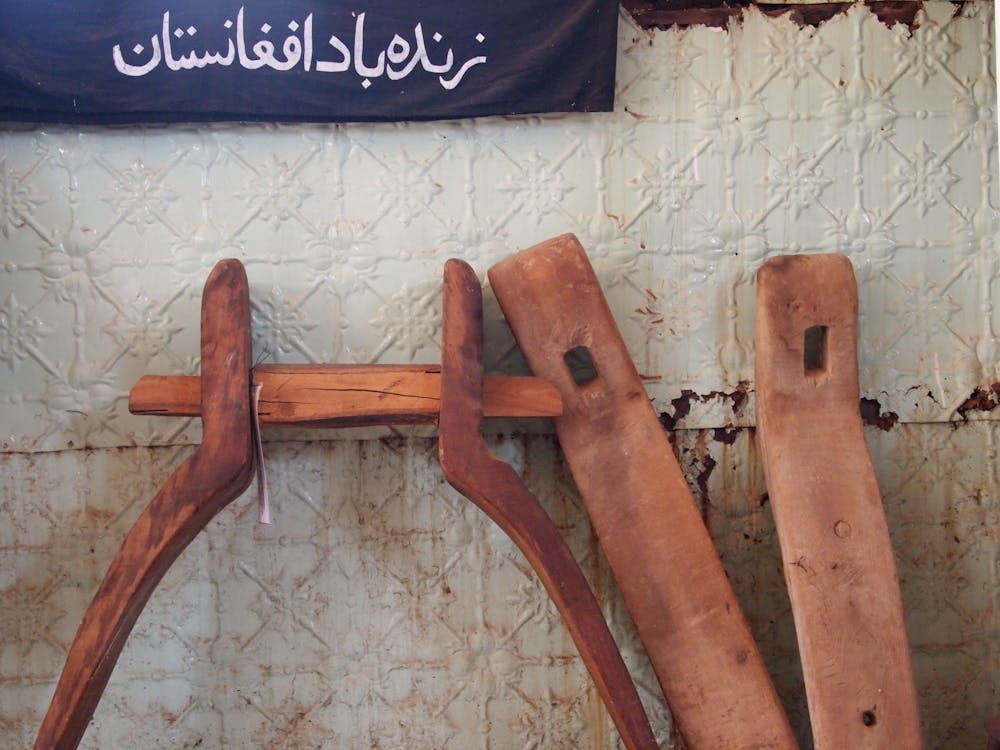
Camel harnesses at the mosque. Samia Khatun

From the 1860s, camel lines became central to transportation in Australian desert interiors, colonising many of the long-distance Indigenous trade routes that crisscross Aboriginal land. The animals arrived from British Indian ports accompanied by South Asian camel owners and drivers, who came to be known by the umbrella term of “Afghans” in settler nomenclature.

The so-called Afghans were so ubiquitous through Australian deserts that when the two ends of the transcontinental north-south railway met in Central Australia in 1929, settlers rejoiced in the arrival of the “Afghan Express”. Camels remained central to interior transportation until they were replaced by motor transportation from the 1920s. Today the transcontinental railway is still known as “the Ghan”.

As a circuitry of camel tracks interlocking with shipping lines and railways threaded together Aboriginal lives and families with those of Indian Ocean travellers, people moving through these networks storied their experiences in their own tongues. Foregrounding these fragments in languages other then English, this book tells a history of South Asian diaspora in Australia.

Asking new questions

I start by reading the copy of Kasasol Ambia that remains in Broken Hill, and interpret the many South Asian- and Aboriginal-language stories I encountered during my search for the reader who brought the Bengali book to the Australian interior. Entry points into rich imaginative landscapes, these are stories that ask us to take seriously the epistemologies of people colonised by the British Empire.

My aim is to challenge the suffocating monolingualism of the field of Australian history. In my new book, Australianama, I do not argue for the simple inclusion of non-English-language texts into existing Australian national history books, perhaps with updated or extended captions.

Instead, I show that non-English-language texts render visible historical storytelling strategies and larger architectures of knowledge that we can use to structure accounts of the past. These have the capacity to radically change the routes readers use to imaginatively travel to the past. Stories in colonised tongues can transform the very grounds from which we view the past, present and future.

In July 2009, when I first encountered Kasasol Ambia, the Bengali book long mislabelled as a Quran made front-page news in Broken Hill. With touching enthusiasm, the journalist announced that I would “begin work on a full translation shortly”.

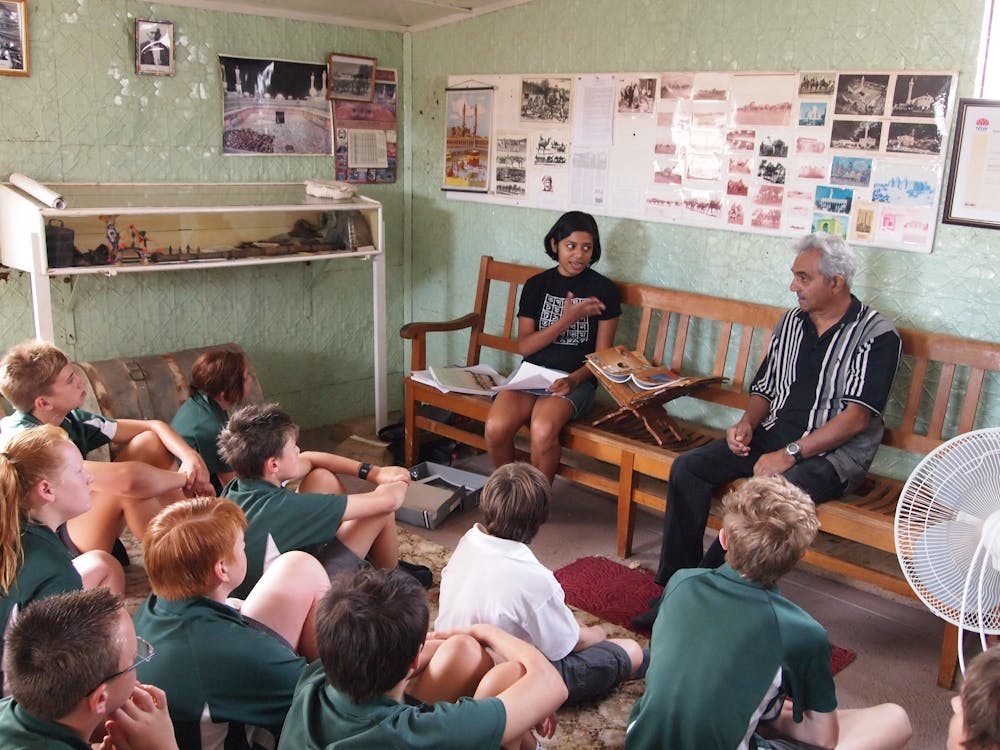
The author talks to local school children in the mosque in 2012 with Bobby Shamroze, a descendant of the original South Asians who worked in the area. Eirini Cox

Overwhelmed by such a task, I began trawling mosque records held by the Broken Hill Historical Society, soon beginning a search through port records, customs documents and government archives. I did not know how to decipher the difficult book, and so in these archival materials I hoped to glimpse, however fleetingly, the skilled 19th-century reader who had once performed its poetry.

Slowly, it dawned on me that I was following the logic that Rezaulla outlines in his schema for translation. For I too had stepped into the imaginative world of the poetry in search of answers to some hard questions: How do we write histories of South Asian diaspora which pay attention to the history books that travelled with them? Who was the unnamed traveller who brought Bengali stories of the prophets to Broken Hill? Can historical storytelling in English do more than simply induct readers into white subjectivities?

Threading together seven narrative motifs that appear in Kasasol Ambia, I began to piece together a history of South Asians in Australia.

This is an edited extract from Australianama by Samia Khatun, UQP, rrp $34.95, out from 6 September.

ref. Friday essay: how a Bengali book in Broken Hill sheds new light on Australian history – http://theconversation.com/friday-essay-how-a-bengali-book-in-broken-hill-sheds-new-light-on-australian-history-121126

Grattan on Friday: Courting ‘quiet Australians’ from ‘bubble central’, it’s been a remarkable first year for Scott Morrison

Source: The Conversation (Au and NZ) – By Michelle Grattan, Professorial Fellow, University of Canberra

Even Scott Morrison, with his abundant self-belief, couldn’t have imagined that on Saturday’s first anniversary of his seizing the prime ministership, he’d be winging his way to France for a G7 meeting, where Australia has observer status for the first time.

A grim brand of luck – the spectacular collapse of two Liberal prime ministers – and a dash of cunning brought Morrison the top job. His own campaigning skills and a hapless Labor performance enabled him to keep it.

In the next three years, it might all go to hell in a handbasket, given an uncertain economy, a fickle electorate and a thin majority. But after 12 months in the position, Morrison looks the strong leader, clearly in charge, with few constraints.

It’s not just the election win. It’s that there isn’t the remotest sign of a trouble-making aspirant or a vengeful wrecker. New party rules protect a Liberal PM. Infighting has subsided. The party is generally satisfied with its leader, in a way it wasn’t with either Tony Abbott or Malcolm Turnbull.

Three months after the “miracle” victory, we’re seeing how the campaigning prime minister has morphed into the governing one, while remaining the campaigner.

To analyse Morrison’s ideology has always been to plunge into a puzzle box. He’s conservative on moral issues, driven by his Pentecostalism. On secular social issues he’s more moderate – some in the welfare sector found him unexpectedly flexible when he was social services minister. On economics, he can be soggy, lacking the true dry’s distaste for government intervention.

Morrison’s Pentacostal faith drives his conservative stance on moral issues. Mick Tsikas/AAP

In the election, it was said Morrison looked like he was running for “mayor of Australia”. It’s an accurate characterisation in part.

The PM who’ll hobnob at the G7 and soon sup at a White House state dinner has his feet firmly planted in the local community centre, his ear tuned to his “quiet Australians”, the people he asserts are alienated because the “Canberra bubble” too often has ignored them.

We only have to observe what he’s done and how he talks. Setting up “Services Australia”. A pledge to bust “congestion” – in traffic, regulations, the bureaucracy. Badgering the public service to improve delivery. Moving to try to stop the export of plastic waste. An inquiry into the NDIS.

He dog-whistles to his “quiet Australians” – not in a racist way, but through deriding the “bubble”, and publicly putting the bureaucrats in their place.


Read more: Against the odds, Scott Morrison wants to be returned as prime minister. But who the bloody hell is he?


Morrison likes the practical; he looks from the ground up. It’s all about Mr and Mrs Average from The Sutherland Shire. Indeed, that’s him and Jenny, although their address is Kirribilli House. After he became PM, Morrison moved very quickly to define himself to the public as one of them. When Sky’s David Speers asked about his image as “the daggy dad with the baseball cap”, Morrison said: “well that’s how it’s described by others, but you’re describing my life … it is who I am”.

Can he maintain the guise of separation from the Canberra elite, given he’s its most powerful member? Monash University political scientist Paul Strangio says “it will take political and image-making dexterity by the prime minister to sustain the idea that he is somehow distinct from that ‘bubble’”.

When asked about his image as ‘the daggy dad’, Morrison said ‘it is who I am’. Mick Tsikas/AAP

There’s been much claimed about Morrison’s lack of an “agenda” beyond the now-legislated tax cuts, but it’s notable that since the election he’s organised “deep dives” into policy areas.

He gets together the minister, public servants and interested or qualified backbenchers. The sessions run from one to four hours; Morrison stays through them. Topics have included recycling, youth suicide, veterans’ mental health, NDIS, water, aged care.

He’s also has reviews and inquiries in train or pending, with one on industrial relations, where he has signalled he’ll proceed cautiously. On the fraught area of religious freedom, still in the works, backbenchers have been extensively consulted, to smooth the path to decisions.

“Relative to his two predecessors, he has a much better idea of what he wants to do – he’s a better long-term planner than [they were]”, says someone familiar with all three of these Liberal PMs.

Former Liberal staffer David Gazard, a close personal friend, describes Morrison as a “pragmatic incrementalist – he will get what he can get in areas he wants to go to”. He’s fortunate that the post-election Senate is set to be easier than the last one.

The questions hang. Is the incrementalist capable of implementing major reforms that the country will need? Will he make a substantial entry in the history book of Australian prime ministers?

Given Morrison’s pragmatism, even his caution, his decision to put Indigenous constitutional recognition on his agenda sits oddly. It is becoming clear that, with his veto of any reference to a “Voice to Parliament” being put in a referendum question, the initiative is likely to fizzle into a disappointing stalemate.


Read more: Grattan on Friday: Morrison can learn a lot from the public servants, but will he listen?


Other issues are unavoidable but intractable. While the internal Liberal wars over climate and energy policy have quieted, the rifts remain. This is a self-imposed “wicked problem” for the Liberals – beyond, it seems, any leader to satisfactorily resolve – and the struggle with energy prices will continue.

Morrison is methodical, always political, perennially in action. “He would be the kind of person you’d expect to have a job list on his desk,” says a minister. “I think he’s conscious of the short time frame of the federal cycle. He’s task-oriented – he wants to get stuff done and move on to the next project”.

One source likens his work style to rugby league’s “playing moves in blocks,” proceeding systematically from thing to another. Another says he picks three or four things to drive, while putting others into “wider orbits”.

Morrison the family man has his nuclear political family. Frontbenchers in his innermost circle are Stuart Robert (Minister for Government Services and the NDIS) and Alex Hawke (Minister for International Development and the Pacific), both his factional mates from way back, as well as Ben Morton (Assistant Minister to the Prime Minister), who travelled on the campaign plane with him.

His chief of staff, John Kunkel, is a close confidant, as is Phil Gaetjens, his incoming departmental head, on whom he’ll lean heavily for advice on turning political objectives into policy outcomes.

Those who work with Morrison stress how focused he is. A close observer describes his responses to problems. “He doesn’t dwell too much on pondering the entrails. He says ‘how do we fix this?’ His temperament is his biggest asset – he’s unflappable. He’s confident in his ability to handle the situation he confronts”.

This confidence reveals at times his arrogant side. That’s always been there (as when, in events before his downfall as head of Tourism Australia, he wrongly thought prime minister John Howard would side with him rather than with the minister, Fran Bailey). The arrogance is more concealed now, but shows when he summarily dismisses awkward questions as of interest only to the “bubble”.

His natural instinct is for command and control, but this operates subtlety in managing his ministers. He gives them rein in their own areas, but tells them not to freelance outside their remit. Their “charter letters” emphasise goals and performance.

He exhorts backbenchers to shut up publicly, but can’t make them, and they’ve been speaking out on subjects from China to superannuation and industrial relations. This is messy but quite different from the destructive sniping of the last term.


Read more: Grattan on Friday: Being a Trump ‘bestie’ comes with its own challenges for Scott Morrison


In looking at Morrison’s positive first year it’s easy to forget how things can turn. Strangio identifies at least three risks: the party’s right could decide to “seize the moment” and make divisive demands; the electorate could, over time, become frustrated with Morrison’s tendency to incrementalism, interpreting it as inertia; or conversely, Morrison might eventually surrender to an impulse to which all prime ministers are prone – to leave some big imprint, and thereby plunge himself into political choppy waters.

There’s a bit of muttering in some Nationals’ quarters about how Morrison has intruded onto their turf. He’s dominated the drought issue, and sees as part of his constituency rural “quiet Australians”. The Nationals did well at the election, but leader Michael McCormack is treated (respectfully) as a pushover. A Nationals source contrasts Morrison with Howard, who let the junior Coalition partner be seen having a few wins.

Morrison has found himself spending a lot of time on foreign policy; with the low-key Marise Payne backward in coming forward, he is effectively his own foreign minister.

Donald Trump has lionised the PM, quite a mixed blessing (and naturally Australia has signed up to the American request to be part of the freedom of navigation mission in the Middle East).

The Pacific Island leaders gave Morrison both barrels over Australia’s climate change policy and coal, when he was wedged between them and domestic politics. Australia’s “Pacific step up” bogged, at least momentarily, in the acrimony of Tuvalu.

Morrison has struck up a bromance with Trump, becoming the first prime minister to score a White House state dinner since John Howard in 2006. Lukas Coch/AAP

Morrison finds himself in office at a time when managing Australia’s relationship with China is becoming increasingly challenging. Indeed, central in his current preoccupations is policy on China, which includes complex responses in resisting that country’s various encroachments on Australian sovereignty. It’s far from being all about trade.

But the most immediate worry is the economy. Will the “global headwinds” turn gale force, requiring more government stimulus, threatening the surplus? With wage growth sluggish and interest rates, already near rock bottom, cut twice since the election, the Reserve Bank prods the government to help with the load.

So far, Morrison and Treasurer Josh Frydenberg are holding back and hoping that the tax package will do enough. The quiet Australians, the people who rode with Morrison’s promises about ensuring good economic management, are watching, quietly.

ref. Grattan on Friday: Courting ‘quiet Australians’ from ‘bubble central’, it’s been a remarkable first year for Scott Morrison – http://theconversation.com/grattan-on-friday-courting-quiet-australians-from-bubble-central-its-been-a-remarkable-first-year-for-scott-morrison-122260

West Papua riots: Why Indonesia needs to answer for its broken promises

ANALYSIS: By Camellia Webb-Gannon of the University of Wollongong

Last weekend, the Indonesian police took 43 West Papuan students into custody for allegedly disrespecting the Indonesian flag during an independence day celebration (an allegation the students deny).

Police stormed the students’ dorm and used teargas to force them out, while bystanders and officers called them “monkeys”, a derogatory term for ethnically Melanesian Papuans.

West Papuans have long been cast by Indonesians as primitive people from the Stone Age, and this racist treatment continues to this day. West Papuan author Filep Karma described the extent of racism against West Papuans in his 2014 book, As If We Are Half-Animal: Indonesia’s Racism in Papua Land, saying he often heard Indonesians call West Papuans monkeys.

READ MORE: Indonesian racism towards West Papuans and the implications for the Free West Papua Movement

This latest episode of discrimination builds on more than five decades of racism, torture, summary executions, land dispossession and cultural denigration of West Papuans by Indonesian security forces.

After the students were detained last weekend, riots erupted in the cities of Manokwari and Jayapura. Thousands of people turned out to protest against the mistreatment of the students and, more broadly, the mistreatment of West Papuans by the Indonesian authorities. Many protesters waved the nationalist Morning Star flag, an act punishable by a 15-year jail sentence (Indonesia is not just sensitive about how West Papuans treat the Indonesian flag – the state prohibits them from flying their own.)

– Partner –

In response to the deteriorating security situation, Indonesia has deployed more troops and police to the region.

Widodo’s promises haven’t changed much
When the politically moderate Indonesian President Joko Widodo came to power in 2014, West Papua observers had high hopes he might broker peace in the region, much the same way the government of his predecessor, Susilo Bambang Yudhoyono, was able to quell a long-running pro-independence conflict in Aceh.

Papuan protesters set fire to the local Parliament building and cars in Manokwari earlier this week. Image: Sofwan Azhari/EPA

However, Widodo has not been capable of controlling the Indonesian military in West Papua. He also doesn’t seem to realise that economic development is not the solution to ending the armed resistance in the region – West Papuan leaders want a political resolution, not an economic one.

Part of Widodo’s development agenda in West Papua has been to commence building a Trans-Papua Highway to facilitate movement of goods and people across the astoundingly rugged terrain in the region.

But in December, West Papuan guerrilla forces attacked Indonesian workers constructing the highway, killing several dozen. There is deep resentment among West Papuans toward Indonesian migrant workers, who they believe are taking their jobs and land and disrupting Papuan life in the region.

Violence by the Indonesian military and police against West Papuans has also increased during Widodo’s presidency. According to the International Coalition for Papua, a human rights organisation, more than 6,400 people were arrested for political activism in 2015 and 2016.

The group has also documented more than 300 victims of torture or maltreatment and 20 victims of extrajudicial killings for those years.

In addition, local journalists continue to face harassment from security forces, while foreign journalists are still denied entry to West Papua. Preventable diseases and malnutrition have also had devastating effects throughout the region.

In 2017, Widodo finally reached out to West Papuans offering dialogue – a process West Papuans had been requesting since at least 2008. However, the leaders of the United Liberation Movement for West Papua (ULMWP) decided it was too little, too late.

A new independence referendum
West Papuans are now calling for a UN-supervised referendum on independence from Indonesia.

In 1969, seven years after Indonesia invaded West Papua, the United Nations oversaw a referendum in which West Papuans were to decide on independence or official integration with Indonesia. Indonesia handpicked less than 1 percent of the Papuan population to vote and threatened them with violence should they make the “wrong” decision.

The result has been a lengthy, often brutal colonial occupation of Papuans and their land.

Independence advocates have the support of at least seven Pacific island nations – as well as a number of MPs in New Zealand – as they pursue the possibility of a new referendum on decolonisation through the United Nations.

Through revived links with global Black Power and Indigenous movements in the Pacific and beyond, as well as the mass connectivity afforded by social media, Papuans are enjoying levels of solidarity from around the world they have never before experienced.

While independence is still unlikely for West Papua, it would be foolish to rule it out. Timor-Leste, South Sudan and Kosovo have shown us that right to self-determination is one that is still honoured, even if infrequently.

Why does West Papua matter?
Why should the world care about this little-known decolonisation movement?

The answer is simple: In the post-Rwandan genocide world, the international community has committed to a moral and political “responsibility to protect” people whose states are unable or unwilling to ensure them safety, or are perpetrating crimes against them.

The United Nations “responsibility to protect” mandate means that UN members are required, under international law, to protect anybody at risk of

genocide, war crimes, ethnic cleansing and crimes against humanity.

It is time the world lives up to its responsibility to demand that state-sanctioned violence against West Papuans stop, no matter how bad relations with Jakarta become. Ultimately, lives are worth more than politics.The Conversation

Print Friendly, PDF & Email

Article by AsiaPacificReport.nz

Trust Me, I’m An Expert: Why the Hong Kong protesters feel they have nothing to lose

Source: The Conversation (Au and NZ) – By Sunanda Creagh, Head of Digital Storytelling

Last weekend, hundreds of thousands of people again took to the streets in Hong Kong to protest against the government – the 11th straight weekend of demonstrations that began in June over a proposed extradition bill.

But after more than two months of increasingly violent clashes between demonstrators and the police, this protest was peaceful. No tear gas was fired.

China expert Graeme Smith, one of the hosts of The Little Red Podcast, devoted this week’s episode to the Hong Kong protest movement, with his co-host, Louisa Lim, on the ground in Hong Kong talking to people about their perseverance in the face of a potentially severe military crackdown from Beijing.

In this episode of Trust Me, Smith discusses where the protests go from here, whether there’s any chance for dialogue between the two sides, and the impact of the increasingly nationalist vitriol aimed at protesters on social media – and on the streets of Hong Kong.


Read more: Beijing is moving to stamp out the Hong Kong protests – but it may have already lost the city for good


Smith believes the protests aren’t going to stop until Chief Executive Carrie Lam definitively withdraws the contentious extradition bill and launches an inquiry into police violence against the protesters.

And this is unlikely so long as Lam – and her backers in Beijing – continue to stand firm in their positions and refuse to negotiate.

So, no one knows how this might end, Smith says.

A lot of the protesters, especially those in their 20s, feel they basically have nothing to lose and they’re going to dig in for the long haul.

New to podcasts?

Podcasts are often best enjoyed using a podcast app. All iPhones come with the Apple Podcasts app already installed, or you may want to listen and subscribe on another app such as Pocket Casts (click here to listen to Trust Me, I’m An Expert on Pocket Casts).

You can also hear us on Stitcher, Spotify or any of the apps below. Just pick a service from one of those listed below and click on the icon to find Trust Me, I’m An Expert.


Credits:

Recording and editing by Graeme Smith, Justin Bergman and Sunanda Creagh.

Additional audio

Kindergarten by Unkle Ho, from Elefant Traks.

CNN report

BBC report

The Little Red Podcast

Images

AAP/EPA/VIVEK PRAKASH

ref. Trust Me, I’m An Expert: Why the Hong Kong protesters feel they have nothing to lose – http://theconversation.com/trust-me-im-an-expert-why-the-hong-kong-protesters-feel-they-have-nothing-to-lose-122031

We need a national renewables approach, or some states – like NSW – will miss out

Source: The Conversation (Au and NZ) – By Scott Hamilton, Strategic Advisory Panel Member, Australian-German Energy Transition Hub, University of Melbourne

Australia’s primary federal renewable energy target – to have 33 terawatts of renewable energy by 2020 – has essentially been achieved. There is much uncertainty as to what is next.

In the absence of a new national target, the states have been leading the way and driving renewable energy in Australia. Victoria, New South Wales and Queensland between them have invested some A$20 billion into building 11,400 megawatts of generation capacity.

While the states have worked admirably to advance renewable energy – and federal energy policy has long been politically toxic – there is a clear cost to pursuing many fragmented policies instead of a unified vision.

Our research, modelling the effect of state versus national renewable energy targets in the National Energy Market system found there was little difference in the overall cost, but that states without strong renewable targets tended to miss out on investment.

We need national thinking

Most jurisdictions have net zero emissions targets by 2050. States also have ambitious but achievable shorter-term renewable energy targets and programs.

There are plenty of arguments for states pursuing their own renewable energy targets, not least because they can fill the policy vacuum left at the national level.

States are responding to the immediate need to replace retiring power stations and can explore innovation with greater ambition. It makes perfect sense for states to compete to attract jobs and investment.

But Australia’s federal government has a domestic and international obligation to reduce greenhouse gas emissions from fossil fuels. National policies are more efficient, can harness better resources across our diverse geography and maximise returns for the whole system.

What’s more – as many column inches have pointed out – strong federal policy improves investment certainty and reliability, lowering the cost of inevitable infrastructure upgrades. And those upgrades can be better integrated into our existing national electricity system if the building (and money) doesn’t stop at internal borders.

To provide some insight and help move the debate forward, the University of Melbourne, Monash University and the Australian-German Energy Transition Hub have collaborated on research that was presented at an international conference in Denmark earlier this year.

Quantifying the difference

We simulated two scenarios: first, that all states implement polices to achieve their respective renewable energy and net zero emissions targets by 2050.

The second scenario assumed a national target would be used to result in the “same outcome” of 100% renewable energy by 2050.

The model calculates required energy investments with 5-year increments from today to 2050, including considering the existing generation currently operating. The model simultaneously optimises the mix of generation, transmission and storage to minimise the total system cost from 2020 to 2050.

A key difference in results is where and when new generation is built. Under the state-driven approach, unsurprisingly, investment shifts towards states with more ambitious targets.

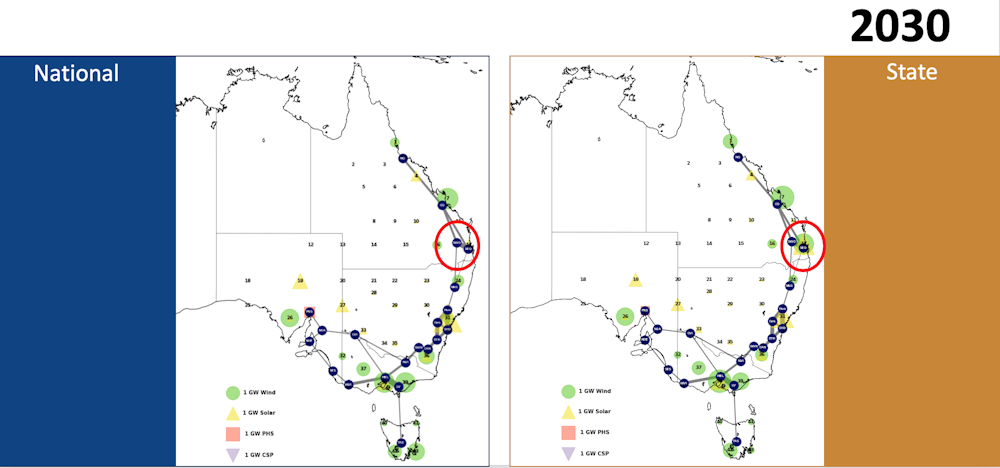
The two figures below show how state-based targets drive more investment into Queensland than would be the case under a national target scheme.

Spatial distribution of renewable generation

Broadly speaking, under a national target, we see more efficient use of renewable energy and associated resources. NSW – with net zero 2050 target but no interim renewable energy target – would get a greater share of the renewable energy investment.

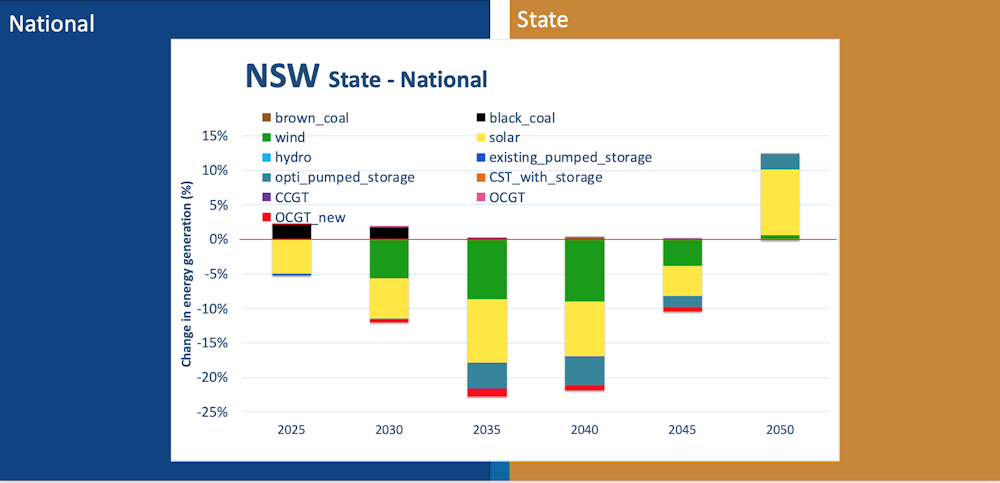
Change in energy generation %

NSW would consistently see substantially more investment under a national target scheme. This would be around 20% more generation in the 2030s in NSW, and up to 20 terawatt-hours more energy generated in the years 2030 to 2045.

The rollout of “where and when” to build new renewable and other generation to replace ageing fossil fuel power plants also impacts heavily on the sequencing and timing for major transmission upgrades across the NEM – especially interconnectors between states.

Transmission networks modelled.

The graph shows that under a state target based approach we build more transmission infrastructure earlier than under a national approach. Under a national target approach, we would end up building more transmission infrastructure – albeit later.

Again, broadly speaking, we would build more generation at renewable energy resource-rich areas such as NSW which happen to be near major demand centres like cities. This would delay the need for some infrastructure spend.

What about system reliability and energy costs?

The good news is it appears under either a state-based or a national target approach the outcome in 2050 is similar. The difference in total system costs is only about 1% higher in the state-based targets scenario – so, virtually nothing.

Evolution of electricity generation – total system.

State-based renewable energy targets lead to redistribution of renewable investments in favour of the states with a mid-term renewable energy target.

In the Australian context, the current state-based renewable energy targets have no impact on undermining power system reliability and virtually negligible impact on pushing up power prices.

Perhaps NSW should take particular note – as it would appear that it would benefit greatly from either a national target approach or an interim state target for itself.

The debate about state versus national approaches to energy policy has been going for the past 30 years and no doubt will be around for another 30. In the meantime, we need a stronger hand on the transition tiller or we will waste precious resources and time, and likely have major unintended consequences.


Read more: Making Australia a renewable energy exporting superpower


ref. We need a national renewables approach, or some states – like NSW – will miss out – http://theconversation.com/we-need-a-national-renewables-approach-or-some-states-like-nsw-will-miss-out-121192

A Hippocratic Oath for data science? We’ll settle for a little more data literacy

Source: The Conversation (Au and NZ) – By Lewis Mitchell, Senior Lecturer in Applied Mathematics, University of Adelaide

I swear by Hypatia, by Lovelace, by Turing, by Fisher (and/or Bayes), and by all the statisticians and data scientists, making them my witnesses, that I will carry out, according to my ability and judgement, this oath and this indenture.

Could this be the first line of a “Hippocratic Oath” for mathematicians and data scientists? Hannah Fry, Associate Professor in the mathematics of cities at University College London, argues that mathematicians and data scientists need such an oath, just like medical doctors who swear to act only in their patients’ best interests.

“In medicine, you learn about ethics from day one. In mathematics, it’s a bolt-on at best. It has to be there from day one and at the forefront of your mind in every step you take,” Fry argued.

But is a tech version of the Hippocratic Oath really required? In medicine, these oaths vary between institutions, and have evolved greatly in the nearly 2,500 years of their history. Indeed, there is some debate around whether the oath remains relevant to practising doctors, particularly as it is the law, rather than a set of ancient Greek principles, by which they must ultimately abide.


Read more: A code of ethics in IT: just lip service or something with bite?


How has data science reached the point at which an ethical pledge is deemed necessary? There are certainly numerous examples of algorithms doing harm – criminal sentencing algorithms, for instance, have been shown to disproportionately recommend that low-income and minority people are sent to jail.

Similar crises have led to proposals for ethical pledges before. In the aftermath of the 2008 global financial crisis, a manifesto by financial engineers Emanuel Derman and Paul Wilmott beseeched economic modellers to swear not to “give the people who use my model false comfort about its accuracy. Instead, I will make explicit its assumptions and oversights.”

Just as prejudices can be learned as a child, the biases of these algorithms are a result of their training. A common feature of these algorithms is the use of black-box (often proprietary) algorithms, many of which are trained using statistically biased data.

In the case of criminal justice, the algorithm’s unjust outcome stems from the fact that historically, minorities are overrepresented in prison populations (most likely as a result of long-held human biases). This bias is therefore replicated and likely exacerbated by the algorithm.

Machine learning algorithms are trained on data, and can only be expected to produce predictions that are limited to those data. Bias in, bias out.

Promises, promises

Would taking an ethical pledge have helped the designers of these algorithms? Perhaps, but greater awareness of statistical biases might have been enough. Issues of unbiased representation in sampling have long been a cornerstone of statistics, and training in these topics may have led the designers to step back and question the validity of their predictions.

Fry herself has commented on this issue in the past, saying it’s necessary for people to be “paying attention to how biases you have in data can end up feeding through to the analyses you’re doing”.

But while issues of unbiased representation are not new in statistics, the growing use of high-powered algorithms in contentious areas make “data literacy” more relevant than ever.

Part of the issue is the ease with which machine learning algorithms can be applied, making data literacy no longer particular to mathematical and computer scientists, but to the public at large. Widespread basic statistical and data literacy would aid awareness of the issues with statistical biases, and are a first step towards guarding against inappropriate use of algorithms.


Read more: Algorithms are everywhere but what will it take for us to trust them?


Nobody is perfect, and while improved data literacy will help, unintended biases can still be overlooked. Algorithms might also have errors. One easy (to describe) way to guard against such issues is to make them publicly available. Such open source code can allow joint responsibility for bias and error checking.

Efforts of this sort are beginning to emerge, for example the Web Transparency and Accountability Project at Princeton University. Of course, many proprietary algorithms are commercial in confidence, which makes transparency difficult. Regulatory frameworks are hence likely to become important and necessary in this area. But a precondition is for practitioners, politicians, lawyers, and others to understand the issues around the widespread applicability of models, and their inherent statistical biases.

Ethics is undoubtedly important, and in a perfect world would form part of any education. But university degrees are finite. We argue that data and statistical literacy is an even more pressing concern, and could help guard against the appearance of more “unethical algorithms” in the future.

ref. A Hippocratic Oath for data science? We’ll settle for a little more data literacy – http://theconversation.com/a-hippocratic-oath-for-data-science-well-settle-for-a-little-more-data-literacy-122200

Australia’s latest military commitment should spark assessment of how well we use our defence forces

Source: The Conversation (Au and NZ) – By John Blaxland, Professor, Strategic and Defence Studies Centre, Australian National University

Just when we thought Australia was getting serious about shifting priorities away from the Middle East to its own neighbourhood, the prime minister has announced another Middle East step up. Australia has committed a warship, surveillance aircraft and defence personnel to help keep the Strait of Hormuz open for shipping.


Read more: Infographic: what is the conflict between the US and Iran about and how is Australia now involved?


So what is going on?

As it happens, the commitment to the Middle East is essentially a rebadging of a routine commitment of Australian Defence Force (ADF) assets. Australia has about 2,250 military personnel deployed on operations. These include:

  • Operations Accordion and Manitou in the Middle East (740 people)
  • Operation Aslan in support of UN peacekeeping in Sudan (25)
  • Operation Mazurka established in Egypt after the signing of the Egypt-Israel peace accord (27)
  • Operation Okra in support of counter-ISIL operations in and around Iraq (450)
  • Operation Paladin, with small contingents on rotation for over 70 years with the UN Truce Supervision Organisation in Israel/Lebanon (12)
  • Operation Augury, providing training and related support for the armed forces in the Philippines after the siege of Marawi in Mindanao (100)
  • Operation Resolute, involving border protection-related tasks (600).

Australia has a defence force of about 60,000 full-time uniformed personnel and 25,000 in the reserves. So this commitment of about 2,250 personnel is sustainable, for now, as long as security challenges closer to home don’t rapidly escalate.

This also means the operational tempo of border protection or any of the other ongoing operations is not expected to decrease as a result of this commitment. Some of these elements, notably Operation Manitou, will perform more than one role.

Operation Manitou is the Royal Australian Navy commitment of one warship to the Combined Maritime Forces (with 32 participant nations) that operate in and around the Persian Gulf. Australian warships have been doing this on rotation for the best part of 30 years.

Similarly, the Royal Australian Air Force P8 Poseidon surveillance aircraft have been operating intermittently out of the Persian Gulf for years. The extra defence planning personnel announced likely will be drawn from a pool already assigned to support Australian operations, notably attached to US military headquarters semi-permanently based in and around the Gulf.

So why make all the fuss with the announcement?

It appears pressure from the United States as well as Britain has convinced the government of the importance of making a contribution.

To be fair, it is not a token contribution. The warship and P8 are capable platforms that have made a tangible difference in the past in countering piracy, smuggling and related security concerns in the Persian Gulf. And, as the prime minister reminded us, the Gulf is the source of much of Australia’s oil.

So, while not a token contribution in one sense, it is not a significantly onerous addition to what Australia has been contributing there for a long time.

However, in international diplomacy, words matter, and small contributions can have significant effects. No doubt, Australian policymakers were mindful of making a contribution that would satisfy the US after declining Secretary of State Mike Pompeo’s suggestion to base intermediate-range and potentially nuclear-armed ballistic missiles in Australia.

While Australia can sustain this new commitment without a significant surge, there is growing recognition that committing forces to operations in the Middle East detracts from the ability of the ADF to focus on high-priority areas closer to home.

The 2016 Defence White Paper referred to three strategic defence interests. These are: a secure and resilient Australia; a secure nearer region (including the Pacific and Southeast Asia) and a stable Indo-Pacific region; and a rules-based global order.

But China’s increasing illiberalism and regional assertiveness across Southeast Asia and into the South Pacific have generated considerable unease over spreading ourselves too thinly.


Read more: As Australia’s soft power in the Pacific fades, China’s voice gets louder


Consequently, a consensus is growing among security and defence experts that we need to double down on our investment in defence and security capabilities.

Reports along similar lines have been published recently by the United States Studies Centre and my own Strategic and Defence Studies Centre, among others.

My colleague Brendan Taylor warns of the volatility of the four flashpoints in Asia: the Korean Peninsula, the East China Sea, Taiwan and the South China Sea. That was before the Hong Kong protests and the news of militarised ports in Cambodia.

Another colleague, Hugh White, has called for spending up to 3.5% of GDP on defence to boost the air and naval forces.

Senator Jim Molan has argued for a fresh national security strategy.

My own geostrategic SWOT analysis for Australia points to the need for a more holistic consideration of issues related to looming environmental catastrophe (affecting biodiversity and societal sustainability), a spectrum of governance challenges (such as cyberterrorism and organised crime) and great power contestation.

That paper calls for, among other things, a national institute for net assessment to weigh up how best to respond.

In essence, the prime minister has deftly handled the call for a commitment in solidarity with the United States. But the Strait of Hormuz issue is only one of many looming security challenges. Its emergence at the top of the news pile points to the need for a significant and far-reaching re-examination of our defence and security posture and priorities.

ref. Australia’s latest military commitment should spark assessment of how well we use our defence forces – http://theconversation.com/australias-latest-military-commitment-should-spark-assessment-of-how-well-we-use-our-defence-forces-122207

Australia bans video games for things you’d see in movies. But gamers can access them anyway

Source: The Conversation (Au and NZ) – By Brendan Keogh, ARC DECRA Fellow, Queensland University of Technology

In the last three months, the Australian Classification Board has “refused classification” for at least four video games – effectively banning them in Australia.

The latest is zombie-survival shooter DayZ. Despite being previously available on digital storefronts with an MA15+ rating, it was banned when its developers tried to get a retail version of the game classified.

The reason: players could use marijuana within the game.

The Australian Classification Board’s willingness to ban games can be traced back to a time before there was an R18+ classification in place. But did that hard won rating change the way videogames are treated?

The 2019 tally

Since its ban, DayZ’s developer has modified the game globally to remove depictions of marijuana, and the game has been re-classified MA15+.

Hotline Miami is a hyperviolent-yet-cartoony action game. Its sequel, Hotline Miami 2, was banned in Australia when it was released in 2015 due to an implied sexual assault scene. This week, a planned re-release bundle of the two games for Nintendo’s Switch platform was banned for the same reason.

Survival-horror game We Happy Few was banned in Australia last year due to the centrality of drug use to the game’s themes and mechanics. The Classification Review Board eventually overturned this decision, re-classifying the game to R18+. Now, the game has been banned again, for the same reason, after the release of a new expansion of the game required the classification process to be undertaken again.

An unannounced title from Grand Theft Auto developer Rockstar Games has also been refused classification.

The 2019 bans have reignited concern among Australian video game players about the country’s guidelines for classifying video games, which seem out of step with what is considered acceptable for film and television.

The game so far

Australia has a long history of banning video games that are readily available elsewhere.

Until 2013, Australia was one of the few countries with no R18+ video game rating, the highest possible rating being MA15+. This meant any video game released would be available to 15-year-olds, or to no one at all.

In 2001, Rockstar’s blockbuster Grand Theft Auto III was available for many months with an MA15+ rating, while in most other countries, it was only available to people over 18. After a media outcry over the in-game ability to sleep with sex workers and be violent towards them, the then-named Office of Film and Literature Classification banned Grand Theft Auto III entirely, since no R18+ rating was available.

Fantasy comes to life in the popular Grand Theft Auto franchise.

Over the next decade, Australia banned a number of high-profile international blockbusters available to adults overseas. These included Manhunt, Fallout 3, and Left 4 Dead 2. Some of these games were revised to be re-classified; others remain (technically) unavailable in Australia.

Throughout the 2000s, video game consumer and industry advocates fought to have this system overhauled. South Australian Attorney General Michael Atkinson refused to join other states supporting changes to classification. A political party was set up by video game advocates to directly challenge Atkinson’s seat in the hope to secure the unanimous support needed.

Eventually, in 2013, video games got their R18+ rating, ostensibly bringing classification in line with film and television. However, much ground had been conceded by video game advocates.

The campaign for an R18+ classification for video games began with the argument that the majority of adults in Australia play video games and that they had the right to access appropriate content. When that reasoning gained little political traction, campaigners adopted the moral-panic language of their opposition.

If there continued to be no R18+ rating, the argument went, then games that should only be available to adults would be mistakenly rated MA15+, as happened with Grand Theft Auto III. The argument moved from providing freedom to adults to play, towards protecting children. The government listened.

Soldier of fortune: adult gamers argue they should be allowed access to adult content. www.shutterstock.com

The resultant R18+ rating did not so much create a new category for adult video games but instead simply shuffled the old MA15+ standards up to the R18+ rating.

Do bans work?

The R18+ rating we got for videogames explicitly bans drug use that is “related to incentives or rewards”. Explicit and realistic depictions of sexual activity and violence with a “very high degree of impact” are not permitted.

Banned game Manhunt by Rockstar Games. Rockstar Games

This classification system has not brought video game classification in line with modern Australian society. Depictions of sex and drugs that would be acceptable for film or television are banned from video games. Old-fashioned and disproven anxieties around interactivity and violence persist.

Although a recent study of 1,210 Australian households by the Interactive Games and Entertainment Association found over two-thirds of Australians play video games and the average age of video game players in the country is 34-years-old, the Australian government still treats video games as a child-centric medium.

Further, digital distribution means a game banned in Australia is less likely to prevent people accessing that game than in the past. American or European versions of the same digital storefronts make the banned games readily available.

Ultimately, the introduction of an R18+ rating into the Australian classification system has not changed what video games are banned, nor has it convinced naysayers of their validity. Dan Golding preempted this in his 2012 critique of the classification debate as a “pyrrhic victory”:

Far from being a victory for widespread acceptance of video games as an artistic and mature creative medium, we have reinforced their appearance as a barbarous medium […] that must be legally withheld from young eyes.

Campaigners relaxed, their battle for an R18+ rating finally won. But as the past few months have shown, very little has changed in terms of how the Australian government treats and understands the cultural relevance of video games.

ref. Australia bans video games for things you’d see in movies. But gamers can access them anyway – http://theconversation.com/australia-bans-video-games-for-things-youd-see-in-movies-but-gamers-can-access-them-anyway-122183

Victorian changes to gender on birth certificate will not increase sexual violence. Here’s why

Source: The Conversation (Au and NZ) – By Bianca Fileborn, Lecturer in Criminology, University of Melbourne

The Victorian government is considering changes to the Births, Deaths and Marriages Registration Act 1996. The changes will mean transgender and gender diverse (TGD) people can change the sex recorded on their birth certificate without having to undergo medical or surgical intervention.

Other Australian and international jurisdictions have recognised the value of this kind of reform. Earlier this year, Tasmania passed laws similar to the ones being considered in Victoria. The Australian Capital Territory, Northern Territory, South Australia and Western Australia have also removed the requirement for surgical intervention.


Read more: Explainer: why removing sex from birth certificates matters to gender diverse people


There is no evidence that these changes have had negative effects in any of these jurisdictions. Despite this, these legislative amendments have prompted fierce debate.

Why are these changes necessary?

A person’s access to legal documentation that accurately reflects their identity should not depend on first having to undergo body modification procedures. In some cases, these may be unwanted and may also cause unwanted effects such as sterilisation, given that “sex affirmation surgery” requires modifying reproductive organs.

TGD people also have diverse needs: some need or want to use surgery to help affirm their identity, others do not. Moreover, surgery is expensive, tightly regulated by medical practitioners, and often inaccessible for many TGD people.

It is unfair and discriminatory for appropriate legal documentation to be offered only to those who want and/or are able to access these surgeries for financial, social or other reasons.

Should this reform pass, it will represent part of a broader shift towards removing discriminatory recognition barriers for TGD people.

Do these changes conflate sex and gender?

Critics have claimed changes like the ones proposed collapse sex with gender. “Sex” is generally a term used to refer to a range of biological markers and is often understood in terms of “male” versus “female”.

However, contrary to popular belief, biological sex is much more complex than these two binary categories. Determining “sex” is highly debated and may be based on a range of factors, including chromosomes, sexual organs, secondary sex characteristics, and hormone levels.

Gender is generally used to refer to the social and cultural interpretations of “sex”, as well as an individual’s identification with such categories. It is also more complex than the often presumed binary of “man” versus “woman”.

The relationship(s) between sex and gender are deeply contested. Despite a common assumption that sex and gender are the same thing, historically feminists have articulated the need for a distinction between sex as biology and gender as cultural.

Crucially, “sex” as it is recorded on birth certificates operates as a social marker of gender (as identity), not simply as a marker of biology.


Read more: What’s the point of sex? It frames gender expression and identity – or does it?


For TGD people, a perceived discrepancy between the “sex” recorded on their official documents and their stated gender identity can “out” someone as transgender or gender diverse. This can lead to extra scrutiny, surveillance and stigmatisation and can be used to deny access to government and other services.

For this reason, “sex” as it is recorded on birth certificates and other legal documents is best thought of as a legal gender marker. As some have argued, it may be better to remove “sex” from birth certificates altogether, to avoid any concerns over conflation of biology with identity.

This is a debate for another time. For now, it is imperative that TGD people are offered an even playing field when it comes to accessing appropriate legal documentation.

Will these changes increase the risk of sexual violence?

Another critique that has been raised is that this kind of reform leads to increased sexual offending against cisgender women, particularly in public toilets and other “sex”-segregated spaces (again here, “sex” is often deployed in ways that conflate biology with gender identity).

This critique has several strands: that male offenders will change their legally documented sex to access women’s spaces; and/or that women will be less able to challenge men who access women’s spaces.

Sexual violence is extremely common, with an estimated one in five women experiencing it in their lifetimes. Any potential risk to women’s safety should, of course, be taken very seriously.


Read more: Marriage equality was momentous, but there is still much to do to progress LGBTI+ rights in Australia


However, we need to critically interrogate these claims. First, is it possible that sexual offenders could use the reforms in these ways? And, second, how likely is this?

The answer to the first question is “yes” – we can never rule out the remote possibility that someone could take advantage of the reforms in this way. However, possibility alone is not sufficient grounds for good policy.

Rather, we need to focus on the relative likelihood of this occurring. To answer this, we turn to the research on what we know about sexual offending.

Survivors overwhelmingly experience sexual violence in the context of interpersonal relationships. And the majority of this violence takes place in private locations. Perpetrators are most often someone known to the survivor, such as a current or former partner, friend, family member or acquaintance.

In contrast, the critiques raised above are based on the misconception that sexual violence is only perpetrated by a stranger in public spaces. This reinforces damaging and narrow understandings of what “real” sexual violence is, and of where women (and other survivors) face the most risk.

This critique also assumes “sex”-segregated spaces are currently safe or protective ones for women. However, sexual violence has been documented in public toilets.

These (relatively rare) cases suggest that perpetrators already access these spaces to offend. The cases documented in research and media reporting also suggest it is the isolated nature of these sites that facilitates perpetration.

Such instances have nothing to do with what “sex” is officially recorded on someone’s legal documents. Ultimately, good policy should be founded on research-based evidence, not on remote or unlikely “what ifs”.

TGD people are at higher risk of violence

Also missing in this debate is acknowledgement of the extent to which TGD people experience disproportionate rates of sexual (and other) violence, including within interpersonal relationships and in public spaces.

While we lack a robust evidence base on sexual violence experienced by LGBTQ+ communities in general, the best available evidence indicates that these communities experience this violence at rates similar to, if not higher than, cisgender heterosexual women. Transgender women experience particularly high rates of sexual violence.

There is no evidence that TGD people pose a greater risk of perpetration than cisgender men or women.

Toilets (and similar sex/gender-segregated spaces) have also been identified as heightened spaces of violence, abuse and harassment for TGD people, particularly transgender women. For example, in research by one of the authors, one participant discussed how her trans partner often experienced sexual and physical violence from cisgender men who believed they were using the “wrong” toilet.

Other research has shown how the strict regulation of space through binary understandings of “sex” results in harassment, abuse and violence against people who do not present their gender in a normative way, regardless of whether they identify as cis, trans, or otherwise.

In other words, “sex”-segregated spaces are themselves often sites of victimisation, particularly but not exclusively for TGD people.

These reforms are important and should go ahead

All of this suggests that concerns raised in relation to the proposed reforms are largely based on misplaced understandings of sexual offending, while ignoring the extent to which TGD people already experience violence. This is also concerning given that the strict policing of binary and narrow understandings of both sex and gender contribute towards sexual violence.

These reforms will not only affirm TGD people’s identities and remove barriers to navigating their daily lives more safely, but also help to make gender categories in general less strictly defined.

They will contribute to the broader feminist project of dismantling the oppressive patriarchal system that reduces gender to a narrow and limiting binary. In disrupting these norms, we all have the potential to benefit.

Anyone needing support can contact 1800 RESPECT or Qlife: https://qlife.org.au/

ref. Victorian changes to gender on birth certificate will not increase sexual violence. Here’s why – http://theconversation.com/victorian-changes-to-gender-on-birth-certificate-will-not-increase-sexual-violence-heres-why-122125

Why full-fat milk is now OK if you’re healthy, but reduced-fat dairy is still best if you’re not

Source: The Conversation (Au and NZ) – By Clare Collins, Professor in Nutrition and Dietetics, University of Newcastle

The Heart Foundation now recommends full-fat milk, cheese and yoghurt or reduced-fat options as part of its updated dietary advice released yesterday.

This moves away from earlier advice that recommended only reduced-fat dairy when it comes to heart health.

So, what’s behind the latest change? And what does this mean for people with high blood pressure or existing heart disease?


Read more: According to TV, heart attack victims are rich, white men who clutch their hearts and collapse. Here’s why that’s a worry


What’s new if you’re healthy?

For healthy Australians, the Heart Foundation now recommends unflavoured full-fat milk, yoghurt and cheese, as well as the reduced-fat options previously recommended.

The change comes after reviewing research from systematic reviews and meta-analyses published since 2009. These pooled results come from mostly long-term observational studies.

This is where researchers assess people’s dietary patterns and follow them for many years to look at health differences between people who eat and drink a lot of dairy products and those who consume small amounts.

Researchers run these studies because it is not practical or ethical to put people on experimental diets for 20 or more years and wait to see who gets heart disease.


Read more: Are light dairy products better? We asked five experts


So when results of the recent studies were grouped together, the Heart Foundation reported no consistent relationship between full-fat or reduced-fat milk, cheese and yoghurt consumption and the risk of heart disease. The risk was neither increased nor decreased.

Put simply, for people who do not have any risk factors for heart disease, including those in the healthy weight range, choosing reduced-fat or low-fat options for milk, yoghurt and cheese does not confer extra health benefits or risks compared to choosing the higher fat options, as part of a varied healthy eating pattern.


Read more: Health Check: is cheese good for you?


Before you think about having a dairy binge, the review noted the studies on full-fat milk, yoghurt and cheese can’t be extrapolated to butter, cream, ice cream and dairy-based desserts.

This is why the Heart Foundation still doesn’t recommend those other full-fat dairy options, even if you’re currently healthy.

What about people with heart disease?

However, for people with heart disease, high blood pressure or some other conditions, the advice is different.

The review found dairy fat in butter seems to raise LDL or “bad” cholesterol levels more than full-fat milk, cheese and yogurt. And for people with raised LDL cholesterol there is a bigger increase in LDL after consuming fat from dairy products.


Read more: Got high cholesterol? Here are five foods to eat and avoid


So, for people with high blood cholesterol or existing heart disease, the Heart Foundation recommends unflavoured reduced-fat milk, yoghurt and cheese to help lower their total risk of heart disease, which is consistent with previous recommendations.

Unflavoured, reduced-fat versions are lower in total kilojoules than the full-fat options. So, this will also help lower total energy intakes, a key strategy for managing weight.

Reduced-fat yoghurt and other dairy products are still recommended for people with high cholesterol or existing heart disease. from www.shutterstock.com

How does this compare with other advice?

The 2013 National Health and Medical Research Council’s Dietary Guidelines for Australians recommends a variety of healthy foods from the key healthy food groups to achieve a range of measures of good health and well-being, not just heart health.

Based on evidence until 2009, the guidelines generally recommend people aged over two years mostly consume reduced-fat versions of milk, yoghurt, cheese and/or their alternatives, recognising most Australians are overweight or obese.


Read more: Plain, Greek, low-fat? How to choose a healthy yoghurt


This advice still holds for people with heart disease. However, the new Heart Foundation advice for healthy people means less emphasis is now on using reduced-fat versions, in light of more recent evidence.

The Australian Dietary Guidelines have a further recommendation to limit eating and drinking foods containing saturated fat. The guidelines recommend replacing high-fat foods which contain mainly saturated fats such as butter and cream, with foods which contain mainly polyunsaturated and monounsaturated fats such as oils, spreads, avocado, nut butters and nut pastes.

This advice is still consistent with the Heart Foundation recommendations.

Australians eat a lot of ‘junk’ food

The most recent (2011-12) National Nutrition Survey of Australians found over one-third (35%) of what we eat comes from energy-dense, nutrient-poor, discretionary foods, or, junk foods.

Poor dietary patterns are the third largest contributor to Australia’s current burden of disease. Being overweight or obese is the second largest contributor, after smoking.

If Australians followed current dietary guidelines, whether using full- or reduced-fat milk, yoghurt and cheese, the national burden of disease due to heart disease would drop by 62%, stroke by 34% and type 2 diabetes by 41%.

What’s the take home message?

See your GP for a heart health check. If you do not have heart disease and prefer full-fat milk, cheese and yoghurt then choose them, or a mix of full and reduced-fat versions.

If you have heart disease or are trying to manage your weight then choose mostly reduced-fat versions.

Focus on making healthy choices across all food groups. If you need personalised advice, ask your GP to refer you to an accredited practising dietitian.

ref. Why full-fat milk is now OK if you’re healthy, but reduced-fat dairy is still best if you’re not – http://theconversation.com/why-full-fat-milk-is-now-ok-if-youre-healthy-but-reduced-fat-dairy-is-still-best-if-youre-not-122184

What kind of state values a freeway’s heritage above the heritage of our oldest living culture?

Source: The Conversation (Au and NZ) – By Libby Porter, Professor of Urban Planning, Centre for Urban Research, RMIT University

The Victorian government has announced it is seeking heritage listing for parts of the Eastern Freeway in Melbourne. We heard this news on Wednesday as we sat under a grandfather tree in solidarity with Djab Wurrung people whose cultural heritage is being threatened by the same government.

A Major Road Projects Victoria proposal to extend the Western Highway will destroy sacred Djab Wurrung trees and places. They have been protecting these trees for more than a year, but faced eviction – from their own Country – by today’s deadline. All this is happening as the government is conducting treaty negotiations across the state.

What kind of world do we live in when freeways are valued as of greater cultural significance than the practice of the oldest living culture in the world? Threatening to evict Djab Wurrung while proposing heritage status for the Eastern Freeway is a surreal perversion of law, heritage and community value.

These matters raise important questions about how cultural heritage value is determined and by whom. They also attest to the continued power of roads and transport infrastructure in a climate-changing world.

Protest ‘road signs’ at the camp. artwork by Mick Douglas, Author provided

Scorning an ancient cultural heritage

The proposal to expand the Western Highway has been around for decades. The on-Country presence of Djab Wurrung people was sparked when it became clear the new duplicated section between Buangor and Ararat would destroy their sacred trees, which include an important directions tree and birthing site.

This is not merely about protecting individual trees – some of which are up to 800 years old. It’s about the way those trees relate to each other, the landscape, Djab Wurrung people and their law, which have been here for thousands of generations.

Victoria supposedly has a legislative system for protecting this Aboriginal heritage. The government asserts that it has followed the “due process” of this system in relation to the Djab Wurrung trees. The fact that Djab Wurrung Elders and leaders have been protesting on site for the past 15 months raises serious questions about what constitutes “due process”.

Many concerns have been raised about a flawed system. At the very least, it has been exposed as a blunt instrument clearly not sensitive enough to cope with these complexities.

Not only is the government unwilling to negotiate on Country in good faith, Djab Wurrung people are being actively silenced and criminalised. One of the leaders, Zellanach Djab Mara, was recently held on remand for 26 days on a charge of driving without a licence, which his supporters saw as a move to “get him off Country”. A magistrate later said Zellanach’s time in custody was too long for a minor offence.

But Djab Wurrung people will not be silenced. More than 500 people arrived at the camp on Wednesday in solidarity. The campaign has gained international media attention and more than 130,000 people have signed a petition.

Hundreds of supporters gather at Djab Wurrung embassy camp on Wednesday, August 21. Photo by Megan Williams, used with permission, Author provided

Celebrating 50 years of freeway culture

Melbourne’s Eastern Freeway certainly has history, a notorious one. Traversing Wurundjeri Country, its construction caused massive destruction of Wurundjeri places and heritage. It also displaced working-class communities in inner Melbourne, triggering one of Australia’s most significant anti-freeway campaigns.

Tony Birch has written eloquently about the scar the Eastern Freeway created psychologically and geographically. The damage included:

[…] obliteration of a vital section of the river at its confluence with the Merri Creek, a once majestic waterway winding its way into the north across Wurundjeri land.

But these are not the histories the government seeks to honour by heritage-listing the Eastern Freeway. These histories are silenced in favour of bridge design. Just like the concurrent attempt at erasing Djab Wurrung heritage. Listing the Eastern Freeway would assert that the destruction such roads create is something we collectively value as heritage.

Heritage in an upside-down world

Both these decisions expose just how upside-down and perverse our way of collectively cherishing place and heritage has become. And both advance a transport system that continues to encourage high-carbon mobility, despite Victoria’s legislated commitment to achieving net zero emissions by 2050.

A viable and cheaper route for the Western Highway duplication is available, just as a viable alternative to the Eastern Freeway once existed.

Road safety is vital, certainly. But surely it would be better achieved by reducing freight traffic on roads, rather than enabling everyone to drive faster. Freight rail offers an alternative solution to some of the key issues that advocates of the Western Highway project use to justify it.

It is possible to have highway safety and efficient mobility at the same time as protecting sacred places and actual cultural heritage through genuine processes.

Proposing a freeway for heritage listing is a clear statement of a government willing to cherry-pick what counts as heritage. As Djab Wurrung Traditional Owner and former state MP for Northcote Lidia Thorpe asserts:

The protection of high cultural and natural values must be part of any treaty process, rather than brazenly destroying those values while the treaty process is under way.

A way forward

We call on the Victorian government to immediately establish a respectful dialogue with Djab Wurrung people by accepting their invitation to come to Country and talk with Elders and leaders in good faith. To do so the threat of eviction must be immediately withdrawn. As Zellenach said to us while we were at camp, “no one can effectively negotiate while under duress”.

If the Victorian government is serious about Treaty, this is the opportunity to demonstrate understanding of what respectful recognition of Indigenous sovereignty looks like.

The world is watching.

Sign at the Djab Wurrung embassy. Photo by Blanche Verlie, Author provided

Marianne (Ria) Jago at the Victorian Women’s Legal Service is a collaborator on this article.

We wrote this article on Djab Wurrung Country at the invitation of Djab Wurrung people to help protect their Country. We pay respects to Djab Wurrung Elders past, present and emerging and the sovereign Aboriginal peoples on whose lands we each live and work.

ref. What kind of state values a freeway’s heritage above the heritage of our oldest living culture? – http://theconversation.com/what-kind-of-state-values-a-freeways-heritage-above-the-heritage-of-our-oldest-living-culture-122195

Tim Fischer – a man of courage and loyalty – dies from cancer

Source: The Conversation (Au and NZ) – By Michelle Grattan, Professorial Fellow, University of Canberra

Former deputy prime minister Tim Fischer, who has died aged 73 of cancer, leaves a political and personal legacy as a man of courage, conviction and congeniality.

The support that Fischer as National Party leader gave was crucial in John Howard’s success in achieving his ground-breaking gun control measure after the 1996 Port Arthur massacre.

While the issue tested Howard, for Fischer it was extraordinarily tough. Howard recalls: “He never tried to talk me out of it but he made it plain how difficult it was going to be in certain parts of the bush”.

Fischer remained resolute despite the fury of many among his party’s base, where hostility lingered for years.

When Fischer became leader in 1990, with the Coalition in opposition, quite a few observers doubted the party’s choice. (They included this writer; Fischer delighted in recalling that misjudgement.)

He defied the sceptics, managing his party and the Coalition relationship to the benefit of each, despite the challenges, which included not just gun control but the Wik issue, constant sniping from the Queensland part of the party, leadership rumblings, and the electoral threat posed by One Nation.

“The boy from Boree Creek” was born in the Riverina, and educated at Boree Creek Public School and then at Xavier College in Melbourne. He was conscripted in 1966 – subsequently saying his birthday being selected in the ballot proved a “great door opener” – and he served in Vietnam.

His long parliamentary career spanned state and federal politics. In 1971 he entered the NSW parliament; in 1984 he won the federal seat of Farrer.

Grahame Morris (who became Howard’s chief of staff) remembers as a young country reporter covering Fischer’s appearance at a hall in the town of Grong Grong, in his first state campaign. The speech seemed to take forever, because Fischer had a dreadful stutter – which in later years he managed to control, although it left him with an unusual speech pattern.

“That a fellow [who started] with a pronounced stutter became deputy prime minister and an effective communicator is remarkable,” says Morris, a friend of Fischer over decades.

Cabinet colleague Peter Reith said once, “You don’t so much listen to what Tim has to say as imbibe it”.

In the Howard government Fischer was trade minister, a powerful economic bastion for the National party in those days. But his time in office was limited. He stepped down from his party’s leadership (and the ministry) in 1999, largely driven by family factors – Harrison, one of his two young sons, was autistic.

When he went to tell Howard of his decision, the PM tried to talk him out of it. Fischer, feeling he was losing the argument, played his winning card – revealing he had already told a journalist on a VIP flight from New Zealand earlier in the day. He left parliament in 2001.

The citation when Charles Sturt University awarded him an honorary doctorate in 2001 captured much about his personality: “Tim’s life has been about dogged adherence to goals. It has also been about risk-taking, grabbing opportunities and perseverance.”

The highlight of a busy post-politics career was serving as Australia’s first resident ambassador to the Holy See, a post to which he was appointed by Labor prime minister Kevin Rudd.

Among a myriad of interests and activities, including writing several books, Fischer’s special passion was trains, which saw him leading tours at home and abroad and, while at the Vatican, organising the Caritas Express, a steam train trip from the Pope’s platform to Orvieto in Umbria .

Last month Fischer was among those aboard a one-off passenger train, raising money for the Albury Wodonga Cancer Centre trust fund, that travelled to tiny Boree Creek, where a park was named for him. “It’s nice to be going home, on a special train,” he said.

ref. Tim Fischer – a man of courage and loyalty – dies from cancer – http://theconversation.com/tim-fischer-a-man-of-courage-and-loyalty-dies-from-cancer-122188

Greenland isn’t Denmark’s to sell: some essential reading for Trump on Colonialism

Source: The Conversation (Au and NZ) – By Felicity Jensz, Research associate professor, University of Münster

Donald Trump is not the first US President to make an offer of buying Greenland from Denmark – but he might be the last.

Home of some 56,000 people and around 80% covered by ice, Greenland is culturally connected to Europe – but physiographically it is a part of the continent of North America.

The USA has purchased from the icy northern territories before. In 1867, they bought Alaska for US$7.2 million from Russia, who established settlements there in the late eighteenth century.

Then (as now) no local Indigenous people were consulted in the transaction.

A long history of American colonialism

The history of settler colonialism in North America includes numerous land purchases, including with Indigenous peoples, such as the 1737 Walking Purchase which tricked the Delaware Indians out of more than double the amount of land than they expected, purchased only for “goods”.

America has successfully purchased land from other European countries, including over two million square kilometres of North America from France in 1803 in the Louisiana Purchase for US$15 million.

This map from 1903 shows the extent of the Louisiana Purchase. Wikimedia Commons

The United States has also purchased Danish colonies before. In 1917, Denmark sold the Danish West Indies (US$25 million) to the United States, which the Americans promptly renamed the United States Virgin Islands. This isn’t even the first time a US president has tried to buy Greenland – President Harry Truman offered to buy it from Denmark in 1946 for $US100 million.

America has also gained territory by force of arms, such as when Spain ceded the Philippines to the USA after the Spanish-American War with the signing of the Treaty of Paris in December 1898. And they have opportunistically annexed territories after they suffered internal political turmoil, such as in the case of the annexation of the Kingdom of Hawaii in 1893 in the years after Queen Liliʻuokalani was overthrown.

Queen Liliʻuokalani, the last monarch of the Kingdom of Hawaii, photographed around 1891. Wikimedia Commons

A Dano-Norwegian colony

Trump believes he can simply purchase Greenland from Denmark. Put bluntly, this is impossible, although the mistake is perhaps an easy one to make for someone with a colonial era mindset and only a passing familiarity with the region.

For the last two centuries, Greenland has predominately been a Danish colony, and, as the example of Alaska demonstrates, colonies were often sold and exchanged by imperial powers. Truman’s offer in 1946 was when Greenland was a Danish colony.

Leaving aside its Viking past, the colonial period for Greenland began in 1721, when the Danish-Norwegian missionary Hans Egede established a mission and began trading near present-day Nuuk, placing Greenland under joint control of the Dano-Norwegian monarchy. At the end of the Napoleonic Wars in 1815, Greenland became a sole colony under Denmark.

It remained a Danish colony until 1953, after a referendum sparked by Danish discomfort with the United Nations’ oversight of the relationship between Denmark and Greenlanders. Greenland was formally incorporated into the Danish Realm as an autonomous territory without consultation with Greenlanders.

The reality was that Greenland was still a colony in all but name.

Striving for recognition

Greenlanders continued striving for political recognition and autonomy from their former colonisers. The Greenland Home Rule Act in 1979 in was a step towards this autonomy, establishing Greenland’s own parliament and further sovereignty.

In 2008, the country hosted a referendum to support or oppose the Greenland Self-Government Act. Passing with 75% of the vote, it declared Greenlanders are a distinct people within the Danish Realm.

Politically, this placed the Greenlandic parliament on an equal basis with the Danish parliament – although this relationship is not always an easy one. Some aspects of Greenland’s politics are still under Danish control, such as foreign policy, security and international agreements.

The Greenlandic and Danish flags flying together. Pixabay, CC BY

But under the current laws, Greenlanders have the right to self-determination, and any agreement to purchase Greenland – no matter who made it – would have to be agreed upon by Greenlanders.

‘Greenland is Greenlandic’

Denmark’s prime minister, Mette Frederiksen, has dismissed Trump’s claims that Denmark essentially owns Greenland, stating that “Greenland is Greenlandic.”

Unlike in the Alaskan purchase of the nineteenth century, the agreement of Greenlanders would be essential for any “large real estate deal” that stripped them of their land and sovereignty.

Kim Kilesen, the Prime Minister of Greenland, has empirically stated that Greenland is not for sale. And if it was, he would be the one to ask – not Denmark.

Greenland is not Denmark’s to sell.

ref. Greenland isn’t Denmark’s to sell: some essential reading for Trump on Colonialism – http://theconversation.com/greenland-isnt-denmarks-to-sell-some-essential-reading-for-trump-on-colonialism-122193

Keith Rankin’s Chart of the Month – Auckland and New Zealand’s Population Dynamics

Auckland Māori exodus after 2014. Chart by Keith Rankin.

Analysis by Keith Rankin.

The 2018 census has had such a low compliance rate, that it really acted as a large convenience sample (therefore a biased sample) of the New Zealand population. (See my Census Survey from March 2018.) Despite the assurances we are getting, many researchers will have little confidence in its population tallies for towns, districts, and cities. Truths about population redistribution within New Zealand remain elusive.

Unbiassed and factual sources of 2014-2017 population trends are the last two general elections, contested under the same electoral boundaries. My chart for October 2017 – Migration within New Zealand: Evidence from the Election – shows that, based on election votes cast, population growth was slower in Auckland (except Auckland’s outer fringe) than in any other region in the country.

The two main points of this month’s chart are the Māori population decline in Auckland, and the big increase in the south (probably mainly in Wellington, which is in Te Tai Tonga). The Wellington influx probably reflects growth of the bureaucracy, rebuilding after a substantial decrease in its numbers after the 2008 election. Māori have probably been disproportionately affected through this bureaucratic population cycle, given the greater emphasis this decade on biculturalism within the government sector.

While this month’s chart looks only at the Māori electorates, and notwithstanding the Wellington issue, this population dynamic serves as a proxy for all second‑to‑fortieth generation New Zealanders. The big story that the demographers seem to have missed is the recent diaspora of both Māori and Pakeha from Auckland. While the 2018 census was well-timed to capture this, the census‑repair‑process may not.

I was prompted to revisit this issue of demographers’ assumptions after having read an interview with Paul Spoonley – Changing Demographics – in the Winter 2019 AA Directions magazine. Spoonley says “this country is entering [my italics] an era of change”. He adds: “The continual growth of Auckland is predicted. It’s expected that within the next two decades, 40% of all New Zealanders will live in the City of Sails”. And “many regions will experience population stagnation”.

The election data clearly show that the population of central and suburban Auckland has decreased relative to the rest of the country. Māori electorate demographics suggest that only about 15 percent of Māori live in Auckland. Further, the combined population of Auckland’s former cities and borough – Auckland, North Shore, Waitakere, Manukau, Papakura – was most likely (in 2018) less than 30 percent of the national total.

As well as an inexorable Aucklandification, Spoonley describes an imminent process of brownification (Pasifika and Asian, rather than Māori). In fact, that process dates back at least to the 1990s. To back up his view that this change is recent, Spoonley says: “Between 2006 and 2013 our population grew by 35,000 from migration, which is considered modest. Between 2013 and 2018, growth was by 270,000”.

Based on data collected from Statistics New Zealand this week, the 2006‑13 increase was 95,742 and the 2013‑18 increase was 328,133. (These are net passenger statistics, the only truly accurate measure of net population inflow.) But if we adjust the years cited and take the nine years 2001‑09, we get a net inflow of 257,694, giving a somewhat different picture of immigration in that 2000s’ decade. From 2010‑18 – the next nine years – we get a net inflow of 290,054.

2000 itself was a grumpy year in New Zealand, when the $NZ fell below $US0.40, and immigration was substantially negative. Looking at the whole period after 2000, New Zealand experienced an annual average immigration‑sourced population increase of 0.8 percent per year. This was equally true in each decade of this century. (Of course, there was variation in individual years, with the biggest source of variability being the movements of New Zealand citizens; especially variation in the trans‑Tasman flows of New Zealanders.)

Auckland’s Māori population diaspora may or may not show in the coming census data, due to be published in September 2019. And the Aucklander exodus may or may not continue. The main cause of the exodus has most likely been people taking advantage of high prices to sell their houses and make windfall gains. While Auckland real estate prices remain very high, they have been falling relative to the rest of the country since 2017. With much new medium‑high‑density housing coming on stream near to transport nodes, I expect Auckland’s growth will resume, in pace with the rest of the country.

How the US right-to-life movement is influencing the abortion debate in Australia

Source: The Conversation (Au and NZ) – By Prudence Flowers, Lecturer in US History, College of Humanities, Arts, and Social Sciences, Flinders University

As the abortion decriminalisation bill gradually makes its way through the NSW parliament, opponents have been increasingly drawing on their long relationship with the right-to-life movement in the United States to lobby against the measure and try to push for more restrictive amendments.

This has been a trend in the anti-abortion movement in Australia for a while now. Activists have adopted some of the most successful elements of the US movement’s rhetoric and tactics in recent years in an effort to influence the debate in Australia.

The Australian public is strongly pro-choice. In a 2018 survey of NSW residents, 73% supported full decriminalisation of abortion. A 2015 poll, also conducted in NSW, indicated that 87% believe a woman should be able to have an abortion, with only 6% opposing abortion in all circumstances.

The Australian right-to-life movement is tiny compared to the US, but their views have an outsized place in the abortion debate because of their vocal political and religious allies.

Less understood is their successful borrowing from the examples and experiences of international right-to-life movements, particularly in the US.

Anti-abortion activists protesting a bill to decriminalise the procedure in Queensland last year. Dan Peled/AAP

Adopting rhetoric and lobbying techniques

American abortion opponents have long positioned themselves as leaders in a global cause. They pursue both a national and international agenda, seeking to sharply limit access to abortion around the world, with the ultimate aim of banning the procedure.

At an international level, they advance this goal via measures such as the “global gag rule”, which prohibits international NGOs that receive American aid from providing advice, counselling, or information about abortion.


Read more: Here’s why there should be no gestational limits for abortion


Australia is a part of this transnational network. Protest groups that target local abortion clinics, such as Helpers of God’s Precious Infants and 40 Days for Life, are chapters of US organisations. And for decades, even groups without direct ties to the US have hosted prominent American opponents of abortion, seeking to learn from their example.

In 2015, Right to Life Australia made the controversial choice to invite prominent anti-abortion activist Troy Newman of Operation Rescue for a national lecture tour. He ultimately had his visa cancelled and was deported, in part because his writings have questioned why abortion doctors are not executed.

There have been some efforts to foster the polarised and divisive US style of abortion politics here, too. Religious historian Marion Maddox says that under Prime Minister John Howard, conservative politicians tried to import the “family values” rhetoric and policies of the US Republican Party on issues like abortion and gay rights.

As decriminalisation efforts have progressed in Australia, these overseas connections have become quite explicit.

After South Australia Greens MP Tammy Franks introduced a decriminalisation bill in that state’s Legislative Council last year, her staffers received verbally abusive phone calls and threats of rape from Canadian abortion opponents. According to her staff, all members of the Legislative Council were then spammed with over 4,000 right-to-life emails, which they suspected came from the US.

Earlier this year, anti-abortion activists from the US, including the chair of 40 Days for Life, also brought their lobbying efforts directly to Adelaide. They met with several MPs to discuss ways they might assist in the fight against a bill to fully decriminalise abortion in the state.

Late termination of pregnancies

The current decriminalisation debates in Australia have included a new focus on specific measures aimed at partial restrictions on abortions – a strategy that has been very successful in many US states.

In recent weeks, several high-profile politicians, including former Prime Minister Tony Abbott and Nationals MP Barnaby Joyce, have erroneously claimed that NSW is making abortion legal up to birth. Liberal MP Peter Dutton and former Liberal candidate Warren Mundine have further suggested that the proposed gestation limit is “too late”.


Read more: After 119 years, NSW is set to decriminalise abortion. Why has reform taken so long?


In reality, the gestation limit in the NSW bill is modelled on legislation passed in Queensland in 2018. It allows abortion up to 22 weeks, and after that with approval from two doctors. This is a lower cut-off than the laws in Victoria and the ACT.

The NSW bill is also more restrictive than the law in comparable Western countries. The gestation limit in Britain is 24 weeks, with access available after that point for reasons of severe foetal anomaly or life-threatening risk to the mother. In the US, Roe v Wade prevents outright bans on abortion before foetal viability (interpreted as 24 to 28 weeks), while Canada has no upper gestation limit.

This focus on “late-term abortions” emerged as a strategy in the US almost three decades ago.

By the early 1990s, American right-to-lifers had failed in their primary goal of overturning Roe v Wade. So, they refocused their energies, seeking first to outlaw a comparatively rare technique they dubbed “partial-birth abortions”. More recently, they have sought to prevent terminations after 20 weeks using the medically contested notion of foetal pain.

Focusing on later terminations allows opponents of abortion to insist that the foetus possesses unique rights and subjectivity that override those of the pregnant person. Further, the gestational point at which an abortion becomes “late” is contested and ever-shifting terrain, allowing for opponents to push for a lower and lower limit.

When discussing these types of terminations, opponents also rely on emotive, inaccurate, and often disturbing language and imagery.

Yet, only 1% to 3% of abortions in Australia occur after 20 weeks, the majority of which are performed for reasons of severe or fatal foetal anomalies.

Sex-selective abortions

In Queensland, South Australia, and NSW, opponents of abortion have also raised the spectre of sex-selective abortions.

This concern also originates from outside Australia. In the 2000s, the US right-to-life movement began framing abortion as a form of discrimination, warning of abortions conducted on the grounds of sex, race, or disability. Eight states subsequently banned sex-selective abortions.

In the 2010s, this approach received further amplification after The Telegraph published a series of articles insisting the practice was rife in the UK and that pro-choice feminists had turned a blind eye to a generation of “lost girls”.


Read more: A concise history of the US abortion debate


In an attempt to appeal to critics in her own party, NSW Premier Gladys Berejiklian has expressed a willingness to ban “gender selection” abortions in NSW, though it appears unlikely the bill’s supporters will agree to an amendment.

Studies in the UK, US, and Australia have found no conclusive evidence that such abortions are occurring.

Rather, these campaigns work to stigmatise and vilify abortion care providers by accusing them of committing gendered acts of violence. And they suggest that medical professionals need to subject certain immigrant communities to more stringent forms of monitoring and surveillance.

Abortion rights supporters demonstrating earlier this year in New York against extreme anti-abortion laws passed in Alabama, Georgia, and Missouri. Justin Lane/EPA

The subtle impact of these tactics

Collectively, these more covert right-to-life strategies have been part of a massive erosion of abortion rights in the United States.

In an Australian context, they work in more subtle ways. They prevent abortion being treated as just another type of health care, one of the explicit goals of the current decriminalisation campaigns.

They require doctors to assess and judge a pregnant person to see if they really want an abortion. And they inject uncertainty and attach further stigma to the work performed by abortion care providers.

Unable to wind back the clock on decriminalisation, Australian activists still insist abortion is a problematic and exceptional procedure. And they are drawing from the US right-to-life movement to shape how it is culturally, medically, and legally understood in Australia.

ref. How the US right-to-life movement is influencing the abortion debate in Australia – http://theconversation.com/how-the-us-right-to-life-movement-is-influencing-the-abortion-debate-in-australia-121974

Should I get my DNA tested? We asked five experts

Source: The Conversation (Au and NZ) – By Alexandra Hansen, Chief of Staff, The Conversation

With the advent of online ancestry DNA testing, and advancements in genetic screening for various medical aliments, we’re able to know more than ever about the genes that make us who we are.

But is there a point to knowing we’re 25% Irish? And is there a point to knowing we could one day be struck down with a disease we’re unable to prevent?

We asked five experts if we should consider a DNA test.

Four out of five experts said yes

Here are their detailed responses:


If you have a “yes or no” health question you’d like posed to Five Experts, email your suggestion to: alexandra.hansen@theconversation.edu.au


None of the authors have any interests or affiliations to declare.

ref. Should I get my DNA tested? We asked five experts – http://theconversation.com/should-i-get-my-dna-tested-we-asked-five-experts-120664

Curious Kids: how was maths discovered? Who made up the numbers and rules?

Source: The Conversation (Au and NZ) – By Linda Galligan, Associate professor, University of Southern Queensland

If you have a question you’d like an expert to answer, send it to curiouskids@theconversation.edu.au.


How was maths discovered? Who made up the numbers and rules? – Bianca, age 12, Strathfield, Sydney.


We are all born with a brain that understands maths. So are animals, to some extent, but perhaps algebra would be a bit difficult for a giraffe – that is a long stretch.

Throughout history, different cultures have discovered the maths needed for tasks like understanding groups and relationships, sharing food, looking at astronomical and seasonal patterns, and more. There are probably forms of mathematics that were understood by people we don’t even know existed.

Many indigenous cultures worked with different time, measurement, and number ideas suited to their needs and had amazing ways of expressing these ideas. But there are some things that are very common, like counting.

There was an explosion of discovery of mathematics in different cultures at different points in time.

The Greeks didn’t really use algebra the way we do now, but they were amazing with geometry. I am sure you have heard of Pythagoras, but do you know of the woman mathematician Hypatia? She was an amazing teacher and writer skilled at making difficult concepts easy to understand.

Unfortunately, she was killed for her ideas.

Not everyone had the number zero

The Romans were great engineers but they had a terrible number system. It didn’t even have zero.

The number system used in ancient India had zero, but it was known by other very old cultures like the Mayans in Central America and the Babylonians (from ancient Iraq). And ancient Arab mathematicians not only knew about zero but also really spread the idea of algebra after the 9th century (the word comes from a text by a famous mathematician called al-Khwarizmi).

People in the Middle Ages in Europe thought fractions were the hardest maths EVER! One 11th century monk reportedly said:

After spending months working hard and studying, I finally grasped this thing called fractions!

And in the 16th century, people thought negative numbers were pretty evil. They had other names for these numbers, like “absurd” or “defective”.


Read more: Curious Kids: Why do we count to 10?


Much of our maths is based on one system called base 10, which works on patterns of one to ten (that probably has its roots in the fact that humans have 10 fingers to count on) Shutterstock

Numbers and patterns have always been there, waiting to be discovered

There are so many number systems! The ones you know were developed over centuries and we are still making up more now. But much of our maths is based on one system called “base 10”, which works on patterns of one to ten (that probably has its roots in the fact that humans have 10 fingers to count on). It’s also called the decimal system.

But there are lots of other systems, like base 2 (also called the binary system), or base 16 (also called the hexadecimal system).

It sounds complicated but they’re just different ways of organising numbers. Numbers have always been there, waiting to be discovered and so were different ways of organising them.

And over time humans in various cultures have noticed patterns that emerge in numbers, and developed mathematical systems around them.

Breaking the rules

There are plenty of other rules in mathematics, but they are based on recognising patterns and wondering if something works that way all the time. Let’s look at these two equations:

3 x 2 = 6

2 x 3 = 6

You’ve probably learned that it doesn’t matter if you multiply three by two or two by three – you always get six, right? That’s a mathematical “rule” called the “commutative law for multiplication” (“commute” means to move around).

But what if there were some maths worlds where that didn’t happen? Well, there is a certain type of maths, called “matrices”, that was discovered in the 19th century, where you get a different answer, depending on which way you multiply.

Why would anyone want to do that? It turns out that this type of maths is really useful in many different areas, including airline travel and engineering.

You may even end up being a famous mathematician that discovers more maths, creates more rules, or makes up some more names.

About 100 years ago, a mathematician called Edward Kasner was trying to think up a name for a huge number: 1 with one hundred zeros after it. He asked his nine-year-old nephew, Milton Sirotta, who suggested “googol”.

So, Bianca, why not think of a name for a new number? Or look around at some shapes and ask yourself what you might name it?


Read more: Curious Kids: who came up with the first letters?


Hello, curious kids! Have you got a question you’d like an expert to answer? Ask an adult to send your question to curiouskids@theconversation.edu.au

ref. Curious Kids: how was maths discovered? Who made up the numbers and rules? – http://theconversation.com/curious-kids-how-was-maths-discovered-who-made-up-the-numbers-and-rules-121509

Access to land is a barrier to simpler, sustainable living. Public housing could offer a way forward

Source: The Conversation (Au and NZ) – By Alex Baumann, Casual Academic, School of Social Sciences & Psychology, Western Sydney University

Many of us do not need to hear any more warnings from the IPCC, David Attenborough or climate activists like Greta Thunberg. We have seen enough to be convinced that limitless economic growth and the globalisation of high-consumption lifestyles have brought our planet’s life-support systems to the brink of collapse.

In response to today’s urgent ecological and social problems, we often hear calls from sustainability advocates about the need to “downshift” away from consumer lifestyles, to practise permaculture and to embrace simpler ways to live. When these movements scale up, the argument goes, we will “degrow” our economies to a sustainable scale.


Read more: Life in a ‘degrowth’ economy, and why you might actually enjoy it


Important though these analyses and perspectives are, they almost always leave something critical out of the conversation. There is a very powerful reason we are currently unable to move toward a simpler and sustainable society: the costs of securing access to land for housing often mean only the relatively affluent can afford such “green lifestyles”.

In response to this problem, we offer some ideas to show how public land could be used for sustainable forms of community-led development.

Creating a place like Sustainable Fawkner’s ‘Dandelion Patch’ depends on access to suitable land. More creative public housing policies could lead the way in developing more community food gardens (for example, see www.ntwonline.weebly.com). Takver/Flickr, CC BY-SA

The property system makes simple living hard

Recognition of the need for system change is growing. But those arguing for high-impact societies to downshift toward cultures of sustainable consumption need to acknowledge a fundamental problem more clearly: simply keeping a roof over our heads can demand an energy-intensive lifestyle and a dependence on market growth.

Why? Having to buy or rent a home in capitalist societies like Australia has huge implications for most of us. It affects what we do for work, how much we work, our need for a car, etc. And, if you can barely afford land or your own home, putting solar panels on the roof, working part-time or growing your own organic food all become very unlikely.

In short, securing the basic need for housing is putting people in more and more debt. This often means any attempt at “dropping out” of market consumerism first involves a whole lot of “dropping in”. The consequences of this reality are anything but simple, local and sustainable.


Read more: The suburbs are the spiritual home of overconsumption. But they also hold the key to a better future


A different type of land and housing opportunity is needed for reasons of sustainability and equity. Central here is the recognition that access to land, just as with air and water, is not a market product. It is a human right and should be recognised as such.

Even discussing land reform in terms of “affordable housing” still frames land as a market commodity. These discussions often rely on notions of charity and welfare to increase access to land when it really should be available as a right.

But in a nation where simply abolishing negative gearing appears to be politically unpalatable, it would be pragmatic, as a first step, to explore less controversial but still effective policy approaches.

Pointers to rethinking how we govern land

There are many conceptions of property, which means we do not simply have to choose between free market capitalism and state socialism. In Singapore, for example, more than 80% of residents live in state-provided housing.

Societies can govern access to land in an infinite variety of ways. Each way distributes or concentrates wealth and power in progressive or regressive ways.


Read more: A century of public housing: lessons from Singapore, where housing is a social, not financial, asset


One policy deserving of attention involves attempting to transcend the “welfare” framing of existing uses of public housing. Already, secure access to public land has empowered some residents to participate in programs such as community food gardens, resources repair/share programs, housing management, maintenance and, in the UK, even housing construction.

Public housing residents in Fitzroy, Melbourne, maintain this community garden. BSL/Cultivating Community

In New South Wales, 50,000 public housing residents have converted many hectares of land in social housing areas into gardens growing vegetables, fruit and flowers. In Victoria, more than 20 public housing estates have established community gardens.

If these self-selecting residents could be better supported and validated, their status in society (and how they might conceive of themselves) could move from being regarded as “social dependants” to “pioneers of a new economy”. By showing that access to public land can help with the emergence of local and sustainable community economies, such experiments could be the cultural driver of a broader policy rethink of how we govern land.

For example, more public land could be made available for housing construction collectives, where people participate in building their own homes under the guidance of experts. Australia could seek inspiration from Senegal, where 14,000 ecovillages are being developed.

In governing land we are limited only by our imaginations. Currently, a chronic lack of imagination is being shown. It is time to experiment with new frameworks that can increase access to land and thereby empower more people to explore lifestyles of reduced consumption and increased self-sufficiency.


Read more: Farming the suburbs – why can’t we grow food wherever we want?


The first step is recognising the obstacle

We call on the simple living, permaculture and degrowth movements – and the sustainability movement more generally – to better recognise the obstacle that access to land presents to achieving their goals. More energy and activism should be dedicated to envisioning, campaigning for and experimenting with alternative property and housing arrangements.

Our purpose is not to dismiss the importance of the various downshifting movements. We need as many people as possible pushing against the tide of consumerism and showing that low-impact living can be good living.

These social movements will help create the culture of sufficiency that is needed to support a politics of sustainability. But any such politics must include more empowering and creative land policies.

ref. Access to land is a barrier to simpler, sustainable living. Public housing could offer a way forward – http://theconversation.com/access-to-land-is-a-barrier-to-simpler-sustainable-living-public-housing-could-offer-a-way-forward-121246

India has it right: nations either aim for the Moon or get left behind in the space economy

Source: The Conversation (Au and NZ) – By Nicholas Borroz, PhD candidate in international business and comparative political economy, University of Auckland

India’s Chandrayaan-2 spacecraft has settled into lunar orbit, ahead of its scheduled Moon landing on September 7. If it succeeds India will join a very select club, now comprising the former Soviet Union, the United States and China.

As with all previous Moon missions, national prestige is a big part of India’s Moon shot. But there are some colder calculations behind it as well. Space is poised to become a much bigger business, and both companies and countries are investing in the technological capability to ensure they reap the earthly rewards.

Last year private investment in space-related technology skyrocketed to US$3.25 billion, according to the London-based Seraphim Capital – a 29% increase on the previous year.

The list of interested governments is also growing. Along with China and India joining the lunar A-list, in the past decade eight countries have founded space agencies – Australia, Mexico, New Zealand, Poland, Portugal, South Africa, Turkey and the United Arab Emirates.

China’s Chang’e 4 spacecraft landed on the far side of the Moon on 11 January 2019. This image taken with the lander’s camera shows the mission’s lunar rover Yutu-2, or Jade Rabbit 2. China National Space Administration/EPA

Of prime interest is carving out a piece of the market for making and launching commercial payloads. As much as we already depend on satellites now, this dependence will only grow.

In 2018 382 objects were launched into space. By 2040 it might easily be double that, with companies like Amazon planning “constellations”, composed of thousands of satellites, to provide telecommunication services.

The satellite business is just a start. The next big prize will be technology for “in-situ resource utilisation” – using materials from space for space operations. One example is extracting water from the Moon (which could also be split to provide oxygen and hydrogen-based rocket fuel). NASA’s administrator, Jim Bridenstine, has suggested Australian agencies and companies could play a key role in this.


Read more: Australia: well placed to join the Moon mining race … or is it?


All up, the potential gains from a slice of the space economy are huge. It is estimated the space economy could grow from about US$350 billion now to more than US$1 trillion (and as possibly as much US$2,700 billion) in 2040.

Launch affordability

At the height of its Apollo program to land on the Moon, NASA got more than 4% of the US federal budget. As NASA gears up to return to the Moon and then go to Mars, its budget share is about 0.5%.

In space money has most definitely become an object. But it’s a constraint that’s spurring innovation and opening up economic opportunities.

NASA pulled the pin on its space shuttle program in 2011 when the expected efficiencies of a resusable launch vehicle failed to pan out. Since then it has bought seats on Russian Soyuz rockets to get its astronauts into space. It is now paying SpaceX, the company founded by electric car king Elon Musk, to deliver space cargo.

SpaceX’s Crew Dragon spacecraft just moments after undocking from the International Space Station on 8 March 2019. NASA/EPA

SpaceX’s stellar trajectory, having entered the business a little more than a decade ago, demonstrates the possibilities for new players.

To get something into orbit using the space shuttle cost about US$54,500 a kilogram. SpaceX says the cost of its Falcon 9 rocket and reuseable Dragon spacecraft is about US$2,700 a kilogram. With costs falling, the space economy is poised to boom.


Read more: How SpaceX lowered costs and reduced barriers to space


Choosing a niche

As the space economy grows, it’s likely different countries will come to occupy different niches. Specialisation will be the key to success, as happens for all industries.

In the hydrocarbon industry, for instance, some countries extract while others process. In the computer industry, some countries design while others manufacture. There will be similar niches in space. Governments’ policies will play a big part in determining which nation fills which niche.

There are three ways to think about niches.

First, function. A country could focus on space mining, for instance, or space observation. It could act as a space communication hub, or specialise in developing space-based weapons.

Luxembourg is an example of functional specialisation. Despite its small size, it punches above its weight in the satellite industry. Another example is Russia, which for now has the monopoly on transporting astronauts to the International Space Station.

Russian cosmonaut Alexey Ovchinin flanked by NASA astronauts Christina Koch and Nick Hague at the Gagarin Cosmonaut Training Center in Star City, Russia, as they prepare for their launch aboard the Soyuz MS-12 in March 2019. Sergei Ilnitsky/EPA

Second, value-adding. A national economy can focus on lower or higher value-add processes. In telecommunications, for example, much of the design work is done in the United States, while much of the manufacturing happens in China. Both roles have benefits and drawbacks.

Third, blocs. Global production networks sometimes fragment. One can already see the potential for this happening between the United States and China. If it occurs, other countries must either align with one bloc or remain neutral.

Aligning with a large power ensures patronage, but also dependence. Being between blocs has its risks, but also provides opportunities to gain from each bloc and act as an intermediary.


Read more: The economic reasons why Australia needs a stronger space industry


The first space race, between the Soviet Union and the United States, was singularly driven by political will and government policy. The new space race is more complex, with private players taking the lead in many ways, but government priorities and policy are still crucial. They will determine which countries reach the heights, and which get left behind.

ref. India has it right: nations either aim for the Moon or get left behind in the space economy – http://theconversation.com/india-has-it-right-nations-either-aim-for-the-moon-or-get-left-behind-in-the-space-economy-121497

Journalists, media unite against ‘unacceptable’ Choi sacking

By Michael Andrew

Journalists across Papua New Guinea have spoken out in support of EMTV news director Neville Choi after his “unacceptable” termination from a role he had held for six years.

A public statement released on Monday listed the reasons for his termination, one of which was his refusal to bury a February 2019 story about the PNG Defence Force pay strike outside the Prime Minister’s office.

However, EMTV deputy head of news Scott Waide told Pacific Media Watch they broadcast the news because it was balanced and the fallout had already been resolved internally.

READ MORE: EMTV staff protest over sacking of ‘flawless’ news manager Neville Choi

“Neville did his job as head of news and a journalist. He took both sides of the story and we ran it on EMTV news,” said Waide.

“There was nothing conflicting about the story but the fact that he defied the orders of the acting CEO didn’t go well with the management and they issued a warning letter to him.”

– Partner –

Another reason for the termination was Choi’s defiance of a directive from EMTV’s board, Kumul Telikom Holdings Ltd, to fire Scott Waide himself for his coverage of the 2018 APEC summit.

The story reported New Zealand Prime Minister Jacinda Ardern’s decision not to use the controversial government Maseratis during the summit.

While Choi refused the directive, management suspended Waide until an angry public backlash saw him reinstated.

Choi received a warning from management for his refusal to follow directives.

Scott Waide … “Neville is a credible journalist in his own right,” Image:

Flawed logic
Waide said he and the other journalists at EMTV could not understand the logic of using long resolved issues as an excuse to terminate someone.

“What management in their right mind would table something that they’ve already issued a warning letter for and resolved and then put it in a termination letter?”

While fellow journalists have rallied in support of Choi, Waide said the saga had affected the morale of the newsroom and compromised the plans and strategies that were in place.

“It has pretty much destabilised the whole EMTV newsroom and the management, but also it jeopardises our international links with organisations like Reuters, RNZ, and ABC because Neville is the main point of contact.”

Credible journalist
“Neville is a credible journalist in his own right,” he said.

“He’s set the standard in terms of his professionalism and he’s been in news management for 20 years.

“He’s not a controversial person. He’s just a very down-to-earth journalist who does his job. He’s being very loyal to EMTV and he’s built up a formidable team. They look up to him for support and leadership; to have that important element removed like that has been very upsetting for many people, not just within EMTV but outside as well.”

Waide said that other staff were intimidated by acting CEO Sheena Hughes, from Fiji, and human resources when they expressed their concerns about the termination.

“They told them if you are unhappy with this decision we will happily show you the door.”

Newsroom strike
While Meriba Tulo was made acting news director, she and the rest of the EMTV news team protested against the termination by walking off the job, forcing the broadcaster to replay the news bulletin for the first time in 30 years.

While there has not yet been a positive response from management, Waide said there were negotiations going on at various levels.

Social media has erupted with comments of support for Neville Choi and outrage over his termination.

Journalists and cameramen are being urged not to accept offers of work from EMTV to fill the void left by the striking news team.

PNG Media Union
On a Facebook comment, journalist Harlyne Joku stressed the need for a union group to represent the PNG media.

“We need to seriously consider forming a PNG journalists union to help us stand in solidarity to peacefully protest and negotiate issues affecting our colleagues, in this case the termination of EMTV news director Neville Choi,” she wrote.

“If EMTV staff protest or go on a sit in strike they can be terminated too. Let’s start by forming a journalists union.”

Journalist Harlyne Joku … “If EMTV staff protest or go on a sit in strike they can be terminated too. Let’s start by forming a journalists union.” Image: Harlyne Joku/Facebook

A Facebook post from former Post-Courier editor and chair of the PNG Media Council Alexander Rheeney called for Sheena Hughes herself to stand down and condemned the interference of the EMTV Board Kumul Telikom Holdings Ltd (KTHL) in independent news.

Commercial interference
According to former EMTV journalist Sylvester Gawi, commercial and governmental interference in the PNG media is a common occurrence.

“Journalism in PNG is no longer free. Commercial TV stations like EMTV are owned by Kumul Telikom Holdings Limited a government entity and it is nonetheless controlled by the government through the board,” he told Pacific Media Watch

“I was asked to resign from EMTV in 2015 after I refused to do a story for one of their commercial clients.”

“I see that as much as we need commercial clients to support EMTV’s operation, the newsroom should not be expected to compromise its stance with commercial partners.”

However, he says that Choi’s termination sets a dangerous precedent and would only add to the demise of journalism in PNG.

“I believe journalism in PNG would go down the drain if we tolerate such actions like the termination of Neville Choi for standing up for his news team.”

  • More EMTV News stories
Print Friendly, PDF & Email

Article by AsiaPacificReport.nz

Riots in West Papua: why Indonesia needs to answer for its broken promises

Source: The Conversation (Au and NZ) – By Camellia Webb-Gannon, Lecturer, University of Wollongong

Last weekend, the Indonesian police took 43 West Papuan students into custody for allegedly disrespecting the Indonesian flag during an independence day celebration (an allegation the students deny).

Police stormed the students’ dorm and used teargas to force them out, while bystanders and officers called them “monkeys”, a derogatory term for ethnically Melanesian Papuans.

West Papuans have long been cast by Indonesians as primitive people from the Stone Age, and this racist treatment continues to this day. West Papuan author Filep Karma described the extent of racism against West Papuans in his 2014 book, As If We Are Half-Animal: Indonesia’s Racism in Papua Land, saying he often heard Indonesians call West Papuans monkeys.

This latest episode of discrimination builds on more than five decades of racism, torture, summary executions, land dispossession and cultural denigration of West Papuans by Indonesian security forces.


Read more: Finding a dignified resolution for West Papua


After the students were detained last weekend, riots erupted in the cities of Manokwari and Jayapura. Thousands of people turned out to protest against the mistreatment of the students and, more broadly, the mistreatment of West Papuans by the Indonesian authorities. Many protesters waved the nationalist Morning Star flag, an act punishable by a 15-year jail sentence (Indonesia is not just sensitive about how West Papuans treat the Indonesian flag – the state prohibits them from flying their own.)

In response to the deteriorating security situation, Indonesia has deployed more troops to the region.

Protesters set fire to the local parliament building and cars in West Papua earlier this week. Sofwan Azhari/EPA

Widodo’s promises haven’t changed much

When the politically moderate Indonesian President Joko Widodo came to power in 2014, West Papua observers had high hopes he might broker peace in the region, much the same way the government of his predecessor, Susilo Bambang Yudhoyono, was able to quell a long-running separatist conflict in Aceh.

However, Widodo has not been capable of controlling the Indonesian military in West Papua. He also doesn’t seem to realise that economic development is not the solution to ending the armed resistance in the region – West Papuan leaders want a political resolution, not an economic one.

Part of Widodo’s development agenda in West Papua has been to commence building a Trans-Papua Highway to facilitate movement of goods and people across the astoundingly rugged terrain in the region.


Read more: Papuans and Jokowi are hostage to Indonesian politics


But in December, West Papuan guerrilla forces attacked Indonesian workers constructing the highway, killing several dozen. There’s deep resentment among West Papuans toward Indonesian migrant workers, who they believe are taking their jobs and land and disrupting Papuan life in the region.

Violence by the Indonesian military and police against West Papuans has also increased during Widodo’s presidency. According to the International Coalition for Papua, a human rights organisation, more than 6,400 people were arrested for political activism in 2015 and 2016. The group has also documented more than 300 victims of torture or maltreatment and 20 victims of extra-judicial killings for those years.

In addition, local journalists continue to face harassment from security forces, while foreign journalists are still denied entry to West Papua. Preventable diseases and malnutrition have also had devastating effects throughout the region.

In 2017, Widodo finally reached out to West Papuans offering dialogue – a process West Papuans had been requesting since at least 2008. However, the leaders of the United Liberation Movement for West Papua (ULMWP) decided it was too little, too late.

A new independence referendum

West Papuans are now calling for a UN-supervised referendum on independence from Indonesia.

In 1969, seven years after Indonesia invaded West Papua, the United Nations oversaw a referendum in which West Papuans were to decide on independence or official integration with Indonesia. Indonesia handpicked less than 1% of the Papuan population to vote and threatened them with violence should they make the “wrong” decision.

The result has been a lengthy, often brutal colonial occupation of Papuans and their land.

Independence advocates have the support of at least seven Pacific island nations – as well as a number of MPs in New Zealand – as they pursue the possibility of a new referendum on decolonisation through the United Nations.

Through revived links with global Black Power and Indigenous movements in the Pacific and beyond, as well as the mass connectivity afforded by social media, Papuans are enjoying levels of solidarity from around the world they have never before experienced.

While independence is still unlikely for West Papua, it would be foolish to rule it out. Timor Leste, South Sudan and Kosovo have shown us that right to self-determination is one that is still honoured, even if infrequently.


Read more: All the ingredients for genocide: is West Papua the next East Timor?


Why does West Papua matter?

Why should the world care about this little-known decolonisation movement?

The answer is simple: In the post-Rwandan genocide world, the international community has committed to a moral and political “responsibility to protect” people whose states are unable or unwilling to ensure them safety, or are perpetrating crimes against them.

The United Nations “responsibility to protect” mandate means that UN members are required, under international law, to protect anybody at risk of

genocide, war crimes, ethnic cleansing and crimes against humanity.

It is time the world lives up to its responsibility to demand that state-sanctioned violence against West Papuans stop, no matter how bad relations with Jakarta become. Ultimately, lives are worth more than politics.

ref. Riots in West Papua: why Indonesia needs to answer for its broken promises – http://theconversation.com/riots-in-west-papua-why-indonesia-needs-to-answer-for-its-broken-promises-122127

Infographic: what is the conflict between the US and Iran about and how is Australia now involved?

Source: The Conversation (Au and NZ) – By Natalie Klein, Professor, UNSW

Prime Minister Scott Morrison has confirmed that Australia will lend military support to protect shipping in the Middle East.

The commitment has been long expected, with Australia sending a frigate, an aircraft and some headquarters staff as part of a US-led coalition in the Strait of Hormuz, amid deepening tensions between the US and Iran.

So what is this conflict about, what is Australia’s involvement, and what are the risks associated with it?

What is the Strait of Hormuz?

The Strait of Hormuz is a narrow body of ocean connecting the Persian Gulf and the Gulf of Oman. Its width varies, but at its narrowest is 39km. It is the main passage for transporting oil from the Middle East out into the Indian Ocean and beyond; a fifth of the world’s oil is shipped through this strait. This includes 15-16% of crude oil and 25-30% of refined oil that is destined for Australia.

Iran and Oman border the Strait of Hormuz. As the littoral states, they have sovereignty over the waters in the Strait of Hormuz, but that sovereignty is subject to navigational rights enjoyed by all states. Ships from all countries have the right to move continuously and expeditiously through these waters without interference from either of the coastal states.

What is the conflict between Iran and the US about?

The primary concern in relation to the Strait of Hormuz at the moment is interference with commercial shipping. The United States has accused Iran of attacks against tankers and has destroyed an Iranian drone.

In recent weeks, Iran has seized the Stena Impero, a British-flagged commercial tanker, as well as a US drone. It also boarded but released a Liberian-flagged, British-owned vessel. These actions have heightened concerns about navigational rights through the strait and the consequences for global oil supply.

This is all against a backdrop of heightened tension between Iran and the United States, resulting from American sanctions against Iran and its abandonment of the 2015 nuclear deal with Iran. It is the latest rift in a relationship that has been fraught for decades, punctuated by events like Iran taking over the US embassy and holding hostages in 1979, the United States backing Iraq during the Iran-Iraq war in the 1980s, and Iran’s development of a nuclear program in the 1990s.

Shipping has previously been threatened within the Persian Gulf and along the Strait of Hormuz, especially during the Iran-Iraq war. This conflict was also known as the Tanker War because of the threats to commercial ships transporting oil out of the Gulf. It resulted in the United States and other neutral states providing naval escorts and conducting convoys to protect shipping.

What is Australia’s involvement?

Australia has announced it will be joining an “International Maritime Security Construct” that is focused on ensuring the freedom of shipping lanes and commercial navigation.

This international presence is intended to respond to incidents and threats as they occur during passage through the strait. The prime minister has announced that Australia’s involvement is limited in terms of time and resources and emphasised the importance of de-escalation.

A legal difficulty for Australia is that this sort of convoy relies on a doctrine that is associated with the law of naval warfare, and so would usually only apply if there is an armed conflict between states. Australia is instead maintaining the view that its warships are also exercising their navigational rights through the Strait of Hormuz.

The new mission is cast as an enhancement of previous contributions to counter-terrorism and counter-piracy operations. However, these operations have been directed at non-state actors, rather than the naval forces of another country. Iran may claim that their presence constitutes an unlawful threat of the use of force.

The previous UK foreign secretary, Jeremy Hunt, characterised Iran’s actions as “state piracy”. He advocated for “European-led maritime protection mission(s) to support safe passage of both crew and cargo”.

British Prime Minister Boris Johnson instead decided to join the US-led mission. In joining this effort, Australia has emphasised the importance of its multilateral nature. This matters when it is recalled that the oil tankers concerned are typically flagged to a wide variety of states, are owned by nationals from other states, might be chartered by companies from different states and are frequently crewed by nationals from diverse states.

As a result, far more countries than just Iran, the United States, the United Kingdom and Australia have stakes in these issues.

How does it affect the global oil trade?

The prospect of oil tankers being seized in the Strait of Hormuz will likely increase the insurance premiums on shipping. In addition to seizing ships, Iran has threatened to close the strait.

Concerns also exist that Iranian military forces might hinder passage, or might go so far as mining the strait. Any of these scenarios poses a risk to global oil supply and even the prospect of these actions causes a jump in crude oil prices.

What might happen from here?

Ultimately, Iran shares an interest with the United States and other countries in maintaining navigational rights for commercial shipping. So much is evident in Iran’s own response to the British Royal Navy seizing one of its vessels off Gibraltar.

Given that over 90% of the world’s traded goods are carried by ship, every country has a strong reciprocal interest in ensuring freedom of navigation. Iran is using one of the main political tools it has at its disposal to exert pressure in response to current US policies.

Preventing escalation should be the prime concern of all actors and would be the most mutually beneficial outcome.

ref. Infographic: what is the conflict between the US and Iran about and how is Australia now involved? – http://theconversation.com/infographic-what-is-the-conflict-between-the-us-and-iran-about-and-how-is-australia-now-involved-121490

Papuans continue protests against racism and hatred

By Johnny Blades of RNZ Pacific

Protests are spreading in Indonesia-ruled West Papua in response to harassment of Papuans during explosive incidents in Javanese cities last week.

Indonesia’s president has urged calm after some of the protests turned violent, but he’s been criticised for not directly addressing a festering racism problem.

The unrest was triggered when dozens of Papuan university students in Surabaya were assaulted by a mob on Saturday and later arrested.

LISTEN: Indonesia’s president criticised for failing to address racism – Dateline Pacific

READ MORE: 250 inmates escape from West Papuan prison during protests

One of the students had allegedly trashed an Indonesian flag on the country’s independence day anniversary.

– Partner –

The angry scene was echoed in an incident in the city of Semarang where a Papuan student dormitory was surrounded by civilian groups demanding the students fly the Indonesian flag.

Nationalist sentiment was running high at the weekend, as it always does on independence day.

Anti-Papua sentiment
An Indonesian researcher with Human Rights Watch, Andreas Harsono, said anti-Papuan sentiment was also on the rise in the country.

“Military-related militias are starting to increase their campaign against Papua by showing that the Papuans (are) refusing to raise the Indonesian flag, hoping that it will exasperate the situation on the island of Java, Indonesia’s most important island,” Harsono said.

The students were repeatedly called “monkeys” and other racist slurs, sparking thousands to march in the streets back in Papua.

In Manokwari, videos posted to social media showed the parliament building on fire and roads blocked by burning tires.

The unrest prompted Indonesia’s President, Joko Widodo, to appeal for calm.

“I know that there are hurt feelings but as fellow citizens the best thing is to forgive each other,” Widodo told a media conference.

Widodo urges forgiveness
“It is okay to be emotional but forgiving is better. Being patient is also better. And be confident that the government will continue to safeguard your dignity and prosperity.”

Indonesia’s police chief, Tito Karnavian, has focussed blame for the destruction in Manokwari on the people who posted about the Surabaya incident on social media. He described it as hoax news.

But US-based Papuan independence leader Octo Mote said this response, along with that of the president’s, was disappointing.

Octo Mote … “From the beginning, this is an Asian (people) who invade Melanesian land, seeing us as sub-human beings with black and curly hair.” Image: Jamie Small/PMC

“Now the Indonesian President, he ignored what’s going on. Then he said, ‘ok guys just apologise to each other’. So West Papuans should apologise for what? He doesn’t condemn the racism. He doesn’t say racism is not right.”

According to Mote, harassment of Papuans is a long running problem in Indonesia.

“From the beginning, this is an Asian [people] who invade Melanesian land, seeing us as sub-human beings with black and curly hair.”

He said the allegation about Papuans disrespecting the Indonesian flag in Surabaya was simply used as a trigger by the mob, who laid siege to the students’ dorm.

Everyday racism
“Because of that hatred, they try to find a way. That’s what happens not only there but that same incident happens in so many cities outside of Papua. As a journalist who worked there so many years, we experienced this in our daily lives under Indonesian colonialism, the discrimination and racism we experience in everyday life,” Mote said.

Monday’s peaceful protest in Jayapura was the biggest in Papua in years. There have been surprisingly few arrests, even where the protests turned violent such as in Manokwari.

On Tuesday a local resident, Ucu Sawaki, said the city’s streets had quickly returned to normal calm.

“Police is still everywhere and the security is also good this morning but still people are still afraid to go out from the house. So just couples, motorcycles and cars but it’s not like in the past.”

Indonesia’s government said it had restricted internet access to Papua and West Papua provinces as the protests took place.

In a statement, the Ministry of Communication and Information said it had acted to throttle access in several areas because of the potential for disinformation to create social disorder.

‘Throttling social media’
“We can say that the purpose of throttling is to prevent the wide spread of hoax (fake news) that trigger action,” the ministry said.

But it is unlikely that such measures will stop Papuans protesting this week. Indeed, the monkey slurs directed at their students have provided a new impetus.

Yesterday, large mobilisations took place in other Papuan cities, including Merauke, Biak and Nabire. However in Sorong, as Papuans took to the streets, 250 prisoners escaped from the local jail amid the chaos. A manhunt by local police is underway.

Also, in signs of an impending crackdown, Indonesia has deployed more military forces to Papua to quell the unrest.

  • This article is published under the Pacific Media Centre’s content partnership with Radio New Zealand
Print Friendly, PDF & Email

Article by AsiaPacificReport.nz

Time out shouldn’t be your go-to parenting tool but can be useful if it’s well planned

Source: The Conversation (Au and NZ) – By Melanie J Woodfield, Clinical Psychologist and Health Research Council Foxley Fellow, University of Auckland

Parenting young children is one of the most stressful times in a parent’s life. Toddlers and preschoolers are learning how to independently regulate their emotions. And parents are developing their ability to be both warm and firm – the ideal parenting combination.

It’s no wonder so many parents are uncertain about how to best respond to their child’s challenging behaviour.

Time out is a parenting strategy that is often misunderstood and misused, with a plethora of conflicting information online, often highlighting the potential harms.


Read more: Evidence-based parenting: how to deal with aggression, tantrums and defiance


Yet the evidence shows it can be effective for children aged two to eight years – when used occasionally, calmly, briefly and when the process is pre-planned and understood by both parent and child.

Even UCLA professor of psychiatry Dan Siegel, the author of No Drama Discipline who is widely believed to be anti-time out, supports the technique.

What’s the theory behind time out?

A parent’s attention is everything to a child. Whether this attention involves loving gazes or that glare they get at Grandma’s house, it’s all attention.

Any human behaviour that is reinforced or rewarded will usually increase in frequency. If you wear a particular pair of shoes, and these are admired or commented on by people you respect, you’ll probably wear them again.

Often when a child acts up, parents accidentally reward this by providing more attention: “I told you not to do that! Stop! Come on, you know not to do that to your sister …”

Parents are more likely to intervene when something goes wrong than praise good behaviour. KK Tan/Shutterstock

Yet children may receive less attention for “positive” behaviours that warrant praise (“Great sharing with your sister”, “Thanks for asking nicely”).

Time out can turn this pattern of interaction on its head.

How do you do time out?

Time out involves the deliberate, brief and pre-arranged withdrawal of parent attention when the child hasn’t complied with a clear and reasonable instruction.

This withdrawal of attention should have been pre-planned, with the child and parent both knowing what’s happening ahead of time.

Parents need to first make sure their instruction is clear and developmentally appropriate. (“Please put the Lego in the box”). Give the child a chance to comply, perhaps count to five (internally).

Then repeat the instruction, calmly telling the child what the consequence will be. This isn’t a threat, it’s stating what will happen and giving the child another chance to comply – they may not have heard the first time. (“If you don’t put the Lego in the box you will need to go to the time out chair”.)

You can expect a bit of push back, so be prepared. Wendy Riseborough/Shutterstock

Give the child another few seconds to comply after this warning. Then, calmly move them to the pre-arranged spot, which can be a chair or a cushion or similar.

Say something clear like, “stay on the chair until I say you can get off”. The time period should be three to five minutes for young children.

When they are reasonably calm, go over and say “you’re sitting quietly, are you ready to put the Lego in the box?”

If yes, they do it and the time out is over – time for re-connection!

If no, “stay on the chair until I say you can get off” and the time out starts again. The parent, not the child, decides when time out finishes.

Parents need a plan for what they’re going to do if the child gets off the chair, such as using the child’s bedroom as a “back up” time out spot. And both parent and child need to have talked about this ahead of time.

Similarly, if the child refuses to go to time out, decide ahead of time on the response. With children under about seven, parents can gently move them to the chair.

Children over about seven need another, hands-off approach such as loss of privileges like screen time until they have completed the time out.

Older children who refuse to go to time out might lose their screen privileges. Bloomicon/Shutterstock

What not to do

If you’re thinking about using time out there are some important traps to avoid and situations where it’s not appropriate:

  • don’t use time out for children under two (or those who have a developmental level under this age) – the strongest evidence base is for children two to eight

  • don’t threaten time out and fail to follow through – this makes it less effective

  • keep things calm, fair and predictable, and limit time outs to three to five minutes. Prolonged time out is not necessary for learning

  • try to avoid statements that conflate judgements of the child and their behaviour. What they did (or didn’t do) is not OK, but the child isn’t “bad”. They’re loved and lovable. Statements like “you’re angry, I can’t be with you right now, get out of my sight” aren’t helpful

  • don’t overuse time out as a parenting strategy – it should only be used very occasionally. Parents should first opt for strategies that help children understand and work through their feelings, or redirect the child’s attention.


Read more: ‘Making up games is more important than you think’: why Bluey is a font of parenting wisdom


What’s going on with your child?

Children often push back when a limit is set. If they’re calmly told to sit on a time out chair, for example, it’s unlikely they’ll pleasantly thank their parent for the fair and reasonable consequence.

Instead, they’ll protest. Shouting, threatening, pleading (“but I was going to do it!”) and defiance are all possibilities.

It’s important to remain silent, even if what they say while they’re on the chair is rude, hurtful or humorous – again, your attention is likely to reinforce this, and it will escalate.

Don’t enter into any discussion about how fair or unfair the consequence was. The child needs to know ahead of time that the parent is going to stay silent until the time out is finished.


Read more: Reward or punishment: finding the best match for your child’s personality


But once it’s over, have all the discussion in the world. You might say something like, “That felt really unfair to you – you wanted to finish the Lego and I asked you to clean up”.

This can serve several functions: the child feels understood by their parent, it validates their feelings (though not their actions), and models how to calmly articulate and express when something feels unfair.

It also invites the child to draw close for a cuddle or a time of closeness, and this is important after a time out. Learning happens when children are calm.

Some parents need extra help

Most children show age-appropriate (and developmentally normal) defiance. But some children may have long-running challenging behaviour that’s impacting on their own safety, or the family’s well-being.

Some families have additional challenges and need external support. Monkey Business Images/Shutterstock

This may be due to the child’s developmental needs, temperament, experiences, or complex factors within their relationships with loved ones. Or perhaps their parent or caregiver is themselves experiencing depression, anxiety, or another factor that makes parenting more challenging.

In these situations, parents may need need the support of a professional or a structured parenting program such as Incredible Years, Triple P or Parent-Child Interaction Therapy. Reassuringly, my recent study suggests even where parents have a significant mental health issues, parent training programs can remain effective.

Parents and caregivers aren’t robots, rationally computing the best strategy to use in the moment and calmly dispensing a technique. How they think and feel – both generally and in the moment – impacts on their parenting decisions and effectiveness.

Thankfully, we don’t need to aim for perfection. We just need to be good enough.


Read more: Stop worrying about screen ‘time’. It’s your child’s screen experience that matters


ref. Time out shouldn’t be your go-to parenting tool but can be useful if it’s well planned – http://theconversation.com/time-out-shouldnt-be-your-go-to-parenting-tool-but-can-be-useful-if-its-well-planned-110700

Australia to send naval and air assistance to protect Middle East sea lanes: Morrison

Source: The Conversation (Au and NZ) – By Michelle Grattan, Professorial Fellow, University of Canberra

Australia will commit a frigate, an aircraft and some headquarters staff to an American-led freedom of navigation operation in the Middle East.

Scott Morrison, announcing the long-expected commitment at a Canberra news conference on Wednesday, stressed this was an international mission, but so far the United Kingdom is the only other country to have signed up.

Under questioning, the Chief of the Australian Defence Force, General Angus Campbell, said the operation would be United States-led. But Campbell avoided spelling out in detail the rules of engagement in the event of being involved in an incident, other than referring to legal obligations.

Iran has seized ships in recent months, amid escalating tensions.

This week, an Iranian oil tanker was released after being detained by the British overseas territory of Gibraltar on suspicion of taking oil to Syria. The US tried unsuccessfully to have Gibraltar extend the vessel’s detention.

Morrison said Australia had made very clear both to the US and the UK “that we are here as part of a multinational effort”.

“This is a modest, meaningful and time-limited contribution …to this international effort to ensure we maintain free-flow of commerce and of navigation,” he said.

“Australia will defend our interests, wherever they may be under threat, we will always work closely with our international allies and partners.”


Read more: Morrison looking at details for commitment to protect shipping


Morrison emphasised that the safety of shipping lanes was vital to Australia’s economic interests.

The government had been concerned over incidents in the Strait of Hormuz, he said. “30% of refined oil destined for Australia travels through the Strait. It is a threat to our economy.”

The Australian contribution will be

  • a P-8A Poseidon maritime surveillance aircraft for one month before the end of 2019;

  • an Australian frigate in January 2020 for six months; and

  • ADF personnel to the International Maritime Security Construct headquarters in Bahrain.

One complication for Australia in finalising the commitment was the fact there was no Australian frigate in the area, with the next deployment not due until January.

Australian ships participate in counter-piracy and counter-terrorism operations in the Middle East.

The Americans were very pressing in their request to Australia to join the force, including in public statements during the recent AUSMIN talks.

Morrison has emphasised Australia wants to see the de-escalation of tensions in the area and separates its commitment to the freedom of navigation operation from America’s other activities in relation to Iran.

ref. Australia to send naval and air assistance to protect Middle East sea lanes: Morrison – http://theconversation.com/australia-to-send-naval-and-air-assistance-to-protect-middle-east-sea-lanes-morrison-122187

Can environmental populism save the planet?

Source: The Conversation (Au and NZ) – By Mark Beeson, Professor of International Politics, University of Western Australia

Populism and environmentalism are words seldom seen in the same sentence. One is associated predominantly with nationalists and charismatic leaders of “real people”, the other with broadly-based collective action to address the world’s single most pressing problem.

Differences don’t get much starker, it would seem. But we are increasingly seeing the two strands combine in countries around the world.

Exhibit A in support of this thesis is the remarkable growth and impact of Extinction Rebellion, often known as XR.

When I finished writing a book on the possibility of environmental populism little more than six months ago, I’d never even heard of XR. Now it is a global phenomenon, beginning to be taken seriously by policymakers in some of the world’s more consequential democracies. Britain’s decision earlier this year to declare a climate emergency is attributed in part to 11 days of Extinction Rebellion protest that paralysed parts of London.


Read more: UK becomes first country to declare a ‘climate emergency’


Greta Thunberg, the remarkable Swedish schoolgirl who has rapidly become one of the world’s leading climate activists, is another – rather inspiring – example of a rising tide of popular opinion demanding political leaders take action before it is too late. It is also a telling indictment of the quality and imagination of the current crop of international leaders that schoolchildren are taking the lead on an issue that will, for better or worse, define their future.

It is striking that so many prominent figures in international politics are not just buffoonish, self-obsessed and ludicrously underqualified for the positions they hold, but are also rather old.

I speak as an ageing baby boomer myself, and a childless one at that. My rather ageist point is that I simply don’t have the same stake in the future that young people do, who have perhaps 70 or 80 years yet to live.

The world will be a very different place by then. Without action on climate change, it could be positively apocalyptic. A “progressive” variety of bottom-up, populist political mobilisation of precisely the sort that XR is developing could encourage even the most obdurate elders to take note.

Even if there’s merit in the point that younger leaders might take climate change more seriously than leading members of the gerontocracy such as Donald Trump, does this make the redoubtable Ms Thunberg a populist? Not if we subscribe to the views of some of populism’s more prominent critics.


Read more: The pathologies of populism


Political scholar John Keane described populism (in The Conversation, as it happens) as “a recurrent autoimmune disease of democracy”, and a “pseudo-democratic style of politics”.

He’s got a point. The idea one person is uniquely capable of representing the otherwise inarticulate and neglected will of the people is highly implausible, not to say potentially dangerous.

History is replete with examples of things going badly wrong under the leadership of messianic megalomaniacs. There is a growing number of populists and demagogues in our own time, and many – especially among the young – are losing faith in democracy.


Read more: Australians’ trust in politicians and democracy hits an all-time low: new research


When democracies can be captured by powerful vested interests and even the most compelling scientific evidence can be deliberately undermined and discredited, such scepticism is understandable.

But there is also a “progressive” version of populism championed by some on the Left (if such labels actually mean anything anymore) as a potential way forward. The anti-globalisation movement and the re-emergence of radical politics in Europe are seen as positive examples of this possibility. However, given the demise of Syriza (the Coalition of the Radical Left) in Greece, the collapse in support for Jeremy Corbyn in the UK, and the disappearance of the Occupy movement, such claims look increasingly unpersuasive.


Read more: In defence of left-wing populism


And yet there are two features of climate change activism that make it different from normal politics, if such a thing exists any longer.

First, climate change transcends class, race, nationality, gender and religion – even if you don’t believe it’s actually happening, it will affect all of us (although it will disproportionately weigh on poorer nations, and the poorest within those nations). The good news is even some of the more conservative groups in our society are beginning to accept the evidence, if only of their own eyes.


Read more: Farmers’ climate denial begins to wane as reality bites


Second, the unambiguous impact of climate change is only a foretaste of what’s to come. Things are going to get a lot worse, as Australia’s strategic thinkers are beginning to recognise.

It is not clear whether the climate change movement is popular enough, however, as our recent federal election showed. Although it’s unlikely any of our major political parties will go the polls offering ambitious policies in the foreseeable future, eventually the climate will change politics everywhere. The only question is in what way.

Political pressure is one thing; meaningful change is quite another. The scale of the transformation needed in the way we collectively live and organise economic activity is formidable and frankly unlikely – especially in the very short time available to take collective action on an historically unprecedented scale. Policy change on this scale will inevitably create winners and losers.

What is to be done? Enlightened populism is – or could be part of – the answer. If our leaders are too dim, compromised or gutless to act, we have to keep nagging them until they do – or vote for someone who might.

Indeed, democracies are still fortunately positioned in this regard, and we should take advantage of that.


Read more: China succeeds in greening its economy not because, but in spite of, its authoritarian government


A “lucky country” like Australia could actually play a leadership role by championing a Green New Deal and retrofitting the entire economy along sustainable lines. (If we were serious, it would also mean closing down the coal industry.)

While climate activists might conceivably pressure governments to act, it might be harder to win over the average voter. These are big issues. Unlikely as it might sound, the necessary counterpart of environmental populism is a micro-level engagement with the large numbers of people who either don’t know or don’t care.

Beyond lip service, we need to mobilise truly popular support for change. Now is a good time to start.

ref. Can environmental populism save the planet? – http://theconversation.com/can-environmental-populism-save-the-planet-120768

George Pell has lost his appeal. What did the court decide and what happens now?

Source: The Conversation (Au and NZ) – By Ben Mathews, Professor, School of Law, Queensland University of Technology

Victoria’s Court of Appeal today delivered one of the most significant judgments in Australian legal history, dismissing Cardinal George Pell’s appeal against convictions for five child sex offences.

Given Pell’s seniority in the Catholic Church as a former Vatican treasurer, the case is also of worldwide significance. The appeal involved complex legal principles. Here is what you need to know to understand the judgment.

What happened before this appeal?

In December 2018, a jury unanimously found Pell guilty of five sexual offences against two 13-year-old boys, committed while Archbishop of Melbourne. As detailed in the sentencing remarks of County Court Chief Judge Kidd in March 2019, Pell was found guilty of one count of sexual penetration of a child aged under 16 through forced oral sex, and four counts of an indecent act with or in the presence of a child aged under 16.

The first offences were committed in the sacristy of St Patrick’s Cathedral after mass in December 1996. The final offence was committed against one of the boys around one month later. Both victims were choirboys and recipients of choral scholarships at an elite school.


Read more: We knew George Pell was guilty of child sex abuse. Why couldn’t we say it until now?


Pell was sentenced to six years’ prison with a non-parole period of three years and eight months.

In reaching a verdict, the jury relied on detailed evidence of one of the victims about what Pell said and did, and when and where it happened. The other victim began using heroin at age 14 and died of a heroin overdose in 2014, aged 31. This man’s death prompted the surviving victim, aged in his early 30s, to approach police in 2015.

Is it normal for survivors of child sexual abuse to delay disclosure?

Yes. Survivors often disclose only after a significant delay and are reluctant to tell legal authorities. Australia’s Royal Commission Into Institutional Responses to Child Sexual Abuse found that, for those in private interviews, 57% first disclosed as adults and it took an average of 31.9 years to disclose.

A 2013 study of 487 men whose mean age of onset of abuse was 10, found the mean age when first telling was 32.

Is it a problem that the prosecution relied on the complainant’s evidence?

No. Child sexual abuse typically is inflicted in secret, without other evidence, so prosecutions often depend heavily on complainant testimony. The law recognises this: evidence does not have to be corroborated, and the judge must not warn the jury it is dangerous to act on uncorroborated evidence.

Juries make judgments based on the complainant account’s credibility, consistency, detail and truthfulness, and responses and demeanour in cross-examination.

What did Pell argue in the appeal?

There were three grounds of appeal. Two were procedural or technical: the plea of not guilty was not made in the presence of the jury panel; and the defence was not permitted to play a “visual representation” of part of its argument in its closing address.

Essentially, both arguments claimed a “substantial miscarriage of justice”. The court unanimously rejected these arguments.

But the main argument was that the jury’s verdict was “unreasonable or cannot be supported having regard to the evidence”. Pell’s appeal argued it was not open to the jury to be satisfied of guilt, beyond reasonable doubt, based solely on the word of the complainant.

It also argued that it was not possible for Pell to have been in the sacristy either at all, or by himself; it was not possible for the boys to have been in the sacristy unnoticed; and the robes he wore made it impossible to offend in the way claimed.

What was the Court of Appeal required to do when considering this argument?

The law is complex, and whether a verdict is “unreasonable” depends on legal technicalities, not intuitive instincts. Four legal principles need to be understood here.

First, and most important, there is a very high threshold for a court to overturn a jury’s guilty verdict for being unreasonable (see, for example, M or Baden-Clay). This is because, in Australian law, the jury is the constitutional tribunal of fact responsible for deciding guilt or innocence. A verdict will only be overturned in exceptional circumstances showing a clear miscarriage of justice.

Second, the test is whether, on the evidence, it was open to the jury to be satisfied beyond reasonable doubt the accused was guilty.

To win the appeal, the appellant must show the guilty verdict was not open to the jury. It is not sufficient for the court to find a jury might have had reasonable doubt. The evidence must mean no reasonable jury could have returned a guilty verdict; it must have “obliged” them to reach a not guilty verdict.

Third, the appeal court does not retry the case – again, because the jury is the tribunal of fact. The court must independently assess the evidence, but to determine whether the guilty verdict was open to the jury; not simply whether the court itself has a doubt.

Fourth, if a complainant is credible and reliable and the account is detailed, consistent and plausible, it is difficult for an appeal to succeed. On plausibility, courts have accepted that sexual offending can be brazen, influenced by the abuser’s arrogance, power and belief the child will not make a complaint.

What did the Court of Appeal say about this?

The judges rejected it by a majority of two to one. They found the guilty verdicts were reasonable, because they were open to the jury on the whole of the evidence.

The court said there was nothing about the evidence that meant the jury must have had reasonable doubt. It was not enough that one or more jurors might have had a doubt. Moreover, the court did not itself have such a doubt.

The complainant was found to be compelling, clearly not a liar or fantasist, and a witness of truth. He did not embellish the evidence or tailor it to the prosecution. He adequately explained things he could not remember and his explanations had a ring of truth.

What can happen now?

Pell can seek special leave to appeal to the High Court. If the High Court denies permission, the matter is finalised; if given, it will later deliver a final judgment.


Read more: The Catholic Church is investigating George Pell’s case. What does that mean?


Save for a successful appeal in the High Court, Pope Francis will likely expel Pell from the priesthood. The family of the second survivor is suing him and or the church for civil damages, as may others. Pell will remain in jail.

It is exceptionally difficult for survivors of child sexual abuse to bring successful criminal complaints, especially against powerful offenders. This judgment may encourage other courageous survivors to make complaints.

Yet many systemic reforms are still required to better facilitate prosecutions of child sexual offences.

ref. George Pell has lost his appeal. What did the court decide and what happens now? – http://theconversation.com/george-pell-has-lost-his-appeal-what-did-the-court-decide-and-what-happens-now-118054

NZ workplace study shows more than quarter of employees feel depressed much of the time

Source: The Conversation (Au and NZ) – By Professor Tim Bentley, Director of Research, professor of Work and Organisation, Massey University

According to the World Health Organisation (WHO), the workplace can be a positive force for improving mental health.

But many workers are exposed to work environments that are damaging to their psychological health and leave them burnt out. As the nature of work changes – including technological advancements, reduced job security, and blurred work/non-work boundaries – psychosocial harm is likely to increase.

Despite their popularity, many wellness initiatives directed towards “stressed” workers simply help people to cope a little longer with a toxic and damaging environment. The underlying risks remain.

The New Zealand Workplace Barometer (NZWB) seeks to understand the causes of psychosocial risks – factors that encompass mental, emotional, social and spiritual dimensions of what it means to be healthy.

We have found that more than a quarter of employees experience depression, but that a strong psychological safety climate is the most effective way to manage mental health at work.


Read more: Are you burnt out at work? Ask yourself these 4 questions


Why we need a workplace barometer

Psychosocial risk factors include aspects of work design, the organisation and management of work, and work relationships. Evidence from New Zealand and elsewhere shows that these factors considerably increase the risk of negative psychological, physical or social outcomes, including work-related stress, burnout or depression.

Despite these findings, there has been no comprehensive approach to understanding or preventing these risk factors in New Zealand before the introduction of the NZWB in 2018.

Its primary aim is to produce information on the prevalence, nature and impacts of psychosocial risk factors in the New Zealand workplace so organisations can improve worker health by attacking any problems at their source. But the NZWB also has an important engagement function, working closely with industry.

Participating organisations receive individual reports to monitor their performance over time and benchmark against other organisations. They also receive advice on how to improve their risk profile. This engagement has motivated preventive action and the inclusion of psychosocial risks in workplace health and safety policies and initiatives.

Key findings from year one

The NZWB is underpinned by the theory of psychosocial safety climate (PSC). This reflects the balance of concern management shows for workers’ psychological health versus their productivity. It is a strong predictor of stress-related illness.

Findings from the NZWB’s initial year of data draw on a sample of 25 organisations and 1,409 individual workers. We found that workplace mental health had a debilitating influence on the lives of study participants. More than a quarter felt depressed much of the time and a half said depression affected their work or non-work lives to some extent. Worryingly, these problems made life “very or extremely difficult” for nearly 8% of our sample.

The costs to organisations were also considerable. People who reported the highest psychological distress had up to 3.5 times more days off work than those with the least level of stress.

As expected, the psychosocial safety climate was significantly related to health outcomes, with lower reporting of depression, psychological distress and physical health issues associated with higher PSC. These findings are critically important in understanding how mental health and stress-related illnesses might be addressed by improving workplace conditions.

Also worth noting is that the psychosocial safety climate had a powerful impact on organisational outcomes such as work engagement and leave intentions of workers. This provides further incentives for organisations to build a strong psychosocial safety climate.


Read more: Go home on time! Working long hours increases your chance of having a stroke


Workplace bullying

Workplace bullying prevalence has remained persistently high in New Zealand compared to other countries. Our study found 12.2% of respondents were targeted with at least two negative behaviours weekly over the a period of six months.

Although this figure is somewhat lower than the rate of between 15-18% found in previous New Zealand studies by the Healthy Work Group, bullying remains a concern. Our study found a strong relationship between bullying, mental health and organisational outcomes.

Interestingly, given the changing nature of how employees communicate and interact at work, we found that the prevalence of cyber bullying was relatively low. Just under 3% of our sample experienced this emerging risk.

The prevalence of sexual harassment was approximately 3%, although women experienced higher rates (4%). This mode of workplace ill-treatment should get further attention.

Inclusion has not previously featured as a variable of interest in major studies of workplace health. We found that workers’ perception of inclusion is a powerful predictor of a number of psychosocial risks, including job stress, work engagement, workplace bullying and depression.

This finding suggests the need for greater attention to diversity and inclusion within organisations as this will enhance workers’ experience of work. It appears to be a protective factor.

The workplace can be a positive influence on worker mental health, but achieving this means paying attention to the work environment itself and not just helping staff to build resilience to cope with highly stressful and poorly led workplaces. The NZWB seeks to understand the deep causes of workplace mental health and offers positive solutions to enhance individual and organisational outcomes.

It is our hope more New Zealand organisations will join the free programme in 2019, as a first step towards building a strong psychosocial safety culture and address key hazards in the workplace.

ref. NZ workplace study shows more than quarter of employees feel depressed much of the time – http://theconversation.com/nz-workplace-study-shows-more-than-quarter-of-employees-feel-depressed-much-of-the-time-118989

It will be money, not morality, that finally turns the tide on Alan Jones

Source: The Conversation (Au and NZ) – By Denis Muller, Senior Research Fellow in the Centre for Advancing Journalism, University of Melbourne

Alan Jones’s political power is to a large extent based on a self-fulfilling prophecy: politicians believe he can shift votes, so they pay homage to him, which adds to the impression that he can shift votes.

This perception of power, in turn, gives him actual power.

Yet the author and social researcher Rebecca Huntley is reported as saying:

Fifteen years of research and I haven’t found Alan Jones to be that much more influential with voters than ABC Radio or The SMH. He is only powerful because politicians think he is.

So if evidence that he actually shifts votes is hard to find, how did this phenomenon develop?

Developments in media-political relations over the 34 years that Jones has been broadcasting give some pointers.

He was a pioneer in what has become known as the outrage industry. He rants and raves in extraordinarily fluent broadsides, captivating in their aural power and – to a listener of a certain type – intoxicatingly persuasive.

This listener is typically in the autumn of life and living in the western suburbs of Sydney, where a tough life has bred cynicism about politicians, bureaucrats and big companies.


Read more: Outrage, polls and bias: 2019 federal election showed Australian media need better regulation


Early on, Jones tapped into this sentiment, becoming the champion of what he called “Struggle Street”, although he himself lived in an apartment overlooking Circular Quay and the Opera House.

His ratings rose and so did his perceived capacity to win over the hearts and minds of Struggle Street.

By the late 1990s, companies that were on the nose with the public, like Telstra and some of the banks, began to see that he might be able to change public attitudes towards them, if his commentary about them could be made to look like his honestly held opinion.

In fact these commentaries were paid for, but this was not disclosed to the audience, and so in 1999 Jones, along with several other high-profile talkback hosts, were caught up in what became known as the cash-for-comment scandal.

Despite adverse findings against him by the regulator at the time, the Australian Broadcasting Authority, belief in his power to sway audiences remained undiminished.

A few weeks after these findings were announced, he hosted an event for then Liberal Prime Minister John Howard, and dined with the NSW Labor Premier, Bob Carr, to discuss matters of government policy.

The following week, Carr sent his Police Minister-designate, Michael Costa, to discuss policing policy with Jones.

At Radio 2UE, where Jones was then working, the revenue generated not just by conventional advertising but by the cash-for-comment arrangements, had made Jones’s position there impregnable.

And when he switched to 2GB in 2002, he became an instant rainmaker for his new station, and equally impregnable there, free of management constraints and therefore in a position to play favourites and create enmities with whomever he chose.

His core audience – those on “Struggle Street – were then given special attention by the prime minister, and came to be known as “Howard’s battlers”.

For the entirety of his prime ministership, from 1996 to 2007, Howard made a point of cultivating Jones, and became a favourite. A former colleague of Jones, Mike Carlton, has been quoted as saying that there was allegedly an operative in Howard’s office dedicated to working on what were called “Jones issues”.

Whether this was true or not, Howard became a regular guest on the Jones program, saying it gave him a chance to speak directly to the Australian people rather than having his message filtered by sceptical journalists.

A prime ministerial imprimatur of this kind is calculated to increase perceptions of political power.

Then, just as Howard was departing office in 2007, the phenomenon of social media was gaining momentum in Australia.

It turbo-charged the outrage industry, and Jones was skilled up to take advantage of this new libertarian free-for-all.

He had already been found in 2005 to have breached the radio industry code of practice by inciting violence against people of Middle Eastern ethnicity in a series of incendiary broadcasts leading up to the race riots at Cronulla that year.

But as usual, the broadcasting regulator, now called the Australian Media and Communications Authority, contented itself with entering into a “dialogue” with 2GB.

Then, in 2012, he gave encouragement to the idea that Julia Gillard should be put in a chaff bag and dumped at sea. Once more there were no consequences.

And now, in 2019, he is encouraging Scott Morrison – already known as the 2GB Prime Minister – to shove a sock down the throat of the New Zealand Prime Minister Jacinda Ardern.

Three strikes, but still not out.

Finally, however, there is a sign the 2GB management might have begun to ask themselves whether Jones has outlived his profitability.

They have warned him that one more rant like that and they will terminate his contract.

It cannot just be that a swag of big advertisers have abandoned the Jones program. This has happened in the past when he has committed some atrocity, but they drift back after the hue and cry has died down.


Read more: Sexist abuse has a long history in Australian politics – and takes us all to a dark place


However, last year Jones cost the station A$3.75 million in defamation damages, plus millions more in legal costs after he wrongly and persistently accused the owners of a quarry in the Queensland town of Grantham of causing the deaths of local people who died in the 2011 floods.

At the time of writing, Macquarie Media, which owns 2GB, is being purchased by Nine Entertainment, which already owns the Nine TV network and the big mastheads of the old Fairfax company, The Age, The Sydney Morning Herald and the Australian Financial Review.

It may be that this takeover will add a reputational dimension to the assessment of Jones’s value to shareholders.

If Jones does finally come to grief, it will be because of considerations like these, not because of any damage he does to the social fabric.

ref. It will be money, not morality, that finally turns the tide on Alan Jones – http://theconversation.com/it-will-be-money-not-morality-that-finally-turns-the-tide-on-alan-jones-122051

Bungled NZ census highlights need for multiple voting options to raise Māori participation

Source: The Conversation (Au and NZ) – By Maria Bargh, Associate Professor, Victoria University of Wellington

New Zealand’s government statistician resigned last week, following the release of an independent review of the 2018 census.

The census was the first to be carried out online, but its 83% response rate fell short of the 94% target and was 9% lower than the previous census. Māori responses dropped 20% on the previous census.

While the census data won’t be released until next month, Te Mana Raraunga, the Māori data sovereignty network has raised concerns about how the “digital first” strategy might have contributed to an “unprecedented … low response rate” from Māori.

While taking part in a census takes more time than voting in an election, we argue that participation would increase if people had more than a digital option. Our analysis of voter participation in local iwi (tribal) elections shows that maintaining other voting options encourages participation.

Census collection rate for Māori ‘appalling’

Stats NZ announced last month that the individual collection response rate for Māori was 68%. Te Mana Raraunga described this as “appalling” and highlighted it was far lower than the 85.5% for the 2013 census. It is also lower than the total New Zealand population, at 83.3%.

The low response rate of Māori not only raises concerns about online-only voting approaches, but also has considerable constitutional implications, as census data is used to determine the number of Māori electorates.


Read more: New Zealand elections: Māori seats once again focus of debate


Internationally, declining voter turnout is of considerable concern in many liberal democracies. Various causes are hypothesised, including electoral systems, age, ethnicity and costs. In New Zealand, Māori voter turnout is significantly lower than non-Māori in general and local government elections.

Over the past three years, we have investigated whether these trends can be discerned in the voter turnout for iwi governance entities. Hundreds of iwi entities have been established through settlements that have resulted from Crown breaches of the Treaty of Waitangi/Te Tiriti o Waitangi.


Read more: Explainer: the significance of the Treaty of Waitangi


Voting options to increase participation

Iwi governance entities represent their people politically. There is no central database of iwi election data and they are not under any obligation to share their data other than to their members. That responsibility varies according to iwi constitutions or trust deeds. The collection of data about iwi voter turnout is therefore a manual and challenging task.

Most iwi hold regular elections, usually every three years, and most follow a first past the post system where electors have one vote and the candidate with the most votes wins. There are a few variations where voters have as many votes as there are vacancies, but still the candidate with the most votes wins.

There are two main features influencing iwi elections from the data we have analysed. The first relates to location. Regionally based iwi tend to have a high proportion of members living away from home, and it is a challenge to keep members engaged in iwi voting. It is a common restriction on candidates to live within the areas they are standing in.

The next feature influencing iwi elections is the voting method. The conduct of iwi elections tends to be outsourced to private companies that specialise in election services. Most iwi use postal voting or a combination of postal and internet voting.

While local authorities and the New Zealand Department of Internal Affairs continue to debate the benefits and risks of internet voting, including to increase voter turnout, many Māori governance entities have been using a combination of postal and online voting for more than a decade.

The use of internet voting has been increasing as iwi see it as an option to reduce costs, particularly for large iwi and for those with a high portion of members living overseas. Many iwi don’t have the resources to manage their tribal registers, and out-of-date physical address details pose an issue when postal voting only is offered. But the results of trials internationally are mixed on whether internet voting increases turnout.


Read more: Here’s how we can get more people to vote in elections


Benefits and concerns about online voting

Political scientists Nicole Goodman and Leah Stokes argue that in local elections in Ontario, Canada, results show that under particular conditions “internet voting can increase turnout by 3.5 percentage points”. Other research suggests internet voting does not guarantee increased voter turnout, and may simply make voting more convenient for those who already tend to vote: older, wealthier, already engaged constituents.

The other issue around online voting is whether it is more or less effective on its own or in combination with other options. A Canadian study recommends caution around online-only voting methods. Where the option for paper ballot voting has been removed, the research shows that a “digital divide” replicates societal inequalities. They argue that:

Absent a paper option, there is evidence that some electors with poor access and digital literacy might be less likely to vote, though the effect is delayed until after the first election after paper is eliminated. … Our results suggest that the elimination of paper ballots may indeed be disenfranchising some electors on the basis of the digital divide.

Research with First Nations communities in Canada has shown an appetite for internet voting. More than 80 First Nations now use online voting and see benefits to enhance local participation, self-determination and governance.

But while internet voting promises potential benefits, its implementation does not always yield the intended results in Canadian Indigenous communities. Concerns also exist around internet access, security and the impact on culture.

Māori governance entities that have been using online voting for many years may feel the temptation, for cheaper costs, to move to online-only voting. They should resist the temptation and keep as many options as possible open for their people to support their participation. The challenge remains how to resource these multiple options.

ref. Bungled NZ census highlights need for multiple voting options to raise Māori participation – http://theconversation.com/bungled-nz-census-highlights-need-for-multiple-voting-options-to-raise-maori-participation-121831

Will eating chicken reduce your risk of breast cancer?

Source: The Conversation (Au and NZ) – By Rosemary Stanton, Visiting Fellow, School of Medical Sciences, UNSW

Research Checks interrogate newly published studies and how they’re reported in the media. The analysis is undertaken by one or more academics not involved with the study, and reviewed by another, to make sure it’s accurate.


You might have seen headlines recently claiming eating chicken reduces a person’s risk of breast cancer.

These reports were based on a new study published in the International Journal of Cancer this month which examined the links between breast cancer and consumption of red meat and poultry.

It found women who ate chicken had a lower risk of developing breast cancer than those who ate red meat.

As with all observational studies, this research cannot show cause and effect. The correlation between eating chicken and a lower risk of breast cancer may have more to do with consuming large quantities of red meat than it does with chicken having any protective qualities.

The study

Over almost eight years, researchers followed 42,000 women aged 35-74 involved in the Sister Study in Puerto Rico and the United States. The Sister Study, funded by the US National Institutes of Health, is currently tracking a large cohort of women with view to better understanding the causes of breast cancer.

Some 1,536 cases of invasive breast cancer were diagnosed among the cohort over the eight-year period. The researchers considered this alongside information on participants’ meat consumption habits, gathered through a series of standardised questionnaires.

An analysis of the women’s diets showed those who consumed the most red meat (beef, veal, pork, lamb, game meats) had a 23% higher risk of being diagnosed with invasive breast cancer than those who consumed small amounts.

By contrast, the women who consumed the most poultry (lean chicken, turkey, duck, goose, quail and pheasant) had a 15% lower risk than those who consumed the least poultry.

The effects were particularly striking in post-menopausal women.


Read more: Research Check: is white meat as bad for your cholesterol levels as red meat?


Notably, neither the red meat group nor the poultry group necessarily ate only one or the other. So it’s likely women eating a lot of poultry were eating less red meat, while women who ate less poultry included more red meat in their diets.

The researchers predicted breast cancer risk would be reduced even further if the women who ate a large amount of red meat switched to poultry.

They accounted for many confounding factors including obesity, age, income, education level, total energy intake, percentage of energy from fat, consumption of vegetables, fruit and dairy products, how long the women breast-fed their infants and their use of hormone therapy.

Even considering all these factors, there was still a significant relationship between invasive breast cancer and a high consumption of red meat.

Limitations

The Sister Study involves women with no previous diagnosis of breast cancer themselves, but all have sisters who have had breast cancer. Since some cases of breast cancer have a genetic component, we should remember this group may have greater susceptibility to breast cancer than the general population.

Unfortunately, the study did not identify any women who avoided all meat, so it doesn’t tell us if a vegetarian diet would have further reduced the risk of breast cancer.


Read more: Three charts on: Australia’s declining taste for beef and growing appetite for chicken


Red meat and cancer

Previous studies looking at red meat and breast cancer have reported conflicting results.

One large British report found a small increase in breast cancer with processed meat, but not fresh red meat.

Another major review confirmed the processed meat results and found only a very small increase in breast cancer related to fresh red meat.

Other studies have looked at poultry consumption and breast cancer. None have found significant correlations with breast or other cancers. Several have found inverse relationships similar to those seen in this study.

A high consumption of red meat, particularly processed red meat, has been associated with increased cancer risk. From shutterstock.com

Red meat has more definite links with the risk of certain cancers. The World Cancer Research Foundation recommends limiting red meat (beef, lamb, pork, goat) to reduce the risk of colorectal cancer. At this stage, it has not extended this advice to breast cancer.

Health concerns about red meat intake also lie in its links to heart disease, which are supported by research evidence.

It’s about quantity

It is useful to look at the quantity of meat consumed by those with the lowest incidence of breast cancer in this study. It was small – no more than 340g of red meat a week, or equivalent to about two average-sized red meat portions a week.

By contrast, the highest incidence of breast cancer occurred in those with a weekly consumption of 775g or more.

The greatest benefit, according to the researchers’ modelling, appeared in women who substituted lean poultry for red meat.


Read more: Confused about your cancer risk from eating meat? Here’s what the figures mean


Adding a small amount of red meat to a plant-based diet is unlikely to cause health problems. In modest quantities, red meat can actually make a valuable nutritional contribution, adding iron, protein and vitamin B12.

But problems with red meat relate to the quantity consumed – more is not better.

Sustainability concerns around the methods of red meat production also relate to the quantities consumed. Earlier this year, the Eat-Lancet Commission’s healthy reference diet for sustainable food systems recommended a 50% reduction in global consumption of red meat.

So while this new research doesn’t provide enough evidence to suggest eating chicken is protective against breast cancer, women who currently consume a lot of red meat may find it useful to know poultry is an acceptable alternative.

Blind peer review

The analysis presents a fair, balanced and accurate assessment of the study. In this study, the researchers looked at the impact of consumption of different types of red meat and white meat, and the way the meats were cooked, on the rates of breast cancer.

The researchers showed red meat consumption (which in this study included beef, lamb, veal, pork and game meat) increased the risk of invasive breast cancer, while consuming poultry (including chicken, turkey, ducks, goose, quail, pheasant/game birds) reduced the risk of invasive breast cancer. There was no association shown between the way the meat was cooked and breast cancer risk. – Evangeline Mantzioris


Read more: How to get the nutrients you need without eating as much red meat


ref. Will eating chicken reduce your risk of breast cancer? – http://theconversation.com/will-eating-chicken-reduce-your-risk-of-breast-cancer-121628

Climate explained: why we need to cut emissions as well as prepare for impacts

Source: The Conversation (Au and NZ) – By Associate Professor Ralph Brougham Chapman, Director, Environmental Studies, Victoria University of Wellington

CC BY-ND

Climate Explained is a collaboration between The Conversation, Stuff and the New Zealand Science Media Centre to answer your questions about climate change.

If you have a question you’d like an expert to answer, please send it to climate.change@stuff.co.nz

First, let’s accept climate change is happening and will have major negative impacts on New Zealand. Second, let’s also accept that even if New Zealand did absolutely everything possible to reduce emissions to zero, it would still happen, i.e. our impact on climate change is negligible. Third, reducing our emissions will come with a high financial cost. Fourth, the cost of dealing with the negative impacts of climate change (rising seas etc), will also come at a high financial cost. Based on the above, would it not be smarter to focus our money and energy on preparing New Zealand for a world where climate change is a reality, rather than quixotically trying to avert the unavoidable? – a question from Milton

To argue that we should not act to reduce emissions because it is not in our interests to make a contribution to global mitigation is ultimately self-defeating. It would be to put short-term self-interest first, rather than considering both our long-term interests and those of the wider global community.

Our options on climate are looking increasingly dire, since we as a global community have postponed combating climate change so long. But in New Zealand – and indeed in any country – we should still do as much as we can to reduce the extent of climate change, and not, at this stage, divert significant resources away from mitigation into “preparing for” it.

Starting with the physics, it is clear that climate change is not a given and fixed phenomenon. It is unhelpful to say simply that “it is happening”. How much heating will occur will be determined by human actions: it is within humanity’s grasp to limit it.

Any significant action taken over the next decade in particular will have high payoffs in terms of reducing future warming. The Intergovernmental Panel on Climate Change (IPCC) in effect says emission cuts of 45% or more over the next decade might just avert catastrophic change. Inaction, on the other hand, could condemn humankind to experiencing perhaps 3℃ or more of heating. Each further degree represents a huge increase in human misery – death, suffering and associated conflict – and increases the threat of passing dangerous tipping points.

Climate outcomes are so sensitive to what we do over the next decade because eventual heating depends on the accumulated stock of greenhouse gases in the atmosphere. We are still adding to that stock every year, and we are still raising the costs of cutting emissions to an “acceptable” level (such as that consistent with 1.5℃ or 2℃ of heating).


Read more: Climate explained: will we be less healthy because of climate change?


Limiting future warming

Under President Obama, a report was published which pointed out that every decade of delay in making cuts in emissions raises the cost of stabilising within a given target temperature (e.g. 2℃) by about 40%.

Each year’s emissions add to the stock of greenhouse gases in the atmosphere, even though some of the gases are absorbed into oceans, trees and soils. Until we can get global emissions down close to zero, atmospheric concentrations will rise. When the Paris agreement was adopted in 2015, it was expected that government pledges at the time might limit heating to under 2℃, conceivably 1.5℃ degrees, if pledges were soon strengthened. It is now even more vital to cut emissions, as it reduces the risk of even higher, and nastier, temperatures.

What of New Zealand’s role in this? New Zealand is indeed a small country. Like most groups of five million or so emitters, we generate a small fraction of global emissions (less than 0.2%). But because we are a well respected, independent nation, with a positive international profile, what we do has disproportionate influence. If we manage to find creative and effective ways to cut emissions, we can be sure the world will be interested and some countries may be motivated to follow suit.

Just as we notice Norway’s effective promotion of electric vehicles, and Denmark’s success with wind power, so too can New Zealand have an outsized impact if we can achieve breakthroughs in mitigation. Reaching 100% renewable electricity generation would be a significant and persuasive milestone, as would any breakthroughs in agricultural emissions.


Read more: Climate explained: why plants don’t simply grow faster with more carbon dioxide in air


Reducing emissions makes economic sense

In economic terms, mitigation is an excellent investment. The Stern Review crystallised the argument in 2007: unmitigated climate change will cause damage that would reduce worldwide incomes by substantially more than the costs of active mitigation. Since then, further research has underlined that the cost of damage through climate change will be much greater than the costs of mitigation. Put in investment terms, the benefits from mitigation vastly exceed the costs.

Mitigation is one of the best investments humanity will ever make. Recent findings are that increasing mitigation efforts to ensure that warming is limited to 1.5℃, rather than 2℃ or more, will yield high returns on investment, as damage is averted. We also now know many energy and transport sector mitigation investments, such as in electric vehicles, generate good returns.

So why haven’t we invested enough in mitigation already? The answer is the free rider problem – the “I will if you will” conundrum. The Paris agreement in 2015 is the best solution so far to this: essentially all countries globally have agreed to cut emissions, so relatively concerted action is likely. Given this, it is worthwhile for New Zealand to act, as our efforts are likely to be matched by the actions of others. In addition, of course, we have an ethical duty to future generations to cut emissions.

The fact that New Zealand is a small country with limited emissions is irrelevant to these arguments. We must play our part in the global push to cut emissions. The reality is that it is worthwhile to mitigate, and we are committed to doing so. In this situation, it makes no sense to move mitigation resources away to preparation for climate change. We do of course need to plan and prepare for the impacts of climate change, in myriad ways, but not at the expense of mitigation.

ref. Climate explained: why we need to cut emissions as well as prepare for impacts – http://theconversation.com/climate-explained-why-we-need-to-cut-emissions-as-well-as-prepare-for-impacts-122030