Page 1063

Fall in ageing Australians’ home-ownership rates looms as seismic shock for housing policy

Source: The Conversation (Au and NZ) – By Rachel Ong ViforJ, Professor of Economics, School of Economics, Finance and Property, Curtin University

Outright home ownership has long been regarded as a supporting pillar of Australian retirement incomes policies. A report released today by the Australian Housing and Urban Research Institute (AHURI) raises concerns that rising mortgage debt and falling home ownership rates in later life are undermining the role of home ownership in supporting retirees’ financial wellbeing.

Achieving outright home ownership is similar to the accumulation of pension income entitlements that come on stream in later life. This is because the outright owner does not have to meet rents. That reduces the need for a large income stream to pay for shelter as well as the chances of low-income older Australians falling into poverty.


Read more: Why secure and affordable housing is an increasing worry for age pensioners


Numbers of mortgagors and private renters soar

According to data from the Australian Bureau of Statistics (ABS) Survey of Income and Housing, home-ownership rates among Australians aged 55-64 years dropped from 86% to 81% between 2001 and 2016. We are also seeing a major shift in older Australians’ readiness to shoulder mortgage debt in later life.

Mortgage burdens have spiked in the 55-64 age group. In 2001 roughly 80% were mortgage-free. Fifteen years later this had plummeted to only 56%.

Indebtedness is even growing among owners aged 65 and over. In 2001 nearly 96% were mortgage-free. By 2016 this proportion had fallen below 90%.

These trends are expected to continue. That means, as the population ages, a growing number of older Australians will still be paying off mortgages, or trying to meet rents from fixed incomes.

The table below shows how the housing tenures of older Australians are projected to change between 2016 and 2031 based on ABS population forecasts and modelling estimates.
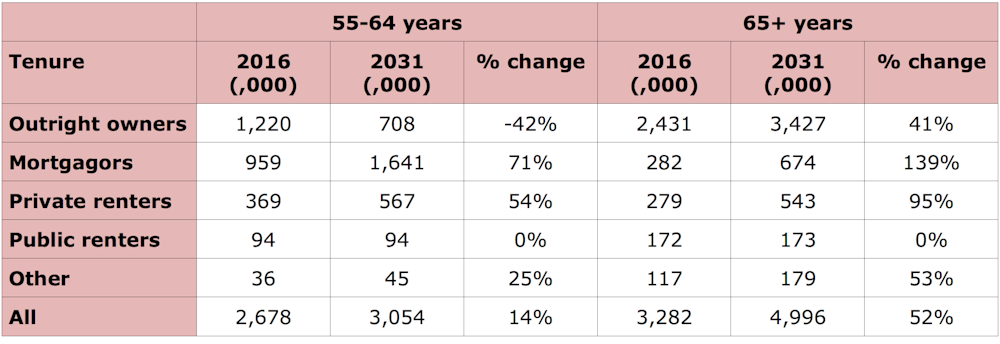
Projected changes in housing tenures of older Australians between 2016 and 2031. Authors’ calculations from HILDA Survey and ABS population projections, Author provided

We expect the number of outright owners aged 55-64 to plunge by 42%, from more than 1.2 million to 708,000. The number of 65-plus outright owners is predicted to rise by 41%, but this lags behind the 52% population growth in this age group.

On the other hand, the numbers of older mortgagors and private renters are projected to soar. Among 55-to-64-year-olds, mortgagor numbers jump from under 1 million to over 1.6 million, a 71% increase. The number of private renters rises by 54% from 369,000 to 567,000.

Beyond what was the age pension threshold of 65 years, mortgagors and private renters are expected to roughly double in number.


Read more: More people are retiring with high mortgage debts. The implications are huge


What are the budget impacts?

The combined impact of these changes in tenure and demographics is expected to increase Commonwealth Rent Assistance (CRA) eligibility among seniors.

On its own, demographic change is forecast to lift the number of CRA recipients, and the real cost of providing CRA, by around 35%.

Add the projected increases in the private rental share of the housing stock and the number of CRA recipients is estimated to rise by 60%, from 414,000 to 664,000, between 2016 and 2031.

The real cost to the federal budget of rent assistance payments to older Australians is forecast to blow out from $972 million to $1.55 billion a year.

Actual 2016 and projected 2031 tenure shares and population counts among Australians aged 55+ years. Authors’ calculations from HILDA Survey and ABS population projections, Author provided

We can also expect to see public housing waiting lists grow if these tenure changes and demographics eventuate. Their combined impact through to 2031 is expected to swell the number of older persons eligible for public housing from 247,000 to 441,000 – a 79% increase.

What are the impacts on poverty?

On an income-only basis we estimate 1.25 million seniors were in poverty in 2016. On taking their housing costs into account, that number falls to 802,000.

But the role of home ownership in preventing poverty is challenged if our projected declines in home ownership rates and increases in debt eventuate. The table below shows the projected increase in the after-housing-cost poverty count from 802,000 in 2016 to 1.15 million in 2031.

Actual 2016 and projected 2031 poverty counts on a before- and after-housing-cost basis among Australians aged 55+ years. Authors’ calculations from HILDA Survey and ABS population projections, Author provided

Policy challenges on multiple fronts

The demand for public housing will grow. If all else remains unchanged in the housing system and economy, seniors on public housing wait lists will increase by over 75%. That’s more than twice the 35% increase in the population of seniors between 2016 and 2031.

Community housing organisations would also come under increasing pressure.

As the number of senior private rental tenants grows, governments will need to reform tenancy regulations in ways that enable housing retrofits to meet mobility needs and allow for ageing in place. Tenure insecurity in the rental sector could hinder planning for aged support services.


Read more: Life as an older renter, and what it tells us about the urgent need for tenancy reform


We may also see a more fundamental transformation of Australia’s housing system and lifestyles in old age. High real house price growth relative to incomes remains a barrier to first home ownership despite low interest rates. Furthermore, the mandatory superannuation guarantee likely displaces some saving in other assets, including housing.

There is therefore a growing prospect of delayed entry into home ownership and of people carrying more debt in later life. Longer working lives and the use of superannuation benefits to pay down mortgages both look increasingly likely.

ref. Fall in ageing Australians’ home-ownership rates looms as seismic shock for housing policy – http://theconversation.com/fall-in-ageing-australians-home-ownership-rates-looms-as-seismic-shock-for-housing-policy-120651

‘Back yourself’ Treasurer Frydenberg tells business. But it’s not that simple

Source: The Conversation (Au and NZ) – By Graham White, Associate Professor, School of Economics, University of Sydney

Treasurer Josh Frydenberg’s key message to business in a landmark speech on Monday was “back yourself”.

He said the best way to boost economic growth was to boost productivity, and the best way to do that was for businesses to undertake productivity-enhancing investments.

My message today for business is to back yourself and use your balance sheet to invest and grow.

With Australian corporates enjoying healthy balance sheets, record low borrowing costs and strong equity market conditions, the question is: are corporates being aggressive enough in the pursuit of growth?

On Thursday the Bureau of Statistics will release investment figures for the three months to June. The trend estimates for the three months to March showed mining investment down 2.8%, manufacturing investment down 4.3%, and other investment up just 0.7%.

According to Frydenberg too many businesses are using funds that would have once invested to buy back their own shares and return capital to their shareholders.

Why businesses don’t back themselves

He was effectively alluding to something that had come to notice as far back as the 1980’s and that has fascinated some economists, but mostly those outside the mainstream.

It is the incentive for firms to avoid the difficult and risky search for the long-term returns that can come from expansion and modernisation and instead maximise immediate shareholder value.

To the extent that it inhibits growth, it certainly doesn’t help the economy.

But if his speech was meant to be a piece of moral suasion directed at corporations, I fear it missed the point and might in any case be fruitless.

Decisions about whether to invest come down to views about returns from investments, and they come down to views about likely growth in consumer and business spending.

Consumers aren’t spending

Put another way, investing in new capacity is ultimately about whether or not there will be demand for the goods and services that will be produced by the new capacity.

Right now, to state the bleeding obvious, the outlook for spending isn’t particularly rosy.

We’ve sluggish consumer demand, sluggish business demand, and are facing sluggish overseas demand in part because of an impending trade war and in part from a government over-reliant on using the Reserve Bank to stimulate the economy instead of its won spending.

In this sort of climate, I suspect no amount of moral suasion will improve the expected rates of return on investments in new capacity.

Investment can be counterproductive

The treasurer is aware that there is a demand problem, as his comments about trade agreements and public sector infrastructure projects indicate.

But in underplaying the need create demand, his calls for investments that boost labour productivity bring with them a potential downside.

Enhanced productivity growth in the absence of sustained improvements in spending is likely to cost jobs or force up unemployment.

Being able to produce more with the same amount of labour means less employment, unless demand is increasing.


Read more: Shock. More investment isn’t necessarily better. Those instant asset write-offs are bad tax policy


Of course, when demand does take off the economy will need the capacity to meet it, so the concern with productivity enhancing investment is legitimate. But it helps not to have it until it is clear demand is going to take off.

Frydenberg might be leaning to the view that once productivity grows, demand will be taken care of.

More productivity mightn’t always be good

It is a popular view; that greater labour productivity (more production per worker) will create the conditions for faster wage growth which will itself boost consumer spending.

Frydenberg set it out at the beginning of his speech. Economic growth was driven by population, productivity and (labour market) participation.

There’s even a view that technological change will itself create jobs and consumer demand.

The counter proposition is that technological change displaces workers and generates technological unemployment.

It’s a debate with real world Australian resonance. If Australian businesses did boost investment as the treasurer wants, the improved productivity that resulted would necessarily generate unemployment unless demand grew alongside it.

The question for us is whether the productivity growth would increase demand in and of itself, or whether the government would need to act to make sure it happened.

ref. ‘Back yourself’ Treasurer Frydenberg tells business. But it’s not that simple – http://theconversation.com/back-yourself-treasurer-frydenberg-tells-business-but-its-not-that-simple-122397

Explainer: the ideas of Foucault

Source: The Conversation (Au and NZ) – By Christopher Pollard, Tutor in Philosophy and Sociology, Deakin University

Michel Foucault was one of the most famous thinkers of the late 20th century, achieving celebrity-like status before his untimely death in 1984.

His academic career culminated in a 1970 appointment as “professor of history of systems of thought” at France’s most prestigious university – the College de France. This unusual title was created because of the distinctive nature of Foucault’s work, which straddled disciplines such as philosophy, history, and politics.

Michel Foucault. Goodreads

Foucault was interested in power and social change. In particular, he studied how these played out as France shifted from a monarchy to democracy via the French revolution.

He believed that we have tended to oversimplify this transition by viewing it as an ongoing and inevitable attainment of “freedom” and “reason”. This, he said, had caused us to misunderstand the way that power operates in modern societies.

For instance, even though the new form of government no longer relied on torture, and public hangings as punishments, it still sought to control people’s bodies — by focusing on their minds.

In his 1975 book Discipline and Punish, Foucault argued that French society had reconfigured punishment through the new “humane” practices of “discipline” and “surveillance”, used in new institutions such as prisons, the mental asylums, schools, workhouses and factories.

These institutions produced obedient citizens who comply with social norms, not simply under threat of corporal punishment, but as a result of their behaviour being constantly sculpted to ensure they fully internalise the dominant beliefs and values.

In Foucault’s view, new “disciplinary” sciences (for instance, criminology, psychiatry, education) aimed to make all “deviance” visible, and thus correctable, in a way that was impossible in the previous social order.

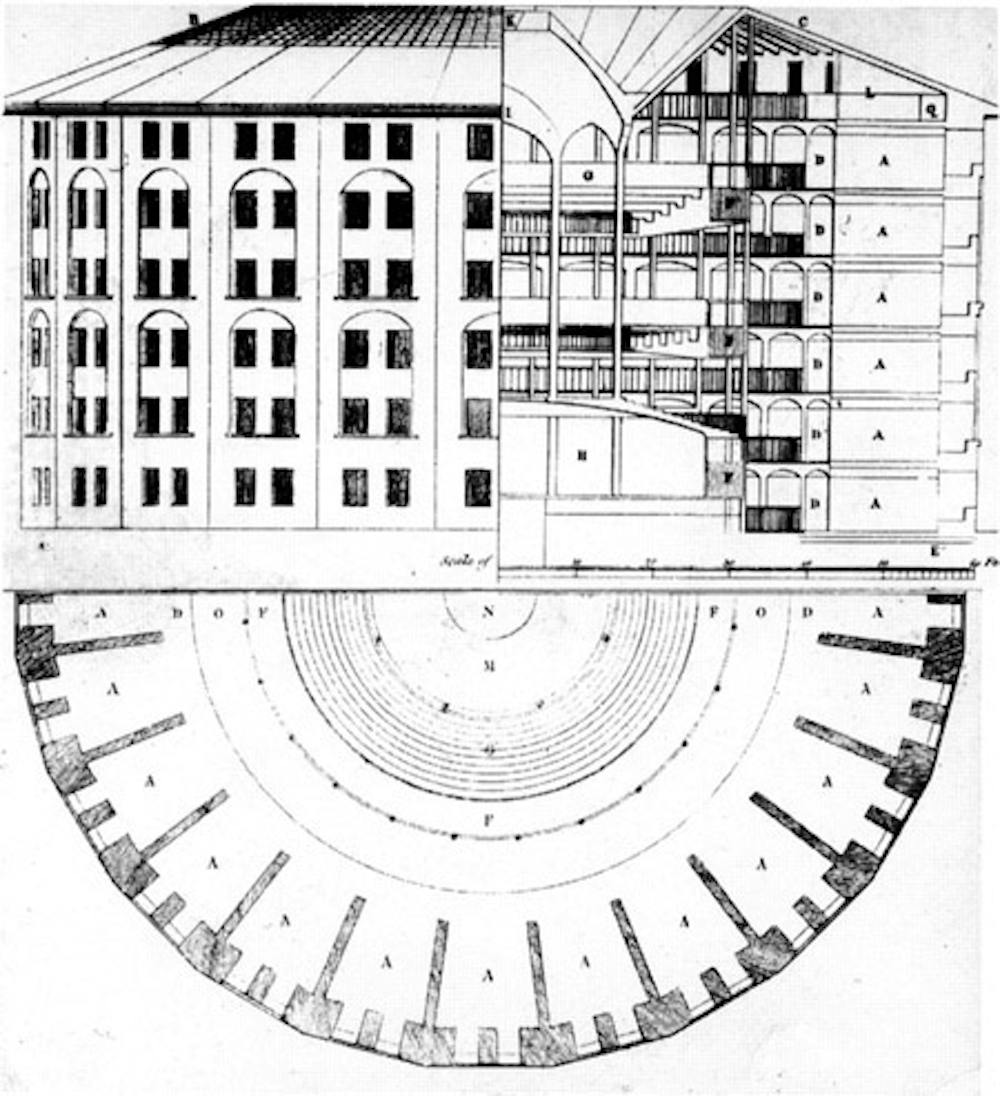
He used English philosopher Jeremy Bentham’s 1787 Panopticon as a metaphor to illustrate his point. This was a circular prison designed to lay each inmate open to the scrutiny of a central watchtower, which was positioned so that individual prisoners could never know when they are being watched.

Jeremy Bentham’s plan of the Panopticon. Jeremy Bentham/Wikimedia Commons

The prisoners therefore always had to act as though they were being watched. In the wider world, he argued, this resulted in docile people who could fit into the discipline of factories, mental institutions, and the dominant sexual morality.

Foucault argued that people with “mental illnesses” (formerly known as madness) were controlled by relentless efforts at correction to a scientifically determined “norm”.

His 1976 History of Sexuality Volume 1 argued that, rather than talking about deviant acts, scientists talked about deviant types, such as “the pervert” or “the homosexual”, who were in need of concerted efforts of medical intervention and correction.

Power/knowledge

Foucault argued that knowledge and power are intimately bound up. So much so, that that he coined the term “power/knowledge” to point out that one is not separate from the other.

History of Sexuality, Volume One. Goodreads

Every exercise of power depends on a scaffold of knowledge that supports it. And claims to knowledge advance the interests and power of certain groups while marginalising others. In practice, this often legitimises the mistreatment of these others in the name of correcting and helping them.

What has made Foucault so appealing to such a broad range of scholars is that he didn’t just look at abstract theories of philosophy or of historical change. Rather, he analysed what was actually said. In his most important works, this included an analysis of texts, images and buildings in order to map how forms of knowledge change.

For example, he argued that sexuality was not simply repressed in the 19th century. Rather, it was widely discussed in an expanding new scientific literature where patients were encouraged to talk about sexual experiences in clinical settings.

With the recent explosion in surveillance cameras as well the role of “big data” we have now well and truly entered the surveillance society. Foucault’s insights on this topic continue to be explored by scholars across the social sciences and humanities.


Read more: Why big data may be having a big effect on how our politics plays out


He has also had a substantial influence on contemporary work in sexuality and gender, sociological studies of mental health institutions and of the medical profession; and in history, politics, cultural studies, and beyond.

An important feature of his theory is that where there is power there is also always resistance. So there are always “sites of resistance”: spaces that hold out the promise for a reconfiguring of power relations in a way that might redress oppressive institutions and practices.

For example, homosexuality has historically been reinterpreted as a “sin”, a “medical pathology”, and now a legitimate “sexuality”, showing how change is possible.

But it is only through a deepened understanding of the origin and structure of our present social order that we will be able to grasp and seize future possibilities for social change.

ref. Explainer: the ideas of Foucault – http://theconversation.com/explainer-the-ideas-of-foucault-99758

Papua free media advocate files UN ‘blackout’ plea, targeted by hacker

Pacific Media Watch Newsdesk

A West Papuan journalist, editor and media freedom advocate has lodged a protest to the United Nations about Indonesia’s internet blackout as more protests reportedly spread across the Melanesian region, including Wamena in the highlands.

Victor Mambor and Tabloid Jubi have made the protest with the help of human rights lawyers and he appealed through Pacific Media Watch for the Pacific media to “spread information about the appeal”.

Indonesian authorities claim the internet gag has been necessary to stem “fake news” which it blames for the rash of Papuan protests over the past week, with at least one death and dozens injured.

WATCH VIDEO: Protest video from Andrew Johnson

Mambor was himself the target last week of a hacker named “Dapur” who was accused by the Alliance of Independent Journalists (AJI) of maliciously “doxing” his social media web data.

The journalist group issued a statement saying that a fake Twitter account had “disseminated an unfounded attempt to discredit and intimidate” Mambor, who is a national organiser for AJI.

– Partner –

“We consider that what Victor has done through his media is the standard thing done by the media, which is to convey information as objectively as possible and publish it after going through a verification process,” the AJI statement said.

The AJI reminded social media users – and the security forces – that journalists carrying out their profession were protected by Press Law 40.

Hampered by blackout
Mambor said the ability of Papuan journalists to report on the protests had been hampered by the internet blackout.

Victor Mambor
Journalist and media freedom advocate Victor Mambor at a public meeting for West Papua in Jakarta in May, 2017. Image: David Robie/PMC

RNZ Pacific reported earlier today that Victor Mambor had filed an urgent appeal to the UN Special Rapporteur on Freedom of Expression, David Kaye.

The Communications Ministry said blocking of the internet would continue until the Papua region was “absolutely normal”.

Mambor said the blockage violated international human rights law.

“When we talk about the ability of journalism to send the real true situation about West Papua,” he said.

“But now we cannot do it. There’s much information from the road. They send it to me, but we cannot clarify or cannot verify the information. There is a problem for journalism.”

The block has also restricted the people’s right to mobilise, RNZ Pacific reported Mambor saying.

‘Discrimination against Papuans’
“I think it’s a kind of discrimination against West Papuan people. The authorities should look for perpetrators who say ‘monkey’ to our people. They should arrest them, not block the internet.”

Mambor said people could generally tell the difference between hoax and accurate news coverage.

His appeal, made through the human rights lawyers Jennifer Robinson and Veronica Koman, also claims the internet blocking fundamentally violates the rights of all West Papuans,” RNZ Pacific reports.

“We appeal to the UN Special Rapporteur, and to the UN Human Rights Commissioner Michele Bachelet, to raise our concerns with the Indonesian government about the military crackdown and internet blocking in West Papua,” Robinson said.

She also urged the UN to call on Indonesia to ensure that Mambor and West Papuan journalists were able to report “without fear of intimidation and harassment”.

The government has deployed 1000 extra military and police to Papua, as some of the protests turned violent.

Local media outlets have been restricted in their ability to send photographs and videos of the protests.

A Papuan protest in Wamena. Image: via Andrew Johnson/FB

The Jakarta Post reports that legal experts have demanded the police prove that shooting tear gas and arresting 43 Papuan students at a dorm in Surabaya on August 17 without an investigation was “necessary” just because the police suspected there were “certain items” inside the dorm.

This was the incident that triggered the widespread protests.

East Java police spokesperson Frans Barung Mangera said on Friday in Surabaya that an internal police investigation carried out late last week revealed that none of the personnel had violated standard operating procedures by using tear gas.

The Paris-based Reporters Without Borders, New York-based Committee to Protect Journalists and other global media groups have demanded Indonesian authorities immediately restore internet access to Papua region.

The Pacific Media Centre has also condemned the internet blackout, with director Professor David Robie saying the authorities have “inflamed’ the situation with the ban by encouraging misinformation and rumours.

“Papuans, and indeed everybody, are entitled to free and unfettered information about the crisis and the reports of human rights violations,” he said.

The Guardian also reported on the expected further wave of protests in response to the racial slurs.

Print Friendly, PDF & Email

Article by AsiaPacificReport.nz

Martin Parkinson declares ‘entrenched disadvantage’ in Australia a disgrace

Source: The Conversation (Au and NZ) – By Michelle Grattan, Professorial Fellow, University of Canberra

Outgoing secretary of the Prime Minister’s Department Martin Parkinson has condemned “entrenched disadvantage” in Australia, in his valedictory address on leaving the public service.

Parkinson also warned it was imperative that Australia did not allow “the kind of retreat from openness and vilification of differences” that had happened in some other countries.

During his long career Parkinson headed the climate change department (now defunct) and treasury (from which he was sacked by Tony Abbott), as well as the prime minister’s department, where he will now be succeeded by Phil Gaetjens, formerly Scott Morrison’s chief of staff and most recently head of treasury.

In his Monday address Parkinson said Australia had not had “the rising income inequality at the top end” of the United States and much of western Europe, “although wealth has become more unequally distributed off the back of rising house prices”.

But this was a “low bar”, he said.

“Our history has bequeathed a degree of entrenched disadvantage that should be seen as a disgrace in any country, but particularly one as developed as Australia,” he said.

More than half of those in the bottom decile in 2000 were still in the lowest 20% 15 years later, he said.

Ideally, people should only be at the bottom of the income distribution spectrum temporarily due to life events, not whole families and communities sentenced to it for generations.

If you want a single thing to blame for the disadvantage we see in Australia, particularly in our remote areas, look no further than an understandable lack of hope. With those kind of odds, anything else would be irrational.

A key to evening people’s chances was to have the best education system that could be achieved and a culture valuing learning, Parkinson said.

He said Australia would need to use all its advantages to sustain its prosperity and security in the future. These included its multicultural society, a merit-based culture and a market-based approach.

There are really only two choices for this country. We can take pride in our diversity and use it as an advantage when interacting with the world, or we can hunker down behind borders and slowly gnaw at each other.

Parkinson said that “to their credit, our parliamentary leaders have maintained a remarkable commitment to an open economy and social cohesion, despite immense pressures the other way”.

On the international front, Parkinson said many regional and global institutions, including the International Monetary Fund and the World Bank, the G20 and APEC, were struggling.

It’s particularly hard for the WTO to enforce trade rules when the largest countries are openly flouting them.

The United States largely built this order in its own image, under-writing it with security guarantees. We benefit immensely from this order and must help support it wherever we can.

He reflected on his disappointment at his dismissal as treasury secretary. “I received the ‘wooden spoon’ as head of the Treasury in 2013 – a job I enjoyed and in which I aspired to follow the nation-building work done by predecessors such as Chris Higgins, Ted Evans and Ken Henry.

“It was a drawn out departure, and I couldn’t even look forward to sitting on the couch to watch a care free game on the weekend as the Essendon Bombers also had a terrible season.”

ref. Martin Parkinson declares ‘entrenched disadvantage’ in Australia a disgrace – http://theconversation.com/martin-parkinson-declares-entrenched-disadvantage-in-australia-a-disgrace-122410

Politics with Michelle Grattan: PM’s advisor Christine Morgan on tackling Australia’s rising suicide rates

Source: The Conversation (Au and NZ) – By Michelle Grattan, Professorial Fellow, University of Canberra

The number of suicides in Australia has been rising in the last decade, with more than 3,000 Australians taking their life in 2017, according to the latest available ABS figures. Some of the most vulnerable groups include Indigenous Australians, young Australians, unemployed people, and veterans.

Scott Morrison has declared this a key priority area for the government. He has appointed Christine Morgan, CEO of the National Mental Health Commission, as the national suicide prevention advisor to the prime minister.

On this episode, Christine Morgan speaks with Michelle Grattan about the issue – what we know so far, and what needs more clarity. She stresses the role of communities in tackling the rising rates, and also argues for a more holistic view – beyond narrow mental health problems – of the factors that drive people to contemplate taking their own lives.

Yes, it may be that they’re suffering from a mental health condition. Yes, they may be suffering from a health condition. But they may also be being affected by other things which significantly impact, like what is their housing security?[…]What is their employment situation? what is their financial situation? Have they come from a background of trauma?


Anyone seeking support and information about suicide can contact Lifeline on 131 114 or Beyond Blue on 1300 224 636.

New to podcasts?

Podcasts are often best enjoyed using a podcast app. All iPhones come with the Apple Podcasts app already installed, or you may want to listen and subscribe on another app such as Pocket Casts (click here to listen to Politics with Michelle Grattan on Pocket Casts).

You can also hear it on Stitcher, Spotify or any of the apps below. Just pick a service from one of those listed below and click on the icon to find Politics with Michelle Grattan.

Additional audio

A List of Ways to Die, Lee Rosevere, from Free Music Archive.

Image:

Shutterstock

ref. Politics with Michelle Grattan: PM’s advisor Christine Morgan on tackling Australia’s rising suicide rates – http://theconversation.com/politics-with-michelle-grattan-pms-advisor-christine-morgan-on-tackling-australias-rising-suicide-rates-122401

NZ hui urges local climate action to help Pacific Islands

By Ayla Miller 

Pasifika people in New Zealand need to take charge against climate change which is already threatening their home islands, an Auckland hui has heard.

Political leaders have been too slow, warned climate experts, community, youth and Pasifika leaders who were joined at the Roskill Climate Restart hui by Minister for Climate Change James Shaw and Mt Roskill Labour MP Michael Wood.

“We have no choice. It’s about my people surviving in this world. My people [in Tuvalu] are already suffering. In terms of food they can’t plant crops now because of the salinity of the soil,” said E Tū union Komiti Pasifika representative Fala Haulangi.

READ MORE: USP journo students return from Solomons climate storytelling project

“Every day our people live in fear and that’s the reality people have to face. So, when we talk about what we will do in the next 10 years, no, let’s talk about today.”

Haulangi said there is a lack of trust in politicians among Pasifika communities but believes in the power of community to tackle climate change.

– Partner –

Pacific climate warrior Brianna Fruean said more attention needs to be placed on the resilience and adaptability of Pasifika people.

“Young people in Tokelau are building keyhole gardens for their villages so their gardening is raised off the ground as a way of adapting to climate change and soil salinisation. I’ve seen so many examples of the resilience humans can bring forward.

“We need more attention on the solutions and how we can look at people who really shouldn’t be as resilient as they are, considering all the obstacles that are given to them, and how they’ve overcome them. If someone in the Pacific can put up a fight against climate change, then anyone in the world can.”

James Shaw agreed, saying it was critical government works with communities when it comes to assessing real life effects of climate change.

“Wellington can’t work that out all by itself. [Risk assessment] is an area where we need to work closely with other communities because they have on the ground knowledge. Communities often have knowledge that has been passed down from generations.

“It’s going to take everything that we’ve got at every single level. It is one of those things that has to involve political change.”

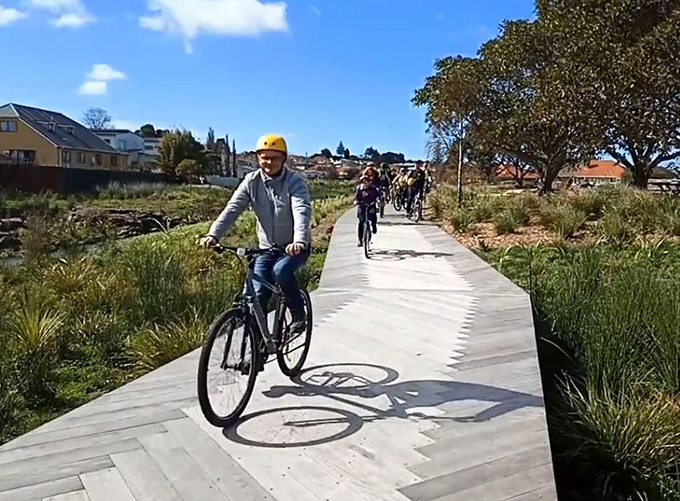
The hui began with a community cycle ride around the newly-opened Te Auaunga (Oakley Creek) walkway led by “local biking heroes” Roskill Bike Kitchen and Global Hope Mission, followed by a free lunch provided by Wise Collective.

  • Ayla Miller is studying Journalism through AUTs postgraduate diploma of communications and has an interest in arts, culture, entertainment and environmental news
  • This story was first published on Te Waha Nui
Print Friendly, PDF & Email

Article by AsiaPacificReport.nz

A weight loss app may be a risky way to address obesity in children

Source: The Conversation (Au and NZ) – By Hiba Jebeile, PhD candidate/Research Dietitian, University of Sydney

Over the last week, a weight loss app targeted at children and teenagers aged 8-17 has sparked concern among health professionals and parents around the world.

More than 90,000 people have signed an online petition calling for withdrawal of an app called Kurbo.

Kurbo was launched in 2014. WW (formerly Weight Watchers) bought it last year and have recently relaunched it.

It’s currently only available in the United States, but we could see it launched in Australia.


Read more: More than one in four Aussie kids are overweight or obese: we’re failing them, and we need a plan


Overweight and obesity affect one in four Australian children and adolescents. Excess weight is likely to persist into adulthood and is associated with the development of chronic disease.

While there are calls for better treatment options, the way treatments for obesity are delivered is important.

Unsupervised use of an app that encourages children to track their weight carries the danger of perpetuating body image issues and leading to disordered eating.

The traffic light system

Kurbo is based on the traffic light system, a family-based lifestyle intervention developed by Stanford University.

This system groups foods into three categories:

  • “red” (limit or budget them into your plan, for example lollies and soft drinks)
  • “amber” (watch your portion, for example lean meat and pasta)
  • “green” (eat any time, for example fruit and vegetables)

The aim of this system is to encourage families to eat more “green” foods and less “red” foods. The traffic light system has been shown to be effective in improving weight-related outcomes in children treated for overweight or obesity without a negative effect on eating behaviours, when used by the whole family through a supported program.

But Kurbo uses the traffic light system as an online app targeted to children directly, rather than to parents or families. Children aged under 13 need a parent’s permission to download the app, but those over 13 don’t.

Alongside other features, the paid version of the app provides children with a weekly video-chat check-in with a health coach. The training health coaches have had in child obesity, mental health and body image is unclear.


Read more: Kids’ diets and screen time: to set up good habits, make healthy choices the default at home


Possible pros

Technology and apps providing health services are growing in number, and can be convenient and cost effective.

Importantly, families actually want to use technology for more flexibility in the way they receive nutritional support.

In one study of a telehealth nutrition intervention with a website, Facebook group and text messages, benefits included ease of self-monitoring and increased access to services for families living in regional or remote areas. This intervention resulted in improved eating habits in children.

Apps in particular are a promising option because they’re portable and can connect with other technologies.


Read more: Let’s untangle the murky politics around kids and food (and ditch the guilt)


Kurbo was one of three apps targeted to children identified in a 2016 review of mobile apps for weight management. The version of the app evaluated at the time of the review was found to meet eight evidence-based strategies for weight management: self-monitoring, goal-setting, physical activity support, healthy eating support, social support, gamification, and personalised feedback delivered via a health coach.

Technology evolves rapidly, so it’s unclear if these features all remain in the current version. As we’re based in Australia, and the app is only available in the US, we can’t access the app directly to verify this.

Kurbo reports 90% of pilot study participants maintained or reduced their weight, and experienced “higher levels of happiness, self-confidence and self-esteem”.

But importantly, the app hasn’t been researched scientifically and independently.

Possible cons

Targeting children with a weight-focused app brings up concerns about the potential risk of developing disordered eating or eating disorders.

Research has shown an association between self-reported dieting during adolescence and an increased risk of binge eating and eating disorders. These data highlight the risk of unsupervised dietary change.

Children around the age of puberty are particularly vulnerable to body image issues. From shutterstock.com

Targeting children, rather than parents, shifts the responsibility to the child. With the foods available to them largely out of their control, this could lead to internalised feelings of failure if they cannot comply with the program.

While Kurbo is designed to develop healthy eating behaviours, the marketing materials send different messages. This includes the use of before and after pictures in children as young as eight years old to promote success stories.

We don’t know how these will impact children, both in the short and long term. Children are at an age where body image is fragile due to changes occurring in preparation for, or during, puberty.

The importance of supervision

A recently published review of 30 studies found professionally run obesity treatment programs, conducted in children and adolescents, were associated with reduced eating disorder risk.

Treatment programs included in the review involved regular face-to-face contact with a trained professional; usually a dietitian, nutritionist or psychologist.

This review highlights that mode of delivery and length of contact are important aspects of weight management.


Read more: How many people have eating disorders? We don’t really know, and that’s a worry


There have been limited studies assessing children’s risk of developing eating disorders following online interventions, so the impact of Kurbo on this remains unknown.

Kurbo states it will monitor participants for safety concerns including rapid weight loss and mental health issues, notifying parents if these occur.

As a commercially available program, it is unclear how and if such safety measures will be acted upon. This compares to a program delivered in a health setting or as a clinical trial, which would have strategies in place, approved by an ethics committee, to identify unexpected adverse events.

Weight loss isn’t always the right goal

Australian guidelines recommend weight maintenance rather than weight loss for most children before puberty, because it’s expected their weight and height will increase as they grow.

Weight loss is recommended, with the support of a health professional, for adolescents with moderate to severe obesity and/or those who have started to develop complications such as pre-diabetes. Treatment should be targeted to the individual lifestyle, and involve regular contact.


Read more: Five things parents can do to improve their children’s eating patterns


If parents are concerned about their child’s weight, they should consult their GP or an Accredited Practising Dietitian, to assess if intervention is required, and suitable options.

ref. A weight loss app may be a risky way to address obesity in children – http://theconversation.com/a-weight-loss-app-may-be-a-risky-way-to-address-obesity-in-children-122129

Paddling blind: why we urgently need a water audit

Source: The Conversation (Au and NZ) – By Quentin Grafton, Director of the Centre for Water Economics, Environment and Policy, Crawford School of Public Policy, Australian National University

In the wake of a damning royal commission and an ABC Four Corners investigation, the federal government has created an Inspector General for the Murray-Darling Basin, to combat water theft, ensure water recovery and efficiency projects are delivered properly, and essentially make sure everyone is acting as they should.

While this is a laudable aim, the Inspector General – currently former Australian Federal Police Commissioner Mike Keelty – cannot hope to do this job without knowing how much water is being used in the Basin, by whom it is used, and where.


Read more: Billions spent on Murray-Darling water infrastructure: here’s the result


This might seem like basic information, but the Bureau of Meteorology, the Murray-Darling Basin Authority and state water accounts are not up to the task.

We urgently need a comprehensive audit to track the water in the Murray Darling Basin, so Inspector General Keelty can effectively investigate what he has already described as a “river ripe for corruption”.

Up the creek

Back in 2004 all governments in Australia agreed to track and provide information on water in terms of planning, monitoring, trading, environmental management, and on-farm management.

But water accounts still lack many essential features including double-entry accounting. When applied to water, double-entry accounts means that when one person consumes more water, someone else must consume less.


Read more: Aboriginal voices are missing from the Murray-Darling Basin crisis


The technology to track this already exists: satellites that can quantify surface water are successfully being used used in the United States.

If we had monthly water consumption measurements, we could see how much water is being used, by whom, when and where. This would help decision makers see problems before they emerge, such as the mass fish deaths in the Darling River, and respond in real time.

As a recent report from the Natural Resources Commission shows, without proper accounting, too much water is taken upstream – seriously harming downstream communities.

Wide support for an audit

An independent Basin-wide water audit is supported by communities and some irrigators.

In July NSW farmers voted in support of a federal royal commission into “the failings of the Murray Darling Basin Plan”. In our view, this vote shows many farmers support much greater transparency about how much water is being consumed, and by whom.


Read more: The Darling River is simply not supposed to dry out, even in drought


Double-entry water consumption accounts would help identify whether the billions of dollars planned in subsidies to increase irrigation efficiency will actually deliver value for money. But irrigation improvements only generate public benefits when more water is left or returns to flow in streams and rivers. Such flows are essential to healthy rivers and sustainable Basin communities.

Irrigators’ crops benefit from increased efficiency, so subsidies help farmers greatly – but it is very unclear whether they do anything for the public good. In fact, they seem to reduce the amount of water that finds its way back into the rivers. Research also shows infrastructure subsidies to improve irrigation efficiency typically increases water consumption at the Basin level.

Our research, published earlier this year in the Australasian Journal of Water Resources shows federal irrigation infrastructure subsidies may have reduced net stream and river levels. This is even after accounting for the water entitlements irrigators provided to the government in exchange for these subsidies.


Read more: 5 ways the government can clean up the Murray-Darling Basin Plan


Independent audits

Just like financial accounts, water accounts must be independently audited.

For the average taxpayer, who has to justify every dollar they get from the government, it’s hard to imagine how some corporations can be given millions of dollars in subsidies without actual measurements (before and after) of the claimed water savings.

If Newstart recipients need to report and manage their income and have a job plan, as part of a system of appropriate checks and balances, shouldn’t the Australian government also be checking whether billions spent on subsidies for irrigators actually saves water?


Read more: The Murray-Darling Basin scandal: economists have seen it coming for decades


A water audit would cost less than 1% of the money already spent on water infrastructure subsidies in the Basin. Unlike irrigation infrastructure subsidies, a water audit is value for money.

Importantly, independent water consumption accounts would allow the Inspector General for the Murray-Darling Basin to effectively manage our most critical nature resource, water.

ref. Paddling blind: why we urgently need a water audit – http://theconversation.com/paddling-blind-why-we-urgently-need-a-water-audit-122118

Video shows Fiji PM seizing MP, goes viral

Pacific Media Watch Newsdesk

A video of Fiji’s Prime Minister Voreqe Bainimarama grabbing and shoving an opposition MP has gone viral.

The video surfaced last week and shows Bainimarama seizing the coat of National Federation Party member Pio Tikoduadua and giving him a light shove in a car park outside the parliamentary building in Suva.

About six of the Prime Minister’s body guards looked on during the incident but made no attempt to intervene, reports RNZ Pacific.

READ MORE: Opposition MP alleges Bainimarama assaulted him but PM denies claim

WATCH: Bainimarama grabs the shirt of MP

The video, which has been viewed on Facebook over 250,000 times, contradicts the governing party’s denial of the accusations Tikoduadua made in parliament on August 9.

– Partner –

The government called the claims a “blatant lie”, with Bainimarama insisting he only spoke sternly with the opposition MP, who he accused of personally insulting him in parliament.

According to RNZ, the video is consistent with Tikoduadua’s claim that he was assaulted and his glasses were broken; the video shows the glasses failing to the ground after Bainimarama grabbed him.

Tikoduadua also claimed that Bainarmarma personally insulted him. The video shows the two men arguing but the words cannot be heard.

After the incident, Tikoduadua spoke to media saying: “An assault on any member of this house is an assault on the sanctity of parliament and consequentially an assault on democracy.”

He has filed a complaint with police and said that he hopes the video will speed up the investigation, although he has not yet received a response, reports the ABC.

“I am waiting in earnest for them to do their job and I keep waiting,” Tikoduadua said.

According to The Fijj Times, Tikoduadua does not resent the Prime Minster for his actions.

“I have no hard feelings towards Prime Minister Voreqe Bainimarama because carrying a grudge has no value,” he said.

The Prime Minister has made no statement since the video emerged and the Police Commissioner Sitiveni Qiliho has said he will not discuss the matter publicly until the investigation concludes, reports Fiji Village.

Print Friendly, PDF & Email

Article by AsiaPacificReport.nz

Lunch with bankers. Even they’re unimpressed with their new Banking Code of Conduct

Source: The Conversation (Au and NZ) – By Grahame Dowling, Honorary Professor, University of Technology Sydney

One of my banks invited me to a customer lunch a few weeks back so that it could announce its commitment to the new Banking Code of Conduct.

Here was a chance for it to say sorry to its customers and promise that things would be better in the future.

So I accepted the invitation, and the chief executive did indeed say sorry. A representative from the Australian Banking Association briefly introduced the code. No questions or comments were sought from attendees, and good food was served.

However, before attending the lunch I did some homework on the new code.

If it was an article sent to a journal for review it would have been sent back to the authors for another revise and resubmit.

There’s much that’s missing…

The latest version of the code is a revision of the 2013 version – which obviously did not work. This one is better: it is a set of enforceable standards that customers and small businesses and their guarantors can expect from Australian banks. It has been approved by the Australian Securities and Investments Commission.

Banking Code of Practice, ABA 2019

But it has has some gaping holes in it. Let me explain.

It is preceded by an introduction written by Anna Bligh, the head of the Australian Banking Association, a bank-funded lobby group. It says the new code is designed to “better meet community standards and expectations”.

But what are those community expectations?

Nowhere in the code does it say.

So I asked my dining companions, invited to the lunch by the bank, what they expected of banks.

It quickly became apparent there are two types of expectations.

One deals with the process of banking. In essence, this means the banks will do the paperwork correctly. The new code is all about process, roughly 40 pages and 200 paragraphs. From the perspective of the banks trying to regain trust, this is helpful. If the banks abide by the new code they can expect co-called “cognitive” trust to be restored. Cognitive trust is the belief that procedures are being followed.

…including outcomes

The second type deals with outcomes. As I noted, outcomes are missing from the new code. The customers at my table wanted four:

  • good service, especially when there is a problem

  • convenient banking, via ATMs, branches, internet applications, etc.

  • affordable banking which means reasonable fees and charges

  • passing on Reserve Bank interest rate changes

Luckily we had two bank employees at our table to ask how the bank was providing such outcomes. The conversation did not go well.

For example, one complaint was that when you call the bank for help you have to go through an extended menu of options before you get to talk to someone – often in Manila. Wouldn’t it be possible to have a call centre in Australia and speak directly to a local? No. Why? Because it is cheaper to have the call centres in Asia, and the other banks do it.


Read more: The new banking code looks impressive, but what will it achieve?


Similar profit-before-customer-service explanations were provided for questions in categories 2, 3 and 4.

Our hosts were becoming just a little bit defensive by the time lunch concluded.

What they were hearing was that the new code was failing to prod the banks into restoring emotional trust. This is the sort of trust that provides the glue for customer loyalty and word-of-mouth or word-of-mouse recommendation.

Liking, or as some advertising agencies like to suggest, loving a brand is what makes it successful.

It’s a standard consultants’ document

The people who drafted the new code appear to have followed standard consulting advice. This says that you can guarantee a process but never an outcome. Outcomes are often determined by factors outside your control.

So the safe practice is to draft a code that focuses on process. It might help to restore cognitive trust but it will do little to rekindle emotional trust.

It means that even though the Australian Banking Association and the banks are proud of their new code, it will do only do half the job. It’s an opportunity lost.

What do the bankers think?

Heading out from lunch I met the bank chief executive. Five minutes later we both agreed that the new code was as much public relations as substance. However, his bank was way ahead of the code in its journey to restore trust. He and his team have begun significant internal culture change. Never again would bad apples and bad process contaminate good banking practice.

I wonder if the team members at our table will provide our feedback about the code and the bank’s culture of putting profit before customers to their next team meeting?

Our emotional trust stayed exactly where it was after what was a very pleasant meal, even though we now know who will end up paying for it.


Read more: Banking Royal Commission: no commissions, no exemptions, no fees without permission. Hayne gets the government to do a U-turn


ref. Lunch with bankers. Even they’re unimpressed with their new Banking Code of Conduct – http://theconversation.com/lunch-with-bankers-even-theyre-unimpressed-with-their-new-banking-code-of-conduct-122036

The digital human: the cyber version of humanity’s quest for immortality

Source: The Conversation (Au and NZ) – By David Evans Bailey, PhD Researcher in Virtual Reality, Auckland University of Technology

Immortality has been a topic of discussion since the legend of the Holy Grail.

Some people have gone as far as cryogenic freezing after death in the hope that one day science will have advanced enough to resurrect them. Others believe the route to immortality lies in the digital realm.

The theory that humans can be digitised and live on within the digital confines of a computer-based existence has been the subject of debate. But until recently, no one had taken the idea much beyond research and discussion.

Last year, a consortium of unidentified individuals launched Virternity with the stated goal of a digital life for all. A world that would be owned not by any government but by the people.

This digital world, Virternity said, would remove the physical constraints upon us and the planet and usher in a completely new plane of existence. Then, without any warning, Virternity disappeared.


Read more: Virtual reality adds to tourism through touch, smell and real people’s experiences


The digital human

Although the future evolution of humanity is much discussed and conjectured, perhaps nobody had taken it quite as seriously as this. In its infancy, Virternity seemed concerned with the launch of a new digital currency, the Virie, by which it proposed to fund its endeavour.

An interesting point is that the creators of Virternity were so concerned with ensuring public ownership that very few people even know or knew who exactly they were. Their reasoning was apparently to prevent governments and their agencies subsuming their interests with corporate and other less desirable aims. But being anonymous also has its advantages if a company wants to slide into the shadows, as appears to have been the case.

The biggest question is whether it is even possible for a human, or any living being for that matter, to be digitised in the first place. Therein lies the dichotomy of two different schools of thought.


Read more: Curious Kids: How do you know that we aren’t in virtual reality right now?


Philosophy versus mind uploading

Those who would align themselves with thinkers such as Gilles Deleuze and Henri Bergson believe there is a higher consciousness above the physical persona or body. Such philosophical thinking rests on the idea of duality – the mind and the body are not the same. Therefore, it would seem impossible to digitise a human. How can one put the essence of a human spirit into a computer, almost like a genie into a bottle?

Conversely, several prominent scientists and neurosurgeons contend that the physical is all there is. If one can copy the brain of a human in digital form then the rest is easy. Copying the brain is not particularly simple, though. Proposals include making thousands of micro-thin slices of a brain and copying the neural network revealed.

To do this, a machine would need to be constructed that can make these slices, and then a willing volunteer would need to be found. These would be physical slices from a brain preserved before death. That’s the drawback. In fact, a startup, Nectome, has been proposing to do just that and preserve your brain until the day it can be digitised.

The person, or at least the contents of their brain, would ultimately be transferred to a computer, and thus remain alive or perhaps be reborn. Experiments have been undertaken on scanning a mouse brain but the breakthrough of digitising the entirety of even a mouse brain has not happened.

What the future might hold

Moving on from the mechanics that might digitise us all, what would await humanity with digital immortality? Virternity said that great scientists and artists could pursue their careers for centuries, and we need never say goodbye to our loved ones.

The demand for planetary resources would be severely reduced to only that needed for the physical humans left on the planet and of course the computers holding the rest of us. The planet itself might return to a more natural state. We ourselves would be free of famine, pestilence and disease, and could pursue whatever life we wanted, until the end of time.

Perhaps these sound like admirable goals, a utopian dream. But if humans were unleashed into this apparently digital world, would we take advantage of the freedom or simply go about reproducing a digital hell on earth? And what about digital viruses and other distortions of the virtual world itself?

We already have the experience of worlds such as Second Life, a highly successful virtual world.

Second Life explained.

Virternity would have been the first wholly immersive endeavour to replace the physical reality with a purely digital one. Once digital, there probably would be no going back.

Other important questions arise. How much computing power would we need to run Virternity. Where would it be based and how can we ensure that nobody will simply just switch us all off or press delete?

Perhaps these questions never will be answered or at least not by Virternity as it was. Perhaps a new pheonix will arise from their ashes or someone else will take up the torch. But for now it seems we will have to wait for a digital utopia to become a fact rather than fiction.

ref. The digital human: the cyber version of humanity’s quest for immortality – http://theconversation.com/the-digital-human-the-cyber-version-of-humanitys-quest-for-immortality-108081

After 2 festival deaths, the NSW government rushed through a new drug homicide crime. But it may do more harm than good

Source: The Conversation (Au and NZ) – By Elyse Methven, Lecturer in Law, University of Technology Sydney

As the state election loomed last year, the NSW government rushed through a new crime targeting drug suppliers. A person who supplies a prohibited drug for profit can now be prosecuted for homicide if another person uses the drug and dies as a result.

The first of its kind in Australia, the offence of “drug supply causing death” carries a maximum 20 year sentence. The law was enacted after the deaths of 23-year-old Joshua Tam and 21-year-old Diana Nguyen at the Defqon.1 music festival in September, 2018.

In its haste to “do something” in response to their tragic deaths, the NSW government failed to consider harmful consequences that may arise from treating drug-related fatalities as homicide. In fact, my research of how similar laws have operated in the US suggests the new crime of “drug supply causing death” may increase the risk of fatal drug overdoses.

Two deaths at the DEFQON.1 music festival led the NSW government to rush through the new crime of ‘drug supply causing death’. Dushan Hanuska/Flickr, CC BY-NC-SA

An unprincipled approach

Just three days after the festival deaths, NSW Premier Gladys Berejiklian commissioned a panel comprising three heads of government agencies to advise whether “new offences or increased penalties were needed to stop drug dealers endangering lives”.

The panel was directed not to consider pill testing, consistent with the government’s “zero tolerance” approach to illicit drug use.

And the panel warned “more analysis and consultation” was needed before enacting the offence, given the “legal complexities” involved.


Read more: Testing festival goers’ pills isn’t the only way to reduce overdoses. Here’s what else works


But the government ignored this advice. Without any known consultation with criminal law experts or the NSW Law Reform Commission, it hastily enacted the offence of “drug supply causing death” in November last year.

The crime of ‘drug supply causing death’

Like the controversial “one-punch” homicide offence introduced in 2014, the new drug homicide offence is an attempt to quickly “fix” a complex public health problem.

The offence is in section 25C of the Crimes Act 1900, and says the supply must be for “financial or material gain”, as opposed to what Attorney-General Mark Speakman called the “young friends” scenario. In other words, people who pass on drugs to their friends without making a profit shouldn’t be prosecuted for this offence (but may be liable for other drug supply offences).

The legislation was drafted before the government could consider the recommendations of the NSW coronial inquest into the drug-related deaths of six young people at music festivals. The coroner is expected to hand down her findings in October.

The music festival deaths have been linked to ecstasy (MDMA) use. However, section 25C targets drugs beyond ecstasy and contexts beyond music festivals. It extends to the supply of any prohibited drug (except cannabis) including crystal methamphetamine (ice), cocaine and opioids such as heroin.


Read more: Law and order is no get-out-of-jail card for floundering politicians


On the other hand, if a person supplies another person a legal — albeit potentially harmful — drug, such as alcohol or tobacco, and the user dies from ingesting or inhaling that drug, the supplier cannot be prosecuted under section 25C.

New crime may do more harm than good

Similar drug-induced homicide laws in the US, which have existed since the 1980s, show how the NSW crime might exacerbate, rather than prevent, drug-related harms.

In many US states, drug suppliers are zealously prosecuted for homicide, with police opting to pursue low-level dealers as opposed to major traffickers.

Charges are disproportionately laid against people of colour in cases involving white victims. People of colour also serve longer sentences for these offences than white defendants.

Disturbingly, evidence from the US suggests drug homicide offences increase the risk of death to drug users. Faced with the prospect of prosecution and a lengthy prison sentence, suppliers and bystanders are more likely to abandon people experiencing drug overdose symptoms than seek medical help.

The NSW parliament could have, but did not, enact a “Good Samaritan” immunity alongside the crime of drug supply causing death. This immunity would allow dealers to avoid prosecution for homicide when they immediately seek medical help for users showing signs of distress.


Read more: Unlawful strip searches are on the rise in NSW and police aren’t being held accountable


Independently-made choices

Section 25C is a radical departure from NSW homicide law. For the crimes of murder and manslaughter, the prosecution must establish a causal link between the defendant’s actions and the victim’s death.

NSW Premier Gladys Berejiklian consulted heads of government agencies, but no criminal law experts. Joel Carrett/AAP

Applying established rules of causation, in 2012, the High Court held that a methadone supplier was not criminally responsible for the death of the person who self-administered the methadone. The High Court reasoned that the voluntary and informed decision of an adult to take a prohibited drug broke the “chain of causation” between supply and death.

Section 25C departs from the libertarian principle that individuals are responsible for independently-made choices that may bring about harm to themselves.

For the crime of drug supply causing death, a “causal link” need only be established between the drug user’s action in taking the drug and their death. As a result, a person might be prosecuted for drug supply causing death when:

  • a person overdoses on drugs to intentionally end their own life
  • a person drives under the influence of drugs, crashes their vehicle and dies
  • a person loses their inhibitions from taking drugs, jumps off a bridge and dies.

These are just some of the unintended consequences that may arise from the failure to subject this law to rigorous scrutiny.

Assessing risk of death

One aspect of the offence that is narrower than its US counterparts is the “mental” element. The prosecution must prove the person who supplied the drug knew, or should reasonably have known, the drug supply would expose another person to a “significant risk of death”.


Read more: How hard is it to say ‘no’ to drugs?


Assessing whether a risk of death is significant will be no easy task, and will depend on the unique facts of each case. Variables include whether the accused knew, or should have known, about the quantity, strength and toxicity of the drug; whether the drug was consumed with other drugs including alcohol; environmental factors; and the user’s health.

What’s clear is this punitive criminal law response to a serious public health problem, without adequate consultation or evidence, will produce unintended consequences. Failing to learn from the US experience, the new offence of drug supply causing death is likely to result in more harm than good.

ref. After 2 festival deaths, the NSW government rushed through a new drug homicide crime. But it may do more harm than good – http://theconversation.com/after-2-festival-deaths-the-nsw-government-rushed-through-a-new-drug-homicide-crime-but-it-may-do-more-harm-than-good-121876

Voter turnout at New Zealand local elections keeps falling, but paying people to vote could backfire

Source: The Conversation (Au and NZ) – By Julia Talbot-Jones, Lecturer, Victoria University of Wellington

Last week, voter enrolment for the 2019 local government elections closed in New Zealand and concerns about low voter turnout resurfaced. During a panel discussion run by Auckland Council, the idea was raised to pay people to vote to encourage participation.

The concerns about low voter turnout are well founded. Voting rates in local government elections have been falling for at least 30 years and voter participation now rests around 40% – almost half that of general elections.

The idea that we should be paying people to cast their vote in New Zealand isn’t new. But the notion ignores the evidence that using explicit monetary incentives to induce pro-social behaviour can be counterproductive.


Read more: FactCheck Q&A: how unusual is compulsory voting, and do 90% of New Zealanders vote without it?


Homo economicus

The suggestion to pay people to vote rests heavily on the assumption that people subscribe to the self-interested motivations of Homo economicus: the idea that people make decisions purely on extrinsic motivations often determined by financial incentives.

This type of thinking has guided political theorists and constitutional thinkers since the late 18th century; influencing policy and causing laws to be designed to induce people to act as if they were civic minded, rather than explicitly encouraging the cultivation of civic virtues.

But this approach to policy making ignores the fact that we frequently observe people making choices in the best interests of society, rather than solely on what might best financially benefit themselves. These decisions are understood to be guided by intrinsic motivations, as opposed to extrinsic motivations.


Read more: Bungled NZ census highlights need for multiple voting options to raise Māori participation


The crowding out paradox

The issue is that in situations where intrinsic motivations are ignored and substituted for market mechanisms, such as rewards or fines, we can “crowd out” intrinsic motivations. In other words, rather than enhancing pro-social behaviour, rewards and fines can actually reduce peoples’ natural tendencies to be good citizens.

Perhaps the most well known illustration of crowding out was a controlled behavioural experiment in Haifa, Israel, where parents who were late picking up their children at the end of the day were fined. Parents responded to the fine, but not as the daycare centres had hoped. Rather than encouraging cooperative behaviour the fine appeared to undermine the parents’ sense of personal obligation to avoid inconveniencing the teachers, and late pick-ups more than doubled.

Another well known example found that paying people to give blood in the United Kingdom caused donations to go down, while another study found that paying people to collect money for charity caused the volunteers to collect fewer donations.

In each of these cases, peoples’ natural tendencies to do good were crowded out by fines, bonuses or other incentives that put a price on their civic behaviour, and left them less inclined to act in a pro-social and generous way.

Message for policymakers

Voter turnout rates help to show how citizens feel about government, both in terms of their confidence in political institutions and whether their participation can make a difference. Because of this, the long-term trend in local government voter engagement should be raising red flags among decision makers in New Zealand.

So what to do? Although there is unlikely to be a panacea for increasing turnout, a mix of strategies that integrate structural reform with behavioural tools, such as requiring voters to opt out rather than opt in or offering “I voted” stickers, could offer incremental improvements. Likewise, investing in civic education could stimulate long-term changes in beliefs and norms, thereby increasing the scope of citizens’ intrinsic motivations and levels of voter engagement.


Read more: How lowering the voting age to 16 could save democracy


Whatever the strategies explored, policymakers need to be aware that fines, bonuses or other incentives have the potential to compromise peoples’ pre-existing civic values and intrinsic motivations. Subsequently, New Zealand decision makers need to take a comprehensive view of the things that motivate people to act when considering ways to increase voter engagement at the next election.

ref. Voter turnout at New Zealand local elections keeps falling, but paying people to vote could backfire – http://theconversation.com/voter-turnout-at-new-zealand-local-elections-keeps-falling-but-paying-people-to-vote-could-backfire-122040

How doctors convinced the world the planet was worth fighting for

Source: The Conversation (Au and NZ) – By James Dunk, Research Fellow, University of Sydney

Last week, one of the world’s leading medical journals declared the medical community must act now to limit the health effects of climate change.

In a stark editorial, readers of the New England Journal of Medicine were reminded that hospitals, even airconditioned and sterilised, are not protected from “the environmental chaos unfolding outside”.

The effects of climate change are “frighteningly broad”, the editorial continued, including risks to medical supply chains, health infrastructure and all aspects of human health.

The special issue represents an important new focus for the journal and for the medical community: protecting human health in a changing climate calls for urgent, dramatic climate action.


Read more: Climate explained: will we be less healthy because of climate change?


Our contribution shows how doctors have taken up planetary-scale issues in the past, and helped shift the course of history.

We show how, in the 20th century, doctors learned to apply environmental ethics to medicine, and to apply medicine to politics — and how these developments featured in the New England Journal of Medicine.

Nuclear war, not cardiac arrest, the threat

In the early 1960s, as nuclear arms proliferated, a group of doctors inspired by Nobel Peace Prize Laureate Sir Philip Noel-Baker decided nuclear war, and not cardiac arrest, presented the greatest threat to human health.

Organising as Physicians for Social Responsibility, they published a series of articles in the New England Journal of Medicine describing the likely effects of a 20-megaton blast over Boston: death, injury, ecological damage, and profound disturbance to social structures.

Introducing the articles, the editor declared no group could be more interested in the prospect than physicians, since none were more committed to human health and survival.

Despite the threats to other species and natural systems, these articles emphasised the threat to human health.

Physicians for Social Responsibility wrote a series of articles about the impact of nuclear war, to warn against repeating the horrors of Hiroshima and Nagasaki (pictured here) at the end of WW2. from www.shutterstock.com

Australian paediatrician Helen Caldicott revived the group in 1978 when she was working in Cambridge, Massachusetts. Together with International Physicians for the Prevention of Nuclear War, its leaders helped educate doctors and concerned citizens worldwide about the dangers of nuclear war.

They showed the most significant threats to human health might lie outside the conventional realms of medicine, and to protect it, doctors might need to do more than practise medicine.

And they succeeded. Membership of Physicians for Social Responsibility grew rapidly, and the model was widely exported. Caldicott met with then US-President Ronald Reagan and the International Physicians for the Prevention of Nuclear War won the Nobel Peace Prize in 1985.

Australian doctor, Helen Caldicott, is still fighting nuclear power, nuclear war and climate change today. Screenshot/Twitter

The downsides of economic growth

Ecological education deepened across the 20th century, with increased awareness of the environmental impacts of post-war economic growth.

It was the mounting evidence of ozone depletion in the 1980s, however, which brought the lesson home. Humans were altering not only the face of the earth, but the composition of the stratosphere.

In 1987, the World Commission on Environment and Development, chaired by doctor and former Prime Minister of Norway Gro Harlem Brundtland, articulated the threats to the planet’s species and systems from human activities.

Doctor and former Prime Minister of Norway, Gro Harlem Brundtland, wrote a landmark report about how human activities were affecting the planet. screenshot/theelders.org

The Brundtland Report regretted the retreat of government and business from social and environmental concerns, and yet called for optimism. It advocated “sustainable development”, and concerted work towards a “common future” where ecological and economic issues were addressed together.

Others were less optimistic. As evidence of ecological collapse at a planetary scale gathered like storm clouds, doctors who had had their visions of health expanded by the nuclear threat took up their pens.

Alexander Leaf, a professor of preventive medicine at Harvard University and leading member of the Physicians for Social Responsibility and the International Physicians for the Prevention of Nuclear War, was one. He was deeply concerned by the Brundtland Report and by how little had been written about the health implications of environmental change.

In 1989, encouraged by his friends Arnold Relman, the new editor of the New England Journal of Medicine, and doctor and researcher Marcia Angell, Leaf wrote an article for the journal about the likely effects of ozone depletion, air pollution and global warming.


Read more: Saving the ozone layer: why the Montreal Protocol worked


If the planet’s systems could not support explosive population growth and consumption habits, nor could human bodies, Leaf argued. The actual effects of global environmental changes might prove as catastrophic as the theoretical effects of nuclear war. What was the role of the doctor in dealing with these global environmental challenges, Leaf asked his colleagues.

With the end of the Cold War, Leaf and Harvard psychiatrist Eric Chivian, who founded the Center for Health and the Global Environment at Harvard in 1993, prompted Physicians for Social Responsibility to develop an environmental program.

Yet many doctors proved reluctant to organise against environmental threats as they had against nuclear war.

Re-setting the research agenda

The Brundtland Report also helped produce a new research agenda. The first assessment report of the Intergovernmental Panel on Climate Change addressed health effects, and in 1990, the World Health Organization and Australian National Health and Medical Research Council issued reports on the likely links between greenhouse gases and human health.

Andrew Haines, at the London School of Tropical Medicine, began writing about the health effects of climate change.


Read more: Heatwaves threaten Australians’ health, and our politicians aren’t doing enough about it


And in Australia, Anthony McMichael took up the cause. The “bottom line”, he suggested, was threats to human health (not deforestation or species extinctions) would drive human responses to environmental degradation.

As evidence grows of ever greater disruptions to natural systems, the broader medical community is once again taking action to protect human health in a planetary crisis.

Shifting the boundaries of medicine

Our research shows how the boundaries of medicine have shifted in the face of emerging threats, expanding to a planetary scale, to political advocacy, to new research directions and efforts to translate scientific evidence into powerful public messages.

It draws attention to the new ethical commitments realised in crises — commitments to current and future generations, other species, and to the planet itself.


Authors of the paper mentioned in the article are James Dunk, Warwick Anderson and Anthony Capon (University of Sydney) and David Jones (Harvard University).

ref. How doctors convinced the world the planet was worth fighting for – http://theconversation.com/how-doctors-convinced-the-world-the-planet-was-worth-fighting-for-122190

Better pay and more challenge: here’s how to get our top students to become teachers

Source: The Conversation (Au and NZ) – By Peter Goss, School Education Program Director, Grattan Institute

Australia’s young high achievers are turning their backs on teaching. They want to make a difference in their careers, and they are interested in teaching, but when it comes to the crunch they choose professions with better pay and more challenge.

This is not just a cultural problem – governments can and should do more to make teaching an attractive career for our best and brightest. If they don’t, we’ll feel it for generations to come.

A Grattan Institute survey of 950 young high achievers Australia-wide shows what might change their minds. In our new report, Attracting high achievers to teaching, we propose a reform package that would transform the teaching workforce within a decade.


Read more: Here’s how to support quality teaching, with the evidence to back it


Attracting high achievers

More high achievers in teaching would mean more student learning. International evidence shows teachers who are good learners themselves do a better a job in the classroom. One New York City initiative cut the achievement gap between the poorest and richest schools by a quarter simply by encouraging high achievers to become teachers in poorer schools.

But in Australia, demand from high achievers for teaching has steadily declined over the past 40 years. As top-end salaries for teachers became less competitive with other professions, fewer high achievers chose to teach.

Over the past decade, high-achiever enrolments in teaching courses fell by a third – more than for any other undergraduate field of study.

Today, only 3% of young high achievers choose teaching in their undergraduate studies, compared with 19% for science and 9% for engineering.

Better pay and more challenge

Our survey of young high achievers (aged 18-25 and with an ATAR of 80 or higher) found the best and brightest would take up teaching if it offered better top-end pay and greater career challenge.

This does not mean young people today are not altruistic. In fact, all higher achievers in our survey said they wanted to make a difference. But they thought they could do so in any number of better-paid careers.

Grattan Institute survey of 950 young high achievers, Author provided

High achievers’ big worry was that they would get stuck in the one classroom, doing the same thing over and over again. They knew teaching is a tough job, but they wanted greater intellectual challenge and “the ability to move forward”. As one respondent told us:

It feels like teachers don’t have a clearly defined career progression path.

High achievers also know that teaching falls short on pay. They estimated that by the time they reached the top of their chosen career, they would be earning A$142,000 a year. That’s a very achievable goal in fields like law, engineering, and commerce. But for teachers, that sort of salary is only a very remote possibility.

ABS 2017

How to reform the teaching workforce

We propose a $1.6 billion reform package for government schools to double the number of high achievers choosing teaching within a decade. The reform package would lift the average ATAR of teaching graduates from 74 to 85, and when fully implemented would give the typical Australian student an extra six to 12 months of learning by Year 9.

The package has three key components.

First, offer $10,000-a-year cash-in-hand scholarships to high achievers to study teaching, a fast and cheap reform.

Second, make career pathways more challenging, by offering new roles with much higher pay and significantly more responsibilities. About 5-to-8% of teachers would become Instructional Specialists, responsible for helping all other teachers in their school to improve, and paid around $140,000 each year – $40,000 more than the highest standard pay rate for teachers.

About 0.5% of teachers would become Master Teachers, responsible for improving the quality of teaching in their region, and paid around $180,000 a year – $80,000 more than the highest standard teacher pay.

Third, run a $20 million-a-year marketing campaign, similar to the Australian Defence Force recruitment campaigns, to promote the new package and re-position teaching as a challenging and well-paid career option for high achievers.

The reforms package will help current teachers too. All teachers benefit if there are better opportunities for career progression, higher pay and new dedicated roles that help teachers develop and improve.

The package would costs $620 per government school student per year, or $1.6 billion across the country. It’s not cheap, but it is affordable – and ultimately it would pay for itself many times over in improved educational outcomes for future generations.


Read more: Expert panel: what makes a good teacher


ref. Better pay and more challenge: here’s how to get our top students to become teachers – http://theconversation.com/better-pay-and-more-challenge-heres-how-to-get-our-top-students-to-become-teachers-122271

Three ways to fix the problems caused by rezoning inner-city industrial land for mixed-use apartments

Source: The Conversation (Au and NZ) – By Carl Grodach, Professor and Director of Urban Planning & Design, Monash University

Since 2000, planning authorities in Australia have overseen a massive rezoning of inner-city industrial land to make way for mixed-use residential development. They claim central industrial space is obsolete in a post-industrial economy driven by knowledge, finance, and real estate. And rezoning offers opportunities to house people near jobs and services, thereby slowing urban sprawl.

While industrial rezonings have contributed to the densification of Australian cities, they also open the door to real estate speculation and accelerate gentrification. This has forced many people to move outward in search of affordable shelter.


Read more: Density, sprawl, growth: how Australian cities have changed in the last 30 years


Rather than fostering walkable 20-minute neighbourhoods, “ghost shops” haunt many new mixed-use residential developments. And sprawl continues unabated.

Other problems stem from a fundamental misunderstanding of contemporary manufacturing. The loss of central industrial zones displaces a range of specialised manufacturers, creative producers, and small businesses. With them go the quality jobs and vital services they provide. In the process, the diversity of land uses and jobs is reduced in the very places that policymakers want it.

Can urban policy make room for manufacturing and create real diversity and a mix of employment opportunities in our cities?

Australian manufacturing misunderstood

Manufacturing employment has declined for decades. This is typically attributed to competition from low-wage countries. In reality, Australian manufacturing is changing and is largely distinct from overseas high-volume, low-cost mass production. Urban policy and an outdated vision of manufacturing are as much to blame for the loss of central industrial land.

Today, Australian manufacturing is small, nimble, and specialised. Firms with fewer than 20 people provide 93% of all manufacturing employment. And most firms (74%) have fewer than five employees.

These businesses are not pumping out automobiles or anoraks. They are more likely to engage in small-batch production of high-value-added and design-intensive products.

Much of this production is directly linked to the cultural industries, such as architecture, fashion and home furnishings, and is geared toward local consumption, particularly food and beverages. Combined, these forms of production account for about half of all manufacturing employment.


Read more: Can our cities’ thriving creative precincts be saved from ‘renewal’?


Carol and Stuart Faulkner of Heartwood Creative Woodworking in Marrickville, Sydney. Paul Jones, used with permission, Author provided

Yes, manufacturing does not provide as many jobs as it once did. Yet it remains crucial to a diversified economy.

Contemporary manufacturing thrives among the dense networks and consumer markets found in cities. Or it would, if we did not rezone all of our central city industrial land. The decline in manufacturing employment over the past 20 years coincides with major industrial rezonings.

Despite a net increase in industrial land due to outer suburban expansions, Greater Melbourne lost 2,423 hectares (or nearly 19 Hoddle grids) since 2000-01. These were mostly small industrial pockets (less than 5 hectares) in the inner suburbs. The few that remain have no vacancies.

Sydney has virtually no inner industrial land left. This follows years of industrial rezonings at the hands of major property developers.

Property speculation designs out mixed-use activity

Indeed, industrial rezonings have arisen less from an obsolescence of manufacturing than from opportunistic targeting of higher-return land uses. Two-thirds of Melbourne’s industrial land was rezoned to promote residential development or other mixed use that does not permit industrial activity.

That leads to an immediate rise in property values and, of course, speculative investment. An infamous example in Victoria is then planning minister Matthew Guy’s 2012 rezoning of 250 hectares) of central Melbourne industrial land at Fishermans Bend for a high-density mixed-use precinct. But this is a global phenomenon.

Paradoxically, while mixed use is the planner’s holy grail, many new mixed-use projects do not foster the dense and walkable neighbourhoods they seek. Most are simply “shop-top” apartments with nominal ground-floor retail, not a diverse mix of uses. Meanwhile, retail vacancies are on the rise – nearly 40% in some suburbs.

While some mixed-use projects include office space, rarely do they incorporate multiple forms of work space. This means they do not support a rich business mix. Nor do they help solve the challenge of affordable housing, because an increase in housing supply does not guarantee lower prices.


Read more: Affordable housing policy failure still being fuelled by flawed analysis


For these reasons, zoning out employment land in the central city may not be “the highest and best use”. Even in a post-industrial economy, we need urban industrial zones that provide flexible work spaces, incubate new creative activities, allow for maintenance and repair and, above all, temper market rents for firms that provide quality, essential jobs and services.

How to renew inner-city industry

Inner-city industrial land is at capacity. If urban policymakers do not confront the legacy of industrial rezonings, they risk compounding problems in housing, jobs and retail. That, in turn, will further homogenise our cities and worsen inequality.

We can tackle the problem in three ways:

1. Preserve inner and middle industrial zones

To support a critical mass of enterprises would require no longer treating industrial lands as an opportunity for speculative housing and mixed-use activity. Tenure security for hundreds of micro-enterprises encourages local entrepreneurialism, in contrast to the part-time, low-wage jobs that generic chains bring to mixed-use projects.

US cities such as Chicago, Milwaukee and Portland have long maintained central “industrial sanctuaries” that prohibit residential development.

2. Develop alternative mixed-use zoning

Current mixed-use zoning primarily creates residential development and assumes manufacturing is incompatible. In fact, there are important spatial interdependencies between manufacturing and creative industries.

Melbourne, Portland, San Francisco, and Vancouver have implemented new zoning designations intended to accommodate this mix. This is a positive step, but uptake of measures like the Commercial 3 Zone in Melbourne has been slow.

SFMade’s 150 Hooper Street is a mixed-use project that provides the first new manufacturing space in San Francisco in 20 years. Carl Grodach

3. Add new inner-city industrial space

Consumers want direct relationships with makers. Rising land prices and the changing size and scope of manufacturing today means there is potential to add industrial to commercial and even residential redevelopments, via cross-subsidy incentives. Empty shop-top retail could be carefully retrofitted for creative and small manufacturing, with new building codes that enable alternative low-impact, ground-floor uses.


Join us at the Festival of Urbanism in Melbourne on September 4 to explore these issues.

ref. Three ways to fix the problems caused by rezoning inner-city industrial land for mixed-use apartments – http://theconversation.com/three-ways-to-fix-the-problems-caused-by-rezoning-inner-city-industrial-land-for-mixed-use-apartments-121566

Does anyone have a pad? TV is finally dismantling the period taboo

Source: The Conversation (Au and NZ) – By Lara Owen, PhD Candidate, Monash University

Last week, menstrual pad brand Libra launched their Blood Normal commercial in Australia, running it during prime time television shows including The Bachelor, The Project, and Gogglebox. Australia is a little late to the party: Blood Normal first ran in the UK and Europe in October 2017 and won the Grand Prix at Cannes in 2018 for its de-stigmatised depiction of menstruation.

The new ad campaign features real-life influencers.

Breaking new ground in menstrual product advertising terms, the ad has received most attention for showing menstrual blood as red and on the inside of a woman’s thigh, rather than as the bizarre blue liquid we’ve seen for decades being squirted onto a pad by someone in a lab coat.

Busting period stigmas

The ad bombards us with a rapid fire array of stigma-busting micro-dramas featuring fashionable young people (some of whom are well-known European cultural influencers). A hip boyfriend (Swedish fashion blogger Julian Hernandez) buys pads in the local supermarket; a young woman (French activist Victoire Dauxerre) stands up and asks “Does anyone have a pad?” across a dinner table of hipsters; a university student walks into a public toilet carrying a wrapped pad openly in her hand; a woman’s fingers type: “I am having a very heavy period and will be working from home today”.

Unpacking the ad reveals a combination of the old and the new in menstruation ad-land. There is the tired old trope of the menstruating woman engaging in boisterous and fun physical activity, echoing the freedom message of women dressed in (improbable) white, riding horses and motorbikes in ads from the 1960s on.

Wearing white without fear is the goal of menstruating women in this 1966 print advertisement. Photoplay magazine/flickr, CC BY

In Blood Normal though, the notion that a menstruating woman can do anything is taken into more intimate territory, with a scene of a couple having (gentle) period sex. A woman shown at the swimming pool looks serene and thoughtful, more as if she is taking time out for self-care than trying to prove menstruation doesn’t make any difference in her life and that she is as non-cyclical as a man.

The modern-day stance that menstruation should be suppressed emerged from the second wave feminist need to assert women’s equal rights within a still-masculinised world.

Where Blood Normal really breaks ground is by presenting all the moods and moments of the menstrual experience, including the pain and the turning inward. It also does a brilliant job of showing the sweetness of getting and giving support within a sisterhood and brotherhood, in an idealised setting in which everyone is menstrually-aware.

This vision may be nearer than we might think: the characters in Blood Normal are in their teens and 20s and recent reports indicate this generation is rapidly shifting in terms of menstrual norms. Young women are reporting much higher interest in menstrual cycle awareness and it is now one of the “biggest wellness trends”.

In Australia, talkback radio reflected this shift, picking up on suggestions of menstrual leave. Celebrity Yumi Styne’s book for first-time menstruators Welcome to Your Period was published this month.

A new book seeks to demystify menstruation for first-timers. Hardie Grant

Menstruation is big business

Despite this ad being touted by its makers as a public service, we cannot forget the corporate profit-driven self-interest involved in menstrual product ad construction. Recent valuations of the “global feminine hygiene product” market (of which around 50% is menstrual pads), vary from US$20.6 billion (A$30.5 billion) to US$37.5 billion (A$55.5 billion), with projections of US$52 billion (A$77 billion) by 2023.

High profit margins along with environmental devastation are contained within those figures. Disposable products use up resources, clog landfill sites, and pollute oceans. In the past, manufacturers have been less than honest about product safety, such as in the infamous Rely tampon Toxic Shock Syndrome scandal.
Menstrual product advertising has been shown to increase self-objectification and has cynically exploited and added to anxiety surrounding leaks and smells.

There’s a massive gulf between the sweet and loving world of the Libra ad and the uncomfortable reality of the disposable menstrual product industry.

More work to do

So, why now? Why has it taken the disposable menstrual product industry almost a hundred years to talk about menstruation as normal and in terms that actually match lived experience, rather than as an unspeakable problem that their products will absorb and conceal, allowing the menstruator to “pass” as a non-menstruator.

The answer partly lies in the process of cultural change: things take time, and menstrual stigma was a big chunk of patriarchal power relations for feminism to tackle. It also lies in the influence of the new “femtech”: new cycle tracking apps, and reusable pads, period underwear, and menstrual cups made using new technologies. These innovations are reshaping menstrual experience in ways that disrupt self-objectification based on stigma, while replacing it with new forms of control through data collection.

Blood Normal is a great ad campaign, and yes, menstrual stigma is being dismantled. But we’re not there yet. When all women have access to reusable, sustainable menstrual products; when menstrual self-care becomes a cultural norm in homes, schools and workplaces; when women feel free not only to jump around when bleeding, but to live with the cycle rather than against or in spite of it … then we’ll be there.

ref. Does anyone have a pad? TV is finally dismantling the period taboo – http://theconversation.com/does-anyone-have-a-pad-tv-is-finally-dismantling-the-period-taboo-122258

West Papua’s road to ‘independence’, following the Timorese lead?

ANALYSIS: By David Robie

Indonesia’s harsh policies towards West Papua ought to be scrapped. Whatever happened to the brief window of enlightenment ushered in by President Joko “Jokowi” Widodo in 2015 with promises of a more “open door” policy towards foreign journalists and human rights groups?

They were supposed to be seeing for themselves the reality on the ground. But apart from a trickle of carefully managed visits by selected journalists after the grand announcement – including two multimedia crews from RNZ Pacific and Māori Television in 2015 – no change really happened.

And the serious media freedom and human rights violations remain rampant.

READ MORE: The internet shut down in Papua threatens Indonesia’s democracy

Even the Pacific Islands Forum countries are still awaiting their promised fact-finding mission.

Instead, Jakarta has launched in recent years a major diplomatic offensive in the region through aid and efforts to win Pacific “hearts and minds” as demonstrated by last month’s “Pacific” Expo hosted in Auckland’s Sky City.

– Partner –

The futility of Jakarta’s hard line approach has been exposed for the world to see this week with the masses of protests across the two easternmost Melanesian provinces of Papua and West Papua in response to a racist attack in Surabaya.

The more repressively Jakarta has acted towards Papuans, the more the resilience of a colonised people after five decades of repression has bounced back.

Wisdom questioned
Despite blocking the internet and sending in 1000 troops, Jakarta is unable to push the independence and self-determination genie back into the bottle.

Increasingly, Indonesian community leaders and civil rights advocates elsewhere in the republic are questioning the wisdom of clinging stubbornly to the unitarian nation stance in relation to Papuan self-determination. A more relaxed, compassionate and nuanced approach needs to be taken towards the Papuans, one that recognises the determination and courageous aspirations of the Melanesian people.

The editorial board of the English-language Jakarta Post, calling for a refreshed policy of respect and dignity, admitted this week “something, if not many things has gone wrong with the way we deal with Papua”.

Kontras coordinator Yati Andriani … “Jokowi should learn from Gus Dur.” Image: Pojok Satu

Kontras coordinator Yati Andriani … “Jokowi should learn from Gus Dur.” Image: Pojok Satu

Why even criminalise the flying of the symbolic Morning Star flag, asks coordinator Yati Andriani of the Commission for Missing Persons and Victims of Violence (Kontras) about persistent acts of defiance by Papuans who risk up to 15 years in jail for doing this.

She thinks that President Widodo should follow the precedent set by the country’s fourth president, Abdurrahman “Gus Dur” Wahid, who was far more lenient and accommodating with Papuan aspirations during his term of office in 1999-2001 (he died eight years later).

“Even if the Morning Star flag is flown and it doesn’t do any harm, doesn’t use violence, then it shouldn’t be treated as a criminal act, or criminal in any way,” Andriana says, according to Pikiran Rakyat.

“I think Jokowi should learn from Gus Dur, who allowed the Morning Star flag to be flown.”

Time to listen
It is time for the central government in Jakarta to start “listening” to the Papuan people, she believes.

“This is a Jakarta perspective about nationalism – the NKRI [Unitary State of the Republic of Indonesia] being non-negotiable, but they close their eyes to what the people want,” she explains.

Andriani also deplores the statement by President Widodo calling on the Papuan people and students to forgive he attackers who “besieged” the Papuan student dormitory in Surabaya last week, an event that triggered the rioting and protests in Manokwari, Sorong and Jayapura and many other places.

Instead, Andriani thinks that Jokowi should apologise to the Papuan people.

“Before this incident, there have been many cases of prohibitions and restrictions on political, economic, social and cultural rights, which the Papuan people are not granted.

“This all points to an important thing, the complex issues in Papua, so the president’s approach of just stating that we should all forgive each other, is a statement that is inadequate to respond to the problems happening in Papua.”

Gusdurian Network’s Alissa Wahid … “Papuan people need their dignity respected”. Image: Pikiran Rakyat

Gusdurian Network’s Alissa Wahid … “Papuan people need their dignity respected”. Image: Pikiran Rakyat

The spokesperson for another group, Alissa Wahid, coordinator of the Gusdurian Network founded in honour of the late former president, says that during his life, Gus Dur – both as an ordinary citizen and as a leader of Islam and the republic – has provided a good example over relations with Papua.

Papuan name restored
According to Muhammad Irfan in Pikiran Rakyat, Gus Dur had restored the name of Papua as the region’s official designation (previously it was “West Irian”) and allowed the Morning Star to be flown by Papuans as a symbol of pride and cultural identity.

“This model needs to be followed as an example,” Wahid says. “So that the Papuan people are no longer treated with discrimination, and their aspirations are listened to and their human dignity respected.”

The groundswell of regional support continues to grow in the Pacific for West Papuan self-determination, as demonstrated by last week’s strongest statement yet from the Pacific Islands Forum – despite Australian and New Zealand reluctance.

This momentum will continue to grow until the Papuans get their genuine United Nations vote on their destiny, not the sham one of 1969, described by a US diplomatic cable at the time as a “Greek tragedy”.

History is on their side, just as it was for the Timorese in 1999, who next weekend will be celebrating their referendum vote for independence two decades ago.

Thanks to translations from Bahasa Indonesian by James Balowski of the Indoleft News Service.

Print Friendly, PDF & Email

Article by AsiaPacificReport.nz

Indonesian journalists ‘bought, broken and soul searching’, says researcher

By Michael Andrew

The Indonesian media is contributing to resentment and racism toward Papuans, according to a human rights researcher and former journalist.

Andreas Harsono of Human Rights Watch Jakarta told Pacific Media Watch many Indonesian journalists either view Papuans as enemy “separatists” or deviants and their reporting tends to convey these stereotypes.

Papuan anger has erupted in widespread riots and rallies across Indonesia over the last week, after a militia attacked West Papuan students in Surabaya, pelting them with stones and calling them “monkeys”.

READ MORE: Indonesia’s political system has failed its minorities – like West Papuans, says author

Harsono, who is in New Zealand promoting his latest book Race, Islam and Power, says the manner in which the media reported the attacks created further anti-Papuan resentment which in turn sparked a backlash from the West Papuans themselves.

“The attack was reported by the media, videoed by the media, but it raised anger back home, now almost 30 cities are having rallies protesting against the use of the word monkey for this Papuan people.”

– Partner –

Part of the problem, he says, is that many journalists are working for military or intelligence agencies and are therefore writing to a specific agenda.

“Another bad thing that Indonesian journalists in West Papua usually do is that many of them are collaborating with Indonesian military or Indonesian police, some of them are even on the payroll of the intelligence service.”

According to Harsono, a 2010 leaked report revealed that 600 people were informing for the military and at least 200 were journalists.

“Some of them are agents on the payroll, some of them informers; they are kind of freelancers who provide information to the military.

“Also, it is quite common for intelligence officers to be stationed inside newsrooms, either in Jayapura or Manokwari.”

Harsono wrote about a case in which a police officer had been placed under cover inside the Jubi newsroom in Jayapura. Editors discovered his identity when they saw on his computer messages detailing the editorial meetings that he had sent to the local police headquarters.

‘Broken journalists’
But newsrooms have also been compromised in other ways. While there are journalists who have tried to report fairly and objectively, Harsono says many have been “broken” through intimidation and attack.

“I have seen many journalists, Indonesian and Papuan whose spirits are broken in Papua because of intimidation, because of being stabbed, the police did not investigate it, they have been beaten or been arrested, or sexually harassed for female journalists.

“So that is another category; those that are already broken, they dare not to do independent reporting.”

‘Soul searching’
However, he says there are some newsrooms which are doing some “soul searching” and re-evaluating the way they’ve historically reported West Papua.

“They say that we did wrong over the last 50 years to look at Papua so black and white. They are starting to be professional as journalists and at least cover both sides if not all sides.”

Unlike much of the Indonesian media, these journalists are choosing to view the world around them through the unbiased, balanced tenets of free journalism rather than through a lens of dogmatic religion.

Harsono says this distinction is key to improving the quality of journalism and stemming the gradual erosion of Indonesia’s democracy.

Faith and profession
However, it remains one the media’s greatest challenges as many journalists – most of whom are Muslim –  struggle to differentiate between their faith and their profession.

“They tend to see others from their Sunni Islam perspective and those who in their view are not aligned with the Indonesian Ulama Council might be seen as blasphemous or deviants.”

He says this is particularly telling when reporting on West Papua, a place with an entirely different culture and set of customs that those of Islam, such as the eating of pork and women going bare-chested.

Harsono says it is crucial that journalists do not let their background or identity create bias and “pollute” the principals of unbiased journalism.

“I believe if I am a journalist, I go out from my house and I leave behind my background, my religion my nationality, my ethnic background, my social status. I’m going out there in the field reporting, interviewing, doing research as a professional journalist.”

Ongoing protests
Unfortunately, the media has not helped calm the current Papuan protests in Indonensia as people continue to rally across the archipelago, he says.

According to The Guardian, more than 1000 military have been dispatched to West Papuan cities to quell the demonstrations while internet has been cut off from parts of the region to prevent the unrest spreading.

Chairman of Indonesia’s Alliance of Independent Journalists Abdul Manan and Amnesty International Indonesia’s executive director Usman Hamid have condemned the internet block saying that it will prevent journalists from reporting on events and stop Papuans from sharing evidence of human rights abuses, reports Reuters.

The violence has already resulted in casualties with a Papuan demonstrator shot dead in a gunfight in the town of Wamena. Another man and a police officer were also injured.

In the Papuan towns of Jayapura, Timika, Sarong and Fakfak police reportedly used tear gas and fired warning shots to clear crowds after they set fire to a market and destroyed ATMs and shops. Local media report 45 people were arrested, reports The Guardian.

President Joko Widodo’s plea for Papuans to be patient and forgive the racism has done little to appease demonstrators who are demanding an end to oppression.

According to Indonesian news service Pojok Satu, the coordinator of the Commission for Missing Persons and Victims of Violencer (Kontras), Yati Andriyani has lambasted Jokowi’s efforts as “totally inadequate” and demanded that the President apologise for the racism and abuse Papuans have suffered.

Meanwhile, protests have spread to the Indonesian capital Jakarta, where the West Papuan flag for independence – the Morning Star – has been raised at a rally in front of the presidential palace, reports CNN Indonesia.

The small flag was flown as demonstrators were dancing and singing a song with lyrics demanding Papuan independence.

Print Friendly, PDF & Email

Article by AsiaPacificReport.nz

The Amazon is on fire – here are 5 things you need to know

Source: The Conversation (Au and NZ) – By Danilo Ignacio de Urzedo, PhD candidate, University of Sydney

Record fires are raging in Brazil’s Amazon rainforest, with more than 2,500 fires currently burning. They are collectively emitting huge amounts of carbon, with smoke plumes visible thousands of kilometres away.

Fires in Brazil increased by 85% in 2019, with more than half in the Amazon region, according to Brazil’s space agency.

This sudden increase is likely down to land degradation: land clearing and farming reduces the availability of water, warms the soil and intensifies drought, combining to make fires more frequent and more fierce.


Read more: Amazon rainforests that were once fire-proof have become flammable


1. Why the Amazon is burning

The growing number of fires are the result of illegal forest clearning to create land for farming. Fires are set deliberately and spread easily in the dry season.

The desire for new land for cattle farming has been the main driver of deforestation in the Brazilian Amazon since the 1970s.

Ironically, farmers may not need to clear new land to graze cattle. Research has found a significant number of currently degraded and unproductive pastures that could offer new opportunities for livestock.

New technical developments also offer the possibility of transforming extensive cattle ranches into more compact and productive farms – offering the same results while consuming less natural resources.

Smoke covers the city of Porto Velho, Rondonia, Brazil. EPA/Roni Carvalho

2. Why the world should care

The devastating loss of biodiversity does not just affect Brazil. The loss of Amazonian vegetation directly reduces rain across South America and other regions of the world.

The planet is losing an important carbon sink, and the fires are directly injecting carbon into the atmosphere. If we can’t stop deforestation in the Amazon, and the associated fires, it raises real questions about our ability to reach the Paris Agreement to slow climate change.

The Brazilian government has set an ambitious target to stop illegal deforestation and restore 4.8 million hectares of degraded Amazonian land by 2030. If these goals are not carefully addressed now, it may not be possible to meaningfully mitigate climate change.

3. What role politics has played

Since 2014, the rate at which Brazil has lost Amazonian forest has expanded by 60%. This is the result of economic crises and the dismantling of Brazilian environmental regulation and ministerial authority since the election of President Jair Bolsonaro in 2018.

Bolsonaro’s political program includes controversial programs that critics claim will threaten both human rights and the environment. One of his first acts as president was to pass ministerial reforms that greatly weakened the Ministry of the Environment


Read more: Amazon deforestation, already rising, may spike under Bolsonaro


Regulations and programs for conservation and traditional communities’ rights have been threatened by economic lobbying.

Over the last months, Brazil’s government has announced the reduction and extinction of environmental agencies and commissions, including the body responsible for combating deforestation and fires.

Fires in the Amazon rainforest have increased 85% on the same period last year. EPA/ROGERIO FLORENTINO

4. How the world should react

Although Brazil’s national and state governments are obviously on the front line of Amazon protection, international actors have a key role to play.

International debates and funding, alongside local interventions and responses, have reshaped the way land is used in the tropics. This means any government attempts to further dismantle climate and conservation policies in the Amazon may have significant diplomatic and economic consequences.

For example, trade between the European Union and South American trading blocs that include Brazil is increasingly infused with an environmental agenda. Any commercial barriers to Brazil’s commodities will certainly attract attention: agribusiness is responsible for more than 20% of the country’s GDP.

Brazil’s continued inability to stop deforestation has also reduced international funding for conservation. Norway and Germany, by far the largest donors to the Amazon Fund, have suspended their financial support.

These international commitments and organisations are likely to exert considerable influence over Brazil to maintain existing commitments and agreements, including restoration targets.


Read more: The world protests as Amazon forests are opened to mining


5. There is a solution

Brazil has already developed a pioneering political framework to stop illegal deforestation in the Amazon. Deforestation peaked in 2004, but dramatically reduced following environmental governance, and supply change interventions aiming to end illegal deforestation.

Environmental laws were passed to develop a national program to protect the Amazon, with clearing rates in the Amazon falling by more than two-thirds between 2004 and 2011.

Moreover, private global agreements like the Amazon Beef and Soy Moratorium, where companies agree not to buy soy or cattle linked to illegal deforestation, have also significantly dropped clearing rates.

We have financial, diplomatic and political tools we know will work to stop the whole-sale clearing of the Amazon, and in turn halt these devastating fires. Now it is time to use them.


Read more: Huge wildfires in the Arctic and far North send a planetary warning


ref. The Amazon is on fire – here are 5 things you need to know – http://theconversation.com/the-amazon-is-on-fire-here-are-5-things-you-need-to-know-122326

It’s not just athletes who get Achilles tendon pain, but exercising is the answer

Source: The Conversation (Au and NZ) – By Sean Docking, Post-doctoral researcher, La Trobe University

Basketball fans around the world were recently sickened by the footage of NBA star Kevin Durant’s Achilles tendon rupturing during a game.

But while many think it’s only elite athletes who suffer from Achilles tendon issues, a fifth of the over-50 population actually suffers from Achilles tendinopathy (pain). And while very few of these will be ruptures, the pain can be frustratingly persistent and limit our ability to exercise and enjoy life.

What is Achilles tendinopathy?

The Achilles tendon is one of the strongest tendons in the human body. It attaches the calf muscles to the heel bone of the foot, helping you to run fast, jump high, and change direction quickly. During these types of exercises the tendon acts like a spring that propels you forward more efficiently.

Many labels are used to describe what’s going on when the tendon is injured. People are often told their tendon is torn and may think of it as a rope hanging on by a thread. These descriptions are unhelpful and inaccurate, often leading to expensive and unnecessary treatments.

We know words are extremely powerful and influence what treatment you think you need. For example, would you do the exercises your physiotherapist gave you if you believed your tendon was hanging on by a thread? Probably not.

Our work has found a painful tendon is not like a torn rope at all. It’s more like doughnuts stacked on top of each other. Even though changes in tendon structure are seen as a “hole” in the middle of the tendon, there is still a lot of delicious doughnut (in other words healthy tendon) surrounding the damaged area. The tendon adapts by getting thicker, making it stronger and allowing you to exercise.

Critically, pain poorly reflects damage. Tendon pain is not present because the tendon is damaged, weak or hanging on by a thread. More than 30% of AFL players have a “hole” in their tendon when we scan them but are able to play at the highest level with no pain.


Read more: Health Check: why do my muscles ache the day after exercise?


Who gets it?

Achilles tendinopathy can affect athletes who participate in sports that involve running or explosive movements (Australian football, track and field). Most players do not miss competition as a result of Achilles tendon pain.

But our research found more than 20% of AFL players report that pain in their Achilles tendon significantly affects their training and performance. That’s four or five of your favourite 22 athletes playing this weekend.

Some 20% of AFL players suffer from pain in the Achilles tendon that affects their performance. www.shutterstock.com

But most people who experience this type of pain are aged 40-64 years.

That’s because the Achilles tendon bears the brunt of activities like running, playing golf, walking the dog, and stepping off the kerb throughout life. Being overweight, having diabetes, and high cholesterol all increase the risk of developing Achilles tendon pain. Tendon pain can lead to further weight gain and a greater impact on someone’s health beyond just their ability to run and exercise.

Overcoming tendon pain

The good news is that painful Achilles tendons rarely rupture. Some 80-90% of people who rupture their tendon have never had Achilles tendon pain. Your brain is clever as it uses pain to protect your Achilles tendon by changing your behaviour. But it’s easy to become overprotective.

Completely resting the tendon, either by using crutches or a walking boot, is one thing that should be avoided. This is because of the “use it or lose it” principle. With even two weeks’ rest, your tendon and calf muscles become weaker, meaning a longer recovery time.

Just like muscles, tendons get stronger with exercise. Starting exercise that produces no or minimal pain and progressively increasing the intensity of exercise is by far the best option, based on research.


Read more: How to prevent injury from sport and exercise


In consultation with an experienced physiotherapist, this program should include strength training to help strengthen the tendon and the calf muscles. If you want to get back to running, slowly introduce exercise that requires the tendon to act like a spring, such as skipping and jumping.

It can be tempting to look for a quick fix for your pain. But interventions such as surgery or injections are often ineffective, costly, and can be harmful.

These approaches should be a last resort, and actually all still require exercise to strengthen the tendon. Unfortunately, there are no shortcuts when recovering from a tendon injury.

Unlike Achilles in Greek mythology, your Achilles tendon does not have to be a point of weakness. Consulting with an experienced physiotherapist to develop a progressive exercise program is the best protection you can have against further injury.

ref. It’s not just athletes who get Achilles tendon pain, but exercising is the answer – http://theconversation.com/its-not-just-athletes-who-get-achilles-tendon-pain-but-exercising-is-the-answer-119170

Australia’s energy woes will not be solved by reinforcing a monopoly

Source: The Conversation (Au and NZ) – By Bruce Mountain, Director, Victoria Energy Policy Centre, Victoria University

The possibility of blackouts affecting half of Victoria has attracted plenty of attention to a document once read only by industry insiders and policy wonks: the Electricity Statement of Opportunities.

The Statement, updated every year by the Australian Energy Market Operator (AEMO), forecasts 10-year supply and demand in the main grids that serve the Australia’s south and eastern states.

But the chance of huge blackouts is just part of the Statement – and in fact it reveals a growing tension between the market operator and the bodies that oversee electricity regulations.


Read more: Explainer: power station ‘trips’ are normal, but blackouts are not


Blackouts unlikely

So, what does the latest Statement say? The good news is AEMO calculates the expected level of “unserved energy” – that is, demand that cannot be met by supply – is likely to be fairly low, which makes blackouts unlikely.

The bad news is AEMO thinks a standard based on “expected unserved energy” is a poor way to forecast keeping the lights on.

Instead, AEMO points to the unlikely events that nonetheless could have a significant impact on consumers and says we should frame reliability obligations around those.


Read more: A high price for policy failure: the ten-year story of spiralling electricity bills


In its analysis of these, AEMO finds it is possible (albeit unlikely) about half of Victoria’s households could lose supply in a single event in the coming year.

So, on the one hand AEMO expects the system will basically meet the current obligations for unserved energy, but it also says there is nonetheless the possibility half of Victoria’s homes could suffer outages because of shortfalls on the main power system.

Importantly, as AEMO’s obligation is to hit the expected unserved energy standard, not beat it, it is not authorised to take actions to mitigate these outside possibilities.

Market vs regulators

To really understand the issues here, we need to look back to last year. In 2018, AEMO sought to change Australia’s energy regulations so AEMO could buy as much reserve capacity as it decided was needed to reliably manage unlikely but possible severe failures.

It also asked for the authority to buy reserves for longer periods so that it could source reserves more cheaply.

The Australian Energy Market Commission (AEMC) that sets the rules rejected this application on the basis that the standards were already high enough – maybe even too high – and AEMO was unduly risk-averse (the political risk associated with power failures made it so). By implication, left to its own devices AEMO would look after itself, at customers’ expense.

Whatever the stated rationale, underlying AEMC’s rejection of AEMO’s application is the philosophy of the sanctity of the market: wherever possible, the market is to be protected from intervention.

From the regulator’s perspective, were it to have acceded to AEMO’s request to expand the volume of reserves AEMO bought outside the market, it would be buying reserves it did not need and allowing the price signals in the market to be further undermined.

But I would argue the regulator’s decision is better characterised as protecting the National Electricity Market’s monopoly for the exchange of wholesale electricity.

It may be acceptable to force transactions through a market if there is confidence in that market. But the evidence of market failure is abundant: wholesale prices in Victoria at record highs, rampant exercise of market power, reliability concerns that often make the front page, and in certain cases shortfalls in dispatchable capacity, storage and price-responsive demand.


Read more: New demand-response energy rules sound good, but the devil is in the (hugely complicated) details


In its Statement, AEMO signalled it will work with Victoria’s state government to explore ways they can work together to meet Victoria’s reliability needs, in spite of the AEMC’s decision.

This is a very significant development and I envisage it will presage similar bilateral arrangements between AEMO and other states.


Read more: 35 degree days make blackouts more likely, but new power stations won’t help


Should we be worried about this? Not in the least. Electricity markets do not spontaneously arise; they are administrative constructions. For too long the National Electricity Market has had a monopoly on the exchange of wholesale electricity and the AEMC has had a monopoly on its oversight. Monopolies and markets ossify when they get stuck in their originating orthodoxy and ideology.

AEMO is beginning to clear a log jam. There is a spirit of innovation and discovery in the air. This is something to welcome and it is not a moment too soon.

ref. Australia’s energy woes will not be solved by reinforcing a monopoly – http://theconversation.com/australias-energy-woes-will-not-be-solved-by-reinforcing-a-monopoly-122309

Tim Fischer had his blind spots, but he was an unsung champion of an Asian-facing Australia

Source: The Conversation (Au and NZ) – By Tim Harcourt, J.W. Nevile Fellow in Economics and host of The Airport Economist, UNSW

Amid the tributes to former deputy prime minister Tim Fischer and the stories of his authenticity, courage and quirky interests – like trains and military history – what has struck me most are the examples of his personal kindness.


Read more: Tim Fischer – a man of courage and loyalty – dies from cancer


One of those stories is how Fischer helped a desperate Laotian refugee who in 1986 pulled a gun at the Immigration office in Albury, near Fischer’s office. It turned into a siege. Fischer walked in alone and defused the situation. He then travelled to Thailand in an attempt to get the man’s family out of the refugee camp in which they were stuck.

There are many similar stories – from army mates, farmers, journalist and politicians of all parties. I experienced Fischer’s personal kindness several times.

Tim Fischer with his book ‘Trains Unlimited in the 21st century’. Fischer had six books published, three of them about trains. Alan Porritt/AAP

Austrade memories

The first was when I was appointed chief economist at Austrade in 1999. That made Fischer, who was the federal trade minister as well as deputy prime minister, my boss.

My appointment was heavily criticised in The Australian newspaper – presumably because my previous job was with the Australian Council of Trade Unions. It called my appointment “payback” for Fischer’s chief of staff, Craig Symon, getting a senior executive role at Austrade.

I was a bit worried. But then I got a phone call from Fischer. “You got the job on your abilities as an economist,” he said to me. “If you get any political crap, let me know.”

Austrade staff loved working for Fischer. Every time he made a speech at a public event, he would single out an Austrade employee and recall something good they had done. It it made the person feel like a million bucks.

The second was when my book The Airport Economist was published, in 2008. Fischer took a copy to Thailand and gave it to the Thai prime minister, Abhisit Vejjajiva, an avid reader of economic literature.

At a later APEC summit, when world leaders were asked their favourite book, Abhisit replied: “The Airport Economist.” Straight away the Bangkok Post published the book in the Thai language. We had a book launch at the Bangkok Stock Exchange with Australia’s Ambassador to Thailand and Thai TV anchor Rungthip Chotnapalai. The book became a best seller in Thailand, all thanks to Fischer.

Tim Fischer (in doorway) watches a re-enactment of the Kelly Gang holding up the Glenrowan train in June 2008. The steam train was making its final journey along the broad-gauge track between Seymour and Albury in Victoria. Paddy Milne/AAP

An unsung hero of Asian engagement

Fischer is in many ways the unsung hero of Australia’s changed attitudes to Asia in the 20th century. Labor’s legends Gough Whitlam, Bob Hawke and Paul Keating are all known for championing Asian economic engagement. But Fischer also played a huge role in cementing relationships. He laid his Akubra hat on negotiating tables in most of Asia’s capitals, spruiked deals and hammered out treaties.

A veteran of the Vietnam war, his army days no doubt affected how he thought Australia should view our neighbours. His passion for improved ties with Asia generally, not just in trade, was genuine and authentic. He loved Thailand and Bhutan in particular.

He was in some ways, part of a tradition of Country/National party leaders who pushed Australia towards Asia, largely for economic reasons. For example, John “Black Jack” McEwen negotiated the Commerce Agreement with Japan in 1957, just 12 years after World War II. In the 1970s, Doug Anthony also championed our interests in Asia. Fischer similarly saw Asia as “Our Near North” rather than that quaint old term “The Far East”.

Fischer had his blind spots, to be sure. He failed to appreciate the High Court’s Mabo and Wik decisions, for example. He was a sucker for conspiracy theories at times. But you can’t have everything.

Tm Fischer joins National Disability Insurance Scheme campaigners outside Parliament House in 2012. Alan Porritt?AAP

His political career was long, beginning with election to the New South Wales parliament at age 24. But his ministerial career was quite short – just three years. In 1999 he quit his ministerial posts, and the leadership of the National Party, to spend more time to his family – especially his son Harrison, then aged five, who had been diagnosed with autism.

But the impression Fischer made makes it seem he spent much longer at the top. He was like cricketer Mike Whitney and rugby union player Peter Fitzsimmons. Neither played many tests for Australia but they sure leveraged that time into successful subsequent careers. Fischer did the same.

Now the train has finally left the station.

ref. Tim Fischer had his blind spots, but he was an unsung champion of an Asian-facing Australia – http://theconversation.com/tim-fischer-had-his-blind-spots-but-he-was-an-unsung-champion-of-an-asian-facing-australia-122310

Bryce Edwards’ Political Roundup: Simon Bridges and National go populist

Current leader of the National Party, Simon Bridges.

Analysis by Dr Bryce Edwards – Is Simon Bridges really trying to channel Donald Trump? Or is he taking his cue from Scott Morrison? Or is he looking to emulate Boris Johnson? Whatever the inspiration, there’s been a clear change in the National Party leaders’ political positioning and tactics in recent months that suggests he’s decided to go down a more rightwing-populist path in the search for power. 

This week’s debate over the Government’s proposed Parliamentary Budget Office gave yet another indication of this more Trump-like orientation. Covered in yesterday’s column, Playing politics with proposals for an election policy watchdog, it is clear that National is not just pushing back particularly aggressively on the Government’s proposal, but asserting a new populist line about the untrustworthiness of state institutions.

Bridges spoke out against the idea, saying “They want to illegitimately, undemocratically screw the scrum on the opposition”, and he “said he would block it every step of the way, because he did not trust the government” – see Jo Moir’s Policy costings plan: Opposition’s response ‘absolutely ridiculous’ – Robertson.

This led to Government ministers implying Bridges was adopting cynically motivated populist stances. Finance Minister Grant Robertson said: “This feels to me like political gameplaying, potentially electioneering. I think it’s the introduction of a style of politics into New Zealand that New Zealanders don’t want… We don’t want to be taking the very worst of American politics or the very worst of the Crosby Textor playbook again. That’s what this feels like from Simon Bridges”.

Greens co-leader James Shaw had some equally strong allegations to make: “It’s really consistent with everything Simon Bridges has been doing recently which is to try and undermine public confidence in public institutions, especially independent objective institutions that are designed with upholding the quality of our democracy. So he’s had a real go at those sorts of institutions recently and this language is consistent with that”.

Others in the media have shared some similar concerns this week. Veteran political journalist Richard Harman said “The comments raise questions as to whether he is embarking on a Trump-like populist trajectory” – see: Bridges withdraws support because of staffing dispute.

And Harman asked Bridges whether National was therefore now attempting to challenge the Government’s integrity and trust, to which Bridges replied: “No, I wouldn’t go that far… I think it’s more about competence and the Government’s ability to get it together a bit over halfway through their term”. Harman reports that Bridges “says that though that raises questions of trust, it’s not a core component of National’s pitch to the electorate.”

The Press newspaper highlighted Bridges’ strong opposition to the Parliamentary Budget Office idea in an editorial: “It is a colourful phrase, and one can almost admire Bridges for finding a feisty tone that he has mostly been lacking, while also having serious concerns about what he is actually implying. It appears to be part of a wider strategy to encourage ever deeper distrust with the operations of the Government that goes far beyond ideological disagreements” – see: Voters would be well served by a referee in the fiscal fight.

The newspaper complained that National’s blocking of the new idea was regrettable as “it is clear that the rights of voters to be fully informed will have been sacrificed for short-term political gain.” They also warn against National going down the path of stirring up populist distrust: “Bridges is essentially asking the public to see the Government as unethical. This is a risky game to play, and it signals that we may be in for an ugly and contentious election.”

Newsroom political journalist Sam Sachdeva was even more disparaging, saying the episode was an indication of “Bridges’ creeping paranoia over independent government institutions”, writing a column arguing “to suggest that a statutorily independent entity would somehow conspire with the Government to embarrass National is nonsensical to say the least” – see: Bridges digs himself deeper over policy costing plans.

Sachdeva criticises Bridges for sowing distrust in general, but particularly about the idea of the Parliamentary Budget Office: “Just because something may win you votes does not mean you should do it, however. In a world where shrieks of ‘fake news’ are thrown around too liberally and the public trust in politicians is steadily eroding, flippantly sowing distrust without good cause is dangerous.”

Raising questions about election legitimacy

Bridges’ position on the Parliamentary Budget Office is not a one-off, but comes after a number of other statements and attacks that have raised questions about him deliberately adopting a Trumpian or populist approach to holding the Government to account. Part of this was covered last week in my column Toxic clash over census stats. In this, I asked whether it is “Trumpian” to dispute the veracity of the botched census statistics.

Bridges’ dispute over Statistics NZ’s handling of the Census related more broadly to the role of questionable data being used to redraw electorate boundaries for next year’s general election. Henry Cooke explains National’s ongoing political orientation to this exercise: “National’s argument has strong emotional resonance: They screwed up the census, so should we really allow them to screw up the election too? Instead of just attacking the Government, you attack the entire system” – see: Election 2020 is going to be a huge mess.

Cooke elaborates: “It remains to be seen how far National will take this matter. It is easy to loudly register your discontent, but going to court or seriously torpedoing the commission is a whole other matter.” But it could indeed get serious, he says: “National has the potential to seriously destabilise the election with this attack, and it’s got the Government worried. Even though electorates are extremely unlikely to decide who gets to form governments under MMP, attacking the legitimacy of an election is a potent tool rarely used in New Zealand politics.”

The questioning of the legitimacy of elections is an well-used populist technique, and one that Donald Trump has been associated with. And that’s why it’s notable that Bridges has also been calling into question the legitimacy of the last election outcome, saying on the AM Show last week: “I reckon that there is a very strong majority of New Zealanders right now who say ‘you know what, actually National at the last election got 44 percent, the system was in a sense gamed, there was one old rooster who held the country to ransom’ and so I think people are open to National making sure it does have options and the ability to be in Government in 2020” – see Jamie Ensor’s Simon Bridges says most Kiwis believe system ‘gamed’ at last election

Attacking Ardern as “a part-time PM”

Generally, Simon Bridges and National haven’t been focusing their firepower on Prime Minister Jacinda Ardern. But that seems to have changed recently, especially with criticisms of the PM going to Tokelau earlier this month, and Bridges using this to attack her for being a “part-time prime minister”.

This marked a shift, according to Henry Cooke, who says the criticism was “a much more personal attack on the Prime Minister than what Bridges had previously tried” – see: Simon Bridges seems to be finally settling into his own skin, but the road ahead is bumpy.

Cooke says the broadside seemed quite a deliberate low blow: “while it made no logical sense, it made for a strong emotional argument. There is a sense among a subset of people that the Prime Minister cares more for her international image for her domestic matters, that she would rather be chatting wellbeing with people thousands of miles away than actually embedding her government’s work at home”.

For Claire Trevett, the attack was clearly made to take advantage of Ardern’s apparent slipping popularity: “Bridges will not have missed that Ardern’s ratings as preferred PM had slipped from 51 per cent in April – soon after the mosque attacks – to 45 per cent in June, to 41 per cent in July. He clearly deduced the stardust was reaping diminishing returns, and tried to hasten the process” – see: Simon Bridges’ ‘part-time PM’ jibe about Jacinda Ardern a lesson all round (paywalled).

Trevett also suggests that there’s a general desire amongst National’s base pushing Bridges to take a more aggressive stance towards the PM: “For good measure, Bridges coupled it with a couched dig at Ardern for again appearing in international media, saying he would never get on the cover of Vogue – ‘but I am going to release good policies’. It was the most direct attack Bridges has mounted so far, and was more for the benefit of core National Party voters than anything – those supporters who want to see the leader take Ardern on”.

A number of commentators were scathing about Bridges’ attack. John Armstrong spelt out the inconsistencies and fallacies in the criticisms of Ardern, and deemed those statements “unacceptable” – see: Simon Bridges’ ‘part-time’ dig is a garbage ploy someone like Donald Trump would use.

Here’s Armstrong’s main point: “It is not only garbage. It is garbage tainted with a nastiness that is not that far removed from the kind of sick politics in which Donald Trump loves nothing better than to wallow. Bridges’ none-too-subtle recourse to dog-whistle politics to pander to the prejudices of those who cannot cope with the roles of Prime Minister and new mother being carried out by one and the same person has National’s leader veering into unacceptable territory.”

Similarly, Oscar Kightley wrote: “As political sledges go, it’s hard to recall one more disrespectful. National leader Simon Bridges this week calling Jacinda Ardern a ‘part-time prime minister’ seemed to represent a new weirdly nasty tone entering New Zealand politics” – see: Was nasty ‘part-time PM’ slur a hint Bridges is adopting Aussie smear tactics?

Kightley suggests there is more to come: “these tricks have been pretty effective overseas (eg Brexit and Trumpism) so why wouldn’t those seeking power, try it here. It will be a very interesting next 12 months and when it comes to our political discourse, we haven’t seen the end of this nasty tone.”

At the same time, Bridges has also criticised the Prime Minister for not taking a stronger stance against Ihumātao protesters, suggested they should be told “to go home”. This has led to comparisons with Trump’s widely-condemned instruction to elected US congresswomen to go back where they came from.

All of this is nicely parodied in a fake interview with Bridges by Andrew Gunn – see: ‘That line went down a treat in the focus groups’.

National’s other attack lines

The National Party leader recently made a rather Trumpian-style statement that “One person’s misinformation is another person’s fact.” This was in reaction to National MP Chris Penk’s claims about late-stage abortions being allowed under the proposed new abortion law reform.

This has alarmed former government minister Peter Dunne, who says that Bridges is Crossing the bridge to a post-truth world. In this, Dunne criticises the National leader for suggesting that “facts and misinformation are interchangeable”.

National has also been embarking on a much more negative advertising strategy against Labour and the Greens. This is examined in Thomas Coughlan’s article about the various “car tax” ads on Facebook and other such advertising strategies – see: Next election will be Simon Bridges v Julie Anne Genter v Jacinda Ardern.

Coughlan says to expect more of this from National: “National thinks it’s got a winning formula. Sources within the party say Bridges’ meeting in Sydney in July with Australian PM Scott Morrison changed the party’s political messaging to be closer to that which brought Morrison victory in May. They think Morrison’s formula of near constant mini video ads, created by Kiwi team Topham-Guerin, helped secure the embattled Liberals an unlikely return to power.”

However, National might be sailing too close to the wind with these advertisements – see Coughlan’s National’s ‘desperate’ attack ads to be investigated by Advertising Standards Authority.

So, if National is going down the populist path under Bridges’ leadership, where is he likely to go next? Martin van Beynen wrote about this last month, suggesting targets might include: “the state’s renewed focus on redress for Māori”; “political correctness”; “the sneering and out-of-touch political class”; “the new gun legislation as an infringement of the rights of people who have done nothing wrong”; free speech; “foreign ownership of New Zealand assets”; and immigration – see: What a populist National Party would look like.

Finally, Chris Trotter asks: where will it all end? He suggests that if Bridges takes National “into the dark territory of whatever it takes” to win, the end result might not be very rewarding for the National leader: “By the time Bridges gets to switch on the lights on the Beehive’s ninth floor, ‘whatever it takes’ will have wrought its inevitable changes. The face that stares at him from the mirror of the prime-ministerial bathroom will be as unfamiliar as it is frightening” – see: Simon Bridges leads National down into the dark.

VIDEO: Michelle Grattan on Tim Fischer’s legacy – and Scott Morrison’s first year

Source: The Conversation (Au and NZ) – By Michelle Grattan, Professorial Fellow, University of Canberra

Michelle Grattan talks about the sad news of the passing of former Deputy Prime Minister Tim Fischer with University of Canberra Vice-Chancellor Professor Deep Saini. They also discuss Scott Morrison’s recent announcement about joining the US-led coalition in the Strait on Hormuz, and reflect on his first year as Prime Minsiter.

ref. VIDEO: Michelle Grattan on Tim Fischer’s legacy – and Scott Morrison’s first year – http://theconversation.com/video-michelle-grattan-on-tim-fischers-legacy-and-scott-morrisons-first-year-122320

Catastrophic Queensland floods killed 600,000 cattle and devastated native species

Source: The Conversation (Au and NZ) – By Gabriel Crowley, Adjunct Principal Research Fellow, James Cook University

In February, about 600,000 cattle were killed by catastrophic flooding across north Queensland’s Carpentaria Gulf plains.

The flood waters rose suddenly, forming a wall of water up to 70km wide. Record depths were reached along 500km of the Flinders River, submerging 25,000 square kilometres of country. Cattle were stranded. Many drowned.


Read more: Queensland’s floods are so huge the only way to track them is from space


Even though cattleman Harry Batt lost 70% of his herd, he was more concerned about the wildlife. He said, “all the kangaroos, and bloody little marsupial mice and birds, they couldn’t handle it”.

Harry was right to be concerned. As our research, published today in Austral Ecology, reveals, floods sweeping Australia’s plains have disrupted native species for millions of years. Now, as climate change drives more intense flooding, we will see this effect intensify.

Flooding causes major disruptions to gene flow

February’s flood came ten years to the day after a far bigger flood on the adjoining river systems that submerged an area larger than Ireland. It was this flood that first drew our attention to the plight of native species.

Noel was asked by Northern Gulf Resource Management Group to survey wildlife in areas affected by the 2009 flood. Over the following four years, he found almost no ground-dwelling reptiles, despite them occurring elsewhere in the region. They appeared to have been washed away or drowned.

Biologists have long known that many species’ ranges are interrupted by the Gulf Plains. Hence, these floodplains are considered one of Australia’s most important biogeographic barriers: the Carpentarian Gap.

Many closely related species with a common ancestor are separated by this Gap, including the Golden-shouldered Parrot of Cape York Peninsula and the Hooded Parrot of the Northern Territory. They are thought to have separated around 7 million years ago.


Read more: South-East Queensland is droughtier and floodier than we thought


The Gap also separates many other species, including birds, mammals, reptiles and butterflies, at the subspecies or genetic level. Even more species found on either side are just absent from the Gulf Plains.

Huge flooding across the Gulf Plains, including the Norman and Flinders Rivers, in February 2009. NASA Worldview, CC BY-SA

Flood impacts are immense and under-appreciated

When biologists first tried to find a reason for these patterns, they only considered aridity. They proposed Australia’s arid zone expanded to the Gulf of Carpentaria during ice ages.

There is no evidence for this, but the misunderstanding is completely understandable.

Any dry-season visitor to the Gulf Plains will find a dry, inhospitable environment with few trees or shrubs for shade, cracked clay soils, and lots of flies. European explorers described the region as “God-forsaken”.

But it can be quite a different place in the wet season.

Rains in the Gulf are caused by the summer monsoonal troughs or cyclones. About once a decade, these generate massive downpours. Historical records show at least 14 major floods since 1870.

So, to us, it seemed floods rather than aridity could be the cause of the odd distributions of plants and animals.

Tens of thousands of cattle died in recent Queensland floods, along with uncountable number of native animals. AAP Image/Supplied by Rae Stretton

We set out to see whether Noel’s findings could have been caused by flooding or whether other factors such as soil, vegetation or climate were more important.

We also wanted to know what other effects floods might have on the region’s ecosystem. Could floods, by eliminating trees and shrubs, be responsible for the hostile appearance of the region? Could ground-dwelling reptiles and birds be underrepresented, not just at Noel’s sites, but on floodplains across the area?

To find out, we divided the area into floodplains and higher-altitude land, and generated 10,000 random sites across the Gulf Plains. We extracted soil, vegetation and rainfall data from national information sources, and examined the patterns.

We found trees and shrubs were significantly less common on floodplains than on land above the flood zone, regardless of soil or rainfall, and tree cover was further reduced on cracking clays. We concluded the plain’s open, hostile appearance is caused by a combination of soils and flooding.

We then examined all gecko, skink and bird records from the Atlas of Living Australia.

We found ground-living reptiles and birds were much less common on the floodplains, regardless of vegetation or soil. As expected, reptiles were more sensitive to flooding than birds, which can fly to safety during floods.

Finally, we found the sites affected by the 2009 flood had significantly fewer geckos and skinks than other sites across the Gulf Plains.

Increased flooding from climate change could have major consequences

Our findings have evolutionary significance that extends into the future. Repeated disruption of species across their distributions affects gene flow and ultimately produces new species. If floods become more frequent, as expected under climate change, so might the rates at which new species form.

They also have serious land management implications. Climate change planning emphasises conserving river corridors as safe refuges from arid conditions. However, periodic scouring of many of the nation’s floodplains – expected to increase under climate change – means that this approach needs rethinking.


Read more: Townsville floods show cities that don’t adapt to risks face disaster


We conclude that on the most arid occupied continent on Earth, unpredictable floods may cause the most disruption to the Australian plant and animal life.

ref. Catastrophic Queensland floods killed 600,000 cattle and devastated native species – http://theconversation.com/catastrophic-queensland-floods-killed-600-000-cattle-and-devastated-native-species-120753

Four home traps that contribute to the gender pay gap

Source: The Conversation (Au and NZ) – By Emma Willamson, Adjunct Senior Research Fellow, Monash University

Australia’s gender pay gap is diminishing, says a new report, but some contributors to it seem harder to overcome than others. For me, the finding hit close to home.

The report, by KPMG for the Diversity Council of Australia and Workplace Gender Equality Council, says the pay gap declined from $3.05 an hour in 2014 to $2.43 in 2017. Women on average now earn A$31.14 an hour compared with A$33.57 for men.

The report breaks down the economics to some very specific factors. Overall, two-thirds of the decline is credited to diminishing industrial and occupational segregation.

Proving harder to erode is “gender discimination” (which the report defines as that portion of the pay gap unexplained by other factors) and the impact of career interruptions. For women, time out of the workforce is generally to care for young children or other family members, the report states, with such interruptions being “gendered and highly persistent”.


Type of work, family responsibilities, education, and age no longer explain the majority of the gender pay gap. https://www.dropbox.com/s/ap0fjkf0gly1hko/Screenshot%202019-08-22%2011.56.58.png?dl=0

As an academic, working architect and chair of a national committee for gender equity, I’ve been engaged with discussions and research about what holds women back in their careers. The data shows many women leave the profession in the their late twenties or thirties and never return. This is hardly unique.

There is a lot of talk about what can be done through government and corporate policy to welcome women back to the workforce. That’s all good, but I’ve also been thinking about how we can address the issue more holistically.

I have been reflecting on the sudden gender divide that happened when I gave birth to my first child. My husband and I had gone to university together and worked together. We both considered ourselves fierce feminists. Yet when we started our family it was an almost instant shift to gendered roles: I gave up full-time work, and he stayed in full-time work.


Read more: Gender equality at home takes a hit when children arrive


At the time if seemed the efficient thing to do. We both thought it was just a phase. But it has been harder to shift than we first imagined.

I see four traps we can easily fall into at home and work that reinforce the gender pay gap.

www.shutterstock.com

1. Being the home-maker

Breastfeeding binds women and children and ensures we stay close. But when not performing this miracle of sustenance, we are often looking for other ways to be the perfect mother and home maker. We turn our attention, energy and intelligence to conquering the domestic situation in full. Cooking, cleaning, washing and ironing slowly but surely become our responsibility as the person who is at home the most.

The pattern once set is hard to change. Studies in countries with paid parental leave, such as Sweden, show that when housework and child care are divided more evenly at the beginning of a child’s life, that division is likely to be maintained at a more equitable rate in the longer term, and be associated with women having a higher participation rate in paid work.

2. Counting childcare costs

Returning to work is usually preceded by weighing the relative costs and benefits of time away from the baby with a desire for meaningful paid work. Most of us will also factor in the costs of childcare.

But comparing the cost of childcare and associated domestic assistance against the amount of money the woman will earn is one of the biggest mistakes we, and our partners, can make. This isn’t something that should be considered just as an immediate cost. It’s a long-term investment in ensuring both parents have the chance to progress their careers.

3. Devaluing part-time work

Many women I know have returned to work part-time or started their own small business because they want the flexibility to fit their work around looking after children. Their partner meanwhile maintains the consistent full-time role as main financial provider.

The danger for those of us in this position is that we the ones who drop everything. Our work is thus disproportionately affected and devalued.


Read more: Women aren’t better multitaskers than men – they’re just doing more work


4. Reverse sexism

The last trap is thinking only mothers need support to balance the demands of working and parenting. Fathers need it to – just in different ways.

Organisations like the Workplace Gender Equality Council help ensure there is now a lot of fantastic support to women to take maternity leave, return to work when they are ready, and have flexible work arrangements.

We need more support for men to unshackle themselves from the demands of full-time jobs – often working overtime and sacrificing time with their family for the sake of the family.

Our kids don’t just need mothering. They need parenting. Until paternity leave and flexible workplace arrangements are not only available but taken by both women and men, the gender pay gap will persist.

By avoiding these traps we might help dismantle some persistent contributors to the gender pay gap. It’s not wholly in the hands of individuals, or families, or companies, or governments to change these dynamics. For the social good, it’s a project we should all be working on.

ref. Four home traps that contribute to the gender pay gap – http://theconversation.com/four-home-traps-that-contribute-to-the-gender-pay-gap-122261

Australia wants to install military technology in Antarctica – here’s why that’s allowed

Source: The Conversation (Au and NZ) – By Tony Press, Adjunct Professor, Institute for Marine and Antarctic Studies, University of Tasmania

This week, the ABC revealed that the Australian Defence Force wants to roll out military technology in Antarctica.

The article raises the issue of what is, or is not, legitimate use of technology under the Antarctic Treaty. And it has a lot to do with how technology is used and provisions in the treaty.

The Antarctic Treaty was negotiated in the late 1950s, during the Cold War. Its purpose was to keep Antarctica separate from any Cold War conflict, and any arguments over sovereignty claims.


Read more: As China flexes its muscles in Antarctica, science is the best diplomatic tool on the frozen continent


The words used in the treaty reflect the global politics and technologies back then, before there were satellites and GPS systems. But its provisions and prohibitions are still relevant today.

The opening provision of the Antarctic Treaty, which came into force in 1961, says:

Antarctica shall be used for peaceful purposes only. There shall be prohibited, [among other things], any measures of a military nature, such as the establishment of military bases and fortifications, the carrying out of military manoeuvres, as well as the testing of any type of weapons.

The treaty also prohibits “any nuclear explosions in Antarctica” and disposal of radioactive waste. What the treaty does not do, however, is prohibit countries from using military support in their peaceful Antarctic activities.

Many Antarctic treaty parties, including Australia, New Zealand, the United Kingdom, the US, Chile and Argentina, rely on military support for their research. This includes the use of ships, aircraft, personnel and specialised services like aircraft ground support.

In fact, the opening provision of the treaty is clarified by the words:

the present Treaty shall not prevent the use of military personnel or equipment for scientific research or for any other peaceful purpose.

It would be a breach of the treaty if “military exercises” were being conducted in Antarctica, or if military equipment was being used for belligerent purposes. But the treaty does not deal specifically with technology. It deals with acts or actions. The closest it gets to technology is the term “equipment” as used above.

Dual use technology

So-called “dual use” technology – which that can be used for both peaceful and military purposes – is allowed in Antarctica in support of science.


Read more: For the first time, we can measure the human footprint on Antarctica


The term is often used to describe technology such as the widely-used GPS, which relies on satellites and a worldwide system of ground-based receiving stations. Norway’s “Trollsat”, China’s “Beidou”, and Russia’s “GLONASS” systems are similar, relying on satellites and ground stations for their accuracy.

What’s more, modern science heavily relies on satellite technology and the use of Antarctic ground stations for data gathering and transmission.

And scientific equipment, like ice-penetrating radars, carried on aircraft, drones, and autonomous airborne vehicles are being used extensively to understand the Antarctic continent itself and how it’s changing.

Much, if not all, of this technology could have “dual use”. But its use is not contrary to the Antarctic Treaty.

In fact, the use of this equipment for “scientific research” or a “peaceful purpose” is not only legitimate, it’s also essential for Antarctic research, and global understanding of the health of our planet.


Read more: The benefits – and pitfalls – of working in isolation


The technologies Australia deploys in Antarctica all relate to its legitimate Antarctic operations and to science.

There are also facilities in Antarctica used to monitor potential military-related activities elsewhere in the world, such as the monitoring stations used under the Comprehensive Nuclear Test Ban Treaty.

The circumstances under which modern technology would, or could be, used against the provisions of the Antarctic Treaty have not been tested. But the activity would have to go beyond “dual purpose” and not be for science or peaceful purposes.

Science in Antarctica is open to scrutiny

Science in Antarctica is very diverse, from space sciences to ecosystem science, and 29 countries have active research programs there.

And since Antarctica plays a significant role in the global climate system, much modern Antarctic research focuses on climate science and climate change.

But there has been speculation about whether Antarctica is crucial to the development of alternatives to GPS (for example, by Russia and China) that could also be used in warfare as well as for peaceful purposes. It’s unclear whether using ground stations in Antarctica is essential for such a purpose.

For instance, Claire Young, a security analyst from the Australian Strategic Policy Institute, said the accuracy of China’s Beidou satellite has already been improved by international testing, so testing in Antarctica will make very little difference.


Read more: Remembering Antarctica’s nuclear past with ‘Nukey Poo’


This leads to another important provision of the Antarctic Treaty.

The treaty foreshadowed compliance problems in the remote and hostile continent by including an open ended provision for any Antarctic Treaty Party to inspect any Antarctic facility.

In other words, any party has complete freedom to access all parts of Antarctica at any time to inspect ships, aircraft, equipment, or any other facility, and even use “aerial observations” for inspection. This means the activities of all parties, and all actions in Antarctica, are available for open scrutiny.

This inspection regime is important because inspections can be used to determine if modern technology on the continent is, in fact, being used for scientific or peaceful purposes, in line with the provisions of the treaty.

ref. Australia wants to install military technology in Antarctica – here’s why that’s allowed – http://theconversation.com/australia-wants-to-install-military-technology-in-antarctica-heres-why-thats-allowed-122122

Why some feminists oppose allowing people to choose their sex on birth certificates

Source: The Conversation (Au and NZ) – By Holly Lawford-Smith, Senior Lecturer in Political Philosophy, University of Melbourne

A bill currently before the Victorian parliament would allow people in the state to choose the sex listed on their birth certificates.

The Births, Deaths and Marriages Registration Amendment Bill 2019 has passed its second reading in the lower house. Despite opposition from the Coalition, it looks set to pass the upper house this month, with the support of three key crossbench MPs.

The new law would require only a statutory declaration that a person believes him or herself to be the nominated sex, along with a supporting statement from another person.


Read more: Explainer: why removing sex from birth certificates matters to gender diverse people


The only Australian state to have passed similar legislation is Tasmania, which voted to make gender optional on birth certificates early this year.

Of the remaining states and territories, four require sex reassignment surgery to change how sex is listed on a birth certificate (Victoria, New South Wales, Queensland, and Western Australia), while three require “clinical treatment” (ACT, South Australia, and the Northern Territory), for example hormone therapy or counselling.

Why sex and gender identity are different

This bill makes a fundamental change to the legal classification of sex. That is something we all have a stake in, and a reason we should all give the bill more consideration.

As the law currently stands, sex is either biological (as observed at birth and recorded on birth certificates) or altered (as obtained through sex reassignment surgery). In both cases, it is defined by clear physical attributes.

The bill replaces these physical understandings of sex with something entirely different: gender identity. Gender identity is something internal to a person – the way they feel about themselves.

Yet, the bill considers gender identity to be equivalent to the physical understanding of “sex” – so much so that if a person makes a statutory declaration as to their gender identity, they acquire a new legal sex.


Read more: What’s the point of sex? It frames gender expression and identity – or does it?


Single-sex provisions under the law

Although the bill has wide support in the LGBTQI community, some feminists are opposed to it, for two main reasons.

First, it is unclear how the bill will interact with existing laws that deal with sex, including the Victorian Equal Opportunity Act and the Charter of Human Rights and Responsibilities.

Earlier this month, a Victorian parliamentary committee agreed there was a lack of clarity around how the bill could impact existing single-sex provisions in the Equal Opportunity Act.

Discrimination on the basis of sex is not generally permitted under the act, but some exceptions allow for it. These exceptions include for single-sex schools, the single-sex hiring for certain jobs, single-sex sleeping arrangements in hostels, and single-sex sport leagues.

The committee noted the possible impact on these provisions with the change to the birth certificate law:

The committee observes that the effect […] may be that existing exceptions to the Equal Opportunity Act 2010 that permit discrimination on the basis of sex will not permit discrimination on the basis of the previous sex of a person who has successfully applied to have their believed sex recorded in a birth certificate.

This is a problem because many women still suffer sex discrimination and sex-based violence and benefit from these single-sex provisions under the law.

It’s also a problem because if a feminine gender identity is sufficient grounds to qualify as being “female” under the law, then all the exemptions for single-sex services listed in the Equal Opportunity Act become de facto mixed-sex.


Read more: Single-sex vs coeducational schools: how parents can decide the best option for their child


More consultation with women is needed

The second primary reason some feminists are opposed to the bill is the fact there has not been enough consultation with women, despite the fact this change will likely impact women by increasing the number of male-born people in women’s sports and single-sex spaces.

There hasn’t been enough research done to assess whether the interests served by single-sex spaces (privacy, dignity, freedom of thought and association, according to the Statement of Compatibility for the Equal Opportunity Bill 2010) will be damaged by making women’s spaces mixed-sex.

Nor do we know whether women — particularly those who have survived trauma inflicted by male-bodied people, but also women from religious and cultural groups that practice some sex segregation — will begin to exclude themselves from women’s spaces once they are mixed-sex. There is a risk that trans-inclusion will come at the expense of women.

Both the Northern Territory and Queensland took submissions from or consulted with the public before making changes to their laws.

In New Zealand, a similar bill was deferred earlier this year to give more consideration to the “legal implications” of the measure and to allow “adequate public consultation”.

The Scottish parliament has put similar changes to its gender recognition laws on hold because of concerns the consultation process was inadequate, particularly with regard to the potential impact on single-sex spaces.

England and Wales allowed for a four-month submission process last year on whether a change to the law was necessary.

An online survey in the UK conducted after the consultation process found that 60% of people thought trans women should not be allowed to compete in women’s sport, and 59% thought a trans woman with a penis should not be free to use a women’s changing room.

The poll was conducted by the UK research group Populus and published by the group Fair Play for Women, an advocacy group aiming to provide evidence-based research on the impact of transgender law reforms on women.

We have not had a similar broad consultation process in Victoria, despite efforts by opponents to discuss their concerns with Attorney-General Jill Hennessy.

We have a long way to go before we understand the impact of bills like this, so we should follow in the footsteps of New Zealand, Scotland, England and Wales and give the bill the proper consideration before making changes that could be detrimental to women.

ref. Why some feminists oppose allowing people to choose their sex on birth certificates – http://theconversation.com/why-some-feminists-oppose-allowing-people-to-choose-their-sex-on-birth-certificates-121874

GM crops: to ban or not to ban? That’s not the question

Source: The Conversation (Au and NZ) – By Rachel A. Ankeny, Professor of History and Philosophy, and Deputy Dean Research (Faculty of Arts), University of Adelaide

The South Australian government recently announced its intention to lift the long-standing statewide moratorium on genetically modified (GM) crops, following a statutory six-week consultation period.

A government-commissioned independent review had estimated the cost of the moratorium at A$33 million since 2004 for canola alone. The review concluded there was no clear market incentive to uphold the ban, except on Kangaroo Island.

In contrast, the Tasmanian government announced that its GM moratorium would be extended for 10 years. It cited the state’s GM-free status as an important part of the “Tasmanian brand”, representing a market advantage, particularly for food exports.


Read more: Safety first – assessing the health risks of GM foods


Research and commercial growing of GM crops in Australia is regulated under a national scheme, but governed by individual states. These recent and mooted changes leave Tasmania as the only state with a blanket ban on GM organisms.

The science underlying genetic modification is complex and evolving. A recent report by an expert working group convened by the Australian Academy of Science (to which I contributed) documented the broad consensus among many professional organisations, including the World Health Organization, that GM foods and medicines are safe. No ill-effects have been identified relating to human consumption, and GM foods produced so far are no different to unmodified foods in terms of safety and digestibility.

However, the report also highlights that this scientific evidence does not provide answers to all concerns raised by GM technologies. The public’s understanding of this issue is shaped by a complex range of factors and values.


Read more: Perceptions of genetically modified food are informed by more than just science


Many people’s opinions about GM foods and crops are related to their views on what constitutes acceptable risk. There is no one right way to measure risks, and various scientific disciplines have different ways of weighing them up. For example, does the lack of evidence of harm mean we can conclude GM food is safe to eat? Or do we need positive evidence of safety?

That second question hinges in part on whether GM foods are seen as substantially equivalent to their non-GM counterparts. This has been a matter of significant debate, especially in regard to food labelling.


Read more: Making a meal of GM food labelling


This in turn begs the further question of how long we should wait before declaring GM food safe. The very word “moratorium” implies that the ban is temporary and subject to review, but opinions differ widely about what constitutes an adequate period for rigorous testing and accumulation of evidence regarding the safety of emerging technologies.

People also have diverse views on the role of multinational corporations in agriculture and GM-related research, and concerns about the potential pressure these firms may put on farmers. Many people view the benefits of GM crops as mainly commercial, and perceive a lack of public benefit in terms of health, the environment, or food quality.

Some people question whether we need GM crops at all, especially as they are viewed by some as “unnatural”. Others note that their views depend on the underlying reasons for the modification, so that GM crops with potential environmental advantages might be more publicly acceptable than ones that deliver purely commercial advantages.

Understanding the science is important – but not the whole story.

When people form opinions on complex issues based not solely on science, it is tempting to assume that this is because they simply don’t understand the science. But of course science doesn’t happen in the abstract – rather, it plays into our everyday decisions made in a wider context.

So if we want to engage people in policy decisions relating to science, we must widen the scope of our conversations beyond the mere technical details to focus on underlying values.


Read more: Because we can, does it mean we should? The ethics of GM foods


The contrasting decisions in South Australia and Tasmania offer an opportunity for Australians to deepen their understanding of, and engagement with, issues relating to genetic modification. Public debates have tended to focus on the science behind gene modification and the potential risks associated with the resulting products. But they have generally paid less attention to the broader issues relating to environmental, economic, social, cultural, and other impacts.

We need a more sophisticated dialogue about GM food, as part of a wider societal conversation about what makes good food. We should ask what types of farming we want to prioritise and support, rather than viewing it as a binary issue of being simply “for” or “against” GM crops.

ref. GM crops: to ban or not to ban? That’s not the question – http://theconversation.com/gm-crops-to-ban-or-not-to-ban-thats-not-the-question-122202

Unlawful strip searches are on the rise in NSW and police aren’t being held accountable

Source: The Conversation (Au and NZ) – By Vicki Sentas, Senior Lecturer, UNSW Law, UNSW

Being strip searched by the police can be intrusive, humiliating and harmful. Typically, strip searches involve being required to strip naked in front of police officers, who often give the direction to “squat and cough”, bend over or otherwise contort the body.

Strip searches are meant to only be used by officers if they suspect, on reasonable grounds, that it’s necessary “for the purpose of the search” and there are “serious and urgent” circumstances that make it necessary. But the law provides no other criteria to guide police.

In a non-policing context, having to perform such non-consensual acts would constitute a serious assault. This is why strip searches are meant to be a last resort and only used in serious and urgent circumstances.

But strip searches are on the rise in New South Wales. Earlier this year, questions on notice to NSW parliament revealed strip searches in the field (this excludes strip searches in police stations) increased by almost 47% over four years. And on average, they found nothing 64% of the time.


Read more: Six reasons Australia should pilot ‘pill testing’ party drugs


Our research on the law also looked at strip search data obtained from a freedom of information request and from the Redfern Legal Centre.

We found that strip searches increased from used 277 times in 2005-2006, compared to 5483 in 2017-2018, an almost twentyfold increase in fewer than 12 years.

Strip searching raises serious police accountability concerns. And reported experiences of being strip searched raise urgent questions about the legality, fairness and harmful effects of the practice in NSW. There are recent examples of people being forced to strip in public view, of police not following their own internal guidelines, and of strip searches triggering the trauma of sexual assault.

A strip search booth used at festivals. The law regulating strip searches in NSW is not strong enough to keep police accountable and protect people’s rights. Obtained by Redfern Legal Centre from NSW Police Force under the Government Information (Public Access) Act 2009 (NSW), Author provided (No reuse)

By the numbers

Our study found the law regulating strip searches in New South Wales was not strong enough to protect people’s rights and keep police accountable for unlawful strip searching.

Our findings indicate there are systemic issues about how the law is applied, not simply the misunderstandings of a handful of officers. The key issue is with how police understand the requirement that a strip search only be used in serious and urgent circumstances.


Read more: Drug laws on possession: several countries are revisiting them and these are their options


According to NSW Police data, 91% of strip searches conducted in the 2018-2019 financial year were for suspected drug possession. But only 30% of strip searches end in criminal charges.

Eighty-two per cent of charges related to drug possession, while only 16.5% were for drug supply, and 1.5% for dangerous weapons.

While we did not have access to the narrative accounts that police are meant to provide in the NSW Police database (COPS), these figures alone suggest routine unlawful practices. On its own, possessing a drug doesn’t give rise to the serious and urgent circumstances required in law to justify a strip search.

Almost half (45%) of all recorded strip searches are of young people 25 years and under. This includes strip searches of young people at festivals, driven by drug detection dog operations.

But there are also long standing concerns about the overuse of personal searches, including strip searches, against Aboriginal and Torres Strait Islander peoples.

Ten per cent of all strip searches in the field, and 22% of all strip searches in police custody in a station, are of Aboriginal and Torres Strait Islander peoples.

What’s happening in other states?

There is no single model of best practice in Australia. The law in some states is just as permissive of police, if not more so, than in New South Wales.

The Northern Territory and Western Australia have few limits on police search powers. But there are helpful elements of the regulatory frameworks in South Australia, Victoria, the ACT, Tasmania and Queensland.


Read more: New research shines light on sexual violence at Australian music festivals


These include restrictions to strip searches in the field by offence type or post-arrest, repeated advice that only general searches should be used, and mandatory safeguards for privacy, without exceptions.

But in NSW, agencies have already begun to investigate the unlawful use of strip searching. The Law Enforcement Conduct Commission is investigating strip search practices by NSW Police.

The Coronial Inquest into the deaths of six young people at music festivals in NSW is questioning police use of strip searches.


Read more: How hard is it to say ‘no’ to drugs?


And in June 2019, an internal NSW Police analysis reportedly disclosed concerns that strip searches were being conducted unlawfully, and about the lack of clarity around key laws.

Law reform for accountability

Our research makes recommendations for law reform to better guide police practice.

The law needs to clarify what the “seriousness and urgency of the circumstances” that makes a strip search necessary, means. We argue strip searches should only be considered if police have a reasonable suspicion of a dangerous weapons offence, or drug supply offence and there is an imminent risk to personal safety. Drug possession should not be used as a reasonable suspicion for drug supply.

The definition of a strip search should also be made more explicit and include the range of practices currently used by police to aid visual inspections of the body, such as lifting up a person’s shirt, pulling clothing away from the body or the partial removal of clothing. (Contrary to the police commissioner’s belief, a strip search is not taking off your socks and shoes).


Read more: Three Charts on who uses illicit drugs in Australia


The humiliating practice of police directing people to strip naked on their lower half and “squat and cough” must stop. It is an unlawful cavity search that only a court should be able to order as a “forensic procedure”.

Across Australia, there is little accountability or transparency around police search practices. This is in stark contrast to the UK, where the police are required by law to provide quarterly public statistics.

NSW Police and other state police can provide routine data on how they exercise their powers, and it is in the public interest that they do so.

ref. Unlawful strip searches are on the rise in NSW and police aren’t being held accountable – http://theconversation.com/unlawful-strip-searches-are-on-the-rise-in-nsw-and-police-arent-being-held-accountable-121986

‘What is wrong with me? I’m never happy and I hate school’

Source: The Conversation (Au and NZ) – By Louise Remond, Clinical Psychologist, University of Technology Sydney

Hi, I was just wondering if something’s wrong with me because I’m never happy and never want to do anything and I’m getting really lazy and I really hate school. Thanks – Anonymous


Everyone experiences down days at times. Feeling flat is a normal reaction to something upsetting happening, tiredness or just being stuck in a rut. Usually our low mood is short-lived and improves fairly quickly as we resolve a problem, catch up on sleep or move on to something else.

There’s a difference between temporarily feeling a bit down and what you’re describing. The fact you’re “never” happy and “never” want to do anything, suggests this is probably more than just a “rough patch”. Constantly feeling sad, struggling with motivation and lacking interest or pleasure in anything, are all symptoms often associated with depression.

Are you also struggling with sleep, eating more or less than usual, feeling exhausted or irritable or finding it hard to concentrate? These are other common features of depression.

I feel low… all the time

Depression is much more far reaching than regular sadness. Symptoms are persistent and interfere significantly with daily life. Depression affects how a person thinks, feels and acts. People with depression tend to have negative thoughts about themselves, the world and the future. They often feel helpless:

Nothing I do will improve the situation.

And hopeless:

Things will never get better.

There are things YOU can do to help

While everything feels like a struggle now with your low energy levels and not liking school, why not try some of these things to help you move forward:

  • identify and challenge any unhelpful thinking which may be contributing to how you’re feeling. When we’re down, we tend to interpret situations in a biased, negative way. Work on developing more realistic, balanced thinking – this is a helpful sheet to aid you in doing just that

  • take action to to solve the problems affecting you. For example, if you’re hating school, identify specifically what you hate about it, brainstorm and evaluate possible solutions and implement the best ones

  • plan daily activities, no matter how small, that make you feel you’ve achieved something. Maybe start an assignment you’ve been putting of or simply have a bath

  • practice daily gratitude by thinking of three things you were thankful for, and writing them down. Balance out life’s negatives, by identifying the things that went well and the reasons why

  • look after yourself physically! Work towards exercising regularly, getting enough sleep and having a balanced diet.

Practical strategies like these are used in the cognitive behaviour therapy (CBT) approach to managing depression. CBT focuses on developing more helpful ways of thinking and behaving. Moodgym is a great place to learn CBT techniques.

There is ALWAYS someone to talk to

During challenging times it’s important to speak up and reach out for support. Talk to a trusted adult, maybe a parent or teacher, about what’s happening. Consider contacting an online or telephone support service such as Kidshelpline or e-headspace. An open chat with your school counsellor may also be a good starting point.

A GP can help guide you too. You can find a doctor who bulk bills (so you don’t have to pay). ReachOut has a great web-page with some simple tips for finding the right doctor to talk to about this – you can find it here.

If you are experiencing depression, the doctor may help you develop a mental health care plan which can give you up to ten Medicare-subsidised sessions with a private psychologist or clinical psychologist per year.

Based on Medicare Benefits Schedule as of August 2019.

When you use a mental health care plan you, or your parents, will be charged the full amount for the psychology session, then the rebate will be refunded back into the bank account. It’s a good idea to ask what the appointment fees are before booking. Private psychologist rates can vary significantly, from bulk billing to A$300 an hour.

Depending on what is available in your area, a GP might recommend other support options such as:

  • a group therapy program, which again might attract a different Medicare rebate level
  • counselling at a community health service which is usually free of charge

Have a read of this ReachOut page to understand more, including how to find a psychologist who “gets” you.

For more ideas, check out Reachout and Youth Beyondblue.

If you’d like to learn more, here are some helpful links

If you or anyone you know needs help or is having suicidal thoughts, contact Lifeline on 131 114 or beyondblue on 1300 22 46 36.


I Need to Know is an ongoing series for teens in search of reliable, confidential advice about life’s tricky questions.

If you’re a teenager and have a question you’d like answered by an expert, you can:

Please tell us your name (you can use a fake name if you don’t want to be identified), age and which city you live in. Send as many questions as you like! We won’t be able to answer every question, but we will do our best.

ref. ‘What is wrong with me? I’m never happy and I hate school’ – http://theconversation.com/what-is-wrong-with-me-im-never-happy-and-i-hate-school-120889

Plants are going extinct up to 350 times faster than the historical norm

Source: The Conversation (Au and NZ) – By Jaco Le Roux, Associate Professor, Macquarie University

Earth is seeing an unprecedented loss of species, which some ecologists are calling a sixth mass extinction. In May, a United Nations report warned that 1 million species are threatened by extinction. More recently, 571 plant species were declared extinct.

But extinctions have occurred for as long as life has existed on Earth. The important question is, has the rate of extinction increased? Our research, published today in Current Biology, found some plants have been going extinct up to 350 times faster than the historical average – with devastating consequences for unique species.


Read more: Earth’s sixth mass extinction has begun, new study confirms


Measuring the rate of extinction

“How many species are going extinct” is not an easy question to answer. To start, accurate data on contemporary extinctions are lacking from most parts of the world. And species are not evenly distributed – for example, Madagascar is home to around 12,000 plant species, of which 80% are endemic (found nowhere else). England, meanwhile, is home to only 1,859 species, of which 75 (just 4%) are endemic.

Areas like Madagascar, which have exceptional rates of biodiversity at severe risk from human destruction, are called “hotspots”. Based purely on numbers, biodiversity hotspots are expected to lose more species to extinction than coldspots such as England.

But that doesn’t mean coldspots aren’t worth conserving – they tend to contain completely unique plants.

We are part of an international team that recently examined 291 modern plant extinctions between biodiversity hot- and coldspots. We looked at the underlying causes of extinction, when they happened, and how unique the species were. Armed with this information, we asked how extinctions differ between biodiversity hot- and coldspots.

Unsurprisingly, we found hotspots to lose more species, faster, than coldspots. Agriculture and urbanisation were important drivers of plant extinctions in both hot- and coldspots, confirming the general belief that habitat destruction is the primary cause of most extinctions. Overall, herbaceous perennials such as grasses are particularly vulnerable to extinction.

However, coldspots stand to lose more uniqueness than hotspots. For example, seven coldspot extinctions led to the disappearance of seven genera, and in one instance, even a whole plant family. So clearly, coldspots also represent important reservoirs of unique biodiversity that need conservation.

We also show that recent extinction rates, at their peak, were 350 times higher than historical background extinction rates. Scientists have previously speculated that modern plant extinctions will surpass background rates by several thousand times over the next 80 years.

So why are our estimates of plant extinction so low?

First, a lack of comprehensive data restricts inferences that can be made about modern extinctions. Second, plants are unique in – some of them live for an extraordinarily long time, and many can persist in low densities due to unique adaptations, such as being able to reproduce in the absence of partners.

Let’s consider a hypothetical situation where we only have five living individuals of Grandidier’s baobab (Adansonia grandidieri) left in the wild. These iconic trees of Madagascar are one of only nine living species of their genus and can live for hundreds of years. Therefore, a few individual trees may be able to “hang in there” (a situation commonly referred to as “extinction debt”) but will inevitably become extinct in the future.

Finally, declaring a plant extinct is challenging, simply because they’re often very difficult to spot, and we can’t be sure we’ve found the last living individuals. Indeed, a recent report found 431 plant species previously thought to be extinct have been rediscovered. So, real plant extinction rates and future extinctions are likely to far exceed current estimates.

There is no doubt that biodiversity loss, together with climate change, are some of the biggest challenges faced by humanity. Along with human-driven habitat destruction, the effects of climate change are expected to be particularly severe on plant biodiversity. Current estimates of plant extinctions are, without a doubt, gross underestimates.


Read more: Despite thoughts of death, atheists’ convictions grow stronger


However, the signs are crystal clear. If we were to condense the Earth’s 4.5-billion-year-old history into one calendar year, then life evolved somewhere in June, dinosaurs appeared somewhere around Christmas, and the Anthropocene starts within the last millisecond of New Year’s Eve. Modern plant extinction rates that exceed historical rates by hundreds of times over such a brief period will spell disaster for our planet’s future.

ref. Plants are going extinct up to 350 times faster than the historical norm – http://theconversation.com/plants-are-going-extinct-up-to-350-times-faster-than-the-historical-norm-122255

How to make good arguments at school (and everywhere else)

Source: The Conversation (Au and NZ) – By Luke Zaphir, Researcher for the University of Queensland Critical Thinking Project; and Online Teacher at Education Queensland’s IMPACT Centre, The University of Queensland

From as early as Grade 3 teachers start teaching children how to put across their own points of view. It’s not about winning arguments, but ensuring kids grow up to be thoughtful and engaged citizens. These skills might come in to play at school in essay writing, in oral presentations or in debates.

And whether we’re talking about making arguments for school or just in life, there are three things present in all good arguments.


Read more: No, you’re not entitled to your opinion


1. Reasonability

Reasonability is about connecting reasons and evidence to your opinions. This serves two purposes.

The first is for our own clarity of thought, so we understand how concepts and events relate to each other (or realise when they don’t).

The second is so others can assess our reasons. We need to respect the person we’re arguing with and that means giving them the opportunity to agree or disagree with our reasoning. Without this, we’re tricking people into agreeing with us.

One shortcoming in the Australian Curriculum is that it asks students to write persuasively, by using emotive language. We should be teaching our students to provide the reasoning behind their opinion as well as backing it up with evidence, not to manipulate emotions.

So if students are asked to write a persuasive essay against same-sex marriage in Australia, for example, it’s not enough to assert an opinion such as “it’s bad for public morals”. They need to say which morals, how the public would suffer, and present any historical or contemporary evidence to support this claim. An argument needs to have reasoning to make it reasonable.


Read more: What’s the best, most effective way to take notes?


2. Charity

Charity is one of the most overlooked aspects of debating, which is ironic considering many prominent philosophers, including Thomas Aquinas, John Stuart Mill and David Hume, saw it as as the highest of virtues. In the context of argumentation, charity means looking past the text of what someone is saying to see the heart of their issue.

We’ve probably all enjoyed watching our opponent struggle to articulate their points or deconstruct arguments (President George W. Bush was famous for these gaffes), but doing this serves no purpose but to humiliate.

We all fail to make our arguments clear and coherent from time to time, and we need to be generous when interpreting what’s being said. If we approach all people as having worthwhile ideas that might just not be fully developed or expressed, we’ll not only reveal clearer ideas but also make everyone feel valued. And making people feel valued isn’t touchy-feely nonsense – there are demonstrable benefits to learning and democracies when we feel our contributions matter.

Say another student has done an oral assignment on the dangers of migrants in Australia – of them supposedly taking jobs or causing fights. This may be a racist argument but a more charitable interpretation might lead the listener to take a look at the job security of the debater’s family or their experiences of safety. Their conclusion may be entirely false, but it’s worth looking into whether there are underlying reasons for their argument. Our charity here brings knowledge rather than conflict.

Have students sit in a circle and practise locating fallacies and charity in each other’s arguments. www.shutterstock.com

3. Fallibility

It’s a struggle for anyone – child or adult – to admit they don’t know the answer. But the willingness to be wrong is crucial to learning. We improve our ability to find solutions when we recognise that we might be wrong or limited in our point of view.

There are several major benefits in recognising our own fallibility.

The first is in learning; children are far more likely to be willing to try and participate if there’s no need for them to get it perfect the first time round. Failure and learning are linked

The second benefit is we engage in more meaningful inquiry if we don’t treat any one argument or perspective as objectively correct.

Imagine a school debate on “students shouldn’t have to do homework”. Children aren’t going to be in favour of homework and they’re going to struggle to find reasons in favour of it. At the same time, it’s the perfect topic to separate how they feel (I hate homework) from the practical benefits of doing homework (revision and improved retention).

Students don’t need to change their minds and come to love homework. But having them recognise the limitations of their own perspectives is valuable.


Read more: Things you were taught at school that are wrong


Try this out

A fun way to try this out in the classroom is through a “fishbowl” exercise.

This involves having some of the students sit in a circle and discuss a contentious ethical topic. The other half of students sit in a larger circle around them. Their task is to individually analyse the arguments of a specific student and look for fallacies.

The outer ring gets the chance to critique the inner ring for their reasoning. After this, the inner ring gets the chance to critique the outer ring for charity.

Throughout this, students develop a willingness to be wrong when they discover everyone makes mistakes. Genuine inquiry, reasonableness and open-mindedness become more important than score-keeping.

It’s perfectly acceptable to want to win and to be heard. But we want to teach our kids inquiry and making everyone feel valued is more important than winning. After all, we can win and still be wrong.

ref. How to make good arguments at school (and everywhere else) – http://theconversation.com/how-to-make-good-arguments-at-school-and-everywhere-else-121305

Vital Signs: economically, Australia is at risk of becoming Germany, and not in a good way

Source: The Conversation (Au and NZ) – By Richard Holden, Professor of Economics, UNSW

It’s four years since then Prime Minister Tony Abbott warned Australia had been heading to “a Greek-style economic future”.

He was referring to what he said had been happening under the previous Labor government.

When Labor left office in 2013 the federal government’s budget deficit had been 3% of gross domestic product. The Greek government’s had been 7%.

The Australian government’s debt to GDP ratio was 20%. The Greek government’s was 177%.

Australia was never on the path to becoming an economic basket case like Greece, but right now we are on the road to becoming like another European nation.

It also starts with “G”.

Becoming economically like Germany isn’t as scary. But it is genuinely troubling nevertheless.

Germany is not in good shape

Germany’s GDP growth in the June quarter was minus 0.1%. That means economic activity shrank.

Its central bank, the Bundesbank, doesn’t see things getting better any time soon, saying growth “is probably set to remain lacklustre in the third quarter of 2019”.

Interest rates have fallen so low that investors are now paying the German government to take their money. The nominal interest rate on 2-year German government debt is -0.90%, and on extremely long-term 30-year bonds is -0.15%.


Read more: The ‘yield curve’ is one of the most accurate predictors of a future recession – and it’s flashing warning signs


That’s right: even for 30 years into the future, investors think its safer to lose money by parking funds with the German government than to try to make money by using them in other investments.

Put another way, markets think the German economy will be in trouble for decades, meaning short-term German interest rates will have to remain ultra-low for decades.

The German penchant for balanced budgets became (there’s really no other way to put it) fanatical in the wake on the financial crisis of 2008.

Like centre-right governments around the world – Britain was a leading example – a dark fiscal austerity took hold, at precisely the wrong time.


Read more: What is an inverted yield curve? Why is it panicking markets, and why is there talk of recession?


2009 was a time of chronically weak private demand that required both lower interest rates and, as monetary policy was running out of steam, continuing budget deficits.

Instead Germany cut government spending, pushing the budget back into surplus from 2014.

It didn’t get everything wrong.

As I wrote at the time, Germany was largely right to insist that Greece get its out-of-control spending and government debt under control.

But Germany’s approach to its own economy hurt it and other European economies such as Italy and Spain.

We’re turning German…

With apologies to British 1980s band The Vapors, we’re at risk of “Turning Germanese”.

Like Germany, our interest rates are getting close to zero. OK, Germany has negative nominal 30-year interest rates, but we’ve got negative real 10-year bond interest rates, and zero 30-year bond rates.

Both of our major political parties are gripped by balanced-budget fetishism, appearing to want to balance the budget regardless of the economic context.


Read more: Mine are bigger than yours. Labor’s surpluses are the Coalition’s worst nightmare


Again, here we are not quite as fanatical as Germany, but Labor seems determined to “out-surplus” the Coalition to prove its economic management credentials. And the government has made delivering a surplus the centrepiece of its economic agenda.

And, like in Germany, our economic growth is slowing. We don’t yet have negative GDP growth like in Germany, but we do have negative per capita GDP growth.

…but there’s time to pull back

RBA Governor Philip Lowe in a staged photo op with Treasurer Josh Frydenberg, July 11, 2019. David Geraghty/AAP

Poor old Reserve Bank governor Philip Lowe has been pleading over and again for more aggressive government spending, particularly on infrastructure, to help complement what he is doing on interest rates.

A couple of cheesy photo ops with Treasurer Josh Frydenberg aside, there’s no evidence of him gaining any traction in Canberra.

Structurally balanced budgets are important, and thinking government debt doesn’t matter is deeply misguided.

But this is the situation we face:

  • private demand is chronically weak

  • our physical infrastructure has not kept pace with population growth and modern needs

  • our social infrastructure (including all levels of education) is not up to standard

  • interest rate cuts are running out of puff

  • the government can borrow in its own currency, long-term, for close to nothing

Any government that won’t borrow and spend up big and smart in these circumstances is making a huge mistake – one for which we and our children will pay dearly.

If we’re not careful the old Abbott narrative of “we’re about to become Greece” will become true, except about another country whose shoes we would rather not be in.


Read more: Vital Signs: Amid talk of recessions, our progress on wages and unemployment is almost non-existent


ref. Vital Signs: economically, Australia is at risk of becoming Germany, and not in a good way – http://theconversation.com/vital-signs-economically-australia-is-at-risk-of-becoming-germany-and-not-in-a-good-way-122217

Friday essay: how a Bengali book in Broken Hill sheds new light on Australian history

Source: The Conversation (Au and NZ) – By Samia Khatun, Senior Lecturer, SOAS, University of London

Some 1,000 kilometres inland from Sydney, over the Blue Mountains, past the trees that drink the tributaries of the Darling River, there stands a little, red mosque. It marks where the desert begins.

The mosque was built from corrugated iron in around 1887 in the town of Broken Hill. Its green interiors feature simple arabesque and its shelves house stories once precious to people from across the Indian Ocean. Today it is a peaceful place of retreat from the gritty dust storms and brilliant sunlight that assault travellers at this gateway to Australia’s deserts.

The corrugated iron mosque in Broken Hill. Samia Khatun

By a rocky hill that winds had “polished black”, the town of Broken Hill was founded on the country of Wiljakali people. In June 1885, an Aboriginal man whom prospectors called “Harry” led them to a silver-streaked boulder of ironstone and Europeans declared the discovery of a “jeweller’s shop”.

Soon, leading strings of camels, South Asian merchants and drivers began arriving in greater numbers at the silver mines, camel transportation operating as a crucial adjunct to colonial industries throughout Australian deserts. The town grew with the fortunes of the nascent firm Broken Hill Propriety Limited (BHP) — a parent company of one of the largest mining conglomerates in the world today, BHP-Billiton.

As mining firms funnelled lead, iron ore and silver from Wiljakali lands to Indian Ocean ports and British markets, Broken Hill became a busy industrial node in the geography of the British Empire. The numbers of camel merchants and drivers fluctuated with the arrival and departure of goods, and by the turn of the 20th century an estimated 400 South Asians were living in Broken Hill. They built two mosques. Only one remains.

In the 1960s, long after the end of the era of camel transportation, when members of the Broken Hill Historical Society were restoring the mosque on the corner of William Street and Buck Street, they found a book in the yard, its “pages blowing in the red dust” in the words of historian Christine Stevens. Dusting the book free of sand, they placed it inside the mosque, labelling it as “The Holy Koran”. In 1989, Stevens reproduced a photo of the book in her history of the “Afghan cameldrivers” .

I travelled to Broken Hill in July 2009. As I searched the shelves of the mosque for the book, a winter dust storm was underway outside. Among letters, a peacock feather fan and bottles of scent from Delhi, the large book lay, bearing a handwritten English label: “The Holy Koran”.

Turning the first few pages revealed it was not a Quran, but a 500-page volume of Bengali Sufi poetry.

Sitting on the floor, I set out to decipher Bengali characters I had not read for years. The book was titled Kasasol Ambia (Stories of the Prophets). Printed in Calcutta, it was a compendium of eight volumes published separately between 1861 and 1895. It was a book of books. Every story began by naming the tempo at which it should be performed, for these poems were written to be sung out loud to audiences.

The mosque’s interior. Samia Khatun

As I strained to parse unfamiliar Persian, Hindi and Arabic words, woven into a tapestry of 19th-century Bengali grammar, I slowly started to glimpse the shimmering imagery of the poetry.

Creation began with a pen, wrote Munshi Rezaulla, the first of the three poets of Kasasol Ambia. As a concealed pen inscribed words onto a tablet, he narrates, seven heavens and seven lands came into being, and “Adam Sufi” was sculpted from clay. Over the 500 pages of verse that follow, Adam meets Purusha, Alexander the Great searches for immortal Khidr, and married Zulekha falls hopelessly in love with Yusuf.

As Rezaulla tells us, it was his Sufi guide who instructed him to translate Persian and Hindi stories into Bengali. Overwhelmed by the task, Rezaulla asked, “I am so ignorant, in what form will I write poetry?”

In search of answers, the poet wrote, “I leapt into the sea. Searching for pearls, I began threading a chain.” Here the imagery of the poet’s body immersed in a sea evokes a pen dipped in ink stringing together line after line of poetry. As Rezaulla wrote, “Stories of the Prophets (Kasasol Ambia) I name this chain.”

Its pages stringing together motif after motif from narratives that have long circulated the Indian Ocean, Kasasol Ambia described events spanning thousands of years, ending in the sixth year of the Muslim Hijri calendar. Cocooned from the winds raging outside, I realised I was reading a Bengali book of popular history.

Challenging Australian history

In the time since Broken Hill locals dusted Kasasol Ambia of sand in the 1960s, why had four Australian historians mislabelled the book? Why did the history books accompanying South Asian travellers to the West play no role in the histories that are written about them?

Moreover, as Christine Stevens writes, the people who built the mosque in North Broken Hill came from “Afghanistan and North-Western India”. How, then, did a book published in Bengal find its way to an inland Australian mining town?

Captivated by this last enigma, I began looking for clues. First, I turned to the records of the Broken Hill Historical Society. Looking for fragments of Bengali words in archival collections across Australia, I sought glimpses of a traveller who might be able to connect 19th-century Calcutta to Broken Hill.

As I searched for South Asian characters through a constellation of desert towns and Australian ports once linked by camels, I encountered a vast wealth of non-English-language sources that Australian historians systematically sidestep.

A seafarer’s travelogue narrated in Urdu in Lahore continues to circulate today in South Asia and in Australia, while Urdu, Persian and Arabic dream texts from across the Indian Ocean left ample traces in Australian newspapers.

One of the most surprising discoveries was that the richest accounts of South Asians were in some of the Aboriginal languages spoken in Australian desert parts. In histories that Aboriginal people told in Wangkangurru, Kuyani, Arabunna and Dhirari about the upheaval, violence and new encounters that occurred in the wake of British colonisation, there appear startlingly detailed accounts of South Asians.

Central to the history of encounter between South Asians and Aboriginal people in the era of British colonisation were a number of industries in which non-white labour was crucial: steam shipping industries, sugar farming, railway construction, pastoral industries, and camel transportation. Camels, in particular, loom large in the history of South Asians in Australia.

Camel harnesses at the mosque. Samia Khatun

From the 1860s, camel lines became central to transportation in Australian desert interiors, colonising many of the long-distance Indigenous trade routes that crisscross Aboriginal land. The animals arrived from British Indian ports accompanied by South Asian camel owners and drivers, who came to be known by the umbrella term of “Afghans” in settler nomenclature.

The so-called Afghans were so ubiquitous through Australian deserts that when the two ends of the transcontinental north-south railway met in Central Australia in 1929, settlers rejoiced in the arrival of the “Afghan Express”. Camels remained central to interior transportation until they were replaced by motor transportation from the 1920s. Today the transcontinental railway is still known as “the Ghan”.

As a circuitry of camel tracks interlocking with shipping lines and railways threaded together Aboriginal lives and families with those of Indian Ocean travellers, people moving through these networks storied their experiences in their own tongues. Foregrounding these fragments in languages other then English, this book tells a history of South Asian diaspora in Australia.

Asking new questions

I start by reading the copy of Kasasol Ambia that remains in Broken Hill, and interpret the many South Asian- and Aboriginal-language stories I encountered during my search for the reader who brought the Bengali book to the Australian interior. Entry points into rich imaginative landscapes, these are stories that ask us to take seriously the epistemologies of people colonised by the British Empire.

My aim is to challenge the suffocating monolingualism of the field of Australian history. In my new book, Australianama, I do not argue for the simple inclusion of non-English-language texts into existing Australian national history books, perhaps with updated or extended captions.

Instead, I show that non-English-language texts render visible historical storytelling strategies and larger architectures of knowledge that we can use to structure accounts of the past. These have the capacity to radically change the routes readers use to imaginatively travel to the past. Stories in colonised tongues can transform the very grounds from which we view the past, present and future.

In July 2009, when I first encountered Kasasol Ambia, the Bengali book long mislabelled as a Quran made front-page news in Broken Hill. With touching enthusiasm, the journalist announced that I would “begin work on a full translation shortly”.

The author talks to local school children in the mosque in 2012 with Bobby Shamroze, a descendant of the original South Asians who worked in the area. Eirini Cox

Overwhelmed by such a task, I began trawling mosque records held by the Broken Hill Historical Society, soon beginning a search through port records, customs documents and government archives. I did not know how to decipher the difficult book, and so in these archival materials I hoped to glimpse, however fleetingly, the skilled 19th-century reader who had once performed its poetry.

Slowly, it dawned on me that I was following the logic that Rezaulla outlines in his schema for translation. For I too had stepped into the imaginative world of the poetry in search of answers to some hard questions: How do we write histories of South Asian diaspora which pay attention to the history books that travelled with them? Who was the unnamed traveller who brought Bengali stories of the prophets to Broken Hill? Can historical storytelling in English do more than simply induct readers into white subjectivities?

Threading together seven narrative motifs that appear in Kasasol Ambia, I began to piece together a history of South Asians in Australia.

This is an edited extract from Australianama by Samia Khatun, UQP, rrp $34.95, out from 6 September.

ref. Friday essay: how a Bengali book in Broken Hill sheds new light on Australian history – http://theconversation.com/friday-essay-how-a-bengali-book-in-broken-hill-sheds-new-light-on-australian-history-121126