The Productivity Commission has revealed 3.9 million of us are living with mental illness, and it’s costing the country an estimated A$500 million per day.
The Commission, which the government tasked with looking at the impact of mental health on economic participation and productivity, has released its draft report today, ahead of a final report due in May next year.
Among a broad range of findings, it reports one million people with mental illness are not accessing services, 75% of people who have mental illness develop symptoms before they turn 25, and Aboriginal and Torres Strait Islander Australians are more than twice as likely as non-Indigenous Australians to be hospitalised due to mental illness and to die by suicide. The report then outlines five key areas for reform.
It’s the latest of a long line of inquiries into mental health in Australia. While previous reports have all identified widespread community dissatisfaction with the quality of mental health care, the need for continued inquiries shows none have managed to produce the required degree of reform.
Although this latest report makes promising recommendations to improve services and treatment, its approach to prevention needs to be strengthened if we’re to see any significant improvements to these statistics.
What’s different about this inquiry?
Unlike its predecessors, the Productivity Commission inquiry covers all levels of government and all sectors of the economy. It looks at broader social issues, whereas previous inquiries have had a narrower focus on the health system. This broader perspective is important because the causes of and solutions to mental illness extend far beyond the health sector.
The draft report in many ways lives up to expectations. It recognises improving the nation’s mental health requires action far beyond the health system, and recommends changes covering education, workplaces, housing and justice.
It also recognises that mental illness has its major impact in young people, in contrast to physical illness, where the burden is more concentrated later in life.
The draft report gives us the latest statistics on mental illness in Australia, and recommends a number of areas for reform.
Prevention in early life
The draft report recognises services need to focus on children and young people, and covers prevention and early intervention as a key area for reform.
In terms of prevention, the report recommends routine assessment of social and emotional development early in childhood to allow early intervention of at-risk children.
It also recommends expansion of parent education programs through child and family health centres, recognising parents’ behaviour can affect their kids’ mental health. Behaviours like showing affection to children, promoting their autonomy as they get older, and reducing criticism, punishment and conflict in the home have been demonstrated to reduce children’s risk of mental health problems.
But even if they’re fully rolled out, these reforms may not be enough. Arguably, the report takes too little account of the major risk factors for mental ill health that operate early in life, such as emotional, physical and sexual abuse, poverty, family violence and bullying – mentioning them only in passing.
And these adversities commonly cluster together in families, magnifying their impact. To not give them a major focus in the draft report is like a report on cancer having little to say about smoking, alcohol use and UV exposure.
The report should have considered how we could go about reducing these major risk factors at a national level, with the sort of long-term commitment we’ve seen reducing the risk factors for chronic physical diseases.
Adverse experiences in childhood are a significant risk factor for mental health problems later on.From shutterstock.com
It’s a start
The report’s recommendation for increased parent education could potentially contribute to reducing these risk factors, but too often the families at greatest risk don’t participate in these programs.
We need to see a gradual shift in social norms across the whole community to promote parenting behaviours that protect against mental illness, while reducing those that increase risk.
There has been a welcome increase in community awareness of the adverse mental health impacts of child sexual abuse, but it’s not widely known that emotional abuse of children can have similar effects.
We also need to strengthen economic supports for families. Former prime minister Bob Hawke’s famous pledge that “by 1990, no Australian child will be living in poverty” remains unfulfilled. The fact poverty is a key driver of mental illness is too often forgotten in the focus on reforming mental health services.
We need to broaden understanding of the links between adverse childhood experiences and mental disorders among both the public and health professionals. Health and welfare professionals working with children should be trained to routinely enquire about childhood adversities in order to initiate early intervention and lessen their impact.
There are a lot of sound recommendations in the commission’s draft report, largely covering service provision for people with mental illness. Nobody in the mental health sector would question the need for improvement in these services.
However, without greater attention to the key drivers of mental illness, the commission’s report won’t be optimally positioned to make a real difference.
If this article has raised issues for you or you’re concerned about someone you know, call Lifeline on 13 11 14.
Artificial intelligence developer DeepMind has just announced its latest milestone: a bot called AlphaStar that plays the popular real-time strategy game StarCraft II at Grandmaster level.
This isn’t the first time a bot has outplayed humans in a strategy war game. In 1981, a program called Eurisko, developed by artificial intelligence (AI) pioneer Doug Lenat, won the US championship of Traveller, a highly complex strategy war game in which players design a fleet of 100 ships. Eurisko was consequently made an honorary Admiral in the Traveller navy.
The following year, the tournament rules were overhauled in an attempt to thwart computers. But Eurisko triumphed for a second successive year. With officials threatening to abolish the tournament if a computer won again, Lenat retired his program.
DeepMind’s PR department would have you believe that StarCraft “has emerged by consensus as the next grand challenge (in computer games)” and “has been a grand challenge for AI researchers for over 15 years”.
In the most recent StarCraft computer game tournament, only four entries came from academic or industrial research labs. The nine other bots involved were written by lone individuals outside the mainstream of AI research.
In fact, the 42 authors of DeepMind’s paper, published today in Nature, greatly outnumber the rest of the world building bots for StarCraft. Without wishing to take anything away from an impressive feat of collaborative engineering, if you throw enough resources at a problem, success is all but assured.
Unlike recent successes with computer chess and Go, AlphaStar didn’t learn to outwit humans simply by playing against itself. Rather, it learned by imitating the best bits from nearly a million games played by top-ranked human players.
Without this input, AlphaStar was beaten convincingly by 19 out of 20 human players on the StarCraft game server. AlphaStar also played anonymously on that server so that humans couldn’t exploit any weaknesses that might have been uncovered in earlier games.
AlphaStar did beat Grzegorz “MaNa” Komincz, one of the world’s top professional StarCraft players, in December last year. But this was a version of AlphaStar with much faster reflexes than any human, and unlimited vision of the playing board (unlike human players who can only see a portion of it at any one time). This was hardly a level playing field.
Nevertheless, StarCraft does have some features that makes AlphaStar an impressive advance, if not truly a breakthrough. Unlike chess or Go, players in StarCraft have imperfect information about the state of play, and the set of possible actions you can make at any point is much larger. And StarCraft unfolds in real time and requires long-term planning.
Robot wars
This raises the question of whether, in the future, we will see robots not just fighting wars but planning them too. Actually, we already have both.
Despite the many warnings raised by AI researchers such as myself – as well as by founders of AI and robotics companies, Nobel Peace Laureates, and church leaders – fully autonomous weapons, also known as “killer robots”, have been developed and will soon be used.
In 2020, Turkey will deploy kamikaze drones on its border with Syria. These drones will use computer vision to identify, track and kill people without human intervention.
This is a terrible development. Computers do not have the moral capability to decide who lives or dies. They have neither empathy nor compassion. “Killer robots” will change the very nature of conflict for the worse.
As for “robot generals”, computers have been helping generals plan war for decades.
In Desert Storm, during the Gulf War of the early 1990s, AI scheduling tools were used to plan the buildup of forces in the Middle East prior to conflict. A US general told me shortly afterwards that the amount of money saved by doing this was equivalent to everything that had been spent on AI research until then.
US fighters flying over Kuwait in 1991. Positioning military hardware is complex and costly.US Air Force
Computers have also been used extensively by generals to war-game potential strategies. But just as we wouldn’t entrust all battlefield decisions to a single soldier, handing over the full responsibilities of a general to a computer would be a step too far.
Machines cannot be held accountable for their decisions. Only humans can be. This is a cornerstone of international humanitarian law.
Nevertheless, to cut through the fog of war and deal with the vast amount of information flowing back from the front, generals will increasingly rely on computer support in their decision-making.
If this results in fewer civilian deaths, less friendly fire, and more respect for international humanitarian law, we should welcome such computer assistance. But the buck needs to stop with humans, not machines.
Here’s a final question to ponder. If tech companies like Google really don’t want us to worry about computers taking over, why are they building bots to win virtual wars rather than concentrating on, say, more peaceful e-sports? With all due respect to sports fans, the stakes would be much lower.
The issue of whether Australia’s current drought is caused by climate change has been seized on by some media commentators, with debate raging over a remark from eminent scientist Andy Pitman that “there is no link between climate change and drought”. Professor Pitman has since qualified, he meant to say “there is no direct link between climate change and drought”.
A highly politicised debate that tries to corner scientists will not do much to help rural communities struggling with the ongoing dry. But it is still worthwhile understanding the complexity of how climate change relates to drought.
It may seem like splitting hairs to focus on single words, but the reality is drought is complex, and broad definitive statements are difficult to make. Nevertheless, aspects of drought are linked with climate change. Let us try to give you a taste of the complexity.
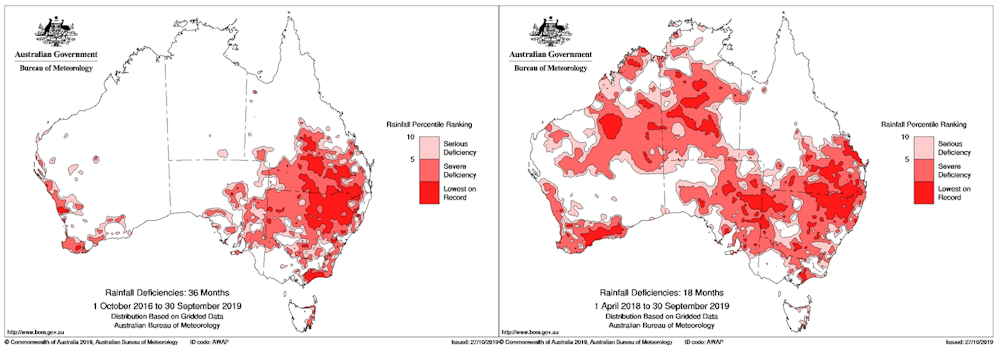
First, it’s important to understand that drought is a manifestation of interactions between the atmosphere, ocean, and land. In Australia, the Bureau of Meteorology uses rainfall deficiencies to identify regions that are under drought conditions. Anyone on the land doesn’t need to be reminded, but the current drought is seriously bad. These maps show the patterns of rainfall deficiency over the past 36 and 18 months, highlighting the severity and extent of what we call meteorological drought.
Widespread rainfall deficiencies over the last 36 months (left) and 18 months (right)Australian Bureau of Meteorology
But along with the main driver – low rainfall – droughts can also be exacerbated by water loss through evaporation. This depends not only on temperature but also humidity, wind speeds, and sunshine. Temperature will clearly continue to rise steadily almost everywhere. For the other factors, the future is not quite as clear.
Water loss also varies according to vegetation cover. Plants respond to higher carbon dioxide levels and drought by closing the tiny holes in their leaves (the stomata) and this can actually reduce water loss in wet environments. However, in water-stressed environments, projected long-term declines in rain may be compounded by plants using more water, further reducing streamflow. Actually, we can glean a lot from studying hydrological drought, which is measured by a period of low flow in rivers.
The point here is droughts are multidimensional, and can affect water supply on a wide range of spatial and temporal scales. A seasonal-scale drought that reduces soil moisture on a farm, and a decade-long drought that depletes reservoirs and groundwater supplies, can each be devastating, but in different ways.
Is climate change affecting Australian droughts?
Climate change may affect drought metrics and types of drought differently, so it can be hard to make general statements about the links between human-induced climate change and all types of drought, in all locations, on all timescales.
Southern Australia, and in particular the southwest, has seen a rapid decline in winter rainfall and runoff that has been linked to climate change. In the southeast there has also been a substantial decline in winter rainfall and total runoff in recent decades. Although the reductions are consistent with climate change projections, the trend so far is harder to distinguish from the year-to-year variability.
But the role of climate change in extended drought periods is difficult to discern from normal variations in weather and climate. This is particularly true in Australia, which has a much more variable climate than many other parts of the world.
What does the future hold?
Climate models project increasing temperature across Australia and a continuing decline in cool-season rainfall over southern Australia over the next century. This will lead to more pressure on water supplies for agriculture, the environment, and cities such as Melbourne at the Paris Agreement’s target of 2℃, relative to the more ambitious target of 1.5℃ of global warming.
Rainfall is projected to become more extreme, with more intense rain events and fewer light rain days. Declining overall rainfall is predicted to reduce river flows in southeastern Australia. While we can expect the largest floods to increase with climate change, smaller floods are decreasing due to drier soils, and it is these smaller floods that top up our water supply systems.
Action needed
We might not know enough about droughts to be certain about exactly how they will behave in the future, but this does not affect the message from the science community on climate change, which remains crystal clear.
Rainfall intensification, sea level rise, ocean acidification, hotter days, and longer and more intense heatwaves all point to the fact that climate change presents a major threat to Australia and the world.
In response to these threats, we need deep and sustained greenhouse gas emissions cuts and proactive adaptation to the inevitable effects of climate change. This includes a focus right now on the practical measures to help our rural communities who continue to feel the pinch of a dry landscape.
Source: The Conversation (Au and NZ) – By Larissa Hjorth, Professor of Mobile Media and Games. Director of the Design & Creative Practice Platform., RMIT University
Sometimes life appears incomprehensible, of another world. The supernatural has been evoked in many cultures and religions as a way to make sense of the thresholds of mortal and immortal worlds through images and stories.
For some, the supernatural can help make sense of the irrationality of life. For others, it gives context for the textures of grief. And for others still, it provides continuity in the afterlife.
Rapunzel (2004) by Miwa Yanagi.Art Gallery of NSW
Japan supernatural, a new exhibition at the Art Gallery of NSW, surveys the complex, playful and inventive ways Japanese culture has visualised these themes from the 1700s to today.
Connection to the everyday
Defining the supernatural is a difficult task — reflecting our contested mortal and moral understandings. Japan has a compelling history of bringing the mystical to life — from the evocative woodcut prints of scholar, poet and artist Toriyama Sekien (1712–88), to the powerful storytelling of Hayao Miyazaki (of Spirited Away animated film fame) and the “superflat” popular character reinventions of Takashi Murakami.
In Japan — informed by Shinto beliefs around notions of animism — a soul (“reikon”) lives within all existence and phenomena. Everyday things — from objects to plants to mountains — can be defined as “kami” or deities.
This connection between the natural and spiritual worlds creates a complex understanding and respect for the everyday. Cups can be vessels for long lost ancestors. Would you throw out a cup if it could contain the spirit of your long lost grandmother?
Indeed, both personal and global lessons can be learnt from the animism appreciation of the environment in the face of current Anthropocene challenges.
Fuyuko Matsui’s The parasite will not abandon the body (Ōsei wa karada o saranai), 2011.Art Gallery of NSW
Powerful spirits
The Japan supernatural exhibition begins from the Edo Period (1603–1868) and spans three centuries to contemporary manifestations. Stories highlighting the enduring power of the supernatural to understand the limits and potential of humanity are included.
Concepts such as yōkai — which in English translates roughly to monsters, goblins, demons and spirits — often take the form of everyday animals or objects. The prolific and prescient work of Sekien’s 18th century prints and books gives yōkai a creolised character face that manages to inspire both delight and fear.
Detail from Toriyama Sekien’s Night procession of the hundred demons (1776)Art Gallery of NSW
In Japan, the yōkai have long been deployed in art and culture as a way to reflect upon morality and mortality. As anthropologist Komatsu Kazuhiko notes in the exhibition catalogue, the yōkai has gained long overdue scholarly attention in recent decades.
“Japan’s yōkai culture is extraordinarily rich,” he writes. “One aspect of yōkai culture relates to religious and spiritual history, another to the arts, including literature, the visual arts, theatre and popular entertainment”.
Japanese supernatural forms frequently change and transform. Only some of these transformative concepts translate into English: bakemono means “changing thing”, mononoke means “things that transform”, and yurei is the Japanese word for ghosts.
Yet art can unlock different cultural perceptions and understandings of otherworldly shapeshifters that go beyond language.
Takashi Murakami’s grand scale painting: Vertiginous After Staring at the Empty World Too Intensely, I Found Myself Trapped in the Realm of Lurking Ghosts and Monsters (2019).Photo: Kaikai Kiki/Art Gallery of NSW
Fluid histories
The haunting presence of the spectral across the centuries creates and curates a different sense of time throughout this exhibition.
The work of Seiken can be found in director Isao Takahata’s woodblocks for the 1994 Studio Ghibli animation Pom Pok. And the exhibition includes key masters of the Ukiyo-e Period from the 17th to 19th century, such as Katsushika Hokusai who is famous for the timeless print The Great Wave.
The supernatural in Japan is all-pervasive, playing out in curious ways. For instance, anthropologist Anne Allison has been exploring the emerging Shinto-inspired death industries in Japan.
Regeneration of a breached thought (2012) by Fuyuko Matsui.Art Gallery of NSW
Funerals and cemeteries for people without families are emerging. Elderly Japanese people are meeting the strangers they will be buried near — some moving across Tokyo to live with their “grave friends” in this lifetime.
This continuity with life, death and afterlife could teach us plenty about the supernatural in our everyday lives; how to better understand one another, the environment around us, and perhaps even to comprehend the incomprehensible.
Japan supernatural runs 2 November to 8 March at the Art Gallery of NSW.
In the dramatic account of the raid and killing of Islamic State leader Abu Bakr al-Baghdadi, one thing captured widespread attention. A military working dog was singled out for praise, reportedly chasing al-Baghdadi down a tunnel before the IS leader detonated a suicide vest, killing himself and his three children.
The Joint Chiefs acknowledged the dog was “slightly wounded and fully recovering” and still on active duty.
Dogs used by militaries around the world are seen as vital assets to military operations, with close bonds created between dogs and their handlers. Many descriptions of military working dogs describe them as fellow soldiers, no different in treatment, status and respect, than their human counterparts.
So it’s interesting that the legal frameworks governing militaries and the operation of armed conflict have so little to say about the use, protection, or treatment of animals during war. This gap is particularly notable as the use of animals as soldiers is nothing new.
War dogs in history
This isn’t the first dog to become famous with such raids. Cairo was a lauded member of Operation Neptune Spear, the US Navy SEALs operation that resulted in the death of Osama bin Laden.
But the history of the use of animals in warfare goes back further. Dogs were recorded in warfare as early as 600 BCE, and mentioned in the works of Homer, Herodotus, and Polynaeus. And while technological advancements have reduced the need for many species to be used by militaries, dogs are still seen as vital to their work.
The Australian Defence Forces extensively use dogs in their operations, and for many purposes. This includes sniffing out explosive devices, detecting narcotics, locating the wounded, and patrolling and protecting missions and bases.
The RAAF has been trialling a welfare dog program, placing dogs with chaplains to serve as therapy animals for deployed soldiers, in association with the Young Diggers Dog Squad.
In 2017, the Australian Defence Force commissioned the Canine Operational Service Medal, becoming the first military in the world specifically to honour the contributions made by military working dogs.
The medal is emblazoned with the image of Quake, an army combat assault dog, who died on operation in Afghanistan in 2012.
Military dogs are ‘equipment’, at best
The close bonds formed between military dogs, their handlers, and their units – and the hero status the public is eager to give these dogs – is not reflected in their legal status during armed conflicts.
In the United States, military dogs are labelled as “equipment”. A bill was introduced in 2012 to reclassify them as “canine members of the armed force”, but this bill ultimately lapsed without being passed into law. In practice, they are treated as noncommissioned officers, and given higher ranks than their handlers to ensure respect. But this is symbolic and brings with it no legal protection when in the theatre of war.
In Australia, the status of military working dogs is not addressed in legislation. But on the public-facing website of the Air Force, they’re placed under the category of “technology”, alongside bushmasters and fire trucks.
The medal awarded to military dogs when they’re very good.Department of Defence
This classification as “things” comes at a time when much attention is being given to the status and rights of animals in many parts of the world, and a move away from classifying animals as property. The ACT has just passed law recognising animal sentience, acknowledging their ability to feel pain and to perceive the world around them.
The international law governing war – known as international humanitarian law or the laws of war – says even less. Despite the long history of animals used in warfare, there is not a single reference to the use of dogs or any other animal during war.
This silence does have consequences for military working dogs, beyond just outdated perceptions of non-human species.
Combatant status brings with it the right to be involved in hostilities, but also the burden of being a legitimate target for attack by the other side. Civilians are granted fundamental protections of not being a legitimate target, but lose this protection if they start participating in the hostilities.
The laws of war also provide protections for combatants to not be targeted in circumstances where they are surrendering, wounded, and provide for special protections for prisoners of war.
If dogs are nothing more than military equipment, then neither the protections of combatant or civilian status apply – they can be targeted and destroyed as if any piece of inanimate military gear.
A black Labrador military dog eyes an Australian digger’s snack in Korea. Military dogs are given no legal protection during conflict.AAP Image/Supplied
If equipment or technology, then there is no obligation to treat them with respect if captured or wounded.
For example, there is no international law in place prohibiting the use of dogs, as they were used by the Soviets in World War II and beyond, as suicide bombers.
Dogs need legal protection
The solution isn’t as simple as recognising dogs having the same combatant status as humans.
Combatants must comply with the rules of international humanitarian law. This means they commit, at all times, to distinguish between civilians and combatants, to not attack the wounded, and more.
Military working dogs are unlikely to be able to fully and independently comply with this large body of law. What’s needed are protections specifically targeting their role in armed conflicts.
The animal rights movement still has a long way to go when it comes to a universal recognition of the personhood of animals generally, and the laws of war are just a small facet of the bigger picture.
But the simultaneous treatment of dogs who are used on battlefields and in operations as heroes, while offering none of the legal protections given to their human counterparts, shows an irreconcilable dilemma in our current approach.
Last weekend marked 34 years since the land title to Uluru was handed back to the local Yankunytjatjara-Pitjantjatjara peoples. It was also when joint management of the Uluru-Katja-Tjuta National Park began between the traditional owners (Anangu people) and Parks Australia.
The arrangement recognised Anangu title to the land and ensured the direct involvement of Anangu in the development of tourism in the area.
The agreement also coincided with the relocation of tourism facilities from the southeast base of Uluru to the purpose-built resort town of Yulara. The old hotels and other tourist sites were discarded and became the base for the Anangu community of Mutitjulu.
However, if joint management aimed to deliver improved economic and social outcomes for Anangu residents, it has proven to be a spectacular failure.
Mutitjulu was also the epicentre of the controversial Northern Territory National Emergency Response in 2007, commonly referred to as the intervention, when the federal government took control over more than 70 Indigenous communities in response to allegations of child sexual abuse.
Mutitjulu is emblematic of what academic Jon Altman refers to as the persistent need to reestablish trust between Indigenous Australians and the institutions that for so long failed to ensure their basic human rights were protected.
An end to climbing brings new opportunities
The end of climbing at Uluru provides an opportunity to reset the relationship between the traditional owners and the tourism sector, and look for new ways for Anangu to be integrated into the industry.
Central to this is how the Anangu can meaningfully develop their cultural assets within the park to ensure the long-term benefit of their people, particularly through direct employment.
There would appear to be ample opportunities for the people in Mutitjulu to take advantage of the 1,000-plus tourism jobs in Yulara, which are currently staffed largely by Indigenous and non-Indigenous people from outside the community.
The closure of Uluru to climbing also necessitates the development of alternate visitor experiences, particularly more educational and immersive experiences that would entail learning from and interacting respectfully with traditional owners.
The decision to end climbing at Uluru has been a cause for celebration by Indigenous communities.Lukas Coch/AAP
Obstacles to developing an Indigenous tourism economy
Yet, structural impediments prevent this from becoming a reality at Uluru, as well as other remote parts of Australia.
These obstacles include a lack of education and training options specific to Indigenous needs to help them set up and run their own businesses. Another issue is that land rights and native title claims have tended to benefit a few legally recognised landowners and haven’t been conducive to whole-of-community development.
Both the Anangu and key tourism stakeholders in central Australia, including Voyages Indigenous Tourism and Tourism NT, are keenly aware of the need to reform the local tourism industry.
The Anangu must also be empowered to start micro-enterprises grounded in Knowledge of Country that would strengthen their community, culture and language. One example of this is the Indigenous Ranger and Protected Area program, which involves Indigenous rangers managing their own lands based on traditional cultural practice.
Another approach that has shown promise is embracing Indigenous knowledge systems as part of the tourist educational experience. This is gaining currency in the NT as remote community arts centres seek to become visitor destinations in their own right.
These approaches to bottom-up initiatives have the greatest potential for growth and long-term empowerment in Uluru.
A model for other Indigenous communities
A major tourism rethink also requires addressing the structural impediments that prevent Indigenous peoples from starting businesses.
For example, new incentives could be built into the Australian tax code for those who invest in businesses on Aboriginal-owned land. However, such measures will only succeed if they are supported by bespoke educational and training programs for Anangu wanting to work in tourism.
This could also provide a model for traditional owners elsewhere who want to reclaim decision-making authority over tourism and other cultural activities on their lands.
And it signals to the broader Australian public that a greater respect for the rights of Indigenous people might just be the catalyst that helps drive a brighter Indigenous future.
A five-member film crew from 60 Minutes Australia has been in detained in Kiribati for what government sources claimed was false declaration by the team on arrival, reports PACNEWS.
The crew was detained shortly after they arrived on a flight from Nadi on Monday for allegedly providing “false and misleading information” over the purpose of their visit.
“From my understanding the 60 Minutes crew is still in Tarawa and will return on their intended flight back on Thursday. They are however being detained due to their entry into the country under false pretenses,” a senior government official told PACNEWS.
The official who wished to remain anonymous said the Australian television crew was advised prior to their arrival to apply for a filming/research permit in order to get clearance from immigration on arrival.
“When they arrived they declared that they were here for a meeting and failed to mention their filming intentions thus the false declaration grounds. If they had applied for their permits before arrival as advised, this would not have happened,” said the official.
– Partner –
“During their detention, they are forbidden from carrying out any filming since they did not declare this activity to immigration upon their arrival.
The crew, led by 60 Minutes reporter Liam Bartlett was being held under house arrest at the Utirerei hotel until their flight.
According to The Guardian, the official said that while the team had been sent an application for a media permit to enter the country for reporting purposes, they had not sent it back to the office and therefore had not been approved to enter the country.
However, Channel Nine news disputed this version of events, saying: “The 60 Minutes crew traveled to Kiribati on Monday. Before leaving, they submitted applications for filming approval.”
“On arrival they arranged a meeting with authorities including the Executive Assistant of the President and a Senior Representative of the Immigration Department to discuss the application. Further forms were submitted and a request was made for expedited approval. That request was declined this morning and the 60 Minutes team was asked to remain in their hotel until the next flight out, which was their scheduled departure flight.”
“The crew is not under detention or house arrest as has been incorrectly reported, and the issue does not affect the story being worked on.”
However, the immigration official said that personnel had been stationed outside the hotel room to prevent the crew from leaving.
“They come here and lecture us on democracy, they come here and lecture us on how much we should charge people for the fee [for the media permit] and they come here because they think they can do whatever they want in the Pacific and beyond and we should follow suit. This is not acceptable,” he said.
“They insist on going out even though we ask them nicely to stay in the hotel, they ask for legal representation, they argue with officers.”
Source: The Conversation (Au and NZ) – By Ariadna Matamoros-Fernández, Lecturer in Digital Media at the School of Communication, Queensland University of Technology
This is the second article in a series looking at the attention economy and how online content gets in front of your eyeballs. Read part 1 here.
YouTube’s video recommendation system, in particular, has been criticised for radicalising young people and steering viewers down rabbit holes of disturbing content.
The company claims it is trying to avoid amplifying problematic content. But research from YouTube’s parent company, Google, indicates this is far from straightforward, given the commercial pressure to keep users engaged via ever more stimulating content.
But how do YouTube’s recommendation algorithms actually work? And how much are they really to blame for the problems of radicalisation?
The fetishisation of algorithms
Almost everything we see online is heavily curated. Algorithms decide what to show us in Google’s search results, Apple News, Twitter trends, Netflix recommendations, Facebook’s newsfeed, and even pre-sorted or spam-filtered emails. And that’s before you get to advertising.
More often than not, these systems decide what to show us based on their idea of what we are like. They also use information such as what our friends are doing and what content is newest, as well as built-in randomness. All this makes it hard to reverse-engineer algorithmic outcomes to see how they came about.
Algorithms take all the relevant data they have and process it to achieve a goal – often one that involves influencing users’ behaviour, such as selling us products or keeping us engaged with an app or website.
At YouTube, the “up next” feature is the one that receives most attention, but other algorithms are just as important, including search result rankings, homepage video recommendations, and trending video lists.
The main goal of the YouTube recommendation system is to keep us watching. And the system works: it is responsible for more than 70% of the time users spend watching videos.
When a user watches a video on YouTube, the “up next” sidebar shows videos that are related but usually longer and more popular. These videos are ranked according to the user’s history and context, and newer videos are generally preferenced.
This is where we run into trouble. If more watching time is the central objective, the recommendation algorithm will tend to favour videos that are new, engaging and provocative.
Yet algorithms are just pieces of the vast and complex sociotechnical system that is YouTube, and there is so far little empirical evidence on their role in processes of radicalisation.
In fact, recent research suggests that instead of thinking about algorithms alone, we should look at how they interact with community behaviour to determine what users see.
The importance of communities on YouTube
YouTube is a quasi-public space containing all kinds of videos: from musical clips, TV shows and films, to vernacular genres such as “how to” tutorials, parodies, and compilations. User communities that create their own videos and use the site as a social network have played an important role on YouTube since its beginning.
Today, these communities exist alongside commercial creators who use the platform to build personal brands. Some of these are far-right figures who have found in YouTube a home to push their agendas.
It is unlikely that algorithms alone are to blame for the radicalisation of a previously “moderate audience” on YouTube. Instead, research suggests these radicalised audiences existed all along.
Content creators are not passive participants in the algorithmic systems. They understand how the algorithms work and are constantly improving their tactics to get their videos recommended.
Right-wing content creators also know YouTube’s policies well. Their videos are often “borderline” content: they can be interpreted in different ways by different viewers.
YouTube’s community guidelines restrict blatantly harmful content such as hate speech and violence. But it’s much harder to police content in the grey areas between jokes and bullying, religious doctrine and hate speech, or sarcasm and a call to arms.
Moving forward: a cultural shift
There is no magical technical solution to political radicalisation. YouTube is working to minimise the spread of borderline problematic content (for example, conspiracy theories) by reducing their recommendations of videos that can potentially misinform users.
However, YouTube is a company and it’s out to make a profit. It will always prioritise its commercial interests. We should be wary of relying on technological fixes by private companies to solve society’s problems. Plus, quick responses to “fix” these issues might also introduce harms to politically edgy (activists) and minority (such as sexuality-related or LGBTQ) communities.
When we try to understand YouTube, we should take into account the different factors involved in algorithmic outcomes. This includes systematic, long-term analysis of what algorithms do, but also how they combine with YouTube’s prominent subcultures, their role in political polarisation, and their tactics for managing visibility on the platform.
Before YouTube can implement adequate measures to minimise the spread of harmful content, it must first understand what cultural norms are thriving on their site – and being amplified by their algorithms.
The authors would like to acknowledge that the ideas presented in this article are the result of ongoing collaborative research on YouTube with researchers Jean Burgess, Nicolas Suzor, Bernhard Rieder, and Oscar Coromina.
Source: The Conversation (Au and NZ) – By Robyn J. Whitaker, Senior Lecturer in New Testament, Pilgrim Theological College, University of Divinity
American televangelist Pat Robinson once claimed children who celebrate Halloween were unknowingly “worshipping Satan”.
Despite the absurdity that a child dressing up as a witch is devil worship, the idea that Halloween is linked to something satanic continues to have purchase among some conservative Christians. However, the traditions behind this increasingly popular holiday are far more complex. It has less to do with anything satanic and more to do with superstition and our relationship with death.
For approximately the past 1,200 years, Halloween has been defined, in part, by the Christian festival celebrated on November 1 each year known as All Saints’ Day or “All Hallows” in old English. “All Hallows Eve” became “Hallowe’en” – the eve of All Saints’ Day.
All Saints’ Day is the day Christians remember and give thanks for those who have died, particularly those who have inspired faith.
In the Roman Catholic tradition, saints are a specific category: someone recognised for extraordinary faith and service, recognised through a formal canonisation process. However, in the Protestant tradition, “saints” refers more generally to all believers. So All Saints’ Day is time to remember all those who have died, often with a focus on those who have died in the previous year (Catholics, Orthodox Christians and some Anglicans celebrate this larger group on All Souls’ Day).
The point of these Christian festivals is to remember and honour the dead. On All Souls’ Day at the church I attend, we read aloud the names of dead loved ones submitted by attendees. The list can be long, but it can be a deeply moving experience. It is a rare time to name the dead, comfort one another in grief, and keep alive the memories of loved ones by giving thanks for their lives. And this is the connection to the much older traditions that lie behind Halloween.
Honouring the dead takes a range of forms around the world, as it has throughout history. Ancient Romans left gifts on the graves of their ancestors at Feralia to appease the spirits. Mexican customs associated with the Day of the Dead (Dia de Los Muertos) similarly include leaving gifts at graves.
In Australia, the more recent tradition of Anzac Day dawn services and the placement of wreaths on monuments echoes this desire to remember and honour a particular category of those who have died in service to their country.
The Celtic origins of Halloween, known as Samhain, also included gifts for the dead. Out of superstitious concern that the spirits or ghosts of the dead could enter the space of the living on Halloween night and perhaps even take the living with them, Celts wore costumes to disguise themselves from ghosts and burned bonfires to ward off bad spirits. Small bowls of food placed outside homes sought to appease the ghosts. This may well be the origins of the more recent trick-or-treat tradition.
A festival of the dead might seem a strange and ghoulish thing in a culture that is otherwise so death-denying. It stands as a sharp contrast to our modern obsession with anti-ageing, life-extending technology. Yet, despite an ambivalent history with Halloween, it is becoming more popular each year in Australia. Spending on costumes, sweets and decorations has sky-rocketed in recent years.
While the environmental impact of these cheap plastic decorations and individually wrapped candy raises its own set of ethical issues, the relationship between the dead and the living raises a deeper set of questions.
How do we continue to remember the dead? How do we honour and keep alive memories of those who have gone before us? How do we talk about death with our children in a way that makes it less scary yet without denying or trivialising its seriousness?
Divorced from religious traditions of various kinds, we are in danger of being a culture that lacks the rituals that help us pause, remember, give thanks and take stock of both death and life.
In our modern age, we are less likely to be worried about ghosts rising from graves on Halloween. Yet I can’t help but wonder whether the attraction of Halloween is that it taps into a part of our collective psyche that continues to be intrigued by questions about death, the afterlife and the spiritual realm, despite being less likely to practise formal religion.
While very conservative Christians will view anything not explicitly Christian as anti-Christian (and therefore satanic, or “of the devil”), Halloween, like so many other cultural festivals, reflects a complex set of traditions and beliefs. Rather than doing harm, perhaps dressing up like a ghost, zombie, devil, angel or some other undead being is actually a way to celebrate life.
After all, remembering the dead (or dressing up like them) reminds us to be grateful for life.
In years gone by, women would rely on the calendar on the wall to work out when their next menstrual cycle might occur. They would look to physical signs to tell them when they might be ovulating, and therefore when they’d be most likely to fall pregnant.
More recently, we’ve seen the proliferation of mobile phone applications helping women track their current cycle, predict their next cycle, and work out when the best time is to try for a baby.
There are more than 400 fertility apps available, and over 100 million women worldwide are using them.
The personalisation and convenience of apps makes them empowering and attractive. But they require some caution in their use.
While fertility apps use individualised information to estimate the most fertile period, they are not completely reliable. And even if an app indicates when a woman is most fertile, it doesn’t mean a pregnancy will follow if a couple has sex during this window.
The menstrual cycle
A woman’s menstrual cycle consists of three phases: menstrual bleeding, the follicular phase (when an egg-containing follicle is growing) and the luteal phase (the two weeks after ovulation prior to the next period).
It’s traditionally been thought the follicular phase varies in length between women, whereas the luteal phase is relatively constant between women – generally around 14 days. All phases together are thought to amount to a cycle lasting 28 days.
The actual time of ovulation, which occurs at the end of the follicular phase, is marked by the rise in a hormone called the luteinising hormone. This can be measured by a blood test, or more conveniently by urine dipsticks (the same mechanism used for at-home pregnancy tests).
Physical changes during ovulation include altered vaginal secretions and a subtle drop and then rise in basal body temperature.
A woman can become pregnant during the five days before ovulation or on the day of ovulation. However, the most fertile days are the three days leading up to and including ovulation. By 12-24 hours after ovulation, a woman is no longer able to conceive during that menstrual cycle.
How the apps work
When a woman logs the beginning of her menstrual cycle, fertility apps attempt to predict, using inbuilt algorithms, when ovulation might occur. The app then recommends the timing of intercourse accordingly to optimise the user’s chance of becoming pregnant.
Calendar-based apps rely entirely on menstrual cycle length and an assumption ovulation occurs 14 days before the next period.
Many of the more sophisticated apps collect data on basal body temperature, while some also call for a woman to examine her cervical mucus secretions, or include results from at-home ovulation test kits.
There may be ancillary options to track mood and feelings, diet and exercise, and sexual intercourse.
Australian researchers recently looked at 36 fertility apps most commonly downloaded by Australian women. The research, yet to be published, indicated less than half (42.7%) of the apps predicted the correct ovulation date.
A published study looking at 12 fertility apps found the calendar-based apps did not correctly determine the ovulation date when the average length of previous cycles was different to the estimated current cycle length. The prediction of fertile days based solely on previous cycle lengths is a clear limitation of calendar-based apps.
For apps collecting temperature data, the prediction of highly fertile days was also commonly missed due to the use of data from previous rather than current cycles.
It’s likely the apps which request more information will have better accuracy. But their effectiveness also relies on the user entering information correctly and consistently.
Importantly, a recent study looking at more than 600,000 menstrual cycles from 124,648 women tracked by the Natural Cycles app showed the luteal phase is often considerably longer or shorter than 14 days. This calls into question the fundamental premise of a standard 28 day cycle on which many apps are based.
In women who had logged at least three cycles on the Flo app (1.5 million women), we found just 16.3% had a median 28 day cycle. A higher percentage of older women (aged 40+) had shorter cycles; whereas Asian women and women with a very high BMI tended to have longer cycles.
For a couple struggling with infertility, an app probably can’t offer a solution.From Shutterstock.com
An algorithm can’t capture all factors that affect fertility
Although we need more research in this area, the evidence so far suggests if you’re trying to have a baby, you shouldn’t rely too heavily on an app – particularly if you’re finding it hard to conceive.
Various factors such as diet, exercise, body weight, and ethnicity can play a role in a woman’s menstrual cycle and a couple’s chance of conceiving. While many apps allow users to input this information, changes such as an increase or decrease in body weight, or times of high stress, which may lead to irregular menstrual cycles, are not incorporated into the algorithms that predict when a woman will be most fertile.
This may contribute to a delay in conception and lead to distress, particularly if a couple has already been trying to conceive for many months.
On the plus side, consistency in using fertility apps may assist women in getting to know their bodies better, and with evidence-based educational components in some apps, their use may support fertility awareness and knowledge about reproductive health.
Fertility apps can be beneficial for documenting monthly cycles and help women identify when their cycles may be irregular. When this is the case, this may be a sign of other reproductive health issues, and women should see a doctor.
In women who have reproductive health issues such as polycystic ovary syndrome or endometriosis, the ability to become pregnant is already reduced. An app estimating ovulation or suggesting the most fertile period in these women may therefore be limited in its effectiveness.
School choice is a defining feature of Australian education. One reason is because more families make choices between public and private schools than in other OECD countries.
In 2017, 29.8% of Australian primary, and 40.6% secondary, students were enrolled in private schools, compared to OECD averages of 11.5% (primary) and 17.8% (secondary).
Choices also exist within school sectors, such as selective or alternative government schools, or the variety of religious schools in the independent sector.
Recent research suggests a “generalised state of anxiety” among families that not all schools can be trusted to deliver quality education. This is partly influenced by media reports raising alarm about Australia’s declining education standards.
So with all this choice, and anxiety, how do Australian families decide which school their kids will go to? While convenience and family reasons play a large a part in decision-making at the household level, factors outside the household also influence families’ choices.
School performance
The MySchool website was created to help families make better choices about schools by providing several aspects of school information, the main of which being data about how each school is performing in comparison to others.
School performance is shown using National Assessment Program – Literacy and Numeracy (NAPLAN) results. The theory behind MySchool was that it would motivate schools to strive for better results to attract more families to enrol.
Yet a recent government review found most families aren’t using MySchool for its intended purpose. While 81% of parents agreed information about school performance should be publicly available, this didn’t play a strong part in their choice of a school – only 45% of parents had ever looked at the MySchool website.
And 71% of teachers did not believe MySchool influenced families’ choices. The NAPLAN results will now feature less prominently on the MySchool website, in light of the review’s findings.
While NAPLAN results may not be persuasive, school ATAR scores can impact on families’ decisions, despite their limitations as a true measure of school performance. Media interest in secondary school results is intense, with The Age newspaper recently releasing its own online interactive school comparison tool.
The best measures of school performance for families to use are those that capture the true value schools add to students’ learning. For example, the measures of student gain on MySchool show how much difference schools are making to students’ learning over time, not just whether they achieve high scores.
Social connections and location
Recent research suggests Australian families choose schools in more complex ways than comparing their results. Choice of school is a strategic exercise, where parents figure out which curriculum subjects offer best advantage for university entry, or which school communities offer the best social connections.
Families with the right social networks are more likely to use “grapevine” methods to choose a school. One teacher in the previously mentioned government review commented that social media beats MySchool “hands down” in shaping families’ decisions.
Families choose schools based on a number of factors including social connections and location.from shutterstock.com
Location also matters in choosing a school, which is as much about the social mix of a particular area as convenience. Moving into an area with desirable schools is the optimal strategy to gain both accessibility and social advantage.
Australian researchers have estimated house prices increase by nearly A$20,000 for every 1% increase in the proportion of top-ranked secondary students in local schools.
Just as families can select schools, school can also select their students. A growing number of Australian families are opting to seek entry into selective entry government schools.
In NSW – which has more than 45 selective schools – more than 14,000 year 6 students sat the 2018 entry test, competing for just over 4,000 available places.
There is a strong cultural dimension to this choice. Families from language backgrounds other than English constitute 83% of enrolments in NSW selective schools.
As well as the academic environment, selective schools offer families a similar socio-economic mix to a private school, without the price tag. In Victoria and NSW, 59.5% and 74.4% of select-entry school students, respectively, come from the wealthiest quarter of families in the state.
Despite their growing popularity, selective entry schools can incur other costs, such as long commutes (up to 100 kilometres per day), and the stress of entrance tests.
ANU research has found greater selectivity in education can lower a country’s overall academic performance, and distort students’ concept of their learning ability. This suggests that the choices individual families make to get the best education for their children may have costs for the education system as a whole.
Not all choices (or choosers) are equal
Many Australian families don’t have the opportunity to exercise choice in selecting a school for their child. A 2013 Grattan Institute report found around half of Australian schools had little competition from neighbouring schools, and were essentially the only available local choice.
Even where school options exist, many families cannot act on their preferences due to limited financial, social or academic resources. These families must make their decisions by default, accessing whichever schools are available once more advantaged families have exercised their choices.
The world’s top-performing education systems are those that balance families’ drive to make the best possible choices, with adequate support for those whose access to school choice (and its benefits) is most constrained.
What if robots can do less than we think?Shutterstock
In Australia and elsewhere the study’s predictions have led to calls for a Universal Basic Income and for a “work guarantee” that would allocate the smaller number of jobs fairly.
Our new research paper concludes the former study’s predictions are not well-founded.
It has two weaknesses.
First, the method used to make predictions has major flaws.
Second, the predictions have not fared well when compared to actual changes in employment in the United States in the time since they were made.
Flawed method
The study authors asked a group of machine learning experts to identify jobs from a long list that could be automated.
The experts concluded that half of the jobs on the list could be done by robotics and artificial intelligence in the near future.
What’s wrong with that?
While those interviewed were experts in machine learning, they were not experts in the many jobs they considered. They were simply asked to look at a short text description of each job along with a list of tasks associated with it.
Some of their predictions might make sense, such as most driving-related jobs being at risk.
Those jobs seem unlikely to vanish entirely in the next decade; but given recent developments in driverless cars, their demise might not be far away.
But other predictions are harder to understand, such as the claim the jobs of accountants, marketing specialists and claims investigators are at risk over the next decade or so.
Standard descriptions of the tasks undertaken by accountants include interpretation of information about accounting records and organisational performance. Interpretation is usually regarded as outside the scope of work that can be done by artificial intelligence.
The work of accountants may well change with advances in artificial intelligence, but it is unlikely to be lost.
Exaggerated retelling
Equally troubling, we show the study’s predictions are inconsistent with the study authors’ views about how robots and artificial intelligence will affect jobs.
The authors write that recent advances in robotics are still struggling with the challenge of manipulating small objects. Yet their study ends up predicting many jobs that require this sort of manipulation are at high risk of being lost in ten to 15 years.
Keep in mind the authors did not themselves claim all the jobs they identified would be lost. Instead, they claimed it would become technologically feasible to replace them.
Unfortunately, that was a distinction almost entirely lost in the headlines – which portrayed the study’s predictions as forecasts of what would happen.
But replacing workers with machines requires more than having the machines available.
It requires investment in new (and likely very expensive) technologies. It requires governments to permit their use (as with driverless cars). And it requires workers be trained in their installation and maintenance.
Little predictive power
The study was initially published in 2013, six years ago, so it’s possible to evaluate the predictions that were made by comparing them against actual changes in employment.
When we do this, we find the predictions don’t add anything to our understanding of actual employment changes in the United States.
Economists already had developed a well-grounded and empirically supported framework for understanding the effect of technological change on employment.
Our calcuations show this framework better explains what happened to the numbers of jobs by occupation in the US from 2013 to 2018 than the study’s predictions.
Note that we were not examining whether the study correctly forecast what would happen (that would have been a big ask), merely whether their framework produced better forecasts than or added value to the existing framework. It did neither.
Some jobs will grow, others will die
Routine jobs will indeed dwindle as machines replace workers, but other jobs are likely to flourish. One occupation that stands out is personal care. Classified by the study as at high risk of automation, employment in it in the US has nearly doubled since the study was published.
Reality is often more complex (and interesting) than headlines.
For a more believable account of what is likely to happen we suggest a paper from the leading labour economist in the field, David Autor.
The ghosts of Halloween decorations provide light entertainment, but our enduring fascination for and fear of them is far from child’s play.
Polls indicate 35% of Australians believe in the existence of ghosts, figures echoed in the US and the UK. Indeed, belief in ghosts is so common across the world they are considered a cultural universal.
Tracing them through time and space – from dusty spirits to ghosts in machines – reveals ghosts have a particular knack for reflecting the specific anxieties of their historical moment. Paying attention to what makes them scary, can teach us about ourselves.
Small spooky girl ghosts are popular with modern storytellers.The Ring, IMDB
Spiritual limbo
Stuck in a space between life and death, ghosts are ambiguous and unsettled. Wherever they emerge they seem intent on bringing the past into the present.
The European Middle Ages abounded with sightings of ghosts – returned from their graves to frighten the living. These were thought to be the returning spirits, or revenants, of individuals who had suffered “bad deaths”: having been murdered, leading sinful lives, or being denied a proper burial.
Historian William of Newburgh chronicled one famous story of a Berwick man who died after falling from bedroom rafters while spying on his unfaithful wife. Despite a Christian burial, he returned with a pack of wild dogs to haunt men.
Les Très Riches Heures du Duc de Berry, Folio 113v – Purgatory.Wikiart
Postmortem revival was seen as a sign of moral and spiritual failings and was dealt with accordingly: bodies were exhumed and stakes driven through hearts. The Berwick ghost was eventually laid to rest after the husband’s corpse was dug up, dismembered and burnt.
With the concept of purgatory established in most Christian teachings by the 1400s, the understandings of revenants changed. No longer seen as unequivocally evil characters whose souls were forever lost, revenants came to reflect a state of spiritual limbo.
This moral ambiguity mirrored spiritual traditions elsewhere, such as East Asia where ghosts feature in ritual performances in both good and evil guises.
Harbingers of danger
In Fiji, where I have conducted ethnographic fieldwork for more than a decade, ghosts emerge in a number of shapes and forms. Once seen as protectors of the land and guardians of custom, increasingly they are taken as portents for new threats.
Villagers in Fiji reported ghostly visits from lost neighbours following Cyclone Winston.Joseph Hing/AAP
In 2016, members of a village reported being haunted by the ghost of a friend several weeks after he had drowned during Cyclone Winston.
Night after night the ghost was seen and heard searching for his bed and asking for food near the ruins of his old house. For villagers still recovering from the most violent cyclone in memory, this ghostly presence reflected and fuelled growing concerns about climate change and the sustainability of village life.
The ghost was read as a harbinger of danger, and the message it brought was scarier than the creature itself.
Old ghosts, new fears
Over time, ghosts have reflected geographically specific histories and concerns.
Native American spirits have moved from traditional ghostly pasts into the contemporary politics of heritage, land ownership and recognition. They also reportedly drive cars and intervene in construction work.
Indigenous Australian traditions feature a vast array of spiritual beings. Warwick Thornton’s 2013 docudrama The Darkside, developed from a national callout for Indigenous ghost stories, reimagined 13 tales and showed how the haunting presence of the past can be a defining part of life for many contemporary Australians.
Old haunts come to life in The Darkside, a film developed after a national call out for Indigenous ghost stories.
Anthropologist Mahnaz Alimardanian documented the ghostly figure of the Burnt Woman who reportedly haunts a mission in Northern NSW. With a face disfigured by fire, Burnt Woman is recognisable as a local Indigenous woman who was killed in the early days of colonial settlement, serving both as a reminder of the violence of past encounters and reflecting the damage of ongoing social injustices.
Her appearance to believers as a seductress of men adds a layer of social commentary in a community where gender violence is a significant problem.
What scares us now?
Ghosts in contemporary popular culture similarly reflect people’s current fears. The 2002 film The Ring – a remake of a cult Japanese film – drew on human anxieties about how technology might take hold of our lives, a fear that seems justified when a vengeful ghost crawls out of a TV screen.
In the TV series Black Mirror, a widow uses technology to revive her husband’s spirit.IMDB
These fears have also been canvassed in an episode of the Netflix series Black Mirror called Be Right Back in which a grieving young widow uses artificial intelligence to interact with her late husband.
In other modern ghost stories, spectres are depicted as grappling with the same existential issues haunting many modern humans. David Lowery’s A Ghost Story (2017) centres on a ghost’s difficulties in dealing with its own death and letting go of its past, issues a contemporary audience might feel familiar with in a time of rapid social change.
Where is a Ghostbuster when you need one? A Ghost Story (2017) deals with loss in a changing world.
This quality – ghosts’ ability to bring out our innermost subconscious fears – is what makes them such compelling and universally meaningful beings.
Modern buildings have seen rapid development in recent decades, with a push towards sustainable practices and improved energy efficiency. But the advancement of fire safety has been less prioritised, and we need to rethink our approach.
Combustible cladding materials, which are often found in buildings, pose safety concerns. The systems originally in place to help solve this problem weren’t good enough. That’s why my colleagues and I created the Cladding Materials Library, an online database which provides insight into the flammability of various cladding materials.
Cladding materials used in modern rainscreen systems on the outside of buildings offer insulation and protect buildings against rain, wind and sun. They also let architects create interesting building designs, such as by adding bright colours or curves to the exterior.
But flammability in modern cladding materials, among other failings, has led to increasingly frequent fires breaking out across the world. Examples include the 2014 Lacrosse fire in Melbourne and the 2017 Grenfell Tower fire in London.
The extent of the problem
Many cladding materials currently used are flammable to varying degrees, including very common Aluminium Composite Panels (ACPs). These have a plastic-based core material (such as polyethylene), with a sheet of aluminium glued to either side. While ACPs can sometimes be nearly non-combustible, they’re generally considered flammable.
In Queensland, about 18,000 buildings have been looked at to determine cladding flammability and overall building response to fire. Of these, 75% required no further action. For the remaining 25%, engineers were hired to further investigate whether they were problematic or not.
The Queensland government estimated 100-200 of the buildings needed to be made safer, with the price of work on a single building costing up to tens of millions of dollars.
It’s important to note some buildings with combustible cladding otherwise had rigorous fire safety designs, such as networks of well-maintained fire doors, short escape distances, good firefighter access, and layouts that minimise risk. Thus, having flammable cladding does not necessarily mean a building is dangerous.
Nonetheless, such materials shouldn’t have been included without architects, engineers and builders properly understanding the associated risks.
To help, we developed a database
The database my colleagues and I created, the first of its kind, offers a detailed collection of flammability information and material properties for different types of common cladding materials.
Generally, the same materials are used repeatedly across buildings, as there are only so many products available on the market. We used small-scale testing (10cm samples) to identify exactly which materials were the most important.
But identifying a material is not enough to understand how it performs in a fire. That’s why we completed flammability testing (of samples up to 1m in length) on 20 materials commonly found on the outside of buildings.
Over the course of a year, we took 1,100 small material samples from buildings and performed 9,250 tests. We then identified 75 unique cladding materials, and narrowed these down to 20 materials, on which we performed detailed testing (with about 30 tests per material). We chose a wide range of materials to ensure the most common ones were represented in our selection.
The experiments we did involved exposing the materials to heat in controlled ways, and then changing the amount of heat to see how the samples responded. Our process included measuring the time taken for a material to ignite, the amount of heat released from the material, how the heat was released, and how the flames spread.
Our results are now publicly available in the Cladding Materials Library, which can be updated as new materials are invented. The database will help fire engineers effectively assess the potential fire risk of buildings.
Writing accurate reports is crucial
Fire engineers can use our database to determine how a building as a whole might perform during a fire. They may then ask questions such as:
how quickly will the fire spread up the building?
can people reach a place of safety in time?
is there flammable material near important escape routes?
if the fire spreads upwards, how will the rest of the building perform?
But fire engineers involved in such investigations also need ongoing training to update their knowledge. For many, this came in the form of a continued professional development course designed by the University of Queensland, and a similar course for building professionals (such as builders and architects) developed by the Queensland government.
The latter has been important to the success of our project, as it allows building professionals to understand the problems at hand, and the reports written by engineers.
Safety in the future
For now, fire engineers hired by either the government or by building owners are making immediate changes to the relevant buildings to boost their short-term safety. Eventually, they will make suggestions for how to improve long-term building safety, which may cost more time and money.
The only way to solve the issue of fire risk is to understand how each building performs, and to have a suitably qualified engineer take responsibility for its design.
Our research will represent a change in how we approach solving this problem, and will hopefully help prevent fires in the future.
Modern buildings have seen rapid development in recent decades, with a push towards sustainable practices and improved energy efficiency. But the advancement of fire safety has been less prioritised, and we need to rethink our approach.
Combustible cladding materials, which are often found in buildings, pose safety concerns. The systems originally in place to help solve this problem weren’t good enough. That’s why my colleagues and I created the Cladding Materials Library, an online database which provides insight into the flammability of various cladding materials.
Cladding materials used in modern rainscreen systems on the outside of buildings offer insulation and protect buildings against rain, wind and sun. They also let architects create interesting building designs, such as by adding bright colours or curves to the exterior.
But flammability in modern cladding materials, among other failings, has led to increasingly frequent fires breaking out across the world. Examples include the 2014 Lacrosse fire in Melbourne and the 2017 Grenfell Tower fire in London.
The extent of the problem
Many cladding materials currently used are flammable to varying degrees, including very common Aluminium Composite Panels (ACPs). These have a plastic-based core material (such as polyethylene), with a sheet of aluminium glued to either side. While ACPs can sometimes be nearly non-combustible, they’re generally considered flammable.
In Queensland, about 18,000 buildings have been looked at to determine cladding flammability and overall building response to fire. Of these, 75% required no further action. For the remaining 25%, engineers were hired to further investigate whether they were problematic or not.
The Queensland government estimated 100-200 of the buildings needed to be made safer, with the price of work on a single building costing up to tens of millions of dollars.
It’s important to note some buildings with combustible cladding otherwise had rigorous fire safety designs, such as networks of well-maintained fire doors, short escape distances, good firefighter access, and layouts that minimise risk. Thus, having flammable cladding does not necessarily mean a building is dangerous.
Nonetheless, such materials shouldn’t have been included without architects, engineers and builders properly understanding the associated risks.
To help, we developed a database
The database my colleagues and I created, the first of its kind, offers a detailed collection of flammability information and material properties for different types of common cladding materials.
Generally, the same materials are used repeatedly across buildings, as there are only so many products available on the market. We used small-scale testing (10cm samples) to identify exactly which materials were the most important.
But identifying a material is not enough to understand how it performs in a fire. That’s why we completed flammability testing (of samples up to 1m in length) on 20 materials commonly found on the outside of buildings.
Over the course of a year, we took 1,100 small material samples from buildings and performed 9,250 tests. We then identified 75 unique cladding materials, and narrowed these down to 20 materials, on which we performed detailed testing (with about 30 tests per material). We chose a wide range of materials to ensure the most common ones were represented in our selection.
The experiments we did involved exposing the materials to heat in controlled ways, and then changing the amount of heat to see how the samples responded. Our process included measuring the time taken for a material to ignite, the amount of heat released from the material, how the heat was released, and how the flames spread.
Our results are now publicly available in the Cladding Materials Library, which can be updated as new materials are invented. The database will help fire engineers effectively assess the potential fire risk of buildings.
Writing accurate reports is crucial
Fire engineers can use our database to determine how a building as a whole might perform during a fire. They may then ask questions such as:
how quickly will the fire spread up the building?
can people reach a place of safety in time?
is there flammable material near important escape routes?
if the fire spreads upwards, how will the rest of the building perform?
But fire engineers involved in such investigations also need ongoing training to update their knowledge. For many, this came in the form of a continued professional development course designed by the University of Queensland, and a similar course for building professionals (such as builders and architects) developed by the Queensland government.
The latter has been important to the success of our project, as it allows building professionals to understand the problems at hand, and the reports written by engineers.
Safety in the future
For now, fire engineers hired by either the government or by building owners are making immediate changes to the relevant buildings to boost their short-term safety. Eventually, they will make suggestions for how to improve long-term building safety, which may cost more time and money.
The only way to solve the issue of fire risk is to understand how each building performs, and to have a suitably qualified engineer take responsibility for its design.
Our research will represent a change in how we approach solving this problem, and will hopefully help prevent fires in the future.
Many will feel a sense of déjà vu when reading the minister for Indigenous Australians’ announcement of a co-design process for a “voice to government”. This is yet another process in the long journey of Indigenous people to set things right and for our voices to be heard.
Ken Wyatt’s announcement states Indigenous people will have
the opportunity to have their say on the development of an Indigenous voice to government.
This is new and worrying. This “voice to government” is to be legislated and separate from the question of symbolic constitutional recognition. As Wyatt described it, this will also be a
co-design process that will develop models to enhance local and regional decision-making.
To begin the “co-design” process, he has, without consultation, appointed professors Tom Calma and Marcia Langton to a senior advisory group. Both are exceptional professionals whose suitability is beyond question. But the process falls short of the government’s own “co-design” intention.
It unfortunately marks another failure of the government to hear Indigenous voices. And it fails to hear the invitation from the Uluru Statement from the Heart to
walk with us in a movement of the Australian people for a better future.
Marcia Langton has previously called for the Voice to Parliament to be enshrined in the constitution.Lukas Coch/AAP
Ignoring our voices
Since his watershed National Press Club speech in July, Wyatt has sought to diminish the work of those involved in crafting the Uluru statement. The minister has labelled these leaders as “elites” and “influencers”, while emphasising those Indigenous voices supposedly not heard. This is incorrect.
The achievement of the Uluru statement should not be underestimated. Uluru dialogue participants were community members. Not elites. The 12 regional dialogues were run by communities themselves. Facilitation and technical advice was provided by the Referendum Council.
The national convention that produced the Uluru statement was made up of delegates elected by their communities from the regional dialogues. This was a process unlike any other in the history of Indigenous affairs.
These dialogues were legitimate expressions of Indigenous voices. There was no prefigured outcome, as there is with Wyatt’s proposed “voice to government”. The Uluru process drew its authority from the voices of Indigenous people taking part as representatives of their communities.
These participants included dissenting voices within our communities. And they reached the deliberative consensus of Voice, Treaty and Truth.
This outcome was also supported by the bipartisan joint select committee on constitutional recognition, which held its own extensive consultations. The committee acknowledged the Uluru statement was a game changer and a First Nations Voice to Parliament (not government) was the only viable option.
Ken Wyatt has defended his approach, saying, ‘If we are serious about a voice then we really do have to do this properly.’David Mariuz/AAP
Status quo reform
The intention to create a “voice to government” fits the minimalist rhetoric of improving local and regional decision-making, which Wyatt has been emphasising as the only viable option.
This emphasises a need to build on and improve existing structures. But this reform was resoundingly rejected by the Uluru statement. And it runs counter to the extensive support that continues to build within the Australian community for a constitutionally enshrined Voice to Parliament.
The Uluru dialogues specifically criticised existing structures that fail Indigenous people. A “voice to government” simply maintains the bureaucratic status quo. It does not structurally reform the process or the nation. It does not afford us our legitimate right to be heard and control the decisions that affect us.
The “voice to government” would also lack transparency and accountability. It would be confined narrowly to the government and its bureaucracy.
Having a “Voice to Parliament” as called for by the Uluru statement would ensure Indigenous people were no longer trapped within a web of bureaucracy and government priorities. This would enable Indigenous voices to be heard by all, not solely the government.
Of note also is Calma’s position on the Uluru statement. Last year, he co-signed a submission to the joint select committee that effectively recommended ignoring the Uluru statement and its reform proposals, instead suggesting a suite of symbolic reforms.
Calma was also co-chair of Reconciliation Australia, which provided funding to the “Recognise” campaign. The Recognise campaign was controversial because it emphasised symbolic reforms only. This was rejected by the community through the work of the Referendum Council and the production of the Uluru statement, which called for substantive structural reform.
Anecdotal evidence makes poor public policy
The minister continues to emphasise talking to “local people” as opposed to “elites” and “influencers”.
But anecdotal evidence makes poor public policy compared with deliberative and informed processes. Further, conversations between Commonwealth ministers and Indigenous citizens are inherently unreliable, as they are grounded in an extreme power imbalance.
The community ought to know why this anecdotal evidence outweighs the authority and mandate of the Uluru statement.
This problem is highlighted by the minister’s absence from the celebrations marking the closure of the Uluru climb last weekend.
Had Wyatt been present, he could have spoken to thousands of Indigenous citizens. He could have witnessed the Central Land Council, representative of some of the most disadvantaged Indigenous peoples, pass a resolution in support of the Uluru statement and a constitutionally enabled Voice to Parliament.
These are local voices that want control of their future.
Walking together for a better future
Indigenous people are tired of political failures that leave too many of us economically and socially deprived. Indigenous affairs has become a game of political football with no rules.
This announcement attempts to water down community expectations for substantive structural reform. The emphasis is again on minimalist improvements to a system of government that has proven time and again to fail Indigenous people.
These are the reasons why we came together from across the nation at Uluru. We aren’t naive to the challenge of reform. We refuse to accept this is the best we can be.
Source: The Conversation (Au and NZ) – By Michael (Mike) Joy, Senior Researcher; Institute for Governance and Policy Studies, Victoria University of Wellington
After months of deliberations, New Zealand’s coalition government last week announced a partnership with the farming sector, with a five-year plan to quantify and price farm emissions by 2025.
The partnership announcement comes just as a consultation period is closing on proposed changes to water quality legislation. What is missing in the government’s approach is any acknowledgement of the strong links between agricultural emissions to the atmosphere and water.
Under the partnership arrangement, the sector will have five years before having to pay for 5% of its share of emissions. The government built in a backstop of bringing agricultural emissions into the ETS by 2025, or earlier, if there isn’t sufficient progress on curbing emissions.
But reducing farming intensity would have multiple positive outcomes, from freshwater to human health. The New Zealand situation is a microcosm of a failed global agriculture system that is driving biodiversity loss, nitrogen pollution and climate change.
New Zealand could be a global showcase for sustainable agriculture. The country is blessed with many natural advantages like nutrient-rich soils, abundant rainfall, low human population and a global perception of clean and healthy ecosystems.
Rather than taking advantage of its natural attributes, New Zealand intensified and industrialised agriculture. It went from a low-input sustainable food production system to one based on fossil-fuel-derived, synthetic nitrogen fertiliser and energy.
New Zealand’s agricultural intensification involved adding more cows per hectare on pasture, rather than in feedlots or by housing animals. While this form of intensification is more visually appealing and perceived as less harmful, it nonetheless comes with its own set of environmental issues.
Ecologists have described the ecological consequences of this land-use intensification as a “riches to rags” transformation. The negative impacts on freshwater biodiversity have been extreme. For example, a world-record three-quarters of native New Zealand fish are listed as threatened with extinction.
Unsurprisingly, given the increased external inputs, the amount of nitrogen leaching from livestock each year more than doubled in a few decades. These leached nutrients as well as pathogens resulting from intensification had significant negative impacts on rivers, groundwater, lakes and oceans.
Intensification also increases risks to human health. Evidence linking exposure to nitrate in drinking water to negative health outcomes is growing. The list includes increased risks of developing colorectal cancer, thyroid disease and neural tube defects.
Climate change is another risk to human health. In New Zealand, emissions from agriculture have increased by 13.5% since 1990, predominantly from growth in dairy farming.
It is now widely recognised that land-use intensification in high-input agriculture sectors globally and in New Zealand has negative environmental impacts. Future food production therefore needs innovative agricultural systems that protect and enhance natural resources.
Most countries’ economies have financial signatures that reflect their cultures and histories. We may, in a binary sense, call these surplus and deficit signatures. But there are a number of important nuances.
For these four developed countries, Germany and Japan would be classed as having ‘surplus’ economies, while New Zealand and the United States would be classed as ‘deficit’ economies. The key to this classification is the green-shaded ‘foreign balance’.
Tale of four signatures. Graphs by Keith Rankin.Chart by Keith Rankin.Chart by Keith Rankin.Chart by Keith Rankin.
Germany and Japan consistently show substantial negative foreign balances, meaning that their resident households, businesses and governments spend less than their national income, requiring other countries’ economies to purchase their unbought goods and services. This pattern is most clear for Germany, where, for every year since 2004, more than five percent of Germany’s available output has been enjoyed outside of Germany. It means that, in this era of low inflation, the German economy is accumulating substantial financial credits with respect to the rest of the world.
The problem for Germany is that, in order to spend those credits, it would have to become a deficit country. And that would not sit easy with Germany’s financial culture. Germany is a classic ‘mercantilist’ nation, as are a number of other northern European countries. The historical consequence of a country not using its credits is to lose them. Thus, in historical time, Germany’s negative foreign balances can be understood as an ongoing beneficial subsidy (ie gift) to the rest of the world.
The dominant signature feature that is shared by Germany and Japan is the persistence of large private‑sector surplus (net positive) balances. These are cultural signatures, not temporary features that vary substantially in historical time. They represent the savings’ cultures of the citizenry of these countries.
However, in Japan (unlike Germany, which subsidises its foreign sector), the main beneficiary is Japan’s government(s). Japanese citizens are more resistant to taxation than are German citizens. Rather than pay more taxes, they like to lend to their government, albeit at close to zero percent interest. Private income that Germans give up in taxes is, in Japan, held by Japanese citizens as government loans. The Japan option serves as a form of citizens’ insurance. By accounting for much more government spending as debt in Japan than in Germany, individual Japanese citizens experiencing ‘rainy days’ can effectively reclaim income that had been made available to their government.
While clearly very successful and effective, Japan’s financial policies are commonly dismissed in the west as ‘unsound’ Modern Monetary Theory.
New Zealand is a clear counterpart of Germany, a historical beneficiary of the kinds of subsidies that Germany and similar countries confer on their foreign sectors. New Zealand is unusual in that its cultural signature is one of private (business and household) financial deficits, funded by unspent income in countries like Germany. This pattern is quite financially sustainable. If New Zealand averages three percent economic growth and two percent inflation (these are our policy targets) then a foreign sector subsidy (also called ‘current account deficit’) of five percent of GDP each year will not add to the indebtedness burden of New Zealanders. In recent years that annual inflow has been averaging about three percent of GDP.
Like New Zealand, the United States is a beneficiary in the global financial order. While this is cultural – the pattern shows in all Anglo countries – it is also a consequence of the role of the US dollar as the world’s reserve currency.
Unlike New Zealand, the United States has a signature pattern of private sector surpluses. And, like Japan, the United States has a strong pattern of government deficits. The result is that American governments (especially the federal government) is the most significant net beneficiary of both German‑style foreign subsidies and (as in Japan) of private domestic savings. The government spends what the private sector does not spend. Indeed, the United States’ signature government deficit represents the single most important balancing act that prevents global financial collapse.
Source: Council on Hemispheric Affairs – Analysis-Reportage
By Frederick B. Mills From Washington DC
Over the past month, ruling elites in Ecuador and Chile as well as the Secretary General of the OAS, Luis Almagro, have been warning that the specter of the President of Venezuela, Nicolás Maduro, is behind rising anti-neoliberal sentiments throughout the region. A continental-wide effort of the right is trying to avoid recognition of the actual deep social and economic inequalities afflicting the population and the clear responsibility of the neoliberal political class for these maladies.
“The satrapy of Maduro has activated along with Correa their plan of destabilization. They are the corrupt who . . . are behind this coup attempt and are using and instrumentalizing the indigenous sectors; taking advantage of their mobilization to sack and destroy everything in their way.”[1]
Ecuadorians reject IMF policies
Within days of this statement, it became evident that the deployment of brutal repression by Ecuadoran security forces only further galvanized the popular uprising. It also became increasingly clear that this was a broad based movement in response to Moreno’s imposition of the International Monetary Fund’s (IMF) adjustment policies at the expense of the large majority of constituents. So Lenín Moreno, in a dramatic about face, dispensed with conspiracy theories and addressed the nation with some contrition, promising to repeal the decree removing gasoline subsidies and to engage in dialogue with various sectors clamouring for economic reforms. His tone was now conciliatory:
“This is how to struggle for peace: talking. A transparent roundtable of dialogue, with nothing to hide! Everything before the eyes of compatriots.” (Tweet, Oct. 13, 2019)[2]
On October 16, despite Moreno’s own change of posture, a statement was issued by the Organization of American States (OAS) General Secretariat resuming the charge against Maduro and adding Cuba for good measure:
“The crisis in Ecuador is an expression of the distortions that the Venezuelan and Cuban dictatorships have installed in the political systems of the hemisphere. However, what recent events have also shown is that the intentional and systematic strategy of the two dictatorships to destabilize democracies is no longer as effective as in the past.”[3]
Although there was no evidence for these accusations, we could expect no less from OAS General Secretary Luis Almagro, a fanatical anti-Chavista who has been scouring the hills for communists while undermining the multilateralism of the Washington-based OAS.
Chilean population says “enough!”
In Chile, a similar scenario has been unfolding. After several days of mass demonstrations and brutal repression by the security forces, President Sebastián Piñera went on national television surrounded by military leaders and issued an ominous warning to the nation:
“We are at war against a powerful enemy, implacable, that does not respect anything or anyone and is prepared to use violence and delinquency without any limit, and that is ready to burn our hospitals, metro, supermarkets, and the only purpose of causing the most damage possible.” (Oct. 20, 2019)[4]
Serious social unrest in Chile due to aggressive neoliberal policies. (Photo-credit: Loyka Manuelle. Instagram: @a.loyka)
Given Piñera’s antipathy for President Maduro, this was likely an allusion to the Chavista government in Venezuela[5], as confirmed by his Foreign Minister Teodoro Ribera, who used Twitter to denounce the “intervention of dictator Maduro.”[6] While calling Maduro a dictator, Piñera’s declaration of war against his own people literally brought back the repressive machinery of the Pinochet dictatorship, including the infamous Carabineros and torture centers, and multiplied the indignation of a broad based citizen’s resistance.
Conservative politicians in Chile and overseas quickly backed conspiracy theories to blame a foreign enemy, including the Russians, a claim made by the U.S. State Department diplomat Michael Kozak.[7] The foreign intervention theory was also supported by right-wing leaders in Argentina, like Miguel Ángel Pichetto, VP candidate with Mauricio Macri[8], and Venezuela, with Juan Guaidó´s operative, Julio Borges, denouncing an “international destabilization strategy” designed by Cuba and Venezuela.[9]
On October 25th, the OAS doubled down on this conspiracy theory in the case of Chile, releasing another press statement accusing again the Venezuelan and Cuban governments of intervening in the social unrest.[10]
The conservative media in Chile also played a role. La Tercera was obligated to correct false information it had published on its front page, accusing imaginary “Cuban and Venezuelan immigrants” of being the instigators and actual perpetrators of the fires that destroyed some metro stations and trains.[11] The outrageous accusations were dismissed by the judicial investigators,[12] and criticized by several sectors for how such unsubstantiated allegations could negatively impact the growing immigrant community in the country.
Just days after this new OAS declaration, as the blood of protesters stained the streets of Santiago by the hands of military troops and police forces, Piñera asked the nation for forgiveness for his “lack of vision.” A million people[13] demonstrated in the streets of Santiago on a historic October 25th to once and for all refute the conspiracy theories. The giant peaceful march, the biggest since the end of Pinochet’s dictatorship, provided a strong voice for significant reforms to address the extreme inequality in Chile and the permanent economic suffering of most of the population. Piñera said:
“It is true that the problems have accumulated over many decades and that the distinct governments, neither they nor we were able to recognize the magnitude of this situation.” (Oct. 23, 2019)[14]
Three days later, with mounting casualties from his “war,” Piñera asked his cabinet to proffer their resignations.[15] In the end, it was not Maduro or Cuba, but the erosion of the quality of life of millions of Chileans that inspired the uprising and calls for a constituent assembly.
The actual enemy is inequality
In short, once it became undeniably clear that these were home grown popular uprisings in Ecuador and Chile, the same leaders who blamed Maduro and declared war on their own people abruptly changed course, calling for dialogue to save their own skins, demobilize the massive outcry, and offer piecemeal instead of structural reforms of failed neoliberal economic models.
Scapegoating Maduro and other leftists for the epochal changes underway in Latin America and the Caribbean belies the social-historical-economic contexts of push-back against neoliberalism in the region. The election of Andrés Manuel López Obrador in Mexico (July 2018); the re-election of President Evo Morales in Bolivia (October 21, 2019), the election of Alberto Fernández in Argentina (October 27); the first round lead in Uruguay’s presidential election by Daniel Martínez (October 27); and the loss of Uribistas in local elections in Colombia (October 27) have not been procedures hatched in Caracas, but signals a growing public rejection of IMF mandated adjustment policies and a desire for economic models that put people’s needs before private accumulation.
The same anti-neoliberal and decolonizing sentiments driving these recent electoral victories of the left have inspired uprisings in Haiti, Ecuador and Chile, and protests in Honduras and Panama. It appears that announcements of the ebb of the pink tide, by intellectuals across the political spectrum, were premature. Despite the imposition of the Monroe Doctrine by Washington, the attacks on progressive governments by the Lima Group, and the extreme right wing partisanship of the Secretary General of the OAS, conservatives have not consolidated their hold on the continent; on the contrary, they have demonstrated the failure of the neoliberal economic model.
The comic legend of “Super-bigote”
The conspiracy theory that blamed Maduro for the epochal change sweeping the Americas quickly gave rise to comic relief, as the legend of the power of super-bigote (referring to Maduro’s prominent mustache) to topple governments, spread through social media, with comic-book and video depictions of Maduro exhibiting his super powers.[16]
Maduro, for his part, has taken the claims about his great power to move millions of people to rebellion with good humor:
“Yesterday President Lenín Moreno said that what was happening was my fault, that I move my mustache and overthrow governments (…) I am thinking about the next government I can overthrow with my mustache, super mustache.” (Oct. 8)[17]
So the legend of the super-mustache will go down in history as a joke, but one that was used to justify crimes against unarmed demonstrators in Santiago and Quito. This will not stop the neoliberal ruling elites, however, from continuing to propagate this conspiracy theory as part of regime-change propaganda against Caracas.
While the anti-neoliberal tide rising throughout the Americas cannot be credited to the movement of Maduro’s mustache, there is no doubt that a “bolivarian breeze,” perhaps even a “hurricane” is indeed being felt across the continent. But this breeze is not limited to politics in Caracas. It is present wherever people are resisting recolonization and keeping alive the dream of the Patria Grande.
Frederick B. Mills is Professor of Philosophy at Bowie State University and Co-Director of the Council on Hemispheric Affairs
Editors: Roger Harris and Patricio Zamorano
Translations by the author are unofficial.
End notes
[1] Original Spanish: “El sátrapa de Maduro ha activado junto con Correa su plan de desestabilización. Son los corruptos que han sentido los pasos de la justicia cercándolos para que respondan; ellos son quienes están detrás de este intento de golpe de Estado y están usando e instrumentalizando algunos sectores indígenas, aprovechando su movilización para saquear y destruir a su paso.” CNN en Español. October 8, 2019. URL accessed on Oct. 28, 2019 : https://cnnespanol.cnn.com/2019/10/08/lenin-moreno-culpa-a-maduro-y-correa-por-protestas-en-ecuador/
[2] Original Spanish: “Así se lucha por la paz: hablando. ¡Una mesa de diálogo transparente, sin nada que esconder! Todo ante los ojos de los compatriotas”. From Twitter. URL accessed on Oct. 28, 2019. https://twitter.com/Lenin/status/1183561920311369728?s=20
[4] Original Spanish: “Estamos en guerra contra un enemigo poderoso, implacable, que no respeta a nada ni a nadie y que está dispuesto a usar la violencia y la delincuencia sin ningún límite, que está dispuesto a quemar nuestros hospitales, el metro, los supermercados, con el único propósito de producir el mayor daño posible”. (Oct. 20, 2019) Infobae, October 21, 2019. URL accessed on Oct. 19, 2019. https://www.infobae.com/america/america-latina/2019/10/21/sebastian-pinera-estamos-en-guerra-contra-un-enemigo-poderoso/
[14] Original Spanish: “Es verdad que los problemas se acumulaban desde hace muchas décadas y que los distintos gobiernos no fueron ni fuimos capaces de reconocer esta situación en toda su magnitud.” BBC, October 23, 2018. URL accessed Oct. 28, 2019. https://www.bbc.com/mundo/noticias-america-latina-50148380
Source: The Conversation (Au and NZ) – By Luciana d’Arcangeli, Cassamarca Senior Lecturer in Italian Studies, Flinders University, Flinders University
Lina Wertmüller was known to everyone in the world of cinema long before she donned her iconic, custom made, white-rimmed glasses in the 80s, or her hair turned white to match.
The Italian filmmaker has directed 40 films since 1963. In 1977, she was the first woman nominated for the Best Director Academy Award. Her film, Seven Beauties, was also nominated for original screenplay (Wertmüller), leading actor (Giancarlo Giannini), and best international feature film.
The nominations came as no surprise. Wertmüller, a self-declared socialist, made hilariously irreverent films that featured reversals of power in terms of class, gender, social roles and mores. The situations were shot in credible backgrounds, were they beautiful deserted islands, brothels or extermination camps. The characters were likeable no matter how inept, arrogant or criminal, be they men or women, and their dialogues spectacularly lively and relatable, enriched with northern and southern Italian dialects and a peppering of colourful expressions and swear words.
Half a century since her nomination, only four other women have been nominated for Best Director – and only Kathryn Bigelow has won. In a bid to internationalise and value women’s contribution to film, this weekend Wertmüller was presented with an honorary Oscar. The nonagenarian stole the show.
“She would like to change the Oscar to a feminine name,” said Isabella Rossellini, acting as interpreter for Wertmüller on stage. “She would like to call it ‘Anna’!”
“It’s a very serious mistake to have called it Oscar,” added Wertmüller in Italian.
As this is only the second honorary Award conferred to a woman director (Agnes Varda being the first, in 2017), Wertmüller has a point.
Italian newspapers hail Wertmüller as the “lady” of Italian cinema. They should know better. A non-conformist at heart Lina Wertmüller has been a rule-breaker from a young age, choosing to follow her passion, be it for comic books or for theatre and cinema. When asked by Jane Campion, at the time a student in Australia, “How does one find the money to make a film?” she responded “Anything goes, even stealing. You need to do whatever it takes to follow your passion”.
Through a childhood friend, Wertmüller was introduced to an already famous Federico Fellini, who became her mentor. He appointed her assistant director on his 1963 masterpiece 8½.
Fellini’s influence can be felt in her first film The Basilisks, which looks at (and mocks) the aimless life of three young, entitled men in Italy’s southern province.
Wertmüller tried her hand at feminist comedy with Let’s Talk About Men, then musical comedy with Rita the Mosquito. She is the only woman to have directed and written a spaghetti-western, The Belle Star Story, under the pseudonym Nathan Witch; and she was the first woman nominated for the Palme d’Or at Cannes in 1972 – a nomination she repeated in 1973.
Wertmüller had a generation rolling in laughter. Not an easy task at a time the country was experiencing political turmoil and internal terrorism from both the far-right and far-left was rife.
Comedy in dark stories
Long-time friend Giancarlo Giannini is a regular figure in Wertmüller’s films. He is the perfect incarnation of the sub-proletarian, uncouth, violent, inept yet magnetic and fundamentally lovable characters of Wertmüller’s political and social comedies, who turn survival into an art form. And none more so than the picaresque Pasqualino in her masterpiece Seven Beauties.
The film follows the protagonist from the Fascist regime of 1936 through to post WWII – the very years that laid the foundations to Italy’s unrest of the 70s.
The handsome Neapolitan dandy is a bully to his seven ugly sisters referred to in the ironic title. He is a mama’s boy, a liar, a seducer, a rapist, and a murderer. Pasqualino’s cunning and ruthless survival skills see him escape life in prison in favour of a criminal asylum, leave there in exchange of enrolling in the army headed for Russia in WWII, defect, be detained in a German extermination camp where he intends to save his life by becoming a boy toy to the female Commandant, then eventually return to a home in shambles.
Wertmüller’s juxtaposition of comedy against such a dark background, of a main character of no virtue who survives while others more worthy do not, subverts expectations and still surprises today.
Earlier this year, a beautifully restored Seven Beauties was presented at the Cannes Film Festival, as part of global celebrations for Wertmüller’s 90th birthday. The film, which mocks the art of “getting by” traditionally so dear to Italians, seems perfectly timed to the present political climate, and the unhappy ending that closes the film comes as a warning.
“Women in the room, please scream ‘We want Anna, a female Oscar’!” she gleefully said on stage this week. Behind her white glasses, Lina Wertmüller’s eyes twinkle and beckon women to break the rules – and tell their stories their own way.
PMC Director Professor David Robie gave a blistering attack on the Australian and New Zealand governments and mainstream media for their deafening “silence” over the West Papua crisis earlier this week.
Speaking in the pre-conference keynote for next month’s Melanesian Media Freedom Forum (MMFF) at Griffith University’s South Bank campus in Brisbane, Dr Robie said Canberra and Wellington needed to get behind the Vanuatu-led Pacific initiatives on West Papuan self-determination or face growing insecurity in the region.
He told the audience – which included experienced “Pacific hands” Dr Tess Newton Cain, Lee Duffield, Sean Dorney, Bob Howarth and Stefan Armbruster – that the 1969 UN-mandated plebiscite on the future of West Papua was a sham and that a fresh vote was needed.
While praising public broadcasters ABC and RNZ Pacific for their coverage of West Papua, Dr Robie described the mainstream commercial media’s reporting of recent protests in Papua as “shameful.”
Dozens of people have been killed and many thousands forced to flee over the past three months as Indonesian military and police clashed with Papuan demonstrators protesting against racism.
– Partner –
He said Pacific media were doing a better job of covering the crisis than mainstream Australian and NZ news organisations.
Dr Robie also said it was embarrassing that international news agencies were doing a better job of covering something “right on our own doorstep”.
“West Papua has generally been poorly covered by New Zealand mainstream media – and only slightly better in Australia – apart from RNZ Pacific and a handful of specialist websites such as the Pacific Media Centre’s Asia Pacific Report,” he said.
Dr Robie spoke about the principles of “human rights journalism” as a guiding framework for covering conflicts in the region.
Journalists with ‘guts’
He commended specific journalists and media practitioners who have incorporated this into their work and “stuck their necks out in defence of a free press.”
“It takes serious guts to do so in the Pacific.”
Scott Waide, Neville Choi and Sincha Dimara from Papua New Guinea’s EMTV were praised as was the Vanuatu Daily Post’s Dan McGarry and the Post Vila-based independent journalist Ben Bohane.
“Fiji’s Simpson @ Eight – Stan Simpson is doing an excellent job on the University of the South Pacific expose at the moment – and Alex Rheeney and Mata’afa Keni Lesa at the Samoa Observer are examples,” he said.
“West Papua Media is one of the networks of citizen journalists which has also played a key role. And Stefan Armbruster of SBS News and Johnny Blades of RNZ Pacific are key contributors too.”
“But there are many more journalists who deserve credit.”
MMMF conference
A select group of Pacific journalists will be gathering for the MMFF conference at Griffith University on November 11-12 to map out a media strategy for Melanesia.
Some of their presentations are expected to be published in a special edition of Pacific Journalism Review research journal.
During his keynote, Dr Robie presented a “wish list” for journalist action, including pressing for an impartial investigation into cases of arbitrary arrest and impunity in West Papua; open access to news workers, diplomats and human rights advocates; and a new independent plebiscite on West Papuan self-determination.
After his speech, Dr Robie unfurled the West Papuan flag of independence – the Morning Star – and wrapped it around himself, saying: “Journalists really need to decide where they stand in relation to the issue.”
The whole room of journalists, academics and activists then came up to the front and joined Dr Robie around the flag.
“Pacific hands” Dr Tess Newton Cane, Lee Duffield, Sean Dorney, Bob Howarth and Stefan Armbruster were among the activists and journalists in attendance. Image: Stefan Armbruster
Anthony Albanese’s “Jobs and the Future of Work” speech delivered on Tuesday was, in some ways, a beacon in a dark landscape short on policy ambition. It illuminates the right issues. Technological change and artificial intelligence. The potential for smart manufacturing and domestic economic development. New directions for Australia’s resource sector. A clean energy economy. But the torch shines unevenly.
As an agenda-setting speech coming early in the new electoral cycle, it is weak on ideas, facts and proposals. It spins on about technology and innovation, a hollow chant reminiscent of former prime minister Malcolm Turnbull’s mantra “jobs and growth, jobs and growth”. Maybe Labor is keeping its powder dry. Or it has been scarred and silenced by its election loss, blamed by some on a big target, policy-heavy campaign.
The “vision statement” nevertheless opens impressively by looking at clean energy technology and the Australian possibilities for a new manufacturing boom in a decarbonising world. About the Morrison government, Albanese says its policy settings barely acknowledge climate change, yet “in the century before us, the nations that will transform into manufacturing powerhouses are those that can harness the cheapest renewable energy resources”.
Workers at AGL’s Liddell coal-fired power station.AAP
Albanese pumps up the potential for Australia’s cheap wind, wave and solar power to grow domestic manufacturing jobs and energy-intensive industries. He sings about clean energy jobs based around mineral resources such as lithium.
And as another round of state and federal parliamentary inquiries probe the feasibility of nuclear power in Australia, Albanese slams the door on this tired debate, declaring: “we don’t need nuclear power when every day we can harness the power (of the sun)”.
But for all its talk of the need to “innovate, adapt and adjust”, the speech is blind to the harder questions of decarbonisation. On this issue, Albanese tried to walk both sides of the highway by wandering down the middle.
Australia is a major domestic producer of greenhouse gas emissions, making it about the world’s 14th biggest emitter. In recent years our domestic emissions have risen, largely thanks to fugitive emissions released as we extract increasing volumes of coal and natural gas for export.
Labor leader Anthony Albanese in Melbourne this year.AAP
Australia is among the world’s largest fossil fuel exporters. These exported fossil fuels are responsible for an estimated 3.6% of the global emissions total. If we add these emissions – for which we are responsible and from which we benefit financially – to our domestic pollutant load, this places Australia among the planet’s worst emitters.
While bickering about domestic emissions targets, neither Labor nor the Coalition have tackled Australia’s parallel carbon economy – our growing exported contribution to global warming. It’s a big, dirty, lucrative, open secret. It involves jobs in marginal seats. It can determine the fate of governments.
And so Albanese’s vision statement, while extolling the virtues of a hydrogen export sector, also pumps up our fossil fuel trade. He nods at jobs from liquified natural gas exports from northern Australia, and at how traditional industries might benefit from a low-carbon future, such as by providing metallurgical coal to produce wind turbines. (Metallurgical coal is used in steel production. But environmental advocates argue Australia’s continued expansion of these exports is preventing the global uptake of cleaner steel-making alternatives).
Coal being loaded onto ships at a Newcastle port.AAP
One wonders who his intended audience is. Labor fools no-one by supporting both a clean energy revolution and a business-as-usual future for fossil fuels. It’s akin to the party’s evasive and self-harming position on Adani, which left workers in regional Queensland feeling patronised, dispensable, anxious, hostile and disaffected — and the growing majority of Australians who are deeply concerned about climate change, furious.
Those who have been following the climate issue closely – resource sector workers, unionists, parents, children and activists alike – know what is required now are tough but fair policies, and a strong commitment to future jobs that are not dependent on the whims of export markets in a decarbonising world, or on policy shocks at home when weak emissions targets suddenly have to be toughened dramatically.
A truck hauling coal at a West Australian mine.Wesfarmers
To achieve the goals of the Paris Agreement — to hold global average warming to well below 2℃ and as close as possible to 1.5℃ — requires “negative emissions” – removing existing carbon dioxide from the atmosphere. To propose a low-carbon future with continued fossil fuel exports is fakery in the extreme.
Many researchers and others, here and overseas, are working with regional communities on ways to generate investment and enduring jobs, enabling a rapid transition from economic dependence on coal and gas. It is slow and sometimes hard work. In this vision statement, Labor fails to recognise the need for a concerted, innovative national program along these lines. It is here that fresh policy is needed, and trust and consensus must be built, carefully, over the coming years.
Environment Minister Sussan Ley yesterday announced a ten-yearly review of Australia’s national environmental laws. It could not come at a more critical time, as the environment struggles under unprecedented development pressures, climate change impacts and a crippling drought.
The laws, formally known as the Environmental Protection and Biodiversity Conservation EPBC Act, have been in place for 20 years.
Announcing the review, Ley said it would “tackle green tape” and reduce delays in project approvals. She said the laws must remain “fit for purpose” as our environment changes.
Serious declines in most biodiversity indicators strongly suggest the laws are not fit for purpose. Some 7.7 million hectares of endangered species habitat has been destroyed since the Act was established and the lists of threatened and endangered species continue to grow.
Environment Minister Sussan Ley pats a koala during a National Threatened Species Day event at Parliament House in Canberra in September 2019.Mick Tsikas/AAP
The review should ensure Australia’s environmental law achieves what it was designed to do – protect our precious natural places.
The list below reflects the EPBC Act priorities of 70 environmental lawyers and practitioners who were polled by the National Environmental Law Association. Collectively, they have more than 500 years experience of the Act’s operation.
1. Independent decisions with clear criteria
Under the laws, proponents of activities likely to have big impacts on so-called “matters of national environmental significance” must get federal approval. The minister or a representative makes this decision and, in the overwhelming majority of cases, grants approval.
This approval power should be vested in an independent body to take the politics out of decisions. Criteria for deciding on approvals should be clearer, including thresholds for when applications must be refused on environmental grounds.
2. Take stock of cumulative impacts
A search of the EPBC Act will not find any reference to cumulative impacts, or the need to consider whether approval of one proposal is likely to lead to a raft of new projects being proposed. There is little scope to consider cumulative impacts that might happen in future — only when a new proposal constitutes the straw that breaks the camel’s back.
The Act must do better at considering both how proposed activities and future plans will interact, and the background processes of environmental change and decline.
Suburban sprawl north of Brisbane. Environment law experts say the EPBC Act does not take account of cumulative impacts of developments.Dave Hunt/AAP
3. Provide funds for proper enforcement
Improving the content of the Act is one thing, but monitoring, compliance and enforcement are critical. There is little point imposing tough conditions if no one is there to ensure they are met. This demands an ongoing sustainable funding base that is not dependent on political budget priorities.
4. Better data and transparency
Access to information about environmental decisions is essential for good governance. Not all documents and decisions are publicly available. It is very difficult to track down detailed aspects of approval conditions – for example, the detail of the groundwater management and monitoring plan for the Adani coal mine. This is especially important when the department’s capacity to oversee compliance is so constrained.
The Act should consider the need for public registers of all documents and data collected as part of decision-making and monitoring processes, including decisions, approvals, conditions, offset locations, compliance reports and monitoring data.
5. Expand scope of national environmental impact assessment
Commonwealth involvement in environmental approvals is limited to specific “matters of national environmental significance”. Land clearing and climate change are not included in the list of such matters, and are usually considered under state laws.
This means activities that may damage native vegetation or lead to rising emissions are only scrutinised under federal law if they might affect other things, such as threatened species or world heritage places.
Also, the Act only seeks to protect water resources when the proposed project is a large coal mine or coal seam gas venture. New triggers are needed to require federal assessment and approval for all activities that might significantly affect water, native vegetation and climate change.
Rare black cockatoos in Victoria. The number of threatened species has grown while the EBPC Act has been operating.THREATENED SPECIES RECOVERY HUB
6. Deal with land clearing
Habitat loss is recognised as the primary driver of species decline in Australia. Rates of land clearing have increased dramatically in recent years, despite the operation of the Act.
Stronger protections are needed. These must prevent further clearing of vegetation types that are not adequately conserved in Australia’s system of protected natural areas. In cases where a proponent plans to offset damage caused by their project by restoring land elsewhere, construction should be delayed until work has begun on the restoration project and conservation benefits are occurring.
7. Make strategic assessments truly strategic
Conservation planning and environmental assessment are complex. Major new initiatives can involve interacting influences and trade-offs. The Act’s so-called “strategic assessment” process to some extent accounts for this — for example it might consider development plans across a region, rather than project-by-project.
But strategic planning must occur for a wider range of activities that may have long-term impacts on conservation: for example, the Tasmanian government’s desire to open up the Tarkine region to further mining. The planning must also better consider spatial conflicts and account for future change.
This list is just the tip of the law reform iceberg, but addressing these priorities would be a good start. With only one environmental law expert and no environmental scientist on the newly announced panel, it remains to be seen how these priorities will be addressed, if at all.
Source: Medium [https://bit.ly/2o1ytEo]. Analysis by Ronald F Pol from AMLassurance.com (Dr Pol’s PhD is in policy effectiveness, outcomes and money laundering)
The modern anti-money laundering system (which makes banks and other firms check identity documents and scan billions of financial transactions) doesn’t stop crime. Criminals keep up to 99.9% of the earnings from misery, and a scheme meant to ‘protect the financial system’ causes severe social and economic harm.
So, where did it all start to go wrong?
Good intentions and ‘voluntary coercion’
Today’s anti-money laundering movement began at a G7 summit in 1989. The seven big industrialized nations circumvented the usual treaty-based consensus to establish an ad-hoc body to use financial flows to help prevent drug trafficking. The Paris-based Financial Action Task Force (FATF) later targeted money laundering associated with other profit-motivated crime and terrorist financing. All worthy aims.
For many years, however, few nations signed up to the ‘compliance with rules based on standards’ model that FATF advocated. Rather than trying to develop an alternative model, perhaps better aligned with countries’ anti-crime efforts, FATF rated compliance with 40 ‘recommendations’ (then claimed to reflect the effectiveness of anti-money laundering regimes) and began a ‘name and shame’ campaign — publicly denouncing nations not ticking enough boxes.
FATF no longer needed to persuade countries that its prescription worked. Nor demonstrate how it helps reduce crime and the social and economic harms caused by serious profit-motivated crime like drug, human, wildlife and arms trafficking, fraud, corruption, and tax evasion. Assumptions that it ‘should’ do so, or assertions that it ‘would,’ was enough, apparently.
In any event, countries can’t afford to ignore FATF because banks use its ratings as a proxy for risk in their dealings with other countries. Sovereign nations are effectively forced to submit to evaluation and implement the laws that FATF demands, to maintain vital access to international financial markets.
Unsurprisingly, momentum to join the anti-money laundering ‘family’ rapidly escalated. Facing the risk of exclusion from financial markets, seemingly more countries than there are countries ‘voluntarily’ joined the anti-money laundering movement. With 205 participants, the anti-money laundering movement counts more jurisdictions than even the United Nation’s 193 nation-states. (Mainly because FATF includes semi-autonomous jurisdictions separately, like China and Hong Kong, the UK’s dependencies and overseas territories, and islands formerly known as the Dutch Antilles).
Despite the now global ubiquity of money laundering controls, FATF admits that it still “pressures” nations to meet its demands, if they want to “maintain their position in the global economy.”
But, whether it works, or not (I’ll return to that shortly), unilateral financial sanctions and the anti-money laundering system — both part of a policy arsenal available to few nations — cause significant harm, and disproportionately affect smaller and less powerful countries.
Measures meant to ‘protect’ the financial system also harm economies
As well as the economic damage Khan described — some might say due to Pakistan’s failure to meet FATF standards (and a recent empirical study suggests a correlation between terrorism financing and the incidence, scale and location of terrorist attacks) — the anti-money laundering system also inflicts harm.
Compounding Pakistan’s difficulties, an evaluation report (embargoed since August) was released a few days after Khan’s UN speech in September, excoriating the ‘effectiveness’ of Pakistan’s anti-money laundering regime. Reportedly after lobbying from powerful nations, FATF had earlier added Pakistan to its ‘grey list’ of countries with claimed ‘strategic deficiencies’ (in June 2018), so Khan presumably needed no reminder that the anti-money laundering system inflicts social and economic damage. (Wielding the stick of financial exclusion, there may be little perceived need for subtlety. In October, FATF gave Khan a reminder anyway, bluntly warning that it might blacklist Pakistan at its next plenary in February 2020).
In any event, a similar theme — of deliberate, devastating economic damage inflicted by powerful nations for political reasons — was expressed by many other leaders at the annual UN General Assembly in New York at the end of September.
Dr Ralph Gonsalves, Prime Minister of Saint Vincent and the Grenadines, decried the “weaponizing of trade and the banking system” as a “thinly-veiled war [based on stereotypes and paternalism] against…developing States under the guise of…reducing illicit financial flows.”
Dr Timothy Harris, Prime Minister of Saint Kitts and Nevis, described “unfair” blacklisting and “de‑risking” (where global banks use blacklists and ratings as proxy risk assessments and cut ties with local banks) as an “existential threat” to small economies. Saint Lucia’s Prime Minister, Allen Chastanet, agreed, adding that small nations are grappling with restrictions imposed with no “credible evidence of wrongdoing” wreaking “irreversible damage.”
Mia Mottley QC and Dr Keith Rowley, the Prime Ministers of Barbados and Trinidad and Tobago spoke, respectively, about the “challenges” of blacklisting and “deep concern” over the loss of correspondent banks harming small nations, which, according to Prime Minister Gaston Browne of Antigua and Barbuda, continues the economic damage wrought by centuries of exploitation by slavery.
It is easy (and common) unreflectively to dismiss such protests as contrary to the expressed aim to protect the financial system. However, even trenchant supporters of the dominant anti-money laundering narrative might concede at least some merit in some complaints.
For example, professional advisers from the United States, United Kingdom, and other former colonial powers helped design financial systems now labeled ‘deficient,’ and their clients in those more prominent countries remain some of the most significant users of such services.
Moreover, countries like the US and UK offer many similar services to those for which smaller nations are disparaged (Delaware, anyone?) The United States also frankly admits that it’s a “major money laundering jurisdiction,” yet commands the default global currency and is big enough to avoid negative consequences of pejorative labeling. And more laundering likely takes place in a few big countries like the US and UK, untroubled by poor ratings and blacklists, than most other countries combined.
The reality, however, is that few other countries can avoid the impact of financial sanctions or poor anti-money laundering ratings.
Venezuela’s Vice-President, Delcy Rodríguez, a lawyer targeted with financial restrictions by multiple countries, described economic sanctions as the “preferred weapon of domination in the twenty-first century”, capable of wiping out the income of sovereign states “with the press of a single digital button”, and punishing innocent people and using their suffering “to bolster…hegemonic power.”
Disconcertingly from a Western viewpoint which considers democracies the strongest cheerleaders for democratic institutions on the global stage, it was Russia’s Foreign Affairs Minister, Sergey Lavrov, who championed equality in international relations. Concerned, apparently, with the fragmentation of the international community, Lavrov characterized the emergence of a ‘rules-based order’ as trying to replace established rules of international law with new ones based on self-serving schemes and political expediency favoring only some countries. He urged that global challenges should be addressed based on the inclusive nature of the UN Charter and the interests of all states.
It’s easy to dismiss grievances from ‘the usual suspects.’ Narratives about Russia’s ‘autocratic regime,’ Sudan’s ‘brutal dictatorship,’ Pakistan’s ‘support for terrorists,’ Cuba’s ‘refusal to move towards democratization,’ and Venezuela’s ‘illegitimate regime’ are well-rehearsed. Who has the time to check if reality is more nuanced than these familiar tropes from our own politicians and industry insiders? (Especially, if we’re honest, about countries we might perceive as ‘other’).
But, whether the ‘rules-based order’ is a force for good, as many Western nations contend, or risks undermining international law and equality between nations, as Russia claims, financial sanctions and the operation of the anti-money laundering system clearly cause harm. Deliberately.
Harms intended
Financial sanctions (mostly, US-imposed) and FATF blacklists, grey lists, and ratings all affect countries’ access to financial markets, with no apology for any damage caused. After all, severe restrictions are the point of such sanctions. As FATF explains, it “pressures” nations to meet its demands “in order to maintain their position in the global economy.”
It could be said that countries harmed by blacklists and poor anti-money laundering ratings are righteously punished for not adhering to norms of the rules-based order. After all, from a Western perspective, a rules-based order sounds comfortingly familiar and uncontroversial, like the rule of law.
But the ‘rules-based order’ increasingly prominent in recent years is ill-defined and plagued with differing assumptions. Simple questions reveal complex concerns. Who makes the ‘rules’? Can all countries participate equally in their development? Does the new ‘order’ disproportionately favor, or harm, some nations compared with others?
Disturbingly, in the anti-money laundering context the answers to such questions also convey overtones of rich vs. poor, big vs. small, ex-colonizer vs. former colonies, and ‘us’ vs. ‘them.’
A few years ago, for instance, Saint Lucia’s Prime Minister, Allen Chastanet, described the “painful example” of financial exclusion by powerful nations whose professional classes were “the very architects” of the economic development strategies for which Caribbean nations are being penalized. Moreover, the G20, which “designated itself” as the forum for collective international economic cooperation, excludes most countries. Ninety percent of nations are not members of that “unofficial and non-inclusive bloc,” so “were not involved in the solutions to the problems,” he added, “nor were we consulted on its appointment as the arbiters of our economic fate.”
Nonetheless, complaints by affected nations might still be dismissed as self-serving, if the anti-money laundering system works.
In other words, if enough discomfort forces countries to introduce or strengthen rules enabling a material impact on serious profit-motivated crime and terrorism, it might be worthwhile, at least in a collective sense. That, arguably, is the rationale of money laundering blacklists and ratings.
The only problem is the tyranny of truth: the anti-money laundering system doesn’t work.
Despite trillions of dollars and 30 years of prodigious effort, the modern anti-money laundering experiment scarcely has the impact of a rounding error on criminal accounts. By UN measures, the ‘success rate’ of money laundering controls is inconsequential when authorities reclaim a puny 0.2 percent of illicit funds, allowing ‘Criminals Inc’ to keep up to 99.8 percent (my own research puts the figure at 99.9 percent, but who’s quibbling?)
Nonetheless, the practical reality is that reasoned criticism by suffering nations is unlikely to curb the use of economic sanctions. Instead, pressing other countries to the will of a more powerful force is a growth sport.
‘Naming and shaming’ alive and well
The European Union’s attempt to join the ‘name and shame’ World Series was denounced by the dominant player and criticized by countries labeled ‘bad.’ A new list of ‘external’ jurisdictions unilaterally declared ‘deficient’ —initially due to be re-issued this month — is still “on the agenda,” and is now expected in 2020. (Extending the ‘us vs. them’ theme, the EU only pejoratively labels ‘external’ countries, not its member states).
Although the EU methodology was heavily criticized, the system that it seeks to attach itself to remains astonishingly ineffective, for reasons persistently unaddressed. (Ironically, the European police agency, Europol, frankly recognized the scale of policy failure, but its finding that serious crime pays, seriously well, appears to have fallen mostly on deaf ears, like the United Nation’s earlier assessment).
Design flaws
There are many reasons for anti-money laundering’s failure. Most trace back to the rushed development of a compliance model unchanged in three decades, seldom questioned, and seemingly unquestionable. Perverse incentives also harm people trying to do what the system was originally intended to achieve. But the main problem is a persistent focus on the effort and activities to prove compliance rather than what’s needed to achieve better (crime prevention) outcomes.
For example, new ratings meant to fix the problem use the language of ‘effectiveness’ and ‘outcomes,’ absent a functioning effectiveness framework [research paper, free access to January 2020], thereby continuing the 30-year focus on effort rather than results. Despite FATF’s grandiose labeling of its flagship ratings ‘mutual evaluations’, a trio of professors found that there has been “minimal effort” at anti-money laundering evaluation, “at least in the sense in which evaluation is generally understood [in public policy and social science], namely how well an intervention does in achieving its goals.”
Moreover, the rating system’s tick-box mentality encourages a tick-box response to mitigate harms imposed by a system characterized more by good intentions and rhetoric than any cogent measure of effectiveness.
It is, therefore, unsurprising if ‘compliance’ is the unspoken objective of many governments (to ‘get the FATF tick’ and minimize adverse consequences from the system itself), rather than any meaningful crime prevention outcomes.
The hectic nature of anti-money laundering compliance also conceals the reality of poor outcomes. Complicated rules are designed like a giant stack of colanders to catch water, with each ‘gap’ ‘fixed’ by constantly extending money laundering controls to more transactions, businesses, and industries, and more ‘solutions’ touted (increased public/private sector collaboration, law enforcement integration, artificial intelligence, etc). With a steady stream of new ‘solutions’ constantly adding more colanders, it’s easy to miss the big picture, about how much ‘water’ the entire stack of colanders manages to catch. Most ‘solutions’ have some positive effect, but when all combined, over three decades, manage to trap less than one percent of criminal finances, the impact on crime seems marginal, at best.
Conclusion, and options for leaders
The anti-money laundering industrial complex affects every citizen — with higher fees and taxes to pay for hundreds of billions of dollars of compliance costs each year, plus the social and economic impact from serious crime, barely checked. It also makes banking difficult for millions of ordinary people and penalizes smaller, weaker nations, yet the modern anti-money laundering experiment is almost entirely ineffective.
Complicated laws, armies of regulators, and costly compliance tasks give the comfort of activity and feeling of security but don’t make us safe from serious crime and terrorism.
Authentic leaders keen to reduce the social and economic harms from serious profit-motivated crime and terrorism have a choice. They could blindly follow the orders of an unelected agency accountable to no country’s citizens, driven by a few powerful states, in order to get FATF’s tick of approval for implementing its standards, despite scarcely any impact on criminal finances.
Or, leaders might face up to the reality of anti-money laundering’s failure, and consider reframing the system to switch from less than one percent impact on crime into the 99 percent zone, as the G7 intended in 1989.
— — —
Postscript
If any leaders choose the second option, pragmatism suggests that they should still ‘get the FATF tick’ in the meantime.
(88 jurisdictions have so far been assessed in the current round of evaluations, and reports published. Many governments were surprised with lower than expected ratings, but a few — learning the unspoken lessons not recorded in any official guidelines — have begun to operate the system as it’s designed, if not intended, for better than expected ratings, irrespective any ‘real’ [empirical] risk, which, ironically, the current system doesn’t measure).
After all, retaining access to the financial system helps governments extend their own crime prevention capabilities, even if there’s no appetite to reframe the global anti-money laundering system for meaningful outcomes.
Source: The Conversation (Au and NZ) – By Jane Fenelon, Research fellow in monotreme and marsupial reproduction and development, University of Melbourne
Putting your pregnancy on pause until the time is right to give birth sounds like something out of a sci-fi novel, but for many mammals what’s known as “embryonic diapause” is an essential part of raising their young.
Although scientists have known since the 1850s that some animals have this ability, it is only now becoming clear how it could teach us valuable lessons about human pregnancy, stem cells, and cancer.
Which animals can do this?
More than 130 species of mammal can pause their pregnancies. The pause can last anywhere between a couple of days and 11 months. In most species (except some bats, who do it a little later) this happens when the embryo is a tiny ball of about 80 cells, before it attaches to the uterus.
It’s not just a single group of mammals, either. Various species seem to have developed the ability as needed to reproduce more successfully. Most carnivores can pause their pregnancies, including all bears and most seals, but so can many rodents, deer, armadillos, and anteaters.
More than a third of the species that take a breather during gestation are from Australia, including some possums and all but three species of kangaroo and wallaby.
The record-holder for pregnancy pause time is the tammar wallaby, which has been studied extensively for its ability to put embryos on hold for up to 11 months.
Why pause pregnancy?
The main advantage to pausing pregnancy is that it separates mating and birth. There are two main ways in which animals do this.
The first way is to mate soon after giving birth, to have a backup pregnancy in case something happens to the newborn young. The stress of lactating triggers a pause that lasts during suckling, and the pregnancy restarts once the young leave.
The second way is to pause every pregnancy until the time is right (usually depending on the season). For example, minks mate around the start of March but put the embryos on pause until after the spring equinox (March 21), when the days are growing longer in their northern hemisphere homes. This ensures that the young are born in spring when conditions improve, and not in winter.
The tammar wallaby combines these two methods (suckling in the first half of the year, short days in the second) to pause for almost a year and give birth in January. This ensures the young leave the pouch the following spring instead of in the middle of a hot Australian summer.
What can we learn from diapause?
Diapause was first identified in 1854 after hunters in Europe noticed that pregnancy in roe deer seemed to last a lot longer than normal. Since then scientists have been fascinated by this process and it has helped us understand more about basic reproductive processes in all mammals.
But it took until 1950 before our knowledge of pregnancy had increased enough so that we could confirm what the hunters had observed 100 years earlier.
But how the process worked at the molecular level is still a mystery. Until recently, there seemed to be no connection between which species used it and which didn’t and there didn’t seem to be a unifying mechanism for how pregnancy was paused. Even the hormones controlling diapause are different between mammal groups.
However, research now suggests that regardless of what hormones affect the uterus, the molecular signalling between the uterus and the embryo is conserved, at least between the mouse, mink and tammar wallaby.
Furthermore, researchers in Poland paused embryos from sheep (a non-diapause species) by transferring them into a mouse uterus and then back into the sheep with no ill effects.
This indicates the potential for diapause could lie in all mammals, including humans.
So when can I pause my pregnancy?
It’s unlikely that pausing pregnancy will become the norm in humans. For starters, you’d have to know you were pregnant within five days of conceiving to match the time when most species start diapause.
Understanding how mammals pause their pregnancies does have significant implications for our understanding of how to make healthy embryos. The time when the embryo enters into diapause is the same time in IVF when an embryo is transferred into the uterus. Diapause could help us improve how we grow embryos in culture or how to recognise which is the “best” embryo to transfer.
Diapause could also help create better stem cells and find new cancer treatments. The first stem cells ever isolated by scientists came from a mouse embryo in diapause, when the cell cycle of the embryo is arrested. Stem cells are also remarkably similar to a diapaused embryo.
So understanding how diapause works at the molecular level could lead to new therapies to halt cell division or to identify markers for tumour stem cells, which are thought to be responsible for metastasis in cancer.
You may have noticed the 9-to-5 work day is disappearing. We increasingly live our lives according to our individual schedules, although these are rarely completely within our individual control.
As our working lives become increasingly 24-7, our new research suggests there’s now an additional task to do in our families and friendships. We need to work harder than before to get our everyday schedules to sync up, even if just for a short time, to catch up in person with our best friends or to have a family meal together.
We’re not working 9 to 5
As part of the Life Patterns Project, we have spent the past 15 years tracking about 500 Australians from their final years of high school through to the age of 30. Getting a foot on the career ladder and finding quality work has been tough. But over the years we’ve seen most make the transition from casual and part-time work to full-time work and ongoing contracts.
However, one thing that Dolly Parton and many of us associate with a standard job has never arrived – working “9 to 5”.
Many of our participants have moved into professional jobs and out of the hospitality and retail jobs of their earlier years. Yet, while only a few are still officially working shifts, most still find themselves needing to do at least some work in the evenings and on weekends.
In terms of work schedules, non-standard is the new standard.
Life out of sync
As well as surveying our participants, we talk to about 50 each year to get the story behind the numbers.
The respondents had already told us that working non-standard hours affected their relationships, even for those in their late teens and early 20s. We wanted to know how they are managing their relationships around their complex work schedules, so in our most recent interviews we did something a little different.
We asked our participants to recruit either their partner or a close friend. We then followed both through a week of their lives, checking in with them every day using a mobile phone app. We asked them how their week was structured, who they spent time with and how time together was organised.
We found them working hard to create shared quality time with partners and friends in a “24-7” world. This involved lots of messages, calls and sometimes scheduling apps. One of our participants reflected:
We’ve got a WhatsApp group and last week I just asked, ‘Is anyone free on Saturday?’ There’s been a few saying, ‘Oh, I could potentially do that.’ But nothing’s set in stone yet. Often when it actually comes around it doesn’t work out. […] There’s a lot of people who can’t, generally because of work commitments.
Who is getting you in sync?
Our busy lives may mean we have more acquaintances and associates than our parents and grandparents had. But we now have to work harder than ever before to synchronise our free time with our closest friends and family.
It doesn’t look like we are sharing this work equally. Our research suggests it tends to be women doing this job for their partners and in mixed-sex friendship groups, even before children come along and make this scheduling even more complex. Voicing a common experience, one of our participants reflected:
I do all the scheduling as you might have picked up on. My husband doesn’t do much of that. So I take care of that, I suppose. And that helps us to run things smoothly.
Even in same-sex friendship groups, some people seemed to take on this organising role more than others. But there is a clear gender inequality at work.
Many others have observed that women usually shoulder the task of managing the rest of life outside of paid work for the whole family, no matter how much paid work they do. In the context of non-standard work patterns becoming more common, for many the job is being made even harder.
Got time for a coffee?
We’ve recently heard about the mental load of dealing with caring and housework unequally carried by women and that the younger generation is increasingly facing burnout.
It seems we are not sharing equally this extra work of synchronising lives in a world out of sync. It might be time for us all to reflect on who is carrying this load in our lives. Maybe you can thank them by organising to buy them a coffee, if you can find a time that works.
Two prominent indigenous Australians, Tom Calma and Marcia Langton have been appointed to chair a senior advisory group to oversee an extensive process for developing options for an indigenous “voice to government”.
The process will also develop ways to get more indigenous input to state and local decisions, especially on the issue of service delivery.
Announcing details, the Minister for Indigenous Australians Ken Wyatt said indigenous people throughout the country would be able to have their say.
But the government is already under criticism because Scott Morrison has rejected the proposal in the Uluru Statement from the Heart for a voice to parliament to be put into the constitution.
Instead the government plans to legislate the voice. It is notable that it is calling it a “voice to government” rather than a voice to parliament.
Calma is the chancellor of the University of Canberra and was formerly the Race Discrimination Commissioner and the Aboriginal and Torres Strait Islander Social Justice Commissioner.
Langton was a member of the Expert Panel on Constitutional Recognition of Indigenous Australians (2012) and is Associate Provost at the University of Melbourne.
Models will be developed over the next year, in two stages. In the first stage, two groups – a local and regional group and a national group – will work up models to improve local and regional decision-making and to identify how the views and ideas of indigenous Australians can best be captured by the federal government.
The groups will have a majority of indigenous members.
In the second stage consultations will be held with indigenous leaders, communities and stakeholders to refine the models.
“We need to get it right”, Wyatt said. “Models will be workshopped with communities across urban, regional and remote Australia”.
He said “the best outcomes are achieved when indigenous Australians are at the centre of decision-making. We know that for too long decision making treated the symptoms rather than the cause.
“It’s time that all governments took better steps to empower individuals and communities, and work in partnership to develop practical and long lasting programs and policies that both address the needs of indigenous Australians and ensure that indigenous voices are heard as equally as any other Australian voice”.
The senior advisory group will have up to 20 leaders and experts, with a range of skills and experience.
While the federal government cannot dictate outcomes to other governments, it hopes they will welcome the opportunity to hear directly from indigenous people and react to what comes out of the process.
Apart from developing the voice, the government has said it will run a referendum this term to recognise indigenous people in the constitution “should a consensus be reached and should it be likely to succeed”.
Having a baby at a birth centre is as safe as giving birth in hospital, according to our research, published today in the journal BMJ Open.
Women who give birth in a birth centre are also less likely to undergo unnecessary interventions such as caesarean sections, forceps or vacuum deliveries, which come with increased risks for mothers and babies.
Some women are advised to give birth in a hospital labour ward. This includes women expecting twins, having a breech baby (coming bottom-first instead of head-first), with medical complications such as high blood pressure, diabetes, or if they have had a previous caesarean section.
However, women with uncomplicated pregnancies should have the option to give birth in a birth centre with the right services around them.
In the largest Australian study of its kind, we used routinely collected data from across the country, from 2000 to 2012, and grouped women according to where they planned to give birth: in a hospital labour ward, birth centre or at home.
We carefully selected healthy women with uncomplicated pregnancies who gave birth to a single baby in a head-down position at term (between 37 and 41 weeks of pregnancy) and without any known major medical or obstetric risk factors.
We tracked 1.25 million births, most of which were planned in hospital labour wards (1.17 million or 93.6%), with just over 5% in birth centres (71,505 or 5.7%) and a small proportion at home (8,212 or 0.7%).
We found women who planned a hospital birth were almost three times less likely to have a vaginal birth without an epidural than those who gave birth at a birth centre.
Women who give birth in hospital are more likely to have an epidural.Kipgodi/Shutterstock
Women who gave birth in hospital were more likely than women who gave birth in a birth centre to have:
a caesarean section in labour (7.8% vs 4%)
forceps birth (4.6% vs 2.5%)
vacuum extraction (7.3% vs 3.5%)
an epidural (13.8% vs 6.5%)
labour sped up with the drug oxytocin (16.5% vs 8.1%).
Rates of complications were similar among women who gave birth in hospitals and birth centres, including severe postpartum haemorrhage (bleeding) and readmission to hospital.
The number of stillbirths and baby deaths up to four weeks of age was stable across hospitals and birth centres. However, babies born in birth centres were slightly more likely to need admission to intensive care for more than 48 hours.
What about home births?
Around 0.7% of the women we tracked gave birth at home. But this didn’t include women who planned to give birth at home and transferred to a hospital during the pregnancy. Nor did it include women who gave birth at home with no health professional in attendance (known as freebirthing).
Based on the available data, the proportion of baby deaths during home births (nine of 8,182 births or 1.1 per 1,000 births) was similar to hospitals (880 of 1,171,050 births or 0.8 per 1,000 births).
First-time mothers had a slightly higher risk of death during a home birth than those who had previously given birth, although the numbers were too small to make firm conclusions.
What happens at birth centres?
Birth centres are typically co-located with hospitals, though a small number are standalone facilities. The centres typically provide midwife-led care to women with uncomplicated pregnancies in a home-like environment.
Care at birth centres is usually provided by midwives that the woman knows. This is known as midwifery continuity of care, and results in lower rates of intervention.
Birth centres are a more relaxed environment than a hospital labour ward; they’re usually less clinical, with a normal double bed, access to a birthing pool or bath, with soft lighting and equipment hidden out of sight.
Different birth centres have different criteria about who can give birth there, but usually women must be having only one baby, in a head down position, and be keen to have a medication-free birth. Higher risk women, such as those who have had a previous ceasarean section, are excluded.
If complications in labour do arise, women in birth centres transfer to the hospital labour ward. If the birth centre is located away from the hospital, there are clear protocols on how this should happen – usually in an ambulance.
Reducing unnecessary intervention
The rates of intervention across Australia are generally high compared to similar countries.
Our national caesarean section rate, for example, is at 35% – much higher than the World Health Organisation’s ideal rate of 10-15%. And there is considerable variation across the country.
Increasing women’s access to birth centres can help reduce our high rate of caesarean sections.
Yet currently, few Australian women have the option to have their babies in birth centres; even those who live close to a birth centre may not get a spot because many are oversubscribed and resort to waiting lists.
It’s time to increase access to birth centres and home birth for low-risk women.
Environment Minister Sussan Ley yesterday announced a ten-yearly review of Australia’s national environmental laws. It could not come at a more critical time, as the environment struggles under unprecedented development pressures, climate change impacts and a crippling drought.
The laws, formally known as the Environmental Protection and Biodiversity Conservation EPBC Act, have been in place for 20 years.
Announcing the review, Ley said it would “tackle green tape” and reduce delays in project approvals. She said the laws must remain “fit for purpose” as our environment changes.
Serious declines in most biodiversity indicators strongly suggest the laws are not fit for purpose. Some 7.7 million hectares of endangered species habitat has been destroyed since the Act was established and the lists of threatened and endangered species continue to grow.
Environment Minister Sussan Ley pats a koala during a National Threatened Species Day event at Parliament House in Canberra in September 2019.Mick Tsikas/AAP
The review should ensure Australia’s environmental law achieves what it was designed to do – protect our precious natural places.
The list below reflects the EPBC Act priorities of 70 environmental lawyers and practitioners who were polled by the National Environmental Law Association. Collectively, they have more than 500 years experience of the Act’s operation.
1. Independent decisions with a clear criteria
Under the laws, proponents of activities likely to have big impacts on so-called “matters of national environmental significance” must get federal approval. The minister or a representative makes this decision and, in the overwhelming majority of cases, grants approval.
This approval power should be vested in an independent body to take the politics out of decisions. Criteria for deciding on approvals should be clearer, including thresholds for when applications must be refused on environmental grounds.
2. Take stock of cumulative impacts
A search of the EPBC Act will not find any reference to cumulative impacts, or the need to consider whether approval of one proposal is likely to lead to a raft of new projects being proposed. There is little scope to consider cumulative impacts that might happen in future — only when a new proposal constitutes the straw that breaks the camel’s back.
The Act must do better at considering both how proposed activities and future plans will interact, and the background processes of environmental change and decline.
Suburban sprawl north of Brisbane. Environment law experts say the EPBC Act does not take account of cumulative impacts of developments.Dave Hunt/AAP
3. Provide funds for proper enforcement
Improving the content of the Act is one thing, but monitoring, compliance and enforcement are critical. There is little point imposing tough conditions if no one is there to ensure they are met. This demands an ongoing sustainable funding base that is not dependent on political budget priorities.
4. Better data and transparency
Access to information about environmental decisions is essential for good governance. Not all documents and decisions are publicly available. It is very difficult to track down detailed aspects of approval conditions – for example, the detail of the groundwater management and monitoring plan for the Adani coal mine. This is especially important when the department’s capacity to oversee compliance is so constrained.
The Act should consider the need for public registers of all documents and data collected as part of decision-making and monitoring processes, including decisions, approvals, conditions, offset locations, compliance reports and monitoring data.
5. Expand scope of national environmental impact assessment
Commonwealth involvement in environmental approvals is limited to specific “matters of national environmental significance”. Land clearing and climate change are not included in the list of such matters, and are usually considered under state laws.
This means activities that may damage native vegetation or lead to rising emissions are only scrutinised under federal law if they might affect other things, such as threatened species or world heritage places.
Also, the Act only seeks to protect water resources when the proposed project is a large coal mine or coal seam gas venture. New triggers are needed to require federal assessment and approval for all activities that might significantly affect water, native vegetation and climate change.
Rare black cockatoos in Victoria. The number of threatened species has grown while the EBPC Act has been operating.THREATENED SPECIES RECOVERY HUB
6. Deal with land clearing
Habitat loss is recognised as the primary driver of species decline in Australia. Rates of land clearing have increased dramatically in recent years, despite the operation of the Act.
Stronger protections are needed. These must prevent further clearing of vegetation types that are not adequately conserved in Australia’s system of protected natural areas. In cases where a proponent plans to offset damage caused by their project by restoring land elsewhere, construction should be delayed until work has begun on the restoration project and conservation benefits are occurring.
7. Make strategic assessments truly strategic
Conservation planning and environmental assessment are complex. Major new initiatives can involve interacting influences and trade-offs. The Act’s so-called “strategic assessment” process to some extent accounts for this — for example it might consider development plans across a region, rather than project-by-project.
But strategic planning must occur for a wider range of activities that may have long-term impacts on conservation: for example, the Tasmanian government’s desire to open up the Tarkine region to further mining. The planning must also better consider spatial conflicts and account for future change.
This list is just the tip of the law reform iceberg, but addressing these priorities would be a good start. With only one environmental law expert and no environmental scientist on the newly announced panel, it remains to be seen how these priorities will be addressed, if at all.
Source: The Conversation (Au and NZ) – By Jill Fielding-Wells, Senior Research Fellow, Institute for Learning Sciences and Teacher Education, Australian Catholic University
In real life, ordering pizza for a group of people involves having a conversation about what people like, how much they can eat, how much they want to spend and whether pineapple really belongs on pizza.
But in the context of a traditional maths class, the concept of ordering a pizza typically becomes a problem like this:
If one pizza serves four children, how many pizzas do we need for a class of 28 children?
An alarming number of Australian students don’t choose mathematics in the senior school years. Figures from 2017 – the most recent available – show only 9.4% of Australian students in years 11 and 12 were enrolled in extended mathematics. This is the lowest percentage in more than 20 years.
Surveys of senior students indicate they believe maths is too hard, too guarded by a rigid set of rules and not applicable to real life.
Clearly, the way we teach is turning students off mathematics. But an inquiry-based approach can make maths relevant and interesting.
So, what is inquiry-based learning?
According to the OECD, today’s children face an uncertain future due to technological disruption.
[…] students will need to develop curiosity, imagination, resilience and self-regulation; they will need to respect and appreciate the ideas, perspectives and values of others […]
These skills can’t be taught by rote learning or a series of procedures.
An inquiry approach in mathematics is when learning typically starts with a complex question. In the case of the pizza example, that question could be: “What pizzas do we need to order for our class party?”
As students engage with the question, they work collaboratively – guided by the teacher – to develop an understanding of the mathematics in a more natural way.
Rather than the outcome being a single, correct answer (“We will need seven pizzas for a class of 28”), students put forward a potential solution. They then explain their reasoning and the mathematics they applied to justify their decisions.
In inquiry-based learning, students work in groups to find solutions to a complex question.from shutterstock.com
The question of what pizzas a class needs provokes an extended investigation that moves beyond simple arithmetic. It requires decisions about how many and what pizza options should be considered (planning for data gathering), surveying of students’ pizza preferences (data collection and recording), summarising of the responses (data cleaning and representing), and reporting findings (data summarising).
Students analyse the data to determine how many and what types of pizzas to order (fraction representation and arithmetic) while noting that, in the context, whole pizzas must be ordered.
Mathematical evidence collected by students is used to support, justify and convince peers of their conclusion. The class may then extend this investigation to consider drink purchases, total cost and so on.
In doing this, students develop a deeper understanding of both the mathematics used and when and how it is useful.
Inquiry more closely aligns with the real work of mathematicians. In practice, mathematicians identify, or are approached with, a problem. They must decide on the maths they can use to solve it. Then they come up with a procedure, solve using the mathematics and monitor the outcome.
In traditional classes, student mathematicians typically only solve the mathematics – ironically, this is the only step that can be handed over to technology.
Do we know it works?
Research supporting inquiry in mathematics is building. One of the most comprehensive reviews of the research evidence evaluating the inquiry-based approach to teaching maths and science from primary through to university was conducted in 2013.
It identified a number of benefits for students. These included an enhanced capacity to: transfer learning to new situations; seek challenges; tolerate failure; and build resilience to wrestle with challenging problems.
Inquiry was found to enhance the learning outcomes of both lower- and higher-achieving students and students with specific cultural backgrounds including First Nations peoples.
Students who learnt via this method also reported seeing mathematics as interesting and motivating.
Research shows the inquiry-based approach is effective in all year levels. Examples include children as young as 5-6 being able to make predictions using data, to more complicated concepts such as calculating and adjusting volume and proportion using a scaled house plan.
Answering a question about designing a paper plane requires students to use science, maths, technology and design skills.NeONBRAND/Unsplash
The main constraint on implementing inquiry in secondary classrooms is the flexibility needed to engage in problems that often cross disciplines.
For instance, the question “What is the best design for a paper plane?” draws on science for the principles of flight, mathematics for statistics and measurement, and technology for design.
Rigid scheduling of classes compromises such learning. But it can be overcome with liaison between teaching teams.
Strict assessment regimes also put pressures on teachers to complete teaching units at certain times. But inquiry can mean more content is covered in deeper, more connected ways.
Importance of teacher skills
Although the inquiry method is student-centred, encouragement of independent, creative and critical thought must be driven and supported by a skilled teacher. This means recognising when to challenge the students and when to provide support.
The nature of inquiry lends itself to exposing what students don’t know. During small group discussions, students put forward ideas and the teacher can identify roadblocks in their approaches.
At these times, a responsive teacher can work with students to develop the conceptual knowledge needed to move forward with their inquiry.
Likewise, students ready to be challenged can apply more advanced concepts as they push themselves to use and develop more complex mathematical solutions. As with all teaching, a balanced approach is key.
Source: The Conversation (Au and NZ) – By Sally Cripps, Professor of Statistics, Director of Centre for Translational Data Science, University of Sydney
The New South Wales Bureau of Crime Statistics and Research (BOCSAR) recently claimed Sydney’s alcohol licensing regulations, commonly known as lockout laws, reduced non-domestic assaults by 13% in the CBD. Its calculation relied on a decision to allocate 1,837 of these offences to both Kings Cross and the CBD – that is, double-counting the data. Our analysis found this decision was critical to the conclusion that assaults decreased in the CBD. For every other choice about the areas to which offences data were allocated and type of analysis we found no decrease.
Map of Sydney and the entertainment precincts as used by BOCSAR in its analysis: blue – CBD entertainment precinct; red – Kings Cross entertainment precinct; green – nearby displacement areas; yellow – outer displacement areas.
Our findings highlight an important question: how do the choices of data collection, pre-processing and analysis affect policy decisions?
The allocation of crimes to areas is just one of several choices made when using data to assess policy impacts. Other choices include how to measure violent crime, what time period to consider and the geographical extent of the areas to include. The question is: if other choices were made, would the results affect a decision to repeal or continue the laws?
Our findings point to the need to follow a couple of principles when using data to inform policymaking. First, the institution that collects data and the institution that analyses the data should be independent of each other. Second, we need as much transparency about the data and its analysis as possible.
So what exactly did the analyses show?
BOCSAR chose to use monthly non-domestic assaults from 2009 onwards. There is nothing wrong with these choices, but others could have been made.
For instance, why from 2009 onwards, not from 2005? Why monthly, not daily? Why reported non-domestic assaults, not reported assaults causing grievous bodily harm? Why divide the area into the CBD and Kings Cross only?
One way of assessing the impact of such choices is to use different subsets of data, different types of data pre-processing and different statistical and/or machine-learning techniques. If the conclusion still remains the same, then our decision is robust to this source of variability. If not, we need to understand why.
For the Kings Cross precinct, the analysis by the Centre for Translational Data Science at the University of Sydney showed the conclusion remained unchanged irrespective of the frequency and period over which data were collected and the analysis performed. Non-domestic assaults had declined following the introduction of the lockout laws in 2014.
For the CBD the reverse was true. Only if we make exactly the same choices as BOCSAR, in particular allocating 1,837 crimes to both the CBD and King Cross, could we conclude non-domestic assaults had decreased very slightly.
Under all other variations of the analyses, including data, methodology and spatial allocation of that data, we found no decrease. Non-domestic assaults in the CBD had been decreasing since 2008 and, if anything, more slowly after the lockout laws took effect.
So why was the inclusion of 1,837 crimes so critical to the conclusions about the CBD?
Using data provided by BOCSAR, we plotted the most likely location of those 1,837 crimes. Figure 1 shows these crimes occurred mainly in Kings Cross, an area in which the crime rate had fallen since 2014. We say “most likely location” because we have yet to receive the additional data we requested from BOCSAR to help us locate exactly where these crimes occurred.
Counts of crimes (per SA1 region) that were assigned to both the CBD and Kings Cross.Centre for Translational Data Science, Author provided
With the removal of those 1,837 crimes from the CBD, we detected no decrease in non-domestic assaults. But BOCSAR apparently did. After removing those crimes from the CBD, BOCSAR released an updated report to a parliamentary inquiry into Sydney’s night-time economy. This report claimed assaults in the CBD decreased by 4% (much less than the original 13%).
The committee then asked for our comments. We found the report did not provide a confidence interval for this decrease. Yet the report made a virtue of reporting uncertainty estimates for other quantities and elsewhere it claimed “statistically significant” results.
We replicated BOCSAR’s analysis and found the change in crime could have been as low as a 12% decrease and as high as a 6% increase. In other words, the result is “statistically insignificant”.
What are the implications for making policy?
Why does this matter? There are two reasons.
First, the danger in not explaining, quantifying and reporting uncertainty is that the public loses trust in data-driven policymaking. Only if conclusions acknowledge and explain the uncertainty inherent in inferring complex quantities from data can we make robust and explainable policy decisions that build trust with the public.
Second, if we don’t accept and report uncertainty we could stop looking for other explanations. We might then fail to achieve an outcome that everyone wants: a reduction in violence and a healthy night-time economy.
How do we proceed from here? We’d make two recommendations:
The institution that collects and curates the data should be distinct, informed but independent from the institution/s that analyse the data.
There should be as much data transparency as possible, which would enable different groups to perform different types of analyses, using different sources of data.
We are almost certain these different groups would produce different findings, but the subsequent discussion could provide insights that move us closer to more robust and acceptable policy decisions.
To quote Nobel Prize-winning physicist Richard Feynman:
If we will only allow that, as we progress, we remain unsure, we will leave opportunities for alternatives … to make progress, one must leave the door to the unknown ajar.
The parliamentary committee’s recommendation that BOCSAR and the Centre for Translational Data Science work together more closely appears to do just that. We look forward to an ongoing collaboration to further our understanding of the drivers of violent crime.
The Newstart unemployment benefit is all over the news. It’s the subject of a Senate inquiry. Today it will take evidence in Elizabeth, in what used to be Adelaide’s industrial north.
Here’s a heads-up. They are not particularly likely to be young, they are are not especially likely to be men, and more live in regional areas than we might expect.
Here are some facts to give us something to work with, set out in five charts:
Likely to be middle aged
First, Newstart recipients are a lot older than you might think.
Half are over 45. Partly this is because unemployed people aged 24 or younger are more likely to be getting Youth Allowance.
But even if we include unemployed Youth Allowance recipients in the figure, an outsized 45% of all unemployment benefit recipients are over 45. One quarter are over 55.
Women on Newstart are older still: 51% of female job-seekers are over 40, compared with 42% of male job-seekers.
Youth Allowance (other) excludes student and apprentice youth allowance.DSS Payment Demographics, March 2019
They are older on average than five years ago.
Over the five years to March 2019, the number of people on Newstart aged over 45 swelled by one fifth, and the number over 55 by two fifths. At the same time the number under 45 fell by 16%.
The increase in the number of older people on Newstart has coincided with a sharp decline in the number of older people receiving the Disability Support Pension.
Tighter assessment measures since 2012 have led to a decline in the number of people being assessed as eligible for the Disability Support Pension, forcing many declined applicants on to Newstart.
Less likely to live in big cities
People from the biggest states are less commonly on Newstart.
Someone from Victoria, NSW, or the ACT is about one third less likely to be on Newstart than someone from the rest of the country.
DSS Payment Demographics, March 2019, ABS 3101.0
Rural areas also have higher proportions of people on Newstart than cities.
Someone outside a major city is one and a half times as likely to be on Newstart as someone in a major city. And the difference gets starker the further out you go.
Someone in a “remote” or “very remote” area is more than twice as likely to be on Newstart as someone in a major city.
Population at March 2019 is estimated based on ABS data at June 2018.DSS Payment Demographics, March 2019, ABS 3281
It’s true many of the people coming on to Newstart leave it soon after: of those who began receiving Newstart payments in 2017, 63% had come off within 12 months.
But a focus on new recipients ignores the bulk of current recipients, who have been on it for much longer. Someone who has recently begun receiving Newstart payments is far more likely to move off them than someone who’s been on them for a longer period.
As at March 2019, two thirds had been on it for more than a year. One fifth had been on it for more than five years. A significant 4% had been on it for more than ten years.
Older recipients are more likely to have been on it for more than a year, and across all ages, women are more likely than men to have been on Newstart for more than a year.
Tasmanian and Northern Territory recipients are the most likely to have been on it for more than a year; ACT and Queensland recipients are the least likely.
But across all states, a clear majority of recipients have been on it for more than a year.
Since 2017, we have been studying the availability of local content on the major subscription streaming services operating in Australia. Our latest report, which examines Netflix, Stan and for the first time, Amazon Prime Video, confirms that the level of local content on these services remains modest, although the number of original productions is growing.
There is also increasing variation between the three services in terms of the kind, age, and genre mix of Australian-made material they carry. The entry of Disney+ and Apple TV+ next month will add new complexity to this rapidly changing market.
We were surprised to learn how much Australian content Amazon Prime Video offers (over 400 Australian titles). However, Amazon is significantly different from Stan and Netflix for several reasons, which make direct comparisons between these services misleading.
Netflix: few local titles, but increasing investment
With an estimated audience of 11 million Australians, Netflix is the clear market leader. While its catalogue available to Australian users carries more than 5000 titles, only 1.7% of these are Australian. Of these 82 titles, most are TV series, with a smaller number of movies and documentaries. Netflix’s overall local content level has changed little since 2017.
Still, Netflix is establishing more of a local presence and spending increasing amounts on a small number of expensive Australian originals, such as the recently released series Tidelands, Chris Lilley’s Lunatics and the upcoming Clickbait, a cyber-crime thriller set in the USA but to be made in Victoria.
Local originals now make up a third of Netflix’s Australian TV titles – the highest of the three services. Netflix’s Australian content is also very new, with three quarters of titles released within the past five years.
In other words, Netflix offers a small selection of expensive, recent, and polished locally-made programs with high production values. Its interface also enables Australian content to be easily found, with dedicated drop-down categories and search term suggestions.
Stan: leading in local content, but with the smallest catalogue
Stan, as Australia’s homegrown streaming service, has a higher local content level. Nine per cent of its titles are Australian, but it has a smaller catalogue than Netflix (1791 titles). This 9% figure has also remained relatively stable, year on year.
Stan has released two new originals every year since our research began. Its early focus was on original comedies, such as No Activity and The Other Guy. However, its current line-up of originals suggests a growing emphasis on drama, with new series The Gloaming and The Commons due for release in 2020.
Compared to Netflix, Stan has many more Australian movies, including classic titles like Muriel’s Wedding, The Castle and Red Dog.
Unsurprisingly, the major supplier of its TV titles is owner Nine Entertainment Co, though there are also titles from the ABC.
Toni Collette and Rachel Griffiths in Muriel’s Wedding (1994).CiBy 2000, Film Victoria, House & Moorhouse Films
Stan’s Australian content is slightly older than that on Netflix (although most titles are still less than five years old) and can be easily found via dedicated recommendation rows for Australian cinema and TV.
Why Amazon is different
Amazon Prime Video was launched in Australia in December 2016 and has a much smaller, but fast-growing, user base. It carries the highest number of local titles among the three services (over 400). However, Amazon differs from Stan and Netflix in several ways.
Firstly, the service does not currently offer any Australian originals, although it has announced some new local comedy titles for release next year, including a series of stand-up specials featuring comedians such as Judith Lucy and Tom Gleeson.
The local licensed content in Amazon’s catalogue is also very eclectic. Over half the titles are documentaries or miscellaneous content such as televised concerts and city travel guides. There are many ultra-niche titles (for example, Paranormal Investigators Uncut) and low-budget compilations of archival documentary footage (such as Trams, Tracks and Trolleys).
Amazon’s local content is also much older than the titles available on Stan or Netflix. Of the Australian movies it carries, the median year of production is 1986. Its oldest movie dates back to 1933, and there are dozens of classics from the 1970s and 1980s like Don’s Party and Sunday Too Far Away. This is great news for film buffs.
However, the age of this content (and the high proportion of documentaries in the catalog) suggests a lower per-title licensing investment than that of Netflix or Stan. Australian content is also more difficult to find on Amazon, with titles not consistently tagged and no dedicated rows or categories.
What does the future hold?
Apple TV is making a series based on the book Shantaram by Gregory David Roberts.goodreads
The streaming landscape in Australia is set for further disruption. Two new services will launch in November: Disney+ and Apple TV+.
However, local content is unlikely to be a major part of either service’s business model. While there might be the odd production filmed here – such as Apple’s Shantaram – the brand appeal for these two services will not be built on Australian stories.
It is heartening to see that – absent government regulation – the number of original, locally made programs is growing on the major Australian streaming services. However, our research suggests that overall levels of local content on these services are likely to remain modest.
The Australian economy is growing slowly, with people not opening their purses and businesses uncertain about the future.
The Reserve Bank has cut interest rates three times this year – the official cash rate is currently at a historic low of 0.75%. Many are arguing monetary policy has run its course, and fiscal stimulus is needed. This week’s Essential poll shows voters tend to think so as well, with 56% agreeing that stimulating the economy should be prioritised over getting back to budget surplus.
The Morrison government, however, is reluctant to do anything impinging on the projected surplus, which has become a political icon for it.
How long can the government maintain this position if the growth numbers don’t improve? And does action need to be taken now? Joining Michelle Grattan to talk about these issues is Ross Gittins, economics editor of the Sydney Morning Herald.
New to podcasts?
Podcasts are often best enjoyed using a podcast app. All iPhones come with the Apple Podcasts app already installed, or you may want to listen and subscribe on another app such as Pocket Casts (click here to listen to Politics with Michelle Grattan on Pocket Casts).
You can also hear it on Stitcher, Spotify or any of the apps below. Just pick a service from one of those listed below and click on the icon to find Politics with Michelle Grattan.
Source: The Conversation (Au and NZ) – By Katharine Kemp, Senior Lecturer, Faculty of Law, UNSW, and Co-Leader, ‘Data as a Source of Market Power’ Research Stream of The Allens Hub for Technology, Law and Innovation, UNSW
The Australian Competition and Consumer Commission (ACCC) today announced it is suing Google for misleading consumers about its collection and use of personal location data.
The case is the consumer watchdog’s first move against a major digital platform following the publication of the Digital Platforms Inquiry Final Report in July.
The ACCC follows regulators in countries including the US and Germany in taking action against the way “tech giants” such as Google and Facebook harvest and exploit their users’ data.
What did Google do?
ACCC Chair Rod Sims said Google “collected, kept and used highly sensitive and valuable personal information about consumers’ location without them making an informed choice”.
The ACCC alleges that Google breached the Australian Consumer Law (ACL) by misleading its users in the course of 2017 and 2018, including by:
not properly disclosing that two different settings needed to be switched off if consumers did not want Google to collect, keep and use their location data
not disclosing on those pages that personal location data could be used for a number of purposes unrelated to the consumer’s use of Google services.
Some of the alleged breaches can carry penalties of up to A$10 million or 10% of annual turnover.
A spokesperson for Google is reported to have said the company is reviewing the allegations and engaging with the ACCC.
The two separate settings that users needed to change to disable location tracking.Android screenshots, Author provided
Turning off “Location History” did not turn off location history
According to the ACCC, Google’s account settings on Android phones and tablets would have led consumers to think changing a setting on the “Location History” page would stop Google from collecting, keeping and using their location data.
The ACCC says Google failed to make clear to consumers that they would actually need to change their choices on a separate setting titled “Web & App Activity” to prevent this location tracking.
Location data is used for much more than Google Maps
Google collects and uses consumers’ personal location data for purposes other than providing Google services to consumers. For example, Google uses location data to work out demographic information, target advertising, and offer advertising services to other businesses.
Digital platforms increasingly track consumers online and offline to create highly detailed personal profiles on each of us. These profiles are then used to sell advertising services. These data practices create risks of criminal data breaches, discrimination, exclusion and manipulation.
Concealed data practices under fire around the world
The ACCC joins a number of other regulators and consumer organisations taking aim at the concealed data practices of the “tech giants”.
This year, the Norwegian Consumer Council published a report – Deceived by Design – which analysed a sample of Google, Facebook and Microsoft Windows privacy settings. The conclusion: “service providers employ numerous tactics in order to nudge or push consumers toward sharing as much data as possible”.
The report said some aspects of privacy policies can be seen as “dark patterns”, or “features of interface design crafted to trick users into doing things that they might not want to do”.
In Canada, an investigation into how Facebook gets consent for certain data practices by the Office of the Privacy Commissioner of Canada was highly critical.
It found that the relevant data use policy “contained blanket statements referencing potential disclosures of a broad range of personal information, to a broad range of individuals or organisations, for a broad range of purposes”. The result was that Facebook users “had no way of truly knowing what personal information would be disclosed to which app and for what purposes”.
Is Facebook next?
The ACCC was highly critical of the data practices of a number of large digital platforms when the Final Report of the Digital Platforms Inquiry was published in July this year. The platforms included included Facebook, WhatsApp, Twitter and Google.
The report was particularly scathing about privacy policies which were long, complex, difficult to navigate and low on real choices for consumers. In its words, certain common features of digital platforms’ consent processes
leverage digital platforms’ bargaining power and deepen information asymmetries, preventing consumers from providing meaningful consents to digital platforms’ collection, use and disclosure of their user data.
The report also stated the ACCC was investigating whether various representations by Google and Facebook respectively would “raise issues under the ACL”.
The investigations concerning Facebook related to representations concerning its sharing of user data with third parties and potential unfair contract terms. So far no proceedings against Facebook have been announced.
While penalties of up to A$10 million or 10% of annual turnover (in Australia) may sound significant, last year Google made US$116 billion in advertising revenue globally.
In July, the US Federal Trade Commission settled with Facebook on a US$5 billion fine for repeatedly misleading users about the fact that personal information could be accessed by third-party apps without the user’s consent, if a user’s Facebook “friend” gave consent. Facebook’s share price went up after the FTC approved the settlement.
But this does not mean the ACCC’s proceedings against Google are a pointless exercise. Aside from the impact on Google’s reputation, these proceedings may highlight for consumers the difference between platforms which have incentives to hide data practices from consumers and other platforms – like the search engine DuckDuckGo – which offer privacy-respecting alternatives.
Research Checks interrogate newly published studies and how they’re reported in the media. The analysis is undertaken by one or more academics not involved with the study, and reviewed by another, to make sure it’s accurate.
Recent headlines have warned a diet high in dairy foods may increase men’s risk of prostate cancer.
The news is based on a recent review published in the Journal of the American Osteopathic Association which claimed to find eating high quantities of plant-based foods may be associated with a decreased risk of prostate cancer, while eating high quantities of dairy products may be associated with an increased risk.
But if you’re a man, before you forego the enjoyment and known nutritional benefits of milk, cheese and yoghurt, let’s take a closer look at the findings.
What the study did
This study was a review, which means the researchers collated the findings of a number of existing studies to reach their conclusions.
They looked at 47 studies which they claim constitute a comprehensive review of all available data from 2006-2017. These studies examined prostate cancer risk and its association with a wide variety of foods including vegetables, fruits, legumes, grains, meat (red, white and processed), milk, cheese, butter, yoghurt, total diary, calcium (in foods and supplements), eggs, fish and fats.
Some studies followed groups of men initially free of prostate cancer over time to see if they developed the disease (these are called cohort studies). Others compared health habits of men with and without prostate cancer (called case-control studies). Some studies recorded the incidence of prostate cancer in the group while others concentrated on the progression of the cancer.
For every potential risk factor, the reviewers marked studies as showing no effect, or an increased or decreased risk of prostate cancer. The results varied significantly for all the foods examined.
For cohort studies (considered more reliable than case-control studies), three studies for vegan diets and one for legumes recorded decreased risk of prostate cancer. For vegetarian diets and vegetables, some reported decreased risk and some recorded no effect. Fruits, grains, white meat and fish appeared to have no effect either way.
An increased risk was reported for eggs and processed meats (one study each), red meat (one out of six studies), fats (two out of five), total dairy (seven out of 14), milk (six out of 15), cheese (one out of six), butter (one out of three), calcium (three out of four from diet and two out of three from supplements) and fats (two out of five).
Notably, some very large cohort studies included in the review showed no association for milk or other dairy products. And most case-control studies, though admittedly less reliable, showed no association.
The authors also omitted other studies published within the review period which showed no significant association between dairy and prostate cancer.
A person’s weight likely has more influence on their risk of developing prostate cancer than whether or not they eat dairy.From shutterstock.com
So the inconsistency in results across the studies reviewed – including large cohort studies – amount to very limited evidence dairy products are linked to prostate cancer.
Could it be vitamin D?
In earlier research, a link between milk and prostate cancer has been attributed to a high calcium intake, possibly changing the production of a particular form of vitamin D within the body.
Vitamin D is an important regulator of cell growth and proliferation, so scientists believed it may lead to prostate cancer cells growing unchecked. But the evidence on this is limited, and the review adds little to this hypothesis.
For example, the evidence is rated as “strong” that being overweight or obese, and being tall (separate to weight), are associated with increased risk of prostate cancer. The exact reasons for this are not fully understood but could be especially significant in Australia where 74% of men are overweight or obese.
A new Australian study found a higher body mass index was a risk factor for aggressive prostate cancer.
For dairy products and diets high in calcium, according to the WCRF, the evidence remains “limited”.
It’s not wise to judge any diet by a single food group or nutrient. A healthy diet overall should be the goal.
That being said, milk, cheese and yoghurt are included in Australia’s Dietary Guidelines because of evidence linking them with a lower risk of heart disease, type 2 diabetes, bowel cancer and excess weight. These dairy products are also sources of protein, calcium, iodine, several of the B complex vitamins, and zinc.
Evidence about dairy products and prostate cancer remains uncertain. So before fussing about whether to skip milk, cheese and yoghurt, men who wish to reduce their risk of prostate cancer would be better advised to lose any excess weight. – Rosemary Stanton
Blind peer review
I agree with the author of this Research Check who highlights there is a high degree of variability in the results of the studies examined in this review.
While the authors searched three journal databases, most comprehensive reviews search up to eight databases. Further, the authors did not undertake any assessment of the methodological quality of the studies they looked at. So the results should be interpreted with caution.
Although the authors concluded higher amounts of plant foods may be protective against prostate cancer, the figure presented within the paper indicates more studies reported no effect compared to a decreased risk, so how they came to that conclusion in unclear. For total dairy they present a figure showing there were as many studies suggesting no effect or lower risk as there were showing higher risk.
Importantly, they did not conduct any meta-analyses, where data are mathematically pooled to generate and overall effect across all studies.
As the reviewer points out, many other important sources of high quality data have not been included and there are a number of recent higher quality systematic reviews that could be consulted on this topic. – Clare Collins
Anthony Albanese has promised to open a “conversation” about new ways of protecting workers in insecure employment, and committed to a root and branch overhaul of the “broken” vocational education system.
In his speech on jobs and the future of work, delivered in Perth on Tuesday, Albanese declared today’s new employment arrangements – such as the gig economy – were straining the present industrial relations system.
With job insecurity on the rise and widespread casual employment, many people had unpredictable income and hours and few protections. They were unable to plan ahead, including financially.
“These Australians deserve a greater sense of security”, he said.
While one option was to look at the barriers to businesses offering full-time jobs, for many employers and workers non-standard arrangements suited.
“Today we have close to 1.5 million secondary jobs, some with a median income of up to $9500 depending on the industry,” he said. Some 40% of Uber drivers had a separate full-time job, or a business. For many of them Uber driving gave flexibility.
“It is time to have a conversation about new forms of worker protections, which can be made as flexible as the gig economy jobs they could cover, as well as benefit more traditional industries,” Albanese said
He floated the idea of portable entitlements – allowing a worker to carry entitlements over from one job to the next.
Labor’s shadow industrial relations minister Tony Burke would lead this “conversation” about protections.
In this first of a series of “vision statements” Albanese has sought to send the messages that Labor under his leadership is focused on jobs, is looking to the future and is not afraid of change.
The speech – which also cast a decarbonising economy as the generator of new jobs and a booming manufacturing industry – concentrated on repositioning Labor, not providing detailed policy.
Albanese emphasised the centrality of growth, and outlined a framework for tackling the problem of the mismatch in the labour market.
He pointed to a gulf between what employers needed and what workers had to offer, and described the vocational education and training system (VET) – already much overhauled by governments – as in crisis.
“We must commence a national project to repair our VET system,” he said.
Numbers working towards an apprenticeship had fallen, with 150,000 fewer apprentices and trainees today than when the Coalition government came in.
In government, he would seek a “circuit breaker”, with a new body along the lines of Infrastructure Australia, which he set up when a minister.
“Labor in government will establish a new national partnership to drive improved outcomes in the vocational education and training sector and to strengthen workforce planning, particularly in the growing sectors of our economy: Jobs and Skills Australia.”
This body “will be a genuine partnership across all sectors – business leaders, both large and small; state and territory governments; unions; education providers; and those who understand particular regions”.
Its functions would include
workforce and skills analysis
preparing capacity studies, including for emerging and growing industries
undertaking specific plans for targeted cohorts such as the regions, over-55 workers, and youth
reviewing the adequacy of the training and vocational system.
Its legislation would also require it to forecast workforce and skills needs for services government funded, and where demand was growing – specifically the National Disability Insurance Scheme (NDIS), aged care and health.
“This specific function will ensure that proper co-ordination occurs across all our human services investments and that the risk to service delivery or cost is reduced.”