Page 966

Throw a sea cucumber on the barbie: Australia’s trade history really is something to celebrate

]]>

Source: The Conversation (Au and NZ) – By Tim Harcourt, J.W. Nevile Fellow in Economics, UNSW

The sea cucumber is a marine animal that has a leathery skin but soft body. Its shape and size resembles a cucumber. In Australia we commonly call it trepang, adopted from a Malayan word. It was Australia’s first export to Asia, where it is regarded as delicacy, particularly in Chinese cuisine.

There is evidence fishermen from Makassar, on what is now the Indonesian island of Sulawesi, were visiting the coast of what is now Arnhem Land to collect sea cucumbers as early as the mid-1600s to sell to Chinese merchants. The fishermen camped on the beach to boil and dry their caught trepang, and exchanged goods with the local Indigenous tribes.


Read more: Long before Europeans, traders came here from the north and art tells the story


Through the lens of trade, therefore, the story of modern Australia, a nation interacting with the global economy, begins long before January 26, 1788.

There are many debates that surround Australia Day. But we can all celebrate our history of trade. Like any history, there are episodes of engagement we can’t admire or be proud of. But on the whole, what began with seafood trade on the coast of Arnhem Land has proven a remarkable success.

Arrivals, departures, department stores

Two of Hong Kong’s most iconic department stores provide another example of historic interaction with Asia.

Throughout the 19th century large numbers of Chinese, particularly Cantonese, migrated to Australia’s goldfields. As in any gold rush, it was those who ended up selling supplies that usually prospered more than the prospectors (the 19th century equivalents of Atlassian). In Victoria, Chinese merchants became prominent in the development of retail sectors in Ballarat and Bendigo.

Some Chinese migrants who opened stores in Australia eventually returned to China, and took what they had learned with them.

A Sincere store in Mongkok, Hong Kong. Wikimedia, CC BY-NC-SA

One of those was Ma Ying Piu, who in 1990 does he mean 1890? opened Hong Kong’s first Chinese-owned department store, called Sincere. The store is said to have been inspired by David Jones in Sydney.

Hong Kong’s second Chinese-owned department store, Wing On, was started by brothers Kwok Lok and Kwok Chuen, who returned to China from Australia in 1907. Both businesses opened branches in Shanghai and became two of the “four great department stores of China”.

Such entrepreneurial spirit from around the world enabled the separate Australian colonies to boom for much of the 19th century. Admittedly some paid a heavy price (convicts and Indigenous people treated like slaves, for example). But great economic growth was achieved, as economic historian Ian McLean points out in Why Australia Prospered, without a national government or “many of the institutions and sources of advice now regarded as essential for macroeconomic management”, such as trained economists.

The long march to the Asian century

Colonial governments ran trade missions to China, South East Asia and Japan in the 19th century. After federation in 1901, the Commonwealth government set up trade offices in Shanghai, Tokyo and Batavia (Jakarta) before the interruption of World War II. In the post-war era there have been “four waves” of Asian engagement.

The first three were: the Japan-Australia Commerce agreement in 1957; Gough Whitlam’s recognition of China in 1971; and the Hawke-Keating economic reforms between 1983 and 1996.

The fourth wave is the Asian Century. It began after Australia survived the Asian Financial Crisis of 1997-99 and realised its future did lie in Asia.

To get to that point was a long process. Paul Keating might have been the prime minister who most enthusiastically spruiked engagement with Asia, but he was certainly not the first to advocate closer ties.

That was then, and this is now

So that’s some of our history. What about now?

There are many contemporary things we can be cheerful (and proud about) in 2019 that echo our history.

We can be very pleased about successful Indigenous exporters and entrepreneurs – the successors of our first traders from Arnhem Land.

Think of Ros and John Moriarty of Balarinji, the design agency that has developed all of the motifs used by Qantas in its Flying Art series.

Balarinji oversaw translating Emily Kame Kngwarreye’s 1991 painting ‘Yam Dreaming’ for application on a Qantas jet. Qantas

Or Peter Cooley, who founded Blak Markets to provide economic development opportunities to Indigenous people. (He also hosts his own business show.)

Or David Williams and the members of the Bangarra dance company.

At my business school at the University of NSW a new generation of Indigenous business students have just completed summer school. I am hopeful many will become our business stars of tomorrow.

Along with homegrown talent, Australia has been blessed by waves of immigrants rich in the same entrepreneurial spirit that enabled Chinese merchants to prosper despite the racism of the 19th century.

From the first fleet, we’ve had English, Scots and Irish seeking freedom from poverty and persecution. We’ve had East European Jews, Vietnamese Buddhists, Lebanese Christians and Afghan Muslims fleeing persecution and war.

About one in four Australians were born overseas, but they represent one in every two exporters, and two out of every three entrepreneurs. Immigration has been a good story for Australia in terms of trade and entrepreneurial talent.


Read more: How Australian cities are adapting to the Asian Century


The books Why Nations Fail and Why Australia Prospered show Australia has developed much more successful economic institutions (such as property rights) and political institutions (such as democratic rights) than other nations with similar natural resources, agricultural endowments and increases in human capital through immigration.

This is partially due to our successful record as a trading nation.

No nation is perfect. They all have their failures and aspects of their history not to be proud of. But the things we have gotten right are worth remembering.

So even if you throw a shrimp on the barbie, at least remember the sea cucumber.

ref. Throw a sea cucumber on the barbie: Australia’s trade history really is something to celebrate – http://theconversation.com/throw-a-sea-cucumber-on-the-barbie-australias-trade-history-really-is-something-to-celebrate-110266

Hidden women of history: Mary Jane Cain, land rights activist, matriarch and community builder

]]>

Source: The Conversation (Au and NZ) – By Heidi Norman, Professor, Faculty of Arts and Social Sciences, University of Technology Sydney

For the communities of Coonabarabran in New South Wales and her grasslands Gomeroi people, Mary Jane Cain is a revered figure. Cain lived from 1844 to 1929. In the late 1880s, she successfully advocated for Aboriginal land security – a rare coup for an Aboriginal woman at the time. In 1920, she penned a 23-page manuscript detailing her life, her observations of new land owners and their workers, and a list of Gomeroi words.

She was born when frontier violence was at its zenith. Decades long guerrilla warfare had raged as the Gomeroi people resisted pastoral invasion and violent recriminations. Some estimate as few as 10% of the Aboriginal populations survived these killing times.

Mary Jane Cain’s mother, Jinnie Griffin, a “full blood” whose life likely spanned pre and post-contact, had married an Irishman, Eugene Griffin. They moved between Mudgee and Coonabarabran where they operated, for a time, as travelling sales people. After being held up by bushrangers, they spent decades working on pastoral runs – Jinnie as a shepherd and Eugene as a dairyman. At the time of Mary Jane’s birth, they’d been working on Toorawindi property for some years.

The advent of gold mining in 1852 marked a significant shift on the pastoral frontier. As Cain wrote in her 1920 manuscript, all the white people working on one station “left to go mining”. Renewed interest in Aboriginal people as shepherds and stock workers contributed to an easing in frontier violence on Gomeroi lands. This created opportunities for Aboriginal families to get back to their country, but in very different circumstances – as workers, generally without pay.

A page of Mary Jane Cain’s hand written manuscript. State Library of NSW.

By the 1880s Cain had begun agitating for Aboriginal land rights. The 1890s depression caused a further wave of displacement of Aboriginal workers. In this context, the Aboriginal Protection Board emerged, partly in response to rising numbers of Aboriginal people now relegated to the fringes of towns. The board introduced ways to control Aboriginal populations including containment on reserves.

Mary Jane had married Aboriginal stockman Joe Cain in 1865 at Weetalabah station, where they were both living and working, in the home’s “best parlour”. By the 1880s she was living closer to town and shepherded her goats to the mountains and back each day. Her husband Joe became unwell and as she wrote to the Crown, she needed to secure land to support him and her nine children. She petitioned for land at Forky Mountain, about six miles from Coonabarabran, where she could run her goats.


Read more: Hidden women of history: Ruby Lindsay, one of Australia’s first female graphic designers


The politics of land

In February 1892, Cain secured 400 acres. Further land grants in 1902, 1906 and 1911 saw her recover 600 acres that became home to displaced Aboriginal families up until the late 1950s. These families made homes from kerosene tins lined with glued sheets of newspaper, grew vegies, milked their cows, hosted pantomimes and lived lives recalled with enormous fondness. Over this site, Mary Jane Cain was Queen.

Cain’s grandchildren all recalled “multiple letters” from Cain addressed “to the Queen” (Victoria) requesting the land at Forky Mountain and her trips to Sydney to meet with government officials to petition for her land. Her descendants emphasised that Queen Victoria granted Cain land to manage as a place “for the dark people to live on”.

Mary Jane Cain, right, and grandsons George and James. The sun dancin’ : people and place in Coonabarabran (Aboriginal Studies Press, 1994).

While Aboriginal reserves and missions are often viewed as sites of segregation and genocidal violence, Mary Jane Cain’s story highlights the economic, social and political context that saw reserves, at least initially, self-selected and defended by Aboriginal families; where Aboriginal worlds survived and where political organisation occurred.

In NSW, of the 85 Aboriginal reserves created in the period 1885 to 1895 more than half (47) were initiated by Aboriginal families. The new interest in taking up reserves coincided with a downturn in the two dominant economies – pastoralism and gold mining. Land likely represented an option for Aboriginal security in the wake of decades of colonial violence and disease that caused loss of land, people and livelihood.


Read more: Hidden women of history: Elsie Masson, photographer, writer, intrepid traveller


‘Queen Mary Jane’

Cain’s grandchildren, Julia and Violet Robinson, Ethel Sutherland, Joe Cain and Emily Chatfield share generous and proud stories of “Queen” Mary Jane: she was a great cook, hand stitched marvellous outfits from hessian and old sugar bags and ran a large, immaculately scrubbed, loving home.

They loved her dearly and worked hard to fetch her goats from the mountains; they say she dressed beautifully and descriptions of her “sharp features” suggest they thought her beautiful. She was generous and kind, loaned money to those in need, and welcomed all to Burra Bee Dee (as the Aboriginal reserve was known from 1912). She was Queen of the reserve and Queen in the eyes of her family.

“Queen” was clearly a title Mary Jane was comfortable with: her 1920 manuscript is annotated at page 23 “by M.J. Cain, Queen 1920”. Available studio photos show a regal figure and flanked by her grandsons in military uniform, her own clothing and stature match this formal authority.

Visiting missionaries to Burra Bee Dee in 1909 were also reminded and duly acknowledged her Queen status. They fondly reported on the performances, poetry recital, dancing and the singing, at the end of a long evening, of God Save the King. Mary Jane Cain implored a further and final recital in her honour: God Save the Queen. They obliged.

She also held a powerful place in white society. After her death in 1929, the Coonabarabran Times described Mary Jane as being,

known and loved by all from a very great distance round this district and outside it … and a word against her, … would have evoked the undying hostility from the oldest and most respected families of the North Western slopes and Central West.


Read more: Hidden women of history: Hop Lin Jong, a Chinese immigrant in the early days of White Australia


Cain’s keen sense of justice is evident in one entry in her 1920 manuscript where she refers to organising a petition in 1864 “which everyone signed” in defence of two brothers and “a young [‘half caste’] man … whom they hired” who had been wrongly arrested and charged for cattle stealing.

She writes that: “I presented the petition to Thomas Gordon Danger who was at that time member of Parliament”, which had the effect of reducing their sentence and “them liberated at five years”.

Mary Jane Cain Bridge over the Castlereagh River in NSW. Wikimedia Commons

Aboriginal people negotiated the rapid change to their worlds as the grasslands country came to be intensively farmed. At Burra Bee Dee and through the oral history of Mary Jane Cain’s descendants we hear the stories of matriarchs who acquired the skills of the new world – literacy, shepherding and stock work, knowledge of political systems and how to effect change – and who built ways to sustain Aboriginal worlds in dramatically altered circumstances.

Today, after several years of careful community work, the history of Burra Bee Dee is beautifully documented with signage and photos detailing where families lived. The adjacent cemetery is a site of return for many generations to come. The bridge over the Castlereagh river bears Mary Jane’s name, the local rotary club has installed a plaque in her honour and her life has inspired an art exhibition. Still, the story of this matriarch and queen to her people deserves to be more widely told.

Professor Heidi Norman is a descendant of the Gomeroi people. Her Nan’s uncle (Charles Ruttley) married Mary Jane’s daughter (Eliza Josephine).

ref. Hidden women of history: Mary Jane Cain, land rights activist, matriarch and community builder – http://theconversation.com/hidden-women-of-history-mary-jane-cain-land-rights-activist-matriarch-and-community-builder-110186

Grattan on Friday: Liberals stir the culture war pot but who’s listening?

]]>

Source: The Conversation (Au and NZ) – By Michelle Grattan, Professorial Fellow, University of Canberra

As a new round of the culture wars bubbles, West Australian Liberal senator Dean Smith has urged that we should legislate to “protect” the January 26 date of Australia Day.

Smith came to national prominence as one of the small coterie of Liberals who forced the Turnbull government to act on same-sex marriage. He advances his causes with moderation and respect, and always warrants a hearing. But in this instance he lacks a compelling case.

Australia Day’s date – which marks the First Fleet’s landing – has become increasingly contentious in recent years, opposed by Indigenous and other critics on the grounds that it is really “invasion day”.

If we were starting again, I think it would be better to have Australia Day on January 1, to celebrate the birth of the Commonwealth.

But given the present date has strong community support, there is not a compelling case for change. Equally, there isn’t a case to bake in the current date either. (This date, incidentally, only appears in legislation as a public holiday)

In an opinion piece in Thursday’s Australian Smith writes that “Australia Day remains unprotected and could easily fall victim to the whims of a political party or special interest lobby group interested in political point-scoring rather than celebrating the virtues of a contemporary and forward-looking Australia.”

He proposes legislation to “guarantee that January 26 ceases to be Australia Day only after the Australian people have been consulted directly, and that to change the date of Australia Day an alternative date must be submitted to every Australian elector.”

In reality, the January 26 date won’t “fall victim” to “whims”. No government would change it lightly.

An alteration would only happen if there was evidence of a big shift in community sentiment. Maybe that will come in future years – if it does, so be it.

It is not on the cards any time soon. Bill Shorten remains committed to January 26.

The Coalition has been using the (annual) debate about Australia Day as political ammunition.

This became a little messy, however, because Warren Mundine, Scott Morrison’s star candidate for the marginal NSW seat of Gilmore, has been a forthright advocate of moving Australia Day to January 1.


Read more: View from The Hill: Morrison’s Gilmore candidate is the man who’s been everywhere


Mundine wrote on January 24, 2017: “The 26th of January is the wrong day to celebrate Australia Day.

“Firstly, Australia wasn’t founded on January 26, 1788. It was founded on January 1, 1901 …

“Secondly, the tension between commemorating British conquest on the one hand and celebrating Australian identity and independence on the other isn’t going away. This isn’t a recent tension drummed up by Lefties. It’s always been there, even before anyone cared about what indigenous people think.”

Despite his new status Mundine is sticking to his view – he’s just saying now that this is not a priority issue for him. “I’ve got 100 different things in front of that, before I even get to that stage,” he told a news conference as he stood beside his leader on Wednesday.

He declines to be drawn on his position if he were elected and faced a Smith private member’s bill. He told The Conversation, “I’ll jump that hurdle when I get there. At the moment I’m fighting a tough battle to win the seat”.

As this Australia Day approached Morrison ramped up the nationalistic and culture war rhetoric in general, and accompanied it with some controversial actions.

The Liberal party tweeted, “The Government is taking action to protect Australia Day from activists.”

The government proposes to force local councils to hold citizenship ceremonies on Australia Day, after the refusal of some to do so. Councils defying the edict would not be allowed to conduct them at all.

This has come with a recommended dress code for these occasions – no thongs or board shorts. “I’m a prime minister for standards,” declared Morrison, to something of a national horse laugh.

Councils have been given to the end of next month to provide feedback.

Morrison has struggled to differentiate himself from Shorten over Australia Day, since they are at one about the date.

“It’s not good enough to say that you just won’t change it. You’ve got to stand up for it and I’m standing up for it, ” he declared. “Bill Shorten will let it fade away”. It’s true the level of rhetoric around Australia Day has varied over the years but the notion of it just “fading away” is ridiculous.

This week the debate moved on to Captain Cook, with Morrison’s announcement of $6.7 million for the Endeavour replica to circumnavigate Australia to mark next year’s 250th anniversary of Cook’s arrival and take the story of Cook to 39 communities across the country. (The money is from $48.7 million set aside earlier to mark the anniversary.)

Morrison – who was visiting Cooktown in North Queensland – was described by Shorten as having a “bizarre Captain Cook fetish”. (Liberal MP Warren Entsch recalls Morrison’s special interest in Cook from his days in tourism. In parliament Morrison happens to represent the seat of Cook.)

Morrison – who argues that the narrative of Cook can be used as one pillar for Indigenous reconciliation – hit back by accusing Shorten of “sneering at Australia’s history”, declaring “you can’t trust this guy on this stuff.”

He added that “political correctness … is raising kids in our country today to despise our history”, and alleged that Shorten wanted to “feed into that”.

For some in the right of the Liberal party, the culture and history wars are a continuing preoccupation.

But these issues hover on the fringe of politics in this election year, even if they do resonate in Hansonland and similar territory.

It mightn’t have been front and centre, but the battle that’s been going on this week between treasurer Josh Frydenberg and his shadow Chris Bowen about the economy, tax policy and the like is a lot more relevant to most voters than the culture wars and political correctness.

ref. Grattan on Friday: Liberals stir the culture war pot but who’s listening? – http://theconversation.com/grattan-on-friday-liberals-stir-the-culture-war-pot-but-whos-listening-110445

USP journalism team drops in on creative industries at AUT

Two University of the South Pacific journalism academics today met with creative industries staff at Auckland University of Technology to discuss plans to bolster collaboration and looked in on AUT’s impressive media facilities.

USP’s journalism coordinator Dr Shailendra Singh and colleague Eliki Drugunavelu are on an Asia-Pacific research trip to Auckland.

They met with AUT’s Faculty of Design and Creative Technologies dean Professor Guy Littlefair; School of Communication Studies acting head Dr Frances Nelson; associate dean postgraduate Dr Rosser Johnson; and Pacific Media Centre director Professor David Robie.

They discussed proposals for expanding the long-standing journalism collaboration between the two universities to enable more student and staff exchanges, joint research and the ongoing cooperation with the research journal Pacific Journalism Review.

The two programmes have collaborated for more than a decade and currently run joint international journalism assignments, which have included covering two Fiji general elections, and the current Bearing Witness climate change mission in partnership with the Te Ara Motuhenga documentary collective. 

They also share publication of student assignments and staff contributions on the Wansolwara News (USP) and Asia Pacific Report (AUT Pacific Media Centre) portals.

After the meeting, communication studies senior technician Scott Creighton hosted Drugunavelu and Dr Singh on a visit to the school’s three television studios and the Media Centre editing suites.

Wansolwara News
Bearing Witness documentary trailer

Report by Pacific Media Centre

I’ve Always Wondered: is rain better than tap water for plants?

]]>

Source: The Conversation (Au and NZ) – By Ian Wright, Senior Lecturer in Environmental Science, Western Sydney University

This is an article from I’ve Always Wondered, where readers send in questions they’d like an expert to answer. Send your question to alwayswondered@theconversation.edu.au


You might have noticed how bright green your plants look after rain. Or you may have been watering your garden this summer, over many hot days and weeks.

So, which water is best for your plants? The stuff that falls out of the sky or the water that comes out of the tap?

You might be surprised to find that rain, especially during a thunderstorm, has special qualities that can give your plants a boost.


Read more: Why does some tap water taste weird?


Lightning can be a tonic

This summer, much of the east coast of Australia has been affected by a series of intense summer thunder storms. A rare combination of events saw thunderstorms stretch from North Queensland to Tasmania. Tropical cyclone Penny also caused very heavy rain in far north Queensland.

Although winds and hail can damage a garden, rain during thunder storms can be particularly special for plants. That’s because lightning helps add nitrogen to your garden.

It’s about the nitrogen

Australian soils are notoriously poor in nutrients and nitrogen is no exception. Plants crave nitrogen for a range of reasons, in particular to produce chlorophyll, the green photosynthetic pigment. If plants are deficient in nitrogen, they might look yellowish. If the nitrogen levels are very low for extended periods of time plants might be stunted, get sick or die.

Nitrogen makes up about 78% of the atmosphere but plants cannot access it directly from the sky as it takes too much energy to turn it into a form they can actually use.

Instead, plants can get their nitrogen from other sources, in processes scientists broadly refer to as nitrogen fixation.

Nitrogen can come from added fertilisers, the decomposition of organic matter in the soil, and organisms that can break down atmospheric nitrogen into something usable.

Plants can also get their nitrogen from high-energy processes in the atmosphere, like solar radiation and lightning, which is where summer storms come in.

Rainfall during a thunderstorm can help plants unlock nitrogen from the atmosphere. from www.shutterstock.com

The enormous heat and pressure that lightning generates provides enough energy to break down and convert atmospheric nitrogen into a number of reactive nitrogen species. When mixed with oxygen and water in the atmosphere the resulting rainfall will contain greater levels of nitrates and ammonium.

For over a billion lightning flashes around the globe each year, 2 billion kilograms of reactive nitrogen is produced.


Read more: Carbon catch-22: the pollution in our soil


The total amount of nitrogen in rainfall varies depending on where you live and the season. A coastal region that is subject to industrial activity may have greater nitrogen deposition.

Once the rain drops reach the ground they deposit ammonium and nitrates that can be used by plants, whilst bacteria and fungi in the soil can further transform the available nitrogen in a process known as nitrification.

So, if you have had wet summer thunderstorms roll over your property, not only will your plants have had a good watering, they will have had a top up of nitrogen.

How about other factors?

Comparing tap water, that is supplied as treated drinking water, with rainwater that falls outside of summer storms can be tricky. That’s because some tap water is more alkaline (a higher pH) or saltier (have a higher ionic strength) than others. Prolonged watering with water that has a higher levels of chloride (and to a lesser extent, fluoride) can also stop the plant from taking up available nitrate. Plants can also be harmed by the surprisingly high levels of sodium in some drinking water supplies.


Read more: Your drinking water could be saltier than you think (even if you live in a capital)


Processed drinking water is almost always a poor source of nitrate. There is a very good reason for this. Water authorities all seek to minimise the nitrate content of drinking water, because high concentrations can be dangerous for babies and trigger blue baby syndrome.

Most gardeners want a slightly acidic pH because it makes nutrients more available for plants and is better for overall soil health. Here, rainwater might be your friend (pH 5.6). Tap water is more alkaline (between pH 6-8.5) depending on where your drinking water is sourced. So certain tap waters can work against you and your plants.


Read more: Better boil ya billy: when Australian water goes bad


In a nutshell:

So what kind of water should you use on your plants, if you have the choice? Here’s the order, in best to worst:

  • rainwater following a thunderstorm,
  • clean rainwater,
  • river water,
  • low-ionic tap water,
  • high-ionic tap water, and
  • bore water (can be salty).

There are also other reasons why plants sometimes look greener after rain. It can also be from the rain washing dust from plants. This is quite plausible given the dust storms in recent weeks.

ref. I’ve Always Wondered: is rain better than tap water for plants? – http://theconversation.com/ive-always-wondered-is-rain-better-than-tap-water-for-plants-109714

Animal activists v private landowners: what does the law say?

]]>

Source: The Conversation (Au and NZ) – By Rick Sarre, Adjunct Professor of Law and Criminal Justice, University of South Australia

This week, an animal rights charity, Aussie Farms, unveiled an interactive map of factory farms, slaughterhouses and other “animal exploitation” facilities across Australia.

The group’s website says the map

is an effort to force transparency on an industry dependent on secrecy. We believe in freedom of information as a powerful tool in the fight against animal abuse and exploitation.

The map – which also encourages visitors to upload photographs or videos obtained at the properties – drew ire from some farmers and politicians. National Farmers’ Federation President Fiona Simson called it a “gross invasion of privacy” and told the ABC it bordered on “terrorism”. She also said Aussie Farms should be stripped of its charitable status.

Agriculture Minister David Littleproud was equally unimpressed, calling the map an “attack list” for activists. He said it posed biosecurity and other personal risks by encouraging vigilantes to break into properties.

So what does the law say about publicising materials like the map, or airing footage that may have been obtained when trespassing on private property?


Read more: Whistleblower law needs more bite to fight greyhound cruelty and corporate fraud


Footage obtained through trespass

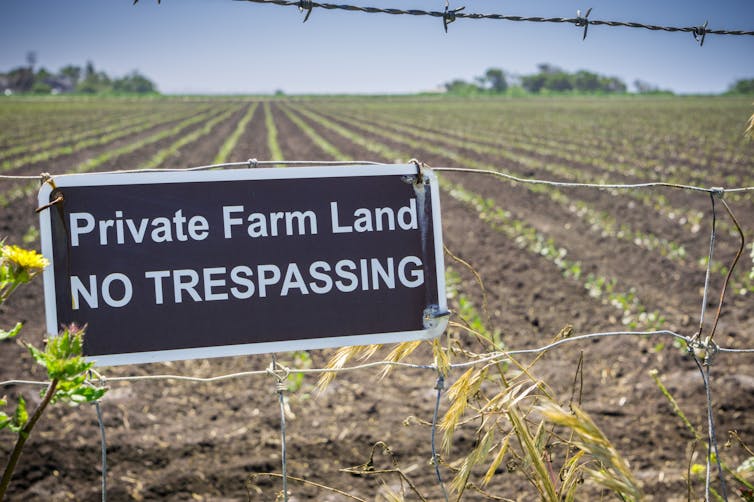
The law is somewhat ambivalent when it comes to trespassing on property to photograph and film the conduct of landowners. Trespassing itself is only one factor to be weighed up by the courts in determining whether to protect farmers’ interests.

Courts will only ban the use of footage obtained from private properties as a last resort. They will do so only if the trespasser acted in a manner that the average citizen would regard as unfair, and if the owner would suffer irreparable harm if the publication were to go ahead.

The leading case on this subject is ABC v Lenah Game Meats. DATE? 2001? Activists had placed a hidden camera without permission inside a factory in Tasmania’s Lenah Valley. They later retrieved the camera, which contained evidence of cruelty to brush-tail possums being processed for export.

On objection from the meat processors, a lower court granted an injunction, banning the ABC’s 7.30 Report from airing it on the show. The ABC appealed to the High Court.

The High Court lifted the injunction. It decided that although the footage had been filmed without the owners’ permission and involved a trespass, it was more important for the evidence of animal cruelty to be screened.

The public interest in witnessing greater transparency into suspect meat processing methods trumped the interests of a private business trying to shield its practices from public scrutiny.

What about just punishing trespassers?

So, if they cannot stop the publication, can the farmers targeted by Aussie Farms punish the trespassers privately through the courts?

Farmers can sue for damages (compensation), but they would need to find the actual trespassers and be able to quantify their losses, both of which may be difficult.

Also, what if the people supplying the footage were not trespassers but whistle-blowing employees? There is no joy for farmers here either, because there is no trespass.


Read more: Why shield laws can be ineffective in protecting journalists’ sources


Can farmers stop someone who is simply filming over the fence? The law does not assist landowners here either. We go back 80 years to find a High Court decision that says the rights of an occupier or owner don’t include a right to prevent neighbouring occupiers from looking over the fence, or filming from adjacent land.

What about filming from drones? The old law was if you owned the land, you owned the sky. This is no longer the case. The rule today is you “own” the land and sky to a depth and height only for your reasonable use and enjoyment of the land.

Unless the drone is a persistent nuisance, there is no remedy for breach of privacy.

What about revealing personal details?

But surely there must be a remedy for farmers whose personal details, such as names, addresses and maps of their properties, can be found online? Well, no, not unless the farmer can establish, under defamation law, he or she suffers an injury to their character by that publication.

The test is: does that website, in naming people who it asserts may be cruel to animals, hold them up for contempt or ridicule, and harm their reputation in the eyes of right-minded observers? It’s not an easy case for farmers to win, because few people are going to think less of farmers just because they are slaughtering meat for the market.


Read more: Penalties for animal cruelty double in SA, but is this enough to stop animal abuse?


The defendant may argue a right-minded person would give some leeway for primary producers in putting food in the marketplace, so the activists’ information-spreading exercise can’t be defamatory.

And if there was clear evidence of cruelty, the activists have a defence against a claim for defamation because what they were saying was true.

One would hope a constructive dialogue will emerge out of this that will usher in a world of best-practice farming. This should improving the live animal export business, which remains perpetually under a cloud. But it’s unlikely the use of the term “terrorism” by the critics of Aussie Farms is an ideal start for any such dialogue.

ref. Animal activists v private landowners: what does the law say? – http://theconversation.com/animal-activists-v-private-landowners-what-does-the-law-say-110279

My possessions spark joy! Will the KonMari decluttering method work for me?

]]>

Source: The Conversation (Au and NZ) – By Melissa Norberg, Associate Professor in Psychology, Macquarie University

Australia is the sixth-largest contributor of household waste per capita in the world. We spend more than $A10.5 billion annually on goods and services that are never or rarely used.

One-quarter of Australians admit to throwing away clothing after just one use, while at the other end of the extreme, 5% of the population save unused items with such tenacity that their homes become dangerously cluttered.

If unnecessary purchases come at such a profound cost, why do we make them?


Read more: Time for a Kondo clean-out? Here’s what clutter does to your brain and body


Why do we buy so much stuff?

We acquire some possessions because of their perceived usefulness. We might buy a computer to complete work tasks, or a pressure cooker to make meal preparation easier.

But consumer goods often have a psychological value that outweighs their functional value. This can drive us to acquire and keep things we could do without.

Possessions can act as an extension of ourselves. They may remind us of our personal history, our connection to other people, and who we are or want to be. Wearing a uniform may convince us we are a different person. Keeping family photos may remind us that we are loved. A home library may reveal our appreciation for knowledge and enjoyment of reading.

Family photos show our connection to people we love. istock

Acquiring and holding onto possessions can bring us comfort and emotional security. But these feelings cloud our judgement about how useful the objects are and prompt us to hang onto things we haven’t used in years.


Read more: When stuff gets in the way of life: hoarding and the DSM-5


When this behaviour crosses over into hoarding disorder, we may notice:

  1. a persistent difficulty discarding possessions, regardless of their actual value

  2. that this difficulty arises because we feel we need to save the items and/or avoid the distress associated with discarding them

  3. that our home has become so cluttered we cannot use it as intended. We might not be able to sit on our sofa, cook in our kitchen, sleep in our bed, or park our car in the garage

  4. the saving behaviour is impacting our quality of life. We might experience significant family strain or be embarrassed to invite others into our home. Our safety might be at risk, or we may have financial problems. These problems can contribute to workplace difficulties.

Will the KonMari method help?

According to Japanese tidying consultant Marie Kondo, “everyone who completes the KonMari Method has successfully kept their house in order”.

But while some aspects of the KonMari method are consistent with existing evidence, others may be inadvisable, particularly for those with clinical hoarding problems.

Kondo suggests that before starting her process, people should visualise what they want their home to look like after decluttering. A similar clinical technique is used when treating hoarding disorder. Images of one’s ideal home can act as a powerful amplifier for positive emotions, thereby increasing motivation to discard and organise.


Read more: Marie Kondo: a psychologist assesses the KonMari method of tidying


Next, the KonMari Method involves organising by category rather than by location. Tidying should be done in a specific order. People should tackle clothing, books, paper, komono (kitchen, bathroom, garage, and miscellaneous), and then sentimental items.

Organising begins with placing every item within a category on the floor. This suggestion has an evidence base. Our research has shown people tend to discard more possessions when surrounded by clutter as opposed to being in a tidy environment.

However, organising and categorising possessions in any context is challenging for people with hoarding disorder.

People who hoard might have an emotional reaction to all their books. Sharad Raval/Shutterstock

Marie Kondo gives sage advice about whether to keep possessions we think we’ll use in the future. A focus on future utility is a common thinking trap, as many saved items are never used. She encourages us to think about the true purpose of possessions: wearing the shirt or reading the book. If we aren’t doing those things, we should give the item to someone who will.

Another Kondo suggestion is to thank our possessions before we discard them. This is to recognise that an item has served its purpose. She believes this process will facilitate letting go.

However, by thanking our items we might inadvertently increase their perceived humanness. Anthropomorphising inanimate objects increases the sentimental value and perceived utility of items, which increases object attachment.

People who are dissatisfied with their interpersonal relationships are more prone to anthropomorphism and have more difficulty making decisions. This strategy may be particularly unhelpful for them.


Read more: When possessions are poor substitutes for people: hoarding disorder and loneliness


One of Kondo’s key messages is to discard any item that does not “spark joy”.

But for someone with excessive emotional attachment to objects, focusing on one’s emotional reaction may not be helpful. People who hoard things experience intense positive emotions in response to many of their possessions, so this may not help them declutter.

Think about how you get rid of things

Sustainability Victoria recently urged Netflix-inspired declutterers to reduce, reuse, and recycle rather than just tossing unwanted items into landfill.

Dumping everything into the op-shop or local charity bin is also problematic. Aussie charities are paying A$13 million a year to send unusable donations to landfill.

Ultimately, we need to make more thoughtful decisions about both acquiring and discarding possessions. We need to buy less, buy used, and pass our possessions on to someone else when we have stopped using them for their intended purpose.


Read more: So you’ve KonMari’ed your life: here’s how to throw your stuff out


ref. My possessions spark joy! Will the KonMari decluttering method work for me? – http://theconversation.com/my-possessions-spark-joy-will-the-konmari-decluttering-method-work-for-me-110357

Time for US, Australia to change policy on West Papua or risk major setback

]]>

By Ben Bohane

Reports of the Indonesian military using white phosphorous munitions on West Papuan civilians last month are only the latest horror in a decades-old jungle war forgotten by the world. But new geopolitical maneuvering may soon change the balance of power here, prompting regional concern about an intensifying battle for this rich remote province of Indonesia.

It is time for the United States and Australia to change policy, complementing Pacific island diplomacy, or risk a major strategic setback at the crossroads of Asia and the Pacific.

Once again, Papuan highlanders have fled their villages into the bush where they are starving and being hunted by Indonesian security forces.

Fighting between OPM (Free Papua Movement) guerrillas and the Indonesian military has increased in recent months, creating a fresh humanitarian crisis in a region cut off from the world: Indonesia prevents all foreign media and NGOs from operating here.

This makes West Papua perhaps the only territory besides North Korea that is so inaccessible to the international community.

For years West Papuans have claimed that Jakarta has been building up its forces, including local militias, ready to unleash just as they did in East Timor before its bloody birth in 1999. Different to East Timor however, is the presence of jihadi groups too, something the OPM has warned about for some time.

-Partners-

Alarming quote
Recent comments reported by Associated Press by Indonesia’s Security Minister General Wiranto, who oversaw the death and destruction during East Timor’s transition to independence in 1999, are alarming:

Earlier this week, security minister Wiranto, who uses one name, said there would be no compromise with an organization the government has labeled a criminal group.

“They are not a country, but a group of people who are heretical,” he said.”

Heretical?

This is significant – by using the word “heretical” rather than “treasonous” is Wiranto signalling a coming jihad against the West Papuans?

A low level insurgency waged by the OPM guerrillas has for decades sought independence for the mostly Christian, Melanesian population. Church groups and NGOs claim more than 300,000 Papuans have perished under Indonesian occupation since Indonesia formally annexed “Dutch New Guinea” via a UN referendum in 1969 known as the “Act of Free Choice”.

Farcical vote
It was the UN’s first decolonisation mission and it was a farce – the UN allowed a handpicked group of 1025 Papuans to vote from a population estimated at the time to be close to one million. Just in case they didn’t get the message, Indonesia’s Brig General Ali Murtopo flew in and warned:

“This is what will happen to anyone who votes against Indonesia. Their accursed tongues will be torn out. Their full mouths will be wrenched open. Upon them will fall the vengeance of the Indonesian people. I will myself shoot them on the spot.”

The UN’s own envoy overseeing the plebicite, Chakravarty Narasimihan, former UN Under secretary general in charge of the “Act of free Choice” said:

“It was just a whitewash. The mood at the United Nations was to get rid of this problem as quickly as possible. Nobody gave a thought to the fact that there were a million people there who had their fundamental human rights trampled. Suharto was a terrible dictator. How could anyone have seriously believed that all voters unanimously decided to join his regime? Unanimity like that is unknown in democracies.”

The fix was in and had US blessing; Washington arm-twisted Australia and Holland to back Indonesia’s annexation of West Papua, despite the position of both nations to have West Papua prepared for independence by 1970.

Australia would go on to deliver independence to the eastern half of New Guinea island, known as Papua New Guinea (PNG) in 1975.

For decades Australia’s first line of defence was considered to be the rugged 800 km border that separates PNG from Indonesia. Long before the recent rise of China, Australia’s chief strategic concern was Indonesia, especially during times of direct conflict such as the Konfrontasi period of the 1960s and more recently when Australia led an international intervention force that secured East Timor’s independence in 1999.

Pushing east
Since the 1960s Indonesia has been pushing east, with then President Sukarno taking “West Irian” (West Papua) by force while at the same time calling PNG “East Irian” and Australia “South Irian”.

It remains one of the great “what ifs” of Australian strategic history – if Australia and Holland had ignored US pressure and continued to support West Papuan independence, it would have prevented the long running civil war there and may well have stopped Indonesia’s subsequent invasion of East Timor in 1975.

Instead, Australia reluctantly agreed to the US “New York Agreement” of 1962 and found itself being dragged into the US war in Vietnam.

It fought the wrong war.

In the decades since, Australia has sought to manage its often turbulent relationship with Indonesia, recognising its size and importance within southeast Asia, by studiously ignoring the ongoing “slow-genocide” happening in West Papua.

Not only has Australia never provided material support for its rebels or refugees, it continues to arm and train Indonesia’s elite anti-terrorism unit Densus 88, which has been accused of “mission creep” in extending its operations to take out not just Islamic terrorists post 9/11, post Bali attacks, but Papuan nationalists too.

This has resulted in a lose-lose policy for Australia; after East Timor, no amount of Australian assurances of Indonesian sovereignty will ever convince Jakarta’s generals that Australia does not have designs on West Papua; at the same time Australia has lost much moral and strategic credibility among its Pacific island neighbours who all support West Papuan independence and question why their two big brothers in the Pacific – the US and Australia – continue to “throw the West Papuans to the wolves”.

But while they may have been able to ignore West Papua’s independence movement for decades, new geopolitical manouverings have emerged in the past year which signal a need to re-assess long running policy.

Social media explosion
The explosion of social media in recent years has taken this hidden war out of the shadows for good. Pacific diplomacy is isolating ANZUS policy and the West Papuan struggle will not remain a bow-and-arrow affair for much longer.

It is only a matter of time before China begins offering substantial material support and training – they are already in discussions with the West Papuan leadership. Nor are they the only player getting involved.

In December 2017, Russian Tu-95 nuclear bombers made sorties from bases on Biak island in West Papua probing the air space between Australia and Papua. It was the first time Russian nuclear bombers have operated in the South Pacific, prompting Australia to scramble fighter jets from RAAF Tindal for the first time in many years.

Jakarta has likely invited Russia to display a show of force as a warning to Australian and US forces stationed in Darwin – as well as China – lest they show any inclination to support West Papuan independence.

But can Jakarta trust Russia? Although there is considerable military co-operation between the two, Russia may have its own agenda in West Papua, recognising its resource wealth and strategic position due south of Vladivostok.

West Papuan leaders speak of Russia’s sense of having been betrayed by Indonesia in the 1960s. After Khrushchev met with Sukarno at their historic Bali summit in 1960, a time when Indonesia’s communist party the PKI was the third largest in the world, Moscow believed it had done a deal to become Indonesia’s partner in helping annex West Papua and thus gain access to the known mineral riches of West Papua, not to mention its strategic position as a gateway between Asia and the Pacific.

Instead, US President Kennedy was able to woo Sukarno (both were young, charismatic “ladies men” who hit it off together) sufficiently to broker a deal where the US would recognise Indonesian sovereignty over West Papua in an attempt to temper both Sukarno’s leftist leanings and the growing PKI.

Coup ‘re-orientation’
The deal signed in 1962 was called the New York Agreement and signalled America would not support Holland’s defence of an independent West Papua. By 1965 Kennedy was dead and Sukarno had been overthrown in a coup that led to a “re-orientation” of Indonesia.

Newly installed General Suharto purged Indonesia of communists and granted the first foreign mining licence to US company Freeport to establish a gold mine in the Puncak Jaya mountain range of West Papua, soon to become (and remain) the biggest gold mine in the world.

Russia was furious, but could do little then. China’s support for the PKI was also checked and Suharto’s 30 year dictatorship, backed by the US and allies, ensured both Russia and China lost their influence in Indonesia.

Today it is a different story.

While Russia influence in the Pacific is small but growing, Chinese influence has surged to become a major force in Pacific politics and security. Part of its engagement with Pacific island nations is to support those nations such as Vanuatu which back West Papuan independence in the face of Indonesian threats.

China’s relationship with Indonesia continues to deteriorate over issues such as rival claims in the South China Sea, nationwide demonstrations across Indonesia in support of persecuted Uighers in China, and concerns about the growing Islamification of Indonesia threatening the local Chinese (often Christian) communities.

Last year, the (Christian) Chinese Governor of Jakarta was hounded out of office by hardline Islamist groups accusing him of blasphemy.

Periodic pogroms
Indonesia’s Chinese community has long been subject to periodic pogroms (such as during the PKI crackdown in the 1960s and during the fall of Suharto in 1998) and as they watch the growing Islamification of Indonesia, they are all preparing Plan B exits, with Singapore, Malaysia and Australia top of their list.

In the past, Beijing could do little to protect the Chinese diaspora here, but today that has changed. West Papuan leaders suggest that China may have a plan to help liberate West Papua and thus provide a sanctuary for Indonesia’s persecuted Chinese community.

Were China to support West Papuan independence it would have the backing of the vast majority of Papuans and give China not just access to its huge mineral wealth, but also a strategic foothold in the south, south China Sea and a major gateway between the Indian and Pacific Ocean.

It would also win the kudos of many Pacific island nations who feel the US and Australia have not defended Pacific island interests all because of the avarice of one US company.

China is also taking note of the recent decision by neighbouring PNG to allow a major new military base on Manus island for US and Australian forces. Manus island, a naval base since WW2, would allow US and Australian naval and air force projection into the South China Sea and beyond, once again amplifying the strategic position of West Papua next door to thwart such allied projections if China got a foothold there.

China is also anticipating a Prabowo presidency in Indonesia this year, which they regard as a CIA asset, ironically backed by hardline Islamic groups, and who will be hostile to the Chinese community there. And not just hostile to China, but Australia and the Pacific too.

Australia has had a good run with amenable leaders such as SBY and Jokowi in recent years, but a Prabowo presidency would see a Duterte-like strongman likely to cause friction.

Reflexive stance
The answer in such circumstances is not to take a reflexive pro-Indonesia stance against Chinese moves, but to check both Indonesian and Chinese expansion by helping the Christian Melanesians of West Papua secure their freedom as part of the Pacific family.

Doing so is not just the right moral thing to do (correcting a previous injustice) but the right strategic thing to do: it prevents a Chinese foothold in the South Pacific, prevents Indonesian jihadis and territorial expansion east into the Pacific, secures an “air-sea gap” for Australia, properly secures a border between Muslim Asia and the Christian Pacific, and in so doing wins the admiration and loyalty of the rest of the Pacific island community precisely at a time when they are being aggressively courted by China.

This year Vanuatu, backed by dozens of countries in the ACP block (Africa, Caribbean, Pacific) is expected to introduce a motion before the UN General Assembly calling for a proper referendum on independence for West Papua and its inclusion on the United Nations De-Colonisation list.

Unless this long-running struggle is resolved soon, West Papua may soon become a major battleground between Indonesian forces including jihadis and Papuan guerrillas backed by China.

US policy has long been guided by Freeport’s commercial interests (helped by such prominent board members as Henry Kissinger and ex-President Ford), but that now pales in comparison to the strategic calculus as China moves in.

Besides, Freeport is now losing its grip – in December it finally accepted a new deal with Jakarta losing its majority ownership of the mine and the Carstenz deposit. Freeport now has been reduced to 49 percent ownership.

Of course, China is playing both sides of the fence – guess who provided funds for Jakarta to increase its equity?

Right side of history
It is time for the US to get on the right side of history. It should go back to supporting Australia and Holland’s original policy – and the rest of the Pacific’s today – by supporting a process towards West Papuan independence to halt growing Islamic and Chinese influence in the Pacific.

As one West Papuan leader told me recently:

“We have suffered for decades. If the democratic west continues to ignore our struggle we have no choice but to look east for our liberation”.

Ben Bohane is a Vanuatu-based photojournalist covering the Pacific who has reported on West Papua for the past 25 years. He is the only foreigner to have been in the three most active Command areas of the OPM operating in West Papua. This article was first published in the Journal of Political Risk and is republished by Asia Pacific Report with the permission of the author.

Print Friendly, PDF & Email

Article by AsiaPacificReport.nz

Tonga’s communications blackout ‘a problem out of their control’

]]>
Internet shock … Tonga Communications Corporation. Image: Kalino Lātū/Kaniva News

By Philip Cass and Kalino Latu

Tonga’s abrupt communications blackout may last up to two weeks before the fibre optic submarine cable restores the internet and mobile connection with the world.

Tonga Cable Director Paula Piveni Piukala told Kaniva News repairs could be done in two weeks – but another manager hinted that it may take longer.

As Kaniva News reported earlier, the kingdom’s only internet and mobile phone providers, Digicel and Tonga Communications Corporation, were cut off about 8.30pm on Sunday in an “out of their control” situation.

Tonga currently had no other internet or mobile phone cable connection to the outside world.

It has been confirmed that the undersea cable has been cut.

Tonga Cable has a marine maintenance contract with TE Subcom.

-Partners-

The cable ship Reliance is docked in Apia and can reach Tonga in two or three days.

Tonga Cable CEO Edwin Liava’a said restoration could be completed within one or two weeks.

Worst case
At worst, it could take two to three weeks.

Meanwhile, Tonga Cable was using the local Internet Service Provider (ISP) Easynet via Kacific Satellite.

“Kacific’s satellite service ensures that essential services can be maintained as we work to resolve the issue,” Piukala said.

Liava’a previously said people experiencing slow connections should understand this was a matter for TCC or Digicel.

He said Tonga Cable Ltd functioned only as a wholesaler of capacity.

Authorities said the outage was ongoing and no time frame was available for restoration of Tonga Cable’s service.

The president of Tonga Chamber of Commerce Paul Chapman said on Facebook: “Tonga Cable was working hard to rectify the issues, out of their control, with the cable.”

He said Tonga Communication Corporation teams had been working with their providers to increase capacity and working with their satellite provider and TCL and EziNet.

He said TCL and TCC were trying to connect domestic fibre and increase satellite brand width as an option.

“End of the day, all teams working on a solution, for a problem that was out of their control, but hope to have something in place.

“Meanwhile we still have internet at sites for #PTH #DatelineTransam via #EziNet (Tonga’s Satellite connection via Kacific)” he said.

Zdnet said the subsea cable providing Tonga with broadband, the Tonga Cable, has been out since 20:30 local time on Sunday night, with the nation relying on satellite internet instead.

“Provided by Kacific, the nation’s digital connection to the outside world is now a Ku-band satellite accessed through local ISP Ezinet.”

Kalino Latu is editor of Kaniva News and Philip Cass is an editorial adviser. Kaniva News is shared with Asia Pacific Report by arrangement.

Print Friendly, PDF & Email

Article by AsiaPacificReport.nz

How genes and evolution shape gender – and transgender – identity

]]>

Source: The Conversation (Au and NZ) – By Jenny Graves, Distinguished Professor of Genetics, La Trobe University

Mismatch between biological sex and gender identity, culminating in its severest form as gender dysphoria, has been ascribed to mental disease, family dysfunction and childhood trauma.

But accumulating evidence now implies biological factors in establishing gender identity, and a role for particular genes.

Variants – subtly different versions – of genes linked with gender identity might simply be part of a spectrum of gender and sexuality maintained throughout human history.


Read more: Explainer: what treatment do young children receive for gender dysphoria and is it irreversible?


Transgender and gender dysphoria

Some young boys show an early preference for dressing and behaving as girls; some young girls are convinced they should be boys.

This apparent mismatch of biological sex and gender identity can lead to severe gender dysphoria. Coupled with school bullying and family rejection, it can make lives a torment for young people, and the rate of suicide is frighteningly high.

As they move into adulthood, nearly half of these children (or even more when the studies are closely interrogated), continue to feel strongly that they were born in the wrong body. Many seek treatment – hormones and surgery – to transition into the sex with which they identify.

Although male to female (MtF) and female to male (FtM) transitions are now much more available and accepted, the road to transition is still fraught with uncertainty and opprobrium.

American television personality Caitlyn Jenner has spoken openly about being transgender. from www.shutterstock.com

Transwomen (born male) and transmen (born female) have been a part of society in every culture at every time. Their frequency and visibility is a function of societal mores, and in most societies they have suffered discrimination or worse.

This discrimination stems from a persistent attitude that transgender identification is an aberration of normal sexual development, perhaps exacerbated by events such as trauma or illness.

However, over the last decades, growing recognition emerged that transgender feelings start very early and are very consistent – pointing to a biological basis.

This led to many searches for biological signatures of transsexualism, including reports of differences in sex hormones and claims of brain differences.

Sex genes and transgender

In the 1980s I was swayed by the passionate advocacy of Herbert Bower, a psychiatrist who worked with transsexuals in Melbourne. He was revered in the transgender community for his willingness to authorise sex change operations, which were highly controversial at the time. Aged in his 90s, he came to my laboratory in 1988 to explore the possibility that variation in the genes that determine sex could underlie transgender.

Dr Bower wondered if the gene that controls male development might work differently in transgender boys. This gene (called SRY, and which is found on the Y chromosome) triggers the formation of a testis in the embryo; the testis makes hormones and the hormones make the baby male.


Read more: What makes you a man or a woman? Geneticist Jenny Graves explains


There are, indeed, variants of the SRY gene. Some don’t work at all, and babies who have a Y chromosome but a mutant SRY are born female. However, they are not disproportionately transgender. Nor are the many people born with variants of other genes in the sex determining pathway.

After many discussions, Dr Bower agreed that the sex determining gene was probably not directly involved – but the idea of genes affecting sexual identity took root. So are there separate genes that affect gender identity?

Evidence for gene variants in transgender

The search for gene variants that underlie any trait usually starts with twin studies.

There are reports that identical twins are much more likely to be concordant (that is both transgender, or both cisgender) than fraternal twins or siblings. This is probably an underestimation given that one twin may not wish to come out as trans, thus underestimating the concordance. This suggests a substantial genetic component.


Read more: Explainer: what does it mean to be ‘cisgender’?


More recently, particular genes have been studied in detail in transwomen and transmen. One study looked at associations between being trans and particular variants of some genes in the hormone pathway.

Studies of twins help us learn about the genes involved in determining identity. Keisha Montfleury/Unsplash, CC BY

A recent and much larger study assembled samples from 380 transwomen who had, or planned, sex change operations. They looked in fine detail at 12 of the “usual suspects” – genes involved in hormone pathways. They found that transwomen had a high frequency of particular DNA variants of four genes that would alter sex hormone signalling while they had been developing in utero.

There may be many other genes that contribute to a feminine or a masculine sexual identity. They are not necessarily all concerned with sex hormone signalling – some may affect brain function and behaviour.

The next step in exploring this further would be to compare whole genome sequences of cis- and transsexual people. Whole genome epigenetic analyses, looking at the molecules that affect how genes function in the body, might also pick up differences in the action of genes.

It’s probable that many – maybe hundreds – of genes work together to produce a great range of sexual identities.

How would “sexual identity genes” work in transgender?

Sexual identity genes don’t have to be on sex chromosomes. So they will not necessarily be “in sync” with having a Y chromosome and an SRY gene. This is in line with observations that gender identity is separable from biological sex.

This means that among both sexes we would expect a spread of more feminine and more masculine identity. That is to say, in the general population of males you would expect to see a range of identities from strongly masculine to more feminine. And among females in the population you would see a range from strongly feminine to more masculine identities. This would be expected to produce transwomen at one end of the distribution, and transmen at the other.

There is a natural range in masculine and feminine identity. John Schnobrich/unsplash, CC BY

This occurrence of a range of differing identities would be comparable with a trait such as height. Although men are about 14 cm taller than women on average, it’s perfectly normal to see short men and tall women. It’s just part of the normal distribution of a certain human characteristic expressed differently in men and women.

This argument is similar to that which I previously described for so-called “gay genes”. I suggested same–sex attraction can readily be explained by many “male-loving” and “female-loving” variants of mate choice genes that are inherited independently of sex.


Read more: Born this way? An evolutionary view of ‘gay genes’


Why is transgender so frequent then?

Transgender is not rare (MtF of 1/200, FtM of 1/400). If gender identity is strongly influenced by genes, this leads to questions about why it is maintained in the population if transmen and transwomen have fewer children.

I suggest genes that influence sexual identity are positively selected in the other sex. Feminine women and masculine men may partner earlier and have more kids, to whom they pass on their gender identity gene variants. Looking at whether the female relatives of transwomen, and the male relatives of transmen, have more children than average, would test this hypothesis.

I made much the same argument to explain why homosexuality is so common, although gay men have fewer children than average. I suggested gay men share their “male loving” gene variants with their female relatives, who mate earlier and pass this gene variant on to more children. And it turns out that the female relatives of gay men do have more children.

These variants of sexual identity and behaviour may therefore be considered examples of what we call “sexual antagonism”, in which a gene variant has different selective values in men and women. It makes for the amazing variety of human sexual behaviours that we are beginning to recognise.

ref. How genes and evolution shape gender – and transgender – identity – http://theconversation.com/how-genes-and-evolution-shape-gender-and-transgender-identity-108911

New research reveals how the marriage equality debate damaged LGBT Australians’ mental health

]]>

Source: The Conversation (Au and NZ) – By Stefano Verrelli, PhD Scholar, University of Sydney

Although Australia has now achieved marriage equality, the topics of sexuality and gender identity continue to spark heated – and often discriminatory – public debates.

Most recently, the issues of religious freedoms and anti-discrimination laws, the Safe Schools program, and gay conversion therapy have dominated public and political discourse.


Read more: In long-awaited response to Ruddock review, the government pushes hard on religious freedom


New research has suggested that such divisive debates have the potential to harm the mental health of LGBT people. These findings come from our nationwide study conducted during the Australian Marriage Law Postal Survey in 2017.

Mental health and discrimination

The mental health of LGBT people is among the poorest in Australia. According to the most recent estimates, LGBT Australians are more likely than non-LGBT Australians to be diagnosed with a mental disorder, attempt suicide and commit acts of self-harm in their lifetimes. The most common explanation for this is related to their frequent experiences with prejudice and discrimination.

During the postal survey, many mental health organisations and marriage equality advocates publicly argued against a national vote on same-sex marriage. They often cited previous international research that showed marriage equality debates are a health risk for the LGBT community.

To test if this would also be the case in Australia, we asked 1,305 same-sex-attracted people from across Australia to report how often they were exposed to messages from each side of the marriage debate, as well as their current levels of depression, anxiety and stress.

The opposing sides of the 2017 same-sex marriage debate. AAP/Regi Varghese/Samantha Manchee

We found that increased exposure to the “no” campaign was related to poorer mental health. This included increased levels of depression, anxiety and stress, and was independent of people’s age, gender and socioeconomic status. On the other hand, people’s exposure to the “yes” campaign had no overall benefit for same-sex-attracted Australians.

Fortunately, this was not the whole story.

Social support protects mental health

We also examined an important factor that could protect the mental health of same-sex-attracted Australians during this period. Past research has shown that feeling accepted and supported by the people around you is important for mental well-being.

To test the role of social support during the marriage equality debate, we asked participants whether they believed their immediate social circles voted “yes” or “no” for same-sex marriage.

Perceiving that close family and friends voted ‘yes’ for same-sex marriage promoted acceptance and mental well-being. AAP/Sam Mooy

The results showed that same-sex-attracted people who believed their close family and friends had voted in favour of marriage equality reported significantly better mental health. Support from one’s immediate social circles was also found to shield against some of the harm done by the negative side of the same-sex marriage debate.

Although we initially found that people’s exposure to the “yes” campaign was unrelated to their mental health, the final results painted a far more complex picture. Same-sex-attracted people who believed they did not have support for marriage equality at home or at work actually benefited the most from these public messages of support.

Our findings confirm what we already knew going into the national vote on same-sex marriage: public debates on issues relevant to the rights of minority groups have the potential to harm their mental health. But important lessons can be learnt from this research.


Read more: Six months after marriage equality there’s much to celebrate – and still much to do


First, as our nation continues to debate issues of sexuality and gender identity, we need to ensure that these discussions are conducted with care and respect. Failing to do so can have serious mental health consequences for many of Australia’s most vulnerable populations.

Second, in the current social and political climate, LGBT allies and community organisations play an important role in promoting messages of support and acceptance. These messages are being heard loud and clear, especially among those who need to hear them the most.


If this article has raised issues for you or if you’re concerned about someone you know, please contact Lifeline Australia on 13 11 14 or QLife on 1800 184 527 for nationwide counselling and referral services.

For those in the LGBT community who don’t feel accepted by their immediate social circles, there is always a place close to home for you to reach out to for support.

ref. New research reveals how the marriage equality debate damaged LGBT Australians’ mental health – http://theconversation.com/new-research-reveals-how-the-marriage-equality-debate-damaged-lgbt-australians-mental-health-110277

How safe is Australia? The numbers show public attacks are rare and on the decline

]]>

Source: The Conversation (Au and NZ) – By Terry Goldsworthy, Associate Professor in Criminology, Bond University

The murder last week of International student Aiia Maasarwe has again drawn attention to the safety of women in Australia, and people in general. The focus is on safety at night in public spaces.

Maasarwe’s murder has gained national and international attention and follows the murder of Melbourne comedian Eurydice Dixon, who was also killed six months ago, in similar circumstances – by a stranger while walking home.

Both of these murders occurred in Victoria. As the sister of Maasarwe said:

She was living a dream in Melbourne, a dream that ended up being worse than a nightmare.

So, is Australia a dangerous place? And what are the statistics when it comes to lethal violence against women in public spaces?


Read more: ‘Stay safe’: why women are enraged by advice to steer clear of violent men


How dangerous is Australia?

The Australian Institute of Criminology’s latest report on national homicide trends for the years 2012-13 and 2013-14 shows the incident rate is the lowest on record in the past 25 years. Homicides in this data set are cases where a person is charged with murder or manslaughter.

The country’s homicide rate has decreased from 1.8 homicides per 100,000 people in 1989-90, to 1 per 100,000 in 2013-14. The rate has been decreasing since 2005.

The overall number of homicide incidents continues to decline. In the period from 2012-13 to 2013-14 there were 487 homicide incidents, involving 512 victims and 549 offenders.

With regards to comparable democracies Australia’s homicide rate is similar to that in the UK (which, in 2011, was 1 per 100,000 compared to 1.1 in Australia). The US was most dangerous at 4.7, compared to Sweden at 0.9.

But Australia’s rate is much lower than the average global homicide rate of 6.2 per 100,000, as estimated by the United Nations Global Study on Homicide report. Countries with high homicide rates in 2012 included Colombia (30.8), Mexico (21.5), and South Africa (31).

International visitors and crime

The Australian Institute of Criminology completed a study of homicides involving overseas visitors to Australia in 2013. It looked at homicide offences in Australia between 1994–95 to 2009–10 and identified 58 incidents which involved 76 victims who were overseas visitors. The rate of homicide for overseas visitors was 0.55 per million visitors each year.


Read more: Three charts on: Australia’s declining homicide rates


In 2018 there were 9.2 million visitor arrivals in Australia. In 1999 a New South Wales study found that of 2,480 tourists, 0.4% experienced an offence of assault or robbery.

Gender and homicide

The Australian Institute of Criminology’s latest report on homicide rates showed the rate for both male and female victims in Australia was low in 2013-14. And the rate of women who have died from a homicide remained steady at 0.8 per 100,000. This means less than 1 woman per 100,000 will be a victim of homicide in Australia.

The rate for males was the lowest since 1989-90. Victimisation rates for males decreased by 49% between 1989–90 (2.53 per 100,000) and 2013–14 (1.28 per 100,000), and for females by 41% (1.36 per 100,000 in 1989–90).

A 2018 United Nations report on the gender-related killing of women and girls estimated the total global rate of female homicide in 2017 was 2.3 per 100,000 of the female population.

Where does the danger lie?

Random murders of women are tragic and capture the attention of the media. They understandably lead to concern over women’s safety. But they are rare.

Examination of homicide data for Australia shows that, in homicides where the relationship between the offender and victim is known, stranger homicides make up the smallest category for female victims, compared to acquaintance and domestic homicides.

From 2012-2014 stranger homicides accounted for just 3% of female murder victims (5 out of 184). In 2012-13, around 57% of stranger homicides occurred in the street or an open area. In 2013-14 that figure dropped to 41%.

Does Victoria have a problem?

Both of the recent high profile homicides of women by strangers have occurred in Victoria. The high-profile murder of Jill Meagher in 2012 also occurred on a popular street in an inner suburb of Melbourne.


Read more: FactCheck: does Victoria have Australia’s highest rate of crime?


Data provided by the Victorian Crime Statistics Agency shows 23% of female victims were murdered by non-family members from 2009-2013. This fell to 19% in 2014-2018. A recent examination of crime rates in Victoria for murder and other offences showed they are lower than most states, including NSW, QLD and the NT. The homicide rate in Victoria has remained relatively stable in the last five years.

Australia is safe

Murders of women in public spaces by strangers are not commonplace. But sometimes perceptions do not match reality. This is currently the case in Australia due to the extensive media coverage such crimes generate here and overseas.

It’s good this is in the public eye and leading to more awareness. Society as a whole should work to bring down crimes against women, through measures ranging from better school education to more appropriate sentencing regimes.

But it’s important to remember murder in Australia is not increasing, and Australia is a safe place to visit or live when compared to many other countries.

ref. How safe is Australia? The numbers show public attacks are rare and on the decline – http://theconversation.com/how-safe-is-australia-the-numbers-show-public-attacks-are-rare-and-on-the-decline-110276

When to seek help after taking a pill

]]>

Source: The Conversation (Au and NZ) – By Ian de Jonge, Lecturer in Paramedic Science , CQUniversity Australia

With more suspected drug-related deaths at festivals this summer, the debate around testing these illegal drugs to check their purity and for contaminants has flared up once more. But from a user perspective, when should a person seek help for themselves or a friend after taking a pill? What can ambulance paramedics do to help if you do?


Read more: While law makers squabble over pill testing, people should test their drugs at home


What are these pills and what do they do?

Generally party drugs contain MDMA (ecstasy). Less commonly they may contain methamphetamine (speed) or cathinone (bath salts).

All of these drugs are taken for the euphoric side effects they produce. A person who has taken these pills may find themselves less inhibited and filled with energy.

It’s normal for the user’s heart rate and breathing rate to increase slightly. Their pupils will be wider than normal.

When to become concerned?

It’s normal for the heart rate to increase a little, if it increases a lot or if the user starts to feel tightness in their chest it’s time to get some help.

Likewise it’s normal to loosen up a bit, but the user should still be orientated to where they are and what is going on.

If several pills have been taken (or a single particularly strong pill) users can suffer something called “excited delirium”. This is where they become confused, very hot and sweaty, and possibly aggressive. If not treated, the condition can lead to death. If you see a friend who has taken a pill acting agitated and confused, it’s time to get help.

Pills are usually stimulants: they increase energy and alertness. If too much alcohol is consumed though, a person can still fall unconscious. When this happens the person can lose their ability to keep their airway open. They can lose the ability to breathe due to vomit in their airway or even their own tongue falling back into their throat. You should roll unconscious people onto their side and seek further assistance.

Sometimes when taking these drugs people can have seizures. This could be from a combination of the pill, the heat, the alcohol, and any underlying conditions the person has. Roll a seizing person onto their side and get some help.


Read more: Six reasons Australia should pilot ‘pill testing’ party drugs


When you arrive at a festival, find out where the medical tent is. from www.shutterstock.com

What can paramedics do to help?

When you or a friend present to the ambulance service or medical tent a few things will happen. You will have to give your name and date of birth, this allows for proper continuity of care between the ambulance service and the hospital. You will have your vital signs taken, paramedics will check your heart rate, breathing rate, blood pressure, the electrical activity of your heart, temperature and blood sugar level.

If a person who has taken a pill has a racing heart they will be monitored with an ECG (electrocardiogram) machine. If they start to develop chest pain they may be given specific sedatives designed to relax the body and slow everything down. If they develop the agitation and confusion seen in excited delirium they may be given an injection that will put them to sleep, where they can be safely monitored and cared for.

If a person has fallen unconscious they will need to be closely monitored by paramedics. Often this will involve simply rolling the person onto their side so their tongue flops forward and keeps their airway clear. In very serious situations the paramedics may need to insert a breathing tube down the person’s throat to get air to their lungs.

Paramedics carry medications that stop seizures and can monitor the person afterward to make sure they recover normally.

After their initial assessments and interventions, the paramedics will take you to hospital until you have fully recovered.


Read more: Here’s why doctors are backing pill testing at music festivals across Australia


Whether they are tested or not, whether users know what they are taking or not, drug use at music festivals happens and a key factor in good patient outcomes is how early a person presents to a health service. Find out where the ambulance tent is at the next festival you attend and get help when needed.

ref. When to seek help after taking a pill – http://theconversation.com/when-to-seek-help-after-taking-a-pill-109876

Here’s how a 100% renewable energy future can create jobs and even save the gas industry

]]>

Source: The Conversation (Au and NZ) – By Sven Teske, Research Director, Institute for Sustainable Futures, University of Technology Sydney

The world can limit global warming to 1.5℃ and move to 100% renewable energy while still preserving a role for the gas industry, and without relying on technological fixes such as carbon capture and storage, according to our new analysis.

The One Earth Climate Model – a collaboration between researchers at the University of Technology Sydney, the German Aerospace Center and the University of Melbourne, and financed by the Leonardo DiCaprio Foundation – sets out how the global energy supply can move to 100% renewable energy by 2050, while creating jobs along the way.

It also envisions how the gas industry can fulfil its role as a “transition fuel” in the energy transition without its infrastructure becoming obsolete once natural gas is phased out.


Read more: Want to boost the domestic gas industry? Put a price on carbon


Our scenario, which will be published in detail as an open access book in February 2019, sets out how the world’s energy can go fully renewable by:

  • increasing electrification in the heating and transport sector

  • significant increase in “energy productivity” – the amount of economic output per unit of energy use

  • the phase-out of all fossil fuels, and the conversion of the gas industry to synthetic fuels and hydrogen over the coming decades.

Our model also explains how to deliver the “negative emissions” necessary to stay within the world’s carbon budget, without relying on unproven technology such as carbon capture and storage.

If the renewable energy transition is accompanied by a worldwide moratorium on deforestation and a major land restoration effort, we can remove the equiavalent of 159 billion tonnes of carbon dioxide from the atmosphere (2015-2100).

Combining models

We compiled our scenario by combining various computer models. We used three climate models to calculate the impacts of specific greenhouse gas emission pathways. We then used another model to analyse the potential contributions of solar and wind energy – including factoring in the space constraints for their installation.

We also used a long-term energy model to calculate future energy demand, broken down by sector (power, heat, industry, transport) for 10 world regions in five-year steps. We then further divided these 10 world regions into 72 subregions, and simulated their electricity systems on an hourly basis. This allowed us to determine the precise requirements in terms of grid infrastructure and energy demand.

Interactions between the models used for the One Earth Model. One Earth Model, Author provided

‘Recycling’ the gas industry

Unlike many other 1.5℃ and/or 100% renewable energy scenarios, our analysis deliberately integrates the existing infrastructure of the global gas industry, rather than requiring that these expensive investments be phased out in a relatively short time.

Natural gas will be increasingly replaced by hydrogen and/or renewable methane produced by solar power and wind turbines. While most scenarios rely on batteries and pumped hydro as main storage technologies, these renewable forms of gas can also play a significant role in the energy mix.

In our scenario, the conversion of gas infrastructure from natural gas to hydrogen and synthetic fuels will start slowly between 2020 and 2030, with the conversion of power plants with annual capacities of around 2 gigawatts. However, after 2030, this transition will accelerate significantly, with the conversion of a total of 197GW gas power plants and gas co-generation facilities each year.

Along the way the gas industry will have to redefine its business model from a supply-driven mining industry, to a synthetic gas or hydrogen fuel production industry that provides renewable fuels for the electricity, industry and transport sectors. In the electricity sector, these fuels can be used to help smooth out supply and demand in networks with significant amounts of variable renewable generation.

A just transition for the fossil fuel industry

The implementation of the 1.5℃ scenario will have a significant impact on the global fossil fuel industry. While this may seem to be stating the obvious, there has so far been little rational and open debate about how to make an orderly withdrawal from the coal, oil, and gas extraction industries. Instead, the political debate has been focused on prices and security of supply. Yet limiting climate change is only possible when fossil fuels are phased out.

Under our scenario, gas production will only decrease by 0.2% per year until 2025, and thereafter by an average of 4% a year until 2040. This represents a rather slow phase-out, and will allow the gas industry to transfer gradually to hydrogen.

Our scenario will generate more energy-sector jobs in the world as a whole. By 2050 there would be 46.3 million jobs in the global energy sector – 16.4 million more than under existing forecasts.


Read more: The government is right to fund energy storage: a 100% renewable grid is within reach


Our analysis also investigated the specific occupations that will be required for a renewables-based energy industry. The global number of jobs would increase across all of these occupations between 2015 and 2025, with the exception of metal trades which would decline by 2%, as shown below.

Division of occupations between fossil fuel and renewable energy industries in 2015 and 2025. One Earth Model, Author provided

However, these results are not uniform across regions. China and India, for example, will both experience a reduction in the number of jobs for managers and clerical and administrative workers between 2015 and 2025.

Our analysis shows how the various technical and economic barriers to implementing the Paris Agreement can be overcome. The remaining hurdles are purely political.

ref. Here’s how a 100% renewable energy future can create jobs and even save the gas industry – http://theconversation.com/heres-how-a-100-renewable-energy-future-can-create-jobs-and-even-save-the-gas-industry-110285

‘Growth’ of community housing may be an illusion. The cost-shifting isn’t

]]>

Source: The Conversation (Au and NZ) – By Michael Darcy, Adjunct Professor, School of Social Sciences and Psychology, Western Sydney University

Southern Cross Housing, a non-profit community housing provider, took over management of just under 1,000 public housing dwellings on the New South Wales South Coast last October. This transfer from the NSW Department of Family and Community Services nearly doubled Southern Cross’s portfolio. More than 3,000 transfers have since been made to community housing providers on the NSW North Coast and in northern Sydney.

These are the first of over 14,000 tenancies being contracted out to community housing providers over coming months. The “whole-of-location” transfer program will result in the department closing housing offices in four regions. Non-government organisations will manage all government housing assistance programs in these regions.

This is not an entirely new development. Nationally, community providers were responsible for about 20% of 400,000 social housing dwellings in 2016. Most are managed under contract for state authorities, which retain ownership of the properties.

The current transfers represent a major acceleration in the growth of community housing providers’ share of the social housing sector. It will bring NSW to within a few points of the 35% target agreed by the Housing Ministers’ Council in 2009. This will be achieved in the next few years with transfers resulting from large estate redevelopment projects.


Read more: We still live here: public housing tenants fight for their place in the city


It is the first time a state government housing agency has effectively contracted out the entirety of its operations, albeit in particular regions. Rents collected will fund the management of all housing programs in these areas.

The policy narrative surrounding this program is richly positive. The government is promising improved customer experience and, importantly, more resources for social housing in general. Last month, NSW Minister for Family and Community Services Pru Goward said:

By transferring management to Community Housing Providers … we are harnessing over $1 billion of additional funding over 20 years that will improve the experience of people living in social housing. I am delighted that, as part of the transfer, tenants will have the support and services they need to improve their lives.

So where is the extra money coming from?

The extra A$1 billion represents Commonwealth funds that will be captured by the NSW social housing system without appearing in either state or federal budgets. This results from an anomaly in federal income security arrangements: very low-income community housing tenants can receive up to about $67 per week (singles) in Commonwealth Rent Assistance (CRA), whereas public housing tenants are not eligible for this benefit.

Public housing rents are calculated at 25% of income (or market rent if this is lower). But community housing organisations can add the entire amount of CRA received by the tenant to this figure. This effectively increases the rent payable for a single pensioner by up to 70%.

Under changes in the law in 2016 tenants have no option but to accept the changes. If a tenant delays or fails to apply for CRA for any reason they are deemed to be receiving it and their rent correspondingly adjusted.

A Southern Cross Housing video explaining how Commonwealth Rent Assistance will be used to boost rental revenue.

What about the housing maintenance backlog?

According to the Productivity Commission, in 2016 more than a quarter of public housing dwellings in NSW failed to meet a basic standard of functionality and structural integrity. This was the worst result of any state.

It is highly likely that the transferred properties carry a substantial backlog of maintenance and repairs. The cost of this work will be effectively shifted to the federal government. However, as CRA is an income security entitlement, this will not appear as housing expenditure in the federal budget.

Attending to the backlog of public housing maintenance and repairs is likely to be a costly exercise. Dan Himbrechts/AAP

Maintenance issues are the most common reason for complaints and tenant dissatisfaction, so tenants will welcome more spending on maintenance. However, community providers are required to use the government’s existing maintenance contractors at least until contracts expire.


Read more: Tenants’ calls for safe public housing fall on deaf ears


Providers contend that higher staff-to-tenant ratios will lead to more humanised management and greater responsiveness to individual tenants’ needs. This claim will be tested against the fact that the community providers are dramatically expanding their portfolios and scope of operations, and will absorb many displaced department staff.

For some tenants it appears more local “hands-on” management is not always experienced as a positive. Analysis of NSW Civil and Administrative Tribunal (NCAT) data sourced by advocates somewhat surprisingly reveals that community providers are heavily over-represented in taking tenants to the tribunal. At the same time, the break-up of management among many providers will limit the possibility of moving or swapping houses for employment or family reasons.

Lack of title limits new housing supply

In the UK and Europe, non-profit housing organisations are now the major developers of new social housing. They do this by borrowing against their assets and partnering with the development industry.

Australian community housing managers have long argued that they should be given freehold title to state properties. In theory, this would enable them to borrow and provide extra social housing stock without adding to public debt.


Read more: Community sector offers a solid platform for fair social housing


State governments have resisted asset transfers on accountability grounds, preferring to simply outsource management.

So, rather than adding to social housing supply, the marked growth of the community housing sector over the last decade has been almost entirely at the expense of public housing. Australia’s population increased by 12.6% between 2011 and 2016. The number of social housing dwellings (public and community housing) grew by less than 3% in that time. Most of that growth resulted from federal stimulus funding during the global financial crisis.

The current program in NSW excludes any expectation that providers will leverage additional income to develop new housing.

Social housing as percentage of all dwellings. Source: Michael Darcy, Author provided

In 2013 the Australian Housing and Urban Research Institute published a comprehensive analysis of social housing transfers. The report concluded that potential benefits included maximising revenue, improving services and leveraging growth. However, it noted that “there has been an unrealistic loading of objectives onto this one policy mechanism”.

The authors called for a clearer and more realistic rationale for housing transfers and better opportunities for tenants to be involved in shaping the outcome.

Five years on it is apparent that revenue is the key driver at the expense of increased supply and tenant choice or voice. Support for the growth of community housing has been restated in the new National Housing and Homelessness Agreement where it appears as a national priority area.


Read more: The new national housing agreement won’t achieve its goals without enough funding


In NSW, a wide range of former government responsibilities and access to a Commonwealth-funded revenue stream have been handed over without the accountability and grant management mechanisms that traditionally apply to community-based service providers. Tenants are expected to apply for federal funds on behalf of the state social housing system and bear a significant cost if they don’t comply.

ref. ‘Growth’ of community housing may be an illusion. The cost-shifting isn’t – http://theconversation.com/growth-of-community-housing-may-be-an-illusion-the-cost-shifting-isnt-108598

Low income, no assets, large credit-card debt: why more older Australians are declaring bankruptcy

]]>

Source: The Conversation (Au and NZ) – By Ian Ramsay, Professor, Melbourne Law School, University of Melbourne

Bankruptcy is affecting more and more older people.

About 2,400 of the almost 17,000 new bankruptcies in Australia in 2017-18 were aged 60 or more, information from the bankruptcy regulator suggests. Since 2002 the proportion of bankrupts being in this age group has doubled, from 7% to 14%.

To find out more about the characteristics of bankrupts, as part of the University of Melbourne’s Personal Insolvency Project we have drawn on data about more than 28,000 bankruptcies commenced between July 2007 and June 2016.

Our findings illustrate the contrasting financial fortunes of older Australians. While many are “asset rich” and carry little or no debt, some have few assets and are highly indebted.


Read more: The financially well-off defy the stereotypes. They include retirees, and mortgagees


Older bankrupts, like older Australians generally, have lower incomes compared to other age groups. Where they differ from their peers is having no significant assets. In particular, fewer than one in ten own real estate, compared with three-quarters of all older Australians owning their homes outright.

The low rate of home ownership among bankrupts may be because people who are more financially vulnerable are less likely to buy real estate in the first place.

It is also possible that not owning property makes the consequences more palatable. Once a court declares you cannot pay your debts, a trustee can sell all your assets, including your home, to pay creditors. That’s less of a worry for someone without assets.

But the low rate may also reflect the fact that real estate constitutes a valuable financial safety net, particularly in times of escalating property prices (which also drives up rental costs).


Read more: Generation Share: why more older Australians are living in share houses


Causes of debt

Credit card debt is most common among older bankrupts; 80% have such debt, with more than 40% owing more than A$20,000; 37% identify excessive use of credit as the primary cause of bankruptcy.

This compares with 22-25% among the other age cohorts. Among bankrupts, debt levels plateau for people in their forties, fifties and early sixties and begin to decline after the age of 65.

Other leading causes of bankruptcy among older debtors are ill health (nominated by 17% of debtors aged 55 or older) and unemployment.

These findings raise obvious questions about lending and credit practices that have enabled people on low incomes with few liquid assets to get into debt. This includes pensioners and those on the cusp of retirement whose incomes are likely to decline.

An increasing trend

The research points to older people making up an increasing percentage of the bankrupt population. This is due to the expected decline in home ownership rates among older Australians, the ageing of the population generally and younger people taking advantage of alternatives to bankruptcy.

The adequacy of Australians’ retirement savings has recently been in the spotlight. Several major reforms to the superannuation system have been proposed, including by the Labor Party and former Australian prime minister Paul Keating.


Read more: Why we should worry less about retirement – and leave super at 9.5%


Our findings suggest that bankruptcy among older Australians could be reduced through targeted changes to government benefits, such as an increase to the Commonwealth Rent Assistance supplement.

ref. Low income, no assets, large credit-card debt: why more older Australians are declaring bankruptcy – http://theconversation.com/low-income-no-assets-large-credit-card-debt-why-more-older-australians-are-declaring-bankruptcy-107511

Decoding the music masterpieces: Alban Berg’s Wozzeck, an apocalyptic descent into madness

]]>

Source: The Conversation (Au and NZ) – By Michael Ewans, Conjoint Professor, School of Humanities and Social Science, University of Newcastle

Alban Berg’s Wozzeck is arguably the most important opera composed in the first half of the 20th century. It is certainly one of the most powerful, and its emotional impact remains as strong today as when it was first performed in 1925.

The text for the opera is drawn from Woyzeck, a play by German playwright Georg Büchner that is one of the most extraordinary dramas ever written.


Read more: Decoding the music masterpieces: Rossini’s opera, Otello


Büchner died at the age of 23 in 1837. He left several works behind, including fragmentary drafts of his masterpiece – Woyzeck. The play was not published in the posthumous 1850 edition of Büchner’s works, whether because of its occasional obscenity, its incompleteness, or the difficulty involved in deciphering the author’s cramped handwriting.

It eventually appeared in print in 1876. The drama had an enormous influence on the development of modern playwriting (Brecht was one of its warmest admirers), but it was not staged until 1913. The composer Alban Berg attended the first Vienna performances in 1914, and at once decided to make it into an opera, which became Wozzeck. (It was only discovered that the correct name of the hero was Woyzeck after Berg had composed most of the opera from an edition which printed it as Wozzeck).

The torment of the humble fusilier

Woyzeck is the first significant tragedy of “low” life, written in prose and with a common man as the hero. The titular Woyzeck is a fusilier in the army of his city-state (unnamed in the opera).

Nature plays a dominant role in Büchner’s drama. For Büchner, there is only a fragile boundary between the underlying animal aspects of human nature and morality and reasoning. These are only a veneer, easily broken down by passion into a reversion to nature. In Woyzeck, this happens when Marie, Woyzeck’s common-law wife and the mother of his child, allows the army’s Drum Major to take her to bed.

Wozzeck and the Captain (Act I scene 1). Franz Grundheber and Graham Clark in Patrice Chéreau’s production, conducted by Daniel Barenboim. From EuroArts.

A doctor’s research, which involves placing Woyzeck on a diet of only peas, and Marie’s infidelity, push Woyzeck over the thin line between moral reasoning and instinctive, natural action; between sanity and insanity. Woyzeck goes mad. But Woyzeck’s “madness” gives him an insight into the workings of nature which is superior to that of the paranoid Captain whose Batman he is and the megalomaniac Doctor. Woyzeck can see into the abyss.

Having studied medicine and philosophy and lectured in natural history, Büchner possessed a unique combination of a compassionate human vision and scientific detachment. He viewed life as consisting of a sequence of separate pictures, apparently disconnected fragments. So each one of the play’s 27 short scenes presents one episode relevant to the drama of Woyzeck’s relationship with Marie.

This technique, which was revolutionary in the theatre – and indeed rendered Woyzeck unstageable before the 20th century – is reminiscent of German expressionist films created immediately after the first world war, particularly The Cabinet of Dr Caligari.

Büchner depicts Woyzeck’s descent into madness as the inevitable consequence of his existential terror. He imbues Woyzeck, his tormented, humble Fusilier and the victim of sexual betrayal and the Doctor’s medical experiment, with an extraordinary nobility. The text deploys language of vivid intensity, as Woyzeck struggles to express the visions which drive him to murder and madness.

Visions of terror

These visions are almost beyond expression in words – but not in music. In Act I, scene 2 of Berg’s opera, where Wozzeck is tormented by the apocalyptic power of Nature, the orchestra illuminates and makes real for the audience the terrors which in Büchner’s scene the audience can only imagine.

In the opera, the audience is forced to experience the visions from inside, from the point of view of Wozzeck. Creating that music required a creative leap by the composer, one which is still astonishing even today.

Wozzeck murders Marie (Act III scene 2). Franz Grundheber as Wozzeck, Waltraud Meyer as Marie. Directed by Patrice Chéreau, conducted by Daniel Barenboim. From EuroArts.

The Viennese composer Alban Berg (1885-1935) saw Wozzeck at exactly the right moment in his own compositional development. Berg’s composition teacher Arnold Schoenberg had begun around 1905 to write short pieces within an idiom which abandons the system of keys and key-relations, known as tonality, which is the fundamental basis of 19th-century classical music. Instead, he favoured atonality, a style in which all sounds, even piercing dissonances, are permitted.

In his Three Pieces for Orchestra (1914) Berg was the first composer working in this style to incorporate structural devices that enabled him to compose atonal pieces on a larger scale.

The final March of the Three Pieces, which Berg wrote (prophetically) just before and after the assassination of the Archduke at Sarajevo, begins quietly enough, but rapidly becomes grotesque, terrifying and brutal.

The March from Alban Berg’s Three Pieces for Orchestra. Live recording from the Munich Philharmonie.

This apocalyptic intensity and musical structure paved the way for Wozzeck. This opera required both extreme emotional intensity, as Berg responded with all his eloquence to the compassion and social protest of Büchner’s text – and a firm musical structure, to create unity among the diverse characters and episodes of the play.

Berg selected 15 of Büchner’s 27 scenes, and divided them into three Acts, each of five scenes. He then chose a musical form for each Act – Five Character Studies (Act 1), a Symphony in five movements (Act 2), and a set of six Inventions (Act 3). Within this overall design, each scene also has its own musical form.


Read more: Decoding the music masterpieces: Rossini’s opera, Otello


Whether individual audience members consciously apprehend them or not, Berg’s chosen forms bring familiar resonances from classical music, and each one has been chosen to illuminate the dramatic and psychological essence of its scene.

The creative tension between overt emotional power and concealed but rigorous control is clear not only in the opera’s formal design, but also in the range of modes of vocal delivery, which extend far beyond those of classical opera. Once again, the pressure towards incoherence is counterbalanced by a minute attendance to volume and phrasing, together with precise notation of every grade of sound, from ordinary speech via pitched but half declaimed words, to full song and on to florid ornamentation.

Nearly a century after Wozzeck was first performed, it maintains a central place in the international repertory today, despite the challenges it presents to designers, directors and performers. Berg’s ability to use his extraordinary music to chart Wozzeck’s descent into madness, and the compassion with which he views his character’s suffering, have ensured its continuing acclaim.


Wozzeck is being staged by Opera Australia in Sydney from January 25 – February 15 2019.

ref. Decoding the music masterpieces: Alban Berg’s Wozzeck, an apocalyptic descent into madness – http://theconversation.com/decoding-the-music-masterpieces-alban-bergs-wozzeck-an-apocalyptic-descent-into-madness-107896

Record US government shutdown harms Trump’s ratings, plus Brexit chaos and Australian Essential poll

]]>

Source: The Conversation (Au and NZ) – By Adrian Beaumont, Honorary Associate, School of Mathematics and Statistics, University of Melbourne

The current US government shutdown began on December 22, and is still going. At 32 days, it is the longest shutdown in US history, beating the previous record of 21 days in a 1995-96 shutdown.

The shutdown was caused by Trump’s demand that $US5.7 billion funding for a southern border wall be included in the budget. When Democrats took control of the US House on January 3, following the November midterm elections, they passed a budget that omitted funding for the border wall; this bill had been passed by the Republican-controlled Senate before the shutdown began. As Trump opposes the budget, the Senate has not taken up the House bill.


Read more: Poll wrap: Labor widens lead in Ipsos; US Democrats gained 40 House seats at midterms


In the FiveThirtyEight poll tracker, Trump’s ratings on December 17, before the shutdown began, were 42.2% approve, 52.4% disapprove, for a net approval of -10.2. Trump’s ratings are currently 40.2% approve, 55.0% disapprove, for a net approval of -14.8. Trump’s approval is his lowest since September 2018, and his disapproval is its highest since February 2018.

CNN analyst Harry Enten says Trump and Republicans are losing the blame game over the shutdown. Polls have Trump and congressional Republicans blamed more for the shutdown than congressional Democrats by at least 20 points.

If Trump were to declare a national emergency to secure wall funding, the public would be opposed by 66-31 according to a Washington Post/ABC News poll. Such a declaration would also be challenged in the courts.

Support for the border wall itself increased in the last year, but is still opposed by an average 15-point margin. In a Quinnipiac national poll conducted January 9-13, voters overall opposed the wall 55-43, but Republicans supported it 88-10. Trump’s difficulty is that, while voters overall blame him for the shutdown, he would come under attack from his right-wing base if he was seen as caving on the wall.

On January 19, Trump proposed to temporarily extend two programs that protect some unauthorised immigrants from deportation in exchange for wall funding, but Democrats immediately rejected this deal, and the shutdown continued. Furthermore, Trump angered right-wing commentator Ann Coulter.

The limited polls since Trump’s proposal suggest no change in his ratings. An Emerson national poll, conducted January 20-21, had voters opposed to Trump’s proposal by 55-45.

The Senate will vote on Trump’s proposal and a bill to reopen the government until February 8 without wall funding on Thursday (Friday Melbourne time). Neither bill is expected to win the 60 votes (out of 100) required to advance under Senate rules. Trump could veto legislation that passed both chambers of Congress, and it takes a two-thirds majority in both chambers to override a presidential veto.

Analyst Nate Silver says previous shutdowns have had little long-term impact. Republicans were blamed for the October 2013 shutdown, but they performed very well at the November 2014 midterm elections. However, the longer the shutdown lasts, the greater the economic impact. Trump will need the US economy to be strong in 2020 to have a reasonable chance of re-election.

UK Brexit chaos could result in a “no-deal” Brexit

On January 15, the House of Commons rejected UK Prime Minister Theresa May’s Brexit deal by a 432-202 vote; the 230-vote margin is the biggest loss for a government since universal suffrage began. 118 Conservatives rebelled against their party’s position in this vote.

If the Commons cannot agree to something by March 29, the UK will crash out of the European Union without a deal, likely greatly damaging the economy. You can read about why this scenario has become more likely on my personal website.

Australian Essential poll: 53-47 to Labor

In last week’s Australian Essential poll, conducted January 9-13 from a sample of 1,089, Labor led by 53-47, unchanged since mid-December. Primary votes were 38% Coalition (up one), 38% Labor (up two), 10% Greens (down one) and 7% One Nation (steady). Essential has been better for the Coalition since Scott Morrison became PM than Newspoll. This is the first poll of 2019.

Morrison’s net approval was +4, down four points since December. Bill Shorten’s net approval was -12, also down four points. Morrison led Shorten by 42-30 as better PM (40-29 in December).

Far more people thought all types of crime had increased than decreased. By 63-24, voters supported pill testing, though the question had more detail than most voters would be familiar with.

56% thought immigration in the past ten years has been too high, 26% about right and 12% too low. By 67-27, voters agreed with a positive statement about multiculturalism, but they agreed with a negative statement 53-40. By 66-22, voters thought it inappropriate for Fraser Anning to use taxpayer money to attend the far-right rally in Melbourne.

65% said either their home or workplace was connected to the NBN. 51% of those with NBN connections thought it better than their previous service, 30% about the same and 17% worse. By 44-29, voters would disapprove of privatising the NBN when completed in 2020.

Tasmanian federal and state polls

Tasmanian pollster EMRS conducted federal and state polls December 15-17 from a sample of 1,000. In the federal poll, Labor had 40% (37.9% at the 2016 election), the Liberals 33% (35.4%) and the Greens 11% (10.2%). No two party estimate was given, but the primary figures imply a swing of over 2% to Labor in Tasmania, for about a 60-40 split.

In the state poll, the Liberals had 39% (up three since August), Labor 35% (up one) and the Greens 14% (down two). EMRS state polls skew towards the Greens. Labor leader Rebecca White led incumbent Will Hodgman 46-40 as better Premier (46-38 in August).

ref. Record US government shutdown harms Trump’s ratings, plus Brexit chaos and Australian Essential poll – http://theconversation.com/record-us-government-shutdown-harms-trumps-ratings-plus-brexit-chaos-and-australian-essential-poll-110348

Henrietta Baird’s The Weekend proves the enduring power of solo performance

]]>

Source: The Conversation (Au and NZ) – By Caroline Wake, Senior Lecturer in Theatre and Performance, UNSW

Review: The Weekend, Sydney Festival


If this year’s Sydney Festival is any indication, the monologue is back. So far, I have seen Adam Lazarus’s Daughter, Joel Bray’s Biladurang, Omar Musa’s Since Ali Died, Tara Beagan’s Deer Woman, and now Henrietta Baird’s The Weekend.

Not that the monologue ever really went away. Indeed, it has a long history in both Western and non-Western performance genres. But critical opinion about solo performance has waxed and waned over the past fifty years.

On the one hand, supporters argue it’s been an important vehicle for artists who have historically been excluded from the theatre to tell their stories. On the other, critics worry the monologue might be part of the memoir boom and a “wider culture of self-discussion and self-exposure”, symptomatic of a self-involved society. Yet these arguments fade into the background when you’re in the hands of a skilled storyteller like Henrietta Baird and a talented performer like Shakira Clanton.

At this year’s Sydney Festival, the monologue is back. Jamie James/Courtesy of Moogahlin

The Weekend begins in relative silence. There is the sound of drumming, slow and steady like water dripping, and little else. The set is similarly stripped back, consisting of little more than a grey floor, two milk crates downstage, and a mirror with three panels upstage.

Clanton steps out from behind the mirror wearing purple tights and a black singlet. Later she’ll don a blue sleeveless hoody. She dances: bending her knees, flicking her hands upwards, and sometimes straightening her limbs like a martial artist. Choreographed by Vicki Van Hout, with whom Baird has previously danced, this section also reminded me of Dalisa Pigram’s martial arts-inflected choreography in her solo show Gudirr Gudirr.

The protagonist, Lara, is a dancer from Sydney working in Cairns for a few weeks. That is, until she receives a phone call from her youngest son Kyle, telling her that he and his brother Charlie are hungry because their dad hasn’t been over for more than two days and there’s no food in the house. Lara immediately gets on a plane. From the moment it lands, she’s on a mission to find her former partner Simon and “give him a growling”, as my mother might say.

In her pursuit across Redfern, Lara meets several women who have been similarly betrayed by him and his drug habits. She also finds they each have a habit of their own. Clanton plays all these women, as well as the two boys and an officious taxi call centre operator, with great skill.

The first woman we meet is Ronnie, a woman in her mid-40s, who is “not Simon’s type”, Lara reassures herself. While at Ronnie’s place she also meets Courtney, a sweet fifteen-year-old who is addicted to heroin. Then Betty arrives, agitated and desperate for some meth.

Shakira Clanton plays a dancer on a mission to find her former partner in The Weekend. Jamie James courtesy of Moogahlin

Lastly, we meet Ronnie’s sister DD. Chaos and comedy ensue but the possibility of tragedy is ever present: as soon as Lara agrees to carry Ronnie’s bum bag, spectators are audibly concerned; when she realises her boys have been by themselves for hours, we share her sweaty panic. Like Lara, we are constantly worried that something, somewhere is going to go horribly wrong.

Baird has a good ear for vernacular speech and her characters speak with both poetry and fury: telling jokes, swearing liberally, and coining phrases such as “she kicks them out before they even get a chance to pick up after themselves”.

She also has an eye for detail, especially fashion, as evidenced by Lara’s descriptions of what each character is wearing. Ronnie has “a big green jumper and track pants on with fluffy slippers. Like she’s still in the same clothes from the 80s”; Courtney is wearing “the shortest shorts. You know those sexy ones with the pockets that hang out the bottom”; and DD is “mutton dressed as lamb. Big hair and little sun dress like she’s a teenager in the 90s!”.

Baird’s characters speak with both poetry and fury. Jamies James/Courtesy of Moogahlin

Most of all, Baird writes with compassion: every character is given a backstory that contextualises their addiction and it’s clear that every one of them is simply doing their best.

This combination of humour and compassion also structures Clanton’s playful but careful performance. Ronnie has a strong, stern voice but speaks of her children with a throaty grief; Betty’s voice is high and her physicality is agitated; Courtney speaks in a slow whisper and with a gentle smile; and DD snaps her fingers, playfully slaps her own arse, and spins on her heels.

Like the rest of the production, the lighting design (Karen Norris) is understated. A string of lights frames each of the mirror’s sections, with different colours conjuring different locations. The lights are green when Lara is in the grimy lift, for instance, and later flash red and blue when the police are nearby. The concrete carpark is suggested through a grey and streaky light.

The sound design (Nick Wales and Rhyan Clapham) is similarly low-key, with the drums continuing through the entire performance. When the music swells with danger, it is all the more effective. These directorial decisions by Liza-Mare Syron allow the script and performer to shine.

The lighting in The Weekend uses colour to conjure different locations. Jamie James/Courtesy of Moogahlin

Perhaps the monologue is back for political reasons, or perhaps it is simply a matter of economics, since solo shows are cheap to produce when compared with other epic festival fare. Or perhaps it indicates that a new generation of writers is emerging: artists often start with semi-autobiographical material before moving onto bigger, more complex pieces. Leah Purcell, for instance, started with Box the Pony in 1997; 20 years later she is about to film her award-winning adaptation of The Drover’s Wife. For this reason, I can’t wait to see what Baird does next.

The Weekend was staged as a work-in-progress in 2017 at the biennial Yellamundie National First Peoples Playwriting Festival, where it was one of the hits of that year, as recorded in Maryrose Casey’s review. Later this week, the 2019 iteration will get underway. If you want a glimpse of what you might be seeing at the Sydney Festival in 2021 – and of the future of Australian theatre more generally – I suggest you get along to listen.

The Weekend is being staged as part of the Sydney Festival until January 23. The script is available to read until the end of January here.

ref. Henrietta Baird’s The Weekend proves the enduring power of solo performance – http://theconversation.com/henrietta-bairds-the-weekend-proves-the-enduring-power-of-solo-performance-110281

Rough seas ahead: why the government’s James Cook infatuation may further divide the nation

]]>

Source: The Conversation (Au and NZ) – By Benjamin T. Jones, Lecturer in History, CQUniversity Australia

It is fitting that Scott Morrison represents the federal division of Cook, named after British explorer James Cook. First as treasurer, and now as prime minister, Morrison is committed to a A$50 million plan to celebrate the upcoming 250th anniversary of Cook’s landing at Kurnell on April 29, 1770. He has announced A$6.7million for a replica of the Endeavour to circumnavigate the country (something Cook himself never did).

Cook and his treatment by public memory can be seen as the latest front in an ongoing culture war. It is a debate centred on how Australian history – especially its colonial history – should be understood. Which voices and stories should be included, and excluded, from the dominant narrative?

Morrison frames this is as an extension of the campaigns to change January 26 as Australia Day. In 2018, he lambasted the “indulgent self-loathing” of those who wanted to change the date. He tweeted – incorrectly – that “Our modern Aus nation began on January 26, 1788”. This predates the flag, Constitution, five out of six states, and even the word “Australia”.

But this was never about historical accuracy. Deputy Nationals leader Bridget McKenzie claimed – also wrongly – that January 26, 1788, was “when Captain Cook stepped ashore”. He actually died in 1779. But nevertheless, as the man who claimed Australia for Britain, Cook has become a symbol of settler-colonialism with his legacy intertwined with Australia Day.

Morrison is determined that 2020 be a year of government-led celebration of Cook’s exploits. The justification for the anniversary spend is as much ideological as historical. Morrison claimed:

he gets a bit of a bad show from some of those who like to sort of talk down our history.

Explorer James Cook has come to symbolise Australia’s divided view of its history and how it should be celebrated. Shutterstock

The use of public money to cast Cook in a positive light is a continuation of the “history wars” that flared up during the prime ministership of John Howard. He rejected the “black armband” view that saw Australian history as a “disgraceful story”. On balance, Howard insisted, it was one of “heroic achievement”.

For Morrison, Cook is the embodiment of a colonial hero whose reputation has been tarnished by left-wing “activists”. He laments that “it’s very trendy to talk down James Cook and all that sort of stuff”.

Presumably “all that sort of stuff” is a gentle euphemism for dispossession and the destruction of Indigenous cultures.


Read more: Australia’s ‘history wars’ reignite


Debate over Cook’s legacy briefly raged in 2017. Indigenous journalist Stan Grant questioned the plaudit, “discovered this territory 1770”, etched in stone at Cook’s statue in Sydney’s Hyde Park. Soon after, “change the date” was spray-painted on the base.

The then prime minister, Malcolm Turnbull, insisted Grant was “dead wrong”. Using rhetoric that bordered on the ridiculous, Turnbull took to Facebook to describe the graffiti as part of a “totalitarian campaign”. He also dismissed calls to change the date of Australia Day, condemning the “Stalinist exercise of trying to wipe out or obliterate or blank out parts of our history”.

The Morrison government’s decision to punish councils that do not acknowledge January 26, to introduce dress codes at citizenship ceremonies, to refuse to discuss the date of Australia Day, and to spend millions on Cook’s 250th anniversary, all stem from the same culture war.

The Liberal Party’s Twitter page claims it is trying to “protect Australia Day from activists”. But the heavy-handed attempts to cast Cook as some high priest in the church of Australian nationalism stifles debate and skews history. Increasing social unease with traditional colonial narratives is not based on a desire to deny history, but to expand it and to include the perspective of First Nations.

As historian Mark McKenna notes, the communities in Kurnell and Cooktown have worked hard to connect with Indigenous leaders and find new ways to commemorate Cook’s voyage. But crucially, this requires a willingness to accepts history’s nuances and diversity. It requires moving beyond the false dichotomy of utter shame or complete pride in Australia’s history.

Few would dispute that Cook was a brilliant navigator and explorer. But there is also a question of balance. The Captain Cook Society notes that he is commemorated by more than 100 memorials, many in Australia. It is hardly a “Stalinist exercise” to suggest that Cook is already well honoured and that a more worthy project might be a new Indigenous museum.

The original lyrics to Advance Australian Fair boasted that when “gallant Cook from Albion sailed … true British courage bore him on”. Veneration of Cook has been historically tied to British patriotism. As the Sydney Morning Herald noted in 1929, Australia’s great patriotic moments for “all who share British blood” occur in April. It included in this, Cook’s landing, the landing at Gallipoli, St George’s Day, and the birth of Shakespeare.

Our nation has changed.

Cook is no longer the national hero he once was, for the simple reason that Australians no longer see themselves as British, sharing in British achievements. More importantly, since W.E.H. Stanner’s call to end the “great Australian silence” in 1968, Australians have become more aware of the ancient cultures that possessed this land at least as far back as the Pleistocene. Retreating into the lazy “cult of forgetfulness” with a government-promoted, triumphant Cook narrative, narrows a history that has been slowly broadening for decades.


Read more: Friday essay: the ‘great Australian silence’ 50 years on


The anniversary in 2020 of Cook’s voyage can and should be marked. But without genuine consultation with First Nations peoples to find a form and language that offers respect, it will be another exercise in exclusion. If the memorials and events suggest, in former prime minster Tony Abbott’s words, that before the British arrived Australia was “barely settled”, we will know we have failed yet again.

ref. Rough seas ahead: why the government’s James Cook infatuation may further divide the nation – http://theconversation.com/rough-seas-ahead-why-the-governments-james-cook-infatuation-may-further-divide-the-nation-110275

Critics see Fiji’s Online Safety Act as ‘Trojan horse’ for online censors

]]>
Fiji’s new online safety law … deemed by the government as necessary to make the internet a safe space for women and children. Image: S&S

By Mong Palatino of Global Voices

Fiji’s Online Safety Act took effect this month amid concerns that it will be used to censor the internet.

The law was passed in May 2018 two months after the Attorney-General’s office submitted it for Parliament deliberation. The government deemed it necessary to make the internet a safe space for women and children:

The Fijian Government in its commitment to ensure access to connectivity for all Fijians, has embarked on promoting a safe online culture and environment in hindsight of the recent increase of reports on harmful online behaviour such as cyberbullying, cyber stalking, Internet trolling and exposure to offensive or harmful content, particularly in respect of children.

Fiji has an estimated 500,000 active online users.

The Fiji media was placed under state control after the military staged a coup in 2006. In 2010, the Media Industry Development Decree was passed which noted press freedom but fears of state reprisal led to self-censorship in the media sector.

Meanwhile, the growing use of social media in recent years has allowed citizens to use this platform to share their views, report alternative news, and engage public officials.

-Partners-

Some reports mention that if the Media Industry Development Decree dealt with mainstream press, the Online Safety Act is designed to regulate social media.

Fourteen members of the opposition voted against the Online Safety Bill which they claimed would undermine democracy.

But some supporters of the law disputed this:

Fiji Sun Online, a major news portal, published an editorial endorsing the measure:

The Online Safety Bill if passed will protect Fijians from being victimised on social media as is rampant today. It will make online users think twice before they post things online.

Critics cited part four of the law as problematic since it could be arbitrarily used to intimidate internet users. This particular provision considers “the posting of an electronic communication with the intention to cause harm to an individual” as an offence and is punishable by five to seven years in prison.

Aside from the prison sentence, those found guilty of violating the law will be fined up to F$20,000 (US$9,440) for individual offenders.

Opponents of the law warned that “causing harm” as an offence was too broad so that any dissenting opinion could be interpreted as illegal content.

Jope Tarai from the University of the South Pacific noted in Pacific Journalism Review that the proposed Online Safety Commission as stipulated under section six of the law appears to mimic and repeat the functions of the police-based Cyber Crime Unit. Aside from creating a new agency that will police internet content, the law gives broad powers to the Online Safety Commission which “has raised concerns on its possible threat to free speech.”

The PJR scholar also warned that despite the avowed intent to promote safety, the law could lead to the censorship of free speech:

The Act on the surface professes online ‘Safety’, while its vagueness on responsible free speech leaves the act open to being a Trojan horse for online ‘Regulation’ and censorship of dissenting voices.

The claimed intent behind the Online Safety Act is certainly a noble one and long overdue in so far as protecting women, children and victims of irresponsible online behavior is concerned. However, the ‘danger’ narrative creatively cultivated by Fijian state officials ignored the strengths of social media.

During the Parliament deliberations, a group of young people enumerated their concerns about the proposed legislation:

We are a group of individual youth concerned about the effect of this Bill on free speech in Fiji. While we appreciate the need to protect children and men and women against revenge porn or unauthoriSed sharing of their intimate images or videos, we are concerned that this Bill is too widely drafted, that it can be misused by those in authority to punish and prosecute those who share their views, who do not share the same political views i.e. it can be misused to prosecute political opponents, rather than serve its purpose to protect children against cyberbullying or other online abuse.

Finally, Pacific Freedom Forum (PFF), a media network, warned that the new online safety law will “muzzle” rather than protect Fiji’s citizens. PFF Polynesia co-Chair Monica Miller said:

More than half a million citizens are now affected by this law and they need to be reassured that their rights to share ideas and information won’t be compromised even furTHER.

Mong Palatino is regional editor for Southeast Asia of Global Voices. He is an activist and two-term member of the Philippine House of Representatives, and has been blogging since 2004 at mongster’s nest. This article is republished with permission.

Print Friendly, PDF & Email

Article by AsiaPacificReport.nz

Australia will never be HIV-free if access to prevention requires a medicare card

]]>

Source: The Conversation (Au and NZ) – By Nicholas Medland, Sexual health physician and senior researcher, UNSW

Australia aims to “virtually eliminate” HIV transmission by 2022, according to the health minister’s new national HIV strategy. This ambitious goal has been made possible by biomedical HIV prevention, a new and highly effective way of preventing HIV using medications.

But new inequalities are emerging between those who can and can’t access these medications because of their Medicare eligibility. These inequalities may undermine the success of HIV elimination in Australia and threaten Australia’s international reputation as a safe place to study, work and live.

PrEP and U=U have revolutionised HIV prevention. PrEP (or pre-exposure prophylaxis) is where someone who is HIV negative takes medication every day to prevent them becoming HIV positive and is close to 100% effective when taken regularly.

U=U (undetectable equals untransmissible) is where someone who is already HIV positive takes medication every day to keep them healthy and reduce the risk of spreading HIV to another person to zero. (The U refers to “undetectable viral load” which means the virus can no longer be detected in the blood.)

Despite high levels of condom use in Australia, the number of people diagnosed with HIV every year, mostly gay and bisexual men, had been gradually increasing. From a low of 722 in 1999, it had crept up to more than 1,000 per year by 2012.

PrEP has been available under Australia’s subsidised Pharmaceutical Benefits Scheme since April 2018 and all people living with HIV have been recommended to take treatment since 2015. This has resulted in rapid drops in new HIV diagnoses in 2017 and 2018, particularly new infections in gay men in inner cities. This is great news.


Read more: Weekly Dose: Truvada, the drug that can prevent HIV infection


Access to prevention

The bad news is that while condoms where cheap and available everywhere, to access these medications cheaply in Australia you need a Medicare card. You also need to see a doctor and have regular blood tests.

Australia is inviting more and more people to study, work and live here on temporary visas. Most of these temporary visa holders are not eligible for Medicare. To take PrEP without a Medicare card, you need to import the medication from overseas. To take HIV treatment without a Medicare card, you need to find one of the limited number of public sexual health clinics who have informal arrangements with private pharmaceutical companies to provide medication.

To access the sort of health care Australians take for granted, such as public hospitals and clinics, Medicare ineligible patients are required to pay up-front frees and on occasions even to give contact details in their home country. A young person being asked for their parent’s address and phone number would clearly discourage someone for seeking care for HIV.

My research shows newly arrived Asian-born gay and bisexual men, most of whom are overseas students and are not Medicare eligible, are four times more likely to become HIV positive in the four years after arriving in Australia compared to their local peers. This is despite overall fewer sexual partners and more condom use. Other research shows once they become HIV positive, this group have delayed HIV diagnosis.

Australia grants more than 1.5 million temporary visas every year, including more than 750,000 student visas. These visitors are vital to our economy: overseas students bring in A$30 billion per year; temporary workers provide valuable agricultural labour. While we encourage and benefit from these short-term arrivals, we don’t provide for their health. Although we do require they take out private insurance, as I understand it, it rarely covers the medication for PrEP or HIV treatment.

HIV doesn’t discriminate by visa type. from www.shutterstock.com

It’s in both of our best interests

Why should Australia care if temporary visa holders in Australia could be at increased risk of HIV infection? Compassion alone ought to be enough for us to want to protect vulnerable young people who come to our country full of excitement and hope and to our mutual benefit.

Many will return home to countries where people living with HIV experience bad health outcomes, stigma and discrimination. Some might have wished to eventually immigrate to Australia, a process that becomes more difficult for people with chronic diseases.

But there are other reasons. Just like vaccinations, in a phenomenon called herd immunity, new infections plummet and everybody is protected when there is a high proportion of people taking PrEP and HIV treatment. Like with vaccinations, if parts of the community are not covered, the risk is higher for everyone.

This means if there are more HIV infections in Medicare ineligible temporary visa holders then there will also be more HIV infections in Australian permanent residents and citizens. The virus doesn’t discriminate by visa status.

In public health terms, everybody has the same potential to be exposed to and transmit HIV infection, based on their intimate relationships. It makes no public health sense to only protect those who are eligible for Medicare. The result is that the tens of millions of dollars being spent on biomedical HIV prevention will be less effective.


Read more: Fewer men who have sex with men are using condoms when taking PrEP, and that’s OK


What are the solutions?

Australia has successfully eliminated tuberculosis. All government funded hospitals and clinics are specifically required to provide free of charge any clinical service, test or medication related to TB, irrespective of Medicare eligibility or visa status.

The reasons for this are obvious, as are the benefits to our nation. This could easily be extended to HIV at a moderate cost which would be more than outweighed by the cost savings of fewer HIV infections in Australian citizens and permanent residents.

ref. Australia will never be HIV-free if access to prevention requires a medicare card – http://theconversation.com/australia-will-never-be-hiv-free-if-access-to-prevention-requires-a-medicare-card-109511

Jakarta Post: Free radical cleric linked to Bali bombing – why now?

]]>
Indonesian cleric Abu Bakar Bashir … controversy over presidential plan for his early release. Image: YouTube still

Pacific Media Watch Newsdesk

Indonesian President Joko Widodo says a radical Muslim cleric linked to the 2002 Bali bombings would only be released from jail if he pledged loyalty to the state and its ideology, following news he would be freed unconditionally sparked criticism – including a stinging editorial in the country’s national English language daily.

President Widodo had declared last week that Abu Bakar Bashir, 81, would be freed on humanitarian grounds, citing his age and poor health.

But a presidential statement said yesterday it would be a “conditional release”.

READ MORE: Indonesia backtracks on ‘unconditional’ release of Bashir

Condemning the release decision, The Jakarta Post said: “The timing and circumstances of the President’s decision are so suspicious that one wonders whether his health condition was a factor at all.”

Bashir was convicted in 2010 under anti-terrorism laws for links to militant training camps in Aceh province and jailed for 15 years.

-Partners-

Although linked to the Bali attacks and a bombing at Jakarta’s Marriott Hotel in 2003, Bashir was never convicted for them and denied those ties.

The Jakarta Post’s editorial board published the following opinion article:

‘Wrong on so many levels’
“There is nothing wrong with granting an old and ailing felon conditional release or even a pardon on humanitarian grounds. But President Joko ‘Jokowi’ Widodo’s decision to approve the early release of 81-year-old terror convict and firebrand cleric Abu Bakar Bashir is wrong on so many levels.

“It is not impossible to pardon the ailing cleric on humanitarian grounds, but the timing and circumstances of the President’s decision are so suspicious that one wonders whether his health condition was a factor at all.

“The call came only months before the April presidential election in which Jokowi will square off against his old rival, Prabowo Subianto, in a bid to secure a second term.

“Prabowo has been touted as the more Islamic candidate by hardline Islamists, while Jokowi is struggling to convince voters he is not a communist, even after naming the leader of the nation’s most influential Islamic institution as his running mate.

“Given the political backdrop, it is too easy to believe the move was just another attempt by Jokowi to win Muslim votes.

“Yusril Ihza Mahendra, the lawyer for the Jokowi-Ma’ruf Amin campaign, has dismissed such speculation. Mahendradatta, Bashir lawyer, has also claimed that his client’s release has nothing to do with politics, that it is not a ‘political gift’ from Jokowi.

“The claim is hardly convincing. Bashir’s lawyers had long cited Bashir’s deteriorating health as the primary reason for his release, or him being put under house arrest. The government had ignored the request. So why the change now?

“Moreover, the Jokowi administration has been far from transparent in explaining the legal basis for Bashir’s release.

“Days after the decision was made public, officials said it was unclear if Bashir was pardoned or granted conditional release. It is hard to say which.

Presidential pardon not sought
“Neither the cleric nor his lawyer have ever sought presidential pardon. The cleric is neither eligible for conditional release, despite having served two thirds of his prison sentence, because he refused to sign a letter of loyalty to the state ideology Pancasila — a requirement for all terror convicts.

“Yusril argued Jokowi could just change or ‘ignore’ the policy, as it is only stipulated in a ministerial regulation, not a law. While it is possible to tweak the regulation, one wonders why Jokowi needs to go through all that for Bashir.

“This leads to another issue: fairness.

“The President has often pledged to not interfere with the law. Only recently, Jokowi cited the exact argument to reject calls for him to grant clemency to a housewife jailed for inadvertently exposing the man accused of sexually abusing her.

“Jokowi is also merciless to drug convicts. Last July, a terminally ill Pakistani drug convict on death row died in prison. The man claimed innocence and Jokowi refused to free him despite his health condition and plea for justice.

“The President has the prerogative to pardon convicts, but he is obliged to justify his action before citizens. His decision on Bashir was poorly timed, legally flawed and insensitive. It sent all the wrong messages to many of his supporters as well as the international community.”

Print Friendly, PDF & Email

Article by AsiaPacificReport.nz

All that slipping and sliding on tennis courts prevents injuries: a biomechanics expert explains how

]]>

Source: The Conversation (Au and NZ) – By Anthony Blazevich, Professor of Biomechanics, Edith Cowan University

Hard courts are very negative for the body. I know the sport is a business and creating these courts is easier than clay or grass, but I am 100% sure it is wrong. I may have to play more on clay than before, but there aren’t that many options.

So said Rafael Nadal back in 2012 – and several times since – before succumbing to another knee injury in 2018.

Rafa’s right. Evidence has been available for decades to suggest that players have fewer knee problems if they play on clay courts rather than hard surfaces over their careers.

Way back in 1979, German researcher von Salis-Soglio showed that top-ranked tennis players had more leg and back injuries after playing on hard courts than on clay.

But that’s not because hard courts are hard. It’s because they’re not slippery enough.


Read more: Fitness play-off: how tennis stars compare with other athletes


The physics of hard, grass and clay courts

There’s a perception that clay courts are less hard. But anyone who has played on a clay court knows that’s not quite true – they are pretty firm. And it’s easy to do a little experiment to prove it.

A tennis ball bounces higher on a harder court because the court surface compresses less when the ball collides with it. That means less energy is dissipated and the ball bounces up with a lot of energy (largely because of its own elasticity).

That energy dissipation is reflective of the “damping” properties of the surface. If you drop a brand new ball from a height of one metre onto either a clay court or a hard court, it will bounce about 60-65cm high.

On a grass court, the ball may only bounce about 35-40cm. This is because both clay courts and hard courts have a low damping coefficient (a measure of the damping effect when colliding with a ball). Grass courts, on the other hand, typically have a much higher damping coefficient.

Nonetheless, damping may be dramatically reduced on worn areas of grass courts, as is comically demonstrated in this (edited) video.

Djokovic (2015) clearly demonstrates how easily a ball can bounce on a ‘hard’ grass court at Wimbledon.

And tennis players spend a lot of time running on this hard, worn part of the court.

A fraction too much friction

So if clay courts (and some grass courts) are also hard and don’t have a high damping coefficient, why aren’t they also linked with high injury rates?

A study published 31 years ago provides the best answer. Researcher Benno Nigg and a colleague examined injury rates in more than 1,000 tennis players.

They found that painful injuries were five to eight times more likely when playing on high-friction surfaces such as asphalt and some synthetic surfaces than on courts covered with loose sand that allow players to slip and slide.

It was clear that when friction between the shoe and surface was high, so was the injury rate.


Read more: Tennis, running, netball: do I really need a specific shoe for a specific sport?


This is now a well-known phenomenon. If you are running fast and you want to stop quickly, you have to apply a force to the ground. The ground returns that force to you (for the science buffs among you, that is Newton’s third law) to slow you down.

But you can choose to apply a high force for only a short time or you can apply a smaller force over a longer time and get the same result: stopping.

We tend to slide when friction is lower and this increases the time over which the force is produced, and the peak force is lower. The lower force is less likely to cause injury, so this is a good thing. In fact, players also notice they’re less sore after matches, so they recover faster too.

Actually, the effect of surface friction is seen in other common sporting tasks. For example, other researchers showed that injuries are greater in pivoting sports (such as netball or basketball) when surface friction is higher, even when both surfaces (artificial versus wood) were very hard. In this study, the injury rate was double on the artificial surface, which allowed less sliding.

How we choose to move

But there’s another reason for the injury-reduction benefit of lower-friction surfaces. On these courts, we “choose” to move with different, and safer, movement patterns during high-intensity, agility-type tasks such as those in tennis.

A great example is provided in a study looking at people experienced in sports that required side-step “cutting” manoeuvres. Cutting manoeuvres are those that require rapid changes in direction.

When tested on different surfaces, sports people were found to land with their knee straighter and more rotated when running on surfaces with higher friction. This is considered to be a serious risk for knee anterior cruciate ligament (ACL) injury during cutting tasks.

So in a nutshell, there are two things that place us at risk of injury when playing on surfaces with high friction: a lack of energy dissipation, plus a difference in how we move (including rapid changes of direction, as occurs in tennis).

Luckily, a lot of effort has been put into improving hard court surfaces.

At this year’s Australian Open you’ll see players sliding quite well on the Plexicushion surface (made from latex, rubber and plastic particles), which is specially designed to allow players to slide.

It’s safer for the players and also fun to watch.

Nadal sliding on clay and Plexicushion at the Australian Open.


Read more: Why so many tennis players go pro even though few ‘make it’


ref. All that slipping and sliding on tennis courts prevents injuries: a biomechanics expert explains how – http://theconversation.com/all-that-slipping-and-sliding-on-tennis-courts-prevents-injuries-a-biomechanics-expert-explains-how-106938

Australia can do more to attract and keep women in parliament – here are some ideas

]]>

Source: The Conversation (Au and NZ) – By Brendan Churchill, Research Fellow in Sociology, University of Melbourne

The resignation of Kelly O’Dwyer, Federal Minister for Women, Jobs and Industrial Relations, tells us what we have known for some time: Australia’s parliament is a hostile workplace for women and working mothers.

O’Dwyer’s desire for a bigger family and more quality time with her young children reflects, in some respects, the challenges ordinary working mothers in Australia face everyday. It also highlights yet another example of the difficulties faced by women in politics.

As Liberal senator Linda Reynolds wrote in an opinion piece: O’Dwyer’s resignation “ …is not simply a gender issue. It is a parent issue”.

But for every Tim Hammond (the federal Labor Member for Perth who quit politics last year for family reasons) there is a Kelly O’Dwyer or a Kate Ellis .

Women by and large are still the primary caregivers in this country regardless of whether they are an MP or senator.


Read more: The Liberal Party is failing women miserably compared to other democracies, and needs quotas


Institutionally, Australia’s parliament has made significant progress over the past decade to accommodate parents. Parliament House now has childcare services and a breastfeeding room off to the side of both chambers for new mothers.

Breastfeeding mothers can vote by proxy in the House of Representations. And in 2017, former Greens Senator Larissa Waters became the first federal MP to breastfeed in parliament.

But there is still progress to be made. Parliament remains family-unfriendly. Sitting hours often extend well beyond childcare hours and sitting weeks are often scheduled during school holidays.

Fewer options than other working women

These issues affect all working parents but must surely impact heavily on parliamentarians who have to travel from their electorates to Canberra. Ordinary working mothers often opt for part-time work to manage the demands of work and family. This is because we haven’t quite figured out how to help women and families best manage their competing workloads.

An MP or senator does not have the option of working part-time. While women politicians do take maternity leave, a part-time MP or senator might not meet community expectations about politicians and service. We also know women in part-time work often end up feeling more stressed as they take on more domestic work or end up working outside of their set part-time hours.

But the idea of job sharing seems less remote. Historically, job sharing, which involves two people sharing what is normally a full-time role, has been seen as an alternative way for women to stay in the workforce. Some preliminary research in the UK suggests that might be a viable option for politicians. And evidence shows it works at the highest level of business, so this is perhaps one way parliaments can learn from the business community.

However, like all flexible working arrangements, job sharing cannot be seen as a solution or alternative for women alone – swapping the political sphere for the private. Male politicians with children would need to be encouraged to adopt these arrangements should they ever eventuate. And getting men to take up flexible working arrangements is not always successful as evidenced by policymakers’ attempts to get new dads to take up parental leave.


Read more: Time pressure may be a better way to measure work-life balance


As we enter the next decade, politicians, political parties and the parliament should consider how best to support working mothers (and fathers).

This must begin with a shift in culture. In her resignation speech, former Liberal now Independent, Julia Banks, stated:

equal representation of men and women in this parliament is an urgent imperative which will create a culture change.

Advances towards equal representation are lopsided in the parliament. While Labor is on track to reach equal representation with almost half of its parliamentarians women, the Coalition’s ratio is only one in five. It’s expected with O’Dwyer’s resignation along with recent announcements by other women, female representation in the Liberal and National parties will be proportionally lower than when John Howard left office in 2007.

Regardless of political persuasion, fewer female MPs can only slow progress towards gender equality.

Tim Hammond’s experience is an example of the toll experienced by fathers in federal parliament, but this is still the exception rather than the rule. Greater female representation will help shift cultural ideas about women and working mothers.

But shifts in ideas about working fathers in parliament are needed too. Images of male politicians working with their children at their side is a rarity saved only for election campaigns.

Like ordinary working women, female politicians need not only supportive workplaces but supportive families. Former Queensland premier Anna Bligh relied on her partner and mother for support during her time in office. However, not every female politician has a Greg Withers or a Clarke Gayford, partner of New Zealand prime minster Jacinda Arden, to care for their children while their partner gives a speech to the United Nations.

Ideas from other nations

Jacinda Arden provides one example of greater flexibility for mothers who are parliamentarians. She has broken up her schedule into three-hour slots so she can breastfeed. But not every woman in parliament has as much control over her schedule as a prime minister.

New Zealand is perhaps leading the pack in making parliaments work for parents. Recently, the Speaker of the New Zealand parliament has sought to make it even more family-friendly with a raft of measures, including the installation of highchairs in the cafe and a playground.


Read more: It’s only a baby, right? Prime ministers, women and parenthood


In Europe, things are also progressive with women politicians in the European Parliament – including most famously Italian MEP Licia Ronzulli – taking their children to parliamentary debates and meetings.

In the US, the number of mothers in congress has doubled following the mid-term elections in 2018, which saw a record number of women run for office. Last year, Tammy Duckworth of Illinois became the first senator to have a baby in office, which necessitated changes to allow a baby on the senate floor.

Only ten women have given birth while in Congress and of those, six in the last 11 years.

The presence of children, especially mothers breastfeeding in parliamentary chambers, continues to be worldwide news, suggesting it’s still a novelty. Japanese local government member, Yuka Ogata, has a number of times been forced to leave the assembly as irritation grows around her demanding more family-friendly policies.

At the press conference announcing O’Dwyer’s resignation, the prime minister said he supported:

[…] all women’s choices. I want women to have more choices and all the independence that comes with that.

But choices are always made in the context of individuals’ lives. This is especially true for women who are working mothers. To ensure they make the choice to enter and stay in parliament we must ensure these issues are addressed.

It’s important parliament be made up of working mothers so policies and laws that affect families and in particular working women are informed by those who experience these challenges.

ref. Australia can do more to attract and keep women in parliament – here are some ideas – http://theconversation.com/australia-can-do-more-to-attract-and-keep-women-in-parliament-here-are-some-ideas-110174

How does ecstasy kill?

]]>

Source: The Conversation (Au and NZ) – By Nicole Lee, Professor at the National Drug Research Institute, Curtin University

MDMA (Methylenedioxymethamphetamine), commonly referred to as ecstasy, was manufactured as a potential pharmaceutical early last century. It had some limited use in the 1970s as a therapeutic aid in trauma treatment and in relationship counselling, and more recent studies using MDMA for trauma have shown some promise.

Structurally, MDMA is similar to the stimulant methamphetamine and to the hallucinogen mescaline, and so has both stimulant and mildly hallucinogenic effects.

Most problems with recreational MDMA are acute. Dependence and other long-term problems are quite rare. Less than 1% of all drug treatment presentations are for ongoing problems with MDMA, such as dependence.

Most fatalities from taking ecstasy are a result of a combination of factors, not just the drug itself.

Most of these conditions don’t result in death if they are treated early, but because of the stigma associated with using illicit drugs, sometimes people don’t seek help early enough. Any unusual or unwanted symptoms experienced while taking ecstasy should be treated as soon as they appear.


Read more: Six reasons Australia should pilot ‘pill testing’ party drugs


Contaminants and polydrug use

Most people are under the impression drugs are illegal because they are dangerous, but a drug’s legal status isn’t necessarily related to relative danger. In fact, drugs are much more dangerous because they are unregulated, manufactured by backyard chemists in clandestine laboratories.

Unlike alcohol, which is a highly regulated drug, there’s no way to tell how potent illicit drugs are or what’s in them, unless you test them.

In Australia, what is sold as ecstasy may contain a lot of MDMA or very little. Pills can contain other more dangerous drugs that mimic the effects of MDMA, and benign substances, such as lactose, as filler agents.

A recent report on findings from Australia’s first official pill testing trial at the Groovin’ the Moo music festival last year, found nearly half the pills tested were of low purity. Some 84% of people who had their pills tested thought they had bought MDMA but only 51% actually contained any MDMA.

Some of the more dangerous contaminants found in pills include PMA (paramethoxyamphetamine), which is more toxic at lower doses than ecstasy; N-Ethylpentylone, a cathinone which is a lot more potent than MDMA making it easier to take too much; and NBOMes (N-methoxybenzyl), which is more toxic at lower doses than other hallucinogenic drugs and can cause heart attack, renal failure, and stroke.

Pills have also been detected in UK and NZ with up to three doses of MDMA in a single pill.

Although it’s possible to take too much MDMA and experience severe toxic effects, as with other illicit drugs, most ecstasy-related deaths involve multiple drugs.

Sometimes these drug mixes are unexpected and sometimes people take multiple drugs deliberately. It’s safer for people using ecstasy to limit use of other drugs, including alcohol, to avoid risk of adverse effects.


Read more: While law makers squabble over pill testing, people should test their drugs at home


Heatstroke

Heatstroke or hyperthermia (dangerously high body temperature) is one of the most common issues among people taking MDMA.

MDMA increases body temperature and sweating, and using it is often accompanied by physical activity (such as dancing) in a hot environment (such as a crowded venue or in the summer heat), exacerbating fluid loss. If you don’t have enough fluids your body can’t cool itself properly.

The effect of ecstasy can be exacerbated by consuming alcohol. Alcohol is a diuretic, so it makes you urinate more and increases dehydration. Dehydration increases risk of heatstroke.

Heatstroke can cause brain, heart, kidney and muscle damage, and if left untreated can cause serious complications or death.

If active, people taking MDMA should drink around 500ml (two cups) of water an hour and take regular breaks. Isotonic drinks (such as Powerade and Gatorade) are also OK.

MDMA increases body temperature and sweating, so users have to stay hydrated. from www.shutterstock.com

Water intoxication

People using MDMA can get really thirsty. Some is probably the direct effect of MDMA, some because they’re hot, and some from dehydration.

But if you have too much water the ratio of salts and water in the body becomes unbalanced – basically the level of salt in your body gets too low and your cells start swelling with water. The technical name is hyponatraemia.

MDMA is an anti-diuretic, so it makes you retain water, which can increase risk of water intoxication.

People may feel nausea with vomiting, confusion, severe fatigue, muscle weakness and cramps.

People taking ecstasy need to stay hydrated but only replace what is lost through sweating – around 500ml per hour if active and around 250ml and hour when inactive.

Serotonin syndrome

The main action of MDMA in the brain is an increase in serotonin, which among other things is responsible for regulating pro-social behaviour, empathy and optimism. This is why people who have taken MDMA feel connection with and positivity towards others.

But too much serotonin can result in “serotonin syndrome”. It typically occurs when other drugs that also raise serotonin levels (other stimulants, antidepressants) are taken together with MDMA.

Signs include high body temperature, agitation, confusion, problems controlling muscles, headache and the shakes. People might also experience seizures or loss of consciousness.

It can be fatal if the symptoms are left untreated, so if anyone taking MDMA shows any of these signs they should be treated immediately. It’s safer not to mix different types of drugs, especially if you do not know what’s in them.


Read more: Here’s why doctors are backing pill testing at music festivals across Australia


Other causes

More rarely, fatalities have been reported as a result of other health complications after taking ecstasy, especially if the person has pre-existing risk factors, such as high blood pressure or a heart condition. Complications related to heart failure, liver failure and brain haemorrhage have been reported in people already at high risk of these problems.

The number of people who die from party drugs is relatively low compared to other drugs such as heroin, alcohol, and pharmaceuticals. But the media tend to report a higher proportion of these deaths compared to other drugs, increasing the perception of harm. Most of the deaths are not directly from the drug itself but other complications or contaminants.

It’s safest not to take drugs at all, but if you choose to, it’s safer to take a small amount first (like a quarter of a pill) and wait at least an hour to make sure there are no ill effects; drink about 500ml per hour of water if active; and don’t mix drugs, including alcohol.

In the absence of a legal, uncontaminated supply of MDMA, when pill testing becomes available in Australia it will at least help people make informed decisions about drug use and reduce the risk of fatalities and other harms. People often choose not to take their pills, or take smaller amounts, when they discover contaminants.

ref. How does ecstasy kill? – http://theconversation.com/how-does-ecstasy-kill-109506

So you’ve KonMarie’d your life: here’s how to throw your stuff out

]]>

Source: The Conversation (Au and NZ) – By Jenni Downes, Senior Research Consultant, Institute for Sustainable Futures, University of Technology Sydney

A wave of decluttering is sweeping the nation. St Vincent de Paul has reported a 38% increase in donated goods in some areas compared with the same time last year.

However much of this is, frankly, junk. “Donating” broken, shabby or useless items only shifts the cost of sorting and sending it to landfill onto charities, which the National Association of Charitable Recyclers has reported collectively costs A$13 million a year.

So here’s how to make sure your tidying spree doesn’t create a bigger mess for someone else to sort out.


Read more: Time for a Kondo clean-out? Here’s what clutter does to your brain and body


Charities don’t need your trash

Giving your excess to charities to find a new life is a great idea, in principle. But with the rise of fast fashion, fast furniture, and fast electronics, charities are being inundated with goods that are unsaleable or downright rubbish.

It can be tempting to think struggling people should be grateful for any sort of serviceable items, even if they’re old-fashioned, shabby or a bit grubby. But these people have self-respect, and deserve it from us.

Further, most donated items are not actually distributed directly to people in need. Unpublished research by the Institute for Sustainable Futures found major Australian charities often only give 5-10% of donated items directly to clients. Instead, most items are sold through op-shops to raise money to fund their social services. This means donated items need to be attractive enough for people to willingly buy them.

Key donation rules from St Vincent de Paul. Weekend Sunrise

Don’t ‘wish-cycle’

Another way to dodge dealing with our rubbish is “wish-cycling”. Have you ever wondered if something is recyclable, only to decide that if it’s not, then it should be, and proceed to tossing it in the recycling bin? This is wish-cycling: hoping/wishing a tricky item is recyclable, and assuming someone at the other end will either remove it, or devise a way to recycle it.

Unfortunately, this generally isn’t what happens. It can be expensive or impossible for a recycling plant to sort waste streams with that level of detail. Unrecyclable material can contaminate entire batches, meaning whole loads are sent to landfill, not just your unrecylable item.


Read more: Five golden rules to help solve your recycling dilemmas


In other words, pretending our rubbish isn’t rubbish might ease our conscience but ultimately creates more waste.

So what do you do with your stuff?

Professional waste managers will tell you the first step in cutting down on landfill is reduction – not buying so much stuff in the first place. Obviously that ship has sailed if you’re reading this article, but do keep it in mind.

But if you’re getting rid of clutter, which presumably includes items in reasonable condition as well as broken or useless things, you do have a few options.

Before donating anything, ask yourself: what condition is it in? Would you pay money for it? Or give it to a friend? Vinnies has a slogan: If it’s not fit for a mate, don’t donate! If it’s in good shape, by all means donate it to a charity. If you’re not sure, you can call and ask your local charity shop.

(In fact, calling ahead is good practice in general. It lets op shop staff gracefully decline anything they can’t use. The worst thing you can do is take stuff after hours and leave on doorsteps or around full charity bins – this is dumping and is illegal.)

What if you have something your local charity won’t take, but you think someone might want it? Try listing it for free on a classified site like Gumtree, a Facebook freecycling group, or look for local tipshops and upcycling enterprises that could turn your unwanted trash into someone else’s treasure.

If an item is not quite worth reusing, see if you can turn it into something else. Battered shelves can be plant stands; old clothes can become cleaning rags. Almost anything can be a plant pot if you shovel in enough dirt. Pinterest can be a great source of DIY inspiration and there are a raft of books and websites filled with inspiration on repurposing and “upcycling”.

Upcycling: the art of turning your stuff into other, better stuff. Shutterstock

What do you do with the rest?

So, you’ve carefully separated out your quality items to donate, given your excess coathangers to a drycleaner, and turned an old t-shirt into a cushion cover. But what do you do with everything left over?

One option for bulky items such as broken furniture, old appliances and electronics is to use council services such as scheduled or bookable collections and waste dropoff days. Your council website or sites such as Planet Ark’s Recycling Near You can tell you what can be taken where and when.

It’s important to note that aside from certain electrical and metal goods, most items collected from kerbside by your council are sent to landfill. This is something many people don’t understand: nearly 50% of us incorrectly think the majority of collected items are reused, recycled or otherwise salvaged.


Read more: We can’t recycle our way to ‘zero waste’


Few councils have the resources to sift through thousands of tonnes of collected rubbish to salvage reusable items. So if you’re putting it out for collection, you’re mostly still throwing it out – though some items may be grabbed by salvagers before being collected, the proportion is still low. However putting things out on your kerb simply in the hope someone will see and take them (when you haven’t booked a council cleanup) is also considered dumping, and is illegal.

It’s good to think about what we need and don’t need, and reducing clutter has clear benefits. But if you’re really trying to create peace and joy, then think carefully about what to do with your once-but-no-longer wanted items, and don’t dump them on charities or the kerbside.

ref. So you’ve KonMarie’d your life: here’s how to throw your stuff out – http://theconversation.com/so-youve-konmaried-your-life-heres-how-to-throw-your-stuff-out-109945

Limes not lemons: lessons from Australia’s first e-scooter sharing trial

]]>

Source: The Conversation (Au and NZ) – By Benjamin Kaufman, PhD Scholar in Transport, Griffith University

If you’ve been in central Brisbane recently, you will know there is a new visitor in town. Lime e-scooters have popped up all over the CBD and neighbouring suburbs. It’s early days for this new mobility provider, so we can’t say if this is a permanent fixture with certainty, but here’s a transport research team’s view on the Brisbane trial and its implications.

Transport disruption makes life difficult for policymakers and transport agencies. Queensland at first attempted to deter illegal ride-sharing but then legalised Uber and Ola in response to public demand. E-scooter sharing systems might be just as transformative for people’s travel.

You can download an app, sign up quickly and for only a dollar unlock a scooter, hit the accelerator and zip down the street at up to 25km/h. Scooters can be picked up and dropped off on footpaths throughout the central city. They offer low-cost travel and produce low carbon emissions.


Read more: Can e-scooters solve the ‘last mile’ problem? They’ll need to avoid the fate of dockless bikes


Previously, North American cities, such as San Francisco and Washington DC, were inundated with e-scooters. In response, some cities banned e-scooters outright, others used regulations to control the new players.

The trial in Brisbane is helping the city and state see if it works and determine an appropriate regulatory approach. Lime was initially given a “temporary pass in Brisbane”, allowing up to 500 e-scooters. As long as riders wore helmets (either provided by Lime and attached to each scooter, or bring-your-own) and rode them responsibly, there would be no problem.

Kudos to the Queensland transport minister and his department for being the first in Australia to allow a trial and, more recently, for improving the regulation of these operations. Well done also to Brisbane City Council for allowing the trial in the central business district and working with Lime on the roll-out. It was especially helpful that the council’s contract with its bikeshare operator did not prevent e-scooters from competing for riders.

When you take off on one of these e-scooters, it is liberating. If you’ve used a kick scooter before, even as a child, these new versions are relatively intuitive to ride. The electric motor means Brisbane’s hills are suddenly no problem. A trip from our South Bank campus across the river and through the botanic gardens to connect to a downtown meeting took six minutes and cost just over $3.

For only a few dollars, an e-scooter can get you from Brisbane CBD to South Bank in a matter of minutes. Albert Perez/AAP

No other mode of transport would compete in terms of either time or cost for such trips, unless you bring your own bike or e-scooter with you into town. Thousands of residents and tourists are using the e-scooters in Brisbane each day. Our sources tell us over 100,000 users have made over 300,000 trips since the mid-November launch.

There are reports of injuries from falling off the scooters. This highlights a need to take it easy your first few trips, to look for problems on any scooter you hire and to wear your helmet.

So what are the problems?

Our observations this last couple of months suggest user behaviour has changed. Some unruly behaviours we saw in the first few days seem have given way to new social norms.

Parking behaviour is also improving. Riders cannot lock the scooter (and stop paying for it) in locations where it might cause a nuisance, such as on the main green bridges. They are both encouraged to park out of harm’s way and forced to submit a photograph of their parking attempt. Park poorly a few times and Lime will suspend your account.

Lime itself emphasises the need to ride safely and follow the rules.

There are some issues though. The guidance provided to riders about where you can legally ride, whether on the departmental website, news media, the system app or its website, is at times missing, contradictory or just confusing. Fixing that should be easy enough.

Brisbane has not built much bicycle infrastructure in the last five decades, a few notable bridges and riverside paths aside. Nor have we reduced local street speeds to 30km/h, as is now standard European practice. There aren’t obvious safe routes to use when scootering through parts of the central city.

Fixing these issues will be more challenging, but quiet non-polluting e-scooters are clearly preferable to a city centre clogged with cars.

What are the best regulatory options?

Lime has proven these systems work well in Australian cities. But key regulatory questions remain. North American cities are introducing various regulatory systems. These include:

  • permits (often awarded via tender)
  • maximum fleet sizes
  • vehicle regulations – especially maximum speeds
  • go/no-go zones
  • parking controls
  • high fees to pick up and impound scooters that operators fail to collect.

Our city managers have to decide what options they prefer.


Read more: Electric scooters on collision course with pedestrians and lawmakers


We have five suggestions.

1. There is no need for scooters in Australian cities that have more power or go faster than the current Lime scooters. The decision to choose 25km/h seems appropriate at present. Restricting speeds to 10km/h, as previous laws did in Queensland, would be nonsensical.

Based on Brisbane’s trial, a 25km/h speed limit for e-scooters seems about right. Albert Perez/AAP

2. E-scooter systems are likely a natural monopoly, or perhaps duopoly. This is because one needs many scooters from the same operator available across a wide area to ensure efficiency in operations, keep costs low and provide wide coverage for users.

Brisbane City Council is talking of a probable monopoly, awarded via tender. This is the approach used since the city’s first tram operations in the 1880s. If Australian cities do award monopoly rights we hope they adopt Santa Monica’s use of a levy on the operator that is hypothecated towards improving the city’s bike lanes and bike paths, to create more safe riding space.

3. We recommend scooter parking locations be designated in key locations, such as close to Brisbane’s Queen Street mall, difficult as this will be given the competition for space on the city’s narrow streets and footpaths.

4. Cities should enter into meaningful partnerships with scooter companies that include data sharing for research and analysis of overall city transportation. Gold Coast’s MoBike scheme is, without much fanfare, the best-used bicycle-sharing scheme in Australia and an exemplar partnership model.

5. These scooters need to be part of the coming move towards subscription mobility services. Soon we are likely to be offered “mobility as a service” and pay one monthly fee to get public transport plus rideshare, bikeshare and scooter-share trips, some car-sharing and maybe some taxi kilometres. Based on the demand seen in Brisbane, e-scooters should be included in these packages.

This regulatory mix would cover most of the issues raised by others. Get all this right and e-scooters can help create a safer, more sustainable and liveable city with a better set of mobility options.


Read more: For Mobility as a Service (MaaS) to solve our transport woes, some things need to change


ref. Limes not lemons: lessons from Australia’s first e-scooter sharing trial – http://theconversation.com/limes-not-lemons-lessons-from-australias-first-e-scooter-sharing-trial-108924

Dirty deeds: how to stop Australian miners abroad being linked to death and destruction

]]>

Source: The Conversation (Au and NZ) – By Julia Dehm, Lecturer, La Trobe University

Australian companies dominate African mining. The Department of Foreign Affairs and Trade counts 175 ASX-listed companies operating in 35 African countries. Professional services company PwC reckons there are more than 200, and that “a golden age of Australia-Africa relations has begun”.

But Australian miners also arguably stand implicated in both human rights and environmental abuses in pursuit of Africa’s mineral wealth.

The Human Rights Law Centre has documented serious human rights abuses in the overseas operations of a number of prominent Australian companies. The International Consortium of Investigative Journalists has linked Australian mining operations to deaths, destruction and displacement across Africa.

Right now the spotlight is on a bitter dispute between local people in the Xolobeni region on the east coast of South Africa and an Autralian-created mining company that wants to excavate a strip of coastal land, 22 km long and 1.5 km wide, for titanium.

The Xolobeni mine is about 200 km south of Durban in South Africa’s Eastern Cape province. www.mineralcommodities.com The proposed mine area is 22 km long and 1.5 km wide. www.mineralcommodities.com

The mining company, Transworld Energy and Mineral Resources, was until 2016 a subsidiary of Australian company Mineral Commodities Limited. The local community’s fight against Transworld goes back more than a decade. Last week a “consultation” meeting ended with police firing stun grenades.

In November the mine’s opponents won an important legal battle when the High Court of South Africa (Gauteng Division, Pretoria) ruled the local community needed to give free and informed consent to the project.

The ruling was based on a specific South African law. But the right of Indigenous peoples to give free, prior and informed consent to projects affecting their lands is also recognised by the United Nations Declaration on the Rights of Indigenous Peoples.

Despite the Australian government endorsing the UN declaration – along with the UN Guiding Principles on Business and Human Rights and the OECD Guidelines for Multinational Enterprises, which also covers human rights obligations – there is no real legal obligation for Australian companies operating overseas to abide by such principles.

Conflict and consent

Transworld first sought the right to mine the Xolobeni territory in 2007. Locals formed the Amadiba Crisis Committee to oppose the mine shortly thereafter.

After Transworld filed a new application for mining rights in March 2015, the Amadiba Crisis Committee joined together with other groups and 89 residents to claim their rights to the land according to customary law. They filed their claim in March 2016.

Around the same time the Amadiba Crisis Committee’s chairman, Sikhosiphi Rhadebe, was shot dead at his home. No one has been arrested for his murder, so it’s impossible to say what motivated his killers. But the mine proposal has led to significant conflict within the community.


Read more: How South Africa’s mining industry can change its ways


Some locals believe the mine will benefit them. Those opposed to the mine fear it will force them off their land, disrupt livelihoods based on agriculture and eco-tourism, and harm the community’s whole culture.

They point to the effects of similar strip-mining operations, such as Rio Tinto’s mine near Richards Bay, 400 kilometres north. The South African Human Rights Commission has documented adverse social, economic and ecological impacts across the country.

Under South Africa’s Mineral and Petroleum Resources Development Act, property holders only need to be “consulted” before a mining licence is granted. But Judge Annali Basson ruled in November that customary rights were guaranteed by the Interim Protection of Informal Rights to Law Act 1996.


Read more: Why South African community’s win against mining company matters


This law, designed to protect those discriminated against during the apartheid era, provides that “no person may be deprived of any informal right to land without his or her consent”. On that basis the court ruled a mining right could not be granted unless the community made a communal decision to consent. The the minister for mineral resources is appealing the decision.

Lacklustre accountability

Australian human rights and environmental groups called on Mineral Commodities to drop its plans for Xolobeni back in May 2016. They also called on the Australian government to make companies more accountable for monitoring and enforcing human rights standards in their overseas operations.

The federal government has had a “National Contact Point” for the OECD Guidelines since 2002. But an independent review in 2017 found the initiative “significantly lacking”.

How the National Contact Point handled a submission from representatives of the Xolobeni community in 2013 demonstrates its limitations. It did not accept the complaint under the guidelines because the submission opposed all mining. This meant there was no community interest in a “mediation process that carries with it even the remotest possibility of accommodation between the mining company and local residents”.

In June 2017 the Australian government established an advisory group for implementing the UN Guiding Principles on Business and Human Rights. The group quickly recommended developing a national action plan, in line with international standards. But in October the government announced it was “not proceeding with a national action plan at this time”.

We can do better

Other countries are doing more.

France has introduced a “duty of vigilance” law requiring companies ensure their supply chains respect labour and other human rights.

In Switzerland there is a push for a constitutional amendment obliging Swiss companies to incorporate respect for human rights and the environment in all their activities.

Canada is soon to appoint an independent Canadian Ombudsperson for Responsible Enterprise to investigate allegations of human rights abuses linked to Canadian corporate activity overseas.

It’s increasingly recognised on a purely pragmatic level there are legal, reputational and financial risks if companies attempt to operate without community consent. Studies show the huge financial costs of conflicts with Indigenous communities, which can delay projects significantly.

Australia law makers, therefore, can do both local communities overseas and domestic investors at home a favour by putting in place adequate mechanisms to ensure Australian companies cause no harm overseas.

ref. Dirty deeds: how to stop Australian miners abroad being linked to death and destruction – http://theconversation.com/dirty-deeds-how-to-stop-australian-miners-abroad-being-linked-to-death-and-destruction-109407

Hidden women of history: the priestess Pythia at the Delphic Oracle, who spoke truth to power

]]>

Source: The Conversation (Au and NZ) – By Julia Kindt, Professor, Department of Classics and Ancient History, University of Sydney

In this series, we look at under acknowledged women through the ages.

In a time and place that offered few career opportunities for women, the job of the priestess of Apollo at Delphi stands out. Her position was at the centre of one of the most powerful religious institutions of the ancient world. The competing Greek city states had few overarching authorities (political or otherwise), so the significance of her voice should not be underestimated.

Indeed, there is some evidence to suggest that the Pythia was at the core what we today call a “knowledge economy”. Her role may well have involved the gathering, re-packaging, and distribution of information, with the ultimate intent of providing sound advice on the trivial and not-so-trivial questions of life in the ancient world.

Jacek Malczewski Pytia, 1917. Wikimedia Commons

The “Pythia” is the official job title. We know of several women by name who, during the long history of this institution (from ca. 800 BCE to AD 390/91), held that role, including Phemonoe and Aristonike. Indeed, at some stage Delphi became so busy that three Pythias were appointed to serve in the role simultaneously.

The oracle was consulted by the movers and shakers of the ancient world on a diverse range of problems. For the Pythia, this meant the opportunity to comment on a variety of issues of public and individual concern: cult matters, warfare, the relationships between existing city-states, and the foundation of new ones.

Numerous personal questions were also put to the oracle on matters of lovesickness, career advice, child birth, and how to get offspring. So, by all standards, this job was demanding yet also diverse and rewarding — a position powerful enough to change the course of history.

Yet right from the beginning, efforts to deprive the priestess of her power prevailed, particularly in older classical scholarship. Surely a woman, especially one in such a paternalistic society as ancient Greece, could not hold that powerful a position?

Some scholars suggested that the Pythia actually babbled unintelligible gibberish and that her words were later put into beautiful, deep, and meaningful hexameter verse — by male priests.

Yet in our ancient sources there is absolutely nothing to suggest that it was anyone other than the Pythia herself who came up with the responses. To the contrary: she is regularly named as the one and only source of the prophecies delivered at Delphi. There is no word of male priests, beyond those in purely administrative and assisting roles.


Read more: Hidden women of history: Hop Lin Jong, a Chinese immigrant in the early days of White Australia


Insult by oracle

The position of the Pythia seemed to have entailed the extraordinary opportunity to speak unwelcome truth to those in power.

A Spartan once approached the oracle with the intention of being confirmed as the wisest man in the world. In response to this question the Pythia named another person who was wiser.

The Greek city of Megara allegedly asked the Pythia in about 700 BCE who were the best of all the Greeks, hoping to be named first. The Pythia mentioned two better cities , concluding with the line, “[Y]ou, o Megarians, [are] neither third nor fourth.” Surely, the Megarians did not see that coming!

Cleisthenes, meanwhile, the famous tyrant of Sicyon, asked whether he should remove the cult of the hero Adrastus from the city. He received an oracle that came straight to the point: “Adrastus is king of Sicyon, and you but a common slayer.”

This kind of reality check and straight talk would certainly have upset those with egos accustomed to flattery and agreement.

The sanctuary of Apollo at Delphi. Wikimedia Commons

Of course, it is not always possible to tell whether these and other responses of the oracle were authentic or whether the whole incident was part of later historiographic lore. Yet whatever the case: the fact is that it was a woman who was attributed such a sharp, judgemental voice.

And her voice proved extraordinarily unimpeachable. The Greeks thought that it was the god Apollo who conveyed his superior divine knowledge through the mouth of the Pythia, so the priestess herself was largely beyond reproach. While itinerant seers, augurs, and oracle mongers feature in classical literature as corrupt and unreliable, the position of the Pythia seems to have stood above all criticism.


Read more: Hidden women of history: Théroigne de Méricourt, feminist revolutionary


The job and its challenges

John Collier, Priestess of Delphi, 1891. Wikimedia Commons

Being a Pythia was not always easy. Several ancient enquirers sought to influence the kind of answer they hoped to get from the oracle. Subtle manipulation in how the questions were put, not-so-subtle bribery, and even an attempt to force the oracle to deliver responses on a non-auspicious day are all on record – as are complaints about unfathomable responses.

For instance the Greek historian, philosopher, soldier, and horse whisperer Xenophon allegedly enquired at Delphi to which deity he should sacrifice and pray so that the military expedition he was about to join would be a success. He was later reprimanded by the philosopher Socrates for having posed a manipulative question. Socrates felt he should have asked whether it would be a success, rather than how.

Cleisthenes was said to have bribed the Pythia to deliver the same response to all Spartan requests at the oracle, no matter the question: to free Athens from the rule of tyrants.

And after a series of spectacular mishaps based on misread oracles, the Lydian king Croesus complained at the Delphic Oracle about having been misled. The Pythia responded that he himself was to blame for his misfortune: He should have interpreted the Pythia’s word correctly.

We also know of several instances in which the Pythia refused outright to respond to a question that, in one way or another, seemed unreasonable.

Job requirements

Delphic tripod. Paestan red-figured bell-krater, ca. 330 BC. Wikimedia Commons

What did it take to become the Pythia? Was she a local girl from a neighbouring village? Was any kind of training provided to candidates? Or were they thrown in the deep end?

Unfortunately, the ancient sources are silent. The Nobel prize-winning author William Golding in his (posthumously published) last novel The Double Tongue, written from the perspective of a Pythia, sees her as a local girl who was unable to get herself married and so took on that role.

Yet again, this sounds like speculation designed to downplay the position.

The kind of skills required to be successful in the role are easier to reconstruct. The sanctuary of Apollo at Delphi served as a marketplace for representatives from all over the ancient Greek world (and beyond) who came for a variety of reasons.

In addition to the oracle, the sanctuary housed regular athletic competitions (the so-called Pythian Games, analogous to the more famous Olympic Games). With its numerous temples and monuments, the site was also a popular tourist destination. All these activities together served to establish a busy hub, where information, news, and gossip of all kinds would have circulated freely.

So perhaps the key to the Pythia’s success was simply to listen closely? There is good evidence to suggest that the fantastic tales of prediction and fulfilment are a matter of the (later) historiographic tradition and that it was mostly quite straightforward questions of everyday life that were put to the Pythia for comment, along the lines suggested by the ancient author Plutarch, who was also a priest at Delphi: Will I win? Shall I marry? Is it a good idea to sail the sea? Shall I take up farming? Shall I go abroad?

If this was indeed the case, it would, more often than not, have been possible to glean the information necessary to answer any particular enquiry from the chatter of those queuing to consult the oracle, to watch or participate in the games, or to take in the monuments. The Pythia may have trailblazed the knowledge economy millennia before the arrival of “big data” and the invention of the internet.

ref. Hidden women of history: the priestess Pythia at the Delphic Oracle, who spoke truth to power – http://theconversation.com/hidden-women-of-history-the-priestess-pythia-at-the-delphic-oracle-who-spoke-truth-to-power-108401

View from The Hill: Morrison’s Gilmore candidate is the man who’s been everywhere

]]>

Source: The Conversation (Au and NZ) – By Michelle Grattan, Professorial Fellow, University of Canberra

Scott Morrison’s controversial move to install former Labor party president Warren Mundine as Liberal candidate in the ultra-marginal NSW seat of Gilmore has triggered a local implosion.

As members of the Liberal state executive were voting on Tuesday to admit Mundine to their party and nominate him as the candidate for the marginal seat, Grant Schultz, who had been selected by the locals in December, was exiting the party, as were some of his supporters.

South Coast state Liberal MP Shelley Hancock (who is Speaker in the NSW parliament) pointedly observed: “Only recently Scott Morrison was talking about the importance of grassroots processes when preselecting candidates”.

Schultz, son of the blunt-talking former MP, the late Alby Schultz, told the South Coast Register that his dad would be “rolling in his grave in utter disgust and anger” at what had happened.

“He would take the same view of mine that the leadership of Scott Morrison has taken the party to the days of Eddie Obeid and the faceless men of Labor,” said Schultz, who is a local real estate agent. “To turn their backs on the democratic principles of this party is quite frankly extraordinary and without precedent in this party’s history.”

Not quite. Late last year Craig Kelly, who helped bring Malcolm Turnbull down, was protected from his locals who wanted to deselect him. The Prime Minister feared that unless Kelly’s future was guaranteed, the maverick backbencher could defect to the crossbench.


Read more: Turnbull versus Morrison in Liberal crisis over Craig Kelly


Morrison and senior party figures have been in negotiations with Mundine for months, and party research has tested his popularity. Gilmore is currently held by Ann Sudmalis, who last year announced she wouldn’t stand again, alleging branch stacking and bullying against her.


Read more: Morrison tells Liberal organisation to act on bullying after second woman flags she’ll quit


Gilmore stretches along the NSW coast from Kiama in the north to Tuross Head in the south. It takes in popular resort and retirement areas and farming land.

The government’s grip on the seat is wafer-thin – less than 1%. In the present climate, it is likely to be lost to Labor whoever the Liberals put up. With this kerfuffle, and Schultz declaring he will run as an independent, their chances could simply be further diminished.

To complicate the picture, the Nationals are considering whether to enter the race, with local branch members wanting former state minister Katrina Hodgkinson to stand.

Philip Ruddock, president of the NSW party, explained the refusal to accept Schultz in a brief statement. “Mr Schultz nominated against a sitting member who later withdrew and given these circumstance the party has elected to not proceed with the endorsement. The party should be able to consider the best candidate to represent voters, their aspirations and concerns in each community.”

Mundine doesn’t live in the electorate, although he has family connections there. He has been quoted as saying, “I love the place. I feel most comfortable in that area, for me it’s like going home.”

ABC election analyst Antony Green describes Mundine as “a brave choice” (in the Humphrey Appleby sense), pointing out that “it’s the sort of regional seat where personal vote matters.”

In 2001 Mundine ran unsuccessfully in third place on the ALP Senate ticket. Later he failed to get Labor preselection for a lower house seat.

He was ALP national president in 2006-07. But his public profile has come through his role as an Indigenous voice. He was a member of John Howard’s Indigenous advisory council, and chaired that of Tony Abbott, a position he lost under Malcolm Turnbull. (In late November Mundine tweeted “I wish Malcolm Termite would crawl back into his little hole he come from.”)

Mundine left the ALP in 2012 and became increasingly identified with the conservative side of politics. He has also built a media presence on Sky, where he has a program “Mundine Means Business”.

As he weighed his future in recent months, Mundine has been double dating.

In 2018 he joined the Liberal Democrats, and was being considered as a potential Senate candidate for them.

Liberal Democrat senator David Leyonhjelm says he spoke to Mundine late last year about reports that the Liberals were courting him.

Mundine played down the speculation as media talk, Leyonhjelm says. But he said he had some issues with section 44 of the constitution through his business interests which needed sorting out, and he suggested leaving the discussion about the possible Senate spot until the new year.

That’s where matters lay until last week when the president of the Liberal Democrats received a letter from Mundine resigning from the party. Leyonhjelm wasn’t totally surprised: he’d been watching Mundine’s recent pro-Liberal tweets.

The Prime Minister will appear with Mundine in Gilmore on Wednesday. Morrison on Tuesday wouldn’t be drawn on Mundine’s candidacy. But he said that he’d been “a friend of Warren for some time” and described him as a “top bloke” who had “a lot to offer”.

Be that as it may, this is shaping as a very inauspicious start to the campaign of someone who will carry the tag of a captain’s pick candidate.

ref. View from The Hill: Morrison’s Gilmore candidate is the man who’s been everywhere – http://theconversation.com/view-from-the-hill-morrisons-gilmore-candidate-is-the-man-whos-been-everywhere-110300

Sacked head of Timor-Leste state broadcaster claims ‘political axe’

]]>

Ousted Timorese RTTL television chief fought hard to prevent political pressure on his journalists. Video: RTTLEP

Pacific Media Watch Newsdesk

The former president of of Timor-Leste’s public television network says he has been sacked for political reasons.

Gil da Costa was removed this month from the post of chairperson of the board of directors of Timor-Leste Radio and Television (RTTL) following an audit undertaken by the government – and he had no knowledge of the result.

He has told the Portuguese news agency Lusa that his removal from office – which he first learned about on the news – was a political decision following the audit that was led by his successor.

Ousted: Gil da Costa found out about his sacking through the news media. Image: RTTL

“I heard from the news that I had been ousted. They did not even talk to me before or about any problem that existed,” Gil da Costa told Lusa yesterday.

Da Costa alleged that he was removed after the audit whose results he never knew without any prior information from the government and without even having the opportunity to be heard or give any explanation.

-Partners-

“It was definitely a political decision”, considering it “serious” the fact that his removal happened after the audit mandated by the Secretary of State for the Media (SECOMS), Merício dos Reis, and conducted in October by Francisco da Silva who became his successor and took office today.

“The appointment of my successor is political. They use alleged mismanagement and alleged irregularities to fire me, but whoever replaced me was the person who led the audit process,” Da Costa said.

Audit credibility
“And I do not even know if the audit has credibility. I have not even seen the results yet.”

Gil da Costa also also said he had acted directly to stop attempts at political interference in the newsroom, a “common” practice in the past and attempts were made to do this during his tenure at RTTL.

“There have been several attempts at political interference on me and directly on journalists to try to influence editorial content,” he said.

“As head of RTTL I always insisted that I wanted it to be an independent institution without political interference. And I’ve tried to do this. And there was a lot of political interference,” he said.

The sacking decision was made known to the public and himself in a short notice from the government at the meeting of the Council of Ministers on January 9, which did not even mention his name, Lusa reports.

Appointed: Francisco da Silva took office today. Image: RTTL

“The government approved the proposal for a Government Resolution on the dismissal of the current chairperson of the board of directors of Timor-Leste Radio and Television, and the appointment of the new chairperson of the board of directors of Timor-Leste Radio and Television, EP , Francisco da Silva on the proposal of the Secretary of State for the Media, Merício dos Reis,” the statement said.

Despite several attempts, Lusa was not able to obtain a comment from Secretary dos Reis.

Fretilin appointment
Gil da Costa was appointed to the position of RTTL president by a government resolution approved on January 25, 2018, replacing Milena Abrantes, who ended her four-year term that same month.

Asked whether his nomination – by the previous Fretilin-led minority government – had been political and therefore he had now been dismissed, Gil da Costa rejected this suggestion, claiming that he had accumulated “great professional experience” and fought to avoid “political interference”.

“I worked for many years with international agencies. And I may have been appointed by the Fretilin government but I did not obey Fretlin. The RTTL is from the state, not from the government. It is an institution of the state, not the government,” he said.

To avoid delays in wages, “I made the decision to use RTTL’s own revenue in advertising”.

“RTTL has been out of money for six months. And I don’t understand why,” he said.

Print Friendly, PDF & Email

Article by AsiaPacificReport.nz

How a default union membership could help reduce income inequality

]]>

Source: The Conversation (Au and NZ) – By Mark Harcourt, Professor, University of Waikato

A more equal society with less income disparity is good for well-being.

In their latest book, epidemiologists Richard Wilkinson and Kate Pickett argue people living in more equal societies empathise more and worry less about income, possessions and social status.

But income inequalities have been increasing, notably in New Zealand, and research suggests this growing economic gap is associated with a range of social ills and political instability.


Read more: Distress, status wars and immoral behaviour: the psychological impacts of inequality


In our research, we argue that making union membership the default option would help reduce inequality while protecting workers’ rights to opt out.

Unions and inequality

Unions have traditionally played a key role in reducing income disparities. They negotiate higher pay for virtually all workers, but especially the low waged.

In the United States, evidence suggests the union pay premium has been a consistent 10% to 20% since the 1930s, and is as high as 30% to 40% for the lowest paid. Countries that have higher union membership levels and collective bargaining coverage usually have lower income inequality. Those that have declining membership and coverage usually have worsening inequality.

In the US, research suggests the decline in union membership since the 1960s explains up to a third of the growth in male wage inequality since that time.


Read more: What income inequality looks like across Australia


Preferences for union membership

Despite widespread de-unionisation, surveys show roughly half of all workers across richer Anglophone countries, such as Australia and New Zealand, want to be union members but a majority cannot exercise their preference because they belong to a non-union workplace.

Recruitment of members was less of an issue in the past. Unions, once established, could negotiate closed-shop clauses in their collective agreement. Such a clause means an employer agrees to employ only workers who are already members of a particular union or agree to join once employed.

But more recently, governments in Australia, New Zealand, the UK and the US have increasingly adopted a policy of voluntary unionism, banning the closed-shop clause or declaring it unenforceable. In the European Union, the European Court of Human Rights, in the Sorensen and Rasmussen v. Denmark case, declared the closed shop was a breach of the freedom not to associate.


Read more: Unions can’t just rely on promises of favourable laws to regain lost ground


How, then, can employees retain the freedom to choose while reaping the benefits of union membership in reducing inequality? In our research we propose an innovative solution, drawing on insights from behavioural economics, which involves defaulting employees to union membership in workplaces where unions already have some members or a collective agreement. Once employed, employees would be automatically enrolled in the on-site union, but retain the freedom to opt out at least after some time.

Union default and increased membership

Our work indicates a union default would likely increase union membership in four main ways. It would lower the costs of joining, membership would become the norm, inertia would keep workers in the union and they would not want to lose the benefits of unions.

The cost of union membership would be significantly lower because, for the union, it would be solely associated with establishing an initial presence and collective agreement. The cost of recruiting additional members would be effectively zero. For members, enrolment would be automatic.

Once enrolled, employees would be more likely to remain members through inertia. Making decisions can be difficult, especially when the choices are complex. This is certainly true of unions, given the broad range of their services and the difficulties in forecasting whether these services will be needed (for example, in the case of a dismissal). If membership is the default, inertia means workers would stay with the status quo.

A union default would also help to normalise union membership. It would send a clear signal to employees that the state approves of union membership as the right thing to do and that it’s commonplace. Beyond that, a union default would set a reference point for employees’ assessments of gains and losses, with losses typically given more importance in any decision to leave a union.

It’s difficult to predict how much union membership would rise with a union default, but the extensive empirical research on default effects in various contexts would suggest a lot.

ref. How a default union membership could help reduce income inequality – http://theconversation.com/how-a-default-union-membership-could-help-reduce-income-inequality-110021

Coastal seas around New Zealand are heading into a marine heatwave, again

]]>

Source: The Conversation (Au and NZ) – By Craig Stevens, Associate Professor in Ocean Physics, National Institute of Water and Atmospheric Research

As New Zealanders are enjoying their days at the beach, unusually warm ocean temperatures look to be a harbinger of another marine heatwave.

Despite the exceptional conditions during last year’s heatwave in the Tasman Sea, this summer’s sea surface temperatures to the north and east of New Zealand are even warmer.

The latest NIWA climate assessment shows that sea surface temperatures in coastal waters around New Zealand are well above average. Marine heatwave conditions are already occurring in parts of the Tasman Sea and the ocean around New Zealand and looking to become the new normal.


Read more: Marine heatwaves are getting hotter, lasting longer and doing more damage


Changing sea surface temperature anomalies (conditions compared to average) in the oceans around New Zealand during the first two weeks of January – comparing 2009 to 2019. Source: NIWA

What’s in a name

Currently, marine heatwaves are defined as periods that last for five or more days with temperatures warmer than the 90th percentile based on a 30-year historical baseline. Given we are likely to experience many more such events as the oceans continue to warm, it is time to understand and categorise the intensity of marine heat.

The names Hurricane Katrina, tropical cyclone Giselle (which sank the ferry Wahine 50 years ago), tropical cyclone Winston give a malevolent personality to geophysical phenomena. Importantly they get graded into categories, so we can rapidly assess their potential impact.


Read more: Winston strikes Fiji: your guide to cyclone science


An Australian team has developed a classification scheme for marine heatwaves. The team used an approach similar to that used for hurricanes and cyclones – changing conditions can be slotted into to a sequence of categories. At the moment it looks like we are in marine heat wave category one conditions, but potentially entering category two if it continues to warm.

Turning the heat up on marine life

A marine heatwave is potentially devastating for marine ecosystems. It is also an indication that the hidden buffer in the climate system – the fact that the oceans have absorbed 93% of the excess heat – is starting to change. Individual warm seasons have always occurred, but in future there will be more of them and they will keep getting warmer.

The Great Barrier Reef has already been hit hard by a succession of marine heatwave events, bleaching the iconic corals and changing the structure of the ecosystem it supports.


Read more: The 2016 Great Barrier Reef heatwave caused widespread changes to fish populations


Further south, off Tasmania’s east coast, a number of species that normally occur in tropical waters have extended their range further south. A number of fish species, lobster and octopus species have also taken up residence along the Tasmanian coast, displacing some of the species that call this coast home. Mobile species can escape the warmer temperatures, but sedentary plants and animals are hardest hit.

In New Zealand, aquaculture industries will find it more difficult to grow fish or mussels as coastal waters continue to warm. If the same trends seen off Tasmania occur here, areas with substantial kelp canopies will struggle and start to be replaced by species normally seen further north. But the impacts will likely be very variable because the warming will be heavily influenced by wind and ocean currents and different locations will feel changes to a greater or lesser extent.

NIWA’s research vessel Kaharoa has deployed Argo floats in the Southern Ocean and in waters around New Zealand. NIWA, CC BY-ND

Predicting the seasons

As important as it is to identify a marine heatwave at the time, reliable predictions of developing conditions would help fishers, aquaculture companies and local authorities – and in fact anyone living and working around the ocean.

Seasonal forecasting a few months ahead is difficult. It falls between weather and climate predictions. In a collaboration between the National Institute of Water and Atmospheric Research and the Australian Bureau of Meteorology, we are examining how well long-term forecasts of ocean conditions around New Zealand stack up. Early forecasts suggested this summer would not be as warm as last year. But it now looks like this summer will again be very warm in the ocean.


Read more: This summer’s sea temperatures were the hottest on record for Australia: here’s why


One of the important points to keep in mind is that when we are at the beach, we are sampling only the surface temperature. The same is true of satellites – they monitor less than the top millimetre of the ocean.

Sea surface temperatures are several degrees above normal at the moment. But in deeper waters, because of the high heat content of water, even a tenth of a degree is significant. Temperature in the deeper ocean is monitored by a network of moored buoys on and off the continental shelf along the Australian coast. New Zealand has almost nothing that would be comparable.

Measuring temperature in real time

What we can look to, in the absence of moored buoys, is a fleet of ocean robots that monitor temperature in real time. Argo floats drift with ocean currents, sink to two kilometres every ten days and then collect data as they return to the surface.

These data allowed us to identify that the 2017/18 marine heatwave around New Zealand remained shallow. Most of the warmer water was in the upper 30 metres. Looking at the present summer conditions, one Argo robot off New Zealand’s west coast shows it is almost four degrees above normal in the upper 40 metres of the ocean. On the east coast, near the Chatham Islands, another float shows warmed layers to 20 metres deep. To the south, the warming goes deeper, down to almost 80 metres.

Our work using the Australian Bureau of Meteorology forecast model highlights how variable the ocean around New Zealand is. Different issues emerge in different regions, even if they are geographically close.

The research on categories of marine heatwaves shows we will have to keep shifting what we regard as a heat wave as the ocean continues to warm. None of this should come as a surprise. We have known for some time that the world’s oceans are storing most of the additional heat and the impacts of a warming ocean will be serious.

ref. Coastal seas around New Zealand are heading into a marine heatwave, again – http://theconversation.com/coastal-seas-around-new-zealand-are-heading-into-a-marine-heatwave-again-110028

Why we don’t know if Irukandji jellyfish are moving south

]]>

Source: The Conversation (Au and NZ) – By Kylie Pitt, Professor, Griffith University

Reports that Irukandji jellyfish might be moving south may be panicking people unnecessarily. It’s almost impossible to tell where the tiny jellyfish are along our coast, but that could change with new technology that can “sweep” the ocean for traces of DNA.


Read more: Will venomous Irukandji jellyfish reach south-east Queensland?


Since the Christmas period nearly twice the usual number of people have suffered the excruciating consequences of being stung by Irukandji. The stings are rarely fatal, but can require medical evacuation and hospitalisation.

These reports of southward movement are almost a yearly tradition, often sensational, and accompanied by varying expert opinions about whether climate change is driving these dangerous tropical animals south, towards the lucrative beach tourism destinations of southeast Queensland.

But simply counting the number of Irukandji found, or the number of reported stings, tells us very little about where the species can be found.

A simple question but difficult answer

“Where are Irukandji located, and is that changing?”, might seem like a straightforward question. Unfortunately, finding the answer is not easy. The only definitive way to determine where they are is to catch them – but that poses many challenges.

Irukandji are tiny (most are about 1cm in diameter) and transparent. Along beaches they are usually sampled by a person wading through shallow water towing a fine net. This is often done by lifeguards at beaches in northern Queensland to help manage risk.

Irukandji are also attracted to light, so further offshore they can be concentrated by deploying lights over the sides of boats and then scooped up in nets. The problem is they’re are often very sparsely scattered, even in places we know they regularly occur, such as Queensland’s north. As with any rare species, catching them can confirm their presence, but failure to catch them does not guarantee their absence. Collecting Irukandji in an ocean environment is truly like searching for the proverbial needle in a haystack.

A sense of scale: an Irukandji Jellyfish next to a two dollar coin. Source: WA Department of Parks and Wildlife/AAP

Another method is to infer their presence from hospital records and media reports of Irukandji syndrome, the suite of symptoms caused by their sting, but this method has major pitfalls. There is often a delay of around 30 minutes between the initial sting, which is usually mild, and the onset of Irukandji syndrome. Hence the animal that caused the symptoms is almost never caught and we cannot verify the species responsible.

Indeed, we do not know whether Irukandji are the only marine organisms to cause Irukandji syndrome. For example, the Moreton Bay Fire Jelly, a species of jellyfish related to Irukandji only found in southeast Queensland, and even bluebottles, which in the past couple of weeks have stung more than 10,000 people along Australia’s east coast, have also been suggested to occasionally cause Irukandji-like symptoms.

eDNA to save the day

Emerging technology may be the key to properly mapping Irukandji distribution. All animals shed DNA in large quantities into their environment (for example, skin cells and hair by humans). This DNA is called environmental DNA) (or eDNA) and genetic techniques are now so powerful that they can detect even trace amounts.

In the sea, this means we can determine whether an animal has been in an area by collecting water samples and testing them for the presence of the target species’ DNA. This technology is exciting because it provides a major upgrade in our ability to detect rare species. Moreover, it is relatively simple to train people to collect and process water samples, the results can be available within hours, and the equipment needed to analyse the samples is becoming increasingly affordable.


Read more: The blue bottles are coming, but what exactly are these creatures?


This means an eDNA monitoring program could be easily established in Southeast Queensland to monitor the occurrence and, importantly, changes in the distribution of Irukandji jellyfish. This is because Irukandji leave traces of their genetic code in the water as they swim.

Developing the eDNA technology for use with Irukandji would cost a few hundred thousand dollars – a relatively small price to pay to improve public safety, to provide stakeholders with some control over their ability to detect Irukandji, and to create some certainty around the long-term distribution of these animals.


The authors would like to acknowledge the significant contribution to this article by Professor Mike Kingsford (James Cook University).

ref. Why we don’t know if Irukandji jellyfish are moving south – http://theconversation.com/why-we-dont-know-if-irukandji-jellyfish-are-moving-south-109653

Three Charts on who uses illicit drugs in Australia

]]>

Source: The Conversation (Au and NZ) – By Nicole Lee, Professor at the National Drug Research Institute, Curtin University

To demonstrate the failure of the war on drugs, NSW Greens MP Cate Faehrmann came out this week about about her own drug use:

Since my 20s, I’ve occasionally taken MDMA [ecstasy] at dance parties and music festivals. I know journalists, tradies, lawyers, public servants, doctors, police and yes, politicians (most well into their forties), who have done the same.

When asked by journalists on Monday, Prime Minister Scott Morrison said he’d never taken illicit drugs, while Opposition Leader Bill Shorten said he couldn’t rule out using cannabis while at university.

But what about the rest of Australia?

Nearly half have tried drugs

Some 43% of Australians aged 14 years or over have used an illicit drug at least once in their lifetime.

Nearly 16% have used an illicit drug at least once in the last year; around 75% of those use infrequently, between once and 11 times a year.

By far the majority of both lifetime and recent use is of cannabis (around 35% lifetime use), with other drugs such as ecstasy (MDMA) (around 11%), hallucinogens (around 9.5%) and cocaine (around 9%) much less commonly tried. Methamphetamine (including “ice”) is the fifth most commonly used drug at around 6% lifetime use.


Age and gender

The highest rate of lifetime use is among 30-39 year olds (around 55%), closely followed by 40-49 year olds (just under 55%), then 20-29 year olds (49%) and 50-59 year olds (48%).

But recent use (in the past year) is concentrated among 20-29 year olds (28%), dropping off after 30 to 18%.


Read more: Drug use can have social benefits, and acknowledging this could improve rehabilitation


Only 7% of people over 60 and 12% of people over 50 say they have used an illicit drug in the last year.

Most people who try drugs typically do so for a short period in their lives (mostly in their 20s). There is natural attrition over time, probably as people gain more responsibilities, at work and home, which are incompatible with drug use.

Recent illicit drug use among teens has been in decline over the last eight to ten years, and has remained stable among people in their 20s.

In all age groups, men tend to have a higher rate of both lifetime and recent use than women.


Education and occupation

People who have post-school qualifications (such as university and TAFE) have a higher rate of lifetime drug use (47%) than those with no post-school qualifications (34%).

The rate of lifetime cannabis use among people who have post-school qualifications is around 40%, compared to 26% of people with no post-school qualifications.

People in the paid workforce have a higher rate of lifetime drug use (51%) than unemployed people (43%).


Read more: FactCheck Q&A: are rates of drug use 2.5 times higher among unemployed people than employed people?


About 45% of people in paid employment say they have used cannabis in their lifetime, compared to 39% of unemployed people. For ecstasy it’s 15% and 12% respectively.


Illicit drug use is reasonably equally distributed across socioeconomic groups, but the most advantaged tend to have a higher lifetime use (44% compared to 39%) and the more socially disadvantaged have a slightly higher rate of recent use (16% compared to 14%).

This suggests those who are more advantaged are more likely to try drugs but less likely to continue to use them.

There are no recent published analyses of which occupational groups tend to have higher rates of lifetime use. The last analysis was from 2004 data and only looked at use in the last 12 months. That data showed workers in hospitality (32%), construction (24%) and retail (20%) had the highest rate of recent use.


Read more: Here’s why doctors are backing pill testing at music festivals across Australia


ref. Three Charts on who uses illicit drugs in Australia – http://theconversation.com/three-charts-on-who-uses-illicit-drugs-in-australia-110169

Curious Kids: how is water made?

]]>

Source: The Conversation (Au and NZ) – By Emma Kathryn White, PhD Candidate, Infrastructure Engineering, University of Melbourne

Curious Kids is a series for children. Send your question to curiouskids@theconversation.edu.au. You might also like the podcast Imagine This, a co-production between ABC KIDS listen and The Conversation, based on Curious Kids.


How is water made? – Clara, age 8, Canberra.

Hi Clara. That’s a really great question. If we could make large quantities of water cheaply, cleanly and safely, it would solve a lot of the world’s problems. Unfortunately, it is not that easy.


Read more: Curious Kids: where do clouds come from and why do they have different shapes?


What is water and where did it come from?

Water is made of two hydrogen atoms bonded to an oxygen atom. Shutterstock

You’ve probably heard of atoms, the tiniest building blocks of all matter in the Universe. We are all made of atoms stuck together (or, as scientists would say, “bonded”). Atoms bonded together form molecules.

A molecule of pure water is made of two hydrogen atoms bonded to an oxygen atom. As explained in a previous Curious Kids article, scientists think the water on Earth may have come from melting of water-rich minerals during formation of the planet and icy comets that, billions of years ago, smashed into Earth and melted.

Scientists believe water may have come to us from rocks melting during formation of the Earth and icy comets. Flickr/barnyz Follow, CC BY

Why can’t we just make more?

While making small volumes of pure water in a lab is possible, it’s not practical to “make” large volumes of water by mixing hydrogen and oxygen together. The reaction is expensive, releases lots of energy, and can cause really massive explosions.

While the total volume of water on Earth stays about the same, water continually changes location and state. That means sometimes it is a liquid (like the water we drink), a solid (ice) or a gas (water vapour such as steam).

Scientists call this process of change the hydrologic (water) cycle, which is where water constantly moves around the world by cycling between the air, the ground and the ocean.

Round and round

The cycle begins when water is evaporated from the ocean (or lakes, rivers and wetlands) and enters the atmosphere (the air all around us) as water vapour (gas).

As warm, water-rich air rises, it cools down and can hold less water.

As a result, clouds form. Eventually, the water vapour changes back to liquid water and falls to Earth as rain. Rain that’s not immediately evaporated back into the atmosphere, either flows into the ocean as runoff or, is absorbed into the earth and becomes groundwater – water stored underground in the tiny spaces within rocks

Plants can suck up groundwater with their roots, and push water out through tiny holes in their leaves (this is called transpiration).

Groundwater flows slowly through the earth to the ocean and the cycle begins again.

This is the water cycle. Shutterstock

The hydrologic cycle is sensitive to changes in temperature and pressure, for example if it is hot and windy, more evaporation occurs. Therefore, climate change impacts the hydrologic cycle. Regions that were once wet can become dry (and vice-versa) because clouds drop their rain into the ocean instead of upon the land where it can be collected and used.

Two tiny drops of drinking water

We drink fresh water, but most water on Earth is salty. And the vast majority of available freshwater on Earth is actually hidden underground as groundwater.

In fact, if you imagine all the water on Earth could fit into a one litre milk carton, it would all be ocean water except for only two tablespoons of fresh water.

Of the two tablespoons of freshwater, slightly less than three quarters would be frozen solid into ice and most of the rest would be groundwater.

The freshwater we see and use in rivers, swamps and lakes would only amount to less than two drops of the water in the world.

Therefore, protecting large freshwater sources like groundwater is very important because removing salt from ocean water can cost lots of money and energy.

Most water is salty and is found in the ocean. Flickr/beana_cheese, CC BY

The atmosphere, Earth and ocean are interconnected and things we do in one place can affect the quality of water in other places.

Chemicals poured down the sink or pumped into the atmosphere can eventually end up in the groundwater, which means less available fresh water for us to use.

Although we can’t “make” more water, we can make the best of the water we have by conserving and protecting it.


Read more: Curious Kids: How was the ocean formed? Where did all the water come from?


Hello, curious kids! Have you got a question you’d like an expert to answer? Ask an adult to send your question to us. You can:

* Email your question to curiouskids@theconversation.edu.au
* Tell us on Twitter by tagging @ConversationEDU with the hashtag #curiouskids, or
* Tell us on Facebook

CC BY-ND

Please tell us your name, age and which city you live in. You can send an audio recording of your question too, if you want. Send as many questions as you like! We won’t be able to answer every question but we will do our best.

ref. Curious Kids: how is water made? – http://theconversation.com/curious-kids-how-is-water-made-109434

- ADVERT -

MIL PODCASTS
Bookmark
| Follow | Subscribe Listen on Apple Podcasts

Foreign policy + Intel + Security

Subscribe | Follow | Bookmark
and join Buchanan & Manning LIVE Thursdays @ midday

MIL Public Webcast Service


- Advertisement -
- Advertisement -
- Advertisement -
- Advertisement -
- Advertisement -