Last week the federal government announced 70% of over-16s would need to be vaccinated for COVID-19 restrictions to be eased.
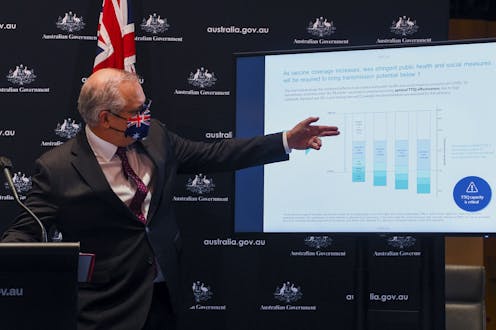
And this week, Melbourne’s Doherty Institute published the modelling informing this. The Doherty Institute had been asked by national cabinet to model the effects of increasing vaccination rates on Australia’s pathway out of the COVID pandemic.
The collaboration created an impressive assembly of models that allows them to assess the impacts of outbreaks under a range of infection-control scenarios. The model can be adapted to explore easing of specific restrictions, or changed conditions, for example if the dominant variant changes, or our response is more or less effective than anticipated.
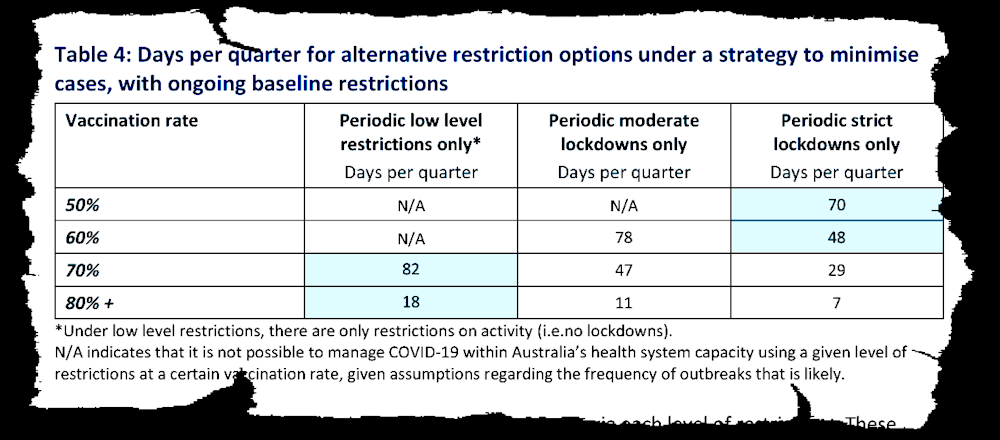
They found vaccinating 70% of over-16s would allow for lesser restrictions in the event of an outbreak, and getting to 80% would mean significant easing and likely no lockdowns.
The ongoing need for interventions highlights how difficult it is to manage the Delta variant compared to previous strains. Even vaccinating 80% of the population over 16 still requires a level of active control in an outbreak setting, albeit with light restrictions.
The modelling uses Australian data gathered from across the country since August last year. This includes data on “transmission potential”, which is effectively the average number of people one infected person is likely to infect. Under varying levels of public health responses and people’s compliance with restrictions, the modellers were able to estimate this reproduction rate of the virus to understand what it will take to get transmission potential below one, and keep it there, so infections don’t climb beyond manageable levels.
The modelling forecast extends out six months. This is actually a relatively long time horizon given how quickly things change in this pandemic. The parameters start to become unreliable beyond that, and therefore the reliability of forecasts wanes. The modelling is a very well informed best guess, but there are many uncertainties. The value here lies in comparing different scenarios to chart the most strategic course, rather than the specific number of ICU beds or cases predicted.
The modelling gives us a guide for the level of vaccination coverage we’ll need to control the virus. The 80% mark for those currently eligible delivers a level of protection that promises an escape from our current cycling between lockdowns. It also highlights that time is of the essence — we need to get there before new variants emerge.
If we stay in the current limbo, we’re at risk of community transmission becoming embedded in other states, repeating the New South Wales situation across Australia.
As vaccination rates increase, the need for heavy restrictions decreases, so vaccination is the path out of the limbo we’re in.
Why the focus on younger people?
To date, Australia’s rollout has focused on those most at risk of severe outcomes from the disease, including older Australians, protecting them and our health-care systems from overload.
But to reach the vaccination targets in the most effective way, the modelling demonstrates the value in turning our focus now to reducing transmission.
Our highest transmission and case rates occur in 20-39 year olds. This group is the most mobile. They tend to socialise and mix with other people the most and therefore have the most close contacts on average. Many live in shared houses, have young families, and make up a large portion of the workforce, particularly essential workers. The Doherty Institute’s Professor Jodie McVernon said people aged 20-29 in particular were “peak spreaders”.
It’s vital we start vaccinating 20-39 year olds, because this approach gives a better bang for our vaccination buck.
Vaccinating this group protects not only them, but the whole population including those who can’t be vaccinated. Vaccinated people are less likely to become infected and, even if they do, less likely to pass it on. The Doherty Institute’s technical report on the modelling indicates the combined effect is a reduction in transmission risk of 86% for AstraZeneca and 93% for Pfizer.
Professor McVernon said vaccinating as many 20-39 year olds as possible could double the protection for over-60s, and protect everyone else, making it the most equitable strategy at this stage of our rollout.
Why weren’t kids included?
The Doherty Institute wasn’t asked to factor in vaccinating those younger than 16, so kids are treated as unvaccinated in the model. Their protection, and the protection of schools from the impact of outbreaks, therefore relies on adults reaching the 80% target, and parents in particular.
The risk here is that if the virus does find its way into schools, it might cause significant outbreaks that quickly spread across schools — like we’re seeing in Queensland at the moment. Stronger public health interventions might still be required to contain an outbreak.
We’ll have to monitor this closely over time, and as COVID vaccine trials in kids continue, to help us weigh up risks and benefits.
This week, ATAGI advised kids aged 12-15 should be prioritised for vaccination if they’re Aboriginal or Torres Strait Islander, live in a remote community or have underlying medical conditions.
As overall vaccination rates rise, we need to look out for areas with low vaccination coverage. If the virus finds its way in, we may still see a degree of local transmission that requires restrictions. But in these instances, restrictions would be more localised and targeted rather than a whole city or state.
Australia’s Chief Medical Officer, Professor Paul Kelly, said it well in Tuesday’s press conference: we can aim for a “soft landing” where other countries can’t. The modelling tells us when we get to 80% adult vaccination coverage, we can avoid the huge wave of infections we’ve worked so hard to prevent.
Unlike the United Kingdom, where cases peaked again on reopening, or the United States, where cases and hospitalisations are both on the rise, we can leverage our past success in outbreak control and get through this without ever seeing a wave of a truly international proportions.
Catherine Bennett receives funding from the National Health and Medical Research Council and The Medical Research Future Fund. Catherine is also an independent expert on the Covid-19 AstraZeneca Vaccine Advisory Board, Australia.
In the lead up to the 2019 election, the Shorten opposition attacked the government’s planned 2024 tax cuts, and promised to curb negative gearing and halve the capital gains tax discount.
Last week, the Albanese opposition said it wouldn’t try to unwind the tax cuts and would leave negative gearing intact – a pragmatic decision designed to make the party a small target at next year’s election.
Speaking to The Conversation in the Mural Hall in Parliament House – COVID restrictions prevented a visit to his office – Shadow Treasurer Jim Chalmers defended the change of stance:
“I think people understand that the highest priority right now needs to be the management of this pandemic, which is doing such damage to the economy and to local communities, and also what the economy and our society will look like after Covid-19. And what we’re able to do now is to focus properly on that. And that’s why we took that decision and why we announced it immediately.”
In a populist move this week, the opposition called on the government to provide a $300 incentive to anyone who was fully vaccinated by 1 December. Such an initiative – vehemently rejected by the government – would cost $6 billion, which Chalmers concedes “is not a small amount of money” but “is a fraction of the money that the government has given in JobKeeper for companies whose profits actually went up and didn’t need JobKeeper support. $13 billion at least wasted there.”
Chalmers says $300 per vaccinated person would be “a lot of bang for buck in terms of public health outcomes, but also in terms of economic outcomes.”
If successful at the election, as treasurer Chalmers would be inheriting an enormous debt, with not much room for spending. Despite this, he says Labor’s approach to spending “won’t be held to constraints that the government’s not held to.”
“The government spent a 100 billion dollars in one night on budget night[…]not a dollar offset, and nobody’s saying to the government ‘what taxes are you raising to pay for that 100 billion dollars in spending?’
“The commitment I give to the Australian people as the alternative treasurer is our budget position will reflect the needs of the Australian people and the economy[…]
“It will be more responsible than the Liberals. We won’t be taking a lecture on responsibility from the most wasteful government since Federation, and our budget settings will reflect the economy.”
Michelle Grattan does not work for, consult, own shares in or receive funding from any company or organisation that would benefit from this article, and has disclosed no relevant affiliations beyond their academic appointment.
The race to vaccinate Australians is heating up as the supply of vaccines starts to increase and lockdowns continue.
Labor this week suggested a A$300 cash payment for people fully vaccinated by December. Meanwhile, “Operation COVID Shield”, the newly published national COVID vaccine campaign plan, includes support for “freedom incentives” put forward by the Coalition.
Let’s take a look at how effective the evidence suggests these measures might be in getting more Australians vaccinated.
Vaccination is a key weapon in our armoury as we navigate the pandemic. We know it’s very effective in protecting people from illness and death, and also reduces transmission of COVID-19.
At this stage, only 19.8% of Australians over 16 have been fully vaccinated.
Although insufficient supply has been the main reason for the slow rollout to date, vaccine hesitancy is an increasingly important issue as we strive for herd immunity.
The latest data from our Taking the Pulse of the Nation Survey shows vaccine hesitancy in Australia has fallen to 21.5% since the recent outbreaks, from a high of 33% in late May.
Among that 21.5%, 11.8% of Australians remain unwilling to be vaccinated, while 9.7% are unsure.
So can financial or non-financial incentives bring these figures down and in turn speed up Australia’s vaccination rollout?
The government has proclaimed cash incentives will have minimal impact on vaccination rates — although the review of the evidence they conducted hasn’t been published.
There is in fact evidence from a range of settings showing cash payments do have one-off effects in terms of persuading people to visit a health professional.
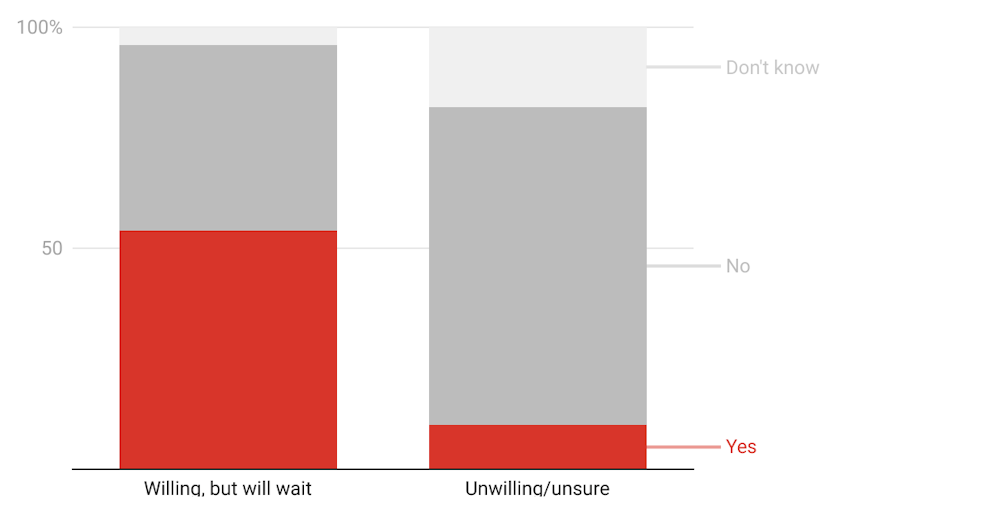
Our survey research has shown 54% of those willing to be vaccinated, but waiting, said they would get vaccinated as soon as possible if offered cash.
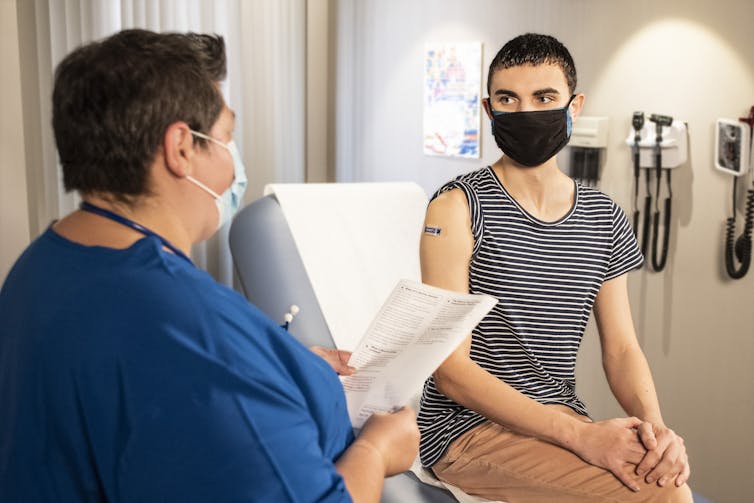
Cash incentives are likely to encourage people who are willing to get vaccinated, but haven’t done so yet. CDC/Unsplash
Further analysis shows those willing and eligible to be vaccinated (people over 50 at the time these data were collected) were more likely to respond to cash payments if they were male, and if the amount was at least A$100. Overall, half said they would get vaccinated sooner if offered A$100 or more. So Labor’s plan of A$300 would be effective for this group.
However, for people who are unwilling or unsure about vaccination, cash payments may make only a small difference. Just 10% of this group said they would respond to cash.
This is because there are many reasons people may be unsure or don’t want to get vaccinated. These include a lack of access to unbiased advice and information, strong beliefs about vaccination including around vaccine safety, and medical conditions. To increase vaccination in this group, we need to consider different approaches.
Vaccination as a ticket to freedom
We’re likely to see non-financial incentives offered to fully vaccinated Australians as time goes on. These might be in the form of exemptions from health restrictions, or more lenient rules, around, for example, travel and social activities.
We know holding our vaccination records in our smartphones might provide us with more freedom, earlier. The United Kingdom now allows fully vaccinated travellers from the United States and the European Union to enter without quarantine, accepting the risk that even people who are vaccinated can still carry and spread the virus.
Our survey found roughly 70% of Australians think fully vaccinated people should be allowed to participate, without restriction, in sporting events, concerts, interstate travel, religious events, going to restaurants and movies, and the like. Around half believe those who remain unvaccinated once vaccination is available to everyone should be banned from these activities.
Slightly fewer think international travel should be unrestricted even when fully vaccinated.
Of people unwilling or unsure about vaccination, 18-28% stated they would get vaccinated if they were banned from these activities. This suggests that, compared to cash payments, non-financial incentives might be more likely to work for those who are unwilling or unsure about vaccination.
Where to next?
Both Labor’s and the Coalition’s incentive policies would have some impact on vaccination rates, but the devil is in the detail.
Cash payments are likely to be effective for those who are already willing to be vaccinated, but have not yet done so. This would speed up the rate of vaccination.
Cash is less likely to influence those who are unwilling or are unsure, though it could still work for some of these people.
Allowing fully vaccinated people more freedoms will likely increase the vaccination rates among those yet to get the jab, including those who are unsure or unwilling.
Reaching this group is the holy grail, giving us a better shot of attaining the elusive, but crucial, herd immunity. Incentives matter.
The authors do not work for, consult, own shares in or receive funding from any company or organisation that would benefit from this article, and have disclosed no relevant affiliations beyond their academic appointment.
If the proposed A$300 payment to each Australian who is fully vaccinated works, it might be at the expense of getting Australians hooked on incentives, and there are reasons to think it might not not work.
Labor has suggested paying $300 to every Australian who is fully vaccinated by December. The government hasn’t ruled out doing it or something like it.
If 20 million Australians took up the offer, it would cost $6 billion.
An alternative would be to emulate the much cheaper US5.6 million “Vax-a-Million” lottery held in the US state of Ohio. But there is some doubt as to whether it worked.
A preliminary analysis comparing vaccination rates in border counties in Ohio and Indiana before and after the announcement found it might have lifted vaccinations by between 50,000 and 80,000 doses.
Another study found no evidence of any effect when other changes that were taking place at the same time were taken into account.
The payment proposed by Labor is many times bigger at A$6 billion, as would be an A$80 million series of Vaxlotto draws proposed by the Grattan Institute.
What matters is cost per additional vaccination
In assessing value for money we would need to do more than work out the cost per vaccination. We would need to work out the cost per additional vaccination.
Then we would need to set that cost against the benefit of lockdowns those extra vaccinations avoided and the lives and healthy years saved.
While the economic cost of lockdowns is large (the estimate released by the treasury on Tuesday puts the cost of Australia-wide lockdown at A$3.2 billion per week) the reduction in the frequency of Australia-wide or partial lockdowns resulting from incentive payments might be small.
The Treasury estimates suggest an increase in the vaccination rate from 65% to 70% of the proportion of the population aged 16+ would cut the number of days of strict lockdowns per quarter from around 40 to 29.
Economic Impact Analysis: National plan to transition to Australia’s national COVID 19 response. Australian Treasury
Even if effective, the incentive payments would create expectations. Australians might come to expect (or demand) them in order to get booster shots.
Unless the payments are made retrospective to everyone who has been vaccinated (something both Labor and the Grattan Institute are proposing) they could encourage Australians to delay signing up until they know what’s on offer.
Australians might wait til they know what’s on offer
And they could encourage a mentality of compensating Australians who are reluctant to make sacrifices in the national interest. The government’s emissions reduction payments are rightly seen as having this defect, as was the award of free tradable permits under Labor’s emissions reductions scheme.
Sticks, along the lines of denying access to “vaccine passports”, might be more effective than carrots, and they would create fewer expectations.
The best approach would be for the government to get its own house in order by ensuring adequate vaccine and booster supply and delivering consistent messages.
On Tuesday General Frewen, in charge of the COVID taskforce, said an incentive payment wasn’t needed “right now”. If other things are in place, it mightn’t be needed at all.
Mark Crosby does not work for, consult, own shares in or receive funding from any company or organisation that would benefit from this article, and has disclosed no relevant affiliations beyond their academic appointment.
Source: The Conversation (Au and NZ) – By Michael Westaway, Australian Research Council Future Fellow, Archaeology, School of Social Science, The University of Queensland
Plans are underway to rebury the remains of more than 100 Aboriginal people, including the remains of Mungo Man and Mungo Lady, arguably the two most important people who ever lived in Australia”.
The ancestral remains from Willandra occupy a crucial place in understanding the dispersal of modern humanity across the globe and the story of our species’ adaptation to climate change. Mungo Man and Mungo Lady have been dated to 42,000 years old, making them Australia’s oldest human remains. Mungo Lady is the oldest known cremation in the world.
Human remains were first identified at the dry Lake Mungo in 1968. During the 1980s, a small number of the ancestral remains were excavated. The vast majority, however, were exposed through erosion and collected by archaeologists from the Australian National University and NSW National Parks. Ancient DNA has been recovered from one individual, but the majority of the ancient people have not been researched.
The age of the remains are instrumental touchstones in the battle for Indigenous rights. This research led directly to the 1981 inscription of the area on the World Heritage List as one of Australia’s first two World Heritage properties.
Aboriginal people have consistently fought for their ancestors to be returned to Country. During the 1980s and 1990s the remains became national symbols for repatriation. There has been agreement among traditional owners, pastoralists and scientists for more than two decades that the ancestral remains should be repatriated to the Willandra.
The remains of Mungo Lady were returned to the area in 1992, and the remainder of the ancient people returned in 2017–18. A National Congress of Australia’s First Peoples said in 2018 a permanent “keeping place”, rather than reburial, should be provided with a monument to mark their importance.
The traditional owner groups have been seeking a keeping place since the 1990s, and in 2000 passed a resolution seeking support from government for its establishment.
But following a series of workshops a plan for reburial (rather than a keeping place) was approved in 2018 by a group representing Barkindji/Paakantji, Mutthi Mutthi and Ngiyampaa peoples. These workshops didn’t include experts in palaeoanthropology or biological anthropology.
The current proposal is for the remains to be taken into the World Heritage Area and buried in deep, unmarked graves. A recent NSW government review concluded this would not negatively impact World Heritage values.
We disagree with the NSW government report and believe burying the remains would negatively impact World Heritage values. Mutthi Mutthi Aboriginal Advisory Group (AAG) members Jason and Daniel Kelly responded to the NSW government review arguing the government did not adhere to UNESCO policy for engaging with Indigenous peoples and had denied traditional owner communities the rights to free, informed and prior consent.
The NSW review ignored a 1997 report by leading palaeoanthropologists Chris Stringer and Clive Gamble listing the fossil remains and their surrounding archaeological and palaeoenvironmental context as a site of outstanding value to the human evolutionary story.
The NSW government review also omitted reference to international standards such as the Vermillion Accord. It states the perspectives of both traditional owners and scientists should be given respect when considering the disposition of ancestral remains of great significance.
The NSW Department of Environment has now referred the proposed plan to rebury the remains for consideration of the federal environment minister, Sussan Ley.
An early design for the Mungo keeping place by leading Australian environmental architect Gregory Burgess.
What would be lost?
The age of most of the key burial sites is still unknown. If these remains were reburied in secret locations, we may lose the opportunity to re-date a large number of them using new methods. Research on Garnpung Man demonstrated this possibility.
Mungo Man is buried with ochre from many hundreds of kilometres away. It may prove possible to reconstruct migration of people across the landscape by looking at the geochemical (isotopic) signatures in their teeth. Importantly, we could trace how this mobility changed between 40,000 and 20,000 years with the coming of peak glacial mobility, a period that saw the Willandra transform from a wetland into a desert.
Recovering DNA or employing a new method known as proteomics could provide insights into the complexity of Aboriginal origins: early humans on their journey to ancient Australia mixed with other species of humans such as Neanderthals and the enigmatic Denisovans.
Around 16 individuals whose remains were uncovered had been heavily burnt or cremated. Studying this could challenge our understanding of the origins of complex mortuary practices.
Further research could also help us understand how our species adapted to past climate change.
A learning place
Many Barkandji and Mutthi Mutthi Elders and community members have expressed their wish to share the stories of these ancient people with all humanity.
Earlier this year, a letter with Barkandji Native Title holders in Nature called for a delay of the reburial process, highlighting an absence of adequate consultation.
Students on the Arumpo lunette during an early Lake Mungo Youth Festival. The Mungo Youth Conference brings together Elders, researchers and pastoralists to discuss the values of the Willandra World Heritage Area.
Every party involved has supported the repatriation of the ancestral remains to Country and all refer to Willandra as a learning place.
A recent online forum, facilitated by Mutthi Mutthi members of the government’s AAG, discussed how a keeping place could enable future learning.
Supporting the development of a keeping place and cultural centre for the traditional owners of the Willandra, rather than reburial in unmarked graves will be an action in keeping with the principles of World Heritage.
Some Mutthi Muthi AAG representatives believe the current proposal dismisses the voice of elders of the three tribal groups past and present, who have fought for a keeping place. They say it inflicts soul sickness and cultural harm to traditional owners who have been excluded from consultations.
Michael Westaway receives funding from the Australian Research Council. He was the Executive Officer for the Willandra Lakes between 2004-2008 and undertook his PhD on the ancestral remains from the Willandra after receiving consent from the Willandra advisory committees (including Three Traditional Tribal Groups and the Technical Scientific Advisory Committees)..
Doug Williams was the Executive Officer for the Willandra Lakes Region World Heritage Area from mid 2000 to early 2004
Jason Kelly is a community elected representative for the North West Region of Victoria on the First Peoples Assembly of Victoria.
Research Checks interrogate newly published studies and how they’re reported in the media. The analysis is undertaken by one or more academics not involved with the study, and reviewed by another, to make sure it’s accurate.
Coffee is one of the most popular beverages worldwide. Many of us enjoy a cup in the morning to prime us for the day ahead, or reach for a cup later in the day to avert that mid-afternoon slump.
But you may have seen reports about a new study finding that drinking more than six cups of coffee a day could shrink brain volume and increase dementia risk. So if you’re constantly seeking your next caffeine fix, should you be worried?
Researchers from Australia and the United Kingdom found this level of coffee consumption is associated with smaller total brain volume and a 53% increased risk of dementia. But they didn’t show high caffeine intake causes dementia, and they note this study cannot confirm the underlying reason for the association.
How was the study conducted?
The paper, published in the journal Nutritional Neuroscience, examined whether habitual coffee consumption was associated with differences in brain volume, and changed odds of developing dementia or stroke.
The researchers looked at 398,646 participants aged between 37 and 73, taken from the research database UK Biobank.
To measure disease outcomes, the researchers looked at the number of these people who developed dementia or had a stroke over time, and analysed this data alongside coffee intake.
For the association between coffee consumption and brain volume, the researchers compared brain imaging against the amount of coffee participants drank daily. This aspect of the study looked at 17,702 people out of the 398,646.
The study was observational, so researchers didn’t make any changes to the participants’ diets or lifestyles. Instead, they looked back at the individual’s coffee intake and correlated the amount of coffee consumed daily to their brain size, and the odds of developing dementia or having a stroke.
Overall, they found the more coffee participants consumed daily, the smaller their total brain volume.
Dementia risk was less straightforward. People who didn’t drink coffee, or drank decaf, showed slightly higher odds of developing dementia than people who drank a moderate amount of coffee. The odds of dementia were significantly higher for those who drank more than six cups daily. The results suggest people who drink one to two cups of coffee a day are at no increased risk of dementia.
After adjusting the data for variables such as underlying health conditions, age, sex and body-mass index, the researchers concluded consumption of more than six cups of coffee daily was associated with smaller brain volume, and 53% higher odds of dementia compared with one to two cups daily.
The evidence for any association between the amount of coffee consumed and stroke risk wasn’t significant.
Is it good for us? Is it bad for us? Coffee is regularly making headlines. Shutterstock
How should we interpret these results?
The consequences of smaller brain volume are unclear, and this study doesn’t address this question. However, brain shrinkage does happen naturally as we age, and studies suggest there is a connection between brain volume and dementia.
But does brain size really matter? There are plenty of animals with larger brains than humans, and the association between brain size and intelligence is weak. This is a growing area of research, so stay tuned.
Notably, the study doesn’t actually address whether the brain shrunk over time — brain volume measurements were conducted at one time point. So while some reports have claimed the study found too much coffee can cause the brain to “shrink”, the researchers didn’t actually measure this.
One issue with this study is that full information on diet was only available for a portion of participants. This is a problem as poor diet is a major risk for cognitive decline and dementia. On the flip side, healthy dietary patterns have consistently been associated with longevity and better cognitive health. So dietary factors could be confounding the results.
Observational studies like these can only tell us whether certain things are linked, not whether there’s a causal relationship.
A potential explanation for the increased dementia risk could be related to the cardiovascular effects of caffeine. For instance, there’s evidence consuming unfiltered coffee increases cholesterol, with high cholesterol being a leading risk factor for atherosclerosis (the buildup of fats on the artery walls), which is associated with vascular dementia.
However, other lifestyle factors, such as diet and inactivity, appear to play a bigger role in cholesterol levels.
Ultimately, we don’t know the reasons behind the links observed in this study.
This study finds correlation, but doesn’t prove causation. Shutterstock
So what’s the take-home message?
The results of this study shouldn’t be ignored, and help us form questions for future research. There’s plenty more research to be done into how caffeine interacts with our bodies.
This new study follows previous research that found drinking coffee in moderation decreases dementia risk by 65%. There’s a body of evidence suggesting drinking coffee is beneficial for health, reducing the risk of diabetes and heart disease, and improving metabolism and cognition.
As with most things in life, the amount matters. So while the findings here aren’t cause for alarm, if you’re drinking six cups of coffee or more a day, you might want to think about drinking a little less. Perhaps one to three cups daily.
This will reduce your risk of any negative health outcomes, like those reported in this study, and may in fact increase the chances of ageing well. – Lachlan Van Schaik
This article is a fair and rational analysis of the study. In this study the researchers did find high intake of coffee was associated with smaller brain volumes and higher dementia risk.
It’s also important to point out that this study did not look at other sources of caffeine (such as energy drinks), nor the types or strengths of coffee or tea people consume. This means it did not make any conclusions about brain size or dementia risk in relation to caffeine, just coffee itself.
The author is correct in pointing out this study was purely observational and did not find high coffee intake “caused” the brain to shrink. While the findings are interesting, this is a classic case of correlation not equalling causation. High coffee consumption may cause brain shrinkage, or even increase risk of dementia, but at this stage we just don’t know.
It does, however, hint this may be another health risk associated with high levels of coffee drinking. Perhaps erring on the side of moderation would be wise until we know more. – Greg Kennedy
Lachlan Van Schaik is affiliated with La Trobe University and The University of Melbourne.
Greg Kennedy does not work for, consult, own shares in or receive funding from any company or organisation that would benefit from this article, and has disclosed no relevant affiliations beyond their academic appointment.
It’s not “new” news that Asian Australians are experiencing high rates of racism during the pandemic. However, existing data under-represent the true extent of COVID-related racism. The vast majority of cases aren’t being formally reported and official reporting processes aren’t capturing or addressing the impact of racism on Asian Australians.
Our recent national survey of 2,003 Asian Australians examined the nature, type and frequency of racist incidents they experience.
It also investigated changes over time (before and during the pandemic), the effects of such experiences on people’s mental health, wellbeing and sense of belonging, the reporting of racist incidents, and the actions (or inactions) of witnesses.
Our study found that four in ten Asian Australians experienced racism during the pandemic (and nearly the same number witnessed racism).
Of these, however, just 3% reported the incident to the Australian Human Rights Commission. Police received more reports (12%), as did bosses (7%) and teachers (6%). A much larger proportion (29%) of participants didn’t report the racism they experienced or witnessed (not even to friends or family).
Reporting to the AHRC appeared to be higher than usual at the start of the pandemic. In February 2020, the AHRC recorded the highest monthly number of racial discrimination complaints that financial year. And one in four people who reported racial discrimination to the commission in early 2020 linked those incidents to COVID-19.
Our findings worryingly suggest this is an under-representation of the racism that is occurring during the pandemic.
According to our respondents, the barriers to formal reporting include a lack of trust in statutory agencies and the perception that racism reports would not be responded to.
For example, 63% agreed that the report would not be taken seriously, 60% agreed the incident would not be dealt with properly, and 40% did not trust the recipients of the report. As one participant said:
I don’t think the police would do much, they are always saying they are under-resourced so why would they spend time and resources trying to locate some hooligan who was being racist.
A more strident distrust of the recipients of formal reports was also voiced:
The perpetrator of the incident was a client of the company I am working for. I’m sure that if I reported the incident, it would have been ignored. Even worse, I feared that I would have to face ramifications for reporting the incident.
Feelings of hopelessness, shame or disempowerment were other barriers to reporting racist incidents: 63% said it would not help, 54% felt uncomfortable or embarrassed, and 50% wanted to forget about the incident.
One participant explained:
If there is a white person and an Asian person in Australia they always side with the white person even if the Asian is the victim.
Just over half of participants also did not know how to report an incident, while just under half did not know they could report one. Said one participant:
I don’t know who they were and how to report. Wherever this happened there was not security camera so that police could trace the person.
This is consistent with other studies that have found similar barriers to reporting racism, including a lack of knowledge about reporting and lack of trust in agencies to do anything about it.
Racism is having far-reaching consequences
In line with research on the effects of racism on people’s health and wellbeing, the racism experienced by Asian Australians in our study is linked to high rates of stress, depression, anxiety and “non-belonging”.
Worryingly, there are even wider consequences of the anti-Asian sentiments being expressed during COVID. A large majority of participants who haven’t experienced racism during the pandemic directly still have some anticipation (on a scale of rarely to very often) of someone saying or doing something racist.
And a significant number of respondents who haven’t experienced racism said they avoided places and situations because of an anticipation of racism.
Other research has found that experiences or anticipation of racism can impact a person’s mobility and feelings of safety. This, in turn, can limit access to essential services such as health care, employment and housing.
It is therefore a significant concern that anxiety, worry and avoidance of potential racism is so high during the pandemic, even among those who aren’t being directly targeted.
Second, previous experiences of racism and discrimination may be causing people to anticipate repeated incidents, particularly during a crisis like the pandemic. Before the pandemic, Asian Australians were twice as likely to experience racism than other Australians.
But without trust in institutions or adequate data on reported incidents, the full impact of racism — and how it undermines social cohesion and individual health and wellbeing — remain hidden.
There is an urgent need for government and non-government agencies to develop tools that allow the reporting of incidents “without prejudice”, such as third-party reporting systems. (This is also advocated by the Hate Crime Network.) Examples of this include the UK’s True Vision reporting tool and the Islamophobia Support Service of the Islamic Council of Victoria.
As our research shows, reporting processes and responses need to be streamlined and made accessible to all communities, too. This will also lift confidence in reporting.
Alanna Kamp receives funding from the Department of Premier and Cabinet Victoria, Centre for Resilient and Inclusive Societies (CRIS), and SBS Corporation. She is affiliated with the Centre for Resilient and Inclusive Societies (CRIS).
Kevin Dunn received funding from Victorian Department of Families, Fairness and Housing and the Centre for Resilient and Inclusive Societies (CRIS).
Matteo Vergani receives funding from the Victorian government, Gandel Philanthropy, the Australian federal government, and the Canadian government. He is affiliated with the Centre for Resilient and Inclusive Societies (CRIS).
Nida Denson currently receives funding from the Department of Premier and Cabinet Victoria, Department of Education (NSW), Centre for Resilient and Inclusive Societies (CRIS), SBS Corporation, ACON Health Limited, and Guide Dogs NSW/ACT. She is affiliated with the Centre for Resilient and Inclusive Societies (CRIS).
Rachel Sharples has received funding from the Department of Premier and Cabinet Victoria and the Centre for Resilient and Inclusive Societies (CRIS). She is affiliated with the Centre for Resilient and Inclusive Societies (CRIS).
Scanning through data fresh off the telescope, we saw two ghosts dancing deep in the cosmos. We had never seen anything like it before, and we had no idea what they were.
Several weeks later, we had figured out we were seeing two radio galaxies, about a billion light years away. In the centre of each one is a supermassive black hole, squirting out jets of electrons that are bent into grotesque shapes by an intergalactic wind.
The two galaxies we think are responsible for the streams of electrons (shown as curved arrows) that form the Dancing Ghosts. But we don’t understand what is causing the filament labelled as 3. Image by Jayanne English and Ray Norris using data from EMU and the Dark Energy Survey
But where does the intergalactic wind come from? Why is it so tangled? And what is causing the streams of radio emission? We still don’t understand the details of what is going on here, and it will probably take many more observations and modelling before we do.
We are getting used to surprises as we scan the skies in the Evolutionary Map of the Universe (EMU) project, using CSIRO’s new Australian Square Kilometre Array Pathfinder (ASKAP), a radio telescope that probes deeper into the Universe than any other. When you boldly go where no telescope has gone before, you are likely to make new discoveries.
A deep search returns many surprises
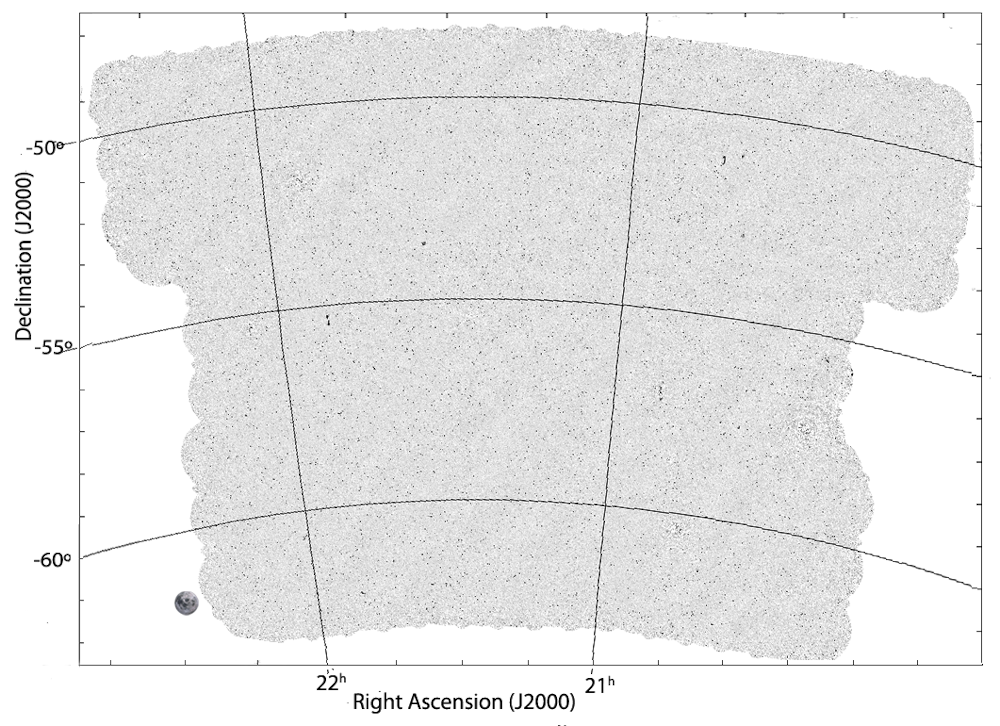
The image produced by the EMU Pilot Survey. The full moon is shown for scale in the bottom left. The dancing ghosts are barely a pin-prick on this image. Image by Ray Norris from EMU data
The Dancing Ghosts were just one of several surprises found in our first deep search of the sky using ASKAP. This search, called the EMU Pilot Survey, is described in detail in a paper soon to appear in the Publications of the Astronomical Society of Australia.
The first ‘Odd Radio Circle’. Radio data are green and the white and coloured data show the optical background from the Dark Energy Survey. image created by Jayanne English from data from EMU and the Dark Energy Survey
The first big surprise from the EMU Pilot Survey was the discovery of mysterious Odd Radio Circles (ORCs), which seem to be giant rings of radio emission, nearly a million light years across, surrounding distant galaxies.
These had never been seen before, because they are so rare and faint. We still don’t know what they are, but we are working furiously to find out.
We are finding surprises even in places we thought we understood. Next door to the well-studied galaxy IC5063, we found a giant radio galaxy, one of the largest known, whose existence had never even been suspected.
A giant radio galaxy with plumes of electrons stretching nearly 5 million light years from top to bottom of the image. These plumes had never been seen before the EMU Pilot Survey, even though the galaxy IC5063 (the bright blob in the centre) is a very well-studied galaxy. The radio emission (white) is superimposed on an optical imge (coloured) from the dark energy survey. Image by Ray Norris from EMU data and Dark Energy Survey data
This new galaxy too contains a supermassive black hole, squirting out jets of electrons nearly 5 million light years long. ASKAP is the only telescope in the world that can see the total extent of this faint emission.
What EMU can do
Most known sources of radio emissions are caused by supermassive black holes in quasars and active galaxies, which produce exceptionally bright signals. This is because radio telescopes have always struggled to see the much fainter radio emission from normal spiral galaxies like our own Milky Way.
The EMU project goes deep enough to see them too. EMU sees almost all the spiral galaxies in the nearby Universe that were previously seen only by optical and infrared telescopes. EMU can even trace the spiral arms in the nearest ones.
The Galaxy NGC 7125 with EMU radio data (contours) overlaid on an optical image (coloured_ from the Dark Energy Survey. Image created by Baerbel Koribalski from EMU data and Dark Energy Survey data
EMU will help us understand the birth of new stars in these galaxies.
These some of the first results the EMU project, which we started in 2009. The EMU team of more than 400 scientists in more than 20 countries has spent the past 12 years planning the project, developing techniques, writing software, and working with the CSIRO engineers who were building the telescope. It has been a long haul, but we are at last seeing the amazing data we have dreamed of for so long.
But this is only the start. Over the next few years, EMU will use the ASKAP telescope to explore even deeper in the Universe, building on these discoveries and finding more. All the data from EMU will eventually be placed in the public domain, so that astronomers from around the world can mine the data and make new discoveries.
But don’t take my word for it. You can already use EMU Pilot Survey data to explore the radio sky yourself, using the zoomable image on our website.
Use your mouse wheel to zoom in from the big picture down to the finest details, and see what you find. Perhaps you may even discover something there that the astronomers have missed.
Ray Norris does not work for, consult, own shares in or receive funding from any company or organisation that would benefit from this article, and has disclosed no relevant affiliations beyond their academic appointment.
Giant bird-eating centipedes may sound like something out of a science-fiction film — but they’re not. On tiny Phillip Island, part of the South Pacific’s Norfolk Island group, the Phillip Island centipede (Cormocephalus coynei) population can kill and eat up to 3,700 seabird chicks each year.
And this is entirely natural. This unique creature endemic to Phillip Island has a diet consisting of an unusually large proportion of vertebrate animals including seabird chicks.
Phillip Island in the Norfolk Island group, with a valley of iconic Norfolk Island Pine trees. Luke Halpin
We show how large, predatory arthropods can play an important role in the food webs of island ecosystems. And the Phillip Island centipede achieves this through its highly varied diet.
This centipede can grow to almost one foot (or 30.5cm) in length. It is armed with a potent venom encased in two pincer-like appendages called “forcipules”, which it uses to immobilise its prey. Its body is protected by shield-like armoured plates that line each of the many segments that make up its length.
On warm and humid nights, these strictly nocturnal arthropods hunt through thick leaf litter, navigating a labyrinth of seabird burrows peppered across the forest floor. A centipede on the prowl will use its two ultra-sensitive antennae to navigate as it seeks prey.
The centipede hunts an unexpectedly varied range of quarry, from crickets to seabird chicks, geckos and skinks. It even hunts fish — dropped by seabirds called black noddies (Anous minuta) that make their nests in the trees above.
A frightful discovery
Soon after we began our research on the ecology of Phillip Island’s burrowing seabirds, we discovered chicks of black-winged petrels (Pterodroma nigripennis) were falling prey to the Phillip Island centipede.
We knew this needed further investigation, so we set out to unravel the mystery of this large arthropod’s dietary habits.
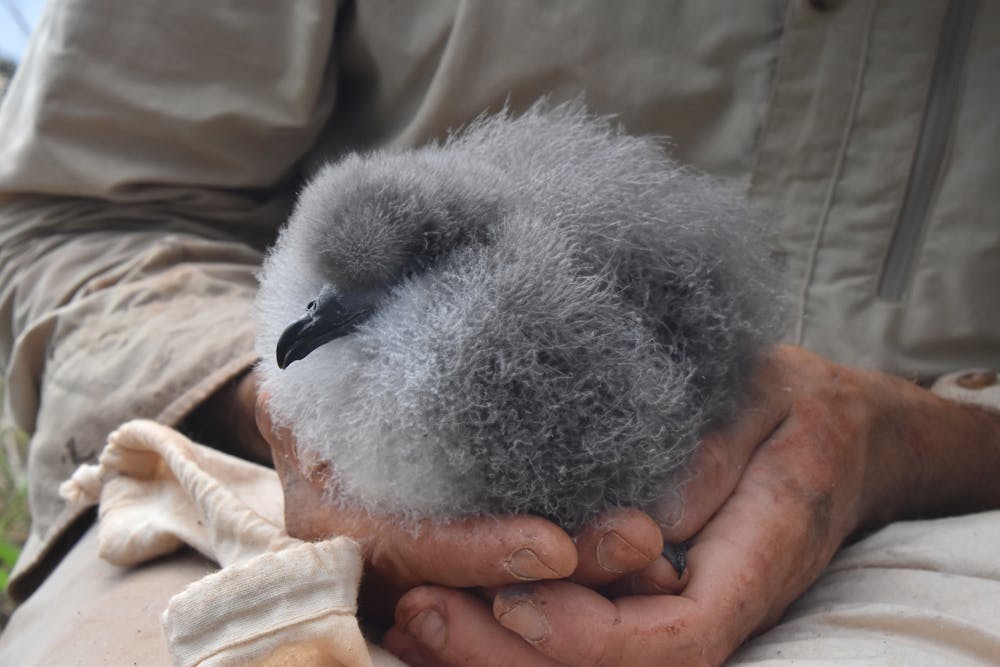
Black-winged petrel chick just prior to being weighed on Phillip Island. Trudy Chatwin
To find out what these centipedes were eating, we studied their feeding activities at night and recorded the prey species they were targeting. We also monitored petrel chicks in their burrow nests every few days, for months at a time.
We eventually began to see consistent injury patterns among chicks that were killed. We even witnessed one centipede attacking and eating a chick.
From the rates of predation we observed, we calculated that the Phillip Island centipede population can kill and eat between 2,109 and 3,724 petrel chicks each year. The black-winged petrels — of which there are up to 19,000 breeding pairs on the island — appear to be resilient to this level of predation.
Envenomation of a black-winged petrel nestling by a Phillip Island centipede. (Video by Daniel Terrington)
And the predation of black-winged petrels by Phillip Island centipedes is an entirely natural predator-prey relationship. By preying on vertebrates, the centipedes trap nutrients brought from the ocean by seabirds and distribute them around the island.
In some sense, they’ve taken the place (or ecological niche) of predatory mammals, which are absent from the island.
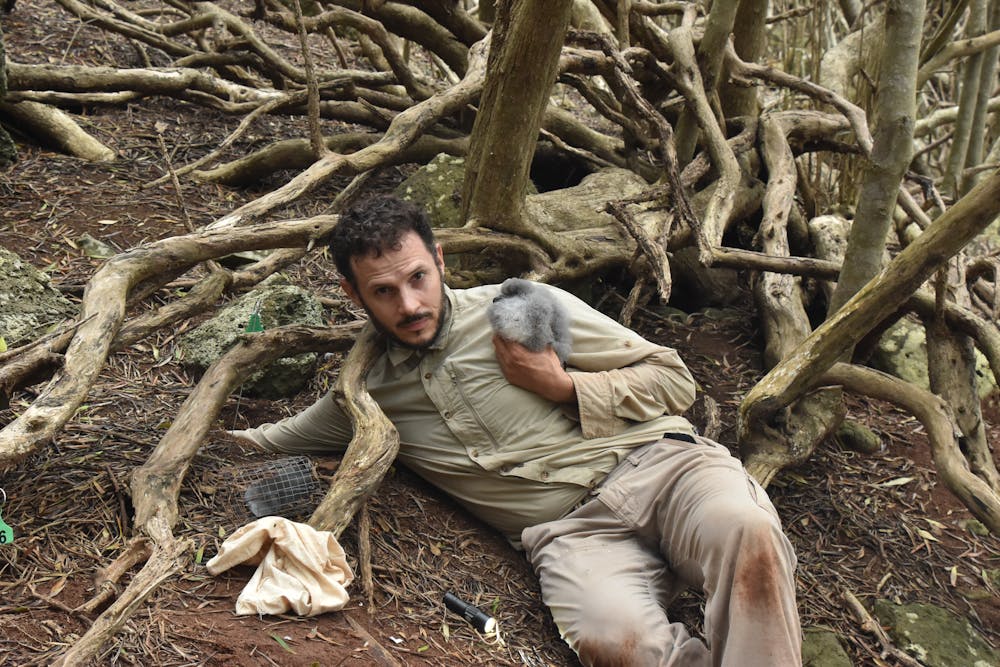
Luke Halpin monitoring black-winged petrel chicks on Phillip Island. Trudy Chatwin
Restoration and recovery
Up until just a few decades ago the Phillip Island Centipede was very rare. In fact, it was only formally described as a species in 1984.
After an intensive search in 1980, only a few small individuals were found. The species’s rarity back then was most likely due to severely degraded habitats caused by pigs, goats and rabbits introduced by humans to the island.
The removal of these invasive pests enabled black-winged petrels to colonise. Their population has since exploded and they’re now the most abundant of the 13 seabird species that breed on Phillip Island.
They provide a high-quality food source for the Phillip Island centipede and have therefore likely helped centipede population to recover.
Black-winged petrels on Phillip Island are active both during the day and at night. (Video by Luke Halpin)
Ancient bone deposits in the soil suggest that prior to the black-winged petrel’s arrival, Phillip Island was home to large numbers of other small burrow-nesting seabird species. It’s likely the Phillip Island centipede preyed on these seabirds too.
Now, thanks to the conservation efforts of Norfolk Island National Park, the island’s forest is regenerating alongside endemic species like the centipede, as well as the critically endangered Phillip Island hibiscus (Hibiscus insularis).
The endemic Phillip Island hibiscus. Luke Halpin
As a driver of nutrient transfer, the persistence of the Phillip Island centipede (and its healthy appetite) might just be key to the island’s ecosystem recovery. But we’ll need to do more research to fully understand the intricate links in this bustling food web.
Luke Halpin is a recipient of the Endeavour Postgraduate Leadership Award from the Australian Government. This research was funded by the Holsworth Wildlife Research Endowment – Equity Trustees Charitable Foundation & the Ecological Society of Australia, BirdLife Australia Stuart Leslie Bird Research Award and the Australasian Seabird Group. Support was also provided by the New South Wales Department of Planning, Industry and Environment and Norfolk Island National Park.
Rohan Clarke receives funding from Parks Australia, the Australia and the Pacific Science Foundation. Rohan Clarke is affiliated with Monash University.
Rowan Mott is affiliated with the University of Adelaide.
The supermarket sector is finally about to receive some serious government intervention. Following a scathing report from the Commerce Commission, it’s now almost inevitable that the Labour Government is going to have to introduce some major changes to this vital but uncompetitive retail sector. And these moves are likely to be popular.
The report, released on Thursday, met with almost universal praise and celebration. And it surprised everyone with just how scathing it was about the supermarkets, and how radical its early recommendations are.
The first key point the supermarket sector report makes, is that the current groceries sector is utterly broken. It paints a picture of a Foodstuffs and Woolworths duopoly making super-profits – in excess of 20 per cent return on their capital – by ripping off both food suppliers and customers. The report found that food prices are the sixth highest in the OECD. Staff, too, are heavily exploited to help make billions of dollars in profits.
The second key point is the possible suite of reforms that will be necessary to fix the sector. These range from encouraging supermarkets to reform themselves, through to serious state intervention to break up the mega-entities that control the market, or even the state setting up a third supermarket chain (in the way that KiwiBank was introduced).
Rutherford summed up the reform options: “The Commerce Commission’s recommendations for measures to improve wholesale competition are a spectrum, ranging from modest changes on a voluntary basis, to creating a new wholesaler or even forcing the break-up of the groups into retail and wholesale. Aimed at attracting a new major retailer into the New Zealand market, it could be accompanied by forcing the supermarket to sell off certain sites to a new player.”
The mood for a more interventionist state in broken markets
In the above article, Rutherford also explains that such a scathing and radical report really puts pressure on the Labour Government and the Commerce and Consumer Affairs Minister David Clark to actually carry out some substantial reforms. Rutherford concludes: “with such a clear verdict of a duopoly exercising market power in such a mammoth sector, the Government will quickly need to find a suitable response.”
Stuff newspapers political editor Luke Malpass also emphasised how the report squarely puts the ball into the Government’s court, making it almost impossible for them to avoid doing something big. He says that normally these types of reports take the pressure off governments: “Market studies are great for governments. If nothing else, a Commerce Commission probe creates the appearance of government action long before the action happens”, but given the tenor of this particular report, “the Government will have to actually do something this time around” – see: Labour’s $22 billion supermarket problem — and opportunity.
According to Malpass, David Clark is a good fit for this role (better than the ill-fated Health portfolio), and he’s inclined towards proper reform: “His view is simple: Labour campaigned on doing this, he thinks that there is a mood for real change, and now it will be up to the Government to get on with it.”
Government intervention is also likely to be substantial, Malpass points out, because there’s now a strong public philosophical mood for the state to act: “This political landscape has changed massively from five years ago. There seems to be a pretty good public appetite for the Government to sort some of these things out. If anything, Labour’s only downside risk here is not doing enough. And if Covid has taught us anything, it’s that – rightly or wrongly – Kiwis are quite happy for governments to intervene in the right circumstances. In the coming cost-of-living political war, the party that convinces voters it is the one on their side will be rewarded.”
This mood for a bigger and more interventionist state, especially in regard to the broken supermarket sector, is very well examined by Max Rashbrooke in his column, Supermarket prices: Politicians have dropped the ball, which begins like this: “The forensic evisceration on Thursday of our uncompetitive supermarket duopoly is a landmark moment, a sign of shifting attitudes towards capitalism – and a massive test for Commerce Minister David Clark.”
According to Rashbrooke, Clark has a big job ahead, and will have to resist “a determined lobbying campaign by the supermarket duo”, but ultimately will achieve his own redemption if he can create a legacy as the Minister “who broke up the big two”. And the fact that he even has this task is a sign that the “laissez-faire thinking” of the past that allowed the market to evolve into a duopoly is out of fashion.
Rashbrooke points to other broken sectors that will also need reform, including electricity, building supplies (where “Fletchers utterly dominates”), petrol, and banking. And he suggests that in the new environment, National is likely to be onboard with radical reform, “because conservatives need capitalism to work properly and retain the public’s support.”
Economist Cameron Bagrie also thinks the Government has a strong incentive to go hard on supermarkets, and that the construction sector and banking should be next – see: Supermarkets are sitting ducks for pro-competition regulation (paywalled). He notes the Government is building up the Commerce Commission’s capacity, budgeting “$30.4 million extra for the commission over three years, and $13.9m per year thereafter.”
Bagrie believes that reform of the grocery sector will be favoured by Government because rising inflation is “not likely to be economically or voter-friendly”, and “Moving on supermarkets could help around the edges to contain inflation.”
Media commentators are also keen for the Government to deal to the supermarkets. Heather du Plessis-Allan says she’s hoping for big reforms to increase supermarket competition but is not sure this will happen, especially given that promised reforms in the petrol market don’t appear to have worked – see: We pay too much for groceries.
She says reform will be difficult, but electorally rewarding: “The easy option is to force the supermarket chains to supply a third player with wholesale groceries at reasonable prices so they can compete. The hard option is force the supermarket chains to sell off some of their stores or brands. Either way, this will kick up a storm in the sector. The Government will buy itself a fight. Does it have the courage? I’d like to see it go hard. I think there’s public support from frustrated shoppers.”
Similarly, Kerre McIvor is sceptical of reform eventuating, but says it would be popular: “waving a stick at big international companies and millionaire supermarket owners is good for votes from families doing it tough, and if this Government knows anything, it’s how to capitalise on populist causes. The big two would be sensible to take this report, and its recommendations, very seriously” – see: The supermarkets should take ComCom report seriously (paywalled).
Newspaper editorials are also favourable to reform. The New Zealand Herald’s editorial said the report findings “are unsurprising”, but “What’s important is what happens next” – see: Smashing the supermarket duopoly is a safe bet for Labour (paywalled). The newspaper says “with inflation on the way voters are sure to be supportive of any measures to increase competition.”
The Otago Daily Times argues that the reforms must be radical: “consumers, suppliers, and potential new retailers will be expecting the Government to do something more than tinker” – see: Supermarket changes unknown.
Although a lot of reform conversation is about helping assist a third supermarket chain into the market, the ODT says greater regulation of current grocery store pricing is also required: “Questions are already being raised about whether an extra big player or two would necessarily make the improvement sought without some sort of control of the margins on grocery items.”
He also believes that government price controls must be introduced, arguing supermarkets are “like a power company, they’re essential to modern living, and it’s important that they should be regulated to make sure that they actually do deliver”. Hamlin argues there’s a need for a dedicated senior Minister in charge of supermarkets, rather than just an independent regulator: “I would imagine there will be a call for an independent regulatory authority… that would be a very poor idea because I doubt if it would stay independent for very long – that it would be captured by the people it’s supposed to be being regulated by.”
Calls for a Telecom-style breakup of the supermarket duopoly
Many commentators are drawing parallels between the state of the supermarkets and how the Telecom monopoly was broken up in the mid-2000s. For the best argument in this regard, see Ernie Newman’s column, Supermarkets – the Telecom parallel (paywalled).
Newman, who was once the head of the Technology Users Association of NZ, and now advises the Food and Grocery Council, is emphatic about the need for a break-up being forced on the supermarkets, starting his column like this: “Like cracking open an egg and finding it rotten, the Commerce Commission has exposed in one dramatic report the ugly reality of market power abuse in our supermarket sector.”
He argues that the split up of Telecom and major reforms to the telecommunications market quickly brought about huge benefits for the consumer, and the same can happen with groceries: “So can consumers, and grocery suppliers, expect a similar outcome from this action against supermarkets? Emphatically yes. The core problem is the same – blatant abuse of extreme market power. The detail is different, but arguably less challenging in the distribution sector which is about trucks and real estate, unlike the technology sector grappling with massive and continual technological changes.”
However, business journalist Bernard Hickey is much less sure. He says the Commerce Commission report is “a detailed, meticulous and cracking read” but dissents from the growing chorus who suggest big structural reforms could be easily implemented – see: Don’t bet on a breakup.
Here’s Hickey’s main point: “Unlike Telecom, which was a locally-listed and a former state-owned network monopoly that could be relatively easily broken in two with legislation, a share split and a couple of minor regulatory tweaks, the two supermarket chains’ ownership structures (two cooperatives with individually owned supermarkets and an Australian-owned corporate) mean they would both be fiendishly complicated to unravel and replicate with legislation and simple corporate action.”
Land reform to help new supermarket rivals
One of Hickey’s preferred fixes involves helping foreign chains enter the market with “accelerated RMA help for [property] sites or overseas investment exemptions, which should be expedited.”
This is because the Commerce Commission report shines a light on the problem for new supermarket companies face acquiring property for stores. Suitable land is hard to get, and this is partly due to a lot of council and resource management rules and processes, but also because of strategic actions by the existing grocery companies in blocking site availability. This is all explored in Dileepa Fonseka’sPulling out all the stops to get a new supermarket player into the market.
For more on this, see Eric Crampton’s Why it’s hard to open a supermarket in NZ. He explains that a lot of suitable sites for new supermarkets have contracts that prevent them being used for this purpose: “Existing supermarkets either own those sites already, or previously owned them and sold them off with encumbrances on the title restricting any future owner against using the site as a supermarket, or the site is part of an existing shopping centre where the supermarket has an exclusivity restriction.”
KiwiShop: “Where everyone is at the front of the queue”
Probably the most contentious and interesting reform option put forward by the Commerce Commission is the government establishment of a supermarket chain. Max Rashbrooke comments on this, saying “Though I can’t see the state running a supermarket well in the long term, this could be the short-term circuit breaker we need. The risks would require careful assessment, but the benefits to consumers and suppliers would probably be substantial.”
The way that such a “KiwiShop” would operate is sketched out further today by marketing specialist Associate Professor Mike Lee of the University of Auckland, who says that such an idea could be as successful as KiwiBank, but operating more as a not-for-profit public service – see: Subsidies not soft drinks: The brave new world of Kiwishop (paywalled).
He argues that when the market fails, the government needs to enter: “Governments need to step in when systems fail, or when the profit incentive of the major players result in poor levels of wellbeing for the population. That’s why governments get involved in public housing, public transport, public education, and public health. So why not try public retailing?”
Lee envisages a KiwiShop that employs welfare beneficiaries, trains them up, prioritises the sale of New Zealand goods, and doesn’t sell harmful products (such as cigarettes and soft drinks).
In contrast, Herald business commentator Kate MacNamara says the KiwiShop-type idea is “risible”: “For one thing, it conjures alarming visions of the Prime Minister’s chiding hand on your supermarket trolley steering it firmly away from the biscuit aisle (renamed ‘occasional treats’ and cordoned off before mid-afternoon)” – see: The problem of supermarkets’ power and Government’s attitude to competition (paywalled).
Chris Trotter says it’s not going to happen anyhow. He says that David Clark and his colleagues are allergic to such “democratic socialist” ideas, which would be seen as too much of a threat to capitalism – see: The Sin of cheapness.
Finally, not everyone is convinced that the supermarket sector is even broken and in need of reform. Mike Hosking says that the “report found fault for no other reason than all reports find fault”, and the problems of the current market are because: “It’s not easy doing business at the bottom of the world with a small population and a weird geography” – see: Nothing will change from the supermarket inquiry.
New Zealand Parliament Buildings, Wellington, New Zealand.
Editor’s Note: Here below is a list of the main issues currently under discussion in New Zealand and links to media coverage. Click here to subscribe to Bryce Edwards’ Political Roundup and New Zealand Politics Daily.
Source: The Conversation (Au and NZ) – By Kim Ellis Hayes, Senior Lecturer in Space Research & Law / In training as Suborbital Spaceflight PoSSUM Astronaut Candidate Graduate, Swinburne University of Technology
Me (top, third from right) with others from the International Space University, in front of the Shuttle Atlantis at NASA’s Kennedy Space Center.Author provided
I’m currently training to become Australia’s first woman astronaut. I expect to fly my first suborbital mission sometime in 2023 as a payload specialist on a commercial mission. In other words, I’ll be one of few certified crew members who can handle specialised scientific equipment aboard a suborbital spacecraft.
Once we’re up there, my team and I expect to conduct research on Earth’s atmosphere. It’s an opportunity I consider out of this world. But it has taken a lot of effort for this dream to be realised.
My path to PoSSUM
As a female STEM and legal professional, my past jobs included working as a research scientist in mining and metals for BHP-Billiton, Rio Tinto and the Australian Nuclear Science and Technology Organisation (ANSTO) — but I always loved space.
After combining my science degree with two law degrees, I won a scholarship for the International Space University. I eventually received an Australian Government Endeavour Executive Award for a project at the NASA Kennedy Space Centre. With this I pivoted towards a career in the space industry, and have never looked back.
The International Space University students and teaching teams in 2012, in front of the Shuttle Atlantis at Kennedy Space Center. Author provided
I was selected as a PoSSUM (Polar Suborbital Science in the Upper Mesosphere) Scientist-Astronaut candidate and global ambassador for 2021. PoSSUM is a non-profit US astronautics research and education program run by the International Institute for Astronautical Sciences (IIAS).
The program uses next-generation suborbital spacecraft to study the upper atmosphere and its potential role in global climate change. Generally speaking, a suborbital spaceflight is any flight that reaches an altitude higher than 80km, but doesn’t escape Earth’s gravity to make it into orbit.
Anything above 80km is deemed “space” under US legislation, although some nations (including Australia) don’t agree with this and the debate about where “space” begins — also called the Kármán line — remains ongoing.
Last month, commercial space tourism companies Blue Origin and Virgin Galactic completed the very first suborbital spaceflights carrying passengers (without research). This was an incredible achievement, which many have said could mark the beginning commercial space tourism.
In 2019 I led a Victorian Trade mission for aerospace in the US. This picture was taken in Connecticut at the International Space Trade Summit, where I spoke. I’m pictured here (third from the right) with the Victorian Delegation and Karl Rodrigues from the Australian Space Agency. Author provided
To graduate as a PoSSUM Scientist-Astronaut candidate, there are several academic and flight training components I must complete before I can head into space.
During academic training in 2020, I covered topics such as spaceflight physiology (what happens to the body in space), spaceflight life support, atmospheric science and spaceflight research equipment.
My flight training later this year will involve spending days with former NASA astronaut instructors and PoSSUM team scientists. On day one, we’ll begin to use the spaceflight simulator which is currently set up as the Virgin Galactic Unity 22 vehicle.
In the days that follow, we will receive high-G training, crew resource management training, high-altitude training and equipment training which will be crucial to conduct our research. We’ll learn how to operate a series of instruments to measure physical atmospheric properties.
We will also need to know our way around the spacesuits, which will be similar to those used by NASA. The famous orange suits are a life-support system for astronauts. Astronauts in orbital and suborbital spaceflights must wear them during launch, flight and return in case they have to exit the spacecraft in an emergency, or in case the spacecraft depressurises.
Me sitting in the captain’s seat of the NASA’s Space Shuttle Endeavour. Author provided
We’ll need to learn how to manage unexpected events such as decompression, too. This is when the pressure inside a spacecraft or spacesuit is reduced by a leak. If pressure becomes too low, breathing oxygen can be forced out of the suit. The astronaut will then experience hypoxia (a lack of oxygen in body tissues), which can be deadly.
Or let’s say we’re not able to land where we planned to; the training will cover how to manage a water landing and a fast exit from the vehicle. We must be prepared in case one of the electrical or physical systems fails, causing a hazardous environment.
Nobody likes to imagine things going wrong, but planning for emergencies is necessary.
A ‘steep’ learning curve aboard parabolic flights
It’s likely I will complete my first research flight to space on the Virgin Galactic vehicle — but given the rate of spacecraft development, it could be another similar craft.
Launching aboard a spacecraft subjects the human body to a variety of forces. Learning to identify and manage changes caused by these forces is critical. On day four of training I will climb into an aerobatic aircraft with a cruise speed of 317km per hour, in which I will practice using equipment and techniques to avoid blackouts during aerobatic flight.
The final test will be a series of parabolic flights simulating microgravity aboard a different aircraft. In parabolic flights, an aircraft repeatedly climbs steeply, then enters a deep dive, to create weightlessness for up to 40 seconds. This is repeated 20-25 times during the flight to demonstrate weightlessness in space. Experiments are conducted during weightlessness.
The last day of training will involve using virtual and augmented reality to practise planning space missions. We’ll be able to work on any aspect of the training we feel is needed before our final evaluation.
If all goes to plan, I will graduate with FAA (Federal Aviation Administration) qualifications as a spaceflight crew member for any space vehicle in the US (orbital and suborbital). Both my training and the work I will do aboard my first suborbital flight as a payload specialist fall within the guidelines outlined in the FAA’s advisory circular released on July 20.
If there are no further changes to the eligibility requirements or criteria, I could be nominated to receive Astronaut Wings once the mission is complete.
Why do research in space anyway?
But what’s the big deal when it comes to research in space? Well, for one, spaceflight allows researchers to observe how materials behave in the absence of gravity.
Studying how materials behave in weightless environments has proven immensely useful for scientists. For instance, studying how a virus replicates in space could help scientists develop better vaccines and treatments for diseases such as COVID-19.
Most people have heard of the International Space Station (ISS): the football-field sized laboratory in space which constantly orbits Earth. Generally, only space agency astronauts from the US, Russia, Japan and Europe will travel to and from the ISS in various orbital spacecraft (rockets). Doing research on the ISS is expensive, slow and subject to long wait times.
Australian companies can benefit from research opportunities offered by suborbital flights in the USA. Being able to complete human tended research on a suborbital research flight is a much more affordable option, and is therefore a game changer. It means small companies that couldn’t previously afford spaceflight can now get in the game.
It’s an honour for me to be able to train for this mission and hopefully bring the space dream closer to Australia. And by teaching space technology and law, I look forward to playing my part in advancing the next generation’s access to space.
Source: The Conversation (Au and NZ) – By Patricia A. O’Brien, Visiting Fellow, School of History, Australian National University, and Adjunct Professor, Asian Studies Program, Georgetown University
Fiji now heads the grim list of Pacific nations counting their dead from coronavirus, having just passed Papua New Guinea’s toll. So far, 254 Fijians have died from the disease, and the nation is recording 1,000 new cases every day.
But numbers are an inadequate and inaccurate way to calculate the cost of the pandemic in the Pacific. Even in the Pacific’s COVID-free countries, the pandemic casts an ominous shadow.
The Delta variant has drastically altered the situation for the Pacific. It was first detected in Fiji in April and spread quickly. This is despite Fiji being the first Pacific nation to receive AstraZeneca vaccines through the COVAX program in March.
The Bainimarama government is being blamed for not executing a rapid mass vaccination campaign and not sufficiently locking down the nation. The other contagion accompanying coronavirus around the globe – misinformation – has also been blamed for widespread Fijian vaccine reluctance.
Now Fiji’s government is desperately fighting to contain the outbreak. Fears are circulating that it is facing a repeat of the 1875 measles epidemic that killed about 40,000 people.
The Fijian government is desperately trying to contain its COVID outbreak. Aileen Torres-Bennett/AP/AAP
A mandatory vaccination order was issued on July 8 to all government workers. Non-compliance will be punished by job loss. Currently, 25% of Fijians are fully vaccinated. The government has also expanded curfews for the main island and the outbreak epicentre, Viti Levu.
Beyond the urgency of saving lives and halting the disease’s spread, Fiji is also economically devastated by the pandemic. Most Pacific borders were closed by March 2020, instantly cutting the economic lifeblood of tourism.
Being a Pacific hub, Fiji is a dangerous launching point for the Delta strain to other nations. In early July, for example, nine travellers from Fiji arrived in New Zealand infected with COVID-19.
Repatriating students and their families from Fiji remains a serious concern for both the Solomon Islands and Vanuatu. The Solomons has decided to repatriate some, but most will remain in Fiji until more vaccines have been administered at home (currently under 3% are fully vaccinated).
Vanuatu’s low vaccination rate of under 8% also makes the return of students a perilous decision for lawmakers. Like Fiji, it is now considering a “no jab, no job” policy.
In addition to the risks posed by Fiji, both nations have had numerous scares from infected shipping crews. All Pacific nations must contend with this border vulnerability.
Papua New Guinea
The havoc unfolding in Fiji is bad news for Papua New Guinea. Though PNG recorded its first COVID-19 case in March 2020, it was not until one year later that a health crisis erupted.
PNG’s official toll is almost certainly the tip of the iceberg, as COVID testing was scaled back once vaccinations became the main focus for health authorities. And this was before PNG’s first confirmed case of the Delta variant was announced on July 16.
Again, mass vaccinations are PNG’s only defence. Vaccine donations have arrived from various sources, but only about 1% of the population is fully vaccinated according to available government reporting.
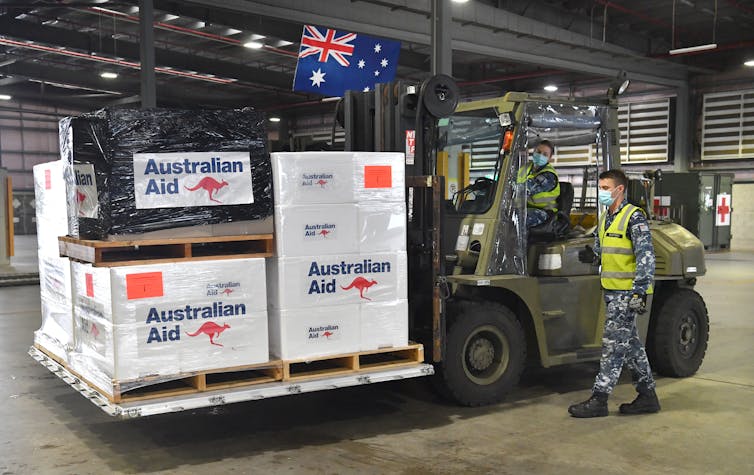
Australia has already donated thousands of doses to PNG and other Pacific nations, but with a reported stockpile of 3 million unused doses of AstraZeneca, the Pacific nations would be obvious places to send these.
Australia has donated vaccines to its neighbour PNG, but across the Pacific much more help is needed. Darren England/AP/AAP
Papua and West Papua
Over PNG’s border with Indonesia, COVID-19’s spread is clashing with another surge in political unrest. Tensions had been building again following the rebel killing of an Indonesian general in April. Then Indonesian legislators voted on July 17 to again controversially reshape Papua.
Protests occurred at the same time the Delta variant entered the community. Police controls limiting movements into rebel areas, ostensibly to curb COVID, have increased.
Papuan activists are concerned vaccine distribution will be withheld from rebel populations as an Indonesian tactic to further weaken them. West Papua leader Benny Wenda has called on the West to vaccinate Indigenous Papuans because COVID is an additional existential threat to his people. Wenda’s fears may have foundation. The Papua province has the lowest vaccination rates in Indonesia, at about 6%.
Elsewhere in the Pacific
The news is better in other parts of the Pacific. Numerous Pacific nations, including Tonga, Palau, Federated States of Micronesia and American Samoa, have not recorded any confirmed COVID cases. Kiribati recently reported its first case, matching Samoa’s record to date.
The natural isolation of many Pacific populations will protect them for only so long. Analysis of the 1918 influenza epidemic shows outbreaks persisted in the Pacific through to 1921. When it reached the phosphate-mining island of Nauru in 1920, it killed 18% of the local populace.
A century later, Nauru has vaccinated all its adults against COVID and claims this as a “world record”.
Niue has also achieved herd immunity thanks to New Zealand’s swift donation of Pfizer vaccines, a process now being repeated in Tokelau. The Cook Islands, with its more complex geography, nonetheless has a high vaccination rate (55%) sustaining the travel bubble with New Zealand that opened in May 2021.
In the US territory of Guam, where the first COVID death in the Pacific was recorded in March 2020, tourism and vaccinations have merged in a different way. Travellers from Taiwan began taking “vacation and vaccination” trips from early July. While Guam recently reached 80% vaccinated, it also recorded its 142nd death attributed to the pandemic.
Like Guam, Palau got fast and adequate supplies of vaccines because of its freely associated relationship with the US. This has shielded them from the pandemic with near herd immunity.
Yet Hawaii is seeing the same recent surge as is afflicting mainland US. The Delta variant and July 4 parties have combined to unleash what President Joe Biden called a “pandemic of the unvaccinated”.
Hawaii is now seeing the same surge in cases in the past month as has the US mainland. Jennifer Sinco Kelleher/AP/AAP
This latest surge, like earlier ones, disproportionately impacts Native Hawaiians and Pacific Islander communities living in the US by a substantial degree.
COVID has devastated the US-based Marshall Islands community, especially in Arkansas, so alarming health officials they investigated it in 2020.
French Polynesia has grappled with the costs of an operating tourist industry since early 2020. Twice, borders have been closed when cases numbers and deaths rose, and then reopened. Now President Edouard Fritch is calling for compulsory vaccinations.
In New Caledonia, COVID has complicated a fractious political situation as it heads towards its final referendum on independence from France in December. In February 2021, a budget crisis exacerbated by COVID’s economic impact led to the collapse of the government. In July, the territory elected its first Kanak pro-independence leader in 40 years, increasing the likelihood of a vote to break with France.
COVID has also added complications to the protracted political crisis in Samoa that ended on July 26. Closed borders prevented non-resident voters returning to cast ballots in the April 9 election that saw Fiame Naomi Mata’afa become prime minister.
Samoa has seen the same economic and social stresses due to COVID as elsewhere in the region. Many saw the introduction and extension of emergency powers by the now-defeated government (despite having only one case and no deaths) as another move towards autocracy. The political crisis has been a drag on all Samoan government functions, not least a sluggish vaccine rollout.
In another disaster, COVID pushes climate change to the backburner
Every Pacific nation faces its own challenges due to COVID. The region also has shared ones. The Pacific Islands Forum lost one-third of its members in February 2021 in part because meetings were held virtually. The fracturing of this regional body comes at a bad moment, not least in the fight against climate change.
Until COVID, this was the immediate existential crisis facing the region. Now activist worry climate change initiatives have stalled at the long-term peril of the region. As the Federated States of Micronesia president has argued, “economies can die and be revived but human beings cannot”. Whether this also applies to the planet remains to be seen.
Patricia A. O’Brien receives funding from the Australian Research Council and New Zealand’s JD Stout Trust.
Just weeks before the first COVID-19 cases emerged, Gallup published its latest poll on America’s views about business. At the bottom of the list of 25 sectors was the pharmaceutical industry. Below advertising. Below oil and gas. Below the banks.
The pandemic and the new vaccines have of course turned that reputation around, but let’s not forget why the pharmaceutical industry’s credibility sank so low.
Or how the industry got so big. One company, Johnson & Johnson, is currently worth around US$450 billion. About the same as the economy of Norway.
The idea of the miraculous potion or cure-all dates back at least as far as Greek mythology. The goddess Panacea even gets a mention in the Hippocratic Oath.
The rise of the modern pharmaceutical industry is more recent, coming through the 19th century. On the eve of the 20th century, the German company Bayer famously launched its early blockbusters, including “Aspirin” and “Heroin.”
Around this time, US drug-makers were arguing for patent protections, or exclusive rights to market a drug for a specific period of time. By the 1950s, they’d won those arguments, and the US soon became the world’s biggest market for medicines.
In addition to patents, the other special ingredient for success was the right to market pills directly to doctors, and in the US, directly to consumers via television commercials.
At the dawn of the 21st century, in those dark ages before Facebook and Big Tech, pharmaceuticals was among the most profitable industries on the planet.
Wonder drugs, miracle cures
Clearly many medicines extend lives and reduce suffering. And while we need caution with hyperbole, some discoveries are major breakthroughs.
Antibiotics revolutionised the treatment of deadly infections, and gave a boost to science at the same time.
In the 1940s, one of the first-published “randomised controlled trials” was a test of Streptomycin for the treatment of tuberculosis.
In the 1980s, another famous class of wonder drugs was developed, this time to tackle the HIV-AIDS epidemic. The mysterious new virus bringing many people a death sentence would soon become a manageable disease.
And while some cancers remain incurable, others are treated and even prevented with medicines that are simply miraculous.
Over-pricing and patent protections for HIV medicines put them out of reach of the world’s poorest, and prices only came down after massive global campaigns for greater access.
With cancer, companies have demanded huge prices for products offering sometimes minimal benefits.
Extortionate prices were feeding drug company mega-profits, and at the same time driving down the industry’s reputation. In a notorious example, the cost of the life-saving Epipen skyrocketed more than 400%, helping make drug prices a big issue in the 2016 US presidential election.
The price of Epipens rose by more than 400%. Shutterstock
Industry argues high prices fund vital research. Critics say companies can spend more on marketing than research, and their profits sometimes derive from taxpayer-funded science.
To make matters worse, the big pharmaceutical companies are also among the big tax avoiders. A 2015 Senate hearing in Australia heard companies were paying rates as low as one cent in the dollar.
A global report from Oxfam in 2018 concluded the pharmaceutical industry was “cheating countries out of billions in tax revenues”.
Toxic marketing causes harm
The major problem with the drug giants is their unhealthy influence over medical science. The industry dominates research, and there’s strong evidence that company-sponsored studies tend to have a bias which favours the sponsor’s product.
Medical education is also heavily sponsored, with evidence suggesting an association between a doctor accepting just one meal at an “educational event”, and prescribing more of the sponsor’s drugs.
And the guidelines which can be so influential over a doctor’s prescribing decisions are too often written by medical experts with ties to drug companies.
Central to this marketing effort are these senior medical experts, sometimes called “key opinion leaders”, who claim to be independent yet accept fees for advice, consultancies or “educational” presentations to other doctors.
Just one meal at a sponsored educational event can result in a doctor prescribing more of that company’s drugs. Shutterstock
A former top-selling drug company sales representative turned whistleblower put it plainly in a 2008 piece in The BMJ:
Key opinion leaders were salespeople for us, and we would routinely measure the return on our investment, by tracking prescriptions before and after their presentations.
If that speaker didn’t make the impact the company was looking for, then you wouldn’t invite them back.
Unhealthy marketing means the latest most expensive pill is too often favoured over older cheaper options, or doing nothing at all, causing much harm and wasting precious resources.
Corporate crime
In 2009 came the biggest health-care fraud settlement in history. Pfizer was forced to fork out a US$2.3 billion fine for illegal promotion, false and misleading claims about drug safety, and paying kickbacks to doctors. That included a US$1.2 billion criminal fine, the largest ever in a US criminal prosecution.
One of the whistleblowers in that case happened to be a member of a special Pfizer sales team promoting Viagra. He revealed doctors were taken to breakfasts, lunches, dinners, Broadway shows, baseball games, golf courses, ski fields, casinos and strip clubs.
In 2013, Johnson & Johnson paid out US$2.2 billion in civil and criminal fines for putting “profit over patients’ health”. The company had illegally promoted powerful anti-psychotic drugs as behaviour control for the elderly and most vulnerable, overstating benefits and playing down dangerous side effects, including stroke.
Drug companies have faced massive fines for putting profits over health. Shutterstock
Other court documents around the same time exposed how the giant global company Merck used dirty tricks to try and defend its controversial anti-arthritis drug Vioxx. Merck created a fake medical journal and drew up secret lists of academic critics to “neutralise” and “discredit”.
In the end, Vioxx was taken off the market because it was causing heart attacks, with estimates in The Lancet suggesting it may have led to 140,000 cases of serious coronary heart disease.
Scandals like Vioxx tarnished the industry’s image, and brought more intense scrutiny.
The US National Academy of Sciences produced a landmark report arguing the closeness between doctors and drug companies could jeopardise the integrity of science, the objectivity of education, the quality of care, and public trust in medicine.
A series of US congressional hearings on unhealthy marketing produced the Open Payments register, mandated by US law to publicly list every company payment to every doctor.
Many around the world are reforming further, moving from transparency to independence. Italy brought in a special tax on drug company promotion to fund public interest research. Norway doesn’t give doctors full credit anymore for industry-sponsored education.
But there’s a long way to go. A study in 2020 found 80% of the medicos who run the world’s most powerful doctors organisations still take money from drug and device companies. For research, for consultancies, for hospitality.
Even some agencies which assess drugs, notably the US Food and Drug Administration (FDA), still rely on significant funding from industry, which pays to have its products assessed.
And the harmful marketing has continued. Just last month, a group of drug companies, including Johnson & Johnson, agreed to pay a total of US$26 billion for their roles in fuelling the opioid epidemic.
A prescription for trust
One drug company chief reportedly said last year the industry had a “once-in-a-generation opportunity to reset” its reputation.
Given the dark arts that drove pharma’s credibility to rock bottom, its fanciful to imagine the pandemic will magically end the misleading marketing and the price gouging.
Any post-pandemic recovery requires meaningful reform.
Ray Moynihan is Assistant Professor at Bond University’s Institute for Evidence-Based Healthcare and Adjunct Associate Professor at the University of Sydney. He receives funding via competitive grants from Australia’s publicly funded National Health and Medical Research Council. Ray has written about and researched the pharmaceutical industry’s influence for almost 25 years and is the author of 4 books on the business of medicine.
In a non-COVID year, Australia’s vineyards host more than eight million wine tourists. While these visitors benefit wine producers and regional communities, they also generate a substantial amount of greenhouse gases.
If fact, our recent research showed tourist visits to vineyards comprise more than one-third of the industry’s total carbon footprint.
Wine tourism – also called “cellar door” visits – involves visiting vineyards, wineries, wine festivals and events to taste, drink and buy wine.
The Australian wine industry has already been forced to adapt to the effects of climate change. If it fails to curb emissions associated with wine tourism, the industry is contributing to its own demise.
Wine tourism accounts for one-third the industry’s carbon footprint. Shutterstock
Temperature change and ‘terroir’
In 2019, wine tourism contributed A$9.3 billion to the Australian economy – creating more jobs and economic output than any other part of the industry. It promotes exports and provides vital financial support for small winemakers and family farms that rely on cellar door sales to visitors.
When wine tourists aren’t in vineyards and tasting rooms, they often visit local restaurants, as well as cultural attractions such as museums, concerts and festivals.
Wine tourism gives travellers the chance to experience a region’s “terroir” – the particular geology, landscape, soil and climate that come together to make a region’s wine special.
Wine grapes however are particularly susceptible to temperature changes. In fact, the wine industry has been described as “the canary in the coal mine” for the way climate change will affect agriculture.
In Australia, winemakers have already been forced to adapt to heatwaves, drought, increased fire risk and salinity.
Previous research commissioned by Wine Australia has found global warming will bring many changes to the industry. For example, Australian winemakers may struggle to grow cool-climate varieties such as chardonnay and pinot noir.
Despite the industry’s vulnerability, the environmental sustainability of wine tourism is rarely addressed by either the industry or the academic literature. Our recent research sought to close this knowledge gap.
The wine industry is susceptible to climate change. Shutterstock
Our findings
Past research into the wine industry’s carbon footprint has examined factors such as the emissions created by shipping the wine in heavy glass bottles.
Our research examined wine tourism activities that create carbon emissions, such as those associated with transport, accommodation, food and shopping. We traced how much wine tourists spend on the journey and the energy required to produce those services. We then allocated a share of total emissions to cellar door visits.
We found Australian wine tourism generates 790,000 tonnes of greenhouse gas emisisons each year – one-third of the industry’s total carbon footprint. This translates to an average 101 kilograms of carbon emissions per winery trip, per person.
Domestic overnight wine tourists contributed the majority of environmental impacts (82%). However, due to their higher spending at wineries, their carbon emissions were lower than that of travellers from overseas when measured per dollar of spending.
We estimate one-quarter of wine tourists in Australia come from overseas, and long-haul flights form around 75% of international wine tourism’s carbon footprint.
Because of factors such as shorter flights, visitors from countries nearer to Australia – such as New Zealand, Hong Kong, China and Singapore – produce 20-40% fewer emissions per dollar spent than visitors from the United States and the United Kingdom.
Wine tourists from countries closer to Australia produce fewer emissions per dollar spent than those from the US or UK. Shutterstock
Stock up at the cellar door
Given the emisisons associated with international wine tourism, Australian wineries should target visits by domestic tourists. This would benefit both the environment and regional economies starved of international visitors during the pandemic.
In terms of overseas travellers, the Australian wine industry should target short-haul markets such as China, Japan and Singapore. This would reduce the industry’s reliance on tourists travelling to Australia on emissions-intensive long-haul flights.
Many of us will be wine tourists at some point – perhaps for an afternoon, overnight or even on an overseas trip to a famous wine region. So what can you do about your carbon footprint?
Visit accredited wineries that commit to reducing their greenhouse gas emissions. And while you’re there, buy more bottles than you might have otherwise.
The typical Australian wine tourist buys three or four bottles at the cellar door. Why not make it a half dozen or more? A trip in which you buy ten bottles is more environmentally friendly than ten trips where you buy one bottle each time. And join the wine club for direct shipping.
Our cellar door purchases can also boost the bottom lines of wineries and enable them to invest in environmental sustainability. Few virtuous acts taste as good.
Ya-Yen Sun does not work for, consult, own shares in or receive funding from any company or organisation that would benefit from this article, and has disclosed no relevant affiliations beyond their academic appointment.
XIV Crows (からす) by Maruki Iri and Maruki Toshi, 1972Courtesy the Maruki Gallery
On August 6, 1945, the US military obliterated Hiroshima with the world’s first deployed nuclear bomb. Several days later, artist Maruki Iri arrived in his hometown from Tokyo by train. Stunned by the devastation, he felt he was seeing “something that I wasn’t supposed to see”.
Travelling to his family home, the artist negotiated a wasteland, including mounds of dead and barely alive bodies. When his wife, Maruki Toshi, arrived a week later, the pair spent a month assisting bomb blast casualties.
With the end of the war, the Japanese Communist Party saw Allied Occupation forces as liberating Japan and encouraged its followers to focus on a bright future for Japan. Toshi and Iri were party members but struggled to comply. By 1948, each knew they must reproduce in visual art form the perdition they had witnessed.
The pair collaborated on each painting. Iri worked in traditional Nihonga (Japanese painting), although with an idiosyncratic surrealist turn. Toshi’s style was more westernised and featured the human form.
This “water and oil” aesthetic combination produced a spectacularly successful — although sometimes tense — collaboration. Subverting censorship, the Hiroshima Panels (known in Japanese as the Atomic Bomb Panels) were born.
Over three decades, the couple produced 15 Hiroshima-themed panel-scenes, average size 1.8 by 7.2 metres, with accompanying descriptive text.
Each had eight Japanese-screen/scroll style distinct sections. Notwithstanding occasional swirls of colour — vermilion depicting the fires of Hiroshima/Hell — most were the stark black of sumi ink.
The collaboration was not always harmonious. Iri would splash ink over images painstakingly created by his wife. The resultant wash-effect, however, enhanced the impact of bomb-mutilated forms.
Incrementally, the couple’s subject matter expanded to different but similar topics. When an American viewer raised the Japanese Imperial Army’s 1937 Nanjing massacre, the couple produced a 4 by 8 metre image of that atrocity.
They collaborated in this way almost until Iri’s death in 1995.
I Ghosts (幽霊) by Maruki Iri and Maruki Toshi, 1950. Courtesy the Maruki Gallery
The first Hiroshima panel, Ghosts, originally titled August Six, was exhibited in February 1950 at the Tokyo Metropolitan Museum when occupation restrictions eased.
Ghosts is a searing depiction of bodies in the post-blast landscape. To the right is a heap of misshapen, ossified corpses, balancing precariously, several faces visible. Left and centre is a massed parade of upright figures, clothes sheared off by the blast, strips of scorched skin dripping from arms instinctively raised as shields.
Seemingly illuminated, the standing body of a woman throws her head back in horror or pain. Perhaps in both.
Depicting the true catastrophe
Initial responses in Japan were mixed. Allied restrictions resulted in limited awareness of Hiroshima’s ordeal, so some thought the work exaggerated. There were survivors who felt the images aestheticised the event. Nevertheless, the Marukis were clearly inspired to continue working on the Hiroshima theme.
One of the few atomic tropes permitted to circulate in the immediate postwar era was the familiar mushroom cloud. This cloud – necessarily distant – elided suffering.
The Marukis, however, depicted the catastrophic scenes beneath.
VII Bamboo Thicket (竹やぶ) by Maruki Iri and Maruki Toshi, 1954. Courtesy the Maruki Gallery
Several panels profile women with children. One is Bamboo Thicket. Survivors sought shelter in these thickets which often partially survived the explosion. With intertwining body parts and bamboo trunks, the left of the image suggests the catastrophic wind surge generated by the heat of the blast. A woman clasps a child.
Other infants, dead or alive, lie curled up on the ground. A boy – clothes torn away – embraces two younger children. One woman holds up hands charred raw by the thermonuclear heat. The clear visibility of faces makes for particularly disquieting viewing.
Crows depicts Korean victims of the blast, who were often forced labourers in wartime Japan. Deeply discriminated against, Koreans were forsaken by rescuers even in death and their cadaver eyes were pecked out by crows.
While human forms dominate most panels, this work foregrounds the eponymous birds swooping down from the right and eddying above before eventually blanketing the decomposing corpses. In a Marc Chagall-like twist, disembodied traditional Korean women’s attire – the full chima skirt and shaped jeogori coat – float ethereally above the scene.
Art and trauma
Ultra-nationalists in Japan perpetuate a discourse that elides Japanese war atrocity. This can never diminish the unspeakable trauma of the Hiroshima ordeal.
Art undoubtedly has the power to explore trauma. As University of Queensland academics Névine El Nossery and Amy L Hubbell have argued, art transmits trauma’s unspeakability. The power of art, they say, is to “transform and render pain.”
The Maruki Gallery is situated in rural Japan on a rise above the Toki River a little north of Tokyo. Opened in 1967 to make Maruki artwork available to all, the gallery expanded over the decades to include features such as a memorial to Korean people massacred after the 1923 Great Tokyo earthquake.
The extraordinary Hiroshima Panels transform the intense pain of that great crime against humanity into images to be revisited across generations. With Maruki Gallery images now online, people everywhere can contemplate the Hiroshima trauma.
Viewers of the Hiroshima Panels become witnesses to that event. With this witnessing surely comes the need to prevent nuclear war.
This immediately made us wonder: what would happen if we asked a group of scientists what science is?
Common responses to the question “what is science?” focus on causal explanations, controlled experiments, hypothesis testing or falsification (those are popular options, not an exhaustive list).
All point to important aspects of science, and all have been proposed as ways of defining it. But there is no single answer to the question “what is science?”.
This doesn’t mean people can characterise science however they want. Far from it. Our point, instead, is that questions like “what is science?” or “is mātauranga science?” could be asking about any number of different ideas.
Ambiguous statements are poor starting points for careful, constructive debates. We see people talking past each other in discussions of mātauranga and science. These discussions could benefit from more careful articulation of the concepts at stake. We’ll start with science.
What is science?
When we ask what something is, we often seek a definition of that thing. But whereas some concepts are pretty easily defined (electron, uncle), some aren’t (art, life, science).
When we ask a question about a hard-to-define concept – “what is art?” or “what is life?” – dictionary definitions aren’t much use, because what we are after is an understanding of the range of conceptual work the term does for us.
So, when we ask “what is science?”, what are we asking? One way to answer is to list methodologies that many or most scientists use, such as testing hypotheses, conducting controlled experiments or gathering empirical evidence.
Another way to answer is to point to a list of goals and values – yes, despite the myth of a value-free ideal, values are part of science – that many or most scientists strive for. These include reproducibility, empirical accuracy or reliable causal knowledge of how the world works.
Yet another approach shifts away from listing science’s characteristic hallmarks and points to its status. Here, we might answer the question “what is science?” by saying something like, “science represents our best empirical knowledge of how the natural world works”.
The many faces of science
Any of those answers can be framed generically. We can talk about science universally: as a set of methodologies anyone can employ, values anyone can strive for, or status any body of knowledge can achieve, at a given time, in a given domain.
We can also talk about science in a specific way: as a modern institution housed in universities, companies and NGOs. We can talk about the history and culture of this institution: it traces back to the Enlightenment and to earlier times and places, and it is funded by governments and industry and rich donors.
We can talk about things this institution, or particular people involved in it, have done throughout its history: discovered antiseptics and subatomic particles and the structure of DNA, exploited indigenous peoples around the world in the name of research, come together globally to develop COVID vaccines in under a year.
We see all the above understandings of science — methodological, epistemic, status-based, universal and specific — on display, and often run together, in the recent debate about mātauranga and science. And that’s not even an exhaustive list of ways to address the question “what is science?”.
Slow down, show respect
Mātauranga spans Māori knowledge, culture, values and worldview. When someone asks, “is mātauranga science?”, there is a range of things they could really be asking about, including:
does mātauranga (or do forms of it) use scientific methodologies to generate knowledge?
do we value mātauranga as a valid way of knowing about the world alongside science?
how should we uphold this value in a way that respects intersections and differences?
should relevant content from mātauranga be taught in science classrooms?
These questions and others are (at a bare minimum) starting points for more productive discussions than “is mātauranga science?” There is nothing constructive to be gained by framing those questions in ambiguous definitional terms.
In closing, we note the question “what is philosophy?” has no clear and easy answer, either! A favourite quotation about philosophy says it is “thinking in slow motion”. More of that would be welcome in the current discussion.
In practice, that will mean striving to avoid ambiguity in everything we say, pausing with respect to consider our audience’s point of view — and choosing our words carefully.
Emily Parke has received funding from Marsden to explore mātauranga Māōri and science.
Dan C H Hikuroa has received research funding from Marsden, MBIE, National Science Challenges, Ngā Pae o te Māramatanga, Te Pūnaha Matatini to explore mātauranga Māori and science.
New Zealand’s endemic tuatara (Sphenodon punctatus) are the sole survivors of an ancient reptile order called Rhynchocephalia. Once widespread across New Zealand, tuatara survive in only a fraction of their historic range, on small offshore islands and in fenced eco-sanctuaries.
Male tuatara are usually larger and have a more triangular head than females. Author provided
Despite massive conservation efforts to restore populations, our lack of knowledge about tuatara reproduction means some conservation techniques remain currently off the table.
Tuatara are unique among reptiles in that males don’t have a penis or hemipenes, making sperm collection difficult. But in our latest research, we describe how we managed to collect and characterise live sperm from tuatara for the first time.
Perhaps surprisingly, we found that tuatara sperm are the fastest swimmers of any reptile studied to date. This could help us boost the conservation of this unique and treasured species.
The global decline of wildlife has necessitated creative and far-reaching conservation efforts, including the freezing of eggs and sperm (known as gametes).
Gamete banking is a proactive conservation approach where researchers preserve genetically important sperm and egg cells before this genetic diversity is lost. While this is never preferable to natural reproduction, assisted reproduction has already been used with success on critically endangered species like the New Zealand flightless parrot kākāpō (Strigops habroptilus).
However, developing the methods for gamete cryopreservation for any species, especially one that represents a unique evolutionary branch, takes time.
‘Cloacal kisses’ and speedy sperm
Our first challenge was to figure out a way to sample live sperm. The male reproductive anatomy sets tuatara apart from other reptiles — without a penis, their reproduction is more bird-like.
Tuatara transfer sperm when the male aligns his cloaca (which serves as the opening for digestive, reproductive and urinary tracts) with the female’s. We found the best approach to collect a viable, sufficient sperm sample was just after this “cloacal kiss”, when the sperm was still visible on the edge of the female’s cloaca.
Sperm is visible on the female’s cloaca after separating a mating pair. Author provided
For the very first time, we were able to collect, image and measure the speed of swimming tuatara sperm. Even though tuatara generally live a long, slow life, it turns out their sperm are surprisingly fast.
Having fast swimmers may be an adaptation to aid male tuatara in their reproductive efforts. Other reptiles have an intromittent organ (either a penis or a pair of hemipenes) to aid in sperm delivery, but tuatara rely solely on the ability of their sperm to swim inside the female’s cloaca after mating.
While having sperm with distinct characteristics may be what helps tuatara reproduce, it also means the techniques required for cryobanking this sperm must be equally unique.
The sex of tuatara hatchlings is determined by the temperature the eggs are exposed to during incubation, with more males hatching at warmer temperatures. As climate change continues to raise temperatures in New Zealand, we expect this will skew tuatara sex ratios, with the potential to drive some populations to be male-dominated and therefore functionally extinct.
Such local extinctions will lead to a loss of valuable genetic diversity. Cryopreservation of tuatara eggs and sperm, to be used for assisted reproduction, could provide the insurance required to preserve genetic diversity and aid conservation of this vulnerable iconic species.
Formulating the best cryoprotectant to preserve sperm from the sole surviving species in a lineage as old as the dinosaurs with a unique reproductive anatomy amongst reptiles, would be challenge enough. When you add in the fact that tuatara mate like birds, are slow to reproduce, but paradoxically have extremely fast swimming sperm, it makes cryopreserving tuatara sperm a thorny problem.
Our efforts to help ensure the future of the last of the Rhynchocephalians also taught us a great deal about these unique animals, viewed by Māori as guardians of knowledge.
Earlier this year, at the end of the Austral summer, we undertook another research season, collecting sperm and characterising the males it was collected from. Going forward, we will undertake more trials, test new cryopreserving agents and progress toward long-term gamete banking of this important reptile. Doing so will provide a pathway toward new conservation strategies for this taonga (treasured) species.
We would like to acknowledge Helen Taylor, of the Royal Zoological Society of Scotland, who has contributed to this research.
Dr Diane Ormsby works for Te Herenga Waka – Victoria University of Wellington.
Jennifer Moore, Nicola Jane Nelson, Sarah Lamar, and Susan N. Keall do not work for, consult, own shares in or receive funding from any company or organisation that would benefit from this article, and have disclosed no relevant affiliations beyond their academic appointment.
It is open season again for Indonesian trolls targeting Asia Pacific Report and other media with fake news and disinformation dispatches in a crude attempt to gloss over human rights violations.
Just three months ago I wrote about this issue in my “Dear editor” article exposing the disinformation campaign. There was silence for a while but now the fake letters to the editor – and other media outlets — have started again in earnest.
The latest four lengthy letters emailed to APR canvas the following topics — Jakarta’s controversial special autonomy status revised law for Papua, a brutal assault by Indonesian Air Force military policemen on a deaf Papuan man, and a shooting incident allegedly committed by pro-independence rebels – and they appear to have been written from a stock template.
And they all purport to have been written by “Papuan students” or “Papuans”. Are they their real names, and do they even exist?
The latest letter to Asia Pacific Report, dated July 30, was written by a “Paulus Ndiken” who claims:
“I’m a native Papuan currently living in Merauke, Papua, Indonesia. I would like to address your cover story about Indonesia apologises for ‘excessive force’ against deaf Papuan man.
“One day after the incident, the Indonesian Air Force had detained and punished severely 2 members … that had roughly apprehending [sic] Esebius Bapaimu in Merauke, Papua province.”
Dubious reputation The letter linked to Yumi Toktok Stret, a website with a dubious reputation with accuracy. The report was sketchy and the correct name of the assaulted man, according to reputable news media and Papuan sources, is actually Steven Yadohamang.
“We regret that this kind of rough-housing [sic] happened on the street,” wrote correspondent “Ndiken”, “but we, as Papuans, [are] also glad to know that these perpetrators have received sound punishment …
“Responding to the unfortunate events, the Indonesian netizens had asked for the Indonesian military to immediately take action against the guilty party and were glad that the institution had addressed the people’s concern in a very fast manner.”
A more nuanced and accurate article was written for Asia Pacific Report by Brisbane-based West Papuan academic Yamin Kogoya who compared the “inhumane” assault to the tragic killing of George Floyd in the United States after a white Minneapolis police officer, Derek Chauvin, pressed his knee on Floyd’s neck for nine minutes as he lay face down in the street on 25 May 2020.
Excerpt from one of the spate of questionable letters received by Asia Pacific Report about Papua. Image: ScreenshotHow Tabloid Jubi reported the assault on 29 July 2021.
Another letter writer, “Michel Wamebu” … “a native West Papuan living in Merauke”, said on June 29 he would like to bring our attention to West Papua, “which has been painted as if the whole island is in conflict, when actually [there are] only a few small areas [that] were invaded by the Free Papua terrorists that had been exposed to enormous violence.
“I would like to assure the world that there [is] nothing like a full-blown war.”
In the lengthy letter about an incident on June 4 when four civilians were killed in a shooting and two were wounded, “Wamebu” provided alleged details that are likely to have been provided by military sources and at variance with actual news reports at the time.
‘Spike’ over special autonomy “Yamkon Doleon”, a “student from West Papua and currently studying in Yogyakarta, Indonesia” wrote on July 19 that there had been “a spike in the topic of Papuan special autonomy in social media and also [in] a few international media”.
Launching into a defence of the new Special Autonomy for Papua law for the governance of the two Melanesian provinces of Papua and West Papua for the next two decades – adopted by the House of Representatives in Jakarta last month without consultation with the Papuans, “Doleon” wrote:
“The Special Autonomy itself is a law that guarantees every Papuan to be the leader of their region, to have free education, free health service, and a boost I [the] economy … So which article is not in favour of the people?”
In a comment about the spate of Indonesian troll messages to some media outlets, West Papua Media Alerts said:
“Indonesian intelligence bots, go away. You are being banned and reported and deleted everytime you post, so go away.”
The engaged media advocacy and news service continued: “It is clear we are telling the truth, otherwise you wouldn’t have to spend so much money trying to counter it with a transparent influence exercise. Go home, invaders.
“Friends, there are literally over a hundred sock accounts using random Anglo names, and the same script response. These accounts all come from the BIN-run FirstMedia in Jakarta, and were all created after March 2.
West Papua Media Alerts message to “Indonesian bots”. Image: Screenshot
Report fake accounts “If you see a comment, please click through on the account name, click the 3 dots and report them as a fake account and going against community standards. We will obviously delete and ban these fake accounts.”
Meanwhile, the London-based Indonesian human rights watchdog Tapol has strongly condemned the two Air Force military policemen who severely beat the disabled man, Steven Yadohamang, in Merauke, Papua, on 27 July 2021.
Video footage which has been widely shared on social media, shows the two personnel beating up a man and crushing his body into the ground and stamping on his head.
Tapol said in a statement: “It is clear from the footage that Yadohamang does not possess the capacity to defend himself against two individuals who appear to be unconcerned with possible consequences.”
A similar incident in Nabire took place the following day, said the statement. A West Papuan man, Nicolas Mote, was suddenly smacked on the head repeatedly during his arrest despite not resisting.
“The incident follows a spate of previous violent incidents committed by the security forces against civilians in West Papua province and is likely to raise further questions about what purpose increasing numbers of military personnel are serving in West Papua,” Tapol said.
Although the Air Force had apologised, it had suggested that the two military policemen, Second Sergeant Dimas Harjanto and Second Private Rian Febrianto, alone should bear responsibility for the incident, said the watchdog.
‘Pattern of violence’ “They, and the Indonesian media, have described the soldiers as ‘rogues’. This assessment is not consistent with a pattern of violence committed against civilians that has been allowed to go unpunished in recent months and years,” Tapol said.
“Indeed, had there not been such indisputable visual evidence of security force violence, it is entirely possible that the incident would not now be subject to further investigation by the authorities.
“But despite facing punishment, the perpetrators are likely to only to receive light sentences because they will be tried in military courts.”
Following the end of the New Order period, civilian politicians were not pushing for military personnel to be tried in civilian courts.
Since 2019, there had been a steady build-up of military and police personnel in the two provinces of Papua and West Papua, said Tapol.
“Deployments and security force operations have increased further since April 2021, when the Coordinating Minister for Politics and Security, Mahfud MD, designated the armed resistance movement, TPNPB, as a ‘terrorist’ group.
“West Papuans and Indonesians have raised concerns that the designation would further stigmatise ordinary West Papuans.
“We would also highlight that in West Papua there are significant underlying problems with institutionalised racism by the authorities.”
Tapol called on President Joko Widodo and the House of Representatives of Indonesia to finish the post-Suharto agenda of reforming the military to combat a culture of impunity over human rights violations in West Papua.
The government is set to tweak its vaccination timetable to accelerate jabs for those aged 30 to 39, after Doherty Institute modelling showing it is vital to get younger adults quickly vaccinated, because they are high COVID transmitters.
Those in their 30s and 20s – scheduled for the Pfizer vaccine – are at the back of the queue under the rollout plan, becoming eligible from September-October, according to the man in charge of the rollout, General JJ Frewen, speaking some weeks ago.
With Pfizer in short supply, they are now under some pressure, including from Scott Morrison and changing health advice, to take the AstraZeneca vaccine.
Government sources said on Tuesday the plan would be tweaked, probably this week, after incoming Pfizer supply numbers were confirmed.
The Doherty modelling, used as a basis for national cabinet last week setting vaccination targets, says: “As supply allows, extending vaccinations for adults under 40 years offers the greatest potential to reduce transmission now that a high proportion of vulnerable Australians are vaccinated.”
The vaccine uptake by young people 16 and over “will strongly influence the impact of vaccination on overall transmission,” Doherty says.
The modelling was released on Tuesday at a news conference by Scott Morrison and Professor Jodie McVernon, Director of Epidemiology at the Doherty Institute.
McVernon said the 20 to 39 year olds were “the peak spreaders” of the virus.
“They will bring COVID home to their children, they will take it home to their own parents, and this is the group now where we’re proposing the reorientation of the strategy,” she said.
National cabinet last week agreed in principle to a four stage plan to move from the present suppression strategy (aiming for zero community transmission) to a limited reopening when 70% of people 16 and over have been fully vaccinated. When the vaccination level reached 80%, lockdowns would be rare and limited.
In an analysis for the national cabinet meeting, Treasury calculated the direct impact on economic activity of various vaccination scenarios modelled by Doherty.
Treasury found that “continuing to minimise the number of COVID-19 cases, by taking early and strong action in response to outbreaks of the Delta variant, is consistently more cost effective than allowing higher levels of community transmission, which ultimately requires longer and more costly lockdowns.”
At 50% vaccination rates, the direct economic cost of minimising cases is about $570 million a week; at 60%, it is about $430 million.
At 70%, with only low level restrictions needed, the expected economic cost of COVID-19 management falls to about $200 million each week, reducing to about $140 million at an 80% vaccination level.
Treasurer Josh Frydenberg said the clear message from the economic modelling “is that until we get to 70% and above vaccination rates, the economic imperative is that governments need to move fast to get on top of those cases. If they don’t, we see lengthier and more severe lockdowns, which have a much more significant economic cost.”
“What Treasury have found is that at 50% and 60% vaccination rates, it’s five times more costly, should governments not move early to get on top of the virus.”
The NSW government has recently come under sharp criticism for not moving earlier in the current Sydney outbreak. There is now a prolonged lockdown.
Despite Australia’s still low vaccination rate – only about one in five 16 and over have had two doses – Morrison strongly rejected Anthony Albanese’s proposal that everyone who is fully vaccinated by December 1 should receive $300.
Morrison said the proposal was “a vote of no-confidence in Australians”, and “a bubble without a thought”. It said to people that health concerns they might have about a vaccine could be paid off.
Pointing to the relatively high level of take-up by older people Morrison said: “Do we really think that Australians of younger ages are less committed to their own health, the health of their families, the health of their communities, than those who are older? Of course not.”
“It’s not a game show. And it’s very important that we continue to respect how Australians are engaging with this process. So if they do have hesitancy about vaccines, I’m not going to pay them off. I’m going to pay a GP to sit down with them and talk them through their concerns, which is what I have already done.”
The Essential poll, released Tuesday, found 47% of people who have not been vaccinated say they would take Pfizer but not AstraZeneca. This unwillingness to receive AstraZeneca has increased substantially since April.
Michelle Grattan does not work for, consult, own shares in or receive funding from any company or organization that would benefit from this article, and has disclosed no relevant affiliations beyond their academic appointment.
As well as her interviews with politicians and experts, Politics with Michelle Grattan now includes “Word from The Hill”, where she discusses the news with members of The Conversations’s politics team.
In this episode, politics + society editor Amanda Dunn and Michelle talk about the outcome of last Friday’s National Cabinet meeting – an updated four-point plan for exiting COVID restrictions via vaccination levels of 70% and 80%.
They also discuss Scott Morrison’s vehement rejection of Anthony Albanese’s proposal that Australians be given $300 incentive to get vaccinated.
Additional audio
Gaena, Blue Dot Sessions, from Free Music Archive.
Michelle Grattan does not work for, consult, own shares in or receive funding from any company or organisation that would benefit from this article, and has disclosed no relevant affiliations beyond their academic appointment.
New Zealand is sending 100,000 vaccine doses and additional financial support to Fiji for nursing staff as the country’s covid-19 death toll passed 250.
Of the deaths, 252 of them have come from the April outbreak of the delta variant of covid-19.
Foreign Affairs Minister Nanaia Mahuta said New Zealand paid for 100,000 doses of the AstraZeneca vaccine directly from the Spanish government to meet Fiji’s immediate vaccine needs.
The vaccines were due to arrive today.
“Our thoughts remain with Fiji during this incredibly challenging period,” Mahuta said in a statement.
Earlier this year, the government committed to providing up to 500,000 doses.
Commitment still stands Mahuta said that commitment still stood.
“AstraZeneca is Fiji’s vaccine of choice and these doses will further support the excellent work Fiji is doing in vaccinating its population.”
Mahuta said the nation’s vaccination drive was coming along.
“Fiji’s vaccination programme is progressing well with 25 percent now fully vaccinated, and first doses provided to 82 percent of the population.
“Our commitment stands and New Zealand will continue to work with Fiji to confirm its remaining vaccine requirements.”
She said the government was also funding for 190 Fiji graduate nurses for a three-month period.
“The recruitment of these nurses not only supports Fiji’s response in the short term, but also contributes to the long-term resilience of the health sector.”
NZ responds to requests New Zealand has also responded to a range of other requests from Fiji.
“In the last two weeks New Zealand has supported the provision and retrofitting of ambulances and medical equipment, provided funding support to civil society partners and begun delivering 700,000 testing swabs and privacy screens for medical facilities,” Mahuta said.
We have this pretty fiction that the world is made up of approximately 200 politically autonomous nation-states. This in the entrenched ‘Wilsonian’ view of the political world that, in particular, was sort-of realised after World War One; a view that rendered the national empires (such as the British Empire) of the past obsolete.
In the liberal world order, the ideal structure of international polities would be 750 nation states each with between (say) three million and twenty million people. (OK, the Olympic Games and the United Nations would struggle to cope with 750 independent members; but that’s not a problem for a liberal order. In a true liberal order, each entity is too small to influence the order itself. In such a liberal order, the collective good is meant to happen through a kind of international marketplace; in marketplaces, properly understood, ‘competition’ and ‘cooperation’ are more like synonyms than antonyms.)
The twenty-first century is a quasi-liberal ‘rules-based’ order of nation states with populations ranging from about 1,000 to 1.5 billion, with a number of hegemon states. At present the major hegemons are: Washington, London, Berlin, Moscow, New Delhi, Beijing, Tehran, Riyadh. Minor hegemons include Paris, The Hague, Copenhagen, Addis Ababa, Ankara, and Wellington.
Nation States: Peoples or Territories?
Historically, a nation was a group of people – an uber-tribe – defined by ethnicity, language and culture. Thus, in the early days of nations, there were no formal territorial borders; though certain geographical features formed practical borders: seas, rivers, mountain chains, deserts. At some times in history, seas were the principal borders; at other times, seas became highway connectors leaving mountains and deserts as the main dividers.
Following World War One, and indeed through until the 1970s, the concept of nations as peoples (rather than as territories) remained dominant. Thus, while New Zealand became politically autonomous from Great Britain, New Zealanders continued to be British. (In my first passport, I was listed as a ‘New Zealand citizen’ and a ‘British subject’.) The practical extent of New Zealanders’ Britishness gradually diminished over the twentieth century; indeed when I sailed to the United Kingdom in 1974 – my ‘OE’ – my automatic right of permanent residence there depended on me having a British born grandparent. (I presume that would have included an Irish-born grandparent, given that Ireland was part of the United Kingdom from 1801 to 1921.)
The main point is that Anglo-Celtic ethnicity, English language, and recent history of empire all contributed to my being a part of a British nation. I even got to vote, in 1975, in the first Brexit referendum (though it wasn’t framed as Brexit then.) And in April 1976, with my then partner and on my trusty Honda 175 motorbike, I embarked on an all-Ireland tour. In Belfast and especially Derry, I ventured into a Civil War zone; the hegemony of London in Derry was not the benign British hegemony I grew up with in Palmerston North. Yet, even the independent Republic of Ireland was in many ways still British; the pound sterling circulated as equivalent to the Irish punt, there was no passport requirement of entry, and it was only in County Donegal that I heard the Irish language spoken in a natural setting.
The change came mainly in the 1980s; nationalism can be fuelled by economic hard times, and modern ‘territorial’ nationalism reflects the growth of liberal identity politics in a decade in which fresh thinking about capitalism and economics just got too hard. Then in the early 1990s, the cold war ‘evil empire’ that was the Soviet Union collapsed into constituent territorial nation states, as did the satellite empire of Yugoslavia. Some said that this was the ‘end of history’; the world order by 2000 was made up of about 200 nation states defined, not by ethnicity, language, or culture, but by (often arbitrary) territorial boundaries.
The 2000s’ decade represented the pinnacle of ‘globalisation’, a word interpreted in a number of ways, but whose key theme was the subjection of nation states to an imperfectly competitive global marketplace, through a mixture of neoliberal ideology and internet-based technology. The remaining substantially incomplete part of the globalisation ‘project’ was to liberalise the flow of people.
In the 2010s’ decade, however – the post global-financial-crisis decade – this era of international ‘market cooperation’ came to an end; most clearly within the European Union, and more latterly with the reassertion of Chinese and Indian hegemony within their extended territories. Nevertheless, by regarding most people as ‘labour’, certain free international flows of people expanded in the 2010s.
Today, the western liberal view of a nation state is that it is a tightly-bordered territory in which all resident citizens are equal beneficiaries of that state (territorial insiders), and with seven broadly defined groups of other people having lesser rights with respect to that state. New Zealand in 2021 represents a particularly extreme version of a territorially fundamentalist state; where, on the inside, any ‘unkind’ expression of traditional identity differences is virtually outlawed, but where it is open season to be unkind towards defined outsiders by virtue of their status as outsiders. This 2020s’ extension of deglobalisation in New Zealand is the ‘immigration reset’, which is being implemented under the cover of the Covid19 pandemic.
The seven outsider groups are:
People currently living in New Zealand, but without political rights and subject to temporary permissions (some undoubtedly already expired) with respect to their legal right to be in New Zealand, and to pursue an economic life while in New Zealand. They are denizens rather than citizens of New Zealand.
People who have the legal status of citizens or permanent residents (‘New Zealand insiders’), but who are not currently inside New Zealand. (We may include ‘realm citizens’ in this group, such as Cook Island or Niuean citizens.)
People not in the former categories, but who have a familial relationship with New Zealand insiders, or have current or prospective employers (or education providers) in New Zealand, or are Australian citizens.
People not in the former categories but who are in a position to buy their way into some form of residential status.
People not in the former categories but who are in a circumstance to plead their way, as refugees.
People – especially younger men – in the RSE (recognised seasonal employment) countries: Tonga, Samoa, Vanuatu, Tuvalu and Kiribati. This is, formally, a labour relationship associated with New Zealand’s Pacific hegemony. Of these, Samoa has a further relationship with New Zealand; unlike the others, it was member of the ‘New Zealand empire’ in the mid-twentieth century. New Zealand continues to have a closer hegemonic relationship with Samoa than with the other RSE countries. Tonga is of particular significance, because most of the victims of the ‘dawn raids’ of 1975 and 1976 were Tongan citizens who had overstayed their temporary work permits.
Everybody else in the world, including people from places such as Great Britain, South Africa and India who previously had favourable access to New Zealand through their empire links.
Thus, discrimination at present is based almost entirely on a person’s current location and their immigration status. That is the meaning of ‘territorial fundamentalism’; a nation state becomes simply an enforced piece of real estate, defined by its borders rather than by its people. That and nothing more.
We may note that Jacinda Ardern’s ‘Dawn Raids’ apology (1 August 2021) was carefully worded to emphasise the “discriminatory” nature of those raids (which mostly affected Tongan overstayers, people who had worked in New Zealand on RSE-like contracts), not their brutality. Essentially – and from today’s standpoint of territorial fundamentalism – that apology was for the failure to deport enough people whose passports were not of Pacific Island countries. We should have deported more Canadians, for example.
As noted (by the various bullet points above), New Zealand’s territorial fundamentalism has some exceptions, or at least gradations. One of these involves money; there is a suggestion that semi-billionaires will have privileged future access to New Zealand (although, within this group, the non-discrimination principle may be tested; will a Chinese semi-billionaire face more difficulties than an American semi-billionaire?). Another discrimination is that most citizens of most counties in close proximity to New Zealand will have less unfavourable future access to New Zealand than someone from, say, the United Kingdom; the most obvious example being Australian citizens.
Australia and United Kingdom
Australia and the United Kingdom are, like New Zealand, leaders in territorial fundamentalism, although I sense that both are more discriminatory than New Zealand on matters other than a person’s current location or immigration status. There is a sense that Māori in Australia are more likely to run foul of their ‘good character’ laws than are pakeha New Zealanders in Australia. Another difference in Australia is that most New Zealanders there form a whole category of denizens, essentially tenured guest workers.
For a few years now, especially after the 2015 refugee crisis (mainly characterised by boat-people – ‘refugees’ and ‘economic migrants’ – coming out of Turkey, headed for the European Union; also a year of accelerated boat-people arrivals from Africa), BBC-type television dramas have highlighted the cruel interactions between vulnerable people and government bureaucracies. (Examples of such dramas are Collateral, and the black comedy Years and Years; we also see patterns in which most TV lead-detectives seem to be women, and in which Britain is an overtly multiracial society to the extent that even ‘white’ historical figures are depicted by ‘black’ actors.) Being British is now solely about the legal right to occupy British real estate; a right that is getting ever more difficult to secure. Anyone presently in Britain who does not have a legal right to be there is vulnerable to deportation, preceded by police raids at dawn, dusk or any other time of any day. While I am not clear about the current status of Irish citizens living in the United Kingdom, I suspect that it is not unlike that of New Zealanders in Australia.
China and India
These are hegemonic powers with a very strong sense of what constitutes their own territory, with the only blurs being their borders with each other (either side of Nepal and Bhutan). India has recently asserted its sovereignty over Kashmir, and China over Hong Kong.
The rise of territorial fundamentalism in the west has enabled China to accentuate its own form of territorial fundamentalism, with the once blurred boundaries in China’s far west now being claimed as inextricably Chinese territory, and fully subject to the imposition of Han Chinese culture and bureaucracy.
Hegemonic boundaries
Modern hegemonies are territorial nation states with significant fringes-of-influence. China’s inclination is to absorb those fringes into its formal territory, when they become troublesome. In addition to its Indian borderlands, those remaining fringes include Hong Kong, Macau, Laos, Myanmar, Mongolia, Taiwan, North Korea, and islands in the South China Sea. And, one small step removed from these, is South Korea.
It will be interesting to see how long it takes before Hong Kong and Macau switch to driving on the right-hand side of the road; that will be a practical symbol of their full incorporation into China.
American hegemony was – in the Cold War period – the entire cultural west. Thus, the Chilean coup of 1973 was largely instigated in Washington, as was the bloodless Australian coup of 1975. New Zealand largely wriggled out of that hegemony in the 1980s, and now constitutes an independent hegemon (albeit a minor hegemon) in the southwest Pacific. While the United States of America does have a formal realm (including Puerto Rico, American Samoa, and the Marianas Islands – and noting that Hawaii was incorporated into its core territory much as Tibet was in China), its main ongoing hegemonic interest is informal and in the western Pacific (Japan, South Korea, Taiwan, Philippines). Also, Israel.
In the 1990s, Berlin effectively freed itself from American hegemony, and extended a process of asserting hegemony over the rest of the European Peninsula. Thus, in the 1990s, Eastern Europe largely – and in accordance with its history – once again flipped between Russian and Prussian influence. Further, as the European Union became increasingly a Prussian hegemony, the United Kingdom – especially England – wanted out.
The United Kingdom
London remains a particularly interesting, and enigmatic territorial hegemon. The United Kingdom is itself a formal hegemony ruled from England. The United Kingdom has three further layers, all formally constituted. The first layer includes the Isle of Man and the Channel Islands, both tax havens. (Indeed all aggregated financial data for the United Kingdom is severely compromised, mostly because of these Switzerlands of the Irish Sea and the ‘English’ Channel.) The next layer is Britain’s realm, which includes a number of Caribbean tax havens and mid-Atlantic islands, as well as Gibraltar and Pitcairn. The final layer is the Commonwealth, although this expanding club (which now includes Mozambique and Rwanda) is largely a symbolic community of nations, and no longer reflects any realpolitik.
While there has been much recent focus on the status of Scotland, and of the impracticalities of a hegemonic boundary through Irish farmland, the really interesting case here may well be the Republic of Ireland, caught between – though geographically to the west of – two rival hegemons: London and Berlin. Dublin was similarly caught, as an uneasy neutral, during World War Two.
The twentieth century in Irish history represented a struggle for the political independence of the Irish people (an ethnicity which did not include the Scottish ethnics in the north), and was for a while resolved by Dublin and London both being subject to the hegemony of a union (EU) whose real political centre had become Berlin. The present arrangement – with a ‘forward border’ in the Irish Sea is unsustainable.
Further, I’m not really clear that the people of Scotland will openly favour a switch to Berlin instead of London as its political bedmate. A geopolitical land border along the River Tweed could be even more problematic than one in Ireland.
What I can see is – in a few decades time – Ireland rejoining the United Kingdom, albeit on different terms to those of the 1801 to 1921 period. We have seen in covid times that Scotland is already substantially independent from England. What needs to happen is for Westminster to become a solely English parliament, and for somewhere like Peterborough or Swindon to become a kind of federal capital city, accommodating a British Council that coordinates fiscal and foreign policy throughout a British realm that would naturally include both parts of Ireland.
Russia and China
Within Russia there is a strong sense of ‘Greater Russia’ which incorporates, in particular, Slavic and Tatar ethnic territories. While there has never been a sense that Russia has sought world dominance – there was once a sense that a Marxist worldview (a view formerly associated with Russia) did seek such dominance. Likewise, an American interpretation of consumerist liberal democracy also reached out to the entire world, and that kind of cultural hegemony was often associated with the United States as a powerful territorial nation state. Neither view really holds today. (Nor does anyone seriously think that Han Chinese culture or Islamic culture will ever prevail much beyond their present hegemonic boundaries.)
Nevertheless, Russia’s strong hegemonic attachment to a Greater Russia (and China’s to a greater China) will continue to create geopolitical tension. Indeed, there is a sense of foreboding at present that George Orwell’s book 1984 is becoming an uncannily accurate projection of our human future this century. In that book, the world was a surveillance society of manipulated truth, and politically dominated by three hegemonic ’empires’: Oceania, Eurasia and East Asia. In Orwell’s story, Oceania would flip between cynical alliances with Eurasia or East Asia. (In the 2020s, we may see ‘Eurasia’ forging such an alliance with ‘East Asia’.)
We can expect that, as in the past, Moscow will resist any attempts for nations under its influence on its western fringe (Belarus, Ukraine, Moldova) to further distance themselves. And Moscow can be expected to be welcoming towards any Eastern European nations presently within the European Union who show signs of distancing themselves from Berlin (especially Poland and Hungary), and to develop political institutions more in line with the present Moscow model.
And we can expect the far east Asian nations (especially South Korea) to develop through the tension of being on a major hegemonic boundary.
Southeast Asia and Indo-Pacific
One key area to watch will be Southeast Asia. Already the term ‘Indo-Pacific’ is becoming the new geopolitical buzz phrase. Southeast Asia (even including Philippines with its entrenched post-colonial links with the United States) is a mix of independent and contested territory; by the latter I mean that it is contested for influence by different religions as well as diverse regional and post-colonial polities.
Hopefully, Southeast Asia – as a region – can remain relatively free of those hegemonic influences, and can flourish as a kind of ASEAN commonwealth; and keeps itself free from the territorial fundamentalism, where borders and visas – and only borders and visas – matter.
Summary
The system of territorial nation states has evolved, since the Post-WW1 Treaty of Versailles in 1919, towards its textbook optimum; a world of many independent territorial states, indeed a change from the recent globalised world of interdependent administrative states. The human world will always remain a mix of big states and small states; there is no prospect of the breakup of China, India, USA, Russia or any of the other G20 territories. (Though if my speculation re the United Kingdom comes about, I think it would have to become a British Union in which England, Scotland, Wales, Ireland etc. are recognised as separate countries, as they are indeed by FIFA.) And there’s no obvious prospect of any of today’s small nation states merging into any union beyond the scope of the present European Union.
Covid-facilitated (and GFC-facilitated) ‘Territorial Fundamentalism’ is an excessive backlash from the globalisation epoch of the 1990s and 2000s. After-all, humanity is a dispersed though connected fraternity of nearly eight billion people. Border-controls of the types that are emerging are fundamentally cruel; and cruelty towards any of us is ultimately cruelty to all of us.
Despite our present zenith of territorial independence, many nations are significantly influenced by regional hegemons; a few countries find themselves caught between two regional hegemons. New Zealand is one of those hegemons, in the south Pacific; albeit a minor hegemon. Indeed countries like Tonga are not only pulled towards New Zealand.
The wider solution to the problems of humanity is to develop a concept of global human rights – for example, through a public equity framework – while acknowledging a wide plurality of social and territorial identities. While movement across the global human landscape should be as politically free as can be practically managed, the economic, political and climatic incentives that persuade people to seek refuge from certain places need to be addressed and understood. Regional hegemons can choose to play benign rather than malign leadership roles in this process. And human rights principles should prevail over administrative rules. We need an order based on principles rather rules.
————-
Keith Rankin, trained as an economic historian, is a retired lecturer in Economics and Statistics. He lives in Auckland, New Zealand.
Source: The Conversation (Au and NZ) – By Lien Duong, Senior Lecturer in School Accounting of Accounting, Economics and Finance, Curtin University
The A$39 billion (US$29 billion) that Twitter founder Jack Dorsey’s digital payments company Square is paying to acquire Australian upstart payments outfit Afterpay is the biggest takeover deal in Australian corporate history.
It surpasses the A$32 billion European commercial real estate giant Unibail-Rodamco agreed to pay for Frank Lowy’s Westfield Corporation in 2017.
The deal marks an extraordinarily successful journey for Afterpay, a company founded in 2014 and listed on the Australian Stock Exchange in May 2016 at $1 a share.
At the close of last week, before this deal was announced, its share price was A$96.66, giving it a market capitalisation of about $27.5 billion.
Square, which at the end of last week had a market cap of about US$123 billion, may pay 1% of its buyout offer in cash, but the rest will be in stock, giving Afterpay shareholders 0.375 shares of Square for each Afterpay ordinary share.
The stock swap means the implied price Square is paying for Afterpay share is about A$126.21 — a premium of about 30.6% to its closing price last Friday.
Why so valuable?
That’s to do with the profitability of the “Buy Now Pay Later” (BNPL) market, in which Afterpay has been a pioneer. The market has become even more profitable due to the COVID-19 pandemic, which has accelerated the use of online and cashless payments as well as leaving more people short of money.
How Afterpay works
BNPL companies are so-called because they work differently to traditional credit companies. The reason they emerged first in Australia can be attributed both to “the inventiveness of Australia’s retail and finance sectors” as well as a quirk in Australia’s credit regulation laws.
Under Australia’s National Consumer Credit Protection Act, credit is defined (in line with the dictionary definition) as a method of paying for goods with the credit provider making their profit through charging interest.
Afterpay does not charge consumers interest. The majority of its revenue instead comes from merchant fees, charging a commission of 4-6% on the value of the transaction plus 30 cents for every purchased. The rest of its revenue comes from charging late fees when customers fail to make repayments on time.
Afterpay’s standard repayment plan is four equal instalments every fortnight over two months. A missed payment incurs an initial $10 penalty. If you still have an outstanding balance after one week a further $7 is charged.
Afterpay has made it very easy to buy now, pay later. It charges merchants a commission on the transaction as well as late fees if customers miss their scheduled payments. Sam Bianchini/Shutterstock
It could be argued these late fees are the equivalent of charging interest — and a hefty interest payment at that. One $10 late fee on a debt of $150 translates to an effective interest charge of 6.67% per fortnight.
But because they don’t explicitly charge interest, Afterpay and other BNPL companies are not covered by credit laws.
This has led to concerns about BNPL providers profiting at the expense of the most financially vulnerable consumers. In 2018 the Australian Securities and Investments Commission called for reform to close the legal loophole. It wanted BNPL providers to operate under the same rules as credit providers — including the same responsible lending obligations to perform a credit check and verify that customers could afford to take on the debt.
However, this has not happened. A Senate inquiry decided last year no regulation was necessary, instead endorsing self-regulation. Afterpay and its rivals signed a voluntary code of conduct earlier this year.
Despite these concerns, the ease of Afterpay’s technology has made it a very convenient way to buy things. Its logo is becoming ubiquitous. Over the year to June 30 the number of merchants offering it as a payment option increased by 77% to 98,200, and number of customers by 63% to 16 million.
In the first six months of 2021, Afterpay’s gross profit was US$284 million — about 150% more than the US$113 million profit it booked in the six months prior to the COVID-19 pandemic (July-December 2019).
With the BNPL market proving to be so lucrative, credit card companies, banks and tech companies have been looking to muscle in. Visa announced its BNPL plans in July 2019, and it is just now rolling out its technology to merchants. Commonwealth Bank of Australia is also in the process of establishing its “StepPay” offering. Paypal launched its “Pay in 4” service last month. Apple last month also announced its own plans.
Square, co-founded by Dorsey and Jim McKelvey in 2009, has gone the simpler route by buying the pioneer in the market.
Afterpay’s board has unanimously recommended shareholders accept the offer. Both Afterpay and Square shareholders still need to approve the deal. So too does Treasurer Josh Frydenberg, under Australia’s foreign investment laws.
But this is all likely to be a formality. It’s an offer too good to refuse.
The authors do not work for, consult, own shares in or receive funding from any company or organization that would benefit from this article, and have disclosed no relevant affiliations beyond their academic appointment.
One reason dietary supplements are so popular is the perception they’re harmless.
But like all drugs, there are many potential dangers from taking vitamins and minerals.
The problem is that, unlike conventional medicines, dietary supplements aren’t required to provide warnings to consumers of their potential risks.
Nor are they required to submit extensive documentation of their risks to Australia’s drug regulator, the Therapeutic Goods Administration (TGA), when they’re licensed for marketing, leaving us all uninformed.
This week, I published a paper in Australian Prescriber identifying six possible harms of taking vitamin and mineral supplements.
What do we mean by supplements?
Dietary supplements are natural health products such as vitamins, minerals, amino acids, enzymes, plant extracts, and algae used to augment people’s diets rather than treat disease.
Although these products are more commonly referred to as complementary medicines in Australia, particularly by the TGA, the term “dietary supplement” is frequently used by consumers and in the research literature.
Dietary supplements dominate the complementary medicines industry in Australia.
Supplements containing vitamins and minerals were the most popular type of complementary medicine, reportedly used by 47% of respondents. Examples include vitamin D, vitamin C, calcium, magnesium and vitamin A.
People often say they’ve never heard of harms of dietary supplements. This isn’t surprising, given their marketing is largely based on benefits with little, if any, mention of potential harms.
What’s more, consumer information leaflets are never provided, and few products carry warnings on their packaging of potential serious effects.
Nonetheless, there are well-recognisedharms from the ingredients of dietary supplements, which anyone who has studied pharmacology would know, especially when these substances are consumed in high doses.
For these reasons, some higher-dose vitamin A and selenium products are legally regulated by the TGA as Schedule 2 (pharmacy only), Schedule 3 (pharmacist only) and Schedule 4 medicines (prescription only) products.
When contemplating the possible harms that could arise with dietary supplements, most people just think of side effects.
Side effects. Side effects from vitamins and minerals can occur from short- or long-term use. Typically side effects emerge from doses that are too high, but not always. They can also cause new disease or upset existing conditions. There are risks from certain supplements during pregnancy and breastfeeding too
Drug interactions. Interactions with other drugs, certain foods, and some diseases can make other drugs more toxic or less effective
Cost. The cost of dietary supplements can impact on people’s finances and their ability to afford treatment or other essential items
Delay more effective therapy. Time spent taking ineffective products may delay more effective interventions, waste valuable time and allow a disease to progress
False hope or fraud. Falling for fraudulent claims offering false hope can be demoralising and depressing, which for some can make the difference between continuing to manage a health condition and giving up
Medication burden. As the number of medicines and supplements increases, so too does the chance of something going wrong. This includes the risk of side effects, drug interactions, or making a mistake.
The key to safety is the dose
Many dietary supplements are used safely for medical purposes. Women are prescribed folic acid and iodine in pregnancy, for example, or vitamin and minerals supplements are given for deficiencies, such as iron.
The key to using them safely is the dose, which is determined from research demonstrating the benefits outweigh the risks.
This isn’t the case when people self-medicate with products purchased on the open market. Consumers rarely consider the effective or safe dose and often just take the dose recommended on the label – which could be useless – or whatever they guess is right.
Many people neglect the risk of overdosing on the same ingredient such as vitamin B6 or vitamin A, which is most likley when taken via multiple products.
For people to make informed decisions about using dietary supplements, details about the benefits and harms should be evidence-based and readily available. People need to know not only where to look for this information, but also how to critique it.
Health professionals can assist people by openly discussing the risks and benefits of dietary supplements, explain why dose is important for both efficacy and safety, and direct them where to go for good quality information that goes beyond what’s on the manufacturer’s label.
Manufacturers should be required to make this information more readily available.
When assessing the potential benefits and risks of supplements, it’s vital to look beyond the main or well-known ingredient. Identify the exact product being used, all its ingredients, the dose being taken, and the potential for cumulative overdose from repeated ingredients in multiple products.
As with all medicines, if you have any side effects or problems after taking dietary supplements, report them to the TGA.
Geraldine Moses does not work for, consult, own shares in or receive funding from any company or organisation that would benefit from this article, and has disclosed no relevant affiliations beyond their academic appointment.
Source: The Conversation (Au and NZ) – By Hugo Temby, Doctoral Researcher, Battery Storage and Grid Integration Program, Australian National University
Even after A$4,000 in repairs, Heather’s $18,000 rooftop solar and battery system is still not working.
Heather worked as a nurse until a workplace accident caused her to leave the workforce. She put most of her compensation towards making a switch to clean energy, hoping to bring down her energy costs and increase her comfort.
But a solar company sold her a system that wasn’t suited to her needs. They also didn’t clearly explain how the system worked or how to maintain it.
Heather’s battery failed after roughly two years. Her system’s complexity, and the limited handover provided by the company, meant she didn’t notice its failure during the short warranty period. Reflecting on the technical written information provided to her, Heather told us it was “way over my head”.
As a result, she is fully responsible for the cost of repairs, which she cannot afford. And she has since been told the battery is irreparable.
Heather’s story is one of many featured in our new report published today. It shows household clean energy technologies — such as rooftop solar, household batteries and electric vehicles — can be unnecessarily complicated, time consuming and costly.
Switching to clean energy at home
The aim of our report was to better understand stories like Heather’s to inform a Victorian Energy and Water Ombudsman review of the various new energy technology regulatory frameworks in Australia. These frameworks have not kept up with the pace of technological change.
We held in-depth interviews in 2020 and 2021 with 68 householders, businesses and industry experts based mainly in Victoria and South Australia. We asked why people were purchasing new energy technology, if it was meeting their expectations, and the issues people were encountering.
Switching to clean energy technologies from old, emissions-intensive ones shouldn’t be this hard. Shutterstock
Nearly all householders we spoke with were motivated to some degree by environmental concerns, particularly the desire to reduce their emissions, and many expected some financial returns. Community mindedness, enthusiasm for technology and comfort were other common motivators.
And many wanted greater independence from untrusted energy companies. Distrust of the sector has multiple facets, but it often boils down to a sense the sector doesn’t have the long-term interests of the public in mind.
Going it alone
New energy technologies can be highly complex. It’s not always clear what differentiates one solar panel product from another. Some services, such as virtual power plants or battery aggregation, require a basic understanding of how the broader energy system works, which even energy insiders can struggle to understand.
Some householders told us they found it difficult to source reliable information about different electric vehicle products, which they felt weren’t being sufficiently well covered in mainstream car magazines.
Meanwhile, many householders felt alone and unsupported in dealing with their new technology. Heather, for example, has gone through four different electricians.
Most told us they were investing significant time, effort and funds into researching, choosing, configuring and operating their technologies, with different technologies often interacting and various energy tariffs on offer.
Increasingly, people are being seen as idealised “prosumers” in a “two-sided market”. In other words, rather than asking people how they might like to engage with the energy system, householders are given narrow options revolving around solely financial mechanisms.
Australians need support to cut transport emissions with electric vehicles. Shutterstock
Most Australians don’t have the time and resources to do this work. Without a whole-of-sector strategy to ensure all Australians benefit from new energy technologies, we risk leaving people behind. This includes renters, apartment dwellers, people who can’t afford high up-front costs, or people who simply don’t have the time to do all the extra “digital housework” to maintain these technologies.
Alternative models, such as social enterprises or community energy, could make technology more accessible to renters and low income households. One example of this is solar gardens, where people can buy a share in a solar array located nearby, which in turn provides them with a discount on their bill.
But arguably, such options wouldn’t be required if our emerging energy system had resolved the energy trilemma in the first place.
Why this is so concerning
We know householders are a key part of the solution for climate mitigation, together with businesses and government.
There are many ways householders can decarbonise their electricity and transport. While not all involve buying new energy products, we consistently heard frustration about the lack of a coherent framework for different ways they could contribute.
A narrow focus on technology also ignores the rebound effect. Research has shown that without deeper engagement with Australians about the energy system, it’s possible lower electricity costs from new energy technologies could actually increase energy use and emissions.
The federal government’s ‘technology not taxes’ approach to energy policy assumes new tech uptake will be straightforward. Shutterstock
Where do we go from here?
Our new research shows we need better support for the nearly 2.8 million (and growing) Australian households and businesses that have already purchased new, clean energy technologies.
To make this happen, we need coordinated, climate wise policy across all levels of government with an engaged, evidence-based and equitable energy policy. This would help rebuild trust in Australia’s energy system.
If our national climate policy is to rely on new energy technology, it will be critical to ensure the technology – and its implementation – is better aligned with people’s needs and aspirations.
I reckon Albo’s on the right track. The opposition leader wants to pay A$300 to every Australian who is fully vaccinated by December 1.
The Grattan Institute is on a similar theme. It has proposed a $10 million lottery, paying out $1 million per week from Melbourne Cup day. Everyone who has been vaccinated once gets one ticket. Anyone vaccinated twice gets double the chance.
The costs are tiny compared to what’s at stake. Treasury modelling released on Tuesday puts the cost of Australia-wide lockdown at $3.2 billion per week.
And the published research on small payments shows they are extraordinarily effective, often more effective than big ones.
A few years back, Ulrike Malmendier and Klaus Schmidt of US National Bureau of Economic Research discovered that a small gift persuaded the subject of an experiment to award contracts to one of two fictional companies 68% of the time instead of the expected 50%.
Small payments can be more effective than big ones
A gift three times as big cut that response to 50%, which was no better than if there had been no gift at all.
The effect of small payments to pregnant British smokers has been dramatic.
Offered £50 in vouchers for setting a quit date, plus £50 if carbon monoxide tests confirmed cessation after four weeks, £100 after 12 weeks and £200 in late pregnancy in addition to the counselling and free nicotine replacement therapy given to the other pregnant smokers, those offered the payment were more than twice as likely to quit — 22.5% compared with 8.6%.
Never mind that these small sums ought to have made no financial sense.
The gifts were minuscule compared with the money the recipients would have saved anyway by not smoking, yet they worked so well that the researchers estimated the cost of the lives saved at just £482 per quality-adjusted year.
Around 5,000 British miscarriages each year are attributable to smoking during pregnancy. The participants randomly assigned the offer of a payment not to smoke gave birth to babies that were on average 20 grams heavier.
Small change can achieve a lot.
The incentives can be even smaller.
Mai Frandsen at the University of Tasmania has trialled offering smokers half as much — a A$10 voucher on signing up, then $50 per checkup in addition to support from a pharmacist. The results are encouraging.
Lotteries are cheaper still. The Grattan Institute’s suggestion of a $1 million per week payout sounds like a lot, but it isn’t when divided by Australia’s population.
A preliminary analysis of Ohio’s Vax-a-Million lottery found it increased takeup by 50,000-80,000 in its first two weeks at a cost of US$85 per dose.
Beer, doughnuts, dope
Other incentives offered with apparent success in the US include free beer, donuts and (in Washington state) free cannabis.
They needn’t work for everyone. A survey conducted by the Melbourne Institute in June found that of those who were willing to get vaccinated but hadn’t got around to it, 54% would respond to a cash incentive.
Of those who weren’t willing or weren’t sure, only 10% would respond to cash.
If you were paid a cash incentive, would you get vaccinated as soon as possible?
Vaccination expert Julie Leask says when it comes to child vaccines, most non-vaccinating parents are simply “trying to get on with the job of parenting”. If it’s made easy for them, they’ll do it.
There’s not a lot to be gained by trying to reach these who actually don’t want to be vaccinated. Try too hard, and you’ll get their backs up.
The tragedy of the government’s COVID vaccine rollout (aside from the difficulties with assuring supply) is that the government hasn’t made it easy.
Vaccination ought to be easy
The government could have made it easy. When it sought advice last year from departments including the treasury, it was told to do what’s done for the flu vaccine — to distribute it through employers and pharmacies as well as general practitioners, so as to make it almost automatic.
The best part of a year later, it’s a view the prime minister is coming round to. Most of us don’t go to the doctor very often — it’s out of our way.
For a government that came to office promising to slash red tape
for business and offered businesses incentives to invest, this government appears not to have fully grasped the importance of red tape and incentives when it comes to health.
It might yet. Prime Minister Scott Morrison said yesterday he had investigated something along the lines put forward by Albanese. General Frewen, in charge of the COVID taskforce, said it wasn’t needed “right now”.
When the time comes, if we remain under-vaccinated, Morrision can reach for it.
Peter Martin does not work for, consult, own shares in or receive funding from any company or organisation that would benefit from this article, and has disclosed no relevant affiliations beyond their academic appointment.
The 2019 federal election saw the lowest voter turnout since compulsory voting was introduced in 1924. Only 91% of Australians voted, amid reports young people “turned their back on democracy”.
In some seats, less than three-quarters of those entitled to vote cast a legitimate ballot. The biggest falls were in some inner-city electorates with high proportions of young voters. This comes off the back of a decline in electoral participation in advanced democracies, which has been disproportionately concentrated among young people.
Beyond the election, survey research has also suggested young Australians harbour more negative attitudes towards democracy than older people. A 2013 Lowy Institute poll found 48% of millennials did not believe democracy is superior to its alternatives.
So, are young Australians really turning away from democracy? My new research cautions against the idea that young Australians are disengaging from the principles and processes of our political system.
How should we think about youth and politics?
The idea that young people don’t care about politics is a highly contested one among researchers. There are three ways of thinking about how youth affects political attitudes and behaviours.
The first is young people are not interested in politics because of the “age effect”. There is a large body of literature arguing younger people have different attitudes towards politics than older people because of where they are in their lives. Politics may seem irrelevant because they are less likely to have things like a mortgage or kids.
When we talk about ‘young people’ we need to be careful about what we mean by this. James Ross/AAP
The second is young people may have different attitudes due to a “generation effect”. That is, values about democracy do not vary with age rather, values formed during our formative years persist throughout people’s lives. For example, Baby Boomers (born between 1946 and 1960) — who saw unprecedented material growth from the construction, manufacturing and mining boon in their youth — may be more committed to democracy than the next generations.
The third is what’s known as “period effects”. Political and economic crises are considered contextual factors which shape the political outlook and behaviour of all citizens, irrespective of their age and generational memberships. For example, we may all be shaped by the COVID pandemic, regardless of how old we are.
These three factors — age, cohort and period, respectively — can influence people’s attitude and behaviour simultaneously, making it harder to attribute disengagement to any one factor.
What’s happening in Australia?
In Australia, some studies show engagement in democracy is dependent on age — that is, younger people in every generation have almost the same likelihood to be uninterested in their 20s. Other studies have argued for generational explanations: compared to their predecessors, today’s young people are more critical of and more readily express their grievances against politicians.
But these conclusions are hasty — as well as marginalising — for two reasons.
First, electoral disengagement does not necessarily mean rejection of democratic values. Young Australians’ overwhelming involvement in single-issue movements, such as the same-sex plebiscite, nation-wide climate and women’s rights protests, proves young people deeply care about politics. They just may not show it in the same way their parents or grandparents do.
Second, weak support for democracy may not be exclusive to young people and may temporarily apply to the entire electorate depending on the time period in question.
Analysing the data
Using survey data from the Australian Election Study from 2001 to 2019, I tested whether young Australians are any different from older Australians in their commitment to democracy.
Using statistical methods, I isolated “generation” and “age effects”. I then looked at people’s support for democratic principles, as well as their engagement with both offline (traditional) and online democratic processes.
Democratic attitudes and behaviours across age groups. Author/Australian Election Study
Defying international trends, my analysis found young Australians are not significantly different from older age groups or older generations in their attitudes towards democratic principles (such as believing in the power of their vote) and offline traditional processes (such as discussing politics and persuading others to vote for a party/candidate and contributing money to a campaign).
When it comes to online processes (such as following a campaign or election on social networking sites), young people are in fact more engaged than their older counterparts.
Democratic attitudes and behaviours across generations. Author/Australian Election Study
Therefore, reading the 2019 decline in youth electoral turnout as an overall rejection of democracy, is not a satisfactory conclusion.
Among the three ways of thinking about young people and democratic engagement, I found that “period effects” best explain the situation. That is, something has changed in recent years to influence individuals across all ages and cohorts.
Compulsory voting might tie citizens to the Australian political system, but there has also been a significant decline in trust in politicians and political parties and a lack of confidence in the government’s capacity to meet people’s concerns. This means Australians are wary of the performance of key political actors and institutions — and may be less enthused about casting their vote.
Blaming young people won’t work
Disengagement at election time is by no means a good sign for democracy. Despite an increase in contemporary methods of engaging in democracy, traditional channels continue to be important for translating citizens’ wishes to policies. Brexit is a classic example of what happens when we discard those channels.
But pointing fingers at any one group — such as young people — will make the issue worse, not better. The blame will further push young people away from traditional forms of participation, which is the case in other advanced democracies.
Rather than criticising young people, it is important to focus on how political institutions are falling short in catering for their needs. The best way to figure this out is to ask them and make room for their voices in key policy-making institutions, including the federal parliament.
Intifar Chowdhury does not work for, consult, own shares in or receive funding from any company or organisation that would benefit from this article, and has disclosed no relevant affiliations beyond their academic appointment.
Fiji police have warned that any attempts to destabilise and cause instability will be investigated and dealt with, reports The Fiji Times.
The warning came from Acting Commissioner Police Rusiate Tudravu yesterday in the wake of two major fires in Ba and Raiwai at the weekend.
He claimed some Fijians were quick to use the two fires to incite violence and rally more support against the government, claiming they were linked.
He said people instigating movements of violence and instability from overseas or hiding behind “fake profiles” on social media were selfish and self-centred because any acts of violence would only lead to more suffering.
The fires destroyed the Central Arcade in Ba and Tappoos warehouse in Raiwai, Suva, on Sunday night.
Museum, town hall undamaged Minister of Local Government Premila Kumar said the National Fire Authority (NFA) fire-fighters were quite responsive and managed to save the museum and town hall.
“There has been no damage to these facilities. Despite the windy weather conditions, the quick and efficient effort by our NFA team is appreciated,” she said.
“The outstanding continuous work by our firefighters is commendable, as the impact of the fire could have been extremely detrimental.
“Unfortunately, the cause of the fire is still unknown at this stage and the cost of the damage is yet to be determined.
Today’s Fiji Times front page reporting on the police warning over urban fires “speculation”. Image: Screenshot
“Out of the eight shops in the arcade, six shops had tenants and were occupied.
“The arcade accommodated a fish store, a saloon/billiard room, a second hand clothing store, an electrical appliance shop, and two restaurants.”
Eight market vendors were also housed at the arcade.
Handicraft vendors “These vendors were situated at the SME Market at the arcade and were selling curios and handicraft for their livelihood,” the minister said.
“It is rather disturbing to note that all their stock was destroyed by the fire.
“The number of fires in the country is alarming and becoming a concern. As per the statistics from NFA, there have been 57 fire incidents from 1 January to 1 August 2021,” Kumar vsaid.
“Fifty five were residential fire incidents and two were commercial fires, including [Sunday]’s incident. Sadly, there have been four deaths in the residential fire incidents so far this year; three in Nadi and one at Tacirua.
“We would like to reiterate that we need to be responsible and keep our homes and commercial properties fire-safe at all times,” the minister said.
The Ba Central Arcade Building was a 17-year-old structure and was insured after a valuation of the properties carried out in 2020.
Nevertheless, the Ba Town Council has a loan of approximately F$1.6 million (NZ$1.1 million), which needs to be paid off.
The council has been directed to work on practicable strategies to pay off the exorbitant amount of loan considering the difficult times we are in right now.
New Zealand Parliament Buildings, Wellington, New Zealand.
Editor’s Note: Here below is a list of the main issues currently under discussion in New Zealand and links to media coverage. Click here to subscribe to Bryce Edwards’ Political Roundup and New Zealand Politics Daily.
Facebook recently announced significant changes to Instagram for users aged under 16. New accounts will be private by default, and advertisers will be limited in how they can reach young people.
The new changes are long overdue and welcome. But Facebook’s commitment to childrens’ safety is still in question as it continues to develop a separate version of Instagram for kids aged under 13.
The company received significant backlash after the initial announcement in May. In fact, more than 40 US Attorneys General who usually support big tech banded together to ask Facebook to stop building the under-13s version of Instagram, citing privacy and health concerns.
Online default settings matter. They set expectations for how we should behave online, and many of us will never shift away from this by changing our default settings.
Adult accounts on Instagram are public by default. Facebook’s shift to making under-16 accounts private by default means these users will need to actively change their settings if they want a public profile. Existing under-16 users with public accounts will also get a prompt asking if they want to make their account private.
These changes normalise privacy and will encourage young users to focus their interactions more on their circles of friends and followers they approve. Such a change could go a long way in helping young people navigate online privacy.
Facebook has also limited the ways in which advertisers can target Instagram users under age 18 (or older in some countries). Instead of targeting specific users based on their interests gleaned via data collection, advertisers can now only broadly reach young people by focusing ads in terms of age, gender and location.
This change follows recently publicised research that showed Facebook was allowing advertisers to target young users with risky interests — such as smoking, vaping, alcohol, gambling and extreme weight loss — with age-inappropriate ads.
This is particularly worrying, given Facebook’s admission there is “no foolproof way to stop people from misrepresenting their age” when joining Instagram or Facebook. The apps ask for date of birth during sign-up, but have no way of verifying responses. Any child who knows basic arithmetic can work out how to bypass this gateway.
Of course, Facebook’s new changes do not stop Facebook itself from collecting young users’ data. And when an Instagram user becomes a legal adult, all of their data collected up to that point will then likely inform an incredibly detailed profile which will be available to facilitate Facebook’s main business model: extremely targeted advertising.
Deploying Instagram’s top dad
Facebook has been highly strategic in how it released news of its recent changes for young Instagram users. In contrast with Facebook’s chief executive Mark Zuckerberg, Instagram’s head Adam Mosseri has turned his status as a parent into a significant element of his public persona.
Since Mosseri took over after Instagram’s creators left Facebook in 2018, his profile has consistently emphasised he has three young sons, his curated Instagram stories include #dadlife and Lego, and he often signs off Q&A sessions on Instagram by mentioning he needs to spend time with his kids.
Adam Mosseri’s Instagram Profile on July 30 2021. Instagram
When Mosseri posted about the changes for under-16 Instagram users, he carefully framed the news as coming from a parent first, and the head of one of the world’s largest social platforms second. Similar to many influencers, Mosseri knows how to position himself as relatable and authentic.
Age verification and ‘potentially suspicious’ adults
In a paired announcement on July 27, Facebook’s vice-president of youth products Pavni Diwanji announced Facebook and Instagram would be doing more to ensure under-13s could not access the services.
Diwanji said Facebook was using artificial intelligence algorithms to stop “adults that have shown potentially suspicious behavior” from being able to view posts from young people’s accounts, or the accounts themselves. But Facebook has not offered an explanation as to how a user might be found to be “suspicious”.
Diwanji notes the company is “building similar technology to find and remove accounts belonging to people under the age of 13”. But this technology isn’t being used yet.
It’s reasonable to infer Facebook probably won’t actively remove under-13s from either Instagram or Facebook until the new Instagram For Kids app is launched — ensuring those young customers aren’t lost to Facebook altogether.
Despite public backlash, Diwanji’s post confirmed Facebook is indeed still building “a new Instagram experience for tweens”. As I’ve argued in the past, an Instagram for Kids — much like Facebook’s Messenger for Kids before it — would be less about providing a gated playground for children and more about getting children familiar and comfortable with Facebook’s family of apps, in the hope they’ll stay on them for life.
A Facebook spokesperson told The Conversation that a feature introduced in March prevents users registered as adults from sending direct messages to users registered as teens who are not following them.
“This feature relies on our work to predict peoples’ ages using machine learning technology, and the age people give us when they sign up,” the spokesperson said.
They said “suspicious accounts will no longer see young people in ‘Accounts Suggested for You’, and if they do find their profiles by searching for them directly, they won’t be able to follow them”.
Resources for parents and teens
For parents and teen Instagram users, the recent changes to the platform are a useful prompt to begin or to revisit conversations about privacy and safety on social media.
Regarding Instagram for Kids, a Facebook spokesperson told The Conversation the company hoped to “create something that’s really fun and educational, with family friendly safety features”.
But the fact that this app is still planned means Facebook can’t accept the most straightforward way of keeping young children safe: keeping them off Facebook and Instagram altogether.
Lord Mountbatten, Ghandi and Lady Mountbatten in New Delhi in 1947.AP/AAP
An immense trove of the most important royal historical material for decades has quietly been released in the United Kingdom. These are the diaries of Lord Louis Mountbatten and his wife Lady Edwina, from the 1920s until 1968.
As the last great-grandchild and godchild of Queen Victoria, uncle of Prince Philip and adored great-uncle of Prince Charles, Mountbatten exercised a “Rasputin-like influence” in the court of Queen Elizabeth.
He had a long, typically aristocratic, naval officer career from head of combined operations during the second world war to admiral of the fleet. He was also the last viceroy of India, presiding over transition and partition. All this gave Mountbatten an unmatched insight into the royal family and its intersections with the highest levels of wartime and post-imperial governance.
But the release of this material doesn’t just shed light on the royal family. It again highlights the significant barriers to accessing our history; specifically, the claimed “convention of royal secrecy” that imposes strict secrecy over royal communications across the Commonwealth nations.
A four-year battle
The release of the Mountbatten diaries is entirely due to the work of historian and Mountbatten biographer Andrew Lownie, who fought for four years to get public access to the previously secret diaries.
They are held in the Broadlands Archives, purchased by Southampton University from the Mountbatten family in 2010 for £2.8 million ($A5.3 million) using public funds. At the time, the university said it would “preserve the collection in its entirety for future generations to use and enjoy” and “ensure public access”.
The university’s catalogue gives their legal status as “public records”, and states they were “open on transfer”. Yet the papers were closed after an officious university historian warned the government the papers contained “many references to the royal family”.
Lownie’s initial request for access under the UK’s freedom of information regime was rejected by the university, citing a cabinet directive preventing the release of the diaries and letters. A successful appeal followed, which the university ignored until threatened with a contempt action.
Prince Charles was especially close to his uncle Lord Mountbatten. Mark Marlow/EPA/AAP
Finally, late last month, 22 MPs signed a motion tabled in the House of Commons calling for “their publication without further obfuscation and delay”. The university finally released many — though not all — of the diaries.
Lownie, meanwhile, has spent £250,000 (A$472,000) of his own money in pursuit of public access to the Mountbatten archives, which were always purportedly a public resource.
A fascinating window
Former US ambassador to India John Kenneth Galbraith has previously described Mountbatten’s unabashed use of royal privilege for personal advancement:
no one was ever better served by the accident of birth or put royal connection to greater use.
So the Mountbatten archive will provide a fascinating window into a rare familial link to the final years of a fading, disintegrating, European royalty and its intersection with key episodes in British political history.
Many of Mountbatten’s (at times conflicting) roles attracted significant controversy, on which the diaries and letters in particular will shed great light. This includes the fiasco of the raid on the French coast at Dieppe in 1942. As Galbraith also noted, this was
widely believed the single most ill-advised, costly and generally disastrous operation of the war.
There is also the contentious, brutal, partition of India. And his unconventional “open marriage”, including Edwina’s close relationship with the first post-independence Prime Minister of India, Jawaharlal Nehru. All of these will be re-evaluated in light of this remarkable shared archive.
Yet, several files Lownie is particularly interested in are missing from the public release.
These include the 1947 and 1948 diaries covering the Mountbattens’ involvement in pre-Independence India, transition and partition, among “scores of files” not yet released. These crucial historical documents covering a contentious time in British imperial history remain locked away and the fight for public access to them continues.
‘Eeerily similar’ to the palace letters
Lownie’s case has been described as “eerily similar” to the long-running palace letters case I took against the National Archives of Australia, in its denial of access to archival documents relating to the royal family, “the effect being that public knowledge of key constitutional and political events is limited”.
The denial of access to royal documents shields royal activities from the consideration of history, simply because of their absence from the public record, profoundly distorting the history itself.
Our own history gives us a clear example of this. The queen did not want the palace letters — her correspondence with governor-general Sir John Kerr about the dismissal of the Whitlam government — to be made public. And the National Archives of Australia and federal government unsuccessfully fought against public access to the letters all the way to the High Court. With their release, the history of the dismissal of the Whitlam government has changed dramatically.
As Australian National University historian Frank Bongiorno recently concluded:
the claim the palace had no involvement in the dismissal is now unsustainable. The palace was indeed a player.
Backlog at the archives
Unfortunately, the routine removal of royal material from the public archival record under the claimed “convention of royal secrecy” is just one means of denying access to key historical records.
The failure to deal with everyday requests for access to documents is, for the individual researcher and for history, more prevalent and no less severe.
The National Archives of Australia recently revealed the extent of this denial of access through institutional inaction, in answers to independent senator Rex Patrick in Senate estimates. Although the archives is statutorily required to deal with requests for access within 90 days, it has a backlog of over 20,000 requests that are at least one year overdue. More than half of those were submitted five to ten years ago.
The palace letter have been released but there is still a huge backlog of requests to access documents at the National Archives of Australia. Supplied/AAP
Even more shocking is that 256 of these unfulfilled access requests are more than a decade old. Several applications for access which I submitted nine to ten years ago are still drifting somewhere in this archival black hole. I’ve written three books since then, and I’m still waiting for the archival documents intended for them.
My experience is, regrettably, by no means unique. As Patrick notes:
These chronic delays have had a severe impact on historical research and the understanding of our nation’s past […] Numerous research projects have been abandoned because of the failure of the archives to provide timely access.
These figures are an extraordinary indictment of Australia’s national archives’ failure to meet its core statutory function “to make Commonwealth records available for public access”. Little wonder it has ceased publishing figures on the access clearance backlog in its annual report.
Still waiting
Lownie has done us all a great public service in his efforts to bring the Mountbatten archives to public view. However, it should not be up to individual historians to take arduous legal action to ensure public archives — whether in universities or government-funded national archives — adhere to their requirements to make official records publicly available.
This includes royal communications between governors-general and the monarch, as our High Court ruled in the palace letters case in 2020.
The National Archives of Australia has said that, as a result of the High Court’s decision, it would also release the royal correspondence of all governors-general from Richard Casey to Bill Hayden (1965 to 1996), thirty years of exceptionally significant archival records.
More than a year later, we are still waiting for their release.
Jenny Hocking has received funding from The Australian Research Council. She is a member of the National Executive and the National Committee of The Australian Republic Movement.
Have you had a knock on the door or perhaps a card in your letterbox telling you the trees in your garden are dangerous and need urgent work? Maybe you’ve been a bit worried about the trees, which seem to be getting bigger each year, and think: “Well, it can’t do any harm […] can it?”.
Unfortunately, deciding to take action might cause harm to the trees or significant financial loss to you.
There are some serious scams in several states involving knock-on-the-door tree loppers who pressure elderly home owners for work. This has led to petitions from victims and some local governments seeking to have tree loppers licensed. Some of these cases involve thousands of dollars and very poor quality work with potentially dangerous outcomes.
As a tree scientist who works with urban trees, I can assure you some large, old trees are well worth leaving alone, even you find them annoying sometimes. So if you are going to prune trees in your garden, especially healthy old trees, make sure you do it well.
Hiring a good arborist
Trees are large and sophisticated organisms, and people who work on them need to be qualified so they know how trees will respond to their actions. Otherwise, there’s a risk that work done on trees could actually make its structure unsound and unsafe.
There are many well-trained arborists in most Australian states who can work on your trees.
But how do you judge the good from the bad? Here are a few tips on what to look for in employing a good arborist.
First, a good arborist will have TAFE or university qualifications in arboriculture (at least a certificate Level 4), and substantial public liability insurance cover (at least A$10 million and most will have a A$20 million policy). Be sure to check your home insurance policy as tree work may not be covered, and if something goes seriously wrong it can be very costly.
Second, trained arborists won’t work on large trees or off the ground on their own. There will always be a crew of at least two, regardless of whether they’re using travel towers or ropes and harnesses to access a tree. They’ll also explain exactly what they propose doing to your tree and why.
And finally, most good arborists won’t describe themselves as tree loppers and will prune rather than lop your trees. Pruning is a targeted approach to tree management, while lopping is a wholesale removal of branches and foliage that can lead to problems in the months and years ahead.
Good arborists will never work alone. Shutterstock
So where can things go wrong? It’s not uncommon for elderly people to become worried about big, old trees that are perfectly safe, then have them removed and then find their property value has significantly declined at a time when they need assets most.
The unnecessary removal of a large old tree destroys an asset that has taken years of care. Its removal may seriously reduce your property value by up to 5% or $10,000 if the tree is a significant component of your garden.
When you feel ‘treegret’
Indiscriminately lopping a tree’s canopy — which can leave little or no foliage and greatly reduces branching — may seem like a good way to eliminate the risk of shedding leaves, fruits and dropping limbs.
Epicornic shoots are often seen as trees recover from bushfires, but they also appear after indiscriminate tree lopping. Shutterstock
But if it’s done to a healthy tree with a sound structure, you can create the very problem you were seeking to avoid: greater shedding and the development of a dangerous canopy.
This is because after severe lopping, many trees respond by producing lots of new shoots, called epicormic shoots. You may have seen these growing after fires. Epicormic shoots can be weakly attached to the trunk or larger branches of the tree in their early years and, if they’re not managed properly, the heavier shoots can shed substantially.
In any case, is the tree really so bad?
Many people are very aware of the things that annoy them about their trees — dropping leaves, flowers and fruits, blocked gutters and even cracked fences and paths.
They often forget or are unaware of the benefits these same trees provide. This includes shade in summer, moderating strong winds, which protects their roofs during storms or the value of tree roots systems in stabilising soil on steep house blocks.
You may only become aware of the value of these services after the tree has been removed – you acted in haste, but may regret the loss over the many years it takes to grow a replacement tree. This is treegret!
It’ll take years — sometimes decades — to replace a tree you chopped down in haste. Shutterstock
Ask the right questions
You can be doing the right thing when you decide to get work done that improves the appearance, structure or heath of a valuable old tree in you garden.
A branch may be growing too close to your home, a low branch may block access for vehicles or pedestrians, or you may have dead or diseased limbs posing a risk to the tree and a hazard to people.
But next time there’s a knock at your door and you have the chance to greet a tree lopper, don’t forget to ask them if they’re qualified. Ask how large their public liability insurance policy and what size crew will be working on your job.
And then ask them exactly what they propose to do to your tree.
I have asked all of these questions and been told of qualifications I know don’t exist, come from institutions that don’t train arborists, and of plans to lop or top my trees that I know will leave them less safe.
Greg Moore is a current Board member and former Chair of TREENET
In many Western nations there’s a small but significant minority refusing to follow distancing guidelines, wear masks or get a vaccination. Protests in recent weeks have demonstrated just how much they mistrust politicians, scientists, bureaucrats, the “mainstream media” and many of their fellow citizens.
And that’s a problem — because higher trust levels have been shown to be associated with markedly better outcomes in handling the virus. As the World Happiness Report 2021 published in March concluded, generally the higher the level of social trust, the lower the nation’s COVID-19 death rate.
So what can be done to combat this pandemic of mistrust?
Using data on national trust levels published over the past few years, my analysis suggests more than 80% of differences in trust levels between nations can be explained by just two factors: economic inequality and, to a lesser extent, perceptions of corruption.
This calculation underlines the importance of tackling the conditions in which misinformation thrives. Censorship and other blunt instruments have their place, but only treat the symptoms. To treat the cause requires promoting equality and fairness.
What ‘lost wallets’ reveal about trust
The World Happiness Report’s conclusions about the correlation between effective COVID responses and level of social trust drew on past research, including evidence from the 2019 World Risk Poll (sponsored by Lloyd’s Register Foundation).
That poll surveyed more than 150,000 people in 142 nations. One crucial question asked them to imagine losing a small bag of financial value and then say how likely it was that a stranger would return that bag. This question is a staple of social trust research, known as the “lost wallet test”.
For my analysis of the relationship between trust, inequality and corruption, I’ve mainly used another “lost wallet” study published in 2019, by University of Michigan behavioural economist Alain Cohn and colleagues in Switzerland. Their study went one better than asking people about their expectations; it actually tested levels of trustworthiness by “losing” 17,000 wallets in 355 cities across 40 nations and measuring how many came back to their “owners”.
This study broadly found actual returns to be slightly higher than expectations in the World Risk Poll. But both found consistent differences in social trust (and trustworthiness) between nations, in line with other survey results.
Protesters wear stickers on their jackets against face masks in London, Saturday, July 24 2021. Alberto Pezza/AP
The results from the Cohn study are therefore a good measure of both trust and trustworthiness in different countries.
Measuring the impact of inequality
According to my calculations, inequality explains two-thirds (68%) of the differences between countries in social trust levels.
This is shown in the graph below. It uses only the 23 countries in the Cohn study that are members of OECD, because these have the most robust data measuring inequality.
The left Y axis shows the percentages of wallets returned. The bottom X axis shows the Gini coefficient: the standard measure of economic inequality, with the nations closer to 0 being more equal.
There’s a strong correlation between equality and levels of social trust, though clearly other factors are involved as well.
For example, consider the return rate for New Zealand (one of the highest in world), and then Australia, to the lower rates in Spain and Italy (less than 50%), despite all four countries having similar levels of economic inequality.
I calculate close to half of this difference can be attributed to perceptions of corruption. I did this using data from anti-corruption organisation Transparency International, which publishes annual survey of perceptions of corruption across the world and scores countries on a 100-point scale (the closer to 100 being better).
In 2020, New Zealand equal topped the list with a score of 88, compared with Australia on 77, Spain on 62, and Italy 53. (Australia has seen the biggest recent drop of any of these OECD countries, slipping from a score of 85 in 2012).
All up, equality and corruption perceptions appear to explain 82% of the differences in trust and trustworthiness between nations.
A protest against coronavirus restrictions in Trafalgar Square, London, September 26 2020. Frank Augstein/AP
Promoting equality and fairness
Correlation doesn’t necessarily mean one factor causes the other. But in this case, there is strong supporting evidence to suggest inequality and perceptions of unfairness fuel mistrust.
As this year’s World Happiness Report noted, higher social and institutional trust levels are associated both with greater community resilience to natural disasters and individual resilience to ill health, unemployment and discrimination. More trusting societies and individuals are also happier.
If this wasn’t strong enough incentive for policies that promote fairness and equality, the epidemic of misinformation and mistrust exposed by COVID-19 should be. As psychologist John Ehrenreich has written in Slate:
Conspiracy theories arise in the context of fear, anxiety, mistrust, uncertainty and feelings of powerlessness.
At the American Economics Association’s annual conference in January, a number of speakers focused their attention on the importance of trust. The Economist magazine summarised their conclusions:
higher levels of trust and social responsibility were associated with less scepticism of media reporting on COVID-19 and greater willingness to accept stringent lockdown measures.
Mistrust has been a major barrier in combating the coronavirus — and will present more challenges in the aftermath. Policies to enhance equality and fairness, and to reduce corruption, are potent vaccines in these tasks.
Tony Ward does not work for, consult, own shares in or receive funding from any company or organisation that would benefit from this article, and has disclosed no relevant affiliations beyond their academic appointment.
In this series we pay tribute to the art we wish could visit — and hope to see once travel restrictions are lifted.
Varanasi, or Banaras as the locals call it, is one of India’s most sacred cities. Located in the province of Uttar Pradesh in northern India, it is an important place of pilgrimage for Hindus.
Buddhists and spiritual seekers from around the globe are also drawn to its waters. For yogis there is a transformative promise of gurus and ashrams. For Buddhists there is Sarnath, the town where Buddha is believed to have given his first teaching after receiving enlightenment.
There is also bhang lassi, a yogurt drink laced with cannabis for psychedelic effect.
Author Geoff Dyer hilariously rendered Varanasi in his semi-autobiographical novel — Jeff in Venice, Death in Varanasi — as the place to go to lose and find yourself.
To be lost in Varanasi is dangerously exciting.
Everyday death and renewal
In 2018 I was awarded a two-month artist residency by Asialink to Varanasi’s Kriti Gallery. I had never been to India, and what I did know of Varanasi I had learned from television trips featuring actors Miriam Margolyes and Judith Lucy as guides. I remembered Margolyes’ visit to a hostel where people from all over India could reserve a room to wait out their death.
Varanasi is where Hindus want to die to escape the cycles of birth, death and rebirth.
The Ghats of Varanasi, along the banks of Ganges River, from Sunrise until the night time ceremony.
Dying in Varanasi is everyday. That’s not to say dying is ordinary. On the contrary, it is a sacred art form, a spiritual passage that is part of the daily practice of living.
Art is everywhere, especially in the rituals and ceremonies performed in celebration of the Hindu gods.
A father blesses his child in the waters of the Ganga. Cherine Fahd
I want to return to hear the chanting performed by the hustle of pallbearers as they commemorate the dead on their way to the rising flames. I wish to follow them to Manikarnika, one of the cremation ghats (broad steps to the riverbank).
To see a body in the street — veiled and wrapped in the most beautiful coloured silks, ribbons, pigments and flowers, and carried upon a bamboo stretcher for all to see — changed my view of death.
To be close to the everydayness of death reminds me I am alive. This is why Varanasi is addictive. Its effect is to make me hyper-aware of my living status, especially when I’m pinned by the horns of a bull to the wall of an alleyway as he tries to pass me.
I long to be lost in the commotion of Varanasi street life, among the street dogs, buffaloes, cows, horses, and monkeys. A family on a motorbike, bodies piled onto and into every sort of automobile. No seatbelts, just flowing fabrics of the most beautiful patterns, colours and textures.
An ordinary day in Varanasi just hanging out at one of the ghats. Cherine Fahd
I want to cross the treacherous roads, to walk in front of cars, buses, trucks and tuk-tuks that are continuously beeping their horns in a cacophony of blasts and blares, knowing they won’t run me over.
Not even the smell of rotting rubbish mixed with the sweet aroma of cow dung, chai and warm milk deters this dream.
Varanasi is beautiful and filthy, vibrant and muddy, and home to stunning silks with intricate gold and silver thread work. You take the good with the bad in Varanasi: the abject poverty, friendly people, dust bowl cricket, endless paradoxes and the Harmony Bookshop.
When I return I will be customarily dressed in my all-black uniform from home. I will gaze upon the beautiful women in their brightly coloured sarees, the bits of flesh poking out teasingly at the waist. And I’ll wonder, “Why don’t I wear colour?”
Women wear brightly coloured fabrics. Cherine Fahd
In India, art is wearable. Art is on the streets and in the temples. And the front door of every house.
Varanasi has 88 ghats. In two months, I only visited a quarter of them, including my favourite, Lassi Ghat.
The ghats are used chiefly for bathing rituals, for puja, and somersaulting.
It is oppressively hot, 38℃ at 8am. The locals bathe and pray and touch. Touch is everywhere. Bodies feeling, pushing, pressing, caressing, splashing each other. The texture of bodies. Hair and wrinkles.
No one is flexing, or spray-tanned or botoxed. Life is dirty and sacred and real. There is no airbrushing and no denying death. The water is magical but muddy. Highly polluted. No one seems to notice.
A group of bathers are playful in the morning. Cherine Fahd
Unlike Bondi Beach, I don’t need a permit to take photographs at the Ganga. The locals and pilgrims are unperturbed by a woman with a camera.
The ghats are always crowded in the mornings. Cherine Fahd
I learn that I am following in the footsteps of other female photographers. The late Australian photographer Robyn Beeche had been a regular visitor, as was the late great US photographer Mary Ellen Mark.
Studying their works reminds me that art is chiefly an expression of our humanity. An expression that is everywhere in Varanasi.
For now, from lockdown, I’ll travel through my photographs and as I do, I will perform a prayer for India, a country devastated by the pandemic.
Cherine Fahd does not work for, consult, own shares in or receive funding from any company or organisation that would benefit from this article, and has disclosed no relevant affiliations beyond their academic appointment.
The opposition has urged the government to provide a $300 incentive payment to everyone who is fully vaccinated by December 1, to accelerate the rollout.
This payment should include those already vaccinated, the opposition says. It estimates this would stimulate the economy by up to $6 billion, and help struggling businesses.
With raising the vaccination level fast the only path to opening the country, Anthony Albanese said the government “needs to use every measure at its disposal to protect Australians and our economy.”
National cabinet on Friday endorsed in principle targets of 70% and 80% of people 16 and over being fully vaccinated for stages of reopening. But it put no dates on the targets, which would need to be reached both nationally and in individual states and territories.
Scott Morrison has said he thinks the 70% target could be reached by the end of the year.
The government says it will release the Doherty Institute modelling which advised on the targets.
The government has announced that from next Monday, the rollout will extend to vaccinating vulnerable children aged 12 to 15.
Health Minister Greg Hunt said the government accepted advice from the Australian Technical Advisory Group on Immunisation (ATAGI) that these children be prioritised for Pfizer.
About 220,000 children are identified as at higher risk of severe illness if they get COVID. They are
those with medical conditions including asthma, diabetes, obesity, cardiac and circulatory congenital anomalies, neuro-developmental disorders, epilepsy, trisomy 21, and those who are immuno-compromised
Aboriginal and Torres Strait Islander children
all children aged 12-15 in remote communities.
The government is awaiting ATAGI recommendations about the use of Pfizer for the rest of the 12-15 age group. The advice is expected in some weeks.
Health Minister Greg Hunt urged parents “who have a child with a medical condition or who are immuno-compromised to bring them forward for vaccination”.
Meanwhile conflicting messages continued about AstraZeneca, with Queensland’s Chief Health Officer Jeannette Young standing by her earlier position. “I said I didn’t want 18-year-olds getting AstraZeneca, and I still don’t”.
Pressed at a news conference on what age people should get AZ, Young replied: “60.”
If people under 60 felt particularly concerned about their situation, “go and talk to your GP about whether or not you should be having a dose of AstraZeneca,” Young said. That was the advice of ATAGI, she said.
But Commonwealth acting Chief Medical Officer Michael Kidd said: “ATAGI has reaffirmed their previous advice that in a large outbreak, the benefits of the COVID-19 vaccine AstraZeneca are greater than the risk of the rare side effects occurring for all age groups.”
Asked whether Queensland was a large outbreak that allowed extra use of AstraZeneca currently, Kidd said “What we have is the eleven local government areas in south east Queensland are a Commonwealth hotspot and therefore this meets the definition of a significant outbreak”.
Hunt on Monday lashed out at the ABC, accusing it of having been “a vehicle for AstraZeneca critics”.
In written answers to questions from Four Corners, issued ahead of Monday’s program on the rollout, Hunt said “the ABC has given widespread and largely unchallenged prominence to critics of AstraZeneca”.
Defence minister Peter Dutton, who is leader of the House of Representatives, has been prevented by the Queensland outbreak from attending this week’s parliamentary sitting.
The latest number of new community cases in south-east Queensland was 13, with several schools involved in the outbreak and a number of very young children.
Dutton said in a Monday statement: “My sons attend a school subject to the current Queensland Health directive and as a household member I am subject to the 14 day direction. I will quarantine at home with my family.
“I will therefore be unable to attend Parliament, although will take part in Leadership, NSC, ERC and Cabinet meetings remotely. I will still perform my duties as Minister for Defence, however the Hon Christian Porter MP will perform Leader of the House duties whilst I am unable to attend.”
Porter lost his position as leader of the house in the wake of the allegation (that he denies) of historical rape.
Dutton had COVID in the very early stages of the pandemic. He is also fully vaccinated, and he tested negative on Monday morning.
Michelle Grattan does not work for, consult, own shares in or receive funding from any company or organisation that would benefit from this article, and has disclosed no relevant affiliations beyond their academic appointment.
BMX freestyle has had its debut in the Tokyo 2020 Olympic Games and Logan Martin just made history by winning the first gold medal for Australia in the sport.
The fresh, youthful, and at times risky sport involves the execution of acrobatic tricks on a BMX bike while jumping over obstacles such as walls, box jumps and spines.
A box jump is a ramp with a flat, solid surface on top – similar to a table top. A spine is like having two quarter-pipes placed back to back. The spine is designed to gain height rather than distance.
Riders are scored on multiple aspects, such as the difficulty, originality, height and creativity of their tricks during a 60-second run.
Martin’s tricks explained
So, what exactly did Martin do to win gold? Here’s a quick explanation of the tricks in his repertoire:
1. Reverse triple tail whip into an orthodox triple tail whip
In a tail whip, the rider lets go of the pedals while using the feet to spin the back of the bike around the handlebars. Logan did it three times in a row.
He completed the first tail whip in his gold-medal performance in the counter-clockwise direction, or in the direction of his non-preferred hand. He then followed this trick with another triple tail whip in the direction of his preferred hand (clockwise). This is a trick only Logan has mastered.
2. 540 flair into an opposite flair to finish
In a flair, both the rider and bike do a backflip combined with a 180-degree turn.
Logan completed this trick by twisting one and a half times mid-air on one side of the quarter pipe, and finished his run with another flair in the opposite, non-dominant direction on the opposing quarter pipe.
3. “Nothing” front bike flip
In this move, Logan takes off on a jump and flips the bike between his legs mid-air while he remains motionless. He then catches the handles — still mid-air — and pulls the bike back to his body and safely lands on it.
The most important attributes for BMX riders
BMX freestyle is still considered a relatively new and emerging sport. Given the amount of time it has been around, however, the progression of the sport has been tremendous compared to more traditional sports.
Almost every conceivable trick with a bike has seemingly now been invented, meaning the progression of the sport lies depends on the creativity of the athlete to combine a number of tricks together.
For example, instead of just doing a backflip, riders now combine a backflip with a bar spin. Similarly, many riders now learn to perform tricks the opposite way – as showcased by Martin is his Olympic run. He completed a back-to-back triple tail whip, once with the bike spinning counter-clockwise and then clockwise.
The bigger the combination, the bigger the reward. This showcases that a rider has a large skillset and has taken time to learn and perform a broad range of tricks.
Logan Martin is a two-time world champion in men’s BMX freestyle. Ben Curtis/AP
Elite riders like Martin can combine up to five tricks in one. However, doing big tricks with multiple combinations is only valuable if riders can maintain control of their bikes and bodies, and land smoothly.
Execution is one of the most important components of BMX freestyle. Martin is known for his smooth runs and has even himself described the sport as being “gymnastics on a bike”.
In my research on elite BMX riders, I found that by practising the biggest tricks on a daily basis, riders learn to develop an intuitive understanding of what feel “good” and what feels “bad”.
This allows the athletes not only to establish perceptual but also problem-solving skills, meaning they know when to quickly adjust their bodies (or bikes) to avoid a crash or serious injury.
For Martin, it means his best tricks becoming second nature to him, allowing him to fine-tune his movements and gain a competitive advantage to other riders.
What should be highlighted more in discussing the achievements of action sports athletes like Martin, is that many have learned and developed their skills in the absence of formally accredited coaches.
Unlike most traditional athletes who have had access to training programs and coaches, Martin taught himself most of his tricks or learned with and from his peers.
He also built a skatepark in his own backyard to help prepare for the Olympics. Here, he regularly rides with his best mates, Brendan Loupos (the 2019 world champion) and Jaie Toohey, who taught him the “nothing” front bike flip.
In a risky sport like BMX freestyle, having your mates around while learning dangerous tricks is important as they can help create a psychologically safe environment.
Action sport athletes tend to build strong trust relationships with their peers as they encourage and support one another in performing new and dangerous tasks. This helps a BMXer change their perception of negative emotions such as fear, enabling them to learn new tricks and develop their skills further.
As COVID restrictions forced the closure of two of Queensland’s indoor skateparks, Cycling Australia committed to building a new BMX freestyle indoor training facility to allow these athletes to continue with their training.
This also provided the opportunity for these athletes to train in a more formal coaching system for the first time.
Under the supervision of Wade Boots, Cycling Australia’s high-performance coach and technical director, and sports scientist Eric Haakonssen, the BMX freestyle athletes got in Olympic competition shape through cross training, periodisation (progressive cycles of training and recovery periods), and more emphasis on proper nutrition and breathing while riding.
In addition, strategic decisions were discussed in relation to the sequencing of tricks. For example, rather than pulling out his best tricks early on in Tokyo, risking a fault or crash, Martin completed a run he was comfortable with.
Little did he know it would be enough to win him the gold.
Eva Ellmer does not work for, consult, own shares in or receive funding from any company or organisation that would benefit from this article, and has disclosed no relevant affiliations beyond their academic appointment.
Australia’s Therapeutic Goods Administration (TGA) recently announced provisional approval for the Pfizer vaccine to be used in 12-15-year-olds.
We learned on Monday that the Australian Technical Advisory Group on Immunisation (ATAGI) has advised that Aboriginal and Torres Strait Islander children aged 12-15, those who live in remote communities, and those with underlying medical conditions should be prioritised to receive the jab.
With COVID vaccination for kids being such a hot topic, we asked five experts whether we should vaccinate children in Australia against COVID-19.
Four out of five experts said yes
Here are their detailed responses:
If you have a “yes or no” health question you’d like posed to Five Experts, email your suggestion to: phoebe.roth@theconversation.edu.au.
Disclosures:
Asha Bowen is co-chair of the Australian and New Zealand Paediatric Infectious Diseases (ANZPID) group of the Australasian Society of Infectious Diseases. She receives research funding from NHMRC.
Catherine Bennett has received NHMRC and MRFF funding, and is an independent expert on the AstraZeneca advisory board.
Julian Savulescu receives funding from the Wellcome Trust. This work was supported by the UKRI/AHRC funded UK Ethics Accelerator project, grant number AH/V013947/1.
Margie Danchin is a member of ATAGI’s working group on vaccine safety, evaluation, monitoring and confidence.
Nicholas Wood holds an NHMRC Career Development Fellowship and Churchill Fellowship.
Source: The Conversation (Au and NZ) – By Sunit K. Singh, Professor of Molecular Immunology and Virology, Institute of Medical Sciences, Banaras Hindu University
Andre Coelho/EPA/AAP
Over a year into the pandemic, questions around immune responses after COVID continue to confound.
One question many people are asking is whether the immunity you get from contracting COVID and recovering is enough to protect you in the future.
The answer is no, it’s not.
Here’s why.
Remind me, how does our immune response work?
Immune responses are innate or acquired. Innate, or short-term immunity, occurs when immune cells that are the body’s first line of defence are activated against a pathogen like a virus or bacteria.
If the pathogen is able to cross the first line of defence, T-cells and B-cells are triggered into action. B-cells fight through secreted proteins called antibodies, specific to each pathogen. T-cells can be categorised into helper T-cells and killer T-cells. Helper T-cells “help” B-cells in making antibodies. Killer T-cells directly kill infected cells.
Once the battle is over, B-cells and T-cells develop “memory” and can recognise the invading pathogen next time. This is known as acquired or adaptive immunity, which triggers long-term protection.
What happens when you get reinfected? Memory B-cells don’t just produce identical antibodies, they also produce antibody variants. These diverse set of antibodies form an elaborate security ring to fight SARS-CoV-2 variants.
Natural immunity is not enough
Getting COVID and recovering (known as “natural infection”) doesn’t appear to generate protection as robust as that generated after vaccination.
And the immune response generated post-infection and vaccination, known as hybrid immunity, is more potent than either natural infection or vaccination alone.
People who have had COVID and recovered and then been vaccinated against COVID have more diverse and high-quality memory B-cell responses than people who’ve just been vaccinated.
Studies indicate mRNA vaccines generate a more potent immune response with previous infection, at least against some variants including Alpha and Beta.
And studies have shown that antibody levels were higher among those who’d recovered from COVID and were subsequently vaccinated than those who’d only had the infection.
Memory B-cells against the coronavirus have been reported to be five to ten times higher in people vaccinated post-infection than natural infection or vaccination alone.
Is one dose enough after COVID?
Some reports have suggested people who’ve had COVID need only one dose of the vaccine. Clinical trials of approved vaccines didn’t generate relevant data because people who’d already had COVID were excluded from phase 3 trials.
One study from June showed people with previous exposure to SARS-CoV-2 tended to mount powerful immune responses to a single mRNA shot. They didn’t gain much benefit from a second jab.
A single dose of an mRNA vaccine after infection achieves similar levels of antibodies against the spike protein’s receptor binding domain (which allows the virus to attach to our cells) compared to double doses of vaccination in people never exposed to SARS-CoV-2.
We need more studies to fully understand how long memory B-cell and T-cell responses will last in both groups.
Also, a single dose strategy has only been studied for mRNA-based vaccines. More data is required to understand whether one jab post-infection would be effective for all the vaccines.
At this stage, it’s still good to have both doses of a COVID vaccine after recovering from COVID.
Does Delta change things?
The development of new vaccines must keep pace with the evolution of the coronavirus.
At least one variant seems to have evolved enough to overtake others, Delta, which is about 60% more transmissible than the Alpha variant. Delta is moderately resistant to vaccines, meaning it can reduce how well the vaccines work, particularly in people who’ve only had one dose.
There’s no data available yet about how effective a single jab is for people who were previously infected with Delta and recovered.
The most important thing you can do to protect yourself from Delta is to get fully vaccinated.
According to a Public Health England report, one dose of Pfizer offered only about 33% protection against symptomatic disease with Delta, but two doses was 88% effective. Two doses was also 96% effective against hospitalisation from Delta. The AstraZeneca vaccine was 92% effective against hospitalisation from Delta after two doses.
A few vaccine manufacturers, including Pfizer, are now planning to use a potential third dose as a booster to combat the Delta variant.
Sunit K. Singh does not work for, consult, own shares in or receive funding from any company or organization that would benefit from this article, and has disclosed no relevant affiliations beyond their academic appointment.
The fastest sprinter is the world right now is Lamont Marcell Jacobs, who won Olympic gold in the men’s 100-metre sprint with a time of 9.80 seconds. You might be surprised to learn that most of the explosive power displayed by Jacobs and other elite athletes doesn’t come from their muscles, or even from their minds – it comes from somewhere else.
Muscles are important, but the real secret is using training and technique to store and reuse elastic energy in the best way possible – and that means making the most of your tendons. By understanding how this power is produced, we can help people walk, run and jump into older age and how to walk again after injury or illness.
Muscles are remarkably powerful. The average human calf muscle weighs less than 1 kilogram, but can lift a load of 500kg. In some cases, our calf muscles have even been shown to handle loads approaching a tonne (1,000kg)!
But muscles have a major performance issue: they can’t produce much force when they’re shortening at high speed. In fact, when we move at our fastest, muscles can’t theoretically shorten fast enough to help us at all – so how is it that we can move so quickly?
Muscles are strong, but slow
Muscles produce most of their force through the interactions of two proteins: actin and myosin. The rotating, globular “head” region of the long myosin filament attaches to the rod-like actin to pull it along in a sweeping motion, like an oar producing force to pull a boat along the water. So actin and myosin filaments form powerful mini motors.
Trillions of these mini motors together the large forces we need every day to walk upstairs, carry our shopping bags, or take the lid off a jar.
Trillions of actin and myosin proteins work together to make your muscles contract and your body move.
The head region of myosin is only 20 nanometres long. It’s so small that there’s no point comparing its size to a human hair, because it would barely even cross a handful of DNA molecules laid side by side.
Because it’s so short and only pulls actin a small distance in each stroke, a large number of strokes are needed to shorten a muscle by any distance. It’s like using first gear to get up a hill in a car or on a bike – good for force, but not for speed.
At the molecular level, your muscles are a bit like first gear on a bike: great for force, not so good for speed. Ljupco Smokovski / Shutterstock
And the faster the muscle shortens, the less time each myosin is attached to actin, which reduces force even further. At a certain shortening speed, muscles can’t produce any force at all.
We can measure the power athletes produce during running and jumping, and we can estimate the power a muscle should produce by its size and the type of fibres it contains. When we compare these two values, we find that muscles can’t even produce half the power generated in sprinting or vertical jumping. And in overarm throwing, muscles can produce only 15% of the total power.
So if the muscles aren’t producing the power to move a body at high speed, where is it coming from? Humans, like most other animals on Earth, make use of an “energy return system”: something that can store energy and release it rapidly when needed.
Our energy return systems are made of a relatively long, stretchy tendon attached to a strong muscle. When the muscle produces force it stretches the tendon, storing elastic energy. The subsequent recoil of the tendon then generates a power far superior to our muscles. Our tendons are power amplifiers.
Tendons store energy when they stretch and quickly release it when they contract again.
There are several techniques we can use to increase energy storage. The most important is to first move in the opposite direction to the desired movement (a “countermovement”) so the muscle force is already high when the proper movement begins. Most of us learn this strategy when we’re young, when we first dip down before we jump upwards, or we draw our bat or racquet backwards before swinging it forwards.
The technique we use is key to maximising our elastic potential, and Olympic athletes spend years trying to optimise it.
Tendons that are stiffer or stretched further will store more energy and then recoil with greater power. During running, the greatest power is produced at the ankle joint, so it makes sense that sprint runners and the best endurance runners have stiffer Achilles’ tendons than us mere mortals.
They also have the muscle strength to stretch them. We haven’t yet accurately measured the stiffness of shoulder tendons in athletes, but we might assume they are built similarly.
Can we improve our energy return system?
The capacity to store and release elastic energy is partly determined by genetics, but it’s also something we can improve through training. Not only can training improve your technique, heavy strength training and other methods can also make your tendons stiffer.
As we develop from childhood to adulthood, we learn to make better use of elastic energy to produce more power and use it more efficiently. As we age further, our tendon stiffness and power output decrease, and it costs us more energy to move.
People with less stiffness in their Achilles’ tendon (and the accompanying lower strength in the calf muscles) have slower walking speeds. As walking speed is strongly associated with mortality and morbidity in the elderly, maintaining tendon stiffness may be important to our health and longevity.
The greatest power during walking, running and jumping is produced at the ankle joint. This is an important target for athletes, but also for anyone who wants to maintain their walking capacity as they age.
If you feel game, you might even join a gym and enjoy the numerous ways to strengthen your calf and Achilles’ tendon, and lots of other muscles too.
Anthony Blazevich does not work for, consult, own shares in or receive funding from any company or organisation that would benefit from this article, and has disclosed no relevant affiliations beyond their academic appointment.