Page 807

Rutherford Falls: a laugh-out-loud funny TV show about colonisation

Source: The Conversation (Au and NZ) – By Bronwyn Carlson, Professor, Indigenous Studies, Macquarie University

NBCUniversal

In a new series, writers nominate the TV series keeping them entertained during a time of COVID.

As the lockdown continues, I find myself looking for Indigenous content to watch on TV to feel a sense of nourishment and joy I miss from seeing my extended family, my friends and my fabulous work colleagues.

While Zoom has almost become an everyday activity, chilling out watching a series or movie has filled my evenings. I have exhausted the full range of Aboriginal and Torres Strait Islander content on iView. I thoroughly enjoyed the second watch of one of my favourite actors, Aaron Pedersen, in Mystery Road, and catching up on episodes of Black Comedy.

But I have also been indulging in Indigenous films and series on streaming services, particularly from North America. One I have enjoyed recently is Rutherford Falls (2021), currently streaming on Stan.

Set in a fictional town in New York State, neighbouring the fictional Minishonka Nation, Rutherford Falls is ostensibly about Indigenous-settler relationships, through the story of the friendship between Nathan Rutherford (Ed Helms) and Reagan Wells (Mniconjou and Sicangu Lakota woman Jana Schmieding).

At the centre of the titular town is a colonial statue of Lawrence Rutherford, said to be the founding father of Rutherford Falls.

The statue is fondly referred to as “Big Larry” by his descendant Nathan — but is derided by the many drivers who crash into it each day.

The story reveals how settler politics continue to uphold the unequal distribution of power that plays out in themes such as how we remember or commemorate the past. And it does so while being full of insider jokes, good humour and joy.

Who’s history do we celebrate?

Monuments such as Big Larry serve as a permanent marker. They are a link between present and past generations, committing particular figures to memory and assigning them with importance and meaning — regardless of whose lands they stand on and the often brutal histories they represent.

The series makes fun of the ludicrous nature of some of these monuments. Big Larry is situated in a hazardous position in the middle of the main road but, regardless of car crashes, Nathan continues to fight to ensure the statue remains in this position of prominence.

It is, he argues, about history.

Reagan and Nathan are best friends. Nathan has had a relatively privileged life, as a member of the founding family of the town.

Reagan, as an Indigenous person, is not subject to the same privileges as her friend. While Nathan’s relative stands tall in the middle of town, Reagan has to work incredibly hard to raise funds to create a museum commemorating her ancestors.

In an episode that stands out for me, Nathan’s friend gets drunk and vandalises a local historical site.

Characters stand in a 'cultural centre'
Both Nathan and Reagan want to tell the stories of their ancestors, but they have very different resources available to them.
NBCUniversal

Nathan, while taking his friend home, asks Reagan to leave a note for the state parks official to “give him a call” in the morning about the defacing of the historical site.

“Vandalise public property and leave a note?” Reagan mutters to herself in disbelief.

“Oh, to lead that white dude life!”


Read more:
Friday essay: taking a wrecking ball to monuments – contemporary art can ask what really needs tearing down


Humour and joy

This series is particularly interesting to me because it involves a number of Indigenous writers and a large cast of Indigenous actors.

Four of the first season’s 10 episodes were directed by Sydney Freeland, a Diné (Navajo) person. Indigenous actors are cast in leading roles, including Schmeiding as Wells, and Plains Cree actor Michael Greyeyes as Terry Thomas, CEO of the Minishonka’s casino.

While Terry may be an avowed capitalist his intentions are always grounded in the collective benefit of the Indigenous community in what he describes as “Tribal capitalism”.

Rutherford Falls features Indigenous lives in all of our complexities. It shows strained relationships between Indigenous people and settlers, but also friendships. It tells stories of young Indigenous people: how they are engaged in maintaining and sharing cultural practices, and the happiness they experience in doing so.

The long history of oppressive policies targeting Indigenous people globally has meant that Indigenous fun, joy and humour are invariably political.


Read more:
What’s so funny about Aboriginal and Torres Strait Islander humour?


As Torres Strait Islander scholar Martin Nakata has written, Indigenous humour

reveals the ignorance of outsiders of how we operate in and understand our world and many a merry laugh we have all had at whitefellas’ expense.

Indigenous comedy is where we make fun of each other and, most importantly, make fun of colonisation. Rutherford Falls, like Black Comedy, does this by having Indigenous writers, actors and storytellers telling the realities of our lives and histories.

Fun and joy are a big part of our lives. As actor Jana Schmeiding told Vanity Fair: “our joy is as vast and sacred as the land we’ve inhabited for thousands of years”.

The Conversation

Bronwyn Carlson does not work for, consult, own shares in or receive funding from any company or organisation that would benefit from this article, and has disclosed no relevant affiliations beyond their academic appointment.

ref. Rutherford Falls: a laugh-out-loud funny TV show about colonisation – https://theconversation.com/rutherford-falls-a-laugh-out-loud-funny-tv-show-about-colonisation-165975

Is it actually false, or do you just disagree? Why Twitter’s user-driven experiment to tackle misinformation is complicated

Source: The Conversation (Au and NZ) – By Eryn Newman, Senior Lecturer, Research School of Psychology, Australian National University

Over the past year, we’ve seen how dramatically misinformation can impact the lives of people, communities and entire countries.


Read more:
Public protest or selfish ratbaggery? Why free speech doesn’t give you the right to endanger other people’s health


In a bid to better understand how misinformation spreads online, Twitter has started an experimental trial in Australia, the United States and South Korea, allowing users to flag content they deem misleading.

Users in these countries can now flag tweets as misinformation through the same process by which other harmful content is reported. When reporting a post there is an option to choose “it’s misleading” — which can then be further categorised as related to “politics”, “health” or “something else”.

According to Twitter, the platform won’t necessarily follow up on all flagged tweets, but will use the information to learn about misinformation trends.

Past research has suggested such “crowdsourced” approaches to reducing misinformation may be promising in highlighting untrustworthy sources online. That said, the usefulness of Twitter’s experiment will depend on the accuracy of users’ reports.

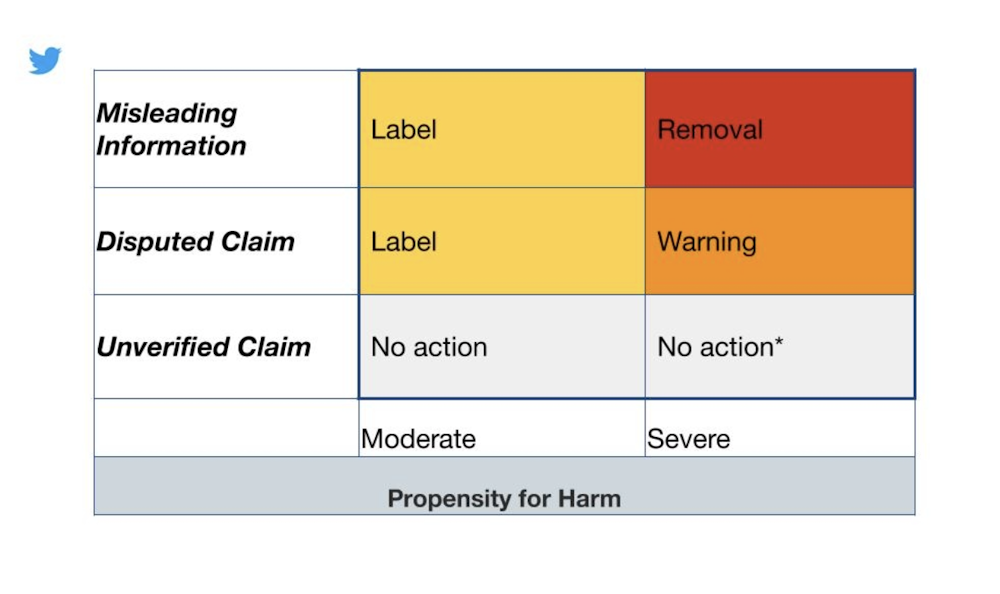
Twitter’s general policy describes a somewhat nuanced approach to moderating dubious posts, distinguishing between “unverified information”, “disputed claims” and “misleading claims”. A post’s “propensity for harm” determines whether it is flagged with a label or a warning, or is removed entirely.

In a 2020 blog post, Twitter said it categorised false or misleading content into three broad categories.
Screenshot

But the platform has not explicitly defined “misinformation” for users who will engage in the trial. So how will they know whether something is indeed “misinformation”? And what will stop users from flagging content they simply disagree with?

Familiar information feels right

As individuals, what we consider to be “true” and “reliable” can be driven by subtle cognitive biases. The more you hear certain information repeated, the more familiar it will feel. In turn, this feeling of familiarity tends to be taken as a sign of truth.

Even “deep thinkers” aren’t immune to this cognitive bias. As such, repeated exposure to certain ideas may get in the way of our ability to detect misleading content. Even if an idea is misleading, if it’s familiar enough it may still pass the test.

In direct contrast, content that is unfamiliar or difficult to process — but highly valid — may be incorrectly flagged as misinformation.

The social dilemma

Another challenge is a social one. Repeated exposure to information can also convey a social consensus, wherein our own attitudes and behaviours are shaped by what others think.

Group identity influences what information we think is factual. We think something is more “true” when it’s associated with our own group and comes from an in-group member (as opposed to an out-group member).

Research has also shown we are inclined to look for evidence that supports our existing beliefs. This raises questions about the efficacy of Twitter’s user-led experiment. Will users who participate really be capturing false information, or simply reporting content that goes against their beliefs?

More strategically, there are social and political actors who deliberately try to downplay certain views of the world. Twitter’s misinformation experiment could be abused by well-resourced and motivated identity entrepreneurs.

Twitter has added an option to report ‘misleading’ content for users in the US, Australia and South Korea.
Screenshot

How to take a more balanced approach

So how can users increase their chances of effectively detecting misinformation? One way is to take a consumer-minded approach. When we make purchases as consumers, we often compare products. We should do this with information, too.

Searching laterally”, or comparing different sources of information, helps us better discern what is true or false. This is the kind of approach a fact-checker would take, and it’s often more effective than sticking with a single source of information.

At the supermarket we often look beyond the packaging and read a product’s ingredients to make sure we buy what’s best for us. Similarly, there are many new and interesting ways to learn about disinformation tactics intended to mislead us online.

One example is Bad News, a free online game and media literacy tool which researchers found could “confer psychological resistance against common online misinformation strategies”.

There is also evidence that people who think of themselves as concerned citizens with civic duties are more likely to weigh evidence in a balanced way. In an online setting, this kind of mindset may leave people better placed to identify and flag misinformation.


Read more:
Vaccine selfies may seem trivial, but they show people doing their civic duty — and probably encourage others too


Leaving the hard work to others

We know from research that thinking about accuracy or the possible presence of misinformation in a space can reduce some of our cognitive biases. So actively thinking about accuracy when engaging online is a good thing. But what happens when I know someone else is onto it?

The behavioural sciences and game theory tell us people may be less inclined to make an effort themselves if they feel like they can free-ride on the effort of others. Even armchair activism may be reduced if there is a view misinformation is being solved.

Worse still, this belief may lead people to trust information more easily. In Twitter’s case, the misinformation-flagging initiative may lead some users to think any content they come across is likely true.

Much to learn from these data

As countries engage in vaccine rollouts, misinformation poses a significant threat to public health. Beyond the pandemic, misinformation about climate change and political issues continues to present concerns for the health of our environment and our democracies.

Despite the many factors that influence how individuals identify misleading information, there is still much to be learned from how large groups come to identify what seems misleading.

Such data, if made available in some capacity, has great potential to benefit the science of misinformation. And combined with moderation and objective fact-checking approaches, it might even help the platform mitigate the spread of misinformation.

The Conversation

Kate Reynolds has received funding from the Australian Research Council related to the impact of social identity on well-being attitudes and behaviour.

Eryn Newman does not work for, consult, own shares in or receive funding from any company or organisation that would benefit from this article, and has disclosed no relevant affiliations beyond their academic appointment.

ref. Is it actually false, or do you just disagree? Why Twitter’s user-driven experiment to tackle misinformation is complicated – https://theconversation.com/is-it-actually-false-or-do-you-just-disagree-why-twitters-user-driven-experiment-to-tackle-misinformation-is-complicated-166335

PODCAST: Buchanan and Manning on Afghanistan – Were Intelligence Failures a Prelude to a Taliban Takeover

Selwyn Manning and Paul G. Buchanan discuss supposed intelligence failings leading up to the US-led withdrawal from Afghanistan.
A View from Afar
A View from Afar
PODCAST: Buchanan and Manning on Afghanistan - Were Intelligence Failures a Prelude to a Taliban Takeover
Loading
/

A View from Afar: Selwyn Manning and Paul Buchanan present this week’s podcast where they analyse the crisis, the tragedy, unfolding in Afghanistan, including an apparent intelligence failure.

Unanswered questions considered, include:

  • Why were United States intelligence unable to predict how poised and ready the Taliban were?
  • How did the Taliban prepare to take every province, every city in Afghanistan, and keep their readiness a secret while they waited for the final phase of the US-led withdrawal to begin?
  • What should we make of the Taliban leadership? Should we be reassured or concerned at the Taliban’s words of transition?
  • And, has United States president Joe Biden damaged his reputation beyond repair, in justifying the method of the US’s withdrawal in a speech laced with a cold indifference toward the human carnage that unfolded at Kabul airport?

You can comment on this debate by clicking on one of these social media channels and interacting in the social media’s comment area. Here are the links:

If you miss the LIVE Episode, you can see it as video-on-demand, and earlier episodes too, by checking out EveningReport.nz or, subscribe to the Evening Report podcast here.

The MIL Network’s podcast A View from Afar was Nominated as a Top  Defence Security Podcast by Threat.Technology – a London-based cyber security news publication.

Threat.Technology placed A View from Afar at 9th in its 20 Best Defence Security Podcasts of 2021 category. You can follow A View from Afar via our affiliate syndicators.

Listen on Apple Podcasts
 

What is Bell’s palsy? A facial nerve disorder expert explains

Source: The Conversation (Au and NZ) – By Susan Coulson, Senior Lecturer, University of Sydney

NSW MP Victor Dominello has said he has Bell’s palsy, after appearing at a press conference this week with what he described as a “droopy eye”. Google searches for the term “Bell’s palsy” sky-rocketed overnight.

I have worked in the area of rehabilitation following facial nerve disorders for 30 years and have co-authored several studies involving people with Bell’s palsy.

If the term is new to you, here’s a quick explainer on what you need to know.

What is Bell’s palsy?

Bell’s palsy involves a sudden onset of a facial nerve paralysis.

The technical term is “idiopathic lower motor neurone facial nerve paralysis”. Idiopathic means of unknown origin; we can’t say for sure what causes it, however it is likely to be associated with a viral, inflammatory cause.

Bell’s palsy is very rare.

What are the symptoms?

People experience drooping and loss of movement on one or both sides of their face, usually just one. It is very rare to have it affect both sides.

Symptoms can include:

  • difficulty smiling and expressing emotions on your face

  • incomplete closure of the affected eye

  • a change in taste

  • things sounding a bit louder in one ear

  • difficulty with some speech sounds or with keeping food or drink in the mouth.

You might find people are misinterpreting your expression. For example, a smile night be interpreted as a sneer and it can be embarrassing.

Bell’s palsy is not generally painful, although some people report pain behind the ear or a change in taste prior to onset.

It can be misinterpreted, in the early stages, as someone having a stroke but it’s important to know Bell’s palsy is not caused by stroke. Stroke affects many parts of the body but Bell’s palsy affects only the face.

What causes it?

We don’t yet know for sure.

Researchers believe it may be associated with viral infection and related inflammation.

Is it associated with a COVID vaccine?

A recent study published in The Lancet Infectious Diseases journal found the risk of Bell’s palsy is slightly higher after the Sinovac COVID-19 vaccine known as CoronaVac, but that the overall benefit outweighs the risk.

CoronaVac is not available in Australia. It is a type of mRNA vaccine, as is the Pfizer vaccine.

The study said:

Our findings suggest an overall increased risk of Bell’s palsy after CoronaVac vaccination. However, the beneficial and protective effects of the inactivated COVID-19 vaccine far outweigh the risk of this generally self-limiting adverse event.

What are the treatments?

People with Bell’s palsy are usually treated by healthcare professionals from a range of different disciplines.

Corticosteroids are usually given in the first 72 hours of diagnosis to manage inflammation. Sometimes, antiviral drugs are prescribed.

If the person with Bell’s palsy is having trouble closing an eye, eye drops or gels may be used to protect the eye while the eyelid is not working properly.

Physiotherapy is also very effective to maximise recovery and address long term problems. That involves specific, targeted facial exercises tailored to the individual.

There is no evidence to support the myth that electrical stimulation of the face helps with recovery.

Can it be cured?

About 80 to 85% of people have a spontaneous, complete recovery usually over a period of a few weeks to a few months.

However, about 15-20% of people who have Bell’s palsy have long term problems associated with their face, such as asymmetry and spasm.

If your face is starting to improve in the first three weeks, then your recovery usually goes well.

If you don’t start getting any movement on your face for a period about two to four months, you are more likely to experience longer term problems.

The risk factors for Bell’s palsy are diabetes, high blood pressure and if you are in the third trimester of pregnancy, you have a slightly greater chance of getting Bell’s palsy. However, as it is still quite a rare condition, your overall risk remains low.

What are the myths?

The main myth is that electrical stimulus to the face helps; there is no evidence to support this idea. In fact, it can cause problems for your face.

Bell’s palsy is not caused by being generally unwell or “run down”.

And if you get Bell’s palsy, it’s important to understand it’s not your fault.

Where can people go to read more?

The Sydney Facial Nerve Clinic has some well evidenced information on Bell’s palsy. Or, you can go to a GP or an ear, nose and throat surgeon or physiotherapist.

The Conversation

Susan Coulson also works in private practice as a physiotherapy consultant. She has received funding from the Garnett Passe and Rodney Williams Memorial Foundation. She is a member of the Sydney Facial Nerve Clinic and of the NSW Physiotherapy Council.

ref. What is Bell’s palsy? A facial nerve disorder expert explains – https://theconversation.com/what-is-bells-palsy-a-facial-nerve-disorder-expert-explains-166403

New Zealand could take a global lead in controlling the development of ‘killer robots’ — so why isn’t it?

Source: The Conversation (Au and NZ) – By Jeremy Moses, Associate Professor in International Relations, University of Canterbury

Shutterstock

“New Zealand versus the killer robots” might sound like a science fiction B-movie, but that was essentially the focus of an event at parliament earlier this month.

Hosted by Minister of Disarmament and Arms Control Phil Twyford, the “Dialogue on Autonomous Weapons Systems and Human Control” looked at how New Zealand might take more of an international lead in regulating these highly contentious new technologies.

Twyford warned of the danger of warfare “delegated to machines”. He referred to a recent survey showing widespread public opposition to the deployment of autonomous weapons in war and strong support for government action to ban or limit their development and use.

The prospect of New Zealand’s leadership has been warmly received by activists and campaigners involved in the “killer robots” debate.

Human Rights Watch’s Mary Wareham has argued New Zealand leadership could act as “a total catalyst for action”, while the Campaign to Stop Killer Robots listed Twyford’s commitment as one of the “key actions and achievements” of its campaign to date.

Yet New Zealand has not joined the 30 states that have formally called for a ban on autonomous weapons, and Twyford’s statements have tended to waver between bullish and reserved. During the event at parliament he acknowledged the clear ethical problems with autonomous weapons, but also the complexity of making policy.

Sensitivity to military allies

If the mood of the people and government of New Zealand is strongly behind regulation, what makes the issue so difficult?

The short answer is politics and economics. A major obstacle for Twyford is allowing the New Zealand Defence Force to work with allies and partners.


Read more:
Lethal autonomous weapons and World War III: it’s not too late to stop the rise of ‘killer robots’


Both the US and Australia are heavily invested in pursuing cutting-edge military technologies, including robotics, artificial intelligence and autonomy. A key pillar of their strategy is building systems that allow more coordination on the battlefield.

Leading a movement to have these systems regulated or banned could see New Zealand’s military shut out of joint exercises where such technologies are being trialled or used.

Given the political pressure to take a stronger stand against China, it seems unlikely New Zealand’s Foreign Affairs and Trade or Defence ministries will want to risk further discord with key defence partners.

Protecting high-tech industry

The second hurdle lies in the economic promise of technologies developed in New Zealand that could potentially be used in autonomous weapons programmes elsewhere.

Many leading engineers and technologists have advocated for the regulation or banning of autonomous weapons, but others are attracted by the potential rewards of military-related projects.


Read more:
Killer robots, free will and the illusion of control


These tensions have already surfaced in the debate about US military payloads being launched from New Zealand by US-owned aerospace company Rocket Lab.

Autonomous weapons could well see similar questions raised about other technologies developed by New Zealand companies or researchers — most obviously in the fields of computer vision, robotics and swarm intelligence — that could be used in military systems.

Regulating autonomous weapons without also inhibiting potentially lucrative AI and robotics research and development remains a challenge.

Public opinion not enough

The hope that regulation of autonomous weapons could represent another “anti-nuclear moment” in New Zealand’s disarmament and foreign policy history therefore seems premature.

While it’s clear there is support for some form of regulation, there’s little evidence at this stage to suggest public opinion will sway the government’s current conservative and watchful position.


Read more:
AI has already been weaponised – and it shows why we should ban ‘killer robots’


So, what should be done? In the absence of international agreement, New Zealand could press ahead with its own domestic legislation to regulate these technologies, as proposed in a petition from local Campaign to Stop Killer Robots coordinator Edwina Hughes.

This has the potential to expose a lack of serious commitment to principle in the government’s position, but it would still come up against the political and economic interests opposed to action on autonomous weapons.

Acknowledging those political and economic obstacles is a critical first step for meaningful public debate.


Read more:
Never mind killer robots – even the good ones are scarily unpredictable


Engagement and transparency the key

In the near term, a stocktaking exercise should be undertaken to understand what research and development is being carried out in New Zealand universities and companies.

Efforts should also be made to understand which autonomous technologies are likely to be developed and possibly deployed in the coming years by New Zealand’s major defence partners, particularly Australia and the US.

Serious, sustained dialogue with commercial interests and defence partners is a necessary precondition for the advancement of Twyford’s agenda. While there is some evidence this work is underway, it needs greater transparency to ensure public understanding of what’s at stake.

Without that, New Zealand will probably struggle to take an international leadership role on this critical issue.

The Conversation

Jeremy Moses receives funding from The Royal Society of New Zealand Marsden Fund.

Geoffrey Ford receives funding from the Royal Society of New Zealand Marsden Fund.

Sian Troath receives funding from The Royal Society of New Zealand Marsden Fund.

ref. New Zealand could take a global lead in controlling the development of ‘killer robots’ — so why isn’t it? – https://theconversation.com/new-zealand-could-take-a-global-lead-in-controlling-the-development-of-killer-robots-so-why-isnt-it-166168

NZ police chief says anti-lockdown protests ‘disappointing’

RNZ News

New Zealand police are out again today enforcing the rules of the level 4 lockdown concentrating on dealing with any illegal gatherings, ensuring all travel is essential and providing reassurance patrols at places like supermarkets.

Yesterday there were eight arrests at anti-lockdown protests in Auckland and Whangarei and drivers across the country were checked to ensure travel was for essential purposes only.

Police Commissioner Andrew Coster said the delta variant was different and needed a firmer approach because any gathering was problematic.

He said so far police had been pleased with people’s compliance with the rules.

“Very good, we’re really pleased with the way things are going, you know it always takes a couple of days to settle down into the rhythm of this, but the vast majority of people have been doing exactly the right thing, so we’re very happy,” he said.

Coster said yesterday’s anti-lockdown protests were disappointing and although police respected people’s right to protest now was not the time to be gathering.

He said they expected that further protests could be a possibility and police would take a similar approach to yesterday when arrests were made.

‘We need to knuckle down’
“You know people are entitled to express their views but we really just need to knuckle down and get through this and the more we do that the shorter this lockdown is likely to be.”

Coster said about 40 percent of police staff were vaccinated but they would like that to be at 100 percent.

“Clearly they’re out protecting our communities and obviously their risk level is higher as a result of doing that.

“They’re all wearing protective equipment but we’re working as hard as we can to speed up that vaccination rate dependant on the ability to access vaccines and get it done.”

Coster said the police internal vaccination programme would start up again tomorrow and it looked like they should be able to speed up the rate of vaccinations.

He said today police would be focusing on any gatherings to ensure they were dealt with quickly, ensure that any movement on the roads was only for essential purposes and then reassurance patrols in areas such as supermarkets.

Infected cluster could reach 120
RNZ News reports the number of people infected with the delta variant could grow to 120 before the outbreak is brought under control, according to expert estimates.

New Zealanders are being warned to expect more cases of covid 19 over the next few days, but a mathematician says the numbers depends how long it has been spreading undetected.

This article is republished under a community partnership agreement with RNZ.

Print Friendly, PDF & Email

Article by AsiaPacificReport.nz

Parkop blasts PNG Lands Department for failing to protect public parks

By Frank Rai in Port Moresby

National Capital District Governor Powes Parkop has lashed out at the Papua New Guinean Department of Lands and Physical Planning for failing to maintain and manage portions of land in urban centers for public use.

He said public space in NCD was “diminishing” and the department had not been helpful in retaining public land use over the years.

“I want to say that from the outset, public space in NCD is diminishing,” he said.

“The Department of Lands has not been helping us [NCDC] to manage public space properly, not just public recreational space but also spaces like drainage reserves, road reserves — a lot of other reserves are there for the benefit of the public,” Parkop said.

He said the continuous change to the Minister for Lands and Physical Planning and its Department Secretary over time by successive governments was also a contributing factor to a backlog of issues.

“The Department of Lands continues to override us, continues to ignore planning, zoning and the public interest. Not only on this occasion but many other occasions.

“I want to inform the general public that NCDC is here to ensure that all recreational parks will be maintained for the benefit of all the public.”

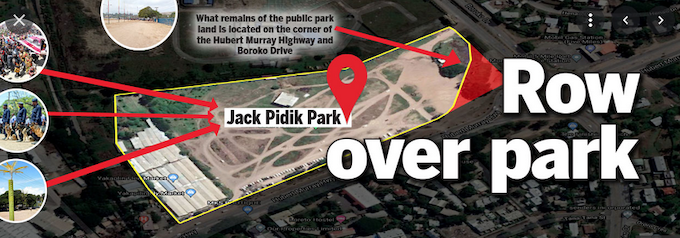
Jack Pidik Park controversy
Parkop raised his concern in relation to the controversy over the popular Jack Pidik Park that was formerly used as a recreational area.

“From the outset, we respect TST Group of Companies [responsible for a large development involving most of the part, we have no dispute and personal grudges with that but it is our responsibility as the government to protect the public and recreational space,” he said.

The governor claimed that the department had created the problem over time and it should be held accountable to “fix the problem”.

“The Jack Pidik Park was traded by the Minister for Lands or the government at that time without consulting NCDC.

“The national government made the decision and is the only one able to correct it,” he added.

Parkop also lashed out at the National Appeals Tribunal for overruling NCDC decisions on land issues.

“In the last two years, the company has appealed against our decision and the National Appeals Tribunal and sadly again, Department of Lands through the Appeal Tribunal overruled us (NCDC Physical Planning Board) and accepted the re-zoning for commercial purposes,” he said.

Meanwhile, Lands and Physical Planning Minister John Rosso said he was speaking to Governor Parkop and would address the land issues in NCD.

Jack Pidik Park in Port Moresby
The last portion of the Jack Pidik Park left as a public space is on the corner of Hubert Murray Highway and Boroko Dive. Image: Post-Courier
Print Friendly, PDF & Email

Article by AsiaPacificReport.nz

Tonga announces plans for national university with new bill

By Kālino Latu in Auckland

The challenges experienced by Tongan students having to study overseas will soon be over after the government has announced plans for the establishment of the kingdom’s first national university.

The news has been hailed as a solution to the financial, social and mental stresses Tonga’s international students have faced.

The kingdom’s Parliament is expected to process a bill which set out the details of the university later this week. The public had until yesterday to make submissions on the Tonga University Bill 2021.

The university is expected to unite various institutions, including the Tonga Institute of Education, Tonga Institute of Higher Education, Tonga Institute of Science and Technology, Tonga Maritime Polytech Institute, Queen Salote Institute of Nursing and Allied Health, as well as the Tonga Police College.

It will offer academic, technical and vocational programmes and qualifications from certificate to post-doctorate level.

Former Tongan MP and government teacher Lepolo Taunisila said the proposal had been in the pipeline for a while and involved previous governments and education ministers such as the late Dr Hu’akavameiliku and Dr ‘Ana Taufe’ulungaki.

It had been “absolutely long overdue”, Taunisila said.

‘Frustrating challenges’
A former student at the University of the South Pacific (USP), Fīnau Leone, said the move could help resolve the problems he and other Tongan students had encountered in the past.

Leone said he faced “frustrating challenges” studying in Fiji.

He said his family struggled to pay for his studies because he did not have a scholarship.

His parents could sometimes only afford to pay for his school fees and not for his shopping and living costs.

“I have no choice but to use all that money to pay for my school fees and begged for food from other Tongan students at USP and also asked them for a space to sleep in their apartment.

“Leaving home for the first time to stay with different people from various ethnicities were challenging, especially as I was just finishing from high school,” he said.

Leone said he still remembers an incident in which one of his best Tongan friends at USP was killed in Fiji while they were on a night out.

Tonga is one of 12 Pacific Island countries which fund USP.

Two private universities currently operate in the kingdom – ‘Atenisi University and Christ’s University in Pacific.

This article by Kaniva Tonga editor Kalino Lātū was first published by Te Waha Nui and is republished here as part of our collaboration with Kaniva Tonga.

Print Friendly, PDF & Email

Article by AsiaPacificReport.nz

We’re all exhausted but are you experiencing burnout? Here’s what to look out for

Source: The Conversation (Au and NZ) – By Gabriela Tavella, Research Officer, UNSW School of Psychiatry, UNSW

Shutterstock

With more than half the country in lockdown and many of the social support systems we rely on having been put on hold, it’s no wonder people are feeling overwhelmed and exhausted. For some, such feelings may ultimately culminate in burnout.

Before the COVID-19 pandemic, burnout was, for the most part, considered a work-related issue. But in our research, we have identified burnout in people outside of the workplace, including those who are dealing with other life stressors, such as caring for loved ones full-time.

Now, because of the pandemic, rates of burnout appear to be rising, especially since working from home means workers are often required to “do more with less” and be online and available 24/7, as well as home-school children.


Read more:
It’s OK if you have a little cry in lockdown. You’re grieving


We have been researching burnout to determine how to best identify and manage it. This research is outlined in a recently published book – Burnout: A guide to identifying burnout and pathways to recovery – and summarised here.

What is burnout?

The most widely used burnout measure, the Maslach Burnout Inventory (MBI), defines it by three criteria:

  • exhaustion
  • loss of empathy towards service recipients or cynicism directed towards one’s job
  • reduced professional accomplishment.

But the MBI has been widely critiqued. One concern is it overlooks key symptoms that are prominent in burnout and may be especially debilitating, such as cognitive dysfunction (which might include forgetting things or not being able to concentrate).

Another concern is it was derived solely from researching burnout in those who work directly with patients or clients, such as health-care workers and those in other caring professions. Nuances of burnout that occur in other contexts may have been overlooked.

Our alternative – the Sydney Burnout Measure

In our studies, we asked more than 1,000 participants who said they’d experienced burnout to report their main symptoms. They worked across a range of contexts, from paid employment positions to more “informal” work positions such as caring for elderly parents and/or children.

We found the syndrome comprised of not just exhaustion, but also cognitive dysfunction, withdrawal and disconnection from the world and those around you, and reduced work performance (whether that be in paid work or in tasks you are responsible for at home), commonly accompanied by depression, anxiety and insomnia.

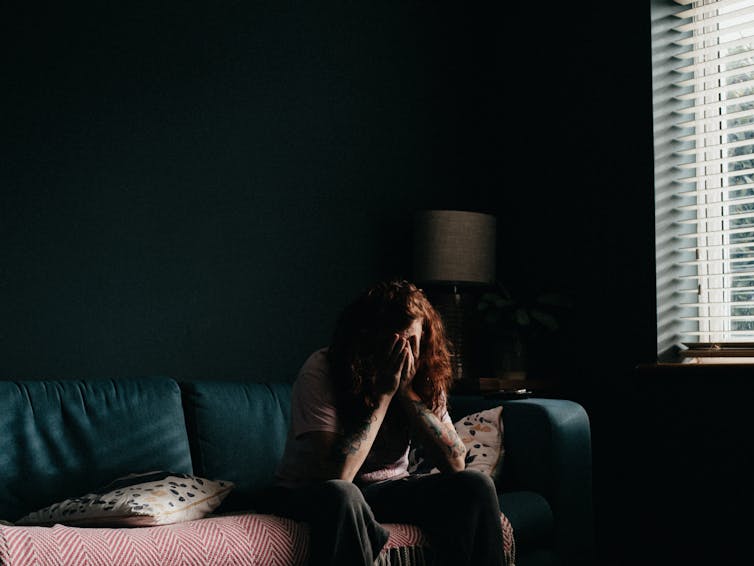
Person sits in a dark room on the couch with their head in their hands.
Burnout can include withdrawal or disconnection from the world and those around you.
Annie Sprat/Unsplash

We collated the burnout symptoms we identified into our own measure. The Sydney Burnout Measure, or SBM, is a checklist of 34 burnout symptoms, with a high score on our measure indicative that you might have burnout.

But it’s also possible to get a high score because of some other underlying condition that shares several of burnout’s symptoms, such as depression. To assess for this possibility, approaching a GP or mental health professional may be necessary.

These professionals will use their clinical experience to assess whether the symptoms you have are likely the consequence of burnout, or whether they could be due to some other mental health condition. Such clarification is important as different psychological conditions often require disorder-specific treatment strategies.


Read more:
Compassion fatigue: the cost some workers pay for caring


Addressing the external stressor

Once you know you have burnout, what can be done about it?

As a first step, the causes of your burnout need to be identified, so you can work to reduce their impact.

External causes of burnout can come from your workplace (such as being overloaded, being overlooked for a promotion, working overtime) or from the home (including caring for multiple children and/or elderly parents, being primarily responsible for domestic duties).

A combination of both factors could be at play, especially during our current state of lockdown, where many are juggling working-from-home demands, financial difficulties and home-schooling children.

A busy dad homeschools his two children, while working on his laptop.
Many people are currently juggling multiple demands as they work from home in the pandemic.
Shutterstock

Seeking resolution from your boss or manager may be useful in overcoming some work stressors. Can they extend your deadlines, or arrange flexible working hours around your child-rearing responsibilities?

For factors in the home, asking family members to assist in juggling tasks, or researching whether some tasks can be outsourced (for example, can you hire a cleaner or a babysitter once a week?) may be of use.

Applying de-stressing strategies

When escaping these stressors isn’t possible, you may have to bring on some de-stressing strategies to help curb your burnout symptoms. Things like exercise, meditation and practising mindfulness are consistently nominated by our study participants as most helpful.

Such practices not only help you to distract and relax, but also have proven biological benefits, such as reducing levels of stress hormones throughout the body.


Read more:
Spending time in nature has always been important, but now it’s an essential part of coping with the pandemic


Consulting a mental health professional can also be useful here, as they will have several specific cognitive strategies to help reduce anxiety and stress.

Addressing a predisposing factor: perfectionism

While stressors experienced at work or at home may set the wheels of burnout in motion, our analyses indicated burnout may also develop as a result of predisposing personality traits, especially perfectionism.

People with perfectionistic traits are usually excellent workers, as they’re extremely reliable and conscientious. However, they’re also prone to burnout as they set unrealistic and unrelenting standards for their own performance, which are ultimately impossible to live up to.

We therefore suggest managing burnout requires not only addressing precipitating work stressors and employing de-stressing strategies, but also tweaking any predisposing personality style.

Man sits on computer at home work station.
Getting it done is more important than making it perfect.
Nathana Rebouças/Unsplash

Several strategies can assist in modifying perfectionistic thoughts and behaviours. For example, learning to focus more on the “big picture” rather than the finer details can help prevent procrastination, which is a common consequence of perfectionism.

So, when starting a task, you want to approach it with the goal of getting it done (no matter how poor the quality) rather than ensuring it’s perfect from the get-go. You can go back and fix it later.

Learning to avoid black and white thinking (“If this goes wrong, I will definitely lose my job”) is another important strategy for addressing perfectionism. Consider instead the shades of grey (“If this goes wrong, I can try to approach it from another angle”).

A mental health professional may also be of assistance here, as they can offer therapeutic techniques, often taken from cognitive-behavioural therapy (CBT), that help people notice and modify unhelpful thinking patterns that are common in perfectionism and make them prone to stress and anxiety.

Overall, the key to managing burnout is identifying whether the presenting problem actually is burnout and not another condition. If it’s burnout, the key drivers (including any personality contribution) need to be determined. Only then can management strategies targeting each causal factor be applied.


Gabriela and Gordon’s book, Burnout: A guide to identifying burnout and pathways to recovery is published by Allen & Unwin.

The Conversation

Gordon Parker receives funding from the National Health and Medical Research Council (grant number GNT1176689).

Gabriela Tavella does not work for, consult, own shares in or receive funding from any company or organisation that would benefit from this article, and has disclosed no relevant affiliations beyond their academic appointment.

ref. We’re all exhausted but are you experiencing burnout? Here’s what to look out for – https://theconversation.com/were-all-exhausted-but-are-you-experiencing-burnout-heres-what-to-look-out-for-164393

BHP is selling its dirty oil and gas assets, but hold the applause

Source: The Conversation (Au and NZ) – By Jeremy Moss, Professor of Political Philosophy, UNSW

When BHP announced it would sell its stake in its oil and gas business to Woodside Petroleum to form a merged oil and gas business, it appeared welcome news. A big miner finally takes climate change seriously.

But decisions to sell fossil fuel assets are not good news at all. BHP did not do the right thing by selling its oil and gas operations for the simple reason that the climate is still no better off. BHP’s new oil and gas assets will continue to produce oil and gas — just with new shareholders.

Decisions to sell mines or set up “dirty” parallel companies are coming thick and fast as the big polluters scramble to cut their losses. One of Australia’s biggest polluters, AGL, announced in March it will create a separate company for its emissions intensive assets.

What BHP and other companies are doing is banking profits from their failing assets, while washing their hands of the responsibility to do something about their past and ongoing contribution to climate change. Instead of selling these assets, companies should retire the assets and wear the costs.

Passing the buck

BHP is one of Australia’s biggest-emitting companies. In 2019, the emissions produced by BHP’s products globally were 567 million tonnes of carbon dioxide equivalent — more than Australia’s total domestic emissions in 2019.

Even chief executive of mining company Glencore, Ivan Glasenberg, said in June this year:

Disposing of fossil fuel assets and making them someone else’s issue is not the solution and it won’t reduce absolute emissions.

So what should fossil fuel producers do if they are truly serious about their climate responsibilities? If they really want to depart from fossil fuels to help the climate, four things need to happen:

1. Ensure assets can no longer produce emissions

Fossil fuel producers should retire their mines or wells instead of selling them. This will inevitably involve foregoing any remaining value in their assets (if it has not already returned to them via past profits).

A report commissioned by the oil industry peak body, the Australian Petroleum Production and Exploration Association (APPEA), found the cost of decommissioning Australia’s 65 offshore oil platforms could reach A$60 billion over the next 30 years. This doesn’t include onshore gas, Australia’s huge coal mines and export terminals.

Offshore oil platform
The cost of decommissioning Australia’s 65 offshore oil platforms could reach A$60 billion over the next 30 years.
Shutterstock

2. Fund any remediation costs out of general revenue

Fossil fuel companies should pay for the cost of restoring mined land, such as back filling voids, replacing vegetation, repairing water sources or ensuring mines do not leak gas.

In the case of BHP, this would mean its super profits from iron ore could be diverted to meet their climate and environmental debts. BHP made a profit of over US$11 billion in the last year. Most of that is not going towards fixing climate harms such as bushfire and flood damage.

3. Establish a national inventory of liabilities

State and federal authorities should establish a central register of environmental damage and climate harms caused by fossil fuel companies. This would mean damage to waterways or soil contamination, as well as damage caused by climate change itself, could be accurately calculated.

Such an inventory is crucial to establishing which costs ought to be born by fossil fuel companies, and will help establish the costs involved in retiring mines.


Read more:
When it comes to climate change, Australia’s mining giants are an accessory to the crime


4. Establish an independent body to monitor safety of former mine and well sites

Mine remediation is too important to be left to the companies themselves, who may sell up or go broke, leaving taxpayers to fix the problem. In cases where remediation is complex and dangerous, governments could consider taking over mines or wells to ensure remediation was done properly.

For example, in 2019 the federal government took ownership of the Northern Endeavour production vessel, which is an oil production ship moored off the coast of Darwin. The vessel was used by gas company Woodside, who then sold it to Northern Oil and Gas Australia, who then went out of business. In this case, the government imposed a levy on the industry to pay for the costs.


Read more:
The story of Rum Jungle: a Cold War-era uranium mine that’s spewed acid into the environment for decades


Risking financial disruption

Environmental concerns aside, there are economic reasons for governments to take tighter control of fossil fuel assets.

The Bank for International Settlements released a report last year arguing that central banks like the Reserve Bank of Australia ought to be prepared to buy the stranded assets of fossil fuel companies.

Two trucks in an open pit coal mine
Duties to shareholders don’t trump duties to the rest of society not to severely damage the climate.
Shutterstock

Failure to do so will, the report notes, pose a real risk of triggering severe financial disruption. It warns of “extremely financially disruptive events that could be behind the next systemic financial crisis”.

The Bank for International Settlements draws on the analogy of the Global Financial Crisis. Just as a failure in mortgage lending led to a generalised financial crisis with impacts across the whole economy, the collapse in asset prices of fossil fuel industries could trigger a similar effect.

Companies forced to sell their assets to governments for a cheap price will no doubt complain they have other duties, such as getting a good return for shareholders. They will likely argue that not selling to another company for a premium price will reduce dividends paid to investors.


Read more:
Be worried when fossil fuel lobbyists support current environmental laws


Yes, companies might have a duty to make a profit. But duties to shareholders don’t automatically trump duties to the rest of society not to severely damage the climate.

Just as we don’t condone companies selling unsafe medicines or faulty appliances to benefit shareholders, nor should we allow them to harm the climate on those grounds.

Until governments step in to regulate the phase out of Australia’s fossil fuel assets, the environment and economy will be at risk.

BHP did not respond to The Conversation’s request for comment.

The Conversation

Jeremy Moss receives funding from the Australian Research Council. His book ‘Carbon Justice’ will be published in November with UNSW Press.

ref. BHP is selling its dirty oil and gas assets, but hold the applause – https://theconversation.com/bhp-is-selling-its-dirty-oil-and-gas-assets-but-hold-the-applause-166333

Could sending humans to sleep for a year help solve the climate crisis? A new play, Hibernation, asks this question

Source: The Conversation (Au and NZ) – By Sarah Peters, Senior Lecturer in Drama, Flinders University

Matt Byrne/State Theatre Company South Australia

Review: Hibernation by Finegan Kruckemeyer, State Theatre Company South Australia

What lengths would you go to in order to save the planet from climate crisis?
Stop eating meat and start composting? Recycle and “make do”, instead of buying new?

How about lock yourself securely in your home, climb into bed, and hibernate for a full year, giving the planet a chance to recharge and reset?

This is the provocative premise behind playwright Finegan Kruckemeyer’s bold new play Hibernation.

Performed in three acts, Hibernation introduces a global cast of characters in the year 2030: close enough to the present so as to feel timely and familiar; yet distant enough it is not impossible to imagine the realisation of this dystopian narrative.

Eighteen months ago, the thought of stay-at-home orders and “snap lockdowns” were otherworldly and extreme. Now, they are simply part and parcel of our collective efforts to keep our community safe.

Who knows what else could change between now and 2030?

Production image: two people on a blue stage
2030 is close enough to the present to feel timely and familiar.
Matt Byrne/State Theatre Company South Australia

The polished, crisp scenes of press conferences, the emotionally inflected media statements and a growing sense of turmoil are eerily familiar. Thousands of people are dying; or seeking refuge in other nations. Towns are flooding. Resources are scarce. Something has to change, urgently.

Enter the plan: to send the world into a forced, year-long slumber for the greater good.

Under Mitchell Butel’s dynamic and rhythmic direction, Hibernation explores the relational and emotional response to this bold plan for healing the planet.


Read more:
Can art put us in touch with our feelings about climate change?


What is the cost of action, inaction and apathy?

In the Canberra of this speculative future, chauvinism is alive and well. We meet the politicians claiming ownership of this daring plan and the policy maker who actually conceived it. They call for trust in the science, and promise no harm will come to the human population from the hibernation-inducing drug 54E–501E.

A young family in Africa pack for the “most not-going-anywhere-year” of their lives.

Ernesto and his husband in South America share a zoom call with his mother Cassandra, who foreshadows how the impact of this singular universal act will not be experienced in a universal way.

How different is the sacrifice of a year in the life of someone in their 70s compared to a year in the life of someone in their 20s?

Characters talk over zoom.
Sacrifices aren’t made equal: what does someone in their 70s lose, compared to someone in their 20s?
Matt Byrne/State Theatre Company South Australia

We witness the strength of conviction of American news hosts as they refuse to follow the auto-cue and, instead, attempt to communicate with care and consideration for the listeners on the other side of the screen.

Serving as a stark juxtaposition, act two focuses our attention in a vividly local way. Two Adelaideans, immune to 54E–501E, have free reign over the city. They share rich verbal illustrations of birds overtaking shopfronts and forests germinating from cricket pitches: businesses and ovals have become green houses and bio domes.

This scenario: the only two souls awake in a city where lions and hyenas — set free from the zoo on the eve of hibernation — roam the streets, is not as joyously poetic as it might first seem.

In act three, we return to our global characters and witness the impact and fall out of this experiment in planetary survival. As Cassandra laments, “we are what we are.” The human response to change and loss is messy and hopeful; loving and flawed.

Theatre in a time of crisis

Jonathon Oxlade’s set design is elegantly symbolic and sleek, with the lighting (Gavin Norris), sound (Andrew Howard) and video (Matt Byrne) cohesively supporting our immersive connection to each location. These integrated design elements direct our gaze across the stage, inviting the audiences’ imagination to fill the spaces between the pops of colour, light and rhythm.

It is an utter joy and privilege to be treated to this cast of 10 who deliver nuanced, heartfelt and compelling performances.

The cast deliver nuanced, heartfelt and compelling performances.
Chris Herzfeld/State Theatre Company South Australia

Hibernation makes the most of this large cast, with the full ensemble filling the stage for striking movement sequences, stylised depictions of parliamentary question time and a collage-like arrangement of characters preparing for their 365-day rest and reset. At a time when so many across the nation are distancing and isolated, the choreography and presence of a large cast on stage is a delight.

Hibernation balances a tripartite tightrope: telling a story on an ambitiously global scale; representing heartfelt human connection in the local and personal; and offering challenging food for thought, which will continue to linger in the back of your mind long after the lights go down.

Stories wrestling with what it means to exist, to navigate relationships, and to make good choices in a contemporary context are just one of the glorious gifts theatre can offer its community.

Hibernation plays at the Dunstan Playhouse until August 28.


Read more:
Loss for words: Art, language and the challenges of living on a changing planet


The Conversation

Sarah Peters does not work for, consult, own shares in or receive funding from any company or organisation that would benefit from this article, and has disclosed no relevant affiliations beyond their academic appointment.

ref. Could sending humans to sleep for a year help solve the climate crisis? A new play, Hibernation, asks this question – https://theconversation.com/could-sending-humans-to-sleep-for-a-year-help-solve-the-climate-crisis-a-new-play-hibernation-asks-this-question-165736

After nearly 70 years, the death penalty again becomes a real prospect in Papua New Guinea

Source: The Conversation (Au and NZ) – By Mai Sato, Associate Professor, Director of Eleos Justice, Faculty of Law, Monash University

Shutterstock

On July 30 2021, the Supreme Court of Papua New Guinea (PNG) quashed the National Court’s temporary stay of executions for all people sentenced to death.

The judgment has cleared a major obstacle to carrying out death sentences for the first time in nearly 70 years. It makes execution a real possibility for 15 individuals who are on death row.

From the PNG government’s perspective, there remain rather brutal administrative considerations: regulations authorising officers to carry out executions, and nominating the “most possible” of the approved methods of execution under law.

The then Australian administration abolished the death penalty in PNG in 1970. The PNG government reintroduced it in 1991.

Despite its reintroduction in law, PNG has not carried out any executions since 1954. Even so, the death penalty, or at least the threat of its implementation, has been used as a form of social control and has remained part of PNG’s criminal justice system. As of August 2021, there are 15 prisoners on death row.

In the past ten years, the death penalty has been part of the domestic political debate in PNG. In 2013, the parliament expanded the scope of the death penalty. Sorcery-related murder, aggravated rape, and robbery all became punishable by death under the Criminal Code (Amendment) Act 2013.

In 2015, the PNG cabinet endorsed guidelines for execution by approving three modes of execution: hanging, lethal injection and firing squad. It also determined the location for the execution.

Three years later, the judiciary applied the revised criminal code by sentencing eight men to death for sorcery-related murder.

By 2020 it had become such a part of political discussion that the government promised a nationwide consultation to examine the level of public support for the death penalty.


Read more:
If Papua New Guinea really is part of Australia’s ‘family’, we’d do well to remember our shared history


On the international stage, PNG has so far resisted the trend towards abolition of the death penalty. At its most recent UN Universal Periodic Review(2016), PNG did not accept recommendations to move away from the death penalty.

Since 2007, PNG has voted against, or abstained from voting on, the UN General Assembly resolution calling for a moratorium on the death penalty.

Indeed, in 2020, PNG actively opposed the resolution, appearing to commit itself to a position in direct tension with the abolitionist majority of the international community.

PNG’s justification for retaining the death penalty has centred on it being an effective deterrent to heinous crimes. In 2013, the then prime minister, Peter O’Neill, proposed the expanded use of the death penalty to tackle violent crimes. He claimed the “majority of our people are demanding it”. The then opposition leader, Belden Namah, also supported these measures, viewing it as an effective deterrent.

As prime minister, Peter O’Neill proposed expanding the use of the death penalty to tackle violent crimes.
Aaron Favila/AP/AAP

Resorting to increasing the severity of punishment to tackle serious crime has achieved little across different jurisdictions. These include the US, the UK and, more recently, Australia. In this sense, there is nothing new in PNG attempting to solve problems of violence through the use of harsher criminal punishments. But a consequence of PNG’s punitive turn could be dire.

There is no doubt PNG experiences a severe range of violent crime, including tribal fighting and sorcery-related deaths. In violence related to sorcery accusations, many of the victims are women who have been gang-raped and sometimes beaten or burnt to death. But victims are reluctant to report these crimes to police for fear of being targeted again or of their family being attacked. Unless beliefs about sorcery change, it is unlikely any criminal punishment will serve to curtail violent incidents, especially if the community does not trust the police to intervene and offer protection to the victims.

Furthermore, there is no scientific evidence that proves the death penalty is an effective deterrent compared to other sentences such as life imprisonment.

Two-thirds of countries have abolished the death penalty or have not executed anyone for ten years or more. While Asia lags behind this global trend, the Pacific Island countries are at the forefront of the abolitionist movement.

Every Pacific Island state apart from PNG and Tonga has abolished the death penalty for ordinary crimes. If PNG was to resume executions, it would entrench itself as an outlier among Pacific Island states.

PNG is not bound to proceed with executions. In the Supreme Court’s judgment, Justice Manuhu’s dissent is particularly instructive. He endorsed the National Court’s finding that

[…] it is now too late to execute any of these prisoners, as their right of protection against inhuman punishment has been infringed.

Indeed, of the 15 on death row in PNG, 13 have been in prison for more than five years. Some have been there for more than 17 years.

PNG is next scheduled to participate in the UN’s Universal Periodic Review in October 2021. It will be an opportunity for a direct and meaningful diplomatic exchange with abolitionist states.


Read more:
‘A dam has been breached’: a COVID crisis on our doorstep shows how little we pay attention to PNG


Taking steps towards the abolition of the death penalty at law would not constitute a substantial change for the PNG community, given its moratorium for nearly 70 years.

The Conversation

Mai Sato receives funding from Australia’s Department of Foreign Affairs and Trade. She is Deputy Director of CrimeInfo, an NGO based in Japan (https://www.crimeinfo.jp).

Matthew Goldberg has received funding from Australia’s Department of Foreign Affairs and Trade. He is a board member of the Capital Punishment Justice Project.

ref. After nearly 70 years, the death penalty again becomes a real prospect in Papua New Guinea – https://theconversation.com/after-nearly-70-years-the-death-penalty-again-becomes-a-real-prospect-in-papua-new-guinea-166096

Why rapid genome sequencing is key to finding out how long Delta has been in NZ, and how large this outbreak might be

Source: The Conversation (Au and NZ) – By David Welch, Senior Lecturer, University of Auckland

Shutterstock/Zita

We knew the Delta variant would eventually arrive in Aotearoa, but real-time sequencing, which produces full genomes from positive cases in less than 12 hours, will ensure the lockdown is as short and effective as possible.

There are now ten cases and we can expect more to be reported over the coming days. Genome sequencing of the first case, identified on Tuesday, did not show any direct matches to cases found in managed isolation facilities, but it is linked with the current Delta outbreak in New South Wales. This means the source was very likely someone arriving from NSW.

We may well find matches as samples from cases in MIQ are fast-tracked for sequencing. But since all NSW cases come from the same source, their genomes are all very similar and a match of an MIQ case to a community case will not be enough to prove they are the source.

The genomes and cases we have found so far cannot tell us how many cases there are, but modelling by Te Pūnaha Matatini, which takes into account the number of people with COVID-like symptoms getting tested, suggests the outbreak was already between 30 and 75 active cases by the time we discovered it. Whatever the number is, it is almost certainly still growing.

Because of its higher transmissibility, Delta has become the dominant strain in many parts of the world, including in Aotearoa. All cases found at our border over the past three months have been the Delta variant 170 full genomes found so far.


Read more:
‘Genomic fingerprinting’ helps us trace coronavirus outbreaks. What is it and how does it work?


While this is the first community transmission of the Delta variant we’ve seen in Aotearoa, that is mainly because our border detection and management has been successful in keeping it at the border until now.

Lockdown measures along with tracking, tracing and isolation will dramatically reduce the opportunity for the virus to spread and hopefully bring the R number below 1 so that the number of new cases will eventually start dropping.

As we find more cases that are not directly linked to each other, their genomes will give us some information about how large the outbreak might be. Essentially, the greater the diversity in the genomes we see, the older and larger the outbreak is likely to be.

If all the cases have identical genomes, it would mean the outbreak has not been around long enough to pick up mutations. But if there are several mutations that separate cases, it would mean there is probably a longer chain of transmission between the cases and a potentially large number of as yet undiscovered cases.

What makes Delta different

The Delta variant of SARS-CoV-2 (the virus that causes COVID-19) was first seen in India in late 2020 and is the most recent “variant of concern” to have been identified. Variants of concern are lineages that are either more transmissible, cause more serious disease or show greater ability to evade vaccines.

Delta is a variant of concern first and foremost because it transmits at a much higher rate than previous variants. Its basic reproduction number, R0, is estimated to be around 5 or 6. In an unvaccinated population with no other prevention measures, this means an infected person would likely infect five or six others, compared to about two or three for the variants that were dominant in 2020.


Read more:
SARS-CoV-2 mutations: why the virus might still have some tricks to pull


Like other variants of concern, Delta has a large number of mutations that distinguish it from other SARS-CoV-2 lineages. It is characterised by over 20 mutations, including nine on the spike protein which enables the virus to stick to and infect cells. Essentially, these changes make the virus more sticky and more successful at infecting cells and replicating.

This results in much higher “viral loads” (the overall number of viral copies an infected person has) and people becoming infectious and symptomatic more quickly. Combined, this results in faster transmission and larger outbreaks.

Superspreading events

We know that SARS-CoV-2 transmission depends on superspreading events — when a small number of cases (perhaps 10-20%) are responsible for most (80%) of the transmission.

We saw this in Aotearoa’s first wave in 2020, which was dominated by a few large clusters. It was also evident in various lucky breaks we have had since then, when cases in the community have not transmitted the virus to household contacts.

Delta is different in that fewer Delta cases have no onward transmission but it seems likely this is just a function of the overall higher transmissibility, rather than a change in super-spreading behaviour.

Breakthrough infections

The other reason Delta is of concern is because it is more able to infect vaccinated people. Such breakthrough infections remain rare, and vaccines are still very effective at preventing serious disease.

But people with breakthrough infections can pass the virus on to others, albeit at a lower rate.

Vaccines therefore give us multiple lines of protection. They make us less likely to get infected, and even if we do, much less likely to get seriously sick and less likely to transmit the virus.

The speed at which the Delta variant spreads means we cannot vaccinate fast enough to change the course of the current outbreak. But if we eliminate this outbreak and rapidly roll out the vaccine in the next few months, future outbreaks will be easier to control.

The Conversation

David Welch is affiliated with the University of Auckland and receives funding from the Ministry of Business, Innovation and Employment (MBIE)

Jemma Geoghegan receives funding from the Marsden Fund and is a Rutherford Discovery Fellow.

Nigel French receives funding from the Ministry of Business Innovation and Employment (MBIE). He is affiliated with Massey University and is a member of the Ministry of Health COVID-19 Technical Advisory Group.

ref. Why rapid genome sequencing is key to finding out how long Delta has been in NZ, and how large this outbreak might be – https://theconversation.com/why-rapid-genome-sequencing-is-key-to-finding-out-how-long-delta-has-been-in-nz-and-how-large-this-outbreak-might-be-166340

Owning up: Australia must admit its involvement in Afghanistan has been an abject failure

Source: The Conversation (Au and NZ) – By Kevin Foster, Associate Professor, Media Studies, Monash University

Twenty years ago, Australian forces followed the US into Afghanistan in the wake of the September 11 attacks with a simple mission: to hunt down Osama bin Laden and the al-Qaeda leadership and remove the Taliban government that had sheltered them. That mission has ended in abject failure.

Its costs have been significant: 41 combat-related deaths, 260 wounded, more than 500 veteran suicides, thousands afflicted by post-traumatic stress disorder (PTSD) and around A$10 billion expended with precious little to show for it.

Uruzgan Province, the centre of Australian operations from July 2006 until the main Australian Defence Force troops withdrew in December 2013, fell to the Taliban in early August with scarcely a shot fired. All those years spent equipping, training and mentoring the Afghan National Army to stand up and fight for the gains made since 2001 had clearly achieved nothing.

But the failures don’t end there.

Over the past weeks, there has been a great deal of hand-wringing about the potential loss of the gains made in Afghanistan in the 20 years between the Taliban rule. Those gains were many: a generation has profited from improved access to educational opportunities, key health indicators have markedly improved, a massive influx of foreign aid has stimulated the economy, the private sector has flourished, and a free media has reported on and critiqued the emerging society’s advances and shortcomings. Women especially benefited from new freedoms and took up prominent roles in politics, the public sector and the media.

All these gains are now in peril as the newly re-installed Islamic Emirate of Afghanistan looks set to return women to obscurity and chatteldom.

With the Taliban retaking control, the gains made by Afghan women will be lost and they will be returned to the status of chattels.
AAP/AP/Vincent Thian

While this is true of life in Afghanistan’s capital and larger cities, improvements in Uruzgan were less marked and never so far-reaching. Despite the Australian government’s “perennial airbrushed optimism” about the benefits brought by the ADF and its security and reconstruction efforts, the lot of Uruzganis beyond the provincial capital, Tarin Kot, changed little.


Read more:
As the Taliban returns, 20 years of progress for women looks set to disappear overnight


In late 2012, little more than a year before the ADF’s withdrawal, Australian journalist Jeremy Kelly was struck by the disparity between the ADF’s “mission accomplished” rhetoric and what he saw when he travelled through the province. He wrote:

Australian military officials are quick to list achievements by its development arm: three times as many healthcare facilities since 2006 and a rise in the number of schools from 34 in 2006 to 205 now. They are impressive numbers, but they don’t tell the whole story. In Chora, only one of the 32 schools open actually has students attending […] The rest are “just for teachers taking a salary” […]

Meanwhile, in the western district of Deh Rawood, government and foreign officials were shocked last year when they found land surrounding three vacant schools, all built with foreign money, was being used to grow opium and cannabis.

In November 2020, an independent Afghan NGO, The Liaison Office, assessed the state of Uruzgan province ten years after the withdrawal of the ADF’s erstwhile security partners, the Dutch. Despite the doubling of health facilities and workers ensuring greater availability of antenatal and postpartum care for Afghan women, access to these facilities remains fraught.


Read more:
As Afghanistan falls, what does it mean for the Middle East?


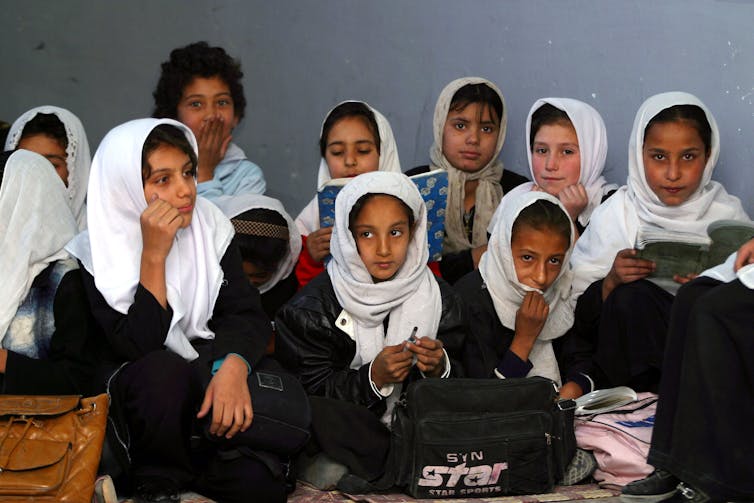
Taliban control of all major roads in the province and ongoing clashes with security forces restricted access to healthcare and education and stunted economic activity. Insecurity and internal displacement compounded by drought and disease severely affected agriculture with a marked increase in fallow land. Fewer schools were open in 2020 than a decade earlier. Though the Taliban had permitted the re-opening of some, they enforced a strict prohibition on girls’ education.

If Uruzganis profited little from the Australian presence, the ADF has emerged from the campaign damaged and diminished. Australian forces were bit players in the Afghan venture. Faithful followers of their US masters, they brought limited resources, exercised no control over strategy and so cannot be held responsible for the failure of the larger mission.

As the Taliban once again takes control in Afghanistan, the gains of the past 20 years have been lost.
AAP/EPA/Stringer

In this regard, the nation’s political leaders and the ADF itself have persistently measured the military’s performance by its adherence to the mythical yardstick of ANZAC virtue. From this perspective, the success or failure of the ADF mission rested less on what they did than who they showed themselves to be.

There is no doubt many thousands of servicemen and women served honourably and did what they could to improve the lives of the Afghans they encountered. Sadly, their efforts have left few permanent marks and will be largely forgotten. Instead, Afghanistan will be remembered for the alleged atrocities detailed in the Brereton Report.


Read more:
Why Australian commanders need to be held responsible for alleged war crimes in Afghanistan


Afghanistan’s reputation as the graveyard of empires rests less on the prowess of its forces than the country’s capacity to expose the failings inherent in the armies that come to campaign there. This includes the dysfunctional leadership and supply of the Soviet military, and the hubris of the US’s faith in the force of arms.

Lazy platitudes about Australian moral and military exceptionalism were put to the test in Afghanistan, and found wanting. To retrieve something positive from this 20-year debacle it is vital the ADF owns up to its failures in Afghanistan. Only then can it hope to recover its ethical balance and rebuild its moral authority.


Kevin Foster’s book, Anti-Social Media: Conventional Militaries in the Digital Battlespace, will be released by Melbourne University Press on August 31.

The Conversation

Kevin Foster has received funding from the Australian Army Research Scheme.

ref. Owning up: Australia must admit its involvement in Afghanistan has been an abject failure – https://theconversation.com/owning-up-australia-must-admit-its-involvement-in-afghanistan-has-been-an-abject-failure-166213

We should install air purifiers with HEPA filters in every classroom. It could help with COVID, bushfire smoke and asthma

Source: The Conversation (Au and NZ) – By Donna Green, Associate Professor, Investigator for Digital Grid Futures Institute, UNSW; Affiliated Investigator NHMRC Centre for Air Pollution, Energy and Health Research, Associate Investigator the ARC Centre of Excellence for Climate Extremes, UNSW

Shutterstock

The smell of hazard reduction burn smoke in Sydney this week is an unwelcome reminder the bushfire season is almost upon us, and with it, the torment of having to breathe toxic air.

Even before the last of the 2019–20 Black Summer smoke dissipated, another deadly reminder of the importance of access to safe air arrived. COVID forced many of us to take a crash course in how to avoid respiratory viruses.

One of the most effective ways to reduce indoor COVID transmission is to open windows. Maximising outdoor air coming inside, known as the air exchange rate, is a good way to reduce transmission risk.


Read more:
Australia must get serious about airborne infection transmission. Here’s what we need to do


But opening windows during the bushfire season can let toxic smoke in, changing the risk calculation.

Keeping windows closed and re-circulating air through standard aircon systems can cool the air, but doesn’t remove smoke or viruses.

So how can schools reduce exposure to COVID and bushfire smoke simultaneously?

This dilemma has a solution we can implement immediately. We’ve calculated about A$50 million would provide all NSW primary and secondary school classrooms, and other shared spaces within schools, with High-Efficiency Particulate Air (HEPA) grade air purifiers.

This initial outlay pales compared to the roughly A$220 million-a-day cost of Sydney’s lockdown.

The added benefit of installing air purifiers with HEPA filters is they can help reduce the risk of asthma attacks too.

Air purifiers with HEPA filters can remove over 99% of tiny particles

Most people catch COVID by inhaling it from shared air, and COVID particles often linger in the air in indoor spaces. Simple and relatively cheap air purifiers with HEPA filters have been shown to clear potentially infectious aerosols quickly and effectively.

HEPA air purifiers work by mechanical filtration — they force air through a fine mesh which traps particles. Off-the-shelf air purifers with HEPA filters can remove more than 99.97% of all particle sizes down to 0.30-1.0 microns (one millionth of a metre).

This means they can help filter airborne viruses, bacteria, and tiny particles known as “particulate matter” from bushfire or hazard reduction burn smoke. They can’t completely eliminate COVID transmission, but they can help reduce the risk especially when used with other best practices like wearing masks and other public health measures.

This approach isn’t radical. It has already been mandated in New York schools prior to their reopening.

Our calculations

These calculations assume each NSW primary and secondary school student, of which there are approximately 706,000 and 534,000, respectively, are grouped in classes of 25 and 20 pupils, respectively.

Each of these classrooms would require an air purifier designed to work in a standard classroom of approximately 60 square metres. We’ve allowed for each of the 3,100 schools in NSW to have six extra units to include shared spaces such as the library or resource room, staff room and administration area.

Approximately 73,500 units would be needed in NSW. We’ve applied a bulk buy discount of 30% on a currently available, high-quality HEPA air purifier retailing for A$1,000 to arrive at our estimate.

Of course, this doesn’t only affect NSW — schools across the nation would likely benefit from this approach.


Read more:
We studied how to reduce airborne COVID spread in hospitals. Here’s what we learnt


Because these units are already available for purchase online and can ship via existing delivery services, the logistics are neither complicated nor expensive.

Installation of the units can be carried out in minutes, and one of the only concerns is the need to ensure proper PPE when changing the filter.

Unfortunately, upgrading existing aircon systems in schools by incorporating higher-grade HEPA filters is slow, expensive and not always technically possible.

In combination with other risk-reduction strategies, air purifiers could be an affordable way to reduce the risk of unmitigated COVID spread between unvaccinated students and staff, and the inevitable spread between, and within, these children’s households.

This approach would buy time until vaccines are approved and rolled out for Australian children. This is unlikely to occur before mid-2022 at the earliest.

There are multiple other benefits too

An added benefit is that for future years, these air purifiers might be able to reduce asthma attacks triggered by smoke from the inevitable, and increasingly intense, bushfire season. That’s because for many people, asthma can be triggered by the small particles in smoke which, once inhaled, can go into the lungs causing inflammation.

Their tiny size means some of them can enter the blood stream and affect our lungs, heart and immune systems.


Read more:
How does bushfire smoke affect our health? 6 things you need to know


One in ten Australian children suffer from asthma, so keeping hazard reduction burn and bushfire smoke out of schools is a top priority.

Using HEPA filters will likely result in health savings associated with reduced asthma attacks from avoided smoke inhalation, and a lower burden from COVID cases stemming from school-based transmission. This will place less pressure on NSW’s overwhelmed health system.

It’s hard to comprehend why we haven’t raced to take such an effective no-regrets strategy.

It’s one strategy of many

Installing air purifiers with HEPA filters throughout the entire school system might be one of the most important, and cost effective, ways to improve the health and safety for millions of families in NSW, and around Australia.

We also need to deploy a range of strategies to reduce the risk to school children and staff of exposure to airborne viruses, as well as smoke and other air pollutants.

We know we need to:

  • promote outdoor sports over indoors

  • stagger outside playground access times

  • move non-essential person-to-person interactions online (for example parent-teacher meetings)

  • perform rigorous daily checks for symptomatic children

  • constantly encourage people with even the most minor symptoms to stay home and get tested

  • mandate masks in schools and on public transport

  • stagger drop off and pick up times where possible.

The Conversation

Donna Green has received funding from the National Health and Medical Research Council and the NSW Chief Scientist and Engineer. She currently receives funding from the Digital Grid Futures Institute, UNSW.

She works on Clean Air Schools www.cleanairschools.com.au which measures indoor and outdoor air pollution in schools.

Ben Harris-Roxas receives research funding from the National Health and Medical Research Council and NSW Health. In the past he has received funding from the National Health and Medical Research Council, the Australian Research Council, the World Health Organization, the Australian Government Department of Health, the Public Health Agency of Canada, the Heart Foundation NSW, NPS MedicineWise, the Sax Institute and the City of Gold Coast.

ref. We should install air purifiers with HEPA filters in every classroom. It could help with COVID, bushfire smoke and asthma – https://theconversation.com/we-should-install-air-purifiers-with-hepa-filters-in-every-classroom-it-could-help-with-covid-bushfire-smoke-and-asthma-166332

Some animals have excellent tricks to evade bushfire. But flames might be reaching more animals naive to the dangers

Source: The Conversation (Au and NZ) – By Dale Nimmo, Associate Professor in Ecology, Charles Sturt University

Shutterstock

The new report by the Intergovernmental Panel on Climate Change paints a sobering picture of the warming climate in coming decades. Among the projections is an increase in fire weather, which will expose Earth’s landscapes to more large and intense megafires.

In our paper, published today in Global Change Biology, we considered what this fiery future might mean for the planet’s wildlife. We argue a lot can be learned by looking at how wildlife responds to a very different threat: predators.

Australia has seen the brutal consequences that occur when native wildlife is exposed to introduced predators. Australian animals have not evolved alongside introduced predators, such as cats and foxes, and some are what scientists call “predator naive” — they simply aren’t equipped with the evolutionary instincts to detect and respond to introduced predators before it’s too late.

Now, let’s take that idea and apply it to fires. Some animals have evolved excellent tricks to detect when a bushfire is nearby. But some areas where infernos were once rare are growing increasingly bushfire-prone, thanks to climate change. The wildlife in these spots may not have the evolutionary know-how to detect a fire before it’s too late.

Just as being “predator naive” has decimated Australian wildlife, will being “fire naive” wreak havoc on our native species?

Behaviour forged in fire

A growing list of studies show the tricks animals from fire-prone areas use to survive the flames.

Sleepy lizards have been shown to panic at the smell of burnt pastry, reed frogs leap away from the crackling sounds of fire, and bats and marsupials wake from torpor after smelling smoke.

And one study found that, when exposed to smoke, Mediterranean lizards from fire-prone areas reacted more strongly than Mediterranean lizards from areas where fire was rare.

These studies show some animals can recognise the threat of fire, and behave in a way that increases their chance of survival. Those that can are more likely to live through fire and pass on those abilities to their offspring.

That’s where the parallels between fire and predation become striking — and potentially worrying.

Reading the cues

It’s well known predators and prey are in an ongoing evolutionary race to outmanoeuvre one another.

One tool prey draw upon to avoid becoming predator food is to recognise cues — such as smells, sights and sounds — that indicate a predator is lurking nearby. Once they do, prey can change their behaviour to minimise the risk of becoming dinner.

Research showed the Mediterranean skink can smell a fire.
Research has shown the Mediterranean skink can smell a fire.
By Balles2601 / Wikimedia Commons / CC BY-SA 4.0, CC BY-SA 4.0, CC BY

Decades of research has shown that when prey evolve alongside a predator, they can become highly adept at recognising their predator’s cues, such as a scent markings or territorial calls.

But what about animals that haven’t evolved alongside these lethal threats?

When a new predator enters an ecosystem, prey that have not evolved with it can be naive to its cues. They might fail to recognise the threat implied by the new predator’s scents, signs, or sounds, placing them at substantial risk.

This “predator naivety” helps explain why introduced predators are global drivers of extinction. Naive prey just don’t hear, smell, or see them coming.


Read more:
There’s no end to the damage humans can wreak on the climate. This is how bad it’s likely to get


Which species are ‘fire naive’?

Research on how animals respond to fire cues has focused on animals from fire-prone regions, probably because that’s where you’d expect to find the strongest responses. But more research is needed about animals from regions that rarely burn.

Do these animals also recognise the cues of fire as an approaching lethal threat?

Do they have finely tuned behaviours that help them survive fire?

Are they “fire naive”?

We don’t know. And that’s a worry because recent changes in global fire activity, triggered by a warming and drying climate, are seeing fires enter ecosystems long regarded as “fire-free”.

If they are naive to fire, species in these ecosystems might be more at risk than previously thought.

The search for fire naivety

We urge researchers around the world to assess fire naivety of animals, particularly in areas experiencing a change in their fire regimes, such as from rare to frequent fire or increased fire severity.

Evidence suggests recognition of predator cues is at least partly genetic. It will be important to determine whether the capacity to recognise and respond to fire also has a genetic basis.

If those behaviours can be passed on from one generation to the next, then perhaps we could take fire-savvy individuals from fire-prone areas and place them into fire naive populations, in the hope their favourable behaviours will spread rapidly via genes passed onto their offspring. Scientists call this “targeted gene flow”.

As the world continues to warm and megafires rage across the globe, we will need all the knowledge and tools at our disposal to help avoid an acceleration of Earth’s biodiversity crisis.


Read more:
Artificial refuges are a popular stopgap for habitat destruction, but the science isn’t up to scratch


The Conversation

Dale Nimmo receives funding from the Australian Research Council, the Department of Environment, Land, Water and Planning, the Department of Biodiversity, Conservation and Attractions, Department of Agriculture, Water and the Environment, the World Wildlife Fund, Consolidated Minerals, the Hermon Slade Foundation, and the National Environmental Science Program (Threatened Species Hub)

Alex Carthey receives funding from Macquarie University, the Australian Research Council, The Hermon Slade Foundation, The World Wildlife Fund, Aussie Ark, and Greater Sydney Local Land Service.

Chris J Jolly receives funding from National Environmental Science Program (Threatened Species Hub).

Daniel T. Blumstein receives funding from the National Science Foundation and the Australian Research Council.

ref. Some animals have excellent tricks to evade bushfire. But flames might be reaching more animals naive to the dangers – https://theconversation.com/some-animals-have-excellent-tricks-to-evade-bushfire-but-flames-might-be-reaching-more-animals-naive-to-the-dangers-164894

Feedback from supervisors can be a good or bad experience. Here’s how to get it right

Source: The Conversation (Au and NZ) – By Ritesh Chugh, Senior Lecturer – Information Systems and Analysis, CQUniversity Australia

Anna Shvets/Pexels, FAL

Giving good feedback is an art. It can be challenging for supervisors and managers, whether in an educational setting or any other workplace. Our newly published review of the past decade’s research on this issue confirms the key elements of improving feedback are to make it meaningful, constructive, timely and regular.

Feedback is centred on giving information about actual performance against set requirements. Good feedback enables people to learn from both successes and weaknesses in performance.

Focusing only on people’s shortcomings does not help learning, but hinders it. Bad feedback can be destructive.


Read more:
Our uni teachers were already among the world’s most stressed. COVID and student feedback have just made things worse


An earlier review found one feedback intervention out of every three actually decreased performance. Postgraduate students’ experiences of feedback from research supervisors mirrors employees’ experiences of feedback from managers. Our analysis of the past decade of academic literature on feedback to postgraduate research students confirms the problem is widespread.

And large numbers of people are affected. Australia has more than 66,500 higher degree research students. In the US, 55,703 doctorates were awarded in 2019.

Poor feedback to such students leads to a negative experience. But there is not one feedback strategy that works positively for all situations.

Young woman smiles as she gets advice from another woman
Effective feedback is built on a relationship of trust, with the supervisor often likened to a ‘critical friend’.
Shutterstock


Read more:
Universities are failing their students through poor feedback practices


What are the common problems?

Our study found the problems in giving and receiving feedback related to content, process, people and expectations.

Low-quality feedback with inadequate information or vague content from managers does not lead to better work performance. Equally, managers and supervisors need to find a good balance between overwhelming their supervisees with too much feedback and not providing enough or infrequent and delayed feedback.

Feedback does not stand alone – it is part of the broader relationship between supervisor and supervisee. A lack of trust is harmful for the giving and receiving of feedback.

Feedback is a two-way process between the giver and receiver – both parties contribute to the experience. Some individuals actively seek feedback. Others try to avoid it at all costs.

Not all feedback receivers are willing to take feedback on board. On the other hand, many feedback givers lack appropriate feedback skills or awareness of their own style of feedback, including its timing and tone. Often, feedback is less than effective because of a mismatch of expectations between givers and receivers.

Chart showing 5 sources of problems with feedback

Source: Chugh et al, Supervisory feedback to postgraduate research students: a literature review (2021). Image: Shutterstock, Author provided


Read more:
How our obsession with performance is changing our sense of self


The need for a ‘critical friend’

Providing effective feedback is essential to improve learning and performance. Managers and research supervisors continually give and receive feedback. But, before giving feedback, supervisors should manage expectations and negotiate supervision arrangements. These include how often and when to give feedback, as well as the length and depth of feedback content.

In all organisations, supervisors should aim for a positive supervisory relationship. Such relationships are based on trust, respect, open communication and shared meaning.

Supervisors’ style of feedback often parallels their own experiences, whether it was helpful or not. As feedback can often be misunderstood, supervisors should critically reflect on their feedback style so it becomes a satisfying two-way process.

Constructive regular feedback should highlight both strengths and weaknesses. It should also suggest improvements. Fifty-seven percent of employees prefer to hear corrective feedback that provides suggestions for improvement and points out things that weren’t done optimally.

So, supervisors can assume the role of a “critical friend” who is encouraging and supportive but provides candid feedback on performance.

Using technologies such as videoconferencing, messaging, social media and email can help in providing timely feedback.

Our review sums up the research findings on the characteristics of effective feedback as:

“suggestive and constructive, brief, frequent and regular, actionable, specific and tailored, explicit, honest but empathetic and tactful, formal, supportive and encouraging, advising, appreciative and respectful but critical”.

chart showing 5 strategies for successful feedback

Source: Chugh et al, Supervisory feedback to postgraduate research students: a literature review (2021). Image: Shutterstock, Author provided


Read more:
Informal feedback: we crave it more than ever, and don’t care who it’s from


A 3-way process of improving feedback

Improving the feedback environment can lead to benefits that include higher work satisfaction. For example, in higher education, the triad of institutions, supervisors and students/supervisees can all help improve feedback processes. The same is true of the triad of the organisation, supervisors/managers and employees in other workplaces. Each has a role to play in making feedback effective.

Institutions and organisations can provide administrative, technical and financial support to supervisors. Training, mentoring and personal development opportunities can help both supervisors and supervisees succeed.

Supervisors need to engage in professional development, regularly communicate with their supervisees, be culturally sensitive and use a blend of the previously outlined feedback strategies.

Supervisees should develop reflective skills and engage critically with feedback as integral to their learning and improvement.

No ‘one size fits all’, but key principles apply

Every supervisory relationship is different. However, developing a constructive feedback culture is critical. In the supervisor-supervisee relationship, lessons need to be learnt from problems in the process, and a mix of positive feedback strategies can be adopted.

As our study shows, there is no “one size fits all” approach to providing feedback. Ultimately, supervisors and managers should ensure feedback is supervisee-centred, focuses on improvements and is actionable.

The Conversation

The authors do not work for, consult, own shares in or receive funding from any company or organisation that would benefit from this article, and have disclosed no relevant affiliations beyond their academic appointment.

ref. Feedback from supervisors can be a good or bad experience. Here’s how to get it right – https://theconversation.com/feedback-from-supervisors-can-be-a-good-or-bad-experience-heres-how-to-get-it-right-165757

No longer a temporary COVID measure, the government’s super changes will most help wealthy tax dodgers

Source: The Conversation (Au and NZ) – By Kevin Davis, Emeritus Professor of Finance, The University of Melbourne

hidesy/Shutterstock

On May 29, the government announced by way of media release the extension of an emergency COVID measure.

The temporary halving of minimum drawdown rates for retirement superannuation accounts — introduced in March 2020 while the Australian stock market was in freefall — would continue for another year.

The explanation was terse and does not stand up to scrutiny.

The biggest beneficiaries of the extension are the wealthy retirees, who use super to escape tax on funds they are building up to hand on to their children.

It provides no benefits to less well-off retirees who need to use money in super to live on in retirement.

Before the temporary halving of drawdown requirements in March 2020, a retiree aged between 65-74 would be required to withdraw at least 5% of their account balance each year.

The minimum withdrawal rate increased with age.

The merit in the requirement (even if the numbers used have an unavoidable element of arbitrariness) was that it limited the ability of wealthy retirees to use super as a pure tax dodge.

Super is meant to be for retirement

Funds in super retirement accounts have a zero tax rate on earnings and are untaxed when withdrawn.

The original decision in March 2020 to halve minimum withdrawals possibly made some sense. Following a peak on February 20 2020, stock markets plunged and super funds suffered negative returns (minus 10.3% in the March quarter, according to the Australian Prudential Regulation Authority).


Read more:
Retirement incomes review finds problems more super won’t solve


Withdrawing funds, possibly not currently needed, from a tax-preferred portfolio at a time when its value was (hopefully temporarily) depressed was not an optimal wealth management strategy.

Those sufficiently well-off and able to draw on assets outside super, could now draw down less in order to maximise super tax benefits.

The less well-off (without significant financial assets outside of super) got no such benefit. They still needed to draw down at a similar rate for living expenses, or cut back consumption.

There are possibly some (probably not many), between these two groups, for whom the policy change meant improved whole-of-retirement living standards given the subsequent recovery in super fund returns. And the announcement may have had some beneficial psychological effects!

So, it was possible to give the original decision a tick of approval.


The S&P/ASX 200 has more than recovered from last year’s crisis


S&P Global

But what about the decision to extend the halving of minimum withdrawal rates for another entire financial year?

The explanation in the media release is little more than unsubstantiated waffle.

Today’s announcement extends that reduction to the 2021-22 income year and continues to make life easier for our retirees by giving them more flexibility and choice in their retirement.

For many retirees, the significant losses in financial markets as a result of the COVID-19 crisis are still having a negative effect on the account balance of their superannuation pension.

The second sentence certainly warrants scrutiny.

APRA statistics show that in the year to March 2021 the rate of return for institutional super funds was 18.2%

This is well in excess of what was required to reverse the temporary loss in the March quarter of 2020 that prompted the original decision.

These APRA statistics for March 2021 were published on May 25.

The information underlying them was presumably available to the government well before its announcement on May 29.


Superannuation performance (excluding self-managed funds)


APRA Quarterly superannuation performance statistics, March 2021, Table 1C

The APRA figures are aggregates. There might be some individual funds that have not recovered from the losses of a year earlier, but each of the categories of institutional funds in the APRA statistics appear to have done so.

The APRA statistics do not include self-managed funds, and some of them might not have fully recovered (we don’t know). But even if so, that would reflect decisions about asset allocations in the control of the fund members.

This means the second sentence of the explanation reproduced above is at best unproven, and likely wrong.

The first sentence is, of course, tautologically true. The extension will indeed give retirees more flexibility in their retirement.

Super as a tax dodge

But the rationale for the drawdown requirement was to limit the use of super as a wealth maximisation strategy for the benefit of heirs.

The purpose of super is meant to be to provide income security and a reasonable standard of living in retirement.


Read more:
Home ownership and super are far more entwined than you might think


That’s what the 200-page report of the retirement income review commissioned by Treasurer Josh Frydenberg told him in November.

The key beneficiaries of the extension will be the well-off who already get the most benefit from Australia’s super system.

Retirees who need super to live on won’t benefit in the least.

The Conversation

Kevin Davis is a Board Member of Super Consumers Australia, but this is a personal perspective, and nothing in the article should be inferred to represent views or policies of that organisation.

ref. No longer a temporary COVID measure, the government’s super changes will most help wealthy tax dodgers – https://theconversation.com/no-longer-a-temporary-covid-measure-the-governments-super-changes-will-most-help-wealthy-tax-dodgers-166037

Kissing mannequins: watching The Bold and The Beautiful during a pandemic

Source: The Conversation (Au and NZ) – By Jodi McAlister, Lecturer in Writing, Literature and Culture, Deakin University

A 2007 photo shoot from The Bold and The Beautiful in a time before social distancing. 10play

In a new series, our writers nominate the TV series keeping them entertained during a time of COVID.

In The Bold and The Beautiful last week, Steffy Forrester (Jacqueline MacInnes Wood) married Dr John “Finn” Finnegan (Tanner Novlan). It was an unusual wedding for a soap opera. Not because Finn’s villainous, absent birth mother was about to leap from the shadows and reveal herself (that’s par for the course).

Rather, because for almost the entire trajectory of their characters’ romance, Wood and Novlan were not permitted to touch.

When the pandemic hit in March 2020, American television production shut down. In June that year, The Bold and The Beautiful was the first US network TV drama to resume shooting. Strict COVID guidelines included regular testing and mandatory masks and face shields off camera. Scenes featuring only one or two actors, rather than ensembles, became commonplace. On camera, actors were unmasked but maintained strict social distancing.

This presented problems, because soaps revolve around romance. How do you make a soap opera without kissing?

The show came up with innovative solutions such as body doubles. When the script called for Steffy and Finn to kiss, for instance, Novlan’s actual wife, actor Kayla Ewell stepped into Steffy’s shoes, with the scenes shot from behind.

In other instances, actors kissed mannequins. One kiss between Carter Walton (Lawrence Saint-Victor) and Zoe Buckingham (Kiara Barnes), where Zoe was strangely rigid, went viral.

The mannequins became a cult hit, ending up with a plotline of their own featuring troubled fashion designer Thomas Forrester (Matthew Atkinson), who began to hallucinate that a mannequin designed to look like the woman he was in love with actually became her.

This plotline kicked off a narrative trajectory (involving mistaken identity, an unplanned pregnancy, an altered paternity test and a wrongful arrest) that ultimately ended with Steffy and Finn’s wedding.

It kept me company during the long, long days of last year’s second lockdown in Melbourne: one reliable bright spot in a time that was anything but.


Read more:
Freud, Nietzsche, Paglia, Fanon: our expert guide to the books of The White Lotus


A 20-year obsession

I have been a soap viewer since I was 12. I used to watch Days of Our Lives, The Young and the Restless and Passions during school holidays or when home sick. The Bold and The Beautiful, though, has always been “my” show. I’ve watched it steadily now for over 20 years. A lot in my life has changed in that period, but Bold has always been there, consistent in its melodrama. (Found at 4:30pm on Channel Ten, every day of the week).

The Bold and The Beautiful, for those who have never caught five minutes of it before the news, is an American soap opera set in the world of high fashion in Los Angeles.

It centres on three key families — the Forresters, the Logans, and the Spencers — who have been falling in love with each other, trying to murder each other, and stealing fashion designs from each other since 1987.

Clayton Norcross as Thorne Forrester, Joanna Johnson as Caroline Spencer and Ron Moss as Ridge Forrester, circa 1988.
10play

For many years, the central focus was designer Ridge Forrester (Ronn Moss) and his love triangle with Brooke Logan and Taylor Hayes. Ridge and co are still around (although Ridge is now played by Thorsten Kaye), but the central action now focuses on their children — including our most recent newlywed, (for the fifth time,) Steffy.

In Melbourne, we’re now in our sixth lockdown. It’s not fun, but knowing I can sit down every afternoon at 4:30 for half an hour of high fashion hijinks helps get me through.

For half an hour, I don’t need to think deeply: all I need to wonder is how Steffy is going to feel about her new evil mother-in-law, and what will happen if Thomas ever encounters that mannequin again.

I also exchange text messages with my own mother about the more disastrous fashion choices.

Jacqueline MacInnes Wood (Steffy) and Tanner Novlan ‘Finn’ in The Bold and The Beautiful.
Bell-Phillip Television Productions

Slow drip TV

Free to air is not, generally speaking, how we watch TV now. We’re accustomed to bingeing entire seasons. Currently, 10play has episodes of Bold going back to 2020 (so you could watch the mannequin arc), and a good collection of classic episodes. But this barely scratches the surface. There are over 8,000 Bold episodes and counting.

The show is designed for slow-drip, routine watching. Soaps are for returning to day after day, not bingeing. They’re also made with a distracted viewer in mind, so key plot points are always reiterated several times. And during lockdown, this has been exactly what I needed.


Read more:
The Heights – at last, a credible Australian working-class soap


No matter what the case numbers look like, The Bold and The Beautiful will be there for me, as it has been since I was 12. The plot will always be bananas (although a few weeks ago, with the advent of COVID vaccinations, the actors returned to kissing each other instead of mannequins). If I somehow manage to miss an episode (unlikely, during lockdown), they’ll always explain things again the next day.

Everything in the world might be unstable and disquieting, but I can always rely on one thing: the Forresters, Logans and Spencers will never stop fighting and falling in love at 4:30pm.

The Conversation

Jodi McAlister does not work for, consult, own shares in or receive funding from any company or organisation that would benefit from this article, and has disclosed no relevant affiliations beyond their academic appointment.

ref. Kissing mannequins: watching The Bold and The Beautiful during a pandemic – https://theconversation.com/kissing-mannequins-watching-the-bold-and-the-beautiful-during-a-pandemic-165954

NZ lockdown streets silenced, 10 covid cases, police make ‘conspiracy’ arrests

RNZ News

New Zealand’s streets were largely silent today as the three-day nationwide alert-level 4 lockdown kicked in with 10 cases of covid-19 reported so far — the first outbreak for more than six months.

As test results rolled in this morning, it was announced four other people were covid-19 positive. The new cases were linked to Case A, a 58-year-old Devonport tradesman, diagnosed with the virus yesterday.

It was subsequently confirmed he had the delta variant, something health experts already took for granted.

Two more cases were announced at the 1pm media briefing by Prime Minister Jacinda Ardern and Director-General of Health Dr Ashley Bloomfield, again all linked to Case A, and another three were added to the total towards the end of the day.

The three include a 60-year-old woman who has no known link to the existing cluster, but does have a link to the border.

The other two are a man in his 20s who is the partner of a known case who was reported as a positive case this morning; and a woman in her 20s who has a connection with another case reported today.

Two of the cases announced at 1pm today have also now been linked to existing cases, including a female teenager who was a close contact of a case reported today and a man in his 20s who visited the household where three of the cases reported today live.

AUT student among cases
An Auckland University of Technology student who was at a lecture yesterday is also among the new cases of covid-19 reported in the community today. The student was infectious when attending a social institutions lecture in room WG403 on AUT’s City Campus between 11.30am and 1pm yesterday.

August 2021 Community Cases Covid Delta variant
The first seven cases in the delta variant outbreak of covid-19 New Zealand. A further three have been announced – two connected to the cluster, and one who is not, but has a link to the border. Graphic: Vinay Ranchhod/RNZ

Other positive cases

  • A 29-year-old workmate of Case A
  • A 25-year-old female teacher at Avondale College who is a flatmate of Case A’s workmate.
  • An Auckland City Hospital nurse, 21, a flatmate of Case A’s workmate. She was fully vaccinated and had worked four shifts not knowing she had the virus.
  • A 20-year-old man, a flatmate of Case A’s workmate.
  • Two friends of those living in the flat tested positive – a 21-year-old woman and a man aged 19.
  • A man in his 20s who is the partner of a known case, and a woman in her 20s who has a connection to the other cases.
  • A woman in her 60s who does not have a connection to the other nine cases but does have a connection to the border.

Further details about the three most recent cases will be announced at the 1pm update tomorrow.

Ardern this afternoon also confirmed genome sequencing had linked Case A to the New South Wales outbreak.

She said three people had tested positive with this covid strain in New Zealand managed isolation facilities, including two this month. It will be known later this evening if Case A’s strain matched either of these strains in managed isolation.

Locations of interest have spiralled in light of the cases and the Ministry of Health is regularly updating these on its website.

It was announced that one of the women infected had visited a North Shore church on Sunday morning and also gone to a nightclub in Auckland’s central city on Sunday night.

Central Auckland Church of Christ in Freemans Bay and SkyCity Casino are being treated as important locations of interest.

Dr Bloomfield and modeller Professor Michael Plank said cases of the delta variant could exceed 100, but that the hard lockdown would give authorities time to stamp it out.

Prime Minister Jacinda Ardern
Prime Minister Jacinda Ardern kept media informed of developments. Image: Samuel Rillstone/RNZ

Mask-wearing made mandatory
The government made it mandatory to wear masks while visiting essential services, including supermarkets and petrol stations.

Speaking to media this afternoon, Prime Minister Jacinda Ardern said: “From 11.50pm tonight, it will be mandatory for everyone aged 12 and over to wear a mask when they are visiting any of the essential services that are currently open, including supermarkets, pharmacies and service stations.”

Staff will also be required to wear a mask. Mandatory mask use includes places like bus terminals and taxis.

Supermarket panic buying
Meanwhile, supermarkets have experienced a run on products, with stocks being diminished as people panic-buy items during lockdown.

Supermarket chain Countdown is continuing to limit the amount of some products people can buy in Auckland and the Coromandel, as shelves empty fast.

Countdown also says it has purchased an extra 2000 crates of fresh fruit and vegetables to boost its fresh produce supply.

Finance Minister backs recovery
Also addressing media today was Finance Minister Grant Robertson, who said he was confident the the economy would be resilient in the face of the current outbreak.

Robertson yesterday announced businesses that had a 40 percent drop in revenue would be eligible for the wage subsidy scheme and could also apply for the resurgence support payment.

He said the government did not need to take on additional borrowing at this time.

“Clearly if we were in a situation as we were last year and we had a very extended lockdown, the Reserve Bank would look at what its role is.”

Fear of Aucklanders taking delta to holiday homes
Residents in Northland said today they were concerned to see high traffic levels heading up highways, fearing Aucklanders were coming en masse to stay in holiday bachs, potentially bringing the delta variant with them.

Police turned back vehicles heading into the Coromandel and urged the public not to set up their own checkpoints.

Vaccinations to resume
Prime Minister Jacinda Ardern announced this afternoon a resumption of vaccinations, paused to ensure public safety during the transition to alert level 4 lockdown.

Ardern said plans are being activated for all DHBs to resume vaccinations under level 4 conditions, and in some cases they would resume today.

She said people who had booked in for a vaccine for tomorrow onwards should go to receive the jab, even if they had not heard anything.

“To put it bluntly if you’ve had the vaccine you are less likely to catch covid-19 and much less likely to get sick or die,” she told the 1pm media briefing.

Approximately 50 people attended an anti-lockdown protest in Auckland’s CBD. Photo: RNZ / Katie Doyle

Conspiracy theorist arrested
While people adjusted to the new health crisis, other less well-adjusted came out on the the streets to protest what they claimed was an unjust infringement of civil liberties.

Prominent conspiracy theorist Billy TK led the small crowd of about 50 protesters outside TVNZ’s HQ in Auckland and was arrested by police. Police confirmed four arrests and four further arrests at a protest in Tauranga.

Police Commissioner Andrew Coster said police would not hesitate to arrest people at unlawful gatherings during lockdown.

This article is republished under a community partnership agreement with RNZ.

Print Friendly, PDF & Email

Article by AsiaPacificReport.nz

No permanent settlement for Afghans who did not come ‘the right way’: Morrison

Source: The Conversation (Au and NZ) – By Michelle Grattan, Professorial Fellow, University of Canberra

Scott Morrison has said Afghans in Australia on temporary protection visas who came by boat will not be given permanent residence.

These people had not come “the right way”, Morrison told a news conference on Wednesday.

“I want to be very clear about that. I want to send a very clear message to people smugglers in the region that nothing’s changed.

“I will not give you a product to sell and take advantage of people’s misery. My government won’t do it. We never have and we never will.”

Government sources say there are more than 4500 Afghans in Australia on temporary protection visas, almost all of whom arrived by boat.

Although Morrison is adamant they will not get permanent residency, the government is making it clear there will be no attempt to return them to Afghanistan as things stand.

Opposition leader Anthony Albanese is among those who have called for them to be granted permanent residence.

The government announced on Wednesday an initial 3,000 humanitarian places would be allocated to Afghan nationals within Australia’s 13,750 annual program which runs over a financial year.

Immigration Minister Alex Hawke said the government would give Afghan nationals “first priority” within the offshore humanitarian program. The priorities would be family members of Australians, and those facing persecution including women and girls, the Hazara, and other vulnerable groups.

Some 8,500 Afghans have been resettled in Australia since 2013 under the humanitarian program.

Hawke said the government anticipated the initial allocation would increase further over the course of the year.

Morrison stressed: “We will only be resettling people through our official humanitarian program going through official channels.

“We will not be allowing people to enter Australia illegally, even at this time.

“Our policy has not changed. We will be supporting Afghans who have legitimate claims through our official and legitimate processes. We will not be providing that pathway to those who would seek to come any other way. That is a very important message. The government’s policy has not changed, will not change.”

As the government scrambles to evacuate people who assisted Australian forces in Afghanistan, Australia’s first evacuation flight from Kabul took only 26 people. Morrison said they included Australian citizens, Afghan nationals with visas, and one foreign official who had been working with an international agency.

The Afghans being brought to Australia in the evacuation are not included in the 3000.

Morrison emphasised the difficulty of assessing those Afghans seeking to come to Australia on the grounds of having helped Australian forces.

“They may have worked for us four years ago or five years ago. And we knew where they were then.

“And we may not have heard from them for a very long time. And we don’t know what they’ve been doing in that intervening period in what has been a very unstable situation.

“So it isn’t just a matter of people coming along and presenting, you know, a payslip from the Australian government saying, ‘I used to work for you’. I wish it were that simple.”

The Refugee Council of Australia said in a statement: “Permanent protection is needed for the 4300 Afghans on temporary protection visas, recognising that members of this group are unlikely to be able to return in safety for many years to come and need the assurance that they can continue to live in Australia without the constant fear of forced return.”

The Conversation

Michelle Grattan does not work for, consult, own shares in or receive funding from any company or organization that would benefit from this article, and has disclosed no relevant affiliations beyond their academic appointment.

ref. No permanent settlement for Afghans who did not come ‘the right way’: Morrison – https://theconversation.com/no-permanent-settlement-for-afghans-who-did-not-come-the-right-way-morrison-166354

Podcast with Michelle Grattan: Was the Afghanistan War worth it?

Source: The Conversation (Au and NZ) – By Michelle Grattan, Professorial Fellow, University of Canberra

As well as her interviews with politicians and experts, Politics with Michelle Grattan now includes “Word from The Hill”, where she discusses the news with members of The Conversation politics team.

In this episode, politics + society editor Amanda Dunn and Michelle discuss the lost war in Afghanistan, as Australia tries to secure the evacuation of its citizens and Afghans who assisted the Australian Defence Force. They also canvass the government’s hard line towards Afghans who came to Australia by boat and are on temporary protection visas.

Listen on Apple Podcasts

Stitcher Listen on TuneIn

Listen on RadioPublic

Additional audio

Gaena, Blue Dot Sessions, from Free Music Archive.

The Conversation

Michelle Grattan does not work for, consult, own shares in or receive funding from any company or organization that would benefit from this article, and has disclosed no relevant affiliations beyond their academic appointment.

ref. Podcast with Michelle Grattan: Was the Afghanistan War worth it? – https://theconversation.com/podcast-with-michelle-grattan-was-the-afghanistan-war-worth-it-166364

Word from The Hill: Was the Afghanistan War worth it?

Source: The Conversation (Au and NZ) – By Michelle Grattan, Professorial Fellow, University of Canberra

As well as her interviews with politicians and experts, Politics with Michelle Grattan now includes “Word from The Hill”, where she discusses the news with members of The Conversation politics team.

In this episode, politics + society editor Amanda Dunn and Michelle discuss the lost war in Afghanistan, as Australia tries to secure the evacuation of its citizens and Afghans who assisted the Australian Defence Force. They also canvass the government’s hard line towards Afghans who came to Australia by boat and are on temporary protection visas.

Listen on Apple Podcasts

Stitcher Listen on TuneIn

Listen on RadioPublic

Additional audio

Gaena, Blue Dot Sessions, from Free Music Archive.

The Conversation

Michelle Grattan does not work for, consult, own shares in or receive funding from any company or organization that would benefit from this article, and has disclosed no relevant affiliations beyond their academic appointment.

ref. Word from The Hill: Was the Afghanistan War worth it? – https://theconversation.com/word-from-the-hill-was-the-afghanistan-war-worth-it-166364

AUT student among 10 new delta cases of covid-19 in NZ lockdown

An Auckland University of Technology (AUT) student who was at a lecture yesterday is among the 10 new cases of covid-19 reported in the community in New Zealand.

The first case of the highly infectious delta variant in this outbreak was announced yesterday.

Since then there have been nine new cases of covid-19, including three reported this evening by Prime Minister Jacinda Ardern’s office.

The AUT student was at a social institutions lecture at the school’s City Campus between 11.30am and 1pm yesterday.

The school has identified 84 other people who were at the lecture.

Speaking to RNZ Checkpoint, Covid-19 Response Minister Chris Hipkins also confirmed there had been new cases.

“We’re seeing more cases coming through, I don’t have details of those cases. But yes, I can confirm that we have further positive test results since the press conference today.”

Not the index case
Hipkins also said it was “almost certain” the first case announced yesterday, a 58-year-old Devonport man, was not the index case connected to the border.

“Almost certain they were given covid-19 by someone else. What we’re trying to do is identify how many steps in that chain of transmission there are before we got to the Devonport case.”

He added that a decision on vaccinating people under 16 years old for covid-19 would come soon.

“I’m not announcing something on your show tonight but you can expect to hear more very shortly on that.”

Meanwhile, the Countdown supermarket chain is continuing to limit the amount of some products people can buy in Auckland and the Coromandel, as shelves empty in the latest lockdown.

The supermarket applied a limit of six on some products yesterday evening, which includes toilet paper, flour, bags of rice, dry pasta, UHT milk, frozen vegetables, baby formula and pet food.

It says it will monitor stock levels around the country and will make changes to limits if needed.

Countdown also says it has purchased an extra 2000 crates of fresh fruit and vegetables to boost its fresh produce supply.

This article is republished under a community partnership agreement with RNZ.

Article by AsiaPacificReport.nz

Live@Midday Thursday: Buchanan and Manning on Afghanistan – Intelligence Failures a Prelude to a Taliban Takeover

Selwyn Manning and Paul G. Buchanan discuss cyber-warfare, Pegasus, and the rise of hybrid tactics.

A View from Afar: Selwyn Manning and Paul Buchanan will present this week’s podcast, A View from Afar, LIVE at midday Thursday where they will analyse the crisis, the tragedy, unfolding in Afghanistan, including an apparent intelligence failure.

Unanswered questions, to be considered, include:

  • Why were United States intelligence unable to predict how poised and ready the Taliban were?
  • How did the Taliban prepare to take every province, every city in Afghanistan, and keep their readiness a secret while they waited for the final phase of the US-led withdrawal to begin?
  • What should we make of the Taliban leadership? Should we be reassured or concerned at the Taliban’s words of transition?
  • And, has United States president Joe Biden damaged his reputation beyond repair, in justifying the method of the US’s withdrawal in a speech laced with a cold indifference toward the human carnage that unfolded at Kabul airport?

WE INVITE YOU TO PARTICIPATE WHILE WE ARE LIVE WITH COMMENTS AND QUESTIONS IN THE RECORDING OF THIS PODCAST:

You can comment on this debate by clicking on one of these social media channels and interacting in the social media’s comment area. Here are the links:

If you miss the LIVE Episode, you can see it as video-on-demand, and earlier episodes too, by checking out EveningReport.nz or, subscribe to the Evening Report podcast here.

The MIL Network’s podcast A View from Afar was Nominated as a Top  Defence Security Podcast by Threat.Technology – a London-based cyber security news publication.

Threat.Technology placed A View from Afar at 9th in its 20 Best Defence Security Podcasts of 2021 category. You can follow A View from Afar via our affiliate syndicators.

Listen on Apple Podcasts
 

If you’re going to mandate COVID vaccination at your workplace, here’s how to do it ethically

Source: The Conversation (Au and NZ) – By Jane Williams, Researcher at Sydney Health Ethics, University of Sydney

from www.shutterstock.com

Compulsory COVID vaccination is in the news again now Qantas has just announced its employees will need a shot.

This follows fruit and vegetable processing company SPC announcing vaccines would be compulsory for onsite staff, a move that’s attracted some backlash.

If you are an employer and thinking about a vaccine mandate for your workers, there are many things to consider. And if you want to go down that path as a last resort here’s how to do it ethically.


Read more:
Airline policies mandating vaccines will be a turbulent test of workplace rights


Vaccine mandates are not new

Internationally, COVID vaccines have been mandated in sectors such as health care, education and business.

In Australia, public health orders have paved the way for mandates in workplaces, such as quarantine and construction. Now attention is turning to vaccine mandates in businesses.

The federal government says in the absence of specific health orders, it’s up to businesses to decide if a vaccine mandate is appropriate. Aside from vaccine mandates in aged care, the federal government says vaccine mandates are not for government to impose. Not everyone agrees. Employers are also receiving updated messages about whether a vaccine mandate is legal and under what circumstances.


Read more:
Could a France-style vaccine mandate for public spaces work in Australia? Legally, yes, but it’s complicated


If vaccine mandates are introduced at work, it’s critical they are introduced ethically. And the World Health Organization has guidance on this.

Of the issues it raises, two stand out as being directly relevant to workplaces — necessity and trust.

In other words, is a vaccine mandate a necessary, reasonable and proportionate response to a public health problem? This is not an easy or one-off decision. This is because the background risk of COVID infection can change rapidly, as we are seeing in Australia.

Second, how can employers approach the issue, while fostering mutual trust between them, their workers and public health agencies? The issue of fostering trust is what we’ll focus on.

Promote choice first

You might not actually need a vaccine mandate. Offer alternatives before mandates, where possible, as a way of promoting trust.

This is called offering a “least restrictive alternative”, a liberty-promoting approach that aims not to coerce people unless or until they have been given every opportunity to be vaccinated because they choose to be.

Here are things businesses can and should try to promote choice:

  • make getting the vaccine easy. This could include making it available at work or facilitating appointments for any staff who want help booking in. Pay particular attention to those who are not online or need help navigating the system. Government assistance to help people book an appointment is extremely limited. So businesses who want high uptake among staff should be prepared to take on this responsibility

  • make sure there are no financial burdens associated with receiving the vaccine. All staff, including casual staff, should be given paid time off to receive the vaccine and sick leave if they feel unwell following it


Read more:
Do I get time off work for my COVID shot? Can I take a sick day?


  • if staff are concerned about being vaccinated, facilitate access to reliable information and opportunities to ask questions/receive information in person. This is more than providing a link to a website. It must include working with local health workers to ensure time is given for on-site information sessions (in a language other than English if needed)

  • offer alternatives where they are feasible and effective. If a mandate is deemed necessary, consider whether it is possible to achieve the same outcomes (for example, reduced infection in the workplace) by using other public health measures for people who do not want to be vaccinated. Such measures could include alternative work arrangements and frequent COVID testing.


Read more:
Grattan on Friday: Vaccine passports are a better tool than mandating jabs for all jobs


Make it fair

The second way employers can foster trust, is to make decisions in a way that’s fair and to ensure stakeholders feel supported and included. This procedural justice or fair decision-making process is intended to promote legitimacy — the idea that the decision is a good one — and deal with any disagreements.

One such approach argues decisions must be fully transparent, relevant, revisable and enforceable.

Here are some ways businesses can help ensure processes are fair when they are considering a mandate and whether they should decide to impose one:

  • involve stakeholders. Mandates should never come as a surprise. Do staff support a mandate? What is the justification for a mandate? Have open conversations and, if a mandate is agreed on, include staff in the team that develops communication materials for it. Include unions in discussions.

  • be clear about the justification for and the goal of the mandate. How long will a vaccine mandate be required? Is the mandate a response to an immediate threat or envisaged as ongoing company policy? If the latter, the business must be able to argue it will continue to be necessary and proportionate, and this may be difficult

  • support enforcement. Any mandate must be enforceable. Have a plan for how this will happen and make sure people who are responsible for enforcing colleagues’ compliance are supported. Any vaccine mandate must include medical exemptions and these should follow government guidance. It is not appropriate for businesses to create their own medical exemption policies.


Read more:
Would Australians support mandates for the COVID-19 vaccine? Our research suggests most would


How does Qantas measure up?

Qantas consulted with staff to better understand the appetite for a mandate. More than half the company’s workers responded to a questionnaire, and three-quarters of those who answered supported a vaccine mandate.

A questionnaire is a good start, as is the company’s policy of providing paid time off to receive the vaccine.

Without more information, it’s difficult to know how well supported workers who didn’t support the mandate or didn’t respond to the questionnaire might be feeling, or what Qantas is doing to address this as part of its mandate process.

We also don’t know whether the company used less liberty restricting methods to try to maximise vaccination. (Telstra, for example, offered every vaccinated worker a voucher for use in its store).

Qantas has announced that the mandate applies to all staff. But such a blanket mandate is difficult to justify. Staff should feel safe at work, but there are many different kinds of roles in a company the size of Qantas and not all of those roles take place in high exposure settings.

In a nutshell

Maintaining and promoting trust is important when it comes to vaccine mandates. It matters to people subject to mandates and it matters to the public more broadly because mutual trust is a cornerstone of effective public health engagement.

People should feel supported in their health decision making and they should trust and feel respected by their employers.

We’re seeing increasing politicisation about COVID public health measures, in Australia and internationally. This is a social harm we should avoid.

The Conversation

Holly Seale is an investigator on research studies funded by NHMRC and has previously received funding for investigator driven research from NSW Ministry of Health, as well as from Sanofi Pasteur and Seqirus. She is the Deputy Chair of the Collaboration on Social Science and Immunisation.

Jane Williams does not work for, consult, own shares in or receive funding from any company or organization that would benefit from this article, and has disclosed no relevant affiliations beyond their academic appointment.

ref. If you’re going to mandate COVID vaccination at your workplace, here’s how to do it ethically – https://theconversation.com/if-youre-going-to-mandate-covid-vaccination-at-your-workplace-heres-how-to-do-it-ethically-166110

BHP’s offloading of oil and gas assets shows the global market has turned on fossil fuels

Source: The Conversation (Au and NZ) – By John Quiggin, Professor, School of Economics, The University of Queensland

The announcement by BHP, the world’s second-largest mining company, that it will shift its oil and gas assets into a joint venture with Australian outfit Woodside is a clear indication the “Big Australian” is getting out of the carbon-based fuel industry.

BHP has also been offloading thermal coal assets. It sold its share in the Cerrejon coal mine in Columbia to Glencore (the world’s biggest mining company) in June. It has written down the value of its Mt Arthur mine in Australia’s Hunter Valley while it looks for a buyer.

But if the oil wells, gas fields and coal mines are still there, what difference do these asset sales make? To answer this question, it is necessary to understand the broader logic of divestment, as championed by the divestment movement.

The divestment agenda

The immediate aim of the divestment movement is to end new investment in oil, gas and coal, with the ultimate aim of decarbonising the economy.

Over the past few years, with much prodding, financial institutions around the world have adopted divestment policies aiming to end or reduce their involvement in the carbon economy.

The initial focus has been on thermal coal, used in electricity generation. Coal mines and coal-fired power stations have been excluded almost entirely from global financial market. New developments now rely almost exclusively on finance from China, largely through the Belt and Road Initiative (and even this source is drying up).

In Australia, all the major banks and insurers, along with many superannuation funds, having now adopted policies to end their involvement with thermal coal. Now attention is turning to oil and gas.


Read more:
BlackRock is the canary in the coalmine. Its decision to dump coal signals what’s next


Divestment policies, like those of Westpac and the Commonwealth Bank, now commonly exclude new oil and gas projects (though there are often escape clauses for companies with policies “aligned with the Paris climate goals”).

The recognition that oil and gas has a limited future is reflected in the massive drop in “upstream” capital expenditure on exploration and development. Capital expenditure in 2020 fell below half the peak level of 2014, and only a modest recovery is expected after the pandemic.

BHP’s choice

BHP and others therefore face a choice.

They can join the divestment movement, by selling carbon assets and focusing on other mining activities or on renewable energy.

Alternatively, they can become “pure play” coal, oil and gas businesses, profitable in the short run but increasingly excluded from investment portfolios and, ultimately, from normal financial transactions like banking and insurance.

This is the likely fate of the Woodside-BHP joint venture. The effect is similar to the “bad bank” structures created in the wake of the Global Financial Crisis to acquire non-performing loans and other dubious financial assets built up during the pre-2008 boom.

By offloading these assets, taking some losses in the process, the major global banks were able to recapitalise and resume their customary place at the centre of the financial universe.

Keeping institutions happy

The result will leave BHP shareholders with two separate holdings — one in BHP and one in the joint venture. The institutional shareholders who pushed for the divestment will now be able to dump these joint-venture shares and retain their holdings in BHP, which will (once the remaining coal assets are sold) now be safe from pressure for divestment.

Pressure didn’t come only from shareholders. Banks and other key institutional players were also key. Reports indicate the “all-stock” deal with Woodside was chosen precisely because it would have been impossible to arrange bank financing for the new venture.


Read more:
How Bill McKibben’s radical idea of fossil-fuel divestment transformed the climate debate


Banks will now be free to continue dealing with BHP, one of their biggest customers, while leaving the oil and gas venture to lower-tier lenders willing to take the financial and reputational risk.

A justifiable exit strategy

It may be argued that, rather than disposing of its oil and gas assets, BHP should have taken action to shut them down.

This argument has been put forward both by environmentalists and Ivan Glasenberg, the chief executive of Glencore, the only major global miner to have chosen to stay in the coal business. Glasenberg has argued divestment is pointless because it simply makes fossil fuel assets “someone else’s issue”. Better to retain ownership of coal mines and phase them out gradually, he says.


Read more:
Combating climate change – why investors should keep their shares in fossil fuel companies


Whether Glencore ever delivers on this strategy remains to be seen. But in light of the whole divestment agenda, BHP’s move is clearly more than a portfolio rearrangement.

For now, “pure play” oil, gas and coal companies can continue to generate profits. As global corporations, banks and insurers withdraw from the sector, however, the capacity of the remaining firms to resist regulatory and legal pressures to shut down will diminish.

Sooner or later, for example, it’s likely courts will find those responsible for carbon emissions liable for the damage caused by fires, sea level rise and other effects of climate change.

Without backing from banks and insurers, the costs of this litigation will fall directly on carbon-based corporations and their shareholders.

BHP, which was founded in 1885 and plans to be around for the long term, has seen the writing on the wall. It is getting out while it can.

The Conversation

John Quiggin owns shares in BHP. He has given his proxy vote to Market Forces, a shareholder organization which advocates divestment.

ref. BHP’s offloading of oil and gas assets shows the global market has turned on fossil fuels – https://theconversation.com/bhps-offloading-of-oil-and-gas-assets-shows-the-global-market-has-turned-on-fossil-fuels-166336

Auckland nurse worked four shifts not knowing she had virus – 7 delta cases

The Auckland Hospital nurse who has tested positive for covid-19 worked four shifts not knowing she had the virus, says New Zealand’s Director-General of Health Dr Ashley Bloomfield.

The 21-year-old nurse is a flatmate of a man who worked with the first case to be discovered and announced yesterday. She was fully vaccinated, the Ministry of Health said earlier.

Auckland Hospital had written to all staff asking them to stay home if unwell, to wear masks and to restrict their movement around the central city buildings as much as possible.

Prime Minister Jacinda Ardern said there had not been any cases from New South Wales at Auckland Hospital.

Dr Bloomfield said there was no suggestion that the nurse worked in any other health facilities.

There are two new cases of covid-19 in the community, in addition to the four announced earlier today.

Dr Bloomfield said that brought the total number of community cases to seven.

All case friends
He said the two new cases were linked to the current outbreak and were in Auckland. They are friends with the four cases reported this morning.

Director-General of Health Dr Ashley Bloomfield
NZ’s Director-General of Health Dr Ashley Bloomfield … with the latest cases being active young people in their 20s, many locations of interest are expected. Image: Samuel Rillstone/RNZ

Dr Bloomfield said there were also three cases in managed isolation.

The other four cases found earlier today include a work colleague of the case found yesterday, who is a 20-year-old man. He has three flatmates — including the Auckland Hospital nurse — and has been working in recent days.

There is also a 25-year-old teacher at Avondale College and a 29-year-old man.

The two more recent cases found today include a 21-year-old woman and 19-year-old man who both live in Auckland and are linked to the current cases as friends.

The wife of the original case has returned a second negative test.

Dr Bloomfield said contact tracing capacity had been increased, and with the latest cases being active young people in their 20s, there were expected to be many locations of interest.

Locations updating
Those locations would be constantly updated as more information comes to hand, he said.

Dr Bloomfield said calls to Healthline should be restricted to seeking a test.

On genome sequencing, Prime Minister Ardern said overnight it has been confirmed that the outbreak was the delta variant, and that it was linked to the NSW outbreak.

She said only three positive cases had arrived into MIQ from Sydney since 1 July. One on August 9 on their day 1 test, and two on August 14 on their day three test.

These three cases were being genome sequenced right now, as part of the usual processes, Ardern said.

Ardern said everyone who came from NSW and Queensland was compliant with the travel restrictions.

She said despite that, the government was preparing to contact all cases who had arrived from Australia should they find the community case was not linked to the three positive cases from MIQ.

This article is republished under a community partnership agreement with RNZ.

Article by AsiaPacificReport.nz

Cook Islands suspends travel bubble with New Zealand – 5 delta cases

Cook Islands News

Cook Islands has suspended the travel bubble with New Zealand after NZ officials reported new covid-19 community cases in Auckland.

Four new community cases have been reported by health authorities — including an Auckland nurse — taking the total to five.

The new cases are all linked to yesterday’s first case in Auckland, which has been confirmed as delta variant.

“While the epidemiological variance and transmission link for the community case in New Zealand is still being investigated, we must act swiftly here to minimise exposure risk for the Cook Islands so we remain safe,” said Prime Minister Mark Brown.

This alert level change will mean that international inwards passenger arrivals for 72 hours through to Thursday have been suspended.

The pause on international arrivals will allow Te Marae Ora Ministry of Health to test arriving passengers from August 11.

This also means domestic travel to the Pa Enua from Rarotonga is suspended until Thursday.

Passengers can return to NZ
Passengers can return to New Zealand from Rarotonga. Passengers from Pa Enua can return back to Rarotonga.

The alert level change and travel bubble suspension was announced after a 58-year-old Devonport man tested positive yesterday in Auckland, New Zealand, after visiting a GP. He was infectious from August 12.

The man, who was not vaccinated, and his wife travelled to Coromandel over the weekend. His wife was fully vaccinated.

He is considered to have become infectious on August 12. There were 23 locations of interest, 10 in Auckland and 13 in Coromandel.

Auckland and Coromandel went into level 4 lockdown for seven days – and the rest of New Zealand for three days – from 11.59pm (NZ time) last night.

While announcing the nationwide alert level change last night, Prime Minister Brown said the Cabinet made the decision based on the information available “at this time, all necessary precautions have been considered”.

“While the epidemiological variance and transmission link for the community case in New Zealand is still being investigated, we must act swiftly here to minimise exposure risk for the Cook Islands so we remain safe,” Brown said.

Cooks Cabinet to meet
“This is a good time to remind ourselves of the need to practice good hygiene measures, and to actively tag in with Cooksafe and Cooksafe+.”

The Cook Islands Cabinet will meet again today to consider new updated information received and next steps.

New Zealand Prime Minister Jacinda Ardern said last night the positive case could not be confirmed as delta until genome sequencing was confirmed today, but every recent MIQ case had been delta.

Today Ardern confirmed that all five cases were the delta variant.

“We’ve seen the dire consequences of taking too long to act in other countries, not least our neighbours … the (family) bubble is back,” she said.

Ardern said the delta variant was potentially twice as infectious and more liable to cause severe illness.

“We are one of the last countries in the world to have the delta variant in our community. This has given us the chance to learn from others.”

She said delta was a “game-changer” and there needed to be a rapid response to stop the spread.

“We only get one chance.”

Ardern said physical distancing was even more important given how easily delta can be transmitted – including through the air. There would be a 48-hour window for people to relocate in New Zealand.

Cook Islands News stories are republished by Asia Pacific Report with permission.

Print Friendly, PDF & Email

Article by AsiaPacificReport.nz

13 Fijians trapped in Afghanistan safe as Suva plans to repatriate them

By Shanil Singh in Suva

Immigration Secretary Yogesh Karan has confirmed that 13 Fijians who are currently stuck in Afghanistan after the Taliban takeover last Sunday are safe and officials are working to repatriate them as soon as possible.

Karan said two worked for private contractors and the other 11 were with international organisations.

He said they had had a discussion with the Australian High Commission which gave an assurance that they would make every effort to “include our people in the evacuation flight”.

Karan said it was very difficult to contact them because Fiji did not have a mission in Afghanistan and they are trying to contact them via New Delhi.

He added Fiji was also working with UN agencies and the Indian government to get them out of there as quickly as possible.

Karan was also requesting anyone who had contacts with anyone in Afghanistan to let the ministry know so they could note their details.

NZ promises repatriation
RNZ News reports that people promised help in getting out of Afghanistan were desperate for information, saying they did not know where they should be or who to contact.

New Zealand citizens and at least 200 Afghans who helped New Zealand’s efforts in the country were expected to be repatriated.

Diamond Kazimi, a former interpreter for the NZ Defence Force in Afghanistan, who now lives in New Zealand, has been getting calls from those who helped the military and wanted to know when help is coming.

The Ministry of Foreign Affairs and Trade is providing consular assistance to 104 New Zealanders in Afghanistan but would not say where they were, what advice they were being given, or how they planned to make sure they were on the repatriation flight.

Print Friendly, PDF & Email

Article by AsiaPacificReport.nz

With the Taliban return, 20 years of progress for women looks set to disappear overnight

ANALYSIS: By Azadah Raz Mohammad, The University of Melbourne and Jenna Sapiano, Monash University

As the Taliban has taken control of the country, Afghanistan has again become an extremely dangerous place to be a woman.

Even before the fall of Kabul on Sunday, the situation was rapidly deteriorating, exacerbated by the planned withdrawal of all foreign military personnel and declining international aid.

In the past few weeks alone, there have been many reports of casualties and violence. Meanwhile, hundreds of thousands of people have fled their homes.

The United Nations Refugee Agency says about 80 percent of those who have fled since the end of May are women and children.

What does the return of the Taliban mean for women and girls?

The history of the Taliban
The Taliban took control of Afghanistan in 1996, enforcing harsh conditions and rules following their strict interpretation of Islamic law.

A crowd of Taliban fighters and supporters.
The Taliban have taken back control of Afghanistan with the withdrawal of foreign troops. Image: Rahmut Gul/AP/AAP

Under their rule, women had to cover themselves and only leave the house in the company of a male relative. The Taliban also banned girls from attending school, and women from working outside the home. They were also banned from voting.

Women were subject to cruel punishments for disobeying these rules, including being beaten and flogged, and stoned to death if found guilty of adultery. Afghanistan had the highest maternal mortality rate in the world.

The past 20 years
With the fall of the Taliban in 2001, the situation for women and girls vastly improved, although these gains were partial and fragile.

Women now hold positions as ambassadors, ministers, governors, and police and security force members. In 2003, the new government ratified the Convention on the Elimination of all Forms of Discrimination Against Women, which requires states to incorporate gender equality into their domestic law.

The 2004 Afghan Constitution holds that “citizens of Afghanistan, man and woman, have equal rights and duties before the law”. Meanwhile, a 2009 law was introduced to protect women from forced and under-age marriage, and violence.

According to Human Rights Watch, the law saw a rise in the reporting, investigation and, to a lesser extent, conviction, of violent crimes against women and girls.

While the country has gone from having almost no girls at school to tens of thousands at university, the progress has been slow and unstable. UNICEF reports of the 3.7 million Afghan children out of school some 60 percent are girls.

A return to dark days
Officially, Taliban leaders have said they want to grant women’s rights “according to Islam”. But this has been met with great scepticism, including by women leaders in Afghanistan.

Indeed, the Taliban has given every indication they will reimpose their repressive regime.

In July, the United Nations reported the number of women and girls killed and injured in the first six months of the year nearly doubled compared to the same period the year before.

In the areas again under Taliban control, girls have been banned from school and their freedom of movement restricted. There have also been reports of forced marriages.

Afghan woman looking out a window.
Afghan women and human rights groups have been sounding the alarm over the Taliban’s return. Image: Hedayatullah Amid/EPA/AAP

Women are putting burqas back on and speak of destroying evidence of their education and life outside the home to protect themselves from the Taliban.

As one anonymous Afghan woman writes in The Guardian:

“I did not expect that we would be deprived of all our basic rights again and travel back to 20 years ago. That after 20 years of fighting for our rights and freedom, we should be hunting for burqas and hiding our identity.”

Many Afghans are angered by the return of the Taliban and what they see as their abandonment by the international community. There have been protests in the streets. Women have even taken up guns in a rare show of defiance.

But this alone will not be enough to protect women and girls.

The world looks the other way
Currently, the US and its allies are engaged in frantic rescue operations to get their citizens and staff out of Afghanistan. But what of Afghan citizens and their future?

US President Joe Biden remained largely unmoved by the Taliban’s advance and the worsening humanitarian crisis. In an August 14 statement, he said:

“an endless American presence in the middle of another country’s civil conflict was not acceptable to me.”

And yet, the US and its allies — including Australia — went to Afghanistan 20 years ago on the premise of removing the Taliban and protecting women’s rights. However, most Afghans do not believe they have experienced peace in their lifetimes.

Now that the Taliban has reasserted complete control over the country, the achievements of the past 20 years, especially those made to protect women’s rights and equality, are at risk if the international community once again abandons Afghanistan.

Women and girls are pleading for help. We hope the world will listen.The Conversation

Azadah Raz Mohammad, PhD student, The University of Melbourne and Dr Jenna Sapiano, Australia Research Council postdoctoral research associate and lecturer, Monash Gender Peace & Security Centre, Monash University. This article is republished from The Conversation under a Creative Commons licence. Read the original article.

Print Friendly, PDF & Email

Article by AsiaPacificReport.nz

Einstein’s too hard for school science? No, students love learning real modern physics

Source: The Conversation (Au and NZ) – By David Blair, Emeritus Professor, ARC Centre of Excellence for Gravitational Wave Discovery, OzGrav, The University of Western Australia

Einstein-First, Author provided

Why are middle school students losing interest in physics? Why is Australia falling behind in science, technology, engineering and mathematics (STEM)?

We in the Einstein-First project think we have the answer. It is because students’ internet experience of science is in complete conflict with the school curriculum.


Read more:
Why don’t we teach Einstein’s theories in school?


For National Science Week, I spoke to 650 students aged from 5 to 11. I asked if they had heard of black holes. At least 80% raised their hands.

Where do we find black holes in the school curriculum? We don’t. You can’t talk about black holes using 19th-century physics because they are all about curved space and warped time.

Students have made it clear to us they think science at school is about “old stuff”.

This is why we must modernise the curriculum. We must replace 19th-century concepts with 21st-century concepts, and teach everyone the language of modern physics, starting in primary school.

Today we launch our book Teaching Einsteinian Physics in Schools. It is designed to spearhead a revolution in school science starting from year 3.

Young students grasp Einsteinian concepts

Einstein’s discoveries in 1905 started a conceptual revolution. The final steps, Einstein’s theory of gravity in 1915 and de Broglie’s 1924 discovery that all matter and radiation have a combination of waviness and bulletiness (normally called wave particle duality), radically changed physicists’ ideas of space, time, matter and radiation. These discoveries are the foundational concepts for almost all modern technology.


Read more:
Explainer: what is wave-particle duality


Students stand around a lycra surface simulating spacetime
Students explore orbits on a spacetime simulator.
Einstein-First, Author provided

Ten years ago I asked: “Is it possible to teach Einsteinian concepts in primary school?” Colleagues said: “Of course not. You have to learn Newton’s physics first!”

I responded bluntly! Newtonian physics is wrong, both conceptually and factually. It says things can travel arbitrarily fast and gravity travels instantaneously, time is the same everywhere, mass and energy are independent of each other, and the universe runs like clockwork.

Our team ran an initial trial teaching Einsteinian physics in a primary school. Our most astonishing discovery was that children were not astonished: they just took the ideas in their stride. This led to eight years of trials in a variety of primary and high schools.

We taught the students that light comes as photons that have a combination of waviness and bulletiness, that space is curved by matter and this changes geometry, and that time is different on top of a mountain. None of this particularly surprised them.

And the children loved it. One year 3 teacher said:

“By the end they were using vocabulary and clearly understanding concepts that would normally not be introduced until high school. It was really hard to drag them away from their activities. What was surprising was that they so easily accepted concepts that most adults and teachers find very difficult.”

Activity-based learning works — and it’s fun

Students use nerf guns to model photons ejecting electrons
Students use nerf guns to learn about how photons eject electrons.
Einstein-First, Author provided

The children love the activity-based learning. And they love toys, so we use toys wherever possible.

We use Nerf gun bullets as toy photons, ping-pong balls as toy electrons and toy molecules made of magnetic tennis balls and ping-pong balls. Sometimes we use toy cars as photons and use objects with increasing mass to increase their bulletiness (i.e. momentum). These toys allow experiments such as the dissociation of toy molecules by toy UV photons to explain why UV light can break our DNA and cause skin cancer, and why radio (and 5G!) photons are safe because they have much less bulletiness.

Einsteinian physics has enormous explanatory power, whether at the level of quantum interactions or gravity. Einsteinian gravity describes space as an elastic fabric. We use lycra as our two-dimensional toy spacetime. The stretching of space and time is easily measured and almost all gravitational phenomena can be observed by rolling various balls on the lycra, as the video below shows.

Students from year 3 and up have taken part in trials of the Einsteinian physics program.


Read more:
Curious Kids: why is there gravity?


Students at all levels love to play with these spacetime simulators. They study how photon trajectories are deflected when space is curved, how gravity gradient forces tear up comets, how orbits change their orientation in space (called precession), how stars and planets form and how galaxies get their shapes. As a year 7 teacher said:

“[It] makes it much easier to talk to students about interesting things, like the latest black hole discovery.”

Lessons that make sense of our world

The absorption of infrared photons by CO₂ molecules drives climate change. Toy molecules held together by magnets allow students to explore the different ways a CO₂ molecule vibrates compared with an O₂ molecule, and learn how photon absorption causes this.

We combine our toys with real but relatively low-cost devices, such as solar panels, electric drills, LED lights and laser pointers.

Laser pointers allow the waviness of light to be explored in a whole range of interference experiments. Solar panels demonstrate bulletiness, photons ejecting electrons, and are ideal for almost all electricity and energy studies at primary and middle school. A solar panel can drive a 12V electric drill, which can be used for lifting, creating frictional heat and using energy that comes from converting photons to a stream of electrons – the photoelectric effect for which Einstein won the Nobel Prize.

Helping teachers overcome their fears

The biggest obstacle to introducing Einsteinian physics is the scare factor for teachers. People still claim it’s too difficult for teachers. We have found if we put the activity first, like geometry on woks for example, teachers with no science background easily grasp the concept that the shape of space can be measured doing geometry.

Primary school children moving magnetic pins around a shiny metal domed surface
Learning about geometry on curved space using an upturned wok.
Einstein-First, Author provided

Teaching Einsteinian Physics in Schools is based on international experience involving more than 20 authors. It is presented at the level needed for school teachers, including some material for senior high school.

It is free of scary equations because these, whether Einsteinian or Newtonian, have no place in the school curriculum. Instead we teach lots about how to deal with the huge numbers and tiny numbers we must envisage to deal with the universe, as well as probability and “the maths of arrows” (vectors) because these powerful concepts are important for everyone.

Most students will not specialise in physics. The goal of Einstein-First is that all students should finish the compulsory years of science with the basic knowledge and vocabulary of our best understanding of the physical universe.


Read more:
We must include more women in physics — it would help the whole of humanity


After trialling our year 7 program on gravity, a teacher reported:

“The lessons feature the modelling of concepts with hands-on ‘concrete’ materials, an instructional approach that provides multisensory learning opportunities allowing all students to be successfully included.”

“Girls benefit especially from the way the program is presented with group learning and activities. It is not intimidating, and teachers like myself enjoy the program because it makes my teaching feel much more worthwhile.”

“The notable thing about the Einsteinian physics lessons is that students are fully engaged, disruption is rare, and students with learning difficulties are practically indistinguishable from mainstream students.”

The Conversation

Einstein-First is a collaboration led by UWA, Curtin and
ANU, and funded by the Australian Research Council with additional
support from the WA government, the Independent Schools
Association of WA, the Gravity Discovery Centre and the Science
Teacher’s Association of WA.
I wish to acknowledge the enormous contributions of our team members including Jyoti Kaur, Kyla Adams, Shon Boublil, Anastasia Popkova, Darren McGoran, Aishwarya Banavathu, David Wood, David Treagust, Susan Scott, Grady Venville, Li Ju, Marjan Zadnik, Elaine Horne, Richard Meagher, Steve Humfrey and especially my co-editor, Magdalena Kersting, who took on the prodigious task of putting together our book Teaching Einsteinian Physics in Schools.

ref. Einstein’s too hard for school science? No, students love learning real modern physics – https://theconversation.com/einsteins-too-hard-for-school-science-no-students-love-learning-real-modern-physics-166270

Why bother calculating pi to 62.8 trillion digits? It’s both useless and fascinating

Source: The Conversation (Au and NZ) – By Julia Collins, Lecturer of Mathematics, Edith Cowan University

Shisma/Wikimedia Commons, CC BY

Swiss researchers at the University of Applied Sciences Graubünden this week claimed a new world record for calculating the number of digits of pi – a staggering 62.8 trillion figures. By my estimate, if these digits were printed out they would fill every book in the British Library ten times over. The researchers’ feat of arithmetic took 108 days and 9 hours to complete, and dwarfs the previous record of 50 trillion figures set in January 2020.

But why do we care?

The mathematical constant pi (π) is the ratio of a circle’s circumference to its diameter, and is approximately 3.1415926536. With only these ten decimal places, we could calculate the circumference of Earth to a precision of less than a millimetre. With 32 decimal places, we could calculate the circumference of our Milky Way galaxy to the precision of the width of a hydrogen atom. And with only 65 decimal places, we would know the size of the observable universe to within a Planck length – the shortest possible measurable distance.

What use, then, are the other 62.79 trillion digits? While the short answer is that they are not scientifically useful at all, mathematicians and computer scientists will be eagerly awaiting the details of this gargantuan computation for a variety of reasons.

What makes pi so fascinating?

The concept of pi is simple enough for a primary school student to grasp, yet its digits are notoriously difficult to calculate. A number like 1/7 needs infinitely many decimals to write down – 0.1428571428571… – but the numbers repeat themselves every six places, making it easy to understand. Pi, on the other hand, is an example of an irrational number, in which there are no repeating patterns. Not only is pi irrational, but it is also transcendental, meaning it cannot be defined through any simple equation featuring whole numbers.

Mathematicians around the world have been computing pi since ancient times, but techniques to do so changed dramatically after the 17th century, with the development of calculus and the techniques of infinite series. For example, the Madhava series (named after the Indian-Hindu mathematician Madhava of Sangamagrama), says:

π = 4(1 – 1/3 + 1/5 – 1/7 + 1/9 – 1/11 + …)

By adding more and more terms, this computation gets closer and closer to the true value of pi. But it takes a long time — after 500,000 terms, it produces only five correct decimal places of pi!


Read more:
How a farm boy from Wales gave the world pi


The search for new formulae for pi adds to our mathematical understanding of the number, while also letting mathematicians vie for bragging rights in the quest for more digits. The infinite sum used in the 2020 recordbreaking effort was discovered in 1988 and can calculate 14 new digits of pi for each new term that is added to the sum.

While breaking the record may be one of the key motivators for finding new digits of pi, there are two other important benefits.

The first is the development and testing of supercomputers and new high-precision multiplication algorithms. Optimising the computation of pi leads to computer hardware and software that benefit many other areas of our lives, from accurate weather forecasting to DNA sequencing and even COVID modelling.

The latest computation of pi was 3.5 times as fast as the previous effort, despite the extra 12 trillion decimal places – an impressive increase in supercomputing performance in just 18 months.

Pi written on roadside concrete fence
Three point one for the road.
Daniel Nydegger/Wikimedia Commons, CC BY

The second is the exploration of the very nature of pi. Despite centuries of research, there are still fundamental unanswered questions about the way its digits behave. It is conjectured that pi is a “normal” number, meaning all possible sequences of digits should appear equally often.

For example, we expect the digit 3 to appear as often as the digit 8, and the digit string “12345” to appear as often as “99999”. But we don’t even know if each decimal digit appears infinitely often in pi, let alone whether there are more complex patterns waiting to be discovered.


Read more:
3.14 essential reads about π for Pi Day


The data for the new pi computation have not yet been released, as the researchers are awaiting confirmation from the Guinness Book of Records. But we hope there will be many mathematically interesting treasures within the numbers.

We will never “finish” computing the digits of pi – there will always be more to find and new records to break. If you don’t happen to own a supercomputer, but you have a thirst for computing decimal digits (and a PhD in mathematics), why not try other interesting irrational numbers like √3 (only known to 10 billion digits), the tribonacci constant (20,000 digits), or the Twin Prime Constant (1,001 digits). You may not make the morning news, but it’s arguably an easier way to write yourself into the record books.

The Conversation

Julia Collins does not work for, consult, own shares in or receive funding from any company or organisation that would benefit from this article, and has disclosed no relevant affiliations beyond their academic appointment.

ref. Why bother calculating pi to 62.8 trillion digits? It’s both useless and fascinating – https://theconversation.com/why-bother-calculating-pi-to-62-8-trillion-digits-its-both-useless-and-fascinating-166271

The Taliban wants the world’s trust. To achieve this, it will need to make some difficult choices

Source: The Conversation (Au and NZ) – By Niamatullah Ibrahimi, Lecturer in International Relations, La Trobe University

“We want the world to trust us.”

In the Taliban’s first press conference since seizing control of Afghanistan, this message was intended to allay fears of what a return to power could mean for the country.

In the wake of the Taliban’s stunning sweep across Afghanistan, attention is now focused on whether it can translate its rapid military gains to a political victory. This would require negotiating a governing system that can achieve both domestic and international legitimacy.

The movement’s media-savvy leadership has attempted to downplay fears of the return of its former repressive regime. However, the Taliban has not yet spelled out an alternative political system, aside from offering vague promises of pardons for government and military personnel and that women could continue to participate in society in accordance with sharia law.


Read more:
‘I feel suffocated’: Afghans are increasingly hopeless, but there’s still a chance to preserve some rights


In Kabul, which remains under the watchful eyes of the world, the group has largely shown restraint while pursuing an active media campaign. However, there are reports of summary executions, revenge killings of government officials and soldiers, forced marriages of young girls with Taliban fighters, and communications disruptions coming from other provinces.

For many Afghans who remember the previous Taliban regime in the late 1990s, trust will need to be earned.

Who are the Taliban?

The Taliban first emerged in 1994 during the anarchy and civil war that followed the collapse of the pro-Soviet government of President Najibullah in April 1992.

After it took control of Kabul, the movement tortured and killed the president, hanging his body from a pole, and declared a new government, the Islamic Emirate of Afghanistan.

The group attracted international headlines for its violent suppression of women and minorities like the Shi’a Hazaras, as well as the restriction of all civil and political rights. It banned women and girls from attending school and joining the workforce, and prohibited music and photography.

The Islamic Emirate of Afghanistan was led by Mullah Muhammad Omar, a local religious figure with no notable reputation in Islamic law or Afghan politics.

Taliban leader Mullah Muhammad Omar
The rarely photographed Taliban leader Mullah Muhammad Omar.
AP

While the Taliban primarily sought to establish its rule over Afghanistan, it also attracted many foreign jihadist groups — most prominently Osama bin Laden’s al-Qaeda. Following the disintegration of the Soviet Union, these groups had shifted their focus to the west, particularly the United States, as their main enemy.

The Taliban relied on brutal and excessive force to dominate much of Afghanistan from 1996–2001. The movement did not develop governance institutions that could provide for political representation — such as establishing a parliament — or perform basic state functions such as delivering social services to the people.

As a result of its repressive policies, it turned Afghanistan into a pariah state. It was only recognised by Pakistan, Saudi Arabia and the United Arab Emirates. These countries saw the group as a proxy to limit the increasing influence of India, Iran and Russia, which were providing support to a coalition of anti-Taliban forces.


Read more:
Afghanistan only the latest US war to be driven by deceit and delusion


The Taliban’s fundamental weaknesses led to its rapid disintegration following the US-led military intervention in 2001.

The movement’s key leaders then fled to Pakistan, where they launched an insurgency against the new Afghan government and US-led NATO forces. After the death of its founder, Muhammad Omar, in 2013, the Taliban selected his deputy, Mullah Akhtar Mohammad, to replace him. He was killed in a US drone attack in 2016.

Since then, Haibatullah Akhunzada has been leading the group, though it has been years since he’s been seen in public. (There were even rumours he died last year due to COVID, which the Taliban denied.)

Much of the international focus has instead been on the leaders in the Taliban’s political office in Doha. This was set up in 2013 to facilitate direct negotiations between the Taliban, the United States and the Afghan government.

The deputy head of the Taliban Political Office.
The deputy head of the Taliban Political Office, Abdul Salam Hanafi (centre), during peace talks between the Afghan government and the Taliban in Doha last September.
Hussein Sayed/AP

Can the Taliban govern with legitimacy?

In its attempts to establish a new government, the Taliban is likely to face some difficult choices.

First, an attempt to the restore the Islamic Emirate is likely to cost it international recognition, legitimacy and aid. This will, in turn, weaken its prospect of consolidating its hold internally and limit its capacity to govern.

The challenges facing the group are immense. Afghanistan is on the verge of a humanitarian crisis, exacerbated by COVID-19, a severe drought and a looming hunger emergency. The World Food Program says malnutrition levels are soaring and some 2 million children need nutrition treatment to survive.

The Taliban also needs revenue. The previous Afghan government was heavily reliant on foreign aid. But according to a recent UN report, the Taliban largely finances itself with criminal enterprises, including drug trafficking, opium production, extortion, and kidnapping for ransom. The UN estimates its annual income as anywhere from US$300 million (A$413 million) to US$1.6 billion (A$2.2 billion).

The Taliban spokesperson said in his press conference this week that Afghanistan will no longer be an opium-producing country. Without significant foreign aid, however, the question remains how the Taliban would sustain its emirate if it abandons its main source of income.

Second, if the Taliban embraces a more pluralistic and inclusive political system with fundamental human rights, especially with respect to women, it may face opposition from its more radical factions and rank-and-file members, who have spent years fighting to restore its emirate.

Another important constituency that the Taliban will risk alienating is its regional and global jihadist allies. These groups are now celebrating its victory, but they may turn against the Tablian if it is seen as compromising on its core ideological principles.

The movement has so far avoided dealing with these questions through vague rhetoric. But now it is in control, these issues are becoming urgent priorities.

The Conversation

The authors do not work for, consult, own shares in or receive funding from any company or organisation that would benefit from this article, and have disclosed no relevant affiliations beyond their academic appointment.

ref. The Taliban wants the world’s trust. To achieve this, it will need to make some difficult choices – https://theconversation.com/the-taliban-wants-the-worlds-trust-to-achieve-this-it-will-need-to-make-some-difficult-choices-166191

New Zealanders haven’t been scanning in enough, and that contributed to the need for a full lockdown

Source: The Conversation (Au and NZ) – By Andrew Chen, Research Fellow at Koi Tū: The Centre for Informed Futures, University of Auckland

Hannah Peters/Getty Images

Fast isolation of infected individuals is key to containing any outbreak of COVID-19, including the Delta variant, and contact tracing is a critical part of this process.

Since the first case was confirmed on Tuesday, six more people have tested positive, including a fully vaccinated health worker at Auckland City Hospital and a teacher at Avondale college. Genome sequencing has also confirmed that the original infection is linked with the Delta outbreak in New South Wales.

The first case was using the NZ COVID Tracer app, which has helped to keep track of where he had been during the five days he is thought to have been infectious. But unfortunately, we know from national statistics that the majority of New Zealanders have not been scanning enough.

Over the last month, we’ve seen 500,000-700,000 QR code scans and manual entries on any given day, coming from 300,000-400,000 active users. This equates to just under 10% of the adult population in New Zealand.

Epidemiological modelling shows we need at least 60% of the population participating in digital contact tracing, and ideally 80%, to have confidence there will be sufficient information to control any outbreak, anywhere in the country.

This has contributed to the decision to place the whole country in a level 4 lockdown, because the government does not have confidence that we, as a country, have enough information to support rapid contact tracing.

We have been a long way from the target level of participation, but it’s not too late to add manual entries into the app to help speed up the process now as we try to get the spread under control.

Speed of contact tracing is essential

On the positive side, about 1.5 million devices are using the Bluetooth Tracing function, which equates to just under 40% of all adults. But the Bluetooth system is limited in its usefulness for digital contact tracing because it has a higher likelihood of error and provides less information to the Ministry of Health. It’s complementary to the QR codes and manual entries, not a replacement.

Person using Covid tracer app
Using the tracer app saves time for contact tracers.
Phil Walter/Getty Images

We need to be keeping records of where we have been before cases appear in the community, but now that there is an outbreak, it becomes even more important that we have those records.

In the unfortunate event that you or someone you have interacted with gets COVID-19, those records could make the difference between a small number of cases and the hundreds of daily cases we’re seeing in parts of Australia.

If you can’t or don’t want to use NZ COVID Tracer, it’s fine to use Rippl, or to keep your own written records. Even when we get out of lockdown again, it is likely the virus will still be in New Zealand and we will need to be able to respond quickly to further cases.


Read more:
Not just complacency: why people are reluctant to use COVID-19 contact-tracing apps


When the government is making the decision on whether to lock the country down or not, one of the key pieces of information is whether they have confidence they could isolate the right people quickly enough.

If we don’t have enough contact tracing information, we have little choice but to isolate everyone through a lockdown. It’s not the only factor that plays into that decision, but it is an important one.

Data privacy

The NZ COVID Tracer app is designed to support contact tracing efforts, by making it easy for individuals to keep track of where they have been and who they have been near, whether that is through scanning QR codes, adding manual entries, or turning Bluetooth Tracing on.

This is so that if you get COVID-19, then you can provide that information in a format that is easy to understand for the contact tracers, and saves time. It also means that the Ministry of Health can send contact tracing locations of interest and relevant Bluetooth ID numbers to your device, which are then checked against the diary on your device so that you can be alerted as quickly as possible.

It’s important to note that the government only gets to see the data if you test positive for COVID-19 and provide the data voluntarily — you can review the privacy impact assessment for more details.


Read more:
Smartphones and contact-tracing: balancing care and surveillance


If you haven’t used NZ COVID Tracer in a while, it’s worth updating the app and seeing the new features. The Ministry of Health has been updating it regularly and it now contains a lot more information, and it is easier to enter manual entries.

The fight against COVID-19 is a marathon, not a sprint. We need to build up and maintain all the good habits: washing hands, wearing masks, physically distancing where possible, and collecting information to support contact tracing. If we can keep it up, then we might have more confidence about our ability to respond to cases in the future.

The Conversation

Andrew Chen has provided some informal advice to the Ministry of Health and the Department of Prime Minister and Cabinet, but has no financial relationship.

ref. New Zealanders haven’t been scanning in enough, and that contributed to the need for a full lockdown – https://theconversation.com/new-zealanders-havent-been-scanning-in-enough-and-that-contributed-to-the-need-for-a-full-lockdown-166330

Meet the penis worm: don’t look away, these widespread yet understudied sea creatures deserve your love

Source: The Conversation (Au and NZ) – By Daryl McPhee, Associate Professor of Environmental Science, Bond University

Wikimedia, CC BY-SA

Am I not pretty enough? This article is part of The Conversation’s new series introducing you to the unloved Australian animals that need our help.


Australia’s oceans are home to a startling array of biodiversity — whales, dolphins, dugongs and more. But not all components of Aussie marine life are the charismatic sort of animal that can feature in a tourism promotion, documentary, or conservation campaign.

The echiuran, or spoon worm, is one such animal. It is also called the penis worm.

There is no “Save the Echiuran Foundation” and no influencers selling merchandise to help save them. But these phallic invertebrates are certainly worth your time as integral and fascinating members — of Australia’s marine ecosystems.

What makes them so interesting?

Taxonomists have classified echiurans in various different ways over the years, including as their own group of unique animals. Today, they’re considered a group of annelid worms that lost their segmentation. There is uncertainty about the exact number of species, but an estimate is 236.

The largest echiuran species reach over two metres in length! They have a sausage-shaped muscular trunk and an extensible proboscis (or tongue) at their front end. The trunk moves by wave like contractions.

Most echiurans live in marine sand and mud in long, U-shaped burrows, but some species also live between rocks. And they’re widespread, living up to 6,000 metres deep in the ocean all the way to the seashore, worldwide.

Some species live between rocks.
Shutterstock

For example, one species, Ochetostoma australiense, is a common sight along sandy or muddy shorelines of Queensland and New South Wales, where it sweeps out of its burrow to collect and consume organic matter.

In fact, their feeding activities are something to behold, as they form a star-like pattern on the surface that extends from their burrow opening.

In another species, Bonella viridis, there is a striking difference between the males and females — the females are large (about 15 centimetres long) and the males are tiny (1-3 millimetres). Most larvae are sexually undifferentiated, and the sex they end up as depends on who’s around. The larvae metamorphose into dwarf males when they’re exposed to females, and into females when there are no other females present.

Males function as little more than a gonad and are reliant on females for all their needs.

Another common name for the penis worm is the fat innkeeper worm.
Alison Young/iNaturalist

Why they’re so important

Echiurans perform a range of important ecological functions in the marine environment. They’re known as “ecosystem engineers” – organisms that directly or indirectly control the availability of resources, such as food and shelter, to other species. They do this mainly by changing the physical characteristics of habitats, for example, by creating and maintaining burrows, which can benefit other species.

Echiurans also have a variety of symbiotic animals, including crustaceans and bivalve molluscs, residing in their burrows. This means both animals have a mutually beneficial relationship. In fact, animals from at least eight different animal groups associate with echiuran burrows or rock-inhabiting echiurans — and this is probably an underestimate.

Two phallic worms on the sand
There are an estimated 236 species of penis worm.
Rogerl Josh/iNaturalist, CC BY-NC

They’re beneficial for humans, too. Their burrowing and feeding habits aerate and rework sediments. Off the Californian coastline, for example, scientists noted how these activities reduced the impacts of wastewater on the seabed.

And they’re an important part of the diet of fish, including deepwater sharks such as the houndsharks, and species of commercial significance such as Alaskan plaice. Some mammals feast on them, too, such as the Pacific walrus in the Bering Sea, and the southern sea otter. In Queensland they also contribute to the diet of the critically endangered eastern curlew.

And many people eat them in East and Southeast Asia, where they’re chopped up and eaten raw, or used as a fermented product called gaebul-jeot. They (allegedly) taste slightly salty with sweet undertones.

A southern sea otter snacking on a penis worm.
Shutterstock

The unloved billions

In Australia there is very little known about the biology and ecological roles of our echiuran fauna. This can also be said of many of Australia’s soft sediment marine invertebrates — the unloved billions.

We simply do not understand the population dynamics of even the large and relatively common echiuran species, and the human processes that threaten them. Given their role as ecosystem engineers, impacts to echiuran populations can flow on to other components of the seabed fauna, imperilling entire ecosystems.

A blue penis worm
Not all species are a fleshy pink colour.
Wayne Martin/iNaturalist, CC BY-NC

We can, in general terms, predict that populations have suffered from the cumulative effects of urbanisation and coastal development. This includes loss and modification of habitats, and changes to water quality.

Populations may also be harmed by undersea seismic activities used in oil and gas exploration, but this is still poorly understood. Until recently, scientists knew only of the threats seismic activity posed to the hearing of whales and dolphins. It’s becoming clearer they can also affect the planet’s vital invertebrate species.

You may have spotted penis worms along the seashore.
Shutterstock

It is a dilemma for marine conservation when so little is known about a species that impacts cannot be reliably predicted, and where there is little or no impetus to improve this knowledge base.

We cannot simply presume an animal does not play an important role in an ecosystem because it lacks charisma.

In George Orwell’s novel Animal Farm, it was said “All animals are equal but some animals are more equal than others”. This remains abundantly true in terms of how humans view animals. But we must move away from this philosophy if we are to conserve and restore the planet’s fragile ecosystems.


Read more:
Meet the broad-toothed rat: a chubby-cheeked and inquisitive Australian rodent that needs our help


The Conversation

Daryl McPhee does not work for, consult, own shares in or receive funding from any company or organisation that would benefit from this article, and has disclosed no relevant affiliations beyond their academic appointment.

ref. Meet the penis worm: don’t look away, these widespread yet understudied sea creatures deserve your love – https://theconversation.com/meet-the-penis-worm-dont-look-away-these-widespread-yet-understudied-sea-creatures-deserve-your-love-163728

Poorly ventilated schools are a super-spreader event waiting to happen. It may be as simple as opening windows

Source: The Conversation (Au and NZ) – By Geoff Hanmer, Honorary Professional Fellow, University of Technology Sydney

Shutterstock

Infections of the Deltra strain are increasing across Australia. A significant number of recent outbreaks have been in schools.

In the earlier waves of the COVID outbreak, in 2020, evidence showed children were getting COVID at much lower rates than adults, and the advice from experts was to keep schools open. But a series of papers later showed children were at similar risk of infection to adults.

This is even worse with Delta. According to the US Centers for Disease Control, the Delta variant is about twice as infectious as the earlier strains. And preliminary data suggest children and adolescents are at greater risk of becoming infected with this variant, and transmitting it.


Read more:
Is it more infectious? Is it spreading in schools? This is what we know about the Delta variant and kids


The World Health Organization has recognised SARS-CoV-2, the virus that causes COVID-19, is airborne. The evidence for aerosol transmission is now enough for the Australian Infection Control Expert Group (ICEG), which advises the federal government, to have recently amended its earlier advice that COVID-19 was only spread by contact and droplets:

ICEG has also recognised broader circumstances in which there may be potential for aerosol transmission […] ICEG […] notes the risk may be higher under certain conditions, such as poorly ventilated indoor crowded environments.

“Poorly ventilated indoor crowded environments” accurately describes conditions at many schools. Even in lockdown, schools are still open for children of essential workers and classrooms in use can have relatively high occupancy.

In or out of lockdown, poorly ventilated schools are a super-spreader event waiting to happen.

How are schools ventilated?

Most schools are naturally ventilated. This means windows must be open to deliver fresh air which will dilute and disperse airborne pathogens.

It is not a coincidence the current Australian outbreaks are happening in winter, when naturally ventilated buildings, including most schools, are more likely to have their windows shut to keep the heat in.

Some schools, particularly those with open learning spaces, have buildings too deep for natural ventilation and are mechanically ventilated. This may involve air conditioning, but not all air conditioning includes ventilation. For instance, a split system air conditioner typically recirculates air inside a space whereas ventilation introduces fresh air into the building.


Read more:
The pressure is on for Australia to accept the coronavirus really can spread in the air we breathe


Mechanically ventilated buildings are supposed to have around 10 litres per second (l/s) of fresh air per person. But the temptation to throttle back fresh air to save energy and money is ever present. And even with 10 l/s per person coming in, there may be places with poor ventilation. This includes stairwells, lifts, corridors and assembly spaces.

As aerosols may persist in the air for hours, schools with poor ventilation become a high risk for transmission and kids can take it back to their families.

We have been measuring ventilation in schools and other buildings in Sydney, Canberra, Brisbane and Adelaide using a carbon dioxide (CO2) meter. This is because C02, which is exhaled by humans, is a good proxy for the level of ventilation in a space.

Outside air is about 400-415 ppm (parts per million) of CO2 and well ventilated indoor environments are typically below 800 ppm with best practice around 600 ppm.

CO2 monitor in school showing 417ppm
This measurement of a classroom in an older-built school shows safe CO2 levels.
Author provided

Our informal measurements show many newer mechanically ventilated buildings are not well ventilated. Perhaps counter-intuitively, older style naturally ventilated school buildings with leaky wooden windows on both sides of the room and high ceilings often appear to perform well.

Just looking at a building is not a reliable guide to how well ventilated it is.

What schools need to do

We can do several things to ensure schools are well ventilated. The first is to ensure the school has access to a CO2 metre and takes action where CO2 is above 800 ppm.

If the building has windows and doors, open them. This may require kids and teachers putting on an extra layer of clothing, turning up the heating, providing supplementary heaters and making revised security arrangements.

Anything required to keep people safe and thermally comfortable in a well ventilated space is likely to be much cheaper than dealing with an outbreak.

Serviceable standalone NDIR sensor type CO2 meters can be bought online for less than A$100 and more sophisticated networkable devices are available for under A$500.


Read more:
Australian children are learning in classrooms with very poor air quality


If the space is mechanically ventilated, a school will need to get a mechanical engineer to work out how the system can be improved. In the meantime, staff could try opening doors, using fans to mix air in large volume spaces or move activities outside.

Where improvements in ventilation are not immediately possible, portable air purifiers can reduce the amount of virus in the air. An air purifier will need at least a HEPA (high-efficiency particulate absorbing) filter to be effective and has to be matched to the size of the room. A typical classroom may need two devices to work and a large open plan space may need several.

In future, we will need to change building regulations to deliver safe, clean air in schools. For now, we just need to do the best we can. It may be as simple as opening the windows.

The Conversation

Geoff Hanmer is consulting to Radic8 in relation to the effectiveness of their air purifiers and is also working with a number of suppliers to develop solutions to improving indoor air quality including Renson and Kaiterra.

Bruce Milthorpe is consulting to Radic8 in relation to the science behind air purifiers.

ref. Poorly ventilated schools are a super-spreader event waiting to happen. It may be as simple as opening windows – https://theconversation.com/poorly-ventilated-schools-are-a-super-spreader-event-waiting-to-happen-it-may-be-as-simple-as-opening-windows-165958

How machine learning is helping us fine-tune climate models to reach unprecedented detail

Source: The Conversation (Au and NZ) – By Navid Constantinou, ARC DECRA Research Fellow, Australian National University

Shutterstock

From movie suggestions to self-driving vehicles, machine learning has revolutionised modern life. Experts are now using it to help solve one of humanity’s biggest problems: climate change.

With machine learning, we can use our abundance of historical climate data and observations to improve predictions of Earth’s future climate. And these predictions will have a major role in lessening our climate impact in the years ahead.


Read more:
Satellites reveal ocean currents are getting stronger, with potentially significant implications for climate change


What is machine learning?

Machine learning is a branch of artificial intelligence. While it has become something of a buzzword, it is essentially a process of extracting patterns from data.

Machine learning algorithms use available data sets to develop a model. This model can then make predictions based on new data that were not part of the original data set.

Going back to our climate problem, there are two main approaches by which machine learning can help us further our understanding of climate: observations and modelling.

In recent years, the amount of available data from observation and climate models has grown exponentially. It’s impossible for humans to go through it all. Fortunately, machines can do that for us.

AI and computers have greatly aided efforts to create accurate climate models for the future.
Josué Martínez-Moreno

Observations from space

Satellites are continuously monitoring the ocean’s surface, giving scientists useful insight into how ocean flows are changing.

NASA’s Surface Water and Ocean Topography (SWOT) satellite mission — scheduled to launch late next year — aims to observe the ocean surface in unprecedented detail compared with current satellites.

But a satellite can’t observe the entire ocean at once. It can only see the portion of ocean beneath it. And the SWOT satellite will need 21 days to go over every point around the globe.

This diagram shows the area covered by the SWOT satellite after three days in orbit. Although SWOT allows high-accuracy measurements, neighbouring areas in the ocean are not sampled as frequently.
C. Ubelmann/CLS

Is there a way to fill in the missing data, so we can have a complete global picture of the ocean’s surface at any given moment?

This is where machine learning comes in. Machine learning algorithms can use data retrieved by the SWOT satellite to predict the missing data between each SWOT revolution.

An artist’s impression of the SWOT satellite.
NASA/CERN, CC BY

Obstacles in climate modelling

Observations inform us of the present. However, to predict future climate we must rely on comprehensive climate models.

The latest IPCC climate report was informed by climate projections from various research groups across the world. These researchers ran a multitude of climate models representing different emissions scenarios that yielded projections hundreds of years into the future.


Read more:
Climate change has already hit Australia. Unless we act now, a hotter, drier and more dangerous future awaits, IPCC warns


To model the climate, computers overlay a computational grid on the oceans, atmosphere and land. Then, by starting with the climate of today, they can solve the equations of fluid and heat motion within each box of this grid to model how the climate will evolve in the future.

The size of each box in the grid is what we call the “resolution” of the model. The smaller the box’s size is, the finer the flow details the model can capture.

But running climate models that project forward hundreds of years brings even the most powerful supercomputers to their knees. Thus, we’re currently forced to run these models at a coarse resolution. In fact, it’s sometimes so coarse that the flow looks nothing like real life.

For example, ocean models used for climate projections typically look like the one on the left below. But in reality, ocean flow looks much more like the image on the right.

Here you can see ocean surface currents modelled at two different resolutions. On the left is a model akin to those typically used for climate projections. The model on the right is much more accurate and realistic, but is unfortunately too computationally restrictive to be used for climate projections.
x, Author provided

Unfortunately, we currently don’t have the computational power needed to run high-resolution and realistic climate models for climate projections.

Climate scientists are trying to find ways to incorporate the effects of the fine, small-scale turbulent motions in the above-right image into the coarse-resolution climate model on the left.

If we can do this, we can generate climate projections that are more accurate, yet still computationally feasible. This is what we refer to as “parameterisation” — the holy grail of climate modelling.

Simply, this is when we can achieve a model that doesn’t necessarily include all the smaller-scale complex flow features (which require huge amounts of processing power) — but which can still integrate their effects into the overall model in a simpler and cheaper way.

A clearer picture

Some parameterisations already exist in coarse-resolution models, but often don’t do a good job integrating the smaller-scale flow features in an effective way.

Machine learning algorithms can use output from realistic, high-resolution climate models (like the one on the right above) to develop far more accurate parameterisations.

As our computational capacity grows — along with our climate data — we’ll be able to engage increasingly sophisticated machine learning algorithms to sift through this information and deliver improved climate models and projections.


An interactive model of NASA’s SWOT satellite.


The Conversation

Navid Constantinou receives funding from the Australian Research Council.

ref. How machine learning is helping us fine-tune climate models to reach unprecedented detail – https://theconversation.com/how-machine-learning-is-helping-us-fine-tune-climate-models-to-reach-unprecedented-detail-165818

For refugees in Australia, life during COVID lockdowns recalls the trauma of war and persecution

Source: The Conversation (Au and NZ) – By Philippa Specker, Scientia PhD scholar at the Refugee Trauma and Recovery Program, School of Psychology, UNSW

Shutterstock

While the COVID-19 pandemic is weighing heavily on everyone’s mental health, people from refugee backgrounds may be uniquely affected, owing to their past traumatic experiences.

As survivors of war and persecution, many refugees have faced the threat of death because of their race, religion, political stance or social group. Some have endured conflict that involved restrictions on their movements, and major social and economic upheaval.

As a result, aspects of the current pandemic may be reminiscent of past traumatic experiences. And this overlap between past and present can have serious and far-reaching consequences for refugee mental health.

Our research, published today, found being reminded of past traumatic experiences was the strongest predictor of poor mental health among a group of refugees living in Australia.

Some key findings

During 2020, we surveyed 656 adult refugees living in Australia (predominantly in New South Wales and Victoria) about their experiences during COVID-19 and their mental health.

We then explored the relationships between particular COVID-related stressors and mental health outcomes — post-traumatic stress disorder (PTSD), depression, health anxiety and daily functioning.

The most prevalent stressors were concern about contracting COVID-19, and concern about their family becoming infected, which 66.5% and 72.1% of participants reported respectively. These worries were associated with more severe PTSD symptoms and health anxiety symptoms.

Difficulties engaging socially due to having to stay at home were also common, and were linked to increased depression. Refugees already experience high levels of isolation and loneliness, so they’re likely to be particularly vulnerable on this front.

But the strongest predictor of all mental health outcomes was COVID-19 serving as a reminder of past trauma. Some 41.1% of participants said the pandemic reminded them of difficult or stressful experiences in their past, and these respondents reported increased PTSD, depression, health anxiety and poorer daily functioning.


Read more:
Explainer: what is post-traumatic stress disorder?


This matches with our clinical experience

Our experience in providing psychological therapy to refugees with PTSD is consistent with these findings.

PTSD affects about one in three refugees and is a psychological condition that can follow traumatic experiences. A person with PTSD continuously experiences intrusive and distressing memories of past trauma.

The pandemic is having a profound yet invisible impact on many refugees because it is reminding them of their very worst memories.

For instance, we’ve heard from some clients that the sight of empty streets is prompting flashbacks of air raids. For others the sensation of wearing a face mask brings up memories of being gagged or hooded during imprisonment and torture.

Some have said lockdowns, quarantine, and a heightened police and army presence in their communities are distressing reminders of political terror or detention.

The interplay of past trauma and current circumstances may have serious effects on mental health. Further, this can put refugees at a greater risk of harm generally, with heightened fear creating a barrier to leaving the house for legitimate reasons such as buying food, exercising, getting tested for COVID-19 or accessing medical support.

What can we do?

With the escalating COVID-19 outbreak in western Sydney and south-western Sydney, it’s important to remember these suburbs are home to the majority of the refugee population in NSW.

The good news is there are things we can do to minimise the burden of the pandemic on refugee communities. Consultation and engagement with community leaders and experts are the best tools to ensure public health measures and messaging are culturally sensitive and trauma-informed.

For example, providing clear and inclusive information in multiple languages can be an effective way to dispel fears and misinformation. Unfortunately, translated health advice has been lagging.


Read more:
Lockdowns make people lonely. Here are 3 steps we can take now to help each other


During lockdowns, authorities need to carefully consider the use of police and army personnel, and transparently communicate their plans with the public.

They also need to emphasise there are safe pathways for accessing essential services, such as online medical consultations.

Finally, the psychological effects of this pandemic will likely be felt long after the final restrictions have been lifted. So continued funding of mental health services that support refugees will be essential.

There’s resilience too

Refugees enrich Australian society and have a long history of showing resilience in the face of social and economic upheaval. Having already overcome tremendous adversity in their home countries, refugees may be well-placed to navigate the challenges of living through a pandemic. We can all learn a lot from Australia’s refugee communities.

But it can be hard to stay resilient when your sense of safety is threatened. Now is a timely opportunity for government to reflect on the unintended implications of the pandemic on refugee mental health, and ensure steps are taken to prevent unnecessary suffering.


Read more:
Refugees without secure visas have poorer mental health – but the news isn’t all bad


The Conversation

Angela Nickerson receives funding from the Australian Research Council and the National Health and Medical Research Council.

Belinda Liddell receives funding from the Australian Research Council.

Philippa Specker does not work for, consult, own shares in or receive funding from any company or organisation that would benefit from this article, and has disclosed no relevant affiliations beyond their academic appointment.

ref. For refugees in Australia, life during COVID lockdowns recalls the trauma of war and persecution – https://theconversation.com/for-refugees-in-australia-life-during-covid-lockdowns-recalls-the-trauma-of-war-and-persecution-165884