Queensland school students have reportedly been bullied after being diagnosed with COVID-19 and have struggled to return to school as a result. The Queensland Department of Education stated it hasn’t heard of any bullying related to the COVID-19 outbreak. Given the nature of bullying, this isn’t necessarily surprising.
Stigma related to being diagnosed with COVID-19 has the potential for school students to be devalued, rejected and excluded. This is synonymous with bullying and may reflect students looking for someone to blame for the impacts of COVID-19 on their lives.
Bullying is often misunderstood. It’s a specific type of aggression that occurs repeatedly, is harmful and involves an imbalance of power. This behaviour could include verbal, physical and indirect or social bullying (which arguably includes cyber-bullying). It’s often unclear who should take on the responsibility of acting on bullying.
All types of bullying, especially indirect and social bullying, are often hidden. As a result, bullying can be very difficult to identify and address – even more so in the case of online behaviour and cyber-bullying. This lack of visibility probably explains why the Queensland Department of Education hasn’t heard reports of bullying.
How is the pandemic a factor?
Being empowered is not something we generally think about with school students. Youth are typically at the whims of other people’s power. The ongoing uncertainty, restrictions and lockdowns due to COVID-19 seem likely to reinforce this lack of power and control.
Coping with stress and school or study-related problems were already the most common concerns reported by Australian adolescents. During the COVID-19 pandemic, young people have experienced increased stress. They may be especially vulnerable to mental health issues such as anxiety and depression during lockdowns.
These impacts might lead to some students seeking to exert power and control by bullying other students in relation to being diagnosed with COVID-19. This could be one problematic way students attempt to cope with their situation.
However, this may or may not be the case. Bullying is a complex behaviour. We simply don’t know enough about the COVID-positive students being bullied and there may be a broader context to these reports.
For example, there may be a history of bullying that parents, teachers and schools are unaware of. This is especially the case with indirect, social and cyber-bullying.
Bullying can cause lasting harm
The impacts of bullying are relatively clear. Bullying and emotional abuse are a significant concern for young people. It’s a common experience, which can have long-term negative impacts on mental health and overall wellbeing.
Bullying can result in feelings of rejection, exclusion, isolation and low self-esteem. Bullying appears to be linked to serious mental health issues like depression.
However, it’s less clear how to intervene successfully when bullying occurs.
Anti-bullying approaches are the main way schools deal with bullying. While these approaches claim strong support, the actual evidence for them varies considerably.
Some anti-bullying interventions which focus on universal, whole-school approaches reduce bullying. However, other approaches often achieve no reduction. Even more concerning, some result in increases in bullying.
Bullying behaviour is often presented as a simplistic relationship between “victim” and “bully”. This is problematic, as bullying is a complex cyclical relationship.
Behaviours exist when they’re useful. Given that bullying occurs across human cultures, it’s interesting to consider whether and how bullying benefits some people. If it does, simply saying we don’t accept bullying may not be an effective solution.
Another way of thinking about bullying is that it’s a way of describing power imbalances in relationships. Providing school students, parents and teachers with an understanding of this might be a valuable way forward.
So, what should schools and parents do?
This is a difficult question to answer. It often falls to teachers and schools to act on bullying that occurs both within and outside school.
Schools are certainly part of the solution, as they’re an important part of all students’ social world. But it should be emphasised that schools are only a part of the solution to bullying.
Schools can contribute to breaking down COVID-related stigma, but we need to be conscious that schools and teachers are not medical professionals and that the stigma reflects broader community concerns. A systemic approach involving schools, medical professionals and students’ families is more likely to have a positive effect.
Schools use a range of strategies to support students being bullied. These include:
using a consistent whole-of-school approach
providing education about bullying
focusing on prosocial behaviour such as co-operating with others to achieve common goals
providing access to mental health support where appropriate.
Where students have experienced bullying after contracting COVID-19, schools might supplement these approaches by reinforcing health advice that medical professionals have provided. This is a teachable moment, but teachers aren’t health experts, and medical professionals aren’t education experts. Reinforcing official health advice will have more face value and be more difficult to dismiss.
Parents and caregivers should talk with their children about bullying and normalise their feelings and concerns about COVID-19. As with schools, there is a need to reinforce the health advice from medical professionals. Look after your child’s basic mental health – like sleep, diet and physical activity – and seek help if you need to.
If this article has raised issues for you, or if you’re concerned about someone you know, call Lifeline on 13 11 14 or Beyond Blue on 1300 224 636.
The authors do not work for, consult, own shares in or receive funding from any company or organisation that would benefit from this article, and have disclosed no relevant affiliations beyond their academic appointment.
This article contains mentions of the Stolen Generations.
The golden rule when organising an arts event with Aboriginal and Torres Strait Islander communities is to never hold it at the same time as a sports event. If there is a choice between attending one or the other, chances are our mob are going to that footy game.
Maintaining support for the arts is hard and the COVID pandemic has made it even more difficult. There have been many discussions about the preferential treatment given to sports during the pandemic, while heavy restrictions are applied to arts and cultural events.
While NAIDOC week celebrations were cancelled, the football is still operating. There is annoyance at the complaining commentary about the inconveniences football codes have suffered, not to mention the anger towards the players who don’t follow restrictions.
In the wake of every lockdown, my emails and social media feeds have been flooded with cancellations and closures from local to state theatres, festivals, museums, galleries, residencies, conferences, and workshops. Most temporarily, but some permanent.
Aboriginal art is the first art of this nation, an ancient visual gift of culture and learning. It communicates history, story, and language.
Recently, rock art in the Drysdale River National Park in the Kimberley, the land of the Balanggarra people, has been recognised as “Australia’s oldest-known rock paintings.”
The 17,300-year-old painting of a kangaroo and the 12,000-year-old Gwion figures are breathtaking. They vary in artistic style, identify different social groups, and record ceremony. Rock art is more than just pictorial records, they are historical monuments of Aboriginal culture.
Through our art, the cultural connections of songlines and dreamings continue. Deep principles and concepts are taught through art to tell us the right way to relate to and live with each other. Knowledge is maintained and instructed through art.
Aboriginal and Torres Strait Islander people share histories that are too often ignored. Our art creates spaces for us to remember, mourn, and educate as well as opportunity for social change.
Community Development Worker, Grant Paulson, a Birrah and Bunjalung man, says:
It is important to me to point to something that is a direct reference to me and my culture. It’s nice to see something that is representative of you and your own mob in a world that ignores you most of the time.
Art is our voice. There was none louder in 1996 than the Ngurrara people, who embedded their voice in the creation of an 80 square metre canvas. The beautiful and complex Ngurrara paintings I and II are a depiction of the Walmajarri and Wangkajunga people’s country, the Great Sandy Desert. They are a communal statement of sovereignty.
Created by 19 traditional owners, the paintings are evidence of the Ngurrara people’s connection to country and were submitted as part of their 1996 native title claim. They expressed their rightful claim to land through art.
It was affirming to see as a final declaration each artist stand on the area of the painting they created and speak about the connection they had to country. After ten years, their native title was officially recognised.
Another example of how the selfless nature of Aboriginal people displays itself is through art, and the work of renowned Yankunytjatjara, Pitjantjatjara artist and Ngangkari (traditional doctor) Betty Muffler, which graced the cover of Vogue in September last year for NAIDOC week.
Betty transfers from her hands to the canvas touch, motion, energy, and vibration into her work. For years, this senior cultural woman has walked across country providing healing to areas in need.
A history of silencing Aboriginal art
Aboriginal and Torres Strait Islander people have endured ongoing discrimination due to colonisation and settler laws.
Under the guise of stopping the illegal drug trade, the 1897 Protection and Restriction of the Sale of Opium Act increased police freedoms. These freedoms included permitting the removal of Aboriginal people from one reserve to another and the removal of Aboriginal children, as well as deciding who these children were to be placed with.
Cultural practices were also banned under the Act, which included no speaking language, no dance, no ceremonies, and no teaching it to their children.
These laws were enforced up to the mid-1970s. It was an attack on our being, our identity and existence. As a result, intergenerational traumas developed. Removing the practice of art and culture significantly affected the lives of Aboriginal people. The physical and spiritual disconnection from art was detrimental.
Musician Toni Janke, a Wuthathi and Meriam woman, says:
It is about education, responsibility and sharing through communal identity and belonging. It is about passing on our gifts and leaving a legacy for others at a point in time. I believe we are all artists in our own right by virtue of our rich cultural ancestry.
In its modern form, Aboriginal art has allowed for a shared expression of our culture and become world-renowned. Aboriginal culture can be revived through the power of art. As a result of commercialisation, it has become more popular, developing economic sustainability that has enabled some Indigenous people to remain living on Country.
Through visual media, performance, music and the written word, art conveys a story, an experience, a perspective, and an attitude. Sport has even gained from artistic inclusion by putting the designs of First Nations artists on jerseys and merchandise, and through performances at the being of games.
An obvious way to address health and other societal inequalities affecting Aboriginal people is to support their long-standing connection to art and culture.
The government and society as a whole need to prioritise support for the arts during these times — as much as they do for sports.
Angelina Hurley does not work for, consult, own shares in or receive funding from any company or organisation that would benefit from this article, and has disclosed no relevant affiliations beyond their academic appointment.
Adventurer Francis Birtles in his car with a man identified as Indigenous artist Nayombolmi.National Library of Australia
Aboriginal and Torres Strait Islander readers are advised this article contains images and names of deceased people.
Histories of Indigenous Australia are filled with stories of cross-cultural encounters. Many of these were harsh and brutal, leaving inter-generational wounds that are still healing. Other encounters can be framed around mutual curiosity.
Our recent research just published in History Australia has illuminated one such story, a fascinating encounter between two Australian icons: adventurer Francis Birtles and prolific Aboriginal artist Nayombolmi.
Francis Birtles in Arnhem Land, late 1920s. Photographer unknown. Courtesy of the National Library of Australia
An early celebrity
Born in 1881, Birtles has been described as one of Australia’s first homegrown superstars.
In the early 1900s, he crossed the continent, first on bicycle and later by car. He presented his adventures in books featuring his own photographs and made movies, which were screened in major Australian towns.
A rugged explorer, he presented white Australians with a new understanding of the outback. Biographer Warren Brown writes: “This young, fit, bronzed adventurer seemed to embody the excitement and optimism of a new country flourishing in a new century.”
Birtles’ books and movies include many stories about encounters with Indigenous Australians. In the beginning he made use of a colonial trope that pictured them as “primitive savages”. Some of his works gave audiences the impression Birtles was escaping danger. Our new research presents another picture.
Nayombolmi in 1966. Photograph by Lance Bennett. Copyright: Estate of Lance Bennett, courtesy of Barbara Spencer., Author provided
A skilled artist
While Birtles is well known, few people know about Nayombolmi. In fact, the identification of him as the Aboriginal person posing on Birtles’ car in the discussed photography, has never been formally acknowledged until now.
Nayombolmi was born in today’s Kakadu National Park. He had a traditional upbringing and is remembered as a fully initiated man of “High Degree”. First and foremost though, Nayombolmi is known as a skilled artist.
One of his bark paintings was included in the National Museum of Australia’s Old Masters exhibition in 2013.
He also created some of Australia’s most famous rock art, such as the Anbangbang shelter in the Burrungkuy (Nourlangie) area in Kakadu.
The Angbangbang shelter with some of Nayombolmi’s many artworks. Andrea Jalandoni, Author provided
The two men met during the wet season of 1929–1930 in today’s Kakadu.
Birtles had just returned from an adventure that made him the first person to drive a car from London to Melbourne — his famous “Sundowner” Bean Car, now on display at the National Museum of Australia in Canberra.
After a well-earned rest, he took off for Arnhem Land together with his dog Yowie in a brand new Bean car. Having lost his savings in the 1929 Wall Street stock market crash, he went bush to try to find gold. As explained in his 1935 memoirs:
One day in an undulating ridge I found that which I had spent months seeking — gold. […] I worked there during the whole of the wet season, from October to April. From a party of blacks, travelling through that part of the country, I obtained some tea, [giving] them some tobacco in exchange. It was a lonely camp. […] The little tribe, passing through on a pilgrimage from one hunting-ground to another, were the only human beings I saw during the months I was there.
Our new research about known rock art artists in Kakadu has shown that the “pilgrims” included Nayombolmi and his closest kin. From Birtles’ photographs the encounter appears to have been a relaxed one.
One photograph shows Birtles having tea with Yowie. Aboriginal spears are placed on the side of Birtles’ car and a dead wallaby on its bonnet. On the rear of the car are unmistakable Aboriginal paintings that seem to have been there for some time.
Birtles has tea with his dog Yowie. Traditional Aboriginal spears hang on his car and a dead wallaby is draped over the bonnet. National Library Australia
Another photograph shows the owner of the spears. An Aboriginal man with scarification across his chest holding a recent kill — a bush turkey. He has a pipe in his mouth.
In the background, another Aboriginal man we believe to be Nayombolmi sits on the rear of the car. The photographs seem to confirm Birtles’ account of the exchange of tea and tobacco.
Birtles’ car with the spears, Yowie and two of the ‘pilgrims;’ the one to the right we believe is Nayombolmi. Francis Birtles/National Library Australia, Author provided
Car as canvas
The most fascinating photograph (the lead image above) shows Birtles’ car decorated with 19 traditional Aboriginal rock art images depicting an emu, a fresh water crocodile, two long-necked turtles, a saratoga (fish), a hand-and-arm stencil and 14 dancing and crawling human-like figures.
On the rear end of the car, Nayombolmi sits on a dead kangaroo holding a dog in his lap. Birtles sits in the driver’s seat holding a live magpie goose.
The identification of Nayombolmi — sometimes described as the most prolific known rock art artist in the world — was recorded by Dan Gillespie in the early 1980s during oral history with Nayombolmi’s kin brother, George Namingum.
Shown the photograph of the painted car, Namingum identified Nayombolmi as the artist. He declared: “Oh yeah. That’s my brother” and added that Nayombolmi “used to painting everything”.
The identification has since been confirmed by Nayombolmi’s closest kin, who knew him when they were young.
After the unexpected encounters between Nayombolmi and Birtles, a gold mine known as Arnhem Land Gold Development Company – No Liability was established through Birtles’ agency. Nayombolmi, his family and other local Aboriginal people worked at the mine — though were paid with food, tobacco and alcohol rather than cash.
Birtles quickly sold his mine shares and became rich, allowing him to possess things he “always wanted”; as he wrote later: “The sort of things a man of my tastes dreams of owning when he hasn’t a cracker”.
Nayombolmi and his kin — despite the friendly encounter captured on film, decorating Birtle’s car, and the fact they were instrumental to the mining operations — were left with nothing.
We do not know what happened to the car that Nayombolmi painted. The photographs are all that remain.
Our research has been undertaken in close collaboration with Djok Senior Traditional Owner Jeffrey Lee and Parks Australia (Kakadu).
Joakim Goldhahn received founding from the Australian Research Council and Rock Art Australia.
Paul S.C.Taçon receives funding from the Australian Research Council.
Sally K. May receives funding from the Australian Research Council.
Australia’s top economists are reluctant to endorse the use of either cash incentives or lotteries to boost vaccination rates.
A survey of 60 leading Australian economists selected by the Economic Society has instead overwhelmingly endorsed a national advertising campaign (90%), vaccine passports for entry to high-risk settings such as flights, restaurants and major events (85%) and mandatory vaccination for high-risk occupations (81.7%).
Offered six options for boosting uptake once supply was in place and asked to pick as many as they liked, only 35% picked cash incentives and only 31.6% lotteries.
Many said advertising and vaccine passports should work on their own.
Others, such as Uwe Dulleck from the Queensland University of Technology, suggested that while cash and lotteries might also work, “maybe a little bit”, they were ethically no better than coercion.
The panel selected by the Economic Society includes leading experts in the fields of behavioural economics, welfare economics and economic modelling. Among them are a former and current member of the Reserve Bank board.
Michael Knox of Morgans Financial said the most important thing for getting Australians vaccinated was “trust”.
Trust could be built through a national advertising campaign delivered via doctors and chemists as well as the media.
Others supported advertising in principle, but doubted the government’s ability to do it well.
The Australian government’s A$3.8 million “tacos and milkshake” campaign about sexual consent did not inspire confidence, said RMIT’s Leonora Risse.
The University of Sydney’s Stefanie Schurer said an easy and effective measure would be to simply reduce “transaction costs”. Many vaccinations don’t take place simply because they are difficult to arrange.
‘What’s in it for me?’
Former OECD director Adrian Blundell-Wignall said as a child in the 1950s, if you turned up on the day the polio or smallpox caravan was at school, you were either lined up and injected with a vaccine, or else given a lump of sugar with vaccine on it to swallow. “There was no debate, thank heaven.”
Underlying the reticence of two-thirds of those surveyed to endorse vaccine payments — along the lines of the $300 suggested by Labor or “VaxLotto” suggested by the Grattan Institute — was a concern that it would change the debate to “what’s in it for me?”.
Reserve Bank board member Ian Harper said “what’s in it for the rest of us” was at least as important.
Macquarie University’s Elisabetta Magnani said cash incentives could “validate mistrust”. The University of Sydney’s Susan Thorp was concerned they might set a precedent.
“Would people expect another cash incentive in future for COVID vaccination boosters or for flu shots or childhood diseases?” she asked.
‘My body, my choice’
Two of the 60 economists surveyed backed “no additional measures”. UNSW Sydney economist Gigi Foster said the choice should be an individual’s, made without social shaming, goading, moralising or outright coercion.
But others strongly disagreed with the prospect of no additional measures. The University of Melbourne’s Leslie Martin said while personal choice mattered, it “should not come at a cost to others”. And Stefanie Schurer said in a world where individual freedoms were already wildly curbed, vaccination mandates and passports did not seem off the charts:
A requirement for children to meet immunisation schedules has been attached to childcare payments since 1998 and for the Family Tax Benefit A supplement from 2012. Families can access their family-related Centrelink payments only if their child’s vaccination schedule is up-to-date. In 2015 exemption rules were tightened to make it harder for so-called conscientious objectors. States such as NSW have also introduced vaccination mandates for children to access childcare centres.
Several of the economists who supported cash payments and lotteries said they should be held in reserve and used only as a “last resort”.
The Grattan Institute’s Danielle Wood said even if they only shifted the dial a few percentage points, there was a big difference between getting 75% of people vaccinated and 80%.
Eighty per cent might be enough to get a re-opening of the economy to “stick” without the need for further lockdowns.
Detailed responses:
Peter Martin does not work for, consult, own shares in or receive funding from any company or organisation that would benefit from this article, and has disclosed no relevant affiliations beyond their academic appointment.
If you think your manager treats you unfairly, the thought might have crossed your mind that replacing said boss with an unbiased machine that rewards performance based on objective data is a path to workplace happiness.
But as appealing as that may sound, you’d be wrong. Our review of 45 studies on machines as managers shows we hate being slaves to algorithms (perhaps even more than we hate being slaves to annoying people).
Algorithmic management — in which decisions about assigning tasks to workers are automated — is most often associated with the gig economy.
Platforms such as Uber were built on technology that used real-time data collection and surveillance, ratings systems and “nudges” to manage workers. Amazon has been another enthusiastic adopter, using software and surveillance to direct human workers in its massive warehouses.
As algorithms become ever more sophisticated, we’re seeing them in more workplaces, taking over tasks once the province of human bosses.
To get a better sense of what this will mean for the quality of people’s work and well-being, we analysed published research studies from across the world that have investigated the impact of algorithmic management on work.
We identified six management functions that algorithms are currently able to perform: monitoring, goal setting, performance management, scheduling, compensation, and job termination. We then looked at how these affected workers, drawing on decades of psychological research showing what aspects of work are important to people.
Just four of the 45 studies showed mixed effects on work (some positive and some negative). The rest highlighted consistently negative effects on workers. In this article we’re going to look at three main impacts:
Less task variety and skill use
Reduced job autonomy
Greater uncertainty and insecurity
1. Reduced task variety and skill use
A great example of the way algorithmic management can reduce task variety and skill use is demonstrated by a 2017 study on the use of electronic monitoring to pay British nurses providing home care to elderly and disabled people.
The system under which the nurses worked was meant to improve their efficiency. They had to use an app to “tag” their care activities. They were paid only for the tasks that could be tagged. Nothing else was recognised. The result was they focused on the urgent and technical care tasks — such as changing bandages or giving medication — and gave up spending time talking to their patients. This reduced both the quality of care as well as the nurses’ sense of doing significant and worthwhile work.
Research suggests increasing use of algorithms to monitor and manage workers will reduce task variety and skill us. Call centres, for example, already use technology to assess a customers’ mood and instruct the call centre worker on exactly how to respond, from what emotions they should deeply to how fast they should speak.
2. Reduced job autonomy
Gig workers refer to as the “fallacy of autonomy” that arises from the apparent ability to choose when and how long they work, when the reality is that platform algorithms use things like acceptance rates to calculate performance scores and to determine future assignments.
This loss of general autonomy is underlined by a 2019 study that interviewed 30 gig workers using the “piecework” platforms Amazon Mechanical Turk, MobileWorks and CloudFactory. In theory workers could choose how long they worked. In practice they felt they needed to constantly be on call to secure the best paying tasks.
This isn’t just the experience of gig workers. A detailed 2013 study of the US truck driving industry showed the downside of algorithms dictating what routes drivers should take, and when they should stop, based on weather and traffic conditions. As one driver in the study put it: “A computer does not know when we are tired, fatigued, or anything else […] I am also a professional and I do not need a [computer] telling me when to stop driving.”
3. Increased intensity and insecurity
Algorithmic management can heighten work intensity in a number of ways. It can dictate the pace directly, as with Amazon’s use of timers for “pickers” in its fulfilment centres.
But perhaps more pernicious is its ability to ramp up the work pressure indirectly. Workers who don’t really understand how an algorithm makes its decisions feel more uncertain and insecure about their performance. They worry about every aspect of affecting how the machine rates and ranks them.
For example, in a 2020 study of the experience of 25 food couriers in Edinburgh, the riders spoke about feeling anxious and being “on edge” to accept and complete jobs lest their performance statistics be affected. This led them to take risks such as riding through red lights or through busy traffic in heavy rain. They felt pressure to take all assignments and complete them as quickly as possible so as to be assigned more jobs.
Avoiding a tsunami of unhealthy work
The overwhelming extent to which studies show negative psychological outcomes from algorithmic management suggests we face a tsunami of unhealthy work as the use of such technology accelerates.
Currently the design and use of algorithmic management systems is driven by “efficiency” for the employer. A more considered approach is needed to ensure these systems can coexist with dignified, meaningful work.
Transparency and accountability is key to ensuring workers (and their representatives) understand what is being monitored, and why, and that they can appeal those decisions to a higher, human, power.
Sharon Kaye Parker receives funding from Australian Research Council.
When the federal government first announced Australia’s COVID vaccination program in January, the eligibility criteria indicated refugees and asylum seekers, as well as certain other non-citizens, would not be able to access free vaccines.
Days later, Health Minister Greg Hunt clarified all visa holders, including refugees and asylums seekers, would be eligible. The initial announcement, however, was revealing.
Although refugees and asylum seekers are, in fact, eligible to be vaccinated for COVID, the government has not ensured or prioritised vaccination for those held in crowded detention centres.
A coalition of refugee law and advocacy organisations asserted earlier this month the government had yet to even make vaccines available to detainees. They added:
This has created an incomprehensible situation where people who would be vaccinated if they were released into the community, are instead trapped in a high-risk environment unable to access a potentially life-saving vaccine.
When asked by The Conversation last week how many people in detention had received vaccinations, the Department of Home Affairs declined to release any data. Instead, a departmental spokesperson said Home Affairs:
continues to liaise with the Department of Health on the rollout of vaccinations for detainees.
It also said the rollout timeline “will depend on supply of the vaccine”, consistent with the Department of Health’s strategy nationally.
The government’s apparent failure to include immigration detainees in the first phases of the vaccine rollout demonstrates, once again, how it is prioritising border policies over public health and safety.
As the Delta outbreak in NSW worsens, this is particularly dangerous for those being held in Villawood Detention Centre. The facility is located in Canterbury-Bankstown, which is a “local government area of concern” and currently has one of the highest rates of confirmed COVID cases of any LGA in the state.
Approximately 500 people are currently detained in Villawood Detention Centre — the largest, in terms of population, in the country. Across Australia, around 1,486 people in total are being held in immigration detention, including “alternative places of detention”, such as hotels.
Last week, nearly two dozen detainees at Villawood were reportedly awakened in the middle of the night and put on a plane bound for a detention centre in Western Australia. The reason for the detainee transfer is not clear; Australian Border Force would not comment on the operation.
In September 2020, Home Affairs itself said 247 people in closed immigration detention were assessed as particularly vulnerable to COVID.
Home Affairs said in its statement to The Conversation that no detainee has so far contracted COVID in the immigration detention network.
COVID thrives in confined spaces, which makes people incarcerated in prisons and immigration detention among the most at-risk populations in terms of infection.
Like prisons, immigration detention centres are also porous places. Guards and other workers constantly move in and out of these facilities and into the community. This creates a risk of infection for people in detention, the staff and for the broader community.
Guards and other detention workers are also often casually employed. This means they do not have sick leave and other entitlements to facilitate full compliance with testing and isolation measures. Instead, those in NSW must rely on the goverment’s emergency payments if they need a COVID test or to self-isolate.
Home Affairs and ABF have also not released details of vaccination levels among detention centre staff nationwide.
Following COVID outbreaks in Silverwater and Bathurst jails this month, advocates and experts have renewed calls to immediately release prisoners before the situation becomes catastrophic.
Similar calls were made in relation to immigration detention as soon as the virus broke out over 18 months ago.
What the government should be doing
Under international law, nations have an obligation to ensure the right of access to “health facilities, goods and services” on a non-discriminatory basis. This includes access to vaccinations.
In March, international and regional human rights groups urged governments to guarantee all migrants access to COVID vaccines on an equal basis with their citizens and regardless of nationality or migration status.
Public health campaigns have not specifically targeted or engaged with those in immigration detention as part of the limited $1.3 million in federal government funding specifically earmarked for messaging to so-called “diverse” communities.
Earlier this month, an ABC report revealed the government’s own translated vaccination information was almost eight weeks out of date.
The government should immediately respond to the danger of COVID infection in all sites of incarceration, including immigration detention.
This would involve the urgent release of refugees, asylum seekers and other non-citizens from detention as numerous other countries have done in response to the pandemic. At a bare minimum, the government should make vaccines available.
Anthea Vogl does not work for, consult, own shares in or receive funding from any company or organisation that would benefit from this article, and has disclosed no relevant affiliations beyond their academic appointment.
When the federal government first announced Australia’s COVID vaccination program in January, the eligibility criteria indicated refugees and asylum seekers, as well as certain other non-citizens, would not be able to access free vaccines.
Days later, Health Minister Greg Hunt clarified all visa holders, including refugees and asylums seekers, would be eligible. The initial announcement, however, was revealing.
Although refugees and asylum seekers are, in fact, eligible to be vaccinated for COVID, the government has not ensured or prioritised vaccination for those held in crowded detention centres.
A coalition of refugee law and advocacy organisations asserted earlier this month the government had yet to even make vaccines available to detainees. They added:
This has created an incomprehensible situation where people who would be vaccinated if they were released into the community, are instead trapped in a high-risk environment unable to access a potentially life-saving vaccine.
When asked by The Conversation last week how many people in detention had received vaccinations, the Department of Home Affairs declined to release any data. Instead, a departmental spokesperson said Home Affairs:
continues to liaise with the Department of Health on the rollout of vaccinations for detainees.
It also said the rollout timeline “will depend on supply of the vaccine”, consistent with the Department of Health’s strategy nationally.
The government’s apparent failure to include immigration detainees in the first phases of the vaccine rollout demonstrates, once again, how it is prioritising border policies over public health and safety.
As the Delta outbreak in NSW worsens, this is particularly dangerous for those being held in Villawood Detention Centre. The facility is located in Canterbury-Bankstown, which is a “local government area of concern” and currently has one of the highest rates of confirmed COVID cases of any LGA in the state.
Approximately 500 people are currently detained in Villawood Detention Centre — the largest, in terms of population, in the country. Across Australia, around 1,486 people in total are being held in immigration detention, including “alternative places of detention”, such as hotels.
Last week, nearly two dozen detainees at Villawood were reportedly awakened in the middle of the night and put on a plane bound for a detention centre in Western Australia. The reason for the detainee transfer is not clear; Australian Border Force would not comment on the operation.
In September 2020, Home Affairs itself said 247 people in closed immigration detention were assessed as particularly vulnerable to COVID.
Home Affairs said in its statement to The Conversation that no detainee has so far contracted COVID in the immigration detention network.
COVID thrives in confined spaces, which makes people incarcerated in prisons and immigration detention among the most at-risk populations in terms of infection.
Like prisons, immigration detention centres are also porous places. Guards and other workers constantly move in and out of these facilities and into the community. This creates a risk of infection for people in detention, the staff and for the broader community.
Guards and other detention workers are also often casually employed. This means they do not have sick leave and other entitlements to facilitate full compliance with testing and isolation measures. Instead, those in NSW must rely on the goverment’s emergency payments if they need a COVID test or to self-isolate.
Home Affairs and ABF have also not released details of vaccination levels among detention centre staff nationwide.
Following COVID outbreaks in Silverwater and Bathurst jails this month, advocates and experts have renewed calls to immediately release prisoners before the situation becomes catastrophic.
Similar calls were made in relation to immigration detention as soon as the virus broke out over 18 months ago.
What the government should be doing
Under international law, nations have an obligation to ensure the right of access to “health facilities, goods and services” on a non-discriminatory basis. This includes access to vaccinations.
In March, international and regional human rights groups urged governments to guarantee all migrants access to COVID vaccines on an equal basis with their citizens and regardless of nationality or migration status.
Public health campaigns have not specifically targeted or engaged with those in immigration detention as part of the limited $1.3 million in federal government funding specifically earmarked for messaging to so-called “diverse” communities.
Earlier this month, an ABC report revealed the government’s own translated vaccination information was almost eight weeks out of date.
The government should immediately respond to the danger of COVID infection in all sites of incarceration, including immigration detention.
This would involve the urgent release of refugees, asylum seekers and other non-citizens from detention as numerous other countries have done in response to the pandemic. At a bare minimum, the government should make vaccines available.
Anthea Vogl does not work for, consult, own shares in or receive funding from any company or organisation that would benefit from this article, and has disclosed no relevant affiliations beyond their academic appointment.
On August 28, a SpaceX rocket will blast off from Cape Canaveral in Florida, carrying supplies bound for the International Space Station. But also on board will be a small satellite that represents a giant leap into space for our research program here in Western Australia.
Our satellite, called Binar-1 after the Nyungar word for “fireball”, was designed and built from scratch by our team at Curtin University’s Space Science and Technology Centre.
We chose this name for two reasons: to acknowledge the Wadjuk people of the Noongar Nation, and to recognise the relationship between our satellite program and Curtin’s Desert Fireball Network, which has successfully searched for meteorites in the Australian desert.
Binar-1 is a CubeSat — a type of small satellite made from 10-centimetre cube-shaped modules. Binar-1 consists of just one such module, meaning it’s technically a 1U CubeSat.
The Binar-1 satellite is a 10cm cube. Curtin University, Author provided
Its main objective is to prove the technology works in space, thereby taking a first step towards future missions in which we hope ultimately to send CubeSats to the Moon.
Binar-1 is equipped with two cameras, with two objectives: first, to photograph Western Australia from space, thus testing the performance of our instruments and hopefully also capturing the imagination of young WA students; and second, to image stars. The star camera will precisely determine which way the satellite is facing — a crucial capability for any future Moon mission.
Bespoke build
Our centre is the largest planetary research group in the southern hemisphere, and we participate in space missions with agencies like NASA and the European and Japanese space agencies. To understand the various planets and other bodies in the Solar System, we need to build spacecraft to visit them. But for most of the space age, the costs of building and launching this technology have been a major barrier to participation for most nations.
In the meantime, the rise of consumer electronics has produced smart phones that are significantly more capable than Apollo-era computers. Combined with new launch options, the cost of launching a small satellite is now within reach of research groups and start-ups. As a result, the market for “COTS” (consumer off-the-shelf) satellite components has boomed over the past decade.
Like other Australian research groups, we began our journey into space with a specific mission in mind: to build instruments that can observe flaming meteors from orbit. But we quickly found the cost of buying the satellite hardware repeatedly for multiple missions would be huge.
But then we realised our research group had an advantage: we already had prior experience building space observatories for the remote outback, such as the Desert Fireball Network. This expertise gave us a head start in developing our own satellites from scratch.
The Binar-1 team testing their satellite in a vacuum chamber. Curtin University, Author provided
Outback observatories and orbital satellites have a surprising amount in common. Both need to monitor the skies, and operate in harsh conditions. Both depend on solar power and have to function autonomously — in space, just like in the desert, nobody is out there to fix things on the fly. They both also experience intense vibration while travelling to their destination. It is up for debate whether rocket launches or corrugated outback roads make for a bumpier ride.
So in 2018, we set to work building a bespoke satellite. For the first two and half years, we made prototype circuit boards and tested them to their limits, refining our design with each version. The testing took place in our space environment lab where we have vacuum chambers, liquid nitrogen and shaker tables, to simulate the different space environments the satellite will experience.
Onboard the International Space Station astronauts will unload Binar-1 and deploy it from an airlock in the Japanese Kibo module. To begin with the satellite will maintain a similar orbit to the station, about 400 kilometres above Earth. At that altitude there is enough atmosphere to cause a tiny amount of drag that will eventually cause the satellite to fall into the thicker part of the atmosphere.
In the end it will become a fireball, like its namesake, and if we are extremely lucky we will catch images of it on one of our ground-based observatories. We expect this to happen after about 18 months, but this time frame can vary because of many factors, such as solar weather. For as long as we can, we will gather data to help refine future missions, and we have already begun to look at ways to collect data as the next satellites crash into the atmosphere.
Jam-packed with cubesats
Launching on the same rocket with Binar-1 will be CUAVA-1, the first satellite built by the Australian Research Council’s CubeSat development program. But although the two satellites will share the same ride to space, their development paths have been completely different.
As was our original plan, the CUAVA team has focused on the development of instrument payloads, while buying navigation systems and other components from Dutch and Danish suppliers.
Our satellite was designed and built completely in-house, which means we can drive down costs by making multiple versions, while constantly testing and refining our hardware for future missions.
There are already six more 1U satellites scheduled in the Binar program, each representing a step towards our ultimate goal of a lunar mission.
Binar undergoing testing at the National Space Test Facility. Curtin University, Author provided
Shooting for the Moon
As part of the Australian government’s Moon to Mars initiative, we are carrying out a feasibility study for our Binar Prospector mission, which we hope will involve two six-unit CubeSats making close-up observations of the Moon while in low-altitude lunar orbit.
The earliest we expect this mission to launch is 2025, when NASA begins its commercial lunar payload service. There are multiple opportunities to launch CubeSats to the Moon by the end of this decade, so there will be plenty of options. Most of these questions are the subject of the feasibility study and are confidential at the moment.
Shooting for the Moon isn’t just scientifically fascinating — it will benefit Australia too. By developing completely home-grown technology, we can avoid relying on expensive imported components, meaning the Australian space industry can stand on its own two feet while reaching for the heavens.
Ben Hartig works for Curtin University as a researcher in the Space Science and Technology Centre.
New Zealand Parliament Buildings, Wellington, New Zealand.
Editor’s Note: Here below is a list of the main issues currently under discussion in New Zealand and links to media coverage. Click here to subscribe to Bryce Edwards’ Political Roundup and New Zealand Politics Daily.
EVENING REPORT: On Friday August 20 the Reserve Bank of New Zealand governor Adrian Orr told Bloomberg that a fundamental imbalance in the New Zealand economy is a lack of supply within the residential housing market. But will a supply correction alone resolve New Zealand’s affordable housing crisis? Stephen Minto analyses this question.
***
SPECIAL REPORT AND ANALYSIS – by Stephen Minto.
Wellington City. Image by Stephen Minto.Stephen Minto.
Housing affordability is more than a simple case of demand and supply; there are structural factors creating too much investor demand for residential housing.Because of this, New Zealand can’t just build its way out of this crisis. And removing planning restrictions will delay intensification and the supply of affordable housing, the exact opposite of what its proponents claim. The structural forces, in which the property market functions, must be fixed.
To see this we need to understand three things:
How we got here, and where here is.
Our current trends and economic forces.
What direction do we want to go in and how (possible solutions).
Part 1: How we got to this crisis – the NZ economy is a one trick pony; residential housing
We all know:
The ‘normal principles of taxation’ favour holding a relatively low-effort, non-productive asset – residential property. Especially because you could claim the mortgage interest paid as an expense.
There was no capital gains tax.
The banks want to lend on leveraged property as a relatively secure loan. They are risk adverse.
You can have a holiday home and rent it out occasionally as a pretend business to subsidise having it.
Huge tourism to New Zealand along with AirBNB and ‘bookabach’ etc have given a lucrative income stream in the short-term rental market.
Mum and dad savers/investors learnt from the 1987, 1998, and 2008 economic crashes that property was the best at retaining its value.
The renters pay your mortgage, so there is little drain on your ‘income’ or there is positive enhancement from rental losses.
New Zealand has had positive migration flows.
All these factors have been in place for many years making residential housing a fantastic investment, or superannuation scheme, or wealth–gain mechanism. It’s not clever to invest in residential property, it’s stupid not to.
But wait there’s more – the neo-liberal economic crisis
Commentators don’t talk about the neo-liberal structural changes in New Zealand and other first world economies from 1980 that have collapsed alternative investment opportunities.
The world economy was opened up on the mistaken belief that the great growth years of capitalism were made in an environment of little regulation and tax. A mantra to free up the private suppliers of goods and services (supply side economics) from laws, labour, and taxes was said to lead to an economic boom.
We all know there has been no boom for working or middle class people. There has been a boom for financial capitalism, technology, and billionaires.
What happened was skilled manufacturing and industrial jobs were exported to countries like China, Vietnam, and India. Many high income jobs evaporated in New Zealand leading to fewer people being able to save house deposits or save capital to start a business. Yes we got lower cost imports to match lower incomes, but we also got a throw away society with so much rubbish brought in.
Also, lower taxes and a smaller government meant the main source of apprenticeships, from Ministry of Works, Railways, Defence etc., dried up, leaving New Zealand small businesses without a source of trained and qualified people. They now hadto pay to train them. We now have to import skilled people. We have fewer skilled people to build houses. Fewer apprenticeships means fewer people to set up their own businesses meaning fewer opportunities for those wanting to strike out on their own. Fewer new businesses means fewer medium-sized businesses, which could be an investment option for those wanting to invest.
The above reality is compounded due to the absence of a capital gains tax as business owners have an incentive to take an easy-life option and sell up to overseas buyers. These overseas owners contribute tax and labour costs but they often do their best to avoid these. Businesses listed on the sharemarket are often sold overseas and pulled out of our sharemarket. We now have a thin share market. Profits from New Zealand assets are exported overseas. Most investment capital is not being invested back into growing the New Zealand economy, instead huge amounts of New Zealand’s investment capital is going to non-productive assets, such as residential property. These are all structural problems significantly damaging the ability of the New Zealand economy to grow.
New Zealand is now a service based economy but business set-ups in New Zealand are often for overseas franchises with low margins and wages. In fast food our small shop owners struggle. Retail as a business model is struggling because consumers have less disposable income because of high rents. High rents, and other utilities like power, suck money out of other areas of the economy. Our overall economy is being damaged by being skewed to the non-productive asset, residential property.
This is where the New Zealand economy is today; there is almost nowhere in New Zealand to invest except in residential property. Neo-liberal policies have shrunk our domestic economy and removed opportunities for investment. Entrepreneurs are risk averse – they minimise risk and buy property.
Is there a property bubble?
Yes. High house prices mean loans are beyond the ability of borrowers to ever repay. But that is still profitable for banks. The loans help push house prices higher, which rewards investment in property, and so it continues. But like the 25 July 2021 Radio NZ article ‘The problem with economists forecasts’, many have predicted a bubble burst but all have failed. Why? It’s obvious. The structural problems and incentives to buy residential housing are all still in place. Where else can the investors go? The economic signals from a dysfunctional economy trap investors in residential property. (ref. Radio New Zealand; July 25, 2021)
The property bubble can’t deflate until there is a functioning economy with alternative low-risk options for investment.
There are ways out of this, which is covered in Part 4 of this four part series.
Part 2: The current trends and economic forces shaping housing affordability
New Zealand can’t just build its way out of the affordable housing crisis. Previously I noted the ‘normal principles of taxation’ and the legacy of the neo-liberal experiment are skewing the economy to trap investors into holding residential housing as investments.This part looks at the recent developing economic trends that now trap middle and working class people into renting for life and why that is bad for our economy.
Trends – big business residential renting
The New Zealand situation sits along with a trend in the United States where large corporations, e.g. the Koch brothers, have been investing in new rental properties because the returns on rentals are so strong. This is because house prices in the US, like NZ, are high. This shuts out most young middle- and working-class buyers. These people then become a captive market of renters as they are wealthy enough to pay high rents. And the high rents in turn make it almost impossible for renters to save a deposit to buy a home, and the captivity continues. The returns and prospects for business are great.
Over time, the rental investor market is moving away from mum and dad investors as they surrender their houses to pay for retirement homes or to release capital to live comfortably. Big business will take up a lot of that divestment; they can leverage far more and so are able to pay and sustain high prices for residential houses. They will also be buyers of older homes to redevelop into more ‘productive’ new builds. Banks will feel secure to lend to a large business with captive renters.
This means the future of housing is evolving into a big business ‘build to rent’ model, which means not ‘generation rent’ but ‘generations of rent’.
And this is bad for the economy. One of the ways it is bad is it leaves people with little capital to borrow against to take up a business option. It traps people as employees. And people renting won’t be able to build equity because there are fewer other investments options and those other options aren’t performing as well as residential property because all the investment capital to grow those other options is being sucked into residential property. And the chances of saving to build equity are low because rents are high. More reasons are given in the next trend (see below).
Some governments have also undermined social housing, which has exacerbated the problem, but that failure did not create the affordable housing crisis.
At this point, some people who own lots of properties will say, ‘So what?’
Nothing is wrong with people renting.
Nothing is wrong with high rent if the market is willing to pay it.
The critics are all anti-business.
My response is this:
Yes, it is wrong if there is no choice.
People are not willing to pay high rents – they have to pay them.
Redirecting investment to the productive economy (exports, innovation, producing goods and services) is good for business.
All businesses will benefit from a shift to investment in the productive economy except the types of business based on highly leveraged rental property. The property investor landlords that are not based on highly leveraged property will carry on renting.
Trends – high price houses and rents are here to stay.
In theory, increasing housing supply will bring down house prices, but that is not so in the economy we have.
For renters, the high prices paid for housing purchases are used to justify charging high rents. Also, big business is very keen on making sure there is a good rate of return on capital, so there’s an incentive to keep rents high.
Supply of housing and the rental price is not really linked. Pricing is about how much ‘consumer surplus’ the seller believes they can extract. It is not about the costs of the business so much as what they think the renter can pay e.g. linked to area, what others are charging in that area for that size of house. What the renter thinks the rent should be is not really relevant. Business costs do not really matter for price e.g. as a landlord pays down their mortgage on a rental property they do not reduce the rent on the property. Cost and supply do not drive rent prices.
The easiest example to see how supply and price is not linked is the car market (used and new). There are a huge number of cars in New Zealand and it is presented to the consumer as a myriad of choices about car style and performance, ‘why do you want the car?’. Each choice means it becomes a smaller range of cars to choose from. Every ‘extra’ feature is a way to distinguish one car from the hundreds of other cars; to push price up, or help hold it up.This is what will happen with the housing market. The business model market will have a deliberate desire to push choice and variety up to push, or keep, the price up.
So for the ‘build to rent’ business model we will see tiny studio apartments marketed as the affordable option, which really primarily just suits a very young guy on his own, or short-term stays. As the size increases it will exponentially get more expensive. The business model will run that tried and true for-profit strategy. They will start organising your loans to make the purchase so they can get a commission.
Supply is only one of the many factors (e.g. location, quality, number of rooms), to set a rental price. Too many people are talking as if supply will fix the problem of affordability and this is a mistake. For example, a ‘tradie’ did a job at a rental house (almost $700 a week for a whole house in an outer suburb) there were several people home (a Polynesian extended family) and the rental owner, in casual conversation with the tradie, said as there were more people in the house than they thought, they would raise the rent, i.e. they can charge more. This is an insight to price setting. The idea, that people can just go somewhere else if rents rise, is silly. People want continuity with where they live, especially if they have children at schools. Also, demand to rent a property would generally be seen as inelastic, i.e. you need a place to live so you have to pay what is asked for. If you negotiate a rent reduction it tends to be by quite small amounts. (I’m sure there are anecdotes of some large reductions but clearly that is not the norm from the Trade me site or as renters report).
This shows cost, and supply, is not what primarily drives rent prices and this business model will work counter to the government’s, and most voters’ objectives, of ensuring there is affordable housing for our families, children and grandchildren.
Trend – a business ownership model versus a home ownership model
Residential housing is currently being repurposed into a very strong and profitable business model either with long term renting, or short term renting (Airbnb, book a bach etc) for tourism – when tourism returns – the previous model being high levels of home ownership. These business models will further push out home buyers unless they can pay a very high price. Therefore an affordable housing shortage will persist due to New Zealand’s lack of building resource capacity and a positive net migration. This is the nature of the private market and it has already shown it can’t deliver affordable housing. It needs a push, and help, to deliver affordable housing.
With a move to big business running more rentals, the chances of rents being lowered by supply are slimmer than if it was lots of mum and dads running the rental market. A large business will hold many properties and can carry empty property more easily as tax deductions can still be made against the property. High rents on some properties can cover for vacant periods on other properties.
Also the concept of ‘affordable’ is a monetary concept but housing is a qualitative experience. The economic/profit drive for business will be what is market ‘affordable‘ – e.g. those apartments that are south facing and that do not get any direct light, or they look onto a concrete wall. More planning rather than less will be needed to avoid these sort of outcomes.
The private rental market is not conducive to lower rents. For example, one rental comes onto the market and the fact that 10 or 100 people applied for that one new flat is taken as a signal to all the other people holding rentals (with that rental service company) to raise the prices on their other rentals. The private market tends to quickly inflate the impacts of scarcity. But when one rental takes a long time to rent there is no rush to drop their prices on their other rental properties. Private markets tend to hold prices high. So housing supply, if held in the private business model market, will not necessarily bring down rental prices. Anecdotally, I am personally aware of many houses in New Zealand’s capital city Wellington, that are not occupied. Ideally, this housing stock would be used for housing supply if done up, restored, renovated, or simply rented out. Some supply currently exists but is not being utilised. This is the scourge of land banking.
Rents are high now and deflation is only generally associated with economic crashes. There is nothing identifiable yet that would indicate rental prices will decrease. The whole discussion, about increasing the supply being the solution to the housing affordability crisis, is just magic thinking. If left alone, the economic forces at work will prevent increasing supply being able to have a positive impact.
Former BNZ economist (and now an independent economist) Tony Alexander made a point in a NZME bulletin that getting tough on landlords will just drive up rental prices. However, I argue, prices not quality have been rising anyway. Therefore, now is the perfect time to remove interest deductibility from residential rental property, particularly as interest rates are currently low. Nobody is getting tough on landlords, rather investor demand is being dampened and investment capital gently directed away to the productive economy. (ref. Youtube, NZHerald.co.nz; March 1, 2021)
I repeat increased supply and intensification definitely needs to happen but it is not going to launch a huge reduction in house prices or rent as the forces driving investor demand will still be in place. And supply is still a long way off.
But there are things that can be done to free renters and house buyers from high prices by making the market work better. See solutions in Part 4 of this four part series.
Trend – Government as the good quality high paying tenant
The outlook for investors in the rental business is getting even better if rent is made to beneficiaries as the rents are paid direct to the landlord by the government. If there is an overloaded or not properly funded bureaucracy any complaints about the quality of the rental may be slow for the government to follow up on, but the rent continues to be passed through directly to landlords. Business loves it as it is a very secure income stream. If government has to pay repairs for damage it may be a more reliable payer than a private tenant.
On rental price settings that impact government, it was strongly anecdotally reported that with the Government’s first budget, where the accomodation allowance was raised by $50 a person, rents increased correspondingly. This showed the rental business market’s true colours. The rental rise was not based on costs but on the ability to extract the money as the government had declared it available. This shows the government therefore will become trapped in a cycle of paying for high rents by leaving so much of the rental market in this growing private business model.
Trend – business model housing is bad for the economy.
This is bad for the New Zealand economy. High rents, or mortgages (and for other utilities) means less disposable income for renters/mortgagees which leads to less stimulus into the rest of the economy. More disposable income could mean more people seek education, experience the arts, take up exercise, domestic travel, etc. All these are NZ based service industries that are struggling at the moment. But landlords in particular have a captive inelastic market where they can continue to raise rental prices even though interest rates are at a record low.
As said before, high house or rental prices prevent/slows people developing capital on which to create a business opportunity and/or push an innovation they may have developed.
As bad if not worse is the diversion of so much of New Zealand’s investment capital into a non-productive asset, residential housing. We need that investment capital to go into innovation projects and/or producing things for export, or for the services industries that our economy employs most of our people in. The housing market, built on a business model, is not a service industry we want to encourage.
And once the ‘build to rent’ companies take over and they are big enough they might list on the stock market and then the chances of it being sold overseas – with all the rental profits going overseas – becomes very real.
New Zealand will not get wealthy selling houses to each other.
No business representative group should be upset about this redirection of investment into the productive sector of the economy. It will benefit most businesses. It is only those rental businesses built on being highly debt leveraged that will have to change.
There are solutions to high housing prices and the affordability crisis outside a big business rental model, I talk about some solutions in Part 4 of this four part series.
Part 3 – The problems that come from a supply fixation as a solution to housing affordability
The government is aware of complexity in dealing with the housing affordability crisis so it wants to include the private market as part of the solution. They have reflected this in the Urban Growth Agenda. It encourages changes to relax planning rules to facilitate residential development and intensification. This means developers can force their dreams and vision through, rather than a community’s visions of a city being realised. History shows this will inevitably result in conflict and a firestorm will come down on the government and councils as the private market will not deliver affordable housing. Again, inevitably, government and councils will be blamed for damaging the cities as developers will insist they are simply following the rules. And, in turn, opposition political parties can exploit that conflict. The places where these ideas arose from is as follows.
Alternative ideas on affordability
Tony Alexander in the YouTube clip ‘When will house prices cool down/Cooking the books’ from March 1, 2021 says house prices won’t go down because low interest rates are what is driving the high prices. This is a factor because it makes it easier to borrow and leverage a property. But pressed for his suggestion to solve the housing crisis, it is not to raise interest rates (I agree with him) but to remove planning restrictions. This solution is linked to the defective increase supply argument as explained previously. He expresses sympathy for first home buyers and has a great analysis but overall he is passive about most of the factors driving affordability, they just exist for him. Using the metaphor of climate change, I think his analysis is more as a weather forecaster looking at the factors of the day but not as a climate scientist looking at what is underlying and driving the factors.
Alexander’s suggestion on planning is to relax the rules so that six story buildings can be built beside single story buildings. To take Wellington as an example, when this sort of absence of rules existed back in the 1950’s and 1960’s, huge amounts of heritage (for example in central Wellington, Te Aro flats and into Thorndon and Mount Victoria) were destroyed in an ugly way. This is why protection rules were introduced.
Alexander also critiques actions that impact the landlord/investor as being counter productive as any costs placed on them will just be passed on in rents. But even without any government actions rent prices are unaffordable. Fatalism, or perhaps a desire for defeatism, pervades his argument. Because if the actions were successful and investors are less active in the market there would be less demand and less push for prices to rise. And the New Zealand Property Council has said actions on removing the deductibility of interest would dampen investor demand.
Can planning laws alone fix supply?
The answer is no because of the structural problems created by the ‘normal principles of taxation’ and the neo-liberal economic legacy that encourages excessive investor demand and that will hold housing values up – which holds up rents as well. Planning laws are needed to drive intensification which I fully support, but not at a cost to the historic character and liveability of a city. However, it appears the policy ideas Alexander supports are being listened to by the government.
Urban Growth Agenda – right idea, wrongly executed
For those on the left, the government’s recently developed Urban Growth Agenda is a neo liberal’s dream come true. Why? It is predicated on giving ‘permission’ to private developers to disregard the needs and wants of the existing local communities so the developer can build a six story build right beside one story houses meaning they will loose their sun and privacy with no chance to complain. The developer’s dream or plan (to make money) will come first and be forced through.
The Urban Growth Agenda does not have urban planning as its primary focus. It does have a vision of urban growth intensification which I fully support, but it is not ‘urban planning’. It has a feature Housing Infrastructure Fund which is money set aside to pay for infrastructure to support the private developer’s vision. This fund could cover parks, play areas, but it could also cover drains and water etc. But that is not urban planning for the local community. The risk is the fund will just be mitigation after an eyesore is built and the damage done to the house values of surrounding private home owners – the result: one group is allowed to make money over another group.
Some developers may not care if large buildings are built beside their properties as they can put one up beside it and each building can look into each other. The private developer sector’s vision is bounded by the constraints of; – I have this bit of land here and I need to maximise the profit from it so I stay comfortably in business. Even allowing for ideas like stunning new architecture it is still bounded by those facts. And those facts are not transformative urban planning in a positive community-led way.
The Urban Growth Agendaalso has the Housing Acceleration Fund which provides for government directed as well as private developments. Why should it include private developments when these companies already have access to funds through debt leveraging, which banks seem quite happy to do? Our current housing experience in Auckland already shows private developers are not building affordable housing. They advertise studio apartments for $600,000. This suits short term rentals (Airbnb) investments, or young men looking for a bolthole to call their own. And if a studio costing $600K is rented out, the rent will be high, it will not be affordable.
The history of private developers conflicting with the Resource Management Act is simply their vision conflicting with others who are also stakeholders in the community. A simple way to fix this problem is for there to be an earlier process to identify needs in the city, a proper urban plan of what the housing should approximately look like in this or that area or site, and then for developers bidding or volunteering to be part of that development. The current connect of development and ownership of random pieces of land and then developers trying to impose their vision on that piece of land is causing conflict. Urban development should be more planned. Areas should change as part of a process that is well signalled and worked towards over time. In many areas of central Wellington for example, this can be done quickly as there is so much low intensity commercial use.
The current Urban Growth Agenda is not urban planning but a one sided urban permission to build. The plan too much takes the side of the developers’ interests. Once high rises are built there will be community reactions. Developers will then say we are just doing what we are allowed to within the rules. The public will then turn on the rules makers (the government and council). It is a recipe for anger and conflict which is generally not good long term politics.
There are many ideas to fix the affordable housing crisis while increasing intensification which I fully support. I cover these in Part 4 of this four part series.
Wellington City – an example of planning relaxation that will not lead to intensification and affordable housing supply
Presumably following the Urban Growth Agenda the current Wellington City Council has gone zombie-logic against historic suburbs in the mistaken belief that this is the cause of a lack of intensification in the central city where more people want to live. But a simple glance across the city shows there is lots of low-level commercial buildings and plenty of land on which to intensively build (e.g. Te Aro), and there is little heritage over large parts. Huge fields of carparks cover large amounts of Te Aro. So intensification is not happening in the non-heritage areas, which indicates that heritage is not the cause of a lack of intensification.
There is simply no economic push to intensity which is why intensification hasn’t happened. And reducing the planning rules to increase the amount of land that could be available to intensify (which is what the council has done) will actually reduce the drive to intensify in the central areas.The issue is simply not about heritage holding back intensification, and counterintuitively, is not about relaxing planning restrictions to increase the supply of land.
There needs to be some scarcity and an economic push to intensify (profit is a good one but that won’t make for affordable housing), and not just a council or government planning rule ‘we want to intensify’ and a permission ‘you can’. Developers will be screaming at this point ‘there is scarcity now!’ Okay? So what is causing that scarcity for their development ideas? Landbanking.
Developers have their little pieces of land they want to develop but they can’t get central city pieces of land because others own it and are just holding it for huge capital gains, (and possibly a lack of finance, or ideas, or ability, or desire). As an example; Wellington City is underdeveloped for central city living because of previous lax misguided neo-liberal councils and in part caused by reducing rates on commercial ratepayers and shifting (the cost of commercial rates reductions) onto residential taxpayers as part of the user pays philosophy. With lower land/rates costs businesses can afford to sprawl and underutilise land. Land banking is more cost effective with low costs. This has encouraged a lack of intensification of land use in the central city and encouraged suburban sprawl up the coast and Hutt Valley to get affordable housing.
The Wellington City council is currently allowing several developments of low level townhouses in the city, (car yards in Taranaki Street, and near Vivian Street between Willis and Victoria streets). The obvious question ‘why aren’t these semi industrial/commercial areas (car yards and carparks) developed into quality high-rise intensified living areas? The owners likely answer is – that low level two story builds are lower-cost to build compared to multi-storey builds, and therefore profit is maximised. But the real answer is nobody is demanding they build up or else. Developers should be instructed that as this site/area is slated for medium to high density housing, therefore they must comply and build it that way. And, if they are unwilling to do so, then perhaps somebody else will.
Another example to demonstrate this lack of push to build up, is car parks in Wellington. Carparks used to be many stories high. Now Te Aro has many sprawling field carparks. Parking provides enough income to business to cover costs. There is no drive for central city landowners to intensify and make the most of their land, so they do not. Council has listened and responded to developers who argued about planning issues, because that is what developers see. But what residents see is liveability with heritage. There are plenty of other areas to build affordable housing without destroying heritage.
The new Wellington Spatial Plan, which has significantly relaxed planning rules, is a disaster for heritage housing in central Wellington and the liveability of the city for all ratepayers. Heritage brings tourism and is one of the main factors that makes a place special and gives it character. Successful central cities have gardens and trees connected to history that allow views and sun. For those who have lived in and hated dilapidated heritage houses; that fault lies with the landowners who are land banking and exploiting people. That is what needs to stop.Heritage housing can easily be renovated and restored to a modern exciting excellent standard.
To those who say heritage is a poor use of land which is not permitting inner city development to occur so as to accomodate an increase in inner city residents; and people come first. Heritage is people coming first. The brand new two story no parking townhouses in Taranaki Street are no more effective at housing than low level heritage. Yes more people will live there than before (it was a car yard) but what about the long term opportunity cost of not having medium to high density intensification on those sites. More importantly these are crammed in with little outlook or privacy. The chances of them being subject to an urban ‘Vicious cycle’ is quite high, i.e. good residents move out as the units are too cramped/not private/noisy from wooden frames, ergo; rents drop, maintenance drops, those with little means arrive, poverty can drive overcrowding, meaning more people move out, repeat.
But even if we destroy all heritage and built residential Burj Khalifi towers over every block in Wellington, a time will come when all space will be used with a maximum possible number of people – then what for the people who still want to come? My point; there is a limit to the number of people who can live central. New York did not destroy Central Park to allow more people to live central. Beijing didn’t destroy the Forbidden city to allow more people to live central. Wellington should not destroy its heritage either.
Heritage (pre-1930’s houses) is a very finite and dwindling resource that is critical to the Wellington economy, i.e. tourism, including domestic tourism. It is also critical for the liveability of all residents. And unfortunately New Zealand history can’t just be corralled to a few tiny zones as proposed in the plan because historic houses in Wellington have not been corralled previously, so they are mixed in with other buildings, that is the nature of history. The problems arise as though the buildings do not mind a big new six story building beside it, the people living there do, and they vote.
Relaxing planning rules on heritage is not the solution to drive intensification of the residential housing supply.More planning and direct requirements on developers is needed, not less. But their projects can be supported when they accord or are adapted to fit with the community’s vision of the city. It could be that a developer may have land in an unsuitable location for their desired project but there may be land in another location, held by council, or government, or somebody else that could fit with that development. So it could be supported by a land transfer or some such vision.
I put forward several solutions to the housing affordability crisis and the need for intensification in Part 4 of this four part series.
I also suggest that Wellington City councillors roll back their Spatial Plan before the next local body election as there is already talk about councillors being challenged. It is a political gift to an opposition when large buildings are built in low level residential areas. Councillors want affordable housing and intensification like I do, but the roll back of planning restrictions is the empowerment of big business to force through changes they want without direct community involvement. You are facilitating the old neo-liberal ideas that have failed. (So Ironic that Nicola Young didn’t vote for less planning rules. Good on her.) On affordability you are saying to developers ‘you do it, build it, save us’. But that is simply not how they operate. They are attracted by the high prices for high rewards. But the high prices can’t deliver the affordable rents as they must have a sufficient return on capital. Your permission to developers to ignore the community is going to come back and bite you.
.
***
Part 4. Solutions – What can we do to fix the housing affordability crisis
SOLUTIONS: We first need to acknowledge there is an affordable housing crisis. Also, it is not a political issue but a fact that needs action to be taken to address it. The current actions will not fix it because the underlying economic forces are still in place that trap investors in the housing market and an increasing number of renters will be trapped renting, with long term equity consequences for the New Zealand economy. That is the basis for the following suggestions. It is the crisis that means we must look at things that may previously have been unthinkable for many.
No political party should be upset about redirecting investment into the productive economy for innovation and exports. No political party should want to stop voters, the average New Zealander, having the chance to build some equity through owning a house, and possibly create business opportunities for their family and for the rest of society from that equity. Those on the conservative side might reflect on the fact that homeowners have traditionally been more conservative. Voters who are eternal renters may be less conservative than you would like.Tough confronting solutions have to be looked at; it is a crisis.
The following areas of action are needed:
‘The normal principles of taxation’ are overdue for a reset – not just for housing, but in regards to how it directs and shapes the economy, and supports tax avoidance. If done right, it can lead to a less growth oriented economic model but a more sustainable one. Less chance of boom/bust, with more economic activity that benefits smaller entrepreneurs and NZ based businesses. If we don’t do this the lack of affordable housing will remain a problem for New Zealand as the principles are twisted in our economic environment and it will continue to push money into housing that is not affordable. I have developed a submission that reduces tax avoidance, and by shutting down some behaviours it redirects investment capital into innovation, exports, technology, and small local businesses.
Provide councils, communities and government with the tools to urban plan more forcefully and directly. These can then be used to ramp up affordable housing much more quickly. The current idea with reduced planning rules is to give that ‘force’ to private developers.
Ensure the current housing stock is available and being used to reduce the affordable housing crisis. This is a cheaper and quicker option than building new, especially compared with intensification projects.
Create secure, profitable, alternative investment options other than housing.
Government must take the lead
To build an affordable housing market there is no escaping the fact that the government must take the lead. It must be government projects first. The recent trends show private enterprise does not deliver affordable housing. The burden must be on private developers to prove otherwise.
How can the Government build affordable housing?
The government is best placed to provide affordable housing but is constrained by not having much control over urban land on which to build and intensify housing. And it needs to be fiscally prudent to prevent inflation so it must be careful about borrowing. So as the need for social housing is in crisis, the government should take some or all of the following steps to get hold of existing residential housing.
Trade in house for investment security – mum and dad investors with one or two rentals may be willing to trade the rentals in for a long term Government ‘term deposit’ paying a high rate of interest that is sufficient to compensate for loss of the rental revenue. This means government gets a house it can provide instantly to a family or person in social need (displacement of demand by another renter occurs but it is for a higher need).
Public Works Act acquisition – we do it for roads so let’s use it for affordable housing. Sites close to transport could be taken if they were identified for development. From my understanding the Act is actually generous and some people dream of the cash injection from having some rural land taken. A question to consider is; should it be this generous? (In the Netherlands and Germany such acquisitions for housing are normally made at existing land use cost – I’ve not researched what happens in New Zealand).
Trade up a home for a home – If an intensive development is going to occur but some local houses are needed for that development then perhaps they should be invited to choose one of the brand new houses at no cost to surrender their existing house. This policy would need to consider how much mortgage there is to pay. Should some of that mortgage be paid as well?
Low intensity land use swap – a developer may have a vision for urban housing intensification and can think of a site where it would be good but does not own the land. In such a situation, a process could be initiated to evaluate the desirability of the low intensity land use versus the quality ‘affordable’ development, and whether the two could be integrated e.g. business on a lower level with apartments above. Once a decision is made, a swap of land could be enforced and perhaps a small compensation paid. Exemptions for historic buildings can be made for low intensity use. Other factors would need to be considered. The same could also apply for the government or local council around transport hubs where they have a desire for housing intensification, or other urban planning objectives, like parks that would support intensified housing.
Reverse mortgages for house acquisition – the government eyeing up future development sites or as a more general service, could enter the reverse mortgage market with lower fees and protections for these people. A purpose in this is that the house could eventually become an asset for affordable housing.It should allow transfers from other entities that hold reverse mortgages. These mortgages are generally not good for home owners in rising markets.
Several of these options are relatively low cost to the government or a council. There is a cost layout but the asset (house and land) will be on the government’s/council’s books.
Once land is accumulated the process may be the government/council create a site, designing and planning its function and then inviting tenders to build it. If land is going to ancillary services or activities attached to it e.g shops, there may be the possibility of a joint cost or build. It could be that a site or area is identified and developers are invited to make proposals and tenders for development of that site.
Redirecting investment from housing.
Trade in house for investment security – The first bullet above is a key component for redirecting investment. In some ways it is similar to a mum and dad rental investors who pay a property company to handle dealing with the rental (maintenance and monitoring etc) and the renters. So they don’t really see the rental house. This option would have to be developed and promoted.
Micro private/public partnership – The government can also rethink the private/public partnership model which is heavily centred on cooperation with large corporate enterprises. The government could trial a descale down to individual New Zealand investors. A series of infrastructure projects (e.g. transport, housing, education, research, stadium) could be announcedand people could choose to sign up to invest in the ones they want to. Their capital could be used to support the construction and then they would get some sort of reward over time as the asset is used. It means New Zealanders can use their capital to back New Zealand projects and they can see the result. The government would have to ensure there is not too much exposure to risk, just like they do with a big business.
Other options to deliver affordable housing sooner.
Requiring maintenance of historic houses – For historic houses (pre 1930’s) the local council should have the power, whether the building is rented or not, to require the owner to bring the house up to a modern or restored excellent standard of housing. A house cannot be left to become dilapidated even if the owner chooses to do that, because it is an asset for the city and future generations. It is also a little piece of carbon capture. But as importantly the community must ensure a person living there is not at a health, fire, or safety risk to themselves or others.If the house is rented then the renting standards should apply – there should be no slum landlords. But the local council or government (perhaps administered by Heritage New Zealand) must decide if any action is to be taken. Should the owner not be financially able to update the house professionally, then the council/government should undertake the work and the amount spent becomes a low interest loan that is secured over the property. They should not be permitted to do the work themselves unless it is professionally being done and checked. Timeframes would be established. When the person sells or dies the loan can be collected from the house sale/disposal, or the house can move into the council’s or government’s stock of affordable housing assets with any balance in value paid out to the estate.
An ‘empty home tax’. This is a tax in Vancouver as I understand. Anecdotally around Wellington there are lots of empty houses that could be rented but aren’t. Such houses should be sold if the person doesn’t want to do it up. Neighbours could be one of the main way this is identified. Obviously more work needs to be done to investigate and establish how this would work before it is applied.
If a house has no occupier, then the house must be required to be rented – this is similar to an historic houses requirement and an empty home tax. If the house is in need of repair so it can then be rented, the council can undertake the work (contract in) and the cost of the work becomes a loan (normal interest) secured against the house. In Wellington for example there is anecdotally many empty houses that are a little rough but could quickly and easily be brought up to an excellent standard for rental. If the house is still not rented then the ‘empty home tax’ would apply. Details to stop delaying tactics would all need to be worked out.
These options would all generate local work and open opportunities for apprenticeships. They are quicker than new builds to increase the housing supply.
How should the government/council treat housing ownership when built through schemes it leads or looks after
The ownership model for affordable residential housing is open.
Government ownership with rotating occupancy as people move on (Traditional state housing occupiers and rents).
Rent to buy with financial support schemes from government to make this viable.
Government (creates and builds affordable housing) on sells. The price will vary according to each development. Price would be influenced by market but pushed down to make affordability possible.
Government owns houses but rentals not targeted to any economic group, rents capped at affordability for the renter. e.g. 20% of income. As income rises so does the rent.
A mix of the above is possible, and there may well be others. e.g. below – rent capped.
Rent capped?
According to some economists there should be no need to buy a house but just rent which gives social/economic mobility if people need to move for work or there’s a change in family circumstances. I do not support this model but it is not without some merit. If this was the case most housing should be owned by government or other entities and rent capped according to an ‘affordability’ concept. e.g. 20% of income. Some push back may occur if private entities complain about the ability to maintain property, or to get a sufficient return on capital.
You can clearly see the housing investment sector is currently in a holding pattern due to the government announcements on removing interest deductibility and the Inland Revenue discussion document that holds out the prospect of options to get around the restrictions. But if this rent cap was required by government now, it would certainly create a very quick and immediate reaction in the rental and housing sectors. It is not something I would recommend but excess investor demand would dry up almost instantly.
In summary
The New Zealand economy is a one horse pony based on residential housing. Excessive investor demand, driven by ‘the normal principles of taxation’, leveraging, and a lack of safe alternative investor options is holding up prices leading to a housing affordability crisis. High prices shut out working and middle class people from buying, and make saving deposits impossible as high prices mean high rents. Even if banks make huge loans for people to buy, this strips disposable income out of the economy just as high rents do. This leads to less demand through all other sectors of the New Zealand economy, e.g. education, arts, domestic tourism, hospitality, the ‘trades’. As importantly it leads to less chance for a person to build equity, to one day take up a business opportunity of their own making, which in turn could employ others and turn into a medium sized business that further benefits New Zealand.
New Zealand has had almost forty years of a private business model focus on housing and it has not delivered affordable housing but rather the opposite. It can not deliver supply to meet demand. The new ‘build to rent’ model is driven off the current system and the prospect of good profit, not affordability.But we cannot build our way to sufficient quality affordable houses because all the drivers of excess demand remain in place, so prices will remain high. We need to make a collective effort, not just our private effort, and use the strength of government for; tax reform, overhaul existing housing stock, and building.
The affordable housing crisis is not just about the low quality of the lives of New Zealanders now and the problems from low levels of disposable incomes. It is now about the strength of the economic future of New Zealand, for our children’s and grandchildren’s sake.
EDITOR’S NOTE:Stephen Minto lives in Wellington with his two children. He worked for New Zealand Inland Revenue Department for approximately 33 years and is now enjoying no longer being bound by public service etiquette of being non-political.
With the fall of Kabul this week, many commentators have noted the parallels with the fall of Saigon 46 years ago.
The rapid advance of the Taliban insurgents and seizing of the capital left the US humiliated once again. Dramatic images of frantic evacuations by helicopters from the US embassy triggered memories of similar scenes in Saigon in April 1975.
Like then, civilians fearing enemy retribution were desperate to escape, risking – and in some cases losing – their lives in the process.
Historical analogies help us make sense of a rapidly changing world. In connecting a current crisis with one past, they offer comfort in the implicit promise that we have been through this before. Despite these psychic benefits, historical analogies are more often than not inaccurate and simplistic.
I have written elsewhere that the Fraser government was no golden era for refugees. Far from welcoming Vietnamese refugees with open arms, the Whitlam and Fraser governments were ambivalent about these new arrivals.
Despite this indifference, Australian politicians in the 1970s were open to policy reform and, as good global citizens, were committed to international cooperation to address mass displacement. Between 1975 and 1991, Australia resettled over 130,000 Indochinese refugees.
We should not expect the Australian government to accept a similar number of Afghan refugees. Since the 1970s, the Australian policy landscape has changed irrevocably, meaning Kabul can never be “another Saigon” from a refugee standpoint.
There are four main differences between then and now that help explain this.
1. Australia had no refugee policy
First, when Saigon fell to the communists in 1975, the Australian government had no formal refugee policy. Australian immigration officials benefited from a blank slate. They were able to craft a refugee policy that responded directly to the Vietnamese refugee crisis.
Today, both major political parties have invested political capital in refusing to resettle asylum seekers who arrive by boat. Our politicians have been cornered into finding a solution for the emerging Afghan crisis within a preexisting, politically motivated refugee policy.
For instance, last week immigration minister Alex Hawke reasserted
while the Australian government operates a generous humanitarian program, our approach to combating people smuggling remains unchanged.
2. Politics were fundamentally different
In April 1975, the Whitlam Labor government was in its last seven months of power. Initially, Prime Minister Gough Whitlam was reluctant to admit anticommunist Vietnamese refugees, fearing that once they naturalised, they would vote for conservatives.
After the Whitlam dismissal in November 1975, the incoming Fraser government was dominated by the “wet”, small “l” liberals who were socially progressive and reform-minded.
Back then, immigration ministers Michael MacKellar (1975-9) and Ian MacPhee (1979-82) were attuned to conversations about migrant rights and emerging multiculturalism. They adopted recommendations from the 1978 Galbally Report, which called for expanding services to help newly arrived refugees settle in Australia.
Although polls in the late 1970s showed two-thirds of respondents opposed the resettlement of Vietnamese asylum seekers, what mattered was politicians did not succumb to public anxieties. The government implemented policies — such as the telephone interpreter service and SBS television — that made resettlement in a foreign land a little easier than before.
The “dry” revolution of the Liberal Party in the 1980s and ‘90s resulted in a focus on the economic utility of migrants at the expense of humanitarian considerations.
Of course, a humanitarian stream still exists in our immigration program. But, as a proportion of the population, the numbers of refugee admissions have fallen.
For the most part, refugee admissions have remained around 13,000 visas per year since 1979. This is despite the Australian population increasing by 11 million people during that time.
Not only have politics changed since the 1970s, the composition of the migration intake bares little similarity to today. It’s important to note that when Vietnamese refugees sought Australian visas, they had two viable channels: the humanitarian visa and family reunification visa.
These family visas became particularly important in the late 1980s and early ’90s when refugee camps in Southeast Asia and Hong Kong were cleared and unsuccessful refugee applicants faced repatriation to Vietnam.
The importance of the family reunification channel cannot be overstated, as it gave Vietnamese refugees a second chance at resettlement in Australia.
Vietnamese refugees on an Air Force helicopter to safety near Saigon in 1966. Wikimedia Commons
In 1985-6, 65% of Vietnamese arrivals came on refugee visas, while just 35% came under the family migration program. By 1991-2, more than 80% of Vietnamese migrants came on family reunification visas, while just one in seven received refugee visas.
These historical data tell us two things. First, they show how refugee movements evolve over years, if not decades, after the dust of the revolution settles.
The current proposal announced by immigration minister Alex Hawke to evacuate 3,000 Afghans is shortsighted and will unlikely satisfy refugee demand for resettlement in the years ahead.
And second, since the Howard government, successive governments have reduced the size of the family migration program relative to the skilled migration program.
At its peak in 1984-5, 81% of visas were allocated to family migration, 18% to skilled migration. In 2019-20, the figures were 31% family migration and 68% skilled migration.
The government’s definition of a family member has also narrowed over the past 40 years. An expansive definition that once included adult siblings and elderly parents has made way for one restricted to a western-centric nuclear family.
Without a sizeable family migration program, one wonders what will happen to Afghan asylum seekers who don’t meet the strict eligibility for refugee status.
4. Third countries allowed for a more orderly departure
In the 1970s and ’80s, many countries united to share the responsibility of resettling refugees from Vietnam, Cambodia and Laos. This included the countries where they were coming from, as well as the countries they transited through and their final destinations.
Most notably, the “orderly departure program” signed by the UN High Commissioner for Refugees and Vietnam in 1979 provided a comprehensive response to the mass displacement of people.
This included “in-country processing” of their applications for resettlement overseas. Though thousands still took to boats over the years, this “orderly departure program” saved many others from making the risky and clandestine journeys. In Australia’s case, no asylum seekers arrived by boat from 1981–89.
But this program required cooperation and goodwill between nations, particularly among neighbouring countries in southeast Asia that agreed to keep their borders open to asylum seekers, and for resettlement nations to accept large numbers of refugees.
Vietnamese family en route from the Philippines for resettlement in Israel in 1979. Wikimedia Commons
The Taliban takeover in Afghanistan, by contrast, may divide the international community. The Taliban has steadfast support from Pakistan and Iran; it is also likely to be recognised by Russia and China. Meanwhile, western states have recoiled at the Taliban’s human rights record and religious extremism.
When Afghan refugees cross into neighbouring Pakistan, Iran and other central Asian countries, it remains unclear what support they will receive or whether the UNHCR or another third party would be welcome to set up “in-country” processing for resettlement elsewhere.
The fall of Kabul is a seismic event that cannot be reduced to an ill-considered historical analogy. When it comes to the emerging refugee crisis, we should see this event in its full complexity. Only then can we hope to rise to the policy challenges ahead.
Rachel Stevens does not work for, consult, own shares in or receive funding from any company or organization that would benefit from this article, and has disclosed no relevant affiliations beyond their academic appointment.
Source: The Conversation (Au and NZ) – By Hamish McCallum, Director, Centre for Planetary Health and Food Security, Griffith University, Griffith University
The COVID-19 pandemic is a dramatic demonstration of evolution in action. Evolutionary theory explains much of what has already happened, predicts what will happen in the future and suggests which management strategies are likely to be the most effective.
For instance, evolution explains why the Delta variant spreads faster than the original Wuhan strain. It explains what we might see with future variants. And it suggests how we might step up public health measures to respond.
But Delta is not the end of the story for SARS-CoV-2, the virus that causes COVID-19. Here’s what evolutionary theory tells us happens next.
Evolution is a result of random mutations (or errors) in the viral genome when it replicates. A few of these random mutations will be good for the virus, conferring some advantage. Copies of these advantageous genes are more likely to survive into the next generation, via the process of natural selection.
New viral strains can also develop via recombination, when viruses acquire genes from other viruses or even from their hosts.
Generally speaking, we can expect evolution to favour virus strains that result in a steeper epidemic curve, producing more cases more quickly, leading to two predictions.
First, the virus should become more transmissible. One infected person will be likely to infect more people; future versions of the virus will have a higher reproductive or R number.
Second, we can also expect evolution will shorten the time it takes between someone becoming infected and infecting others (a shorter “serial interval”).
Both these predicted changes are clearly good news for the virus, but not for its host.
The original Wuhan strain had an R value of 2-3 but Delta’s R value is about 5-6 (some researchers say this figure is even higher). So someone infected with Delta is likely to infect at least twice as many people as the original Wuhan strain.
The Delta variant is an example of how quickly the virus can evolve. Shutterstock
This may be related to a higher viral load (more copies of the virus) in someone infected with Delta compared with earlier strains. This may allow Delta to transmit sooner after infection.
A higher viral load may also make Delta transmit more easily in the open air and after “fleeting contact”.
We know COVID-19 vaccines designed to protect against the original Wuhan strain work against Delta but are less effective. Evolutionary theory predicts this; viral variants that can evade vaccines have an evolutionary advantage.
So we can expect an arms race between vaccine developers and the virus, with vaccines trying to play catch up with viral evolution. This is why we’re likely to see us having regular booster shots, designed to overcome these new variants, just like we see with flu booster shots.
COVID-19 vaccines reduce your chance of transmitting the virus to others, but they don’t totally block transmission. And evolutionary theory gives us a cautionary tale.
There’s a trade-off between transmissibility and how sick a person gets (virulence) with most disease-causing microorganisms. This is because you need a certain viral load to be able to transmit.
If vaccines are not 100% effective in blocking transmission, we can expect a shift in the trade-off towards higher virulence. In other words, a side-effect of the virus being able to transmit from vaccinated people is, over time, the theory predicts it will become more harmful to unvaccinated people.
How about future variants?
In the short term, it’s highly likely evolution will continue to “fine tune” the virus:
its R value will continue to increase (more people will be infected in one generation)
the serial interval will decrease (people will become infectious sooner)
variants will make vaccines less effective (vaccine evasion).
But we don’t know how far these changes might go and how fast this might happen.
The UK government’s Scientific Advisory Group for Emergencies (SAGE) has recently explored scenarios for long-term evolution of the virus.
It says it is almost certain there will be “antigenic drift”, accumulation of small mutations leading to the current vaccines becoming less effective, so boosters with modified vaccines will be essential.
It then says more dramatic changes in the virus (“antigenic shift”), which might occur through recombination with other human coronaviruses, is a “realistic possibility”. This would require more substantial re-engineering of the vaccines.
SAGE also thinks there is a realistic possibility of a “reverse zoonosis”, leading to a virus that may be more pathogenic (harmful) to humans or able to evade existing vaccines. This would be a scenario where SARS-CoV-2 infects animals, before crossing back into humans. We’ve already seen SARS-CoV-2 infect mink, felines and rodents.
Will the virus become more deadly?
Versions of the virus that make their host very sick (are highly virulent) are generally selected against. This is because people would be more likely to die or be isolated, lowering the chance of the virus transmitting to others.
SAGE thinks this process is unlikely to cause the virus to become less virulent in the short term, but this is a realistic possibility in the long-term. Yet SAGE says there is a realistic possibility more virulent strains might develop via recombination (which other coronaviruses are known to do).
So the answer to this critical question is we really don’t know if the virus will become more deadly over time. But we can’t expect the virus to magically become harmless.
Will humans evolve to catch up?
Sadly, the answer is “no”. Humans do not reproduce fast enough, and accumulate enough favourable mutations quickly enough, for us to stay ahead of the virus.
The virus also does not kill most people it infects. And in countries with well-resourced health-care systems, it doesn’t kill many people of reproductive age. So there’s no “selection pressure” for humans to mutate favourably to stay ahead of the virus.
Finally, evolutionary theory has a warning about future pandemics.
A gene mutation that allows a virus in an obscure and relatively rare species (such as a bat) to gain access to the most common and widely distributed species of large animal on the planet — humans — will be strongly selected for.
So we can expect future pandemics when animal viruses spill over into humans, just as they have done in the past.
Source: The Conversation (Au and NZ) – By Frank Jotzo, Professor, Crawford School of Public Policy and Head of Energy, Institute for Climate Energy and Disaster Solutions, Australian National University
The European Union is pressing ahead with carbon border levies – charges on carbon-intensive goods from countries such as Australia that haven’t taken strong action to reduce emissions. The EU will impose such measures on a range of imported industrial materials including aluminium, steel and cement.
But what if these tariffs are one day applied to another key Australian export industry: agriculture? As National Farmers’ Federation chief executive Tony Mahar said last month:
Business and governments across the world are embedding carbon abatement considerations into their trade negotiations and relationships. As an industry dependent on exporting, Australian agriculture must be ready to adjust to a more carbon-conscious trading future.
In addition to a substantial greenhouse gas footprint from agriculture, Australia also has a truly terrible record on biodiversity loss. The argument for farmers to adopt more sustainable practices – and for governments to help the shift – is growing ever more compelling. Not only would it safeguard our exports, it would cut emissions and help protect nature.
Australian farming must prepare for a more carbon-conscious future. Dean Lewins/AAP
Looming carbon tariffs
The EU policy, known formally as the Carbon Border Adjustment Measure, aims to shield local industries operating under the EU’s emissions trading scheme and other similar policies.
From 2026, EU importers of some commodities must buy carbon certificates equivalent to the cost that would have been incurred had the goods been produced under the EU’s emissions trading scheme.
The measure is meant to level the playing field – protecting EU companies from competition by producers in countries that don’t have carbon price regimes. The policy also pressures exporting countries to implement their own effective emissions policies.
Australia does not export large volumes of industrial commodities to Europe, so the immediate effect of the carbon tariff will be small. However, in 2026 the EU will consider extending the measure’s scope to other products.
Carbon tariffs could also be imposed by other countries Australia exports to, as they increasingly demand cleaner production of goods, and as the principle of free trade seemingly diminishes in importance. These tariffs could also apply to goods subject to regulation, in addition to emissions trading schemes.
There is no immediate prospect of a carbon tariff on agriculture. But as many countries toughen their emissions targets to 2030 and adopt or strengthen net-zero targets, agriculture could become part of the mix.
The EU carbon border tariff aims to protect European producers operating under a carbon price. OLIVIER HOSLET/EPA
Carbon levies on agriculture?
Agriculture accounts for about 13% of Australia’s total greenhouse gas emissions. The main source of emissions is methane from cattle and sheep. Others include rice fields, fertiliser use, agricultural waste and fuel use.
The industry is clearly sensitive to the problem. The National Farmers’ Federation has endorsed an economy-wide net-zero “aspiration”. It’s also calling for investments in carbon-neutral agricultural technologies to, among other goals, develop new export markets. Meat and Livestock Australia has set a 2030 carbon-neutral goal for the red meat industry.
If Australia’s major trading partners apply carbon tariffs to agricultural products in future, Australian farmers will have a big incentive to make production less emissions-intensive. Potential ways to achieve this include:
better soil and native vegetation cover management
less fertiliser use
switching to lower-emitting sheep and cattle breeds
feed additives which make livestock emit less methane
moving from ruminant livestock to other sources of meat, such as kangaroo.
There are two ways Australia can avoid a carbon tariff on agriculture exports. First, agriculture can adopt cleaner production methods and have its goods certified as produced with low emissions. Second, the federal government can implement a comprehensive emissions-reduction policy, which in agriculture might mean minimum production standards to avoid high emissions practices or a carbon price where practicable.
The existing Emissions Reductions Fund would not help avoid carbon tariffs. This is because it applies only to businesses that opt in, and it subsidises emission-reduction projects rather that placing obligations on those who generate emissions.
Some countries are already using financial incentives to reduce damage to nature. For example, plans by the UK government would require farmers to demonstrate environmental improvements to receive farming subsidies.
A key challenge for the agriculture sector is to simultaneously reduce greenhouse gas emissions and improve biodiversity outcomes. There are proven, science-based ways to do this, such as:
protecting patches of remnant native vegetation which provides habitat for animals and helps draw down and store carbon from the atmosphere
creating healthy farm dams which can provide higher-quality drinking water for livestock, improve farm productivity and create wildlife habitat
planting “shelterbelts” – strips of woody vegetation that shelter livestock from wind and sun, provide wildlife habitat (when well designed and managed), and prevent moisture loss from soil.
This integrated approach to agricultural production, climate change mitigation and biodiversity conservation is being researched and championed by the Australian National University’s Sustainable Farms project.
Changes the management of dams of farms can improve biodiversity and farm production. Peter Lorimer/AAP
Future-proofing Australian farming
The Australian government has recognised the need for farming solutions to both climate change and biodiversity loss. For example, it’s currently developing a stewardship program to encourage farmers to improve environmental conditions on their land.
A crucial part of this and similar schemes will be establishing reliable systems for estimating and certifying farm emissions and biodiversity outcomes. Indeed, robust long-term monitoring is vital for such schemes to be seen as credible, nationally and internationally.
The opportunities are ripe for Australian farmers to adopt far more environmentally sustainable land management practices, and in the process, safeguard or even expand Australian agricultural exports.
Frank Jotzo leads and has led research projects funded by a variety of funders. He is the economics director at the Sustainable Farms project at The Australian National University.
David Lindenmayer receives funding from the Australian Government, the Ian Potter Foundation, the William Buckland Foundation, the Australian Research Council, the Riverina Local land Services and Murray Local Land Services.
David Lindenmayer is a Research Director in the Sustainable Farms project at The Australian National University.
Source: The Conversation (Au and NZ) – By Paul Harpur, Associate Professor, TC Beirne School of Law, the University of Queensland; International Distinguished Fellow, the Burton Blatt Institute, Syracuse University., The University of Queensland
Shutterstock
Should universities require students to be fully vaccinated against COVID-19 before attending campus once vaccines are readily available in Australia?
Professor Iain Martin, vice-chancellor of Deakin University and former dean of the Faculty of Medical and Health Sciences at the University of Auckland, says yes.
Campus life is filled with potential super-spreader events. Students attend lectures, seminars, social events and industry functions.
Student immunisation and screening requirements existed for certain courses before the pandemic. COVID-19 vaccinations are now required for students in certain circumstances. They include those who enter premises that have government-driven mandatory vaccination requirements, such as restricted vulnerable facilities. Examples include hospitals, residential aged care, disability accommodation services and correctional centres.
Until now, Australian universities have not sought to mandate COVID-19 vaccinations for all students. However, Martin says:
“I am unequivocally of the view that we have a duty to be vaccinated unless there is an overwhelming health reason why an individual cannot take any of the available vaccines.”
In response, National Union of Students president Zoe Ranganathan accepted the importance of vaccinations, but called for a less “punitive” approach.
In Canada, some have suggested mandatory vaccinations should apply only to students on campus. Those who refuse to get vaccinated “should be offered online alternatives”.
Universities also need to consider their duty to staff. There are work health and safety implications of permitting unvaccinated students to potentially bring COVID-19 to campus.
Because of their age, most university students have been less vulnerable to COVID-19. However, new variants of the virus are increasing the risk to people of all ages.
And not every university student has robust health. Staff and students can have disabilities or medical conditions that make them unable to be vaccinated or especially vulnerable if they catch the virus.
Universities should take steps to ensure vulnerable members of their community are not exposed to COVID-19 on campus. Mandatory vaccination is one way to ensure this.
Student life on campus is full of potential super-spreader events. Shutterstock
University leadership must balance public health and opinion, along with the risk of permitting potentially unsafe students onto campus. It appears an overwhelming number of Australians support mandatory vaccines. Researchers at the universities of Sydney and Western Australia found three-quarters of Australians would support a mandatory COVID-19 vaccination policy for travel, study and work.
Another consideration for universities is international students, whose fees subsidise affordable public education and research and innovation. Prior to COVID-19, 32% of university students in Australia were full-fee-paying international students. International students also bring in billions to the Australian economy.
Whereas Australia has until now been largely free from COVID-19, many countries across Asia, Europe, Latin America and North America have been hit hard by the pandemic. If Australia is to open up to students from these countries, mandatory vaccinations will make Australia a safer destination and more attractive for a customer base who have lived through a nightmare.
A recent IDP Connect survey found an overwhelming majority of international students were already vaccinated or willing to be vaccinated to return to campuses.
Thus, both the economic and public health grounds for mandatory vaccination of students on campus are compelling.
While the mandatory vaccination debate is new in Australian universities, it has attracted more attention overseas.
In Canada some universities, including Ottawa and Toronto, are mandating vaccinations. Others, such as the University of Calgary, are being criticised for not mandating vaccinations for students before they attend class.
The US Supreme Court has upheld Indiana University’s mandatory vaccination policy. Shutterstock
The US mandates have led to unsuccessful legal challenges. Students challenged Indiana University’s mandatory vaccination policy, claiming it interfered with their due process rights to bodily integrity. In August 2021, US Supreme Court Justice Amy Coney Barrett rejected the students’ request for emergency relief.
The US Court of Appeals for the Seventh Circuit had unanimously declined to issue an injunction while the students’ appeal moved forward to the Supreme Court. The appeals court noted:
“Each university may decide what is necessary to keep other students safe in a congregate setting […] Health exams and vaccinations against other diseases (measles, mumps, rubella, diphtheria, tetanus, pertussis, varicella, meningitis, influenza and more) are common requirements of higher education. Vaccination protects not only the vaccinated persons but also those who come in contact with them, and at a university close contact is inevitable.”
The authors would like to recognise the support of Georgia Atcheson.
Paul Harpur receive funding from the Social Science Research Council’s Just Tech Covid-19 Rapid Response Grants, with funds provided by the Ford Foundation and the MacArthur Foundation, and from the Australian Research Council, grant number FT210100335.
Peter Blanck receive funding from the Social Science Research Council’s Just Tech Covid-19 Rapid Response Grants, with funds provided by the Ford Foundation and the MacArthur Foundation, and from the National Institute on Disability, Independent Living, and Rehabilitation Research (NIDILRR) for the Rehabilitation Research & Training on Employment Policy Center for Disability-Inclusive Employment Policy Research, grant #90RTEM0006-01-00.
Born into slavery, then crippled by his master and exiled by the Emperor Domitian, Epictetus (c.60-135 CE) has become arguably the central figure in today’s global revival of Stoicism.
A straight-talking advocate of the idea philosophy should help people flourish even in hard times, Epictetus has much to offer as we wrestle with pandemic lockdowns and uncertainty. Here are four tips from perhaps the most stoic of the Stoics:
1. Don’t worry about things we can’t control
The start of Epictetus’ Enchiridion handbook lays out his famous “dichotomy of control”:
Of things some are depend upon us, and others do not. In our power are opinion, impulse, desire, aversion. Not in our power are the body, property, reputation, offices, and in a word, whatever are not our own acts.
It’s an idea that echoes today in the Serenity Prayer of 12-step recovery programs.
If we worry about things we can’t change, Epictetus continues, we are wasting our energies. If we imagine that we can control the past or future — or even pandemics — we are setting ourselves up for disappointment.
But we can think and act, and do our best to respond to situations with courage, justice, and moderation.
Today’s citizens in lockdown can’t control whether (or when) restrictions are lifted. We can all however wear masks, social distance, get vaccinated as soon as possible, and continue working, exercising and educating our kids as best we can.
2. Prepare for the worst, hope for the best
Like other Stoics, Epictetus observes people are most prone to being disturbed by events which take them by surprise. By premeditating the worst case scenario, and imaginatively working through how we could respond in advance, we can lessen our vulnerability.
If this “premeditation of evils” sounds too frightening, “begin from little things”, Epictetus advises:
Is the oil spilled? Is a little wine stolen? Say on the occasion, at such price is sold freedom from being upset; at such price is sold tranquillity, but nothing is got for nothing.
While the preparation can be confronting, Epictetus suggests that being grieved or angered by things we have no say over, like a sudden lockdown extension, is far worse. “Premeditated is prepared”, he tells us. If things go better than we prepare for, all the better.
Detail from an engraving for Edward Ivie’s Latin translation of Epictetus’ Enchiridon, printed in Oxford in 1715. Wikimedia Commons
3. Contextualise and ‘other-ise’
When we’re under duress, Epictetus observes, we often feel as if what we are experiencing is unprecedented. No one else can understand. But it helps to remember that few experiences, even during a pandemic, are unprecedented.
We are in the second year of COVID. But the world wars lasted four and six years. This is a pandemic, yet other generations have experienced plagues (or the Spanish flu) in which grievous losses were also sustained. Those who survived were able to rebuild. So will we.
It can also help, Epictetus suggests, to “step back” and assess our experience as if it was happening to somebody else:
For example, when a friend’s child breaks a cup it is easy for us to say, ‘That is in the nature of cups and of children.’ [But] when you realise that situation is true of you, it is easy for you to say that same thing to yourself when a child breaks your cup …
So, when we are inclined to despair in difficulties “we ought to remember how we feel when we hear of the same misfortune befalling others”. By looking at ourselves as if we were an other, we can apply the same support and encouragement to ourselves.
Epictetus, echoing Socrates, says that any unexamined idea is not worth having. In life, we can easily leap between ideas in ways which lead us to false beliefs. Epictetus writes:
These reasons do not cohere: I am richer than you, therefore I am better than you; I am more eloquent than you, therefore I am better than you. On the contrary these reasons cohere: I am richer than you, therefore my possessions are greater than yours: I am more eloquent than you, therefore my speech is superior to yours.
It’s easy to add a lot of avoidable, habitual, evaluative judgements to what we know and experience. Often, these add-ons introduce assumptions which aren’t based on adequate information. These lead us to react excessively or poorly.
Epictetus recommends we slow our roll and our “judginess” down, especially when it comes to condemning others:
Somebody is hasty about bathing; don’t say that he bathes badly, but that he is hasty about bathing. […] For until you have decided what judgement prompts him, how do you know that what he is doing is bad?
In the age of swarming internet conspiracies on social media, this fourth piece of old Epictetan advice is new again.
When presented with allegations of nefarious or appalling conduct by fellow citizens, Epictetus recommends we ask: do I know that that is true? Do I have enough information to be sure?
Such self-examination stops us from becoming enraged on the basis of fictions — let alone spreading misinformation which provokes or enrages others. If enough people do that, we could collectively avoid many future difficulties.
Matthew Sharpe has received ARC funding to research philosophy as a way of life, and teaches at Deakin University. He is also teaching courses on practical Stoicism in the second half of 2021 with Think Inc.
If Australia is to do its bit, emissions need to fall across the economy.
The states and territories all have net-zero targets for 2050, and the prime minister says the national target is also net zero emissions, preferably by 2050.
2050 feels a long way off. It’s ten election cycles for prime ministers, seven for state premiers. Does that mean there’s plenty of time to come up with mechanisms to get us there?
Unfortunately, no. Here’s why.
For net zero, 2050 is sooner than you think
Around 30% of Australia’s emissions come from the industrial sector — from facilities such as coal mines, liquefied natural gas platforms, steel smelters, and zinc processing plants.
These facilities have long operating lives — up to 30 to 40 years, sometimes more.
This means facilities that start up tomorrow will probably still be operating in 2050. Older facilities have only one replacement cycle between now and 2050.
Companies don’t have ten chances to get on the pathway right. They have one.
Planning to replace an ageing asset starts well before it is due to end its life, and companies can only consider realistic options.
They can’t assess costs and risks on technologies that are still in the lab.
If low-emissions technologies aren’t available or commercially feasible when decisions are made, what firms do install will lock in decades of future emissions.
Decisions made today will extend beyond 2050
Consider a coal-powered cement plant that will reach the end of its design life in 2030. The owner is considering three options
like-for-like replacement that still uses coal but is slightly more efficient, with costs and risks well understood
a new plant that uses gas as well as coal, whose costs and risks can be forecast with some certainty
an experimental ultra-low-emissions technology, expected to be commercially ready in 2040, with hard to quantify costs and risks, and bigger upfront cost
Taking the third option (waiting) might mean squeezing another 10 years out of an ageing plant, with a risk it might not make the distance.
This chart shows emissions between now and the end of the new plant’s life for each option.
Like-for-like replacement locks in considerable emissions between 2030 and 2050, and the risk of having to buy carbon offsets between 2050 (when Australia moves to next zero) and the end of the plant’s life in 2070.
A changed fuel mix reduces the lock-in and the likely burden of offsets, but they are still material.
Waiting until 2040 (and running the risk that the old plant might not have an extra 10 years life in it) will mean less emissions after 2040 and less liability for carbon offsets, but much more emissions before then.
From an emissions perspective, the best decision may be a halfway house — running the old plant for an extra five years, and installing the new technology before it is fully commercial, if someone else is willing to share the risk.
Without a signal from either a state or federal government the cement plant owner is likely to go with option one or two.
First, it can signal that it expects all new facilities to avoid locking in long tails of emissions.
The best way to do this would be to fulfil its 2015 commitment to set best-practice benchmarks for new facilities. They were meant to be in place by 2020.
Third, it should adjust its safeguard mechanism under which big emitters have report and adhere to emissions intensity standards to require them to start cutting emissions immediately.
This would level the field between new and old facilities. It would mean some older facilities closed earlier than planned, but it would mean they would be replaced by cleaner facilities.
It is important these policies start now. Every decision we make from now on will affect our chance of reaching net zero and escaping catastrophic climate change.
Alison Reeve was previously general manager of project delivery at the Australian Renewable Energy Agency. She led development of Australia’s National Hydrogen Strategy in 2019, as well as Commonwealth policy for offshore wind, energy innovation, energy efficiency, and structural adjustment
RNZ reporter Ben Strang was on the streets before the latest lockdown when he was attacked, and writes that it feels like there is more animosity towards the government and media this time around.
Despite living largely free of restrictions in New Zealand compared to almost every other nation for the best part of this covid pandemic, it is apparent that some people have no intention of living under level four restrictions.
Hours into the first day of lockdown, Billy Te Kahika, Vinny Eastwood, and their loyal legion of conspiracy theorists launched a number of protests against the measures set out by the government.
Te Kahika and Eastwood pitched up with about 80 others outside Television New Zealand’s headquarters in Auckland.
Some of their views may seem idiotic, but neither of them is an idiot.
The decision to protest outside TVNZ served many purposes: It’s a central Auckland location; it was guaranteed to get them a level of media attention; and they could try to make a point to the media who, apparently, ignore their salient points about the truth of covid-19, vaccines, Bill Gates, the moon landings, and whatever else.
It feels like part of a rising level of resentment over government action on combating the pandemic. Patience can wear thin, it might be hard to see an end point and we are left wondering when we will return to “normal”.
Trusty black face mask “On Tuesday night, five hours before the restrictions were about to snap into place, I was tasked with talking to people on the streets of Wellington about the impending lockdown.
Wearing an RNZ jacket and my trusty black face mask – and armed with an RNZ flagged microphone – I greeted people as I always do, by telling them I was an RNZ reporter.
That’s when I was attacked.
A tall blonde man tried to rip my face mask off, grabbed my ear and around my head.
He yelled that covid-19 was a myth, aggressively asked why I needed the mask, and said none of the pandemic was real.
Fortunately, I know how to handle myself and got out of the situation quick smart, but these situations are not isolated.
Other reporters have talked about overly aggressive anti-lockdown, covid-19 conspiracy theorists confronting them while they’ve been working.
Usually, we only see it online through social media, or in our email inbox from the brave few using creative pseudonyms.
Tide is changing But if Tuesday night is any indication, the tide is changing. And it is not just the media who are noticing the swell of covid-19 discontent or disbelief.
Police arrested three people involved in an anti-lockdown protest in Christchurch on Thursday, after a group of 10 people gathered on the Bridge of Remembrance on Cashel Street.
Last time out, the police took an “educational approach”, telling people to pull their heads in and head home.
This time, they are acting far quicker in locking them up.
That is because they see the rise in this behaviour too, want to send a clear message to those who believe in “alternative facts”, and want to knock it on the head.
It has also been noticed by supermarket workers, bus drivers, airline staff, and any number of frontline workers across the country.
There are reports of people being kept off flights because they refuse to wear a mask.
Arrested in Northland Police arrested two people in Northland on Wednesday for that very offence, and because they acted in a threatening manner towards supermarket staff at a Pak N Save.
The protests, the arrests, the number of people requiring “education” from the police are small compared to the vast numbers who are complying with restrictions.
But they are the tip of a digital iceberg, with a large online community which is consistently growing, feeding on the idea that covid-19 is either a hoax or perhaps a plandemic.
We all have an uncle, or a sister-in-law, or a neighbour, who tries to tell us the truth as they see it.
But how many people do they convince? How many people are now second guessing getting a vaccine because of misleading scientific “evidence” one of these people has been talking about?
It’s a dangerous situation we find ourselves in.
With anger and misinformation swelling like a tumour, there is added pressure on the government in these coming days and weeks to make the right decisions in steering the country through this current outbreak.
This article is republished under a community partnership agreement with RNZ.
Source: The Conversation (Au and NZ) – By Tim Lindsey, Malcolm Smith Professor of Asian Law and Director of the Centre for Indonesian Law, Islam and Society, The University of Melbourne
AP/AAP
This piece is the last in a series in collaboration with the ABC’s Saturday Extra program. Each week, the show features a “who am I” quiz for listeners about influential figures who helped shape the 20th century, and we publish profiles for each one. You can read the other pieces in the series here.
Soeharto was the giant of modern Indonesia.
For many Indonesians, his resignation in 1998 after 32 years in power is still a watershed moment. Much that has happened since has been a reaction against his rule, or an attempt to recreate it.
Despite his death in 2008, aged 86, the legacy of Soeharto’s authoritarian “New Order” regime continues to shape his country profoundly, for better and, often, for worse.
Bamboo hut beginnings
Soeharto’s rise to become the billionaire autocrat of the world’s fourth-most populous country would have seemed very unlikely in his childhood.
Born in 1921 in a bamboo hut in the Dutch East Indies, he had 11 half-brothers and sisters. He joined the Dutch colonial army in 1940 because he tore his only set of clothes and had to quit his clerical job.
Soeharto’s political and economic impact continues to loom large over Indonesia. Mast Irham/EPA/AAP
The Japanese invasion in 1942 drove the Dutch out, and Indonesia declared independence at the end of the second world war. But the Dutch returned to reclaim their colonial empire in late 1945 and Soeharto joined the Indonesian forces fighting for independence. He rose quickly and finished the war a senior officer, but corruption allegations saw Soeharto kicked sideways in the 1950s.
Taking control of the army
The Dutch transferred sovereignty to Indonesia in 1949 and a liberal democratic system was set up. But this was soon crippled by political in-fighting and regional rebellions.
By 1959, it had been replaced – with the army’s blessing – with the “guided democracy” dictatorship of Indonesia’s first president Soekarno, the charismatic “Proclaimer of Independence”.
However, the army now felt threatened by the three million-strong Indonesian Communist Party (PKI), the world’s largest outside China and Russia. Fearing the PKI’s growing mass support, the army began to prepare for a showdown.
Tensions mounted, and on the evening of September 30, 1965, a group of leftist officers killed the army chief and five other senior commanders, announcing a take-over to prevent a right-wing coup.
Historians have long wondered why Soeharto (by then a major-general and commander of key strategic reserve forces in Jakarta) was left unscathed by the violence, and some believe he was in on the conspiracy. Certainly, he seems to have been in touch with plotters before the killings. In any event, he exploited events with great cunning, quickly moving to take control of the army and crush the coup attempt.
Presenting it to the public as a wider conspiracy by the PKI to seize power, he launched the systematic “root and branch” extermination of the communist party.
A bloodbath followed, as the army, with the help of militias, slaughtered at least 500,000 alleged leftists and detained around a million more. The left was annihilated in Indonesia and has never recovered.
Taking control of the country
These horrific events came to be glorified as the founding myth of the New Order, and the killers — many of whom became the new ruling elite — still enjoy complete impunity.
Within six months, Soeharto had toppled Soekarno. When troops surrounded his palace in March 1966, Soekarno fled to the hills outside Jakarta. Soeharto sent three generals after him, who extracted a transfer of presidential powers, probably at gunpoint.
Soeharto began his military career in the 1940s. Wikimedia Commons
Under its new president, Indonesia quickly made a dramatic Cold War u-turn from left to right — away from Soekarno’s “Peking-Pyonyang-Hanoi-Phnom Phen-Djakarta” axis, towards the United States.
Despite initial promises of a return to rule of law, the new regime turned out to be a repressive military-bureaucratic autocracy, with soldiers permeating every level of society, from politics and business down to villages. Their role was principally surveillance and intimidation, but Soeharto’s regime was always willing to use brutal force if it really felt threatened.
Soeharto maintained his position by institutionalising corruption and, in time, by stacking the legislature. He closely controlled the three permitted political parties, and imposed tight controls on the media. He was famously able to predict his inevitable election victories to within a few percentage points.
‘The Jakarta method’
Soeharto was welcomed enthusiastically in the west.
The US, which had connived in the extermination of the PKI, poured aid and military support into the new Indonesia. For them, Indonesia showed a better way of “stopping the dominos” (based on the now-discreted theory that a communist government in one nation see communist takeovers in neighboring states).
Instead of risking American boots on the ground — as in Korea and Vietnam — local communist movements could be stopped by helping local militaries and right-wingers seize power. As journalist Vincent Bevins has shown in his recent book, Soeharto’s example became known as “the Jakarta method”, motivating US covert operations across Latin America in the years that followed.
Under Soeharto, Indonesia became a key US ally. Wikimedia Commons
However, there is no denying western support and Soeharto’s decisions to open Indonesia to foreign investment and follow the advice of US-educated technocrats (known as the “Berkeley Mafia”), also delivered spectacular dividends for Indonesia.
Under Soeharto, poverty fell from 45% in 1970 to 11% in 1996, life expectancy rose from 47 in 1966 to 67 in 1997, and infant mortality was cut by 60%. His family planning program, while often repressive, was hailed as a success. Likewise, by 1983, primary school enrolment was 90% and the education gap between boys and girls almost closed.
No other president of Indonesia has presided over so dramatic an improvement in economic conditions. In 1983, the legislature gave Soeharto the title “Father of Development”, and in 1985, the UN Food and Agriculture Organisation awarded him a gold medal for helping Indonesia achieve rice self-sufficiency.
A few years later, the banking sector was deregulated. The number of banks increased by half between 1989 and 1991 alone, and more foreign funds flooded in.
Great wealth … and corruption
Certainly, some of this vast new wealth trickled down to the poor. Per capita GDP grew from US$806 (A$1,119) to US$4,114 (A$5,712) between 1966 and 1997, and a new middle class began to emerge.
However, much of the money stayed firmly in the hands of the ruling elite, thanks to corruption. Kickbacks, vast amounts skimmed from official budgets, and massive bribe revenues were paid to “charitable” foundations controlled by Soeharto, which then paid out to ensure elite support for the regime.
Soeharto’s family became rich and powerful under his leadership. Wikimedia Commons
This system, described by Indonesia scholar Ross McLeod as a sophisticated franchise system, was key to keeping Soeharto in power for so long, regardless of calls for change.
Soeharto came from a broken family, and it is often claimed his great weaknesses was his inability to say “no” to his six children. Certainly, the “Cendana family” (named for the street where the Soeharto compound was located) became a byword for rapacious greed. Granted strategic monopolies, including in cloves, toll-roads and the national car project, the family had a stranglehold on the booming economy.
In 1998, Transparency International claimed the family had accumulated more than US$30 billion.
Collapse and ‘Reformasi’
Despite his vast power, Soeharto’s seemingly unassailable regime collapsed with surprising speed when the Asian Financial Crisis hit in 1997. The currency fell fast from Rp. 2,600, eventually reaching about Rp 20,000 to the US dollar. Indonesian borrowers could not service foreign currency loans and around 80% of listed companies and banks were soon insolvent. The IMF stepped in, raising interest rates to 70%.
Soeharto’s 1998 resignation was a watershed moment for Indonesia. Charles Dharapak/AP/AAP
Soeharto once again won rigged elections in March 1998, but to no avail. Students occupied the legislative building, demanding “reformasi”, and growing political tension was accompanied by rioting, often targeting the ethnic Chinese. In May 1998, with smoke from burning malls shrouding his gridlocked capital, he resigned in a live TV broadcast.
For the next decade, leaders of the “Reformasi” movement gradually demolished every pillar of the New Order in an attempt to build Indonesia’s second liberal democratic system. In response, Soeharto’s cronies closed ranks around the elderly recluse, protecting him from trial until his death in 2008.
The ghost remains
The ghost of Soeharto has proved restless. Most of the New Order elite survived his fall with their power and wealth largely intact. His children are still enormously rich business figures, and no one has ever been tried for the massacres of 1965.
In fact, many major political figures today were powerful under the New Order. To name just two, former president Susilo Bambang Yudhoyono, was a New Order general, while Soeharto’s former son-in-law, Prabowo Subianto, who allegedly abducted and tortured anti-regime activists in 1998, is now defence minister.
It also remains to be seen whether Soeharto’s authoritarianism is really gone for good. Many observers agree Indonesia’s fragile democracy now looks increasingly threatened under the current president, Joko Widodo.
There have been repeated calls for “Pak Harto” to be formally recognised as a national hero. For many young Indonesians who never experienced the repression of the New Order, Soeharto’s rule now seems a nostalgic time of stability, security and prosperity.
Many suspect the ruling elite might be quite happy with a return to a system like the one Soeharto perfected. Some even fear they are working on it now.
Tim Lindsey receives funding from the Australian Research Council.
A single generation of selective breeding can make corals better able to withstand extreme temperatures, according to our new research. The discovery could offer a lifeline to reefs threatened by the warming of the world’s oceans.
Our research, published in Science Advances, shows corals from some of the world’s hottest seas can transfer beneficial genes associated with heat tolerance to their offspring, even when crossbred with corals that have never experienced such temperatures.
Across the world, corals vary widely, both in the temperatures they experience and their ability to withstand high temperatures without becoming stressed or dying. In the Persian Gulf, corals have genetically adapted to extreme water temperatures, tolerating summer conditions above 34℃ for weeks at a time, and withstanding daily averages up to 36℃.
These water temperatures are 2-4℃ higher than any other region where corals grow, and are on a par with end-of-century projections for reefs outside the Persian Gulf.
This led us to ask whether beneficial gene variants could be transferred to coral populations that are naïve to these temperature extremes. To find out, we collected fragments of Platygyra daedalea corals from the Persian Gulf, and cross-bred them with corals of the same species from the Indian Ocean, where summer temperatures are much cooler.
Platygyra, a brain-shaped coral found in many parts of the world. Emily Howells, Author provided
We then heat-stressed the resulting offspring (more than 12,000 individual coral larvae) to see whether they could withstand temperatures of 33°C and 36°C — the summer maximums of their parents’ respective locations.
Immediate gains
We found an immediate transfer of heat tolerance when Indian Ocean mothers were crossed with Persian Gulf fathers. These corals showed an 84% increase in survival at high temperatures relative to purebred Indian Ocean corals, making them similarly resilient to purebred Persian Gulf corals.
Genome sequencing confirmed that gains in heat tolerance were due to the inheritance of beneficial gene variants from the Persian Gulf corals. Most Persian Gulf fathers produced offspring that were better able to withstand heat stress, and these fathers and their offspring had crucial variants associated with better heat tolerance.
Conversely, most Indian Ocean fathers produced offspring that were less able to survive heat stress, and were less likely to have gene variants associated with heat tolerance.
Encouragingly, gene variants associated with heat tolerance were not exclusive to Persian Gulf corals. Two fathers from the Indian Ocean produced offspring with unexpectedly high survival under heat stress, and had some of the same tolerance-associated gene variants that are prevalent in Persian Gulf corals.
This suggests that some populations have genetic variation upon which natural selection can act as the world’s oceans grow hotter. Selective breeding might be able to accelerate this process.
We are now assessing the genetic basis for heat tolerance in the same species of coral on the Great Barrier Reef and in Western Australia. We want to find out what gene variants are associated with heat tolerance, how these variants are distributed within and among reefs, and whether they are the same as those that allow corals in the Persian Gulf to survive such extreme temperatures.
This knowledge will help us understand the potential for Australian corals to adapt to rapid warming.
Although our study shows selective breeding can significantly improve the resilience of corals to ocean warming, we don’t yet know whether there are any trade-offs between thermal tolerance and other important traits, and whether there are significant genetic risks involved in such breeding.
Platygyra larvae. It remains to be seen whether the genetic benefits of heat-tolerance genes persist throughout life. Emily Howells, Author provided
Our study was done on coral larvae without the algae that live in close harmony with corals after they settle on reefs. So it will also be important to examine whether the genetic improvements to heat tolerance continue into the corals’ later life stages, when they team up with these algae.
Of course, saving corals from the perils of ocean warming will require action on multiple fronts — there is no silver bullet. Selective breeding might provide some respite to particular coral populations, but it won’t be enough to protect entire ecosystems, and nor is it a substitute for the urgent reduction of greenhouse emissions needed to limit the oceans’ warming.
Emily Howells receives funding from the Reef Restoration and Adaptation Program, the Hermon Slade Foundation, and National Geographic.
David Abrego receives funding from the Reef Restoration and Adaptation Program.
In a statement, the Health Ministry said there were now 31 cases associated with the current Auckland community outbreak.
“All cases have or are being transferred safely to a managed isolation facility, under strict infection prevention and control procedures, including the use of full PPE.”
The ministry said the three in Wellington had recently travelled to Auckland and visited a location of interest there.
Prime Minister Jacinda Ardern confirmed this afternoon New Zealand would remain at alert level 4 until at least Tuesday midnight.
The Cabinet will meet on Monday to decide on the next move on the country’s alert levels.
The 11 new community cases reported today include three separate cases which were in family bubbles with previously reported cases, while two of today’s cases are also in a family bubble together.
“Public health officials are currently conducting interviews to establish how the new cases were infected and to determine further details of their movements. We will continue to release this information as it becomes available.”
Air NZ case separate It also said the international Air New Zealand crew member reported yesterday had now been confirmed as a border-related case, and not linked to the Auckland outbreak, based on the results of whole genome sequencing.
The ministry said there were also two new cases in managed isolation.
It said almost 1200 individual contacts of the community cases had been identified, excluding contacts from large settings, such as Avondale College and the Central Auckland Church of Christ, which were still being assessed.
There were 27,899 tests processed across New Zealand yesterday.
The ministry said testing centres in Auckland had their busiest day ever, by more than 50 percent.
“More than 24,000 community tests were performed across Auckland yesterday, with more than 8000 at community testing centres and around 16,000 at general practice and urgent care clinics. Police are helping to manage traffic flows at sites.”
Earlier today North Shore Hospital took action after it was confirmed a patient who has now tested positive for Covid-19 was treated there. New Zealand Post also revealed a positive Covid-19 case this morning, a temporary worker at their Auckland Operations Centre in Highbrook.
The delta variant outbreak has been linked to a person who travelled to New Zealand from NSW on August 7 and transferred to hospital on August 16.
Locations of interest can be found on the Ministry of Health website as they become available.
This article is republished under a community partnership agreement with RNZ.
Prime Minister Scott Morrison yesterday announced the Pfizer vaccine would become available to all Australians aged 16 to 39 from August 30.
This represents a vote of confidence in our vaccine supply, which has been riddled with issues since the rollout began. It gives us a fighting chance to reach current targets, which suggest 70% of eligible Australians could be fully vaccinated by November, and 80% by December.
Importantly, given what we know about the high rates of COVID infections in younger people, and the significant role they’re playing in transmission, this is good news. Boosting vaccination rates in this group will be a crucial step towards controlling the virus.
And with some young adults in different states already eligible for the Pfizer vaccine (depending on where they live, their job, and so on), this move will hopefully serve to reduce confusion.
Why vaccinating younger adults is important
Throughout New South Wales’ current COVID outbreak, we’ve heard young people are being disproportionately infected. We’re hearing this in Victoria too.
In part, this is because this group is generally more mobile, both in the nature of their work and social lives. Of course, the latter shouldn’t be relevant under lockdown conditions, but younger adults are also more likely to live in shared households with essential workers from different workplaces.
While 20 to 39-year-olds have made up the highest proportion of cases throughout the pandemic, the growing numbers of older adults now vaccinated could go some way to explaining why younger adults and children are making up an even greater proportion of infections of late.
Worryingly, data from the NSW outbreak also suggests young people are making up a higher proportion of patients admitted to hospital with COVID-19 compared to earlier in the pandemic.
Given young adults make up a high number of cases, it follows they are big drivers of transmission. The Doherty Institute’s recent modelling described young and working age adults as “peak transmitters” of COVID-19, and advocated vaccinating people in their 20s and 30s would reduce overall spread.
It made sense to prioritise people at highest risk of severe outcomes from COVID-19, as well as those in high-risk jobs, for vaccination earlier on. But there’s a fair bit of catch up to do now to get these younger age groups vaccinated.
For example, 33.5% of 35 to 39-year-olds have received one dose of a COVID vaccine, compared to 86.1% of 75 to 79-year-olds. Some 25% of 25 to 29-year olds have had a first dose, compared to 76.1% of 65 to 69-year-olds.
Opening up Pfizer for everyone aged 16 to 39 will allow us to boost numbers in those younger age groups and in turn, reduce infections and transmission.
Vaccinating young people will be one key way of reducing COVID transmission. Shutterstock
Don’t dismiss AstraZeneca
This news should be impetus for anyone currently eligible for Pfizer who hasn’t got it yet (predominantly adults in their 40s and 50s) to make an appointment as soon as possible. Because it’s only going to get harder once millions more people become eligible.
For people aged 16 to 39 who are champing at the bit for a Pfizer vaccine, it’s important to be aware you probably won’t be able to get one the day bookings open. It may well be that you have to wait weeks for an appointment.
So if you were already considering getting the AstraZeneca vaccine, or if you’ve already booked an appointment, stick with that.
It’s a highly effective vaccine, the risk of any complication is incredibly small, and the benefits are significant — particularly in areas like Sydney, where we’re seeing high community transmission and young people fighting the virus in ICU.
While supply of Pfizer is increasing, and we expect to start receiving Moderna next month, daily demand for these mRNA vaccines is still outpacing supply.
One possible way to address this would be to give some people a first dose of AstraZeneca, and then a second dose of Pfizer. This would allow us to start vaccinating more people sooner and stretch the Pfizer supply further.
Ensuring everyone has the rights that come with vaccination
Vaccination is becoming increasingly important, not only in the face of current Delta outbreaks, but for personal movements and freedoms as rules are introduced that recognise the lower risk of infection among the vaccinated.
For example, people travelling from NSW into Western Australia need to prove they’ve had at least one dose of a COVID vaccine.
Meanwhile, some countries around the world are requiring proof of vaccination to visit the likes of museums, cinemas and to dine indoors — activities that might not be open at all in the absence of vaccination.
Broadening the vaccine rollout to younger people now ensures they will have time to access vaccination and won’t be disadvantaged by any such rules down the track.
Catherine Bennett receives funding from the National Health and Medical Research Council and the Medical Research Future Fund. Catherine was also appointed as an independent advisor on the AstraZeneca Vaccine Advisory Board, Australia.
During the Early Cretaceous period, 110 million to 107 million years ago, Australia was much further south than it is today. Yet fossils from several sites on the Otway Coast in Victoria show dinosaurs were common in the region.
The most abundant were ornithopods — small plant-eaters with beaks and cheeks full of teeth. But until recently, it was unclear exactly how many species coexisted at the same time.
The rocks exposed on the Bass Coast (and the fossils they contain) are around 15 million to 20 million years older than those on the Otway Coast. During this interval, Australia’s climate warmed dramatically.
As such, it was presumed the Bass Coast’s Qantassaurus and Galleonosaurus — which lived in older, colder conditions — probably never crossed paths with the Otway Coast’s Leaellynasaura, Atlascopcosaurus and Diluvicursor. But is that true?
The Dinosaur Dreaming team back in 2019. Ruairidh Duncan is in the back row, fourth from the left. Wendy White/Dinosaur Dreaming
Eric The Red West
Thanks to research led by my former student Ruairidh Duncan, we’re now in a better position to answer this question. For his Honours project, Ruairidh studied fossils from a site on Cape Otway called Eric the Red West (ETRW).
In 2005, a partial ornithopod skeleton was discovered at ETRW. This skeleton was named Diluvicursor pickeringi in 2018 and comprised only a tail, a partial shin, ankle, and a hind foot.
The original specimen of Diluvicursor pickeringi, comprising a tail, a partial shin and ankle, and a hind foot. Stephen Poropat/Museums Victoria
Several additional digs by a group of volunteers called Dinosaur Dreaming saw the site produce many more ornithopod bones, including some jawbones. Until Ruairidh studied these jawbones, we had no idea whether they belonged to existing species or new ones.
A little help from technology
Most of the ornithopod jawbones from ETRW were broken in half when they were discovered. This is not unusual, as the bones are softer than the rock in which they are encased.
However, depending on how they were broken, one half of a jawbone might have had rock removed only from the tongue side, and its matching half might have had rock removed only from the cheek side.
Although this allowed the two halves of the jaw to click together nicely, it meant Ruairidh couldn’t observe most of his specimens as complete bones from either the tongue or cheek side. Well, not without some help from technology.
Digital reconstruction of an ornithopod jaw (cf. Galleonosaurus dorisae) from micro-CT data. Top: the two halves of the jaw, one with the cheek side exposed, the other with tongue side exposed. Top middle: the two halves connected, without rock removed. Bottom middle: free at last, the 3D reconstruction of the jaw. Bottom: A replacement tooth inside the jaw. Ruairidh Duncan
Monash University’s Alistair Evans micro-CT scanned several ornithopod specimens retrieved from the ETRW site. Just like medical CT scanners, micro-CT scanners generate a series of 2D cross-sectional images through a 3D object (but on a smaller scale).
The scans allowed Ruairidh to digitally remove the rock from his specimens — which were all less than ten centimetres long — and reconstruct each one in 3D.
3D models of ornithopod dinosaur jawbones from ETRW. Left column shows upper jawbones, right column shows lower jawbones. Top left: Atlascopcosaurus loadsi. Middle left: cf. Galleonosaurus dorisae. Bottom left: Leaellynasaura amicagraphica. Top and bottom right: indeterminate dentaries. Ruairidh Duncan
Ruairidh analysed the ornithopod jawbones from the ETRW site and compared them with the other Victorian ornithopod species. (Three of the five ornithopods known from Victoria were already named and described on the basis of upper jawbones, which enabled a direct comparison).
He found one upper jawbone was attributable to Atlascopcosaurus (the most complete specimen known of this species) and another to Leaellynasaura (the first adult specimen known of this species).
We had expected the final two bones might belong to a Diluvicursor. Instead, we were surprised to discover they were closely comparable with Galleonosaurus — the species previously only known from the Bass Coast, with rocks that were roughly 15-20 million years older than those exposed at ETRW.
In other words, we’d found evidence of an ornithopod species that had remained almost unchanged for at least 15 million years!
Line drawings of ornithopod jaws from ETRW. Top: Atlascopcosaurus loadsi. Middle: cf. Galleonosaurus dorisae. Bottom: Leaellynasaura amicagraphica. Ruairidh Duncan
Possible explanations
The presence of an ornithopod so similar to Galleonosaurus at ETRW implies that very little change in tooth and jaw anatomy (and presumably diet) took place in these dinosaurs in almost 20 million years, despite marked climatic change.
This might mean their favourite plants changed little in abundance throughout this time, in which case they would have faced little pressure to change the shape or structure of their teeth and jaws.
It remains impossible to compare the jawbones from ETRW with the only specimen of Diluvicursor pickeringi — as no jawbones were found with it.
But perhaps the absence of a unique jawbone type for Diluvicursor might mean this species is actually the same as one of the other species which are represented by jawbones. If so, it’s most likely Atlascopcosaurus or the Galleonosaurus-like species; a very different tail and foot have been tentatively assigned to Leaellynasaura.
Unfortunately, determining this will hinge on discovering an ornithopod skeleton matching that of Diluvicursor, associated with a skull matching the jaws of Atlascopcosaurus or Galleonosaurus.
And given that more than 40 years of digging for dinosaurs in Victoria has revealed only four partial ornithopod skeletons, we might be waiting a while.
Nonetheless, Ruairidh’s research has demonstrated three different ornithopod species were happily living in southeast Australia, within the Antarctic Circle about 110 million to 107 million years ago — when the world was generally much warmer than it is today.
To date, the ETRW site has produced an abundance of fossil evidence, including plants (mostly conifers, ferns and early flowering plants), bony fish, lungfish, plesiosaurs, pterosaurs, huge-clawed megaraptorid theropods, Australia’s only toothless and long-necked elaphrosaurine theropod, and even ancient mammals.
It has only produced one ornithopod skeleton: the aforementioned Diluvicursor. But who knows what we might find next?
Stephen Poropat received funding from the Winston Churchill Memorial Trust to study ornithopod dinosaurs in Argentina in 2018, and currently works for the Australian Age of Dinosaurs Museum of Natural History in Winton, Queensland.
Covid-Delta, Science, and the Problem of Known Unknowns – Analysis by Keith Rankin.
It’s a known known that the late Donald Rumsfeld’s principal legacy to the world is the following quote:
“As we know, there are known knowns; there are things we know we know. We also know there are known unknowns; that is to say we know there are some things we do not know. But there are also unknown unknowns—the ones we don’t know we don’t know.”
I might say that there are also unknown knowns, nuggets of truth buried in archives and barely read books and articles.
When it comes to known unknowns, there are two basic types. The first are questions posed for which we do not yet have any plausible answers. This could be due to technical (eg measurement) difficulties, or economic difficulties (the expected cost of finding answers being too high). The other type is because at least some people don’t want the questions answered (and may even place embargos on finding answers), or because the possible answers simply do not fit the prevailing filter through which the questions are framed in public discourse.
Re unknown unknowns there are also multiple categories. First there are cases where questions have never had reason to be posed, cases beyond the prevailing human imagination. These are genuine unknown unknowns; things that are true but that none of us had the capacity to imagine. I can offer no present examples. A past example is the electric light bulb, which could not have been imagined even by Julius Caesar. (Although the light bulb could have been imagined well before it happened; for example, after the scientific work of Michael Faraday.)
Then there are questions of wilful blindness, questions which verge on the final category of known unknowns. Third are the black swans, events that happen ‘out of the blue’ or ‘out of left-field’; but which were predictable ‘with hindsight’! Black swans represent something akin to wilful blindness; they are events that were genuinely unexpected, and for which the precise form of their manifestation could never have been predicted. Covid19 is a black swan. (Note that ‘black swan’ is an unfortunately ironic term. It was either first coined – as a metaphor – by someone who did not know that black swan birds exist, and are the normal type of swan in some parts of the world, including ours. Or it was coined because the ‘coiner’ believed that, for almost everybody except themself, actual black swans were unknown. In reality, black swans are not black swans, and they have been known in Europe since the seventeenth century. Nor are the black-white swans I saw on the island of Chiloe; I was not expecting to see them, but one reason people travel is to discover things that other people already know.)
(That the Taliban would rule over the whole of Afghanistan as soon as July 2021 was a black swan as recently as June 2021. It was not conceived of as even a possibility, except – maybe – by the Taliban themselves.)
Related to these unknowns are the unseen – or ignored – red flags. It is missed red flags that create black swans, such as Covid19. And – I would argue – our failure to adopt joined-up-scientific thinking re the known facts about Covid19 and related viral diseases, means that there are more black swans lurking. The most important red flag that I would mention in this case, is the present apparent loss of natural immunity to respiratory viruses; loss of what I will call ‘community respiratory viral immunity’ (CRVI). CRVI is not a binary concept; it’s a level of community immunity that, like the economy, has for the most part grown over time. Natural variation of immunity rises (or diminishes) through the changes in the pathogenic environment, rather than through interventions such as vaccination. (The economic growth analogy of a temporary loss of community immunity is a recession.)
The problem in New Zealand at present is epitomised by the way we report about ‘Delta’, a highly transmissible variant of the SARS-COV2 virus that causes Covid19; this ‘comms’ problem is perpetrated in particular by our technocrats, our bureaucrats, our ‘policrats’ (narrative-framing politicians), and our mediacrats.
Before discussing this further, I need to emphasise that New Zealand’s present ‘Level 4 lockdown’ is absolutely the correct emergency policy measure for the present outbreak in New Zealand of Covid19.
The Delta-Bogey and the Missing Science and CW2 (Covid-War 2)
The dominant narrative in Aotearoa New Zealand is that Covid19 – which we (the New Zealand ‘team of five million’) defeated in battle in 2020 – has morphed, like some demon – into Delta. And that Delta is a seriously mean beast. In creating Demon Delta, we implicitly treat its predecessors as comparatively harmless. Yet by far the majority of Covid19 deaths in the world have been caused by non-Delta variants. (If this latest outbreak had been identified as non-Delta, we should have been more – not less – alarmed; it would probably have come from South America, where Covid19 has most affected, and where Delta has been least present.) In this narrative, populations have four weapons at their disposal: macro barrier methods (lockdowns and quarantines), micro barrier methods (hygiene practices, including facemask wearing), contact tracing, and ‘silver bullet’ vaccinations. (By ‘silver bullet’ vaccinations, we mean that – after a course of vaccinations – a person may be classified as ‘immunised’; this is how we understand, for example, measles vaccinations.)
In this narrative, the implicit counterfactual is that the adverse consequences of a Delta outbreak are much greater than of an outbreak of the South American versions of Covid19, or of the original Wuhan version. While we have heard much about the greater transmissibility of Delta, I have heard of no scientific studies that compare Delta and non-Delta strains in fully comparable populations. (All scientific pharmaceutical trials require that drugs be tested alongside ‘control’ treatments.)
This predominant narrative may be called Hypothesis One.
There is a second obvious hypothesis (Hypothesis Two): that (i) Delta is substantially the same as previous versions of Covid19, though just enough more transmissible to displace other variants in circulation in the same environments (like grey squirrels displacing red squirrels), and (ii) from late 2020 – and especially in 2021 – populations have reduced CRVI (community respiratory viral immunity). (There is another possibility, an in-between hypothesis, that Delta is significantly more harmful than other variants, and that its impact is exacerbated through many current host populations having reduced CRVI.)
An extension of Hypothesis Two is that immunisation by vaccination may not be permanent. (It is a known known that measles immunisation is permanent, but that immunisation against influenza is temporary.)
In summary, Hypothesis One is that the major problem leading to ongoing mortality and morbidity is the more aggressive behaviour of the enemy (of Delta). Hypothesis Two is that the major problem leading to ongoing mortality and morbidity is the reduced CRVI of the population.
The counterfactual to the first hypothesis is that the Covid19 pandemic would be in its endgame, were it not for Delta. The counterfactual to the second hypothesis is that the outcome of New Zealand’s August 2021 outbreak of Covid19 (and recent Asian outbreaks) would be much the same – serious – whether or not this was the Delta strain. Both hypotheses predict that – without appropriate policy responses – there will be problematic levels of mortality and illness.
Policy Implications
Both hypotheses require policies of ’emergency lockdown’ and, if available, ‘vaccination’. (Fortunately, we do have available effective vaccinations which target the SARS-COV2 virus; had these vaccinations proven to be ineffective, then we would further emphasise ’emergency immunity management’ policies such as lockdowns.
There are two important policy differences, however, depending on which hypothesis is more true. The first policy difference relates to how populations should behave outside of periods of emergency lockdown. The second is about the ongoing vaccination programme.
In Hypothesis One, Delta is the problem, and success is the ‘elimination’ of SARS-COV2 (whereby SARS-COV2 goes to the same place that SARS-COV1 – in 2003 – went to), aided by the immunisation by vaccination of the population.
In Hypothesis Two, reduced CRVI is the problem, and success is a level of community immunity that would tolerate SARS-COV2 circulating in future as another seasonal ‘common cold’ coronavirus. And success means adopting practices – including regular vaccinations – that extend CRVI levels in the population. (The good news here is that regular Covid19 vaccinations should reduce illness from other endemic viruses by facilitating high CRVI levels. Good for labour productivity as well as for general wellness.)
CRVI
What exactly is community respiratory viral immunity? It’s probably not quantifiable as a precise metric, but is a real-world parameter that rises or falls under different conditions; and it’s a community attribute that, ideally, should be optimised but not necessarily maximised.
The key idea is that it is a measure of general immunity to an important class of pathogenic diseases, and not immunity to a specific respiratory virus. And it should be understood as a population measure, rather than a measure of an individual person’s immunity.
CRVI increases with exposure to respiratory viruses in aggressive or attenuated form. It relates to what might be called the ‘common’ classes of community viruses: influenzas, coronaviruses, rhinoviruses, and other similar viruses such as respiratory syncytial virus (RSV).
Novel viruses (such as coronavirus SARS-COV2) can be classed as ‘aggressive’ (mainly because they are unknown to our immune systems), though some may be more aggressive than others (eg SARS-COV1 was more lethal than SARS-COV2). Attenuated viruses can be classed as those which have evolved to be less aggressive, forming equilibriums with populations with given levels of community immunity. And the label ‘attenuated’ can be used to describe the deactivated viral sequences that constitute the active ingredients of our vaccines. Vaccination against community viruses is a relatively recent episode in the wider history of vaccination; until 2020, only influenza vaccinations were in place for this viral class, and even they are comparatively recent (ie, in practice, influenza vaccinations are twentyfirst century interventions).
Over the history of humanity, CRVI has increased, and necessarily so. As more community viruses circulate within human populations (ie become endemic to humans) – typically viruses passed to humans from other species for which they were already endemic – then CRVI levels increase due to accumulated exposure to ever-greater-numbers of these virus species. Thus, in 2019, CRVI levels in human populations throughout the world were probably at the highest level that they had ever been in human history. Indeed, the main driver of rising CRVI levels in recent decades has been the decreasing cost and increasing convenience of international air travel. Another important driver has been the introduction of annual influenza vaccinations.
CRVI levels are generally higher in urban populations, and highest of all in the world’s metropolitan cities; cities which are both densely populated and within close reach to international airports. One of the most important unknown knowns (or at least ‘little known’ knowns) in this regard is the difference in community immunity levels between different homeplaces of young men called into the United States’ military in 1917, the year that a new H1N1 influenza virus started to circulate in the United States. The weaker – indeed ‘weedier’ – city boys proved to be significantly more resistant to the virus than the muscular young men from the farms and the provincial towns. (Refer to The Pandemic Century (2019), by Mark Honigsbaum.)
An important feature of CRVI is that it wanes when not fortified by ongoing exposure to community viruses. CRVI is nuanced, in that if fortified mainly by rhinoviruses in one year, then populations become a little more susceptible to serious illnesses from influenza viruses in the following year. Nevertheless, exposure to one class of community viruses probably gives some degree of resistance to other classes of community viruses.
So, under Hypothesis Two, in early 2020, global population CRVI levels were very high. The result was that Covid19 illness – caused by the then novel coronavirus SARS-COV2 – was resisted by the younger infected population, including the middle-aged-populations which represented the majority of airline passengers. Thus the major health consequences were faced by the older and comorbid populations who were less able to mount the requisite immunity responses.
However – and under Hypothesis Two – the important but not understood story of 2020 was the unusually rapid waning of CRVI levels in (now largely physically disconnected) human populations. This waning was a result of restrictive behaviours, mandated and unmandated. Restrictive behaviours include both mandated isolations, and personal barrier restrictions (such as physical distancing and the widespread use of facemasks).
Under emergency conditions, a loss of CRVI is the necessary price we must pay in order to minimise – if not eliminate – a dangerous pathogen. This elimination was achieved with SARS-COV1. The under-recognised challenge is to – as best as possible – start to restore CRVI levels as soon as emergency conditions are lifted (and, as part of this, to fully lift domestic emergency mandates as soon as a novel virus has been suppressed).
Part of the CRVI restoration process is of course vaccination, and it is probable that booster influenza vaccinations did to some extent increase our abilities to resist new outbreaks of Covid19. Of course vaccines that specifically target coronaviruses – and SARS-COV2 in particular – would have much more impact during a coronavirus pandemic; and the beneficial side-effect of coronavirus vaccines is that they most likely reduce populations’ susceptibility to the other community viruses that give us colds and influenzas.
It is now possible to talk of the ‘benefits of complacency’. ‘Complacent’ barrier behaviour – though not so much complacency towards contact tracing – helps to restore CRVI, and prepares populations for the next (or next wave of) community viral infection.
Hypothesis Two states that the major single factor in the severity of outbreaks of Covid19 since the middle of 2020 has been the loss of CRVI, and not the increased virulence of the evolving viral agents.
1917-19 Influenza Pandemic
It is worth digressing here to note the epidemiology of the H1N1 influenza pandemic of 1917-19; the pandemic best called the ‘black flu’, though more commonly (and inappropriately) called the ‘Spanish flu’.
This pandemic essentially hit the world in three waves, with the second wave being the most severe. In New Zealand the probable fatality rate was about 0.8% of the population, though ‘officially’ it was more like 0.4%. (We note that the present official fatality rate of Covid19 in the United States state of New Jersey has, just this month, surpassed 0.3%.)
The first wave of this pandemic appears to have begun in the United States, and its spread was almost certainly facilitated by the mobilisation of conscipted troops, as the United States entered World War One (WW1). However, another variant of H1N1 influenza had been emerging in China, and it seems that, on the Western Front, the two versions fused into a new super H1N1 variant, the ‘second-wave’ variant that was brought to New Zealand by returning soldiers. (The best source for New Zealand epidemiological information is the second edition of Geoffrey Rice’s book Black November. And we should note that evolution – of viruses as well as larger creatures – is about hybridisation [fusion] as well as through descendant mutation [fission].)
The earlier variant had however circulated in New Zealand in the late winter of 1918, with some severe health outcomes, but also raising the effective CRVI in those parts of New Zealand that were affected. When the big second wave hit in November 1918, two groups suffered least. First were those – such as Ngāti Porou – who implemented local quarantines. Second, were those in the places most affected by the first wave. After the short emergency period (essentially the month of November 1918) people reverted to normal life – or as near to normal life as possible in the month that WW1 ended. CRVI levels were clearly very high by New Year 1919, so when the slightly attenuated third wave hit in 1919, New Zealand was barely affected. Australia – which had imposed a full quarantine in November 1918 – suffered much worse in 1919 than New Zealand, though not as badly as New Zealand had done in 1918. Clearly, New Zealand had – for that time in history – very high levels of CRVI in 1919; ‘herd immunity’ to influenza, and most likely a higher than normal immunity to other community respiratory infections.
The ‘black flu’ pandemic was an event that featured both a more virulent muted version of the H1N1 influenza virus, and significantly varying levels of community immunity to respiratory viruses.
We note that in the present pandemic, both Hypothesis One (a very lethal variant of the virus) and Hypothesis Two (waning CRVI levels) may contribute to the story. In 2021, however, the Hypothesis One story (the ‘delta’ story) seems less convincing; I suspect, because the newer more aggressive variant is a descendant (fission) variant, not a fusion of two already aggressive variants (as was the case in 1918).
Hypotheses One and Two: the Evidence
To start with, we need to look at the big European second wave of Covid19, in the northern autumn of 2020. By then, there was increased knowledge of Covid19, improved testing and contact tracing, and renewed use of barrier interventions to viral circulation; all of these should have reduced the impact of the second wave if the virulence of the virus was the main determinant of the level of deaths and serious illnesses. But none of the new ‘more transmissible’ variants were present at that time; Covid19 was not more virulent then. (‘Alpha’ was the ‘Kent variant’ that surfaced in England in about December 2020.)
Instead, what happened was that, in late 2020 in most West European countries, the death rates were similar to those of the preceding spring wave. Spain was different; its fatality rates were significantly lower. Of most importance for this analysis was East Europe, within the European Union. There, where, in the spring, barrier methods had largely kept Covid19 out, fatality rates soared in the autumn to levels much higher than in West Europe. It was the same virus in both parts of the European Union. This picture negates Hypothesis One, and strongly supports Hypothesis Two. The major determinants of Covid19 death in Europe in late 2020 would have been varying CRVI levels, lowest in the east due to its successful earlier precautions, highest in Spain. Whereas summer complacency in the Czech Republic (where CRVI had become dangerously low) undoubtedly contributed to the problem, summer complacency in Spain most likely contributed to the solution, by boosting CRVI there. We also note that, for the most part, younger people were more likely to die from Covid19 in East Europe. This is consistent with lower CRVI levels there and then, rather than greater levels of complacency (unlikely) being the problem in East Europe. By September 2020, Covid19 was a known known, no longer a ‘black swan’.
In the Americas, throughout the pandemic, piecemeal barrier protection almost certainly reduced the peaks of the outbreaks, but also brought about depressed CRVI levels. We see that, in the United States, the timing of outbreaks in the ‘blue’ (Democratic) states (where barrier controls were most followed) and the ‘red’ (Republican) states (where barrier controls were most resisted). In general, the new outbreaks started in ‘blue’ states (with less CRVI), and eventually moved on to red states (with higher CRVI than blue states, but less CRVI than in 2019). In the very latest outbreak, though, the blue states were saved through higher CRVI arising from much higher vaccination rates; the present outbreak is accentuated in the red states.
Hypothesis Two predicted that, in 2021, Asia (which had imposed the most effective barriers in 2020) would be very vulnerable. That has come to pass. And – as in Indonesia today – the age profile of fatalities has been coming down, suggesting that levels of CRVI in Asia in 2021 are even lower than in Eastern Europe in late 2020 and early 2021. The tragedy of Indonesia is that even very young children are dying.
Further, in Asia in 2021, those countries unable to implement sufficient barrier protections (such as India), have seen short (but severe) outbreaks of Covid19, this time with the Delta variant of SARS-COV2 featuring as a circulating virus. An extreme case of this is Afghanistan, already in political turmoil when Covid19 hit in June this year. Briefly, Afghanistan in June – as Nepal in May – was amongst the worst affected countries in the world. But now, in August and with even greater political turmoil, Covid19 seems to have largely disappeared. It looks like Afghanistan has experienced a dramatic boost to its CRVI status.
The present outbreaks in Australia are proceeding differently from those of 2020. The popular narrative is that of Hypothesis One – that the people are now up against a more vicious foe, a devil called Delta. But the manner of the more lethal spread of Covid19 in the young population is more suggestive of low CRVI levels, as in East Europe late in 2020. The (counterfactual) control here is the United Kingdom, and West Europe. In these places CRVI has largely been restored (though, as in Israel, may be waning due to the earliness of its jabs). There, Delta has behaved more like a pussy cat than a devil, infectious but not lethal. In the United Kingdom, CRVI was largely restored by vaccination, but the removal of mandated barrier protections will be ensuring that vaccination-induced CRVI is being enhanced by renewed community circulation of seasonal (non-novel) respiratory viruses. Australia – especially young Australians – have substantially less CRVI protection from serious illness.
Eastern Europe is an interesting test case; it seems to have been immune from Delta so far. However, waning community immunity may see it vulnerable this coming northern winter.
Here in Aotearoa New Zealand, the rapidly imposed emergency measures should – after a few weeks – repel the current outbreak. The challenge will be for us to substantially restore CRVI levels, in time for the southern winter of 2022. While vaccinations this year – and 2022 booster vaccinations for the more vulnerable – will represent the main part of meeting this challenge, a high dose of Level 1 barrier-complacency this summer (but not QI-code complacency, for contact tracing) should help to keep the unvaccinated somewhat safe, the rest of us safe from them, and should help the vaccinated to hold on to raised CRVI levels through next autumn. It means that, once back to Level 1 (no community presence of Covid19), we should be encouraged to remove our masks – and to enjoy mixing and mingling – at least until another border-infringement outbreak occurs. And, when international travel is once again opened up, our priority should be to maintain – and extend – high levels of CRVI (community respiratory viral immunity). Low CRVI means lots of infections, many serious, and not all Delta Covid19.
Conclusion
The evidence, at least as I have presented it, comes closer to disproving Hypothesis One (the aggressive Delta hypothesis) than to disproving Hypothesis Two (the deficient CRVI hypothesis). I would like to see, in the media, a proper scrutiny of both hypotheses. Until this happens, the attention that community respiratory viral immunity requires will be negligently missed. The likely truth that is Hypothesis Two will remain a known unknown.
Barrier methods – macro and micro – work in emergency contexts, much as cortisol reduces stress and anxiety in these contexts. But, out of these acute situations, excess cortisol becomes a source of ill health. Barrier infection blocks all of the community viruses that support CRVI levels, making us over time more vulnerable to community infections, and making those infections more dangerous. On the other hand, annual vaccinations for influenza and coronavirus will substantially extend CRVI levels, making us generally more healthy with respect to both influenza and common cold viruses. In the United Kingdom and West Europe, Delta Covid19 shows all the signs of becoming – in a few years – another common cold coronavirus.
————-
Keith Rankin, trained as an economic historian, is a retired lecturer in Economics and Statistics. He lives in Auckland, New Zealand.
On August 17, TikTok announced it will partner with Audius, a streaming music platform, to manage its expansive internal audio library.
Audius was not the obvious choice for partnering with the short video giant. A digital music streaming start-up founded in 2018, it isn’t one of the major streaming services such as Apple Music or Spotify.
And, even more unusual, Audius is one of the first and only streaming platforms run on blockchain.
Remind me, what is blockchain?
Blockchain is a technology that stores data records and transfers values with no centralised ownership.
Transaction data on these systems are stored as individual “blocks” that sequentially link together when connected by timestamps and unique identifiers to form “chains”.
For music, this means individual songs are assigned unique codes, and clear records are stored each time a song is played. It can also mean more streamlined and transparent payments.
Platforms like Spotify and Apple Music use a “pro-rata” model to pay artists. Under this system, artists get a cut of the platform’s overall monthly revenues generated from ads and subscription fees, as calculated by how many times their music was played.
The pro-rata model has been criticised by independent artists and analysts for maintaining a “superstar economy” in which the most popular artists claim a majority share of monthly revenue.
Facilitated by its blockchain system, Audius uses a “user-centric” model, where artists receive revenues generated by the individual users who stream their music directly.
That is, payments are generated for artists more directly from people streaming their songs.
While the biggest streaming players have refused to abandon pro-rata payments, Deezer — a French music streaming service with around 16 million monthly active users — has taken the first steps towards user-centric payments.
Now, it seems TikTok may be poised to follow.
And how does TikTok work?
At over 800 million monthly active users, TikTok is the world’s largest short video platform and has become a significant force in global music industries.
Once on TikTok, songs can be used as background for short videos — and can go viral.
Currently, putting independent music on TikTok requires the help of a publisher or companies like CD Baby or TuneCore that charge a fee or take a cut of revenues.
Audius will enable independent artists to upload music directly to TikTok. This would be a boon for musical artists given the centrality of music on TikTok and the platform’s propensity for failing to properly credit artists for their work.
Recent research into blockchain systems in book publishing suggests the technology can lead to improved tracking of intellectual property and increased royalty payments to independent authors. The same may be true for independent musicians on TikTok, but a history of overstated claims and unfulfilled promises warrants measured expectations.
Is this a fairer payment system?
So far, TikTok has made no indication the company will use Audius’ blockchain technology to implement a user-centric revenue model, but the incorporation of royalty payments per video plays is a reasonable expectation.
When artists are paid from a platform like Spotify, they are paid in money. But Audius conducts blockchain transactions using its in-house cryptocurrency called $AUDIO.
Cryptocurrencies are virtual currencies stored on public ledgers rather than in banks and used to make transactions facilitated by blockchain systems.
Audius’ co-founder claims most users are unaware or uninterested in the cryptocurrency underpinning the platform — but the price of $AUDIO spiked on coin markets immediately following the announcement.
Because cryptocurrencies operate on a volatile market, if artists were to collect payments in $AUDIO it might be impossible to predict whether their income would amount to fair compensation.
Artists’ income won’t only be tied to how often their music is listened to, but also to market speculation.
So, what does this mean for artists?
Some independent artists may be wary to handle payments through a decentralised digital currency subject to fewer regulations and unpredictable value fluctuations — not to mention the environmental costs associated with mining and maintaining cryptocurrency.
And a user-centric model is not without flaws. For the model to be truly tested requires full cooperation from record labels, music publishers and digital platforms.
Anything less would create fundamentally unequal conditions for artists using different services.
Even TikTok isn’t putting all their eggs in the blockchain basket. In June 2020 TikTok established partnerships with major labels and Indie consortia for music distribution, and in July 2021 TikTok announced a new partnership with Spotify to offer premium services exclusive to European artists.
But, after years of sensational claims and unfulfilled promises that blockchain will transform the future of the music industry, TikTok has taken a tangible step towards uncovering what that future might actually look like for everyday artists.
D. Bondy Valdovinos Kaye does not work for, consult, own shares in or receive funding from any company or organisation that would benefit from this article, and has disclosed no relevant affiliations beyond their academic appointment.
Michelle Grattan discusses the week in politics with University of Canberra Associate Professor Caroline Fisher.
This week the pair discuss the evacuation from Afghanistan as the Taliban returns to power – in particular, the government’s moral obligation to Afghan translators who assisted the Australian Defence Force, and the government’s stance on Afghan refugees.
They also discuss recent COVID outbreaks in Indigenous communities, and the announcement that the vaccine will be mandatory for QANTAS employees.
Michelle Grattan does not work for, consult, own shares in or receive funding from any company or organisation that would benefit from this article, and has disclosed no relevant affiliations beyond their academic appointment.
The phrase “OK Boomer” has become popular over the past two years as an all-purpose retort with which young people dismiss their elders for being “old-fashioned”.
“OK Boomer” began as a meme in TikTok videos, but our research shows the catchphrase has become much more. The simple two-word phrase is used to express personal politics and at the same time consolidate an awareness of intergenerational politics, in which Gen Z are coming to see themselves as a cohort with shared interests.
What does ‘OK Boomer’ mean?
The viral growth of the “OK Boomer” meme on social media can be traced to Gen Z musician @peterkuli’s remix OK Boomer, which he uploaded to TikTok in October 2019. The song was widely adopted in meme creations by his Gen Z peers, who call themselves “Zoomers” (the Gen Z cohort born in 1997-2012).
In the two-minute sound clip @peterkuli distilled an already-popular sentiment into a two-word phrase, accusing “Boomers” (those born during the 1946–64 postwar baby boom) of being condescending, being racist and supporting Donald Trump, who was then US president.
In essence, the “OK Boomer” meme emerged as a shorthand for Gen Z to push back against accusations of being a “fragile” generation unable to deal with hardship. But it has evolved into an all-purpose retort to older generations – but especially Boomers – when they dispense viewpoints perceived as presumptive, condescending or politically incorrect.
From ‘big P’ politics to ‘everyday politics’ and ‘intergenerational politics’
In our recent study on forms of online activism and advocacy on TikTok, we looked at 1,755 “OK Boomer” posts from 2019 and 2020 and found young people used the meme to engage in “everyday politics”.
Unlike “big P” politics – the work of governments, parliaments and politicians – “everyday politics” are political interests, pursuits and discussions framed through personal experiences.
On TikTok, young people construct and communicate their “everyday politics” by displaying their personal identities in highly personable ways, to demonstrate solidarity with or challenge beliefs and principles in society.
The “OK Boomer” meme and others like it allow young people to partake in a form of “intergenerational politics”. This is the tendency for people from a particular age cohort to form a shared political consciousness and behaviours, usually in opposition to the political attitudes of other groups. This is also reminiscent of when Boomers themselves encountered their own intergenerational politics in the countercultures of the 1960s and 1970s.
Doing ‘politics’ on TikTok
On TikTok, political expression can take the form of viral dances and audio memes. Young people use youthful parlance and lingo, pop cultural references and emojis to shape their collective political culture. In our study, we found three meme forms were especially popular:
“Lip-sync activism” involved using lip-syncing to overlay one’s facial expressions and gestures over a soundtrack, either in agreement with or to challenge the lyrics and moral tone of a song.
‘Lip-sync activism’: @mokke.cos lip-syncs to @mrbeard’s ‘OK Boomer’ sound clip.
“Reacts via duets” made use of TikTok’s “duet” function for users to record their own original video clip alongside an original. This a compare-and-contrast style allows for juxtaposition (to oppose the original statement) or collaboration (to add to the original statement).
‘React via duet’: @kyuutpie’s duet to @irishmanalways who had challenged Gen Z to not use technologies.
“Craft activism” featured users displaying the creative processes and production of “OK Boomer”-themed objects and art, such as drawings, embroidery, and 3D printing.
‘Craft activism’: @peytoncoffee painting ‘OK Boomer’. The video received more than 5 million likes.
Conveying hardship and tensions through TikTok memes
Similarly, the “OK Boomer” meme has been deployed to discuss various controversial and contentious issues. This is often done in a reflexive way, using self-deprecating memes and ironic self-criticism to parody the excessively judgemental behaviour of others.
Around 40% of the posts we examined focused on young people’s lifestyles and well-being. These posts detailed how Gen Z are often criticised by Boomers for their lifestyle and appearance choices, such as unconventional career pathways and wearing ripped jeans.
‘Boomer shocked’: an #OkBoomer meme video from @ditshap.
Gen Z TikTokers also expressed frustration towards the dismissive attitude that Boomers adopted towards their mental health. These posts suggest Boomers blame depression or anxiety on stereotypical causes such as “spending too much time on the phone” or “not drinking enough water”.
Unreasonable criticism from Boomers is a common them in videos such as this one from @themermaidscale.
About 10% of our sample demonstrated issues around gender and sexuality norms. In these cases, Gen Z felt their identity explorations and expressions were criticised by Boomers. Non-binary young people and those who did not follow gender norms for dress describe being “dress-coded” by Boomers, and queer and transgender young people report receiving rebukes for being open about their sexuality.
Gender and sexuality are a common topic for #OkBoomer videos, such as this one from @timk.mua.
Why do ‘OK Boomer’ memes matter?
Some scholars and commentators have criticised the “OK Boomer” meme as divisive and discriminatory against older people. However, as scholars of young people’s digital cultures we have found it more productive to understand the trend from the standpoint of Gen Z.
From this viewpoint, “OK Boomer” is a consequence of existing intergenerational discord, not its cause. Gen Z face growing threats such as climate change, political unrest, and generational economic hardship. Memes like “OK Boomer” are ways to express intergenerational everyday politics to consolidate a shared awareness of the perceived failure of the Boomers.
Further, most of the personal stories told through “OK Boomer” TikToks were deployed by Gen Z when they felt under attack for their lifestyle choices, dress code, expressions of sexuality, or mental health struggles. Like many Boomers did in their own youths, members of Gen Z value freedom of expression and identity exploration.
The retort of “OK Boomer” offers a counter-reaction and expresses indignation. But at the same time it carries a sense of desperation for agency and personal space, as well as some attention and care.
Crystal Abidin receives funding from the Australian Research Council.
Meg Jing Zeng does not work for, consult, own shares in or receive funding from any company or organisation that would benefit from this article, and has disclosed no relevant affiliations beyond their academic appointment.
Most people use email frequently in their work, even more during lockdowns and with increased working from home. And all of us have heard tips for “netiquette” — those helpful hints for avoiding offence or miscommunication in the messages we send.
But here’s the thing. Offence is taken as well as given. Neither good intentions nor perfect email etiquette will necessarily avoid problems.
This is because email readers are often subject to what’s called “negative intensification bias”. They often read into messages negativity the sender didn’t intend, or they exaggerate even a hint of negativity.
Office workers spend about 2.5 hours a day reading, writing and responding to email. The vast majority report at least occasionally receiving emails they’d describe as offensive or disrespectful — in one study, 91% reported receiving such emails from their boss.
Given the volume of workplace emails, an occasional negative exchange is probably inevitable. However, certain features of email may make matters worse, increasing the likelihood of miscommunication and conflict escalation.
For example, compared to face-to-face communication, email entails delayed feedback. In face-to-face communication we’re better able to monitor and repair misunderstandings in real time.
Emails also involve reduced “social presence” — the perception the other person is real and “there” in the interaction. Delayed feedback increases the chances of misunderstanding, and low social presence can lower inhibitions and encourage angry replies or “flaming”.
Social presence: face-to-face interaction can save a lot of misunderstanding. Shutterstock
The risk of unintended meanings
Everyone who sends and receives email at work knows the problems that can arise. A Google search will find hundreds of articles about how to avoid them. And there’s good reason for all that attention.
Email etiquette advice includes minimising “reply all” responses, being cautious with humour, assuming the message is not confidential and asking a colleague to read a difficult message before sending.
All sensible, but it gives the mistaken impression that constructing tactful messages is all that’s needed. It ignores the fact that people receiving email messages are active processors of information who bring their own sensitivities and background knowledge to their interpretation of a message.
Perceiving negativity
In our research, we asked 276 adults in New Zealand and Australia who used email regularly at work to provide an example of an email they had received that either conveyed or prompted negative emotion.
Email etiquette: beware the ‘reply all’ trap. Shutterstock
We asked them questions about the email and then asked objective observers to read the same messages. We found people who had received the emails directly rated the messages far more negatively than did the observers.
The difference was even greater when the participant’s organisation had a climate in which negative communication was common and when the email sender was in a higher position of power.
This shows a negative intensification bias — that is, an inclination to “read in” more negativity than is apparent in the objective features of the message. It shows context and relationships can influence just how much negativity we perceive.
Some of the examples would be seen as negative by nearly everyone: “F*** you and your performance assessments!”
But many were outwardly civil and even polite: “We acknowledge that our request has a very short timeline and certainly appreciate that you are very busy.” Or, “Just wondering why no update has been received. No news is good news hopefully!”
In fact, a lack of overtly negative features in a message was a poor predictor of people’s negative perceptions.
Hyper-negative interpretations were most likely to come into play with ambiguous messages that could be interpreted in multiple ways.
This was especially true when the messages were short and impersonal and when the messages were from higher-ups in the organisation making requests or issuing directives, or when there was already tension in the relationship.
Interestingly, people’s awareness of the need for email etiquette seems to raise their expectation of what is acceptable. The participants’ explanations for why an email was seen as negative often cited rules for appropriate email behaviour.
Workplace training in the dangers of negative intensification bias will help. Shutterstock
Making email safe again
Because as a society we have developed views of what’s acceptable, a hastily written or abbreviated message can be read as an intentional slight.
If organisations want to reduce the likelihood of conflict over email communication, training in writing effective emails needs to be matched with similar attention to receiving email messages and the likelihood of negative intensification bias.
It is impossible for even the most sensitive writer to anticipate all potential causes of offence. Communication training should aim to heighten awareness of the many opportunities for misinterpretation in email and the tendency of receivers to read unintended negativity.
Acknowledging the role of power dynamics and the general climate in an organisation will also help. Demonstrating how internal tensions can be perceived in something as seemingly “innocent” as a brief email can also help improve workplace relationships in general.
Theodore E. (Ted) Zorn does not work for, consult, own shares in or receive funding from any company or organisation that would benefit from this article, and has disclosed no relevant affiliations beyond their academic appointment.
The Committee to Protect Journalists has called on the Taliban to immediately cease harassing and attacking journalists for their work, allow women journalists to broadcast the news, and permit the media to operate freely and independently.
Since August 15, members of the Taliban have barred at least two female journalists from their jobs at the public broadcaster Radio Television Afghanistan, and have attacked at least two members of the press while they covered a protest in the eastern Nangarhar province, according to news reports and journalists who spoke with New York-based CPJ.
“Stripping public media of prominent women news presenters is an ominous sign that Afghanistan’s Taliban rulers have no intention of living up their promise of respecting women’s rights, in the media or elsewhere,” said Steven Butler, CPJ’s Asia programme coordinator, in a statement.
“The Taliban should let women news anchors return to work, and allow all journalists to work safely and without interference.”
On August 15, the day the Taliban entered Kabul, members of the group arrived at Radio Television Afghanistan’s station and a male Taliban official took the place of Khadija Amin, an anchor with the network, according to news reports and Amin, who spoke with CPJ via messaging app.
When Amin returned to the station yesterday, a Taliban member who took over leadership of the station told her to “stay at home for a few more days”.
He added that the group would inform her when she could return to work, she said.
‘Regime has changed’ Taliban members also denied Shabnam Dawran, a news presenter with Radio Television Afghanistan, entry to the outlet, saying that “the regime has changed” and she should “go home”, according to newsreports and Dawran, who spoke to CPJ via messaging app.
Male employees were permitted entry into the station, but she was denied, according to those sources.
Taliban claims it will respect women’s rights, media freedom at first media conference in Kabul. Video: Al Jazeera
On August 17, a Taliban-appointed newscaster took her place and relayed statements from the group’s leadership, according to those reports.
Separately, Taliban militants yesterday beat Babrak Amirzada, a video reporter with the privately owned news agency Pajhwok Afghan News, and Mahmood Naeemi, a camera operator with the privately owned news and entertainment broadcaster Ariana News, while they covered a protest in the city of Jalalabad, in eastern Nangarhar province, according to news reports and both journalists, who spoke with CPJ via phone and messaging app.
At about 10 am, a group of Taliban militants arrived at a demonstration of people gathering in support of the Afghan national flag, which Amirzada and Naeemi were covering, and beat up protesters and fired gunshots into the air to disperse the crowd, the journalists told CPJ.
Amirzada and Naeemi said that Taliban fighters shoved them both to the ground, beat Amirzada on his head, hands, chest, feet, and legs, and hit Naeemi on his legs and feet with the bottoms of their rifles.
CPJ could not immediately determine the extent of the journalists’ injuries.
Zabihullah Mujahid did not respond Taliban spokesperson Zabihullah Mujahid did not respond to CPJ’s request for comment via messaging app.
CPJ is also investigating a report today by German public broadcaster Deutsche Welle that Taliban militants searched the home of one of the outlet’s editors in western Afghanistan, shot and killed one of their family members, and seriously injured another.
The militants were searching for the journalist, who has escaped to Germany, according to that report.
Taliban militants have also raided the homes of at least four media workers since taking power in the country earlier this week, according to CPJ reporting.
The United Liberation Movement for West Papua (ULMWP) has called on Indonesian authorities to immediately and unconditionally release Papuan leader Victor Yeimo from custody.
Benny Wenda, interim president of the ULMWP, said Yeimo was a “clear victim” of Indonesian racism and his health was deteriorating under captivity.
Yeimo, spokesperson for the West Papua National Committee (KNPB), has been detained for three months on charges of makar, alleged treason.
“Victor Yeimo is himself a clear example of what it means to be a victim of the deep-seated racism we West Papuans endure under Indonesian colonialism.”
The UN Special Rapporteur on Human Rights Defenders, Mary Lawlor had raised particular concerns about Yeimo’s deteriorating health in prison, stating on Twitter, “I’m concerned because his pre-existing health conditions put him at grave risk of #COVID19.”
Amnesty International was calling for Yeimo’s immediate and unconditional release from jail and was running a letter writing campaign encouraging people to support this call.
Similar to ‘Balikpapan 7’ case “Victor Yeimo’s situation is highly similar to the plight of the ‘Balikpapan 7’, West Papuan political prisoners who were also arrested and jailed in 2020 for the same anti-racist protests of the 2019 West Papua Uprising.
“They were finally released following a huge national and international solidarity campaign.
“Their suffering and struggle should have proved to Indonesia and to the world, we do not need any more political prisoners in West Papua.
“I also condemn all Indonesian state violence towards the people of West Papua which has been perpetrated by the Indonesian security forces in recent days.”
People were also arrested in other cities, including Indonesians “standing in solidarity with us West Papuans”.
“There must be justice following these human rights violations,” Wenda said.
He called on Indonesian authorities to immediately release all those detained from custody.
On August 16, police harassed and blocked West Papuan church leader and peacemaker Rev Dr Benny Giay from entering the local Parliament where he had wanted to pray, Wenda said.
“Who are the peacemakers in West Papua? Certainly not the Indonesian police, who have no respect for those actively building peace,” he said.
“This is a disgraceful incident and the Indonesian police should be deeply ashamed.”
Wenda said the Indonesian government had shown it had no respect for the human rights of the West Papuan people.
The only solution for West Papua was a peaceful one of self-determination.
New Zealand’s current cases of covid-19 — the first community outbreak for six months — have been linked to a traveller who arrived from Australia and was taken to Middlemore Hospital earlier this week.
Prime Minister Jacinda Ardern and Director-General of Health Dr Ashley Bloomfield have provided a covid-19 update on day two of the nationwide lockdown, when it was revealed there were now 21 community cases.
Ardern said the current positive cases had been linked via genome sequencing to a traveller who arrived from NSW on a managed red zone flight.
That person returned a positive day one test on August 9 and was moved from the Crown Plaza hotel to the Jet Park facility.
They were then transferred to Middlemore Hospital on August 16.
Ardern said the period in which cases were in the community was relatively short, but new information could change this conclusion.
She said primary lines of investigation were staff at the Crown Plaza, staff at the Jet Park facility and staff involved in their arrival and transport. Middlemore Hospital was not part of the investigation.
Customs were investigating footage and identifying areas of interest and testing staff.
“Nothing has eventuated from this line of inquiry to date,” she said.
Staff at Jet Park and Crown Plaza were being retested.
Watch the update
Today’s covid media briefing by Prime Minister Jacinda Ardern. Video: RNZ News
Ardern said a family adjacent to the case at the Crown Plaza had now tested positive for covid on their day 12 test.
“That means we’re dealing with a high level of infectivity in this case.”
She said everyone at the Crown Plaza would stay on while the usual protocols were undertaken.
Ardern said while compliance across the managed isolation sites for vaccination had been very high, “we will continue our search in a thorough way across both sites as you would expect”.
Ardern thanked the first positive case for getting tested.
“If it wasn’t for you getting tested when you did, this could be a much much more difficult situation.
“Having said that, we’re prepared for cases to get worse before they get better, that is always the pattern in these outbreaks. But today, we believe we’ve uncovered the piece of the puzzle we were looking for,” she said.
A “stopping delta” promo advertisement of the Covid-19 United Against Covid-19 campaign mounted by the NZ government. Image: NZ govt flyer/APR
Stamping out ability improved “That means our ability to circle the virus, lock it down, and stamp it out generally has greatly improved.”
Dr Bloomfield said all cases in the community are being transferred safely to a quarantine facility or are already there.
He said 12 of the 21 cases had already been confirmed as being part of the same Auckland cluster. A further eight wdere currently being investigated.
“These new community cases are not unexpected, as the prime minister said, and we would expect the number of cases to continue to grow in particular because of the large number of locations of interest and the mobility of these cases over the few days before the lockdown started.”
As of this morning, more than 360 individual contacts had been identified, although this did exclude contacts from large settings.
Number will increase “Through the day-to-day, that number will increase significantly.”
Dr Bloomfield said they were fielding a large number of complaints about people holding gatherings and they were being referred to police.
“As you can see from that update, level 4 is where New Zealand needs to be at the moment,” Ardern said.
Ardern said ministers would meet tomorrow morning to decide the lockdown level for the rest of the country outside Auckland and Coromandel. The decision would be shared at tomorrow’s 1pm update.
This article is republished under a community partnership agreement with RNZ.
After the fall of Kabul, the obvious question for New Zealanders is whether we should ever have joined the American war in Afghanistan. Labour and National politicians, who sent our Special Forces there, will say yes.
The Greens, who opposed the war from the start, will say no.
Back in 2001, we were the only party to vote against a parliamentary motion to send an SAS contingent to Afghanistan. As Green foreign affairs spokesperson during the first decade of the war I was often accused by Labour and National MPs of helping the Taliban.
By their reasoning you either supported the American war effort, or you were on the side of the Taliban.
To the contrary, I said, New Zealand was helping the Taliban by sending troops. It was handing the Taliban a major recruiting tool, that of Afghans fighting for their national honour against a foreign military force.
And so it has proved to be. The Taliban didn’t win because of the popularity of its repressive theocracy. Its ideology is deeply unpopular, particularly in the Afghan cities.
But what about the rampant corruption in the Afghan political system? Wasn’t that a big factor in the Taliban rise to power? Yes, but that corruption was enhanced by the presence of the Western forces and all the largess they were spreading around.
Both sides committed war crimes Then there was the conduct of the war. Both sides committed war crimes, and it has been documented that our SAS handed over prisoners to probable torture by the Afghan National Directorate of Security.
Western air power helped the government side, but it was also counterproductive, as more innocent villagers were killed or wounded by air strikes.
In the end all the most sophisticated American warfighting gear couldn’t uproot a lightly armed insurgent force.
Taliban claims it will respect women’s rights, press freedom. Reported by New Zealand journalist Charlotte Bellis for Al Jazeera. Video: AJ English
There was another course America (and New Zealand) could have taken. Back in 2001 the Greens (and others in the international community) were pushing for a peaceful resolution whereby the Taliban would hand over Osama bin Laden to justice. The Taliban were not ruling that out.
But America was bent on revenge for the attack on the World Trade Centre, and quickly went to war. Ostensibly it was a war against terrorism, but Osama bin Laden quickly decamped to Pakistan, so it became simply a war to overthrow the Taliban government and then to stop it returning to power.
The war had this exclusively anti-Taliban character when New Zealand’s SAS force arrived in December 2001. The war would grind on for 20 years causing so much death and destruction for the Afghan people.
The peaceful way of putting pressure on the Taliban, which could have been adopted back in 2001, is similar to how the world community is likely to relate to the new Taliban government.
Pressure on the Taliban That is, there will be considerable diplomatic and economic pressure on the Taliban to give Afghan people (particularly Afghan women) more freedom than it has to date. How successful this will be is yet to be determined.
It depends on the strength and unity of the international community. Even without much unity, international pressure is having some (if limited) effect on another strongly anti-women regime, namely Saudi Arabia.
The Labour and National governments that sent our SAS to Afghanistan cannot escape responsibility for the casualties and post-traumatic stress suffered by our soldiers. Their line of defence may be that they didn’t know it would turn out this way.
However, that is not a good argument when you look at the repeated failure of Western interventions in nearby Middle Eastern countries.
America has intervened militarily (or supported foreign intervention) in Iraq, Syria, Lebanon, Yemen, Palestine, Somalia and Libya. All of these peoples are now worse off than they were before those interventions.
“Civilising missions”, spearheaded by the American military, are not the answer, and New Zealand shouldn’t get involved. We should have learnt that 50 years ago in Vietnam, but perhaps we’ll learn it now.
Former Green MP Keith Locke was the party’s foreign affairs spokesperson. He writes occasional pieces for Asia Pacific Report. This article was first published by The Spinoff and is republished here with the author’s permission.
Spotted tree frogMichael Williams/Its A Wildlife Photography, Author provided
Australia is home to more than 240 frog species, most of which occur nowhere else. Unfortunately, some frogs are beyond help, with four Australian species officially listed as extinct.
This includes two remarkable species of gastric-brooding frog. To reproduce, gastric-brooding frogs swallowed their fertilised eggs, and later regurgitated tiny baby frogs. Their reproduction was unique in the animal kingdom, and now they are gone.
Tragically, we have identified an additional three frog species that are very likely to be extinct. Another four species on our list are still surviving, but not likely to make it to 2040 without help.
#1 The northern gastric-brooding frog (Rheobatrachus vitellinus) is likely already extinct, primarily due to chytrid fungus disease. Hal Cogger
The 26 most imperilled frogs
The striking yellow-spotted tree frog (in southeast Australia), the northern tinker frog and the mountain mist frog (both in Far North Queensland) are not yet officially listed as extinct – but are very likely to be so. We estimated there is a greater than 90% chance they are already extinct.
The locations of the top 26 Australian frogs at risk of extinction. ** Species likely to be recently extinct. * Species more likely than not to become extinct by 2040 unless there is action. Jaana Dielenberg/Threatened Species Recovery Hub
The next four most imperilled species are hanging on in the wild by their little frog fingers: the southern corroboree frog and Baw Baw frog in the Australian Alps, and the Kroombit tinker frog and armoured mist frog in Queensland’s rainforests.
The southern corroboree frog, for example, was formerly found throughout Kosciuszko National Park in the Snowy Mountains. But today, there’s only one small wild population known to exist, due largely to an introduced disease.
Without action it is more likely than not (66% chance) the southern corroboree frog will become extinct by 2040.
#6 The southern corroboree frog (Pseudophryne corroboree) is close to extinction. David Hunter/DPIE NSW #3 The yellow-spotted tree frog (Litoria castanea) is likely extinct. It was once common throughout the New England Tableland and Southern Tablelands region in NSW, and the ACT. It is sensitive to chytrid fungus disease and also impacted by climate change, habitat loss and invasive fish. David Hunter/DPIE NSW
What are we up against?
Species are suffering from a range of threats. But for our most recent extinctions and those now at greatest risk, the biggest cause of declines is the amphibian chytrid fungus disease.
This introduced fungus is thought to have arrived in Australia in the 1970s and has taken a heavy toll on susceptible species ever since. Cool wet environments, such as rainforest-topped mountains in Queensland where frog diversity is particularly high, favour the pathogen.
The fungus feeds on the keratin in frogs’ skin — a major organ that plays a vital role in regulating moisture, exchanging respiratory gases, immunity, and producing sunscreen-like substances and chemicals to deter predators.
Chrytrid disease killed this green-eyed tree frog. Robert Puschendorf #8 Armoured mist frog (Litoria lorica) populations have been decimated by chytrid fungus disease. It has been lost throughout former mountainous rainforest habitats where the fungus thrives. Without effective action, it’s likely to be extinct within 20 years. Conrad Hoskin
Another major emerging threat is climate change, which heats and dries out moist habitats. It’s affecting 19 of the imperilled species we identified, such as the white-bellied frog in Western Australia, which develops tadpoles in little depressions in waterlogged soil.
Climate change is also increasing the frequency, extent and intensity of fires, which have impacted half (13) of the identified species in recent years. The Black Summer fires ravaged swathes of habitat where fires should rarely occur, such as mossy alpine wetlands inhabited by the northern corroboree frog.
Invasive species impact ten frog species. For the spotted tree frog in southern Australia, introduced fish such as brown and rainbow trout are the main problem, as they’re aggressive predators of tadpoles. In northern Australia, feral pigs often wreak havoc on delicate habitats.
#15 The Kuranda tree frog (Litoria myola) is found in a very small area near Cairns. Its primary threat is loss and degradation of habitat due to development. Conrad Hoskin #20 The white-bellied frog (Geocrinia alba) is the Western Australian frog at greatest risk of extinction. The tadpoles of this tiny terrestrial breeding frog rely on wet soil to develop. Reduced rainfall is contributing to declines. Emily Hoffmann
So what can we do about it?
We identified the key actions that can feasibly be implemented in time to save these species. This includes finding potential refuge sites from chytrid and from climate change, reducing bushfire risks and reducing impacts of introduced species.
But for many species, these actions alone aren’t enough. Given the perilous state of some species in the wild, captive conservation breeding programs are also needed. But they cannot be the end goal.
#11 A northern corroboree frog in the captive breeding program run by the ACT Government. Peter Taylor/Threatened Species Recovery Hub
Captive breeding programs can not only establish insurance populations, they can also help a species persist in the wild by supplying frogs to establish populations at new suitable sites.
Boosting numbers in existing wild populations with captive bred frogs improves their chance of survival. Not only are there more frogs, but also greater genetic diversity. This means the frogs have a better chance of adapting to new conditions, including climate change and emerging diseases.
Our knowledge of how to breed frogs in captivity has improved dramatically in recent decades, but we need to invest in doing this for more frog species.
Please save these frogs: The 26 Australian species at greatest risk of extinction.
Finding and creating wild refuges
Another vital way to help threatened frogs persist in the wild is by protecting, creating and expanding natural refuge areas. Refuges are places where major threats are eliminated or reduced enough to allow a population to survive long term.
For the spotted-tree frog, work is underway to prevent the destruction of frog breeding habitat by deer, and to prevent tadpoles being eaten by introduced predatory fish species. These actions will also help many other frog species as well.
The chytrid fungus can’t be controlled, but fortunately it does not thrive in all environments. For example, in the warmer parts of species’ range, pathogen virulence may be lower and frog resilience may be higher.
Chytrid fungus completely wiped out the armoured mist frog from its cool, wet heartland in the uplands of the Daintree Rainforest. But, a small population was found surviving at a warmer, more open site where the chytrid fungus is less virulent. Conservation for this species now focuses on these warmer sites.
This strategy is now being used to identify potential refuges from chytrid for other frog species, such as the northern corroboree frog.
Dr Graeme Gillespie during a survey for the spotted-tree frog. Michael Williams/Its A Wildlife Photography
No time to lose
We missed the window to save the gastric-brooding frogs, but we should heed their cautionary tale. We are on the cusp of losing many more unique species.
Decline can happen so rapidly that, for many species, there is no time to lose. Apart from the unknown ecological consequences of their extinctions, the intrinsic value of these frogs means their losses will diminish our natural legacy.
In raising awareness of these species we hope we will spark new action to save them. Unfortunately, despite persisting and evolving independently for millions of years, some species can now no longer survive without our help.
Graeme Gillespie is employed by the NT Government, and is the President of the Australian Society Herpetologists.
This research has been funded at various points by: Queensland Government Community Sustainability Action Grant, National Environmental Research Program (NERP) Grant, Mohamed bin Zayed Species Conservation Fund
Hayley Geyle receives funding from the National Environmental Science Program through the Threatened Species Recovery Hub.
Jaana Dielenberg works for the Threatened Species Recovery Hub which receives funding from the Australian Government’s National Environmental Science Program.
Nicola Mitchell receives funding from the National Environmental Science Program through the Threatened Species Recovery Hub, and is a member of the Commonwealth Threatened Species Scientific Committee.
Stephen Garnett receives funding from the National Environment Science Program Threatened Species Recovery hub
New Zealand Parliament Buildings, Wellington, New Zealand.
Editor’s Note: Here below is a list of the main issues currently under discussion in New Zealand and links to media coverage. Click here to subscribe to Bryce Edwards’ Political Roundup and New Zealand Politics Daily.
Najib Hedayat in Kabul – more in peaceful times. Image provided by MakeLemonade.nz.
EDITOR’S NOTE: Najib Hedayat came to New Zealand as an Afghan teenage refugee, and later graduated with a master’s commerce degree at the University of Canterbury. He completed much of his postgraduate thesis in Kabul, Afghanistan.
According to special inspector general for Afghanistan reconstruction (SIGAR), a unit created by the US Congress for overseeing Afghanistan’s reconstruction effort, about $US144.98 billion was channelled to Afghanistan.
This was from the US, since 2002, to fund Afghan security forces, promote good governance and engage in counter-narcotics and anti-corruption effort. However, they did not build the capacity in Afghanistan to monitor and control those funds. Because the US officials directly benefited from corruption in the system.
Divisions within the government, lack of accountability in spending vast international assistance funds, caused widespread corruption in the system.
Only the elite came from Europe and the US and the warlords, within the previous government benefited from this corruption. This created distance between the ordinary Afghans and the government, opening doors for Taliban recruitment.
What is the problem for people in Kabul/Afghanistan now?
The Taliban government has announced national amnesty but there are numerous reports that armed men enter people houses at night-time and people are taken out and being assassinated.
The Taliban have announced that all previous government employees and students can go back to their jobs and schools. Considering Taliban’s previous records, it is too early to judge if the situation will get back to normal again
What are some solutions?
There is no immediate solution, unless the international community hold Taliban accountable and make sure that pressures stay, until the Taliban show in action that they serve everyone in the country regardless of their previous affiliations, and ethnic backgrounds.
Why is the Taliban bad / good for Afghanistan?
After more than 40 years, Afghanistan might become peaceful, corruption might drop drastically as only one function with an iron fist controlling the country. However, Afghans also need democracy, diversity and freedom of speech and action. Life without freedom is meaningless.
If Taliban are involved in night-time assassinations and if they don’t stop these crimes, Afghanistan will become a doomed nation and life in the country for liberal and educated people will become impossible, as it is now.
What are some likely outcomes?
If the Taliban follow through their promise of national amnesty, provide equal rights to all ethnic groups, allow people from all walks of life to participate equally in the government, education and business then the country can head to peace.
If the promise of national amnesty remains only on microphones of national and international media and on TV screens, and these night-time assassinations continue, the country might head back to another civil war and the country will become a depressive state to live in.
What should NZ / the government / Kiwis do?
It is fantastic that the New Zealand government has announced that they are bringing to New Zealand those who have been involved in supporting New Zealand armed forces in Afghanistan. The government should extend this fantastic humanitarian gesture to those Afghans whose family members are in grave danger.
Afghan-Kiwis and our communities in New Zealand are generous people, we can help in terms of travel costs and towards their re-settlement in New Zealand.
***
Note: Najib Hedayat, a University of Canterbury business postgraduate, former university business lecturer and advisor to the Ministry of Public Works, Kabul, Afghanistan. He is now settled near Christchurch with his family.
His life changed in the early 1990s when the warlords broke into Kabul, the capital of Afghanistan. During the factional fighting that followed many atrocities were committed and about 60,000 Kabulis were killed.
His civil service parents sent him to New Zealand, became an asylum seeker and was eventually accepted as a refugee in his new home.
“I chose to live with a Kiwi family to better understand the New Zealand culture. I learnt the New Zealand way of life and how to support myself in a country thousands of kilometres away from the protective arms of my parents,” he says.
With the help of his host family and their family lawyer he succeeded in bringing bring his parents, brother and sister to Christchurch as well.
Doing his master’s thesis in Kabul, with his wife and two young children he became part of a movement which assisted the nation in taking on democracy.
He was advisor to the director-general and the chief executive of the Afghanistan Railway Authority and project manager of a $20 million project for the management, operation, maintenance and training of people involved in the Afghanistan rail line.
“During my stay in Kabul and in the course of my University of Canterbury research analysis I faced many problems such as no electricity. Billions of dollars of aid poured into Afghanistan but because of widespread corruption, Afghanistan still does not have good electricity generating plants.
“They import electricity from the neighbouring counties. Security was another challenge, suicide bombings and kidnappings were major worries.
“Every morning when I was leaving home, I was not sure if I would get back home alive. So, the above factors had put me under enormous mental pressure, but when I was thinking why I was in that country it was worth it.”
Prime Minister Scott Morrison recently gave reporters in Canberra a “lesson” in what kinds of protest he thinks work best.
Last week, he condemned Extinction Rebellion protesters who sprayed graffiti on Parliament House and the Lodge, set fire to a pram and superglued themselves to the ground, demanding more action on climate change. Morrison described this as “foolishness” and not the “Australian way”.
That is not the way we go forward.
In the same breath, he praised the efforts of a woman — Frances — who holds a “strong climate target = strong economy” placard outside parliament (incidentally, she is also an Extinction Rebellion member).
She’s there almost every morning and she makes this point every day, and she gives me a wave and she gives me a smile. I’ll tell you what, I’m listening to her.
Without diminishing Frances’ efforts, evidence around what form of protest is most effective in promoting social and political change suggests disruptive protests tend to be the game changers once avenues for polite protest prove ineffective.
Disruptive protests
Disruptive protests are broadly defined as actions aimed at stopping or delaying a controversial activity. Violent protest is rare in Australia, especially in relation to environmental protests, so here we are really talking about non-violent disruptive protest, often called “non-violent direct action”.
Climate change protesters sprayed messages on parliament house with the release of the latest IPCC report. Lukas Coch/AAP
The most familiar forms of disruptive protest are physically disruptive protests such as blockades, sit-ins, lock-ons, and graffiti. More recently, less physical and more sophisticated forms of disruptive protest can include corporate campaigns targeting consumers, investors and businesses, or campaigns that involve strategic litigation.
If we think back on the big successful social movement campaigns — the suffragettes, civil rights movement in the United States, 1966 Wave Hill station walk off led by Vincent Lingiari and Freedom riders in Australia, Vietnam war opposition, Franklin River protests and the Bentley blockade that stopped fracking in the Northern Rivers of NSW in 2014 — they all involved disruptive protests.
The power of disruption
Social movements aim to alert, educate and inspire the population while putting pressure on power-holders to give in to their demands for change. Disruptive protests can be the spark that gains attention, stops destructive work and ignites political pressure.
In the first instance, disruptive campaigns are designed so that the action has an impact in its own right. For example, a blockade might stop environmental destruction.
The process of disruption then becomes newsworthy and stimulates further debate and political pressure. In the case of corporate targets, disruptive protest may focus unwanted attention on the company’s practices. In the case of a government target, it will focus attention on policies or behaviours that protestors believe need to change.
More passive forms of protest (writing letters, signing petitions, talking to politicians, building community support) can work with or without disruptive tactics. But they often require many years of campaigning to produce the groundswell necessary to achieve change. Australia’s marriage equality campaign is a good example of a successful long campaign of this kind.
Why you need more than graffiti
It would be a mistake, however, to think disruptive protests by themselves bring about social change — the process is more complex than that.
Non-violent direct action is most powerful when it is integrated within an intelligent social movement campaign that is reaching out to the public with accurate information, coherent framing of the issue and ready to apply political pressure when the opportunity arises.
The rolling protests as part of the campaign against the Adani mine are a good example of direct action.
The hazards of being too disruptive
Politicians don’t like to admit that disruptive protest can lead to political change. Our leaders obviously have an interest in maintaining their authority, and not giving the impression that protesters have power and influence.
There is a need to be cautious, though. Disruptive protest works best when it disrupts the target activity itself, and less well when it disrupts the lives of ordinary citizens.
Blocking traffic or hassling everyday citizens does not tend to build public support for a campaign. Ellen Smith/AAP
For example, in Australia, blocking roads and intersections by some environmental or animal rights groups has not resulted in winning hearts and minds.
It’s also worth noting that anti-lockdown protests during COVID are not gaining widespread support. This is because they are about hyper-individualist demands, rather than society-wide needs.
The ‘scream test’
We can also find out what works by looking at the “scream test” — or how much governments and corporations react to protesters. In recent years, those screams have manifested as a slew of anti-protest laws. This follows sustained activism against the mining industry in particular.
While Morrison may laud protesters that he can wave to from the safety of his Comcar window, his government has been very active in opposing effective forms of protest.
In recent years, federal legislation has restricted non-government organisations that rely on tax deductible donations from engaging in political advocacy. These are pointedly intended to restrict anti-mining groups like Lock the Gate, but also inhibit the advocacy work of charities such as St Vincent de Paul. In 2019, a new law was introduced, preventing protesters from using social media to organise gatherings that disrupt certain kinds of businesses.
Legislation has also been suggested to prevent environmental groups from campaigning to stop financial institutions from investing in fossil fuel and limiting environmental groups from taking mining and forestry companies to court.
Legal backlash
At the state level, following the Bentley blockade, the NSW government introduced legislation to increase fines for protests that disrupt business and the possibility of jail terms for mining and fracking protests.
Federal and state governments have been moving to crack down on protests in recent years. Mick Tsikas/AAP
Lock-on devices have also been a target of anti-protest laws, with specific legislation introduced in Queensland and NSW. Tasmania introduced some of the most severe anti-protest laws in 2014. These were struck down by the High Court in 2017, because it found) they breached the constitutionally implied freedom of political communication.
If we want to know what kinds of protests work, we need to follow the backlash, rather than the kinds of protest the the prime minister would prefer.
Aidan Ricketts is a participatory action researcher who has worked with many protest organisations in the past including North East Forest Alliance and Lock the Gate and Gasfield Free Northern Rivers
Aidan is also an ordinary member of the Greens NSW.
We’re currently in the midst of one of the most challenging times during the pandemic in Australia, and we’re all struggling.
Frustration with the situation is at an all-time high and questions are being raised about all aspects of our response.
One of the areas that has received a great deal of attention is the “COVID-zero” approach which has defined Australia’s response to the pandemic. In particular, questions have been raised about the sustainability of this strategy.
Some of this commentary has been a bit hard to make sense of, and has conflated where we’ve been, where we are now, and where we are heading.
Some people think we can live more freely with the virus without losing control of transmission and causing escalating numbers of infections, ICU admissions and deaths. But this is not a choice we have until enough of us are vaccinated.
Don’t forget COVID-zero has been an overwhelming success
In terms of where we’ve been, it’s clear the COVID-zero approach has been an overwhelming success.
In adopting this strategy, we’ve been able to avoid the disease burden and deaths that other parts of the world have endured. Many parts of the country have been able to enjoy long periods living relatively normally, a luxury not many places have had.
Even our economy is in far better shape than most could have hoped for and certainly it’s doing better than many others around the world.
All of this was achieved because we squashed transmission so effectively.
If an alternative strategy had been pursued, the results aren’t something you’d need to imagine — you only have to look to the United Kingdom and the United States to see the stark and tragic reality of what would have happened.
Although it clearly has been a tough time for all of us, it could have been much worse.
A number of those questioning the COVID-zero approach seem to think there’s a choice of living more freely and not having the virus spread uncontrollably and causing widespread illness and deaths.
But this isn’t true based on our understanding of how COVID spreads, particularly with the Delta variant. This virus is just too infectious to be able to keep in check in the community.
Scientists think it’s around 50% more contagious than the Alpha variant, originating in the UK, which was more infectious than the original strain. This makes contact tracing so much harder.
There’s no better evidence of how difficult it is to control the transmission of the virus than what we’re seeing happening in NSW right now.
The number of fully vaccinated people isn’t even close to the levels required to attenuate transmission. Only 28% of people over 16 have been fully vaccinated.
The recent Doherty Institute modelling suggests lockdowns become much less likely once upwards of 70-80% of the eligible population is fully vaccinated.
Right now, we still have a very infectious virus circulating in a mostly non-immune population.
Metaphorically, we’re in a tinder dry bush on a hot summer’s day where one spark can lead to a raging bushfire.
While this unstable dynamic exists, living with the virus isn’t an option.
The only option is to respond aggressively and eliminate the virus in order to enjoy some freedoms while we wait for the effect of vaccines to kick in. The alternative is to risk what we’re seeing in NSW, which is incredibly concerning even with significant restrictions.
We keep seeing the benefits of going early and hard, and with the emergence of the Delta variant this seems to be more true than ever.
We’ll get through this, if we stay the course
Getting high vaccination coverage will be the game changer.
When vaccination levels increase, the unstable situation we are currently in moves more towards an equilibrium. Then, the drivers for infection are more counterbalanced by immunity in the population.
When we get vaccine coverage to high levels and the majority of the vulnerable population are immunised, we can start to have more confidence any community transmission can be contained and we can contemplate living with the virus. Then, you can start to safely increase your tolerance for cases circulating in the community.
Most importantly, this is the time when we all have to make the significant mental shift from treating COVID like a pandemic disease, to treating it just like another endemic infection such as influenza.
There may still be some spot fires to put out as we open up and take on more risk of exposure to COVID. But at this point, more targeted public health responses will be able to address outbreaks and the need for the brutal sledgehammer of lockdowns will be largely behind us.
So, while talk of relaxing restrictions and living with the virus are premature, we should be reassured the time for this isn’t too far away.
Getting vaccines into people is the priority and the faster we do this, the faster we move to the final phase of the pandemic in this country.
The pandemic has been a marathon, and we have collectively hit the wall. But if we push through and get vaccination coverage up past 70%, the end is in sight.
Hassan Vally does not work for, consult, own shares in or receive funding from any company or organization that would benefit from this article, and has disclosed no relevant affiliations beyond their academic appointment.
Snorkellers on the Great Barrier Reef have discovered a huge coral more than 400 years old which is thought to have survived 80 major cyclones, numerous coral bleaching events and centuries of exposure to other threats. We describe the discovery in research published today.
Our team surveyed the hemispherical structure, which comprises small marine animals and calcium carbonate, and found it’s the Great Barrier Reef’s widest coral, and one of the oldest.
It was discovered off the coast of Goolboodi (Orpheus Island), part of Queensland’s Palm Island Group. Traditional custodians of the region, the Manbarra people, have called the structure Muga dhambi, meaning “big coral”.
For now, Muga dhambi is in relatively good health. But climate change, declining water quality and other threats are taking a toll on the Great Barrier Reef. Scientists, Traditional Owners and others must keep a close eye on this remarkable, resilient structure to ensure it is preserved for future generations.
Muga dhambi is the widest coral structure recorded on the Great Barrier Reef. Richard Woodgett
Far older than European settlement
Muga dhambi is located in a relatively remote, rarely visited and highly protected marine area. It was found during citizen science research in March this year, on a reef slope not far from shore.
We conducted a literature review and consulted other scientists to compare the size, age and health of the structure with others in the Great Barrier Reef and internationally.
We measured the structure at 5.3 metres tall and 10.4 metres wide. This makes it 2.4 metres wider than the widest Great Barrier Reef coral previously measured by scientists.
Muga dhambi is of the coral genus Porites and is one of a large group of corals known as “massive Porites”. It’s brown to cream in colour and made of small, stony polyps.
These polyps secrete layers of calcium carbonate beneath their bodies as they grow, forming the foundations upon which reefs are built.
Muga dhambi’s height suggests it is aged between 421 and 438 years old – far pre-dating European exploration and settlement of Australia. We made this calculation based on rock coral growth rates and annual sea surface temperatures.
The Australian Institute of Marine Science has investigated more than 328 colonies of massive Porites corals along the Great Barrier Reef and has aged the oldest at 436 years. The institute has not investigated the age of Muga dhambi, however the structure is probably one of the oldest on the Great Barrier Reef.
Other comparatively large massive Porites have previously been found throughout the Pacific. One exceptionally large colony in American Samoa measured 17m × 12m. Large Porites have also been found near Taiwan and Japan.
Muga dhambi was discovered in waters off Goolboodi (Orpheus Island). Shutterstock
Resilient, but under threat
We reviewed environmental events over the past 450 years and found Muga dhambi is unusually resilient. It has survived up to 80 major cyclones, numerous coral bleaching events and centuries of exposure to invasive species, low tides and human activity.
About 70% of Muga dhambi consisted of live coral, but the remaining 30% was dead. This section, at the top of the structure, was covered with green boring sponge, turf algae and green algae.
Coral tissue can die from exposure to sun at low tides or warm water. Dead coral can be quickly colonised by opportunistic, fast growing organisms, as is the case with Muga dhambi.
Green boring sponge invades and excavates corals. The sponge’s advances will likely continue to compromise the structure’s size and health.
We found marine debris at the base of Muga dhambi, comprising rope and three concrete blocks. Such debris is a threat to the marine environment and species such as corals.
We found no evidence of disease or coral bleaching.
The structure may be compromised by the advance of a sponge species across Muga dhambi (sponge is the darker half in this image). Richard Woodgett
‘Old man’ of the sea
A Traditional Owner from outside the region took part in our citizen science training which included surveys of corals, invertebrates and fish. We also consulted the Manbarra Traditional Owners about and an appropriate cultural name for the structure.
Before recommending Muga dhambi, the names the Traditional Owners considered included:
Muga (big)
Wanga (home)
Muugar (coral reef)
Dhambi (coral)
Anki/Gurgu (old)
Gulula (old man)
Gurgurbu (old person).
Indigenous languages are an integral part of Indigenous culture, spirituality, and connection to country. Traditional Owners suggested calling the structure Muga dhambi would communicate traditional knowledge, language and culture to other Indigenous people, tourists, scientists and students.
It’s hoped the name Muga dhambi will encourage recognition of the connection Indigenous people have to the coral structure. Richard Woodgett
A wonder for all generations
No database exists for significant corals in Australia or globally. Cataloguing the location of massive and long-lived corals can be benefits.
For example from a scientific perspective, it can allow analyses which can help understand century-scale changes in ocean events and can be used to verify climate models. Social and economic benefits can include diving tourism and citizen science, as well as engaging with Indigenous culture and stewardship.
However, cataloguing the location of massive corals could lead to them being damaged by anchoring, research and pollution from visiting boats.
Looking to the future, there is real concern for all corals in the Great Barrier Reef due to threats such as climate change, declining water quality, overfishing and coastal development. We recommend monitoring of Muga dhambi in case restoration is needed in future.
We hope our research will mean current and future generations care for this wonder of nature, and respect the connections of Manbarra Traditional Owners to their Sea Country.
Adam Smith received funding from the Australian Government’s Reef Trust and the Great Barrier Reef Foundation to conduct this research. Adam is Deputy Chair of the Museum of Underwater Art.
Nathan Cook received funding the partnership between the Australian Government’s Reef Trust and the Great Barrier Reef Foundation to conduct this research. Research was conducted in partnership with Reef Check Australia as part of their reef monitoring program.
Vicki Saylor does not work for, consult, own shares in or receive funding from any company or organisation that would benefit from this article, and has disclosed no relevant affiliations beyond their academic appointment.
For many teachers, news coverage of education seems to be unrelentingly negative. They say this is particularly noticeable in reporting of results of standardised tests such as NAPLAN and the OECD’s Programme for International Student Assessment (PISA), which seems to place most of the blame for perceived problems on them.
Australian students have reportedly been falling behind many other countries in literacy and numeracy in the PISA tests, for years. The results are nuanced, but the reporting often isn’t. For instance, Australia’s score in science in PISA 2015 was 510, significantly above the OECD average of 493. But the reports tend to focus on areas where we have fallen behind than other countries, rather than where Australia may have done well.
There is constant anxiety our education system is going downhill and needs urgent improvement.
In my interviews with Australian schoolteachers, most of the participants accepted standardised testing was necessary. But they opposed the results of NAPLAN testing being released due to the inevitable comparisons of student progress and schools in the related news coverage.
A growing body of research from Australia and overseas suggests teachers’ perceptions about education news are justified. Education news focuses on student discipline, teacher quality, comparisons of testing results and standards. All these subjects tend to be framed negatively.
While individual success stories of students, teachers or schools are celebrated, they are usually portrayed as the exception.
What teachers say
In my 2017 study, I interviewed 25 teachers from around Australia about their perceptions of news reporting of education — 88% of participants considered it to be predominantly negative.
A teacher from a Queensland public school acknowledged that from “time to time” good news stories about schools did appear but said most the coverage was
shock, horror, look at all these dreadful things that are happening in the school system.
The mostly negative portrayal presented in major metropolitan news outlets was unfair and inaccurate, according to the teachers, and the positive elements tended to be overlooked.
One used the reporting of testing results as an example:
When the NAPLAN data was published our federal minister had quite a lot of material published about how we were slipping down the league tables, but when our 15 year-olds were rated the fifth top all rounders [in the PISA tests] […] that barely got a squeak.
Several participants referred to the prevalence of news coverage that portrayed teachers as low achievers.
We continually hear about low entrance scores to get into teaching. We continually hear about teacher under-performance.
Some of those interviewed believed teachers were treated differently to other professionals in news coverage, and were subjected to greater scrutiny and pressure. “What I do each day is questioned at every level,” one teacher said.
A particular frustration related to news coverage that did not capture the true nature of contemporary teaching. A principal argued there was “an absolute failure” on the part of the news media to recognise the complexity of teachers’ work. She said:
Teachers are not going to school, they are going to work and it’s highly complex and highly technological.
Other Australian research has found some teachers have named misleading and negative reporting of education as a factor in their decision to quit teaching.
Parents feel the same way
Our new research has found some Australian parents share teachers’ views. Of the survey group of 268 teachers and 206 parents, 85% of teachers and 74% of parents considered news coverage of the Australian education system to be generally negative.
Half of the parents surveyed reported feeling demoralised by such reporting. For teachers, that figure increased to 81%.
Significantly, we also found positive news can be inspiring. Around 64% of both teachers and parents reported they feel inspired “quite a bit” or “a lot” when they encounter a positive news story about teachers, schools or the education system.
While it is not the role of reporters to appease teachers, the evidence about the predominantly negative nature of education news and teachers’ concerns about superficial and inaccurate coverage should be taken into account. And it can just be a matter of shifting the angle.
Readers turned off by negative news
There are also sound commercial reasons for rethinking the approach to reporting education. In covering education, news editors are aiming to appeal to the high numbers of parents among their audiences.
Our research suggests parents are interested in education news. But they may be less likely to engage the more negative it is. We know from other research that the most common reason people avoid news is because it has a negative impact on mood.
So, if editors want to attract readers with education news, coverage that includes more positive elements could achieve more success.
Kathryn Shine does not work for, consult, own shares in or receive funding from any company or organization that would benefit from this article, and has disclosed no relevant affiliations beyond their academic appointment.
A submerged coconut palm on Kadavu Island, Fiji.Ethan Daniels/shutterstock
The small boat sliced its way through the waveless ocean. The Fiji air was warm and still, the silhouettes of distant islands like sentinels watching our progress. It seemed a perfect day to visit the Solo Lighthouse and the “drowned land” reputed to surround it.
As we entered the gap through the coral reef bordering the Solo Lagoon, we all removed our headgear and bowed, clapping gently with cupped hands to show our respect to the people locals say live on the land beneath the sea.
The Solo Lagoon lies at the northern extremity of the Kadavu island group in the south of Fiji. In the local dialect, solo means rock, which is all that is left of a more extensive land that once existed here. Ancient tales recall this land was abruptly submerged during an earthquake and tsunami, perhaps hundreds or even thousands of years ago.
Our boat raced on, towards the lighthouse built on remnant rock in 1888. The people with me, from Dravuni and Buliya islands, told how on a still night when they come here to fish, they sometimes hear from beneath the lagoon the sounds of mosquitoes buzzing, roosters crowing and people talking.
Every local resident learns strict protocols upon entering the realm above this underwater world … and the perils of ignoring them. It is believed if you fail to slow and bow as you enter the Solo Lagoon, your boat will never leave it. If you take more fish from the lagoon than you need, you will never take your catch home.
The Solo Lighthouse stands on a rock in southern Fiji. Vasemaca Setariki
It is deceptively easy to ridicule such beliefs in underwater worlds but they likely represent memories of places that really were once submerged. Several groups of people living throughout Fiji today trace their lineage back to Lomanikoro, the name of the drowned land in the Solo Lagoon. Though there is no written record of the event, its believed submergence reconfigured the power structures of Fijian society in ways that people still remember. Similar traditions are found elsewhere.
In northern Australia, many Aboriginal groups trace their lineage to lands now underwater. A story told decades ago by Mangurug, a Gunwinggu elder from Djamalingi or Cape Don in the Northern Territory, explained how his people came from an island named Aragaládi in the middle of the sea that was later submerged. “Trees and ground, creatures, kangaroos, they all drowned when the sea covered them,” he stated.
Other groups living around the Gulf of Carpentaria claim their ancestors fled the drowning land of Baralku, possibly an ancient memory of the submergence of the land bridge connecting Australia and New Guinea during the last ice age.
In northwest Europe, meanwhile, there are countless stories of underwater lands off the coast where bells are said to toll eerily in drowned church steeples. Such stories abound in Cardigan Bay, Wales, where several “sunken cities” are said to lie. In medieval Brittany, in France, fisher-folk in the Baie de Douarnenez used to see the “streets and monuments” of the sunken city named Ys beneath the water surface, stories of which abound in local traditions.
Coast line near Tresaith, Cardigan Bay. shutterstock
Indeed in many cultures across the world there are stories about underwater worlds inhabited by people strikingly similar to ourselves, cities where benevolent bearded monarchs and multi-tentacled sea witches organise the lives of younger merfolk, many of whom aspire to become part of human society. Fantasy? Undoubtedly. Arbitrary inventions? Perhaps not.
Such ideas may derive from ancient memories about submerged lands and the peoples who once inhabited them.
And if we allow that some of these stories may actually be founded on millennia-old memories of coastal submergence, then they may also have some practical application to human futures. For coastal lands are being submerged today; birthplaces in living memory now underwater.
The annual Mermaid Parade in Coney Island, New York. Peter Foley/EPA
Context
In the 200,000 years or so that we — modern humans — have roamed the earth, the level of the ocean, which currently occupies over 70% of the earth’s surface, has gone up and down by tens of metres. At the end of the last great ice age, around 18,000 years ago, the average ocean level was 120 metres or more lower than it is today.
As land ice melted in the aftermath of the ice age, sea level rose. Coastal peoples in every part of the world had no choice except to adapt. Most moved inland, some offshore. Being unable to read or write, they encoded their experiences into their oral traditions.
We know that observations of memorable events can endure in oral cultures for thousands of years, plausibly more than seven millennia in the case of Indigenous Australian stories of volcanic eruptions and coastal submergence. So how might people’s memories of once populated lands have evolved in oral traditions to reach us today?
Initially they would have recalled the precise places where drowned lands existed and histories of the people who had occupied them. Perhaps, as time went on, as these oral tales became less convincing, so links were made with the present. Listen carefully. You can hear the dogs barking below the water, the bells tolling, the people talking. You might even, as with Solo, embed these stories within cultural protocols to ensure history did not disappear.
A mosaic depicting Triton. Wikimedia Commons
Traditions involving people of the land interacting with their submarine counterparts are quite old; the Greek story of a merman named Triton is mentioned in Hesiod’s Theogony, written almost 3,000 years ago. In Ireland, there are stories hundreds, perhaps thousands, of years old that tell of high ranking men wedding mermaids, begetting notable families, and even giving rise to taboos about killing seals, whom these mermaids regarded as kin.
Stories of people occupying undersea lands also abound in Indigenous Australia. They include those about the yawkyawk (or “young spirit woman” in the Kundjeyhmi language of western Arnhem Land), who has come to be represented in similar ways to a mermaid.
Like mermaids in Europe, Australian yawkyawk have long hair, which sometimes floats on the ocean surface as seaweed, and fish tails.
Contemporary representations of Australian mermaids (yawkyawk) by Kunwinjku artists Marina Murdilnga, left, and Lulu Laradjbi. These mythical beings have the tails of fish and hair resembling algal blooms. Dragi Markovic, NGA
In the central Pacific islands of Kiribati, meanwhile, it was once widely believed worlds existed parallel to the tangible one we inhabit. Entire islands moved between these, wandering through time and space, disappearing one day only to reappear some time later in a different place. Humans also moved between these worlds — and I suspect this was once a widespread belief of people occupying islands and archipelagos.
Sometimes the inhabitants of these worlds were believed to be equipped with fish tails, replaced with legs when they moved onshore. An ancient ballad from the Orkney Islands (Scotland), where such merfolk are often called silkies, goes:
I am a man upon the land
I am a silkie in the sea.
At one time, the people of the Aran Islands (Galway, Ireland) would believe they had spotted the island of Hy-Brasail far to the west; scrambling to reach it in their boats. No-one ever did. On the other side of the world, the fabulous island named Burotukula that “wanders” through Fiji waters is periodically claimed to be sighted off the coast of Matuku Island.
Matuku Island, Fiji. shutterstock
Anxiety and solutions
In oral societies, such as those that existed almost everywhere a thousand years ago, knowledge was amassed and communicated systematically by older people to younger ones because it was considered essential to their survival. Much of this knowledge was communicated as narrative, some through poetry and song, dance, performance and art
In harsh environments, where water and food were often scarce, it was vital to communicate knowledge fully and accurately. Australia provides excellent examples, where Indigenous law was cross-checked for completeness and accuracy when transmitted from father to son.
Part of the law considered essential to survival was people’s experiences of life-altering events. This included bursts of volcanic activity and the multi-generational land loss that affected the entire Australian fringe in the wake of the last ice age, reducing land mass by around 23%.
Recent research has shown some ancient Indigenous Australian “submergence stories” contain more than simply descriptions of rising sea level and associated land loss. They also include expressions of people’s anxiety.
For instance, a story told in 1941 by Sugar Billy Rindjana, Jimmy Moore and Win-gari (Andingari people) and by Tommy Nedabi (Wiranggu-Kokatato) recalled how, millennia earlier, their forebears living along the Fowlers Bay coast in South Australia “feared the sea flood would spread over the whole country”.
These stories also talk about people’s practical responses to try to stop the rising waters. The Wati Nyiinyii peoples from the Nullarbor Plain in Western Australia once “bundled thousands of [wooden] spears to stop the ocean’s encroachment” on the lands that once existed below the Bunda Cliffs.
In a story told by the Gungganyji people of the Cairns district in northeast Australia, they heated boulders in a mountain-top fire, then rolled these into the face of the encroaching ocean to stop its rise.
Today the ocean surface along most of the world’s coasts is rising faster than it has for several thousand years. It is placing growing stress on coastal societies and the landscapes and infrastructures on which they have come to depend. Anxiety is building, especially in the face of scientific projections involving sea-level rise of at least 70 cm by the end of this century.
A family stand outside their submerged huts near Beira, Mozambique, in 2019. Much of the city is below sea level on a coastline that experts call one of the world’s most vulnerable to global warming’s rising waters. Tsvangirayi Mukwazhi/AP
We are responding with practical solutions, building hard structures such as walls and wooden palisades along coastlines. We look to science to curb climate change but many people still feel anxious and powerless.
Our ancient ancestors, confronted with a seemingly unceasing rise in the ocean surface — and associated loss of coastal lands — also felt anxiety and built structures. And, as some people do today, many almost certainly sought spiritual remedies too. Of course we know little about the latter, but there are clues.
In many places along the coasts of Australia and northwest Europe, there are stone arrangements, ranging from simple stone circles to the extraordinary parallel “stone lines” at Carnac in France, kilometres long.
Part of the stone lines of Carnac, considered to represent a spiritual response by people in this part of coastal Brittany more than six millennia ago to the rising sea level. Patrick Nunn
These stone lines, built more than 6,000 years ago have been interpreted by French archaeologists as a “cognitive barrier” intended to stop the gods interfering with human affairs, specifically to stop the rapid and enduring rise of the sea level along this part of the Brittany coast. Ritual burials of people and valuables along the shore in northwest Europe may once have served a similar purpose.
We can take hope from our ancestors’ experiences with rising sea level. Most people survived it, so shall we. But the experience was so profound, so physically and psychologically challenging, that the survivors kept their memories of it alive as stories passed on from one generation to the next. Their stories became enduring oral traditions — intended to inform and empower future generations. And to show us that the past is not without meaning; it is not irrelevant to our future.
Patrick Nunn’s new book Worlds in Shadow: Submerged Lands in Science, Memory and Myth is published by Bloomsbury Sigma.
Patrick D. Nunn receives funding from the Government of Australia (Department of the Environment and Energy), the British Academy (UK), the Social Sciences and Humanities Research Council of Canada, the Natural Environment Research Council (UK), and the Centre National de la Recherche Scientifique (France).
A family taking refuge in a makeshift camp for displaced people near Kabul.GettyImages
With a Defence Force Hercules now en route to Afghanistan to assist with rescue and evacuation, New Zealand joins a 60-country response to the unfolding calamity. Yet doubt still surrounds just who is eligible for the mercy mission.
We know the thin lifeline via Kabul airport extends first to those with foreign nationality — 53 people in New Zealand’s case. All states have obligations to protect their own citizens, so this is entirely right.
The second eligible group are those Afghan citizens who were associated with the foreign militaries that fought the Taliban and are now at risk. So far, this includes 37 Afghans who worked for the New Zealand Defence Force or other agencies and up to 200 members of their immediate families.
This is an ethical rather than legal obligation, but it is New Zealand’s responsibility to help those who once helped this country’s efforts during the war and occupation.
But there is a third group about which the New Zealand government has been silent — refugees. Afghanistan is yet again about to see a surge in people fleeing persecution, adding to the 2.6 million already displaced before the Taliban returned.
This dire situation has existed for over 40 years and is now likely to get much worse. At least 400,000 people have been displaced since the beginning of the year, and retribution by the Taliban has not even begun.
Demonstrators, including former interpreters for the British Army in Afghanistan, protest in London about the Western evacuation. GettyImages
Other countries are stepping up
What should New Zealand do, then? While these people aren’t eligible for a New Zealand passport and didn’t work for our military, they are at risk largely because of their support for the Western presence in Afghanistan that New Zealand was part of.
The list of who could be considered traitors or face persecution by the Taliban is long. They include religious and ethnic minorities, dissidents, women, journalists, human rights workers and those previously in positions of power.
At this stage, Britain is planning to take 20,000 refugees over several years, prioritising women, girls and religious and other minorities. Canada also intends to resettle 20,000, focusing on women leaders, human rights workers and reporters.
The United States has not yet set a figure, but a number of individual states have opened their arms. Australia, too, has pledged to take an initial 3,000, with this number expected to grow.
But there are precedents when it comes to emergencies such as the one in Afghanistan. The annual refugee quota might have been introduced in 1987 by the fourth Labour government of David Lange, but it had been his National Party predecessor, Robert Muldoon, who advanced refugee policy after the war in Vietnam.
Then, too, New Zealand had been involved in a military conflict that ended in defeat and created a refugee crisis. New Zealand ramped up its effort in 1977 as the “boat people” fled the new Vietnamese regime.
New Zealand initially accepted 412 Vietnamese refugees, with the intake rising between 1979 and 1980 when about 1,500 arrived.
The same should happen again. New Zealand should work with its allies, focus on the priority groups that most need sanctuary, move them to safety temporarily and bring them to the country when the time is right.
The opening target should be a one-off intake of 1,500 additional refugees on top of the existing quota.
Save as many as possible
The war in Afghanistan is lost. Despite 20 years’ effort, over US$2 trillion spent and at least 170,000 deaths, the Taliban have won.
It cost ten New Zealand lives and the country spent at least NZ$300 million on its contribution to the occupation.
The last time the Taliban took control in the mid 1990s there was a human rights disaster. This time may be worse. Having achieved outright victory, they are not planning anything resembling democratic government. Their statements about respecting human rights have been vague and unconvincing.
Not everyone can be saved from what is a foreseeable disaster. But, having been a part of a failed mission in Afghanistan, New Zealand now has an obligation to do what it can to save as many as is reasonably possible.
Alexander Gillespie does not work for, consult, own shares in or receive funding from any company or organisation that would benefit from this article, and has disclosed no relevant affiliations beyond their academic appointment.







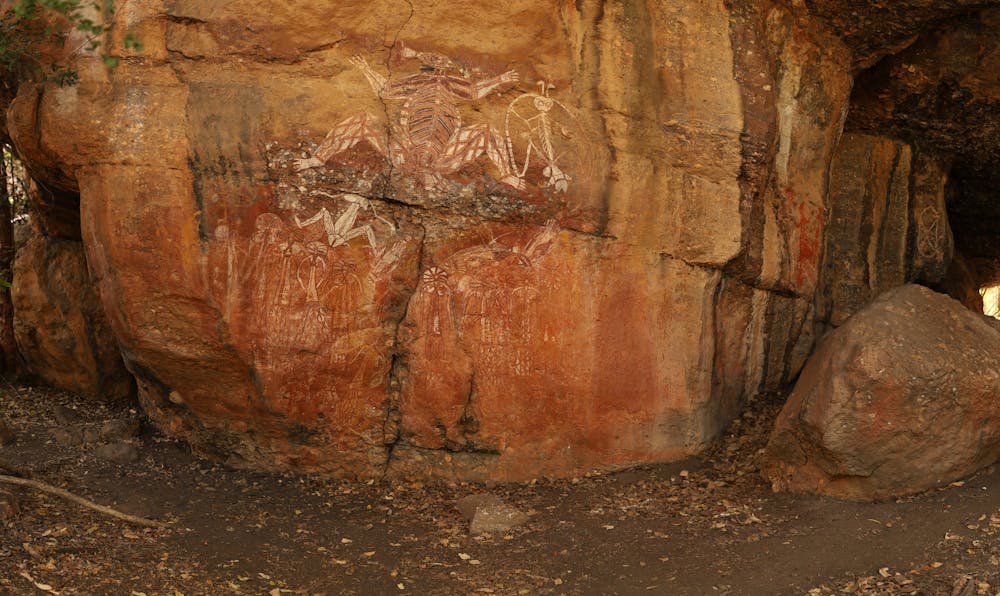
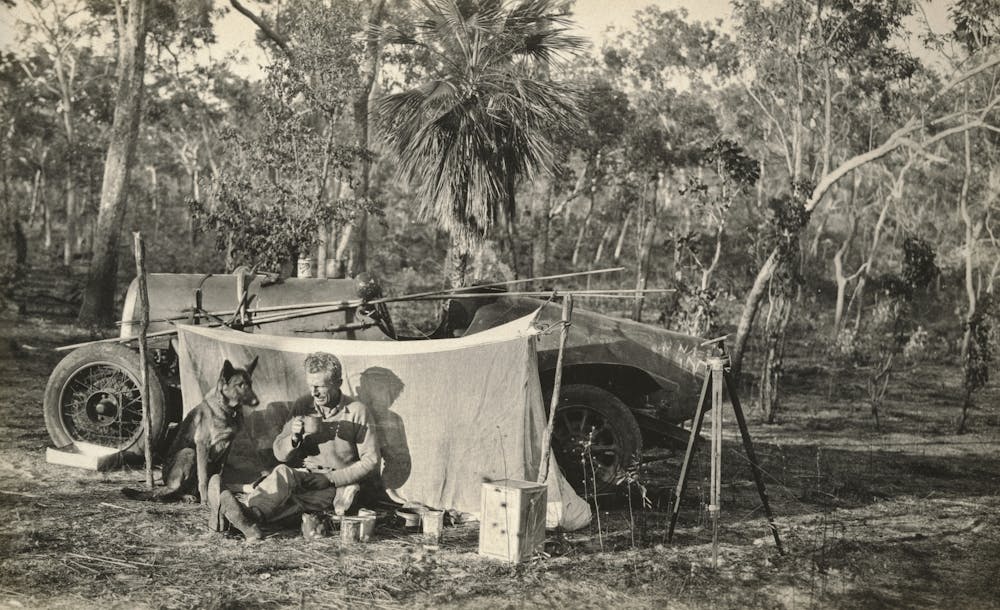
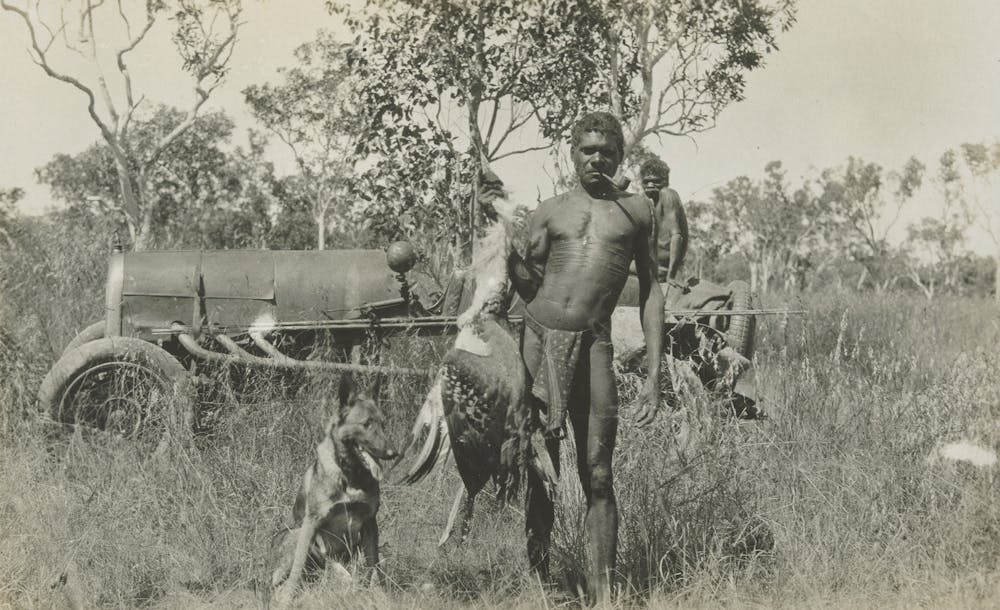










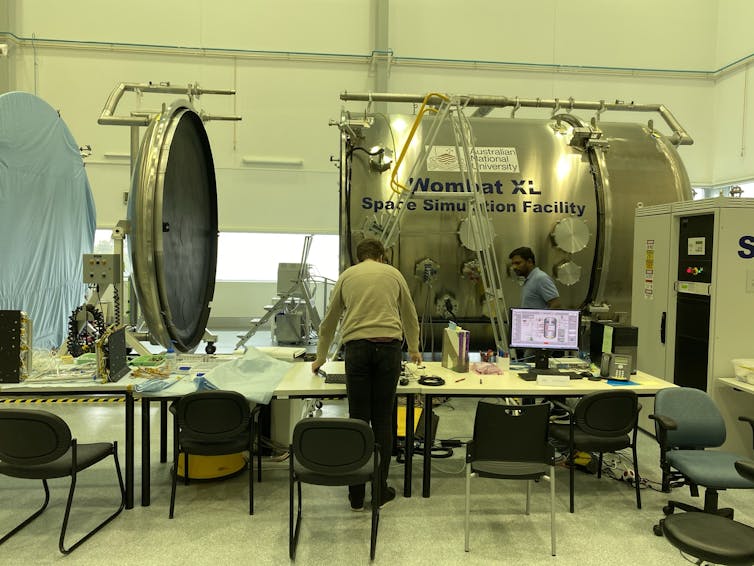





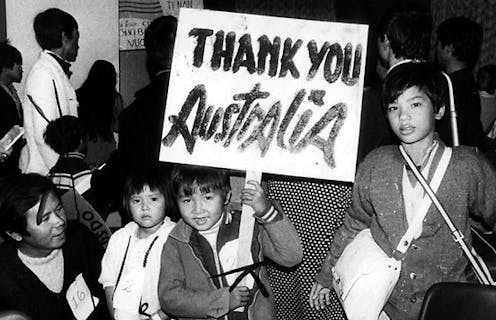
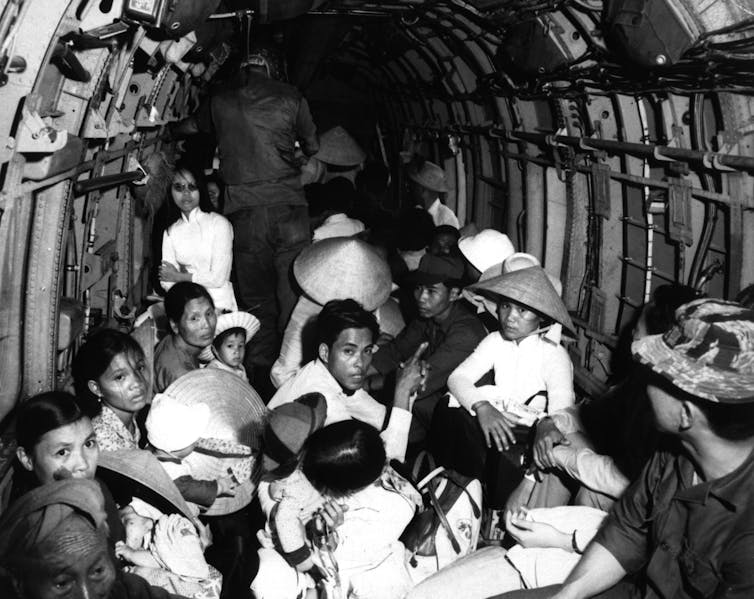
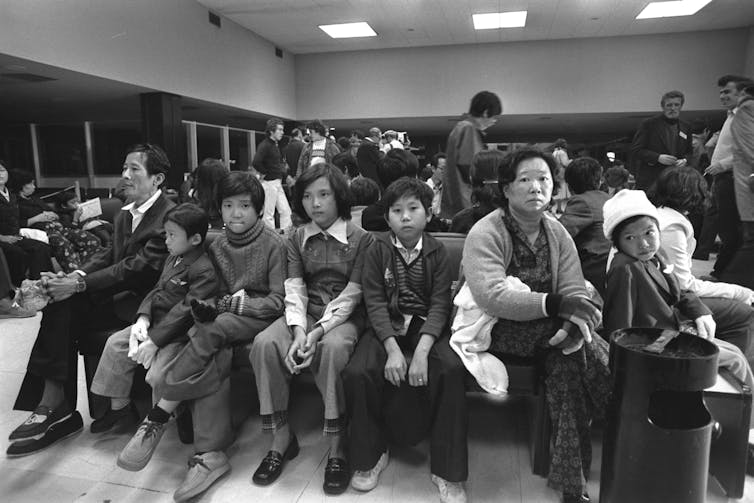




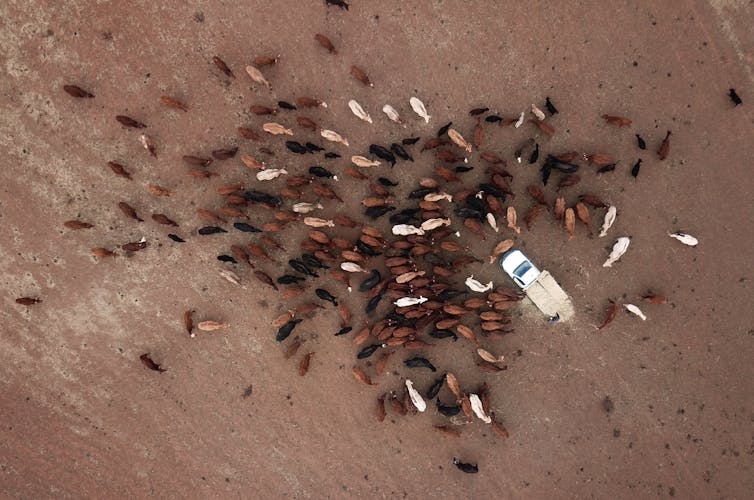

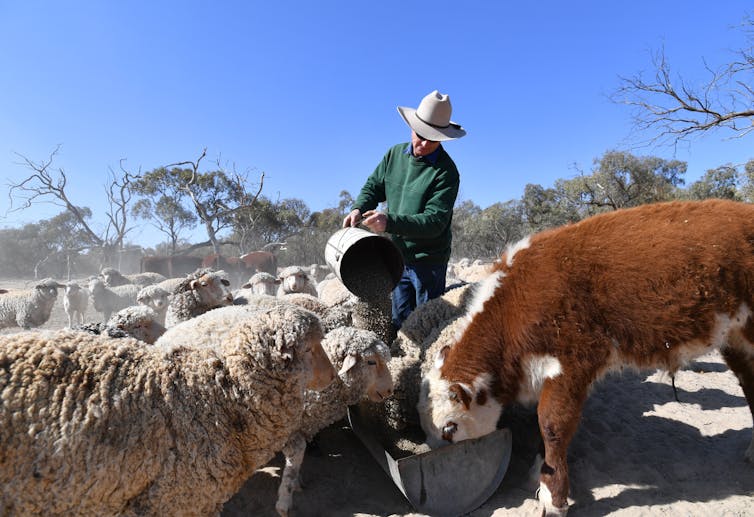
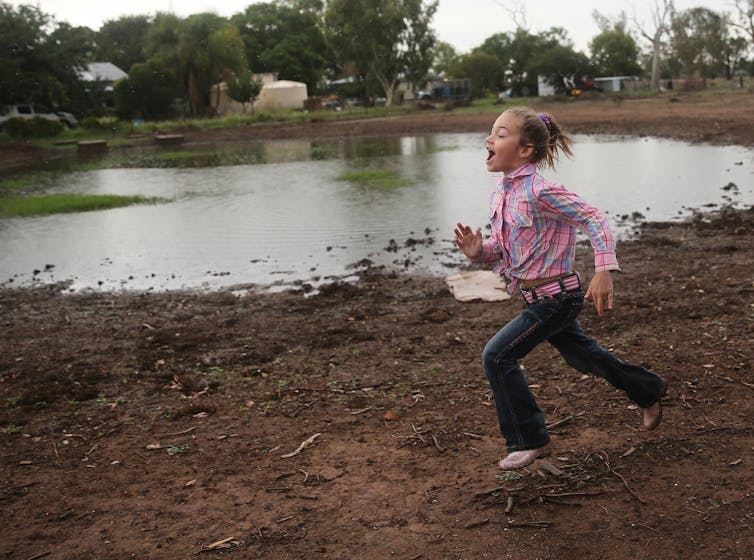









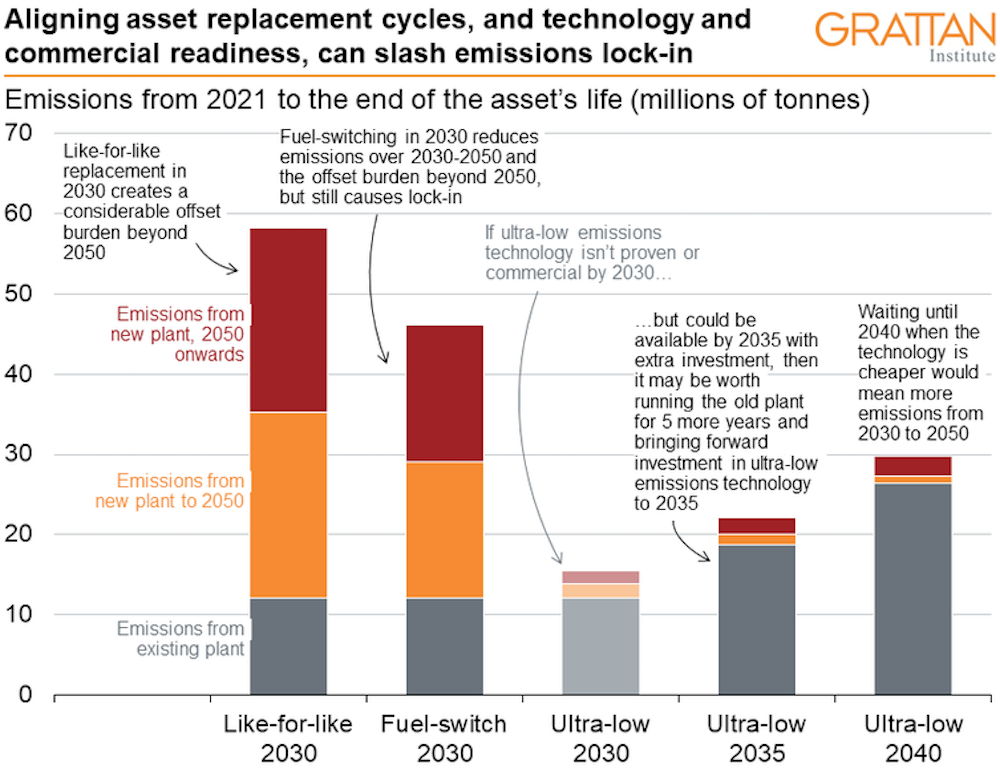



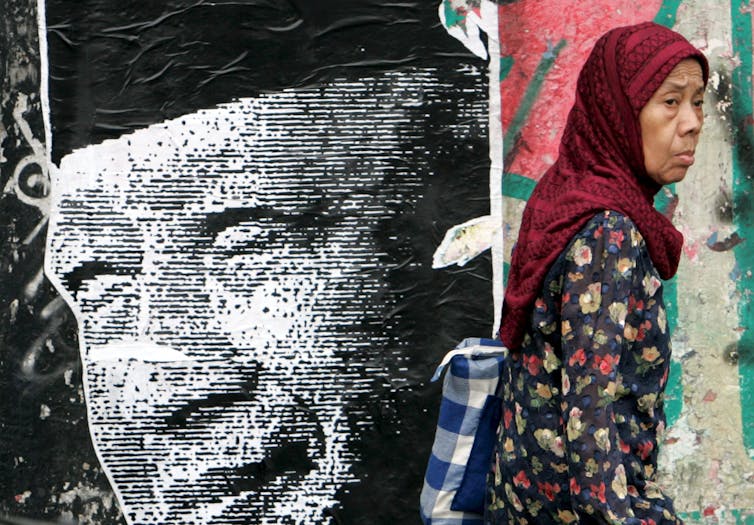

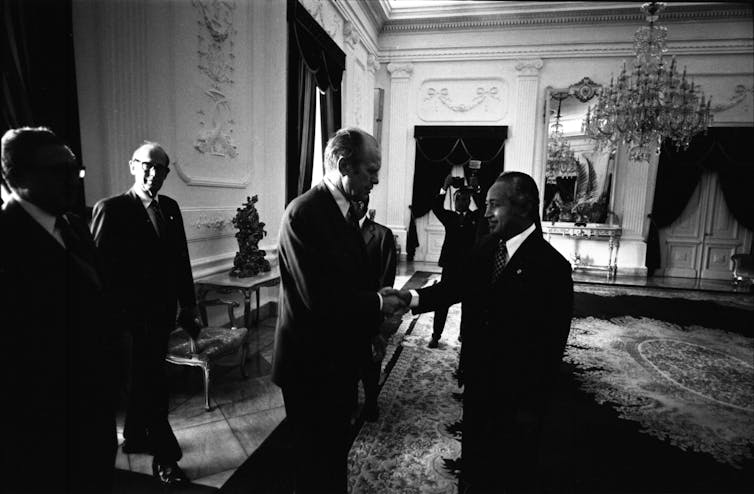







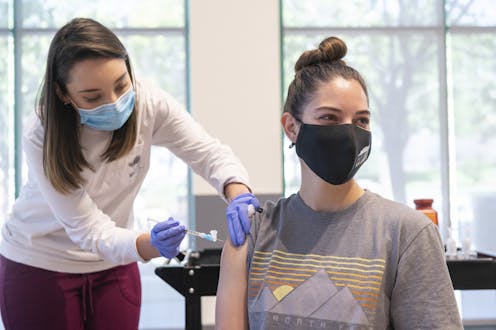



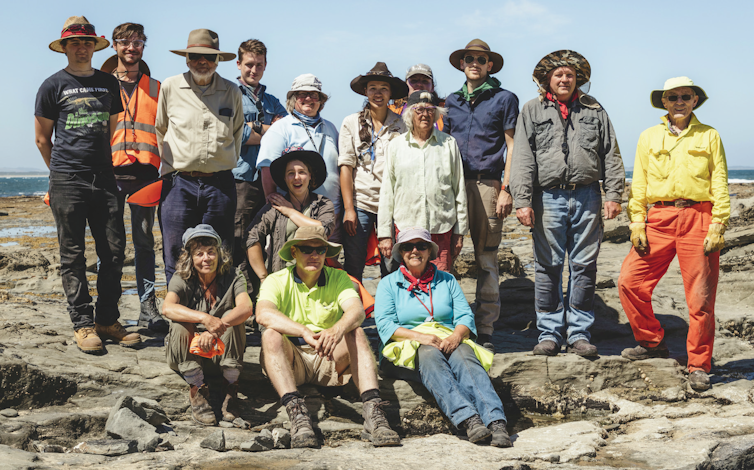




























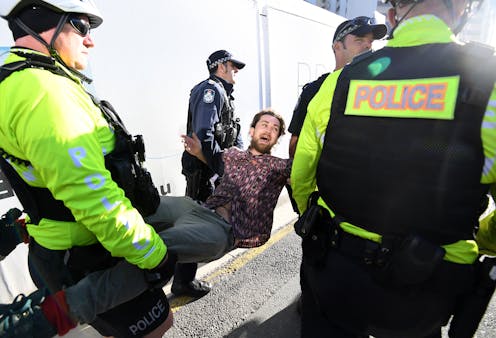
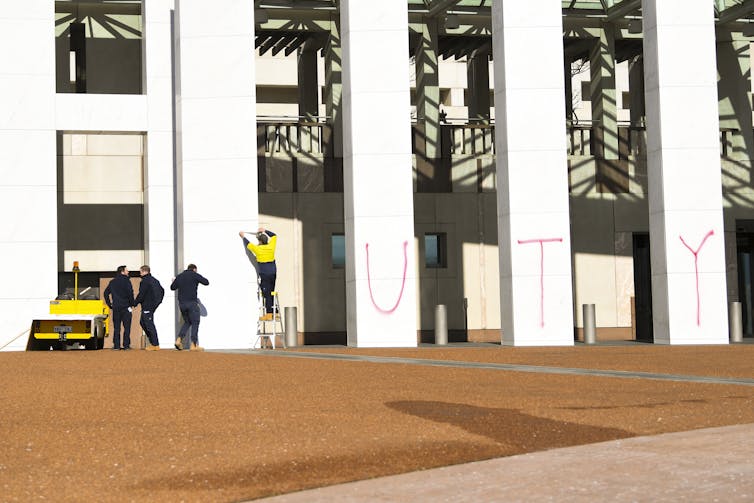
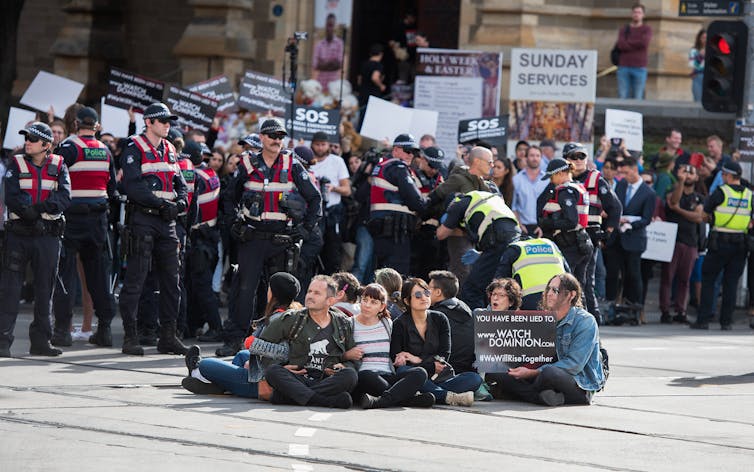
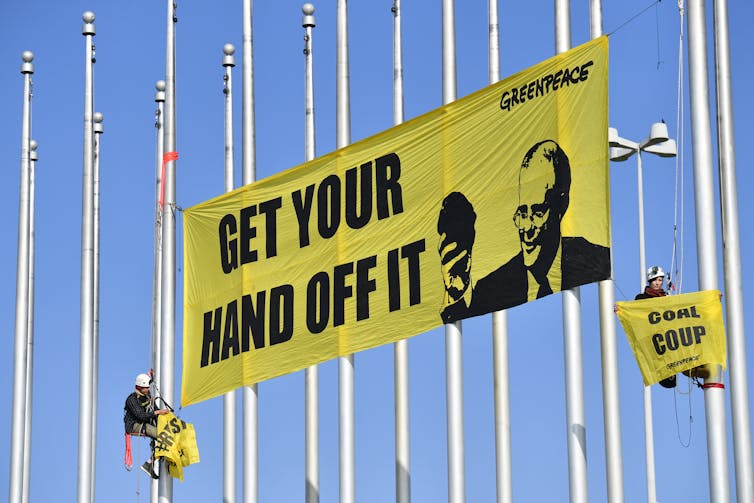




















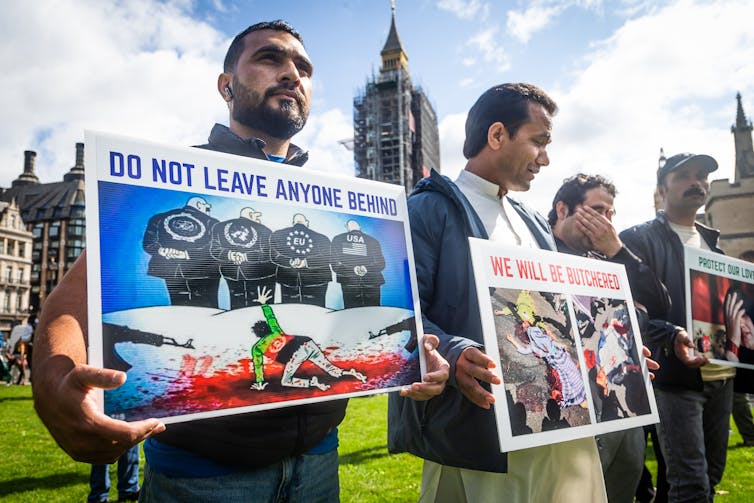


_frontispiece.jpg)