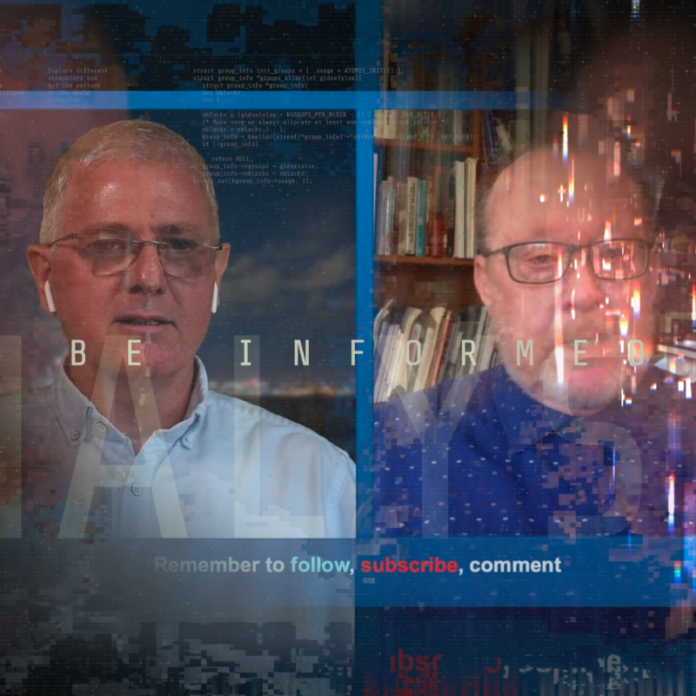
A View from Afar – LIVE @ MIDDAY Thursday September 30: In this podcast, Paul G. Buchanan and Selwyn Manning will analyse the AUKUS Alliance and will deep-dive into:
How the AUKUS Alliance has triggered a geopolitical realignment.
Why has this Anglophone AUKUS alliance formed? And what’s the fallout?
What does China do now?
How will Australia assert itself as the Southern Hemisphere’s military great power?
How does the AUKUS Alliance impact on the applied foreign policies of regional independent nations like New Zealand and indeed the ASEAN economies?
Where to from here for France and Europe, China and South East Asian nations, and New Zealand?
Join Paul and Selwyn for this LIVE recording of this podcast and remember any comments you make while live can be included in this programme.
You can comment on this debate by clicking on one of these social media channels and interacting in the social media’s comment area. Here are the links:
Threat.Technology placed A View from Afar at 9th in its 20 Best Defence Security Podcasts of 2021 category. You can follow A View from Afar via our affiliate syndicators.
Prime Minister of Australia, Scott Morrison. Image by Kristy Robinson / Commonwealth of Australia - CC BY 4.0, https://commons.wikimedia.org/w/index.php?curid=57753091
Analysis by Bryce Edwards.
Political scientist, Dr Bryce Edwards.
New Zealand was said to have been sidelined when the trilateral security pact between Australia, the United Kingdom, and the United States was announced a week ago. But very quickly the “Aukus” pact has taken on an unpopularity in this country, with a consensus forming that New Zealand is best out of the defence arrangement. This is especially due to its centrepiece nuclear submarine plans, which will have huge ramifications for the Asia Pacific region.
The New Zealand Government has been noticeably muted in their response to the arrival of Aukus. Officially the Anglophone initiative is being welcomed, with Prime Minister Jacinda Ardern pointing out that although legally the new submarines won’t be able to enter New Zealand waters, nonetheless “we welcome the increased engagement of the UK and the US in our region”.
I’ve criticised this stance in an analysis column in which I argue that the New Zealand Government should actually be condemning this dangerous warmongering, as such a nuclear and military escalation is not in the interests of New Zealand nor the Asia-Pacific region – see: What happened to the dream of a peaceful nuclear-free Pacific?.
Why is Ardern so soft on the Anglo-militarisation of the Pacific? I argue that “Ardern doesn’t want to get offside and suffer diplomatic consequences. In this regard, she is no David Lange or Norman Kirk. These former Labour prime ministers were at the forefront of the fight against militarism and nuclear technology in the Pacific, and were willing to pay a price to uphold their country’s independent foreign policy.”
I’m not the only one to notice Ardern’s soft approach to the escalation of nuclear and military tensions. Richard Harman says “New Zealand has been absent from any international discussion on the agreement”, and points out that Ardern’s statement was “to partly defend the thinking behind Aukus” – see: Ardern lays it on the line (paywalled).
According to Harman, it’s one thing to say that the subs won’t be able to come here due to the law, but Ardern hasn’t extended this statement to say New Zealand is also “not welcoming them because they represent an international alignment which we do not share.”
Progressive condemnation of Aukus
There’s been very little debate and comment from politicians and political parties. Even the Greens have gone quiet on this. Political activists – even from the peace movement – have been silent or unbothered by the landmark military announcement.
However, one strong voice against it is former Green MP Keith Locke, who penned a scathing analysis of the deal, saying Ardern has welcomed engagement in the Pacific to curry favour with US and allies, but that New Zealanders should be upset by the nuclearisation of our neighbour, pointing out that it’s a slipperly slope towards Australia getting nuclear weapons – see: Many anti-nuclear reasons to oppose Aukus.
Locke says that “New Zealand has long championed nuclear disarmament” and pushed for treaties in the region that prevent nuclear arms and pollution, which he believes are about to be violated by the three Anglophone countries.
Chris Trotter has written two columns warning against New Zealand becoming ensnared in the Anglo alliance of countries that have been illegally waging wars in other parts of the world to ill-effect – see: A coalition of the waning. He says: “Surely, it is time for New Zealand to break free of the imperial project in which it has been enmeshed for the past 181 years?”
But he warns that those in the MFAT and Defence Establishment will be alarmed that this country has been left out of the pact of our traditional allies, and they’ll now be pressuring the Labour Government to get closer to Washington – see: Keep New Zealand Nuclear-Free – stay out of Aukus!.
Similarly, today leftwing political commentator Gordon Campbell says New Zealand is lucky to be outside of the Aukus deal, and will be increasingly seen by other countries as saner in its orientation to China – see: On Canada’s election, and the Aukus defence pact. Campbell believes that the new nuclear subs won’t even be of much use in defending Australasia – they are more of a forward attack mechanism to point against China.
The Herald argues that the motivations behind the defence announcement are more about the three Anglo countries’ domestic politics – it’s about political reputations rather than the public interest. And the paper warns that it pushes Australia and the region closer to war, “and other countries may seek nuclear-powered subs”.
The Otago Daily Times is also unimpressed, suggesting that New Zealand is fortunate not to be involved – see: Scotty’s submarines steaming ahead. The paper also says “it is upsetting to think of nuclear subs operating off our coastline”, and therefore “Former Labour prime ministers Norman Kirk and David Lange, and generations of peace and nuclear-free advocates, will be spinning in their graves at the thought of nuclear subs just across the Tasman Sea.”
Today’s Stuff editorial is also highly negative about the deal, labelling it “a major development with unsettling implications”, and rebutting those that suggest New Zealand needs to now get closer to these Anglo allies – see: Hawkish Aukus not for us.
The prospect of US nuclear-armed subs being hosted nearby is also pointed out by the editorial: “Australia is getting a leg up to receive nuclear-propelled submarines, and is also expected to offer a base for its allies’ own submarines, some of them potentially nuclear-armed, to receive deep maintenance, thereby maintaining a sustained presence in the Indo-Pacific region.”
Aukus presents opportunities for New Zealand
The above Stuff newspaper editorial argues that instead of following the Anglophone’s hawkish approach, New Zealand should be less black and white towards China, “which is to co-operate with China where we can and team up with like-minded democracies to push back where there are disagreements that require it.” Such an approach might well see New Zealand rewarded in trade terms with both China and the European Union.
This is also an argument made by international analyst Geoffrey Miller, who says that countries like New Zealand that are deliberately not part of the aggressive Aukus-style orientation towards China will be rewarded, not just in the Asia Pacific, but also in Europe where Australia’s reputation has been sunk at the crucial time that trade deals are being negotiated with this part of the world – see: New Zealand could be the big winner of Aukus fallout.
Miller argues that the creation of Aukus heralds the establishment of “a new hierarchy when it comes to countries’ views of China” – with the “premier league” of defence hawks including the US, UK and Australia (perhaps also with India and Japan), whereas a “second division includes the EU, Canada and New Zealand, as well as potentially some Southeast Asian countries”. He predicts that New Zealand will sit well within that group of like-minded countries, who will prosper by taking a less confrontational approach to China.
In this, former defence minister Wayne Mapp is quoted saying that Australia will now be applying the pressure: “It’s certain that Australia, at least, will be saying, ‘Well you’re a military ally of ours, what are you gonna do?'”… When you are in a military alliance, it has obligations as well as advantages. There’s no bucking that fact, and we can’t hide behind the nuclear-free thing and say, ‘Oh that answers everything’. It doesn’t.”
Pressure to spend much more on defence equipment will be one specific outcome. Mapp points to the need for new frigates to match those of Australia: “This particular [Aukus] announcement will put quite a bit of pressure on the New Zealand Government to make it clear how they’re going to replace the Anzac frigates, because they can’t wish that decision away.”
There’s a growing consensus that the arrival of Aukus means that an Anglo-Chinese military confrontation is much more likely than before. And the Herald’s Audrey Young has looked at what this escalation might mean for New Zealand, and in particular whether this country would be expected to contribute militarily to the US-led side – see:Preparing for war between US and China – what it means for NZ and Australia (paywalled).
In this, Young makes it clear that if New Zealand chose to stand aside from the US, failing to endorse its military and diplomatic strategies, there would be trouble: “What New Zealand says matters in terms of allegiances, because as a small country with relatively little economic or military strength, its voice is often its biggest contribution. Hence the pile-on when it takes a different position to its larger friends.”
Although this article contains the expected condemnation of New Zealand from Australia, it does raise legitimate concerns about New Zealand no longer having defence interoperability with Australia. In particular, the question is asked: how can New Zealand rely on its biggest defence ally, Australia, coming to its defence in the future when its nuclear-propelled vessels won’t be allowed into local waters?
News of Melbourne’s earthquake today made my left leg hurt. That’s the leg I nearly lost.
On February 22 2011, there were nine of us on a red bus from Sumner to Canterbury University in Christchurch. At 12.51, the unreinforced brick facade of 605 Colombo Street crushed our bus and four pedestrians. I felt brick after brick land on my left hip, and wondered how long I would last.
I’m the only one left — the lucky thirteenth.
I was taken to hospital on the back of a stranger’s truck. I broke more bones than the surgeons were willing to count, spent two months in hospital, and six months off work. More than a decade later, I feel the earthquake in every step.
During that earthquake, 16 people were killed just on that one block of Christchurch’s main street. Melbourne and country Victoria are full of places just like it, with brick facades, parapets and gables.
It wasn’t the earthquake that killed everyone but me on that bus. It was the building, its lack of regulation, lack of structural support, and lack of a fence. It wasn’t just bad luck.
Emergency workers on Colombo Street in the aftermath of the 2011 earthquake. Mark Baker/AP
Changing New Zealand’s Building Act to prioritise “fally-offy bits” of buildings was not in my life plan. But extraordinary events can change ordinary life plans. So when I got out of hospital, I set my ordinary environmental work to the side, and took a couple years to brush up on seismology, earthquake engineering, and the seismic safety of buildings.
Five years later, the NZ Parliament ratified the “Brower amendment” to the Building Act to prioritise fixing unreinforced brick decorative bits of buildings. And now I’m asking Victoria to please learn from your Kiwi cousins.
Earthquakes don’t kill people; buildings do. And those lovely decorative bits of buildings are the first to fall, even in relatively mild earthquakes like the ones Victoria gets from time to time.
After Christchurch, New Zealand learned our lesson and reformed our building legislation. Victoria can skip the truly painful part of the lesson — the deaths and injuries in the streets — and skip straight to the legislative reform.
The smart thing to do is create a separate category for non-structural unreinforced masonry: parapets (the small decorative extension at the top of a wall), gables and chimneys. This is a good idea because:
they are the cheapest to fix
they are the first to fall
they are the deadliest when they do.
A parapet is the decorative extension at the top of a wall, often found on top of buildings. Shutterstock
It makes sense to pick the low-hanging fruit first. It will greatly improve the safety of Victoria’s streets without costing an arm and a leg – literally or figuratively.
Here, the Canterbury Earthquakes Royal Commission recommended it. And GNS Science calls parapets, gables and chimneys “dangerous”, even in cities with low earthquake risk, such as Auckland, Dunedin and Melbourne.
The building that collapsed on our bus was expected to fall. Everyone knows unreinforced bricks fall. To me, the most predictable losses are the least acceptable. This is especially true when the methods of prevention are as known and straightforward as securing a parapet to the building’s structural core.
Fixing the parapets first has the highest ratio of safety gains to cost. There is no complicated inspection required. Parapets do not hold the building up.
Attaching them securely is less disruptive to the activity inside the building than replacing them entirely. That said, they could easily also be replaced with lighter, less deadly materials, as is often done in California.
The building that collapsed onto us was worth NZ$30,000 (A$29,000), according to its 2007 government valuation. The Royal Commission heard that attaching the front facade to the building would have cost NZ$200,000 (A$194,000).
By my calculations, saving my left leg cost taxpayers about half a million dollars.
Fixing parapets, gables and chimneys first is also equitable. Unreinforced masonry buildings pose a greater public danger to passers-by than other types of quake-prone buildings that risk collapsing inwards. Placarding the buildings will do nothing for those in the street and on the footpath.
Allowing the parapets to persist unattached benefits only the owner. The risks, meanwhile, are transferred to the public, and onto the public health system if an accident happens.
Fixing the most dangerous and least expensive bits first is also a cost-effective way to preserve heritage buildings. Fixing the fally-offiest bits might render unnecessary the full building strengthening, and might prompt owners to spend the money now rather than in several decades’ time when the entire building needs repairs.
I am not saying all buildings in Victoria or Melbourne should be whizz-bang “earthquake-proof” like those in Tokyo or San Francisco. I am recommending cheap, effective fixes to the bits of buildings that are easiest to fix, and deadliest if you don’t.
I treasure my left leg, scars and all. But please, Australia, learn from your Kiwi cousins.
This article is adapted, with permission, from a 2017 article that originally appeared in the journal Earthquake Spectra.
Ann L Brower does not work for, consult, own shares in or receive funding from any company or organization that would benefit from this article, and has disclosed no relevant affiliations beyond their academic appointment.
A magnitude 5.8 earthquake has struck about 115 kilometres east of Melbourne in Victoria, causing damage to buildings and forcing residents to evacuate across the city. The quake, which started near Woods Point at a depth of 12km, was also felt in Sydney, Canberra, Adelaide and even as far as Launceston, Tasmania.
I and the co-author of this article, Dee Ninis, work as earthquake scientists at the Seismology Research Centre. Researching earthquakes is our life’s work. Here’s what you need to know to understand why today’s earthquake happened, and the geological conditions that triggered it.
Where was it exactly?
On-ground sensors distributed by the Seismology Research Centre have confirmed the earthquake was of a 5.8 magnitude, with an epicentre about 60km south-east of Mansfield in Victoria. The preliminary focal mechanism of this earthquake is strike-slip, meaning the rocks likely slid past each other laterally on what is probably an east-west oriented fault.
The earthquake was felt across the region at around 9.15am today. Geoscience Australia had received 32,409 felt reports as of when this article was published. Screenshot/Geoscience Australia
Australia experiences fewer earthquakes than plate boundary regions, such as New Zealand. Many of Australia’s suspected neotectonic faults (faults which have hosted earthquakes in recent geological times) have not been thoroughly investigated, commonly due to lack of funding and resources for earthquake research.
However, earthquakes basically happen for the same reason in Australia as they do in New Zealand: there is a buildup of elastic strain energy in the crust, which eventually needs to be released. And most of this energy release occurs due to the rupture of weak zones in the crust, called faults.
Geoscience Australia hosts a database of what we think might be active faults across Australia, but few of these faults have been studied on the ground.
Most of the neotectonic faults near today’s earthquake were identified from remote elevation data — and this alone doesn’t reveal information such as when, how big and how often previous earthquakes on these faults occurred.
What we look for here is displacement at Earth’s surface, formed by movement during previous quakes. Such displacement is only caused by moderate to large earthquakes relatively close to the surface.
If it’s deep enough, it’s entirely possible for a quake to happen at a fault that never ruptures the surface — so we can’t see evidence for it. At a magnitude of 5.8 and a depth of 12km, we don’t expect today’s event to have an associated surface rupture, although it is remotely possible.
The Conversation’s readers sent in their accounts of the earthquake, which was felt across Melbourne’s suburbs. The Conversation
Is this an unusual event?
While some early reports suggested today’s earthquake was the “largest on-land earthquake in Australia since 1997”, this isn’t the case. Australia has an earthquake of magnitude 6 or higher every six to ten years, on average. That’s based on an instrumental record going back about 150 years.
The 2016 Petermann Ranges earthquake in the Northern Territory was a magnitude 6.1 quake. And while Australia is not a tectonic plate boundary, it is still quite seismically active.
This morning’s earthquake was the largest onshore quake ever recorded in Victoria. Other recent earthquakes include two magnitude 5 quakes: one in 1996 near Mt Baw Baw, and one in 2012 near Moe.
But just because we haven’t seen such a high-magnitude earthquake in our time doesn’t mean they don’t happen. For instance, there is geological evidence for a possible magnitude 7 earthquake occurring sometime between 70,000 and 25,000 years ago, on the Cadell Fault near the Victorian town of Echuca.
Earthquakes are more intense and frequent in plate boundary regions. The Pacific plate boundary, which passes directly through New Zealand’s South Island, lies to Australia’s east.
But despite this — and although the tectonic deformation rates across Australia are lower than the deformation rates at plate boundary regions — Australia has seen earthquakes in places you wouldn’t expect (unless you’re an earthquake scientist).
For instance, the Tennant Creek earthquake sequence in 1988 saw three separate shocks erupt within 12 hours, with magnitudes of 6.2, 6.3 and 6.6 (the main shock).
What about aftershocks?
Several aftershocks followed the main event this morning, some occurring within the hour. In an earthquake sequence, an “aftershock” is defined as an earthquake that’s smaller than and which follows the main shock. The strongest aftershocks come soon after the main event and slowly taper off.
We do expect the region around today’s earthquake epicentre to remain active, and we will probably have more felt events in the next few days. In fact, we would expect aftershocks to continue up to decades afterwards, although through time most of these will become too small to be felt (the Tennant Creek earthquake sequence of 1988 is still ongoing).
If, under unfortunate circumstances, we experience an even larger earthquake soon — then that will become the main event, and the quake from this morning will be designated a “foreshock”.
So we all have to stay alert. Even if the aftershocks aren’t as intense in magnitude, smaller quakes can still be incredibly damaging depending on their depth and location. In the 2011 Christchurch disaster, it was an aftershock of magnitude 6.3 which wreaked the most havoc, and led to many people’s deaths.
How to prepare?
In terms of personal safety, the best thing to do during an earthquake is drop to the ground, take cover and hold on. If you’re inside a house or other building, try to crawl under something sturdy to protect yourself, such as a solid table. This will help save you from anything that might fall.
If you experience a quake while you’re outside, make sure you’re as far away from buildings and other structures as possible, as these too can fall on you. You need to be in an open area. Victoria’s State Emergency Service has more recommendations on what to do, including:
staying away from glass, windows, outside doors and walls and anything that could fall such as lighting fixtures
not using a doorway unless you know it is strongly supported and is close to you
keeping in mind the electricity may go out, and sprinkler systems or fire alarms may turn on.
Finally, if you’re considering any activities that might put you at risk, such as roofing, gutter cleaning, and other activities that involve the use of ladders, it is prudent to reconsider whether these are essential in the short term.
Acknowledgment: this article was co-authored by Dee Ninis, who works as an earthquake geologist at ESS Earth Sciences’s Seismology Research Centre based in Richmond, Victoria.
Mark Quigley receives funding from The Australian Research Council. He is affiliated with the Seismology Research Centre in Richmond, Victoria, Australia.
Tom Roberts, A break away! (1891) Art Gallery South Australia
Aboriginal and Torres Strait Islander people are advised this story contains images of people who have died.
Review: The Brumby Wars by Anthony Sharwood (Hachette)
You know you are in for a wild ride when the least controversial element of a book is the suggestion “the man” in Banjo Paterson’s 1890 poem The Man from Snowy River is Indigenous.
Anthony Sharwood’s The Brumby Wars argues a compromise must be found, which recognises the sentimental attachment of many to wild horses, while acknowledging the damage they do to the environment. Much of this sentiment, he writes, comes from the enduring place of Paterson’s poem in our national consciousness. And so what if, as he suggests, the man turned out to be Indigenous?
To ask this question, Sharwood convincingly reexamines the poem in the light of Indigenous stockmen in the area at the time.
But this is just a minor question in his book. The real heat in it is between those who view the wild horses of the high country as national symbols and those who see them as destructive pests.
As Sharwood perceptively notes, Barilaro worked to broaden the appeal of the high country by citing its role in multiculturalism through the Snowy River scheme. Descendants of these immigrants, according to Barilaro, demonstrate the ability of the land to absorb “introduced species”.
If “the man” was a First Nations person, then Paterson’s poem could be reworked to “prove”, these nationalist myths have always represented “all of us” — despite the poem’s first appearance in an outlet (The Bulletin) with “Australia for the white man” as a banner.
Those attached to the wild horses often cite their relationship to “Australian legend”, the lynchpin of which is Paterson’s poem.
Sharwood’s argument relies in part on the first lines of the poem’s final stanza:
And down by Kosciusko, where the pine-clad ridges raise
Their torn and rugged battlements on high…
These are not the rounded hills of Thredbo, but the more precipitous pine country of the Byadbo wilderness further south. In this region, the Ngarigo and Djiringanj groups produced significant numbers of Indigenous stockmen who, in joining the nascent mountain economy, protected their people at least to some degree.
Names remembered include Jack Hoskins and Bobby Mundy, who would catch wild horses and drive them to Tathra.
Sharwood is not the first to suggest “the man” may have been Indigenous. As he notes, it dates back at least as far as an article in the Canberra Times in 1988, where the State Historian of Victoria, Bernard Barrett, suggested Paterson may have been influenced by a story written by a high-country bushman C.W. Neville-Rolfe and published in Cassell’s Picturesque Australasia in 1887.
Aboriginal people often worked as stockmen at the time of Paterson’s poem, as in this 1893 photograph. National Museum Australia
In Neville-Rolfe’s story it is Toby, a young Indigenous man, whose excellent riding and bush skills allow him to locate and capture wild horses.
A more sustained effort to find the true identity of “the man” was W.F. Refshauge’s 2013 book Searching for The Man from Snowy River. Refshauge’s most convincing candidate is Charlie McKeahnie, the subject of a very similar poem by Paterson’s friend Barcroft Boake, On the Range, published in The Bulletin in 1891.
In Boake’s poem, young Charlie Mac chases a wild horse known as “The Lord of the Hills”. Unlike Paterson’s poem, On the Range ends in tragedy. The Lord of the Hills refuses capture and servitude, instead dashing his body against a granite outcrop and dying.
National myth-making
Would it matter if definitive proof emerged that Paterson had a First Nations stockman in mind when he wrote the poem?
It would at least make visible the deeply buried assumption the man was white – so deeply buried, interpretations of the poem never mention it.
It would be interesting to consider how the 1982 movie would have been received if Tommy Lewis or David Gulpilil, rather than Tom Burlinson, had the lead role.
But readers of the 1890s might have been less surprised: Indigenous horse skills were widely acknowledged and admired in the form of buckjumping contexts and bush shows.
In Paterson’s poem the ‘wild’ element is the horse. Christine Mendoza/Unsplash
However, the suggestion “the man” was Indigenous would also open up an odd problem in nationalist mythology. Colonial logic advances the grand project as “taming” the country, but in Paterson’s poem the “wild” element is the horse — an introduced species.
That the horse is an introduced species can be elided in the service of national mythology, but if the “tamer” is Indigenous, any semblance of a fixed colonial logic breaks down.
The Brumby Wars shows how colonial myths of freedom and adventure in the high country are never fixed.
A difficult legend
The Brumby Wars explores the tension between those who value the environment of the high country millions of years in the making, and those who champion a myth less than 200 years old. Sharwood expresses deep sympathies with the first party, yet recognises there is no easy solution to this problem – politics aside, any method to rid the mountains of brumbies will be cruel.
The complexities of the issue are covered with enormous insight in The Brumby Wars, which is by turns anecdotal, philosophical and ecological in expression.
Paterson may well have had daring Indigenous riders in mind when he wrote The Man from Snowy River. If proof emerged this was the case, would it help Australia towards new myths of nation or would this fact be ingested smoothly by adaptable older myths?
Simon Ryan does not work for, consult, own shares in or receive funding from any company or organisation that would benefit from this article, and has disclosed no relevant affiliations beyond their academic appointment.
Source: The Conversation (Au and NZ) – By Ana Estefanía Carballo, Research Fellow in Mining and Society, School of Geography, Earth and Atmospheric Sciences, The University of Melbourne
Thousands of demonstrators rallied across the Serbian capital Belgrade this month, protesting the US$2.4 billion (A$3.3 billion) Jadar lithium mine proposed by global mining giant Rio Tinto. The project, Rio Tinto’s flagship renewable energy initiative, is set to become the largest lithium project in the European Union.
Lithium is a crucial component of energy storage, both for renewable energy technologies and electric vehicles. Forecast demand has prompted efforts by companies and governments worldwide to tap into this market – a scramble dubbed the “white gold rush”.
As lithium projects have multiplied across Australia, Europe, Latin America and the US in recent years, so too have concerns over their environmental and social impacts. Communities near proposed and existing lithium mines are some of the loudest opponents. In a town near the proposed mine in Serbia, a banner reads: “No mine, yes life”.
Lithium extraction serves legitimate global environmental needs. But the industry must not ignore local social and environmental risks, and community voices must be included in decision making. The harsh lessons of mining to date need not be learned again in new places.
Weighing the risks
According to the latest estimates, the world’s resources of lithium sit at 86 million tonnes, a number that continues to grow as new deposits are found every year. Australia is the main producer of lithium, where it’s mined from hard rock called “spodumene”. The largest deposits are found in South America, where lithium is extracted from brines underneath salt flats.
Lithium mining operates beneath the salt flats in the Atacama, Chile. Shutterstock
In many cases, lithium mines are relatively new operations, yet complex and adverse social and environmental impacts have already been observed. More research and better targeted policy are needed to help understand and manage the socio-environmental impacts.
The Jadar lithium project is operated by Rio Sava, a subsidiary of Rio Tinto. It’s expected to become one of Serbia’s largest mines, occupying around 387 hectares, and contribute to at least 1% of Serbia’s GDP.
An environmental impact study commissioned by Rio Tinto, and obtained by Reuters, found the project would cause “irredeemable damage” to the environment, concluding the project should not go ahead. Environmental impacts are expected for any mine proposal. Yet some are manageable, so such a grave assessment in this case is not encouraging.
The extent to which a project shows best practice in mine management can depend on pressure from communities, investors and governments. Promises to adhere to all regulations are a common response from the industry.
But as we’re seeing in Chile, significant environmental damage and socio-environmental impacts can still occur within established regulations. Here, communities living on the salt flats are concerned about the effect of removing groundwater for lithium extraction on their livelihoods and surrounding ecosystems.
The communities fear the potential risks of air and waterborne pollution from the lithium mine, destruction of biodiversity, and the loss of land to mine infrastructure. These risks could affect the livelihoods of local landholders, farmers and residents.
Of particular concern is that the proposed locations for mine waste (tailings) are in a valley prone to flash flooding and may lead to toxic waste spills. This previously occurred in the same region when the abandoned Stolice antimony mine flooded in 2014. Rio Tinto has said it will try to mitigate this risk by converting the liquid waste into so-called “dry cakes”.
In response to this article, a Rio Tinto spokesperson said it has been working through the project requirements for 20 years, with a team of over 100 domestic experts studying the possible cumulative impacts in accordance with Serbian law, adding:
The study will consider all potential environmental effects of proposed actions and define measures to eliminate or reduce them […] including water, noise, air quality, biodiversity and cultural heritage.
Can we decarbonise without sacrifice?
The Jadar Mine project is touted for its potential to bring significant profits to both Rio Tinto and the Serbian state, while helping usher in the era of decarbonisation.
Rio Tinto plans to begin construction by 2022, “subject to receiving all relevant approvals, permits and licences and ongoing engagement”, with first saleable production expected in 2026.
But relatively fast timelines like this can sometimes be a sign of regulatory governance instability, including weak regulatory frameworks. We have seen this in Guyana, Peru and Brazil.
In Australia, Rio Tinto’s recent destruction of the culturally invaluable Juukan Gorge — which, notably, occurred legally — also demonstrates regulatory governance risks.
Jadar River Valley in western Serbia, home to a huge deposit of lithium. Shutterstock
Rio Tinto’s spokesperson said its Environmental Impact Assessment process includes a public consultation period including, for example, meetings with non-government organisations, adding:
We have established information centres in Loznica and Brezjak and, since 2019, have hosted over 20 public open day events in these centres focusing on aspects of the project including environment studies, cultural heritage and land acquisition.
Although the Serbian government indicated that it’s prepared to hold a referendum to find out the will of citizens about the Jadar mine project, the community protests suggest the project hasn’t obtained any social license to operate.
A “social license to operate” is, despite its corporatised name, increasingly key to sustainable or responsible mining projects. It centres on ongoing acceptance by stakeholders, the public, and local communities of a company’s standard business practices. Building such trust takes time, and a social license is only a minimum requirement.
These processes cannot be rushed to ensure voices are heard, rights are respected, and environmental protection is possible.
Lithium is essential for the transition away from fossil fuels, but it shouldn’t come at any cost. Shutterstock
A new frontier
Like many other communities negotiating proposed mine projects, local communities and residents in Serbia should not become another zone of sacrifice, shouldering the socio-environmental costs of supporting a renewable energy transition.
Lithium deposits are often seen as “new frontiers” in the places they’re discovered. Yet we must learn from historical lessons of frontier expansion, and remember that places imagined as “undiscovered” aren’t actually empty.
The people who live there must not bear the brunt of a so-called “green” future.
An earthquake that struck near Melbourne today is one of the largest in Australia since instrumental seismic records began. However, the geological record of ground-breaking fault ruptures tells us much larger earthquakes have occurred across the continent. Some of these earthquakes would have been witnessed by Australia’s Indigenous peoples.
Several quakes were felt near Melbourne today, the largest of which was recorded at a magnitude of 5.8. A magnitude 4.7 aftershock happened about 15 minutes after the main shock, which was at 9:15am local time. A typical aftershock sequence could go on for weeks to years. Aftershocks went on for about 40 days following the Thorpdale, Victoria earthquake of magnitude 5 in 2021.
In Australia we get magnitude 5.8-6.0 or greater earthquakes, on average, once every four to 20 years. The highest since instrumental records began in Australia was the magnitude 6.6 quake in the Western Australia town of Meckering in 1968.
Earthquakes are considered a low probability, high consequence hazard — the rate of earthquakes is low compared to our seismically active neighbours in New Zealand, PNG, and Indonesia, but we have vulnerable infrastructure such as unreinforced masonry buildings that present a risk.
Near Uluru in 2016, there was the Petermann earthquake, which had a magnitude of 6.1.
The largest in the record since instrumental records began in Australia was in 1988; it was part of the Tennant Creek series of quakes in the Northern Territory, and that was magnitude 6.5.
Then there was the aforementioned one in 1968 in the WA town of Meckering; that was 6.6.
But the geological record tells us we have had earthquakes in Australia’s deeper past that were much, much larger — possibly up to magnitude 7.0 and beyond.
The energy released by a magnitude 7.0 quake is 32 times larger than the energy from a magnitude 6.0 quake.
For each one point up the scale, the amount of energy released is about 32 times greater.
Why are quakes of this strength not common in Australia?
Compared with places like New Zealand and Indonesia, large quakes are not common in Australia. That’s because Australia is in the middle of a tectonic plate so what we call the “strain rate” — the rate at which energy builds up due to plates pushing against each other — is slow.
Indonesia is on a plate boundary, so the strain rate — the rate at which the Earth is being deformed — is much higher. That energy is released mainly through earthquakes.
Even though Australia is in the middle of a plate, strain can nevertheless build up over time — and eventually needs to find release.
Australia is moving northwards as part of the Indo-Australian tectonic plate, which is colliding with the plate near PNG and Indonesia, and that is pushing back — building up strain. New Zealand is also imposing a force onto the Australian plate.
A quake like today’s would normally cause a lot of damage
A magnitude 5.8 earthquake is a big deal. If such a quake occurred directly under one of our major cities, we could expect billions of dollars of damage and fatalities.
In many parts of Australia, such as Melbourne, earthquakes are felt at greater distances than in countries like New Zealand, because our crust is stiffer. Seismic waves travel more efficiently through Australian crust.
In Melbourne, the soft sediment south of the CBD and in other areas likely caused the seismic waves to slow down but also amplify. The seismic waves get bigger and can cause more damage when they are in soft sediments.
The scenes of toppled brickwork reflect the seismic energy that has travelled quite effectively 130km from the source of the tremor (which is reported to be near Mansfield).
They have almost certainly been amplified by the soft sediments, and the direction of the waves may make certain buildings more vulnerable than others.
Crucially, Melbourne has many buildings that are highly vulnerable to quake shaking: buildings with big overhangs, buildings that are unreinforced, or those that have been weathering away for decades without repair.
The sort of shaking that wouldn’t cause damage in other locations is causing damage in places like Melbourne.
The New South Wales and Victorian governments have released detailed roadmaps outlining how they’ll ease restrictions across Sydney and Melbourne.
A feature of both roadmaps will be the requirement to be fully vaccinated to do certain things like gather with larger groups of friends or enter venues including hairdressers, hospitality, gyms and entertainment.
This raises several considerations, including whether staff have to be vaccinated, and how staff will check people’s COVID vaccination status, enforce the rules, and deal with abuse hurled at them by non-compliant customers.
How does it work overseas?
In three major US cities — San Francisco, New Orleans, and New York City — you must be vaccinated to visit indoor public spaces like restaurants, cinemas and gyms.
In New York City, non-compliant businesses can get significant fines if they let in unvaccinated people, up to US$5,000 (A$6,900).
In France, people must be fully vaccinated (or have a negative COVID test, or be able to prove they’ve recovered from infection) to attend restaurants, bars, museums, cinemas and large public gatherings. A similar pass has been introduced in Italy and Ireland.
In comparison, the requirement for venues to check COVID vaccine status (or a negative test) in the UK is still currently left to the discretion of the individual business.
While details are yet to be provided about the implementation of this requirement in Australia, penalties may be included for businesses that refuse to comply. NSW Customer Service Minister Victor Dominello recently indicated NSW pub owners who refuse to check the vaccination status of customers could face heavy fines.
Enforcing COVID rules comes with risk of abuse
It’s lawful for a business to refuse entry to people who don’t have a COVID certificate, in the same way they can refuse entry to an intoxicated person — to protect staff and the rest of the patrons.
Some people may feel aggrieved by the prospect of being excluded from businesses because they’re not vaccinated and assert this is “discriminatory”. However, they’re using the term in a colloquial rather than legal sense — vaccination status isn’t a protected attribute covered by discrimination law.
Legal considerations aside, the practical issue of enforcement falls to businesses.
Recently in New York City, a restaurant hostess was punched repeatedly after asking a group of patrons to show proof of vaccination.
In the UK, some businesses have faced horrible abuse via social media for requiring evidence of COVID vaccination status from patrons, including death threats.
A survey of US service workers conducted by One Fair Wage reported 80% had seen or experienced hostility including racism and sexual harassment from customers while enforcing public health rules during the pandemic.
Staff left on their own to figure out enforcement
In these situations, businesses have had to figure out how to enforce the requirements and how to respond to the angry customers who push back.
If they enforce the rules, they risk harassment and lost tips. But if they overlook unsafe customer behaviour, they risk further COVID transmission.
If these experiences are replicated in Australia, it will give rise to serious work health and safety issues for staff enforcing COVID mandates.
Employers will need to take reasonably practicable steps to minimise the risk to staff from such abuse. This could include hiring security guards, or implementing duress protocols or training in de-escalation techniques. What’s reasonably practicable will vary with the nature and size of the business. Employers should consult with staff on the implementation of such measures.
Some employees or unions might also argue enforcement of COVID mandates falls outside the scope of their role, and should be done by properly trained security professionals.
Employers may need to expand the set of duties on job descriptions to include COVID mandate enforcement.
Such a contractual variation can’t be imposed by the employer unilaterally. Industrial instruments under the Fair Work Act such as enterprise agreements, might also restrict the ability of an employer to allocate enforcement duties to employees.
Can staff be compelled to be vaccinated?
As part of New York City’s vaccine mandate, staff members must also provide proof of vaccination.
In Australia, COVID vaccination is mandatory in some settings including for health and aged-care workers, and construction workers in Victoria. Beyond mandated industries, it will be at the discretion of the workplace as to whether they mandate the vaccine for their staff.
Outside of mandates, there are very limited settings in which an employer can require proof of vaccination and enforce that requirement. Most commonly this would be where an employer can demonstrate it’s a reasonably necessary step as part of COVID risk mitigation plans in the workplace.
If state and territory public health orders are passed requiring your employer to collect your vaccination status information and reasons for non-vaccination, you may be required to provide your employer with your reasons or medical evidence exempting you from vaccination.
Supporting organisations
Before an organisation starts to check a person’s COVID status, it’s critical the government is clear and transparent about what they’re trying to achieve and how asking for the status will help achieve this outcome.
A requirement for an employee to show proof of vaccination won’t ultimately be enforceable without a proper justification. It must be lawful and reasonable.
To support businesses and their staff members, it’s critical to:
ensure staff have a clear understanding of the requirements and have the tools to support their introduction, such as signage, FAQs, and a template for implementation
develop a written implementation plan in collaboration with staff members, including how vaccination status will be checked. There must also be clear guidance about how to consider valid exemptions to the COVID vaccine requirement for people who are unable to have the vaccine for medical reasons
train designated staff to be responsible for checking proof of vaccination
have visible signage outlining the requirements to customers, available in multiple languages
give guidance around identifying fake vaccines cards
have a system in place for controlling crowding at your front door, such as a clearly delineated line, if patrons get backed up while waiting for proof of vaccination check.
The author would like to thank Michael Byrnes, partner at Swaab Attorneys, for his contributions to this article.
Holly Seale is an investigator on research studies funded by NHMRC and has previously received funding for investigator driven research from NSW Ministry of Health, as well as from Sanofi Pasteur and Seqirus. She is the Deputy Chair of the Collaboration on Social Science and Immunisation.
A Papua New Guinean doctor evacuated from Daru in Western Province to Port Moresby last Tuesday has died – the latest medical person to succumb to the covid-19 pandemic in the country, reports The National.
The doctor was flown to Port Moresby after she suffered severe distress, according to Deputy Controller of the National Pandemic Response Dr Esorom Daoni .
“Daru Hospital has lost three people to the covid-19 in less than two weeks,” he said.
“These are people who are still in their prime age, but that is what the covid-19 does.”
There are 18,808 confirmed cases of covid-19 in Papua New Guinea with health workers making up 9 percent, or 1705.
A number of them have died.
He said there was a possibility it could be the delta variant which was spreading in Western Province.
“Unless it is proven otherwise, we can say that (her death) is due to the delta variant because the virus spreads fast and is deadlier for those with comorbidities and the elderly,” he said.
Dr Daoni reminded people around the country to follow public health safety rules: washing of hands, covering of mouth when coughing, avoiding crowded places, and physical distancing by 1.5 metres in public places such as markets and shops.
“When you protect yourself from diseases like covid-19 by following the health measures, you are not only looking after yourself and your loved ones but also protecting people who would look after you – the health workers,” Dr Daoni said.
Daru Hospital chief executive officer Dr Niko Wuatai said the hospital was preparing wards in case of a large number of admissions.
He said Daru was experiencing a third wave of the pandemic. As of Tuesday, the hospital had reported 89 positive cases in two weeks.
Kiribati President Taneti Maamau (rear middle) watches the country’s vaccination campaign roll out in early September.GettyImages
With the COVID-19 pandemic stretching health systems worldwide, Pacific countries have capitalised on their relative isolation to avoid the worst. Border closures and other measures have slowed and stopped the spread of the virus to the point some nations have recorded no cases at all.
Even where the virus has not spread, however, establishing screening, quarantine and mass vaccination programmes has stretched already limited health systems. Where community transmission has occurred, as in Fiji and Papua New Guinea, it has severely tested national health systems.
The good news is that these small nations have been more resilient than they might otherwise have been due to a dramatic increase in the number of doctors employed in the Pacific in the past decade.
In some countries this has seen a doubling or more of doctor numbers. For example, from 2012 to 2019, the number of doctors in Kiribati increased from 18 to 51. Remarkable increases have also been recorded in the Solomon Islands (79 to 170), Tonga (44 to 80), Vanuatu (27 to 67) and Tuvalu (7 to 27).
Where these doctors come from may surprise you. Most are new graduates of the Latin American School of Medicine (ELAM) in Cuba. Over the past decade, more than 250 Pacific students have travelled to Cuba, learned Spanish, and completed six years of medical training on full scholarships from the Cuban government.
A long history of international cooperation: a class at the Latin American School of Medical Sciences in Havana, Cuba. GettyImages
Solidarity and compassion
Cuba has a long history of international medical cooperation and Cuban doctors have served in over 150 countries. In the Pacific, approximately 50 Cuban doctors have served in Nauru, Kiribati and Vanuatu since 2006.
But Cuba has also recognised that having foreign doctors staff health systems indefinitely is unsustainable, and that “the ideal provider is a well trained, homegrown health professional”.
The purpose of ELAM is therefore to train students from lower income and medically under-resourced communities who will go on to serve their countries. Training doctors is an act of solidarity and compassion built on Cuba’s commitment to health as a human right.
While the programme began long before the COVID-19 pandemic, its impact on health system resilience and crisis response has been crucial. Without skilled professionals as a first line of defence, there can be no effective health security or pandemic response.
Cuban medicine and medical training also emphasises prevention, public health and community care. It’s a model designed for low-resource environments, well matched to the needs of the Pacific. As one Cuban-trained graduate in Tuvalu said:
Cuban-trained doctors have a sense for preventive medicine […] I think our best contribution in the health services would be to apply what we learned in Cuba and to adapt it to our health system in Tuvalu.
As a result of this pandemic our resources have become even more limited than before. So, prevention and good health promotion would be the main goals to achieve to limit the use of already scarce resources.
A history of medical diplomacy: mural in Turin, Italy, thanking Cuban doctors who helped during the first wave of the pandemic. GettyImages
Problems persist
At the same time, the return of these graduates and their integration into local practice hasn’t always been smooth. Their initial integration has been threatened by a lack of places in medical internship programmes in the region. These had to be rapidly created or upscaled in the Solomon Islands, Vanuatu and Kiribati.
While they demonstrated good basic medical knowledge and strong foundations in preventative health, many Cuban graduates did poorly on their entry exams for internship training.
Partly, though, problems have been the result of differences between Cuban and Pacific health systems and needs. Many diseases prevalent in the Pacific have been eradicated in Cuba, which also has a much higher doctor to population ratio and therefore more defined professional roles within the health sector. As a medical trainer noted:
The Cuban-trained interns said that in Cuba you would never take your own blood samples […] You wouldn’t interpret the X-rays. You’d have lots of other people to do that for you. So they’d never learn any of those skills. But they were keen to. They were so keen to learn.
Sustaining front line workers
Bridging courses and successful intern training have addressed these differences. Concerns have eased as graduates have moved into jobs, with some also undertaking post-graduate training in Fiji, New Zealand and elsewhere.
Cuba’s direct Pacific contribution has slowed due to the pandemic and changes in regional governments, with only one Cuban doctor still in the region (in Kiribati).
But a virtual meeting last year between Cuban experts and representatives from seven Pacific countries did address regional responses to the pandemic. Cuba has also offered post-pandemic support to Nauru and Palau, and remains open to cooperation with other Pacific countries.
It’s safe to say, however, that many Pacific nations have been able to respond well to the challenges of COVID-19 because of Cuba’s past assistance. In particular, the strong sense of service, community and solidarity built into Cuban medical training has sustained and motivated Pacific health workers on the front lines.
Thanks to Dr Helen Leslie and Assoc. Prof Robert Huish for their advice and support early in this research, and to Cristine Werle for her master’s thesis work in Kiribati.
Sharon McLennan received funding for this research from the Royal Society of New Zealand’s Marsden Fund.
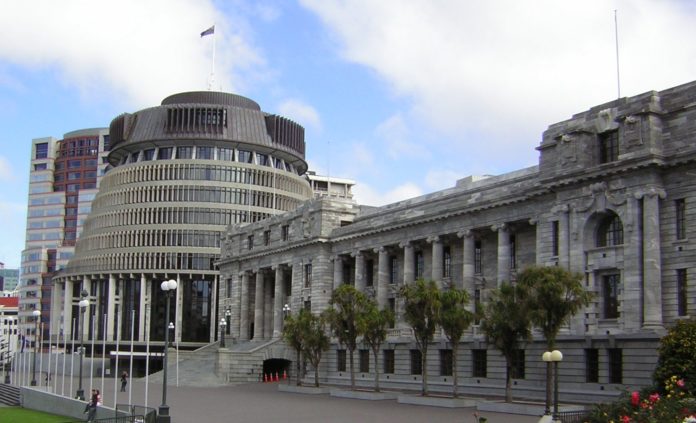
New Zealand Parliament Buildings, Wellington, New Zealand.
Editor’s Note: Here below is a list of the main issues currently under discussion in New Zealand and links to media coverage. You can sign up to NZ Politics Daily as well as New Zealand Political Roundup columns for free here.
For most people, the ping of an incoming SMS will induce some level of excitement — or mild intrigue at least. But with SMS scams on the rise, many may now be meeting this same sound with trepidation.
According to the Australian Competition and Consumer Commission’s (ACCC) ScamWatch website, scams delivered via “phone” or “text” this year far outnumber those sent through any other delivery method, including social media or email.
Delivery and postal scams are particularly common in SMS scam campaigns, with Australia Post even hosting a dedicated scam alerts page on its website. Other forms of fraud encountered via SMS include premium-rate text fraud, tax demands, fake contact-tracing messages and smishing (SMS phishing).
While eliminating the threat might be difficult, there are some simple ways you can avoid becoming the next victim.
A growing global problem
SMS scams have seen considerable growth in the last few years. ScamWatch reported a near-doubling of yearly losses between last year (A$3,091,790 lost) and this year, as of August (A$5,889,596). SMS scam reports have also shot up to a total 39,531 reports this year as of August — up from last year’s total of 32,337.
Of particular concern is the escalation in cost per incident (total reported losses divided by number of incidents), indicating a significant shift in the impact of these scams.
SMS scam statistics drawn from ACCC ScamWatch data (https://www.scamwatch.gov.au/scam-statistics) – 2021 data up to August. Author provided
Email remains the cheapest method to distribute scams. But most email services now provide efficient spam filters to block them.
When it comes to SMS messages, however, our smartphones don’t afford the same level of protection. While telecommunication providers are enhancing their SMS scam (and spam) detection capabilities, this issue so far hasn’t received the same attention as email scam.
Perhaps this is because of the extent of impact on consumers. Compared with email scams, it was only relatively recently that SMS scams became a problem leading to direct and highly visible financial consequences.
Australia Post has provided guidance on avoiding postal scams targeting Australian’s.
That said, SMS scams aren’t just limited to financial fraud. Since last month, Australian’s have been increasingly targeted with SMS messages carrying the flubot malware. This malicious software (malware) migrated from Europe to Australia, and targets Android devices with the intention of stealing online banking credentials.
It’s delivered via SMS messages that attempt to convince the recipient they must install an “app” on their smartphone to reschedule a missed delivery or listen to a fake voicemail. Unfortunately, rather than an actual app downloaded from the app store, this fake “app” contains malware which is installed when the link in the SMS message is clicked.
Once installed, the malware provides “overlays” (fake pages) on top of the login screens of genuine banking apps installed on the phone. So the next time the victim uses their real banking app, the overlays capture their banking details, which are then fed back to servers controlled by cyber criminals.
This video shows the flubot overlay on an online banking app.
Scammers often leverage real scenarios to mislead people. The COVID pandemic has forced people to work from home, take temporary leave, or get laid off altogether — prompting a surge in online shopping and more internet use overall.
Scammers are taking advantage. The ACCC’s ScamWatch received 13,191 “online shopping scam” reports this year as of last month — with 35.6% of the reports claiming financial loss.
Most malicious campaigns use a scatter-gun approach, targeting thousands of phone numbers sequentially (such as by starting with “0400 000 000” and working up), randomly (with the aim of seeming less predicatable), or using stolen lists of valid numbers.
And while most mobile devices do have options to block or filter numbers, such as by SMS filtering services or by categorising unknown numbers — much like email scam/spam filters these approaches are only as reliable as data collected from user reports.
If all scam messages came from a single number, it would be a simple case of blocking that number. Unfortunately, scammers use sophisticated technology to rapidly send large volumes of SMS messages, and will often generate spoofed numbers to appear legitimate or to bypass blocking by the phone’s automatic filter, or the user themselves.
Since the scam messages are not expected to generate replies (since they only want you to click the link), they don’t even need to be real phone numbers.
On the screen they may appear legitimate (such as with “DHL” appearing as the company name) or may be completely random.
A bulk SMS sender (pictured) can generate 230,400 text messages per hour. While it can be used for legitimate text-sending applications, it can also be misused by criminals to send spam messages at scale. Author provided
It’s evident blocking is only part of the full solution. Ideally the criminal groups behind these operations would be shut down. But as with most forms of organised crime, the culprits are often located overseas — making it difficult to investigate and prosecute for these crimes.
Exercise caution
Spotting scams is becoming increasingly difficult. Scammers use various techniques to trick targets, including:
pretending they have authority. For example, by pretending to be DHL or the tax office
convincing you there is limited time to respond. This can prompt panic and an urgency to respond
offering something of value or attraction to incite a response, such as a fake lottery win. Or threatening you with a consequence, such as a fake a penalty or fine.
Legitimate organisations and agencies will rarely (if ever) use overly casual, hostile or threatening language in an SMS. To stay safe and alert, you must keep this in mind.
If you ever receive a suspicious SMS message, don’t reply or click on any attached links. If the message purports to come from an official organisation, always contact the organisation directly (never trust any contact details included in the message).
If you think you have fallen victim to a scam, it’s important to remain calm.
The first thing to do is seek advice from the relevant organisation, which in Australia is ScamWatch. If you’re concerned your banking details may have been compromised, contact your bank immediately to block any rogue transactions, prevent future transfers and change your details as necessary.
If you have disclosed your password, you must change it immediately across all sites and services the password is used for. And if the issue is affecting a work-related device, contact your IT department to check whether your device has been compromised. This may require it to be checked for malware, cleaned and/or re-imaged.
Finally, always ensure your mobile devices are kept up-to-date with patches and software upgrades. While this might not stop the SMS messages, you will benefit from system updates designed to protect you. The Australian Cyber Security Centre has further advice on what to do if you’ve fallen victim to a scam.
The authors do not work for, consult, own shares in or receive funding from any company or organisation that would benefit from this article, and have disclosed no relevant affiliations beyond their academic appointment.
The increased prominence of antisemitic incidents during the COVID pandemic may leave you wondering: has antisemitism always been part of the Australian social fabric, or are we facing a new, sinister trend?
Members of Melbourne’s Jewish community have been subjected to a surge of antisemitic abuse in recent weeks, following breaches of public health orders by ultra-Orthodox Jewish worshippers.
And Victoria’s proposed law to ban Nazi symbols — a first for any state or territory — further reinforces how antisemitism is becoming an increasingly visible problem in Australia.
Understanding the origins of modern antisemitism requires looking back at Australia’s history. Both antisemitism and right-wing extremism are linked with the rise of nationalism from the colonial era through the 20th century.
Because of this, it’s impossible to address antisemitism without also taking into account Australia’s colonial history marred with white supremacy.
How COVID conspiracies are fuelling antisemitism
We have recently seen federal and state politicians cautioning against rising rates of antisemitism, but one can’t help but wonder if these comments are merely lip service.
After all, what good is it to acknowledge antisemitism without taking meaningful action to prevent it?
Consider the following: in 2004, federal parliament expressed its
unequivocal condemnation of antisemitism, of violence directed against Jews and Jewish religious and cultural institutions, and all forms of racial and ethnic hatred, persecution and discrimination on ethnic or religious grounds, whenever and wherever it occurs.
The Executive Council of Australian Jewry releases a yearly report on antisemitism in Australia. In the 2020 report, it found a 10% decrease in reported antisemitic incidents compared to the previous year — likely attributable, in part, to COVID lockdowns.
At the same time, however, there was an increase in serious incidents, such as physical assaults, verbal abuse and intimidation.
These figures should be taken with caution. The report doesn’t distinguish between legitimate critiques of Israel’s occupation of Palestine and antisemitism. It also cites a problematic and contesteddefinition of antisemitism as a guiding concept.
This conspiracy theory, originating in extreme right-wing corners of the internet, has quickly become mainstream, circulating through message boards and social media. Now, antisemitic signs and behaviours are increasingly showing up at anti-lockdown and anti-vax rallies across Australia.
For instance, stickers were placed around Melbourne during “freedom” rallies last month bearing a Star of David, the numbers 911 and a QR code. When scanned, it led to a website that blamed the September 11 terror attacks on Jewish people.
An anti-vax group called White Rose, meanwhile, has plastered Jewish neighbourhoods in Melbourne with stickers bearing swastikas and the words, “No Jab, No Job.” The group has likened mandatory vaccines and lockdowns to the rise of Adolf Hitler in Germany in the 1930s.
And a recent investigation by The Age, The Sydney Morning Herald and 60 Minutes revealed the extent of neo-Nazi operations in Australia, including connections between COVID disinformation and conspiracies.
A brief history of Australian Jewry
The history of Australian Jewry dates to the start of white colonisation and settlement of this continent. Records in the National Archives show at least eight of the 571 convicts in the First Fleet were Jewish.
While the first waves of free Jewish settlers were largely English speaking, Anglo, and loyal to the “mother country”, subsequent Jewish migration came largely from Germany during the gold rush and as refugees from Tsarist Russia.
After that, the next large wave of Jews migrated from Europe in response to rising fascism.
The Anglo Jewish community, which had largely assimilated by the second world war, was concerned the Jewish community’s standing would be negatively affected by these Eastern European refugees who could be easily marked as “foreign” due to their language, dress and manners.
Jewish migrants arriving in Australia in 1939. National Library of Australia
These concerns were rooted in the historical antisemitism of politicians and trade unions. As historian Malcolm J. Turnbull writes:
sections of the labour movement promoted stereotypes of Jews as manipulative bankers, usurers and profiteers.
And describing the experiences of early Jewish settlers, author Rodney Gouttman writes
negative cultural connotations of the word ‘Jew’ encouraged many Jews to avoid it as a descriptive term for themselves, and ‘Hebrew congregations’ became the preferred name for their faith collectives.
It might seem contradictory that Jews, some of whom came to Australia as part of a colonial project, experienced hatred grounded in colonial racism. However, this is part-and-parcel of the experience of the ever-foreign Jew, needing to assimilate but always seen as “other”.
Is Australia doing enough?
To address this question, we have to recognise that antisemitism cannot be disentangled from other forms of colonial and racial violence and xenophobia.
When we talk about white supremacy and antisemitism, we must talk about racism in all its forms.
In a 2017 study, one-third of respondents said they had experienced racism in the workplace.
The 2020 Mapping Social Cohesion Report, meanwhile, found 37% of respondents had a negative view towards people of the Muslim faith, compared with 9% who held a negative attitude towards Jews. This report demonstrates the urgent need to address antisemitism alongside other forms of racism.
Recently, the Australian Jewish News published an opinion piece calling on the government to appoint an Australian commissioner for antisemitism.
This position would ideally be accompanied by new legislation targeting antisemitism to compensate for what the editorial called the “inadequate” protections under the Racial Discrimination Act.
But this approach segregates the plight of Jews from all other minorities facing daily violence and discrimination. As race critical scholar Alana Lentin says,
the elevation of antisemitism as the racism above all racisms […] constrains solidarity between Jews and other racialised people, thwarting a fuller understanding of race as a colonial mechanism and a technology of power for the maintenance of white supremacy.
So, in order to address antisemitism, we must do two things: understand the Jewish presence in Australia in relation to the country’s brutal colonial history, and understand antisemitism alongside other forms of racial violence.
In these urgent times, we must take a united approach to respond to rising rates of white supremacy and racial violence. Without serious efforts to address the problem of racism as a whole, gestures such as banning the swastika are unlikely to have much material impact.
Naama Carlin does not work for, consult, own shares in or receive funding from any company or organisation that would benefit from this article, and has disclosed no relevant affiliations beyond their academic appointment.
Source: The Conversation (Au and NZ) – By Julian Elliott, Executive Director, National COVID-19 Clinical Evidence Taskforce, and Professor, School of Public Health and Preventive Medicine, Monash University
The number of people infected with COVID-19 and requiring treatment in hospital is rapidly increasing.
Vaccination provides very effective protection against severe COVID but at current levels of vaccination, outbreaks are still likely to result in large numbers of people requiring treatment in hospital.
Thankfully, there are reliable evidence-based guidelines on how to best treat COVID. Here’s what they recommend.
If you test positive, you must self-isolate at home.
If you’re like many people with COVID, you won’t need to go to hospital, and can safely manage the illness at home.
If you’re vaccinated, your risk of severe illness is even lower, and you are very unlikely to need hospital care. Even so, it’s important to connect with an appropriate health-care service (usually your GP) who will monitor you and arrange additional care if needed.
What are the early symptoms?
Initially, you may experience flu-like symptoms like cough, sore throat, fever, aches, pains and headache.
You might lose your sense of smell and taste; or have nausea, vomiting and diarrhoea.
You’ll need rest, fluids and paracetamol for aches, pains or fever.
Early symptoms are similar to those you’d get with the flu. Shuttestock
Within the first five days of having symptoms, people who don’t require oxygen but have important risk factors for developing severe disease may receive a drug called sotrovimab.
Sotrovimab is administered by an infusion into a vein, usually during a brief visit to hospital. Studies suggest that in people at high risk of developing severe symptoms, sotrovimab probably reduces the risk of needing to stay in hospital.
If your symptoms worsen, you’ll need to contact your care provider.
Or if your symptoms are very serious, such as difficulty breathing, call 000 for an ambulance, and make sure you tell them you have COVID.
If you’re taken to hospital, it’s likely you will be treated in an area specially prepared for patients with COVID.
Doctors will measure your oxygen levels and perform a chest X-ray and blood tests to determine how sick you are.
If the clinical staff detect effects of the infection in your lungs, low oxygen levels or other signs of severe infection, you’ll stay in hospital and probably be given oxygen.
If you have low oxygen levels, you’ll need to stay in hospital. Shutterstock
If this is the case, you’ll also be given dexamethasone, an anti-inflammatory medicine which reduces the risk of dying from COVID.
Most patients with moderate COVID who receive dexamethasone in hospital recover well and don’t require any additional treatment. But some patients develop more severe disease. In these patients one of two medicines — tocilizumab or bariticinib — which dampen the inflammation and decrease the risk of dying may be prescribed.
An antiviral medicine called remdesivir may also be offered. Remdesivir reduces the time to recover from severe forms of COVID — and probably reduces the risk of dying for people who do not require mechanical ventilation.
If you become even more unwell, these treatments will continue but you may need more support for breathing.
Your care team will decide which is most appropriate for you. Options include:
increasing the proportion of oxygen in the air you breathe and improving delivery of air into your lungs, using high-flow nasal oxygen (HFNO) or continuous positive airway pressure (CPAP)
supporting your breathing (mechanical ventilation)
increasing the levels of oxygen in your blood (extracorporeal membrane oxygenation, ECMO).
Those needing extra help to breathe will be treated in intensive care. Shutterstock
If you need mechanical ventilation or ECMO you will be cared for in an ICU and will require medications to provide sedation and pain relief.
While you’re in ICU, your symptoms will be continually monitored. As they change, your care team may change the type or amount of support for breathing you receive.
As you recover, they will gradually reduce the amount of breathing support you receive so your body takes on more of the work of breathing as it can.
Your recovery depends on many factors, including your age, health and fitness, and how sick you became with COVID.
If you’ve been in ICU, once you can breathe on your own and your heart and lung function are stable, you’ll be moved back to a hospital ward to continue your recovery.
Once your symptoms have mostly resolved, and tests and other information indicate you are no longer infectious, you will be able to return home.
The National COVID-19 Clinical Evidence Taskforce will ensure that as soon as reliable, new evidence is available it will be included in clinical practice guidelines. But keep in mind, the best way to protect yourself is to get vaccinated.
Steven McGloughlin is co-chair of the National COVID-19 Clinical Evidence Taskforce’s critical care panel and a member of the guidelines leadership group.
Tari Turner is Director, Evidence and Methods, for the National COVID-19 Clinical Evidence Taskforce. The Taskforce receives funding from the Australian Government Department of Health, the Victorian Government Department of Health and Human Services, The Ian Potter Foundation, the Walter Cottman Endowment Fund, managed by Equity Trustees and the Lord Mayors’ Charitable Foundation
Julian Elliott does not work for, consult, own shares in or receive funding from any company or organisation that would benefit from this article, and has disclosed no relevant affiliations beyond their academic appointment.
Sloths live in tropical forests in South and Central America, and they actually move so slowly that algae grows on their fur. This can give sloths a green colour that helps them hide in the forest from predators like nocturnal cats and harpy eagles.
This is very lucky, because some sloths often move less than 40 meters a day. They are much slower on the ground than in the trees, some travelling just four meters every minute on the ground — far too slow to outrun a jaguar!
The reason sloths go slow has a lot to do with what they eat. Let’s look at why.
This is a harpy eagle, one of the animals that eat sloths. Shutterstock
Counting sloth toes
Sloths might all look the same to us, but there are actually two main types: sloths with two toes, and sloths with three toes.
Three-toed sloths are “folivores”, which means they can only eat leaves and flower buds. Unlike most other plant-eating animals, they stay away from stems or roots.
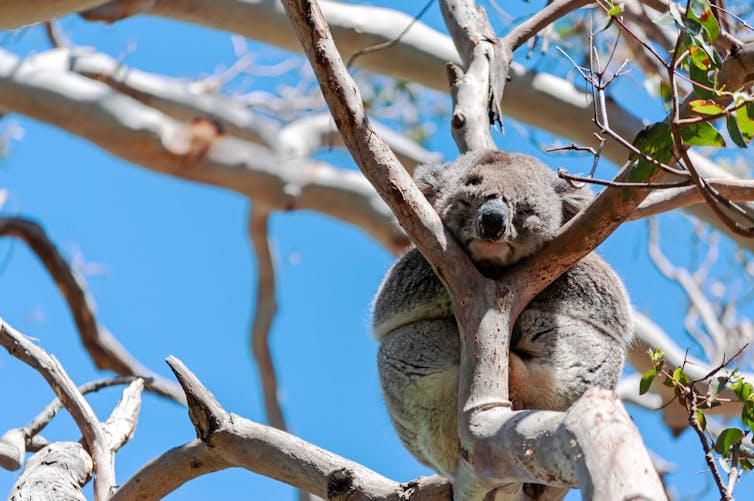
This type of diet is extremely rare — only ten other types of animals that live in trees are folivores, and Australia’s cuddly koala is one of them.
Sloths move much more slowly on the ground than in the trees. Roger Burkhard/Unsplash
Koalas and sloths have a lot in common
Koalas, like sloths, have claws that are good for climbing, are often more active at night and only munch on leaves.
There is a very good reason there are only very, very few folivores like the three-toed sloth and koala in the world.
Leaves are very low in nutrients, and contain very little energy. This means the koala and sloth have discovered a way to survive on very little energy at all.
Koalas can sleep up to 20 hours per day. Jordan Whitt/Unsplash
One of the main ways sloths and koalas keep their energy low is by resting lots, and not moving very often. If you have ever seen a koala, you might have noticed they are often resting and sleeping — some say up to 20 hours a day.
Three-toed sloths eat only leaves and flower buds’. Shutterstock
Compared to sloths, koalas are much more active but often only with a short burst in energy. Koalas move about 190 metres every day, but some have been recorded moving as much as 2,500 meters in one day.
In fact, the three-toed sloth uses the least amount of energy of any animal that doesn’t hibernate. But when sloths need to travel longer distances, they can use their long legs to swim, which they are much faster at.
Sloths are good swimmers, and sometimes swim to look for a mate.
Koalas and sloths are losing their homes
Unfortunately, when trees in forests are chopped down, sloths and koalas must travel further away along the ground to find food and mates. This exposes these rare animals to dangers, like cats and jaguars, or busy roads where they could get hurt.
Sloths are under threat when their trees get chopped down. Sebastian Molinares/Unsplash
Losing their tree homes has led to a big drop in the number of sloths left in the world, particularly the pygmy three-toed sloth which is “critically endangered”. This means we don’t have long left to save it from going extinct.
Koalas are in similar danger. Because so many trees are getting chopped down in Australia, scientists think there might be no koalas left in the wild in New South Wales by the year 2050.
To look after sloths and koalas, scientists and the community need to work together to protect these incredible animals and their homes.
Shelby A. Ryan receives a Vice-Chancellor’s PhD Training Priority Scheme Scholarship from the University of Newcastle. Her PhD project receives funding from WWF-Australia and Taronga Conservation Society Australia. She is affiliated with the University of Newcastle and FAUNA Research Alliance.
Ryan R. Witt receives funding from WWF-Australia and Taronga Conservation Society Australia. He is affiliated with the University of Newcastle and FAUNA Research Alliance.
More than two-thirds of Australian early childhood educators reported working many extra hours to satisfy regulatory requirements in our 2021 survey. Half did unpaid work during accreditation — the process of demonstrating compliance with all the regulations governing early childhood education. Some were paid for as little as half of the hours they worked.
These educators earn an average of $29.10 an hour. Workers with the minimum of a certificate in childhood services are more likely to earn $23.50 an hour, while those with a diploma or degree earn more. Unqualified workers in male-dominated industries earn far more than workers in the female-dominated early childhood sector.
The stresses of low pay and long hours cause almost one in three early childhood educators to leave the profession each year. This year, a survey found 73% intend to leave the profession in the next three years. Providers are struggling to find qualified staff.
Long hours of unpaid work are common
I’m involved in a transnational study exploring the work of early childhood educators in Australia, Canada and Denmark. The Australian data include survey responses from 50 educators from a range of service types in cities and regional and rural settings.
Some 70% commented on how many extra hours they worked during accreditation, with 50% reporting unpaid hours. Educators said:
“I work a 68-hour week yet get paid for 30 hours.”
“a lot of unpaid hours.”
“Staff were given work to fill in whilst on breaks, often stayed back for unpaid staff meetings and to do extra work.”
“lots of unpaid work to catch up on the documentation that was required”.
Percentages of overtime during accreditation reported by early childhood educators.
To be accredited, services must provide state regulatory authorities with documentary evidence they are meeting or exceeding the measures of quality laid down by the Australian Children’s Education & Care Quality Authority (ACECQA). Some participants said the demands from these rigorous quality checks have become “ridiculous”, requiring volumes of documentary evidence.
Preparing this evidence requires time away from the children, whose development depends on quality interactions with their educators. Many said they could not do the documentation in working hours because they were busy teaching children and supporting families.
Why do educators do the extra work? If the service doesn’t pass, it triggers more checks, requiring more frequent documentation. Very few educators said they were paid for this extra time.
When commenting on the number of unpaid hours, some noted the impacts on their family life:
“Too many. It caused stress at home with family.”
“We dedicated over 2 weeks of nights and weekends to be ready for accreditation and registration. Even our husbands came and did work with us.”
“Detrimental. Lack of work life balance during this time.”
A wordcloud showing how often educators used various words in their comments about working extra hours during accreditation. Author provided
As quality education and care depend on interactions with individual children, their families and communities, staff turnover is of great concern.
The quality of their interactions with caregivers, including early childhood educators, has a profound influence on children’s development.
Yet, rather than tackling these issues, the increase in managerialism in Australian education has added to the stresses of poor pay for a demanding job.
Managers and authorities say this is necessary to ensure quality. Their beliefs about quality are transcribed into voluminous documents. Often these documents are so complex, even longer documents or guides are provided to decipher the original document.
In early childhood education, these include curriculum documents, frameworks and standards. The Australian Children’s Education & Care Quality Authority (ACECQA) creates these documents. State and territory regulatory authorities are responsible for ensuring compliance through registration and accreditation — a process of assessment and rating.
Quality may actually suffer
Many educators believed accreditation requirements lowered the quality of education and care during accreditation. One said:
“It is a joke! Everything is so inhibited, and the children and educators are far too over-regulated. The children cannot be free to learn. They cannot go near water, they cannot climb. Fear is instilled into the educators. It is a horrible and restrictive learning environment. It makes the children so small-minded and full of anxiety.”
Have authorities unwittingly created an accreditation system that enslaves workers and reduces quality during accreditation periods? Further research is needed to discover the full burden of these compliance systems.
What now?
What can we do about this discovery of excessive unpaid wages and chronic underpayment of our essential workers? Being a slave is defined as being part of the slave trade, but also includes those who do not receive proper remuneration for their work. With a federal election looming, it is another matter to lobby our government about given Australia’s uneasy relationship with slavery.
To recover strongly from the economic impacts of the pandemic, we need strong workplace participation. To support this participation, real reform is needed to provide universal childcare and fully staffed services. The focus must be on creating systems that support quality education and care, not big data and slavery.
Marg Rogers does not work for, consult, own shares in or receive funding from any company or organisation that would benefit from this article, and has disclosed no relevant affiliations beyond their academic appointment.
After violence on Monday outside the Melbourne offices of the Construction, Forestry, Maritime, Mining and Energy union, the Victorian government ordered a snap two-week shutdown of the construction industry. Yesterday these protests continued, with up to 2,000 demonstrators holding up traffic around Melbourne’s CBD and clashing with police.
The shutdown of building sites is a perverse outcome for those protesting primarily over vaccination mandates but who also oppose lockdowns.
So why were they directing their fury not at the government that imposed the mandate, nor the employers who will enforce the rules, but the union that represents construction workers? Let’s work through it.
What was Monday’s protest about?
The ostensible catalyst was the Victorian government’s announcement on September 16 that by Friday (September 23) all construction workers must show their employer:
evidence they have received at least their first dose of a COVID-19 vaccine
proof of vaccine appointment to receive a first dose by October 2
or a medical exemption from an authorised medical practitioner.
The government also announced new site rules that include the closure of tearooms and a ban on consuming food or drinks indoors. This led to workers on sites around the city setting up tables and chairs in the street last Friday, causing minor inconvenience to motorists. The CFMMEU was sympathetic to these protests.
So why the protest against the union?
In the days before the vaccination mandate was announced, the CFMMEU’s state secretary, John Setka, said the union did not support mandatory COVID-19 vaccinations.
An example of memes about John Setka being shared on social media. Twitter
But in a radio interview on Thursday he described the mandate as a unfortunate reality of living in a pandemic. “Extreme circumstances sometimes call for extreme measures,” he told 3AW radio host Tom Elliott. “It’s unfortunate, but it is what it is.”
These comments were turned into memes and shared by social media activists on platforms such as Telegram, fomenting anger against Setka as a traitor.
What is the CFMEU’s position on vaccines?
Setka and the union have strongly promoted construction workers getting vaccinated. In August the CFMMEU launched a media campaign encouraging its members to get vaccinated. Setka has had himself photographed getting vaccinated.
The CFMEU’s Victorian state secretary John Setka shows his vaccination card. John Setka/CFMEU
But the union has also opposed mandatory vaccination — particularly vaccine mandates imposed by employers. Its public position has been it will “always advocate for safety, jobs, and freedom of choice”. That includes freedom of choice about whether to be vaccinated. It has threatened action against any employer seeking to make vaccination a job requirement without a government-imposed mandate.
In August, for example, the union’s NSW state secretary Darren Greenfield said: “We call on the government to release the pressure on members that do not want to get the vaccination, never will get the vaccination because that’s their personal choice, and allow them to get back to work.”
However, the union sees a government-imposed vaccine mandate as something it can’t do much about — nor one it wants to expend energy on.
Is this the same or different to other unions?
Each union has its own leadership and there are different positions being adopted. But the construction union’s approach has been broadly the same as the Australian Council of Trade Unions, which has supported vaccination but also consistently opposed individual companies having the power to mandate vaccines.
The ACTU and the Business Council of Australia have issued a joint statement
that vaccination “should be free and voluntary” and that “for the overwhelming majority of Australians your work or workplace should not fundamentally alter the voluntary nature of vaccination”.
They have called on governments to “ensure that where mandatory vaccination requirements are necessary (in a small number of high-risk workplaces), they are implemented through the use of nationally consistent Public Health Orders”.
The protesters’ agenda appears straightforward. They want the union to oppose the government’s vaccine mandate at all costs, by any means at the union’s disposal.
What exactly the union could do even if it wanted to, though, isn’t all that clear. Industrial action — that is, striking — is not an option.
The Fair Work Act allows for protected (i.e. lawful) industrial action only when collective bargaining negotiations are at play. If a union took unprotected industrial action, an affected employer could apply to the Fair Work Commission have this stopped, and dock employees’ pay for a minimum four hours a day for any unprotected industrial action.
The union has said it will “represent members if their employment is affected” by vaccine mandates. This could include funding legal challenges to state or employer vaccine mandates.
So who organised this protest?
This is still unclear. Setka has said only a minority of those at Monday’s protest were construction workers or union members, with the rest being far-right activists and professional protesters. Other sources have said most were construction workers.
There is evidence that notable anti-lockdown activists were in the crowd, as well as at least one far-right organiser.
Anti-vaccination and fringe political groups have also previously sought to foment protests and other action by aged-care workers, truck drivers and teachers.
Giuseppe Carabetta does not work for, consult, own shares in or receive funding from any company or organisation that would benefit from this article, and has disclosed no relevant affiliations beyond their academic appointment.
Source: The Conversation (Au and NZ) – By Barbara Doran, Lecturer in Creativity and Innovation, Transdisciplinary School, UTS, University of Technology Sydney
Topsy Turvy, Author provided
A new project that spotlights the strain from COVID-19 on our health systems and the people who work in them has invited health-care leaders and artists to create artworks that illuminate what it has been like leading, working and living through the pandemic.
The culmination of this collaboration is Topsy Turvy, an interactive digital exhibition initiated by the Knowledge Translation Strategic Platform of Maridulu Budyari Gumal SPHERE (Sydney Partnership for Health Education Research and Enterprise) whose purpose is to change the future of health care.
Topsy Turvy is a random image generator that makes combinations from a bank of drawings and text inspired by experiences of COVID-19. Users can opt to keep, delete and resize until they feel they have an image that resonates.
Artists worked with health leaders to encapsulate the tone of COVID. Topsy Turvy.
To create Topsy Turvy, 15 leaders affiliated with SPHERE shared images, songs, and reflections on working within and with the health system during the first wave of COVID-19 in 2020. Together, these contributions offered a rich palette of imagery and text — from recording a Dylan-esque song to a meditative movie of dragonflies over a lilypond.
Topsy Turvy was created to translate diverse experiences of COVID-19 through drawings, text and sound. In turn these elements have been transformed into an interactive digital platform where people can create visual expressions of their own.
Art in health
Creative responses to health(care) and well-being are on the rise in health-care settings and in the arts.
Arts-based approaches enable people to connect, express themselves and share knowledge about important health and social issues. Some experiences, such as physical or emotional pain, can be hard to put into words, and the arts offer alternative ways to explore and convey them.
For Topsy Turvy, artist and creative director (and one of the authors of this piece) Barbara Doran, and artists Anton Pulvirenti, Peter Maple and Annie McKinnon took stories provided by health-care leaders and used them as sources to create an interactive digital environment, giving audiences an opportunity to create their own COVID-19 collage. Using the platform, audiences can reinterpret the leaders’ contributions anew to tell their own story.
‘Topsy Turvy made me think about the health sector, how many different perspectives and experiences there are of the current situation’. Katrina Moore, UTS.
Peter Maple described how the words and photographic materials provided suggest feelings, rhythms and prevailing moods. Anton approaches drawing as an act of listening where he looks for common themes while imagining how drawing styles can open up a kind of non-verbal conversation with the storytellers. Annie McKinnon created this interactive digital exhibition akin to a live concert, where audiences can dance and make experiences together.
‘I work in the paediatric ICU at Sydney Children’s Hospital, Randwick. Was actually with a COVID patient last night. I should’ve taken a photo of me this morning looking completely burnt out!’ India Heap, ICU nurse.
The leaders who contributed to this exhibition lead large teams within health-care organisations. Peter Joseph, the Chairman of the Black Dog Institute, took up winter ocean swimming as a new COVID-19 activity. For the Topsy Turvy exhibition, he shared a photograph of six winter ocean swimmers. He wrote:
COVID has demanded we keep perspective and think about what is important and not get captured by the conditions. I have learnt to be more open and expansive, understanding that in the grand scheme of things, we are tiny and here for such a short time.
‘My siblings, all live within LGAs of concern with heavy police presence. The portrayal of them is overly simplified unable to take in the complexity and depth of cultural and religious traditions’ Stephanie Habak, Black Dog Institute. Topsy Turvy.
Amanda Larkin, the Chief Executive of South Western Sydney Local Health District, located in a COVID-19 hotspot, celebrated “the power of collaboration at a large-scale, and the changes that can be achieved”. Kate McGrath at the University of Technology Sydney, agreed: in research, education and industry “imaginary and self-created divisions between disciplines and institutions disappear when faced with this level of change.”
‘We’ve celebrated the power of collaboration at a large-scale, and the changes that can be achieved’ Amanda Larkin, Chief Executive of South Western Sydney Local Health District. Topsy Turvy.
Les Bokey, Professor of Surgery and Clinical Dean at Western Sydney University, wrote about “a very rapid adaptation to a new environment”. This included changing operating rooms to deal only with emergencies and category 1 patients. “This has been a year to remember, rather one to forget”, he noted.
Working creatively in 2021
The executive director of SPHERE, Mark Parsons, reflected:
Unsurprisingly, in 2021, themes continue to resonate. The COVID-19 situation in Sydney has placed enormous challenges on our health systems. Sometimes, the systems in place aren’t able to reach impacted communities quickly. We need to work creatively to be able to respond better.
Artists Peter Maple and Anton Pulvirenti agree that the arts offer different ways for feelings and complex experiences to be listened to, imagined and shared.
Since launching the exhibition, new collages and reflections have been shared. For Katrina Moore, Program and Community Manager at the University of Technology Sydney, the experience of interacting with Topsy Turvy made her:
think about the health sector, how many different perspectives and experiences there are of the current situation […] My image was quite layered and busy… a reflection of my mind at the moment I guess.
Katherine Boydell receives funding from the Sydney Partnership for Health Education Research and Enterprise to support the Knowledge Translation Platform.
Ann Dadich receives funding from the Sydney Partnership for Health Education Research and Enterprise.
Chloe Watfern works for the Sydney Partnership for Health Education Research and Enterprise Consumer and Community Involvement and Knowledge Translation Platform.
Katherine M Boydell receives funding from the Sydney Partnership for Health Education Research and Enterprise for the Knowledge Translation platform.
Stephanie Habak works for the Sydney Partnership for Health Education Research and Enterprise (SPHERE) Consumer Community Involvement and Knowledge Translation Platform.
After mishandling its cancellation of the French submarines contract, the Morrison government is making things worse by suggesting the French really must have, or should have, known what was coming.
As Labor keeps saying on the domestic front, Scott Morrison doesn’t like admitting mistakes.
Instead of accepting the government blundered diplomatically by not giving France proper notice Australia would ditch the $90 billion contract, Morrison has doubled down.
Arriving in the United States, he said: “I had made it very clear that a conventional submarine would no longer be meeting our strategic interests and what we needed those boats to do.
“That had been communicated very clearly many months ago. We were working through those issues.”
This amounts to saying one of two things. That the French fury (as distinct from the “disappointment” Morrison and ministers endlessly repeat from the government’s talking points) is simply confected. Or that the French are plain stupid.
It smacks of trying to find a way to avoid saying Australia stuffed up the diplomacy.
Morrison also said “it was not possible for us to be able to discuss such secure issues in relation to our dealings with other countries at that time”.
Does this really hold up, especially given the closeness of the United States-France relationship?
It is one thing to say the earlier stages of the negotiations of AUKUS had to be secret – it is another matter humiliating the French by implying they are so untrustworthy they had to be kept in the dark until the last minute.
By its cack-handed diplomacy, or lack of diplomacy, the Australian government set off waves that have created problems with spillover effects for its AUKUS partners, especially the US, with whom the French would have been unhappy anyway.
Faced with France’s anger with America, President Joe Biden quickly sought a call with President Emmanuel Macron to attempt to smooths things.
Asked in his New York whether he would be talking with Macron before he met European leaders and Biden, Morrison said there was “not an opportunity for that at this time”. He was “sure that opportunity will come in time”.
“But right now, I understand the disappointment, and they’re working through the consultations with their ambassador who’s returned to Paris and we will be patient about that,” Morrison.
He went on: “We will engage with European leaders, importantly, we’ll continue to engage with ASEAN leaders.”
Morrison spoke to Indonesia’s President Joko Widodo on his way to the US. “I was able to reassure him, particularly about the issues on non-proliferation.” The Indonesians had raised concerns about AUKUS. The Malaysians will require some work too.
To deal with the diplomatic fallout, the most logical course would be for Morrison to concede the lack of proper notice and consultation, in a direct conversation with Macron.
We don’t know whether the PM has made an attempt to call Macron in the wake of the blow up (his office did not answer when asked). Nor do we know whether Macron would be too busy “washing his hair” to take a Morrison call. On Tuesday (Australian time) the White House said it was “still working on the scheduling” of the Biden call.
For Morrison, a frank leader-to-leader discussion, with an admission things should have been handled better, would be the mature approach, and might limit the damage to Australian interests, including to the trade negotiations with Europe. But the PM is not keen on eating even the smallest slice of humble pie.
Michelle Grattan does not work for, consult, own shares in or receive funding from any company or organization that would benefit from this article, and has disclosed no relevant affiliations beyond their academic appointment.
As well as her interviews with politicians and experts, Politics with Michelle Grattan now includes “Word from The Hill”, where she discusses the news with members of The Conversation politics team.
In this episode, politics + society editor Amanda Dunn and Michelle discuss the intense backlash from France over the Morrison government’s AUKUS security deal with the United States and the United Kingdom, which will see Australia acquire nuclear-powered submarines and other sophisticated military technology. As well, they canvass the mounting international pressure on Scott Morrison as he and President Biden talk climate change during the PM’s current US visit.
Michelle and Amanda also discuss Christian Porter’s resignation from the ministry to the backbench after he refused either to find out names of donors who helped fund his defamation action or to give back the money.
Additional audio
Gaena, Blue Dot Sessions, from Free Music Archive.
Michelle Grattan does not work for, consult, own shares in or receive funding from any company or organization that would benefit from this article, and has disclosed no relevant affiliations beyond their academic appointment.
As well as her interviews with politicians and experts, Politics with Michelle Grattan now includes “Word from The Hill”, where she discusses the news with members of The Conversation politics team.
In this episode, politics + society editor Amanda Dunn and Michelle discuss the intense backlash from France over the Morrison government’s AUKUS security deal with the United States and the United Kingdom, which will see Australia acquire nuclear-powered submarines and other sophisticated military technology. As well, they canvass the mounting international pressure on Scott Morrison as he and President Biden talk climate change during the PM’s current US visit.
Michelle and Amanda also discuss Christian Porter’s resignation from the ministry to the backbench after he refused either to find out names of donors who helped fund his defamation action or to give back the money.
Additional audio
Gaena, Blue Dot Sessions, from Free Music Archive.
Michelle Grattan does not work for, consult, own shares in or receive funding from any company or organisation that would benefit from this article, and has disclosed no relevant affiliations beyond their academic appointment.
The Doherty Report, released 10 August, underpins the vaccination targets in the federal government’s national reopening plan of 70% and 80% of the population aged over 16. However, since we began this modelling, we have seen large outbreaks in New South Wales and Victoria. These outbreaks prompt questions about how community prevalence affects reopening plans.
The interim report, released on Saturday, addresses the impact of higher daily case numbers when we reach the 70% and 80% threshold; how public health and social measures could be applied between 70% and 80%; and differences between the strategy in each state and territory.
Our first report recommended ongoing “low” restrictions throughout the reopening phase to support vaccination and public health responses. The new results show that if a state or territory has high caseloads when it reaches 70% coverage, cases could still grow quickly at this level of restrictions, leading to a much larger outbreak.
Applying “medium” restrictions until 80% coverage is reached, will greatly reduce the likelihood and potential size of an outbreak. From the 80% coverage level, vaccines do more of the heavy lifting to control infection spread, and so only low level restrictions are likely to be needed.
What does ‘overshoot’ mean and how can we prevent it?
Overshoot refers to the people who get infected as the pandemic is slowing.
When enough of the population is immune to COVID, through a combination of vaccination and past infection, the disease can’t spread any further, and the proportion of population immunity required to prevent spread is reduced through public health and social measures, and contact tracing.
So, as we increase vaccine coverage, there will come a point where each COVID-infected person transmits to fewer than one person on average. But epidemics have momentum and take time to stop. Anyone who gets infected as the epidemic is slowing is part of the overshoot. The danger of significant overshoot is that it will greatly increase the total number of people infected, leading to more hospitalisations and deaths.
By keeping community prevalence low as we transition to high vaccination coverage, we reduce overshoot and keep the total number of infections low.
When Australia reaches 70% and 80% coverage, every state and territory will be in a different position, both in their own coverage and in COVID prevalence. That means every state and territory will have their own path through these transition phases, as allowed for in the National Plan.
With higher case numbers, there will likely be stronger restrictions for longer, while with lower case numbers the contact tracing system is likely to be more effective and able to control outbreaks with lighter restrictions.
Beyond COVID prevalence, there are also differences in the potential for COVID to spread in each state and territory, which we track using the transmission potential (TP) metric. These differences are driven by a combination of demographics and because baseline behaviours are markedly different across Australia. Higher TP means faster spread, and a TP below 1 means cases should decline.
Projecting the TP when we reach 80% coverage, we predict that if “baseline” population behaviour in Victoria is similar to December 2020, the TP would be 1. However, for Western Australia the TP would be 1.6, if we assume people behave as they did in March 2021. These differences further support our recommendations that ongoing “low” restrictions will provide a more stable level of disease control moving forward.
Situational assessment of TP and short term COVID infection projections are provided weekly for all jurisdictions and will be essential to support decision making over the coming weeks and months.
The National Plan provides flexibility for states and territories to adjust restrictions and policies to manage local case numbers throughout the reopening phases for best outcomes.
The modelling has aimed to inform broad national targets for reopening, but there are many more granular issues to explore and work through at state and local levels to give more detailed advice. These ongoing projects include helping to define sustainable and effective public health responses; optimising local disease control through vaccines and other measures in at-risk populations and settings; and supporting plans to reconnect Australians with the wider world.
Contact tracing will need to shift from an extinction model — chasing down every last contact — to a more sustainable model to identify efficient ways to reduce transmission in the community. We have already seen New South Wales and Victoria moving to text messages to initially notify cases, rather than a phone call.
Fresh research about the severity of the Delta variant confirms that it is more likely to lead to hospitalisation and death than the Alpha variant. This new evidence further endorses our recommendations for a multi-pronged approach to disease control to keep case numbers as low as possible so the health system is able to manage anticipated clinical loads. We will factor this and other emerging evidence into ongoing modelling, including regular situational assessments.
As we move towards reopening, it is critical we carefully monitor the epidemic situation and continually update models as the situation unfolds. If cases grow faster than expected, we should be flexible to either alter restrictions, postpone lifting of restrictions or retreat if indicated.
On the other hand, if baseline health measures or vaccines are more effective than we expect, we may find ourselves in a position to lift restrictions earlier than anticipated.
While there are uncertainties about our future, there is one thing we are certain of. The higher our fully vaccinated coverage goes above 80%, the easier it will be to control COVID, enabling a return to a (COVID) normal life.
A panel of experts answer questions about vaccines, from ‘Are they safe?’ to ‘What if I’m pregnant?’
Christopher Baker receives funding from The Australian Government Departments of Health and Foreign Affairs and Trade.
Jodie McVernon receives funding from The Australian Government Departments of Health and Foreign Affairs and Trade, and the National Health and Medical Research Council
The uncertainty is troubling. If elimination fails or is abandoned, it would suggest we have not learnt the lessons of history, particularly when it comes to our more vulnerable populations.
In 1918, the mortality rate among Māori from the influenza pandemic was eight times that of Europeans. The avoidable introduction of influenza to Samoa from Aotearoa resulted in the deaths of about 22 percent of the population.
Similar observations were seen in subsequent influenza outbreaks in Aotearoa in 1957 and 2009 for both Māori and Pasifika people. These trends are well known and documented.
And yet, despite concerns we could see the same thing happen again, there have been repeated claims that an elimination strategy cannot succeed. Some business owners, politicians and media commentators have called for a change in approach that would see Aotearoa “learn to live with the virus”.
This is premature and likely to expose vulnerable members of our communities to the disease. Abandoning the elimination strategy while vaccine coverage rates remain low among the most vulnerable people would be reckless and irresponsible.
In short, more Māori and Pasifika people would die.
Far better will be to stick to the original plan that has served the country well, lift vaccination coverage rates with more urgency, and revise the strategy when vaccination rates among Māori and Pasifika people are as high as possible — no less than 90 percent.
Least worst options After 18 months of dealing with the pandemic, it’s important to remember that Aotearoa’s response has been based on sound science and strong political leadership. The elimination strategy has proved effective at home and been admired internationally.
Of course, it has come with a price. In particular, the restrictions have had a major impact on small businesses and personal incomes, student life and learning, and well-being in general.
Many families have needed additional food parcels and social support, and there are reports of an increasing incidence of family harm.
The latest delta outbreak has also seen the longest level 4 lockdown in Auckland, with at least two further weeks at level 3, and there is no doubt many people are struggling to cope with the restrictions. The “long tail” of infections will test everyone further.
There is no easy way to protect the most vulnerable people from the life-threatening risk of covid-19, and the likely impact on the public health system if it were to get out of control. The alternative, however, is worse.
We know Māori and Pasifika people are most at risk of infection from covid-19, of being hospitalised and of dying from the disease.
Various studies have confirmed this, but we also must acknowledge why — entrenched socioeconomic disadvantage, overcrowded housing and higher prevalence of underlying health conditions.
More than 50 percent of all new cases in the current outbreak are among Pasifika people and the number of new cases among Māori is increasing. If and when the pandemic is over, the implications of these socioeconomic factors must be part of any review of the pandemic strategy.
Lowest vaccination rates, highest risk Furthermore, the national vaccination rollout has again shown up the chronic entrenched inequities in the health system. While the rollout is finally gaining momentum, with more and better options offered by and for Māori and Pasifika people, their comparative vaccination rates have lagged significantly.
Community leaders and health professionals have long called for Māori and Pasifika vaccination to be prioritised. But the official rhetoric has not been matched by the reality, as evidenced by our most at-risk communities still having the lowest vaccination coverage rates in the country.
Te Rōpū Whakakaupapa Urutā (the National Māori Pandemic Group) and the Pasifika Medical Association have repeatedly called for their communities to be empowered and resourced to own, lead and deliver vaccination rollouts in ways that work for their communities. Te Rōpū Whakakaupapa Urutā have also said Auckland should have remained at level 4, with the border extended to include the areas of concern in the Waikato.
As has been pointed out by those closest to those communities, however, their advice has consistently not been heeded. The resulting delays only risk increasing the need for the kinds of lockdowns and restrictions everyone must endure until vaccination rates are higher.
There is a reason we do not hear many voices in Māori and Pasifika communities asking for an end to elimination. Left unchecked, covid-19 disproportionately affects minority communities and the most vulnerable.
“Living with the virus” effectively means some people dying with it. We know who many of them would be.
Breaching covid-19 restrictions in New Zealand will now mean an increased infringement fee of up to $12,000 for individuals when imposed by a court, Prime Minister Jacinda Ardern has announced.
Speaking at the daily covid-19 briefing today, Ardern said fines for breaches of the Covid-19 Public Health Response Act were being increased because of the view that the infringement regime did not reflect the severity of breaches.
“Our success has been really based on the fact that people by and large have been really compliant … however, there has been the odd person [who] has broken the rules and put others at risk,” she said.
“Specifically we’ve had some people break out of MIQ, including in a handful of cases with covid, who have posed a threat to the community.”
She said there were some issues very early on, but they had reduced when the government introduced fines for those who breached the rules, such as alert levels or breaking the rules of MIQ.
“It’s Cabinet’s view that these fees don’t properly reflect the significant social and economic impacts of a single case of covid-19 getting out into the community, and nor do they act as a sufficient incentive to play by the rules,” Ardern said.
Like with a traffic ticket, people can be issued an infringement notice for breaking the rules. If the infringement fee is not paid in full by the due date it is referred to the Ministry of Justice for enforcement, when it becomes a “fine”.
On-the-spot fines On-the-spot infringement notice fees were initially set at $300, with fines of up to $1000 when imposed by a court, but Ardern today said they would increase.
Infringement notices would increase to $4000 for individuals, and $12,000 for companies, while fines imposed by courts would increase to a maximum of $12,000 for individuals and $15,000 for companies.
Covid-19 infringement fines. Video: RNZ News
People convicted for criminal offences — such as intentionally failing to comply with an order, or intentionally threatening, assaulting, or hindering an enforcement officer — may also face fines and prison.
The fine for criminal offending would increase from $4000 to $12,000 or six months imprisonment, with an additional fee of up to $15,000 introduced for companies.
Ardern said those were maximums subject to the court’s discretion, and would take effect from November 2021, subject to the passing of the Covid-19 Public Health Response Amendment Bill.
These fines are for people who do something specified as an infringement offence in a covid-19 order.
She said there was a balance between making sure people understood the rules, but also the consequences of breaking those rules.
Setting up the framework “I think the sheer magnitude of having someone with covid-19 who breaks those rules, the impact on the community, we need to make sure that the fines really do reflect the gravity of the situation.”
The prosecutions were not made by politicians, she said.
“The prosecution decisions aren’t ultimately made by us. We need to set up the framework and the infringements that are available should those prosecutions be taken. And I think actually from the general public there would probably be a bit of a view that when you are putting people at risk you need to have an infringement regime that reflects the seriousness of some of that rule-breaking.
“Where they’re used and how they’re used, what fines are awarded, that sits out of our hands.”
In a statement, Covid-19 Response Minister Chris Hipkins said examples of infringement offences would include failure to wear a face covering in places where it is mandatory.
Criminal offences could include travelling without permission, or travelling for a purpose other than what was permitted, from an alert level 4 or 3 area to alert level 2.
In a statement, the ministry said there is also one historical case at the border.
Thirteen of today’s cases have been epidemiologically linked while one is still being investigated.
Today’s number of community cases includes one positive result from Upper Hauraki, which is under a section 70 order. They are a household contact who was tested yesterday, the ministry said.
“Two previously confirmed cases from Saturday and from yesterday have now been reclassified as under investigation,” Director-General of Health Dr Ashley Bloomfield said.
“As a result, today’s net increase is 13 cases.”
Dr Bloomfield said the ministry expected another further 50 to 60 cases from household contacts in the next week or so.
This article is republished under a community partnership agreement with RNZ.
It perhaps wasn’t a remarkable coincidence that last month Samoa’s former Ambassador to the United Nations called on the United States to ratify a treaty declaring the South Pacific a nuclear-free zone.
Ali’ioaiga Feturi Elisaia, currently Samoa’s High Commissioner to Fiji, made the comments during a Blue Pacific Talanoa series last month to mark the August 29 International Day against Nuclear Tests.
The treaty created by the Pacific Islands Forum (PIF) was called the South Pacific Nuclear-Free Zone Treaty of Rarotonga of which Samoa is a signatory.
The virtual conference also featured high profile state actors including Fiji Prime Minister and PIF Chair Josaia Bainimarama, PIF Secretary-General Henry Puna and the secretary-general for the Prohibition of Nuclear Weapons in Latin America and the Caribbean, Ambassador Flavio Roberto Bonzanini.
The lineup of the presenters last month underscored the significance of the issue for the region, which very much remains relevant for Samoa and other Pacific Island nations some 25 years after the last nuclear test explosion by France at the Moruroa and Fangataufa atoll test sites on 27 January 1996.
Lest we forget the Bikini Atoll in the Marshall Islands where the US unleashed 23 nuclear weapons between 1946 and 1958 to displace the Marshallese people for ever.
Discussions today around nuclear testing or the use of nuclear energy as an alternative energy source are likely to be associated with protest marches in the 1960s and 1970s with public opinion shifting due to the calamitous effect of the Hiroshima and Nagasaki atomic bombings towards the backend of World War Two in 1945.
The 1986 Chernobyl nuclear power disaster in Ukraine (which was at that time part of The Soviet Union) claimed 31 lives, though in 2005 the United Nations reportedly projected that some 4000 people would eventually die due to radiation exposure.
In March 2011, a 9.0-magnitude earthquake in Japan triggered a tsunami, which overran the seawall of the Fukushima Daiichi Nuclear Power Plant and flooded the nuclear reactor, triggering a failure of the emergency generators to lead to nuclear meltdowns and the leaking of contaminated water into the Pacific Ocean.
Over a decade later the Japan government announced in April this year that it would release 1 million tonnes of contaminated water from the damaged Fukushima nuclear power plant into the Pacific, triggering concerns within the region and leading to calls for an independent assessment.
And it appears we in the Pacific are not out of the woods just yet — as more developed and economically affluent nations dabble with this deadly form of energy in our part of the world — despite being privy to data collected showing how thousands of lives were lost and millions displaced due to the use of nuclear weapons or energy in war as well as peacetime over the past 76 years.
So it is disappointing to see reports emerge over the last couple of days on Australia penning an agreement with the US and the UK to acquire nuclear-powered submarines in a bid to beef up its military arsenal.
Why has Australia become a party to a military pact that could now see conflict return to our peaceful islands some 76 years after the end of World War Two?
We are not interested in your wars and the political ideologies that you continue to flout in your quest for global domination.
Nor are we keen on subscribing to a train of thought promoting oligarchy where all power is centred in an individual.
The Australian Prime Minister Scott Morrison, when defending his country’s decision to sign the military pact with the US and the UK, is of the view that there will be peace and stability in the region due to the partnership.
“She [Jacinda Ardern] was my first call because of the strength of our relationship and the relationship between our countries,” Morrison said when confirming that he had advised his New Zealand counterpart, reports the Associated Press.
“All in the region will benefit from the peace and the stability and security that this partnership will add to our region.”
So what peace and stability is Mr Morrison referring to in his defence of this agreement?
Barring the covid-19 pandemic and its impact on our fragile and vulnerable economies, we in the Pacific are happy where we are.
Our journeys as sovereign nations haven’t been without their challenges and we know the destinations we want to get to with the assistance of bigger nations as well as development partners.
But signing up to a military pact behind the closet and then declaring we in the region will benefit from the peace and stability it would bring is not how friends treat each other.
It is a relief seeing Prime Minister Ardern continuing to maintain the tradition of her predecessors by promoting a nuclear-free Pacific; probably she is the only true friend of the Pacific Islands.
Having lived with and witnessed the ravages of war for close to a century; brought to our doorstep and into our homes without our consent; we expect global leaders to respect the various sovereign nations and their people who make up this huge expanse of an ocean that is now known as the Pacific.
It would be appropriate for Samoa’s first female Prime Minister, Fiame Naomi Mata’afa bringing this to the attention of the international community, in her first maiden address to the United Nations General Assembly.
Samoa Observer editorial on 21 September 2021. Republished with permission.
Covid-19 modeller – and Aucklander – professor Shaun Hendy said the greater freedoms allowed at level 3 were a risk.
“Part of me is … thinking about takeaways but I am also concerned about what we will see over the next couple of weeks. I think now we have moved to level 3, the next two weeks are crucial,” Dr Hendy said.
Modelling the latest situation had been tricky because of the small number of cases left and the unknown quantity of how delta behaved in New Zealand, he said.
In one scenario contact tracers could beat the outbreak in a couple of weeks
But in another, case numbers could steadily rise — like in Victoria and New South Wales — and Auckland would have to go back to alert level 4.
Dragging on for weeks That could then lead to an outbreak which dragged on for weeks – or months, Dr Hendy said.
Te Ropu Whakakaupapa Uruta, the National Māori Pandemic Group, called for alert level 4 to stay in place.
Co-leader Dr Sue Crengle said they were disappointed in yesterday’s decision.
They worried that a big outbreak was brewing — and also looked to New South Wales where cases had been low for weeks then started to go up and down, she said.
“And then they lost control and we’re really fearful that in six or seven weeks we may see that,” she said.
Professor Crengle hoped her group would be proven wrong but worried that the stakes were too high — especially for more vulnerable, and less vaccinated, Māori populations.
Most experts agreed the move to alert level 3 was a risk.
Success depends on keeping to rules Its success was partly dependent on how well Aucklanders stuck to the rules.
Epidemiologist Dr Rod Jackson said most had done a great job so far and any rule breakers at alert level 3 were probably the same people who would break them at level 4.
He backed the move to alert level 3
That was because the source of most infections was known and there has been little transition outside of homes, he said.
Alert level 3 was still very restrictive but struck a balance by allowing more businesses to open and a few more freedoms.
“It’s good for our psyche and good for the economy but still designed to stamp out covid,” he said.
Prime Minister Jacinda Ardern said Aucklanders had done the hard work at alert level 4 when there was uncertainty about the outbreak but now health authorities had a much greater understanding of the situation.
The virus could again be eliminated under alert level 3, she said.
This article is republished under a community partnership agreement with RNZ.
Filipino boxing icon Manny Pacquiao is leaving the sport that propelled him to stardom as he seeks the Philippine presidency in 2022
He is no longer fighting in the ring.
“My boxing career? My boxing career is already over,” Senator Pacquiao told actress Toni Gonzaga in Filipino on her YouTube programme Toni Talks at the weekend.
“It’s done because I’ve been in boxing for a long time and my family says that it is enough. I just continued [to box] because I’m passionate about this sport.
Pacquiao, who declared he is running for the Philippines presidency under the PDP-Laban faction of his and fellow Senator Koko Pimentel on Sunday, made it clear, however, that he was not leaving boxing altogether.
“I will just support other boxers for us to have a champion again.”
Pacquiao, boxing’s lone eight-division world champion, has long been helping Filipino boxers by way of his MP (Manny Pacquiao) Promotions headed by Sean Gibbons.
Already in the MP stable are World Boxing Organisation bantamweight champion Johnriel Casimero and International Boxing Federation super flyweight king Jerwin Ancajas.
Also in the fold is unbeaten featherweight Mark Magsayo, Tokyo Olympics bronze medalist Eumir Marcial, and world title contender Jonas Sultan.
“Panahon na upang manalo naman ang mga naaapi. Panahon na para makabangon ang bayan natin na lugmok sa kahirap. Panahon na nang isang malinis na gobyerno na kung saan ang bawat sentimo ay mapupunta sa bawat Pilipino,” said Pacquiao.
(I accept your nomination as the candidate for president of the Republic of the Philippines. It is now the time for the oppressed to win. It is now the time for our nation to rise from poverty. It is now the time for a clean government where every centavo goes to Filipinos.)
In a Pulse Asia survey conducted in June, Pacquiao ranked 5th among preferred presidential candidates for the 2022 elections. He was far behind top choices Davao City Mayor Sara Duterte, incumbent President Rodrigo Duterte’s daughter, and Manila Mayor Isko Moreno.
Scenes of protesters clad in hi-vis jackets and shouting anti-vaccination slogans have dominated the news this week. As the ABC reported:
Some of those gathered held a banner reading ‘freedom’, while others sang the national anthem and chanted ‘f*** the jab’.
Some attacked union offices, drawing criticism from officials such as ACTU chief Sally McManus, who described the protests as being orchestrated “by violent right-wing extremists and anti-vaccination activists.”
These images may shock some but for researchers like me — who research far-right nationalist and conspiracy movements, and explore the online spaces where these people organise — these scenes came as no real surprise.
Far right nationalists, anti-vaxxers, libertarians and conspiracy theorists have come together over COVID, and capitalised on the anger and uncertainty simmering in some sections of the community.
They appear to have found fertile ground particularly among men who feel alienated, fearful about their employment and who spend a lot of time at home scrolling social media and encrypted messaging apps.
The latest in a continuum
It’s important to see what’s occurring with these protests as part of a continuum rather than a series of unrelated incidents. This week’s protests are related to anti-lockdown protests held in 2020, and earlier this year.
It was at first limited to the conspiracy theorist and anti-vaxxer crowd. Some were just upset by lockdowns but most of the planning conversation online was being led by anti-vaxxers and QAnon activists.
These movements thrive on anxiety, anger, a sense of alienation, a distrust in government and institutions. It’s really no coincidence this is occurring most vigorously in Melbourne given what this city has been through with lockdowns.
It has really built momentum over the last year and, more recently, been infiltrated by far right groups.
If you go back two years ago, anti-vaxxers were a tiny minority. They have grown significantly in size and influence online.
I have observed in my research the far right consciously appropriating the language of anti-vaxxers, of the conspiracy movements, seeking to exploit their anger and distrust.
I spend a lot of time on the encrypted messaging groups used by these groups and in the online spaces where they organise. I have seen the same names popping up, and growing use of hard right or far right national socialist iconography.
It is almost like grooming. The far right are a lot more capable of recruitment than we give them credit for. They have found an audience who are angry, frustrated and looking for someone to blame.
This is particularly the case among young men who are increasingly attracted to right wing nationalism and make up the majority of protesters. Victoria Police Commissioner Shane Patton has said the majority of protesters at the Saturday protest were men aged 25-40, who came with violent intent.
Many of these groups share similar ideas: that there is a cabal of politicians and elites who are oppressing you. That freedom is at risk, that one must stand up for liberty, that there is a wealthy and unelected ruling class controlling you.
COVID — with all the fear, uncertainty, lockdowns, policing and employment impacts it brings — has helped bring these groups together.
Victoria police earlier this year warned a parliamentary inquiry into extremism that:
online commentary on COVID-19 has provided a recruiting tool for right-wing extremist groups, linking those interested in alternative wellness, anti-vaccination and anti-authority conspiracy theories with white supremacist ideologies.
The far right has really sought to mobilise frustrated people and push them more toward right-wing narratives, particularly white nationalist narratives.
So you see the far right working very hard to undermine trade unions and the way they represent the organised working class. There is an attempt to undermine trust in trade unions and paint them as traitors and sell-outs who are in bed with the government.
Among the protesters there was a really self conscious effort to represent themselves as themselves as tradies and workers. Some observed protest organisers encouraging people to wear hi-vis clothing to these rallies.
It’s important to note the construction industry and trade union movement in general are incredibly diverse, and there will be different and competing views around vaccines, masks and lockdowns.
Some of these protesters actually are tradies, some may not be. Some are union members, others are not. But the broader point is there is a group of people who are incredibly angry about the situation they find themselves in, and resentment is proving fertile terrain for organised groups.
Where to from here?
This is not an easy knot to unpick, but there are three main approaches I think would really help.
The first is we really need to get people back to work. That is critical. People’s self esteem and livelihood is tied up in work and the ability to put food on the table, in staying busy and socially connected (which is often via work).
By ensuring safe, secure employment for people, you really take away one of the main drivers of anger, resentment (and too much time to scroll around social media) that is helping push people toward extremism.
The second is politicians need to think hard and fast about what they can do to help rebuild trust in them, in government and in our institutions. Politicians can’t hide behind press conferences and press releases to get their message out. They need to get out and build trust, face-to-face with the community. Of course, that has been constrained by lockdown but this work is urgent and important. Politicians need to lead and create relationships with the community again.
The third thing is we as a society need to think carefully about social media, and perhaps about regulation. We need a long-term approach to media literacy training, to teach media literacy in schools and to educate people about social media echo chambers.
When federal education minister Alan Tudge announced yet another review of teacher education in May, he followed a predictable reform script. Australian students, he said, have “dropped behind” on global PISA rankings, are “being significantly outcompeted” and this will have grave consequences for the nation’s “long-term productivity and competitiveness”.
Australia is replicating a deeply inequitable and underperforming system.
This begs a crucial question: if “what works” doesn’t actually work, then what should we be doing differently? In my new book, The Quest for Revolution in Australian Schooling Policy, I outline multiple ways we could re-imagine schooling reform.
What’s the problem with doing “what works”?
All over the world, governments and policy makers are seeking to align schooling policies to evidence that tells us “what works”.
Underpinning this reform movement is a seductive allure of order, which assumes positive outcomes will flow from standardising diverse schooling systems around common practices that are apparently “proven to work”.
This logic has informed every major schooling reform since the late 2000s, from the introduction of standardised literacy and numeracy testing (NAPLAN) to the creation of an Australian Curriculum based on common achievement standards.
To a casual observer it might seem logical we should aspire to be the world’s best and develop standards based on “the evidence” to achieve that. Yet there are multiple reasons why doing “what works” often doesn’t work at all.
The primary issue with this approach is that while there might be some evidence to tell us a reform works “somewhere”, proponents often take this to mean it will work everywhere.
This can produce a range of adverse impacts. For one, privileging evidence that can apparently be applied across the board can devalue local and context-specific knowledge and evidence.
While it might be broadly useful to consider what “high impact teaching strategies” look like, we should never assume such evidence can be equally applied in all schools.
After all, what works best in a remote public school in Broome is highly unlikely to be the same as what works best in an elite private school in Darlinghurst.
Without critical and nuanced engagement with evidence claims, such lists and toolkits can act as powerful disincentives for the profession to generate and share locally-produced evidence. This, in turn, can lead to an erasure of evidence that does not align with dominant knowledge.
At its worst, when evidence is determined through top-down government intervention and based on global knowledge curated by leading think tanks, education businesses and organisations like the OECD, educators are relegated to being mere “implementers” of ideas from elsewhere.
At work here is an arrogance of design and a privileging of the perspectives of remote designers over that of professionals with deep knowledge of the local spaces in which they work.
What is a better way forward?
Australian schooling policy is being put together backwards.
My book outlines ways to reverse the reform script. Let me briefly mention three.
First, Australia needs to stop listening to the loud voices of education gurus and members of the global “consultocracy” who claim to have “the answer”.
Instead, we should invest energy and resources to inspire local networks of evidence creation and knowledge sharing. This organic and bottom-up approach puts faith in the profession to experiment, solve problems and collaborate to create solutions in context.
This is not an argument against experts and expertise but is a call for re-framing how we understand these terms.
Australia has fallen into a pattern where the experts and expertise that shape reforms are no longer in schools. This needs to be urgently re-balanced.
Second, we need to move beyond industrial modes of thinking that liken the work of educators to those of factory workers on a production line.
Rather than investing millions in reforms that tie educators to lockstep standards and lists of strategies, we need to recognise that schools are complex and diverse social ecologies and the work of educators is non-routine based and always evolving.
So, while it can be useful to have some external evidence and standards to inform practices, its relevance to practical and local knowledge is only partial at best.
We only really know evidence works when we see it work in specific classrooms, and what works in one class won’t work in all classes.
Third, we need to move beyond the damaging assumption that sameness and commonality across systems and schools is the path to improvement.
Grand designs to revolutionise and homogenise practices are not the panacea.
Rather than approaching education reform as technicians seeking to make “the machine” work better, perhaps we should think and act more like gardeners, seeking to build the ecosystems needed for diverse things to grow and flourish.
Glenn C. Savage receives funding from the Australian Research Council.
Binoora Bhultse demonstrates the two-handed _moyzé_ whistling technique used in the Oyda district of southwest Ethiopia. Azeb Amha, Author provided
36-year-old Binoora Bhultse lives in Garda village in the Oyda district of southwest Ethiopia.
While he could share the name Binoora with other local men, Binoora also has a name that is special to him. It may never have existed before him, and may never name anyone else after he dies.
This name isn’t a word. It is a two-second wordless melody, given to Binoora in early childhood and recognised throughout his community to refer to him alone.
Binoora’s moyzé, or “name tune,” is most often whistled, using one hand at the mouth and the other opening and closing against that one to modulate the pitch.
Binoora’s moyzé name tune, whistled. Dr. Azeb Amha, Author provided (no reuse)33 KB(download)
It can also be sung to a series of non-meaningful sounds different for each name tune. For Binoora, this sequence is “tuutelmutelmtéetmtéel”.
Any other Binooras in the community will have their own unique moyzé, and so do most of the other 45,000 Oyda people.
None of the communities surrounding the Oyda are known to practice anything similar — in fact, name tunes are unknown in most of the world.
But, in one small region of Madang Province in northeastern Papua New Guinea, about 15,000 people across three language areas (Nankina, Domung and Yopno) also employ name tunes, which they call konggap.
Unique melodies label people
Yopno konggap differ in performance style from the Oyda moyzé, since they are either simply whistled with no use of the hands, or sung on a series of open vowels (like “a-o-a-o-e-e-a”).
But in many other respects, as our new research shows, konggap and moyzé are strikingly similar. Both moyzé and konggap are unique to every individual, and generally bear no relation to a person’s given name, which is often shared with other community members.
The tunes in both traditions use similar pitch ranges and last 1-4 seconds. Moyzé and konggap are also used for similar purposes. Both are used on a daily basis to hail and summon people, especially across long distances. They are also used to mourn the dead. Funeral laments in both communities involve performing the name tunes of the deceased and their relatives.
The Yopno region in Papua New Guinea where name tunes are practised. James Slotta, Author provided
The traditions do differ in some ways. A moyzé can be inherited by a family member after death: given to children or grandchildren who do not yet have a moyzé, or inherited by adults who then abandon their own moyzé. Konggap are not inherited.
Konggap feature in a striking performance that has no moyzé equivalent: on special occasions a group of men dance while each sings his own konggap simultaneously, producing a remarkable polyphony of distinct name tunes.
Talking through music
Many communities use melodies for messaging.
“Whistled speech” is used in rural areas of the Canary Islands, Mexico, Turkey and elsewhere. These whistled messages mimic the cadences of actual speech to communicate across long distances: certain pitch levels relate to certain sounds, or accented syllables, in the corresponding spoken language.
The Oyda area in Ethiopia. Azeb Amha, Author provided
But name tunes are different from whistled messaging and meaningful drum patterns. They do not appear to mimic the cadences of speech, and, rather than drawing on a fixed number of messages, name tunes employ a potentially infinite number of musical patterns to uniquely identify people.
In that respect, konggap and moyzé reveal the possibilities for human creativity, and our capacity to recognise and reproduce distinct musical sequences. Each member of these communities must know and be able to accurately reproduce hundreds of unique name tunes. And every new generation entails the creation of myriad new name tunes, which must then be learned by others.
The name tune keeps ringing
We still don’t know why name tunes arose in these two far-flung communities.
Mountainous topography is said to be a factor in the development of many musical messaging systems, as music may carry farther than speech in such environments. Both the Oyda and Yopno live in mountainous terrain, but since neighbouring communities living in similar terrain appear to lack name tunes, this can only be part of the answer.
Other long-distance communication systems — such as slit-gong drum messaging in other parts of Papua New Guinea — have fallen out of use with the advent of, first, letter-writing, and later, mobile phones.
Name tunes appear to be robust in the face of technological change. Although there is some attrition in moyzé use among Oyda with white-collar jobs, at least one young Oyda man uses his deceased father’s moyzé — which he inherited — as a ringtone on his mobile phone.
Hannah Sarvasy receives funding from the Australian Research Council.
Azeb Amha has received funding from Volkswagen Foundation under its Documentation of Endangered Languages (DoBeS) programme.
James Slotta has received funding from the Endangered Languages Documentation Programme, the Wenner-Gren Foundation, and the US Department of Education.
With Chancellor Angela Merkel departing as one of the most significant politicians in a generation, the German elections of September 26 will be very closely watched. This is the first time since 2005 that national elections will take place without her.
This first female German chancellor has served a record four terms in government. While she has her critics, she has overall been a source of stability, coherence and consultation. She has also become a role model of how to deal with controversy and crisis.
Standing down on her own terms
Merkel is now dedicated to making space for the future generation as Germany, the EU and the world face accelerating challenges. These range from the pandemic and climate change, relations with the US, Russia, China, and beyond. The geo-political and geo-strategic landscape is shifting. Merkel played a crucial role in pursuing EU-style multilateralism as a vector of peace and stability.
Some believe Merkel missed some important opportunities that can now be picked up or reinforced. Among those are bringing other European Union nations, such as France, even closer to taking on more EU leadership, an ambition strengthened when French President Emmanuel Macron was elected. Macron, the fourth French president elected during Merkel’s time as chancellor, was seen as liberal, pro-European and reformist. But his ideas on financial integration and a multi-speed model for Europe did not meet the expected enthusiasm, including in Germany, while he was struggling with reforms internally.
In her 16 years as leader, Merkel has seen many international counterparts come and go. She has worked with eight Japanese prime ministers, seven Italian prime ministers, five UK prime ministers, and four US presidents – not to mention six changes of prime minister in Australia.
Many leaders dramatically underestimated her, judging wrongly from her early nickname of “das Mädchen” (the girl) that she might be a political neophyte. She soom proved to be a role model for reliability and responsibility, and the impact of female leadership.
Merkel is the first German chancellor to stand down on her own terms and timeline without the political pressures known by her predecessors. Importantly, she also does not have an obvious successor. This makes this election less than predictable. Neither the centre-right’s (CDU) Armin Laschet – Merkel’s party colleague – nor the centre-left’s (SPD) Olaf Scholz (currently finance minister), nor the Green Party’s Annalena Baerbock are seen as charismatic or convincing.
This leads to the question where the “Merkel voters” will head with their votes. During her tenure, women voters, economic centrists and ethnic minority voters in particular voted for her party in support of her, rather than for the CDU’s policies.
This also raises the question of what legacy she will leave.
Some have called Merkel one of the most influential world leaders of the modern era. Others recognise her as extraordinary in various ways, at times with critique.
Merkel was never afraid to fight for what she thought was right, as shown in this famous photo of her staring down former US President Donald Trump. AAP/AP/ Jesco Denzel
Merkel has modernised Germany and, to some extent, liberalised a very conservative system, always with Germany’s economic interests at its centre. She became known to leverage Germany’s strong post-second world war values-driven perspective (very much embedded in the promise that history should never repeat itself). In doing so, she advanced and modernised the values of democracy, human rights, equality, diversity and the value of partner-level engagement to solve challenges and find solutions, together.
Merkel’s place in history is also symbolic. Raised in East Germany during the period it was split from the West and aligned to the Soviet regime, she entered politics during the era of reunification. Untarnished by the East’s past, she is a highly educated, humble woman with a doctorate in quantum chemistry who made it through a career marked by a range of roles. As she has also revealed she has not been thwarted by misogyny in politics or life in general.
She became chancellor at a time when Germany struggled to find cohesion between the former east and west. She brought same sex marriage, and radical policy shifts such as on nuclear policy after the Fukushima disaster. She has advanced a very environmentally conscious society to move toward a carbon-neutral economy, with Germany aiming to be carbon neutral by 2045 (the EU target is 2050). Her welcoming “we can do this” attitude to refugees and asylum seekers was noted around the world.
Under Merkel, Germany wielded the strongest political influence in the EU, though it took this role rather reluctantly, becoming its leading integrating force and its leading economy.
‘Goodbye Mum’: a sign farewells Merkel, who after 16 years as German leader leaves a huge legacy. AAP/AP/Michael Sohn
Symmetry and strength
Merkel’s leadership has not been without its hiccups, such as when saving the Euro currency during the Euro-crisis and Global Financial Crisis. Merkel brokered deals during endless discussion to keep Greece in the EU and maintain European solidarity.
She also played a key role in negotiating a stable transition through Brexit. There were times when she pushed through ideas that contradicted the general consensus on an issue within Germany and among her voters, such as in her moderate stance on China.
But one of the ways she will be remembered is for standing tall when her values were challenged. The most notable example of this is her decision to keep open Germany’s borders to refugees, after much consideration. This depth of thought brought the term merkeln into the German language, expressing long reflective periods in decision-making. It also brought her the nickname “Mutti” (mother) to reflect her caring, empathetic and decisive approach.
She has often been criticised in Germany for leading without communicating a larger vision. But her ability to learn and thrive during challenges while maintaining integrity, stability and responsible engagement shapes her legacy in Germany and beyond.
Merkel has been much praised, especially internationally, for her broader crisis management and her outstanding ability to maintain engagement. It is this legacy, combined with the ongoing importance of European and international collaboration, that remains front of mind for German voters as they elect their next leader.
Gabriele Suder does not work for, consult, own shares in or receive funding from any company or organization that would benefit from this article, and has disclosed no relevant affiliations beyond their academic appointment.
Radio New Zealand (Checkpoint) ran stories last week about New Zealanders aged over 65 stranded in Australia who are at risk of having their pensions (‘New Zealand Superannuation’)stopped, and then having to repay the funds they received while in Australia.
There is a simple solution to the problem – to just keep paying stranded pensioners their pensions, and to withdraw any threats to require repayment when they eventually return to Aotearoa. The problem is compounded by the rigidity – and general unavailability – of Carmel Sepuloni, the Minister of Social Development who oversees the ‘benefit system’. While it is true that she appears to be perhaps the least competent of government ministers (few say it, but many think it), it also is apparent that she and certain other ministers – most notably Immigration Minister Kris Faafoi and Senior Citizens Minister Ayesha Verrall – are being closely micromanaged by their seniors. On Friday’s (17 Sep) Covid19 press conference, I waited for Minister of Finance – one of the senior ministerial minders of Sepuloni, Verrall, and Faafoi – to put the matter straight, and assure stranded pensioners that common sense would prevail. But he said nothing.
Before discussing the general issue, and how the government can easily stop this issue – and others – from festering, I should note the phenomenon of the Radio New Zealand trolls. Some RNZ programmes invite – or attract – more listener feedback than others. Checkpoint is one of the more prominent programmes in this regard. Some of the feedback, which is mentioned throughout the programme along with a brief slot just before the 6pm news, can only be called ‘trolling’; this term derives from the social media practice of posting or sending cruel messages. The RNZ trolls tends to argue along the lines of: ‘you knew the rules, you took the risk’, with maybe the addition of ‘I could have gone to Australia when you did, but chose to stay on my [trolling] couch instead’. Like younger social media trolls, these mainly older trolls are conspicuously unsympathetic to others (in a sadly self-centred way), they lack any real sense of empathy for the myriad sets of circumstances that other people face, and tend to take pleasure from the misfortune of others. Sadly, again, I believe that the present government sees such trolls as an important part of its voter base; the optics of this government – as shown through the media appearances of ministers such as Sepuloni, Faafoi, and Verrall – are that the government itself lacks sympathy and empathy.
(A big lacuna in economic theory is in its inability to address the reality that some people’s utility – pleasure – arises specifically from the disutility – pain – caused to others. Not only do we seen this generally in the phenomena of trolling and most pornography, we also see it in the way that too many people see ‘houses’ as financial levers that make themselves richer while necessarily making others poorer. Land hoarders should also be understood as trolls.)
The Rules in this Case
The specific New Zealand Superannuation problem arises in part because most superannuitants see their payments, broadly, as a ‘return on investment’, whereas the government sees New Zealand Superannuation as a social welfare benefit. Both perceptions are somewhat muddled.
Senior citizens only ‘worked for their pension’ in a collective sense; thus New Zealand Superannuation can be seen as a reward for forms of contribution other than through businesses and through paid employment. One important contribution is that of ‘failure’, in the important sense that the success of some – in businesses or otherwise – can only have meaning when contextualised against the non-success of others. A gold medallist at the Olympic Games can only succeed, as a gold medallist, because of the participation of the other competitors who ‘failed’ to win. Thus, New Zealand Superannuation works as a reward ‘without judgement’ of what a person’s contribution may or may not have been.
The government sees New Zealand Superannuation as a cash benefit that – as they also see other benefits – must be wrapped around with a set of rules. Generally, governments would like to see even more (or tighter) rules attached to New Zealand Superannuation, but are afraid to act in a way that ensures the optics of New Zealand Superannuation will make it look even more like a welfare benefit and even less like a return on investment. (This is why it is the ‘oldies’ are the group most impassioned to keep New Zealand Superannuation as it is, even though most proposed tightenings of the rules would only adversely affect ‘youngies’. The ‘oldies’ are a substantial block of voters, who, for the most part, cling tightly to the view that superannuation is quite distinctly different from other benefits.)
There are a number of completely unnecessary rules around New Zealand Superannuation that relate to overseas travel. These rules make sense from a government perspective – because governments like beneficiaries to be fettered by rules (in part because they believe that many of their electors are beneficiary-unsympathetic trolls), and because governments see superannuation as a benefit. But they make no sense from a ‘return on investment’ viewpoint.
Further, receipt of the universal pension (ie New Zealand Superannuation) enables seniors to continue with – even to extend – their contributions to New Zealand. Many do this by staying in paid work or self-employment or continuing to run businesses; they understand that they will not be penalised by having their pensions withdrawn or abated. Other seniors contribute through invaluable contributions to the voluntary sector. Many make their ongoing contributions as grandparents, which in many cases is a surrogate parent role. Further, with the globalised world that we became accustomed to in the 1990s and the 2000s (and to a lesser extent in the post-GFC 2010s), grandparents may be required just about anywhere in the world; it’s pretty much a matter of chance whether a given senior person residing ‘permanently’ in Hamilton has grandchildren in Invercargill, Rockhampton, or Saskatoon.
So, the rule that constrains pensioners from international travel is a rule that need not be there. Such a rule serves no useful purpose.
Nevertheless, given that the rule is there, what should the New Zealand government do for people caught out by the rule? The obvious answer is to suspend the rule for people caught out by pandemic restrictions, health emergencies, flight cancellations etc. There would be much political kudos arising from such application of common sense, and almost no political downside; the issue would simply drop-off the news cycle.
But no, the government knows better. Instead, they have promised to arrange a relief flight from Sydney; and they offer stranded pensioners the chance of a place in the MIQ (Managed Isolation and Quarantine) lottery. Not only is all this very uncertain and unnecessarily stressful – indeed it may not be easy to arrange interstate travel from, say, Launceston, and pre-flight covid testing requirements are not always easy to fulfil – it misses the point that the best solution for stranded grandparents may not be to bring them home at all. If they are helping their grandchildren and adult children in places like Oamaru or Bateman’s Bay or Niagara Falls, it may be better that they are supported to stay there and continue making those contributions. And if such seniors do a few scenic trips in Australia or elsewhere, it should neither be the concern of the government nor the trolls. After all, many New Zealanders made many sacrifices in their lives so that they could retire and then go on a ‘trip of a lifetime’. Many of our ‘baby boomers’ have now had that prospect snatched away from them. Yes, they may be able to do scenic trips within New Zealand in 2022; but it’s not for the government or the trolls to control where superannuitants go to on their retirement travels. It makes no sense to say they can stay in Caroline Bay, but not the Sunshine Coast.
Was the present hiatus foreseeable?
The present rule has an out-clause. Superannuation payments may be continued if affected persons apply on the grounds that their new situation was ‘unforeseeable’ (refer to the Ayesha Verrall interview above). Now the trolls and the government say that, despite opening up green flights across the Tasman Sea with the express purpose of facilitating tourism (the main discussion point then was the economic need to host Australian tourists here), it was fully foreseeable that trans-Tasman tourists might be stranded on the wrong side of the ditch for many months or even for years.
I would argue that this was not foreseeable, given both the promotion of ‘the bubble’ and the seeming resolution of the covid crisis. There had been no ‘Level 4 lockdowns’ since April 2020. My view that the present strandings were indeed unforeseeable is confirmed by Prime Minister Ardern’s repeated claims that “Delta changed everything”, and that the much stricter level of restrictions from August 2021 was only deemed necessary as a result of a ‘Delta strike’ that she herself (and her officials) had not foreseen. (Indeed I myself am booked to visit my daughter and grandchildren in Australia this December; in early June I could not have foreseen the present crisis on both sides of the Tasman Sea to the extent of choosing not to arrange this trip. I now know my chance of being able to travel is close to nil, and I know that – even if my flights are not cancelled – I could not contemplate going in December.)
The fact that Jacinda Ardern makes such stock of her government’s inability to foresee ‘Delta’ surely means that other less-briefed people could also not be expected to foresee the predicament now faced by stranded superannuitants. The government’s inability to foresee the present situation would surely constitute legal grounds for such stranded people to claim the continuance of their pensions on the basis that – within the present rules –the circumstances they now face were ‘unforeseeable’.
————-
Keith Rankin (keith at rankin dot nz), trained as an economic historian, is a retired lecturer in Economics and Statistics. He lives in Auckland, New Zealand.
Disputes over fairness can create conflict. Families squabble over inheritances, societies polarise around the question of how to distribute wealth fairly, and nations become mired in territorial quarrels.
Many of these disputes stem from different perspectives people have on fairness. In new research, we found people’s ideas about fairness may stem from their personality traits.
No universal rule for sharing
Many disputes over fairness stem from the fact there isn’t a single universal moral solution to sharing a resource. Instead, there are several commonly used and widely acceptable moral stances, or norms.
Consider dividing an inheritance among siblings. Under the “norm of equality”, the inheritance should be split equally among them, regardless of any other information.
By the “equity norm”, however, a sibling in dire economic need should receive a larger share. By the “indirect reciprocity norm”, a sibling who has done more to take care of their parents while they were ill deserves a greater portion of the inheritance.
Individuals may disagree in good faith about which of these norms should guide the division of the inheritance.
More than selfishness
Previous research has shown that, in situations where multiple norms can be applied, individuals gravitate toward norms that best serve their economic interests.
But is this the whole story? Do people just select norms to serve their momentary interest? Or might they also have stable preferences for particular norms, even when they have no personal stake?
To measure the importance individuals assign to different norms, we asked participants to make moral judgements of how people chose to share $10 in a simple game. Our participants rated different sharing behaviours on a scale from “morally good” to “morally bad”.
The participants showed prominent differences in how they judged different sharing behaviours. Most participants judged even-handed sharing (dividing the $10 equally) as more moral than more generous sharing (giving away more than they kept), but some did the opposite.
When judging the morality of another person choice to split $10 dollars with a third party, people’s responses correlated with personality. Shutterstock
Some participants were quite harsh in their judgements of low sharing (such as keeping $9 and giving only $1 to one’s partner), whereas others were more accepting of such behaviours.
To describe these differences, we mathematically derived a set of scores for each individual, where each score reflected the importance they place on a different fairness norm.
Why should personality matter?
Personality traits describe characteristics of individuals that are relatively stable over time, and also persist across situations. In our research, we looked at the set of personality traits described by the Big Five framework which include: extraversion, agreeableness, openness to experience, conscientiousness, and negative emotionality.
In some situations, most individuals behave in a similar way regardless of their personality. Almost everyone is likely to agree it is morally wrong to murder an innocent person.
In other situations, there will be individual differences in behaviour that do not systematically relate to personality differences. Residents of an apartment building will reliably press different buttons in the lift, but each person’s choice is determined by where they live.
However, many situations produce individual differences in behaviour that reveal people’s personalities — such as how they respond differently to stress, good news, a major life change, and so on. So, why might judging the behaviour of others be one of these situations?
First, there are robust individual differences in the importance people assign to fairness norms in moral judgements. Second, previous research has demonstrated that agreeableness in particular predicts adherence to fairness norms in several sharing situations.
Agreeableness is thought to capture kindness, politeness and compassion when dealing with others. How agreeableness is connected to fairness-related moral judgements of other people has not been studied before.
One might expect a kind, polite and compassionate person to be more forgiving and tolerant when judging others. On the other hand, agreeableness predicts higher adherence to fairness norms, so perhaps a polite and compassionate person would be highly sensitive to perceived unfairness, and thus judge the perpetrator of the unfairness more harshly. We hypothesised the latter to be the case.
How do personality traits relate to importance people assign to fairness norms?
For our second study, we measured agreeableness alongside other personality traits (including extraversion, conscientiousness, negative emotionality, and openness) using a reliable and well-validated questionnaire. We then examined associations these personality traits had with moral judgements in our sharing game.
Our findings supported the idea that agreeable individuals would judge abuses of fairness norms more harshly – and provided no support for the idea that agreeable people would be forgiving and tolerant when judging others that abuse fairness norms. Agreeable people may still be more forgiving when they are affected by norm abuses themselves, but do not seem to be forgiving on other people’s behalf.
People who score highly for agreeableness, conscientiousness, openness and extraversion tended to judge the decisions of others more harshly. Shutterstock
We found people who scored highly on the traits of conscientiousness, openness and extraversion also made harsher judgements. These findings were somewhat surprising to us, so we recommend future studies to further investigate why this is the case.
Do conscientious people have a stricter understanding of fairness norms, or are they more diligent when rating the behaviour of others? Are extraverts more sensitive to abuse of some moral norms because they are more sensitive to social rewards and punishments than introverts? Do highly open people have a more confident understanding of moral situations? Further research is needed to get to the bottom of these questions.
More tolerance for moral plurality
What do these findings mean for conflicts around fairness that we encounter in our everyday lives? At least some of these conflicts likely occur because of differences in the importance individuals assign to different fairness norms.
Revealing these differences cannot settle disputes, but it may help us better understand moral plurality, and have a more tolerant approach to differences in perspective when negotiating fairness in our everyday lives.
The research described in this article was supported by an Australian Research Council grant (ARC DP160103353) to Stefan Bode.
Daniel Feuerriegel and Luke Smillie do not work for, consult, own shares in or receive funding from any company or organization that would benefit from this article, and have disclosed no relevant affiliations beyond their academic appointment.
The uncertainty is troubling. If elimination fails or is abandoned, it would suggest we have not learnt the lessons of history, particularly when it comes to our more vulnerable populations.
In 1918, the mortality rate among Māori from the influenza pandemic was eight times that of Europeans. The avoidable introduction of influenza to Samoa from Aotearoa resulted in the deaths of about 22% of the population.
Similar observations were seen in subsequent influenza outbreaks in Aotearoa in 1957 and 2009 for both Māori and Pasifika people. These trends are well known and documented.
And yet, despite concerns we could see the same thing happen again, there have been repeated claims that an elimination strategy cannot succeed. Some business owners, politicians and media commentators have called for a change in approach that would see Aotearoa “learn to live with the virus”.
This is premature and likely to expose vulnerable members of our communities to the disease. Abandoning the elimination strategy while vaccine coverage rates remain low among the most vulnerable people would be reckless and irresponsible. In short, more Māori and Pasifika people would die.
Far better will be to stick to the original plan that has served the country well, lift vaccination coverage rates with more urgency, and revise the strategy when vaccination rates among Māori and Pasifika people are as high as possible — no less than 90%.
Least worst options
After 20 months of dealing with the pandemic, it’s important to remember that Aotearoa’s response has been based on sound science and strong political leadership. The elimination strategy has proved effective at home and been admired internationally.
Of course, it has come with a price. In particular, the restrictions have had a major impact on small businesses and personal incomes, student life and learning, and well-being in general. Many families have needed additional food parcels and social support, and there are reports of an increasing incidence of family harm.
The latest Delta outbreak has also seen the longest level 4 lockdown in Auckland, with at least two further weeks at level 3, and there is no doubt many people are struggling to cope with the restrictions. The “long tail” of infections will test everyone further.
There is no easy way to protect the most vulnerable people from the life-threatening risk of COVID-19, and the likely impact on the public health system if it were to get out of control. The alternative, however, is worse.
We know Māori and Pasifika people are most at risk of infection from COVID-19, of being hospitalised and of dying from the disease. Various studies have confirmed this, but we also must acknowledge why — entrenched socioeconomic disadvantage, overcrowded housing and higher prevalence of underlying health conditions.
More than 50% of all new cases in the current outbreak are among Pasifika people and the number of new cases among Māori is increasing. If and when the pandemic is over, the implications of these socioeconomic factors must be part of any review of the pandemic strategy.
Lowest vaccination rates, highest risk
Furthermore, the national vaccination rollout has again shown up the chronic entrenched inequities in the health system. While the rollout is finally gaining momentum, with more and better options offered by and for Māori and Pasifika people, their comparative vaccination rates have lagged significantly.
Community leaders and health professionals have long called for Māori and Pasifika vaccination to be prioritised. But the official rhetoric has not been matched by the reality, as evidenced by our most at-risk communities still having the lowest vaccination coverage rates in the country.
Te Rōpū Whakakaupapa Urutā (the National Māori Pandemic Group) and the Pasifika Medical Association have repeatedly called for their communities to be empowered and resourced to own, lead and deliver vaccination rollouts in ways that work for their communities.
Te Rōpū Whakakaupapa Urutā have also said Auckland should have remained at level 4, with the border extended to include the areas of concern in the Waikato.
As has been pointed out by those closest to those communities, however, their advice has consistently not been heeded. The resulting delays only risk increasing the need for the kinds of lockdowns and restrictions everyone must endure until vaccination rates are higher.
There is a reason we do not hear many voices in Māori and Pasifika communities asking for an end to elimination. Left unchecked, COVID-19 disproportionately affects minority communities and the most vulnerable. “Living with the virus” effectively means some people dying with it. We know who many of them would be.
Collin Tukuitonga does not work for, consult, own shares in or receive funding from any company or organization that would benefit from this article, and has disclosed no relevant affiliations beyond their academic appointment.
Papua New Guinea’s Department of Labour has broken its silence over the government’s stance on covid-19 testing requirements in the “no jab no jobs” controversy, reports the PNG Post-Courier.
It has called on employers and employees to exercise common sense and ensure that businesses are allowed to continue and embrace workplace safety rules.
Labour and Industrial Relations Minister Tomait Kapili said at the weekend that the department, working with workers’ unions and employer representatives, had issued a joint communiqué that would support business continuity and protect employees during the ongoing isolation strategy period and beyond.
He said any new workplace policies developed by employers on covid-19 vaccinations must comply with the provisions of the National Pandemic Act.
Kapili also announced that the department was dealing with the controversial “no-jab-no-job” stance adopted by some businesses on a case-by-case basis.
He said covid-19 was not an outcome of work-related issues, so employees and employers should not be disadvantaged during the isolation period.
“This situation is not brought about by the employers or the workers, so neither party should be disadvantaged during this isolation period,” Kapili said in a statement.
Safe work practices “All employers and employees are encouraged to embrace safe work practices. Employers are further encouraged to make arrangements to maintain normal services under the New Normal as provided for under the New Normal protocols and in compliance with the national isolation strategy being imposed.
“All employers are encouraged to maintain the salaries, wages and employment contracts of all their employees.”
He said that while vaccination was voluntary, employers were encouraged to implement their basic occupational health and safety (OHS) policies, as first-up measures to mitigate the spread of COVID-19 in the workplace.
“Employers should not encourage redundancy exercises during the period. As workers are the front-liners and their exposure to covid-19 will be deemed high, it is important that safety measures, either temporary or permanent, are built into the workplaces to minimise the spread of the virus.
“Discriminative practices requiring testing, isolation, quarantine, and monitoring should be avoided.
“Where an employee is aggrieved by the actions of an employer, the employee can formally lodge a complaint with the Department of Labour and Industrial Relations.”
Awareness of two laws Kapili said the legal context to deal with covid-19 at the workplace must take into consideration two laws that should govern covid-19 workplace-related activities.
These are the COVID-19 National Pandemic Act 2020 and the Industrial Safety, Health, and Welfare Act (Chapter 175) of 1961 and Regulations 1965, in administering the Occupational Safety, Health and Welfare Act.
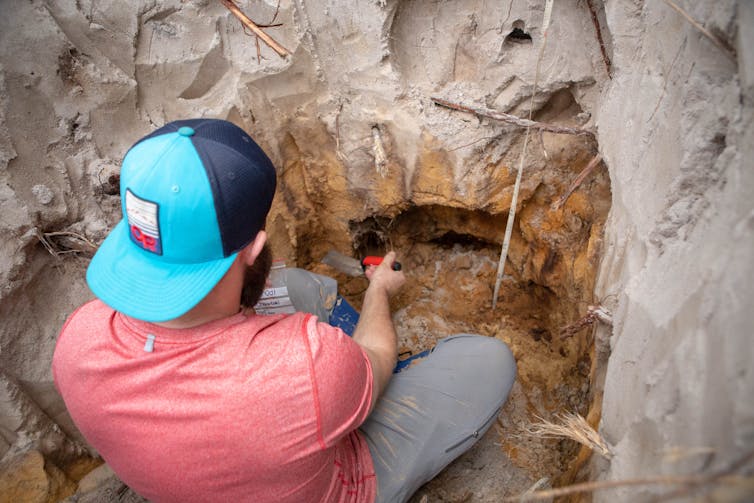
The administration of covid-19 vaccination falls within the ambit of the National Pandemic Act 2020 for any interpretation such that we cannot use the duty of care concept as a reason for compulsory vaccination on workers.
“Any workplace policies developed by employers on the covid-19 vaccination, must be consistent with and adhere to the provisions of the National Pandemic Act 2020,” he said.
Auckland will move to alert level 3 from 11.59pm on Tuesday night, and stay in level 3 for at least two weeks, Prime Minister Jacinda Ardern has announced.
The rest of New Zealand will remain in level 2, but will move from gatherings of 50 up to gatherings of 100.
Meanwhile, part of northern Waikato has been issued a section 70 order, requiring people who live or work there to stay at home.
“We are not stepping out of level 4 because the job is done, but nor are we moving because we don’t think we can achieve the goal of stamping out covid-19 – we are moving because level 3 still provides a cautious approach while we continue to stamp out covid-19,” Ardern said.
“It means staying in your bubble, it means contactless transactions and keeping your distance. It means we say thank you to Auckland for their tireless work, and we collectively keep going.”
Twenty two new cases were reported today, the majority of them household or known contacts. Five were unlinked, and three of those were within one family, and there was a tentative link for that family, Ardern said.
Three of the new cases are in Whakatīwai near Kaiaua in the Firth of Thames, northern Waikato, but are being counted in the Auckland total.
300 swabs
Ardern said testing so far had included household contacts, corrections staff, police staff, court staff, and 300 swabs had already been taken in the small community.
“We do want to make sure we are keeping the community safe,” she said.
Watch the PM’s live announcement here
Director of General of Health Dr Ashley Bloomfield said he was issuing a section 70 order requiring people who live or work in the area around Mangatangi, in northern Waikato, to stay at home. Ardern said it was effectively a “bespoke level 4”.
Dr Bloomfield said the order was for people living in an area north of SH2 centred on Mangatangi.
“That will effectively extend the road boundary to the east of Maramarua … and also to the southeast of Miranda on the Firth of Thames.”
Ardern said level 4 had been tough but it had also made a difference.
Almost all cases of the last 14 days had either been household or known contacts, and wastewater testing suggested there was no significant undetected transmission.
No widespread clusters
There had not been widespread clusters around workplaces, and of the cases where a link had been established, none had resulted from people accessing essential services.
Protections were still in place in level 3, she said.
“That remains critical and we ask everyone to play their part… we’re moving now because the advice we have is we don’t have widespread transmission across Auckland, if everyone continues to play their part we can stamp it out,” she said.
Dr Bloomfield said the ministry was confident there was not widespread undetected transmission. The difference with level 3 this time was it came with high and increasing levels of vaccination, he said.
Ardern reminded people that in level 3 they could make minor changes to bubbles such as bringing in an elderly relative who was not part of another bubble, but should not visit friends or break bubbles.
“Once in a household everyone is at risk of getting delta, so if you break your bubble, know that the consequence may be spreading covid back into your house to your loved ones,” Ardern said.
Masks mandatory at high schools
Schools in level 3 would be largely closed. Cabinet had made the decision to make masks mandatory at high schools at alert level 3, Ardern said.
People attending an essential service must also wear a mask, and people were encouraged to do so whenever they leave their home.
People over 65 in Auckland should stay home until they had been vaccinated, she said.
“We have been doing direct outreach to all our over-65s who haven’t had their first dose yet in Auckland. That amounts to about 23,000 people.
“Last week a letter was sent to those over-65s who we had details for. Today we’re commencing an outbound call campaign… these will average about 8000 calls a day.”
People with a booking in the future could bring it forward, she said, adding pharmacies were offering delivery services, as were supermarkets.
People travelling over the boundary for personal reasons were now being required to carry evidence of having taken a test within the last seven days.
Exemptions were available through the Ministry of Health.
This article is republished under a community partnership agreement with RNZ.
The criminalisation of activists — including those in West Papua — in 2019 and 2020 has been cited as one of the factors for the decline in the quality of democracy in Indonesia.
Based on a report by the Economist Intelligence Unit (EIU), democracy in Indonesia scored its worst figure ever with a score of 6.3 and was placed 64th out of 167 countries.
Advocacy Team for Democracy (TAUD) member Teo Reffelsen said that the criminalisation of activists contributed to Indonesia’s poor record on civil freedoms.
“It has been marked by the criminalisation of expression and public opinion, through to repressive actions ridden with violence,” said Reffelsen in a media release, reports CNN Indonesia.
Between 2019 and 2020, said Reffelsen, TAUD recorded at last 10 incidents of the criminalisation of activists in Indonesia.
This included six Papuan activists — Watchdoc founder and senor journalist Dandhy Dwi Laksono, Jakarta State University (UNJ) sociologist Robertus Robet, musician Ananda Badudu, Papua Student Alliance (AMP) lawyer and human rights activist Veronica Koman and public policy activist Ravio Patra.
Also, 5198 demonstrators were arrested during the protests against the Omnibus Law on Job Creation in September and October 2019, Save Indonesia Action Coalition (KAMI) activists Syahganda Nainggolan and Jumhur Hidayat along with Banda Aceh Syiah Kuala University lecturer Saiful Mahdi.
12 cases in 2021 In 2021, TAUD recorded at last 12 cases of criminalisation of activists. Two of these cases were related to senior state officials, namely Presidential Chief of Staff Moeldoko and Coordinating Minister for Maritime Affairs and Investment Luhut Binsar Pandjaitan.
“The criminalisation of two Indonesian Corruption Watch (ICW) researchers, Egi [Primayogha] and Miftah, threats of criminalisation against [rights activist] Haris Azhar from the Lokataru [Foundation] and Fatia Maulidiyanti from Kontras [Commission for Missing Persons and Victims of Violence],” wrote Reffelsen.
Reffelsen also said they found several cases of attacks on civil freedoms in the form of doxing or attacks in digital space against people who were critical of the government such as those suffered by Ravio Patra and critical online media Tempo.co and Tirto.id.
“The [police] cyber patrols which were legitimised by an instruction by the Indonesian police chief is another example,” said Reffelsen.
Apart from civil freedoms, another factor was that it appeared as if the government lacked the involvement of public participation in policy formulation.
The enactment to revisions to the Corruption Eradication Commission Law, the Omnibus Law and other legislation were examples.
Another aspect was actions by law enforcement agencies such as the judiciary which were seen as corrupt and the lack of seriousness on the part of the government to resolve human rights violations.
“The decline in Indonesia’s democratic index is in keeping with TAUD’s findings on the ground, primarily in relation to civil freedoms which have shrunk,” said Reffelsen.
Te Korowai Hauora o Hauraki says drive-in swabbing will be done at Wharekawa Marae in Whakatīwai.
The government is due to announce any possible alert level changes this afternoon and it is unclear how the development in Waikato will affect its decision.
‘Irresponsible,’ says mayor Waikato District Mayor Allan Sanson said the prisoner should never have been bailed outside Auckland to the area where cases of covid-19 have now been discovered.
The prisoner spent more than a week there on electronically-monitored bail.
The infections were discovered after the man returned to prison in Auckland and tested positive for the virus.
Sanson told RNZ Morning Report it was “totally irresponsible” to send a prisoner on bail outside the lockdown boundary and into the small community.
“There needs to be questions asked as to why it actually happened,” he said.
“I would have thought if you were bailing somebody you would have bailed them into Auckland, and not out of the Auckland area.
“They don’t let anyone else out of Auckland into a level 2 area without them having tests now, so what’s the difference with this? This person’s been in the community for well over a week.”
This article is republished under a community partnership agreement with RNZ.
New Zealand Parliament Buildings, Wellington, New Zealand.
Editor’s Note: Here below is a list of the main issues currently under discussion in New Zealand and links to media coverage. You can sign up to NZ Politics Daily as well as New Zealand Political Roundup columns for free here.
Digital technologies are now at the heart of our everyday lives, as anyone who has swapped their office for a videoconferencing screen, or downloaded a contact-tracing app, knows only too well.
In the words of the computing pioneer Alan Kay, “the best way to predict the future is to create it”. Australia too needs to grab the opportunity to leverage its research and development strengths in emerging digital technologies, and create a “digital future” by amplifying the opportunities for growth in this important sector and strengthen our sovereign capabilities. But Australia is lagging behind many other nations in shaping this digital future.
These innovations are already starting to transform industries such as manufacturing, agriculture, waste management, transport, finance, education and health. But they are still considered “emerging technologies” because they have not yet realised their full commercial potential, unlike more established technologies such as 3D printing, mobile computing or GPS.
The next wave of emerging digital technologies, such as self-driving vehicles, smart microgrids, 6G networks and quantum computing, will further disrupt and transform many sectors of the economy.
Of course, it is hard to predict exactly what innovations will arise in the future. But by ensuring a strong national focus on fundamental science and engineering in this fast-evolving area, Australia can ensure it stays ahead of the curve, no matter what the future brings.
What are other nations doing?
The problem is that Australia is currently doing the opposite. It is falling behind countries such as the United States, United Kingdom, France, Canada and China, all of which are prioritising digital technologies as a strategy to bolster their global competitiveness.
Digital innovation accounts for only 7.4% of Australia’s gross domestic product (GDP), compared with an OECD average of 11.2%.
The applications of emerging digital technologies will continue to diversify and grow. Research and innovation in emerging digital technologies should not be artificially bound to specific application areas nor overly focus on today’s needs, as doing so limits innovation potential that could otherwise create entirely new industries and jobs.
At the same time, emerging digital technologies continue to outpace social expectations and regulatory frameworks. Australia’s digital divide continues to widen, and individuals with lower income, employment and education continue to fall behind. This challenge is likely to compound our looming shortage of digitally skilled workers and widen existing inequalities.
Achieving digital literacy and inclusion through education and workforce development are essential for Australia to meet its commitments to the United Nations’ Sustainable Development Goals, and to ensure the development of a digitally literate, highly skilled workforce.
Australians are early adopters and avid users of technology — a trend that has been accelerated by the COVID pandemic. And the federal government’s Digital Economy Strategy is already putting A$1.2 billion into key digital capabilities such as artificial intelligence and drone technologies.
This investment is welcome, but the government must also clearly recognise the importance of building scientific and engineering capabilities in ways that underpin the entire digital economy, not just particular technologies.
Elevating emerging digital technologies as a national science priority will lift their importance, both in investment and in narrative, develop research and development strengths, deliver critical research infrastructure, and be a catalyst for creating new tech businesses and supporting existing businesses through enhanced linkages between research and industry. Through recognition of a growth sector, it can help to attract talent and address future skill needs of the nation.
A highly digitised society will demand world-class leadership in developing digital technologies, and reduce our reliance on overseas technology and expertise. Coordinated and strategic support of this crucial sector of our economy will help create a digital future for Australia that is aligned with our social and economic aspirations.
Shazia Sadiq receives funding from the Australian Research Council, as well as other funding schemes of the Australian government and industry. She is the chair of the National Committee for Information and Communication Sciences at the Australian Academy of Science, and a Fellow of the Australian Academy of Technology and Engineering. Shazia is also the director of the ARC Training Centre for Information Resilience (CIRES.org.au), which has a number of industry and government partners.
Thas Ampalavanapillai Nirmalathas currently receives funding from the Australian Research Council, Defence Science and Technology Group, and industry partners such as InstaWireless and Jarvis. He has received funding in the past from partners such as Google, Nokia Networks, Transurban, Digital Falcon, and the Victorian State Government.
This article is based on his role as the co-chair of the National Committee for the Information and Communication Sciences of the Australian Academy of Science and it reflects contributions from the other committee members of the commitee and Digital Futures committee members of the Australian Technological and Engineering Sciences (Professor Shazia Sadiq
Professor Rod Tucker,
Professor Benjamin Rubinstein, Professor Svetha Venkatesh,
Professor Andy Koronios,
Professor Deborah Bunker,
Professor Iain Collings,
Professor Mike Miller Professor Mary-Anne Williams
Mr David Thodey,
Dr Craig Mudge, Professor Glenn Wightwick)