Page 310

New climate reporting rules start on July 1. Many companies are not ready for the change

Source: The Conversation (Au and NZ) – By Rachel Baird, Senior Lecturer , University of Tasmania

PaeGAG/Shutterstock

A new financial year starts on July 1. For Australia’s large companies, that means new rules on climate-related disclosures come into force.

These requirements are the culmination of years of planning to ensure companies disclose climate-related risks and opportunities for their business. The Albanese government passed the legislation in September 2024.

To be clear, the time to prepare is gone. From July 1, large public companies and financial institutions must gather significant amounts of information and data to include in a new year-end sustainability report. Collecting all this information is one challenge; another is finding the specialists across many fields to compile the reports.

This is a huge change for corporate Australia. It is a whole new reporting regime, supported by volumes of technical detail. Directors will need to sign off on the report. Investors must also upskill to make sense of the disclosures. Neither of these outcomes is assured.

And it is not clear the increased disclosures will do anything to reduce actual emissions.

Climate impacts in focus

Though it’s called a sustainability report, in reality it is very much focused on climate-related disclosures. If you go looking for wider sustainability matters such as social impact, environmental performance and ethical choices, you will be disappointed.

Markets and ultimately the millions of Australians who hold shares will be watching to find out if:

  1. Corporate Australia is prepared for the transition to this new regulatory regime

  2. End users of the new reports are equipped to decipher and understand the huge amount of additional data.

My research suggests the answer to both questions is a resounding no.

Starting with the big end of town

The government has wisely adopted a three-year transition for the new reporting regime, with only the big end of town facing the music this year. Think the big four banks, big supermarkets and large miners.

Some large corporations have been publishing sustainability reports for years. National Australia Bank, for example, published its first one in 2017.

Over the next two years, medium and then smaller companies will join the fold. By 2027–28, companies will be required to report if they meet two of three thresholds: consolidated revenue of A$50 million, or consolidated gross assets of $25 million, or more than 100 employees.

The reasoning behind the transition is they have the benefit of watching how the larger companies adapt to the new laws.

What has to be disclosed?

Reporting entities must include:

– climate statements for the year plus any notes, and

– the directors’ declaration about these statements and notes

This sounds rather simple and straightforward, but it is not.

Arriving at a completed sustainability report involves an understanding of two detailed documents: the international standards and a new Australian Accounting Sustainability Standard.

The Australian standards are mandatory and based on the international rules. In broad terms, companies will be required to gather and disclose information on many micro-level issues, which are grouped into four categories. These are: governance, strategy, risk management, and metrics and targets.

Some issues will straddle all four categories.

For example, the physical risk of climate change (floods, uninsurable properties, supply chain disruption) can be considered at the board level and in dedicated climate committees (goverance); in planning for alternative supply chains in a climate transition plan (strategy); in risk assessment (risk management) and in data prediction of the costs involved (metrics and targets).

The big challenge for corporate Australia is that the people, expertise and time required to deliver a sustainability report are in short supply.

More than a quarter of ASX 200 companies do not use the international standards. This means they are not positioned to adapt to the new reporting regime. Even for those that have been early adopters, there has been selective use of the four categories.

For the smaller companies that will follow the first reporting year, the stakes are high.

More information is not always better

The amount of new information (much of it technical) to be disclosed will be overwhelming for the producers of the sustainability reports – and for the readers, whether they are institutional or mum-and-dad investors.

The cost of collecting and making sense of the data required to meet detailed reporting requirements will lead to many companies being swamped in data. More data collected does not equal better data.

Deciding what data to collect and then making sense of it so it supports disclosures will be a major headache for most companies.

The new climate disclosure rules will have a profound impact on corporate Australia. There is a significant gap in capacity and capability to meet the requirements of the new reporting regime. And there is a corresponding need to educate the readers of these new reports to make effective use of the disclosed information.

Rachel Baird does not work for, consult, own shares in or receive funding from any company or organisation that would benefit from this article, and has disclosed no relevant affiliations beyond their academic appointment.

ref. New climate reporting rules start on July 1. Many companies are not ready for the change – https://theconversation.com/new-climate-reporting-rules-start-on-july-1-many-companies-are-not-ready-for-the-change-258706


Whose story is being told — and why? 4 questions museum visitors should ask themselves this school holidays

Source: The Conversation (Au and NZ) – By Olli Hellmann, Associate Professor of Political Science, University of Waikato

The winter school holidays will mean families across Aotearoa New Zealand will be looking for indoor activities to entertain children. With millions of visitors each year, museums focused on the country’s history will inevitably play host to local and international visitors.

Museums tend to enjoy a high level of trust among the public. They’re widely seen as neutral, factual sources of historical knowledge.

But like all forms of storytelling, museums present the past in particular ways. They narrate events from a certain group’s or individual’s perspective and explain why events unfolded in the way they did.

In this respect, museums are not so different from historical films. Consider the different ways two recent movies – 1917 and the remake of All Quiet on the Western Front – narrate the first world war.

In 1917, the storyteller takes the British side, encouraging viewers to invest in the bravery and endurance of British soldiers. But All Quiet on the Western Front is narrated from a German perspective, inviting viewers to grieve for German soldiers as victims of a political system that glorified war.

Museum exhibitions tell stories in a similar way. Visitors should be asking not just what story is told, but why.

Spoiler alert: it often has to do with national identity. Museums tell particular stories of the past because these stories support a particular image of New Zealand as a nation.

Four questions for your next museum visit

At its core, every story has two basic ingredients: actors and events. To turn these into a compelling narrative, the storyteller connects the events into a plot, so they build on each other. The storyteller also transforms actors into characters by giving them particular traits — brave, selfish, wise, cruel and the like. Museums do this, too.

As you move through a museum exhibition, try asking yourself the following questions:

1. Which historical events are included — and which are left out?

Every story begins somewhere. Museums choose which events to include and which to leave out, shaping how visitors understand what happened and why.

Take Te Papa’s Gallipoli: The Scale of Our War exhibition. It opens with the landing at ANZAC Cove but skips over events in the lead-up to WWI — such as Britain’s earlier moves to seize Ottoman territories like Cyprus and Egypt.

Leaving these out helps frame Gallipoli as a noble – albeit tragic – “coming of age” for New Zealand. But in reality, ANZAC soldiers were fighting to support Britain’s imperial ambitions in the Middle East.

2. How are events organised into a plot?

Museums don’t just say “this happened, then that happened”. They link events into a larger plot — a chain of cause and effect that explains how one thing led to another. This can happen through text, but also through spatial layout, lighting, sound and other techniques that guide visitors through rising and falling moments of narrative tension.

Often, museums use familiar plot types to connect events. One common example is the quest narrative — a story in which heroes must navigate unknown terrain, and where mistakes are part of the journey and threaten to derail the mission. It’s a bit like The Lord of the Rings: a journey full of challenges, wrong turns and personal growth.

At Te Kōngahu Museum of Waitangi, Aotearoa New Zealand’s Treaty story is told using this quest structure. The Treaty is presented as something unique and unfamiliar and the British, confronted with this unknown, fall back on familiar colonial practices — the “mistake” that led to the New Zealand wars.

Because this misstep is treated as part of the learning curve typical of any quest, the exhibition avoids harder questions about this violent part of history, and instead preserves the image of Aotearoa New Zealand as fundamentally tolerant and respectful.

3. Who are the main actors in the story — and who is missing?

Every story needs protagonists, and whose perspective frames the story matters. In many smaller regional museums, history is still told almost entirely from the viewpoint of European settlers. But what about Māori experiences of colonisation? Or the histories of Chinese communities and other migrants who arrived in the 1800s?

By focusing narrowly on European settlers as the main actors, these museums present a one-sided view of the past and construct an image of New Zealand as a European nation — one that expects others to assimilate.

4. How are the main actors characterised — and how are we meant to feel about them?

It’s not surprising that museums portray some actors positively and others less so. What’s more revealing is how certain individuals are elevated as symbols of the nation and how museums invite us to form personal connections with them.

In Te Papa’s Gallipoli exhibition, visitors can open drawers and boxes containing soldiers’ personal belongings. This intimate activity encourages us to feel close to these figures — not just learning about them, but identifying with them as embodying national qualities: bravery, resilience and a commitment to peace.

Why does this matter?

Historical museum narratives aren’t necessarily inaccurate — but, much like historical movies, they are selective. They highlight certain events, actors and cause-and-effect chains to tell a particular kind of story. Often, that story supports a specific idea of what it means to be an Aotearoa New Zealander.

By reading museum exhibitions with a critical eye, visitors can better understand not just the past, but how storytelling shapes national identity in the present — and imagine how it might be shaped differently.

The Conversation

Olli Hellmann does not work for, consult, own shares in or receive funding from any company or organisation that would benefit from this article, and has disclosed no relevant affiliations beyond their academic appointment.

ref. Whose story is being told — and why? 4 questions museum visitors should ask themselves this school holidays – https://theconversation.com/whose-story-is-being-told-and-why-4-questions-museum-visitors-should-ask-themselves-this-school-holidays-259538

Philly psychology students map out local landmarks and hidden destinations where they feel happiest

Source: The Conversation (Au and NZ) – By Eric Zillmer, Professor of Neuropsychology, Drexel University

Rittenhouse Square Park in Center City made it onto the Philly Happiness Map. Matthew Lovette/Jumping Rocks/Universal Images Group via Getty Images

What makes you happy? Perhaps a good night’s sleep, or a wonderful meal with friends?

I am the director of the Happiness Lab at Drexel University, where I also teach a course on happiness. The Happiness Lab is a think tank that investigates the ingredients that contribute to people’s happiness.

Often, my students ask me something along the lines of, “Dr. Z, tell us one thing that will make us happier.”

As a first step, I advise them to spend more time outside.

Achieving lasting and sustainable happiness is more complicated. Research on the happiest countries in the world and the places where people live the longest, known as Blue Zones, shows a common thread: Residents feel they are part of something larger than themselves, such as a community or a city.

So if you’re living in a metropolis like Philadelphia, where, incidentally, the iconic pursuit of happiness charge was ratified in the Declaration of Independence, I believe urban citizenship – that is, forming an identity with your urban surroundings – should also be on your list.

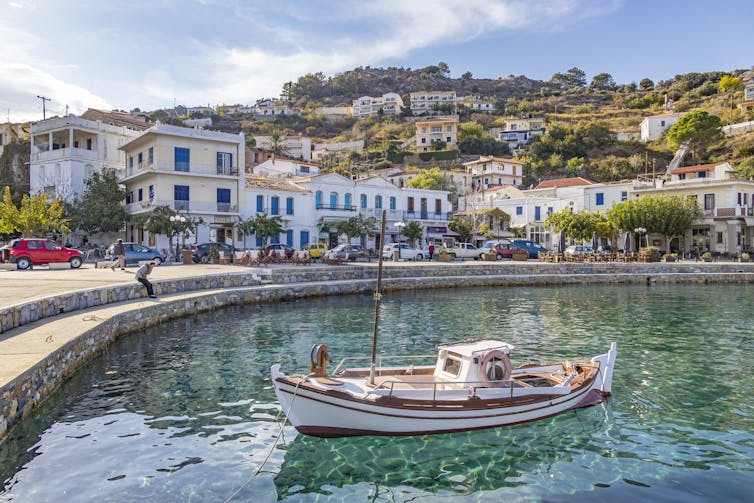
A small boat floats in blue-green waters in front of a picturesque village.
The Greek island of Ikaria in the Aegean Sea is a Blue Zone famous for its residents’ longevity.
Nicolas Economou/NurPhoto via Getty Images

Safety, social connection, beauty

Carl Jung, the renowned Swiss psychoanalyst, wrote extensively about the relationship between our internal world and our external environment.

He believed that this relationship was crucial to our psychological well-being.

More recent research in neuroscience and functional imaging has revealed a vast, intricate and complex neurological architecture underlying our psychological perception of a place. Numerous neurological pathways and functional loops transform a complex neuropsychological process into a simple realization: I am happy here!

For example, a happy place should feel safe.

The country of Croatia, a tourist haven for its beauty and culinary delights, is also one of the top 20 safest countries globally, according to the 2025 Global Peace Index.

The U.S. ranks 128th.

The availability of good food and drink can also be a significant factor in creating a happy place.

However, according to American psychologist Abraham Maslow, a pioneer in the field of positive psychology, the opportunity for social connectivity, experiencing something meaningful and having a sense of belonging is more crucial.

Furthermore, research on happy places suggests that they are beautiful. It should not come as a surprise that the happiest places in the world are also drop-dead gorgeous, such as the Indian Ocean archipelago of Mauritius, which is the happiest country in Africa, according to the 2025 World Happiness Report from the University of Oxford and others.

Happy places often provide access to nature and promote active lifestyles, which can help relieve stress. The residents of the island of Ikaria in Greece, for example, one of the original Blue Zones, demonstrate high levels of physical activity and social interaction.

A Google map display on right with a list of mapped locations on the left.
A map of 28 happy places in Philadelphia, based on 243 survey responses from Drexel students.
The Happiness Lab at Drexel University

Philly Happiness Map

I asked my undergraduate psychology students at Drexel, many of whom come from other cities, states and countries, to pick one place in Philadelphia where they feel happy.

From the 243 student responses, the Happiness Lab curated 28 Philly happy places, based on how frequently the places were endorsed and their accessibility.

Philadelphia’s founder, William Penn, would likely approve that Rittenhouse Square Park and three other public squares – Logan, Franklin and Washington – were included. These squares were vital to Penn’s vision of landscaped public parks to promote the health of the mind and body by providing “salubrious spaces similar to the private garden.” They are beautiful and approachable, serving as “places to rest, take a pause, work, or read a book,” one student told us.

Places such as the Philadelphia Zoo, Penn’s Landing and the Philadelphia Museum of Art are “joyful spots that are fun to explore, and one can also take your parents along if need be,” as another student described.

The Athenaeum of Philadelphia, a historic library with eclectic programming, feels to one student like “coming home, a perfect third place.”

Some students mentioned happy places that are less known. These include tucked-away gardens such as the John F. Collings Park at 1707 Chestnut St., the rooftop Cira Green at 129 S. 30th St. and the James G. Kaskey Memorial Park and BioPond at 433 S. University Ave.

A stone-lined brick path extends through a nicely landscaped outdoor garden area.
The James G. Kaskey Memorial Park and BioPond in West Philadelphia is an urban oasis.
M. Fischetti for Visit Philadelphia

My students said these are small, unexpected spots that provide an excellent opportunity for a quiet, peaceful break, to be present, whether enjoyed alone or with a friend. I checked them out and I agree.

The students also mentioned places I had never heard of even though I’ve lived in the city for over 30 years.

The “cat park” at 526 N. Natrona St. in Mantua is a quiet little park with an eclectic personality and lots of friendly cats.

Mango Mango Dessert at 1013 Cherry St. in Chinatown, which is a frequently endorsed happiness spot among the students because of its “bustling streets, lively atmosphere and delicious food,” is a perfect pit stop for mango lovers. And Maison Sweet, at 2930 Chestnut St. in University City, is a casual bakery and cafe “where you may end up staying longer than planned,” one student shared.

I find that Philly’s happy places, as seen through the eyes of college students, tend to offer a space for residents to take time out from their day to pause, reset, relax and feel more connected and in touch with the city.

Happiness principals are universal, yet our own journeys are very personal. Philadelphians across the city may have their own list of happy places. There are really no right or wrong answers. If you don’t have a personal happy space, just start exploring and you may be surprised what you will find, including a new sense of happiness.

See the full Philly Happiness Map list here, and visit the exhibit at the W.W. Hagerty Library at Drexel University to learn more.

Read more of our stories about Philadelphia.

The Conversation

Eric Zillmer does not work for, consult, own shares in or receive funding from any company or organization that would benefit from this article, and has disclosed no relevant affiliations beyond their academic appointment.

ref. Philly psychology students map out local landmarks and hidden destinations where they feel happiest – https://theconversation.com/philly-psychology-students-map-out-local-landmarks-and-hidden-destinations-where-they-feel-happiest-258790

Macron invites all New Caledonia stakeholders for Paris talks

By Patrick Decloitre, RNZ Pacific correspondent French Pacific desk

French President Emmanuel Macron has sent a formal invitation to “all New Caledonia stakeholders” for talks in Paris on the French Pacific territory’s political and economic future to be held on July 2.

The confirmation came on Thursday in the form of a letter sent individually to an undisclosed list of recipients and June 24.

The talks follow a series of roundtables fostered earlier this year by French Minister for Overseas Manuel Valls.

But the latest talks, held in New Caledonia under a so-called “conclave” format, stalled on  May 8.

This was mainly because several main components of the pro-France (anti-independence) parties said the draft agreement proposed by Valls was tantamount to a form of independence, which they reject.

The project implied that New Caledonia’s future political status vis-à-vis France could be an associated independence “within France” with a transfer of key powers (justice, defence, law and order, foreign affairs, currency ), a dual New Caledonia-France citizenship and an international standing.

Instead, the pro-France Rassemblement-LR and Loyalistes suggested another project of “internal federalism” which would give more powers (including on tax matters) to each of the three provinces, a notion often criticised as a de facto partition of New Caledonia.

Local elections issue
In May 2024, on the sensitive issue of eligibility at local elections, deadly riots broke out in New Caledonia, resulting in 14 deaths and more than 2 billion euros (NZ$3.8 billion) in damage.

In his letter, Macron writes that although Valls “managed to restore dialogue…this did not allow reaching an agreement on (New Caledonia’s) institutional future”.

“This is why I decided to host, under my presidency, a summit dedicated to New Caledonia and associating the whole of the territory’s stakeholders”.

Macron also wrote that “beyond institutional topics, I wish that our exchanges can also touch on (New Caledonia’s) economic and societal issues”.

Macron made earlier announcements, including on 10 June 2025, on the margins of the recent UNOC Oceans Summit in Nice (France), when he dedicated a significant part of his speech to Pacific leaders attending a “Pacific-France” summit to the situation in New Caledonia.

“Our exchanges will last as long as it takes so that the heavy topics . . . can be dealt with with all the seriousness they deserve”.

Macron also points out that after New Caledonia’s “crisis” broke out on 13 May 2024, “the tension was too high to allow for a dialogue between all the components of New Caledonia’s society”.

Letter sent by French President Emmanuel Macron to New Caledonia’s stakeholders for Paris talks on 2 July 2025. Image: RNZ Pacific

A new deal?
The main political objective of the talks remains to find a comprehensive agreement between all local political stakeholders, in order to arrive at a new agreement that would define the French Pacific territory’s political future and status.

This would then allow to replace the 27-year-old Nouméa Accord, signed in 1998.

That pact put a heavy focus on the notions of “living together” and “common destiny” for New Caledonia’s indigenous Kanaks and all of the other components of its ethnically and culturally diverse society.

It also envisaged an economic “rebalancing” between the Northern and Islands provinces and the more affluent Southern province, where the capital Nouméa is located.

The Nouméa Accord also contained provisions to hold three referendums on self-determination.

The three polls took place in 2018, 2020 and 2021, all of those resulting in a majority of people rejecting independence.

But the last referendum, in December 2021, was largely boycotted by the pro-independence movement.

‘Examine the situation’
According to the Nouméa Accord, after the referendums, political stakeholders were to “examine the situation thus created”, Macron recalled.

But despite several attempts, including under previous governments, to promote political talks, the situation has remained deadlocked and increasingly polarised between the pro-independence and the pro-France camps.

A few days after the May 2024 riots, Macron made a trip to New Caledonia, calling for the situation to be appeased so that talks could resume.

In his June 10 speech to Pacific leaders, Macron also mentioned a “new project” and in relation to the past referendums process, pledged “not to make the same mistakes again”.

He said he believed the referendum, as an instrument, was not necessarily adapted to Melanesian and Kanak cultures.

In practice, the Paris “summit” would also involve French minister for Overseas Manuel Valls.

The list of invited participants would include all parties, pro-independence and pro-France, represented at New Caledonia’s Congress (the local parliament).

But it would also include a number of economic stakeholders, as well as a delegation of Mayors of New Caledonia, as well as representatives of the civil society and NGOs.

Talks could also come in several formats, with the political side being treated separately.

The pro-independence platform FLNKS (Kanak and Socialist National Liberation Front) has to decide at the weekend whether it will take part in the Paris talks.

FLNKS leader Christian Téin . . . still facing charges over last year’s riots, but released from prison in France providing he does not return to New Caledonia and checks in with investigating judges. Image: Opinion International

Will Christian Téin take part?
During a whirlwind visit to New Caledonia in June 2024, Macron met Christian Téin, the leader of a pro-independence CCAT (Field Action Coordination Cell), created by Union Calédonienne (UC).

Téin was arrested and jailed in mainland France.

In August 2024, while in custody in the Mulhouse prison (northeastern France), he was elected in absentia as president of a UC-dominated FLNKS.

Even though he still faces charges for allegedly being one of the masterminds of the May 2024 riots, Téin was released from jail on June 12 on condition that he does not travel to New Caledonia and reports regularly to French judges.

On the pro-France side, Téin’s release triggered mixed angry reactions.

Other pro-France hard-line components said the Kanak leader’s participation in the Paris talks was simply “unthinkable”.

Pro-independence Tjibaou said Téin’s release was “a sign of appeasement”, but that his participation was probably subject to “conditions”.

“But I’m not the one who makes the invitations,” he told public broadcaster NC la 1ère on 15 June 2025.

FLNKS spokesman Dominique Fochi said in a release Téin’s participation in the talks was earlier declared a prerequisite.

“Now our FLNKS president has been released. He’s the FLNKS boss and we are awaiting his instructions,” Fochi said.

At former roundtables earlier this year, the FLNKS delegation was headed by Union Calédonienne (UC, the main and dominating component of the FLNKS) president Emmanuel Tjibaou.

‘Concluding the decolonisation process’, says Valls
In a press conference on Tuesday in Paris, Valls elaborated some more on the upcoming Paris talks.

“Obviously there will be a sequence of political negotiations which I will lead with all of New Caledonia’s players, that is all groups represented at the Congress. But there will also be an economic and social sequence with economic, social and societal players who will be invited”, Valls said.

During question time at the French National Assembly in Paris on 3 June 2025, Valls said he remained confident that it was “still possible” to reach an agreement and to “reconcile” the “contradictory aspirations” of the pro-independence and pro-France camps.

During the same sitting, pro-France New Caledonia MP Nicolas Metzdorf decried what he termed “France’s lack of ambition” and his camp’s feeling of being “let down”.

The other MP for New Caledonia’s, pro-independence Emmanuel Tjibaou, also took the floor to call on France to “close the colonial chapter” and that France has to “take its part in the conclusion of the emancipation process” of New Caledonia.

“With the President of the Republic and the Prime Minister, and the political forces, we will make offers, while concluding the decolonisation process, the self-determination process, while respecting New Caledonians’ words and at the same time not forgetting history, and the past that have led to the disaster of the 1980s and the catastrophe of May 2024,” he said.

This article is republished under a community partnership agreement with RNZ.

Article by AsiaPacificReport.nz

Opposition starts on challenge of crafting (yet another) energy policy

Source: The Conversation (Au and NZ) – By Michelle Grattan, Professorial Fellow, University of Canberra

The opposition is commencing the challenging task of framing a new energy policy, including deciding whether to stick by its commitment to net zero emissions by 2050.

Liberal leader Sussan Ley, appearing at the National Press Club, announced a Coalition working group on energy and emissions reduction policy. It will report to her and Nationals leader David Littleproud.

Led by energy spokesman Dan Tehan, the group will include shadow treasurer Ted O’Brien, resources spokeswoman Susan McDonald, industry spokesman Alex Hawke, environment spokeswoman Angie Bell and shadow assistant ministers Dean Smith and Andrew Willcox.

The work comes against the background of a significant number of the Nationals and some Liberals wanting to drop the commitment to 2050 net zero. The Coalition signed up to net zero under then Prime Minister Scott Morrison.

Ley said over the course of the term the Coaltion’s task would be to develop a plan with two goals

  • a stable energy grid producing affordable and reliable power for households and businesses, and

  • reducing emissions so Australia was playing its part in the global effort.

“Our approach must be practical and principled as we address both these goals,” she said.

Ley said every member of both Coalition parties would have the opportunity to engage with the work.

She said crippling power price increases had been taking small businesses and factories to the brink.

The opposition this week is having meetings of its frontbenchers and party room, as it ponders on the election disaster. Ley declared bluntly in her speech that the Liberals didn’t just lose – they were “totally smashed”.

The Liberal party has already set up a review of the election defeat but Ley said more was needed.

“This is why our federal executive will soon discuss a more broad-ranging and wider review process of the fundamentals of the Liberal party.

“I believe there is a need for the party as a whole to have a deeper look at the existential issues we face, how our divisional constitutions operate and how we can better serve, support and most importantly grow our membership.

“This will not be an academic exercise. My parliamentary team and I will stay in close touch with out state and territory divisions to ensure success in this important area.”

Queensland Liberal senator James McGrath “will play an integral role in bringing this longer term body of work together”.

“It will be a crucial part of our efforts to better respect, reflect and represent modern Australia.”

Ley stressed she was highly committed to getting more women into the Liberal ranks, without being wedded to a particular way of doing it.

“I’m agnostic on specific methods to make it happen, but I am a zealot that it does actually happen.

“Current approaches have clearly not worked, so I am open to any approach that will.

“The Liberal Party operates as a federated model, meaning each state division determines its own preselection rules.

“If some state divisions choose to implement quotas, that is fine. If others don’t, that is also fine.

“But what is not fine is not having enough women.

“As the first woman leader of our federal party, let me send the clearest possible message: we need to do better, recruit better, retain better and support better.

“That is why I will work with every division, as will my parliamentary team, to ensure we preselect more women for the 2028 election.”

The Conversation

Michelle Grattan does not work for, consult, own shares in or receive funding from any company or organisation that would benefit from this article, and has disclosed no relevant affiliations beyond their academic appointment.

ref. Opposition starts on challenge of crafting (yet another) energy policy – https://theconversation.com/opposition-starts-on-challenge-of-crafting-yet-another-energy-policy-259683

Election flows reveal nearly 90% of Greens preferenced Labor ahead of Coalition

Source: The Conversation (Au and NZ) – By Adrian Beaumont, Election Analyst (Psephologist) at The Conversation; and Honorary Associate, School of Mathematics and Statistics, The University of Melbourne

Minor party preference flows for the federal election have been released, with Labor winning Greens preferences by 88.2–11.8, while the Coalition won One Nation preferences by 74.5–24.5. I also cover a SA state poll that gave Labor a massive 67–33 lead.

The Australian Electoral Commission’s results for the May 3 federal election now show how minor parties’ preferences flowed between Labor and the Coalition. The Greens won 12.2% of the national primary vote, and their preferences favoured Labor over the Coalition by 88.2–11.8. That’s a 2.5% preference flow gain for Labor since the 2022 election.

One Nation had 6.4% of primary votes. Their preferences favoured the Coalition over Labor by 74.5–25.5, a 10.2% preference flow gain for the Coalition. Independents made up 7.3% of primary votes, and their preferences favoured Labor by 67.2–32.8, a 3.4% gain for Labor.

Including Trumpet of Patriots (1.9% of primary votes) with others, others made up 7.7% of primary votes and their preferences favoured the Coalition by 57.3–42.7, a 0.6% gain for the Coalition since 2022 if United Australia Party (4.1% in 2022) is included with others then.

The AEC formally declared the poll by returning the writs on June 12. Results can be legally challenged within 40 days of this declaration, so by July 22.

In Bradfield, Teal Nicolette Boele only won by 26 votes against the Liberals, and this result could be challenged.

As the AEC does not want to disturb the ballot papers until any challenge is resolved by the courts, it is for now using an estimated two-party result in Bradfield (55.0–45.0 to the Liberals against Labor). Analyst Ben Raue believes this estimate is understating Labor in Bradfield by 4.4%.

If Raue is right, the current national two-party vote (55.22–44.78 to Labor) is very slightly understating Labor.

While One Nation’s preference shift helped the Coalition, there were compensatory shifts to Labor from Greens and independent voters. The combined primary vote for One Nation and Trumpet of Patriots was down 0.8% from 2022 to 8.3%, while independents were up 2.0%.

Applying 2022 election flows to primary votes at this election only overstates Labor by 0.1% compared to their actual two-party vote.

In my poll review article on June 5, I said respondent allocated preferences in final polls did not show a large gap in the Coalition’s favour from using 2022 election flows that had occurred in polls earlier in the year.

It’s likely that Labor’s share of preferences from Greens and Teal-type independents rose close to the election. People who voted for these candidates may have been disappointed with Labor’s environmental record, but both Peter Dutton and Donald Trump helped Labor with these people.

In the last term, the Greens were economically left-wing as well as pro-environment. Voters who supported the Greens because of their economic agenda are probably less likely to prefer the Coalition to Labor than environmental voters.

The Poll Bludger has a graph that shows that, in federal elections since 2004, Labor’s share of Greens preferences was at a record high this election, but their share of One Nation preferences was at a record low.

Weak Labor flows to Boele

In Bradfield, Labor preferences favoured Boele by 68.6–31.4 against the Liberals.
There were 16 other seats where Labor preferences were distributed between the Coalition and a non-Coalition candidate. The Labor flow to Boele was the second weakest in such seats. This weak flow almost cost Boele Bradfield.

The only seat that had a weaker Labor preference flow to a non-Coalition candidate was Maranoa, where the non-Coalition candidate was One Nation. Labor preferences in Maranoa split 57.9–42.1 to the Liberal National Party against One Nation. In 13 of the 17 seats, Labor preferences flowed at over 75% rates to the non-Coalition candidate.

In early April, the ABC reported Boele had made a crude sexual remark to a 19-year-old employee at a hair salon after receiving a haircut and was banned from that salon. This may explain the weaker preference flow from Labor voters.

Weak Greens flows to Teals in Teal vs Labor contests

There were three seats where the final two were Labor and a Teal independent: Bean, Franklin and Fremantle. In Bean and Fremantle, the Liberals recommended preferences to the Teal on their how to vote material, but not in Franklin.

Labor held all three seats, but only by 50.3–49.7 in Bean and 50.7–49.3 in Fremantle. Labor won much more easily in Franklin, by 57.8–42.2, where they benefited from Liberal how to vote cards.

In Bean, Greens preferences only favoured Teal Jessie Price by 50.6–49.4 over Labor, while Liberal preferences favoured her by 80.0–20.0. In Fremantle, Greens preferences favoured Teal Kate Hulett by 52.9–47.1, while Liberal preferences favoured her by 76.5–23.5. In Franklin, Greens preferences favoured Teal Peter George by 53.8–46.2.

In Bean and Fremantle, had Greens preferences been stronger for the Teal, Labor would have lost to a more pro-environment candidate. Perhaps Labor benefited on Greens preferences owing to the Greens’ more economic left-wing agenda.

And a national Morgan poll, conducted June 2–22 from a sample of 3,957, gave Labor a 58–42 lead, unchanged from the previous Morgan poll in May. Primary votes were 37.5% Labor (up 0.5), 31% Coalition (steady), 12% Greens (up 0.5), 6% One Nation (steady) and 13.5% for all Others (down one).

By 43–41.5, voters thought the country was headed in the right direction, the first time right direction has led since February 2023. The overall net +1.5 rating is +48 with Labor voters, +11.5 with Greens, -43 with Coalition voters, -80.5 with One Nation voters and -17.5 with all Others.

Labor holds massive lead in SA

The next South Australian state election will be held in March 2026. A YouGov poll for The Adelaide Advertiser, conducted May 15–28 from a sample of 903, gave Labor a massive 67–33 lead over the Liberals (54.6–45.4 to Labor at the March 2022 election). Primary votes were 48% Labor, 21% Liberals, 14% Greens, 7% One Nation, 8% independents and 2% others.

If the results at next March’s election reflect this poll, the Liberals would hold just two of the 47 lower house seats on a uniform swing. It would be easily their worst result in SA state history.

In Australian electoral history, there has only been one bigger landslide: when Western Australian Labor defeated the Liberals and Nationals by 69.7–30.3 at the March 2021 state election.

Socialist likely to be next New York City mayor

I covered today’s AEST New York City Democratic mayoral primary election for The Poll Bludger. While preferences won’t be tabulated until next Tuesday, the socialist Zohran Mamdani leads former New York governor Andrew Cuomo by 43.5–36.4 on primary votes, and is virtually certain to win. As the Democratic nominee, Mamdani is likely to win the November general election.

The article also covers Donald Trump’s ratings and polls in Israel.

Adrian Beaumont does not work for, consult, own shares in or receive funding from any company or organisation that would benefit from this article, and has disclosed no relevant affiliations beyond their academic appointment.

ref. Election flows reveal nearly 90% of Greens preferenced Labor ahead of Coalition – https://theconversation.com/election-flows-reveal-nearly-90-of-greens-preferenced-labor-ahead-of-coalition-259438

Australia’s native bees struggled after the Black Summer fires – but a world-first solution brought them buzzing back

Source: The Conversation (Au and NZ) – By Kit Prendergast, Postdoctoral Researcher, Pollination Ecology, University of Southern Queensland

Kit Prendergast (@bee.babette_performer)

After a devastating bushfire, efforts to help nature recover typically focus on vertebrates and plants. Yet extreme fires can threaten insects, too.

After the Black Summer fires of 2019–20, I embarked on world-first research into whether “bee hotels” – a type of artificial nesting structure – could help native bees recolonise an area.

I installed 1,000 bee hotels in the Jarrah forests of Western Australia, parts of which burned during the Black Summer fires.

After months of monitoring, I concluded – with great excitement and relief – that the project was a success. Native bees were using the structures to lay eggs and raise young. The work shows pollinators such as bees can be aided after fires, to help bring damaged landscapes back to life.

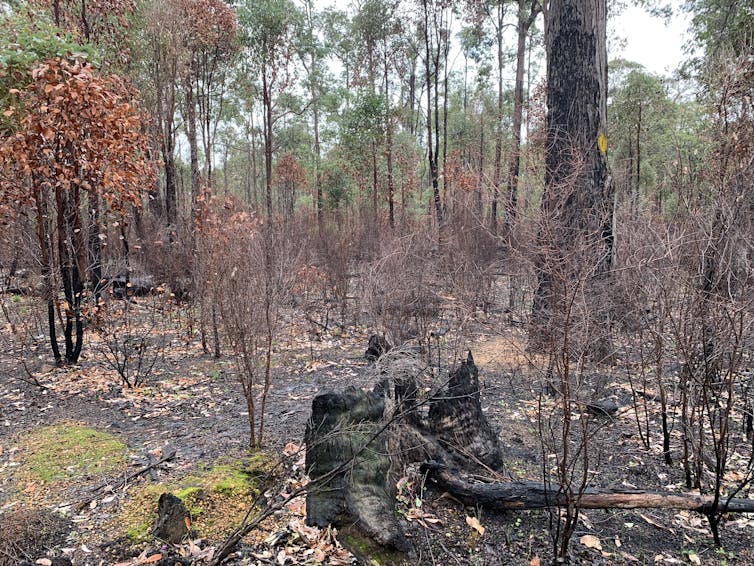
A burnt area of bushland.
WA’s Jarrah Forest was affected by the Black Summer fires.
Kit Prendergast

Vital wild pollinators

Australia has more than 2,000 species of native bees. They help keep our ecosystems healthy, and play a crucial role in pollinating wildflowers.

Native bees typically nest in holes in trees that occur naturally when beetles bore through wood. When fire destroys trees, bees can be left without a place to nest and reproduce. This prevents them from recolonising habitats after fire.

Under climate change, bushfires in Australia are becoming more frequent and severe. Wood-nesting bees are especially vulnerable to bushfires. For example, fires are recognised as a major threat to the glittering green carpenter bee (Xylocopa aerata), which creates its own holes in wood to nest in.

The worsening fires take place at a time when global populations of wild pollinators, such as bees, are in steady decline. This problem has been well-publicised, although the plight of Australia’s native bees has received less attention.

My research tested whether bee hotels could help our native bees bounce back after fire.

What the research found

The Jarrah Forest of southwest Western Australia is a biodiversity hotspot. The 1,000 bee hotels were installed across five sites in the northern part of the forest, where bushfires burned during the summer of 2019–20.

Bee hotels replicate the holes in wood that native bees nest in. In August 2021, I installed bee hotels of two types: wooden blocks with 15 holes drilled in them, and bunches of about 50 bamboo stems bundled together. I monitored them from September 2021 to March 2022.

At the end of the period I concluded – with great excitement and relief – that the project was a success. Across all bee hotels at the five sites, 832 cavities were occupied by native bees.

Assuming four cells per cavity for each offspring, this meant more than 3,300 native bees would likely emerge in the next generation.

Uptake by bees was initially slow. This was to be expected, because the main group of species that used bee hotels – from the Megachile genus – tend to not be active in the region until late spring.

I found the nests were also used by bees of the genus Hylaeus, as well as tiny Exoneura bees. Other inhabitants included wasps, spiders, ants and crickets.

I also surveyed three burnt sites where bee hotels were not installed. There, I recorded the numbers of native bees foraging on flowers, and compared it to the sites with bee hotels. More native bees were present at the latter sites, which reinforced my findings.

Importantly, the research allowed natural recolonisation. It did not involve installing bee hotels at unburnt sites, then moving them to burnt areas once they were occupied. This could have been disastrous.

Aside from depleting one population, it may have meant native bees were moved to an area where there were not enough flowers, or were forced to compete with existing bee populations.

The research also showed European honey bees could pose a problem for native bees in fire-damaged landscapes. At sites with a higher density of honey bees, fewer native bees were foraging and fewer nests were occupied in the bee hotels.

This supports previous findings by myself and others that honey bees can negatively affect native bees. It adds further evidence that honey bees should not be permitted in sensitive habitats, such as bushland following fire or in national parks.

Empowering bee-saving efforts

My research provides proof that bee hotels can aid in the recovery of cavity-nesting native bees after fires.

This work fills a major gap. While there has been much attention on the recovery of furry animals and plants after fires, there has been far less investment into the recovery of plant pollinators.

Leaving insects to languish after fires isn’t just bad for those species. It also hampers the ability of ecosystems to recover from fire and other damage. This is especially true for pollinators such as native bees, which are vital for plant reproduction.

This work empowers us to help native bees after fires, by providing nesting resources to promote populations.

The Conversation

Kit Prendergast received funding from the federal government’s Bushfire Recovery Grant to undertake this research project, and from Flow Hive to write the research paper. She was previously a member of the Australian Native Bee Association.

ref. Australia’s native bees struggled after the Black Summer fires – but a world-first solution brought them buzzing back – https://theconversation.com/australias-native-bees-struggled-after-the-black-summer-fires-but-a-world-first-solution-brought-them-buzzing-back-258299

Wild swings in the oil price make the Reserve Bank’s job harder

Source: The Conversation (Au and NZ) – By John Hawkins, Head, Canberra School of Government, University of Canberra

It looks, at least for now, as though tensions in the Middle East are easing somewhat. It appears much less likely Iran will try to close the
Strait of Hormuz, through which flows about a fifth of the world’s oil.

In response, oil prices have dropped to a two-week low below US$70 a barrel.

The economists at the Reserve Bank will be breathing a sigh of relief. A surge in oil prices would have injected more uncertainty into the global outlook. It would have made a decision on whether to cut interest rates in July harder.

Financial markets are betting on a rate cut at the July 7–8 meeting, but three of the four major bank economists are tipping August as more likely.

A tough global backdrop

The global economic environment is particularly challenging. Even before the recent increased tensions in the Middle East, the Trump tariff announcements (and withdrawals and re-impositions) were the major cause of the uncertainty around the domestic economy.

And there is a lot of “uncertainty”. Journalist Shane Wright noted the word “uncertain” appeared 134 times in the Reserve Bank’s latest Statement on Monetary Policy. Something similar has been noted in the United Kingdom.

There have been wild swings in the oil price in recent days. There was a surge on market fears Iran would close the Strait of Hormuz. The price slid when a ceasefire was announced. It rose again when the ceasefire was broken within hours. As the fragile truce appeared to hold, the price of oil has now gone back down.

Assumptions on the oil price

Forecasting where it will be in a day or week, let alone in a month or a year, is difficult. But economic forecasts underlying monetary policy decisions need to incorporate some view. The Reserve Bank generally assumes the oil price stays at its current level in the short term. It then uses the price in forward contracts as a basis for its forecasts beyond that.

A sustained jump in oil prices would have posed quite a dilemma for the Reserve Bank.

Generally a shock that adds to inflation would lead to the bank raising interest rates. In contrast, a shock that weakens economic activity would lead to the Bank lowering rates.

But a surge in oil prices would likely both increase inflation (by pushing up petrol prices) and weaken activity (by disrupting world trade and eroding consumers’ purchasing power).

If the oil price surge was expected to be short-lived, it is unlikely to get baked into inflationary expectations. The bank would then probably disregard it. But assessing the longevity of disruptions to the global oil market is not easy.

Monthly inflation drops to 2.1%

On Wednesday, the monthly consumer price index (CPI) fell to 2.1% in May from 2.4% in April. This is the equal lowest level since March 2001.

But the monthly reading will probably not impress RBA Governor Michele Bullock. In her most recent press conference, she commented that “we get four readings on inflation a year”, referring to the quarterly inflation reports. She was dismissive of what she termed “the monthly indicator which is very volatile”.

In taking its decisions, the bank often relies on an underlying inflation measure called the “trimmed mean”. This excludes items with the largest price movements up or down, so it removes petrol prices when they move by large amounts. This measure was 2.4% in the monthly report.

Petrol prices are also a significant contributor to the volatility of the monthly CPI.

Further cuts are likely

Both headline and underlying inflation are now within the central bank’s 2–3% target range. In its most recent outlook, the Reserve Bank forecast underlying inflation would remain in the target band, even if it made another two cuts in rates this year.

So a further interest rate cut remains likely. If it doesn’t cut in July, the bank could wait for the next quarterly inflation report on July 30, and then cut at the August 12 meeting.

Treasurer Jim Chalmers described the global economy as being “in a pretty dangerous place right now”.

“There’s a lot of volatility, unpredictability, uncertainty in the global economy,” he said. That is one thing that is not uncertain.

The Conversation

John Hawkins was formerly a senior economist at the Reserve Bank.

ref. Wild swings in the oil price make the Reserve Bank’s job harder – https://theconversation.com/wild-swings-in-the-oil-price-make-the-reserve-banks-job-harder-259555

What’s the difference between an eating disorder and disordered eating?

Source: The Conversation (Au and NZ) – By Gemma Sharp, Researcher in Body Image, Eating and Weight Disorders, Monash University

PIKSEL/Getty

Following a particular diet or exercising a great deal are common and even encouraged in our health and image-conscious culture. With increased awareness of food allergies and other dietary requirements, it’s also not uncommon for someone to restrict or eliminate certain foods.

But these behaviours may also be the sign of an unhealthy relationship with food. You can have a problematic pattern of eating without being diagnosed with an eating disorder.

So, where’s the line? What is disordered eating, and what is an eating disorder?

What is disordered eating?

Disordered eating describes negative attitudes and behaviours towards food and eating that can lead to a disturbed eating pattern.

It can involve:

  • dieting

  • skipping meals

  • avoiding certain food groups

  • binge eating

  • misusing laxatives and weight-loss medications

  • inducing vomiting (sometimes known as purging)

  • exercising compulsively.

Disordered eating is the term used when these behaviours are not frequent and/or severe enough to meet an eating disorder diagnosis.

Not everyone who engages in these behaviours will develop an eating disorder. But disordered eating – particularly dieting – usually precedes an eating disorder.

What is an eating disorder?

Eating disorders are complex psychiatric illnesses that can negatively affect a person’s body, mind and social life. They’re characterised by persistent disturbances in how someone thinks, feels and behaves around eating and their bodies.

To make a diagnosis, a qualified health professional will use a combination of standardised questionnaires, as well as more general questioning. These will determine how frequent and severe the behaviours are, and how they affect day-to-day functioning.

Examples of clinical diagnoses include anorexia nervosa, bulimia nervosa, binge eating disorder and avoidant/restrictive food intake disorder.

How common are eating disorders and disordered eating?

The answer can vary quite radically depending on the study and how it defines disordered behaviours and attitudes.

An estimated 8.4% of women and 2.2% of men will develop an eating disorder at some point in their lives. This is most common during adolescence.

Disordered eating is also particularly common in young people with 30% of girls and 17% of boys aged 6–18 years reporting engaging in these behaviours.

Although the research is still emerging, it appears disordered eating and eating disorders are even more common in gender diverse people.

Can we prevent eating disorders?

There is some evidence eating disorder prevention programs that target risk factors – such as dieting and concerns about shape and weight – can be effective to some extent in the short term.

The issue is most of these studies last only a few months. So we can’t determine whether the people involved went on to develop an eating disorder in the longer term.

In addition, most studies have involved girls or women in late high school and university. By this age, eating disorders have usually already emerged. So, this research cannot tell us as much about eating disorder prevention and it also neglects the wide range of people at risk of eating disorders.

Is orthorexia an eating disorder?

In defining the line between eating disorders and disordered eating, orthorexia nervosa is a contentious issue.

The name literally means “proper appetite” and involves a pathological obsession with proper nutrition, characterised by a restrictive diet and rigidly avoiding foods believed to be “unhealthy” or “impure”.

These disordered eating behaviours need to be taken seriously as they can lead to malnourishment, loss of relationships, and overall poor quality of life.

However, orthorexia nervosa is not an official eating disorder in any diagnostic manual.

Additionally, with the popularity of special diets (such as keto or paleo), time-restricted eating, and dietary requirements (for example, gluten-free) it can sometimes be hard to decipher when concerns about diet have become disordered, or may even be an eating disorder.

For example, around 6% of people have a food allergy. Emerging evidence suggests they are also more likely to have restrictive types of eating disorders, such as anorexia nervosa and avoidant/restrictive food intake disorder.

However, following a special diet such as veganism, or having a food allergy, does not automatically lead to disordered eating or an eating disorder.

It is important to recognise people’s different motivations for eating or avoiding certain foods. For example, a vegan may restrict certain food groups due to animal rights concerns, rather than disordered eating symptoms.

What to look out for

If you’re concerned about your own relationship with food or that of a loved one, here are some signs to look out for:

  • preoccupation with food and food preparation

  • cutting out food groups or skipping meals entirely

  • obsession with body weight or shape

  • large fluctuations in weight

  • compulsive exercise

  • mood changes and social withdrawal.

It’s always best to seek help early. But it is never too late to seek help.


In Australia, if you are experiencing difficulties in your relationships with food and your body, you can contact the Butterfly Foundation’s national helpline on 1800 33 4673 (or via their online chat).

For parents concerned their child might be developing concerning relationships with food, weight and body image, Feed Your Instinct highlights common warning signs, provides useful information about help seeking and can generate a personalised report to take to a health professional.

The Conversation

Gemma Sharp receives funding from an NHMRC Investigator Grant. She is a Professor and the Founding Director and Member of the Consortium for Research in Eating Disorders, a registered charity.

ref. What’s the difference between an eating disorder and disordered eating? – https://theconversation.com/whats-the-difference-between-an-eating-disorder-and-disordered-eating-256787

Joh: The Last King of Queensland captures Bjelke-Petersen’s political persona – but omits key details of the story

Source: The Conversation (Au and NZ) – By John Mickel, Adjunct Associate Professor, School of Justice, Queensland University of Technology

Stan

The new documentary film Joh: The Last King of Queensland offers a dramatised account of Sir Joh Bjelke-Petersen’s premiership from 1968 to 1987.

Directed by Kriv Stenders, using reenactments (Bjelke-Petersen is played by Richard Roxburgh), archival footage and contemporary interviews, the film portrays him as a complex and polarising figure.

We are given a man who is socially conservative, economically ambitious and politically divisive. A man who profoundly shaped Queensland’s governance and development.

But while the film effectively captures his popular appeal and role in the state’s economic transformation, it simplifies key aspects of his political ascent.

In particular, it doesn’t capture the complexities of electoral mechanics, internal party maneuvering and the influence of the public service.

National Party dominance

We start with Bjelke-Petersen’s rural upbringing. Stenders emphasises the formative impact of his Lutheran faith, personal abstinence, strong work ethic and family values. These would be foundational to his leadership style.

Roxburgh highlights Bjelke-Petersen’s rhetorical simplicity. He presented himself as an advocate for “ordinary” Queenslanders, especially in rural and conservative communities.

A central critique of Bjelke-Petersen was his manipulation of Queensland’s electoral system.

The film illustrates how electoral malapportionment advantaged rural constituencies, fuelling the National Party’s dominance. But this treatment lacks nuance.

Roxburgh as Joh
Richard Roxburgh plays Joh Bjelke-Petersen, highlighting his rhetorical simplicity.
Stan

Former MP David Byrne’s claim that Bjelke-Petersen remained premier solely due to the electoral system is presented uncritically.

The National Party outpolled the Liberals from 1977 on. Labor failed to win a statewide majority until 1989, under boundaries drawn by Bjelke-Petersen’s administration in 1986.

The narrative also omits the fact that electoral bias originated under earlier Labor governments.

While Roxburgh’s character mentions this legacy, his claim that there was “not a peep” of dissent overlooks sustained criticism from opposition leader Frank Nicklin throughout the 1950s.

The party apparatus

The film omits several key figures whose contributions were instrumental to the success of the Bjelke-Petersen era.

The organisational acumen of National Party president Robert Sparkes and state secretary Mike Evans played a critical role in constructing a highly efficient party apparatus.

Through the coordination of financial resources and the strategic mobilisation of grassroots support, Sparkes and Evans substantially reinforced Bjelke-Petersen’s leadership and electoral resilience.

Also excluded are prominent members of the premier’s personal staff, such as media advisor Allen Callaghan and policy researcher Wendy Armstrong. Both contributed significantly to shaping public messaging and policy development.

Archival photo: Joh talks to the press.
Bjelke-Petersen was premier of Queensland from 1968 to 1987.
Stan

We do not hear about the contributions of senior public servants such as Sydney Schubert, coordinator-general, and Leo Hielscher, under-treasurer.

Schubert was instrumental in expediting infrastructure development across the state. Hielscher ensured Queensland maintained its AAA credit rating and successfully attracted international investment.

These administrative achievements were central to the state’s economic growth.

Bjelke-Petersen was frequently detached from the formal processes of cabinet and Westminster governance. But his reliance on a capable and loyal bureaucracy underscores a distinct, if unconventional, mode of operation.

This model, characterised by strong administrative delegation, contributed to the longevity and effectiveness of his premiership.

Winning seats, suppressing rights

The film addresses his opposition to the Whitlam government and his promotion of states’ rights. Both cemented his popularity. It highlights his decision to abolish death duties – a move that allowed him to present a low-tax, pro-development agenda.

Bjelke-Petersen’s authoritarian style is explored through archival footage of the 1971 protests during South Africa’s rugby tour of Australia. But the film fails to contextualise electoral reaction.

The government won seats, including central Brisbane and Maryborough, in by-elections held at the height of the protest activity.

His later suppression of civil liberties, particularly against students, unions and Indigenous activists, is acknowledged.

Archival photo: Joh at a conference table.
Corruption flourished under Bjelke-Petersen’s administration due to insufficient oversight and a permissive political culture.
Stan

The depiction of the “Joh for PM” campaign presents it as a significant strategic miscalculation. Stenders illustrates the limits of Bjelke-Petersen’s political judgement beyond the state level.

Investigative journalist Chris Masters is interviewed about his role in creating the Four Corners exposé which served as a catalyst for the Fitzgerald Inquiry (1987–89).

This inquiry uncovered extensive political and police corruption. It exposed entrenched institutional malpractice, and contributed decisively to the erosion of Bjelke-Petersen’s political legitimacy.

Such corruption was longstanding and predated Bjelke-Petersen’s tenure. It flourished under his administration due to insufficient oversight and a permissive political culture.

Emotional resonance, but not fully nuanced

While the film suggests that Bjelke-Petersen was never personally corrupt (and he was never convicted of any criminal offence) it omits a pivotal episode in his political downfall.

According to journalist Matthew Condon, Springwood MP Huan Fraser publicly accused the Premier of corruption during a 1987 National Party meeting.

Fraser’s confrontation, reportedly triggered by Bjelke-Petersen’s push to approve what was then the world’s tallest building, marked a significant rupture within the party.

The proposed project symbolised growing concerns about impropriety and unchecked executive power during his premiership.

Joh: The Last King of Queensland succeeds in capturing the emotional resonance of Bjelke-Petersen’s political persona. But it stops short of delivering a fully nuanced account.

His legacy continues to polarise. To supporters, he remains a visionary who championed economic growth and conservative values. To critics, he presided over an era of democratic erosion, civil rights suppression and entrenched corruption.

His story reflects the enduring tension between executive authority and democratic accountability in modern Australian political history.

Joh: The Last King of Queensland is on Stan now.

The Conversation

John Mickel does not work for, consult, own shares in or receive funding from any company or organisation that would benefit from this article, and has disclosed no relevant affiliations beyond their academic appointment.

ref. Joh: The Last King of Queensland captures Bjelke-Petersen’s political persona – but omits key details of the story – https://theconversation.com/joh-the-last-king-of-queensland-captures-bjelke-petersens-political-persona-but-omits-key-details-of-the-story-257813

Antoinette Lattouf’s unfair dismissal win shows ABC must be more courageous in defending its journalists

Source: The Conversation (Au and NZ) – By Denis Muller, Senior Research Fellow, Centre for Advancing Journalism, The University of Melbourne

Broadcast journalist Antoinette Lattouf was sacked by the Australian Broadcasting Corporation (ABC) for her political opinions concerning the war in Gaza, the Federal Court has found.

Lattouf has been awarded $70,000 in damages for non-economic loss, based on findings that her sacking caused her what the judge called “great distress”.

Justice Darryl Rangiah said this was obvious from her demeanour in the witness box. She had given evidence of feeling shock and humiliation at being sacked, and that this had affected her sleep and put strain on her personal relationships.

However, the court found Lattouf’s race or ethnicity had played no part in the ABC’s decision to sack her, as she had claimed.

The decision to sack her had been made by Chris Oliver-Taylor, who at the time was chief content officer of the ABC. His decision had been fortified by the views of the then managing director and editor-in-chief of the ABC, David Anderson, that Lattouf had expressed antisemitic opinions.

The court found Oliver-Taylor was under pressure from many sources: the external complaints, Anderson’s view of the matter, and the wishes of the then chair Ita Buttrose to put an end to it.

There was also a desire to appease the pro-Israel lobby, to defend the ABC’s reputation for impartiality, and to mitigate the impact of a story that he knew The Australian newspaper was about the publish on the issue.

Oliver-Taylor has since resigned from the ABC.

The case arose from events that occurred in December 2023.

The ABC hired Lattouf, a journalist of Lebanese heritage, as a relief presenter on the mornings program of Sydney ABC Radio for one week leading up to Christmas. The mornings program consisted of light entertainment interspersed with hourly news bulletins. It did not otherwise offer news or current affairs content.

Lattouf had worked for the ABC previously and was well-regarded inside the organisation. Her appointment was uncontroversial among those involved in making it, and she started work on Monday December 18.

Before this stint began, Lattouf had made a series of personal social media posts accusing Israeli soldiers of using rape as a weapon of war. Then, early in the week she was on air, she posted on her personal social media profile a report by Human Rights Watch alleging Israel was using starvation as a weapon of war in Gaza. A few days earlier, the ABC had also posted this report on its own website.

Like the ABC, Lattouf posted it without comment.

However, an orchestrated campaign by the Jewish lobby to have her taken off air had already begun, on the basis of what she had previously published on her private social media account, and Justice Rangiah observed that this had caused consternation among senior ABC management.

This consternation turned to panic after the posting of the Human Rights Watch report, and the campaign intensified. A coordinated email campaign by a pro-Israel lobbying group called “Lawyers for Israel”, and another group called “J.E.W.I.S.H creatives and academics”, demanded Lattouf be sacked, threatening legal action if she was not.

Messages from a WhatsApp group leaked to The Sydney Morning Herald and The Age showed that in this way, the campaigners put intense pressure on the ABC’s most senior officers at the time, Anderson and Buttrose.

On December 20, Lattouf was told when she came off air she would not be required for the final two days of her engagement. The Fair Work Commission subsequently found this amounted to sacking her. She then sued the ABC in the Federal Court for unlawful termination, alleging she had been dismissed because of her race and political views.

When the matter came before the Federal Court in February 2025, the ABC argued she had been dismissed not because of her race or political views but because she had disobeyed a lawful instruction not to post anything “controversial” on social media while working for the ABC.

The ABC alleged her act of disobedience was the posting of the Human Rights Watch report. In the course of the proceedings, emails between Anderson and Buttrose were admitted into evidence. They showed Buttrose telling Anderson she was “over” getting these complaints about Lattouf, and asking “can’t she come down with flu or COVID or a stomach upset? We owe her nothing.”

Giving evidence during the court hearing, Buttrose said she had proposed this as a face-saving device for Lattouf’s benefit.

In making a formal determination that Lattouf had been terminated, Justice Rangiah dismissed the ABC’s argument that she had simply been told there would be no work for her on the final two days of her contracted period of employment.

He also found Lattouf had not been instructed not to post on her social media account but had merely been told she would be ill-advised to publish anything “controversial” while on air.

In dismissing Lattouf for her political opinions, the ABC breached section 772 of the Fair Work Act, and by depriving her of an opportunity to defend herself before dismissing her it also breached the ABC’s enterprise bargaining agreement.

The question of whether the ABC should suffer a financial penalty for these breaches will be decided at a later date.

It was evident throughout the proceedings that the ABC had been concerned not just to put an end to the complaints about Lattouf but to protect the organisation’s reputation for impartiality.

In the event, the way the case was handled has done substantial damage to the ABC’s reputation, not just for impartiality but for its capacity to stand up for its journalists and presenters when they come under external attack.


Read more:
Antoinette Lattouf sacking shows how the ABC has been damaged by successive Coalition governments


Lattouf is one of several journalists whom the ABC has failed to defend from attacks by politicians, pressure groups and News Corporation. The latter’s flagship newspaper, The Australian, has conducted virulent campaigns against ABC journalists, most notably Stan Grant, as well as Lattouf and others.

The managerial consternation and panic observed by Justice Rangiah in Lattouf’s case were discernible also in the Grant case and in the way the ABC handled the controversy over star journalist Laura Tingle’s observation at a writer’s festival that Australia was a racist country.

This is a cultural weakness in the ABC. Its editorial leadership seems not to understand that the first duty of an editor is to create a safe space in which their staff can do good journalism.

It is a malaise that goes back at least as far as the 2018 debacle in which a former chair, Justin Milne, and former managing director, Michelle Guthrie, showed themselves susceptible to pressure from the Turnbull government.

Both resigned within a few days of each other after a stream of sensational allegations leaked to the press about Milne allegedly calling on Guthrie to fire the chief economics correspondent, Emma Alberici, and the political editor, Andrew Probyn.

Perhaps the Lattouf case will at last stiffen their sinews and make standing up for their journalists a primary qualification for editorial leadership.

The Lattouf case also leaves unresolved the question of the extent to which a media organisation is entitled to place restrictions on a staff journalist’s private activities to protect its interests and reputation.

The Conversation

Denis Muller does not work for, consult, own shares in or receive funding from any company or organisation that would benefit from this article, and has disclosed no relevant affiliations beyond their academic appointment.

ref. Antoinette Lattouf’s unfair dismissal win shows ABC must be more courageous in defending its journalists – https://theconversation.com/antoinette-lattoufs-unfair-dismissal-win-shows-abc-must-be-more-courageous-in-defending-its-journalists-259445

ER Report: A Roundup of Significant Articles on EveningReport.nz for June 25, 2025

ER Report: Here is a summary of significant articles published on EveningReport.nz on June 25, 2025.

Bats get fat to survive hard times. But climate change is threatening their survival strategy
Source: The Conversation (Au and NZ) – By Nicholas Wu, Lecturer in Wildlife Ecology, Murdoch University Rudmer Zwerver/Shutterstock Bats are often cast as the unseen night-time stewards of nature, flitting through the dark to control pest insects, pollinate plants and disperse seeds. But behind their silent contributions lies a remarkable and underappreciated survival strategy: seasonal

Japanese prime minister’s abrupt no-show at NATO summit reveals a strained alliance with the US
Source: The Conversation (Au and NZ) – By Craig Mark, Adjunct Lecturer, Faculty of Economics, Hosei University Japanese Prime Minister Shigeru Ishiba has sent a clear signal to the Trump administration: the Japan–US relationship is in a dire state. After saying just days ago he would be attending this week’s NATO summit at The Hague,

Why have athletes stopped ‘taking a knee’?
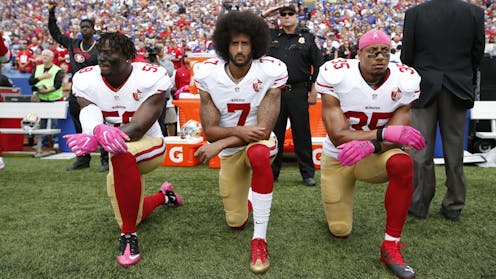
Source: The Conversation (Au and NZ) – By Ciprian N. Radavoi, Associate Professor in Law, University of Southern Queensland Eli Harold, Colin Kaepernick and Eric Reid of the San Francisco 49ers kneel ahead of a game in 2016. Michael Zagaris/San Francisco 49ers/Getty Images It’s almost a decade since San Francisco 49ers quarterback Colin Kaepernick started

Nearly half of Kiwis oppose automatic citizenship for Cook Islands, says poll
By Caleb Fotheringham, RNZ Pacific journalist A new poll by the New Zealand Taxpayers’ Union shows that almost half of respondents oppose the Cook Islands having automatic New Zealand citizenship. Thirty percent of the 1000-person sample supported Cook Islanders retaining citizenship, 46 percent were opposed and 24 percent were unsure. The question asked: The Cook

Melanesian Spearhead Group leaders discuss Middle East conflict before ceasefire
RNZ Pacific Papua New Guinea Prime Minister James Marape says the Middle East conflict was one of the discussions of the Melanesian Spearhead Group (MSG) in Suva this week — and Pacific leaders “took note of what is happening”. The Post-Courier reports Marape saying the “12 Day War” between Israel and Iran was based on

The ancients also had to deal with a cost-of-living crisis. Here’s how they managed
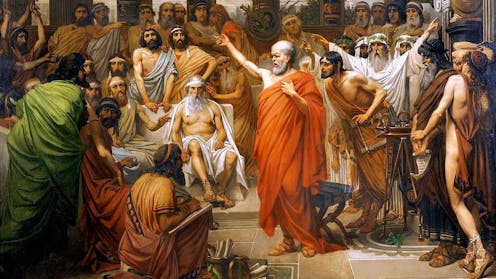
Source: The Conversation (Au and NZ) – By Konstantine Panegyres, Lecturer in Classics and Ancient History, The University of Western Australia Louis Le Brun, Public domain, via Wikimedia Commons, CC BY Talk to anyone today, and they will probably have something to say about how expensive life has become. While the rate of inflation has

Video games can help trans players feel seen and safe. It all starts with design
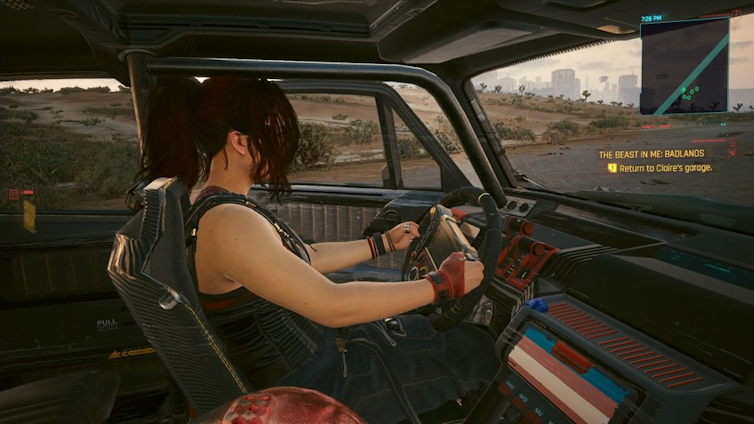
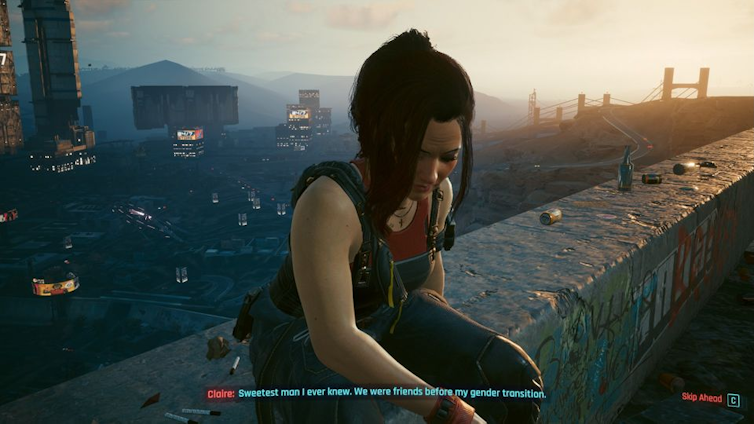
Source: The Conversation (Au and NZ) – By Phoebe Toups Dugas, Associate Professor of Human-Centred Computing, Monash University Shano Liang There is a comfort in finding and being yourself. Video games offer opportunities for this comfort. They allow people to exist in safe spaces, to develop community, and to explore the self – as well

How old are you really? Are the latest ‘biological age’ tests all they’re cracked up to be?
Source: The Conversation (Au and NZ) – By Hassan Vally, Associate Professor, Epidemiology, Deakin University We all like to imagine we’re ageing well. Now a simple blood or saliva test promises to tell us by measuring our “biological age”. And then, as many have done, we can share how “young” we really are on social

Global rankings fuel hype, but students have more to consider when choosing a uni
Source: The Conversation (Au and NZ) – By Kylie Message, Professor of Public Humanities and Director of the ANU Humanities Research Centre, Australian National University At this time of year, many year 12 students are seriously turning their minds to the future. Should they go to university next year? If so, which one? June is

Playful or harmful? David Seymour’s posts raise questions about what’s OK to say online
Source: The Conversation (Au and NZ) – By Kevin Veale, Senior Lecturer in Media Studies, part of the Digital Cultures Laboratory in the School of Humanities, Media, and Creative Communication, Te Kunenga ki Pūrehuroa – Massey University Hagen Hopkins/Getty Images Deputy Prime Minister and ACT Party leader David Seymour says he is being “playful” and

Shadow treasurer Ted O’Brien accepts invitation to government’s economic roundtable
Source: The Conversation (Au and NZ) – By Michelle Grattan, Professorial Fellow, University of Canberra The federal opposition has accepted an invitation from Treasurer Jim Chalmers for shadow treasurer Ted O’Brien to attend the August economic roundtable. The acceptance contrasts with the position taken by former opposition leader Peter Dutton last term. He refused to

Fiji advocacy group slams Indonesian role in MSG as a ‘disgrace’
Asia Pacific Report A Fiji-based advocacy group has condemned the participation of Indonesia in the Melanesian Spearhead Group which is meeting in Suva this week, saying it is a “profound disgrace” that the Indonesian Embassy continues to “operate freely” within the the MSG Secretariat. “This presence blatantly undermines the core principles of justice and solidarity

Will the fragile ceasefire between Iran and Israel hold? One factor could be crucial to it sticking
Source: The Conversation (Au and NZ) – By Ali Mamouri, Research Fellow, Middle East Studies, Deakin University Amir Levy/Getty Images After 12 days of war, US President Donald Trump has announced a ceasefire between Israel and Iran that would bring to an end the most dramatic, direct conflict between the two nations in decades. Israel

Ramzy Baroud: The fallout – winners and losers from the Israeli war on Iran
COMMENTARY: By Ramzy Baroud, editor of The Palestinian Chronicle The conflict between Israel and Iran over the past 12 days has redefined the regional chessboard. Here is a look at their key takeaways: Israel:Pulled in the US: Israel successfully drew the United States into a direct military confrontation with Iran, setting a significant precedent for

Iran and Israel agree to a fragile ceasefire. One factor could be crucial to it sticking
Source: The Conversation (Au and NZ) – By Ali Mamouri, Research Fellow, Middle East Studies, Deakin University Amir Levy/Getty Images After 12 days of war, US President Donald Trump has announced a ceasefire between Israel and Iran that would bring to an end the most dramatic, direct conflict between the two nations in decades. Israel

eSafety boss wants YouTube included in the social media ban. But AI raises even more concerns for kids
Source: The Conversation (Au and NZ) – By Tama Leaver, Professor of Internet Studies, Curtin University Irina WS/Shutterstock Julie Inman Grant, Australia’s eSafety Commissioner, today addressed the National Press Club to outline how her office will be driving the Social Media Minimum Age Bill when it comes into effect in December this year. The bill,

Trouble getting out of bed? Signs the ‘winter blues’ may be something more serious
Source: The Conversation (Au and NZ) – By Kelvin (Shiu Fung) Wong, Senior Lecturer in Clinical Psychology, Swinburne University of Technology Justin Paget/Getty Winter is here. As the days grow shorter and the skies turn darker, you might start to feel a bit “off”. You may notice a dip in your mood or energy levels.

A carbon levy on global shipping promises to slash emissions. We calculated what that means for Australia’s biggest export
Source: The Conversation (Au and NZ) – By Michael Brear, Director, Melbourne Energy Institute, The University of Melbourne Costfoto/NurPhoto via Getty Images Moving people and things around the world by sea has a big climate impact. The shipping industry produces almost 3% of global greenhouse gas emissions – roughly the same as Germany – largely

The war won’t end Iran’s nuclear program – it will drive it underground, following North Korea’s model
Source: The Conversation (Au and NZ) – By Anthony Burke, Professor of Environmental Politics & International Relations, UNSW Sydney The United States’ and Israel’s strikes on Iran are concerning, and not just for the questionable legal justifications provided by both governments. Even if their attacks cause severe damage to Iran’s nuclear facilities, this will only

Iran’s internet blackout left people in the dark. How does a country shut down the internet?
Source: The Conversation (Au and NZ) – By Mohiuddin Ahmed, Senior Lecturer of Computing and Security, Edith Cowan University Dylan Carr/Unsplash In recent days, Iranians experienced a near-complete internet blackout, with local service providers – including mobile services – repeatedly going offline. Iran’s government has cited cyber security concerns for ordering the shutdown. Shutting off

Bats get fat to survive hard times. But climate change is threatening their survival strategy

Source: The Conversation (Au and NZ) – By Nicholas Wu, Lecturer in Wildlife Ecology, Murdoch University

Rudmer Zwerver/Shutterstock

Bats are often cast as the unseen night-time stewards of nature, flitting through the dark to control pest insects, pollinate plants and disperse seeds. But behind their silent contributions lies a remarkable and underappreciated survival strategy: seasonal fattening.

Much like bears and squirrels, bats around the world bulk up to get through hard times – even in places where you might not expect it.

In a paper published today in Ecology Letters, we analysed data from bat studies around the world to understand how bats use body fat to survive seasonal challenges, whether it’s a freezing winter or a dry spell.

The surprising conclusion? Seasonal fattening is a global phenomenon in bats, not just limited to those in cold climates.

Even bats in the tropics, where it’s warm all year, store fat in anticipation of dry seasons when food becomes scarce. That’s a survival strategy that’s been largely overlooked. But it may be faltering as the climate changes, putting entire food webs at risk.

Climate shapes fattening strategies

We found bats in colder regions predictably gain more weight before winter.

But in warmer regions with highly seasonal rainfall, such as tropical savannas or monsoonal forests, bats also fatten up. In tropical areas, it’s not cold that’s the enemy, but the dry season, when flowers wither, insects vanish and energy is hard to come by.

The extent of fattening is impressive. Some species increased their body weight by more than 50%, which is a huge burden for flying animals that already use a lot of energy to move around. This highlights the delicate balancing act bats perform between storing energy and staying nimble in the air.

Sex matters, especially in the cold

The results also support the “thrifty females, frisky males” hypothesis.

In colder climates, female bats used their fat reserves more sparingly than males – a likely adaptation to ensure they have enough energy left to raise young when spring returns. Since females typically emerge from hibernation to raise their young, conserving fat through winter can directly benefit their reproductive success.

Interestingly, this sex-based difference vanished in warmer climates, where fat use by males and females was more similar, likely because more food is available in warmer climates. It’s another clue that climate patterns intricately shape behaviour and physiology.

Climate change is shifting the rules

Beyond the biology, our study points to a more sobering trend. Bats in warm regions appear to be increasing their fat stores over time. This could be an early warning sign of how climate change is affecting their survival.

Climate change isn’t just about rising temperatures. It’s also making seasons more unpredictable.

Bats may be storing more energy in advance of dry seasons that are becoming longer or harder to predict. That’s risky, because it means more foraging, more exposure to predators and potentially greater mortality.

The implications can ripple outward. Bats help regulate insect populations, fertilise crops and maintain healthy ecosystems. If their survival strategies falter, entire food webs could feel the effects.

Fat bats, fragile futures

Our study changes how we think about bats. They are not just passive victims of environmental change but active strategists, finely tuned to seasonal rhythms. Yet their ability to adapt has limits, and those limits are being tested by a rapidly changing world.

By understanding how bats respond to climate, we gain insights into broader ecosystem resilience. We also gain a deeper appreciation for one of nature’s quiet heroes – fattening up, flying through the night and holding ecosystems together, one wingbeat at a time.

The Conversation

Nicholas Wu was the lead author of a funded Australian Research Council Linkage Grant awarded to Christopher Turbill at Western Sydney University.

ref. Bats get fat to survive hard times. But climate change is threatening their survival strategy – https://theconversation.com/bats-get-fat-to-survive-hard-times-but-climate-change-is-threatening-their-survival-strategy-259560

Japanese prime minister’s abrupt no-show at NATO summit reveals a strained alliance with the US

Source: The Conversation (Au and NZ) – By Craig Mark, Adjunct Lecturer, Faculty of Economics, Hosei University

Japanese Prime Minister Shigeru Ishiba has sent a clear signal to the Trump administration: the Japan–US relationship is in a dire state.

After saying just days ago he would be attending this week’s NATO summit at The Hague, Ishiba abruptly pulled out at the last minute.

He joins two other leaders from the Indo-Pacific region, Australian Prime Minister Anthony Albanese and South Korean President Lee Jae-myung, in skipping the summit.

The Japanese media reported Ishiba cancelled the trip because a bilateral meeting with US President Donald Trump was unlikely, as was a meeting of the Indo-Pacific Four (IP4) NATO partners (Australia, New Zealand, South Korea and Japan).

Japan will still be represented by Foreign Minister Takeshi Iwaya, showing its desire to strengthen its security relationship with NATO.

However, Ishiba’s no-show reveals how Japan views its relationship with the Trump administration, following the severe tariffs Washington imposed on Japan and Trump’s mixed messages on the countries’ decades-long military alliance.

Tariffs and diplomatic disagreements

Trump’s tariff policy is at the core of the divide between the US and Japan.

Ishiba attempted to get relations with the Trump administration off to a good start. He was the second world leader to visit Trump at the White House, after Israeli Prime Minister Benjamin Netanyahu.

However, Trump’s “Liberation Day” tariffs imposed a punitive rate of 25% on Japanese cars and 24% on all other Japanese imports. They are already having an adverse impact on Japan’s economy: exports of automobiles to the US dropped in May by 25% compared to a year ago.

Six rounds of negotiations have made little progress, as Ishiba’s government insists on full tariff exemptions.

Japan has been under pressure from the Trump administration to increase its defence spending, as well. According to the Financial Times, Tokyo cancelled a summit between US and Japanese defence and foreign ministers over the demand. (A Japanese official denied the report.)

Japan also did not offer its full support to the US bombings of Iran’s nuclear facilities earlier this week. The foreign minister instead said Japan “understands” the US’s determination to prevent Iran from acquiring nuclear weapons.

Japan has traditionally had fairly good relations with Iran, often acting as an indirect bridge with the West. Former Prime Minister Shinzo Abe even made a visit there in 2019.

Japan also remains heavily dependent on oil from the Middle East. It would have been adversely affected if the Strait of Hormuz had been blocked, as Iran was threatening to do.

Unlike the response from the UK and Australia, which both supported the strikes, the Ishiba government prioritised its commitment to upholding international law and the rules-based global order. In doing so, Japan seeks to deny China, Russia and North Korea any leeway to similarly erode global norms on the use of force and territorial aggression.

Strategic dilemma of the Japan–US military alliance

In addition, Japan is facing the same dilemma as other American allies – how to manage relations with the “America first” Trump administration, which has made the US an unreliable ally.

Earlier this year, Trump criticised the decades-old security alliance between the US and Japan, calling it “one-sided”.

“If we’re ever attacked, they don’t have to do a thing to protect us,” he said of Japan.

Lower-level security cooperation is ongoing between the two allies and their regional partners. The US, Japanese and Philippine Coast Guards conducted drills in Japanese waters this week. The US military may also assist with upgrading Japan’s counterstrike missile capabilities.

But Japan is still likely to continue expanding its security ties with partners beyond the US, such as NATO, the European Union, India, the Philippines, Vietnam and other ASEAN members, while maintaining its fragile rapprochement with South Korea.

Australia is now arguably Japan’s most reliable security partner. Canberra is considering buying Japan’s Mogami-class frigates for the Royal Australian Navy. And if the AUKUS agreement with the US and UK collapses, Japanese submarines could be a replacement.

Ishiba under domestic political pressure

There are also intensifying domestic political pressures on Ishiba to hold firm against Trump, who is deeply unpopular among the Japanese public.

After replacing former prime minister Fumio Kishida as leader of the Liberal Democratic Party (LDP) last September, the party lost its majority in the lower house of parliament in snap elections. This made it dependent on minor parties for legislative support.

Ishiba’s minority government has struggled ever since with poor opinion polling. There has been widespread discontent with inflation, the high cost of living and stagnant wages, the legacy of LDP political scandals, and ever-worsening geopolitical uncertainty.

On Sunday, the party suffered its worst-ever result in elections for the Tokyo Metropolitan Assembly, winning its lowest number of seats.

The party could face a similar drubbing in the election for half of the upper house of the Diet (Japan’s parliament) on July 20. Ishiba has pledged to maintain the LDP’s majority in the house with its junior coalition partner Komeito. But if the government falls into minority status in both houses, Ishiba will face heavy pressure to step down.

The Conversation

Craig Mark does not work for, consult, own shares in or receive funding from any company or organisation that would benefit from this article, and has disclosed no relevant affiliations beyond their academic appointment.

ref. Japanese prime minister’s abrupt no-show at NATO summit reveals a strained alliance with the US – https://theconversation.com/japanese-prime-ministers-abrupt-no-show-at-nato-summit-reveals-a-strained-alliance-with-the-us-259694

Why have athletes stopped ‘taking a knee’?

Source: The Conversation (Au and NZ) – By Ciprian N. Radavoi, Associate Professor in Law, University of Southern Queensland

Eli Harold, Colin Kaepernick and Eric Reid of the San Francisco 49ers kneel ahead of a game in 2016. Michael Zagaris/San Francisco 49ers/Getty Images

It’s almost a decade since San Francisco 49ers quarterback Colin Kaepernick started a worldwide trend and sparked fierce debate when he knelt during the US national anthem.

In 2016, Kaepernick refused to follow the pre-game protocol related to the national anthem and knelt instead, saying:

I am not going to stand up to show pride in a flag for a country that oppresses black people and people of colour.

Soon, many athletes and teams began “taking a knee” at sports events to express their solidarity with victims of racial injustice.

Now, they appear to have stopped, which prompted us to research the decline.

Initial widespread support

Following the intense public debate over the appropriateness of Kaepernick’s act, the ritual quickly spread worldwide, with athletes in major soccer leagues, cricket, rugby, Formula 1, top-tier tennis and the US’s Major League Baseball and National Basketball Association taking a knee.

Athletes didn’t always kneel during national anthems, with the majority kneeling at certain points pre-game.

Despite the occasional “defection” of a small number of players who would stand while their teammates knelt – such as Israel Folau in rugby league, Wilfried Zaha in soccer and Quinton de Kock in cricket – the ritual was widely embraced by teams and athletes and helped raise awareness of the issue.

Even major sports organisations notorious for prohibiting any type of political activism generally accepted the kneeling ritual. For example, soccer’s International Football Federation (FIFA) showcased kneeling as a “stand against discrimination” and as human rights advocacy.

The International Olympic Committee (IOC) initially stood firm by its Rule 50, which states “no kind of demonstration or political, religious, or racial propaganda is permitted in any Olympic sites, venues or other areas”.

But just three weeks before the 2021 Olympic and Paralympic Games in Tokyo, the IOC relaxed its interpretation, and athletes were permitted to express their views in ways that included taking a knee.

A surprising turn of events

Despite permission and even encouragement from sports governing bodies, our research shows the practice is disappearing from major sports competitions.

Take soccer, for example. At the FIFA World Cup 2022, England and Wales were the only national teams that knelt at their games in Qatar.

At the FIFA Women’s World Cup 2023 in Australia and New Zealand, no teams or players knelt.

The same happened at the 2024 Olympic soccer tournament in Paris.

That only a handful of teams knelt in Tokyo at the 2021 Olympics, two at the FIFA Mens’ World Cup in Qatar in 2022, none at the FIFA Womens’ World Cup in Australia and New Zealand in 2023, and again none at the Paris 2024 Olympics indicates a growing reluctance throughout the sports world.

This surely cannot mean athletes have become indifferent to racial injustice or other forms of oppression in the interval between the late 2010s and the mid-2020s.

The explanation must be sought elsewhere. A hint was provided when Crystal Palace soccer player Zaha, the first player of colour in the UK who refused to kneel, explained:

I feel like taking the knee is degrading, because growing up my parents just let me know that I should be proud to be Black no matter what and I feel like we should just stand tall.

The explanation may therefore be, at least in part, the players’ uncomfortable feelings related to the kneeling posture.

In sociology, this bothersome state of mind is called “cognitive dissonance”: the mental conflict a person experiences in the presence of contrasting beliefs.

A history of kneeling

The body posture of kneeling is not deemed, in any culture, as expressing solidarity.

Ancient Greek and the Roman societies, on whose values Western civilisation was built, rejected kneeling as improper, even when praying to gods.

Then, with the spread of Christianity in the Western world, kneeling became widely used, but only as an act of worship, confessing guilt, or praying for mercy.

When performed outside the church, kneeling meant submission to nobility or royalty.

The significance of kneeling as humility is not limited to the Western world.

In African tribal culture, the young kneel in front of elders, and everyone kneels before the king.

In China in 1949, Chairman Mao famously proclaimed at the first plenary of the Chinese People’s Political Consultative Conference:

From now on our nation […] will no longer be a nation subject to insult and humiliation. We have stood up.

With this in mind, kneeling may be deemed unfit at sporting events, which often feature a powerful cocktail of emotions, values and social expectations.

The inconsistency between the excitement of competition and the expectation to kneel — a gesture associated with submission and humility — likely creates a bothersome state of mind for athletes.

This potentially motivates some players to reject one of the two – in this case, the kneeling – to restore cognitive harmony.

What could replace the kneeling ritual?

After refusing, by unanimous players’ vote, to take a knee before their October 2020 game against the All Blacks, the Australian rugby union team chose instead to wear a First Nations jersey.

The same year, several teams in German soccer’s top league chose to show their support for Black Lives Matter by wearing distinctive armbands.

So it appears wearing a distinctive jersey or at least an armband is more easily accepted by modern-day athletes. This may be challenging given the governing bodies of many sports, such as FIFA, ban athletes from wearing political symbols on their clothing.

Depending on whether sports code accept this type of activism in the future, wearing suportive clothing could replace taking a knee as symbolic communication of solidarity with oppressed minorities.

The Conversation

The authors do not work for, consult, own shares in or receive funding from any company or organisation that would benefit from this article, and have disclosed no relevant affiliations beyond their academic appointment.

ref. Why have athletes stopped ‘taking a knee’? – https://theconversation.com/why-have-athletes-stopped-taking-a-knee-259047

Nearly half of Kiwis oppose automatic citizenship for Cook Islands, says poll

By Caleb Fotheringham, RNZ Pacific journalist

A new poll by the New Zealand Taxpayers’ Union shows that almost half of respondents oppose the Cook Islands having automatic New Zealand citizenship.

Thirty percent of the 1000-person sample supported Cook Islanders retaining citizenship, 46 percent were opposed and 24 percent were unsure.

The question asked:

  • The Cook Islands government is pursuing closer strategic ties with China, ignoring New Zealand’s wishes and not consulting with the New Zealand government. Given this, should the Cook Islands continue to enjoy automatic access to New Zealand passports, citizenship, health care and education when its government pursues a foreign policy against the wishes of the New Zealand government?
  • READ MORE: Other Cook Islands reports

Taxpayers’ Union head of communications Tory Relf said the framing of the question was “fair”.

“If the Cook Islands wants to continue enjoying a close relationship with New Zealand, then, of course, we will support that,” he said.

“However, if they are looking in a different direction, then I think it is entirely fair that taxpayers can have a right to say whether they want their money sent there or not.”

But New Zealand Labour Party deputy leader Carmel Sepuloni said it was a “leading question”.

‘Dead end’ assumption
“It asserts or assumes that we have hit a dead end here and that we cannot resolve the relationship issues that have unfolded between New Zealand and the Cook Islands,” Sepuloni said.

“We want a resolution. We do not want to assume or assert that it is all done and dusted and the relationship is broken.”

The two nations have been in free association since 1965.

Relf said that adding historical context of the two countries relationship would be a different question.

“We were polling on the Cook Islands current policy, asking about historic ties would introduce an emotive element that would influence the response.”

New Zealand has paused nearly $20 million in development assistance to the realm nation.

Foreign Minister Winston Peters said the decision was made because the Cook Islands failed to adequately inform his government about several agreements signed with Beijing in February.

‘An extreme response’
Sepuloni, who is also Labour’s Pacific Peoples spokesperson, said her party agreed with the government that the Cook Islands had acted outside of the free association agreement.

“[The aid pause is] an extreme response, however, in saying that we don’t have all of the information in front of us that the government have. I’m very mindful that in terms of pausing or stopping aid, the scenarios where I can recall that happening are scenarios like when Fiji was having their coup.”

In response to questions from Cook Islands News, Cook Islands Prime Minister Mark Brown said that, while he acknowledged the concerns raised in the recent poll, he believed it was important to place the discussion within the full context of Cook Islands’ longstanding and unique relationship with New Zealand.

“The Cook Islands and New Zealand share a deep, enduring constitutional bond underpinned by shared history, family ties, and mutual responsibility,” Brown told the Rarotonga-based newspaper.

“Cook Islanders are New Zealand citizens not by privilege, but by right. A right rooted in decades of shared sacrifice, contribution, and identity.

“More than 100,000 Cook Islanders live in New Zealand, contributing to its economy, culture, and communities. In return, our people have always looked to New Zealand not just as a partner but as family.”

This article is republished under a community partnership agreement with RNZ.

Article by AsiaPacificReport.nz

Melanesian Spearhead Group leaders discuss Middle East conflict before ceasefire

RNZ Pacific

Papua New Guinea Prime Minister James Marape says the Middle East conflict was one of the discussions of the Melanesian Spearhead Group (MSG) in Suva this week — and Pacific leaders “took note of what is happening”.

The Post-Courier reports Marape saying the “12 Day War” between Israel and Iran was based on high technology and using missiles sent from great distances.

“In the context of MSG, the leaders want peace always. And the Pacific remains friends to all, enemies to none,” he said.

He said an effect on PNG would be the inflation in prices of oil and gas.

Yesterday morning, US President Donald Trump declared a ceasefire had been agreed  between Israel and Iran, and so far it has been holding in spite of tensions.

Australia had stepped in to help Papua New Guinea diplomats and citizens caught in the Middle East.

Foreign Affairs Minister Justin Tkatchenko confirmed last week that a group was to be evacuated through Jordan.

There had been six diplomats in lockdown at the PNG embassy in Jerusalem awaiting extraction.

Meanwhile, a repatriation flight for Australians stuck in Israel had been cancelled.

ABC News reported that it was the second day repatriation plans were scrapped at the last minute because of rocket fire. A bus meant to take people across the border into Jordan was cancelled the previous day.

This article is republished under a community partnership agreement with RNZ.

Article by AsiaPacificReport.nz

The ancients also had to deal with a cost-of-living crisis. Here’s how they managed

Source: The Conversation (Au and NZ) – By Konstantine Panegyres, Lecturer in Classics and Ancient History, The University of Western Australia

Louis Le Brun, Public domain, via Wikimedia Commons, CC BY

Talk to anyone today, and they will probably have something to say about how expensive life has become. While the rate of inflation has slowed, prices for many goods and services are still much higher than pre-pandemic.

Cost-of-living crises are not new. They have occurred at various times and places throughout the millennia.

If we look at cost-of-living pressures in ancient Greek and Roman times and how people back then dealt with them, we can learn something about how to face our own issues.

‘The price of land has gone up’

The cost of living was a conversation topic in antiquity, especially the price of land and food.

The Roman writer Pliny the Younger (circa 61–113 CE) in one of his letters remarked to his friend about the rising cost of real estate:

Have you heard that the price of land has gone up, particularly in the neighbourhood of Rome? The reason for the sudden increase in price has given rise to a good deal of discussion.

The ancient Greek scholar Athenaeus, who lived in Naukratis, in Egypt, around 200 CE, wrote a long book called The Learned Banqueters, depicting a dinner party.

The characters at this dinner party often complain about the price of food and goods. For example, one character complains about the price of fish:

I don’t think I’ve ever seen fish more expensive. Poseidon, if you got 10% of what’s spent on them every day, you’d be far away the richest god there is!

People often said that fish was exorbitantly expensive and thought fish sellers were trying to rip them off.

In fact, the poet Antiphanes (circa 408–330 BCE) complained “there’s no group more abominable” than fish sellers and money lenders.

How to lower costs?

Ancient people were well aware that a cost-of-living crisis can cause political disturbances.

As the Roman poet Lucan (39–65 CE) wrote:

the causes of hatred and mainsprings of political popularity are determined by the price of food.

So, how did ancient leaders deal with this sort of problem?

One solution was for the ruler to cover the cost of inflation.

For example, the Athenian statesman Demosthenes (384–322 BCE) mentions a problem with the price of grain that was solved by boosting imports:

When grain earlier advanced in price and reached sixteen drachmae per medimnus, we imported more than ten thousand medimni of wheat, and measured it out at the normal price of five drachmae a medimnus.

Alexander Severus  bust from Musei Capitolini
Alexander Severus helped trim the cost of meat.
Creative commons, CC BY

Another solution was to put extreme regulations on the market.

For example, the Roman emperor Alexander Severus (ruled 222–235 CE) was once faced by a group of angry citizens.

They demanded a reduction in the price of beef and pork, which had become unaffordable.

Alexander Severus “did not proclaim a general reduction in prices”, says the anonymous biographer who recounts this anecdote. Instead, the emperor

ordered that no one should slaughter a sow or a suckling pig, a cow, or a calf. In two years or even in little more than one year, there was such an abundance of pork and beef that while a pound previously cost eight minutili, the price of both these meats was reduced to two and even one per pound.

The city is so expensive

The Greek writer Plutarch of Chaeronea (46–119 CE) records a story about the famous philosopher Socrates (circa 470–399 BCE), who lived in Athens.

One day, according to Plutarch, a friend of Socrates complained to him about “how expensive the city was”:

Chian wine costs a mina, a purple robe three minae, a half-pint of honey five drachmas!

In response, Socrates took his friend by the hand and told him to search for bargains or for cheaper items, saying:

A sleeveless vest for ten drachmas! The city is cheap!

Socrates’ point was that even in expensive times it’s still possible to find bargains to save money. You just have to look harder for them and lower your standard of living. It can be difficult to do that, but it’s necessary.

Socrates also gave out employment advice for people who were struggling.

According to Socrates’ friend, the historian Xenophon of Athens (430–350 BCE), when a poor veteran came to Socrates complaining about lack of money and asking how to cope with expenses, Socrates told him to

take up some kind of work at once that will assure you a living when you get old.

Socrates thought making sure you still have money when you
are old is more important than fully enjoying your current job. You will likely have to put up with things you don’t like to achieve security.

From ancient to modern

Most ancient people would probably have said that during a cost-of-living crisis it’s best to be patient, live simply, and wait for better times to come.

As Pliny the Younger (circa 61–113 CE) once wrote in one of his letters, “my income is small or precarious, but its deficiencies can be made up by simple living”.

If politicians cannot solve the problems, then it is up to us to cope with them as best as we can.

The Conversation

Konstantine Panegyres does not work for, consult, own shares in or receive funding from any company or organisation that would benefit from this article, and has disclosed no relevant affiliations beyond their academic appointment.

ref. The ancients also had to deal with a cost-of-living crisis. Here’s how they managed – https://theconversation.com/the-ancients-also-had-to-deal-with-a-cost-of-living-crisis-heres-how-they-managed-257896

Video games can help trans players feel seen and safe. It all starts with design

Source: The Conversation (Au and NZ) – By Phoebe Toups Dugas, Associate Professor of Human-Centred Computing, Monash University

Shano Liang

There is a comfort in finding and being yourself. Video games offer opportunities for this comfort. They allow people to exist in safe spaces, to develop community, and to explore the self – as well as the potential self.

Our recently published study explores how video games can elicit feelings of gender euphoria for transgender people. This could be a result of a player developing a connection with a character they feel represented by. Or, they may simply appreciate the experience of a world in which they exist as their actual gender.

Far from just providing an escape, our research shows video games can play a major role in fostering inclusion for trans people, and in promoting the joy of being trans.

Why gender euphoria matters

Much of the discourse around transgender and gender diverse identities is damage-centred. People have come to understand transness through a medicalised lens that emphasises gender dysphoria.

Gender “dysphoria” refers to a person’s feelings of disconnection and dissatisfaction with their experience of gender, whether it’s their body, how others treat them, or how they present themselves to the world. For further reading, we recommend The Gender Dysphoria Bible (an online community resource), or Susan Stryker’s book Transgender History.

Gender “euphoria” refers to feelings of excitement, completeness and affirmation that come when someone truly experiences their gender identity. For cisgender people, gender euphoria is often unremarkable. But for transgender people, discovering this feeling – especially in a hostile world – can be profound and lifesaving.

In-game screenshot of Claire Russell during her quest line: The Beast in Me. The interior of Claire’s vehicle, showing the transgender pride flag painted across her centre stack.
In Cyberpunk 2077, Claire’s car interior displays the trans pride flag, signalling to the player that her identity is not a secret, nor a source of shame.
Michelle Cormier/Monash University, CC BY-SA

While gender “euphoria” is an old term used by the trans community to understand the potential for happiness, researchers have only recently begun studying it.

As a group of longtime gamers and trans people, we knew of many games that offered this experience to us. And as researchers and game designers, we had the tools to tease apart these games to understand what makes them meaningful.

Our study contributes language and a framework for analysing gender euphoria in video games. We hope it will help with developing games that are more inclusive and meaningful for trans players.

A reflexive thematic analysis

We used a qualitative research method called reflexive thematic analysis, which involves drawing from one’s own experiences as a source of data that frames the analysis.

We developed a list of games that were known for trans themes, and/or authored by trans designers, and/or which we had personally found comfort in playing. The list included both indie and mainstream games, such as Cyberpunk 2077, Anna Anthropy’s dys4ia, Animal Crossing: New Horizons and Celeste.

While analysing the games, we looked at the art, narratives, choices offered to players, and how characters were represented.

We also identified various “themes” relating to trans experiences which were common among the games. We organised these themes into the categories of design, dynamics and experiences, building on prior design theory.

A three-pronged framework

Design elements are what the game maker creates, such as the main story, or how you can manipulate a character. Certain games can be designed in a way that normalises transgender people, such as by offering a range of gender expressions for players, or by allowing trans identity disclosure during play.

In-game screenshot of Madeline from Celeste. Madeline is at her computer speaking to a friend. There is a trans pride flag behind her computer monitor and a pill bottle beside her bed.
In the game Celeste, the trans pride flag behind Madeline’s computer, and the pill bottle beside her bed, are intentional design choices that help the player understand Madeline’s identity.
Michelle Cormier/Monash University, CC BY-SA

The dynamics of a game refer to how it unfolds as a result of the design and players’ decisions. Dynamics, for instance, might address how players come to discover a trans character, or how they might encounter pain and healing through the story.

And experiences are the emotions players feel as a result of playing, such as the excitement of finishing a level, or sadness over the loss of a beloved character. For trans players, gender euphoric experiences centre on the self and how it relates to the broader world.

Although it has some issues with trans representation, the game Cyberpunk 2077 is a good example for understanding how we sorted our themes into these three categories.

The character Claire Russel is designed as a woman street racer, whose trans identity is not made explicit. The player’s interactions with Claire create certain dynamics, after which her character confides she is transgender. This offers the player the experience of having comfortable interactions with a transgender character, and of understanding how the character relates to the larger game world.

In-game screenshot of Claire Russel speaking to the player while sitting on a low wall overlooking Night City.
During an emotionally charged scene, Claire speaks candidly to the player about her past.
Michelle Cormier/Monash University, CC BY-SA

Unexpectedly, we found expressions of pain (including gender dysphoria) were an important aspect of some of the trans-inclusive games we analysed.

The games created gender euphoric experiences for players by acknowledging the painful parts of the transgender experience, and then providing opportunities to resolve or live through them.

Moving towards trans-inclusivity

Of course, there is more to do. While our reflexive analysis centred trans-femme experiences, there is a range of gender identities out there. More work is needed to see what other designs, dynamics and experiences should be on offer for trans players.

Gender euphoria is a salve to the unnecessary pain the world brings to trans people. It is therefore a worthy design goal – not just in video games, but in all kinds of interactive systems.

If we want trans joy in the world, we will have to design for it.

The Conversation

Phoebe Toups Dugas is affiliated with Monash University and is undertaking volunteer work with Transgender Victoria.

Michelle Cormier is affiliated with Monash University and is managing a community project for Transgender Victoria as a volunteer.

ref. Video games can help trans players feel seen and safe. It all starts with design – https://theconversation.com/video-games-can-help-trans-players-feel-seen-and-safe-it-all-starts-with-design-257901

How old are you really? Are the latest ‘biological age’ tests all they’re cracked up to be?

Source: The Conversation (Au and NZ) – By Hassan Vally, Associate Professor, Epidemiology, Deakin University

We all like to imagine we’re ageing well. Now a simple blood or saliva test promises to tell us by measuring our “biological age”. And then, as many have done, we can share how “young” we really are on social media, along with our secrets to success.

While chronological age is how long you have been alive, measures of biological age aim to indicate how old your body actually is, purporting to measure “wear and tear” at a molecular level.

The appeal of these tests is undeniable. Health-conscious consumers may see their results as reinforcing their anti-ageing efforts, or a way to show their journey to better health is paying off.

But how good are these tests? Do they actually offer useful insights? Or are they just clever marketing dressed up to look like science?

How do these tests work?

Over time, the chemical processes that allow our body to function, known as our “metabolic activity”, lead to damage and a decline in the activity of our cells, tissues and organs.

Biological age tests aim to capture some of these changes, offering a snapshot of how well, or how poorly, we are ageing on a cellular level.

Our DNA is also affected by the ageing process. In particular, chemical tags (methyl groups) attach to our DNA and affect gene expression. These changes occur in predictable ways with age and environmental exposures, in a process called methylation.

Research studies have used “epigenetic clocks”, which measure the methylation of our genes, to estimate biological age. By analysing methylation levels at specific sites in the genome from participant samples, researchers apply predictive models to estimate the cumulative wear and tear on the body.

What does the research say about their use?

Although the science is rapidly evolving, the evidence underpinning the use of epigenetic clocks to measure biological ageing in research studies is strong.

Studies have shown epigenetic biological age estimation is a better predictor of the risk of death and ageing-related diseases than chronological age.

Epigenetic clocks also have been found to correlate strongly with lifestyle and environmental exposures, such as smoking status and diet quality.

In addition, they have been found to be able to predict the risk of conditions such as cardiovascular disease, which can lead to heart attacks and strokes.

Taken together, a growing body of research indicates that at a population level, epigenetic clocks are robust measures of biological ageing and are strongly linked to the risk of disease and death

But how good are these tests for individuals?

While these tests are valuable when studying populations in research settings, using epigenetic clocks to measure the biological age of individuals is a different matter and requires scrutiny.

For testing at an individual level, perhaps the most important consideration is the “signal to noise ratio” (or precision) of these tests. This is the question of whether a single sample from an individual may yield widely differing results.

A study from 2022 found samples deviated by up to nine years. So an identical sample from a 40-year-old may indicate a biological age of as low as 35 years (a cause for celebration) or as high as 44 years (a cause of anxiety).

While there have been significant improvements in these tests over the years, there is considerable variability in the precision of these tests between commercial providers. So depending on who you send your sample to, your estimated biological age may vary considerably.

Another limitation is there is currently no standardisation of methods for this testing. Commercial providers perform these tests in different ways and have different algorithms for estimating biological age from the data.

As you would expect for commercial operators, providers don’t disclose their methods. So it’s difficult to compare companies and determine who provides the most accurate results – and what you’re getting for your money.

A third limitation is that while epigenetic clocks correlate well with ageing, they are simply a “proxy” and are not a diagnostic tool.

In other words, they may provide a general indication of ageing at a cellular level. But they don’t offer any specific insights about what the issue may be if someone is found to be “ageing faster” than they would like, or what they’re doing right if they are “ageing well”.

So regardless of the result of your test, all you’re likely to get from the commercial provider of an epigenetic test is generic advice about what the science says is healthy behaviour.

Are they worth it? Or what should I do instead?

While companies offering these tests may have good intentions, remember their ultimate goal is to sell you these tests and make a profit. And at a cost of around A$500, they’re not cheap.

While the idea of using these tests as a personalised health tool has potential, it is clear that we are not there yet.

For this to become a reality, tests will need to become more reproducible, standardised across providers, and validated through long-term studies that link changes in biological age to specific behaviours.

So while one-off tests of biological age make for impressive social media posts, for most people they represent a significant cost and offer limited real value.

The good news is we already know what we need to do to increase our chances of living longer and healthier lives. These include:

  • improving our diet
  • increasing physical activity
  • getting enough sleep
  • quitting smoking
  • reducing stress
  • prioritising social connection.

We don’t need to know our biological age in order to implement changes in our lives right now to improve our health.

The Conversation

Hassan Vally does not work for, consult, own shares in or receive funding from any company or organisation that would benefit from this article, and has disclosed no relevant affiliations beyond their academic appointment.

ref. How old are you really? Are the latest ‘biological age’ tests all they’re cracked up to be? – https://theconversation.com/how-old-are-you-really-are-the-latest-biological-age-tests-all-theyre-cracked-up-to-be-257710

Global rankings fuel hype, but students have more to consider when choosing a uni

Source: The Conversation (Au and NZ) – By Kylie Message, Professor of Public Humanities and Director of the ANU Humanities Research Centre, Australian National University

At this time of year, many year 12 students are seriously turning their minds to the future. Should they go to university next year? If so, which one?

June is also the start of the global ranking season. Last week saw the release of the QS Quacquarelli Symonds 2026 world university rankings, amid reports of a “wake-up call” for Australian universities. About 70% of Australian universities fell in the rankings albeit only by small margins.

Should students be worried about this? What should they – and the rest of us – understand about global rankings?

What are rankings?

Global university rankings aim to evaluate all universities in the world through a a single comparative framework.

Apart from QS, other high-profile global rankings include those by Shanghai Ranking and the Times Higher Education.

Each ranking system has a slightly different focus and methodology.

QS looks at student-to-staff ratios, student employability, the reputation of the university as an employer, sustainability, global engagement and academic citations. It also ranks specific subjects across universities, which can be helpful if you want to know about the quality of teaching in a particular discipline or field.

It is comprehensive. QS included 36 of Australia’s 43 universities in their latest assessment. These universities were also compared to more than 1,400 other institutions across 105 other countries.

What impact do rankings have?

These rankings are promoted as objective indicators and markers of prestige. They can be very influential in terms of attracting potential donors and students.

One analysis suggests academic rankings are more influential than are research results for attracting philanthropic investment in Australian universities.

The rankings can also directly affect the resources available for students.

We know rankings can influence where international students (and the resources that accompany them) go. Australian universities have long relied on fees from international students to support funding shortfalls.

Rankings are not everything

But global rankings have many critics. They may include a lot of information but this is not necessarily what students in diverse situations and locations need.

The rankings also do not reflect how much time and how many resources some universities put into the information that goes back to the ranking process.

In November 2023, an independent expert group, convened by the United Nations issued a statement criticising the rankings system.

It said “the very idea of global university rankings is fundamentally flawed”.

It is simply not possible to produce a fair and credible global league table of universities given their multiple missions and their diverse social, economic and political contexts around the world.

It also noted the rankings advantaged “historically privileged institutions”.

The statement also said there was a bias towards the English language, certain types of research, and science, technology, engineering and mathematics (STEM) subjects. “This undermines the importance of teaching and of the humanities and social sciences,” it said.

A bias against regional unis?

The rankings also do not favour regional universities, which is particularly relevant for Australian students.

The QS 2026 survey shows four regional Australian universities slipped in rank and all are positioned outside the global top 400.

This shows how global rankings are a blunt instrument and don’t account for the broader place of universities in regional areas. Here they play a vital role in their communities, driving economic growth and providing essential services.

What should prospective students consider?

Although universities within countries are ranked as better or worse than each other in a global league table, it is important to recognise specific national factors are not considered in the rankings. And individual student experience is rarely taken into account.

Student experience includes the quality of teaching and the types of support individuals have access to, as well as the facilities and the culture on and around campus. We also know student experience continues to be affected by loneliness in the post-Covid era.

So prospective students should be careful when it comes to making a decision about where to go to university. Rankings are a useful tool but so is talking to friends and family and going to open days.

More than anything else, Year 12 students should know this is not the most important decision of their lives. They can take a gap year or change degrees. In fact many students do one or both of these things.

The Conversation

Kylie Message does not work for, consult, own shares in or receive funding from any company or organisation that would benefit from this article, and has disclosed no relevant affiliations beyond their academic appointment.

ref. Global rankings fuel hype, but students have more to consider when choosing a uni – https://theconversation.com/global-rankings-fuel-hype-but-students-have-more-to-consider-when-choosing-a-uni-259443

Playful or harmful? David Seymour’s posts raise questions about what’s OK to say online

Source: The Conversation (Au and NZ) – By Kevin Veale, Senior Lecturer in Media Studies, part of the Digital Cultures Laboratory in the School of Humanities, Media, and Creative Communication, Te Kunenga ki Pūrehuroa – Massey University

Hagen Hopkins/Getty Images

Deputy Prime Minister and ACT Party leader David Seymour says he is being “playful” and having “fun” with his “Victim of the Day” social media posts, targeting opponents of his Regulatory Standards Bill.

But the posts – which have singled out academics and MPs who have criticised or made select committee submissions against the bill, accusing them of suffering from “Regulatory Standards Derangement Syndrome” – have now led to at least two official complaints to Cabinet.

Wellington City mayor Tory Whanau has alleged they amounted to “online harassment and intimidation” against academics and were in breach of the Cabinet Manual rules for ministers. According to the manual, ministers should

behave in a way that upholds, and is seen to uphold, the highest ethical and behavioural standards. This includes exercising a professional approach and good judgement in their interactions with the public, staff, and officials, and in all their communications, personal and professional.

Academic Anne Salmond, one of those targeted by the posts, has also alleged Seymour breached the behaviour standards set out by the manual. According to Salmond:

This “Victim of the Day” campaign does not match this description. It is unethical, unprofessional and potentially dangerous to those targeted. Debate is fine, online incitements are not.

When is a joke not a joke?

Seymour’s claim he was being “playful” while using his platform to criticise individuals follows a pattern of targeting critics while deflecting criticism of his own behaviour.

For example, in 2022 Seymour demanded an apology from Māori Party co-leader Rawiri Waititi, after Waititi earlier joked about poisoning Seymour with karaka berries. At the time, Seymour said:

I’m genuinely concerned that the next step is that some slightly more radical person doesn’t think it’s a joke.

But the same year, Seymour defended Tauranga by-election candidate Cameron Luxton’s joke that the city’s commission chair Anne Tolley was like Marie Antoinette and should be beheaded.

In 2023, Seymour joked about abolishing the Ministry of Pacific Peoples:

In my fantasy, we’d send a guy called Guy Fawkes in there and it’d be all over, but we’ll probably have to have a more formal approach than that.

Māori researcher and advocate Tina Ngata criticised Seymour’s argument that he was joking:

Calling it a joke does not make it any less white-supremacist. What it does is point to the fact that in David Seymour’s mind, violence against Pacific peoples is so normalised, that he can make a joke out of it […] but he’s not any person is he? He is a politician, a leader of a political party, with a significant platform and the means and opportunities to advance that normalised violence into policy and legislation.

Designed to silence

An analysis of Seymour’s recent social media posts by researcher Sanjana Hattotuwa at the Disinformation Project has argued they have the potential to lead to online harassment, saying they are:

designed to silence opposition to the controversial Regulatory Standards Bill whilst maintaining plausible deniability about the resulting harassment, harms and hate.

The “Victims of the Day” posts about Anne Salmond and former Green leader Metiria Turei were textbook examples of “technology-facilitated gender-based violence and online misogyny”, Hattotuwa argued. And the use of the term “derangement” framed academic criticism as a mental disorder – undermining expertise.

As my own research shows, online harassment and violent rhetoric can raise the chances of real-world violence.

Since the early 2000s, researchers have used the term “stochastic terrorism” to describe a way of indirectly threatening people. Nobody is specifically told “harm these people”, so the person putting them at risk has plausible deniability.

Seymour is already aware of these dynamics, as shown by his demand for an apology from Waititi over the karaka berry poisoning “joke”.

Free speech for who?

Seymour and ACT have long presented themselves as champions of free speech:

Freedom of expression is one of the most important values our society has. We can only solve our most pressing problems in an open society in which free thought and open enquiry are encouraged.

By going after critics of the Regulatory Standards Bill, Seymour may only be ridiculing speech he does not like. But he has taken things further in the past.

In 2023, he criticised poet Tusiata Avia for her poem “Savage Coloniser Pantoum”, which Seymour said was racist and would incite racially motivated violence. He made demands that the government withdraw NZ$107,280 in taxpayer money from the 2023 Auckland Arts Festival in response.

ACT list MP Todd Stephenson also threatened to remove Creative NZ funding after Avia received a Prime Minister’s Award for Literary Achievement. Avia said she received death threats after ACT’s criticism of her work.

The more serious purpose of saying something contentious is “just a joke” is to portray those who disagree as humourless and not deserving to be taken seriously.

ACT’s “Victim of the Day” campaign does something similar in attempting to discredit serious critics of the Regulatory Standards Bill by mocking them.

But in the end, we have to be alert to the potential political double standard: harmless jokes for me, but not for you. Dangerous threats from you, but not from me.

The Conversation

Kevin Veale does not work for, consult, own shares in or receive funding from any company or organisation that would benefit from this article, and has disclosed no relevant affiliations beyond their academic appointment.

ref. Playful or harmful? David Seymour’s posts raise questions about what’s OK to say online – https://theconversation.com/playful-or-harmful-david-seymours-posts-raise-questions-about-whats-ok-to-say-online-259658

Shadow treasurer Ted O’Brien accepts invitation to government’s economic roundtable

Source: The Conversation (Au and NZ) – By Michelle Grattan, Professorial Fellow, University of Canberra

The federal opposition has accepted an invitation from Treasurer Jim Chalmers for shadow treasurer Ted O’Brien to attend the August economic roundtable.

The acceptance contrasts with the position taken by former opposition leader Peter Dutton last term. He refused to attend the government’s jobs and skills summit although the Nationals leader David Littleproud did so.

The opposition’s decision is in line with the indication from its leader Sussan Ley that she wants to be more constructive than the Liberals were last term.

The roundtable, focused on productivity, has broadened into a meeting where tax reform is expected to figures heavily. Chalmers is looking for consensus for reforms but the extent to which that can be achieved remains to be seen.

Chalmers said on Tuesday he had provided the invitation to O’Brien “in good faith. I think it would be a good thing to have the shadow treasurer engaged at the economic reform roundtable.

“I think it will give us a better chance of making the kind of progress that we desperately need to see on reform and in our economy more broadly.”

Chalmers is still finalising the invitations, which will go to business, the union movement and civil society representatives.

O’Brien said he would engage at the roundtable “in a business-like fashion”.

He said the Coalition would be “constructive where we can and critical where we must”. It would hold the government to account and he would not be at the summit “to rubber stamp a talkfest”.

“It’s worth the treasurer knowing from the outset that I believe rhetoric is no substitute for reform. I want to see honesty in how the government defines the economic problems our nation faces, and I will be looking to tangible outcomes as real measures of success.”

On Wednesday Ley will appear at the National Press Club, speaking about her personal story, the Liberals’ federal election defeat, and some markers on policy areas where the Liberals will focus.

She will also outline some priority policy areas that she’ll champion during this parliamentary term.

In her address Ley will highlight “aspiration”, saying this is the “thread that connects every single part of Australian society”.

“Aspiration is the foundation of the Australian promise: that if you work hard, play by the rules, do your best for your kids and contribute to your community, you will be able to build a better life for yourself and your family.”

In her speech, part of which was released ahead of delivery, Ley acknowledges the opposition didn’t just lose the last election – “we got smashed. We respect the election outcome with humility. We accept it with contrition. And we must learn from it with conviction.”

The Conversation

Michelle Grattan does not work for, consult, own shares in or receive funding from any company or organisation that would benefit from this article, and has disclosed no relevant affiliations beyond their academic appointment.

ref. Shadow treasurer Ted O’Brien accepts invitation to government’s economic roundtable – https://theconversation.com/shadow-treasurer-ted-obrien-accepts-invitation-to-governments-economic-roundtable-259691

Fiji advocacy group slams Indonesian role in MSG as a ‘disgrace’

Asia Pacific Report

A Fiji-based advocacy group has condemned the participation of Indonesia in the Melanesian Spearhead Group which is meeting in Suva this week, saying it is a “profound disgrace” that the Indonesian Embassy continues to “operate freely” within the the MSG Secretariat.

“This presence blatantly undermines the core principles of justice and solidarity we claim to uphold as Melanesians,” said We Bleed Black and Red in a social media post.

The group said that as the new MSG chair, the Fiji government could not speak cannot credibly about equity, peace, regional unity, or the Melanesian family “while the very agent of prolonged Melanesian oppression sits at the decision-making table”.

The statement said that for more than six decades, the people of West Papua had endured “systemic atrocities from mass killings to environmental devastation — acts that clearly constitute ecocide and gross human rights violations”.

“Indonesia’s track record is not only morally indefensible but also a flagrant breach of numerous international agreements and conventions,” the group said.

“It is time for all Melanesian nations to confront the reality behind the diplomatic facades and development aid.

“No amount of financial incentives or diplomatic charm can erase the undeniable suffering of the West Papuan people.

“We must rise above political appeasement and fulfill our moral and regional duty as one Melanesian family.

“The Pacific cannot claim moral leadership while turning a blind eye and deaf ear to colonial violence on our own shores. Justice delayed is justice denied.”

‘Peaceful, prosperous Melanesia’
Meanwhile, The Fiji Times reports that the 23rd MSG Leaders’ Summit got underway on Monday in Suva, drawing heads of state from Fiji, Papua New Guinea, Solomon Islands, Vanuatu, and representatives from New Caledonia’s FLNKS.

Hosted under the theme “A Peaceful and Prosperous Melanesia,” the summit ended yesterday.

This year’s meeting also marked Fiji’s first time chairing the regional bloc since 1997.

Fiji officially assumed the MSG chairmanship from Vanuatu following a traditional handover ceremony attended by senior officials, observers, and dignitaries at Draiba.

Papua New Guinea’s Prime Minister James Marape arrived in Suva on Sunday and reaffirmed Papua New Guinea’s commitment to MSG cooperation during today’s plenary session.

He will also take part in high-level talanoa discussions with the Pacific Islands Forum’s Eminent Persons Group, aimed at deepening institutional reform and regional solidarity.

Observers from the United Liberation Movement for West Papua (ULMWP) and Indonesia were also present, reflecting ongoing efforts to expand the bloc’s influence on issues like self-determination, regional trade, security, and climate resilience in the Pacific.

Article by AsiaPacificReport.nz

Will the fragile ceasefire between Iran and Israel hold? One factor could be crucial to it sticking

Source: The Conversation (Au and NZ) – By Ali Mamouri, Research Fellow, Middle East Studies, Deakin University

Amir Levy/Getty Images

After 12 days of war, US President Donald Trump has announced a ceasefire between Israel and Iran that would bring to an end the most dramatic, direct conflict between the two nations in decades.

Israel and Iran both agreed to adhere to the ceasefire, though they said they would respond with force to any breach.

If the ceasefire holds – a big if – the key question will be whether this signals the start of lasting peace, or merely a brief pause before renewed conflict.

As contemporary war studies show, peace tends to endure under one of two conditions: either the total defeat of one side, or the establishment of mutual deterrence. This means both parties refrain from aggression because the expected costs of retaliation far outweigh any potential gains.

What did each side gain?

The war marked a turning point for Israel in its decades-long confrontation with Iran. For the first time, Israel successfully brought a prolonged battle to Iranian soil, shifting the conflict from confrontations with Iranian-backed proxy militant groups to direct strikes on Iran itself.

This was made possible largely due to Israel’s success over the past two years in weakening Iran’s regional proxy network, particularly Hezbollah in Lebanon and Shiite militias in Syria.

Over the past two weeks, Israel has inflicted significant damage on Iran’s military and scientific elite, killing several high-ranking commanders and nuclear scientists. The civilian toll was also high.

Additionally, Israel achieved a major strategic objective by pulling the United States directly into the conflict. In coordination with Israel, the US launched strikes on three of Iran’s primary nuclear facilities: Fordow, Natanz and Isfahan.

Despite these gains, Israel did not accomplish all of its stated goals. Prime Minister Benjamin Netanyahu had voiced support for regime change, urging Iranians to rise up against Supreme Leader Ali Khamenei’s government, but the senior leadership in Iran remains intact.

Additionally, Israel did not fully eliminate Iran’s missile program, as Iran continued striking to the last minute before the ceasefire. And Tehran did not acquiesce to Trump’s pre-war demand to end uranium enrichment.

Although Iran was caught off-guard by Israel’s attacks — particularly as it was engaged in nuclear negotiations with the US — it responded by launching hundreds of missiles towards Israel.

While many were intercepted, a significant number penetrated Israeli air defences, causing widespread destruction in major cities, dozens of fatalities and hundreds of injuries.

Iran demonstrated its capacity to strike back, though Israel succeeded in destroying many of its air defence systems, some ballistic missile assets (including missile launchers) and multiple energy facilities.

Since the beginning of the assault, Iranian officials have repeatedly called for a halt to resume negotiations. Under intense pressure, Iran realised it would not benefit from a prolonged war of attrition with Israel — especially as both nations faced mounting costs and the risk of depleting their military stockpiles if the war continued.

As theories of victory suggest, success in war is defined not only by the damage inflicted, but by achieving core strategic goals and weakening the enemy’s will and capacity to resist.

While Israel claims to have achieved the bulk of its objectives, the extent of the damage to Iran’s nuclear program is not fully known, nor is its capacity to continue enriching uranium.

Both sides could remain locked in a volatile standoff over Iran’s nuclear program, with the conflict potentially reigniting whenever either side perceives a strategic opportunity.

Sticking point over Iran’s nuclear program

Iran faces even greater challenges as it emerges from the war. With a heavy toll on its leadership and nuclear infrastructure, Tehran will likely prioritise rebuilding its deterrence capability.

That includes acquiring new advanced air defence systems — potentially from China — and restoring key components of its missile and nuclear programs. (Some experts say Iran did not use some of its most powerful missiles to maintain this deterrence.)

Iranian officials have claimed they safeguarded more than 400 kilograms of 60% enriched uranium before the attacks. This stockpile could theoretically be converted into nine to ten nuclear warheads if further enriched to 90%.

Trump declared Iran’s nuclear capacity had been “totally obliterated”, whereas Rafael Grossi, the United Nations’ nuclear watchdog chief, said damage to Iran’s facilities was “very significant”.

However, analysts have argued Iran will still have a depth of technical knowledge accumulated over decades. Depending on the extent of the damage to its underground facilities, Iran could be capable of restoring and even accelerating its program in a relatively short time frame.

And the chances of reviving negotiations on Iran’s nuclear program appear slimmer than ever.

What might future deterrence look like?

The war has fundamentally reshaped how both Iran and Israel perceive deterrence — and how they plan to secure it going forward.

For Iran, the conflict reinforced the belief that its survival is at stake. With regime change openly discussed during the war, Iran’s leaders appear more convinced than ever that true deterrence requires two key pillars: nuclear weapons capability, and deeper strategic alignment with China and Russia.

As a result, Iran is expected to move rapidly to restore and advance its nuclear program, potentially moving towards actual weaponisation — a step it had long avoided, officially.

At the same time, Tehran is likely to accelerate military and economic cooperation with Beijing and Moscow to hedge against isolation. Iranian Foreign Minister Abbas Araghchi emphasised this close engagement with Russia during a visit to Moscow this week, particularly on nuclear matters.

Israel, meanwhile, sees deterrence as requiring constant vigilance and a credible threat of overwhelming retaliation. In the absence of diplomatic breakthroughs, Israel may adopt a policy of immediate preemptive strikes on Iranian facilities or leadership figures if it detects any new escalation — particularly related to Iran’s nuclear program.

In this context, the current ceasefire appears fragile. Without comprehensive negotiations that address the core issues — namely, Iran’s nuclear capabilities — the pause in hostilities may prove temporary.

Mutual deterrence may prevent a more protracted war for now, but the balance remains precarious and could collapse with little warning.

The Conversation

Ali Mamouri does not work for, consult, own shares in or receive funding from any company or organisation that would benefit from this article, and has disclosed no relevant affiliations beyond their academic appointment.

ref. Will the fragile ceasefire between Iran and Israel hold? One factor could be crucial to it sticking – https://theconversation.com/will-the-fragile-ceasefire-between-iran-and-israel-hold-one-factor-could-be-crucial-to-it-sticking-259669

Ramzy Baroud: The fallout – winners and losers from the Israeli war on Iran

COMMENTARY: By Ramzy Baroud, editor of The Palestinian Chronicle

The conflict between Israel and Iran over the past 12 days has redefined the regional chessboard. Here is a look at their key takeaways:

Israel:
Pulled in the US: Israel successfully drew the United States into a direct military confrontation with Iran, setting a significant precedent for future direct (not just indirect) intervention.

Boosted political capital: This move generated substantial political leverage, allowing Israel to frame US intervention as a major strategic success.

Iran:
Forged a new deterrence: Iran has firmly established a new equation of deterrence, emerging as a powerful regional force capable of directly challenging Israel, the US, and their Western allies.

Demonstrated independence: Crucially, Iran achieved this without relying on its traditional regional allies, showcasing its self-reliance and strategic depth.

Defeated regime change efforts: This confrontation effectively thwarted any perceived Israeli strategy aimed at regime change, solidifying the current Iranian government’s position.

Achieved national unity: In the face of external pressure, Iran saw a notable surge in domestic unity, bridging the gap between reformers and conservatives in a new social and political contract.

Asserted direct regional role: Iran has definitively cemented its status as a direct and undeniable player in the ongoing regional struggle against Israeli hegemony.

Sent a global message: It delivered a strong message to non-Western global powers like China and Russia, proving itself a reliable regional force capable of challenging and reshaping the existing balance of power.

Exposed regional dynamics: The events sharply exposed Arab and Muslim countries that openly or tacitly support the US-Israeli regional project of dominance, highlighting underlying regional alignments.

Dr Ramzy Baroud is a journalist, author and editor of The Palestine Chronicle. He is the author of The Last Earth: A Palestinian Story (Pluto Press, London). He has a PhD in Palestine Studies from the University of Exeter (2015) and was a Non-Resident Scholar at Orfalea Center for Global and International Studies, University of California Santa Barbara. This commentary is republished from his Facebook page.

Article by AsiaPacificReport.nz

Iran and Israel agree to a fragile ceasefire. One factor could be crucial to it sticking

Source: The Conversation (Au and NZ) – By Ali Mamouri, Research Fellow, Middle East Studies, Deakin University

Amir Levy/Getty Images

After 12 days of war, US President Donald Trump has announced a ceasefire between Israel and Iran that would bring to an end the most dramatic, direct conflict between the two nations in decades.

Israel and Iran both agreed to adhere to the ceasefire, though they said they would respond with force to any breach.

If the ceasefire holds – a big if – the key question will be whether this signals the start of lasting peace, or merely a brief pause before renewed conflict.

As contemporary war studies show, peace tends to endure under one of two conditions: either the total defeat of one side, or the establishment of mutual deterrence. This means both parties refrain from aggression because the expected costs of retaliation far outweigh any potential gains.

What did each side gain?

The war marked a turning point for Israel in its decades-long confrontation with Iran. For the first time, Israel successfully brought a prolonged battle to Iranian soil, shifting the conflict from confrontations with Iranian-backed proxy militant groups to direct strikes on Iran itself.

This was made possible largely due to Israel’s success over the past two years in weakening Iran’s regional proxy network, particularly Hezbollah in Lebanon and Shiite militias in Syria.

Over the past two weeks, Israel has inflicted significant damage on Iran’s military and scientific elite, killing several high-ranking commanders and nuclear scientists. The civilian toll was also high.

Additionally, Israel achieved a major strategic objective by pulling the United States directly into the conflict. In coordination with Israel, the US launched strikes on three of Iran’s primary nuclear facilities: Fordow, Natanz and Isfahan.

Despite these gains, Israel did not accomplish all of its stated goals. Prime Minister Benjamin Netanyahu had voiced support for regime change, urging Iranians to rise up against Supreme Leader Ali Khamenei’s government, but the senior leadership in Iran remains intact.

Additionally, Israel did not fully eliminate Iran’s missile program, as Iran continued striking to the last minute before the ceasefire. And Tehran did not acquiesce to Trump’s pre-war demand to end uranium enrichment.

Although Iran was caught off-guard by Israel’s attacks — particularly as it was engaged in nuclear negotiations with the US — it responded by launching hundreds of missiles towards Israel.

While many were intercepted, a significant number penetrated Israeli air defences, causing widespread destruction in major cities, dozens of fatalities and hundreds of injuries.

Iran demonstrated its capacity to strike back, though Israel succeeded in destroying many of its air defence systems, some ballistic missile assets (including missile launchers) and multiple energy facilities.

Since the beginning of the assault, Iranian officials have repeatedly called for a halt to resume negotiations. Under intense pressure, Iran realised it would not benefit from a prolonged war of attrition with Israel — especially as both nations faced mounting costs and the risk of depleting their military stockpiles if the war continued.

As theories of victory suggest, success in war is defined not only by the damage inflicted, but by achieving core strategic goals and weakening the enemy’s will and capacity to resist.

While Israel claims to have achieved the bulk of its objectives, the extent of the damage to Iran’s nuclear program is not fully known, nor is its capacity to continue enriching uranium.

Both sides could remain locked in a volatile standoff over Iran’s nuclear program, with the conflict potentially reigniting whenever either side perceives a strategic opportunity.

Sticking point over Iran’s nuclear program

Iran faces even greater challenges as it emerges from the war. With a heavy toll on its leadership and nuclear infrastructure, Tehran will likely prioritise rebuilding its deterrence capability.

That includes acquiring new advanced air defence systems — potentially from China — and restoring key components of its missile and nuclear programs. (Some experts say Iran did not use some of its most powerful missiles to maintain this deterrence.)

Iranian officials have claimed they safeguarded more than 400 kilograms of 60% enriched uranium before the attacks. This stockpile could theoretically be converted into nine to ten nuclear warheads if further enriched to 90%.

Trump declared Iran’s nuclear capacity had been “totally obliterated”, whereas Rafael Grossi, the United Nations’ nuclear watchdog chief, said damage to Iran’s facilities was “very significant”.

However, analysts have argued Iran will still have a depth of technical knowledge accumulated over decades. Depending on the extent of the damage to its underground facilities, Iran could be capable of restoring and even accelerating its program in a relatively short time frame.

And the chances of reviving negotiations on Iran’s nuclear program appear slimmer than ever.

What might future deterrence look like?

The war has fundamentally reshaped how both Iran and Israel perceive deterrence — and how they plan to secure it going forward.

For Iran, the conflict reinforced the belief that its survival is at stake. With regime change openly discussed during the war, Iran’s leaders appear more convinced than ever that true deterrence requires two key pillars: nuclear weapons capability, and deeper strategic alignment with China and Russia.

As a result, Iran is expected to move rapidly to restore and advance its nuclear program, potentially moving towards actual weaponisation — a step it had long avoided, officially.

At the same time, Tehran is likely to accelerate military and economic cooperation with Beijing and Moscow to hedge against isolation. Iranian Foreign Minister Abbas Araghchi emphasised this close engagement with Russia during a visit to Moscow this week, particularly on nuclear matters.

Israel, meanwhile, sees deterrence as requiring constant vigilance and a credible threat of overwhelming retaliation. In the absence of diplomatic breakthroughs, Israel may adopt a policy of immediate preemptive strikes on Iranian facilities or leadership figures if it detects any new escalation — particularly related to Iran’s nuclear program.

In this context, the current ceasefire appears fragile. Without comprehensive negotiations that address the core issues — namely, Iran’s nuclear capabilities — the pause in hostilities may prove temporary.

Mutual deterrence may prevent a more protracted war for now, but the balance remains precarious and could collapse with little warning.

The Conversation

Ali Mamouri does not work for, consult, own shares in or receive funding from any company or organisation that would benefit from this article, and has disclosed no relevant affiliations beyond their academic appointment.

ref. Iran and Israel agree to a fragile ceasefire. One factor could be crucial to it sticking – https://theconversation.com/iran-and-israel-agree-to-a-fragile-ceasefire-one-factor-could-be-crucial-to-it-sticking-259669

eSafety boss wants YouTube included in the social media ban. But AI raises even more concerns for kids

Source: The Conversation (Au and NZ) – By Tama Leaver, Professor of Internet Studies, Curtin University

Irina WS/Shutterstock

Julie Inman Grant, Australia’s eSafety Commissioner, today addressed the National Press Club to outline how her office will be driving the Social Media Minimum Age Bill when it comes into effect in December this year.

The bill, often referred to as a social media ban, prevents under-16s having social media accounts. But Inman Grant wants Australians to consider the bill a “social media delay” rather than a ban.

When the ban was legislated in November 2024, the federal government carved out an exemption for YouTube, citing the platform’s educational purpose.

Inman Grant has now advised the government to remove this exemption because of the harm young people can experience on YouTube. But as she has also pointed out, there are new risks for young people that the ban won’t address – especially from generative artificial intelligence (AI).

Banning YouTube

According to eSafety’s new research, 37% of young people have encountered harmful content on YouTube. This was the highest percentage of any platform.

In her speech, Inman Grant argued YouTube had “mastered persuasive design”, being adept at using algorithms and recommendations to keep young people scrolling, and that exempting YouTube from the ban simply makes no sense in her eyes.

Her advice to Communications Minister Anika Wells, which she delivered last week, is to not exempt YouTube, effectively including that platform in the ban’s remit.

Unsurprisingly, YouTube Australia and New Zealand has responded with vigour. In a statement published today, the Google-owned company argues that

eSafety’s advice goes against the government’s own commitment, its own research on community sentiment, independent research, and the view of key stakeholders in this debate.

YouTube denies it is a social media platform and claims the advice it should be included in the ban is “inconsistent and contradictory”.

But given YouTube’s Shorts looks and feels very similar to TikTok, with shorter vertical videos in an endlessly scrolling feed, exempting YouTube while banning TikTok and Instagram’s Reels never appeared logically consistent.

It also remains the case that any public YouTube video can be viewed without a YouTube account. The argument that including YouTube in the ban would stop educational uses, then, doesn’t carry a lot of weight.

How will the ban work?

Inman Grant took great care to emphasise that the responsibility for making the ban work lies with the technology giants and platforms.

Young people who get around the ban, or parents and carers who help them, will not be penalised.

A raft of different tools and technologies to infer the age of users have been explored by the platforms and by other age verification and assurance vendors.

Australia’s Age Assurance Technology Trial released preliminary findings last week. But these findings really amounted to no more than a press release.

No technical details were shared, only high-level statements that the trial revealed age-assurance technologies could work.

These early findings did reveal that the trial “did not find a single ubiquitous solution that would suit all use cases”. This suggests there isn’t a single age-assurance tool that’s completely reliable.

If these tools are going to be one of the main gatekeepers that do or don’t allow Australians to access online platforms, complete reliability would be desirable.

Concerns about AI

Quite rightly, Inman Grant opened her speech by flagging the emerging harms that will not actually be addressed by new legislation. Generative AI was at the top of the list.

Unregulated use of AI companions and bots was of particular concern, with young people forming deep attachments to these tools, sometimes in harmful ways.

Generative AI has also made the creation of deepfake images and videos much easier, making it far too easy for young people to be harmed, and to cause real harm to each other.

As a recent report I coauthored from the ARC Centre of Excellence for the Digital Child highlights, there are many pressing issues in terms of how children and young people use and experience generative AI in their everyday lives.

For example, despite the tendency of these tools to glitch and fabricate information, they are increasingly being used in place of search engines for basic information gathering, life advice and even mental health support.

There are larger challenges around protecting young people’s privacy when using these tools, even when compared to the already privacy-averse social media platforms.

There are many new opportunities with AI, but also many new risks.

With generative AI being relatively new, and changing rapidly, more research is urgently needed to find the safest and most appropriate ways for AI to be part of young people’s lives.

What happens in December?

Social media users under 16, and their parents and carers, need to prepare for changes in young people’s online experiences this December when the ban is due to begin.

The exact platforms included in the ban, and the exact mechanisms to gauge the age of Australia users, are still being discussed.

The eSafety Commissioner has made her case today to include more platforms, not fewer. Yet Wells has already acknowledged that

social media age-restrictions will not be the end-all be-all solution for harms experienced by young people online but they will make a significant impact.

Concerns remain about the ban cutting young people off from community and support, including mental health support. There is clearly work to be done on that front.

Nor does the ban explicitly address concerns about cyberbullying, which Inman Grant said has recently “intensified”, with messaging applications at this stage still not likely to be included in the list of banned services.

It’s also clear some young people will find ways to circumvent the ban. For parents and carers, keeping the door open so young people can discuss their online experiences will be vital to supporting young Australians and keeping them safe.

The Conversation

Tama Leaver receives funding from the Australian Research Council. He is a chief investigator in the ARC Centre of Excellence for the Digital Child.

ref. eSafety boss wants YouTube included in the social media ban. But AI raises even more concerns for kids – https://theconversation.com/esafety-boss-wants-youtube-included-in-the-social-media-ban-but-ai-raises-even-more-concerns-for-kids-259561

Trouble getting out of bed? Signs the ‘winter blues’ may be something more serious

Source: The Conversation (Au and NZ) – By Kelvin (Shiu Fung) Wong, Senior Lecturer in Clinical Psychology, Swinburne University of Technology

Justin Paget/Getty

Winter is here. As the days grow shorter and the skies turn darker, you might start to feel a bit “off”. You may notice a dip in your mood or energy levels. Maybe you’re less motivated to do things you previously enjoyed in the warmer months.

The “winter blues” can feel like an inevitable part of life. You might feel sluggish or less social, but you can still get on with your day.

However, if your winter blues are making everyday life difficult and interfering with your work and relationships, it could be the sign of something more serious.

Seasonal affective disorder is more than a seasonal slump – it’s a recognised psychiatric condition. Here’s what to look for and how to get help.

What is seasonal affective disorder?

The Diagnostic and Statistical Manual of Mental Disorders officially recognises seasonal affective disorder as a recurrent major depressive disorder “with seasonal pattern”.

In other words, the condition shares many symptoms with major depressive disorder, but it also follows a seasonal rhythm. While this might be most common in winter, the disorder can also occur in summer.

Symptoms include:

  • persistent low mood or feelings of sadness

  • loss of interest in activities you once enjoyed

  • low energy and fatigue, even after lots of sleep

  • changes in appetite

  • weight gain or weight loss

  • difficulty concentrating

  • sleeping more or less than usual

  • feelings of hopelessness or worthlessness

  • in some cases, thoughts of self-harm or suicide.

Research suggests seasonal affective disorder affects up to 10% of the global population.

Although it can affect anyone, it is more common in women, people aged between 18 and 30 years, and those living far from the equator, where winter daylight hours are especially limited.

A review of the Australian research on seasonal affective disorder showed the highest proportion of Australians with seasonal affective disorder was found in the most southern state, Tasmania (9% of the population).

What causes it?

Unfortunately, the exact cause of seasonal affective disorder is still poorly understood.

Some theories propose it is primarily caused by a lack of light in the environment, although we are not exactly sure how this leads to depression.

As sunlight is responsible for the production of vitamin D, some have suggested a lack of vitamin D is what causes depression. However, the evidence for such a link is inconclusive.

Others suggest a lack of light in winter delays the circadian rhythms which regulate our sleep/wake cycle. Poor sleep is related to many mental health difficulties, including depression.

Seasonal affective disorder can be treated

Fortunately, there are several evidence-based treatments for seasonal affective disorder. Relief may be found through a combination of approaches.

Bright light therapy is usually the first treatment recommended for seasonal affective disorder. It involves sitting near a specially designed lightbox (with a strength of 10,000 lux) for about 20 to 30 minutes a day to mimic natural sunlight and help regulate the body’s internal clock.

Cognitive behavioural therapy aims to help people develop some flexibility around the negative thoughts that might maintain seasonal affective disorder symptoms (for example, “I am worthless because I never get up to anything meaningful in winter”).

Lifestyle changes such as regular exercise, time spent outdoors (even on gloomy days), a balanced diet, and good sleep hygiene can all support recovery.

Antidepressants – especially selective serotonin reuptake inhibitors (SSRIs) – may be prescribed when symptoms are moderate to severe, or when other treatments have not worked.

What else helps?

Even those without seasonal affective disorder might need to fight the winter blues. So, what works?

Prioritise social connection

Schedule regular, achievable and pleasant activities with friends, such as trivia at the pub or a brisk walk.

Reframe winter

Rather than dreading the cold, see if you can embrace what is special about this time of year. The mindset of “hygge” (a Danish and Norwegian term for cosiness and contentment) may help.

Let winter be your excuse for snuggling on your couch with a thick blanket and hot chocolate while catching up on books and TV shows. Or see if there are any winter-specific activities (such as night markets) where you live.

Maximise daylight

Taking a walk during lunchtime when the sun is out, even briefly, can make a difference.

The bottom line

If your “winter blues” last more than two weeks, start interfering with your daily life or feel overwhelming, then it might be time to seek professional help.

Speaking to your GP or mental health professional can help you get support early and prevent symptoms getting worse.

The Conversation

Kelvin (Shiu Fung) Wong does not work for, consult, own shares in or receive funding from any company or organisation that would benefit from this article, and has disclosed no relevant affiliations beyond their academic appointment.

ref. Trouble getting out of bed? Signs the ‘winter blues’ may be something more serious – https://theconversation.com/trouble-getting-out-of-bed-signs-the-winter-blues-may-be-something-more-serious-259375

A carbon levy on global shipping promises to slash emissions. We calculated what that means for Australia’s biggest export

Source: The Conversation (Au and NZ) – By Michael Brear, Director, Melbourne Energy Institute, The University of Melbourne

Costfoto/NurPhoto via Getty Images

Moving people and things around the world by sea has a big climate impact. The shipping industry produces almost 3% of global greenhouse gas emissions – roughly the same as Germany – largely due to the movement of container ships, bulk carriers and tankers.

Under international rules, these emissions are not included in any nation’s greenhouse gas reporting. That means they often escape scrutiny.

Unlike cars, international shipping can’t shift to using low-emissions electricity – the batteries required are too big and heavy. So clean fuels must play a role.

A proposed shake-up of the global shipping industry would encourage the use of clean fuels and penalise shipping companies that stick to cheaper, more polluting fuels. Should it proceed, emissions from global shipping would be regulated for the first time.

Using our peer-reviewed modelling, we investigated how the changes might affect Australia’s largest export: iron ore.

What is the proposed carbon levy all about?

The International Maritime Organisation (IMO) is the United Nations body responsible for regulating international shipping. It recently approved a draft plan to tackle the shipping sector’s contribution to climate change through a type of “cap and trade” scheme.

The plan would involve setting a limit, or cap, on how much each shipping company can emit. Companies must then either buy credits or be penalised if they go over their limit. Companies that stay under their limit – for example, by using cleaner fuels – would earn credits, which they could then sell.

In this way, high-emitting shipping companies are penalised and low-emitting companies are rewarded.

Under the plan, the total limit for emissions from global shipping would fall each year. This increases the incentive for companies to switch to lower emission fuels and makes higher-emission fuels progressively more expensive to use.

The plan is scheduled to be adopted by the shipping industry in October this year and would begin in 2027.

Not all fuels are the same

The proposed change is particularly significant for Australia. As a remote island nation, our imports and exports are heavily reliant on massive ships. This is most important for our commodity exports – iron ore in particular.

Our recently published modelling estimated the emissions and financial impacts of various low-emission shipping options for Australia’s exports.

We estimated Australia’s commodity exports create about 34 million tonnes of greenhouse gases a year. This is about 8% of Australia’s domestic greenhouse gas emissions, but it’s not included in Australia’s national reporting.

Using the same modelling, we then examined how the proposed new regulation would affect the cost of shipping Australia’s largest export, iron ore. We chose a common route from Port Hedland in Western Australia to Shanghai in China.

First, we looked at current fuel costs, as well as overall shipping costs measured per tonne of delivered ore. Shipping costs include both the fuel costs and the cost of the ships designed to use it. Then we estimated how much fuels and shipping might cost from 2030, assuming the proposed regulation has come into force.

We also examined three types of fuel.

The first was heavy fuel oil (HFO), one of the main fuels used in international shipping. It’s traditionally the cheapest shipping fuel and also has the highest greenhouse gas emissions.

The second was “blue” ammonia. This fuel is typically made from natural gas using a manufacturing process where the carbon in the natural gas is captured and stored. It has lower greenhouse gas emissions than heavy fuel oil, but it is not a “green” fuel.

Thirdly, we looked at “green” ammonia, which is produced using renewable energy. We examined two types of green ammonia – that produced using current technology, and “advanced” green ammonia, made using new technologies in development.

Is green ammonia an answer?

From about 2030, the overall cost of shipping powered by heavy fuel oil will start to rise significantly under the proposed regulation. That’s because shipping companies using this fuel must purchase credits from those using cleaner options.

Blue ammonia may then make it cheaper to ship iron ore from Australia to Asia. Users of this fuel could generate and sell credits that higher-emitting fuel users buy, offsetting some of the shipping costs associated with using blue ammonia.

But if international shipping is to reach the IMO’s goal of net-zero emissions by about 2050, this is very likely to require a green fuel.

However, green ammonia is more expensive than heavy fuel oil and blue ammonia with current technology. And our analysis found the proposed regulation – and associated subsidy – doesn’t make it the lowest cost shipping option from 2030 onwards either.

This is why technological innovation is important. CSIRO projections of the future costs of renewable energy and green-fuel manufacture suggest that, should technologies improve, green ammonia may compete on cost with heavy-fuel oil in the 2030s, even without subsidies.

If so, this zero-emission fuel could become the cheapest way to export Australian iron ore.

Looking ahead to net-zero

As our calculations show, a combination of regulation and innovation could help international shipping achieve its goal of net-zero emissions.

These fuels could be made in Australia, and potentially used by other industries such as rail, mining, road freight and even aviation.

Such an industry would therefore contribute significantly to the world’s emission-reduction goals, and could help Australia realise its ambition to become a major global exporter of green fuels and other green products.

The Conversation

Michael Brear receives research funding from the Australian Renewable Energy Agency, the Australian Research Council, the Future Energy Exports CRC and the Clean Marine Fuel Institute. He also receives funding from other government and industry organisations for work on other aspects of energy and transport decarbonisation.

Gerhard (Gerry) F. Swiegers is an ARC Industry Laureate Fellow and the Chief Technology Officer of Hysata. Hysata is a manufacturer of electrolysers which are used for green hydrogen manufacture. Green hydrogen is a key feedstock for the manufacture of green ammonia.

Michael Leslie Johns receives funding from the ARC and Future Energy Exports CRC.

Nguyen Cao receives funding from the Future Energy Exports CRC and the Clean Marine Fuel Institute.

Rose Amal is the leader of the Particles and Catalysis Research Group, Co-Director of ARC Training Centre for the Global Hydrogen Economy and the Lead of the PowerFuels Network under NSW Decarbonisation Innovation Hub. Rose receives funding from Australian Research Council (ARC) and Department of Industry, Science, Energy and Resources, Department of Education (Trailblazer Recycling and Clean Energy program), ARENA and NSW Environmental Trust. She was an ARC Laureate Fellow.

ref. A carbon levy on global shipping promises to slash emissions. We calculated what that means for Australia’s biggest export – https://theconversation.com/a-carbon-levy-on-global-shipping-promises-to-slash-emissions-we-calculated-what-that-means-for-australias-biggest-export-258915

The war won’t end Iran’s nuclear program – it will drive it underground, following North Korea’s model

Source: The Conversation (Au and NZ) – By Anthony Burke, Professor of Environmental Politics & International Relations, UNSW Sydney

The United States’ and Israel’s strikes on Iran are concerning, and not just for the questionable legal justifications provided by both governments.

Even if their attacks cause severe damage to Iran’s nuclear facilities, this will only harden Iran’s resolve to acquire a bomb.

And if Iran follows through on its threat to pull out of the Treaty on the Nonproliferation of Nuclear Weapons (NPT), this will gravely damage the global nuclear nonproliferation regime.

In a decade of international security crises, this could be the most serious. Is there still time to prevent this from happening?

A successful but vulnerable treaty

In May 2015, I attended the five-yearly review conference of the NPT. Delegates debated a draft outcome for weeks, and then, not for the first time, went home with nothing. Delegates from the US, United Kingdom and Canada blocked the final outcome to prevent words being added that would call for Israel to attend a disarmament conference.

Russia did the same in 2022 in protest at language on its illegal occupation of the Zaporizhzhia nuclear power station in Ukraine.

Now, in the latest challenge to the NPT, Israel and the US have bombed Iran’s nuclear complexes to ostensibly enforce a treaty neither one respects.

When the treaty was adopted in 1968, it allowed the five nuclear-armed states at the time – the US, Soviet Union, France, UK and China – to join if they committed not to pass weapons or material to other states, and to disarm themselves.

All other members had to pledge never to acquire nuclear weapons. Newer nuclear powers were not permitted to join unless they gave up their weapons.

Israel declined to join, as it had developed its own undeclared nuclear arsenal by the late 1960s. India, Pakistan and South Sudan have also never signed; North Korea was a member but withdrew in 2003. Only South Sudan does not have nuclear weapons today.

To make the obligations enforceable and strengthen safeguards against the diversion of nuclear material to non-nuclear weapons states, members were later required to sign the IAEA Additional Protocol. This gave the International Atomic Energy Agency (IAEA) wide powers to inspect a state’s nuclear facilities and detect violations.

It was the IAEA that first blew the whistle on Iran’s concerning uranium enrichment activity in 2003. Just before Israel’s attacks this month, the organisation also reported Iran was in breach of its obligations under the NPT for the first time in two decades.

The NPT is arguably the world’s most universal, important and successful security treaty, but it is also paradoxically vulnerable.

The treaty’s underlying consensus has been damaged by the failure of the five nuclear-weapon states to disarm as required, and by the failure to prevent North Korea from developing a now formidable nuclear arsenal.

North Korea withdrew from the treaty in 2003, tested a weapon in 2006, and now may have up to 50 warheads.

Iran could be next.

How things can deteriorate from here

Iran argues Israel’s attacks have undermined the credibility of the IAEA, given Israel used the IAEA’s new report on Iran as a pretext for its strikes, taking the matter out of the hands of the UN Security Council.

For its part, the IAEA has maintained a principled position and criticised both the US and Israeli strikes.

Iran has retaliated with its own missile strikes against both Israel and a US base in Qatar. In addition, it wasted no time announcing it would withdraw from the NPT.

On June 23, an Iranian parliament committee also approved a bill that would fully suspend Iran’s cooperation with the IAEA, including allowing inspections and submitting reports to the organisation.

Iran’s envoy to the IAEA, Reza Najafi, said the US strikes:

[…] delivered a fundamental and irreparable blow to the international non-proliferation regime conclusively demonstrating that the existing NPT framework has been rendered ineffective.

Even if Israel and the US consider their bombing campaign successful, it has almost certainly renewed the Iranians’ resolve to build a weapon. The strikes may only delay an Iranian bomb by a few years.

Iran will have two paths to do so. The slower path would be to reconstitute its enrichment activity and obtain nuclear implosion designs, which create extremely devastating weapons, from Russia or North Korea.

Alternatively, Russia could send Iran some of its weapons. This should be a real concern given Moscow’s cascade of withdrawals from critical arms control agreements over the last decade.

An Iranian bomb could then trigger NPT withdrawals by other regional states, especially Saudi Arabia, who suddenly face a new threat to their security.

Why Iran might now pursue a bomb

Iran’s support for Hamas, Hezbollah and Syria’s Assad regime certainly shows it is a dangerous international actor. Iranian leaders have also long used alarming rhetoric about Israel’s destruction.

However repugnant the words, Israeli and US conservatives have misjudged Iran’s motives in seeking nuclear weapons.

Israel fears an Iranian bomb would be an existential threat to its survival, given Iran’s promises to destroy it. But this neglects the fact that Israel already possesses a potent (if undeclared) nuclear deterrent capability.

Israeli anxieties about an Iranian bomb should not be dismissed. But other analysts (myself included) see Iran’s desire for nuclear weapons capability more as a way to establish deterrence to prevent future military attacks from Israel and the US to protect their regime.

Iranians were shaken by Iraq’s invasion in 1980 and then again by the US-led removal of Iraqi dictator Saddam Hussein in 2003. This war with Israel and the US will shake them even more.

Last week, I felt that if the Israeli bombing ceased, a new diplomatic effort to bring Iran into compliance with the IAEA and persuade it to abandon its program might have a chance.

However, the US strikes may have buried that possibility for decades. And by then, the damage to the nonproliferation regime could be irreversible.

The Conversation

Anthony Burke received funding from the UK’s Economic and Social Research Council for a project on global nuclear governance (2014–17).

ref. The war won’t end Iran’s nuclear program – it will drive it underground, following North Korea’s model – https://theconversation.com/the-war-wont-end-irans-nuclear-program-it-will-drive-it-underground-following-north-koreas-model-259281

Iran’s internet blackout left people in the dark. How does a country shut down the internet?

Source: The Conversation (Au and NZ) – By Mohiuddin Ahmed, Senior Lecturer of Computing and Security, Edith Cowan University

Dylan Carr/Unsplash

In recent days, Iranians experienced a near-complete internet blackout, with local service providers – including mobile services – repeatedly going offline. Iran’s government has cited cyber security concerns for ordering the shutdown.

Shutting off the internet within an entire country is a serious action. It severely limits people’s ability to freely communicate and to find reliable information during times of conflict.

In countries that have privatised mobile and internet providers, control is often exercised through legislation or through government directives – such as age restrictions on adult content. By contrast, Iran has spent years developing the capacity to directly control its telecommunications infrastructure.

So how can a country have broad control over internet access, and could this happen anywhere in the world?

How does ‘blocking the internet’ work?

The “internet” is a broad term. It covers many types of applications, services and, of course, the websites we’re familiar with.

There’s a range of ways to control access to internet services, but broadly speaking, there are two “simple” methods a nation could use to block citizens’ internet access.

Hardware

A nation may opt to physically disconnect the incoming internet connectivity at the point of entry to the country (imagine pulling the plug on a telephone exchange).

This allows for easy recovery of service when the government is ready, but the impact will be far-reaching. Nobody in the country, including the government itself, will be able to connect to the internet – unless the government has its own additional, covert connectivity to the rest of the world.


Read more:
Undersea cables are the unseen backbone of the global internet


Software and configuration

This is where it gets more technical. Every internet-connected endpoint – laptop, computer, mobile phone – has an IP (internet protocol) address. They’re strings of numbers; for example, 77.237.87.95 is an address assigned to one of the internet service providers in Iran.

IP addresses identify the device on the public internet. However, since strings of numbers are not easy to remember, humans use domain names to connect to services – theconversation.com is an example of a domain name.

That connection between the IP address and the domain is controlled by the domain name system or DNS. It’s possible for a government to control access to key internet services by modifying the DNS – this manipulates the connection between domain names and their underlying numeric addresses.

An additional way to control the internet involves manipulating the traffic flow. IP addresses allow devices to send and receive data across networks controlled by internet service providers. In turn, they rely on the border gateway protocol (BGP) – think of it like a series of traffic signs which direct internet traffic flow, allowing data to move around the world.

Governments could force local internet service providers to remove their BGP routes from the internet. As a result, the devices they service wouldn’t be able to connect to the internet. In the same manner, the rest of the world would no longer be able to “see” into the country.


Read more:
Internet shutdowns: here’s how governments do it


How common is this?

In dozens of countries around the world, the internet is either routinely controlled or has been shut down in response to major incidents.

A recent example is a wide-scale internet blackout in Bangladesh in July 2024 during student-led protests against government job quotas.

In 2023, Senegal limited internet access to handle violent protests that erupted over the sentencing of a political leader. In 2020, India imposed a lengthy internet blackout on the disputed Himalayan region of Kashmir. In 2011, the Egyptian government withdrew BGP routes to address civil unrest.

These events clearly show that if a government anywhere in the world wants to turn off the internet, it really can. The democratic state of the country is the most significant influence on the willingness to undertake such action – not the technical capability.

However, in today’s world, being disconnected from the internet will heavily impact people’s lives, jobs and the economy. It’s not an action to be taken lightly.

How can people evade internet controls?

Virtual private networks or VPNs have long been used to hide communications in countries with strict internet controls, and continue to be an effective internet access method for many people. (However, there are indications Iran has clamped down on VPN use in recent times.)

However, VPNs won’t help when the internet is physically disconnected. Depending on configuration, if BGP routes are blocked, this may also prevent any VPN traffic from reaching the target.

This is where independent satellite internet services open up the most reliable alternative. Satellite internet is great for remote and rural areas where traditional internet service providers have yet to establish their cabling infrastructure – or can’t do so.

Even if traditional wired or wireless internet connections are unavailable, services such as Starlink, Viasat, Hughesnet and others can provide internet access through satellites orbiting Earth.

To use satellite internet, users rely on antenna kits supplied by providers. In Iran, Elon Musk’s Starlink was activated during the blackout, and independent reports suggest there are thousands of Starlink receivers secretly operating in the country.

The authors do not work for, consult, own shares in or receive funding from any company or organisation that would benefit from this article, and have disclosed no relevant affiliations beyond their academic appointment.

ref. Iran’s internet blackout left people in the dark. How does a country shut down the internet? – https://theconversation.com/irans-internet-blackout-left-people-in-the-dark-how-does-a-country-shut-down-the-internet-259546

Hauntingly familiar? Why comparing the US strikes on Iran to Iraq in 2003 is off target

Source: The Conversation (Au and NZ) – By Benjamin Isakhan, Professor of International Politics, Deakin University

HECTOR MATA/AFP via Getty Images

On June 21, the United States launched airstrikes on three Iranian nuclear facilities – Fordow, Natanz and Isfahan – pounding deeply buried centrifuge sites with bunker-busting bombs.

Conducted jointly with Israel, the operation took place without formal congressional authorisation, drawing sharp criticism from lawmakers that it was unconstitutional and “unlawful”.


Read more:
Why the US strikes on Iran are illegal and can set a troubling precedent


Much of the political debate has centred on whether the US is being pulled into “another Middle East war”.

The New York Times’ Nick Kristof weighed in on the uncertainties following the US’ surprise bombing of Iran and Tehran’s retaliation.

Even US Vice President JD Vance understood the unease, stating:

People are right to be worried about foreign entanglement after the last 25 years of idiotic foreign policy.

These reactions have revived comparisons with George W. Bush’s 2003 invasion of Iraq: a Republican president launching military action on the basis of flimsy weapons of mass destruction (WMD) evidence.

Hauntingly familiar?

While the surface similarity is tempting, the comparison may in fact obscure more about President Donald Trump than it reveals.

Comparisons to the Iraq War

In 2003, Bush ordered a full-scale invasion of Iraq based on flawed intelligence, claiming Iraqi dictator Saddam Hussein possessed WMDs. And while the war was extremely unpopular across the world, it did have bipartisan congressional support.

The invasion toppled Iraq’s regime in just a few weeks.

What followed was a brutal conflict and almost a decade of US occupation. The war triggered the rise of militant jihadism and a horrific sectarian conflict that reverberates today.

So far, Trump’s one-off strikes on Iran bear little resemblance to the 2003 Iraq intervention.

These were precision strikes within the context of a broader Iran-Israel war, designed to target Iran’s nuclear program.

And, so far, there appears to be little appetite for a full-scale military invasion or “boots on the ground”, and regime change seems unlikely despite some rumblings from both Trump and Israeli Prime Minister Benjamin Netanyahu.

Yet the comparison to Iraq persists, especially among audiences suspicious of repeated US military interventions in the Middle East. But poorly considered analogies carry costs.

For one, the Iraq comparison sheds little light on Trump’s foreign policy.


Read more:
The US has entered the Israel-Iran war. Here are 3 scenarios for what might happen next


Trump’s foreign policy

To better understand the recent strikes on Iran, we need to look at Trump’s broader foreign policy.

Much has been made of his “America first” mantra, a complex mix of prioritising domestic interests, questioning international agreements, and challenging traditional alliances.

Others, including Trump himself, have often touted his “no war” approach, pointing to large-scale military withdrawals from Afghanistan, Syria and Iraq,and the fact he had not started a new war.

But beyond this, Trump has increased US military spending and frequently used his office to conduct targeted strikes on adversaries – especially across the Middle East.

For example, in 2017 and 2018, Trump ordered airstrikes on a Syrian airbase and chemical weapons facilities. In both instances, he bypassed Congress and used precision air power to target weapons infrastructure without pursuing regime change.

Also, from 2017 to 2021, Trump authorised US support for the Saudi-led war in Yemen, enabling airstrikes that targeted militant cells but also led to mass civilian casualties.

Trump’s policy was the subject of intense bipartisan opposition, culminating in the first successful congressional invocation of the War Powers Resolution – though it was ultimately vetoed by Trump.

And in 2020, Trump launched a sequence of attacks on Iranian assets in Iraq. This included a drone strike that killed senior Iranian military commander Qassem Soleimani.

Again, these attacks were conducted without congressional support. The decision triggered intense bipartisan backlash and concerns about escalation without oversight.

While such attacks are not without precedent – think back to former US President Barack Obama’s intervention in Libya or Joe Biden’s targeting of terrorist assets – the scale and veracity of Trump’s attacks on the Middle East are much more useful as a framework to understanding the recent attacks on Iran than any reference to the 2003 Iraq war.

What this reveals about Trump

It is crucial to scrutinise any use of force. But while comparing the 2025 Iran strikes to Iraq in 2003 may be rhetorically powerful, it is analytically weak.

A better path is to situate these events within Trump’s broader political style.

He acts unilaterally and with near-complete impunity, disregarding traditional constraints and operating outside established norms and oversight.

This is just as true for attacks on foreign adversaries as it is for the domestic policy arena.

For example, Trump recently empowered agencies such as Immigration and Customs Enforcement (ICE) to operate with sweeping discretion in immigration enforcement, bypassing legal and judicial oversight.

Trump also uses policy as spectacle, designed to send shockwaves through the domestic or foreign arenas and project dominance to both friend and foe.

In this way, Trump’s dramatic attacks on Iran have some parallels to his unilateral imposition of tariffs on international trade. Both are abrupt, disruptive and framed as a demonstration of strength rather than a way to create a mutually beneficial solution.

Finally, Trump is more than willing to use force as an instrument of power rather than as a last resort. This is just as true for Iran as it is for the US people.

The recent deployment of US Marines to quell protests in Los Angeles reveals a similar impulse: military intervention as a first instinct in the absence of a broader strategy to foster peace.

To truly understand and respond to Trump’s Iran strikes, we need to move beyond sensationalist analogies and recognise a more dangerous reality. This is not the start of another Iraq; it’s the continuation of a presidency defined by impulsive power, unchecked force and a growing disdain for democratic constraint.

Benjamin Isakhan receives funding from the Australian Research Council and the Australian Department of Defence. The views expressed in this article do not reflect those of Government policy.

ref. Hauntingly familiar? Why comparing the US strikes on Iran to Iraq in 2003 is off target – https://theconversation.com/hauntingly-familiar-why-comparing-the-us-strikes-on-iran-to-iraq-in-2003-is-off-target-259668

‘Baths, wine, and sex make life worth living’: how ancient Romans used public baths to relax, work out and socialise

Source: The Conversation (Au and NZ) – By Peter Edwell, Associate Professor in Ancient History, Macquarie University

iLongLoveKing/Shutterstock

Standing in the vast ruins of the Baths of Caracalla in Rome, hundreds of gulls circle above. Their haunting cries echo voices from 1,800 years ago. Today, the bare shell of what was one of Rome’s largest bath complexes mostly sits empty, occasionally playing host to opera performances.

But what were the baths of ancient Rome actually like back then? And why were the Romans so into public bathing?

Public baths everywhere

While living in Rome for almost a year, I noticed the remains of ancient baths (thermae in Latin) everywhere.

Virtually every emperor built them, and by the middle of the fourth century there were 952 public baths in the city.

The largest were the baths built by the emperor Diocletian (284–305). Around 3,000 people a day could bathe at this 13-hectare complex.

These baths, like most, contained a room (the caldarium) heated by air ducts in the walls and floors. The floors were so hot special sandals were worn.

Another room leading from it was milder (the tepidarium), before bathers entered the frigidarium, which contained a cold pool. A 4,000-square-metre outdoor swimming pool was the central feature.

Public baths also often featured gymnasiums, libraries, restaurants and exercise yards.

The baths of Caracalla mostly sit empty are shown from above.
Today, the baths of Caracalla mostly sit empty.
Wirestock/Getty

‘Baths, wine, and sex make life worth living’

The philosopher Seneca, also an advisor to the emperor Nero, lived above a bath complex around 50 CE.

He described the sounds of people “panting in wheezy and high-pitched tones” as they lifted weights. Others plunged into swimming tanks with a loud splash. Shop-owners selling food yelled out the prices of their wares. Some sang loudly for their own pleasure in the bathroom.

One 4th-century CE account describes how aristocrats sometimes arrived at the baths with 50 servants attending them.

Sections of the baths were reserved for these guests, who brought their finest clothes and expensive jewellery.

While emperors built large public bath complexes, there were many smaller private ones. Entry fees were low and sometimes free during festivals and political campaigns. This allowed all social classes to use the baths.

Women and men bathed separately and used the baths at different times of the day. Some bath complexes had areas designated for women only. The physician Soranus of Ephesus, who wrote a treatise on gynaecology in the second century CE, recommended women go to the baths in preparation for labour.

In a crowded and polluted city like Rome, the baths were a haven. Warm water, smells of perfumed ointments, massages and a spa-like environment were pleasures all could indulge in.

A first-century CE inscription declared that

baths, wine, and sex make life worth living.

Baths and the grim reality of slavery

Baths were places of great social importance, and nudity allowed bathers to show off their physical prowess.

Archaeological evidence suggests even dentistry was performed at the baths.

Behind these images of indulgence, however, lay the grim reality of slavery. Slaves did the dirtiest work in the baths.

They cleaned out cinders, emptied toilets and saw to the clearing of drains.

Slaves came to the baths with their owners, whom they rubbed down with oil and cleaned their skin with strygils (a type of scraper). They entered the baths through a separate entrance.

Baths across the empire

Baths were popular in every city and town across the Roman Empire. A famous example is Aquae Sulis – the modern town of Bath – in England (which was under Roman rule for hundreds of years). At Aquae Sulis, a natural hot spring fed the baths. The goddess Minerva was honoured at the complex.

The remains of similar bath complexes have been found in North Africa, Spain and Germany.

Extensive remains of a Roman bath at Baden Baden in Germany are among the most impressive.

Similarly, at Toledo in Spain, a public Roman bath complex measuring almost an acre has been found.

Baths were often built in military camps to provide soldiers with comforts during their service. Remains of military baths have been found all over the empire. Researchers have found and excavated the baths for the army camp at Hadrian’s wall, a wall built to help defend the Roman Empire’s northern frontier in what is now modern Britain.

The baths at Chester contain hot rooms (caldaria), cold rooms (frigidaria) and also a sweat room (sudatoria), which is similar to a sauna.

A long history

The Romans weren’t the first to use public baths. Their Greek forebears had them too. But the Romans took public bathing to a empire-wide level. It became a marker of Roman culture wherever they went.

Public bathing would continue in the empire’s Islamic period and became famously popular under the Ottomans, who ruled the empire between 1299 and 1922. Turkish hammams (baths) remain an important public institution to this day and they descend directly from the Romans. Istanbul still contains 60 functioning hammams.

Roman baths were not only technically ingenious and architecturally impressive, they connected people socially from all walks of life. As the gulls circle over the baths of Caracalla in Rome, their haunting cries connect us to that very world.

The Conversation

Peter Edwell receives funding from the Australian Research Council.

ref. ‘Baths, wine, and sex make life worth living’: how ancient Romans used public baths to relax, work out and socialise – https://theconversation.com/baths-wine-and-sex-make-life-worth-living-how-ancient-romans-used-public-baths-to-relax-work-out-and-socialise-257466

Data gaps and demographic change: the end of the NZ census will create big blind spots

Source: The Conversation (Au and NZ) – By Paul Spoonley, Distinguished Professor, College of Humanities and Social Sciences, Te Kunenga ki Pūrehuroa – Massey University

Getty Images

Ending the New Zealand census as we’ve known it will save money – it was “no longer financially viable”, according to Statistics Minister Shane Reti – but the true cost of those savings could be considerable.

Of course, it’s no secret the two previous censuses raised major questions about the quality of census data and the process. In 2018, an untested experiment with online returns, and a reduced workforce in the field, saw “an unacceptably low response rate”.

In 2023, StatsNZ had to apologise again, this time for failing to keep the collected data safe and for another low response rate, especially for Māori. The problems were compounded by low trust in government and an unwillingness to share private information in the wake of COVID-related misinformation.

It didn’t help that the 2023 census cost NZ$325 million, up from $104 million in 2013 – double the amount per capita, for reasons that remain unclear.

That was enough. Cabinet papers between March and May last year signalled the government was going to move to an alternative system of data collection. The shift was characterised as “modernising the census” – except there will be no census.

But the change has been made without any apparent consideration of how the census is used – specifically, that it is crucial to the management of a modern society and economy – and what will be lost in the process.

Comparison across time

One of the primary functions of a census is to allow comparison with previous censuses over time. And these go back a long way.

The first census, in 1851, collected data on Europeans only, although the Native Secretary provided details of Māori from 1849 to 1850. The Census Act of 1858 required that a national census of all Europeans take place every three years. A new act in 1877 introduced the five-yearly census we’ve become used to.

Data on Māori was collected separately until 1916 when a question on “race” appeared. The 1926 Census and Statistical Act then required all individuals, including Māori, to complete the census forms.

Depression and war meant there were no censuses in 1931 and 1941, and the 2011 census was delayed because of the Christchurch earthquakes. Otherwise, we have had regular updates from nearly all the resident population on a whole range of aspects of life in New Zealand.

This comprehensive picture of New Zealanders and the way we live underpins nearly every aspect of political decision-making and policy development. But no more.

The new approach will use existing administrative data collected by government departments and agencies as part of their normal business. ACC, Inland Revenue, the Ministry of Social Development, Ministry of Education, and Department of Internal Affairs will be key data sources.

The data gaps will be addressed by asking those departments and agencies to change some of what they collect. But the main change will involve surveys – as yet unspecified in terms of sample size or frame, or the questions and topics to be covered – which will “verify data quality and fill gaps”.

As well as saving money, the statistics minister says, this approach will provide “more timely insights”. But this all leaves important questions unanswered.

Inadequate administrative data

Administrative data is collected for specific purposes and in different ways by government departments and agencies. The coverage is incomplete, there is often no consistency in what is collected, and there are issues about data quality and robustness.

Moreover, information management is not a particular strength of most public sector agencies (Inland Revenue might be one of the few exceptions). It will be interesting to see whether the government is prepared to fund new technology options and methods to help improve this data collection.

For example, the Understanding Policing Delivery research project has identified issues with data collection, especially in relation to ethnicity: national intelligence activities collect and hold data on ethnicity, iwi and hapū affiliations, but the process for issuing police infringement notices for offending does not.

As a StatsNZ exercise which looked at ethnicity data collection across the government sector noted:

The question asked for ethnicity differs widely across administrative data sources and often differs within each administrative source depending on the mode of collection or the form used.

Such inconsistencies will need to be rectified if administrative data is to be anything like as comprehensive and consistent as the data provided by the census.

Major demographic change

New Zealand is also undergoing major demographic change, including the following trends:

  • fertility has declined and is at sub-replacement levels

  • the population is rapidly ageing

  • the proportion of population living in the top half of the North Island is increasing

  • and immigration has contributed significantly to population growth and diversity.

I am not convinced the new administrative approach will capture these demographic changes, much less good data on the wellbeing of various communities or the nature of families and households.

Administrative data, by definition, is partial and suited to the particular activities and concerns of the agency or department in question. But in a modern, complex society, data is key. We have just lost one of the most powerful tools available for understanding this country in the 21st century.


The author acknowledges Len Cook, former Government Statistician of New Zealand, for his comments and suggestions.

The Conversation

Paul Spoonley has received funding from MBIE and is associated with Koi Tu.

ref. Data gaps and demographic change: the end of the NZ census will create big blind spots – https://theconversation.com/data-gaps-and-demographic-change-the-end-of-the-nz-census-will-create-big-blind-spots-259663

Here’s why some people suffer from motion sickness – and which remedies actually work

Source: The Conversation (Au and NZ) – By Christian Moro, Associate Professor of Science & Medicine, Bond University

EyeEm Mobile GmbH/Getty

Cars may be a modern phenomenon, but motion sickness is not. More than 2,000 years ago, the physician Hippocrates wrote “sailing on the sea proves that motion disorders the body”. In fact, the word nausea derives from the Greek naus, meaning ship.

Whether you’re in a ship, car, plane, or riding a rollercoaster, motion sickness (also called travel sickness or seasickness) can make you retch, vomit, sweat and become pale, and feel nauseated, dizzy and tired.

For some people, watching dizzying scenes in a television show or simply thinking about moving can make us feel woozy. Playing video games or using virtual reality headsets can also lead to motion sickness (in this case, called “cybersickness”).

But why does it happen? And why doesn’t it affect everyone?

What is motion sickness?

Motion sickness can happen in response to real or perceived motion.

We don’t understand the exact mechanisms underlying motion sickness, although there are various hypotheses.

The most accepted theory is that our brains like to know what’s going on around us. If our body is moving, but our brain can’t work out why, this creates some internal confusion.

Within our brains, the “vestibular system”, which includes sensory organs in your inner ear, helps maintain balance.
It has trouble doing this when you’re constantly being moved around (for example, inside a car) and sends the signals throughout our body which make us feel woozy.

Supporting this theory, people who have damage to some parts of their inner ear systems can become completely immune to motion sickness.

Why does motion sickness affect some people and not others?

Very rough movement will make almost anyone
motion sick. But some people are much more susceptible.

Women tend to experience motion sickness more than men. There is evidence that hormonal fluctuations – for example during pregnancy or some stages of the menstrual cycle – may increase susceptibility.

Some other conditions, such as vertigo and migraines, also make people more likely to experience motion sickness.

In children, motion sickness tends to peak between ages six and nine, tapering off in the teens. It is much rarer in the elderly.

In a car, the driver is normally in charge of the motion, and so their brain can anticipate movements (such as turning), leading to less motion sickness than for passengers.

Are some modes of transport worse?

Motion sickness is typically triggered by slow, up-and-down and left-to-right movements (low-frequency lateral and vertical motion). The more pronounced the motion, the more likely we are to get sick.

This is why you might feel fine during some stages of an air flight, but become nauseous during times when there is turbulence. It’s the same at sea, where the larger and more undulating the waves, the more chance there is passengers will feel sick.

Recent reports have suggested electric vehicles make motion sickness worse.

This may be because electric vehicles tend to launch from a standstill with a fast acceleration. Sudden movements like this can make some occupants more nauseous.

The silence of an electric vehicle is also unusual. Most of us are used to hearing the engine running and feeling the vehicle’s rumble as it moves. The silence in an electric vehicle removes these prompts, and likely further confuses our brain, making motion sickness worse.

Interestingly, when an electric vehicle is put into autonomous (self-driving) mode, the driver becomes just as susceptible to motion sickness as the passengers.

What helps motion sickness?

For some people it never goes away, and they remain susceptible to motion sickness for life.

But there are ways to manage symptoms, for example, avoiding travelling in bad weather, looking out the window and focusing on stable points (such as the aeroplane wing during a flight) or a distant stationary object (such as the horizon). This reduces conflicting signals in your brain.

It may also help to:

Medicines can help. Your doctor or pharmacist can recommend a variety of over-the-counter medications, such as antihistamines, which may help alleviate symptoms.

Some people find alternative treatments helpful, including ginger, anti-nausea wrist bands (sea-bands or pressure bands). However we still don’t have enough consistent scientific evidence to endorse these remedies.

There are longer-term options such as prescription medications and skin patches. However, many have potential side effects, so you should discuss these with a health professional.

Not all of these medications will be suitable for children. However, there are some options which may help alleviate serious cases, and these can be talked through with your family GP.

Does it ever go away?

Sometimes, repeated exposure to the activity (called habituation) can help reduce motion sickness. The ancient Romans and Greeks reported the more experienced a sailor became, the less prone they were to sea sickness.

While inconvenient, motion sickness may also have some evolutionary advantages. It’s thought species prone to motion sickness (including humans, fish, dogs, cats, mice and horses) avoid dangerous patches of rough water or high windy branches.

We’re safest when firmly on land and not moving at all. Perhaps motion sickness is simply one way that our body works to keep us out of harm’s way.

The Conversation

The authors do not work for, consult, own shares in or receive funding from any company or organisation that would benefit from this article, and have disclosed no relevant affiliations beyond their academic appointment.

ref. Here’s why some people suffer from motion sickness – and which remedies actually work – https://theconversation.com/heres-why-some-people-suffer-from-motion-sickness-and-which-remedies-actually-work-258065

ER Report: A Roundup of Significant Articles on EveningReport.nz for June 24, 2025

ER Report: Here is a summary of significant articles published on EveningReport.nz on June 24, 2025.

Calls for New Zealand to denounce United States attack on Iran
By Lillian Hanly, RNZ News political reporter Prominent lawyers are joining opposition parties as they call for the New Zealand government to denounce the United States attack on Iranian nuclear facilities. Iranian New Zealander and lawyer Arman Askarany said the New Zealand government was showing “indifference”. It comes as acting Prime Minister David Seymour told

Warm-ups, layered clothes, recovery: 4 tips to exercise safely in the cold
Source: The Conversation (Au and NZ) – By Harry Banyard, Senior Lecturer in Exercise and Sports Science, Swinburne University of Technology Maridav/Shutterstock Temperatures have dropped in many parts of Australia which means runners, cyclists, rowers, hikers, or anyone physically active outside need to take extra precautions to stay safe and exercise in relative comfort. Cold

Sharks freeze when you turn them upside down – and there’s no good reason why
Source: The Conversation (Au and NZ) – By Jodie L. Rummer, Professor of Marine Biology, James Cook University Rachel Moore Imagine watching your favourite nature documentary. The predator lunges rapidly from its hiding place, jaws wide open, and the prey … suddenly goes limp. It looks dead. For some animals, this freeze response – called

Drone footage captured orcas crafting tools out of kelp – and using them for grooming
Source: The Conversation (Au and NZ) – By Vanessa Pirotta, Postdoctoral Researcher and Wildlife Scientist, Macquarie University Sara Jenkins/500px/Getty The more we learn about orcas, the more remarkable they are. These giant dolphins are the ocean’s true apex predator, preying on great white sharks and other lesser predators. They’re very intelligent and highly social. Their

Inaccurate and misogynistic: why we need to make the term ‘hysterectomy’ history
Source: The Conversation (Au and NZ) – By Theresa Larkin, Associate Professor of Medical Sciences, University of Wollongong Panuwat Dangsungnoen/Getty Images Have you had a tonsillectomy (your tonsils taken out), appendectomy (your appendix removed) or lumpectomy (removal of a lump from your breast)? The suffix “ectomy” denotes surgical removal of the named body part, so

More women are using medical cannabis – but new research shows barriers push some into illegal markets
Source: The Conversation (Au and NZ) – By Vinuli Withanarachchie, PhD candidate, College of Health, Te Kunenga ki Pūrehuroa – Massey University Getty Images The number of women using medicinal cannabis is growing in New Zealand and overseas. They use cannabis treatment for general conditions such as pain, anxiety, inflammation and nausea, as well as

It’s time to face an uncomfortable truth: maybe our pampered pets would be better off without us
Source: The Conversation (Au and NZ) – By Nancy Cushing, Associate professor, University of Newcastle ROSLAN RAHMAN/AFP via Getty Images Pet-keeping is often promoted for the benefits it brings humans. A close association with another animal can provide us with a sense of purpose and a daily dose of joy. It can aid our health,

Work, wages and apprenticeships: sifting for clues about the lives of girls in ancient Egypt
Source: The Conversation (Au and NZ) – By Julia Hamilton, Lecturer in History and Archaeology, Macquarie University Weavers in the Tomb of Khnumhotep II, Beni Hassan, Egypt. Painted by Norman de Garis Davies (MMA 33.8.16) We know surprisingly little about the lives of children in ancient Egypt. And what records we do have about them

Archetyp was one of the dark web’s biggest drug markets. A global sting has shut it down
Source: The Conversation (Au and NZ) – By Elena Morgenthaler, PhD Candidate, School of Criminology and Criminal Justice, Griffith University Operation Deep Sentinel Last week, one of the dark web’s most prominent drug marketplaces – Archetyp – was shut down in an international, multi-agency law enforcement operation following years of investigations. It was touted as

How do sleep trackers work, and are they worth it? A sleep scientist breaks it down
Source: The Conversation (Au and NZ) – By Dean J. Miller, Senior Lecturer, Appleton Institute, HealthWise Research Group, CQUniversity Australia Many smartwatches, fitness and wellness trackers now offer sleep tracking among their many functions. Wear your watch or ring to bed, and you’ll wake up to a detailed sleep report telling you not just how

‘It feels like I am being forced to harm a child’: research shows how teachers are suffering moral injury
Source: The Conversation (Au and NZ) – By Glenys Oberg, PhD candidate in education and trauma, The University of Queensland SolStock/Getty Images Australia is in the grip of a teacher shortage. Teachers are burning out, warning the job is no longer sustainable and leaving the profession. We know this is due to excessive workloads, stress

NZ Greens call on state to condemn US over ‘dangerous’ attack on Iran
Asia Pacific Report New Zealand’s opposition Green Party has called on the government to condemn the United States for its illegal bombing of Iran and inflaming tensions across the Middle East. “The actions of the United States pose a fundamental threat to world peace,” said Green Party co-leader Marama Davidson in a statement. “The rest

View from the Hill: Albanese supports US bombing, reluctantly
Source: The Conversation (Au and NZ) – By Michelle Grattan, Professorial Fellow, University of Canberra When Prime Minister Anthony Albanese and Foreign Minister Penny Wong went out on Monday to back the United States attack on Iran, it was obvious their support was through gritted teeth. Albanese told their joint news conference: “The world has

Woodside’s North West Shelf gas extension is being challenged in the courts. Could it be stopped?
Source: The Conversation (Au and NZ) – By Samantha Hepburn, Professor, Deakin Law School, Deakin University The controversial extension of Woodside’s North West Shelf gas project off Western Australia faces two legal challenges. Both raise significant concerns about the validity of government approvals. One could even seek an injunction, preventing federal environment minister Murray Watt

Australian CEOs are still getting their bonuses. Performance doesn’t seem to matter so much
Source: The Conversation (Au and NZ) – By Richard Denniss, Adjunct Professor, Crawford School of Public Policy, Australian National University RomanR/Shutterstock Almost all of Australia’s top chief executives are, according to their boards at least, knocking it out of the park in terms of performance. That is despite sluggish productivity, persistently high carbon emissions, rising

Strait of Hormuz: closing vital oil and gas route would disrupt global supplies. How will Australia be affected?
Source: The Conversation (Au and NZ) – By Sanjoy Paul, Associate Professor in Operations and Supply Chain Management, UTS Business School, University of Technology Sydney Below the Sky/Shutterstock The Iranian parliament has approved the closure of key shipping route the Strait of Hormuz, in a move that could further escalate the Israel/Iran war. The strait

MIT researchers say using ChatGPT can rot your brain. The truth is a little more complicated
Source: The Conversation (Au and NZ) – By Vitomir Kovanovic, Associate Professor and Associate Director of the Centre for Change and Complexity in Learning (C3L), Education Futures, University of South Australia Rroselavy / Shutterstock Since ChatGPT appeared almost three years ago, the impact of artificial intelligence (AI) technologies on learning has been widely debated. Are

Why the US strikes on Iran are illegal and can set a troubling precedent
Source: The Conversation (Au and NZ) – By Donald Rothwell, Professor of International Law, Australian National University After the United States bombed Iran’s three nuclear facilities on Sunday, US President Donald Trump said its objective was a “stop to the nuclear threat posed by the world’s number one state sponsor of terror”. US Defence Secretary

How do I get started in the gym lifting weights?
Source: The Conversation (Au and NZ) – By Mandy Hagstrom, Senior Lecturer, Exercise Physiology. School of Health Sciences, UNSW Sydney Thomas Barwick/Getty So you’ve never been to a gym and are keen to start, but something’s holding you back. Perhaps you don’t know what to actually do in there or feel like you’ll just look

NZ’s plan to ‘welcome anyone, from anywhere, anytime’ is not a sustainable tourism policy
Source: The Conversation (Au and NZ) – By Regina Scheyvens, Professor of Development Studies, Te Kunenga ki Pūrehuroa – Massey University Getty Images Attracting more Chinese tourists to New Zealand, including during the off-season, was a major part of Prime Minister Christopher Luxon’s trade agenda during his visit to China last week. As Tourism Minister

Calls for New Zealand to denounce United States attack on Iran

By Lillian Hanly, RNZ News political reporter

Prominent lawyers are joining opposition parties as they call for the New Zealand government to denounce the United States attack on Iranian nuclear facilities.

Iranian New Zealander and lawyer Arman Askarany said the New Zealand government was showing “indifference”.

It comes as acting Prime Minister David Seymour told reporters on Monday there was “no benefit” in rushing to a judgment regarding the US attack.

“We’re far better to keep our counsel, because it costs nothing to get more information, but going off half-cocked can be very costly for a small nation.”

Iran and Israel continued to exchange strikes over the weekend after Israel’s initial attack nearly two weeks ago.

Israeli authorities say at least 25 people have been killed, and Iran said on Sunday Israeli strikes had killed at least 224 people since June 13.

The Human Rights Activists news agency puts the death toll in Iran above 650 people.

US attacked Iran nuclear sites
The US entered the war at the weekend by attacking what it said was key nuclear sites in Iran — including Fordow, Natanz, and Isfahan — on Sunday.

On Monday, the Australian government signalled its support for the strike, and called for de-escalation and a return to diplomacy.

Australia’s Foreign Minister Penny Wong said the strike was a unilateral action by its security ally the United States, and Australia was joining calls from Britain and other countries for Iran to return to the negotiating table

Not long after, Foreign Minister Winston Peters issued a statement on X, giving tacit endorsement to the decision to bomb nuclear facilities.

The statement was also released just ahead of the NATO meeting in Brussels, which Prime Minister Christopher Luxon was attending.

Peters said Iran could not be allowed to develop nuclear weapons, and noted the United States’ targeted attacks aimed at “degrading Iran’s nuclear capabilities”.

He went on to acknowledge the US statement to the UN Security Council saying the attack was “acting in collective self-defence consistent with the UN Charter”.

Self-defence ‘complete joke’
Askarany told RNZ it was a “complete joke” that New Zealand had acknowledged the US statement saying it was self-defence.

“It would be funny if it wasn’t so horrific.”

He said it was a clear escalation by the US and Israel, and believed New Zealand was undermining the rules-based order it purported to support, given it refused to say Israel and the US had attacked Iran.

Askarany acknolwedged the calls for deescalation and for peace in the region, but said they were “abstract platitudes” if the aggressor was not named.

He called on people who might not know about Iran to learn more about it.

“There’s so much history and culture and beautiful things about Iran that represent my people far more than the words of Trump and Netanyahu.”

Peters told RNZ Morning Report on Monday the government wanted to know all the facts before taking a position on the US strike on Iran’s nuclear facilities.

Politicians at a crossroads
Acting Prime Minister David Seymour held his first post-cabinet media conference on Monday, in which he said nobody was calling on New Zealand to rush to a judgment on the rights and wrongs of the situation.

He echoed the Foreign Minister’s statement, saying “of course” New Zealand noted the US assertion of the legality of their actions.

He also indicated, “like just about every country in the world, that we cannot have a nuclear-armed Iran.”

“That does not mean that we are rushing to form our own judgment on the rights or wrongs or legality of any action.”

He insisted New Zealand was not sitting on the fence, but said “nor are we rushing to judgement.”

“I believe the world is not sitting there waiting for New Zealand to give its position on the legality of the situation.

“What people do want to see is de escalation and dialogue, and most critically for us, the safety of New Zealanders in the region.”

When asked about the Australian government’s position, Seymour said New Zealand did not have the intelligence that other countries may have.

Hikpins says attack ‘disappointing’
Labour leader Chris Hipkins called the attack by the US on Iran “very disappointing”, “not justified” and “almost certainly” against international law.

He wanted New Zealand to take a stronger stance on the issue.

“New Zealand should take a stronger position in condemning the attacks and saying that we do not believe they are justified, and we do not believe that they are consistent with international law.”

Hipkins said the US had not made a case for the action taken, and they should step back and get back around the table with Iran.

The Green Party and Te Pāti Māori both called on the government to condemn the attack by the US.

“The actions of the United States pose a fundamental threat to world peace.

‘Dangerous escalation’
“The rest of the world, including New Zealand, must take a stand and make it clear that this dangerous escalation is unacceptable,” said Green Party coleader Marama Davidson.

“We saw this with the US war on Iraq, and we are seeing it again with this recent attack on Iran. We are at risk of a violent history repeating itself.”

Te Pāti Māori co-leader Rawiri Waititi said the government was remaining silent on Israel.

“When the US bombs Iran, Luxon calls it an ‘opportunity’. But when Cook Islanders assert their sovereignty or Chinese vessels travel through international waters, he leaps to condemnation,” said Waititi.

“Israel continues to maintain an undeclared nuclear arsenal. Yet this government won’t say a word.

“It condemns non-Western powers at every turn but remains silent when its allies act with impunity.”

International law experts weigh in
University of Waikato Professor Alexander Gillespie said it was “an illegal war” and the option of diplomacy should have been exhausted before the first strike.

As Luxon headed to NATO, Gillespie acknowledged it would be difficult for him to take a “hard line” on the issue, “because he’s going to be caught up with the members and the partners of NATO.”

He said the question would be whether NATO members accept there was a right of self-defence and whether the actions of the US and Israel were justified.

Gillespie said former prime minister Helen Clark spoke very clearly in 2003 against the invasion of Iraq, but he could not see New Zealand’s current Prime Minister saying that.

“That’s not because they don’t believe it, but because there would be a risk of a backhand from the United States.

“And we’re spending a lot of time right now trying not to offend this Trump administration.”

‘Might is right’ precedent
University of Otago Professor Robert Patman said the US strike on Iran would likely “make things worse” and set a precedent for “might is right.”

He said he had “no brief” for the repressive Iranian regime, but under international law it had been subject of “two illegal attacks in the last 10 days”, from Israel and now from the US.

Patman said New Zealand had been guarded in its comments about the attacks on Iran, and believed the country should speak out.

“We have championed non nuclear security since the mid 80s. We were a key player, a leader, of the treaty to abolish nuclear weapons, and that now has 94 signatories.”

He said New Zealand does have a voice and an expectation to contribute to an international debate that’s beginning to unfold.

“We seem to be at a fork in the road moment internationally, we can seek to reinstate the idea that international relations should be based on rules, principles and procedures, or we can simply passively accept the erosion of that architecture, which is to the detriment of the majority of countries in the world.”

This article is republished under a community partnership agreement with RNZ.

Article by AsiaPacificReport.nz

Warm-ups, layered clothes, recovery: 4 tips to exercise safely in the cold

Source: The Conversation (Au and NZ) – By Harry Banyard, Senior Lecturer in Exercise and Sports Science, Swinburne University of Technology

Maridav/Shutterstock

Temperatures have dropped in many parts of Australia which means runners, cyclists, rowers, hikers, or anyone physically active outside need to take extra precautions to stay safe and exercise in relative comfort.

Cold environments can also include high winds and water exposure, which present unique physiological, psychological and logistical challenges that can turn people off exercising.

While exercising in the cold does not typically increase injury risk, certain conditions can lead to a drop in whole body temperature (hypothermia) and impaired exercise performance.

One advantage to exercising in the cold is that it often feels easier, since the body perceives lower exertion levels compared to performing the same task in hot environments.

While it’s sometimes tempting to rug up and stay indoors when temperatures plummet, here are some tips for exercising in cold conditions.

1. Wear layers

Start exercising in a slightly chilled state (if you’re warm when you begin, take a layer off).

Strip down one layer as you warm up to avoid overheating and excessive sweating, which can lead to chilling later as you cool down.

Clothing recommendations include:

  • inner (base) layer: wear a lightweight, moisture-wicking fabric (such as polyester) as a base layer to keep sweat away from your skin
  • middle (insulating) layer: add a fleece or thermal layer if temperatures are close to freezing
  • outer layer: a windproof, water-resistant jacket is essential in wet, windy or snowy conditions
  • additional considerations: for hands and feet, wear gloves and opt for polyester socks. A beanie or headband is great for the head and ears because you lose a significant amount of heat from your head.

2. Warming up is crucial

In cold conditions, your muscles may take longer to warm up and may be at a greater risk of injury due to reduced blood flow (vasoconstriction), reduced flexibility and slower reaction times.

Spend about ten minutes (perhaps indoors) performing a structured warm-up. This should include dynamic stretches and exercises such as push-ups, leg swings, lunges, calf raises, squats and high knees before heading out.

This will help enhance blood flow, increase tissue temperature and improve your joints’ range of motion.

No matter what exercise type you choose, start slowly and gradually progress your intensity.

3. Be aware of the risks

Depending on the mode of activity, outdoor exercise can be riskier during winter due to slippery surfaces and reduced visibility.

If you are walking or running, shorten your steps and stride length when it’s wet to maintain control and prevent slips and falls.

If you are cycling, avoid sharp turns or sudden stops. Stick to well-lit areas and paths and try to exercise during daylight hours if possible.

Also, consider wearing bright or reflective clothing at night or in foggy conditions.

4. The importance of recovery

Spend a few minutes at the end of your workout for active recovery (walking and stretching) which helps prevent blood pooling and inflammation in the feet, while bringing the body’s systems back to homeostasis (resting breathing and heart rate).

When it’s extremely cold, get indoors immediately because your body temperature drops fast once you stop moving.

Change out of any damp clothes and have a warm shower or bath as soon as possible to help regulate body temperature and prevent hypothermia. Be aware of signs of hypothermia, which include shivering, slurred speech, cold pale skin and poor coordination, among others.

Other tips to consider

If it’s nearing or below 0°C with wind chill or rain or snow, perhaps opt for an indoor mode of exercise such as treadmill running, stationary cycling or cross-training to avoid unnecessary risks such as hypothermia, non-freezing cold injuries (such as trenchfoot) or freezing cold injuries (frostbite).

To ensure adequate hydration, it is recommended to consume about 500ml of fluid two hours before exercise and to continue to drink during and after exercising.

If you do brave the cold to exercise outside, is still advisable to wear sunscreen (SPF 30 or higher) on exposed skin during the day, since ultra violet radiation can still pass through clouds and is not related to temperature.

Overall, exercise in the cold can be safe and enjoyable with the right precautions and planning.

The Conversation

Harry Banyard does not work for, consult, own shares in or receive funding from any company or organisation that would benefit from this article, and has disclosed no relevant affiliations beyond their academic appointment.

ref. Warm-ups, layered clothes, recovery: 4 tips to exercise safely in the cold – https://theconversation.com/warm-ups-layered-clothes-recovery-4-tips-to-exercise-safely-in-the-cold-255223