Page 1120

AUT students: ‘We want to stay as a country, unified, always’

]]>

By Michael Andrew

Muslim students at Auckland University of Technology have praised the gestures of kindness they have received from fellow students and the New Zealand community following last Friday’s terror attack in Christchurch when 50 people were massacred.

The students reflected as New Zealand was poised for a national day of mourning vigils, including a two-minute silence in solidarity across the nation after the Friday Muslim call to prayer relayed by the public broadcasters RNZ and TVNZ at 1.30pm.

Having just returned to Auckland from Christchurch where she was visiting friends and family – some of whom were wounded in the attacks – first year student Ruqaiyah Hanif said the support she had received since Friday had been overwhelming.

“Today I was coming on the train alone and I know as a Muslim we are told to stay in groups just to be safer, I had these young men approach me and they just sat with me and talked with me through the train ride,” she said.

READ MORE: Hate speech ‘gives green light’ to religion, race attacks

#TheyAreUs

“It was just really nice and comforting to know that there are people that care, and they’re everywhere.”

-Partners-

Hanif, who is in her first year of a business degree, said that while she knows people who were killed in the attacks, the strength shown by those recovering is inspiring.

“I visited the Al Noor Mosque and the response centre and met a woman who lost her husband and she was so strong. These people are an inspiration to us.”

The Al Noor Mosque was the first of the two mosques attacked in last Friday’s shooting.
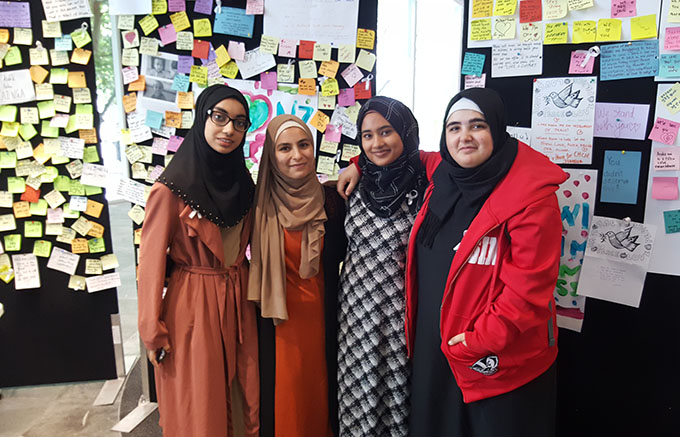
Muslim students at a cultural display about Islam at Auckland University of Technology this week: (from left) Ruqaiyah Hanif, Zara Jawadi, Samirah, and Nora Rahimi. Image: Michael Andrew/PMW

Safe and secure
Fourth year business student Samirah had also noticed the support shown at AUT, saying the measures taken by the police and campus security had made her feel safe and secure.

“I had a police officer approach me and say ‘if there is anything I need we’re around campus and we’re around the Masjid as well’.

“We’ve got prayers coming up on Friday and people have said, ‘we will form a human chain around you so we can make sure you’re safe inside.’”

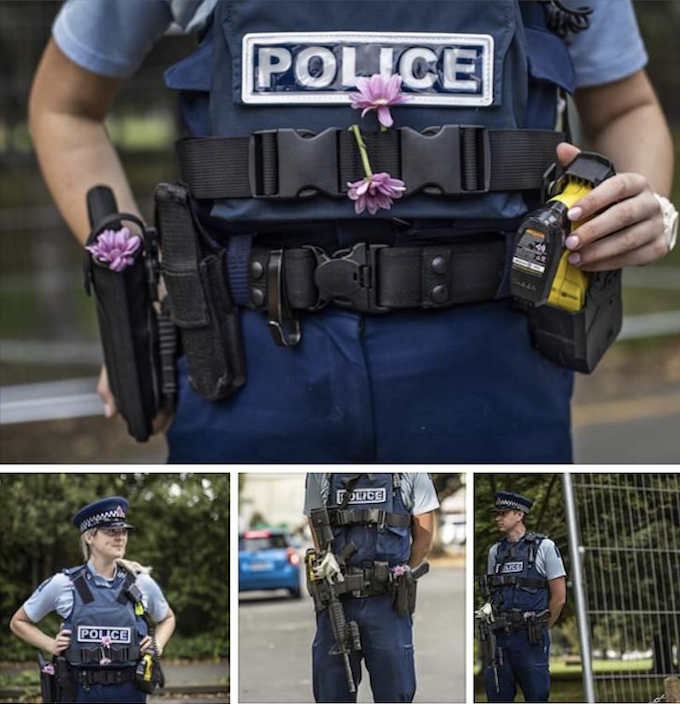
The AUT Masjid has been under guard by campus security this week and police have also been regularly patrolling the area.

Doctoral student and campus security guard Omer Bin Nasir, who has been stationed outside the AUT Masjid, said that while Friday was a dark day Muslims were touched by the efforts of the public and the government.

“Last Friday was black Friday for Muslims, for New Zealand, but after that, the way the government and Prime Minister Jacinda Ardern has addressed this issue, I think Muslims living in New Zealand feel much more secure, and they feel they are part of this country.”

Bin Nasan, a former television journalist from Pakistan, who is researching how domestic violence is portrayed in the New Zealand media, said he had experienced racism and bullying in this country before. The issue was resolved quickly, however, after he contacted police.
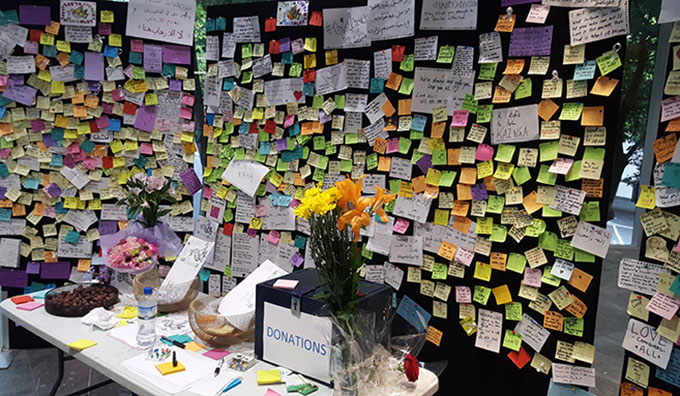
Support messages from AUT students and staff at a display about Islam on campus this week. Image: Michael Andrew/PMW

‘Country before heaven’
“This is a country before heaven,” he said. “It is so beautiful, and the people are really friendly.”

Despite the outpouring of public support in the aftermath of the massacre, other students have echoed Bin Nasan’s experience of racism in New Zealand. Some have even been subjected to abuse since Friday.

“There have more attacks on Muslims from Friday until now. My friend was attacked and my house was attacked,” said student Nora Rahimi.

“Some people realise their agenda is being spread out and they’re like, hmmm, this is acceptable now.”

Rahimi, who is studying for a Bachelor or Arts, said the accused terrorist should have been on a security watch list prior to the attack.

“Despite that I am very happy that the government is taking big steps forward to help us and the community.”

Office manager Zara Jawadi felt the same way. However, she stressed the need for ongoing education about all religions including Islam.

Get educated
“I think people should be inspired now to get out there and educate themselves, and see for themselves what our religion is all about, not just Islam but all the other religions in this country.”

Jawadi, who works for the charity New Muslim Project also said that ongoing racism, no matter the context, was not acceptable.

“Each of us has a responsibility to stand up against racism, whether it’s a small comment or a joke, don’t let that be ok anymore.”

The other students agreed that consistency was the best way to prevent further attacks. They hoped the sense of unity felt after Friday would continue.

“All this love and support we’ve been getting, we just want it to continue,” said Samirah.
“We don’t want it to end in a few weeks and everything goes back to how it was, when we stop knowing about each other and stop caring about each other.

“We want to stay as a country, unified, always.”

Michael Andrew is the Pacific Media Centre’s Pacific Media Watch freedom project contributing editor.
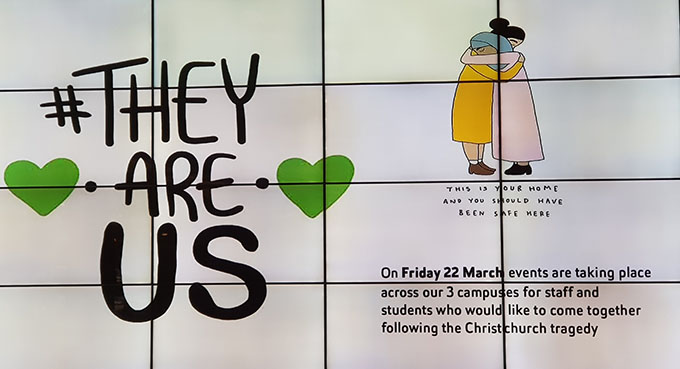
#TheyAreUs video wall tile at Auckland University of Technology today announcing national mourning events on the institution’s three campuses. Image: David Robie/PMC

Print Friendly, PDF & Email

Article by AsiaPacificReport.nz

A brief history of science writing shows the rise of the female voice

]]>

Source: The Conversation (Au and NZ) – By Robyn Arianrhod, Adjunct Associate , School of Mathematical Sciences, Monash University

Three centuries ago, when modern science was in its infancy, the gender disparity in education was not a gap but an abyss: few girls had any decent schooling at all.

The emerging new science was clearly a male enterprise.

But it arose from a sense of curiosity, and women, too, are curious. If you look closely enough, it’s clear women played an important role, as both readers and authors, in the history of science writing.

New vs old ideas

Both science and science writing were up for grabs in the 17th century. Technology was rudimentary and researchers struggled to obtain even the simplest observational evidence, and then searched for ways to make sense of it.


Read more: How not to write about science


You can see this struggle in the Italian astronomer Galileo Galilei’s famous Dialogues of 1632 and 1638. He painstakingly and somewhat tortuously tries to justify his arguments for heliocentrism – in which the planets go around the Sun – and the nature of motion and gravity.

Galileo Galilei (1564-1642). Engraved by R Hart and published in The Gallery Of Portraits With Memoirs encyclopedia, United Kingdom, 1833. Shutterstock/Georgios Kollidas

Tortuously, not only because he was bending over backwards to please the censors – heliocentrism was held to defy scripture – but especially because most of the experiments, methods, and even the mathematical symbolism of modern science did not yet exist.

So although yesteryear’s scientific content was simple compared with today’s overwhelming complexity, Galileo’s Dialogues show that the lack of data, methods and scientific language presented its own problems for science communication.

Conversation in science

Galileo resorted to the Socratic device of a conversation, in which he debated his ideas in a long dialogue between an innovative philosopher, Salviati, and two (male) friends.

In trying to convince even the least scientifically learned of his interlocutors, Galileo was writing what we might call popular science (although the more complex parts of the 1638 Dialogue read more like a textbook).

There were no scientific journals then, and there wasn’t quite the same distinction between the announcement of scientific discoveries to colleagues and the communication of those ideas to a wider public.

Perhaps the first mass-market popular science book was another dialogue related to heliocentrism, Frenchman Bernard le Bovier de Fontenelle’s 1686 Conversations on the Plurality of Worlds.

It was a runaway success that helped non-specialists accept the Copernican system – a Sun-centred solar system – rather than the time-honoured, seemingly self-evident geocentric one with Earth at the centre.

The hero of Fontenelle’s story, too, is a male philosopher – but this time he is conversing with a pretty marquise, who is spirited and quick to grasp new facts. Although its style was flirtatious, Fontenelle’s book was a significant recognition that women are curious and intelligent.

Science gets complex

Then, the very next year, everything changed. The English physicist and mathematician Isaac Newton published his monumental Principia Mathematica. Suddenly science became a whole lot more complex.

Isaac Newton (1643-1727). Engraved by E Scriven and published in The Gallery Of Portraits With Memoirs encyclopedia, United Kingdom, 1837. Shutterstock/Georgios Kollidas

For instance, Fontenelle’s explanation of the cause of heliocentrism had been based on Frenchman René Descartes’ notion that the planets were swept around the Sun by gargantuan cosmic ethereal vortices.

Newton replaced this influential but unproven idea with his predictive theory of gravity, and of motion in general, which he developed in 500 dense pages of axioms, observational evidence, and a heap of mathematics.

Principia provided the modern blueprint for experimentally based, quantitative, testable theories – and it showed the fundamental role of mathematics in the language of physics.

The trouble was that only the best mathematicians could understand it. It was so innovative (and tortuous in its own way) that some of the greatest of Newton’s peers were sceptical, and it took many decades for his theory of gravity to become universally accepted in Europe.

Science writers played a key role in this process.

Something ‘for ladies’

The earliest popularisations of Newton’s work were short or semi-technical, such as that by the French mathematician Pierre-Louis Moreau Maupertuis.

In the 1730s, Maupertuis tutored a real-life marquise, Émilie du Châtelet, but she was of a very different calibre from Fontenelle’s fictional student – or indeed the curious but rather flighty marquise in another mass market popularisation: the Italian Francesco Algarotti’s Newtonianism for “the ladies”.

Translated from the original French: l newtonianismo per le dame ovvero dialoghi sopra la luce e i colori. Google Books

Newtonianism here referred not just to Newton’s theory of gravity. As its somewhat patronising title might suggest, it focused mostly on his more accessible 1704 work, Opticks, which explains his experiments on the behaviour of light and the nature of colour. But these, too, were controversial, and Algarotti was an expert in optics.

He had been inspired to address “the ladies” by two outstanding female contemporaries: his French mathematical friend Émilie du Châtelet, and the Italian physicist Laura Bassi. But both women disliked his book’s flirtatious style.

An oil painting of Madame Du Châtelet at her desk. Wikimedia

Du Châtelet and her lover Voltaire were writing their own more serious (and non-gendered) popularisation of Newton’s work. Du Châtelet later wrote a very successful popular synthesis of the scientific ideas of Newton and his German rival Gottfried Wilhelm Leibniz – Bassi used the Italian translation of it in her own teaching.

Du Châtelet then went on to produce the first translation of Principia outside Britain – an insightful work that is also interesting in the context of popular science writing. She appended a 110-page commentary, summarising Newton’s method in everyday language, and explaining more recent applications of his theory.

The self-taught science writers

Nearly a century later, the Scottish mathematician Mary Somerville felt the same compulsion to reach out to the non-specialist reader – male and female – in the introduction to her book explaining the latest developments of Newton’s theory, Mechanism of the Heavens.

Oil painting of Mary Somerville who was a largely self-taught in science. National Galleries of Scotland

It is worth celebrating the fact that Somerville’s Mechanism was used at Cambridge as an advanced textbook in celestial mechanics – and at a time when women were not allowed to attend university.

Like Du Châtelet, Somerville was mostly self-taught. She understood the importance of science writing in educating the public, especially those denied formal education, and went on to write two best-selling popular science books: On the Connexion of the Physical Sciences and Physical Geography.

Another successful British female science writer in the early 19th century was Jane Marcet. Unlike those of Du Châtelet and Somerville, Marcet’s two books – Conversations on Chemistry and Conversations on Natural Philosophy – were aimed particularly at women.

They were built around conversations between two teenage girls and their female teacher. Unlike Fontenelle’s and Algarotti’s works for “the ladies”, these books were down-to-earth, non-patronising attempts to educate women in practical chemistry and physics.

But like those of Fontenelle and Algarotti, Marcet’s books proved popular with male lay readers, too – including the self-taught British physicist and chemist Michael Faraday, who went on to become co-discoverer of electromagnetism.


Read more: Let there be light! Celebrating the theory of electromagnetism


Biology was also progressing in the 19th century, but this had a downside for women. The discovery that women had smaller brains was used to reinforce the stereotype that women were incapable of intellectual study.

Somerville wrote movingly on how this affected her life. She would have been thrilled to read this year’s book by female neuroscientist Gina Rippon, The Gendered Brain, which asserts that brain plasticity and connectivity should displace old notions of gendered brains.

Do women and men have different brains? An interview with Gina Rippon.

Rippon’s is one of a growing number of female-authored popular science books on all aspects of science, and it is also an example of how women can contribute important new perspectives to scientific topics.

Another example is the ecological perspective of pioneering biologist and science writer Rachel Carson, whose 1962 Silent Spring played a leading role in launching the modern environmental movement.

Scientific understanding is often driven initially by a reductionist approach, and Carson was the first to clearly point out the role of artificial pesticides on the whole food chain.


Read more: Who writes science and technology stories? More men than women


Then there’s the question of ethics in science. Rebecca Skloot’s 2010 book The Immortal Life of Henrietta Lacks tells the little-known story of the 1951 illegal harvesting and selling of cells from poor black farmer Henrietta Lacks.

Having diverse voices of all kinds in science and science writing is a good thing for science, as even a brief look at history shows. As far as women’s participation goes, we’ve come a long way.

But we still need more women to help shape and tell the story of science.

ref. A brief history of science writing shows the rise of the female voice – http://theconversation.com/a-brief-history-of-science-writing-shows-the-rise-of-the-female-voice-112701

Sanders, Harris, Biden… can anyone beat Donald Trump to become the next US president?

]]>

Source: The Conversation (Au and NZ) – By Dennis Altman, Professorial Fellow in Human Security, La Trobe University

No sooner had the US midterm elections for Congress concluded than jockeying began for the presidential elections in 2020. Barring either impeachment, which seems unlikely, or a health crisis, Donald Trump will seek re-election.

Although the last sitting president not to be re-elected was George Bush Sr in 1992, polls suggest Trump is consistently disliked by a majority of Americans.

Democrats see a remarkable opportunity to regain the White House.

It’s all about the Electoral College

In last November’s elections for the House of Representatives, Democrats out-polled the Republicans nationally by millions of votes. But because each state has two senators, a third of whom are elected every two years, this did not translate into control of the Senate – probably the most powerful upper house in the world.

Democrats are hoping for continued success in the 2020 election. David Maung/AAP

That imbalance is reflected in the presidential system, in which each state has votes in the Electoral College equivalent to their total representation in Congress.

Because votes are tallied by states, Hillary Clinton out-polled Trump by three million votes, but did not win the Electoral College. Her majority was too concentrated in large states like California and New York.


Read more: Trump will likely win reelection in 2020


A crowded field of Democrats

The lure of the presidency can attract otherwise rational people to illusions of grandeur. Rolling Stone lists 24 declared or potential candidates.

Among those who have declared themselves as candidates for the Democratic nomination are Tulsi Gabbard, member of the House of Representatives from Hawaii, and the Mayor of South Bend, Indiana, Pete Buttigieg.

According to the polls the two frontrunners are both men well into their seventies: Bernie Sanders, who came close to winning the nomination in 2016, and former Vice President Joe Biden. Other frontrunners include three women senators: most notably, Kamala Harris, who is from California – the largest state and a Democrat stronghold.

There are other candidates with home state advantages: Amy Klobuchar (Minnesota), Elizabeth Warren (Massachusetts) and Beto O’Rourke (Texas). None are as well-known as Sanders or Biden, which presumably explains their current lead in opinion polls. Despite Clinton’s defeat, I suspect at least one woman will be in a winnable position by March.

Democratic Senator Kamala Harris of California, pictured with Reverend Al Sharpton, has announced her candidacy for president of the United States. Justin Lane/EPA


Read more: The US midterms show the power of Trump’s divisive messages


The primaries

California matters in the primaries because the nominee is chosen in a series of primary elections and caucuses, beginning in February. Primary elections are open to anyone who declares themselves Democrat when registering to vote. The process can be bizarre, and it varies from state to state, but it allows far greater participation than anything in Australia’s much more regulated system.

Cruelly, the first two decisions come in deep winter in Iowa and New Hampshire, essentially winnowing out the also-rans. But the crucial date will be March 3 2020, with primaries in Alabama, California, Massachusetts, Minnesota, North Carolina, Oklahoma, Tennessee, Texas, Vermont, and Virginia.

By then enough votes will likely be decided to narrow the field to two or three, who may battle out the nomination until the Democratic Convention in Milwaukee in July. The choice of Wisconsin reflects the reality that, along with Michigan and Ohio, it is one of the mid-west states that voted for Obama and was then narrowly won by Trump in 2016.

A shift to the left

The centre of gravity in the Democratic Party has moved to the left since Clinton beat Sanders for the nomination. Other than Biden, the leading candidates have embraced many of the positions Sanders took last time.

The dilemma for them is that what appeals to voters in party primaries may make them vulnerable to attacks from the right in a presidential election. This could make it hard for them to win the states regarded as crucial by both sides, such as Pennsylvania and Florida.

Trump will go into the 2020 election with money, enthusiasm and apparently unchallenged support from most Republicans, including some who declared him unfit to serve two years ago. The sheer number of potential Democrats may mean the party will find it easier to unite than it did last time, when some of Sanders’ most enthusiastic supporters seemed to loathe Clinton more than Trump.

Much commentary suggests Democrats must choose between rallying their base – which means African-Americans, college-educated women and the young – versus a more direct pitch to working class voters in declining industries. But this is a false dichotomy: large numbers of Americans are disadvantaged by both economic and social structures.


Read more: Latinos can be an electoral force in 2020


Obama showed it was possible to build an alliance of minorities and white union members, of affluent liberals and struggling workers. Defeating Trump demands a candidate who both promises to restore political civility and is not cowed by Trump’s narcissist exhibitionism.

Voting in the United States is not compulsory, and Republican dominated legislatures have made it difficult for people of colour and the poor. Cynicism about the political process is understandably considerable. Trump will be defeated if the Democrats nominate a candidate able to persuade enough people who regard politics as irrelevant to their lives to make the effort to turn out.

ref. Sanders, Harris, Biden… can anyone beat Donald Trump to become the next US president? – http://theconversation.com/sanders-harris-biden-can-anyone-beat-donald-trump-to-become-the-next-us-president-113345

As many Muslims return to mosques today, they will need ongoing support

]]>

Source: The Conversation (Au and NZ) – By Fatima Junaid, Lecturer, Massey University

Today, many Muslims in New Zealand will be returning for Friday prayers. Some might feel anxious, others may feel it’s important to go as a sign last Friday’s terror attack has not affected their resolve or faith.

At the same time, many might have returned, or are thinking of returning to their workplaces – resuming work with fears, anxieties and post-traumatic stress. On top of all this, there will be all the usual stresses of their work.

Collectively, these can be detrimental for both the employees and the organisations. Stressed employees are often not very productive. They can also behave in unpredictable and sometimes even destructive ways.

Trauma of losing loved ones

Losing a loved one is traumatic. The people of Christchurch already know that. However, trauma due to man-made disaster (such as last Friday’s act of terrorism) may be different from the trauma that results from a natural disaster like the sequence of earthquakes Christchurch has experienced. Terrorism instigates fear. The malevolent intent of harming others and the helplessness of the victims can cause anger that can lead to hatred.


Read more: How to take care of your mental health after the Christchurch attacks


The Friday attack clearly affected victims and their families in Christchurch and the wider Muslim community, but the event has also had an effect on the rest of the New Zealand population. There are many layers in which it has affected people, and it is important to understand the ways in which it will continue to do so.

Many migrants to New Zealand fled their home countries and came to New Zealand because it is a peaceful place. For them, this event means remembering the horrors they might have lived through before they came to New Zealand. This gives them a heightened sense of danger.

It is different from the population in New Zealand at large because many New Zealanders have not known what it means to feel unsafe. The families of the victims of Friday’s shootings, and many in the Muslim community, know this feeling too well. Now they are reminded of it.

How organisations can help

Organisations can provide a sense of safety and security to their employees and communities in general. They can brief them about the safety and security measures that have been put in place. Research has shown when people feel physically safe in a place, they feel less stressed. We should follow the New Zealand prime minister and constantly remind people they are safe.

Notwithstanding this, there will be people suffering from post-traumatic stress, which can often go undetected. Those suffering from it may not even know it. But it often surfaces in different ways and manifests itself in various behaviours.

The Friday attack might have caused trauma to many beyond the victims and their families. Some might have greater psychological resilience to combat the traumatic stress; those who don’t can collapse. Psychological resilience comes (or can be built) through social support, from community and also from organisational support.

Organisations and workplaces should allow those employees who want to return to work to come back, but then provide them with space, time and support so they can go through their grief in their own ways. They may come back seeming fine – but this may not be the full story. They may be desensitised to violence due to multiple exposures, or simply developing post-traumatic stress disorder (PTSD).

Organisations can offer flexible work hours or flexible work days in times of grief to enable people to continue working. Many people will choose to come to work, rather than stay at home. Work can provide a sense of meaning and also a sense of control over their life because disaster trauma leads to a sense of loss of control (real and perceived).

Having a sense of control over some things can be emotionally strengthening because everything else seems to be very out of control. The routine nature of a job can provide a sense of normalcy, in an emotionally chaotic time.


Read more: How to move beyond simplistic debates that demonise Islam


Impact of terrorism

The altruism and demonstrations of solidarity that have been borne out of this suffering may actually unite people. That surely would be everyone’s hope.

Thousands of New Zealanders have laid flowers at mosques and attended vigils in solidarity with the Muslim community. AAP/Mick Tsikas, CC BY-SA

But not all Western media internationally have communicated this event with the same humanity that has characterised coverage in New Zealand. There will be people who see the perpetrator and feel encouraged to do the same. There will be others who see the victims and feel angry and revengeful, which means the division, ugly insensitivity and hate may find more fuel.

Terrorism is known to lead to political extremism, dividing communities with a strong feeling of “them” and “us”. This has been evident in many incidents in many countries.

So we should take this opportunity to increase our communication with and engagement in our communities, at work and outside of it. Embrace the diversity in your organisation – talk to someone who’s different in colour, in religion, in background.

From my own experience of losing my father in a suicide bombing during the Friday prayers in a mosque in Pakistan, I know what support can do. I had the support of my colleagues and my organisation – it helped me heal and grow.

I know many who didn’t have this support. They still suffer from post-traumatic stress, and some have gone on to be a destructive force in their own lives without realising it. There is much we can do as organisations and individuals to make people feel connected and supported, and to build their psychological resources.

ref. As many Muslims return to mosques today, they will need ongoing support – http://theconversation.com/as-many-muslims-return-to-mosques-today-they-will-need-ongoing-support-114003

More than half of Aussie men report experiencing sexual difficulties

]]>

Source: The Conversation (Au and NZ) – By Jennifer Power, Senior Research Fellow at the Australian Research Centre in Sex, Health and Society, La Trobe University

One in two Australian men aged 18 to 55 have experienced sexual difficulty in the past 12 months, according to data released this week.

The findings are drawn from the Australian Longitudinal Study on Male Health, which included more than 12,000 men. Overall, 54% of sexually active men reported having at least one specific sexual problem lasting three months or more.

The men reported a range of difficulties:

  • 37% said they reached climax too quickly
  • 15% could not climax or took too long to climax
  • 17% lacked interest in sex
  • 11% felt anxious during sex.

Erectile dysfunction – defined as trouble getting or keeping an erection – tends to be the focus of media and public discussion about male sexual “problems”. But in this study, only 20% of men aged between 45 to 55 reported erectile dysfunction, and only 14% across all age groups.

Why do so many men report sexual difficulties?

Male sexual difficulties are associated with a range of physical, psychological or social factors including anxiety, stress and relationship difficulties.

In the Australian Longitudinal Study on Male Health, men who rated their overall health to be poor were more likely to report one or more sexual difficulties. Disability, mental health diagnoses, obesity, drug and alcohol use, and daily use of pain medication were all associated with an increased likelihood of some form of sexual difficulty.


Read more: Erectile dysfunction may be more than just a problem in bed


The inability to have a satisfying sexual life can negatively impact quality of life. Discussing concerns about men’s sexual lives should form part of general clinical care, particularly for men with other health conditions that may cause sexual difficulties.

Performance or pleasure?

The medical diagnosis of male sexual difficulties or problems tends to be based on performance (erectile function and ability to climax) rather than pleasure or intimacy.

This rests on assumptions that the primary, if not only, source of sexual pleasure for men comes from the performance of sexual penetration – which requires an erection and orgasm.

Many concerns about sexual function relate to performance rather than pleasure. Fergus Coyle/Shutterstock

However, studies show many men define sexual pleasure and sexual satisfaction in other terms. This includes the experience of desire, disinhibition, peace and happiness, as well as by giving pleasure and feeling bonded with another person.

While achieving orgasms is part of this, it’s not necessarily the primary goal.

Masculinity and male sexuality

The dominant cultural image of masculine sexuality is one of omnipresent sexual desire. Male vitality and virility are associated with a high sex drive. And it’s often assumed men will initiate and lead sexual encounters with women.

Sexual intercourse (penetrative sex with a penis and vagina) is positioned as the most desired and important sexual act for heterosexual couples.

These images are created and reinforced through media messages – advertising, film and television – as well as through marketing of medical “solutions” to male sexual problems. These increasingly come in the form of drugs such as Viagra that promote a sustained erection as the ultimate goal for male sexual satisfaction.


Read more: Weekly dose: the hard facts on Viagra


Even if a man’s personal experience of sexual pleasure and desire is more nuanced or passive, cultural images of sexuality set normative standards for the ways people make sense of their own bodies, sexual desires and sexual experiences.

So it makes sense that men might feel anxious about their sexual performance and be concerned about a lack of sexual desire, not climaxing at the right pace (or at all), or not being able to sustain an erection.

This doesn’t mean these issues aren’t genuine challenges or problems for these men. Rather, it points to cultural pressure on men to enact a particular type of sexuality.

A 2014 Australian study investigated the effects of these pressures on the sexual function of 140 male participants. The researchers found men who were exposed to cultural images of traditional masculinity had significantly higher levels of sexual beliefs that increase vulnerability to sexual dysfunction than those who weren’t.

Challenging gendered sexual stereotypes

Expectations of masculinity shape the way men understand sexuality and their bodies in the same way feminine stereotypes affect women’s experiences of sex, sexuality and their bodies.

It’s time to rethink our cultural concepts of male sexuality. Tim Marshall

Expectations of masculinity also obscure the sexuality and experiences of people whose gender or sexual identity doesn’t fit the traditional male/female gender binary.

Feminist thinking and activism has exposed the emotional and social impact of unrealistic feminine sexual stereotypes. It also provides a platform for questioning the impact of male sexual stereotypes.


Read more: Clementine Ford reveals the fragility behind ‘toxic masculinity’ in Boys Will Be Boys


If more than half of Australian men are concerned about some aspect of their sex lives, we need to closely examine the cultural and political context of male sexuality. Medical or psychological definitions of male sexual difficulties only tell part of the story.

ref. More than half of Aussie men report experiencing sexual difficulties – http://theconversation.com/more-than-half-of-aussie-men-report-experiencing-sexual-difficulties-113848

Cannibalism helps fire ants invade new territory

]]>

Source: The Conversation (Au and NZ) – By Pauline Lenancker, PhD student in biology and ecology, James Cook University

Tropical fire ants (Solenopsis geminata), originally from central and South America, are a highly aggressive, invasive ecological pest. Our new research has shed light on how they successfully establish new colonies.

An allergic reaction to painful tropical fire ant bites. Pauline Lenancker, Author provided

While we don’t know exactly how widespread tropical fire ants are in Australia, they are well established around Darwin and Katherine, as well as on Christmas Island and Ashmore Reef. Disturbing one of their nests will result in many workers inflicting painful stings on the intruder, and can trigger an allergic reaction in some people.

When invasive ants move to a new region, the pioneers may be one or a few colonies. Because these pioneers are isolated, they often inbreed, which causes genetic problems in their offspring. But our new research, published in Scientific Reports, reveals how tropical fire ants use cannibalism to survive and spread, despite their low genetic diversity.


Read more: Eradicating fire ants is still possible, but we have to choose now


Sons and daughters

Founding new colonies is how fire ants spread. Queens fly off to start their own colonies just after they have mated. It is a perilous journey – they need to avoid predators and find a good spot to start laying eggs. If queens do not quickly rear daughters that can forage, called workers, they will starve to death.

Queens can lay two different types of eggs: fertilised eggs, which will develop into workers, and unfertilised eggs, which will develop into males. Therefore, female workers have two copies of each gene (diploid), while males have a single copy of each gene (haploid). However, when an ant queen and her mate are closely related, a flaw in the sex determination system of ants causes half of the fertilised eggs to develop into diploid males instead of workers.

The role of males is only to mate with queens – they do not forage, and they die after they have mated. Queens founding a colony have no interest in producing males, because males will not feed them. What’s more, diploid males are often sterile, and their larvae are larger than worker larvae. Therefore, queens can waste precious resources feeding fat useless sons instead of workers.

We wanted to find out how common diploid males are in field colonies, and how queens could successfully start colonies despite them. Understanding how tropical fire ants spread, we hope, can help us stop them expanding their range.

Abandoned and eaten

Our field sampling of tropical fire ant colonies around Darwin revealed eight out of ten colonies produced diploid males.

We collected 1,187 queens that had just mated, and assigned them to start colonies on their own or with other queens.

We observed that in 34% of colonies producing diploid males, diploid male larvae were placed in the colony trash pile by the queens instead of being kept with the worker larvae. It is usual for ants to keep dead individuals away from the rest of the colony, but when we looked at some of these abandoned larvae under a microscope, we realised they were still alive.


Read more: Curious Kids: do ants have blood?


Queens not only abandoned their sterile sons, they ate them. Three-quarters of the 109 sterile male larvae disappeared from the colonies within 12 days of when we first observed them. Because the queens were the only adult ants present in the colony, this means the queens were eating their diploid males or feeding them to their worker larvae.

This cannibalistic behaviour allowed the queens to redirect nutrients towards themselves or productive members of their colony. Diploid male larvae require more food than worker larvae to develop, so we expected queens from diploid male producing colonies to lose more weight than queens from colonies that only produced workers, but we found that was not the case. Queens with diploid males lost less weight or as much weight as queens from regular colonies, probably because they ate their sterile sons.

We also found queens who worked together in groups to start a colony reared more workers. Therefore, queens in groups would likely have a better chance of survival even if they produced sterile males. But in 6% of colonies, queens did not tolerate having housemates and dismembered other queens.

A queen dismembered by a tetchy rival. Pauline Lenancker, Author provided

For tropical fire ants, cannibalising sterile sons and cooperative brood rearing among queens are two behavioural mechanisms for avoiding inbreeding costs. A third possible mechanism for the queens is to “sleep around”.

Promiscuity would increase the chance of mating with a genetically different male, and reduce the likelihood of producing diploid sons.

Queens only mate right before starting their colony and store the sperm in an organ called the spermatheca. We genetically analysed sperm from the spermatheca of 40 queens, but found no evidence queens had mated with more than one male.

Tropical fire ants are currently established on Ashmore Reef, a protected Australian Marine Park which is an important breeding site for seabirds and turtles. The invasive ant threatens this sanctuary by attacking seabird and turtle hatchlings. Accidental spreading of tropical fire ants to suitable habitats in the Northern Territory, Queensland and Western Australia would threaten invaluable ecosystems as well as our health and lifestyles.


Read more: How we wiped out the invasive African big-headed ant from Lord Howe Island


The current eradication program for the closely related red imported fire ant (Solenopsis invicta) in Queensland has been granted A$411 million over ten years, and failure to eradicate red imported fire ants could cost Australia A$1.65 billion per year in damaged crops, livestock harmed and people treated. The more we learn about invasive ant biology, the closer we are to new methods of preventing their spread.

ref. Cannibalism helps fire ants invade new territory – http://theconversation.com/cannibalism-helps-fire-ants-invade-new-territory-113752

‘It’s real to them, so adults should listen’: what children want you to know to help them feel safe

]]>

Source: The Conversation (Au and NZ) – By Tim Moore, Associate Professor and Deputy Director, Australian Centre for Child Protection, University of South Australia

In recent months, we have been confronted by events that make the world seem unsafe. Among these are the horrific stories of child sexual abuse, the rise in Aboriginal youth suicide and the tragedy of mass killings at the hands of an Australian terrorist in Christchurch.

Many of us feel anger, despair, hopelessness and grief as we are hit by what feels like a constant barrage of bad news. It’s important to take care of our mental health during such times, but it’s also vital to think about how children and young people are experiencing and responding to difficult events, and the ensuing emotions.


Read more: How to take care of your mental health after the Christchurch attacks


During the life of the Royal Commission into child sexual abuse, we conducted a study to better understand how children and young people conceptualise and experience safety. We wanted to know what they believed adults might do to both keep them safe and help them feel safe.

We spoke to 121 children and young people aged 4-18 in the ACT, Victoria, New South Wales and Queensland. The participants represented various institutional contexts, including having attended early learning centres, schools, sporting groups, holiday camps, church groups, out-of-home care and hospitals.

Below are some key messages children and young people wanted to get across to the adults in their lives.

Children know the risks, but might misjudge the extent of the danger

In addition to snakes, ghosts, escaped tigers and bullies, participants raised concerns about child abusers and abductors, online dangers, wars and terrorism. They said they learnt about these threats by hearing things directly from parents, siblings and peers (including quiet discussions that weren’t for them), the television and radio, and social media.

Many children and young people felt they were exposed to so much information about risk, they often found it difficult to determine how pressing the danger was. When their parents, teachers and other trusted adults failed to talk to them about the issues, they said they often imagined the worst-case scenario.

Young people said:

Sometimes we freak out when we don’t need to. We might have heard something and now we think that it’s a huge risk but it could turn out that we’ve heard the wrong thing or that it’s not really a problem.

No one really talks to kids about what really could happen or tell them not to worry when the thing they’re scared about ain’t gonna happen. So kids are all stressing about the wrong things and they don’t know what to do if something real bad happens, because no one talked to them about it.

Young people believed children lacked the ability to accurately assess threat. When news reporting was coupled with fictional movies and urban legends, and when children were not given context, their perceptions were skewed.


Read more: A guide for parents and teachers: what to do if your teenager watches violent footage


Help children articulate and process their fears

Children and young people told us they were often overwhelmed by the risks that surrounded them. Young women, in particular, said they were constantly worried about threats to their physical and emotional safety.

Children felt this lack of safety in their bodies – they sweated, felt butterflies in their stomachs, found it hard to settle and concentrate, and were easily frightened. They demonstrated these fears in their behaviours – by being restless, feeling tired and fighting with others.

They said it was often difficult to articulate their emotions and they needed adults to help them find the words. They needed help to understand the links between their lack of security and their response.

Children said they often had trouble articulating their fears. from shutterstock.com

Don’t downplay children’s concerns

Children and young people felt adults often too readily dismissed their concerns and downplayed the impact their fears were having on them. One young person said:

Not everything they (children) fear is imaginary. That’s what parents get wrong. They think that cause they’re little they’re not telling the truth or they’ve imagined it but most of the time they’re telling the truth but people don’t believe them because they’re little. And anyway it’s real to them so adults should listen.

Participants said trusted adults should listen and acknowledge their feelings, and take their fears and concerns seriously. They wanted adults to let the child voice their thoughts and feelings before trying to solve them and to respect the child’s experience.

They felt it was sometimes appropriate for adults to distract a child to help them calm down. But they also believed adults should return to the conversation when the child was calm to help them make sense of their fears and feel acknowledged.

Tell young people what is being done to protect them

Participants observed the information they were given was often restricted to the risk or danger, but they weren’t being told what was being done to protect them.

Participants said they had heard a lot about the threat of child abduction, for instance, but no one had told them there were more police stationed around schools, that teachers were more vigilant and that policies were in place to reduce the likelihood a child could be harmed.

Young people reflected that when adults didn’t inform them of how they were responding, children had little confidence adults fully appreciated the risk or were adequately equipped to keep them from harm.


Read more: What parents need to know about the signs of child sexual abuse


Many participants also believed adults could not always be around to help protect them and it was important for children and young people to be skilled to deal with issues themselves. This was seen as particularly important for older young people who were more likely to be alone and who would more likely want to deal with issues themselves rather than seek support.

They advocated for more classes on how to assess and respond to risks, giving examples of drills, role plays and lessons from others who had confronted similar challenges. It was important the recommended strategies were effective because young people felt the consequences of doing the wrong thing when they were unsafe would be significant.

They’ve gotta get it right or we’re fucked, you know. It’s better to feel scared and to watch out for things than to feel comfortable because someone has told you not to worry and then you end up in a bad situation because you got the wrong advice.

Ultimately, children and young people need adults who are there for them, who discuss their fears, provide them with enough information to deal with potential threats but not cause them unnecessary worry, and help them understand how other adults and the community around them are keeping them safe.


The study in this article was commissioned by the Royal Commission into Institutional Response to Child Sexual Abuse. It was conducted by the Australian Catholic University, and peers from Griffith University and Queensland University of Technology.

ref. ‘It’s real to them, so adults should listen’: what children want you to know to help them feel safe – http://theconversation.com/its-real-to-them-so-adults-should-listen-what-children-want-you-to-know-to-help-them-feel-safe-113834

What Parkland’s experience tells us about the limits of a ‘security’ response to Christchurch

]]>

Source: The Conversation (Au and NZ) – By Amanda Tattersall, Postdoc in urban geography and Research Lead at Sydney Policy Lab. Host of ChangeMakers Podcast., University of Sydney

In the days before the mass shootings in Christchurch I was visiting Parkland, Florida, where 17 people were killed in a school shooting on Valentine’s Day 2018. I was recording a story about how those survivors and their allies built a global movement against gun violence. I met students, teachers and supporters.

These American students knew all about Australia’s gun laws. “How did you get such strong laws?” they would ask. And I would tell them about the Port Arthur massacre and how our conservative prime minister acted. “We haven’t had a gun massacre since,” I proclaimed. Days later, I felt shame at my hubris – an Australian has been charged with the shootings at two mosques in Christchurch, New Zealand.


Read more: Parkland shooting: One year later, Congress still avoids action on gun control


Lessons from a ‘high-security’ suburb

We have so much to learn from Parkland. And it’s not simply how they built a remarkable social movement. Some lessons become visible only when you actually see the place.

Parkland is a suburb close to the Everglades, 30 minutes from the beach and an hour north of Miami. It is a wealthy, majority-white neighbourhood. But the thing that overwhelmed me when I was driving around is that it is a gated community.

The entire suburb is broken up into large blocks, and at the centre of each block is a single entrance for cars. The road has a security hut, large barriers stretching across and there is a large gate. You need a PIN code to go inside.

When you go through, the homes and streets are beautiful. Green grass, and every home has one of those white mailboxes with a red flag that turns up when the mail arrives.

These gated communities tell you something. Parents choose to live behind walls to create a nice way to live and keep their family safe.

But in Parkland all that security didn’t keep them safe. Darkness found a new way in – and everyone is still feeling the murderous pain.

The limits of security and walls offer a profound lesson for us in Australia as we work out how to respond to the terrorism in Christchurch. Prime Minister Scott Morrison wants to lock up our places of worship – particularly mosques. He wants police with guns and security checks. It’s like he wants to build religious gated communities.


Read more: Morrison announces $55 million for security at religious premises and warns against “tribalism”


This approach is consistent with his other policies – use the navy to stop boats, use cages to stop refugees. Our prime minister has only one register – security.

But if Parkland showed anything, it’s that gated communities don’t stop violence. The violence just moves and shifts. An aggressive security response might make you “feel” safer, but it doesn’t make you safe.

At the same time, security heightens the tension. And it does nothing to deal with the causes of the violence.

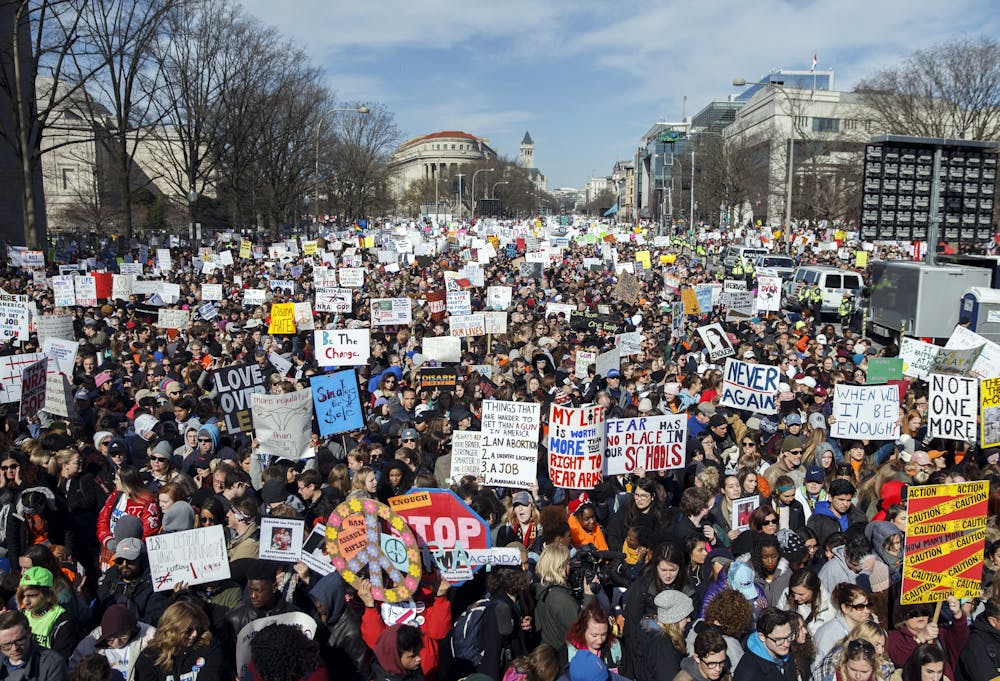
So how do we respond to the causes of the violence? In Parkland, the main issue was access to guns. The March for Our Lives students called this out quickly. They gained traction because they bravely and forcefully condemned the National Rifle Association for creating the context for mass shootings – easy access to guns.

Parkland school students mobilised the March for Our Lives movement for gun control. Shawn Thew/EPA


Read more: We must not punish content creators in our rush to regulate social platforms


It started with the demonisation of others

Our context is different. The issue in Christchurch was about guns, yes, but equally it was about motive. As Australians, one of our citizens “radicalised” themselves to such a point that they massacred other people. How did this happen?

White supremacy. OK, but how do we unpack white supremacy? Who emboldened this? Who made it OK to demonise Muslims – to say they don’t belong?

First, people looked to Pauline Hanson and Fraser Anning. The social movement around #EggBoy shows people’s anger at extremism.

But it’s more than that. Murdoch news media have been running a crusade against Muslims for years. The Coalition has brutalised Muslims and refugees for votes since September 11 2001. And the Labor Party has given bipartisan support to the offshore detention of predominantly Muslim refugees.


Read more: Christchurch attacks are a stark warning of toxic political environment that allows hate to flourish


Come together in love to overcome hate

But knowing who prosecutes hate is not enough. Hate can’t drive out hate. As Martin Luther King junior said, only love can do that.

How do we bring love into our work to stop race being used as a divisive power? I wish I had the answer. But I do know that building love is something that can happen everywhere all the time – not just at vigils or special services.

Can we build a movement that would amplify love at work, in our community, in our schools, where we have intentional conversations to talk about what Christchurch meant and why the Muslim community was targeted?

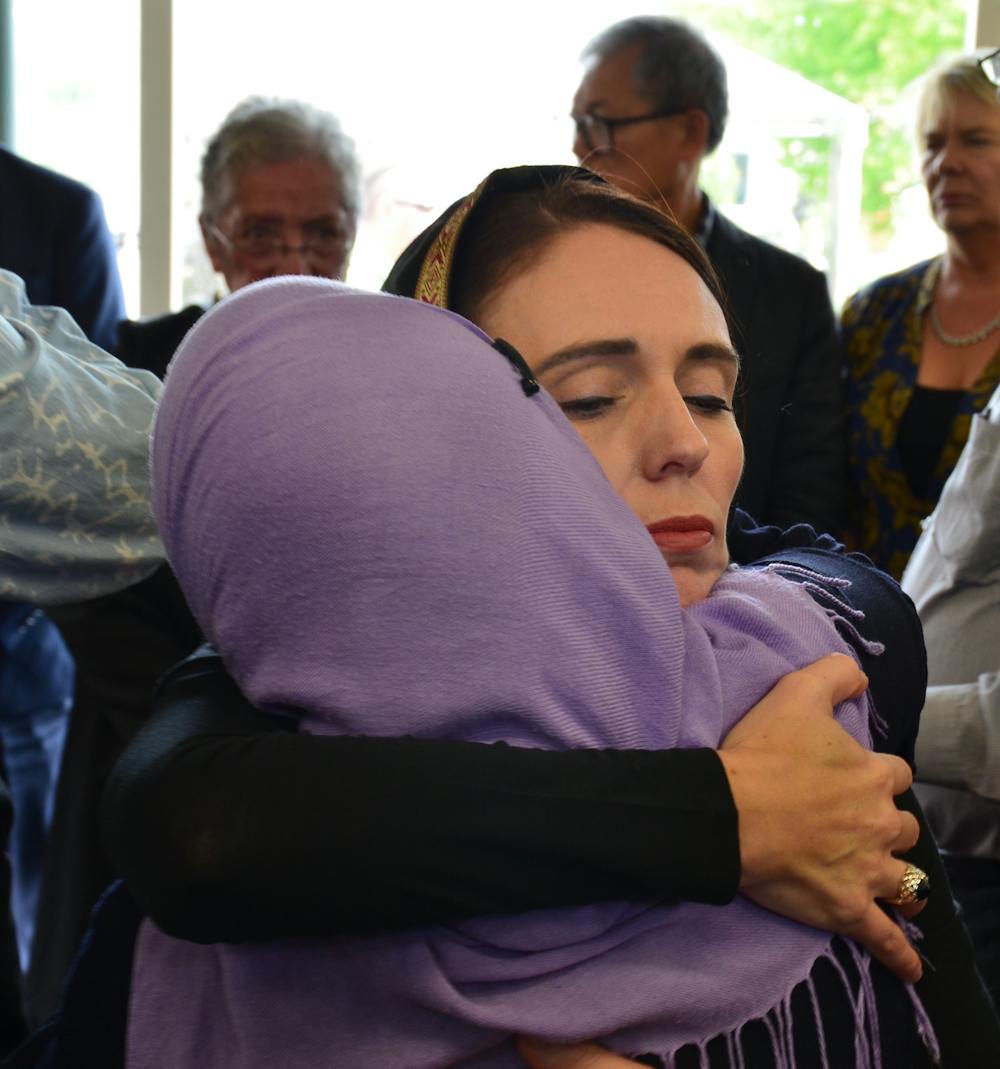
Prime Minister Jacinda Ardern has led the way in embracing Muslims in New Zealand – ‘they are us’. Boris Jancic/AAP

The Muslim community are in pain. We – especially white people like me and some of you – have to do the heavy lifting on this one. We can take the lead on doing something about white supremacy and dividing people by race and religion.

Imagine if we could take the pain of this moment and turn it into a real reckoning for our country. For as long as white people have stood in Australia we have caused harm to others. But too often we shrug off responsibility through phrases like “the most successful multicultural country in the world”. Or we get scared off the conversation by phrases like the “history wars”.

Yes, the shock jocks will berate and the trolls will yell. But let’s have them yell at white people taking on white supremacy instead of Muslim and other leaders of colour.

It’s time to act. The election is one place – we need to vote for leaders who stand with Muslims because “they are us”.

But this is more than just electoral politics. It’s about a movement committed to connection, understanding, listening, respect and love. And that’s love as a verb, love as action.

A year after the mass shooting, Parkland is still a torn community. Many are still deeply active in social movements pushing for gun law reform. And many others are still healing.

In Parkland the lesson is that they were forever changed, not because of the hate that was inflicted, but because of the love they cultivated in response.

ref. What Parkland’s experience tells us about the limits of a ‘security’ response to Christchurch – http://theconversation.com/what-parklands-experience-tells-us-about-the-limits-of-a-security-response-to-christchurch-113912

We’ve let wage exploitation become the default experience of migrant workers

]]>

Source: The Conversation (Au and NZ) – By Joo-Cheong Tham, Professor, Melbourne Law School, University of Melbourne

Australia’s Fairwork Commission has so far this year examined more than a dozen cases of wage theft. Those cases involve hundred of workers and millions of dollars in underpayments.

And it’s just the tip of the iceberg.

A significant report on the exploitation of migrant workers in Australia has been published this month. After a two-year inquiry by the federal Migrant Workers’ Taskforce, the report concludes that wage theft is widespread. Possibly as many as half of all temporary migrant workers are being underpaid.


Read more: We need to hear the stories of exploited unlawful migrant workers, not just deport them


The federal government has agreed “in principle” to act on all of the report’s 22 recommendations. Attracting most media coverage is the recommendation to introduce criminal penalties for deliberate and systemic exploitation. Employer groups oppose this.

But this debate should not distract us from other important principles that need action.

Equality before the law

Of foremost importance is the principle of equality. The federal government’s response to the report rightly declares that all workers, no matter their background, should be able to work without fear of exploitation.

Here the report contains two crucial recommendations.

The first is to amend the Fair Work Act so it expressly states it covers migrant workers. The second is to extend coverage of the federal Fair Entitlements Guarantee program, which covers the cost of entitlements left unpaid when a worker is left high and dry by an employer going into liquidation or bankruptcy.

The report also stresses the need for migrant workers to be adequately informed of their workplace rights. It proposes a “whole of government” approach to inform and educate workers.

Social licence

Another critical principle of the report is that of redress.

It recommends that the effectiveness of the small claims process under the Fair Work Act be reviewed.

It also recommends increasing penalties under the Fair Work Act. These include giving courts the power to impose an adverse publicity order, requiring an offending business to notify the public it has cheated workers; and for the most serious cases of exploitation, of course, it has suggested criminal sanctions.

For four high-risk industries – horticulture, meat processing; cleaning and security – the report recommends a National Labour Hire Registration Scheme. Companies failing to comply with workplace laws would face potential deregistration.


Read more: Cheating workers out of wages is easier than ever


It also asks the government to explore ways by which employers found to have underpaid workers can be banned from employing anyone for a specific period.

These last two proposals speak to a deep moral truth. The ability to operate a business is a social licence. Those who systematically disregard the rights of workers forfeit their right to this licence.

While noting the important work undertaken by the Fair Work Ombudsman, the report queries whether the office’s funding, functions and power are equal to addressing the problem of wage theft. It recommends a public capability review to ensure the regulator is “fit for purpose”.

Wider responsibilities

There should be little doubt that systemic industry practices (particularly in the agriculture and hospitality sectors) and business structures (such as franchises and labour-hire companies) are contributing to the problem.

Equally clear too is that the big end of town bears culpability. The roll-call of companies implicated in breaches include Caltex, Domino’s Pizza, Woolworths and Pizza Hut. Restaurants owned by celebrity chefs Heston Blumenthal and George Calombaris have been found underpaying employees.


Read more: What is going rotten in the franchise businesses plagued by scandals


The report makes clear it is not just employers and the Fair Work Ombudsman that must ensure compliance with workplace laws. Other institutional actors are also responsible.

It recommends, for instance, businesses that outsource workers be deemed accessories to any crime of wage theft committed by labour-hire companies.

Significantly, it also draws attention to the responsibility of the higher education sector, given the sector profits from about 800,000 fee-paying international students in Australia. Many of these students take part-time jobs, and they are particularly vulnerable to being exploited. The report recommends education providers be obliged to provide information to them, and to assist them when they experience workplace issues.

A powerful blueprint

The report is clearly not meant to be the final word on dealing with wage theft. Its first recommendation is that the federal government establish a “whole of government mechanism” to continue the taskforce’s work.

For this work to be meaningful, another principle of the report must be acted upon: the need for systematic data collection and analysis. Without this we risk being blind to what is happening right before us. Consider, for example, the growing use of migrant labour as domestic workers badged as “au pairs”.

The report is certainly not without limitations. It could have gone much further on immigration law reform, given the pernicious role certain visa conditions have in encouraging exploitation. It fails to specifically discuss the crucial role of trade unions in protecting workers.

It is nonetheless a powerful blueprint to address the rampant problem of wage theft, which undermines the integrity and cohesion of our labour markets. It is incumbent upon all those in power to act on it.

ref. We’ve let wage exploitation become the default experience of migrant workers – http://theconversation.com/weve-let-wage-exploitation-become-the-default-experience-of-migrant-workers-113644

Jobs but not enough work. How power keeps workers anxious and wages low

]]>

Source: The Conversation (Au and NZ) – By Barbara Pocock, Emeritus Professor University of South Australia, University of South Australia

This is the third in a three-part mini-symposium on Wages, Unemployment and Underemployment presented by The Conversation and the Academy of the Social Sciences in Australia. Read the other pieces in the series here.


For the moment, Australia’s unemployment rate has a “4” in front of it. The rate for February, released on Thursday, came in at 4.9%. It’s the first time the rate has begun with a four since the Rudd/Gillard government when it dipped below 5% several times, and since the Howard and Rudd governments in the leadup the global financial crisis when it usually began with a four and at one point dipped to 3.9%.

It’d be good news were it not for another, almost as important, indicator – the underemployment rate.

Workers are underemployed when they are working fewer hours than they want to. They might be working part-time instead of full-time, or part-time for 10 hours a week instead of 20, or full-time at 35 hours instead of 40.


ABS Labour Force


Over the past five years the proportion of the workforce underemployed has climbed from 7.2% to 8.1% while the unemployment rate has climbed from 5.2%, then fallen, hitting 4.9%.

The underemployed are disproportionately women (60%), and are concentrated in the retail, health care and hospitality industries. Their jobs are more likely to be insecure, with inadequate hours often accompanied by unpredictable or uncertain hours.

They are in industries that have seen growth in temporary migrant workers and the systematic underpayment of workers, reflecting changes in the temporary visa system as well as weaknesses in the enforcement of wage laws.

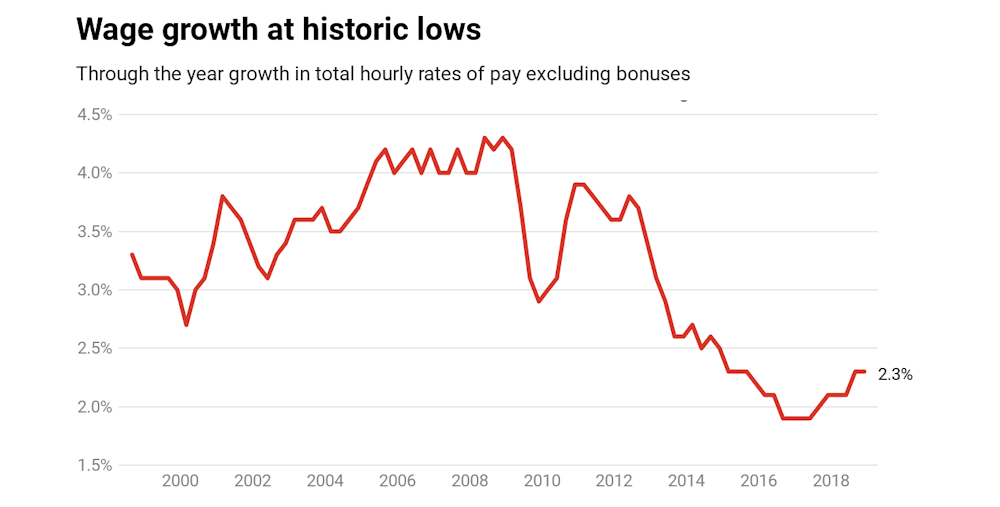
Wages are the other side of the bad news. No one who has made a regular appearance at the plethora of parliamentary inquiries that have accompanied the rewriting of Australia’s industrial relations system over the past 23 years would be surprised that wage growth is bumping along at historic lows.

The reworked industrial relations system – and the social, cultural, economic and labour market context in which it sits – has reshaped power at work. Wave after wave of change has had the end result of shifting power to employers. And it is that change in power that, more than anything, explains the stalling of wages growth.

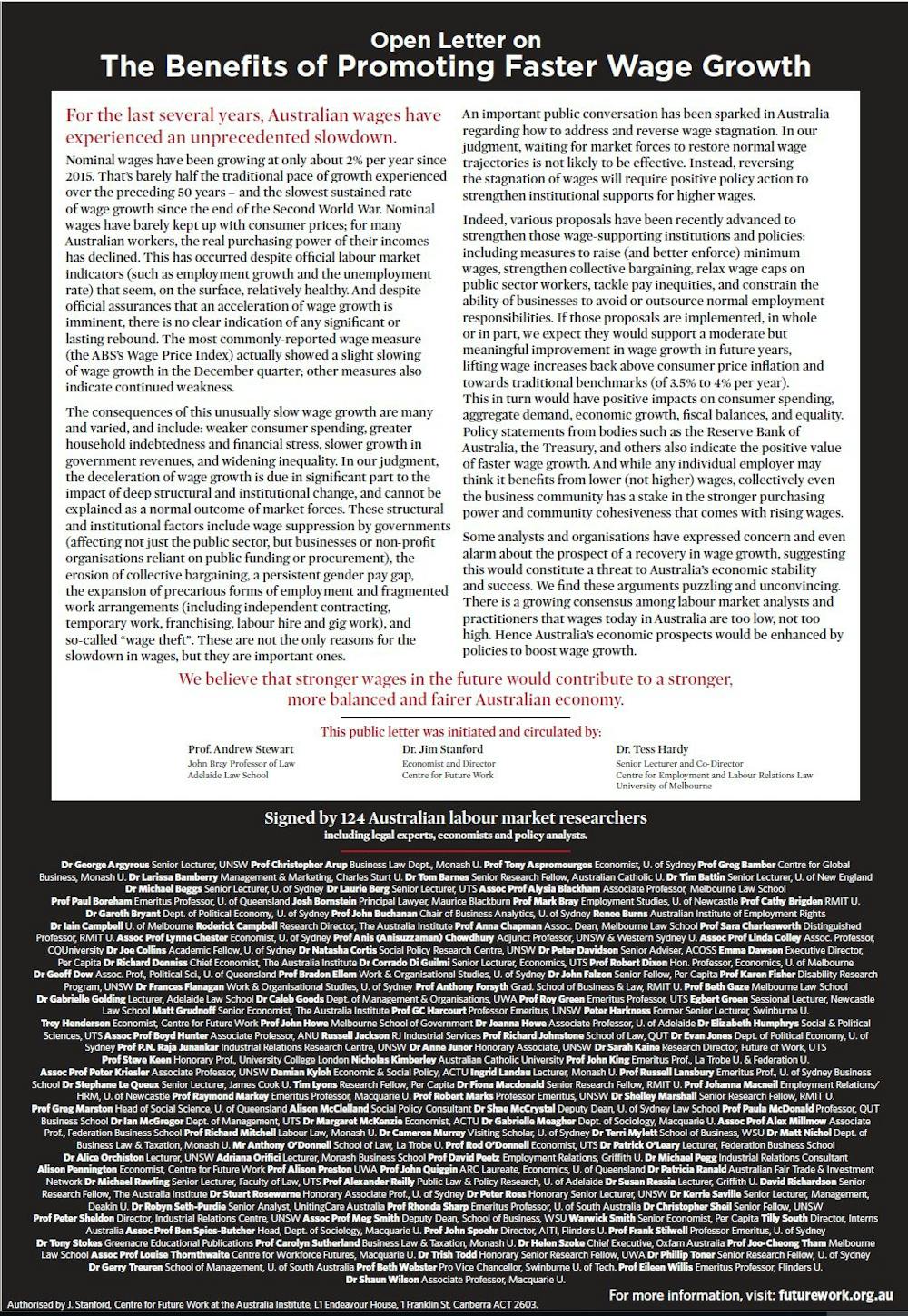
Open letter in Tuesday’s Financial Review. AFR

As 124 labour market experts said in their open letter in support of wages growth published in the Australian Financial Review this week, we are witnessing the longest sustained rate of slow wage growth since the end of the Second World War.

It certainly isn’t the result of falling productivity, which has actually climbed 39% in the past two decades while real wages have climbed only 14%.

The feminisation of employment has also helped shift the power balance at work. Women’s share of the total workforce climbed from 43% to 47% between 1999 and 2019.

Research in many countries tells us that women are no less inclined to join a union and have no less an appetite to improve their working conditions than men. However, women’s caring responsibilities and the practical demands they face, along with the nature of the industries in which they work, often make it harder for them to bargain or to take industrial action.


ABS wage price index


Analysts focus on the causes of this historic wages stall. Reserve Bank Governors caution about its consequences for the economy. But in thousands of households across Australia, a five-year stall in wages growth exacts a high human cost. It particularly affects those already on low pay, for whom a few dollars a week mean the difference between making rent, paying for school excursions or filling the fridge. ‘Frugal comfort’ of the kind promised by Justice Higgins in 1906 (to full-time men at least), is a long way from the anxiety that flatlining wages mean for many Australians.

The wage system shapes the fortunes of Australian households. Its reverberations have become more powerful with the growing number of two-earner households and a retirement incomes system that increasingly mirrors wage earnings.

The growing awareness of wage inequality and unevenly rewarded productivity, in combination with increasing job insecurity and weakening protections at work, is likely to feed into the election campaign.

Redressing the basic and widening power imbalance that underlies the employment and wage statistics has become a public necessity that has supporters in some surprising places. It is overdue.


The Academy of the Social Sciences in Australia is one of Australia’s four learned academies. The ASSA coordinates the promotion of research, teaching and advice in the social sciences, promotes scholarly cooperation across disciplines, comments on national needs and priorities in the social sciences, and provides advice to government on issues of national importance.

ref. Jobs but not enough work. How power keeps workers anxious and wages low – http://theconversation.com/jobs-but-not-enough-work-how-power-keeps-workers-anxious-and-wages-low-113360

Friday essay: images of mourning and the power of acknowledging grief

]]>

Source: The Conversation (Au and NZ) – By Cherine Fahd, Director Photography, School of Design, University of Technology Sydney

Before her death in 2010 my paternal grandmother gave me a box of family photographs. It contained mostly black and white images taken between 1950 and 1975.

As a child I had often sorted through these photographs, intrigued by what they portrayed of my family’s migration from a small village in Lebanon to the southern suburbs of Sydney. I was especially fond of seeing my father as a small boy, climbing trees or riding go-karts in what was still our street in Peakhurst.

Snapshot of Fahd’s father as a boy circa 1957. Author provided

One person in the photographs intrigued me more than any other – my grandfather, who I knew I had met as a baby but had no recollection of. I knew the story of his death was a sad one, but I didn’t appreciate just how sad it had been until I saw it captured in a set of extraordinary photographs I discovered in that box.

On arriving home with my grandmother’s heirlooms, I was keen to reconnect with my family’s history. It had been over 20 years since I had seen these photos. Rummaging through the box, I noticed a crumpled envelope made of aged brown paper hidden beneath those familiar images. Inside were 24 carefully hand-printed, black and white shots.

The original photographs as they were found in their envelope. Author provided

These images took my breath away. They made me weep. My first impression was that they were so desolate, yet, they were beautiful, accomplished and unique in what they represented.

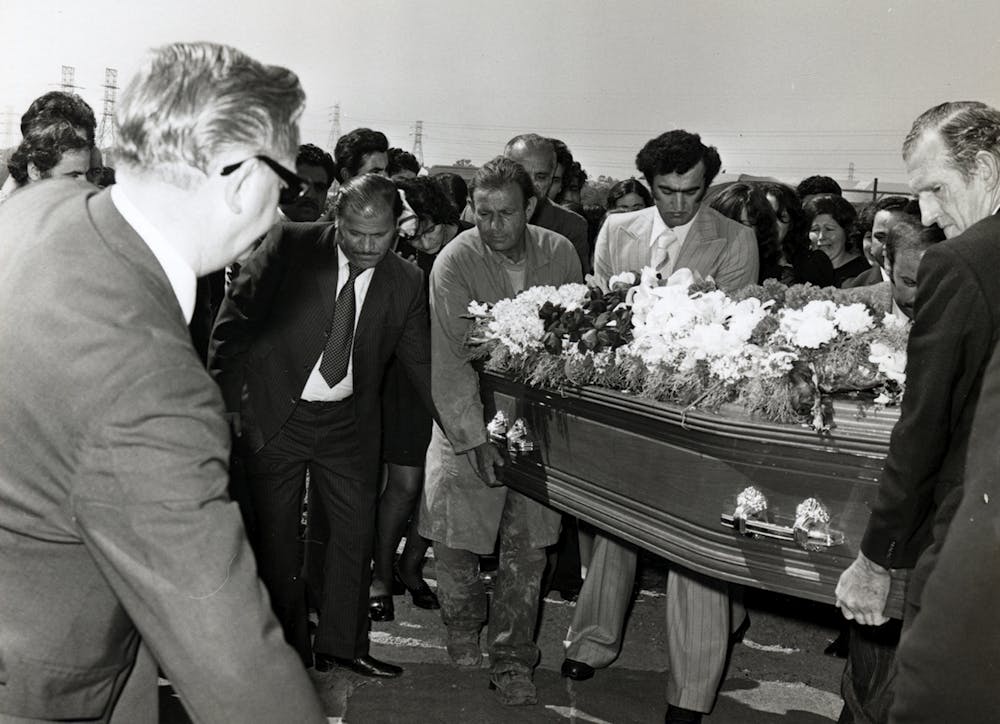
Taken on October 29, 1975, these photographs documented the funeral and burial of my paternal grandfather.

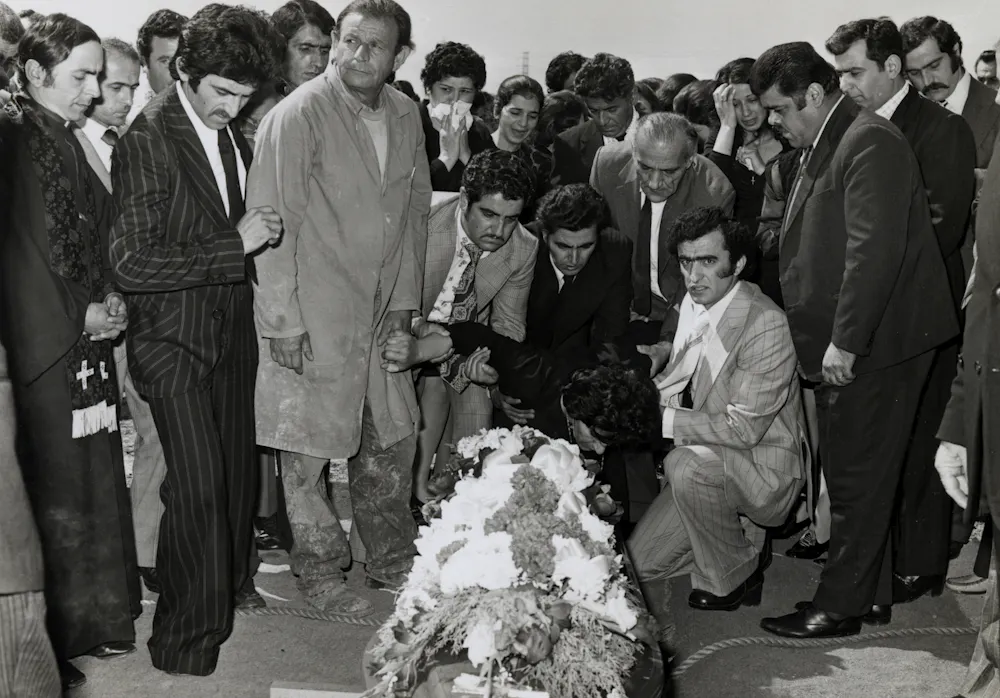
On an ordinary evening of October 26, my grandfather was hit by a car in front of his house. He died the next day in hospital and was buried at Rookwood Cemetery in Lidcombe. Captured in the photographs was my family deep in mourning; expressing their grief physically, in an ever-so public way.

The burial at a Sydney cemetery in 1975. Author provided

The images were hard to look at. Difficult because they revealed my father’s grief, which had remained hidden for over four decades. He was a young man, only 26 at the time. They also showed my mother, a young woman of 24, with weary eyes hidden behind dark, “Jackie O” sunglasses. She was heavily pregnant with my sister who would be born two weeks later.

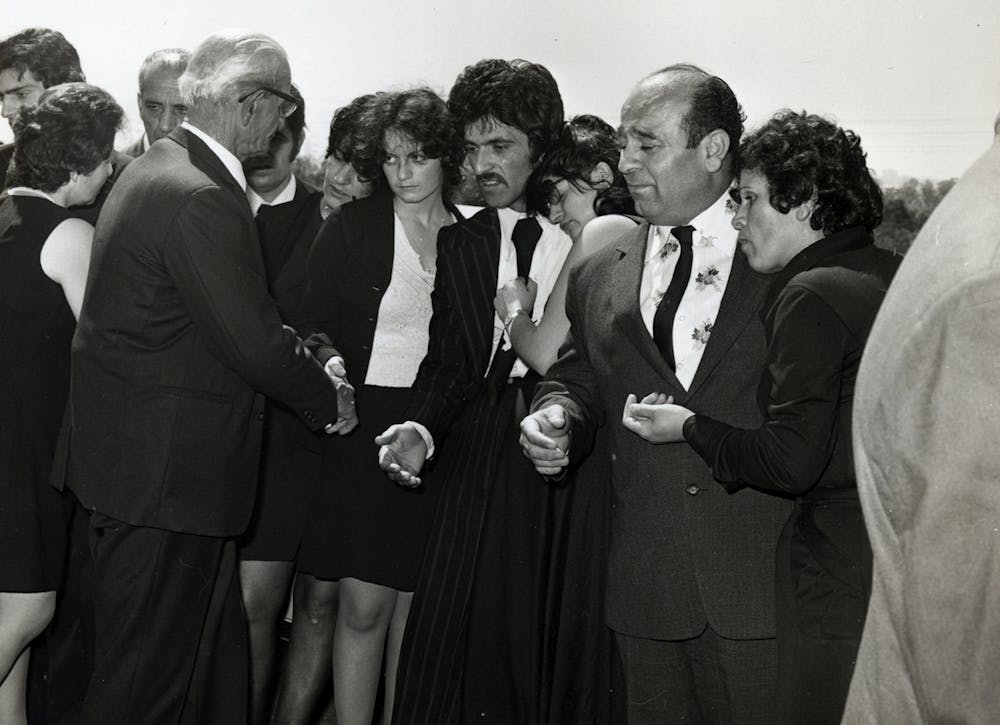
Inescapably, they revealed my grandmother’s trauma. Despite living with my family for 28 years, she had never discussed her loss or this day with us.

The photos reveal the author’s grandmother’s grief at losing her husband. Author provided

The photographs also showed the cultural customs of grief; an entire Lebanese community dressed in mourning clothes, the customary black attire creating a scene that can be likened to a Hollywood Mafia film or a Fellini production.

What I was witnessing in these photographs was an experience I knew had really taken place and yet the precision of these images – their characters, costumes, scenes, plot and the frozen emotions – were perfectly staged, as though a masterful director were pulling the strings, creating the scenes of death’s sorrow.

After carefully studying the photographs in the privacy of my room, I decided to hide them in a drawer under my bed. This is where they remained for the next seven years. I knew that by hiding them I would continue my grandmother’s legacy of keeping them private.

Asking questions, sharing stories

In late 2017, I felt a scholarly urge to study these photographs, and from their hiding place I sought them. I also searched for other funeral photographs, looking in online archives, institutional collections such as Trove, and at sellers flogging vintage images on eBay.

I asked family and friends whether they had seen photographs such as these and whether it was common practice in the 1970s to photograph funerals. My search yielded no results.

I decided to ask my father. He admitted he knew of the photos but had forgotten about them – he was glad I had them. I offered to show them to him but warned they were upsetting.

The images look like something out of a Fellini film. Author provided

In the end, we sat around the kitchen table and looked at them. I asked questions and he shared stories. He did not remember who the photographer was, thinking a friend of the family took them but not recalling much else.

Later, his elderly uncle who also features in the photographs would remember a first name, perhaps Jilal, perhaps a friend of my grandfather’s but not from “our” village.

Despite my desperate need to know who took these images and why, I never spoke to my grandmother about them. After all, she had given them to me and, in a way, covertly indicated that she did not want to talk about them.

Fahd eventually shared the images with her father. Author provided

Around the same time that I shared the photos with my father, I showed them to a friend and curator I had worked with in the past, Daniel Mudie Cunningham. I knew he had a personal and professional interest in grief as well as a fascination with family snapshots. It was through our conversations and the process of writing that I began to consider the possibility of making these images public.

After consulting my father and gaining his consent, I sought to make this very private story and our intimate family photographs into artwork for the exhibition that Daniel would curate at Carriageworks for The National 2019: New Australian Art. I titled the artwork Apókryphos which comes from the Greek to mean “hidden, concealed, obscure”.

The tension of the unseen

Photography and death have long been acquainted. The most influential photographic text ever written, Roland Barthes’ 1980 work Camera Lucida was a nod to this pairing. Written in the wake of Barthes’ mother’s death, the philosopher reflects on a private photograph of his mother as a young child.

This photograph, which he refers to as the “Winter Garden” becomes an object of mourning, from which he may find his mother, reclaim her and assuage his loss. Despite devoting half the book to the Winter Garden photo, he never shows us the image.

I liken the tension of never seeing Barthes’ mother to the tension of never seeing my grandfather. In the photographs he resides in the coffin, which resides in the confines of the image.

Cherine Fahd’s father reaching down to his father’s coffin. Her grandmother is being held up by friends. Author provided

We also never see the photographer. What we do see however, is what we rarely ever see in the West: a person openly and publicly grieving; grief outwardly expressed in the body and face, and all the other emotions that follow it – anger, fear, melancholia, depression.

There is an unwritten contract that grief is private. Even in the family album it is kept hidden. These albums create our ancestral mythology. They are filled with photographs celebrating the happy times and the high points in our lives. My family albums portray and celebrate our moments of togetherness; birthdays, holidays and weddings as well as ordinary moments of domestic life.

But what of death? What of images of grief and loss? Where is their place in the family archive? While many in the 19th century had a fascination with post-mortem photography or “mourning portraits”, these focused on the deceased. Rarely seen in the family album are photographs of funerals, burials and the suffering of those who are left to mourn.

The Western world has an unwritten rule that says grief should be private. Author provided

Showing these photographs and telling their story is a provocation in a culture that is afraid of revealing grief. My project has helped me and my family to reconcile the unhappy moments with the happy ones. I have shared them with my siblings, my uncle and cousins, and with my children, who will one day share them with their children.

Through sharing these photographs, we re-visualise our family album to include more difficult images, and to reflect a life that makes a place for difficult stories and difficult emotions.

I now share them with you. Collectively we can move toward acknowledging the grief that is pictured in these and all the other hidden moments of mourning.


Cherine Fahd’s photo series Apókryphos (2018–19) is on display at Carriageworks in Sydney as part of The National 2019 from March 29-June 23. The book Apókryphos will launch at Carriageworks May 4 and is published by M.33 Melbourne.

ref. Friday essay: images of mourning and the power of acknowledging grief – http://theconversation.com/friday-essay-images-of-mourning-and-the-power-of-acknowledging-grief-112129

Local Māori urge government to address long-running dispute over rare cultural heritage landscape

]]>

Source: The Conversation (Au and NZ) – By Tim McCreanor, Professor Race Relations, Health and Wellbeing, Massey University

An escalating crisis at Ihumaatao, near Auckland’s airport, is challenging the commercial development of Māori land that is part of a rare cultural heritage landscape.

Transnational corporation Fletcher Building Limited has the legal consent to build 480 dwellings on 32 hectares of land confiscated from local iwi (Māori tribe) in 1863. Mana whenua (local Māori) were shut out of the consenting processes for the development and left without any viable legal remedy.

Last week supporters of the mana whenua-led, community-supported campaign Save Our Unique Landscape (SOUL) presented a near 18,000-strong petition to the New Zealand government, urging it to intervene to protect the land for future generations. SOUL wants the government to either buy the land or mandate a process that can produce an outcome all parties can live with.


Read more: Indigenous peoples are crucial for conservation – a quarter of all land is in their hands


Nation’s history at Ihumaatao

The unfolding events are a reminder that, for indigenous peoples, colonisation is unending. Mana whenua were expelled by force at the start of the colonial invasion of the Waikato in 1863, making them landless and impoverished. In the intervening decades, their sacred mountains were quarried for roading, and their food-gathering places and fishing grounds plundered. Now commercial development of their confiscated lands and resources threatens their survival and status.

Ihumaatao is among the oldest continuously occupied areas in Aotearoa New Zealand. Polynesian voyagers arrived on this peninsula in the eastern Manukau Harbour about 800 years ago at the beginning of human settlement of Aotearoa. They cleared land, raised families and prospered. For centuries, Māori lived in this special place; gardening, hunting, gathering seasonal foods from nearby forests and harvesting kaimoana (seafood) from the estuaries.

The oldest investigated middens have been carbon dated to the 12th century. Archaeologist Dave Veart says the currently contested block is an inseparable part of “our Stonehenge”, the adjacent Otuataua Stonefields Historic Reserve. Rich in ancient sites of significance, the reserve already has heritage protection because of its value for the study of the origins of human settlement of Aotearoa.

New Zealand is the last major landmass to be settled, and this area is recognised internationally for its cultural heritage and status as the final step in the global human diaspora.

Confiscation history

When settlers arrived in the fledgling town of Auckland in the 1840s, mana whenua began commercial production of livestock, potatoes, wheat and maize to meet the burgeoning market. But the settler demand for control and ownership of land and resources quickly escalated into tensions and conflict with Māori, as the newcomers sought to impose their vision of what Pākehā (non-Māori) historian James Belich has called a “better Britain” in the south seas.

In 1852, despite the promises of the Treaty of Waitangi, Britain passed the New Zealand Constitution Act, handing “responsible settler government” to the colonial enterprise. Settler control fomented agitation over land, war in Taranaki in 1860, and three years later, the invasion of the Waikato.


Read more: Explainer: the significance of the Treaty of Waitangi


Pākehā historian Vincent O’Malley suggests these wars created a watershed of aggression that radically disrupted the peaceful Māori communities to the south of Auckland. On July 9, 1863, Governor George Grey issued a proclamation requiring Manukau Māori to swear allegiance to the Crown or retire south of the Waikato boundary.

The freshly-minted New Zealand Settlements Act 1863 was used as a colonial mechanism to confiscate their lands and other possessions. Through the so-called “compensation court” provisions of the act, the land was claimed for the Crown and granted to settlers.

At Ihumaatao, where 1100 acres were confiscated, Gavin Struthers Wallace from County Argyle in Scotland, obtained 81 acres of prime Māori horticultural land, complete with a permanent spring and Māori stonewall garden infrastructure in 1867. Knowingly or otherwise he acquired confiscated land without the agreement of mana whenua; they have never received an acknowledgement, an apology or redress.

Colonial settlement and unending injustice

The deposed owners of the now disputed land at Ihumaatao returned from the Waikato from 1864 to eke out a subsistence existence as labourers on their former estates. Meanwhile, settlers and the colonial state prospered. For a time, the sea and home gardens on a tiny reservation provided meagre sustenance, but soon urban sprawl encroached. As Auckland boomed after the second world war, their ancestral cone Maungataketake was levelled to make runways for Auckland’s airport and the city’s sewage treatment plant was established on their territory near Puketutu Island, polluting their fishing grounds and creating other nuisances.

Despite ongoing resistance and inquiries dating from 1865, the Crown has never addressed the injustices endured by mana whenua. Instead, the Crown hides behind a “one-size-fits-all” Treaty of Waitangi policy under which privately owned land will not be considered for settlements.


Read more: Explainer: the significance of the Treaty of Waitangi


This bare sketch cannot convey the anguish, loss and trauma endured over generations. The 1985 Waitangi Tribunal investigation of the Manukau Harbour claim summed up the situation:

At Ihumatao … the inhabitants [were] attacked, their homes and property destroyed and their cattle and horses stolen, but then they were punished by confiscation of their lands, for a rebellion that never took place.

The Fletcher plan – injustice redoubled

In 2014, Wallace’s descendants, the Blackwells, working with Fletcher and Auckland Council, used the fast-tracked, developer friendly Special Housing Areas Act to designate the land as a special housing area. The act bypassed long-established planning protections and consenting processes, curtailing requirements for consultation with Māori.

In the face of Auckland’s housing crisis, 10,000 affordable new dwellings are planned for nearby Mangere. This makes Fletcher’s low-density, high-cost proposal seem even more of an anachronistic injustice than it was when first mooted.

As pre-development work on the land is due to begin, mana whenua and the broader community are mobilising to face down the bulldozers.

ref. Local Māori urge government to address long-running dispute over rare cultural heritage landscape – http://theconversation.com/local-maori-urge-government-to-address-long-running-dispute-over-rare-cultural-heritage-landscape-113122

Grattan on Friday: Shorten’s not getting ahead of himself, but the tape measure is out

]]>

Source: The Conversation (Au and NZ) – By Michelle Grattan, Professorial Fellow, University of Canberra

With the election likely to be called in about a fortnight – the weekend after the April 2 budget – behind the scenes Labor is “measuring the curtains” of government.

Any sign of hubris must be avoided, but a prudent opposition – especially with polls suggesting it’s soon likely to be the executive – needs to be well prepared for the first days of office.

One advantage Labor has is that its leader and many senior figures have been in power before. They have experience in setting up offices, establishing relations with the bureaucracy, working out early priorities.

Labor’s main frontbenchers would move into the ministries they’ve been “shadowing”. But there will inevitably be some shuffling.

One question the government keeps asking (not unreasonably) is who would hold the key Home Affairs post.

There is no current “shadow” for Home Affairs. Shadow attorney-general Mark Dreyfus has the national security area – Dreyfus is expected in government to be attorney-general but not home affairs minister.

The Home Affairs department, controversial since its inception, is itself in the frame.

Labor’s platform commits it to review the Home Affairs portfolio arrangements “to ensure they are fit for purpose”. Assuming the department survived, a major issue would be whether it lost oversight of two key agencies, the Australian Federal Police and ASIO.

The Australian Federal Police Association recently called for the AFP to be shifted back as a stand-alone agency under the attorney-general’s umbrella, saying this should be done “to protect its organisational independence”.

ASIO – like the AFP, formerly under the attorney-general – also does not look comfortable under Home Affairs.

In the security community the future of the department’s secretary Mike Pezzullo under a Shorten government is a matter of intense interest.

Pezzullo has a past with Labor (in the office of opposition leader Kim Beazley); now he’s strongly identified with the Coalition’s harsh asylum seeker policy, as well as being seen as one of the toughest operators in the bureaucracy.

Labor sources say “there is a debate” about what should be done with Pezzullo. Retaining him would have the advantage of sending a signal to the people smugglers about no weakening in border policy, something Labor would want to do from the start.

One senior public servant certainly for the chop (if he doesn’t quit first) under Labor is Treasury secretary Phil Gaetjens. He was chief of staff to Scott Morrison when Morrison was treasurer, and the opposition regarded his appointment as highly partisan.


Read more: Changing of the guard at the Treasury department


Among the names being canvassed to replace him are Jenny Wilkinson, head of the Parliamentary Budget Office (which is doing the opposition’s policy costings); Steven Kennedy, secretary of the Infrastructure department, and Blair Comley, a former departmental head sacked by Tony Abbott who became secretary of the NSW Premier’s department and is now in the private sector.

If Wilkinson got the job, she’d be the first female head of Treasury. If she didn’t, she’d be presiding over a PBO with an expanded role. Labor has said it would transfer the budget’s macro-economic forecasting to the PBO to remove the number-crunching from political influence.

Of course all this is running in front of the story. As the election contest turns into the home straight, Shorten is several lengths ahead in the polls. But he still has to win the race.


Read more: Poll wrap: Labor gains in Newspoll after weak economic report; Labor barely ahead in NSW


Labor will have to navigate some difficult policy announcements in coming weeks.

On climate change, it must outline final details of what it would do – in particular, the measures it would take in the non-electricity sectors (transport, large industry, land) as part of reaching its ambitious target of reducing economy-wide emissions by 45% by 2030. It is also to reveal whether it would use Australia’s Kyoto credits to help meet the target.

On industrial relations, Labor has flagged it would change the legislation governing the Fair Work Commission’s setting of the minimum wage, to achieve a more generous deal for the low paid. But it has yet to say precisely what new principles it would insert. And it will have to be more specific about the extent of its support for the return of what it calls “multi-employer” bargaining.

An especially sensitive announcement will be the date for the commencement of the crackdown on negative gearing and the capital gains tax discount. When the policy was unveiled in the last term, the housing market was over-heated. The situation has transformed, with downturns led by Sydney and Melbourne.

Setting an appropriate implementation date will require careful judgement about likely future trends in the market and the policy’s impact on them.

Arguably, it would be politically savvy for Labor to make one or more of these announcements quickly, before the campaign proper.

The government will try to use the budget to change the game as much as it can, and Labor can’t anticipate how far that will happen.

The budget is expected to contain big tax cuts. Shorten will possess the fiscal capacity to match these, but Labor will have to decide whether and how it would distribute them differently.

An ardent practitioner of continuous electioneering, one would expect Shorten to put in a disciplined performance during the actual campaign.

Labor can be confident he’d never have anything as excruciating as NSW opposition leader Michael Daley’s experience this week during a people’s forum with Gladys Berejiklian, when he couldn’t recall key details from his education promises.

Confronted over one number, Daley said “I’ll just check that figure and get back to you”; he didn’t remember another “off the top of my head”.

Still, campaigners are obstacle courses even for the most seasoned players.

The election result will show whether the voters are willing to go along with Labor’s bold policies. We do know these have been carefully thought out, not made up on the run. We can expect Labor’s transition-to-government plans to be given similar attention.

But there is another challenge a prospective prime minister needs to think about.

With a fickle electorate, an often feral media, and the torment of regular opinion polls, how does a government handle the public impatience that can make the business of governing for the long term so difficult, sometimes nearly impossible, these days?

This feature of modern politics can be as testing as winning an election.

ref. Grattan on Friday: Shorten’s not getting ahead of himself, but the tape measure is out – http://theconversation.com/grattan-on-friday-shortens-not-getting-ahead-of-himself-but-the-tape-measure-is-out-114030

Will the New Zealand gun law changes prevent future mass shootings?

]]>

Source: The Conversation (Au and NZ) – By Rick Sarre, Professor of Law and Criminal Justice, University of South Australia

As she foreshadowed in the aftermath of the Christchurch massacre last Friday, New Zealand Prime Minister Jacinda Ardern has just announced a ban in that country on specific military-style firearms. It will soon become an offence to own or possess semi-automatic firearms and shotguns with detachable magazines capable of firing more than five cartridges.

Later this month, the government will consider further changes to the law that will tighten licensing requirements and impose limits on certain types of ammunition. There will be a gun buy-back scheme in place in due course that will provide compensation to those who possess soon-to-be-illegal guns. Preliminary advice suggests that might cost the country between NZ$100 million and NZ$200 million.


Read more: Why overhauling NZ’s gun and terrorism laws alone can’t stop terrorist attacks


Thoughts immediately go to the aftermath of the 1996 Port Arthur tragedy in Australia. Then-Prime Minister John Howard had been elected only six weeks before the Tasmanian horror unfolded. He immediately set in train the gun control measures that no previous government, conservative or progressive, would ever have thought possible.

The government placed a ban on the sale, transfer, possession, manufacture, and importation of all automatic and most semi-automatic rifles and shotguns (and their parts, including magazines). More than 640,000 such weapons were thereupon surrendered and later destroyed at a cost to the taxpayer of around A$250 million.

In Australia today, there continues to be bipartisan political consensus and broad community support for what was titled the National Firearms Agreement (NFA). In 2017, it was reaffirmed by the Council of Australian Governments (COAG).

There has been some criticism that certain aspects of the original agreement have been watered down in some jurisdictions in recent years, but the requirements outlined by the agreement generally remain intact.

Did the Australian gun ban and buy-back scheme make inroads into the rate of firearm-related deaths? Did it prevent mass shootings? Jacinda Ardern appears to be convinced that answers to both questions are in the affirmative. Let’s look at the evidence from the past 23 years in this country to test her assumptions.


Read more: No massacres and an accelerating decline in overall gun deaths: the impact of Australia’s major 1996 gun law reforms


Gun violence in Australia since the buy-back

It is unequivocal that gun death rates in Australia have been falling consistently since 1996. Some commentators object to the connection between this trend and the NFA, saying the downturn was simply a continuation of a long-term decline in gun violence generally.

But recent research found that, compared with the trend before 1997, there was a more rapid decline in firearm deaths after the implementation of the NFA.

However, this conclusion was quickly challenged by another researcher, who argued these findings were simply a consequence of the rarity of these events, and that the data were thus skewed.

The researchers on the first paper then set out to test the null hypothesis: that is, that the rate of mass shootings would remain unchanged after the introduction of the NFA. They concluded that while a definitive causal connection between this legislation and the 22-year absence of mass firearm homicides was not possible, there was nevertheless evidence that before 1996, approximately three mass shootings took place every four years. Had they continued at that rate, 16 incidents would have been expected by February 2018, but that pattern did not play out.

The evidence from the National Homicide Monitoring Program, collated by the Australian Institute of Criminology, concurs with the evidence provided by these authors. Its data indicate that the share of murders committed with firearms dropped significantly around the time of the buyback scheme. Indeed, the number of homicide incidents involving a firearm decreased by 57% between 1989-90 and 2013-14.

In 1989-90, firearms were used in 24% of homicides. In 2013-14, the figure was 13%.

Incidentally, in the United States, 60% of homicides are committed by firearms. To the extent that correlations are useful, there should be no surprises here. The US gun ownership rate (guns per 100 people) is more than five times the Australian rate.

Reducing access to firearms lowers the risk of gun deaths

The evidence that countries with higher levels of gun ownership have higher gun homicide, gun suicide, and gun injury rates is convincing. Anyone advocating gun ownership as a means of lowering levels of violence and crime is arguing against the weight of research.


Read more: Christchurch attacks are a stark warning of toxic political environment that allows hate to flourish


Jacinda Ardern’s initiative cannot do her country any harm. Twenty-three years after Port Arthur and the NFA, firearm involvement in homicide incidents in Australia, including the involvement of handguns, remains at an historic low.

While it would draw too long a bow to assert conclusively that the downturn in firearm deaths in Australia can be attributed to the gun law reforms alone, the implementation of the NFA can be closely associated with the reductions in mass shootings and firearm deaths.

The choices made by the Ardern government to eliminate certain firearms from New Zealand to improve community safety are consistent with the long-term evidence from Australia.

ref. Will the New Zealand gun law changes prevent future mass shootings? – http://theconversation.com/will-the-new-zealand-gun-law-changes-prevent-future-mass-shootings-113838

NSW election: where do the parties stand on brumby culling?

]]>

Source: The Conversation (Au and NZ) – By Don Driscoll, Professor in Terrestrial Ecology, Deakin University

The future management of New South Wales’s national parks is one of the issues on the line in Saturday’s state election. Other states will be watching the outcome closely.

Depending on who wins, the outcome for Kosciuszko National Park spans from restoration and recovery to ongoing environmental decay, with feral horses given priority over native species.


Read more: Low-key NSW election likely to reveal a city-country divide


All political parties have been well informed about the science behind feral horses in the Australian Alps. The peer-reviewed literature shows that:

  • feral horse impacts put multiple species at greater risk of extinction

  • streams and bogs are degraded, threatening water quality, and will require restoration

  • even small numbers of horses lead to cumulative environmental degradation

  • a range of high and low elevation areas are severely degraded by feral horses; it is not clear whether any areas can withstand horse impacts

  • rehoming and fertility control are not effective control methods when horses number in the thousands and are hard to reach

  • aerial culling is humane, effective, and cheaper than other methods.

But despite the clarity of recommendations emerging from research, political parties have taken a broad range of approaches.

A feral horse exclusion fence. But which side of the fence are the major parties on? Author provided

Liberal/National Coalition

The Liberal/National coalition has pledged to enact its Kosciuszko Wild Horse Heritage Bill, which was passed by the state parliament last year and aims to “recognise the heritage value of sustainable wild horse populations within parts of Kosciuszko National Park”.

This legislation would ensure several thousand feral horses remain in the park, potentially compromising the conservation goals of the park’s management plan.


Read more: Passing the brumby bill is a backward step for environmental protection in Australia


This month, Deputy Premier John Barilaro said the government would “immediately” reduce horse numbers by 50%, through trapping, rehoming, fertility control, and relocating horses to “less sensitive” areas. Although he appeared to endorse an ultimate population target of 600 feral horses in front of an audience that was receptive to that idea, under pressure from the pro-brumby lobby, he later clarified that the coalition would aim to keep 3,000-4,000 feral horses in Kosciuszko.

Labor

Labor, along with the Greens and the Shooters, Fishers and Farmers party, has pledged to repeal the Kosciuszko Wild Horse Heritage Bill if it wins the election, and has committed A$24 million to restore the national park.

Its six-point national parks restoration plan bans aerial culling, instead proposing to control horses using rehoming, while expanding research on fertility control.

Labor’s plan also mentions active management of feral horses in sensitive ecosystems, and ensuring large horse populations do not starve to death. It plans to achieve these two goals by trapping and rehoming brumbies. Labor also plans to keep a “smaller population” of feral horses in areas within the national park “where degradation is less critical”.

Greens

The NSW Greens has arguably the most evidence-based policy, aiming to reduce horse numbers by 90% in three years, with a longer-term goal of full eradication.

This means national parks would be managed for native Australian species. That is important in NSW, where only 10% of the state has been allocated to protected areas, well below international standards of 17%. They would achieve this reduction using all humane methods currently available, including trapping, rehoming, mustering, and ground-based and aerial shooting.

The Greens would also fund rehabilitation of damaged habitat, and has flagged substantial funding for conservation initiatives.

The Greens aim to put native species, such as the broad-toothed rat, back at the centre of national parks policy. Ken Green

Shooters, Fishers and Farmers

The Shooters, Fishers and Farmers party supports immediate action to reduce feral horse numbers using humane methods, including ground shooting, but not aerial culling.

The party, which holds one lower house seat and has two upper house members, has announced no plans for restoration of the national park.

Animal Justice Party

The Animal Justice Party, which has just one upper house member in the parliament, has endorsed “non-lethal control measures” in areas that are clearly being degraded by feral horses. It says this should be achieved entirely using fertility control and relocation. The party has also described brumby culling proposals as “horrific” and called for urgent national legislation to protect them.


Read more: Why do brumbies evoke such passion? It’s all down to the high country’s cultural myth-makers


There is pressure from pro-brumby lobbyists to keep feral horse populations in Guy Fawkes, Barrington Tops, Oxley Wild Rivers, the Blue Mountains, and other NSW national parks. In Victoria, a pro-brumby pressure group will take Parks Victoria to the Federal court later this year to prevent removal of a small but damaging horse population on the Bogong High Plains in the Alpine National Park.

When NSW voters decide the fate of Kosciuszko National Park on Saturday, their verdict could have broader ramifications for protected areas throughout Australia.

ref. NSW election: where do the parties stand on brumby culling? – http://theconversation.com/nsw-election-where-do-the-parties-stand-on-brumby-culling-114008

NZ bans military-style semi-automatic weapons and all assault rifles

]]>
Armed police bedecked with flowers amid heightened national security following the Christchurch mosque attacks last Friday. Traditionazlly, New Zealand police are unarmed. Image: Sulzy/Twitter

By RNZ News

Prime Minister Jacinda Ardern today announced a New Zealand ban on all military-style semi-automatic weapons and all assault rifles

She pledged the day after the terrorist massacre in Christchurch last Friday that “gun laws will change” and would be announced within 10 days of the attack.

Fifty people were killed in the bloody shooting.

READ MORE: RNZ’s tribute to the lost – ‘They are us’

#TheyAreUs

This afternoon, Ardern said every semi-automatic weapon used in the terrorist attack on two mosques would be banned under more stringent gun laws.

As of 3pm today an order in council took effect. The changes to the regulations would mean the firearms were now catergorised as needing an E-class licence endorsement.

-Partners-

This means no one will be able to buy the weapons without police approval. Ardern said there was no point in applying for one.

For those who are already in possession of these weapons, Ardern said the firearms would be tightly regulated, while for everyone else, the weapons would now be effectively out of reach.

Buyback scheme
She also said the government would establish a buyback scheme to take the firearms out of circulation.

After a reasonable period for returns, those who continue to possess these firearms will be in contravention of the law.

Anyone in breach of the law would be liable to a $4000 fine or up to three years imprisonment.

“We’re looking to increase the penalty when the ban is in full force and the opportunities of buyback are over,” Ardern said.

Ardern said the buyback scheme was designed to prevent the creation of a black market for banned weapons.

She said people who held weapons illegally would be protected by a police amnesty.

“We’re in the dark as to how many of these are in circulation,” Ardern said, referring to the number of weapons the government might have to buy back.

No funding conversations
“We haven’t had specific conversations about where the funding for the buyback will come from.”

She said she was confident that the majority of New Zealanders would support the gun law changes.

Police Minister Stuart Nash said the decisive move was an interim step until legislation could be passed. That legislation is likely to be in place by April 11.

He said this measure would enable New Zealand to become a safer place.

He said police were currently preparing to take these weapons out of circulation.

Watch PM Jacinda Ardern announcing the semi-automatics ban – RNZ

Cabinet – including the Green Party – decided in principle on reforms on Monday, with the National Party said it supported change.

Legal ‘loopholes’
Ardern said on Wednesday that gun laws in New Zealand were “a blueprint of what not to do” and there was a “large number of loopholes” in the law.

The Police Association has called for semi-automatic weapons to be banned, while Fish and Game said it supported a ban on military-style semi-automatic weapons.

Retailer Hunting & Fishing New Zealand has pulled all “military-style” semi-automatic firearms from sale nationwide.

The Council of Licensed Firearms Owners said there was already a stringent vetting process for firearm licences in this country and military-style semi-automatic weapons should not be banned.

The alleged shooter in the terrorist attacks held a standard firearms licence that allowed him to own limited power semi-automatic weapons. Police said it was possible firearms had been modified to be more like a military-style automatic weapon.

Read a short history of New Zealand’s gun laws.

  • Key points:
    Currently, standard Category A firearms licence holders are allowed to own AR-15 semi-automatic weapons, the gun of choice for the world’s mass killers.
  • These semi-automatic weapons can be modified, such as using magazines that carry more bullets, effectively turning them into military-style semi-automatic weapons (MSSAs).
  • A semi-automatic weapon is one where the trigger must be pulled for each shot, whereas automatic weapon can fire continuously until it runs out of ammunition.
  • Currently, to secure a basic Category A licence two referees must be provided by the applicant. They are also interviewed and their gun storage checked.
  • The rules around owning MSSAs are more stringent, requiring more secure storage, a valid reason for owning one, permission from the police, and for the weapon to be registered.
  • There is currently no register of all guns and who owns them, making it impossible to see if someone is building up a cache of arms, police say.
  • There are an estimated 1,5 million guns in New Zealand and about 250,000 people hold firearms licences.
  • More than 99 percent of people who apply for a firearms licence in New Zealand are successful, according to police data.

This article is republished under the Pacific Media Centre’s content partnership with Radio New Zealand.

Print Friendly, PDF & Email

Article by AsiaPacificReport.nz

Confused about aged care in the home? These 10 charts explain how it works

]]>

Source: The Conversation (Au and NZ) – By Fron Jackson-Webb, Deputy Editor/Senior Health + Medicine Editor

This week, the Royal Commission into Aged Care Quality and Safety hearings focused on aged care in the home.

Most Australians want to stay in their homes for as long as possible as they advance in age. And the nation’s aged care system provides subsidies to support this choice. But the commission heard evidence that ageing Australians face an average wait of 18-24 months for a home care package.

Those who have secured a package report problems with poorly trained staff, high management fees and unnecessary bureaucracy, such as having to call a 1800 number to change the time someone comes to help them shower.

So how does Australia’s aged care system provide services in the home and why is it under so much pressure?


Read more: As home care packages become big business, older people are not getting the personalised support they need


An alternative to residential care

Australia’s aged care services are delivered through a mix of community and residential services. The three main types of care are:

  • home support: provides basic support, such as help with food preparation and transport, for older Australians in their own homes
  • home care: provides older people with more complex needs with four levels of care options, from basic care (level 1) which is assistance with tasks such as bathing and transport, to more complex needs (up to level 4) such as nursing care
  • residential care: provides care and accommodation for people who can no longer live independently in their own homes.

Read more: Explainer: what is a home care package and who is eligible?


In the 2017-18 financial year, more than 1.2 million Australians used some form of aged care service – with the majority receiving home-based support or care.

As at September 2018, there were 90,646 people receiving one of the government’s subsidised home care packages.


Most people who receive home care packages (about 63%) are aged 80 years or over. The number of women receiving home care packages is almost double the number of men.


In 2016-17, the average length of time a person received home care was just under 19 months, compared to about 30 months for someone in residential care.


The number of older Australians accessing home care packages is rising. During the 2017-18 financial year, 116,843 people accessed home care packages.


Due to the increasing demand, the government funded an extra 14,000 home care places over four years in the 2017-18 budget.


But more than 127,000 people were on the waiting list to access their preferred level of care in December 2018. Of those, about 29,000 have been placed in interim care. This means they’re receiving a home care package below the level they’ve been approved for.

People who apply for home care packages above level 2 usually wait more than 12 months to receive a package at their approved care level.


The number of home care service providers has increased significantly in recent years. More than 900 approved providers now offer home care packages, up from around 690 in March 2017.


Home care providers made an average net profit (before tax) of A$2,832 per consumer in 2016-17. This was a slight decrease of 0.8% from the previous financial year, mainly due to the large increase in the number of home care consumers in 2016-17.

But if we look at the financial performance of home care providers by ownership type, we see there is a significant difference in the margins between the for-profit providers and the not-for-profit and government providers.


Home care providers can charge consumers with three types of fees:

  • a basic daily fee of A$10.54 per day
  • an income-tested care fee
  • additional fees for care or services not covered by the home care package.

The basic daily fee for a home care package is 17.5% of the single person rate of the basic age pension. From 20 March 2019, the fee is A$10.54 per day (A$147.56 per fortnight).

The income-tested care fee is dependent on the income of the recipient, and is in addition to the basic daily fee.


The Australian government subsidises the costs of home care packages. The amount of the subsidy depends on the level of care received.


In the 2016-17 financial year, the Australian government provided A$1.6 billion in funding towards home care packages.


Read more: Would you like to grow old at home? Why we’re struggling to meet demand for subsidised home care

Read more: Don’t wait for a crisis – start planning your aged care now

ref. Confused about aged care in the home? These 10 charts explain how it works – http://theconversation.com/confused-about-aged-care-in-the-home-these-10-charts-explain-how-it-works-113923

PODCAST: Pell trial reporters, a judge and a media lawyer on why the suppression order debate is far from over

]]>

Source: The Conversation (Au and NZ) – By Andrew Dodd, Director of the Centre for Advancing Journalism, University of Melbourne

When Judge Peter Kidd sentenced Cardinal George Pell last week, it was broadcast live on radio and television. It was a stark contrast to the preceding trial, which was subject to a suppression order that prevented any coverage of the proceedings.

Today on Media Files we look at the suppression order that prevented the Australian media reporting the case, even when the verdict was widely known and was being circulated on social media and on the front pages of newspapers around the world.

On the day of the Pell sentence the University of Melbourne’s Centre for Advancing Journalism brought together several experts with wide-ranging experiences of suppression orders to discuss how they affect the public’s right to know and whether the laws should be reformed.

The panellists are:

  • Associate Professor Jason Bosland, Co-Director of the Centre for Media and Communications Law at Melbourne Law School, where he teaches media and communications law. His primary research interests lie in media law, including defamation and privacy, open justice and the media, contempt of court and freedom of speech

  • Melissa Davey, Melbourne bureau chief for The Guardian. She is an experienced news journalist who previously worked as a reporter for Fairfax newspapers, including The Sydney Morning Herald and the Sun Herald. She sat through every day of the George Pell trial

  • Lucie Morris-Marr, a reporter who, like Melissa, sat through the entire Pell proceedings. She worked at the Daily Mail, London, Marie Claire Australia and the Herald Sun in Melbourne before covering the Pell trial for the New Daily. She is the author of a book on Pell entitled Fallen: The inside story of the secret trial and conviction of Cardinal George Pell

  • Frank Vincent AO QC, who served 16 years as a judge of the Supreme Court of Victoria followed by a further eight years as a judge of the Court of Appeal. He was Deputy Chair and then Chair of the Victorian Adult Parole Board, a position he occupied for 17 years. In 2017 he conducted a review of court suppression orders and the Open Courts Act 2013.

The forum was chaired by Dr Denis Muller of the Centre for Advancing Journalism at the University of Melbourne.

New to podcasts?

Podcasts are often best enjoyed using a podcast app. All iPhones come with the Apple Podcasts app already installed, or you may want to listen and subscribe on another app such as Pocket Casts (click here to listen to Media Files on Pocket Casts).

You can also hear us on any of the apps below. Just pick a service from one of those listed below and click on the icon to find Media Files.


Recorded at the University of Melbourne’s Centre for Advancing Journalism. Producer: Andy Hazel.

Theme music by Susie Wilkins.

Image:

PAUL TYQUIN/AAP

ref. PODCAST: Pell trial reporters, a judge and a media lawyer on why the suppression order debate is far from over – http://theconversation.com/podcast-pell-trial-reporters-a-judge-and-a-media-lawyer-on-why-the-suppression-order-debate-is-far-from-over-111634

What Australia can learn from Victoria’s shocking biodiversity record

]]>

Source: The Conversation (Au and NZ) – By Geoffrey Wescott, Honorary Research Fellow, School of Life and Environmental Sciences, Deakin University

Victoria is struggling with biodiversity conservation, according to a State of the Environment report tabled in parliament this week. While the scorecard is bleak – not one of the state’s key biodiversity indicators ranks as “good” – the report itself gives some hope.

For the first time the Commissioner for Environmental Sustainability, who prepared the report, offers proactive recommendations to the Victorian government for improving its performance, and has linked these goals to international sustainability targets. It’s an comprehensive and ambitious effort, and offers some good lessons to the rest of Australia.


Read more: Australia among the world’s worst on biodiversity conservation


Alarming results

Victoria is the most densely populated state in Australia, the most cleared of native vegetation, and has the smallest percentage of public land.

The State of the Environment report uses a traffic light method to summarise the status, trend and data quality of 170 indicators spread over 12 scientific assessment areas (everything from general air and water quality to specific environments such as marine and coasts, plus issues such as waste and energy).

The indicators paint a picture that does not look good for biodiversity. None of these indicators are rated “good”; seven are “fair”, 21 “poor”, and seven “unknown”. In terms of trends, just one is improving, seven are stable, and 18 are deteriorating (nine are unclear).

National park declarations have slowed substantially on land in recent years – the first Andrews government (2014-18) was the first Victorian government in a quarter of a century not to increase national parks. Not a single additional marine area has been protected since 2002.

In contrast, conservation on private land is fair and trending upward according to the report card (probably largely due to the efforts of Trust for Nature). A substantial cash injection for the trust from Victoria’s rolling fund would likely see outsized results, although this is not a specific recommendation in the report.

The reports offers two critical recommendations for improving biodiversity:

  • increase private land conservation and invest in local government capability to enforce existing protective guidelines, and

  • appoint a Chief Biodiversity Scientist to counsel the Secretary and Environment Minister to improve the impact of biodiversity research.

Creating a Chief Biodiversity Scientist is a good starting point for an area that has received decreasing effort, over the past decade in particular. However, it must be only the first step in raising the lowly position of biodiversity conservation, not only in the environment department but across the entire government.

Beyond passive reporting

This years report moves beyond simply relaying data in two ways: first, with 20 specific recommendations to the government, and secondly by using the United Nation’s framework of environmental accounting to tie the report to the global Sustainable Development Goals.

The report claims this is the first attempt to apply the UN’s Sustainable Development Goals to a sub-national environmental report. Given the number of federated nations around the world (the United States, Brazil and Canada, for a start), putting the spotlight on state or provincial environmental responsibilities is a significant and laudable step.

In the more immediate future, the report gives the Victorian government 20 recommendations linked to the Sustainable Development Goals, across a range of categories: Traditional Owner leadership, climate change, air and water quality, land, forests, fire, marine and coastal environments, water resources, waste and resource recovery, energy, transport, and “megatrends”.

The 20 recommendations are solidly based on the findings across the 12 assessment areas. These show that only 11% of status indicators are “good”, whereas 32% are “poor”, with the trend demonstrating only 10% are improving, 30% stable and 30% deteriorating.


Read more: Why biodiversity is key to our survival


While the State of the Environment report naturally focuses on Victoria, there are plenty of lessons and ideas here for the rest of the country.

Now the onus is firmly on the self-proclaimed “most progressive government in Australia” to act.

ref. What Australia can learn from Victoria’s shocking biodiversity record – http://theconversation.com/what-australia-can-learn-from-victorias-shocking-biodiversity-record-113757

No better than roulette. How foreign exchange trading rips off mum and dad investors

]]>

Source: The Conversation (Au and NZ) – By Mark Crosby, Professor, Monash University

In 2013 I wrote a piece on The Conversation arguing that foreign exchange trading should be much more tightly regulated.

In particular, I said that retail (mum and dad) investors should only be allowed to trade foreign currencies in limited circumstances. Since then there has been little change. It is still shockingly easy for a retail investor with a very limited understanding of foreign currency to trade foreign exchange, as was demonstrated on ABC 7.30 on Wednesday night.

There is a basic difference between foreign exchange trading and other forms of investment such as share trading. Over time, share markets tend to rise, so that if an investor buys a diversified basket of shares, or even an individual share, they should expect a positive return over time. Of course markets go up and down, and individual share trades can go wrong, but in the long run the market tends to rise.

Share trading it isn’t

Foreign currency markets are fundamentally different, in that there is no reason to expect exchange rates such as the Australian-US dollar rate to rise or fall over any short- or medium-term trading horizon.

For 30 or more years, academics have tried to build models to predict exchange rates. None of them work. If even the most sophisticated academic or trader built a model to predict whether the AUD/USD would go up or down tomorrow, they would get it wrong 50% of the time – exactly the same as a coin toss. This means trading foreign exchange on the basis of whether major currencies will go up or down is exactly the same as playing two-up!

Losses can exceed what you put in

The second reason that retail investors should be wary of foreign exchange trading is that many promoted products are highly leveraged – funded by borrowing. The Australian Securities and Investments Commission has clear warnings about foreign exchange trading on its Moneysmart webpage, including a case study of a typical trader who invests A$500 to borrow to buy A$100,000 at an exchange rate of 91 US cents.

With this contract, a fall in the USD/AUD exchange rate to 88.5 US cents sees this trader lose A$2,825, meaning they have to pay another A$2,325 in addition to the original A$500 to close out the contract.


How to lose a lot from a little. ASIC MoneySmart


If foreign exchange trading is so risky, and in my view no different to playing two-up or roulette, why do we allow retail investors to leverage into these products?

The problem, as I see it, is that regulators can take one of two approaches to investors. The traditional view is that if investors have enough information they will make informed choices in their own best interests. Economists describe this as behaving rationally. The ASIC approach is very much based on this view: provide good information and let investors make informed choices.

Information isn’t enough

There is a second view that is gradually replacing this view of individuals as rational. The “behavioural economics” approach examines the psychology and actual approaches of individuals in different circumstances, to explore departures from rationality. Unsurprisingly, in many arenas people are irrational, creatures of habit, ill-informed, and so on.

An implication is that sometimes people ought to be protected from their own poor decisions, even though that might limit choice. I would argue strongly that there is no reason for retail investors to trade foreign exchange, and certainly no reason to borrow to do it. Measures to limit such trading, except in circumstances where an investor can demonstrate their expertise, ought to be encouraged.

We’re a magnet for promoters

This is very far from the case in Australia currently. In fact Australia is seen as an attractive location for firms offering retail foreign exchange trading. Websites offer “training and tips” and then allow trading inside 24 hours.

I have spent 30 years studying foreign exchange markets and would still say that I’m not sophisticated enough to trade them. Maybe I’m dumb, but I’m not crazy enough to trade foreign exchange.


Read more: Gambling on the dollar: time to reign in forex trading


ref. No better than roulette. How foreign exchange trading rips off mum and dad investors – http://theconversation.com/no-better-than-roulette-how-foreign-exchange-trading-rips-off-mum-and-dad-investors-113743

Australia’s animal testing laws are a good start, but don’t go far enough

]]>

Source: The Conversation (Au and NZ) – By Jane Kotzmann, Lecturer in Law, Deakin University

Your lipstick and foundation will be less likely to come at the expense of animal welfare, thanks to Commonwealth legislation that passed in recent weeks.

The legislation, which will come into play on July 1, 2020, follows a commitment the Coalition government made during the 2016 election campaign to introduce a ban on cosmetic testing on animals, backed by strong public support. The RSPCA asserts 85% of Australians oppose testing cosmetics on animals.

The legislation was a long time coming – it was first introduced in June 2017 – and is a step in the right direction, but it doesn’t go far enough.


Read more: Australia will finally ban cosmetic testing on animals


Animals are sentient creatures – they feel pain and distress just as humans do. Given the increasing recognition of the extent of animal sentience, reflected by various international laws, it is well and truly time to rethink our approach to testing on animals for any reason.

Cosmetics are often tested on rabbits, guinea pigs, hamsters, rats and mice. It commonly involves applying chemicals to the shaved skin or eyes of rabbits, force feeding, and testing to determine what dose of chemical will cause death.

Such testing causes significant pain and distress for the animals involved and most animals are killed following an experiment. According to Humane Society International, around 100,000 to 200,000 animals suffer and die for cosmetics around the world each year.

A protest of animal testing in cosmetics in Melbourne, 2018. Penny Stephens/AAP Image

The federal ban will impact a wide range of products.

The legislation defines “cosmetic” as “a substance or preparation intended for placement in contact with any external part of the human body” with the aim of altering odour, changing appearance, cleansing, maintaining, perfuming or protecting it. Make-up, facial cleansers, soap, deodorant, perfume and moisturisers are all included under this definition.

But only chemicals intended for use in cosmetics will be affected. Chemicals in household cleaning products, for instance, are found in many cosmetics, and will not be impacted by the new legislation.

This is a significant loophole, as most chemicals using animal test data are used for a variety of purposes.


Read more: Of mice and men: why animal trial results don’t always translate to humans


The international trend

Australia is not alone in banning the testing of cosmetics on animals, and the recent legislation shows our effort to join the international trend.

The European Union banned cosmetics testing on animals in 2009 and extended the ban to imports in 2013. The European Union also called for a global ban on animal testing for cosmetics and proposed drafting an international convention.

Bans have been introduced in Israel, India, New Zealand, Norway, South Korea, Turkey, Taiwan, parts of Brazil, Switzerland and Guatemala. Last year, California became the first state in America to ban the sale of animal tested cosmetics.

Non-cosmetic animal testing

When discussing the new legislation in parliament, then Assistant Minister for Health, David Gillespie, said:

Australia is moving away from the use of animal test data for other purposes, so that animal test data, like in the EU, would be used as a last resort where science has not yet developed valid alternatives that can assure continued protections for human health, worker safety and the environment.

The RSPCA estimates between 4 and 5 million animals are used to help develop medicines, test the harmfulness of chemicals and drugs, and for education and training each year.

Animals are also commonly used in ways that aren’t directed at saving lives. Agricultural research, for instance, might be aimed at increasing the productivity of animals used for the production of human food.

Animals are also often used in high school and university science classes. The dissection of frogs, for instance, helps students understand anatomy. But most of the time, these classes aren’t associated with training students for veterinary or medical practice, according to Animals Australia.


Read more: The next pharmaceutical revolution could be 3D bioprinted


For non-cosmetic animal testing, the internationally accepted approach to better animal welfare follows “The 3Rs”.

  • Replacement: using alternative means to animal testing

  • Reduction: using fewer animals in testing

  • Refinement: using methods that reduce potential pain and suffering of animals subject to testing

The 3Rs are incorporated in the Australian Code for the Care and Use of Animals for Scientific Purposes. Other jurisdictions incorporating these principles include a European Union directive on the protection of animals, the UK’s Animal (Scientific) Procedures Act and in Japan via The Law for the Human Treatment and Management of Animals 2005.

To progress further down the path of banning all animal testing, it is critical to develop and authorise alternatives to animals in testing, such as the use of computer models, cell cultures and human tissues.

As the RSPCA advocates, Australia should ensure there is dedicated government funding for developing these alternatives, implement a national strategy to reduce animal use and establish a national centre to implement the 3Rs.

ref. Australia’s animal testing laws are a good start, but don’t go far enough – http://theconversation.com/australias-animal-testing-laws-are-a-good-start-but-dont-go-far-enough-113112

Six images reveal how we ‘see’ data and capture invisible science

]]>

Source: The Conversation (Au and NZ) – By Andrea Rassell, Nanoartist and creative-practice based researcher in Media, RMIT University

As an experimental video-maker working at scales smaller than molecules, I surround myself in a variety of scientific visualisations.

In reading popular media on scientific discoveries, I sometimes encounter claims that a particular scientific visualisation is, in fact, a photograph, for example: “first ever photograph inside a hydrogen atom”.


Read more: Looking at the universe through very different ‘eyes’


A photograph is an image made from photons of light reflecting off an object and striking a photosensitive surface such as a film or a digital sensor. Because light carries information relating to shape, texture and colour, photographs are representations (images of the object) that retain some semblance of the original.

However, we live in a post-photographic world; a world in which visualisations use different ways of “seeing” data and scientific phenomena.

The following visualisations cover a range of scales, from geological to quantum. They were made using techniques that illustrate the vast differences between the processes of photography and scientific visualisation – and in some cases the potential for blending the two.

1. Australia from 700km above Earth

12 months Over the Gulf of Carpentaria. Grayson Cooke, Author provided (No reuse)

Grayson Cooke is a media artist working with data from satellites in low Earth orbit. These satellites have sensors that record electromagnetic radiation, including ultraviolet, infrared and visible wavelengths of light.

This still image, from Cooke’s Open Air project, is made up of multiple frames captured over a year over the Gulf of Carpentaria, and combines infrared and visible wavelengths.

This image can be considered part photograph, because it is partially made using visible light. But it is also part data visualisation, because it utilises invisible infrared radiation, data that has been given the visible quality of colour.

2. Fluorescing rat retina

On the other side of a molecular divide, digital micrograph (2013) Andrea Russell, Author provided (No reuse)

Confocal microscopy is a technique that uses fluorescent dyes — commercially manufactured antibodies with fluorescent molecules attached — to specifically bind to cell and tissue proteins in biological specimens. The fluorescent molecules become visible when they are excited by lasers from the microscope, and can be imaged using a photodetector or a camera.

In this example of a rat retina, different cell-surface proteins have been targeted, and antibodies with coloured molecules have been used to differentiate the types of cell in the retina, revealing the layered structure of the tissue. The image is a photo of fluorescent molecules, but not directly of the tissue itself.

3. Graphene under an atomic force microscope

Video still from Movement I: Nanomorphology (2018) Andrea Russell, Author provided (No reuse)

Above is a micrograph of graphene, a substance with multiple layers of carbon lattices stacked like sheets of paper. The image was taken with an atomic force microscope.

Microscopic imaging is traditionally a direct optical image-capture process. Light waves are reflected off an object and amplified via lenses in the microscope, allowing the viewer to directly observe details in a magnified state.

However, this process does not work for phenomena at the nanoscale (a nanometre is one-billionth of a metre). Light waves in the visible spectrum are too large to strike objects under 400 nanometres in size, and therefore cannot be reflected back to be captured by a light microscope.

The atomic force microscope uses an alternative method of detection — a probe that functionally resembles a stylus on a record player, to scan and “feel” its way across a sample.

The sharpness of the probe tip, typically a few nanometres wide, determines the resolution of the micrograph. This allows visualisation of phenomena smaller than anything that could be detected with light.

The spatial data the instrument produces — values corresponding to depth, width and height — are translated via a number of instrumental and computational processes to create the micrographs. This process translates tactile data into visual data.

4. X-rays scattered by a protein

Nanocrystallography of the GroEL protein (2011) Andrew Martin, Author provided (No reuse)

X-ray scattering simulations are a common technique for determining the form of a molecule. This example shows a simulation of the X-ray scattering pattern of a protein (known as GroEL), which is about 60,000 atoms (10 nanometres) in diameter.

This type of visualisation is created when a beam of X-rays is directed at a protein sample. The X-rays scatter, changing direction depending on their interaction with the atoms in the protein. These atoms may be more or less dense in certain areas.

The patterns of the X-ray scattering can be measured and reverse-engineered to figure out the structure of the protein that created them. Crystallographers use computational analysis to recover the three-dimensional structure of the protein.

5. Theoretical images of molecules

Fluorobenzene, calculated image (2011) Ula Alexander, Author provided (No reuse)

This is a calculated image of a fluorobenzene molecule at 25℃.

Calculated images are used to determine the changes that occur during a molecule’s rotation as it interacts with light. They are made using data from experiments, and the information in the calculation is modified until the calculated pattern matches the experimental one.

The image is a probability map of how likely the molecule is to absorb and emit light, and the artificial colourisation is assigned based on how likely this is. This is dependent on the molecule’s shape, the atomic vibration inside the molecule, and the rotation of the molecule in space.

The image is constructed from a series of horizontal one-dimensional images, which are stacked together to form the two-dimensional pattern. Following the dots in any of these series is like following an energy ladder corresponding to the initial amount of rotation of the molecule.

If the molecules are cold, and therefore not rotating much, these series are short, whereas warmer, faster rotating molecules will create a longer series of dots.

6. Bubble pathways of particles

Neutrino interaction in the Fermilab 15-foot Bubble Chamber (1976) Fermilab

A bubble chamber is a cylinder filled with pressurised liquid that forms bubbles in response to particles moving through it. While the particles themselves cannot be photographed, these paths of bubbles can.

Particle beams flow into the chamber, and the formed bubbles are allowed to grow to about 1mm before flash photographs are taken from multiple angles.

Through looking at how these “images” are constructed, we can see that they are often not really images at all in the traditional sense of the word.

Rather than capturing “how something looks”, data visualisation involves translation of a feature into a visual form, or by finding a physical process that can be visualised.

Sitting alongside these images of complex, small-scale scientific phenomena are numerical data, tables, graphical representations and interpretations. And so perhaps it is true that scientific visualisations alone cannot represent what is, but merely give a sense of what is.

ref. Six images reveal how we ‘see’ data and capture invisible science – http://theconversation.com/six-images-reveal-how-we-see-data-and-capture-invisible-science-102769

How to move beyond simplistic debates that demonise Islam

]]>

Source: The Conversation (Au and NZ) – By Edwina Pio, Professor of Diversity and University Director of Diversity, Auckland University of Technology

New Zealand is a religiously and ethnically diverse country with an almost negligible global terrorism index. Muslims have lived in New Zealand, peacefully, for more than a century.

In the latest census, Muslims represent 1.07% of New Zealand’s population, with the majority of Asian (63.1%) and Arab (21%) descent. Among the 46,000 Muslims in New Zealand, there are people from European countries, Māori and Pasifika Muslims, and those from Asia, the Middle East, Latin America and Africa.


Read more: Four lessons we must take away from the Christchurch terror attack


Anti-Muslim sentiment

Worldwide, faith based violence is on the increase. It is fuelled by extremist ideologies such as those held by Boko Haram, ISIS, jihadism and the pursuit of a global Caliphate or dominance by brutal behaviours and fundamentalist interpretations of Islam.

The term Islamophobia has emerged in public policy during the late 20th century. It has multiple connotations linked to anti-Muslim sentiment, discrimination, hatred, fear, harassment and exclusion of Muslims from public life.

Extremism such as violent jihadism and Islamophobia tend to feed off each other. This stokes white supremacists and encourages a general misunderstanding of the large majority of Muslims who are ordinary people like everyone else. The hesitation to include Muslims in public life is based on stereotypical notions, limited understanding of history and ignorance of multiple cultures.

The perceptions of Islam are often closely aligned with violence, hegemonic structures, jihadi actions, oppression of women, honour killings and intolerance. This means Muslims are often seen as a threat rather than as a disadvantaged minority.

But the Muslim diaspora means that people live in many parts of the world, either as migrants, refugees, expatriates or business partners. Their experiences are shaped by both their source country and their new home.

Disrupting Islamophobia

Islam is often presented as a monolithic religion. This ignores the diversity of religious interpretation, ethnicity, culture and source country. Friday’s terror attack can serve as a catalyst to pledge diversity and different narratives.

While there is no singular frame for disrupting Islamophobia, we can actively seek to move beyond simplistic debates that demonise Islam. We can reduce Islamophobia through a suite of diversity initiatives.

Three diversity initiatives are helpful tools for disrupting Islamophobia:

1) Emphasising positive counter narratives

This can be done by acknowledging diversity in each of us and our communities. We are all more than a singular identity, for example as a Muslim/Christian, a parent, a migrant, a scholar, a poet, a holder of a New Zealand passport and a citizen of the world.

Strategies to achieve this can include legitimising difference, encouraging and rewarding generosity, and training programmes about different religions and cultures.

Brutality disguised in the name of Islam must be counteracted through positive communication about Islam’s contribution to astronomy, medicine, altruism and business.

2) Creating compassionate disruptors

This can be done by focusing on kindness in organisations, particularly business and educational institutions, so people learn to embrace diversity. Performance management can include how diversity is implemented and the benefits of multi-ethnic teams.

3) Highlighting social cohesion

When powerful figures in organisations call out discrimination and make sure their teams represent a diverse workforce, they broadcast positive stories of difference.

We must remember that civic disengagement, anger and lack of community provoke and promote terrorism and can result in Islamophobia.

Communities and nations that foster an environment of diversity in everyday life tend to enhance security of their people and diffuse a climate of extremism and Islamophobia.

As a final thought it is poignant to remember that the word Islam means peace.

ref. How to move beyond simplistic debates that demonise Islam – http://theconversation.com/how-to-move-beyond-simplistic-debates-that-demonise-islam-113768

Want a safer world for your children? Teach them about diverse religions and worldviews

]]>

Source: The Conversation (Au and NZ) – By Anna Halafoff, Senior Lecturer in Sociology, Deakin University

Around 80% of secondary school students who had classes about diverse religions claim to have positive views of Muslims. This compares to around 70% who had not attended such classes.

Our national study of Australian Generation Z teens (those born around the mid-1990s to mid-2000s) showed teens who had been exposed to education about diverse religions and worldviews were more tolerant of religious minorities, including Muslims and Hindus, than those who hadn’t.

General religious education is distinct from religious instruction, which is taught by teachers or volunteers from religious communities. Religious instruction focuses on faith formation in a particular religion.

Teachers provide classes in diverse worldviews and religions, which include learning about major faith traditions and other worldviews, such as humanism and rationalism.

Such classes are often a distinct subject in Catholic and other religious schools in Australia. But government schools don’t typically provide opportunities to study diverse worldviews. They may provide limited content in some humanities subjects, such as history.

Teaching children about the diversity of cultures and viewpoints in their social environment may help counteract the religious prejudice seen in the media.

Religious and worldview education

Religion in schools, and particularly whether it should be taught in a secular context, is a controversial topic in Australia and internationally. Debates persist about how content on religion should be included in curricula and whether education about diverse worldviews can play a role in social cohesion and preventing violent extremism.


Read more: Religion should be taught secularly in our schools


In the mid-2000s Australia’s public secular schools had few opportunities to provide teaching about diverse worldviews and general religious education. Victoria prohibited teaching about religion until 2006 but allowed volunteers to deliver special religious instruction in school hours until 2015.

Schools in New South Wales, Western Australia, Northern Territory and Tasmania still offer special religious instruction. NSW students can elect to do a secular ethics option instead of a religious one.

The national Australian Curriculum began to be developed in the 2000s. It now contains some limited content on diverse religions and worldviews.

Victoria’s 2015 iteration of the new curriculum included – for the first time – two dedicated sections on learning about worldviews and religions in humanities and ethical capability. The emphasis is on Australia’s major faith traditions: Buddhism, Christianity, Hinduism, Islam, Sikhism, Judaism and secular humanism and rationalism.

The Generation Z study

The Generation Z study ran between 2016 and 2018. To inform education policy, it aimed to investigate how teens make sense of the world and religious issues. The study explored teens’ views on religious, spiritual, non-religious, cultural and sexual diversity in 21st-century Australia.

The study comprised 11 focus groups in three states with almost 100 students in Years 9 and 10 (ages 15-16). It also included a nationally representative phone survey of 1,200 people aged 13-18, and 30 in-depth follow-up interviews with survey participants.

We have already published the findings that Australian teens fall into six spiritually types, including a range of non-religious, spiritual and religious young Australians.


Read more: New research shows Australian teens have complex views on religion and spirituality


Our findings also showed Gen Z teens are open to and accepting of religious diversity. More than 90% agreed having many different faiths in Australia makes it a better place to live.

But views toward religious minorities were mixed. We found 74% hold positive attitudes towards Islam, Buddhism and Hinduism; 21% hold moderate to neutral views; and 5% hold negative views.

Around 85% of teens think people of different faiths experience discrimination or abuse because of their religion. In focus groups, some students of minority faiths raised concerns about anti-Semitism and a relative lack of understanding of Hinduism and Buddhism, compared to the Abrahamic faiths in Australian society.

Our pre-survey focus groups also revealed Australian teens have moderate levels of religious literacy. While their knowledge is quite broad, it is relatively shallow. Many students could easily recognise a number of Christian, Muslim, Buddhist and Yoga images, including of the Dalai Lama. But only one student from a state selective school knew what his actual title meant and why he was so significant to Tibetans.

In our survey, 56% of students attending government secondary schools and 42% of those attending independent private secondary schools said they hadn’t had any diverse religion education or instruction in religious traditions. By comparison, 81% of students in Catholic secondary schools had received both.

Our data suggest education about diverse religions is associated with reduced negative perceptions of religious minorities. Students who had received this type of education had the most positive views towards Australia’s religious minorities. Students who hadn’t were about twice as likely to hold negative or neutral views.


Read more: Religious classes in schools must adapt to fit a changing Australia


This still holds when controlling for factors such as age, gender, school type, socio-economic status and religious identity.

Gen Z teens who have had education about diverse religions overwhelmingly thought it helped them understand other people’s religions (93%), that it helped make them more tolerant of other people’s religions (86%), and that it was important to study these (82%).

Of those who hadn’t participated in such programs, 69% wanted to learn more about the world’s religions, and 67% wanted more lessons on non-religious worldviews.

We recommend the Australian Curriculum includes more education about diverse religious and non-religious worldviews in state, religious and independent schools. This would increase religious literacy and promote inter-religious understanding and respect among Australia’s diverse religious and non-religious population.

ref. Want a safer world for your children? Teach them about diverse religions and worldviews – http://theconversation.com/want-a-safer-world-for-your-children-teach-them-about-diverse-religions-and-worldviews-113025

Skills like ‘crap detection’ can help kids meet cybersecurity challenges head on

]]>

Source: The Conversation (Au and NZ) – By Matthew Riddle, PhD Candidate, Melbourne Graduate School of Education, University of Melbourne

How well are we preparing the typical primary school kid for life when they graduate in 2032?

Current attitudes to education around cybersecurity and online safety skew towards caution at all costs. We often focus on schools’ duty of care rather than fostering skills and frameworks of digital ethics which empower students.

There is a danger we are letting kids down with a fear-driven mentality instead of engaging their challenges head on. Both parents and teachers can help kids in this capacity: let’s take a look at how (tips below).


Read more: Don’t fall for it: a parent’s guide to protecting your kids from online hoaxes


Fear can be a barrier

We educational technologists often have cybersecurity discussions with students, parents and teachers with digital fluency levels ranging from expert to little-to-no knowledge.

As parents and teachers we can understandably be fearful of the role of technology in kids’ lives, however this can sometimes be a barrier to student learning.

Around six years ago, Wooranna Park Primary School in Victoria, Australia introduced new technologies that had an immediate positive influence on student outcomes. Yet some drew negative feedback from parents, due mainly to misconceptions and fear of the unknown.


Read more: A guide for parents and teachers: what to do if your teenager watches violent footage


Communication is vital

Sandbox video game Minecraft  is a powerful tool for collaborative learning. It provides an infinite 3D space where students collaboratively learn just about anything you can think of: from numeracy and literacy, to 3D printing, coding, science, financial literacy and art.

Many schools use Minecraft now. Yet it was met with a lot of trepidation from parents when first introduced as a learning tool at the school. One parent had specific fears about Minecraft (“isn’t it about murdering babies or something?”), taking these directly to the principal, who took the time to share the benefits and provide detailed information. This particular parent now plays Minecraft with their children.

Likewise when YouTube was first allowed within the school, some parents and even staff were worried about it. However as a video sharing service where people can watch, like, share, comment and upload videos, it is now a core technology supporting self-directed learning. Today the school would feel like it was coming to a standstill without it.


Read more: Curious Kids: what makes an echo?


The pedagogic context is the key here — and it wasn’t until learning engagement data was communicated to the school community that overall negative opinion changed to a positive one. Now students aren’t just consuming content from YouTube, they are uploading their own work and sharing it with their parents.

Personal responsibility, healthy conversations

Minecraft and YouTube are examples of Web 2.0 technologies. We are now transitioning into the age of Web 3.0 – the decentralised web, where personal responsibility is paramount.

We’re at the cusp of the widespread adoption of a whole range of disruptive technologies that work less like curated gardens and more like ecosystems. These are based on new core technologies like blockchain and the distributed web (also known as Interplanetary File System, or IPFS).

These approaches effectively eschew the “platform”, and allow users to connect directly with each other to communicate, create and transact. These will benefit students in the long term, but will inevitably draw alarm due to misunderstanding in the short term.

The way we can get ahead of this as a community is by introducing a culture of having healthy conversations at home and in school much more often.

Start them young

It is almost never too early to start teaching kids about cybersecurity.
Students at Wooranna Park Primary School as young as five and six are learning about cutting edge technologies such as IPFS, cryptography, blockchain, virtual and augmented reality (VR/AR), robotics and artificial intelligence (AI).

The kids learn these topics within the context of active inquiry, giving them choices about the software and devices they use in order to empower them as technology-enhanced learners.

A recent study of 1:1 classroom projects by researcher Theresa Ashford found a strongly regulatory culture in education focused on “filtering and monitoring”. This failed to instil a critically important framework of digital ethics, with students quickly finding ways to navigate around barriers.

We can avoid this by not being fearful of technology use by children, but instead helping them navigate through the complexities.


Read more: Does the Suzuki method work for kids learning an instrument? Parental involvement is good, but other aspects less so


Tips on how to talk to your children about cybersecurity

  • talk to them about what they are doing online, what websites they visit, and what apps and online services they are using

  • sit with them while they use technology and observe, then discuss what they think about and how they feel

  • ask whether they think what they see online is always true, and how they would know if something wasn’t real

  • encourage critical thinking and credibility evaluation skills (what Howard Rheingold calls “crap detection”) as well as ethical engagement by talking through specific examples

  • provide clear ways that kids can check primary sources, such as looking for credible primary sources (not just depending on the Wikipedia entries, but reading the primary sources linked by them)

  • encourage kids to protect their personal data, and explain that when you put something online it will most likely be there forever

  • brainstorm with them about possible online pitfalls, like bullying, scams, targeted advertising, child exploitation and identity theft

  • commit to learning alongside your kids about the online worlds they inhabit.

Terms to search and explore with your child

  • password strength – the measure of the effectiveness of a password against attackers
  • two-factor (or two-step) authentication (2FA) is a method of confirming a user’s claimed identity by utilising something they know like a password, with a second verification like an SMS or verification app
  • encryption – the translation of data into a secret code instead of “plain text”
  • blockchain – a distributed ledger technology that records transactions using many computers
  • cyberbullying – the use of services such as text messages or social media to bully a person
  • SSL – the “s” at the end of https:// when you visit a website, which means you can generally trust the site to transport your personal information in an end-to-end encrypted format
  • virtual private network (VPN) ensures a safe and encrypted connection over a less secure network
  • virus and malware – software written expressly to infect and harm computer networks and devices
  • IPFS – interplanetary file system, the decentralised web
  • peepeth – blockchain-powered, decentralised social network
  • hardware wallets – a device that stores the public and private keys which can be used to secure cryptocurrencies, and can also act as a means of two factor authentication.

Security tools to explore with your child

  • haveibeenpwned.com – check if you have an account that has been compromised in a data breach
  • interland – embark on a quest to become a confident explorer of the online world
  • Google security check – evaluate your security within the Google ecosystem
  • authy.com – add two-factor authentication to common services
  • howsecureismypassword.net – work out how long it would take a computer to crack your password.

This article was written with significant input from Kieran Nolan, a Melbourne-based educational technologist.

ref. Skills like ‘crap detection’ can help kids meet cybersecurity challenges head on – http://theconversation.com/skills-like-crap-detection-can-help-kids-meet-cybersecurity-challenges-head-on-113915

Right-wing extremism has a long history in Australia

]]>

Source: The Conversation (Au and NZ) – By Kristy Campion, Lecturer in Terrorism Studies, Charles Sturt University

The first step in coming to terms with the attack in Christchurch is to understand that it has been produced by right wing extremism, both in Australia and internationally.

The problem does not lie with immigration policies. The problem does not lie with the so-called outsiders, such as Muslim communities, who are so often the targets of right wing rage.

In this country, the problem lies with the broader Australian community that ignores or accepts the presence of right wing extremists in its midst, and tolerates the increasingly Islamophobic and anti-immigrant discourse in Australia.

Right wing extremism generally starts with perception (or construction) of a threat that imperils the extremist’s way of life. Groups promoting this idea, like the Antipodean Resistance and the Lads Society, have dominated headlines in Australia in recent years. But they are far from the sum of the extreme right in Australia.

Instead, they are a recent manifestation of a recurring problem that can be traced back decades. Here’s a primer on the history of right wing extremism in Australia.


Read more: Christchurch attacks provide a new ethics lesson for professional media


What right wing extremism is and what drives it

Right wing extremism is an umbrella term used to describe a complex array of ideologies. The core components are authoritarianism, anti-democracy and exclusionary nationalism.

Fascist, national socialist, white supremacist ideologies – especially those that advocate ethno-states and monocultures – sit firmly within the remit of right wing extremism.

Racism, xenophobia, homophobia, and intolerance are fellow travellers: they are characteristics of the ideologies, without actually defining them.

In Australia, right wing extremists tend to position themselves in response to an imagined or constructed threat. Sympathisers believe that society is degenerating, or is at risk of degenerating. Then they externalise this to attribute blame to a target group, such as an ethnic or ideological community.

Right wing extremists foster feelings of peril, and exploit crises to drive narratives that society’s problems are entirely the fault of a target group of outsiders.

They believe the only way to safeguard their society is to remove the threat – often through violence.

The roots of Australian right wing extremism

Historians of the radical right have documented reactionary and radical groups, collectively referred to as the Old Guard, operating in Australia in the 1920s. These groups were concerned about the communist threat, and were driven by the Bolshevik-led Russian revolution in 1917. Although they stockpiled arms, they did not appear to proactively engage in violence.

In the 1930s, members of the Old Guard splintered into a New Guard, and decided to take violent action against communism. They engaged in street fights with Australian communists and trade unionists, disrupted their meetings, and established an alternative employment bureau to try and deter workers from accessing unions.

There was also support for a formal fascist movement. Fascist circles arose in Melbourne in support of Benito Mussolini, and national socialist strongholds formed as early as 1932. Although established independently, they were soon directly administered by the Nazi Party through the Auslands Organisation. Members were considered to be anti-Semitic, fascist and concerned with German/Aryan identity.

Another prominent voice of the extreme right was Alexander Rud Mills. He believed that modern Christianity had degenerated into so-called “Jew-worship”, and the only way to restore it was through a racial interpretation of Odinism (a form of Norse paganism), which he orientated towards Aryan ideals. It is worth noting that the Christchurch perpetrator’s manifesto referenced Valhalla, the hall of fallen heroes in Norse mythology.

Mills was a loud supporter of the Australia First Movement, which promoted the idea that Australia was – and should remain – a white country. In 1941, members in Western Australia were found in possession of plans to assassinate prominent Australians, sabotage vulnerable areas, and drafts of speeches welcoming the Japanese in the event of an invasion.

After the war, these sentiments did not entirely disappear, but were relegated to the political fringe. The Australian League of Rights and its leader, Eric Butler, rose to prominence. In 1946, Butler published The International Jew: The Protocols of the Elders of Zion. Butler argued that a Zionist Occupation Government existed, and used its wealth to control the governments of the world, including Nazi Germany, in order to enslave various races.


Read more: Christchurch mosque shootings must end New Zealand’s innocence about right-wing terrorism


Attempts to infiltrate mainstream politics

Members of the Australian League of Rights adopted various strategies to subvert democracy. The most significant was “elite penetration”, where members would join mainstream political parties, attempt to subvert their core values and ideas and attain leadership positions.

We saw echoes of this strategy by the Lads Society in 2018, when they infiltrated the Young Nationals conference. It was also supported by the Christchurch perpetrator in his manifesto, when he encouraged fellow travellers to “Lightning Blitz” dominant positions.

Right wing extremism reduced in the sixties, but it nonetheless remained in subcultural networks. In 1964, Nazi materials were still being imported to Australia – including Stormtrooper magazines, and stickers proclaiming “Hitler was right”. There was also the (albeit unsuccessful) formation of the Australia Nationalist Socialist Party – a neo-Nazi party which struggled to attract or retain recruits. Its leaders were found in possession of explosives, detonators, and other weapons, and jailed for unlawful possession in 1964.

In 1968, serious attempts were made to revitalise the radical right, but this time using the democratic process. The National Socialist Party of Australia was reformed, and attempted to foster an Australian-centric style, orientating it away from typical Nazism.

The group, which adopted the Eureka flag and exploited Henry Lawson’s writings, gained some support given their deliberate exploitation of white Australian symbols and anti-communist attitudes. It was rumoured they had a “kill list” of 100 Australians.

Shootings and firebombings

Towards 1976, there were other extreme right groups who did not engage with the democratic process, instead seeking to use violence to effect change. Among them, ASIO monitored Safari 8, the Legion of the Frontiersmen of the Commonwealth, and the Australian Youth Coalition.

Ultimately, they executed no attacks and swiftly disbanded.

The next prominent surge in activity came in the late eighties from the National Action and the Australian Nationalist Movement. Both of these groups persecuted immigrants, homosexuals, and communists – all of whom they believed put white culture in peril. National Action was involved in a number of attacks in Sydney, including a drive-by shooting; while Australian Nationalist Movement launched a prolonged firebombing campaign against Asian businesses in Perth.

While activity appeared to slump after law enforcement clamped down, it persisted in subcultural networks and “skinhead” counterculture. The ideological foundations, especially around racialised identity, was kept alive by groups such as the Southern Cross Hammerskins, Combat 18/Blood and Honour, and the Women of the Southern Legion (a chapter of Women for Aryan Unity).


Read more: Four lessons we must take away from the Christchurch terror attack


The international rise of right wing extremism

In 2009, right wing extremism began to rise around the world, in response to a supposedly existential threat: jihadism, and the broader Muslim community in the West. This was more a response to the threat supposedly posed by immigration to white culture, heritage, and values, than to an actual fear of jihadism.

Groups with international connections, such as the Australian Defence League and Right Wing Resistance, were formed. The rise of Reclaim Australia also saw extremist members of these groups splinter off to form new groups, such as the True Blue Crew and the United Patriots Front.

Phillip Galea, associated with both of these groups, was apprehended on terrorism charges in 2016. The United Patriots Front has given way to the Lads Society. They are joined in this by Antipodean Resistance – an outwardly nationalist socialist group which defines outsiders as left wing groups, Jews, and homosexuals, and condemns interracial couples and supposed sexual promiscuity.

But these groups barely touch the surface of this surge. Australia has hosted a mix of groups on the extreme right in the last decade. This includes the Nationalist Australian Alternative, Proud Boys, Soldiers of Odin, Identity Australia, Australian Traditional, Australian Liberty Alliance, New National Action, the Patriotic Youth League, and more.

The fact that Christchurch attack has been shared and exploited by extreme right wing elements in Australia shows we have a long way to go in confronting this threat.

ref. Right-wing extremism has a long history in Australia – http://theconversation.com/right-wing-extremism-has-a-long-history-in-australia-113842

Don’t wait for a crisis – start planning your aged care now

]]>

Source: The Conversation (Au and NZ) – By Alison Rahn, Adjunct Research Fellow, School of Humanities, Arts & Social Sciences, University of New England; Senior Research Officer, School of Social Sciences & Psychology, Western Sydney University

Most Australians prefer to die at home but few adequately plan for it. Consequently, just one in seven dies at home.

Some say they will make plans “when the need arises”. But what if you have a heart attack, go into a coma, have a stroke, or develop dementia before having shared your thoughts? We’re all ageing and none of us knows when our health will deteriorate to the point where we need daily domestic or medical assistance.

In the absence of clear instructions, you may instead be admitted into a hospital or aged care facility. That’s where most Australians aged 65 and over end up dying.


Read more: A good death: Australians need support to die at home


The earlier you start planning for your aged care, the better. To start off, think about the possible scenarios you may encounter in later life.

Consider whom you wish to maintain relationships with, including intimate partners.

Think about how you will pay for home and aged care services, and whom you might rely on to be your advocate or carer.

Communicate your decisions (verbally and in writing) in as much detail as possible to those who need to know, such as future carers and health providers. This removes much of the guesswork later.

Relying on government-funded services is risky

Government-funded home care packages are intended to keep people in their homes for as long as possible. They provide supplementary support such as cleaning or shopping services, home visits by nurses and, in some cases, equipment to help with mobility or minor home modifications.

But while demand for these services is increasing, staffing and funding levels aren’t keeping up. Older Australians wait, on average, 18-24 months to access a home care package. In the meantime, many people are forced to move into residential care.


Read more: Explainer: what is a home care package and who is eligible?


More than 3.5 million Australians are expected to be using aged care services by 2050. This would require an additional 980,000 workers in the aged care workforce.

However, aged care providers already report a shortage of workers. In fact, the home care workforce has declined since 2012, meaning much-needed home care services are not always available.

Many older Australians want to stay in their homes for as long as possible. Elien Dumon

It’s also important to note that Australia’s aged care system is increasingly moving to a “user pays” model, whereby aged care clients are means-tested and expected to contribute financially to their care.

So it’s unwise to assume government funding will be sufficient to pay for your aged care services.

Attitudes to residential aged care

Aged care horror stories abound in the media, especially now the Royal Commission into Aged Care Quality and Safety is underway. Unfortunately, equal media coverage is not afforded to the many excellent aged care facilities in Australia.

The royal commission reported some Australians would rather die than live in residential aged care. But there is scarcely any research into public perceptions of residential aged care and whether they change over time.


Read more: Would you like to grow old at home? Why we’re struggling to meet demand for subsidised home care


In my own research, such attitudes resulted from exposure to negative media coverage, visiting residential aged care facilities, or working in aged care. Of particular concern were issues typical of institutional living – lack of privacy, personal choice or control. This was a particular issue for partnered residents, who represent one-third of aged care residents.

However, simply making a pronouncement that you reject residential care is not sufficient to prevent it happening. Entry into residential care usually happens in response to a crisis, either because people live alone or because family carers can no longer cope. The most common trigger is dementia.

Besides residential aged care, your other options include living independently with or without voluntary family or community support, a home care package and/or self-funded care. However, every scenario requires that you prepare in advance as follows.

Maintaining social connections and learning can decrease your risk of dementia. Val Vesa

Preparing for the end of your life

On an individual level, there are five important things you can do for yourself.

1. Adopt a healthy lifestyle

Learn about dementia, which is preventable in one-third of cases. Make lifestyle changes to reduce this and other diseases of old age. Maintaining social connections, getting regular exercise, lifelong learning, quitting smoking, losing weight, treating depression and even correcting for hearing loss all make a significant difference.


Read more: Some brain training programs are backed by evidence. Here’s how to pick them


2. Consult a financial planner

Early in your working life, plan your retirement income to last to 90 years of age and beyond. Aim to be debt-free and factor in costs associated with home care.

Assume you’ll be one of the 62% of people over 85 who needs residential aged care in their final years and budget accordingly. For this, you will need a bond of A$300,000 to A$500,000 minimum. Except in the lowest socioeconomic groups (who are exempted from bonds), insufficient bond money means many people, especially if they’re partnered, will not be able to afford residential aged care.

3. Talk about your wishes

First consider your preferences: where you want to die, who cares for you and what provisions you are likely to need. Then make your wishes widely known, especially to anyone you’d like to have care for you.

4. Write it down

Record your wishes using formal end-of-life planning tools well before you need them. Learn about Enduring Guardianship, Enduring Power of Attorney and Advance Care Planning in your state. By recording your wishes and nominating representatives, you will be reducing the stress and uncertainty for your family and health providers.

End of life planning tools can help. Trinity Treft

Choose representatives who will willingly act as advocates on your behalf, to ensure your wishes will be carried out. Advance care planning is especially important if you do not want medical intervention to keep you alive.

5. Choose carefully where you live

Consider the suitability of your home and suburb if walking becomes difficult and driving is no longer an option. Are you near a hospital? Can you reach it by public transport? Can you walk to the shops? Is your garden high-maintenance? Are friends and family nearby? Are there services available that could come to your home? Move before you need to.

Support (and be supported by) your community

Ageing is a whole-of-community issue – it affects us all. We cannot expect individuals to be solely responsible for their care.

In the past, caring for older people in their final years was routinely carried out by families and communities. This is still the best strategy. But it relies on communities forming volunteer groups to actively care for their older people.

To safeguard your future, support a volunteer organisation in your neighbourhood, such as Compassionate Communities (in Sydney, the Blue Mountains, and southwest Western Australia), One Good Street (in Melbourne), Good Karma Networks (in Victoria, South Australia, New South Wales, Queensland and New Zealand), or Amitayus Home Hospice (in Byron Shire, NSW).

Some of these organisations provide training for those caring for older people. Others invite neighbours to help each other by sharing their knowledge or skills with older people and their carers.


Read more: As home care packages become big business, older people are not getting the personalised support they need


ref. Don’t wait for a crisis – start planning your aged care now – http://theconversation.com/dont-wait-for-a-crisis-start-planning-your-aged-care-now-113572

Expanding gas mining threatens our climate, water and health

]]>

Source: The Conversation (Au and NZ) – By Melissa Haswell, Professor of Health, Safety and Environment, School of Public Health and Social Work, Queensland University of Technology, Queensland University of Technology

Australia, like its competitors Qatar, Canada and the United States, aspires to become the world’s largest exporter of gas, arguing this helps importing nations reduce their greenhouse emissions by replacing coal.

Yes, burning gas emits less carbon dioxide than burning coal. Yet the “fugitive emissions” – the methane that escapes, often unmeasured, during production, distribution and combustion of gas – is a much more potent short-term greenhouse gas than carbon dioxide.


Read more: Who gets to decide whether we dig up coal and gas?


A special report issued by the World Health Organisation after the 2018 Katowice climate summit urged governments to take “specific commitments to reduce emissions of short-lived climate pollutants” such as methane, so as to boost the chances of staying with the Paris Agreement’s ambitious 1.5℃ global warming limit.

Current gas expansion plans in Western Australia, the Northern Territory and Queensland, where another 2,500 coal seam gas wells have been approved, reveal little impetus to deliver on this. Harvesting all of WA’s gas reserves would emit about 4.4 times more carbon dioxide equivalent than Australia’s total domestic energy-related emissions budget.

Gas as a cause of local ill-health

There are not only global, but also significant local and regional risks to health and well-being associated with unconventional gas mining. Our comprehensive review examines the current state of the evidence.

Since our previous reviews (see here, here and here), more than 1,400 further peer-reviewed articles have been published, helping to clarify how expanding unconventional gas production across Australia risks our health, well-being, climate, water and food security.


Read more: Chief Scientist CSG report leaves health concerns unanswered


This research has been possible because, since 2010, 17.6 million US citizens’ homes have been within a mile (1.6km) of gas wells and fracking operations. Furthermore, some US research funding is independent of the gas industry, whereas much of Australia’s comparatively small budget for research in this area is channelled through an industry-funded CSIRO research hub.

Key medical findings

There is evidence that living close to unconventional gas mining activities is linked to a wide range of health conditions, including psychological and social problems.

The US literature now consistently reports higher frequencies of low birth weight, extreme premature births, higher-risk pregnancies and some birth defects, in pregnancies spent closer to unconventional gas mining activities, compared with pregnancies further away. No parallel studies have so far been published in Australia.

US studies have found increased indicators of cardiovascular disease, higher rates of sinus disorders, fatigue and migraines, and hospitalisations for asthma, heart, neurological, kidney and urinary tract conditions, and childhood blood cancer near shale gas operations.

Exploratory studies in Queensland found higher rates of hospitalisation for circulatory, immune system and respiratory disorders in children and adults in the Darling Downs region where coal seam gas mining is concentrated.

Water exposure

Chemicals found in gas mining wastewater include volatile organic compounds such as benzene, phenols and polyaromatic hydrocarbons, as well as heavy metals, radioactive materials, and endocrine-disrupting substances – compounds that can affect the body’s hormones.

This wastewater can find its way into aquifers and surface water through spillage, injection procedures, and leakage from wastewater ponds.

The environmental safety of treated wastewater and the vast quantities of crystalline salt produced is unclear, raising questions about cumulative long-term impacts on soil productivity and drinking water security.

Concern about the unconventional gas industry’s use of large quantities of water has increased since 2013. Particularly relevant to Australian agriculture and remote communities is research showing an unexpected but consistent increase in the “water footprint” of gas wells across all six major shale oil and gas mining regions of the US from 2011 to 2016. Maximum increases in water use per well (7.7-fold higher, Permian deposits, New Mexico and Texas) and wastewater production per well (14-fold, Eagle Ford deposits, Texas) occurred where water stress is very high. The drop in water efficiency was tied to a drop in gas prices.

Air exposure

Research on the potentially harmful substances emitted into the atmosphere during water removal, gas production and processing, wastewater handling and transport has expanded. These substances include fine particulate pollutants, ground-level ozone, volatile organic compounds, polycyclic aromatic hydrocarbons, hydrogen sulfide, formaldehyde, diesel exhaust and endocrine-disrupting chemicals.

Measuring concentrations and human exposures to these pollutants is complicated, as they vary widely and unpredictably in both time and location. This makes it difficult to prove a definitive causal link to human health impacts, despite the mounting circumstantial evidence.


Read more: Why Australians need a national environment protection agency to safeguard their health


Our review found substantially more evidence of what we suspected in 2013: that gas mining poses significant threats to the global climate, to food and water supplies, and to health and well-being.

On this basis, Doctors for the Environment Australia (DEA) has reinforced its position that no new gas developments should occur in Australia, and that governments should increase monitoring, regulation and management of existing wells and gas production and transport infrastructure.

ref. Expanding gas mining threatens our climate, water and health – http://theconversation.com/expanding-gas-mining-threatens-our-climate-water-and-health-113047

Kebab urbanism: Melbourne’s ‘other’ cafe makes the city a more human place

]]>

Source: The Conversation (Au and NZ) – By Tahj Rosmarin, Research officer, University of Melbourne

The ubiquitous kebab van has become part of the urban character of Melbourne over the past three decades. Long before the food-truck craze hit Melbourne, inner-city dwellers knew the kebab van: a food outlet of modest scale, temporary construction (most often existing within a van or trailer), and typically located within car washes or petrol stations at the intersections of busy arterial roads.

Almost by stealth, the kebab van filtered through suburban road networks and car-service businesses. Mainstream culture tolerates them because they occupy unattractive, undesired urban voids and provide alternatives to the corporate likes of McDonald’s. Despite the kebab van’s subculture status, the practices of “kebab urbanism” can teach policymakers and planners a lot about placemaking.

Musa’s Kebabs blends into its gritty urban setting in Brunswick by day, but at night it’s a bright beacon in a fairly bleak street. James Connor

A pathway for migrants

Migrant urbanism and kebab urbanism are closely linked. The value of the kebab van cannot really be understood without first recognising the value of immigration. First introduced by Middle Eastern and Turkish immigrants in the 1960s, mainstream Australian culture adopted kebabs, which have come to symbolise the success of multicultural policy.

For many migrants, the kebab van is a point of entry into a new society. They provide a path of transition into starting a business, allowing owners to establish a customer base and earn money before committing to a formal shop lease. This process of social mobility is well established in many Asian cities, where informal street vendors can end up running more formal establishments.

Despite this, the kebab van is rarely acknowledged as part of the image Melbourne projects globally – especially compared to its renowned daytime sibling, the café of Southern European heritage, which is widespread across Melbourne’s high streets and neighbourhoods. Rather, the kebab van is seen as something temporary, to be phased out as the city gentrifies. Often occupying unwanted urban territories, these kebab vans have had to mediate and negotiate the challenges of difficult spaces in order to survive.

Creating opportunities in difficult sites

Most restaurants would never open a shop on the corner of a busy intersection. The conditions are far from ideal – these are loud, inaccessible and unpleasant areas. However, kebab vans see these sites as opportunities. In fact, it is the commonplace urban character of kebab van locations and their relatively unsociable night-time trading hours that have allowed them to proliferate across the city.

Richmond Hektik Kebab and HSP is located at a petrol station on a busy intersection in Richmond. Access by car is imperative – hence it faces the street and has flashing signage. James Connor

During the day, the kebab vans’ modest scale, unassuming form and chameleon-like signage help them blend into their urban surroundings. At night it’s a different story – their locations on arterial roads and key intersections, flashing signs and oversized font purposefully demand attention to attract business.

Kebab vans come alive when the daytime businesses they share space with are closed. Some vans even offer dining areas in what were driveways and parking spots only hours earlier.

Sam’s Kebabworx, set on a development site in Preston, provides semi-permanent seating with couches and dining tables. James Connor

Longstanding but still temporary

Many kebab vans have existed for over a decade and have become local suburban icons. Town Hall Kebab in Brunswick was located next to a car wash at the rear of a church. The kebab van earned its reputation as an “institution” among its many competitors along a popular culinary streetscape. Even celebrity chef Anthony Bourdain praised the van’s cuisine.

Anthony Bourdain goes to Town Hall Kebab. The site where Town Hall Kebab once stood has reverted to being a carpark. Tahj Rosmarin

Despite this, the restaurant was still considered temporary and became embroiled in a legal dispute. Town Hall Kebab was ordered to vacate the premises. It no longer operates from a van but as a fixed food outlet instead. What was a well-known restaurant and social gathering space along a popular Melbourne high street reverted to its original function as a car park – although the owner, the Anglican Church, plans to develop a community space.

While kebab vans can contribute significantly to sub/urban identity, sometimes over decades, their temporary nature means they can exist and depart very quickly. It’s common to hear of cases like those of Town Hall Kebab owner Abou Ahmed and Glenny Kebabs owner Asad Syed, who was evicted from a petrol station in Glen Waverley. Despite succeeding in a legal bid to re-open his business, Syed was looking for another site.

Food truck or kebab van?

Cases like these demonstrate the grey areas of informal trading and the problems many policymakers face when trying to formalise these situations. Unfortunately, the outlook of many politicians and city makers is that kebab vans are ugly and detract from the ideal urban or suburban experience.

Interestingly, this outlook is at odds with the concurrent promotion of food-truck culture by many of these same proponents, confirming cultural biases against the “other”. Sites such as “Welcome to Thornbury” represent the homogenisation of this phenomenon and mark decisive moments in the gentrification of such areas.

Highly individual kebab vans arguably spawned a higher-end and more generic descendant in the food truck. Sunflowery/Shutterstock

Defying the generic city

Kebab urbanism offers an alternative to the spread of generic urbanism, fuelled by gentrification of many inner-city suburbs. They operate across many different spaces and spectrums – ranging from the car to the pedestrian, temporary to permanent, formal to informal. It is small urban gestures such as these that continue to diversify, enliven and humanise our cities. They insert human activities and the sense of security from being among people in spaces that would otherwise be considered unsuitable for socialising, or even threatening.

There is no doubt that kebab vans affirm the successes of Australian multiculturalism’s bottom-up practices. They have become a mainstay of Melbourne’s urbanity.

Top-down multicultural policies need to reflect and complement this reality, in order to dispel the populist and polarising myths of immigrants’ inability to adapt to Australian culture. On the contrary, migrant urbanism, of which kebab urbanism forms a subset, will continue to complement, enhance and help renew our shared culture.

ref. Kebab urbanism: Melbourne’s ‘other’ cafe makes the city a more human place – http://theconversation.com/kebab-urbanism-melbournes-other-cafe-makes-the-city-a-more-human-place-112228

Depending on who you are, the benefits of a cashless society are greatly overrated

]]>

Source: The Conversation (Au and NZ) – By Steve Worthington, Adjunct Professor, Swinburne University of Technology

After recreational cannabis use became legal in Canada last October, research shows the number of bank notes in circulation fell sharply. Before, marijuana buyers used cash to keep their transactions anonymous. After, there was a massive switch to the convenience of cashless payments.


The fall in October was particularly large and contrasts with average monthly gains of 0.4 per cent over the previous five years. Bank of Canada


It’s a prime example of what makes a cashless society so attractive to law makers and enforcers wanting to put the squeeze on the “black economy” that can’t be tracked or taxed.

But not everyone clinging to cash has illicit motivations.

This month Philadelphia became the first major US city requiring all merchants to accept cash. This week the state of New Jersey followed suit. Other US cities and states are considering the same.

The chief concern is that cashless payment systems discriminate against the “unbanked” – those without a bank account – making life harder for those already on the margins. “It’s really a fairness issue,” said the councillor who sponsored the ban. “Equal access is what we’re trying to get.”

So as nations make plans to become cashless societies, and automated teller machines start to go the way of telephone booths, it’s timely to consider the pros and cons of cashless payments. We need ensure our enthusiastic march to the future does not trample over people or leave them behind.

Counting the unbanked

A national survey by the US Federal Deposit Insurance Corporation shows about 8.4 million US households – or 6.5% of all households – were unbanked in 2017. Philadelphia’s new law is primarily to protect such people.

Taking effect on July 1, the law requires most stores to accept cash, and forbids them charging a surcharge for paying with cash. New York, Washington and Chicago are among the cities investigating similar measures.


Read more: Why cash remains sacred in American churches


In Britain a review of cash accessibility headed by former chief financial ombudsman Natalie Ceeney has urged financial regulators to stop the country “sleepwalking” into a cashless society. Its report, published this month, recommends a national guarantee that consumers will be able to access and use cash for as long as they need it.

About 17% of the British population – over 8 million adults – would struggle to cope in a cashless society, the report says: “While most of society recognises the benefits of digital payments, our research shows the technology doesn’t yet work for everyone.”

The tip of the iceberg is the decline in bank branches and ATMs. Two-thirds of bank branches have closed in the past three decades, and the rate of closure in accelerating. Cashpoints are disappearing at a rate of nearly 500 a month.

Learning from Sweden

But this is simply the most obvious symptom, according to the Ceeney report, with evidence from other countries demonstrating the issue of merchants accepting cash is more important.

“Sweden, the most cashless society in the world, outlines the dangers of sleepwalking into a cashless society: millions of people could potentially be left out of the economy,” it says, “and face increased risks of isolation, exploitation, debt and rising costs.”

About 85% of transactions in Sweden are now digital. Half the nation’s retailers expect to stop accepting cash before 2025.


Percentage of Swedes that used cash for their most recent purchase. The Riksbank


The nation is now counting the societal costs.

The Riksbank, Sweden’s Central Bank, is asking all banks to keep providing and accepting cash while government works out how best to protect those who most rely on cash – such as those aged 65 or more, those living in rural areas, those with disabilities and recent immigrants.

An estimated 1 million Swedes are not comfortable with using a computer or smart phone to do their banking. Immigrants often do not have a bank account or credit history to get a payment card.

Considering consequences

“If cash disappears that would be a big change, with major implications for society and the economy,” Mats Dillen, the head of the Swedish Parliament Committee studying the issue, has said. “We need to pause and think about whether this is good or bad and not just sit back and let it happen.”

The New York City Council member pushing the bill to ban cashless-only stores, Ritchie Torres, agrees. He is particularly concerned about the issues of class and ethnic discrimination.

“I started coming across coffee shops and cafés that were exclusively cashless and I thought: but what if I was a low-income New Yorker who has no access to a card?” Ritchie Torres has explained. “I thought about it more and realised that even if a policy seems neutral in theory it can be racially exclusionary in practice.


Read more: Why a ‘cashless’ society would hurt the poor: A lesson from India


“In some ways making a payment card a requirement for consumption is analogous to making identification a requirement for voting. The effect is the same: it disempowers communities of colour.”

These are timely reminders that we should never assume that technological change is value-free, or necessarily an improvement. All revolutions have their hidden costs. We need to ensure those costs are shared equitably, and that no one is accidentally disadvantaged by them.

ref. Depending on who you are, the benefits of a cashless society are greatly overrated – http://theconversation.com/depending-on-who-you-are-the-benefits-of-a-cashless-society-are-greatly-overrated-113268

Christchurch terror shooting: First victims buried, calls for unity

]]>

By RNZ News

As the police worked to release victims’ bodies to families by tonight, the first were buried this afternoon.

Father and son, 44-year-old Khaled Mustafa and 15-year-old Hamza, were laid to rest in a Janaza service at Memorial Park Cemetery in Linwood.

The service started at 12.30pm when the bodies arrived by hearse.

READ MORE: RNZ’s tribute to the lost – ‘They are us’

They were wrapped in cloth and carried on a board by several mourners.

At the graveside family members prayed while about 200 mourners stood some distance away. Other ceremonies took place after

Green MP Golriz Ghahraman … politicians bear some responsibility. Image: RNZ

-Partners-

Meanwhile, Green MP Golriz Ghahraman challenged Parliament to “change the way we do politics” in the aftermath of the Christchurch terror attacks.

Politicians bore some responsibility for the shootings that killed 50 people at two mosques on Friday, said Ghahraman.

‘Fanned division’
“There sit among us those who have for years fanned the flames of division, who have blamed migrants for the housing crisis,” she said.

“None of us are directly responsible for what happened on Friday – we’re all horrified – but we’re all on notice now, we have to change the way we do politics.”

Ghahraman said although the man accused of the shootings was not born in New Zealand, the ideology that led to the Christchurch mosque shootings existed in pockets of New Zealand.

This rhetoric was not mirrored in other parts of the world, as Turkish president Recep Tayyip Erdogan, speaking at a political rally, criticised the Anzacs for their role in Gallipoli. He threatened to send New Zealanders and Australians who came to his country with anti-Islam sentiment back in a casket.

“Your grandparents came here… and they returned in caskets. Have no doubt, we will send you back like your grandfathers.”

Australian Prime Minister Scott Morrison today described Erdogan’s comments as “reckless and deeply offensive”.

“I don’t find them very accurate or truthful as well because the actions of the Australian and the New Zealand governments have been consistent with our values of welcome and supporting people from all around the world.

Withdraw demand
“I have asked for these comments, particularly the reporting of the misrepresented position of Australia on Turkish television, the state-sponsored broadcaster, to be taken down.”

Morrison summoned the Turkish ambassador to Australia to his office to demand the comments be withdrawn and said further diplomatic action could follow if they were not.

Prime Minister Jacinda Ardern discussed Erdogan’s comments as part of a press conference in Christchurch but struck a different tone.

She said Deputy Prime Minister Winston Peters would confront those issues while in Turkey.

She said she did not anticipate a change in New Zealand’s relationship with that country.

“It is so deeply entrenched. They have cared for our fallen.

“I reject the idea we are losing that relationship.”

Peters left the country yesterday, headed for Turkey after a stop in Indonesia to express his condolences for the Indonesian killed in the Christchurch attacks.

Two-minute silence
At the same press conference, Ardern said there would be two minutes of silence, with the call to prayer broadcast on RNZ and TVNZ.

A national memorial, to be held in Christchurch, was still in the planning stages she said.

“While it will be in Christchurch we want to involve the rest of New Zealand.”

Ardern spoke of her empathy with the frustration victims’ families were feeling at having to wait so long for the bodies of their loved ones to be returned.

However, she said the Muslim community had showed great compassion through this difficult time.

“Their response has been overwhelming that what they seek is justice … but overwhelming they keep reflecting back to me the sense of support they have had from the New Zealand community.

Ardern said although there were global issues involved in Friday’s attacks, such as gun control and moderation of social media content, she would continue to provide the New Zealand perspective on behalf of New Zealanders.

Many ‘loopholes’
She also said there were a “large number of loopholes” in New Zealand’s gun laws and there were a range of things to be fixed.

“Many New Zealanders would be astounded to know that you can access military-style semi-automatics.

“If I could say New Zealand was a blueprint for anything, I would say it was a blueprint of what not to do.”

Ardern hoped New Zealand could now demonstrate what could be done with gun control.

In a press conference yesterday, Police Commissioner Mike Bush said police believed the accused gunman in the mosque attacks was going to commit further crimes when he was arrested.

“We absolutely believe we know where he was going and we intervened along the way.”

Friday marks a week since the attacks that killed 50 people at two mosques in Christchurch and as a safety precaution, many closed their doors.

Open doors
But mosques across Auckland will open their doors to the public on Friday night, their holiest day of the week, to remember the 50 lives that were lost in Christchurch.

The Ponsonby Masjid, Ranui Mosque, North Shore Islamic Centre and Masjid Abu Bakr Al-Siddiq in Pakuranga called for people of all faiths to join them and show solidarity.

Muslim Association president Ikhlaq Kashari said they wanted to encourage an atmosphere of inclusivity and openness, and an opportunity to heal as a community.

However, members of the Muslim community have emphasised that mosques are always open to the public and they were welcome any time.

More than 500 people across the country have registered to give blood since the Christchurch mosque shootings, saying they want to do what they can to help.

This article is republished under the Pacific Media Centre’s content partnership with Radio New Zealand.

Print Friendly, PDF & Email

Article by AsiaPacificReport.nz

The government is right – immigration helps us rather than harms us

]]>

Source: The Conversation (Au and NZ) – By Robert Breunig, Professor of Economics and Director, Tax and Transfer Policy Institute, Crawford School of Public Policy, Australian National University

Opponents of Australia’s strong immigration program will be disappointed.

In announcing a cut in Australia’s migration ceiling from 190,000 to 160,000 per year, federal population minister Alan Tudge launched an all-out defence of immigration as a driver of economic prosperity.

It has not only boosted gross domestic product and budget revenue, as would be expected when with more people, but also also living standards – measured as GDP per person. Tudge explained:

This is often not sort of fully understood. Not only does population growth help with GDP growth overall, but it helps with GDP per capita growth too. It’s actually made all of us wealthier.

In fact, Treasury estimates that 20% of our per capita wealth generated over the last 40 years has been due to population factors. How does that come about? In part because when we bring in migrants, they come in younger than what the average Australian is. On average, a migrant comes in at the age of 26. The average age of an Australian is about 37. So it very much helps with our workforce participation, and that’s essentially a big driver of our GDP per capita growth.

Prime Minister Scott Morrison added:

I would also mention from a pensions point of view and social welfare point of view, achieving more of a balance in the working-age population means there’s more people in the working age to actually pay for the pensions and the welfare bill for those who aren’t able to be in the workforce and with an ageing population.

The lower ceiling announced on Wednesday will make little difference to Australia’s migrant intake. It is already close to 160,000, at about 162,000. Other changes will attempt to influence where migrants settle.

Two new regional visas for skilled workers will require them to live and work in less urban Australia (outside of Sydney, Melbourne, Brisbane, Perth and the Gold Coast) for three years before being able to become a permanent resident. Of the 160,000 potential places, 23,000 will be set aside for these visa-holders. International students studying outside the big cities will get access to an extra year in Australia on a post-study work visa.

Immigration shouldn’t supress wages

Tudge’s acceptance that migration neither boosts unemployment nor cuts wages is consistent with most evidence from Australia and overseas.

New arrivals increase the supply of workers (such as teachers and house-builders), which might be expected to depress existing residents’ wages. But there are two countervailing forces.

First, migrants also increase the demand for goods and services (as the arrivals’ children get taught and their homes get built), which might be expected to boost preexisting residents’ wages.

Second, if migrants fill jobs that would otherwise go unfilled, they can boost the productivity, and hence the wages, of existing residents.

Most studies of migration shocks, such as the repatriation of more than a million French citizens to metropolitan France after the Algerian civil war, have found that the net effect is close to zero.

There is hardly any evidence that it does

An exception is work in the United States by George Borjas, who found that the boatlift of 125,000 mostly low-skilled immigrants from Cuba to Miami in 1980 did suppress the wages of low-skilled Miami workers, if not Miami workers overall. But this finding has been disputed.

In 2015 Nathan Deutscher, Hang Thi and I set out to replicate his work, using changes in the immigration rates of different skill groups to Australia to identify the effects of immigration on the earnings and employment prospects of particular groups of Australian workers.

Our data came from the Australian Census, the Surveys of Income and Housing, and the Household Income and Labour Dynamics in Australia Survey.

We isolated 40 distinct skill groups at a national level, identifying them with a combination of educational attainment and workforce experience and examined six outcomes – annual earnings, weekly earnings, wage rates, hours worked, labour market participation rate, and unemployment.

We explored 114 different possibilities, controlling for macroeconomic conditions and for the fact that immigrants to Australia are disproportionately highly skilled with higher wages.

In Australia, we found next to none

We found immigration had no overall impact on the wages of incumbent workers. If anything, the effect was slightly positive.

Some of our estimates showed immigration had a negative effect on some groups of incumbent workers, but the positive effects outnumbered negative effects by three to one. The vast majority of effects were zero.

The statistical basis for our finding of no overall effect was incredibly strong. It more than passed the standard tests.

Our research only looked at one, very limited, aspect of immigration. Immigrants can also bring cultural and demographic benefits. And until infrastructure catches up, they can increase congestion.

But immigration doesn’t seem to harm either jobs or wages, a point the Morrison government is right to acknowledge.


Read more: Solving the ‘population problem’ through policy


ref. The government is right – immigration helps us rather than harms us – http://theconversation.com/the-government-is-right-immigration-helps-us-rather-than-harms-us-113919

Online hate speech ‘gives green light’ to religion, race attacks

]]>
Hate speech … “The problem of socially-conditioned hatred is so much larger and more intricate than the capacity of any sort of censorship to control it.” Image: David Robie/PMC

By Michael Andrew

Religion and race-based attacks will continue as a result of the rise of online hate speech, says a leading New Zealand academic.

Professor Paul Spoonley, pro vice-chancellor of Massey University, told Asia Pacific Report that online hate speech “provides an enabling environment which green lights racial and religious vilification”.

He was responding to a media focus on racism and Islamophobia in news media this week, following last Friday’s massacre in which 50 people were killed by a right-wing terrorist.

READ MORE: Hate speech – we need to understand the damage it does

“It provides unfiltered ideas and arguments for those who are pliable and interested. And it tells others what you have done and got away with,” said Dr Spoonley, who gave a public lecture on the topic at the National Library on Tuesday.

Prior to the Christchurch attack, the accused terrorist was active on far-right online forums that promoted anti-Islamic sentiment.

-Partners-

In a recent article published by the Pacific Media Centre, Dr Spoonley wrote that he had personally encountered such hate speech.

Hateful comments
“I looked at what some New Zealanders were saying online. It did not take long to discover the presence of hateful and anti-Muslim comments.

“It would be wrong to characterise these views and comments as widespread, but New Zealand was certainly not exempt from Islamophobia.”

Recent research reports similar findings. According to a 2018 Netsafe survey of adult New Zealanders, 30 percent of participants had encountered online hate speech targeting someone else while 11 percent of all New Zealanders had been personally targeted themselves.

Religion was the most common reason for the abuse, followed closely by race and ethnicity.

While the internet has enabled such abuse to be shared more effectively, some argue that hate speech is an inherent issue in New Zealand society and has been since the days of early colonisation.

“This country was founded on hate speech,” said Associate Professor Camille Nakhid, an AUT sociologist and chair of the PMC advisory board.

“I suppose they didn’t call it hate speech at the time, but the taking of Maori land, the denigration of people considered worthless, the marginalisation of their customs through laws and media, I’m still struggling to think why New Zealanders cannot see the correlation.”

Racism unchecked
A researcher of marginalised and minority groups, Dr Nakhid said the attacks such as the mosque ones in Christchurch were an inevitable result of the racism that went unchecked in New Zealand society.

“We saw the danger of hate speech on Friday. If you look at what New Zealand media personalities have said about migrants and refugees, this is what it would lead to.”

There has been a number of recent controversies involving on-air racism, most notably when Newstalk ZB’s Heather du Plessis-Allan referred to Pacific countries as leeches.

In the wake of Friday’s massacre there has been a public outcry calling for the regulation and censorship of such speech in order to prevent further race and religion-based attacks.

However, AUT professor of history Paul Moon said that while a desire for censorship was an instinctive response to hate-based events, it would not address the root cause of the problem.

“Censorship would be fruitless as a means of prevention because it addresses only a small part of the symptom, rather than the underlying cause” he said.

“The problem of socially-conditioned hatred is so much larger and more intricate than the capacity of any sort of censorship to control it.”

Isolation dangerous
While he said that there was cause to re-evaluate the limits of free speech in New Zealand, stifling speech could often create a dangerous climate of isolation.

“What the Christchurch killer’s manifesto revealed was a profound degree of ignorance, isolation, and self-loathing,” he said.

“It was precisely a lack of exchange of ideas with the wider community that contributed to such a warped and manifestly dangerous view of the world.”

While the national grief has been palpable in the days following the massacre, the majority of the public has galvanised around New Zealand’s Muslim community, offering support, laying flowers at mosques and holding vigils of solidarity.

This, said Dr Moon, was the best way to counter hate speech.

“Participation, learning, and sharing are among the best antidotes to isolation, and the sort of hatred that can ferment from such social separation.”

Michael Andrew is the Pacific Media Centre’s Pacific Media Watch freedom project contributing editor.

Print Friendly, PDF & Email

Article by AsiaPacificReport.nz

Gunman arrested ‘within 21 minutes’ and saved lives, says police chief

]]>
Police Commissioner Mike Bush … suspect was apprehended on the way to another target. Image: Rebekah Parsons-King/RNZ

By RNZ

Police Commissioner Mike Bush says police knew where the suspect from the Christchurch mosque attacks was going after the New Zealand shootings and intervened.

During a media conference today, Bush gave further details of the police response during the attacks that killed 50 people at Al Noor and Linwood mosques last Friday.

He said within five minutes and 39 seconds of being notified the first responders were armed and on the scene and ready to respond and within 10 minutes the armed offenders squad was on the scene.

WATCH RNZ VIDEO: Police Commissioner Mike Bush speaks to the media

“Within 21 minutes the person that is now in custody was arrested.”

Bush said the person was apprehended on the way to another target. He would not say what the target was.

-Partners-

“We strongly believe we stopped him on the way to a further attack, so lives were saved.

“We absolutely believe we know where he was going and we intervened along the way.”

2 assault rifles
He said during the arrest of the suspect, officers seized two assault rifles and at least one semi-automatic rifle.

Police had previously said the suspect was in custody at the justice precinct within 36 minutes, but Bush said the arrest at the roadside took only 21 minutes.

Speaking about identifying the victims’ bodies, Bush said it was an absolute priority to return the victims to their families.

As of at 11.30pm yesterday 21 of the victims had been formally identified, and by midday there would be a further six victims identified and made available to their families.

“By the end of today we should have completed the majority of those identifications. But I have to say that some of those victims will take a little longer.”

While the priority was the families, police also had other obligations, he said.

“The first one on behalf of the chief coroner and all of the coroners is to ensure absolute accuracy in that identification process,” Bush said.

Six coroners
“If we get it wrong, that’s unforgivable,” he said.

Six coroners including the chief coroner are on site. More than 100 specialists and experts including police, the Disaster Victim Identification unit, Defence Force pathologists and odonatologists were working on the identification with overseas assistance.

Bush said the other responsibility was the prosecution of the case.

“We must prove, for prosecution, the cause of death to the satisfaction of the coroner and the judge.

“You cannot convict for murder without that cause of death.”

The investigation was an international one, he said. The FBI were on the ground in New Zealand; Australian Federal Police, other Australian police and other jurisdictions overseas were being consulted.

The threat level remained at high.

Three other arrests
“If there was a specific threat, we would make sure we communicated that,” Bush said.

Along with the accused, there were three others arrested around the time of the attacks.

“There was a lone gentleman who appeared at one of the cordons. He wasn’t involved, he did have a firearm, so that’s been dealt with.

“There was another couple who turned up at a cordon – a male and a female.

“She has been released without charge. I do understand that the male in that vehicle has been charged with firearms offences.

“We do not believe that they are in any way related to the attacker or the attack.”

This article is republished under the Pacific Media Centre’s content partnership with Radio New Zealand.

Print Friendly, PDF & Email

Article by AsiaPacificReport.nz

Nine days and counting: what options does the UK have before the Brexit deadline?

]]>

Source: The Conversation (Au and NZ) – By Philomena Murray, Professor, School of Social and Political Sciences, University of Melbourne

There is a song by the Melbourne band Little Heroes, called One Perfect Day, from back in 1982 (though it still attracts a cult following). In it, the lead singer asks his ex-girlfriend in England: tell me, is it still raining there in England, and did the government fall last night?

Well, it is still raining. And there is still talk of the government of Theresa May falling. We just observed a week of three parliamentary votes on Brexit, where the government was defeated in two of them.

In another extraordinary day yesterday, the Speaker of the House of Commons, John Bercow, invoked the “Erskine May” parliamentary rules of procedure. That means that an amendment “which is the same, in substance” as an issue that has already been voted on cannot be proposed again in parliament. The speaker said that a new proposal must be “not different in terms of wording, but different in terms of substance”. Unless there are significant changes to the substance of the government’s proposed Withdrawal Agreement, it cannot be sent back to the House for a third “meaningful” vote.

So, what might happen now, with nine days to go until the UK is supposed to leave the EU?


Read more: John Bercow’s Brexit bombshell – it was arrogant for the government not to see this coming


The UK could still leave without an agreement

If there is no parliamentary support for the Withdrawal Agreement, that does not mean the UK does not leave. The UK will leave on 29 March unless the UK government requests an extension to Article 50, which was activated by Theresa May two years ago on 29 March 2017. The Article says, among other things:

The Treaties shall cease to apply to the State in question from the date of entry into force of the withdrawal agreement or, failing that, two years after the notification referred to in paragraph 2, unless the European Council, in agreement with the Member State concerned, unanimously decides to extend this period.

If the UK leaves in a little over a week, it will no longer be in the EU and will no longer be party to hundreds of international treaties and thousands of pieces of legislation.

Proroguing the parliament is an option

What are the options in order to avoid crashing out this way? Could the British government somehow get the Withdrawal Agreement through parliament on a third attempt?

One step that Theresa May might be contemplating is taking the extraordinary measure of “proroguing” the parliament. Proroguing effectively means terminating the current session, without actually dissolving it, and having parliament reconvene in a new session. The government would then have the option – if the temporary suspension of the parliament goes smoothly – to re-send the Withdrawal Agreement for a meaningful vote to a newly-convened parliament.

This may not occur in time for the looming exit deadline, and May is unlikely to attempt to present the deal for a third time, unless the Speaker changes his position. So, May could be obliged to yet again set out for Brussels and some EU national capitals to shore up support for an extension of Article 50.


Read more: Brexit: views from around Europe on future relationship between UK and EU


So far, no request to extend Article 50

The EU has not yet received a formal request for an extension of Article 50, even though the House of Commons voted last week for such an extension and May has now indicated she will request one. Nathalie Loiseau, the French Minister for the EU, said, “No such request has been made”.

Perhaps giving a sense of the frustration in some EU capitals about the negotiations, Loiseau revealed she has called her cat Brexit because it is indecisive, as it “meows loudly to be let out each morning, but then refuses to go outside when she opens the door”.

The EU would no doubt request that an extension be fully justified – and there is little European appetite to reopen negotiations with Britain. The EU has been preparing for Brexit for some time.

It is conceivable that Theresa May could seek to justify a request that Article 50 be extended well beyond the 30 June 2019 date currently under discussion in the UK. But there are major problems with this, as the UK would need to take part in the European Parliament elections to take place in May this year. It could also be obliged to contribute to the new EU budget round, known as the Multiannual Financial Framework.


Read more: Why wait for the Brexit fog to clear? Australian, British and multinational businesses are moving on


The Brexit saga continues

Of course, the idea of voting more than once on a Brexit deal in Parliament raises again the call for a second referendum on EU membership by the people – a people’s vote.

Alternatively, the UK could remain in the EU and revoke Article 50. A recent court ruling that this does not require the consent of the other 27 EU states has emboldened those who are campaigning for a new referendum – although it is far from clear what questions would appear on the ballot paper.

The possibility of Theresa May resigning is never far from the minds of her detractors – whether the European Research Group in her own party, or the Labour party leadership under Jeremy Corbyn.

Meanwhile, the UK Trade Secretary Liam Fox has announced a trade deal that has just been initialled with Iceland and Norway. He stated that this was in addition to the agreement signed with Liechtenstein. At least Norway and Iceland are larger than Liechtenstein, a country of fewer than 38,000 people – famous for being the world’s largest exporter of false teeth.

These new trading partners are considerably smaller than the EU Single Market of over 500 million that the UK currently belongs to. They will certainly not fill the huge void left by Brexit.

Yet again, Theresa May’s government is no doubt hoping for just One Perfect Day, but it is not looking likely at the moment.

ref. Nine days and counting: what options does the UK have before the Brexit deadline? – http://theconversation.com/nine-days-and-counting-what-options-does-the-uk-have-before-the-brexit-deadline-113910

Aboriginal Australia’s smash hit that went viral

]]>
Evening Report
Evening Report
Aboriginal Australia’s smash hit that went viral
Loading
/

Source: The Conversation (Au and NZ) – By Myfany Turpin, Associate lecturer, University of Sydney

In a time before radio or even gramophones, songs were shared between Aboriginal groups at large social gatherings. Some songs were so popular they spread enormous distances.

One such song known as Wanji-wanji has travelled some thousands of kilometres. Incredibly, the lyrics have remained unchanged over this distance and the past 150 years it has been sung.

The song has been passed between dozens of language groups who sang the lyrics and the rhythm identically, but with varying melodies and under the guise of different names.

There are recordings of Wanji-wanji from Esperance on the south coast of Australia, to Port Augusta, throughout central Australia and the Pilbara, as far north as Broome, and as far east as Wilcannia. Wanji-wanji has some 30 verses, though usually only a selection of these is sung at any one time.

Map showing places where ‘Wanji-wanji’ has been recorded, and where it was sung in 2017/18 . Cartography by Brenda Thornley

The earliest written record of Wanji-wanji was made in 1913 at Eucla by ethnographer Daisy Bates who wrote that Tharnduriri, a 70 year old Aboriginal man, recalled it from his childhood at Uluru in the 1850s. Bates transcribed the song with the following refrain:

Warri wan-gan-ye

Koogunarri wanji-wanji

Warri wan-gan-ye

The Gurindji people of the Victoria River region in the Northern Territory continue to sing Wanji-wanji today, although they refer to it as “Laka”. The Gurindji learnt it from Yawulyurru Tjapangarti, a Pintupi songman. Despite the fact that the song wasn’t in their language, the Gurindji rendition of the refrain is almost identical to Bates’ notation 100 years and 2000 kilometres later:

Warriwan kanya

Kakanala wanji-wanji wanpanarra

Warriwan kanya

Where did Wanji-wanji come from? Language can provide some clues, but even in 1913, the singers at Eucla were unable to tell Daisy Bates what the songs meant, as it was said to have come via the Ashburton River some 2000 kilometres away. Of course performing songs you don’t understand the meaning of has a long tradition. Just think of the number of Australian children who have learnt Frère Jacques.

Although poetic flourishes and archaisms render much of Wanji-wanji unintelligible to the modern ear (just think of Auld Lang Syne), many verses contain what appear to be words from Wati languages and beyond, such as nyinanya “sitting”. This means the songs may have originated somewhere in the vast interior of Western Australia.

No meaning for the song is known as a whole. But some singers derive meanings from individual verses, such as the verse with jilka “prickle” which is said to refer to travelling across country that is full of prickles.

Some of the words and grammar are also found in Gurindji and related languages, which were spoken on the cattle stations across north-west Australia. Whether by chance or design, the song is pan-linguistic, a true hallmark of shared experiences and social connections.

Unlike traded objects, songs could travel in multiple directions at once as different groups learnt them and passed them on. Wanji-wanji may have radiated out in many directions rather than taken a single route.

Topsy Dodd Ngarnjal, Violet Wadrill and Jimmy Wavehill endorse their new Gurindji songs book.

Travelling entertainment

Aboriginal songs were often shared at gatherings known as “corroborees”, a word derived from the Sydney language word caribberie. Entertainment corroborees once played an important role in extending social networks, especially important in the arid regions of Australia. They can be likened to the pop songs of the era. Many Gurindji people now refer to them as “disco”.

It is easy to imagine how they could spread quickly – popular with the younger generations and freed from the restrictions of sacred songs, they could be performed anywhere and by anyone with talent. In contrast, sacred land-based songs are about Dreamings and links to country, and there are strict protocols determining who can sing them.

The advent of pastoral stations across Australia in the 19th century provided a new setting for transmitting songs, possibly taking them further than they had ever travelled before. At this time, Wanji-wanji made its way along the stock routes to Gurindji country in the Victoria River District in the Northern Territory.

The Gurindji are best known for walking off Wave Hill Station in 1966 in protest against mistreatment by station managers. Yet amidst the harsh conditions, an eclectic ceremonial life flourished. Constant travel between cattle stations by Aboriginal workers meant that Wave Hill Station became a crossroads of musical styles.


Read more: Friday essay: the untold story behind the 1966 Wave Hill Walk-Off


Wanji-wanji became a part of the vibrant ceremonial practices of Aboriginal station life in this region. Gurindji elder Ronnie Wavehill Jangala first learnt it as a young boy at Inverway Station. His prodigious talent was met with amazement on his return to Wave Hill Station:

Properly-la-ma ngurna karrinya kutij ngayu-ma. Ngayu put ‘em mi kutij middle-ta, properly-ma … that lot Gurindji they bin pirrart la me ngayu little boy nomo bin minyirri, minyirri-warra-murlung yunpawu nyila-ma-lu marnani karlayin-nginyi miyat. “Jangala yunpa go on”.

With some to-do, I got up there and stood up in front of everyone. They had me stand up there in the middle to sing … All the Gurindji were amazed at me: they’d never seen such a small boy sing without shame. All the mob from the west were egging me on, “Go on, Jangala!”

Ronnie Wavehill 1998. Recorded and translated by Erika Charola, CC BY211 KB (download)

Out on the stations, Aboriginal and sometimes non-Aboriginal people performed the songs as part of the evening’s entertainment. Patrick Smith “Jupiter” from Balgo recounts hearing Wanji-wanji sung by an aged white stockman in the 1990s. Patrick quipped that the white stockman had stolen a blackfella song, but his wife Marie humorously retorted that Patrick had stolen the stockman’s Slim Dusty so they were even.

Patrick Smith ‘Jupiter’ and Jack Gordon, Yawalyurru’s namesake, sing ‘Laka’ at Bililuna near Balgo in 2015. Tom Ennever

An Indigenous renaissance

Across Australia, there is an inspiring renaissance of traditional Aboriginal music underway, especially as old recordings are being rediscovered in the archives. New songs are now being (re)composed in these uniquely Indigenous styles.

Through Lou Bennett’s Sovereign Repatriation Project, Yorta Yorta songs are being reclaimed from archives and relearnt. Julurru, a travelling song is also being revived by Indigenous people in the Kimberley region.

This renaissance has relied on good recordings and archiving practices. Even where songs are still being performed, many Aboriginal groups are profoundly aware of the fragility of these genres, which now compete with a myriad of modern styles.

Thomas Monkey Yikapayi and Ronnie Wavehill Wirrpnga explain ‘Wanji-wanji’ lyrics and music to Myfany Turpin and Felicity Meakins in 2015. Brenda L Croft

The Gurindji have been keen to document their renditions of Wanji-wanji and other songs in the form of books and websites. Violet Wadrill, Gurindji elder, explains:

Nyawa-ma milimili-ma yuwani ngurnalu wajarra. Ngurnayinangulu karu pinarrik manana. Yuwarrarra ngulu marntaj milimili-la-ma kartiya-lu-ma.

We documented our public songs in a book. We want our children to get to know these songs. That’s why we’re happy they put our songs down on paper.


Note: the quote from Ronnie Wavehill reproduced above was recorded and translated in 1998 by Erika Charola. This article draws upon research compiled for a new book, Songs from the Stations.

ref. Aboriginal Australia’s smash hit that went viral – http://theconversation.com/aboriginal-australias-smash-hit-that-went-viral-112615

What is a doula and how do they help women giving birth?

]]>

Source: The Conversation (Au and NZ) – By Meghan A. Bohren, Lecturer in Gender and Women’s Health, University of Melbourne

Women have traditionally been supported by a companion during childbirth, and there is good evidence this benefits both the woman and the baby.

The World Health Organisation recommends continuous support for women during childbirth. Yet across the world, initiatives promoting health facilities as the safest place to give birth have not necessarily respected this tradition.

But now we have new evidence on the ways women are supported during childbirth by a doula or other labour companion.

Our research has found labour companions (including doulas, partners, and family members) support women during childbirth by providing information, advocating for the woman’s needs, and providing practical and emotional support.

Importantly, our research also indicates pairing a woman with a doula from the same ethnic, linguistic or religious background as her may be an important way to improve equity and provide culturally responsive care.


Read more: So your birth didn’t go according to plan? Don’t blame yourself


What is doula care?

The word “doula” comes from a Greek word meaning “woman’s servant”.

Doulas are trained, non-medical professionals who provide continuous physical, emotional, and informational support to women before, during and after childbirth, to facilitate the best possible birth experience.

Research has shown doula care is beneficial for both women and babies. Peter Oslanec/Unsplash

Doulas typically meet with a woman (and sometimes her partner or family) during pregnancy to help her to prepare for childbirth, build rapport, manage expectations and provide evidence-based resources.

When a woman goes into labour, she alerts her doula. The doula supports the woman throughout labour and childbirth. This is typically at a birthing clinic or hospital (some doulas may also attend home births).

Four ways to support women during labour

Our Cochrane review, published this week, brings together data from 51 studies across 22 countries looking at support provided by labour companions, including doulas.

First, we found through providing information, labour companions bridge communication gaps between health workers, such as doctors and midwives, and the woman. They keep her informed about the process of childbirth and her progress through labour. They may also provide her with tips around effectively using non-pharmacological pain relief, such as meditation or relaxation.

Second, labour companions advocate for the woman, speaking up in support of her and her preferences.

Third, labour companions provide practical support, which could include encouraging the woman to move around, providing massage, and holding her hand.

And finally, labour companions offer emotional support, helping the woman to feel in control and confident by praising and reassuring her, and providing a continuous physical presence.

Improved outcomes for mums and babies

The benefits of continuous support during labour and birth were highlighted in an earlier Cochrane review, which analysed data from 26 studies across 17 countries involving more than 15,000 women.

Continuous support was provided by a woman’s partner, family member, or friend; hospital staff (student midwives); or a doula.

The review found continuous support could improve several health outcomes for both the woman and her baby. Women may be more likely to have a vaginal birth (without the need for caesarean, forceps or vacuum extraction).


Read more: Explainer: what are women’s options for giving birth?


In addition, women who receive continuous support may be less likely to use pain medications, may have shorter labours, and may be more likely to be satisfied with their birth experience.

The babies of women who receive continuous support may be less likely to have low five-minute Apgar scores, which assess babies’ health and well-being at birth and shortly afterwards.

Who can benefit from doula care?

Recent media has highlighted that doulas are fit for royals. Meghan Markle, the Duchess of Sussex, has hired a doula to support her during her current pregnancy.

Meghan Markle is using a birth doula. AAP

In Australia, doula care typically ranges from A$500-A$2,500, depending on the doula’s experience and the services they offer. This cost typically includes one to two visits during pregnancy, attendance at birth, and one visit after birth.

While the cost of doula care may sound prohibitive, our findings highlight that providing community-based doula care for migrant, refugee and other foreign-born women in high-income countries may be an important way to improve equity and culturally responsive care.

When migrant women receive care from community-based doulas (from the same ethnic, linguistic, and/or religious background as them), they may feel more confident and less like “outsiders” in their new communities.

In Sweden and the United States, research has shown that foreign-born women supported by community-based doulas were more satisfied with their birth experiences, and doulas themselves felt empowered.

Community-based doulas may also be particularly beneficial for Indigenous women, whose traditional birthing practices are strongly linked to their cultural identities. In Canada, the British Columbia Association of Aboriginal Friendship Centres provides scholarships to pregnant Indigenous women to hire a doula.


Read more: Death doulas can fill care gaps at the end of life


Doula services may be provided free of charge for low income people and families, as a way to improve equity. The Doula Project provides free doula services to low income women in New York City through volunteers.

Supporting women to have a labour companion or doula of her choice during childbirth is an effective way to improve health outcomes, and is an important component of respectful maternity care.

Labour companionship and doula support may increase equity directly through improved women’s empowerment and provision of culturally responsive care, and indirectly by reducing the over-medicalisation of childbirth.

Sarah Chapman, a knowledge broker at Cochrane UK, contributed to this article.

ref. What is a doula and how do they help women giving birth? – http://theconversation.com/what-is-a-doula-and-how-do-they-help-women-giving-birth-113562