Page 1119

What is the Medicare rebate freeze and what does it mean for you?

]]>

Source: The Conversation (Au and NZ) – By Helen Dickinson, Professor, Public Service Research, UNSW

On the weekend, Opposition Leader Bill Shorten said he would end the Medicare freeze in his first 50 days as prime minister if Labor won the election.

Every day Morrison’s Medicare freeze stays in place is another day that families are paying higher out-of-pocket costs to visit the doctor. If I’m elected prime minister, I won’t waste any time stopping Morrison’s cuts to Medicare.

Health issues always feature strongly in election debates, but what is the Medicare rebate freeze and how does it affect what you pay when you see a GP?

How Medicare works

Medicare is our public health insurance system and funds a range of services such as GP visits, blood tests, X-rays and consultations with other medical specialists.

The Medicare Benefits Schedule (MBS) lists the services the Australian government will provide a Medicare rebate for. Medicare rebates don’t cover the full cost of medical services and are typically paid as a percentage of the Medicare schedule fee.


Read more: Explainer: what is Medicare and how does it work?


GPs who bulk bill agree to charge the Medicare schedule fee and are directly reimbursed by government.

Those who don’t bulk bill are free to set their own prices for services. Patients pay for their treatment and receive a rebate from Medicare.

There is often a gap between what patients pay for services and the amount that Medicare reimburses (A$37 for a GP consultation, for example). This gap is known as an out-of-pocket expense, as the patient is required to make up the difference out of his or her own pocket.

Under an indexing process, the Medicare Benefits Schedule fees are raised according to the Department of Finance’s Wage Cost Index, a combination of indices relating to wage levels and the Consumer Price Index.

On Sunday, Bill Shorten blamed the rebate freeze for higher out-of-pocket costs to visit the doctor. James Ross/AAP

Organisations such as the Australian Medical Association (AMA) have long argued this process is inadequate and Medicare schedule fees have not kept up with “real” increases in costs to medical practitioners of delivering services.

The rebate freeze compounds this financial challenge by continuing to keep prices at what the AMA and others argue are “unsustainable levels”.

How did the freeze begin?

Although the Coalition is largely associated with this issue, Labor first introduced the Medicare rebate freeze. The freeze was introduced as a “temporary” measure in 2013, as part of a A$664 million budget savings plan.

The AMA, the Coalition and others loudly criticised the then government for the freeze.

However, on being elected to office in 2014, the Coalition froze the rebate after the failure of a number of proposed health policies. The rebate was frozen initially for four years, starting in July 2014, and extended in the 2016 federal budget to 2020.


Read more: Rebate freeze will set GPs back $11 per general patient consultation, but they’re likely to charge them more


Although the freeze was to be in place across the board until 2020, since 2017 there has been a phased lifting of the freeze for GP bulk-billing incentive payments (July 2017), standard GP consultations and other specialist consultations (July 2018), medical procedures (due July 2019) and targeted diagnostic imaging services (from July 2020).

What impact has the freeze had?

The freeze means those medical professionals who have not seen it lifted are reimbursed the same for delivering health services today as they were in 2014.

Professionals are paying more for their practices, staff, medical products, utilities and just about anything else that goes into running a medical service. But the amount paid remains static.

Those who have had indexing return to their services have seen only a limited rise in their value – A$0.55 for a GP consultation, for example.

In the run-up to the 2016 federal election, Labor made a similar promise and told voters they needed to “save Medicare” from the government’s plans to privatise the system.

This tactic was dubbed the “Mediscare” campaign. Some saw it as being highly effective in driving a swing towards Labor in the last election.

The ‘Mediscare’ campaign drove a swing to Labour in the 2016 election. Dan Peled/AAP


Read more: Labor’s ‘Mediscare’ campaign capitalised on Coalition history of hostility towards Medicare


Last month the shadow health minister, Catherine King, blamed the Coalition for the freeze and argued this had driven up out-of-pocket costs for both GP and specialist visits, leading to more than 1 million people delaying or avoiding medical care.

There are a number of reports of GP practices and specialist services halting bulk-billing and patients having to pay higher out-of-pocket costs.

Yet the data on bulk-billing show bulk-billing rates have not fallen. In fact, the latest data show bulk-billing at an all-time high at 86.1%.


Read more: FactCheck: are bulk-billing rates falling, or at record levels?


Some commentators argue these figures are misleading as they are calculated on services and not patients and so may be an indication of the increasing number of health services that use the MBS.

GP groups have welcomed the lifting of the Medicare freeze, but argue the indexation rates still fail to reflect the genuine value of general practice.

For those in areas such as diagnostic testing, the freeze is argued to have a profound impact. The Australian Sonographers Association argues that for ultrasound alone the average out-of-pocket cost for patients has increased by 117%.

Many experts argue that just giving a little more funding to GP services will not improve the quality of the Australian health care system and far more fundamental issues need attention if we are to see significant reform.

ref. What is the Medicare rebate freeze and what does it mean for you? – http://theconversation.com/what-is-the-medicare-rebate-freeze-and-what-does-it-mean-for-you-114169

More fish, more fishing: why strategic marine park placement is a win-win

]]>

Source: The Conversation (Au and NZ) – By Kerstin Jantke, Postdoctoral Researcher on conservation biology, University of Hamburg

Australia has some of the most spectacular marine ecosystems on the planet – including, of course, the world-famous Great Barrier Reef. Many of these places are safe in protected areas, and support a myriad of leisure activities such as recreational fishing, diving and surfing. No wonder eight in ten Aussies live near the beach.

Yet threats to marine ecosystems are becoming more intense and widespread the world over. New maps show that only 13% of the oceans are still truly wild. Industrial fishing now covers an area four times that of agriculture, including the farthest reaches of international waters. Marine protected areas that restrict harmful activities are some of the last places where marine species can escape. They also support healthy fisheries and increase the ability of coral reefs to resist bleaching.


Read more: Most recreational fishers in Australia support marine sanctuaries


One hundred and ninety-six nations, including Australia, agreed to international conservation targets under the United Nations Convention on Biological Diversity. One target calls for nations to protect at least 10% of the world’s oceans. An important but often overlooked aspect of this target is the requirement to protect a portion of each of Earth’s unique marine ecosystems.

How are we tracking?

The world is on course to achieve the 10% target by 2020, with more than 7.5% of the ocean already protected. However, our research shows that many marine protected areas are located poorly, leaving many ecosystems underprotected or not protected at all.

What’s more, this inefficient placement of marine parks has an unnecessary impact on fishers. While marine reserves typically improve fisheries’ profitability in the long run, they need to be placed in the most effective locations.

We found that since 1982, the year nations first agreed on international conservation targets, an area of the ocean almost three times the size of Australia has been designated as protected areas in national waters. This is an impressive 20-fold increase on the amount of protection that was in place beforehand.

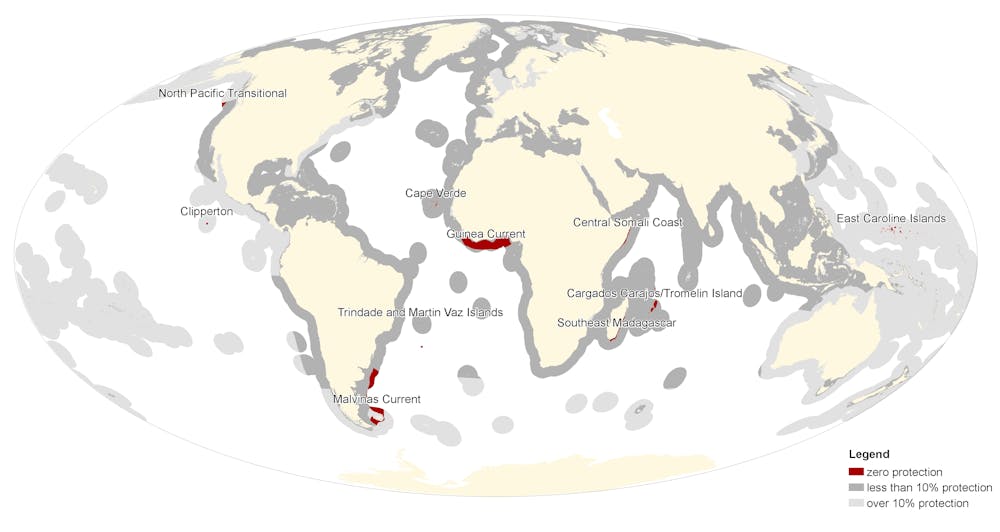
But when we looked at specific marine ecosystems, we found that half of them fall short of the target level of protection, and that ten ecosystems are entirely unprotected. For example, the Guinea Current off the tropical West African coast has no marine protected areas, and thus nowhere for its wildlife to exist free from human pressure. Other unprotected ecosystems include the Malvinas Current off the southeast coast of South America, Southeast Madagascar, and the North Pacific Transitional off Canada’s west coast.

Marine park coverage of global ecosystems. Light grey: more than 10% protection; dark grey: less than 10% protection; red: zero protection. Author provided

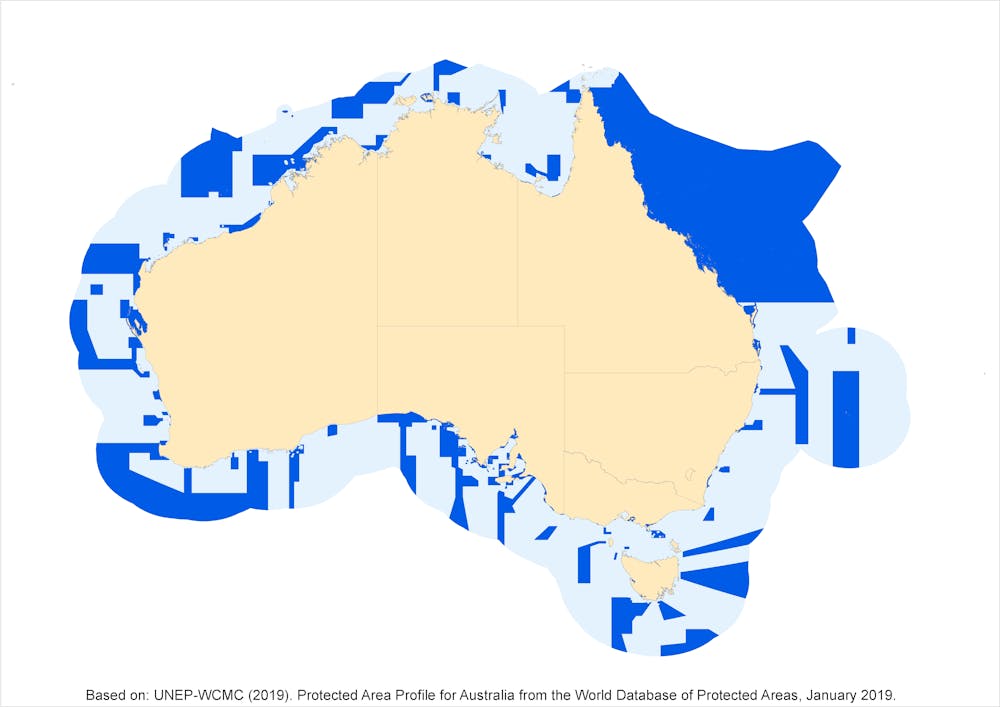
Australia performs comparatively well, with more than 3 million square km of marine reserves covering 41% of its national waters. Australia’s Coral Sea Marine Park is one of the largest marine protected areas in the world, at 1 million km². However, a recent study by our research group found that several unique ecosystems in Australia’s northern and eastern waters are lacking protection.

Furthermore, the federal government’s plan to halve the area of strict “no-take” protection inside marine parks does not bode well for the future.

How much better can we do?

To assess the scope for improvement to the world’s marine parks, we predicted how the protected area network could have been expanded from 1982.

With a bit more strategic planning since 1982, the world would only need to conserve 10% of national waters to protect all marine ecosystems at the 10% level. If we had planned strategically from as recently as 2011, we would only need to conserve 13% of national waters. If we plan strategically from now on, we will need to protect more than 16% of national waters.

If nations had planned strategically since 1982, the world’s marine protected area network could be a third smaller than today, cost half as much, and still meet the international target of protecting 10% of every ecosystem. In other words, we could have much more comprehensive and less costly marine protection today if planning had been more strategic over the past few decades.

The lack of strategic planning in previous marine park expansions is a lost opportunity for conservation. We could have met international conservation targets long ago, with far lower costs to people – measured in terms of a short-term loss of fishing catch inside new protected areas.

This is not to discount the progress made in marine conservation over the past three decades. The massive increase of marine protected areas, from a few sites in 1982, to more than 3 million km² today, is one of Australia’s greatest conservation success stories. However, it is important to recognise where we could have done better, so we can improve in the future.

Australia’s marine park network. Author provided

This is also not to discount protected areas. They are important but can be placed better. Furthermore, long-term increases in fish populations often outweigh the short-term cost to fisheries of no-take protected areas.

Two steps to get back on track

In 2020, nations will negotiate new conservation targets for 2020-30 at a UN summit in China. Targets are expected to increase above the current 10% of every nation’s marine area.

We urge governments to rigorously assess their progress towards conservation targets so far. When the targets increase, we suggest they take a tactical approach from the outset. This will deliver better outcomes for nature conservation, and have less short-term impact on the fishing industry.


Read more: More than 1,200 scientists urge rethink on Australia’s marine park plans


Strategic planning is only one prerequisite for marine protected areas to effectively protect unique and threatened species, habitats and ecosystems. Governments also need to ensure protected areas are well funded and properly managed.

These steps will give protected areas the best shot at halting the threats driving species to extinction and ecosystems to collapse. It also means these incredible places will remain available for us and future generations to enjoy.

ref. More fish, more fishing: why strategic marine park placement is a win-win – http://theconversation.com/more-fish-more-fishing-why-strategic-marine-park-placement-is-a-win-win-113374

Pets and owners – you can learn a lot about one by studying the other

]]>

Source: The Conversation (Au and NZ) – By Paul McGreevy, Professor of Animal Behaviour and Animal Welfare Science, University of Sydney

There’s an old saying that pets and their owners become more similar as time goes by. There may be some truth in that, but can we use information about owners to improve veterinary care?

Research is showing the health and welfare of pets can be influenced by personality traits in their owners.

More than 3,000 cat owners were measured across five areas: agreeableness, conscientiousness, extroversion, neuroticism, and openness.


Read more: Vets can do more to reduce the suffering of flat-faced dog breeds


Those who scored highly on neuroticism were more likely to demonstrate a preference for pedigree rather than non-pedigree cats.

Neuroticism is associated with emotional instability. People high on this trait tend to be generally more anxious and moody than others and may also respond more poorly to stress, often overreacting to small challenges.

Not surprisingly, therefore, the same group were also more likely to report their cats were showing unwelcome behaviours. These included signs of aggression, anxiety and fearfulness and more stress-related sickness behaviours, as well as having more ongoing medical conditions and being overweight.

Other animal and human studies

Similar relationships have been observed elsewhere. Parents who score highly on neuroticism may be more likely to have children with clinical obesity.

When it comes to dogs, our own studies have shown that working dog handlers who score highly on neuroticism report more attendance at competitions but no greater success in farm dog performance.

And male owners with moderate depression are at least five times more likely than those without depression to use punitive and coercive training techniques such as hitting, kicking or yelling at their dogs.

The same group of men also reported their dogs as showing significantly more house-soiling (urination and defecation when left alone) and aggression towards other dogs.

Animal welfare

These important differences in personality and ownership styles may have a bearing on the welfare of pets.

The recent cat study shows owners high in neuroticism are more likely to keep their pets indoors or restrict their access to the outdoors.

This may reflect heightened concern about the risk of road traffic accidents or other hazards. It could lead to improved cat welfare, but only if such diligence is accompanied by behavioural enrichment indoors, such as toys and puzzle feeders.

Owner personality may also influence how often a cat is taken to a veterinary clinic. Owners who score highly in neuroticism may be hypervigilant in the way they scrutinise their cats, which can lead to extra trips to the vet.

This could actually compromise cat welfare, because many cats don’t like trips to the vet. Even the sight of a carry-cage can cause increased anxiety and flight response in a cat.

How to get a cat into a carrier.

On the other hand, such trips may lead to improved welfare if they result in better health, particularly if, upon arrival, the cats are subjected to low-stress handling.

Other findings from the cat study suggest some owner attributes may be associated with an extremely positive attitude towards their pets.

High scores for agreeableness were associated with cat owners tending to view their animals in a good light. These cats had fewer reported unwelcome behaviours and were less likely to be considered overweight.

Previous studies in dogs show owners are often poor judges of whether their pets are overweight or not.

Look to the owner

This evidence that attributes in the owner can influence how their pets are perceived, and the kind of life they experience, means anyone working with these animals needs some understanding of human psychology.

Behavioural change is often the first sign that an animal is unwell. One of the most revealing aspects of a case history is the behaviour changes that owners report.

The quality and accuracy of this information from owners on their pets is crucial. But this may be strongly influenced by the relationship that owners have with their pets, such as what they look for and the intensity of their appraisal.

This evidence that owner characteristics may influence many aspects of their pet’s life – including potentially how the pet presents to a veterinary clinic – prompts us to consider how we can improve the quality of data.

For clinical behaviour cases it is important to include video records of the animal’s unwelcome behaviour. Owners are already quite adept at capturing and supplying video evidence when consulting behavioural veterinarians.

But this video evidence can also help with veterinary consultations about other conditions such as neurological disorders and intermittent lameness.

There are tools that allow owners to capture and report data in real time, using apps such as doglogbook. They have the advantage of being simple to use and having a time/date stamp that may help to keep a chronological record of the owner’s observations.

A complex relationship

The relationship between owners and veterinarians can be extremely complex and take some time to mature. A veterinarian who knows both owner and pet well will be able to detect subtle clinical signs that may otherwise go unnoticed.

Yet each clinical case must now be understood in the context of the human background baggage that enters the consultation room.


Read more: Raw meat pet food may not be good for your dog, or your own health


It’s all too easy to overlook the role of the owner’s personality in their interactions with their pet, and how their personality may influence how they perceive the animals, how they manage the animals and how they concern themselves with the health status of the animals.

Further research will undoubtedly continue to provide new insights into the fascinating world of owner-pet relationships.

ref. Pets and owners – you can learn a lot about one by studying the other – http://theconversation.com/pets-and-owners-you-can-learn-a-lot-about-one-by-studying-the-other-114167

Morrison flags new laws to stop social media platforms being ‘weaponised’

]]>

Source: The Conversation (Au and NZ) – By Michelle Grattan, Professorial Fellow, University of Canberra

Scott Morrison is foreshadowing tough new criminal laws to crack down on social media companies which fail to quickly remove footage like that streamed by the gunman in the New Zealand massacre.

Under the proposal, it would not be just the companies that faced heavy penalties but individual executives based in Australia could be found personally liable.

The laws would make it a criminal offence for the companies to fail to rapidly take down footage filmed by perpetrators of extreme violence.

The Prime Minister will meet representatives of the social media giants in Brisbane on Tuesday. Also present will be Home Affairs Minister Peter Dutton, Attorney-General Christian Porter and Communications Minister Mitch Fifield.

They will discuss the responsibilities of these companies and how the use of their platforms for spreading dangerous terrorist and other harmful material can be curbed.

“We need to prevent social media platforms being weaponised,” Morrison said ahead of the meeting.

Morrison said if social media companies failed to show they were willing immediately to make changes to prevent the use of their platforms for material like the New Zealand footage, “we will take action”.

At the meeting will be representatives of Google, Facebook and Twitter.

The proposed laws would:

  • Make it a criminal offence to fail to remove the offending footage as soon as possible after it was reported or it otherwise became known to the company

  • Allow the government to declare footage of an incident filmed by a perpetrator and being hosted on a site was “abhorrent violent material”. It would be a crime for a social media provider not to quickly remove the material after receiving a notice to do so. There would be escalating penalties the longer it remained on the social media platform.

The government says that there cannot be special rules for these companies. They should operate under the same conditions as the print and broadcasting media, and the services they provide need to be safe.

The new laws would be based on existing offences which require social media companies to notify police of child abusers on their sites, and require content host sites to remove offending material.

Morrison has already moved to have the G20 take up the issue of getting this sort of violent content off social media. He has asked for the issue of social media governance to be put on the agenda for the June summit of the G20 in Japan.

ref. Morrison flags new laws to stop social media platforms being ‘weaponised’ – http://theconversation.com/morrison-flags-new-laws-to-stop-social-media-platforms-being-weaponised-114237

Australian political journalists might be part of a ‘Canberra bubble’, but they engage the public too

]]>

Source: The Conversation (Au and NZ) – By Axel Bruns, Professor, Creative Industries, Queensland University of Technology

The federal election is fast approaching – less than 100 days away in the view of most commentators. Social media will again play an important role in the campaign, as they did in 2013 and 2016.

But it’s not only the political candidates and their parties who must incorporate social media into their practices. Political journalists increasingly report news first on social media, then later via print, broadcast and online news outlets.

In a new study, we analysed the Twitter use of the Australian Federal Parliamentary Press Gallery during 2017, and compared this with the equivalent press corps in Germany, the Bundespressekonferenz.

Are Australian journalists, as Prime Minister Scott Morrison has claimed, simply trapped inside the “Canberra bubble”, obsessed with parliamentary minutiae and disconnected from the “real” Australia in the suburbs? Or do they engage with the wider Australian community, explaining and discussing the political events of the day?

Our research suggests it’s a bit of both.


Read more: How social media is helping Australian journalists uncover stories hidden in plain sight


Twitter remains important

As it turns out, Australian journalists are very enthusiastic Twitter users. In Australia, 182 press gallery accounts posted an average of 1,507 tweets per account, while the 400 German accounts managed only 609 tweets on average through the year.

And this effort is rewarded by the twittersphere. Press gallery accounts received some 1.9 million retweets and mentions from over 231,000 unique accounts over the course of the year. Meanwhile, their German colleagues received only 714,000 retweets and mentions from 117,000 unique accounts.

Of course, this is also a reflection of the relative status of Twitter, and social media in general, in the media environment of each country. According to the Reuters Institute Digital News Report, social media play a comparatively minor role in the news repertoire of German news audiences, and so they are less likely to follow and engage with journalists on Twitter than Australians.

In each case, some three quarters of this engagement is through mentions rather than retweets. In both countries, users prefer to talk with, at, or about the press corps journalists, rather than help them share their stories by retweeting them.

And the journalists seem to respond, at least some of the time. Of the Canberra press gallery tweets, 43% were mentions, compared to 46% of the Bundespressekonferenz tweets.


Read more: Media Files: What does the Nine Fairfax merger mean for diversity and quality journalism?


Some signs of insularity

But we also found that the press gallery accounts spend a substantial amount of time talking among themselves. Of the 117,000 mentions they posted, 22% were directed at fellow press gallery journalists, compared to only 12% of the mentions posted by Bundespressekonferenz accounts.

In fact, almost half (48%) of the 200+ accounts that were most frequently mentioned by press gallery journalists were other Canberra journalists. Politicians made up for only 21% of these most frequent conversation partners. German journalists, on the other hand, engaged more often with politicians (32%) over fellow journalists (31%), in their most frequent interactions.

Ordinary users didn’t feature much as frequent conversation partners for either group of journalists. This means that engagement with them tends to be more fleeting and random, and is rarely repeated on a regular basis. Journalists might respond to questions or comments, but normally this does not lead to lasting connections.

This should not surprise us particularly much. The job of the press corps is to report on their country’s political leaders. In a social media environment, this now also means taking note of and commenting on the work of other journalists. That’s why they direct their interactions especially to these groups.

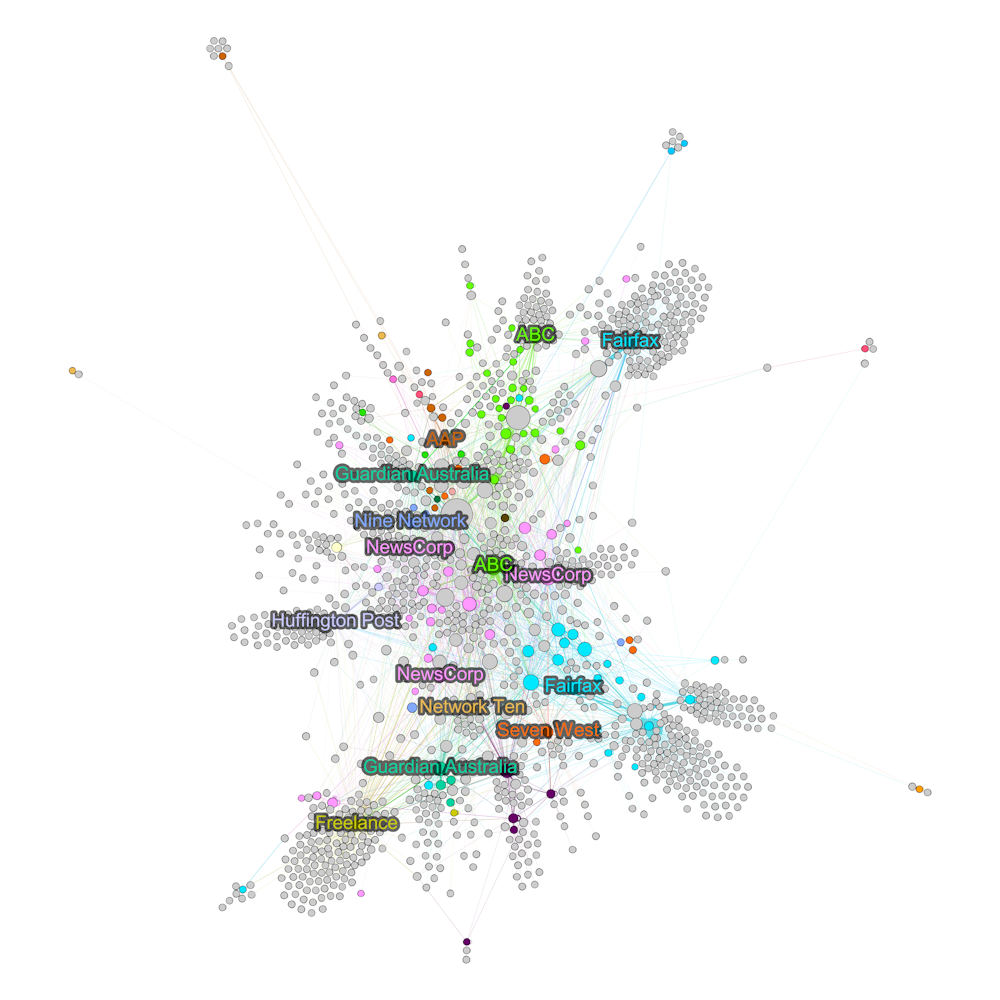
Remarkably, in Australia this debate amongst journalists also tends to take place across institutional boundaries. There is substantial engagement through mentions between journalists working for ABC News, News Corporation, Fairfax, and other major organisations. In Germany, these discussions remain more strongly in-house.

The mention network around the leading Canberra press gallery accounts, showing significant interaction across institutional boundaries.


Read more: How ‘new power’ is driving journalism in the digital age


The professionalisation of social media

If there is a “Canberra bubble”, then, it seems press gallery journalists are all in it together. By contrast, the bubble around Germany’s Bundespressekonferenz is weaker, while at the same time journalists from different news outlets keep to themselves more more often.

And this is despite the fact that Australians in general, and Australian journalists in particular, show greater adoption of Twitter (and social media overall). In fact, perhaps it is the very professionalisation of social media use in Australia that has created the press gallery’s greater inward focus, as the journalists’ social media routines have solidified.

That professionalisation may also have provided them with more “official” counterparts to engage with – including politicians, lobbyists, experts, and other professional actors – crowding out ordinary users. In Germany, where Twitter use matters less, the general public remains more involved in the conversation.

ref. Australian political journalists might be part of a ‘Canberra bubble’, but they engage the public too – http://theconversation.com/australian-political-journalists-might-be-part-of-a-canberra-bubble-but-they-engage-the-public-too-114084

Older people are more digitally savvy, but aged care providers need to keep up

]]>

Source: The Conversation (Au and NZ) – By Dr Wendy Wrapson, Senior Research Fellow, Auckland University of Technology

Older adults are more digitally connected than ever, even though their uptake of internet-based technologies remains lower than for younger age groups.

Today’s senior citizens are likely to spend their spare time tweeting about their social lives and Facetiming their grand kids. This is good news because research shows that social interactions benefit us.

The drive to join the digital community is no doubt influenced by social media becoming an important platform for news and information, sharing experiences and connecting with friends and family. Nevertheless, age-related gaps in digital engagement (“the digital divide”) still exist.

As our research shows, people who live in aged care environments are at risk of being excluded from the digital world.


Read more: Vertical retirement villages are on the rise, and they’re high-tech too


A digital community

Moving into aged care can affect a person’s ability to remain connected to their local community. The facility might be some distance away from the neighbourhood in which they have lived. They may be unable to travel to maintain relationships.

Low levels of social connectedness and participation are related to poor health and higher mortality risks, as well as a significant reduction in quality of life. Family can provide an important source of social contact and support but geographic distance can again make frequent visits difficult.

Digital engagement in later life might not always be desired or possible. But access to online resources can enhance older adults’ well-being through improved access to information and more frequent social interactions.

The social internet

An early study reported psychosocial benefits from providing computer training in internet use for aged care residents. These include improvements in life satisfaction and lower levels of depression and loneliness. In another study, a once weekly video conference with a family member had a positive impact on loneliness and perceived social support.

But there is little information on informal and unstructured use of the internet by residents because the use of digital technologies in aged care remains largely invisible. Residents are omitted from many surveys and reports.

In a recent Swiss study, where all residents in a facility were offered wi-fi access, 14% used the internet. This percentage is similar in that age group living in the community.


Read more: Connecting online can help prevent social isolation in older people


Staying connected

We conducted telephone interviews with over 70 members of the public who had a family member or friend living in residential aged care. We spoke to family and friends rather than seniors because we wanted to hear about residents who had physical and mental challenges, as well as healthy seniors who tend to volunteer for research. To reduce the risk of bias, we did not mention in our study advertising that we wished to talk to people about technology use.

Our research highlighted the enthusiasm with which many older people have adopted digital technologies. Nearly half of the 80 residents spoken about owned a computer or a smartphone. The average age of residents was 86 years, and the oldest was 102. Sometimes the family had purchased a device for the resident, specifically to make communication easier.

Mobile phone calls, texts and emails were the most common methods of communication using these devices. Technology not only enabled residents to interact with family and friends they seldom saw (for example, those overseas) but also resulted in increased interactions with people who visited more often. While dementia and other serious health issues reduced the likelihood of uptake, the frequency of personal visits was not affected by technology use.

Family help

Importantly, family members were essential to residents’ digital connectedness. They often bought the device, set up software and troubleshooted any technical problems. They were also involved in the day-to-day use of technology. For example, some residents used video conferencing, but needed assistance to initiate the call.

Interviewees endorsed the use of digital devices if they were used to supplement social contact, rather than supplanting it. The majority reported that they were not aware of computers being available for residents in common areas of the facility they visited.

Aged care operators do not generally provide wi-fi access to residents. They have to arrange this with their own internet provider. These deficits are of concern because residents don’t always have family or friends to help them become digitally connected.

Devices were also often criticised for their small keys and buttons which are difficult to manage for arthritic hands and by people with vision impairments. Older users, it seems, must try to adapt their abilities to devices that have been designed for younger people.

Senior citizens are an important consumer group which is only going to increase in number in the future. The time has come for aged care operators and the technology industry to engage in meaningful efforts to meet their needs.

ref. Older people are more digitally savvy, but aged care providers need to keep up – http://theconversation.com/older-people-are-more-digitally-savvy-but-aged-care-providers-need-to-keep-up-113471

Schools are asking students to bring digital devices to class, but are they actually being used?

]]>

Source: The Conversation (Au and NZ) – By Nicola F. Johnson, Associate Professor of Digital Technologies in Education, Edith Cowan University

It’s been over ten years since Kevin Rudd’s Digital Education Revolution placed small laptops (also called Rudd-tops) into the hands of every Year 9 and up Australian student. Once the scheme was deemed unsustainable, for obvious reasons, many schools brought in a “bring your own device” (BYOD) scheme.

While the Rudd-tops had the same capacity and specifications, so teachers knew what they were working with, this wasn’t the case with devices students brought in themselves. My colleagues and I observed how and when devices brought to class by students were used in a public secondary school. After speaking with teachers and students, we identified the limitations and enabling roles devices played in their learning when at school.

While devices can be used successfully and effectively, we found that more often than not they were sitting around unused. This was for several reasons, including inconsistent software, different expectations and teaching approaches, and technical obstacles. Many students who were using the devices were also doing so to disengage, rather than engage, with learning.

Bring your own device

Many public secondary schools employ a BYOD program, where parents are expected to buy their child an iPad or laptop. Some private schools provide an individual device as part of school fees. In the early days of many BYOD schemes, public schools typically stated “any device will do”. But that meant not all students’ devices had the same capacity.


Read more: Why access to computers won’t automatically boost children’s grades


Given the rise in technology use in society, it makes sense schools should also be using technology. Today, school book lists state the minimum requirements for a device. Some schools in lower socioeconomic areas will provide devices for those who cannot afford them.

But, in the 21st century, effective digital practices are not always straightforward and using devices is not always predictable. It is usually decided at a school-wide level that devices will be placed on a book list. But when the student comes to a class with their device, it is up to the teacher to figure out if, when and how they will use the student’s device.

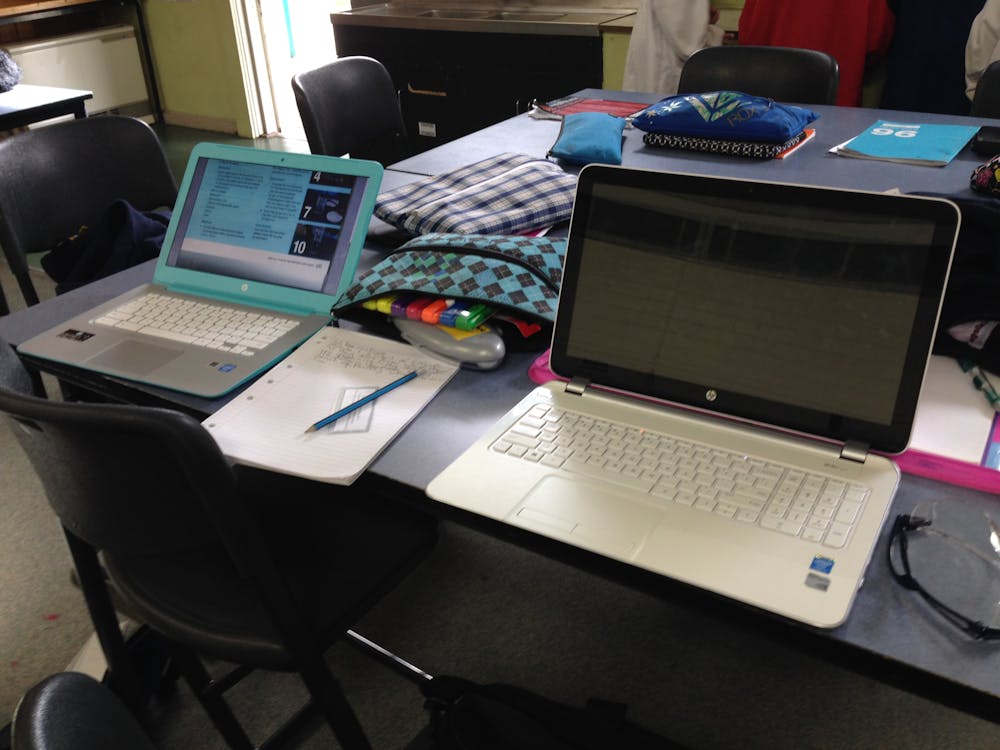
Integrating technology into the classroom doesn’t come naturally. Teachers need professional development, support and an understanding of how to use digital devices in their teaching. And they need to see the benefits of doing so. Some students like using their devices and are motivated to do so, but some students would rather use an exercise book and pen.

Integrating technology into the classroom doesn’t come naturally. Author provided

In our research, many teachers commented on the frustrations they had during the first few years of their BYOD scheme. Not all devices had the same software, some weren’t charged and some were unusable because they were broken. Some parents could not afford to get broken devices fixed.

Certain students spent a lot of time going back and forth to the library to issue and return a school-owned digital device for their use during a period. Some students had expensive laptops while others had poor-quality digital notepads.

When students logged in to the network, they sometimes had to wait ten minutes at heavy use times. Some teachers did not think it was worth the hassle of trying to use these devices during their teaching times because of the potential time waste, so they resorted to textbooks or worksheets.

Making better use of digital devices

Many policymakers are influenced by the mantra that digital technologies will bring about revolutionary change and more technologies mean better teaching and learning. But as proclaimed by Stanford education professor Larry Cuban in his 2003 book, Oversold and Underused: Computers in the Classroom, technologies have failed to bring about evidence of increased performance.

It might be easier for an English teacher or a humanities and social sciences teacher to use a device in their subject area. Devices can be used to take notes (and can help achieve a paperless environment), complete and submit assignments, inquire and search online, and present work professionally. Teachers can also mark assignments online and provide digital feedback.

Other subject areas find it more challenging – for instance, many of the mathematical symbols used in senior maths require a mathematics calculator. Students can’t complete the exercises on their devices. For other subjects such as visual arts, physical education and musical performance, using a device all the time isn’t appropriate.


Read more: Ten reasons teachers can struggle to use technology in the classroom


If devices are to be used efficiently and successfully, schools need better technical support. Schools must also ensure software is compatible and that apps are loaded onto students’ devices and available. Additionally, the internal policies that govern the use of information and communications technology and devices need to support the teachers’ ability, goodwill and desire to implement an initiative.

Devices can be used successfully and effectively but, given recent arguments about too much screen time, parents should also acknowledge the benefits of students interacting with each other and with their teachers – not via screens.

Just because devices are being used, it does not mean good teaching and learning are occurring. In our research, we observed many occasions when students were being quiet and focused on their device’s screen, but were obviously not doing anything along the lines of learning. But their devices were being used.

So, just because devices are not being used, that doesn’t mean poor learning and teaching are occurring.

ref. Schools are asking students to bring digital devices to class, but are they actually being used? – http://theconversation.com/schools-are-asking-students-to-bring-digital-devices-to-class-but-are-they-actually-being-used-113353

Massacre is now part of Christchurch’s identity, so how does a city rise above that?

]]>

Source: The Conversation (Au and NZ) – By Will Rifkin, Chair in Applied Regional Economics and Director, Hunter Research Foundation Centre, University of Newcastle

Christchurch has a challenging new aspect to its identity. The city is now inextricably associated with the March 15 mass shootings at two mosques. So how does a city come to terms with and recover from having its name become synonymous with and coloured by such an atrocity?

This event has impacts on how both outsiders and residents perceive the city. The city has to manage the social and economic effects of any stigma that might arise.

The stigma of this sort of association is clearly not unique to Christchurch nor to one-off tragedies. Other places that came to be identified with atrocities include Port Arthur, Tasmania, after the mass shooting in 1996, and Lockerbie, Scotland, after the 1988 plane bombing. Stigma can also arise from a history of industrial decline, pollution or political upheaval.


Read more: From trauma to tourism and back again: Port Arthur’s history of ‘dark tourism’


Geographers refer to a concept of “territorial stigma” but usually in relation to poorer sections within a city rather than whole cities. That said, this concept – and notions of individual stigma and its management – may have relevance for how Christchurch or any other community can recover over time. We can see examples of such recovery in Port Arthur and the state of Tasmania, in Kobe, Japan, after a devastating earthquake, and in Eindhoven in the Netherlands after economic collapse.

Christchurch also faced the impact of stigma as a devastated city following earthquakes at the start of the decade, as did Kobe after the 1995 earthquake.


Read more: Christchurch five years on: have politicians helped or hindered the earthquake recovery?


In Kobe, city planners gave themselves the crucial role of being agents of change and mediators between the government and the community. They championed community-led place-making (machizukuri in Japanese). Machizukuri examples of Kobe renewal are still praised as beacons of effective disaster recovery and urban planning. What underlies the challenge and the response?

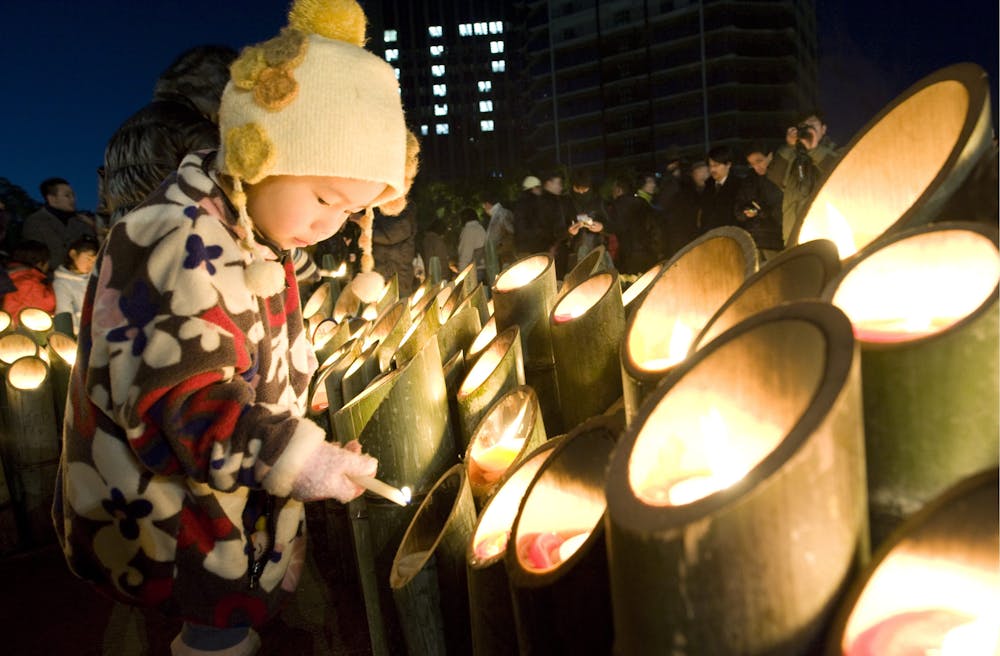
A girl lights a candle during a 2010 ceremony to remember the thousands of victims of the 1995 Kobe earthquake. Everett Kennedy Brown/EPA

Stigma and its management

Individual stigma was characterised by the sociologist Erving Goffman, who noted that the Greeks used the term to refer to “bodily signs designed to expose something unusual and bad about the moral status of the signifier”. He clarified that stigma now refers to the disgrace itself, the reason for social rejection, rather than just to the mark.

Goffman identifies three categories of people in relation to stigmas. There are those who bear the stigma. There are the “normals” who do not. And there are the “wise”, who are normal but who are aware of and accept those who bear the stigmatised condition (being literally, “wise to it”).

Loïc Wacquant extended the concept of stigma to locations. Territorial stigma occurs in neighbourhoods of post-industrial cities as a result of marginalisation through poverty, unemployment, insecurity and criminality.

Wacquant and others argue that policies and practices – such as government grant schemes or depictions in the media – maintain this boundary between “spoiled” areas and the rest of the city. Those with power undertake this marginalisation as a means for the rest of the city to achieve economic growth. Such stigmatisation and marginalisation can lead to unattractiveness to migrants and businesses, lower property values, and policy neglect.

Managing such stigma, at least for individuals, Rebecca Meisenbach found, ranges from accepting or avoiding it, to arguing against it, or proudly displaying the stigmatising characteristic. For cities, we can see such strategies being undertaken. But which ones are the most effective?

Remaking identity

The Winning from Second report, based on research by the UN Global Compact – Cities Programme and RMIT University for the Committee for Geelong, identified cities or regions that have successfully shifted perceptions and associated stigma. The study’s examples were second cities with smaller populations, often existing in the shadow of larger global cities.

The report found success where a city undertook a unified approach to economic and cultural development. That would include uniting the stigmatised sectors of the community with “wise” allies, such as in the investment sector. One approach was support of new and innovative businesses, such as development of a health tech corridor in Cleveland, Ohio.

These second cities also aimed to provide an identity and attractions distinct from those offered by nearby capital cities. In essence, they celebrated their difference.


Read more: Putting culture at the core of the Christchurch rebuild


Eindhoven managed a successful transformation. It was a “one-company town”, home to the electronics giant, Philips. Philips relocated its manufacturing in the 1980s, causing job losses and the collapse of businesses.

Local government and business leaders collaborated to convince Philips to retain its research and development arm in the city. That launched the area as an innovation hub, referred to as Brainport Eindhoven.

With only 4% of the Netherlands population, the city now generates 44% of the country’s patents and 19% of its private investment. Eindhoven has shaken off negative perceptions to become known as one of the world’s most innovative cities.

A memorial pool near the massacre site is a permanent reminder of the lives lost in 1996, but Port Arthur refuses to be defined by this one act of infamy. Robert Cianflone/AAP

A similar reversal in Tasmania was recently described by David Bartlett, the premier from 2008-2011, who spoke about the “MONA effect”. He explained the impact of the “random lightning bolt of weirdness” that is the Museum of Old and New Art in Hobart. MONA’s opening in 2011 boosted tourism numbers and spawned a range of other enterprises, breathing new life into the state economy.

Bartlett said this MONA effect shifted perceptions of Tasmania. “We have had an extraordinary cultural change in Tasmania,” he said. “There is a cultural confidence and a contagious view of our own assets.”

The Kobe, Eindhoven and Hobart examples suggest that the prosperity and well-being of Christchurch depend on the city’s leaders and the community, now united in grief, finding a path to shared solutions. Overcoming the effects of terrorism, natural disasters or economic adversity also demand pride in the history and distinctive character of the city, albeit while looking forward. In such efforts, collaboration appears to be a pivotal element, especially partnerships between the stigmatised and the “wise” among us.

ref. Massacre is now part of Christchurch’s identity, so how does a city rise above that? – http://theconversation.com/massacre-is-now-part-of-christchurchs-identity-so-how-does-a-city-rise-above-that-113854

Expect tax cuts and an emptying of the cupboards in a budget cleanout as the billions roll in

]]>

Source: The Conversation (Au and NZ) – By Warren Hogan, Industry Professor, University of Technology Sydney

It has been just over three months since the December budget update but once again the government has been gifted a windfall of unexpected revenues, despite a raft of economic data suggesting the economy has slowed its rate of growth.

This is because the things that really matter to the budget have all done better than was expected by the Treasury just months ago. Strong conditions in commodity markets and lower unemployment mean that in the current financial year the budget bottom line will be about A$3 billion better than had been expected in December, and about A$12 billion better next financial year.

Since the last budget only last May, the outlook for 2018-19 has improved by A$12.3 billion and the outlook for 2019-20 by $13.8 billion.

Going up

Rising commodity prices and export volumes have pushed up the profits and tax bills of mining companies.

Iron ore is the standout. Prices have exceeded the Treasury’s December forecast on the back of lower international supply (a result of the tragic dam wall collapse in Brazil) and continued growth in demand from China.

In December, Treasury expected iron ore prices to average US$55 a tonne. But in fact they have averaged about US$75 a tonne. That alone will add about A$2 billion to government revenues in 2018-19 and, if maintained, A$6 billion in 2019-20.

Add in a weaker Australian dollar and the combined effect will account for almost half of the net improvement in the overall budget position this financial year and the next.

Iron ore is only one of our exports.

Coal prices have also exceeded expectations, which should add another A$1 billion to A$1.5 billion to revenue over the next two years.


Read more: An evening with the treasurer: how governments belt out budget hits and hope someone is listening


And there’s more to it than mining. Corporate profits have generally been strong despite some storm clouds forming around the banking industry and the economy more generally.

Another thing driving the better budget starting point is strong jobs growth and a lower than expected unemployment rate, boosting the government’s financial position through lower unemployment benefits and a higher personal tax take. The February employment statistics showed an unemployment rate of 4.9%.

The Treasury had expected the rate to fall more slowly, only getting to 5% by June and then staying there for several years.

If the budget cupboard was untouched, which it won’t be, the budget would have a deficit of next to nothing this financial year and an impressive surplus as high as 1% of gross domestic product next year, a year ahead of the government’s schedule.

But it mightn’t last

These upside surprises from the corporate tax take can just as quickly go the other way.

Assuming they will last, as budgets often do, would be to make the same mistake as the Howard-Costello government, which made permanent changes to tax rates and commitments on the back of revenue that prove to be temporary. So did the Gillard-Swan government some years later with its “spreading the benefits of the boom” package.

Corporate profits might struggle to improve in future years in an increasingly difficult economic environment. No one knows what will happen with commodity prices. Right now China is using infrastructure spending to stimulate its economy, but it won’t always do that. Eventually its growth will be less metal-intensive.

But with the government well behind in the polls, I doubt these considerations are getting much attention.

China drives budgets, the US drives rates

The US economy sets the global price of money, which in turn determines the environment in which our Reserve Bank sets Australian interest rates and works out how to deal with the bursting of the housing bubble, which was itself in no small part the result of an easy US monetary policy in the wake of the global financial crisis.

China, on the other hand, determines the global price of commodities and trade flows and so helps determine corporate profitability in Australia.

This contrast between the two has never been greater, with the government flush with unexpected revenues while the Reserve Bank walks a knife-edge of low real economic growth, financial stability risks, and already easy monetary policy.

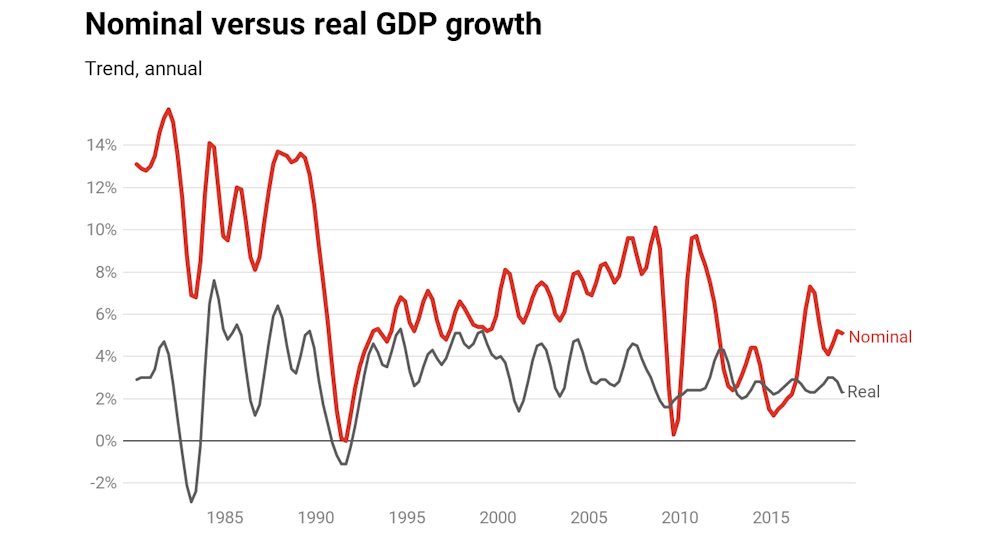
It is best summed up in this chart of real and nominal gross domestic product, which shows annual growth in real GDP (which affects the economy) slowing to 2.3% while growth in nominal GDP (which drives the dollars flowing into the Treasury) growth climbing to more than 5%.


ABS National Accounts


Looking beyond this budget, the major risk for the Australian economy is a retrenchment of consumer spending on the back of falling house prices and tighter credit conditions.

The national accounts suggest it has already started.

The worry is that domestic spending, which is dominated by consumer spending, will weaken to the point at which it forces businesses to shelve hiring and investment plans, pushing unemployment back up.

A vicious cycle could result in some type of recession.

How can the government and the Reserve Bank try to control these risks?

One way would be to do what they have always done and cut interest rates in an attempt to boost household and business cash flows.


Read more: Now is the time to plan how to fight the next recession


Another would be to take some of the free cash being generated by China and use it to boost domestic demand through temporary arrangements that help the economy ride out the adjustment to lower house prices.

It could be done in many forms including tax cuts and targeted cash injections into low and middle income households.

Expect extra and earlier tax cuts

The government has known about the much better revenue position for months.

To date it has displayed incredible restraint in spending it.

New policy announcements since the December update have been limited to about A$500 billion a year, which isn’t bad for a government facing an election wipeout before winter.

But it would be wise not to get too glowing about its restraint.

Instead we should expect a cascade of policy announcements culminating in a major tax cut to be revealed on budget night next Tuesday.

The government has a A$12 billion war chest.

It is most likely to spend it in the form of tax cuts, most likely by bringing forward the second stage of the already announced cuts due to take effect in July 2022.


Read more: Grattan on Friday: Josh Frydenberg has a great job at the worst time


That would mean lifting the ceiling for the 32.5% tax rate from A$90,000 to A$120,000 and lifting the ceiling for the 19% rate from A$37,000 to A$41,000.

Bringing forward those already legislated tax cuts by three years to July 2019 would cost the budget less than A$10 billion a year and still leave room for a surplus in 2019-20 and room for targeted election pork barrelling.

With the government so far behind in the polls there is virtually zero chance this extra income will be saved for a rainy day. Although the Coalition’s chances of re-election are remote, Prime Minister Scott Morrison is an optimist who might think a surge of generosity and a few lucky breaks could get him over the line.

The more likely possibility of an election loss means Morrison will want to keep the incoming government’s cupboard as bare as he can. This means keeping the budget surpluses small so that if the Labor Party wants to go on a spending spree, it will have to renege on his promised tax cuts.


Read more: No surplus, no share market growth, no lift in wage growth. Economic survey points to bleaker times post-election


The good news is that whatever the government does in the budget and no matter what party forms the next government, the budget position is all but back in balance.

It will hold us in good stead should the global economy run into trouble.

It will be all the more needed if the Reserve Bank pushes interest rates below 1% over the coming year, leaving it little room to cut further.

ref. Expect tax cuts and an emptying of the cupboards in a budget cleanout as the billions roll in – http://theconversation.com/expect-tax-cuts-and-an-emptying-of-the-cupboards-in-a-budget-cleanout-as-the-billions-roll-in-113727

A new twist in the elusive quest for the origins of the word ‘bogan’ leads to Melbourne’s Xavier College

]]>

Source: The Conversation (Au and NZ) – By Bruce Moore, Honorary Associate Professor in the School of Literature, Languages, and Linguistics, Australian National University

Bogan is the most significant word to be created in Australian English in the past 40 years. It is defined as “an uncultured and unsophisticated person; a boorish and uncouth person” in the 2016 edition of the Australian National Dictionary.

Ever relevant, the word has made the news in recent weeks with Will Connolly, the teenager who egged Senator Fraser Anning, posting a video online warning that if you egg politicians, “you get tackled by 30 bogans at the same time”.

The type of Australian the term refers to has been the subject of books, television shows, and heated debate. The noun has generated many derivatives and compounds: bogan chick, boganhood, boganic, boganism, boganity, boganland, boganness. Not since “ocker” appeared in the late 1960s as a reference to an uncultured and uncouth Australian male has there been such a productive Australian word.

We have still not established its etymology. Some have argued the term “bogan” may derive from the Bogan River and district in western New South Wales. But there is no evidence whatsoever that could link our uncouth bogan with this area. Nor is there convincing evidence that Henry Lawson’s story The Blindness of One-Eyed Bogan gave rise to the word.

Until now, the earliest evidence of the word cited in the dictionary is from a letter signed by “Dave, Phillip Island, Vic” to the surfing magazine Tracks in September 1985. He asks: “So what if I have a mohawk and wear Dr Martens (boots for all you uninformed bogans)?”

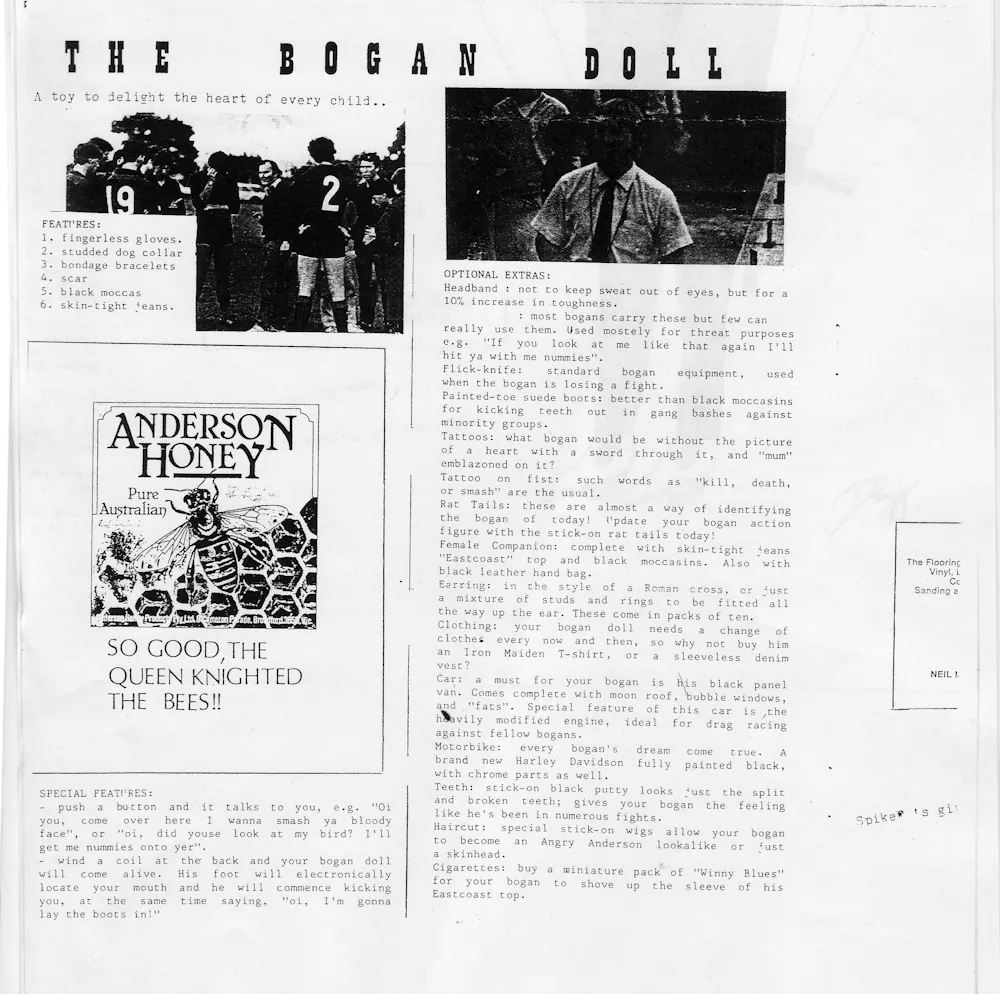
But fresh evidence discovered by Melbourne historian Helen Doyle, and kindly passed on to me suggests the word dates to at least 1984, and probably originated in Melbourne. It comes from an article that appeared in the third edition of a magazine produced by students at Xavier College Melbourne in 1984, which includes a detailed description of “the bogan doll”. (In the same year, incidentally, ALP leader Bill Shorten was a student at Xavier.)

The fictional ‘bogan doll’ came with optional extras including ‘nunnies’ and a flick knife. Author provided

This fictional male “doll” has rat tails and tattoos, wears an “Iron Maiden T-shirt or a sleeveless denim vest”, is adorned with studs or earrings “in the style of a Roman cross”, and has “a miniature pack of ‘Winny Blues’ […] to shove up the sleeve of his Eastcoast top”.

If there is a car to go with the doll, we are told, it will be “a black panel van […] [with] heavily modified engine”, and if the doll has a “female companion” she will come “complete with skin-tight jeans, ‘Eastcoast’ top and black moccasins”.

The ‘bogan doll’ in Sursum Corda in full. Author provided

The bogan doll comes armed with nunchakus (“nunnies”) and flick knife. It has a special button which, when pressed, allows the bogan doll to say: “Oi you, come over here I wanna smash ya bloody face” or “oi, did youse look at my bird? I’ll get me nummies onto yer”. An illustration of the bogan doll is also provided.

Four years after the publication of this article, Judith Clarke’s 1988 novel The Heroic Life of Al Capsella, set in Melbourne, gives a description of bogans that appears to be a direct descendant of the students’ bogan doll:

It looked like the kind of place you might find Bogans hanging about, the kind of place you could get bashed up. […] Sure enough, in the yard of a house across the street, I saw a gang of Bogans in tight jeans and long checked shirts, mucking about with a big fancy car, vintage model, complete with brass lamps and running-board. I felt sure they’d ripped it off: for one thing, they were taking off the number plates.

So by the mid 1980s Melbourne had established the term bogan. It was absolutely synonymous with westie (used to describe someone from the western suburbs of Sydney), the bevan (a Queensland term), the booner ( a term from Canberra, sometimes abbreviated to boon – probably a shortening of the American boondocks, meaning “rough or isolated country”), and the chigga (a person from the working-class suburb of Chigwell in Hobart).

At this time a slightly variant meaning of bogan appeared, which also began as a Melbourne term. It was used in teenage slang for someone who was regarded as a bit of a dag, a sense popularised by the fictitious schoolgirl “Kylie Mole” from the television show The Comedy Company (which ran from 1988 to 1990).


Read more: Bogan in the eye of the beholder: the curious case of Rebel Wilson


Kylie Mole was played by the Melbourne-based actor Mary-Anne Fahey, and it seems possible that Fahey picked up this meaning from teenagers of the kind at work in the Xavier College magazine, giving a specialised “spin” to the general term of abuse. The nerdish bogan was not long lived, however, and it was soon overpowered by the hooligan bogan.

Unlike the other regional terms for “hooligan”, bogan soon spread Australia-wide. The evidence in the dictionary shows that by 1987 it was used at the Australian Defence Force Academy in Canberra (it is included in B. Cowham’s 1987 glossary Legolingo: the Cadets’ Language). Perhaps it was brought there by students from Melbourne. By the beginning of the 1990s it was everywhere.

In the journeyings of bogan there have been some slight changes in meaning. One important shift is the fact that it is no longer necessary for the bogan to belong to “a low socio-economic or poorly-educated background”.

The creation of the acronym CUB (“cashed-up bogan”) in the early 2000s was a sign that the original sense was shifting. Of course, a bogan can still come from such a background, as evidenced by the characters profiled in Paul Fenech’s 2017 book The Bogan Bible.

The major criteria for boganhood are: a lack of culture and sophistication; boorishness and uncouthness and vulgarity. But being a Melburnian is no longer a requirement.

ref. A new twist in the elusive quest for the origins of the word ‘bogan’ leads to Melbourne’s Xavier College – http://theconversation.com/a-new-twist-in-the-elusive-quest-for-the-origins-of-the-word-bogan-leads-to-melbournes-xavier-college-113755

Health check: can eating certain foods make you smarter?

]]>

Source: The Conversation (Au and NZ) – By Margaret Morris, Professor of Pharmacology, Head of Pharmacology, UNSW

Trying to keep up with what constitutes a “healthy” diet can be exhausting. With unending options at the supermarket, and diet advice coming from all directions, filling your shopping trolley with the right things can seem an overwhelming task.

For a long time we’ve known diet is key to maintaining physical health.

But emerging evidence indicates diet quality also plays a critical role in our cognitive function.

We’re learning some of the best things to eat in this regard include vegetables, nuts and berries, foods containing “good fats” and, possibly, fermented foods.

As well as potentially improving our brain function, eating these sorts of foods could improve our mental well-being – and could even help the planet, too.


Read more: Research Check: does eating chocolate improve your brain function?


Diet and brain function

In the face of rising obesity rates, over the past couple of decades, researchers have questioned whether increased weight, or poor diet, could influence cognition. They have since looked at what sorts of diets might impair or improve the function of our brains.

Long term follow-up studies show obesity is associated with mild impairments in several domains of cognitive function, including short-term memory, attention and decision-making.

Research has also shown short-term memory is poorer in people who report eating more saturated fat and sugar.

Conversely, the Mediterranean diet has been associated with better brain health and maintenance of cognitive abilities into older age. A Mediterranean diet is based on vegetables, whole grains, legumes and nuts, with healthy fats such as olive oil. Intake of red meat, saturated fats and sugar is limited.

A healthy diet has many elements, so let’s look at what particular foods might explain these benefits.

Vegetables, nuts and berries

Evidence indicates eating more vegetables slows the gradual decline in cognitive abilities that occurs naturally as we age.

While all veggies are likely to contribute, those in the cruciferous (Brassicaceae) family may confer particular benefits through their high fibre, folate, potassium and vitamin content. Vegetables in this family include broccoli, cauliflower, brussels sprouts, and fad favourites kale and rocket.

Interestingly, while there’s good evidence for the protective role of vegetables, there’s less evidence when it comes to fruit.

Research has shown a healthy diet can improve cognitive functions such as learning and memory. From shutterstock.com

Berries, though, contain high levels of antioxidants. These compounds protect the body by scavenging harmful free radicals and reducing inflammation. Together these functions are likely to protect our cognitive ability.

Studies in rats, and in older people with mild cognitive impairment, indicate supplementing diets with berries improves performance in various memory tasks.

Nuts, meanwhile, are excellent sources of monounsaturated and polyunsaturated fats, minerals and vitamins. Studies in animals have shown the addition of nuts improves learning and memory. Emerging evidence in humans suggests consuming nuts within a Mediterranean-style diet improves measures of cognition, such as the capacity for verbal reasoning.

Healthy fats

Healthy diets such as the Mediterranean diet are also characterised by foods such as oily fish, avocados, olive oil and small amounts of animal-derived fats (such as from red meat).

One of our experiments in rats showed diets high in saturated fat from lard or high in sugar led to memory impairments, whereas an oil-based diet high in polyunsaturated fats didn’t.


Read more: Food as medicine: your brain really does want you to eat more veggies


Importantly, rats fed these different diets did not differ in their total energy intake – only the type of fat and sugar varied.

While we can’t comment directly on the effects in humans, these findings suggest eating excess sugar, or animal-based fats, may negatively impact cognition.

Fermented foods

For thousands of years humans have prolonged the life of foods through fermentation, which increases the proportion of Lactobacillus and other healthy gut bacteria.

Kombucha and kefir are trendy right now, but other popular fermented foods include kimchi, miso, yoghurt and sauerkraut. Intake of these foods is thought to maintain the diversity of the gut microbiome.


Read more: Health check: will eating nuts make you gain weight?


Interest in the potential cognitive effects of fermented foods stems from emerging evidence for the importance of the gut microbiota in cognition and health.

It’s well known that a poor diet can reduce the diversity of the gut microbiome. Our work in rats has shown the cognitive impairments produced by exposure to an unhealthy “cafeteria” diet – a Western-style diet high in saturated fat and sugar – are linked to changes in the gut microbiome.

Beyond cognition

It’s not possible to attribute “miracle” properties to one food group alone. We suggest a balanced, varied diet is the best approach to sustain not only brain health, but heart health too.

And there may be other reasons to seek out these foods. A newly published study showed eating fruit and vegetables improved mental well-being. Subjects tended to feel happier, less worried, and reported higher levels of overall life satisfaction.

The link between diet quality and better mental health is now well-established.

The recently published EAT-Lancet report adds a further compelling reason to eat healthily: the environment. This commission argued for a “planetary health” diet – akin to the Mediterranean diet – consisting of whole grains, vegetables, fruits, nuts and dairy, healthy fats, with low animal protein and few processed foods.

It is thought that shifting to such a diet, together with reducing food waste and adopting more sustainable food production systems, will minimise environmental damage and safeguard individual health.

The central message is the health of individuals and of the planet are inextricably linked, and this requires a rethink of global food systems.


Read more: Want to improve your mood? It’s time to ditch the junk food


Overhauling food systems – and individual food habits – will not be simple while foods high in fat and sugar are so readily available and relatively cheap.

Nonetheless, recognising that eating well might benefit the planet, as well as the body and brain, might motivate people to change their dietary habits.

ref. Health check: can eating certain foods make you smarter? – http://theconversation.com/health-check-can-eating-certain-foods-make-you-smarter-113551

A skilful and stirring one-man treatment of George Orwell’s Animal Farm

]]>

Source: The Conversation (Au and NZ) – By Lisa Harper Campbell, Lecturer in Drama, Flinders University

Review: Animal Farm, State Theatre Company of South Australia


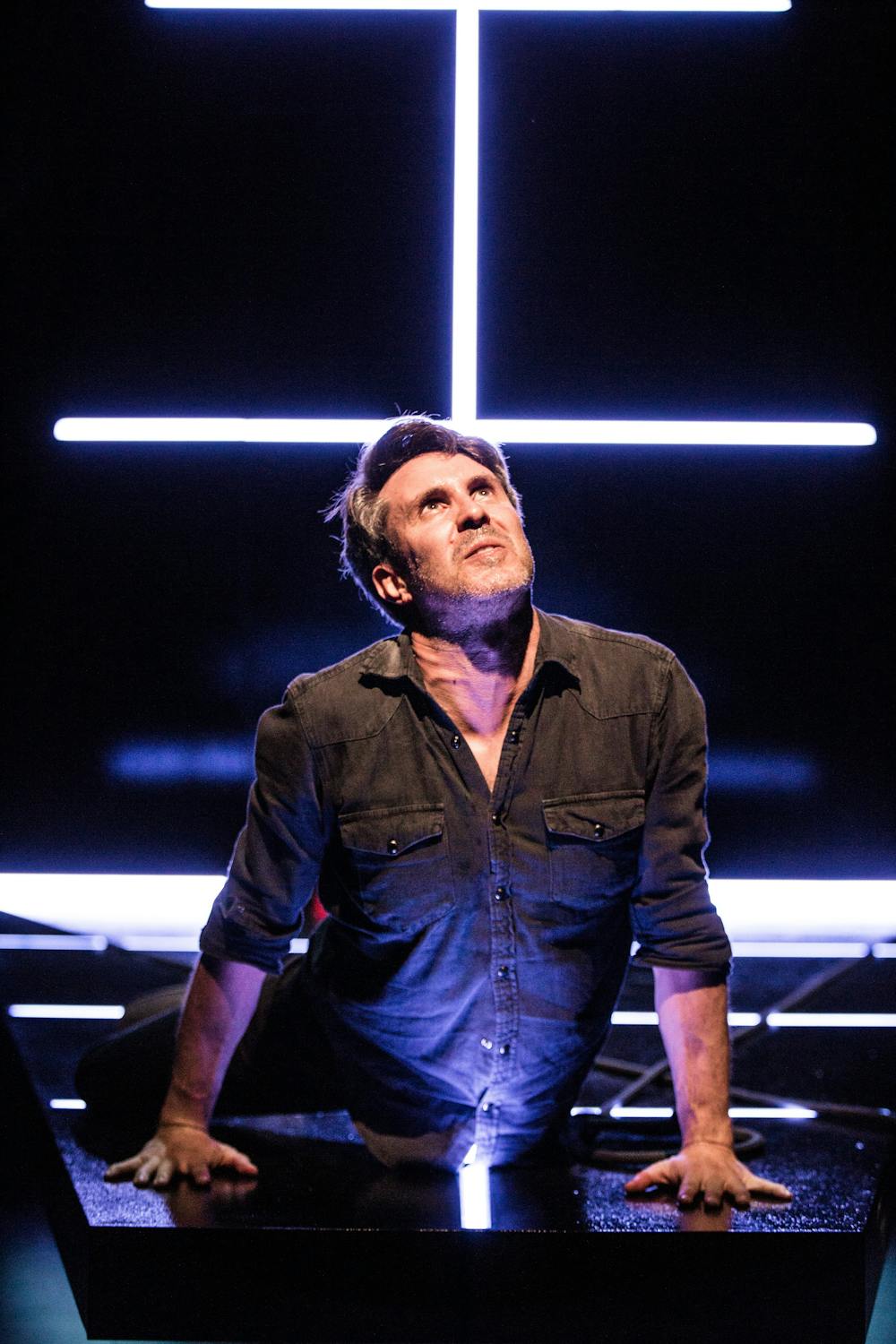
In a new one-man production, Renato Musolino brings George Orwell’s classic novella Animal Farm to life. A searing solo piece, the play showcases not only the talents of Musolino as a performer, but also its director Geordie Brookman.

Written as an allegorical critique of the 1917 Russian Revolution and the subsequent Stalinist era, Orwell’s novella details the rebellion of animals on Manor Farm against the cruel farmer Mr Jones. What follows is the establishment of a new order, an animal utopia in which all animals are equal. The animals collaboratively develop a new philosophy, “animalism” which consists of seven commandments aiming to instil a sense of pride and empowerment.

This initially egalitarian society slowly and hauntingly evolves, or rather devolves, into a system not much better than before the rebellion. A sense of unease and foreboding loomed over the production as we watched, helpless and passive, the insidious rise of the leader Napoleon and his class of pigs as rulers of the farm.

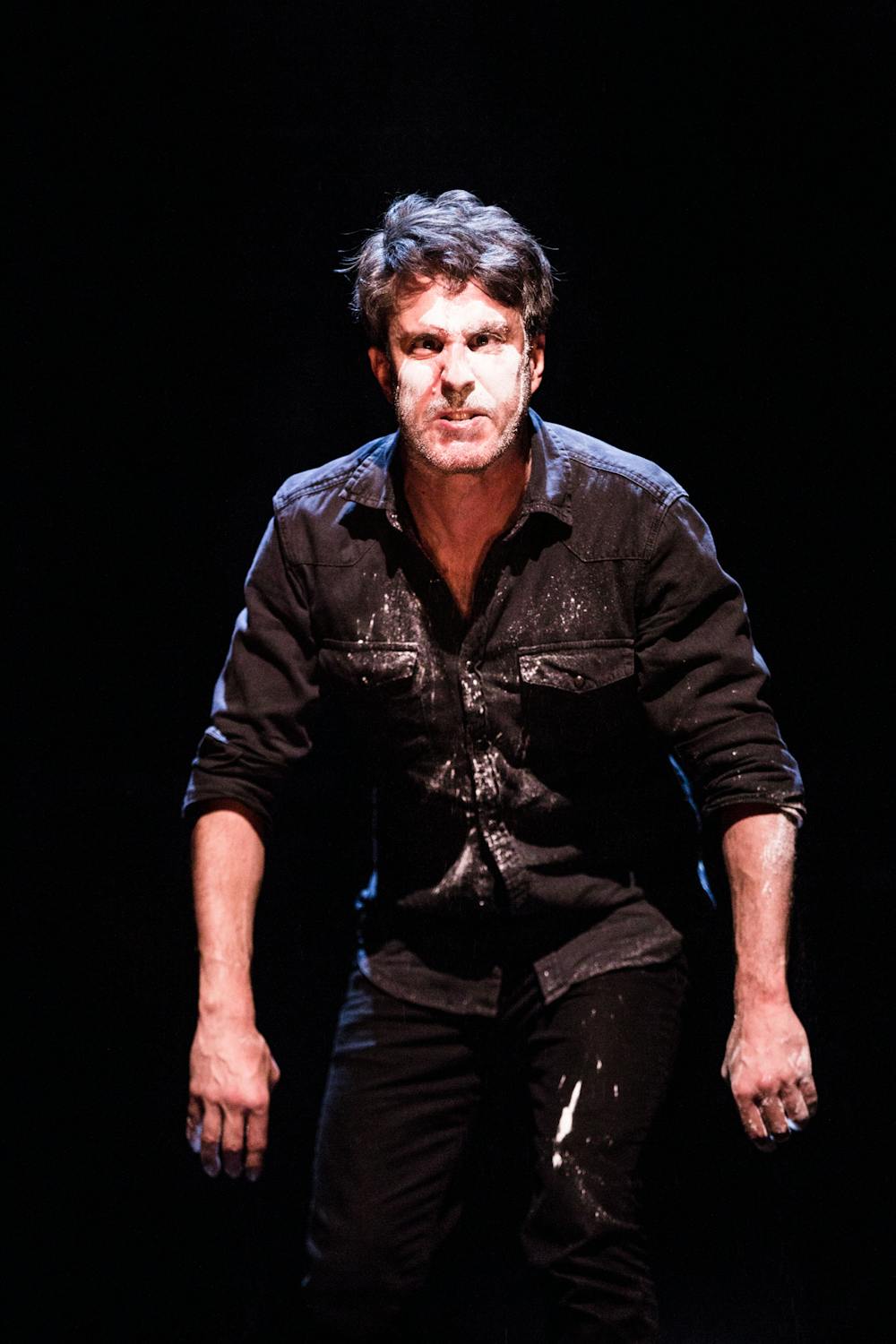
Musolino switches from narration to monologue and dialogue, voicing the many characters of Animal Farm. James Hartley

Musolino’s performance, the beating heart of this production, had the opening night audience transfixed. Switching from narration to monologue and dialogue, he portrayed the many and varied members of this new society with impressive vocal and physical transformations.

The pigs were characterised not only by snorts of laughter and squeals of delight in the face of other animals’ misery, but also by Musolino’s tensed and contorted hands, forming trotters.

The bleating banality of the sheep, the slow but deliberate philosophising of the committed workhorse, and the grumpy quips from the old donkey, along with the folk-tale lyricism of the narration, created a clear and consummate symphony of voices.

Musolino’s transitions between characters were quick but seamless. Thanks to the actor’s piercing sincerity and skill as a storyteller, the pace and dramatic tension of the story was never lost – a risk when so much falls to just one performer.

A well-structured adaptation from Brookman, the outgoing Artistic Director, ensured that Orwell’s created world – one not so far from our own – and its injustices, betrayals and exploitations, were orchestrated for maximum impact. The journey of Boxer the horse was particularly heartbreaking, crystallising the cruelty, exploitation and ruthlessness of this new society.

One of the most effective ways Napoleon and the pigs disempower the other animals is by taking away their means of communication. Leading up to the revolution, the pigs teach themselves how to read and write while only offering a cursory education to the other animals.

It is the pigs’ literacy that affords them the most power to change the rules. This quite literally occurs throughout the play, as the commandments painted on the side of the barn are amended to suit their needs. For example, “no animal shall kill another animal” eventually becomes “no animal shall kill another animal without cause”.

A mixture of straight lines and softer lighting was used in the production. James Hartley

The set, designed by Bianka Kennedy, consisted of an ominous black structure, not unlike an open coffin, tombstone or even a geometric Venus flytrap, which could close at any moment, swallowing us all. This limited space allowed for a concentrated focus on Musolino’s performance.

Straight lines informed the approach of lighting designer Alexander Ramsay on the structure itself, juxtaposed nicely with the softer lighting used to frame Musolino in quieter moments.

Andrew Howard’s soundscape, haunting but never overpowering, amplified the work’s dark intensity. The production, thanks no doubt to Brookman’s skilful direction, is technically explosive, intense and consistent with the work’s thematic concerns.

This is a production not to be seen, but experienced. It moved me to tears, stirring a seething rage within me. Such was the power of Orwell’s, Brookman’s and Musolino’s combined storytelling.

A cathartic production in the purest sense, Animal Farm evoked fear, pity, empathy, anger and recognition as the exploitation of power played out once more. The words “All animals are equal, but some animals are more equal than others” rang in our ears long after leaving the theatre.


Animal Farm is playing at the State Theatre Company of South Australia until March 30.

ref. A skilful and stirring one-man treatment of George Orwell’s Animal Farm – http://theconversation.com/a-skilful-and-stirring-one-man-treatment-of-george-orwells-animal-farm-114165

We need to stop conflating Islam with terrorism

]]>

Source: The Conversation (Au and NZ) – By Nicolas Pirsoul, Sessional lecturer in Middle Eastern Politics, Australian Catholic University

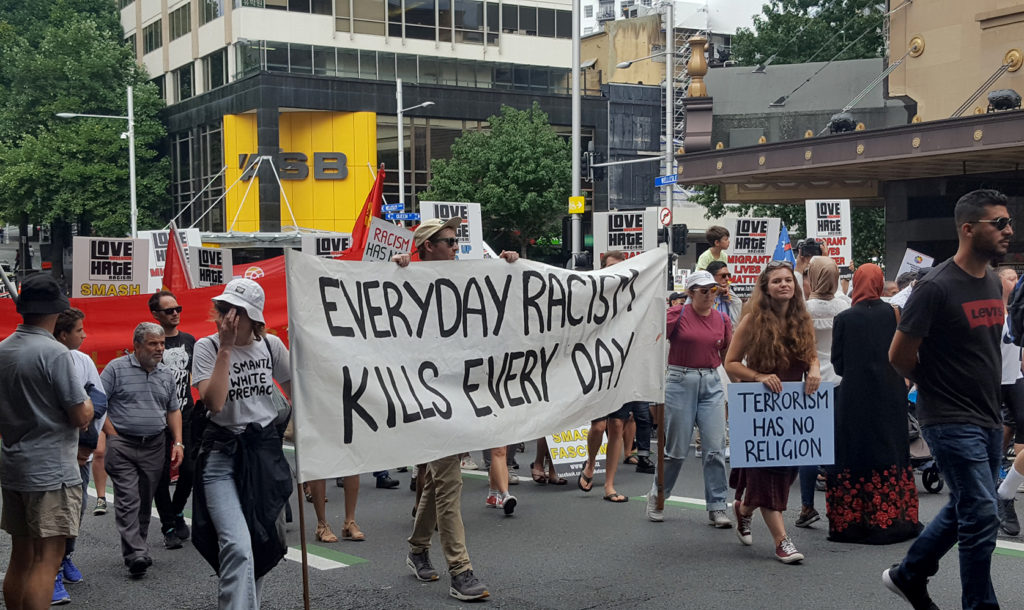
The Christchurch terrorist attack has shown us that we need to address the threat posed by far-right extremism to our ideals of peaceful social cooperation in a multicultural society. Unfortunately, in the aftermath of the shooting, some of the worst far-right commentary has blamed the Christchurch shooting on immigration laws, and Muslim communities themselves.

But these v⁠i⁠e⁠w⁠s⁠ ⁠a⁠r⁠e⁠ ⁠b⁠a⁠s⁠e⁠d⁠ ⁠o⁠n⁠ ⁠i⁠n⁠a⁠c⁠c⁠u⁠r⁠a⁠t⁠e⁠ ⁠i⁠n⁠f⁠o⁠r⁠m⁠a⁠t⁠i⁠o⁠n⁠ ⁠a⁠b⁠o⁠u⁠t⁠ ⁠I⁠s⁠l⁠a⁠m⁠ ⁠a⁠n⁠d⁠ ⁠h⁠i⁠s⁠t⁠o⁠ry⁠.

As a New Zealander academic, my work deals with questions related to Islam and multiculturalism. In the past, I have argued both that Wahhabism – the Sunni fundamentalist form of Islam practised in Saudi Arabia – is not compatible with liberal democratic values, unlike some other Islamic schools of thought.

As Muslims in the West come under attack, it is essential to understand and distinguish between these different kinds of Islamic thought and how the West responds to them. W⁠h⁠i⁠l⁠e⁠ ⁠t⁠h⁠e⁠r⁠e⁠ ⁠i⁠s⁠ ⁠a⁠ ⁠p⁠r⁠o⁠b⁠l⁠e⁠m⁠ ⁠a⁠t⁠ ⁠t⁠h⁠e⁠ ⁠g⁠l⁠o⁠b⁠a⁠l⁠ ⁠l⁠e⁠v⁠e⁠l⁠ ⁠w⁠i⁠t⁠h⁠ ⁠e⁠x⁠t⁠r⁠e⁠m⁠e⁠ ⁠S⁠u⁠n⁠n⁠i⁠ ⁠m⁠i⁠l⁠i⁠t⁠a⁠n⁠c⁠y⁠,⁠ the fact is this is a⁠ ⁠m⁠i⁠n⁠o⁠r⁠i⁠t⁠y⁠ ⁠p⁠h⁠e⁠n⁠o⁠m⁠e⁠n⁠o⁠n⁠ ⁠w⁠i⁠t⁠h⁠i⁠n⁠ ⁠I⁠s⁠l⁠a⁠m⁠ – and one that ⁠i⁠s⁠ ⁠m⁠o⁠r⁠e⁠ ⁠o⁠f⁠ ⁠a⁠ ⁠t⁠h⁠r⁠e⁠a⁠t⁠ ⁠t⁠o⁠ ⁠M⁠u⁠s⁠l⁠i⁠m⁠s⁠ ⁠i⁠n⁠ ⁠t⁠h⁠e⁠ ⁠M⁠i⁠d⁠d⁠l⁠e⁠ ⁠E⁠a⁠s⁠t⁠ ⁠t⁠h⁠a⁠n⁠ it is ⁠t⁠o⁠ ⁠W⁠e⁠s⁠t⁠e⁠r⁠n⁠ ⁠n⁠a⁠t⁠i⁠o⁠n⁠s⁠.⁠


Read more: Right-wing extremism has a long history in Australia


Islam cannot be reduced to a single idea

Right-wing commentators often make statements about Islam and Muslims that are factually incorrect. They demonise Muslims and proclaim that Islam is incompatible with Western democratic values.

But Islam cannot be reduced to a single theological framework or simplistic worldview. Complex theological debates have taken place over the centuries about the relationship between faith and reason, and the political role of Islam. This has led to a religion that contains multiple branches and schools of thought.

Critics of Islam often mistakenly conflate Islam with Wahhabism. Wahhabism is an Islamic school of thought that promotes violence towards both non-Wahhabi Muslims and non-Muslims by taking an uncritical, literalist, approach to Islamic scriptures.

While its intellectual roots can be traced back to 13th-14th century theologian Ibn Taymiyyah, it only became a genuine political movement in the mid-18th century. This is when the House of Saud entered a religio-political alliance with Muhammad ibn Abd al-Wahhab. This alliance is still the foundation of the current Kingdom of Saudi Arabia to this day.

If it was not for the West’s continuous support for the contemporary Kingdom of Saudi Arabia for almost a century, Wahhabism might have remained a marginal historical phenomenon within Islam.


Read more: Christchurch attacks are a stark warning of toxic political environment that allows hate to flourish


Muslims are often victims of Wahhabi extremism

The next move from these right-wing figures is usually to argue that Wahhabism is the essence of Islam, and that “moderate Muslims” are just not following their own sacred text. They usually proceed by cherry-picking verses from the Koran and historical narrations to prove that Muhammad was a warlord, a paedophile and a terrorist.

This completely ignores the fact that there have been debates for centuries within Islam over the historical context, interpretation, and even accuracy of these cherry-picked parts of the vast corpus of Islamic scriptures.

The rest of the scriptures and Islamic history that promotes compassion, justice, and pluralism are never mentioned. Indeed, the broader Muslim community, in many cases, not only theologically disagree with the Wahhabi interpretation of Islam, but have sometimes been victims of Wahhabi extremism themselves.

Besides being intellectually dishonest, this hostile attitude contributes greatly to anti-Muslim sentiment in the West.

Right-wing extremism reinforces Islamic extremism

By conflating Wahhabism and mainstream Islam, the far-right is creating and reinforcing the strength of its own enemy. Alienating and harassing Muslims in the West runs the risk of radicalising some of them. And making the argument that Islam is incompatible with democracy and human rights suggest that the Wahhabi reading of Islam is in fact the correct one.

This reinforces the clash of civilisation thesis that argues that Western and Islamic worldviews are so fundamentally incompatible that they are destined to perpetual conflict.

Historically, right-wing policy makers in some Western nations have reinforced the economic and military power of Wahhabi ideologues by creating alliances with proponents of the doctrine in places such as Saudi Arabia and Afghanistan. Even Israel (usually considered as a bastion of democratic values in the Middle East) is now cosying up to the Wahhabi kingdom because of their mutual fear of Iran.

Let me also highlight that most of the victims of the Wahhabi ideology were and still are Muslims themselves. From the Wahhabi sacking of Karbala in 1802, to the rise of the Taliban, al Qaeda, and Islamic State, countless innocent, mainly Muslim, lives have been lost to Wahhabism in the Middle East.


Read more: Finding dignity and grace in the aftermath of the Christchurch attack


The West must reassess its narrative about Islam

It’s natural to want to understand the deeper, root causes, of the Christchurch massacre, and the potential role played by Islamic extremism. But the culprit remains the same: those in the West who promote the idea that Islam and liberal democratic values are incompatible.

They demonise Muslim communities by conflating Islam and the Wahhabi ideology that the West has empowered for many years. Yes, there is a problematic extremist element within the Islamic world, but Western actors, mainly on the right, have aided the Wahhabi ideology in becoming a global phenomenon to the detriment of Muslims themselves.

Instead of blaming Muslim migration and Islamic extremists for the Christchurch massacre, it is time for the West to look into the mirror and reassess their own narratives and actions regarding Islam and the Islamic world.

ref. We need to stop conflating Islam with terrorism – http://theconversation.com/we-need-to-stop-conflating-islam-with-terrorism-114073

Huawei exposes critical weaknesses. We need the infrastructure to engage with China

]]>

Source: The Conversation (Au and NZ) – By Alice de Jonge, Senior Lecturer, International Law; Asian Business Law, Monash University

The European Commission has decided to ignore US calls that its allies keep Chinese tech giant Huawei away from significant telecommunications infrastructure. Britain, France and Germany had already made the same decison. So had Asian allies Thailand and India.

Australia, along with New Zealand and Japan, is among the few to follow the US lead, excluding Huawei from participating in building new 5G networks.


Read more: Huawei or the highway? The rising costs of New Zealand’s relationship with China


Is it right to endorse US national security concerns that Huawei poses an espionage threat – with US prosecutors also alleging it has stolen intellectual property and conspired to flout sanctions against technology sales to Iran?

Not necessarily.

But nor should we be naive about China’s strategic ambitions, and the part Huawei potentially plays in realising those ambitions.

We need to acknowledge the nuances and complexities that will characterise Australia’s relationship with China for the foreseeable future.

To weigh the pros and cons of each issue, the infrastructure we need to invest in is the knowledge to engage with China. Right now, too many Australian businesses and political leaders just don’t sufficiently understand China’s culture, economics and politics to make an informed assessment.

Party connections

Some of the concerns about Huawei stem from the company’s connections with Chinese government structures. The company’s founder Ren Zhengfei served as an engineer in the Chinese military. Like any successful company in China, Huawei maintains good relationships with China’s Communist Party.

Besides that, China’s national intelligence laws require all organisations and citizens to support and cooperate in national intelligence work.

Ren has stated he would defy any demand that Huawei hand over information, and also that he loves his country and supports the Communist Party. Chinese citizens, wherever they are on the globe, live their lives in high awareness of and constant negotiation with the demands and expectations of the Party/state.

It is not an experience easily understood by citizens of a multi-party liberal democracy such as Australia. How, then, should we understand the words and actions of Ren or others? And once interpreted, what would be the best response?

Threats and nuances

Billionaire fund manager and “open society” advocate George Soros told the World Economic Forum in Davos in January that China might not be the only authoritarian regime in the world, but it was the wealthiest, strongest and technologically most advanced. It had clear global ambitions, to which Chinese technology companies were inextricably connected:

My key point is that the combination of repressive regimes with IT monopolies endows those regimes with a built-in advantage over open societies. The instruments of control are useful tools in the hands of authoritarian regimes, but they pose a mortal threat to open societies.

The threat is illustrated by the treatment of entire groups, such as the Uyghurs in the Xinjiang region, and of individuals such as Australian-Chinese writer Yang Hengjun, who was detained in China on espionage charges in January.


Read more: Australian-Chinese author’s detention raises important questions about China’s motivations


Though no one seriously believes the accusations are credible, the Australian citizen could be detained for six months before police are even obliged to formally arrest him.

Language literacy

But we need to keep our fears in perspective. It is true China is ruled by an unabashed authoritarian keen to enforce ideological conformity. It is true the government is investing heavily in surveillance infrastructure. Yet the fact remains that for all the Chinese state’s efforts, Chinese society is less and less susceptible to being brainwashed into patriotic subservience. Not even the Chinese Communist Party is homogenous.


Read more: China’s Uyghur re-education centres in Xinjiang will not produce a loyal and obedient population


Australia needs to appreciate these nuances, but is handicapped by often knowing only a translated China – all too often via partisan interpreters. To better know China, and Asia more generally, we need to take language literacy seriously.

There have been attempts to push for more teaching of Chinese and other Asian languages, but they all proved unsuccessful. Earlier this month former NSW premier Bob Carr lamented that nationally just 4,000 students are learning Mandarin in high school; of those with a non-Chinese background, it’s just 380.

Universities have cut programs in in classical Chinese, historical studies and other subjects which might serve to enhance longer term understanding of Australia’s place in the region and the world, but which are seen to have no immediate practical benefits.

Without greater Chinese literacy, we in Australia are at a disadvantage in understanding China. We cannot appreciate why asserting itself as a major power after a “century of humiliation” is so important to Chinese identity. We cannot be sure it means to be called a “good friend”. We will remain deaf to Chinese tone and inner meaning.

ref. Huawei exposes critical weaknesses. We need the infrastructure to engage with China – http://theconversation.com/huawei-exposes-critical-weaknesses-we-need-the-infrastructure-to-engage-with-china-110706

From Mahometan to Kiwi Muslim: history of NZ’s Muslim population

]]>

Source: The Conversation (Au and NZ) – By Eva Nisa, Lecturer in Religious Studies, Victoria University of Wellington

Muslims make up just over 1% of New Zealand’s population and one might assume most are new to this country. But historical accounts document that Islam first arrived in New Zealand in 1769, with two Indian Muslims.

Some official documents and scholarly work mention the years 1840 and 1874 as important periods from which Muslims were first acknowledged as a group. Abdullah Drury mentions the early Muslims were mainly from British India. The 1874 government census documented 17 Mahometans living in Otago (16) and Auckland (one).

These old documents refer to Muslims and Islam as Mahometan, Mahommedan, Mohammedan, Mohemmadanism, or Muhammadanism. They are old-school terms with particular pejorative connotations, drawing on the name of the prophet Muhammad.


Read more: How to move beyond simplistic debates that demonise Islam


Immigrant family settlement

In the early 19th century, the terms Islam and Muslims were becoming more familiar in European languages through the work of Edward Lane, but in New Zealand, public use of the term Islam only became more common in later years.

New Zealand’s national Muslim organisation, the Federation of Islamic Associations of New Zealand (FIANZ), mentions the 1850s as the beginning of Muslim immigrant family settlement in the country, specifically in Christchurch. The Lyttleton Times (13 March 1858) recorded a case in the Supreme Court at Lyttleton, a small town on the outskirts of Christchurch, at which two witnesses, Wuzeera and his wife Mindia from India, were sworn in on an English translation of the Quran.

The newspaper itself used the term Mahometan to ascertain their religious identification. It also described that Wuzeera worked for Mr Wilson of Cashmere (a suburb of Christchurch) who arrived in 1854 on a ship called Akbar. Wuzeera and Mindia had four children, with the youngest two born in Christchurch in 1859 and 1861.

A growing number of Muslims arrived in New Zealand during the early 20th century. The census of 1901, mentioned 41 Mahometans. The continued history of the Muslim community in New Zealand can be traced back, as William Shepard explains, to three Gujarati men who arrived between 1906 and 1920.

The men established a small shop and brought their children from India. In the early 1950s, their children brought their family members to settle in New Zealand. The following generation were born and raised in New Zealand with most becoming community leaders.

Muslim minority in the 21st century

Today, according to Tahir Nawaz, the president of the International Muslim Association of New Zealand, New Zealand’s Muslim minority reached almost 60,000 people. Gradual changes in the government’s immigration and refugee policy, especially through the Refugee Quota Programme in 1987, have provided Muslims with additional immigration opportunities. Shepard recorded that Fijian-Indians, professional and white-collar workers, as well as international students studying at New Zealand universities under the Colombo plan, boosted the number of Muslims to 2,500 by 1986.

The 2013 census recorded around 46,000 Muslims. About 75% lived in Auckland and 25% were born in New Zealand. The latter statistic was similar in 1986 (26% born in New Zealand). Today, about half of the Muslim population are women, reflecting a steady increase from the beginning of the 20th century, when there was virtually no female presence.

Of the total number in the 2013 census, 21% were born in the Pacific Islands and 26.9% in Asia, with only 23.3% born in the Middle East and Africa.

Muslims help build cathedral

The Christchurch terror attack reminds us of the important position of the city during the advent of Islam in New Zealand. Indeed, early interfaith activity in New Zealand involved Muslims. The daily Star provided an obituary for Wuzeera (using the name Bezire). The story described how he had helped in the construction of Christchurch Cathedral by transporting stones from the Port Hills quarry. As Drury also mentioned, this could be considered the earliest contribution by Muslims to the history of Christianity in New Zealand.

The obituary can be seen as a public appreciation of Wuzeera or Wuzerah’s contribution to a symbol of Christianity. Some local newspapers in Christchurch, Auckland, Otago, and Wanganui republished it.

Throughout New Zealand’s development, Muslims have been seen as a moderate and peaceful minority. Muslim organisations, especially FIANZ, occasionally respond to contested issues related to Muslims elsewhere, including Salman Rushdie’s Satanic Verses and the Danish cartoon controversies. But Muslim leaders and organisations publicly condemn any form of extremism.


Read more: Thirty years on, why ‘The Satanic Verses’ remains so controversial


It is noteworthy that maintaining a peaceful atmosphere within Muslim communities themselves is not without challenge. Moderate Asian Muslims are significant in numbers, but Muslims in New Zealand come from several countries and the community is ethnically diverse.

Although the contestation between moderate and conservative understandings of religion cannot be denied, the vast majority of Muslim leadership holds moderate views. Therefore, in 2016, FIANZ’s national board of ulama (Muslim scholars) took strong action when an imam (Muslim cleric) in Auckland delivered an antisemitic comment in his speech.

Being Kiwi Muslim

Considering the peaceful nature of Muslims in New Zealand, it is not surprising that the families of the victims remained generous and Muslim leaders reacted without anger to the tragedy. This does not only refer to the very foundation of Islamic teachings but also to New Zealand’s culture, which has established an atmosphere of compassion.

Facing this tragedy, many Muslims have been amazed by the outpouring of sympathy, love and support from New Zealanders. This includes financial support, vigils, a national two-minute silence, the broadcast of the call to prayer through public broadcasting stations and solidarity with veil-wearing Muslim women.

Receiving the vast support from their compatriots in New Zealand, Muslims have actively expressed their gratitude and appreciation to all New Zealanders, as acknowledged by the imam during the first Friday prayer after the mass shootings.

We are broken-hearted but we are not broken.

As scholars in Islamic studies, we have been contacted by local and international media outlets to share our thoughts and reflections as New Zealanders. We live in this country, we see and we feel what it means to be Muslims in New Zealand. New Zealanders do not have to be taught how to express their compassion and love to their Muslim compatriots, because we have lived with these values for decades.

ref. From Mahometan to Kiwi Muslim: history of NZ’s Muslim population – http://theconversation.com/from-mahometan-to-kiwi-muslim-history-of-nzs-muslim-population-114067

Stowaway mozzies enter Australia from Asian holiday spots – and they’re resistant to insecticides

]]>

Source: The Conversation (Au and NZ) – By Tom Schmidt, Research fellow, University of Melbourne

Planning a trip to the tropics? You might end up bringing home more than just a tan and a towel.

Our latest research looked at mosquitoes that travel as secret stowaways on flights returning to Australia and New Zealand from popular holiday destinations.

We found mosquito stowaways mostly enter Australia from Southeast Asia, and enter New Zealand from the Pacific Islands. Worse still, most of these stowaways are resistant to a wide range of insecticides, and could spread disease and be difficult to control in their new homes.


Read more: Why naming all our mozzies is important for fighting disease


Secret stowaways

Undetected insects and other small creatures are transported by accident when people travel, and can cause enormous damage when they invade new locations.

Of all stowaway species, few have been as destructive as mosquitoes. Over the past 500 years, mosquitoes such as the yellow fever mosquito (Aedes aegypti) and Asian tiger mosquito (Aedes albopictus) have spread throughout the world’s tropical and subtropical regions.

Dengue spread by Aedes aegypti mosquitoes now affects tens to hundreds of millions of people every year.


Read more: Explainer: what is dengue fever?


Mosquitoes first travelled onboard wooden sailing ships, and now move atop container ships and within aircraft.

Adults in your luggage

You probably won’t see Aedes mosquitoes buzzing about the cabin on your next inbound flight from the tropics. They are usually transported with cargo, either as adults or occasionally as eggs (that can hatch once in contact with water).

It only takes a few Aedes stowaways to start a new invasion. In Australia, they’ve been caught at international airports and seaports, and in recent years there has been a large increase in detections.

Aedes aegypti mosquito detections per year at Australian international terminals – passenger airline terminals in white; seaports or freight terminals in black. Tom Schmidt, Author provided


Read more: Curious Kids: When we get bitten by a mosquito, why does it itch so much?


In our new paper, we set out to determine where stowaway Aedes aegypti collected in Australia and New Zealand were coming from. This hasn’t previously been possible.

Usually, mosquitoes are only collected after they have “disembarked” from their boat or plane. Government authorities monitor these stowaways by setting traps around airports or seaports that can capture adult mosquitoes. Using this method alone, they’re not able to tell which plane they came on.

But our approach added another layer: we looked at the DNA of collected mosquitoes. We knew from our previous work that the DNA from any two mosquitoes from the same location (such as Vietnam, for example) would be more similar than the DNA from two mosquitoes from different locations (such as Vietnam and Brazil).

So we built a DNA reference databank of Aedes aegypti collected from around the world, and compared the DNA of the Aedes aegypti stowaways to this reference databank. We could then work out whether a stowaway mosquito came from a particular location.

We identified the country of origin of most of the Aedes aegypti stowaways. The majority of these mosquitoes detected in Australia are likely to have come from flights originating in Bali.

Here’s where the Aedes aegypti mozzies come into Australia and New Zealand from. Tom Schmidt, Author provided

Now we can work with these countries to build smarter systems for stopping the movement of stowaways.

As the project continues, we will keep adding new collections of Aedes aegypti to our reference databank. This will make it easier to identify the origin of future stowaways.

New mosquitoes are a problem

As Aedes aegypti has existed in Australia since the 19th century, the value of this research may seem hard to grasp. Why worry about invasions by a species that’s already here? There are two key reasons.

Currently, Aedes aegypti is only found in northern Australia. It is not found in any of Australia’s capital cities where the majority of Australians live. If Aedes aegypti established a population in a capital city, such as Brisbane, there would be more chance of the dengue virus being spread in Australia.

The other key reason is because of insecticide resistance. In places where people use lots of insecticide to control Aedes aegypti, the mosquitoes develop resistance to these chemicals. This resistance generally comes from one or more DNA mutations, which are passed from parents to their offspring.


Read more: The battle against bugs: it’s time to end chemical warfare


Importantly, none of these mutations are currently found in Australian Aedes aegpyti. The danger is that mosquitoes from overseas could introduce these resistance mutations into Australian Aedes aegpyti populations. This would make it harder to control them with insecticides if there is a dengue outbreak in the future.

In our study, we found that every Aedes aegpyti stowaway that had come from overseas had at least one insecticide resistance mutation. Most mosquitoes had multiple mutations, which should make them resistant to multiple types of insecticides. Ironically, these include the same types of insecticides used on planes to stop the movement of stowaways.

Other species to watch

We can now start tracking other stowaway species using the same methods. The Asian tiger mosquito (Aedes albopictus) hasn’t been found on mainland Australia, but has invaded the Torres Strait Islands and may reach the Cape York Peninsula soon.

Worse still, it is even better than Aedes aegypti at stowing away, as Aedes albopictus eggs can handle a wider range of temperatures.

A future invasion of Aedes albopictus could take place through an airport or seaport in any major Australian city. Although it is not as effective as Aedes aegypti at spreading dengue, this mosquito is aggressive and has a painful bite. This has given it the nickname “the barbecue stopper”.

Beyond mosquitoes, our DNA-based approach can also be applied to other pests. This should be particularly important for protecting Australia’s A$45 billion dollar agricultural export market as international movement of people and goods continues to increase.


Read more: Explainer: what is Murray Valley encephalitis virus?


ref. Stowaway mozzies enter Australia from Asian holiday spots – and they’re resistant to insecticides – http://theconversation.com/stowaway-mozzies-enter-australia-from-asian-holiday-spots-and-theyre-resistant-to-insecticides-113999

Missed something the doctor said? Recording your appointments gives you a chance to go back

]]>

Source: The Conversation (Au and NZ) – By Amelia Hyatt, Senior Researcher, Peter MacCallum Cancer Centre

You’re in a consultation with your doctor and you’ve just been told you have cancer. You’re in shock, and find it difficult to take in anything else the doctor says during the remainder of the appointment.

Research shows receiving bad news can impact people’s ability to understand and absorb information. Specifically, it affects the processing of information and memory formation.

People who are unwell and managing difficult health situations will often find it hard to remember important and complex medical information. This might include their diagnosis, prognosis, treatment plans, appointments, and when to take their medication.


Read more: How much time have I got, doc? The problems with predicting survival at end of life


Since the 1970s, researchers have been experimenting with audio recording medical consultations to combat this problem.

Many studies and reviews since then have found patients who are given personalised recordings of their medical consultations feel their recall and understanding is improved.

We don’t yet have evidence that directly links the recording of medical consultations with improved health outcomes. But we know people who understand and remember important medical information are better placed to remember to attend scheduled appointments, to decide on the best treatment options, and to take their medication correctly.

This is commonly referred to as health literacy, and people with higher health literacy are known to have improved health outcomes. So we have good reason to believe recording medical appointments might positively impact people’s long-term health.

Could recording your medical appointments benefit you?

While most research around medical consultation recordings has been done with people diagnosed with cancer, the process could help any person in any medical situation.

People who speak English as a second language find recordings of medical consultations particularly useful.

And consultation recordings are not just useful for patients. Family members and friends often play a significant part in the care of a loved one who is unwell. Recordings give them the opportunity to be involved and informed – even if they cannot attend the appointment in person – as recordings are easily shared.

Patients in a recent study described using the recording to replay important sections to their family, to remind themselves of words to look up, and to prompt questions to ask their doctor.

You may like to record a medical appointment to be able to share the information with close family members. From shutterstock.com

In addition, recordings have been shown to improve patient trust and satisfaction with their doctor.

Health professionals including doctors and nurses believe consultation recordings benefit patients, and improve the care they are able to provide.

Patients have described which appointments they feel are most useful to record. These include appointments at diagnosis of a health condition, appointments where important information is discussed, or appointments where treatment plans are made. Others think recording every appointment would be useful for them.

The great thing about recordings is they are under the control of the patient, so they can be made and used in the way that suits the person best.


Read more: If privacy is increasing for My Health Record data, it should apply to all medical records


Ethical considerations

People are already using their mobile phones to record their doctors’ appointments. One study from the UK found 69% of people were interested in recording consultations on their phones.

Although this is usually done with the doctor’s permission, it’s sometimes done covertly. This may diminish the trust and openness that should characterise any doctor-patient relationship, and may even be unlawful in some states.

So you should always seek your doctor’s permission before recording.

Importantly, if a health service endorses and provides a means for you to record your medical consultations, the recording is seen as forming part of your medical record.

By law in Australia, hospitals have a responsibility to safely store all parts of your medical record, including copies of consultation recordings made in this context.


Read more: Who’s listening? The ethical and legal issues of developing a health app


Our team at the Peter MacCallum Cancer Centre has developed a smartphone app called SecondEars as part of a research project. This app will enable patients to record their consultations and share the recordings with family and friends.

Importantly, because this app has been designed to be integrated and supported by hospitals and other health services, once it’s implemented in a health service, recordings will be able to be uploaded and saved in the patient’s medical record.

Patients will have full control over which appointments they seek to record. It is hoped this service will be made available to health services around Australia in the future.

ref. Missed something the doctor said? Recording your appointments gives you a chance to go back – http://theconversation.com/missed-something-the-doctor-said-recording-your-appointments-gives-you-a-chance-to-go-back-112302

Aussie parents are under pressure to buy their kids academic advantage too

]]>

Source: The Conversation (Au and NZ) – By Kellie Bousfield, Associate Head of School, School of Education, Charles Sturt University

Allegations of parents cheating and bribing top-tier universities in the US to secure their children’s admission have caused a media storm in recent weeks. Those indicted included members of the Hollywood elite.

The US attorney said “there can be no separate college admissions system for the wealthy”. The parents’ actions were denounced, in a system that claims it does not, and will not, allow parents to purchase academic success.

But the reality is that the education system feeds into the “choice” parents make. In Australia, and elsewhere, the system doesn’t favour academic merit, but parental wealth. Instead of meritocracy, we see a parentocracy – the actions and wealth of parents act as key determinants of a child’s academic success.


Read more: College admission scandal grew out of a system that was ripe for corruption


Parentocracy not meritocracy

Caregivers using privilege to buy their children’s way into, and through, education is not a Hollywood anomaly, nor the domain of elites.

Governments and education officials may claim education systems are pillars of meritocracy, with effort and ability key to success. But the middle class have long being recognised for their ability to use their economic and cultural resources to negotiate education systems on behalf of their children.

For example, research demonstrates Australian parents use economic resources to:


Read more: Location matters most to parents when choosing a public school


Education policy and parenting

It’s too simplistic, however, to write off the actions and spending of parents as a personal choice made only to seek educational advantage for their children. The way we parent reflects more than an individual’s choice. Parenting practice echoes the society we parent in and the institutions (including schools) we interact with.

If we are to talk about parents’ interactions with schools, we must also reflect on government policy.

Let’s consider NAPLAN and the My School website. The introduction of NAPLAN in 2008 and My School in 2010 was a significant change for Australian parents. For the first time, they received student reports that measured not only their child’s individual achievement but their achievement against other students in their school and against a national average. My School allowed comparison of whole school results with other schools nationwide.


Read more: Why poor kids continue to do poorly in the education game


Government touted both policies as means to individualism – providing freedom and opportunity for parents to enhance their “informed choice” in decisions involving their child’s education. But, for some parents, new information resulted in new pressures and new obligations.

Parents want the best for their child. from shutterstock.com

As a case in point, research tells us NAPLAN has resulted in anxiety for some parents, and many are concerned about how NAPLAN results are used. In one study, parents said they were worried about requests from secondary schools to bring NAPLAN reports along to interviews prior to enrolment.

For many this means NAPLAN is not just a source of information. Poor results could pose an educational risk. And parents are trying to negate that risk.

To alleviate perceived risk, parents have participated in an ever-growing NAPLAN market. The sale of NAPLAN practice test books, for example, almost doubled from 2011 to 2012. Private tutoring and coaching colleges offering targeted NAPLAN services have seen exponential growth. An estimated one in seven Australian school children attend tutoring outside of school.

Under these conditions, parents using their economic resources is about more than educational advantage. Arguably, it is also about an obligation to act to guard against educational risk.

Parents don’t act alone

German sociologists Beck and Beck-Gernsheim argue parenting and parenting actions must be understood in the context of policy, institutions and how this translates to parents. They call this “individualisation”. In these conditions:

it is no longer enough to accept the child just as it is […] the child becomes the focus of parental effort […] there is a whole new market with enticing offers to increase your child’s competence, and soon enough options begin to look like new obligations […]

The key word here is obligation.

Individualisation is not individualism. Individualism assumes parents have a choice. Individualism provides parents with freedom and opportunity to act. Individualisation is the obligation to act – an obligation to protect against real or perceived educational risk.

If we are to critique parents’ practice, we must also critique the system they parent in. With this in mind, the reasons behind parents’ intervening in their children’s education may be more complicated than we think.


Read more: How your parents’ level of education affects your chances


ref. Aussie parents are under pressure to buy their kids academic advantage too – http://theconversation.com/aussie-parents-are-under-pressure-to-buy-their-kids-academic-advantage-too-113758

Worn, uneven, flooded: young people need better parks to get out and play

]]>

Source: The Conversation (Au and NZ) – By Deborah Ascher Barnstone, Professor, Associate Head of School, School of Architecture, University of Technology Sydney

Who wants to play sport in the mud and muck? Or have to climb a fence to play?

After an observational, private audit of the condition of Sydney sports facilities, we found that these are the types of choices young people face. To engage more young people in sport, we need to create environments that are youth-centred in terms of quality and accessibility.

Our audit found the quality of almost all of the 26 parks in Sydney’s inner west was substandard.


Read more: Our ‘sporting nation’ is a myth, so how do we get youngsters back on the field?


Toilet blocks were usually dirty, if available for use at all. Most playing fields were grassy, but with patches of dirt, worn areas and uneven surfaces with no proper water drainage. In many cases, painted lines were badly worn or missing. Court surfaces were in similar disrepair.

But a recent survey of 1,100 people aged 9-17 from the same area suggests design factors related to access, rather than poor-quality facilities, are even greater barriers to sport participation.

Designing better accessibility

We usually think of access in terms of disabled and elderly community members. But urban, neighbourhood and park design affect accessibility for every demographic. Access related to the cost of sport has been well studied and recently addressed in New South Wales with the voucher program, but the design aspects are equally important.

These include: public transport options, location, range of sports, adaptability to weather, lighting and after-dark security, and provision for the sports young people want to play.

Our research confirms the importance of accessibility. Of the survey respondents who were active, 77% said they play at a neighbourhood park, with 72% reporting they walk there.

But 52.2% said they cannot play the sport they’d like in their local area. And 64% reported that where they play is not accessible for unstructured play.

The state of Sydney’s parks

Most public sport facilities in Sydney’s inner west are located in public parks. While greenery around these sports fields and courts makes the environment more attractive, it’s more costly to maintain sport facilities than green space. With limited funds available, councils must prioritise. Since everyone can enjoy the greenery, funds usually go there first.

Patches of dirt, worn areas and uneven surfaces are common in the sport facilities in Sydney’s inner west. Author provided, Author provided

Almost all the parks we audited were largely without fencing or other barriers, which means that, in theory, anyone can use them at any time. Yet many young people complained about fenced and locked facilities, and fields dominated by club programs.

And while our audit found park maintenance to be below standard, most of the young people surveyed didn’t think so: 70% reported the place where they play is clean; 64% said it is well maintained; and 67% said it is safe.

This discrepancy suggests a difference between objective measures of quality and people’s experience of a place.

Design issues

Both perceived quality of and access to the environment can affect physical activity, and our data suggest access is more important for young people.

Being close to residential areas and public transport are important design features. To maximise use, parks and sport facilities must be integrated into neighbourhoods, rather than placed on their edges.

But of the 26 parks we studied only five had adequate public transport access. Five had no public transport access whatsoever. Many were on the edge, rather than in the middle, of a residential neighbourhood.


Read more: Pay to play: is participating in sport becoming too expensive for everyday Australians?


Facilities also tend to accommodate only one or two sports. This may mean they’re being underused and not attracting families with children of different ages or different sport interests.

Another related design issue is the lack of facilities that accommodate the weather. There are very few artificial fields and too many fields sited on floodplains. Only a handful of sport areas are covered to allow for play in bad weather. This was reflected in our survey, as only 36% of young people said they can play sport in any weather.

Parks don’t accommodate free play

Around half of all respondents participated in highly structured coach-led practice at least twice a week and 67.5% engaged in unstructured play for the same amount of time. This shows our parks and green spaces need to be designed for both structured sport and unstructured free play. But designs for unstructured free play are usually directed at young children not adolescents.

And although the audit found footpaths and parking lots were generally well lit, few sports fields had adequate lighting for play at night. Giving teenagers in particular, who are burdened with homework and time constraints, the opportunity to play at almost any hour should increase use.

So what would an ideal sports facility look like?

It would be located in the middle of a neighbourhood with several bus lines and other public transport stops connecting there for better access. Many different sports would be available. It would include a cafe for parents to hang out in and a playground for children who are too young to play sport.

Most importantly, it would be well maintained and beautifully designed so that people would want to be there.


Read more: Electronic games: how much is too much for kids?


ref. Worn, uneven, flooded: young people need better parks to get out and play – http://theconversation.com/worn-uneven-flooded-young-people-need-better-parks-to-get-out-and-play-111615

Frydenberg should call a no-holds-barred inquiry into superannuation now, because Labor won’t

]]>

Source: The Conversation (Au and NZ) – By Peter Martin, Visiting Fellow, Crawford School of Public Policy, Australian National University

The Coalition is running out of time to do worthwhile things.

Facing overwhelming odds of defeat in the election due within weeks, one of its last throws of the dice should be to do something Labor would never do, but which is urgently needed and would set us on the right course for the future.

It’d also cause some trouble for Labor along the way.

It is to launch a full-blown inquiry into the superannuation system Labor has lumbered us with.

Source: Australian Tax Office

It’s urgent because compulsory super contributions are scheduled to climb from the current 9.5% of salary to 12%, beginning with an increase of 0.5% in July 2021, followed by an extra 0.5% in 2022, 2023, 2024 and 2025.

If that seems rapid, and painful, it is because it is due to happen at twice the rate it has been.

Under the schedule imposed by Labor when it was last in office compulsory contributions were to climb by 0.25% of salary in each of 2013 and 2014 and then at twice the rate, by 0.5%, in each of the five years after that.

Compulsory super is set to jump..

The Coalition hit pause after 2014 just before the rate accelerated, postponing the series of five much bigger increases until 2022, when it might have hoped that wage growth would be robust enough to cope with it, or when it would have been someone else’s problem.

Labor says it will stick to that schedule, presumably regardless of wage growth or other economic conditions or the need for extra super contributions at the time.

Asked, ahead of the release of the Productivity Commission’s report on how to make super funds more efficient, whether Labor would reconsider the schedule if the Commission found other ways to boost retirement incomes, Labor Treasury spokesman Chris Bowen said it would not.

It’s almost as if – to Labor – lifting compulsory super contributions has the status of a holy writ; perhaps because it would “complete the work” of Labor elder statesman Paul Keating who introduced compulsory super, or perhaps because so many union officials are tied up with the running of the funds that would benefit from the schedule of increases.

In the event the Productivity Commission report released on January 10 found ways to massively lift retirement incomes without lifting super contributions.

…whether we need it or not

It found unintended multiple accounts and the defaulting of new workers into entrenched underperforming funds were costing members an astonishing A$3.8 billion per year.

Weeding out the chronic underperformers, clamping down on unwanted multiple accounts and insurance policies, and letting workers choose funds from a short menu of good ones and stay in them for life would give the typical worker entering the workforce an extra A$533,000 in retirement.

Even a typical worker aged 55 today would get an extra A$79,000 in retirement.

What the Commission’s report couldn’t say, but stongly implied, was that if the Commission’s recommendations were adopted an increase in costly compulsory contributions might not be necessary.

Its terms of reference limited it to assessing the “efficiency and competitiveness” of what happened to the contributions that were collected.

Henry was unconvinced

Another inquiry – less hamstrung – was the Henry Tax Review. It found no need to increase contributions. Labor treasurer Wayne Swan dishonoured its findings by announcing the proposed increase in contributions on May 2, 2010, the day he released its report.

But super wasn’t the main focus of the Henry Review. In the 25 year history of compulsory super, there has never been an inquiry into what the rate should be and what the system has achieved. It’s as if governments of both types have been keen to govern blindly.

So in January the Productivity Commission tentatively ventured beyond its brief, in a recommendation Treasurer Josh Frydenberg has promised to respond to before the election.

It is Recommendation 30, for an independent inquiry into the entire system.

The independent inquiry would determine whether or not the system we’ve had for the past 25 years has boosted national or even private savings rates, as well as who it has hurt and who it has helped.

They are the type of questions you would think a government would want to answer before lifting compulsory contributions further from 9.5% of salary to 12%.

Frydenberg could show leadership…

Indeed, Recommendation 30 explicitly asks that the inquiry “be completed in advance of any increase in the superannuation guarantee rate”.

It is possible to guess what the inquiry would find:

  • that almost all increases in employers’ compulsory super contributions come out of what would have been wages, depressing workers take home pay, a finding that will not be seriously disputed

  • that the system hasn’t boosted national savings – the increase in private savings has been offset by the decrease in government savings brought about by the use of the super tax concessions

  • that the increase in private savings has come almost entirely from the middle to low earners who have been unable to escape the impact of the levy, because they have had no other savings they could cut. They are the people who could least afford to save more at the time they were forced to

  • the tax benefits have gone overwhelming to the high earners who are saving no more than they would have without them, and without compulsion

In sum, the inquiry is likely to find that the system is regressive and cruel. Or perhaps not. We won’t know until it is held.

It ought to be conducted by an expert panel whose members are highly respected and who will amass evidence the next government won’t be able to ignore.

…ensuring Labor does more than look after mates

Frydenberg ought to appoint the panel now, or within weeks, so that an incoming Labor government can’t dismantle it.

It would be one of his most important legacies. And would give him something to press the next government about should he be in opposition.

In time an incoming Labor government might thank him.

At present, without the scheduled increases in compulsory super, wage growth is just 2.3%. With the scheduled increases of 0.5 percentage points per year, wage growth might fall below the rate of inflation, for five consecutive years.

No sensible treasurer would allow that happen. By doing what’s right, Frydenberg might be giving Bowen an out.


Read more: Productivity Commission finds super a bad deal. And yes, it comes out of wages


ref. Frydenberg should call a no-holds-barred inquiry into superannuation now, because Labor won’t – http://theconversation.com/frydenberg-should-call-a-no-holds-barred-inquiry-into-superannuation-now-because-labor-wont-114079

Sam and the honest broker: why Commissioner Hayne wants mortgage brokers to charge fees

]]>

Source: The Conversation (Au and NZ) – By Kevin Davis, Research Director of Australian Centre for FInancial Studies and Professor of Finance at Melbourne and Monash Universities, Australian Centre for Financial Studies

The Royal Commission recommendation that mortgage broker commissions, currently paid by lenders, should be replaced by up-front fees paid by borrowers, has been controversial to say the least.

Royal Commissioner Kenneth Hayne wanted to eliminate first the “trail”, or annual ongoing commission paid by lenders to brokers, and then the larger upfront commission.

Brokers would instead be paid by the borrowers who use them, in the same way they pay for conveyancers, removalists, and other service providers.

At first, Treasurer Josh Frydenberg agreed, saying that from July 1, 2020, he would outlaw trail commissions on new loans and after three years would ask the Council of Financial Regulators and the Competition and Consumer Commission to review the impact of the changes and the implications of eliminating upfront commissions.

Then, five weeks later, he reversed, saying:

Following consultation with the mortgage broking industry and smaller lenders, the Coalition government has decided to not prohibit trail commissions on new loans, but rather review their operation in three years’ time.

Brokers, wanting to keep things as they are, scored a victory. But maybe not for long.

Labor is still promising to abolish trail commissions, and to at least limit the size of upfront commissions.

The caution – on both sides of politics – is understandable. Changing the way people get paid is disruptive, and might cost them business if what they are charging is made apparent up front.

But it has sound economic underpinnings.

They can be seen by considering a hypothetical conversation between a prospective mortgage borrower, Sam, and the (economics-trained) mortgage broker (MB) she has approached.

Sam and the honest broker

MB: You know we don’t charge you any fees?

Sam: Great, but how do you earn a living – who pays for your time and effort?

MB: The lender that we place your loan with pays us a commission.

Sam: So that’s presumably out of the interest I will pay on the loan? So I’m paying you indirectly?

Yes.

So couldn’t I just go directly to the bank and ask for a lower interest rate, by cutting out the middleman (you)?

You could try, but I save the bank some of the costs of attracting and dealing with potential borrowers. Ultimately, it’s probably cheaper for the bank to pay me than to do all that itself. So they probably wouldn’t offer you a lower interest rate for a direct approach.

What would happen if instead I had to pay you an upfront fee, rather than you getting a commission from the bank, as the Royal Commission proposes?

It’s complicated. First question: would I charge fees to all clients who use my services, or only to those who ultimately get a loan through me?

Currently only clients who get loans through you pay, right?

That’s right, so to keep it simple let’s assume fees would only be charged to successful loan applicants. Let’s also make some more simplifying assumptions.

Okay.

Assume the desired loan is A$500,000 for five years, with annual interest-only payments, and principal repayment due at the end. The bank charges an interest rate to cover its cost of funds (including its profit and risk margin) and the operating expense associated with the loan.

Let me guess: part of the operating expense is either the commission payments made to you, or the costs the bank would bear instead if it did your work itself?

Correct. Suppose my commission on such a loan is 0.1%, which is A$500 per year or A$2,500 all up. That just covers my costs. If the lender were to deal with you directly, it might incur an extra (say) A$2,500 of costs, which it would need to incorporate into the interest rate charged to you.

So if I were to pay you a fee as the Royal Commission has recommended, I could pay you A$2,500 upfront and you could negotiate with the lender to charge me a lower interest rate (0.1% in your example) because I have gone through you instead of approaching them directly?

Correct!

But that’s A$2,500! It’d be worth it because I would save that much money, and better for me because you would be putting my interest first, instead of that of the lender and your own commission. But I would need to find that much upfront on top of the deposit for the house.

That’d be easily dealt with. You would take out a loan for A$502,500, of which A$2,500 would go to pay my fee, so you would need to pay nothing extra upfront. And the lower interest rate means you’d get it back. Your total interest payments would be the same as if you’d borrowed A$500,000 as before.

Okay, so why exactly would it be better for me?

First, I would be clearly working for you rather than for the bank (particularly given Hayne’s other recommendations to prevent banks giving me “soft commissions” such as furniture, payments for “shelf space”, bonuses for volume, overseas trips, and so on). You could decide whether to employ me based on whether I delivered value or not. Second, if my fees weren’t related to loan size (and broker competition would likely lead to that outcome), I would have no incentive to push you into borrowing more than you needed.

Okay, but what about the problem of less scrupulous brokers falsifying application data to get customer loans approved?

I don’t think that would change, because the broker’s income would still depend primarily on the number of loans written. That’s where the other recommendations about clients’ best interest obligations and increased scrutiny of bank risks from outsourcing of duties to brokers would come in.

I’m game. Are you?


Read more: Vital signs. It’s one thing to back down on Hayne’s recommendation about mortgage brokers, it’s another to offer nothing in its place


ref. Sam and the honest broker: why Commissioner Hayne wants mortgage brokers to charge fees – http://theconversation.com/sam-and-the-honest-broker-why-commissioner-hayne-wants-mortgage-brokers-to-charge-fees-114071

Lascivious virgins and lustful itches: women’s masturbation in early England

]]>

Source: The Conversation (Au and NZ) – By Paige Donaghy, PhD Student, The University of Queensland

In our sexual histories series, authors explore changing sexual mores from antiquity to today.


In the 18th and 19th centuries, masturbation was thought of as a “disease”, capable of causing psychological or physical damage like blindness or insanity. This medical and moral panic surrounding masturbation can still shape beliefs today.

Little is known about the history of women’s solo sex, in particular, partly because the study of women’s history is itself a relatively recent development. Still, an exception is the historical period known as early modern England (between 1500 – 1800).

Descriptions of women’s masturbation in this period, especially from 1600 – 1700, are seemingly everywhere: in poetry, literature, theatre, popular ballads, diaries, pornographic texts, midwifery guides and medical books.

Typically, women in early modern England were expected to be pious and chaste, and erotic behaviour was deemed appropriate only within the space of heterosexual marriage. Despite this, there was both a cultural and medical understanding that women experienced sexual desire and pleasure.

Picture of a woman’s uterus, Berengarius, 1523. Wellcome Collection, CC BY

In medical texts it was suggested that in order for conception to occur, a woman had to experience an orgasm, preferably at the same time as the man. Advice given in the English translation of French surgeon Ambroise Paré’s medical treatise suggested that: “when the husband commeth into his wive’s chamber hee must entertaine her with all kinde of dalliance” and give her “wanton kisses with wanton words and speeches”. This would help the woman to orgasm and would better the chances of pregnancy.

Medical texts also promoted the idea that unmarried women could suffer physical ailments because of a lack of sexual activity. It was widely believed that women had their own type of semen, or “female seed”, which contributed to procreation. A build up of this seed, due to lack of sexual release, could cause a range of disorders, like “madness from the womb”.

Descriptions of masturbation

These medical ideas were also prominent within broader society, where virgins and widows were viewed as particularly lustful women. Representations of unmarried women’s sexual desires were often humorous, like the ballad “The Maids Complaint For Want of a Dil Doul [dildo]”, published around 1680.

The poem describes a young woman’s quest for a “dil doul”, or a lover to take her “maiden-head”, to cure her of the “strange fancies” that came into her mind at night.

Such texts indicate a familiarity with women’s sexuality, but the most common descriptions of women’s masturbation appear in medical and midwifery texts. This is interesting because towards the end of the 1600s, these texts were increasingly aimed toward female readers and female midwives. This may suggest that medical authors had some knowledge that women did masturbate, and that their female readership would recognise such behaviour.

For example, English physician Nicholas Culpeper’s 1662 edition of his Directory for Midwives refers to young women’s masturbation. In a discussion on whether the hymen was the “sign of virginity”, he believed that the hymen:

is not to be found in all Virgins, because some are very lustful, and when it itcheth, they put in their finger or some other thing, and break the membrane.

Culpeper also noted that while some virgins might experience bleeding during the consummation of marriage, if they did not bleed, the women should “not be censured as unchaste” because:

If the girl was wanton afore, and by long handling, hath dilated the part or broke it, there is no blood after copulation.

Here, Culpeper is directly referring to the masturbatory practices of young women experiencing sexual desires or an “itch”, and their possible masturbation by penetrating themselves with their fingers or “other things”. Culpeper describes these women as “wanton” or “lustful”, which were terms often used to insult women who acted beyond the bounds of acceptable sexuality.

Yet in this context, Culpeper does not appear to use them with the same intention. He encourages the reader not to “censure” or scold women who did not bleed as being unchaste, because of their prior masturbatory acts, suggesting an acceptance or knowledge that women masturbated.

A 16th century woodcut depicting a woman in bed recovering from childbirth, a midwife washes the baby while another attendant looks after the mother. Wellcome Collection., CC BY

Other medical, midwifery guides, directly aimed at female readers, depicted masturbation in much more explicit language. Scottish physician James MacMath wrote in 1694 how:

lascivious virgins, and widows, wholly intent to lustful cogitations [thoughts], and much in thinking of breasts, milks, and their sucking, wantonly rubbing, tickling, and their sucking thereof, may have got milk in them.

MacMath’s description of how non-pregnant women may produce “milk” through breast-related masturbation again uses words typically aimed at scolding overly sexual women. Despite this, the passage is one of many throughout his book that refers to masturbation, suggesting that such practices were commonplace.

Lessons for us today

Revisiting the historical records of women’s masturbation allows us to consider how women may have performed their sexual desires. But it also allows us to examine attitudes to women’s masturbation in this period, and trace how these attitudes transform with time.

In Australia, discussion about solitary sex remains stifled: the Victorian government Better Health website continues to assure the public that masturbation does not cause “blindness, mental health issues, [or] sexual perversion”.

Myths and taboos about masturbation appear to still affect Australian women in particular. In 2013, the Australian Study of Health and Relationships found that out of a study of 20,000 Australians, with nearly equal male and female participants, only one-third of women reported masturbating in the 12 months prior to the study interview, compared to two-thirds of men.

By exploring and discussing the long history of women’s masturbation, these taboos can be overcome, and women’s sexual desires and pleasure can be discussed openly and unashamedly.

ref. Lascivious virgins and lustful itches: women’s masturbation in early England – http://theconversation.com/lascivious-virgins-and-lustful-itches-womens-masturbation-in-early-england-101260

View from The Hill: NSW result gives federal Liberals a boost in the mind games

]]>

Source: The Conversation (Au and NZ) – By Michelle Grattan, Professorial Fellow, University of Canberra

Scott Morrison couldn’t wait for NSW opposition leader Michael Daley’s concession speech on Saturday night. Morrison leapt to the stage at the Liberals’ function, speaking ahead of Gladys Berejiklian, to hail the victory of her government.

For the federal Liberals, the night was a vital morale booster, though the result had been determined mostly on state factors.

Consider what could have happened. Months ago all the talk was how the NSW government feared that going to the people ahead of its federal counterpart meant it would take a serious knock from voters wanting to protest against the Morrison government.

That knock (and attendant backbiting) didn’t come. The polls suggest it is in the pipeline, but if it had been delivered prematurely it would have blown away Morrison’s messages.

The Liberals would delude themselves if they took too much heart from NSW. But at a psychological level it will lift the spirits of their MPs and campaign workers, and provide a better climate in which to launch the April 2 budget than if Labor had won or done significantly better.

Some in Labor are concerned the NSW result breaks the momentum for the federal opposition – that feeling of total inevitability about a Bill Shorten win. If, on the back of this result, the next Newspoll saw a tightening, there’d be a sharp intake of breath in ALP circles.

Both the NSW and federal Liberals have had change at the top since their previous elections. But the difference is dramatic. The federal Liberals tore down a leader in a coup driven by ideology and revenge. The NSW Liberals saw Mike Baird exit and a smooth handover to Berejiklian. The nature of the succession helped set her up for this election.

The Liberals are making much of the fact Berejiklian becomes the first woman to be elected as NSW premier. But that piece of history doesn’t offset the reality that women are thin on the ground in the federal parliamentary party and will remain so after the election.

The failure of NSW Labor has reinforced the message that the actual campaign matters.

Perhaps the ALP wouldn’t have come close even with a better final week. But until then the commentary judged the Berejiklian campaign as poor. Then the video emerged of Daley saying Asians were taking local jobs. He had another own goal when, questioned at a people’s forum, he couldn’t recall the detail of his own policies.

The contrast was stark: a premier who knew what she was doing, and an opposition leader who wasn’t sure what he was promising.

Federally, the 2016 election showed the importance of the last few weeks before voters make their choice. Malcolm Turnbull performed poorly on the hustings and nearly lost.

Indeed, campaigns may matter increasingly. The contemporary electorate is very volatile. And are some voters so disgusted with politics they refuse to listen to the noise until close to election day?

The NSW results also underlined that local campaigns are pivotal. The performance of individual MPs and the quality of candidates can be critical when voters are often focused as much or more on what is happening in their own backyard as on the central messages coming through the media.

The Nationals have been big losers out of the NSW poll, with huge swings in some areas. Two of their seats have gone – Barwon and Murray, won by the Shooters, Fishers and Farmers – and a third, Lismore, is in the balance but likely to be lost to Labor.

In the first two, water was a crucial issue. More generally, the Nationals are having trouble convincing their constituencies they can deliver for them; they’ve become hostage to regional voters’ belief they get a worse deal in services than city people. The siren call of protest parties is potent.

The federal Nationals – who are taking a little comfort from modest positive swings in some other areas – don’t have to worry about the Shooters, Fishers and Farmers winning seats in May.

But, coming against the background of destabilisation in their ranks, the state losses will further unnerve them as they face their test with weak leadership and doubtful prospects.

Michael McCormack is safe until the election but he struggles to manage an unsettled bunch. It seemed very deliberate that Liberal senator Arthur Sinodinos on Sunday went out of his way to give a shout-out to McCormack.

“Let me make it very clear: Scott Morrison, Josh Frydenberg, Arthur Sinodinos for what it’s worth, and all the other members of the Liberal-National coalition back Michael McCormack as the leader to go into the election,” Sinodinos said on the ABC.

The Nationals have several lower house seats vulnerable in May. They’ll need to differentiate themselves from the Liberals – as they did in 2016 – but how effectively McCormack can execute this is another matter.

Former leader Barnaby Joyce, a campaigning asset for the Nationals – and by extension the government – in 2016, now runs off the leash, often sounding quite wild. His aggressive performance on Seven was the talk of the election-night TV coverage.

In a clear signal to Joyce, Sinodinos said his campaigning ability should be “used to the greater good of the Coalition”. NSW federal Liberal MP Trent Zimmerman put it more bluntly – Joyce should “spend more time in Tamworth and less time on TV”. But the man who declared on Saturday night “we’ve got to stop taking our political advice from the ABC” is unlikely to be tuning into those who want him to turn his volume down.

The NSW outcome probably puts even more eggs in the budget basket.

Sinodinos highlighted its tax cuts as a campaigning counter to Labor’s line on wages.

“When the ACTU and others are out there talking about ‘we need a wage increase of X’, that’s a pre-tax wage increase. You can get an equivalent effect through a proper tax cut for low and middle income earners,” he said. “So we’ll be saying that until our policies kick in to help lift wages even further, the way to do this is through tax cuts focussed on low and middle income earners”.

As is so often observed, people distinguish between their state and federal votes. For the federal battle, this NSW poll has not thrown any switch – it has just made some readjustment to the temperature.

ref. View from The Hill: NSW result gives federal Liberals a boost in the mind games – http://theconversation.com/view-from-the-hill-nsw-result-gives-federal-liberals-a-boost-in-the-mind-games-114153

Paul Buchanan: Soul-searching NZ must ‘own’ this terrorist attack

]]>

OPINION: By Dr Paul G Buchanan

The terrorist attack on two Christchurch mosques this month is a watershed moment in New Zealand history.

In the days, months and years ahead much soul-searching will be conducted about the social and political factors that contributed to the massacre of 50 people. Here we shall focus on two: the spread of hate speech via social media; and the intelligence failures that may have contributed.

With the proliferation of social media platforms during the last decade, there has been a steady increase in their use by extremist groups. Be it Wahabbist and Salafists calling for jihad, 9/11 conspiracy theorists or white supremacists, it has given them global reach in a measure never seen before.

READ MORE: How Christchurch’s assault has made a mark on NZ media

#TheyAreUs

This allows extremists in disparate parts of the world to instantly communicate and reinforce their views without having to be in physical contact. They can even plot acts of violence using encrypted platforms and the so-called “dark web”.

That is what is different today when compared to 20 years ago: the threat of decentralised, even autonomous extremist violence has increased commensurate with the emergence of social media outlets that allow them to disseminate their views.

-Partners-

This produces both an echo chamber and megaphone effect: not only do kindred spirits find common space to vent and practice their hate, against the perceived “other,” but more moderate, mainstream outlets begin to pick and emulate some of the language used in them.

Language that was once socially unacceptable in most democratic societies has crept into mainstream social discourse, be it about immigrants, minorities, sexual minorities or indigenous groups.

Hate-mongers turn tables
Hate speech is increasingly normalised under the mantle of free speech, where the hate-mongers turn the tables on civil libertarians by claiming that their freedom of expression is being trampled by political correctness gone mad.

That, in turn, has crept into the rhetoric of politics itself, where mainstream politicians adopt some of the language and policy postures that once were only championed by a rabid yet marginalised political fringe.

One only need to remember the anti-immigrant language of certain politicians and the misogynist, homophobic and/or xenophobic utterances of assorted radio hosts and television personalities, to say nothing of the comments section of what used to be moderate political blogs, to see how the discursive trend has evolved here.

The problem is almost exclusively a democratic one. Authoritarian regimes censor as a matter of course and control the flow of information in their societies, so what can be seen and heard is up to the regime. Unless authorised or condoned by the state, extremists are not given space to air their views in public.

Democratic societies uphold the right to free speech no matter how noxious it may be because it is exactly the unpopular views that need defending. But the principle of free speech never reckoned with the practice of social and mainstream media outlets using business models that are at least in part founded on the idea that there is money to be made in catering to extreme views.

If advertising can be sold on extremist sites and offensive speech is protected, then the bottom line advises that it is not for the media conglomerates to determine what is and what is not acceptable social discourse. That is for others to decide.

This is the public policy conundrum. Where to draw the line between free and hate speech? When does offensive speech become dangerous speech?

Violence simple separation
One would think that the answer would be simple in that any calls for violence against others, be it individual or collective in nature, is what separates offensive from hate speech.

And yet to this day democracies grapple, increasingly unsteadily, with the question of what constitutes censorable material online.

With regard to whether there was an intelligence failure, obviously, there was because the massacre occurred. But the question is whether this was due to policy errors, tactical mistakes, some combination of them or the stealth of the attacker.

At a policy level, the question has to be asked if whether the intelligence services and police placed too much emphasis after 9/11 on detecting and preventing home-grown jihadists from emerging to the detriment of focusing on white supremacist groups, of which there are a number in Aotearoa.

Given a limited amount of resources, the security community has to prioritise between possible, probable and imminent threats. So what happened here? Where a small arsenal of weapons was amassed, improvised explosives made and a lot of planning done without the authorities made aware.

It is known that the security community monitors environmental, animal activist, social justice and Māori sovereignty groups and even works with private investigative firms as partners when doing so, so why were the white supremacists not given the same level of attention?

Undercover agents
Or were they? The best form of intelligence gathering on extremist movements is via infiltration of the group by undercover agents (who can target individuals for monitoring by other means).

Perhaps there simply are not enough covert human intelligence agents to undertake the monitoring of those that would do society harm. And what happens if the person is not an active member of the groups being monitored?

If this is the case, then no amount of intelligence policy reorientation or tactical emphasis would have prevented the attack. As the saying goes in the intelligence business, “the public only hears about failures, not successes”.

New Zealand, however, must “own” this terrorist attack. It happened in our community.

Dr Paul G Buchanan is the director of 36th-Parallel Assessments, a geopolitical and strategic analysis consultancy.

“Everyday racism kills every day” banner in today’s Queen St, Auckland, march against terrorism and extremism. Image: Del Abcede/PMC

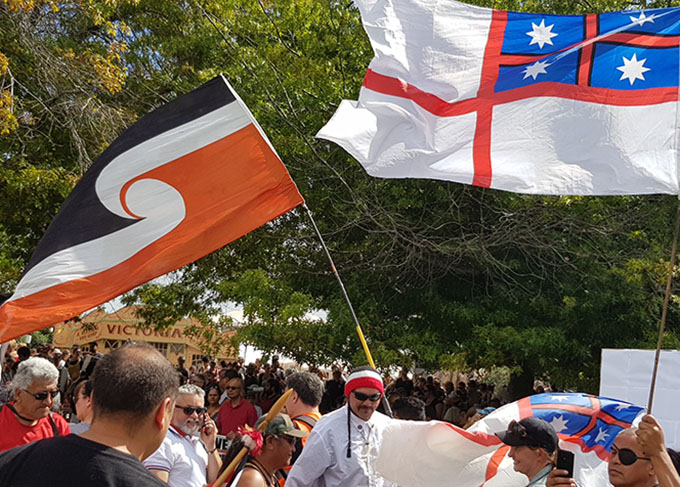
Print Friendly, PDF & Email

Article by AsiaPacificReport.nz

NSW Coalition scrapes back in as minor parties surge – but delivering on promises will not be easy

]]>

Source: The Conversation (Au and NZ) – By Andy Marks, Assistant Vice-Chancellor, Strategy and Policy, Western Sydney University

“It’s not a game of SimCity,” NSW treasurer, Dominic Perrottet assured viewers on the ABC’s NSW election night coverage. “Sydney’s under construction”, he added, acknowledging the Coalition government’s unfinished infrastructure projects are causing grief, but noting, “I don’t sense any baseball bats”. He was right.

Premier Gladys Berejiklian’s Liberal-National government was returned to office on Saturday night, albeit on a slender margin. With the victory came some wreckage, and largely unexpected beneficiaries. This poll was predicted to be decided in the bush, and that’s where the movement occurred.


Read more: Low-key NSW election likely to reveal a city-country divide


The Nationals lost the long held seats of Murray and Barwon on swings of around 27% and 21% respectively. And it was the Shooters, Farmers and Fishers that swept the field, capitalising on internal Nationals strife and pledging to act on the fish kill, water security and the drought.

The Shooters also consolidated the slender claim they had on Orange after the 2017 byelection, securing a 37% swing to make the central west firmly their own. A possible tempering of the Shooters vote in light of events in Christchurch didn’t eventuate, with victorious Orange candidate, Phil Donato, telling Channel Seven, “there wasn’t a real lot of talk about it”, adding, “it’s unfortunate it was politicised by the government.”

NSW Nationals leader John Barilaro remarked that his was “not a party of ideology” but a “party of geography”. He wasn’t wrong. While they incurred considerable drops in support in parts of the central, southern and outer west of the state, the Nationals actually attracted a swing of, on average, 5.6% across the seats of Clarence, Cootamundra, Monaro, Northern Tablelands and Oxley. Nevertheless, their Coalition partners were clearly concerned at the federal implications. Progressive Liberal Trent Zimmerman reserved particular scorn for Barnaby Joyce, arguing the NSW result confirmed, “he should spend more time in Tamworth and less time on TV”.

For the Nationals, under leader John Barilaro, the election result was a poor one. AAP/Dan Himbrechts

Newly-minted independent, Joe McGirr, has made Wagga Wagga his own, retaining the seat he won from the Liberals at last year’s byelection and building his buffer to over 15%. Long-standing Lake Macquarie independent, Greg Piper has put the one-time Labor stronghold squarely out of reach, picking up a 12% swing in the process. Depending on the flow of votes in the lower house, there is talk Piper will be approached for the speakership.

Affirming this election’s broad trend away from the major parties, Alex Greenwich retained Sydney with a roughly 3% swing in his favour. While still in doubt, independent Mathew Dickerson is making a very close run affair of Dubbo, nudging the high profile Nationals’ candidate, Dugald Saunders, a former ABC radio host.

Unlike the independents and the Shooters, One Nation was never going to secure lower house representation. But it did make notable inroads in urban areas. At last count, the NSW arm of Pauline Hanson’s party was odds on to usurp the Greens as the third force in Sydney metropolitan seats like Camden, Holsworthy, Penrith and Wollondilly.

Despite their recent internal turmoil, the Greens made a strong showing in lower house voting. Jamie Parker (Balmain) and Jenny Leong (Newtown) substantially grew their base, securing swings of 6.4 and 5.1% respectively. While in the north, Tamara Smith expanded her two-party preferred vote to over 57%.

The struggle to take neighbouring Lismore is going down to the wire, with former federal Labor MP, Janelle Saffin a chance to pull ahead of the Greens and Nationals in a complex three-way preference contest.


Read more: Coalition wins a third term in NSW with few seats changing hands


The outcome for the Greens and the Coalition in the upper house won’t be determined for some time. The trend towards minor parties and independents in the lower house, however, suggests that they will feature substantially in the 21 Legislative Council spots in play.

One Nation’s Mark Latham looks to have secured the required 4.55% vote share, with his party a chance for a second. At last count, the Coalition had just over seven spots, Labor six the Greens two and the Shooters one. The eventual upper house composition will almost certainly see the Coalition required to deal with a significantly expanded and unwieldy crossbench; a change from their current, more predictable arrangements, usually with the Christian Democrats.

This election will be remembered as a contest of clear delineations for the Coalition. While their partners, the Nationals, took substantial hits in the bush, the Liberals managed to hold the line in the city, losing Coogee, but retaining marginal East Hills, against the odds.

Labor leader Michael Daley’s “schools and hospitals before stadiums” message may have found traction in pre-election polling and with parts of the electorate, but it wasn’t sufficient for a relatively untested leader to take down a government pledging to “get it done” on infrastructure programs worth over A$80 billion.

Getting it done is the task now for the Berejiklian government, who will be looking to deliver on the large scale but delay-plagued infrastructure projects it has undertaken. Pressing ahead with that agenda won’t be easy for a government skirting a possible minority in the lower house and an unknown quantity in the upper house.

As for Labor, Daley is seeking to stick it out. Barring the stumbles of the last week of his campaign, he has performed remarkably well for a leader in the job only four months, fronting a party that only eight years ago suffered one of the worst electoral defeats in Australian political history. That might not matter to those seeking a new leadership direction after Saturday’s result.

ref. NSW Coalition scrapes back in as minor parties surge – but delivering on promises will not be easy – http://theconversation.com/nsw-coalition-scrapes-back-in-as-minor-parties-surge-but-delivering-on-promises-will-not-be-easy-113485

Thousands take part in Auckland ‘love Aotearoa’ rally, reject terrorism

]]>
The Tino Rangatiratanga and New Zealand independence flags flying at the “Love Aotearoa Hate Racism” rally in Aotea Square, Auckland, today. Image: David Robie/PMC

Pacific Media Centre Newsdesk

Thousands of New Zealanders flocked to the “Love Aotearoa Hate Racism” rally at Aotea Square in central Auckland today in solidarity with the Muslim community in the wake of the terrorist attack on two mosques in Christchurch just over a week ago.

The colourful and vibrant rally vowed to “maintain unity” and spokespeople said this was another example of the “real New Zealand”, a land of compassion and love.

#TheyAreUs

One speaker described the “nameless” terrorist, a white Australian who killed 50 Muslim worshippers at Friday prayers on March 15 and will appear in the High Court on April 5, as a “cockroach” who had failed to divide New Zealanders.

Speakers included Ibrar Sheikh, secretary of the Federation of Islamic Associations of NZ, Ian Rintoul from Refugee Action Coalition Sydney, Green Party co-leader Marama Davidson, Mike Treen from Global Peace and Justice Aotearoa, and Māori activist Joe Trinder, co-founder of the organisers, Love Aotearoa Hate Racism (LAHR).

“LAHR believes that, while the shooting at the mosques was the deed of one gunman, the attack is the tragic consequence of Aotearoa’s failure to address racism within its midst,” said Joe Carolan, co-founder of LAHR.

“In contrast to the picture of ‘a peaceful, harmonious, tolerant’ society painted over the past week, Aotearoa for too long has seen the scapegoating of migrants and refugees, with mainstream politicians blaming immigration for our housing and economic crisis.

-Partners-

“This has given confidence to fascist elements here and overseas, culminating in last week’s tragic and harrowing outcome.”

LAHR is a coalition of unions, community, and migrant groups, which was formed last July in response to attempts by the far right to peddle Islamophobic, anti-migrant, anti-refugee politics in New Zealand.

Print Friendly, PDF & Email

Article by AsiaPacificReport.nz

Coalition wins a third term in NSW with few seats changing hands

]]>

Source: The Conversation (Au and NZ) – By Adrian Beaumont, Honorary Associate, School of Mathematics and Statistics, University of Melbourne

With 54% of the vote counted at the New South Wales election held today, the ABC is currently projecting 45 of the 93 lower house seats for the Coalition, 35 for Labor, three Greens, three independents and two Shooters, Fishers and Farmers. Five seats remain undecided. Coogee is the only current clear Labor gain from the Coalition.

Forty-seven seats are needed for a majority, but the Coalition is in a strong position to form a minority government if it falls short. This will be the Coalition’s third term in NSW. It is the first time the Coalition has won a third term in NSW since 1971; the last time the Coalition won a third term in state government in Australia was in 1980.

All crossbenchers in the current parliament retained their seats. The Greens won Newtown, Balmain and Ballina. The Shooters retained Orange, which they had won at a byelection, and gained Murray from the Nationals. Independents retained Sydney, Lake Macquarie and Wagga Wagga (also won at a byelection).

The ABC’s projection of final primary votes are currently 41.7% Coalition (down 3.9% since the 2015 election), 33.4% Labor (down 0.7%), 9.9% Greens (down 0.4%) and 3.1% Shooters. If the projection is accurate, it is an indictment on Labor that their primary vote fell. The two party statewide result will not be available for a long time, but the Coalition probably won by about 53-47, a swing of about 1.5% to Labor.

Late campaign mishaps probably cost Labor in NSW. On March 18, Labor leader Michael Daley was revealed to have made comments in September 2018, before he became leader, that could be perceived as anti-Asian. On March 20, during a leaders’ debate, Daley could not recall details of funding for his party’s policies.

The final NSW Newspoll gave the Coalition a 51-49 lead, a one-point gain for the Coalition since eleven days ago. Primary votes were 41% Coalition (up one), 35% Labor (down one) and 10% Greens (steady). Reflecting his bad final week, Daley’s net approval plunged 14 points to -15, while Premier Gladys Berejiklian’s net approval dropped five points to +1. That Newspoll was taken March 19-21, and the momentum towards the Coalition appears to have carried over into the election results.

Two days before the 2015 Queensland election, Labor leader Annastacia Palaszczuk was unable to name the GST rate in an interview. Yet Labor ousted the LNP at that election on a massive swing.

I believe the difference between Queensland 2015 and NSW 2019 is that voters are more inclined to forgive politicians who make a mistake that is perceived to be out of character. Daley has only been the NSW Labor leader since November, and his anti-Asian video revealed something that voters did not like. It is probably more dangerous for a left-wing leader to be perceived as racist than a right-wing leader.

I will update this article tomorrow with more complete details of the lower house and a look at the upper house.

MORE TO COME

ref. Coalition wins a third term in NSW with few seats changing hands – http://theconversation.com/coalition-wins-a-third-term-in-nsw-with-few-seats-changing-hands-113035

Representations of Islam and Muslims in New Zealand media

“Burkinis have been banned in Cannes.: From a Stuff representation.

Pacific Journalism Review

Friday, March 15, 2019

Abstract

In the global media scene, media ownership is controlled by groups with political agendas. Intolerance of ‘the other’, from Islam and migrants to people of colour, show the rise of fundamentally prejudiced groups who relate well to negative media representations of ‘the other’, further fuelling financial support for dominant public voices, at the expense of those silenced by discrimination. Media studies on Islam show negative portrayals in Western media which neglect the Muslim voice. Some reasons include news culture, lack of knowledge about Islam and unawareness of the consequences from such narratives. This article identifies the growing trend of stories in the New Zealand media relating to ‘Islamic terrorism’ and critically analyses a random sampling of five news articles between 2014 and 2016 in terms of the negative, positive and ambivalent news content, both in their use of the written text and visual representations of Islam and Muslims. The tendency to use negative framing is evident with the absence or manipulation of the Muslim voice. Using the Islamic perspective of dialogue and persuasion, the theory of Ta’will, and socio-political rationale, the effects of and motivations for the written and visual news content are discussed. A case is made for a greater understanding of the textual and visual elements and more ethical reporting through intercultural engagement.

Report by Pacific Media Centre

Gallery: Christchurch terror: Prayers and hijabs for peace at Ponsonby

]]>

Pacific Media Centre Newsdesk

The massive gathering in Christchurch’s Hagley Park has reassured and uplifted their shocked community, say New Zealand Muslim leaders.

About 20,000 people gathered in Hagley Park to observe two minutes of silence and the Muslim call to prayer on Friday along with thousands more at other events across the country, including Auckland’s Domain.

Pacific Media Centre photographer Del Abcede was on hand to capture these images at Ponsonby’s Al-Masjid Al-Jamie mosque and Aotea Square on a day when women across New Zealand of all faiths reclaimed the hijab. More photos can be seen on her Facebook page.

1. Praying for peace at Ponsonby Mosque. Image: Del Abcede/PMC
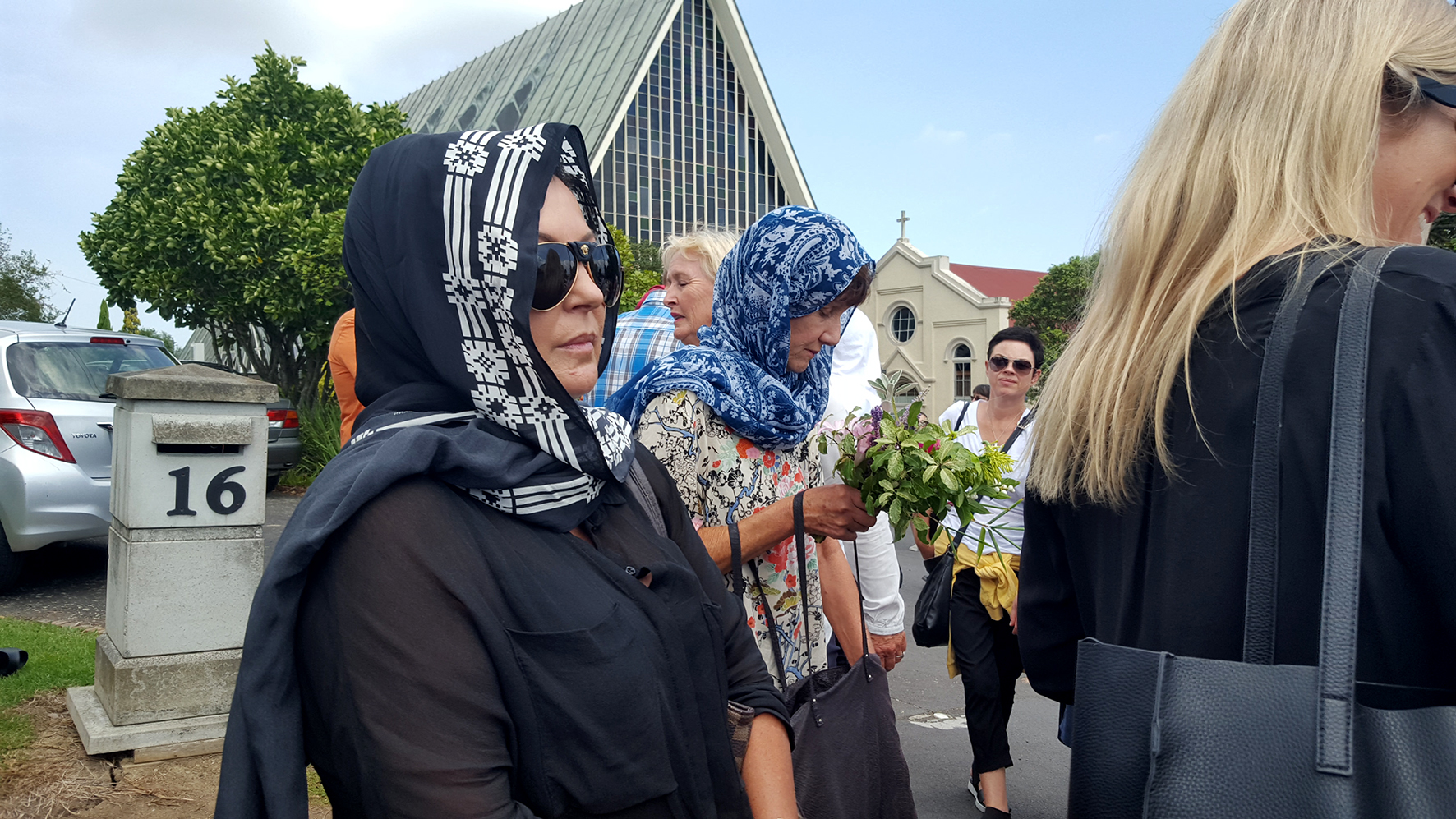
2. The crowd at Ponsonby Mosque. Image: Del Abcede/PMC

3. Tongan flag and flowers at the Ponsonby Mosque. Image: Del Abcede/PMC

4. Samoan flag and flowers at the Ponsonby Mosque. Image: Del Abcede/PMC
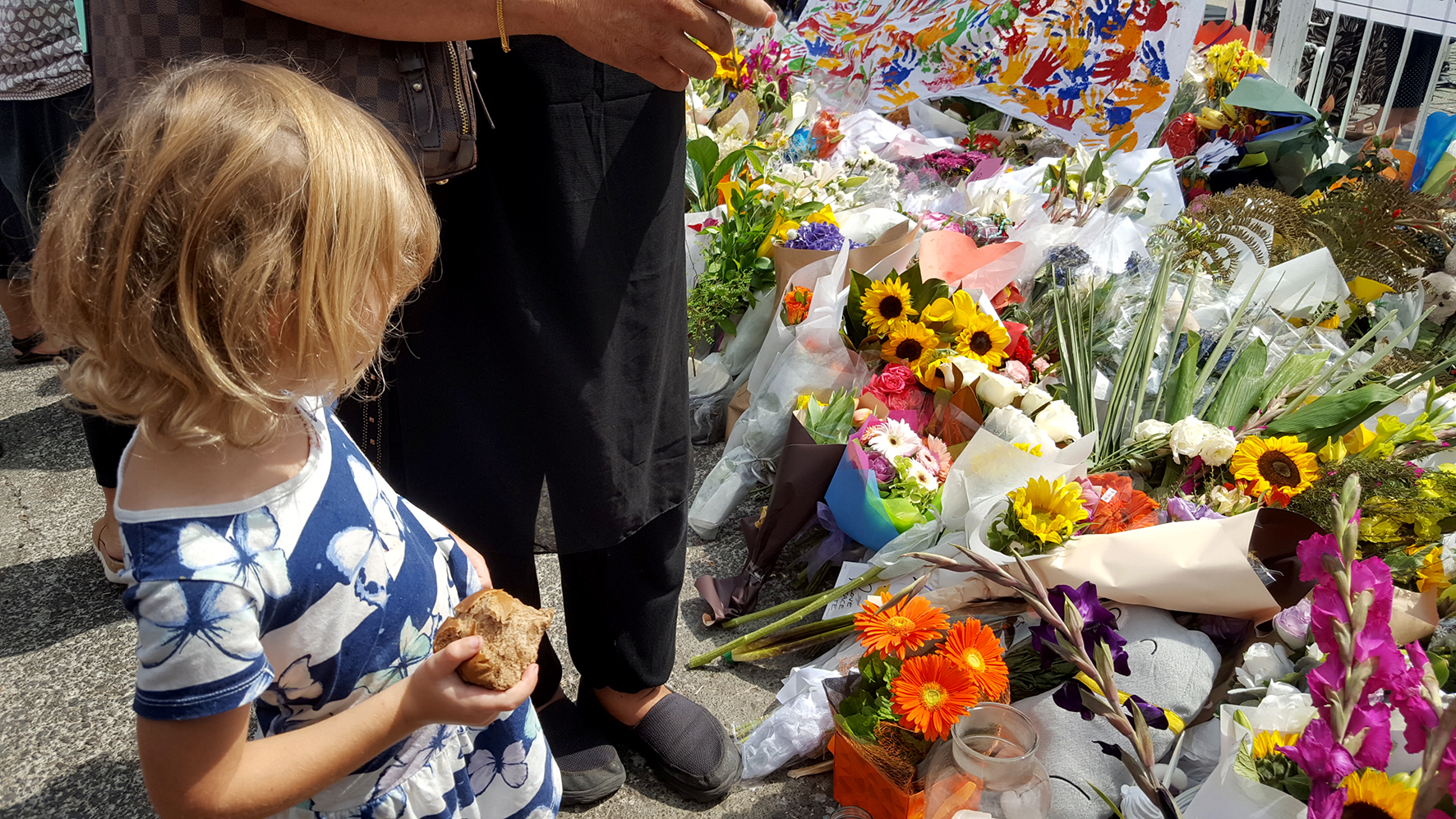
5. Flowers and messages at the Ponsonby Mosque. Image: Del Abcede/PMC
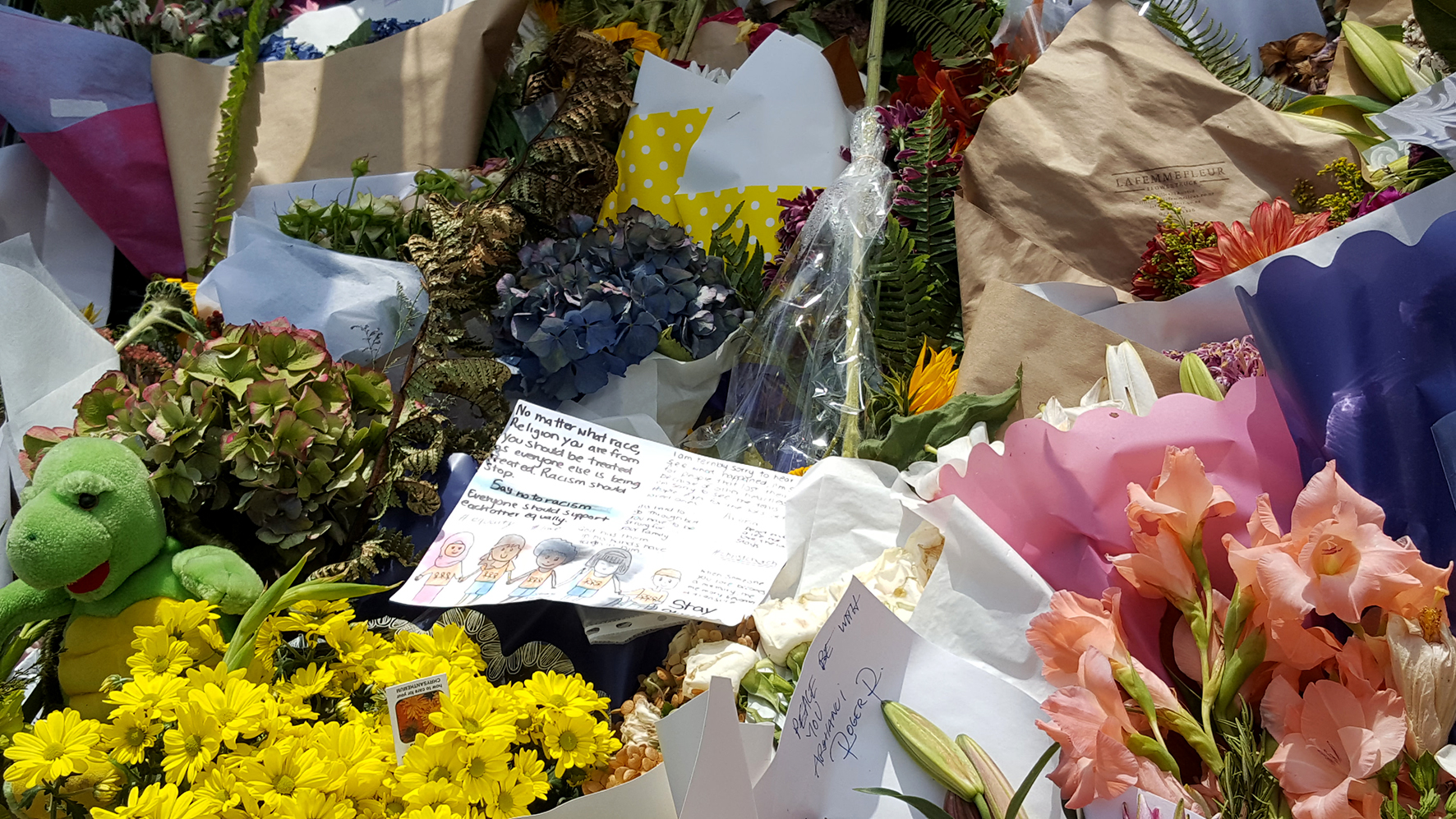
6. Hijab power at Ponsonby Mosque. Image: Del Abcede/PMC
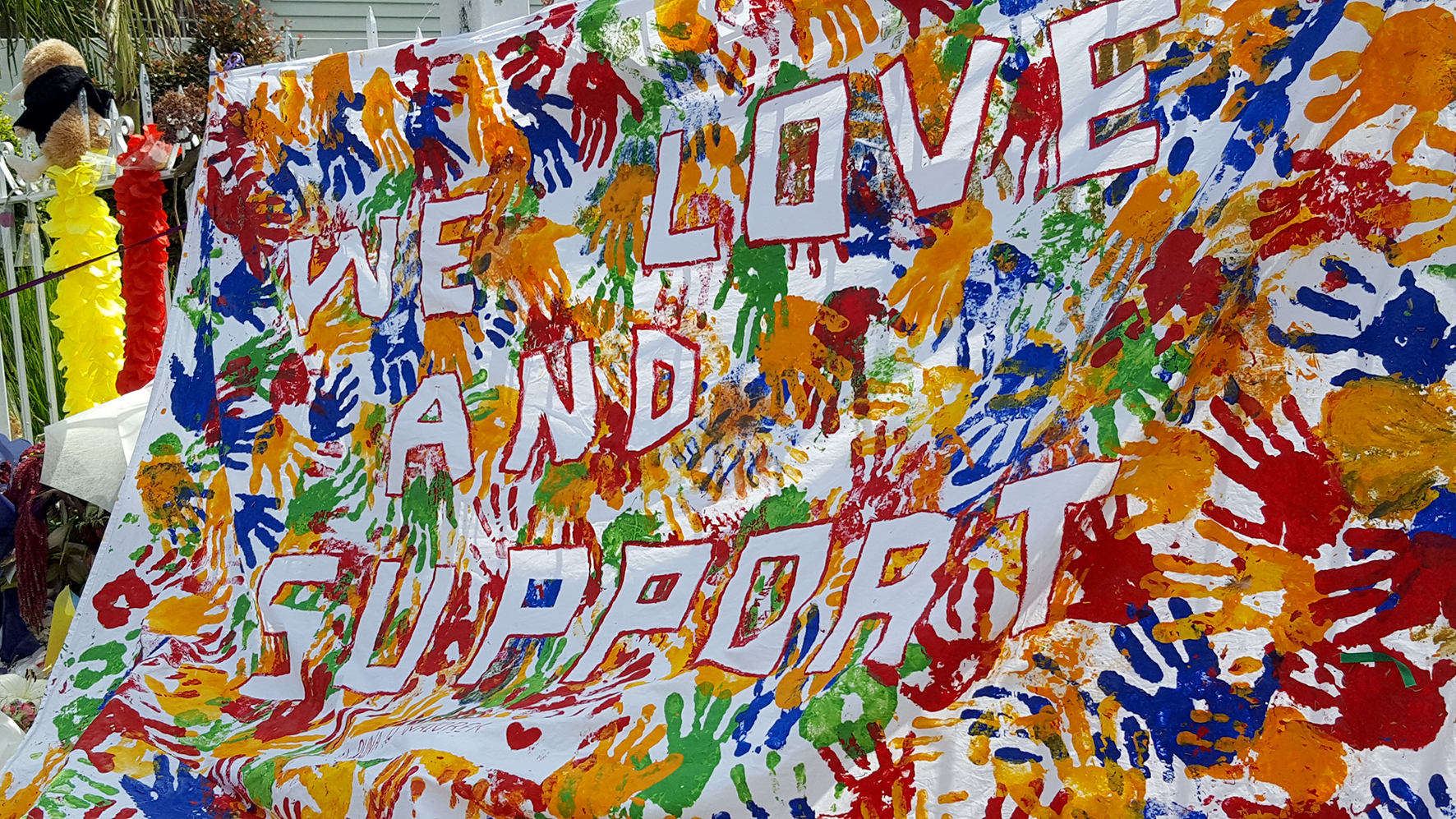
7. Hijab power at Ponsonby Mosque. Image: Del Abcede/PMC
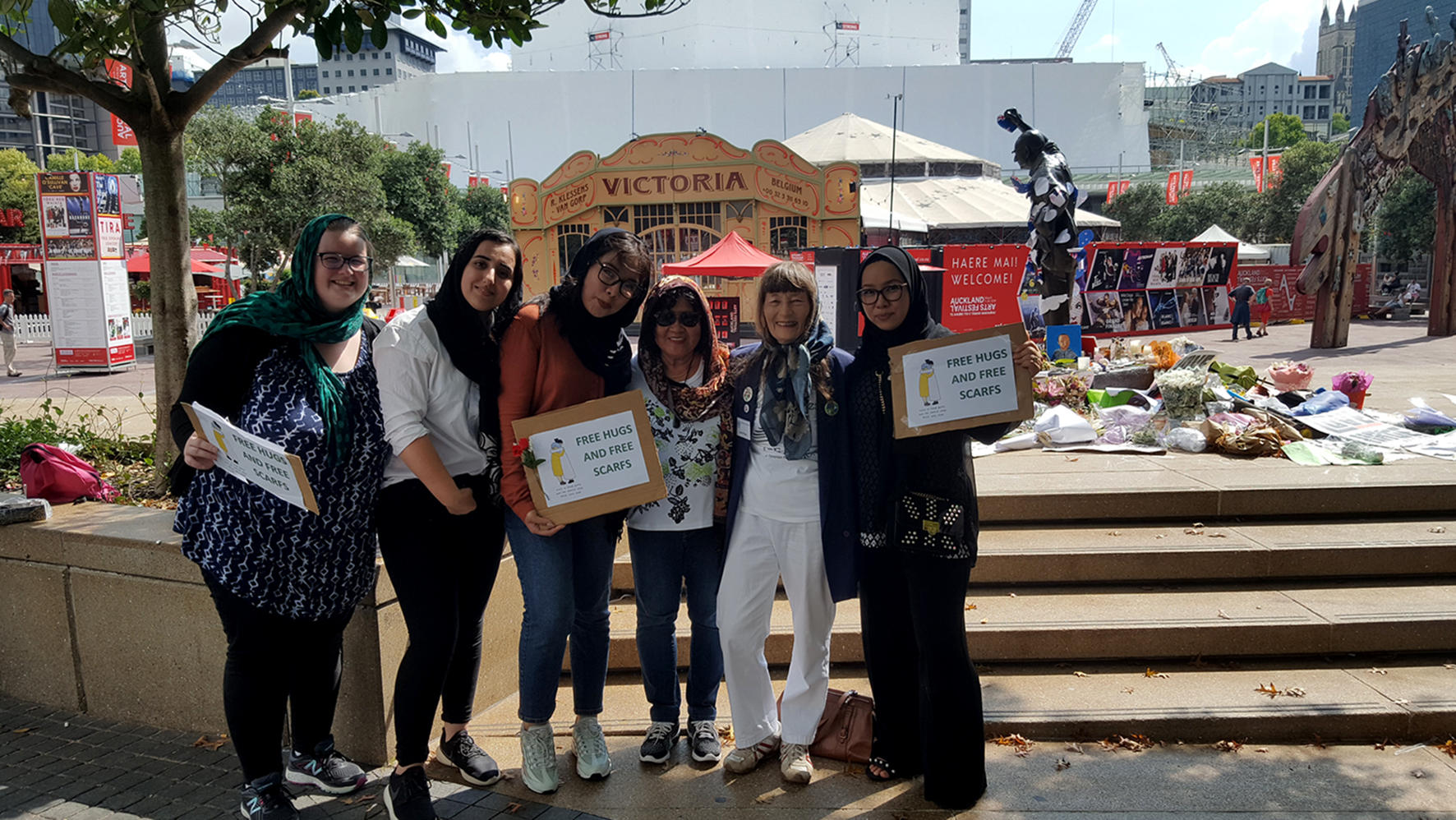
8. Hijab power at Ponsonby Mosque. Inage: Del Abcede/PMC
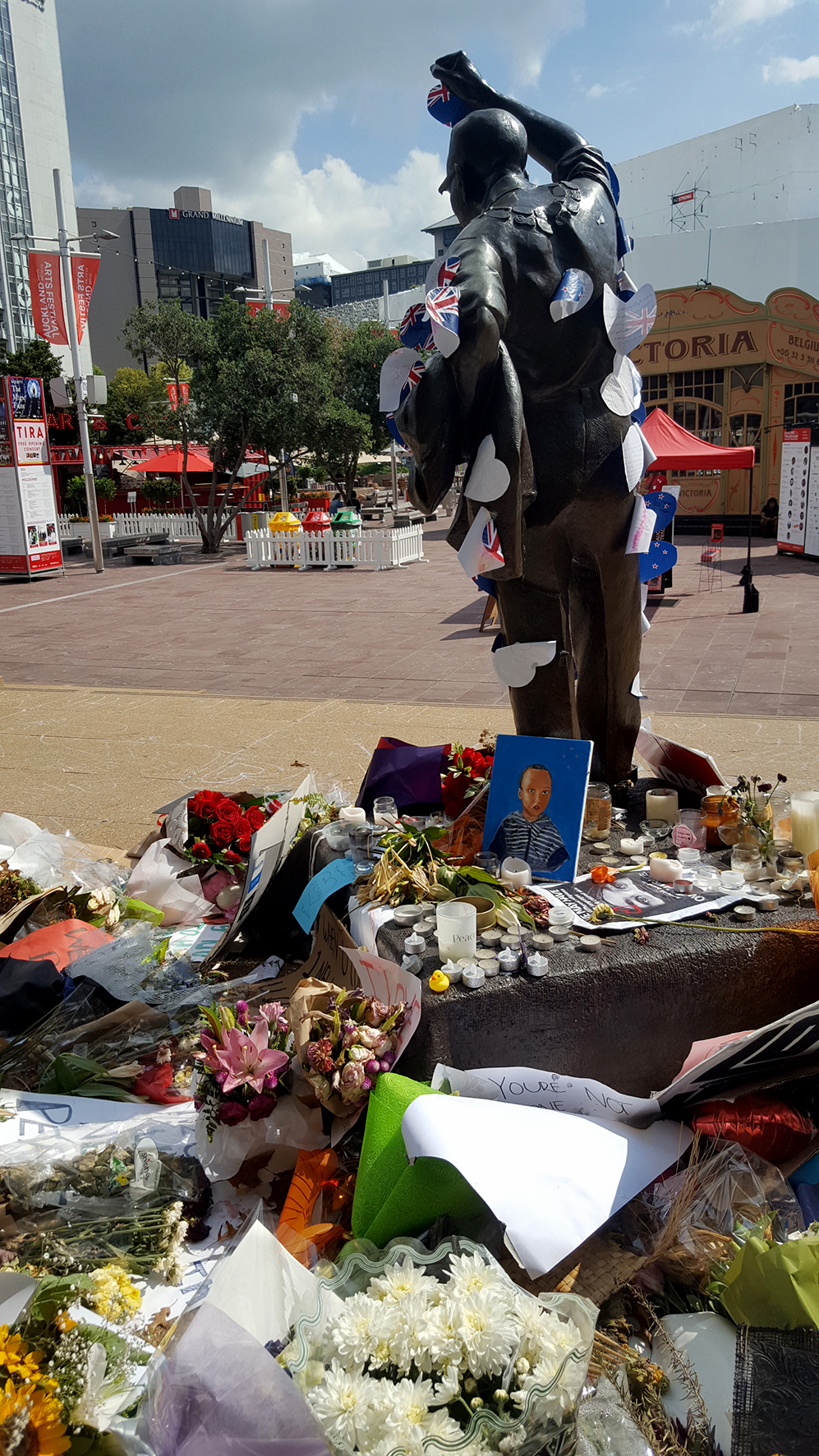
9. Hijab power at Ponsonby Mosque. Image: Del Abcede/PMC

10. Hijab power at Ponsonby Mosque. Image: Del Abcede/PMC
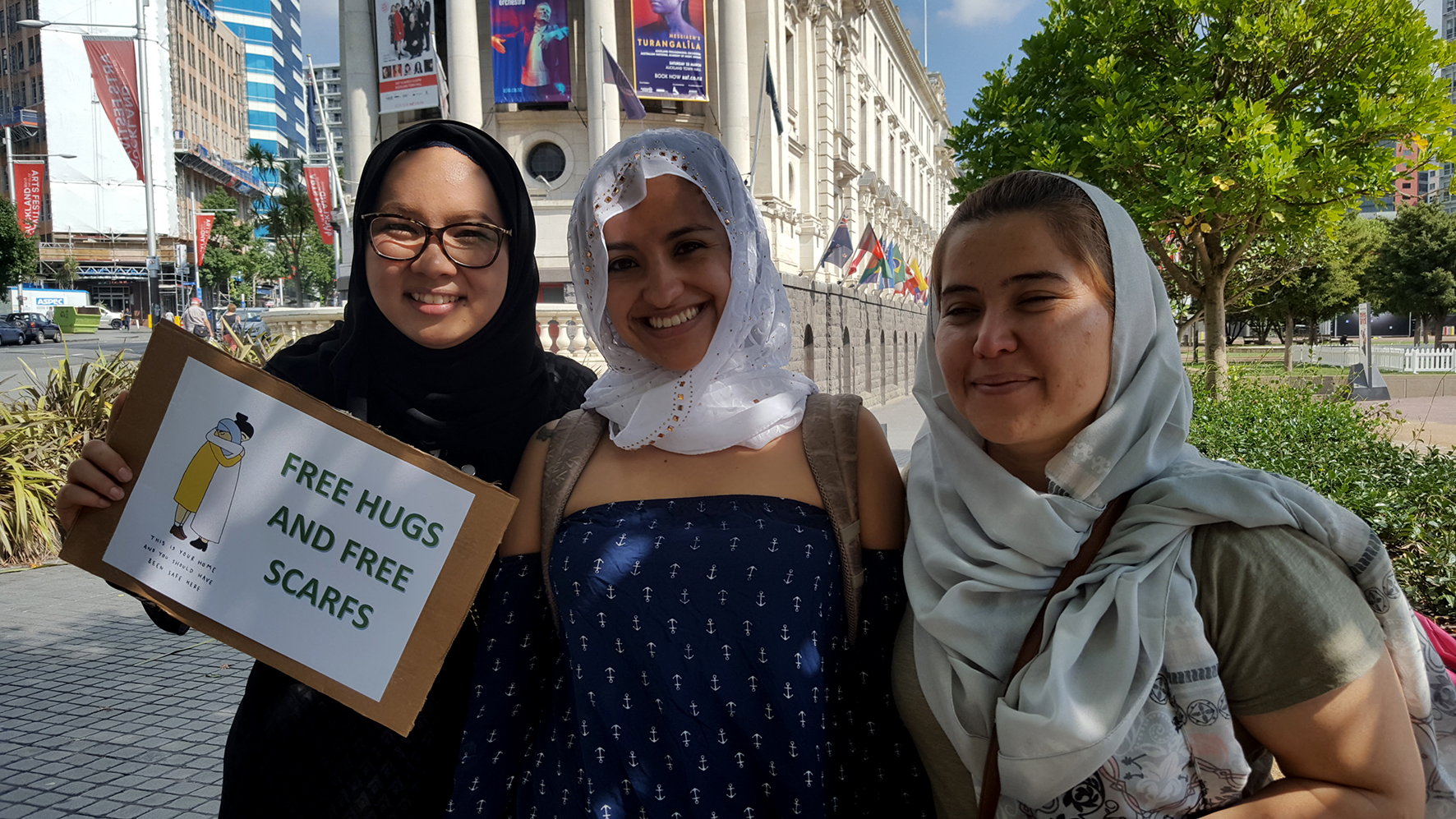
11. Policeman and hijab at Ponsonby Mosque. Image: Del Abcede/PMC
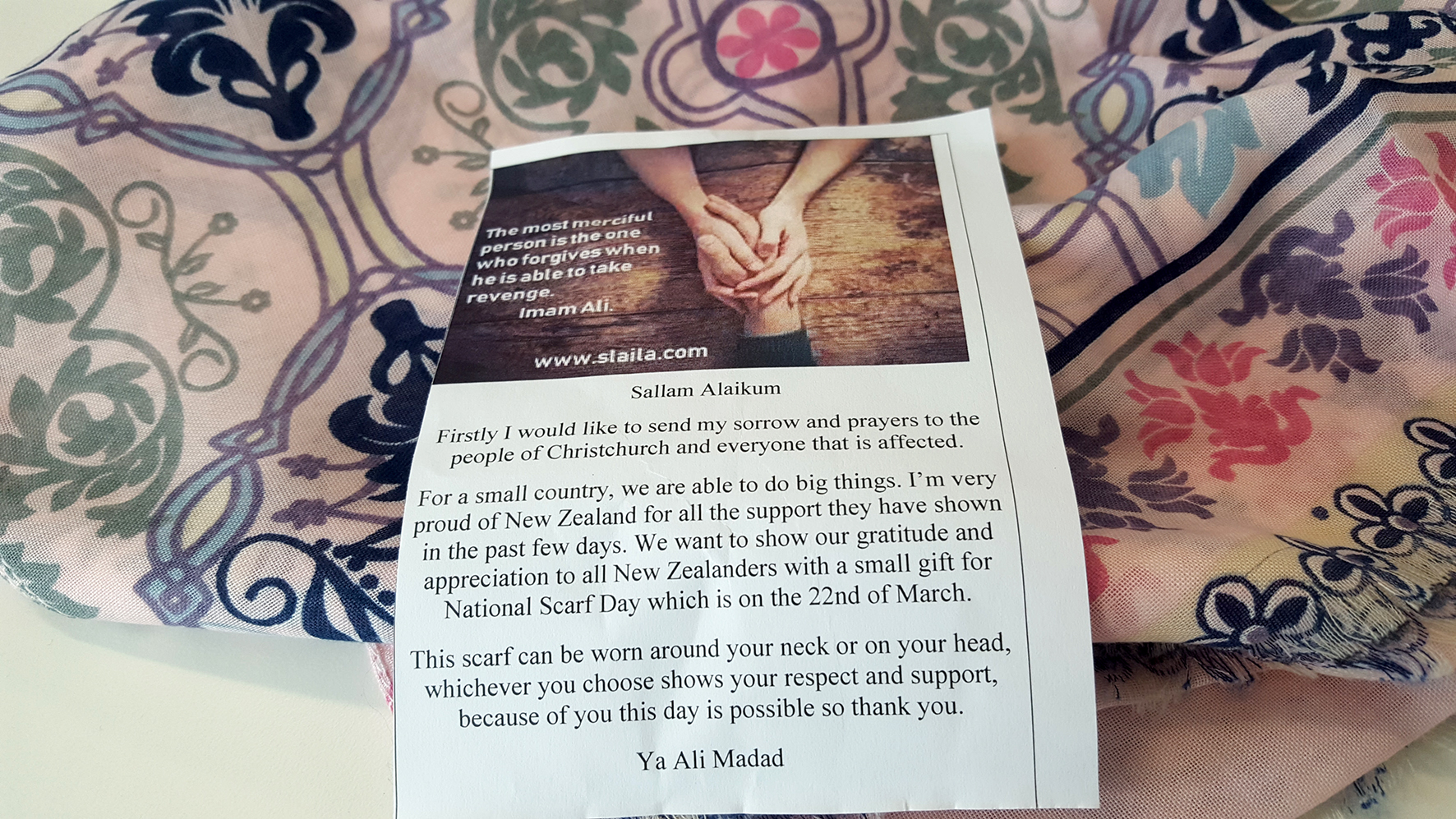
12. Priest and hijab at Ponsonby Mosque. Image: Del Abcede/PMC

13. The Ponsonby Mosque crowd. Image: Del Abcede/PMC
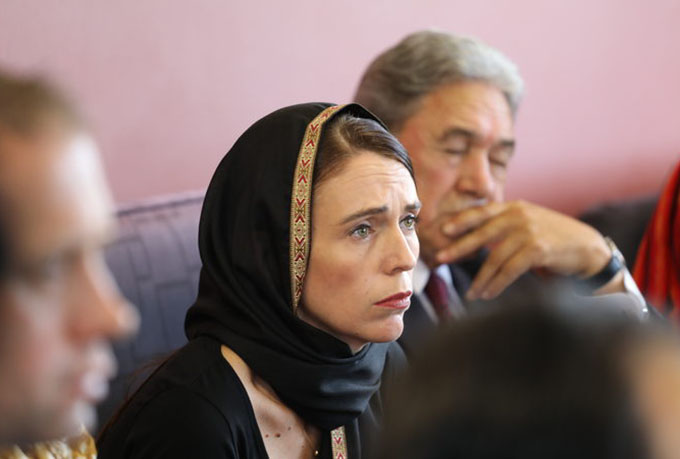
14. Hijabs and Ponsonby’s Sacred Heart Church in the background. Image: Del Abcede/PMC
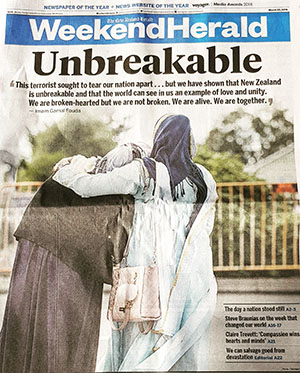
`15. Gang member paying his respects at Ponsonby Mosque. Image: Del Abcede/PMC

16. Thanks to New Zealand from the Muslim community at Ponsonby Mosque. Image: Del Abcede/PMC

17. Child and the mourning flowers at Ponsonby Mosque. Image: Del Abcede/PMC

18. Flowers and messages at Ponsonby Mosque. Image: Del Abcede/PMC

19. “Love and support” at Ponsonby Mosque. Image: Del Abcede/PMC

20. “Free hugs and free scarves” Aotea messages. Image: Del Abcede/PMC

21. Flowers beside the statue of former mayor Sir Dove-Myer Robinson in Aotea Square. Image: Del Abcede/PMC

22. Police and the hijab in Aotea Square, Auckland. Image: Del Abcede/PMC

23. Hijabs in Aotea Square. Image: Del Abcede/PMC

24. “The most merciful person is the one who forgives when he is able to take revenge.” – Imam Ali Image: Del Abcede/PMC

Print Friendly, PDF & Email

Article by AsiaPacificReport.nz

Dear PM: ‘It breaks my heart that a sense of belonging has cost 50 lives’

New Zealand Prime Minister Jacinda Ardern.
New Zealand Prime Minister Jacinda Ardern paying her respects in Christchurch. Image: RNZ

Summer Joyan’s open letter to Prime Minister Jacinda Ardern:

Dear Prime Minister Ardern,

I am a 13-year-old Muslim girl from Australia and I would like to publicly share my appreciation with you. I belong to the generation that was born after 11 September 2001. I have never really contemplated how dark the anti-Muslim and anti-immigrant language is that permeates Australian society, because it is all I have ever known. I guess I’ve become used to hearing political leaders use that same language.

But then, after seeing the way you have responded to the terrorist attack in Christchurch, I realised that I now know what the role of a leader truly is. So I want to thank you on behalf of the Muslim community in this country for all that you’ve done since Friday. The way you have expressed support and genuine empathy for the Muslim community, and your care for the people of New Zealand as a whole, have been magnificent to see. And I wanted you to know how much it means to me.

#TheyAreUs

Today I watched a video of you talking to the students at Cashmere High School regarding the terrorist attack. You showed such strength and kindness, and it made me wish I could experience the same thing in Australia. In my high school, not a single teacher or figure of authority even mentioned the attacks. They didn’t acknowledge that a white supremacist murdered 50 innocent Muslim men, women and children in a usually peaceful place of worship. They didn’t offer support or reach out to the Muslim girls in my school or even provide counselling services for grief and support.

Today’s “Unbreakable” New Zealand Herald front page. Image: PMC
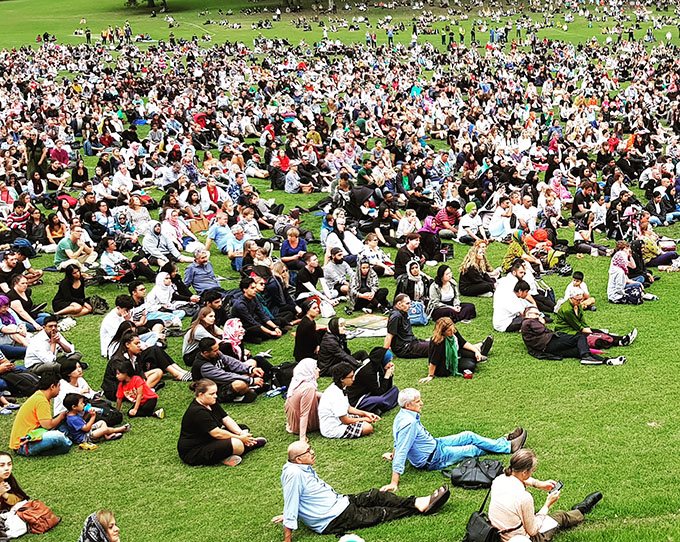
In a country that is so similar to New Zealand, and yet also so different, can you imagine the comfort that my Muslim friends and I felt, knowing there was one leader in a neighbouring country that was on our side? My friends and I are Muslim; we were all born in Australian and it is the only place we have ever known. But this has been the first time we have ever felt like we were part of the fabric of a community, and it breaks my heart that this feeling of belonging has come at the cost of 50 lives. If only more politicians had the courage to stand up to injustices and knew when to stop playing political games with the lives of people who depend on them.

Your leadership has brought the world together. By supporting the New Zealand community, no matter what their religion, you have shown what a great leader you are ― not just in the good times, but when the times are as dark as can be. I cannot imagine any other political leader doing what you have done. I think that you deserve the Nobel Peace Prize! Many world leaders could learn a lot from the way you have held your nation together and comforted those who are grieving.

-Partners-

I’m sure you will remain Prime Minister of New Zealand for a long time. But if not, do you think maybe you could move to Australia and become our Prime Minister? That would be a dream come true.

Thank you again for all that you have done.

From an Australian-Muslim girl who now knows what real leadership looks like,

Summer Joyan

The solidarity vigil crowd at Auckland’s Domain last night. Image: David Robie/PMC A policeman at the solidarity vigil in Auckland’s Domain last night. Image: David Robie/PMC
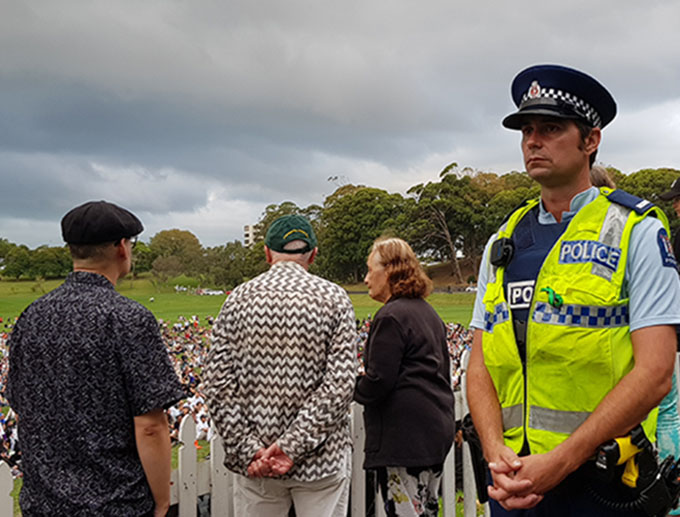
Print Friendly, PDF & Email

Article by AsiaPacificReport.nz

Funding boost for policing finance sector, in budget that warns of economic softening

]]>

Source: The Conversation (Au and NZ) – By Michelle Grattan, Professorial Fellow, University of Canberra

The April 2 budget will provide about A$600 million to pursue wrongdoers and help restore trust in Australia’s financial system.

The budget, which will be a launching pad for the election, likely to be announced the following weekend, is set to include another round of tax cuts but it will also contain strong warnings about a deterioration in Australia’s economic outlook.

“The near term economic outlook is looking softer since [the December budget update], with the economy facing some emerging risks,” Treasurer Josh Frydenberg said in an interview with The Conversation.

“We are concerned about the impact of [falling] housing prices spilling over into the real economy through lower household consumption and building approvals – and this matters because household consumption is close to 60% of GDP”.

The international outlook had been deteriorating, with growth figures revised down, he said.

Frydenberg said the budget’s measures were “focussed on driving down the cost of living , driving productivity and growth and creating more jobs”. It will forecast a long-awaited return to surplus and its spending will be “very targeted”.


Read more: No surplus, no share market growth, no lift in wage growth. Economic survey points to bleaker times post-election


Following the Hayne royal commission’s indictment of the banks and other financial institutions, the government will give the Australian Securities and Investments Commission (ASIC) more than $400 million in additional funding over four years to 2022-23. On average, this is a rise of about a quarter in its annual funding over the forward estimates compared to 2017-18.

The Australian Prudential Regulation Authority (APRA) will receive $150 million extra – an increase of about 30% in its annual funding over the budget period, compared with 2017-18.

Taxpayers, however, will eventually get back the funds provided to ASIC and APRA – the financial industry will be levied for the cost, with the largest institutions paying the most.

Also, the government will provide more than $35 million to support the expansion of the federal court’s jurisdiction to include corporate crime. The expansion will include the appointment of two new judges, the engagement of 11 registry and support staff, and the building of new facilities.

The court’s new role will mean institutions and individuals breaking the corporate law can be prosecuted faster than under the current system.

The government says the ASIC funding will support expanded regulation of financial services and “a new, more hardline, proactive and accelerated enforcement strategy including implementing a ‘why not litigate?’ approach”. There will be greater on-site supervision of larger institutions.


Read more: Grattan on Friday: Josh Frydenberg has a great job at the worst time


The APRA funding will support, among other initiatives, its response to areas of concern highlighted by the commission, including governance, remuneration, and culture in financial institutions.

As the government beds down a budget crucial to its efforts to revive its electoral fortunes, Frydenberg said it would help “frame” the election contest.

“It will be about what kind of nation Australians want over the next decade. On our side it’s about balancing the books, growing the economy with more jobs and lower taxes, guaranteeing essential services, hospitals, roads and schools, all without increasing taxes,” he said

“There’s been a bit of a debate over real wages and the key to real wages is not high taxes – it’s through decreasing taxes and targeted spending on infrastructure and more trade and getting people into work,” Frydenberg said.

He said the Australian economy’s fundamentals were sound. Growth, at 2.3% per cent through the year, was second only to the United States among G7 countries. This week’s figures showed unemployment falling to 4.9%, the lowest in eight years. Youth unemployment was the lowest in seven years.


Read more: Ultra low wage growth isn’t accidental. It is the intended outcome of government policies


But there was a slowdown in the global economy, with global trade volumes down more than 3% since August. Trade tensions continued and there was uncertainty over Brexit. The International Monetary Fund and the OECD had downgraded their 2019 growth numbers.

“Japan is only growing at around 1% and had a negative quarter last year. The Euro area has been growing at less than 2% and had a negative quarter last year. Germany had a negative quarter last year and China itself set a lower growth target,‘ he said.

At home, “falls in dwelling investment detracted 0.2% from growth in the December quarter. The impacts of the drought have seen farm GDP down by 5.8 % through the year and the impacts of the flood have still yet to fully flow through.”

Frydenberg said the situation was “all manageable – but only with a strong economic plan that gives business confidence to invest and consumers the confidence to spend. It requires a pro-growth agenda, which is exactly what you’ll see in this year’s budget”.

The budget numbers are being held up by strong growth in nominal GDP, which determines revenue numbers.

Frydenberg said returning the budget to surplus was “more significant than just a number because it’s actually showing that we’ve turned a corner.”

“Surpluses will continue to grow over the medium term, and the goal is to bring net debt down to zero.”

Frydenberg stressed the government’s commitment was for a surplus in 2019-20, declining to rule in or out a surplus for the current financial year. He pointed out there had been “issues’ in this financial year, especially the drought and other natural disasters, but also higher schools payments and various other commitments the government had made.

ref. Funding boost for policing finance sector, in budget that warns of economic softening – http://theconversation.com/funding-boost-for-policing-finance-sector-in-budget-that-warns-of-economic-softening-114093

Former PMW reporter talks to SA media on mosque massacre

]]>

Rahul Bhattarai talks to eNCA News of South Africa live from New Zealand. Video: eNCA News

Pacific Media Watch Newsdesk

Former Pacific Media Watch project reporter Rahul Bhattarai has talked to the South African independent news service eNews Channel Africa News about last Friday’s mosque massacre in New Zealand.

The Johannesburg host talked to him by Skype for an update on “how New Zealand is coping” in the wake of the attack by a white supremacist gunman on worshippers at two mosques in Christchurch a week ago today, leaving 50 people dead.

eNews Channel Africa has been a big media hit in South Africa and currently broadcasts live on DStv 403.

The channel made history when it launched on June 1, 2008, becoming South Africa’s first 24-hour news service.

Since then, it has dominated the market.

-Partners-

Live reports, breaking news, sport, weather, entertainment, financial and business updates all form part of its offering, along with a host of topical current affairs shows.

eNCA has bureaus across South Africa and also has correspondents covering Zimbabwe, Ghana, and Tanzania, the US and Europe.

Print Friendly, PDF & Email

Article by AsiaPacificReport.nz

Silver moss is a rugged survivor in the city landscape

]]>

Source: The Conversation (Au and NZ) – By Alison Haynes, PhD Candidate, University of Wollongong

Sign up to Beating Around the Bush, a series that profiles native plants: part gardening column, part dispatches from country, entirely Australian.


Chances are you’ve walked over silver moss (Bryum argenteum) countless times without giving it a second glance. This moss, at home in moist environments as well as hot and cold deserts, is also a common denizen of cities worldwide and finds shelter in our pavement cracks.

Also known as silvery thread moss and silvergreen bryum moss, it grows in all states and territories of Australia, particularly in towns and cities.


Read more: Antarctica’s ‘moss forests’ are drying and dying


The Conversation


To the naked eye, it appears as a tiny silvery green ribbon or small cushion, with stems up to 1.5cm tall, but often only a few millimetres high. With a hand lens, its crowded, tight buds are visible, while a microscope reveals the reason for its silvery appearance: cells in the top portion of its minute leaves do not have chloroplasts (and therefore no chlorophyll) and do not appear green, but instead make a transparent silvery tip. This portion of the leaf protects the chloroplasts deeper down from harsh sunlight.

Like many others in its genus, the leaves have a rounded appearance with a central rib, or costa, that ends well before the tip. As with most moss, these simple leaves are only one cell layer thick, so it exchanges gases and water with the exterior by diffusion.

The silver moss is a survivor. We remove native vegetation from our cities and clear forest canopies but it can cope with this new version of home. We swap forest floor for hard, impervious surfaces that utterly change how water moves across the landscape – for instance, evaporating much more quickly – but this moss makes use of water when it can, switching on its photosynthesis processes when there’s enough water, and hunkering down when there’s not.


Read more: What’s behind Japan’s moss obsession?


This cycle can occur over the duration of a day, with photosynthesis starting in the early morning light when there’s a little dew on the leaves, and closing down as the day progresses and the moss dries, but it can also play out over much longer periods, even years.

It can do this thanks to its particularly strong tolerance for desiccation, a trait which varies across moss species. This isn’t just the ability to withstand drought. It’s more radical than that. It is the ability to shut down all metabolic processes in the absence of water, and start them up again when water is available. This might not sound too impressive, but in the majority of plants drying out totally involves serious damage at the cell level, with membranes and cell organelles becoming brittle and breaking and macromolecules such as DNA being damaged beyond repair.

Silver moss growing on a Wollongong basketball court. Alison Haynes, Author provided

Silver moss uses sugars to create protective glass-like compounds to protect its cells from irreparable damage. Because of its tough nature, the silver moss is widely studied to further understanding of how plants cope with a range of other stresses too, from UV-B radiation and sand burial to trace metals and excessive light.

Silver moss is not showy and quite often looks rather dusty in city environments, but it’s nice to know that the 19th century botanist Ferdinand von Mueller collected it twice in 1852, in Adelaide, five years after his arrival from Germany. He moved to Melbourne that year, was appointed government botanist, and founded the National Herbarium of Victoria a year later, in 1853. These two samples must have been among the first deposited there, making them our oldest specimens of this species in Australia.

While I don’t know exactly what species were used, Aboriginal Australians took advantage of the moisture that moss collects. In Queensland, for instance, Indigenous people used to squeeze out water from a moss clump then replace it carefully, to use again.


Read more: War and peat: how bog moss helped save thousands of lives in World War I


For me, moss is on the cusp of the macro and micro world. Just big enough to see with the naked eye, it nonetheless draws you in and down to a smaller world. I’ve become a moss tourist. Whenever I go to a city, I don’t just look up at the sights, I also look down! Mosses like Bryum argenteum remind me of the wild even within the depth of a city landscape. They are a reminder that we may remove native forests, but still the most minute spores of living organisms will come in and find a place to live, if not thrive.


Sign up to Beating Around the Bush, a series that profiles native plants: part gardening column, part dispatches from country, entirely Australian.. Read previous instalments here.

ref. Silver moss is a rugged survivor in the city landscape – http://theconversation.com/silver-moss-is-a-rugged-survivor-in-the-city-landscape-113459

Why dangerous asteroids heading to Earth are so hard to detect

]]>

Source: The Conversation (Au and NZ) – By Jonti Horner, Professor (Astrophysics), University of Southern Queensland

Earth is often in the firing line of fragments of asteroids and comets, most of which burn up tens of kilometres above our heads. But occasionally, something larger gets through.

That’s what happened off Russia’s east coast on December 18 last year. A giant explosion occurred above the Bering Sea when an asteroid some ten metres across detonated with an explosive energy ten times greater than the bomb dropped on Hiroshima.

So why didn’t we see this asteroid coming? And why are we only hearing about its explosive arrival now?


Read more: Look up! Your guide to some of the best meteor showers for 2019


Nobody saw it

Had the December explosion occurred near a city – as happened at Chelyabinsk in February 2013 – we would have heard all about it at the time.

Plenty of people observed and captured the Chelyabinsk meteor explosion.

But because it happened in a remote part of the world, it went unremarked for more than three months, until details were unveiled at the 50th Lunar and Planetary Science Conference this week, based on NASA’s collection of fireball data.

The 173kt fireball blast off Russia’s eastern coastline in December was the largest recorded since 2013’s fireball over the Russian city of Chelyabinsk. NASA/JPL-Caltech/Center for Near Earth Object Studies

So where did this asteroid come from?

At risk from space debris

The Solar system is littered with material left over from the formation of the planets. Most of it is locked up in stable reservoirs – the Asteroid belt, the Edgeworth-Kuiper belt and the Oort cloud – far from Earth.

Those reservoirs continually leak objects into interplanetary space, injecting fresh debris into orbits that cross those of the planets. The inner Solar system is awash with debris, ranging from tiny flecks of dust to comets and asteroids many kilometres in diameter.

The vast majority of the debris that collides with Earth is utterly harmless, but our planet still bears the scars of collisions with much larger bodies.

The largest, most devastating impacts (like that which helped to kill the dinosaurs 65 million years ago) are the rarest. But smaller, more frequent collisions also pose a marked risk.

In 1908, in Tunguska, Siberia, a vast explosion levelled more than 2,000 square kilometres of forest. Due to the remote location, no deaths were recorded. Had the impact happened just two hours later, the city of St Petersburg could have been destroyed.

In 2013, it was a 10,000-tonne asteroid that detonated above the Russian city of Chelyabinsk. More than 1,500 people were injured and around 7,000 buildings were damaged, but amazingly nobody was killed.

The meteor trail taken about 200km away from Chelyabinsk a minute after the blast in 2013. Flickr/Alex Alishevskikh, CC BY-SA

We’re still trying to work out how often events like this happen. Our information on the frequency of the larger impacts is pretty limited, so estimates can vary dramatically.

Typically, people argue that Tunguska-sized impacts happen every few hundred years, but that’s just based on a sample of one event. The truth is, we don’t really know.

What can we do about it?

Over the past couple of decades, a concerted effort has been made to search for potentially hazardous objects that pose a threat before they hit Earth. The result is the identification of thousands of near-Earth asteroids upwards of a few metres across.

Once found, the orbits of those objects can be determined, and their paths predicted into the future, to see whether an impact is possible or even likely. The longer we can observe a given object, the better that prediction becomes.

But as we saw with Chelyabinsk in 2013, and again in December, we’re not there yet. While the catalogue of potentially hazardous objects continues to grow, many still remain undetected, waiting to catch us by surprise.

If we discover a collision is pending in the coming days, we can work out where and when the collision will happen. That happened for the first time in 2008 when astronomers discovered the tiny asteroid 2008 TC3, 19 hours before it hit Earth’s atmosphere over northern Sudan.

For impacts predicted with a longer lead time, it will be possible to work out whether the object is truly dangerous, or would merely produce a spectacular but harmless fireball (like 2008 TC3).

For any objects that truly pose a threat, the race will be on to deflect them – to turn a hit into a miss.

Searching the skies

Before we can quantify the threat an object poses, we first need to know that the object is there. But finding asteroids is hard.

Surveys scour the skies, looking for faint star-like points moving against the background stars. A bigger asteroid will reflect more sunlight, and therefore appear brighter in the sky – at a given distance from Earth.

As a result, the smaller the object, the closer it must be to Earth before we can spot it.

Objects the size of the Chelyabinsk and Bering Sea events (about 20 and 10 metres diameter, respectively) are tiny. They can only be spotted when passing very close to our planet. The vast majority of the time they are simply undetectable.

As a result, having impacts like these come out of the blue is really the norm, rather than the exception!

The Chelyabinsk impact is a great example. Moving on its orbit around the Sun, it approached us in the daylight sky – totally hidden in the Sun’s glare.

For larger objects, which impact much less frequently but would do far more damage, it is fair to expect we would receive some warning.

Why not move the asteroid?

While we need to keep searching for threatening objects, there is another way we could protect ourselves.

Missions such as Hayabusa, Hayabusa 2 and OSIRIS-REx have demonstrated the ability to travel to near-Earth asteroids, land on their surfaces, and move things around.

This artist’s concept shows the OSIRIS-REx spacecraft contacting the asteroid Bennu. NASA’s Goddard Space Flight Center

From there, it is just a short hop to being able to deflect them – to change a potential collision into a near-miss.


Read more: How the dinosaurs went extinct: asteroid collision triggered potentially deadly volcanic eruptions


Interestingly, ideas of asteroid deflection dovetail nicely with the possibility of asteroid mining.

The technology needed to extract material from an asteroid and send it back to Earth could equally be used to alter the orbit of that asteroid, moving it away from a potential collision with our planet.

We’re not quite there yet, but for the first time in our history, we have the potential to truly control our own destiny.

ref. Why dangerous asteroids heading to Earth are so hard to detect – http://theconversation.com/why-dangerous-asteroids-heading-to-earth-are-so-hard-to-detect-113845

Finding dignity and grace in the aftermath of the Christchurch attack

]]>

Source: The Conversation (Au and NZ) – By Mohamad Abdalla, Founding Director of the Centre for Islamic Thought and Education, University of South Australia

Following the tragic attack in Christchurch that killed 50 people as they prayed, I felt compelled to visit the injured in hospital, and meet their family and friends.

I also visited others in their homes, alongside an elder and pioneer of the New Zealand Islamic community, the man who helped establish Al Noor Mosque where most of the victims were killed.

Their stories of survival are moving, sometimes remarkable and often deeply sad.


Read more: How to take care of your mental health after the Christchurch attacks


But the common thread in their response to the horrific events of March 15 is profound bravery, deep consideration and thoughtfulness, and a complete lack of desire for vengeance.

At the hospital, I met Ahmad, a middle-aged man from an Afghani background. He said he survived because he was buried under the dead bodies that piled up in the mosque. Although he was shot twice in the back and was lucky to survive, he was not angry or resentful.

When asked about his abiding thoughts now he said:

terrorism must not scare us. Racism must not divide us.

I then visited Fuad, another middle-aged man originally from Afghanistan who also escaped death. He had been struck by a bullet in the back and another just missing the back of his head.

His wounds were visible. He told me, with four children, he was just grateful to be alive. Not resentful or vengeful, he was full of praise for Prime Minister Jacinda Ardern and her deep expression of humanity.

Mustafa, a young university student of Turkish heritage, was shot in the legs. One of the bullets exploded in his leg and it is difficult to know the long-term impacts – but he smiles and is cheerful, kind and respectful to the nurses who care for him.

Like the other two, he was not hateful. He said:

We trust in God. Don’t be scared to go to Mosques and schools.

He was quick to point out terrorism would serve its purpose if it made people afraid – our fear is their victory.

A cyclist prepares to lay flowers at a makeshift memorial near the Al Noor Mosque on Deans Rd in Christchurch, New Zealand, Tuesday, March 19, 2019. Mick Tsikas/AAP

Still in shock from seeing the events at Al Noor mosque unfold, Burhan, a Sudanese man in his 60s, stood in the hospital corridor. That Friday at the mosque, he heard the shooting but was not sure if it was real.

He then saw two men shot dead, one on his right and the other behind him.

He ran outside and hid behind a car but could see the shoes of the terrorist as he continued to fire. He watched as a father ran out with his three-year-old daughter in his arms calling out “my daughter!”.

Both had been shot multiple times and both remain in critical care.

A young man in his 20s whom I had met when we completed the hajj pilgrimage last year, witnessed the gunman as he shot that young father and child.

Not unscathed, he too was shot in the hip and shoulder and his father only survived by pretending to be dead.

Without anger and strong in his faith he said:

the Prophets of God were tested more severely.

Down every corridor the message was the same – the survivors urged unity and the strength to resist hatred, racism and vengeance.

At the community centre later that day I met Adnan Ibrahim the father of the youngest of the 50 victims killed at the two mosques. His son, Mucad Ibrahim, was only three years old.

Before he was killed, he had run toward the gunman thinking it was a game.

As Adnan retold the events, everyone became very silent. In deep pain and sorrow, he showed grace and dignity.

Verily we belong to God and to Him we shall return.

His most present thoughts were about the sad condition of humanity, that such things could happen.


Read more: The psychology of fear and hate, and what each of us can do to stop it


On my way to the carpark, I met Matiullah, a young man under 20 years old. I greeted him and asked if he lost anyone. He told me his father was killed while standing in prayer at the mosque. I embraced him and was struck by his gentleness and calmness.

The community elder Dr Hanif Quazi took me to see Ambreen Nadeem, who lost both her husband and her 21-year-old son, Talha.

Talha was completing an engineering degree. The entire family were planning to visit Pakistan in June and the tickets were booked.

As I met her with her two remaining sons, 17 and seven years old, I was filled with sadness.

Grief lined her dignified face.

And she said:

I pity the killer because his heart was filled with hate, not love.

“Pray for us,” she added quietly. I did.

At a time when we could expect that anger, vengeance and resentment could take hold in a community so demolished by violence, I found the exact opposite.

They were compassionate. They were forgiving. They were humane. And this is what we need right now.

ref. Finding dignity and grace in the aftermath of the Christchurch attack – http://theconversation.com/finding-dignity-and-grace-in-the-aftermath-of-the-christchurch-attack-114072

VIDEO: Michelle Grattan on the aftermath of the Christchurch tragedy, and the NSW election

]]>

Source: The Conversation (Au and NZ) – By Michelle Grattan, Professorial Fellow, University of Canberra

University of Canberra Vice-Chancellor Deep Saini talks about the week in politics with Michelle Grattan. They discuss the aftermath of the tragedy in Christchurch, hate speech in politics, Australia’s relations with Turkey ahead of ANZAC day, the government’s changed migration program and the coming NSW election.

ref. VIDEO: Michelle Grattan on the aftermath of the Christchurch tragedy, and the NSW election – http://theconversation.com/video-michelle-grattan-on-the-aftermath-of-the-christchurch-tragedy-and-the-nsw-election-114076