There are few checks done to see how well injured or orphaned Australian animals survive after they’ve been released into the wild, we found in our new research published today.
That’s a worry for the more than 50,000 native animals that are released in Australia each year. It’s especially worrying for any orphans who’ve never experienced life in the wild.
But we found the rules governing the return of wildlife are not always in the animal’s best interest.
Our review of Australian animal welfare legislation, regulations, codes of practice and policies found a complex regulatory system that varies between states and territories. It’s a system that is fragmented, contradictory and inconsistent.
This makes it difficult for the many thousands of volunteers and others who try to rescue and rehabilitate native animals.
Australia lags in animal welfare
We believe Australia lags behind the developed world in animal welfare and animal law. This situation evolved haphazardly and is hampered by policies that rely on assumptions based largely on neither scientific nor factual evidence.
Current policy mandates that rehabilitated rescued animals must be placed into the wild. The survival of these animals after release depends on their behavioural and physical attributes, yet some could be ill-equipped to survive.
From our reading of current regulations, any such assessment of an animal’s suitability for release is either negligible or questionable.
There is also no reliable method of identifying animals after release. Indeed, most jurisdictions forbid it and, perhaps as a direct result, there is minimal monitoring to show what happens to released animals.
Return to where?
In general, all Australian jurisdictions require rehabilitated animals to be returned to the wild. But rather than using a more general definition of rehabilitation we should think of returning the animal to its natural habitat or state.
The distinction between these two possible destinations is far from semantic. It can be argued the natural habitat (or state) of a hand-reared orphan animal, is one of captivity.
Many wildlife carers releasing an animal and seeing it disappear into the wild may equate this with success, but this may be an unfortunate convenient illusion.
The released animal may not be the happy state that carers may prefer to assume. Vague assumptions that naturalness in releasing animals to the wild is reliably associated with better well-being are largely unfounded.
But wildlife carers have no choice in the matter. They are required to consign the animals, to which they have devoted hours of care, to an uncertain fate for which they may be very poorly prepared.
And they must do so even if their knowledge, experience and pragmatism directs their thinking to more favourable alternative solutions. These include allowing some native animals to be kept in large-scale facilities such as private fenced enclosures, nationalparks, islands and other fenced options.
Concern for orphans in the wild
The regulations make no distinction between animals that are injured, rehabilitated and released, and those that are rescued as orphans. These are often physically unharmed but require milk substitute feeding from a bottle and nurturing by – and possible inadvertently bonding with – humans prior to release to the wild.
Adult and juvenile native animals raised in the wild usually have all their innate and learned behaviour instincts intact when they are injured and rescued.
Unless they remain in captivity for a prolonged period, or are subjected to inappropriate housing and handling, their instincts generally persist and kick-in once they have been released. They have an opportunity to survive.
In contrast, the chances for orphans to survive after release seems remote.
Orphans that needed hand-rearing generally become habituated to the smells, sounds and sights of human presence and the captive environment.
The requirement to return orphans to the wild, with no account taken of their mental state, may be difficult to defend on conservation, ethical, moral and practical grounds.
Think of the carers
The physical and mental protection of Australian injured or orphaned native wildlife should be recognised as an important animal welfare issue. The physical and mental well-being of the wildlife carers who rehabilitate them is just as important as a humanwelfare issue.
In the absence of criteria that take into account the mental well-being of the animals and their carers, the current policy of releasing all hand-reared wildlife to the wild must be reviewed.
Using a One Welfare approach – that considers the the animals, the humans and the environment – would see a regulatory framework that balances the needs of rescued wildlife, wildlife carers and conservation.
The public and Australia’s extraordinary wildlife carers deserve to be confident that regulation is consistent among jurisdictions and reflective of best practice for the rescued wildlife and the environment.
The Samoa Censorship Board has banned the screening of Rocketman – a biographical movie about the life of British rock star Elton John.
“Unfortunately due to censoring issues, we have had to cancel Rocketman,” the Apollo Cinemas Samoa stated during a Facebook update of its movie screenings for the week.
The cinemas confirmed that the movie was not approved for screening.
This is the second time the Samoa Censorship Board has banned a gay biography – with the first being the movie Milk banned in 2009. This was based on the life of US gay rights activist Harvey Milk.
Directed by Dexter Fletcher and written by Lee Hall, the film follows Elton John’s early days as a prodigy at the Royal Academy of Music to his musical partnership with Bernie Taupin. The film is titled after John’s 1972 song “Rocket Man”.
Members of the Samoan fa’afafine community have expressed their dismay at the ban with some calling it a “disappointment”.
‘Selective morality’ The international community has also reacted with Tuisina Ymania Brown, the co-secretary general of Geneva-based non government organisation International Lesbian, Gay, Bisexual, Trans and Intersex Association (ILGA), calling the ban a “selective immorality” approach.
“This movie is a creative piece of work that should be celebrated as art, now we are saying that art that celebrates fa’afafines are not allowed?”
Tuisina said the decision should have been taken more seriously.
“We should not censor issues that are so open yet accept Filipino movies which seem to promote infidelity among neighbours and family members. This is the board being selective on their perceptions of immorality.”
According to Tuisina the banning of Rocketman which celebrates the life of an artist is ironic given that the Censorship Board allows movies that contain extreme violence against women, gender based violence, infidelity and other issues they perceive as immoral.
“The power of the Church has now reached into censoring the celebration of art. There are more important issues we should focus on, such as gender-based violence, Church paying taxes and other much more vital issues.”
Rocketman was released on May 30 and by June 4 had grossed US$67.2 million in the box office.
Attempts to reach the Samoa Censorship Board were unsuccessful and no public statement has been issued regarding the ban. The board consists of representatives from the Church.
Two opinion polls have come out at once saying dramatically different things about the current fortunes of New Zealand’s political parties. One poll, promoted by Newshub as “epic”, puts Labour 13-points ahead of National. The other poll from 1News showed a shock reversal of party fortunes, with Labour now 2-points behind. And once you add in the role of the minor parties, the difference between the two pictures painted by the polls is bizarre and hard to reconcile.
This has caused a lot of head-scratching and some interesting reactions and attempts to explain the discrepancy. I went on RNZ’s Morning Report to put forward some explanations – you can listen to my five-minute interview here: NZ political polls: Which one is right?
I suggest that there are three main possible explanations for the bizarre discrepancies: 1) general polling methodologies have become unreliable, 2) the time period in which the two surveys were undertaken might have produced different results, and 3) one of the results might simply be a “rogue poll”, which happens occasionally, even for reputable market research companies.
I argued that of the two polls, it seems more likely that the 1News Colmar Brunton poll is the aberration, simply because it’s less in line with the previous trends, in which Labour’s polling had been improving and National’s declining. Of course, there’s no way of knowing and, in fact, both polls could be rogue. Therefore, possibly the best that can be taken from the situation is to average the two polls, which produces a result of: Labour: 46.4, National: 40.7, Greens: 6.1, and NZ First: 3.9.
All partisans are going to have their own view of which of the two poll results to believe. Unsurprisingly, the National Party deputy leader has quite blatantly indicated that she doesn’t like the message in the Newshub poll, going on the AM Show today to say: “I just don’t think that that’s true. I just don’t believe your numbers… I’m sorry, I really don’t believe the numbers you put out last night are a true reflection of where it’s all at… It’s way better than that” – see: ‘I just don’t believe your numbers’: Paula Bennett in denial after horror poll.
The same article gives an explanation of the methodology of Newshub’s polling company: “Bennett suggested the methodology Reid Research uses could be to blame. Unlike most other polls, a quarter of Reid Research’s sample is found via the internet – making it easier to reach younger demographics. ‘It’s a certain demographic that do the online polling’, said Bennett. But all legitimate pollsters weights the results they get to reflect the demographics of the voting public, regardless of how they’re sourced.”
According to Claire Trevett, National MPs will now be insisting on seeing the results of the party’s own commissioned internal polling, which can then be used as a “tie-breaker” to determine which of the two public polls is accurate: “When National’s caucus meets tomorrow, MPs will want to see the results of the party’s own polling, by Curia Market Research. Those results may be critical in determining Bridges’ immediate future. They are delivered to the leadership team every Wednesday, but MPs are not shown the results every week. They are shown them once every sitting period. This week marks the start of this sitting period. If Bridges does not volunteer those results, MPs will – quite fairly – demand to see them” – see: Do polls chime tick-tock for Simon Bridges? (paywalled).
National’s chief pollster, David Farrar, suggests a “rogue poll” is likely: “the results are dramatically different. They are so far apart, that statistically it can’t be margin of error… You basically can’t reconcile these polls. One (or both) of them seem to be outside the 95% confidence interval, i.e. is the 1 in 20 ‘rogue’ result” – see: A tale of two polls.
Farrar also points out the potentially important timing of the two polls: “The only other plausible explanation is that as the [1News] poll started a few days after [Newshub], Labour had a massive drop in support after those first few days”.
The Spinoff’s Alex Braae expands on this: “the Newshub poll started being conducted just before the Budget and teacher strike, and the One News poll started a few days after. There’s a small possibility those events swayed significant numbers of voters away from the government. But it’s a huge reach, and would also probably require both being at the extreme ends of their respective margins of error. Apart from that it’s possible differences in methodology, sampling or weighting has played a role, but we can’t say that for sure” – see: New polls bring joy, confusion for political obsessives.
Braae also makes the important point that the poll discrepancy “is a really nice example of how polls are effectively just a single sampled snapshot in time, and because of that no individual polls should be taken as gospel.”
Nonetheless, given the huge discrepancy in the poll results, increased distrust about polling is likely to result. After all, in other parts of the world recently there have been some well-known examples of polling being in disrepute. As media-specialist Damien Venuto says today, “These questions are particularly pointed in the aftermath of the Colombian referendum, Brexit, the Trump victory and the recent Australian election – all notable examples of pollsters getting their predictions wrong” – see: Why polls get it so wrong so often (paywalled).
Venuto puts special emphasis on the traditional problem of “shy Tory syndrome” in which members of the public are disinclined to tell pollsters of their unfashionable voting intentions. On this, he quotes Colleen Ryan, of research firm TRA: “People are very poor at telling the truth… This doesn’t mean that they’re lying, but they do say things that they think others would like to hear”.
He also raises the question of whether the public or the media are becoming too-poll-driven: “Should we really be firing politicians on the basis that they haven’t done well on a poll?… If politicians are consistently looking to appeal to the masses and win points in polls, there’s a real risk that they’ll lose the hearts of the key constituents they actually need to appeal to.”
In this regard, it’s also worth noting the advice of newspaper columnist Damien Grant, who recently argued that the polls are “Overanalysed and self-fulfilling” and “The whims of the electorate are as erratic and inexplicable as the sleeping patterns of a new-born. We shouldn’t try to read too much into them” – see: Polls are as effective as chicken entrails to divining the will of the people.
Here’s his main point: “We act as if they have meaning and so they have meaning. The commentariat is all a twitter over the latest jump in support for Labour and the corresponding slump for National and NZ First. It’s noise. If a commentator knew what would cause a poll result, they could have predicted it. They didn’t. The last election was a case study in the pointlessness of relying on polls, commentators or indeed elections as a guide to who will seize the levers of power. Our electoral process is, and has always been, a random-number generator with pundits trying to ascribe rational explanations to white noise.”
According to Mike Williams, “It’s difficult that landlines are dying out, it’s hard to get hold of cellphone numbers, some of these people are now doing online polling”. But he suggests that it might be time to go back to more traditional market research methods: “The only [solution] I can think of, and it’s really expensive, is to actually go back to face-to-face polling, going back 30 to 40 years of the Heylen poll.”
Of course, there are no real alternatives to using polling to gather the public mood. There might now be some greater interest in finding out what Labour and National’s own internal polling says, but reports of these should always be taken with more than a grain a salt. Henry Cooke reports: “The internal polls are more trusted, but don’t seem to be agreeing either. Labour’s is understood to have National below 40 and themselves in the high 40s, while National’s is understood to have them neck with the trend in their favour” – see: Duelling polls offer good news for both main parties, bad news for Simon Bridges.
Finally, it’s always worth retaining some scepticism about how all these polls are reported. After all, sometimes the numbers involved are badly conveyed and poorly contextualised. And what about the crucial number of “don’t knows” and “don’t cares” that are hardly mentioned by the opinion poll stories? For more on all this, from the previous round of opinion poll debate back in February, see Colin Peacock’s TV political poll hype hits new heights.
Schools are set up for students who can see. But around 3,000 school-aged children in Australia have a vision impairment – 300 of these have a severe vision impairment or are blind. These children are generally educated in mainstream schools, sometimes with little support for their needs.
We interviewed 15 students aged 7-14 with a vision impairment attending state, Catholic, and independent schools. We also interviewed their parents and teachers.
We are both mothers of children born blind and are aware of the diverse range of schooling experiences for such students. We wanted to investigate why the disparity occurs and how students with vision impairments can be helped.
Our interviewees taught us some new things about their experiences at school, including what they wish their peers and teachers knew about them. Here are the four key messages they wanted to communicate.
Many teachers have never met a student who is blind. These teachers are concerned at their ability to meet the needs of students with a vision impairment.
It was clear from our interviews that students with vision impairments knew what they needed to enable them to participate in class. But they said teachers often provided the solution themselves instead of asking the students what worked best for them.
When we asked our interviewees why they didn’t offer up their own solutions, they said things like
to be honest I don’t really tell them, it’s only a hassle for them
only when it’s really important, I tell them
I have to teach them how to help me. I wish they would just ask.
One child said:
my teachers ask me – “is it better if I email you this image or worksheet, or would you like to access it the way everyone else accesses it through OneNote?” I like being given that choice.
With reference to their peers, one student told us:
it gets really awkward when a classmate doesn’t understand what my vision impairment is. If my peers knew what I could see, it would be really helpful.
From these responses, it is clear students want their teachers and classmates to have an understanding of their vision impairment and ask how to best to support them.
We conducted this research to find ways to improve the educational experience for our sons with a visual impairment.Author provided
2. I don’t need as much protection as you think I do
Students with disabilities have the same basic needs as other students. But past research shows students with vision impairment tend to be given fewer opportunities in all areas of their life.
Although the students we interviewed felt their teachers treated them equally to others, their comments indicated they were given fewer opportunities.
One student told us:
I am not allowed to play on the monkey bars because it’s too dangerous.
Another said:
they tell me “you might hurt yourself” which pretty much means “get off” or “stop doing that”
I got told I wasn’t allowed to go down the water slide with everyone else. They were wrapping me up in cotton wool.
It’s important for teachers to have expectations of students that prepare them for the competitive job market, where people are judged equally. Students with vision impairment may need help, but they should not be excluded.
Our interviewees acknowledged they wanted to feel included but often felt like they were a burden. One student said:
I often hear [other students] say things like “why do we have to have this kid, because if we have him on our team then we have to use a special ball”.
3. Sometimes I don’t follow instructions because I can’t see them
Sometimes, teachers may assume students with a vision impairment aren’t engaging in work or following instructions. But research shows students with vision impairments often miss out on incidental information, such as non-verbal cues or instructions, that other students picked up.
Students with a vision impairment can’t always see where the teacher is pointing.from shutterstock.com
Our conversations with students support this. One of our participants said when a video was being played on the whiteboard, she got “chatty because I can’t see and I get bored”.
Another student said how the teacher gave him direction to go “over there”. This student couldn’t see where the teacher was pointing, so he didn’t do as instructed.
Teachers could interpret both these responses as disrespectful behaviour. But in these instances, the students wanted to engage. They just weren’t able to access the non-verbal cues and weren’t consulted on what strategies worked best for them.
Considering classroom activities with equitable engagement, such as videos with audio description and detailed verbal instructions, are simple ways to overcome such barriers.
4. There’s more to me than my disability
There are many variations of vision impairment which are as diverse as the individual students who have them. Research highlights the success of a student is determined by the student’s self-identity.
Our participants indicated they want teachers and friends to see them for the person they are and notice their unique interests and talents.
We asked students how they would describe themselves. Not once did they place their vision impairment as primary to their identity. They said things like:
I’m a good reader
I’m quite an active learner
I have high expectations
I am a sporty kid
I enjoy music and I play drums in the band
I’m not very good at math.
Our research shows that despite some barriers to education, students with vision impairment are being more included in mainstream classes than before. This is due, in part, to the increasing opportunities afforded by digital devices.
Strategies such as asking students how to best support them, understanding their individual needs, and encouraging social participation through an inclusive school culture can all help students with vision impairment access education on the same basis as their peers.
A Manus Island refugee granted asylum in Switzerland will continue to fight for the freedom of refugees Australia detains in Papua New Guinea and Nauru.
Abdul Aziz Muhamat, 25, fled Sudan in 2013 but was detained for travelling by boat to Australia to seek asylum.
During almost six years in detention on the PNG island, Muhamat was an outspoken critic of the regime that imprisoned him and thousands of other refugees indefinitely without trial.
“Thanks for the Swiss for granting my asylum today. They gave me lots of energy and that energy will make me concentrate on what is happening on Manus Island, and also will make me fight harder than the way that I used to fight before.
“Now I have the tools and I have everything it takes for me to fight for the freedom of each and everyone.
“And the fight has just started. I have no idea how long this fight will take but I can assure you this fight will never be completed until the last person will leave the island of Manus or Nauru.”
About a thousand refugees are still unable to leave the two Pacific countries.
This article is published under the Pacific Media Centre’s content partnership with Radio New Zealand.
Mount Agung volcano in Bali, Indonesia, has been erupting intermittently since November 2017. The volcano erupted six times in the last month and resulted in the cancellation and delay of some flights in and out of Bali’s Ngurah Rai International Airport.
Such continuous but sporadic volcanic activity is a challenge for local emergency management.
Captain Mike Galvin, head of fleet operations at Qantas Australia, told us volcanic ash in the air is a concern for airlines.
“The primary issue of volcanic ash for aeroplanes is the melting of ash in the engine turbines and the blocking of sensors that measure air speed and altitude. This can result in differences in flight information displayed to each pilot,” Galvin said.
“Qantas pilots are trained in these procedures during simulator training.
“Additional problems arise from reduced visibility due to the opacity of windscreens, and contamination of air entering the cabin.”
Currently the airline industry adopts a “no fly” policy for any visible or discernible volcanic ash.
“Engine and aeroplane manufacturers will not certify any level of ash tolerance,” Galvin said.
In April 2010, an eruption of Eyjafjallajökull volcano in Iceland caused disruption to European air traffic for several days and cost the aviation industry an estimated US$250 million per day.
Volcanic ash is made up of volcanic glass, crystals and other rock fragments less than 2mm in size. Ash from explosive eruptions can reach into the stratosphere – 10-20km above the volcano, which is within the cruising altitude of commercial aircraft – and be dispersed by winds up to thousands of kilometres away.
An ash particle just over 0.1mm long erupted during the 18 May 1980 eruption of Mount St Helens (magnified 200 times).USGS
The 1982 eruption of Mt Galunggung in Java, Indonesia, clearly demonstrated the potential impact of volcanic ash to aircraft.
Flight BA009 en route to Perth from Kuala Lumpur flew through ash from the eruption. This caused sulfurous fumes to enter the cabin and the failure of all four engines, which fortunately restarted after a dive to lower altitude.
Keeping watch on volcanic ash in the skies
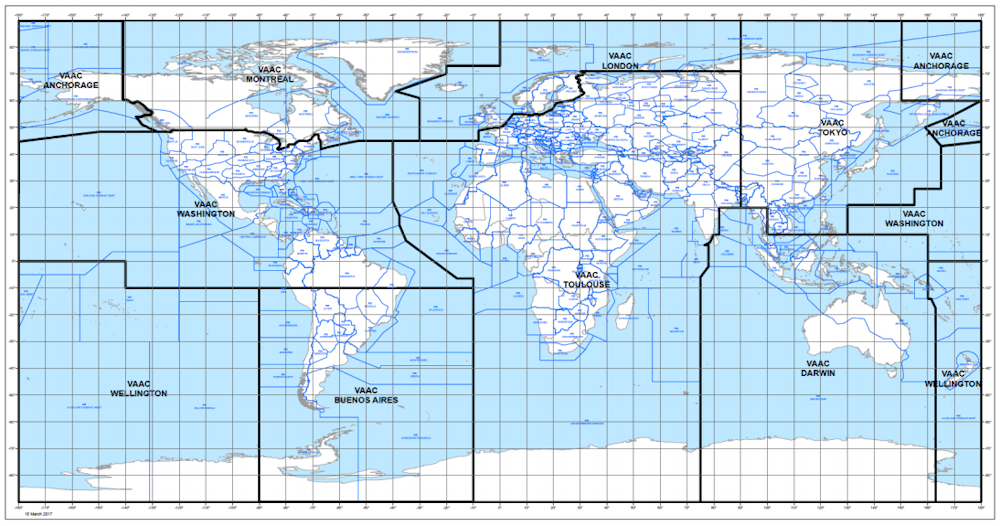
Following several aviation encounters with volcanic ash in the 1980s, the International Civil Aviation Organisation (ICAO), in collaboration with the World Meteorological Organisation (WMO), established nine volcanic ash advisory centres (VAACs), in Anchorage, Buenos Aires, Darwin, London, Montreal, Tokyo, Toulouse, Washington, and Wellington.
Map showing the nine volcanic ash advisory centres (VAACs) and the regions they are responsible for.Bureau of Meteorology
The role of the VAACs is to provide advice to the aviation industry about the location and movement of volcanic ash within their region. The VAACs gather information issued from local volcano observatories, satellite imagery and other available information such as volcano webcams, pilot reports, and online news.
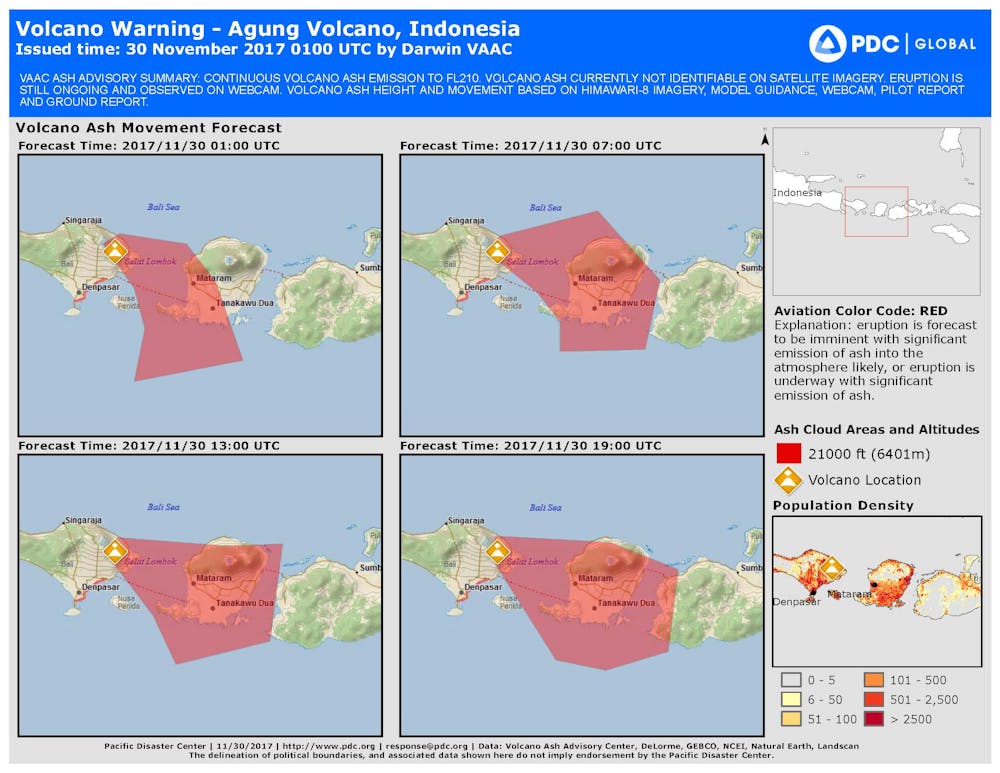
VAACs perform detailed modelling for individual eruptions and issue images in the shape of a polygon (“ash polygon”) showing current ash-affected air, and where ash is predicted to move over the next few hours.
The Darwin VAAC covers the volcanically active regions of Indonesia, Papua New Guinea and the southern Philippines.
How airlines manage risk
Qantas’ Mike Galvin said he makes safety decisions based on information gathered by his team using all available sources.
With regards to Bali’s Mt Agung, Galvin said getting the timing right is an important aspect of the process.
“Here in Australia we might be 5-6 hours away from the ash in Indonesia so we need to make decisions several hours before the plane departs,” he said.
Galvin works closely with the Darwin and Tokyo VAACs.
“But we also have our own team of five meteorologists on constant shifts, who utilise information from other sources such as satellite images from the Japanese Himawari satellite,” he said.
“If a polygon of ash lies over the destination airport or on its approach or departure path, then we will not land.”
Example summary of the volcanic ash advisory from the Darwin VAAC at the beginning of the Agung eruption in November 2017. Ash polygons shown in red. Each picture shows the forecast of ash movement over a period of hours.OCHA/ReliefWeb/Pacific Disaster Centre using Darwin VAAC data
While it is possible engines can tolerate low concentrations of ash, experts don’t yet know what the precise limit of ash that a particular engine can withstand. Further research is needed to determine this.
“Science can also assist the aviation industry though better assessment of the concentrations of ash at different altitudes such as at 20,000 and 30,000 feet,” Galvin said.
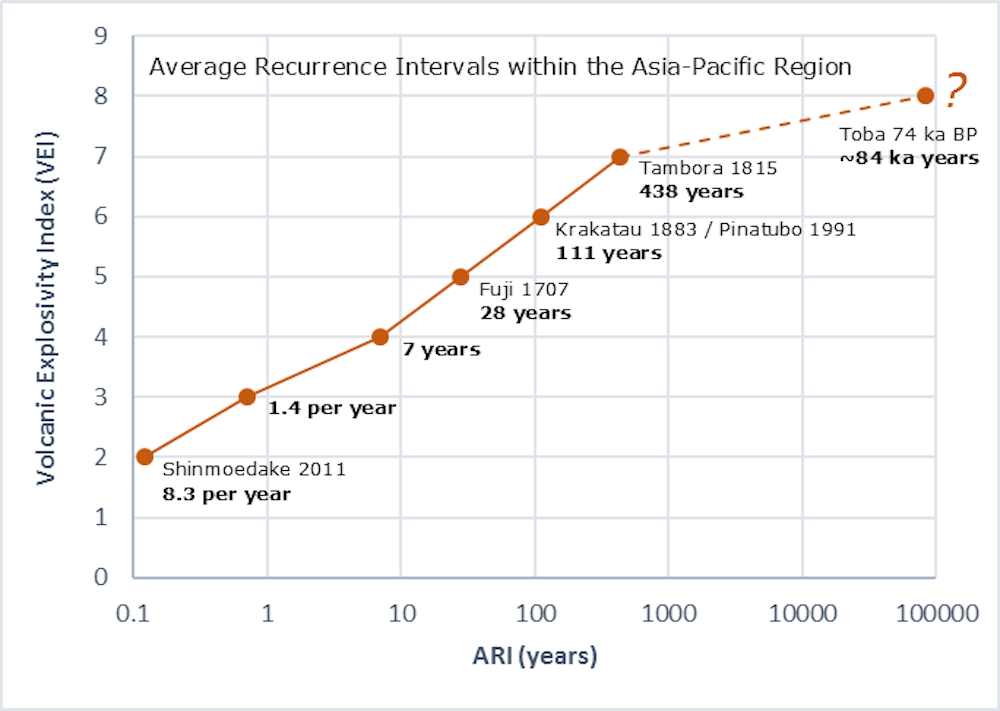
In the longer term, volcano science can help airlines understand more about volcanic ash hazards and risks to particular regions. For the Asia-Pacific region, average recurrence intervals have been calculated for each magnitude of volcanic eruption. This is measured by a Volcanic Explosivity Index (VEI).
To put VEI in context, the eruptions in the current phase of activity at Agung have been attributed a VEI of 3 on a logarithmic scale that runs from 0 to 8. It’s estimated we have 1.4 eruptions per year of this magnitude in the Asia-Pacific region.
Calculated average return periods for volcanic eruptions of various magnitudes in the Asia-Pacific Region. Eruption data from Smithsonian Volcanoes of the World Catalogue (volcano.si.edu) and LaMEVE database of large explosive eruptions (www.bgs.ac.uk/vogripa/view/controller.cfc?method=lameve). Data completeness analysis carried out for each Volcanic Explosivity Index (VEI) category by Stuart Mead and Christina Magill (2014).Christina Magill, Author provided
The 1883 Krakatau eruption in Indonesia and 1991 Pinatubo eruption in the Philippines were significantly larger, VEI 6 eruptions, which have been estimated to recur every 111 years in the region.
This raises the question of how well prepared the aviation industry is, and countries as a whole, for the next even larger VEI 7 eruption, such as that at Tambora in Indonesia in 1815, which erupted 175 cubic km of fragmented volcanic material in just 24 hours.
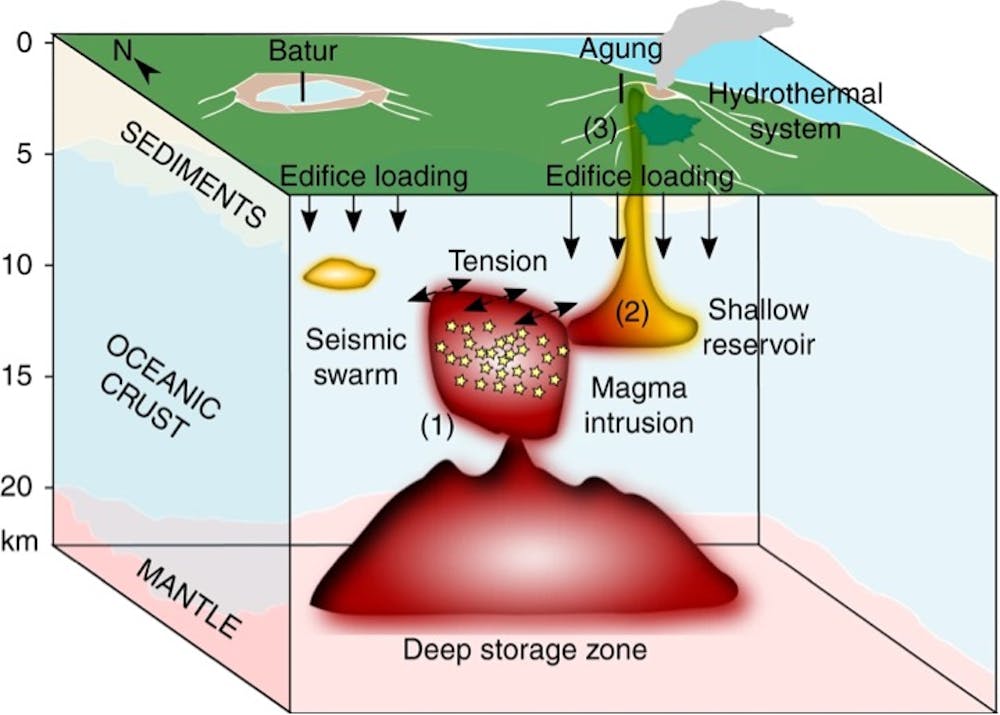
Recent scientific research on Agung suggests that the molten rock (magma) feeding Agung volcano below may also be connected to the neighbouring volcano, Batur. The connectivity of magma plumbing systems may explain the joint eruptions of both Agung and Batur in 1963 and may present an additional volcanic hazard to consider for Bali.
Intrusion of molten rock (magma) between the neighbouring volcanoes of Agung and Batur on Bali that was responsible for 2017 pre-eruptive seismic swarm at Agung.Albino et al., 2019, CC BY
The winner of the Women’s World Cup on July 7 will take home more than just a trophy – there’s also US$4 million in prize money at stake, more than double the amount the US women’s team won at the previous World Cup in 2015.
Compare this to what the winner of the men’s World Cup pocketed in 2018, however: the French team earned US$38 million for that victory.
As play gets under way at the Women’s World Cup, much attention is being focused on the enormous gender gap between the two tournaments. It’s not just the winners who are disproportionately underpaid – it’s all the teams and players, and even their professional clubs.
FIFA has set aside US$30 million in total prize money for this year’s women’s tournament, while the men’s pool totalled US$400 million in 2018. In addition, FIFA gives the men’s teams US$48 million in preparation costs and distributes another US$209 million to the clubs that release players for the tournament. The women get US$11.5 million for preparation costs and US$8.4 million in club compensation.
In April, the Australian women’s national team, the Matildas, threatened legal action to redress the pay imbalance, citing FIFA’s own statutes that have enshrined a commitment to “gender equality”. John Didulica, CEO of Professional Footballers Australia, the trade union that represents male and female pros at the ACTU, called the pay gap:
…an imbalance of proportions only FIFA could come up with a straight face.
Gender pay gap at all levels
FIFA defends the pay imbalance with the usual claim that it reflects the difference in revenue produced by the men’s and women’s tournaments. As FIFA President Gianni Infantino so inelegantly said last year:
Maybe one day women’s football will generate more than men’s football.
Critics, however, don’t buy this argument. Because FIFA refuses to open its books fully to the public, this claim is hard to substantiate. The PFA, for one, thinks the sizeable pay gap is:
…either couched in diplomacy or politicisation … or just looking at their balance sheet, it’s totally arbitrary, it’s got no reference to any economic KPIs.
FIFA, however, is not the only culprit when it comes to pay disparity in football (or other sports, for that matter). Women’s footballers also point to pay gaps at both the club and federation level in many countries.
In fact, the world’s best player, Norway’s Ada Hegerberg, won’t even be competing at this year’s World Cup in France over a dispute with her national federation over its overall investment in and treatment of women’s football. The Norwegian Federation pledged to achieve gender parity in pay two years ago, but Hegerberg, the first-ever women’s winner of the Ballon d’Or, says more needs to be done.
The Norwegian team is competing without its star player, Ada Hegerberg.Tolga Bozoglu/EPA
In Australia, the W-League receives considerably less revenue from Football Federation Australia, which doesn’t make a huge amount of sense considering that both the men’s and women’s leagues lose money.
And despite significant increases in women’s club salaries over the past few years, there are vast inequities here, too. In 2017, Forbes published a shocking comparison that showed the Brazilian striker Neymar earned more money (US$43.8 million per year) from his club, Paris Saint Germain, than the combined salaries of all the women competing in the seven top women’s leagues (D1 Féminine, Frauen Bundesliga, FA Women’s Super League, the National Women’s Soccer League, Damallsvenskan, the W-League, and the Liga MX Femenil).
There is a major pay gap between club salaries in Australia too. Former Socceroos star Tim Cahill, for instance, earned A$3.5 million to play for Melbourne City in 2016-17, which was more than all 181 women who competed in the W-League that year.
In Ireland, Denmark, Australia and the United States, women have used industrial action to earn better pay and working conditions.
Strikes have proved effective, as well. In 2015, the Matildas refused to compete in a two-game series in the US to force the team to raise their base pay from A$21,000 per year. As midfielder Teresa Polias explained:
We’re not asking for millions of dollars. We’re asking for minimum wage, to sustain our lives off the pitch to do well on it.
Sam Kerr reacts during Australia’s surprising upset loss to Italy in the World Cup.Tolga Bozoglu/EPA
While strikes have proved effective for some, others have turned to lawsuits. In March, the US women’s national team filed suit against the US Soccer Federation, alleging that its unequal pay for men’s and women’s footballers violated the US Equal Pay Act.
They have a strong case. In recent years, the women’s national team has outperformed the men on the field (winning three World Cup titles and four Olympic gold medals) and attracted more fans to its games and generated more revenue. Yet the women can only earn a maximum of US$4,950 per friendly, while the men earn on average US$13,166 for the same type of match.
If the team wins its case, the federation might face steep fines or be forced to pay the women’s players retroactively.
The pay issue is just one of many injustices that women’s soccer players face. For instance, women routinely play in more difficult conditions than men. At the 2015 Women’s World Cup in Canada, players were forced to compete on artificial turf rather than grass, which many blamed for a range of injuries. At the World Cup, women also often play with fewer rest days between games, stay in less conformable accommodation, and travel in economy class.
Many women also note that FIFA and their national federations have not done enough to promote the women’s game around the world. One glaring example of this is the fact that FIFA scheduled the Women’s World Cup final this year on the same day as the finals for two other men’s tournaments – the Gold Cup and Copa America.
While many obstacles remain, the success that women’s footballers have had in challenging the status quo has inspired athletes in other sports to fight for their rights too. Earlier this year, 200 of the world best women’s ice hockey players vowed not to play in any professional leagues in North America this season until they are paid a living wage and provided with health insurance.
The Women’s World Cup in France provides one of the biggest stages for women’s soccer players to state their case for pay equity. In 2017, the Swedish women’s national team turned heads when they took their names off the back of their jerseys and replaced them with empowering messages for young girls. What might the US women’s team or the Matildas do when (and if) they get their time in the spotlight in the final in Paris?
In Australia, an average baby boy born in 2016 could expect to live to 80, while a baby girl born at the same time could expect to live until closer to 85. A similar gap in life expectancy between men and women is seen around the world.
As we better understand why people die, we’re learning how biological and behavioural factors may partly explain why women live longer than men.
Scientific advancements also impact the health of women and men differently.
While women may live longer than men, they report more illnesses, more doctor visits and more hospital stays than men. This is known as the morbidity-mortality paradox (that is, women are sicker but live longer).
One explanation is that women suffer from illnesses less likely to kill them. Examples of chronic non-fatal illnesses more common in women include migraines, arthritis and asthma. These conditions may lead to poorer health, but don’t increase a woman’s risk of premature or early death.
But men are more susceptible to health conditions that can kill them. For example, men tend to have more fat surrounding their organs (called visceral fat) and women tend to have more fat under their skin (called subcutaneous fat). Visceral fat is a risk factor for coronary heart disease, the leading underlying cause of death for Australian men.
Coronary heart disease, which results from a combination of biological factors and lifestyle habits, is a major reason for the difference in mortality between men and women.
Other biological factors may contribute to men ageing faster than women, but these remain to be fully understood. For example, testosterone in men contributes to their generally larger bodies and deeper voices. In turn, this may accelerate the age-related changes in their bodies compared to women.
On the flip side, women may have a slight advantage from protective factors connected with oestrogen. Coronary heart disease has been observed as three times lower in women than in men before menopause, but not after, indicating that endogenous oestrogens could have a protective effect in women.
Some behaviours that can lead to an earlier death are more common in men. Accidental deaths, including those caused by assault, poisoning, transport accidents, falls and drownings, are particularly high among young males aged 15-24.
For example, innovations in birth control have enabled greater choice and control over family size and timing. This has resulted in fewer pregnancies that may have led to dangerous births, and improved general physical and mental health for women. Improved clinical care has resulted in fewer women dying during childbirth.
As people reach an older age, the gap in life expectancy narrows.From shutterstock.com
Of course, there have been similar public health policies and clinical innovations that have benefited men too, like screening for bowel caner.
So although we may have some insights, we can’t conclusively answer why women continue to live longer than men.
Mind the gap
The gap between men and women decreases the longer they live. In 2016, at birth in Australia, the gap was 4.2 years, with a male expected to die at 80 on average. But as that male gets older, the gap decreases to 2.7 years at age 65, to one year at age 85 and to just 0.3 years at age 95.
This suggests men who live to an older age have been able to avoid certain health risks, giving them a greater prospect of a longer life.
Ultimately, none of us have control of when or how we’re going to die. But paying attention to factors that we can change (such as maintaining a healthy diet, doing exercise and avoiding smoking) can reduce the risk of dying earlier from a preventable chronic disease.
While women may always live longer than men, by a year or two, men can try to make some lifestyle changes to reduce this gap. That being said, women should work towards these goals for a long and healthy life, too.
Source: The Conversation (Au and NZ) – By David MacKenzie, Associate Professor, School of Psychology, Social Work & Social Policy, University of South Australia
Courtney Herron had been couch-surfing and sleeping rough. She was experiencing mental health issues and trying to deal with drug addiction. Her shocking death, an act of violence against a young woman, reminds us of the vulnerability of rough sleeping, and the disturbing and continuing reality of youth homelessness.
We need sustained housing strategies, not quick fixes
Similar proposals have been raised before. In the early 1990s, there were calls for the empty 11-storey Prince Henry Hospital complex on St Kilda Road to be turned into a shelter for the homeless.
The spectre of a new generation of homelessness shelters haunted a city in which the dormitory shelters such as “The Gill” had only recently been decommissioned. Fortunately, experienced social workers came forward to advise Melbourne City Council not to bow to loud but misguided advocacy. The proposed Prince Henry Shelter complex did not happen and the hospital was demolished in 1994.
Of course, there needs to be an efficient and effective response to rough sleeping in the Melbourne CBD and in every other capital city. Only last year Victoria’s Homelessness and Rough Sleeping Action Plan was launched, backed by a A$9.8 million Towards Home package, “to provide housing and support to an increasing number of people sleeping rough across inner Melbourne”.
The fact is that the goal of housing rough sleepers has not been achieved, despite many attempts over the years. Could it be that a kneejerk symptomatic response from government, which so often falls short of strategic action, is part of the problem?
Developing more crisis accommodation seems to make common sense, which is probably why such proposals continue to be raised. Crisis accommodation supports people who are currently homeless. It has an immediate and short-term impact, but cannot reduce homelessness.
So what needs to be done?
If we are seriously to reduce homelessness in a sustained way, counterintuitive thinking and action are required, not simplistic “common sense”.
Pouring more public funds into crisis accommodation simply treats the symptoms of the problem. But it does not contribute to a reformed service system that can begin to make serious inroads into reducing the problem. According to the National Report Card on Youth Homelessness, issued in March 2019, two of the four key policy imperatives are:
to stem the flow of young people into homelessness or early intervention
to get young people out of homelessness as quickly as possible by providing rapid rehousing options and an accessible and affordable youth housing sector for young people who have become homeless and have nowhere to return to.
The current service system is mostly a crisis response. Early intervention capacity is grossly underdeveloped and youth housing options are limited.
The current system relies heavily on crisis-driven emergency responses, and under-resources ongoing prevention and housing services.Author provided
In general, we don’t need more crisis services, but we do need much greater early intervention and youth housing capacity.
The weighting of services to prevent homelessness and house people should look more like this in the future.Author provided
While we don’t know the detailed circumstances of how Courtney Herron came to be sleeping rough, there would have been many opportunities to avert her descent into homelessness. But, even if that were not practicable, she should never have been left to sleep out in Royal Park. The sad, most likely scenario is that her death will not bring on strategic reform but only more short-term crisis responses and a push to get more homeless people off the streets quickly.
On the other hand, this tragic death could be a catalyst for real change. We need to do much more. More to the point, we could and should do so much better.
Queerdom, an exhibition showing at the Imperial Hotel in Erksineville, is an arresting and unsettling archive of queer and trans performances in Sydney.
A collaboration between photographer Jamie James and poet Quinn Eades, working here as James Eades, Queerdom presents a history of sexual and gender transgression that refuses containment and comfort. Instead, these works ask much more probing questions about the hard work of living and performing on the sexual and gender margins.
The exhibition aims to present what the artists term a “queertrans” history, from the 1990s until today – this term is a deliberate attempt by the artists to put these identities, practices and experiences into productive dialogue with each other.
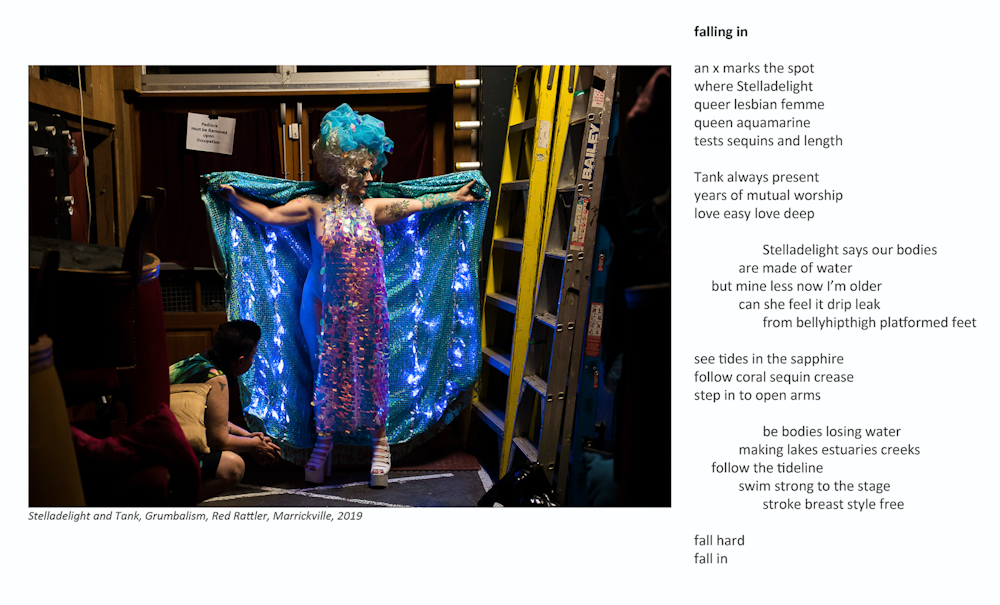
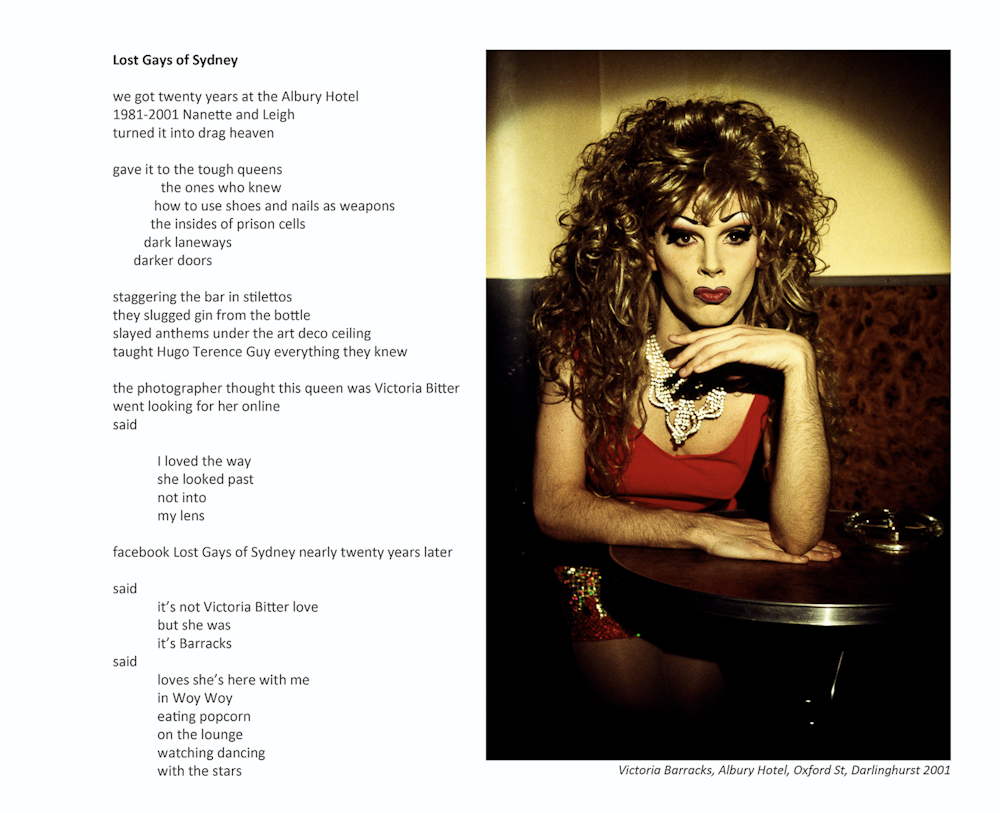
Each work pairs a photograph of a queer or trans (or both) performance with poetry. In one sense this is an exhibition about live performances; stages and performers at the Imperial in Erskineville, Performance Space in Redfern, the Albury Hotel in Paddington, and Tap Gallery in Darlinghurst loom large.
Implicitly, the exhibition delineates a historical geography of queer performance – of dissidence moving westward, as queer alternatives have been pushed from Darlinghurst and Surry Hills to Redfern, Erskineville and Marrickville by rising rents and the cultural homogenisation that so often accompanies them. That this exhibition is taking place at the Imperial is a reminder of how important and vulnerable those spaces can be.
We see “Glitta Supernova” leaning back on stage at Fetish Ball in 1996, screaming in delight as she sprays orange liquid, Berocca we are assured, over her audience – and not from her mouth. “What’s so terrifying about piss”, we are asked. And what might happen if we just “let ourselves taste it … could we just acquiesce?”
Life on the margins
While this might be an exhibition about performance, words work in tandem and tension with these photographs to produce intimate accounts of life on the margins of the sexual and gender order more broadly. This exhibition has much to say about the emotional life of its subjects.
As any historian will tell you, archives are not simply repositories of data from the past – they are mediated representations of historical knowledge. This archive provokes and unsettles what we might expect to see in an exhibition about gender and sexuality, as we might well expect a queer project to do.
In one sense, Queerdom is a powerful riposte to the comforting narratives that abounded in the campaign for same-sex marriage and its aftermath. Leaders in this campaign, as well as the exhibitions shaped by its politics during the 2018 Mardi Gras, tended to mobilise a story in which sexual minorities were making the final steps towards love, happiness and acceptance.
The story works something like this: sexual minorities in the past were caught in the trap of socially imposed shame and loneliness, unable to express and manifest their sexual and gender identities in public. The hard work of activism since the 1970s, not least in projects that spoke the language of liberation and pride, has offered a route to happiness and love. Gay and lesbian life, we are so often told, is all about love and a happy, shining couple finally able to get married.
This intimate exhibition of exuberant and modest moments has more challenging and discomforting things to say.
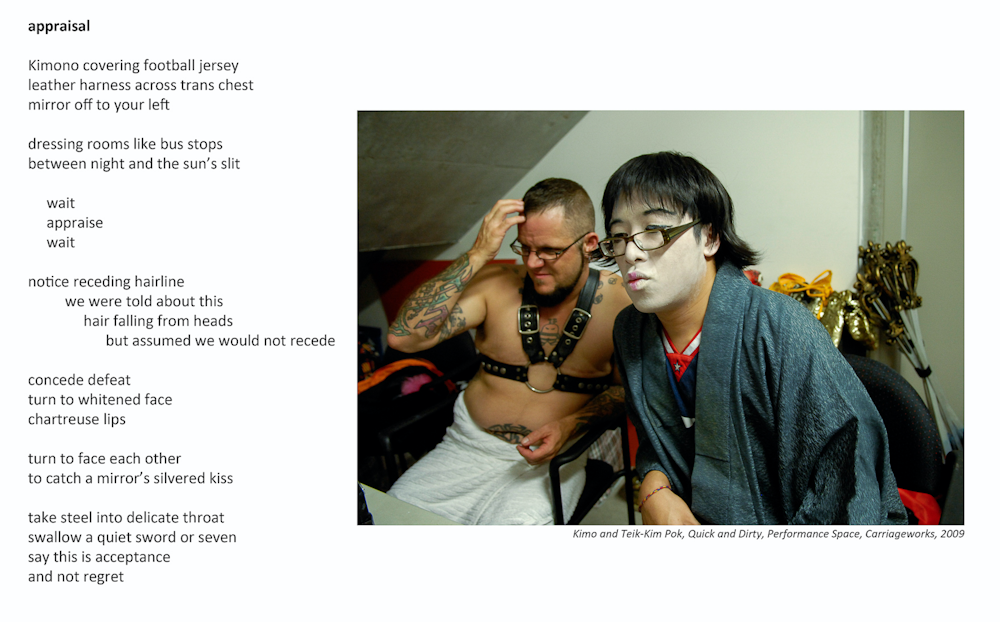
We see Kimo and Teik-Kim Pok, backstage at Carriageworks during the performance series Quick and Dirty in 2009, looking tired and confused, one performer wrapped in a towel with furrowed brow, the other looking pensively into a mirror.
This is not the golden couple of marriage equality. These friends (or lovers, or maybe just performers):
turn to face each other / to catch a mirror’s silvered kiss / take steel into delicate throat / swallow a quiet sword or seven / say this is acceptance and not regret
Of course, some of the pieces here can be yoked to a story of pride and celebration. There is a heathy dose of queer fabulosity on display. Photographs abound of performances exploding with pleasure and the thrill of gender and sexual transgression, however the poetry works hard to force the viewer to think carefully about what they are seeing and the easy thrill they might get from the labour of others.
While some critics might suggest the inclusion of poetry alongside these photographs makes their meaning rigid, leaving less space for ambiguity, these words do precisely the opposite – they force you to stop, they ask you questions.
A photograph of the performance “Axis of Evil” at Carriageworks in 2009 captures the performers back stage, in the familiar setting of a mirror-filled and clothes-strewn dressing room. Sinewy arms protrude and make up runs down faces.
after crimson ribbons / five bodies bringing the house down / the thunk of twenty limbs on a juddering stage // now doubled in the dressing room / now grinning in the aftermath / now coming down in the detrius
Through the inclusion of moments offstage, Queerdom asks us to consider the emotional cost of living and performing in ways where the narrative destination might not be a happy couple with easily recognisable gender identities. These are moments on the edges of difference.
We see performers looking wrung out, collapsing into one and other while also looking uncertain about what these moments might mean.
Here, life looks exhilarating, but also exhausting. Living in ways that don’t conform to the stories we like to tell about gender, sexuality and intimacy isn’t just a struggle for recognition. It’s the struggle against the terms under which that recognition is proffered – the desperate work of trying to exist and thrive in ways that make others so very uncomfortable.
“You know they’re still saying we’re monsters”, James Eades points out in the poem “taking the coverings off”. Maybe a bit of unsettling monstrosity is what we should be working towards, even if it is sometimes terrifying and exhausting.
Queerdom is showing upstairs at the Imperial Hotel, Erskineville until June 30.
The Australian government is considering an increase in the amount of kava travellers can bring into the country. The consultation process includes a proposed pilot program to ease restrictions on kava importation for personal use from two to four kilograms per person.
Many Australian residents, especially those with Pacific Island heritage, will welcome this, but the proposal is based on fundamentally flawed evidence.
Australia’s restrictions on kava are based on concerns about its misuse in remote communities. But the government’s policy is imperialistic and ignores evidence about kava use, side effects and cultural significance.
Kava (Piper methysticum) is widely cultivated by Pacific Island communities for its root, which is ground up and mixed with water to make a beverage for ceremonies and other cultural settings.
Many Pacific Island communities now produce a powdered form of the root, which is exported for medical and social purposes all over the world.
Australian regulations on kava date from 1997, when a 2kg limit was introduced on the amount of kava passengers could bring into Australian without a permit. In 2007, a complete ban on kava was introduced in the Northern Territory. The 2kg limit remains in other parts of Australia.
Controlling kava
The government’s move to regulate kava followed “concerns” about kava abuse within Aboriginal communities in the Northern Territory. Kava was originally introduced into these communities in the 1980s as part of a suite of measures aimed at reducing the harm caused by alcohol.
Opinion pieces published following kava’s introduction referred to all-night binges and illicit mixing of alcohol and kava. The government seized on this as grounds for introducing the Northern Territory ban, despite a lack of coherent evidence to support the reports, and praise for kava’s role in reducing alcohol-related violence.
This imperialistic policy has continued, with widespread negative consequences. Reports show that the inability to access kava has led to substance switching, with far more serious drugs being used instead.
This has affected the Aboriginal communities the restrictions were designed to protect as well as Pacific Island communities throughout Australia. For them, kava is more than a pleasant drink.
It is concerning that the flawed understanding that underpinned the introduction of Australia’s kava regulations persists in the current pilot program. This is evident in the information put forward for consultation and in the proposed changes.
The consultation is being couched as recognition of “the cultural and economic importance of kava to Pacific Islanders”, but health and social impacts of kava continue to be misrepresented. Examples include frequent references to kava having toxic health effects. Such claims of toxicity have been refuted recently and demonstrate an entrenched lack of understanding of alternative cultural perspectives.
The World Health Organisation (WHO) has found, as recently as 2016, that both research and historical evidence show that:
It is possible for kava beverage to be consumed with an acceptably low level of health risk.
Similarly, the characterisation of the “dry and scaly skin” that can follow kava consumption as a “toxic effect” is misplaced. Kava dermopathy is a common and well understood side effect of prolonged kava use. It is known to be harmless and reversible. Some Pacific people see it as a positive demonstration of the individual’s engagement with their culture.
The unnecessary linking of kava dermopathy with toxicity shows that the attitudes and policy that underpin the consultation continue to be culturally skewed, based on outdated understanding of kava’s cultural significance.
Kava as culture, identity
This lack of understanding is most evident in the section dealing with “social impacts of kava use”. The first matter discussed refers to illicit markets for kava and their adverse community impacts. This maintains the negative connotations of kava.
Although kava’s ability to promote “fellowship and companionship” is mentioned, it is followed by a reference to “relationship distress” through kava use. A large body of research demonstrates that kava is not addictive and that its psychoactive properties are neither hallucinogenic nor stupefying.
If people choose to spend their time drinking kava, it is exactly that: a choice. Some people choose to spend time on other recreational activities, including gaming, watching television and playing on their phones, and these choices may cause “relationship distress” as well, but it doesn’t make these activities ripe for regulation.
What the consultation fails to understand is that the significance of kava drinking in Pacific Island communities, wherever they are located, goes far beyond its social aspects. Kava represents an ingestible manifestation of culture and identity, considered by many to be transferring spiritual power. Particularly for diasporic communities, kava circles provide a cultural classroom where respect, language and traditions are taught and reinforced.
Turning kava into a scapegoat through unnecessary regulation has ongoing adverse impacts for Pacific and Aboriginal communities throughout Australia.
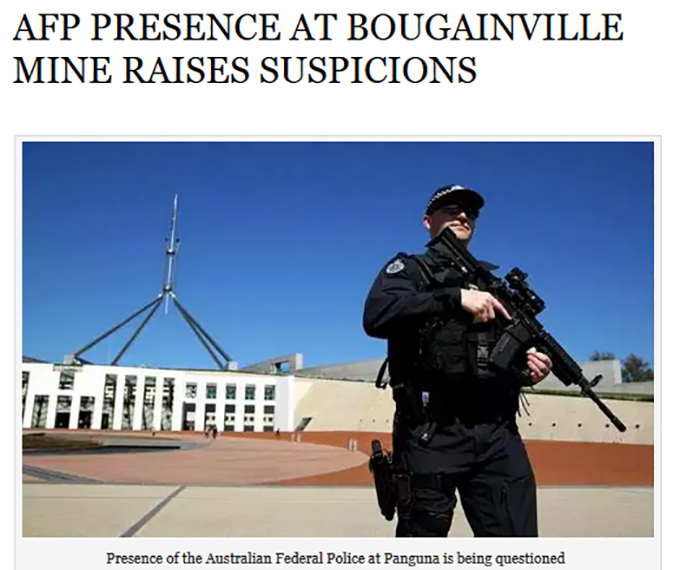
The chairman of Bougainville Hardliners Group and former combatant-turned-businessman, James Onartoo, has called on the Autonomous Bougainville Government (ABG) Police Minister to explain what the Australian Federal Police (AFP) were doing at the site of the controversial Panguna mine last Wednesday (June 5).
According to Onartoo, members of the communities around the mine site became suspicious when they saw the Australian police taking GPS readings at various points around the mine.
These points included the one where the mining company BCL had considered building an airstrip in the early part of the Bougainville crisis to fly in aircraft supposedly to evacuate expatriate mine workers and their families out of Panguna.
“I think the public is owed an explanation as to what is happening. To the best of my knowledge the AFP were ousted in 2007 on suspicions of spying on the ABG and the people of Bougainville by the former President, late Joseph Kabui,” Onartoo said.
“Their presence at Panguna, which is the site of so much controversy and disagreements plus issues of sensitive nature stemming from proposed reopening by ABG, raises serious questions considering the fact that in the past Australia always supported military intervention by the PNG Defence Force to regain control of the mine.
-Partners-
“If AFP can raid the ABC office in Australia itself, then they are capable of anything, including maybe gathering intelligence on ground for the purpose of regaining control of Panguna and restarting the mine with use of force,” Onartoo said.
Onartoo said that it is a well known fact that Australia’s interest in the mineral deposits at Panguna never declined and Australian advisers to ABG have denounced agriculture, tourism, fisheries and other sustainable industries, claiming that only mining is able to finance Bougainville’s independence.
Several companies which are vying to reopen the Panguna mine, which was shutdown by landowners in 1990, are also of Australian origin.
The AFP party, which comprised three policemen and two civilians – including a doctor – were escorted on their visit to the autonomous region by the Bougainville Service Commander, Francis Tokura and police personnel.
They are also said to have visited the proposed border post sites at Koromira and Kangu Beach.
Onartoo said he had nothing to say about AFP visiting other parts of the Autonomous Region.
COMMENTARY:By Alexandra Menzies of Central News in Sydney
As I stood out the front of the ABC’s Sydney headquarters on Wednesday morning (June 5), I couldn’t help but feel the conflicting senses of both pride and anxiety.
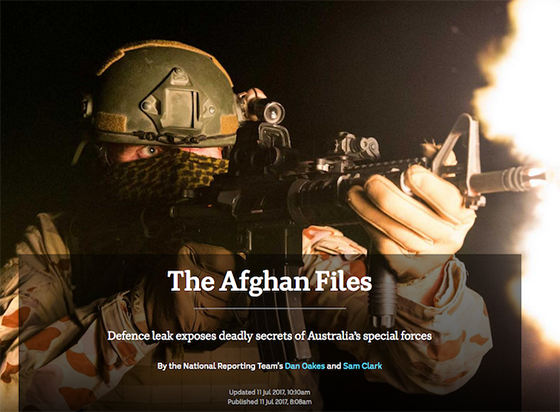
Just moments earlier, a group of first-year UTS Journalism students, including myself, had raced from our lecture upon learning that the Australian Federal Police (AFP) were conducting a raid of the ABC building next door. It was over the 2017 story “The Afghan Files”.
We waited with perched phones in the middle of an eager scrum of professional journalists from organisations such as Sky News, Channel 9, Channel 7 and Reuters News.
The Afghan Files … How the ABC reported a “Defence leak exposing deadly secrets of Australia’s special forces” in 2017. Image: Screen shot of ABC/PMC
We took photographs and short videos before posting them to our Twitter accounts and watching as audience responses flooded in.
It wasn’t until I saw the comments from international news organisations requesting to use my footage, that I understood the significance of where I was, and what I was doing.
-Partners-
I checked my tweet engagement and interaction statistics and realised that people were following my posts for breaking information.
Hi Allie, I’m a journalist with Storyful News. OK to clear this for use in broadcast/online news with attribution to you and UTS News? Thanks! Details: https://t.co/FDYxmeYB08
I was at the scene and, to the best of my ability, I was responsible for letting the world know the truth and facts of the events that were unfolding.
Feeling accomplished and alive It was the first time that I had been in such a position. Indeed, it was the first time that I had felt what it is like to be a journalist. And to tell you the truth, I had never felt so accomplished and alive.
The videos of fellow journalism students were also picked up by top news organisations. For instance, a video of ABC News director Gaven Morris, shot by Nicholas Rupolo, was reposted by The Australian and news.com.au.
Through to the afternoon, I was constantly refreshing my feed to check for updates from the ABC’s Head of Investigative Journalism, John Lyons, who was live tweeting from inside the ABC building. He was sharing information on what the AFP officers were searching for, as they rummaged through 9214 files that belonged to the ABC, and were considered of interest in their investigation.
It may sound melodramatic, but my heart became heavy when Lyons posted two photographs of the search warrant that the police had obtained. I was truly astounded by the scope and broadness of what information the AFP had the power to search and seize.
I thought back to how I had felt earlier that day; the immense zest I’d felt for journalism had now been replaced with a fear for it’s future.
I was confronted with the true irony of the fact that I was reporting freely on an investigation that epitomised the gradual restrictions on my chosen career.
Using this as my incentive, I continued to follow the raid as it stretched into the night.
By 7:30pm, there were six journalists and photographers, seven including myself, who remained out the front of the ABC building.
Keeping an eye out We chatted among ourselves while keeping an eye out for any movements or updates on the raid. Lyons then tweeted photographs of the AFP filling out paperwork. He approximated that the raid would be concluding in 45 minutes.
At 8:14pm, one of the photographers sighted the AFP officers walking through the security gates of the ABC building.
“Get your cameras ready!,” he yelled.
Remembering the tips and tricks that I had learnt about shooting videos on a mobile phone, I captured the AFP as they made a swift exit from the building across Harris Street, taking with them bags that were filled with what we can only assume to be evidence.
I returned to the ABC building along with the other journalists and photographers. We sat and looked through the photographs and videos that we’d been able to get, and in doing so, I was relieved.
Admittedly, it’s a strange emotion to have felt. But I was relieved by the determination of those who I’d waited with. For over eight hours, some without a break, they had stayed to break the news that the raid had finally ended.
Their sheer perseverance gave me hope in the otherwise grim future of journalism.
Scrolled through Twitter When I went home, I scrolled through Twitter and noticed another post from Lyons.
“Bravo to this country’s media for taking on the government over the new war on the media”, he said.
“I’ve never seen such a united front. Old rivalries put aside. Journalism matters”.
I owe a great deal of gratitude to Lyons and the other news organisations who showed their support for journalism in the wake of the ABC raid.
It is comforting to know that, as long as people continue to fight for its freedom, journalism will survive.
Befitting what Wednesday’s events taught me – and as quoted by former Washington Post president and publisher Philip L. Graham – “Journalism is the first rough draft of history”.
Alexandra Menzies is a first year journalism student at the University of Technology Sydney with a passion for politics and human rights. This article was first published by the UTS Central News journalism lab
A few days ago, Waleed Aly asked a not-so-rhetorical question in The Sydney Morning Herald. He wondered how many Australians were worried about the fact that the Australian Federal Police had spent a good portion of this week raiding the offices and homes of journalists who’ve published stories clearly in the public interest.
His conclusion? Not many. He went on to argue that it is because we have developed a culture of accepting excessive state power, with no real thought about the consequences for civil liberties or the functioning of our democracy.
Sadly, I would have to agree with Aly, but as with so many surveys, the answer you get depends on the question you ask.
What if we asked, “Hands up who feels comfortable with relying on the Facebook posts and Twitter feeds of our politicians and departmental spokespeople for information about what our government is up to? Who thinks that is a good way to run a democracy?” Then, I bet you’d get a very different answer.
I agree that Australian media are hardly trusted by the public, but I am also convinced that most Australians recognise the need for some kind of independent watchdog keeping track of politicians and the government on our behalf. It might be imperfect and messy, but a free press has performed that role well enough to keep us broadly on track for much of our history.
Earlier this week, my colleague and fellow University of Queensland researcher Rebecca Ananian-Welsh laid out the intricate web of national security laws passed in recent years that collectively serve to straight-jacket journalists and threaten legitimate whistle-blowing.
In a number of research projects, we have been looking at both these laws and their impact on reporting, and while we still have a long way to go, the early results suggest something deeply troubling.
While they may have helped shore up national security, the laws have also led to a net loss of transparency and accountability. It has become harder for journalists to reach and protect sources and keep track of wrong-doing by government officials. It has also become harder for them to safely publish in the public interest without risking long years in prison or cripplingly expensive and traumatic court cases.
My organisation, the Alliance for Journalists Freedom, has published a white paper that offers a better way of balancing those two crucial elements of our democracy – national security and press freedom.
The most important of its seven recommendations is a Media Freedom Act. Australia has no legal or constitutional protection for press freedom. It isn’t even formally recognised in law; the High Court has merely inferred that we have a right to “political communication.”
That needs to change. The AJF is proposing a law that would write press freedom into the DNA of our legal system. It would both prevent our legislators from unnecessarily restricting journalists from doing their jobs and give judges a benchmark they can use whenever they are adjudicating cases that deal with media freedom issues.
That alone isn’t enough though. The second recommendation in the white paper calls for changes to the national security laws themselves.
Currently, many of the current laws that Ananian-Welsh laid out in her article include a “public interest” defence for journalists. But as we have seen in this week’s raids, that does nothing to stop the AFP from trawling through journalists’ documents for sources and forcing everyone into court.
Instead, there should be an exemption for journalists and their sources when reporting on matters of public interest.
That isn’t to suggest that journalists should be immune, though. Rather, the onus should be shifted to the authorities to show why the public interest defence should not apply. It is also important that the exemption include whistleblowers.
Beyond national security, there are a host of other laws that have contributed to a wide culture of secrecy at odds with the principles of open government.
Payouts under defamation laws now routinely run to millions, potentially destroying news organisations and chilling further investigative work. Shield laws that allow journalists to protect their sources in court are also inconsistent across states and need to be strengthened.
Suppression orders that judges use to smother reporting of certain court cases are being applied with alarming frequency and urgently need review. And whistleblower legislation needs to be strengthened to encourage and protect anybody speaking out about wrongdoing in government or elsewhere.
While the raids of the past week have been shocking, they have forced us all to think again about the role of the media in a democracy. If it leads to better legislation that both protects national security and media freedom, then some good might have come out of it after all.
Papua New Guinea’s new Prime Minister James Marape has overseen a shake-up of cabinet which he says will drive reform the country needs.
The new National Executive Council, announced by Marape this afternoon in Port Moresby, includes two leading members of the opposition in recent years.
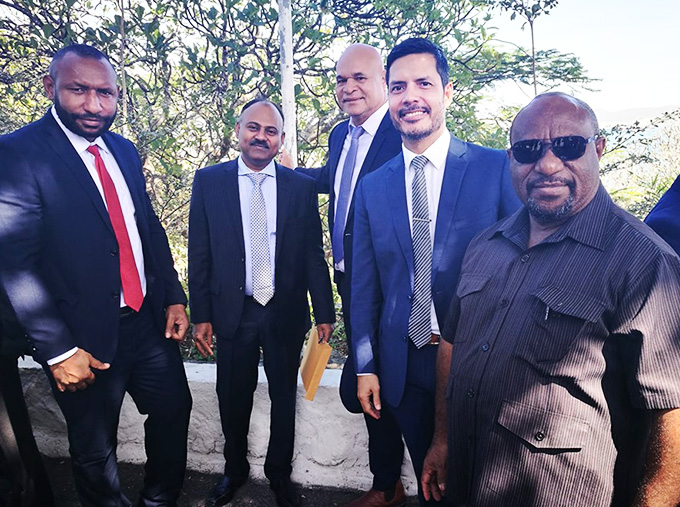
The Madang MP Bryan Kramer, an outspoken government critic with a massive following on Facebook, has been appointed Police Minister.
Sinasina-Yongamugl MP Kerenga Kua, another trenchant critic of the former Peter O’Neill-led government, has been appointed Minister for Petroleum and Energy.
In both cases, an MP who has pushed for reform in a key sector now has the opportunity to implement changes in that area.
-Partners-
Marape’s announcement of Kramer’s appointment was met with cheers at Government House.
“He’s the first to admit that police operate in the rule of evidence and the rule of law,” Marape said.
Police heirarchy “So we will be asking of him, in the first instance, to restore credibility in the entire police hierarchy. It’s not only about the commissioner or a few sections of the police. The entire police structure is dysfunctional at the moment.”
Marape, who has underlined that his government will review laws governing resource sectors, said he looked forward to working with Kua in the vital petroleum sector to ensure the country has an adequate share of the benefits.
“Of course, he comes from the other side of the house. And he did not cast a vote for me [as prime minister],” Marape explained.
“But this is not about me, this is about the right thing for the country, taking the best men we have around.”
Marape and Kua have both opposed the O’Neill government’s move in April to sign an agreement with French petroleum company Total for the US$13 billion Papua LNG gas project in Gulf province.
They cited concerns that landowner interests were being undermined in the deal, and that the O’Neill government had rushed the deal through without meeting mandatory requirements.
Triggered defections Meanwhile, the Esa’ala MP Davis Steven has been appointed PNG’s Deputy Prime Minister. He and Marape were the first senior ministers to resign from the O’Neill government in April, triggering a series of defections which ultimately forced the former prime minister to resign.
Other notable cabinet appointments were Bulolo MP Sam Basil as the Treasurer, and O’Neill’s former deputy Charles Abel, the Alotau MP, as the Finance Minister.
Abau MP Sir Puka Temu has been given the portfolio of Bougainville Affairs, which is of critical importance given the Bougainville independence referendum is to be held in October.
Kikori Open MP Soroi Eoe is the new Minister for Foreign Affairs and Trade, replacing Rimbink Pato who had been in the role since 2012.
Marape paid tribute to Pato’s work during his long stint in the role, but explained that there was no room for the Wapenamanda MP given the need to balance regional interests in the cabinet.
“I can’t afford to have more Engans in cabinet with me,” Marape said.
Cabinet split The prime minister has also made a major change to the shape of cabinet by dividing it in two, which is an attempt at bringing reform with more inter-ministry cohesion than has been seen in the past.
One division will be in charge of the social sector, Marape explained. This will be led by the deputy prime minister and will cover sectors such as Health, Education, Police and Justice
The other area, which the prime minister himself will lead, is concerned with the economic sector, and will include Treasury, Finance and National Planning.
Notably, the National Alliance, which has led PNG’s opposition in the past two years, has not been given any portfolios, despite voting for Marape as prime minister. This seems to confirm that they will be the core of the opposition in the foreseeable future.
While there has been an injection of fresh talent into the National Executive Council, around half of the ministers who were also part of O’Neill’s cabinet, leaving a question mark over the prospects of true reform.
Marape’s cabinet: 1. James Marape – Prime Minister 2. Davis Steven – Deputy Prime Minister and Justice and Attorney-General 3. Joseph Yopyyopy – Education 4. Lekwa Gure – Civil Aviation 5. Wera Mori – Commerce and Industry 6. Renbo Paita – Communication and Energy 7. Wake Goi – Community Development, Youth and Religion 8. Chris Nangoi – Correctional Services 9. Saki Soloma – Defence 10. Soroi Eoe – Foreign Affairs and Trade 11. Jeffery Kama – Environment, Conservation and Climate Change 12. Dr Lino Tom – Fisheries and Marine Resources 13. Sir Puka Temu – Bougainville Affairs 14. Elias Kapavore – Health and HIV/AIDS 15. Nick Kuman – Higher Education, Research, Science and Technology 16. Justin Tkatchenko – Housing and Urban Development 17. Petrus Thomas – Immigration and Border Security 18. Pila Niningi – Inter-Government Relations 19. Alfred Manase – Labour and Industrial Relations 20. John Simon – Agriculture and Livestock 21. John Rosso – Lands and Physical Planning 22. Kerenga Kua – Petroleum 23. Bryan Kramer – Police 24. Sasindran Muthuvel – State Enterprises 25. Westly Nukundj – Public Service 26. Emil Tammur – Tourism, Arts and Culture 27. William Samb – Transport and Infrastructure 28. Michael Nali – Works and Implementation 29. Solan Mirisim – Forest 30. Sam Basil – Treasury 31. Richard Maru – National Planning and Monitoring 32. Charles Abel – Finance and Rural Development 33. Johnson Tuke – Mining
Source: The Conversation (Au and NZ) – By Euan Ritchie, Associate Professor in Wildlife Ecology and Conservation, Centre for Integrative Ecology, School of Life & Environmental Sciences, Deakin University
Sign up to the Beating Around the Bush newsletter here, and suggest a plant we should cover at batb@theconversation.edu.au.
In Dr Seuss’s The Lorax, his titular character famously said:
I am the Lorax. I speak for the trees. I speak for the trees, for the trees have no tongues.
In the midst of a global extinction crisis, the Lorax’s call to preserve what is precious couldn’t be more apt. The greatest threat to the survival of species globally continues to be habitat destruction and modification.
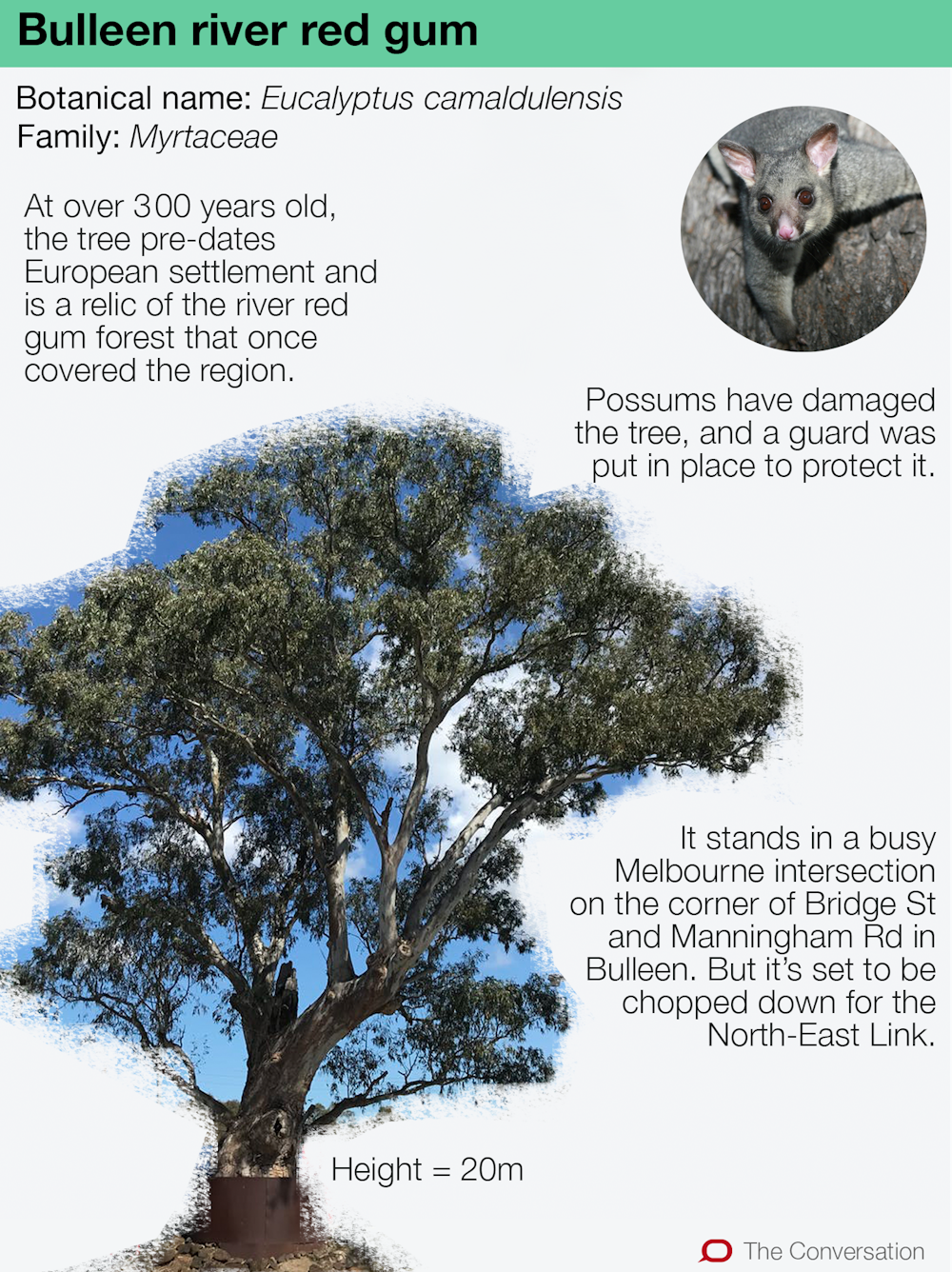
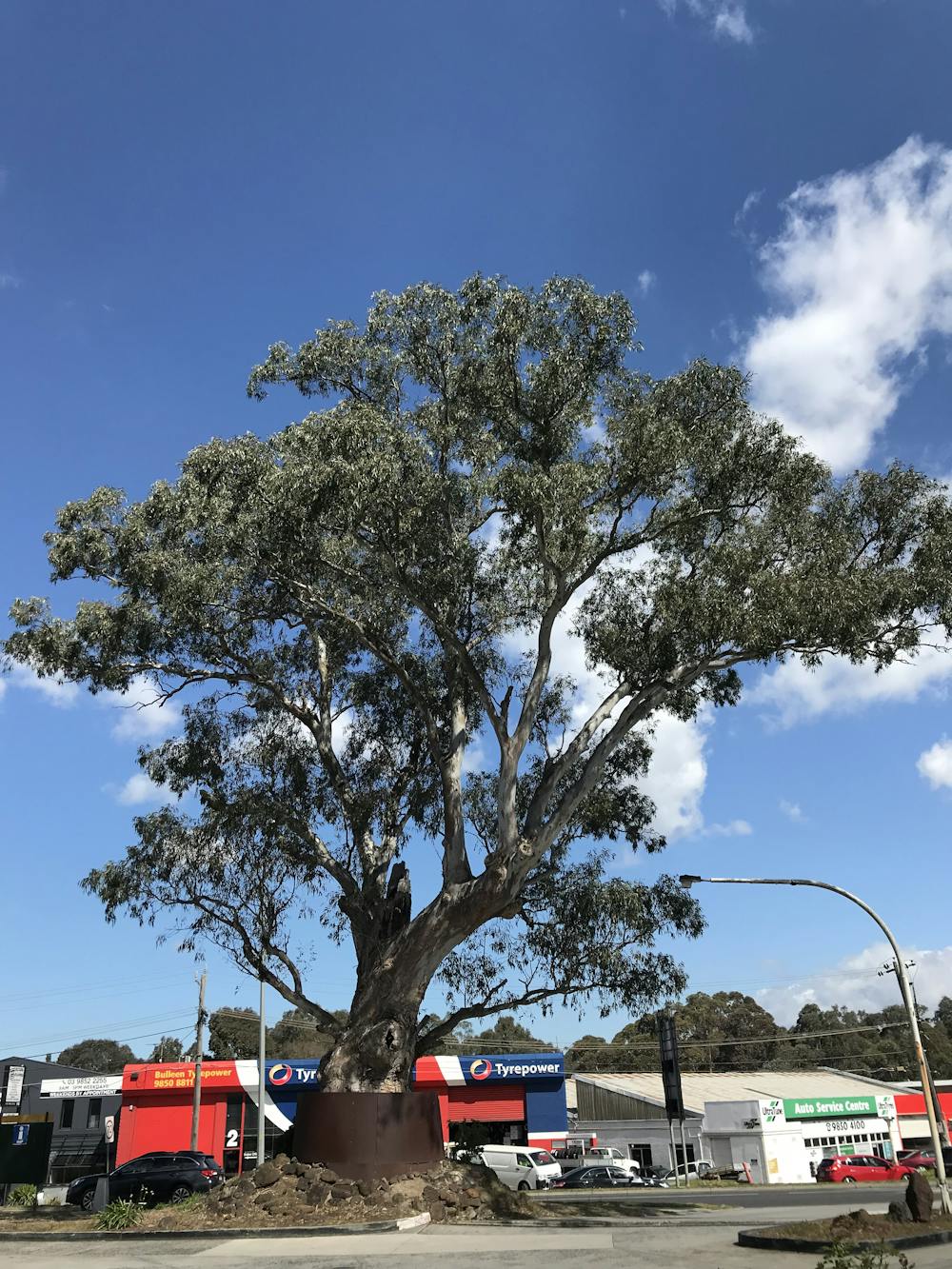
A potential and local victim of this ongoing environmental catastrophe is a single tree, and a tree I have a deep personal connection with. The tree I refer to is Bulleen’s iconic 300-year-old river red gum (Eucalyptus camaldulensis).
To me this tree has been a constant in my life. While everything else has changed around me, it has stood there, solid, just as solid as its red gum fibres are known to be.
As a child I fondly remember looking up at this tree in awe, as we’d often stop at the nearby service station on a hot summer’s day to buy a cold drink or ice-cream on the way to Saturday sport, the nearby Birrarung (Yarra River), or my grandmother’s house.
The Conversation
Bulleen’s majestic river red gum
It’s estimated to be approximately 20 metres in height with a canopy spread of 17 metres. And its trunk measures a whopping two metres across.
The tree is thought to be the oldest remnant of a once substantial red gum forest, and was saved by a local resident when the rest of the area was cleared for the construction of a service station.
It now faces destruction, as it is within the preferred path of construction for Victoria’s North East link.
While the measurements of this tree are impressive, the splendour and value for me is that it has survived for so long and, in more recent times, against tremendous odds.
Surviving against all odds
The Bulleen red gum stands beside one of Melbourne’s busiest roads and the immediate area is covered with concrete and bitumen. The tree’s roots and health have therefore been challenged for a long time, and yet this massive red gum stands, as if in defiance of the modern world and the development that has encircled it.
Since this tree has survived for so long, it undoubtedly holds a special connection with so many: the Wurundjeri-willam people of the Kulin Nation, members of Australia’s famed Heidelberg school of artists who lived and worked in the near vicinty, everyday commuters that have driven or walked by or stopped to admire it, or the war verteran Nevin Phillips who once apparently defended it with his rifle against it being chainsawed.
Very old trees such as Bulleen’s river red gum deserve our respect and protection, for these trees have substantial environmental, economic and cultural value.National Trust
Further proof of the value of this tree to so many is that it was awarded The National Trust of Australia’s (Victoria) 2019 Victorian Tree of the Year.
Why we must speak for and save old trees
I grew up near this tree and, like the Lorax, I would like to speak for it. Trees as old as the Bulleen river red gum are now increasingly rare in our world, and beyond their strong personal and cultural values, including in some places as Aboriginal birthing sites, they are tremendously important for other reasons as well.
Perhaps most importantly, under their bark and in their cracks and hollows, they provide homes for many of Australia’s precious but increasingly imperilled native wildlife, including bats, birds, possums and gliders, snakes and lizards, insects and spiders.
A powerful owl chick in a tree hollow, in outer Melbourne.John White (Deakin University)
As cities like Melbourne continue to grow around the world, there will be more and more cases where arguments of progress are used to justify the further destruction of what nature remains. But progress shouldn’t come at any cost, and in the case of preserving iconic and valuable trees such as Bulleen’s river red gum, it would seem there’s more than enough reasons to ensure this tree’s life and its many values continue.
Perhaps again the wise sage, the Lorax, says it best.
Unless someone like you cares a whole awful lot, Nothing is going to get better. It’s not.
Buying the contraceptive pill from the pharmacy without a prescription, as is being considered by Australia’s drug regulator, might be convenient for women or even save the health system money. But it risks women’s health for a number of reasons.
After determining the most appropriate form of contraception with each woman, it’s important for a doctor to monitor potential side effects. In bypassing their GPs to get the pill directly from the pharmacy, women could lose out on reproductive health care and preventive health care more broadly.
The Therapeutic Goods Administration (TGA) classifies medicines into schedules that determine whether they’re available “over the counter”, or can only be dispensed with a prescription. Currently, the contraceptive pill is Schedule 4. Women need a new prescription for the pill each year.
The TGA recently held consultations about whether the contraceptive pill, among other medicines, should be made available over the counter (Schedule 3).
Pharmacists have suggested reclassifying the contraceptive pill to Schedule 3 would reduce the need for trips to the doctor, saving time and lowering costs.
But to continue to provide a high standard of reproductive health care, Australian doctors should still be required to prescribe the pill.
Contraceptive choice
There are many different contraceptive pills, with varying dosage of synthetic hormones. These hormones “switch off” ovulation, preventing pregnancy (although not 100% of the time).
A GP consultation to discuss the pill requires considerable time taking the patient’s history, measuring her blood pressure and weight, and discussing contraceptive options.
There may be a number of reasons a particular woman should not take the pill. A doctor will work with the patient to determine the choice of contraception that’s going to best meet her needs. The pill is only one of many modern contraceptive options.
If a woman chooses the pill, regular monitoring by her GP is important.
While the pill is usually well tolerated and safe, common side effects can include bloating, fluid retention, breast tenderness and nausea. Serious complications from the pill are rare, but can include blood clots or, more rarely, heart attack and stroke.
Many women use the pill as their preferred form of contraception.From shutterstock.com
Although the risk of heart attack or stroke is small, it is heightened when the pill is prescribed without regular blood pressure monitoring.
One review of the results of 24 studies found the risk of high blood pressure increased by 13% for every five years a woman was on the pill.
An annual GP consultation offers an opportunity to discuss and monitor any pill side effects, as well as each woman’s individual contraceptive needs.
Continuity of care
When women visit the doctor to get a new prescription, it also offers an important opportunity to discuss reproductive health and general well-being.
The Royal Australian College of General Practitioners suggests a number of preventive activities should be provided for women of reproductive age, including blood pressure checks and discussions about weight and physical activity.
GPs have also often developed a trusted therapeutic relationship with their patients over several years. This means they are well positioned to manage sensitive and interrelated issues, including relationships, mental health, sexual health, contraception, smoking, alcohol and drug use.
Annual consultations also offer an opportunity to provide education around women’s health issues such as cervical and breast cancer screening.
Health benefit versus risks in rescheduling the pill
The authors of a study published last month hypothesised that reclassifying the contraceptive pill from Schedule 4 to Schedule 3 might save the health system A$96 million a year and perhaps 22 lives over 35 years.
But they also acknowledged possible adverse health impacts from rescheduling the pill. These include 122 more cases of sexually transmitted infection, 97 more cases of depression, five more strokes and four more heart attacks each year.
Preventive health advice from the GP can have significant individual health benefits in the long term, which can also save the health system money.
For example, roughly 67% of Australians aged 18 and over are overweight or obese, including many women who take the pill.
Cost-effectiveness research on obesity has found interventions aimed at tackling obesity by improving diet and increasing physical activity through health education and counselling in primary care (that is, GP visits) are effective in improving health and longevity, and are more cost-effective than treating chronic diseases once they emerge.
Investment in women’s health has practical benefits across a range of areas, including nutrition, management of communicable and noncommunicable diseases, screening and management of cervical and breast cancer, gender-based violence prevention and response, and pre-pregnancy risk detection and management.
It is naive and potentially dangerous to attempt to separate the potential health and cost benefits derived from pharmacy access to the contraceptive pill from the health and cost benefit of comprehensive reproductive and broader health care provided for women in the primary care setting.
Doctors and pharmacists have a role
Australian pharmacists are not trained to conduct consultations regarding contraceptive options and reproductive health. These are more appropriately conducted in mainstream general practice, or in specialised women’s health clinics.
But pharmacists do know a great deal about the range of contraceptive medications that are prescribed by doctors, and have an important role in educating women about correct medication use and potential side effects.
Education by both GPs and pharmacists is vital for Australian women to understand the diverse range of contraceptive options available to them, and how their informed choice of contraceptive method can best fit into a healthy lifestyle during their reproductive years.
Exactly two weeks before the Reserve Bank of Australia cut interest rates to a record low, the bank’s head, Philip Lowe, outlined a predicament to the Economic Society of Australia.
He is faced with a global problem, in fact – one no one really understands or knows how to fix.
It is almost the exact opposite of the crisis that faced industrialised economies in the 1970s.
Four decades ago economies were hit by two malaises: on the one hand, stagnation, with unemployment rates high and rising, and on the other rampant inflation, with prices and wages growing ever faster.
Stagnation and inflation were not meant to occur at the same time. That they did so challenged to the core the post-Keynesian economic orthodoxy of the times. It was so baffling economists gave it a new term: stagflation.
“Today,” said Lowe, “the picture is very different: we have low unemployment and low inflation.”
No one has given it a name, and Lowe says it is better than stagflation, but it’s still a worry. For one thing, if wages fail to rise as the cost of assets such as housing keeps growing, we end up with greater inequality.
“Understanding why this has happened is a priority for us,” Lowe said.
Quite so. Experience shows the perils of seeking to fix something without knowing why it is broken. It can lead to a Kafkaesque outcome.
The driving force behind any macroeconomic reasoning is the law of supply and demand. In short, if the supply of something increases, but demand does not, those trying to sell it will make discounts, and its price will go down. Conversely, if demand for something increases but supply does not, wannabe buyers will outbid each other to secure the good, and its price will go up (as illustrated right).
Given this basic law of economics, the combination of low unemployment and no wage growth baffles economists.
Low unemployment means labour is in high demand and excess labour (people looking for jobs) scarce. That should mean that employers need to offer more money to attract employees. So we would expect low unemployment to always be accompanied by an increase in the price of labour (the wage).
This relationship was first outlined by the New Zealand economist A.W. (Bill) Phillips in a paper published in 1958. Below is his original scatter diagram showing the relationship between unemployment and the rate of change of wage rates in Britain from 1861 to 1913.
This relationship, now known as the Phillips curve, forms the basis for monetary policy – the use of interest rates to control money supply.
When unemployment is high, central banks like the Reserve Bank of Australia lower interest rates to make borrowing easier. This results in greater spending in things like building a home or starting a business. Such investment increases the demand for labour.
Conversely, when unemployment is very low and wages start to grow out of control, the Reserve Bank will lift interest rates to make borrowing harder. This dampens economic activity and the demand for labour.
Bent, possibly broken
But somehow in recent times the Philips curve appears broken, and nobody knows why.
Australia’s reserve bank has been sitting on record low interest rates for three years, and yet nothing at all has happened to wages and inflation.
There are competing theories. One is that automation is to blame, by reducing the value of human labour. Others involve political changes, market concentration and the gig economy undercutting workers’ bargaining power.
Nobody knows which theory, if any, is right.
This should not come as a surprise. After all, it took economists and policy makers almost a decade to make sense of the 1970s stagnation.
But if circumstances take a dive, and people start demanding that something be done, we have a problem.
“We are still searching for the full answers… We can’t be sure how long these effects will last and whether the coexistence of low inflation and low unemployment is temporary, or whether it is a new normal.”
Translation: he is not really sure what we should do, but the situation is bad enough to try to do something.
If the Reserve Bank can’t fix the problem, economic commentators and the public will look to the government, perhaps through spending more, or reducing taxes.
Under pressure from a public demand for action, the danger is that politicians may take shots in the dark and deliver the wrong type of change.
Learning from Italy
The Italian experience in this regard is particularly instructive. It’s something that I and three Italian colleagues (Luigi Guiso, Claudio Michelacci and Massimo Morelli) have documented.
Political instability, strong pressure for reforms and short-lived governments have shifted Italy towards a Kafkaesque state where the bureaucracy wastes its time on frequently useless reforms.
Though Italy has a reputation as a land of eternal disorganisation, in the early 1990s its productivity was greater than Germany’s. On the downside, youth unemployment was high, and political corruption widespread. Voters demanded change.
Politicians responded with zeal. After 1992, the Italian parliament doubled the number of bills it passed each year, with new laws three times as long as old laws.
Within just a few election cycles new reforms began contradicting reforms passed a year or two earlier. Governments routinely attributed failures to previous governments and reforms. Voters lost track of who did what.
Nobody knew exactly what to do to solve the economic problems, and nobody knew how to evaluate the effect of individual reforms, because it was impossible to distinguish the effects of one reform from another.
In this new chaotic environment, incompetent politicians thrived, proposing ever more ambitious reforms – all useless.
Public infrastructure projects were started but never completed (647 of them, last time anybody counted). New education programs have been introduced, only to be replaced by a newer programs; the high-school examination system is this year going through its third major overhaul in just 21 years. The failure to deliver essential services have buried city streets in piles of garbage.
The Italian experience is a warning tale for us all: when organisations change too much and too often, we lose the ability to track down results and ultimately generate chaos. This is even more true for the largest and most complex organisation of all – the state.
University of Canberra Deputy Vice-Chancellor Geoff Crisp speaks with Michelle Grattan about the week in politics. They discuss Labor’s shadow cabinet, including Shorten’s new role in the area of the NDIS where he will be going up against Stewart Robert. They also talk about the Reserve Bank’s decision to cut interest rates to 1.25% and the two raids this week on journalists conducted by the Australian Federal Police.
When you’re in politics, words are a high-stakes game. Voters and journalists hold you to them and there is a risk in using words that are hard to live up to. This is particularly true for politicians whose reputation is founded on sincerity and authenticity.
New Zealand’s Prime Minister Jacinda Ardern saddled herself with the word “transformational”. She used it heavily in the heady days of the 2017 election campaign, although less so in the compromised reality of a coalition government. Still, it is the aspiration she is held to. The 2019 well-being budget is held to it by association.
Obviously, transformation must go beyond the status quo. But to be transformative, it must also go beyond mere reform.
A reform agenda recognises that trouble is brewing, that social, economic and environmental trends are on the wrong track. It accepts that major changes to policy and lifestyle may be required. As sustainable development research shows, it does “not locate the root of the problem in the nature of present society, but in imbalances and a lack of knowledge and information”.
It tends to reach for existing policy levers, and to hang its hopes on technical solutions. It reacts to the toughest choices by devising new frameworks for analysing them.
The well-being budget easily goes this far. Finance minister Grant Robertson is entitled to say, as he did in his budget speech, that this is a government “not satisfied with the status quo”.
As economists Joseph Stiglitz, Amartya Sen and Jean-Paul Fitoussi argued in their influential analysis of what went wrong:
What we measure affects what we do; and if our measurements are flawed, decisions may be distorted.
By arguing for more nuanced national accounting that captures quality of life, they made a case for reform that Ardern’s government is putting into practice.
Beyond reform
A transformative agenda goes further. It sees problems as rooted in the present structure of society. It isn’t only about managing the flaws and oversights of the dominant system, but overturning the system itself. This involves an order of ambition that the well-being budget lacks.
Consider, for instance, its centrepiece investment: NZ$455 million (over four years) for a new frontline service for mental health. This is vital support for those in need, complemented by wider reforms recommended by He Ara Oranga, the report of the inquiry into mental health and addiction.
But its primary focus is to address existing suffering. It doesn’t aim for the socioeconomic or historical causes of many people’s misery and strain. Other aspects of government policy may do, such as the Provincial Growth Fund, by creating meaningful jobs in places where opportunities are low and shame or whakamā are high.
But whether you think this is adequate depends on how you answer the big questions about the structure of the economy, distribution of power and decolonisation. This is undoubtedly the territory of transformational politics, but the well-being budget only touches the edges.
Just transitions
There is another word for change that the prime minister sides with: not “transformation” but just transition. This is the idea that socioeconomic change should be guided by principles of justice, such as equity and inclusivity, to minimise the disruption that change can bring. The aim of a just transition is to achieve revolution without revolt.
The concept is prominent in climate change policy – and the well-being budget delivers projects to support these objectives, including a clean energy development centre in Taranaki, sustainable land-use funding to enable the shift to low-emissions landscapes, and an extended budget line for just transition planning.
But Ardern obviously sees the idea of a just transition as more broadly relevant, contrasting it with the “rapid, uncaring change” of structural reforms in 1980s New Zealand. To my mind, this better captures the temper of this government – not transformational, but potentially transitional.
As the well-being approach is bedded in – not only with policy wonks but also business and community leaders, and the voting public – it will loosen GDP’s grip on the minds of decision makers. GDP will be repositioned as only one among many indicators that ought to inform political judgement. Then political leaders can be confidently ambitious, not only with their words, but also their actions.
Curious Kids is a series for children. If you have a question you’d like an expert to answer, send it to curiouskids@theconversation.edu.au You might also like the podcast Imagine This, a co-production between ABC KIDS listen and The Conversation, based on Curious Kids.
Why don’t ladybirds have tails? – Lotte, aged 2.
Thank you, Lotte, for this great question.
Let’s start by thinking about animals that do have tails and what they have in common.
Dogs, elephants, cats, birds, monkeys, and fish – they all have tails and use them for many different things like balancing, swishing flies away, or hanging onto things. And what do all these animals have in common? A backbone!
That’s because a tail is actually an extension of a backbone. (Humans used to have tails! Our early ancestors did but then we changed over time and now only a little stump of a “tailbone” remains.)
So to answer your question, ladybirds do not have tails because they do not have a backbone.
They have something called an “exoskeleton” instead. I will explain what that word means.
Exoskeleton means a skeleton that is on the outside. And ladybirds are a type of insect – just like beetles, bees, stick insects, and flies.
An insect’s exoskeleton is a hard outer shell that protects important stuff on the inside of their body (like its stomach, and special tubes that help it breathe).
A ladybird’s body is divided into three sections: a head, a thorax, and an abdomen.
The head has eyes, mouthparts, and antennae. Antennae help them sense what’s in front of them and how far away it is.
The thorax is where all the legs and wings are connected to the body. Ladybirds have six legs and two pairs of wings.
The tough pair of outer wings is tough is called the “elytra”. The second pair is hidden underneath and ladybirds stretch these wings out only when they need to fly.
Ladybirds come in red, orange, yellow, blue, brown, and black. Most of them have black dots or patterns on them.
We think that ladybirds use their colours to warn other animals (like birds or spiders) to not to eat them. They’re using their bright colour to send a message that says “Hey! I taste bad, so don’t eat me!”
Their predators recognise what these colours mean and avoid eating them.
Ladybirds are beautiful and smart, aren’t they?
The ladybird’s bright yellow colour warns other animals not to eat them.Graham Wise/flickr
When Italian astronomer Galileo Galilei first spotted four moons of Jupiter through a telescope, he realised that not everything goes around the Earth, as was the prevailing theory in 1610.
The presumed origin of the Galilean moons was in a swirling circumplanetary disc of gas and dust around the newborn Jupiter.
Jupiter and the four Galilean moons, a composite of several images as seen through a telescope.Flickr/Thomas Bresson, CC BY
But evidence of a circumplanetary disc eluded astronomers, despite an intensive search. Until now.
We detected the first evidence for one of these discs in the form of an infrared glow around a baby planet called PDS 70 b, the details published in twopapers this week.
It was not easy to find
The discovery required one of the largest telescopes on Earth (the creatively named Very Large Telescope in Chile), a sophisticated spectrograph (SINFONI) to acquire images at different wavelengths in the infrared, and new image-processing algorithms developed specifically for the dataset we gathered.
The newborn planet orbits a star called PDS 70, which is young and relatively close to us (a trifling 369 light years away) in what is known as the Upper Centaurus–Lupus star-forming region of the Milky Way.
The star is just a baby itself, less than 10 million years old. In stellar terms PDS 70 is barely out of nappies (our Sun is 4.6 billion years old).
Apart from its youth and proximity, the main reason we chose to study PDS 70 is that previous observations showed a large hole or gap in the disc of gas and dust surrounding the star.
This hole, covering an area almost the size of our Solar System, hints at the presence of planets orbiting the star, which are responsible for carving away the disc material.
Infrared image of the newborn planet PDS 70 b (the bright spot, bottom left) and its circumplanetary disc. The actual star is in the centre of the image (marked by *) but its glare blocked out by the processing. The second brightest spot (above right) is thought to be another planet forming and is being studied by other researchers.Valentin Christiaens et al./ESO, Author provided
The new images we gathered show that the gap is not entirely empty. They reveal an arc of gas, spirals and a bright blob, which had first been detected and interpreted as a baby planet in twostudies published last year.
And it’s a whopper planet – about 10 times heavier than Jupiter.
In the infrared
What is new in our analysis is that we probed red light from the planet in more detail than previous studies. We were able to show for the first time that the planet’s infrared colours cannot be explained by its atmosphere alone.
Instead, this excess infrared excess suggests the presence of a circumplanetary disc, just like the one imagined as the birthplace of Jupiter’s four Galilean moons – Io, Europe, Ganymede and Callisto.
Decades ago, the same argument was used as evidence for the presence of protoplanetary discs, the dusty discs of gas around baby stars that are the birthplaces of planets themselves.
An illustration of a protoplanetary disk: the rings around young star suggest planet formation in progress.Shutterstock/Jurik Peter
Now we can use the same techniques but on a smaller scale to see the birthplace of moons.
The tricky part is that spotting planets with a telescope is like staring into car headlights and trying to spot a firefly. We first had to model and subtract the bright glare of the star, to spot the feeble glow of the planet.
In our processed image (above) we carefully deleted the starlight (we show the location with an asterisk), revealing both the planet and faint structures in the disc surrounding the star.
Possible moons
The discovery of the four largest moons of Jupiter four centuries ago gave astronomers a first hint that giant planets must form surrounded by a circumplanetary disc.
Plenty of work has been done since to try to understand their properties, but we finally have direct confirmation that they exist. It’s the culmination of a long search.
It’s also exciting. Our work shows that theoretical models of giant planet formation were not too far off. There is now the possibility that moons could be forming right now in the circumplanetary disc around PDS 70 b.
It’s hoped the new algorithm we developed can now be used to attempt to extract faint signals from other complex datasets of planets forming in other star systems.
It blows the mind to think we might see other planets and even moons in the process of formation, using the biggest telescope in the world. It’s just another reminder of how small and insignificant we really are.
Despite all the attention given to this matter over the last couple of years, and the various procedures introduced to address it, Section 44 will only continue to be a problem until the parliament steps in to address it.
To do that, we first need to address seven myths about Section 44.
1. Everyone knows their citizenship, they just need to do their paperwork
Section 44 is about more than just citizenship – it covers a variety of restrictions on who can serve in parliament.
For instance, a GP who bulk-bills a patient could be considered to have a “pecuniary interest in an agreement with the Commonwealth.” And a postman or a nurse in a public hospital could be deemed to hold “an office of profit under the Crown.”
On citizenship, the section doesn’t just disqualify dual citizens, it also bars those “entitled” to citizenship elsewhere (even if they haven’t applied for it) and those “entitled to the rights and privileges” of citizenship (basically, the “right of abode”, or being entitled to enter a country and live there).
Such entitlements are not easy to discover and almost impossible to remove, because they’re embedded in foreign legislation.
On the contrary, the parliamentary committee investigating the matter estimated half the adult Australian population, or more, could be disqualified by law or impeded in practice from standing for parliament.
As a result, the Australian parliament becomes even less representative of the Australian people.
3. The constitution framers knew what they were doing
The original text agreed to at the constitutional convention in 1898 simply said anyone who had acquired foreign citizenship by their own act was disqualified from standing for parliament.
The text that eventually became Section 44 was inserted surreptitiously by one of the key architects of the constitution (and Australia’s first prime minister), Edmund Barton, as a drafting amendment. He introduced 400 amendments on the second-to-last day of the convention, but made no mention of this change, and expressly denied there had been any changes to Section 44 apart from a minor one to another subsection.
Far from it. Very few cases challenging Section 44 have made it that far, partly because the court has done everything possible to fend them off, including trashing the constitutional provision giving citizens the right to challenge the eligibility of parliamentarians. Politicians have also refused to refer cases to the court unless it’s advantageous to their party.
And when the court has heard a case, it has construed its task so narrowly as to give little guidance to future action on the section. In particular, it has said nothing about the disqualification of those MPs “entitled to the rights and privileges of citizenship” in other countries.
In fact, when Senator Matthew Canavan’s eligibility was challenged because Italian laws had changed to permit citizenship to descendents of native Italians, the High Court noted that the law was fairly generous, but one had to apply. Canavan hadn’t applied, therefore couldn’t be an Italian citizen.
But if he had applied and then received Italian citizenship because he was eligible (as his brother had done), he would have been disqualified by Section 44.
This was all too much for the court to sort out. As a result, it offered no clarity on the large number of MPs whose eligibility hangs on what sorts of “entitlement” would disqualify them.
Senator Matthew Canavan was not disqualified after the High Court ruled his Italian citizenship was ‘potential,’ not actual.Mick Tsikas/AAP
5. But there are administrative checks now, too
Well, yes, but nobody does anything about them. In 2017, all MPs were asked to fill out a form documenting their ancestry and citizenship, and the responses were then logged in a citizenship register. This showed some 15-20 MPs were entitled to foreign citizenship and a total of 59 had the “right of abode” in the UK, which the High Court has decided is the key to the “right and privilege” of citizenship.
But no action was taken on any of these cases. The register appears as a matter of record only.
Similarly, although the Australian Electoral Commission is now requiring candidates to complete a similar form, it does not take action against those who refuse to submit it, or leave sections blank. One candidate was referred to the police, but this was clearly a pointless face-saving exercise.
6. We want our MPs to be unequivocally Australian
Having foreign ancestry does not make you un-Australian. Section 44 does nothing to establish the strength of identity or loyalty – it simply prevents an undefined, but potentially very large, slice of the population from standing for parliament.
One case illustrates the ludicrous reach of the present wording.
After Lithuania regained its independence in 1990, it passed a citizenship law that gave people born outside the country to Lithuanian parents the right to citizenship. In 2016, this provision was expanded to cover those with Lithuanian grandparents. As a result, Senator Doug Cameron, whose Scottish burr we are used to hearing on news broadcasts, became eligible for Lithuanian citizenship.
While Cameron could (and did) renounce his British citizenship to qualify for election to the Australian parliament, he cannot renounce his entitlement to Lithuanian citizenship. And while some people have very strong views about Cameron, I have never heard it suggested he was working to a Lithuanian agenda rather than an Australian one.
Senator Doug Cameron was born in Scotland, but his grandparents are from Lithuania – a fact he had to disclose on the new citizenship register.Mick Tsikas/AAP
7. It’s too hard to change the Constitution
The same thing was said about amending the Marriage Act to permit same-sex couples to marry. The public recognises there’s a problem with Section 44 and it expects the politicians to fix it.
The best shot came with the Joint Standing Committee on Electoral Matters, which recommended adding the words “until the parliament otherwise provides” to Section 44. This would not change the law, just where the law is made.
Instead of disqualifications being defined by the laws in foreign countries, as the High Court has interpreted Section 44, they could be determined by the Australian parliament. This is how qualifications of senators and members are currently decided. It’s also how women got the vote in 1902.
If this proposal was strongly supported by all the parties and clearly explained to the electorate, it would likely pass in the next election.
So where does this leave us?
It all comes down to leadership. Up to now, both the Coalition and Labor have been primarily motivated by partisan advantage: how can we use Section 44 to score a political point?
The Joint Standing Committee showed that with a willingness to collaborate, there is a path forward to solving the problem. The best we can hope for is that after the trauma of the last few years, and the evidence of the continuing decline in support for the main parties, political leaders will see that acting constructively on Section 44 might actually be in the best interests of both parties.
ABC editorial director Craig McMurtrie told RNZ Morning Report the message the raids sent to sources and whistleblowers who wanted to reveal things in the public interest was concerning.
“We’re concerned obviously about a chilling effect it has on freedom of the press,” he said.
The stories, by ABC investigative journalists Dan Oakes and Sam Clark, revealed allegations of unlawful killings by Australian special forces in Afghanistan and were based on hundreds of pages of secret Defence documents leaked to the ABC.
McMurtrie said the ABC believed it had acted lawfully and stood by its reporters.
In their raids on media organisations, journalists and whistleblowers, the Australian Federal Police have shown themselves to be the tool of a secretive, ruthless and vindictive executive government.
Secretive because the extensive web of laws passed under the rubric of national security, on top of the secrecy provisions of the Commonwealth Crimes Act, gives the executive wide powers to classify as secret anything it wishes to hide.
Ruthless because the stories revealed by whistleblowers and reporters targeted by the AFP and other security agencies have offered accounts of cruelty, misconduct, dishonesty and slyness. These include:
Graphic: Wes Mountain/The Conversation, CC BY-ND
Real threat lacking Vindictive because in the most recent two cases it has taken more than a year after publication for the AFP to take action, revealing how utterly lacking in any real threat to national security the leaks and publications were.
It follows that these raids are a naked attempt to take revenge on whistleblowers and intimidate the journalists who published their stories.
-Partners-
As for the AFP, while it is true they are acting in response to references from other government agencies, it raises questions about the way they exercise their vaunted operational independence.
What weight do they give to how real a threat to national security is posed by any particular leak? What weight do they give to the imperative that leakers be made an example of and journalists be intimidated?
Or do they just want to show the rest of the executive branch that they are on the team?
In addition to this question of AFP culture, many interrelated factors have brought Australia to this point – a clear and present danger to freedom of the press.
One is the catch-all nature of section 70 of the Commonwealth Crimes Act. This makes it an offence punishable by up to two years’ jail for a public servant or former public servant to make an unauthorised disclosure of any fact or document they come across in their role as a public servant.
70 national security laws Another is the vast body of national security laws — about 70 of them at last count.
In the context of press freedom, one of the most oppressive is the so-called metadata law of 2015, which makes it relatively easy for the police and security forces to carry out electronic surveillance of communications between journalists and their sources.
Not only do these laws provide for the criminal prosecution of journalists, they also contain very limited public-interest defences. In many instances, they reverse the onus of proof, so the journalist has to prove a defence rather than the prosecution having to prove guilt.
A third factor is the Commonwealth’s weak whistleblower protection law, the Public Interest Disclosure Act. This offers no specific protection for a whistleblower who goes to the media, even after he or she has tried to get the wrongdoing corrected internally.
Three government ministers — Prime Minister Scott Morrison, Treasurer Josh Frydenberg and Attorney-General Christian Porter — have all batted away questions about the latest police raids, taking refuge in saying it is the law taking its course.
That is not the point. The point is that the politicians have constructed a repressive legal regime designed to protect the executive branch of government, impede accountability to the public and exert a chilling effect on the press.
Labor support This is not a party-political argument. Labor has largely supported the creation of this regime, although to be fair it has forced through some amendments to give some protection to journalists.
A fourth factor is that Australia is alone among the “Five Eyes” countries that make up the West’s main intelligence network in having no constitutional protection for freedom of the press. The US, Britain, Canada and New Zealand all have this protection in some form.
Finally, laws that do exist in Australia to protect journalists’ sources offer no protection from police raids and electronic surveillance.
These laws – called “shield laws” because they are designed to shield the identity of confidential sources – apply only in court proceedings. They allow a journalist to claim a privilege against disclosing information that may identify a confidential source. The court then has to weigh up the consequences of forcing the journalist to identify the source.
If a source is identified by electronic surveillance or seizure of files or electronic devices, the journalist is powerless to keep any promise of confidentiality.
We are back to the days when communicating with confidential sources can be done safely only through snail mail or – after leaving mobile devices behind – in underground car parks.
The money will finance a range of projects over 10 years and will complement the A$2 billion infrastructure fund Morrison has established for the Pacific, reports the Solomon Times.
The funding will also be used to develop new government buildings including the Prime Minister’s office and the Ministry of Foreign Affairs.
-Partners-
The Australian government will provide loans worth almost A$3 million to temporary workers from Solomon Islands who want to come to Australia under labour mobility schemes, reports ABC News.
New Zealand’s Deputy Prime Minister Winston Peters has renewed his government’s continuous aid to the Solomon Islands.
New Zealand aid During a visit to meet with Prime Minister Manasseh Sogavare, Winston Peters reiterated the New Zealand government’s support to the country’s economy in sectors like aviation, tourism, fisheries, agriculture and labour mobility, reports RNZ Pacific.
However, there have been suggestions that the moves from both Australia and New Zealand are motivated by China’s increasing influence in the region.
Last week the Solomon Times reported that China was attempting to persuade the Solomon Islands government to cuts ties to traditional ally Taiwan and sign up to China’s multibillion-dollar Belt and Road Initiative.
However, according to SBS news, Scott Morrison has downplayed China as a reason for closer ties with the Solomon Islands.
“We have got to be careful not to see what are ongoing and upgrading relationships here for Australia and the Pacific through those binary terms of the United States and China,” Morrison said.
“They have their interests in the region, as do others.
“Our relationship with the Solomon Islands, our relationship with the Pacific, transcends all of that.”
Diplomatic relations This was echoed by Winston Peters who said it was up to the Solomon Islands to decide on its foreign diplomatic relations.
He hoped that any decision would reflect the long term interests of the Solomon Islands’ values and Pacific values, reports RNZ Pacific.
Solomon Islands Prime Minister Manasseh Sogavare made similar comments.
“Diplomatic relations are a sovereign decision,” Sogavare said.
“Solomon Islands foreign policy has always been premised on the principle of ‘friend to all and enemy to none.”
Solomon Islands Minister of Foreign Affairs and Trade Jeremiah Manele said that his government felt no pressure to switch allegiances and would make a “comprehensive assessment of the issue,” reports RNZ Pacific.
Manele said a decision would be made in the next 100 days.
Over half of Australian teachers suffer from anxiety and nearly one-fifth are depressed. These are the findings of our soon-to-be-published study assessing teachers’ well-being.
We examined the health and well-being of 166 Australian school teachers, aged 22-65, in an anonymous survey. Respondents revealed their work environment, workload and finances to be the most significant sources of stress.
Around 18% of respondents had symptoms that met the criteria for moderate to severe depression. Nearly 62% met criteria for moderate to severe anxiety while nearly 20% (19.75%) had severe anxiety. And 56% met criteria for medium to high severity of somatic symptoms. This is when the symptoms are physical and can include pain, nausea, dizziness and fainting.
Alarmingly, 17% screened positive for having probable alcohol abuse or dependence.
These rates are higher than the national averages. Around 10% of Australians experience depression over their lifetime, 13% experience anxiety, 5% are diagnosed with substance use disorders, and 7% are diagnosed with somatic symptom disorder.
The findings are concerning for a number of reasons, including that teachers are required to foster the emotional well-being of students. The Australian Curriculum requires teachers to address students’ personal and social capabilities. This includes teaching students to recognise and identify their own emotions, teaching emotional awareness, and relationship exploration and understanding.
But if a teacher’s mental health is affected, this may undermine their capacity to promote well-being in students.
Why are teachers so stressed?
One-quarter of Australians report they suffer stress. Previous surveys show sales support workers suffer the highest stress levels out of all occupations. Other professions experiencing high stress include hospitality, legal, social, health and welfare support workers.
But our research adds school teachers to the mix. This is supported by other studies indicating teachers are more susceptible to work-related stress, burnout and general psychological distress when compared to other occupations.
Along with assessing respondents on several measures of well-being, our study asked them to identify the most stressful thing in their lives. The word cloud below illustrates the frequency of teachers’ main concerns – of which “work” was dominant. The larger the fonts, the more frequently these were cited.
Teachers’ main sources of stress.Author provided
Chronic stress has many negative consequences, including putting sufferers at risk of long-term mental health disorders.
Several features may contribute to a stressful teaching environment. Studies have pointed to a lack of educational resources, difficulties with staff and parents, work overload, time pressure and behavioural challenges with students as contributing to teacher stress and burnout. This could contribute to, or exacerbate, existing mental-health issues.
Teachers may also be drinking as a form of stress relief. Other countries have reported alcohol use to be two to three times higher in teachers than in the general population.
Rewards can be financial, the chance for regular professional development, job security, as well as praise, approval and esteem. Teachers could be experiencing mental distress and its associated health implications if the demands of their job seem to exceed the rewards.
We know employees perform better when they have more control over their daily work schedules, flexibility and access to support when they need it.
We might see improvements in teachers’ coping and performance abilities if they are offered well-being programs, whether that be as professional development, access to paid gym memberships, or childcare support.
Attending to the mental health of teachers should be paramount. They are at the forefront of the education system and vital to supporting student success.
Psychology student Sarah Garby was involved in the research paper discussed in this article.
Annual GDP growth has fallen to 1.8%. On a per-capita basis we have had three consecutive quarters of negative growth. The last time that happened was during the drought and recession of 1982, almost four decades years ago.
The most recent inflation reading was literally zero. Real wage growth has been stagnant for six years. Household debt is nearly double disposable income. And underemployment is more than 8%, on top of a 5.2% rate of unemployment.
What is in dispute is what to do about it.
We’ve entered secular stagnation
After being been told for years that the economy is in good shape and that we are “transitioning away from the mining boom”, it’s time to face the reality that, like most advanced economies, we are in a low-growth, low-interest rate, low-inflation trap.
Former US Treasury Secretary Larry Summers has argued for some time that advanced economies, almost universally, are suffering from what he calls “secular stagnation” — a protracted period of low growth caused by too much savings chasing too few productive investment opportunities.
If the description applies to us, and it does, there are only two ways to escape it.
We’ve two options
One is unconventional monetary policy: measures that have the effect that pushing interest rates below zero would have.
The other is aggressive fiscal policy: either big (and if necessary, repeated) tax cuts or a big (and if necessary, repeated) boost in government spending, each of which would put the surplus at risk.
What would an aggressive-enough monetary policy look like?
The starting point is a concept known as the “equilibrium real interest rate”. It’s the real (inflation-adjusted) rate of interest consistent with stable macroeconomic performance (which means full employment without financial bubbles).
1: Aggressive monetary policy
There is compelling evidence that in advanced economies such as Australia the equilibrium real interest rate is negative.
But getting there in a low-inflation environment is hard. The Reserve Bank can, if it chooses, set the cash rate as low as 0% (this week it cut it to 1.25%) but it can’t safely move it much lower than zero. If it did, if people and firms found themselves having to pay money in order to keep money in banks, they might simply take their money out, giving the Reserve Bank even less control.
This problem is known as the “zero lower bound”. It means that if the bank needs to cut rates beyond than zero it’ll probably have to do something else that has a similar effect.
The most likely candidate is “quantitative easing” (QE), whereby the central bank buys long-term government bonds and other securities from investors that have them, effectively forcing cash into their hands, which the zero interest rate means they have little choice but to spend.
It shows up in lower longer-term interest rates (rates for borrowing 5, 10 or even 30 years into the future) and should boost spending and borrowing just as much as cutting short-term rates.
There are at least three difficulties with QE in Australia.
The first is that because the Reserve Bank has never done it before, there are questions about how it would mechanically execute on it. The United States and European experience is helpful in providing a template.
The second difficulty is getting out. Nobody, including the US Federal Reserve, really knows what happens when QE is unwound.
Third, if secular stagnation persists, then QE needs to be a long-term strategy. But is it possible for a central bank to expand its balance sheet buying bonds and securities indefinitely, even if it was buying them at a modest pace? Again, nobody knows.
2: Aggressive fiscal policy
If nothing else, the headaches with monetary policy suggest that fiscal policy might be an attractive alternative. It might also be more effective.
As Reserve Bank governor Philip Lowe noted in a speech on Tuesday, done in a good way government spending on infrastructure could both boost the economy and boost longer term productivity, giving a double benefit. It could be complemented by “structural policies that support firms expanding, investing, innovating and employing people”.
A quicker way to boost the economy would be to splash cash, either as Kevin Rudd did in the form of cash payments during the global financial crisis, or in the form of tax offsets of the kind the Morrison government announced in the 2018 and 2019 budgets.
Delivered straight into bank accounts, both have much the same effect, even though one is classified as spending and the other as cutting tax.
The obstacle to doing such things is this government’s – make that this country’s – obsession with balanced budgets.
The surplus can wait
I have argued strongly and still believe that debt and deficits do matter, but at the moment we are in serious danger of falling into recession. That makes it imperative to act.
Given the politics of budget deficits and the narratives around economic management it might be that the burden of action falls on the organisation the least able to pull it off in the present circumstances. That’s the Reserve Bank.
If Australia does dip into recession in the next year or two it will be an unforced error.
Not only would the government be responsible for it by not having taken strong enough action on spending when it could, the bank would also be responsible by taking action too late and letting things get to the stage where it had to act while interest rates were near zero.
I live in a vegan family situation. I have been a vegan for over 33 years and my partner, poet and novelist Tracy Ryan, has been a vegan for over a quarter of a century; our 16-year-old son Tim was conceived and born a vegan, and remains one.
If you ever doubt it’s his choice, ask him — he’s eloquent on his veganism, and has angles on it we don’t, neither Tracy nor I having been born vegans. Tracy has always had a deep interest in nutrition, and raising children vegan has been a deeply informed life-act — done with respect for their rights as well as animal rights. We don’t use animal products in any way we are aware of. Rather than seeing our food, clothes, shoes, working materials, as animal-product “alternatives”, they are our norms.
Over the decades we have seen and heard it all when it comes to the arguments and attacks on veganism. Really, people find their own way through such things as they do if they hold any committed ethical position that is about principle and not style.
One of the first that vegans encounter is the specious argument about denying children before a certain age a choice in the matter, that veganism is forced on them.
It’s such an obvious reply: Aren’t you forcing your carnivorism (or more accurately, omnivorism) on your children? They are also not given a choice — people make decisions for their children before they are empowered (informed enough) to make decisions for themselves. It is possible to have a balanced vegan diet, and even back in the mid-80s, vegan sources of B12 and other more complex nutritional requirements were available.
But the point of this article is not for the fors and againsts, because these are well attested, and even the most slipshod research skills will reveal what is and isn’t the case. Rather, this is an account of long-term veganism in the context of the recent increase (last five or so years) in vegan consciousness, and availability of vegan foods.
Actually, vegan food has always been available, of course, just in raw and rudimentary and unrefined ways — what we are talking about in the “now” is the mass replacement of mass slaughterhouse products with non-slaughterhouse products that “equate” and move from being “faux” meat (protein), or ersatz, to food definitions and realities in their own terms. That’s what has industry scared and reactive.
Personally, I have a problem with all industrialisations and capital processes of market — the fetishisation of products that increase wealth rather than answer needs — but it is this “mass” that so upsets animal-exploitation, agri-industrialism. Little of it is cultural, outside profit-making. Arguments about what’s best for the planet are placed far down the list of priorities, as the fossil-fuel desire shows.
Cattle awaiting auction in Brisbane in 2013.Dan Peled/AAP
Casting aside the gun
There are exceptions, and cultural beliefs that do need to be respected. When I began being a vegan, I was outwardly proselytising; now I am only so in my writing and via how I live. I have learnt that respecting others’ journeys is the only way that long-term change comes.
That’s an argument for all ethical issues, and it could be argued that all killing must be stopped immediately or we simply appease our own consciences at the expense of being concerned about our own behaviours — many mass murders have taken place as people let their nation’s military go about its business outside their personal scrutiny, as that scrutiny is confronting to undertake.
Ethical positions are not “cults”; cults are the control of others to remove their capacity for personal choice – but it is a paradox to see veganism called a cult by meat-eaters who have been part of an industrial slaughter-cult all their lives.
Ironically, I come from a background of fishing and hunting (and became a vegan while living in a house on a dairy farm: witnessing). I was obsessed with guns when I was a child and a teenager — I wanted to become an army officer. My turning away from these values was conscious and specific — by my late teens and early 20s, I was a committed vegan, anarchist, and pacifist. I found my way there via the paradox of loving animals (I always have) and exploiting them (to my mind).
My poetry was tracking my concern, so my poetry helped in the decision-making — that old argument of poetic language expressing the inexpressible. When I wrote of casting aside the gun, of leaving animals be, it was because I had – but also to articulate and mark it. To give a sign in word as well as thought and action. A constant reminder of how and why I’d got to that point of change.
Honeyeaters finding sanctuary on the Great Tank at at Jam Tree Gully.John Kinsella
This was not easily the case — as an alcoholic in former days, I was aggressive, often in trouble, and confrontational. I got sober 24 years ago so I could better hold the values I believed in. It wasn’t an easy journey, but one in which I knew I had to reduce my own hypocrisies. And that’s it; that’s where a lot of misunderstanding manifests between vegans and non-vegans — it’s not a holier-than-thou situation, but a move towards being less impacting, less damaging, and more respectful of life.
I’ve actually known vegans quite violent (towards people), and I have rejected their positions because of this unresolved hypocrisy; but this has been rare.
And even in these cases, in time if they stayed vegan (they often didn’t), they moved away from their own anger and aggression and lived a life more in tune with their values. I say this because veganism is both an ethical position, and a position that eventually calls on a variety of consistencies with regard to how we treat people, who are, after all, animals too.
Nutmeat, palm oil and an ethics of commitment
A lot of older vegans will talk about the 80s as being a time of Nutmeat, avocados, and bananas, of boiling pulses to make protein patties to add to the steamed veggies, of reading labels carefully because there wasn’t the vegan certification process (or “market” for that to be insisted on) back then.
Sure, it is nice to be able to go out and eat more “cheffed” foods from supermarkets and in restaurants, but it’s not the be-all and end-all, and you still weigh up issues such as processing, origins and cultivation methods, and air-miles.
If we fall into dependence on mass food production processes, then ultimately we will damage animals in other ways. A classic example is that of palm oil — so essential to many processed vegan foods (as indeed non-vegan). The destruction of habitat to increase palm oil production eventually led to a call for palm oil that’s non-exploitative (of people and ecologies) — a regulation.
People survive the best way they can, and as with so many raw food materials, those containing palm oil are sourced in less wealthy zones to feed wealthier ones — capitalist exploitation works fast to adjust to new markets.
So any veganism not in tune with these issues quickly becomes an appeasement of one’s own conscience while hiding from the potential for damaging impacts. The response has to be holistic — vegan food producers need to work with non-vegans and different cultural realities to ensure transitions that don’t damage in other ways.
Tracy Ryan’s vegan goulash with dumplings.Author provided
This is not wisdom from on high; it’s just decades of seeing faddism and change, of people calling themselves vegan when they don’t closely consider what’s in a “product”, or deploying the terms as a social definition while allowing themselves “exceptions to the rule”, or, say, eating honey (an animal product!).
Point is, “vegan” means something, and of course be whatever you are, but let’s let a term represent a value we can share and understand. Play with language by all means (that’s what writers do!), but not with the ethics of commitment.
Mobile phones, whose raw materials destroy whole communities and habitats in their extraction and manufacture, are an example of a contradiction with the new spreading of the message of veganism — we have to find a way to a common understanding of cause and effect. It’s a big and complex picture that tussles with the obvious fact that an animal hurt or killed is an animal hurt or killed.
Mutual respect
Veganism intersects with many cultural attitudes, and diverges from many others, across the globe, but mutual respect is, in my experience, an unassailable value.
I have never tried to force anyone to eat vegan, yet attempts have been made to shame me into not eating vegan, in order not to offend my hosts. I have never compromised my ethical position, but I have gone to great effort to explain my position and my desire not to offend a host.
That was early on — now I carefully have discussions before, say, sharing an eating space with those who have invited me about how and why I eat (and don’t eat) what I do. An intercultural conversation needs to be had. Confronting? Surely, in a pluralistic society we have these conversations to ensure respectful co-awareness all the time? If not, then we probably should. I have no problem in being forward about who and what I am — in fact, I see saying so as a sign of respect for my hosts.
The bottom line in all this, for me, for my family, is animal rights. We live among animals but keep none — they are part of the world around us and we wish to have no control over them.
Hens photographed at a Tasmanian poultry farm in 2007.Emma Hanswell
We deal with “pests” in non-invasive and non-damaging ways, and we work towards a consistency of respectful interaction. That’s to do with seeing no hierarchies of control, no speciesist superiority. Then you get the unthought-out attack-mode on saying such a thing (seriously): Are you saying if a lion was attacking your baby, you’d do nothing? Well, of course I would… What do you expect? Would I be cruel and seek to hurt and exploit the lion? No. Anyway!
Giving a minority report on UK TV
Living in the UK in the late 90s, we were invited to appear on the television program Susan Brooks’s Family Recipes. We went up to Manchester from Cambridge, and the chefs, Susan and her daughter, prepared us a vegan meal on set, and we sampled it and discussed what it was like being a vegan family. It was a fascinating experience because of the warm attitude to how we lived, coming from a “regular” cooking program.
Britain has long been more in tune with vegan living (the term comes from postwar UK), but in the 90s it was still very “minority”. If we were not part of the dissenting opinion, we were still giving a minority report. At the same time I spoke to the Vegan magazine about being a poet and a vegan, and how it informed my writing practice. There was a context. And it was broad in its conception — if you wanted medical research without vivisection or abuse of animals, you could support the Dr Hadwen Trust!
Such contexts are still being created in Australia — the aggressive response from some people to veganism accords with a macho public culture that seeks to manipulate markets to defend old colonial land usage and the machinery of animal pastoralism. In this, I am not commenting on individuals nor even communities, but on the machine of capitalism and its empowered defenders.
A stunning (I use no words carelessly, I think) example is the case of vegan activist James Warden who said he was was provided with no vegan food options while in a Perth prison — this is control, this is oppression, and this is the state protecting its ongoing colonial interests. There is a disconnect between traditional hunter-gatherer societies and the mass consumer, export-import underpinnings of colonial capital. It is the latter that concerns me because I have been part of it.
Vegan activist James Warden, accused of being the ringleader behind the theft of a calf and a dead piglet from WA farms, leaves the Mandurah Magistrates Court in Mandurah on May 3, 2019. Warden has pleaded not guilty to stealing.Angie Raphael/AAP
The New Veganism
There’s a new generation of vegan activists in Australia who have quickly been turned into public enemies — they are targeted by media, police, and government, and seen as interfering with what amounts to an ongoing sell of Australian values. As a poet, I’ve tried to speak through poetry in support of these activists, while also recognising that I come from a very different space through being older and longer-term in my activism.
I live in rural Australia, and co-exist with farmers and people who eat and use animals. Not in the house I share, and not on the Noongar land where I live, and which I acknowledge is not “mine”. But nearby. They know who we are and how we live, and we offer an alternative. Animals find refuge if they look for it. It’s their place, too.
The conversation is ongoing, persistent, and there’s no compromise in our position, but it’s also respectful of other people’s humanity, their free will, and their journeys. They are not us and we are not them. I will stand in front of a bulldozer to save bush, and I will live next to a bulldozer driver.
Each of us can only offer one another examples of alternatives. That’s how real change comes; that’s how fewer and fewer animals will suffer. But in this crisis mode of biospheric collapse, the reason there are more and more vegans is that the time has come to act. And people are acting. Others will too, because they see a need and want to, not because they are told to. Bullying happens in many directions at once.
Animal rights activists from PETA wearing body paint speak to the media in Brisbane in 2014. They were calling on the G20 leaders to address the drain of the meat and dairy industries on the world’s resources.Dan Peled/AAP
If I see a problem with the New Veganism it’s a possible connection with presentation and social monitoring. Social media try to direct, but also dilute the commitment of person to person, person to animal, person to real place where animals live.
Veganism doesn’t need “influencers” — though if anything stops animals being exploited, it’s a good thing. But as we — Tracy and I and Tim — see each animal as an individual with their own intact rights, as we see people, we also see the collective, the community, the herd, the hive, the loner, the gregarious… all these “types”… we also see the interconnected fate of the biosphere.
Technology that promotes veganism that consumes the planet is, for us, an irresolvable contradiction. A lot of thinking needs to be done around this — and modes of presentation and discussion need to be considered as well. The slaughterhouse is obvious and hidden; it is literal and a metaphor that can become real for all life in sudden ways.
Just a positive to finish with. I have crossed Australia many times (though not recently) by train, as I avoid flying here (to lessen eco-damage impact), and I have done so with much pre-prepared vegan food.
But the train caterers were always willing to make “bespoke” food for me, to supplement my food stash. The door to a broader veganism in “Western” societies has actually long been open — and if Western capitalism could learn from many non-capitalist, non-Western cultures, not only would they find much precedent sometimes on a very large scale, but also much communal goodwill around the choice of what we eat, and why we do or don’t eat it.
And to reiterate my support for the new generation of vegan activists looking to intervene in non-violent ways to stop the pastoral-factory exploitation of animals, I wrote this poem which appeared through PETA. I am not on social media, but they took it into that realm, the realm of style, influence, but also loss and consumer endgame if people are not wary.
I am here now
for the young vegan activists saving animals from slaughter
I am here now because a young human interrupted my journey to the slaughtering, hoisted me over their shoulders and carried me towards animation.
I am here now my eyes dilating fast to take in this extension to life — and the blood of my kin is a river never divided.
I am here now because an intervention drew out the length of my days; the things I have learnt we have taken — we breathe the same air as our dead.
I am here now because the young humans are rising peacefully from their screens to step into the killing zones, to bend down and lift us back to the light.
More than just being “man’s best friend”, it appears our pet dogs may be mirroring our mental state too, and that can be bad for their health.
It’s all in the hair
Swedish researchers studied 58 dogs – 33 Shetland Sheepdogs and 25 Border Collies – as well as their owners. The dogs selected were balanced for sex, breed and activity level.
Both dog and owner personality was assessed through standardised personality questionnaires, with owners filling out the Dog Personality Questionnaire on behalf of their pet.
The researchers also measured the hormone cortisol in the hair of dogs and their owners over a year-long period.
Cortisol is a measure of physiological stress, which can be raised during mental distress. But it’s also elevated for short periods such as during exercise and illness.
Hair cortisol is a good way of measuring long-term trends in stress levels, as hair grows slowly (about 1cm per month) and absorbs circulating substances from the blood.
Impact on dogs
The results showed a significant correlation between human and dog cortisol levels across the year. In 57 of the dogs in summer and 55 in winter, cortisol levels matched those of their owners. This means that for these dogs, their cortisol levels rose and fell in unison with their owner’s.
This correlation was not influenced by dog activity levels or dog personality. It was, however, influenced by owner personality. Owners with higher stress levels tended to have dogs with higher stress levels too.
Female dogs had a stronger connection with their owner’s stress levels compared with male dogs. Previous studies have shown that female dogs (as well as rats and chimpanzees) are more emotionally responsive than males.
There’s also evidence that increased oxytocin (the love and bonding hormone) in female dogs results in increased interactions with their owner, causing a corresponding increase in the owner’s oxytocin levels. This effect wasn’t seen in male dogs.
A limiting factor to the new study was that it did not identify any causes of elevated stress in the dog owners. But what it does show is that regardless of the cause of the stress, our reaction to it impacts our dogs.
Our relationship with dogs
Researchers have long discussed the concept of what is called the “human-dog dyad”, a close bond between humans and dogs. This relationship, developed over 15,000 years, is unique in the animal world.
Although many aspects of this inter-species relationship are positive (particularly for us), it’s likely there are some drawbacks to this close relationship with dogs.
We know that failing to providing basic care like food and shelter is cruel, but we often overlook how disregarding the mental lives of our pets can also negatively impact their welfare.
Helping our dogs cope
Dogs are sentient animals. This means they can experience both positive and negative emotions, such as pleasure, comfort, fear, and anxiety.
A poor mental state, where a dog is regularly experiencing negative emotions such as anxiety, can lead to poor animal welfare. If owners have an impact on the stress levels of their dogs, it means we also play a role in protecting their welfare.
The impact we have on our dog’s stress levels goes both ways – positive and negative. If we reduce our own stress levels, it’s likely we will also reduce our dog’s stress levels.
We know chronic stress is bad for both humans and dogs, increasing the likelihood we will get sick as well as decreasing our quality of life.
If you don’t work on decreasing your stress levels for your own sake, perhaps you will do it for your dog. There are great resources available for decreasing stress levels, and the good news is that some of them, such as getting out in nature, can be done with your dog right by your side.
A great way to reduce your stress: walking the dogs.Flickr/Ed Dunens
Can a A$12 pill test prevent deaths from ecstasy? Our research, published today, finds pill testing provides no magic answer.
We found not everyone acts on the result of a pill test in the same way. It depends on the result, whether they have used ecstasy before and how willing they are to take risks.
Ecstasy users could end up in hospital or dying as they do not know the chemical composition of the substance they are taking. That’s because their pill could contain higher than expected doses of ecstasy or toxic contaminants, both of which could be fatal.
So identifying what’s in their pill, using a pill checking service at a festival or a club, is one option to reduce the risk.
It’s an option that Australian research suggests would be popular; some 95% of party-goers who used illicit drugs said they would use a pill checking service if it were available.
But only two official services have been offered in Australia.
In 2018, the first government-supported pill testing trial took place at the Groovin’ the Moo music festival in Canberra. In 85 tests, two lethal substances were detected and five users disposed of their substance once told what they contained.
In 2019 at the same festival, a repeat trial detected seven dangerous substances, which were disposed of.
But what would someone do if they discovered their ecstasy was purer than average? Or the pill test was unable to identify the substance? Would this knowledge lead to safer behaviour? This is what our research tried to answer.
What we found
We presented almost 300 people at a music festival with different scenarios to find out who was most likely to continue to take risks after a pill test.
Almost 60% of people interviewed said they had used ecstasy before. These prior users said if the pill testing showed a high dose of ecstasy or the test was inconclusive, they would not necessarily take precautions, such as throwing away the pill or taking less of the pill.
But if they discovered their substance contained a toxic contaminant they would be very likely to take precautions.
The people who said they had never used ecstasy before were more cautious, regardless of the outcome of the test. They said they would be more likely to take precautions in all the scenarios we presented.
Why don’t people always act?
Educating people generally gives them information to make choices. But, for some, simply giving more information about their substance won’t change their tendency to use it.
Our study showed that people who are risk takers in general (referred to as sensation seekers) would be more likely to take risks with a substance if a test was inconclusive or if the substance contained harmful contaminants.
Importantly, these risk takers would also be less likely to take precautions after finding out their pill contained a high dose of ecstasy.
So, pill testing in itself is not the magic answer. This new research suggests that pill testing services at music festivals would be most effective for reducing harm in people who might be trying ecstasy for the first time.
Generally, people who had used before were only more likely to take precautions if the ecstasy contained a toxic contaminant.
And prior ecstasy users who are also risk takers are statistically at the greatest risk of harm even after taking a pill test.
Do ecstasy users already know what’s safe?
Could people who have used ecstasy before know more about ecstasy use?
Apparently not. We found people who use ecstasy need drug education to help reduce their risks of harm. They were no more knowledgeable about sensible ecstasy doses or the harmfulness of dangerous contaminants than people who have never used.
So, it is important that formal pill testing services also offer counselling and drug education alongside the test result to decrease the chance of harmful choices, hospitalisation and even death.
Because we found almost 50% of prior ecstasy users said they did not know or trust their supplier, it suggests some people are knowingly taking considerable risks. If these people had access to a pill checking service then their ability to manage these risks would be greatly improved.
Who pays for pill testing?
Politicalopponents to pill testing are wary of supporting or providing funds for quality-control services for illegal drugs.
However, the festival attendees we surveyed said they would contribute an average $12 towards the cost of such pill testing.
So, given the low knowledge levels in ecstasy users, let’s reframe pill testing as a gateway to engage with illicit drug users to provide other services, such as education and counselling.
This combined harm-minimisation approach could reduce the rates of harm to mostly ill-informed young people attending festivals.
This week brought news that atmospheric carbon dioxide (CO₂) levels at the Mauna Loa atmospheric observatory in Hawaii have risen steeply for the seventh year in a row, reaching a May 2019 average of 414.7 parts per million (ppm).
It was the highest monthly average in 61 years of measurements at that observatory, and comes five years after CO₂ concentrations first breached the 400ppm milestone.
But in truth, the amount of greenhouse gas in our atmosphere is higher still. If we factor in the presence of other greenhouse gases besides carbon dioxide, we find that the world has already ticked past yet another milestone: 500ppm of what we call “CO₂-equivalent”, or CO₂-e.
As the atmosphere of the Southern Hemisphere contains less pollution than the north, this means the global average atmospheric concentration of greenhouse gases is now well above this level.
What is CO₂-e?
Although CO₂ is the most abundant greenhouse gas, dozens of other gases – including methane (CH₄), nitrous oxide (N₂O) and the synthetic greenhouse gases – also trap heat. Many of them are more powerful greenhouse gases than CO₂, and some linger for longer in the atmosphere. That means they have a significant influence on how much the planet is warming.
Southern Hemispheric radiative forcing relative to 1750 due to the long-lived greenhouse gases (carbon dioxide, methane, nitrous oxide and synthetic greenhouse gases), expressed as watts per square metre, from measurements in situ at Cape Grim, from the Cape Grim Air Archive, and Antarctic firn air.CSIRO
Atmospheric scientists use CO₂-e as a convenient way to aggregate the effect of all the long-lived greenhouse gases.
As all the major greenhouse gases (CO₂, CH₄ and N₂O) are rising in concentration, so too is CO₂-e. It has climbed at an average rate of 3.3ppm per year during this decade – faster than at any time in history. And it is showing no sign of slowing.
Cape Grim/Antarctic carbon dioxide equivalent (CO₂-e) calculated from the long-lived greenhouse gas radiative forcing data shown in the figure above with CO₂ data shown for reference, annual data through to 2018. Inset panel shows the monthly mean CO₂-e data for Cape Grim from 2015 through to March 2019, showing CO₂-e surpassing 500ppm in July 2018.CSIRO
This milestone, like so many others, is symbolic. The difference between 499 and 500ppm CO₂-e is marginal in terms of the fate of the climate and the life it sustains. But the fact that the cleanest air on the planet has now breached this threshold should elicit deep concern.
Warming on the way
The Paris climate agreement is aimed at limiting global warming to less than 2℃ above pre-industrial levels, to avoid the most dangerous effects of climate change. But the task of predicting how human greenhouse emissions will perturb the climate system on a scale of decades to centuries is complex.
The best estimate of long-term global warming expected from 500ppm CO₂-e is about 2.5℃. But so far, since pre-industrial times, the global climate (including oceans) has warmed by only 0.7℃.
This is partly because industrial smog and other tiny particles (together called aerosols) reflect sunlight out to space, offsetting some of the expected warming. What’s more, the climate system responds slowly to rising atmospheric greenhouse gas concentrations because much of the excess heat is taken up by the oceans.
The amount of heat each greenhouse gas can trap depends on its absorption spectrum – how strongly it can absorb energy at different wavelengths, particularly in the infrared range. Despite its simple molecular structure, there is still much to learn about the heat-absorbing properties of methane, the second-biggest component of CO₂-e.
Studies published in 2016 and 2018 led to the estimate of methane’s warming potential being revised upwards by 15%, meaning methane is now considered to be 32 times more efficient at trapping heat in the atmosphere than CO₂, on a per-molecule basis over a 100-year time span.
Considering this new evidence, we calculate that greenhouse gas concentrations at Cape Grim crossed the 500ppm CO₂-e threshold in July 2018.
This is higher than the official estimate based on the previous formulation for calculating CO₂-e, which remains in widespread use. For instance, the US National Oceanic and Atmospheric Administration is reporting 2018 CO₂-e as 496ppm.
The graph below shows the two curves for the time evolution of CO₂-e in the atmosphere as measured at Cape Grim, using the old and new formulae.
Cape Grim monthly CO2-e from 2015 until Sept 2018 calculated using the old and new formulae.CSIRO
Some greenhouse gases, such as chlorofluorocarbons (CFCs), also deplete the ozone layer. CFCs are in decline thanks to the Montreal Protocol, which bans the production and use of these chemicals, despite reports that indicate some recent production of CFC-11 in China.
But unfortunately their ozone-safe replacements, hydrofluorocarbons (HFCs), are very potent greenhouse gases, and are on the rise. The recently enacted Kigali Amendment to the protocol means that consumption controls on HFCs are now in place, and this will see the growth rate of HFCs slow significantly and then reverse in the coming decades.
We can change
Australia is at the forefront of initiating measures to curb the impact of HFCs on climate change.
Methane is another low-hanging fruit for climate action, while we undertake the slower and more difficult transition away from CO₂-emitting energy sources.
The significant human methane emissions from leaks in reticulated gas systems, landfills, waste water treatment, and fugitive emissions from coal mining and oil and gas production can be monitored and reduced. We have the science and technology to do this now.
Both in the oil and gas sectors and in urban areas, there are many examples of how methane “hot spots” can be identified and tackled.
It’s a classic win-win that saves money and reduces climate change, and something we should be implementing in Australia in the near future.
The abject failure to meet the housing needs of lower-income households is partially due to decades of underfunded social housing by government. Since the 1960s, the proportion of public housing in Australia has almost halved from 8%to 4.6% of total housing stock.
Scott Morrison’s newly re-elected government made no election statements relevant to social housing. That suggests this situation is unlikely to change soon.
As governments have stepped away from directly delivering affordable housing, more emphasis has been placed on the private sector and market forces to deliver this social good. Internationally, policies like inclusionary zoning require developers to provide a portion of affordable housing in return for planning permission.
For example, in San Francisco inclusionary zoning has been in place since 1992. This policy has generated 4,600 permanently affordable units since 2002. Developers received no incentives in return for being required to deliver this housing.
In Vancouver, developers wishing to build above a 3:1 plot ratio (for example, three storeys on 100% of the site, or six storeys on 50% of the site) in the CBD must provide social housing or other community amenities.
In contrast, the state of Victoria has very few regulations that encourage or enforce affordable housing or other community benefits in return for development permissions. The rezoning of Fisherman’s Bend for development is one particularly egregious example in Melbourne.
Victoria’s plan for negotiations
In 2018, the Victorian government took some initial steps towards involving private developers in providing affordable housing. It changed the Planning and Environment Act 1987 to designate affordable housing as a valid planning objective and created a mechanism for negotiated affordable housing agreements.
Local councils can now ask for affordable housing as part of planning approval processes. While these negotiations will inevitably generate a wide range of outcomes through a variety of arrangements, one likely permutation is shown below.
The local council and developer will enter into a negotiation and decide on a “reasonable” affordable housing contribution. In this instance, the developer will sell, “gift” or lease a number of units to a not-for-profit housing provider, which will manage the units and ensure eligible, low-income households occupy the home.
A negotiated path to delivering affordable housing.Author provided
The difference between many international examples and Victoria is that these negotiations are voluntary. The argument is that voluntary negotiations avoid a one-size-fits-all solution and allows for flexibility and creativity in negotiations.
On the other hand, international research suggests voluntary programs often generate uncertainty and inequitable outcomes. They tend to generate less affordable housing than mandated systems. And they do so in more opaque ways.
Think about it: why would a developer voluntarily give up potential profit by selling or renting a property at a below-market rate? Such contributions would need to be enforced and/or incentivised.
Negotiation research can help us to understand the likely outcomes of these arrangements. It offers insights into stakeholder interests, the potential for mutual gains, and access to knowledge.
Stakeholder interests
Interests are the underlying values and priorities that motivate stakeholders’ demands or positions in negotiations. Interests in this context relate to the degree to which state government, local councils, or developers feel it is their responsibility to provide affordable housing. It relates to views on “valid” profit margins for developers and concerns about reputation.
It also relates to the priorities and strategies of the community housing providers, who are most likely to own and manage the housing delivered through these negotiations.
We know most developers don’t feel it is their responsibility to deliver affordable housing. Similarly, while some councils have explicit statements on affordability, this is not the case across Victoria.
The City of Port Phillip is unusual in having an explicit position on the council’s role in providing affordable housing.City of Port Phillip
Mutual gains
In places like San Francisco where affordable housing is required in all developments over a certain size, these requirements are built into feasibility calculations from the outset. Therefore, no incentives are included.
This also creates an even playing field for all developers in the consideration of land and development. As there is no negotiation or incentive that could shift the profit margin, the required approach places everyone on the same starting line. Further, the cost considerations are the same for all, when considering the purchase of a site and undertaking an analysis of the feasibility of a proposed project.
Voluntary negotiations only work when the parties at the negotiating table are interdependent – they must have something to gain and something to contribute in the negotiation or they wouldn’t be there. In places where negotiations are voluntary, incentives are often “bundled together” as sweeteners to offer to developers in the negotiation process. Possible incentives include car park waivers, increases in permissible developable area (i.e height or density bonuses) and fee reductions or waivers.
In Victoria, key incentives like allowing an increase in the floor area of a development – so-called floor area uplift – are difficult to implement in most local government areas. And expedited planning approvals are politically contentious and have limited impact on developers.
Inconsistency between councils may also allow developers to “shop around”. They are likely to avoid local government areas with a reputation for pursuing contributions.
As negotiations take place across Victoria the capacity for mutual gains for local communities and developers will be a key component in deciding how much affordable housing is provided and at what cost.
Access to knowledge
In negotiations, money and knowledge is power. Stakeholders are likely to hide or manipulate information in negotiations to support their own arguments and interests. This is particularly likely when there is little established trust between parties. Not only does this lead to undemocratic decisions made in a “black box”, it also creates opportunity for exploitation.
Negotiations will centre on trade-offs to achieve economically feasible developments that also include affordable housing. To engage in such discussions, a high degree of knowledge about development economics is required to allow for informed debate. While this is the bread and butter for developers, local councils are often far less resourced to engage in these discussions. There is work to be done in building the capacity of local councils in this area.
Acknowledging this, the authors of this article have built a calculator to help communicate many of the basic premises behind development economics and affordable housing trade-offs.
Have your say on affordable housing
We don’t know yet enough about interests, mutual gains or access to knowledge to fully understand the landscape of this change to Victorian housing policy. And that is why we are surveying the affordable housing industry to gather this feedback.
If you are a private developer, local or state government representative with involvement in residential development or affordable housing policy, a not-for-profit housing provider, or consultant to the housing industry, then we want to hear from you.
Source: The Conversation (Au and NZ) – By Ben White, Professor of Law, Australian Centre for Health Law Research, Queensland University of Technology
Voluntary assisted dying becomes a lawful choice for Victorians from June 19. To be eligible, two doctors must assess a person to have an incurable, advanced and progressive medical condition that will cause death within six months (or 12 months for neurodegenerative conditions).
With Victoria being the first state in Australia to allow voluntary assisted dying, this represents a major shift in end-of-life care. In the 18 months since the law was passed, an Implementation Taskforce has overseen the creation of new resources for the community, clinical guidance and training for health professionals, and policies to help health services decide what care they will provide.
While this preparation is critical, there are some questions we’ll only be able to answer once voluntary assisted dying becomes a clinical reality.
Early media coverage is likely to ensure widespread awareness of the new laws, but that will not be universal. Some people will remain unaware of the law, or unaware that they may be eligible for voluntary assisted dying.
This could create access problems as health professionals are legally prohibited from raising voluntary assisted dying with their patients in the first instance.
Added to this, the Victorian law is complex. Once patients are aware of the legislation and want to utilise it, another question is whether terminally ill patients will be able to navigate through the process.
This includes being assessed by two different doctors, making three requests for voluntary assisted dying over time, and appointing a contact person.
Will doctors be willing to provide voluntary assisted dying?
The law depends on two willing doctors prepared to assist a patient. Both must assess the person and one doctor must be willing to provide voluntary assisted dying (typically by prescribing medication, or for patients who can’t take the medication themselves, administering it).
Some doctors may not want to participate because of their personal views, and the law protects this. Others might be deterred by the legislation’s complexity and the significant duties involved, especially for the doctor overseeing the process. This includes applying for a voluntary assisted dying permit from the government, as well as completing a number of forms for the Voluntary Assisted Dying Review Board.
We don’t know how many doctors are going to be willing and able to provide voluntary assisted dying from June 19.
But even if few doctors are willing to provide voluntary assisted dying initially, we anticipate patient requests will encourage other doctors to consider taking on these roles.
Will people be able to find these doctors?
A challenge for a person seeking voluntary assisted dying, or for a doctor wishing to refer a patient, is to know which doctors may be willing to assist. The decision to provide voluntary assisted dying is understandably something many doctors will elect to keep private.
Aside from a few doctors who have stated their position in the media, it’s not widely known who might be willing to offer this service.
Their role includes connecting a person seeking voluntary assisted dying to a doctor who may be willing to assess eligibility. The navigators have been assessing interest from doctors across Victoria and will play a critical role in addressing access issues, particularly in the early days of the legislation.
Will health services permit voluntary assisted dying?
A person seeking voluntary assisted dying may be cared for in an institution like a hospital or residential aged care facility – and some of these may be opposed to voluntary assisted dying. Patient access in these cases will be affected by how institutions respond to any requests.
The government has developed three “pathways” to help health services consider their approach.
A person who wants to access voluntary assisted dying will need to go through a rigorous process to determine their eligibility.From shutterstock.com
Some have stated they will adopt the pathway of not providing voluntary assisted dying (only information and support). Other health services are preparing either to partner with another health service to facilitate voluntary assisted dying, or provide voluntary assisted dying within their service.
Time will resolve unanswered questions
We should anticipate the beginning of the voluntary assisted dying law will raise practical issues like the ones we’ve described in this article. This shouldn’t be a surprise or cause for alarm, but is the case with all major changes to health-care practice.
The extensive implementation work means there are already structures in place to address these issues. Alongside the care navigators, an overseeing body, the Voluntary Assisted Dying Review Board, will also be key. Its initial work will likely involve reviewing early instances of voluntary assisted dying in practice to identify areas for improvement from a systems perspective.
We also suggest collecting real-time “on-the-ground” feedback including from patients, families and health professionals about how the law is working in practice, beyond the more formal oversight by the Review Board.
Implementation is an ongoing process. Review and continuous improvement of the law and how it works in practice should commence the moment the law begins.
How Al Jazeera reported yesterday’s raid by Australian police on the offices of the national public broadcaster ABC. The raid was over a series of stories from 2017 on killings allegedly carried out by Australian special forces in Afghanistan. Video: Al Jazeera
ABC editorial director Craig McMurtrie told RNZ Morning Report the message the raids sent to sources and whistleblowers who wanted to reveal things in the public interest was concerning.
ABC’s editorial director Craig McMurtrie speaks to the media as Australian police raided the headquarters of public broadcaster in Sydney on June 5, 2019. Image: Peter Parks/AFP/RSF
“We’re concerned obviously about a chilling effect it has on freedom of the press,” he said.
The stories, by ABC investigative journalists Dan Oakes and Sam Clark, revealed allegations of unlawful killings by Australian special forces in Afghanistan and were based on hundreds of pages of secret Defence documents leaked to the ABC.
McMurtrie said the ABC believed it had acted lawfully and stood by its reporters.
‘Not cavalier’ “It’s not as though we’re cavalier about these things. We have exhaustive quality control and checking processes and we always strive to act in the public interest.
“It is our job as journalists to hold government authorities and agencies to account and that is why this is so important.”
Police officers leaving the ABC’s Sydney headquarters took with them two USB drives containing a small number of electronic files, which were sealed in plastic bags pending a review by ABC’s lawyers, the broadcaster reported.
AFP technicians password-protected the files and police will be unable to access them until the two-week period of review is over.
Police searched for article drafts, graphics, digital notes, visuals, raw television footage and all versions of scripts related to The Afghan Files stories. Thousands of items were found which matched search terms listed in the warrant.
ABC investigations editor John Lyons ended up live tweeting the raid and said it was a “bad, sad and dangerous day” for Australia.
Australian police raided the Canberra home of a News Corp journalist on Tuesday but said the raids were not linked.
Unauthorised leak They alleged there had been an unauthorised leak of national security information in a story by Annika Smethurst in April 2018 which said the government was considering giving spy agencies greater surveillance powers.
News Corp, controlled by media baron Rupert Murdoch, called the raid “outrageous and heavy handed”, and “a dangerous act of intimidation”.
Police questioning of journalists is not new, but raids on two influential news organisations sparked warnings that national security was being used to justify curbs on whistleblowing and reporting that might embarrass the government.
Source: The Conversation (Au and NZ) – By Tim Baxter, Fellow – Melbourne Law School; Associate – Australian-German Climate and Energy College, University of Melbourne
Let me explain how to see through the spin on Australia’s rising greenhouse emissions figures.
There’s one small issue, though. Despite Taylor’s comments in which he sought to explain away Australia’s 0.7% year-on-year rise in emissions as a product of increased gas investment, actual emissions in the December quarter were in fact down relative to the September 2018 quarter. This is due mainly to the fact that people use much more energy for heating in the July-September period than they do during the milder spring weather of October-December.
Taylor, meanwhile, was discussing the “adjusted” data, which reveals an 0.8% increase between the two quarters.
This might all sound like minor quibbling. But knowing the difference between quarterly and annual figures, and raw and adjusted data – and knowing what’s ultimately the most important metric – is crucial to understanding Australia’s emissions. And it might come in handy next time you’re listening to a politician discussing our progress (or lack thereof) towards tackling climate change.
Highlighting the difference between quarters is problematic, because emissions data are what statisticians describe as “noisy”. Emissions levels jump around from period to period, which can obscure the overall trend.
Quarterly data is important for understanding how Australia is tracking more generally towards doing its fair share on reducing its emissions. But too much stock is put on the noise, and not enough on the underlying trend.
The charts below compare our estimated actual emissions on a quarterly basis (top) with the cumulative emissions for the year leading up to that quarter (here described as the “year-to-quarter emissions” and shown in the lower chart).
Quarterly emissions. (LULUCF stands for Land use, land-use change, and forestry.)Dept Environment and Energy (data)Year-to-quarter emissions. (LULUCF stands for Land use, land-use change, and forestry.)Dept Environment and Energy (data)
These charts, both built on today’s data, make a few things clear.
Quarterly emissions are noisy
The first thing to note is that saying that our emissions are down compared with the previous quarter is hardly remarkable, or worth patting ourselves on the back for. This is especially true if we are comparing the December quarter data, released today, with the data for the preceding quarter.
September quarter emissions are almost always higher than the rest of the year. This is because, while September itself is in spring, the September quarter also covers July and August.
Our winter heating needs are generally met using fossil fuels, whether through electric heaters or natural gas, which is why the September quarter has the highest emissions. In the December quarter, which covers most of spring, our need for heating drops, and so do our emissions.
But if you look beyond the difference between quarters, as in the second chart above, you can see the underlying rising trend in our greenhouse gas emissions.
Cherrypicking the best metric
Readers who follow climate politics may remember the spectacular moment in March when Taylor appeared on ABC’s Insiders opposite Barrie Cassidy.
Many journalists, including those on the Insiders panel that day, responded at the time that Taylor’s claim that emissions had dipped over the preceding three months was true but not meaningful, in the context of an annual rising trend.
But it was not even necessarily true. As is visible in the quarterly chart, emissions were not lower in the September quarter of 2018 than they were in the preceding quarter.
Specifically, Taylor claimed that “total emissions are coming down right now”. This is only true if we are talking about “seasonally adjusted, weather-normalised total emissions”. The adjusted data are shown above. While the adjusted data went down between quarters, the actual emissions went up.
The process of adjustment is not unprincipled, and is used to see through the noise of our emissions data. “Seasonal adjustment” and “weather normalisation” are two separate processes.
Seasonal adjustment refers to the process of adjusting the emissions figures to account for the predictable seasonal fluctuations described earlier. Weather normalisation does the same, but takes into account individual temperature extremes, both hot and cold, during any given period, and adjusts accordingly.
Much as a golf handicap lets us compare the performance of golfers of differing abilities, these data adjustments tell us whether our emissions are tracking higher or lower than we might expect.
But if a golfer with a handicap of 10 goes around the course in 82 shots, we don’t declare that they have actually hit the ball only 72 times.
This is essentially what Taylor did in his interview with Cassidy. It is not correct to refer to these adjusted emissions data as our “total emissions”.
What does data adjustment mean?
Building on this, it is important to note that the adjusted data and actual data often disagree on whether emissions have increased between quarters. Since the Coalition took office in 2013, there have been 21 quarterly emissions data releases.
The actual quarterly emissions have increased nine times between quarters. The adjusted data says there have been 12 of these increases. And they have only agreed on whether there was an increase six times.
When one form of the data shows an increase and the other does not, the minister has a choice about which figure to highlight.
In the September quarter, the actual emissions gave bad news (an increase), and the adjusted emissions gave good news (a reduction). Taylor chose to refer to the adjusted data, as did the then environment minister Melissa Price, who had portfolio responsibility for emissions reduction at the time.
Today, this was flipped. The actual emissions showed good news (a reduction) and the adjusted data showed bad news (an increase).
It’s refreshing, then, to see Taylor choose to focus on the adjusted emissions data this time around, when he could have chosen the spin route and focused on the fact that the raw data showed a decrease between quarters.
So what does it all mean?
What we can say without any equivocation at all is that since 2015, in the wake of the carbon price repeal the preceding July, Australia’s greenhouse emissions have increased. On the government’s own projections , this trend is not expected to change.
Stabilisation is not enough. As the Intergovernmental Panel on Climate Change made clear in its Special Report on 1.5℃ last year, deep cuts are required to ensure a safe climate. The Paris Agreement, while calling on all nations to do their part, says rich countries such as Australia should take the lead.
The need to reduce emissions is pressing. And while the raw emissions figures may be down this quarter, this is not meaningful progress. Far more meaningful is the fact that Australia has no effective policy to limit our impact on the global climate.
Apple says it’s replacing iTunes with three dedicated entertainment applications as part of its new Mac operating system, Catalina, for desktop and laptop computers.
A key reason for the change is based around the way we now watch, listen to, download and stream media.
Recent years have seen immense shifts in consumer behaviour, plus new players, new media formats and an abundance of fresh content uploaded every day.
Young media services have quickly established themselves as market leaders, solely focused on a single media format, such as video for Netflix and audio for Spotify.
For Apple, separating music, TV and podcasts allows it to refine each app in a distinct way. The user interface, library and personalised recommendations can all be tailored to each of the particular media formats in the future.
A lot has changed in 18 years
The original iTunes is now clearly outdated.
iTunes was first launched 18 years ago by then Apple CEO and cofounder Steve Jobs. Jobs noted that other tech companies already had media platforms available to users, but they were too complicated.
Steve Jobs introduces iTunes at MacWorld on January 10, 2001.
Jobs said Apple was “late to this party and we are about to do a leapfrog” with a simpler system in iTunes for playing audio and video. Later that same year, Apple announced the missing piece to this puzzle, Apple’s own MP3 player, the iPod.
What Apple is doing now is another potential “leapfrog” in replacing iTunes with three dedicated applications.
This decision follows the company’s strategy for its portable devices, which already have individual applications for music, TV and podcasts.
Apple’s podcast platform
Podcasts are not a new media format, but the latest Reuters Institute Digital News Report says they have become more popular in recent years due to “better content and easier distribution”.
The report’s survey of how people get their news shows:
[…] podcasts tend to perform best in countries like the US (33%) and Australia (33%) where people spend a lot of time in their cars.
In addition, people under 35 listen to twice as many podcasts people over 45. The report says this is due to the younger demographic embracing smart phones and streaming services.
Anchor is a free service that helps people create and distribute podcasts. It named Apple Podcast as the most used application for listening to podcasts on its platform, at more than 50%. Second was Spotify at 19%, and other platforms less than 5%.
This indicates Apple’s dominance in the podcast space. In 2018, a report shows there were more than 525,000 active shows and more than 18.5 million episodes available on Apple’s podcast platform. That same year Apple had reached 50 billion all-time episode downloads and streams, more than a threefold increase on the total downloads as of 2017, 13.7 billion.
But despite Apple being the most used platform for podcast listening, it faces strong competition in the mobile market from companies using rival operating systems such as Android.
Last year Apple dropped to third for smart phone market share globally. Samsung remained the leader, with Huawei gaining a large increase in 2018 to overtake Apple.
The future for video
A major part of Apple’s recent decision to split iTunes is associated with the significant changes in the video-on-demand market, including an influx of new services. There are still more changes to come, and Apple clearly intends to be ready. Apple has announced it will launch its Apple TV+ streaming service later this year in the United States.
Apple will have to compete with streaming giant Netflix, which has 60 million subscribers in the US alone. But it will also be competing with Hulu, which has 28 million US subscribers.
Other new services in the US will also be launched in the near future, including Disney+, NBC Universal, and AT&T’s WarnerMedia.
In Australia, we have seen a distinct change in video viewing behaviour since the launch of Netflix in 2015. Shifts in consumer preferences and the industry itself had immense impact on the Australian media landscape. You can expect this to continue as some of the services launching in the US this year expand to Australia.
It’s not known yet when the Apple TV+ service will launch in Australia, but Apple’s TV app is available to Australians. Through this, it seems clear the company plans to aggregate video content from a range of services, including broadcaster video-on-demand (BVoD) services such as ABC iView and TenPlay.
So Apple is now fighting on several fronts across TV, music and podcasts to sustain or achieve market leadership. By marketing the three media applications separately it can invest in the individual media areas as required, or remove itself entirely.
Should we really care about the “Budget hack” that has been consuming a lot of politicians and political commentators over the last week? Is this really, as John Key used to say about scandals involving his own Government, one of “the things that matter”?
I made the case yesterday in my column, The Budget ‘hack’ scandal reveals big accountability problems, that there are some vitally important issues at stake involving the integrity of the political system. These boil down to the idea that we need a properly functioning democracy in which manipulation and deception are kept to a minimum, and government departments don’t become the politicised attack weapons of the Beehive used to undermine dissent or opposition.
Others feel the “Budget hack” saga is more of a distraction from the bread and butter issues that voters really care about. As John Key used to say in the storm of controversies about the GCSB misusing their powers, the Saudi Sheep scandal, or even Nicky Hager’s revelations about dirty politics, he was “relaxed” about these problems because his government focused instead on the “issues that matter” to ordinary people.
Some media and Government-partisans are now making the same sort of arguments about the difficulties that the Government is in over their handling of the so-called “Budget hack”. After all, the issues are rather abstract, high-level, and murky, in contrast to more “substantial” policy issues that have a more direct impact on peoples’ lives.
For the best argument in favour of ignoring the “Budget hack” story, see Bernard Hickey’s Newsroom column, in which he argues that “the ‘scandal’ is symptomatic of an accelerating and more extremist form of politics in a social media-driven age of snap judgments and tribal barracking” – see: Our political metabolic rate is way, way too fast.
Hickey’s column is a plea for people – including his own colleagues in the media – to focus less on the latest controversial “drama of ‘he said, he said’ and who was right and wrong, and who should resign” and instead concentrate on the substantial issues that are of immediate interest to voters. In this case, he wants less attention on the “Budget hack” and more on the details of housing, transport, and incomes in Grant Robertson’s Budget.
He makes the case that “news and commentary have ramped up into a blur of headlines, memes, click-bait, extreme views, abuse and a desperate game of trying to grab the attention of a distracted media and whip their own social media bubbles into a frenzy”.
This has been bad for democracy: “The end result is a disengaged public, policy paralysis, a lot of noise and not much light. I understand how it happened and I’ve been living in it now for a decade. A political firmament driven by social media, sound bites, cheap shots and one-day-wonder stories is not going to solve the problems of South Auckland or Tamaki. Everyone should take a chill pill, stop jumping to conclusions for a quick political hit and instead think beyond the beltway to the real world and long term concerns of citizens.”
Hickey’s column has identified valid concerns. There’s certainly an argument to be made that an “increased metabolic rate of politics has warped the public debate”. This point was also made by the new Sunday Star Times editor Tracy Watkins in her feature story, Madness on Molesworth Street – has politics reached peak crazy?
Watkins, who has just stepped down as Stuff’s political editor, describes the increased pace that she has observed working from Parliament: “Chaos is the new normal. Politics has turned into a crazy, churning roller coaster that no one seems to know how to stop. When press gallery journalists and others try to trace back the start of the madness, there is disagreement on the exact turning point. Was it the Kim Dotcom showdown, the teapot tapes election? Or was it when former prime minister John Key up-ended convention and everything we thought we knew about politics when he suddenly announced his intention to retire, while still at the height of his powers?”
I’m also referred to in her story, in terms of the difficulties the rapid churn of political news poses in putting together this Political Roundup column, the fact that the sheer volume of information makes it harder for the public to engage deeply with stories, and the danger of the “Budget hack” scandal appearing as just another example of deception, manipulation and game playing on both sides that will drive voters to be further alienated from the political process.
Similarly, Massey University political commentator Claire Robinson says: “It’s that gotcha politics that amuses people in Wellington but it doesn’t necessarily go beyond that.”
In a blog post, former Cabinet Minister Wyatt Creech declared that “The debate over Budgets in Wellington is the ultimate in beltway-ness” and the leak/hack story would get “little cut through to sentient beings outside the political realm” – see: Treasury troubles, strike money & growing grains of salt for polls. He says “The beltway game is of little importance to Joe or Jane Citizen waiting for an operation.”
Reportage of the scandal is also critiqued by RNZ’s Mediawatch specialist Colin Peacock who complains that “political reporters were making hyped-up claims of their own” to match those of the intensity of the politicians involved – see: Budget leak draws media away from our wellbeing.
For the must-read rejoinder to all of this – and particularly to Bernard Hickey’s piece – see Liam Hehir’s argument for taking the Budget “hack” and other such “beltway” scandals seriously: Sometimes with politics, you should sweat the small stuff.
Hehir begins by acknowledging the merits of the idea that Government scandals don’t necessarily make a big difference, and that some of the same points could have been made during the last National Government’s term: “For years during the Key era, I wrote about the way the dozens of little contretemps touted as ‘game changers’ were anything but since they didn’t really touch on people’s overall confidence in the government’s economic management. Those pieces were never heralded for their wisdom, quite naturally, since they argued against the always prophesied Watergating of John Key.”
But Hehir is careful to point out that just because something might seem “beltway” and not directly important to the average voter doesn’t mean it shouldn’t be covered. He draws a parallel with much of the opposition to Donald Trump’s integrity and governance in the US, and suggests that the likes of the Washington Post shouldn’t just “call off scrutinising the potential administrative sins of the Trump administration” because many in wider America aren’t interested in “Attorney-General William Barr’s refusal to release the full, unredacted Mueller report to Congress”.
Instead, Hehir argues, we need the media to focus on the minutiae of governance in order to keep the system clean: “Those who engage with political minutiae are a bit like the timberwolves of the political eco-system. Few people in the town think about what happens in the wooded hills on a day-to-day basis and when they do pay attention, pack-hunting might not be the prettiest thing to watch. Take the wolves out the food-chain, however, and the cascading effects will be felt soon enough. It won’t be long before you have deer stripping the bark from the trees in your backyard. If the smaller fiascos and debacles (over which reporters and commentators actually have some influence) are set to one side to allow more focus on the big, substantive issues (over which they really have none) then an invitation to vice into the country will occur.”
Similarly, for Newstalk ZB’s Heather du Plessis-Allan this issue is an important one in determining whether Jacinda Ardern’s Government really is “the most open and transparent government in the history of New Zealand” – see: Jacinda Ardern’s Govt as brutal as any (paywalled).
Today’s Dominion Post editorial also makes the case for the importance of the issue, pointing out that the whole scandal involved Finance Minister Grant Robertson issuing “one of the most remarkable statements in recent New Zealand politics” when he backed up Treasury’s statement about “deliberately and systematically hacked” and linked his to National – see: Time for truth in the ‘hacking’ saga.
Most of the above debate is about how the Government and Treasury have handled the “Budget hack”. However, there are still questions about whether National should have even released the Budget information that it obtained in the first place.
For one of the best challenges to National’s decision, see Mark Longley’s Budget leak shows how shamefully out of touch modern politicians are. Here’s his main point: “While the Budget leak saga played out like a schoolyard argument over who kicked the ball through the window, did any of the taxpayer-paid politicians involved wonder what was best for New Zealand? Did Simon Bridges, who had details on Labour’s landmark Wellbeing Budget in his excited little hands, wonder if leaking those details was best for the voters who elected him? Or did he just spot the opportunity to land one on the opposition and screw the consequences?”
Not surprisingly, Government-aligned blog, The Standard also disapproved, saying “We see arguably the most important day of the year for the Government and thus for the public being hijacked and overshadowed by slanderous accusation and wild speculation, a Government in apparent disarray, and overall chaos that turns off most people from showing any interest in politics whatsoever. What is worse, the turmoil most likely will cause people to distrust politicians even more than before. A sad day for democracy in New Zealand and thank you again, National” – see: Same old dirty National.
For a similar critique, see Oscar Kightley’s Urban Dictionary’s apt noun to sum up National’s actions. He says “I can’t see what National really gained from it. They would have had a bigger hit, and held the moral high ground, if they’d just exposed the weakness in the Treasury security systems, but not released the information they had.”
But such “pontifications” don’t carry much weight with political journalist Stacey Kirk, who says: “The Treasury website is a public website. It exists for transparency’s sake, so to claim as the Government has, that National’s information on it was ‘unauthorised’ is grasping at straws. Whether it was a good move politically is a valid question and will likely be decided by a voter’s personal politics, but a few points bear considering. Budget day is notoriously difficult for any Opposition to be heard, and whether coverage of National in the days leading up to it was negative or positive, their strategy served them extremely well on the day” – see: Smartest men in the room? Pffft! Treasury stands alone on Budget bungle.
Finally, there are still some experts who maintain that National taking Budget secrets from the Treasury website was indeed still a “hack”, and for the best of these accounts, see Keith Ng’s Treasury hacking: The time I hacked WINZ, Lyndon Hood’s J’Hackuse, and Alexander Stronach’s The 2019 NZ Budget Leak: what actually happened.