Senator Cory Bernardi will wind up his Australian Conservatives party, after its abysmal showing at the election.
Bernardi, who defected from the Liberals and formed the party in 2017, said on Thursday: “The inescapable conclusion from our lack of political success, our financial position and the re-election of a Morrison-led government is that the rationale for the creation of the Australian Conservatives is no longer valid. “Accordingly, I will shortly begin the process of formally deregistering the Australian Conservatives as a political party.”
There has been speculation that the South Australian senator – who is making it clear he wants to do all he can to help the Morrison government – may seek to rejoin the Liberals.
He told The Conversation: “I have not thought about it. My focus has been on the future of the [Australian Conservatives] party and will now consider what role I may or may not play in the next parliament”.
In his statement he said, “the Morrison government victory and policy agenda suggests we are well on the way to restoring common sense in the Australian parliament. That is all we, as Australian Conservatives, have ever sought to do.”
The Australian Conservatives attracted some disillusioned Liberal supporters while Malcolm Turnbull was prime minister.
The party swallowed the small conservative party Family First, which briefly gave it two South Australian state parliamentarians. It also briefly had representation in the Victorian parliament, with the defection to it of a Democratic Labour party upper house member.
Bernardi said times were “very different” when he launched his party in early 2017.
“Malcolm Turnbull was leading a Labor-lite Coalition into political oblivion. As they abandoned their supporter base in pursuit of green-left policies, major party politics became an echo chamber rather than a battle of ideas.
“The fact that over 22,000 people formally joined the Australian Conservatives in our first year demonstrated just how badly the Coalition were haemorrhaging supporters who wanted their enduring values and traditional principles upheld.
“However, the decision to make Scott Morrison prime minister truly changed the political climate and our political fortunes.
“Rather than punish the Coalition for another new leader, many Conservatives breathed a sigh of relief that a man of faith and values was leading the Liberals back to their traditional policy platform.”
Bernardi said that at the election the party polled “a tiny fraction of the votes” required for success.
“We can make all the excuses in the world for the result but it is clear that many of our potential voters returned to supporting the Coalition when Malcolm Turnbull was replaced by Scott Morrison.
“Although we made it clear in the lead-up to the campaign that we were only running in the Senate so as not to be the catalyst for a change of government, our message didn’t get through.”
He said that while he had been urged to “deliberately court controversy” during the election to win attention, this “would have undermined the very premise of what we offered to the Australian people – a credible and principled alternative to the political fringe.
“Unfortunately steady and sensible didn’t work and it was frustrating that some single interest parties gained more votes than we did.”
Last week, Home Affairs Minister Peter Dutton reignited the debate about new spying powers for Australian authorities during an interview on the ABC Insiders program.
His comments followed a police raid on a journalist’s home earlier this month related to the leaking of sensitive documents detailed in a story published in 2018. The documents outlined discussions and proposals for new powers for the Australian Signals Directorate (ASD) to monitor Australian citizens.
Dutton was at pains to deny this on Sunday’s ABC Insiders interview, stating:
Well if you look back to what I said at the time, we don’t support spying on Australians, that was a complete nonsense.
But he went on to say:
I think there needs to be a sensible discussion about whether or not we’ve got the ability to deal with threats that we face.
So let’s take a look at the powers the ASD currently has, and whether new powers are really needed.
ABC Insiders interview with Home Affairs Minister Peter Dutton.
It sits within the Defence portfolio and is responsible for:
cyber security
collection and communication of foreign signals intelligence
prevention and disruption of offshore cyber-enabled crime
support for military operations
assisting the national security community in Australia.
Its focus is on activity that takes place outside Australia.
What new powers are we talking about?
The government hasn’t revealed any official plans to increase the powers of the ASD, but the original 2018 story written by Daily Telegraph journalist Annika Smethurst cited leaked documents suggesting the ASD would gain powers to secretly spy on Australian citizens.
The powers proposed in the documents reportedly included the ability to access emails, bank records and text messages of Australian citizens without their knowledge. (Currently, under the Federal Intelligence Services Act, the ASD is restricted to gathering intelligence and fighting cyber crime offshore.)
Under current laws, the Australian Federal Police (AFP) and the Australian Security Intelligence Organisation (ASIO) are the primary federal organisations with the power to undertake actions against individuals or organisations within Australia. The Intelligence Services Act does allow for requests of assistance to be made of the ASD, but these must be at the direction of the responsible minister.
In the case of ASIO, the Attorney-General can issue a warrant for the use of special powers, such as entering a premises to insert listening devices. A warrant to question or detain a person can only be obtained by applying to a judge appointed by the Attorney-General.
The AFP primarily obtains its search warrants and powers under the Commonwealth Crimes Act. It needs to convince a judge that there is reasonable grounds for issuing the warrant.
By contrast, Smethurst’s story alleged that the expanded powers would allow the ministers for defence and home affairs to authorise a warrant sought by the ASD to undertake onshore actions, without judicial oversight.
On Sunday’s Insiders program, Dutton attempted to frame the argument for new powers in terms of criminal activity. He used the examples of online paedophilia and cyber attacks on institutions such as banks and universities.
The Office of the Information Commissioner reported that in the 12 months to March 31, 2019, there were 964 data breach notifications under the National Data Breach scheme, 60% of these were criminal or malicious. But no specific details are provided as to where the threat originated from.
The reality is that law enforcement agencies already have powers that allow them to access emails, bank records and text messages of Australian citizens – usually after satisfying a judge there is a reasonable need to do so.
The AFP currently targets online child abuse and paedophilia with the Virtual Global Taskforce, which cooperates with INTERPOL, EUROPOL and other law enforcement agencies. The AFP Child Protection Operations (CPO) team “performs an investigative and coordination role within Australia for multijurisdictional and international online child sex exploitation matters. It deals with cases in the online, and travel and tourism environments”.
In addition, the AFP’s Cybercrime Investigation teams within the Australian Cyber Security Centre can undertake targeted intelligence to investigate cybercrimes of national significance. In any event, either ASIO or the AFP can make requests for assistance from the ASD under the Act as required.
The key difference is that under the new proposals is that some of these activities could being done in secret.
Mike Burgess, Director-General on the Australian Signals Directorate, delivers an address on offensive cyber security.
The leaked proposal effectively suggests a blurring of the line between an externally focused defence organisation and internally focused law enforcement agencies. If the new powers are in line with those reported last year, they could potentially sideline the Attorney-General, and give the home affairs and defence ministers power in the approval process for use of the ASD’s functions.
It would take powers primarily designed to defend Australia against external threats and use them for internal investigations against Australian citizens.
Australians should rightly be concerned about any shift to an intelligence or investigative model that is based on the introduction of greater powers on the one hand, and less oversight and governance on the other.
The case needs be made that current laws and powers are ineffective and that there is a real need for any additional powers. Only then should serious consideration be given to the proposals outlined above. Issues of governance and transparency should be paramount in any realistic discussion of increasing the role and power of the ASD.
This week’s New South Wales budget delivered some good news for education. The government promised 4,600 extra public school teachers, more than 600,000 free TAFE and VET courses, additional funds for building and refurbishing schools, and an allowance for an extra 100 school counsellors or psychologists.
But the government’s commitment came with a caveat. Schools will need to justify these, and future budgetary allocations and spending, through explanations for their need and by delivering quantifiable outcomes.
… parents want to know that every dollar we spend will improve their kids’ education.
However, experience (and research) tell us this simple method of aligning funding with targeted outcomes – essentially providing funding not based on need but on results – can have some unintended consequences. These can be detrimental to the quality of education and particularly affect the most marginalised students.
In plain terms, it seeks to integrate what it considers previously “unconnected” planning, budgeting and reporting into a coherent framework of performance management – a situation in which government spending can be justified via measurable outcomes.
… it is not just the finances that matter, but how success will be tracked and how citizens will be kept informed throughout delivery. It ensures ongoing focus on value for money, not just during planning but through implementation.
The government has indicated a broad commitment to outcome budgeting across all areas of concern. But the treasurer said education was the first department of concern and will set the stage for the others. As the budget statement notes:
Every cluster in the NSW Government will be following the Department of Education with outcome-focused plans that provide a clear roadmap to delivering results.
Applying outcome budgeting to an area as complex as education is fraught with danger. Arguably, what the NSW government is proposing is a further intensification of the audit culture (think NAPLAN, My School) that has plagued Australian schools for much of the last decade.
Rather than improved academic outcomes, this period in Australian education has been characterised by stagnant and/or declining educational results, both domestically and in international comparisons.
International literature has previously shown an association between an audit culture (a focus on standardised testing) and a decline in educational outcomes. And while specific details of how concrete outcomes will be measured remains scant, the government’s strategic plan suggests it is committed to standardised testing as a basis for measurement.
Focusing on outcomes can hamper teaching
Unsurprisingly, the announced linking of funding to outcomes has generated some criticism in academic and media circles. This is because much research in Australia and overseas has pointed to the profound impact that focusing on accountability and targeted results can have on pedagogy, teachers and students.
Standardised tests such as NAPLAN, when used as a basis for managing performance through the data they provide, can change the role and conduct of teachers. Research shows this can result in:
Focusing on standardised testing outcomes has also affected students. This has been evidenced through:
Audit culture can affect vulnerable students the most. Research on NAPLAN, for instance, suggests focusing on standardised test results serves only to lock in outcome inequality for low socio-economic and linguistically diverse students. This is due to teachers having reduced opportunities to enact the pedagogy crucial to such students’ success.
These findings echo similar research in the US and UK demonstrating the disproportionate negative consequences for low socio-economic students and ethnic minorities subject to standardised testing.
There is no question improved educational outcomes are important. As is a plan for how we get there. But how we set about achieving this requires careful consideration and reflection rather than a one-size-fits-all approach across disparate areas of government.
Success in education should not be simplified to concrete outcomes, specifically results in standardised tests, alone.
Four men – three Russians and one Ukrainian – will be charged in relation to the shooting down of the Malaysia Airlines flight MH17, which killed all 298 passengers and crew on board.
Dutch prosecutors will launch a criminal trial in The Hague on March 9, 2020. But the accused are beyond the jurisdiction of the court, and will most likely be tried in absentia. This means the accused will not be physically present in the court room.
The prosecutors argue the four accused were jointly responsible for obtaining a BUK TELAR missile launcher (a launcher for self-propelled, surface-to-air missiles allegedly owned by the Russian military) in the city of Kursk, and launching it from Ukraine.
They say the four men are responsible for the atrocity because they had the intention to shoot down an aircraft, and obtained the missile launcher for that purpose.
While investigators have not accused any suspects of actually firing the missile, they say in future they may identify others with that responsibility.
For the victims and their loved ones, these Dutch criminal trials present the best hope of legal acknowledgement for the tragedy.
The MH17 atrocity
On July 17, 2014, flight MH17 was travelling from Amsterdam to Kuala Lumpur when it was shot down over Ukraine.
The Joint Investigative Team (JIT), led by Dutch authorities and comprising investigators from Malaysia, Australia, Belgium and Ukraine, concluded in 2016 that the flight was shot down by a Russian BUK missile.
The JIT identified the launch location as a field in eastern Ukraine, which at the time was in territory controlled by pro-Russian fighters.
The countries central to the investigation – including Australia, which lost 38 people – and the victims’ families have explored a range of legal strategies to assign blame for the attack.
Then Foreign Minister Julie Bishop initially proposed a war crimes trial for MH17, but this was vetoed by Russia in the UN Security Council.
Some civil claims on behalf of victims’ families are ongoing before the European Court of Human Rights.
And hearings are ongoing before the International Court of Justice, where Ukraine seeks to make a case against Russia. Ukraine cites the MH17 atrocity as characteristic of broader Russian aggression and lack of respect for Ukrainian sovereignty and independence.
Russia’s response
The Russian Foreign Ministry rejected this week’s announcement, in line with its earlier rejections of the JIT conclusions. It said:
Once again, absolutely groundless accusations are being made against the Russian side, aimed at discrediting the Russian Federation in the eyes of the international community.
Russian President Vladimir Putin earlier called the crash a “terrible tragedy”, but said Russia bore no responsibility for it.
Russian officials have claimed they were prepared to assist the investigation but had been “frozen out” of it.
Who are the accused?
Three of the four accused are Russian nationals, believed to be living in Russia.
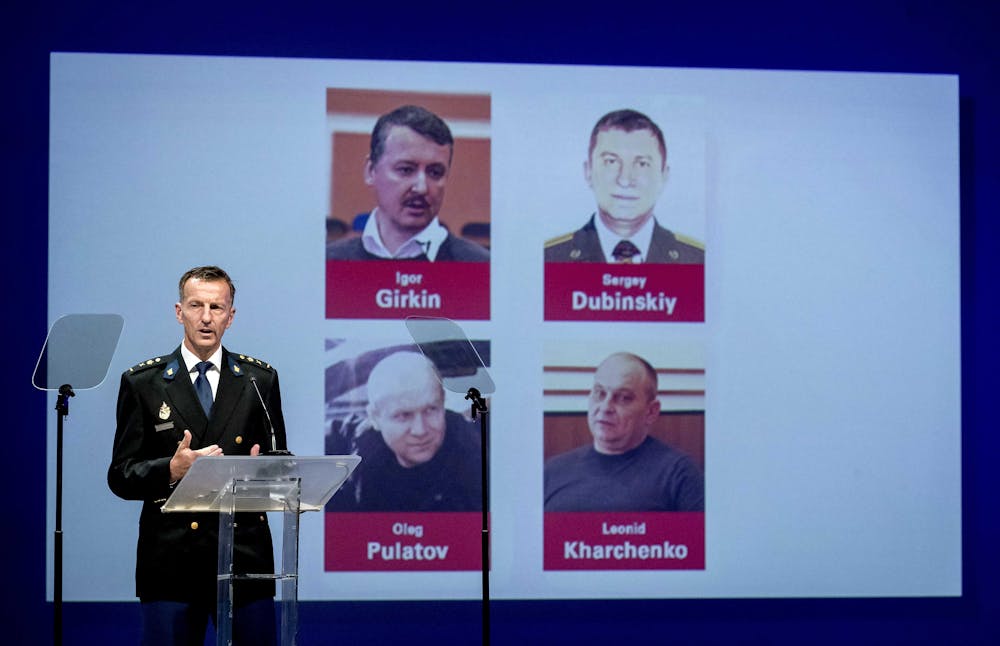
Igor Girkin is a former colonel in the Russian security service. At the time of the atrocity, Girkin was the minister of defence in the so-called Donetsk People’s Republic, a pro-Russian separatist region of Ukraine.
The other two Russian accused, Sergey Dubinsky and Oleg Pulatov, are former Russian military intelligence agents who worked under Girkin.
Leonid Kharchenko is the only Ukrainian national accused. Investigators are not certain of his current location. At the time of the atrocity, Kharchenko led a separatist combat unit.
Wilbert Paulissen of the Joint Investigation Team (JIT) at a press conference in Nieuwegein, The Netherlands. Dutch prosecutors will put four people on trial over the shooting down of flight MH17.Robin Van Lonkhuijsen/EPA
The specific charges in relation to the four named suspects will be:
Causing the crash of flight MH17, resulting in the death of all persons on board, punishable pursuant to Article 168 of the Dutch Criminal Code
The murder of the 298 persons on board of flight MH17, punishable pursuant to Article 289 of the Dutch Criminal Code.
The investigation is ongoing and continues to call for witnesses to assist.
What are the prospects for the trial?
Dutch investigators will issue international arrest warrants for the four accused and place them on international wanted lists. But they won’t issue extradition requests because they know already that no extradition of nationals is available under the Ukrainian or Russian constitutions.
It seems impossible for the Dutch court to gain actual jurisdiction over the Russian accused. Potentially, should Ukrainian authorities apprehend Kharchenko, he could be tried via video-link.
The Netherlands and Ukraine have entered into an agreement that would permit such an arrangement and – should Kharchenko be convicted – allow for his imprisonment in Ukraine.
The charges and any penalties originate in Dutch, rather than international, criminal law. Convictions for murder or the intentional downing of an aircraft could result in sentences of up to life imprisonment.
It’s fair to question the value of a prosecution without a court having actual jurisdiction over the accused. The only real answer is that such a trial would enable the presentation and adjudication of evidence and the judgement of a court as to whether charges are made out.
A memorial for the victims of MH17 in the Donetsk region, Ukraine.Shutterstock
As time goes, the chances of successful prosecutions decline. Meanwhile, interested countries and the victims’ families continue to call for legal redress for the atrocity.
It is also legitimate to ask whether a court can ensure a fair trial for accused persons tried in absentia.
Although it is not explicitly prohibited by international human rights law, the absence of defendants and presumably any legal representative from the courtroom means the accused will not hear the evidence against them or have the ability to present a defence.
Given the four named accused are beyond the actual jurisdiction of the Dutch courts, it can be argued that they (and, at least in the case of Russia, their country) are wilfully avoiding the process of justice. This may be, for some or many observers, sufficient justification for trying them in their absence.
Given her new role as federal environment minister, one of Sussan Ley’s comments in an interview with Nine Newspapers was eyebrow-raising, to put it mildly. She said:
Sometimes the environment doesn’t need all its water but farmers desperately do need water.
This is inaccurate and concerning, but not all that surprising, given the attitude to water and rivers of some in the community and federal government.
Protecting rivers is a crucial part of Sussan Ley’s brief as environment minister.AAP Image/Lukas Coch
In this age of water sharing and trading, and storing water in dams, it is easy to lose sight of what water is to a river, and how every drop of water that enters (or should enter) a river defines the character and function of that river.
Ultimately, the community – not scientists or even river managers – decides how much water a river should get. But it’s essential to be honest about the effects these decisions have on rivers and the ecosystems they support. This is vital for long-term environmental sustainability, upon which all our industry, agriculture and indeed our society are based.
Crises and concerns
Recently the Murray-Darling river system has suffered several crises, including fish kills, hypoxic water, acid-sulfate soils, and algal blooms. These are all wake-up calls that the way we manage rivers are not working.
But besides these disastrous incidents, there are many other ways in which river ecosystems are changing, that are not as obvious to the general public.
Contraction of native species’ ranges, local extinctions, success of invasive species and the “need” to stock non-native recreational fish species are just a few of the insidious symptoms of a general malaise.
Water to a river is like air to a balloon. Let out a little air and the balloon is still balloon-shaped, albeit less taut than before. But let out more air and there comes a point, which is hard to predict exactly, when the balloon suddenly collapses. By this analogy, the Murray-Darling Basin is very deflated indeed.
The point is that if we take water out of a river, or change the patterns of its flow, we inevitably change the nature of that river. Irrigators undoubtedly need water. But we shouldn’t kid ourselves that we’re not altering the river and its ecosystems by allowing them to take it.
Do we want healthy rivers?
Our job as river scientists is not to say what type of river the community wants. Our job is to inform people on what the actions of changing river management will do to a river and its life.
Searching for life.AAP Image/Dean Lewins
We already have seriously degraded river ecosystems. Restoring them is exceedingly unlikely under current demands and management. But if we take even more of a river’s water away, we need to acknowledge that the river will become yet a different river, and in some cases, one that we hardly recognise.
The public backlash following the fish kills earlier this year suggests that the community has decided that further degradation of our rivers is not acceptable.
This week, the UN High Commissioner for Refugees, Filippo Grandi, labelled the world’s refugee problem a crisis that is primarily impacting developing countries, who are hosting most of the world’s 70 million displaced people.
It’s the highest number of people fleeing violence since the second world war, the agency said in a report. Last year, 37,000 people were forced to flee their homes every day.
My colleague and I have conducted extensive research on refugees at the US-Mexico border and in Southeast Asia and Australia, studying the lives of people in detention, in transit, and resettled in host countries. In all these cases, an enduring problem is that nations are not doing enough to provide adequate protection for refugees.
Australia, and the international community as a whole, needs to do more to help the world’s most vulnerable people. Here are five solutions we believe can work.
1. Give them their rights: enforce international conventions
Most countries have either signed the 1951 Refugee Convention or its 1967 Protocol. These ensure basic rights and protections for refugees, in addition to other human rights conventions.
However, many nations maintain reservations on key articles, have not implemented the agreements or simply do not comply with their international obligations. Others do not provide access to these protections for people without legal status, such as refugees.
Addressing the nonexistent enforcement mechanisms of international conventions, agreements and declarations is the first step for improving refugees’ rights.
2. Share the responsibility: regional refugee compacts
supporting conditions in refugees’ home countries to help them safely return.
The global compact also includes recommendations for similar regional and national action plans.
Cooperation of this sort has been attempted in our region before with the Bali Process, which focused on cross-border people smuggling and trafficking. But this agreement had an adverse effect by criminalising the movement of people across borders to seek asylum.
A regional refugee compact would shift the focus away from border protection and deterrence and instead ensure refugees receive the protections they need in transit and on arrival in host countries.
3. Treat refugees like human beings: close detention centres
According to the UNHCR, detention should be considered a last resource for countries dealing with influxes of refugees. And yet, refugee confinement has become common practice.
All over the world, the closure of borders and privatisation of immigration detention centres have resulted in a rapid increase in the imprisonment of refugees, including women and children. Although Australia has moved hundreds of refugees off Manus Island and Nauru in recent years, there are still 915 remaining in detention centres on the islands.
It is paramount that detention centres and offshore processing centres be closed. The practice is not only cruel, it’s expensive. According to the Refugee Council of Australia, it costs more than A$573,000 a year to hold just one refugee in detention on Manus or Nauru.
The International Detention Coalition has identified over 250 alternatives to detention, such as providing temporary legal status to refugees while they await decisions on their permanent status.
Another alternative is to increase global refugee resettlement quotas. These quotas have been decreasing sharply around the world in recent years. The US, for instance, resettled fewer refugees than Canada in 2018.
4. Allow them to participate: work rights for refugees
Refugees should not be treated as passive recipients of humanitarian aid and charity – they should be permitted to work.
Providing working visas for refugees in transit countries, as well as those on bridging visas or waiting for their asylum claims to be processed, would help them earn a livelihood and contribute to society.
In Malaysia, for example, refugees have no work rights at all and have to work illegally in the shadow economy. In Australia, work rights for many refugees on bridging visas depend on the discretion of the Home Affairs department.
Another important issue: permitting refugees the right to work must also come with safeguards to prevent their exploitation.
5. Let them in: open borders
This “refugee crisis” is really just a crisis of who has the right to move. Thanks to the birthright lottery, some people are able to move freely across borders, while others remain trapped in violence and poverty.
If borders were open to all, the human smuggling business would cease to exist. And refugees of all sorts, including those displaced by climate change, would be able to enjoy work rights and access to health care and education.
And the evidence for the economic benefits for open borders is unambiguous. According to some estimates, opening the world’s borders could increase global GDP by US$100 trillion. We just need to take a bold step and give refugees a right already enjoyed by some – the right to move.
The authors will be discussing the world’s response to the global refugee crisis at a talk on Thursday, June 20, at the University of Queensland.
This week, the UN High Commissioner for Refugees, Filippo Grandi, labelled the world’s refugee problem a crisis that is primarily impacting developing countries, who are hosting most of the world’s 70 million displaced people.
It’s the highest number of people fleeing violence since the second world war, the agency said in a report. Last year, 37,000 people were forced to flee their homes every day.
My colleague and I have conducted extensive research on refugees at the US-Mexico border and in Southeast Asia and Australia, studying the lives of people in detention, in transit, and resettled in host countries. In all these cases, an enduring problem is that nations are not doing enough to provide adequate protection for refugees.
Australia, and the international community as a whole, needs to do more to help the world’s most vulnerable people. Here are five solutions we believe can work.
1. Give them their rights: enforce international conventions
Most countries have either signed the 1951 Refugee Convention or its 1967 Protocol. These ensure basic rights and protections for refugees, in addition to other human rights conventions.
However, many nations maintain reservations on key articles, have not implemented the agreements or simply do not comply with their international obligations. Others do not provide access to these protections for people without legal status, such as refugees.
Addressing the nonexistent enforcement mechanisms of international conventions, agreements and declarations is the first step for improving refugees’ rights.
2. Share the responsibility: regional refugee compacts
supporting conditions in refugees’ home countries to help them safely return.
The global compact also includes recommendations for similar regional and national action plans.
Cooperation of this sort has been attempted in our region before with the Bali Process, which focused on cross-border people smuggling and trafficking. But this agreement had an adverse effect by criminalising the movement of people across borders to seek asylum.
A regional refugee compact would shift the focus away from border protection and deterrence and instead ensure refugees receive the protections they need in transit and on arrival in host countries.
3. Treat refugees like human beings: close detention centres
According to the UNHCR, detention should be considered a last resource for countries dealing with influxes of refugees. And yet, refugee confinement has become common practice.
All over the world, the closure of borders and privatisation of immigration detention centres have resulted in a rapid increase in the imprisonment of refugees, including women and children. Although Australia has moved hundreds of refugees off Manus Island and Nauru in recent years, there are still 915 remaining in detention centres on the islands.
It is paramount that detention centres and offshore processing centres be closed. The practice is not only cruel, it’s expensive. According to the Refugee Council of Australia, it costs more than A$573,000 a year to hold just one refugee in detention on Manus or Nauru.
The International Detention Coalition has identified over 250 alternatives to detention, such as providing temporary legal status to refugees while they await decisions on their permanent status.
Another alternative is to increase global refugee resettlement quotas. These quotas have been decreasing sharply around the world in recent years. The US, for instance, resettled fewer refugees than Canada in 2018.
4. Allow them to participate: work rights for refugees
Refugees should not be treated as passive recipients of humanitarian aid and charity – they should be permitted to work.
Providing working visas for refugees in transit countries, as well as those on bridging visas or waiting for their asylum claims to be processed, would help them earn a livelihood and contribute to society.
In Malaysia, for example, refugees have no work rights at all and have to work illegally in the shadow economy. In Australia, work rights for many refugees on bridging visas depend on the discretion of the Home Affairs department.
Another important issue: permitting refugees the right to work must also come with safeguards to prevent their exploitation.
5. Let them in: open borders
This “refugee crisis” is really just a crisis of who has the right to move. Thanks to the birthright lottery, some people are able to move freely across borders, while others remain trapped in violence and poverty.
If borders were open to all, the human smuggling business would cease to exist. And refugees of all sorts, including those displaced by climate change, would be able to enjoy work rights and access to health care and education.
And the evidence for the economic benefits for open borders is unambiguous. According to some estimates, opening the world’s borders could increase global GDP by US$100 trillion. We just need to take a bold step and give refugees a right already enjoyed by some – the right to move.
The authors will be discussing the world’s response to the global refugee crisis at a talk on Thursday, June 20, at the University of Queensland.
This week, the UN High Commissioner for Refugees, Filippo Grandi, labelled the world’s refugee problem a crisis that is primarily impacting developing countries, who are hosting most of the world’s 70 million displaced people.
It’s the highest number of people fleeing violence since the second world war, the agency said in a report. Last year, 37,000 people were forced to flee their homes every day.
My colleague and I have conducted extensive research on refugees at the US-Mexico border and in Southeast Asia and Australia, studying the lives of people in detention, in transit, and resettled in host countries. In all these cases, an enduring problem is that nations are not doing enough to provide adequate protection for refugees.
Australia, and the international community as a whole, needs to do more to help the world’s most vulnerable people. Here are five solutions we believe can work.
1. Give them their rights: enforce international conventions
Most countries have either signed the 1951 Refugee Convention or its 1967 Protocol. These ensure basic rights and protections for refugees, in addition to other human rights conventions.
However, many nations maintain reservations on key articles, have not implemented the agreements or simply do not comply with their international obligations. Others do not provide access to these protections for people without legal status, such as refugees.
Addressing the nonexistent enforcement mechanisms of international conventions, agreements and declarations is the first step for improving refugees’ rights.
2. Share the responsibility: regional refugee compacts
supporting conditions in refugees’ home countries to help them safely return.
The global compact also includes recommendations for similar regional and national action plans.
Cooperation of this sort has been attempted in our region before with the Bali Process, which focused on cross-border people smuggling and trafficking. But this agreement had an adverse effect by criminalising the movement of people across borders to seek asylum.
A regional refugee compact would shift the focus away from border protection and deterrence and instead ensure refugees receive the protections they need in transit and on arrival in host countries.
3. Treat refugees like human beings: close detention centres
According to the UNHCR, detention should be considered a last resource for countries dealing with influxes of refugees. And yet, refugee confinement has become common practice.
All over the world, the closure of borders and privatisation of immigration detention centres have resulted in a rapid increase in the imprisonment of refugees, including women and children. Although Australia has moved hundreds of refugees off Manus Island and Nauru in recent years, there are still 915 remaining in detention centres on the islands.
It is paramount that detention centres and offshore processing centres be closed. The practice is not only cruel, it’s expensive. According to the Refugee Council of Australia, it costs more than A$573,000 a year to hold just one refugee in detention on Manus or Nauru.
The International Detention Coalition has identified over 250 alternatives to detention, such as providing temporary legal status to refugees while they await decisions on their permanent status.
Another alternative is to increase global refugee resettlement quotas. These quotas have been decreasing sharply around the world in recent years. The US, for instance, resettled fewer refugees than Canada in 2018.
4. Allow them to participate: work rights for refugees
Refugees should not be treated as passive recipients of humanitarian aid and charity – they should be permitted to work.
Providing working visas for refugees in transit countries, as well as those on bridging visas or waiting for their asylum claims to be processed, would help them earn a livelihood and contribute to society.
In Malaysia, for example, refugees have no work rights at all and have to work illegally in the shadow economy. In Australia, work rights for many refugees on bridging visas depend on the discretion of the Home Affairs department.
Another important issue: permitting refugees the right to work must also come with safeguards to prevent their exploitation.
5. Let them in: open borders
This “refugee crisis” is really just a crisis of who has the right to move. Thanks to the birthright lottery, some people are able to move freely across borders, while others remain trapped in violence and poverty.
If borders were open to all, the human smuggling business would cease to exist. And refugees of all sorts, including those displaced by climate change, would be able to enjoy work rights and access to health care and education.
And the evidence for the economic benefits for open borders is unambiguous. According to some estimates, opening the world’s borders could increase global GDP by US$100 trillion. We just need to take a bold step and give refugees a right already enjoyed by some – the right to move.
The authors will be discussing the world’s response to the global refugee crisis at a talk on Thursday, June 20, at the University of Queensland.
Source: The Conversation (Au and NZ) – By Andrea Carson, Associate Professor at La Trobe University. Department of Politics, Media and Philosophy, La Trobe University
On today’s episode, we hear from Caroline Fisher, an assistant professor of journalism at the University of Canberra and lead author of the 2019 Australian edition of the the Digital News Report.
The annual report has found that public trust in the news media is falling. It also finds that Australians are worried about “fake news”. Perhaps as a result, we access news less often and have lower interest in it compared to citizens in many other countries. Yet, when it comes to keeping us up to date, we think the news media passes the test.
It’s the fifth year of the report, which comes from the Reuters Institute for the Study of Journalism at Oxford University. There are 38 countries involved and it’s an annual snapshot of media: how they’re using it and what they think of it.
You can hear the full interview and details of the report here on Media Files.
Podcasts are often best enjoyed using a podcast app. All iPhones come with the Apple Podcasts app already installed, or you may want to listen and subscribe on another app such as Pocket Casts (click here to listen to Media Files on Pocket Casts).
You can also hear us on any of the apps below. Just pick a service from one of those listed below and click on the icon to find Media Files.
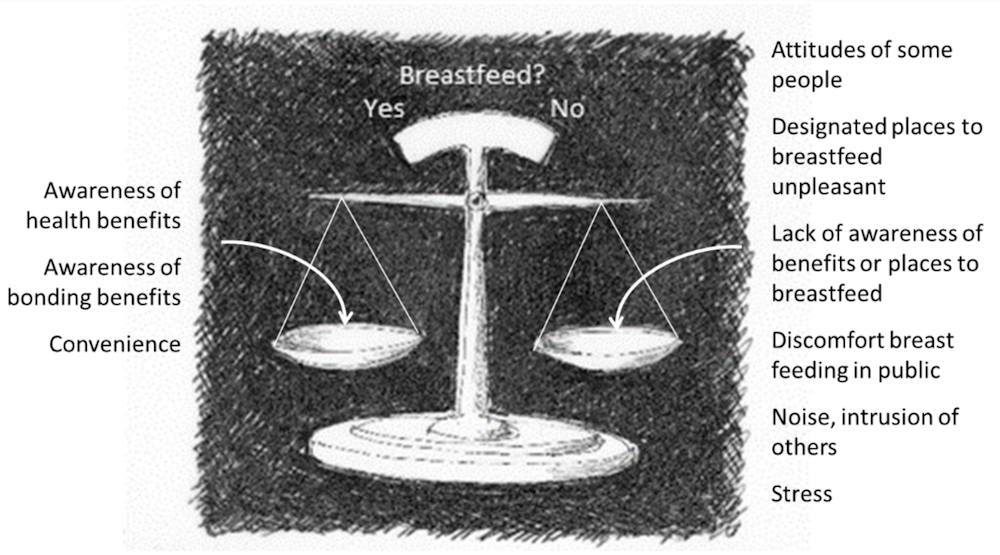
Seen through the eyes of new mothers, our towns and cities can often seem like uncomfortable and uninviting places to breastfeed. Although the physical characteristics of a place are not the only factors that influence how a woman feeds her child, they can be important. The physical surroundings can sway the balance of influences that may deter women from breastfeeding, bring it to a premature conclusion, or compel women to isolate themselves in their own houses so they might continue to breastfeed.
The physical environment can sway the balance of influences that determine whether a woman chooses to breastfeed or not.Author provided
Our study reveals that the deterrents to breastfeeding can be diminished by “hardwiring” our towns and cities so mothers are more likely to feel confident that breastfeeding is a supported, realistic and pleasant option for them.
To achieve these benefits, UNICEF and WHO recommend exclusive breastfeeding from within an hour of birth until the baby is six months old. After that, breastfeeding should complement solid food for up to two years or beyond.
If, as a society, we want to make sure the benefits of breastfeeding are spread as widely as possible, we need to look at what is bringing breastfeeding to a premature conclusion and what we can do about it.
What makes a place breastfeeding-friendly?
Breastfeeding-friendly towns and cities are communities where the imperatives of supporting women to breastfeed and participate in society can be reconciled with all the other things we look to our surroundings to provide. This has interlinked physical and emotional dimensions.
The ergonomics of physical comfort are quite well understood, but those of emotional comfort less so, although they have a significant bearing on breastfeeding. For example, if a mother feels unsafe or fears disapproval when breastfeeding in public, she is less likely to do so. However, if she feels it is important to breastfeed, this may be enough to overcome this disapproval or discomfort.
Our research found there is a “feedback loop” between building high-quality environments that support breastfeeding, and people’s attitudes. Many women find it reassuring to see other women breastfeed in a place, offering them evidence that they can too. As a participant in the consultation session in Bendigo said:
Seeing it happen more often helps.
For other women the presence of comfortable, pleasant and safe surroundings in a shared space may be the key requirement to breastfeed. A workshop participant in the Royal Women’s Hospital suggested:
All we need is somewhere nice to sit.
Thus, if we make places more physically comfortable and welcoming, these “pioneer” breastfeeding mothers may help change attitudes and embolden other women to choose to feed there.
Furthermore, we wear our surroundings like a cloak and its qualities or their absence say something about us. An investment in good design in the places where breastfeeding is particularly likely will foster the general view that breastfeeding is something the whole of society welcomes.
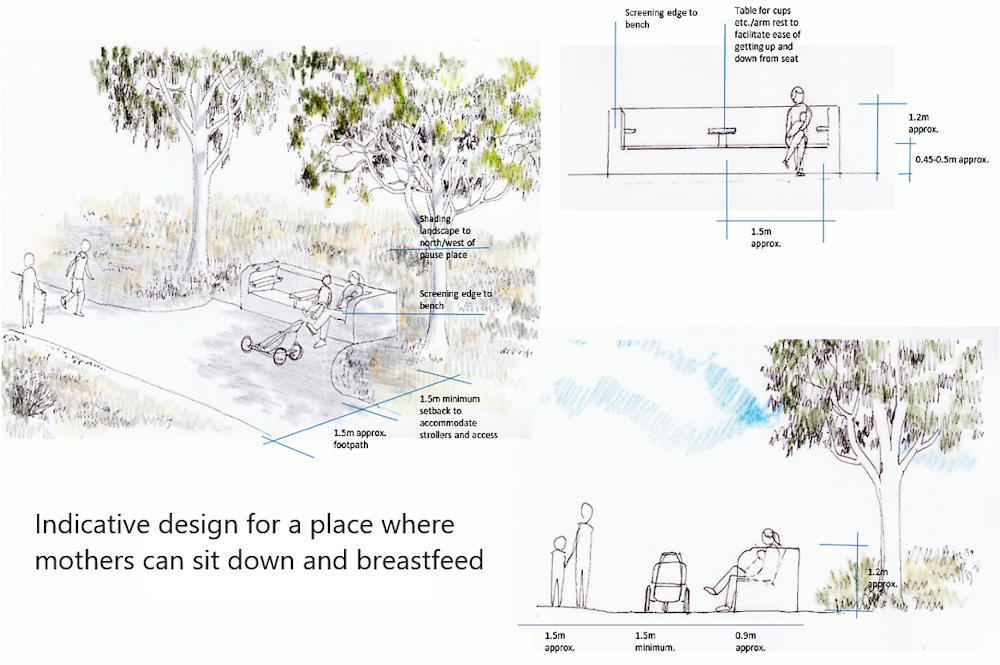
An example of how a day-to-day place can be designed to support breastfeeding mothers.Jenny Donovan, Author provided
Creating a sense that our towns and cities are breastfeeding-friendly requires cultivating change in people’s hearts and minds as much as it is about making changes on the ground.
This is a more than a matter of just improving the design of dedicated breastfeeding rooms. Although these provide a choice for women seeking privacy, such rooms keep breastfeeding a hidden activity. This leaves the balance of the public realm breastfeeding-unfriendly, requiring a mother to restrict her life to those places where these rooms can easily be found.
Equally, it is not practical to vastly increase the number of dedicated breastfeeding places. This would demand much space and resources that would otherwise be available to meet society’s other diverse needs.
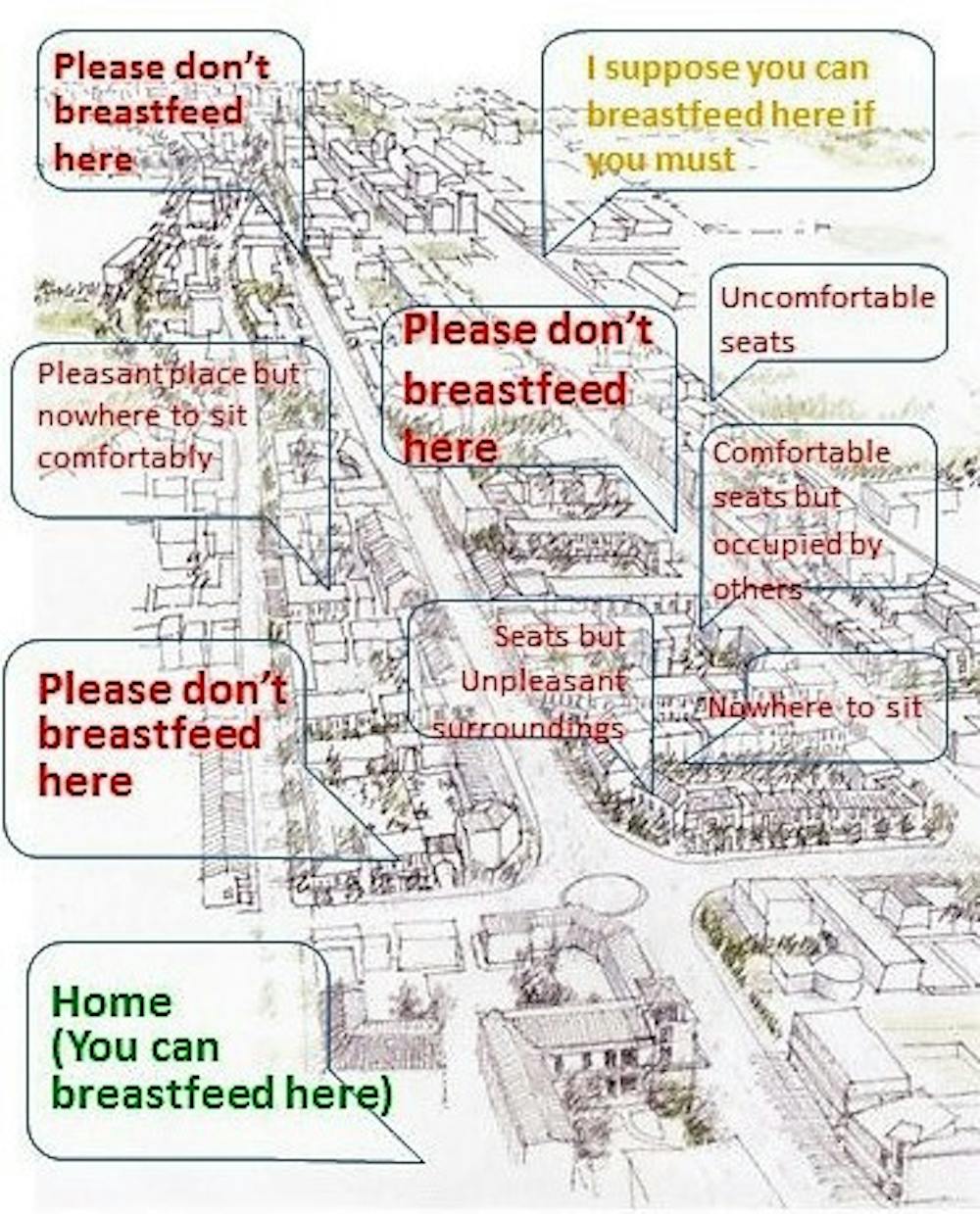
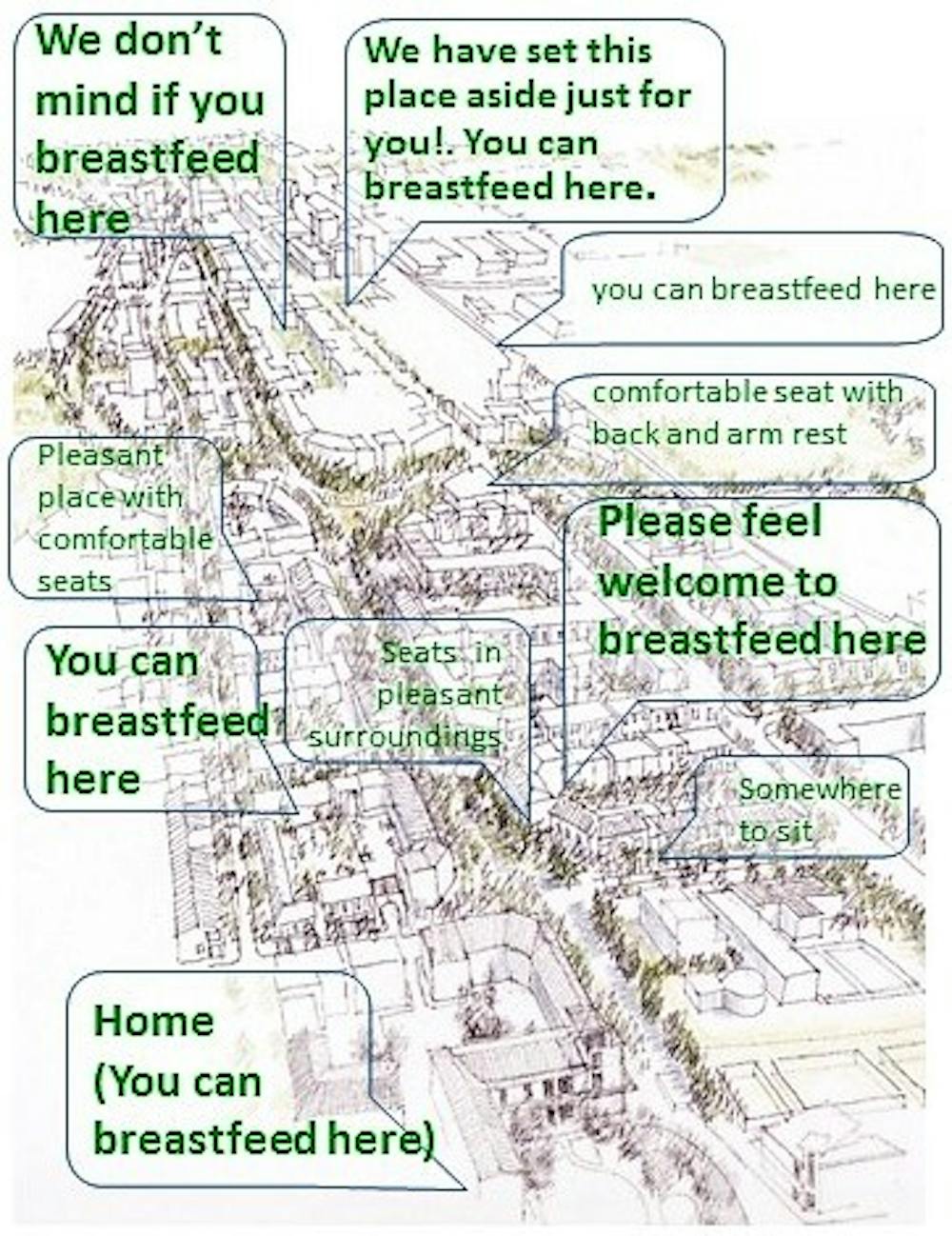
Instead, breastfeeding-friendly towns and cities are places where, in addition to dedicated breastfeeding spaces, much of the infrastructure that enables people to participate in and enjoy community life (workplaces, parks, shopping centres, community buildings) can also be comfortably and discreetly used for breastfeeding. As the sequence below shows, this liberates mothers from a polarising mental map of a few scattered breastfeeding places in a vast area of breastfeeding-unfriendly ones.
Changing the messages feeding mothers get from their surroundings
A breastfeeding-unfriendly environment where only at home do mothers feel comfortable.Jenny Donovan, Author providedA better, but still largely unfriendly environment.Jenny Donovan, Author providedA consistently breastfeeding-friendly environment.Jenny Donovan, Author provided
The design guidelines we prepared identify the qualities of spaces that we found are likely to invite women to breastfeed. These qualities can be interpreted as:
dignified, safe and physically comfortable
accessible
compatible with their other needs and responsibilities
offering a high level of amenity.
The guidelines identify how these qualities can be expressed in a range of places, as well as how the characteristics that deter breastfeeding can be excluded.
When politicians are in bed with vested interests it shapes the world in a particular way. It means that the most powerful and rich in society get their way, and the will of ordinary people is sidelined in a democracy. It means that Governments do the bidding of corporate interests, and political agendas that don’t suit those interests get deprioritised. It means transformational governments start to look very much “business as usual”.
That’s why we absolutely need to know who has the ear of decision-makers. And why, throughout the world at the moment, there is an increased interest in the power of corporate interests in democracies and, in particular, on the oversized influence of lobbyists in the political process.
Here in New Zealand there is a staggering example of corporate lobbying power happening – the employment by Prime Minister Jacinda Ardern of lobbyist GJ Thompson. It’s been an extreme case study in which a lobbyist has been given extraordinary power within a government, access to privileged information and networks, and allowed to continue to utilise this all for the vested interests who pay Thompson’s firm handsomely to get the sort of influence that a lobbyist close to the Prime Minister has.
In the case of GJ Thompson, he was literally a “corporate lobbyist running the government”. As I explained in columns last year, Thompson runs a lobbying firm, and was “seconded” by Jacinda Ardern to come into the Beehive to be her Chief of Staff and help set up the new government – see: The Government’s revolving door for lobbyists and Lifting the lid on lobbying in politics.
The problem was that Ardern hired this corporate lobbyist to come in and run the Beehive, knowing that this would involve choosing the new staff, choosing Cabinet ministers, getting access to all Cabinet papers, and then immediately returning to his lobbying firm where it would be his job to lobby these very same people and try to give corporates the inside advantage on how to influence the new Government.
This would not happen in other parts of the world – certainly not in proper liberal democracies. Such practices are normally outlawed. A conflict of interest of this kind would be labelled “corrupt”.
At the time that the Prime Minister chose to make a corporate lobbyist one of the most powerful figures in the Beehive, the public was told that the conflicts of interest would be appropriately managed. We now know that this wasn’t the case, and you can read about this in yesterday’s expose on the Spinoff website by journalist Asher Emanuel – see: Nothing to declare: new questions in lobbyist-turned-chief-of-staff saga.
This piece of investigative journalism is based on Official Information Act requests which have yielded documents about the details of the lobbyist’s employment in the Beehive and which suggest that no adequate procedures were followed to ensure lobbing conflicts of interest didn’t occur. Yes, some sort of basic contracts to try ensure probity were signed, but they appear lax, and were seemingly not followed in practice.
Emanuel says his investigation shows Thompson “appears to have failed to comply with commitments he made to disclose conflicts of interest on an ongoing basis”. This, he says, raises “questions about a breach of government rules around conduct in the public service.”
Furthermore, the official documents show that Thompson failed to reveal his lobbying clients while running the Beehive: “Neither the prime minister nor Ministerial Services were provided with a list of Thompson’s firm’s clients.”
He comments that: “Without having seen a list of the firm’s clients, and in the absence of Thompson alerting Ministerial Services to any real or potential conflicts related to clients as they arose, it is difficult to see how the prime minister’s office or Ministerial Services could identify or manage any conflict between the interests of his firm’s clients and the interests of the government.”
Not knowing what corporates Thompson was representing while working as the PM’s Chief of Staff, it’s hard to now know if there was a lobbying problem. But Emanuel says: “At least two of the firm’s known clients — Huawei and property developer Darby Partners — seem likely to have had interests affected by government policy.”
Is this a problem? Well, as the article points out, Thompson “had some involvement in the appointment over 100 staff to ministerial offices and access to all Cabinet papers, which range from mundane to critical, and from the essentially public to the literally Top Secret.” And, “After returning to his firm, Thompson’s work would include lobbying the same people he had helped hire.”
Furthermore, the article clarifies that, despite assurances from the Prime Minister that Thompson had resigned from his lobbying firm, the reality was quite different: “Companies Office records show that he did not resign his role as director. A company law expert told the Spinoff it is not possible to take a “leave of absence” from a directorship and that Thompson’s legal duty to act in the best interests of his company would have persisted during his employment as chief of staff.”
Reaction to this story in the blogosphere has been interesting. Leftwing blogger No Right Turn discusses the arrangement and labels it An invitation to corruption. This is not to suggest that anything has been untoward, but that the arrangements mean we won’t know: “While there’s no evidence he behaved corruptly in the role (because we don’t know who his clients were), ignorance isn’t a good enough standard. Our government must not only be honest – it must be seen to be so. And Thompson’s appointment and behaviour simply fails that test.”
The blogger says the Prime Minister and government officials have erred in not protecting the integrity of the political process: “Effectively Ardern and Ministerial Services left it entirely up to Thompson to identify any problems, and he didn’t. Which simply isn’t good enough. With the integrity of our government and political system on the line, I’d expect something a little more proactive – like forcing him to identify his clients, and then firewalling him from anything to do with anything they might be interested in (such as appointments to agencies they lobby).”
The Spinoff’s Alex Braae makes the case that this ongoing controversy should be taken seriously, because although “it could be seen as a minor technical matter”, “it could also be seen as symptomatic of something much wider and more concerning” – see: More questions around lobbyist’s role with Ardern admin.
He points out that Thompson’s privileged position makes him powerful, and asks: “is this how a democratic government should work?” And he’s got a good question for many of those complaining that this is a non-story: “for supporters of the government who don’t see anything to be concerned about with this – would you feel the same way if the PM in question was John Key?”
On Twitter, others have debated whether this should be taken seriously as a scandal. Morgan Godfery (@MorganGodfery) has said: “Usually when people say ‘if John Key did it the left would be outraged’ I shrug but in this case I really do think if John Key did it we’d be calling it corruption. Now we’re just shrugging (including myself, a hypocrite, btw).”
Continuing this point, National Party blogger David Farrar blogs to say: “think if the situation was reversed. Say Simon Bridges became Prime Minister and appointed Matthew Hooton as his Acting Chief of Staff for six months, with Matthew remaining a Director of Exceltium while hiring all the Beehive staff and seeing all Cabinet papers. There would be non-stop media coverage” – see: Imagine the outcry if this was a National PM’s Office.
Today in the Herald, Claire Trevett agrees with this sort of argument: “National-aligned commentators have argued that had National employed one of its friendly lobbyists in the same circumstances, there would have been a riot of raised eyebrows. They are not wrong. Key rode through such criticisms untouched, as Ardern is now doing. Such issues rarely get resonance with the wider public. That does not mean they should be ignored. Nor should they be overstated. All governments have mixed records when it comes to transparency” – see: Labour’s transparency drive falters in dance of many hats.
Trevett is also dismissive of the Prime Minister’s defence of her role in this scandal so far: “The general gist of Ardern’s defence was that Thompson was a mate of hers and so could be trusted. It highlights the difficulty politicians have in applying the ‘if the shoe was on the other foot’ test. They tend to take the assumption everybody will see the ‘other side’ as a bit dodgy, while they can get away with the same thing because they are beyond reproach.”
Jacinda Ardern and authorities are still dodging questions about their role in the arrangements. But Ardern’s main response on the issue is akin to that of John Key’s classic response to scandals, in which he would express that he was “relaxed” about the controversy – it was reported yesterday that she is “comfortable” with the arrangements – see Henry Cooke’s PM Jacinda Ardern says lobbyist chief of staff matter handled appropriately.
The article reports that “Ardern and Thompson are known to be friends.” And Ardern gives her defence about employing a lobbyist friend to run her government: “It’s not easy to find someone who has the level of knowledge and experience, of course Gordon Jon Thompson had worked in this building before and was able to take a short period of leave.”
Cooke also reports on National’s low-key response to the ongoing scandal, saying that Simon Bridges “was quite restrained in his criticism of the matter.” He justifies not campaigning on this issue by saying “National is not going to wade into every situation we see, but it does seem wrong”. Perhaps more importantly, however, the same article points out that “Wayne Eagleson, the former chief of staff to John Key and Bill English, joined the [Thompson Lewis] company after National left government.”
This article also reports that “He told The Herald the idea that he hadn’t done everything by the book was ‘erroneous’. Asked if he had declared his clients to Ministerial Services, Thompson did not directly answer the question, only saying: ‘I did what was required by Ministerial Services to manage the conflict’.”
Although the Green Party used to be much stronger on lobbying issues, now that they are part of the Government they have gone quiet. Instead, it’s now Act Party leader David Seymour who is alone in pushing this lobbying issue. He has been asking questions in Parliament – see Zane Small’s Jacinda Ardern facing questions over former chief of staff’s lobbyist role.
Here’s the main point: “Seymour raised the conflict of interest issue in Parliament on Thursday. He asked Ardern why she said Thompson took a leave of absence from his company during his tenure as interim chief of staff, when there’s no record of it. Deputy Prime Minister Winston Peters, standing in for Ardern, replied: ‘On behalf of the Prime Minister, because it was and is a fact’.” Seymour has replied to this, saying “What’s really offensive here, is that the Prime Minister has said, actually he stepped down from those roles, when very clearly he didn’t”.
This article above also cites the Cabinet Manual stating that care should be taken “to avoid creating a perception that representatives or lobbyists from any one organisation or group enjoy an unfair advantage with the government”. It points to the website of the Thompson Lewis lobbying company, which describes the firm as having “considerable understanding of Wellington and its processes, having spent significant time in senior roles in Government and Opposition, and working with the public sector”.
Finally, there’s another side to the story, from someone else with close connections to politicians and lobbyists. Bill Ralston says the “notion that the Government is being led astray by lobbyists insults its intelligence” and that as someone close to “three previous prime ministers” he can report that “there was little evidence that they listened to the well-meaning advice I gave them” – see: Stop kidding yourself, the Govt isn’t falling for spin doctors.
Papua New Guinea’s Police Minister Bryan Kramer has used social media to arrest a man accused of sexually abusing his granddaughter.
Kramer wrote a Facebook post in which he described being notified of a post about a young girl being sexually abused.
“On Sunday I received a notification on Facebook that Wilfred Kepui mentioned my name in a comment. When I clicked on the notification it took to me to a post by Remase Hariwa (real name Augustine Pouru),” Kramer wrote.
Pouru’s post claimed that a 7-year-old girl was being sexually abused and pleaded for someone to help her as local police were unable to.
“The mother reported the abuse to Gordon’s Police Station only to be told by the officer at the counter that police did not have any fuel,” Pouru wrote.
-Partners-
“I am tagging my mainstream media friends, Scott Waide, Sylvester Gawi, Erbiri Zurenuoc so we can be her voice and bring justice to this innocent little girl. Child abuse is real.”
When Kramer was tagged in a comment under the post, he contacted Pouru to find out the names of the girl and her mother.
Although Kramer wasn’t able get the information, the following day he passed Pouru’s contact details to National Capital District Metropolitan Superintendent Perou N’Dranou.
“An hour later, with the assistance of Gordon’s Police and Mr Pouru taking time off work, we able to locate the mother and little girl who is actually 5 years of age,” Kramer wrote.
“Police arrested her grandfather, I then contacted a friend to have the mother and her daughter placed at Bel Isi Safe Haus to ensure she received urgent medical treatment.”
“Following the interview of the mother it was discovered two other girls living with them were also victims of sexual abuse.”
Kramer wrote that he thanked Pouru for bringing the issue to his attention.
The post follows Kramer’s announcement that he would be using social media to address police issues and help protect Papua New Guineans.
“Two weeks ago, straight after being sworn in as Minister for Police I explained to the press that I intended to run a social media program where the public would be able to directly get in touch with me to raise their concerns about policing issues, an initiative focused on making it safer for mums and dads and their kids.”
“Yesterday’s incident is one such example of the changes to come. As promised you can expect sweeping changes in how our police address sexual violence and police brutality.”
“To avoid any doubt, I’m still very much committed to addressing high-level corruption, once I’ve had the opportunity to address the issues facing our police force I expect them to take the lead without political interference.”
Review: Indies & Idols, Australian Chamber Orchestra, Sydney Opera House
“The most heterogeneous ideas are yoked by violence together”: what Samuel Johnson wrote about metaphysical poetry might have seemed transferrable to the Australian Chamber Orchestra’s Indies & Idols program, where 20th-century Polish modernist composers were cheek-by-jowl with contemporary singer-songwriters and rock stars.
And yet, as so often with the ACO’s more eclectic offerings, there were plenty of resonances to be heard across the afternoon. This was less surprising after Artistic Director Richard Tognetti explained that the rock musicians openly acknowledged the influence of the seemingly inaccessible avant-garde.
Surprising though this may seem, the boundaries between popular music and classical music have always been more permeable than such terms suggest. Certain classical works have jumped the imaginary wall supposedly sealing high art off from popular tastes and become culturally ubiquitous: one need only think of the Ode to Joy or Flight of the Bumblebee.
Nor is the idea of the timeless masterpiece unique to classical music. Popular music, too, has undergone its own canonising process, so that the output of the Beatles and Bach are both recognised as “art” transcending their historical moment.
Beyond matters of reception, both sides have benefited from the fructifying influence of the other. Classical music has long mined vernacular music traditions, from folksong importations by Haydn and Beethoven (to name but two) to jazz influences in Debussy and Ravel, while Duke Ellington’s Black, White and Beige and the Beatles’ Revolution 9 show that this stimulus was a two-way street.
Rarely has a cross-cultural debt been as openly acknowledged as in The National’s Bryce Dessner’s Réponse Lutosławski, a five-movement work written in response to the Polish composer’s Musique funèbre (1958). Although it would have been performable by the ACO’s all-string line-up, the latter work was not heard on this program; instead, Lutosławski’s shorter Overture for Strings opened the concert. This strongly Bartokian work with its quirky pizzicato passages and glissando ornaments crackled with energy.
Even if Dessner’s specific model wasn’t showcased, there were enough textural similarities to enable some kinship to be discerned: col legno (hitting the string with the wood of the bow rather than the hair), siren effects, etc. There was perhaps more expressive lyricism in the Réponse than in the source material, with shimmering textures and fluid figuration prepondering.
Lutosławski’s shorter Overture for Strings opened the concert.Nic Walker
In terms of performance, the Suite by Sufjan Stevens which closed the first half was particularly outstanding. Stevens’s 2001 electronic album Enjoy your Rabbit was rearranged for string quartet in 2009 as Run Rabbit Run. The Suite utilises four of the five arrangements by Michael Atkinson, reordered into something approaching the expected sequence of movements in a string quartet. Although less overtly Polish-influenced than the other 21st century compositions, it too employed scrub tremolos, slides and knocking on the wood of the instrument.
The opening Year of the Ox established the tonal sound world (later punctuated by noise effects) and good-humoured mood. The highly rhythmical Enjoy your Rabbit equated with a Scherzo, fading out into static at the end. The third movement, Year of Our Lord was a meditative sound-sheet, the slow changes giving it the feel of something static, even architectural. Energy was restored in the final Year of the Boar, with the players clearly enjoying the thrill-ride as much as the audience.
Stylistic jolt
By far the biggest stylistic jolt in the afternoon came at the start of the second half when Penderecki’s Aria was followed by the same composer’s String Quartet No. 1. Written for a film score, the Aria is an exercise in Baroque pastiche, almost indistinguishable from the real thing.
These mellifluous melodies gave way to the seemingly aleatoric landscape of jagged percussive effects and instrumental screams that dominate the uncompromising String Quartet.
Jonny Greenwood’s Suite from There Will be Blood followed without a break. Comparatively friendly in its musical syntax, it had coherence away from its filmic source, now bristling with determination (Future markets), now hypnotic (Prospector’s Quartet), with visually fun elements such as seeing the cellos play in banjo position (Proven Lands).
Tognetti, who since the interval had been directing rather than playing, supplemented the orchestral sound with a few notes on the synthesiser.
In some ways, the best was saved until last with Tognetti’s arrangement of Szymanowski’s String Quartet No. 2. The opening movement plunges the listener into the world of post-impressionist decadence that is the composer’s hallmark, the deliciously aestheticised sound world created through mutes and sul tasto effects (bowing above the fingerboard for a less focused timbre).
The second movement was a frantic waltz above a lively accompaniment, with cleverly varied textures and several nice solos. The impassioned final movement (not Lento throughout, despite what was written in the program book) offered a thrilling conclusion where the players’ commitment was once again palpable.
For the encore there was a return to the output of Jonny Greenwood, this time in the form of Radiohead’s How to disappear completely from Kid A. With Satu Vänskä providing vocals in the original tenor register of Thom Yorke, the swooping, haunting sounds from the much processed original were recreated in analogue form.
This Messiaen-and-Penderecki influenced track thus returned to the classical arena that inspired it: a fitting closing of the circle.
The ACO’s Indies & Idols can be seen in Perth on June 19, Melbourne June 23 and 24 and Sydney June 25, 26, 28 and 29.
Curious Kids is a series for children. If you have a question you’d like an expert to answer, send it to curiouskids@theconversation.edu.au You might also like the podcast Imagine This, a co-production between ABC KIDS listen and The Conversation, based on Curious Kids.
If nothing can burn without oxygen then how is the Sun burning? – question from Shashikant Patil.
It’s true that here on Earth, if you want to burn something you need oxygen. But the Sun is different. It is not burning with the same kind of flame you would have on Earth if you burned a candle.
Have you heard of a nuclear reaction? It is a very powerful process that causes a lot of energy to be released. Well, inside the giant ball of gas that we call the Sun, a nuclear reaction is happening right now.
NASA’s Solar Dynamics Observatory captured this image of a solar flare – as seen in the bright flash on the right side – on Sept. 10, 2017.Credits: NASA/SDO/Goddard
This means light particles are smashing into each other very, very fast. They hit each other so fast and so hard they sort of glue together. This is what scientists call “fusion” and it can cause other elements and atoms to be created. All this activity causes a lot of energy to be released, which heats up everything near it.
The hottest part of the Sun is its core. The heat and light spreads out from the centre of the ball of gas toward the edges, and that’s what makes the Sun glow.
So there is no normal “flame” in the Sun – at least not like the flames we have in a fire here on Earth – because the energy and light and heat is coming from the nuclear reaction.
And because there’s no normal flame, you don’t need oxygen.
All this activity inside the Sun creates a lot of sound waves. So the Sun is loud and vibrates like a church bell.
The high temperatures inside make sound waves travel super fast and smash into each other, and that’s what causes the vibration. Solar quakes shake the Sun very ferociously. These can cause what we call “solar flares”, where a powerful burst of energy shoots out from the Sun.
Here’s a video of a solar flare that happened in 2017:
NASA.
I am an astrophysicist fascinated by the vibrations of the Sun. I am searching to discover more quakes inside the Sun and other stars, too (after all, the Sun is just a star).
If you are interested in finding solar quakes, too, check out the pictures from NASA’s Solar Dynamics Observatory.
Dan McGarry of the Vanuatu Daily Post said government bodies have been more forthcoming with information since the law came in.
“If we’re having a conversation and we find somebody was not necessarily being forthcoming, it’s useful for us to say “so is your department under the RTI already or is it coming?” or “when is it coming?”, just to bring that awareness back into the conversation that information is meant to be available to the public unless there’s a good reason to withhold it.”
-Partners-
“So for that we’re really quite happy and I think the government is to be commended for having enacted this.”
A recent article on the travel expenses of a ministry head would not have been possible without the improved air of openness, he said.
“We’ve actually got people within the administrative bodies in government coming forward with this kind of information rather than waiting until we dig it out.”
McGarry said the Vanuatu Daily Post also plans to test out the law with formal requests.
“The problem is it is extremely time consuming, it almost necessarily will involve expense and we’re a very limited media organisation.”
The law will be extended to cover not only government departments but also statutory bodies like the Malvatumauri Council of Chiefs, the National Council of Women and the Ombudsman’s Office.
This article is published under the Pacific Media Centre’s content partnership with Radio New Zealand.
But new research published today shows a marsupial mum knows – in a biological sense – when she’s carrying a young one before they make their journey to the pouch.
This knowledge changes how we think pregnancy evolved in mammals. It may also help in breeding programs for threatened or endangered marsupials by contributing to new technologies such as a marsupial pregnancy test.
Marsupials do things differently
When people think of marsupials – animals that mostly rear their young in a pouch (although not all marsupials have a pouch) – kangaroos and koalas tend to spring to mind. But marsupials come in a range of shapes and sizes.
In addition to Australia’s marsupial diversity, there are also 120 marsupial species in South America – most of which are opossums – and just one species in North America, the Virginia opossum.
One thing all marsupials have in common is they give birth to very small, almost embryonic, young.
An opossum with two day old young.Oliver Griffith, Author provided
Because marsupial pregnancy passes so quickly (12-40 days, depending on the species), and marsupial young are so small and underdeveloped at birth, biologists had thought the biological changes required to support the fetus through a pregnancy happened as a follow on from releasing an egg (ovulation), rather than a response to the presence of a fetus.
Marsupial pregnancy is quick
One way to explore the question of whether it is an egg or a fetus that tells the marsupial female to be ready for pregnancy is to look at the uterus and the placenta.
In marsupials, just like in humans, embryos develop inside the uterus where they are nourished by a placenta.
Previously, biologists thought all of the physiological changes required for pregnancy in marsupials were regulated by hormones produced in the ovary after ovulation.
If this hypothesis is right, then the uterus of pregnant opossums should look the same as the uterus of opossums that ovulate but don’t have the opportunity to mate with a male.
To test this hypothesis, my colleagues at Yale’s Systems Biology Institute and I examined reproduction in the grey short-tailed opossum.
Grey short tailed opossum with young.Oliver Griffith
Signs of pregnancy
We looked at two groups of opossums: females that were exposed to male pheromones to induce ovulation, and females that were put with males so they could mate and become pregnant.
We then used microscopy and molecular techniques to compare females from the two groups. Contrary to the current dogma, we found that the uterus in pregnancy looked very different to those females that did not mate.
In particular, we found the blood vessels that bring blood from the mother to the placenta interface were only present in pregnancy. We also noticed that the machinery responsible for nutrient transport (nutrient transporting molecules) from the mother to the fetus was only produced in pregnancy.
While hormones may be regulating some aspects of maternal physiology, the mother is certainly detecting the presence of embryos and responding in a way that shows she is recognising pregnancy.
How this knowledge can help others
Given that recognition of pregnancy has now been found in both eutherian (formerly known as placental) mammals like ourselves and marsupials with the more ancestral reproductive characters, it appears likely that recognition of pregnancy is a common feature of all live bearing mammals.
But this knowledge does more than satisfy our curiosity. It could lead to new technologies to better manage marsupial conservation. Several marsupials face threats in the wild, and captive breeding programs are an important way to secure the future of several species.
But management can be made more difficult when we don’t know which animals are pregnant. Our research shows that maternal signals are produced in response to the presence of developing embryos. With a bit more research, it may be possible to test for these signals directly.
New reproductive technologies are likely crucial for improving outcomes of conservation programs, and this work shows, that to do this we first need a better understanding of the biology of the animals we are trying to save.
Increasing numbers of women lack a safe and secure place to call home. But most women who are homeless are “invisible”. You don’t see these vulnerable women sleeping on the streets – most are forced into “couch-surfing”, staying in crisis or temporary accommodation, or sleeping in their cars.
We interviewed past participants in the Vinnies CEO Sleepout and people who have experienced homelessness. The stories of women who are homeless highlight the many forms that homelessness and the attendant vulnerability can take.
Our study explores women’s homelessness as part of wider study of the immediate and ripple effects of the Vinnies CEO Sleepout – an annual event where CEOs sleep rough for one night to raise funds and awareness.
Female CEOs are particularly likely to respond to the issue of women’s homelessness, and to seek to raise others’ awareness, once their awareness of it is raised. For example, CEO Jen Driscoll said she was staggered at the proportion of women and children who are homeless and unsafe.
You can’t start to tackle an issue more broadly, unless you know what the issue is. It’s not just about sleeping rough, it’s about everything else that goes along with this path that leads you to the place of being homeless. And having a safe home is just a base-level requirement to being a human.
Priyanka, 31, has been couch-surfing for six months, hiding from her ex-husband. After emigrating from India, he had been unable to find secure work and their relationship deteriorated.
His physical assaults left Priyanka unable to go to work and she lost her job. She now fears for her life.
I just always feel like I’m on high alert. And the stress of not knowing where I’m going to live is huge.
Priyanka tries to hide the shame and embarrassment she feels from couch-surfing. Her Facebook feed tells family back home of a successful, happy life in Sydney.
Coreen, 25, left Gunnedah with her boyfriend for the bright lights of Sydney. He returned home after six months, leaving her isolated and broke. An online job ad she answered “turned out to be a private escort service, and at the time, I didn’t feel I had much choice. She let me live there.”
Eventually, Coreen left as all the money she made went to pay the rent.
I started working at other parlours around Sydney. Because when you work there, sometimes they let you stay there. I started taking drugs. With that kind of work, it got you through your shift.
Coreen is now off drugs, seven months pregnant and staying at a refuge. Her future is uncertain – she doesn’t want to return to sex work and feels she cannot return to Gunnedah.
Kim, 34, had been homeless for a dozen years after being kicked out of home at 18. She slept in cars and on couches and became pregnant with her daughter at 21.
Having my daughter saved my life. I didn’t care much about myself before that, but I didn’t want to be homeless with a baby.
While living in a refuge, she was assaulted by a male worker. She applied for public housing and was placed on the New South Wales waiting list. With more than 52,000 applicants, the average wait time for a two-bedroom property in Sydney is over 10 years.
To survive, Kim endured a series of abusive relationships, just to keep a roof over her daughter’s head.
Once, I was working as a nanny, and my ex showed up. I was trying to mind a baby and I had to phone the police. That got me fired.
At 31, Kim was offered a public housing apartment, where she now lives. She is working with a domestic violence counsellor she met through Vinnies to overcome the psychological scars of years of abuse.
Kim will share her story at the next Vinnies CEO Sleepout on June 20.
The annual sleepout is in its 14th year and has raised more than A$50 million to provide essential services for people experiencing homelessness.
Female leaders make up about 19% of those participating in the CEO Sleepout, a slightly higher proportion than the 17.1% of CEOs in Australia who are female. Those who participate are motivated to make a difference. As one said:
I just have a tiny sliver of this experience sleeping out in the cold. The sleepout brings together people who have larger spheres of influence, who can exchange ideas and push the message out more broadly.
A young man recently turned up at a rural drug and alcohol service in New South Wales seeking help because of an infection in his arm. He said he had injected the drug Krokodil, which had not previously been reported in Australia.
Krokodil is a street name for desomorphine, a semi-synthetic drug that has similar effects to heroin and morphine. It’s called semi-synthetic because it is created in a chemical process but it’s made primarily from a drug, usually codeine, that comes from the opium poppy.
The short-term effects of Krokodil include relaxation, euphoria, slow and shallow breathing, and pain and swelling at the injection site.
The long-term effects can include blood clots, swollen veins, severe tissue damage, skin and muscle infections that cause black or green scaly skin around injection sites, sleeplessness, exhaustion, physical and psychological dependence, memory loss, speech problems, gangrene and death.
People who use Krokodil are usually injecting opioid drugs such as heroin or prescription painkillers. These drugs cause physical and psychological dependence that drives people to seek out any similar product when withdrawal symptoms kick in.
Krokodil is usually injected but can be swallowed. It takes two to three minutes to have an effect that lasts about two hours.
Desomorphine was first made in 1932 in the United States by scientists testing the effects of different types of morphine on rats and mice. It was found to be strong, short-acting, and caused less nausea than morphine.
Desomorphine is eight to ten times stronger than morphine (1mg of desomorphine has the same effect as 10mg of morphine).
Trials of desomorphine on people started in 1934. People with cancer were given desomorphine to see whether it could control their pain. It did work but only for a short time – about two to three hours – and higher doses did not make it last any longer.
Tests for dependence on desomorphine found that tolerance increased rapidly, so more was needed for the same effect. It causes physical dependence after about ten days of regular use and leads to similar withdrawal symptoms to morphine and heroin.
Desomorphine was used in Russia and Switzerland to treat strong pain until 1981 under the brand name Permonid, but disappeared from use as other drugs delivered fewer side effects and more effective pain relief.
Desomorphine and is not currently used in medical practice.
Desomorphine as Krokodil
The first reported use of desomorphine as Krokodil was in Russia in 2003. Krokodil was thought to be popular among people who injected drugs in Russia because codeine was available without a prescription and heroin was scarce.
Krokodil can be made at home from drugs containing codeine or other opioids mixed with things like paint thinner, petrol, the red tips from matches, and hydrochloric acid. The mixture is heated in a process often called “homebake”.
The chemical reactions caused by cooking makes a stronger product than the codeine it started with. A yellowish to light brown liquid is produced with a strong acid-like smell.
The name Krokodil is thought to come from a step in the cooking process where codeine turns into a chemical called a-Chlorocodide, and also because it often causes ulcers and scaly skin that look like crocodile skin where it has been injected.
Crocodile skin
In 2012 over-the-counter codeine was banned in Russia and reports of Krokodil use declined. But between 2013 and 2015, media reports of Krokodil use in the United States and United Kingdom gave the impression its use remained widespread.
Poor injecting practices and poisons cause skin and vein problems, including infections, in people injecting any type of drug. But injuries from Krokodil can be more serious.
These effects are caused by the toxic chemicals used during the homemade drug process. The symptoms are exacerbated when people using Krokodil don’t seek treatment soon enough, or don’t return for follow-up care, probably because of their heavy involvement in drug use. The infections can be treated if caught soon enough and monitored.
Medical case reports have identified infections and rotting skin down to the bone at injection sites. This can include jaw osteonecrosis (jawbone exposure in the mouth) where ulcers and skin infections have affected a person’s gums.
Many people who have injected Krokodil into their mouths require surgery to cut away the tissue and sometimes infected parts of the jawbone. Some people have died within three years of starting to use the drug because of infections.
Is Krokodil coming to Australia?
In 2016, police and health representatives said there were no reports of Krokodil in Australia even though the media had warned of the possibility. Drug monitoring programs have not reported Krokodil use.
The appearance of Krokodil in rural NSW has probably got more to do with an entrepreneurial drug dealer making up for a shortage of opioids than widespread manufacture and use of the drug.
Many parents believe teaching their child to read is the best way to get them ready to start school, but teachers often disagree. Teachers generally consider it more important for children to know how to regulate their emotions, be confident in their abilities and be curious learners.
Parents and teachers in my study
In a recent study, I wanted to find what parent beliefs and behaviours were most effective in helping children succeed at school.
I collected data from 120 parents on what they believed was their role in supporting their child’s learning, as well how often they did certain things to prepare their child to succeed at school.
These were often regular activities parents did that would help prepare their child for school but weren’t necessarily done with that goal.
My study also included 52 teacher and parent pairs in schools around South Australia and the Northern Territory. I married up what parents reported they did with their child before starting school with how these children fared at school across a range of developmental areas.
I also conducted follow-up interviews with 16 parents. Some were employed while others were stay-at-home parents. I interviewed fathers and mothers, as well as parents from different cultural and economic positions.
Literacy was what mostly came to mind when parents discussed how they prepared their child for school, usually in informal and incidental ways, such as shared reading. Around 94% of parents did literacy activities three or more times a week.
One father told me:
We’ve read to them since the day they got out of hospital basically […] so they have both had wide exposure to reading and books. Both the kids have got upwards of 200 to 300 books in their room.
Literacy development is important in the early years and offers a host of benefits to children. A recent study found parents who read one book a day with their child are giving their child a 1.4 million-word advantage over their peers who have never been read to.
I asked parents to indicate how many toys and learning materials their child had at home, from a checklist of 29 widely accessible items. These included balls, colouring books and building blocks.
My later analysis showed the more play-based resources a child had at home, the more prepared they were for the academic demands of school.
The more items children have to engage with at home, the better prepared they are for school.from shutterstock.com
This doesn’t mean parents must spend more to ensure their child’s success. Paediatricians recommend simple toys, rather than electronic or expensive ones, as best for supporting child development.
Parents preferred playing and other informal activities over formal learning, the interviews showed. Around 64% of parents said they engaged in cognitively stimulating activities three or more times a week.
Most parents said they engaged in unstructured play with their child, which often led to conversations and incidental learning. Parents spoke of using their child’s play time as opportunities to engage with their child’s interests and design activities around them with the goal of learning.
But there was some disparity between what parents most valued in preparing the child for school (literacy) and what teachers found most important for school-readiness.
Around 62% of teachers in my study were concerned about at least one aspect of children’s development. More than 45% of these related to the child’s emotional readiness – in particular, a child’s confidence in their ability and self-regulation skills.
These concerns aren’t surprising. Research from the UK also showed teachers felt academic skills weren’t as important as children being confident, independent and curious learners.
More than 90% of parents in my study saw the role of teaching children emotional regulation as a shared responsibility between them and teachers. Research has long recognised education as a collaborative task, with both parent and teacher knowledge being important.
In the landmark UK EPPE study, children experienced greater cognitive gains in preschool centres that had high levels of parental engagement. The most effective settings shared information relevant to the children with staff and parents, and parents had a greater say in decision-making about their child’s learning.
A child who spends their preschool years in a play-based, nurturing and responsive environment, with a range of conversations, experiences, peers and resources, will likely adjust well to the demands of school.
But how can parents teach their child emotional regulation and the adjustment skills they need to function in the classroom?
Research shows that parents should look for teachable moments, harnessing children’s interests to incorporate learning into daily life. They can use these opportunities as a vehicle to hold positive conversations and boost a child’s confidence.
Social connections are also important. Children should have plenty of opportunities to play with their friends.
Being a role model is especially important. Parents should model self-regulation, keeping calm when dealing with mistakes and scaffolding their children to develop these tricky skills. They could be positive about school and how much fun their child will have when they go.
It’s important to find times to talk with your child about their feelings so they learn to be aware of their own emotions.
Some research has also found mindfulness for kids can help them learn greater self-control.
Hundreds of residents in a Sydney apartment complex, the 122-unit Mascot Towers, were evacuated last Sunday when cracks began to appear due to a serious structural failure. And it isn’t clear when the residents can return.
This crisis echoes the structural failure at Opal Tower and its evacuation on Christmas Eve last year. We have seen a series of serious building failures and fires in recent years. And state and federal governments have had more than year to act on recommendations for better construction regulations, but instead they’re shifting blame.
Building regulations since the Great Fire of London
Prevention of construction failures has been the bedrock of building regulations ever since the Great Fire of London in 1666. In the aftermath, the English government realised there was not much use in raking through the ashes and trying to hold people to account, and that an ounce of prevention was worth a pound of cure. This led to the parliament passing regulations to prevent the spread of fire between buildings.
Governments all around the developed world took the lesson of the Great Fire to heart. Their common goal has been to proactively ensure buildings are constructed properly and are safe as a result.
This has been a pretty successful effort and most significant building failures since 1666 have contributed to a more comprehensive and effective regulatory regime.
Serious building failures appear to be more frequent
Prior to the Opal Tower emergency, there had been only one significant evacuation of a multi-unit residential building in NSW due to structural failure. That was a result of the 2009 gas explosion at Eastgate Towers in Bondi Junction.
However, depending on which research you read, either 72% or 97% of strata apartments suffer from serious defects when they’re finished.
There have also been a series of other problems with recent buildings. These include lead in water caused by imported brass plumbing components, non-complying imported electrical cables and failures in the installation of fire doors, fire walls and fire door frames.
The states progressively introduced the Building Code of Australia (now the National Construction Code) during the 1990s as part of an agreed plan between the states and the federal government to make building regulations less prescriptive.
The aim was to reduce the cost of construction by favouring “innovation” over conservative “deemed to satisfy” regulations. Innovation, in these terms, meant finding ways to make buildings cheaper to build.
This move coincided with the globalisation of the building materials supply industry and a boom in the construction of tall apartment buildings in Australia.
Some of the innovation has been innocuous, or even beneficial, such as the introduction of a variety of lightweight interior wall systems, but some have resulted in substantial remediation bills – combustible cladding being the prime example. Inspection and responsibility for the plethora of imported components is virtually non-existent.
The downstream cost of failure has landed squarely in the laps of the building owners, many of them owners of tall apartments.
It’s difficult to estimate the total bill for remedial works to tall apartment buildings built over the last 25 years, but it may well exceed the Productivity Commission estimates of savings resulting from the introduction of the National Construction Code.
Blame shifting and ineffective regulations
The federal minister responsible for building regulations, Karen Andrews, says the states are to blame.
And some states, including NSW, have resorted to tough talk about crackdowns on “dodgy” certifiers and “dodgy” builders. In reality, the problem is dodgy government regulation, by both federal and state governments.
The federal and state governments already have an initial plan for fixing these problems. The Shergold-Weir report was delivered to the Building Ministers’ Forum in February 2018.
As the report said:
After having examined the matters put to us, we have concluded that the nature and extent [of building defects] are significant and concerning. The problems have led to diminishing public confidence that the building and construction industry can deliver compliant, safe buildings which will perform to the expected standards over the long term.
Since then, state and federal governments have done almost nothing to implement the recommendations of the report, despite the 2018 Christmas Eve failure at Opal and the fire at Neo200 in Melbourne the following February.
The report itself states:
The recommendations have been designed to form a holistic and structured framework to improve the compliance and enforcement systems of the [National Construction Code] across the country. They form a coherent package. They would best be implemented in their entirety.
In NSW, the published response to Shergold-Weir is a patchwork focusing on holding people to account after a building construction event. This is the reverse of the proactive approach developed following the Great Fire of London.
The NSW government is set to appoint a building commissioner to oversee qualifications and to review building documentation.
But this will likely not achieve much, unless the government commits to upskilling workers throughout the industry and backs up desktop audits by increasing direct inspections on site. Neither of these things appears to be part of its plan.
All governments must take an active role in fixing the defective regulatory regime they have created. If they can’t get on with this process in a timely way, we will need yet another royal commission to sort it out.
The least Premier Berejiklian can do is to treat the Mascot Towers and Opal events in the same way the government treats natural disasters and provide housing assistance to residents who have been displaced through no fault of their own.
It is often claimed that Australia’s superannuation system will ease the budgetary burden of an ageing population. It’s certainly the impression put about by those pushing for an increase in employers’ compulsory contributions from 9.5% to 12%.
But new estimates suggest that for up to a century that wouldn’t be the case. Indeed, for decades to come, an increase in compulsory super contributions of the kind Labor is committed to and the Coalition has leglislated would add to, rather than ease, the burden on taxpayers.
That’s in addition to the A$20 billion a year such an increase would take from workers’ salaries each year, often without giving them a better income in retirement.
It isn’t that superannuation doesn’t save the government money on pensions, it is that it costs it more in tax breaks than than it saves on the pension.
The money employers pay into super accounts doesn’t come from nowhere. Most of it comes from money employers would have paid out at wages, taxed at the appropriate tax rate. Paid into super accounts, it is generally taxed at only 15%, a concession the Treasury believes will cost A$17 billion next financial year.
Lifting compulsory super from 9.5% to 12% as is legislated over the five years from 2021 to 2015 will deprive the Treasury of an extra A$2 billion to A$2.5 billion per year.
In 2013 the Treasury estimated that the extra revenue foregone from tax breaks after contributions were lifted from 9% to 12% would exceed the budget savings on the pension by 0.4% of GDP a year.
Eventually – by 2050 – the net budgetary cost of super tax breaks would be “only” 0.2% of GDP a year. The extra cost of the tax breaks would continue to exceed the savings on the pension until about 2060, with the resulting debt not paid off in savings on the pension for decades.
The latest projections are bleaker
More recent modelling from actuarial firm Rice Warner paints an even worse budgetary picture.
It finds that lifting compulsory super contributions to 12% “will not have much impact on the age pension for many years”, and will save the budget only about 0.1% of GDP in lower age pension spending in the second half of this century.
In contrast, the extra super tax breaks from higher compulsory super will cost an average of 0.22% of GDP “throughout this century”. In other words, the government wouldn’t break even on compulsory super until well into the 22nd century.
Age pension spending would fall by just 0.2% of GDP by 2050 and 0.3% by 2100, while the budget cost of the super tax breaks climbed to 0.8% of GDP by 2050 and 0.6% by 2100.
The budget cost higher compulsory super would be lower if super tax breaks were wound back. But super tax breaks would need to be cut by about $10 billion a year – out of about A$30 billion – before compulsory super would start to save the budget real money.
The Turnbull government’s package of super tax changes in 2016 saved only A$750 million per year.
We are indeed spending less on the pension
Spending on the age pension is slowing, despite the ageing of Australia’s population. Australia spends just 4% of GDP on pension benefits (including disability and other pensions) and is expected to spend just 3.7% by 2055. The OECD average is 9%.
In the main, this is because of the design of our scheme. Australia’s age pension is more tightly means-tested than those elsewhere, and the maximum rate is the same for everyone, rather than set as a proportion of workers’ pre-retirement earnings.
And the income and assets test thresholds are indexed to inflation rather than living standards. If living standards grow 1% faster than inflation, as they have, the real value of the thresholds will fall by a third over a working life, cutting the pension to which Australians are entitled.
But that’s how it’s designed
Compulsory super has also played a part. Under the income and assets test, retired Australians with large super savings are often eligible for only a part-pension or no pension.
The Association of Superannuation Funds of Australia estimates that age pension spending is A$9 billion lower than it would be without compulsory super. $9 billion is a fraction of the A$30 billion cost of super tax breaks. Although there is debate about how to measure the total cost of those concessions, there is no debate that they cost the budget more than they save.
Lifting compulsory super to 12% of wages would cost even more, at a time when the budget isn’t flush with funds.
Whatever other arguments there are for lifting compulsory super contributions, and the Grattan Institute does not think there are many, the argument that it will safeguard the budget against the costs of ageing cannot be among them.
“Elsa, the past is not what it seems.” The opening line from the latest Frozen II trailer invites us to revisit not only the original world of the film but to re-think its meaning.
Of course, this is a well-worn technique with most sequels – a deeper dive into the mythology, sometimes deepening the experience (The Empire Strikes Back), sometimes complicating it to catastrophic effect (The Phantom Menace).
However, it’s also an important time to reflect on what the original Frozen meant to our world, a very different time in 2013, and to make a bold claim: I think that Frozen is perhaps the most important feminist film ever made.
It is still the most successful animated musical of all time, having made over $1.2 billion in the cinema alone, not including the merchandising that permeates children’s bedrooms all over the world.
To set the scene, in 2013 Obama was still president and Harvey Weinstein still respected, if not awed, as a film producer. No #metoo, little significant dialogue in the screen world on gender equality (although Geena Davis was making increasing impact with her Institute on Gender in Media, founded back in 2004), and even less on racial diversity and gender fluidity.
Frozen, a Disney animation about two princess sisters, one with the power to manipulate ice and snow, had been in development for decades, based on the Hans Christian Andersen Snow Queen story. Elsa was the villain. The film that audiences finally saw was somewhat of a happy accident: when one of the directors heard Let It Go for the first time (the now-forever-torch-song-of-self-acceptance), it inspired her to completely re-think the story and reshape it around sisterly love.
Let it Go: the torch song of self acceptance.
The overriding messages of the film are almost embarrassingly simple: suppressing your authentic self is hugely damaging; fear is negative; love is positive. But here’s the meta-level kicker: it’s a fairytale (and a Disney one, at that) that tells us that princesses-in-jeopardy do not need a male to save them, thank you very much.
The Nevermind of this screen generation?
The take-home is clear: Women no longer need to be defined by their relationships to men. Here even romantic love is presented as problematic for the female characters, instead of a solution (opposite to the tradition of female love being the complication to the male hero’s journey). When Anna rejects her “true” love Kristoff to sacrifice herself for her sister, it is a deliberately symbolic meta-gesture, that had a far bigger impact than the filmmakers could have genuinely expected.
It’s important to note here, that the problem (women always presented as objects-to-be-saved – especially princesses) was largely one created by Disney, although they should be given kudos for also being the one to eventually smash the trope. But it is also absurd that in 2013 the idea that women could have agency (and stories) independent of men should have been so culturally significant.
When Anna, left, rejects Kristoff it is a deliberately symbolic meta-gesture.Walt Disney Animation Studios, Walt Disney Pictures
Still, the fact that a Disney blockbuster overturned this trope was key. The huge commercial success of Frozen proved that these stories make money, influencing the mainstream to generate similar tales. Just look at the current output of Marvel and DC. The idea of women not defined by men has become a given, part of the intellectual fabric of an entire generation of girls and boys, something a challenging indie or art-house film could never hope or expect to achieve.
And Frozen did something even more rare, it closed the door on those old damsel-in-distress characterisations, perhaps forever, in the same way that Dances with Wolves forever closed the door on the representation of American Indians as one-dimensional savages (noble or otherwise).
In fact, I think Frozen has become the Nevermind of this screen generation; just as the seminal Nirvana album instantly dated all rock that come before it, Frozen magically made all previous fairy tales hopelessly old-fashioned.
A different world
So what for Frozen II (which will open in Australian cinemas on November 28)? It’s arriving in a very different world from its predecessor. Story-wise, from the “autumnal” feel to the trailer, it’s clear that the film is going to be the second of four movies/seasons (no points for that one), and the “past is not what it seems” theme, combined with lots of Elsa in the sea does indicate (but I hope it doesn’t go there) that her dead parents might somehow be brought back to life.
But will it have the same cultural impact? Absolutely not. And nor should it. Frozen was a lightening-rod moment in the zeitgeist, but to try to make it to strike twice would be disastrous, both creatively and financially. I am keen to see what happens to Elsa and Anna, but would worry if the film attempts to up the thematic stakes to extend the cultural conversation.
Don’t get me wrong, I would love Disney and other studios to make films that better represented our ethnically, sexually and gender diverse populations (intersectional feminism, anyone?), but I think that might just be too much pressure on one narrative, even with all of Elsa’s magical powers.
Source: The Conversation (Au and NZ) – By Navjot Bhullar, Associate Professor – Faculty of Medicine and Health; School of Psychology, University of New England
You might have noticed that being in nature can improve your mood. Whether it’s walking in a beautiful rainforest, swimming in the ocean or a moment of wonder at the plants and animals around you, nature offers a respite from daily routines and demands.
In 1984, the sociobiologist Edward O. Wilson described this innate desire to connect with natural environments – and the positive experiences we derive from this connection – as the “biophilia hypothesis”:
Biophilia, if it exists, and I believe it exists, is the innately emotional affiliation of human beings to other living organisms.
There is evidence to back up the link between exposure to natural settings and better psychological well-being.
And my own research suggests that virtual exposure to nature via film (videos) or virtual reality can mimic this effect.
Studies on the psychological benefits of exposure to nature show spending time in natural settings can result in:
Two major theories help us understand how exposure to nature increases mood and psychological well-being.
First, Attention Restoration Theory is the idea that natural environments restore attention. We can only focus our attention for a certain period of time before feeling mentally fatigued. A short break in natural environments helps restore it.
This sense of “restorativeness” improves our sense of well-being, and breaks the routine of our every day life. Restorativeness explains some of the association between nature experience and psychological well-being.
Then there is Stress Reduction Theory. This suggests that natural environments promote recovery from stress, which is different from attention fatigue.
Non-threatening, natural environments would have increased the chances of survival for our ancestors because they provided opportunities for reproduction, food and shelter. As a result, we’ve evolved to respond positively to such settings.
Emotional responses to aesthetically pleasing stimuli, such as green spaces, also tend to decrease physiological arousal, thus making us feel relaxed.
In a meta-analysis of 32 studies, researchers compared the effects of exposure to both natural and urban environments. Results showed that exposure to natural environments showed a moderate association with higher positive mood.
This exposure doesn’t have to take place in-person. Research I conducted with my colleagues at the University of New England’s Applied Psychology Lab showed that while people got the most psychological benefit from physical exposure to nature, exposure to simulated natural environments – such as film or virtual reality – had a comparable effect.
One study showed that taking part in a virtual reality experience of a natural environment resulted in higher levels of positive affect and greater attention restoration compared to a virtual reality experience of an urban environment.
Psychological benefits seem to be dependent on the type of nature experience. Another study found that a virtual experience of wild nature (defined as natural settings, such as wilderness with little human interference) improved positive mood. By contrast, a virtual experience of urban nature (such as parks in urbanised areas) exerted its beneficial effect by reducing negative mood.
The studies also showed that simulated natural environments providing realistic representations of nature, such as interactive virtual reality, resulted in greater psychological benefits than less immersive mediums such as photographs of natural settings.
In a modern world increasingly characterised by built environments, it’s not always possible to spend time in nature every day. Promoting exposure to virtual natural environments seems like an effective way of improving psychological well-being.
Simulated representations of nature can help improve urban and indoor environments where access to nature is limited, such as hospitals, urban offices, apartments, and inner city schools.
That might mean displaying photographs and moving videos of natural colours and patterns, installing living green walls, or placing potted plants in areas people move through everyday.
On Wednesday, the High Court handed down a landmark decision that confirmed parentage rights to a man who donated his sperm to a woman who wanted to have a child.
The ruling could impact thousands of couples and single women whose children were conceived with known sperm donors.
It could also significantly impact the relationship between Commonwealth and state laws on parental matters in situations where children are born via artificial conception.
The facts of the case
Robert Masson and Susan Parsons (their court pseudonyms) had been friends for decades before deciding to “privately and informally” conceive a child in December 2006.
According to court documents, Masson was involved in the girl’s life from birth and developed a close relationship with her, including overnight visits and attending school performances. Masson was listed as the father on the girl’s birth certificate, and she refers to him as “Daddy.”
After the girl was born, Parsons had a second child with her partner, who is not biologically related to Masson. In 2015, Parsons married her partner in New Zealand and wanted to relocate there permanently with the two children.
Masson took legal action to prevent the women from moving, a move that would have effectively separated him from his biological daughter.
Legal parentage considered in family court
In 2017, Justice Margaret Cleary of the family court prevented the mothers from relocating to New Zealand, ruling that Masson was the father of the girl based on a section of the Commonwealth Family Law Act 1975 that deals with the parentage of children born via artificial conception procedures.
In her ruling, Cleary gave weight to Masson’s intentions when the girl was conceived and his subsequent involvement in her life.
On appeal, the mothers argued that Cleary failed to consider a section of the NSW Children Act 1996 which states:
If a woman (whether married or unmarried) becomes pregnant by means of a fertilisation procedure using any sperm obtained from a man who is not her husband, that man is presumed not to be the father of any child born as a result of the pregnancy.
This section goes on to state that this presumption is irrebuttable.
The full family court agreed with this argument and found that this section of the state act must be applied when questions of parentage arise in a federal court.
As a consequence, Masson was presumed not to be the legal parent. The court also rejected the notion that a child can have more than two parents.
Masson filed an appeal to the High Court earlier this year. In an unusual step, both the Commonwealth and Victorian attorneys-general filed notices of intervention to argue which laws they believed should apply when determining parentage rights in sperm donor cases. (Victoria intervened because it had an interest in making sure state law was applied, even though the case originated in NSW.)
Can a sperm donor be a legal parent?
In this week’s ruling, a majority of the High Court found there was no reason to doubt Cleary’s conclusion that Masson was, in fact, a parent of the child.
The court concluded that the federal act’s definition of a parent was not exhaustive, and
the question of whether a person is a parent of a child born of an artificial conception procedure depends on whether the person is a parent of the child according to the ordinary, accepted English meaning of ‘parent’.
Interestingly, the court was silent on whether a child could have more than two legal parents, but did suggest that the federal act might support this assumption.
The majority pointed out that it was
unnecessary to decide whether a man who relevantly does no more than provide his semen to facilitate an artificial conception procedure that results in the birth of a child falls within the ordinary accepted meaning of the word ‘parent’.
In this case, Masson had clearly demonstrated an ongoing involvement and relationship with the child, meeting the definition of “parent” under the federal act.
What is the impact of this decision?
This means that the federal act, which recognises a broad range of people who may qualify as parents, will apply in future cases seeking to determine parentage rights. This can now include sperm donors who demonstrate they meet the definition of a parent under the act.
While the extension of the definition of “legal parent” to a sperm donor may initially appear to be far-reaching, the implications of this decision are limited.
A fundamental principle in family law is that the best interests of the child be a paramount consideration. As a consequence, there is a presumption that shared parental responsibility is also in a child’s best interests.
It is these underlying principles that have been applied in this case.
The High Court has arguably taken a common sense approach by recognising that any person – including a sperm donor – who is found to be taking on a parental role should share in the responsibilities of raising a child.
This decision does not open the door to custody battles from anonymous sperm donors who have never seen or had a relationship with their biological child. However, the ruling does point out that sperm donors who develop a relationship with their biological children may find themselves taking on the role of a “legal parent”, whether they intend to or not.
This could also serve as a deterrent for sperm donors who may have been open to some level of contact or connection with a child in the past. Now, many may refuse such contact in fear they could be found to have legal responsibilities – including possibly financial obligations – to their biological children.
The threshold at which a person transitions from “sperm donor” to “legal parent” remains somewhat unclear.
Ultimately, prospective parents, including those involved in arrangements that deal with artificial conception, have been put on notice that a child’s right to both parents is paramount – even where this might infringe on a parent’s individual rights.
Source: The Conversation (Au and NZ) – By Frank Jotzo, Director, Centre for Climate Economics and Policy, Crawford School of Public Policy, Australian National University
When unveiling government data revealing Australia’s rising greenhouse emissions, federal energy minister Angus Taylor sought to temper the news by pointing out that much of the increase is due to liquefied natural gas (LNG) exports, and claiming that these exports help cut emissions elsewhere.
LNG exports, Taylor argued, help to reduce global emissions by replacing the burning of coal overseas, which has a higher emissions factor than gas. In reality, Australian gas displaces a mix of energy sources, including gas from other exporters. Whether and to what extent Australian gas exports reduce emissions therefore remains unclear. Meanwhile, Australia’s coal exports clearly do increase global emissions.
The way Australia can help clean up world energy systems in the future is through large-scale production and export of renewable energy.
In a statement accompanying the latest quarterly emissions figures, the Department of Environment and Energy stated:
Australia’s total LNG exports are estimated to have the potential to lower emissions in importing countries by around 148Mt CO₂-e [million tonnes of carbon dioxide equivalent] in 2018, if they displace coal consumption in those countries.
In truth, the assumption that every unit of Australia’s exported gas displaces coal is silly. The claim of a 148Mt saving is wrong and unfounded. The real number would be much smaller, and there could even be an increase in emissions as a result of LNG exports.
For the most part, exported gas probably displaces natural gas that would otherwise be produced elsewhere, leaving overall emissions roughly the same. Some smaller share may displace coal. But it could just as easily displace renewable or nuclear energy, in which case Australian gas exports would increase global emissions, not reduce them.
How much might gas exports really cut emissions?
Serious analysis would be needed to establish the true amount of emissions displaced by Australian gas. It depends on the specific requirements that importers have, their alternatives for domestic energy production and other imports, changes in relative prices, resulting changes in energy balances in third-country markets, trajectories for investments in energy demand and supply infrastructure, and so forth. No such analysis seems available.
But for illustration, let’s make an optimistic assumption that gas displaces twice as much coal as it does renewable or nuclear energy. Specifically, let’s assume – purely for illustration – that each energy unit of Australian exported LNG replaces 0.7 units of gas from elsewhere, 0.2 units of coal, and 0.1 units of renewables or nuclear.
Under the optimistic and illustrative set of assumptions outlined above, we calculate that Australia’s LNG exports would have reduced emissions in importing countries by about 10 million tonnes of CO₂ per year. (See the end of the article for a summary of our calculations.)
They might equally have reduced emissions by less, or they might in fact have increased these countries’ emissions, if more renewables or nuclear was displaced than coal. But whatever the the actual number, it’s certainly a long way short of the 148 million tonnes of emissions reduction claimed by the government.
We also should consider the emissions within Australia of producing LNG. The national emissions accounting shows that the increase in national emissions of 3.5 million tonnes of CO₂-e compared with the year before is mostly because of a 22% increase in LNG exports. This means that LNG production in Australia overall may be responsible for 16 million tonnes of CO₂ emissions per year.
A full analysis of global effects would also need to factor in the emissions that would be incurred from the production of alternative energy sources displaced by Australia’s LNG.
The picture is more clear-cut for coal. If there was no Australian thermal coal (the type used in power stations) in world markets, much of this would be replaced by more coal mined elsewhere. The remainder would be replaced by gas, renewables or nuclear. As for the case of gas, the precise substitution effects are a matter of complex interactions.
The crucial point is that all alternative fuels are less emissions-intensive than coal. In the substitution of Australian-mined coal for coal from other sources, there could be some substitution towards coal with higher emissions factors, but this is highly unlikely to outweigh the emissions savings from the substitution to nuclear, renewables and gas.
So, removing Australian coal from the world market would reduce global emissions. Conversely, adding Australian coal to the world market would increase global emissions.
Australia exported 208 million tonnes of thermal coal in 2018, which according to the official emissions factors would release 506 million tonnes of CO₂ when burned. On top of this, Australia also exported 178 million tonnes of coking coal for steel production.
If a similar “replacement mix” assumed above for gas is also applied to coal – that is, every unit of coal is replaced by 0.7 units of coal from elsewhere, 0.2 units of gas, and 0.1 units of renewables or nuclear – then adding that thermal coal to the international market would increase emissions by about 19% of the embodied emissions in that coal. As in the case of LNG, this is purely an illustrative assumption.
So, in this illustrative case, Australia’s thermal coal exports would increase net greenhouse emissions in importing countries by about 96 million tonnes per year.
This figure does not consider the coking coal exports, nor the emissions from mining the coal in Australia and transporting it.
The real opportunity is in export of renewable energy
Thankfully, there actually is a way for Australia to help the world cut emissions, and in a big way. That is by producing large amounts of renewable energy for export, in the form of hydrogen, ammonia, and other fuels produced using wind and solar power and shipped to other countries that are less blessed with abundant renewable energy resources.
Even emissions-free production of energy-intensive goods like aluminium and steel could become cost-competitive in Australia, given the ever-falling costs of renewable energy and the almost unlimited potential to produce renewable energy in the outback. Australia really could be a renewable energy superpower.
Such exports will then unambiguously reduce global emissions, because they will in part displace the use of coal, gas and oil.
Once we have a large-scale renewable energy industry in operation, the relevant minister in office then will be right to point out Australia’s contribution to solving the global challenge through our energy exports. In the meantime, our energy exports are clearly a net addition to global emissions.
Summary of data and calculations
LNG emissions and displacement – illustrative scenario
Emissions inherent in Australia’s LNG exports of 69.5 million tonnes (in calendar year 2018) are 197 million tonnes (Mt) of carbon dioxide, based on emissions factors published by the Australian government.
If the same amount of energy was served using coal, emissions would be:
197Mt CO₂ + 148Mt CO₂ = 345Mt CO₂
Emissions under the mix assumed for illustration here would be:
0.7 x 197 (LNG) + 0.2 x 345 (coal) + 0.1 x 0 (renewables/nuclear) = 207Mt CO₂
That is 10Mt higher than without Australian LNG.
Coal emissions and displacement – illustrative scenario
Assuming typical emissions factors for fuel use in electricity generation of 0.9 tonnes of CO₂ per megawatt-hour (MWh) from black coal and 0.5 tonnes of CO₂ per MWh from gas, the emissions intensity of electricity generation under the mix assumed for illustration here would be:
0.7 x 0.9 (coal) + 0.2 x 0.5 (gas) + 0.1 x 0 (renewables/nuclear) = 0.73 tonnes CO₂ per MWh
This is 19% lower than the emissions intensity of purely coal-fired electricity, of 0.9 tonnes CO₂ per MWh.
The sudden departure of ANZ CEO David Hisco this week has been sold as the bank having high standards of accountability. The intention is obviously to reassure the public, customers, shareholders, regulators and the politicians that all is well, and the local board of ANZ has everything under control. But not everyone’s convinced. And there are increasing questions about the wider banking sector and whether a Royal Commission of inquiry is needed.
He wonders “why wasn’t some agreement reached that didn’t require him to be publicly thrown under the bus?” But here’s his main point: “it’s hard not to wonder if there’s more to Hisco’s departure than publicly claimed by ANZ. Whilst undoubtedly a bad look, Hisco’s alleged conduct is hardly the crime of the century. Especially not for a CEO who must have met his shareholder’s financial expectations over almost a decade, and who has worked for ANZ for 39 years.”
Like other journalists, Vaughan suggests that it had more to do with a recent, more substantive, scandal in which ANZ was in huge trouble with the Reserve Bank for not following some important lending rules: “Hisco’s tenure as ANZ NZ CEO was certainly blotted recently with news the bank was being censured by the Reserve Bank, which also revoked ANZ NZ’s accreditation to model its own capital requirements for operational risk, citing a persistent failure in controls and the director attestation process at the country’s biggest bank that dates back five years. The attestation failure is a big deal… However in Monday’s press conference Key blamed a junior staffer for the events leading to the Reserve Bank censure.”
John Key’s role in all of this – as Chair of ANZ NZ, and Hisco’s executioner – is being focused on by a number of journalists. For Hamish Rutherford, Key’s performance on Monday to explain Hisco’s departure was very impressive, but in reality “Key is starting to look like an advertisement for stronger regulation” – see: ANZ is building a case for stronger bank regulation.
In terms of the scandal involving ANZ’s problems with the Reserve Bank, Rutherford was alarmed to see “his blithe dismissal of concern about the way ANZ’s board handled itself around its failure to discover that it had been using an unauthorised model to calculate part of its operational risk model, since 2014, without knowing about it”.
Rutherford sees Key’s casual dismissal of the details of the serious failings of ANZ as actually making it more likely that stronger regulation will result: “It all sounded pretty plausible in real time, but Key’s performance has surely put both the organisation he heads, as well as the industry, under more scrutiny. After all the drama of the Royal Commission into the financial services industry in Australia, everyone in New Zealand banking circles is aware that the Reserve Bank is sensitive to claims that it is a light touch regulator which is being gamed by the money boys. ANZ might believe its board was entitled to rely on what it had been told, but no one else has been held responsible for the mistake.”
And now the Reserve Bank is under scrutiny for its regulatory rule of the banks, particularly for allowing ANZ to get away with flouting the rules for so long. According to Rutherford, Finance Minister Grant Robertson will very interested to ascertain if the Reserve Bank’s regulations are too light: “Robertson will soon move to the second stage of a review of the Reserve Bank, with this one looking at whether or not the current regime under which it regulate banks – which to a large extent is based on trust – is adequate.”
The best single article examining John Key’s role in the multiple ANZ scandals has been written by Bernard Hickey, who suggests that Hisco’s axing is an attempt by Key to stave off other resignations (including his own) and to generally prevent the sort of scrutiny that might lead to a Royal Commission of inquiry being established – see: The smiling assassin returns for his biggest hit.
Hickey reminds us of Key’s previous modus operandi as prime minister of “quickly and cleanly cutting out people who he saw as having failed or erred, and were dangerous to National’s success in government.” He suggests that the same ruthless leadership style is on display here, and that “Hisco represents Key’s most significant engineered exit” yet.
Here’s Hickey’s conclusion: “Key’s removal of Hisco was the least he could do to protect the bank, to show leadership for the big four banks’ reputations here, and to protect his own position, especially in the eyes of the ANZ group board, which he is a member of. He faced some big calls as Prime Minister. He just made his biggest one yet in his directorial career. It remains to be seen whether it’s enough to save his own position, ANZ’s position, and to stave off a Royal Commission here.”
Similarly, Gordon Campbell today writes that “Hisco’s managed exit is just another conduct and culture diversion. It should be treated as a scapegoating exercise, and not as a genuine gesture of reform” – see: On our Wild West banking culture.
Campbell views this episode as a good example of obvious complacency in the banking sector, as well as complacency from the politicians about the need for a proper inquiry: “Another example of Key being asleep at the wheel? Maybe so. Remember how – when the Australian Royal Commission into banking came up with its damning findings in February about how the banking industry operated – our bankers and politicians claimed that we did things differently here? We were supposed to believe that whatever bad things the parents of the Aussie banks that dominate our banking environment did at home, their branches here behaved quite, quite differently. Yeah right. Somehow, the recent Reserve Bank and Financial Markets Authority inquiry into the conduct and culture of our banks missed the debacles at ANZ entirely.”
One banking insider – former BNZ chairperson Kerry McDonald – has been particularly scathing about the role of Key and his fellow ANZ board members. He asks: “So what was the New Zealand board doing to manage and monitor expenses?”, and he says “If the ANZ board is not capable of having systems and processes in place that identify problems of this nature – chief executive spending or the way risk is managed – then you’ve got to have serious doubts about their ability to run a bank” – see RNZ’s ANZ boss’s departure raises ‘serious doubts’ over NZ board’s ability.
There have already been more limited inquiries and review set up. But these are not assuaging McDonald’s concerns, according to this article: “Mr McDonald said the recent banking sector inquiry was ‘once-over-lightly’. He said the Finance Minister should get directly involved, and it was time the Reserve Bank showed it could regulate the sector effectively, or that there were wholesale changes at the central bank.”
The same report quotes Prime Minister Jacinda Ardern playing down the need for intervention: “Ardern doubted that the central bank was failing to do enough. ‘That’s not something I would necessarily have thought was true.’ She said the banking inquiry was focused on whether consumers were being treated fairly, rather than the personal integrity of those operating in the sector.”
There are now renewed calls for some sort of Royal Commission of inquiry into the banks in New Zealand. The leading voice is former banker and current KiwiSaver provider Sam Stubbs. He has written an opinion piece arguing that, although the Australian banks insist that they operate with greater ethics in New Zealand, “the opposite seems to be unfolding” – see: ANZ’s David Hisco debacle shows New Zealand needs a banking Royal Commission now.
Here’s his case for a thorough inquiry: “This debacle shows that a Royal Commission of inquiry into banking is sorely needed in New Zealand. The FMA and Reserve Bank do not have the powers of enquiry a Royal Commission would have. Management need to be under oath and whistleblowers protected by law. It would cost approximately 1 per cent of bank profits this year, and give everyone confidence. Given this is an industry that is so critical to our individual and collective wellbeing, a properly resourced enquiry is what we deserve. And politicians should establish one quickly”.
Stubbs has also argued that it’s a potential conflict of interest for John Key to be a board member of both the local New Zealand operations of ANZ and also the Australian-based parent company. Similarly, he says “Doug McKay is chairperson of BNZ, and on the board of parent company NAB. In holding dual directorships, both are potentially conflicted. In tough times they could be in the unenviable position of having to choose whether to look after the parent company in Australia, or their NZ subsidiary” – see: ANZ and BNZ directors can’t have a bet each way.
Finally, this week’s ANZ CEO expenses scandal is far from being the first time that bank has been in serious trouble. In fact, the ANZ has had a whole list of dodgy dealings in recent years, which is covered well by Rob Stock in his article:Six times ANZ has been in regulators’ naughty corner.
The recent crash of four-time Tour de France winner Chris Froome put his attempt for a record-equalling 5th title on hold. (The 2019 Tour de France starts on July 6.)
But the spectacular, career-limiting smash also fuelled conspiracy theories surrounding the events leading up to and following the incident.
Conspiracy theories in sport are remarkably common. They help sports fans make sense of significant, unusual, and large-scale events. However, where those conspiracy theories have no basis in fact, they can lead to serious reputational harm to their subjects.
Team Ineos (formerly Team Sky) manager, Sir Dave Brailsford, told reporters Froome took his hands off the handlebars momentarily to blow his nose, and a gust of wind caused him to lose control.
The conspiracy theory behind Froome’s sudden, dramatic and largely undocumented crash is unsurprising.
Being the richest cycling team, Sky/Ineos is no stranger to controversies. With mystery packages and missing medical files, these previous narratives serve as a background for scepticism and distrust in the team and its performances, and are key ingredients in conspiracy theories.
Conspiracy theories are lay beliefs that attribute the ultimate cause of an event, or the concealment of an event from public knowledge, to a secret, unlawful, and malevolent plot by multiple actors working together.
Common attributes of conspiracy theories are their negative and distrustful representation of other people and groups. In addition, conspiracy theories require:
Patterns: connections between actions, objects, and people are non-random – the incidents that caused the event did not occur through coincidence. Sceptics of Froome’s case say he was not simply blown from his bicycle into a wall at speed, but rather argue that evidence related to his speed and the number of accounts he was following on Twitter are a nod and wink to the Illuminati and Freemasons.
Agency: the event was planned by intelligent actors. In this example, conspiracy theorists allege that Froome and Ineos orchestrated the crash.
Coalitions: it involved multiple actors. In the recent case, Team Ineos, other cyclists, photographers, and doctors have all been accused by conspiracy theorists of involvement in Froome’s crash.
Hostility: the coalition was pursuing evil and/or selfish goals. For example, it has been suggested on Twitter that Froome crashed to avoid a doping test.
Continued Secrecy: it must be unproven, and not yet exposed by evidence. This is key for it to be a conspiracy theory, as opposed to just a conspiracy. In Froome’s case, conspiracy theory exponents have cited the lack of video or photographic evidence .
Researchers suggest people are drawn to conspiracy theories because they satisfy three needs, or motives:
Epistemic: understanding one’s environment and making sense of the world. Impactful events, such as the multiple Tour de France champion crashing out, are not satisfied by mundane explanations, such as “Froome lost control of his bike while blowing his nose”.
Existential: being safe and in control of one’s environment. Disempowered fans, such as those who already distrust Team Ineos, regain some personal control by rejecting the official narratives and developing their own.
Social: maintaining a positive image of the self and the social group. Believing and sharing these beliefs may satisfy a desire to belong to and maintain a positive image of the self and other like-minded fans.
Conspiracies theories aren’t just harmless fun endorsed by the tinfoil hat brigade. The consequences of some conspiracies (such as climate change or vaccination) may seem obvious compared to sporting ones; however, there is still a dark side to sporting conspiracies.
While a healthy scepticism of powerful teams or authorities may be warranted at times, it is important to recognise that conspiracy theories can erode trust between the fans, the sport, and those who govern the sport.
The Australian Aboriginal and Torres Strait Islander population is ageing at a much faster rate than the non-Indigenous population.
Aboriginal Australians record high mid-life rates of multiple chronic diseases including heart disease and stroke, lung disease, and type 2 diabetes. Type 2 diabetes, for example, is more than twice as common in the Indigenous population than the non-Indigenous population.
There remains a life expectancy gap of around ten years between the Aboriginal population and the non-Indigenous population.
The poor Aboriginal health status when compared with the majority population reflects the persisting social, emotional and physical disadvantage experienced by the Aboriginal population. All of these factors relate to the long-term effects of intergenerational trauma.
This week, the Royal Commission into Aged Care Quality and Safety has turned its attention to aged care in remote areas. Hearings in Broome are looking at issues of access and inclusion, and the unique care needs of Aboriginal Australians.
Aboriginal people face several barriers to accessing appropriate aged care services in their communities. Aged care policy must consider the diversity of circumstances and needs of older Aboriginal people across different locations.
Most Aboriginal Australians live in cities
Remote communities face specific challenges related to their geographic isolation, such as limited workforce and sparsity of services. But where cultural values and community preferences often go unrecognised, living in an urban location doesn’t necessarily mean better access to services for Aboriginal people.
Although the Commission is currently looking at care in remote communities, the majority of Aboriginal Australians (more than 80%) actually live in urban rather than remote communities. This includes many thousands of older Aboriginal people.
So it’s important when we’re thinking about older Aboriginal Australians, we don’t only consider those living in remote settings.
My Aged Care is the portal designed for older Australians to access aged care services including home care and residential aged care. But this in itself – a relatively impersonal and highly bureaucratic system – forms a major access barrier to older Aboriginal peoples’ information gathering and decision making.
Firstly, Aboriginal older people across all geographic locations often lack basic reliable phone and internet access to the centralised My Aged Care assessment process.
Further, while the system focuses on the individual and prioritises the privacy of the client, Aboriginal people are likely to perceive this approach as hostile to family involvement in their care.
It’s only the minority of Aboriginal people who live in remote communities.From shutterstock.com
The My Aged Care process must recognise that Aboriginal aged care involves extended families and communities. In fact, most Australian aged care is carried out by families, and aged care services primarily support family carers.
Policymakers must act urgently to facilitate access by less educated or cognitively impaired older people in general, and by Aboriginal aged and their family carers in particular. If they can’t navigate the services available to them, it’s not a promising starting point.
The ‘older’ old and the importance of culturally secure care
The number of Aboriginal Australians aged 75 years or older – the “older old” – is rising rapidly in remote, regional and urban areas.
In this group, the need for community or residential care in Aboriginal communities is often determined by cognitive decline and subsequent dementia. In these circumstances, family support is essential.
The aged care needs of the “older old” are currently met by community support within the local area, and by high levels of extended family support, including Indigenous cultural constructions of the role of aunts and uncles, elders and children.
These concepts don’t necessarily align with the non-Indigenous emphasis on individualised care and privacy.
Aboriginal people are often reluctant to engage with mainstream service providers based on past negative experiences including perceived inconsistent, unreliable or culturally insensitive service provision.
And as we’ve heard during this week’s hearings, ageing on Country is felt to be important for culturally appropriate aged care for many Aboriginal people living in remote areas.
Capitalising on community care
All Australians are ageing rapidly, but Indigenous Australians are ageing with added challenges.
In working towards the provision of culturally appropriate aged care for Aboriginal Australians, Indigenous voices must be heard strongly. From policy making to direct episodes of care, the actions of non-Indigenous people caring for older Aboriginal Australians must be informed by their cultural needs.
Aboriginal access to person centred care requires its delivery in an Aboriginal framework of family and community involvement, and ideally through Aboriginal community controlled services.
These health services have unique cultural competency, but not yet the capacity, to navigate at risk, disadvantaged, older Aboriginal people through the fractured Australian aged care system. They are the future agents of choice to provide the bulk of acceptable Aboriginal aged care assessment and services.
Source: The Conversation (Au and NZ) – By John Fischetti, Professor, Interim Pro Vice Chancellor of the Faculty of Education and Arts; Dean/Head of School of Education, University of Newcastle
This essay is part of a series of articles on the future of education.
The nature of global communication (for better and worse) has changed. Virtually all young people in Australia spend an average of nine hours a day online and about three hours of that interacting on social media. That means they spend more time online than sleeping.
Smartphones and smart technologies are our personal assistants with diary, shopping, research, translation, social and telecommunications capabilities all a swipe away. As you read this, or have Siri read it to you, people are solving problems, writing music, dating, visiting a tele-nurse and conducting business – all online. It is the new normal.
Meanwhile, massive open online courses (MOOCs) offer tens of thousands of opportunities for people to be exposed to the best researchers, practitioners and university talent in the world. MOOCs are one example of our interconnected world, which allows expertise to be universal and accessible – anyone can learn what they want, where they want, when they want and how they want.
Our world is online and universities need to get with the times.from shutterstock.com
If you want to study psychology, master computer coding or complete an MBA, why would you pay big fees to a large university to support its infrastructure costs and hear someone lecture in a huge hall, when you could watch the world’s best experts from the comfort of your apartment or on your phone, wherever you are?
To remain relevant, Australia’s universities will need to transform into very different entities, with new business models that foster innovation and embrace the interconnection technology offers. And they will need to do so quickly.
The old university model is becoming obsolete
The American business academic Clayton M. Christensenused the term “disruption” to discuss the implications of the massive changes to the student base of universities.
He likened the situation to how discount stores such as Target disrupted the business models of department stores like Myer and David Jones, capturing an increasing chunk of middle-class spending on everyday personal and household goods. Christensen challenged universities not to be like the big steel mills that are mostly relics of the past.
Similarly, US scholar Cathy N. Davidson has urged universities to abandon generic degrees and impersonal forms of teaching, to make university education more accessible and relevant.
In most university programs, a student completes courses in large facilities at mandated times. In the first year of many degrees, learning is primarily passive and assessment is typically in the form of easily marked exams.
The current university funding model is mainly based on the assumption completing multi-year undergraduate and postgraduate coursework degrees, broken into semesters or terms of 10-15 weeks, is still a relevant measure of learning.
This mode of “seat time” as learning is becoming obsolete. Learning in courses made of short chunks, certificates, or micro-credentialledmini units of study is growing as the preferred method for this generation of students and industry.
The passive, seat-mode of learning is becoming obsolete.from shutterstock.com
But these features are generally bolted on to the status-quo funding model, based on teaching the first year of a program cheaply to drive profit that can be spent on more engagement-oriented upper-level courses, and to support research and infrastructure.
These pop-up innovations are mostly used to drive the marketing of university brands and promote reputations rather than as sustainable ways of doing business. They are mostly loss leaders, similar to sales at your local supermarket.
What are the three pillars of a future-focused university?
With a population of 25 million people, does Australia need 40-plus universities? Probably not if it means 40-plus big stores whose business models require mass lectures in the first year, bolstered by increasing international student enrolments to fund high infrastructure and staffing costs.
But there is a bright future ahead if universities redefine themselves beyond the rhetoric of value propositions and marketing schtick, and fully embrace the below three key pillars:
1. Promote engagement and impact
Virtually every academic program should be formatted to embrace new ways of learning. Students of any short course, module, certificate or degree should have meaningful opportunities to do real work for real purposes as part of their experience. Students should learn by doing and learning should connect theory with practice.
While this seems obvious in nursing and teaching, it is just as critical in English or biology. Likewise, assessment should primarily be for learning more than of learning.
STEM.from shutterstock.com
2. Enhance humanity
The complexities of interconnection are leading us quickly toward a machine-based world. Decisions we make about our future interconnections will not just be about driverless cars, but about handing over moral decisions to smart tools.
To preserve humanity, our STEM-focused career tracks should embed multiple opportunities to integrate ethics, history, arts, philosophy and morality.
3. Expand student access
To this point, most universities have been sorting institutions. High marks and test scores from school leavers have equalled access and opportunity. Yet, high failure rates in first year driven by poor assessments lead to a large exodus of students.
With lifelong learning required for all of us to stay flexible both intellectually and professionally, we must shift our attention to opportunity, knowledge promotion, and flexible entry and access points for the new-fangled chunks of learning experiences we offer.
Maintaining high expectations, rooted in fairness and widening opportunity coupled with flexible designs, will be a challenge for large universities that pride themselves on accepting high-ranking students, or that assume entrance requirements such as the Australian Tertiary Admissions Rank (ATAR) are predictors of future success in the interconnected world.
Universities must change their KPIs
University leaders use metrics such as key performance indicators (KPIs) to evaluate their performance. KPIs can be counting the numbers of website hits, noting the number of students who complete the first month of a new semester, or increasing the number of international applications.
Each faculty and supporting division at each campus will need new key performance indicators (future-focused KPIs) to launch the transformation necessary to rethink learning outcomes:
Prepare for an interconnected world
Most future life and work will be housed in interconnectedness locally, nationally and internationally. For our younger students it already is.
Become transdisciplinary experts
Most knowledge does not reside in separate disciplines as we have typically chunked them in universities. Instead, experiences should cross the dotted lines of discipline and expertise, mixing the arts and sciences in truly human ways.
Be life-ready more than work-ready
Unlike in the past, most of us will shift our career paths multiple times across our lives. University experiences should provide multiple opportunities for takeaways that help graduates of programs of whatever duration be nimble and continue to learn.
Most universities provide multiple reactionary systems for students in crisis, but they do little to frontload well-being and mental-health support into their formal offerings.
Our lack of effective self-care threatens our day-to-day human health and happiness. We often succumb to the stressors of modern life because we don’t proactively address social, emotional and physical well-being as part of our formal learning to prepare for life’s challenges.
Change ‘seat time’ as the default learning measurement
As we shift to flexible learning formats and durations, seat time in lectures and tutorials will no longer effectively determine completion. Learning will.
Semesters of 15 weeks will be replaced with personalised learning on demand. This is already the norm in military education and corporate training.
Share expertise across the world
Faculties will merge forces to share talent in creative ways, not for financial efficiency but to provide learners with access to the best and most knowledgeable teachers and scholars in the world.
Mediocre offerings will be replaced by gold-standard teaching and learning, allowing local staff to support student engagement and impact while promoting excellence and equity.
Embrace smart tools
Smart tools and mixed-reality learning experiences will make the lecture model nearly redundant. Artificial intelligence and virtual reality systems, which continue to grow in sophistication, will render didactic teaching irrelevant.
Smart tools can personalise learning in dynamic, interactive ways across all disciplines. These systems will require infrastructure to support them.
Picture lecture halls refurbished as engaged learning centres for artificial intelligence platforms, with smart tutors and mixed-reality experiences.
Over the next few years there will likely be mergers and closures across the university sector in response to the multiple disruptions facing tertiary education.
Meanwhile, every Australian will need to be part of post-secondary learning many times in their lives to remain viable. That includes retraining for new work, new learning for jobs we haven’t even thought of yet, and engaging in university experiences to help us become smarter and better people.
Disruptive innovators should be the rule, not the exception. If we come together as learners in a community of well-being, kindness and keenness to solve problems and create knowledge in flexible ways, using emerging smart tools to reinforce learning, we can fully embrace the opportunities and challenges of the interconnected world.
What is the purpose of education today? Read another essay in this series here.
Source: The Conversation (Au and NZ) – By Anthony Duckworth, Assistant Professor, Australian Urban Design Research Centre, University of Western Australia
How would you and your neighbours triple the number of households in your street block in order to keep your cherished suburb thriving and do your bit to tackle urban sprawl? You have a number of choices to make. Where do the new homes go? How big should they be? What do you do with the old houses on your street? How do you maintain the leafy, open qualities you all love? How can you build an even better community and help the environment?
To help you do this you can now play a physical “serious game” using a range of pieces that help you and your neighbours create your future suburb on a scaled model. So take a game pack, read the guide, look at your new household characters, select your pieces and get cracking. Remember there is no wrong answer, you are here to collectively create your future burb.
This is exactly what the Fremantle community did as part of developing a new small housing policy, The Freo Alternative. They played a specially designed game, Game of Freo Life.
The Game of Freo Life in action.
It’s one of several physical interactive games/models I have developed over the past few years with the team at the Australian Urban design Research Centre (AUDRC). The aim of these games is to get communities meaningfully participating in the future layout of their local areas.
How do these games work?
All of the games use three-dimensional scaled and interactive physical models that reconstruct familiar urban environments. Participants can then change these models and examine the results.
The tactile nature and design of the games allow a wide range of community members to get highly involved in debates and decisions about their built environment. The physical and colourful approach is broadly appealing and fun, promoting a collaborative approach – who doesn’t love a good board game?
Citizen Block is an exercise in collaborative apartment planning and design.Anthony Duckworth-Smith, Author provided (No reuse)
Serious games allow people to collectively imagine and help design their urban environments. This leads to a better understanding in the community of the trade-offs necessary in planning urban areas. It also gives policymakers and project managers important information about the values and preferences of locals.
Serious gaming not only provides the means for effective engagement, but also makes this process highly appealing.
The concept of playful participation underpins serious gaming. Engaging in play tends to diminish individual interests and promote social groupings and exchange. It’s also not obligatory – individuals can choose how much they want to get involved.
In addition, if play doesn’t have a set end point it can actively promote experimentation and exploration.
Planners are seeing the benefits
Serious gaming isn’t necessarily a new idea, but understanding of its application to community engagement has more recently developed.
The serious game used in the engagement strategy for The Freo Alternative was recognised with the Planning Minister’s Award at the 2017 Planning Institute of Australia (WA) Awards. It’s a coup for research to contribute so directly to gazetted policy and serious gaming was instrumental in achieving this.
Since then interest in and demand for tactile serious games have flourished. Serious games have been used to tackle challenges as varied as suburban infill, citizen-led housing, main street revitalisation, urban forest strategies, regeneration area master planning, adaptation of seniors housing, industrial area catalysts, and town-centre visioning. (A selection of these projects can be seen here.)
What sort of games have been developed?
One of the most recent games, Streets Ahead, reconstructed entire sections of Albany Highway in the inner-Perth suburb of Victoria Park to help explore the potential of the main street environment. This included the use of “golden tickets” for imagining and positioning new enterprises in the historic shopfronts.
The model elements were specifically designed in response to feedback from community members about their perceptions and hopes. The game outcomes formed the basis for a series of urban design recommendations.
Pimp my Suburb engages residents in playing around with the possibilities of suburban infill development.Anthony Duckworth-Smith, Author provided (No reuse)
While the suburban infill model and its various incarnations, such as Pimp my Suburb, remain the cornerstone of the serious gaming applications, Master my Plan moves into the realm of precinct-scale planning and urban design. Operating at 1:1,000 scale, this game playfully engages concepts of transport and movement, different building types, subdivisions and open space networks using different blocks and tiles.
Master my Plan involves participants in precinct-scale planning and urban design.Anthony Duckworth-Smith, Author provided (No reuse)
Master my Plan has attracted a development grant to integrate the physical gameplay with digital mapping to provide real-time measurements of participants’ physical designs in terms of health outcomes, sustainability and economic feasibility.
Expansion into the digital realm seems exciting, but it is the playful, tactile and collaborative nature of the physical games and models that seem to provoke positive outcomes. Through this process people seem to develop a more tolerant and reflective mindset, creating the possibility of reaching meaningful agreements about a common future.
The 1969 decision was a breakthrough, but also highlighted the problem of putting principle into practice, given a legacy of past decisions being based on clear notions of “male” and “female” jobs.
Decisions dating back a century have contributed to the unequal wage patterns we still see today, with female-dominated jobs clustered at the lower end of the pay spectrum.
ABS Census of Population and Housing 2016, and ABS Average Weekly Earnings 2018 (Cat No. 6302.0)., Author provided
It’s difficult to untangle today’s gender pay gap from the pages of history.
A living wage, but based on men
A gap between men’s and women’s pay was effectively established early in Australia’s centralised wage-fixing system.
Women working in the Sunshine Harvester factory during World War II.Museum Victoria
In 1907, the first landmark decision of the new Commonwealth Court of Conciliation and Arbitration set down the principle of the “family” or “living” wage.
In the Harvester Case (stemming from a pay dispute at Sunshine Harvester, a Victorian maker of farming equipment), the court decided 7 shillings a day was the minimum pay needed by an unskilled labourer – on the basis that the labourer was male and needed to provide for a wife and three children.
The decision laid the foundation for a national minimum wage, but also left female workers out of the picture.
Equal pay, but only for men’s work
The underlying presumption that a woman didn’t need to be paid as much as a man was confirmed by Justice Henry Bourne Higgins, the president of the Court of Conciliation and Arbitration, in the Fruit Pickers Case of 1912.
In this, the court’s first explicit ruling on women’s pay, Justice Higgins declared women should be paid the same as men – but only when they did jobs predominantly performed by men (such as blacksmiths) or were “in competition” with men (such as fruit-picking). This was out of concern that allowing a lower pay rate for women could put men out of work.
In jobs undertaken only or mainly by women, such as packing fruit, it was a different matter. A woman’s wage could be lower than a man’s, Justice Higgins said, under the assumption that women “have to find their own food, shelter, and clothing; not food, shelter and clothing of a family”.
It was men, he explained, who had the obligation to provide for their wife and children:
How is such a minimum applicable to the case of a woman picker? She is not, unless perhaps in very exceptional circumstances, under any such obligation.
Justice Higgins set the minimum pay for fruit-packing jobs – “in which men are hardly ever employed” – at 75% of that for fruit-picking. In the Clothing Trades Case of 1919, more concern about costs led him to decide the basic wage for women should be 54% of men’s.
This gender discrepancy in pay narrowed to 75% with World War II, when women stepped into jobs vacated by men and special regulations were enacted. This 75% rate was accepted as the standard in the 1949-50 Basic Wage Case.
Accepting equal pay, in principle
As social attitudes evolved, the 1950s and 1960s saw more women joining the paid workforce. Pressure grew to match international conventions on equal pay. Unions led by the Australasian Meat Industry Employees Union, with a young Bob Hawke serving as their lead advocate, took up the cause.
In the 1969 Equal Pay Case, the Conciliation and Arbitration Commission (which had replaced the Court) finally accepted the principle of equal pay for equal work.
It tempered this acceptance, however, by acknowledging that putting the principle into practice would be complex:
While we accept the concept of “equal pay for equal work” implying as it does the elimination of discrimination based on sex alone, we realise that the concept is difficult of precise definition and even more difficult to apply with precision.
Zelda D’Aprano,a clerk at the Australasian Meat Industry Employees’ Union, chained herself to the front doors of the building occupied Commonwealth Conciliation and Arbitration Commission.Museum of Australian Democracy
The “mere similarity in name of male and female classifications”, the commission said, “may not be enough to establish that males and females do work of a like nature”.
This meant the principle only immediately applied to women doing exactly the same work as men, and employed in predominantly male occupations. Fewer than one in five working women benefited from the outcome.
Three years later, the 1972 Equal Pay Case expanded on the 1969 principle to encompass “equal pay for work of equal value”, with a single rate for a job, regardless of gender.
But with women and men often finding themselves in different types of work – and the nature of that work often differing vastly – the dilemma of figuring out how to measure “work of equal value” remained. It persists to this day.
Finding a ‘comparable’ male job
Today’s Fair Work Commission has inherited the legacy of its past judgements.
To agree a low wage rate in an occupation dominated by females is an issue of gender inequality, Australia’s Fair Work Act requires identifying a “comparable” male occupation.
When the wider benefits of a job are not reflected by the market wage, this creates what economists call a market failure. It spells a role for governments to step in and correct it.
One innovative approach could be to use occupation-targeted lower income tax rates for jobs with high societal value.
Netflix officially entered the Australian market in 2015, and now reaches 50% of Australia’s adult population. Despite its remarkable success, Netflix has been a purely virtual operation – with no local staff, office, or “boots on the ground”.
This looks likely to change when Netflix opens its Australian headquarters later in the year. The company has hired two senior Sydney-based staffers – a head of publicity for Netflix originals in Australia/New Zealand, and a director of public policy – and is looking for office space to house what is expected to be a team of around 10 employees.
All this suggests Netflix may be inching closer to becoming a “local” media company, with an increased presence in our small but profitable national market. What might this mean for local screen producers?
The context
The streaming revolution has brought with it benefits and risks for different parts of the industry.
On the positive side, Netflix and its local competitor Stan have introduced welcome competition into broadcast and pay-TV markets; provided the production industry with another distribution and funding source; picked up and revived series dumped by broadcasters; addressed underserved viewing communities; contributed to more cosmopolitan popular culture consumption; and provided a global platform for select Australian content.
Yet there are significant policy challenges ahead, especially when it comes to local content. A study of the Netflix Australia catalogue last year by members of our research team found it carries around 1% Australian content. Unsurprisingly, Netflix is under pressure to increase the number of Australian originals and to increase the number and discoverability of Australian titles in its catalogue.
On the production front, Netflix and Stan are largely responsible for the rapid growth – off a low base – in online drama expenditure, which totalled $53 million in 2017-2018 (for the first time, more than the total spend for kids’ television). However, this needs to be seen in the context of total production expenditure, which has fallen to a six-year low.
Another issue to consider is the government’s recent decision to extend the Post, Digital and Visual Effects and Location Offsets to streamers. Previously available only for broadcast, pay-TV and film producers, these schemes will now extend to Netflix, Amazon Prime and Stan, who can claim a refundable tax offset when producing in Australia.
This will have the knock-on effect of employing local production houses, actors and other businesses and is likely to further increase investment in the online drama category.
But one thing is for sure – if there is no move to incorporate streamers into the regulatory framework, the disparity between commercial broadcasters’ regulatory burden and that of foreign streamers will grow, strengthening the regularly-put case by broadcasters and pay-TV for deregulation.
Hannah Gadsby during an appearance on CBS’ The Late Show with Stephen Colbert last year. The airing of her special Nanette on Netflix took her to a vast new audience.WENN/AAP
On the ground in Australia
This context is important for understanding why Netflix has chosen to establish an official Australian headquarters. Opening foreign branch offices is partly about shoring up a policy presence in jurisdictions that might need on-the-ground sensitivity, which would suggest Netflix expects heightened pressure for regulation to support local content.
Netflix runs most of its operations out of California, but has recently opened a number of overseas production hubs (including Toronto and Madrid), with regional headquarters in Singapore, Amsterdam, São Paulo.
A physical presence in Australia means that key Netflix decision-makers will be more accessible to local producers, policy stakeholders, and government agencies.
It’s too early to track direct correlation effects, but we should note that Netflix’s non-US offices are based in territories where they have commissioned much of their non-US original product, so that is a positive sign for future growth in investment in Australia.
However, it is important to stress that the company’s decision does not come with a promise to establish a global production hub. Instead, the Sydney office is likely to focus on policy liaison and managing the company’s advertising and PR budgets for Australia and New Zealand.
It will be interesting to see what other kinds of local activities may result. Stan, also based in Sydney, regularly uses its headquarters for premieres, viewing parties and marketing events.
The big picture
Foreign production and distribution interests have long been a significant presence in the Australian television market. And history suggests that establishing local offices tends to increase media giants’ responsiveness to foreign audiences and governments.
Time will tell, of course, but Netflix’s move might be the latest stage in the gradual localisation of a global media giant.
Several unions made a concerted strong stand of support for John Setka on Tuesday, as the executive of the Construction, Forestry, Maritime, Mining and Energy Union discussed the push against its embattled official.
Statements came from the Australian Manufacturing Workers’ Union Victorian branch, the Electrical Trades Union of Australia, the Rail, Tram and Bus Union’s Victorian branch, the Plumbing and Pipe Trades Employees Union, and the Victorian branch of the United Firefighters Union.
Setka, who is the construction union’s Victorian secretary, is under pressure on two fronts.
Anthony Albanese is moving to have him expelled from the ALP for allegedly denigrating anti-domestic violence campaigner Rosie Battie and generally bringing the party into disrepute by his behaviour.
ACTU secretary Sally McManus has told him he should resign his union position for causing reputational damage to the union movement. Setka is facing court this month charged with using a carriage service to harass a woman.
The Setka affair has split the union movement with many unions calling for him to stand down.
He has been backed by the Victorian branch of his union w hicthis week called for the national executive to issue a statement of support and instigate an investigation of the leak from the union executive meeting at which he allegedly denigrated Battie – which he denies. If Setka was expelled from the ALP all financial support to the ALP from the union’s Victorian branch would cease, a resolution said.
The state branch also struck back at those unions which have called for Setka’s resignation, saying it “will no longer recognise traditional long-held membership coverage and demarcation lines with unions that have attacked this branch.”
The Australian Manufacturing Workers’ Union Victorian branch declared it “strongly condemns any external interference in union matters. Unions are for members, by members, and are not to be used as pawns for political clout.
“John Setka should remain in his position until such a time as the members of the CFMMEU decide otherwise.”
The ETU attacked “the anonymous leak from the CFMMEU national executive meeting two weeks ago” and “the media circus of disinformation which has followed it.”
“John Setka has been a tireless leader of the CFMMEU and wider union movement for over 20 years and has always supported his members and advocated tirelessly for their health and wellbeing.”
The Victorian branch of the RTBU said Setka “should have a right to a fair trial, the right to address personal issues with his family” and condemned “the conflation of alleged comments leaked from the CFMMEU national executive”.
The PPTEU committee of management denounced “the manufactured leak stemming from the CFMMEU NEX and the anonymous individual behind it. Their actions have caused a great deal of harm to John and his family, as well as the reputation of the general union movement.”
The Victorian branch of the United Firefighters Union said Setka should not resign, “as that is clearly a matter that is decided solely by his members, and not third parties.”
It added in its statement, “With the current public debate, one has to question ‘solidarity forever’”.
Let’s start with a number. On any given day, more than 17 million barrels of oil pass through what is known as the world’s most important chokepoint.
Those 17 million-plus barrels constitute about 20%, give or take a few percentage points, of world oil consumption daily.
The waterway in question is the Strait of Hormuz at the entrance to the Arabian Gulf to the north. It is 33km wide at its narrowest – where its “chokepoint” shipping lane measures just 3km across.
This is barely enough space for supertankers to pass.
Any interruption to seaborne oil-trade through the strait in the world’s most volatile region would immediately push up oil prices, add to risks of a global recession and prompt concerns about a wider conflagration in the Middle East.
The Strait of Hormuz is not simply a chokepoint. It would become a flashpoint in the event of military confrontation between the US and Iran.
It is hard to overstate the dangers of unintended consequences from an escalation of American military pressure on Iran that risks bringing the region to the brink of war and severing an economic lifeline to the rest of world.
This scenario hardly bears thinking about. Yet Donald Trump has seemed determined to push Iran to the brink by re-instituting punitive economic sanctions that are causing real hardship to Iranians.
What is at stake for the regime in Tehran is its survival. It will not yield to crude American pressures which reflect a certain mindset in Washington that appears to believe that regime change on the cheap is achievable.
At the heart of an escalating dispute between the US and Iran is the US withdrawal from the 2015 Joint Comprehensive Plan of Action nuclear deal and re-imposition of sanctions, notwithstanding that Iran was complying with its obligations. Iran is now threatening to resume production of low-enriched uranium beyond amounts specified in the deal.
This agreement was negotiated over many months by the permanent members of the United Nations Security Council plus Germany to forestall Iran’s nuclear ambitions. Washington’s abrogation of it ranks as the most irresponsible act – among many – of the Trump administration.
America’s stringent sanctions that penalise entities that do business with Iran, allied with risks of conflict in the Gulf, are exerting enormous stress on the Western alliance.
American leadership in this case is perceived to be part of the problem, not part of the solution.
Vali Nasr, an Iranian specialist at the International Crisis Group, warns of a mistake or a miscalculation. He told The New York Times:
President Trump may not want war, but he will get one unless he balances coercion with diplomacy.
At this point, there is not much sign that American diplomacy provides a real prospect of an easing of tensions.
This week, the US announced it was deploying another 1,000 troops to the region to join more than 6,000 already in place. It has sent an aircraft carrier battle group to the Gulf, and has positioned B-52 bombers on bases in proximity to Iran.
All this is feeding high levels of anxiety in the Gulf region and across the Middle East. Further afield, markets across Europe, Asia and North America are nervously watching developments.
Whatever Washington’s strategy of exerting maximum pressure on Iran is, it is not working. It is also not clear whether there is a plan B.
America’s avowed aim is to bring Iran back to the negotiating table to force concessions on the nuclear deal. The US also wants the Iranians to scale back what Washington perceives to be their destabilising behaviour in the region.
Circumstantial evidence of Iranian involvement is fairly compelling. But such is the damage done to Western intelligence credibility by mistakes in the lead-up to the Gulf War in 2003 that anything Washington says based on its own intelligence is questioned.
Let’s put forward another figure. The 17 million barrels passing through the Strait of Hormuz daily represent 30% of the world’s seaborne-traded oil.
Those shipments account for the bulk of oil shipped by the world’s major oil producers and OPEC members – Iran, Iraq, Saudi Arabia, Kuwait and the United Arab Emirates.
There’s another figure that is relevant. About 25% of the world’s traded liquefied natural gas (LNG) also transits what is arguably the world’s most strategically important waterway. Qatar, which matches Australia as the world’s largest exporter of LNG, sends almost all of its LNG through the strait.
In other words, this is a crowded energy superhighway by any standards.
The strait connects the Arabian Gulf with the Gulf of Oman to the south and the Arabian Sea beyond.
It is bounded on the eastern perimeter by Iran and to the west by the oil-rich Gulf states led by Saudi Arabia.
The Saudis have been urging their American allies to take “surgical” reprisals against Iran for attacks on shipping in the Gulf. In such a case, Iran would not turn the other cheek.
Tehran is certain to have a roster of retaliatory options starting, no doubt, with a further disruption to shipping in the Gulf. American naval forces could be deployed to keep Gulf sea lanes open, but this would come at a cost.
The most immediate cost would be felt in the world’s energy markets. What could not be discounted is another war in the Middle East and the destabilisation of the entire region.
Nearly six years into the revival of its offshore detention policy, Australia’s government is facing a story of corporate and administrative intrigue that highlights the utter unsustainability of our current approach to people seeking our protection.
The details of Australia’s contract with a little-known security provider called Paladin, as first reported in the Australian Financial Review, were colourful: Paladin was registered to a beach shack on Kangaroo Island and had a post box in Singapore.
According to media reports, there were mysterious characters, including a company director denied a PNG visa and sanctioned by Australia’s home affairs department. The Australian government also ran a “limited tender” process, inviting only one party, Paladin, to bid.
The dollar figures were extraordinary: the contract to provide housing and security for refugees on Papua New Guinea’s Manus Island was for A$423 million over 22 months, or A$20.9 million a month. That’s about A$1,600 per day per person – not including food or welfare services.
A suite at a five-star hotel in Sydney costs less than this. Of course, the conditions for a refugee on Manus Island are nothing like those in a luxury downtown hotel. A retired logistics manager estimated that the real cost of accommodation is A$108 per person per night, which explains why Paladin is estimated to be pocketing a profit of A$17 million a month.
Keeping refugees on Nauru and Manus Island costs Australian taxpayers 56 times more than it would to have them live among us.
PNG increasing the pressure
Now, with the Paladin contract due to expire in less than two weeks, the re-elected Coalition government is being questioned about its plans, and PNG is pushing back.
It is messy. On Sunday, Home Affairs Minister Peter Dutton said “the likely arrangement is that there will be a continuation” of Paladin’s contract, while on Monday PNG’s immigration minister, Petrus Thomas, said his government expects to cancel the contract and have a transparent bidding process that favours local companies.
The PNG government’s motivations in seeking the termination of Paladin’s contract are mixed – they are not purely altruistic. On opening the bidding process to local firms, the immigration minister said:
Papua New Guinean companies now have the capacity and expertise to do the job and should be given the opportunity to participate.
PNG is also increasingly putting pressure on Australia to find a permanent, durable solution for the refugees on Manus. The governor of Manus Province, Charlie Benjamin, is alarmed by the high rate of self-harm and suicide attempts among the refugees, as well as the potential damage to Manus’ reputation as a safe and welcoming place, and attendant social problems. He is demanding Australia take action:
They don’t want to be here and Australia, you have to take responsibility. You have to move them.
Deeper problems with Australia’s refugee policy
The Paladin contract has been heavily scrutinised during Senate Estimates and is being investigated by the Commonwealth auditor-general and internal auditors in the Department of Home Affairs.
While the secrecy, lack of transparency and ducking of responsibility are gobsmacking, this has become part and parcel of Australia’s largely bipartisan approach to refugee policy in recent years.
Indeed, the so-called “Paladin Affair” raises the broader problem of Australia’s overall approach to asylum. It highlights the challenge of Australia trying to impose its refugee policy on another country and seeking to “contract out” its international legal obligations – something it cannot do, as a matter of law.
It also shows why an approach built on deflecting the issue, rather than confronting it, is not a sustainable way to address the needs of the world’s displaced people.
A successful refugee policy not only manages national borders, it also protects people who need safety. This is why we must begin to develop an approach that is both pragmatic and principled, realistic and achievable.
The Kaldor Centre Principles on Australian Refugee Policy, launched last week by UNSW Chancellor David Gonski, provides concrete examples of how Australia can create a manageable refugee system – one that simultaneously benefits refugees and the Australian community. These principles are grounded in evidence-based research and are informed by good practice – both from overseas, and from Australia’s past experiences.
Australia’s offshore processing regime is not only causing trauma comparable to that seen in war zones or refugee camps around the world, it also costs billions of dollars that could be redirected towards more effective and humane alternatives.
Other countries manage to process, accommodate and protect refugees without resorting to a policy like this, so we should be able to do the same.
Australia’s current policies are causing harm to men, women and children who have committed no crime but to seek the protection of one of the world’s most stable, peaceful democracies. Now, more than ever, it is essential to shape a long-term vision for Australian refugee policy.
Former New Zealand prime minister Sir John Key, (right) with former US president, Barak Obama pictured on the golf course in Hawaii. Key is currently ANZ New Zealand's chairperson.
Shock, horror! An extremely wealthy CEO has been using chauffeur services, and the bank that he runs has been paying for it. Furthermore, that bank has been paying for the storage of his wine in Australia because they re-located him to New Zealand to be the CEO of their local operations here.
For the full details of the downfall of ANZ CEO David Hisco, see RNZ’s ANZ CEO leaves due to ‘blind spot’ on recording expenses – John Key. This reports on the press conference held by John Key and acting CEO Antonia Watson to explain Hisco’s departure. Key, who is ANZ’s New Zealand chairperson, explained that “Hisco believed he had authority from the previous chief executive to spend money on the cars, but because this was ‘oral authority’ it was difficult to prove or disprove.”
According to Key, the outgoing CEO would be paid the rest of his year’s salary but will “forfeit unused options to buy shares in ANZ, worth about $6.4m.”
What is perhaps the most interesting and revealing aspect of this scandal is that it’s a scandal at all. It certainly should be, but it simply wouldn’t have been in the past. The idea of a CEO hitting the headlines and being forced out for relatively minor expenses being “mischaracterised in ANZ’s books” would have hardly been conceivable a decade or two ago.
What’s more, this is the CEO of New Zealand’s biggest bank, and the most profitable company in the country – last year ANZ made a record $1.98b. By all accounts, Hisco was a high-performing leader, which is why he was on a salary of $3.8m a year. That salary might go some way to explaining why Hisco might have thought that his expenses of something like $5,000 a year for chauffeur services and wine storage wouldn’t be a big issue for ANZ.
But the world has changed so much. Especially since the huge upheaval of the 2008 global financial crisis, there has been a whole new way of looking at wealth, power and elites. Suddenly it has all come under scrutiny, and the wider public has become much more sceptical and attuned to the problems of inequality, corruption, and general unfairness. The age of anti-elitism means that “privilege” and “discrimination” are now the watchwords in democracies like New Zealand. And matching this is a significant decline in levels of public trust in business (and other elites such as politicians).
Many commentators are actually surprised to see this happening. For example, today The Spinoff’s Alex Braae labels it an “extraordinarily unusual departure”, saying “I’ll admit, I wasn’t aware that was a sackable offence for highly paid CEOs, as opposed to just being standard practice” – see: Key rolls back the years with presser performance.
But there’s no doubt Hisco’s downfall is a huge deal, and it’s fuelling further criticism of others in the banking industry. For example, banking critic (and founder of a not-for-profit KiwiSaver provider) Sam Stubbs, argues this scandal again shows the need for a clean-up of the whole industry. He’s put forward his “cockroach theory”, which “says that if you find one under the fridge, there is rarely just one. And so it seems with ANZ” – see: ANZ’s David Hisco debacle shows New Zealand needs a banking Royal Commission now.
Stubbs suggests others might also be responsible for Hisco’s incorrect expenses not being discovered, and that further action is needed: “That’s also shareholders’ money, and we also want it back. And if Hisco won’t pay it, perhaps the board of the ANZ should, because for nine years this went on under their watch. A question also needs to be asked of the Reserve Bank and Financial Markets Authority regarding their recent inquiry into the conduct and culture of the banks. How did they miss this?”
This article cites a marketing academic at the University of Auckland, Bodo Lang, discussing the likely reaction of ANZ customers: “He says many consumers already struggle with how much bank bosses are paid. There’s definitely something about being stung $12 for paying a credit card bill late when the boss of the company is putting a wine ‘collection’ on the tab.”
The wider point of the article, however, is that the public has become very distrusting of the banks in general: “If you asked most people what they think of the banks, the answers probably wouldn’t be complimentary. As the big-four banks record profit after record profit, many New Zealanders think it’s coming at their expense. Consumer NZ found this year only 35 per cent of consumers think banks have their best interest at heart. Almost half said they couldn’t be trusted.”
There is also a much greater inclination for the media to report on the economic inequality aspect of scandals like this, and the view of workers. For the best example of this, see Michael Cropp’sANZ staff outraged at boss’s expenses, says union. This reports that “ANZ staff are said to be outraged by their chief executive’s luxury lifestyle while they’ve struggled for a pay rise… First Union general secretary Dennis Maga said Mr Hisco’s actions were especially galling when members worried about staffing levels and pay were told the bank was trying to cut costs.”
The same article also reports the analysis of Consumer NZ’s head of research Jessica Wilson, who explains how ANZ customers would view the scandal: “It indicates there was some sort of culture of excess going on, that a chief executive thought that this is what he should be entitled to as well as a very generous salary – that other expenses such as this should be covered as well.”
Furthermore, there will now be a greater suspicion of the banks: “Wilson said consumers were rightly asking questions about the banking industry’s bumper profits, why charges were so high and, now, whether that was going into banking products, or luxury pastimes. This would do little for their trust in banks, for which ANZ ranks among the worst, she said.”
Even the Institute of Directors has spoken out against the practices that ANZ directors were arguably complicit in, with general manager Felicity Caird being reported saying that “It was up to the board to make sure the chief executive’s expenses were closely and regularly scrutinised”. She also “said organisations must have clear rules for reasonable expenses, rather than what Sir John described as an oral agreement between Mr Hisco and a former chief executive.”
In explaining Hisco’s departure, John Key gave some reasons that are very much in sync with the Zeitgeist: that the elite have to be subject to the same rules as those at the bottom, and that transparency and process are of vital importance – all the type of arguments that might have been de-emphasised in the past if a company board really wanted to retain its CEO.
But it’s bigger than this. As the Herald’s Liam Dann argues, “it is Key as chairman who is responsible for the issues emerging under his watch. The highly unusual nature of this departure puts more pressure on the former Prime Minister” – see: Pressure mounts on Sir John Key as ANZ turmoil grows (paywalled).
This article, and others, also draws attention to Key’s role in another recent scandal with the ANZ bank: “Last month, the Reserve Bank of New Zealand revoked ANZ Bank New Zealand’s accreditation to model its own operational risk capital requirement due to a ‘persistent failure’ to properly calculate risk. It was ordered to increase the capital it holds as a safety net to absorb possible losses, by 60 per cent to $760 million. That prompted former BNZ chairman Kerry McDonald to write to Reserve Bank governor Adrian Orr, saying he was ‘amazed’ at the limited penalty imposed on the bank. He called for ANZ chief executive David Hisco and Key to resign.”
Finally, for a sense of how the new mood for questioning the status quo is filtering through to a public demand for understanding the role of banks and business elites in our democracies, see the trailer for a new movie which has its premiere in New Zealand next month: Capital in the 21st Century – Official Trailer. This film – which is a New Zealand-French production – is an adaptation of French economist Thomas Piketty’s ground-breaking book of the same name, looking at power, inequality and wealth. (And I have a small role in it too).
Clinging to to the top of a swaying coconut tree, Vanuatu journalist Edgar Howard carefully plucks out his phone from his pocket.
He’s clambered up there looking for a strong enough signal, so he can file his report to VBTC, the country’s public broadcaster in the capital, Port Vila.
That’s the way Edgar Howard often files his stories as one of the world’s most remote radio and TV correspondents, reporting on news and current affairs from Vanuatu’s northernmost islands in Torba province.
With increasing effects of climate change and rising seas, his work has become all the more important.
For 15 years he’s travelled between the 13 islands, sometimes motoring in his banana boat in high seas and strong winds for five hours at a time to reach the far-flung communities.
-Partners-
“The government must be informed about what’s happening in the province of Torba,” he said.
“I think there’s a lack of information there and that’s why the government does not know how exactly to help those people.”
According to him, there are plenty of stories to tell among the province’s 8000 people who make a living mostly from copra, coconuts, crabs, lobster and fish.
Self-taught and committed Howard is self-taught and so committed he funded himself for the first few years until the public broadcaster VBTC took him on as a paid correspondent.
“I start like bottom up. I start with nothing and I build myself up and now I’m working with national TV and radio.”
Paying passengers hitch a ride on his boat to help defray the expensive fuel costs.
Howard doesn’t have a story in mind when he sets out as he knows there’s always something happening.
“Every day I get a story with the local people,” he said, explaining that the chief is always his first port of call when arriving on an island.
“He directs me to the people I have to talk to and I make my interview.”
Climate change coverage The effects of climate change on the province’s coastal communities are some of the main stories he covers.
“Now they [have to] start to move inland because the place they lived before is covered by the sea.
“We’re not used to living in the middle of the bush. It’s a big change.
“Some of the historical sites we lost because of climate change, like the oldest places of our grandfathers.”
Resulting conflicts over land are also a big issue.
Conflict over land “Because the land is not now enough, population growth is one issue and makes sometimes conflict with the land, the tribes.”
The loss of fish varieties, troubles with crops and ways to ensure fishing is sustainable for future generations are all subjects for his reports.
Howard has a 30-minute TV programme to fill every week which he films, edits and voices himself with a self-recorded stand-up at the start.
The recognition he gets when walking down the street on his occasional trips to Port Vila make him proud.
“They say, woah …Vois Blong Torba!” he laughed, referring to the name of his programme which he sends off on the weekly flight to the capital.
Risky reporting It’s a risky business sending some of his reports from the top of a 30-metre-high tree, especially in heavy rain.
“Sometimes the tree is too slippery. I must make sure the phone is in my pocket. I find a branch of the tree to make sure I don’t fall and slowly I take the phone out of my pocket and I start to communicate.
“It takes me about 20 minutes up there to finish all my reporting.”
The reporting may be difficult, but the effort is worth it, Howard said.
An Australian-funded police post in Sola came about through his reporting.
“I feel so glad because it’s good feedback for my job. It’s so satisfying and I’m really glad because I feel I have contributed to the project.”
This article is published under the Pacific Media Centre’s content partnership with Radio New Zealand.
A prominent Cook Islands lawyer intends to take a court challenge against the censor’s impending ban of the film Rocketman, reports the Cook Islands News.
Lawyer Heinz Matysik announced he would challenge the ban, if it proceeded.
“If the chief censor wants to roll this way, I will bring a full legal challenge and test the boundaries of our Constitution. I am serious,” he said.
Hundreds of people have already protested online, after Cook Islands News reported that chief censor Dennis Tangirere intended to ban Rocketman.
One LGBTQ community member on the island, Roger Dunfee, is mobilising his friends in California and around the world to overturn the ban.
-Partners-
Te Tiare Association president Regina Potini issued a pointed reminder that the Cook Islands Constitution provides for freedom of speech and expression.
“A prohibition of this film/work of art will impinge on this fundamental right guaranteed under the Cook Islands Constitution.”
Members of Te Tiare Assocation and the LGBTQ community have spoken out to express their concern, but also to show that the sentiments behind the ban are not representative of wider Cook Islands opinion.
Others, though, have taken to social media in grief or anger.
“Today I question my patriotic pride,” wrote Teherenui Koteka.
“The fact I belong to a community who in this day and age so outrightly marginalises the LGBTQ community, a community I am proud to be a part of, further illustrates why our country continuously fails to move forward in the modern day world stage.”
“This honestly makes me sad,” said Ally Donnerly. “If my country can’t accept a movie then how can they accept me?”
And Brenda said, “As a trans woman from Mangaia with a great career in aviation, I find it sad that we are not an evolving nation. More worried about your image in the Pacific than your people.”
The film, a biography of the English pop singer Elton John which depicts intimate gay sex scenes, had been showing at empire cinema for around seven days, but is believed to have been pulled from screening last Friday.
Tangirere spoke to Cook Islands News before the film was pulled, saying he was planning to ban Rocketman because it contained scenes of homosexuality.
The conservative Islamic nation of Egypt had already banned the film, and Samoa followed suit, saying the film did not “go well with the cultural and Christian beliefs of Samoa”.
News of the Cook Islands ban has made overseas headlines, and momentum against the ban is building rapidly.
“This is the wrong message that the Cook Islands wants to be sending the rest of the world” says Roger Dunfee, who postponed a flight to California to mobilise opposition to the ban.
Dunfee, who watched the movie last week, says the ban could have a “detrimental effect” on Cook Islands tourism.
“People are likely to just spend their money travelling somewhere else,” he says.
“There are kids now who see this as a complete disapproval of their lifestyle, of what they want to identify as, of who they really are,” he warns. “I know kids who have committed suicide because of these types of issues.”