Source: The Conversation (Au and NZ) – By Steven Hamilton, Visiting Fellow, Tax and Transfer Policy Institute, Crawford School of Public Policy, Australian National University
With the virus on the back foot, it’s tempting to declare victory. Provided we stay vigilant on the public health front, we do have a good chance of keeping the pandemic at bay. But there’s another enemy still to defeat.
The public health measures have worked so much better and faster than expected that calls to reign in the economic measures have already begun. The prime minister has said he wants to get the patient out of the intensive care unit as quickly as possible.
But these calls take for granted an economic snap-back that is far from assured.
Last month’s stunning revelation that the JobKeeper wage subsidy will cost A$60 billion less than expected has been taken by many as good news.
But this might not be because there is no need for further aid but rather because there are too many barriers to accessing it, or business owners have decided it is futile.
Even with this underspend, JobKeeper is propping up the wages of a quarter of the workforce. An extra half a million Australians have lost their jobs. While JobKeeper has saved many businesses, still thousands have failed.
It’ll be a three-step recovery
Reserve Bank Governor Philip Lowe said last week it would be a mistake to withdraw the fiscal stimulus too quickly.
If the economy picks up more quickly, that can be withdrawn safely, but, if the recovery is very drawn out, then it’s going to be very important that we keep the fiscal support going.
We see the battle plan for a full recovery progressing through three phases: (i) shutting down the economy until the pandemic is under control, (ii) bringing the economy out of the ensuing deep recession, and (iii) putting the economy back on a strong growth path.
If we’re lucky, we’re nearing the end of phase one.
We’re ready for step two
This crisis is unusual. We deliberately engineered an enormous decline in activity in order to achieve the social distancing required to bring the pandemic under control.
During this first phase, conventional stimulus would have been of limited help and could have been counterproductive. We needed tools such as JobKeeper to freeze much of the economy with the hope it would thaw once the pandemic was under control.
The second phase is the more conventional vicious cycle of workers who lose income spending less causing other workers to lose income.
It is best dealt with by fiscal stimulus.
Broad-based cash transfers to households, like those implemented in the United States, would be a powerful complement to existing measures. They could paper over cracks in JobSeeker and JobKeeper over the coming months, and help prevent any relapse as those schemes expire.
Economists widely acknowledge the role of the cash stimulus component of the Rudd government’s response to the 2008 global financial crisis in helping Australia avoid recession. The Morrison government could pick the best part of that response while avoiding the less effective parts.
These concerns are unwarranted. Australia went into the crisis with low debt by international standards, and can borrow at historically low fixed interest rates.
It can borrow for ten years at a rate close to 1%, less than the rate of inflation.
More debt, sooner, can cut debt
The more successful we are at getting the economy out of recession, the less we’ll spend on programs like JobKeeper and JobSeeker.
Provided we keep the pandemic at bay, the quicker the economy recovers the sooner earnings and taxes will pick up and the sooner the budget will be back in black.
A turn to austerity triggered by debt and deficit of the kind seen in Europe after the global financial crisis could deliver us a slower rather than a faster recovery in our debt to GDP ratio.
Phase three in our recovery is the search for programs to increase the productive capacity of the economy. They can help make up for lost time, getting the economy back to where it would have been without the crisis. And they can help deflate away the debt.
How best to set our economy up for the decades ahead is an important debate. We look forward to it.
But let’s not get ahead of ourselves. Now is the time to use the best recession-fighting tools we have to get the economy back on the path to recovery.
The turnaround would be a considerable achievement.
But even if it happens, we will have only recovered to around the worst points of the 1980s and 1990s recessions, where employment decreased by about 4 per cent.
Employment won’t recover fully in this best-case scenario because some parts of the economy will still be shut down (including international travel) and COVID-19 will continue to cause many consumers to spend less than usual.
That best case is unlikely
There are several reasons to worry about whether the best-case can be achieved.
First, job gains from reopening businesses are likely to be offset by losses in employment in other industries suffering from reduced consumer demand and business investment.
While cafes and restaurants may start up again, Bureau of Statistics data shows that employment has begun to decline in large industries such as construction and professional services.
Second, the effects of reopening may not be all we expect. Labour hoarding – where businesses retain more workers than needed during an economic downturn – might mean that reopening doesn’t translate into as many new jobs as expected.
This is likely to be particularly acute given that JobKeeper has effectively paid employers to subsidise labour.
Third, impacts from longer-run structural changes in the economy might begin to cause employment losses, especially as JobKeeper is partially unwound.
So what are we to do?
Even under the best-case scenario employment will be substantially lower than before COVID-19 well into the future. And we can’t presume the best-case will happen. A compelling case exists for substantial ongoing economic stimulus post-September 2020.
The labour market will not have fully recovered by then. To remove stimulus would only set back recovery. The question therefore should not be: is stimulus needed, but rather, what size and type of stimulus is needed.
Continuing JobKeeper beyond September 2020 could have an important role in providing income security to affected workers and macroeconomic stimulus.
It is a known policy, it operates effectively, and it appears to have community support. Replacing it with an alternative type of stimulus could risk harming confidence and the recovery.
We can’t simply end JobKeeper
An extra (and considerable) advantage of continuing JobKeeper is allowing time for a staged transition away from it. Stopping it will inevitably push up unemployment.
A staged transition would spread out that adjustment rather than creating a shock in September.
A transition from JobKeeper could be done via stepped decreases in the size of payment or progressively restricting eligibility as industries or businesses recover. The transition could begin at the end of September, or earlier if it is judged that employment is likely to have already recovered substantially before then.
An objection to retaining JobKeeper is that it is preventing adjustment in the labour market, and disrupting the normal process of businesses starting up and failing.
There are two responses.
First, the question is not about whether JobKeeper should be permanent, but about the timing of its removal.
Whenever it is (or starts to be) removed, labour mobility will return and any firms on life support will disappear. Having this happen via a staged transition is better than having it happen all at once.
Second, the potential economic losses from unemployment in a depressed economy swamp the potential losses from having inefficient firms operating for longer.
Our number one priority has to be maintaining and restoring employment.
There’s a long-running adage about working for free in the performing arts. “The problem with working for exposure,” it goes, “is you can die from exposure”.
Only partly a joke, the saying is also a sober warning to performers. Work in the cultural industries is precarious, and performers rely on a combination of short-term gigs, casual contracts, and “day jobs” to make ends meet. Unpaid work is a common feature of the market, and performers often find themselves working without remuneration in order to make connections or add a line to their resume.
Since March 2020, there has been a worldwide influx of digital arts content. Forced to shutter live seasons, performing arts organisations collectively jumped on the digital bandwagon. From live-streaming events to archival production footage, audiences are inundated with virtual performance events.
In most cases, this content has been offered for free. The Melbourne Symphony Orchestra, Opera Australia, New York’s The Metropolitan Opera, and the UK’s National Theatre, among many others, have streamed live or prerecorded performances on digital platforms for no charge.
Companies without access to archival footage have posted free offerings of different kinds. The Melbourne Theatre Company, for example, has posted behind-the-scenes features, play readings, and artist interviews.
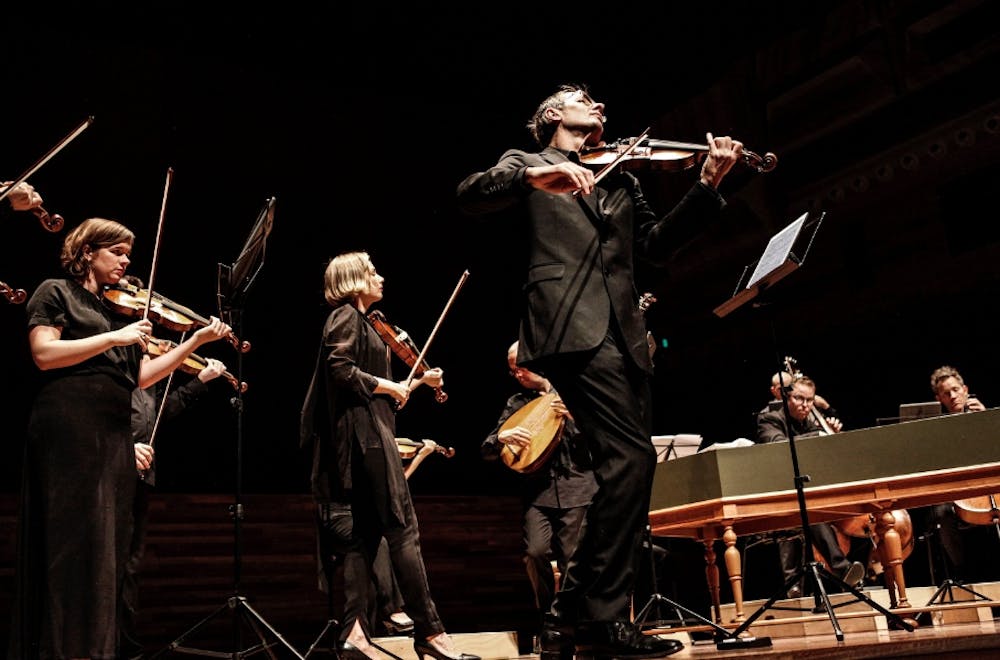
The Australian Chamber Orchestra has announced a new digital season commemorating 30 years of artistic direction under Richard Tognetti.ACO
At the beginning of the shutdown, digital platforms were a critical tool for audience engagement. Arts organisations could communicate the importance of the arts as a source of comfort and inspiration during a time of crisis, while simultaneously reaching a far wider audience than their physical spaces could ever hold.
For starters, safety is a major concern. A number of genres, including opera and musical theatre, pose particular risks to both performers and audience members due to singers’ potential role as super-spreaders. The risks posed by, and to, dancers, instrumentalists, and spoken theatre artists remains uncertain.
From a business perspective, financial viability is also of grave concern. Under social distancing guidelines, performing arts venues will be limited to a fraction of their standard audience capacity. In a sector reliant on box office sales to maintain the bottom line, theatres may find it cheaper to simply stay closed.
In this climate, digital content may be the only means for sustaining the sector in the medium-term. But a problematic precedent has been set.
In the initial panic of moving their artistic offerings online, companies have undervalued their own product. In this regard, we can see clear parallels with the newspaper industry’s shift to online platforms over the last decade. After initially offering online news for free, the industry is still struggling to shift consumer expectations, with major repercussions for both journalists and papers.
To survive, arts organisations must establish a monetised business strategy for online performances and presentations. But this shift must be navigated carefully, particularly by companies that began with an open-access model and now risk alienating audience members.
Claire Foy and Matt Smith will perform a socially distanced version of Lungs at London’s Old Vic.Twitter/The Old Vic
Several arts organisations have already experimented with different ways of monetising digital content. In the UK, the Old Vic theatre is live-streaming a socially distanced version of Lungs for £10-65 (A$18-120) per “ticket”. In Australia, the Melbourne Digital Concert Hall is producing virtual concerts for a paid audience, with all ticket proceeds going to the performers.
Many companies, like New Zealand’s Tempo Dance Festival, are making shows available online but asking for donations. Red Line Productions’ online readings have featured marquee names like Alec Baldwin and Rose Byrne, and also asked for donations. Based out of New York, Bang on a Can’s June marathon promises six hours of streamed live music with a request to “consider” purchasing a ticket or paying extra to commission a new piece. But voluntary contributions can’t sustain the operating costs of these companies long term.
Depending on how various models develop, there will be unavoidable impacts on performers. At present, there are no standardised rates for artist compensation for digital work, whether participating in a prerecorded performance or generating new content for a company to post online.
We’ve already seen how artists’ passion for their craft can be exploited for a cause. The Metropolitan Opera cancelled contracts for its principal singers and union orchestra and chorus in March 2020, only to have them perform for free as part of the company’s digital fundraising gala a month later. The Melbourne Symphony Orchestra similarly stood down its instrumentalists in April 2020 but has since asked them to participate in social media marketing campaigns without pay.
Bottom line
While involvement in promotional activities is standard practice for contracted artists, it’s impossible to ignore the problematic power dynamic now at play. Companies are asking unemployed artists to provide free labour to support organisations that may or may not employ them in the future. And because performers love what they do and want to support the struggling sector, they agree.
While there are reports the government is working on an arts rescue package, the message being sent is one the sector has heard time and again. The arts are important, and artists should be compensated … but only when it’s financially convenient.
Arts organisations cannot survive from digital exposure and goodwill alone. They must develop new business models for online platforms. But companies must also tread carefully to ensure they don’t ultimately undermine the value of the arts – or their artists.
The government will provide eligible owner-occupiers with a grant of $25,000 to build a new home or extensively renovate an existing one.
The scheme – estimated to cost up to $688 million – will not be limited to first home buyers.
Contracts must be entered into between now and the end of the year, with work to begin within three months of the contract date, to maximise the stimulus to an industry set to take a big hit from the pandemic crisis.
The means-tested HomeBuilder scheme will be available to individuals with income up to $125,000 and couples whose combined income is up to $200,000.
It will not be available to companies or trusts, those who are not Australian citizens or people under 18 years of age. Owner builders will not be eligible, nor can the scheme be used for investment properties.
New builds must be for a principal place of residence with a cap on the combined value of house and land of $750,000.
Those renovating their existing home as a principal place of residence will have to be making changes valued between $150,000 and $750,000, with the dwelling worth not more than $1.5 million before the renovation.
The renovation must be “to improve the accessibility, safety and liveability” of the home. It can include a combination of work, such as a kitchen and bathroom renovation.
It can’t be for unconnected additions, such as detached sheds or garages, or for swimming pools, tennis courts or outdoor spas and saunas.
It must be under the supervision of a registered or licensed builder.
Sensitive to comparisons with the Rudd government’s stimulus grants in the global financial crisis, notably the controversial pink batts scheme, the government has listed differences including the limited term of the program, tighter eligibility criteria and expert supervision.
The latest package comes as Wednesday’s national accounts showed the Australian economy went backwards by 0.3% in the March quarter. Annual growth was 1.4%.
Treasurer Josh Frydenberg admitted Australia is already in recession, given the June quarter is expected to be horrendous. A common definition of a recession is two negative quarters.
Frydenberg also announced the government’s promised economic and fiscal update has been delayed, from June until July 23.
He said it would include the response to the review of JobKeeper, which is currently under way. He again flagged the government could cut the $1500 a fortnight payment for those earning less than that before COVID.
Shadow treasurer Jim Chalmers said the delay was a disgrace in these uncertain times.
The government says the housing scheme will help support 140,000 direct jobs and another 1,000,000 related jobs in the residential construction sector.
The sector has lobbied for special assistance, saying it expects new dwelling starts to fall by half by the end of this year.
The government expects competition for work will keep prices contained.
Frydenberg said that “with dwelling investment expected to decline by around 20% through the June quarter, the HomeBuilder program will support residential construction activity and jobs across the industry at a time when the economy and the sector needs it most”.
The scheme will be implemented through the states and territories, which will monitor compliance. The grant will be paid to people when they make their first progress payment.
Prime Minister Scott Morrison said: “Our JobKeeper support has helped the construction sector weather the crisis, now we’re helping fire it up again.
“This is about targeted taxpayer support for a limited time using existing systems to ensure the money gets used how it should by families looking for that bit of extra help to make significant investments themselves.”
Housing Minister Michael Sukkar said “HomeBuilder will not only support the jobs of carpenters, plumbers, bricklayers and electricians on our building sites, it will also support the timber mill workers who produce the frames and trusses and the manufacturing workers who make the glass, brick and tiles for our homes”.
Some days ago, Labor’s housing spokesman Jason Clare said the housing industry was “expected to go off a cliff” and a stimulus package was urgently needed. Labor has also said stimulus should be given to social housing.
Prime Minister Scott Morrison and Indian Prime Minister Narendra Modi will finally hold a virtual summit this week after efforts to meet in person were scuttled by the bushfires and coronavirus.
The meeting is significant, not just because it is happening online, but also due to the cooling of relations each country is currently experiencing with China.
While it is unlikely that the “C” word will figure in the talks between Morrison and Modi, China will no doubt loom large in both leaders’ minds.
Room for growth in trade and investment
Australia-India relations have been on a roller coaster for many decades. Australia has long sought closer ties with India, but Delhi has responded with more hesitancy.
Take, for example, prime ministerial visits. While most Australian prime ministers have visited India in recent years, the reverse has not been the case. Modi’s 2014 visit to Australia was the first for an Indian leader since Rajiv Gandhi came in 1986.
The Australian government has also issued variousreports over the years to try and engage India economically, but the relationship has remained imbalanced.
For example, bilateral trade remains heavily in Australia’s favour, with close to A$17bn in exports to India in 2018 compared to just A$5bn in imports from India.
Since the two countries signed a strategic partnership in 2009, both sides have seen greater potential for expanding trade and investment, and growing closer diplomatically.
The India Economic Strategy Report, compiled by Peter Varghese for the Australian government in 2018, identified key areas where growth is possible in the coming decade, including education, agribusiness, resources and energy, and tourism.
Australia is particularly keen to reduce its over-dependence on China in higher education. According to Varghese’s report, HSBC found the number of Indian parents wanting their children to study abroad had jumped from 47% to 62% from 2016-17. By 2030, India wants to lift its enrolment rate in higher education from the current 27% to 50%.
The overall targets mentioned in Varghese’s report could see Australian exports to India grow to around A$45bn by 2035.
In response, India was about to issue its first-ever Australia engagement strategy report prepared by a former Indian diplomat, Anil Wadhwa, during Morrison’s visit to India earlier this year. But this has still to see the light of day.
While economic possibilities abound, huge challenges remain. India’s withdrawal from the Regional Comprehensive Economic Partnership, a proposed free-trade agreement between Australia, New Zealand, China, Japan, South Korea and the ASEAN members, has sent the wrong signals to the rest of the region.
In addition, an Australia-India economic partnership agreement has yet to be finalised, nine years after negotiations began.
The COVID-19 pandemic will also likely slow India’s economic growth and increase domestic calls for more economic self-reliance. This could in turn have repercussions for Australian exports to India.
Also, given the decline in household incomes in India caused by the pandemic, a big jump in inbound tourists or full-fee paying students coming to Australia is unlikely in the short term.
More room for strategic cooperation
Strategically, there is room for growth, as well. Both countries are members of the so-called “Quad”, a security dialogue framework comprising Japan, India, Australia and the United States.
With India’s growing defence and security links with the US, Canberra is also feeling more comfortable forging defence agreements with New Delhi, such as the proposed Mutual Logistics Supply Pact, an agreement for reciprocal access to military logistics facilities. It is expected to be signed during the virtual summit.
Australia should also expect an invitation to take part in the Malabar naval exercises with India, Japan and the US in the Bay of Bengal this year.
Australia had participated in the exercises in 2007, but withdrew after China expressed concerns. It has been in talks to rejoin the exercises since 2015.
Morrison has enthusiastically promoted his samosa diplomacy through his Twitter account and Modi has eagerly responded. There is much potential to improve relations in the coming years, as well. As Australia’s newly appointed high commissioner to India, Barry O’Farrell, said recently
over the last few months and years, India and Australia have grown closer together. India and Australia are at a historical high.
Source: The Conversation (Au and NZ) – By Anna-Sophie Jürgens, Lecturer (Assistant Professor) in Popular Entertainment Studies and Science in Fiction Studies, Australian National University
Bloodsucker, leech, tick – few things have a reputation worse than parasites. But these biological hangers-on also have a comic cultural history.
In biology, a parasite is an organism that lives on or in a host organism and gets its food (or other benefits) from (or at the expense of) its host. Scientists have just documented the oldest known example of a parasite-host relationship – a nutrient stealing worm over 500 million years old.
Due to their complex and often hidden life cycles, parasites seem to appear suddenly. They thrive in oozing wounds or are transmitted via explosive diarrhoea. No wonder parasites occupy a vivid role in our cultural imagination.
In fiction and popular culture, parasitic characters appear as a metaphor for the threat and spread of disease. They infiltrate human bodies and transform them into monsters, like Dracula. Or they act as extraterrestrial biological weapons like in the Alien saga. The quintessential parasite narrative – per 2019’s Oscar-winning Parasite – showcases it as a physiological, psychological and social threat. But they’ve also played for laughs.
Italian showman Louis Bertolotto’s “extraordinary exhibition of industrious fleas” from the early 1820s is the first documented flea circus. It featured a 12-piece flea orchestra playing audible flea music, a Great Mogul Flea (with harem!), a ballroom with flea ladies and frock-coated gentlemen dancing a waltz, a mail coach drawn by four fleas (with a cracking whip) and a reenactment of the Battle of Waterloo including Wellington, Napoleon and field marshal Blücher – all played by miniature warrior fleas.
Today, traditional flea circuses can still be found. Flohzirkus Birk and his fleas have entertained small crowds at Oktoberfest in Munich for decades. Humans play fleas and other insects in the Cirque du Soleil show Ovo – leaping through a day in the life of bugs.
In Germany, the flea circus still entertains.
The flea fiction literary genre exists for those who prefer to use their own imagination. It includes humorous 19th century texts such Hans Christian Andersen’s The Flea and the Professor and German Gothic writer E. T. A. Hoffmann’s Master Flea, both of which feature tame flea companions and collaborators.
The genre also includes flea porn, which features the little bloodsuckers in all kinds of interesting perspectives. An example is the The Autobiography of a Flea (published anonymously in 1887).
Use of the word “parasite” predates its biological label.
In 1755, Samuel Johnson’s Dictionary defined parasite as “one that frequents rich tables, and earns his welcome by flattery”.
The comic heritage of the parasite shimmers through Honoré de Balzac’s 1847 novel Le Cousin Pons (which had the working title Le Parasite) and Arthur Conan Doyle’s novel The Parasite, first published in 1894. The latter is about a professor who is turned into a clown, “the laughing-stock of the university”, by a mysterious person, parasite-like influencing his mind and behaviour.
In our recent journal article, we expanded on the work of philosopher Michel Serres and literary scholar Enid Welsford to discuss the parasite as a cultural force. Our paper – a fairly rare collaboration between a biological scientist and a humanities scholar – also looked to more contemporary examples such as the hilarious parasitic remote control in Tim Burton’s 1988 film Beetlejuice.
Beetlejuice looks like a morbid clown with green hair, heavy makeup and a stripey suit. He is a supernatural creature whose job is it to help recently deceased adjust to their eternal afterlife. In this in-between space, Beetlejuice performs what Michel Serres defines as a parasitic communication role: making “productive and creative noise”. By forcing his “hosts” to act differently, this parasite transforms the relationship between two parties and invents a new logic and cohabitation.
In 1988’s Beetlejuice, the central character occupies an in-between realm and acts as a parasitic clown.IMDB
Do gooders
By pushing boundaries and exploring notions of self, parasites are a cultural force and source of comic inspiration. What does it feel like to be a leech? How does the host feel? Where is the line between the two bodies?
There are comic scenarios and narratives hidden in anxieties of involuntarily shared identities. In biology, the sustained and intimate relationship between parasite and host challenges the concept of individual boundaries. The distinction between host and parasite becomes blurred and they form a new entity altogether.
Human louse (Pediculus humanus Linnaeus) bears an uncanny resemblance to the monsters in Alien when viewed under the microscope.Shutterstock
It might come as a surprise that the appreciation of parasites in the arts took place long before biologists acknowledged their contribution. Only in recent decades have parasites been recognised as stabilisers of ecosystems and drivers of evolution and biodiversity.
Their footprints can be seen in genetics, epidemiology and medicine; and a better understanding of parasites has significantly increased our appreciation of them. Exploring the cultural imaginarium of the parasite and its comic dimensions pays tribute to the many positive aspects of parasites.
Whether we like it or not, pathogens like parasites are around us and inside us. They determine us biologically and they influence our cultural norms.
Delving deeper into the cultural world of parasites brings to light droll artistry: from funny domesticated creepy crawlies to clown parasites and dark villains.
The organisers of Black Lives Matter protests in several main centres will not be prosecuted.
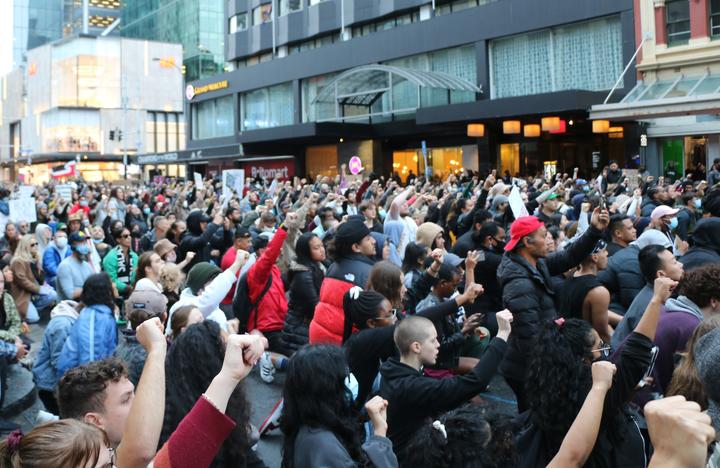
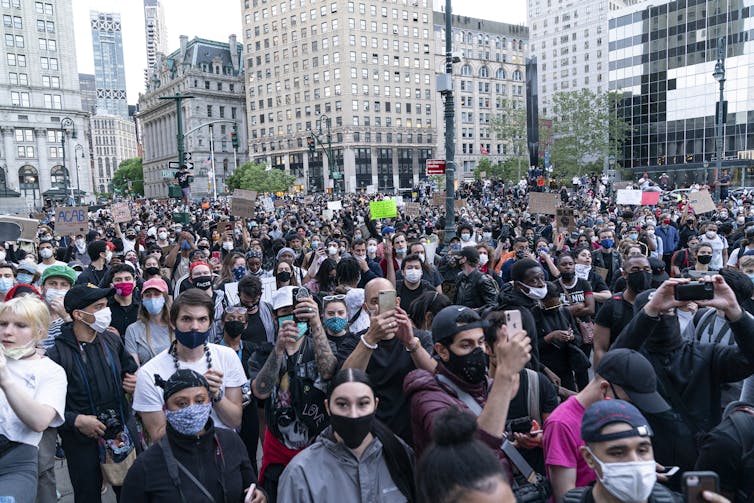
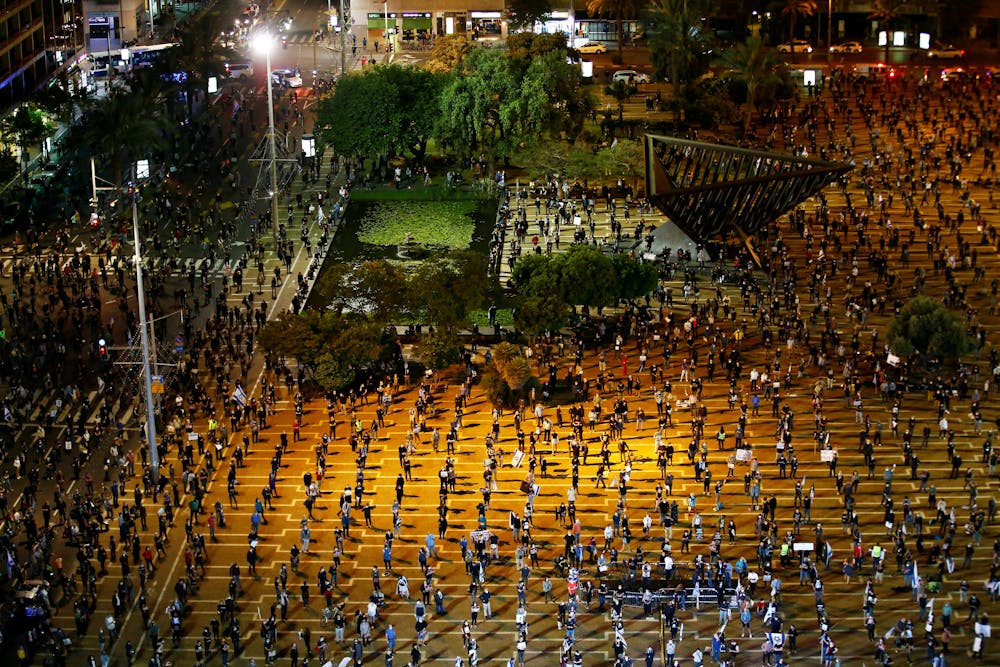
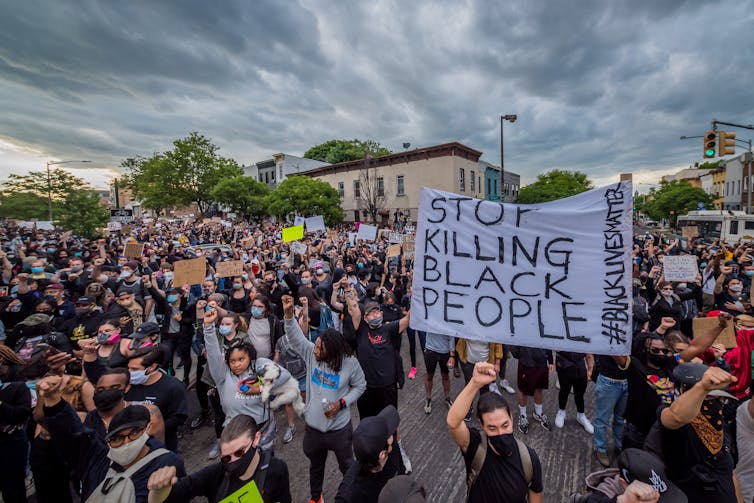
On Monday, thousands gathered at several events around the country for Black Lives Matter marches in solidarity with protesters in the United States after the police killing of George Floyd.
National Party leader Todd Muller told RNZ he thought the Black Lives Matter protests made a mockery of the Covid-19 alert levels and accused the government of sending mixed messages.
Assistant Commissioner Lauano Sue Schwalger said police would speak to organisers to set clear expectations for any further protests.
– Partner –
She said organisers made an effort to ensure participants complied with level 2 rules, such as providing hand sanitiser and encouraging people to maintain social distancing.
“It was an unfortunate reality, with the numbers of people who attended, that this quickly became impractical.”
Schwalger said police always acted in accordance with the situation at hand.
“In these circumstances, it was probable that attempts to enforce alert level 2 would have caused tension in an otherwise peaceful protest, without being effective to enhance physical distancing, given the numbers in attendance.”
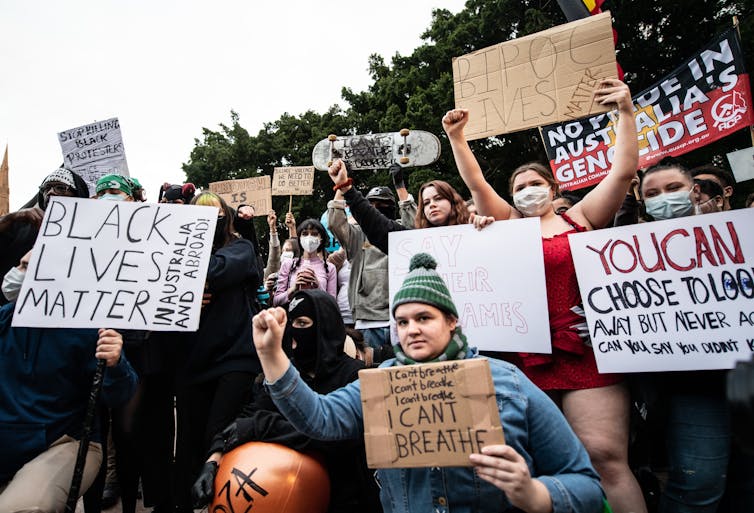
Protesters took a knee with fists up outside the US embassy building in Auckland on Monday chanting “Black lives matter”. Image: Mabel Muller/RNZ
This article is republished by the Pacific Media Centre under a partnership agreement with RNZ.
If you havesymptomsof the coronavirus, call the NZ Covid-19 Healthline on 0800 358 5453 (+64 9 358 5453 for international SIMs) or call your GP – don’t show up at a medical centre.
Source: The Conversation (Au and NZ) – By Michael Fletcher, Senior Research Fellow, Institute for Governance and Policy Studies, Te Herenga Waka — Victoria University of Wellington
One of New Zealand Prime Minister Jacinda Ardern’s favourite exhortations is that we all “be kind” to one another. It’s part of the reason she and her government have won admiration around the world for their handling of the COVID-19 pandemic.
Their latest income support program, however, has led many to question why that kindness is not extended to the country’s 300,000-plus pre-COVID welfare beneficiaries. These New Zealanders have fared worse under New Zealand’s centre-left coalition than their Australian counterparts have under Scott Morrison’s centre-right government.
The COVID-19 Income Relief Payment announced last Friday is an after-tax payment of NZ$490 a week for a maximum of 12 weeks. It applies only to those who lose their full-time jobs due to the pandemic (the part-time rate is $250 a week).
The temporary scheme applies to job losses between March 1 and October 30 and replaces any other welfare payment a person may have been entitled to. Unlike other benefits, entitlement is individually targeted: you can receive the full payment unless your partner’s gross income exceeds $2,000 a week, in which case nothing is paid.
The new benefit can be viewed as a state-funded pandemic redundancy package. The rates have been deliberately set close to the 12-week wage subsidy, which has supported 1.64 million jobs since March 17.
Workers who lose their jobs as the wage subsidy becomes more targeted, or if their employers close or downsize, will in effect have an extra 12 weeks’ support at the same rate.
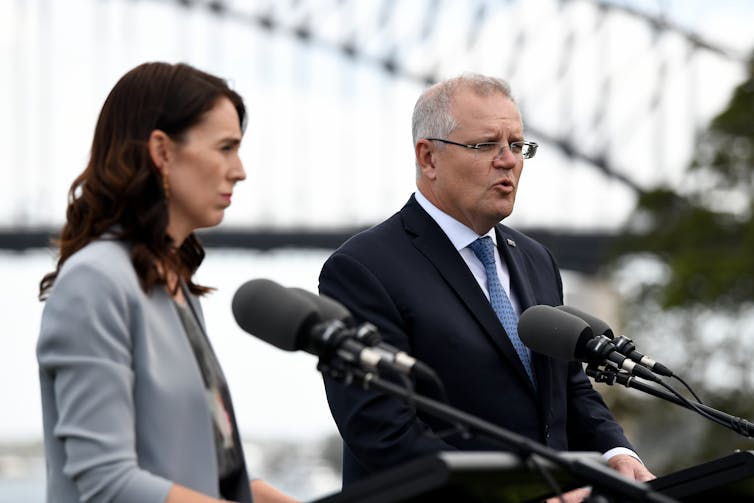
Jacinda Ardern and Scott Morrison: centre-left versus centre-right, but who is really right?Bianca de Marchi/AAP
Two classes of unemployed
Less positively – and controversially – the payment creates a massive inequity between those who qualify and those who must rely on standard welfare benefits and welfare eligibility rules.
The single adult benefit is $251 a week. A couple with children gets up to $428, compared to $960 a week if they both receive the COVID-19 payment. As some critics have put it, New Zealand now has two classes of unemployed.
The new payment also highlights the similarities and differences between the New Zealand and Australian income support responses to the pandemic.
Both countries focused first on short-term employment protection. New Zealand’s wage subsidy scheme was available to firms that had lost 30% of their revenue due to COVID-19, providing support for 12 weeks at about 50% of the median wage. When it runs out in June a more targeted scheme will be available for eight more weeks.
Australia’s JobKeeper program pays roughly 70% of the median wage for a maximum of six months.
Those already on welfare benefits when the pandemic struck, however, have been treated quite differently. In the first round of responses, the Ardern government increased core benefit rates by $25 a week. This was a flat-rate, permanent increase of between 6% and 11%, depending on benefit category and family circumstances.
The Winter Energy Payment allowance was also doubled between May and October, giving an extra $20.45 a week for a single person and $31.82 for a couple or family with children.
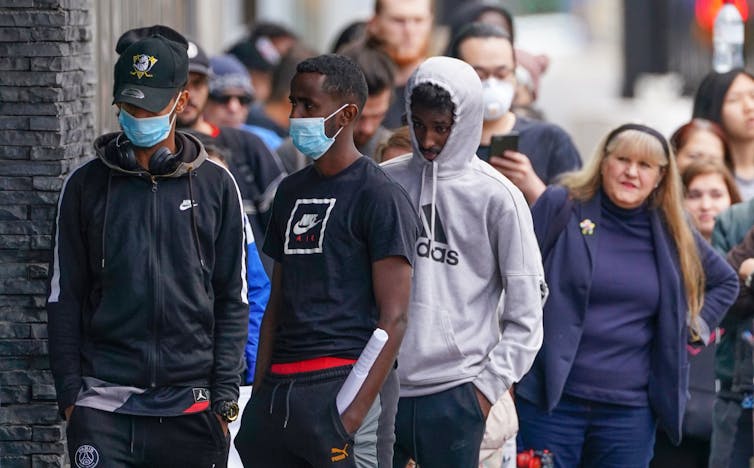
The queue outside a Centrelink office in Melbourne in the wake of business closures due to the COVID-19 pandemic.Scott Barbour/AAP
By comparison, the Morrison government introduced the temporary Coronavirus Supplement, an additional payment of A$225 a week to all existing and new beneficiaries. It applies for six months from late April.
The supplement roughly doubles the JobSeeker rate and is in addition to the two lump-sum A$750 stimulus payments to all income support recipients and concession card holders.
One could argue in favour of New Zealand’s Income Relief Payment as a somewhat oddly designed social insurance program. Such two-tier, time-limited schemes are, after all, the norm in Europe. But that works if – and only if – the bottom tier provides an adequate minimum standard of living.
That is not the case in New Zealand. Numerous studies, including most recently the government’s own Welfare Expert Advisory Group’s 2019 report, have shown New Zealand’s welfare system is well short of adequate.
The government knows benefits are too low
The minister of social development and other ministers have repeatedly acknowledged this. Analysis by the Child Poverty Action Group shows that, taking the COVID response and earlier government measures into account, working-age beneficiary families’ incomes (after housing costs) are still below the poverty line. This is based on one of the government’s own child poverty indicators – “50% of median equivalised income”, or 50% of the median income after taking account of family size.
This analysis showed support for beneficiaries provides between 29% and 46% of median equivalised income, depending on family type and circumstances. The extra income needed to reach that poverty threshold ranges from $45 a week to $195 a week.
Peter Fraser, prime minister of New Zealand, 1940-49.
Presenting his “rebuilding together” budget in May, Finance Minister Grant Robertson referred to New Zealand’s first Labour government, which established what was then a world-leading welfare state after the depression of the 1930s. He also made mention of Peter Fraser, the great Labour prime minister who was a central architect of that welfare state and who led New Zealand through the second world war and its aftermath.
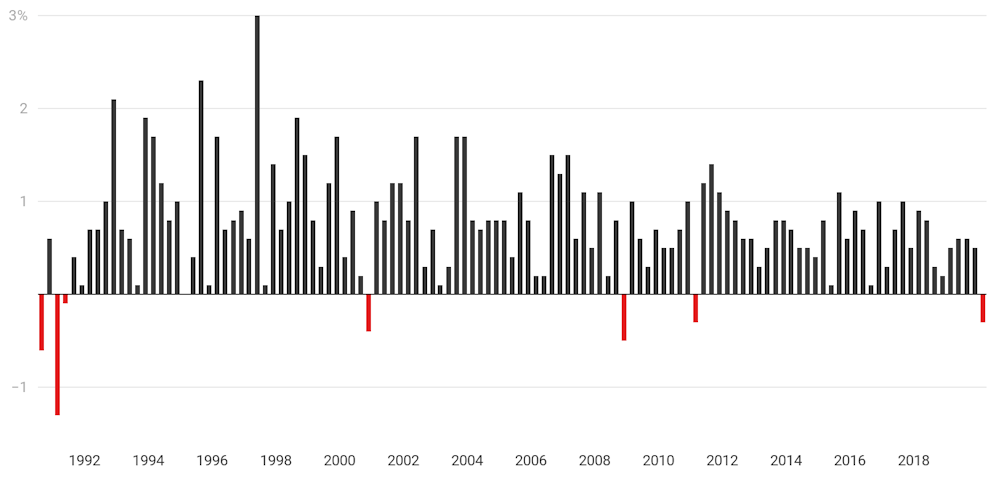
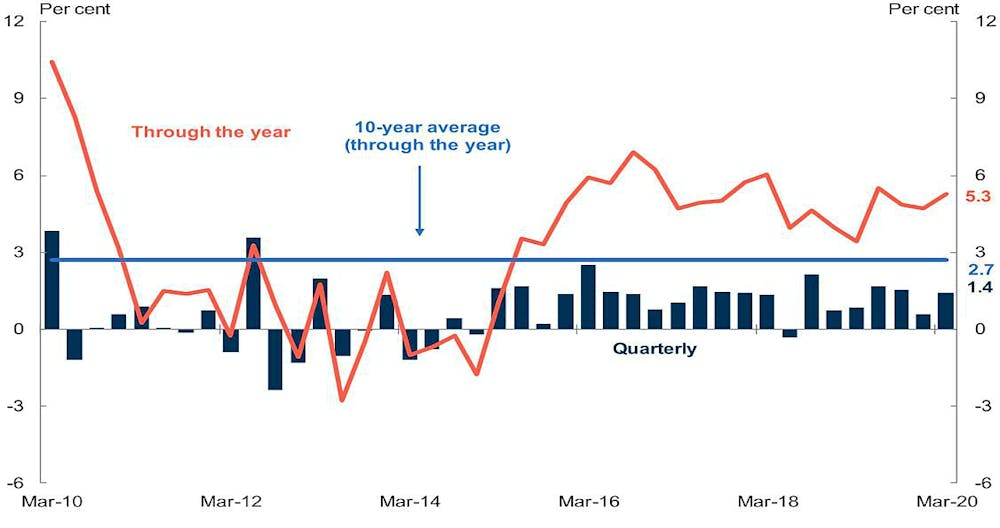
What those early reformers would make of their successors is hard to say. But perhaps it wasn’t an earthquake we felt last week while Jacinda Ardern was being interviewed live on TV. Perhaps it was Peter Fraser rolling in his grave.
A go-slow on spending sent the economy backwards 0.3% in the first three months of this year, only the fourth such decline since Australia was last in recession in the early 1990s.
Treasurer Josh Frydenberg says treasury has told him that the next three months, the June quarter that we are in at present, will see a “far more severe” contraction, one private sector forecasters believe could be as high as 10%.
Asked whether that meant Australia was already in recession, he said it did.
Most unusually for an economic downturn, household incomes rose throughout the quarter, pushed higher by a 6.2% increase in government payments related to COVID-19 and the bushfires, and an 11.1% increase in insurance payouts as a result of bushfires and hailstorms.
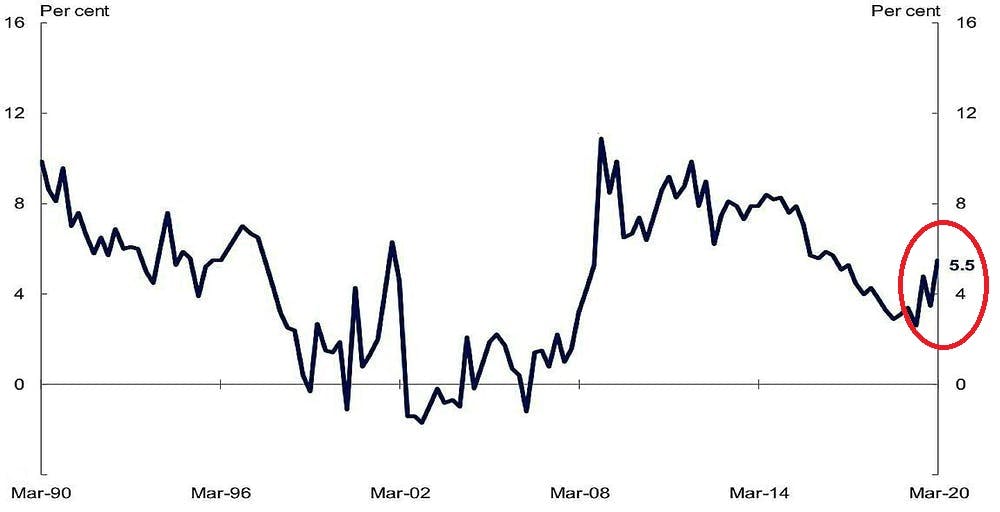
But rather than spend most of it, Australian households dramatically increased saving in the quarter, pushing the household saving ratio up from 3.5% to 5.5% and pushing down household spending 0.2%.
Household savings ratio
Commonwealth Treasury
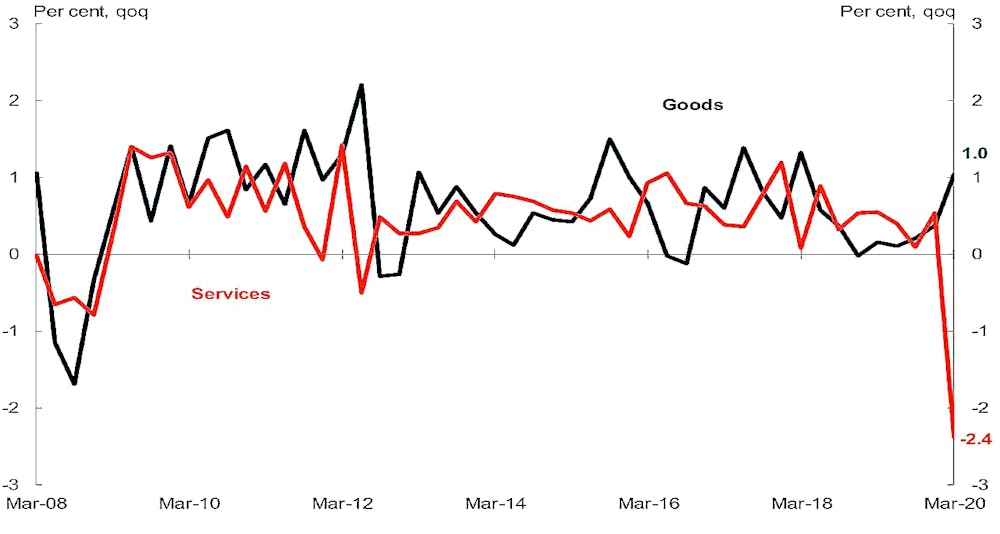
Spending on goods actually increased over the three months as Australians stocked up on essentials including toilet paper in March.
The production of “petroleum, coal, chemical and rubber products” surged 8.1% as consumers stocked up on cleaning and disinfectant products.
But spending on services plummeted, led down by dramatic falls in spending on transport and hotels, cafes and restaurants.
Household consumption, March quarter
Commonwealth Treasury
Spending on transport services (airlines and the like) fell 12.0%. Spending on hotels, cafes and restaurants fell 9.2%, each the biggest fall on record.
“Production” in these industries fell 4.9% and 7.5%. Profits fell 6.8% and 14.2%.
Spending fell on ten of the 17 consumption categories.
Household consumption by category, March quarter
Commonwealth Treasury
Most of the changes took place at the very end of the March quarter.
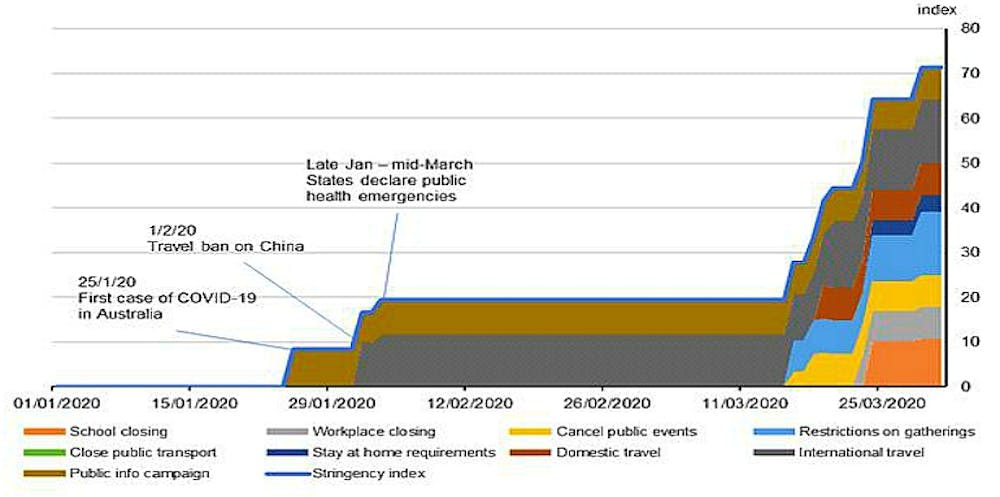
A new index of the “stringency” of COVID-19 containment measures released with the national accounts shows they ramped up only in the final two weeks.
Most have been in place for the entirety of the June quarter to date, suggesting the impacts on spending and production will be a “lot more substantial”, in the words the treasurer used in the national accounts press conference.
The treasury had been contemplating a fall in gross domestic product of 20% in the June quarter. Australia has avoided that fate by acting on health and the economy early.
Its fall in GDP of 0.3% in the March quarter was one third the OECD average.
International comparisons, real GDP growth, March quarter
Commonwealth Treasury
The treasurer has scheduled an economic update, which will include the result of a review of the JobKeeper program.
Asked whether it could be referred to as a mini-budget, he said it could be.
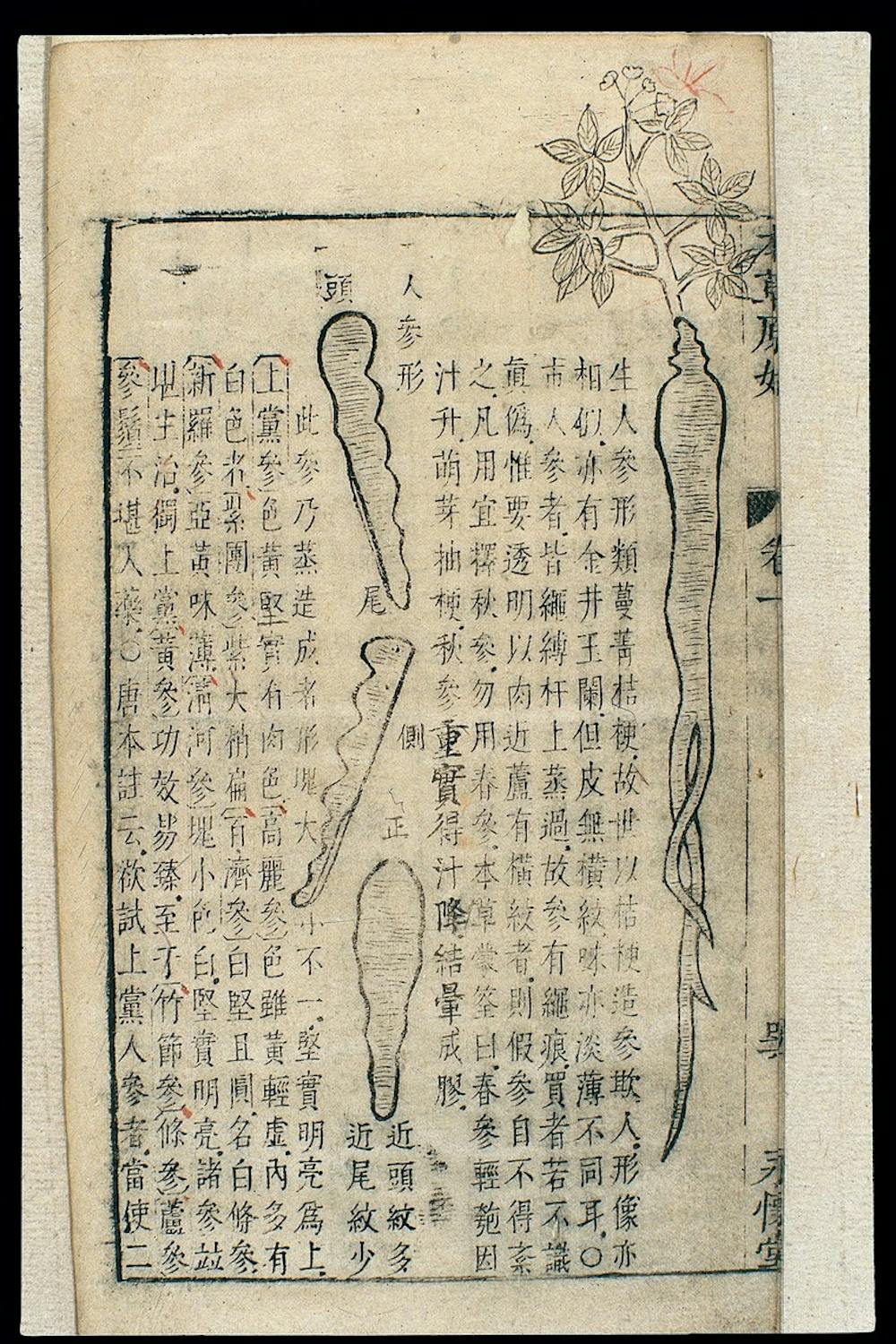
One of the earliest observational studies occurred nearly 1,000 years ago in China. The 1061 Atlas of Materia Medica (Ben Cao Tu Jing) was compiled and edited by Song Su, a renowned scientist, administrator, diplomat and military strategist.
[…] to evaluate the effect of genuine Shangdang ginseng, two persons were asked to run together. One was given the ginseng while the other ran without. After running for approximately three to five li [about 1,500-2,500 metres], the one without the ginseng developed severe shortness of breath, while the one who took the ginseng breathed evenly and smoothly.
Ginseng has long been used to treat people, as documented in this 17th century text.Wellcome Collection, CC BY
This observational study is also the first recorded example of a control group.
A control group can be patients who are not treated at all, patients who receive a standard treatment compared to a new one, or patients who receive a placebo (a treatment or substance designed to have no therapeutic effect).
Having a control group is one of the cornerstones of modern clinical trials.
An example of a control group in COVID-19 research is this recent study. People with diabetes hospitalised for COVID-19 were divided into those receiving the drug metformin and those not receiving it (the control group).
Back to ginseng. Today, it is a popular herbal remedy. As to whether it improves stamina, a recent review found some evidence ginseng might help men with erectile dysfunction.
Rhubarb in 18th-century England
Rhubarb, seen in this 16th century text, has been used as a laxative for thousands of years.Wellcome Collection, CC BY
Rhubarb roots have been used as a laxative for more than 5,000 years, including in 18th-century England.
Caleb Parry, an English physician working in Bath, wanted to know whether locally grown rhubarb was as good as the more expensive Turkish variety.
In 1786, he ran a study in which he switched the type of rhubarb he gave to each patient at different times. He then compared each patient’s symptoms while eating each type of rhubarb. He concluded there was no advantage in using the Turkish version.
This is the first published example of a crossover trial (a study where the participants receive each treatment at different times).
Beriberi, a disease that can have lasting effects on the nervous system and heart, was common in Southeast Asia in the early part of the 20th century.
In 1905 a beriberi outbreak occured at the Kuala Lumpur Lunatic Asylum. At that time William Fletcher was the district surgeon. He realised the outbreak provided an excellent opportunity to run an experiment (which we now know is just a bit unethical).
Each patient was assigned a number. Those with even numbers were sent to one ward and given brown unpolished rice to eat. Those with odd numbers went to another ward and given white polished rice.
At the end of the experiment, 15% of the patients who ate the white rice died of beriberi; none given brown rice died.
This is a very early example of randomisation in a clinical trial, where one group is chosen at random to receive a treatment.
Randomisation is another very important factor in good clinical trial design.
Today we know beriberi is caused by a deficiency in thiamine (vitamin B1) and a white rice diet is deficient in thiamine.
Tuberculosis and the randomised controlled trial
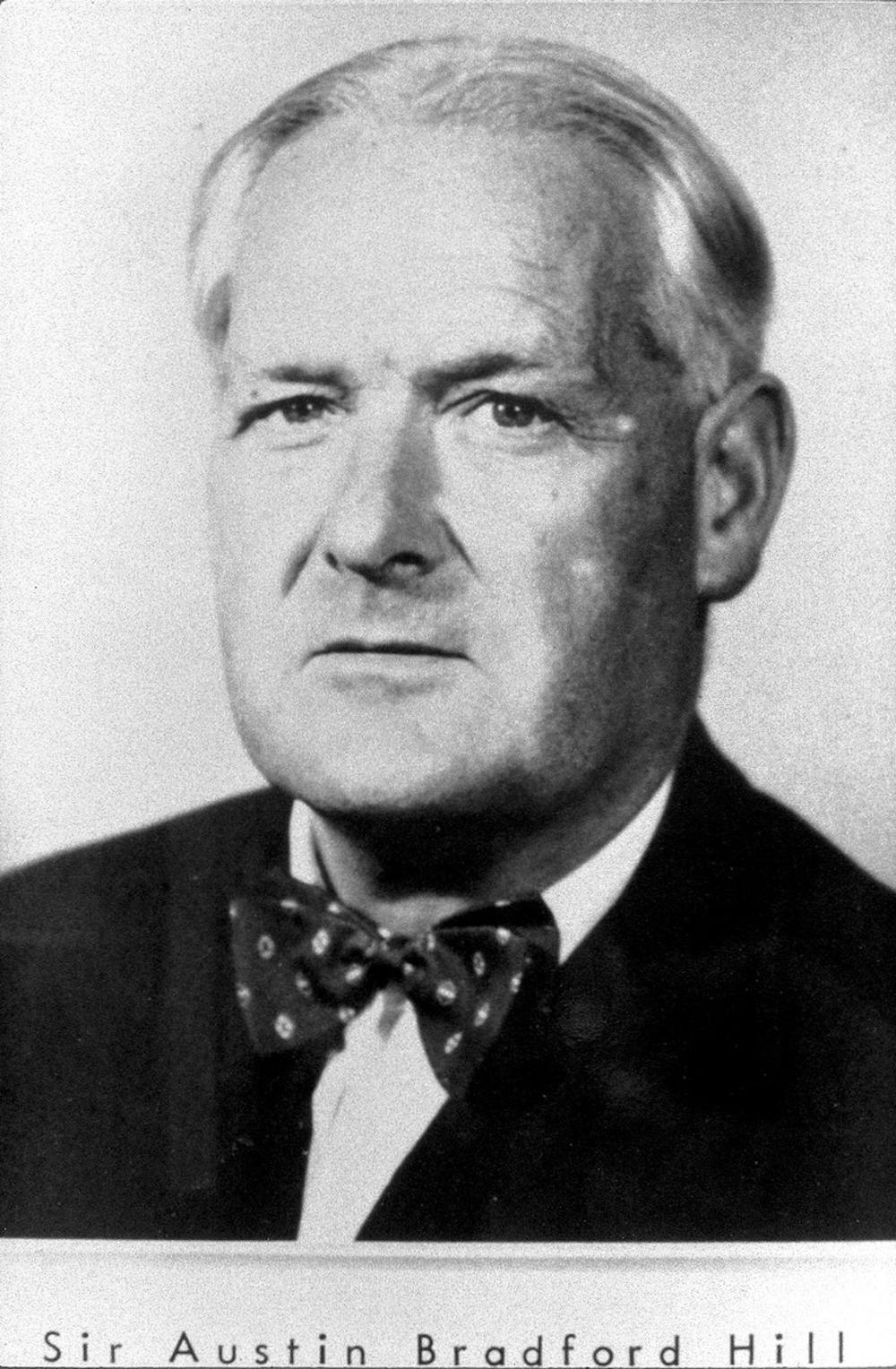
Sir Austin Bradford Hill, whose tuberculosis trial has features of trials we see today.Wellcome Collection, CC BY
Sir Austin Bradford Hill, an English epidemiologist and statistician, conducted the first randomised controlled trial in 1948. The trial was was to treat the lung disease tuberculosis.
Bradford Hill decided whether a patient should be treated with the antibiotic streptomycin plus bed rest, or bed rest alone, by using a table of random numbers.
The investigators didn’t know which patient got each treatment; details were in sealed envelopes. Patients were not told they were in a trial.
Using sealed envelopes is an example of what we now call allocation concealment. Making sure neither investigators nor patients know which treatment they are receiving is called blinding. These are now standard features of randomised controlled trials.
Randomised controlled trials are the “gold standard” of clinical trial designs, due to the use of both a control group and randomisation.
Decades later, researchers have used a randomised controlled trial to test the drug ruxolitinib in patients with severe COVID-19.
So, although Bradford Hill conducted the first randomised controlled trial, it was based on hundreds of years of people working out why things like a control group and randomisation are so important.
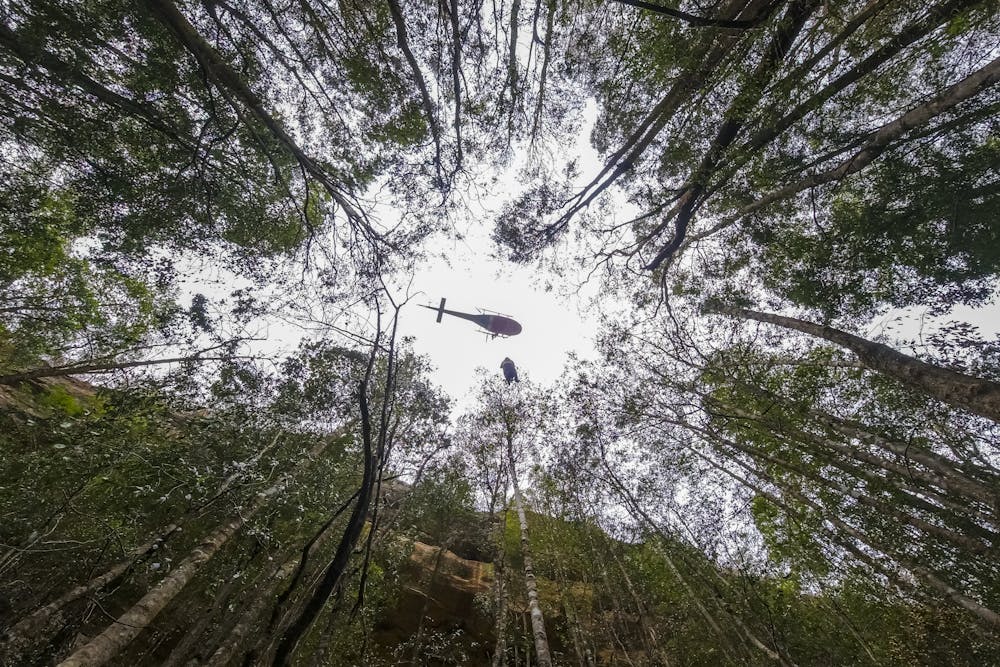
As bushfires blackened forests last summer, one tree species was protected by a specialist team of firefighters: the Wollemi pine.
These trees have a deeply ancient lineage dating back to when dinosaurs walked Gondwana 100 million years ago. Back then, rainforests – including Wollemi pines (or their cousins) – covered what became Australia.
So when a handful of Wollemi pines were discovered alive in 1994 on the brink of extinction, it caused a frenzy of interest that has barely died down among plant enthusiasts.
How firefighters saved the Wollemi pine from the bushfires.
Today, fewer than 100 mature pines are left in the wild. But their exact location is one of the best kept secrets in Australian plant conservation, to protect them from pathogens such as the root-rotting phytophthora that might hitch a ride on human visitors.
But while rare in nature, our ongoing research with citizen scientists is finding Wollemi pines grow in backyards all over the world, in a range of environments, and this information can inform how we can protect them in the wild.
An army of conservation experts helped save wild Wollemi pines from last summer’s bushfires.AAP Image/Supplied by NPWS
From Gondwana to the garden
The Wollemi pine is considered the iconic poster-child for plant conservation. It’s an unusual-looking plant – each wild tree has many trunks covered in bark resembling bubbling chocolate and branches of lime or grey-green fern-like leaves. And in the wild, they grow to more than 40 metres tall.
The species is a member of the southern conifer family Araucariaceae, and its cousins include the monkey puzzle tree and the Norfolk Island pine. While considered a rainforest tree, many remaining in the wild exist between rainforest and dry eucalypt woodland, on the ledges of a sandstone gorge.
Wollemi pines can stretch 40 metres in the wild.Heidi Zimmer.
One of the first strategies was cultivation. Horticultural scientists at the Australian Botanic Garden Mount Annan (Sydney) worked out how to propagate the species so it could be grown and enjoyed in gardens, reducing the risk of illegal visitation in the wild.
After the Australian Botanic Garden established a basic “insurance population” of plants propagated from the wild trees, some of the first cultivated Wollemi pines were distributed to botanic gardens in Australia and overseas, including in the UK’s Royal Botanic Gardens Kew.
In 2005, Wollemi pines were auctioned to the public at a Sothebys Auction. Since then, they’ve been exported to many nurseries around the world, and now grow in many public and private gardens.
I spy a Wollemi pine
When plants are very rare in the wild, or are very restricted in their distributions, conservation away from the site (ex situ) can play an important role in their survival.
This includes seed banking, translocation (establishing new populations of rare plants in new locations) and cultivation for the nursery trade.
Enter our I Spy A Wollemi Pine project. Fifteen years after the Wollemi pine became available for sale, our study asks people to report where Wollemi pines are growing in gardens across the world.
So far, results from the online survey have revealed the species grows across 27 different countries, from Australia to Russia, and the UK to Peru.
The tallest trees so far – stretching to 7 metres tall (though dwarfed by their wild counterparts) – have been reported from the UK. To date, 987 people have contributed data about Wollemi pines.
Reading comments from survey participants – from “Has survived minus 10 degrees” to “I just love it” – has been a source of interest and joy for us researchers.
When the survey is finished, we’ll analyse the responses to understand what influences the growth of this species, such as different climates and soils.
Knowing how Wollemi pines grow in other parts of the world will provide gardening tips for home growers, but more importantly it will inform future conservation efforts in the wild in the face of climate change.
For example, this research will provide information on what environments the Wollemi pine can tolerate. We’re discovering the hottest, coldest, wettest and driest places on earth this species can survive in.
This information can help us find places to establish new populations of Wollemi pines. It may also provide clues on the evolutionary history of this species and how it managed to survive multiple ice ages and other dramatic climate changes in deep history.
Wild Wollemi pines grow in a secret, remote gorge in the Blue Mountains.AAP Image/Supplied by NPWS
Conservation with cultivation
Conserving Wollemi pines in backyards is not quite the same as Wollemi pines in the wild – in the same way its important to have pandas in the wild, and not just in zoos. But using cultivation for conservation does mean these species have much greater distribution today than they have ever had in the past.
In fact, this isn’t the first time a rare tree has ended up in gardens. The dawn redwood, thought to be extinct in the wild, was rediscovered in China in the 1940s and can now be found in gardens across the world.
And the internet is a great place to foster conservation. In online forums, people share every stage of their Wollemi babies’ growth, from seed germination to pine cone production.
This love and connection to Wollemi pines might even help address “plant blindness”: the propensity for people to see, recognise and focus on animals rather than plants, despite plants being central to providing us with food, the air we breathe and our climate.
So, as more species are threatened with extinction every day, everyone’s actions – even in their own backyards or online – can make a difference.
If you have a Wollemi pine in your backyard, or know of a Wollemi pine in a park or garden, and would like to get involved in our citizen science survey, please click here.
You probably know the details of the death of George Floyd. He was a doting father and musician. He was killed when a police officer, Derek Chauvin, knelt on his neck for nearly nine minutes while he cried out “I can’t breathe!”
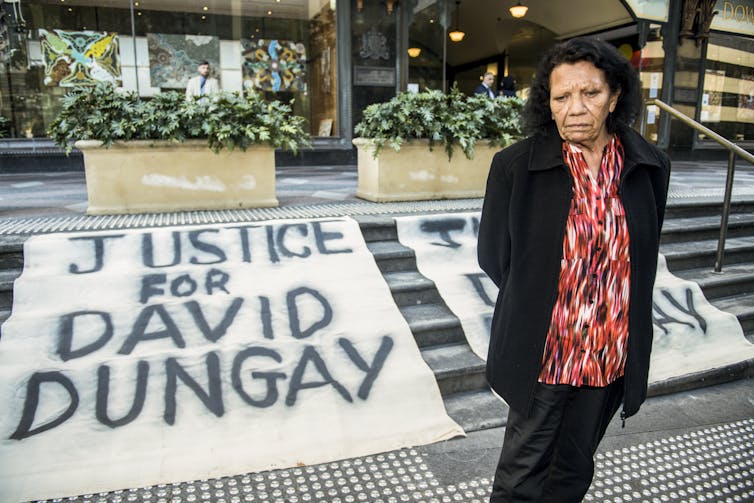
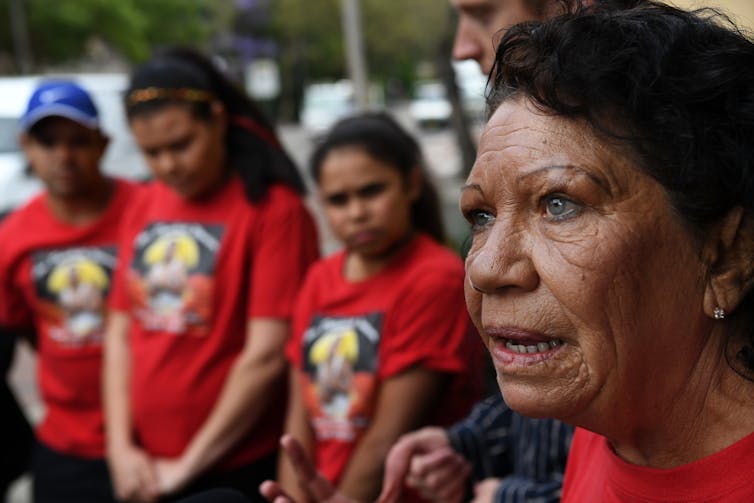
Do you know about David Dungay Jr? He was a Dunghutti man, an uncle. He had a talent for poetry that made his family endlessly proud. He was held down by six corrections officers in a prone position until he died and twice injected with sedatives because he ate rice crackers in his cell.
At the end of a long inquest that stretched to almost four years, the coroner declined to refer the officers involved in Dungay’s death to prosecutors (who might consider charges) or to disciplinary bodies.
Paul Silva, Dungay’s nephew and among the his most powerful advocates for justice, said as he was leaving court,
What am I meant to do now? Go home, look at the ground. Tell my Uncle? — Sorry, Unc, there’s no justice here!‘
When I heard [George Floyd] say ‘I can’t breathe’ for the first time I had to stop … My solidarity is with them because I do know the pain they are feeling. And as for the Aboriginal deaths in our backyard … it’s not in the public as much as it should be.
Leetona Dungay has pursued a very public campaign for justice in the death of her son.Brendan Esposito/AAP
A perception Indigenous deaths in custody are expected
Many people on this continent know more about police and prison violence in the US, another settler colony, than the same violence that happens here. Both are deserving of our attention and action, so what’s behind the curious silence on First Nations deaths in custody in Australia?
Aboriginal and Torres Strait Islander people have raised this concern long before today in the media and social media.
Why do we have to? The reasons are complex, but boil down to a system of complicity and perceived normality in Indigenous deaths at the hands of police and prisons. The settler Australian public simply does not see Indigenous deaths in custody as an act of violence, but as a co-morbidity.
The choice of language is important: it evokes a certain response in the reader and shapes our understandings of events. In the case of Palm Island, the often-repeated meta-narrative of so-called ‘dysfunctional’ and ‘lawless’ Aboriginal communities served to justify further acts of colonial violence.
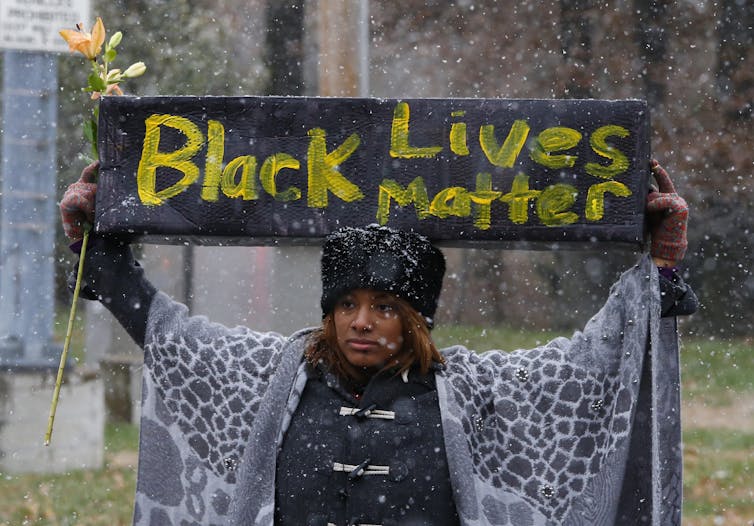
A protest against the police shooting of Michael Brown in Missouri in 2014.Larry W. Smith/EPA
In my 2018 pilot study on a sample of 134 Indigenous deaths in custody since the Royal Commission into Aboriginal Deaths in Custody, I found coroners considered referring just 11 deaths to prosecutors and only ended up referring five. Of those, only two made it to court and both resulted in quashed indictments or acquittals.
These are monumental figures. They are also stories of deep systemic complicity, both before and after death. And they are full lives, with loved ones who mourn and fight for them.
Aunty Tanya Day, for instance, campaigned for justice for her uncle who died in custody and later died in custody herself.
The scale of devastation is unthinkable – and violent, and racist.
What makes Australian silence about deaths in custody so especially bizarre is that, unlike the US, we have a mandatory legal review of every death in custody or police presence. Each case, regardless of its circumstances, goes before a judge called a coroner.
Just as public political will is always changing, so is law and legal strategy. Compared to the campaigns for justice for black people killed by police in the US, which have made relative gains, many families here are working in a complex space of honouring their loved ones, proper cultural protocols around death and the dead, and securing CCTV footage to mobilise the public for justice.
Coroners have offered mixed responses, and each state and territory’s coroner approaches the question in a slightly different way.
After the death of Ms Dhu, a Yamatji woman, in police custody in Western Australia in 2014, persistent advocacy from the families and media organisations prompted the coroner to release footage of her treatment before her death. Coroner Ros Fogliani did so
in order to assist with the fair and accurate reporting of my findings on inquest.
However, last year, NSW deputy coroner Derek Lee initially declined to release footage showing the circumstances of Dungay’s death, citing cultural respect, sensitivity for his family and secrecy over prison procedures.
Members of Dungay’s family, who had applied to have it released, responded with exasperation. It was eventually shown on the opening day of the inquest, although the fuller footage requested by the family remains suppressed from public view.
Other ways families are silenced
There are other transparency issues that give a legal structure to silence about Indigenous deaths in custody. Recently, there appears to be a new push in non-publication or suppression orders being sought by state parties in coroners courts.
In Dungay’s inquest, for instance, the media was ordered not to publish the names, addresses or any other identifying features (including photographs) of 21 NSW corrections staff members.
There have been other suppression orders in deaths in custody matters before criminal courts, such as the identity of the officer facing a murder charge in the death of Yamatji woman Joyce Clarke in Western Australia last year.
Officers in South Australia are also going to some strategic effort to avoid testifying before the inquest into the death of Wayne Fella Morrison, a Wiradjuri, Kookatha and Wirangu man, or even speak with investigators on the grounds of penalty privilege.
investigations surrounding the cause of death in prisons can have a great impact for our grieving families to at least get an account of what happened to our loved ones in the absence of our care. It can also raise the spotlight on the behaviours of correctional and police officers – like those that piled atop of my brother’s body.
Outside of coroners courts, there is the threat of subjudice contempt, when media coverage may pose a prejudicial threat to a potential trial.
This carries a risk for families who speak out about their loved one’s deaths in a way that even implies something happened or someone did something. Subjudice contempt poses liability to them personally when they speak out, but also could jeopardise their push for justice.
This puts First Nations peoples at the mercy of what can be raised before a jury, judge or coroner. With lengthy procedural delays, this can also mean a case is hard to talk about publicly for years.
This is problematic given that timely publicity about deaths in custody is what drives attention. Taleah Reynolds, the sister of Nathan Reynolds, who died in custody in NSW in 2018, said,
We’re coming up to a year since he died and we still don’t know anything more.
I feel like they don’t have any remorse; they hide behind the system. No one’s held accountable, that’s the most frustrating part.
All of this leaves our public discourse full of blak bodies but curiously empty of people who put them there.
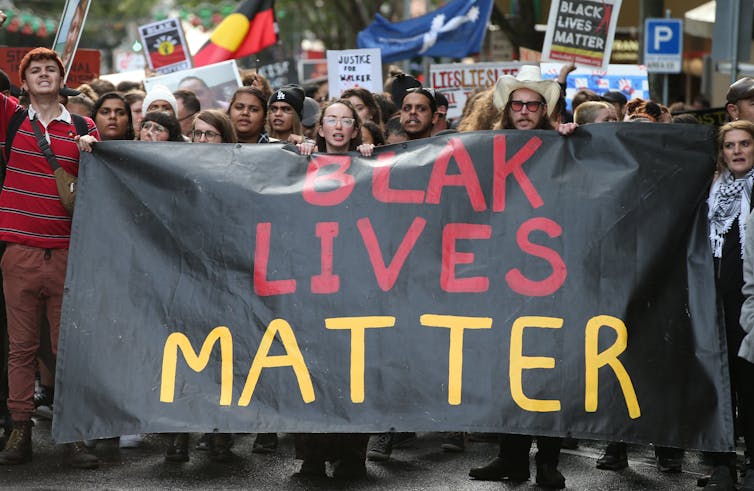
A Melbourne protest seeking justice in the death of a 19-year-old NT man shot by police.David Crosling/AAP
The power of public campaigning
Prosecution or referral seems to come only from cases where First Nations families have strong public advocacy and community groundswells behind them and strategic litigation resources (not just inquest legal aid).
As the late Wangerriburra and Birri Gubba leader Sam Watson said of the campaign for justice for the death of Mulrunji Doomagee on Palm Island:
Unfortunately, the government had to be dragged to this point screaming and kicking every inch of the way. Every time there’s been a breakdown in the procedure, the family and community on Palm Island are being subjected to more trauma, drama and unnecessary grandstanding by politicians.
Right now, three deaths are either before prosecutors or in their early stages of prosecution. All have been part of growing, public campaigns driven by their families and communities — although many others, like Dungay’s family, have done the same and still been faced with institutional complicity.
Clearly, there is much legal structure that supports this silence, but the basis of the silence itself is colonisation and white supremacy. As Amy McQuire writes:
Their wounds also testify to this violence. But while this footage has been important for mobilising Aboriginal people, non-Indigenous Australia is still complacent and apathetic.
They are not ‘outraged’ because they are not ‘shocked’. There is nothing shocking about racist violence perpetrated by police, because it is normalised.
When we do hear about the Indigenous lives lost in custody, it is undoubtedly because of the persistence, expertise and courage of their families and communities who mourn them. But it is not enough to hear about justice, justice must be done.
Here is a line from the latest safety advisory for reporters issued by the US-based Committee for the Protection of Journalists (CPJ):
Taking into account the increased levels of violence and tactics used by both police and protesters, ballistic glasses, helmets, and stab vests should be worn. If there is a threat of live ammunition being used, then body armour should be considered.
It is the kind of advice I used to be given before going on assignment to places like Baghdad, Kabul or Mogadishu. But the CPJ is aiming its latest note at US-based reporters more used to covering city hall than documenting running battles between police and demonstrators. It is deeply troubling that an organisation usually advocating for reporters in violent autocratic regimes decides it now has to support those in its own backyard.
One organisation, Bellingcat, has been tracking assaults on journalists since the riots broke out over the death of George Floyd in Minneapolis last week. In the first four days of protests, its chief investigator counted more than 100 incidents. (The CPJ counts closer to 200.)
The 101st involved a Australian news crew from Channel Seven. They were beaten while filming outside the White House, as riot police used tear gas and batons to clear the peaceful protesters so President Donald Trump could walk across the street and hold a Bible in front of St John’s Church. (In a speech moments before, Trump had – without irony – declared, “I am your president of law and order”, and “an ally of all peaceful protesters”.)
The startling number of attacks on journalists does not appear to be an accident. Inevitably, anyone reporting in violent places risks being caught in crossfire. But the numbers suggest something more troubling.
although in some incidents it is possible the journalists were hit or affected accidentally, in the majority of the cases we have recorded the journalists are clearly identifiable as press, and it is clear that they are being deliberately targeted.
The police actions against journalists might seem futile in our social media age when everyone with a mobile phone has the power to act as a reporter, but that doesn’t stop individual cops from lashing out at those they see as actively monitoring them.
There does not appear to be a coordinated strategy. In the United States, policing is generally a state and city affair, so collusion seems unlikely. The CPJ’s Courtney Radsh said the organisation’s experience of tracking violence towards journalists in some of the world’s most hostile regimes shows that the police step up their attacks when they believe they can get away with it.
In the US, the president himself has frequently derided journalists as “the enemy of the people”, who peddle “fake news”, and on Sunday he issued a tweet describing them as “truly bad people with a sick agenda”.
There is no doubt some journalists have behaved unethically or been loose with the facts, and the news business more broadly has not always covered itself in glory.
But as imperfect as it may be, it remains a vital part of the way a free and open democracy works. It acts as a watchdog on behalf of voters, monitoring the behaviour of institutions like the police and government who are supposed to be acting in the interests of the public.
In so many cases in the protests, journalists have clearly identified themselves verbally, with accreditation, with vests labelled “press”, carrying professional-standard cameras, and by their actions, observing rather than participating in the protests. That observation is rarely comfortable for those in authority, but it is a necessary part of the system.
As a recovering journalist and press freedom advocate, I am of course concerned about assaults of my colleagues. But to be clear, this is not about them. What we are seeing in the United States is an attempt to make the public blind to heavy-handed police tactics.
The founding fathers of the United States understood that when they wrote the First Amendment into its Constitution, guaranteeing “congress shall pass no law … abridging the freedom of speech, or of the press”. (The First Amendment also guarantees freedom of religion, the right of the people peaceably to assemble, and to petition the government for a redress of grievances.) Attack the press, and you attack the very system that has made places like the US and Australia among the safest and most prosperous in the world.
The reason autocrats in Turkey, the Philippines and Egypt throw journalists in prison with such enthusiasm is because they know a free media empowers the public, and threatens their survival.
If Trump is the patriot he claims to be, he will honour the Constitution and defend the press rather than accuse reporters of “doing everything within their power to foment hatred and anarchy”.
Source: The Conversation (Au and NZ) – By Patrick Locke, Research Associate, LCT Centre for Knowledge-Building, Department of Sociology and Social Policy, University of Sydney
Prime Scott Morrison last week outlined a plan to create jobs and revitalise the economy post COVID-19. Part of this so-called Jobmaker plan includes an overhaul of the “bewildering”, “unresponsive” and “fundamentally flawed” skills sector.
Morrison’s reforms are based on Steven Joyce’s 2019 review of Australia’s vocational education and training (VET) system, of which all recommendations were accepted by the federal government.
But actors in the sector may be sceptical of the “overhaul” based on their experience of past changes. Reforms in 2014 were similarly aimed at making VET more responsive to industry needs and cutting red tape, all the while pulling funding from the sector.
The end result was a substantial contraction of the sector, as well as significant rorting by private organisations.
What’s happened since the last reforms?
Governments from both parties have introduced 33 significant sector reforms since 1998. And the Coalition has made a number of attempts to reorganise VET since being elected in 2013.
The sector has also shrunk. Between 2013 and 2018 total full-time equivalent student hours decreased by 30% – while total student numbers decreased from 1.9 million to fewer than 1.1 million.
Apprenticeships were particularly impacted by the changes. While 214,000 apprentices completed their training in 2013, this went down to 89,000 in 2018. This was accompanied by a substantial drop in financial support from government – from A$6.8 billion to A$5.3 billion.
Meanwhile, efforts to decrease regulation to make the sector more responsive to the market resulted in substantial rorts by private providers, who greatly tarnished the reputation of the sector as a whole.
How Morrison’s reforms compare
Morrison’s disparaging rhetoric towards VET harks back to federal industry minister Ian Macfarlane’s attempts at reform in 2014, when he aimed to update a “fractured, unwieldy and overly bureaucratic” sector to be “streamlined and effective”.
Morrison outlined three key problems to overcome in the VET system. First, the system is too complex and unresponsive to industry demand. Second, it does not offer clear information about the skills needed for the future. And third, the system is inconsistent between states and there is poor accountability over how money is spent.
The prime minister announced no new funding for the VET sector.MICK TSIKAS/AAP
To solve these problems, the government will establish pilot Skills Organisations to “enhance the […] leadership of industry in the skills pipeline”, by giving industry more control over the contents of qualifications.
These organisations are reminiscent of Macfarlane’s 2014 Industry Skills Councils. These were aimed at giving industry “the freedom to design the type of training they’re after”.
Given this still a recurring issue, it appears previous efforts to give industry more voice in training package design have not achieved their goals.
Morrison also announced the establishment of the National Skills Commission to provide a countrywide view of Australia’s skills needs and coordinate state VET activities.
This draws from another past VET reform. Paul Keating established the Australian National Training Authority in 1992. It had a very similar remit to this new skills commission but was dissolved by the Howard government in 2005.
A final feature Morrison’s skills overhaul shares with its predecessors is a lack of commitment to increasing funding to the sector. Morrison said he wanted to better target A$1.5 billion of federal funding to the sector, rather than committing to providing additional financial support.
Stay-at-home orders and the economic crisis have increased the burden of energy costs on lower-income Australians. Poor housing quality and unequal access to home energy efficiency are hurting our most vulnerable households. With the next stage of the national recovery program expected to include cash grants for home renovation, now is the time to turn to housing retrofits that support health and well-being as well as boost jobs.
Laundry temperatures of 60-90°C are needed to limit the spread of the coronavirus. But this conflicts with common energy-saving advice of washing clothes in cold water. Self-isolation also means heating more and not being able to close off unused rooms.
When people on low incomes live in such housing, they are doubly disadvantaged by the challenges of needing more energy and not being able to afford it. Households with older people, people with chronic illness and children are particularly susceptible to energy stress and poor health outcomes.
Even if power bill payments are deferred, households must still eventually repay their mounting debts.Shutterstock
However, bill payment will only be postponed until the end of July. Much of the expensive heating period will still be ahead of us. And after that households will face the costs of cooling homes in summer.
Energy debts are going to accumulate as a burden to low-income households into the future. Energy retailers might find it ethically difficult to resume disconnections, but customers will have to repay their debts. This will only be possible if their overall financial position improves and/or the cost of their energy decreases.
Income support via energy concessions can ease bill stress. However, taxpayer money may be better spent on providing sustained relief by improving the energy performance of homes. Acknowledging housing as essential infrastructure would enable economic and social progress.
A long-term stimulus package for retrofits would be welcome. The focus should be on comprehensive retrofitting to reduce energy demand, thus helping households to repay debt. Comprehensive or “deep retrofits” combine simple activities such as draught proofing with insulating ceilings, floors and walls, upgrading heating and cooling appliances, and installing solar PV systems.
Many retrofits overlook the opportunity to install underfloor insulation when restumping a house.CSR Bradford/YouTube screenshot
Riding the current wave of home improvements, innovative retrofit initiatives may guide people in their DIY efforts. However, some training for proper DIY installation and the use of skilled tradespeople for technical installations is needed for safety and quality.
Putting people at the centre of retrofitting programs will provide healthier homes and help tackle unemployment. This means providing retrofit assistance to those who need it most and training people in retrofit skills.
Previously, the boom in new housing construction inhibited retrofitting. This might change following the COVID-19 crisis. A long-term retrofit program would be an opportunity to upskill builders and to retrain newly unemployed Australians, particularly the young people who have been most affected by job losses. An expanded retrofit workforce is needed to reach the large number of inefficient homes.
So-called “Green Deals” have already been proposed in Europe, the US and the UK. Green construction stimulus packages in Australia have successfully supported economic recovery before. The aim should be to spawn a new industry of energy-efficient builders who will continue to contribute to the upgrade and upkeep of Australian housing. This could help cut greenhouse gas emissions, promote public health and improve our resilience to crises.
A nationwide stimulus package to provide healthier and more energy-efficient homes would help the most vulnerable and boost the economy.
The number of Australians working from home has soared during the COVID-19 crisis. Latest data from the Australian Bureau of Stastistics shows 46% of the workforce worked from home in late April and early May.
By comparison, the bureau’s 2019 data showed slightly less than a third saying they “regularly worked from home” – a number likely inflated by those catching up on work from the office.
For many this has been the first real taste not just of full time teleworking, but any flexible working arrangements – something that under minimum employment laws remain a privilege for a select few.
But it will be important for all organisations to keep extending flexible working arrangements to as many staff as possible as we move to the next phase of our COVID-19 response.
While social distancing rules are now relaxing, until there’s a vaccine we still need work flexibility for as many people as possible. To ease, for example, morning and afternoon congestion in central business districts and on public transport.
Over the past few months we’ve been been part of a research team looking at how organisations have coped with the abrupt shift to remote work. Our findings are promising. But they also highlight a deficiency in Australia’s national employment standards, which do little to encourage employers embracing flexible working arrangements.
Still more a privilege than a right
Your rights to flexible working arrangement are likely to be set out most strongly in your favour in an enterprise agreement. Or, if you don’t have one of those, an industry award. Or possibly an individual contract. Provisions will differ.
If you aren’t covered by any of those, you’re out of luck.
The right to flexible working arrangement set down in the National Employment Standards – the minimum entitlements employers must give all employees – is no right at all.
Some employees who have worked for the same employer for at least 12 months can request flexible working arrangements, such as changes to hours, patterns or locations of work.
To even have the right to make that request, you must also:
be the parent or carer of a child who is school-aged or younger
have a disability, or be a carer
be 55 years and older
be experiencing violence from a family member, or supporting family or household members experiencing family violence.
If you meet these criteria, you have the right to receive a response to your request within 21 days. If your request is rejected, your employer must detail the reasons for the refusal, “including the business grounds”.
What constitutes “reasonable business grounds” is broad. It includes your employer deciding your request:
is too costly
can’t be made to fit with the working arrangements of other employees
“would not be practical” to accommodate
will result in a “significant loss of productivity” or “significant negative impact on customer service”.
The Fair Work Commission does have the power to adjudicate a complaint about an employer’s grounds for refusing a request. But according to the Fair Work Ombudsman:
This generally only happens if the parties to the dispute have agreed in an employment contract, enterprise agreement or other written agreement for that to occur.
Tracking the transition
The COVID-19 pandemic has provided us and our colleagues at Curtin University with an opportunity to see how organisations have managed with a big shift to teleworking.
These arrangements they might easily have been rejected previously on “reasonable business grounds”.
Our research involved interviewing 34 human resources and industrial relations managers and implementers. They worked for organisations that included a hospital, a school, a financial services company, and multiple mining companies, government departments and not-for-profit organisations. Their employee numbers ranged from as few as five to as many as 60,000.
We interviewed them between April and May to see how their organisations coped with the move. Thirty said they were unprepared for such a large-scale transition. Yet after four weeks, 27 were enthusiastic about the benefits and wanted flexible work arrangements to continue.
As the senior human resource advisor of a mining company, put it:
I don’t have kids and before I did not think about working from home. Now I would like to do it at least for one day a week and definitely see I can 100% get my work done from home.
Amending the Fair Work Act
Our findings suggest employers have little to fear from strengthening flexible working arrangements in the National Employment Standards.
The onus on employees to prove the “business grounds” for employers’ refusal should be eased. The Fair Work Act should be amended so all employees can have access to challenge a refusal for flexible work arrangements.
Greater flexibility is both possible and productive for most workplaces. Now it’s also in a wider social interest.
The authors would like to acknowledge the work of their colleagues John Burgess, Eileen Aitken Fox, Amy Tian, Jane Coffey and Chahat Guptar in contributing to the research.
When things go wrong with economic life, it’s easy to blame economics; that is, the academic discipline called ‘economics’. We all live economic lives, and use metaphors to give meaning to that amorphous thing we call ‘the economy’ and to our individual places within it. Shared metaphors within a society constitute a cultural mindframe.
The most important of these metaphors in our pan-western society is that of ‘making money’; thus, the economic purpose of life is to ‘make money’, with ‘money’ being a metaphor for ‘wealth’. Another metaphor – with both positive and negative connotations – is ‘economic growth’. Other culturally-laden economic metaphors with multiple meanings include ‘globalisation’ and ‘flat tax’.
We inform our lives through cultural metaphors; abstractions – largely unexamined (to an extent, unexaminable) abstractions – that exist to a large extent in the subconscious areas of our brains. It is not uncommon for these metaphors to have unreal – sometimes magical – qualities. We assume that money ‘doesn’t grow on trees’, without having much idea where it does grow. We also assume that money is completely convertible, meaning that a certain amount of money can be readily converted – now or in the future – into something else (such as a haircut or a toaster).
Economists, while trained in their social scientific discipline, are not exempt from the cultural metaphors that they grew up with. Thus, professional economists wear two hats, the one they grew up with, and the one that reflects their economics’ education. (We note that ‘hat’ is a good example of a metaphor; indeed a magical metaphor, in that we may ascribe a person’s current behaviour and language to a set of values or protocols that have supposedly been infused into an article of clothing.)
Economists, when being economists, by definition, wear their economists’ hats. But, for the most part, they do not take off their cultural hats; hats infused with western middle-class cultural metaphors.
Educated people with minimal economics’ training will largely interpret the economic aspects of their lives through the economic mindframe they grew up with, to a greater or lesser extent ameliorated by the extent to which they are willing to apply critical analysis to the metaphors and assumptions that makeup that mindframe. Trained engineers will generally interpret economic life a little differently from trained botanists, who in turn will interpret economic life a little differently from trained dentists. Each educational discipline – including economics – will modify but never overturn the predominant cultural mindframe.
In any society at any point in time (eg ‘western society’ in the early 21st century) there will be a mindframe that is shared by most of the people most of the time, and all of the people some of the time. Mindframes are cultural DNA, with the memes being the mutable fragments of such DNA.
Culture is not static. New generations will pick up new memes, which may to a greater or lesser extent erode cultural metaphors which have directed their parents’ lives. Nevertheless, some cultural metaphors – such as the ‘making money’ metaphor – are very difficult to unlearn. Much of the cultural understandings of the way the world works – including evolution of our understandings of how economic life works – is a generational process. Processes of mindframe change, while inherently slow, may quicken in ‘interesting times’ (another metaphor).
While generational mindframe changes may constitute progress – meaning new memes giving more helpful (or less unhelpful) ways of interpreting our information and our experiences – progress cannot be guaranteed when new ideas and new assumptions take root. Evolution can bring about regressive as well as progressive change.
An important meme that is growing in currency is the anti-economics meme. While I think this is a dangerous meme, it is true that many economists inadvertently facilitate the spread of anti-economics, with the ‘economic growth’ metaphor being the principal focus of an increasingly strident anti-economics.
In addition to anti-economics, there is something else which I call anti-economism, and which is practiced by heterodox economists. This indeed where I fit, but only if we carefully distinguish anti-economism from anti-economics. Economism is orthodox cultural economics, and is widely adhered-to by politicians, bureaucrats, business leaders, journalists, career academics, and economists employed within this power nexus. (Two points to note. One. Economists who are self-employed but dependent on the power nexus for contracts will tend to adhere to economism. Two. It is important to make a distinction between ‘career academics’ and ‘intellectuals’, even though many intellectuals have academic careers.)
Economists who practice economism wear two hats – a disciplinary hat and a cultural hat. The danger is that, when critics target economists, they target the wrong hat; they target economics when they should be targeting economic culture. Anti-economism should be a resistance to endemic economic culture, which is a mindframe embedded in the societies which economists belong to; a resistance too easily treated as an opposition to economics itself. Thus – to use a familiar metaphorical phrase – those who subscribe to anti-economism run the risk of ‘throwing out the (disciplinary) baby with the (cultural) bathwater’. There is much that existing economics – and the history of economics – has to offer those who see economism as a major problem of our age.
Framing and Doughnuts
“Everybody’s saying it: we need a new economic story, a narrative of our shared economic future that is fit for the twentyfirst century. (Kate Raworth, Doughnut Economics, p.12)
I am in the process of reading Doughnut Economics, by heterodox economist Kate Raworth. At the moment, my reading of this book is on pause, because I want to write here about my first impressions. (I look forward to finishing the book.)
The main introductory chapter of Doughnut Economics is an insightful discussion of economic iconography and framing. Yet it introduces a metaphor – the doughnut – that I think doesn’t work. Generally, the book’s promise of a new economics makes it an example of anti-economism that targets the wrong ‘hat’; though in a credible and insightful way.
What is particularly insightful is Raworth’s understanding of the need for an unlearning process to accompany a process of inculcating new disciplinary understandings of how economies work. She refers to cultural mindframes as ‘stowaway intellectual baggage’ (p.15). And (p.22), in her discussion on ‘framing’ (linked to sociologist Erving Goffman), she refers to Thomas Kuhn – author of the 1962 book, The Structure of Scientific Revolutions – and his use of his expression ‘community paradigm’.
She then cites economist John Maynard Keynes (1883-1946), who wrote of his:
“… struggle to escape from familiar modes of thought and expression … The difficulty lies not in the new ideas, but in the old ones which ramify, for those of us brought up as most of us have been, into every corner of our minds.”
Then Raworth says (p.23):
“There maybe no perfect frame waiting to be found but, argues the cognitive linguist George Lakoff, it is absolutely essential to have an alternative frame if the old one is ever to be debunked. Simply rebutting the dominant frame will, ironically, serve only to reinforce it.”
Thus creating new memes, if not entire new frames is important. To propose is more important than to oppose. The problem – if that’s the correct word – is that old frames may be better displaced than destroyed. They may not be all bad. The replacement of one entire mindframe with another is revolutionary change. Evolutionary change – albeit with punctuated moments of comparatively rapid change – may serve us better than revolutionary change. Further, if the target people (economists) are wearing two frames (‘hats’) – ‘frame’ is an alternative metaphor – we should carefully aim for the problem frame, and not the other one.
I first learned of ‘doughnut’ as a metaphor last century, as in ‘doughnut cities’, a metaphor for urban decay (ref: The Doughnut Effect, The Economist, 17/01/2002)
“The American donut, a sugary ring with an empty centre, is a fine metaphor for the rich suburbs around a collapsed inner city.”
This metaphor is partially compatible with Raworth’s, in that the centre is a bad place to be. Raworth wants us to vacate the centre and occupy the ring. The lesson of the original metaphor, though, is to renew (and reoccupy) the centre, in part because the ring has many problems of its own.
As I would (!), I find my pie metaphor more useful than the doughnut. (Also see references below.) Though pie charts do not compete with Raworth’s iconography – indeed many readers might find both her doughnut and my pie to be useful components of a new frame – my pie seeks to utilise economics rather than to overthrow it. (It seeks to show economics in new way, rather than to create a new economics.)
My pie has a relaxation ring around the outside (a good place to be), whereas Raworth’s doughnut has a hole on the inside (a place to escape from). Further pie charts can naturally expand – allowing for new sustainable ways of thinking about growth – rather than focussing on non-growth. Yet the pie, which allows for growth, does not require growth. The pie makes every place a good place. Raworth’s doughnut, on the other hand, seems more like a refuge, a sanctuary, a citadel.
I look forward to reading the rest of Doughnut Economics; indeed, Kate Raworth may win me over to the whole of her vision. I do hope, however, that her doughnut meme to rebut the framework of economics will not ‘backfire’ (another metaphor), and “reinforce” our dominant cultural mindframe of economic life.
Meanwhile, it would be nice to see people give more attention to what economic life is really all about – incomes, spending and relaxing – and less attention to the meaningless quest to make more money.
The death of African-American man George Floyd at the hands of police has sparked protests across the United States and inspired many people to reflect on our own history of police violence against Indigenous people in Australia and New Zealand.
As an infection prevention researcher, I am, of course, genuinely worried by the prospect of large crowds gathering. But I also completely understand why people want to go and make their feelings known on racism – not just in Australia and New Zealand, but internationally.
It is a clash when we are trying to manage covid-19 and puts us in a dilemma.
But I can’t stand and judge people who want to go.
Huge crowds have gathered in places such as New York to protest the death of George Floyd. Image: Lev Radin/The Conversation/AAP
– Partner –
Colleagues in the US who are so moved by what’s happening there are forgoing their social distancing and putting themselves and their colleagues at risk by attending the protests. For them, it is a personal decision and a risk they are prepared to take.
In New Zealand, Prime Minister Jacinda Ardern said while “I utterly understand” why people had marched, New Zealand had social distancing rules in place to protect people’s health – and the June 1 marches were “a clear breach of them”.
If we had one person, one person in that crowd, just think what could happen there because we’ve seen it before […] I understand the strength of feeling and I understand the sentiment and I understand that sense of urgency that everyone felt. But my job is to look after the country’s health as well.
NZ Prime Minister Jacinda Ardern says while she doesn’t want to stop peaceful protests, the June 1 Black Lives Matter protests across NZ were a “clear breach” of COVID-19 rules.
In Australia, people should remember many states have strict rules about public gatherings and it’s likely you’ll be breaching them if you attend a protest. In Victoria, there’s a limit of 20 people at an outdoor gathering. For NSW the limit is 10, while in Queensland the limit is 20.
Remember, coronavirus is spread via close contact, so you are significantly increasing your risk of infection if you are in a large crowd.
All that said, if you’re considering attending a protest, here are four things to think about
1. Is there another way I can show support? Given I’m an infection prevention researcher, working to prevent the spread of covid-19, I have to say this: if there is any other way you can show support, other than attending a mass gathering – whether that’s donating to a group doing good work, doing any sort of online protest or whatever option you can find – you should consider it.
Think about whether you yourself are at higher risk – by being older or immuno-compromised, for example – and whether there is a more sustainable way for you to support a movement you care about.
2. Think about how you’ll get there Plan your trip to and from the protest carefully. Avoid crowded public transport – consider driving or riding a bike if possible – and follow social distancing rules if you must travel by bus, train or tram.
Make sure you bring hand sanitiser and use it liberally. Wash hands as soon as you get home.
3. If you go, observe social distancing
People gathered in Sydney on Tuesday to protest against the treatment of Indigenous people in custody. Image: James Gourley/The Conversation/AAP
If you’re in Australia, download and use the COVIDSafe app. Try as best you can to observe social distancing at any event you attend. That means staying at least 1.5 metres apart from everyone else (or 2 metres in New Zealand) whether you are standing in an open space or marching down a street.
Remember that coronavirus is spread by droplets released when people breathe, talk, cough, sneeze, sing or shout in close proximity to others. No hugging to demonstrate solidarity.
When you get lots of people together and emotions run high, things can go awry very quickly. I’d be prepared to leave the demonstration if I started to get concerned about the proximity of people around me. There’s a risk more people will turn up than you or the event organisers anticipated; if there are bigger crowds than expected, be prepared to make a decision to head home.
A mask alone will not protect you, they’re only one piece of the armoury and are only useful if you socially distance and wash hands as well. If you throw yourself into a situation where you are close to other people, a mask will not be enough to protect you or others.
4. Do not attend if you feel unwell or have any covid-19 symptoms This should go without saying: absolutely stay home, no matter how strongly you feel about the issue, if you have any symptoms, such as a sore throat or a cough.
Indigenous Australians are an at-risk demographic for covid-19, as are Māori and Pasifika, so you need to think carefully about the risk you may pose to others if you turn up while experiencing symptoms.
If there was to be a small cluster in one of these protests, and the virus was passed to an Indigenous community, the effects could be devastating.
If you feel that compelled to attend a demonstration, think about anything you can do to minimise the chances of spread, or you will undo the gains Australia and New Zealand have made in keeping the coronavirus spread under control.
As we have been cooped up at home during coronavirus lockdown, reports of image-based abuse have skyrocketed.
According to Australia’s eSafety Commissioner, it received more than 1,000 reports of image-based abuse between March and May 2020. This represents a 210% increase on the average weekly number of reports they received in 2019.
There was also a huge spike over the Easter weekend, where there was an almost 600% increase on usual reporting figures.
The problem is not limited to Australia. The United Kingdom has witnessed a similar increase, where its Revenge Porn Helpline says it has opened double the number of cases from the previous April.
What are we talking about?
Image-based abuse happens when an intimate image or video is created or shared without the consent of the person pictured. It can also involve threats to share images.
Though it is known colloquially as “revenge porn”, researchers and policymakers have rightly rejected that term. They use “image-based abuse” to better capture the harms of the non-consensual taking, sharing, or threat to share, nude or sexual images.
Why has there been an increase?
When we all entered lockdown, digital forms of communication and connection became central to our lives – and that includes our dating lives.
In lockdown, the exchange of nude and sexual images is likely to be a more common way to express our intimacy with another person. Unfortunately, this means perpetrators have greater access to victims’ images to threaten and abuse them.
Since lockdown, the eSafety Commissioner has also observed an increasing trend in people being blackmailed over their intimate images, as well as people trying to monetise their intimate content. This includes reports of sextortion scam emails, which eSafety Commissioner Julie Inman-Grant says, “scares people into paying cryptocurrency payments”.
COVID-19 has seen many people lose their jobs or income. So financial pressures could also be in play as more perpetrators look to exploit non-consensual nude or sexual images for financial or other material gain.
We also know that image-based abuse occurs in the context of domestic and family violence. Victims living in isolation with an abusive partner or family member may be particularly vulnerable to these harms.
According to the UK’s Revenge Porn Helpline, the majority of their increased reports came from victims experiencing image-based abuse by an abusive or controlling intimate partner.
Image-based abuse was already a widespread problem
Before the pandemic, our research found as many as one in three of those surveyed in Australia, the UK and New Zealand (aged 16 to 64 years) have experienced image-based abuse.
Women victims in particular reported greater harms and fear for their safety, as well as experiencing multiple forms of victimisation.
Perpetration rates are highest among men in their 20s.www.shutterstock.com
We also found one in six people surveyed reported they had been the perpetrator of image-based abuse.
Perpetration rates were highest among men in their 20s and 30s, with one in three men aged 20 to 29 years disclosing they had engaged in these behaviours.
There are laws against this
In Australia, we have specific laws across the country criminalising image-based abuse, except in Tasmania.
There are laws against image-based abuse in Australia.www.shutterstock.com
If you’re a victim of image-based abuse, you can document the evidence and report to police, and through the eSafety Commissioner’s online portal to request the images are removed. In over 90% of cases, the eSafety Commissioner is successful in image removal. You can also seek support from national helplines such as 1800 RESPECT.
But some victims find it difficult to come forward for help.
Many victims of image-based abuse report experiencing shame and humiliation. They often feel violated and exposed by the perpetrator’s actions.
It is sometimes friends or family who first see the images when they are distributed online. Sadly, victims can feel judged rather than supported by these vital social lifelines.
It’s not the victims’ fault
Too often we blame the victims. We ask why they took or sent images of themselves in the first place. But now, more than ever, it must be made clear that it is not the exchange of intimate images between consenting adults that is the problem.
It is the non-consensual taking, sharing or threatening to share these images that is wrong.
We need to educate the community about the seriousness of these non-consensual and criminal harms. And Australians need to know that they can take action.
As a community, we must challenge the attitudes that minimise the abuse, blame victims and make excuses for perpetrators.
We can do better as a community
The last National Community Attitudes Survey showed many Australians minimise image-based abuse and other forms of technology-facilitated abuse. As friends and family members, we can instead provide support to victims and let them know we do not blame them for someone else’s actions.
If we become aware someone is misusing intimate images without consent, we can and should call out their behaviour. As the current national Our Watch campaign says: “there is no excuse for abuse”.
It is vital that we take positive action as bystanders by supporting victims and challenging perpetrators if we are going to get ahead of this issue.
Particularly at a time when we are using technology in ways to consensually express our intimacy, in an otherwise quite isolated setting.
You can report image-based abuse to the eSafety Commissioner at esafety.gov.au
If you or someone you know is impacted by sexual assault or family violence, call 1800RESPECT on 1800 737 732 or visit www.1800RESPECT.org.au. In an emergency, call 000.
The Vanuatu Council of Ministers has agreed at its meeting held in Luganville, Santo, to postpone the hosting of the Pacific Islands Forum (PIF) Leaders Meeting due in August 2020, reports the Vanuatu Daily Post.
The decision followed the recommendations of the National Task Force based on the “uncertainty and the economic impacts” the country is facing with the covid-19 pandemic and recent Tropical Cyclone Harold.
Vanuatu has had no reported cases of covid-19.
The government has mandated the Ministry of Foreign Affairs to liaise with the Pacific Islands Forum Secretariat on the postponement.
The ministry will also negotiate with Fiji to seek a possibility for Vanuatu to host the meeting in 2021.
How many media analysts predicted it? In 2018 Australia’s Nine Entertainment absorbed Fairfax Media and its New Zealand subsidiary Stuff. Just under two years later chief executive Sinead Boucher bought Stuff from Nine for a dollar.
The bold move saved New Zealand’s largest newspaper publisher and online news site from uncertainty at best, closure at worst.
“Behold, Saint Sinead of Stuff”, wrote one observer, while pointing out what else would be needed: financial backing, government subsidies, and management of internal costs and debt.
Media commentators, public media lobbyists, journalists, Communications Minister Kris Faafoi and even Nine CEO Hugh Marks also praised Boucher’s proposals for staff shareholdings and an editorial independence charter.
But behind these signs of hope the Stuff initiative was emblematic of a rapidly disintegrating media system.
Here is the news: layoffs and closures
COVID-19 only accelerated the collapse. The national lockdown and forecast economic contraction have been commercially disastrous for all private media organisations. Redundancies and closures have gone viral.
In late March New Zealand Media and Entertainment (NZME), owner of the NZ Herald (the country’s largest daily paper) and nearly half the country’s commercial radio stations, closed its sports operation and shed 25 full-time staff.
A week later German-owned Bauer Media abruptly closed its New Zealand branch, folding such venerable current affairs and popular titles as the Listener, Woman’s Weekly, North & South and Metro.
A fortnight later NZME announced 200 more redundancies – 15% of its workforce. As Boucher announced her Stuff buyout, MediaWorks (owner of TV3 and the rest of New Zealand’s commercial radio stations) shed 130 staff.
Confronted by this unfolding catastrophe, the government finally announced a NZ$50 million emergency package. This included $21 million to offset TV and radio transmission fees for six months, $16.5 million to reduce contributions to the NZ On Air content funding agency for the financial year, and $11 million in targeted assistance for specific media companies.
But the response was late, partial and narrowly focused. COVID-19 has exposed a double crisis in New Zealand’s news media that short-term fixes do little to address.
A crisis over 30 years in the making
For decades the weakening sustainability of commercial media has damaged the viability of news reporting, journalistic enquiry and national media coverage. Meanwhile, underfunded public broadcasting has long battled to pay staff, create content and transition successfully to digital platforms.
These trends can be traced back to the 1980s. The restructuring of Radio New Zealand (RNZ) and Television New Zealand (TVNZ), the launch and subsequent sale of TV3, the privatisation of Telecom (1990) and the abolition of all restrictions on foreign media ownership (1991) set the scene for today’s crisis.
Transnational media conglomerates were allowed to colonise the national media scene. From 2007, listed and unlisted financial institutions (banks, hedge funds, private equity companies) acquired media holdings as short-term revenue streams. Concentration of ownership intensified.
At the same time, with the rise of Google and Facebook, television’s advertising share declined from 34% in 1988 to 21% in 2018. Before COVID-19, digital advertising was worth NZ$1 billion, about 40% of New Zealand’s entire advertising turnover. The pandemic’s economic shock has hit ad revenues even harder.
Underfunded for years, Radio New Zealand could now be part of the solution to a media crisis.www.shutterstock.com
Print media were already haemorrhaging. From 2018 to 2019, every major newspaper lost circulation. NZME and Stuff continued to lay off staff, integrate newsrooms, delete print editions and close regional titles.
Stalling revenues, dashed profit expectations and fragile share prices persuaded major players that amalgamation was the answer. But this strategy failed. The Commerce Commission prevented attempted mergers between Sky TV and Vodafone, and NZME and Stuff, due to monopoly fears and the perceived risk to diversity of information sources.
There is a better way
So what is the answer? Nothing short of a full-blown news media reconstruction strategy.
First, the Stuff buyout deserves government support to complement private sector financial backing. A funding mechanism designed to foster public interest journalism at Stuff and other media organisations should be established.
Second, a national interest test for any overseas investment in New Zealand should apply to transnational media acquisitions. As media commentator Gavin Ellis has observed, “journalism [is] a strategic asset over which New Zealanders must have control”.
Third, existing government proposals for a TVNZ-RNZ merger within a new multi-platform entity need urgent development. The new organisation should insulate some of its operation from commercial pressures. A public service philosophy for the relevant stations, channels and platforms should be clearly stated and enshrined in legislation.
Here, I would include an online magazine of arts, current affairs and popular culture to succeed the Listener. The organisation’s board must be independent and representative, with informal links to the Māori Television Service.
Finally, as communications expert and public media lobbyist Peter Thompson has proposed, the government should impose a digital services levy on the tech giants that have siphoned off domestic advertising revenue without investing in local content. This would help generate the revenue to fund public interest journalism initiatives.
We know what to do. Now is the time to reconstruct journalism and public media in Aotearoa-New Zealand.
But, to reduce the risk of COVID-19 transmission, there’s one crucial ingredient missing: crowds.
To provide atmosphere in the absence of people, broadcasters are experimenting with canned crowd noise, much like the laugh tracks used in sitcoms. Last weekend the NRL unveiled its fake audience noise, drawing a mixed response from viewers.
EA Sports’ popular FIFA soccer gaming franchise is famed for its fake crowd noise.
But why do we care so much about crowd noise, and why do many of us feel we need it?
It’s because it bonds us with members of our tribe, provides us a sense of connection, and acts as a psychological cue for when to pay particular attention to the action, like a goal opportunity. Without it, sport just doesn’t seem as exciting.
Following a team brings a sense of connection with others who follow the same team. That sense of belonging is an incredibly powerful motivation for people – it drives our thoughts and our emotions. And following a team is an emotional experience. We share the highs when they win, and the lows when they lose.
Spectators may not even play the sport they watch, but still refer to “us” and “we” when talking about their team, and use “they” and “them” for the opposition. And when the crowd supporting our team is the one making all the noise, it drives home that sense of connection.
Crowd noise is a cue
For a couple of rounds of competition, before the COVID-19 suspension, we saw games of AFL where we could actually hear the players yelling to each other. When they scored, the only noise was from the players themselves. It sounded similar to watching an amateur match at the local park. Even the most tense moments, or heroic efforts, were somehow not as exciting without the crowd.
That’s because crowd noise is a cue for spectators. We know something exciting has happened when the crowd goes nuts. When a game comes down to the last few minutes, and the scores are very close, the crowd noise adds to the tension. When my team is getting cheered on, I share in the excitement with others like me – my tribe. It seems the broadcasters are reflecting this by increasing the volume of fake crowd noise during exciting moments.
Without crowd noise, we just don’t get the same level of excitement, because we’ve learned to link excitement with crowd noise. You can have the most amazing players, with so many things to cheer on, but the only noise you’re likely to hear will be from whoever is watching with you in the lounge room (and maybe your neighbour if they’re watching too).
If we’re not sharing the moment with everyone, we’re missing out on that sense of belonging.
Most teams have their own home ground, but in some cases, two or more teams might share a home ground. When they’re playing against each other, one team is still designated as home, and the other as away. Neither team has to travel far, and both teams are familiar with the stadium’s quirks, but the designated “home” team will have a more sympathetic crowd. A 2015 study used this exact scenario at the Staples Centre in Los Angeles to find that essentially the entire home advantage between two teams comes down to the crowd effect. So crowd noise can support players, and spur them on.
A 2010 study found referees used crowd noise as a cue when making decisions such as whether to give a yellow card for a foul.
The home crowd is more likely to be loud for fouls against their own team, rather than fouls their team has committed against the opposition. Because crowd noise is strongly associated with exciting action, and fouls are exciting, referees may not even be aware they’re using crowd noise as a cue. Further, they may just want to appease the home crowd.
Referees might not be moved by a crowd that looks like this. The NRL’s ‘Fan in the Stand’ promotion allowed supporters to have their photos placed on cardboard cutouts in stadiums, in lieu of their physical attendance.Dean Lewins/AAP
Sport won’t be as exciting without crowds
I distinctly remember the moment when Nick Davis kicked that goal with 5 seconds to go to defeat the Geelong Cats and send the Sydney Swans into the 2005 grand final. The crowd went nuts and I loved sharing that moment with everyone. I belonged.
But if something like that happened this year, and there was no crowd to see it and cheer it on, would it be as exciting? I doubt it.
And that’s precisely why fake crowd noise is on TV. It might feel forced, and some people might not like it much, but at least there’s just a little bit more excitement with it. With any luck, we won’t have to worry about it for too long.
Source: The Conversation (Au and NZ) – By Abby Mellick Lopes, Associate Professor, Design Studies, Faculty of Design, Architecture and Building, University of Technology Sydney
Home cooks have been trying out their skills during isolation. But the way food tastes depends on more than your ability to follow a recipe.
Our surroundings, the peoplewe share food with and the design of our tableware – our cups, bowls and plates, cutlery and containers – affect the way we experience food.
For example, eating from a heavier bowl can make you feel food is more filling and tastes better than eating from a lighter one.
Contrast this with fast food, which is most commonly served in lightweight disposable containers, which encourages fast eating, underestimating how much food you’re eating, and has even been linked to becoming impatient.
These are just some examples of the vital, but largely unconscious, relationship between the design of our tableware – including size, shape, weight and colour – and how we eat.
In design, this relationship is referred to as an object’s “affordances”. Affordances guide interactions between objects and people.
…push, pull, enable, and constrain. Affordances are how objects shape behaviour for socially situated subjects.
Designed objects don’t make us do things.
The colour of your crockery
When you visit a restaurant, the chances are your dinner will be served on a plain white plate.
But French chef Sebastien Lepinoy has staff paint the plates to match the daily menu and “entice the appetite”.
Research seems to back him up. Coloured plates can enhance flavours to actually change the dining experience.
The colour of your mug can influence the taste of your coffee.Shutterstock
In one study, salted popcorn eaten from a coloured bowl tasted sweeter than popcorn eaten from a white bowl. In another, a café latte served in a coloured mug tasted sweeter than one in a white mug.
This association between colour and taste seems to apply to people from Germany to China.
A review of multiple studies conducted in many countries over 30 years finds people consistently associated particular colours with specific tastes.
Red, orange or pink is most often associated with sweetness, black with bitterness, yellow or green with sourness, and white and blue with saltiness.
The influence of plate size on meal portions depends on the dining experience and whether you are serving yourself. In a buffet, for example, people armed with a small plate may eat more because they can go back for multiple helpings.
Nonetheless, average plate and portion sizes have increased over the years. Back in her day, grandma used to serve meals on plates 25cm in diameter. Now, the average dinner plate is 28cm, and many restaurant dinner plates have expanded to 30cm.
Our waistlines have also expanded. Research confirms we tend to eat more calories when our plates are larger, because a larger capacity plate affords a greater portion size.
Plastic is too often ignored
The pace of our busy lives has led many people to rely on those handy takeaways in disposable plastic food containers just ready to pop into the microwave. And it’s tempting to use plastic cutlery and cups at barbecues, picnics and kids’ birthday parties.
In contrast to heavy, fragile ceramic tableware, plastic tableware is designed to be ignored. It is so lightweight, ubiquitous and cheap we don’t notice it and pay little mind to its disposal.
Plastics change the way we eat and drink.Shutterstock
Plastics have also changed how we eat and drink. An aversion to the strong smell of plastic containers that once might have caused people to wrap their sandwiches before placing them in Tupperware seems to have disappeared. We drink hot coffee though plastic lids.
Australian economic sociologist Gay Hawkins and his colleagues argue lightweight, plastic water bottles have created entirely new habits, such as “constant sipping” on the go. New products are then designed to fit and reinforce this habit.
Aesthetics matter
Healthy eating is not only characterised by what we eat but how we eat.
For instance, eating mindfully – more thoughtfully and slowly by focusing on the experience of eating – can help you feel full faster and make a difference to how we eat.
And the Japanese cuisine Kaiseki values this mindful, slower approach to eating. It consists of small portions of beautifully arranged food presented in a grouping of small, attractive, individual plates and bowls.
This encourages the diner to eat more slowly and mindfully while appreciating not only the food but the variety and setting of the tableware.
Japanese people’s slower eating practices even apply to “fast food”.
One study found Japanese people were more likely to eat in groups, to stay at fast food restaurants for longer and to share fast food, compared with their North American counterparts.
Affordance theory is only now starting to account for cultural diversity in the ways in which designed objects shape practices and experiences.
The studies we have reviewed show tableware influences how we eat. Size, shape, weight, colour and aesthetics all play a part in our experience of eating.
This has wide implications for how we design for healthier eating – whether that’s to encourage eating well when we are out and about, or so we can better appreciate a tastier, healthier and more convivial meal at home.
Queensland Nationals Senator Matt Canavan on Monday night denied suggestions the government subsidises Australia’s fossil fuel industry. The comments prompted a swift response from some social media users, who cited evidence to the contrary.
Canavan was responding to a viewer question on ABC’s Q&A program. The questioner cited an International Monetary Fund (IMF) working paper from May last year that said Australia spends US$29 billion (A$47 billion) a year to prop up fossil fuel extraction and energy production.
The questioner also referred to media reports last year that Australia subsidised renewable energy to the tune of A$2.8 billion. He questioned the equity of the subsidy system.
Canavan disputed the figures and said there was “no subsidisation of Australia’s fossil fuel industries”. You can listen here:
So let’s take a look at what the Australian government contributes to the fossil fuel industry, and whether this makes financial sense.
Do fossil fuels need government support more than renewable sources of energy?Justin McKinney/Shutterstock
What does Australia contribute to the fossil fuel industry?
Canavan said the figures cited by the questioner didn’t accord with the view of the Productivity Commission.
The commission’s latest Trade and Assistance Review doesn’t specifically mention federal subsidies. But it describes “combined assistance” for petroleum, coal and chemicals in mining of about A$385 million for 2018-19.
Subsidies to fossil fuel companies and other products can be difficult to categorise. Often there is disagreement as to what counts and what doesn’t.
Estimates by other organisations of the annual federal subsidies for the fossil fuel industry range from A$5 billion to A$12 billion a year.
So despite the disparities, it’s clear the fossil fuel industry receives substantial federal government subsidies. Earlier this month a leaked draft report by a taskforce advising the government’s own COVID-19 commission recommends support to a gas industry expansion.
Importantly, these subsidies benefit the fossil fuel industry relative to its competitors in the renewable sector.
Do these payments make sense?
The subsidies are also aimed at a sinking industry.
As Tim Buckley, of the Institute for Energy Economics and Financial Analysis, notes, COVID-19 and the falling cost of renewables are delivering a hit to the export fossil fuel industry in Australia from which it may never recover.
Fossil fuel companies such as Santos are also under extreme pressure from some super funds to adopt strict emissions targets.
Moreover, these subsidies produce very few direct jobs in fossil fuel extraction.
According to the Australian Bureau of Statistics, coal, oil and gas extraction create just 64,300 direct jobs. Only around 10% of coal industry employees are women.
If we divide the IMF subsidy figure by the number of direct jobs, the governments of Australia spend A$730,000 each year for every direct job in the coal, oil and gas industry. That equates to A$1,832 for every Australian.
Where are the profits?
Setting aside the madness of this support for fossil fuels given the climate crisis, the subsidies make no financial sense.
With so much government support, you’d think the industry would be full of profitable companies filling the government’s coffers with taxes. But this is not the case.
Australian Taxation Office data for 2016-17 show eight of the ten largest fossil fuel producers in Australia paid no tax. That’s despite nine of these companies having revenue of about A$45 billion for that period.
Not all of these benefits go to these big producers, but many of them do.
If Prime Minister Scott Morrison really wants to lessen the impact of the coronavirus on Australians and save jobs, then this gross level of subsidies must be phased out.
Given the scale of the climate crisis, the Morrison government’s fossil fuel subsidies don’t make sense.AAP
Money needed elsewhere
Subsidies paid each year to the fossil fuel industry could be used far better elsewhere.
It could help retrain or provide generous redundancy packages for the relatively small number of workers in fossil fuel industries and their communities.
The subsidies are unconscionable when you consider the resources so desperately needed now for health and the broader economy. The coronavirus must force us as a country to re-evaluate how we distribute taxpayer funds.
As International Energy Agency head Fatih Birol notes, we now have an “historic opportunity” to use stimulus to transition to clean energy.
Directing funds to companies that have had 30 years to prepare for their demise is simply throwing away public money. It could be put to so much better use.
Climate Explained is a collaboration between The Conversation, Stuff and the New Zealand Science Media Centre to answer your questions about climate change.
If you have a question you’d like an expert to answer, please send it to climate.change@stuff.co.nz
If we stopped oil, gas and coal extraction immediately – what would happen? What would we need to change about the way our economies and societies work in order to adjust to that resource no longer being available? Do alternatives already exist that mean it could be business as usual if we (governments and individuals) make changes, or would it mean a major adjustment to the way we live our lives?
It is not feasible to immediately stop extracting and using fossil fuels. The global economy, human health and livelihoods currently depend heavily on oil, coal and gas. But over time, we need to displace fossil fuels with low-carbon renewable energy sources.
The first priority should be on switching to renewable energy, not just for electricity but also for heating, cooling and transport fuels. It will be much harder to substitute fossils fuels used for chemical processing, such as the manufacture of plastics or fertiliser, but it is technically possible with biomass (organic material from plants and animals). After all, the hydrocarbons in coal, oil and gas were originally derived from biomass millions of years ago.
The aim of governments, local and national, should be to encourage reduced use of fossil fuels by supporting renewable energy systems.
Countries with good renewable resources can reach a significantly higher share. New Zealand, for example, now produces around 85% of its total electricity from renewable sources (including hydro, wind, solar and geothermal) without government intervention. But overall, renewable energy contributes only 40% of all energy demands in New Zealand, and far less globally.
There are many examples of how renewable energy can meet intensive industry demands, in New Zealand and elsewhere. New Zealand’s aluminium smelter uses electricity generated by the country’s largest hydro power station built underground at Lake Manapōuri. A steel mill in Sweden uses “green hydrogen”, produced by using renewable electricity to split water into hydrogen and oxygen.
The Manapōuri hydro power station supplies electricity to New Zealand’s aluminium smelter.Uwe Aranas/Shutterstock
Green hydrogen can also be used to displace natural gas for heating and cooking as well as for fuelling trucks, cars, boats and planes.
But the problem is fossil fuels remain relatively cheap, because the cost of their pollution isn’t usually factored in, and energy dense (there is more energy contained in a lump of coal than a piece of wood of a similar size). Displacement is not easy and will take time to allow those working in the fossil fuel industry to go through a “just transition” to work in other sectors.
Government intervention is often required for low-carbon options to increase their share in meeting total energy demands. But changing people’s behaviour around energy use is more challenging than deploying new low-carbon technologies to provide the same energy services.
We should not forget the additional benefits that come with a shift to low-carbon energy generation. More walking and cycling improves health, electric vehicles reduce local air pollution (compared with petrol and diesel vehicles) and using public transport and carrying more freight by rail can reduce traffic congestion. Other simple energy-saving measures – switching off lights, not wasting food – can all save money while lowering someone’s carbon footprint.
We have become a wasteful society, with consequences for the environment. Perhaps now is the time to make major adjustments to how we live before climate change impacts do it for us.
Source: The Conversation (Au and NZ) – By Ian Marshman, Honorary Principal Fellow, Melbourne Centre for the Study of Higher Education, University of Melbourne
Most of Australia’s universities have adequate cash and investment reserves to deal with the immediate impact of a downturn in international student revenue in 2020. But the longer term prospects are grim.
We modelled the impact of the loss of international student fee income resulting from COVID-19. We used 2018 data and categorised 38 Australian universities into three risk categories: high, medium and low.
We found seven universities are most at risk of having their international student revenue losses exceed available cash and investment reserves. These are: Monash University, RMIT, University of Technology Sydney, La Trobe, Central Queensland and Southern Cross University, and The University of Canberra.
The decade from 2009 to 2018 saw Australian universities enjoy an unprecedented boom in international student enrolments. The revenue from this activity increased by 260% – from A$3.4 billion to A$8.8 billion.
This has created significant threats to universities, which became increasingly reliant on international student fee income to fund teaching, research and capital infrastructure programs.
Just four months ago this strategic threat was realised. The most pervasive impact of COVID-19 on Australian university finances will be the loss of international student fee revenue.
Modelling by Universities Australia shows the sector will lose A$16 billion by 2023. This is similar to our predicted losses of international student fee revenue amounting to A$18 billion by 2024.
A critical issue is how well universities are placed to manage this pandemic-induced financial crisis.
Short and long term scenarios
Our study examined the short (for 2020) and longer term (to 2024) impacts of the loss of international student fee revenue.
We assessed the risks using short term and longer term optimistic and pessimistic scenarios.
The optimistic scenario considered overall international student numbers will return to pre-COVID-19 levels by 2024. The pessimistic expected longer term damage to international education.
We used cash and investment reserves to assess universities’ financial resilience. These reserves are the most accessible forms of liquidity available to offset a sudden loss in income.
We determined only a proportion of total cash and investments to be able to offset revenue shortfalls. The proportion increases over the longer term. Universities do have other assets, but most are not readily accessible for alternative deployment.
Seven universities (as cited above) have insufficient available cash and investment reserves to offset predicted losses in international fee revenue for 2020. This is also the case for both the pessimistic and optimistic longer term scenarios.
Of these, Monash University, RMIT and UTS have very large numbers of international enrolments. Revenue from international student fees constitutes 34% for Monash, 36% for RMIT and 35% for UTS. Across the sector international student fee income constituted 26.2% of total revenue in 2018.
For Central Queensland and Southern Cross University, international fee income as a proportion of total revenue is above the sector average – 33% and 27% respectively in 2018.
In absolute terms two of seven universities at most risk – Southern Cross and Canberra – have very low levels of available cash and investment reserves. This that adds to their financial vulnerability.
In the longer term another 13 universities – including the research-intensive UNSW and The University of Queensland, as well as The University of Adelaide, South Australia and Flinders University – face medium financial management risk in having insufficient available reserves to deal with the predicted outcomes for the pessimistic scenario.
The remaining 18 universities, just under half of the total sector institutions, are in the low risk category, but most still face significant financial challenges. All five Western Australian universities are in this category.
Of the large research intensive universities, The University of Melbourne is the only university with sufficient reserves to offset the predicted revenue loss under both short and longer term scenarios.
Given their relative smaller cohorts of international students, the majority of regional universities are predicted to be less exposed financially.
What universities need to do
Few universities have sufficient operating margins or available cash and investment reserves to withstand a sustained reduction in international fee revenue.
Without significant increases in public funding (which is unlikely), each university will, to varying degrees, need to identify and build additional revenue streams, and/or significantly reduce spending.
Universities are actively planning and implementing various strategies to mitigate potential losses. The most important strategies will include:
delay or scaling back of uncommitted capital works and other major projects
a re-appraisal of infrastructure requirements for a post-COVID-19 environment may realise assets surplus to future needs
universities with multiple campuses should conduct a major review of the viability of each in a post-COVID-19 world
a rationalisation of course and subject offerings to ensure individual program viability over the longer term
a rigorous review of “other expenditure” costs. Possible areas for savings include travel, entertainment, use of consultants and marketing expenses
a reappraisal of head office structures and remuneration levels, with a view to consolidate roles which may have emerged in a period of plenty
a further review of administrative and professional staff costs which amounted to A$8.6 billion in 2018. Sector-wide benchmarking is already available to assess relative efficiency on a function by function basis
Given employee costs represent 57% of total university spending, further reductions in this area are inevitable to reflect the decline in student enrolments. Each university may also need to adjust its workforce capability to meet changed future requirements.
One unprecedented measure involves university leaders seeking collaboration with unions to modify existing enterprise agreements to allow for a temporary salary freeze. Job losses will nevertheless occur, with casual and fixed term staff most at risk.
At the same time, universities will need to continue investing in digital education and new forms of student experience capable of attracting and retaining both domestic and international market share in a post-COVID-19 era.
COVID-19 will test the resilience of all Australian universities in a manner rarely – if ever – seen before. Not all 38 universities will emerge from the pandemic in their current form.
“This virus may become just another endemic virus in our communities and this virus may never go away.”– WHO executive director Mike Ryan, May 13
Vaccine or not, we have to come to terms with the reality that COVID-19 requires us to rethink how we live. And that includes the idea of smart cities that use advanced technologies to serve citizens. This has become critical in a time of pandemic.
Smart city solutions have already proved handy for curbing the contagion. Examples include:
The robot dog called SPOT is being trialled in Singapore to remind people to practise physical distancing.
But as we prepare to move beyond this crisis, cities need to design systems that are prepared to handle the next pandemic. Better still, they will reduce the chances of another one.
Issues of trust are central
In a world of egalitarian governments and ethical corporations, the solution to a coronavirus-like pandemic would be simple: a complete individual-level track and trace system. It would use geolocation data and CCTV image recognition, complemented by remote biometric sensors. While some such governments and corporations do exist, putting so much information in the hands of a few, without airtight privacy controls, could lay the foundations of an Orwellian world.
Our research on smart city challenges suggests a robust solution should be a mix of protocols and norms covering technology, processes and people. To avoid the perils of individual-level monitoring systems, we need to focus on how to leverage technology to modify voluntary citizen behaviour.
This is not a trivial challenge. Desired behaviours that maximise societal benefit may not align with individual preferences in the short run. In part, this could be due to misplaced beliefs or misunderstanding of the long-term consequences.
As an example, despite the rapid spread of COVID-19 in the US, many states have had public protests against lockdowns. A serious proportion of polled Americans believe this pandemic is a hoax, or that its threat is being exaggerated for political reasons.
Protests against lockdowns in the United States and other countries reveal a lack of trust in government.Albin Lohr-Jones/Sipa USA/AAP
Design systems that build trust
The first step in modifying people’s behaviour to align with the greater good is to design a system that builds trust between the citizens and the city. Providing citizens with timely and credible information about important issues and busting falsehoods goes a long way in creating trust. It helps people to understand which behaviours are safe and acceptable, and why this is for the benefit of the society and their own long-term interest.
In Singapore, the government has very effectively used social media platforms like WhatsApp, Facebook, Twitter, Instagram and Telegram to regularly share COVID-19 information with citizens.
Densely populated cities in countries like India face extra challenges due to vast disparities in education and the many languages used. Smart city initiatives have emerged there to seamlessly provide citizens with information in their local language via a smartphone app. These include an AI-based myth-busting chatbot.
Effective smart city solutions require citizens to volunteer data. For example, keeping citizens updated with real-time information about crowding in a public space depends on collecting individual location data in that space.
Australians’ concerns about the COViDSafe contact-tracing app illustrate the need for transparent safeguards when citizens are asked to share their data.Lukas Coch/AAP
Individual-level data is also useful to co-ordinate responses during emergencies. Contact tracing, for instance, has emerged as an essential tool in slowing the contagion.
Technology-based smart city initiatives can enable the collection, analysis and reporting of such data. But misuse of data erodes trust, which dissuades citizens from voluntarily sharing their data.
City planners need to think about how they can balance the effectiveness of tech-based solutions with citizens’ privacy concerns. Independent third-party auditing of solutions can help ease these concerns. The MIT Technology Review’s audit report on contact-tracing apps is one example during this pandemic.
It is also important to create robust data governance policies. These can help foster trust and encourage voluntary sharing of data by citizens.
Using several case studies, the consulting firm PwC has proposed a seven-layer framework for data governance. It describes balancing privacy concerns of citizens and efficacy of smart city initiatives as the “key to realising smart city potential”.
As we emerge from this pandemic, we will need to think carefully about the data governance policies we should implement. It’s important for city officials to learn from early adopters.
While these important issues coming out of smart city design involve our behaviour as citizens, modifying behaviour isn’t enough in itself. Civic leaders also need to rethink the design of our city systems to support citizens in areas like public transport, emergency response, recreational facilities and so on. Active collaboration between city planners, tech firms and citizens will be crucial in orchestrating our future cities and hence our lives.
The author acknowledges suggestions from Aarti Gumaledar, Director of Emergentech Advisors Ltd.
Later today we’ll know what the bushfires and the coronavirus did to the economy in the three months to March: whether gross domestic product grew (as is usual) or whether it shrank (as is rare, and heralds a recession).
Gross domestic product (GDP) is an imperfect measure of everything that’s produced in the three months (and also everything that’s spent and earned).
Imperfect or not, it is measured the same way every time, which is why changes in it give us a good idea of changes in what we produce and earn.
Most likely it will tell us that what we produced and earned shrank.
There is a minority view, held by five of 25 economists surveyed by Bloomberg, that it could tell us the economy grew, perhaps because of panic buying of toilet paper and the like in March, although much of the demand will have been satisfied by running down inventories in March rather than producing more.
This has led to headlines saying Australia might avoid a recession.
It would come as a surprise to those who have lost their jobs, had no work or closed their businesses. It reflects the media’s common, but flawed, definition of a recession as two consecutive quarterly falls in real GDP.
The ‘technical’ definition is wrong
This is sometimes referred to this as a “technical” recession, which is an odd distinction given that no-one refers to a “generic”, an “artistic” or a “lay” recession.
The inadequacy of the definition is illustrated by looking at the Australian economy’s response to the 1973 oil shock and subsequent global economic slowdown.
Quarterly change in GDP, seasonally adjusted 1960 – 2000
Real GDP contracted in only one quarter of 1974, but by a massive 2%, the biggest plunge on record, and enough to mean that less was produced in the last quarter of 1974 than in the last quarter of 1973.
Any reasonable person would have concluded that during 1974 the Australian economy was deep in recession.
So what is a recession?
Probably the most reputable source is the US National Bureau of Economic Research which has been studying business cycles for a century, and in the United States is regarded the arbiter of when recessions begin and end.
a significant decline in economic activity spread across the economy, lasting more than a few months, normally visible in real GDP, real income, employment, industrial production and wholesale-retail sales
Note that there is nothing in this definition that limits a recession to (or requires) two quarters of sliding GDP in a row.
A “depression” is a very severe recession.
The newspaper article that sparked talk of ‘technical’ recessions.New York Times
An elephant would still be an elephant if it didn’t have a trunk. As with a recession, there are many ways of defining an elephant, but we know what one is when we see one.
The narrower two-quarters-in-a-row definition was introduced in a 1974 newspaper article by Julius Shiskin, an economist then serving as the US Commissioner of Labor Statistics.
He set out some “useful guidelines” that could be used to guess at whether something was a recession while waiting for the formal declaration from the National Bureau of Economic Research.
One was “declines in real GNP for two consecutive quarters”.
It’s a rule of thumb…
The simplicity of the suggestion struck a chord, and it was widely adopted.
Australia has no institution comparable to the National Bureau of Economic Research to date recessions, but there is broad consensus we have had six:
the prolonged depression in the 1890s when the Federation drought coincided with the collapse of a speculative boom in Melbourne and weak global demand
the global great depression of the 1930s which followed the Wall Street crash and was exacerbated by tariff wars
the milder recession that followed a credit squeeze in the early 1960s
the mid-1970s recession also caused by a tightening of access to credit in the face of inflation and a sudden jump in oil prices
the early 1980s brought on a US recession and exacerbated by drought
the early 1990s “recession we had to have”, brought on by extremely high interest rates that caused the collapse of several Victorian financial institutions
During the 2008 global financial crisis, Australia’s economy performed better than almost all its peers, with no annual fall in GDP and a relatively small increase in unemployment.
When, after having fallen in the December quarter of 2008, real GDP climbed rather than fell again in the following quarter, Prime Minister Rudd said he had never been as elated.
It allowed him to claim he had avoided a “technical” recession.
…with real-world consequences
It is widely agreed that GDP will have fallen in the June quarter of 2020, the one following the March quarter.
So long as lockdowns do not need to be reimposed, the economy is likely to recover a bit in the September quarter, meaning that, unless GDP fell in the March quarter, Australia might be able to boast it has “technically” avoided a recession.
But the media definition of “technical” recession might be influencing policy design. When the government was concerned that the bushfires would lead to GDP contracting in the March quarter, its focus seemed to be on avoiding a second fall in the June quarter.
Its A$750 payments to income support recipients were rolled out only after March 31. Its increase in the instant asset write-off and cash flow assistance to small businesses were to end on June 30.
Once it became clear that GDP would fall in the June quarter, it appeared to shift its focus to avoiding a further fall in the September quarter, announcing JobKeeper and JobSeeker programmes that would run to the end of September.
It’s not the same as providing help when needed. It might be a consequence of our needlessly-precise definition of a recession.
June, 1980, Laibach was formed. Soon, they became the musical wing of the Slovenian arts collective Neue Slowenische Kunst (NSK), or New Slovenian Art. Comprising visual artists, theatre companies and a unit dedicated to social theory, NSK was concerned with exploring the relationships between art and politics.
Laibach took its name from Austro-Hungarian and then Nazi occupied Ljubliana, the capital city of Slovenia. They were the first Western band to perform in North Korea and their most recent album is a cover of the Sound of Music, which re-presents that most saccharine of musicals as an exercise in the celebration of Austrian fascism and paedophilia.
Laibach is one of the most controversial, innovative and truly strange bands in rock history.
Exile
Cultural provocateurs par excellence, Laibach has managed to offend all points in the political spectrum.
Its earliest concerts were performed against a backdrop of images of “Tito”, the revered former leader of the then in-decline Socialist Federal Republic of Yugoslavia (SFRY), next to a drooping penis.
In a strategy that lent the appearance of tolerance while in fact inviting public retribution, the state invited Laibach to explain its actions on prime-time TV. The band appeared in military garb and gave an interview of totalitarian-esque slogans.
Laibach was promptly declared a fascist organisation by state officials, a descriptor thrust on anyone the state disagreed with.
In response, Laibach revealed its members were dressed in their Yugoslav army conscript uniforms, their words a mash-up of SFRY propaganda. The state banned Laibach from performing, and its members were forced into exile.
Laibach similarly raised the ire of the very ethnonationalist forces that brought down the SFRY. In 1984, they covered Live is Life, by Austrian Europop band Opus. In Laibach’s video, stags and majestic landscapes – symbols of romantic nationalism – are combined with symbols of Nazism and militarism, reminding Slovenian viewers of an uncomfortable public secret: the rural peasantry, who embody Slovenian nationalism most, were also willing collaborators in the violent Germanisation of the country in World War II.
Rehabilitation and the totalitarian cure
After many pariah years, Laibach came to be rehabilitated. In 2017, the philosopher Slavoj Žižek wrote an article titled “Why are Laibach and NSK not fascists”. Žižek had critiqued liberal and leftists alike for their condemnation of Laibach’s use of fascist and other totalitarian symbolism. There was nothing at all ironic in Laibach’s actions, he argued. Rather, Laibach sought to promote an over-identification with such symbolism and it was through this that identification with fascism could be overcome.
Laibach’s recordings are now regarded widely as key examples of Soviet postmodernism, exploring relationships between ideology and art. Laibach demonstrates how apparently benign musical forms conceal repressed totalitarian sentiments by transforming the musical arrangement of famous pop songs into martial anthems. The Beatles’ Get Back was written as a song about homecoming; in Laibach’s hands it is a warning to immigrants to keep out.
Laibach’s live performances are even more affecting, using the discordant sounds of martial music, feedback, recordings of political speeches and barking dogs,described by the band as “ritualised demonstrations of political force”. Within each show the audience goes through a full circle of alienation by identification with, and dis-identification from, totalitarianism.
Not surprisingly, Laibach has cemented its status as a darling of the leftist avant-garde. Nowadays, they are just as likely to be found performing at the Tate Modern, the Venice Biennale, MONA or with philharmonic orchestras as in sweaty rock venues.
Eternal Laibach
With typical bombast, NSK once declared “only God can subdue LAIBACH. People and things never can.” Laibach has gone about making itself eternal.
Mimicking the totalitarian state, NSK eschews individualism. Its manifesto states “each individual is subjugated to the whole.” Indeed, when the original lead singer Tomaž Hostnik died by suicide, he was was posthumously thrown out of the band for undertaking an act that was not collectively sanctioned.
More recently, Laibach’s anti-individualism has manifested in core members relegating themselves to tech roles like lighting engineers, with the musicians replaced by younger artists who will outlive them. In 1991, NSK declared itself a virtual non-territorial state, with some displaced people unsuccessfully trying to use NSK passports at actual border crossings.
Laibach photographed in 1983.Laibach/Wikimedia Commons, CC BY-SA
The Slovenian state now cherishes Laibach as a national icon. Children march into school assemblies to the accompaniment of a Laibach song, and rumours abound the Slovenian state is striving to have Laibach classified by UNESCO as an intangible site of World Heritage.
Laibach’s method for longevity contrasts sharply with the narcissistic cult of personality approach deployed by its main cultural colleagues: totalitarian political leaders and pop stars. The SFRY was unable to survive the death of its charismatic leader Tito. Despite frantic attempts on social media, pop stars will disappear as quickly as they shoot to fame. Perhaps the key lesson to learn from Laibach is the best way to remain a star is to go out of your way to not be one.
Happy birthday Laibach! It is likely to be just one of many more to come.
The COVID-19 outbreak has put into stark relief the disruption parasites can cause, both in human society and ecosystems.
Researchers have long sought to better understand the evolutionary importance of parasites, to help lessen their impact.
Although parasites are common in modern ecosystems, we actually know little about parasitism in the distant past. And when parasites first evolved remains a mystery.
But our research, published today in Nature Communications, brings us one step closer to an answer, as we document the oldest known example of a parasite-host relationship.
This clip provides a 3D rendering of what brachiopods may have looked like on the seafloor.
The tricky task of identifying parasitism
Parasitism is typically defined as an ongoing relationship in which one organism, the parasite, increases its own success by exploiting another organism known as the host.
Importantly, parasitism is a form of symbiosis. Symbioses are commonly thought of as positive partnerships. For instance, the relationship between coral polyps and microscopic algae that is crucial to the formation of coral reefs benefits both organisms.
However, the term symbiosis can be applied to any persistent relationship between organisms. In the case of parasitism, the parasite always benefits while the host is harmed.
This definition of parasitism is perhaps one of the reasons why the history of parasites remains relatively unknown.
Much of our understanding of the evolution of life comes from the fossil record. And although fossils provide abundant evidence of evolutionary and ecological change, evidence of direct interaction between fossil organisms is less likely to be preserved. It’s often difficult to demonstrate a suspected fossil parasite was actually exploiting a host.
Also, many parasites that live inside a host – including bacteria and viruses – are unlikely to be fossilised as they often decompose too quickly to be preserved.
The origins of parasitism
Despite these issues, there are demonstrated examples of fossil parasites.
And our latest findings have identified the earliest parasite-host interaction in the fossil record.
We examined exquisitely preserved, 515-million-year-old fossils from southern China belonging to organisms called brachiopods (Neobolus wulongqingensis). Brachiopods are marine invertebrates that resemble clams but are actually quite different. They are rare today, but were much more common in the geological past.
Our research revealed the hardened tubes encrusting the surface of fossil brachiopod shells were once occupied by parasitic worms.
Fossil of brachiopod shell (Neobolus wulongqingensis). The tubes on the shell surface would have been occupied by parasitic worms.
We know the worms were parasites because we identified a clear negative effect on the host, as brachiopods without parasites grew larger than those with them.
While the parasites in question were almost certainly worms, we don’t know exactly what type of worm. What we do know is the worm would have been attached to its host brachiopod for its entire life.
Based on the orientation of the tubes, we also know the worms were kleptoparasites, meaning they stole food from the host before it could be ingested.
A reconstruction of Neobolus wulongqingensis with parasites on the surface of the shell.
Other remarkable discoveries of parasites in the fossil record include spiral-shaped bacteria, almost identical to the bacteria responsible for Lyme Disease, discovered inside a 15 million-year-old fossil tick entombed in amber.
The age of these newly discovered fossil parasites coincides with what is known as the Cambrian Explosion.
This event began roughly 540 million years ago during the Cambrian Period. It was a time of rapid evolutionary change, and includes the first appearance of animals with eyes, organs and limbs.
These changes had a marked affect on how organisms interact with each other. For example, active predation is thought to have first begun during this time.
Our discovery indicates parasitism is perhaps another important biological interaction that arose during this critical event.
The importance of understanding the history of parasites
Determining when parasites may have first evolved is the first step in understanding their impact on the history of life.
Many questions still remain. Perhaps the most important is how parasitism first evolved.
Some modern parasites exploit multiple hosts throughout their life. And many parasites that live inside a host are capable of surviving without a host at least part of the time. This suggests the first parasites may not have needed to rely on a single host for survival.
We know parasitism has evolved multiple times, and almost every animal group includes one or more parasites.
There are even parasitic mammals. For instance, vampire bats are considered a type of parasite. Transitioning to becoming a parasite seems to be a ubiquitous evolutionary strategy.
Parasites may have also driven major changes in evolution. The origin of sexual reproduction has been connected to the need for host organisms to develop greater resistance to parasites. Parasites also dominate food web links. In fact, parasitism may be the most common consumer strategy in modern food webs.
Nonetheless, we still don’t know how common parasites were in the past, or what innovations in life’s history occurred due to biological pressures exerted by parasites.
Because of this, identifying if parasitism is the cause of major evolutionary changes remains an ongoing challenge.
A Le Monde editorial put it in Shakespearean language on May 19, saying “something is rotten in the state of Brazil.”[1] That appears to be accurate. Added to this is the feeling that the country has lost its moorings. Wherever one looks in an attempt to find a rational explanation, and contrary to the apparent normalcy within which Brazilian democracy seems to be functioning, the current situation causes puzzlement and concern.
There are many reasons to doubt the soundness of Brazilian democracy. President Jair Bolsonaro seems to ignore every cry to show respect for institutions and protocols, as one would expect of a head of State. Although[2] such behavior is nothing new in his 30 years of public life, his actions have come to the point of challenging the legitimacy of democratic institutions, which had already lost the trust of most of the population. Such a context during the Coronavirus crisis is putting thousands, if not millions, of lives at risk.
Bolsonaro’s chronic nepotism
As a candidate Bolsonaro said that he was above ideology (claiming only the Left is “ideological”), but as President his actions have been guided by his own opinions and a set of ideas coming from a hard core of extreme right-wing advisors, particularly his guru, Olavo de Carvalho. To mention just some recent actions, we have the constant turnover of Cabinet Ministers for reasons such as personal affinity, their level of support for Bolsonaro, or their implementation of public policies based on Bolsonaro’s personal beliefs.
Actress Regina Duarte, who in controversial interviews had trivialized both Brazilian racism and the torture practiced during the military dictatorship, became Minister of Culture.[3] After two months heading the Ministry, she was moved to Cinemateca, a space in São Paulo devoted to preserving Brazil’s cinematic heritage. The appointment faces a legal obstacle in that the actress would replace Olga Futemma, a culture professional who has been coordinating that institution for 36 years.[4] Mario Frías, an actor of little cultural acclaim, is now being considered to head the Ministry of Culture because he has made himself available to serve as the President’s right-hand man.
Chaos in the critical health sector
Chaos has also come to the Ministry of Health. After the departure of Minister Luiz Henrique Mandetta, his replacement, Nelson Teich, lasted less than a month. The most significant episode of Teich’s brief tenure was the astonishment he showed when the press asked him about an order published by the Office of the President authorizing the reopening of such “essential services” as barber shops, hair salons, and gyms. The Minister was unaware of the order, which gave the clearest possible demonstration of the fact that officials in the Bolsonaro administration truly do not know what they are doing.[5]
Since Teich left, the Ministry of Health has been led by an acting Minister, General Eduardo Pazzuelo. This appointment is further evidence of Bolsonaro’s delusions of grandeur whereby his personal opinions prevail over any guidelines set by the Ministry, even if they contradict scientific evidence.
Brazil ranks second in the world for COVID-19 cases
Bolsonaro insists on advocating for the use of hydroxychloroquine for Coronavirus patients (while the scientific community is reaching consensus that it is ill-advised for such cases[6]), and pushes for the relaxing of social distancing. While the President continues to spout these hare-brained theories with words and actions that dismiss the severity of the catastrophe caused by the virus, the death count (currently 24,000) continues to rise in the country, while the number of infected people is the second largest in the world at over 394,000 as of May 26.[7]
Bolsonaro wants his own personal police force
The episode that perhaps most clearly demonstrates that “something is rotten in the state of Brazil” is the departure of Sérgio Moro from the Ministry of Justice. Hero to the fans of “Operation Car Wash” and considered to be one of the major presidential candidates for 2022, Moro jumped ship on Bolsonaro. He accused his former boss of trying to interfere with the Federal Police, whose autonomy is undeniably essential for any investigations aimed at fighting corruption.
According to the former judge, Bolsonaro asked more than once for the national head of the Federal Police and the Chief of the Rio de Janeiro Police to be replaced. These posts are directly responsible for overseeing the investigation of crimes against the State. On the local level, state superintendents follow their guidelines.
Moro says that the President complained that he did not have access to information and reports by the intelligence service of the Federal Police. Bolsonaro was trying to put Alexandre Ramagem, a personal friend and part of the family’s trusted inner circle, at the helm of Senior Management of the Federal Police, in charge of major investigations. The appointment was vetoed by the Federal Supreme Court.[8]
Suspicions around Bolsonaro’s direct interference with the Federal Police are only increasing. Shortly after the change in leadership at the institution, the Governor of Rio de Janeiro, Wilson Witzel (a former ally turned opponent) became a target of “Operation Placebo” which is investigating the possible diversion of funds for fighting Coronavirus. In the course of the operation, which was publicly hailed by Bolsonaro, there was a breach of confidentiality of the governor’s messages, including searches and seizures of his and his wife’s premises.[9]
Bolsonaro sons implicated in crimes
Sergio Moro’s testimony points to other police activity revolving around the President of the Republic and his sons, who are also important Brazilian political figures. An investigation has begun of the charges levied by business owner Paulo Marinho, including the leaking of information from the Federal Police to Bolsonaro’s sons regarding investigations in which they were directly implicated.[10] The operation, called “Furna da Onça,” investigated the so-called “rachadinha,” a scam whereby members of Congress allegedly appointed advisors as a way to pocket the salary money. The scandal revolved around Fabrício Queiroz, a former Congressional advisor and military police officer who handled R$1.2 million (approximately US$230,000) between January 2016 and January 2017, according to the report by the Council for the Control of Financial Activities (COAF). This is an unusual amount of money for people in such positions. In one such transaction, the former advisor sent a check for R$24,000 (around US$4,500) to First Lady Michelle Bolsonaro.[11] The name Fabrício Queiroz is nothing new—he has long been close to the Bolsonaro family. Such ties are also seen in the assassination of City Councilwoman Marielle Franco and her driver, Anderson Gomes. These two incidents, which have only recently been linked, tie the Bolsonaro family to those implicated in the killing of Marielle Franco.[12]
Video shows the pressure exerted by Bolsonaro
On May 22 a video recording of a Cabinet meeting was made public which Sérgio Moro says is evidence of Bolsonaro’s attempts to interfere with the Federal Police. But the video shows much more. It shows the Brazilian people not only the administration’s lack of commitment to fighting the pandemic that is afflicting the country, but the true nature of the authoritarian tendencies the administration has been defending.
In a tirade of cursing and swearing, Bolsonaro is shown attacking the governors of São Paulo and Río de Janeiro for the social distancing measures they adopted within their states. Then the Minister of the Environment says to take advantage of the fact that the media is focusing on COVID-19 to “slip under the radar” and relax laws to preserve protected areas. And the Minister of Finance, Paulo Guedes is shown rushing to sell the Banco do Brasil, while the Minister of Education, Abraham Weintraub, attacks ministers whom he deems to be lacking in support for the administration and calls the Supreme Court Justices a bunch of bums “who should be arrested.”[13]
Now, in the midst of the chaos created by a poorly managed pandemic, Bolsonaro is on a warpath against lockdown policies and is asking business owners to “play dirty” against the governors who have adopted measures to slow the spread of the virus. In the President’s view, these measures seek to “break the economy to get at the administration.”[14] He is now seeking help from the most conservative parties in Congress by granting them government posts in exchange for votes in favor of privatization plans.
Bolsonaro also seems to view this distribution of posts as a way to shore up support for his continuation in office, even though his administration is not even capable of carrying out the projects of those who elected him. If he manages to do so, a high price will be paid by all.
Despite his haphazard style of governance, Bolsonaro still enjoys significant public support. How can he feel so secure that he continues to ignore democratic institutions and the prudence that one would expect of such a high officeholder? We know that the military is an anchor for him, but we do not know how long this will last. This leads to more concerns about what is “rotten” in the state of Brazil and the fact that, if the country has not completely lost its moorings, who is really steering the ship?
Marcia Cury is a COHA Senior Research Fellow
Translated from the original Spanish by Jill Clark-Gollub, COHA Assistant Editor/Translator
[12]Marielle Franco was a Río de Janeiro City Councilwoman and investigations point to a political assassination because of her prominent role fighting the paramilitary criminal organizations operating in the city. “New Evidence Ties Bolsonaro Family to Murder of Marielle Franco,” https://www.youtube.com/watch?v=WL6KScv7Sck
The latest opinion poll is out, and it’s more bad news for the National Party, with Roy Morgan putting them on only 26.5% support, against Labour’s 56.5%. You can see the details here: Roy Morgan May opinion poll.
Roy Morgan is regarded as less accurate than other polling companies, and the polling period is largely prior to the change of leadership, so National will still be thinking that the only way is up.
Nonetheless, it caps off an awful first week for Todd Muller as National’s leader, brimful of embarrassing episodes over his MAGA hat, the lack of diversity on the party’s new frontbench, stumbling interviews, and the lack of anything new to say.
National Party leader, Todd Muller.
The most blistering take on Muller’s performance so far comes from RNZ’s Tim Watkin, who can’t believe the new leader was just so unprepared to take over. He compares Muller and Kaye to new parents who spent so much time concentrating on the pregnancy they didn’t think enough about looking after the baby at the end of it – see: Todd Muller: National’s new dad who forgot to build the cot.
Watkin suggests it was essential for Muller to have “a couple of big policies to show you have a plan distinct from the previous leader, maybe a tough call or two ready to go to show you can make the hard calls, and a story or two to introduce yourself to a public that couldn’t pick you out of a police line-up.”
Instead, “Muller arrived to debate about his Make America Great Again cap, the whiteness of his front bench and loose language, such as most New Zealanders being unknowingly unemployed. When the child came, he just wasn’t ready and has spent most of the time reacting to minor stories exploding around him.”
Watkin questions his competence, and says his leadership and performance, so far, looks too much like Labour’s parade of poor leaders in the three terms since Helen Clark departed. Muller’s interviews, in particular, showed that he was extremely underprepared: “You wanted to look away, to put your head in your hands. It was uncomfortable viewing or listening.”
Not only has Muller not allowed anyone listening to these interviews to feel safe and reassured, he’s bored them too, says Chris Trotter. He argues it’s one thing for Muller to take National back towards the political centre, but he actually needs to do so in an engaging fashion, in the way that Jacinda Ardern does in her own middle-of-the-road way – see: Holding the Centre.
Here’s Trotter’s main point: “The problem with centrists is that, practically by definition, they shy away from extremes. It’s the quality that most encourages voters to trust them. The quality that makes people feel safe. Unfortunately, it is also the quality most likely to bore people rigid. If a politician wishes to promote safe policies, then it is absolutely vital that he does so in an interesting and engaging way. If your brand of politics is boring, then you have to be anything but. So far, Todd Muller has come across as every bit as uninspiring as his politics.
Some rightwing observers are also highly critical. Damien Grant wrote yesterday that the last week has shown just how unimpressive the new leader is: “Muller, it turns out, didn’t have a plan. It began to look as if he didn’t have a clue. The debacle over the MAGA cap, the lack of diversity in the front bench and Muller’s failure to articulate not just an economic agenda but even an idea confirmed what many of his detractors, this columnist included, had already concluded; he was a middle manager promoted several rungs above his level of competence” – see: Todd Muller confirms himself as a middle manager promoted several rungs above his level of competence.
Newstalk ZB’s Mike Hosking scored Muller 4/10 for his first week, saying “he ends this week bruised, battered, and hopefully ultra-aware this is harder than it looks” – see: Todd Muller’s MAGA hat is not a story. Hosking gave Nikki Kaye a 2/10 rating, but Paula Bennett 6/10, and Judith Collins 8/10.
Newshub’s Mark Richardson was also deeply unimpressed with Muller and Kaye, especially with their failure to set the agenda when taking over and the lack of unity in the party: “They [National] have not come up with at least two decent points and policies – saying ‘this is what we’d have done differently’. As a National supporter, that is totally and utterly unacceptable and those National Party members who are now undermining him, get over yourselves, stop sulking, and start representing this country” – see Mark Quinlivan’s Mark Richardson slams The National Party, says Todd Muller has ‘failed every time he’s stood in front of the media’.
Also at Newshub, Mark Longley reflects on Muller’s interviews to date, and suggests that the new leader has “had the shortest honeymoon period of any incumbent”, with performances “nothing short of a train wreck” – see: Dear Todd, the honeymoon is over – welcome to political leadership in New Zealand. He complains that Muller “didn’t seem able to answer the questions with any authority”, and “it’s looking increasingly like, for political nous at least, there is an empty seat at the head of National.”
Muller’s lack of a plan for once he became leader is emphasised by Stuff political editor Luke Malpass, who points out the new leader is talking in slogans without any detail or commitments to back these up – see: How Muller-mentum is breathing fresh life into NZ First.
Here’s what Malpass says about Muller’s promise of economic revitalisation at the community and small business level: “It is a laudable goal, but it’s a political slogan, not a plan. What was really required in Muller’s first week were a couple of bold policy announcements that would demonstrate to Kiwis that he actually had a strategy to gee up those local economies, and one that was markedly different from Labour’s.”
Malpass suggests Muller needs to come up with much more than Friday’s employment subsidy for business. And the party needs to snap out of their complacency in assuming the looming economic recession will automatically bring a chance to beat Labour: “the Nats as a whole seem to have been seduced by the strength of their own economic management brand, into thinking that voters will flock back as the economic situation worsens. But the public has overwhelmingly supported the Government’s response to date – health and economic – and there is no evidence at all that people blame the Government for Covid-19 or the downturn.”
Herald political editor Audrey Young also points to the lack of any economic plan as Muller’s main failing in his first week, suggesting this debacle might have a much greater impact than the debacles over the lack of Māori MPs on National’s frontbench: “The more important impact was Muller’s failure to project a strong alternative to the Government’s policies to respond to the Covid-19 economic crisis, and his failure to say whether National would spend more or less. Muller might be easier to listen to than Bridges, he might be more ‘likeable’, but he had nothing better to say this past week” – see: National deputy Nikki Kaye learning to let the leader lead.
Muller’s lack of an economic plan to take to the public is a problem for his credibility, according to Claire Trevett, because “having pitched himself as a better salesman of National’s positions than Bridges, he turned up with absolutely nothing to sell” – see: Todd Muller’s sink or swim introduction to Leader of Opposition (paywalled). She points out that at least Labour currently have a $50bn plan, and although Muller continues to talk about how his promised plan “will take New Zealanders by storm”, currently “he has nothing to talk about in the meantime”.
Trevett examines the various leaks in the National Party caucus, as well as Muller “using his very first full caucus meeting as leader for a stern talking-to about leaking”, and comments: “It is little wonder the lecture about leaking was also leaked very quickly after that meeting. Many of the MPs believed Muller’s own supporters had been leaking about caucus discontent against Bridges for two years before one last frenzy of leaking amid the Covid-19 lockdowns.” And she points to the negativity of Gerry Brownlee blaming “Simon’s supporters” for the leaks.
Many of the other embarrassing issues this week were so easily avoided according to many commentators. For example, Karl du Fresne argues that criticism over a lack of diversity could easily have been headed off by “promoting one of the party’s capable Maori MPs to the front bench; perhaps Shane Reti, who seems an impressive performer. It needn’t have been seen as tokenism, since Labour appears unembarrassed by having Kelvin Davis as its deputy leader – a status presumably acquired on the basis of his Maori roots rather than through ability and achievement” – see: Muller could take a lesson from BoJo.
According to du Fresne, it’s hard to see how the National leadership and their advisors didn’t’ see this issue coming, given the heightened concerns about ethnicity and appropriate representation.
But according to leftwing commentator Martyn Bradbury, it was simply a product of politicians being driven by self-interest: “This was blind panic and naked privilege at work and in that frenzy of self-interest National defined ambition as white and selected thus. It’s not that National actively wanted to silence Māori perspective in decision making, it’s just that they forgot about everybody but themselves” – see: National’s passive racism highlighted in Muller reshuffle.
Bradbury suggests that the leadership is now facing the consequences of the emptiness at the heart of coup: “If you intend to take over a political party, your motivation to do so should be driven by a deep political belief that you have better ideas than the current leadership and that those ideas are filled with so many self-evident truths that your disloyalty is forgiven and a better set of ideas put in place under your leadership and authority. To date, Todd Muller, the newly elected leader of the National Party who ousted Simon Bridges, has managed to not justify why he should have taken over or articulated any vision for what National would do if they won power in September.”
Finally, veteran political commentator John Armstrong is very astute and fair in his evaluations of politicians, and so his verdict on the new leader’s first press conference is worth reading – see: Todd Muller is capable and qualified despite uninspiring opening as National leader. He calls Muller’s first outing “insipid and uninspiring” and “not far short of a presentational calamity” due to “an absence of the usual post-coup atmospherics of excitement, urgency and, most importantly, a feeling of a political party regaining its mojo and thus its electoral momentum”.
Source: The Conversation (Au and NZ) – By Philip Russo, Associate Professor, Director Cabrini Monash University Department of Nursing Research, Monash University
The death of African-American man George Floyd at the hands of police has sparked protests across the United States and inspired many people to reflect on our own history of police violence against Indigenous people in Australia and New Zealand.
After thousands marched across New Zealand on Monday, a series of rallies and vigils are planned across Australian cities this week, many have wondered: how should we safely protest during a pandemic?
As an infection prevention researcher, I am, of course, genuinely worried by the prospect of large crowds gathering. But I also completely understand why people want to go and make their feelings known on racism – not just in Australia and New Zealand, but internationally. It is a clash when we are trying to manage COVID-19 and puts us in a dilemma.
But I can’t stand and judge people who want to go.
Huge crowds have gathered in places such as New York to protest the death of George Floyd.Lev Radin/ AAP
Colleagues in the US who are so moved by what’s happening there are forgoing their social distancing and putting themselves and their colleagues at risk by attending the protests. For them, it is a personal decision and a risk they are prepared to take.
In New Zealand, Prime Minister Jacinda Ardern said while “I utterly understand” why people had marched, New Zealand had social distancing rules in place to protect people’s health – and the June 1 marches were “a clear breach of them”.
If we had one person, one person in that crowd, just think what could happen there because we’ve seen it before […] I understand the strength of feeling and I understand the sentiment and I understand that sense of urgency that everyone felt. But my job is to look after the country’s health as well.
NZ Prime Minister Jacinda Ardern said while she doesn’t want to stop peaceful protests, the June 1 Black Lives Matter protests across NZ were a “clear breach” of COVID-19 rules.
In Australia, people should remember many states have strict rules about public gatherings and it’s likely you’ll be breaching them if you attend a protest. In Victoria, there’s a limit of 20 people at an outdoor gathering. For NSW the limit is 10, while in Queensland the limit is 20.
Remember, coronavirus is spread via close contact, so you are significantly increasing your risk of infection if you are in a large crowd.
All that said, if you’re considering attending a protest, here are four things to think about.
Given I’m an infection prevention researcher, working to prevent the spread of COVID-19, I have to say this: if there is any other way you can show support, other than attending a mass gathering – whether that’s donating to a group doing good work, doing any sort of online protest or whatever option you can find – you should consider it.
Think about whether you yourself are at higher risk – by being older or immuno-compromised, for example – and whether there is a more sustainable way for you to support a movement you care about.
2. Think about how you’ll get there
Plan your trip to and from the protest carefully. Avoid crowded public transport – consider driving or riding a bike if possible – and follow social distancing rules if you must travel by bus, train or tram.
Make sure you bring hand sanitiser and use it liberally. Wash hands as soon as you get home.
3. If you go, observe social distancing
Download and use the COVIDSafe app. Try as best you can to observe social distancing at any event you attend. That means staying at least 1.5 metres apart from everyone else – whether you are standing in an open space or marching down a street. Remember that coronavirus is spread by droplets released when people breathe, talk, cough, sneeze, sing or shout in close proximity to others. No hugging to demonstrate solidarity.
People gathered in Sydney on Tuesday to protest against the treatment of Indigenous people in custody.James Gourley/AAP
When you get lots of people together and emotions run high, things can go awry very quickly. I’d be prepared to leave the demonstration if I started to get concerned about the proximity of people around me. There’s a risk more people will turn up than you or the event organisers anticipated; if there are bigger crowds than expected, be prepared to make a decision to head home.
A mask alone will not protect you, they’re only one piece of the armoury and are only useful if you socially distance and wash hands as well. If you throw yourself into a situation where you are close to other people, a mask will not be enough to protect you or others.
Israelis demonstrated in April against Israel’s Prime Minister Benjamin Netanyahu, under strict restrictions made to slow down the coronavirus disease (COVID-19) spread.AAP/Reuters/Corinna Kern
4. Do not attend if you feel unwell or have any COVID-19 symptoms
This should go without saying: absolutely stay home, no matter how strongly you feel about the issue, if you have any symptoms, such as a sore throat or a cough.
Indigenous Australians are an at-risk demographic for COVID-19, as are Māori and Pasifika, so you need to think carefully about the risk you may pose to others if you turn up while experiencing symptoms. If there was to be a small cluster in one of these protests, and the virus was passed to an Indigenous community, the effects could be devastating.
If you feel that compelled to attend a demonstration, think about anything you can do to minimise the chances of spread, or you will undo the gains Australia and New Zealand have made in keeping the coronavirus spread under control.
David Dungay Jr was killed when prison officers restrained him, including with handcuffs, and pushed him face down on his bed and on the floor. One officer pushed a knee into his back. All along, Dungay was screaming that he could not breathe and could be heard gasping for air.
Dungay’s death in custody occurred in Long Bay prison during the 2015 Christmas season. It happened a short drive from an elite university, next to affluent, waterside suburbs.
But his horrific death did little to pierce this white bubble of privilege. The media barely blinked. The politicians did not emerge from their holiday retreats. None of the officers involved were disciplined or called to account.
Australia’s glass house
It is comfortable for us in Australia to throw stones at racist police violence in the United States. It is comfortable because we do not see our own glass house.
Protests have broken out in the United States over the death of George Floyd.Erik McGregor/AAP
This is evident in Prime Minister Scott Morrison’s comments to 2GB on Monday:
And so as upsetting and terrible is the murder that took place, and it is shocking … I just think to myself how wonderful a country is Australia.
It is “wonderful” because we do not see the horror inflicted by the criminal justice system on First Nations people.
It is “wonderful” because we do not ever call their deaths in custody “murder”, using instead the euphemisms of “accident” or “natural causes”.
It is “wonderful”, because we have so normalised the passing of First Nations people that we are never shocked when they are killed.
It is “wonderful”, because we have a vocabulary to defend police officers responsible for racist violence, including people doing an “extremely difficult job”.
The official response to the killing of Dungay has wide ripples in the white Australian community and the legal community. His family maintain that the killing of their son, brother and uncle, who was unarmed, was murder. No criminal charges have been brought and the coroner in November 2019 blamed Dungay’s pre-existing health conditions. His comments minimised the responsibility on the part of the officers:
it is most likely that the cause of David’s death was cardiac arrhythmia. It is noted that David had a number of comorbidities, both acute and chronic, which predisposed him to the risk of cardiac arrhythmia … However, the expert evidence also established that prone restraint, and any consequent hypoxia, was a contributing factor although it is not possible to quantify the extent or significance of its contribution.
First Nations people are the most incarcerated in the world
The deaths in custody of First Nations Australians are not hidden. As a nation, we are choosing not to look at them. In 1991, the Royal Commission into Aboriginal Deaths in Custody documented 99 deaths in custody.
Since then, 432 Indigenous Australians have died in custody, according to Guardian Australia’s Deaths Inside project.
First Nations people are the most incarcerated in the world, surpassing the rates of African American people in the United States. In 2019, for every 100,000 First Nations adults, 2,481 are in prisons, compared with 164 non-Indigenous people.
Despite comprising 2% of the general adult population, First Nations Australians are 28% of the prison population. For First Nations women, the rate is 33% and they are 21 times more likely to be imprisoned than non-Indigenous women. This is a product of systemic racism that also contributes to disproportionate deaths in custody.
Yet the deaths are only the tip of the iceberg. Everyday occurrences of police brutality against First Nations people, frequently filmed and uploaded on social media platforms, have even less formal oversight. The casual complacency about the harm inflicted on First Nations people means we do not know the true extent of its occurrence.
On Tuesday, a NSW police officer was put on restricted duties after a video emerged on social media of him appearing to kick an Aboriginal teenager.
Protesting deaths in custody in our backyard
In the wake of Floyd’s death, Dungay’s nephew, Paul Silva pointed to the lack of response to First Nations deaths in Australia:
We don’t get the same big response in Australia as they do in the United States with the Black Lives Matter movement, but we have had many people, both First Nations and non-Indigenous people standing with us. We can build on that – we need many more to join us. We can take inspiration from the United States and get back out on the streets in our own backyard, where there is so much brutality against Black people too, that’s the only way to get justice.
While the spotlight has been shone on the protests in the United States, most Australians would be unaware that each year on the anniversary of Dungay’s killing, there has been a protest, mostly at Long Bay jail.
Leetona Dungay continues to protest about her son’s death.David Moir/AAP
This week in cities around Australia, protests are planned in the name of First Nations people who have died in custody. The numbers of those who converge on the streets is a litmus test of national tolerance for racial violence against First Nations people in the criminal justice system.
Where does racial violence against First Nations people end?
Despite more than 500 First Nations deaths in custody since 1980, there has never been a successful homicide prosecution in the criminal courts. Indeed, only a handful have resulted in charges being laid in manslaughter or, less frequently, murder.
A police officer has been charged with murder following the shooting death of a 19-year-old Warlpiri man last year. The officer intends to plead not guilty.
Without accountability, justice will not flow for the families and the chain of racial violence will not be broken.
The danger of expressing outrage towards African American deaths in custody is that we deflect our own agency and responsibility. We legitimise the violence at our doorstep that is in our control.
It allows us to walk past racist police interventions on the false assumption that the problem is with the First Nations person rather than the police and Australian culture.
The only response to racism is resistance. This must take place not simply in passive solidarity with African Americans, but in our active support, protest and sacrifice for the lives of First Nations Australia.
Source: The Conversation (Au and NZ) – By Roberto Musotto, Cyber Security Cooperative Research Centre Postdoctoral Fellow, Edith Cowan University
Alongside growing concerns over a possible resurgence of the coronavirus during winter, the pandemic is now creating even more victims as cybercriminals aim to capitalise on the economic upheaval.
According to news reports, people have had money stolen from their super funds by fraudsters exploiting the COVID-19 early access scheme.
The attackers reportedly used victims’ stolen identity credentials to create fake myGov accounts and lodge applications for the early release of up to A$10,000 from superannuation accounts.
If you’re worried about accessing the scheme, there are a few ways you can strengthen your protection against fraudsters looking for quick financial gain at your expense.
COVID-19 has threatened the national economy and left more than 700,000 people without work. In April, the federal government responded by allowing access to A$10,000 worth of super funds for eligible applicants in this financial year, and a further A$10,000 after June 30, to help sustain people during this difficult time.
Unsurprisingly, cybercriminals have sought to take advantage of flaws in the scheme.
In May, the Australian Taxation Office reportedly found at least 100 cases of applications lodged using stolen personal information.
It’s not known how attackers managed to access the personal information required for such fraud. It may have been stolen earlier this month from the hacked customer files of a tax agent, as confirmed by federal home affairs minister Peter Dutton.
Or this may have been a less sophisticated scheme. All it takes to steal identity details is a fake email or web page that looks trustworthy enough to dupe you into sharing your information.
Cybercriminals often try a broad approach, sending the same malicious email to hundreds of thousands of people in the hope someone will fall into the trap. And someone usually does.
What can you do to stay safe?
Now is a good time to check your super fund statement to make sure there hasn’t been any unauthorised withdrawal. Even better, you should regularly check all financial statements, including bills. If you see a transaction you don’t remember making, block your bank cards and inform your bank immediately.
It’s also common for fraudsters to “test” whether a credit card works by deducting a very small amount (as little as 10 cents) with a generic description such as “service fee” or “top-up charge”.
This may seem insignificant, but for cybercriminals it’s the “perfect crime” as its simplicity and perceived lack of damage means it often escapes detection. Also, the operational costs of committing such a crime are very low, which means more people can be targeted.
In some ways, making very minor deductions from victims’ accounts is a ‘perfect crime’ for cybercriminals. These charges tend to go unnoticed, but add up in the end.Shutterstock
Verify information and report
One foolproof way to keep your personal information safe from hackers is to double-check the websites you use – whether it’s for online shopping, checking emails or chatting with friends online. Make sure there are no obvious spelling mistakes in the URL, or otherwise.
If in doubt, try to verify the site’s legitimacy through a quick Google search. Often some online cross-checking, or a phone call to an organisation’s official phone number, is enough to reveal a scammer. And if you can’t confirm authenticity, ask yourself: is sharing my details worth the risk?
If anything doesn’t seem right, always report it to the relevant authorities so others don’t fall victim. In Australia and New Zealand, you can report identity theft on IDCARE and any type of cybercrime on the government’s ReportCyber website.
And if do become victim to fraud, alert your superannuation provider and bank as soon as possible. Cybercrime victims should always be empowered to report fraud, as this is the first step to potentially getting your money back.
Some ways to potentially make the early release of super funds more secure include allowing only one verified account per person which should be confirmed, potentially via a physical interview, before any account activity is carried out. Requiring double-factor authentication throughout the process of submitting an application would also be helpful.
The successful exploitation of the scheme indicates the government may have rushed trying to process and complete applications. One member of the public said it took 12 hours to have their application approved.
This sudden administrative efficiency raises reasonable doubt about the level of security checks in place. And if fraudsters have managed to bypass security protocols, it’s very likely more checks will be needed.
Scott Morrison has asked the Australian embassy to investigate the assault by police of an Australian Channel 7 news crew during the Washington demonstrations.
The embassy, which is headed by ambassador Arthur Sinodinos, is to provide advice on registering Australia’s “strong concerns” with the responsible local authorities in Washington.
Cameraman Tim Myers and 7 News’ US correspondent Amelia Brace were reporting live as police cleared protesters ahead of President Trump going from the White House to a nearby church.
Footage shows Myers being bashed with a riot shield.
Brace said later: “I actually managed to get a rubber bullet to the backside and Tim got one in the back of the neck so we’ll have a few bruises tomorrow but we’re perfectly safe”.
“You heard us yelling that we were media … but they don’t care. They are being indiscriminate at the moment,” she said.
Morrison wasn’t aware of the assault when he and Trump spoke on Tuesday; Trump had contacted Morrison to formally invite him to the G7 meeting in September.
After hearing of the incident, Morrison contacted Channel 7 to assure the network of the government’s support if it wished to lodge a formal complaint with the police through the embassy.
Anthony Albanese, speaking earlier, said Sinodinos “should be certainly making representation on behalf of these Australians who effectively have been assaulted”.
In their conversation, the Prime Minister told Trump he would be pleased to attend the G7 meeting. It is the second consecutive year Australia has been invited – last year French host, President Macron, extended an invitation.
A spokesman for Morrison said participation would “give Australia another significant opportunity to promote our interests during highly uncertain times in the global economy. It’s important for Australians that we are there”.
The G7 group of large advanced economies includes – apart from the US – Canada, France, Germany, Italy, Japan and the United Kingdom. Its discussions cover economic, security and other issues.
But this meeting, which has been delayed from July to September, is surrounded by controversy. Trump wants to have Russian President Vladimir Putin there. Russia was expelled some years ago after its invasion of Crimea.
While Trump would like Russia readmitted as a member of the G7, this is strongly opposed by the UK and Canada – although their stand would not necessarily rule out Putin’s attending the September meeting.
At the weekend Trump said he did not think the G7 “properly represents what’s going on in the world. It’s a very outdated group of countries.” He flagged inviting Russia, South Korea, Australia and India.
The PM’s spokesman said Morrison and Trump canvassed in their conversation the “distressing situation” in the US – which has seen the country wracked by violent protests in the wake of the death at police hands of the unarmed African-American George Floyd – and “efforts to ensure it would be resolved peacefully”.
AUSTRALIAN DOWNTURN MIGHT BE LESS THAN EXPECTED: RESERVE BANK
On the home front, Reserve Bank Governor Philip Lowe on Tuesday said it is possible the depth of Australia’s downturn will be less than earlier expected.
In a statement after Tuesday’s Reserve Bank Board meeting, which as anticipated kept rates unchanged, stressed the nature and speed of the recovery “remains highly uncertain”.
The economy was going through its biggest contraction since the 1930s depression, he said.
But “the rate of new infections has declined significantly and some restrictions have been eased earlier than was previously thought likely. And there are signs that hours worked stabilised in early May, after the earlier very sharp decline. There has also been a pick-up in some forms of consumer spending”.
Lowe said while the pandemic would likely have lasting effects on the economy, most immediately “much will depend on the confidence that people and businesses have about the health situation and their own finances”.
The bank’s statement comes ahead of Wednesday’s national accounts for the March quarter, and the government’s imminent announcement of help for the residential sector.
COVID-19 has significantly affected our collective mental health.
For many people, social disconnection, financial strain, increased obligations in the home and ongoing uncertainty have created distress – and with it, a need for new ways of coping.
We’re now starting to understand the degree to which alcohol use has increased in Australia during COVID-19. While the data aren’t alarming so far, they suggest women are drinking at higher levels than usual during the pandemic, more so than men.
This trend is likely linked to the levels of stress and anxiety women are feeling at the moment – which, research suggests, are disproportionate to the distress men are experiencing.
Early reports of increased alcohol purchasing raised the alarm that we might see an increase in alcohol use across the population during lockdown.
However, recent data from the Australian Bureau of Statistics suggests overall, alcohol consumption remained relatively stable during April. Only 14% of Australians reported increased use of alcohol in the previous month.
But women are over-represented in this group. Some 18% of women reported increased alcohol use in the previous month, compared with only 10.8% of men.
14% of Australians reported they were drinking more than usual during April.Shutterstock
Similarly, preliminary results from our COVID-19 mental health survey of 1,200 Australians in April found a significantly higher proportion of women had increased their alcohol intake: 31.8%, versus 22.5% of men.
Why are we seeing this disparity between women and men? The answers may lie in what we know about why women drink, and in the disproportionate burden of stress women are facing as a result of COVID-19.
Women tend to drink for different reasons to men
In Australia in 2016, 14% of men and 7% of women drank alcohol to risky levels.
Although fewer women than men drink alcohol regularly, alcohol consumption among women has increased in the past decade, particularly in middle-aged and older women. This mirrors international trends that suggest women may be catching up to men in terms of their alcohol consumption.
Overall, Australia has observed a reduction in risky drinking across the population, with increasing numbers of young people choosing not to drink.
In contrast, women in their 50s are the only subset of the Australian population with rising rates of alcohol use. In 2016, data showed for the first time, they were more likely to drink at risky levels than younger women.
Drinking has become more normalised among women in this middle-to-older age group, potentially contributing to the rise in alcohol use. Alcohol has become a commonly accepted coping mechanism for distress, with women feeling comfortable to say “I just had a bad day. I needed to have a drink”.
This highlights a theme that frequently underpins problematic alcohol use in women: what’s termed a “coping motive”. Many studies have found more women drink alcohol to cope – with difficult emotions or stressful circumstances – as compared to men, who more often drink alcohol in social settings or as a reward.
Women seem to be struggling more during the pandemic
With this in mind, it’s unsurprising we’re seeing increased alcohol consumption among women during COVID-19. International data show women have been more likely to experience symptoms of stress, anxiety and depression during the pandemic.
Meanwhile, Australian data show loneliness has been more of a problem for women (28%) than men (16%) during this past month under lockdown.
Caregiver load has also been a source of stress, with women almost three times more likely than men to be looking after children full-time on their own during COVID-19.
Many women have had to work from home while looking after their children.Shutterstock
While we don’t have enough evidence yet to tell us conclusively whether family violence incidents have increased during the pandemic, this may add to the mental health burden for some women during COVID-19.
Together, it seems COVID-19 is having a different mental health impact on women compared to men. And this is likely to be intertwined with their increased drinking during the coronavirus pandemic.
Whether we’ll see higher rates of problem alcohol use or dependence in women after the pandemic remains unclear. However, we know women who drink at unsafe levels experience complications more quickly, and enter treatment later, with perceived stigma a barrier to help-seeking.
It’s vital we draw our attention to these gender-specific differences in mental health and alcohol consumption as we formulate our mental health pandemic plan.
If this article has raised issues for you, or if you’re concerned about someone you know, call Lifeline on 13 11 14.
After the arrest on live television of a CNN crew covering protests in Minneapolis on May 29, tensions erupted further against media reporting on protests taking place in at least 30 cities across the US, which were continuing as of May 31.
The protests were triggered by the killing by Minneapolis police officers of an unarmed black man, George Floyd, as they arrested him on May 25.
– Partner –
So far at least 68 incidents have been documented of attacks by police and protesters alike against journalists covering the protests.
They have been shot by rubber bullets and pepper balls, exposed to tear gas and pepper spray, beaten, threatened and intimidated and had their news vehicles vandalised, simply for doing their jobs.
“President Trump’s demonization of the media for years has now come to fruition, with both the police and protesters targeting clearly identified journalists with violence and arrests,” said Christophe Deloire, RSF’s secretary general.
“It has long been obvious that this demonisation would lead to physical violence. RSF has warned about the consequences of this blatant hostility towards the media, and we are now witnessing an unprecedented outbreak of violence against journalists in the US.
“RSF calls on all US authorities to ensure the full protection of journalists and honour the country’s founding principles in respecting press freedom,” Deloire added.
Among serious attacks Among the most serious attacks:
· In Minneapolis, Linda Tirado, has been left permanently blind in one eye after being struck by what she believes was a rubber bullet fired by police officers as she photographed protests.
· In Pittsburgh, Ian Smith – a photojournalist for KDKA TV – posted to Twitter that he had been “attacked by protesters downtown by the arena. They stomped and kicked me. I’m bruised and bloody but alive. My camera was destroyed. Another group of protesters pulled me out and saved my life.”
· In Phoenix, CBS reporter Briana Whitney was tackled live on air as a protester made a grab for her microphone.
· In Washington, D.C., Fox News reporter Leland Vittert and his crew were punched, hit by projectiles, and chased by protesters who had gathered outside the White House.
Reports are also emerging of arrests and detention of journalists by police.
Arrested for ‘failure to disperse’ In Las Vegas, freelance photojournalist Bridget Bennett was arrested for “failure to disperse” and held overnight while working on assignment for AFP.
Ellen Schmidt, a photojournalist at the Las Vegas Review-Journal, was also arrested and held overnight in Las Vegas.
RSF calls for urgent action by US authorities to ensure the safety of journalists covering the continuing protests, including a moratorium on the arrests of journalists and immediate guidance to police making it clear that journalists are not to be shot at or otherwise directly targeted by crowd-control measures, and that journalists must be protected from violent attacks by protesters.
Part of growing up is learning to take responsibility for the hurtful things you say. As a person who often says stupid things, I often need reminding.
Defamation law reflects that lesson. When you say something that hurts another person, it can cost you.
A recent decision has stretched this commonsense intuition. According to the New South Wales Court of Appeal, media companies are not just responsible for the content written by their journalists. Now they are also “publishers” of comments made by readers on their social media accounts.
The decision means those who encourage engagement on social media – including media companies, journalists and “internet famous” people — can be held responsible for things said by random people who “engage” by commenting on content produced by others.
The Dylan Voller case
Dylan Voller is the young man whose poor treatment in custody at the Northern Territory’s Don Dale youth detention centre inspired a 2016 Royal Commission. Countless stories about him have been published by media companies, which then shared them on their social media pages.
This is not unusual. On the contrary, it is a core part of their business model. Content producers want “engagement”, such as comments, because it helps them make more money by selling advertising.
Many social media users commented on posts about Voller. Some said awful things, and Voller sued for defamation.
But he did not sue the people who made the awful comments. Rather, he sued the media companies behind the Facebook pages: the publishers of The Australian and the Sydney Morning Herald, among others. Voller argued they were responsible as “publishers” for the defamatory comments written by others.
Last year, to the shock of media companies, the Supreme Court of New South Wales agreed with Voller. Justice Rothman decided the media companies had “published” the comments of third-party users, opening the door to the companies’ liability in defamation.
The media companies argued Justice Rothman made a mistake, and they could not possibly be publishers of their readers’ comments. So they appealed.
The court’s majority ruling explained: “defamation is an actionable wrong that lies in the publication to a reader, listener or observer of matter that injures another person’s reputation”. It does not require intention.
The NSW Court of Appeal decision on the Dylan Voller case will likely have media outlets concerned about the level of social media moderation required.JOEL CARRETT/AAP
All members of the court agreed that, generally, a person who participates and is instrumental in bringing about the publication of defamatory content is potentially liable, even though others may have participated in the publication to different degrees.
In this case, the media companies maintained and encouraged comments on their Facebook pages by users, and therefore were “publishers” of those comments.
Arguably, this is the logical application of old common law to the needs of contemporary society, and that is exactly what the common law is meant to do. As the Court of Appeal majority said, “it is not uncommon for persons to be held liable for the publication of defamatory imputations conveyed by matter composed by another person”.
It’s not over
The Court of Appeal’s latest decision was the sequel to the determination of a “preliminary question” by Justice Rothman. This means there will be more to this fight. The media companies will likely be able to argue other defences. They might still be able to avoid paying Voller damages.
The case is sure to attract the attention of the New South Wales Defamation Working Party currently considering defamation law reform. Until legislatures or the High Court intervene, it will remain the law.
For the media, this case isn’t good news from a business point of view. Companies will have to invest more in moderating comments. But this is not as unjust as some may suggest.
It’s common sense that you are responsible for the hurtful things you say. It’s also common sense that you are responsible for the damage you cause.
Media companies want to publish controversial stuff that keeps us engaged. Spicy content inspires spicy comments from your weird old uncle. Media companies may want those comments even if they cause damage. Before now, those comments were a moral hazard rather than a legal one.
But it’s also true that a failure to act can cause damage just as much as a “positive” act. We hold politicians to account for what they fail to do all the time, or at least try. Omissions can be intentional and have moral weight, deserving the attribution of responsibility through law.
The Voller case holds media responsible for a new class of omissions. It’s a new high-water mark of media responsibility. The media may not like it, but others will.