Thursday’s economic statement is the government’s first attempt to quantify the impact of the coronavirus pandemic on government finances and should be treated with caution.
The near A$300 billion hit to government finances over two years is, as the treasurer says “eye-watering”, but that forecast is as good as it’s going to get.
In all likelihood the impact of the virus on the economy and government finances will be much worse. The health crisis will most likely take longer than assumed to get on top of and the economic recovery will take more government policy than assumed to get out of.
We should be prepared for much bigger deficits than predicted this financial year and potentially a very large deficit once again in 2021-22.
This is fine. With government debt projected to rise to 45% of GDP over the year ahead, we’ve still plenty of “fiscal space”; that is, room for the government to spend more in order to ensure a recovery.
The average debt level across members of the Organisation for Economic Co-operation and Development is 100% of GDP.
Optimistic about both health and the economy
The statement reveals the pandemic knocked $33 billion off budget revenues last financial year and should knock $56 billion off this financial year.
The cost of the emergency measures is even bigger, $58 billion last financial year and $118 billion this financial year. The result is a $90 billion budget deterioration in 2019-20 followed by a $190 billion deterioration in 2020-21, a total of about $300 billion.
That’s the relatively good news. The bad news is these numbers are based on something close to a best-case scenario. If they change, there is very little chance it will be for the better. We would need to see something like a near-immediate discovery of a vaccine and its distribution within months.
The list of things that could go wrong is much longer, chief among them continued outbreaks and lockdowns like the one in Melbourne and worse news from overseas.
Treasury’s assumptions include:
an end to all domestic restrictions including the four square metre rule by the end of the year
an end to Melbourne’s lockdown after six weeks followed by a staged re-opening
no reimposed restrictions in other states
international borders gradually opened from January and fully opened by next July.
Given these assumptions, the short-term economic forecasts are reasonable and not too far out of line with what would be the consensus of economists.
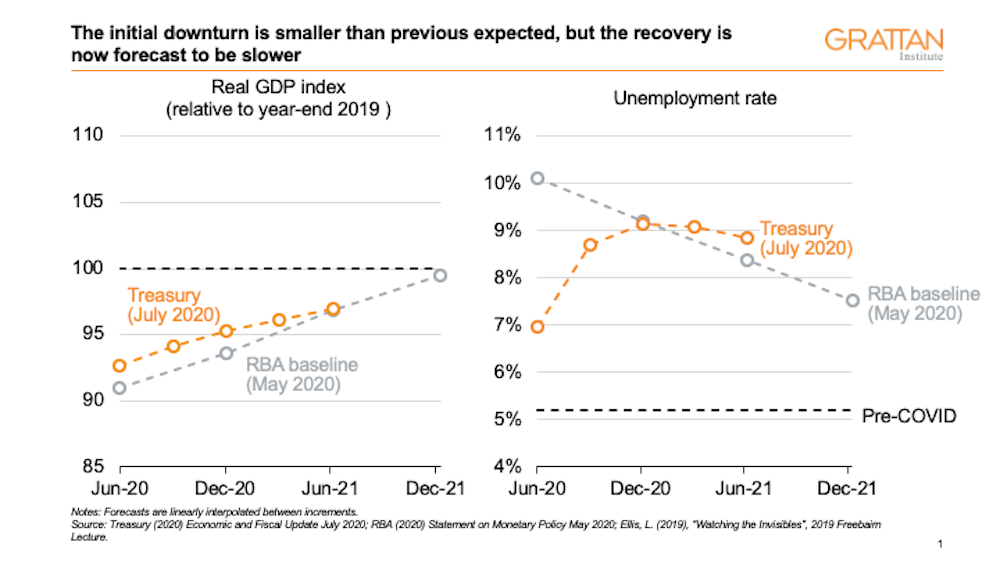
They include a 7% drop in GDP in the three months to June followed by a 1.5% rebound in the three months to September and gradual improvements after that. The unemployment rate is expected to peak at (only) 9.25% within months.
But unemployment typically peaks at about 11% in a recession, and the government itself has said that taking hidden employment into account the rate is probably closer to 13%.
With the virus running riot across the Americas and surging in Africa the downside risks outweigh the others. The treasury forecasts eschew the traditional approach of charting a middle path through upside and downside risks.
But finances aren’t a problem
The update is telling us the pandemic will cost the government about $300 billion over the two years.
The eventual number is likely to be much higher, by 2022 probably closer to half a trillion dollars. It is a perfectly reasonable sum.
Even if the deficits and debt associated with the pandemic end up being twice what the government is projecting our government debt will still be just over 60% of GDP, a level that would be the envy of most other countries, many of which don’t have the potential to grow and recover that Australia does.
For our government, the investment is well worth the money.
Most people agree there are services government should pay for. Primary and secondary education, a dignified level of health care, emergency services and the military come to mind.
What is less clear is what services government should directly provide, and what it can safely contract out.
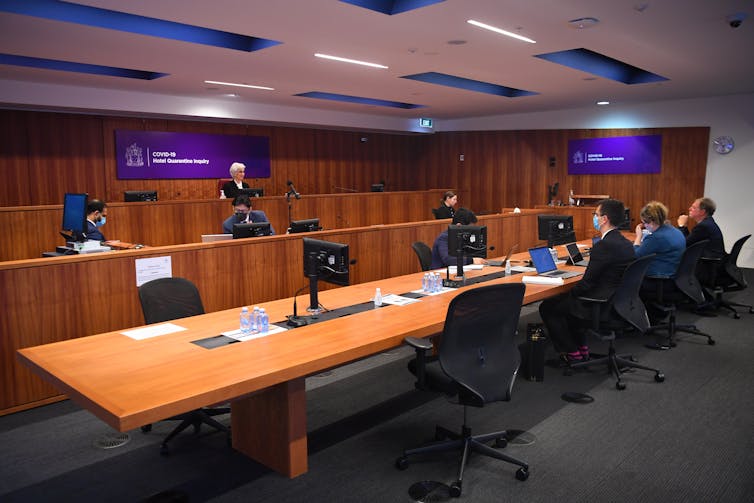
This week an inquiry headed by former Family Court of Australia judge Jennifer Coates began into failures in Victoria’s hotel quarantine system, believed to be responsible for Melbourne’s second-wave viral outbreaks.
The COVID-19 Hotel Quarantine Inquiry, headed by Jennifer Coate, begins in Melbourne on July 20 2020.James Ross/AAP
But what can economics tells us about why this happened?
Thanks to the literature on “incomplete contracts” that led to a Nobel Prize for Harvard University economist Oliver Hart, quite a bit.
Using private contractors for hotel quarantine was destined to fail. It all boils down to a trade-off between costs and quality.
Using private providers is a good option when keeping costs low is more important than high quality. This was not such a case.
Incomplete contracts
Hart’s classic 1997 paper on “The Proper Scope of Government” (co-authored with Andrei Shleifer and Robert Vishny) mostly considers privatisation in theoretical terms, with some discussion of prisons, garbage collection, schools, health care, policing and a few other things.
The animating idea behind the “incomplete contracts” approach is that there are some contingencies that contracts, no matter how detailed, can’t cover.
This could be because parties can’t conceive of all future contingencies. Or perhaps they understand what’s at issue but it is hard to codify that in a way a non-specialist court could understand.
For instance, a famous legal case concerned the definition of a chicken, with the judge writing:
The issue is, what is chicken? Plaintiff says ‘chicken’ means a young chicken, suitable for broiling and frying. Defendant says ‘chicken’ means any bird of that genus that meets contract specifications on weight and quality …
To keep things simple, imagine there are two things someone running a prison can put effort into: reducing costs or improving quality.
Improvements in quality could involve increasing rehabilitation rates, reducing violent incidents and or minimising escape risks. Lower costs lead to lower quality. For example, employing fewer guards might result in more escape attempts or prisoner-on-prisoner violence.
When the government owns the prison and employs a warden to run it, it doesn’t have to rely just on an written contract to get what it wants in terms of investment in quality. It can tell the warden what to do, and replace them if they don’t produce the goods.
If it’s serious about quality, though, the government will likely have to provide more resources. Quality costs.
When a prison is privatised, the government’s control over how the operator acts is limited to its contract.
In a perfect contract, the government could stipulate how much the private contractor is allowed to reduce costs and how much it must improve quality.
But these things are difficult to write into contracts. Wherever there are gaps, any contractor providing a fixed-price service will look to cut costs instead of improving quality.
So that’s the trade-off. When low cost is very important, private contracting is best. But when quality is more important, government ownership is optimal.
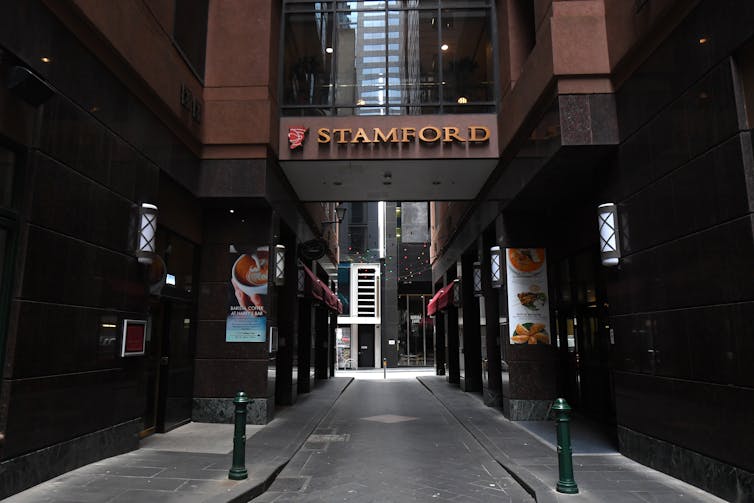
Melbourne’s Stamford Plaza Hotel. identified along with Rydges on Swanston, as a source of the city’s coronavirus outbreaks.James Ross/AAP
The Victorian quarantine
What’s more important in hotel quarantine during a pandemic: cost or quality?
The Hart-Shelifer-Vishny rationale tells us the Melbourne hotels should not have been policed by private security contractors, because the highest possible standards were paramount.
Moreover, even if one could write a complete contract, it doesn’t really matter. There’s no real recourse in this case for a breach of contract. The cost is billions of dollars in damage to the economy already. What good is a contract with a bankrupt contractor?
Of course, police (and other public servants) aren’t always perfect either. But at least there is more training, a code of conduct, a sense of duty and a whole apparatus for disciplining misbehaviour.
The Coate inquiry may uncover valuable details about where and how the quarantine system failed, but economics can already point us to why it was destined to fail.
When high quality matters more than low cost, governments shouldn’t outsource unless absolutely necessary.
The choice for hotel quarantine should have been clear.
It is not widely known that many Australian colonial natural history collections are represented in German museums and herbaria, nor that there are initiatives to transform these artefacts of colonial heritage and science back into objects from living cultures with living custodians and their own stories to tell.
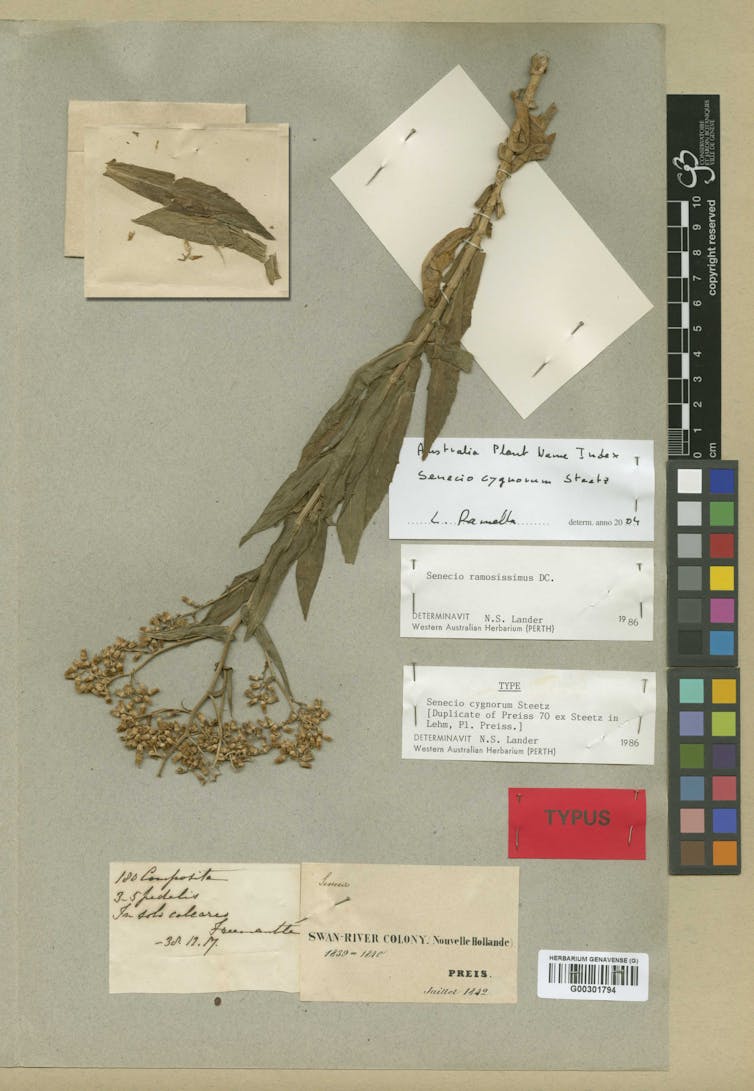
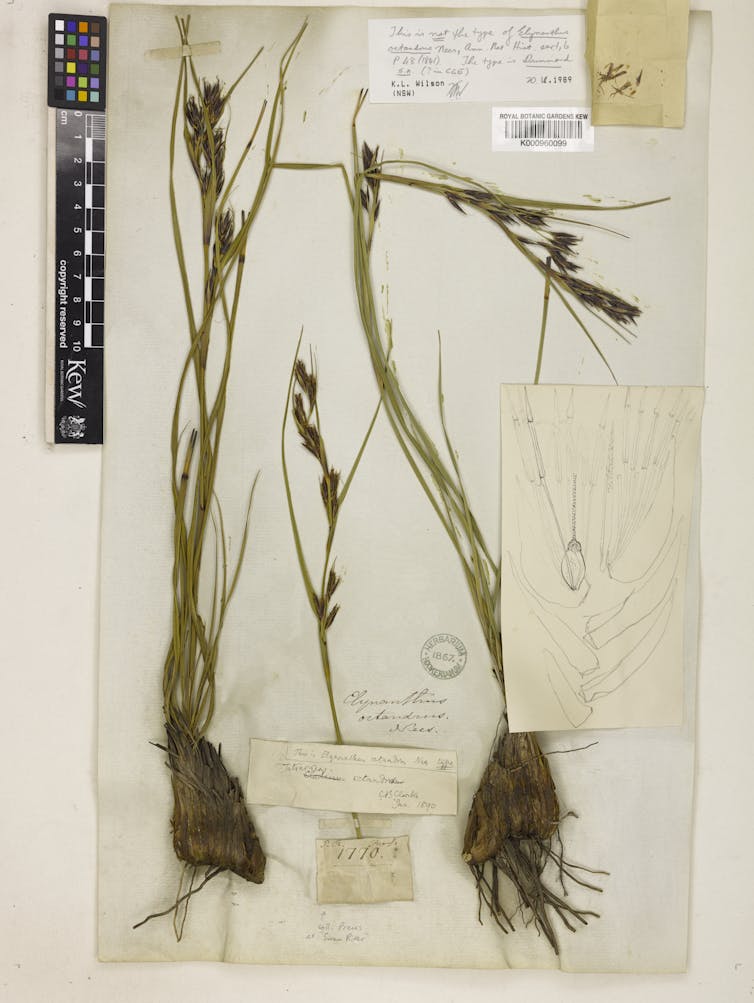
Dr Johann August Ludwig Preiss (1811–1883) played a significant role in this evolving story as the first professional botanist to collect systematically in the Colony of Western Australia from 1838 to 1842.
His collections of flora and fauna were pivotal in opening this globally significant region of biodiversity to the world — and he beat the British at their own game by bringing their new colony’s botanical wonder to scientists, nurserymen and gardeners in Europe.
Despite his unusually long sojourn collecting in Western Australia, Preiss has been largely forgotten – unlike his contemporary, the naturalist and explorer Ludwig Leichhardt (1813–1848), well known for his work in northern and eastern Australia and his ill-fated 1848 expedition to cross the continent; and the globally active science visionary Alexander von Humboldt (1769–1859), whose birth anniversaries were celebrated in Germany and Australia in 2013 and 2019 respectively.
A dryandra (or a banksia) as would have been collected by Preiss.Anca Gabriela Zosin/Unsplash
Preiss held no important posts in exploration, science or public office and left only a small selection of archived letters and some strangers’ impressions. So, we are left to speculate about the negative spaces between the known fragments of Preiss’s life and the agents – human and non-human – of the worlds he moved through.
The natural sciences in Germany and Britain in the 19th century shared much common ground: there were royal dynastic connections, cultural ties, migrations to Australia and complementary interests in advancing the natural sciences.
The British Empire, however, had the edge over Germany, with global networks plugged into the nerve centre of the Royal Botanical Gardens at Kew – an oasis of collecting, classifying, storing, propagating and dispersing exotic and useful plants in Britain and the colonies.
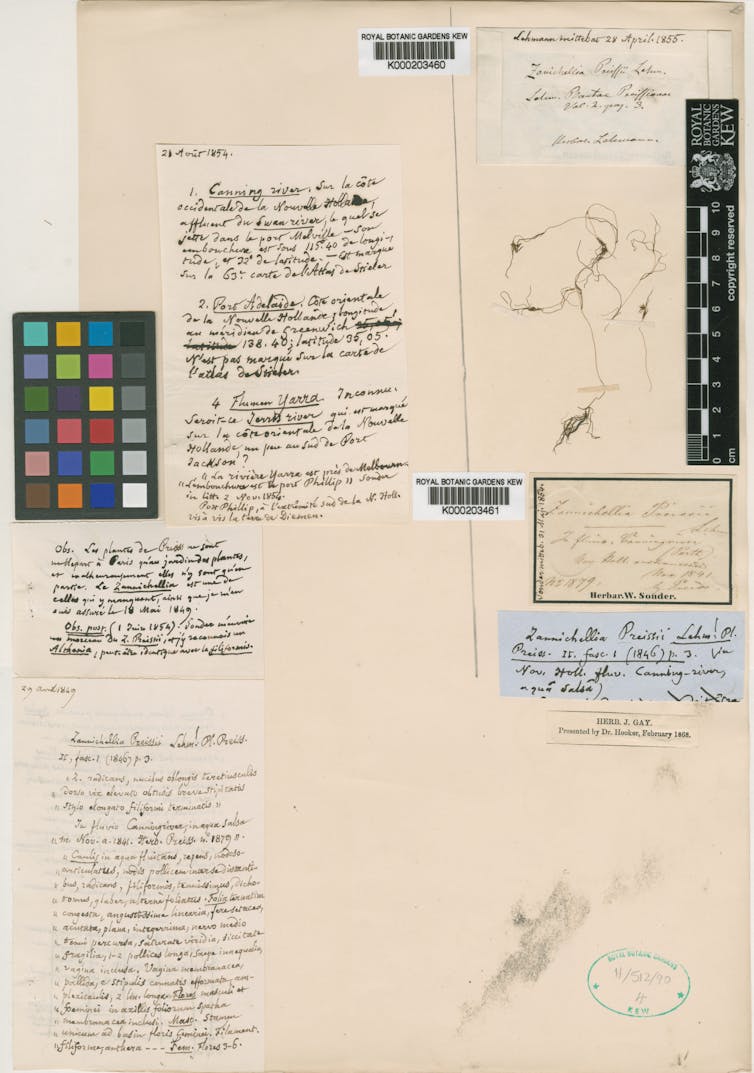
A page from Priess’s field books.L. Preiss Field book Nos. 1 and 2 State Records Office of Western Australia AU WA S32 cons3401 PRE/01
Germany had more diffuse networks of scientists, across scattered institutions – universities, herbaria and botanical gardens – focused on classifying and documenting the diversity of flora and fauna into rigid systems, using dried, preserved and some live specimens.
In Preiss’s time Germany had no colonies to draw on but collected on others’ turf. In British colonies this seemingly innocent practice was supported by their structures of privilege and violence.
While there were no legal prohibitions on German naturalists collecting in British colonies, Preiss irritated his hosts by staying so long, collecting so much and transporting most of it back to Germany, not London.
A botanising craze
Preiss came from humble origins in the small village of Herzberg am Harz, in the Harz Mountains of the Göttingen district of Lower Saxony. When I visited there in 2018 to learn about Preiss’s family and early life, the council archivist Dieter Karl Wolfe explained there was little local information known about his family.
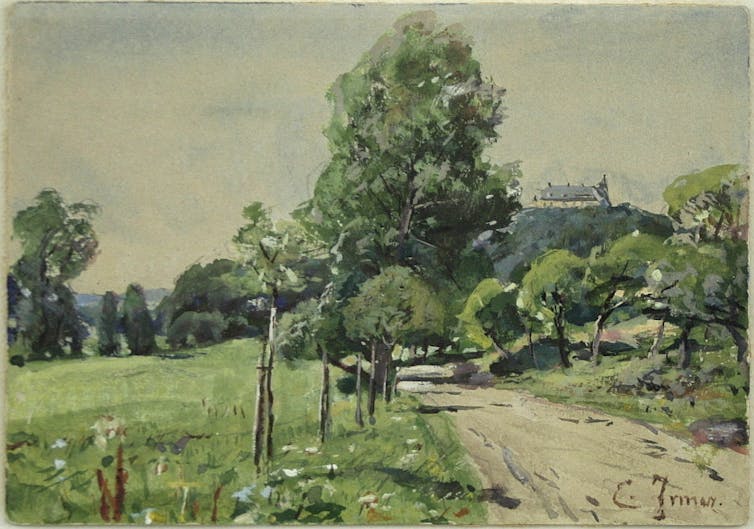
View of Herzberg Castle on the Harz, painted by Carl Irmer.Wikimedia Commons
Preiss was the eldest surviving son of 12 children, and his father was a master saddler (like his father before him), a vinegar brewer and land owner. His cousin Gustav Friedrich Preiss (1825–1888) was the family success: he printed the local daily newspaper Kreiss Zeitung from 1848, became the village mayor and built a fine home. There are portraits of him and his wife in the council archive.
Another more internationally minded relative helped start the town’s Esperanto Society in the early 1900s. Friendly Esparantists showed me public monuments for Esperanto and its Polish founder, Ludwik Zamenhof (1859–1917) – but there was nothing to commemorate Preiss, their local botanical achiever.
Speculating on why Preiss took up botanising in far distant lands, Wolfe extolled the benefits of Germany’s advanced education system for gifted youths of limited means – like Preiss and Leichhardt.
The ideal was a humanistic education to equip children with the foundations of learning and intellect, allowing students to build further knowledge and expertise in adult life. The curriculum included science and languages.
Preiss probably followed the same schooling trajectory as Leichhardt: boarding school, gymnasium, university. Preiss was university educated and held a German DPhil doctorate. This was more like a degree with an original research component than today’s formal doctorate qualification.
Botanist Johann Christoph Lehmann.Wikimedia Commons
Preiss’s faculty “promoter” was probably Professor Johann Georg Christian Lehmann (1792–1860), director of Hamburg’s botanic garden, who sent Preiss to the Western Australian Colony.
The craze for botanising gripped both scholars and amateurs and opened new opportunities for serious study, teaching and collecting – assisted by new equipment, including the vasculum (a botanical tin case for collecting in the field), drying papers for preparing specimens, Wardian cases (ensuring safe transportation back to Europe) and glass houses for cultivating living plants.
In the 1830s, the botanical world was abuzz with news of Western Australia’s unique floral diversity. Transport of plants to London was still in its early days in 1836 when Lehmann first recognised the chance for expansion through the 25-year-old Preiss.
Preiss recalled being instructed to collect everything – flora, fauna, minerals and fossils – and hoped to “collect the products of [natural history] and arrange those products in a useful way for the purpose of Science”.
Lehmann and his wealthy friend, Wilhelm von Winthem (1799–1847), a private collector and entomologist with extensive collections, organised funds for him through a form of venture capital under which the von Winthem family company publicised and sold shares to private citizens and collecting institutions.
On Preiss’s return, investors would choose items from his collections equal to the value of their shares.
Rich wilderness
Arriving in Perth in late 1838, a dusty village huddled between vast expanses of sea, bush and hinterland, Preiss encountered a parochial society.
Local collectors who worked with London’s botanical elite guarded their status jealously. Most colonists were disillusioned by false promises of rich farming lands and worn out by the struggle to survive.
I imagine Preiss as lonely and friendless.
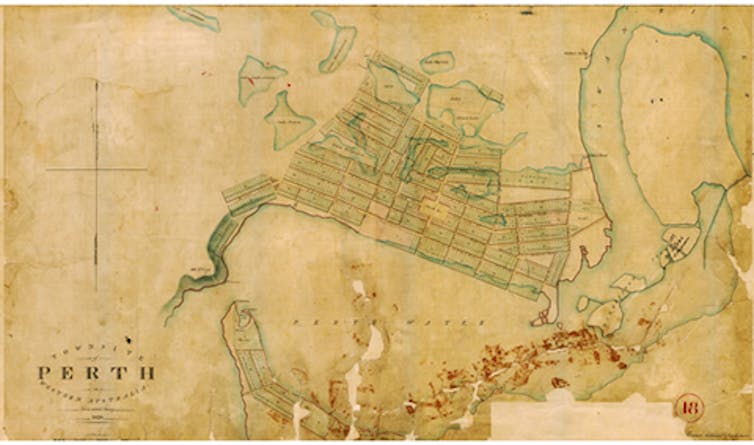
The town plan of Perth, 1838.Wikimedia commons
The local landscape would have been so strange for Preiss, humanised by millennia of Nyungar curation but an apparent wilderness to the colonists’ eyes.
Botanical scientist Steve Hopper has revealed how the deep time of the region’s unusually stable environmental evolution both helped shape the unique floristic richness and endemism of this area and enhanced Nyungar people’s deep knowledge (kartijin) of their country – enabling them to live well off the diversity of plant foods they cultivated and nurtured with practices they adapted to the environment and passed down over many thousands of years.
This richness drew Preiss in.
Preiss began collecting immediately. In contrast to local British collectors he had the freedom of sufficient funds and no domestic encumbrances or civic duties. He also had no rights to own land.
His extensive collecting implicated him in the process of multispecies destruction and dispossession. The Indigenous Nyungar people were already in a state of crisis as colonists destroyed their ancient accommodations to the land and replaced them with their own hasty adaptations of species and farming.
The destruction intensified during the 20th century with the clearing of 90% of the region for wheat farming. In fewer than 200 years this encounter between Old and New World ecosystems transformed the landscapes of exceptional floral riches into a canary in the coalmine for climate change.
A new critical approach to Australian 19th century natural history collections in German institutions has been prompted by concerns about their colonial provenance and reports of environmental damage.
In 2018 in Berlin, curators and scholars attended an international conference on the politics of natural history and decolonising of collections and museums.
There were calls to open conversations with Indigenous custodians and reflect on issues of climate change. Environmental knowledge in Preiss’s field notebooks, now missing, could have made an important contribution.
In a report on the colony published in Flora (1842), Preiss wrote that he “recorded [information] about specimens he observed and learned accurately from the Aborigines”.
The field books from his 1841 survey commission held in the State Records Office in Perth suggest the extent of the loss, being richly illustrated with botanical and landscape features and detailed annotations of measures and calculations.
Preiss collected many species of bottlebrush.Holger Link/Unsplash
They speak eloquently today of how seriously Preiss took this colonial project to map “the significance of the earth … as a space to be occupied”.
Preiss wrote that he “traversed this land in all directions … [and] observed the greatest diversity of plants”. It seems he had no transport or equipment for long surveys, so often walked lengthy distances alone.
This was an intimate way for Preiss to come to know the bush. His proximity to plants and the earth sharpened his eye for shapes and colours as well as his capacity to interpret signs along bush pathways. He sometimes travelled with colleagues, and visited Rottnest Island with the colony’s chief botanist James Drummond and John Gilbert, who collected for British ornithologist John Gould.
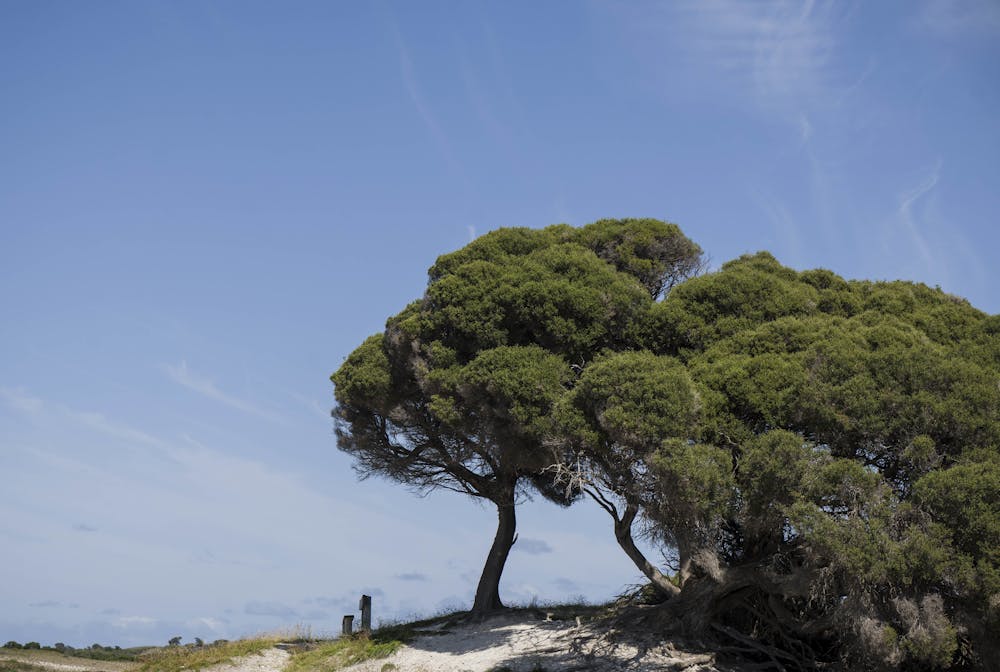
Rottnest Island, off the coast of Western Australia, was one of the locations Preiss collected plant specimens.Tony McDonough/AAP
And he relied on the hospitality of homesteaders and assistance from Nyungar people. The colony’s Advocate-General George Fletcher Moore noted an instance, perhaps disapprovingly, of Preiss walking out of the bush with a Nyungar woman, both of them loaded down with plants.
He added that “the natives seem quite surprised at his collecting the jilbah [shrubs] and are very curious to know what he does with them”, suggesting that Preiss was following the colonial practice of collecting without their permission.
Despite being the colony’s best qualified botanist, Preiss was never invited to join its British collecting networks. Instead, Preiss built his own networks in London and Germany.
Drummond became his occasional helper and nemesis. He warned his London patron, Sir William Hooker (1785–1865), that the new German botanist was collecting for the Russian, Prussian and some German states.
The German botanist Dr Ludwig Diels (1874–1945), who collected in the area in 1906, imagined the two men as benign opposites: the older “bushman, always in the saddle” out collecting rather than “arranging his specimens in order” and young Preiss, the “cultured scientist of old Europe” and first collector in the colony to have “each item in his collection carefully labelled, giving the locality and other data”.
However, simmering resentments erupted after Preiss challenged Drummond’s identification of a poison plant killing stock and quaffed an infusion of its leaves to prove his point. Preiss survived the ordeal but lost the argument after Drummond proved the plants’ toxicity for stock.
The more Preiss wore out his welcome in the colony, the more determined he became to stay and in 1839 he decided to try his luck as a British subject, with all the benefits and moral compromises this bestowed.
In 1839 he wrote to the colonial governor requesting naturalisation as a British subject, referring to British connections with the kingdom of Hanover near his birthplace.
He outlined his intention to return to Germany to raise funds for expeditions into the northern interior to explore, collect and open up the land and then become a farmer.
He proposed to sell his collections to the British government for £3,000 – “being produce of a British territory” – and added, “I flatter myself that such a collection has never been sent from this country to England” and there were many new species “not known in Britain and Europe”.
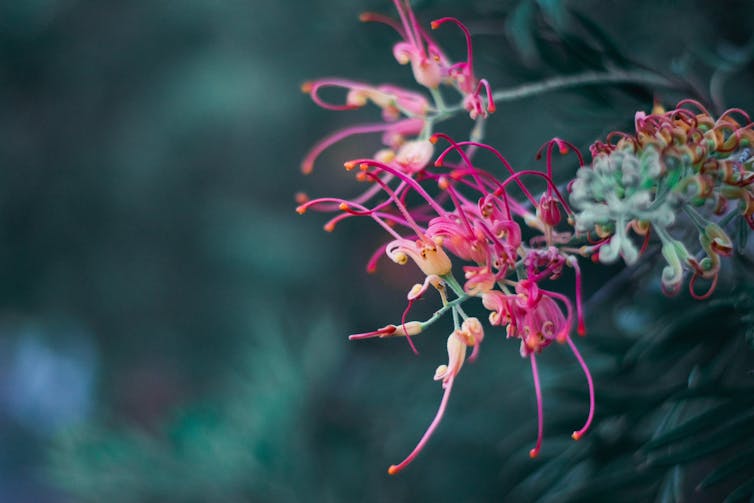
Australia was home to many flowers never before seen in Europe.April Pethybridge/Unsplash
He also proposed a German immigration scheme to help resolve labour shortages in the colony, suggesting that 50 young farming families be enticed from Saxony and the Rhine Province in a payback arrangement with other settlers and for his own farming needs, with government land grants payable for bringing out workers.
If his proposal was not accepted he would seek Prussian and Russian funding to explore the north coast.
The British government refused Preiss’s offers, preferring to acquire from established British collectors such as Gould and Gilbert. His request for naturalisation was finally granted in 1841. The next year he travelled back to Europe, taking with him the largest collection then to leave the colony.
Lauded at the time, Preiss’s actions of taking Indigenous plant material and knowledge without consent for scientific gain would now be condemned as bio-piracy.
The collection included 200,000 plants with around 2,500 species and collections of algae, fungi, lichens, bryophytes as well as species of birds, reptiles, mammals, shells and more, as well as his copious notes.
Packed firmly in tin-lined boxes, they travelled well. Ironically, Preiss’s boxes left no space on board for Drummond’s collection of seeds and specimens to be sent to London. Delays in its passage meant that nurseries lost an entire season for planting – while Preiss’s quality collections and duplicate plants entirely spoiled the market for Drummond.
Diels lavishly praised Preiss’s collections for the sheer quantity of specimens he had collected in such a short period, the range of plant specimens, detailed information to identify flowers and plants and his collecting sites, the overall presentation that made his collections and notes so useful to science, and the outstanding achievement of producing the first West Australian collection for Europe’s leading herbaria.
Australian naturalist Rica Erikson (1908–2009) observed that his collections were “far superior to others being offered for sale in England”, but that British botanists “were prejudiced in favour of collectors of their own nationality”.
Troubled returns
Preiss’s return to Germany via London was troubled – although he did manage to sell some plants and seeds to fund his journey across to Hamburg. But the situation he found there was disastrous.
The Great Fire of Hamburg in May 1842 had killed more than 50 people and destroyed many public and private buildings. The huge costs of rebuilding would cripple the state – and plans for the natural history museum that would have housed Preiss’s collections were shelved, along with their purchase.
Preiss was now forced to advertise the collections for sale – both to cover his debts from the trip and to offload the sheer quantity of material remaining after his investors’ selections.
He placed advertisements praising the excellence of his collections in botanical and gardening journals, wrote letters to institutions and private collectors, and published his report in the Flora with observations of natural features of the colony.
He also announced his intention to make a second longer journey in Australia from the Gulf of Carpentaria across country to the Swan River Colony. A portion of the current collections, he said, would be delivered to Lehmann “as soon as they are generally arranged, and … description and publication [entrusted] to him and other celebrated natural historians”.
Preiss’s expedition never eventuated, but the book hinted at in his report was a triumph. The two-volume publication named Plantae Preissianae (1844– 1847) was compiled by Lehmann with leading German botanists working from the collections, all with extensive publications on Australian species.
Yellow wattle is one of Australia’s most recognisable flowers.Rebecca/Unsplash
This was the first major reference book on Western Australian flora, and preceded by decades the British seven-volume Flora Australiensis (1863–1878) compiled by botanist George Bentham (1800–1884) – although that work, too, featured several of Preiss’s specimens.
There were further honours for Preiss: he was commemorated in the names of around 100 plants – a matter of considerable status; in 1843 he was elected to membership of the National Academy of Germany; and in the same year his name was added to the registry of the Regensburg Royal Botanical Society.
And his collections began their own journeys. Splitting them for sale dispersed them into private collections and an estimated 35 European herbaria, with the “original” or standard reference set of specimens for Plantae Preissianae passing from Lehmann to his widow, and eventually to its final resting place in the Lund herbarium in Sweden when Germany declined to buy it.
Preiss’s extensive zoological collections of mammals, birds, reptiles, insects and other material did not fare so well.
Some were sold to European museums or dealers but many simply disappeared or can no longer be identified as his. Credit for his “discoveries” of new species was given to other collectors.
His entry in the Australian Dictionary of Biography laments that “had Preiss the backing of an ambitious and enterprising zoologist, as Gilbert had in Gould, it is certain that he would have been much better known today”.
Despite the success of the book and his standing among Europe’s natural historians, in 1843 Preiss suddenly announced that he was leaving Hamburg along with his collections – at the “urgent wishes of my father” – and that all future letters should be sent to him at Herzberg.
He gave no further explanation for this; in the modern parlance, it seems he just “left the building”.
This sudden shift by Preiss from a very public life to a very private one remains an unsolved mystery. Preiss’s legacy, however, is enduring.
His remarkable achievements in the few years between 1838 and 1843 created a permanent link between the botanical sciences in Western Australia and Germany. His sudden withdrawal opened a space for others to lead.
But how will the collections fare under the well-deserved critical scrutiny of their colonial origins and histories in German institutions? Can they be decolonised to take on new tasks relevant for today?
A couple of years ago, sitting with Preiss’s dryandra specimens at the Göttingen herbarium, I was inspired to see them as potential message sticks with agency to bring people together.
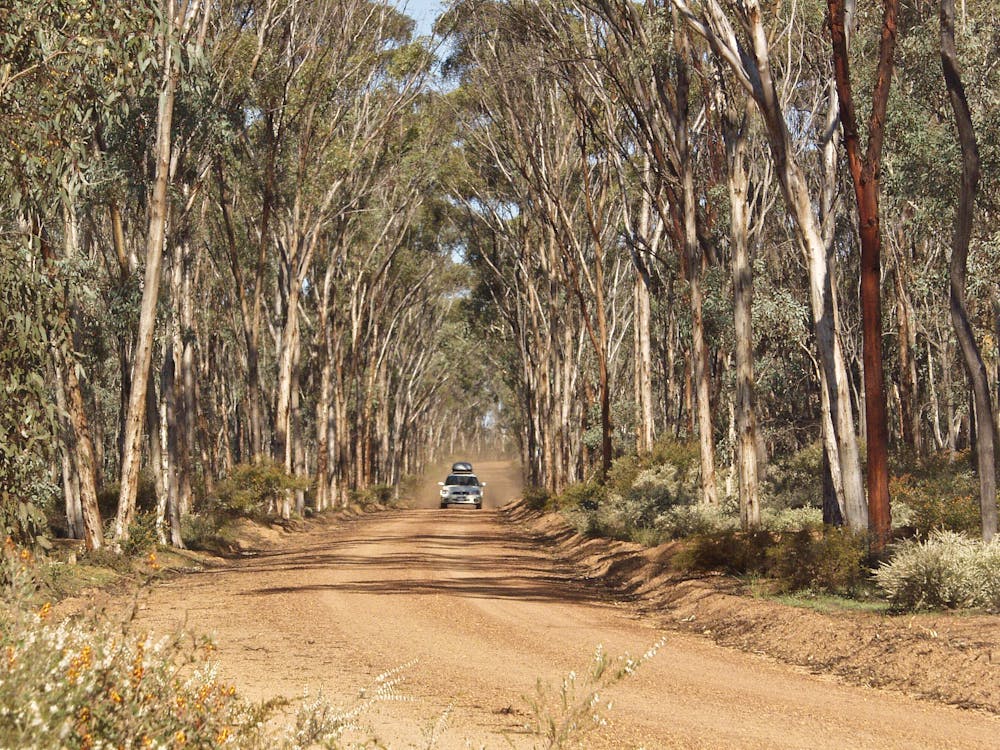
Dryandra Woodlands in Western Australia.Charles England/Wikimedia Commons
Now I’m part of a new project, Healing Land Healing People, based at Dryandra Woodlands south-east of Perth in the country of our project leader, Nyungar Elder Darryl Kickett.
We are working with the knowledge of Nyungar families, botanists, historians and artists to restore the biodiversity of the land and community cultural strengths. We work with similar projects at other sites in the south-west region.
In Germany we are linked with the Centre for Australian Studies at the University of Cologne and the Rachel Carson Center at the University of Munich. My role is to identify other collections from the region in European museums and herbaria and their curators.
With Nyungar Elders and curators sharing their knowledge and stories we can map the journeys of the message sticks from the sites where they were collected to their present locations.
With our German colleagues we can weave new narratives of biodiversity loss and restoration to engage the public, heal the past and ensure a future for our corner of Western Australia and other global biodiversity hotspots.
This piece is republished with permission from GriffithReview69: The European Exchange, edited by Ashley Hay and Natasha Cica, and published in partnership with the Australian National University griffithreview.com
Josh Frydenberg, a Victorian, wore a surgical mask as he walked from his parliament house office to a committee room to deliver the government’s economic statement.
The treasurer had already had to obtain permission from the ACT government to be in Canberra.
Symbolic reminders, as if anyone needed them, that Victoria holds the key to whether the dire budget numbers Frydenberg presented on Thursday represent the floor under this crisis, or they’re just a prelude to an even scarier set.
Frydenberg describes the numbers, including a projected deficit this financial year of $184.4 billion, as “eye-watering”.
For the millions of people either jobless or being precariously supported by JobKeeper, the most frightening figure will be 9.25% – the expected peak in the unemployment rate, coming by year’s end. (Of course that will be an understatement – Frydenberg told us the other day that already the real unemployment level has topped 11%.)
For these people, as well as the many others on squeezed incomes, it will be the bleakest Christmas imaginable.
But in this pandemic, Christmas is an eternity away, because so much is up in the air, as the economic statement indicates. Crucially, it assumes Victoria’s lockdown lasts just its scheduled six weeks. If things deteriorate, that could be extended; at worst, the lockdown could be toughened.
Then there’s NSW, which is holding the line on cases, but sits on a knife edge.
With Victoria exposed as the weak link in the nation’s health response, the Andrews government is under deserved criticism. It failed on quarantine; its tracing effort has been inadequate; there’s been conflicting information on isolating.
The virus is running through Victorian aged care facilities, both staff and residents. Indeed the inability to protect this sector raises questions at a national level, given the likely problems with its workforces should have been addressed earlier and better.
If Victoria’s crisis deepens, the numbers in the economic statement will have to be drastically overhauled in the October budget, and more money spent.
Even if the health situation doesn’t worsen, it will be incredibly tough for many people as they compete for a limited pool of jobs, and for many businesses, some of which won’t make it to that “other side”.
Scott Morrison has won deserved praise for his handling of the pandemic and, as the situation stands, this week’s decisions appear appropriate.
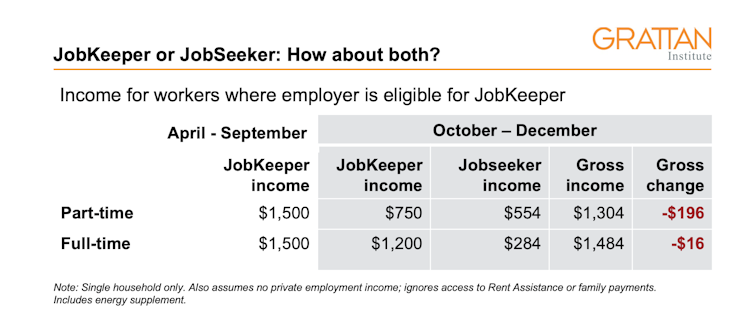
Despite the government’s earlier hopes of “snapback”, extensions of JobKeeper and the Coronovirus Supplement to JobSeeker were vital to avoid the economy falling of that much-feared “cliff”.
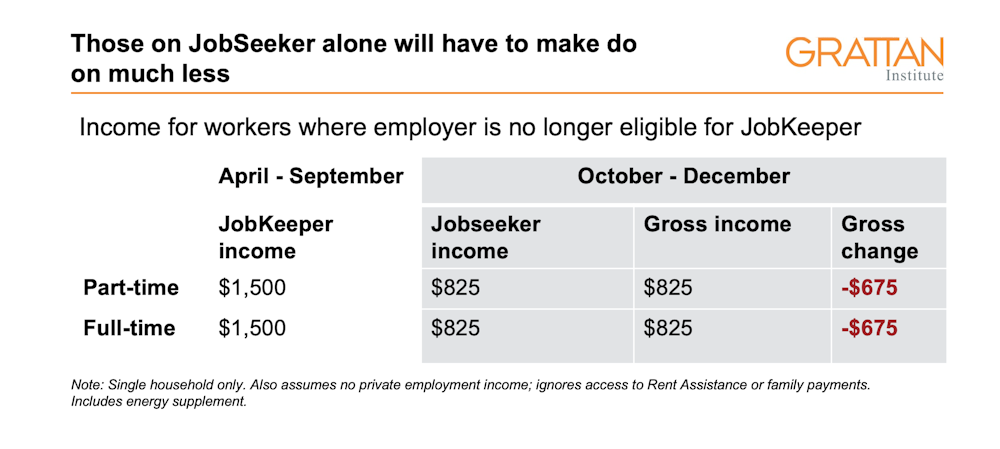
After October the government is building in step-downs to lower payments; also, JobKeeper will be two-tiered.
Critics say the reductions will be premature, but on the assumption the economy will be transitioning, some winding back is reasonable. If the virus gets away from us, it will be another story.
The economic statement embraces, of necessity, debt and deficits of massive proportions. Net debt is forecast to increase to $677.1 billion by mid next year, 35.7% of GDP (in 2018-19 it was under 20%).
If anyone had told the Coalition when it was elected in 2013 that it would be presiding over such a debt level, let alone arguing its virtues, they’d have been laughed out of court.
But as Finance Minister Mathias Cormann said, “what was the alternative?” Australia is also in a much better position than many other countries to handle debt, given it started with it a low proportion to GDP. Moreover the funds can be borrowed extremely cheaply.
A pragmatic Morrison isn’t fretting about retiring that old “debt truck” to the junk yard, its tyres blown off, now it’s unfit for purpose.
In purely political terms, Morrison is well placed (which isn’t to say this will necessarily last). During the pandemic, people have looked to governments; historically low levels of trust have risen. It mightn’t stay like that on the long road ahead but this has helped the government so far.
The Morrison government does face criticism but it is muted or, to an extent, impotent.
The muted version comes from Labor, which picks around the edges of the government’s actions, while endorsing the headline measures. That’s about the only course Albanese’s opposition can take; in these desperate times, Labor is forced to the margins of relevance.
More interesting perhaps is the discontent on the right, which includes the government’s hardline supporters in the commentariat.
Many of these critics have been beside themselves, claiming the government has massively over-reacted to the virus. They would have the scales weighing health and economy reset to heavily favour the latter. The threat of COVID-19 has been much exaggerated, they insist, emphasising the mildness of the disease for most who get it. For these critics, the numbers in the economic statement are horrific.
The argument of those on the right is flawed in policy terms, and certainly not where the mainstream public sit. If COVID-19 produced a large death toll, the economy would tank a lot further. It’s fanciful to think activity and investment would swing along merrily.
Morrison has his eyes firmly on pushing ahead with a return to some sort of economic normality. But he also accepts the health imperative when circumstances force that. He didn’t attack Victoria’s new lockdown. Indeed, he has stopped chastising journalists for using the term “lockdown” (of which there are various versions).
With the economic statement out, attention will turn to the budget, and the reform agenda.
This week we received a fresh strong signal on the latter, with Morrison again flagging he’s determined to leverage the crisis to achieve long term industrial relations flexibility.
He has underway a negotiating process on workplace relations bringing together business, unions and government. While he’s looking for some agreement, this is also about legitimising the pursuit of change.
“We’ve been adopting a highly consultative approach,” he said. “But none of us are so naive to think that this will result in a complete agreement on all measures.
“I can assure you, we’ll put forward what we think is best for the Australian economy and for the Australian people. … We’ll seek to legislate that through the parliament.”
Morrison insists the economic statement is not a mini-budget. He’s right. It is an update of budget numbers – albeit like no other we’ve seen – plus the extension of existing programs. The decisions ahead will actually be harder to make than this week’s, and in some instances, a lot more difficult to sell.
Vanuatu Prime Minister Bob Loughman has rejected a claim that he had been invited by the Indonesian government to visit West Papua.
In a courtesy call and meeting with the prime minister to check on the claim, Loughman Vanuatu West Papua Unification and Association Committee (VWPUAC) chair Pastor Alan Nafuki that he was neither aware of nor had he received any invitation from the Indonesian government.
Prime Minister Loughman reaffirmed an earlier statement he had made to Pastor Nafuki saying that his government’s position was “crystal clear” about support for West Papuan independence.
It had been the same since the statement of the “Father of Independence”, the late Father Walter Lini, who had said in 1980 Vanuatu would not be completely free until the Pacific’s remaining colonised peoples of West Papua, Kanaky and Tahiti were free.
Prime Minister Loughman did not mince his words when he declared that nobody could change his country’s stand on West Papua.
All former Vanuatu governments and his current government had a mandate to “speak up for the voiceless” to help them towards achieving their God given right to self-determination and freedom.
The VWPUAC chair’s group had sought verification from the Prime Minister after Pastor Nafuki had been approached by two ni-Vanuatu individuals who claimed that he had been invited by Jakarta and his name was on the list of invitees.
“I asked one of them to show me the invitation with my name on it and he turned and left,” Pastor Nafuki said.
Vanuatu stands up strongly and speaks up for the freedom of the people of West Papua.
It has passed a Wantok Bill in Parliament in support of the freedom of the people of West Papua.
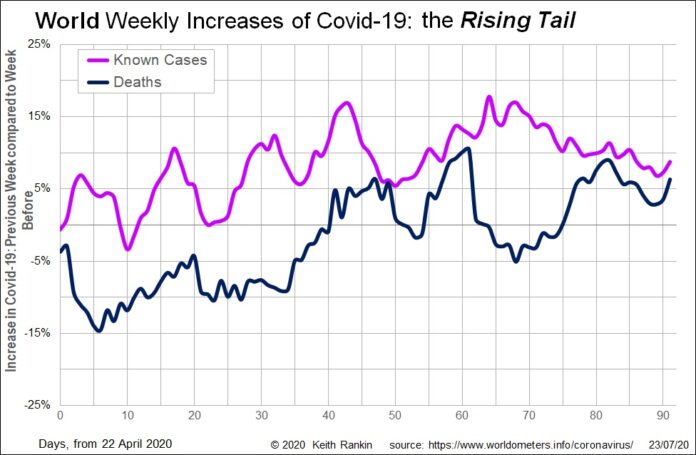
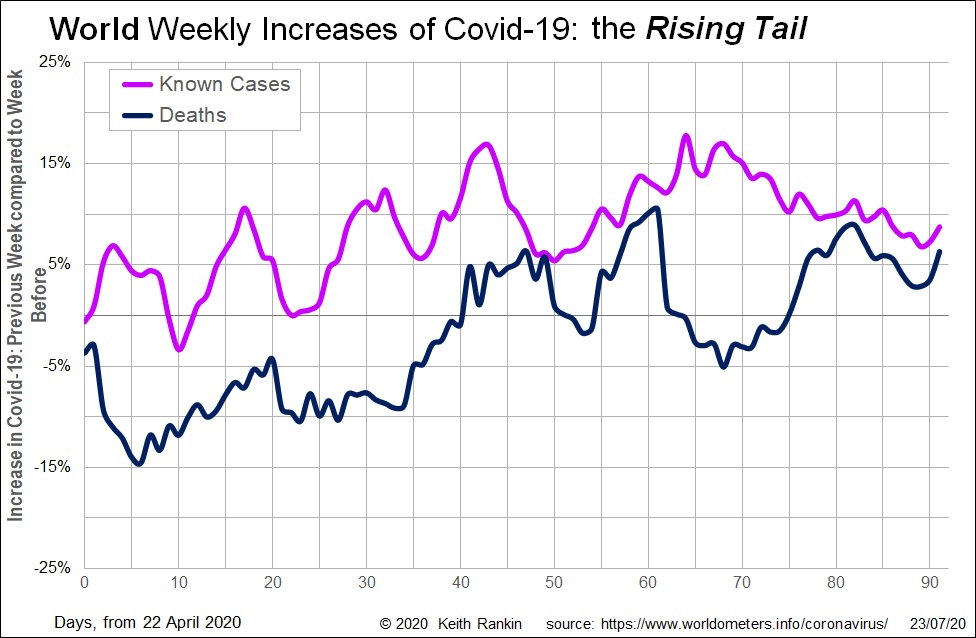
Chart 2: Deaths follow Cases. Chart by Keith Rankin.
Analysis by Keith Rankin.
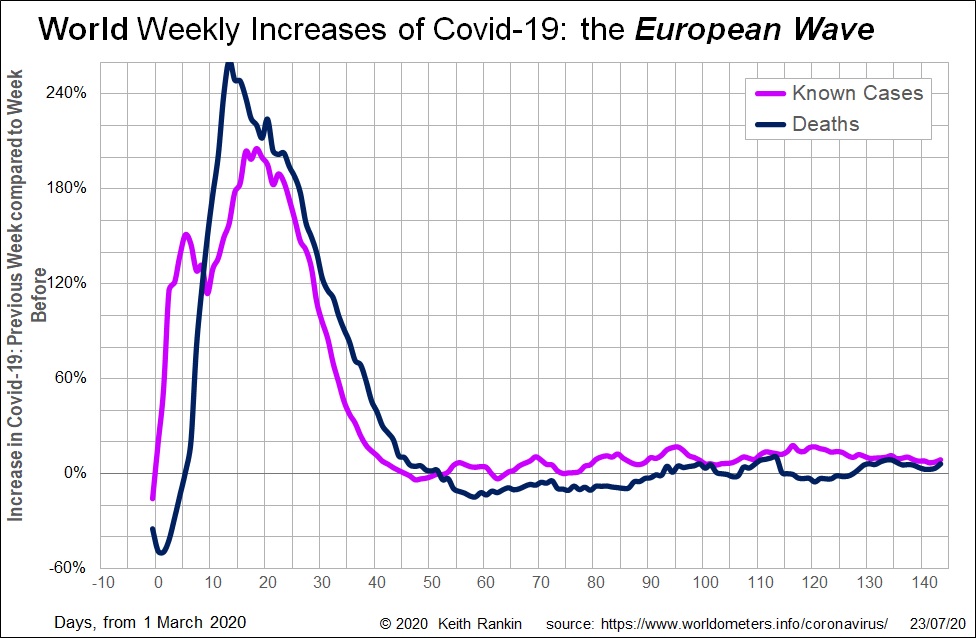
Chart 1: Mad March. Chart by Keith Rankin.
This week’s first chart shows the huge European wave of Covid-19 in March.
At its exponential peak, the chart shows world Covid19 weekly deaths increasing by 260 percent in the second week of March, compared to March’s first week. This European wave contrasts sharply with the last week of February, when weekly deaths more than halved (ie fell by more than 50%). That was the February end of the China wave.
The rise of known cases in Europe only precedes the death peak by a few days, indicating that in late February there were already substantial numbers of unknown cases. (The brief case drop after day six reflects South Korea, which – like China – took the disease seriously at that time.)
The peak in case growth around day 18 reflects much higher testing rates; that explains why case growth appears to have followed death growth in mid-March. The growth peak for actual cases in Europe will have been around the first of March.
The fall in case and death growth in the second half of March reflects the lockdowns that were belatedly implemented in Europe. Early April 2020 represents the beginning of Covid19’s long tail.
Chart 2: Deaths follow Cases. Chart by Keith Rankin.
In late April the trend for slower Covid19 case growth reversed. This essentially reflects the shift of the pandemic epicentre to the United States. We note, though, that weekly global Covid19 deaths were falling from the fourth week of April until the end of May; negative growth. Within that, however, we see a ‘contest’ between rising deaths in New York and falling weekly deaths in Europe. We also note the rise in Covid19 cases in the Arabian Gulf states from May.
The huge upsurge in Covid19 deaths in June mainly reflected the American experience, increasingly the South American experience.
The higher growth in known cases at the end of June – day 55 to day 70 – reflects increased testing in the United States and the expansion of Covid19 in the southern states. If we mentally adjust for the effect of increased testing revealing cases that would otherwise have been missed, the magenta curve would be lower (and falling) from day 55 to day 70, and then rising after that. Once we make that mental adjustment, we can appreciate a general pattern of deaths rising one to two weeks after each resurgence in cases.
In July we see a stable pattern of about ten percent weekly case growth of Covid19; this includes recent statistical contributions from South Asia, South Africa and Southeast Europe. The death growth rate has caught up, also now sitting at over five percent more deaths last week compared to the week before.
My sense is that in August and September these data will ‘stabilise’, meaning that new cases and new deaths each week will be much as in the week before. India, however, remains highly unpredictable. Also, we know that Covid19 spreads fastest in winter (as well as in enclosed spaces); consider Melbourne, Cape Town, Santiago, and possibly Buenos Aires starting to catch up with other big South American cities.
My guess is that little will change for three months – ie Covid19 case and death growth rates will average around zero percent – and then in November there will be a new acceleration of case growth in Europe, Central Asia, and northern North America.
Australia is living through the biggest economic and social disruption since the second world war. Today’s budget update provides a stark reminder of just how big the economic and budgetary fallout really is.
If you don’t have the appetite to wade through the 180-page economic statement, here are the five big takeaways.
1. The economy will be in the doldrums for a while yet
Australian gross domestic product is expected to fall by 3.75% in 2020, before rebounding to grow by 2.5% in 2021, leaving GDP still 3% below pre-COVID levels mid next year.
The global outlook is bleaker.
Global GDP is forecast to contract by 4.75 per cent in 2020, the worst decline since the Great Depression in the 1930s, before rebounding to grow by 5% in 2021.
Australia’s official unemployment rate is now expected to rise from 7.4% today to a peak of 9.25% by Christmas, as most firms move off JobKeeper and many Australians who are without work start looking again.
Yet even this bleak set of numbers takes on a rosy hue against the backdrop of the worsening COVID-19 outbreaks in Victoria and NSW.
Treasury assumes the lockdown in Victoria will last just six weeks and outbreaks in NSW will remain localised. Neither outcome is assured, or even likely.
Meanwhile renewed outbreaks across the United States, Europe, and much of Asia point to the difficulty of reopening our economy safely while the virus remains active in the community.
2. Red is the new black
The headline deficits of A$85.8 billion last financial year and $184.5 billion this financial year are indeed “eye-watering” as the treasurer says.
The turn-around from the $5 billion surplus expected in December is a stark reminder never to count your chickens before they hatch.
But no one could have predicted a global pandemic.
The government has rightly spent big to support households and businesses through the crisis ($162 billion in 2019-20 and 2020-21). Shutdowns have hurt revenue too, with lower than expected company tax and goods and services tax collections, and a big drop in the forecast for personal income tax receipts because of the jump in unemployment.
Net debt is expected to reach 35.7% of GDP this financial year, the highest level since World War II. But it is worth remembering that debt reached more than 100% of GDP in the 1940s, and Australia’s debt levels have held at remarkably low levels by international standards since the 1970s, and remain relatively low even now.
3. The fiscal cliff is still steep
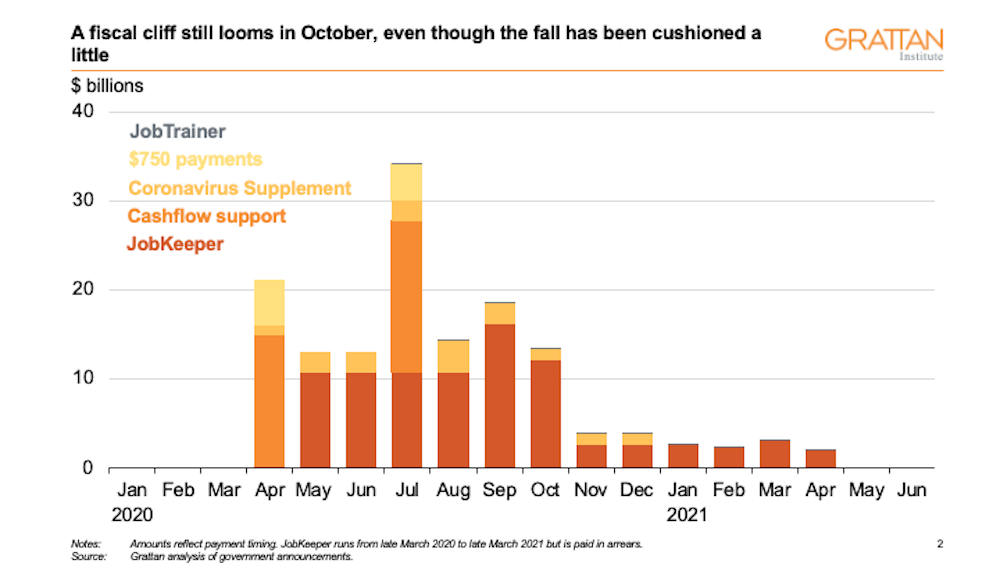
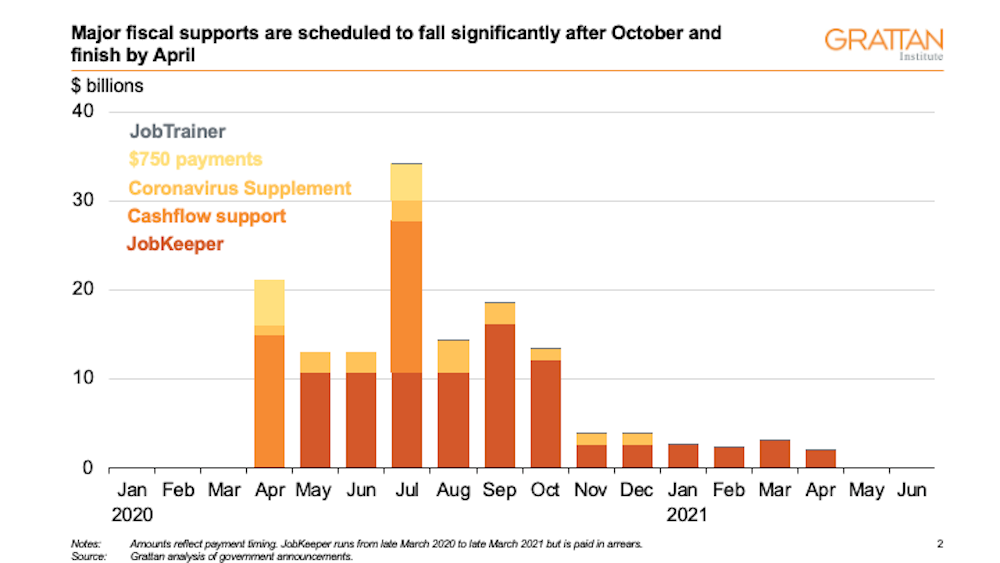
Until this week, all of the government’s major crisis supports – including JobKeeper, the coronavirus supplement, and regulatory supports for businesses and households – were due to end abruptly in October, creating a fiscal cliff.
The government announced on Tuesday that it would extend the coronavirus supplement to December and JobKeeper to March, but both supports will be less generous, and JobKeeper will be more targeted. This means a cliff still looms in October, albeit with a slightly less deadly drop off.
Fiscal support will be $18 billion a month on average (10.7% of monthly GDP) until October, but this drops to $3 billion a month on average (1.9% of GDP) for the six months beyond. This will leave a big hole in economic activity, unlikely to be entirely filled by the private sector recovery.
4. The government missed an opportunity to announce more
As bleak as today’s economic forecasts are, the lack of any new fiscal stimulus announcements is even more striking.
The government has missed a golden opportunity to commit to new stimulus measures to support the recovery – something that most economists agree is needed.
Last month Grattan Institute estimated that $70-$90 billion in stimulus would be required over the next two years to bring unemployment down to below 5% and get wages growing again.
Today’s forecasts of a slower economic recovery, and the prospect of a worsening outbreak in Victoria, makes that stimulus even more urgent.
Stimulus takes time to roll out. Waiting for the October budget when we have already passed the cliff face means that money won’t hit the economy as fast as it needs to.
5. Don’t panic
Despite the big headline deficits, now is not the time to panic about higher debt.
This is a once-in-a-century shock and using the balance sheet to cushion the blow, as the government has done, helps to ensure the costs of this crisis are more evenly shared across society and over time.
With interest rates at record lows, the interest burden is less than you might think.
The Commonwealth government can borrow for 10 years at an interest rate under 1%.
This means the additional $394 billion in net debt over the next two years will increase net interest payments by less than $4 billion a year, comfortably manageable within the current budget envelope.
Indeed, interest repayments are expected to remain lower than after the 1980s and 1990s recessions.
These debt levels are manageable over time in a growing economy. The bigger concern is that the government has not yet done enough to get the economy back on track.
TikTok, the made-in-China, video-sharing platform beloved by youth and influencers alike, is suddenly everywhere in our new world of COVID-19 lockdowns and social distancing.
The platform’s growth has been tremendous, but this has come at a cost: it has come under increasing scrutiny from politicians in the US and allies like Australia over concerns about potential breaches of data security and the platform’s perceived ties to the Chinese government.
The controversies surrounding TikTok are centred around its Chinese origins, and its potential connections or compliance with the Chinese Communist Party and its authoritarian system.
There are some reasons to be concerned. The platform is known to censor material deemed sensitive by the Chinese government.
Last year, for example, TikTok was accused of manipulating videos relating to Hong Kong pro-democracy protests and was forced to apologise for censoring a video criticising China’s crackdown on Uyghurs. This prompted claims of it being an arm of China’s state-run media system.
Digital security experts also point to the potential for the data TikTok collects from users to be sent to China’s servers.
But there is not clear evidence yet that TikTok poses a threat to the national security of countries like the US or Australia, or that the CCP interferes in the overseas operations of the company.
TikTok’s physical distancing from Beijing
TikTok is owned by the Beijing-based technology company Bytedance, which also operates a Chinese version of the platform called Douyin.
TikTok and Douyin are completely separate entities. They store their data in different centres and are governed by different sets of rules and business operations. TikTok is designed for the overseas market with its data stored in Singapore and the US, while Douyin targets solely the Chinese domestic market with its data stored in China.
As the pressure has mounted against the platform in the West, however, TikTok has shifted into survival mode through de-Sinicization. While users are posting videos on TikTok from the safety of their bedrooms, the company is deliberately distancing itself from Beijing.
Part of this distancing strategy involves announcing plans to move its operational headquarters outside China. According to industry reports in China this involved disbanding the Beijing-based overseas operation team, as well as cutting off the Chinese team’s access to its international data pool.
TikTok’s most prominent PR move has been hiring key international players in communications, entertainment, government relations, IP protection, cybersecurity and global business solutions to change the way the company is structured and run in its overseas markets.
The appointment of non-Chinese executives, such as new US CEO Kevin Mayer (Walt Disney’s former top streaming executive), illustrates its global aspirations.
Of course, bringing foreigners into the corporate tent is not a new strategy for a Chinese tech firm. Alibaba and Huawei have done this with mixed success; Huawei, in particular, has failed to convince Western governments it would not pose a security risk to their 5G networks.
But TikTok is a different kind of proposition. Unlike other Chinese tech companies and platforms (such as WeChat), TikTok does not operate in China. The platform was created to be global.
TikTok and tit-for-tat retaliations
The response to TikTok’s rise in the US comes from the Donald Trump manual of political strategy. When the trade war between the US and China broke in January 2018, the two nations engaged in a tit-for-tat series of tariffs, from steel and automobiles to pork and soybeans.
In the latest round of recriminations and political bluster, Trump suggested he was considering using TikTok as a way to retaliate against China for its handling of the coronavirus. The idea is to erect a barrier against TikTok and ask like-minded allies to do the same.
What this reaction precipitates, however, is a move toward national internet sovereignty. Some are calling this the age of the “splinternet”, rather than the internet as we know it, a borderless space.
For starters, erecting barriers against platforms offers limited effectiveness because users will find a way around them.
But banning TikTok, or any other Chinese platform, is also taking a page directly from Chinese President Xi Jinping’s “little red book” for the digital age.
The list of Western platforms and news sites now blocked in China is very long. Playing China’s game of shuttering foreign sites will only provide more ammunition for Chinese propaganda against the West – and lead to more tit-for-tat closures.
Blacklisting companies or individuals based on country of origin and citing national security concerns sets a dangerous precedent. It’s akin to going down the path of digital McCarthyism; not only will this erode online freedom, it won’t address the more significant problems of data harvesting and news manipulation — practices that are not unique to Chinese platforms.
Some critics have instead argued for more coordinated global governance of tech companies. As Samm Sacks writes in Foreign Affairs,
we need stricter rules for data security and privacy for all companies, not just Chinese ones … regardless of country of origin, [to] manage online content in an era of misinformation.
As with all user-driven platforms, content moderation on TikTok runs up against issues of freedom of speech. Censorship will continue be a concern for the platform, and TikTok’s content moderators will inevitably be tested by those who want to use it to challenge China.
In the interest of maintaining its brand credibility as a truly global company, TikTok’s smartest move would be to continue to distance itself from Beijing — and for Beijing to do the same.
Aboriginal children in rural Australia have up to three times the rate of tooth decay compared to other Australian children.
Tooth decay can affect a person’s overall health and nutrition because it can affect how they chew and swallow. Tooth decay can also reduce self esteem because of its effect on appearance and breath. And importantly, poor oral health increases the risk of chronic disease such as heart disease.
Broadly speaking, improving oral health is critical to closing the gap in health outcomes between Aboriginal and Torres Strait Islander Australians and Australians overall. Tackling this gap requires customised, community-led solutions.
Our research demonstrates co-design — that is, engaging communities to design and deliver services for their own communities — is associated with significantly improved oral health among Aboriginal primary school children.
This approach may also hold the answer for closing the gap in other areas of health care.
Oral health among Aboriginal children
In the middle of last century, Aboriginal children actually had significantly better oral health than other Australian children. But today, Aboriginal children have roughly double the rate of tooth decay compared to other Australian children.
A range of factors have contributed to this recent problem, starting with colonisation — the effects of which have been compounded over time — and the shift to a highly processed Westernised diet.
Where interventions to prevent common oral diseases like tooth decay have become available to most Australian children in recent decades, Aboriginal children in rural Australia have historically had limited access to public dental services.
The disparity is compounded by the cost of basic supplies like toothpaste and toothbrushes, which may be unattainable for some families, and poor availability of cool filtered drinking water in remote communities.
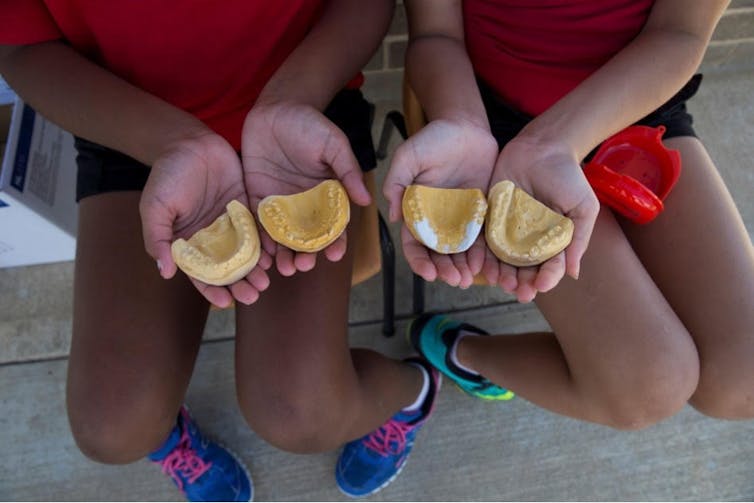
Children made mouth guards as part of our programs.Poche Centre for Indigenous Health, Author provided (No reuse)
What we did
We began our research in 2013 at primary schools in three rural communities in New South Wales.
We sought to reduce consumption of sugary drinks by installing refrigerated and filtered water fountains in schools and communities. We also engaged teachers to encourage students to fill up their water bottles and drink from them throughout the school day.
As well as this, we sought to increase fluoride intake (a naturally occurring mineral that helps to prevent tooth decay) by establishing daily in-school tooth brushing programs, supplying toothbrushes and toothpaste for school and home, and applying fluoride varnish to the children’s teeth once each term.
We also provided treatment for existing tooth decay and gum disease.
In 2018, we looked at the oral health and oral hygiene behaviours of children from the participating schools. Our findings have recently been published and show the project is working well.
What we found
In just four years we found a reduction in tooth decay, plaque and gingivitis (gum disease).
The average number of teeth with tooth decay per child in 2018 was 4.13, compared to 5.31 in 2014. Notably, the proportion of children with no tooth decay increased from 12.5% in 2014 to 20.3% in 2018.
There was also a dramatic reduction in the proportion of children with severe gingivitis from 43% in 2014 to 3% in 2018.
We also saw an increase in positive oral hygiene behaviour including tooth brushing, consumption of drinking water and reduced consumption of sugar-sweetened beverages.
In 2014, 13% of children reported brushing their teeth on the morning they took the survey. This increased to 36% in 2018.
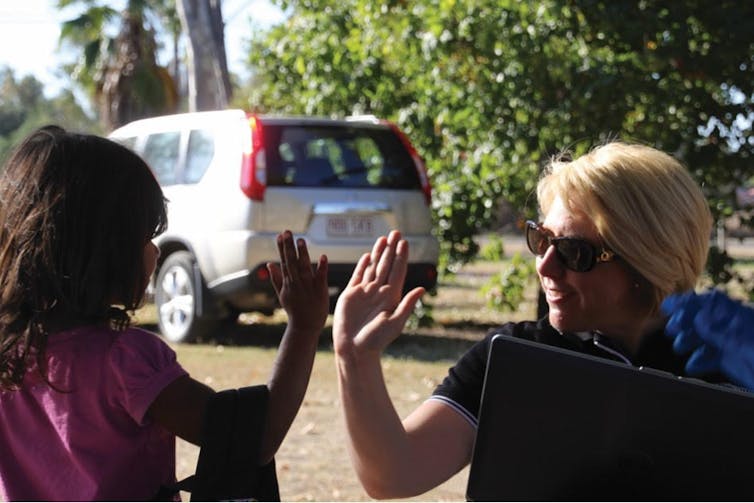
A girl gets a high five from one of the program staff after receiving a 10/10 at her dental check.Poche Centre for Indigenous Health, Author provided (No reuse)
Collaborating with communities
Co-design means working alongside communities to establish the most effective ways to implement evidence-based strategies, and sustain these. It’s about sharing knowledge to enable long-term, positive change to complex problems.
In our project, the co-design process has been central to these outcomes:
local Aboriginal staff coordinate the programs and dental treatment services
We’ve now moved through all phases of implementing our co-designed programs, and are focusing on maintaining them with the support of school staff and the local Aboriginal Community Controlled Health Service.
Our research shows engaging communities to design and deliver oral health services was associated with reduced tooth decay and increased healthy behaviours.
The following elements of co-design in our project could readily be incorporated into the design and delivery of health-care services for Aboriginal Australians:
improved cultural safety — Aboriginal people feel safe and welcome
co-design and shared ownership — local Aboriginal people shape the service model
local employment — Aboriginal people work in the service and lead local delivery
skills development — Aboriginal people complete qualifications that are nationally recognised
long-term commitment — programs are designed and delivered with sustainable and reliable funding.
The gap in health outcomes between Aboriginal and non-Aboriginal Australians remains stubbornly wide. Co-design enables much needed health-care services to be delivered in ways that strengthen communities, respect culture and build capacity.
Even if the government hadn’t spent A$5.9 billion on JobKeeper and other emergency measures last financial year and wasn’t planning to spend a further $12.2 billion this financial year, its budget position would have collapsed.
The economic statement released Thursday morning shows it collected $13.2 billion less company tax than it expected last financial year, and will collect $12.1 billion less this financial year.
It collected $9.2 billion less personal income tax last financial year and will collect $26.9 billion less this financial year.
That’s assuming the present lockdown in Melbourne, the Mornington Peninsula and the Mitchell Shire lasts only six-weeks followed by a gradual return to normal and no further lockdowns.
Reality bites
Goods and services tax and excise and customs duty collections are down by $7.3 billion last financial year and down by a forecast $10.7 billion this financial year.
Tax collections from super funds held up in the financial year just ended but are expected to halve in 2020-21, collapsing from $13.2 billion to $6.4 billion.
The collapse reflects what Treasurer Josh Frydenberg called “the reality of where the economy is at”.
Business are closed, planned investment has been axed (non-mining business investment is expected to fall 19.5% this financial year after falling 9% last financial year), consumers are staying at home, and spending on housing is expected to fall 16% after falling 10%.
It has to be lived with
Most of this can’t be undone. Nor can it be offset by increasing tax rates or cutting government spending. As Finance Minister Mathias Cormann noted, that would shrink private spending further.
Net government debt, which was expected to be close to zero last financial year (0.4% of GDP) instead blew out to 24.6% of GDP and is expected to blow out to 35.7% this financial year.
The only safe way to bring it down is to ramp it up as much as is needed to ensure the economy recovers.
As Cormann put it,
the way to get on top of this debt is by growing the economy more strongly and creating more opportunity for Australians to get ahead, get into jobs, better paying jobs and get ahead, because stronger growth leads to more revenue and lower welfare payments and that is the way that we can go back to where we were
It has worked before. Australian government debt blew out to more than 100% of GDP during the second world war but then shrunk year by year in relation to GDP in the economic growth that followed.
Debt didn’t shrink in absolute terms, it shrank in relation to the government’s ability to handle it, and that’s what will happen again if economic growth can be reignited.
The government has been borrowing at annual interest rates of less than 1%. If the economy can grow by more than 1% per year, which historically it has, the payments will eat into less and less of the budget.
Finances are holding up
Next week the government’s office of financial management launches an audacious bid to lock in ultra-low borrowing rates until the middle of the century.
It will issue an unusually long-dated bond (lone) lasting 31 years. It won’t need to be repaid until 2051.
It has appointed five lead managers to sell it – ANZ, Commonwealth Bank, Deutsche Bank, JP Morgan Securities and UBS – in the hope that it can bed down low annual interest payments for a generation.
In the unlikely event the market doesn’t support it, the Reserve Bank has undertaken to step in and use created money to buy as many bonds as are needed to keep the rates low. Since it made the commitment in March it hasn’t needed to spend much at all. Government bond issues have been up to five times oversubscribed by investors desperate for the certainty of a government revenue stream and uneasy about riskier alternatives.
Best case
The forecasts for what will be required need to be seen as best case. The budget deficit is believed to have blown out from an expectation of around zero to $85.8 billion in 2019-20 and $184.5 billion in 2020-21.
Those forecasts have the unemployment rate at 8.75% by this time next year, by which time the economy will have shrunk 2.5%
Economic activity slipped 0.3% in the March quarter, is believed to have shrank 7% in the June quarter, is expected to climb back 1.5% in the September quarter and to claw its way back after that.
That’s if restrictions aren’t reimposed, state borders are reopened and there are no further “second waves” of infections.
The treasury says its estimates take into account the effect of the Melbourne outbreak on consumer confidence and activity in the rest of Australia, but assume the outbreak does not spread.
In this way the numbers are a best case. The section in the document on risks to the outlook was unusually short – only three paragraphs.
It says the pandemic is still evolving and the outlook remains highly uncertain.
It will present a fuller assessment of the risks and four years of projections in the formal budget on October 6.
This week revealed cases of coronavirus infection in a Victorian prison guard and a prisoner in quarantine on remand. Now six Victorian prisons are in lockdown.
This is not the first time there has been a positive COVID-19 test for prison personnel in Australia; three justice health staff in New South Wales tested positive earlier this year.
Public health and prison officials look fearfully at the toll coronavirus has taken on incarcerated populations around the world. They recognise Australian prisons are also at high risk for coronavirus outbreaks.
Many have pushed for proactive measures to prevent this. Now the adequacy of the implemented measures is being tested.
Prisons and prisoners are at increased risk of coronavirus for many reasons, including:
Prisoners and staff (who come and go into the community) are in close contact. So it is easy to see how transmission could occur between the community and prison populations, and back again.
Hygiene standards are poor and there have been reported shortages of personal protective equipment (PPE) for both staff and prisoners. National Cabinet agreed in May supplying PPE to corrections facilities should be a priority “if COVID-19 cases are confirmed in the sector”, so it is not clear if this has happened.
Prisoners have higher rates of social disadvantage and many are medically vulnerable due to lifelong difficulties accessing health care; mental health and substance abuse problems; violence; and unhealthy prison conditions.
Indigenous Australians are significantly over-represented in the prison population. While coronavirus has been kept out of Indigenous communities, there is every reason to believe Aboriginal and Torres Strait Islander people, like other First Nations people, are at increased risk from coronavirus infection and death.
There is significant churn in the justice system as people are taken into custody, bailed, jailed and released.
There is little data to assess the adequacy of health-care facilities in prisons. But prisoners have an inherent health-care disadvantage as they cannot make their own decisions about their health care, or access Medicare and medicines under the Pharmaceutical Benefits Scheme.
What’s happening in prisons during the pandemic?
There is little information about what is happening to protect Australian prisons from the pandemic.
One media report in March outlined some measures individual states and territories have taken. All jurisdictions have limited prison visits and most, including Victoria, have instituted a 14-day quarantine for new prisoners.
There has been some testing in some prisons, but the extent is not known. A media report in May stated Victoria would increase testing in prisons after three inmates returned inconclusive tests that were later found to be negative.
Ravenhall Correctional Centre in Melbourne is one of six prisons in Victoria in lockdown this week.James Ross/AAP Image
Should we be releasing prisoners?
Australian governments have faced renewed calls to urgently release some prisoners into the community. This would cut the number of people held in prisons and other places of detention, particularly Indigenous people and others at increased risk.
Governments in some states, have responded by introducing legislation to allow for this, although we don’t yet know the extent of any releases.
However, release into the community is only a safe option if people have appropriate housing and support services. There are concerns that releases — which are based on risk to the community, the safety of victims and access to accommodation — will be culturally biased against those most likely to benefit such as Indigenous prisoners.
Many Indigenous communities are closed to visitors and no-one can return until after a 14-day isolation period. This presents difficulties for those prisoners who do not have accommodation options outside their communities.
We need to avoid what’s happening overseas
The clear lessons from the second outbreak of coronavirus in Victoria and from the disastrous situation of rising coronavirus cases in prisons in the United States is that swift, concerted actions are needed to curtail spread of the virus.
The only way to know what is happening is rapid testing of prisoners and staff, whether or not they show symptoms, and effective isolation of anyone possibly infected.
At the same time, the human rights of this vulnerable population must be protected and their physical and mental health needs addressed. Already most prisoners are unable to have visitors and in Victoria they are unable to receive needed supplies such as toiletries, books, food and clothing.
Families are reportedly “sick with worry” they will not be notified if a family member falls ill.
The UN High Commissioner for Human Rights Michelle Bachelet said that during a global pandemic, the consequences of neglecting the prison population was “potentially catastrophic”.
In Australia, Hannah McGlade, academic, human rights lawyer and a member of the UN Permanent Forum for Indigenous Issues, said:
Prison is the most unsafe place that Aboriginal people can be in a pandemic.
The Victorian government is already on notice. A recent decision of the Victorian supreme court found it had breached its duty to take reasonable care for the health of people behind bars during the coronavirus pandemic.
It is imperative that in the days ahead coronavirus infections in prisons and other correctional facilities are accepted as a public health problem for everyone.
Treasurer Josh Frydenberg has announced massive budget deficits of $85.8 billion for the just-finished 2019-2020 financial year and $184.5 billion projected for 2020-2021.
Growth is set to be negative for last financial year and the current one. The government’s economic statement forecasts cuts of 0.25% in GDP in 2019-20 and a reduction of 2.5% in the current financial year.
Unemployment is expected to peak at about 9.25% in the December quarter.
Employment is forecast to fall by 4.4% in 2019-20, but recover by 1% in 2020-21.
The unemployment rate averaged 7% in the June quarter 2020, and is forecast to be 8.75% for the June 2021.
The statement shows debt levels rising markedly in the wake of the pandemic, although the government emphasises Australia still has a low level of government debt-to-GDP compared to other countries.
Net debt is estimated to be $488.2 billion in June this year. This 24.6% of GDP.
Debt is then forecast to increase to $677.1 billion at June 30 next year, which would be a rise to 35.7% of GDP.
As the government looks to the recovery, Treasurer Josh Frydenberg said: “We can see the mountain ahead, and Australia begins the climb”.
Finance Minister Mathias Cormann said “We are in a better, stronger, more resilient position than most of other countries around the world.”
Defending the high debt level, Cormann asked “what was the alternative?”
The government admits the outlook is unpredictable, and revised numbers will come in the October budget.
“The economic and fiscal outlook remains highly uncertain,” the statement says.
One massive uncertainty is what happens in Victoria. The statement takes into account the present six weeks lockdown but this could be extended if the state does not soon get on top of the second wave of the virus.
The Victorian government on Thursday reported 403 new cases, and five deaths including a man in his 50s. There were 19 new cases in NSW.
The statement says GDP is forecast to have fallen by 7% in the June quarter, but will grow in the September quarter by 1.5%. In the calendar year of 2020, GDP is expected to fall 3.75%, but grow in calendar year 2021 by 2.5%
Earlier this week, the government announced an extension of JobKeeper and the Coronavirus Supplement that goes with JobSeeker, although both will be scaled back after September.
Despite the government announcing these increases in support, the statement stressed the goverment’s economic response to the crisis was “temporary and targeted” with measures designed to support the economy without undermining the structural integrity of the budget.
Revenue is taking a major knock from the fallout of the pandemic.
Total receipts, including earnings of the Future Fund, have fallen by $33 billion in 2019-20 and $61.1 billion in 2020-21 since the budget update last December.
Since that update, tax receipts have been revised down by $31.7 billion for the just completed financial year, and $63.9 billion for the current financial year.
“The outlook for tax receipts remains uncertain. This reflects both uncertainty around the economic outlook, and how this interacts with structural and administrative features of the tax system, such as the ability of taxpayers to carry forward losses to offset future income,” the statement says.
It says payments have increased by $187.5 billion over two years from the budget update.
They are expected to reach $550 billion for the 2019-20 year, which is 27.7% of GDP, and rise to $640 billion in the current financial year, representing 33.8% of GDP.
“This increase is as a result of the Government’s targeted responses to the COVID-19 pandemic to support Australia’s economy, as well as the impact of automatic stabilisers including the payment of unemployment benefits,” the statement says.
Treasurer Josh Frydenberg has announced massive budget deficits of $85.5 billion for the just-finished 2019-2020 financial year with $184.5 billion projected for 2020-2021.
Growth is set to be negative for last financial year and the current one. The government’s economic statement forecasts cuts of 0.25% in GDP in 2019-20 and a reduction of 2.5% in the current financial year.
Unemployment is expected to peak at about 9.25% in the December quarter.
Employment is forecast to fall by 4.4% in 2019-20, but recover by 1% in 2020-21.
The unemployment rate is estimated to be 7% in June 2020, and forecast to be 8.75% by June 2021.
The statement shows debt levels rising markedly in the wake of the pandemic, although the government emphasises Australia still has a low level of government debt-to-GDP compared to other countries.
Net debt is estimated to be $488.2 billion in June this year. This 24.6% of GDP.
Debt is then forecast to increase to $677.1 billion at June 30 next year, which would be a rise to 35.7% of GDP.
As the government looks to the recovery, Treasurer Josh Frydenberg said: “We can see the mountain ahead, and Australia begins the climb”.
Finance Minister Mathias Cormann said “We are in a better, stronger, more resilient position than most of the countries in the world.”
Defending the high debt level, Cormann asked “what was the alternatives?”
The government admits the outlook is unpredictable, and revised numbers will come in the October budget.
“The economic and fiscal outlook remains highly uncertain” the statement says.
One massive uncertainty is what happens in Victoria. The statement takes into account the present six weeks lockdown but this could be extended if the state does not soon get on top of the second wave.
The Victorian government on Thursday reported 403 new cases, and five deaths including a man in his 50s. There were 19 new cases in NSW.
The statement says GDP is forecast to have fallen by 7% in the June quarter, but will grow in the September quarter by 1.5%. In the calendar year of 2020, GDP is expected to fall 3.75%, but grow in calendar year 2021 by 2.5%
Earlier this week, the government announced an extension of JobKeeper and the Coronavirus Supplement that goes with JobSeeker, although both will be scaled back after September.
Despite the government announcing these increases in support, the statement stressed the goverment’s economic response to the crisis was “temporary and targeted” with measures designed to support the economy without undermining the structural integrity of the budget.
Revenue is taking a major knock from the fallout of the pandemic.
Total receipts, including earnings of the Future Fund, have fallen by $33 billion in 2019-20. They are projected to decline $60.1 billion in 2021, since the budget update last December.
Since that update, tax receipts have been revised down by $31.7 billion for the just completed financial year, and $63.9 billion for the current financial year
“The outlook for tax receipts remains uncertain. This reflects both uncertainty around the economic outlook, and how this interacts with structural and administratal features of the tax system, such as the ability of tax payers to carry forward losses to offset future income,” the statement says.
It says payments have increased by $187.5 billion over two years from the budget update.
They are expected to reach $550 billion for the 2019-20 year, which is 27.7% of GDP, and rise to $640 billion in the current financial year, representing 33.8% of GDP.
“This increase is as a result of the Government’s targeted responses to the COVID-19 pandemic to support Australia’s economy, as well as the impact of automatic stabilisers including the payment of unemployment benefits.” the statement says.
Source: The Conversation (Au and NZ) – By Jake Whitehead, Advance Queensland Industry Research Fellow & Tritum E-Mobility Fellow, The University of Queensland
Limiting global warming to well below 2℃ this century requires carbon emissions to reach net zero by around 2050. Australian households have done much to support the transition via rooftop solar investments. Now it’s time for organisations to take a more serious role.
The University of Queensland’s efforts to reduce its electricity emissions provides one blueprint. Last week UQ opened a 64 megawatt solar farm at Warwick in the state’s southeast. It’s the first major university in the world to offset 100% of its electricity use with renewable power produced from its own assets. In fact, UQ will generate more renewable electricity than it uses.
The Warwick Solar farm shows businesses and other organisations that the renewables transition is doable, and makes economic sense.
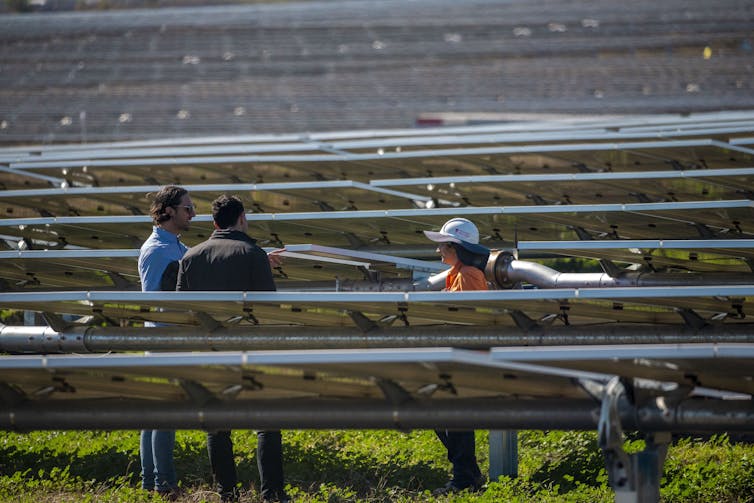
The renewables transition makes economic sense.Glenn Hunt
A model for the future
UQ’s electricity decarbonisation journey started a decade ago when it installed a 1.2MW rooftop solar array across buildings at the St Lucia campus. At the time, it was the largest rooftop solar array in Australia.
In 2015 UQ launched the 3.3MW solar farm at Gatton – part of a world-class solar research facility open to researchers from around the world.
Building on this, last week UQ opened the Warwick solar farm, primarily funded through a A$125 million loan from the Queensland Government. The output – about 160 gigawatt-hours a year – is equal to powering about 27,000 homes or reducing coal consumption by more than 60,000 tonnes. This generation will more than offset the total amount of energy UQ’s sites use each year.
Money that would previously have been spent paying the university’s electricity bills will instead now pay off this loan, over about a decade. This shows how an organisation can redirect operating expenditure to invest in emissions reduction.
Three months ago, UQ also installed a 1.1MW Tesla battery at its St Lucia campus. As Queensland’s largest on-site battery, it saved UQ almost A$75,000 in electricity costs during the first three months of operation. It did this by buying power when it was cheap and selling it during peak demand periods, as well as helping support the grid during faults.
These projects provide a “living laboratory” for teaching and research. They also give crucial insights into how organisations can invest in renewable generation and energy storage assets today, to increase their commercial viability.
UQ has made data generated by its solar and battery assets publicly available so other organisations can learn from its efforts.
Opening of UQ’s Warwick Solar Farm in 2020.
Why organisations must act
About 2,000 companies are jointly responsible for more than half the world’s emissions. In many cases, investors are now calling on companies to demonstrate how their activities are compatible with a net-zero emissions target.
Organisations generate greenhouse gas emissions in different ways. “Scope 1” emissions come from assets owned or controlled by the organisation, such as company-owned vehicles or power plants. “Scope 2” emissions come from electricity consumed, and “Scope 3” involves a wide range of indirect emissions such as staff commuting or waste disposal.
Companies can also contribute to emissions produced overseas, but these are generally not captured by standard national emissions accounts.
A 2015 study was the first to translate global climate targets to a company level. Since then, more than 900 companies have committed to climate action through the Science Based Targets initiative.
Typically, companies are not yet evaluated in terms of their performance against climate goals. However, attention from investors on climate risk and impact is increasing. It’s only a matter of time before lagging companies will face greater scrutiny from investors, governments and the broader public. All the more reason to start acting today.
Public pressure is building on companies to reduce emissions.School Strike 4 Climate Australia
Over to you
An organisation must take a holistic view of all its activities, to fully understand the emissions it creates. From this they can develop a sustainability “action plan” which includes setting science-based targets . UQ is currently finalising a ten-year Sustainability Strategy based on the UN’s Sustainable Development Goals.
Other ways organisations can reduce emissions include:
The time for talk is over. Organisations must now actively play their part in achieving global net-zero emissions. The University of Queensland shows how it can be done.
EveningReport LIVE: Evening Report has launched a new programme called A View from Afar with political scientist and security intelligence expert, Paul G. Buchanan. The programme is a joint effort between EveningReport’s parent company Multimedia Investments Ltd and Paul Buchanan’s 36th-Parallel Assessments business.
The programme, A View from Afar, will launch today, at 8pm US EDST (midday, NZST).
A View from Afar explores the big issues that are sweeping the world, viewed, analysed, and dissected from an independent New Zealand perspective.
The programme’s format examines the cause, the affect, and possible solutions to issues. It also includes audience participation, where the programme’s social media audiences can make comment and issue questions. The best of these can be selected and webcast in the programme LIVE. Once the programme has concluded, it will automatically switch to video on demand so that those who have missed the programme, can watch it at a time of their convenience.
So watch out for it on Facebook, Twitter, and Youtube as we will promote A View from Afar via our social media channels and via web partners. It will also webcast live and on demand on EveningReport.nz, 36th-Parallel.com, and other selected outlets.
You can interact with the LIVE programme by joining these social media channels. Here are the links:
In the meantime, do bookmark EveningReport.nz and we look forward to you taking part in some robust live debate.
About Us: EveningReport.nz is based in Auckland city, New Zealand, is an associate member of the New Zealand Media Council, and is part of the MIL-OSI network, owned by its parent company Multimedia Investments Ltd (MIL) (MILNZ.co.nz).
EveningReport specialises in publishing independent analysis and features from a New Zealand juxtaposition, including global issues and geopolitics as it impacts on the countries and economies of Australasia and the Asia Pacific region.
Source: The Conversation (Au and NZ) – By Julie Ratcliffe, Professor of Health Economics and Mathew Flinders Fellow, Caring Futures Institute, Flinders University
It’s often said the true measure of any society is how well it treats its most vulnerable members. By this measure, Australia is falling woefully short. The Royal Commission into Aged Care Quality and Safety recently highlighted shocking instances of abuse and neglect involving our most vulnerable older citizens.
It has failed to keep up with community expectations and the changing needs of our older population.
Our new research, published today, suggests most Australians believe more public money should be devoted to providing higher-quality aged care – and many would even be willing to pay higher taxes to this end.
Exploring Australians’ attitudes to aged care funding
The Caring Futures Institute at Flinders University recently conducted a first-of-its-kind survey — both in Australia and internationally — to assess the views of the general public on the quality of aged care and the future funding of the sector.
We surveyed more than 10,000 Australian adults not currently receiving aged care services, aged between 18 and 91, with representation from every state and territory.
Many people prefer to receive aged care at home rather than to move into a residential facility.Shutterstock
There was strong recognition among the general public of the central role government funding plays in the financing of a quality aged care system. Almost 90% of our survey respondents indicated the government should provide more funding to support the delivery of quality aged care.
According to the Royal Commission’s findings, the Australian government currently allocates 4% of tax collected to Australia’s aged care system. Our respondents said on average 8% of tax collected should be spent on Australia’s aged care system (as opposed to other public services).
Some 61% of current taxpaying respondents were willing to pay an additional 1.4% per year in income tax so all Australians had access to a satisfactory level of quality aged care. Further, 55% of current taxpayers would be willing to pay an extra 1.7% in tax — equating to 3.1% additional income tax in total — to ensure equal access to a high level of quality aged care.
Most respondents indicated they would be willing to pay co-contributions (fees out of their own pocket) if they needed to access aged care services in the future. Those who have experienced the aged care system through a close family member or friend receiving care would be willing to make higher co-contributions on average than those without current experience.
An overwhelming majority of respondents indicated they would prefer to remain living at home rather than enter a residential care facility if their health had deteriorated to the extent that they required an intensive level of care and support.
In general, we found younger people would be willing to pay more than older people to stay at home. In total, 72% of our survey respondents indicated they would be willing to pay A$184 per week on average, equating to almost A$10,000 per year, to remain living at home and avoid moving into a residential care facility.
Young people tended to be willing to pay more.Ratcliffe et al. Caring Futures Institute, Flinders University, South Australia. Royal Commission into Aged Care Quality and Safety Research Report no 6 July 2020, Author provided
What is quality in aged care?
There was a high level of agreement among our survey respondents about what constitutes quality in aged care. Characteristics consistently rated as highly important included:
treating the older person with respect and dignity at all times
a trained and skilled workforce providing care that supports the older person’s health and well-being, and
the ability to lodge complaints with the knowledge that appropriate action will be taken.
In 2017-18 almost a million Australians accessed home care services and more than 200,000 people were permanently living in residential aged care. These estimates are expected to increase rapidly in the coming decades due to growth in Australia’s ageing population.
There is an urgent need for different care models to accommodate the overwhelming preference of the vast majority of Australians to remain living and cared for at home as they age.
There is an urgent need for new investment in aged care infrastructure to deliver a uniformly skilled and trained workforce to accommodate the needs, expectations and preferences of increasing numbers of older people in our society.
And finally, there’s an urgent need for stronger integration between the aged care sector and the health system to ensure all older Australians can access the care and services they need to maximise their quality of life.
Our survey responses highlight that the general public recognise the fundamental importance of additional investment in the sector, including to ensure all aged care staff have the skills and training needed to provide the highest standards of care.
The findings provide an important and timely societal perspective with which to inform aged care policy and practice in Australia and in other countries which share similar values, aspirations and circumstances.
A “dark fleet” of hundreds of Chinese fishing vessels has illegally caught more than half a billion dollars worth of squid in North Korean waters since 2017, according to new research that used satellite technology, on-water observations and machine learning to track the unreported vessels. The illegal catch may have driven small North Korean fishing boats into dangerous waters and contributed to the sharp decline of the Japanese flying squid.
A global problem
Illegal, unreported, and unregulated fishing is a global problem. It threatens fish stocks, marine ecosystems, and the livelihoods and food security of legitimate fishing communities worldwide. This kind of fishing is hard for governments to address, as it is often carried out by “dark fleets” of vessels that do not appear in public monitoring systems.
However, working with a team from Korea, Japan, Australia and the US, we’ve devised a new approach to tracking clandestine fishing. We used it to identify more than 900 vessels originating from China that fished illegally in North Korean waters in 2017, and more than 700 in 2018. The research is published today in Science Advances.
As Chinese vessels fish North Korean waters, North Korean boats move further north towards Russia.Global Fishing Watch
Sanctions and ghost boats
Chinese vessels have historically fished the waters adjacent to North Korea. However, in 2017 the UN Security Council adopted sanctions restricting North Korea’s fisheries and seafood trade in response to ballistic missile testing. The sanctions also prohibited North Korea from selling or transferring fishing rights.
Because of the sanctions, Chinese vessels fishing in North Korea after September 2017 would constitute a violation of either or both international and domestic law. Nevertheless, the South Korean Coast Guard identified hundreds of vessels of Chinese origin passing through their waters en route to North Korean fishing grounds.
Additionally, the Chinese fishing activity has displaced smaller North Korean fishing boats, many of which have been driven into illegal fishing in neighbouring Russian waters. These vessels lack the equipment or endurance for these distant and dangerous waters. Japanese coastal communities have reported hundreds of such vessels drifting ashore as “ghost boats”, empty or carrying only human remains.
A pair trawler, a Chinese lighting vessel and a North Korean fishing boat.East Sea Fisheries Management Service, South Korea / Seung-Ho Lee
Lighting up the dark fleet
Our multinational study was initiated at a technical workshop in 2018, co-hosted by the international non-profit organisation Global Fishing Watch, Japan’s Fisheries Research and Education Agency, and the Australian National Centre for Ocean Resources and Security (ANCORS) at the University of Wollongong. The study was led by Jaeyoon Park from Global Fishing Watch and Jungsam Lee from the Korea Maritime Institute, and included scientists, engineers and policy experts from Korea, Japan, Australia and the US.
Together, the research team conducted an unprecedented synthesis of four satellite technologies, combining automatic identification system (AIS) data, optical imagery, infrared imagery, and satellite radar to create the most comprehensive picture of fishing activities in the area to date.
Global Fishing Watch
The research team focused on the two most common types of fishing vessels active in the area: pair trawlers and lighting vessels.
Pair trawlers travel in teams of two, dragging a net between them, and can be identified in satellite imagery by their characteristic pairs. The team used a machine learning approach called a convolutional neural network to pick out pair trawlers from high-resolution optical satellite imagery, verified with satellite radar and AIS data.
With these three technologies, the team estimated approximately 796 distinct pair trawlers operated in North Korean waters in 2017, and 588 in 2018, and traced these vessels back to Chinese ports.
Pair trawlers can be detected from satellite imagery.Planet / Global Fishing Watch
Lighting vessels use bright lights to attract fish. The Chinese vessels are uniquely bright, using as many as 700 incandescent bulbs which put out as much light as some football stadiums.
To track these lighting vessels, the research team used high-sensitivity infrared imagery cross-referenced with high-resolution optical imagery and satellite radar. This analysis identified approximately 108 lighting vessels of Chinese origin operating in North Korean waters in 2017 and 130 in 2018.
These analyses allowed researchers to estimate that more than 900 distinct fishing vessels fished these waters in 2017, and more than 700 in 2018.
Automatic identification system (AIS) data show the origin of vessels fishing in North Korean waters.Global Fishing Watch
We also identified low-intensity lighting vessels: the North Korean fleet of much smaller boats. North Korean fishing vessels are typically wooden boats 10–20 metres long, using only 5 to 20 light bulbs.
We spotted about 3,000 North Korean vessels fishing in Russian waters during 2018. While Russia historically licensed small numbers of North Korean boats, they stopped issuing permits in 2017, suggesting this activity is also likely in violation of fishing laws.
In recent weeks, the study team has undertaken a follow-up analysis to verify if the illegal fishing has continued in the interim since the paper was first submitted for peer review. The analysis identified approximately 800 vessels from China fished in 2019 in North Korean waters, indicating that the illegal activity is ongoing.
This massive operation poses substantial implications for fisheries governance and regional politics. If the vessels are not approved by China and North Korea, they are fishing illegally in contravention of Chinese and/or North Korean domestic regulations. On the other hand, if they are authorised by China or North Korea, it is a violation of UN sanctions and illegal under international law.
In addition, the fishing is a catastrophe for regional fish stocks. The Japanese flying squid (Todarodes pacificus) is targeted by several fishing fleets and is a critical seafood for South Korea, North Korea and Japan. The lack of cooperation and data-sharing prevents accurate stock assessments and sustainable management of a fishery that has already declined by approximately 80% since 2003.
Japanese flying squid are in sharp decline.Global Fishing Watch
The study demonstrates the ongoing need for improved understanding of the often hidden dynamics that contribute to illegal, unreported and unregulated fishing. Political barriers and conflicts often hinder international cooperation, data sharing and effective joint fisheries management.
Combining satellite technologies can reveal the activities of dark fleets, filling a major gap in the management of distant fisheries. But to ensure safe, legal, and sustainable fishing, regional cooperation and a renewed focus on transparency and reporting are necessary.
Humans lived in what is now Mexico up to 33,000 years ago and may have settled the Americas by travelling along the Pacific coast, according to two studies by myself and colleagues published today.
It has been commonly believed that the first people to enter the Americas were big-game hunters from Asia, who arrived after the last Ice Age around 13,000 years ago. This narrative is known as the “Clovis first” theory, based on distinctive stone tools produced by a people archaeologists call the Clovis culture.
For most of the 20th century, this theory was widely accepted. However, more recent archaeological evidence has shown humans were present in the Americas before the Clovis people.
Just how much earlier, however, is unclear and a topic of intense academic debate.
Chiquihuite Cave is an archaeological site more than 2,740 metres above sea level in Zacatecas, Mexico. Ciprian Ardelean of the University of Zacatecas has been leading excavations of the site for more than seven years. Nearly 2,000 stone tools and pieces created through their manufacture have been found.
The tools belongs to a type of material culture never before seen in the Americas, with no evident similarities to any other cultural complexes. Importantly, more than 200 specimens were found below an archaeological layer that corresponds to the peak of the last Ice Age. (Archaeologists call this peak the Last Glacial Maximum.)
During this time, between 26,000 and 19,000 years ago, ice sheets were at their greatest extent. Evidence from Chiquihuite Cave, therefore, strongly suggests that humans were present in North America well before Clovis.
A stone tool found below the Last Glacial Maximum layer.Ciprian Ardelean, Author provided
Given the significance of the discovery, myself and a team of international researchers joined in the interdisciplinary study of Chiquihuite Cave. Some of us had the opportunity to visit the site following a four-hour long journey by foot, and see the evidence at first hand. Our aims were to reconstruct the environment humans lived in and define exactly when they occupied the site.
My own research at Chiquihuite Cave focused on the latter. I helped to build a chronology of more than 50 radiocarbon and optical dates.
Combined with the archaeological evidence, the results showed humans inhabited Chiquihuite as early as 33,000 years ago, until the cave was sealed off at the end of the Pleistocene period (around 12,000 years ago).
Lorena Becerra-Valdivia inside Chiquihuite Cave in 2019, walking towards the archaeological excavations.Thomas L.C. Gibson, Author provided
The pattern of settlement
In a second paper, I explore the wider pattern of human occupation across North America and Beringia (the ancient land bridge connecting America to Asia). This involved analysing hundreds of dates obtained from 42 archaeological sites in North America and Beringia, including Chiquihuite Cave, using a statistical tool called Bayesian age modelling.
The analysis showed there were humans in North America before, during and immediately after the peak of the last Ice Age. However, it was not until much later that populations expanded significantly across the continent.
This occurred during a period of climate warming at the end of the Ice Age called Greenland Interstadial 1. The warming began suddenly with a pulse of increased global temperature around 14,700 years ago.
We also observed that the three major stone tool traditions in the wider region started around the same time. This coincides with an increase in archaeological sites and radiocarbon dates from those sites, as well as genetic data pointing to marked population growth.
This significant expansion of humans during a warmer period seems to have played a role in the dramatic demise of large megafauna, including types of camels, horses and mammoths. We plotted the dates of the last appearance of the megafauna and found they largely disappeared within this, and a following, colder period.
However, the contribution of climate change in faunal extinctions, represented by abrupt warming and cooling, cannot be fully excluded.
The first human arrivals came from eastern Eurasia, yet it looks as though there was a surprisingly early movement of people into the continent.
We think the path of earlier arrivals to these new lands was probably along the coast. Inland travel would have been blocked, either because Beringia was partly underwater or because modern-day Canada was covered by impenetrable ice sheets.
Together, the two studies and their results depart from previously accepted models, and allow us to uncover a new story of the initial peopling of the Americas. This journey, marking one of the major expansions of modern humans across the planet, will continue to mystify and spark debate.
Next week, Australia’s state and federal attorneys-general will meet to discuss raising the age of criminal responsibility.
They cannot pass up this critical opportunity to change the way we treat vulnerable and marginalised children.
How Australia compares
In Australia, the age of criminal responsibility is just ten years old.
This is seriously out of step with international standards. In 2019, the United Nations Committee on the Rights of the Child recommended 14 years as the minimum age of criminal responsibility.
While the United Kingdom also has a minimum age of ten, most European nations have a minimum age of 14 years or higher.
Hundreds of children are locked up
There is no available, recent national data on the number of young people who appear before children’s courts, broken down in the ten to 13 age group. But several thousand children under 14 are estimated to appear on criminal matters each year, based on individual court’s annual reports and earlier figures.
According to the Australian Institute of Health and Welfare, in 2018-19, 773 children under 14 were placed on court orders requiring supervision in the community by youth justice officers.
More than 570 were placed in juvenile detention. Some 65% of these two groups were Aboriginal and Torres Strait Islander children.
Why we need to boost the age
There are many well-founded and compelling reasons for increasing the minimum age of criminal responsibility in Australia to 14. These include:
The dramatic and devastating impact on Aboriginal and Torres Strait Islander children, given the high numbers of Indigenous children, aged ten to 13 in the youth justice system.
Child development evidence showing children under 14 lack impulse control and have a poorly developed capacity to plan and foresee consequences.
The disproportionate number of children coming from the child protection system into youth justice. According to a 2017 Australian Institute of Health and Welfare report, three in five children aged ten at the time of their their first youth justice supervision were also in child protection.
The high numbers of children in the youth justice system with mental health issues and cognitive impairment. A 2018 study found nine out of ten young people in Western Australian youth detention were severely impaired in at least one area of brain function. This obviously affects whether they can understand rules and instructions.
The evidence also showing the earlier a child enters the justice system, the greater the likelihood of lifelong interaction with the justice system.
The fact that young children in the justice system have high rates of pre-existing trauma and are “physically and neuro-developmentally vulnerable”. Unsurprisingly, criminalisation and imprisonment have a further negative impact on a child’s development. As the Royal Australasian College of Physicians notes:
Young children with problematic behaviour, and their families, need appropriate healthcare and protection. Involvement in the youth justice system is not an appropriate response to problematic behaviour.
Do we really believe ten-year-olds know what they are doing?
If we really believed ten-year-olds have the knowledge and developmental capacity to make life-changing decisions about what is right and wrong to a standard of criminal responsibility, then we would also treat them differently in other aspects of life.
We would have a much younger age for when children can engage in consensual sex, leave school, get married, sign a contract and vote.
But we don’t. We prefer to protect, assist and guide young children and adolescents into adulthood.
Community, expert pressure to act
There is a growing community campaign, calling on our leaders to raise the age of criminal responsibility to at least 14.
Kids belong in classrooms and playgrounds, not in handcuffs, courtrooms or prison cells
Through my research on youth justice, colleagues and I have interviewed youth workers, detention centre managers, magistrates and solicitors and have never spoken to anyone who thinks bringing a ten-year-old child into the justice system is a good outcome.
One of the few sites of opposition to raising the minimum age has been from some police forces, who prefer to rely on the 14th century common law protection of doli incapax. The doctrine holds that if a child is between the ages of ten and 14, they are presumed not to be capable of forming criminal intent and the prosecution are required to rebut that presumption.
There is widespread agreement among legal and medical experts that we can respond to children who are in conflict with the law in a far more supportive manner.
We also have the substantial experience of European jurisdictions to draw on, where welfare agencies focus on the well-being and safe development of children in situations where we would currently resort to police, courts and punishment.
Historic opportunity
In November 2018, the Council of Attorneys-General agreed to examine whether to raise the age of criminal responsibility.
After commissioning a review, they are expected to discuss the issue at their July 27 meeting. There are no clear commitments about what might happen beyond this.
Recent Black Lives Matter protests have focused attention on racism in Australia’s justice system.Glenn Hunt/ AAP
This cannot be just another meeting of politicians.
It is a group of powerful policy makers with a historic opportunity to change the way we treat vulnerable and marginalised children. And in particular, to improve the way we treat Indigenous children and their development.
At a time when there is so much attention on the need to end the racism in our justice system, raising the age of criminal responsibility is more important than ever.
In the Rose Garden of the White House earlier month the world witnessed a signal moment: a foreign power was catapulted into an American presidential election campaign in a way not witnessed in generations.
“Joe Biden and President Obama freely allowed China to pillage our factories, plunder our communities and steal our secrets,” US President Donald Trump told reporters.
Actually, this was less a press event than an opportunity for Trump to vent his frustrations over the damage a virus that originated in China had inflicted on his re-election prospects. This is a contagion the president refers to as the “kung flu”.
One of the consequences of a spreading virus and spiralling death rates is the Trump campaign is deprived of its favoured campaigning vehicle: mass rallies in which the president agitates his base.
The rambling rose garden critique of China might simply be dismissed as part of a typical American election season in which hyperbole replaces reason. However, Trump’s battering ram approach to China carries real risks for a shaky global environment that is being undermined in any case by lack of stable American leadership.
The risk of an escalation, military or otherwise, in a simmering Sino-US relationship are real.
For countries like Australia in danger of being dragged into the slipstream of an ill-thought-through American containment policy, dictated by short-term political considerations, these are awkward moments.
US President Donald Trump addresses media in the White House Rose Garden.Evan Vucci/EPA/AAP
Australia is particularly vulnerable because of its economic dependence on China, destination for two-thirds of its good and services exports. Australia’s security reliance on America compounds the issue.
In his rambling critique of China, which stretched over an hour, Trump repeated a series of fabrications.
Typical of the half-truths and outright mistruths that characterised the speech was his assault on the World Trade Organisation. The WTO has, in any case, been neutered by a US refusal to confirm new appointees to its dispute resolution processes.
Trump’s claim that before China joined the WTO in 2001 its economy had been “flat-lining for years” is not true. China’s economic growth rates prior to 2001 had on occasions reached double digits.
Likewise, his insistence that “hundreds of billions of dollars were taken out of the United States Treasury in order to rebuild China” is absurd.
China has taken advantage of its developing country status, but to suggest its success was achieved at the expense of a US economy and consumer that have benefited from low-cost Chinese products is a fallacy.
On his re-emergence from the nightmare years of the Cultural Revolution, Deng Xiaoping, China’s paramount leader and architect of its opening to the outside world, had urged his fellow Chinese to “seek truth from facts”.
This was Deng’s attempt to lay to rest the pernicious effects of propaganda and prejudice that had held back China over much of the Mao period.
In America’s own cultural revolution, facts get buried under an avalanche of baloney.
What is absolutely clear, less than four months out from an election on November 3, is that Trump is running as hard against China as he is against Joe Biden, or a combination of both.
This is a war for re-election by other means. It is a war that risks becoming needlessly disruptive.
Election campaigns tend to expose faultlines. 2020 will do that in spades.
The US, Trump claimed, had lost 10,000 factories while Biden was vice president.
Trump went on about Biden and the Chinese for paragraph after paragraph of accusations such as: “Joe Biden’s entire career has been a gift to the Chinese Communist Party.”
Trump is running as hard against China as he is against Joe Biden.Christopher Dolan/EPA/AAP
What does Biden do about an onslaught against his credibility that seeks to play on American prejudices about foreign influence and entirely legitimate concerns about China’s ruthless pursuit of its own interests?
Trump has much to work with in his criticisms of Biden, whose legislative career in Congress stretches back over a generation, and of his role as Obama’s vice president.
This extended period coincided with US attempts to draw China into the community of nations as a responsible global stakeholder.
Biden’s record is that of a liberal internationalist who championed America’s engagement with the international community. His views are light-years from the “America First” mindset of the Trump White House.
He can’t walk away from these viewpoints. But nor will he be able to ignore criticisms levelled at him that he has been too accommodating towards China. This critique will come in a barrage of television advertisements that will leave little to the imagination.
In the Republican campaign, China will be reborn as a red menace, or yellow peril, and its leadership branded a bunch of “Chi-comms” (Chinese communists) bent on taking over the world, even if Cold War terminology is not replicated.
Biden’s best line of defence will probably lie not in trying to outbid Trump on China, but in pointing out that, in many respects, China policy over the past three years has been a failure.
Writing in The Atlantic, Philip Gordon of the Council on Foreign Relations observes that none of the goals Trump outlined in his 2016 bid for the presidency regarding China had been realised.
The bilateral trade deficit in China’s favour is about the same as when Trump came to office; manufactured goods exports to China have fallen; manufacturing jobs have not returned to the United States; and China’s “nefarious” trade and cyber practices have intensified.
In other words, China has become more unresponsive to outside pressures, not more amenable.
In recent days, Beijing has reneged on its commitments to respect Hong Kong’s “one country, two systems” sovereignty. It continues to expand its footprint in the South China Sea, and is bullying its neighbours in those waters. Finally, it is also flagrantly abusing the human rights of its Uighur minority population.
All this despite a lot of sound and fury emanating from Washington where a president has provided conflicting signals – one day, praising President Xi Jinping, the next lambasting the Chinese. One day pleading with Xi to do a trade deal to help him get re-elected, the next day leveraging America’s allies to exclude Huawei from a build-out of their 5G networks.
In Beijing, Chinese officials will be observing an American melodrama with bemusement. China will be taking a long view of what must seem to its leaders, behind the vermillion walls of the Forbidden City, like an American version of Peking Opera, in which stereotypes of the good, bad and ugly are paraded on stage.
A recent post by Brookings, the liberal think-tank, made a lot of sense in its advice to Biden. This might be absorbed in Canberra where China hawks inside and outside Prime Minister Scott Morrison’s office have been running riot.
Democrats’ policy toward China should not just be about the United States and what happens inside Washington. It must be driven by a realistic and objective assessment of the Chinese government’s behavior internationally.
What is clear is that we are living through a moment in history when decisions now about managing China’s rise will have consequences long into the future. This is a time for steadiness and resolve among friends and allies.
We know the climate changes as greenhouse gas concentrations rise, but the exact amount of expected warming remains uncertain.
Scientists study this in terms of “equilibrium climate sensitivity” – the temperature rise for a sustained doubling of carbon dioxide concentrations. Equilibrium climate sensitivity has long been estimated within a likely range of 1.5-4.5℃.
Under our current emissions trajectories, carbon dioxide concentrations in the atmosphere will likely double between 2060 and 2080, relative to concentrations before the industrial revolution. Before that, they had changed little for millennia.
A major new assessment has now calculated a range of 2.6–3.9℃. This implies that alarmingly high estimates from some recent climate models are unlikely, but also that comfortingly low estimates from other studies are even less likely.
More warming, greater impacts
Current and future climate change impacts include heatwaves, changing rainfall and drought patterns, and rising seas. Their severity depends on how much warming takes place.
Human activities are the main determinant of future temperatures, so a world with aggressive emissions control looks very different from a world in which emissions continue to increase.
Even if we knew exactly how emissions would change in the future, the exact amount of warming that would result remains uncertain.
Drastic measures are still needed to curb climate change.Shutterstock
Our new equilibrium climate sensitivity analysis substantially reduces this uncertainty, by combining modern understanding of atmospheric physics with modern, historic, and prehistoric data using robust statistical methods.
The results indicate that substantial warming is much more solidly assured than we thought.
A matter of probabilities
In 1979, a farsighted report estimated for the first time that equilibrium climate sensitivity falls somewhere between 1.5℃ and 4.5℃. So if carbon dioxide concentrations doubled, global temperatures would eventually increase by somewhere in that range.
The width of this range is a problem. If equilibrium climate sensitivity lies at the low end of the range, climate change might be manageable with relatively relaxed national policies.
In contrast, a value near the high end would be catastrophic unless drastic action is taken to reduce emissions and draw carbon dioxide from the atmosphere.
Consequently, narrowing the equilibrium climate sensitivity range has been a key focus of climate science. While recent estimates haven’t really changed, climate scientists have learned a lot about how likely each outcome is.
For example, the 2013 Intergovernmental Panel on Climate Change (IPCC) report estimated a minimum two-thirds chance that equilibrium climate sensitivity falls within the 1.5–4.5℃ range. This implies there’s a chance of up to one-third that equilibrium climate sensitivity is lower or, worryingly, much higher.
There’s only a 17% chance we’ll keep warming under 2℃, in the lowest global emissions scenario.Shutterstock
Recently, the potential for high climate sensitivities gained further attention after results from new climate models suggested values in excess of 5℃.
Our new assessment rules out low climate sensitivities, finding only a 5% chance that equilibrium climate sensitivity is below 2.3℃.
On the brighter side, we also find a low chance of it rising above 4.5℃. Constraining the precise probability of high equilibrium climate sensitivity range is difficult and depends to some extent on how the evidence is interpreted. Still, the alarming predictions of the new models appear unlikely.
We also find the chances of the world exceeding the 2℃ Paris Accord target by late this century are 17% under the lowest-emission scenario considered by the IPCC, 92% under a scenario that approximates current efforts, and 100% under the highest-emission scenario.
Why our study is different
The new assessment uses several strands of evidence. One is the recent, historical past since industrialisation, during which time temperatures have increased by about 1.1℃.
We compared this with knowledge about the natural drivers of climate over this period (such as slight changes in solar output and a few major volcanic eruptions), human-caused increases in atmospheric carbon dioxide and other greenhouse gases, and changes to the land surface.
Second, the assessment uses data for temperature changes and the underpinning natural processes from ice ages and warm periods in pre-historic times.
And third, it uses physical laws and present-day observations to evaluate how the planet responds to change, for example by examining brief warming or cooling episodes.
One conclusion is especially consistent between all lines of evidence. Unless the equilibrium climate sensitivity is larger than 2℃, we cannot explain either the warming we’ve already seen since industrialisation, the ice ages in Earth’s past, or certain aspects of how weather changes operate today.
This unequivocally demonstrates that relaxed efforts against carbon emissions will not avoid substantial warming.
This is not the final word
The new assessment is by no means the last word. It narrows the range, but we still don’t know exactly how hot it’s going to get.
Our assessment will also feed into the upcoming IPCC report, but the panellist will of course make an independent assessment. And further research may narrow the range more in the future.
While high sensitivities are unlikely, they cannot be completely excluded. But whether the temperature rise is moderate or high, the message is the same: drastic measures are needed to curb climate change.
Crucially, the new assessment clearly demonstrates that betting on low sensitivities and failing to implement drastic measures is risky to the point of irresponsibility.
In this article, we explain how cycling and walking infrastructure is a better investment for recovery. Every kilometre walked or cycled has an economicbenefit by reducing traffic congestion and vehicle operating costs, improving health and the environment, and saving on infrastructure spending. It’s estimated every dollar invested in cycling infrastructure may reap up to five dollars’ worth of benefits.
In Australia, however, walking and cycling only receive between 0.1% and 2% of transport budgets.
With people now shunning public transport, our roads are becoming even more congested. In a win-win scenario, walk-friendly and bike-friendly design can improve driving conditions, because fewer vehicles clog the roads. So instead of just building roads, is now not the time also to invest in proper walking and cycling infrastructure?
Road building is typically depoliticised and so is widely seen as a legitimate way to stimulate economic growth. But simply building more roads may not reduce traffic or speed up journey times in the long term.
Australia has already committed billions of dollars to road-building projects as well as community infrastructure to “grow out of the COVID-19 recession”. Ultimately, though, if we want less traffic, we need to invest more of this money in walkable streetscapes and safe separated bike paths.
This investment will increase walking and cycling, leading to the many benefits that flow from these behaviours. And enticing people out of their comfy cars for short journeys will result in fewer trips by car.
Comparing Australian budgets to other countries’ investment in active transport modes, we’re not doing well. Budgets would have to increase at least tenfold to achieve the United Nations recommendation that 20% of the transport budget be invested in “non-motorised transport”.
And many countries have moved rapidly to commit major investments to cycling and walking since COVID-19. For example, Ireland recently committed billions of euros to walking and cycling infrastructure, equivalent to 20% of its transport budget.
Considering our lack of investment, it’s easy to see why Australia is car-dependent. This is despite Australia having both great weather and wide roads to accommodate increased space for cycling and walking.
Many Australians, for reasons of disadvantage, disability or age, may not have access to a car. The typical cost of owning a car is A$300 per week. Increasing spending on walking and cycling infrastructure will therefore improve equity by helping low-income earners and others who need inexpensive mobility.
Poor active transport infrastructure disproportionately disadvantages women. They cycle less than men and report a need for the safety of separated cycleways among other infrastructure.
Poor infrastructure also limits children, older adults and people living with a disability from accessing the services they need. Many older Australians depend on public transport and on the quality of the walking environment around their homes and their most common destinations.
On average, three people a day die on Australian roads. Fewer car trips would help reduce the road toll. Similarly, increased investments in separated spaces for cycling and walking, as well as lower speeds on local streets, will reduce collisions between cars and bikes, as well as pedestrian-motorist conflicts.
We should “grow out of the COVID-19 recession” by building back better through investment to sustain this increase in walking and cycling. Our call to action is therefore:
Matthew Mclaughlin
While Australia’s cities have invested in walking and cycling during the COVID-19 pandemic, it’s less than some other countries have invested. For example, Paris has accelerated the installation of 650km of cycleways by removing 72% of its on-street parking. Scotland is proposing to “Walk Back Better” from COVID-19.
It is good to see investment in Australian cities increasing. But now is the time to help kick-start our COVID-19 recovery by investing more in walking and cycling, and to reap the many benefits for the Australian community.
Gone are the days when economic policy was adjusted once each year by the government in the budget and fine-tuned once each month at meetings of the Reserve Bank board.
The coroanvirus means we haven’t had a budget in more than a year. What the Reserve Bank has done to interest rates means its monthly board meetings matter less.
Governor Philip Lowe reaffirmed this week that monetary policy was on hold for the foreseeable future. The bank’s cash rate is as low as it can go (actually well below its 0.25% target) and the bank will only intervene in the bond market if it has to in order to keep bond rates low (which it doesn’t — the demand for even the rush of new bond issues is much bigger than the supply).
It has lobbed the ball to Frydenberg’s side of the court.
The only situation in which it might be brought back into play is if the government ran into funding problems, of which there is no sign whatsoever.
Holding the racket
Credit: Josh Frydenberg.
The treasurer’s problem is sequencing, and we will are likely to get hints on how he’ll play it in the economic statement to be released today.
The first challenge was to limit the damage to the economy from the initial shock near the start of the year — to stop a vicious cycle of weaker spending, plummeting investment and soaring unemployment.
These self-reinforcing crises required a circuit breaker.
The emergency stimulus provided through Jobkeeper and Jobseeker has been a great success at putting a floor under incomes and demand.
The government ensured a basic income for people whose jobs were axed or at risk, kept hundreds of thousands attached to their jobs and bolstered household incomes despite a massive loss of activity. It gets a tick.
But these emergency measures will not get the economy going again once the crisis has eased.
Some argue they will stand in the way of a recovery if they keep people ensconced on benefits or attached to firms without futures.
A tricky transition
Phase two will require genuine fiscal stimulus: not a security blanket of the kind we have had, but a direct injection of money that will spark a new wave of investment and employment.
The trick is to sequence it properly.
The announced tapering of JobKeeper and JobSeeker will cut incomes and cut jobs as firms pay people less and realign staff levels in line with lower subsidies.
The government believes it has got it right, but it is forecasting an 80% drop in JobKeeper payments between September and the end of the year. It might not be a cliff but it is still a very steep slope that will need to be matched by a sharp recovery in economic activity.
It needs to be ready to revise the timetable as needed. Its current projections look like a best case scenario.
An unknowable stage two
The second stage will involve a good deal of spending on infrastructure. But, especially without certainty about immigration, it is hard to tell what will be needed.
The pandemic will have changed the way we work and play. It is not yet clear whether people take advantage of remote working and move out of congested cities. it is not yet clear what it will mean for digital health, digital education and digital shopping.
An even-harder stage three
The final stage will involve structural reforms; alterations to tax settings, regulations and industrial relations. Which is where it gets really hard. It will require not only sequencing but getting agreement across the political divide.
No civil society can base its economic and social structures on the mere desire for efficiency. Fairness and social justice matter just as much, and they can best be guaranteed if the measures are pulled together as a package with trade-offs that protect the values that matter to Australians.
That’ll be Frydenberg’s biggest challenge. The future doesn’t need to be rushed out this week, or in the October Budget, but in the months to come it’ll have to take shape.
Marcus Aurelius was no stranger to pandemics. For 16 years of his reign as Roman Emperor (161-180 CE), the empire was ravaged by the Antonine plague, which took five million lives.
It was during this period that the philosopher king penned a series of “notes to himself”. Unpublished during his lifetime and found untitled with his mortal remains, this work has come to be called his Meditations.
Described by philosopher and biblical scholar Ernst Renan as “a gospel for those who do not believe in the supernatural,” the Meditations is a series of fragments, aphorisms, arguments, and injunctions. They were written at different moments in the final years of Marcus’ life.
As its opening book makes clear, Marcus had been converted to the philosophy of Stoicism at a young age. Like its great ancient competitor Epicureanism, Stoicism was more than a set of doctrines explaining the world and human nature.
Stoicism also demanded from its students a transformed attitude to life. Many Stoic texts prescribe practical exercises to reshape how a person responds to adversity and prosperity, insults, illness, old age, and mortality.
This practical dimension to Stoic philosophy underlies its extraordinary global rebirth in the new millennium, even before COVID-19. So, what can Marcus Aurelius’ Meditations tell us today, in our time of pandemic?
The Meditations comprises over 400 fragments, divided into 12 books. These disparate fragments are shaped by a few core philosophical principles. At the basis of these principles is the fundamental Stoic distinction expressed most clearly by the emancipated slave turned philosopher, Epictetus, whom Marcus greatly admired: that some things depend upon us and others do not.
Epictetus, the crippled slave who became one of Rome’s leading Stoic philosophers.Wikimedia Commons
In fact, of all the things in the world, we can only directly control what we do, think, choose, desire, and fear.
Everything else, including everything our society tells us that we need to “get a life” – riches, property, fame, promotions – depends on others and on fortune. It is here today and gone tomorrow, and it is usually distributed unfairly.
So to pin our dreams on achieving such things makes our happiness and peace of mind a highly uncertain prospect.
The Stoics propose that what they call “virtue” is the only good. And this virtue consists above all in knowing how best to respond to the things that befall us, rather than fretting about things we cannot control.
For Marcus, all those “goods” that markets trade, and our contemporary advertisements hawk, are “indifferent”. It is what you do with the pleasurable things, and with the difficulties you face, that shapes how happy or unhappy you will be.
It is almost as if Stoicism asks of us a kind of “virtual lockdown”, anticipating the actual one some of us are currently experiencing. The inability to go swimming, or to the football, gym, or movies, is for the Stoic regrettable. But it isn’t devastating. For s/he has weighed such preferable external things at their relative value.
“Wherever it is possible to live, it is possible to live well”, Marcus affirms.
None of us chose the pandemic. But each of us can strive to exercise courage in facing it, generosity in helping others, and resilience before the challenges it presents.
‘Only the present’
“Things do not touch the soul,” Marcus writes: “our perturbations come only from the opinion which is within”. And our opinions can, with hard work, be reformed. For they depend upon us.
This is the Stoic “good news”. Pandemics, bullies, and mischances really can rob us of our money, our jobs, our reputations. If they are malign enough, they affect our physical health. But they cannot change our minds. They cannot make us commit evil actions. They are powerless to even compel us to think resentful or hateful things about our fellows.
If it becomes clear, for instance, that someone has back-stabbed you, Marcus advises:
Pronounce no more to yourself, beyond what the appearances directly declare. It is said to you that someone has spoken ill of you. This alone is told you, and not that you are hurt by it.
If what your insulter has said is true, then change. If what they have said is false, it does not merit your being upset by it. If they have betrayed your trust, the shame and the fault lies with them.
“The best revenge,” Marcus counsels, “is not to become like the wrongdoer”.
Yes, we might reply, but what about truly enormous situations like COVID-19, or the end of a life-shaping relationship, or the illnesses of loved ones?
The Stoic principle of focusing only on what depends upon us operates here too. Worries carry our minds away into the future. Unless we watch ourselves, we can quickly find ourselves imagining the worst – the death of friends and family, a second great depression, the end of a career …
Marcus Aurelius Distributing Bread To the People, by Joseph-Marie Vien (1765).Wikimedia Commons
All of these things may come to pass. Or they may not. But, just now, we cannot immediately avert them. What depends on us right now, always, is what we think and do. And there is, for the Stoic, a comfort in this. As Marcus reminds himself:
Do not disturb yourself by thinking of your whole life. Don’t let your thoughts all at once embrace all the various troubles which may … befall you: but on every occasion ask yourself: What is there in this which is intolerable and past bearing? For you will be ashamed to confess. Next, remember that neither the future nor the past pains you, but only the present.
The parallels between this attitude and other spiritual traditions, notably Buddhism, are clear. For Marcus, the inner life of the wise person will be as serene as an open sky, even under fire.
He is content with two things: to accomplish the present action with justice, and to love the fate which has been allotted to him, here and now.
Does this mean then, that we should just accept the worst, rather than struggling to prevent it?
No: we each have a small range of things we can do and influence at any time. We can increase our understanding, start new initiatives, form or join groups, advocate and persuade others to the best of our powers.
But Marcus asks us also to recognise this: however great and urgent the causes we take up, any positive change will always consist of a lot of small decisions, each taken in the present moment.
And each of these decisions is more likely to be efficacious if we can calmly and clearly assess what is possible, rather than giving way to anxiety, fear, hatred or despair.
A soul’s secrets
Unlike much philosophy, the meditations of Marcus are mostly easy to grasp. The philosopher-emperor writes beautifully, with an honesty that can be affecting.
The difficulty lies in really applying these simple, often striking ideas to our lives.
It is (alas) somewhat easier to see why it is right to serenely bear misfortunes and forbear others’ flaws; to remember that “we are made for cooperation, like feet, like hands, like eyelids”; and not to fear death but embrace life in full awareness of one’s mortality, than to do these things in the heat of the moment.
This is why the traditional title, Meditations, is telling.
Roman bust of Marcus Aurelius.Wikimedia Commons
Readers who go to this classic expecting an ordered, linear philosophical argument will be quickly disillusioned. There are many repetitions and seeming hesitations. Many key Stoic ideas, and Marcus’ own preoccupations (for instance, with how to respond to schemers, and accept his own death) return multiple times. He reformulates his ideas in new ways, striving to find their most compelling expression.
Indeed the Meditations, as scholar Pierre Hadot has argued, need to be seen as an exemplar of a particular Stoic exercise, explicitly prescribed by Epictetus. This involved writing key precepts down as a means to later recall them and to deeply internalise them as philosophical aids to call upon at need.
All this makes the Meditations the singular classic that it is. Or, in Hadot’s moving words:
In world literature one finds lots of preachers, lesson-givers, and censors, who moralise to others with complacency, irony, cynicism, or bitterness; but it is extremely rare to find a person training himself to live and to think like a human being …
We feel “a highly particular emotion”, Hadot continues, as we witness Marcus trying, as we each do, “to live in complete consciousness and lucidity; to give each of our instants its fullest intensity; and to give meaning to our entire life”.
“Marcus is talking to himself”, Hadot observes, “but we get the impression that he is talking to each one of us”.
The reintroduction of restrictions in Victoria in response to its COVID second wave will reduce national growth by $3.3 billion, or about 0.75% of GDP, in the September quarter, according to estimates in Thursday’s economic statement.
Despite Scott Morrison’s determined note of optimism, the statement will confirm a highly confronting economic future.
This has been compounded by the uncertainty about Victoria, which on Wednesday recorded a record 484 new cases and two more deaths. Premier Daniel Andrews said people were being slow in being tested and failing to isolate while waiting for the result.
Treasurer Josh Frydenberg said on Wednesday the economic statement would contain “eye watering numbers”. The deficit would be “very big”.
A combination of massive government spending and a big hit to revenue will produce the largest deficit since the Second World War.
Frydenberg said: “This is, without doubt, the biggest economic shock this country has ever faced.
“It’s affected not just the spending side … but also the revenue side has been badly hit because businesses are not turning the usual profits and therefore paying tax, and people are not in as many jobs as they were previously and therefore not paying as much tax.”
The statement will show company tax receipts expected to fall by more than $25 billion over two financial years, with declines of $13.2 billion in 2019-20 and $12.1 billion in 2020-21. Company tax receipts in 2018-19 were $93.7 billion.
Business investment is forecast to decline by 6% in 2019-20 and 12.5% in 2020-21. But mining investment is expected to be positive, for the first time in seven years – expected to increase by 4% in 2019-20 and 9.5% in 2020-21.
The government has already announced its continuation of JobKeeper, but scaled back, at an extra cost of $16.6 billion, and of the Coronavirus Supplement, at a reduced level, at a cost of $3.8 billion.
The economic statement will give forecasts for two years rather than the four year forward estimates. The latter will come in the October budget. The statement, which will cover the outlook for both the domestic and international economies, will show the expected peak in unemployment. This will be above the current rate of 7.4%. The government puts the real level of unemployment at 11.3% when adjustments are made for those on JobKeeper working zero hours and those who have left the workforce.
The government says the budget’s structural integrity has been maintained with more than 99% of its $289 billion COVID economic response being spent in 2019-20 and 2020-21. This means the spending won’t be “baked in” structurally, it says.
The fiscal policy measures are estimated to have kept down the unemployment rate by about five percentage points, preventing the loss of about 700,000 jobs, according to the government.
Deloitte’s Chris Richardson has predicted the deficit for 2019-20 could be up to $100 billion and for 2020-21 up to $200 billion.
Frydenberg, who comes from Melbourne, told 3AW that when in Canberra he was “confined to my office, other than when I’m going up and back to the Press Gallery. … I’m wearing a mask outside my office.”
A group of Nationals has won a fight to prevent the government appealing against a court judgment finding Labor’s 2011 suspension of live cattle exports to Indonesia was unlawful.
Attorney-General Christian Porter had favoured an appeal because of fears the decision could set a precedent limiting ministerial power.
But after a strong campaign spearheaded by Nationals senators, cabinet decided against appealing.
Scott Morrison was key to the outcome, wanting to ensure that Nationals leader Michael McCormack, whose leadership has been fragile, did not face a revolt over the issue.
In a statement on Wednesday, Porter said that as Morrison had said, live cattle exporters had been treated “egregiously” by the Gillard government. “The Coalition government will not jeopardise the outcome they have won in this case,” he said.
Former resources minister Matt Canavan, an instigator of the Nationals’ push, said in response to the decision, “You bloody beauty. It’s a great outcome”.
In his statement, Porter made clear his deep concern about the legal judgement, saying the government disagreed with some of the principles applied by the court.
“The court’s reasoning in this matter represents a departure from existing legal principles governing both the validity of delegated legislation and the tort of misfeasance in public office.
“The government reserves its right to press its view of the relevant legal principles if an appropriate case arises in the future,” he said.
But “while the decision raises some important issues of legal principle, they are far outweighed by the very real pain and hurt that the live export ban inflicted on our cattle industry”.
A letter signed by the party’s Senate leader, Bridget McKenzie, and other Nationals senators, had asked Porter to take into account not just the law but also “the hurt and pain a previous commonwealth government’s decision inflicted on the hard-working men and women of our live cattle industry.”
Papua New Guinea’s rapid response team of the National Capital District (NCD) is conducting thorough case investigation, contact tracing and testing of contacts amid growing alarm over covid-19 community transmission in the capital of Port Moresby.
The tracing and testing is in collaboration with teams from the Health Department, St John Ambulance and the World Health Organisation (WHO).
The concern grows as Pacific Media Watch reports that media critics today condemned “disturbing treatment” of news organisations following the sudden spike in covid cases with a cancellation of the Prime Minister James Marape’s press conference.
Veteran media commentator and a former Post-Courier chief executive Bob Howarth warned in a Pacific social media forum:
“PNG is currently experiencing its biggest attack ever on press freedom when its Prime Minister (or some adviser) decided to ban all media (bar the government NBC TV pre-recorded!) from press conference updates on the sudden upsurge in covid-19 cases in a country with a failing health system.”
He called on journalists to challenge the media curb.
‘Cannot cope’ warning Another Post-Courier senior reporter, Gorethy Kenneth, reports Marape as saying PNG’s medical capacity was not able to handle the covid-19 pandemic – “but the government is trying its utmost best”.
Marape said during a radio talkback show yesterday that PNG only had 177 ICU beds nationwide, 40 or so ventilators and a severe lack of face masks.
Port Moresby, or the NCD (National Capital District), has a population of more than 500,000 people – the last island national capital in the South Pacific.
“The public is reminded that anyone who is experiencing flu-like symptoms, fever, cough, sore throat, body ache or difficulty breathing must stay at home,” Post-Courier journalist Grace Auka-Salmang reports.
The capital’s public health authority (NCDPHA) board chairman David Toua said NCD was now “the epicenter of the epidemic in PNG as it has received the highest number of confirmed cases of covid-19.”
“Due to the high population density, and the way that we live in overcrowded housing situations, community transmission would have a very significant impact,” he said.
“Therefore, NCD thus requires a robust covid-19 response.”
‘Meaningful’ pandemic response Toua said the PHA was only four and a half months old but it was doing everything possible to ensure continued protection of the people of NCD and PNG to provide a meaningful response to the pandemic.
He said 16 health facilities were also being strengthened to conduct pre-triage and among them, seven urban clinics had trained staff to collect samples to conduct surveillance and to supervise the referral system to manage persons suspected of having covid-19.
“NCDPHA faces many challenges between striking the balance in between providing regular health services and responding to covid-19 epidemic at the expected standard.
“There are pre-existing limitations in infrastructure, staffing and other health system constraints,” he said.
“Repurposing staff and shifting government priority has affected primary health care.
Toua said the public was reminded to follow the health measures including anyone who was sick must stay at home and must stay away from others, and physical distancing of at least 1.5m meters must be adhered to in all public places.
All business houses and offices must have hand washing facilities and make available hand sanitisers.
Temperature checks must be consistently carried out and entry denied to those with symptoms.
Geoff Kitney fell into a career in journalism, and rose from reporting the local footy in Western Australia to covering many of federal politics’s biggest stories and serving as a foreign correspondent based in Berlin and London.
Arriving at parliament house in 1975, Kitney reported on the dramatic Dismissal. Later, the relative decorum of the Canberra press gallery contrasted with the danger and adventure of war reporting.
During the Kosovo war, he was sent to Belgrade, travelling there in a bus with a crowd of Serbians.
“It was very, very strange bus trip because we’d passed houses with MiG fighters parked in the driveways … [Slobodan Milošević] was trying to stop NATO destroying his airforce. So he put the MiG fighters next to people’s houses so that they wouldn’t hit them, which meant that he couldn’t use them, but at least he still had them.”
In Kitney’s new book, Beyond the Newsroom, based around his decades of reporting and analysis, he also has some sharp observations about what’s happened to the media.
“Advertising started shifting to social media. Newspaper budgets got tighter and tighter. Staff started being cut. We’ve now had years of redundancies.”
“We had specialist reporters covering all sorts of issues, digging down, getting out into the bureaucracy … finding what’s really going on. Now …there aren’t enough people to do that.”
“And the pressure, for Twitter for example, is to be noticed. And it seems to me that people think the best way to get noticed, and probably this is true, is to have strong opinions that people react to. And so opinion becomes more important than actual information.”
Fourteen days after Melbourne was put back into lockdown, the latest daily tally of 484 new cases in Victoria makes for dispiriting reading. Why have the numbers stubbornly refused to go down, despite Melburnians being confined to their homes for all but non-essential trips?
The first lockdown, imposed nationwide in March and April, was largely successful in containing the coronavirus. However, the subsequent relaxing of restrictions, a lack of adherence to social distancing and a breach in hotel quarantine led to a second wave of infections in Melbourne. Lockdown conditions were reintroduced on July 9 after the daily case count rose to 191.
Addressing the media today, Premier Daniel Andrews said a “dramatic improvement” was needed in aspects of the public’s behaviour, pointing the finger specifically at people who had not self-isolated between developing symptoms and getting a COVID-19 test.
Premier Daniel Andrews said of 3,810 COVID-19 cases during July 7-21, 89% did not self-isolate before being tested.James Ross/AAP Image
The “stage 3” restrictions, covering roughly 5 million residents, require people to stay at home unless shopping for food and supplies, travelling for care and caregiving, exercising, or commuting to study or work if they can’t be done from home.
These lockdown measures have now been in place for 14 days – the upper limit of the coronavirus’s incubation period in most cases. So why haven’t the case numbers tapered off? There are a few reasons.
First, this second wave has a much larger proportion of cases that have arisen via community transmission with currently almost half of all local cases having an unknown contact or still being under investigation. These are harder to control because the source of infection is unknown, which makes the process of testing, tracing and isolating known contacts of confirmed cases harder.
While in the first two weeks we will see a decline or at least stabilisation of the numbers of cases in each known cluster, those untraced contacts and asymptomatic individuals may continue to spread the virus and start up new clusters.
Daily COVID-19 cases and transmission sources in Victoria.covid19data.com.au
Second, the current restrictions still allow significant movement of people between suburbs and to work. Face-to-face teaching in schools is still permitted, and there is no limit on the number of people in supermarkets and shopping centres.
Third, the virus has mutated and the new mutated form spreads much faster. This could be a factor in this second wave, although this is far from certain.
Fourth, some people still may not grasp the full seriousness of the situation and the need to help stop the spread – perhaps having been persuaded by misinformation on social media.
Fifth, each renewed measure of restriction increases the fatigue in the population, meaning more people may struggle to stick to the guidelines.
Finally, new evidence suggests COVID-19 is more severe in colder months than warmer ones, and that dry indoor air may encourage the spread of the disease. Again, it’s not clear how strong a factor this is in Melbourne.
For these reasons, we believe the current interventions are not sufficient. However, the impact of the added facial covering requirement will not be immediately apparent, and is hard to distinguish when combined with all the other measures.
Arguing for Melbourne to achieve elimination, researchers led by Tony Blakely of the University of Melbourne recently published a list of recommendations to increase restrictions during the city’s current six-week lockdown. Suggested measures include:
continue with the present restrictions and hygiene advice
close all schools
tighten the definition of essential shops that can remain open.
tighten the definition of essential workers and essential businesses
extend the suspension of international arrivals into Victorian quarantine.
These enhanced measures should ideally stay in effect for at least 4-6 weeks, to allow cases to fall to almost zero and remain at that level for at least two weeks.
Besides reducing infections, hospitalisations and deaths, this approach could also foster a greater sense of safety among the community, potentially allowing a faster economic recovery once restrictions are lifted.
Currently Australia is pursuing a suppression strategy which heavily relies on the compliance of the population with the restrictions imposed. This strategy allows for low levels of cases in the community, which in turn brings a continued risk of renewed outbreaks.
The prospect of ongoing, repeated lockdowns would take a toll not only on the economy but also on the mental and physical health of the population.
What are the criteria for ending or renewing a lockdown?
There are no hard-and-fast rules, so ultimately this is a question of political judgement. In May, the federal government published a three-step roadmap to easing restrictions, but left the precise criteria and timelines to the discretion of state and territory leaders.
Similarly, the World Health Organisation’s list of key considerations for lifting restrictions are broad and generic. For instance, countries must ensure coronavirus transmission is “controlled”, but there is no formal definition of this.
In Germany, which is not pursuing an elimination strategy, the threshold for imposing a new lockdown is set at 50 new cases per 100,000 inhabitants accumulated over seven days. However, for an elimination strategy this threshold would need to be set at zero new cases for two weeks, as was done in New Zealand.
What is clear is that Melbourne’s six-week lockdown is not having the desired effect so far. While it may be painful in the short term, we think the best strategy will be to impose even stricter measures for the next six weeks in a bid to eliminate COVID-19.
Federal parliament’s Speaker Tony Smith and Senate President Scott Ryan have agreed to chair a proposed bipartisan working group on how parliament can meet safely during the pandemic.
Labor put forward the working group plan after Scott Morrison cancelled the two-week sitting that was due to start August 4.
The group would comprise the leader of the house and manager of opposition business and their Senate counterparts. The ALP suggested including the chief federal and ACT medical officers but Smith and Ryan said they should be called on as needed.
The group would not decide whether the next sitting, scheduled to begin August 24, goes ahead. The government determines the House sittings, and the Senate (where the government is in a minority) is in charge of its own meetings.
Smith and Ryan said in a letter to Labor: “At the outset, we believe the six parliamentarians should receive a joint briefing from the Commonwealth and ACT Chief Medical Officers regarding the discussions to date, and risks that need to be mitigated.
“Following this briefing, we will be in possession of all relevant facts, and in a position to discuss specific options.
“We will call upon the resources of the chamber departments and the Department of Parliamentary Services as necessary to address issues raised.”
The presiding officers pointed out they had previously engaged with the opposition about the operation of parliament during COVID.
A teenager in New South Wales recently died after a fatal shark bite, adding to four other unprovoked shark-related deaths this year. These tragic events send shockwaves through the community and re-ignite our fear of sharks.
They also fuel the debate around the best way to keep people safe in the water while minimising impacts on marine wildlife. This was the aim of a five-year trial of shark-mitigation technology – the Shark Management Strategy – which finished recently.
The NSW government created this initiative in response to an unprecedented spike in shark bites in 2015, particularly on the north coast of NSW.
The beach community overwhelmingly prefers drone surveillance to lethal strategies.Andrew Colefax, Author provided
Among the various technology trials, drones were investigated for their potential to scan the surf for sharks and keep beach-goers safe. Increasingly, lifeguards are now operating drones. And our recent survey found this idea has public support, as it not only protects humans but helps keep sharks safe too.
Lethal strategies are still in play, but not supported
The media has in the past sensationalised calls for shark culling, but public support has waned. Yet the use of lethal strategies at various sections of the NSW and Queensland coastlines is ongoing.
For example, the shark netting program in NSW includes 51 beaches between Newcastle and Wollongong. In Queensland, more than 26 shark nets and 350 drumlines are stationed between the Gold Coast and Cairns.
Drumlines catch (and kill) sharks using baited shark hooks suspended from large plastic floats, whereas shark nets aim to catch and entangle passing sharks. Shark nets also often accidentally catch – and kill – other marine wildlife, such as rays, turtles and dolphins.
Shark nets were among the trials in the NSW Shark Management Strategy. But community support was low as they were considered ineffective, outdated and destructive.
Low-impact technology
The program predominately tested and promoted emerging technologies considered non-lethal. Alongside drones, this included SMART (non-lethal) drumlines, helicopter surveillance, shark listening stations, shark barriers, buoys that detect sharks through their movement patterns, and personal shark deterrent devices that people can add to their surfboards or other gear.
Our recent research found the NSW beach community mostly supported the use of drones.
Unlike other shark mitigation technologies, drones require little infrastructure. They can also provide other beach safety services, such as monitoring rips and assisting with search and rescue.
So far, shark surveillance drones have operated on over 18 beaches, in collaboration with NSW Surf Life Saving.
Lifeguards manually fly drones throughout the day within their line-of-sight, and scan the live-streamed video feed for sharks. If they spot a shark, the pilots decide whether it threatens public safety, and whether sounding the drone’s alarm and evacuating the people from the water is required.
During the trials involving Surf Life Saving NSW between October 2018 and April 2019, 350 sharks were spotted, which led to 48 beach evacuations.
Fitting drones with new tech
Drones can also be further developed as new technology becomes available, such as customised sensors to improve detection reliability.
Turtles are often unintended victims of shark nets.Shutterstock
And the latest scientific drone trial, which finished at the end of the Easter school holidays this year, saw artificial intelligence technology tested on five beaches to improve shark detection rates and species identification.
Species identification is important because not all sharks are considered potentially dangerous to swimmers and surfers. Misidentification or uncertainty can also result in unnecessary beach closures and disruptions, which can reinforce our fears around sharks. AI could assist lifeguards with drone surveillance as early as next summer.
Backed by beach-goers
Of all the shark safety measures, drones were by far the most preferred option with NSW beach communities. The next most popular choice was “other aerial surveillance”.
We surveyed 439 people, and found 88% either support or strongly support the use of drones as a shark-bite mitigation measure. Many said they consider it an excellent, inexpensive tool for the safety of people and sharks.
However, 22% of respondents said they either weren’t sure or didn’t want to see drones on their beaches. Some had privacy concerns, and others (less than 10%) had issues around drone operational conduct and its ability to really “see” sharks. This illustrates the importance for drone surveillance operations to be transparent and particularly sensitive to privacy issues.
Sharks are often killed in nets and drumlines.Shutterstock
Interestingly, one in five people seemed more willing to accept personal risk when entering the ocean, selecting public education, “nothing” or the use of personal shark deterrents as their preferred options.
The best available approach
In facing an uncertain economic future and a growing ecological emergency, strategies to boost beach safety in NSW must be cost-effective, ecologically benign and acceptable to the beach community.
However, no strategy can claim to be 100% effective for keeping beach-goers safe from sharks. Drones too have their limitations. For example, the ability to see through the water is limited when its turbid or in low light.
Still, drones appear to provide the best available and most publicly acceptable approach as the NSW government moves beyond its five-year shark management program.
For its long-term deployment, in NSW or elsewhere, we need continued community education, more research into improving detection and identification tools, and strong guidance and training for drone operators.
With this in place, drones can be a valuable asset to add to the beach-safety toolkit throughout Australia, and provide increasing safety from sharks with minimal impact.
Source: The Conversation (Au and NZ) – By Nina Papalia, Postdoctoral Research Fellow, Centre for Forensic Behavioural Science, Victorian Institute of Forensic Mental Health (Forensicare), Swinburne University of Technology
Adverse mental health outcomes are the most recognised and researched effects of abuse. These can include post-traumatic stress disorder, depression, anxiety and feelings of guilt, shame, anger and low self-esteem.
Re-victimisation, or the likelihood that child sexual abuse survivors will experience further sexual abuse later in life, is a particularly tragic consequence that is rarely mentioned or considered.
To prevent this cycle of victimisation, we must understand the scope of the links between child sex abuse and re-victimisation later in life, why it exists and which survivors are most vulnerable. Our research aimed to answer some of these questions.
Previous studies have confirmed a strong relationship between child sexual abuse and adult sexual re-victimisation. A 2017 review of research on these links found that about half of child survivors have been sexually victimised later in life.
Previous studies, however, have been limited since they typically:
ask adults to recall their experiences of child sexual abuse, which many find difficult to remember accurately or to disclose
consider only female survivors, meaning we know little about re-victimisation in men who have been abused as children
do not explore factors that make re-victimisation more or less likely to occur.
We attempted to remedy these limitations in our research by re-analysing data of 2,759 Australian boys and girls who were medically confirmed to have been sexually abused between 1964 and 1995. The files were drawn from children examined by independent medical practitioners from the Victorian Institute of Forensic Medicine as part of legal investigations.
To determine whether they had been re-victimised later in life, we then traced their contacts with police as victims of crimes as adults (to an average age of 35) – and considered the lifetime frequency and types of crimes they were victims of.
We compared these findings to a sample from the general population not known to have been sexually abused in childhood. This is what we found:
Re-victimisation is not limited to sexual offences or just women
Overall, most (64%) child sexual abuse survivors in our study were not re-victimised later in life. This percentage was consistent with the control group (67% were not victims of crimes).
Unfortunately, though, child sexual abuse survivors were much more likely than those in the control group to be re-victimised in what are considered medium and high harm personal injury crimes.
For instance, they were five times more likely to have been victims of sexual assault later in life, twice as likely to be victims of physical assault, four times as likely to be threatened with violence and twice as likely to be stalked.
We also found the increased risk of re-victimisation was not just experienced by women. For example, male survivors of child sex abuse were seven times more likely to be the victims of a further sexual assault than the men in the control group.
The reasons why child sexual abuse is linked to re-victimisation are not well known. Nor are the factors that determine which survivors are more vulnerable to crimes later in life.
Prevailing theories suggest re-victimisation is not the result of any one factor. Rather, it is the combination of different factors in survivors’ lives – some having to do with personal characteristics and experiences, others having to do with their environments.
We investigated the role of certain personal factors in whether child sex survivors were re-victimised later in life.
Specifically, we studied the impact of three things: gender, the characteristics of the child sex abuse (such as the age when it occurred, type, frequency), and different types of mental illness. Three overall patterns emerged:
First, female survivors were more likely than male survivors to experience sexual re-victimisation. In contrast, male survivors were at greater risk for being the victims of non-sexual violent crimes and non-violent crimes, such as property crimes.
Second, the age when child sexual abuse occurred played a significant role in predicting later re-victimisation. Survivors who were younger than 12 when they were abused were more likely to be the victims of both sexual and violent crimes later in life.
Third, and perhaps most concerning, child sex abuse survivors who developed mental illness were more vulnerable to re-victimisation.
How mental illness factors into re-victimisation
The links between mental illness and re-victimisation, however, were complex.
Child sex abuse survivors who developed personality disorders or anxiety disorders, for example, were roughly twice as likely to be victims of all types of crimes as adults compared to survivors who did not develop these conditions.
Other mental illnesses were linked to some forms of re-victimisation, but not others. Post-traumatic stress disorders, for example, were linked with higher rates of sexual re-victimisation. Mood disorders were linked to violent re-victimisation.
And survivors who developed substance abuse issues were more likely to become victims of both violent and non-violent crimes later in life.
There are at least two explanations for these links.
First, symptoms of mental illness may impair a survivor’s capacity to recognise and respond to risky situations and people. Offenders are also more likely to target child sex abuse survivors because of their vulnerability.
Second, survivors who suffer re-victimisation later in life may be more prone to serious mental health problems due to the cumulative impacts of repeat abuse. That is, mental illness may be a consequence of, not a contributor to, this continuous cycle of abuse.
The truth is that both explanations likely contribute to the relationship between mental illness and re-victimisation.
It is difficult to establish a direct causal link between child sexual abuse and re-victimisation over one’s lifespan. But it’s clear that for some survivors, victimisation is an ongoing problem rather than just an isolated event.
Victoria’s Royal Commission into the Mental Health System has highlighted the barriers trauma survivors experience in accessing appropriate support services. The strong links we found between mental illness and re-victimisation support further integration of mental health and victim services.
More research into why child sexual abuse is linked with re-victimisation – and which survivors are most at risk – may help to better focus prevention and treatment efforts.
A final word about resilience
Despite the odds, most abuse survivors are not re-victimised later in life, according to our study. However, we understand that many people who are victims of child sex abuse – likely including some in our control group – do not report these crimes. As such, our estimates of re-victimisation are doubtless conservative.
We mustn’t lose sight of the strength and resilience shown by survivors in the face of adversity. Understanding how this process of resilience occurs may provide useful insights about how to support other survivors to lead positive and fulfilling lives – without being re-victimised.
More resources for parents are available via Bravehearts and at esafety.gov.au.
If you believe your child is the victim of grooming or exploitation, or you come across exploitation material, you can report it via ThinkuKnow or contact your local police.
If you are a child, teen or young adult who needs help and support, call the Kids Helpline on 1800 55 1800.
If you are an adult who experienced abuse as a child, call the Blue Knot Helpline on 1300 657 380 or visit their website.
In our series Art for Trying Times, authors nominate a work they turn to for solace or perspective during this pandemic.
My ten-year marriage came to an end on the cusp of lockdown. It was amicable – we were “saving the friendship”, we were “taking care of each other” – but it was gut wrenching all the same. We have a beautiful 8-year-old daughter, and little did I know back in early March, but we were about to spend 12 long weeks apart. You see, the in-laws have a property in Portland on the far-flung south west coast of Victoria. Perfect refuge from the plague.
And so, after much discussion, it was decided. They bundled up and got outta Dodge and I moved into one of those concrete cubes in the sky on the outer rim of the city.
Mitch Goodwin
I’m also one of your “vulnerable community members”. Not just because I’m an arts academic, but because I have a co-morbidity.
Back in 2006, I was doing a lecturing stint in the UK when I was struck down by an acute case of pneumonia. I spent 13 days in ICU in a Birmingham hospice with an abscess the size of a tennis ball in the burrows of my left lung. They killed off the infection and atomised the Slazenger with a fierce dose of drip-fed antibiotics. All I remember was the endless coughing of men – they were all men – many decades my senior, and the horrid stench of ammonia and piss.
I fully recovered and got on with it. But complications occurred in 2012 when the scar tissue from the abscess ruptured and became septic. I was on research in New York, coughing up rancid blood with a stench akin to yesterday’s meat. Two weeks later I had a chunk of lung removed at the Royal Melbourne. Doctors assured me I would have a full and unencumbered life but to this day I require an annual cocktail of jabs to ward off the nastiest of flu variants.
If we are going to tip our hat to cultural markers for 2020, this article should be about Bob Dylan. Plague, pestilence, the idiocy of men, playing the minutia of life against some ancient stereoscopic vista. That’s his bag. Dylan, the wicked jester of mortality and love.
His 17-minute song Murder Most Foul, which appeared as if by magic during the depths of Lockdown 1.0, is a genius work of reflexive historical authorship. It spoke perfectly to the perverse conspiracies of our times but also proffered a way out through art and muse. While any Dylan scholar might well cite the lilting dread of Not Dark Yet as perhaps COVID-19’s most ominous theme songs.
But Dylan sets heavy in the bones, catches you second guessing things; as with all good art, he makes you gulp hard. Like a mad uncle he weasels into your thoughts, skipping about in his pointy leather boots; that joker’s grin. I just can’t do that now. I’m too close to the edge.
What I need now is space. Sometimes you just need some room to fill in your own maudlin lyric. For me, right now, it feels necessary to tap out my own eulogy to the “time before”.
The setting is a somewhat obscure science fiction film from 2003 by the prolific Michael Winterbottom. Code 46 is one of those uncanny dystopias – a familiar not-too-distant future – a dream perhaps of an alternative present. Its design consists of a mash-up of locations, from Shanghai to Dubai to Rajasthan, slithers of silver reaching into the sky, interiors framed by neon and chrome, dusty cars sprinting across the savanna.
I won’t go into the plot machinations: themes of surveillance, statelessness and bio-ethics abound. Suffice to say that Tim Robbins and Samantha Morton are perfectly cast in a story that could be the Lost in Translation of genetic engineering.
On the eighth floor, in my concrete cube, I have been listening to plenty of electronica and lo-fi lately – Tycho, Boards of Canada, Eno, Aphex Twin – they’re all in my COVID well-being playlist, Calm the f..k down.
It is Holmes’ work on Code 46 (under the moniker the Free Association) that resonates the most. It pings off the blank, bleach-white walls and adds a certain shimmer to the quiet brooding of the city beyond.
Mitch Goodwin
From the opening moments it is both mournful and redemptive. The rhythmic elements are compulsive, evoking escapist thoughts, while mercifully pushing others away. Like the looping hours of quarantine, memories appear, fade and repeat. At once you are riding the sustained echo of a synth progression and then rescued by a melodic chime or a spiky guitar line.
Oh, how I need that room to breathe. To go there and just be, without tracing the progression or measuring the gaps.
David Holmes has form. His sophomore album from 1997, Let’s Get Killed, with its in-your-face field recordings from the streets and clubs of New York city, mixed with crack instrumentation and frenetic break beats is an absolute classic of the genre.
His bold, brash, instrumental remix of U2’s Beautiful Day and his reworking of Rodriguez’s Sugarman are indicative of his fearless alchemy at the mixing desk.
But Code 46 is that rare compositional work of ambient luminosity. Perhaps I am sentimental, knowing that it tracks the seductive themes of state conspiracy and forbidden love.
And it might be playing to my weaknesses during a time when there is no time. Days seeping into nights like the slow fade of celluloid. A car cuts a course across the desert, the door flings open, a stranger awaits. Sometimes you just have to get in.
After midnight tonight, wearing face masks will be mandatory for people in Melbourne and Mitchell Shire when they leave home. It’s also recommended in New South Wales when physical distancing isn’t possible.
This means many Australians will be wearing a face mask for the first time.
Yes, wearing a mask can be uncomfortable or frustrating, especially if you’re not used to it. People who wear glasses, those anxious about being able to breathe properly, or who wear masks for extended periods of time face particular challenges.
But health workers, who have long used face masks as part of their everyday work, have developed a number of useful workarounds we’d like to share.
For people with glasses, wearing a mask can lead to their lenses fogging, reducing their vision. As you breathe out, your warm breath shoots upwards out the top of the mask. When it hits the colder lens, it cools down, forming condensation, or fogging.
Having to keep on taking off your glasses to wipe them clear, and putting them back on again, is an infection risk. So preventing or minimising fogging is the key. Here are some tips:
1. Soap and water — wash your glasses with soap and water (such as regular washing up liquid), then dry them with a microfibre cloth. This type of cloth typically comes free with each pair of glasses. You can also buy cheap microfibre cloths from most optometrists. Facial tissues may leave lint, which attracts moisture to the lenses. Soap reduces surface tension, preventing fog from sticking to the lenses.
A surgeon shows us how to keep our glasses fog-free while wearing a mask.
2. Shaving foam — apply a thin layer of shaving cream to the inside of your glasses, then gently wipe it off. The residual shaving cream will protect the lenses from misting up.
3. De-misting spray — you can use a commercial de-misting spray that dries clear. But make sure this is compatible with your lens type or existing coatings on your lens. You can buy demisting spray online or from your optometrist.
4. Close the gap on surgical masks — mould the nose bridge at the top of your surgical mask to your face to reduce the gap that allows warm moist air up to the glasses.
5. Twist ties and pipe cleaners — if you make your own cloth mask, add a twist tie (for instance, from a loaf of bread) or pipe cleaner to the top seam of your homemade mask and mould that to your nose for the same effect.
6. Tape — some health professionals apply a strip of tape that’s specially designed for use on skin to the top edge of the mask to close the gap. You can buy a roll online or at the pharmacy.
7. Damp tissue — slightly moistening a tissue, folding it and placing it under the top edge of the mask also does the trick.
8. Nylon stocking — Victoria’s health department says you can also get a snug fit across the cheeks and bridge of the nose by wearing a layer of nylon stocking over a face mask.
Sadly, there is no magic trick, such as putting the mask or glasses on first that will stop fogging. Improving the fit around the curve of the nose and cheeks is the best approach.
I feel anxious about wearing a mask. What can I do?
Putting on a mask may make you feel anxious or you may find it hard to breathe normally, especially if you’re new to wearing a mask.
Fortunately, the World Health Organisation and others say there is no evidence a face mask will cause either a drop in blood oxygen or an increase in blood carbon dioxide levels for normal everyday activities.
The World Health Organisation busts a common myth.WHO
If you do feel anxious about wearing a mask, here are some tips:
9. Practise at home — take a few minutes before leaving the house to get used to the feel of wearing a mask. Slow your breathing, breathe gently, with a slower, longer inhale and exhale while focusing on the fact that air is getting to your lungs, and safely out again.
10. Try another mask — if you still feel breathing is difficult, try a different mask, use a commercially available design, or use different materials in your next home mask project.
Once you have been wearing a face mask for several hours, you may notice discomfort around the ears as the ear loops can chafe the skin. Here’s what you can do:
11. Wear a headband with buttons… — one solution is to wear a headband with two buttons sewn onto it. Sew the buttons so they sit behind the ears. Rather than looping the mask around your ears, loop it around the buttons instead. This takes the pressure off the skin, increases comfort and helps you keep the mask on longer.
12. …or a paper clip — unfold two paper clips and wrap them around a headband, again positioning them behind the ears. Leave enough paperclip exposed to hook your earloops over, then press down to clamp down the loops in place.
13. 3D printing — freely available 3D printer templates allow you to print your own ear shields.
It’s worth getting this right
It may take a few attempts to get used to wearing a mask. But with a bit of trial and error, your glasses should remain fog-free, your ears comfortable and any anxiety about wearing a mask should reduce.
At A$1,500 a fortnight, JobKeeper has been nothing but a help to the people on it.
The rules required those who had previously been paid more than JobKeeper to stay on their old wage, with the rest topped up by their employer. Those who had previously been paid less (one quarter of them) got a pay rise.
It’ll be less rewarding from the end of September. That’s when it’ll fall to $1,200 per fortnight for people who had previously been working 20 hours or more hours per week, and $750 per fortnight for people who had previously been working less than that.
At the same time, the temporary coronavirus supplement paid to Australians on JobSeeker and other benefits will fall from $550 a fortnight to just $250.
Those receiving only the full-time JobKeeper rate can expect their incomes to fall by 20%. Those on the part-time rate can expect their income to halve.
But the good news is that at least some will be able to top up their incomes by applying for JobSeeker.
JobKeeper and JobSeeker
Many will be able to apply to recieve both.
They will need to satisfy the assets test for JobSeeker, which is being re-imposed from September 25. It will deny JobSeeker to single homeowners with assets of more than $268,000 in addition to their home, and to single non-home owners with assets of more than $482,500.
They would also need to wait for a reimposed liquid assets waiting period of between one and 13 weeks, depending how much money they have in their bank accounts.
And they will be required to make at least one phone or online appointment per week with an employment services provider.
Up to $554 on top of JobKeeper
Our calculations suggest that under the new rules from late September, such a person on the part-time JobKeeper rate of $750 a fortnight should be able to claim up to an extra $554 in JobSeeker – taking their total income to $1,304 per fortnight – only $196 per fortnight less than they got when JobKeeper was $1,500 per fortnight.
It gets better. Even people getting the new lower full-time JobKeeper rate of $1,200 per fortnight will be able to get some JobSeeker if they fit through the hoops.
Our calculations suggest they will be eligible for up to $284 per fortnight JobSeeker top-up, taking their total income to $1,484 for fortnight, only $16 per fortnight less than they are receiving now.
Grattan Institue calculations.
It gets better still. If they pass through the hoops, they will also become eligible for other benefits such as a Commonwealth Health Care Card, Family Tax Benefit part A if they have kids, and rent assistance if renting.
The treasury believes 245,000 Australians will be on both JobKeeper and JobSeeker by the end of the year.
You’ll have to apply
One of the virtues of the original JobKeeper was that, from the point of view of the recipient, it was automatic. Once their employer decided to apply for it, there was nothing else they needed to do.
As JobKeeper is phased down and JobSeeker returns to its traditional role of supporting Australians on low incomes, there will be a lot more they need to do.
Some won’t bother, and some won’t succeed, but at least until the end of the year it’ll be possible for some Australians on JobKeeper to get more or less what they were getting before.
It’s less good for those pushed out of work
It’s worth sparing a thought for those that will lose their jobs as JobKeeper winds down.
In October, employers wanting to stay on JobKeeper will have to be retested and approved, and in January retested and approved again.
Many will miss out. Retesting is expected to reduce the number of workers on JobKeeper by 60% over the last three months of this year and by a further ten percentage points over the first three months of next year.
If those whose lose JobKeeper also lose their jobs — and many will — they’ll have to make do with the much lower JobSeeker payment of about $825 a fortnight, not much more than half of the $1,500 a fortnight they had.
Grattan Institue calculations.
Treasury expects 1.5 million people to be on JobSeeker by the end of the year.
It expects some 245,000 to recieve both JobSeeker and JobKeeper. That will leave around 1.25 million to get by on the lower JobSeeker alone.
Too many people are going out while experiencing COVID-19 symptoms or while awaiting test results, Victorian Premier Daniel Andrews said on Wednesday, after the state hit a bleak new record of 484 new cases. The state’s previous worst daily case number was 428 last Friday.
It’s always a shock to see a new record number, and certainly these numbers are bigger than we would have hoped. While it’s a psychological blow, it’s not cause for panic. Thankfully, we are not seeing a doubling or tripling of case numbers, which really would ring alarm bells.
Andrews chastised people for taking too long to get tested after first experiencing symptoms, which include fever, cough and sore throat. He said:
From 3,810 cases, which are the cases between July 7 and July 21, I’m very unhappy and very sad to have to report that nearly nine in ten – or 3,400 cases – did not isolate between when they first felt sick and when they went to get a test […]
That means people have felt unwell and just gone about their business. They have gone out shopping, they have gone to work, they have been at the height of their infectivity and they have just continued on as usual […] The one and only thing that you can and must do when you feel sick is to go and get tested. Nothing else is acceptable.“
He also said 53% those 3,810 cases “did not isolate, that is, did not stay at home and have no contact with anybody else — between when they had their test taken and when they got the results of that test.”
Unless people stay home when unwell and isolate while awaiting test results, the case numbers will continue to climb, Andrews said.
The premier noted self-isolation would leave some people with no income, and urged people in that situation to call 1800 675 398 to apply for an emergency A$1500 payment.
It’s good to see the premier acknowledge income as one of the major drivers for these behaviours; people may not always have the financial flexibility to do the right thing.
Hopefully, making more people aware of the emergency payment option will help counteract this.
The government may have to work harder to ensure people know to self-isolate, and that the emergency payment is available, and I suspect this will be promoted more widely.
NSW at a critical point
In New South Wales, Premier Gladys Berejiklian said there were 16 new cases in the 24 hours to 8pm last night, all traced to known clusters. She called on people to avoid crowded places, wash hands, stay home if unwell and get tested if they have even mild symptoms.
Berejiklian said from Friday, NSW businesses breaking rules on COVID-Safe registration, and breaching caps on group bookings, would “be fined — worse than that, if you breach again you will be shut down”.
NSW is on especially high alert. Despite this, it’s somewhat reassuring to know the state’s new cases can be traced to known outbreaks. However NSW residents are not out of the woods yet.
Speculation is rife that further lockdowns might be on the way in NSW. While nothing should be off the table, it doesn’t appear NSW is anywhere near this point yet. The state has more than enough capacity to bring things under control from where the numbers sit now.
NSW is especially on high alert.BIANCA DE MARCHI/AAP Image
Today’s news serves as a grim reminder we must all follow the golden rules of pandemic management: get tested if you experience even mild symptoms, stay home if unwell or awaiting test results, wash your hands often, physically distance from others, limit social gatherings, and wear a mask if you can’t physically distance (face-coverings will be mandatory for residents of metropolitan Melbourne and Mitchell Shire as of midnight Wednesday).
As to where things move from here, much of that is in our hands as individuals. Each of us, by doing everything we can to prevent the spread of the virus, can make a massive contribution to saving lives and defeating COVID-19.
The silver lining is that we know what’s needed. What we’re being asked to do is not easy, but we do know how to bring this coronavirus pandemic under control. We’ve done it before and we can do it again.
Why can’t humans grow wings? Christina, age 9, Beijing, China.
Hi Christina! Great question.
Humans are animals that have backbones. This means we’re in a group called “vertebrates” – along with fish, amphibians (such as frogs), reptiles, birds and mammals.
A long time ago, humans weren’t around. We actually came from 500-million-year-old fish that had no arms, legs or jaws. But slowly, from one fish parent to the next, they changed. Some started to grow arms and legs, eventually leading to humans as they are today.
These very slow changes happen to all animals over millions of years, in a process we call evolution. Every part of the human body, and every other animal, evolved in this way.
Fish were the first vertebrates to have pairs of limbs. For humans, these are our arms and legs. Fish have pairs of fins at their front and back.
A long time ago, some fish evolved bones in their fins that would later become human fingers. This pattern of having pairs of two limbs (four in total) resulted in the bodies vertebrates have today.
All vertebrates today have the same body plan: two arms, two legs, a head with two eyes, two nostrils, a mouth with teeth, and so on.
However over the course of evolution, some animals didn’t quite follow this plan exactly. Their bodies needed to be different to suit their lifestyle – whether this was swimming or flying. This is how wings came about.
How animals started to fly
Wings of flying vertebrates, such as birds, are simply modified arms that help them fly.
You may have heard of pterosaurs – the (sometimes huge) flying creatures that lived at the time as dinosaurs. Pterosaurs also slowly formed their wings over many, many years. They did this by growing one long finger connecting a thin layer of skin called a membrane to the rest of their body.
Pterosaurs weren’t dinosaurs – rather, they were flying reptiles.Shutterstock
This happened well after dinosaurs first gained feathers to help keep their bodies cool or warm as needed. Then, from one parent to the next, they slowly gained longer front arms to eventually make wings.
One extinct dinosaur called archaeopteryx looked a bit like a dinosaur, and a bit like bird too. It is often pointed to as an evolutionary link between today’s birds and extinct feathered dinosaurs.Shutterstock
Why didn’t humans evolve to have wings?
Now let’s look at why humans can’t grow wings.
All living things, including vertebrates, have genes. These are like little instruction booklets inside our bodies that decide how we grow and what our bodies can do. We can’t change what our genes do. For example, your genes are the reason your eyes may be black, or brown, or blue – but you can’t control this.
We also have genes called “hox genes”. These make sure our bodies grow a certain way as we get older. For instance, while you might grow taller thank your siblings, hox genes make sure you only grow two arms and two legs – and not eight legs like a spider. In fact, a spider’s own hox genes are what give it eight legs.
So one main reason humans can’t grow wings is because our genes only let us grow arms and legs.
What if we did have wings though?
Even if humans did have wings, we wouldn’t immediately be able to fly.
To fly, we would also need the right body size and metabolism. Metabolism is our body’s ability to use fuel (such as from the food we eat) to make energy, which helps us move.
Birds have very higher metabolisms than us. A hummingbird’s heart can beat up to 1,200 times per minute, while a human athlete’s heart might only go as fast as 220 beats per minute. This means hummingbirds can burn energy better than humans.
Flying birds also have much lighter bones that help them breathe better, feathers that help lift them while flying, and powerful lungs that keep oxygen pumping through their bodies.
Unless humans had all of this, we wouldn’t be able to fly even if we did have wings. Dinosaurs also only evolved to become birds by making their bodies much smaller and lighter over time.
While we know dragons aren’t real, some imaginary dragons have bodies close to real-life vertebrates.
Dragons such as Smaug in the movie The Hobbit have wings and legs only. So if Smaug was real he might actually have been able to fly, as long as he was light, had a high metabolism and a membrane to form his wings.
If Smaug the dragon was real, he may have been able to fly! (Lucky he’s not).Warner Bros
On the other hand, the dragon Night Fury from How to Train Your Dragon has arms, legs and wings. In real life, this would be like having two legs and two pairs of arms.
Night Fury breaks the basic rules of evolution as no vertebrate has ever evolved to have this combination of arms and legs. Insects can, but they don’t have backbones so they’re not vertebrates.
So if Night Fury was real, scientists may have to call him an insect.
Night Fury from How to Train Your Dragon is a very likeable, but not a very realistic character.DreamWorks Animation/IMDB
Loimata isn’t just a true story of one of the Pacific’s great waka builders and sailors that has been captured in a stirring and visually gripping and poignant documentary.
It is also about the friendship between the aiga (family) of Ema Siope, a Samoan-born Kiwi and master waka builder and the palagi (pākehā) Marbrook family that they took into their hearts and made a magical documentary – that is relevant in this 21st century New Zealand.
Anna Marbrook, who has directed more than 150 episodes of Shortland Street and made documentaries focused on Pacific themes such Te Mana o te Moana – The Pacific Voyagers, and reality series Waka Warriors brings to life the tale of waka builder and captain Lilo Ema Siope who died in 2018 from cancer.
It is brave realistic tale of tragedy and redemption and the return of the Siope family to Samoa and what it meant to Ema captured with gentleness, tears and laughter by Siope’s friend Anna Marbrook.
Lilo Ema Siope … captured with gentleness, tears and laughter by her friend filmmaker Anna Marbrook. Image: Loimata
The documentary also caught the full attention of Jim Marbrook, a senior film lecturer at Auckland University of Technology (AUT) and himself a documentary maker including feature-length documentaries on speed chess maestros (2003 award-winner Dark Horse), psychiatric hospitals (Mental Notes) and environmental issues in New Caledonia (Cap Bocage).
“It was an idea of me talking about the idea making a family project, a family making a film about a family,” says Jim Marbrook about the documentary and the two families that become intertwined like the strands of a seafarer’s rope.
There is little doubt that the ties that bind Pacific families is very difficult to break into, particularly for outsiders and that this palagi Marbrook family managed to do just that was what makes this documentary that little bit extra magical because they give you the rare insight into the Siope family.
The ties binding two families
“So Anna and I have both known the Siope family for years, I have known the family for six years and Anna has known the family for the same number of years,” explains Jim, who is also a research associate and advisory board member of AUT’s Pacific Media Centre.
Family support for Lilo Ema Siope during the making of Loimata. Image: Loimata
“We both knew them from different contacts; Anna knew Ema and I knew Fetaui and his son Joshua, and he is currently a master’s student at AUT, so we both knew the family pretty well,” Jim says of the ties that bind the two families.
“So we both knew the family were pretty special so it was obvious to me that this was a very interesting family.
“But I hadn’t met Ema until Anna introduced me, so Anna and Ema decided to start doing the movie and Ema asked me to come on board.
Filmmaker Anna Marbrook … “So we both knew the family were pretty special so it was obvious to me that this was a very interesting family.” Image: Loimata
“I’ve done a lot of work before on mental health and mental health films and about communities who were suffering trauma.
“I was a bit hesitant about diving into such a deep and personal story; the moment I met Ema and she asked me on board …I thought she was a pretty interesting woman,” he says wistfully.
But what is it that made it so personal for him?
Jim Marbrook on board Haunui waka with Hoturoa Barclay Kerr … “all of my work has been about people who are proactive and seeking change.” Image: Loimata
Films that offer solutions
“I’m a really big believer in doing films that offer solutions,” he says.
“Personally, all of my work has been about people who are proactive and seeking change.
“I guess my personal ethos as a documentary maker is, can I make a film that encourages change, can I present the public that helps them understand difficult situations and provides them not only the portrait of a really interesting person but a way out of that situation,” he says.
“When I heard Ema’s story I realised that here was a person who had used identification with waka culture, with tradition and navigation to change her world view, to get out of a situation where she did live some very difficult times in her youth and those times involved abuse,” he says thoughtfully.
“So, the moment I met Ema and the moment I understood what the story was about I realised, ‘hey this is a film that has the potential to encourage people to grow and change’.”
But the puzzling thing, I suppose, was how the aiga came to accept the Marbrooks as part of the larger family.
“I think both Anna and I have worked in all sorts of multicultural communities, so firstly I think we’ve developed a way of working alongside people. I think the very idea of working alongside each other was important.” he says.
“And I think if we hadn’t known the family for so long that work would have been impossible.
‘They kind of came to us’
“The fact is we didn’t come in and pitch the film to them. They kind of came to us and Ema came to Anna and then Ema came to me. That makes a huge difference in terms of the way you’re planning a project that becomes a partnership,” he says with a finality on the subject.
And how was Ema Siope as a person?
Here was a six-foot person, twice as strong as a man and an Amazon.
She was gender fluid and she was someone who knew what she wanted, and people followed her like the captain she was.
He recalls the time when he with camera in hand tried to keep up with her in Samoa.
“When we went to Samoa she was in a quite a bit of pain but there she was, picking up a machete in one hand and hibiscus flower in the other, chopping her way through the undergrowth and that was classic Ema.”
The Ngahiraka Mai Tawhiti waka. Image: Loimata
It is the redemptive tale of the waka builder and skipper Ema Siope’s final years, the stunning Loimata – The Sweetest Tears is a chronicle of journeys – journeys of migration, spirituality, voyaging, healing and coming home.
Confronting intergenerational trauma
Confronting intergenerational trauma head on, the Siope family returns to their homeland of Sāmoa.
For Ema’s father, this is his first time back to his birthplace since leaving in 1959. The result is a poignant yet tender story of a family’s unconditional love for each other, and a commitment to becoming whole again.
Ema was born and raised in South Auckland as a child of Samoan migrants. She captained both the Haunui Waka Hourua and Aotearoa One, both of which belong to the great waka master Hoturoa Barclay-Kerr.
Ema’s key role in the revival of voyaging saw her become an important mentor for future generations of voyagers
Jim Marbrook has only one wish – that everyone of Samoan heritage and the whole of New Zealand turns out to watch it.
Loimata – The Sweetest Tears is having its world premiere in cinema in the Whanau Marama/New Zealand International Film Festival at ASB Waterfront Theatre in Auckland, on Saturday, July 25, at 7.00pm. It will then screen in select cinemas and venues across the country. It has already sold out for its first screenings in Auckland and Wellington. It will also play as part of the hybrid online festival, from August 2-8.
Anna Marbrook and cinematographer Jess Charlton … a chronicle of journeys – journeys of migration, spirituality, voyaging, healing and coming home. Image: Loimata
A new cold war with China is coming and it will be just as dangerous, expensive and pointless as the last one.
The difference will be how much more New Zealand is involved.
Steering an independent course in these dangerous seas will be very difficult: our Five Eyes security partners will want us to jump one way, our largest economic partner the other.
This fine line was visible this week when Prime Minister Jacinda Ardern spoke at the China Business Summit in Auckland. New Zealand has “different perspectives on some issues”, said Ardern – to which China’s New Zealand ambassador Wu Xi replied:
Pursuing a zero-sum game and portraying others as adversaries or enemies will lead to nowhere and will only harm its own interests.
Pro-democracy demonstrators at the Yuen Long subway in Hong Kong on July 21.AAP
The Hong Kong crisis
The latest flashpoint is China’s decision to pass a new security law for Hong Kong. The New Zealand government has ordered a review of all policy settings, despite Foreign Minister Winston Peters having already criticised the law and being told by Beijing to stop interfering in Hong Kong’s and China’s internal affairs.
But New Zealand is right to be concerned about the new law. Designed to combat political dissidence, it covers serious but ill-defined crimes and imposes heavy penalties through opaque justice systems.
It also breaches the spirit of the 1997 Basic Law, which established the principles for the British handover to China.
Some might argue it’s a price worth paying if it brings stability and prosperity back to Hong Kong. After all, some of the key 1997 promises were never implemented, and China has quite properly taken the initiative.
Moreover, the Basic Law was going to lapse in 2047. What is happening now was going to happen anyway, just sooner than planned.
The new law may be repugnant to those who believe civil liberties enjoyed in Western democracies should be universal. But it is not unique within communist China, where social and economic progress has been achieved at a price of minimal dissent.
New Zealand is already out of step
Self-interest might have had other powers turning a blind eye in the past. But the new geopolitics have seen the security law become a line in the sand.
America is ready to impose sanctions on China over Hong Kong and Uyghur human rights. Australia is increasing its military spending by 40% over the next ten years, as part of a more assertive approach to China with less reliance on the US.
Britain wants to offer citizenship to 3 million Hong Kong residents. Citing security risks, it has also mandated that all Huawei 5G technology be removed from British networks by 2027.
Following India, US President Donald Trump is pressing for a ban on the popular Chinese social media app TikTok due to security concerns.
Amid all this, New Zealand is increasingly out of step. Our criticism of the new security law was clear, but it wasn’t coordinated with the Five Eyes partners, nor did it employ the kind of language that has seen Hong Kong described as a “bastion of freedom”.
New Zealand has also announced it won’t follow Britain’s ban on Huawei and has avoided discussions about military build-ups or sanctions.
This is wise. There is no military solution to this problem and our economic relationship with China only complicates matters.
China is New Zealand’s largest trading partner in goods and second-largest overall including trade in services. Since the ground-breaking 2008 Free Trade Agreement, two-way trade has increased to NZ$30.6 billion per year, more than half of that in New Zealand’s favour.
Towards a new independence
In an ideal world, these problems would be resolved calmly through a rule-based order of law or arbitration.
Unfortunately, the chances of China consenting to a third party resolving any dispute over what it sees as its sovereign rights are near zero. When such a resolution was attempted over its island building project in the South China Sea, China put the unfavourable ruling in the bin.
The question, therefore, is how New Zealand positions itself in the new cold war if all sides are angry and there is no clear middle ground. The announced policy review offers the best way forward.
The review needs to consider the tone and independence of our foreign policy voice. It should ensure our trade relations comply with the human rights standards we profess to value. And it should require free trade never comes at the expense of free speech.
Of course, we will have to measure the costs and benefits of elevating human rights goals in our foreign policy. If countries we disagree with can’t change, we need to articulate what our bottom line is.
Most critically of all, we must now learn to navigate for ourselves in what will be the most difficult foreign policy challenge the next government will face.
Because whether we like it or not, we are sailing into a new cold war.