Contact tracing has begun for the Autonomous Region of Bougainville’s first covid-19 case.
The 22-year-old male, who had returned from Port Moresby on an Air Niugini flight on July 29, is stable and is being isolated in Arawa town.
ABG’s Deputy Controller, Health Secretary Clement Totavun, said the contact tracing would include all passengers who were on the same flight as the case and those whom he came into contact with in Bougainville.
“Based on the assessment by our medical team – because they will be up in Arawa for at least a week – if any changes happen to him, we will move him up to the Suhin facility or admit him at the hospital if he develops any serious symptoms,” Totavun said.
“At the moment because he is stable, we will look at isolating him and checking his families and contacts as well.”
Buka Airport … a search for the covid-19 case. Image: NBC News
Bougainville State of Emergency Controller Francis Tokura will be issuing new orders on the restriction of movement of people across the region.
Emergency authorities in Bougainville had been working around the clock to locate and isolate the first confirmed case of the virus in the region.
Samples from 55 passengers Samples from all 55 passengers who had arrived on the same flight were taken by health emergency response staff at the airport and sent for testing at the PNG Institute of Medical Research in Goroka.
Tokura said that out of those samples one had returned a positive result.
Totavun has appealed to Bougainvilleans not to panic.
“This case was not symptomatic at the time of sample collection – meaning he didn’t display any symptoms, he was fine,” he said.
“But because of our requirements of surveillance at the airport, everyone has to go through sample collection and because he had come into contact with cases in Port Moresby he had got the virus.”
Patrick Makis is the NBC News reporter on Bougainville.
Headline: A crisis of governance. – 36th Parallel Assessments
The Port of Beirut warehouse explosion, involving 2.7 kilotons of highly explosive ammonium nitrate negligently stored in an unsecured area, crystalizes in one national tragedy a much wider trend: the crisis and decline of democratic governance world-wide.
For a decade Lebanon has been gripped by a terminal national malaise. Its political system, a type of consociational democracy involving power-sharing agreements among key ethnic and partisan groups, has degenerated into a kleptocracy where politics is used as a means of individual and partisan enrichment.
Corruption is pervasive and endemic at all political levels, public services have ground to a halt (and replaced by organised crime-controlled service provision such as rubbish collection and disposal), the legal economy has shrunk while the black market economy has grown, the national currency has lost 90 percent of its value in one year, the rule of law is honored in the breach and demonstrations against the government and clashes between ethnic and partisan groups are regular and widespread.
The country is home to thousands of refugees and ideological extremists fleeing from and with connection to war-ravaged neighbours and it is hard-pressed to provide relief to the former and impose controls on the latter. There is a phrase for the condition of nation-states that exhibit such symptoms: organic crisis.
Before the explosion came the Covid 19 pandemic. Within weeks of its arrival Lebanese hospitals were at full occupancy and supplies of essential equipment were stretched thin not only because of a lack of supply given increased demand, but because corruption found its way into the supply chain. Then came the explosion, which not only delivered scores of dead, dying and injured to these hospitals but effectively destroyed those closest to the blast.
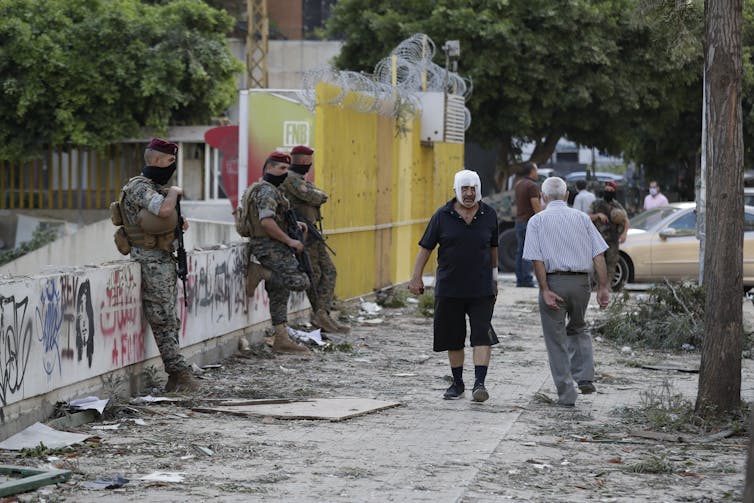
Beirut explosion.
Not surprisingly public anger has spilled into the streets amid calls for a “revolution.” People demand an end to politics as usual and a turn to strong central authority that will shake the parasites and opportunists out of the Lebanese social fabric. This resembles the circumstances that led to the election of Rodrigo Dutarte in the Philippines prior to the pandemic and without the explosive precipitant. Both reflect a larger trend, that being disaffection with democratic governance and rising support for authoritarianism on a world scale. That has not gone unnoticed.
Since the advent of the Covid-19 pandemic a number of political leaders have used it as an excuse to impose national emergency measures in order to consolidate and entrench their power. Dutarte, Viktor Orban, Aleksandr Lukashenko, Recep Erdogan, Naendra Modi, Nicolas Maduro, Jair Bolsonaro and even Donald Trump have all succumbed to the “authoritarian temptation:” find an external reason to restrict checks and balances on Executive power for self-serving purposes.
Sometimes the authoritarian gambit works, sometimes it does not. Depending on their initial approach to the pandemic, leaders who have used it to justify a consolidation of their power have had mixed results. Dutarte has successfully used the pandemic to his advantage. Bolsonaro, Trump and Lukashenko have suffered politically because they initially denied that the pandemic was serious, and now their claims about health matters are viewed skeptically along with their reasons for more Executive authority. Either way, the pandemic is more than just an excuse to go authoritarian.
It has exposed a global crisis of governance, particularly in democratic countries. The crisis is at once a health crisis, a political crisis and an economic crisis. Leadership incompetence has been revealed to be widespread on all three dimensions, which has undermined public support for democratic capitalism as the preferred political-economic form. Although authoritarians have a mixed record when it comes to pandemic control (think People’s Republic of China and Russia versus Singapore and Viet Nam), democracies have seen its most politically destabilising effects because the backdrop to the current moment has been long in the making. That is evident in global research surveys over the last decade, which show that support for democracy has steadily declined world wide, and is particularly notable amongst the young (under 35) demographic. In long standing liberal democracies as well as relatively new democracies in Latin America and Africa, support for democracy has eroded considerably across all demographics to the point that in some sectors of society less than 50 percent believe it is the best type of governance.
Not surprisingly, in the last year the number of democracies in the world fell below the number of autocracies for the first time in three decades. On pretty much every discernible measure–press freedom, party competition, government transparency, rights of speech and movement, etc.–authoritarians have exploited the so-called “democratic deficit” by clamping down on basic rights and freedoms. The difference this time around is that the current crop of strongmen enter into office via elections and then, like the European fascists of 90 years ago, slowly dismantle the apparatuses of democratic governance in favour of centralized top-down control. The pandemic was just another reason to do so.
Why does authoritarianism seem preferable to democracy? The short answer is that democracies no longer deliver on their promises. Economic prosperity has stagnated in the liberal and newly democratic world, exposing the contradiction inherent in the current phase of globalised capitalism that benefits elites but which does little for voting masses who clamour for something different when it comes to economic opportunity, security and inter-generational prosperity. Violent protracted riots in places as disparate as France and Chile demonstrate the depth of resentment against the system as given. For many, the general condition is one of of uncertainty and precariousness. People can no longer assume that they will keep a stable job and provide for their own needs, much less guarantee the future of their children.
Many democracies have also lost their consensual, centrist nature and are increasingly rendered by partisanship, zero-sum political logics, “to the winner go the spoils” approaches, pervasive corruption (both institutional and personal) and social as well as political polarization that when taken together mark a general degeneration into political sclerosis. Even so, modern democratic elites can still manipulate in very sophisticated ways (via mainstream and social media as well as direct influence operations like lobbying) the political narrative that supports adherence to and support for the status quo. The sum effect is what is known as “gas-lighting:” the official narrative contradicts the experiential reality of most people, making them question their own interpretations and comprehension of social reality.
But the cracks in this facade are showing. The spectre of uncertainty looms over the voting population because they no longer see a direct relationship between their vote and a change in their material circumstances no matter how much elected authorities tell them that life is good and will get better. That is why apathy has taken strong root as well. If all politicians are cut from the same cloth and one’s situation remains the same or continues to worsen, what is the point of choosing between them?
The disconnect between how people live and what dominant political elites say are the realities of their collective condition is increasingly irreconcilable. The credibility gap is covered in a layer of falsehoods involving fear-mongering, culture wars, false promises, scapegoating of “others” and the like. Whatever the narrative, democratic politics is increasingly seen as a field for scoundrels, charlatans and venal opportunists, not people of principle.
Nowhere is this more evident than in the rise of national populism as a revamped form of authoritarianism. It has degrees of hardness, but the (often xenophobic or racist) appeal to an “in-group” along economic and political lines, in which the leader self-proclaims to be the “saviour” of the nation, is a common thread running through all of its variations. Time and time again, from Russia to Turkey to the UK, leaders go for the politics of exclusionary nationalism rather than for the big tent approach.
In effect, the turn to authoritarianism has it roots in poor democratic governance. Authoritarians can promise certainty instead of uncertainty, consistency instead of chaos (certainly with regards to repression), and efficiency over inefficiency in implementing public policy. Of course they may not keep their promises and may just be as inept as various democracies when it comes to dealing with the pandemic crisis and other tests of government competence, but they make no pretence to being fair, just or equitable. They simply identify those who support them and those who do not and develop policy responses accordingly. Of that people can be sure.
Whatever its short-term appeal, authoritarianism is not a long-term panacea because autocrats may perform no better than the discredited democrats and could well fall as a result, only to be replaced by other authoritarians. Plus, there are enough democracies that have done well in recent times, including NZ, Uruguay, Canada to some extent, Ireland, Portugal, the Nordic tier, Iceland and Finland, to suggest that it is not the end of days for this political form and that it offers an alternative to the dictatorial impulses so prevalent today. But these are certainly trying times for democracy nevertheless.
In the end, the pandemic has exposed what was evident all along. The model of accumulation (global capitalism in its current phase) and the crisis of governance in the democratic world was a combination bound to prove unsustainable on one, the other or both fronts. The pandemic has just rendered transparent that fact, and the turn to authoritarianism is just a symptom of, not a solution to, that problem.
For analysts the important thing to understand that the rise of modern-day authoritarianism is actually a reflection of the crisis of democratic governance, and that the crisis is born from within even if abetted from without (say, by electoral meddling by foreign powers). The solution therefore also lies within. But for that to happen, democratic elites must engage in some reflection and reformation. Like the drunk who has an epiphany after a bender, the moment of sobriety starts with an admission of failure and a drastic change of behaviour.
It remains to be seen if contemporary democracies can and will sober up.
Tomorrow, New Zealand will mark 100 days without community transmission of covid-19.
From the first known case imported into New Zealand on February 26 to the last case of community transmission detected on May 1, elimination took 65 days.
New Zealand relied on three types of measures to get rid of the virus:
Ongoing border controls to stop covid-19 from entering the country
A lockdown and physical distancing to stop community transmission
Case-based controls using testing, contact tracing and quarantine.
Collectively, these measures have achieved low case numbers and deaths compared with high-income countries in Europe and North America that pursued a suppression strategy.
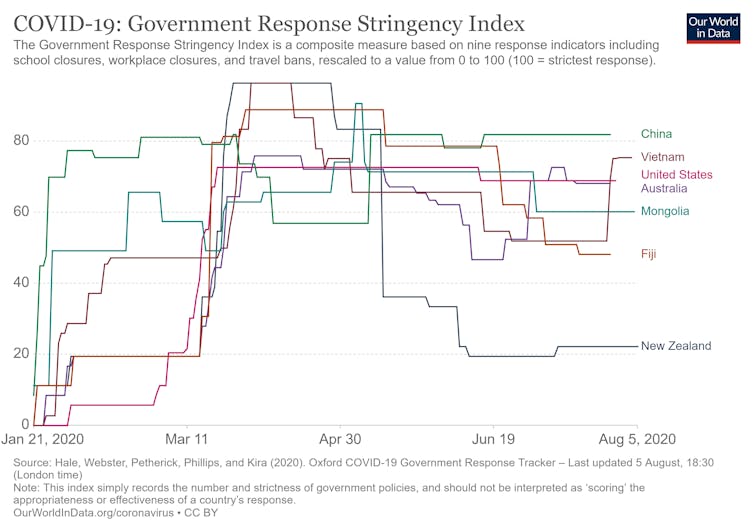
New Zealand is one of a small number of jurisdictions – including mainland China, Hong Kong, Taiwan, South Korea, Vietnam, Mongolia, Australia and Fiji – pursuing covid-19 containment or elimination. Most have had new outbreaks. The exceptions are Taiwan, Fiji and New Zealand.
Australia adopted very similar responses to the pandemic and it is important to note that most states and territories are in the same position as New Zealand. But Victoria and, to a lesser extent, New South Wales are seeing a significant resurgence.
The key difference is that New Zealand committed relatively early to a clearly articulated elimination strategy and pursued it aggressively. An intense lockdown proved highly effective at rapidly extinguishing the virus.
This difference can be seen graphically in this stringency index published by Oxford University’s Our World in Data.
There are key lessons from New Zealand’s covid-19 experience.
A vigorous, decisive response to the pandemic was highly effective at minimising cases and deaths. New Zealand has the lowest covid-19 death rate in the OECD.
Total all-cause deaths also dropped during the lockdown. This observation suggests it did not have severe negative effects on health, although it will almost certainly have some negative long-term effects.
Elimination of the virus appears to have allowed New Zealand to return to near-normal operation fairly rapidly, minimised economic damage compared with Australia. But the economic impact is likely to keep playing out over the coming months.
Getting through the pandemic We have gained a much better understanding of covid-19 over the past eight months. Without effective control measures, it is likely to continue to spread globally for many months to years, ultimately infecting billions and killing millions. The proportion of infected people who die appears to be slightly below 1 percent.
The infection can cause serious long-term consequences for some people. The largest uncertainties involve immunity to this virus, whether it can develop from exposure to infection or vaccines, and if it is long-lasting. The potential for treatment with antivirals and other therapeutics is also still uncertain.
This knowledge reinforces the huge benefits of sustaining elimination. We know that if New Zealand were to experience widespread covid-19 transmission, the impact on Māori and Pasifika populations could be catastrophic.
We have previously described critical measures to get us through this period, including the use of fabric face masks, improving contact tracing with suitable digital tools, applying a science-based approach to border management, and the need for a dedicated national public health agency.
Maintaining elimination depends on adopting a highly strategic approach to risk management. This approach involves choosing an optimal mix of interventions and using resources in the most efficient way to keep the risk of covid-19 outbreaks at a consistently low level. Several measures can contribute to this goal over the next few months, while also allowing incremental increases in international travel:
resurgence planning for a border-control failure and outbreaks of various sizes, with state-of-the-art contact tracing and an upgraded alert level system
conducting exercises and simulations to test outbreak management procedures, possibly including “mass masking days” to engage the public in the response
carefully exploring processes to allow quarantine-free travel between jurisdictions free of covid-19, notably various Pacific Islands, Tasmania and Taiwan (which may require digital tracking of arriving travellers for the first few weeks)
planning for carefully managed inbound travel by key long-term visitor groups such as tertiary students who would generally still need managed quarantine.
Building back better New Zealand cannot change the reality of the global covid-19 pandemic. But it can leverage possible benefits.
We also need to establish a specialised national public health agency to manage serious threats to public health and provide critical mass to advance public health generally. Such an agency appears to have been a key factor in the success of Taiwan, which avoided a costly lockdown entirely.
Business as usual should not be an option for the recovery phase. A recent Massey University survey suggests seven out of ten New Zealanders support a green recovery approach.
New Zealand’s elimination of covid-19 has drawn attention worldwide. We are about to publish an overview of the approach in the New England Journal of Medicine. We support a rejuvenated World Health Organisation that could roll out an elimination model in other countries where there is public support for this approach.
Chart 3, Global stabilisation, for now. Chart by Keith Rankin.
Analysis by Keith Rankin.
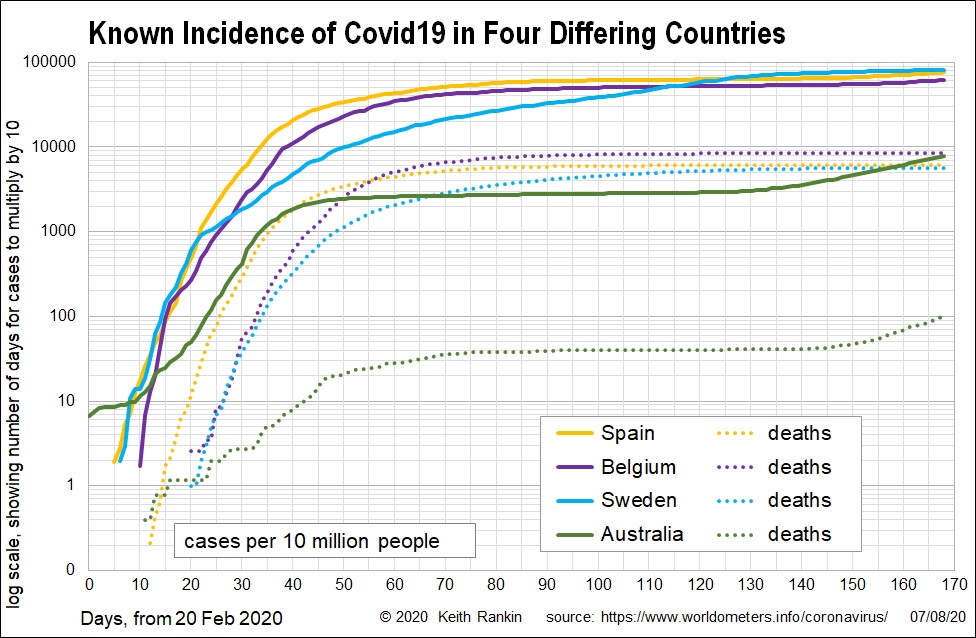
Chart 1, Historical: Australian much lower than Spain, Belgium and Sweden. Chart by Keith Rankin.
The known incidences of Covid19 in Spain, Belgium and Sweden are similar, although Sweden lagged for a while before overtaking the other two. In deaths, Sweden is slightly lower than Spain and about 30% lower than Belgium. Belgium, after little San Marino, is still the country with the highest deaths per capita. It is likely that all three of these European countries have an actual case fatality rate of about one percent, meaning that Belgium and Spain have slightly higher historical infection rates than Sweden.
Sweden’s slightly lower infection rate is probably due to natural and cultural physical distancing. Belgium’s higher Covid19 incidence is likely related to its political role within the European Union; ie comparable with Washington DC in the United States. (See my Europia …)
Australia’s overall infection rate is at most ten percent of these European countries’ rates. And the death rates, so far, in Spain, Sweden and Belgium are 60 to 90 times greater than in Australia (between one and two orders of magnitude). However, the recent growth rate of cases and deaths in Australia is faster; look at the slopes for Australia since Day 145, which is mid-July.
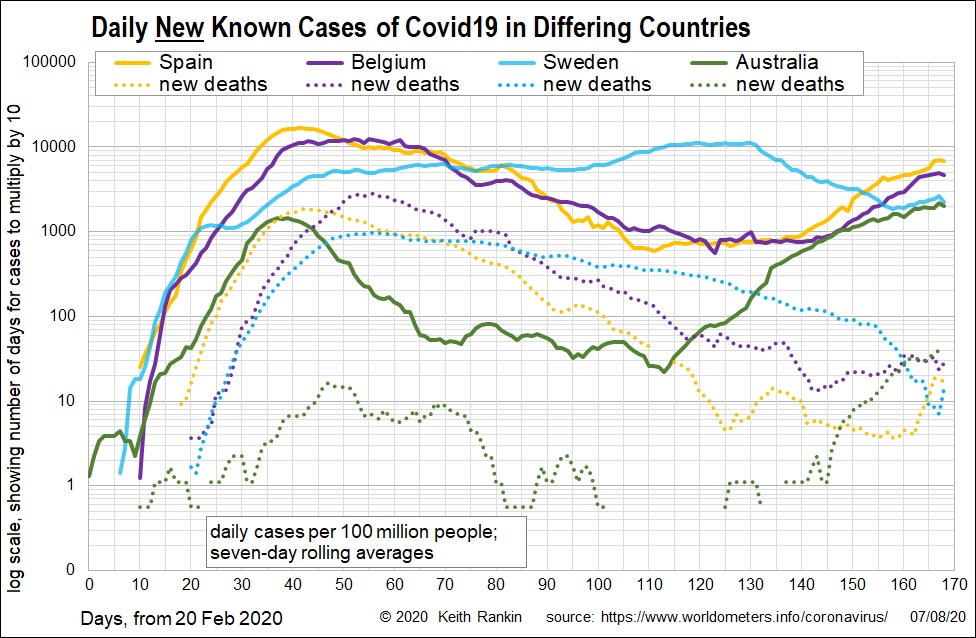
Chart 2, Australian incidence of Covid19 similar, last week. Chart by Keith Rankin.
This chart plots seven-day averages of case and death rates. In terms of cases, all four countries are now recording similar percentages of new infections each day. And all have had recent resurgences. Sweden has come down to this level of infection, whereas Australia has risen rapidly to almost meet Sweden. Belgium and Spain have had significant resurgences over the last month.
When it comes to recent deaths, Australia now pips Belgium and has double the death rates of Spain and Sweden. Death rates are probably lower now in part because many of the most vulnerable people in these European countries have either died already, or have gained a degree of immunity.
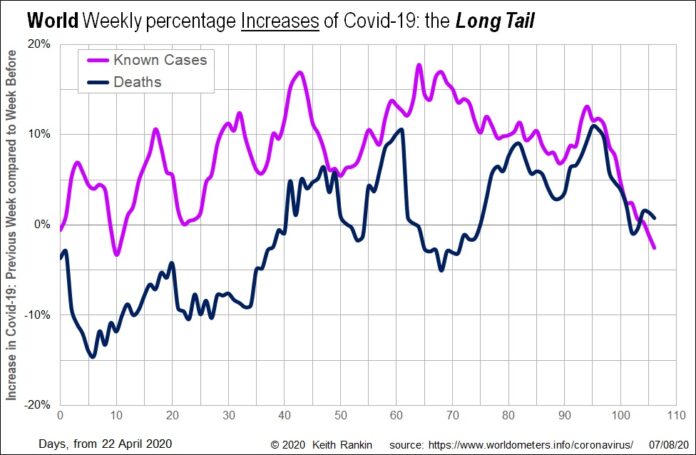
Chart 3, Global stabilisation, for now. Chart by Keith Rankin.
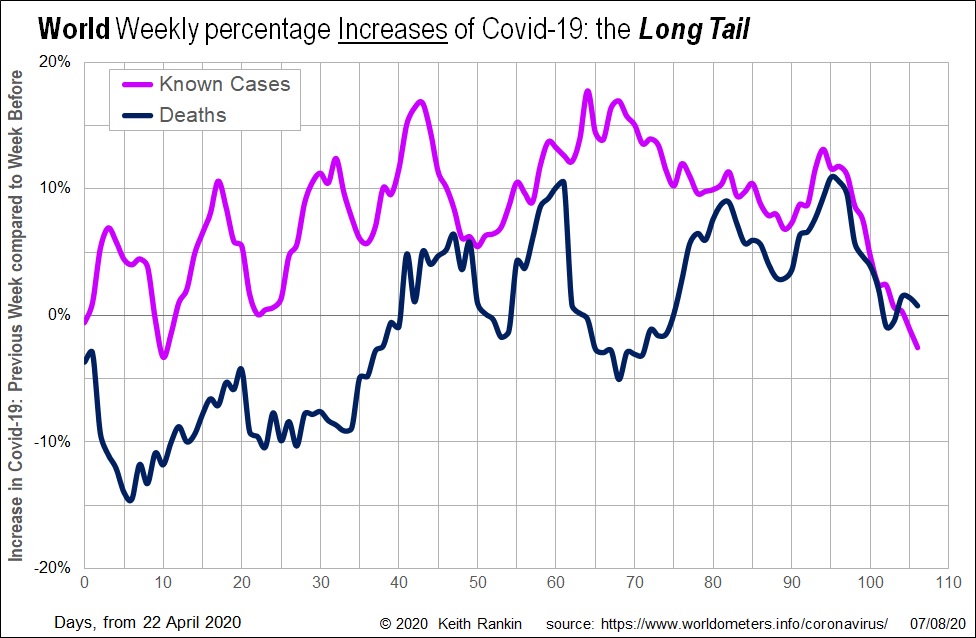
Now for the good news, the updated Long Tail chart shows a clear turning point about 40 days ago. A zero percent weekly growth rate represents a stabilisation of case growth, not a reduction of new cases. But stabilisation has to come first. There are clear signs that the pandemic in the Americas – the highest incidence countries in June and July – is now slowing.
My sense is that death growth rates will rise again before persistently falling in September; this is because deaths lag infections.
It is looking that, in August, increased testing globally is yielding fewer cases per test. Chile now has performed almost as many tests per person as New Zealand; and Australia’s testing rate is now double New Zealand’s. Likewise, the percentage of Americans tested is now double the percentage of New Zealanders. Brazil’s testing rate is now two-thirds that of New Zealand. Even sceptical Sweden is catching up to New Zealand. (New Zealand’s present rate of testing is about right for a country which has contained the virus.)
Europe and the Americas have undergone huge learning curves re Covid19 in particular, and public health preparedness in general. Healthy economies will follow – maybe healthier than pre-covid economies – as people become healthier. Good things take time.
Public health is an area of market failure. This pandemic is teaching us more widely about both market failure, and market resilience. We are learning, slowly.
The good news in the Reserve Bank’s latest quarterly set of forecasts is that the recession won’t be as steep as it thought last time.
The bad news is it now expects ultra-weak economic growth to drag on and on, pushing out the recovery and meaning Australia won’t return to the path it was on for years if not the end of the decade.
Its so-called baseline scenario, which is for the worst recession in 70 years, relies on a number of things going right:
the heightened restrictions in Victoria are in place for the announced six weeks and then gradually lifted. In other parts of the country, restrictions continue to be gradually lifted or are only tightened modestly for a limited time, although restrictions on international departures and arrivals are assumed to stay in place until mid 2021
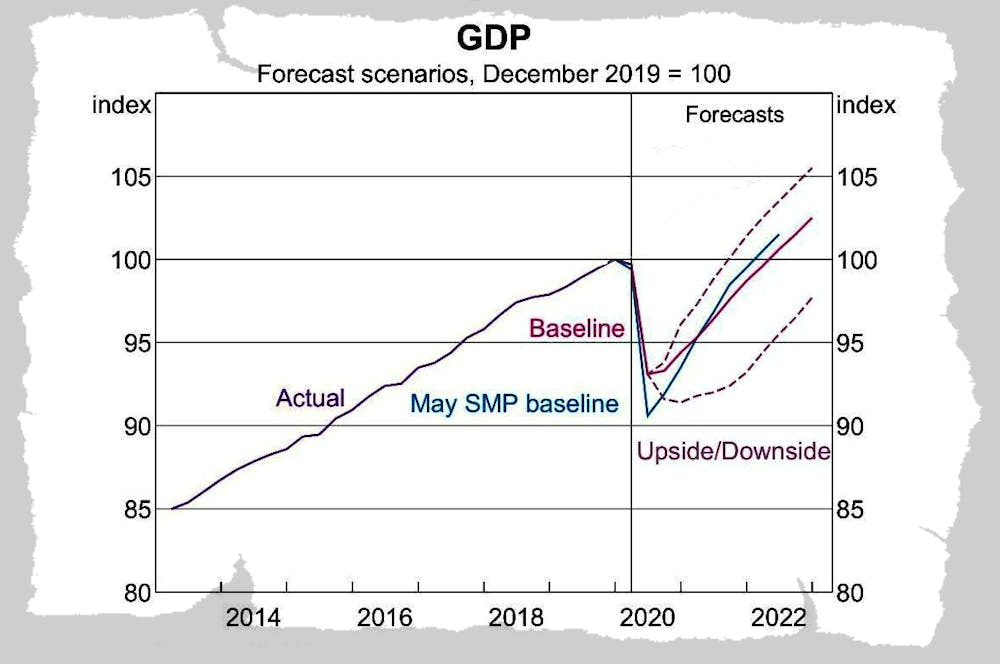
Where as three months ago in its May update the Reserve Bank expected economic activity to collapse 8% in the year to June 2020 and then bounce back 7% over the following year, it now believes it collapsed a lesser 6% but will claw back only 4% in the year to come.
The direct impact of locked doors and shut shops was smaller than it expected, but the ongoing impacts are “likely to be larger”.
It’ll depend on households
What economic growth there is will be driven by household spending. Business investment, once a key economic driver, won’t be back to anything like where it was until well into 2023.
Business after business has been telling the bank’s liaison officers they have deferred or cancelled planned spending to preserve cash.
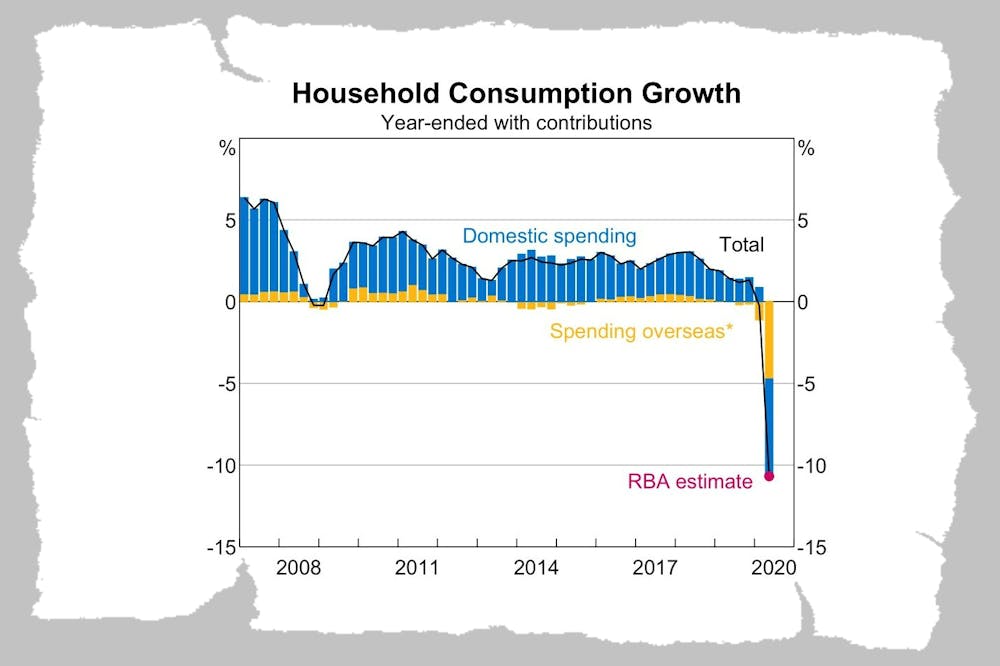
In usual times, household spending accounts for 60% of gross domestic product.
The Reserve Bank believes household spending fell 11% by the middle of the year and will start to edge back up, but it warns that household incomes are expected to slide and unemployment grow as government winds back JobKeeper and JobSeeker:
The JobKeeper program ensures that many more workers remain attached to their job than otherwise. However, it is expected some workers will be retrenched once they are no longer eligible for the subsidy in late 2020 and early 2021. Moreover, the reinstatement of job search requirements for the JobSeeker program outside of Victoria in the September quarter and the lifting of restrictions will result in more people looking for jobs
It will have been heartened by the Prime Minister’s recent decision to make the wind-back of JobKeeper less steep.
The bank says that the way businesses and households adjust to a lower income in the months ahead will be “an important determinant of the outlook over the rest of the forecast period”.
It expects employment to fall further over the rest of the year, as job losses from restrictions in Victoria and the tightening of JobKeeper more than offset a continued recovery in jobs elsewhere.
One in ten of the businesses it has contacted through its liaison program report wage cuts, most of them targeted towards senior management, but some implemented broadly.
The bank’s forecasts for recession and recovery have a similarly wide range.
On one hand GDP might not be back to where it was until the middle of the decade, and not back to where it would have been until the start of the following decade.
On the other, it might have made up its losses by the end of next year.
Its upside scenario assumes quick progress in controlling the virus, improving consumer confidence as a result, a quick end to the outbreak in Victoria and no further major outbreaks.
The downside scenario assumes rolling outbreaks and rolling lockdowns along with a widespread resurgence in infections worldwide.
Risks a plenty..
It says if households conclude that low income growth will be more persistent than previously expected, they might “permanently adjust their spending” leaving the economy weaker for longer.
The uncertainty could lower firms’ risk appetite, prodding them to pay down debt and increase cash buffers rather than invest even when conditions recover.
A sustained period of lower investment, combined with “scarring” as people unemployed or underemployed find themselves unable to improve their position could “damage the economy’s productive potential”.
..little harm in spending
The bank says there’s little more it can do. It has considered negative interest rates, and believes they would be of no real help.
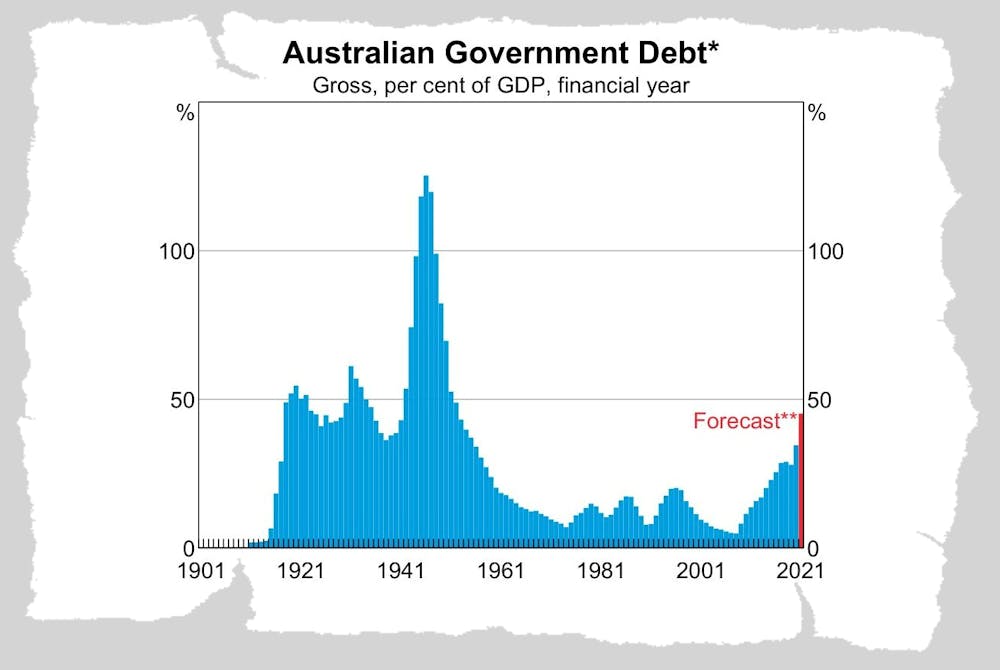
It’ll be up to the government to support the economy with spending. Where needed the bank will buy government bonds with money it creates in order to keep borrowing costs low.
To make the point that government shouldn’t be afraiding of borrowing it includes a graph of government debt since Federation.
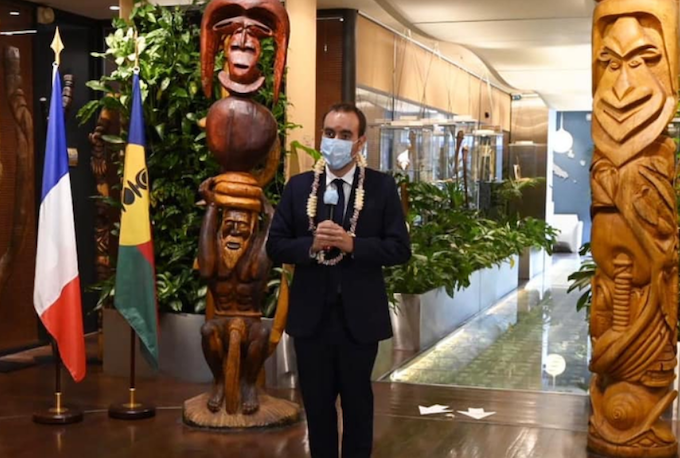
France’s new overseas minister Sebastien Lecornu says New Caledonia’s restrictions over the covid-19 pandemic will not affect the preparations for the October referendum on independence.
Lecornu gave the assessment during a visit to New Caledonia House in Paris.
Paris is expected to send dozens of officials and magistrates to supervise the plebiscite, and both foreign observers and journalists are due for the occasion.
However, anyone arriving in New Caledonia must go into a controlled two-week quarantine.
Lecornu said the foreign and the interior ministers as well as diplomatic posts would give instructions for distance voting, describing the role of the French state as impartial.
He said a document outlining the implications for New Caledonia in case of a vote for independence was still in preparation and would be presented to the parties concerned by the French High Commissioner in Noumea.
In the first of three possible referendums in 2018, just under 57 percent voted for the status quo.
Should voters again reject independence this year, another referendum can be called by New Caledonia’s Congress within two years.
French Overseas Territories Minister Sebastien Lecornu at New Caledonia House in Paris … a document outlining the French implications of a vote for independence is still being developed. Image: RNZ/French Overseas Ministry
FLNKS seeks three-year transition The FLNKS movement says it would want a three-year transition period should voters opt for independence and the creation of a new country in the referendum on October 4.
FLNKS leaders gave their outline of a Kanaky New Caledonia as they prepare for the second referendum under the Noumea Accord.
The leaders say they hope to attain a 51 percent yes vote after securing just over 43 percent support in the first referendum in 2018.
According to them, the period after a victory should be used to draw up a constitution of a multicultural, democratic and secular state which would renew ties with France.
They say everybody, including those opposed to independence, will be allowed to stay.
This article is republished by the Pacific Media Centre under a partnership agreement with RNZ.
National crises, like the pandemics that can provoke them, come in stages. Each stage presents leaders with unique problems that require mental, moral and emotional agility to manage. Change is the only constant, as policies that work one moment fail to do so another. National crises challenge ideology. There is little room for rhetoric when people’s lives and livelihoods are on the line.
This key part of Australian society has self-evidently not been at the front of the government’s mind. So, it is unlikely to hear the messages the report contains.
But it should. The Morrison government, like the Coalition governments before it, is wedded to the tropes of the extractive economy. After decades of “rationalising” Australia’s manufacturing sector, it is left with a handful of go-to industries it understands and/or whose lobbying has been successful (mining, construction, defence and agriculture, with a bit of tourism and small business thrown in).
As the cultural sector is not one of the favoured few, the years since the Coalition’s election in 2013 have been ones of missed opportunity, ministerial posturing, and limp incrementalism. The government has given little thought and less support to the sector. COVID-19 has revealed an essential truth: Australia doesn’t have a cultural policy.
This has to change. In the post-COVID period a significant task of rebuilding faces Australia on both economic and social fronts. It will not be met by channelling the 1980s conservative energies of Margaret Thatcher and Ronald Reagan as Treasurer Josh Frydenberg proposes. The problems of stagflation and industrial reorganisation look nothing like the problems of collapsing aggregate demand and the promotion of sustainable growth.
Prime Minister Scott Morrison, singer Guy Sebastian and Arts Minister Paul Fletcher view a sound desk in the Sydney Coliseum Theatre in June.AAP Image/Joel Carrett
New challenges require new responses, not a return to old ones. Wage stagnation, precarious employment and record-low interest rates make monetarist policies ineffective in the current climate.
It is fiscal instruments – government spending – that will determine whether Australia recovers swiftly from the effects of the current pandemic. The austerity era is over. Nations that spend nothing, will get nothing. The future belongs to those who are willing to build. That includes the Australian cultural sector.
A New Approach’s fourth report should have been its first. It lays out the strategic landscape of cultural policy and gives a selective narrative of cultural policymaking since 1950. Key to the former is what the report calls “policy drivers”. It names four that have been dominant in Australia: collective identity, reputation building, social improvement and economic contribution.
What is a policy driver? In the report, they appear as a cross between a motivation, an aspiration and a management goal. At any rate, they are some kind of higher idea that are supposed to make sense of government action in the sector. It is both unfortunate and typical that none of the drivers identified are cultural ones, that Australian governments have apparently had little ambition to produce great art or support its creators. The core purposes of arts and culture lie in what it can do for other areas: identity, cohesion, industry and diplomacy. No wonder applying them has “often led to a lack of leadership in this area over the last 70 years”.
Australia’s cultural policy highs have been significant. Creative Nation was a world first in scope, content and tone when it appeared in 1994. But its prolonged lows have badly damaged a sector that has grown in spite of, not because of, government treatment. A New Approach’s historical timeline stops in 2010, three years before Creative Australia was released and legislation governing the Australia Council was rewritten, and well before cultural funding was (temporarily) increased.
Anthem, Melbourne International Arts Festival 2019.Pia Johnson
A New Approach notes that “Australia’s current cultural policy settings are designed for an earlier era”. This is a misrepresentation. The government’s approach to the cultural sector has been a baleful cocktail of favourites and indifference. In the barren years after 2013, government energy was invested in “counter-drivers”: negative policy attitudes that framed culture as elitist, useless, metropolitan and lefty.
The report puts forward eight recommendations, ready-packaged for policy wonks as “Opportunities”. One is the stand-out: to create a National Arts and Culture Plan that “could inform more coherent arts and cultural policy settings and investment at all three levels of government”. The report even identifies the appropriate body for actioning such a plan, the Meeting of Cultural Ministers. This is our national cabinet for arts and culture. The mechanism for effective cultural policymaking in Australia has long been in place. It is time to use it again.
Why should the federal government move out of its comfort zone and take an informed interest in a policy domain that it has all but disavowed? The small and belated pandemic support package currently offered suggests there is some recognition that cultural is important. But it is far from enough. Through a triple whammy of bushfire disaster, COVID-19 shutdown and economic depression, the country has received a body blow that demands active leadership to recover from.
Where the policy debate has focused on a need to “rescue” the cultural sector from the ill-effects of COVID-19, the emphasis must now be on growing it as part of a wider program of public investment.
ANA’s report touches on six areas where this might happen: capital expenditure; support for cultural organisations; community and amenity building, especially in regional Australia; Indigenous arts centres and First Nations cultural programs; and digital participation.
Faced with this list of options, the box to tick is “all of the above”. The need to assist artists and those involved in the production of culture is greater than ever. Many have missed out on previous support offered and are grieving as they see a lifetime’s commitment evaporate. Investment in cultural infrastructure needs to come from all levels of government, but especially from the federal one, where, as the report points out, expenditure in the cultural area fell 18.9% per capita between 2008 and 2018. The burden of proof lies with those who would do nothing.
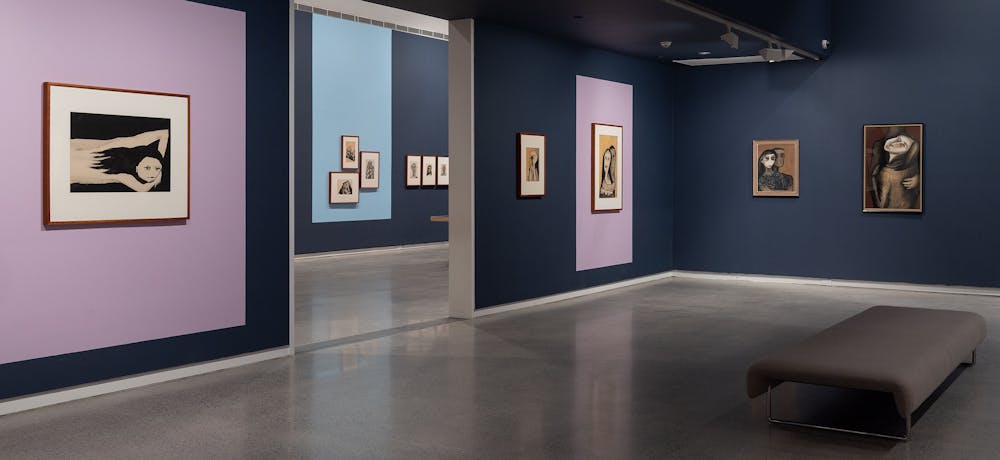
The pandemic has shuttered exhibitions such as the Joy Hester survey at Heide.Heide
A National Arts and Culture Plan won’t guarantee the government will come to its senses and treat the cultural sector with the seriousness it deserves. But it is a useful start. The arts minister, Paul Fletcher, is a cleanskin, with the capacity to implement a broader policy agenda. The states and local governments are aware of the importance of the sector and its role in a post-COVID recovery. The Australia Council is doing all that it can with the little that it has to cope with the serial disasters sweeping over artists and cultural organisations.
What’s wanted is a positive lead from the federal government. It doesn’t need to pretend to an expertise it doesn’t have. It needs to listen to the industry and policy representatives who can give it good culture-specific advice. Then it needs to open its wallet and get ready to spend.
That won’t be easy for a political party that has drunk deep at the small-government-balanced-budget well for so long and, in its own mind, to good effect. But a different world looms, and the cultural sector is central to it. Whatever “policy drivers” the government chooses to commit to, commit to some it must. The clock is ticking, the sector is ailing. There is simply no time to lose.
During the COVID-19 pandemic we’re constantly being reminded to practise good hygiene by frequently washing our hands and regularly cleaning the spaces where we live and work.
These practices aim to remove or kill the coronavirus that causes COVID-19, and thereby minimise our risk of infection.
But there have been some suggestions using hand sanitiser and practising other hygiene measures too often could weaken our immune system, by reducing our body’s exposure to germs and with it the chance to “train” our immune defences.
The good news is, there’s no evidence to suggest this will be the case.
For healthy immune function, it’s important we’re exposed to a diverse range of bugs in the environment, known as microbes. Most of these don’t make us sick.
The belief that a high level of cleaning and personal hygiene weakens our immune system is a common interpretation of what’s called the “hygiene hypothesis”.
The hygiene hypothesis is a theory that suggests a young child’s environment can be “too clean”, and they won’t be exposed to enough of these microbes to effectively stimulate their immune system as it develops.
The argument is that this results in increased allergies, asthma and certain autoimmune disorders. But scientists have refuted this hypothesis in recent years, as research has shown there are multiple other reasons for the increased incidence of these conditions.
Importantly, being too dirty doesn’t help our immune system either. It generally makes inflammation worse.
The ‘hygiene hypothesis’ has been controversial.Shutterstock
What is the immune system?
The immune system works to protect our bodies against things that threaten to make us sick — from harmful chemicals, to bacteria and viruses, to cancer cells.
It’s made up of two lines of defence. The first is the “innate” immune system, which responds rapidly to a range of pathogens to fight infection and prevent tissue damage.
Next is the “adaptive” immune system, made up of immune cells that develop a more targeted or specific response to fight off harsher germs such as viruses. Adaptive immune cells work by recognising small parts of the virus on the outside of the infected cell (for example, lung cells), and destroying them.
These cells then become what we call “memory cells”. The next time they encounter the same virus, they can eliminate it straight away.
This development of the immune system starts after birth and declines in old age.
Some aspects of our modern lifestyle can weaken our immune system. These include:
A healthy diet is one way to support immune function.Shutterstock
But there’s no scientific evidence to support the notion that extra hygiene precautions will weaken our immune system or leave us more susceptible to infection by bacteria or viruses.
Microbes are everywhere: in the air, on food, and in plants, animals, soil and water. They can be found on just about every surface, including inside and outside your body.
The hygiene measures recommended during COVID-19 will help curb the spread of the coronavirus and greatly reduce our risk of infection — but won’t eliminate all microbes from our lives.
Cleaning refers to the removal of microbes, dirt and impurities from surfaces. It doesn’t kill microbes, but by removing them, it lowers their numbers and therefore reduces the risk of spreading infection.
In contrast, disinfecting refers to using chemicals, known as disinfectants, to kill microbes on surfaces.
A combination of cleaning and disinfecting is the most effective way to get rid of microbes such as coronavirus.
Cleaning removes microbes and lowers the risk an infection will spread.Shutterstock
We’ve been advised to clean our hands with soap and water for at least 20 seconds. If this is not possible, use hand sanitiser with at least 60% ethanol or 70% isopropanol.
Frequent hand-washing, especially if a sanitiser is used, can disrupt the natural skin biome, which can lead to increased skin infections. This can be managed with the use of moisturisers.
But the extra hygiene measures during COVID-19 won’t weaken our immune systems. On the contrary, they are vital in controlling the pandemic.
If you’re worried about your immune system, don’t stop washing your hands or keeping your house clean. Importantly, follow a healthy balanced diet, do regular exercise and look after your mental health.
University of Canberra Professorial Fellow Michelle Grattan and University of Canberra Assistant Professor Caroline Fisher discuss the week in politics.
This week Michelle and Caroline discuss the closure of ‘non-essential’ businesses in Melbourne under stage 4 restrictions, the Morrison government’s paid pandemic leave, and Scott Morrison and Peter Dutton’s cyber security package.
Review: The Meddler, screening at the Melbourne International Film Festival
For movie scholars and enthusiasts, one of the worst things about the COVID-19 pandemic has been the shutting down of cinemas. It’s a fundamentally different experience watching a film on a small screen with friends and family – or by yourself – from watching a movie on a massive screen in a dark room surrounded by strangers. This is why people have historically continued to go to the movies, despite the challenges posed first by the introduction of television, then by home video, and now by streaming services.
Festivals like the Sydney Film Festival have attempted to adjust to the emergency context by operating as reduced online-only festivals. But watching a premiere in a packed State Theatre is not the same as watching the same film hunched over your laptop.
At the same time, it’s nice to have access to good films beyond the limited offerings from online services.
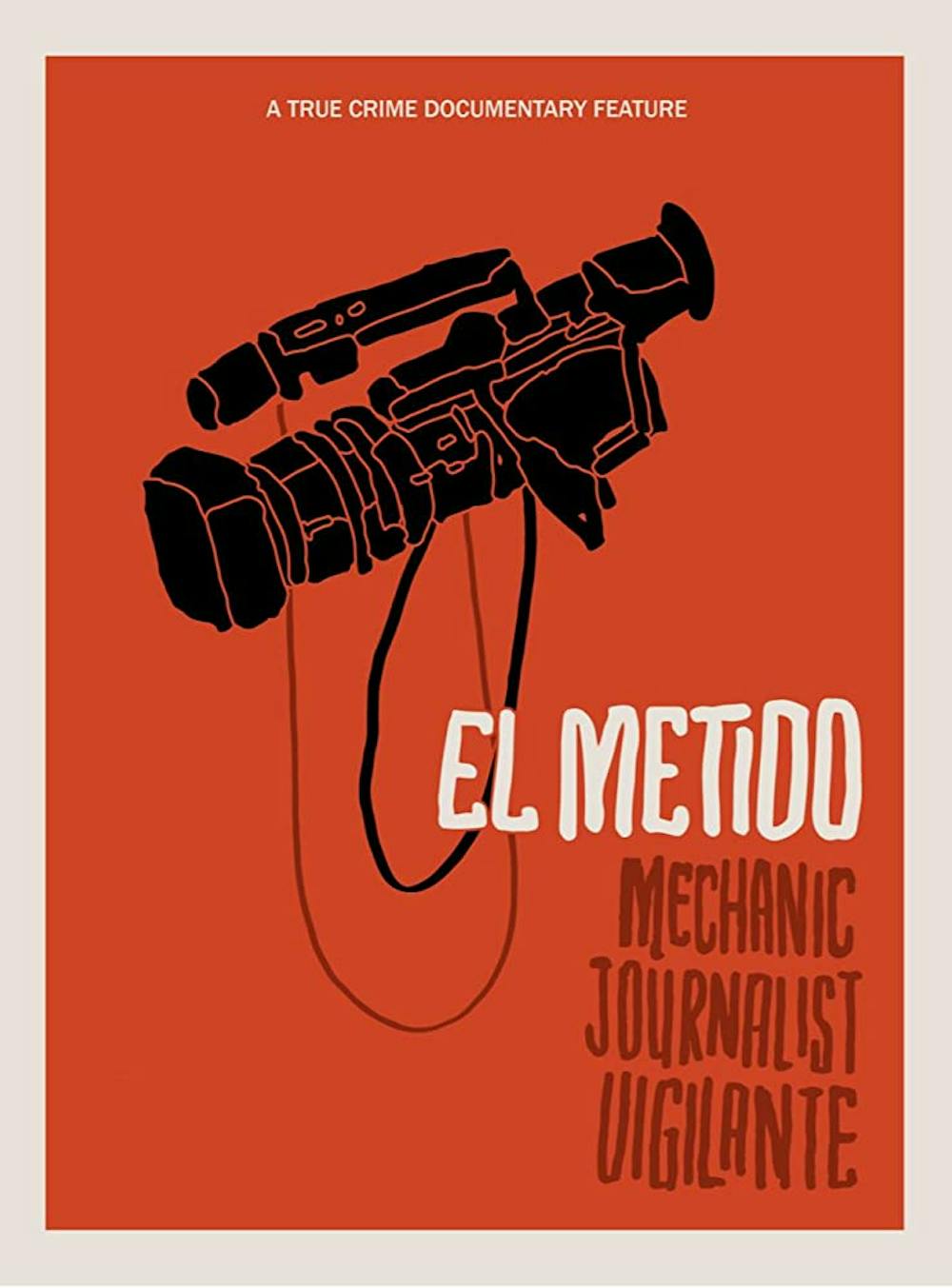
The Meddler (or El Metido), the recent documentary from Australian filmmakers Daniel Leclair and Alex Roberts now playing online as part of the Melbourne International Film Festival, is, indeed, a good film.
An addiction
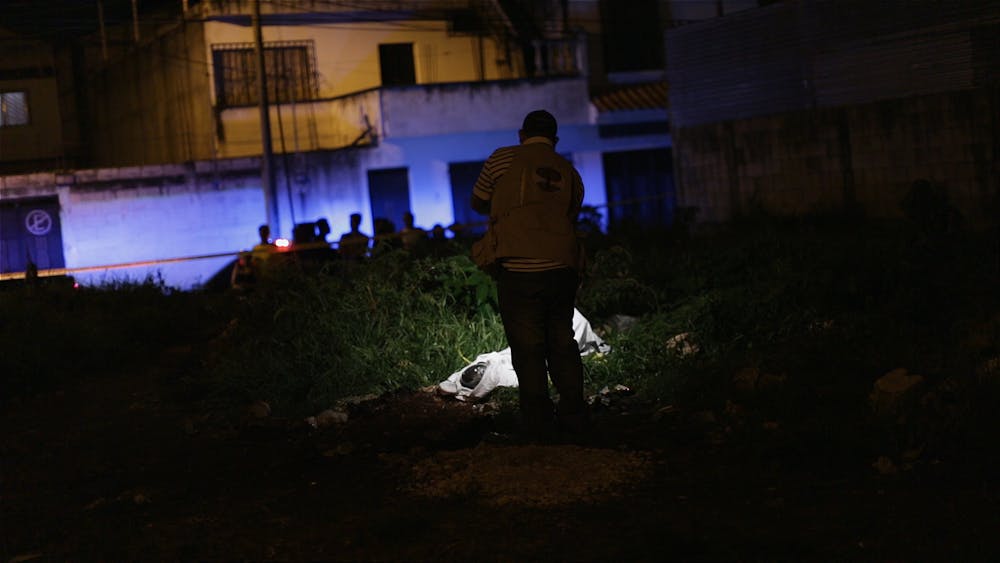
It’s also quietly but profoundly unsettling. The documentarians follow German Cabrera, an unassuming mechanic in Guatemala City. Night after night he prowls the streets with a camera, trying to capture footage of crimes, accidents, and, mainly, dead bodies.
Occasionally we cut to Cabrera’s footage, but mostly the camera observes him. Through the filmmakers apparent refusal to intervene in the world, a careful irony slowly develops: a split between Cabrera’s self-perception and what we are watching as viewers.
Cabrera believes he does this because he’s a truth and justice warrior – and he does provide the footage for free to local news networks – but the film suggests there is more to it.
They call me ‘The Meddler’.
We see a man obsessed, in his own words “addicted”, to capturing these gruesome images. This leads, through the course of the film, to the disintegration of his marriage.
The reasons for his obsession remain enigmatic, and the film avoids the kind of psychologising that a bigger budget documentary may have been compelled to offer. This benefits the film; it is much eerier because of its lack of exposition.
At times it plays like a less strident (and less funny) Werner Herzog character study.
Like Herzog’s Timothy Treadwell from Grizzly Man – a self-proclaimed naturalist and environmental warrior who ends up being killed by a bear – Cabrera is a self-appointed investigative journalist-come-superhero. As with Herzog’s film, we gradually realise that Cabrera, with his mute, reactionary stance on what he perceives to be limitless crime is, simply, a really weird guy.
Known as “the night watcher” on local news, Cabrera is a kind of real life version of Lou Bloom (Jake Gyllenhaal), the stringer from Dan Gilroy’s Nightcrawler. It is, perhaps, more disturbing that this is a kind of hobby for Cabrera, rather than work as it is for Lou.
This is starkly realised in a moment midway through the film when Cabrera captures a bereaved teenager screaming, “I want my dad!” The film cuts from Cabrera’s footage to him watching the teenager through his camera, totally unmoved by what he is filming.
This moment is subtle, and flips back on us too. As the viewers of the documentary we are also drawn to these horrific images. We are suckers for sensation and the stimulation of the extreme. Are we, too, meddlers as we watch, for example, injured and bloody people in the back of an ambulance?
Documentary subject German Cabrera is close to a real life Lou Bloom from Nightcrawler.MIFF
In another scene, we are confronted with disturbing footage of a dead boy, his mother crying over him in the street. He has died during the day because of a medical condition. Cabrera’s narration tells us he was driving down the street and saw the boy and mum in the street so he stopped and filmed them.
As we wade with him through the blood and guts filled streets, we begin to realise how awful the whole thing is, and how profoundly deluded Cabrera is about the value of what he is doing.
We don’t buy his justification. Often he simply films, in an incredibly invasive fashion, people who have nothing to do with organised crime or gangs – people suffering mental illness, drug addicts, drunks.
And yet the film cryptically oscillates between contrasting responses to Cabrera, at times legitimising his urban vigilante-survivalist viewpoint. At the end of the film, the music becomes triumphant as we listen to Cabrera (sounding like televsion hero Arrow) talking about people needing to fight to save the city from criminals.
The Meddler is a minor but memorable film, beautifully shot, capturing its subject in a clinical, creepy fashion. Its one notable technical problem concerns the sound, which seems thin and poorly mixed in places, and the music, which is underdone and cliched.
For a low budget documentary, though, this is a minor criticism. We may not be able to watch it in cinemas – and this is one film whose impact would be amplified in that collective context – but at least we can watch it.
The Royal Commission into Aged-Care Quality and Safety delivered it’s interim report in October 2019. Titled ‘Neglect’, it provided a scathing insight into the aged care industry – finding it centred around transactions not care. It minimised the voices of people receiving care, lacked transparency, and was staffed by an under-appreciated and under-pressure workforce.
The outbreak of coronavirus, and the second-wave of infections in Melbourne, has raised fresh questions. The virus has infected residents and staff en masse, leaving aged-care residents major victims of the pandemic.
NSW Senator Concetta Fierravanti-Wells was the shadow minister for ageing for four years, during Tony Abbott’s time as opposition leader. She has made a detailed submission to the Royal Commission, critical of the government’s attempts to reform the troubled sector.
The Royal Commission is holding hearings next week to take evidence on the affects of the COVID virus. Among the questions Fierranvanti-Wells would like asked of the industry are
“How could you have avoided the situation that you were facing?
“What is it about the system that has led to you being in this difficult situation?
“What was in place to assist you in the event of a pandemic?
“Where have you found that the intersection between health and ageing has fallen over?
“Where could you have performed a better response if you’d had better medical services available in your aged care facility?
“And what workforce was required to have been available to you in your aged care facility to meet the potential of a pandemic?”
Concetta Fierravanti-Wells submission to the commission can be read here.
Australia’s long-awaited cybersecurity strategy, released yesterday, pledges to spend A$1.67 billion over the next ten years to improve online protection for businesses, individuals and the country as a whole.
The lion’s share of the cash will go towards policing and intelligence, with smaller amounts set aside for a grab bag of programs from cybersecurity training to digital ID. Much detail remains to be revealed, and whether the strategy succeeds in improving in the safety of all Australians will depend on how well it is executed over the coming decade.
As already announced on June 30, the Australian Signals Directorate (ASD) and the Australian Cyber Security Centre (ACSC) (which is based within the ASD) are big winners. They will jointly receive A$1.35 billion over the next ten years.
The funding will be used to:
fight cybercrime
build a new system to share information with industry about the tactics and operations of hackers, criminal syndicates and hostile foreign governments
implement technology and processes to block malicious websites and viruses before they reach millions of Australians
expand data science and intelligence capabilities (in other words, more cyber spies)
establish new research laboratories
transform the Joint Cyber Security Centres managed by the ACSC, including the placement of outreach officers to help support small and medium-sized businesses.
These businesses will be able to contact the ACSC for online cyber training to upskill staff and access a round-the-clock helpdesk for advice and assistance. It’s unclear how the government plans to assess this service, but high-quality advice and rapid response will be the keys for success.
The government will also implement an awareness campaign targeting small business, older Australians and Australian families to help improve community cyber safety. This is a long overdue measure, but it will need to be sustained and to resonate with the target audience to change the security culture and behaviour of Australians.
The losers
The remaining A$320 million, or A$32 million per year over ten years, will be spread over many programs largely aimed at businesses and the education sector.
Large businesses and service providers will be “encouraged” by the federal government to create tools and bundles of secure services to offer to small businesses. The cost of these secure services is unclear.
How the promised “encouragement” will occur is also open to interpretation. It may be the stick approach, with legislation, or the carrot, via tax incentives or grants.
This strategy has its dangers. The federal government may appear to be picking winners and losers in a complex ecosystem of service providers.
Wait and see
Cyber security professionals will be regulated to ensure clear professional standards, like plumbers and electricians. This is a good thing, but again, the details will be extremely important, such as who performs the accreditation, what framework they use, and how the program is overseen.
Businesses and academia will also receive yet more “encouragement”, this time to partner together to find innovative new ways to improve cyber security skills. This means an injection of A$26.5m into the Cyber Skill Partnership Innovation Fund, as part of the Cyber Security National Workforce Growth Program.
The fund will help support scholarships, apprenticeships, retraining initiatives, internships and other activities that meet the need of businesses. It sounds exciting, but again it is light on details and metrics.
The strategy also discusses using digital identities such as myGovID to “make accessing online services easier and safer”. While this will help prevent identity theft and may be more convenient, it does raise the spectre of the return of the Australia Card concept. This national central identity register was proposed by the Hawke government in 1985.
We can also expect to see additional legislation introduced later this year, forcing critical infrastructure and systems of national significance to improve their cyber security. This is no bad thing, but it is unclear whether consumers or government will end up paying for it.
Execution of the strategy will be key
An Industry Advisory Committee will be established to guide and oversee the implementation of the strategy. Members of this extremely important committee are yet to be announced.
To be effective, the committee needs to include people from a variety of sectors such as healthcare, retail, manufacturing, finance, agriculture and education. As the government’s strategy makes clear, there is no one-size-fits-all solution for cyber security. The members of the committee must reflect a wide range of needs and diversity.
It is too early to tell whether the proposed strategy will deliver the right outcomes for Australian organisations, families and individuals. Until the strategy is executed, we won’t know whether and how it will deliver the promised safety improvements for all Australians.
As a result of the COVID-19 pandemic, sex workers all over the world are experiencing hardship, a total loss of income and increased discrimination and harassment.
As both a researcher in the area and sex worker myself, I have seen how sex workers have been an afterthought in Australia’s responses to COVID-19. And how it has been up to sex workers yet again to protect their community, underscoring the importance of decriminalising sex work.
Sex workers in Australia
“Sex work” is an umbrella term, describing the exchange of sexual services for money or other reward. The use of the term “sex worker” over “prostitution” reiterates that sex work is work and sex workers are deserving of the same rights and protections as any other profession.
There is no official data on the number of sex workers in Australia, but in 2014, the UN estimated there were 20,500.
It’s estimated there are more than 20,000 sex workers in Australia.Tim Wimborne/AAP
Sex workers globally have long lobbied for the full decriminalisation of sex work. But in Australia, laws differ from state to state.
Sex work is still criminalised in South Australia and Western Australia, while in Tasmania, brothel work and street based sex work is illegal, but private sex work is not. It is legalised in the ACT, where sole operators don’t need a license.
We also know that the sex work population contains significant numbers of migrant sex workers, who face compounded levels of stigma, discrimination and criminalisation.
What has COVID meant?
When COVID-19 hit in March, the federal government listed brothels, strip clubs and sex on premises businesses as prohibited venues. This obviously had dramatic and immediate implications for sex workers.
COVID lockdowns have had a dramatic impact on sex workers.Daniel Pockett/AAP
The different legal and pandemic situations around Australia have seen differing COVID-19 restrictions and support, state by state, confusing sex workers.
For example, sex workers have been able to continue working outside of brothels in NSW. In Queensland and Victoria, brothels were closed and private sex work was banned.
As national peak body Scarlet Alliance notes, sex workers predominantly work for sex industry businesses as independent contractors. Or they are sole traders who work for themselves. So, some sex workers have been eligible for the JobKeeper Payment or the JobSeeker Payment with its additional Coronavirus Supplement. But for others, government support has not been an option.
As Scarlet Alliance further explains, sex workers’ need for privacy and to protect themselves from stigma
can make it difficult, and in some cases impossible, for them to account for prior earnings if they now need urgent government support to survive.
Some sex workers have adapted their business model for the pandemic, by moving online. But the sex worker community is also hearing stories of sex workers facing homelessness and housing instability, along with difficulties buying food and basic items and paying bills.
The National Cabinet of Whores
As the pandemic took hold in Australia, sex workers quickly realised they would need to support themselves.
In March, Scarlet Alliance, along with other Australian sex worker organisations, formed a working group known as “the National Cabinet of Whores”. Meeting every week, the Cabinet of Whores has developed advice around financial support, pandemic restrictions and back-to-work requirements.
It has also developed harm reduction advice for in-person work, such as not working if feeling unwell, screening clients and washing hands after touching money. These materials have also been translated into Chinese, Thai, Korean and Vietnamese.
The Cabinet of Whores has been crowdfunding to try and provide extra financial support for sex workers who have lost income and issued advice around transitioning to online, non-contact work. This includes webcam and phone sex work, offering social time on the phone or online and selling pictures and videos.
The importance of peer education
While some state governments have now developed COVID-safe plans for sex workers (led by sex workers), the public focus has been on policing the industry during the pandemic.
This emphasis damages ongoing efforts within the community to work safely.
The lack of clarity from governments about how and when services can re-open has also hurt efforts to help sex workers to earn an income and do it safely during COVID-19.
Importantly, research also shows how self-determination and peer education are more effective when it comes to protecting sex workers’ health, than criminalisation and police responses.
So, decriminalisation is key
COVID-19 has demonstrated once again how sex workers can mobilise to support themselves and reach marginalised members of their community.
However, it also shows how the patchwork of different laws in Australia can create confusion and makes things especially difficult in a crisis.
Rather than policing sex work, governments should focus instead on supporting peer education and harm reduction efforts. These are best practice models and are long-term solutions.
Sex workers are closely watching a Victorian government review, due to report in September, on the decriminalisation of sex work in the state. The campaign to decriminalise sex work in South Australia also continues. This week, the NSW Greens introduced a private members’ bill to protect sex workers from discrimination.
Full decriminalisation of sex work in Australia is critical. As this will enable all sex workers to access occupational work, health and safety protections and supports, just like other Australian employees.
This was important before COVID-19. It obviously even more critical now.
Port Moresby may need to expand its covid-19 isolation facilities quickly and effectively in case a big spike in cases occurs, a doctor says.
Rita Flynn isolation facility manager Dr Gary Nou said it would be a disaster if the spread of covid-19 in the capital city continued to increase “exponentially”.
He said the Rita Flynn facility had 50 beds and 38 patients on Wednesday.
The facility can accommodate 76 beds, and possibly be stretched to 100 if needed. But it cannot exceed 100.
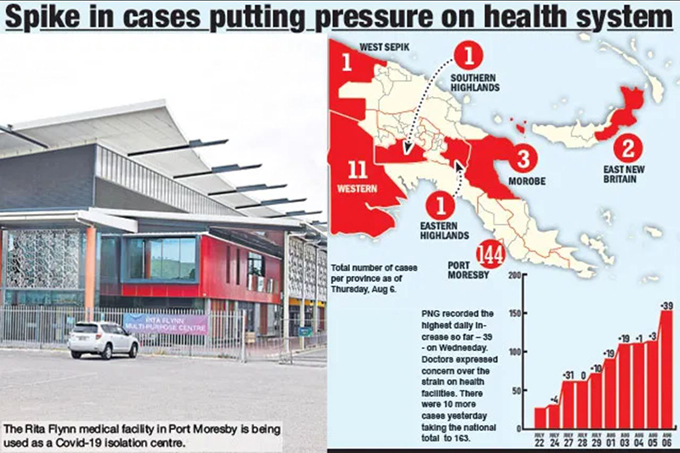
The number of cases in Port Moresby reached 139 on Wednesday (the national total was 163) – with the number of active cases well above 50.
Dr Nou said one of the biggest problems faced at Rita Flynn was sanitation.
The facility has only four toilets for men and four for women.
Room for up to 100 people He said the facility might have to isolate up to 100 people at any one time.
There is an option of using the Taurama Aquatic Indoor Centre and hospitals as isolation centres.
“If we don’t isolate (positive cases), we are letting the infection spread in the community,” Dr Nou said.
One plan was to have mild cases isolated in a bigger facility, moderate cases isolated at Rita Flynn, and the critically sick isolated at the Port Moresby General Hospital or in an intensive care unit facility.
The trend globally is that 85 percent of the cases are mild and asymptomatic, and 15 per cent require some form of medical care, with 5 per cent of those requiring critical to high dependency care.
“Say we have 1000 positive cases, 15 per cent of that (150) will need oxygen or some kind of therapy or care, and 5 percent of that will need to go to the Port Moresby General Hospital,” he said.
“Even 1000 cases is too much.
‘Flatten the curve’ “That’s why we keep telling people to flatten the curve by washing hands, wearing mask and maintain social distancing.
“It is about slowing the spread so that we don’t have the hospitals overwhelmed. We can manage slowly.
“We need to slow down the spread so that not many people will go to the hospital at the same time.”
He also pointed out that there were also non-coronavirus patients to think about who needed special care.
“If the Intensive Care Unit is full of covid-19 patients, a snakebite patient who also needs ventilation may die because all the ventilators are taken up,” he said.
Meanwhile, acting Health Secretary Dr Paison Dakulala said the surge in cases in Port Moresby, Morobe and other centres was worrying.
He said the capacity of the Rita Flynn facility could be expended but the problem was the lack of sanitation.
Dr Dakulala said work led by the NCD Health Authority to establish swabbing and testing sites in the city was continuing.
Lulu Markis a reporter for The National newspaper in Port Moresby.
Where the 163 covid-19 cases in Papua New Guinea are dispersed across the country. Graphic: The National
Universities and other research organisations in Australia have been hit hard by the COVID-19 pandemic.
In May, a group led by Australia’s Chief Scientist Alan Finkel forecasted severe impacts for our research workforce. These included the loss of the equivalent of up to 21,000 full-time jobs in universities this year, including around 7,000 related to research.
These effects are now becoming very real. Universities and other research institutions are losing income as international students disappear. Several universities have announced they will cut jobs, and plenty more are expected.
Recovering these jobs won’t be quick or easy. There will be lasting impacts on our research sector.
At the same time, however, science and technology are essential to the recovery from this crisis, and to the long-term future of our economy.
In 2019 CSIRO released our Australian National Outlook report, which identified the key areas to drive innovation to secure our future prosperity. It said we need to reinvent our industries to make us more unique and more profitable, or risk falling into slow decline. Little did we know we would already be in recession in 2020.
Future economic growth will depend on the creation of future industries such as advanced manufacturing, hydrogen, space and quantum technologies. Science, including social sciences, will also underpin the delivery of many public sector services, including water management, land management and defence.
Invest now to prepare for the future
Expertise doesn’t grow overnight. Australia’s response to COVID-19 has been led by scientists we invested in decades ago. To face the challenges of the future, we need to invest today in the people who will be the leaders of tomorrow.
Supporting these women is a key to future success: research shows increasing the number of women in leadership positions by just 10% boosts a company’s market value by 6.6%, or an average of A$105 million. Extrapolate that across entire industries and you are going to get some big numbers.
One way forward
The best response to this crisis will vary for different organisations. CSIRO’s approach is to continue working with universities and business to run programs that grow Australia’s future STEM workforce.
Each year, CSIRO recruits around 100 graduates from STEM higher degrees as postdoctoral fellows. In the past 24 months we have recruited 155 of these, of whom just over a third are women.
This year we are making as many positions available as possible, as quickly as we can. We are currently recruiting 50 postdoctoral positions and we plan to advertise another 20 later in the year.
The challenge
Without a thriving science and technology sector, Australia will not generate the innovation that spurs economic growth.
There are many other postgraduate students looking for placements and jobs, as well as the university staff and academics who will potentially be retrenched.
These are highly skilled people and we need them in our workforce. Our challenge is to support them to be taken up in other sectors by organisations looking to boost research and development, or help them create new businesses of their own.
Continued investment in R&D during economic downturn can give industries and businesses a competitive edge.
Research by McKinsey following the 2008 downturn found organisations were reluctant to cut R&D activities, seeing them as a competitive advantage for future growth. Organisations that gained the greatest benefit from R&D expanded their programs.
With all these skilled researchers coming into the market, there is an opportunity for industry to take them on and increase business investment in R&D, which has fallen in recent years and left Australia well below the OECD average.
Either way, instead of letting this amazing workforce disappear, we have an opportunity to help them find a different pathway to impact, one that may also help Australian businesses boost the sophistication of their products at the same time. Lemons to lemonade, as they say.
We need our scientists now more than ever to help us develop the high-value industries that will secure our future jobs and prosperity.
We can’t let our future STEM skills become a casualty of COVID-19, or we will pay for it in decades to come.
You’re rushing and accidentally drop a contact lens on the bathroom floor. Should you:
a) run it under the tap and pop it in?
b) spit on it and do the same?
c) use the cleaning solution your optometrist insists you use?
d) replace it with a new lens?
e) do any of the above. It doesn’t really matter.
Don’t do what champion boxer and rugby league legend Anthony Mundine did in 2007 and go for (b) spit on your lens. He ended up in hospital with a severe eye infection.
If you chose c), it’s true that rubbing your lens with the cleaning solution for 20 seconds will remove some microbes. But you would need to soak the lenses in the solution for a minimum four to six hours to disinfect the lens effectively.
The best answer is d) replace with a new lens.
Running the lens under the tap, option a), risks your lens and eye becoming infected with a microorganism found in tapwater that could lead you to losing your sight.
Of these, we estimate about two to four people a year will need a transplant at the front of their eye to regain vision; about two to five people will need treatment for more than a year.
The condition mostly affects people who wear soft contact lenses, the main type worn in Australia.
Here’s how the condition affects people and their partners (NIHR Moorfields BRC).
We found about one-third of bathroom sinks in greater Sydney contain acanthamoeba. We assume it’s present in other parts of the country but no-one else has studied it so don’t know how common it is elsewhere in Australia.
Acanthamoeba are free-living protozoa (single-celled microorganisms) that feed on bacteria and cells at the front of the eye, the cornea. This leads to inflammation, disorganisation and destruction of the cornea, blocking vision.
The vastmajority of acanthamoeba keratitis occurs in contact lens wearers.
But you can minimise your chance of getting it. Avoid exposing your lenses to water, including running them under the tap, in the shower or while swimming.
In fact, many new packs of contact lenses now carry “no water” warning stickers like the one below.
Another of our studies shows this particular warning sticker can change behaviour. Contact lens wearers who see this sticker are more likely to avoid water. Their contact lens storage cases were also less likely to be contaminated with bacteria, meaning less chance of bacterial infection and less food for acanthamoeba.
You can catch other eye infections too
While acanthamoeba infections are rare, bacterial eye infections are much more common, estimated to affect around four per 10,000 contact lens wearers a year.
About 13% of people whose eyes or contact lenses are infected with bacteria lose substantial vision. That’s equivalent to two lines or more on the vision chart optometrists use.
Most people’s infections improve in two to four weeks by using antibiotic drops.
However, bacterial infections can be severe and fast-acting. The main bacterium responsible for contact lens related infections is pseudomonas, another water-loving microorganism. It can sometimes burrow through the eye surface in hours.
There is no evidence to suggest wearing contact lenses increases your risk of being infected with the virus that causes COVID-19.
So how do I avoid all this?
These evidence-based tips for healthy contact lens wear will help you avoid infections:
wash and dry your hands before handling lenses or touching your eyes
rub, rinse and store contact lenses in fresh disinfecting solution. Topping up old solution with new is an infection risk
clean your storage case with the disinfecting solution and leave to air dry upside down between uses
don’t use water with lenses or cases
avoid wearing your lenses overnight.
How do I know if I have a problem?
If your eyes sting, are red and watery, blurry or are otherwise uncomfortable while wearing your lenses, remove them.
If your symptoms get worse, visit an optometrist. GPs do not usually have equipment with enough magnification to diagnose potentially serious eye infections.
Pseudomonas is resistant to the strongest over-the-counter drops, chloramphenicol. But most optometrists can treat eye infections by prescribing eye drops and can refer you to an ophthalmologist (a specialist eye doctor) if needed.
As part of new research into missing persons in Australia, I have been asking people who return after disappearing what they needed or wanted. Mary, who has gone missing four times in the last few years, responded,
I just wanted someone to ask if I was OK when I came back.
Voices like Mary’s are not often heard, nor are their problems understood, when we talk about the mystery and intrigue of missing persons cases.
Every hour in Australia, 100 police reports are generated about the safety and well-being of a missing person. In the past decade, the rate of reports has increased by 30%, from 30,000 per year to almost 40,000 in 2019.
Nearly all missing persons (97%) return within two weeks, which causes these cases to be seen, by both the public and police, as simple search operations. Viewing missing persons in this way ignores the underlying issues that trigger disappearances, making prevention strategies more difficult to put in place.
As we mark National Missing Persons Week, we must recognise the need for new solutions to address the broader social and emotional factors that cause people to go missing to help stem the tide.
Missing episodes can be triggered by numerous factors: substance abuse, trauma, relationship breakdowns and the need to escape dangerous situations, such as domestic and family violence.
The responsibility for finding missing people usually falls to police and, in some circumstances, emergency search and rescue services. But police are often ill-equipped to handle these cases, especially when it involves searching for people with complex emotional health needs or those at risk of harming themselves.
Police are often the front-line responders in missing persons cases, but may be ill-equipped to help those with mental or emotional health issues.David Mariuz/AAP
These cases can also strain police and community resources. In 2000, each missing person was estimated to cost communities A$2,360 on average in search costs, loss of earnings while family members looked, and health and legal costs.
Our limited research in Australia can be enhanced by looking to other countries like Canada, where more funding has been invested in studying vulnerable population groups at risk of going missing.
This could help police more effectively respond to missing persons cases in partnership with health services.
What do returned missing people say?
Sarah Wayland (author of this piece) has been conducting research asking returned missing people to share their stories. In the last month, she has heard from 50 people who have painted a picture of vulnerability and disconnection that isn’t simply resolved when they return or are found.
A majority (80%) of respondents expressed shame on their return, explaining they didn’t want to be seen by family and friends, as well as those who helped search for them, as “attention seeking”.
Some also expressed frustration and anger at the lack of support services after they were found. As one respondent explained,
There’s no village and when you ask for help, no one is truly there to help, even though they say so.
Most respondents said they went missing primarily due to periods of distress or poor mental health, as well as in response to trauma in their families. Many chose not to tell others they were going to disappear.
Half of the respondents returned home on their own volition, while half were located by police.
Lorna Ferguson and other Canadian researchers have found the vast majority of missing persons are dealing with mentally or emotionally distressing issues — similar to those in the Australian study.
Indigenous people (primarily women) and those struggling with addictions, mental illness or cognitive disabilities are also at a higher risk for going missing, research shows.
Many of these mental and emotional health issues cannot be resolved by simply locating the individual, pointing to the strong need for enhanced strategies involving police and social services working together.
Several Canadian inquiries into missing persons have also noted the lack of international data on the number of people who go missing each year and the affect on police and public health resources. This makes it difficult to develop evidence-based prevention and intervention strategies to address the factors that cause people to disappear.
What can be done differently
1) Change the awareness focus
We need to view missing persons as a public health issue, rather than taking a whole of community approach. UK research has found that to be effective, awareness campaigns on missing persons must be targeted to doctors, mental health workers and emergency departments so they can recognise the signs that lead people to go missing earlier.
2) Enhance partnerships
Police and social workers need to work together to provide wraparound care. In both Australia and Canada, there is currently no routine follow-up care offered by health care professionals to missing people when they come back. Instead, police make referrals on a case-by-case basis depending on the health needs of the individual.
We need more effective partnerships between police and social workers, particularly in hot spots where people are more likely to go missing and when they return, to assist people in getting the help they need.
3) Invest more in research
We need to invest more funding in research on the factors that lead to disappearances, for instance, by conducting interviews with people who have returned. This will help us better understand the underlying triggers for disappearances and lead to more effective policies and services for those at risk of going missing.
Social and public housing is intensely stigmatised in Australia and has been for several decades. Estates in particular are often labelled “ghettos”, framed as places of danger, drugs and vice.
This stigma can lead to discrimination against tenants and can harm their sense of self-worth, as shown in Australia and around the world.
But it’s not just the Pauline Hansons of this world who are responsible for reinforcing stigma.
Stigma is the product of government policies. It also serves government policies, like privatisation and redevelopment. Until we recognise that, we’ll struggle to remove it.
The source of the stigma
Public housing is stigmatised in many different ways, as we discovered when reviewing a decade of policy documents and media coverage.
Racism has also added to the stigma of some estates over the last 50 years, as access for Indigenous people has improved and as non-white migrants have been permitted to immigrate.
Decline and design
Public housing can sometimes stand out due to poor maintenance, particularly in gentrifying areas where private housing is new or renovated.
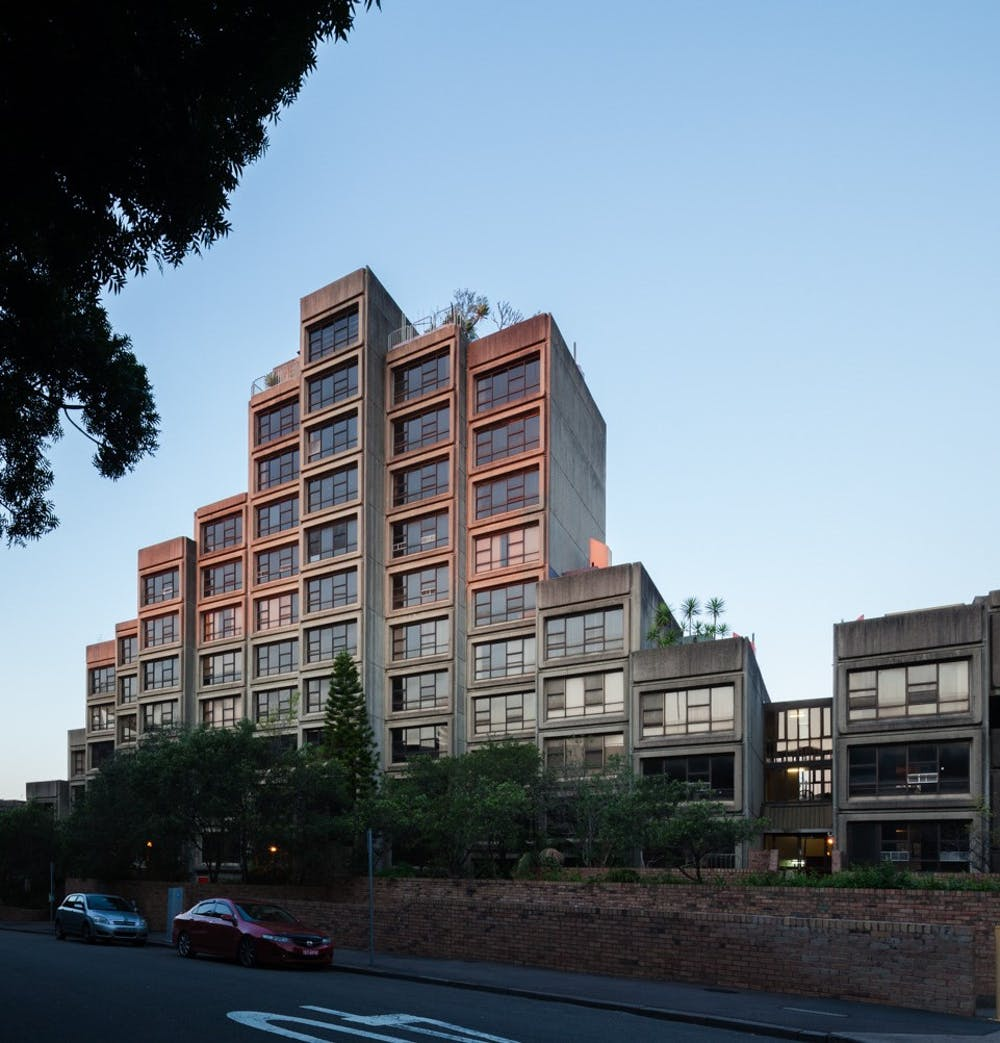
Brutalist towers in inner cities and back-to-front Radburn estates in outer suburbs can also contrast with their wider neighbourhoods.
These stereotypes stem from policies from the mid-1950s to the early 1970s that encouraged public tenants to buy their homes.
But residents who lived in apartments were excluded from such schemes, and cheaply built homes on the urban fringe were less attractive to buy. So these two types of estates became the dominant images of public housing, especially in Sydney and Melbourne.
Poets Corner in Redfern, New South Wales.Alistair Sisson
These policies also reveal how public housing is viewed as inferior to home ownership. Home owners are portrayed as independent and good citizens, despite extensive government subsidies.
The stigmatisation of public housing has been reflected in several recent government policies.
For example, the shared spaces and facilities of the high-rise public housing towers in Flemington and North Melbourne, in Victoria, were used as justifications for the hard lockdown during the coronavirus outbreak. The tenants were represented as an exceptional risk requiring an exceptional response.
Police deployed 500 officers to enforce a lockdown of unprecedented severity, while apartment residents in other hotspots had more freedoms and forewarning.
The relocation and privatisation of public housing in Millers Point, in Sydney, NSW, was another case of governments using stigma to justify policy.
The NSW government claimed residents received huge subsidies compared to other public housing tenants. It argued this money could be used to fund more housing in cheaper places.
But as the Tenants’ Union of NSW pointed out, these subsidies were made to seem larger than they were by including the difference between market rents and tenants’ rents. The subsidies weren’t paid to residents and didn’t reflect the cost of providing housing.
Yet The Daily Telegraph’s Miranda Devine argued tenants living in higher-value areas were responsible for the long waiting list for public housing.
The Sirius building was one of several Millers Point properties privatised by the NSW government between 2014 and 2018.Ben Guthrie/AAP
The break-up of public housing
Stigma has also been used to justify estate renewal. The demolition and redevelopment of estates like Waterloo in Sydney and Carlton in Melbourne, along with many others around the world, has been justified by the argument that tenants’ disadvantage can result from the cultures or environments of estates.
Breaking them up is presented as a solution to disadvantage and anti-social behaviour.
These arguments divert attention away from government failures in reducing poverty. They also mask the economic and financial objectives of redevelopment, which research suggests are the primary drivers.
Meanwhile, the harm to tenants is dismissed as a cost worth paying for new or better housing.
Solutions to stigma
By shifting blame for various problems onto public housing tenants and estates, stigma reinforces the status quo of inadequate funding and thus poor maintenance, dwindling supply and cannibalisation through redevelopment and privatisation.
It also obscures the culpability of governments and the failure of markets to provide affordable housing, adequate incomes and social support.
To destigmatise public housing, fundamental changes in our housing system are needed. Better design, maintenance and stories are helpful, but can only do so much.
Part of the solution is to end the preferential treatment of home ownership and to treat different tenures equally through housing and tax policy. The security, stability, quality and profitability of your home should not depend on whether you own it or rent it from a private landlord or a social one.
One of the many things COVID-19 has had a dramatic impact on is the way many of us work.
Those fortunate enough to be able to work from home have been able to adapt to this new reality – and it certainly has been “new”.
Perhaps the biggest question for both employers and employees is whether working from home has led to a decrease in productivity.
The fact major companies such as Facebook and Twitter have said they will allow many employees to work from home permanently suggests work in some sectors can be done more efficiently outside a formal workplace.
At a minimum, time saved from commuting and greater flexibility to multitask other elements of one’s life are positives from working from home. Lack of social interaction and the inevitable distractions in most home environments are negatives.
The degree and extent of increased productivity from working at home remains to be seen. It will depend on the way in which working in a team has evolved in a remote environment using online tools like Slack and Zoom.
The big question is how the nature of collaboration has changed under COVID.
Studying 3 million people
Thanks to a fascinating analysis by researchers from the Harvard Business School and New York University, we are beginning to get the first systematic evidence on how the nature of work has changed for those working from home during COVID-19.
The authors gathered aggregated meeting and email meta-data for 3,143,270 people working for 21,478 companies in 16 cities in Europe, the United States and Israel where government-mandated lockdowns were imposed in March.
As the authors put it:
These lockdowns established a clear break point after which we could infer that people were working from home. The earliest lockdown in our data occurred on March 8, 2020, in Milan, Italy, and the latest lockdown occurred on March 25, 2020, in Washington, DC.
To explore changes in worker behaviour, their analysis compares meeting and email data during the lockdown periods (typically a month long) with data for the eight weeks prior and the eight weeks after lockdowns ended.
The data they used came from “an information technology services provider that licenses digital communications solutions to organisations around the world”.
This meta-data indicates the actual behaviour of employees in real organisations. So it’s more robust than, say, a survey asking people what they did. Survey respondents might not remember accurately, or might not tell the truth, and those that respond may not be a representative sample.
In short, the meta-data enables the authors to draw detailed and interesting conclusions that survey data would allow.
It’s the detail of a paper like this that is, in a sense, the whole point. But the bottom line is this. Lockdowns have reduced the amount of time most workers spend in meetings, but increased their working hours.
Time in meetings
Their results show the number of meetings attended by workers increased, on average, by 12.9% during lockdown – with the average number of attendees per meeting increasing by 13.5%.
But the average length of meetings fell by 20.1%, with the net effect being that people spent 11.5% less time in meetings.
In European cities such as Brussels, Oslo and Zurich, meeting length declined sharply and continued to fall in the month after the beginning of the lockdown. In the US cities of Chicago, New York and Washington DC, length of meetings declined less.
There was, also, a significant and seemingly durable increase in working hours, based on the number of hours between the first and last email sent or meeting attended by an individual in a day.
On average, the length of the average workday increased by 48.5 minutes.
Longer workdays were common across the 16 cities during lockdowns. When restrictions were lifted, average hours returned closer to pre-lockdown levels in all but three cities – San Jose, Rome and New York City.
The evolving nature of work
It is perhaps too early to draw strong conclusions about these changing patterns of communication. But there are some intriguing possibilities.
Larger meetings may be needed to get “everyone on the same page” and create what economists call “common knowledge”. This may be both easier to do in phone or video conferences, and also more important in the absence of face-to-face communication.
Consistent with this, electronic communications extending beyond normal work hours seems like an inevitable consequence, albeit a negative one for work-life balance, particularly for people with caring responsibilities.
The nature of work was evolving before COVID-19, and it will continue to do so as many parts of the world continue with various forms of physical distancing.
Documenting the nature of that evolution, as well as the implications for productivity, workplace culture, and time outside of work will continue to be informed by remarkable data of the kind the authors analysed.
How did the first person evolve? Mabel, age 7, Anglesea, Victoria.
Hi Mabel, what a great question!
We know humans haven’t always been around. After all, we wouldn’t have survived alongside meat-eating dinosaurs like Tyrannosaurus rex.
How the first person came about – and who their ancestors were (their grandparents, great-grandparents and so on) – is one of the biggest questions archaeologists have. Even today, it puzzles us.
When all living things were tiny
When we think of how humans first came about, we have to first understand that almost every living thing evolved from something else through the process of evolution.
For instance, the first known example of life on Earth dates back more than 3.5 billion years.
This early life would have been in the form of tiny microbes (too small to see with just our eyes) that lived underwater in a very different world to today. At that time, the continents were still forming and there was no oxygen in the air.
Since then, life on Earth has changed incredibly and taken many forms.
In fact, for about a billion years during the middle part of Earth’s history (1.8 billion to 800 million years ago), life on Earth was nothing more than a large layer of slime.
A long, long lineage
All living humans today belong to a species called Homo sapiens.
However, we have a long line of family members called hominins who came before us – including our ancient human relative, the Neanderthal (Homo neanderthalensis).
Homo sapiens are the only hominin alive today.
These two sculptures are imaginings of what a neanderthal man and woman may have looked like. Neanderthals are extinct today but were also hominins.Martin Meissner/AP
Hominins first showed up millions of years ago, and changed in mostly small ways over a long time, through evolution.
Because of this complicated family tree, in answering your question we need to think about what you mean by “person”.
This may seem silly, because we know straight away when we pass someone on the street that they’re a person, rather than a dog or cat.
However, the differences between you and your early ancestor Lucy (more about her below) who lived more than 100,000 generations ago, are much smaller than the differences between a person and a dog. This is why the answer is complicated.
So I’m going to give you two answers and let you decide which you think is right.
You and I are Homo sapiens
The first answer is to assume the first “person” was the first member of our species, Homo sapiens. This person would have been just like you and me, but without an iPhone!
The oldest skeleton discovered of our species Homo sapiens (so far) is from Morocco and is about 300,000 years old.
This ancestor of ours would have lived at the same time as other members of the human family, including Neanderthals and Denisovans. Archaeologists have long argued about what makes us different to these other ancient types of humans.
The answer probably lies in our brains. We think Homo sapiens are the only species that can do things like create art and language – although some recent discoveries suggest Neanderthals were artists too.
It’s hard to know why Homo sapiens survived and the rest of our hominin family didn’t. But there’s a good chance the creativity that led to some wonderful early cave paintings found in France and Indonesia helped us to succeed over the last 100,000 years.
This is a copy of an ancient cave painting from the Lascaux cave in France.Caroline Blumberg/EPA
Old Lucy
Another way to answer your question is by assuming the first “person” was the first hominin to split off from the rest of our extended family, which includes chimpanzees and gorillas.
This species would have looked different to you and me, but still would have walked upright and used tools made of stone. The best example of this is a famous fossil skeleton called Lucy.
What Lucy may have looked like when she was alive more than three million years ago.Jason Kuffer/Flickr, CC BY-NC-NDWe don’t have Lucy’s complete skeleton. Her fossils were found in Ethiopia.Marsha Miller/AP
When Lucy was alive about 3.18 million years ago she was covered in hair. And she was probably about the same height as you are now, even though her bones tell us she was an adult when she died.
Her skeleton was found in Africa, and while we have a lot of it compared to other ancient hominin skeletons, it’s not complete. This makes it hard to work out who the first “person” was.
Most fossils from Lucy’s time are incomplete, and we only have a handful of bones to study from each extinct species.
This is why every new discovery in archaeology is so exciting. Each new fossil gives us a new chance to put the puzzle of our family tree together.
In New South Wales, a resident who tests positive is to be immediately assessed by the facility management, public health and local hospital services to plan the initial response — whether that’s a transfer to hospital or remaining at the home.
Victorian policy is similar. The public health officer responding to an outbreak notification will assess the patient and assist with this decision.
As of the beginning of this week, more than 300 Victorian aged-care residents with COVID-19 had been transferred to hospital. But that leaves a similar number remaining at home.
Certainly no other state is facing the pressure Victoria is to get this response right.
Different states have different policies on whether to move aged-care residents with COVID-19 to hospital.Shutterstock
What can hospitals offer that aged-care homes can’t?
Specialist treatment
COVID-19 is a serious infection with very high death rates among frail older people.
While aged-care homes can provide a degree of nursing and medical care, hospitals are best positioned to provide specialist treatment and the sophisticated interventions many patients will need.
Better infection control measures
Arguably the key reason to move an infected resident to hospital is to stop COVID-19 spreading to other residents and staff. Aged-care settings are not conducive to infection control in the same way hospitals are.
First, they’re not designed like hospitals. As well as not having the same clinical features, many aged-care facilities follow a “boutique” design with common areas for gatherings and events. Residents and staff can easily congregate in these spaces.
The best efforts to isolate a resident with COVID-19 in aged care could easily be compromised. For example, it’s common for residents with dementia to wander in the corridors. Being contained may exacerbate these sort of behaviours among confused and anxious residents.
More highly trained nurses
Staff shortages in aged care were well documented even before the pandemic. A further depleted workforce during COVID-19 — due to staff off work and restrictions on working across multiple facilities — likely means they’re stretched even thinner. Staff may not always have the capacity to supervise isolated residents or follow infection control procedures.
The much higher ratio of highly trained nursing staff in hospitals should ensure better adherence to the guidelines around proper use of personal protective equipment.
For example, registered nurses in aged-care facilities don’t usually provide direct care to residents. Instead they supervise care provided by unregulated staff often with limited infection control training.
The care people receive in aged-care homes relies significantly on staff knowing the residents’ personal and clinical profiles. Aged-care facilities promote person centred care models, which value residents’ rights while striving to create a home-like environment.
Familiar faces who understand residents’ personal preferences may be particularly valuable during a time when residents aren’t able to see their loved ones.
Residents in aged care develop relationships with staff over time.Shutterstock
Introducing a completely new environment during an illness, particularly for residents with dementia, may do more harm than good.
Limited knowledge about the resident could lead to unmet needs while in hospital, which could trigger behaviours that are difficult to manage.
For older adults with dementia, the likelihood of incidents like falls and infections increases when they’re admitted to hospital.
Importantly, hospitals may not be able to cope with such a large influx of aged-care residents at one time. The rising numbers of COVID-19 cases from the general population, including older adults living in the community, have already put the health system under a lot of stress.
So there’s an argument that if COVID-19 cases can be managed within the aged-care home, they should be, to avert pressure from the hospital system.
Worryingly though, we’ve seen reports of the health department denying requests for aged-care residents with COVID-19 to be transferred to hospital.
Respecting autonomy and the right for care
On balance, as much as possible, it’s probably be better to transfer residents to hospital as soon as they test positive to COVID-19. This offers the best chance of preventing widespread infection among other residents and staff, and disease spread from the home into the community.
But we must also respect residents’ autonomy. They might have requested not to be transferred to hospital, even if their illness is life-threatening, by way of an advanced care directive. This might still be their wish, or the preference of their relatives and decision-makers.
Conversely, residents or their surrogate decision-makers might request hospital care, even when care is possible within the home. Again, we argue this is their right.
We should also allow people to change their minds, as these decisions may have been agreed upon before the pandemic.
, New Zealand will mark 100 days without community transmission of COVID-19.
From the first known case imported into New Zealand on February 26 to the last case of community transmission detected on May 1, elimination took 65 days.
New Zealand relied on three types of measures to get rid of the virus:
ongoing border controls to stop COVID-19 from entering the country
a lockdown and physical distancing to stop community transmission
case-based controls using testing, contact tracing and quarantine.
Collectively, these measures have achieved low case numbers and deaths compared with high-income countries in Europe and North America that pursued a suppression strategy.
New Zealand is one of a small number of jurisdictions – including mainland China, Hong Kong, Taiwan, South Korea, Vietnam, Mongolia, Australia and Fiji – pursuing COVID-19 containment or elimination. Most have had new outbreaks. The exceptions are Taiwan, Fiji and New Zealand.
Australia adopted very similar responses to the pandemic and it is important to note that most states and territories are in the same position as New Zealand. But Victoria and, to a lesser extent, New South Wales are seeing a significant resurgence.
The key difference is that New Zealand committed relatively early to a clearly articulated elimination strategy and pursued it aggressively. An intense lockdown proved highly effective at rapidly extinguishing the virus.
This difference can be seen graphically in this stringency index published by Oxford University’s Our World in Data.
There are key lessons from New Zealand’s COVID-19 experience.
A vigorous, decisive response to the pandemic was highly effective at minimising cases and deaths. New Zealand has the lowest COVID-19 death rate in the OECD.
Total all-cause deaths also dropped during the lockdown. This observation suggests it did not have severe negative effects on health, although it will almost certainly have some negative long-term effects.
Elimination of the virus appears to have allowed New Zealand to return to near-normal operation fairly rapidly, minimised economic damage compared with Australia. But the economic impact is likely to keep playing out over the coming months.
Getting through the pandemic
We have gained a much better understanding of COVID-19 over the past eight months. Without effective control measures, it is likely to continue to spread globally for many months to years, ultimately infecting billions and killing millions. The proportion of infected people who die appears to be slightly below 1%.
The infection can cause serious long-term consequences for some people. The largest uncertainties involve immunity to this virus, whether it can develop from exposure to infection or vaccines, and if it is long-lasting. The potential for treatment with antivirals and other therapeutics is also still uncertain.
This knowledge reinforces the huge benefits of sustaining elimination. We know that if New Zealand were to experience widespread COVID-19 transmission, the impact on Māori and Pasifika populations could be catastrophic.
We have previously described critical measures to get us through this period, including the use of fabric face masks, improving contact tracing with suitable digital tools, applying a science-based approach to border management, and the need for a dedicated national public health agency.
Maintaining elimination depends on adopting a highly strategic approach to risk management. This approach involves choosing an optimal mix of interventions and using resources in the most efficient way to keep the risk of COVID-19 outbreaks at a consistently low level. Several measures can contribute to this goal over the next few months, while also allowing incremental increases in international travel:
resurgence planning for a border-control failure and outbreaks of various sizes, with state-of-the-art contact tracing and an upgraded alert level system
conducting exercises and simulations to test outbreak management procedures, possibly including “mass masking days” to engage the public in the response
carefully exploring processes to allow quarantine-free travel between jurisdictions free of COVID-19, notably various Pacific Islands, Tasmania and Taiwan (which may require digital tracking of arriving travellers for the first few weeks)
planning for carefully managed inbound travel by key long-term visitor groups such as tertiary students who would generally still need managed quarantine.
Building back better
New Zealand cannot change the reality of the global COVID-19 pandemic. But it can leverage possible benefits.
We also need to establish a specialised national public health agency to manage serious threats to public health and provide critical mass to advance public health generally. Such an agency appears to have been a key factor in the success of Taiwan, which avoided a costly lockdown entirely.
Business as usual should not be an option for the recovery phase. A recent Massey University survey suggests seven out of ten New Zealanders support a green recovery approach.
New Zealand’s elimination of COVID-19 has drawn attention worldwide. We are about to publish an overview of the approach in the New England Journal of Medicine. We support a rejuvenated World Health Organization that could roll out an elimination model in other countries where there is public support for this approach.
Coronavirus lockdowns have led to a massive reduction in global emissions, but there’s one area where energy usage is up – way up – during the pandemic: internet traffic.
Estimates can be notoriously difficult and depend on the electricity source, but six hours of streaming video may be the equivalent of burning one litre of petrol, due to emissions from the electricity used to power the data centres which deliver the video.
In fact, the energy associated with the global IT sector – from powering internet servers to charging smartphones – is estimated to have the same carbon footprint as the aviation industry’s fuel emissions (before planes were grounded).
But Australia is a global leader in research to lower the energy used in IT, which is vital for meeting the streaming demand without the environmental cost.
Where does the data come from?
Video requires huge amounts of data, and accounts for around 80% of the data transmitted on the internet. Much of the energy needed for streaming services is consumed by data centres, which deliver data to your computer or device. Increasingly housed in vast factory-sized buildings, these servers store, process and distribute internet traffic.
Data centres, in factory-sized buildings, send data to your device.Shutterstock
Research in 2015 found data centres may consume as much as 13% of the world’s electricity by 2030, accounting for about 6% of global carbon dioxide emissions. And the European Commission-funded Eureca project found data centres in EU countries consumed 25% more energy in 2017 compared with 2014.
Imagine what those figures will look like at the end of this year of home-bound internet use.
The growth in IT is often taken for granted. In contrast to the old days of dial-up internet, we now demand a three-hour movie, in high definition, to download immediately. We want phones that can take video like a pro.
None of this is free. Nor is it sustainable. Every year the number of computations, or transmission of information through space, done globally, increases by 60%, according to 2011 research.
All this computation uses “transistors”. These are tiny switches that amplify electrical signals, and are made using silicon-based technology.
For the past 40 years, our ever-increasing need for more computing was largely satisfied by incremental improvements in silicon-based computing technology – ever-smaller, ever-faster, ever-more efficient chips. We refer to this constant shrinking of silicon components as “Moore’s law”.
Pointing to the processor chip at the heart of an iPhone 6S, which came out in 2015. This chip measures 12mm by 15mm and contains over 2 billion transistors. At this point, the transistors were 19 nanometres.Errol Hunt, Author provided
For example, since the late 1970s the length of transistors reduces by about 30%, and the area by about 50%, every two years. This shrinks the energy used in switching on and off each transistor by about 50%, which is better for the environment.
While each transistor uses only a tiny amount of energy, there are billions of transistors in a typical computer chip, each switching billions of time per second. This can add up to a vast amount of energy.
We need better chips
Recently it has become much harder (and much more expensive) to pursue such trends, and the number of companies pursuing smaller components is dropping off rapidly.
Globally, four companies manufactured chips with 14 nanometre (nm) transistors in 2014, but in recent years they’ve struggled to continue shrinking the size of silicon transistors. Global Foundries dropped out of this race altogether in 2018, and Intel experienced enormous problems with manufacturing at 10 nm. That leaves only two companies (Samsung and TSMC) making 7 nm transistors today.
So the answer isn’t to switch off Netflix. The answer is to create better computer chips.
But we’ve got everything we can out of silicon, so we need to use something else. If we want computing to continue to grow, we need new, energy-efficient computers.
Australia is a leader in low-energy solutions
Australia is leading the world in this new field to replace conventional electronics. The ARC Centre of Excellence in Future Low-Energy Electronics Technologies (FLEET) was established in 2017 to address exactly this challenge.
Michael Fuhrer explains topological materials and why they might change the world.
Last year scientists at FLEET published research in Nature revealing the discovery that the “topological” material sodium-bismuthide could be the key to achieving ultra-low energy electronics.
These so-called topological insulators, which led to a 2016 Nobel Prize in Physics, conduct electricity only along their edges, and in one direction, without loss of energy due to resistance.
This discovery is a first step towards the development of a low-energy replacement for conventional silicon-based electronics.
Other top research centres in Australia are addressing different parts of this challenge. For example, one centre is working to reduce the energy used in ubiquitous communication of digital data. Another two are taking a different tack, developing an entirely new quantum technology for computing which promises to enormously speed up, and improve the efficiency of, certain difficult computing tasks.
Quantum computing expert Michelle Simmons explains why this research is so important.
Other countries are equally focused on developing alternatives to the unsustainable need for better and faster electronics, since we cannot sustain the energy needed for these existing and future technologies.
All of these technologies are still confined to specialised laboratories and are probably at least a decade away from finding their way into everyday devices. But we don’t expect the demand for computing to go away, and the energy problem in IT will only become more urgent.
The federal government’s proposed increase in the cost of studying humanities and communications degrees at Australian universities has stirred much debate. One aspect that should not be overlooked is that these changes will disproportionately affect women.
Under the proposed changes, student contributions for social science, communications and humanities (not including English and psychology) will increase by A$7,696 per year. That’s double their current cost.
The government’s proposal has already been described as social engineering, given the government’s declared aim is to boost numbers of graduates in areas of expected employment growth, including teaching, nursing, agriculture, STEM and IT. The intention of lowering fees in these areas appears to be to attract more students to study these disciplines in preference to humanities.
If the idea is to encourage students to leave the humanities and study science instead, it’s a flawed approach. It would take a lot more than simply changing the cost of study to attract women to the field.
Women remain underrepresented at only 27% of the STEM workforce across all sectors, despite a range of initiatives designed to improve the balance.
Increasing the costs of the humanities, then, might not push people into STEM or into areas such as nursing or education. But it might push them away from studying the humanities, and away from the vital work they do in a range of industries.
According to the federal government’s 2019 Graduate Outcomes Survey, 64.2% of humanities graduates were in a full-time position six months out from graduation. Many were employed in positions in public administration, education, business, health and science and technology – the very industries the proposed changes target. In these roles, they draw on skill sets acquired in their humanities degrees; skills that are remarkably similar to those Industry 4.0 capabilities employers are crying out for.
Raising costs of studies in the humanities means these disciplines will shore up an effective reduction in government funding. In the longer term, women will bear the costs of this “saving”.
The reality is that humanities and social science disciplines attract more students than any other subject areas – the majority of whom are women. Women have consistently represented the bulk of enrolments in humanities and social science disciplines over the past ten years. In 2018, they accounted for two-thirds of enrolled students.
Consequently, under the government’s proposal, many women will pay more for their tuition and yet they are likely to earn less than men.
Gender roles continue to have an impact on the career trajectories and earning potential of women in Australia. Even though this gender pay gap is narrowing, primary child-caring roles and responsibilities — including taking time away from work, working part-time or leaving the workforce completely — are mainly assumed by, and expected of, women.
As a result, female university graduates earn, on average, 27% less than men over their careers. This means women take longer to pay off their student debt.
The Australian university debt scheme is often praised because it doesn’t incur interest rates or have a timeline for repayment. However, the tangible effects of a larger debt mean women humanities graduates will be in debt for longer. They will have less disposable income for longer. And they will have limited capacity to invest money, and so expand income, for longer.
The argument that programs that traditionally attract more women – such as nursing and education – will be made cheaper, and therefore more accessible, doesn’t stack up either. Because there are more women in humanities-based degrees than other programs, the proposed changes still mean women will bear the brunt of these increases. Or be forced out of higher education if their calling isn’t teaching or nursing.
Making higher education unaffordable for women just adds to a raft of conditions that already ensure inequalities.
Social and public housing is intensely stigmatised in Australia and has been for several decades. Estates in particular are often labelled “ghettos”, framed as places of danger, drugs and vice.
This stigma can lead to discrimination against tenants and can harm their sense of self-worth, as shown in Australia and around the world.
But it’s not just the Pauline Hansons of this world who are responsible for reinforcing stigma.
Stigma is the product of government policies. It also serves government policies, like privatisation and redevelopment. Until we recognise that, we’ll struggle to remove it.
The source of the stigma
Public housing is stigmatised in many different ways, as we discovered when reviewing a decade of policy documents and media coverage.
Racism has also added to the stigma of some estates over the last 50 years, as access for Indigenous people has improved and as non-white migrants have been permitted to immigrate.
Decline and design
Public housing can sometimes stand out due to poor maintenance, particularly in gentrifying areas where private housing is new or renovated.
Brutalist towers in inner cities and back-to-front Radburn estates in outer suburbs can also contrast with their wider neighbourhoods.
These stereotypes stem from policies from the mid-1950s to the early 1970s that encouraged public tenants to buy their homes.
But residents who lived in apartments were excluded from such schemes, and cheaply built homes on the urban fringe were less attractive to buy. So these two types of estates became the dominant images of public housing, especially in Sydney and Melbourne.
Poets Corner in Redfern, New South Wales.Alistair Sisson
These policies also reveal how public housing is viewed as inferior to home ownership. Home owners are portrayed as independent and good citizens, despite extensive government subsidies.
The stigmatisation of public housing has been reflected in several recent government policies.
For example, the shared spaces and facilities of the high-rise public housing towers in Flemington and North Melbourne, in Victoria, were used as justifications for the hard lockdown during the coronavirus outbreak. The tenants were represented as an exceptional risk requiring an exceptional response.
Police deployed 500 officers to enforce a lockdown of unprecedented severity, while apartment residents in other hotspots had more freedoms and forewarning.
The relocation and privatisation of public housing in Millers Point, in Sydney, NSW, was another case of governments using stigma to justify policy.
The NSW government claimed residents received huge subsidies compared to other public housing tenants. It argued this money could be used to fund more housing in cheaper places.
But as the Tenants’ Union of NSW pointed out, these subsidies were made to seem larger than they were by including the difference between market rents and tenants’ rents. The subsidies weren’t paid to residents and didn’t reflect the cost of providing housing.
Yet The Daily Telegraph’s Miranda Devine argued tenants living in higher-value areas were responsible for the long waiting list for public housing.
The Sirius building was one of several Millers Point properties privatised by the NSW government between 2014 and 2018.Ben Guthrie/AAP
The break-up of public housing
Stigma has also been used to justify estate renewal. The demolition and redevelopment of estates like Waterloo in Sydney and Carlton in Melbourne, along with many others around the world, has been justified by the argument that tenants’ disadvantage can result from the cultures or environments of estates.
Breaking them up is presented as a solution to disadvantage and anti-social behaviour.
These arguments divert attention away from government failures in reducing poverty. They also mask the economic and financial objectives of redevelopment, which research suggests are the primary drivers.
Meanwhile, the harm to tenants is dismissed as a cost worth paying for new or better housing.
Solutions to stigma
By shifting blame for various problems onto public housing tenants and estates, stigma reinforces the status quo of inadequate funding and thus poor maintenance, dwindling supply and cannibalisation through redevelopment and privatisation.
It also obscures the culpability of governments and the failure of markets to provide affordable housing, adequate incomes and social support.
To destigmatise public housing, fundamental changes in our housing system are needed. Better design, maintenance and stories are helpful, but can only do so much.
Part of the solution is to end the preferential treatment of home ownership and to treat different tenures equally through housing and tax policy. The security, stability, quality and profitability of your home should not depend on whether you own it or rent it from a private landlord or a social one.
One of the many things COVID-19 has had a dramatic impact on is the way many of us work.
Those fortunate enough to be able to work from home have been able to adapt to this new reality – and it certainly has been “new”.
Perhaps the biggest question for both employers and employees is whether working from home has led to a decrease in productivity.
The fact major companies such as Facebook and Twitter have said they will allow many employees to work from home permanently suggests work in some sectors can be done more efficiently outside a formal workplace.
At a minimum, time saved from commuting and greater flexibility to multitask other elements of one’s life are positives from working from home. Lack of social interaction and the inevitable distractions in most home environments are negatives.
The degree and extent of increased productivity from working at home remains to be seen. It will depend on the way in which working in a team has evolved in a remote environment using online tools like Slack and Zoom.
The big question is how the nature of collaboration has changed under COVID.
Studying 3 million people
Thanks to a fascinating analysis by researchers from the Harvard Business School and New York University, we are beginning to get the first systematic evidence on how the nature of work has changed for those working from home during COVID-19.
The authors gathered aggregated meeting and email meta-data for 3,143,270 people working for 21,478 companies in 16 cities in Europe, the United States and Israel where government-mandated lockdowns were imposed in March.
As the authors put it:
These lockdowns established a clear break point after which we could infer that people were working from home. The earliest lockdown in our data occurred on March 8, 2020, in Milan, Italy, and the latest lockdown occurred on March 25, 2020, in Washington, DC.
To explore changes in worker behaviour, their analysis compares meeting and email data during the lockdown periods (typically a month long) with data for the eight weeks prior and the eight weeks after lockdowns ended.
The data they used came from “an information technology services provider that licenses digital communications solutions to organisations around the world”.
This meta-data indicates the actual behaviour of employees in real organisations. So it’s more robust than, say, a survey asking people what they did. Survey respondents might not remember accurately, or might not tell the truth, and those that respond may not be a representative sample.
In short, the meta-data enables the authors to draw detailed and interesting conclusions that survey data would allow.
It’s the detail of a paper like this that is, in a sense, the whole point. But the bottom line is this. Lockdowns have reduced the amount of time most workers spend in meetings, but increased their working hours.
Time in meetings
Their results show the number of meetings attended by workers increased, on average, by 12.9% during lockdown – with the average number of attendees per meeting increasing by 13.5%.
But the average length of meetings fell by 20.1%, with the net effect being that people spent 11.5% less time in meetings.
In European cities such as Brussels, Oslo and Zurich, meeting length declined sharply and continued to fall in the month after the beginning of the lockdown. In the US cities of Chicago, New York and Washington DC, length of meetings declined less.
There was, also, a significant and seemingly durable increase in working hours, based on the number of hours between the first and last email sent or meeting attended by an individual in a day.
On average, the length of the average workday increased by 48.5 minutes.
Longer workdays were common across the 16 cities during lockdowns. When restrictions were lifted, average hours returned closer to pre-lockdown levels in all but three cities – San Jose, Rome and New York City.
The evolving nature of work
It is perhaps too early to draw strong conclusions about these changing patterns of communication. But there are some intriguing possibilities.
Larger meetings may be needed to get “everyone on the same page” and create what economists call “common knowledge”. This may be both easier to do in phone or video conferences, and also more important in the absence of face-to-face communication.
Consistent with this, electronic communications extending beyond normal work hours seems like an inevitable consequence, albeit a negative one for work-life balance, particularly for people with caring responsibilities.
The nature of work was evolving before COVID-19, and it will continue to do so as many parts of the world continue with various forms of physical distancing.
Documenting the nature of that evolution, as well as the implications for productivity, workplace culture, and time outside of work will continue to be informed by remarkable data of the kind the authors analysed.
A big part of the Morrison government’s response to COVID-19 has been allowing people early access to their superannuation.
Australians who have claimed hardship have applied for A$30.7 billion to date.
This has been happening in an environment in which compulsory super contributions are set to climb from 9.5% of wages to 12% over the next five years starting in July next year.
Many in the super industry and former prime minister Paul Keating argue that these scheduled increases have to go ahead in order to repair the damage done to the super balances of Australians who withdrew super.
However, new Grattan Institute modelling shows most Australians will have a comfortable retirement even if they have spent some of their super early.
Withdrawals cost less than you might think
Under the government’s scheme, people who have lost their job or had their hours cut or trading income cut by 20% or more were allowed to withdraw up to $10,000 from their super between April and June, and up to another $10,000 between July and December.
More than 500,000 have cleared out their super accounts entirely. Treasury expects total withdrawals to reach $42 billion.
Retirement incomes will fall for workers who withdraw their super, but not by as much as might be thought.
The pension means test means that the government, via higher pension payments, makes up much of what’s lost.
The result is that a typical (median income) 35 year old who takes the full $20,000 would see their retirement balance fall by around $58,000 but would see their actual income over retirement would fall by only $24,000.
Put another way, in retirement that worker would earn 88% of their pre-retirement income instead of 89%.
Both are well above the 70% post-tax replacement benchmark used by the Organisation for Economic Cooperation and Development and the Mercer Global Pension Index to determine how much is needed in retirement.
Workers on median incomes who withdraw the full $20,000 will remain well above that benchmark, even with compulsory super contributions staying where they are, at 9.5% of salary.
The very highest and very lowest income earners will receive less extra pension to compensate, and will have less of a cushion.
For most, 9.5% will remain enough
Defaults such as compulsory contributions have to be set so they work for most of the population.
While around one in five Australians have accessed their super early, four in five have not. Policy makers can only justify forcibly lowering someone’s living standards during their working life – by lifting compulsory super – if they are protecting that person from an even worse outcome in retirement.
Our modelling shows workers on all but the highest incomes will retire on incomes at least 70% of their pre-retirement post-tax earnings, the so-called replacement standard.
The graph shows that many low-income workers will receive a pay rise when they retire, even if they withdraw the full $20,000 from super.
Of course, some low-income Australians remain at risk of poverty in retirement – especially those who rent. They struggle even more before they retire.
Boosting rent assistance would do far more to help them than would higher compulsory super contributions, and would do less to make them poor while working.
COVID is another reason to keep super where it is
Before COVID-19, there were good reasons to abandon the planned increases in compulsory super; among them that it would do little to boost the retirement incomes of many Australians, that it would drain government tax revenues and widen the gender gap in retirement incomes.
COVID provides another reason. Previous Grattan work has shown that higher super comes at the expense of future wage increases. It’s a conclusion the Reserve Bank has also reached.
Increasing compulsory super contributions in the midst of a deep recession would slow the pace of recovery. And that would be bad news for all Australians, regardless of how much we end up with in super.
For a long time, the answer has been yes. When Saturday Night Live, John Oliver and the satirical establishment railed at him, the president’s supporters were only strengthened in their belief there was a highbrow plot against their guy. Trump met anger with anger, and the effect of satire on public opinion played out to a very noisy draw.
Now, however, three months out from the election in this most bizarre of years, the wheels may be falling off the Trump bandwagon. And satirists like Sarah Cooper, with her brilliantly economical lip-synching of the president’s speeches, seem to be adding to the Trump campaign’s problems in politically effective ways.
Satire might be biting back, at least to the extent of nipping at Trump’s heels, while The Virus and his response to it are breaking his image as a strong leader.
Those of us who enjoy satires like to imagine that the good ones (that is, the ones that make us laugh) change minds and form public opinion. This silver bullet effect, though possible, is extremely rare, as the long experiment in combative public rhetoric called the Trump presidency has demonstrated.
Sarah Cooper lip-synchs Trump live during his Fourth of July speech this year.
The case for yes (satire is broken)
Satire makes us laugh, so we conflate it with comedy, which also makes us laugh. However, the laughter of satire is essentially “laughing at”, rather than the “laughing with” of benign and joyous comedy. It is more critical and appeals to harsher emotions in the audience. To be specific about the satirical element of cartoons, essays, sketches, and the rest – it mobilises the emotions labelled by psychologists “the CAD triad” of contempt, anger, and disgust.
Satirists dream that the objects of their critique will shrivel under the coruscating force of their truth. This seldom happens, and never with experienced public figures. Mostly politicians ignore the satire or try to laugh it off, giving the real or fake impression they are good sports. Mostly their supporters ignore or reject it. Meanwhile, those already disposed to agree with the satire go along for the emotional ride. They vent their anger, contempt, or disgust on the person or behaviour of the target, and political life in countries with free-ish media rumbles on.
John Clarke and Bryan Dawe fed the discontent of the discontented through seven prime ministerships over nearly 30 years. The format didn’t tire because a public appetite for satire at the expense of the powerful is ever present.
It is an important part of the ecology of liberal democracies when they are functioning well, and a more urgent one in times of malfunction. It cheers us up and does something to keep the bastards honest.
So it’s no surprise Donald Trump didn’t resign in early 2017 after John Oliver or Saturday Night Live exposed some policy flaws to ridicule. It is, however, a surprise that the massed forces of the satirical industrial complex haven’t managed to strip much paint from him or his supporters over the years.
The public shaming mechanism implicit in political satire has been singularly ineffective in moving public opinion on his presidency, and here are two reasons why.
First, Trump is shameless – he refuses the shaming mechanism that is part of satire’s deal utterly. Normal politicians (excluding those in authoritarian regimes} at least pretend to be able to take a joke at their own expense. They buy originals of cartoons, submit to comedians at press gallery dinners, and arrange their faces in a rictus loosely signifying amusement when caught on the back foot by a member of the public.
Trump refuses all this. He hasn’t attended a White House Correspondents’ Dinner as president, and he fires back with anger and disgust whenever ridiculed. He doesn’t soak up or process the hostile emotions of satire. He returns them with exaggerated force.
President Obama laughs conspicuously at the White House Correspondents’ Association dinner in April 2016.Susan Walsh/AP
Second, his supporters seem to mirror this reaction. The anger and disgust satirists seek to vent on the president, Trump supporters vent straight back on the attackers in “the elites”. The public emotions are amplified rather than diffused. Division increases, and in the favourite verb of the culture wars, opinion is weaponised.
This theatre of anger and disgust has largely worked for Trump. It has distracted his opponents and energised his supporters. The polls suggest the numbers for and against him have been very stable, and until recently, he has stayed within striking distance of a second term.
The case for no (satire may be rising again)
Things may be changing at the moment, for many reasons. A gap has opened between Trump and Biden in the polling and, if satire has anything to do with it, the key emotion is contempt.
Trump has revelled in the energetic emotions of anger and disgust, but his image as a strong leader capable of “making America great again” can bear very little of the cold detachment that characterises contempt. Australian journalist Jonathan Swan’s facial expressions and follow-up questions in his celebrated Axios interview with the president this week reflect low-voltage disdain rather than more combative emotions.
That approach kept Swan in the room and civilly engaged while his interviewee hung himself out to dry, appearing bumbling and unconvincing rather than a channel for the anger of the dispossessed.
It had all the withering satire of an ABC sketch featuring comedic duo John Clarke and Bryan Dawe […] Except this wasn’t satire at all, but a serious political interview with US President Donald Trump merely 91 days from one of the most consequential elections in US history.
Cartoonists and sketch comedians are fastening onto things like the cool, hard separations from the Trump circus by Generals Mattis and Milley. This mobilisation of contempt may really shift a few votes. In a democracy, especially such a divided one as the US, voting intention only has to move a couple of points to be decisive.
It’s true satire is seldom influential in elections. Very occasionally it can contribute to a wave of anger that wipes someone out, as perhaps happened to Jacob Zuma in South Africa, and may yet happen to Boris Johnson in the UK.
Contempt is, however, a risk for a once-strong leader who has been weakened by events. It can act as a solvent on the uncommitted, whereas anger and disgust only tend to motivate the committed.
This has happened once in Australia, not so long ago. In her brilliant Quarterly Essay on the electoral demise of John Howard, Judith Brett argued he was gone the moment the Chaser team infiltrated the APEC motorcade with an Osama bin Laden lookalike.
This was political satire that was reaching far beyond the usual suspects on the liberal left, and in the process turning the government’s national-security credentials into a national joke. When the Chaser motorcade breached the Great Wall of Sydney, Howard’s days as a strong leader were over.
Julian Morrow (right) and Chas Licciardello (left) from the ABC TV show The Chaser’s War On Everything after staging a fake motorcade through Sydney in June 2007 during APEC.
When Howard made people angry or proud with strong borders and the “War on Terror”, he went from strength to strength. When The Chaser and others made him look like old Uncle John wandering the streets in a green and gold tracksuit he lost crucial support.
Something like this might be happening to Donald Trump. As the nation’s death toll from COVID-19 grows, volleys of anger and disgust that tend to confirm audiences more vigorously in their convictions may be turning into a growing trickle of contempt.
In an electorate close to evenly poised, this might sap the conviction of a significant numbers of voters in a sufficient number of states to make a difference.
Sarah Cooper’s lip-synching reproductions of Trump’s speeches don’t shout angrily at the president, or present him as a terrifying menace. A fine-featured and expressive woman of Jamaican origin mouthing some of his less coherent interviews and news conferences just makes him look ridiculous.
She started with a TikTok video called How to Medical that parodies the presidential mansplaining of bleach as a prophylactic for COVID-19 with surgical precision.
It reminds me of John Clarke’s renditions of every Australian politician as himself in his own suit and voice. Cooper keeps her target’s voice (she even credits Trump as a writer) but subverts it with her vivid critical presence. While Clarke used the ethical standards of an older Australia to undermine the media spin of his victims, Cooper calls Trump out from a more modern America.
She incarnates a new turn in the cycle of American self-creation where puffy old men in suits are beginning to seem washed up.
Is this a sign of the tide changing irrevocably against Trump? Maybe not – the number of those who have underestimated his superhuman power to refuse shame is legion. His core support has never been a majority, but it has been incredibly durable.
All the same, too many more clips like Cooper’s or cartoons like this one by Clay Jones about Trump’s photo op with the Bible on June 1, and he’s in trouble. If you have come to think of someone as a dilapidated dill, you tend not to care much, or vote, for him.
Cooper’s parodies, Swan’s interview, and Jones’s cartoon detach viewers from the high emotions that Trump has ridden to defy attempts to shame and ridicule him. The cooler emotion of contempt may yet prove more corrosive.
Source: Council on Hemispheric Affairs – Analysis-Reportage
By Jorge Arreaza Montserrat From Caracas, Venezuela
Elections always have an interesting effect on public policy, in particular if the person in charge of designing and implementing a certain policy is up for reelection. In politics, it is logical that an incumbent candidate decides to show successful policies and accomplishments while minimizing failures or shortcomings. However, what is irrational is that a candidate insists on presenting, preserving and deepening a policy that has proven to be a failure and that the candidate himself only supports half-heartedly. This is the case of the Trump Administration’s current failed policy towards Venezuela, which is being reinforced despite its failure while a more appropriate approach, dialogue, is being discarded.
On January 23, 2019, as John Bolton points out in his controversial memoirs, Trump advisors pushed for the U.S. Administration to recognize as “interim president”, an obscure young politician, Juan Guaidó, who represented Voluntad Popular (Popular Will), the party of Leopoldo López, Washington’s key ally who masterminded the violent protests of 2014 and 2017. Rather than produce a change of government, this action led to Venezuela’s decision to break diplomatic relations with the United States. Guaidó’s recognition has dragged the U.S. Administration, as well as many of its subordinate allies, down a path of failure after failure in their regime change policy. Furthermore, it has also dragged the people of Venezuela through a vicious blockade that has eroded their living standards and seriously jeopardized their well-being.
Over the course of 2019, the Trump Administration imagined that the whole world would dive into a collective state of denial, would stop recognizing the constitutional government of President Nicolás Maduro and would instead recognize Guaidó who in practice does not even exercise control of any institution in Caracas. A month after his self-proclamation, Guaidó, with U.S. support and propaganda, attempted to force the entry of alleged humanitarian aid into the country while hoping that the Armed Forces would at the same time betray president Maduro. They failed. On April 30, Guaidó and López, with the support of their U.S. partners and military defectors, led a failed coup attempt counting on the support of public officials that never came. This prompted Bolton to send desperate tweets and Elliott Abrams to complain because his phone calls were not answered. They failed again.
Today, more than two thirds of the Member States of the United Nations still recognize Venezuela’s legitimate government and it is Trump himself who is having second thoughts on his erratic choice. The year 2020 came, however, with an unforeseen challenge: the COVID-19 pandemic. Trump’s reelection bid was not counting on the dire impact that this pandemic would have on one of the strong points of his campaign, the economy. Even less, could he have imagined the toll this pandemic would have on the entire population: to date, over 150,000 deaths have been officially attributed to COVID-19 and a crisis with over 45 million new persons unemployed is engulfing the United States. Massive protests have taken place all over the nation, since the murder of George Floyd, an African-American man, at the hands of the police. But they are much more than protests over systemic discrimination; they are protests against a system that has abandoned the majority of its poor citizens.
Trump had in his hands a golden opportunity to show leadership, admit the shortcomings of the system and launch an unprecedented process that would redirect the priorities of the nation, cut back on the aggressive militarization of the police and of foreign policy and turn to a robust policy of relief for workers and the strengthening of the healthcare system. Instead, Trump dug himself into a labyrinth where the desperation to win the reelection clouds his thinking and rather than turning to sound domestic policy, he has opted to put the blame on foreign enemies and to divert attention from his catastrophic mishandling of the situation.
First, he placed the blame on China and resorted to a racist, Cold War-like narrative, as if this would do anything to help the suffering U.S. population. By the end of March, as the death toll increased, Trump announced he was stepping up his “maximum pressure” campaign against Venezuela. In less than a week, a man who helped justify the 1989 invasion of Panama and was now heading the Department of Justice, presented indictments against President Maduro and other top leaders of the Bolivarian Revolution for “narco-terrorism”, placing a $15 million bounty on President Maduro’s head, as in the Wild West. Then Trump’s State Department, through the voice of Elliott Abrams (whose involvement in the Iran-Contra scandal and the massacre in El Mozote, El Salvador, is notorious) proposed a “democratic transition framework” built on the principle of delegitimizing the democratic elections of President Maduro in 2018 and offered a negotiation where President Maduro’s separation from office was non-negotiable. Finally, Trump ordered the largest deployment of U.S. military to the Caribbean Sea since the Panama invasion under the pretext of fighting drug trafficking from Venezuela, when the Department of Defense’s records show that the main route for drugs to the U.S. is via the Pacific Ocean, of which Venezuela has no coast.
“Trump would do better if he followed his initial instinct of talking to President Maduro. A respectful dialogue with Venezuela is what is really in the interest of the U.S.” Jorge Arreaza, Foreign Minister of Venezuela
In May, a group of mercenaries attempted a raid on Venezuelan coasts. Two of them were former Green Berets who confessed to having been employed by a U.S. security firm by the name of SilverCorp. The CEO of this firm presented a contract with the signature of Guaidó and his aides to carry out actions in Venezuela aimed at removing President Maduro from office and targeting other revolutionary leaders. This too, failed, and has been followed by attempts at intimidating and effectively blocking Venezuela’s trading partners from bringing much needed supplies, including gasoline, which in a time of pandemic, is key for moving medical supplies, personnel, and food throughout the country.
Venezuela has stood firm against all of these attacks. International solidarity from countries such as Cuba, China, Russia, Iran, and Turkey has been key. Strong measures and an organized and community-conscious population have allowed Venezuela to still be one of the countries with the lowest death toll and active COVID-19 cases in the region. In sharp contrast, while Washington imposes repression on cities such as Portland, which has suffered the deployment of federal police agents, Venezuelans will once again be heading to the polls in December with the hopes of electing a renewed parliament that better reflects the political forces in the country and one whose leadership is not compromised with the promotion of sanctions and blockades against their own country, as is Guaidó.
In the distorted view of reality that Trump and his advisors have of the current conjuncture, there is a belief that hard line, regime change policies against Venezuela would lead to electoral success in Florida and therefore, nationwide. It might well be that some of Trump’s base may like to see a coup in Venezuela, but failure after failure, by now should have indicated that Venezuela is not moving in that direction. To continue attempting clumsy solutions will only repeat past frustrations. A sound policy towards Venezuela has to be in line with the aspirations of the Venezuelan people and with the real interests of the people of the U.S. Venezuelans want peace, dialogue, and politics. Trump would do better if he followed his initial instinct of talking to President Maduro. A respectful dialogue with Venezuela is what is really in the interest of the U.S. electorate. Instead of spending U.S. taxpayer money on failed adventures and made up drug cartels, it could be better spent on dealing with the pandemic and other needs of the U.S. Sound policies are more conducive to reelection. Regime change will only lead to more failure.
Jorge Arreaza is the Foreign Minister of the Bolivarian Republic of Venezuela. This is an exclusive op-ed for the Council on Hemispheric Affairs, (COHA).
[Main photo: Protest against U.S. intervention on Venezuela, in front of the White House, Washington DC. Credit: https://elvertbarnes.com/16March2019)
COVID-19 has now made us two Australias. There’s Victoria – most specifically Melbourne – and then there’s the rest of the country.
Melbourne’s extraordinary lockdown complete with curfew is an act of desperation by Daniel Andrews’ government, as it fights a daily tally of several hundred new cases.
Scott Morrison will remember when he berated the media for using the term “lockdown”. Now he finds himself using it all the time.
Melbourne has become a city where citizens are supervised by police and soldiers. Its economy will be crushed. Regional Victoria’s lockdown is somewhat milder but it will take a big toll.
By contrast, at least in terms of COVID itself, the other seven states and territories are, Scott Morrison said on Thursday, “in a fantastic position”.
Well, sort of. NSW is holding the line, with a few cases that so far thankfully have not morphed into a dangerous spread.
But while we are living as two Australias, we are one country. That means the huge whack the virus is inflicting on Victoria is dragging down the rest of the nation, holding back recovery.
The dire turn of events is affecting political leaders’ responses. Risk averse premiers are running their states as gated communities.
Morrison maintains a level of public solidarity with Andrews but the PM may find himself under mounting pressure from those within his party and its base who want the economy given a much higher priority.
David Kemp, a Liberal cabinet minister in the Howard government and party elder, wrote in the Australian Financial Review this week, “The federal government is making a great mistake if it does not call [the Victorian situation] out. It apparently believes that the priority is to maintain unity in the national cabinet. There is no true unity, and the pretence is inhibiting the national debate …
“This pretence is now dividing the Liberal Party and demoralising its supporters, in Victoria at least. It is also undermining national economic recovery by sanctioning gross policy overreach.”
In early May Morrison released a path out of the COVID restrictions that would have had us in reasonable shape everywhere now. Instead, we might as well hire a fortune teller to predict where we’ll be when.
The way ahead depends on two uncertainties. Will the Victorian lockdown bring COVID-19 under control? And will the virus be stopped from breaking out elsewhere?
The government has produced Treasury’s estimates of the cost of the Victorian stage 4 lockdown.
Previously Treasury said Victoria’s recent stage 3 restrictions would reduce GDP by $3.3 billion (0.75% of a percentage point) in the September quarter. The new restrictions will cut GDP in that quarter by $7-$9 billion, slicing about 1.75 percentage points off quarterly GDP growth.
The combined effect of the Victorian measures through the September quarter will be to contract growth by $10-$12 billion (2.5 percentage points).
Treasury estimates 250,000-400,000 more people will become effectively unemployed (this includes both those losing jobs and those still in jobs but working no hours). It forecasts Australia’s unemployment rate will rise above the previous estimated peak of 9.25% – released only a fortnight ago – and peak nearer to 10%.
Andrews, under intense political pressure and substantial criticism (although opinion is mixed), is sensitive when asked about the cost Victoria is imposing nationally. “There’s costs all over the place whether it be in dollar terms or in funerals,” he said.
“I’m not going to be trying to put a price tag on this. This is what we have to do, we have no choice … otherwise this won’t be six weeks, it will be six months or longer. And we’ll have to continue to bury people, we’ll have to continue to deal with an economy that is essentially closed.”
Andrews is in the ultimate corner. If stage 4 fails, the future becomes too awful to contemplate.
Victoria’s crisis is forcing the federal government into policy gyrations. After announcing a fortnight ago tighter eligibility requirements for JobKeeper post September, now it has announced an easing. The cost of the latest changes in eligibility plus the extra numbers of businesses coming onto the program because of the Victorian situation is $15.6 billion, taking the total cost of JobKeeper to $101 billion.
That Victoria is a “separate” Australia is brought home in the arrangements for parliament’s sitting from August 24.
Morrison was criticised for cancelling the early August sitting. He’s committed to the coming one, not least because the government needs to legislate some pandemic measures.
On the advice of acting Chief Medical Officer Paul Kelly, Victorian MPs going to Canberra must quarantine for 14 days beforehand. That starts from 11:59pm this Sunday.
In a letter to Morrison, Kelly said that in the context of Victoria, the sitting led into uncharted waters. “The situation in Victoria is not improving at this time,” he wrote. Victorian MPs presented “a significant risk” to ACT citizens, particularly those working in parliament house, as well as to parliamentarians and staff from elsewhere, “with the possibility of seeding into other jurisdictions”.
Kelly prefers the politicians quarantine in Canberra, but said this could be done in Victoria. The conditions are strict. While in home quarantine, no one from the household can leave for any reason and no one can visit.
One MP immediately dubbed the household isolation the “hold-the-family-hostage option”.
In practical terms, on the present sitting pattern, Victorians choosing to isolate in Canberra would only be able to return home for about a fortnight between this weekend and when parliament adjourns for the year on December 10.
Labor has been demanding parliament sit. But in a hook up of Victorian Labor members on Thursday, some were reluctant to meet the stringent conditions. As a result Albanese proposed Victorians should be allowed to tune in virtually. They would not be able to vote.
There are other wrinkles. For example, Queensland has banned arrivals from the ACT, so how about federal MPs going home? A Queensland government spokesman says, “Queensland MPs returning from Canberra will have to quarantine. National agreement is being sought on detail.”
Treasurer Josh Frydenberg and Health Minister Greg Hunt intend to quarantine in Canberra. Perhaps they’ll hope the odd curry delivery is ferried from The Lodge.
The Hiroshima devastation 75 years ago today. Image: ICAN
By David Robie
While the globe struggles to cope with the deadly onslaught of the covid-19 pandemic, communicators, historians, journalists and activists have been deploying innovative ways of marking three nuclear-related anniversaries in barely a month.
Over the next few days, the devastating destruction, cruel loss of life and survivors’ stories from the world’s first and only deployment of nuclear weapons are being remembered in Japan and around the world.
The United States dropping of nuclear bombs on Hiroshima 75 years ago on 6 August 1945 and then on Nagasaki three days later left two utterly destroyed cities and more than 215,000 people dead. Thousands more lives were lost in the following years from leukemia, cancer and other diseases caused by the radiation from the weapons.
With the third anniversary, 10 July 1985, although only one life was lost – there could easily have been more – the repercussions for New Zealand and throughout the Pacific have also been shattering.
One outrage was a wartime atrocity, claimed falsely that it was carried out to shorten the Pacific war, and the other was a peacetime atrocity.
The Greenpeace flagship Rainbow Warrior was bombed by French secret agents with the loss of Dutch photojournalist Fernando Pereira. But the anti-nuclear protest that was meant to be silenced continued courageously, and a decade later France was forced to halt nuclear tests at Moruroa atoll with the last detonation in early 1996.
One of the champions of the South Pacific’s nuclear-free and independence campaigners, Oscar Manutahi Temaru, made an inspirational guest appearance last week in a retrospective webinar about the impact of the Rainbow Warrior bombing 35 years on.
It was originally planned as part of an H-France history conference in Auckland but the pandemic forced organisers to go virtual.
Temaru, five times president of French-ruled Polynesia (Ma’ohi Nui) and the mayor of Faa’a, the “nuclear-free” airport suburb on the fringe of the capital of Pape’ete, made some challenging comments.
Four years ago, he told Tagata Pasifika’s John Pulu that a half-century legacy of nuclear tests in Polynesia was to blame for the at times toxic relationship with the coloniser.
“The French government, through its President, General De Gaulle decided to use our country for the French nuclear testing,” Temaru said.
“They came down here with their private enterprises – the French army – and they have dismantled the whole life of this country. They pulled it upside down.”
Temaru knew what to expect, as during the Algerian War of Independence he was in the French navy and he was deployed to the conflict at a time when France was conducting its early nuclear tests in the Sahara Desert.
Early years of devastation
Temaru was later a customs officer in Tahiti and saw at first hand the early years of the devastation of the military machine in Moruroa and Fangataufa atolls in the southern Gambier islands as they became the new host for French nuclear tests.
Temaru’s rallying cry has been to seek independence from France.
With a Cook Islands mother and Tahitian father and having worked on school holidays in freezing works in Auckland, he has long had a strong affinity with the “independent” nations of the Pacific and aspires to Tahiti one day becoming a full member of the Pacific Islands Forum.
Thanks to strong support of several Pacific nations and the Non-Aligned Movement, the UN General Assembly voted on 17 May 2013 to put the country back on the UN list of non-self-governing territories.
Since then he has been a marked man for vindictive elements in the French establishment who see it is payback time.
Oscar Temaru … legal challenges
against France.
Image: Tavini Huiraatira
Oscar Temaru … legal challenges against France. Image: Tavini Huiraatira
In June, he was on a hunger strike over his treatment by the French judiciary. A prosecutor has seized his personal savings of US$100,000, in an act described as illegal by his defence lawyers, in a case which he is being accused of political “undue influence”.
Last week, his Tavini Huiraatira party launched a petition outside the lawcourts of Pape’ete calling for the sovereignty of the Ma’ohi Nui people. The petition, open for a year and expected to be presented to the United Nations and the Pacific Islands Forum, also calls for compensation from France for the damage caused by three decades of nuclear tests.
‘Scandalous’ legal action
One of the two Tahitian politicians in the National Assembly in Paris, Moetai Brotherson, branded the action as “scandalous”, claiming prosecutor Herve Leroy had exceeded his powers.
The judicial controversy is over the local pro-independence station Radio Tefana which the prosecution claim is benefitting his pro-independence party Tavini Huiraata (People’s Servant Party), founded in 1977.
“As a Mangarevian, I see Oscar Temaru as our only voice for indigenous sovereignty and it starts – as he has said so many times – by making the French accountable for what they have done,” says Ena Manuireva, an Auckland-based Tahitian researcher studying the loss of cultural identity among his Mangarevan community, its origin and impact.
“Temaru has has always fought the same fight – we, the local population, must be the masters of our own destiny. The French coloniser needs to leave if they don’t want to give us independence.”
Tahitian researcher Ena Manuireva … “Oscar has always
fought the same fight.”
Image: David Robie/Pacific Media Centre
Manuireva was one of the speakers at the webinar, hosted by Canada’s Simon Fraser University of Vancouver with support by Massey University and the University of Auckland is part of a “France and Beyond” joint conference of the Society for French Historical Studies and George Rudé seminar on French history and civilisation.
A doctoral candidate at Auckland University of Technology (AUT), Manuireva was born in Mangareva (Gambier), the smallest archipelago in Ma’ohi Nui in 1967. He left the island after the first nuclear test on July 2, 1966.
Nuclear panel speakers Key organiser and moderator was Dr Roxanne Panchasi, an associate professor at Simon Fraser University who specialises in 20th and 21st century France and its empire. She is the author of Future Tense: The Culture of Anticipation in France between the Wars and her recent research has focused on French nuclear weapons and testing since 1945.
Also featured on the panel were:
Stephanie Mills, currently director of campaigns at NZEI Te Riu Roa, and Greenpeace’s former Pacific nuclear test ban campaigner; Dr Rebecca Priestley, associate professor at the Centre for Science in Society at Victoria University in Wellington; and me, a Pacific media educator and director of the Pacific Media Centre-Te Amokura at AUT. As a journalist, I was on board the campaign ship and wrote Eyes of Fire: The Last Voyage of the Rainbow Warrior.
Indonesia’s West Papua province has again been recorded as having the worst democracy index in the republic, reports CNN Indonesia.
This year (2019), the West Papuan Democracy Index (IDI) was 57.62, even dropping lower from 2018 when it was 58.29 points.
Based on data from the National Statistics Agency (BPS), West Papua has the lowest score and is in last position – below South-East Sulawesi with a score of 65.21 points.
[Pacific Media Centre editor: West Papua in the Pacific is generally taken to mean the combined mainly Melanesian region of two provinces – Papua and West Papua.]
Following next is Papua province with a score of 62.25 points, North Sumatra with 67.65 points, West Sumatra with 67.69 points, Maluku with 68.22 points, West Java with 69.0 points and Jambi province with 69.76 points.
The BPS Democracy Index categorises the level of democracy as being good, moderate and poor. A Democracy Index score under 60 is classified as a poor democracy while a score of 60-80 represents a moderate democracy and a score above 80 is a good democracy.
Among all 32 provinces in Indonesia, West Papua was the only province with a poor Democracy Index.
BPS head Kecuk Suhariyanto said that there were seven provinces in Indonesia that were categorised as good.
Two provinces improve “In 2018 there were only five provinces, in 2019 there are seven provinces with a category of good. From five there have been two additions making seven, namely Riau Islands and Central Kalimantan provinces,” he said during an online press conference.
Suhariyanto said Jakarta was the top rated province with a score of 88.29 points followed by North Kalimantan Utara with 83.45 points and Riau Islands with 81.64 points.
This is followed by Bali with 81.38 points, Central Kalimantan with 81.16 points, East Nusa Tenggara with 81,02 points and Yogyakarta Special Province with 80,67 points.
Nationally, Indonesia’s Democracy Index rose slightly to 74.92 in 2019. Last year in 2018 it was recorded at 72.39 points. As a whole, Indonesia’s democratic score is still categorised as moderate.
Nevertheless, looking at this in detail there are six indicators which still rated poorly in the index.
Namely threats of or the use of violence by the public which obstructs freedom of expression with a score of 57.35 points followed by the percentage of women elected as members of provincial parliaments (DPRD) with a score of 58.63 points.
This is followed by violent demonstrations or labour strikes with a score of 34.91 points, regional regulations imitated by DPRDs with a score of 46.16 points, DPRD recommendations to the executive with 16.70 points and finally efforts to provide budgetary information by regional government with a score of 53.43 points.
The Democracy Index is assessed based on three main aspects, namely civil freedoms, political rights and democratic institutions. Each of these three aspects has 11 variables and 28 indicators which are used to make an assessment.
Decline in civil freedoms Although there was a 4.92 point increase in political rights and a 4.48 point increase in democratic institutions, there was a 1.26 decline in civil freedoms. The score for civil freedoms based on the IDI for this year stood at 77.20 points.
“The index for civil freedoms in 2019 was 77.20. A slight decline compared with the position in 2018 and its respective category is moderately [democratic]”, said Suhariyanto.
Civil freedoms were assessed using four variables with freedom of assembly and freedom of association scoring 78.03 points, a decline of 4,32 points compared with 2018.
Freedom of expression, which stood at 84.29 points, declined by 1.88 points, freedom of belief scored 83.03 points, rising by 0.17 points compared with 2018 and freedom from discrimination scored 92.35 points, rising by 0.58.
If looked at in detail, there was a step back in the indicators which covered threats of or the use of violence by government agencies which obstruct freedom of expression, assembly and association, and the threat of or use of violence by social organisations related to religious teachings.
Next, actions or statements by government officials which were discriminative in terms of gender, ethnicity or other vulnerable groups and or which restricted the freedom to worship.
Meanwhile improvements were found in the indicators covering the threat of or use of violence by the public which obstructed freedom of expression, assembly and association and or on the grounds of gender, ethnicity or other vulnerable groups.
Discriminatory regulations There were also improvements in written regulations which restrict freedom of worship and religion and or which discriminate against gender, ethnicity or other vulnerable groups.
In the aspect of political rights, two variables were assessed. The breakdown was the right to vote and be elected which scored 79.27 points, rising by 3,5 points, public participation in decision making and government supervision which scored 56.72, rising 2.44 points.
Although this was still categorised as poor.
In terms of democratic institutions, five variables were assessed. The breakdown was free and fair elections which scored 85.75 points, declining by 9.73 points followed by the role of regional parliaments (DPRD) with a score of 61.74, a rise of 2.82 points.
Then the role of the political parties which scored 80.62 points, a decline of 1.48 points followed by the role of regional government bureaucracy which scored 62.58 points, a rise of 6.84 points and the role of an independent judiciary which scored 93.66 points, a rise of 2.94 points.
This abridged translation by James Balowski of IndoLeft News is based on two articles by CNN Indonesia published on August 3. The original title of the first article was “Indeks Demokrasi Papua Barat Paling Buruk, Jakarta Terbaik”. The title of the second article was “Kebebasan Sipil Turun, Indeks Demokrasi Indonesia Naik.”
Lebanon might not meet the accepted definition of a failed state because it retains the trappings of a central government. But an administration corrupted by a patronage system based on the country’s confessional groupings has long failed to deliver basic services to a population of 6.8 million.
Power shortages are a fact of daily life, inflation is rampant, the Lebanese pound has collapsed, unemployment has gone through the roof, crime has sky-rocketed, and food shortages are endemic.
If not a failed state, Lebanon is a failing one.
And it has been failing for a long time.
In essence, Lebanon’s problems are structural and therefore not capable of simple, or even rational, solutions.
A young couple caught up in the explosion in Beirut.Ibrahim Dirani/Dar al Mussawir/EPA/AAP
Under these arrangements, refined over the years, the president would be a Maronite Christian, the prime minister a Sunni Muslim, and the speaker of the National Assembly, or parliament, a Shia Muslim.
Cabinet’s composition would reflect these main confessional strands. So would positions in the military, security apparatus, judiciary and bureaucracy.
Needless to say, haggling over the distribution of the spoils of office has contributed to one of the most corrupt countries on the planet.
Lebanon’s wealth, such as it is, has been looted over the years by officeholders and their cronies to the point where the country is effectively bankrupt.
All this has taken place against the background of a civil war throughout the 1970s and 1980s, and two Israeli invasions, one in 1982, the other in 2006.
Then there is the increasing and disruptive influence of the Iranian-backed Hezbollah, now the dominant political force in the country. Hezbollah’s growing power is one of the reasons Lebanon’s fragile power-sharing arrangements have come under increasing stress.
At the same time, Lebanon has been inundated by Syrians displaced by their homeland’s civil war.
These pressures have pushed the Lebanese administration close to breaking point.
In that context, the port ammonium nitrate explosion could hardly have come at a worse moment for an embattled government. It has been engaged in months of testy negotiations with the International Monetary Fund on a bailout plan.
IMF negotiators have been frustrated by their inability to get Lebanese counterparts to sign on to an emergency relief scheme to enable Lebanon to keep functioning.
Among the sticking points has been agreement on what money has been lost or otherwise misappropriated.
“It has been really difficult. The core of the issue is whether there can be unity of purpose in the country,” the IMF’s managing director, Kristalina Georgieva, told reporters after talks had stalled.
This is an understatement.
Lebanese have been taking to the streets to protest against government corruption and incompetence. Those protests will now be fuelled by greater levels of outrage over the mismanagement by port authorities of highly combustible material that arrived on a Russian ship bound for Madagascar in 2013.
That ship did not continue the voyage. Its cargo was offloaded and placed in a warehouse. Higher authorities ignored repeated warnings from customs officials about the risks of continuing to store the ammonium nitrate.
Tragically, this episode pretty much sums up Lebanon’s central problem: lack of accountability due to a fractured and fragmented administration.
Action is already being taken against officials deemed immediately responsible for overseeing security in the Beirut port. But this is unlikely to assuage anger among the general population over what has taken place.
Lebanon was already on tenterhooks before the explosion.Hassan Ammar/AP/AAP
In the days before the explosion, and separate from it, Lebanon was already on tenterhooks in anticipation of a UN-backed court verdict in the trial of four members of Hezbollah accused of assassinating former prime minister Rafik Hariri.
UN investigations based on phone records identified four alleged culprits, none of whom have been seen in public for years.
Hezbollah has questioned the validity of the UN’s inquiries.
The verdict was due on February 7. It has now been put off to August 18.
If the UN court finds the accused guilty it will add to sectarian tensions.
Questions have been asked in the past about whether Lebanon can survive as a confessional state based on archaic power-sharing arrangements. Those questions may resurface.
In the meantime, the country’s strategic significance, abutting Israel in the south and Syria to its east and north, means it is not in the interests of the wider Arab world, nor the West, to allow it to implode.
The outlook for Lebanon, whose main city was once known as the Paris of the East, is bleak.
If we don’t, this will put Indigenous Australians at even higher risk of illness from a poor diet, worsening existing disadvantage. It will also make closing the significant gap of life expectancy and disease between Indigenous and non-Indigenous Australians even harder to achieve.
These guidelines are based on research from around the world, analysed by a panel of experts. That evidence is then distilled into advice on everything from how many serves of vegetables to eat a day to whether it’s best to drink full-fat or reduced-fat milk.
But these guidelines have not been formulated to take into account Indigenous Australians’ traditional foods or dietary differences. Instead, they reflect the predominant Western culture, and implicitly assume Western dietary advice suits everyone.
One example of how the Australian guidelines fails to address Indigenous people is when recommending dairy products. Before invasion, Indigenous diets in Australia were in stark contrast to Western diets today. Most notablewas the absence of dairy-based foods.
However, the guidelines suggest dairy is an important part of diets. What happens when this is not a traditional part of your diet? A significant percentage of Indigenous people are lactose-intolerant – a fact we’ve known ever since a landmark study in the 1980s. This is not addressed in the guidelines.
The guidelines also fail to consider Indigenous people are more likely to be suffering from a chronic disease such as diabetes, stroke, heart and kidney disease — and therefore need a tailored dietary approach.
For example, traditional Indigenous proteins such as kangaroo, emu and seafood are noticeably lower in fat than introduced proteins such as beef and lamb. This makes traditional foods particularly suitable for Indigenous people with a range of chronic diseases, including diabetes and cardiovascular disease.
The guidelines also assume everyone has access to the types of foods it recommends, particularly fresh food and vegetables. But we know food access and food security are an issue, particularly for remote Indigenous communities.
We’ll hear more about this issue later this year, when the parliamentary inquiry into food pricing and food security in remote Indigenous communities reports its findings.
Indigenous foods are mentioned, but not enough
The guidelines do mention tailored foods for Indigenous peoples, such as the “Aboriginal and Torres Strait Islander Guide to Healthy Eating”, a one-page poster that includes kangaroo, seafood and goanna.
A single poster containing kangaroo, goanna and seafood isn’t enough.NHMRC
But this does not go far enough to address the inequity in these very generalised guidelines. For instance, these foods are only in the protein group.
When looking at the grains and cereals mentioned in the guidelines, foods offered are mostly processed and contain high levels of gluten. Gluten-dense grains such as wheat, barley and rye were not cultivated in Australia before invasion.
Instead, traditional Indigenous diets relied on seasonal fruits and vegetables for dietary fibre.
However, Aboriginal Australians were also one of the first cultures to bake bread. Breads were made without preservatives, from a variety of high-fibre foods such as grass seeds and nuts, as opposed to grain-based crops such as wheat and oats. These traditional foods are not included in the dietary guidelines.
Rather than a “one size fits all” approach, we should support First Nations people to create regionally based dietary guidelines for Indigenous people.
That’s because there is no one consistent Indigenous food source across all Australia. So dietary guidelines need to be tailored to local foods, local conditions and practices, to reflect the diversity of Indigenous people around Australia and their diets.
For example, Davidson plums are found mainly in wet, rainforest terrains, whereas saltbush is found in drier climates.
In the meantime, the lack of cultural applicability in existing dietary guidelines helps put the Indigenous population at higher risk of ill health and early death. That makes Closing the Gap even harder to achieve, whether you’re talking about health, food equity or both.
Review: Paul Kelly: The Man, the Music and Life in Between (Hatchette)
Stuart Coupe’s new biography of Paul Kelly takes many known elements of Kelly’s story and rouses them again. Paul Kelly: The Man, the Music and Life in Between reads the way a Paul Kelly cover version sounds: familiar, but also a bit disorienting.
Old school music fans might go to the liner notes first – in this case the back cover and acknowledgements. Both detail the insights Coupe has drawn from others: hundreds of interviews, including Kelly himself and over 80 people thanked in the acknowledgements.
Hachette
It’s a who’s who of Australian music from the last few decades – Archie Roach, Kasey Chambers, Kev Carmody, Vika and Linda Bull and Neil Finn – but not too many younger voices. Coupe’s emphasis is on how Kelly became, rather than who he is today.
The impressive interview list provides the choir that sings this cover version. Each person adds an extra layer: a solo to recall a key memory of Kelly as a band member, collaborator, business partner.
As Kelly’s former manager, Coupe also chimes in with his own testimony.
Large parts of Kelly’s early career have been lost to time, with records not added to the master log.
Particular casualties are his first two albums with The Dots, Talk (1981) and Manilla (1982). Coupe’s interviews do however explore singles like Billy Baxter and Alive and Well, which have been left out of subsequent Kelly histories, including best of compilations and Kelly’s 2018 autobiography.
As Kelly explains it:
When I gained control of my work in the late nineties I simply chose not to make them available anymore. It wasn’t the fault of the bands on those records. It was me.
Studio recordings of this time are now hard to come by (as Coupe and his colleagues lament), though a few iconic Countdown snippets linger on.
The 1982 Countdown performance of Alive and Well captures the perspectives of some of Coupe’s interviewees. Kelly is working in collaboration, but also keen to draw the spotlight for himself. He is rake thin. Is this youth’s blessed metabolism, or the drug use many remember throughout the book?
The Paul Kelly he became in terms of sound and songwriting is here, but the some of the interviews in Coupe’s book makes the wobble of his head and unsteadiness of his gait hard to ignore.
Look so fine, feel so low
References to Kelly’s use of heroin in the past appear repeatedly in the biography. Fans will be curious to know how drugs influenced Kelly’s actual music, however Coupe doesn’t focus on Kelly’s writing process in this way. Some details are there, but nothing as forensic as Kelly has already offered himself in terms of craft and context. Instead, Coupe focuses on the machinations of the music industry.
As a songwriter, Kelly’s value was seen early. Accounts by Mushroom Records alumni and other associates from the early 1980s, show how his writing talent was privileged despite his unsteady performance style.
Still, Kelly’s songs were so popular so quickly that there was money to be made. Although many of the musicians in the book were left by the wayside as Kelly moved from project to project, his publisher continued to benefit.
However, it would have been nice to see Coupe explore Kelly’s continued association with youth broadcaster Triple J and the newer artists and audiences who find him via contemporary collaborations.
Kelly’s 2016 collaboration with AB Original and Dan Sultan for Triple J’s Like A Version remains as much a step up for Kelly as it does for the younger musicians.
A reworking of Dumb Things, Kelly’s anthem (and his art) is sampled into a new context. Its energy is breathtaking.
How many teenagers discovered Kelly for the first time after this?
As well, the 2019 collaboration with Dan Sultan on Every Day My Mother’s Voice shows the fundamental connection Kelly continues to make with new audiences and artists – only vaguely referenced as “the Adam Goodes song” by Paul Luscombe in Coupe’s book.
While of, course, there had to be an end to Coupe’s address book, a bit more on these more recent and younger collaborators would strengthen this story and tell us more about where Kelly is going, not just where he has been.
Evening Report Video: This week in A View from Afar with Paul G. Buchanan and Selwyn Manning, we examine the Beirut explosion and what is going on behind the headlines. We also debate how leaders around the world are using authoritarianism as a mask to cover their weak handling of the Covid-19 pandemic.
A View from Afar is a joint effort between EveningReport’s parent company Multimedia Investments Ltd and Paul Buchanan’s 36th-Parallel Assessments business.
The programme, A View from Afar, livestreams at 8pm US EDST (midday, NZST).
A View from Afar explores the big issues that are sweeping the world, viewed, analysed, and dissected from an independent New Zealand perspective.
The programme’s format examines the cause, the affect, and possible solutions to issues. It also includes audience participation, where the programme’s social media audiences can make comment and issue questions. The best of these can be selected and webcast in the programme LIVE. Once the programme has concluded, it will automatically switch to video on demand so that those who have missed the programme, can watch it at a time of their convenience.
So watch out for it on Facebook, Twitter, and Youtube as we will promote A View from Afar via our social media channels and via web partners. It will also webcast live and on demand on EveningReport.nz, 36th-Parallel.com, and other selected outlets.
You can interact with the LIVE programme by joining these social media channels. Here are the links:
In the meantime, do bookmark EveningReport.nz and we look forward to you taking part in some robust live debate.
About Us: EveningReport.nz is based in Auckland city, New Zealand, is an associate member of the New Zealand Media Council, and is part of the MIL-OSI network, owned by its parent company Multimedia Investments Ltd (MIL) (MILNZ.co.nz).
EveningReport specialises in publishing independent analysis and features from a New Zealand juxtaposition, including global issues and geopolitics as it impacts on the countries and economies of Australasia and the Asia Pacific region.
Especially but not only in election years, when any new policy is proposed by a major party, a ubiquitous refrain follows: “what will it cost?”; “where will the money come from?”.
The context is that cost is the spending of ‘coin’. Indeed I once watched a short video, made by Treasury in 1990, depicting a bag of coins as ‘resources’, and giving the clear message that any coin spent from that moneybag was a measure of the cost of that government action. The miserly message is, the less money spent the less cost incurred – and that the main purpose of government management was to protect the public purse. It’s a powerful and simple idea, called ‘fiscal responsibility’ by its adherents. As such, it’s a way of understanding government inaction, government parsimony, wilful helplessness. I see no reason to believe that Treasury culture has changed much since 1990.
David Clark as an inactive Cabinet Minister
In this context, I will refer to ‘David Clark’ as a representation of this problem in politics. The dishonoured David Clark, still a young politician in 2020, worked as a Treasury Analyst before coming to Parliament as the Member for Dunedin North. Thus, he was inculcated with Treasury culture before he entered politics. An aspirant Minister of Finance, he was rewarded in 2017 with the jobs of Minister of Health and Associate Minister of Finance. There is a clear conflict of interest in these two portfolios; the Minister of Health needs to be pro-spending, whereas the culture of Treasury is anti-spending. In his heart, Clark was a Treasury minister first, and a Health Minister second.
On 23 November 2017, Rachel Thomas (stuff.co.nz) wrote an article titled David Clark is a fan of free dental care, but says $8b health budget is ‘pretty much spent’. She says he says: “We have laid out $8 billion [over four years] in [health] funding and we have pretty much spent it in the promises we have made”. This is the $8b bag of coin granted to the Health Ministry, and Clark was very much involved in setting that $8b cap. (There is no evidence I know of that David Clark argued against this rigid bulk-funding approach to Health, but was outvoted by Grant Robertson, James Shaw and Shane Jones; I sense that Clark was the ‘driest’ of the four Finance ministers, the most insistent that such spending limits should be there and be strictly adhered to.)
Under these bulk-funding presuppositions, being a Minister of Health (or any other spending portfolio) becomes an easy job. Simply delegate to the Ministry; handing over a bag of coin with a note about political priorities. (It seems that mental ill-healthdrew the long straw; not cancer, nor oral ill-health. I wonder if the government will evaluate the extent of improvement in mental health that has resulted from this policy priority? Further, this moneybag mentality meant that addressing Covid19 would be at the expense of other public health emergencies.) After delegating, such Ministers will attend meetings, stonewall through media interviews, and draw their not insubstantial salaries. In Clark’s case, managing his Health portfolio in this uber-relaxed way enabled him to pay more attention to his Treasury portfolio.
In Fact, to Governments, Cost is a matter of Context, not Money
When the cost of inaction is greater than the cost of action, it is completely disingenuous to choose to not act on the grounds of affordable. The coinbag approach leads to egregiously incorrect conclusions about what is affordable and what is not.
The cost of something is essentially the market availability of required resources: labour, capital, materials, ancillary services. Think ‘builders’, ‘hammers’, ‘nails’ and ‘wholesale services’. For wholesale services, we may think of the market-coordinated ‘supply chain’.
When ‘the economy’ is at ‘full employment’, that is economist-speak for ‘maxed-out’. The New Zealand economy was practically maxed-out in 2019; there was little ‘surge capacity’ or ‘supply elasticity’. That meant the cost of some new government projects would have to be met by bidding resources away from other (private or public) projects. So, Kiwibuild flopped because the economy did not have the capacity or priority to build lots of houses. The fact that there was a bag of money budgeted for Kiwibuild was irrelevant; coin cannot be magically converted into houses. You need land, builders, tools, and nails; and these were otherwise engaged. In a maxed-out economy, labour, tools and materials are scarce. The cost of Kiwibuild could not be paid simply by spending money; and it could not even be valued meaningfully in monetary terms. In a maxed-out economy, the actual cost of a project is inflated.
The counter to this is that, when an economy has spare capacity – has substantial unemployment – the actual cost of a project is deflated. Projects are cheap when labour, capital and materials are abundant.
Projects are generally Expensive when Governments have Budget Surpluses, and Inexpensive when Governments have Deficits
Government projects are cheap in a recession or contraction, and are expensive in a full-employment expansion. In 2020 – quite unlike 2019 – the world economy (including the New Zealand economy) is in recession. Resources are abundant, government projects are cheap.
The problem for people inculcated in Treasury moneybag culture is that, in recessions governments are running deficits; government revenue is diminished, government debt is increasing. So, if you believe that the cost of something – the affordability of that something – is a function of current revenue, then you end up concluding that projects are expensive in recessions and cheap in expansions; you conclude the exact opposite of the truth.
Governments can afford the most when they have the least money, and can afford the least when they have the most money. Thus, the economic cost of the Christchurch earthquakes (which occurred in a period of high unemployment and government revenue shortfalls) was substantially lower than it would have been if the earthquakes had occurred in 2019. More pertinently, the wonderful recovery from the Hawkes Bay earthquake of 1931 was very cheap because it occurred during the Great Depression. In 1931 there was an abundance of builders, hammers and nails. The opportunity cost of the 1931 rebuild was very low, because that rebuild was not competing with other projects.
In 2020 there is plenty of capacity in the dentistry industry to expand its output. There are enough dentists, and there are plenty of people displaced from tourism and retailing who could be trained to provide ancillary services, as dental assistants. (Actually, there was no shortage of economic capacity to provide urgently needed dental services before the Covid19 emergency devastated the tourist industry.)
It is capacity, not coin, that determines the cost of any public project. Yet the present New Zealand government, and the one before that, and the ones before that (going back to 1985), all regarded coin as a measure of cost.
In fact, before the late 2010s, the New Zealand economy has never been at anything like full capacity since the 1970s. There were so many public projects that could easily have been afforded from the 1980s to the 2010s. Instead we sent our unemployed young people to Australia – where too many of them became criminals – and we passed a law (the 1994 Fiscal Responsibility Act) that enshrined the idea that the cost of a public project should be measured in coin rather than in available economic capacity.
The world in 2020 is awash with unspent money, as it was in the 2000s. That said, a government should – indirectly or directly – borrow from its own central bank. At present, such borrowing is practically costless. Governments should avoid foreign currency borrowing; it is always better to be in debt to oneself (as Japan’s government is) than to be in debt to foreign moneymen (as Argentina’s government is).
There is no actual monetary constraint on providing free dental care to young adult New Zealanders. And there is certainly no capacity constraint. There is, however, a wilful monetary constraint – an unwillingness to employ now-orthodox economic insights from the 1930s. Such neglect ensures that New Zealand will suffer a major crisis of oral ill health in coming decades. Too many of the workers New Zealand’s economy will depend on in coming decades will be literally toothless; many will be diabetic as well.
Cheap Action is better than Expensive Inaction
The cost of not addressing emerging health crises will be massive. The actual cost of providing necessary and affordable dental care today is much less than Treasury-minded ministers presume it is.
When it is much cheaper to fix a problem that to suppress it, we should fix it, regardless of how little money our toothless Treasury Ministers have decided to put in the moneybags they hand to the spending Ministries. Finance for public purposes is not a scarce commodity in 2020. Ministerial gumption and responsibility are the scarce commodities.
We start by removing all Cabinet Ministers with the David Clark mindset, replacing them with men and women who understand that, if the actual cost of a desired action is less than the cost of inaction, then such action should take place. The actual cost of an action is always lower – often much lower – when economies have spare capacity, as they do in 2020, compared to when an economy has full employment.
Can we postpone this year’s election? Quite frankly, the political parties don’t seem ready for it, and aren’t about to offer voters the necessary policy choices for the unprecedented times we’re in. We’ve ended up with a campaign focused on scandal, personality and leadership, with a policy void that’s worse than usual.
Most of the parties are failing to release much in the way of new policy. The justification for this is that the Coronavirus crisis and the associated volatility means policymaking is too difficult or unnecessary. And yet it’s this very crisis that makes fresh policies and a contest of ideas more vital than ever.
Nonetheless, this week Prime Minister Jacinda Ardern warned Labour doesn’t have much in the way of new policy to announce, saying “I would flag to voters not to expect to see the large scale manifestos that are a significant departure from what we are doing” – see Jason Walls’ Prime Minister Jacinda Ardern warns voters not to expect big Labour Party policies this election. According to this article, in comparison to 2017 when Labour campaigned on introducing KiwiBuild, extending paid parental leave, and fees-free tertiary education, Ardern “suggested that new policy ideas on this type of scale were off the table for Labour this election.”
It’s hard to see when would be a better time than right now to hear about how parties are going to deal with the new economic reality and rebuilding both economy and society. Back in April I wrote in the Guardian that this would be a big policy-based election campaign with big bold policies being put forward – see: Move over culture wars, New Zealand’s post-virus election will be about economics.
I wrote then, that “Politicians will need to provide voters with a compelling vision, backed by detailed policies, for rebuilding the country. Recreating the old order won’t be good enough.” How wrong – or blinded by wishful thinking – I was.
Reaction to Labour’s policy-free approach to the election is swiftly building. Newsroom editor Bernard Hickey has published a searing criticism of Ardern for taking what he sees as a conservative strategy to the election when transformation is required – see: A second term PM for crises and the status quo.
Hickey reports the PM’s post-Cabinet press conference confirmation of Labour’s conservative approach: “She confirmed Labour had no plans for major new spending or tax or welfare reform in the last full post-Cabinet news conference of her first term. Instead, voters should look at the Government’s current achievements, its plans for Covid-19 recovery and Budget 2020’s debt track as an indicator of ‘steady-as-she-goes’. There is no more. That is it. After months of wondering if she was about to flex her new and larger political muscles to pull a big policy rabbit out of the hat, she tapped the hat, turned it upside down, asked us to peer inside at the emptiness, and put it back down on the table: a popular magician without a trick who doesn’t harm rabbits.”
Hickey explains the electoral pragmatism behind the conservative strategy: “In political circles, it is known as the ‘low target’ strategy: offer little obvious change from the status quo to give your opponent few clear pain points to target you on the grounds you want to ‘hurt’ one part of the electorate or another. It is essentially a conservative strategy, often employed by conservative parties in government. This week Jacinda Ardern revealed herself as a small ‘c’ conservative, focused on maintaining the current shape and (historically and comparatively small) size of government, but with a friendlier face.”
Labour’s approach is, of course, being celebrated by some. Conservative political commentator Liam Hehir writes today that his side can essentially claim Ardern as one of their own, and he celebrates Ardern’s lack of interest in advocating a transformative agenda – see: Jacinda Ardern, conservative.
According to Hehir, Ardern’s lack of focus on policy and her status quo orientated politics of kindness are actually a good thing, and it’s why conservatives like himself are comfortable with this Government, especially since they want to retain so many of the settings of the last National government.
On the left, some are less impressed about the lack of differentiation or advocacy for reform. The normally pro-Government blogsite, The Standard, has published a critique of the failure of the various parties to rise to the occasion, asking: “Why have we fallen into the most boring and predictable election we’ve had since Bolger’s second term? Neither National nor Labour have put out fresh policy in months. New roads don’t count as fresh anything. Nor do medium-scale regional projects” – see: Falling into a coma.
The post says that the public deserve more than vacuous slogans like “Let’s keep moving” and what they represent, arguing “there is zero sense of urgency from either side of the political spectrum”. But it doesn’t have to be like this: “In most previous governments, there would have been a huge national call to arms, with summits and unified departmental purposes, and seriously bold policy initiatives, and at the end of which everyone know that there was a plan, they were part of a team working on that plan, and they could get up the morning and know how they were assisting that team with their effort. There’s no plan at all, other than: print money and stay disinfected.”
Labour’s policy-free approach was also discussed yesterday in a Stuff newspaper editorial, which highlighted a letter to the editor that said: “Ahead of a general election, voters need to see policy, and they need a clear plan. Otherwise, how are we to make a sound choice?” – see: No big policy announcements – arrogance or devotion to duty?
The editorial agreed that Labour’s policy-light approach could be seen as arrogant or presumptuous, as it looks like the popular party is attempting to get re-elected without the scrutiny of a contest of ideas taking place. But it also endorses Ardern’s argument “that her party’s priority is the Covid-19 recovery, and that trumps significant new policy”. The newspaper says it’s fair enough for Labour to focus on “bedding in the successes” and preventing Covid outbreaks. What’s more, “Managing the pandemic response means regular policy announcements anyway, just not according to an election campaign schedule.”
The editorial draws a parallel with Joe Biden’s current campaign for the US presidency, which is also “without major splashes on the policy front”. This is a point made by Newstalk ZB’s Heather du Plessis-Allan: “Joe Biden seems to poll better when he’s invisible. The idea of him is better than the reality of him. The less he’s in the media, the better he does. It’s looking like Labour might try to pull the same thing here. They’re running an invisible campaign: hardly any policy, hardly any typical campaign media stuff, almost trying to pretend the campaign isn’t happening” – see: Labour’s hiding away this election.
Du Plessis-Allan criticises Labour for not telling us how they will deal with the crisis: “If you’re hoping to get an idea of how they’re going to get us out of this economic hole before you vote, judging by that comment, you’re going to be disappointed. Furthermore, the PM’s not participating in the regular media interviews you’d expect during a campaign.” She argues Labour’s policy-free approach is masked by the party’s emphasis on the health crisis.
So, is the Government milking Covid instead of devising and selling new policy? That’s the argument of fellow broadcaster Kate Hawkesby, who says politicians are cynically foregoing policy messaging and going down the easier and more productive route of ramping up a focus on the virus and Labour’s success in dealing with it: “Labour has seen what Covid has done for them, and they’re running with it. Forget policy, forget issues, forget future plans, as long as they can keep reminding us to wash our hands, it keeps us in a state of fear” – see: Labour is milking Covid for all it’s worth.
Similarly, Barry Soper says this election campaign is reminiscent of Labour’s policy-free re-election campaign of 1987: “In the run-up to that campaign the country was also in a state of shock, it had been dragged out of the Muldoon economic ice box with the promise from Roger Douglas of short-term pain for long-term gain” – see: Don’t expect large-scale policies from Labour this campaign. He points out that, back then, the party rode a wave of popularity and won by a landslide, but were severely punished at the following election.
However, it’s not just a problem with Labour. Richard Harman of the Politik website has detailed National’s policy drought, saying “political professionals are surprised that the party is only starting to develop its policy seven weeks out from the election. The party does have a new policy website which has 14 infrastructure policies (all transport projects) three long-standing education policies and nothing else” – see: Nats’ President breaks party rules.
Harman explains how policy development has chaotically evolved over this year: “National had been developing a series of policy discussion documents under the leadership of Nelson MP, Nick Smith. These were posted on the party’s website, but at the start of the Covid lockdown, they were taken down, apparently at the direction of then-leader, Simon Bridges. When Todd Muller replaced Bridges in May, Amy Adams was appointed to head up a series of policy development teams. Politik understands Adams’ teams have yet to produce any policy and what policy the party has produced has come from the campaign director, Tim Hurdle.”
National is heavily pushing its slogan about jobs and the economy. But according to Duncan Garner the public requires more than that: “Saying ‘jobs’ and ‘economy’ doesn’t make anything happen. We need to see your plans and ideas – now” – see: Labour, National need to put out new policies as election draws closer.
Here’s Garner’s wider point: “We need to see your plans and ideas – now. There is drought on new policy from both parties. I’m not voting on how well Ardern handled the crisis, that’s now banked. I want to know what these parties are offering for the next three years. Labour, are you going to tax us more to pay for the cost of Covid? National, if you’re going to spend less – what goes? Enough about yourselves, what about us? I can barely name a policy anyone has put out in recent weeks and in 66 days, we go to the polls.”
Of course, it’s not easy in the current volatile environment to come up with policy solutions. This is emphasised by Interest’s Jenée Tibshraeny: “Creating policy in response to a pandemic and recession is of course a mammoth task – especially for broad-base parties like National and Labour. What’s more, the situation with the virus is evolving, making it difficult to look too far ahead. Parties would be foolish to set too much in stone, when they need to be agile” – see: Distractions and fear of freaking people out has led to a dearth of policy being put on the table two months out from the election.
Tibshraeny points out that the Greens and Act are coming up with some detailed policy, but she suspects the other parties are simply “too afraid of alienating voters by tackling the issues facing the country in this new Covid era”. She warns against allowing any party to treat “the election as an inconvenience to its God-given right to govern” and concludes “We need to demand a realistic contest of ideas from our leaders.”
But are the public actually interested in policy detail? The Greens have put out a 52-page election manifesto, which leftwing blogger Martyn Bradbury has poked fun at: “Only the biggest politics geek with an enormous luxury of time or the most fastidious Green Party follower who recycles their own body waste is going to read all 52 pages. Sure there are some great ideas amongst all this, but the point is to sell those ideas in easy bite sized chunks, subsection 5A with 12 point KPIs will sail over the heads of 95% of the electorate” – see: What would happen if the Greens held a conference and no one noticed?
Finally, political journalist Thomas Coughlan says that “the current paucity of election policy is something of a scandal”, as is the propensity of governments to farm out policy questions to working groups and experts. He looks for solutions to the problem – see: What can we do to get more good policy?
Most people probably associate the Australian Alps with skiing and snow. Others might think of the Man from Snowy River legend or the engineering feats of the Snowy Hydro-Electric Scheme.
But few people know the region’s history of exploitation and overuse, nor the courage of those who fought to save this precious wilderness area. A new book, Kosciuszko: A Great National Park, tells that important story. The result, by authors Deirdre Slattery and Graeme L. Worboys, is a positive yet cautionary tale.
Today, the park is largely protected – yet threats such as ski tourism, feral horses and the Snowy 2.0 scheme still loom. And climate change has left the region highly vulnerable, as shown by declining snow depths and a massive bushfire that tore through the Snowy Mountains last summer.
The book shows how Kosciuszko National Park is the product of robust science and hard-fought battles by dedicated individuals – battles that continue to this day.
A ranger-guided tour leaving for the Kosciuszko summit in 1964.Gare collection in Kosciuszko: A Great National Park
A long history of occupation
The Australian Alps in southeast New South Wales is the traditional home of three Aboriginal groups: the Ngarigo, Walgalu and Djilamatang people. It is home to Australia’s highest peak, Mount Kosciuszko.
The book describes how squatters with cattle occupied the region from the 1820s. By 1840, the Snowy region had been stocked with 200,000 sheep, 75,000 cattle and 3,000 horses which grazed in the mountains each summer.
The discovery of gold in 1860 brought another 10,000 people to the Snowy Mountains. By the turn of the twentieth century, the mountains were also a playground for recreation. Hotel Kosciusko, with 93 bedrooms, a ballroom, museum, skating rink and tennis courts, catered for an upmarket clientele.
By then, the signs of overuse were evident. Soils were eroding, streams became silted and unique alpine flora was diminishing.
Cattle grazing at Club Lake believed to be during the Federation Drought (1897-1903).Kerry Studio/Costin collection in Kosciuszko: A Great National Park.
The long conservation fight
Tannat William Edgeworth David, a professor at the University of Sydney, was one of the first to document the unique values of the Snowy Mountains and advocate for their protection.
In the 1800s, the notion that an ice age once gripped Australia was considered preposterous. The book tells how David and colleagues put the matter “absolutely beyond dispute” when they mapped, on Kosciuszko’s main range, the undeniable signature left by glaciers.
David was one of the first to advocate for protection of the alpine area. In the early 1900s he said:
[I]t would be wise policy, in the interest of people and of science, to reserve from occupation and even from the depasturing of stock, all the highest points of our alpine plateau, so that this floral wonderland may be preserved intact for posterity…
It took almost 50 years before this advice was heeded. Kosciuszko State Park — later Kosciuszko National Park – was proclaimed in 1944. A decade of further scientific research led to the end of summer grazing leases above 1,350 metres in 1958.
One of the first park managers was Neville Gare. As the book notes, Gare quickly learned that feelings over management of the mountains ran deep. Soon after rangers started impounding stock found illegally in the park, an effigy of a park ranger swinging from a hangman’s noose was installed on the veranda of the Jindabyne Hotel.
In 1950, Gare resisted a plan by head of the Ski Tourers Association, Charles Anton, to build a network of ski lodges. The book recounts how the tensions culminated at a public function when Anton snipped Gare’s tie in half to “indicate his indifference to Gare’s authority”. Some lodges were later built.
In his unpublished memoir, Gare wrote “it is not easy to conserve something and use it too”. In future years, this observation would prove all too true.
Stock illegally moved into the park.Alec Costin in Kosciuszko: A Great National Park
Ongoing battles
Gare and the Kosciusko State Park Trust developed the first formal plan of management for the park in 1965. The park was divided into zones for different uses: wilderness, conservation of exceptional natural and historic features, development, hydro-electricity and tourism.
This zoning was radical thinking at the time but has since been widely adopted in park management across Australia.
The plan of management for Kosciuszko National Park has been frequently amended to accommodate more tourism facilities, and the threat of further development is ever-present. As the authors note, further pressure is also coming via Snowy 2.0, a A$5 billion proposal to expand the current hydroelectric scheme.
Climate change is reducing the snow depth in the region.Perisher/AAP
Climate change is also making the threat of bushfires worse. In January last year, the massive Adaminaby Complex fire burned through more than 93,000 hectares in the Snowy region, affecting swathes of bush. It also devastated populations of several threatened species, including the corroboree frog and the stocky galaxias fish.
And the lethal chytrid fungus, introduced to Australia, has pushed the park’s southern corroboree frog to the brink of extinction.
In 2018, the NSW government declared feral horses in the park a protected species. The population has quickly grown to about 19,000, representing a considerable threat to several species.
The book reminds us that today, as throughout history, Kosciuszko National Park needs protecting. And key to that are courageous, committed individuals – and robust science.
The Snowy Mountains are protected, but threats remain.Schopier/Wikimedia