In the United States, democratic norms are breaking down.
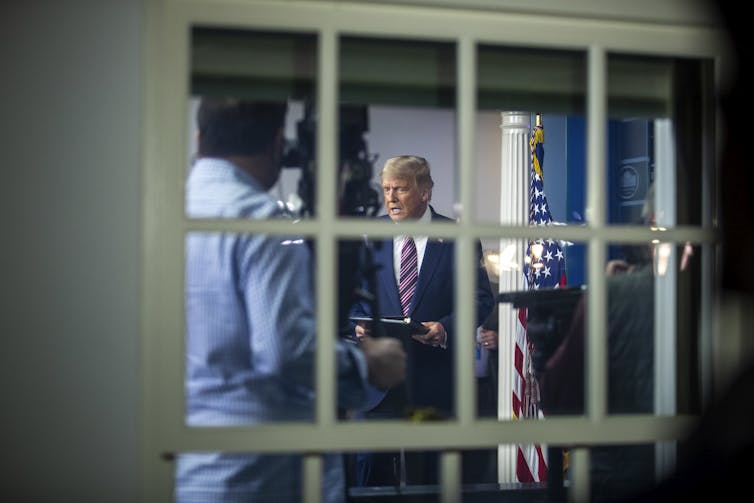
The president, Donald Trump, baselessly claimed at a White House press conference on Friday morning, Australian time, that the presidential election has been stolen from him by fraudulent and corrupt electoral processes.
This confronted the television networks, whose job is to report the news, with an acute dilemma.
In an already volatile political atmosphere, do they go on reporting these lies, laced with an undertone of veiled incitement to violence? Or do they cut away on the grounds that by continuing to broadcast this stuff, they are helping to propagate lies and perhaps to oxygenate a threat to the civil peace?
It was not rooted in reality and at this point, where our country is, it’s dangerous.
CNBC presenter, Shepard Smith, said the network was not going to allow it to keep going because what Trump was saying was not true.
CNN and Rupert Murdoch’s Fox News broadcast Trump’s entire press conference but immediately afterwards challenged what he said. CNN’s fact-checker Daniel Dale said it had been the most “dishonest” speech Trump had ever given, with anchor Jake Tapper saying Trump’s statements were “pathetic” and “a feast of falsehoods”.
Fox’s host Martha MacCallum said the supposed evidence and proof of election misconduct would need to be produced.
Even Murdoch’s New York Post, which had endorsed Trump’s re-election, accused him of making “baseless” election fraud claims, quoting a Republican Congressman as saying they were “insane”.
The Washington Post carried two news stories on its front page, clearly calling out Trump’s lies: “Falsehood upon falsehood”; “A speech of historic dishonesty”.
A serious decision to silence the President
But what of the networks’ decision to cut away?
Silencing a public official in the course of his official duties is a very serious abrogation of the media’s duty in a democracy.
But so is allowing the airwaves to be used in such a way as to arouse fears for public confidence in the democratic process and — as MSNBC’s Williams argued — even public safety.
Caption text.Shawn Thew/ EPA
On the run, many of the big networks prioritised public confidence in the democratic process, and public safety, over the reporting of the president’s words.
It is a rare circumstance in any democratic society that the media are placed in the position of having to shoulder such a heavy burden of responsibility.
It is most unlikely that once the present crisis is over, assuming Democrat candidate Joe Biden wins, the American media will find themselves in this position again.
Even so, a Rubicon has been crossed. A president of the United States, a publicly elected official, has been silenced by significant elements of the professional mass media in the course of his public duties.
This was done principally on the grounds he was lying to the people in circumstances where there was a foreseeable risk of serious harm to the body politic, and there was no practicable way to reduce the risk.
Is that a standard the media is prepared to set for the future? If so, it would be giving itself a power that goes well beyond anything the media has claimed for itself up till now.
Journalists need to keep their nerve
In considering this, two questions arise.
What if all media outlets had adopted this course? No one except those at the White House press conference would have known the whole of what Trump said, seen the context and observed the demeanour with which he said it.
Would it have been enough to do as CNN and Fox did — report the speech and then repudiate it?
An answer to that would be: the lies were coming so thick and fast, and were so damaging to the public interest, that it would have been impossible to set the record straight in anything like real time.
Real-time fact-checking is a relatively new development, and a welcome one. But its feasibility should not be a criterion for deciding whether to publish breaking news, unless there is doubt about whether the breaking news is actually happening.
The networks that cut away doubtless acted in good faith to do right by the country. Trump’s speech was shocking and irresponsible.
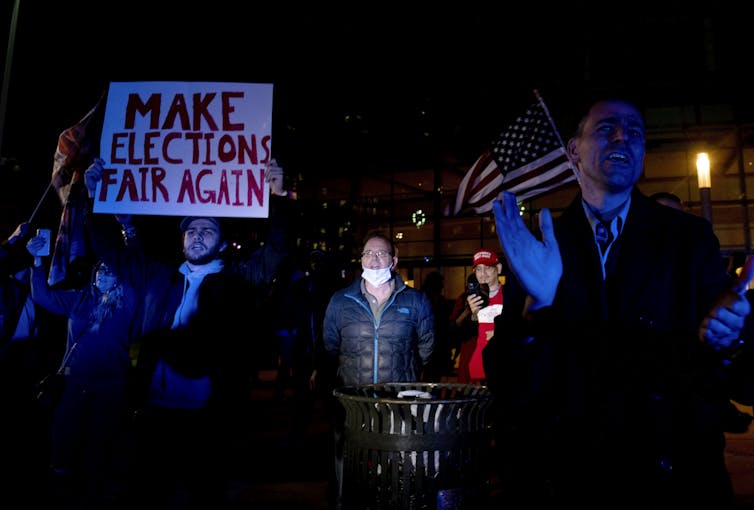
Trump supporters have taken to the streets since the polls closed on November 3.Nicole Hester/AP
However, American democracy is in crisis. At this time, above all, the public needs the institution of the fourth estate to keep its nerve and a clear head.
A primary norm of journalism is to inform the public. That certainly means being fair and accurate. But if the news contains lies, the norm is to publish and then call out the lying and set the record straight as soon as possible.
The networks need to explain to their audiences their reasoning behind the decision to cut away, and the media as a whole need to realise that if the norms of journalism break down, that just adds to the tragic chaos into which their country has descended.
The division of the findings of the Victorian COVID-19 Hotel Quarantine Inquiry into two – the interim report published today, with a final report due December 21 – is aimed at making a timely contribution to the redesign of the quarantine systems that will remain key to Australia’s management of the COVID-19 pandemic for some time to come.
With a view to the expected influx of returnees at Christmas, the national cabinet is due to discuss necessary changes later this month. Justice Jennifer Coate’s clear recommendations for how to devise and operate a quarantine system will surely be pivotal to its deliberations.
Key recommendations
Coate’s primary message is that quarantine – in whatever form it might take – is a public health operation. So any future quarantine system needs to be designed in a manner that ensures the centrality of this public health imperative.
We must wait until the final report to find out what Coate has to say on the larger governance and accountability questions surrounding “the decision” to contract out the front line of Victoria’s hotel quarantine operation to private security provision. However, her interim report already tells us a lot – if indirectly.
The report states it “is clear from the evidence to date” that the majority of those involved in the hotel quarantine program who contracted the virus were:
private security personnel engaged by way of contracting arrangements that carried with them a range of complexities.
It is therefore unsurprising that the issue of the appropriateness of contracting-out is the elephant in the room across a number of its key recommendations.
In particular, the recommendations record that the expertise of those involved in future quarantine operations will be crucial. Moreover, every effort should be made to ensure people working at quarantine facilities are “salaried employees” who are “not working in other forms of employment”.
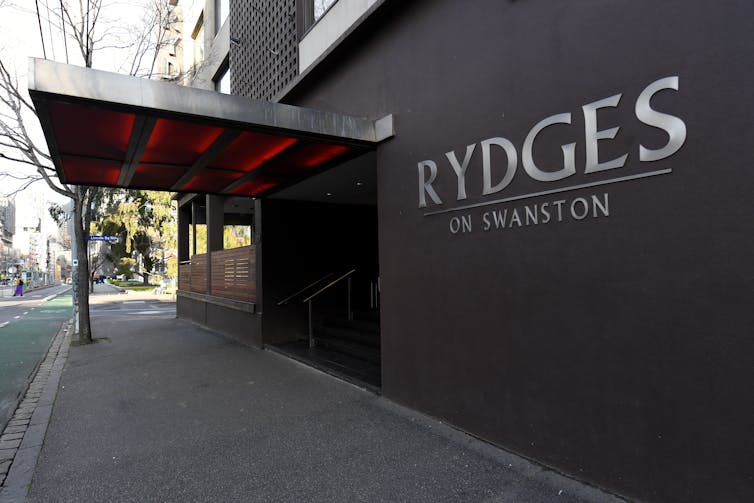
Rydges on Swanston was one of the quarantine hotels where coronavirus outbreaks occurred.James Ross/AAP
It takes little effort to surmise that contracted-out service delivery is unlikely to meet any of these demands.
As I have explained elsewhere, to contract out a statutory function in whole or in part requires that it be translated into a “service” that private sector providers are capable of delivering.
In the Victorian case, this meant the front line of the hotel quarantine operation was performed pursuant to an “observe and report” security services contract. It was carried out by an entirely casualised workforce with little infection-control training and no lawful powers of enforcement. Many or most of them worked in other jobs at the same time.
Coate also recommended that, alongside the “embedded” presence of expert infection-control personnel, a 24/7 police presence be established at every facility-based quarantine operation. This clearly points to the failure of contracting-out from an enforcement perspective as well.
So, by implication or otherwise, the interim report confirms that too little thought was given to whether the contracted service could meet the dual public health and detention demands of the function at issue.
Coate’s conclusions on how a facility-based quarantine program should work make the multiple dimensions of this mismatch plain.
Where to from here?
The final report of the inquiry may well prove to be the most sustained critique of contracting-out, from the perspective of public expectations of government action, that Australia has yet seen. This would be a welcome shift from what has prevailed so far, with much more effort dedicated to refining and expanding the practice than to challenging it.
As for where the interim report fits with the “whodunnit” exercise that has dominated so much of the interest in the inquiry’s work so far, Coate makes clear we must wait until the final report to find out more. Whether Victoria ended up with private security at the front line of its hotel quarantine program as a result of a “decision” by one or more individuals, or (as counsel assisting Rachel Ellyard described it) a “creeping assumption that became a reality”, is something that ultimately might never be clear.
Either way, the question of accountability will remain. Providing a clear answer to it stands to be every bit as complicated as it has been so far.
The inquiry, which found the bungled scheme cost the state $195 million, has shown the relationship between contracting-out and political accountability is incoherent. Substantial reform in both directions is needed to make it otherwise. Coate’s final report will hopefully guide that much-needed conversation.
But, again, we can already take a lot from the interim report about where – minimally – we need to be. Any future Victorian quarantine program must be operated “by one cabinet-approved department”, in accordance with a “clear line of command vesting ultimate responsibility in the approved department and Minister”.
That department must in turn be “the sole agency responsible for any necessary contracts”. Among other things, its responsible minister must also ensure senior members of its governance structure “maintain records […] of all decisions reached”.
Such is the vision for the future. But it also highlights why it is so important not to lose sight of the “why” questions when the issue of accountability for what actually happened in Victoria’s disastrous hotel quarantine program is again upon us.
If the front line of the hotel quarantine system was simply too important a responsibility to be outsourced, it is time to get to the bottom of why this was the case, and why it might also be the case for other high-stakes government functions that carry serious consequences for public health or safety.
Providing sensible answers to those questions needs to be the goal. But what matters above all else is that we actually start asking them.
Mining magnate Clive Palmer has lost his challenge to the closure of the Western Australian border in response to COVID-19. Palmer has also been ordered to pay costs.
While it is clear from the High Court’s order in Palmer v Western Australia that Palmer lost, it remains unclear whether the border closure was and remains valid.
The reason for the lack of clarity is because the High Court has not yet handed down its reasons, which may take weeks or months. In the meantime, all we have is its orders – and they are phrased in a rather peculiar and limited way.
Section 92 of the Constitution says the movement of people among the states shall be “absolutely free”. But the High Court has previously accepted it can be limited if it is reasonably necessary to achieve another legitimate end, such as the protection of public health.
In the Palmer case, the High Court gave a very limited answer to the questions it was asked. In relation to the Emergency Management Act it said that “on their proper construction”, sections 56 and 67,
in their application to an emergency constituted by the occurrence of a hazard in the nature of a plague or epidemic comply with the constitutional limitation of section 92 of the Constitution.
Both these sections are quite general in nature. Section 56 says the minister can declare a state of emergency in the whole of the state or a part of it. There is nothing on obvious that would appear to offend section 92 of the Constitution in each of its limbs.
Section 67 says during a state of emergency, certain officers may issue directions that prohibit the movement of persons within, into or out of an emergency area. On the face of it, it is not directed at the movement of people across state borders. However, if a state of emergency were issued for the entire state under section 56, then section 67 would potentially allow a direction to be made that would prevent people from entering or leaving WA.
Clive Palmer launched his challenge after WA closed its border in April.Lukas Coch/AAP
The High Court’s qualification in the phrase “on their proper construction” is therefore important. This raises the question of how the High Court has interpreted section 67 and whether it has restricted its interpretation in a manner that accommodates section 92 of the Constitution. We will have to wait for the High Court’s reasons to learn this.
The court’s order in relation to the Quarantine Directions is more unusual. It says the exercise of this power under clauses 4 and 5 of the directions “does not raise a constitutional question”. This refers to an issue raised during the hearing. The argument, initially raised by Victoria, was that the validity of a direction made under a power conferred by an act will depend on whether the direction falls within the scope of that power in the act.
If the section in the act that confers the power (in this case, section 67 of the Emergency Management Act) is constitutionally valid, then any direction that falls within that power will be valid too.
The real question, then, is whether the direction falls within the scope of the legislative power. This is not a constitutional question, but a question of administrative law. The High Court then said in its order that it had not been asked this question, so it did not need to answer it.
On the basis of this technicality, the High Court (or at least a majority of the Justices) concluded it was not necessary to address whether the actual directions that stop people going in or out of Western Australia were valid.
Does this mean more litigation?
As this case does not seem to have resolved whether or not the directions are valid, will there be more litigation? It is possible someone could challenge the directions, arguing this time that they do not fall within the scope of the authorising section in the legislation.
But such litigation would have to start from square one and so would take some time to determine. As it would not be a constitutional matter, it might have to be decided by a lower court first.
WA Premier Mark McGowan celebrated the High Court result on Friday.Richard Wainwright/AAP
Further, before initiating any such litigation, it would be important to read the High Court’s reasons, which may not be produced for some time. Those reasons will tell us about the scope of the legislative provision, which will be essential to know before any challenge to the directions made under it could proceed.
Hopefully, by the time we get to that point, there will be no need for such litigation because no such directions will exist, if the pandemic continues to ease in Australia.
But it does mean we may be left with inadequate guidance about such matters for the future, which would be unfortunate given the cost and time taken with this litigation. Perhaps the court’s reasoning about the interpretation of section 67 of the Emergency Management Act will give us sufficient understanding about the operation of section 92 of the Constitution and the tests applicable to border closures in a pandemic. But that remains to be seen.
Victorian lockdown challenge also rejected
In a busy day for the High Court on Friday, it also threw out hotelier Julian Gerner’s challenge to Melbourne’s lockdown laws.
Gerner’s challenge, to be successful, would have required the High Court to find an implied freedom of movement in the Constitution.
This would have opened up all sorts of other laws to challenge and been condemned by conservatives as judicial activism. The court was so unimpressed by the argument that it unanimously rejected it on the spot, without even needing to hear Victoria’s response.
The end of the case was swift and brutal. It is unlikely this point will be raised again before the court.
The article was updated on Friday November 6, 2020, to reflect the final official figures released by the Electoral Commission.
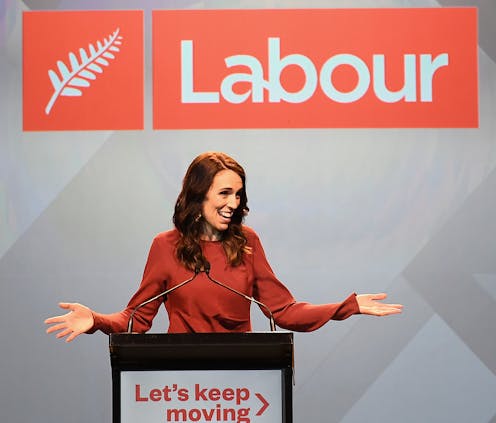
Labour is celebrating a landslide victory tonight after winning 49% of the vote (confirmed as 50% after special votes were counted). The result means Labour could govern alone — the first time this has happened since New Zealand introduced a mixed member proportional (MMP) electoral system in 1993.
In her victory speech, Prime Minister Jacinda Ardern said the result gave Labour “the mandate to accelerate our [COVID-19] response and our recovery. And tomorrow we start”.
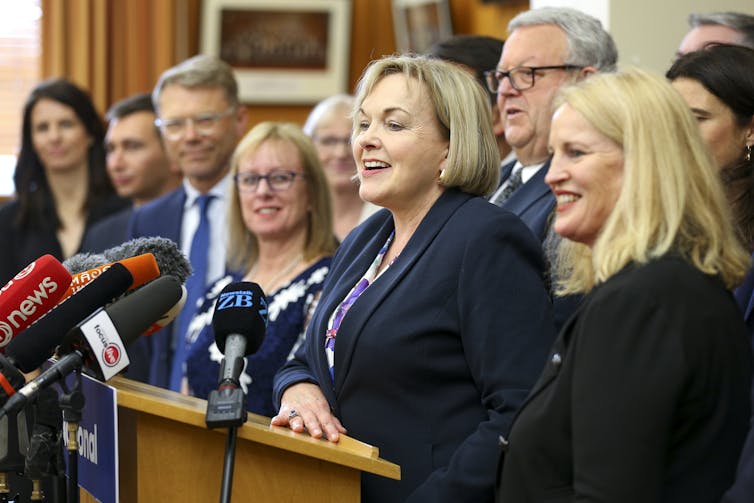
Earlier, National Party leader Judith Collins, whose party only won 26.8% of the vote (reduced to 25.6% in the final count), promised to be a “robust opposition” and “hold the government to account for failed promises”.
You can read the analysis of the results by our five political experts here.
In the new parliament, Labour will have 65 seats — four more than the 61 needed to form government. National has 33, the Green Party ten, ACT ten and the Māori Party is expected to return to parliament with one seat (later increased to two seats after special votes increased the party vote to 1.2%).
The numbers are a reversal of the 2017 results, when Labour polled 36.9%, National had 44.4% of the vote and New Zealand First leader Winston Peters became the kingmaker.
New Zealanders had to wait almost a month before Peters announced he would form a coalition with the Labour Party, becoming deputy prime minister. The Green Party joined the coalition in a confidence and supply arrangement.
In this election, NZ First was ousted from parliament, after the party failed to reach the 5% threshold and neither of its candidates managed to win an electorate seat.
Five parties gained seats in parliament. The Māori Party is expected to win one of seven Māori electorate seats and return to parliament even though it only achieved 1% of the party vote (1.2% in the final count). None of the other minor parties won electorate seats or reached the 5% party vote threshold.
Compared to previous elections, record numbers of New Zealanders voted early in 2020. A day before the election, almost 2 million people had already cast their vote.
The results for those are now finalised. Almost two thirds of the vote was in support of the introduction of the Right to Life legislation.
The vote for legalising the recreational use of cannabis was much closer but the majority favoured the No decision.
2017 election results
In 2017, the National Party won 44.4% of the votes and on election night, then prime minister Bill English celebrated victory.
But NZ First won 7.5% and held the balance of power. It was the third time for NZ First leader Winston Peters to become the veto player in the government-formation process.
After almost four weeks of negotiations, he opted to go into coalition with Labour, with the Green Party in a confidence and supply role. For the first time under New Zealand’s MMP electoral system, the new government was not led by the party that had won the largest number of seats.
Jacinda Ardern became prime minister in an extraordinary period in New Zealand’s political history. Just three months earlier, Ardern had been the deputy leader of a Labour Party polling in minor party territory.
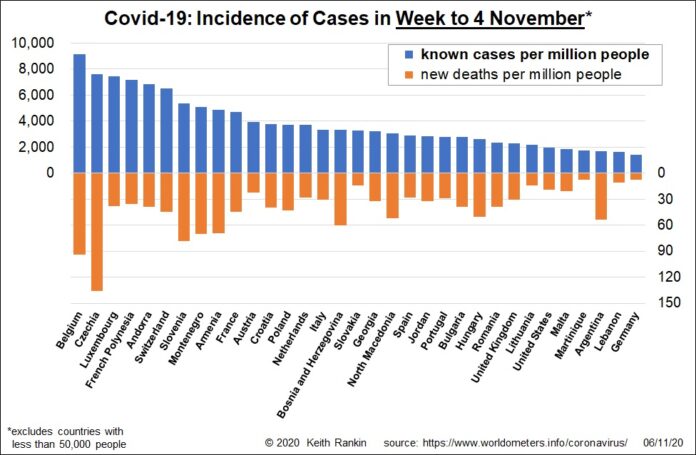
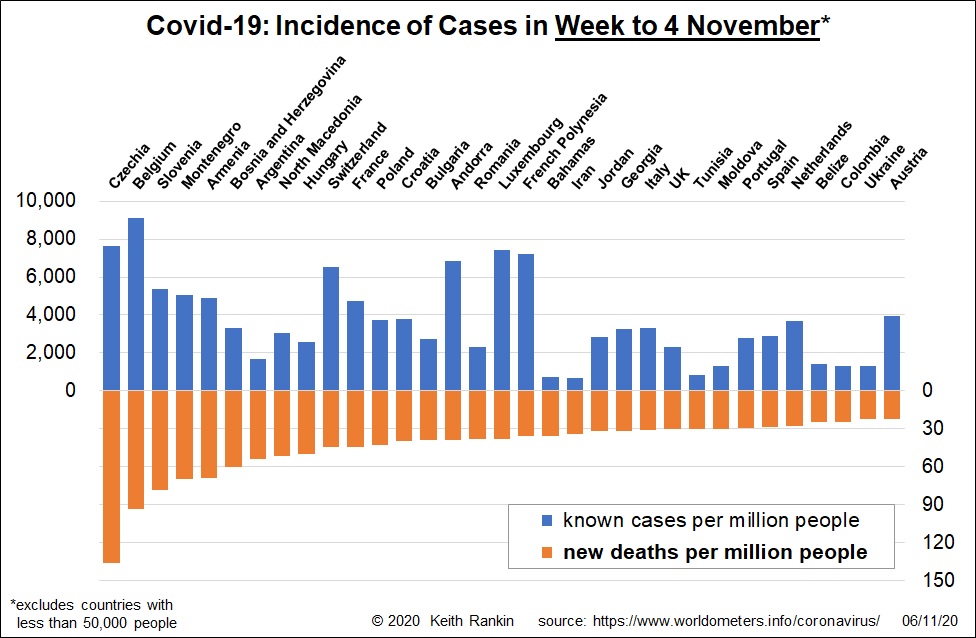
Europe including Eastern Europe and French Polynesia. Chart by Keith Rankin.
Analysis by Keith Rankin.
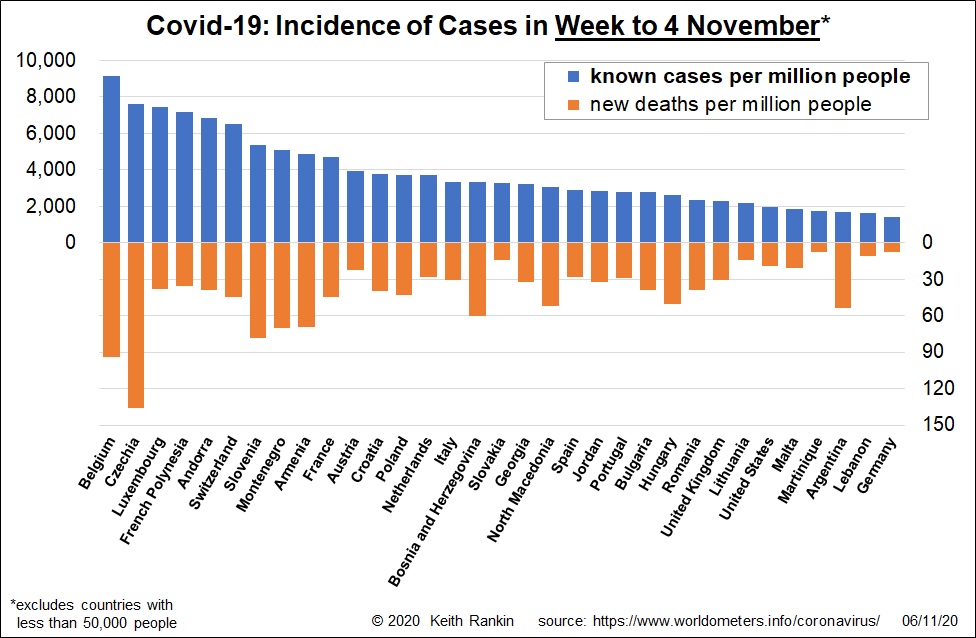
Europe including Eastern Europe and French Polynesia. Chart by Keith Rankin.
This week’s first chart shows the resurgence of Covid19 in Europe, with Eastern Europe now much more prominent than before. The only countries in the Americas to appear in this chart are the Martinique (French Caribbean), United States and Argentina. There are no countries showing from Asia (excl. the Middle East and the Caucasus) or Africa.
For us in New Zealand, the alarming presence is that of French Polynesia. 7,200 weekly cases per million people would be equivalent to 36,000 weekly cases in New Zealand, or over two million weekly cases in the United States.
Much vaunted Germany appears on the chart. Its 1,400 weekly cases per million would be equivalent to 7,000 weekly cases in New Zealand.
Deaths follow cases; Czechia leads the Eastern European wave. Chart by Keith Rankin.
Czechia (the Czech Republic) has 136 Covid19 deaths per million over the week to 4 November, equivalent to 680 deaths in New Zealand in just one week, or 45,000 deaths in the United States in just one week. The United States doesn’t make the deaths’ chart this time, but is not far off. And with nearly 210,000 new cases in the last two days, United States deaths will surely return to this chart next time I publish it.
French Polynesia will also be more prominent, next time, in the deaths chart.
The former Yugoslavia countries are also very prominent, with Slovenia – the most prosperous and westernised of these now leading the way.
The only African country in this chart is Tunisia, reflecting the consequences of European tourism, especially in the autumn months when tourist centres further north become colder.
Source: The Conversation (Au and NZ) – By David Perkins, Director, Centre for Rural and Remote Mental Health and Professor of Rural Health Research, University of Newcastle
Among the Bushfire Royal Commission’s 80 recommendations, released last week, was a call to prioritise mental health support during and after natural disasters.
The Australian Medical Association this week called on the federal government to implement the recommendations to lessen the health impacts of future disasters, noting the ongoing mental health fallout from the 2019-20 Black Summer bushfires.
The Royal Commission’s report comes as Australia heads into a bushfire season during a pandemic. Some farmers have this year lost their crops due to unseasonal rain and hail, as many rural communities anticipate further “big weather” events. Certain local economies, which are reliant on exports like wine and barley, are concerned about strained trade relations with China.
The combined effects of these adverse events is taking a toll on the health and well-being of rural people.
A year of cumulative stress
Australian Bureau of Statistics released last month showed rural suicide rates are much higher than those in the big cities.
The causes of psychological stress for rural people are many and varied, depending on who you are and where you live. Many are facing environmental and weather events at increasing frequency and intensity. Some of these events happen rapidly, such as fire and floods, whereas others are long-lasting and uncertain, like drought.
The effects of these events include direct losses such as injury and death, as well as loss of livestock and buildings. Indirect losses include declines in businesses and employment, and the disruption of social fabric when friends or family leave town.
These stresses of course come in addition to life’s normal challenges likes illness, bereavement and relationship breakdown.
For rural people, COVID has likely compounded these cumulative stresses and contributed to higher levels of trauma, mental ill-health and in some cases, suicidal behaviour.
Band-aid policies
In most rural communities, access to mental health services is relatively poor.
There’s longstanding evidence Medicare Benefits Scheme expenditure for mental health services is skewed towards metropolitan services.
State expenditure is focused on hospital services and care for those with high and complex needs. Consequently, many rural people with mild to moderate needs are under-served.
Among the bushfire royal commission’s 80 recommendations was a call to strengthen mental health services for people impacted by disasters.Lukas Coch/AAP
Traditionally, governments respond to crises reactively and by treating these events as short-term and disconnected. But this isn’t the experience of rural people.
Each adverse event is accompanied by (usually short-term) funding announcements by governments and agencies for new Headspace centres, expanded telephone helplines, websites, counsellors, or coordinators in the most affected areas.
Sometimes there’s overlap of effort across different government departments, federal and state jurisdictions or from different disaster responses, potentially wasting resources.
For example, in NSW, the longstanding drought has recently broken. But the social and economic recovery will take longer — possibly up to five years with consistent rain as it did following the Millennium drought.
Counsellors were funded to support rural residents during the drought in 2018, with more counsellors funded in response to the bushfires. And now additional services are being offered due to COVID.
While the extra support is welcome, the fragmentation and temporary nature of the funding means rural people may not know what services are available, and accessing services becomes confusing.
What’s more, with short-term contracts, it may be the same staff moving between roles and agencies, therefore not actually adding new staff to support local rural communities. This funding instability makes it difficult to retain a stable rural mental health workforce.
In the first instance, policymakers need to ask people living in rural areas what they need and involve them in the process of developing appropriate and accessible services.
Second, we need to adopt a systemic approach that examines the full range of adverse events that affect the mental health and well-being of individuals, families and communities. This means going beyond treating illness, to addressing environmental, economic, social and personal factors.
As part of this, we need people on the ground to support communities through preparedness activities such as educating people about mental health and how to access services, while stepping into disaster response and recovery as needed. Continuity and building on what already exists locally is key.
The Rural Fire Service is a good example of such a structure. It has a clear role in disaster response, but also works to prepare communities between disasters (for example, by conducting back-burning and educating about bushfire plans).
Localised support is important because preparedness and response look very different depending on where you live in rural Australia. For example, Lismore on the northern NSW coast experiences regular flooding, whereas Broken Hill in the state’s far west contends with more frequent drought, and fierce dust storms.
Accessing mental health support during and after disasters can be confusing and bureaucratic.Sean Davey/AAP
Third, to fully understand and plan for the diversity of rural communities, we need sophisticated data planning, collection and analysis systems. Beyond health data, we need to look at the social, economic, environmental factors which all contribute to mental health and the way people access care.
If we can do this well, local planning will become easier, more transparent and tailored to need.
Finally, rural communities need support to develop local leadership, so they’re empowered to lead local responses. This is unlikely to succeed with short-term band-aid solutions, but rather with long-term investment and strategic policy to build and sustain capacity to cope with adversity.
When the US formally left the Paris climate agreement, Joe Biden tweeted that “in exactly 77 days, a Biden Administration will rejoin it”.
The US announced its intention to withdraw from the agreement back in 2017. But the agreement’s complex rules meant formal notification could only be sent to the United Nations last year, followed by a 12-month notice period — hence the long wait.
While diplomacy via Twitter looks here to stay, global climate politics is about to be upended — and the impacts will be felt at home in Australia if Biden delivers on his plans.
Biden’s position on climate change
Under a Biden administration, the US will have the most progressive position on climate change in the nation’s history. Biden has already laid out a US$2 trillion clean energy and infrastructure plan, a commitment to rejoin the Paris agreement and a goal of net-zero emissions by 2050.
If I have the honour of being elected president, we’re not just going to tinker around the edges. We’re going to make historic investments that will seize the opportunity, meet this moment in history.
And his plan is historic. It aims to achieve a power sector that’s free from carbon pollution by 2035 — in a country with the largest reserves of coal on the planet.
Biden also aims to revitalise the US auto industry and become a leader in electric vehicles, and to upgrade four million buildings and two million homes over four years to meet new energy efficiency standards.
Can he do it under a divided Congress?
While the votes are still being counted — as they should (can any Australian believe we actually need to say this?) — it seems likely the Democrats will control the presidency and the House, but not the Senate.
This means Biden will be able to re-join the Paris agreement, which does not require Senate ratification. But any attempt to legislate a carbon price will be blocked in the Senate, as it was when then-President Barack Obama introduced the Waxman-Markey bill in 2010.
In any case, there’s no reason to think a carbon price is a silver bullet, given the window to act on climate change is closing fast.
What’s needed are ambitious targets and mandates for the power sector, transport sector and manufacturing sector, backed up with billions in government investment.
Fortunately, this is precisely what Biden is promising to do. And he can do it without the Senate by using the executive powers of the US government to implement a raft of new regulatory measures.
Take the transport sector as an example. His plan aims to set “ambitious fuel economy standards” for cars, set a goal that all American-built buses be zero emissions by 2030, and use public money to build half a million electric vehicle charging stations. Most of these actions can be put in place through regulations that don’t require congressional approval.
Donald Trump announced the US would withdraw from the Paris Agreement in 2017.AP Photo/Evan Vucci
And with Trump out of the White House, California will be free to achieve its target that all new cars be zero emissions by 2035, which the Trump administration had impeded.
If that sounds far-fetched, given Australia is the only OECD country that still doesn’t have fuel efficiency standards for cars, keep in mind China promised to do the same thing as California last week.
What does this mean for Australia?
For the last four years, the Trump administration has been a boon for successive Australian governments as they have torn up climate policies and failed to implement new ones.
Rather than witnessing our principal ally rebuke us on home soil, as Obama did at the University of Queensland in 2014, Prime Minister Scott Morrison has instead benefited from a cosy relationship with a US president who regularly dismisses decades of climate science, as he does medical science. And people are dying as a result.
Obama on climate change at the University of Queensland.
For Australia, the ambitious climate policies of a Biden administration means in every international negotiation our diplomats turn up to, climate change will not only be top of the agenda, but we will likely face constant criticism.
Indeed, fireside chats in the White House will come with new expectations that Australia significantly increases its ambitions under the Paris agreement. Committing to a net zero emissions target will be just the first.
The real kicker, however, will be Biden’s trade agenda, which supports carbon tariffs on imports that produce considerable carbon pollution. The US is still Australia’s third-largest trading partner after China and Japan — who, by the way, have just announced net zero emissions targets themselves.
A Biden presidency would pressure the Morrison government to adopt more ambitious climate policies.AAP Image/Mick Tsikas
Should the US start hitting Australian goods with a carbon fee at the border, you can bet Australian business won’t be happy, and Morrison may begin to re-think his domestic climate calculus.
And what political science tells us is if international pressure doesn’t shift a country’s position on climate change, domestic pressure certainly will.
With Biden now in the White House, it’s not just global climate politics that will be turned on its head. Australia’s failure to implement a serious domestic climate and energy policy could have profound costs.
Costs, mind you, that are easily avoidable if Australia acts on climate change, and does so now.
University of Canberra Professorial Fellow Michelle Grattan and University of Canberra Assistant Professor Caroline Fisher discuss the week in politics.
This week the pair discuss the outcome of the Queensland election, the likely outcome and repercussions of the US election, as well as Christine Holgate’s resignation as CEO of Australia post, and the government’s securing of additional possible vaccination distribution agreements.
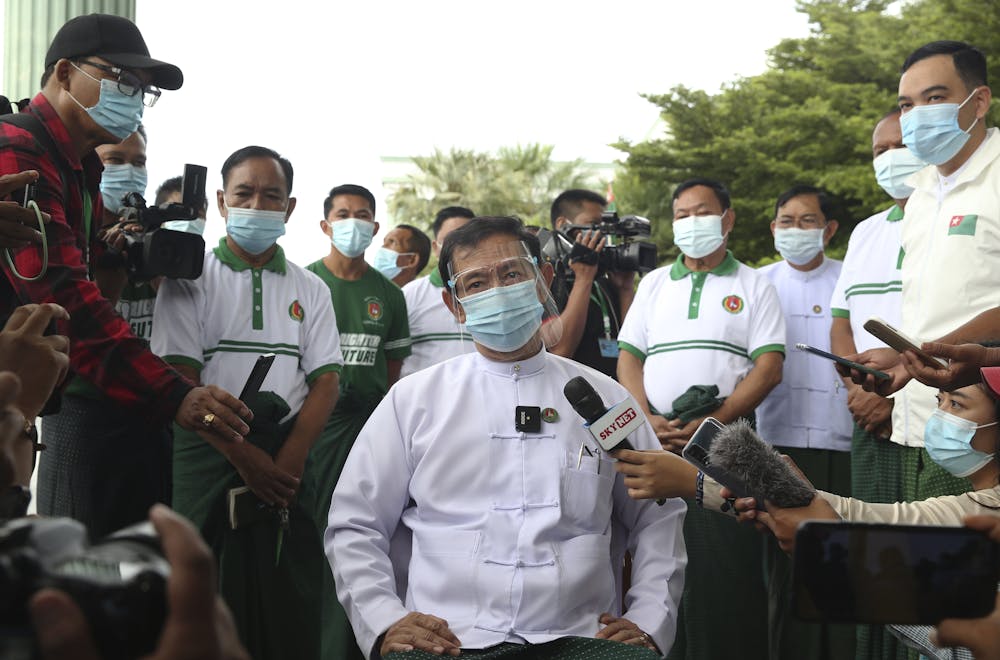
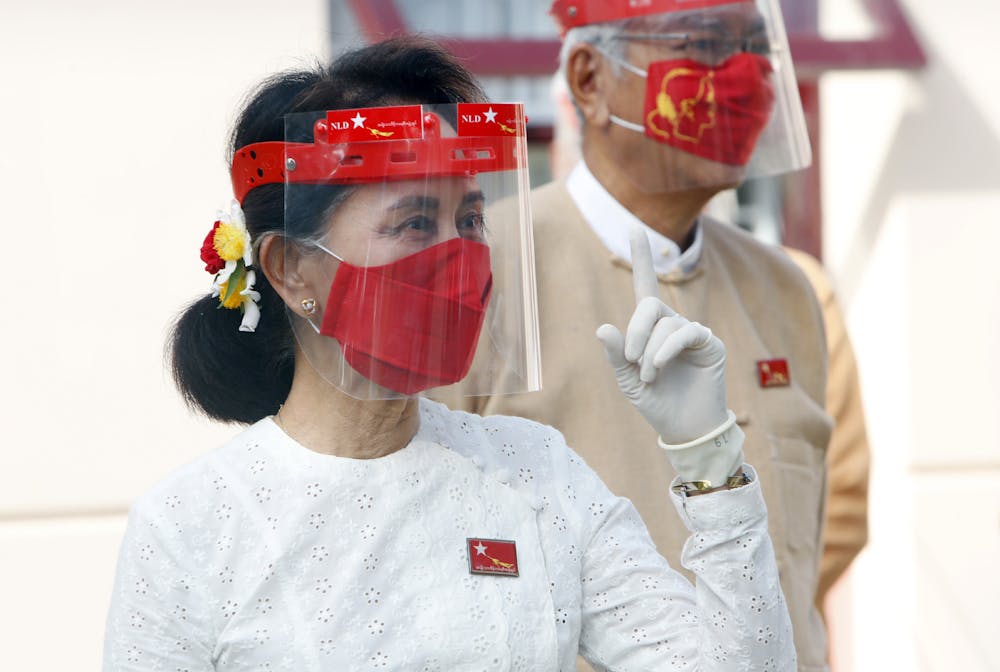
Over 37 million Myanmar citizens, including 5 million first-time voters, will go to the polls on November 8.
The election represents a litmus test for the popularity of National League for Democracy (NLD) leader Aung San Suu Kyi, who was placed under a house arrest by the military for about 15 years intermittently between 1989 and 2010.
Much is at stake in this election, but the role of the military still looms large in Myanmar politics.
The constitutional change needed to further democratise Myanmar is impossible without the military’s consent, so achieving major political transformation through the election alone seems unlikely.
The Myanmar constitution allows the military to occupy 25% of parliamentary seats.AP/Aung Shine Oo
In 2011, after about five decades of military rule, the military nominally handed power to the government of President Thein Sein and his Union Solidarity and Development Party (USDP).
Soon after, in the 2015 election, Suu Kyi’s NLD party won a landslide victory. She is now Myanmar’s incumbent state counsellor (equivalent to prime minister) but her international standing has taken a hit in recent years.
Critics accuse her of allowing widespread abuse of minority Rohingyas. Many Rohingya villages were burned down during a military crackdown in 2016 and 2017. Over 900,000 Rohingya — including more than 400,000 children — fled to Bangladesh and a large number of Rohingya refugees are dispersed across Southeast Asia.
Meanwhile, armed conflicts between ethnic armed organisations and the military continue, especially in the Rakhine state and the northern borderlands, and Myanmar’s transition to democracy is faltering.
New parties and political alliances
Suu Kyi’s NLD and its main rival, the USDP, are the two largest political parties vying for a majority of seats.
With its origin in the bloody 1988 anti-government uprising, the NLD has long fought for democracy and freedom.
The USDP (currently chaired by Than Htay), on the other hand, was formally registered in June 2010 with tacit support from the military. However, the USDP’s recent decision not to favour retired military generals as candidates indicates its ties with the military are weakening.
Than Htay is the current chair of the military-backed Union Solidarity and Development Party (USDP).Aung Shine Oo/AP
Many smaller parties and alliances are emerging and some, such as the People’s Party and the United Political Parties Alliance (UPPA), are likely to divide NLD’s traditional voters.
In states such as Kachin, Shan, Rakhine, Mon, Chin and Karen, many ethnic parties have recently merged to form a united front. They aim to win a majority in state parliaments and claim most of the national parliament seats in their states. These mergers may also weaken the NLD’s position; it had performed well in ethnic majority states in 2015.
Despite some notable economic and policy reforms, many ethnic parties are dissatisfied with the NLD government for the slow pace of transition from the military rule.
As the COVID-19 pandemic restricts freedom of movement, the candidates will be forced to campaign largely through social media and traditional media, which might work in the favour of larger and better-resourced parties. Not all parties and candidates have the finances to run online campaigns.
Big issues driving the voters
The election campaign will bring to light complex issues around Myanmar’s rich ethnic diversity: the continuation of armed conflict, demand from ethnic minorities for federalism, devolution of state power and better economic opportunities.
Despite the NLD’s promise of greater freedom and civil liberties, Suu Kyi’s government has prosecuted more journalists, social media users and human rights activists than the previous government.
Myanmar leader Aung San Suu Kyi is expected to win the November election.AAP Image/Aung Shine Oo
Myanmar’s economic and infrastructure development has been limited and, as my research argues, has been manipulated for political gain by powerful interest groups.
Deep reforms for a federal system and equitable economic development policies are needed to bring real progress toward peace between ethnic armed groups and the government. The way land ownership and natural resources are managed would need to be overhauled. Such reforms, however, are constrained by provisions in Myanmar’s constitution that ensure state power is shared with the military.
The constitution allows the military to occupy 25% of parliamentary seats. Only serving military officers can lead the three most powerful ministries – defence, home affairs and border affairs. This makes the military a very powerful political institution, which effectively controls the peace process and the direction of the transition.
The Rohingya crisis: ‘seems a textbook example of ethnic cleansing’
The persecution of Rohingya Muslims in Myanmar, which then-United Nations human rights chief Zeid Ra‘ad al-Hussein said in 2017 “seems a textbook example of ethnic cleansing”, continues to loom large in Myanmar politics. It has created one of the world’s largest refugee crises.
A boat carries ethnic Rohingya off North Aceh, Indonesia, in June 2020.AP Image/Zik Maulana
Many international observers have criticised Suu Kyi’s silence on the Rohingya crisis. Inside Myanmar, however, her popularity remained strong (especially among the country’s majority Bamar community) as she was called to answer for allegations of genocide made at the International Court of Justice late last year.
The Bamar community makes up about 70% of the country’s population and is the major voter base of Suu Kyi’s party. They largely consider Rohingyas illegal migrants, despite the fact many have lived in Myanmar for generations. A section of the community supports radical Buddhist nationalism and resists ethnic pluralism.
The Rohingya crisis has made ethnic minority voters deeply sceptical of Suu Kyi, but within the Bamar community, Buddhist nationalist narratives have surged and may come to dominate electoral campaigns.
Critics protested against Aung San Suu Kyi outside the International Court of Justice, during a case brought by The Gambia alleging Myanmar has committed genocide against the Rohingya.AP/KYDPL KYODOThe Rohingya crisis forced many to flee and has made ethnic minority voters deeply sceptical of Suu Kyi.AP/KYDPL KYODO
What’s the outlook for reform?
Myanmar’s military has frequently resisted constitutional reforms that would reduce its power.
If, as is expected, Suu Kyi’s NLD wins a majority this year, the military will likely collaborate with its allies in the parliament to block any constitutional reform.
If Suu Kyi’s political rivals — the USDP and other smaller parties and alliances — obtain a larger presence in the parliament, no single party will have a big enough majority to push through constitutional reforms. This will ultimately benefit the military and delay the transition to democracy.
Two former New Zealand prime ministers have called for an end to polarisation and the need for “healing” as the US presidential election remains in limbo.
Both former Labour PM Helen Clark and ex-National PM Sir John Key talked up the “television spectacle” in newspaper columns today with Key admitting that he “finally gets” why many voters like incumbent President Donald Trump.
Key said he had spent an hour watching one of Trump’s many rallies in Pennsylvania rather than “a few clips on the news”.
“While some of Trump’s behaviour was unbecoming of a President, and the speech itself bereft of substance, for the first time I could see why 5000 people had bothered turning up on a freezing afternoon to watch him,” he wrote in The New Zealand Herald.
“Trump was their guy.
“He stands against all of what they believe is wrong with the world and, in particular, the Washington ‘swamp’.
“He is the outsider unafraid to say it as he sees it, which is how his audience sees the world. He identifies their favourite villain, China, repeatedly calling it out.”
He called on the next President to “get the nation’s mojo back”.
‘Compassionate leadership’ needed Also writing in The Herald, Helen Clark said one thing was very clear from the election – “the United States is a deeply polarised country”.
But she predicted that a Biden presidency had a chance of turning this situation around.
“The fractures which run along political lines are a reflection of not only long-standing inequalities, particularly along ethnic lines, and widely divergent world views, but also of the impact of technological change and globalisation which have seen once secure and unionised jobs diappear, leaving whole communities and regions behind.”
Clark said Biden would have the skills for “calming emotions within the country and making it clear that he would pursue policies inclusive of all Americans”.
She also warned: “A superpower racked by division and self-doubt about its core values and its place in the world is a destabilising force in global affairs at a time when collaborative and compassionate leadership is sorely needed.”
Facing the gradual erosion of early leads in several battleground states — and increasingly likely defeat in the presidential election — the Trump campaign is launching a well-planned legal assault to challenge the validity of ballots and the process of vote-counting itself.
The Biden campaign is responding with an equally well-coordinated legal defence and a grassroots fundraising effort called the “Biden Fight Fund”.
Once again, the courts will be called in to resolve a US presidential election, although it is unlikely any rulings will change the results significantly — unless the election comes down to extremely narrow margins in Pennsylvania or Georgia.
The unusual nature of the 2020 election — with a record 100 million people voting early — ensured a topsy-turvy election night. Compounding the problem has been the large partisan divide in how people voted, with Democrats favouring early and mail-in voting and Republicans favouring in-person voting on election day.
Many states quickly reported the results from in-person ballots on election night, giving Trump an early lead in several battleground states. Those leads were then offset as mail-in and early votes were added to the tallies.
Trump has been encouraging his supporters to view these shifting totals as fishy, claiming:
This is a major fraud on our nation. We want the law to be used in a proper manner. So we’ll be going to the US Supreme Court. We want all voting to stop.
So far, Trump has indicated he will bring challenges in four states. This is what he is claiming and the chances that he could be ultimately be successful.
Wisconsin: Trump requests a recount In Wisconsin, where Biden leads Trump by less than a percentage point, the Trump campaign announced it will seek a recount. This is a relatively routine occurrence when margins are tight. Indeed, small margins often trigger automatic recounts in many states.
After Hillary Clinton lost to Trump in 2016 by less than a combined total of 80,000 votes in Michigan, Pennsylvania and Wisconsin, the Green Party candidate, Jill Stein, requested a recount. The courts denied the request in Pennsylvania, but partial recounts occurred in Michigan and Wisconsin.
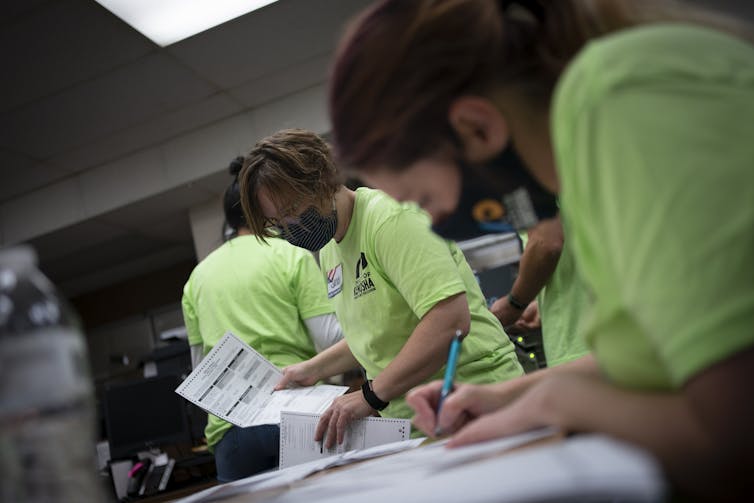
Poll workers sort out early and absentee ballots in Kenosha, Wisconsin. Image: The Conversation/Wong Maye-E/AP
Michigan: Trup seeks a (temporary) halt to counting In Michigan, the Trump campaign has filed a complaint seeking to halt the vote count on the basis that Republican Party “election inspectors” (that is, poll workers) do not have access to venues where the counting is taking place.
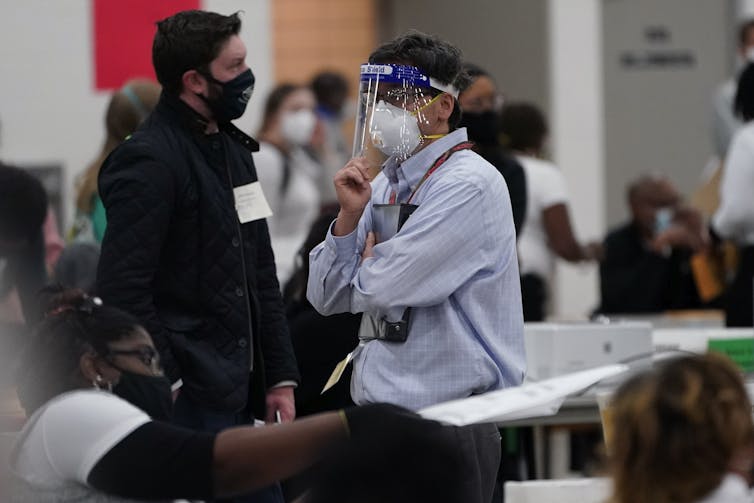
Election challengers observe as absentee ballots are processed in Detroit. Image: The Conversation/Carlos Osorio/AP
However, the filing provides no evidence that Republican poll workers have been denied access to vote-counting sites. Additionally, the legal bases of the claim appear weak.
For example, the complaint alleges Michigan is breaching the equal protection clause of the US Constitution because it is treating some voters differently from others in the state. Presumably, as the campaign alleges, this is because Democratic poll workers have been granted access to vote-counting sites that Republicans have not.
The complaint seeks a “speedy hearing,” which the Court of Claims has yet to grant. If it does, both the Trump campaign and the Michigan Secretary of State will have to provide evidence of the access given to poll workers of different parties on election day.
Pennsylvania: Taking it to the Supreme Court In Pennsylvania, the Trump campaign has initiated court procedings to stop the vote count.
The first part of the lawsuit is similar to the challenge in Michigan: the campaign is seeking to stop vote-counting until Republican poll observers are given access to the sites.
Deputy campaign manager Justin Clark alleges Republican poll observers were unable to observe vote counting because they were forced to be too far away – a claim conspicuously absent in the Michigan filing.
Pennsylvania Gov. Tom Wolf said the Trump campaign’s lawsuit to stop counting votes in the state is “simply wrong.”
“It goes against the most basic principles of our democracy,” he said.https://t.co/9SXNSmGndA
The second part of the Pennsylvania action seeks to reject mail-in ballots from first-time voters who did not provide proof of identity when they registered.
The campaign claims Pennsylvania’s secretary of state didn’t follow the proper process in deciding to accept the ballots from these voters — a breach of federal law. However, the campaign has yet to produce evidence that significant numbers of first-time voters did not prove their identity.
If the Trump campaign’s lawsuit is successful, it could result in the removal of a swathe of mail-in ballots from the Pennsylvania vote tally. In addition to these two challenges, the Trump campaign is appealing a decision by the Pennsylvania Supreme Court to allow the counting of mail-in ballots received within three days after election day to the US Supreme Court.
As of yet, we do not know how many ballots could be affected by this ruling — and the counting of ballots continues.
The Trump campaign announces its legal challenges to vote counting in Pennsylvania. Image: The Conversation/Matt Slocum/AP
Georgia: Confusion created by the courts takes centre stage Finally, in Georgia, the Trump campaign has filed a petition to prevent any potential counting of late-arriving mail-in ballots.
In one sense, this action is the most straightforward of all the challenges. The petition seeks an order that the existing law be enforced: that all mail-in ballots arriving after 7pm on election day are excluded from the count.
However, the deadline for mail-in ballots in Georgia was also the subject of pre-election legal challenges — meaning voters could have been confused by the rules.
A court initially ruled these ballots could be counted for up to three days after the election, but this decision was then overturned by a higher court.
Challenges are unlikely to be Trump’s path to victory For now, the Trump campaign has not launched any challenges in the other battleground states of Nevada and Arizona.
We may not end up seeing any challenges in these states, given the tight deadlines involved with elections. All litigation must be resolved or halted by December 8 so the election results can be certified and the Electoral College process can continue. This culminates in the vote that legally chooses the next president on January 6.
The legal challenges are a long shot for the Trump campaign to change the outcome of the election.
If Biden is declared the winner this week and the challenges fail, there may be another repercussion. It could further undermine confidence in the electoral process — a strategy Trump has employed, with varying degrees of success, throughout the race.
Albanerpetontids, or “albies” for short, are the cute little salamander-like amphibians you’ve likely never heard of.
Now extinct, Albies had a dream run. They’d been around since the Middle Jurassic around 165 million years ago, and probably even earlier. They lived through the age of dinosaurs (and saw out their extinction), then lived through the rise of the great apes, before quietly disappearing about 2.5 million years ago.
Albie fossils are scattered across continents, including in Japan, Morocco, England, North America, Europe and Myanmar. But until recently, we knew relatively little about what they looked like or how they lived.
New research by my colleagues and I, published today in Science, reveals these amphibians were the earliest known creatures to have rapid-fire tongues. This also helps explain why albies were once misidentified as chameleons.
A miniature marvel uncovered
The reason albies remained largely elusive until recently is because they were tiny. Their slight, fragile bones are usually found as isolated jaw and skull fragments, making them hard to study.
Peretti Museum Foundation/Stephanie Abramowicz, Author provided (No reuse)
The first almost complete albie specimen was found in the wetland environment deposits of Las Hoyas, Spain, and reported in 1995. Even though it was squashed flat, it was enough for palaeontologists to conclude albies were unlike any living salamander or any other amphibian.
They were completely covered in scales like reptiles, had highly flexible necks like mammals, an unusual jaw joint and large eye sockets suggesting good vision. Why were albies so unique?
The answer partly came to light in 2016, when a group of researchers published a paper demonstrating the diversity of lizards found in the Cretaceous forests of what is now Myanmar.
They presented a dozen tiny 99-million-year-old “lizards”, all preserved in amber. Some were even found with soft tissue remains such as skin, claws and muscles, still attached within the fossilised tree resin.
The researchers used “micro-CT” technology to digitally excavate and study the specimens in detail. This involved using 3D imaging to digitally remove the fossil from the amber and study it on a computer — a technique that avoids the risk of physically damaging the fossil.
They noticed one small, juvenile specimen had a long rod-shaped tongue bone. It was identified as the earliest known chameleon: a remarkable discovery! Or was it?
See a chameleon’s rapid-fire tongue in attack mode. (BBC Earth)
Alas, mistakes do happen in science. As lizard experts, the researchers had interpreted their results through this lens. It took the keen eye of Susan Evans, a professor of vertebrate morphology and palaeontology at University College London, to recognise this particular “lizard” was actually a misidentified albie.
A tongue-tying revelation
Some time later, Sam Houston State University assistant professor Juan Daza spotted another unbelievable specimen among a collection of fossils preserved in Burmite amber, ethically sourced from Myanmar’s Kachin state.
It was an adult version of the juvenile albie Evans identified. Needing higher-resolution 3D images, the sample was sent to me to study at the Australian Nuclear Science and Technology Organisation’s Australian Synchrotron in Melbourne.
Named after a class of mythical spirits responsible for guarding natural treasures, Yaksha, and the person who discovered the fossil, Adolf Peretti (founder of the non-profit Peretti Museum Foundation) — the Yaksha perettii specimen was an entire skull trapped in golden amber.
The Yaksha perettii specimen is preserved in amber. The fossil was studied without being removed.Author provided
Quick hits to unsuspecting prey
Its features that stood out were a long bone projecting back out of the mouth and soft tissue remains, including part of the tongue, jaw muscles and eyelids. By sheer luck, the soft tissue remains proved the long bone in the mouth was directly attached to the tongue.
This rendering of the Yaksha perettii skull shows the extinct amphibian’s soft tissue and projectile tongue apparatus (in orange).Edward Stanley/Florida Museum of Natural History, Author provided
In other words, Y. perettii was a predator armed with an incredible weapon: a specialised ballistic tongue that fired at lightning speed to capture prey — just as chameleons do today. It’s no wonder the original juvenile, only 1.5 centimetres long, was initially mistaken for a chameleon.
Modern chameleons have accelerator muscles in their tongues that lock in stored energy. This lets them fire their tongues at speeds of up to 100 kilometres per hour in just a fraction of a second.
We believe albies’ projectile tongues were just as fast, used to great effect while sitting motionless in trees or on the ground. If so, this also explains why albies had unusual jaw joints, flexible necks and large, forward-facing eyes. All these traits would have made up their predator toolkit.
Tree sap turned to iridescent amber
Despite these remarkable new insights, however, many mysteries of albanerpetontids remain. For instance, how exactly are they related to other amphibians? How did they survive for so long, only to die out relatively recently?
We’ll need more intact specimens to answer these questions. And most of these specimens will probably come from the Hukawng Valley in Kachin, Myanmar.
It’s expected about 100 million years ago this region was an island covered in vast forests. Global temperatures back then would have exceeded today’s, with trees producing vast amounts of resin (which later turned into amber) as a result of damage by insects and fire.
Amber studied from this region will not only increase our knowledge of its expired ecosystems, it could also provide insight into how certain organisms today might evolve in response to a warming climate.
How can we concentrate on a particular thing (like studies) without getting distracted? Melvina, aged 14
Thanks for this great question Melvina!
Many students are probably wondering the same thing as end-of-year assessments approach.
To concentrate best we need to resist distractions. To do this, it helps if you know what concentration looks like.
What is concentration?
When you concentrate, you direct or focus your thinking. Imagine your focus is like a torch beam.
This torch beam needs energy, which comes from your concentration. So we can think of concentration as the “mental energy” or “thinking petrol” your brain needs to focus.
We know it’s important to concentrate to get the best results from a project or task. But, with distractions everywhere, we also know how hard it can be.
So what distractions should we look out for?
Deal with physical distractions
These are distractions in your environment. It’s a good idea to take steps to reduce them.
First, try to adjust the amount of light and noise to a level that works best for you.
Being in a noisy environment can make it tricky to concentrate, so try to study somewhere quiet.Shutterstock
Thoughts and feelings can be pretty distracting too
If you find yourself thinking of things you’d rather be doing than the task at hand, take a moment to consider what you’ll do after you’ve completed the task, and how much more you’ll enjoy them because of what you’ve achieved.
If you feel worried about how people will respond to what you produce, like an essay or presentation, you might be hesitant to get started. To manage this, try noting how a task or topic fits with what you already know, or remind yourself of a time you got through a similar task.
There are a few things you can do before, during and after a task to help too.
How to manage distractions
When you start a study session, it’s useful to:
decide what you want to get from the activity. What will the outcome look like?
set yourself up so you can see your computer screen or books without straining your body
remember what you already know about the topic or the task
plan the steps you could take to complete the task.
You’ll probably become distracted at some point during your study. That’s OK! Try your best to get back on track and recap what you’ve learnt toward the end of a task.Shutterstock
As you work through the topic or the task, it’s helpful check your progress. Note what you’ve achieved so far. Are you moving towards your goal or do you need to change direction?
This helps you deal with distractions while you’re learning.
How to beat distractions
Towards the end of a task, review what you’ve learnt and store it in memory. This allows you to get around distractions that occurred during the learning.
Give this a go:
say what you know now that you didn’t know earlier
say how your new understanding has changed or added to what you knew
feel positive about what you know now. Congratulate yourself on what your brain has done. The positive feeling helps you remember it better in the future
imagine yourself remembering and using the main ideas in the future.
When you store your new understanding like this, you can use it more easily in the future to concentrate and to get around distractions.
Hello, curious kids! Have you got a question you’d like an expert to answer? Ask an adult to send your question to curiouskids@theconversation.edu.au
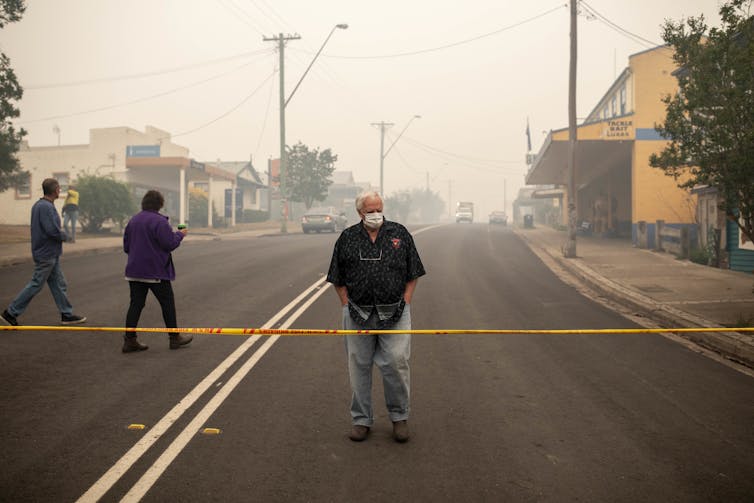
As fires ravaged large sections of the Australian bush last summer, cities and towns all along the coast were blanketed in toxic smoke. Air pollutants were measured at unheard of levels across the country.
Hazardous air descended on cities hundreds of kilometres away from the fires themselves. This air was the most dangerous to breathe on the planet.
The bushfire royal commission was tabled on October 30, with some sobering findings about fires and air pollution. Unfortunately, it showed that as a nation we were not prepared to deal with this public health emergency.
These disasters are inevitable under climate change, and while we need to urgently act on climate change to protect future generations, we also need to make changes now to mitigate the risks that already face us.
Australia must get better at communicating how to identify and then stay safe in hazardous air. A national set of air quality categories would go a long way to achieving this.
Over 400 deaths attributed to bushfire smoke
The royal commission heard that air pollution from the summer fires likely caused more than 400 deaths. Thousands of additional hospital admissions put added strain on our hospitals. All up the added burden to our health system was estimated at almost A$2 billion.
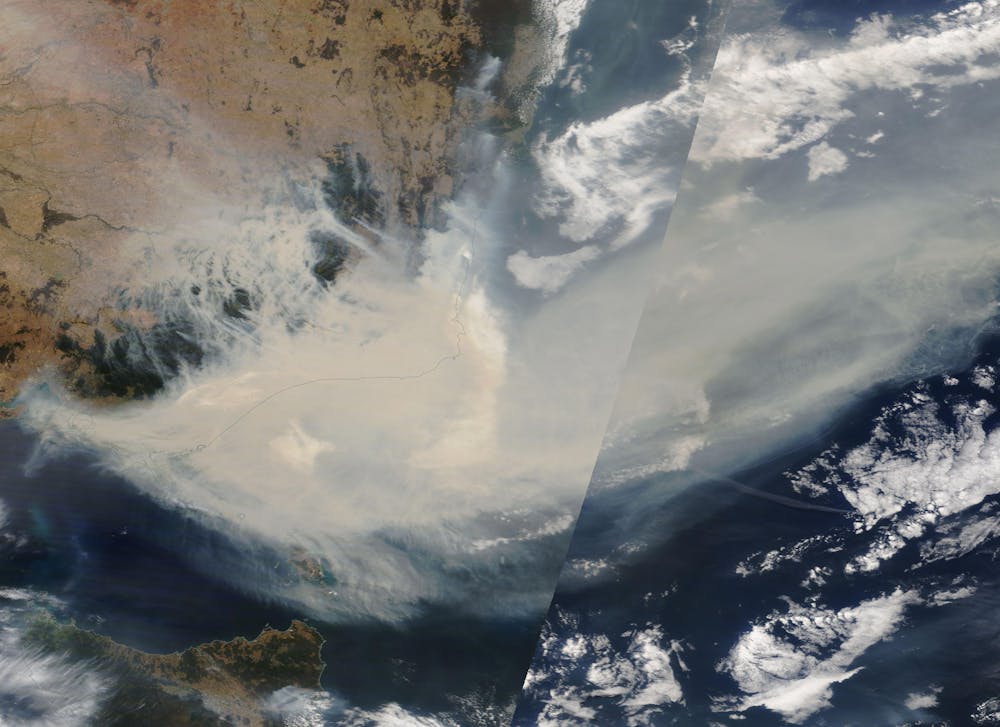
This satellite image from NASA shows thick bushfire smoke moving into the Tasman Sea from NSW and Victoria on January 3, 2020.EPA/NASA HANDOUT
Even in the absence of extreme natural disasters, air pollution is one of Australia’s biggest public health concerns. Pollution from all sources causes thousands of deaths per year. This includes emissions from coal-fired power stations, diesel cars and wood-fired heaters.
Better preparing ourselves to deal with bushfire smoke will have flow-on benefits in tackling these problems.
Different state, different health advice
The royal commission found “there is an urgent need for national consistency in the categorisation of air quality”. At the moment, every state has their own system to categorise air quality and communicate it to the public.
But there are major discrepancies with how different states identify the worst air quality.
Air quality is the sum impact of the concentration of various unhealthy chemicals in the air. These include ozone, nitrogen and sulfur oxides, and fine particulate matter. To communicate this to the public, most countries convert these chemical concentrations into an Air Quality Index (AQI).
In the US, there is a standardised AQI categorisation for the whole country.
In Australia, the situation is very different. Every state has its own bands, with their own colour codes. These bands trigger at different pollutant levels and carry different health advice. The Royal Commission told us this needs to be standardised, and now.
For example, in NSW the worst air quality category is “Hazardous”, which triggers at an AQI of 200. South Australia, however, only recognises “Very Poor” as the worst class of air quality, with an AQI of 150 and above.
During the summer bushfires, AQI values as high as 5,000 were measured. It’s clear the highest bands of air pollution are no longer appropriate.
We need a national air quality system
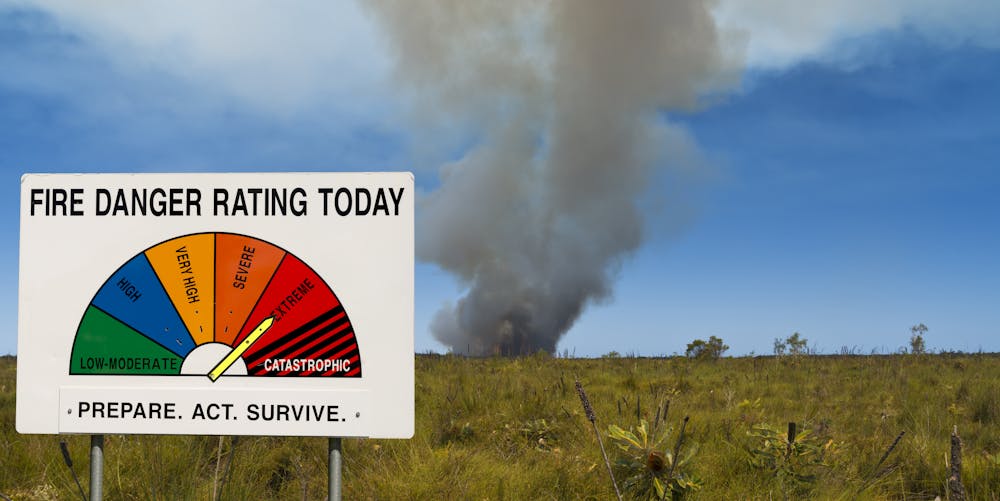
We have faced a similar problem before. After Victoria’s Black Saturday fires in 2009, we recognised that our fire danger ratings were inadequate.
The Black Saturday royal commission found we needed a higher category for the most dangerous fire conditions. The “Catastrophic” category (“CODE RED” in Victoria) was added. It carried clear advice about what to do in such dangerous conditions, instructing people to safely leave as early as possible.
The ‘CODE RED’ or ‘Catastrophic’ fire danger rating was added after the Black Saturday fires.Shutterstock
Something similar now needs to happen with air quality ratings.
When facing future extreme bushfires, we need a way to identify when catastrophic conditions have led to air so unhealthy that everyone should take precautions, such as staying indoors and wearing masks. We then need to get clear health advice out to the public.
A national air quality rating system could achieve this, and would also help address other important recommendations of the Royal Commission: That we need improved means of getting reliable information out to the public, along with better community education around what to do when air quality plummets.
There’s work to do
An Australian AQI should be featured on national weather reports and forecasts, providing important health information to the public every day of the year. At the same time it would familiarise Australians with air quality measures and actions that need to be taken to protect ourselves from unhealthy air.
But there is work to do. First, we need to develop a new set of air quality categories that work for the entire country, and reflects both the everyday hazards of industrial pollution and the extreme dangers of bushfires. These categories also need to be matched with sound health advice.
And if we are going to report these measures more widely then we also need to get better at measuring and predicting air quality across the nation — two other important royal commission recommendations.
Achieving all of this won’t be easy. But if we can get it right then we will be much better placed to deal with smoke risk the next time severe bushfires inevitably happen.
When it comes to handling the waste crisis in Australia, options are limited: we either export our waste or bury it. But to achieve current national targets, policy-makers are increasingly asking if we can instead safely burn waste as fuel.
Proposals for waste incinerators are being considered in the Greater Sydney region, but these have been lambasted by the Greens and independent members of the NSW parliament, who cite public health concerns.
Meanwhile, the ACT government has recently put a blanket ban on these facilities.
But are their concerns based on evidence? In our systematic review of the scientific literature, we could identify only 19 papers among 269 relevant studies — less than 10% — that could help address our question on whether waste-to-energy incinerators could harm our health.
This means the answer remains unclear, and we therefore call for a cautious approach to waste-to-energy technology.
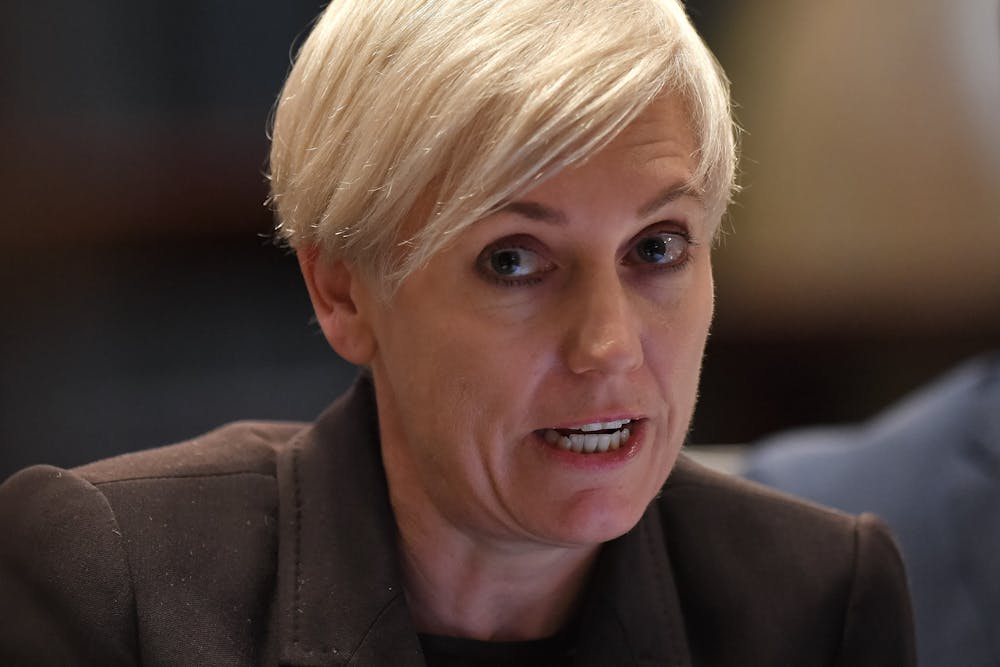
NSW Greens MP Cate Faehrmann introduced a bill in August to prohibit waste-to-energy incinerators.AAP Image/Steven Saphore
On average, Australia produces roughly 500 kilograms of municipal (residential and commercial) waste each year. This aligns with the OECD average.
New Zealand in comparison, despite its strong environmental stance, is among the worst offenders for producing waste in any OECD country. It produces almost 800 kilograms per person per year.
Now, most recyclable or reusable waste in Australia goes to landfill. This poses a potential risk to both climate and health with the emission of potent greenhouse gases such as methane and the leaching of heavy metals such as lead into the groundwater. As a result, local governments may want to seek alternative options.
Burning waste in Denmark
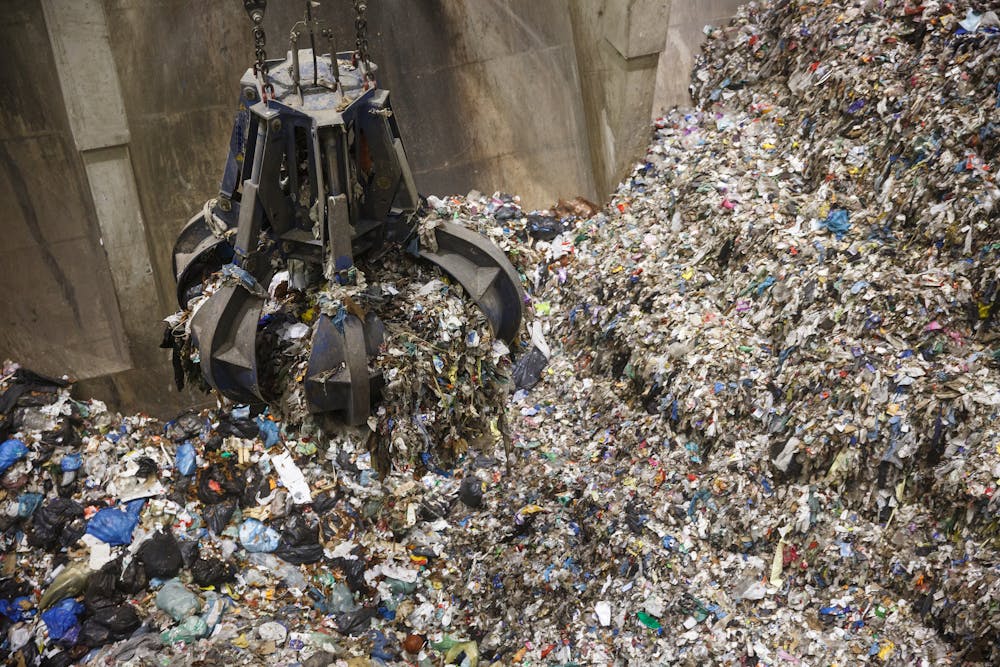
“Waste-to-energy” incineration is when solid waste is sorted and burned as “refuse-derived” fuel to generate electricity. This can replace fossil fuel such as coal.
The technology is on the rise among OECD countries. Denmark and Japan, for example, rely on waste-to-energy incineration to reduce their dependency on landfills and reach carbon neutrality.
In fact, Denmark’s waste-to-energy incinerator, Amager Bakke, is so well known it has become a tourist attraction, and is celebrated as one of the world’s cleanest waste-to-energy incinerators.
Amager Bakke provides electricity to around 680,000 people.
Every day, around 300 trucks filled with non-recyclable municipal solid waste are sent to Amager Bakke.
This fuels a furnace that runs at 1,000℃, turning water into steam. And this steam provides electricity and heat to around 100,000 households. Generally, people in Denmark warmly welcome it.
So what’s the problem?
In Australia and the US, community reception towards the building of new incinerators has been cold.
The big concern is burning waste may release chemicals that can harm our health, such as nitrogen oxide and dioxin. Exposure to high levels of dioxin can lead to skin lesions, an impaired immune system and reproductive issues.
Burning waste may release substances that can harm our health, such as nitrogen oxide and dioxin.Shutterstock
Supply of this plastic could come from the waning fossil fuel industry. This would work against the goal of establishing a “circular economy” that reuses and recycles goods where possible.
An analysis from 2019 found that to meet European Union circular economy goals, Nordic countries would need to increase their recycling, and significantly shift away from incineration.
This concern is understandable given incinerators operate cleanest when fuelled at full capacity. This is because a higher temperature means a more complete combustion — a bit like less ash and smoke coming off of a well-built campfire.
A lack of evidence
As with many policy solutions, determining the safety of burning waste is complicated.
Our review found a lack of evidence to fully reject well-designed and operated facilities. However, based on the limited number of health studies we found, we support a precautionary planning approach to waste-to-energy proposals.
This means we need appropriate health risk assessment and life cycle analyses built into the approval process for each and every incinerator proposed in the near-future.
The studies we found were all performed in the last 20 years. None were from the Nordic countries, however, where waste-to-energy incineration has been in use for many decades.
The reasons for the Nordic embrace of this technology are speculative. One reason may be that their level of economic development allows large capital investment for safe, state-of-the-art design and operation.
Waste incineration goes against the goals of a circular economy.Shutterstock
Where to from here?
If councils are determined to pursue waste-to-energy incineration, we suggest they prioritise specific applications.
For example, we found the process with the most favourable life-cycle assessment (the most beneficial to health compared to traditional fossil fuel use) was the “co-incineration” of refuse-derived fuel for industrial cement.
Currently, cement kilns are mostly fuelled by burning coal, and it’s difficult to reach the high temperatures required with traditional renewables. This means substituting coal for refuse-derived fuel could reduce the industry’s dependency on coal, when renewables aren’t an option.
Another solution is to focus instead on the waste hierarchy. This means first minimising waste production, maximising energy efficiency and maximising recycling and reuse of waste materials.
So, while we wait for more knowledge on how waste-to-energy incineration may affect our health, let’s focus on improving our waste hierarchy, rather than exporting our waste to feed a global crisis.
Children come into the world ready to communicate. A baby cries and coos to express their feelings and respond to sounds. The ability to communicate develops quickly but uniquely in every child.
By the age of three, most children are able to understand simple requests such as, “pick up your shoes and bring them to me”. They can identify colours, shapes or food groups and use familiar names to recognise important people in their lives, like “grandma”. And they can respond to “who”, “what” or “where” questions.
At three, your child may be saying a lot of words and putting them together into simple sentences. They may ask questions (often a lot of questions) such as, “Where are we going?”
It is an exciting and wonderful time for children to learn about their world and share their discoveries. It can also be a time of anxiety, if a child is not showing the communication signs the parent expects them to at a particular age.
Children learn to speak and develop their communication through day-to-day interactions with their parents and caregivers.
In 2019 as part of my yet unpublished research (that draws on previous work in the United States), I went to three different preschools to work with three to four year olds using puppets. I observed all the children — including kids with a disability, those learning English as an additional language or those who are very shy — communicated more often and more effectively when talking to a puppet.
Research with school-aged children shows puppets, like a favourite doll or teddy bear, can encourage learning and improve communication and behaviour. Talking to a puppet, as opposed to a person, makes the conversation feel less personal and more pretend. It is a play-based technique sometimes used in therapy to help the child feel less self-conscious, and open up.
I noticed the joy puppets brought to the children, as well as a growth in their understanding of feelings and the feelings of others. The children showed greater confidence when speaking to puppets and engaged in positive social interactions such as taking turns and sharing.
Parents can also use puppets to support their child’s development at home. Here are three things puppets can help with.
1. Use puppet play to encourage conversation
We introduced a range of puppets to children and quickly discovered the type of puppet used was important. Dinosaurs were very popular as was a duckling named Mabel and a Great White Shark called Bruce.
Think about the animals, characters, colours or creatures your child likes before choosing a puppet to add to your family. You can even make a simple puppet with an old sock.
Once you have your puppet, introduce it thoughtfully to your child. For example, you may pat it softly and have your child touch it with you. Ask your child to help you discover the sounds the puppet makes, its name and what it likes to play.
Think about the toys and animals your child likes best.Shutterstock
Make your child the expert in bringing your puppet to life. Through the creation of the puppet you can build your child’s vocabulary by modelling descriptive words and longer sentences.
For young children, try narrating their actions with the puppet. For example, “You are patting the puppet’s yellow beak, I think he likes it”.
Play peek-a-boo, sing songs or tell stories. The important thing to remember is to have fun.
2. Use puppets to get your child to answer questions
Try using a puppet to ask questions about your child’s day at preschool, their favourite part of a story or about their drawings or play.
Your puppet can help your little one by offering prompts such as, “Tell me about what you ate at snack time” or “I wonder what you made in the sandbox outside”?
Children may open up more to the puppet because they are funny and create a relaxed and playful environment, which is ideal for interactions.
Other ideas may include using the puppet to make up stories together or to take the puppet on a walk and ask questions about the things you see together.
3. Use a puppet to talk about feelings
Three year olds may find it hard to name their feelings or identify the reason they may be happy or upset. A puppet can act as a soothing way to have children tell you how they feel or learn the names of feelings.
For example, the puppet can use an angry voice or be crying to express emotion. Involve your child in helping the puppet by naming its feelings and coming up with possible solutions to their distress.
Two puppets can act out a frustrating situation and model new approaches such as sharing a favourite toy, trying new foods or cleaning up.
Puppets are a creative way to bring about speech and communication with your child. By bringing fun and imaginative play into your day, you can help your child develop their ability to share their world with you.
Source: The Conversation (Au and NZ) – By Charles Livingstone, Associate Professor, School of Public Health and Preventive Medicine, Monash University
Counsel assisting the NSW Inquiry into the suitability of Crown Resorts to operate Sydney’s new Barangaroo casino summed up this week by telling the Commissioner Crown was
not a suitable person to continue to give effect to the licence, and that Crown Resorts is not a suitable person to be a close associate of the licensee
Adam Bell SC reached the conclusion after considering the deleterious impact on the good governance of Crown Resorts caused by its dominant shareholder [James Packer’s Consolidated Press Holdings] and ultimately, Mr Packer”.
He reminded the inquiry that protection of the public interest was a key objective of the NSW Casino Control Act.
The Barangaroo casino is yet to open, but Crown already operates two other Australian casinos, one in Melbourne and one in Perth, and one in London.
The Melbourne casino has been the centre of multiple whistle-blower and other allegations connected with tampering with gambling machines, associations with criminal identities and the arrest of 19 Crown staff in China in 2016.
The Sydney inquiry was initiated after the Nine network and The Age and Sydney Morning Herald published allegations about money laundering and links with criminals.
A tale of two cities
The Melbourne regulator, the Victorian Commission for Gambling and Liquor Regulation, acted more quietly, initiating a still-uncompleted inquiry into the arrest of Crown staff in China in 2017 and putting its inquiry into the money laundering allegations on hold until it had seen the outcome of the NSW inquiry.
Sydney’s Crown hotel and casino development.DAN HIMBRECHTS/AAP
Belatedly, last month, a full eight months after the NSW hearings began, it issued Crown with a “show cause” notice relating to money laundering controls.
In 2017, Victoria’s auditor general identified serious issues relating to the Commission’s oversight of Crown.
It highlighted a “lack of leadership”, the second lowest staff satisfaction levels in the Victorian public sector, a lack of a “coherent organisation-wide approach to casino supervision” and insufficient attention to key areas of risk in the casino’s operations including money laundering.
In its five-yearly review of Crown’s licence in 2018 the Commission identified some concerns.
The concerns involved compliance with money laundering rules, the lack of engagement of independent directors with an oversight of the Melbourne casino, an uninspiring adoption of the responsible gambling rules, and a less than complete honouring of requests for self-exclusion.
It nevertheless concluded that it was in the public interest for Crown to maintain its license.
Fines rather than sanctions
Fines have been its the Commission’s preferred means of dealing with breaches of licence conditions.
In 2018 it fined Crown A$300,000 for gambling machine tampering and $25,000 in 2018 for a breach of junket rules.
It said it believed fines were enough in the light of
Crown’s past compliance history and general and specific deterrence, balanced against the level of co-operation, remorse, contrition and corrective action taken by Crown
Yet the NSW inquiry has heard evidence from James Packer and the company’s directors and management pointing to multiple continued failures in all these categories, in Melbourne.
The NSW premier has signalled concern about the casino’s planned opening in December, given that inquiry is not due to report until February.
West Australia’s regulator found no issues with Crown Burswood in its most recent (2018-19) annual report, but says it is monitoring the NSW inquiry.
Too big to touch?
It might be that Crown has become too big to regulate, at least in Victoria.
For some reason, the company has had enormous success with deflecting criticism. Along with other gambling operators, it has recruited powerful political figures from both major parties to assist it and is a major political donor.
There was ample evidence of the problems in Victoria well before the NSW inquiry identified them.
The Victorian regulator’s slow and overly respectful approach might be because it felt Crown was too important to be held to account, or had too many political connections, or was too important as an employer or contributor to government revenue.
Or it might be because, as the auditor suggested, it has problems with staff.
But if we are to have any faith in Victoria’s ability to regulate gambling and crime, it’ll need to do more. NSW is showing how.
In 2017, when a biology professor in a state college in Washington protested against a proposed day-long ban on the presence of white students on campus, radical students shut the campus down.
The ban was part of a yearly college event designed to give black and minority students and staff a separate space in which to discuss the issues they face. Tensions were high that year. White nationalist groups had invaded the campus, targeting black students and members of staff.
The comments by the professor, Bret Weinstein, and his opposition to the colllege’s equity programs, led to campus protests against him. In protest against the failure of the college administration to quell the students, he resigned from his job.
Pluckrose, a US magazine editor who describes herself as an exile from the humanities, and Lindsay, a mathematician and writer on politics and religion, were participants in the controversial 2018 Grievance Studies project, which aimed to discredit gender and race studies by submitting hoax articles to academic journals.
By getting articles on bogus topics through the reviewing processes of respected journals and into print, the authors believed they were proving that studies focusing on identity issues are “corrupt” and unscientific.
One hoax article, published in a journal of “feminist geography” looked at “human reactions to rape culture and queer performativity” at dog parks in Portland, Oregon; another purported to be a two-year study involving “thematic analysis of table dialogue” to explore why heterosexual men like to eat at Hooters.
Critics of their hoax quickly pointed out there was no scientific evidence to suggest that journals in fields focusing on identity are corrupt — indeed such hoaxes had happened in other areas of study too.
Pluckrose and Lindsay’s book, which grew out of the 2018 project, traces the evolution and growing influence during the late 20th century of theories about how the language we use to think and talk about the world structures our relationships.
The book takes aim at postmodern and post-structuralist thinkers, particularly the French philosopher and historian Michel Foucault. The authors blame him for propagating the view that all discourses, including science, create relations of power and subordination.
In the new millennium, these postmodernist and deconstructionist projects morphed — according to Pluckrose and Lindsay — into the political weapon they call Social Justice Theory, or simply Theory.
In Cynical Theories, the pair trace the march of Theory as a political ideology through post-colonial studies, queer theory, feminism, and studies of race, disability and body size.
In their view, Theory is a harmful, anti-scientific ideology. It divides society into the oppressed — whose subordinate identities are constructed by hierarchies of power — and the oppressors who, wittingly or not, maintain oppressive relationships through their participation in political and social discourses and institutions.
Constructed identities
This Theory is cynical, according to the authors, because it finds oppression everywhere — even in the best intentions of progressive people and their movements of reform.
And it is bad for everyone, including disadvantaged groups, they say, because it gets in the way of an empirical approach to understanding and correcting social ills.
Social Justice Theory, say Pluckrose and Lindsay, finds oppression everywhere.Micheile Henderson/Unsplash
One aim of Pluckrose and Lindsay is to defend the central liberal value of freedom of inquiry against what they regard as an attack on free speech by the rise of identity politics — spawned by Theory.
The application of Theory is also harmful, they say, because it provokes a backlash from people who cannot understand why being white or male puts them into the camp of racists or sexists.
The result, they argue, is a racial politics that becomes increasingly fraught. We hear that:
racism is embedded in culture and that we cannot escape it. We hear that white people are inherently racist. We are told that only white people can be racist. […] Adherents actively search for hidden and overt racial offences until they find them.
According to the authors, these categories — race, sex, gender, being gay or straight, abled or disabled, fat or of normal body size — are forced onto individuals by the organising power of dominant discourses in politics, social life and science.
According to Social Justice Theory, the authors write, identity determines how a person thinks, acts and what she knows.Angela Compagnone/Unsplash
Adherents of Theory, they say, then argue these constructed identities are, nevertheless, real and inescapable experiences. For Theory, identity determines how a person thinks, acts and what she knows. A black person is not an individual who happens to be black. Blackness is central to who he is. Being black makes him into a victim of discourses that privilege whites.
Respecting the standpoint of those who have a subordinate position in hierarchies created by the ways we speak and act — blacks, women, people with minority sexual identities, victims of colonial power, the disabled and the fat — is a key political demand for activists influenced by Theory.
No truth, only discourse
Social hierarchies exist. Prejudice can be perpetuated by the unthinking behaviour of individuals. Discriminatory treatment of women and black people is sometimes embedded in institutions.
Pluckrose and Lindsay do not deny this.
They admit legal reforms have not eliminated racism, sexism and other forms of discrimination. They recognise discriminatory treatment and prejudice can blight the lives of victims and undermine their ability to access the opportunities of their society.
Cynical theories acknowledges legal reforms have not stopped discrimination.Unseen Histories/Unsplash
What, then, is wrong with what they call Social Justice Theory?
The authors’ main contention is that Theory is relativist and unscientific. For its theorists, there is no objective truth — only the perspectives of people with different identities. And they demand the same respect for the standpoint of an oppressed group as for the views of scientists.
Pluckrose and Lindsay write:
It is no exaggeration to observe that Social Justice Theories have created a new religion, a tradition of faith that is actively hostile to reason, falsification, disconfirmation and disagreement of any kind.
Because Theory is a faith, it can insulate itself from criticism, say the authors.
It can dismiss dissenters, like the aforementioned biology professor, as the purveyors of an oppressive discourse.
‘Cancel culture’
Is Social Justice Theory as pernicious as Pluckrose and Lindsay want us to believe? Their criticism gets most of its plausibility from applications of Theory that do seem harmful and even absurd.
Disability, for instance, is not merely a social construction. Treating it as such may prevent the use of treatments that could make the lives of people better.
When doctors tell obese people they should lose weight they are not engaging in an act of oppression, but in healthcare.
Pluckrose and Lindsay are right to point out that campaigns to expose oppressive speech and behaviour can cause unjustified harm to individuals who are called out and “cancelled” for minor misdemeanours, or for stating a view that identity activists deem unacceptable.
The abuse heaped on J.K. Rowling, author of the Harry Potter series, for saying that sexual differences are real and not constructed by discourse is an example.
J.K. Rowling has been abused for her stance.Christophe Ena/AP
In my opinion, however, the authors overstate both the illiberal tendencies of Theory and its influence on culture.
You do not have to be a relativist to think the opinions and feelings of people from minority groups ought to be respected. You are not anti-science if you think scientific research sometimes ignores the needs and perspectives of women and minorities.
Advocates of Theory aim to make institutions more inclusive and respectful of differences.
Liberals — as advocates of critical engagement — should be open to the possibility that Theory, despite faults, has detected forms of prejudice our society tends to overlook.
The question of universities
The most problematic aspect of Pluckrose and Lindsay’s book is the blame it heaps on humanities departments of universities for stirring up a cancel culture and the culture wars.
This gives ammunition to those who want to defund humanities and discourage students from taking humanities courses.
It gives support to the position of the Australian Federal Education Minister, Dan Tehan, who thinks that Australian universities have succumbed to a left-wing culture that “cancels” conservatives and their opinions.
There is scant evidence of a freedom of speech crisis on Australian campuses.Jordan Encarnacao/Unsplash
This accusation, also made by conservative groups like the Institute of Public Affairs, is the reason why critics of universities want to force them to sign up to a free speech code.
But according to Glyn Davis, Professor of Political Science at the Australian National University, there is no evidence of a meaningful or growing threat to free speech in Australian universities.
Those who emphasise the dangers of a cancel culture often ignore more serious threats to universities and an open society. The students at the Washington college were reacting to the presence of groups that threatened the safety of black students.
They were responding to a real threat.
Combatants in the war
Pluckrose and Lindsay agree that threats to free speech can come from the right as well as the left, but their preoccupation with the latter indicates where they want to put most of the blame.
Cynical Theories is, on one hand, a scholarly book. Pluckrose and Lindsay are well versed in the literature they criticise, as their participation in the Grievance Studies hoax indicates.
Their book provides an in depth discussion of the works they want to criticise. Their critique of what they call Social Justice Theory deserves to be taken seriously.
But by overstating their case and aiming their weapons at humanities and universities they cannot pass themselves off as objective contributors to a search for truth.
They are combatants in the culture wars.
Cynical Theories: How Universities Made Everything about Race, Gender, and Identity – and Why This Harms Everybody, by Helen Pluckrose and James Lindsay, is published by Swift Press.
The US presidential election may still be extremely close, but one thing is clear: those pundits and pollsters who predicted Trump was in no position to win will be going back to the drawing board.
In any case, “Trumpism” is unlikely to disappear even after he’s gone — including in New Zealand.
Hardcore Trump supporters in the US may make up as few as 12% of America’s registered voters. But polls have consistently underestimated Trump’s numbers compared with actual election results.
The Real Clear Politics pre-election poll average had Joe Biden up by 7.2 points nationally, but as of November 5 he led by only 2.1 points. Perhaps there really is a “hidden Trump vote”.
Meanwhile in New Zealand, with Jacinda Ardern in charge of the country’s most diverse cabinet ever, the prospect of a Trump-like leader might seem remote. However, in online surveys conducted by Stuff.co.nz and Massey University in 2017 and 2020, we found a significant minority in support of Trump.
Kiwis for Trump
In mid-2017, 13% of respondents said they would have voted for Trump had they been able to, compared to a scientifically sampled poll in mid-2016 that found 9% support for Trump.
How to explain the difference? Trump’s victory in November 2016 may have boosted that support slightly. The Stuff/Massey survey is reader-initiated and non-representative, and may have over-represented disaffected conservatives. Or people may be more willing to indicate support for Trump online than by phone.
Nonetheless, there was a measurable level of support for Trump in New Zealand.
In the mid-2020 survey, we asked respondents if they hoped Trump would win or lose in the November election. This time, 11% said they hoped he would win (after weighting for gender due to the sample having a male bias of 61.2%).
The Stuff/Massey survey sample also had a conservative bias, as 36.8% said they supported National — above where the party was polling at the time, and well above its election night result of 26.8%.
But let’s say roughly one in ten New Zealanders is a Trump supporter. Under New Zealand’s electoral system, that’s well above the threshold of 5% for a party to win parliamentary seats.
Of the 55,147 who answered the question in the mid-2020 survey, 6,833 said they hoped Trump would win. So, who are these Kiwi Trumpers? And what do they really think?
Even demographic spread
They are evenly spread across age-groups, but slightly higher (15.4%) in the 18-24 range. This may reflect a known phenomenon in which populist leaders boost young people’s satisfaction with democracy — or, to put it another way, help to reverse the trend towards political disengagement in democracies.
Kiwi men are more than twice as likely to support Trump than women — a much wider gender gap than was found in the US after the 2016 election.
Kiwi Trumpers are distributed evenly across lower and middle income brackets, and support declines only slightly in the upper income brackets.
Perhaps surprisingly, 15.6% of Pasifika respondents and 20% of those who ticked the “gender-diverse” box hoped Trump would win — above the overall 11% result.
A whopping 92% of the Kiwi Trumpers said we should leave statues of figures from our colonial past where they are, compared to the 49.8% of those who hoped Trump would lose.
Preferred party of Trump supporters: National Party leader Judith Collins with MPs after the 2020 election.GettyImages
National is the preferred party
Very few Kiwi Trumpers identified with arch-populist Winston Peters, however. Only 4.9% of them said he is the party leader they felt closest to, perhaps because of his coalition with Labour after the 2017 election. They were more attached to National’s Judith Collins (46.6%) and ACT Party leader David Seymour (30.2%).
Only 20% of National supporters overall said they hoped Trump would win. But this sub-group of National supporters made up 56% of the entire cohort of Kiwi Trumpers. A further 23% of Kiwi Trumpers supported ACT. So, the National Party is the preferred party of the Kiwi Trumper.
The far-right New Conservative Party’s supporters were only 1.2% of our sample, and that party won only 1.5% of the vote at the October election. But a clear majority of them (69%) supported Trump.
In general, Kiwi Trumpers see society as more discontented, and politicians as less trustworthy, than the average New Zealander.
Some 47.5% of the Trump supporters endorsed conspiracy theories about the COVID-19 virus. For them, it was either “an invention of shadowy forces that want to control us” (11%) or “a biological weapon created by one of the world’s super-powers” (35.5%).
Only 7.7% of Trump opponents ticked either of those statements. And, overall, 85.8% of the sample agreed that the virus came from a natural source.
Moreover, only 11.7% of Trump supporters agreed the New Zealand government was taking the right approach to dealing with the economic impact of COVID-19, while 62% of Trump opponents agreed.
And 84% of the Kiwi Trumpers preferred the government take a “cautious and sceptical” approach to climate change, compared with 23.8% of opponents.
Populist but not preferred: Trump fans were not drawn to NZ First leader Winston Peters.GettyImages
Could a Trump emerge in NZ?
Unsurprisingly, 54.6% of Kiwi Trumpers were in favour of New Zealand developing a closer alignment with the USA, compared with only 6.2% of Trump opponents. The vast majority (80.9%) of survey respondents preferred that New Zealand aim for greater independence from both the USA and China.
National’s Judith Collins made favourable comments about Trump during a pre-election debate, perhaps aware of support for him within her base.
Suppose, then, that the National Party chose as leader a Trump-like conservative “non-politician” — someone who divided rather than united, and who put economic liberty ahead of health and human lives.
Bearing in mind that this inference is based on a non-scientific survey, he or she could energise perhaps an existing base of one-fifth of National’s supporters, while winning over others from parties further to the right.
Traditional conservatives and centre-right liberals within National would be aghast. But, desperate to change the government, they may have nowhere else to turn.
Then again, it could all end badly. Those voters who switched from National to Labour in 2020 may not want to switch back. And in New Zealand politics, the winning party is the one that wins those centrist voters.
Joe Hockey, former Australian ambassador to the United States who’s now in business there, came under sharp attack for some ill-informed comments about the high Democrat vote in Washington, DC.
Despite this faux pas, Hockey’s description of the American system as a dog’s breakfast – with states, counties and even some cities having responsibility for running presidential elections – is actually not far off the mark.
“In Australia you have the Australian Electoral Commission, thank god,” Hockey said.
Indeed, let’s give thanks not just for the AEC, but also for a few other features of our system, not least compulsory voting.
On a pure view of people’s rights in a democracy, they shouldn’t be forced to vote. But for the overall health of the polity, compulsory voting is a boon, on two levels.
It prevents attempts to game or defraud the system by using tactics that are dubious, or worse, to get out the vote or to discourage participation.
Compulsory voting also works to contain the extremes in the political debate, because contests are won or lost in the centre (broadly defined).
All the legal action we’re hearing about in the US is not the way of things in Australia. Challenges are rare, although there is one big recent exception.
The dual citizenship crisis embroiling a swathe of federal parliamentarians hugely disrupted the last parliament; even so, this was handled in an orderly manner via the High Court and byelections.
A strong political system has a calming effect.
Even allowing that Donald Trump is a one-off phenomenon, can anyone imagine an Australian leader giving the sort of speech he did in the early hours after election day?
In Australia, people were tut-tutting when Malcolm Turnbull was a touch graceless on election night in 2016.
Which goes, in part, to political culture. Australia is a more bound-together society than the US, economically and socially.
But we should beware. As in other countries, there’s been an increasing loss of trust in political institutions (although trust here has been boosted, at least temporarily, during COVID).
To keep our democracy in good shape, we must nurture and increase trust, ensure the economy works for the population generally, and maintain a strong social safety net. There is a significant relationship between economic security and a well-functioning political system.
We also need to do what’s possible to keep the political debate civil. Social media and polarisation in the mainstream media have already coarsened the conversation. That hasn’t undermined our democracy yet, but there are risks.
Without being complacent – and recognising there are many faults in government and elsewhere that should be vigorously called out – this is a week in which to celebrate what we have in this country.
After conquering the second wave of COVID, we’re in an enviable position on the virus – nearly at elimination, although that isn’t government policy. Looking at the deterioration in Britain and Europe, and the American situation, the contrast is dramatic.
The big challenge for Australia is, and will remain, the path out of recession. Many people will have a rotten Christmas, unemployed or with their businesses having failed or collapsing.
But we are continuing to see an official commitment to do what can be done to get the economy moving.
In the package it unveiled this week, the Reserve Bank pulled out all stops available to it to stimulate the economy, although its firepower is limited. It’s taking this action even as it revises up its forecasts on growth and unemployment.
Reserve Bank Governor Philip Lowe said on Tuesday: “Unemployment is a major economic and social problem that damages the fabric of our society. So, it is important that it is addressed.
“The Board recognises that, in the context of the pandemic, the responsibility for job creation falls mainly on the shoulders of business and government. But the Reserve Bank can, and will, make a contribution too.”
In the months ahead, the pressure will be on the Morrison government to ensure Australians are, in economic terms, best protected in these bad times.
One very significant decision the government will have to soon make is the longer-term level of JobSeeker, currently bolstered by the Coronavirus Supplement.
The government also must assess whether more stimulus is needed to get those unemployment numbers down as far and fast as possible.
How the Australian economy fares will depend on the responses of business and consumers, which goes to confidence, as well on the performance of the world economy, which is highly uncertain, affected by the course of the virus and countries’ economic decisions.
As the count stands, a Biden presidency is the most probable outcome in the US but it would be one constrained by a likely Republican Senate, making it harder for Biden to deliver the level of stimulus he has promised.
From Australia’s standpoint, what Joe Biden did on China would be vitally important. He might seek to dial down tensions somewhat – although it would be a matter of degree – and that would have implications for Australia’s policy.
A Biden presidency would put Australia on the spot over climate change. This is expected increasingly to become a major issue for the Morrison government internationally in 2021.
Already British Prime Minister Boris Johnson has pointedly stressed to Morrison, in a recent telephone conversation, “that we need bold action to address climate change”.
Johnson noted “the UK’s experience demonstrates that driving economic growth and reducing emissions can go hand-in-hand”, according to the official Downing Street read-out of the call.
“Looking ahead to the Climate Ambition Summit on 12 December and COP26 in Glasgow next year, [Johnson] emphasised the importance of setting ambitious targets to cut emissions and reach Net Zero.”
The read-out from Morrison’s office omitted the zero target reference.
Morrison developed a functional relationship with Donald Trump and was feted at the White House by a president who didn’t have many friends among international leaders.
Assuming things go Biden’s way, Morrison would pivot to what would be a more conventional presidency, although one that would bring its own challenges for him, especially on climate policy.
If he were wise, Morrison would make a beeline for a Biden White House as quickly as he could get a time slot in early 2021.
Source: The Conversation (Au and NZ) – By Adam Taylor, Early Career Research Leader, Emerging Viruses, Inflammation and Therapeutics Group, Menzies Health Institute Queensland, Griffith University
The federal government’s announcement of agreements to supply vaccines from Novavax and Pfizer/BioNTech potentially increases the pool of COVID-19 vaccines Australians will be able to access.
These two vaccines are in addition to supply arrangements for vaccines from Oxford University/AstraZeneca and the University of Queensland/CSL, announced in September. Australia will also have access to vaccines via the World Health Organisation-backed COVAX initiative.
However, these arrangements depend on whether the vaccines are shown to be safe and effective in clinical trials, which are still ongoing. So what do we know about the two vaccines in this latest deal?
The Novavax vaccine, NVX-CoV2373, contains purified pieces of the spike protein of SARS-CoV-2, the virus that causes COVID-19.
These proteins are administered with an adjuvant, a molecule that enhances the immune response. The idea is that when this vaccine is administered, the body recognises its contents as “foreign” and mounts a protective immune response.
Early clinical trials were performed in Australia. In the phase 1 clinical trials, the vaccine was generally well-tolerated and produced strong antibody responses, stronger than what we see in patients recovering from COVID-19.
In September, Novavax launched a phase 3 clinical trial in the United Kingdom. Further large-scale clinical trials are planned for other countries in late 2020 and early 2021.
If the Novavax vaccine is successful 40 million doses are expected to be available in Australia during 2021, with the option to buy a further 10 million.
What do we know about the Pfizer vaccine?
The vaccine developed by Pfizer, BNT162b2, is based on the genetic material mRNA (or messenger ribonucleic acid). Such mRNA vaccines carry a piece of genetic material that codes for viral proteins, or parts of them. Once inside your cells, the mRNA instructs your cells’ protein factories to make copies of these viral proteins. These then stimulate your immune system to mount a protective immune response.
Pfizer’s BNT162b2 vaccine codes for the virus’ full-length spike protein.
Vaccines based on RNA use your cells’ protein factories to make viral protein, which stimulates your immune system.Shutterstock
When older adults (65-85 years of age) were vaccinated, they produced a greater neutralising antibody response than seen in patients who contracted SARS-CoV-2 naturally.
Interestingly, BNT162b2 is one of the first COVID-19 vaccines to be tested in adolescents (12-18 years of age).
In July, Pfizer announced the launch of large-scale phase 2/3 trials. Trials are under way in several countries, including the United States, Germany, Argentina, Brazil and South Africa, involving 44,000 participants.
One of the challenges facing this vaccine is distribution, as it needs to be stored below -70℃. This is costly and makes transportation difficult, particularly in developing regions.
Both vaccines, if successful in clinical trials, will be manufactured outside Australia.
This will allay fears Australia might miss out on mRNA vaccines as the country does not have the technology and capacity to make these vaccines itself.
A successful COVID-19 vaccine will also need to navigate the rigorous assessment and approval processes of the Therapeutic Goods Administration for use in Australia.
It is unlikely all COVID-19 vaccines currently in development will be successful. We have already seen COVID-19 vaccine trials temporarily halted due to safety issues. And not all vaccines will provide a consistent level of immunity. Some vaccines may only provide immunity for limited periods of time and require a booster shot.
By investing in numerous front-running candidates, the Australian government’s strategy of not putting all its eggs in one basket is a wise one.
Investing in a range of vaccine technologies also has benefits, should more than one vaccine become available. This is because different vaccine technologies may be more effective or safe in different populations. This increases the likelihood all sections of society — young and old, with or without existing medical complications — could be targeted.
Facing the gradual erosion of early leads in several battleground states — and increasingly likely defeat in the presidential election — the Trump campaign is launching a well-planned legal assault to challenge the validity of ballots and the process of vote-counting itself.
The Biden campaign is responding with an equally well-coordinated legal defence and a grassroots fundraising effort called the “Biden Fight Fund”.
Once again, the courts will be called in to resolve a US presidential election, although it is unlikely any rulings will change the results significantly — unless the election comes down to extremely narrow margins in Pennsylvania or Georgia.
The unusual nature of the 2020 election — with a record 100 million people voting early — ensured a topsy-turvy election night. Compounding the problem has been the large partisan divide in how people voted, with Democrats favouring early and mail-in voting and Republicans favouring in-person voting on election day.
Many states quickly reported the results from in-person ballots on election night, giving Trump an early lead in several battleground states. Those leads were then offset as mail-in and early votes were added to the tallies.
Trump has been encouraging his supporters to view these shifting totals as fishy, claiming:
This is a major fraud on our nation. We want the law to be used in a proper manner. So we’ll be going to the US Supreme Court. We want all voting to stop.
So far, Trump has indicated he will bring challenges in four states. This is what he is claiming and the chances he will ultimately be successful.
After Hillary Clinton lost to Trump in 2016 by less than a combined total of 80,000 votes in Michigan, Pennsylvania and Wisconsin, the Green Party candidate, Jill Stein, requested a recount. The courts denied the request in Pennsylvania, but partial recounts occurred in Michigan and Wisconsin.
Poll workers sort out early and absentee ballots in Kenosha, Wisconsin.Wong Maye-E/AP
Michigan: Trump seeks a (temporary) halt to counting
In Michigan, the Trump campaign has filed a complaint seeking to halt the vote count on the basis that Republican Party “election inspectors” (that is, poll workers) do not have access to venues where the counting is taking place.
Election challengers observe as absentee ballots are processed in Detroit.Carlos Osorio/AP
However, the filing provides no evidence that Republican poll workers have been denied access to vote-counting sites. Additionally, the legal bases of the claim appear weak.
For example, the complaint alleges Michigan is breaching the equal protection clause of the US Constitution because it is treating some voters differently from others in the state. Presumably, as the campaign alleges, this is because Democratic poll workers have been granted access to vote-counting sites that Republicans have not.
The complaint seeks a “speedy hearing,” which the Court of Claims has yet to grant. If it does, both the Trump campaign and the Michigan secretary of state will have to provide evidence of the access given to poll workers of different parties on election day.
The first part of the lawsuit is similar to the challenge in Michigan: the campaign is seeking to stop vote-counting until Republican poll observers are given access to the sites.
Deputy campaign manager Justin Clark alleges Republican poll observers were unable to observe vote counting because they were forced to be too far away – a claim conspicuously absent in the Michigan filing.
The second part of the Pennsylvania action seeks to reject mail-in ballots from first-time voters who did not provide proof of identity when they registered.
The campaign claims Pennsylvania’s secretary of state didn’t follow the proper process in deciding to accept the ballots from these voters — a breach of federal law. However, the campaign has yet to produce evidence that significant numbers of first-time voters did not prove their identity.
In addition to these two challenges, the Trump campaign is appealing a decision by the Pennsylvania Supreme Court to allow the counting of mail-in ballots received within three days after election day to the US Supreme Court.
As of yet, we do not know how many ballots could be affected by this ruling — and the counting of ballots continues.
The Trump campaign announces its legal challenges to vote counting in Pennsylvania.Matt Slocum/AP
Georgia: confusion created by courts takes centre stage
Finally, in Georgia, the Trump campaign has filed a petition to prevent any potential counting of late-arriving mail-in ballots.
In one sense, this action is the most straightforward of all the challenges. The petition seeks an order that the existing law be enforced: that all mail-in ballots arriving after 7pm on election day are excluded from the count.
However, the deadline for mail-in ballots in Georgia was also the subject of pre-election legal challenges — meaning voters could have been confused by the rules.
A court initially ruled these ballots could be counted for up to three days after the election, but this decision was then overturned by a higher court.
Challenges are unlikely to be Trump’s path to victory
For now, the Trump campaign has not launched any challenges in the other battleground states of Nevada and Arizona.
We may not end up seeing any challenges in these states, given the tight deadlines involved with elections. All litigation must be resolved or halted by December 8 so the election results can be certified and the Electoral College process can continue. This culminates in the vote that legally chooses the next president on January 6.
The legal challenges are a long shot for the Trump campaign to change the outcome of the election.
If Biden is declared the winner this week and the challenges fail, there may be another repercussion. It could further undermine confidence in the electoral process — a strategy Trump has employed, with varying degrees of success, throughout the race.
In a year that began during one of the worst bushfire seasons in living memory and then saw a global pandemic take hold, rereading Ben Elton’s Stark offers an eerily prescient window into 2020 as the end of the world.
First published in 1989, Elton’s debut novel offered a doubly prophetic vision. First, his depiction of environmental destruction. Second, his vision of high-stakes private space exploration.
The world of Elton’s Stark is ruled by a shadowy ultra-rich cabal (akin to the Bilderberg Group), known as the Stark Conspiracy. Members of Stark have long been aware their profit-seeking activities have caused irrevocable environmental damage. They realise the Earth’s “vanishing point”, a scenario of total environmental collapse, is imminent.
The novel begins with the world facing a mass extinction event:
The earth was dying. To be more specific, the earth was being killed. Done to death by its fond owners. Killed by the pursuit of money. For the men gathered round the table it was utterly frustrating to have inherited the earth and then have the damn thing die on you.
Rereading Elton’s dystopian fiction today is unsettling. His prediction the world would be ruled, or rather owned, by the ultra-rich is closer to reality than fiction.
In 2019, months before the Australian bushfire crisis, the United Nations observed that around 1 million plant and animal species were threatened with extinction. Californian bushfires recently ravaged 4 million hectares of land, double the 2019 record.
That we are moving closer to a vanishing point is no longer confined to the realm of fiction. The last decade was one of the hottest on record.
In Stark, Elton predicts how deforestation will lead to irreversible salinisation of the landscape:
Now the trees are gone and Western Australia — like many hot parts of the world where surface evaporation is speedy and the forests have been cleared — faces a terrible problem with the salt of the earth.
The most unnerving similarity between Elton’s novel and the world of today is the speed at which the effects of climate change and environmental degradation take place.
Species of animals that were not meant to die out until mid twenty-first century were already extinct. Trees were proving far less resilient against acid ‘die-back’ than had been hoped.
Elton’s novel can be considered a product of the 1980s, when depletion of the ozone layer due to chlorofluorocarbons (CFCs) was a hot topic.
He has reflected, with scepticism, on Margaret Thatcher’s commitment to reducing CFCs. The influence of this socio-cultural milieu is evidenced by the book’s cover art — showing an aerosol-shaped spaceship leaving the earth.
While Elton has described the writing of Stark as from the perspective of an “outsider looking in”, its success and subsequent adaptation into a TV series is a testament to its compelling (and depressingly) poignant commentary. Before his debut novel Elton was a stand-up comic who co-wrote British television hits The Young Ones and Blackadder.
Responding to the imminent threat of annihilation, the members of the Stark conspiracy provide for themselves a creative solution: colonising the moon.
In 2020, Elton’s vision of colonising space is an increasingly immediate reality. Likewise, only for those who can afford it.
Sir Richard Branson’s Virgin Galactic spruiks a company view that humanity’s challenges lie in “better use of space”. In May, one of Tesla founder Elon Musk’s SpaceEx rocket ships launched two NASA astronauts into the earth’s orbit.
Elton sits among a pantheon of fiction writers in the ecocritical tradition, including David Mitchell (Cloud Atlas), Margaret Atwood (The Year of the Flood), Richard Powers (The Overstory) and Ian McEwan (Solar).
Stark stands out from other ecocritical texts for its weaving of humour, conspiracy, a critique of capitalism in a narrative with a distinctively dry (Western) Australian flavour.
The conspiracy theory elements of the novel that sounded outlandish in 1989 are far more believable in 2020. Indigenous land rights and the fictional town of “Kalgoorkatta” (a play on the Western Australian mining town of Kalgoorlie) feature as key plot points in the novel.
Though the text is satirical, readers recognised enough elements to make it Elton’s first bestseller. He has since written 14 bestsellers, including Popcorn, Inconceivable, Dead Famous, and High Society, three West End plays and three musicals.
A comedian and TV writer before Stark, Ben Elton has gone on to write another 14 bestsellers, three plays, three musicals and two films.AAP Image/Tracey Nearmy
So, Elton’s dual depictions of global environmental destruction and space colonisation by the rich were light years ahead of their time. Yet the novel ends with a weary indictment of society’s unwillingness to make environmental change:
Too much money was involved, it simply wasn’t economical. Nothing had been done and now the reckoning was upon them all.
Elton’s vision is scarily poignant when re-read today. The book exemplifies the quote by Frederic Jameson:
It is easier to imagine the end of the world than to imagine the end of capitalism.
In a year that began during one of the worst bushfire seasons in living memory and then saw a global pandemic take hold, rereading Ben Elton’s Stark offers an eerily prescient window into 2020 as the end of the world.
First published in 1989, Elton’s debut novel offered a doubly prophetic vision. First, his depiction of environmental destruction. Second, his vision of high-stakes private space exploration.
The world of Elton’s Stark is ruled by a shadowy ultra-rich cabal (akin to the Bilderberg Group), known as the Stark Conspiracy. Members of Stark have long been aware their profit-seeking activities have caused irrevocable environmental damage. They realise the Earth’s “vanishing point”, a scenario of total environmental collapse, is imminent.
The novel begins with the world facing a mass extinction event:
The earth was dying. To be more specific, the earth was being killed. Done to death by its fond owners. Killed by the pursuit of money. For the men gathered round the table it was utterly frustrating to have inherited the earth and then have the damn thing die on you.
Rereading Elton’s dystopian fiction today is unsettling. His prediction the world would be ruled, or rather owned, by the ultra-rich is closer to reality than fiction.
In 2019, months before the Australian bushfire crisis, the United Nations observed that around 1 million plant and animal species were threatened with extinction. Californian bushfires recently ravaged 4 million hectares of land, double the 2019 record.
That we are moving closer to a vanishing point is no longer confined to the realm of fiction. The last decade was one of the hottest on record.
In Stark, Elton predicts how deforestation will lead to irreversible salinisation of the landscape:
Now the trees are gone and Western Australia — like many hot parts of the world where surface evaporation is speedy and the forests have been cleared — faces a terrible problem with the salt of the earth.
The most unnerving similarity between Elton’s novel and the world of today is the speed at which the effects of climate change and environmental degradation take place.
Species of animals that were not meant to die out until mid twenty-first century were already extinct. Trees were proving far less resilient against acid ‘die-back’ than had been hoped.
Elton’s novel can be considered a product of the 1980s, when depletion of the ozone layer due to chlorofluorocarbons (CFCs) was a hot topic.
He has reflected, with scepticism, on Margaret Thatcher’s commitment to reducing CFCs. The influence of this socio-cultural milieu is evidenced by the book’s cover art — showing an aerosol-shaped spaceship leaving the earth.
While Elton has described the writing of Stark as from the perspective of an “outsider looking in”, its success and subsequent adaptation into a TV series is a testament to its compelling (and depressingly) poignant commentary. Before his debut novel Elton was a stand-up comic who co-wrote British television hits The Young Ones and Blackadder.
Responding to the imminent threat of annihilation, the members of the Stark conspiracy provide for themselves a creative solution: colonising the moon.
In 2020, Elton’s vision of colonising space is an increasingly immediate reality. Likewise, only for those who can afford it.
Sir Richard Branson’s Virgin Galactic spruiks a company view that humanity’s challenges lie in “better use of space”. In May, one of Tesla founder Elon Musk’s SpaceEx rocket ships launched two NASA astronauts into the earth’s orbit.
Elton sits among a pantheon of fiction writers in the ecocritical tradition, including David Mitchell (Cloud Atlas), Margaret Atwood (The Year of the Flood), Richard Powers (The Overstory) and Ian McEwan (Solar).
Stark stands out from other ecocritical texts for its weaving of humour, conspiracy, a critique of capitalism in a narrative with a distinctively dry (Western) Australian flavour.
The conspiracy theory elements of the novel that sounded outlandish in 1989 are far more believable in 2020. Indigenous land rights and the fictional town of “Kalgoorkatta” (a play on the Western Australian mining town of Kalgoorlie) feature as key plot points in the novel.
Though the text is satirical, readers recognised enough elements to make it Elton’s first bestseller. He has since written 14 bestsellers, including Popcorn, Inconceivable, Dead Famous, and High Society, three West End plays and three musicals.
A comedian and TV writer before Stark, Ben Elton has gone on to write another 14 bestsellers, three plays, three musicals and two films.AAP Image/Tracey Nearmy
So, Elton’s dual depictions of global environmental destruction and space colonisation by the rich were light years ahead of their time. Yet the novel ends with a weary indictment of society’s unwillingness to make environmental change:
Too much money was involved, it simply wasn’t economical. Nothing had been done and now the reckoning was upon them all.
Elton’s vision is scarily poignant when re-read today. The book exemplifies the quote by Frederic Jameson:
It is easier to imagine the end of the world than to imagine the end of capitalism.
At the time of writing we don’t yet know who will win the US presidential election.
But we do know this for sure: Donald Trump will be able to win with less than half the votes cast. Put another way, Joe Biden will be able to lose even if he wins the popular vote.
Election analyst Nate Silver believes Biden would have to win by three to four percentage points to have a better than 50% chance of winning the presidency.
fivethirthyeight.com
The same was true in 2016. Hillary Clinton won the popular vote by around two percentage points but lost the presidency. And in 2000. Al Gore won the popular vote but lost the presidency.
Part of the reason is the geographically-based US electoral college system in which voters don’t directly elect the president but elect representatives who will vote on their behalf in an electoral college.
But another part is the result of a more general problem called Gerrymandering.
Elbridge Gerry’s Salamander.Brittanica.com
The term is named after a governor of Massachusetts Elbridge Gerry who, in 1812, drew a district (with a pencil, on a map, on the floor of the study in his house in Cambridge MA) so oddly shaped that political cartoonists said it resembled a salamander.
Oddly shaped electorates can be designed to combine voters in very specific ways, limiting an opposing party’s ability to win many electorates.
The 4th Congressional district in Illinois, in the United States, is a famous example – combining votes from the North and South sides of Chicago, and running along a freeway at one point.
Illinois 4th Congressional District.Wikipedia
Even without odd shapes, where ever there is a geographic allocation of voters to electoral districts or states (as in the UK, Australia and many other countries) there is the prospect – indeed likelihood – that the popular vote won’t coincide with the winner of the majority of seats or states.
It’s possible to lose lots of seats by big margins and to still come out on top by winning slightly more by narrow margins.
At least in Australia and the United Kingdom, districts aren’t drawn by politicians, but in many states they are in the US.
While this doesn’t matter much for presidential elections, it has led people like me to spend a fair amount of time devoted to seeking to understand the motives of gerrymanders, whether they have advantaged incumbents, how to draw geographically-sensible looking districts, and how to use automatic means to change district boundaries as populations change.
One problem in the US is that even if the rules don’t change, voters naturally move between districts, often congregating with like-minded people, creating the effect of a gerrymander.
Even an independent electoral commission, such as Australia’s will find it hard to ensure that the party that wins the majority vote will be the party that takes office.
For federal elections the redistribution commissioners are required only to ensure that the number of voters in each electorate is roughly the same as in other electorates within the state.
In doing it they are required to take account of communities of interests, means of travel, and physical features.
Gerrymandering is semi-automatic
To look at the distribution of each party’s supporters and ensure it was evenly spread between electorates would be a highly political act.
as far as practicable, that the redistribution was fair to prospective candidates and groups of candidates, so that if candidates of a particular group attracted more than 50 per cent of the popular vote, including preferences, they would be elected in sufficient numbers to enable a government to be formed.
Until the law was repealed amid accusations about which side of politics would benefit South Australia was the only Australian state in which authorities were required to give consideration to political outcomes when drawing up electorates.
We are told that it no longer happens in South Australia and happens nowhere else in Australia. And it doesn’t, explicitly.
Yet implicitly redistribution commissions do make those calls making judgements that will either advance majority rule or retard it, regardless of whether they say or think they are.
It’s something that as voters and citizens, we should be aware of.
Hi I’m Selwyn Manning and you are watching A View from Afar. As always, we are joined by political scientist and former Pentagon analyst… Paul Buchanan… and this week we will discuss:
How voting counting continues in the United States with it being so very close but nudging favourably for Democrat candidate, Joe Biden.
But incumbent, US President Donald Trump, has already claimed victory; that the reason why he trails in the electoral college vote is due to voter fraud; that he will ‘not allow them to steal this election’; that he will take this to the US Supreme Court.
Overnight, Trump has filed a law suit to stop vote counting in Michigan.
Meanwhile, the vote counting of votes continues. The totals in key tipping states: Arizona, Georgia, Michigan, Pennsylvania should be more clear by Friday, US time (that’s Saturday here in New Zealand).
INTERACTION: Remember, if you are joining us LIVE via social media (SEE LINKS BELOW), you can make comments and include questions. We will be able to see your interaction, and include this in the LIVE show.
You can interact with the LIVE programme by joining these social media channels. Here are the links:
Source: The Conversation (Au and NZ) – By Kendall George, Lecturer, Nursing and Midwifery and Midwifery Program Leader, University of the Sunshine Coast
For most people, running a marathon sounds like a lot of work — and they probably wouldn’t even consider completing more than one within 24 hours.
The will to go the extra mile is what lies at the very heart of ultra-endurance events (and that’s exactly why they’re called “ultra”).
These events are for athletes who go beyond the typical marathon distance of about 42km, or engage in physical exertion for more than six hours. They’re generally performed via biking, swimming or running, but can also be held in activities such as kayaking.
Our new research published in the journal PLOS One looks at the role of “mental toughness” in the performance of ultra-endurance runners. Our findings suggest mind over matter is a real phenomenon — but can only get you so far.
The nitty-gritty of ultra-endurance events
On-foot ultra-marathons are notoriously challenging, with distances starting around 56km and going upwards of 150km. They’re often held in remote mountainous settings and almost always involve unpredictable course conditions and massive shifts in altitude.
Unsurprisingly, research on ultra-marathon runners has found this unique population experiences a range of difficult circumstances during these events.
The most common physical reasons for withdrawal include nausea, vomiting, blisters and/or muscle pain. Alongside extreme physical pain and discomfort, it’s also common to experience intense fatigue, unpleasant emotions and negative thoughts.
“Mental toughness” is usually associated with the ability to either remain consistent in the face of challenges, or to quickly recover from setbacks and adversity.
We wanted to investigate what motivates ultra-endurance athletes to keep going despite obvious physical and mental challenges. To do this, we focused on a group of 56 ultra-marathon runners who competed in the Hawaiian Ultra Running Trail 100, or HURT100.
This 160.1km endurance run is a difficult five-lap course in the mountains above the city of Honolulu, Hawaii. The track has little clear running space and runners spend most of the course navigating through tree roots and crossing streams. Topping it off is about 7,500m of cumulative elevation gain and loss over the course.
The elite athletes in our study completed two questionnaires, from which we found mental toughness didn’t seem to predict performance within the group.
Thus, we conclude there may be a “threshold” level of mental toughness one must overcome to even be able to prepare for, and compete in, such an event. But beyond this, other psychological, physical and logistical factors appear to have a greater impact on performance.
We also compared our group of ultra-marathon runners to athletes in other sports including hockey, tennis, professional football, high performance male athletics and mixed martial arts. We discovered the runners had significantly higher levels of mental toughness.
In terms of which specific characteristics led to greater mental toughness, such as confidence, commitment, personal responsibility or control over one’s thoughts — “self-efficacy” scored high.
This refers to an athlete’s belief in their ability to execute a task. For example, whether they believed they could complete the HURT100 distance within the 36-hour cut off time.
Our research has practical implications for athletes, whether they want to increase their own mental toughness, or know what it takes to run in an ultra-marathon event.
Having advanced knowledge of the mechanisms underpinning mental toughness (such as self-efficacy) could also help sport psychologists and coaches create more effective and targeted training programs.
That said, our findings do open doors to more questions. What other factors could predict performance in ultra-marathon runners? How wide is the range of characteristics that can be linked to mental toughness? And can these be learned by anyone?
Some may argue people are just born with greater levels of mental toughness and it’s in their genes. Others claim this can be developed over time as a result of individual experiences. It seems the age-old nature versus nurture debate persists.
Acknowledgement: the author would like to acknowledge the study’s first author, Anthony Brace, who is a Master of Psychology Candidate (Sport and Exercise) at the University of Queensland.
Let’s assume Joe Biden narrowly wins the electoral college, and the Trump team lodges a series of court challenges to overturn results in Michigan and Pennsylvania, possibly elsewhere.
The cases will revolve around the acceptance of late ballots – that is, votes that arrive after last Tuesday, November 3, even if they are postmarked earlier. Each state has its own requirements for accepting mail-in votes, and the Trump lawyers will explore every possible objection.
There is a conservative majority on the US Supreme Court, but this does not guarantee Trump would win appeals. When the court last decided an election, after the “hanging chads” dispute that delivered Florida to George W. Bush in 2000, it divided on partisan lines.
But judges are conscious of their historical legacy and they will act cautiously. If Trump is appealing results in several states, it is unlikely all appeals will succeed.
So let’s assume that, after a month of disputed returns, Biden is able to muster the bare minimum of 270 electoral college votes and Congress ratifies his election in January. On January 20 2021 he would become the 46th president of the United States.
Biden would immediately face a bitterly divided country, with millions of voters convinced he’d stolen the presidency. The Democrats’ almost certain failure to capture the Senate means he would struggle to win support for most of the key legislation he has promised.
At this point, we need speculative fiction rather than political science to predict what might happen next. If congressional Republicans adopt a policy of total resistance to the Biden presidency, he will struggle even to appoint a cabinet, as all positions need to be ratified by the Senate.
Over the past four years, the Republican Party has become essentially the party of Donald Trump, and those senators who have retained their seats will feel even more indebted to him.
Biden’s central pitch was that he could heal divisions and bring Americans together again. It was his persona as a political veteran who had the capacity for empathy and working across party lines that persuaded the Democrats to rally behind him.
But for Biden to succeed in healing the country, there needed to be an undisputed win for the Democrats across the board, which would allow a new administration to quickly take control. Biden is far less well equipped to govern a country where millions of people will not see him as their legitimate president.
On ABC television, Leigh Sales expressed her amazement that in a country torn apart by a major epidemic, economic distress and racial discord, the incumbent president could remain seriously competitive. The Democrats had assumed the impressive increase in turnout would work in their favour and they won swings in some areas of the country, especially in suburbia.
But Trump also increased his vote among some groups the Democrats had taken for granted, such as Hispanics in Florida and to a lesser extent Texas. Trump was able to energise millions of first-time voters and, against expectations, won a majority of white women. These are rough estimates based on available exit polling data.
In retrospect, the Democrats badly misjudged the mood of the country, thinking people would vote for a grandfather figure who promised safety. Against Trump, Biden seemed doddery and a relic of Washington politics, even though he is only four years older.
African-Americans remain the most loyal Democratic voters, so it is surprising many young black men, facing ongoing police brutality and unemployment, were not motivated to turn out to vote for Biden.
Trump appears an aberration to those of us who expect politicians to exhibit a certain degree of civility and a willingness to compromise. But the past decade has seen the rise of macho autocrats, men such as Duterte in the Philippines, Bolsonaro in Brazil, Orban in Hungary.
If we accept the United States is less exceptional than it likes to believe, it is not so surprising that so many might be drawn to Trump.
Joe Biden is now poised to win the US presidency. The mail-in votes in Wisconsin and Michigan have overturned Trump’s election night leads.
Biden won Wisconsin by 0.6 percent, and is clearly going to win Michigan. He leads there by 1.2 percent with 97 percent in, and the remainder is likely to heavily favour Biden. Those two states give Biden 253 Electoral Votes.
Pennsylvania does not expect to count all its mail until Saturday AEDT. Trump currently leads by six points with 83 percent in. New York Times analyst Nate Cohn says the remaining mail votes should be more than enough for Biden to overturn that deficit.
If Biden wins Pennsylvania, he wins 273 Electoral Votes, three more than the magic 270. That’s without Arizona and Nevada, where Biden is clearly favoured.
Owing to the large numbers of mail ballots, counting in some states has been very slow. What we know is that Donald Trump won Florida, Texas, Ohio and Iowa.
With the exception of Florida, these states were regarded as only winnable for Biden if he won by a landslide.
Trump is narrowly ahead with almost all votes counted in North Carolina. In Georgia, the New York Times needle gives Biden a slender 0.5 percent percent lead, largely because the remaining votes are from metropolitan Atlanta.
Massive swing Trump’s win in Florida, where he leads by 3.4 percent with 96 percent in, was caused by a massive swing to Trump in Miami-Dade county. Biden only won Miami-Dade by 7 percent, compared to Hillary Clinton’s almost 30 percent margin in 2016.
This county has many Cuban Americans, who far preferred Trump the second time. Trump also greatly overperformed with Hispanics in Texas.
Al Jazeera English projects 264 Electoral Votes so far for Biden – 6 less than the 270 figure needed. Image: Al Jazeera screenshot
Biden held the narrowly Clinton states of New Hampshire and Minnesota. The AP and Fox News have called Arizona for Biden. Biden won Nebraska’s second Congressional District.
Biden is likely to hold Nevada and Maine.
While Trump currently has leads in Wisconsin, Michigan and Pennsylvania, early votes by mail are likely to heavily favour Biden when they are counted in the bigger population centres.
If Biden wins two of these three, he would win the Electoral College by a minimum of 270-268 with Arizona, Nevada and Nebraska’s second.
Biden currently leads Trump by 49.8 percent to 48.5 percent in the national popular vote. However, Democratic strongholds such as California take four weeks after election day to count all their votes.
Popular vote lead Biden’s popular vote lead is certain to grow in the coming weeks.
Nail-biting results … Biden’s lead is expected to grow in the coming days. Image: The Conversation screenshot
For the most part, the polls understated Trump’s performance, particularly in Florida, Ohio and Iowa. The final Selzer Iowa poll was the big exception, giving Trump a seven-point lead.
A clue to the closeness of the result was a three-point jump in Trump’s net approval with likely or registered voters in a week, to -6.9 percent. It was likely Trump would do better with higher personal ratings.
In the Senate, Republicans lead Democrats by 47 to 46 with seven races uncalled. One Senate race in Georgia will go to a run-off, and the other one could too if Republican David Perdue fails to clear 50 percent.
Democrats are likely to win the Arizona Senate, but Republicans Susan Collins and Thom Tillis are likely to hold Maine and North Carolina respectively.
Pending the one and possibly two runoffs in Georgia, Democrats are likely to gain just one net Senate seat. If Republicans hold both Georgian seats, they would retain a 52-48 Senate majority – a disappointing result for Democrats, who had been given a 75 percent chance to win the Senate by FiveThirtyEight.
In the House, Democrats have so far lost a net three seats, but would retain a majority with 232 of the 435 seats, down from 235.
Editor’s note: We will continue to update these figures as the vote continues over the coming days.
Around one in five Australians will develop an alcohol use disorder, such as dependence, during their lifetime.
Reports suggest some people have been drinking more during the COVID pandemic, potentially putting themselves at greater risk of becoming dependent.
While some people will seek treatment for problem drinking, more than half of patients who go through inpatient withdrawal treatment, or detox, relapse within two weeks of discharge.
My team and I have found a new form of brain training can have positive results for people going through detox.
The conscious brain versus the subconscious brain
When we want to change a behaviour like alcohol use, we might use our conscious brain to think about the benefits quitting will bring, such as improved sleep and being sharper in the mornings. We might reflect on the downsides if we continue to drink, like the unwanted calories, the cost, and the risk of harm to our physical or mental health.
But despite these conscious thought processes, we still may find ourselves reaching into the fridge for a beer, or pouring a glass of wine, as though on “autopilot”. This is because our subconscious brain is in action, driving the desire to drink alcohol.
Over time, when we drink frequently, alcohol cues such as places, sights, smells and social situations that remind us of drinking subconsciously capture our attention and drive impulses to drink. This tendency is called cognitive bias.
In Australia, we’re continually bombarded with alcohol cues, whether from bottle shops, pubs, or advertising. Recent research found we’re targeted by an alcohol advertisement as often as every 35 seconds on social media.
But by reducing cognitive bias towards alcohol cues, we can increase the likelihood our behaviour will be driven by our conscious rather than our subconscious brain.
A relatively new form of brain training that directly targets cognitive biases is showing promising results in treating alcohol use disorders.
Cognitive bias modification is a computerised brain-training program that trains people to repeatedly “avoid” alcohol-related cues, and to “approach” neutral or positive ones.
Using a joystick, the user repeatedly pushes away pictures of alcohol, and pulls healthier alternatives, such as bottled water, towards them. By practising this over and over again, the avoidance of alcohol cues becomes automatic, thereby disabling the autopilot response to these cues.
European researchers have shown that when added to a residential rehabilitation program, cognitive bias modification reduced rates of relapse to drinking by 8-13% 12 months after treatment.
Cognitive bias modification is delivered in several residential rehabilitation facilities in Germany, where it’s recommended in treatment guidelines.
Our study, published today in JAMA Psychiatry, was a randomised control trial with 300 patients from four alcohol withdrawal units in Melbourne.
Roughly half were allocated to the intervention group, to receive one 15-minute session of cognitive bias modification a day for four consecutive days during their week-long detox treatment. The other half were allocated to a control group and received a pretend version of the training.
Before the treatment, participants generally had an automatic tendency to approach alcohol cues with the joystick. But we found the cognitive bias modification generally shifted this to an automatic tendency to avoid them.
Most importantly, cognitive bias modification increased rates of abstinence by 17% at two weeks after discharge. Some 63.8% of the brain-training group reported no alcohol use, compared with 46.8% of the control group.
A bottle of wine for tonight? Often our subconscious brain will win the battle.Shutterstock
The main limitation of our study was that alcohol use after treatment was self-reported. The vast geographical catchment of the withdrawal units meant we had to do follow-up interviews over the phone, so we couldn’t use tools like breathalysers or blood tests to verify abstinence.
Nonetheless, we feel confident cognitive bias modification can optimise outcomes for patients receiving treatment for alcohol addiction. The training is simple, safe, easy to implement and cost-effective, and we believe it should be routinely offered as part of inpatient withdrawal treatment in Australia.
Now we’re trialling an app version
Inpatient treatment services are geared towards people with moderate to severe alcohol use disorders. But these people represent only a fraction of those who want to reduce or stop drinking.
Recognising this, we’ve developed a smartphone version of cognitive bias modification called SWiPE. It enables users to personalise their training by selecting the alcohol beverages or brands they wish to avoid.
At the same time, the app aims to strengthen motivation for quitting or reducing alcohol use by training users to repeatedly swipe towards meaningful, goal-related images they select from their photo libraries (for example, of family, friends, hobbies, travel, and so on).
We’re currently running a trial to test whether SWiPE effectively reduces alcohol consumption and craving. Early results, not yet peer-reviewed or published, are encouraging.
In today’s culture where we make instantaneous decisions with the swipe of a finger, if it proves to be effective, this app could be adapted to weaken the subconscious drivers of other unhealthy habits we wish to break, such as smoking and the overconsumption of unhealthy foods.
A leading New Zealand newspaper has branded the knife-edge US presidential election as a “nightmare” scenario in response to fears of civil disorder and a tarnished global image.
“The very face of the American consumerism was forced to mask up,” said The New Zealand Herald today as the nation “hunkered down and waited for the new President to be elected”.
“Crews arrived on Rodeo Drive in Beverly Hills, armed with sheets of plywood to board up each of the 70 boutiques and properties lining the high-end retain strip.”
A similar scene was playing out across the US on anticipation of strife, as former Vice-President Joe Biden held a narrow lead as the final result deopended on six crucial battleground states.
“At the time this edition went to press, it was too close to call with incumbent Donald Trump defying predictions to put in a strong showing,” the newspaper editorial said.
“US retailers hard hit by the covid-19 pandemic have already been hammered by public disorder peaking after the killing of George Floyd, a Black man, in police custody in Minneapolis which fuelled protests, some violent, across the country.
“US businesses have suffered property damage and theft worth an estimated US$1 billion in insured losses this year, according to conservative estimates from the Insurance Information Institute, making this year’s protests “the costliest civil disorder in US history”.
Display guns and ammunition removed “A week before the election, Walmart removed all guns and amunition from display, fearing that items would be targeted by frustrated supporters of the losing candidate.”
Today’s New Zealand Herald front page. Image: PMC screenshot
The Herald said the election was largely a referendum on Trump’s “handling of the virus”. However, while Trump had insisted the nation was “rounding the turn”on the virus, Dr Deborah Birx, coordinator of the White House coronavirus task force, had this week joined “a chorus of Trump administration scientists sounding the alarm about the current spike in infections”.
President Trump has overseen the pandemic in the US “reaching world record numbers – 9.42 million cases and still climbing”.
Outgoing US Ambassador to New Zealand Scott Brown said that no matter who won the US election, it would have no impact on Washington’s relationship with Wellington.
The tight race for the US presidency was matched by falling global trust in American leadership.
Americans and much of the world were waiting nervously to see whether Biden would be the next US president or Donald Trump extend his stay at the White House.
The US president is often regarded as the most powerful person in the world.
Changes in American foreign policy could benefit or hurt millions of people.
Trump has upended diplomacy in the past four years while Biden has promised to restore some of those ties.
The court case in New Caledonia brought by French Polynesia’s pro-independence leader Oscar Temaru against the French prosecutor over the Faa’a community station Radio Tefana has been deferred for a second time.
Last month, it was deferred until yesterday but it has now been rescheduled for November 25.
In June, Temaru had sought a preliminary ruling in Tahiti claiming state prosecutor Herve Leroy had violated the assumption that he was innocent.
However, the court in Pape’ete found it could not deal with the case impartially and ordered it to be moved to New Caledonia.
Temaru said the prosecutor had asserted that he was convicted of a crime although the trial process had not been concluded because the appeal was still pending.
Temaru had appealed a suspended six-month prison sentence given last year for exercising undue influence over funding arrangements for the community station Radio Tefana.
In June, Leroy ordered the seizure of US$100,000 from Temaru’s savings account before obtaining an authorisation by a judge as part of a new investigation into alleged abuse of public funds.
On Saturday, The Age reported the Andrews government had been discussing the possibility of a single coronavirus hospital to treat and quarantine Victorians who test positive to COVID.
The designated hospital would aim to relieve pressure on the state’s health-care system and minimise the spread of the virus within hospitals and the wider community.
The decision on whether to create a single hospital dedicated to COVID cases in Victoria is still some way off. And agreeing on a site and getting it up and running is even further away. But with reports the government is weighing up whether this is the right approach, it’s worth exploring the issues around this decision.
Localising risk
It’s important not to conflate the issue of whether establishing a single dedicated hospital makes sense with the issue of whether all COVID cases should be hospitalised.
These are two completely separate matters.
The question of whether all cases should be hospitalised, regardless of the severity of their infection, speaks to a broader range of issues. This article focuses on whether a single dedicated hospital makes sense for cases with severe illness.
The rationale for a dedicated hospital is primarily about giving better care to COVID patients who need medical intervention, while minimising the risk of disease being spread to other patients as well as health-care workers.
Putting the practical issues of costs and logistics aside, the theoretical case for establishing such a hospital is based on several considerations.
What’s the case for a designated COVID hospital?
There’s no doubt it can be a real challenge to keep health-care workers healthy during a pandemic. Melbourne has seen well over 3,000 COVID infections among health-care workers since the beginning of the pandemic. More than 70% of them were infected at work.
Cultivating a very specialised workforce, with the most appropriate facilities, who are highly competent in Personal Protective Equipment (PPE), seems like a sensible option to keep health-care workers safe. A designated COVID hospital would also make it easier to design workforce strategies to contain a cluster in staff if it were to occur.
Locating all COVID patients at one site also helps prevent patients at other hospitals from being infected with COVID while in hospital.
We’ve seen confirmed COVID-19 cases in healthcare workers soar over 3000 in Victoria since the beginning of the pandemic.Shutterstock
It’s not just health-care workers and patients who stand to benefit. Adopting best-practice infection control at a dedicated COVID hospital would also potentially limit opportunities for infections to spread back into the community from health-care settings. If we’ve learned anything over the past few months, it’s how easy it is for infections to move from the community to high-risk settings and back again.
Other issues
While this sounds very promising, a single COVID hospital would also present challenges. Implementing it would be a considerable task — including finding a suitable site and equipping it with appropriate facilities and staff.
It’s hard to know whether the cost-benefit equation would favour the proposal.
The government would need to work to ensure, after focusing many resources on such a facility, it doesn’t become overrun if there is another wave. On the contrary, it also runs the risk of becoming a white elephant if it isn’t used enough to justify the time and money.
The problem, of course, is it’s hard to make predictions about the future course of COVID in Victoria.
At this stage, according to the Victorian government, a single coronavirus hospital is on the table as just one of many options to help navigate this once-in-a-generation pandemic.
The fact it is being discussed, whether it is deemed appropriate or not, is a good thing. Victoria needs to be exploring all available options. We should hope for the best while planning for the worst.
As with most things, the detail of the proposal will be key to determining whether this is the right path to take. How patients and health-care staff are managed will need to be considered carefully.
We also know many COVID patients with severe disease will have a range of other illnesses too. For this reason, it will be important any dedicated coronavirus hospital has the expertise to manage patients’ full range of needs.
Last week, the Royal Commission into National Natural Disaster Arrangements (the “bushfire royal commission”) handed down its anticipated final report, with 80 recommendations on managing future emergencies.
Last summer’s horror bushfire season claimed 33 lives, although the real cost in human life might have been greater when smoke-related health issues are taken into account. More than 3,000 houses were destroyed in the 24 million hectares that burned.
It’s clear Australia has a lot to learn about managing risk and adapting to future extreme seasons, and the most effective strategy is better planning where and how we live and build. As the royal commission noted, “planning decisions and exposure to risk are inextricably linked”.
But while the report is extensive, covering many aspects of natural disasters and planning around land use, the royal commission stops short of recommending a national town planning policy.
Federal emergency management minister David Littleproud said the government is committed to acting on the findings of the royal commission.AAP Image/Lukas Coch
Recommendations on planning
The commission considered all natural hazards, including drought, storms and floods, as well as bushfires.
It found the Australian community expected national leadership, and it pleaded for action and unity from all levels of government to improve natural disaster arrangements as risk grows under climate change. Ultimately, it writes, the federal government should “enhance and support” state and local government.
The commission also determined where people choose to live affects the extent of damage and harm from a disaster, even if consequences aren’t felt until decades later. Its recommendations around planning and building include:
improved communication of risk and hazard information for prospective property buyers
guidance from insurers on what risk mitigation strategies will be recognised for existing buildings
mandatory consideration of natural disaster risk in land-use planning decisions by state, territory and local government
review of the National Construction Code and its standards to understand how effective they are in reducing risk.
Adopting these recommendations is important because, as the Bushfire Building Council estimates in the report:
90% of buildings in bushfire prone areas in Australia have not been built to bushfire planning and construction regulations as they were built prior to regulation being applied.
Inheriting risk
Prospective landowners inherit risk when they purchase property, so effectively communicating this is essential and would encourage better “buy in”. While this is already occurring in some states, requirements vary considerably and communication should move beyond risk awareness.
Purchasers should also be provided with a detailed understanding of measures that can be implemented to reduce risk. This could be, for example, annual reminders for property maintenance, such as pruning trees and cleaning gutters.
Bushfires swept through Cobargo on New Years Eve, 2019, killing two and destroying several homes and businesses.AAP Image/James Gourley
Insurance also should also play a larger role. By August 2020, almost 38,500 insurance claims valued at an estimated A$2.33 billion were lodged due to the bushfires.
Insurers need to provide guidance on what changes can be made to buildings to reduce risk, and we should encourage a consistent national insurance policy for these measures. This should be reflected in reduced insurance premiums.
Smarter town planning
Effective building standards are vital, but they should not be the primary mechanism for risk reduction. There must also be a focus on town planning to locate buildings in less hazard-prone areas.
Town planning functions and responsibilities are often managed by local government. However, state and territory governments still remain accountable to ensure local government has sufficient support.
Despite these calls, homes continue to be built in high risk areas. As written in the royal commission’s report:
all states permit homes to be built in bushfire and flood prone areas, and the degree to which planning or building standards act to mitigate risk varies across jurisdictions.
Furthermore, the Insurance Council of Australia stated in the report that there’s “clear evidence of recent planning decisions placing communities at a known and obvious risk of disaster”.
For example, development for the suburb of Idalia in Townsville was only partially completed before it was inundated by a flood in February 2019. More than 3,300 homes were damaged.
Likewise, the town of Wytaliba lost about 25 homes in the recent bushfires, which is more than half of its total number of houses.
A national approach would allow communities to makes decisions within an agreed, evidence-based framework that’s understood by all stakeholders.AAP Image/David Crosling
Why we need a national policy
The commission has provided recommendations on what needs to be done — now we need the how.
The royal commission recognises the role of state, territory and local government in planning. But having diverse planning policies means there are differences in where we locate buildings, creates confusion and exposes communities to different levels of risk.
This is why Australia needs a national approach, with a consistent national policy that all levels of government should be responsible for managing.
A national approach would avoid development in high-risk areas, while still providing housing, employment, food and water security and environmental protection.
It would allow communities to make decisions within an agreed, evidence-based framework that’s understood by all stakeholders — the community, emergency sector, government and insurance industry. And it would establish boundaries to the level of risk that’s acceptable.
This policy would include a combination of avoidance of high-risk areas, improved building standards and standardised risk assessments. Importantly, it would get support from politicians, government, professionals and the entire community to boost resilience.
It’s of the utmost importance Australia gets this right, as more extreme bushfire seasons are undoubtedly in our future. As the royal commission stated, “support is one thing — action is another”.
Source: The Conversation (Au and NZ) – By Gwilym Croucher, Senior Lecturer, Melbourne Centre for the Study of Higher Education, University of Melbourne
This is an edited extract of a new history, Australian Universities: A history of common cause, by Gwilym Croucher and James Waghorne (UNSW Press). In the early 1950s the universities faced an acute financial crisis, forcing them to find creative ways to lobby the Menzies government. The outcome was a resounding affirmation of the national importance of universities.
Unresolved problems of Commonwealth support for universities came to a head in 1952, when the funding recommended by the 1950 Mills Committee expired. Despite his oft-expressed affection for Australian universities, Robert Menzies’ refusal to appoint a standing committee to manage university funding or new inquiry left future Commonwealth support and funding uncertain. The government’s practice of delaying the passage of the States Grants (Universities) Act until just in time for the following year tested universities’ nerve.
The new history of Australian universities.UNSW Press
Coupled with this uncertainty was the problem of inflation, which had soared after the previous Labor government’s wage controls were lifted. The Commonwealth allocations so precisely calibrated in the middle of 1950 were increasingly inadequate. By 1952, the Australian Vice-Chancellors’ Committee (AVCC, predecessor of Universities Australia) estimated inflation had reduced the effective Commonwealth allocation by “up to 40%”.
In October 1951 universities used the opportunity of the ceremony installing the first ANU chancellor, Stanley Melbourne Bruce, to send a deputation to the prime minister to urge him to initiate a “co-ordinated plan of development”. Menzies was unavailable. The visiting vice-chancellors had to be content with Paul Hasluck, minister for territories, as the prime minister’s representative.
The UWA vice-chancellor, Sir George Currie, later confessed to other universities that he “was not optimistic regarding the result”. Hasluck indicated the Commonwealth had limited interest in establishing a new committee that might bind it to increasing funding.
Their discreet appeals having failed, universities were compelled to adopt a more public stance. This meant a degree of co-ordinated public action universities had only infrequently practised. The University of Sydney appointed communications professionals to develop the public case.
They were not alone, though, in public advocacy. During a speech on the responsibility of science in the modern world, Ian Clunies Ross, head of the CSIRO and former Sydney professor, “turned an elegant celebration on the traditional role of the university into an urgent appeal for help”.
The publication shed the previous restraint of the AVCC’s public statements and presented the situation facing universities as a “crisis”. The combination of the loss of Commonwealth funding and rising inflation meant universities were worse off in real terms than they had been in 1939. The booklet presented concerns to the public, and made the case that the public should value universities’ contribution:
Universities are destined to play an increasingly important role in Australian development. Their future is a matter of grave concern to you and to every other member of the community. Yet there is an alarming degree of public apathy regarding their affairs. While they are accepted as an integral part of our educational system, there is little public appreciation of the wide nature of their responsibilities to the community.
The universities argued their role had expanded in the years after the second world war and they now performed many functions of vital national significance. Their tasks of transmitting knowledge to students, along with the training of professionals with technical expertise, such as “architects, engineers, scientists, doctors, dentists, lawyers, teachers, economists”, were now undertaken to meet national priorities.
Another role was in Commonwealth-supported research. Universities distinguished their contribution from the CSIRO’s mission-oriented investigation of specified problems. Universities had the freedom to advance knowledge and make discoveries where the end result was unknown. Moreover, they were the primary source of “specialist training in professions and science” essential for the national research enterprise.
All these benefits crossed state boundaries and had wide public utility. Research, for example, was not the private work of individuals, but rather provided a “threefold advantage”: in “advancing knowledge”, training research workers for government and industrial employment, and “indirectly maintaining the interest and vigour of the staff with a benefit to teaching standards”. Acknowledging that research did not always produce immediate economic benefits, they argued that their research training provided an essential prerequisite for growth of the economy.
The universities distributed 2,000 copies of the Crisis booklet in their campaign to build support for increased funding.Trove/National Library of Australia
Two thousand copies of the Crisis booklet were distributed to politicians, university governing bodies, professors and others “interested in increasing government support”. A media statement was drafted emphasising the problem of inflation. Journalists were encouraged to quote from the booklet as the official position of Australian universities.
In the wake of the publication of the booklet, Menzies reiterated his support for Australian universities. More promisingly, he indicated broad support for an immediate 20% increase in “second level” Commonwealth assistance, which benefited the smaller universities, and the establishment of a committee to respond to immediate needs and prepare a long-term plan for university development.
Yet by the following February the process had slowed. Universities became increasingly frustrated.
The 1953 Premiers’ Conference was scheduled for the day after the universities met, and the vice-chancellors telegraphed the Secretary of the Prime Minister’s Department, Allen Brown: “would it be possible to obtain the Prime Minister’s views on additional assistance for universities in current year”. Brown telephoned in reply that the Premiers’ Conference would be dealing with “weighty problems” and unfortunately would not have time to consider universities’ appeal.
The plight of universities was discussed at the conference and, in response to appeals from Victoria for more support, Menzies replied that they had done well “without a Commonwealth grant”. Left with little recourse, the vice-chancellors again wrote to the prime minister, reiterating their requests.
As universities sought to build a case for federal funds, they faced growing internal pressures to raise academic salaries. These had declined in real terms as inflation eroded their value. Some disciplines struggled to attract quality candidates.
In response, in 1952 staff formed a Federal Council of University Staff Associations of Australia (FCUSAA). In 1953 it pressed universities to support its campaign for wage increases.
In this, universities were hamstrung by their separate relationships with their respective state governments. While some universities, such as Sydney and Melbourne, had independently granted wage increases, others, such as Adelaide and Western Australia, were not in a financial position to do so. Nevertheless, universities supported the proposal with a statement of principle that academic salaries were “inadequate in view of changed economic conditions”.
While the funding impasse continued, the weight of the number of enrolments that had grown since the second world war squeezed operations, leaving little capacity to expand universities’ activities in line with international trends. In response to the deteriorating state of affairs, the AVCC conducted its own survey of the needs of universities to prepare for the appointment of a full government inquiry and to provide greater specificity to universities’ requests for funding in the meantime. The task of compiling a “Survey of University Needs” proved challenging and there was no certainty the members would agree to what emerged.
As the survey was being compiled, the AVCC prepared a public statement on the absolute minimum requirements of Australian universities. The timing was significant. On the eve of the May 29 1954 federal election, Menzies responded that he was “anxious not to involve the Commonwealth government in the internal affairs of universities”.
The AVCC report sought to answer profound questions about the shape and character of the whole system, such as the “optimum size of a university”, the “essential” facilities, what “special types of university” were necessary, considerations in determining the location of these universities, what residential component was important, what departments were “too expensive to be duplicated”, and where new facilities and departments were needed to overcome “overcrowding”.
It concluded that each should commence with Arts and Science, plus “at least one other faculty reflecting the needs of the district where the university or college is located”. These departments should be headed by professors and as “adequately staffed as possible”. Staff–student ratios should be as low as possible, with 2,500 to 3,000 students considered optimal, even though the Universities of Sydney and Melbourne had already grown to twice this size.
The report also acknowledged that larger universities, with more extensive offerings and a broad range of departments, had stronger reputations. The tension between good education and reputation was difficult to resolve.
At the March 1956 meeting, the AVCC chair, George Paton, announced the plans for university co-ordination would be shelved. He considered them no longer “desirable at the present stage” and went on to explain that Menzies had joined him for a private dinner at the Melbourne staff club, University House, at which he agreed to appoint a new inquiry, subject to approval from the states. Menzies asked universities for a list of names of “persons in the United Kingdom who would be suitable for appointment as chairman of such a committee”.
This breakthrough was greeted with acclamation by universities, which drew up a list at the top of which was the chair of the University Grants Committee in Britain, Sir Keith Murray. Vice-chancellors had been instrumental in the appointment of Murray, and Murray sought guidance from them upon his arrival.
Universities set out a template for the “ideal conditions” for a visit to an Australian university, including the time for a tour of the facilities and the order in which to speak to interest groups. Each visit began with an official exposition of the university’s submission, followed by informal talks with professorial and then non-professorial staff, then a meeting with student representatives. Finally, a formal meeting would be held with a university’s governing body, with subsequent informal conversations to “clear up points of doubt”.
Sir Keith Murray agreed with vice-chancellors that ‘the problems appeared to be immediate and large’.Wikipedia, CC BY
Receiving this advice with gratitude, Murray agreed in a way that gave comfort to vice-chancellors that “the problems appeared to be immediate and large”. “Was anybody thinking in revolutionary terms?” he asked.
The universities’ planning work that went into formulating a co-ordinated approach was not wasted. It formed the basis of the AVCC submission to the Murray Committee. Drafted by Paton, the report emphasised the need for “long-range” planning, so universities were not “faced with a similar problem in two years’ time”, as they had been after the Mills Inquiry.
Although constitutional impediments prevented the “translating” of the University Grants Committee into Australia directly, the AVCC submission urged Murray to investigate the creation of an equivalent body. To clarify this for the British members of the committee, Paton explained:
If the Universities are to develop as they should, we must of necessity depend more on the Commonwealth for our financial requirements, while the Commonwealth has the superior power over taxation. But we are equally anxious that anything the Commonwealth might contribute should not merely ease the financial responsibilities of the States towards the Universities.
The Murray Committee considered the vice-chancellors’ submission alongside those of student groups and industry representatives, and undertook the review at remarkable speed with the support of Menzies. The final report drew particular attention to the vice-chancellors’ request for a similar organisation to the British University Grants Committee.
Menzies adopted the recommendations within three days of the report’s release. The government pledged to establish a permanent body with the support of the state governments. The body would reside in the Prime Minister’s Department, separate from the Office of Education, so as to distinguish it from the provision of primary and secondary education. It would have its own secretariat and, although Murray recommended that it act informally, at least at the beginning, it would be established as a statutory authority in 1959.
This went much of the way to meeting the vice-chancellors’ request, although they might have preferred the body to have a more public role.
The Murray Report cited Commonwealth estimates that the number of students would almost double over the following decade, following “rapid” population growth and the increasing numbers remaining in secondary school to matriculation. This, Murray argued, would require existing universities to take more students, as well as a new university in Sydney and Melbourne.
Yet this grossly underestimated the demand for higher education that came only a few years later. The [newly established] Australian Universities Commission immediately found itself grappling with a system growing more rapidly than anybody had imagined. New universities cast from the mould of the old would require unprecedented levels of public investment. In just five years a new committee of inquiry would be appointed to determine how this expansion could be supported.
Source: The Conversation (Au and NZ) – By Nicholas Williams, Associate Professor in Urban Ecology and Urban Horticulture, University of Melbourne
High demand for green space under COVID restrictions led councils in Melbourne to temporarily open golf courses to non-golfers and fuelled public calls to “unlock” or repurpose them permanently. However, this must be done carefully because many golf courses are oases of biodiversity in Australian cities. If more people visit golf courses, increased disturbance of wildlife is just one of the results that may be incompatible with their nature conservation values.
Between 2011 and 2014 we studied the biodiversity of green spaces throughout Melbourne’s south-eastern suburbs. We compared golf courses to nearby public parks and residential areas as these are the land uses that most commonly replace golf courses when they close.
The results surprised us. Golf courses contained the greatest diversity and abundance of beetles, bees, birds and bats of all the green spaces we studied. We found ground-nesting native bees that do not occur in much of the urban landscape because it is dominated by built surfaces and exotic flowering plants.
Golf courses have higher biodiversity than other green spaces in our cities.Nicholas Williams, Author provided
The minimum number of bird species we saw on a golf course was always higher than the maximum numbers at other green spaces. We found much more evidence of birds breeding. There was also a diverse array of insect-eating birds, which are in decline in many parts of Australia.
Some golf courses supported all ten bat species known to occur in this part of metropolitan Melbourne. Bat activity was ten times greater than in nearby areas of housing. Golf courses also supported twice as many bat species considered “sensitive” to urbanisation.
There are many reasons golf courses support far more than the typical “urban-adapted” fauna we see in our cities. A key factor is the complex vegetation structure in the large parts of golf courses where you don’t want to hit your golf ball – the “rough” and “out of bounds” areas.
Golfers fear the rough, but local wildlife loves the densely vegetated areas near Dandenong Creek at Glen Waverley Golf Course.Nicholas Williams, Author provided
These areas of long grass and dense, often native, shrubs have little to no human intervention. These conditions are rarely found in urban parks and residential gardens, which typically have highly managed vegetation. The relatively high proportion of native plant species, many indigenous to the area, is also very important.
This complex vegetation is critical habitat for a wide array of animals such as small insect-eating birds, larger reptiles and ground-dwelling mammals. For example, occurrence records show Northcote Golf Course is an important refuge for the small population of swamp wallabies living along Merri Creek in Melbourne’s inner north.
Areas of heathland are rare in cities, but heathland species have a refuge at Spring Valley Golf Course.Nicholas Williams, Author provided
Greater leaf litter accumulation and lower soil compaction mean these areas have healthier soils with more biological activity. These soils can also absorb stormwater more effectively, reducing the risk of urban flooding.
Another reason is that golf courses have many more large, old native trees. These mature trees are critical to the breeding success of hundreds of Australia’s animal species as they contain hollows, which are rare in urban areas. Because golf courses often prevent other uses, old trees can be left standing longer than is tolerated in other parts of the city.
Mature native trees provide critical habitat, including nesting hollows, for many species.Nicholas Williams, Author provided
Another important factor is the exclusion of dogs and ability to control foxes and cats, which protects vulnerable fauna.
Golf courses also provide a large expanse of dark vegetated habitat in an otherwise illuminated landscape. This habitat is critical for nocturnal animals such as bats, as well as many birds and invertebrates. Artificial light at night is emerging as one of the most pervasive threats to urban wildlife.
Large refuges of dark habitat in cities are unique and ought to be protected. However, this may be at odds with increased human activity, particularly if night lighting is needed to satisfy safety concerns.
We are not suggesting golf courses should not be made more accessible to the public. The COVID-19 restrictions on human movement have highlighted the value of urban green spaces as places to exercise, socialise and connect with nature. But if city golf courses are opened to the public, it is vital it not be done at the expense of their biodiversity.
Indeed, shared-use models may ensure golf courses remain viable in Australian cities. Recognition of their biodiversity, cooling and social benefits via mechanisms such as council rate rebates could help ease the financial pressures of decreasing membership.
The potential for golf course managers to improve the habitat that sustains biodiversity is also great. Ways to achieve this include tree planting, direct seeding of native grasses and wildflowers, and regeneration burns. Many course managers are eager to do this, although they have to proceed cautiously because it can affect the speed of play.
Revegetation projects like this one at Woodlands Golf Club add even more value for wildlife.Nicholas Williams, Author provided
Some urban golf courses support threatened species and communities, but all are biodiversity refuges in what can be a hostile urban landscape. We need to consider this when contemplating alternative uses.
Source: The Conversation (Au and NZ) – By Emlyn Dodd, Greece Fellow, Australian Archaeological Institute at Athens; Postdoctoral Research Fellow, Centre for Ancient Cultural Heritage and Environment, Macquarie University
Pompeii is famed for plaster-cast bodies, ruins, frescoes and the rare snapshot it provides of a rather typical ancient Roman city. But less famous is its evidence of viticulture.
Wild grapevines probably existed across peninsular Italy since prehistory, but it is likely the Etruscans and colonising Greeks promoted wine-making with domesticated grapes as early as 1000 BCE.
Pompeii, preserved after the eruption of Mount Vesuvius in 79 CE, sits within Campania on fertile volcanic soil with a temperate Mediterranean climate and reliable sources of water.
Pliny the Elder, living nearby Pompeii in 77 CE wrote of the “vine-growing hills and noble wine of Campania” and the poet Martial described vats dripping with grapes, and the “ridges Bacchus loved more than the hills of Nysa”.
The Greeks even referred to Campania as Oenotria – “the land of vines”.
A fresco found in Pompeii, painted c 55-79 CE, depicting Bacchus covered in grapes and Vesuvius with trellised vines in background.Naples Archaeological Museum
A famous wine region
Over 150 Roman farms have been discovered in the Vesuvian region, and many engaged in viticulture. Some of the most famous ancient wines came from this region, including the honey-sweet and expensive Falernian wine.
Falernian was said to ignite when a flame was applied, suggesting an alcohol content of at least 40% – significantly higher than the 11% you could expect to buy from the bottle shop today.
While the Falernian was believed to be white, most ancient wines were red due to the less laborious production process.
A wide variety of wines could be found on the Roman wine market, flavoured with sea water, resin, spices and herbs like lavender and thyme, or even fermented in a smoke-filled room to impart flavour.
Vineyards are still planted in Pompeii today.Wikimedia Commons
There is even possible evidence for early counterfeit wine. Archaeologists have identified imitation ceramic transport jars produced elsewhere and stamped with fake Pompeian merchant stamps.
Agriculture among an ancient city
Within Pompeii’s city walls, vineyards hid behind taverns and inns as families and bar-keepers grew grapes on a smaller scale for their own tables and wine.
When vines were covered by the volcanic eruption and later decomposed, they left cavities in the debris. By filling these cavities with plaster, archaeologists were able to reveal vineyards over entire city blocks.
Excavations have revealed carbonised grape seeds and even whole preserved grapes caramelised from the volcanic eruption – their high sugar content gives them a glassy appearance easily spotted amongst the soil.
Gardens were everywhere in Pompeii. The archaeologist Wilhelmina Jashemski noticed at least one in each house and, in some larger elite residences, up to three or four. Many included vines to grow grapes for fruit and wine, but also to provide shade over triclinia dining areas.
If you visit the modern town surrounding Pompeii today, you will notice not much has changed in 2,000 years.
Opposite Pompeii’s amphitheatre is the Foro Boario. Misnamed because archaeologists originally thought the site was a cattle market, excavations in the 1960s revealed it was once actually an extensive vineyard.
Over 2,000 vines were found, with almost the exact spacing between each vine as recommended by the ancient agricultural writers Pliny and Columella. Each vine was attached to a stake and 58 fruit trees were also planted in the vineyard.
Local workers at the time of excavation even commented that the four depressions found around root cavities were identical to the holes holding water in their own vineyards.
At the back of the vineyard was found a small two-room structure housing a lever wine press and ten dolia – large ceramic fermentation jars buried into the ground to keep temperatures consistently cool.
There are also numerous triclinia for eating and drinking scattered among the vineyard, suggesting the owner did a thriving business opposite the amphitheatre, with gladiatorial patrons coming to relax, eat and drink before and after spectacles.
Resurrecting ancient wine
That such large and valuable pieces of land within the city walls were dedicated to wine-making gives insight to the profitable nature and high esteem viticulture held in Roman communities.
A Roman Feast depicted by Roberto Bompiani in the late 19th century.Getty Museum
Today, many of these vineyards have been replanted as they were at the time of the eruption, with relatives of ancient grape varieties like the Piedirosso: a fruity and floral grape with light herb and spiced flavours, perhaps related to Pliny’s ancient Columbina variety.
In 1996, the local Campanian winemaker, Mastroberardino, cultivated and processed these grapes using Roman techniques and created the Villa dei Misteri wine: ruby red in colour with a complex taste, including hints of vanilla, cinnamon and notes of spice and cherry.
It can be aged for 30 years or more – just like the 60-year-old Falernian drunk by Julius Caesar at his celebration banquet in 60 BC.
The government has secured deals for two further COVID-19 vaccines, taking its portfolio of agreements to four.
Under the latest agreements, to be announced by Scott Morrison on Thursday, Novavax would supply 40 million vaccine doses and Pfizer/BioNTech would provide 10 million doses.
The Novavax and Pfizer/BioNTech vaccines are expected to be available in Australia from early to mid next year, subject to the success of trials and the needed approvals.
This brings the government’s vaccine investment to more than $3.2 billion, with a total of 134 million doses.
Morrison, while cautioning that there was no assurance of an effective vaccine, said: “By securing multiple COVID-19 vaccines we are giving Australians the best shot at early access to a vaccine, should trials prove successful.
“We aren’t putting all our eggs in one basket and we will continue to pursue further vaccines should our medical experts recommend them.
“There are no guarantees that these vaccines will prove successful, however our strategy puts Australia at the front of the queue, if our medical experts give the vaccines the green light.”
The earlier vaccine agreements involve the University of Queensland/CSL and Oxford/AstraZeneca.
People are likely to need two doses of Novavax Inc’s vaccine, hence the 40 million doses. The vaccine, if it is found safe and effective, would be expected to arrive from early next year. It would be manufactured in the United States and the Czech Republic.
Novavax’s vaccine candidate began phase three clinical trials in the United Kingdom in September.
Under the other new agreement, the vaccine Pfizer and BioNTech are jointly developing would also be expected early next year, if the vaccine – now in phase three clinical trials – passes muster. It would be manufactured in the US, Belgium and Germany.
The Pfizer/BioNTech is a messenger ribonucleic acid (mRNA) type vaccine and the Novovax vaccine is a protein type vaccine.
Australia’s COVID-19 vaccine portfolio now has two protein vaccines and one mRNA and one viral vector type vaccine.
Health Minister Greg Hunt said: “The goal and the expectation is that Australians who sought vaccination will be vaccinated within 2021.”
Workers in health and aged care, and older people and others most vulnerable to COVID would have first access.
Vaccination places would initially include GPs, GP respiratory clinics, state and territory vaccination sites and workplaces such as aged care facilities.
The vaccine would be free and not mandatory.
The federal government is consulting with the states and territories, medical experts and industry peak bodies about the initial roll-out of the vaccination program early next year.
Internationally, Australia has also joined the COVAX facility, which would provide access to a large portfolio of vaccination candidates and manufactures around the world for up to half of the Australian population.