PODCAST: Buchanan + Manning on the Australia-New Zealand Special Relationship
/
RSS Feed
Share
Link
Embed
In this episode of A View from Afar, Selwyn Manning is joined by political scientist and former Pentagon analyst Paul Buchanan to discuss:
* Australia and New Zealand – are these two Pacific nations culturally and politically too distant and different to sustain their traditional ‘special relationship’?
* The latest spat between New Zealand’s Prime Minister Jacinda Ardern and Australia’s Prime Minister Scott Morrison involves Australia acting in bad faith. In effect, cancelling the citizenship of an alleged terrorist sympathiser so that New Zealand is forced to relocate her and her two children.
Also, in Australia, centre-right commentators have labelled Jacinda Ardern’s New Zealand government as socialist and siding with China over Australia and the PRC’s diplomatic and trade battles.
* Can the AU-NZ special relationship be salvaged, or has it now gone too far?
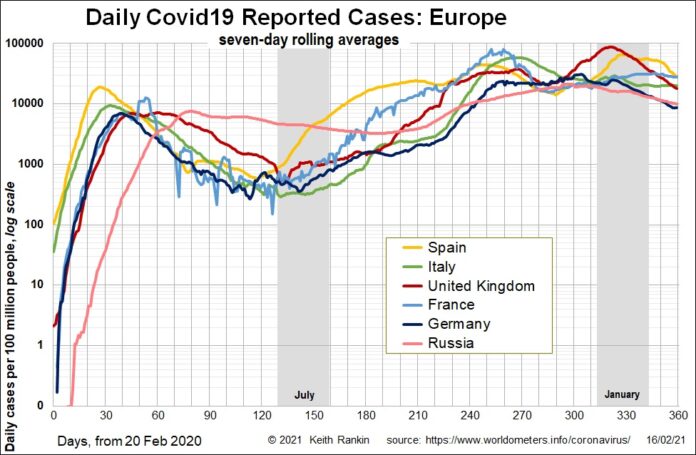
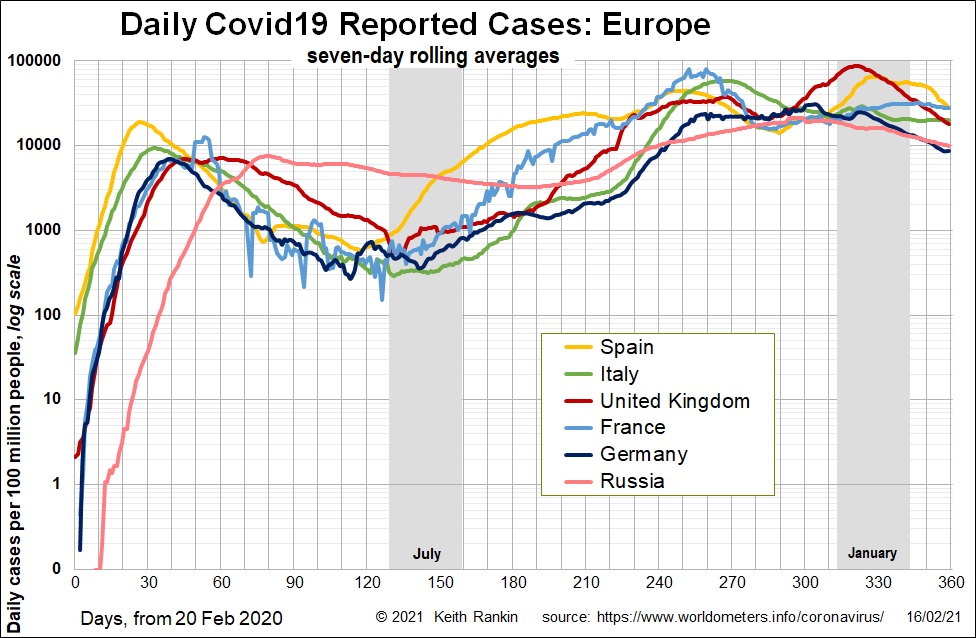
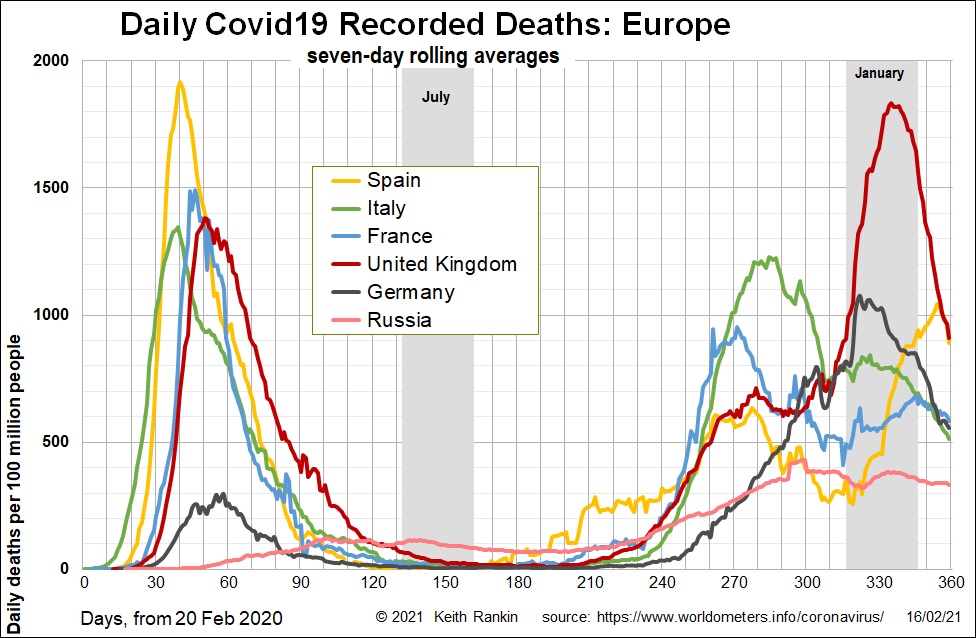
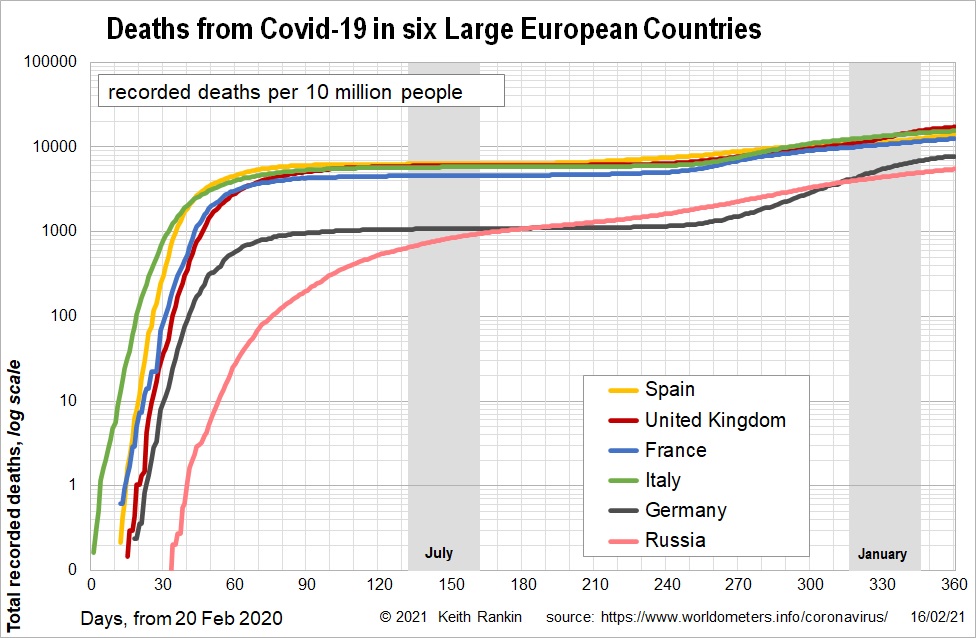
Fewer reported cases than the New Year peak, but still more than in the first peak. Chart by Keith Rankin.
Analysis by Keith Rankin.
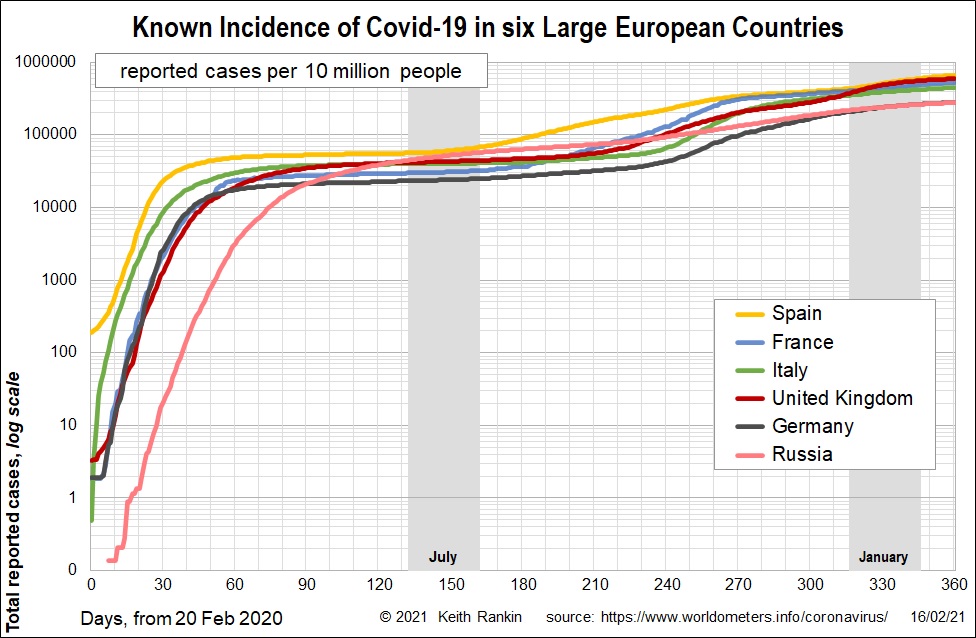
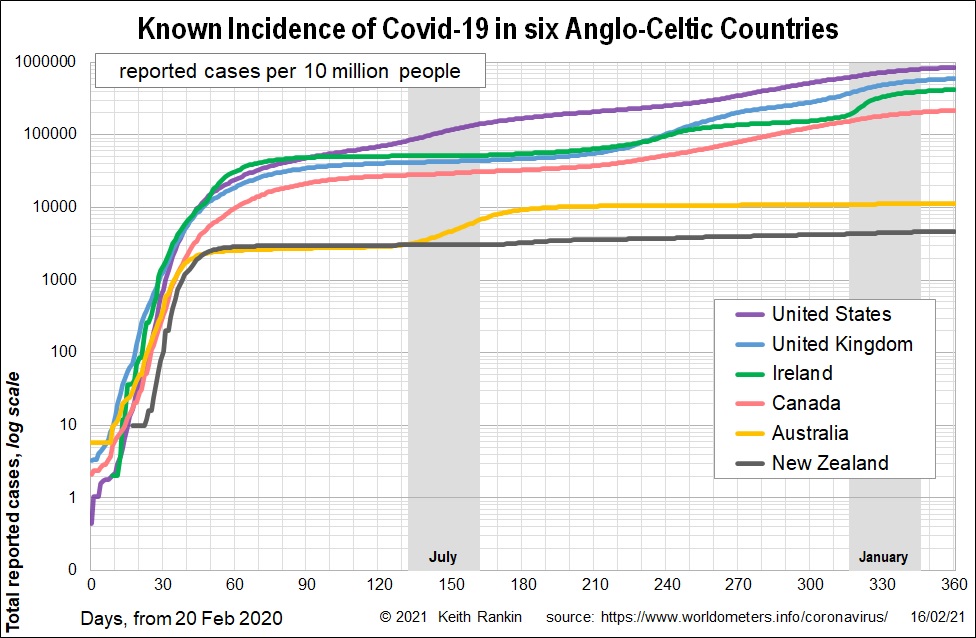
Fewer reported cases than the New Year peak, but still more than in the first peak. Chart by Keith Rankin.Convergence of reported cases, at three to six percent of the population. Chart by Keith Rankin.United States approaching confirmed infection rate of ten percent. Chart by Keith Rankin.Latest death rates reflect differences in restrictions rather than vaccinations. (Arithmetic scale.) Chart by Keith Rankin.The worst death tolls – including UK – now approaching two per thousand. Chart by Keith Rankin.Canada’s death rate 100 times New Zealand’s; other Anglos worse. Chart by Keith Rankin.
Source: The Conversation (Au and NZ) – By Zahra Zsuzsanna Stardust, Adjunct Lecturer, Centre for Social Research in Health, Research Assistant, Faculty of Law and Justice, UNSW
Officially, the Morrison government’s new bill aims to improve online safety.
But in doing so, it gives broad, discretionary powers to the commissioner, with serious ramifications for anyone who engages with sexual content online.
Broad new powers
After initial consultation in 2019, the federal government released the draft online safety bill last December. Public submissions closed on the weekend.
The bill contains several new initiatives, from cyberbullying protections for children to new ways to remove non-consensual intimate imagery.
Julie Inman Grant was appointed as the government’s eSafety Commissioner in 2016.Lukas Coch/AAP
It contains rapid website-blocking provisions to prevent the circulation of “abhorrent violent material” (such as live-streaming terror attacks). It reduces the timeframe for “takedown notices” (where a hosting provider is directed to remove content) from 48 to 24 hours. It can also require search engines to delete links and app stores to prevent downloads, with civil penalties of up to $111,000 for non-compliance.
But one concerning element of the bill that has not received wide public attention is its takedown notices for so-called “harmful online content”.
A move towards age verification
Due to the impracticality of classifying the entire internet, regulators are now moving towards systems that require access restrictions for certain content and make use of user complaints to identify harmful material.
In this vein, the proposed bill will require online service providers to use technologies to prevent children gaining access to sexual material.
Controversially, the bill gives the commissioner power to impose their own specific “restricted access system”.
This means the commissioner could decide that, to access sexual content, users must upload their identity documents, scan their fingerprints, undergo facial recognition technology or have their age estimated by artificial intelligence based on behavioural signals.
But there are serious issues with online verification systems. This has already been considered and abandoned by similar countries. The United Kingdom dropped its plans in 2019, following implementation difficulties and privacy concerns.
The worst-case scenario here is governments collect databases of people’s sexual preferences and browsing histories that can be leaked, hacked, sold or misused.
eSafety Commissioner as ‘chief censor’
The bill also creates an “online content scheme”, which identifies content that users can complain about.
The bill permits any Australian internet user to make complaints about “class 1” and “class 2” content that is not subject to a restricted access system. These categories are extremely broad, ranging from actual, to simulated, to implied sexual activity, as well as explicit nudity.
In practice, people can potentially complain about any material depicting sex that they find on the internet, even on specific adult sites, if there is no mechanism to verify the user’s age.
The potential for complaints about sexual material online is very broad under the proposed laws.www.shutterstock.com
The draft laws then allow the commissioner to conduct investigations and order removal notices as they “think fit”. There are no criteria for what warrants removal, no requirement to give reasons, and no process for users to be notified or have opportunity to respond to complaints.
Without the requirement to publish transparent enforcement data, the commissioner can simply remove content that is neither harmful nor unlawful and is specifically exempt from liability for damages or civil proceedings.
This means users will have little clarity on how to actually comply with the scheme.
Malicious complaints and self-censorship
The potential ramifications of the bill are broad. They are likely to affect sex workers, sex educators, LGBTIQ health organisations, kink communities, online daters, artists and anyone who shares or accesses sexual content online.
While previous legislation was primarily concerned with films, print publications, computer games and broadcast media, this bill applies to social media, instant messaging, online games, websites, apps and a range of electronic and internet service providers.
Sex education material may be subject to complaints.www.shutterstock.com
It means links to sex education and harm reduction material for young people could be deleted by search engines. Hook up apps such as Grindr or Tinder could be made unavailable for download. Escort advertising platforms could be removed. Online kink communities like Fetlife could be taken down.
The legislation could embolden users – including anti-pornography advocates, disgruntled customers or ex-partners – to make vexatious complaints about sexual content, even where there is nothing harmful about it.
The complaints system is also likely to have a disproportionate impact on sex workers, especially those who turned to online work during the pandemic, and who already face a high level of malicious complaints.
We need new ways to think about moderating sexual content.
Historically, obscenity legislation has treated all sexual content as if it was lacking in value unless it was redeemed by literary, artistic or scientific merit. Our current classification framework of “offensiveness” is also based on outdated notions of “morality, decency and propriety”.
Instead, some have proposed human rights approaches. These draw on a growing body of literature that sees sexual health, pleasure and satisfying sexual experiences as compatible with bodily autonomy, safety and freedom from violence.
Others have pointed to the need for improved sex education, consent skills and media literacy to equip users to navigate online space.
What’s obvious is we need a more nuanced approach to decision-making that imagines sex beyond “harm”, thinks more comprehensively about safer spaces, and recognises the cultural value in sexual content.
Review: Firestarter – the Story of Bangarra, directed by Wayne Blair and Nel Minchin
Aboriginal and Torres Strait Islander readers are advised this article contains names and images of deceased people.
Watching Firestarter is like being immersed in a Knowledge Story. A story that contains deep, secret knowledge at its heart, while sharing an outside, public version. If I had to sum up the outside layer of this story, I would say it is one about energy transformation.
The film gives insight into the emergence of contemporary Indigenous dance in 1970s Australia. It’s a story about embodied activism birthed by founding figures such as Carole Y Johnson and Cheryl Stone through the fusion of contemporary dance forms with ancient living ones.
And it’s the story of three Page brothers — choreographer Stephen, composer David and dancer Russell — who established the iconic style that is Bangarra movement.
Three brothers. Sounds like the beginning of a story …
Since 1989, Bangarra Dance Theatre has used dance to craft spaces in important national moments. The opening ceremony of the 2000 Olympics, for example, allowed Aboriginal and Torres Strait Islander knowledge of movement, music and song to be seen, heard and felt.
And just as a public version of a Knowledge Story helps make connections to deeper meanings, Firestarter gives you access to stories containing ancient wisdom fused with contemporary colonial trauma.
If you’ve ever seen a Bangarra performance you will know that dance is a thread straight to the Dreaming. A ceremonial form with physical and metaphysical knowledge embodied by, and shared with, movement.
Watching the documentary, like watching a Bangarra performance, requires you to pay attention, make connections, explore possible interpretations and potentially be transformed by the telling of it.
Djakapurra Munyarryun in Ochres.Ashley De Prazer/Icon Films
The founding of the Aboriginal Islander Dance Theatre in 1975 was a moment in this nation-state’s history that saw the hearts, minds and bodies of mobs of different Blackfellas merge together to begin to shape what would become Australia’s leading Indigenous dance movement.
The dance theatre’s transition into the National Aboriginal and Islander Skills Development Association — better known as Australia’s Aboriginal and Torres Strait Islander Dance College — cemented the fusion of cultural knowledges, dance forms, political activism and historical events that would lead to the birth of Bangarra, a Wiradjuri word meaning “to make fire”.
Bangarra has always been both a mirror and a portal. It reflects the aliveness and sentience of stories that come from different mobs and their Countries across Australia while at the same time navigating ongoing colonial trauma.
Corroboree (2001) explored three stories of Dreamtime in a fusion of traditional and contemporary dance.AAP Image/Bangarra Dance Theatre
Through the sharing of stories — the dilemma of how we remember Bennelong, a long history of cultivation through Dark Emu (based on Bruce Pascoe’s book), the yearning for cultural connection in Blak, of the Stolen Generation in Mathinna — the company allows moments of moving through the traumatic to access glimpses of love, healing, transformation and possibilities.
Contemporary Indigenous dance speaks to and of survival, despite 200-odd years of colonial policies aimed at ensuring cultural disconnection.
As the association’s co-founder Carole Y Johnson says in the film:
Australia wasn’t acknowledging Aboriginal people. They had been taken off of their land so many times and I was shocked to understand it was really within living memory of so many people. In terms of dance, Indigenous people were actually ahead and I thought they had something very unique and special to offer.
In telling the story of Bangarra, the film tells stories of creation, trauma, connection and hope.
A significant part of the telling is the influence of the three Page brothers who use music, dance and story to navigate disconnection and reconnection through grief and praise.
Their childhood was lived alongside 12 siblings filled with music, storytelling, laughter and the lived impacts of being cut off from language, land and culture. The brothers went on to use their powerful creative abilities to tell stories about finding your identity, connecting with cultural knowings and acknowledging violent colonial lived experiences.
Brothers in arms: Russell Page, Stephen Page and David Page.Paul Sweeney/Icon Films
Such service comes with a heavy responsibility.
The brothers don’t just carry the burden for themselves, but for any Aboriginal and Torres Islander person who knows their ancestors are there but does not know how to access them.
Firestarer explores how the deaths of Russell in 2002 and David in 2016 continues to be felt by artists and audiences, magnified by the power of their performances and music.
Bangarra has, time and time again, stepped up to the challenge of sharing stories through dance to create moments of access for all Australians who hold a relationship with this land’s First Nations’ peoples, its living colonial history and Country itself.
The story of Bangarra is the story of ignition: Bangarra, for 31 years, has nurtured, protected and breathed life into an ancient ember of light that is then shared with the collective consciousness of Australia — and the world.
Bangarra today.Daniel Boud
Stephen Page, Bangarra’s artistic director since 1991, states:
… art, dance, music, they’re such good medicines. […] Storytelling is the best medicine you can have, it’s what sustains us as a society.
So I need to acknowledge and pay my respect to the heat, oxygen and fuel that is the story of Bangarra and all those who have contributed to creating the energetic and powerful being that it continues to become.
Thank you for carrying the responsibility of telling both living ancient stories woven with painful contemporary ones that speak of both national and personal tragedies.
New Zealand’s unemployment rate dropped to 4.9% in the December quarter, down from 5.3% in the previous quarter. One commentator argued this drop clearly establishes that a strong health response from the government was also the best economic response.
That may well be true but the conclusion is not obvious based on the data we have at our disposal.
The Stats NZ report that provides the unemployment information also points out that despite this quarterly fall, the number of unemployed people is still 25,000 (about 22%) higher than it was a year ago.
More people on job keeper support
In the meantime, according to the Ministry of Social Development, the number of people receiving “job seeker–work ready” support has increased from about 85,000 in January 2020 to 135,000 in January 2021, a net increase of 50,000.
In fact, the number of recipients jumped dramatically from around 85,000 to around 120,000 by the middle of 2020 with a modest increase after that.
Something here seems amiss because if the unemployment rate drops then the number of job seeker benefit recipients should drop as well.
The unemployment rate for the economy is defined as the fraction of those unemployed out of those in the labour force.
On the basis of Stats NZ’s household labour force survey data we know that the 4.9% unemployment rate comes from a total of 141,000 unemployed out of 2,874,000 in the labour force.
To be categorised as unemployed in New Zealand, a person aged 15 or more must not have a paid job, must be available to start work and have been actively seeking work in the last four weeks or be due to start a new job in the next four weeks.
Who’s ‘actively seeking work’?
I think it is the “actively seeking work” part that is a source of contention since it is entirely possible there are people capable of working but not actively looking (or have given up looking) who are not considered part of the labour force.
What if we assume that since the start of 2020, there are an additional 50,000 people — as the job seeker figure would indicate – who could be working but are not?
This changes the December quarter unemployment rate to about 6.5%, which is higher than the previous quarter reported.
But what may be of more immediate concern is the level of underutilised labour in the economy. Stats NZ’s underutilisation rate is a better measure of this.
This measures the total number of people who are unemployed, underemployed (working part-time but with the desire and availability to increase their hours), or currently not in the labour force.
On the plus side, this underutilisation rate has fallen from 13.2% of the labour force to 11.9% during the last quarter of 2020. But this is still above where it was in December 2019, when underutilisation was at 10.1%.
According to Stats NZ, in December 2019, NZ’s labour force was 2,830,000 and 10.1% (283,000) were underutilised. By December 2020, the labour force has grown to 2,874,000 and the underutilisation rate is at 11.9%, 342,000 people; an increase of 59,000, which includes the additional 25,000 increase in unemployment.
To be clear, this is not to suggest these other measures are somehow closer to the truth than the unemployment rate. But it appears to me that collectively the increases in jobseeker benefit recipients and the underutilisation rate paint a picture that is less rosy than the 4.9% unemployment rate suggests.
Why the figures matter
This difference matters crucially because the kinds of policies we should espouse if the true unemployment rate is 6.5% (or higher) are different from those we should follow if the unemployment rate is 4.9%, as reported.
If the latter figure is true then we are truly out of the recession and there is little need for any further pump priming. At the very least the Reserve Bank can stop its quantitative easing and there is very little need for further lowering of interest rates.
Indeed, it may be time to start considering raising the interest rate to thwart inflationary pressures.
But if the underutilisation rate is a better reflection of the underlying economic conditions then the economy is not in great shape. In that case the policy settings need to change and the government would be ill-advised to let up on providing economic stimulus.
Over the past few days, Google has been inking multimillion-dollar deals to pay media companies for news content that will appear on Google News Showcase.
Rupert Murdoch’s News Corp is the latest beneficiary of a partnership with the tech giant. It will receive significant payments over three years, a share of ad revenue, and inclusion in the development of a subscription platform.
News Corp, owned by media magnate Rupert Murdoch, signed a three-year agreement with Google which will span its global publications. News Corp will also get ad revenue from Google.Christopher Smith/AP
The timing of these deals raises questions. The long-contested News Media Bargaining Code, which aims to get Google and Facebook to pay for news, is set to be introduced into federal parliament. The tech giants have been vocal critics of the code, arguing they have no obligation to pay media companies for Australian news that appears on their platforms.
While Facebook has simply pulled all news content for its Australian users, and all Australia news from the rest of the world, Google instead is handing out millions to local publishers. Why?
Searching for a solution
The bottom line is Google is desperate to avoid paying for news that appears in Google Search, which Treasurer Josh Frydenberg initially planned to make them do.
Google believes this would strike at the core of its business model. It maintains search engines are supposed to index the web passively, collect whatever is available, and present the results to users.
Paying news outlets for content on Search would mean giving them special treatment above all other businesses and creators whose web pages also appear in search results.
The Morrison government originally ignored these complaints. However, according to a Sydney Morning Herald report, Frydenberg could be willing to hold off on designating Google Search under the code for as long as deals are being made.
According to the report, Google is playing ball and offering deals that are:
… worth the same, or a similar amount, to what a company would have received for appearance of content in Google search.
But we still don’t know the end result. Frydenberg has the power to designate, at any time, which Google products are subject to the code. Google Search could be included at a later date if the amount of money handed over is deemed insufficient.
The future of the bargaining code
Both the Australian Competition and Consumer Commission (which initially proposed the code) and the federal government both likely see these deals as a positive outcome.
This is because the code was essentially meant to bring the platforms to the negotiation table. Facebook and Google had given money to certain news outlets in the past – in an ad hoc way, but with no intention of setting a global precedent to pay for all news content produced across a country.
The trick the ACCC and the government employed was to introduce legislation that would force platforms to pay for news. A key element of this reform was the use of “final offer” arbitration.
With this, if a deal can’t be struck between Google and a media company, both will have to present their offers and defer the final decision to an arbiter. This arbiter would then be able to adjust the figures if neither offer was in the public interest.
Businesses are desperate to avoid speculative costs linked to arbitration schemes. They want certainty. Google had a good reason to start making deals, especially if it means potentially only paying for news content that appears on Google News Showcase and not Search.
This doesn’t mean the News Media Bargaining Code won’t be used (Google has only started making deals), but it would be a surprise if Google planned to end up in arbitration.
The recent developments have underlined the curious role of the bargaining code: it’s meant to operate as a legislative threat so arbitration only happens when platforms and news outlets can’t agree. If Google keeps handing out money, this is unlikely to happen.
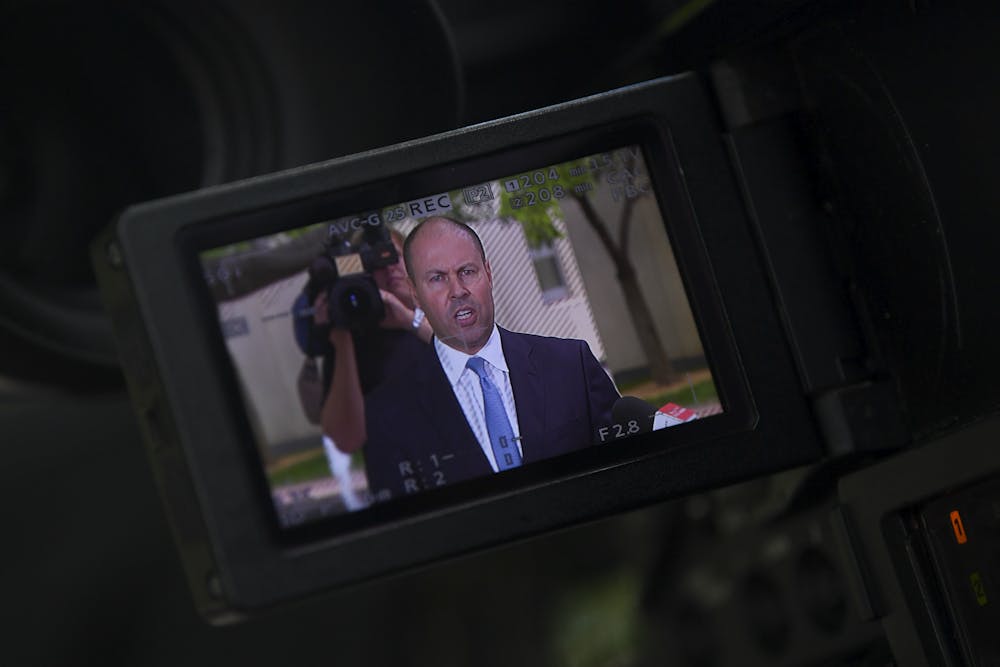
Treasurer Josh Frydenberg yesterday said ‘none of these deals would be happening if we didn’t have the legislation before the parliament’ — before Facebook removed all Australian news from its platform.Lukas Coch/AAP
What it means for journalism
These deals will likely give Australian journalism a long-awaited financial boost. Unlike the occasional partnership in the past, media businesses can now bank on a form of sustained revenue stream from Google.
The challenge now will be to ensure this new revenue funds public interest journalism, which is really the only benefit the average Australian can receive. The government has indicated there will be a review after one year to ensure the code is working as intended.
Also, the deals are being struck with major media companies that have significant bargaining power. While the code enables smaller outlets to bargain collectively, or accept a standard offer, it remains to be seen if Google will be as generous to regional publishers.
They may also have to plan for less revenue overall if Facebook sticks to its guns, decides to stay away from the negotiating table and keeps Australian news content banned on its platform.
The Parliamentary Commissioner for the Environment’s second tourism report urges the government to take advantage of the disruption caused by COVID-19 to transform the tourism industry.
introducing a departure tax to address the high and unavoidable emissions associated with international air travel
making central government funding for tourism infrastructure conditional on environmental criteria.
strengthening legislation allowing the Department of Conservation to fully protect Aotearoa’s most spectacular natural areas
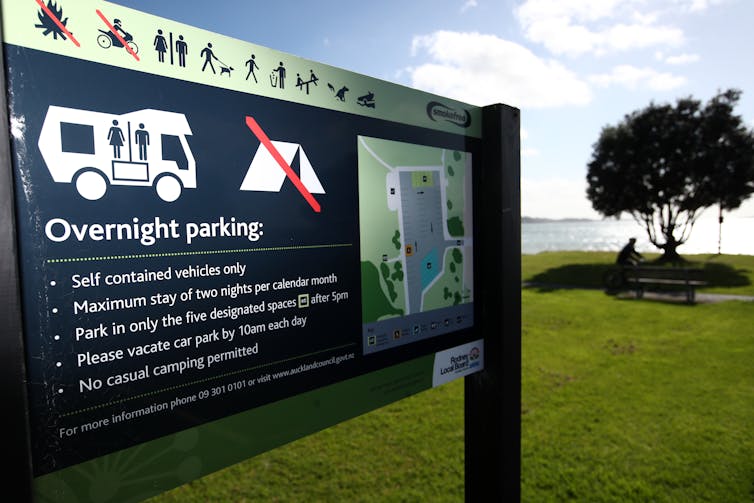
strengthening existing standards for self-contained freedom camping.
These represent a paradigm shift away from industry subsidy to increasing tourist and tourism business accountability.
Protecting pristine environments is a priority: the report recommends tighter rules for freedom campers and rental companies.GettyImages
Not business as usual
There is also much to like about the three key principles underpinning the commissioner’s recommendations:
tourism should be treated like any other sector of the economy, without special priority and public subsidy
communities and mana whenua should be central to tourism decision-making
tourists and tourism businesses should meet the costs of the resources they consume (including finite environmental resources).
The report acknowledges the threat to the survival of many local tourism businesses from the crippling of international travel. But the commissioner argues there is great interest in, and wide support for, using this disruption to shape the industry’s recovery.
However, that transition will require active intervention to avoid a return to the status quo.
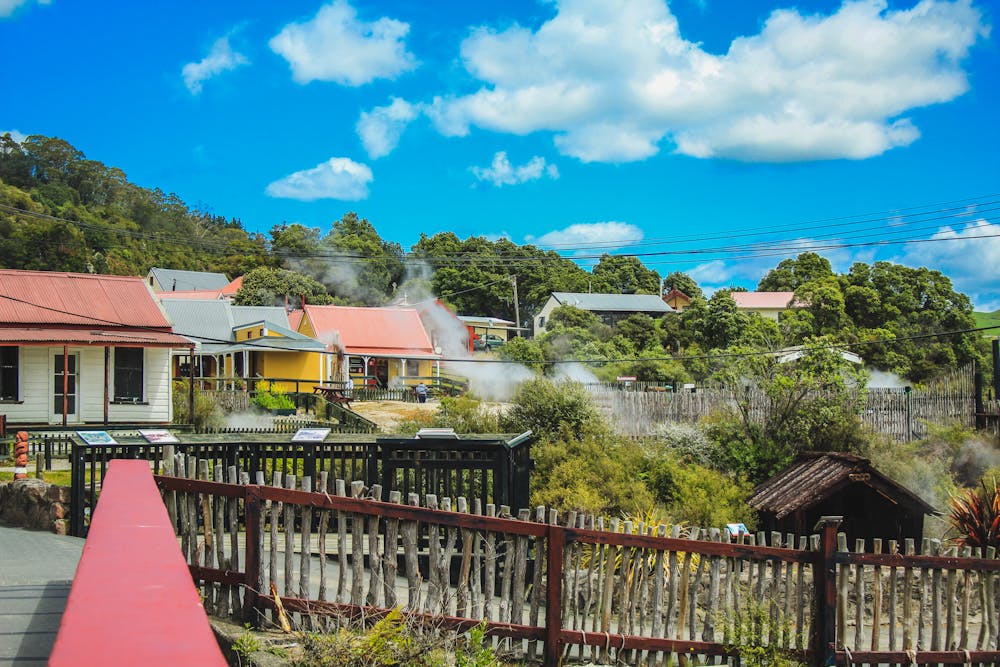
The famous Whakarewarewa thermal village in Rotorua: Māori need more say in tourism development and management.www.shutterstock.com
Over-tourism and climate change
There are two standout features of the report. First, it identifies the key concerns of many New Zealanders and tackles them head on. These include freedom camping, crowding and loss of natural quiet in our most stunning conservation areas.
The recommendations extend to strengthening rules around commercial activity on conservation land and water, improving the certification process for campervans, and requiring rental agencies to play a greater role in collecting freedom camping infringement fees and fines.
Central to the report is the need to empower mana whenua and local communities to be heard in tourism development and management planning, and to further the scope for Māori to exercise tino rangatiratanga, kaitiakitanga and manaakitanga.
Secondly, and perhaps most importantly in terms of shaping the re-emergence of a 21st-century tourism system, the report tackles the inescapable global issues arising from the high emissions of international air travel.
Return of the departure tax?
New Zealand is a geographically remote destination, dependent on long-haul markets. It is also a place of spectacular natural beauty in a world of accelerating environmental degradation.
Parliamentary Commissioner for the Environment Simon Upton.Supplied
As such it is a destination threatened less by sensitivity to increasing travel costs — the impact of a passenger tax on tourist demand is likely to be modest — and more by climate concerns and growing “flygskam” (flight shame).
The commissioner recommends the introduction of a distance-based departure tax that would generate between $NZ100 million and $400 million annually, ring-fenced to support efforts to reduce emissions.
Tax revenue aside, this is critically important in terms of global leadership. The failure of the Carbon Offsetting and Reduction Scheme for International Aviation (CORSIA), introduced by the International Civil Aviation Organisation (ICAO), means individual countries showing leadership is the only way to transition away from the high-carbon global aviation regime.
The proposed departure tax raises important questions about how ring-fenced funds are best deployed. The commissioner recommends such revenues go to supporting the development of low-emissions aviation technologies and providing climate finance for Pacific Island nations.
But low-emissions aviation research and development is a long-term, multi-billion-dollar challenge. It requires a global commitment and response via the ICAO and aviation manufacturers such as Boeing and Airbus. The commissioner concedes this is only likely to yield benefits over time.
If we are to ring-fence taxes on New Zealand tourists, then, why not give priority to the immediate enhancement of a low-carbon New Zealand tourism sector?
The Climate Change Commission recognises that investing in low-carbon local and domestic transportation involves some relatively low-hanging fruit: electrification of New Zealand’s vehicle fleet, development of recharging networks, light rail, safe active transport including cycle trails and cycle networks, and other low-carbon transport investments.
So, investment in gondola access to ski fields, for example, could offer immediate opportunities to shift away from the queues of private vehicles we saw streaming up ski field access roads last winter.
These low-carbon transitions will future-proof our tourism industry and allow us to enjoy immediate advantages over our international competitors when international travel is restored.
Tourism NZ’s ‘travelling under the social influence’ campaign already aims to divert tourists from popular but overcrowded locations.
NZ’s early advantage
Countries that adopt air transport carbon charges will seize the advantages available to early adopters. As others recognise the growing urgency of joining the successful club, rather than staying in a collective race to the bottom, change accelerates.
Replacing marginal price advantages under the old regime with highly marketable low-carbon advantages under the new one will only build New Zealand’s standing as a global leader in sustainable tourism.
Implementing a departure tax also opens up the possibility of multilateral agreements with other vanguard countries that want to lead ambitious action on climate change.
The commissioner concedes his four policy proposals are not comprehensive. Other issues remain, such as reining in the high environmental costs of the cruise industry.
However, his report does outline ways to transition the industry and begin to build a sustainable, resilient and climate-safe tourism system fit for the 21st century. For that reason, it is important these policy proposals are acted on.
Source: The Conversation (Au and NZ) – By Rodney Tiffen, Emeritus Professor, Department of Government and International Relations, University of Sydney
Sadly, history has largely forgotten the Rector Thomas Beverley. In 1695, he wrote a book predicting the world would end in 1697. In 1698 he wrote another book, complaining the world had ended but no-one had noticed. If he were alive today, he might be a Republican senator or perhaps a senior executive at Rupert Murdoch’s Fox News.
The defeat of Donald Trump is not quite the end of the world for Fox News, but it is the passing of a golden age, and the network has met it with a large dose of denialism. In the two weeks after Fox News called the US presidential election for Joe Biden, the network’s hosts and guests cast doubt on the results at least 774 times, according to Media Matters for America.
There has rarely, if ever, in any democracy been such a partnership between a news network and a government leader as there was between Fox and Trump. Fox was the preferred conduit for his administration’s announcements and interviews. The president was also the network’s chief publicist, tweeting his views, often in real time, about what Fox News was broadcasting.
This was a mutually beneficial partnership. Trump got his views out without serious contradiction or questioning, while everyone in the political class had to give constant attention to Fox.
It also paid off commercially. While Fox News had been the leading cable news channel for 20 years, by 2020 it was the third-most-watched network in the country in prime time on weekdays – not just in cable, but all of television, behind only CBS and NBC. And 2020 was its most successful year yet. In the third quarter, its ratings were nearly double the year before.
For Fox, Trump’s defeat was almost as painful as it was for Trump himself. After the election, its ratings fell sharply. In January, for the first time in two decades, it trailed behind the other two cable news channels, CNN and MSNBC. The day the Capitol was stormed, January 6, was CNN’s most watched day in the network’s history, and Fox only pulled just over half as many viewers (8.2 million to 4.6 million).
Indeed, the attack on the Capitol caught the Fox commentariat off balance and the network has been entertaining two contradictory theories since. The first is that it was a “false flag” operation mounted by far left groups masquerading as Trump supporters; the other is that the rioters were “solid Americans” and “deeply frustrated” (Tucker Carlson) and the “majority of them were peaceful” (Hannity).
None of Fox’s prime-time stars has yet blamed Trump for his role in inciting the riot. But they know others’ reports are wrong. Carlson asserted “they [unspecified] are lying to you” about the attacks. “The known facts bear no resemblance to the story they’re telling – they’re just flat out lying.” So that takes care of that.
At the same time as the network was bleeding audiences to its more mainstream competitors, it was also under attack on its right flank. Its most grievous sin here had been predicting on election night that Biden would win Arizona. This call – which several experts thought was premature, but which proved to be accurate – incurred the wrath of Trump and his supporters.
Rupert Murdoch was reported as telling colleagues the way Fox handled it had caused reputational damage and cemented the view among some Trump supporters that Fox had turned against him. Not coincidentally, the two people directly responsible for that call – Bill Sammon and Chris Stirewalt – were forced out in network changes after the election.
Two other right-wing news networks, News Max and One America News, pose little threat to Rupert Murdoch’s Fox.AAP/AP/Mary Altaffer
Two other, even more tribally right-wing news networks started to challenge Fox. Newsmax and One America News saw their ratings increase as they steadfastly supported the fantasy that the election had been stolen. In addition, there has been loose talk that Trump will start his own TV network to compete against Fox.
My guess is that each of these potential challengers will disappear or be much reduced in the near future. Establishing his own network would be beyond Trump’s very limited managerial prowess. The saving grace of his administration has been his incompetence. The two others lack Fox’s polish, variety of programming and resources.
Nevertheless, protecting the network against any market openings to the right seems to be the Murdochs’ main strategic response to the post-Trump challenges. Their most important decision has been to strengthen the opinion elements of their programming at the expense of the news operations.
The key to Fox’s rating strength has been its evening prime-time line-up. From 8pm to 11pm, Carlson, Hannity and Laura Ingraham each have an hour show. Fox will now devote the 7pm slot to another opinion program, taking the time slot away from news. It is ready to attack the Biden administration, with Hannity having attacked “the weak, the frail, the cognitively struggling Biden” on the day of his inauguration.
Tens of millions of Americans have no chance; they’re about to be crushed by the ascendant left. These people need a defender.
He and his colleagues, of course, are up for the battle. In his inaugural speech, Biden talked of the need for unity and said the US was threatened by racism, nativism, political extremism, white supremacy and domestic terrorism. As Carlson commented on this, a chyron under him asserted: “Party in power is demonizing half of the country”.
started the most sweeping mass censorship campaign in the history of this country.
A Republican strategist commented that these audiences “want their ‘news’ to affirm them rather than inform them”. The network will reach a much smaller ghetto, and attract less attention from others. But the essential Fox strategy for the new era is more of the same.
Source: The Conversation (Au and NZ) – By Nina Jane Chad, Infant Feeding Consultant, World Health Organization; Research Fellow, University of Sydney School of Public Health, University of Sydney
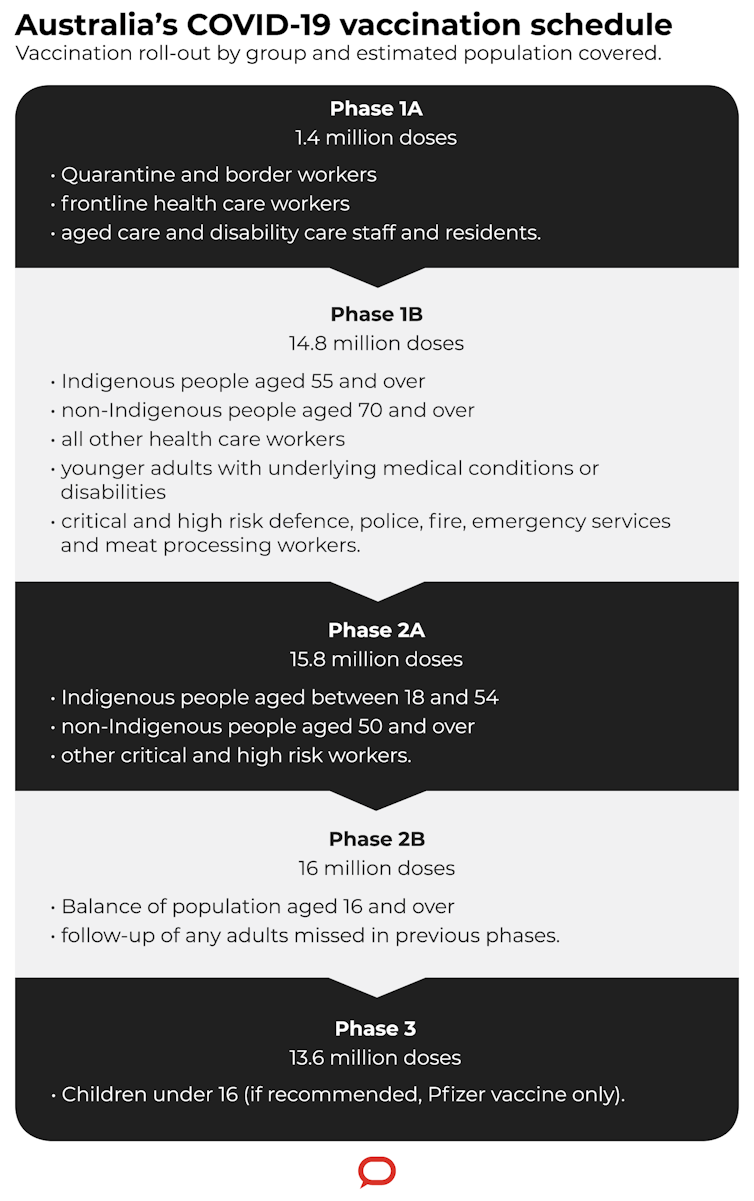
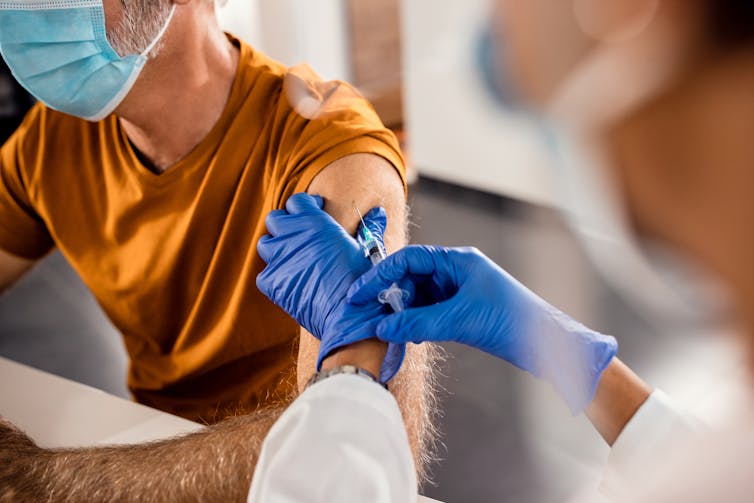
From Monday, Australia’s front-line health workers, quarantine staff, border control officers, and workers and residents in aged-care homes will be offered the Pfizer COVID-19 vaccine.
Some of these workers will be women who are pregnant, planning a pregnancy, and/or breastfeeding.
So they may be concerned about whether the vaccine is safe for themselves and their babies.
What issues do these women need to consider?
Remind me again, which vaccine?
Australia’s drug regulator, the Therapeutic Goods Administration (TGA), has approved two vaccines. Pfizer’s vaccine has been approved for people aged 16 years and older; the AstraZeneca vaccine for people aged 18 and older.
Although neither approval excludes women who are pregnant or breastfeeding, the TGA recommends their use in pregnancy be based on an assessment of whether the benefits of vaccination outweigh the potential risks.
The federal health department has issued a decision guide to help women who are pregnant, breastfeeding, or planning pregnancy assess whether the benefits of having the Pfizer vaccine outweigh the risks.
Although no studies have specifically investigated whether COVID-19 vaccines get into breastmilk, the baby’s stomach acid would destroy them if they did.
Antibodies against the virus have been detected in the milk of mothers who have been infected with COVID-19. So, if the antibodies the vaccine triggers also pass into breastmilk, getting vaccinated while you’re breastfeeding may even help to protect your baby against COVID-19. Antibodies in breastmilk are widely known to help protect infants against a wide range of infections.
Even if the vaccine passed into your breastmilk, it would be destroyed by the acid in your baby’s stomach.www.shutterstock.com
How about if I’m pregnant?
The Australian health department is encouraging women who are pregnant and at high risk of catching COVID-19, or who have medical conditions that make them more vulnerable to severe COVID-19 disease, to consider getting vaccinated.
The World Health Organization is even clearer in recommending women who are pregnant to be vaccinated if they are at high risk of catching COVID-19 or of developing severe COVID-19 disease.
While it might seem safer to wait until you’re no longer pregnant to be vaccinated, that may be riskier. Pregnant women are more likely to get severe COVID-19 than other infected women, and are slightly more likely to give birth prematurely if they have COVID-19.
So vaccination is important, especially if you are a front-line health, aged-care, or quarantine worker.
Are the vaccines safe for pregnant women and their babies?
Almost all vaccines are safe during pregnancy and some are recommended to protect women and their babies from infectious disease. Even those that are not generally recommended can be given to pregnant women in certain circumstances, for instance when it would be safer to have the vaccine than to be exposed to infectious disease without the protection vaccination provides.
The active ingredient in the Pfizer vaccine is mRNA, a tiny fragment of genetic material (messenger ribonucleic acid) that triggers our own cells to produce a spike protein similar to the one on the surface of the coronavirus. This triggers an immune response that destroys the spike protein and teaches our bodies to recognise the virus that causes COVID-19. mRNA is very fragile, so it is destroyed in our bodies very quickly.
While we are still gathering more information about the use of COVID vaccines in women who are pregnant, there are some encouraging signs. About 20,000 pregnant women in the United States alone have been vaccinated and there have been “no red flags” around safety.
Women who are not working in front-line health, aged care, border protection or hotel quarantine will not be offered COVID-19 vaccination for some time yet.
Fortunately, in Australia it is very unlikely for someone who is not a front-line worker to be exposed to COVID-19 because there are so few cases in the community.
By the time vaccination is offered to healthy women who are not in high-risk occupations, many hundreds of thousands of pregnant women will have been vaccinated worldwide, giving us more information on which to base our recommendations.
So, why the controversy?
Researchers did not include women who were pregnant or breastfeeding in COVID-19 vaccine research. So when the first vaccines were offered to health workers in the United Kingdom, for instance, health authorities did not recommend vaccinating women who were pregnant or breastfeeding.
While this may have been motivated by a desire to protect them, it had the opposite effect. UK women in jobs that placed them at high risk of contracting COVID-19, were left without the protection offered by vaccination. Some womenstopped breastfeeding. Others felt it meant choosing between working while unvaccinated and not working at all. Recommendations in the UK have since changed, and pregnant or breastfeeding women in high-risk occupations are now offered vaccination, just as they will be here.
In Australia, the Royal Australian and New Zealand College of Obstetricians and Gynaecologists (RANZCOG) says that, although there is no evidence COVID-19 vaccines could cause harm when given to women in pregnancy, there is insufficient evidence to recommend Australian pregnant woman routinely get vaccinated. This recommendation may change if the number of COVID-19 cases increases in Australia.
However, RANZCOG does recommend that women with particular underlying medical conditions discuss the pros and cons with their health-care provider. It also suggests pregnant women working in high-risk environments be offered alternative duties that reduce their chance of exposure to the virus.
From what we know so far, breastfeeding women can be vaccinated without risk to their babies. And the World Health Organization says vaccination is safer for pregnant women who work in places where they are at high risk of exposure to COVID-19 than not getting vaccinated.
Women who are not working in high-risk occupations, whose risk of exposure is low because community transmission is low, will not be offered vaccination for some time. By the time it’s their turn, health authorities should be able to make clearer recommendations.
Australians have a love-hate relationship with sulphur-crested cockatoos, Cacatua galerita. For some, the noisy parrots are pests that destroy crops or the garden, damage homes and pull up turf at sports ovals.
For others, they’re a bunch of larrikins who love to play and are quintessentially Australian.
Along with other scientists, I had a unique opportunity during the COVID-19 lockdowns to study things that had intrigued me closer to home, perhaps for years. While isolating in the suburbs of Melbourne, I wanted to find out why cockatoos return to the same places, and what they’re after.
The answer? Onion grass, reams of it.
Onion grass is a significant weed, and I estimated in a recent paper that one bird gorges on about 200 plants per hour. A flock of about 50 birds can consume 20,000 plants in a couple of hours.
This significantly reduces the weed level and may make expensive herbicide use unnecessary. So if you have a large amount of onion grass on your property and are regularly visited by sulphur-crested cockatoos, it would be wise to let them do their weeding first.
When play verges on vandalism
Most of us see cockies whether we live in rural communities or major cities, but how much do you really know about them?
Sulphur-crested cockatoos nest in old hollow trees.Shutterstock
In late winter and early spring in many parts of Australia, flocks of sulphur–crested cockatoos can be seen grazing on the ground. They’re usually found close to water, nesting in woodlands with old hollow trees, such as river red gums, Eucalyptus camaldulensis.
Where these forests and trees are being cleared, the number of cockies falls. But they are resilient and adaptable birds, and have spread their range to cities and the urban fringe, where numbers are increasing.
The birds are known to play with fruits, hang upside down on branches or perform flying cartwheels by holding a small branch or powerline with their feet, flapping their wings as they do loop after loop.
Sometimes their play verges on vandalism as they follow tree planters, deftly pulling up just-planted trees and laying them neatly beside the hole.
While cockatoos feed on the fruits and seed of native species, they’ve adapted very quickly to the introduction of exotic species, such as onion grass from South Africa, which is plentiful and easy to harvest.
I observed flocks ranging from nine to 63 cockatoos at seven sites along the Maribyrnong River in Keilor last July and August. Onion grass was the only item on their menu.
A pest for humans, a feast for birds
Onion grass (Romulea rosea) is small and usually inconspicuous with grass-like leaves. It’s typically only noticed when it flowers in spring, producing pretty, pink and yellow-throated flowers.
Onion grass comes from South Africa, and is a big problem for native grasslands.Harry Rose/Wikimedia, CC BY
Onion grass can be a serious weed that’s very difficult to control. It’s not only a problem for agricultural land, but also for recreational turf and native grasslands.
In some areas, there are nearly 5,000 onion grass plants per square metre. This is a massive number requiring costly control measures, such as spraying or scraping away the upper layer of top soil.
Onion grass gets its name from its onion-like leaves. At the base is a small bulb, which works as a modified underground stem called a “corm”. The corm is what cockatoos will travel many kilometres for, to dig up and return to for days on end.
When cockatoos eat onion grass corm, it prevents the weed from regenerating.Harry Rose/Wikimedia, CC BY
Their super weeding effort
Like other native parrots, sulphur-crested cockatoos are famously left-footed. So it was interesting to observe them primarily use their powerful beaks to pull onion grass plants from the ground and dig up corms, using their left foot only occasionally to manipulate the plant.
The cockatoos fed for between 30 minutes and two and a half hours. At each feed, one or two sentry (or sentinel) birds, depending on the flock size, would keep watch and give raucous warning should danger threaten.
The cockies could remove a plant and corm from the ground in as little as six seconds, but sometimes it could take up to 30 seconds. They then removed and consumed a corm every 14 seconds on average in wet soil and every 18 seconds from harder, dry soil.
When flocks feed, one or two sentinel birds keep watch for danger.Shutterstock
This means a flock of 63 birds could remove more than 35,400 onion grass plants in a feeding session lasting two and half hours. This is a super weeding effort by any standard!
Future partnerships
My further investigation revealed most of the corms were within 20 millimetres of the soil surface, so the holes left in the soil by the birds extracting the onion grass were shallow and quite small. This shouldn’t give seeds from onion grass any great advantage.
And they’re very efficient: the birds eat over 87% of the corms they lift, which then won’t get a chance to generate in future years. So, if we’re going to try to eradicate onion grass, it may be better to let the cockies do their work first before we humans take a turn.
We have a lot to learn about how our native species interact with introduced weeds, and more research might reveal some very useful future partnerships. They might be birdbrains, but sulphur-crested cockatoos really know their onions when it comes to, well, onion grass.
The Australian school system is concentrating more disadvantaged students in disadvantaged schools, with serious implications for student achievement. A report released today by the Gonski Institute says schools in Australia are more regressive, divided and socially segregated than in most other rich countries.
Our report examines how well Australian education meets our agreed national educational goals. These were most recently articulated in the Alice Springs (Mparntwe) declaration as “improving educational outcomes for all young Australians” through “excellence and equity”.
When governments provide funding to schools, obligations and expectations rightly flow from this. If one of those is promoting “excellence and equity”, it’s time for a serious revision.
We’re becoming more segregated
The Australian school system is increasingly concentrating disadvantaged and advantaged students in separate schools.
For example, all Australian schools have an ICSEA score, which stands for the Index of Community Socio-Educational Advantage. ICSEA provides an indication of the socio-educational backgrounds of students. The higher the ICSEA, the higher the level of the school’s educational advantage.
Our analysis shows that in the government sector higher ICSEA schools are 26% bigger than they were in 2011, while lower ICSEA schools are marginally smaller than they were in 2011. Lower ICSEA Catholic schools are around 10% smaller than they were in 2011.
Our data show higher ICSEA schools in all sectors are not only growing in size, but have an increasing concentration of highly economically advantaged students. The reverse is happening in lower ICSEA schools.
While some might think this is just the natural order of things, rising inequity creates major and ongoing structural problems that hold back our national education system. Both the OECD and UNICEF have warned Australia of the risks of our growing educational inequity.
The rise in inequity is not just a problem for the most disadvantaged. It creates a burden with impacts across schooling. The distortions in school growth, according to level of advantage and location, mean management of the school system is unstable — and policies that give all students “a fair go” are actually difficult to implement.
This leads to “needs-based” approaches. But these are inevitably complex and often fail in implementation. The Gonski funding model is one example.
We’ve gone backwards since Gonski
The first Gonski review argued additional funding for schools should be allocated on the basis of need. If implemented, this would have boosted equity funding to all sectors. But while funding since the Gonski review pays homage to the language of equity, the data about the overall distribution of funding don’t tell the same story.
Since 2011, the percentage increase in government per-student recurrent funding of Australia’s low ICSEA (under 1,000) schools has been more than the increase to high ICSEA (over 1,000) schools. However, funding aggregated from all sources shows less advantaged schools are no further ahead. And some schools and school sectors have received greater growth in funding – even when needs are matched and accounted for.
My School data also show Australia’s very remote schools, on average, received the same percentage funding increases as major city schools – despite metropolitan areas having clear social and educational advantage.
Remote schools, on average, have received the same amount of funding as metropolitan schools — even under a needs-based funding model.Shutterstock
There is no simple answer to why this happens, but it is an inevitable consequence of a competitive system of schools. While the Gonski review recommended independent oversight of the funding arrangements, this was never implemented.
So, what do we do?
We acknowledge responses to the report will include the perennial “it’s too hard”.
And while we acknowledge choice of schooling has a strong hold on the Australian psyche, we are calling for a new conversation about what obligations might contribute to more equitable outcomes in all schools. Our report offers ten policy recommendations.
These include fully funding non-government schools with comparable governance and accountability arrangements as government schools, and banning them from charging fees. This means reframing all schools, and consequent funding, as a “public good” across all sectors.
The fully funded non-government private schools would still be run by the same organisations as before, and abide by the same educational philosophy. But no student would be turned away.
Our previous study revealed combined state and federal recurrent funding of non-government schools is close to, and in many cases exceeds, combined government funding of government schools.
In effect, this means the taxpayer saves little by funding competing systems.
One of the biggest barriers to achieving educational equity is the lack of routine reporting of school education outcomes relating to equity groups, as is required in higher education. For example, the ICSEA does not make a single appearance in any annual national reports on schooling.
To improve equity in schooling, we need clear analysis, monitoring and targeting of inequity. To gain due policy attention the National Report on Schooling in Australia needs to report on school data and student attainment across all equity groups, across time. We simply cannot allow this growing problem to go unrecognised in our annual national school report card.
Our report team includes two former school principals (one government, one non-government) and a former education minister. We are sensitive to the positioning of diverse interested voices, but we can’t help concluding that something’s got to give.
Rising school inequity means inclusive schooling, providing “a fair go” for all Australian children, is increasingly a pipedream. Growing segregation and residualisation among Australian schools also mean students are less likely to engage with peers from a wide range of backgrounds. In the long term both these issues will lead to shifts in Australian society and character.
We cannot continue to put the important work of structural school reform in the too-hard basket. If we do, countless students, teachers, communities and our nation will continue to suffer.
Source: The Conversation (Au and NZ) – By Steven Hamilton, Visiting Fellow, Tax and Transfer Policy Institute, Crawford School of Public Policy, Australian National University
A chorus of voices is calling for the government to “raise the rate” of the JobSeeker unemployment benefit, among them the Reserve Bank Governor Philip Lowe. And they’re right.
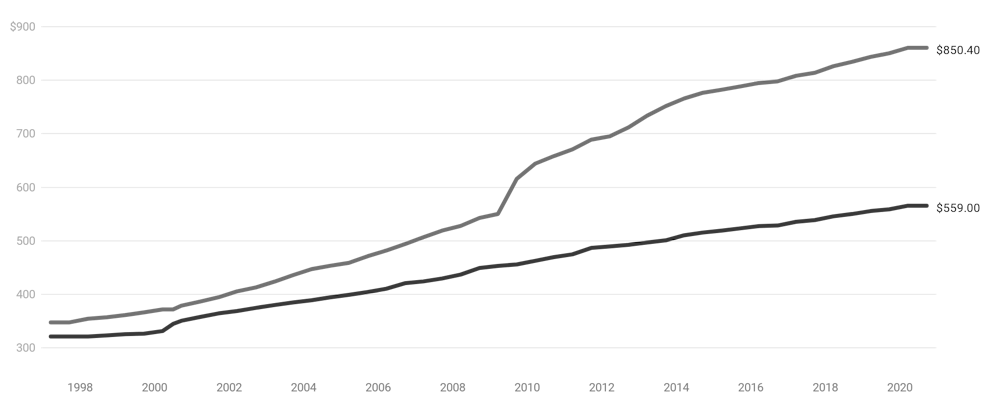
Once about as much as the age pension (and until recently called Newstart) JobSeeker now less than two thirds of it.
When the temporary coronavirus supplement ends on April 1, its inability to provide a decent standard of living will become mercilessly apparent.
JobSeeker versus the age pension
Dollars per fortnight, base rate, single.Source: Ben Phillips ANU, DSS
After JobSeeker is boosted, something the government is considering, there’s something else we should fix.
Right now JobSeeker is being asked to simultaneously serve two very different groups: those transitioning out of and back into work for a brief period (say, less than a year) and those in longer-term unemployment.
On this, Australia is an outlier.
Every member of the Organisation for Economic Co-operation and Development other than Britain, Ireland, and New Zealand offers a high, fairly generous, and time-limited initial payment (usually a portion of the former wage) that steps down at a later date.
In Canada the initial payment is 62% of average wages, falling to 23% after nine months. In the United States it is 40%, falling back to very little after six months.
The high initial rate helps people weather the temporary income shock of unemployment, and provides breathing space to search for a job that’s right.
Because our system doesn’t distinguish between the short- and long-term unemployed, Australians experiencing short-term unemployment receive the least-generous payment in the developed world.
Our rate of long-term support is actually middle of the road by OECD standards, despite being well below the poverty line.
Proper insurance
In a policy proposal released this week by the Blueprint Institute, we suggest something better, an unemployment insurance system I have called JobMatcher.
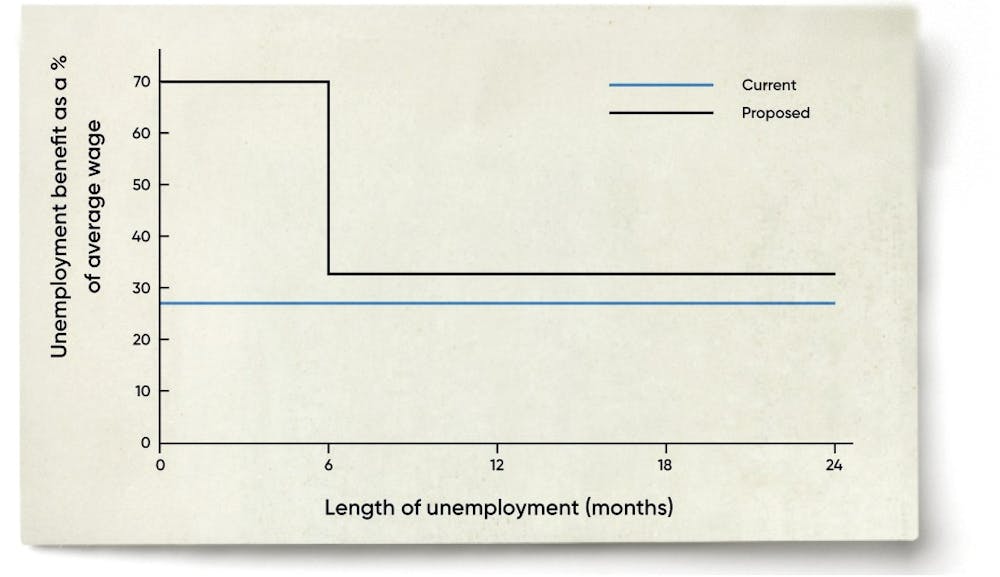
JobMatcher would pay newly unemployed people 70% of their previous wage for six months, providing what US researchers believe is enough time to find the right job.
After six months, they would be supported by the JobSeeker payment.
JobMatcher would have a number of economic benefits:
Getting people off the dole faster. Frontloading benefits has been found to speed up reemployment by providing a hard deadline after which support will be reduced.
Getting workers back into better jobs. Step-down systems of unemployment insurance provide more generous support workers at the start of unemployment, enabling them to find jobs better suited to their skills. These jobs are more likely to be full-time, last longer, and pay higher wages.
Smoothing the temporary income shock of losing work. JobMatcher would cushion the initial income shock of short-term unemployment far better than JobSeeker is likely to, providing recipients with time and space to adjust their adjust their lifestyle and debt obligations.
Serving as an automatic stabiliser. Unemployment insurance stabilises consumer spending by smoothing fluctuations in disposable incomes.
With JobMatcher, payments to the unemployed would look like this:
Proper premiums
JobMatcher would be paid for with proper insurance premiums.
The government would charge most workers an annual JobMatcher premium equal to 1% of income, along the lines of the 2% Medicare levy.
Paying in to the system would do more than merely fund it. It would engender in people who have lost their jobs the belief that they had the right to use it.
And it would engender broader public support for the high payments involved.
Can Australian films save the cinema? This is not a question often asked. Over the weekend, four of the top five films at the box office were Australian: firstly, The Dry ($703,037), second Penguin Bloom ($444,990), fourth Long Story Short ($315,590) and fifth, High Ground ($278,783).
The only non-Australian film in the top five was the Chinese comedy-mystery buddy film, Detective Chinatown 3 (唐人街探案 3).
Where has the juggernaut of Hollywood gone? Or more to the point, what happened to the dominance of the Hollywood studios? On the top ten list, seventh was Universal’s The Croods: A New Age and ninth was Paramount’s Synchronic.
The rest of the list was split between Australian owned and operated distribution companies (Roadshow, Rialto and Madmen) and other boutique international branches.
Jacob Junior Nayinggul in High Ground.Maxo, Bunya Productions, Savage Films
The significance here is the clear fracturing of the cinema industry. Due to COVID-19, the big Hollywood studios are stunted in ways the country has not seen since Paramount took a stranglehold of the local industry during World War I. (During that time, in a reversal of what is happening now, Paramount’s block booking system essentially jammed the cinemas full of Hollywood films, allowing no theatrical spaces for local films to be screened.)
Paradoxically, Australian films are needed more now than ever to entice audiences back to the cinema. As the current box office figures would suggest, things have significantly changed to advantage the local Australian production industry, which has benefited from the country’s success in controlling the spread of COVID-19.
Unlike America, where many cinemas shut indefinitely and productions paused, Queensland and the Northern Territory were able to continue their productions across 2020 practically unaffected.
Many of these films are now ready for release into the market.
This is not to say Hollywood has no productions ready for release. There is a significant backlog with the new Batman slated for a 2022 release whereas the new Bond, No Time to Die, has been given numerous tentative release dates over the last year. But with the iffy and truncated global cinema market, and many overseas cinemas remaining shut, such productions may not be distributed for quite some time, if global streaming options are not sought instead.
The trailer for Penguin Bloom.
Word of mouth
Last week’s box office figures did not count Victorian cinemas due to the snap state-wide lockdown. Victoria on average generally takes around 30% of the national box office. This bodes well for next week’s box office once Victorian cinemas kick back into business.
Of these Australian films, Robert Connolly’s The Dry has remained a consistent performer since Roadshow daringly decided to release on 1 January, a time when many Australian are holidaying.
Though The Dry itself is not a game-changer, it’s reaping the rewards of a significantly changed industry with expensive marketing campaigns for films like Tenet and Wonder Woman 1984 no longer guaranteeing big box office revenue. Risk averse studios are equally not willing to invest millions into marketing campaigns.
What The Dry has achieved, that Christopher Nolan’s under-performing and multimillion budget Tenet did not, is good word-of-mouth generated by eager film-goers. The review consensus at Rotten Tomatoes for The Dry had 100% of critics recommending the film.
With the dearth of releases internationally, Australian films are also enjoying theatrical distribution. UK-based WestEnd Films is finding success with Rams starring Sam Neill, the English-language adaptation of the 2015 Icelandic feature.
Hollywood on hold
The question is whether Australian films will continue to dominate when Hollywood does begin to roll out its backlog of films.
The Walt Disney Company Australia recently announcement their 2021 Release Schedule with dates locked for Black Widow, Jungle Cruise, Death on the Nile and West Side Story, though such an announcement comes with the caveat these films could too be further delayed. Horror film Antlers and Wes Anderson’s prestige pic The French Dispatch are still unslated.
But right now, local films and the local industry are showing confidence in the market and cinema audiences. The Hollywood studios, in comparison, are panicking.
Most notably, Warner Bros., to the chagrin of film producers and cinemas, recently announced plans to release all 17 of its 2021 films via an experimental “hybrid model”. This will see them premiere in theatres as well as on the streaming service HBO Max, simultaneously — for one month domestically, at least.
With COVID making everyone more domestically aware and active, Australian films are another means for the public to buy locally and support the local community. Early into the pandemic there were cries and questions as to whether the cinema industry would survive. Would the public simply prefer to watch films at home? What would happen without Hollywood movies at the cinema?
The answer, it seems, was here all along. A robust and diverse local industry. The real question is whether it can keep up with the demand.
Former Liberal staffer Brittany Higgins on Wednesday accused Scott Morrison of “victim-blaming rhetoric” – as the Prime Minister sought to explain why his own staffer failed to tell him Higgins had alleged she’d been raped.
Malcolm Turnbull cast doubt on Morrison’s claim his office only knew of the allegation last week, saying it was “inconceivable” key members of the Prime Minister’s staff did not know earlier.
Higgins, who worked for then defence industry minister Linda Reynolds, claims she was raped by a colleague after the two returned to the minister’s Parliament House late one night in March 2019. She has said she was very drunk and the assault occurred when she fell asleep on the minister’s couch.
Morrison says he only learned of the rape allegation this week and his office only “became aware of this issue on February 12 of this year.”
But one of his staffers, Fiona Brown, was Reynolds’s acting chief of staff at the time and handled the matter.
Pressed about this obvious discrepancy Morrison told parliament: “It is not common practice…that when staff move between offices, that they disclose matters of other offices”.
In a further attempt to defuse the escalating affair, Morrison said he would set up an independent review of the workplaces of parliamentarians and their staff, following a suggestion made by Anthony Albanese.
In a letter to Albanese Morrison said: “In particular, I have asked that this process considers the adequacy, effectiveness, independence and awareness of current supports that are available to parliamentarians and their staff”.
On Tuesday he asked Liberal backbencher Celia Hammond “to identify ways that standards and expectations and practices can be further improved” in the parliamentary workplace. He also has Stephanie Foster, from his department, advising him on better processes “to support people when incidents of this nature arise”.
Higgins, who said on Tuesday she would make no further comments, on Wednesday issued a statement saying the “continued victim-blaming rhetoric by the Prime Minister is personally very distressing to me and countless other survivors”.
She said the government had questions to answer about its own conduct.
Obviously referring to Brown, she said: “A current senior staffer to the Prime Minister and my former Chief-of-Staff refused to provide me with access to the CCTV footage from that evening and continually made me feel as if my ongoing employment would be jeopardised if I proceeded any further with the matter”.
Michaelia Cash, for whom Higgins was working until she resigned recently, said she only learned of the rape allegation earlier this month.
In emotional account to the Senate of a discussion with Higgins, Cash said: “I told her that I wanted her to stay in her role and that I would do anything to assist her, including relocating her position to Queensland if she wished.
“I offered to go directly to the AFP with her so that she could provide them with a statement. I said I would sit with her while she did this.
“She advised me she did not want to pursue it. I also offered to go to the Prime Minister’s office with her, to raise the issue directly with them. She said no. She advised me that at all times she wanted her privacy respected.
“I told Brittany that I would reluctantly accept her resignation, but I made it very clear to her that I was there for her and that, if she needed anything, all she had to do was ask.”
A statement late Wednesday from Parliament’s presiding offices, Speaker Tony Smith and Senate President Scott Ryan said: “As recently as Friday 5 February 2021 the POs were advised by the AFP there was no active investigation into the events of 26-27 March 2019.
“The POs were not aware of the identity of Ms Higgins until contacted by media on Friday 12 February 2021.
“On 12 February, following receipt of a media inquiry, the POs contacted the AFP and were advised that Ms Higgins had since approached the police and indicated she wished to proceed with a complaint and it was an open investigation.
“The POs have had ongoing consultations with the AFP regarding this matter with respect to retention of relevant CCTV footage … the footage will be made available to the AFP for the purposes of any investigation.”
A View from Afar: Security analyst Paul Buchanan and political journalist Selwyn Manning went live (Thursday, midday NZ DST) (6pm Wednesday, US EST) to discuss the Australia-New Zealand special relationship.
Has Australia acted in bad faith, revoking the citizenship of a woman detained in Turkey and suspected of being a terrorist, forcing New Zealand to open its borders to the woman and her two children?
The woman was born in NZ, left for Australia when 6 years old, became a citizen of Australia, left for Syria on an Australian passport.
Has Australia’s deportation policy destroyed the bilateral friendship? Will this matter be resolved?
COMMENT ON THIS DISCUSSION:
You can interact with the programme by clicking on one of these social media channels. Here are the links:
The Therapeutic Goods Administration (TGA) yesterday announced it has provisionally approved AstraZeneca’s COVID vaccine for use in Australia.
The approval applies to people over 18, including adults older than 65. The recommended interval between the two doses is 12 weeks, but the second dose can be administered a minimum of four weeks after the first.
We now have two vaccines provisionally approved, which is welcome news for Australia’s vaccine rollout. Vaccinations with the Pfizer shot are set to begin next week, and we should see inoculation with the AstraZeneca vaccine start some time in March.
Here are five things to know about the AstraZeneca vaccine.
1. Storage and distribution
The Oxford/AstraZeneca vaccine, also known as ChAdOx1 nCoV-19, or AZD1222, is a viral vector vaccine. Scientists used an adenovirus, originally derived from chimpanzees, and modified it with the aim of training the immune system to mount a strong response against SARS-CoV-2 (the virus that causes COVID-19).
One key characteristic of this vaccine is that it can be stored at 2-8℃ (so, in a normal fridge). This is distinct from some of the other COVID-19 vaccines — such as Pfizer’s mRNA vaccine — which must be stored at ultra-cold temperatures. So the AstraZeneca vaccine can be widely distributed with relative ease.
Additionally, AstraZeneca has multiple supply chains. Around the world they have multiple manufacturing sites, partners from whom to source ingredients, and distributors who can deploy the vaccine. These partnerships will accelerate production and distribution.
At this stage, the AstraZeneca vaccine will be the only locally available vaccine manufactured in Australia. Biotechnology company CSL has been working to upgrade its facilities so it can produce the vaccine locally at scale. It expects up to two million doses will be available by the end of March.
Phase 2 human trials tested safety and immune responses of the AstraZeneca vaccine, including in people over 65. The vaccine was found to be safe, showing just some mild and moderate reactions, and it induced similar immune responses across age groups.
Although the subsequent phase 3 trials included much larger numbers of people, they didn’t include as many older people as trials for some of the other vaccines. So researchers couldn’t confidently assess efficacy in this group at the time. Studies are ongoing, and there’s still some uncertainty about the vaccine’s efficacy in older people.
There are no specific safety concerns (especially based on overseas data) and the vaccine induces good immune responses, which is a positive indicator it could be effective in the elderly population. Therefore, the TGA has ruled the vaccine should be administered to elderly people “on a case-by-case basis” where the benefits outweigh the possible risks.
The person, their family and medical professionals might make the decision not to vaccinate if, say, the person is very elderly and frail, or has multiple medical conditions.
In initial studies, the vaccine’s efficacy was 62% with two standard doses. However, there was some variability depending on the dosage and timing.
Since then, scientists have asked questions about the optimal dose and interval. A preprint manuscript in The Lancet shows the vaccine demonstrated 82.4% efficacy after two standard doses three months apart. The efficacy was lower if the doses were closer together: 54.9% if the interval was less than six weeks.
Although this data is yet to be peer-reviewed, it suggests the timing between doses is a key factor in this vaccine’s efficacy. The TGA has reflected this in its advice.
But will a person be protected already after one immunisation, while waiting for the second boosting jab? The preprint study shows the vaccine has 76% efficacy after a single dose, when assessed over the first 90 days after vaccination.
The TGA has recommended the two doses be given 12 weeks apart.Shutterstock
4. Protection against different strains
As viruses mutate and give rise to new variants, this can affect how well certain vaccines work against them.
We’ve seen this with the B.1.351 variant of SARS-CoV-2, originally identified in South Africa. Following a multi-centre clinical trial in South Africa, researchers concluded two doses of the AstraZeneca vaccine had minimal efficacy in mild to moderate COVID-19 cases, specifically due to the B.1.351 variant.
There’s still hope the vaccine will be effective against more severe cases of COVID-19. But South Africa has halted the rollout of the AstraZeneca vaccine for now.
The news is looking better for the UK strain, B.1.1.7. In a phase 2/3 clinical trial in the UK, researchers concluded the AstraZeneca vaccine had an efficacy against the B.1.1.7 variant similar to that of other variants — 74.6% compared with 84%. It’s important to note this study is also a preprint, so it hasn’t yet received the same scrutiny as other published research.
Interestingly, both the UK and South African variants have the same mutation — the N501Y mutation — but the south African variant has an additional mutation, E484K. Research shows this mutation contributes to the virus evading antibodies from COVID-19 patients against SARS-CoV-2.
5. Can it reduce transmission as well as disease?
This question has been asked of all COVID-19 vaccines, and emerging data for the AstraZeneca vaccine is encouraging. The Lancet preprint we mentioned earlier has shown this vaccine may block transmission after a single dose.
The researchers derived this data by taking weekly nose swabs from both symptomatic and asymptomatic cases and testing for the presence of the virus. (If a person has virus in their nose and are breathing it out, they’re more likely to infect someone else.) They observed a 67% fall in swabs positive for the virus after one immunisation.
In a separate preprint, people who received the AstraZeneca vaccine (as opposed to the placebo) and were swab positive showed reduced periods of viral shedding, which could also have a positive impact on transmission of disease.
This data suggests the AstraZeneca vaccine also has potential to substantially affect virus transmission, by reducing the number of highly infectious people in a population.
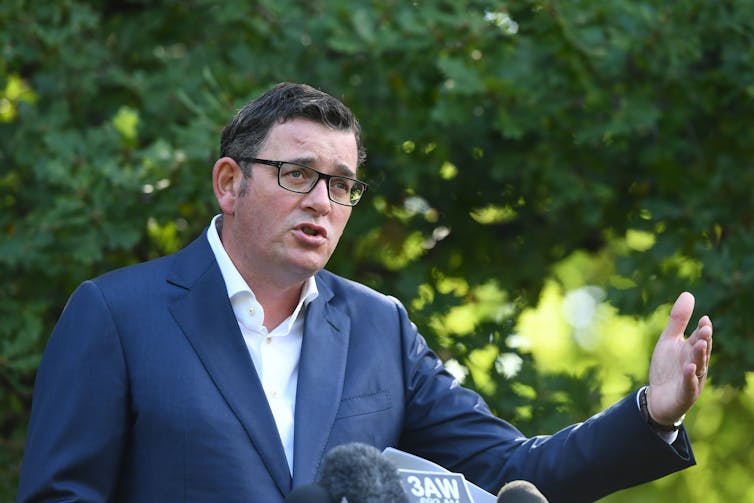
Victorian Premier Daniel Andrews announced today the state’s five-day circuit-breaker lockdown would end at midnight tonight. The state’s health department reported zero new cases overnight from nearly 40,000 tests — the highest number of daily tests recorded in Victoria since the start of the pandemic.
Under the latest changes:
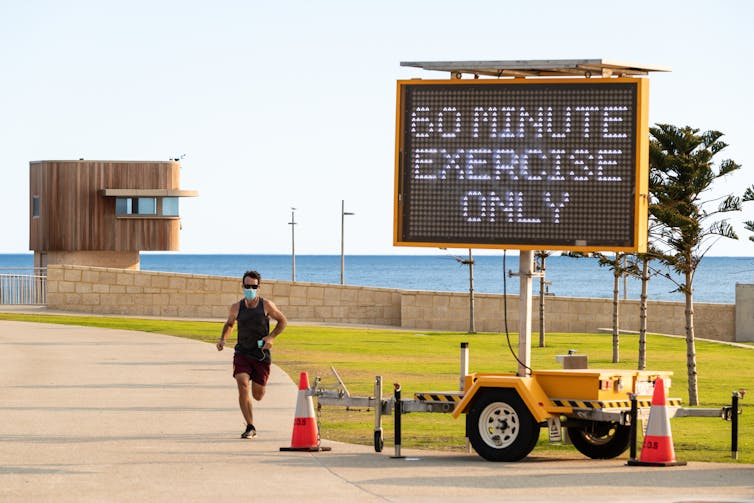
the “four reasons to leave your home” rule will lift
so does the 5km travel limit
masks are still mandatory indoors when away from home
masks are still mandatory outdoors when you can’t physically distance
schools, hospitality and retail can reopen on Thursday
household gatherings will be restricted to five guests (but 20 outdoors).
Around 3,400 close contacts remain in isolation, some of whom may yet return positive tests before the end of their quarantine period.
Victoria’s lockdown is the latest in a string of recent shutdowns, following similar circuit-breakers in South Australia, Queensland and Western Australia.
Andrews said a five-day lockdown is “infinitely better” than taking a chance and ending up with a five-week lockdown or worse.
But in truth, we don’t know for sure what that chance is.
The fact Victoria uses comprehensive “contacts of contacts” tracing means we have rich data to explore how testing and tracing would stand up under more dire transmission scenarios involving the UK variant and a multi-case seeding event.
Mapping case and contact quarantine timing and overlaying this with various transmission scenarios will allow us to learn more from this contained outbreak. We can create virtual situations where additional close contacts are infected and learn whether tracing of their contacts would still have contained the outbreak.
That would generate a deeper understanding of when we might need to back up our contact tracing with a lockdown or other measures, and identify a range of options that could achieve this. This will give policy-makers options beyond the dichotomy of business as usual or lockdown, so we do as much as is needed, and no more.
This isn’t a criticism of short, sharp lockdowns used so far. But let’s not miss this opportunity to interrogate the data and learn from it. The government, and the public, need more guidance on what should trigger different levels of public health restrictions.
The lockdown was a safety net
So far, all cases in Melbourne’s latest outbreak are associated with one of the following: the initial exposures at the Holiday Inn (authorities believe this occurred on February 3 or 4); a worker’s spouse; or a private dinner held on February 6. This represents two generations of spread from the original returned traveller (whose partner and child were also infected and included in health department counts).
Victorian Premier Daniel Andrews said the lockdown worked: ‘That is exactly what we said we needed, that is exactly what we said would work’.Erik Anderson/AAP
All transmission to current known cases therefore happened before the lockdown. All of the highest-risk close contacts of these cases, who have since tested negative, were in quarantine before the lockdown too.
The ring of negative cases tells us the risk of infection in more casual contacts is extremely low.
Like the recent local lockdowns in Queensland and WA, Victoria’s lockdown does not seem to have contributed to containment. As it turned out, the outbreak was effectively controlled by rapid case detection, testing, tracing and isolation by the time lockdown came into effect.
This is great news and a credit to public health teams and the public who came forward for testing and quarantine. But what if the epidemiology had played out differently? We should aim to deepen our understanding, to learn more about whether, and when, we need circuit-breakers in the future.
We can analyse the impacts the current, and other, lockdowns would have had under higher-transmission situations by overlaying actual contact tracing data with different contact infection scenarios. Victoria provides the richest data for this as the second ring of contacts of cases are quarantined routinely, which means we can treat more of the primary contacts as if they had become actual cases and then upgrade transmission risk among their own contacts.
We can also use this opportunity to investigate the actual change in the number of close contacts that lockdown brings. In the current outbreak, Victoria broadened the definition of “close contact” to anyone in contact with a case, or a venue where the case had been. Pre-lockdown, this took us from 59 close contacts, not quite 10 per original Holiday Inn case, to 3,400 including Terminal 4 at Melbourne Airport.
Using broad definitions of a close contact is a very cautious approach, and pushes us towards lockdowns faster to keep tracing manageable. So this element of our response also needs to be reviewed to identify a safe but proportionate level of contact to deem “close contact”.
Perth and surrounds were plunged into a five-day lockdown earlier this year after a hotel quarantine staff member contracted the virus. We must learn from these and other lockdowns.Richard Wainwright/AAP
Circuit-breaker lockdowns act as safety nets. It’s innately difficult to evaluate whether they’re really necessary. In Victoria, contact tracing stood up to the test. And thankfully, cases were either not very infectious, or by chance didn’t mix with others in a way that led to widespread transmission before our public health response was wrapped around it.
But we can create scenarios that offer a sterner test of our contact-tracing capacity to determine whether the safety nets might be required, what they should look like, and when they would need to be initiated to be effective.
Our circuit-breakers have progressively become more expansive — Queensland’s lasted three days and only covered Greater Brisbane, whereas Victoria’s was five days and statewide. There’s a danger this trend will continue on the presumption that lockdown makes a crucial difference to the outcome.
The truth is that our success in containing these outbreaks, and the luck in not having higher levels of infection, still leaves us with work to do to evaluate the place of circuit-breakers in Australia.
Source: The Conversation (Au and NZ) – By Mary Myla Andamon, Senior Lecturer, School of Property, Construction and Project Management, RMIT University
Victorian students are learning in classrooms with very poor air quality. Our year-long analysis of Victorian primary and secondary school classrooms has found the amount of carbon dioxide (CO₂) often far exceeds the maximum acceptable standard.
Studies in other states have found similar levels of poor air quality in classrooms.
Elevated CO₂ concentrations can cause headache, drowsiness and lethargy. Children under 15 are particularly vulnerable to poor air quality. Pollutant exposure during developmental stages may produce lifelong issues such as respiratory infections.
Australian students spend at least 25 hours in classrooms per week, or in excess of 1,075 hours indoors, in school buildings, annually. Australia’s National Construction Code (NCC) specifies CO₂ concentration levels of less than 850 parts per million (ppm), averaged over eight hours, for acceptable air quality.
In our analysis, the CO₂ concentrations in Victorian classrooms ranged from 912 to 2,235 ppm. During certain times of occupied hours, levels reached up to 5,000 ppm. These concentration levels indicate very poor ventilation and slow air exchange between indoor and outdoor air.
Good ventilation inside classrooms also protects students against airborne transmission of diseases such as COVID-19. Improving ventilation inside classrooms will help schools respond to potential outbreaks.
Indoor air quality is a measure or analysis of the physical, chemical and microbiological makeup of the air in rooms.
Indoor air quality impacts health, comfort and performance. Breathing conditioned but re-circulated air continuously, without adequate fresh outdoor air, has been linked to reduced health and school performance.
Indoor air quality is usually maintained by controlling airborne pollutants (such as dust or carbon monoxide), introducing adequate outdoor air into, and distributing it throughout, the room and by maintaining acceptable temperature and relative humidity.
There are prescribed standards for minimum ventilation rates, which achieve indoor air quality. Good ventilation practices ensure adequate dilution of indoor air and avoidance of build-up of airborne pollutants including viral contaminants.
Australian school design complies with the National Construction Code. This requires spaces be naturally or mechanically ventilated with outdoor air to maintain adequate air quality.
For natural ventilation, with a floor area requirement of 2 square metres (m²) per student, classroom window area (or other openings) for ventilation must be 12.5% of the classroom floor area. But there is no requirement nor directive on how much and how often these windows should be open.
Indoor air must be regularly mixed with fresh outdoor air.Shutterstock
Opening windows may also not be possible during extreme weather conditions such as extreme heat, cold and thunderstorm asthma events.
For mechanically ventilated classrooms, the same floor area of 2m² per student requires ventilation rates of 10-12 litre per second (L/s) of outdoor air per person.
A typical classroom size of 81m², with a ceiling height of 3m and occupied by 25 students should have at least 3.7-4.4 air changes per hour. This is the measure of air volume added to or removed from a room in one hour relative to the volume of the room. Higher values of air change rates correspond to better ventilation.
During a pandemic, the number of air changes per hour should be higher than usual. The World Health Organisation recommends six air changes per hour.
Our analysis of ten classrooms in five schools shows the CO₂ concentrations in Victorian schools are far over the less than 850 ppm prescribed by the National Construction Code. This indicates very poor ventilation.
In our analysis, average classroom ventilation rates ranged between 1.8 to 9.9 L/s per person which are far below the 10-12 L/s per person requirement. Around 80% of classrooms had ventilation rates below this requirement.
Some classrooms we saw were fitted with air conditioning systems but were stuffy and not provided with adequate outdoor air.
Schools comply with the NCC specifications but most classroom use is controlled by teacher preferences which could work against code requirements and result in poor indoor conditions.
This could mean operation of air conditioning systems, closing and opening of windows and leaving doors closed or wide open may contribute to the fluctuations and peak levels of CO₂ concentration and slow air exchange.
What about the rest of the country?
Similar results as ours were found in a study in New South Wales where classrooms had average CO₂ concentration during autumn ranging from 442 ppm to 1,510 ppm, and 718 ppm to 2,114 ppm in winter. Maximum CO₂ concentrations exceeded 2,900 ppm during the occupied period.
Conditions in Victorian school classrooms were also similar with those found in New Zealand primary classrooms, where CO₂ concentrations ranged from 1,032 ppm to 2,122 ppm with maximum levels exceeding 4,000 ppm during school hours in winter.
However, a study of naturally ventilated schools in Brisbane showed median indoor CO₂ concentrations during school hours were generally lower than the guideline concentration. But average concentrations for some classrooms still ranged from 1,043 to 1,370 ppm.
By unilaterally revoking the citizenship of the 26-year-old woman detained in Turkey this week, Australia has potentially left her two children in diplomatic limbo.
Known only as “S.A.” (but named by the ABC as Suhayra Aden from Melbourne), she was the subject of an Interpol blue notice, according to the Turkish Ministry of National Defence, which alleges she was a terrorist with Islamic State.
New Zealand Prime Minister Jacdina Ardern responded sternly to Australia’s actions, saying it amounted to their dumping the problem on New Zealand’s doorstep.
The mother had dual New Zealand and Australian citizenship, but left New Zealand for Australia at the age of six, and travelled to Syria from Australia.
It would now appear Australia is also seeking to shut the door on the two children. To paraphrase the old saying, the sins of the mother are being visited upon the children.
The ‘privileges’ of citizenship
The stripping of citizenship as a counter-terrorism measure seeks to address the threat posed by individuals suspected of, or engaged in, terrorist activity.
It’s a tactic used by many countries to prevent citizens from returning when they’re perceived as a risk to national security.
These types of legal balancing acts between an individual’s human rights and national security are not uncommon. As Australian Prime Minister Scott Morrison has stated more prosaically, his job is to protect Australians from terrorists “enjoying privileges” of citizenship.
But that view overlooks the situation of two other individuals. Aged five and under, they are presumably not suspected of terrorist activity. Legally, this raises questions about the justification for limiting their citizenship rights.
Where do the children stand?
In spite of the seeming intractability of the row between the two countries, the situation facing these children needs resolving.
Key to that will be the recognition that children enjoy the same human rights protections as adults under the general framework of international human rights law. They also have particular and specific protection under the UN Convention on the Rights of the Child 1989.
Both Australia and New Zealand have accepted these international legal obligations, meaning a number of the provisions of this convention must inform both countries’ decisions in this case.
Similarly, involuntary separation is to be avoided, unless it is in the child’s best interests.
The right to a nationality
Children have a right to a nationality. As far as possible, they also have the right to know and be cared for by their parents.
This right is particularly important in the current situation. Children born overseas to Australian citizens can claim Australian citizenship upon application. So too can the children of New Zealanders born overseas.
However, the children of Australian citizens who have had their citizenship revoked can themselves lose their citizenship rights.
The UN Committee on the Rights of the Child highlighted the potential impact on the citizenship of Australian children. It called for Australia to ensure no child is deprived of citizenship on any ground regardless of the status of his or her parents.
Human rights versus national security
The case also raises questions around the balancing of national security and human rights. For the children involved, a number of the convention’s guiding principles underpin these rights.
As part of the prohibition of discrimination, states are required to ensure the child is protected against all forms of discrimination or punishment on the basis of the status or activities of the child’s parents.
In essence, then, the rights of the child must inform any decisions about the future of these children. As part of that process, the maintenance of relationships with the wider family unit — if not their mother — is still key and the child’s best interests must be taken into account.
This week, the royal commission into the violence, abuse and neglect of people with disability will begin hold hearings on a shameful subject that has long been neglected: the indefinite detention of people with cognitive impairments and/or mental illness in our criminal justice systems.
Indefinite detention is what happens to defendants in criminal cases when they are deemed unfit to stand trial.
In common law, this “unfitness test” is based on whether the accused has sufficient mental or intellectual capacity to understand the proceedings and make an adequate defence.
If a person is found unfit to plead, they can instead be detained in a prison or forensic unit for the purposes of treatment. This detention can be indefinite if the person is deemed to be a risk of harming themselves or others and is not seen to improve.
While every state and territory has indefinite detention, not every jurisdiction collects or publishes statistics on how many people are being held or for how long.
Australians for Disability Justice, an advocacy group, believes over 1,000 people with cognitive impairments and/or mental illness are indefinitely detained in Australia every year. According to the group, up to 30% of these people are Indigenous.
This is supported by research from UNSW, which shows Indigenous people are significantly over-represented among those with disability in Australian prisons.
Governments put on notice
Federal, state and territory governments have been put on notice about this practice before.
In 2016, a Senate inquiry recommended significant reforms to the use of indefinite detention, especially when it came to those with cognitive impairments.
The report was particularly concerned about “the sometimes arbitrary nature of such detention”, particularly “in a criminal justice facility”.
The UN Committee for the Convention on the Rights of People with Disabilities (CRPD) has also formally asked Australia twice now to dismantle its indefinite detention regime. Scotland leads the world in doing away with the practice, and many European countries are following suit.
Disability justice advocates have also long pushed for change in Australia. For example, the Tasmanian Law Reform Institute reviewed the law in that state and recommended significantly limiting the use of indefinite detention.
Most jurisdictions have a review tribunal process to determine whether people being held indefinitely can eventually be released with the help of medication or behaviour support. However, all reviews are based narrowly on the risk these people pose to themselves or the community, not on whether a person can live safely in the community with support.
Many people with mental health disorders also do not respond to medications or other therapies. And crucially, there is no “cure” for a person with cognitive impairment, such as an intellectual disability or acquired brain injury.
Abuse in detention
Another concern is that indefinite detention is often disproportionate to the offence alleged to have been committed.
For example, people can be held indefinitely for minor crimes, such as threatening behaviour. Those without disability who are convicted of a crime like this receive a sentence with a definite release date.
This means there are two different forms of justice being meted out in Australia — one for people with disability and another for those without disability. In other words, justice is not being served.
In one notable case, the UN CRDP found the Australian government violated the rights of an intellectually disabled Yamatji man, Marlon Noble, who was held for 10 years without being convicted of a crime.
The committee noted that Noble had no idea how long he would be held. It wrote
the whole judicial procedure focused on his mental capacity to stand trial without giving him any possibility to plead not guilty and test the evidence submitted against him.
Making matters even worse, people with cognitive impairment and mental illness who are indefinitely detained also experience serious human rights violations in prisons or forensic units.
Time and again, the Australian Human Rights Commission has found that Indigenous people with cognitive disability have experienced cruel and unusual punishment in detention, such as being held in isolation and without disability support.
In 2016, the ABC featured the story of a young Arrente man who had been placed into a restraint chair and injected with tranquillisers up to 17 times by staff at the Alice Springs Correctional Centre.
Despite serious objections from his guardians, the young man remains indefinitely detained in the Northern Territory. His case, along with others, has been referred to the UN.
His family and guardians will also present evidence at the royal commission hearings, detailing his experience in indefinite detention.
Noble, the Arrente man and many others have experienced abuse and violence in their lives due to their disability, including during their time in detention. They, and thousands like them, have been subjected to forced medications and restraints even though these are clearly not therapeutic for people with cognitive disability.
It’s shameful this is happening in a country as affluent as Australia, which has ample capacity to care for people with disability, even those who require highly complex support.
In dismantling our indefinite detention system, the key is to provide more disability-focused support to those at risk of coming into contact with criminal justice systems.
Besides this, other reforms are also urgently needed:
Reforming the law to provide other justice options for defendants who are deemed unfit to stand trial, including diverting them from court and potential detention. The length of detention should also be proportionate to the crimes they are alleged to have committed.
Establishing a community-based, culturally safe accommodation and treatment system for people with disability accused of crimes to serve as an alternative to prison, as is done in Scotland.
Providing additional legal support to people deemed unfit to stand trial, giving them a voice in the process.
It is inhumane to hold anyone with disability in indefinite detention in such an arbitrary manner. We hope that by sharing the stories of these people with the royal commission, this deplorable exercise will finally be put to an end.
Source: The Conversation (Au and NZ) – By Chris James, ARC DECRA Fellow, Centre for Hypersonics, School of Mechanical and Mining Engineering, The University of Queensland
This month has been a busy one for Mars exploration. Several countries sent missions to the red planet in June last year, taking advantage of a launch window. Most have now arrived after their eight-month voyage.
Within the next few days, NASA will perform a direct entry of the Martian atmosphere to land the Perseverance rover in Mars’s Jezero Crater.
Perseverance, about the size of a car, is the largest Mars payload ever — it literally weighs a tonne. After landing, the rover will search for signs of ancient life and gather samples to eventually be returned to Earth.
The mission will use similar hardware to that of the 2012 Mars Science Laboratory (MSL) mission, which landed the Curiosity rover, but will have certain upgrades including improved rover landing accuracy.
Curiosity’s voyage provided a wealth of information about what kind of environment Mars 2020 might face and what technology it would need to survive.
An artist’s impression of Mars 2020 approaching the red planet.NASA/JPL-Caltech
Mars: a most alien land
As Mars is a hostile and remote environment with an atmosphere about 100 times thinner than Earth’s, there’s little atmosphere for incoming spacecraft to use to slow down aerodynamically.
Rather, surviving entry to Mars requires a creative mix of aerodynamics, parachutes, retropropulsion (using engine thrust to decelerate for landing) and often a large airbag.
Also, models of Martian weather aren’t updated in real time, so we don’t know exactly what environment a probe will face during entry. Unpredictable weather events, especially dust storms, are one reason landing accuracy has suffered in previous missions.
NASA engineers call the entry, descent and landing phase (EDL) of Mars entry missions the “seven minutes of terror”. In just seven minutes there are myriad ways entry can fail.
A profile of Mars 2020’s entry, descent and landing phase.NASA JPL
Thermal protection
The 2012 MSL spacecraft was fitted with a 4.5-metre-diameter heat shield that protected the vehicle during its descent through Mars’s atmosphere.
It entered the Martian atmosphere at around 5,900m per second. This is hypersonic, which means it’s more than five times the speed of sound.
Mars 2020 will be similar. It will rely heavily on its thermal protection system, including a front heat shield and backshell heat shield, to stop hot flow from damaging the rover stowed inside.
Pictured are the Mars 2020 backshell heat shield (foreground) and the main PICA heat shield (background).NASA/JPL-Caltech
At hypersonic speeds, Mars’s atmosphere won’t be able to get out of the spacecraft’s way fast enough. As a result, a strong shock wave will form off the front.
In this case, gas in front of the vehicle will be rapidly compressed, causing a huge jump in pressure and temperature between the shock wave and the heat shield.
The hot post-shock flow heats up the surface of the heat shield during the entry, but the heat shield protects the internal structure from this heat.
Since the MSL 2012 and Mars 2020 missions use relatively larger payloads, these spacecrafts are at higher risk of overheating during the entry phase.
But MSL effectively circumvented this issue, largely thanks to a specially-designed heat shield which was the first Mars vehicle ever to make use of NASA’s Phenolic Impregnated Carbon Ablator (PICA) material.
This material, which the Mars 2020 spacecraft also uses, is made of chopped carbon-fibre embedded in a synthetic resin. It’s very light, can absorb immense heat and is an effective insulator.
Guided entry
All entries before the 2012 MSL mission had been unguided, meaning they weren’t controlled in real-time by a flight computer.
Instead, the spacecraft were designed to hit the Mars’s “entry interface” (125km above the ground) in a particular way, before landing wherever the Martian winds took them. With this came significant landing uncertainty.
This artist’s impression shows thrusters controlling the angle of the spacecraft during MSL 2012’s Mars entry. Mars 2020 will use the same technique.NASA/JPL-Caltech
The area of landing uncertainty is called the landing ellipse. NASA’s 1970s Viking Mars missions had an estimated landing ellipse of 280x100km. But both MSL and now Mars 2020 were built to outperform previous efforts.
The MSL mission was the first guided Mars entry. An upgraded version of the Apollo guidance computer was used to control the vehicle in real time to ensure an accurate landing.
With this, MSL reduced its estimated landing ellipse to 20×6.5km and ended up landing just 2km from its target. With any luck, Mars 2020 will achieve similar results.
Pictured are NASA’s various Mars landing sites, including the proposed Perseverance landing site. Perseverance is expected to land in a relatively less clear area.NASA/JPL-Caltech
Supersonic parachuting
A parachute will be used to slow down the Mars 2020 spacecraft enough for final landing manoeuvres to be performed.
With a 21.5m diameter, the parachute will be the largest ever used on Mars and will have to be deployed faster than the speed of sound.
Deploying the parachute at the right time will be critical for achieving an accurate landing.
A brand new technology called “range trigger” will control the parachute’s deployment time, based on the spacecraft’s relative position to its desired landing spot.
The spacecraft descending after the parachute has been deployed.NASA/JPL-Caltech
State-of-the-art navigation
About 20 seconds after the parachute opens, the heat shield will separate from the spacecraft, exposing Perseverance to the Martian environment. Its cameras and sensors can begin to collect information as it approaches ground.
The rover’s specialised terrain-relative navigation system will help it land safely by diverting it to a stable landing surface.
Perseverance will compare a pre-loaded map of the landing site with images collected during its rapid descent. It should then be able to identify landmarks below and estimate its relative position to the ground to an accuracy of about 40m.
Terrain-relative navigation is far superior to methods used for past Mars entries. Older spacecraft had to rely on their own internal estimates of their location during entry.
And there was no way to effectively recalibrate this information. They could only guess where they were to an accuracy of about 2-3km as they approached ground.
The parachute carrying the Mars 2020 spacecraft can only slow it down to about 320km per hour.
To land safely, the spacecraft will jettison the parachute and backshell and use rockets facing the ground to ease down for the final 2,100m. This is called “retropropulsion”.
And to avoid using airbags to land the rover (as was done in missions prior to MSL), Mars 2020 will use the “skycrane” manoeuvre; a set of cables will slowly lower Perseverance to the ground as it prepares for autonomous operation.
Once Perseverance senses its wheels are safely on the ground, it will cut the cables connected to the descent vehicle (which will fly off and crash somewhere in the distance).
And with that, the seven minutes of terror will be over.
Perseverance rover being placed on Martian soil by the skycrane.NASA/JPL-Caltech
Australia’s long-awaited COVID vaccine rollout is scheduled to begin on Monday.
New laws have just been passed mandating the recording of COVID-19 vaccine information on the Australian Immunisation Register. The changes to the Australian Immunisation Register Act 2015 will mean vaccination providers, such as GP clinics, will need to report to the government who was given the COVID-19 vaccine, both within and outside of Australia.
The act introduces penalties for providers who don’t comply with requests for information. Before these changes were made, the Australian Immunisation Register, which records inoculations (such as for seasonal influenza) under school-based programs and those given privately, was maintained on a voluntary basis.
Now vaccine providers will have no choice but to add personal information to the register about people’s vaccination status. This information can be accessed by authorised government officials for health and other purposes.
The federal government has also announced that Australians will be able to provide proof of vaccination through an app on their phone.
The idea is that this will allow those who have been vaccinated access to services such as air travel. It may also bestow certain privileges, such as being eligible to attend sports stadiums and theatres.
These announcements appear to give rise to a very satisfactory result: mandatory reporting of inoculations will give authorities accurate information about who has received the jab, and those people in turn can prove their vaccinated status on a readily accessible app if need be. Lots of Australians will happily download the app; some might even see it as their civic duty.
But there will be many who will baulk at these arrangements. So what are their rights?
In a country like ours, without a constitutional Bill of Rights, can you refuse to be vaccinated and so be denied a service, preference or privilege? Who has the legal power to ask you to prove you have been vaccinated? And can you refuse to answer the vaccination question?
The COVID vaccine will soon be rolled out in Australia. What are you rights and responsibilities in having it?AAP/David Caird
Will you need to prove you’ve had a vaccine to travel?
Consider an airline that refuses to carry a person who has not been vaccinated. Businesses can generally set out the terms and conditions that apply to the provision of their services. But they cross the legal line if their terms or conditions discriminate against a person on the grounds of a personal attribute such as gender, race or disability.
This means that if an airline wanted to make vaccination a condition of flight, it would need to have a strategy to accommodate people with disabilities who were not vaccinated. The airline could also offer options to those who choose for any reason not to be vaccinated by insisting travellers distance themselves from other travellers by buying three seats (or two business class seats). There is no legislative protection, incidentally, for discriminatory practices that target the less well-off.
Keep in mind the federal government could legislate to mandate that a person cannot fly into Australia without having been vaccinated. A new law like this could override existing anti-discrimination laws, giving airlines the green light to refuse service to anyone without proof of vaccination on inbound international flights.
Whatever Australian laws might be made in this regard, many countries are likely to adopt strict vaccination entry requirements, making it very unwise to leave this country without a vaccination.
State and federal laws allow managers to make reasonable demands that staff comply with certain conditions and impose obligations to ensure workplaces are safe. For those whose job requires looking after others (such as aged care, childcare, health work or quarantine operations), vaccinations could become mandatory by law. This is because that would be a reasonable requirement for a safe workplace for both worker and visitor.
In jobs that don’t require close contact with other people, employers will not be able to mandate vaccinations unless new laws are passed. Even without such new laws, workers who are not vaccinated can reasonably expect accommodations will be made for them, such as facilitating working from home or working separately from colleagues.
Do you have a “right to silence” about vaccination?
The changes to the Australian Immunisation Register Act mean your vaccine status will now be recorded on the register. This information can be accessed by you through your myGov app or Medicare account, as well as by authorised officials.
The act also includes a broad power for the health minister (or their delegate) to authorise a person to access and use personal vaccination information, if they are satisfied it is in the public interest to do so. This could include authorising a public servant from a state or territory department to access the register when responding to a COVID-19 outbreak, but may be broad enough to authorise access beyond healthcare responses, for example to provide access to schools or childcare centres.
Under section 11(2) of the act, it is possible for a person to formally request their identifying information on the register not be shared with others. This has the potential to provide some privacy protections for those savvy enough to make the required application before their identifying information has been shared.
The changes to the act do not yet give private companies or private service providers direct access to the register. Any alteration to these protocols would require more amendments, or a specific authorisation to be given by the health minister. If that were to happen there would be significant implications for the general right Australians have to information privacy.
The potential for the Australian Immunisation Register to be accessed by a broad range of people for a broad range of purposes was considered by the Parliamentary Joint Committee on Human Rights when it looked into the recent changes. The committee raised questions about whether the privacy protections currently contained in the act were sufficient, but did not provide a “concluded view” on the human rights compatibility of the amending legislation. Despite the committee’s ambivalence, the changes are now law.
In Australia, we rely on our elected officials to make the final decision on whether measures to promote public health are proportionate to their impact on other rights, freedoms and interests.
As we race to roll out the vaccine, we can only hope our elected representatives pause to heed advice from a range of quarters, including from human rights advocates, on whether they have got the balance right.
It’s widely understood that rivers, wetlands and other waterways hold particular significance for First Nations people. It’s less well understood that Indigenous peoples are denied effective rights in Australia’s water economy.
Australia’s laws and policies prevent First Nations from fully participating in, and benefiting from, decisions about water. In fact, Indigenous peoples hold less than 1% of Australia’s water rights.
A Productivity Commission report into national water policy released last week acknowledged the demands of First Nations, noting “Traditional Owners aspire to much greater access to, and control over, water resources”.
The commission suggested a suite of policy reforms. While the recommendations go further than previous official reports, they show a lack of ambition and would ensure water justice continues to be denied to First Nations.
Water plays a fundamental role in the cultural, spiritual and physical well-being of Indigenous people.Shutterstock
No voice, no justice
First Nations people have almost no say in how water is used in Australia. This denies them the power to prevent water extraction that will damage communities and landscapes, and in many cases means they’re unable to fulfil their responsibilities to care for Country.
It also means First Nations are excluded from much of Australia’s agricultural wealth, which is tied to access to water for irrigation.
In the New South Wales portion of the Murray-Darling Basin, for example, our research found Indigenous peoples are almost 10% of the population yet comprise only 3.5% of the agricultural workforce. First Nations also own just 0.5% of agricultural businesses and receive less than 0.1% of agricultural revenue.
First Nations people enjoy only a tiny portion of Australia’s agricultural wealth.Alvin Wong/AAP
Piecemeal water reform
The National Water Initiative – a blueprint for water reform signed by all Australian governments in 2004 – committed to consulting with Traditional Owners in water planning, accounting for native title rights to water and including cultural values in water plans.
The Productivity Commission report said progress towards these commitments “has been slow and objectives have not been fully achieved”.
The report contains several welcome recommendations, including that:
a new water policy be devised, with a dedicated objective and targets to improve First Nations access to water and involvement in water management
the recently formed Committee on Aboriginal Water Interests “co-design” new provisions relating to First Nations’ water interests, and have direct dialogue with water ministers
a First Nations-led model of water reform be adopted, centred on the concept of “cultural flows”. This concept calls for substantial increases to First Nations’ water access and more control in decision-making.
The Productivity Commission recommended a First Nations-led model of water reform.Richard Wainwright/AAP
Cause of injustice ignored
Sadly, the Productivity Commission does not address the structural problems underlying inequities in Indigenous water rights.
In particular, it wrongly assumes policy success should be measured in terms of efficiency and the integrity of water markets, rather than justice for First Nations.
Water sold on markets goes to the highest bidder. This rewards large agricultural enterprises and others who historically held land and water rights, gained through the dispossession of First Nations people. And it penalises First Nations peoples who are unlikely to own productive farming land, or who don’t always wish to use water for irrigated agriculture.
In some cases, poorly funded Indigenous organisations have traded away their water rights to keep afloat, and will find it near-impossible to buy the water back. Our research shows this pattern drove a 17% decline in Indigenous water holdings in the Murray-Darling Basin over the past decade.
For example, in 1998 the Howard Government legislated to exclude water infrastructure and entitlements from parts of the Native Title Act. This means that infrastructure and licensing can proceed without negotiation with native title holders.
The Productivity Commission overlooked ways to correct this injustice – such as the Law Reform Commission’s proposal to change the law so native title holders can benefit from commercial use of water.
The commission’s response to conflict over developments such as dams is also inadequate. Rather than transfer final decision-making power to First Nations groups, it proposes that developments be more “culturally responsive”.
This will not protect cultural heritage. Case in point is the NSW government’s plan to raise the Warragamba Dam wall, creating a flood that threatens more than 1200 Indigenous cultural sites. Statutory protections are needed to head off such proposals.
The Warragamba Dam plan threatens Indigenous cultural sites.Shutterstock
Stronger models for reform
The United Nations’ Declaration on the Rights of Indigenous Peoples is clear: Indigenous peoples should have the power to decide on development proposed on their lands and waters.
An agreement between the Ngarrindjeri nation and the South Australian government in the lower Murray River region shows how even modest rights can both empower Traditional Owners and lead to successful environmental management.
The agreement enables a co-management approach where authority in developing natural resource management policy is shared. Unfortunately, reforms of this type are beyond the ambition of the Productivity Commission report.
Addressing water injustice also requires returning water to First Nations, such as by buying back water entitlements and guaranteeing cultural flows in water plans. The Productivity Commission outlines how this might occur, but falls short of recommending this vital measure.
The current policy framework has allowed some advances. But if water justice to Indigenous peoples is to be realised, changes to policy and laws must go far deeper.
Plastic in the ocean can be deadly for marine wildlife and seabirds around the globe, but our latest study shows single-use plastics are a bigger threat to endangered albatrosses in the southern hemisphere than we previously thought.
We examined the causes of death of 107 albatrosses received by wildlife hospitals and pathology services in Australia and New Zealand and found ocean plastic is an underestimated threat.
Plastic drink bottles, disposable utensils and balloons are among the most deadly items.
Albatrosses are some the world’s most imperiled seabirds, with 73% of species threatened with extinction. Most species live in the southern hemisphere.
We estimate plastic ingestion causes up to 17.5% of near-shore albatross deaths in the southern hemisphere and should be considered a substantial threat to albatross populations.
Although the world’s largest flying birds are rarely seen from land, human activities are driving nearly three quarters of albatross species to extinction.
The great albatrosses are the largest flying birds in the world, circumnavigating the southern oceans in search of food.Lauren Roman, Author provided
Young Laysan albatrosses with their bellies full of plastic are not just a tragic tale from the remote northern Pacific. Albatrosses are dying from plastic in the southern oceans, too.
When a Royal albatross recently died in care at Wildbase Hospital after eating a plastic bottle, it was not an isolated incident.
Single-use plastics hit albatrosses close to home
Veterinarian Baukje Lenting treating a light-mantled albatross at The Nest Te Kōhanga at Wellington Zoo.Wellington Zoo, Author provided
Eighteen of the world’s 22 albatross species live in the southern hemisphere, where plastic is currently considered a lesser threat. But the amount of discarded plastic is increasing every year, mostly leaked from towns and cities and accumulating near the shore.
Single-use items make up most of the trash found on coastlines around the world. Seven of the ten most common items — drink bottles, food wrappers and grocery bags — are made of plastic.
When albatrosses are found struggling near the shore in New Zealand, they are delivered to wildlife hospitals such as Wildbase Hospital and The Nest Te Kōhanga. A recent spate of plastic-linked deaths spurred us to dig a little deeper into the risk of plastic pollution to these magnificent ocean wanderers.
A thousand cuts: plastic and other threats
Of the 107 albatrosses of 12 species we examined, plastic was the cause of death in half of the birds that had ingested it. In the cases we examined, plastic deaths were more common than fisheries-related deaths or oiling.
We compared these cases with data on plastic ingestion and fishery interaction rates from other studies. Based on our findings, we used statistical methods to estimate how many albatrosses were likely to eat plastic and might die from ingesting it, and how these figures compared to other major threats such as fisheries bycatch.
We found that in the near-shore areas of Australia and New Zealand, the ingestion of plastic is likely to cause about 3.4% of albatross deaths. In more polluted near-shore areas, such as those off Brazil, we estimate plastic ingestion causes 17.5% of all albatross deaths.
Because albatrosses are highly migratory, even those birds that live in less polluted areas are at risk as they wander the global ocean, travelling to polluted waters. Our results suggest the ingestion of plastic is at least of equivalent concern as long-line fishing in near-shore areas.
For threatened and declining albatross species, these rates of additional mortality are a serious concern and could result in further population losses.
Deadly junk food for marine life
The remains of two balloons in the stomach of an endangered grey-headed albatross.Lauren Roman, Author provided
Not all types of plastic are equally deadly when eaten. Albatrosses can regurgitate many of the indigestible items they eat.
Soft plastic and rubber items (such as latex balloons), in particular, can be deadly for marine animals because they often become trapped in the gut and cause fatal blockages, leading to a long, slow death by starvation. Plastic is difficult to see with common scanning techniques, and gut blockages often remain undetected.
A 500ml plastic bottle and balloon fragments were found in the stomach of a southern royal albatross which died in care at Wildbase Hospital.Stuart Hunter, Author provided
Albatrosses like to eat squid, and inexperienced young birds are especially prone to mistaking balloons and other plastic for food, with potentially lethal consequences.
We recommend that wildlife hospitals, carers and biologists consider gastric obstruction when sick albatrosses are presented. Our publication includes a checklist to help in the detection of gastric blockages.
Stronger adherence to multilateral agreements, such as the Agreement on the Conservation of Albatrosses and Petrels which aims to reduce the impact of activities known to kill albatrosses, would help prevent the decline of breeding populations to unsustainably low levels.
If populations fall to critically endangered levels, intensive remediation including the expansion of chick and nest protection programmes, invasive species eradication and seabird translocations, may be required to prevent species extinction.
We would like to acknowledge our New Zealand and Australian colleagues who contributed to this research project. Veterinarians Baukje Lenting and Phil Kowalski care for injured seabirds and other wildlife at The Nest Te Kōhanga at Wellington Zoo. Veterinarian Megan Jolly cares for injured wildlife at Wildbase Hospital and vet pathologist Stuart Hunter provides a nationwide wildlife pathology service at Wildbase pathology at Massey University. David Stewart conducts threatened species research and monitoring at the Queensland state government’s Department of Environment and Science.
Source: The Conversation (Au and NZ) – By Angela Lehmann, Honorary Lecturer, College of Arts and Social Sciences, Australian National University
A petition from more than 17,000 international students asking for exemptions to the border closure was presented to the Australian parliament last week. The latest available figures show about 20% of Australia’s enrolled international students were stranded offshore. Of the 92,191 in this position, 70% were Chinese.
We worked with Chinese international students to collect 28 written accounts of what their life has been like over the past year. Those that responded were male and female at varying stages of their studies.
The stories we collected in our ongoing research paint a picture of anxiety, embarrassment and shame. Many feel the burden of placing financial pressure on their parents. Some female students are under pressure to give up their study plans and focus on traditional gendered expectations to earn money and get married before their late 20s.
The students are desperately waiting for the time when they can pack their bags and return to study in Australia.Shutterstock
Feeling shame and embarrassment
Shen is a first-year student from rural China. It had been her dream to study abroad since she first heard about the possibility from a distant relative.
When the borders closed, she struggled to convince her parents to pay the fees. With COVID-19 cases easing in China, she reassured them it was only a matter of time before the borders were open. Twelve months later, Shen is feeling embarrassment and shame. She says:
Finally, they relented and agreed to pay the tuition on the condition that, as a backup plan, I would also prepare for the gaokao [China’s college entrance exam]. I accepted their terms and at the end of April my father sent the tuition fee of 150,000 yuan; half of their savings from the last decade. The rest of my fees would be paid through the selling of the family convenience store and any extra money I made at my part-time job.
Shen passed her exam and now faces pressure to study at home. Part of her decision to study abroad was to explore alternative visions of her future. Her dream was about “a chance to experience a new way of learning and a new way of life”.
Many students wrote about the shame they felt being stuck in China. Some recounted neighbours and their local community questioning and making fun of their ambition to study abroad during the pandemic.
One student wrote about how she desperately hoped she could leave before the Chinese New Year celebrations:
A barrage of criticism from disapproving relatives surely awaits me over Chinese New Year. More importantly, this time reserved for family reunion raises the question, where is home for an outsider that never quite fits?
Tensions within families and communities
The students’ accounts tell of increasing family tensions about finances and delayed career paths in particular.
Jing had always dreamt of studying clinical medicine abroad and was due to start in Australia in 2020. Her parents were not sold on the idea to begin with and now she faces pressure to study in China instead. She recounts what they tell her:
Your classmates are already in their third year of university; you have no work experience and only a high school diploma. Who could possibly want you? We have already waited a year for Australia. What if it is another three years, what if it’s five, will you still wait then? You’re running down a dead end. Are you going to just keep going until you hit a wall? Will your dreams pay your bills?
They say: “Darling, it’s all our fault. We should never have let you go in the first place.”
Jing says she feels she is drifting apart from her parents.
Fighting to hold onto their dream
A recent University of Melbourne study followed 50 female Chinese students over five years. It found studying abroad allowed them to delay marriage by a few years while they built a sense of individualism and identity. Studying abroad was seen as “time out” from a standard feminine life script hinging on marriage and family and allowed young women to experience alternative futures.
Students dream of studying overseas as a way to open up the possibilities in their lives.Shutterstock
The written accounts we analysed describe the pandemic and border closures as putting a stop to this experience. Some now face pressure to give up plans to study abroad and instead conform to expectations to enter the workforce and marriage.
Mei is a medical student who says her “life has come to a standstill”. She writes:
I live in a city in the middle of nowhere, a place where people don’t see the value of education, especially for girls. There is a common adage here: rather than studying well a girl is better off marrying well. Even my parents urge me to give up on studying abroad and instead find a stable job and get married […]
Both my parents come from humble backgrounds and supporting my aspiration to study abroad has been just one more pressure in their lives […] Nowadays, even spending a few dollars on milk tea makes me anxious that I am only affirming their belief that I am freeloading off my parents.
Many of these young women are determined to wait for borders to reopen and fulfil their ambition. One wrote:
Pandemic or not, I will stick to my plan.
These students need support
These stories demonstrate the intimate ways Australia’s higher education sector is linked with the everyday lives of young people globally. During the pandemic, being “stuck at home” has affected not only students, but also their families and their relationships with their communities.
These stories highlight the diverse experiences of international students while Australia’s borders are closed and offer a different take on the importance and role of international education.
Connecting these students to Australian counterparts to help with social relationships – albeit digitally for now – could go some way to ensuring these young people, and their families, are supported and reassured.
Their stories also suggest government messaging about Australia’s border closures should be aimed at families – not individuals. And it should be targeted, empathetic and, for this particular cohort, in Mandarin.
Our cities, designed for one set of climatic ranges, are increasingly “out of place” as average temperatures rise. The days above 40℃ and nights above 30℃ are increasing, especially in the expanding suburbs of Australian cities. This presents us with a massive redesign project.
Our Cooling the Commonsresearch project, funded by Landcom, has launched a new approach using design patterns to guide how we design, and redesign, how we live in response to a changing climate.
A design pattern is first an observation: “People in that kind of designed situation tend to do this sort of thing”. It is then possible to design an intervention that redirects those tendencies. If that intervention succeeds, it can become a recommended pattern to help other designers: “If you encounter this kind of situation, try to make these kinds of interventions”.
Based on an international survey of what has worked well elsewhere, we have compiled a bank of patterns. These range from current patterns that increase heat and discomfort, through to remedial patterns for improving existing urban areas, to ideal patterns for new developments.
a designer can try to (re)design everything all at once and for all time, an approach closest to current planning practices, particularly of “greenfield” sites involving building from scratch
a designer can seek a technical solution that can be widely replicated – think of mass-produced products, from phones to cars
a designer can produce a bespoke design for each client, crafting context-specific solutions one at a time. This is often how architects work.
Given the scale of our cities, we are not in a position to start again – though climate change might force large numbers of people to move.
Some places in China and the Middle East are experimenting with building wholly new cities. However, such total designs can prove unable to adapt to changing circumstances like climatic shifts that demand cities be remade – “metrofitting”. It is better to have modular designs that piece together, can pull apart and aim to remain modifiable over time.
The second, technical approach is what many people expect of designers these days. But this often adds to the problem by missing important differences from one place or community to another.
Air conditioners are a good example. While they may offer immediate relief in buildings that weren’t designed to promote natural ventilation, they also create problems.
Not everyone can afford to buy and run air conditioners, which greatly increase energy use. And many buildings are not designed to be air-conditioned efficiently. There are also social impacts such as blowing heat on neighbours and pedestrians, noisy external fans, and people being isolated in their homes on hot days.
Running air conditioners forces people to stay indoors to remain comfortable while adding to the heat outside.Konstantin L/Shutterstock
We need more systemic solutions than one-size-fits-all technologies like air conditioning.
However, the third kind of designing – creating tailored solutions for each unique situation – is too slow in the face of already changed climates.
This means designers need to adopt a fourth approach, known as pattern thinking. It helps designers to see what is not working well, where and when, and so how to redirect those situations toward more preferable ones.
How does pattern thinking work?
One kind of pattern is a set of rules specifying something that can be repeated over and over. This is the meaning of pattern normally associated with decorative forms, or with making clothes, templates for furniture, or blueprints for buildings.
But the patterns we are talking about, context-specific interactions between people and things, are more like habits. They are tendencies that lead to repeated actions. For example, consider the patterns of car-oriented urban development.
Hard-surfaced roads and driveways are major sources of urban heat. Car-oriented planning downplays patterns of walking, through the lack of footpaths, shade and pedestrian-oriented night lighting, or the distances between shops, schools and work. This means people who can afford it might get into the habit of staying in air-conditioned houses, only occasionally going in their air-conditioned cars to air-conditioned shopping malls.
New cities, old car-oriented patterns: the car park and path to this library provide no relief from the hot sun.Photo: Helen Armstrong, Author provided
To counter this, we need to create patterns for street shading along footpaths and around public transport stops. Generic tree plantings to meet abstract canopy coverage targets are not enough. They must take into account the soil and moisture conditions of different neighbourhoods, and different use patterns, including patterns of tree care.
Related adaptive patterns might shift daytime activities into cooler night times. Some places already have these patterns: night markets and night-time use of outdoor spaces.
If locally adapted versions of these patterns encourage people to adopt new habits, other patterns will be needed. These will include, for example, ways to remind those cooling off outdoors in the evening that others might be trying to sleep with their naturally ventilating windows open. Such interlinked patterns point to the way pattern thinking moves from the big scale to the small.
To make the time to adapt each pattern to its local context, and then ensure those designs establish a pattern of long-lasting practice, requires a different pattern of planning. Planners need to be thinking about “staying with” what they plan, helping what they design to adapt to changing conditions and communities. For example, developers of build-to-rent sites could hire “community liaison officers” to help tenants establish sustainable patterns of living.
In addition to the authors, the Cooling the Commons research team includes: Professor Katherine Gibson, Associate Professor Louise Crabtree, Dr Stephen Healy and Dr Emma Power from the Institute for Culture and Society (ICS) at Western Sydney University (WSU), and Emeritus Professor Helen Armstrong from Queensland University of Technology (QUT).
Source: The Conversation (Au and NZ) – By Glyn Davis, Distinguished Professor of Political Science, Crawford School of Public Policy, Australian National University
The United States Post Office has just announced the 33rd stamp in its literary arts series – a striking image of novelist and essayist Ursula Le Guin.
Behind the portrait is artwork depicting a scene from The Left Hand of Darkness, Le Guin’s 1969 novel. It features the Gethenians, a species which is generically asexual, but randomly become male or female during estrus.
Le Guin predicted such a society would avoid any gender-specific roles and invent shared ways to raise children. The radical premise of the novel is captured in its best-known line – the king was pregnant.
Such an idea emphasises the role of chance in our lives. We are born into bodies, families, health, ethnicities and societies we did not choose.
These accidents shape much about the lives that follow, inviting us to consider how we treat those born into extreme disadvantage – what are our obligations to counterbalance the misfortunes created by the lottery?
Try applying the veil of ignorance test
Le Guin was replaying, with characteristic subtlety, an ancient debate about whether to accept unfairness as inevitably — “the poor you will always have with you” – or use institutions to create a more equitable distribution of life chances.
Her novel anticipated by a few years what may be the most famous thought experiment in modern philosophy — the veil of ignorance.
Imagine you can shape the laws of the nation but must make the decisions before knowing anything about your identity. You might turn out to be poor or rich, able-bodied or infirm. Gendered or not, young or old, talented or less gifted — all these conditions are hidden as you decide the rules of your society.
In his 1971 book A Theory of Justice, philosopher John Rawls suggested people behind such a veil would value justice above all.
Ignorance and self-interest dictate fairness
When identity is veiled, self-interest dictates equality. Slave owners would think carefully about supporting servitude if they might become slaves. As Abraham Lincoln is said to have asked when addressing claims that slavery was justified – what is this good thing that no man wants for himself?
Rawls sees two principles as essential to fairness: liberty, so we can make our own choices as long they do not harm others, and acceptance of difference so that opportunities are open to all, regardless of circumstances. The world should not be carved out only for the clever and the already fortunate.
The prescription has been much debated. Some see the cost of such equality as too high. Others object to a notion of justice defined around material goods, noting that inequality is only about wealth and not also about power, respect, voice and control.
The radical implications of Rawlsian justice are not apparent in the ways Australia and other nations deal with poverty in their midst.
Australia has never been particularly fair
The Melbourne Institute’s long sequence of HILDA household income and labour dynamics surveys point to a strong correlation between poverty in childhood and poverty in adult life – a situation where poverty begets poverty.
Australian rates of poverty slightly exceed OECD averages, meaning the poor are indeed always with us.
Our response to poverty began with private charity, but early in the twentieth century moved to government programs, principally payments. Senior and invalid pensions began in 1909 followed by unemployment benefits, pensions for veterans, and support for mothers and children and health after World War I.
Australia has never pursued a substantial redistribution of wealth. Benefit payments remain modest and usually means-tested.
Elections consistently suggest Australians are comfortable with limits to public generosity; we choose governments that tax and spend slightly more than in the United States but a good deal less than in Europe. As a result, many Australians grow up in poverty, and a significant number pass it on to their children.
Even a single year in poverty during childhood harms likely income in adulthood, and the longer someone is in poverty in childhood the less chance they have of escaping poverty in adulthood.
A long-tailed lottery
This makes the lottery of birth a lifelong inheritance, with consequences for access to education, health, employment and social capital.
For those who find Rawls too confronting, there are other ways of thinking about our responsibilities toward those less fortunate. One is to look through the lens of what Nobel Laureate economist Amartya Sen labels “capability”, an approach at one time adopted by Australia’s treasury.
Capability is the powerful idea that each citizen should be equipped to lead a life they have reason to value. Investment through public provision – schools, hospitals, pensions and so on – is part of ensuring capability.
Practically, this might mean a national disability insurance scheme rather than a pension. But improvements through public investment can be hard to deliver in practice. Capability means recognising and responding to individual needs, but personalising services is expensive and sometimes problematic. “Why are you treating me differently from others?” is a reasonable question.
New Zealand points to a way out
Former New Zealand Prime Minister Bill English made targets deliberately hard.Nick Perry/AP
Traditional public administration emphasises equal treatment for all and so employs standardised models and allocation principles.
By dealing with everyone in the same way, government agencies achieve technical (Rawls-like) fairness but not always the right (Sen-like) response to individual circumstances.
Yet there are encouraging signs of greater flexibility. New Zealand is using performance indicators based around people.
Jacinda Ardern’s predecessor as prime minister, National Party leader Bill English, reshaped his cabinet’s mission statements to focus on individuals.
In assigning ministers a shared requirement to reduce the number of assaults on children, he chose a target he said was “deliberately designed to be difficult”.
It would “require significant focus on the customer by multiple agencies”.
Similar thinking influenced Our Public Service Our Future, the 2019 review of the Australian Public Service led by David Thodey. It embraced the idea of using technology to personalise responses, and commended recent state and federal initiatives to coordinate services around each citizen.
I expand on this in On Life’s Lottery, published last month by Hachette, examining ways in which communities, governments and charities can work together to improve choices for people born into disadvantage.
Reflections on our obligations to others, and pathways to tailor support, are central to an essential goal: how we ensure the ticket we get at birth does not solely determine the journey ahead.
Alice! A childish story take And with a gentle hand Lay it where Childhood’s dreams are twined In Memory’s mystic band, Like pilgrim’s withered wreath of flowers Plucked in a far-off land.
What is it that draws us back to Alice’s Adventures in Wonderland (Alice for short), both individually and collectively? What is it that makes Alice, in the words of literary critic, Harold Bloom, “a kind of Scripture for us” — like Shakespeare?
There have been numerous movie adaptations and many other works inspired by the story. Perhaps the greatest is a little-known, 1971 short film by the US Department of Health, Education and Welfare encouraging children not to do drugs.
One fears the film might not have had the desired effect: while the speed-addicted March Hare provides a salutary example of how poorly things can go on his drug of choice, the Mad Hatter’s performance on LSD is a little too compelling.
Beyond the page and screen, a quick Google search reveals Alice-inspired art — from graffiti to Dali — tattoos, music, video games and shops.
Alice has strong mainstream appeal; this was entrenched by Disney’s 1951 movie Alice in Wonderland (which is also responsible for people getting the title of the book wrong). However, Alice has become iconic for many subcultures, especially those with darker proclivities. Try exploring “zombie Alice” or “goth Alice”, or watching the new Netflix series, Alice in Borderland, which is set in Tokyo. (Alice is big in Japan).
And this brings us again to the beginning of the conversation (Alice reference here for the boffins): What draws us back?
The story begins with bored, seven-year-old Alice sitting on a riverbank with her older sister. Alice doesn’t care for the book her sister is reading because it doesn’t have pictures. She falls asleep and follows a dapper but flustered rabbit down a rabbit hole and into Wonderland.
In Wonderland she moves through a series of surreal vignettes in which she verbally tussles, but struggles to connect with, a stream of characters, such as the hookah-smoking Caterpillar, the Duchess, the Mad Hatter, the Cheshire Cat and the Queen of Hearts.
Helena Bonham Carter as the Queen of Hearts in Tim Burton’s 2010 film version of Alice in Wonderland.Disney Enterprises Inc
We are drawn back to the book by the first-rate banter between Alice and these memorable characters. Consider the following from the Mad Hatter’s tea party:
“Then you should say what you mean,” the March Hare went on. “I do,” Alice hastily replied; “at least — at least I mean what I say — that’s the same thing, you know.” “Not the same thing a bit!” said the Hatter. “You might just as well say that ‘I see what I eat’ is the same thing as ‘I eat what I see’!” “You might just as well say,” added the March Hare, “that ‘I like what I get’ is the same thing as ‘I get what I like’!” “You might just as well say,” added the Dormouse, who seemed to be talking in his sleep, “that ‘I breathe when I sleep’ is the same thing as ‘I sleep when I breathe’!” “It is the same thing with you,” said the Hatter[.]
Notably, many of the creatures Alice meets stand for the real adults in her life, in that they scold her, order her about, try to teach her morals and make her recite poetry.
It is this transformation of the adult world into a mad place and the elevation of the viewpoint of the child that also draw us back. When we read Alice, not as children, but as adults, we strike a blow against the adult world, which some of us, at least, have never quite adjusted to.
The Cheshire Cat provides the greatest indictment of Wonderland-as-adult-world when he says to Alice, “we’re all mad here”. The cat is the only creature in the book who connects with Alice. Mark this, reader: It is the one who can connect with children who is also able to see the world for what it is — mad!
A champion of childhood
The West does have a long history of romanticising childhood. Wordsworth, in his 1807 Immortality Ode, writes:
Heaven lies about us in our infancy! Shades of the prison-house begin to close Upon the growing Boy.
But even if the “romantic childhood” is a creation of bourgeois 19th century England — of the likes of Wordsworth and Carroll — it is a powerful and arguably noble notion. So let us follow it a little farther down the rabbit hole.
While Alice is the child-hero of the story because she pushes back against the mad adults in Wonderland, she herself is on the cusp of adulthood.
Alice Liddell, photographed in 1862.Wikimedia Commons
This tragedy is alluded to in the poem, dedicated to the real Alice — Alice Liddell — with which the book begins (the key stanza appears at the start of this article).
Liddell was, in her childhood, Carroll’s friend. The first version of Alice was told to Liddell and her two sisters in 1862 on a boat ride along the Thames in Oxford.
A 1907 edition of the book.Wikimedia Commons
The tragedy of growing up is reinforced in the story itself. While Alice’s imagination is able to create Wonderland, it cannot sustain it. In the final scene in Wonderland, Alice is watching a trial where many of the characters are playing cards. Frustrated by the illogical trial, she shouts, “You’re nothing but a pack of cards!” and is transported back to the real world.
This leads us to think Wonderland itself is the hero of Alice: the champion of childhood. It is in Wonderland that time has stopped — as we learn at the Mad Hatter’s tea party — and where authority is impotent. Despite the Queen’s repeated edict, “Off with her/his head”, no one ever really dies.
‘The Carroll myth’
Lewis Carroll aged 23.Wikimedia Commons
However, beyond Alice and Wonderland is Carroll himself. As Karoline Leach writes, in her remarkable book about “the Carroll myth”, at the centre of Alice lies, “the image of Carroll; a haunting presence in the story, a shifting dreamy impression of golden afternoons, fustiness, mystery, oars dripping in sun-rippling water.”
Lewis Carroll is the pen name of Charles Lutwidge Dodgson (not easy to say quickly, unlike “Lewis Carroll”), who taught mathematics at Oxford.
The “Carroll myth”, which was as appealing in the 19th century as it is now, is that Dodgson, through his alter ego Carroll, and his many (chaste) relationships with children, in particular, Alice Liddell, found a way back to the immortality of childhood that Wordsworth spoke about.
So, when we read Alice, we are ultimately communing with this mythical Carroll, and this is no small thing.
Beyond the banter and the homage to childhood, we are drawn back to Alice because it contains a timeless contribution to the 1860s version of our own culture wars. Where we have political correctness, the 19th century Anglophone world had its own buzz-killing piety, at times foisted upon children — and adults — through verse.
David Bates, a 19th century American poet, is likely responsible for the now thankfully forgotten poem, Speak Gently (“Speak gently to the little child!/Its love be sure to gain/Teach it in accents soft and mild:/It may not long remain.)
Carroll’s glorious parody, which is spoken in Chapter 6 by the Duchess, a negligent mother, is:
Speak roughly to your little boy, And beat him when he sneezes: He only does it to annoy, Because he knows it teases.
Here, and in other Alice poems such as “You Are Old Father William”, Carroll is trolling all those for whom piety is a mask for power. And like the pious, the politically correct are more concerned with their own superiority than with doing good.
An image from the 1951 film version of Carroll’s book.Walt Disney Animation Studios, Walt Disney Productions
To cement the link between then and now, it is worth quoting from Stephen Fry’s recent objection to political correctness. It is as if Fry is providing us with the key to Alice and even to Carroll himself. “I wouldn’t class myself as a classical libertarian,” Fry says,
but I do relish transgression, and I deeply and instinctively distrust conformity and orthodoxy. Progress is not achieved by preachers and guardians of morality but […] by madmen, hermits, heretics, dreamers, rebels and sceptics.
We are drawn back to Alice’s Adventures in Wonderland because when we read it, we become the heretics, dreamers and rebels who would change the world.
Source: Council on Hemispheric Affairs – Analysis-Reportage
By William Camacaro and Frederick Mills From NY and Washington DC
On February 7, the progressive presidential candidate for the Union of Hope Alliance (UNES) party, Andrés Arauz, won first place in Ecuador’s presidential election; this is uncontested. Arauz garnered 32.71% of the vote; right-wing former banker Guillermo Lasso 19.74%; and the “Indigenous” candidate, Yaku Pérez 19.38%. Since Arauz’s margin of victory was less than the required 40% plus at least ten points more than the closest competitor, a runoff is scheduled for April 11th. With the UN calling for transparency and Pérez contesting the outcome, Ecuador’s National Electoral Council (CNE) has agreed to conduct a partial recount to verify the second place contender.
This election will have enormous consequences for Ecuador as well as the entire region. After four years of President Lenin Moreno’s neoliberal turn, which reversed the economic and social gains of former President Rafael Correa’s Citizens’ Revolution, the majority of Ecuadorians have opted for a change of course. An Arauz victory would once again prioritize social investment over IMF imposed austerity and resume Ecuador’s leadership in the movement towards regional integration. If the ultra right in Ecuador and Colombia have their way, however, Arauz will not make it to the run-off election.
Just a week prior to the first round, with Arauz ahead in most polls, Ecuadorian President Lenin Moreno, who is a fierce opponent of the UNES candidate, met with the notoriously interventionist Secretary General of the OAS, Luis Almagro, in Washington. This meeting raised suspicions that efforts were underway to prevent a return of the Citizens’ Revolution in Ecuador. On February 12th, the Attorney General of Colombia, Francisco Barbosa arrived in Quito to meet with his Ecuadorian counterpart, Diana Salazar, armed with a dossier that allegedly shows the campaign of Arauz had received funding from the National Liberation Army (ELN) guerillas in Colombia. Although no independent corroboration of such charges have been presented to back these allegations, the echo chamber of right wing fake news is already urging election authorities in Ecuador to disqualify UNES in a bid to prevent Arauz from participating in the second round of the presidential election.
In his Facebook page, Arauz categorically denied this accusation: “I have no link with the ELN. This big lie has just one purpose, to prevent the Arauz-Rabascall ticket from participating in the second round.”
Prominent voices of the Americas have denounced these charges as fabrications designed to sabotage democratic procedures in Ecuador. Nobel Peace Prize Winner (1980), Adolfo Pérez Esquivel, tweeted: “They will not be able to fool the Ecuadorian people with judicial and media operations from the well known Lawfare manual. Democracy will prevail. Ecuador has suffered a great deal and needs a return to common sense. Our support for candidate Arauz.”
Former Colombian President Ernesto Samper, in response to an article published in the ultra-right wing Colombian magazine, Semana, alleging that Arauz had links to the ELN, wrote: “The people of Ecuador should be on the alert that the enemies of progressivism in our countries are intent on stopping by any means the transformations for which Latin America clamours.” In the face of criticism of the unsubstantiated charges made against Arauz in the article, the Director of Semana, Victoria Avila, remarked in an interview “I want to make it very clear. I do not want to say that this information is absolutely certain.”
The Puebla Group, which brings together several former presidents of the region, including the Brazilian Luiz Inácio Lula Da Silva, issued a statement in which it “categorically rejects the attempt to link Andrés Arauz with the National Liberation Army.”
Former President of Bolivia, Evo Morales, who himself was forced into exile by an OAS backed coup in November 2019, tweets: “We sound an alert about a plan by the right and the US in Ecuador to try to prevent the triumph of Arauz in the second round, using the Attorney General of Colombia, right-wing parties and the OAS. We have the obligation to defend democracy and our regional integration. Be alert!”
The outcome of the presidential election in Ecuador will no doubt have a significant impact on the politics of the entire region. As Correa points out, these elections provide an opportunity “to recover UNASUR”. If elected, Arauz has promised to champion the revival of UNASUR and return this South American nation to ALBA. There is also a growing consensus in South America in support of these regional integration and cooperation mechanisms. With the election of the Movement Towards Socialism (MAS) candidate, Luis Arce, for President of Bolivia last October, an Arauz victory in Ecuador would fortify UNASUR at a most critical time. In the face of the ongoing COVID 19 pandemic, the benefits of multilateralism have become obvious in efforts throughout the Americas to obtain urgently needed medical supplies and vaccines from a variety of countries. Given the return of progressive governance in Argentina, Mexico, and Bolivia within the last three years, a victory in Ecuador could signal a new pink tide.
Fred Mills is co-Director of COHA. William Camacaro is Senior Analyst at COHA
It was supposed to be a week totally dominated by the arrival of the vaccine. Instead attention has been partially diverted by the revelation of an alleged 2019 rape in a minister’s Parliament House office – that Scott Morrison was not told about.
An angry Morrison on Tuesday publicly rebuked Defence Minister Linda Reynolds for failing to inform him, as he tried to contain the fallout from her former staffer Brittany Higgins’ explosive account.
Morrison told the House he only learned of the rape allegation early Monday, shortly before the story was posted by Samantha Maiden on news.com.au.
He didn’t mince words. Asked whether it was acceptable that the defence minister hadn’t informed him or his office of a “reported serious crime”, he said: “It is not – and it shouldn’t happen again”.
Higgins says she was assaulted in March 2019 by a colleague, on the minister’s couch, after she fell into a drunken sleep when the pair returned from a function. She woke up “mid-rape”, with the man on top of her.
The alleged perpetrator was quickly sacked for the security breach, but the alleged rape only came out in Higgins’ discussions with Reynolds’ acting chief of staff Fiona Brown in subsequent days.
Reynolds, who was defence industry minister at the time, urged Higgins to go to the police. Higgins did speak to them but, concerned about her career, decided against lodging a complaint. She remained working for the government – later in minister Michaelia Cash’s office – until early this year.
She has said in interviews this week she did not feel adequately supported through a horrific ordeal.
Morrison’s handling of the issue changed markedly between Monday and Tuesday.
After saying on Monday he was deeply distressed by Higgins’ account but obviously trying to keep the reaction low key, on Tuesday he was in full damage control, with a flurry of action.
He and Jenny had talked about the matter on Monday night, he said. “And she said to me, ‘you have to think about this as a father first. What would you want to happen if it were our girls?’
“Jenny has a way of clarifying things – always has.” So he’d reflected on that overnight, listening to what Brittany had said.
Casting his response as the father of girls evoked some immediate cynicism. That may or may not be the reaction among the public generally.
Morrison said he’d concluded that despite “the genuine good intentions” of all those who tried to provide support to Higgins, “by what she said last night, at the end of the day, she did not feel that way. And that is not OK.”
Cabinet had discussed the issue late Monday, as the magnitude of the extraordinary affair sank in.
The PM asked Western Australian Liberal backbencher Celia Hammond, a former vice-chancellor of Notre Dame University, “to identify ways that standards and expectations and practices can be further improved” in the parliamentary workplace.
He also asked Stephanie Foster, a deputy secretary of his department, to advise him on better processes “to support people when incidents of this nature arise”.
He was even open to Anthony Albanese’s proposal for an external review, by an “eminent Australian”, of Parliament House’s “workplace culture”. We’ll see whether that goes anywhere.
There was also a flurry of “sorries” to Higgins, especially over her being called to a meeting in the very office, with its couch, where the alleged rape occurred.
In the Senate Reynolds gave an unreserved apology. Reynolds said she thought at the time she and Brown were doing everything they could to support Higgins but she’d clearly felt unsupported. “At all times, my intent and my aim were to empower Brittany and let her determine the course of her own situation,” she said.
Morrison apologised over the site of the meeting.
Controversy swirled around what and when the PM’s staff knew. Brown, who’d worked in the PM’s office before acting as Reynolds COS and later moved back, obviously knew everything. But, with the incident seemingly in the past, apparently she didn’t think to mention the rape allegation.
Higgins claimed Morrison’s principal private secretary, Yaron Finkelstein, had checked in on her welfare after last year’s ABC 4 Corners program reporting ministerial sexual misbehaviour. There is no record of a phone conversation and Finkelstein cannot recall making any contact.
Morrison told Parliament his office only became aware of the rape allegations on February 12.
Morrison’s office said its involvement in the Higgins matter at the time had related only to the ecurity breach.
Tuesday’s prime ministerial blitz included a lecture to the government parties meeting. “We must do better. We cannot have an environment where anyone feels unsafe in their workplace, or a young woman is left in a vulnerable situation,” Morrison told his troops.
He’s not the first recent PM to denounce bad behaviour in this most privileged of workplaces. Remember Malcolm Turnbull’s “bonk ban”. And a number of women have highlighted conduct that would not be tolerated in other workplaces. The rape allegation, however, has shaken people because it takes things to another level – if proven, a criminal one.
Higgins, meanwhile, said in a statement that Morrison’s announcement of an investigation “into the culture in Parliament House is a welcomed first step, though it is long overdue.” She asked for her privacy to be respected and said she wouldn’t be making further comment.
The fallout from the cluster bomb she’d tossed – in media terms, a highly organised operation with a kit of information circulated to news organisations – has wounded Reynolds (who’s previously called out bad behaviour) and put the heat on Morrison.
Just maybe, it will prompt another step towards Parliament House becoming a workplace where the standards of behaviour demanded of occupants resemble those observed in the world outside.
But what will happen to the alleged rapist? That depends on whether Higgins lodges a formal complaint with the police, a course which remains open to her.
As the Holiday Inn cluster in Melbourne continues to grow, the Victorian government and the media are regularly publicising new exposure sites.
An exposure site is a location a person who has tested positive to COVID-19 visited while they were potentially infectious. These locations are generally identified through contact tracing, where the person provides a detailed history of their contacts and places they visited up to three days before they developed symptoms (or tested positive, if they didn’t have any symptoms).
You might have seen these exposure sites classified as either tier 1, tier 2 or tier 3. But what does this mean?
Contact tracers and public health professionals carry out risk assessments to classify exposure sites. These risk assessments determine whether a particular place is a high-, medium- or low-risk setting for transmission.
We know SARS-CoV-2, the virus that causes COVID-19, is more likely to spread in certain environments. Typically, settings that constitute one or more of the “three Cs” are considered high-risk:
crowded places (indoors carry a greater risk than outdoors)
close-contact settings (especially where people have close-range conversations, such as in a bar)
confined and enclosed spaces (this specifically refers to indoor spaces with poor ventilation).
We’ve often seen high-risk settings associated with super-spreading events, such as the Crossroads Hotel cluster in New South Wales last year, where one exposure site led to several new cases.
In determining how to classify a site, health experts will also consider the amount of time the positive case spent there. We know the risk of COVID spread is related to the length of exposure — that is, the greater the time spent in close contact, the higher the risk.
Finally, the risk level of the site may be influenced by the nature of the location and the sort of activity the positive case conducted there. For example, as we saw during the second wave in Victoria, working in abattoir where physical distancing may be difficult, the virus can spread faster and more readily. In contrast, an infectious person walking in a park or in a workplace with no direct contact with others may carry a lower risk.
Tier 1 represents exposure sites where people attending are at greatest risk of catching the virus and passing the infection to others. As such, people who have visited a tier 1 site during the time specified must immediately get tested and isolate for 14 days — regardless of their result.
We would theoretically regard people who have been at a tier 1 site in the relevant time period as “close contacts”.
There have been several examples of tier 1 exposure sites during the current Victorian outbreak. Last night, the Victorian government listed Sacca’s Fruit World in Broadmeadows as a tier 1 site for anyone who visited between 12.30 and 1pm on Tuesday February 9.
People who visited tier 2 and tier 3 sites are at lower risk of being exposed to a positive case, and therefore less likely to contract and spread the virus.
For tier 2, the public health directive is to get tested and isolate until you receive a negative result. People who visit tier 2 sites during the relevant time period could be regarded as “casual contacts”.
The Sunbury Square shopping centre, for example, was listed as a tier 2 exposure site after a case attended multiple stores between 3.40pm and 4:30pm on February 5. The entire shopping centre was placed on alert, possibly to cast a wide net rather than focusing on a few stores.
Tier 3 sites appear to be precautionary and present the smallest risk — and are potentially places where positive cases have just passed through. But they’re still important to prevent onward transmission. If you’ve visited a tier 3 site during the time specified, you should monitor for symptoms and get tested immediately if you do develop any symptoms.
As an example, Broadmeadows Central (that’s the shopping centre where Sacca’s Fruit World is located) has been listed as a tier 3 exposure site between 12.15pm and 1.15pm on February 9.
Classifying exposure sites is an important public health tool
Other jurisdictions use similar approaches to swiftly identify as many people as possible who may have been exposed to COVID-19, and therefore limit the spread of virus.
In New South Wales, contacts are alerted based on exposure sites, and then categorised as: close contacts who must get tested immediately and self-isolate for 14 days; casual contacts who must get tested immediately and self-isolate until they receive a negative result; and people who must monitor for symptoms (similar to Victoria’s tiers 1, 2 and 3 respectively).
Using public health alerts and media outlets to communicate exposure sites to the wider public can hasten the process of contact tracing, increase targeted testing and enable rapid identification and isolation of cases — ultimately to slow the spread of COVID-19.
These strategies are also useful when resources and time are limited. Contact tracers can prioritise actively following up people who visited tier 1 sites first.
Priya and Nades Murugappan and their two children Kopika and Tharunicaa have been seeking protection visas in Australia since 2012. Nearly a decade later, they are still waiting.
The family was removed from their home in the Queensland town of Biloela and put in detention in Melbourne more than 1,000 days ago. In August 2019, they were moved to Christmas Island while their case was proceeding slowly through the courts.
Keeping them in detention on the island has cost the government $1.4 million in the past year alone.
The federal court today upheld a ruling that the government had denied the youngest member of the family, Australian-born Tharunicaa, procedural fairness in the handling of her visa application.
However, the court also ruled that the home affairs minister did not, in fact, have an obligation to allow Tharunicaa to make an application for protection at all.
The court action prevents the family’s removal from Australia — for now. But it changes little for their immediate situation.
They will remain in detention unless the government heeds calls from their lawyers and supporters to let them return to their community while the long court process plays out, or simply grants them a visa to stay in Australia, cutting through the interminable legal process.
Background of the case
Nadesalingam (Nades) sought asylum in Australia in 2012 and made an application for a permanent protection visa on the basis he was associated with the Liberation Tigers of Tamil Elam, which had fought a long war against the Sri Lankan government.
An officer in the Department of Immigration refused the claim in September of that year, noting that Nades had travelled to and from Sri Lanka between 2004 to 2010 on several occasions without incident, and there was no evidence his family had been targeted for persecution.
Challenges to this decision were refused in numerous tribunals and courts from 2013–15, as well as through direct ministerial intervention.
The Labor government’s refugee and asylum seeker policy was in disarray at the time. When the Christmas Island detention centre had filled beyond capacity in 2010, people were moved to detention on the mainland. And when those centres began to reach capacity, the government released most asylum seekers into the community on bridging visas.
This group of asylum seekers was dubbed by the Coalition as Labor’s “legacy caseload”.
A rally in support of the family in Melbourne in 2019.Ellen Smith/AAP
Nades’s wife, Priya, arrived in Australia separately in 2013, one of among 25,000 people who came by boat that financial year.
Her claim was finally processed under a different legal regime introduced by the Abbott government in December 2014. Under this system, people arriving by boat and seeking asylum could apply only for temporary protection, and review rights were limited to a new “fast track” process.
Priya was not interviewed by an officer in the Department of Home Affairs until February 2017 (when she was eight months pregnant with Kopika). Her application was refused months later.
While all these legal proceedings were working their way through tribunals and courts, Priya and Nades got on with their lives. They were married and settled in Biloela in 2014, and had two children.
Kopika (right) and Tharunicaa in 2019.PR Handout Image/Supplied
Making sense of Australia’s protection obligations
From the government’s point of view, the family has exhausted their legal claims for asylum in Australia.
But the situation is complicated because of the length of time it has taken to exhaust their legal rights. There are now the legal rights of the children to consider.
It is incumbent on Australia to ensure the children of asylum seekers are not at risk of serious harm if the family is returned to Sri Lanka.
Kopika was included in Priya’s claim from protection, but Tharunicaa was not, so a separate application was made to the minister on her behalf. The basis for the claim is that the family’s circumstances have changed since they arrived in Australia, making it more likely they would face persecution if they were returned to Sri Lanka.
In particular, the intense media attention of their situation has made them more prominent in Sri Lanka and highlighted their purported connections to the LTTE.
On the other hand, the political situation in Sri Lanka has changed since Priya and Nades first came to Australia, raising questions of whether they are still at risk of serious harm on return.
Now that the federal court’s ruling that Tharunicaa was denied “procedural fairness” has been upheld, new submissions can be made on whether the minister should lift the bar and allow her to make an application for a protection visa.
The minister may decide, however, not to raise the bar, thus blocking a path to applying for a protection visa. Their future in Australia remains very uncertain.
The Christmas Island detention centre where the Murugappan family has been held since 2019.Richard Wainwright/AAP
The politics and ethics of refugee protection
The whole saga raises difficult questions of law and policy.
There is a paradox at play. On the one hand, Australia’s highly evolved review rights for asylum seekers has allowed the Murugappan family to hold government decision-making to the highest standards. On the other hand, it has left them languishing in a state of limbo for years.
There is also an underlying ethical question that plagues our response to asylum seekers. Even if asylum seekers ultimately fail to convince the government they deserves protection, does the length and condition of their stay in Australia (or in offshore detention) create new obligations on the part of the government?
For example, should asylum seekers be granted protection on the basis their rights have been violated in Australia while they have waited for years for their claims to be processed, or simply because they have become part of the Australian community?
There comes a point where our hardline response to asylum seekers is not appropriate anymore.
Arguably this point was reached long ago in relation to the Murugappan family — it is not longer morally, practically or financially appropriate to continue denying them a visa. We need to stop the cycle of appeals and cross-appeals on technical legal questions — and let them build a life.
The government has capitulated to crossbench pressure to drop its plan to enable the suspension of the Better Off Overall Test for COVID-affected businesses.
Industrial Relations Minister Christian Porter announced the backdown because it has been clear for some time the legislation would not get the needed crossbench support in the Senate with the weakened BOOT.
Pauline Hanson said on Monday the change to the BOOT needed to be scrapped for negotiations with One Nation (which has two Senate votes) to continue on the bill generally.
The government needs three out of the five Senate non-Green crossbenchers to pass the legislation.
The plan was that the BOOT could be bypassed for agreements concluded during the next two years where the business was affected by COVID. The government claimed this would not apply widely, a claim strongly contested by Labor and the unions.
The retreat on the BOOT is likely to ensure the bill passes the second reading in the Senate, despite Labor declaring it will oppose its second reading.
That would complicate the issue for Labor which, if the second reading is passed, will have to engage with the detail of the bill, such as the crackdown on wage theft and the proposed pathway for casuals to convert to permanent positions. But Labor maintains its opposition to the whole bill.
In his statement, Porter acknowledged the government was acting “as a result of ongoing consultation with members of the Senate crossbench”.
The legislation will be debated in the House of Representatives this week, where the government will amend the bill.
Porter continued to defend the now-dropped BOOT change as modest, and said it was only an extension of a provision Labor had inserted in the Fair Work legislation.
“While we continue to believe this was a sensible and proportionate proposal in light of the current challenges our economy is facing, we also understand that this measure had the potential to distract from other elements of the package which will help employers and employees recover from the economic impacts of the pandemic,” Porter said.
Porter told parliament the government was taking a “practical, pragmatic approach” in amending the bill.
The opposition spokesman on industrial relations, Tony Burke, said Scott Morrison and Porter had made it clear “they are only ditching their plan to scrap the Better Off Overall Test because they cannot get it through the Parliament – not because they recognise it’s unfair”.
“They are retreating this time for the sake of political expediency.
“But clearly this is what they want to do. They want to cut workers’ take home pay – and if they get another chance they’ll try again,” Burke said.
“When the government first announced it was planning industrial relations changes Labor set a very simple test: we would support the legislation if it delivered secure jobs with decent pay. The government’s legislation still fails that test.
“Labor has always made it clear that while the BOOT change was the most egregious attack on job security and workers’ pay in the government’s bill – it is certainly not the only one.”
ACTU secretary Sally McManus tweeted: “The Government will try & pull the wool over the media & cross-bench Senator’s eyes by removing one small aspect of their IR Omnibus changes & spin it that they have “fixed” it. Removing the BOOT for two years is only one problem – there are PERMANENT changes that hurt workers.“
In the most recent outbreak, which placed Auckland into an alert level 3 lockdown, there are three active community cases of the more infectious B.1.1.7 lineage.
There are several reasons for this, including the continued exponential rise in cases globally. Every COVID-19 case gives the virus a chance to mutate, and if the number of infections continues to rise, more new variants are likely to emerge.
Pressure to mutate
The genetic code of SARS-CoV-2 is a string of RNA of about 30,000 bases, or letters. When the virus enters our cells, it hijacks them to make thousands of copies of itself, but the copying process is not perfect.
Mistakes, or mutations, happen on average once every couple of weeks in any chain of transmission. Most are changes in a single letter and don’t result in a notable difference, but some will change the physical form of the virus, with possible knock-on effects to how the new variant behaves.
We know about these variants thanks to the sequencing efforts from different countries and their open sharing of this knowledge. The variants that have arisen recently — known as B.1.1.7 (first identified in the UK), B.1.351 (identified in South Africa) and P.1 (identified in Brazil) — all have a large number of mutations that have physically altered the virus.
This graph shows the frequency of SARS-CoV-2 sequences deposited on the global database GISAID (visualised by Nextstrain). The three ribbons at the bottom right correspond to variants P.1 (red, also known as 501Y.V1), B.1.1.7 (orange, also known as 501Y.V2), and B.1.351 (yellowy-orange, also known as 501Y.V1).Nextstrain, CC BY-SA
A number of these changes are on the outside of the virus, in the spike proteins it uses to infect cells. Such changes can also undermine our immune system’s ability to detect these new versions of the virus when it has only seen the old version.
The most obvious reason why new variants have been emerging recently is that the number of global cases increased massively in the last quarter of 2020. There were about 35 million cases recorded worldwide in the first nine months of 2020, but it took just two months to double that number. We are well on the way to doubling that number again soon.
Evading rising levels of immunity
A second reason is that the virus is responding to immunity that has started to build up in the population. Our immune system plays an important role in driving which mutations survive and are transmitted.
The immune system is constantly trying to identify and kill the virus, which can only infect new people if it escapes detection. While mutations occur randomly, ones that lead to a more transmissible variant or those that escape our immune system are preferentially selected and more likely to persist.
The mutations that characterise B.1.1.7, B.1.351 and P.1 have been shown to spread faster (especially B.1.1.7) and initial evidence points to a difference in the immune response (though not in B.1.1.7).
Another indication that immunity plays a big role is that the B.1.351 and P.1 variants came to prominence in areas with large first waves of COVID-19 where the population developed higher levels of immunity.
Special lighting will honour victims of COVID-19 during the cancelled carnival period in Rio de Janeiro.Wagner Meier/Getty Images
P.1 was identified in Brazil where up to 70% of the population were infected during the first wave. B.1.351 quickly became the dominant strain in the Eastern Cape region of South Africa which was similarly hard hit.
The new variants could infect a greater number of people than the original wild type of the virus, which might infect only people who had never been infected before.
This is one of the reasons why historically herd immunity for a new virus has not occurred through “natural disease progression” but only through vaccination.
The final part of the story is the fact that two of these variants (B.1.1.7 and P.1) differ by as many as 25 mutations from the closest known SARS-CoV-2 sequences. This is very unusual given that most viral sequences we see are within just a few mutations of others.
Such a rapid increase in diversity has been observed in chronic COVID-19 infections in immunocompromisedhosts. Most people are ill for a week or two, but a few have to fight the disease for months. During that time, the virus continues to evolve, sometimes very quickly as a weakened immune system presents all sorts of challenges to the virus but fails to kill it off.
This kind of infection presents a “training ground” for the virus, as it continually adapts.
Will we see more new variants?
As long as the virus is around, it will continue to mutate. With vaccine protection and natural immunity in a growing number of people, there is greater pressure on virus variants that evade our immune defences.
The rate of new mutations varies greatly between viruses. The overall mutation rate of SARS-CoV-2 is about half that of the influenza virus and much slower than HIV. But the overall mutation rate doesn’t tell us everything. What really matters is the rate of mutations that physically alter the virus.
There is some early evidence this rate is about the same in SARS-CoV-2 as in influenza viruses. One reason for this is that SARS-CoV-2 has only recently jumped to people and is not yet “optimised” to spread in humans.
Essentially the original virus was only a few mutations away from better fitness, and there may be further easy changes that could make it even better adapted to humans. Once the virus is through this initial adaptation phase, there will be fewer opportunities for easy, fitness-improving changes and new variants may appear less frequently.
The variants that have been characterised so far are likely only a small subset of those in circulation. It is no coincidence they are known from countries with comprehensive sequencing programmes (notably the UK).
But the new variants are not the main driver of transmission globally. Most of the world is still susceptible to any variant of SARS-CoV-2, including the original version. The protective measures we have used successfully in Aotearoa to control the virus continue to work for any variant.
The best way to protect against all current variants and to prevent the emergence of further variants is to drive down the number of cases through ongoing control measures and vaccination.
As fossil fuels are phased out over the coming decades, the Climate Change Commission (CCC) suggests electricity will take up much of the slack, powering our vehicle fleet and replacing coal and gas in industrial processes.
But can the electricity system really provide for this increased load where and when it is needed? The answer is “yes”, with some caveats.
Our research examines climate change impacts on the New Zealand energy system. It shows we’ll need to pay close attention to demand as well as supply. And we’ll have to factor in the impacts of climate change when we plan for growth in the energy sector.
Demand for electricity to grow
While electricity use has not increased in NZ in the past decade, many agencies project steeply rising demand in coming years. This is partly due to both increasing population and gross domestic product, but mostly due to the anticipated electrification of transport and industry, which could result in a doubling of demand by mid-century.
The graph (below), based on a range of projections from various agencies, shows demand may increase by between 10TWh and 60TWh (Terawatt hours) by 2050. This is on top of the 43TWh of electricity currently generated per year to power the whole country.
SOURCES: Historical generation data, Meridian Energy Ltd, internal modelling, Transpower, MBIE, BEC, CCC.
It’s hard to get a sense of the scale of the new generation required, but if wind was the sole technology employed to meet demand by 2050, between 10 and 60 new wind farms would be needed nationwide.
Of course, we won’t only build wind farms. Grid-scale solar, rooftop solar, new geothermal, some new small hydro plant and possibly tidal and wave power will all have a part to play.
We will need more wind farms.Shutterstock/JoshuaDaniel
Managing the demand
As well as providing more electricity supply, demand management and batteries will also be important. Our modelling shows peak demand (which usually occurs when everyone turns on their heaters and ovens at 6pm in winter) could be up to 40% higher by 2050 than it is now.
But meeting this daily period of high demand could see expensive plant sitting idle for much of the time (with the last 25% of generation capacity only used about 10% of the time).
This is particularly a problem in a renewable electricity system when the hydro lakes are dry, as hydro is one of the few renewable electricity sources that can be stored during the day (as water behind the dam) and used over the evening peak (by generating with that stored water).
Demand response will therefore be needed. For example, this might involve an industrial plant turning off when there is too much load on the electricity grid.
But by 2050, a significant number of households will also need smart appliances and meters that automatically use cheaper electricity at non-peak times. For example, washing machines and electric car chargers could run automatically at 2am, rather than 6pm when demand is high.
Our modelling shows a well set up demand response system could mitigate dry-year risk (when hydro lakes are low on water) in coming decades, where currently gas and coal generation is often used.
Instead of (or as well as) having demand response and battery systems to combat dry-year risk, a pumped storage system could be built. This is where water is pumped uphill when hydro lake inflows are plentiful, and used to generate electricity during dry periods.
The NZ Battery project is currently considering the potential for this in New Zealand.
Almost (but not quite) 100% renewable
Dry-year risk would be greatly reduced and there would be “greater greenhouse gas emissions savings” if the Interim Climate Change Committee’s (ICCC) 2019 recommendation to aim for 99% renewable electricity was adopted, rather than aiming for 100%.
A small amount of gas-peaking plant would therefore be retained. The ICCC said going from 99% to 100% renewable electricity by overbuilding would only avoid a very small amount of carbon emissions, at a very high cost.
Our modelling supports this view. The CCC’s draft advice on the issue also makes the point that, although 100% renewable electricity is the “desired end point”, timing is important to enable a smooth transition.
Despite these views, Energy Minister Megan Woods has said the government will be keeping the target of a 100% renewable electricity sector by 2030.
Minister of Energy and Resources Megan Woods speaking at the Tiwai Point aluminium smelter, due to close in 2024.GettyImages
Impacts of climate change
In future, the electricity system will have to respond to changing climate patterns as well. The National Institute of Water and Atmospheric Research predicts winds will increase in the South Island and decrease in the far north in coming decades.
Inflows to the biggest hydro lakes will get wetter (more rain in their headwaters), and their seasonality will change due to changes in the amount of snow in these catchments.
Our modelling shows the electricity system can adapt to those changing conditions. One good news story (unless you’re a skier) is that warmer temperatures will mean less snow storage at lower elevations, and therefore higher lake inflows in the big hydro catchments in winter, leading to a better match between times of high electricity demand and higher inflows.
The modelling also shows the cost of generating electricity is not likely to increase, because the price of building new sources of renewable energy continues to fall globally.
Because the cost of building new renewables is now cheaper than non-renewables (such as coal-fired plants), renewables are more likely to be built to meet new demand in the near term.
While New Zealand’s electricity system can enable the rapid decarbonisation of (at least) our transport and industrial heat sectors, certainty is needed in some areas so the electricity industry can start building to meet demand everywhere.
Bipartisan cooperation at government level will be important to encourage significant investment in generation and transmission projects with long lead times and life expectancies.
Infrastructure and markets are needed to support demand response uptake, as well as certainty around the Tiwai exit in 2024 and whether pumped storage is likely to be built.
Our electricity system can support the rapid decarbonisation needed if New Zealand is to do its fair share globally to tackle climate change.
But sound planning, firm decisions and a supportive and relatively stable regulatory framework are all required before shovels can hit the ground.
If I offered you money for something, an offer you didn’t have to accept, would you call it a grab?
What if I actually owned the thing I offered you money for, and the offer was more of a gentle inquiry?
Welcome to the world of television, where the government (which actually owns the broadcast spectrum) can offer networks the opportunity to hand back a part of it, in return for generous compensation, and get accused of a “spectrum grab”.
If the minister, Paul Fletcher, hadn’t previously worked in the industry (he was a director at Optus) he wouldn’t have believed it.
Here’s what happened. The networks have been sitting on more broadcast spectrum (radio frequencies) than they need since 2001.
That’s when TV went digital in order to free up space for emerging uses such as mobile phones.
Pre-digital, each station needed a lot of spectrum — seven megahertz, plus another seven (and at times another seven) for fill-in transmitters in nearby areas.
It meant that in major cities it took far more spectrum to deliver the five TV channels than Telstra plans to use for its entire 5G phone and internet work.
Digital meant each channel would only need two megahertz to do what it did before, a huge saving Prime Minister John Howard was reluctant to pick up.
better ways of introducing digital television than by granting seven megahertz of spectrum to each of the five free-to-air broadcasters at no cost when a standard definition service of a higher quality than the current service could be provided with around two megahertz
de facto further grant of a valuable public asset to existing commercial interests
Seven, Nine and Ten got the de facto grant, and after an uninspiring half decade of using it to broadcast little-watched high definition versions of their main channels, used it instead to broadcast little-watched extra channels with names like 10 Shake, 9Rush and 7TWO.
Micro-channels are better delivered by the internet
TV broadcasts are actually a good use of spectrum where masses of people need to watch the same thing at once. They use less of broadcast bandwidth than would the same number of streams delivered through the air by services such as Netflix.
But when they are little-watched (10 Shake got 0.4% of the viewing audience in prime time last week, about 10,000 people Australia-wide) the bandwidth is much better used allowing people to watch what they want.
It’s why the government is kicking community television off the air. Like 10 Shake, its viewers can be counted in thousands and easily serviced by the net.
The government’s last big auction of freed-up television spectrum in 2013 raised A$1.9 billion, and that was for leases that expire in 2029.
The money on offer, and the exploding need for spectrum, is why last November Fletcher decided to have another go.
Rather than kick the networks off what they’ve been hogging (as he is doing with community TV) he offered them what on the face of it is an astoundingly generous deal.
Any networks that want to can agree to combine their allocations, using new compression technology to broadcast about as many channels as before from a shared facility, freeing up what might be a total of 84 megahertz for high-value communications. Any that don’t, don’t need to.
All the networks need to do is share
The deal would only go ahead if at least two commercial licence holders in each licence area signed up. At that point the ABC and SBS would combine their allocations and the commercial networks would be freed of the $41 million they currently pay in annual licence fees, forever.
That’s right. From then on, they would be guaranteed enough spectrum to do about what they did before, except for free, plus a range of other benefits
The near-instant reaction, in a letter signed by the heads of each of the regional networks, was to say no, they didn’t want to share. The plan was “simply a grab for spectrum to bolster the federal government’s coffers”.
And sharing’s not that hard
It’s as if the networks own the spectrum (they don’t) and it is not as if they are normally reluctant to share — they share just about everything.
Nine’s soon-to-be-demolished tower in Sydney’s Willoughby broadcasts Seven, Nine and Ten.Dean Lewins/AAP
That’s right. Nine and Seven use the same computers, same operators, same desks, to play programs.
One day it is entirely possible that a Seven promo or ad will accidentally go to air on Nine, just as a few years back some pages from the Sydney Morning Herald were accidentally printed in the Daily Telegraph, whose printing plants it makes use of.
There’s a good case for going further, taking almost all broadcasting off the air and putting it online, or sending it out by direct-to-home satellite, removing the need for bandwidth-hogging fill-in transmitters.
Seven, Nine and Ten have yet to respond. Indications are they’re not much more positive than their regional cousins, although more polite. They’re standing in the way of progress.
Australia’s wetlands are home to a huge range of stunning flora and fauna, with large snakes often at the top of the food chain.
Many wetlands are located near urban areas. This makes them particularly susceptible to contamination as stormwater, urban drainage and groundwater can wash metals — such as arsenic, cadmium, lead and mercury — into the delicate ecosystem.
We know many metals can travel up the food chain when they’re present in the environment. So to assess contamination levels, we caught highly venomous tiger snakes across wetlands in Perth, and repurposed laser technology to measure the metals they accumulated.
In our new paper, we show metal contamination in wild wetland tiger snakes is chronic, and highest in human-disturbed wetlands. This suggests all other plants and animals in these wetlands are likely contaminated as well.
34 times more arsenic in wild wetland snakes than captive snakes
Urban growth and landscape modification often introduces metals into the surrounding environment, such as mining, landfill and waste dumps, vehicles and roadworks, and agriculture.
When they reach wetlands, sediments collect and store these metals for hundreds of years. And if a wetland’s natural water levels are lowered, from agricultural draining for example, sediments can become exposed and erode. This releases the metals they’ve been storing into the ecosystem.
The wetland in Yanchep National Park, Perth, was supposed to be our ‘clean’ comparison site. Its levels of metal contamination was unprecedented.Shutterstock
This is what we suspect happened in Yanchep National Park’s wetland, which was supposed to be our “clean” comparison site to more urban wetlands. But in a 2020 study looking at sediment contamination, we found this wetland had higher levels of selenium, mercury, chromium and cadmium compared to urban wetlands we tested.
And at Herdsman Lake, our most urban wetland five minutes from the Perth city centre, we found concentrations of arsenic, lead, copper and zinc in sediment up to four times higher than government guidelines.
In our new study on tiger snake scales, we compared the metal concentrations in wild wetland tiger snakes to the concentrations that naturally occurs in captive-bred tiger snakes, and to the sediment in the previous study.
We found arsenic was 20-34 times higher in wild snakes from Herdsman Lake and Yanchep National Park’s wetland. And snakes from Herdsman Lake had, on average, eight times the amount of uranium in their scales compared to their captive-bred counterparts.
Our research confirmed snake scales are a good indicator of environmental contamination.Damian Lettoof, Author provided
Tiger snakes usually prey on frogs, so our results suggest frogs at these lakes are equally as contaminated.
We know for many organisms, exposure to a high concentration of metals is fatally toxic. And when contamination is chronic, it can be “neurotoxic”. This can, for example, change an organism’s behaviour so they eat less, or don’t want to breed. It can also interfere with their normal cellular function, compromising immune systems, DNA repair or reproductive processes, to name a few.
Snakes in general appear relatively resistant to the toxic effects of metal contamination, but we’re currently investigating what these levels of contamination are doing to tiger snakes’ health and well-being.
Our method keeps snakes alive
Snakes can be a great indicator of environmental contamination because they generally live for a long time (over 10 years) and don’t travel too far from home. So by measuring metals in older snakes, we can assess the contamination history of the area they were collected from.
Typically, scientists use liver tissue to measure biological contamination since it acts like a filter and retains a substantial amount of the contaminants an animal is exposed to.
But a big problem with testing the liver is the animal usually has to be sacrificed. This is often not possible when studying threatened species, monitoring populations or working with top predators.
Sediment in Herdsman Lake had four times higher heavy metal levels than what government guidelines allow.Shutterstock
In more recent years, studies have taken to measuring metals in external “keratin” tissues instead, which include bird feathers, mammal hair and nails, and reptile scales. As it grows, keratin can accumulate metals from inside the body, and scientists can measure this without needing to kill the animal.
Our research used “laser ablation” analysis, which involves firing a focused laser beam at a solid sample to create a small crater or trench. Material is excavated from the crater and sent to a mass spectrometer (analytical machine) where all the elements are measured.
This technology was originally designed for geologists to analyse rocks, but we’re among the first researchers applying it to snake scales.
Laser ablation atomises the keratin of snake scales, and allowed us to accurately measure 19 contaminants from each tiger snake caught over three years around different wetlands.
Snakes generally appear resistant to the toxic effects of heavy metals.Kristian Bell/Shutterstock
We need to minimise pollution
Our research has confirmed snake scales are a good indicator of environmental contamination, but this is only the first step.
Further research could allow us to better use laser ablation as a cost-effective technology to measure a larger suite of metals in different parts of the ecosystem, such as in different animals at varying levels in the food chain.
This could map how metals move throughout the ecosystem and help determine whether the health of snakes (and other top predators) is actually at risk by these metal levels, or if they just passively record the metal concentrations in their environment.
It’s difficult to prevent contaminants from washing into urban wetlands, but there are a number of things that can help minimise pollution.
This includes industries developing strict spill management requirements, and local and state governments deploying storm-water filters to catch urban waste. Likewise, thick vegetation buffer zones around the wetlands can filter incoming water.
“Nobody is a technical specialist,” one committee member at an artist-run initiative (ARI) told me about moving their activities online under COVID lockdowns.
The [volunteer] who is doing our website content at the moment is a contemporary art photographer.
Galleries run by artists, for artists, ARIs provide critical space for artists to develop creatively and professionally.
These galleries run on the smell of an oily rag, reliant on multiple funding sources from government, philanthropy and income earned from exhibition fees. Few employ paid staff.
As the COVID-19 pandemic swept around the world, cultural bodies closed their doors and turned digital. With these closures and the loss of minimal income from physical exhibition fees, online activities offered ARIs a vital lifeline to maintaining their existence — but it often wasn’t easy.
In a newly published report, I share insights from representatives of 73 Australian galleries and museums on how they weathered the demand for digital services in 2020. This report reveals stark, yet unsurprising institutional inequalities across the sector.
ARIs find their resources are stretched at the best of times.Murai .hr/Unsplash
Institutions that invested heavily in digital activities before 2020 had a vital resource for engaging with and maintaining audiences.
Organisations like ARIs, who weren’t able to make these investments, struggled.
It’s all about staff and skills
Unsurprisingly, state and national galleries already equipped with staff focused on digital activities were much better positioned to move online and engage with audiences.
As the marketing manager of one large institution told me, pre-pandemic they already had a team of three graphic designers, three video producers, and three people in “digital communications”, as well as their marketing team.
Another institution I spoke with had a digital department headed by four managers, three producers, and a user experience design specialist.
COVID magnified existing inequalities – well funded galleries could move online while smaller galleries struggled.Joan You/Unsplash
Mid-sized institutions, such as council run, public not-for-profit or university galleries, typically described at least one staff member working on digital activities — often constrained by time and abilities.
The marketing and communications coordinator at a regional public gallery was employed four days a week, but during lockdown they became responsible for all of the gallery’s audience outreach.
“There is only so much I can do; and there are only so many skills I have,” they said.
I spoke with representatives of galleries in the university sector where the lone marketing staff member had no expertise in social media. Their background in traditional advertising and media communications restricted the institution’s capacity for innovative audience engagement.
This lack of internal expertise, the gallery director told me, had “been a real challenge”.
Prior to 2020, digital activities had been considered by some institutions as “add ons”, focused on marketing outcomes. But under COVID-19, digital activities became central, and pressure disproportionately fell on overstretched, under-trained marketing staff.
Internet access alone is not enough for digital inclusion. Access to devices, high-quality websites, and up-to-date software are critical.
“Our resources were stretched before we even added that digital layer,” the general manager at a public gallery told me.
One large institution told me how they could live stream major events editing between multiple cameras on the fly, with similar capabilities as a television studio. Some of these skills were found in house, but the financial resourcing underpinning this institution meant they were able to contract in a highly skilled editor.
This capacity – both in terms of skills and in terms of financing – was well beyond that of smaller institutions.
Digital benefits
Many people I spoke to acknowledged the benefits of the new digital focus. Digital programs increase the sector’s accessibility, enhancing inclusion of disabled and geographically distant audiences.
As the digital manager of a large institution told me, prior to COVID-19, they had been aiming to create more inclusive experiences, both digitally and physically. The COVID-19 lockdowns enabled this institution to “push the boundaries” of the work they could do in this area.
As an ARI member also told me, the conversations about how programs can enable people to “engage with art in a way that doesn’t ask them to come into a physical space” were really valuable, and would inform their future programming.
“We’re really hoping to continue past COVID, whatever that looks like,” they said. “[We will now] include more digital programming alongside our physical exhibitions”.
But digital activities do not come cheap and their contribution to the sector needs to be valued and resourced appropriately.
Digital offerings expand gallery audiences — we must ensure this can happen for all galleries, and all artists.Unsplash
Ensuring these benefits are retained will require an adjustment in how digital activities are perceived and funded as doors reopen.
The accelerated transformations we saw in 2020 demonstrated digital inequities confronting the cultural sector were bigger than previously thought.
For well resourced institutions, digital activities provided valuable audience connection and engagement, as well as enhancing inclusivity. These benefits should not lightly be abandoned. But we need to make sure the whole sector catches up.
If we don’t, we run the risk of further disadvantaging underfunded and under-resourced institutions and neglecting the diverse perspectives and practices that such institutions support.