Page 846

Vital Signs: It’s not the Reserve Bank’s job to worry about housing prices

Source: The Conversation (Au and NZ) – By Richard Holden, Professor of Economics, UNSW

Once again folks are pointing to the potential danger of Australia’s low interest rates.

This week a poll of so-called “market economists” by ratings agency Fitch had only 12% of respondents in favour of the Reserve Bank of Australia’s current stance, with 68% saying its monetary policy was too loose – that is, interest rates are too low.

In Australia there is understandable concern about housing prices. Our already serious housing affordability problem seems to have been made worse by a heady combination of low interest rates, light at the end of the COVID-19 tunnel and a large dash of irrational exuberance.

But, as I’ve said before, the housing market should not be the focus of the Reserve Bank when setting monetary policy. The central bank must focus on its inflation target and maintaining credibility.

Comments in recent weeks by the bank’s deputy governor, Guy Debelle, and the bank’s actions over the past two years or so make clear the bank understands that.

Housing affordability is a pressing problem, but reforming tax concessions such as negative gearing and relaxing zoning restrictions are the appropriate instruments to address it.


Read more:
Vital Signs: The RBA wants to cut unemployment, and nothing — not even soaring home prices — will stand in its way


The US inflation debate

That said, the prospect of inflation in the next few years is still an important consideration for central banks around the world.

There has been a spirited debate in the US in recent months about whether the Biden administration’s huge US$1.9 trillion spending plan will trigger a serious shift in inflation.

Two of the finest economists of their generation – Larry Summers and Olivier Blanchard – have been the intellectual leaders of such concerns.

Surging stock prices fuelled by stimulus spending are contributing to concerns about rising inflation in United States.
Courtney Crow/New York Stock Exchange/AP

There are great minds on the other side of this debate too, including Treasury Secretary Janet Yellen, Nobel laureate Paul Krugman and Federal Reserve Chair Jay Powell.


Read more:
Why the return of high inflation can no longer be excluded


What lessons should we in Australia take from this debate?

The Australian government has phased out its biggest pandemic support measures, JobKeeper and JobSeeker. Its federal budget embraced the use of fiscal policy (spending) but in moderation compared to the Biden administration’s plan. So Australia does not face the same immediate considerations as the US.

Nonetheless there is still an important lesson we should take from the US inflation debate.

Can inflation be fine-tuned?

The big intellectual argument driving inflation concerns in the US is that it is unwise to think inflation can be fine-tuned.

According to three decades of central bank practice around the world, inflation can be dialed up or down with careful tweaks of monetary policy.

Sure, extraordinary times call for extraordinary monetary policy – hence zero to negative interest rates and quantitative easing since the 2008 financial crisis – but central bankers maintain the belief they can keep inflation in the “Goldilocks zone”.

That zone is inflation of about 2-3%, maintained by central banks setting monetary policy independently of governments.

In many ways the experience since the central-bank independence movement took hold has borne this out. Sort of.

Cautionary inflationary tales

Japan is the classic cautionary tale of a country that has battled to avoid a deflationary spiral, in which prices are expected to fall rather than rise, leading people to save rather than spend, thereby fulfilling those expectations.

What about too much inflation rather than too little?

In recent decades that hasn’t been a problem in advanced economies with competent, independent central banks.

But it has been a problem in countries like Zimbabwe and Venezuela, where printing money has led to hyperinflation. Similar policies in France in the 1980s and Germany in the 1990s – of a much smaller magnitude, granted – triggered inflationary outbursts that were caught just in time.

The real question is this: can a country like Australia end up like Zimbabwe or Venezuela?


Read more:
What caused hyperinflation in Venezuela: a rare blend of public ineptitude and private enterprise


The short and uncomfortable answer is “yes”.

The more nuanced answer is “yes – although it’s not very likely”. But that doesn’t mean we should act as if it can’t happen.

Aiming for the Goldilocks zone

Economies, markets and expectations can be at equilibrium in both good and bad ways.

There is a good equilibrium where inflation is in the Goldilocks zone, people believe it will stay there, and the central bank can wield monetary policy like a scalpel.

But there is also a bad equilibrium where people lose faith in inflation staying in the Goldilocks zone. Killing off an inflationary outburst then takes a dramatic hike in interest rates. Monetary policy goes from being a scalpel to a chainsaw.

Paul Volcker, the US Fed’s chairman from 1979 to 1987, wielded that chainsaw to get rampant inflation under control in the early 1980s. But there was a lot of pain involved.

Summers, Blanchard and others now worried about inflation are essentially concerned about shifting to a bad equilibrium that requires painful policy moves to remedy.

Those who are less concerned essentially think we will stay in the current good equilibrium. Some even feel that talking about it is risky – potentially contributing to inflation expectations shifting.

Whatever happens in the US, we in Australia should watch carefully, and not be complacent about our ability to fine-tune the economy.

The Conversation

Richard Holden is president-elect of the Academy of the Social Sciences in Australia.

ref. Vital Signs: It’s not the Reserve Bank’s job to worry about housing prices – https://theconversation.com/vital-signs-its-not-the-reserve-banks-job-to-worry-about-housing-prices-162499

Friday essay: a rare bird — how Europeans got the black swan so wrong

Source: The Conversation (Au and NZ) – By David Haworth, Senior Research Officer, Monash University

Bernard Spragg/flickr

The black swan is an Australian icon. The official emblem of Western Australia, depicted in the state flag and coat-of-arms, it decorates several public buildings. The bird is also the namesake for Perth’s Swan River, where the British established the Swan River Colony in 1829.

The swan’s likeness has featured on stamps, sporting team uniforms, and in the logo for Swan Brewery, built on the sacred Noongar site of Goonininup on the banks of the Swan.

But this post-colonial history hides a much older and broader story. Not only is the black swan important for many Aboriginal people, it was also a potent symbol within the European imagination — 1500 years before Europeans even knew it existed.

Native to Australia, the black swan or Cygnus atratus can be found across the mainland, except for Cape York Peninsula. Populations have also been introduced to New Zealand, Japan, China, the United Kingdom and the United States.

Right now, the breeding season of the black swan is in full swing across southern Australia, having recently ended in the north. In waterways and wetlands, people are seeing pairs of swans — a quarter of which are same-sex — tending carefully to their cygnets, seeing off potential threats with elaborate triumph ceremonies, or gliding elegantly across the water, black feathers gleaming in the winter sun.

Yet once upon a time in a land far away, such birds were described as rare or even imaginary.

swans on water
Winter is breeding season in Australia’s southern states.
Unsplash/Mitchell Luo, CC BY

The impossible black swan

In the first century CE, Roman satirist Juvenal referred to a good wife as a “rare bird in the earth, and very like a black swan”.

Casual misogyny aside, this is an example of adynaton, a figure of speech for something absurd or preposterous — like pigs flying, or getting blood from a stone.


Read more:
Guide to the Classics: Juvenal, the true satirist of Rome


Over the centuries, versions of the phrases “black swan” and “rare bird” became common in several European languages, describing something that defied belief. The expressions made sense because Europeans assumed, based on their observations, that all swans were white.

Around the same time that Juvenal coined these phrases, Ptolemy devised a map of the world that included an unknown southern continent, Terra Australis Incognita. Many believed this distant southland was populated with monsters and fabulous races, like the Antipodes, imagined by Cicero as “men which have their feet planted right opposite to yours”.

In a quirk of history, both the impossible black swan and the hypothetical southland were indeed real. Even more unbelievably, they would be found at the same geographic coordinates.

Once they were white

Black swans are significant totems for many Aboriginal people and incorporated within songlines and constellations (where they are called Gnibi, Ginibi, or Gineevee).

Yet the Noongar people in WA, and the Yuin and Euahlayi in New South Wales, tell ancestral stories about white swans, which had most of their feathers torn out by eagles.

black and white print of early Australian river scene
Print by an unknown artist after a drawing by Frederick Garling or watercolour by Frederick R. Clause, who accompanied Captain Stirling on his 1827 trip down the Swan River.
State Library of Western Australia

In the Noongar story Maali, the swan, is proud and boastful of its beauty, and has its white feathers ripped out by Waalitj, the eagle, as punishment. In the Yuin story the swan, Guunyu, humble and quiet, is attacked because the other birds are jealous of his beauty.

And in the Euahlayi story, two brothers are transformed into swans, or Byahmul, as part of a robbery. Later they are attacked by eagles as an act of revenge.

In each story, after the swans have their white plumage torn out, crows release a cascade of feathers, turning the swans black, except for their white wing tips. Their red beak still shows blood from the attack.

These stories are keenly observant of, and offer an explanation for, the black swan’s colouration. They acknowledge the possibility swans could be white — even though it’s unlikely First Nations people observed white swans in their surroundings prior to British settlement.

This contrasts starkly with the European assumption that, having never seen a black swan, they couldn’t possibly exist.

Painting of black swans
Australian painter Neville Cayley’s Black Swans (circa 1890).
National Library Australia


Read more:
6,000 years of climate history: an ancient lake in the Murray-Darling has yielded its secrets


From myth to wonder

European assumptions were destined to shatter once Dutch ships began visiting Australia’s western coastline in the 1600s. Seeing the mythical black swan in the flesh must have been like seeing a unicorn emerge from the shadows of the forest.

In 1636, Dutch mariner Antonie Caen observed black birds “as large as swans” at sea off Bernier Island — probably the first recorded European sighting.

In 1697, Willem de Vlamingh’s expedition to the west coast sighted many swans on what they dubbed Swarte Swaane Drift or Black Swan River. Noongar people know this river as Derbarl Yerrigan. If de Vlamingh was amazed at the sight of black swans, he did not record it, simply noting, “They are quite black”. Three swans were captured and taken to Batavia (Jakarta), but died before they could be brought to Europe.

Reports of the black swan made it back to the Netherlands and then to England, but it took another century for its mythical status to dissipate completely.

English ornithologist John Latham gave the black swan its first scientific name, Anas atrata, in 1790. Yet knowledge of its existence was still not widespread.

In 1792, the botanist on Bruni d’Entrecasteaux’s expedition, Jacques Labillardiere, made note of black swans at Recherche Bay in Tasmania, apparently unaware they were already known to Europeans.

drawing of black swan
The black swan (Chenopis atrata) by Ebenezer Edward Gostelow (1938).
National Library Australia

In 1804, Nicolas Baudin’s expedition brought the first living specimens to Europe. These became part of the Empress Josephine Bonaparte’s garden menagerie at the Château de Malmaison.

The black swan had migrated from myth to the far edge of reality, joining the kangaroo and the platypus as awe-inspiring wonders from the distant, topsy-turvy southland — real, but only just.

Good versus evil

Black swans never established large populations in the wild after being brought to Europe. It’s speculated this is because black animals were considered bad omens, in league with witches and devils, and often driven away or killed.

Beliefs like these reflect the ancient assumption, found everywhere from the Dead Sea Scrolls to Star Wars, that darkness and the colour black represent evil and corruption, and that light and the colour white represent goodness and purity.

Frantz Fanon once argued that “the colonial world is a Manichean world”, in which light and dark, white and black, and good and evil are starkly divided. These divisions have been deeply implicated in the histories of colonialism and racism — often with devastating consequences.

Two swans, one dancer

The symbolic contrast of light and dark features heavily in Pyotr Ilyich Tchaikovsky’s most famous ballet, Swan Lake. Prince Siegfried falls in love with Odette, the innocent and virtuous white swan. But he is tricked into promising himself to her double, the seductive and malevolent Odile.

The ballet’s story was inspired by a long tradition of European fairy tales depicting Swan Maidens, but Tchaikovsky was also reportedly inspired by the life of King Ludwig II of Bavaria, known as the Swan King. Both Ludwig II and Tchaikovsky were caught between the societal pressure to marry and their own same-sex desires.

The roles of Odette and Odile are often played by the same ballerina, a tradition that started in 1895, two years after Tchaikovsky’s death. But it was not until 1941 that Odile was first depicted wearing black, and afterwards became known as the black swan.

Swan Lake suggests a Manichean worldview in which good and evil are polar opposites, as far away from each other as Europe is from the Antipodes. By having the same ballerina portray both roles, the ballet also suggests the world is not so simple — things can be black or white, or both at once.

False black swans

For 1500 years, Europeans had been spectacularly wrong about the black swan. Once its existence was accepted, its transmogrification from myth to reality became a metaphor within the philosophy of science. The black swan had shown the difficulty of making broad claims based on observable evidence.

Austrian philosopher Karl Popper used the black swan in 1959 to illustrate the difference between science that can be verified versus science that can be falsified.

To verify that all swans are white is practically impossible, because that would require assessing all swans — yet a single black swan can disprove the theory. In 2007, essayist and mathematic statistician Nassim Nicholas Taleb argued organisations and individuals should be robust enough to cope with “black swan events”: consequential but unexpected moments in history.

black and white photo of kids at lake with birds
Children with black swans and ducks in Centennial Park, circa 1934.
Wikimedia Commons/State Library NSW


Read more:
Friday essay: the long history of warrior turtles, from ancient myth to warships to teenage mutants


The white black swan

This Australian winter, those enjoying the sight of black swans and their cygnets might assume, based on observable evidence, that all Australian native swans are black. But as black swans have shown, and as Taleb argued, we should expect the unexpected.

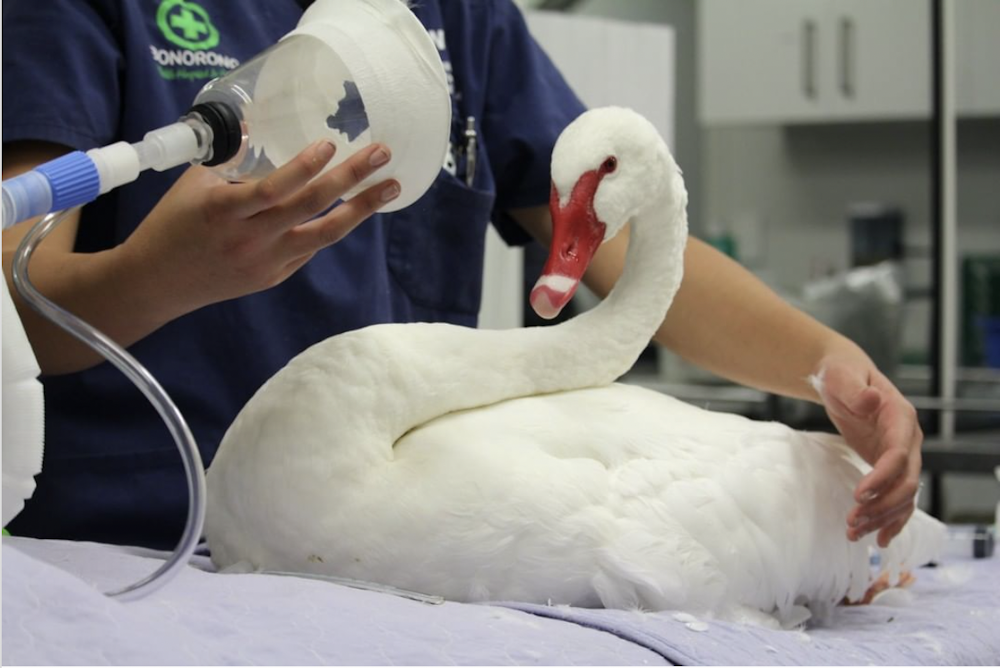
Last month, some four centuries after Europeans were awe-struck by the sight of black swans on our waters, Tasmanian fisherman Jake Hume rescued a white-plumaged black swan, the only one known to exist.

white swan at vet
Odette, the white black swan, is recovering from bullet wounds.
Bonorong Wildlife Sanctuary/Instagram

The swan is not an albino, because it still has pigmentation around its beak and eye. Its white feathers are the expression of a rare genetic mutation. First sighted in the area in 2007, the bird was found riddled with shotgun pellets. It is recovering in Bonorong Wildlife Sanctuary until ready to be released.

Simultaneously a black swan, a white swan, and a metaphor, this assumption-shattering “rare bird” captures the complex cultural history surrounding this species.

The Conversation

David Haworth does not work for, consult, own shares in or receive funding from any company or organisation that would benefit from this article, and has disclosed no relevant affiliations beyond their academic appointment.

ref. Friday essay: a rare bird — how Europeans got the black swan so wrong – https://theconversation.com/friday-essay-a-rare-bird-how-europeans-got-the-black-swan-so-wrong-161654

Grattan on Friday: Scott Morrison’s quest to be a Biden ‘bestie’

Source: The Conversation (Au and NZ) – By Michelle Grattan, Professorial Fellow, University of Canberra

Scott Morrison, who was embraced as a bro’ by Donald Trump, now seeks to become one of Joe Biden’s besties.

Making this transition neatly is probably the most important aspect of Morrison’s trip to the G7 summit, at which Australia is one of several guest countries.

A feature of the weekend in Cornwall will be the prime minister’s bilateral with the president, with a show of bonhomie for the cameras and some shrewd mutual assessment in private.

The Australia-US relationship is driven by deep common interests rather than the extent of rapport (or lack of it) between leaders in office at any particular time. But establishing strong personal bonds can help grease the wheels.

Morrison’s pragmatism and his chameleon quality will help in developing intimacy. At and around the G7 he will play up the obvious points of commonality, with Biden and the other leaders. But he still carries some policy baggage, notably on the climate issue, and it’s unclear whether that will cause him trouble.

Morrison laid the groundwork for his trip in his Wednesday speech in Perth, which was titled “A world order that favours freedom”, and cast as a rallying call to allies. This neatly aligned with Biden’s recent Washington Post article, under the heading “My trip to Europe is about America rallying the world’s democracies”.

James Curran, professor of modern history at Sydney University, saw “more than a touch of hubris” in the Morrison speech.

“He appears to be claiming that Australia, by virtue of being at the frontline of the supposed ‘new Cold War’ against China, is a standard bearer for ‘a world order that favours freedom’.

“But I think it is a case more of the PM’s cleverly tapping into President Biden’s longstanding ‘alliance of democracies’ rhetoric. Far from being out front, Mr Morrison is playing the role of presidential mimic,” Curran says.

One way or another, Morrison is firmly on the same page as the new president.

It’s a easier page to be on than Trump’s. In the Trump era, closeness might be deemed necessary for Australia’s interests but was decidedly awkward. For instance, when asked on radio before his September 2019 US visit (with its state dinner) whether Trump was a good president, one could almost hear Morrison sliding across the room. “Yeah I, look we’ve got a straight up relationship and he respects Australia.”

In Wednesday’s speech Morrison talked up Australia’s book, declaring in the written version: “Australia is more connected and more respected today than arguably at any time in our history”. He added: “We have worked hard to ensure we are not a nation that can be easily marginalised and driven to unacceptable compromises”.

In broad strategic and economic terms, Morrison goes to the G7 focused on and preoccupied with the threat of an ever-more assertive China. Australia has increasingly felt the harsh edge of China’s diplomatic tongue, and some Australian exports suffer as China weaponises trade to express its displeasure over various issues.

Morrison is looking for maximum attention on the China challenge from allies and friends, especially the US, at the G7 and on every other possible occasion.

Given how deleterious for Australia China’s behaviour now is, the government’s reaction is not surprising. But there is also the risk of it becoming seriously counterproductive.

In Western Australia, there’s concern China could threaten that state’s iron ore exports. Critics don’t buy the federal government’s argument this would be against China’s own interests and so is unlikely.

WA premier Mark McGowan was decidedly unimpressed with the tone of Morrison’s speech. McGowan warned that “we need to be very careful in relation to our language and the way we approach these things because we could be the big losers out of it”.

One specific issue Morrison hopes the G7 will push is reform of the World Trade Organisation’s disputes settlement system, which has broken down in the wake of Trump vetoing the appointment of new judges. A well-functioning process is vital, especially for a country like Australia, to enforce trade rules and deal with grievances.

The Australian National University’s Shiro Armstrong, an expert on the WTO, says Morrison’s urging lends weight to a wider international recognition that global trade rules are outdated and the current system is under threat.

While the G7 is expected to call for action, Armstrong says change will require broader support. He points to the G20 (of which Australia is a member) being the body able to “set the strategic direction for reform of the WTO given its membership of the large emerging economies and established powers”.

Among the central issues on the G7 agenda will be climate change and the pandemic.

Morrison has made it clear he is not ready yet to embrace a firm 2050 target for net zero emissions – though he wants to before the Glasgow climate conference in November – let alone lift Australia’s ambition in the near term.

For all his talk of technology, and his defensive stand on Australia’s record, he won’t be in tune with the G7 leaders. It will be embarrassing. The question is, how embarrassing?

Will he be put on the spot in plain sight, or will Australia’s laggard position be politely ignored in public? And behind closed doors, will Biden twist his arm to move faster, or will the president leave that until later, or to his climate envoy John Kerry? Britain’s Boris Johnson has already been firm with him.

On the pandemic, Morrison will be able to boast about Australia’s health and economic performance. Perhaps he won’t dwell on the slowness and problems of the rollout.

But the G7 leaders will be focused on the need to get more vaccines to developing countries. Biden is proposing a big US initiative. Morrison will point to the vaccine aid Australia is funding for the region. We could always do more however – the government has on order and will receive more doses than necessary to fully cover all eligible Australians.

In his speech, Morrison made a point of welcoming Biden’s probe into the origins of coronavirus – whether it came from an animal, as initially was the accepted explanation, or the possibility it accidentally escaped from a Wuhan laboratory.

Australia’s early call for an inquiry marked a moment of further deterioration in the relationship with China. The investigation that eventually resulted was inconclusive.

According to a leaked version of the G7 draft communique, seen by Bloomberg News, the leaders are set to call for the World Health Organisation to set up a new inquiry into COVID-19’s origins.

For Morrison the search for the pandemic’s start is unfinished business, a point of strong accord with the president.

The Conversation

Michelle Grattan does not work for, consult, own shares in or receive funding from any company or organisation that would benefit from this article, and has disclosed no relevant affiliations beyond their academic appointment.

ref. Grattan on Friday: Scott Morrison’s quest to be a Biden ‘bestie’ – https://theconversation.com/grattan-on-friday-scott-morrisons-quest-to-be-a-biden-bestie-162533

Politics with Michelle Grattan: Rex Patrick on Freedom of Information and Australia’s submarines

Source: The Conversation (Au and NZ) – By Michelle Grattan, Professorial Fellow, University of Canberra

Senator Rex Patrick is currently challenging the secrecy around Scott Morrison’s national cabinet. He’s brought legal action – the outcome is pending – to attempt to have the minutes of this body, which includes federal, state and territory leaders, made public. The government claims the documents are protected by an exemption for cabinet documents in the freedom of information act, while Patrick claims national cabinet lacks some of the essential features that would afford it that cover.

Patrick’s also pressing for improvements in the freedom information law, which has become increasingly obstacle-ridden, to allow applicants more rights. It’s perhaps no wonder former senator Nick Xenophon, for whom Patrick once worked, labelled him “Inspector Rex”.

On a very different front, as a former submariner Patrick has been highly critical of the government’s Future Submarine Program, which has contracted a French company to build 12 submarines for the Royal Australian Navy. Patrick says the company is taking too long, and charging too much, to make submarines which may fail to achieve the necessary sovereign capability.

In this podcast, Patrick says Scott Morrison should take the opportunity during his coming meeting with French President Macron to issue an ultimatum that changes must be made.

“You know, despite the good relationship we may have with France, this is a matter of national security, and it’s also a matter of a huge amount of public expenditure. And the prime minister must put the Australian public before that relationship. And I think it would be wise for him to be just very frank and honest with the French president.”

Listen on Apple Podcasts

Stitcher Listen on TuneIn

Listen on RadioPublic

Additional audio

A List of Ways to Die, Lee Rosevere, from Free Music Archive.

The Conversation

Michelle Grattan does not work for, consult, own shares in or receive funding from any company or organisation that would benefit from this article, and has disclosed no relevant affiliations beyond their academic appointment.

ref. Politics with Michelle Grattan: Rex Patrick on Freedom of Information and Australia’s submarines – https://theconversation.com/politics-with-michelle-grattan-rex-patrick-on-freedom-of-information-and-australias-submarines-162520

Morrison’s dilemma: Australia needs a dual strategy for its trade relationship with China

Source: The Conversation (Au and NZ) – By Weihuan Zhou, Associate Professor, Director of Research and member of Herbert Smith Freehills CIBEL Centre, Faculty of Law and Justice, UNSW Sydney, UNSW

En route to this year’s G7+ Summit in the UK, Australia’s Prime Minister Scott Morrison yesterday delivered a speech in Perth on “A world order that favours freedom”.

He spoke of “Australia’s preparedness to withstand economic coercion in recent times”. As “the most practical way to address economic coercion”, he called for reform of the World Trade Organization, particularly “the restoration of the global trading body’s binding dispute settlement system”.

It wasn’t hard to work out what – and who – he was talking about: China.

But Morrison faces a conundrum in his pitch to reform the WTO to resolve trade disputes with China, which has blocked or restricted Australian exports of beef, wheat, lobster, timber and coal, and imposed high tariffs on barley and wine.

But it isn’t China that has undermined the role of the WTO as the global mechanism for settling trade disputes peacefully through agreed rules and procedures.

The blame for that rests with the United States, which under the Trump administration effectively rendered the organisation’s appeals process inoperable.

By emphasising China’s economic coercion and using it to appeal to the US and others to reform the World Trade Organization, the Morrison government is playing a risky game. It may be squandering an opportunity to engage more constructively with China on common interests.

Trade disputes with China

As diplomatic relations between China and Australia deteriorated over the past 18 months – fuelled by things such as Australia leading the call for an independent investigation into the origins of the COVID-19 virus – China’s trade restrictions on Australian imports escalated.


Read more:
Why the Australia-China relationship is unravelling faster than we could have imagined


By December 2020 Australia was ready to make its very first complaint against China to the WTO – over China’s five-year 80.5% tariff on Australian barley. The Morrison government is now contemplating a second WTO complaint over China’s tariffs of as high as 200% on Australian wine.

Appellate Court in limbo

The WTO established a panel to review the barley tariff in May.

Even if Australia does win its case, it faces the uncertainty of how long China takes in acting on the WTO ruling.

But before that is the problem of the WTO making a final ruling.

Like other court systems the WTO has an appeals mechanism, known as the Appellate Body. The Appellate Body is meant to have seven members, and requires a quorum of three judges to hear an appeal. Members are appointed to four-year terms. Appointments require all of the WTO’s 164 member nations to agree.

The US, however, has blocked every appointment and reappointment over the past four years or so. Now the Appellate Body has no members. So no dispute taken to the WTO can be resolved if one of the disputing parties appeals.

If Australia does win its case against China, and China appeals, the dispute will remain in limbo until the Appellate Body can hear that appeal.


Read more:
Taking China to the World Trade Organisation plants a seed. It won’t be a quick or easy win


Shared trade interests

On this issue, Australia and China have a shared position. In 2018, for example, they joined forces with other countries to push for the appointment of Appellate Body members.

They also have common interests on some other reform issues in trade that Morrison mentioned in his speech, such as the digital economy and environmental sustainability. Reducing pollution from trade in plastics is an example.

Morrison’s speech, however, tended to highlight the differences rather than shared interests in the international trading system.

“We are facing heightened competition in the Indo-Pacific region,” he said. “We know that because we live here. The task is to manage that competition. Competition does not have to lead to conflict. Nor does competition justify coercion.”


Read more:
What a Biden presidency means for world trade and allies like Australia


Need for a dual strategy

Morrison’s speech did acknowledge the need for “all nations to participate in the global system”. Australia, he said, “stands ready to engage in dialogue with all countries on shared challenges, including China when they are ready to do so with us”.

But Australia’s national interest demands more than just standing ready. The government needs to do the proverbial walking and chewing gum at the same time.

Though its primary motivation for WTO reform may be Australia’s trade disputes with China, it cannot ignore the need to promote that reform through engaging and collaborating with China, now the world’s biggest economy and Australia’s most important trading partner by far.

This won’t be easy. There are some big differences that separate China from Australia and its allies. The Chinese government is far more involved in its economy than the market-based ethos that drove the establishment of the World Trade Organization in the first place.

Negotiating these differences peacefully will require delicate conversations over the boundaries of trade law and policy. That will be impossible in an environment of mutual distrust.

Any WTO reform will need China on board.

Finding common ground on reinstating a reformed WTO Appellate Body could be a starting point for tempering this lack of trust. It could pave the way for the two nations to de-escalate and move closer to resolving their disputes.

The Conversation

Markus Wagner is the Executive Vice-President of the Society of International Economic Law. He writes in his personal capacity.

Weihuan Zhou does not work for, consult, own shares in or receive funding from any company or organisation that would benefit from this article, and has disclosed no relevant affiliations beyond their academic appointment.

ref. Morrison’s dilemma: Australia needs a dual strategy for its trade relationship with China – https://theconversation.com/morrisons-dilemma-australia-needs-a-dual-strategy-for-its-trade-relationship-with-china-162424

‘Over the top’: backlash against TikTok’s bee lady not justified, say bee experts

Source: The Conversation (Au and NZ) – By Caitlyn Forster, PhD Candidate, School of Life and Environmental Sciences, University of Sydney

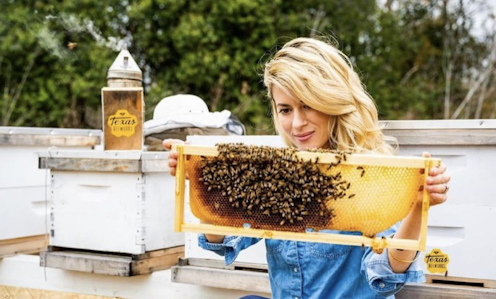
Texas Beeworks’ Erika Thompson has been accused by other users of staging her TikTok videos and handling bees in an unsafe manner. Instagram: @texasbeeworks (resharing the work of Jonathan Vail)

Beekeeping has become hugely popular in recent years, and a new world of beekeeping influencers has recently emerged on TikTok. But it’s not without drama.

Erika Thompson — the bee lady from Texas Bee Works — has gained a following of 6.4 million on TikTok by posting videos of rescuing bee colonies from odd places, including trucks, toilets, and umbrellas. Thompson is at ease in the videos with the colonies, and is frequently not wearing protective clothing, has her hair loose, and handles the bees with her bare hands.

But lately, her videos have been getting backlash from other beekeepers, and fuelled by the media. They say she uses dangerous beekeeping practises, and she isn’t really “saving the bees” as she claims in each video.

We research bee behaviour at the University of Sydney. To us, this backlash is over the top.

Thompson is clearly a competent beekeeper who is educating the public about honeybees in her own way on social media. She shows the potential for TikTok to bring interesting biology to the public — and she does it all without getting hurt.

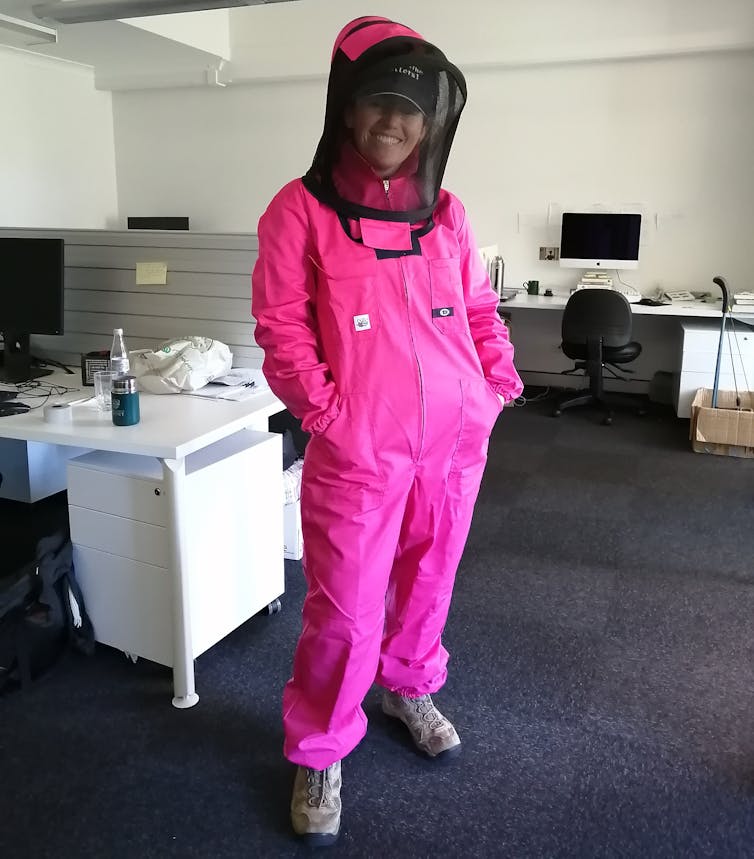
Beekeepers often wear thick full-length bee suits, veil, gloves, and enclosed shoes when working with their colonies. Many colourful options are available.
Eliza Middleton @smiley_lize

Double standards

Thompson has been accused of “bee-washing” – when someone claims actions are more bee-friendly than they are, usually by inflating the conservation messaging of honey bees over other more threatened bee species.

This could well be the case, but Thompson wouldn’t be the first nor last person to piggy back on a popular message to boost her business.


Read more:
‘Bee-washing’ hurts bees and misleads consumers


Bee hotels are a great bee-washing example. You can buy these nesting boxes from many major stores, including Bunnings and Aldi, yet most native bees are ground nesting and bee hotels may even increase disease transmission if not cleaned between seasons.

Yes, Erika Thompson’s videos don’t show much of the mishaps that sometimes happen with beekeeping. But if she wants to send a positive message about bees and increase her following and business opportunities, it’s unlikely she’s going to show videos involving stings.

As researcher and beekeeper Lewis Bartlett pointed out on Twitter, attacks on Thompson seem to have a basis in misogyny, and some even read as downright envy.

In fact, research from 2018 confirmed women are more likely to get negative comments on YouTube, so it is sadly unsurprising a woman is behind the “controversial” videos.

But why isn’t she getting stung?

Honeybees are the leading cause of hospitalisation from a venomous animal in Australia. So it’s shocking and impressive to see someone scoop up bees with their bare hands.

She’s not the only example of someone undertaking what’s been considered by some to be unsafe practise, with other TikTok users show similar non-gloved practises.


Read more:
It’s bee season. To avoid getting stung, just stay calm and don’t swat


While we don’t recommend people who aren’t beekeepers try this, bees can be beautiful, docile creatures. And it’s clear Thompson knows how to interact with bees and how to avoid being stung.

To prevent stings, Thompson gently handles bees, and is likely carefully choosing which bees to film based on how aggressive the colony is.

Colonies can be selectively bred to be less aggressive, and beekeepers will seek out certain subspecies of bee, such as the Italian subspecies Apis mellifera liguistica, which are popular due to their inherent gentle nature.

If a colony is agitated or aggressive by nature, it may be more likely to sting. If you can smell bananas around bees, you may be smelling their alarm pheromone. Even the weather will impact the mood of the bees — nicer weather brings nicer bees.

Beekeepers often use smokers to calm bees before interacting with them. If you scroll through Thompson’s TikTok feed, you’ll see her wearing protective bee keeping equipment and the presence of smokers in a few videos.

This beekeeper is confident there’s no risk of stings from honeybees, so he has taken off his hood and gloves.
Sebastian Croker, CC BY-NC

There’s a chance the bees are actually stinging Thompson, but she isn’t bothered by them.

Each person has a different reaction to honeybee stings. Some people have a severe reaction, an anaphylactic response potentially leading to death, while others barely react.

‘Save the bees’

Thompson has proven her skills as an engaging educator on honeybee health and biology, filling her videos with interesting facts about honeybees and explaining their behaviours.

Her videos often end with “save the bees” messaging, but her focus on honeybees can take away from the importance of native bees.

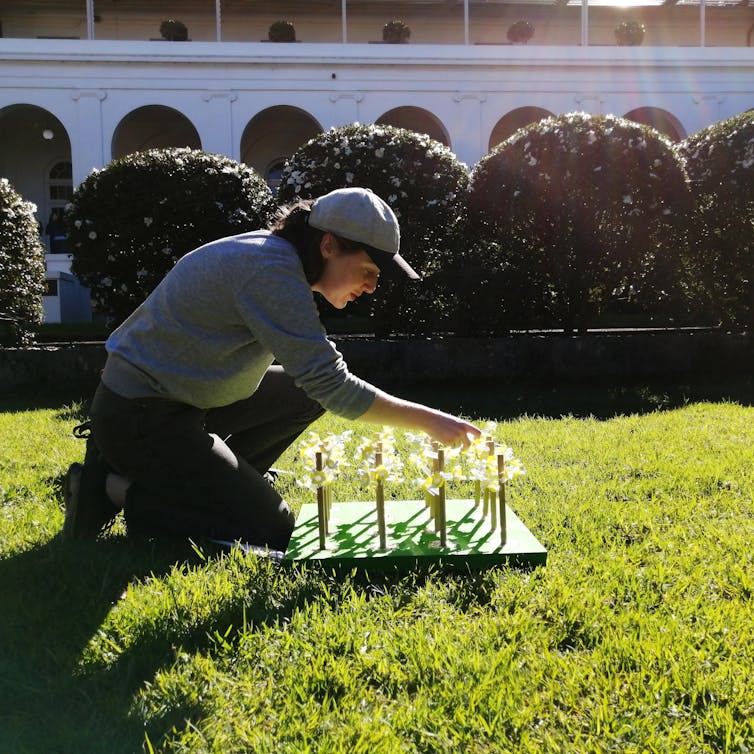
Behavioural scientists work with honeybees but don’t need as much protective gear as beekeepers, as we usually don’t directly interfere with the bees. They’re generally more interested in foraging than finding someone to sting.
Eliza Middleton @smiley_lize

In North America, many native bees, such as the rusty patched bumblebee, face significant threats.

Honeybees, on the other hand, are believed to have originated in Africa or Asia, and are considered native to Europe, Africa, and the Middle East. And yet, the number of colonies of honeybees in North America has increased.

Conservation isn’t as simple as saving or focusing on a single species.

By saving a non-native species over a native species, you can unwittingly increase the competition for resources and the native species can’t compete.

How can you help save the bees?

Beekeeping has been soaring in Australia. In Queensland, for example, the number of hobby beekeepers has doubled in the last five years.

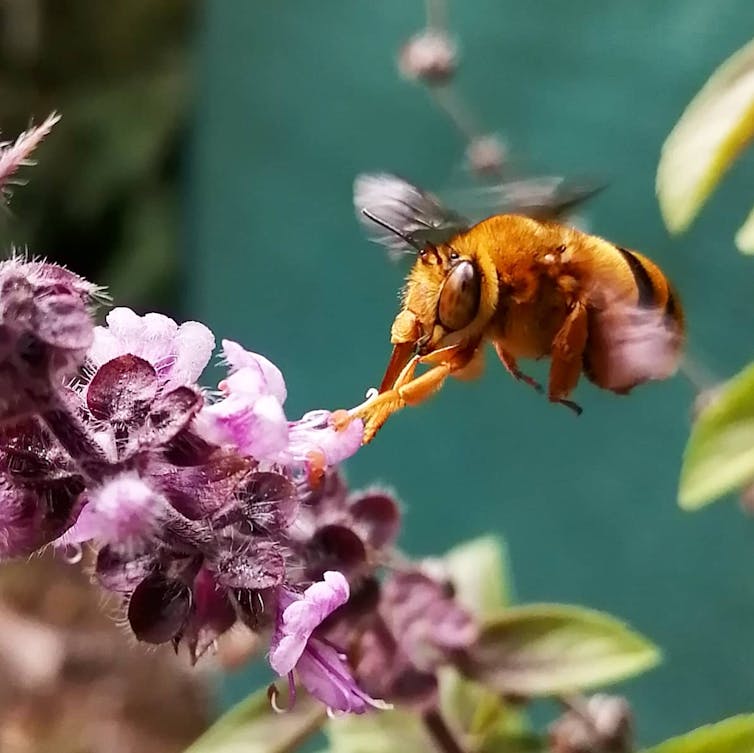
A teddy bear bee, Amegilla bombiformis, a native Australian bee.
Eliza Middleton @smiley_lize

While Thompson makes it look fairly easy to move swarms of bees, you should not try and move bees yourself without adequate training.

Bees in swarms are unlikely to sting, and usually move along in a few hours. But if you are concerned, call a professional beekeeper to remove them.

But to help save the bees, you don’t need to be a beekeeper. Simply planting flowers in your garden and reducing your use of pesticides can make a big difference.

Go outside and get to know your native bees, and maybe even get involved in some citizen science.


Read more:
These 3 tips will help you create a thriving pollinator-friendly garden this winter


The Conversation

Caitlyn Forster receives funding from the Australian Research Council. She is affiliated with The Australasian Society for the Study of Animal Behaviour.

Eliza Middleton receives funding from the Australian Research Council.

ref. ‘Over the top’: backlash against TikTok’s bee lady not justified, say bee experts – https://theconversation.com/over-the-top-backlash-against-tiktoks-bee-lady-not-justified-say-bee-experts-162346

Kapow! Zap! Splat! How comics make sound on the page

Source: The Conversation (Au and NZ) – By Victor Araneda Jure, Teaching Associate / Filmmaker, Monash University

Unsplash/Joe Ciciarelli, CC BY

Typically, comics are considered a silent medium. But while they don’t come with an aural soundtrack, comics have a unique grammar for sound.

From Wolverine’s SNIKT! when unsheathing his claws, to Mozart’s Piano Concerto No. 23 in The Death of Stalin (later made into a film) the use of “textual audio” invites comics readers to hear with their eyes.

Fundamental elements such as symbols, font styles and onomatopoeia (where words imitate sounds) mean reading comics is a cross-sensory experience. New and old examples show the endless potential of the artform.

comic book pages
Kaboom! and splosh! on every page.
Unsplash/Miika Laaksonen, CC BY

Holy onomatopoeia Batman!

Onomatopoeia — isn’t unique to comics but comic artists have certainly perfected this figurative form of language. POW! BAM! BANG! appear on the page when Batman and Robin land a punch. BLAM! is the sound made by the Penguin’s umbrella when it shoots from a distance.

The list of sounds represented by onomatopoeia is limitless in terms of creative potential. There are words that mimic sounds directly, such as SPLOSH! (the sound made by an object falling into water) and made-up sounds like that of Wolverine’s adamantium claws (as we will see further below).

The language of comics offers creative freedom to expand the aural lexicon. One online database lists over 2500 comic book sounds with links to comics images in which they’ve been used.

cowboy comic
Stan Lee’s Gunsmoke Western (1955) #68, with lettering and pencilling by Dick Ayers.
The Comic Book Sound Effect Database

This can also present special challenges for translators. Sounds represented in comics can range from speech sounds (subject to language rules including those governing how syllables can be formed) to human-made non-verbal sounds like sneezes, to sounds made by objects and environments.

Visual context is important too. We only recognise the warning of Wolverine’s violent retribution in SNIKT! when the word is drawn and displayed next to the hairy mutant.

comics image of man with claws
Wolverine extends his claws.
Author provided

Likewise, the word THWIP! by itself may not mean much. But when positioned in context it can imbue a comic page with excitement and adventure.

Imagine a young man dressed in a tight red-and-blue bodysuit diving at high speed from the top of the Empire State building. Suddenly, just before hitting the ground, THWIP! he shoots spider webs from his wrists, using them to swing from building to building. Both readers and the crowd of enthusiastic fans on the page react: “Here comes Spidey!”

The way they say it

Comic creators also use font style and size and different speech bubble shapes and effects to shout, whisper or scream language.

Bold, italics, punctuation, faded or irregular letters are used to emphasise different features of the written words: fear, courage, loudness or quietness.

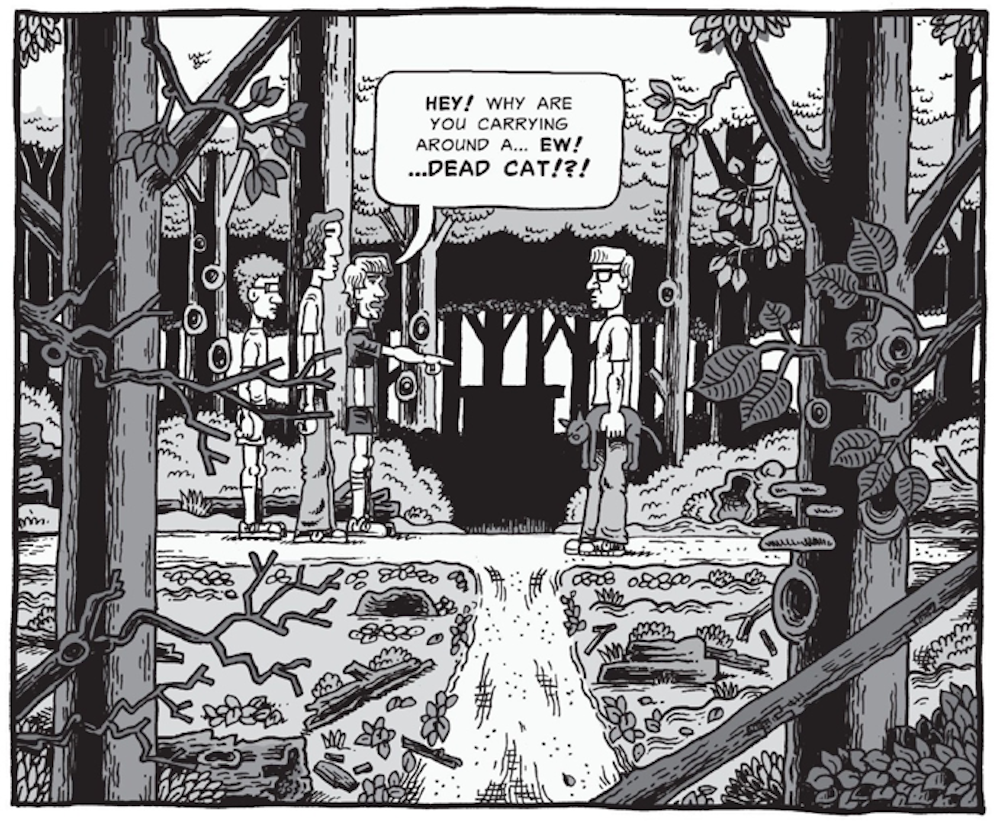
In My Friend Dahmer, created by a school friend of the infamous serial killer, the protagonist is seen carrying a dead cat on his way home by a group of kids. Comics creator John “Derf” Backderf applies bigger-bold words in one of the kids’ speech balloon to emphasise the shouting and surprise of onlookers.

comic book page
My Friend Dahmer (2012) by Derf Backderf.
Author provided


Read more:
Heroes, villains … biology: 3 reasons comic books are great science teachers


Music to my eyes

The 1973 manga Barefoot Gen, written by Keiji Nakazawa, explores his firsthand experience of the bombing of Hiroshima and its aftermath.

Gen, the main character, sings through several pages of the story. The author uses a musical note symbol () to indicate where speech bubbles are sung. By the final pages of the fourth volume, Gen sings to celebrate that his hair is beginning to grow again after being affected by radiation poisoning.

When preceded by the easily recognisable musical symbol, it’s virtually impossible to read the dialogue without “hearing” a melody:

“Red roof on a green hilltop …

A bell tower shaped like a pixie hat…

The bell rings, ding-dong-ding …

The baby goats sing along, baa-baa-baa …”

Expanding on this concept, How to Talk to Girls at Parties by Neil Gaiman contains musical panels where the combination of drawings, words and signs present a soundtrack.

comic page
The How to Talk to Girls at Parties party scene (created by Neil Gaiman, Fábio Moon and Gabriel Bá) gives us a sense of how the scene sounds to the characters in it.
Author provided

In film terminology, this is diegetic sound — noises or tunes from within the storyworld — as opposed to a narrative voiceover or a musical soundtrack the characters can’t hear within the story.

In Gaiman’s comic a combination of illustrations, musical notes and words (including the onomatopoeic TUM for a base drum beat) convey the sense that music fills every room of the house where a party is taking place.

In the political satire comic that inspired a movie, The Death of Stalin creator Fabien Nury and illustrator Thierry Robin show lines from Mozart’s orchestral score for his Piano Concerto No. 23 at the bottom of two pages. This adds drama to a climactic scene where Russian leader suffers a stroke.

comics frames of stalin dying
The musical score can add pace and drama to an already dramatic scene.
Author’

Next time you read a comic book, make sure you listen carefully. KABOOM!

The Conversation

Victor Araneda Jure does not work for, consult, own shares in or receive funding from any company or organization that would benefit from this article, and has disclosed no relevant affiliations beyond their academic appointment.

ref. Kapow! Zap! Splat! How comics make sound on the page – https://theconversation.com/kapow-zap-splat-how-comics-make-sound-on-the-page-160455

There are 209 Australian kids stranded in India — they have special legal rights we must not ignore

Source: The Conversation (Au and NZ) – By Joshua Aston, Associate Dean Law, Edith Cowan University

Children outside Prayagraj, Uttar Pradesh. Ramesh Kumar Singh/AP/AAP

The latest Senate estimates hearings revealed there were more than 200 Australian children stuck in India without their parents, up from 173 last month.

Department of Foreign Affairs and Trade secretary Frances Adamson says diplomats have a “steely determination” to bring these children back to Australia. Yet more than one year into the pandemic, the government is not able to provide a timeline for their return, other than “as soon as possible”.

While there has been attention given to Australians stranded overseas, much of this has related to adults.

What does human rights law say about children in this situation?

More than 35,000 stranded

According to the latest figures, some 35,128 Australians overseas are registered as wanting to come home. Of these, 10,994 are in India, including 209 children.

The government has arguably tried to downplay their vulnerability.
Foreign Minister Marise Payne told estimates last week some of the children registered had arrived in India this year, some had never been to Australia and others had arrived there as far back as 2008. While they have been described as “unaccompanied minors”, the government has stressed they are staying with extended family — and not literally on their own.

They are, however, separated from parents in Australia — or not where their parents want them to be.


Read more:
The crisis in India is a terrifying example of why we need a better way to get Australians home


Last week, we heard once more how demand for repatriation flights continues to outstrip capacity. The situation for children is particularly bleak. Minors under 18 are not allowed on commercial flights without a nominated adult accompanying them — including for the quarantine period.

Given parents are not allowed to travel to get them back, the situation is almost impossible. Some have reportedly resorted to hiring strangers to help get their kids home. As desperate parents seek alternative solutions, young people may become prey to strangers while in transit.

The legal situation for those overseas

The International Covenant on Civil and Political Rights guarantees a person the right to leave and return to their own country freely. The government cannot arbitrarily deny this right.


Read more:
Should Aussies stranded overseas go to the United Nations for help to get home?


In March 2021, a group of Australian citizens stranded in the United States lodged a complaint with the United Nations Human Rights Committee. According to the group’s lawyer, Geoffrey Robertson,

International law recognises the strong bond between individuals and their homeland and no respectable government would impose travel caps to prevent, for over a year, its citizens from returning if they are prepared to do quarantine.

The UN’s Human Rights Committee has already urged Australia to ensure their “prompt return” while the case is considered.

But as Australia does not have a bill of rights, the lawfulness of the repatriation policies may not be able to be challenged in our domestic courts.

Extra rights for children

Children have extra rights due to their vulnerability — and these are highly relevant to the situation of those stranded in India. Critically, the Convention on the Rights of the Child says children

shall not be separated from his or her parents against their will.

The only exception would be if relevant authorities determine it is in the best interests of the child.

At the same time, the International Covenant on Civil and Political Rights guarantees every child the right to acquire a nationality and receive protection as a minor. Meanwhile, the International Covenant on Economic, Social and Cultural Rights guarantees the state shall provide the “widest possible” protection and assistance to families. This is “particularly” the case when families have dependent children.

The Australian government will have to account for itself as part of its regular reports to the United Nations Committee on the Rights of the Child. Australia submitted its most recent report in 2018. Its next report is due in 2023.
However, the only possible repercussions will be international condemnation — no sanctions apply.

Australia’s links to India

Policy and debate during COVID has seen a harsh and sometimes punitive tone taken on Australians stuck overseas — particularly when it comes to those in India. At times, Australian-Indians have even been blamed for COVID outbreaks or been portrayed as selfish for wanting to travel.

This shows a misunderstanding of our deep connections to India and of Indian cultural practices.

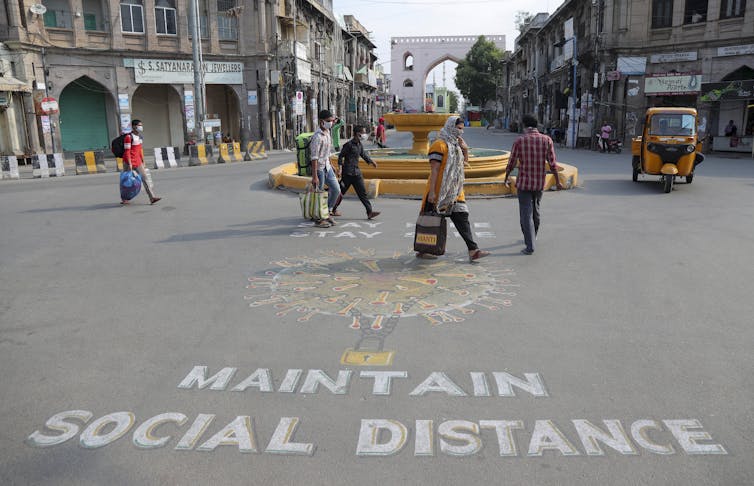
A sign advises locals to 'maintain social distance' in a Hyderabad street.
India has been severely hit by a second COVID wave since March 2021.
Manesh A Kumar/AP/AAP

In 2020, the Australian Bureau of Statistics reported about 2.8% of Australians come from India. This makes India the second most common country of origin for Australian residents after England (with China in third place)

Indian society is “collectivistic” – which means the group is prioritised over the individual. Family links are extremely important, so even if migrant Indians are far from their country of origin, frequent travel is prioritised to maintain these links. This includes sending children to be with relatives.

So it’s not surprising to note that with border closures in March 2020, and this year’s temporary travel ban from India, thousands of Australian citizens were left stranded in the country.

Why can’t more be done?

There is no denying there are complex logistical issues when it comes to bringing people back during a global pandemic.


Read more:
Can we use the RAAF to bring home stranded Aussies overseas?


But there are clear human rights reasons (beyond simple compassion) for the Australian government to introduce further measures to bring children back from India.

It begs the question of why there is not immediate action to improve quarantine capacity for this group and allow parents special permission to travel to India to collect their children with specific charter flights to bring them home.

The Conversation

Joshua Aston does not work for, consult, own shares in or receive funding from any company or organisation that would benefit from this article, and has disclosed no relevant affiliations beyond their academic appointment.

ref. There are 209 Australian kids stranded in India — they have special legal rights we must not ignore – https://theconversation.com/there-are-209-australian-kids-stranded-in-india-they-have-special-legal-rights-we-must-not-ignore-162176

Free schools guide about inclusiveness and climate science is not ideological — it’s based on evidence

Source: The Conversation (Au and NZ) – By Kelly-Ann Allen, Senior Lecturer, School of Education, Monash University

Shutterstock

A recently released policy guide book for teachers and schools has been receiving some criticism. For instance, an article in the Daily Telegraph claimed:

Teachers are being told not to use phrases like “girls and boys”, “normal” and “other” in class – but they should make students aware of “superdiversity” and “declare a climate change emergency” as a way of “telling the truth” about our “climate breakdown”.

The article is talking about Building Better Schools with Evidence-based Policy: Adaptable Policy for Teachers and School Leaders, which I edited along with Andrea Reupert, and Lindsay Oades.

Although the article claims the book offers “instructions” designed by “academic boffins”, this is not entirely correct.

Cover of: Building Better Schools with Evidence-based Policy

Routledge

The book is meant to be a free guide for teachers who may want to read the evidence on their topic of need. The policy templates are not prescriptive. The editors encourage users of the book to consider and adapt the policies to suit their unique school context, priorities and culture.

Topics such as “superdiversity” and “declaring a climate emergency” are only only a small selection of the 35 other topics in the book. Themes range from student participation in physical activity to well-being, excellence in Indigenous education and offering feedback for learning.

Teachers can say ‘boys and girls’

The book includes a chapter on transgender and non-binary students. This is where the criticism of being “told not to use phrases like girls and boys” come from.

The chapter suggests schools consider the language they use in the classroom to support inclusion.

The part about boys and girls more specifically asks that “staff should not divide students by gender for class activities, sports, subjects, lining up, et cetera” or address students as “girls and boys” if they want to create an inclusive environment specifically for students whose gender is not described by the binary categories of boy or girl.

This implies if there is a transgender or non-binary student in the class, teachers should consider not dividing groups in traditional and binary ways.


Read more:
9 in 10 LGBTQ+ students say they hear homophobic language at school, and 1 in 3 hear it almost every day


Recommendations to use gender inclusive language, particularly when pronouns are not known, is not new and is endorsed by several international bodies. The American Psychological Society advises terminology like “everyone”, “students”, “children” are useful alternatives to addressing class groups as “boys and girls” to ensure students are affirmed and aren’t misgendered.

Another critical interview on Sky News with Mark Latham circled around the term “superdiversity”. This refers to the array of differences that make up the population and acknowledges how the individual aspects that create diversity can interact with each other.

It comes from a chapter which responds to the increasing diversity seen in classrooms such as “disability, cognitive skills, gender/sexuality, and religious affiliation”. Diversity may also include “personality, interests, socioeconomic status, individual needs, and a wide range of other variables”.

A diverse group of kids.
Superdiversity acknowledges everyone’s differences and strengths.
Shutterstock

The Daily Telegraph article suggested the book tells “teachers to stop using phrases such as English as a second language”. But the advice comes from one of several considerations for inclusive practice such as avoiding terms “which place students’ knowledge in a deficit manner”.

For instance, the term “ESL student” may not be problematic it itself, but the way it is used can be inaccurate for some students who speak multiple languages. This finding is drawn from a study of young students with various bilingual identities in Australia.

The message is that “each child has a range of personal characteristics that need to be considered in all aspects of school life”.

A climate emergency

Another of the book’s chapters outlines “why and how a school might go about declaring a climate emergency policy”. This is based on a scientific consensus of a warming climate linked to human activities. For instance, the Intergovernmental Panel on Climate Change (IPCC)‘s landmark Special Report on Climate Change warns of catastrophic climate change consequences by 2030 if we can’t limit warming to 1.5˚C above pre-industrial levels.

The policy also supports the UN’s Sustainable Development Goal 13, to “take urgent action to combat climate change and its impacts”.


Read more:
Ever wondered what our curriculum teaches kids about climate change? The answer is ‘not much’


As the chapter suggests, teachers and students should “play their part in responding to this global declaration of a climate emergency”.

What evidence we used

In the Sky News interview, Mark Latham claimed the book has “very little evidence”.

Each policy has been authored or co-authored by researchers who are considered leading authorities on the topic. They include Laureate Professors John Hattie (expert in feedback for learning) and Marilyn Fleer (play in schools), Distinguished Professor Neil Selwyn (digital teachnologies) and Professor Andrew Martin (instruction to reduce cognitive load).

Wile the Sky News interview talked about identity politics and a left agenda, several policy recommendations in the book have been endorsed by the people levelling criticism against the book. For instance, the chapter on reading instruction by Professor Pamela Snow, Kate de Bruin and Linda Graham, endorses using systematic phonics instruction — which Mark Latham supports.


Read more:
We have the evidence for what works in schools, but that doesn’t mean everyone uses it


Each contributor was also asked to rate the evidence they used to support or inform the policy, and provide transparency. They rated the evidence in terms of impact (and potential impact), how it can be generalised and the ease with which each policy can be implemented. These ratings are provided in the book.

Each policy has been also reviewed by those considered its ultimate users, including parents and teachers.

This book does not seek to impose any specific ideological point of view into education systems. There is a known gap between research and practice. The book aims to fill that gap, providing the evidence straight to teachers as and when they might need it.

The Conversation

Kelly-Ann Allen co-edited the book discussed in the article.

ref. Free schools guide about inclusiveness and climate science is not ideological — it’s based on evidence – https://theconversation.com/free-schools-guide-about-inclusiveness-and-climate-science-is-not-ideological-its-based-on-evidence-162423

How rain, wind, heat and other heavy weather can affect your internet connection

Source: The Conversation (Au and NZ) – By James Jin Kang, Lecturer, Computing and Security, Edith Cowan University

Gordonekoff / Shutterstock

When your Netflix stream drops out in the middle of a rainstorm, can you blame the wild weather?

Quite possibly. The weather can affect the performance of your internet connection in a variety of ways.

This can include issues such as physical damage to the network, water getting into electrical connections, and wireless signal interference. Some types of connection are more vulnerable to weather than others.

The behaviour of other humans in response to the weather can also have an effect on your connection.

How rain can affect your internet connection

Internet connections are much more complicated than the router and cables in our homes. There are many networking devices and cables and connections (of a variety of types and ages) between our homes and the websites we are browsing.

How do we connect to the Internet?

An internet connection may involve different kinds of physical link, including the copper wiring used in the old phone network and more modern fibre optic connections. There may also be wireless connections involved, such as WiFi, microwave and satellite radio.

Example of multi-layered internet access.
Ferran, CC BY-SA 4.0 https://creativecommons.org/licenses/by-sa/4.0, via Wikimedia Commons

Rain can cause physical damage to cables, particularly where telecommunication networks are using old infrastructure.

ADSL-style connections, which use the old phone network, are particularly vulnerable to this type of interference. Although many Australians may be connected to the National Broadband Network (NBN), this can still run (in part) through pre-existing copper wires (in the case of “fibre to the node” or “fibre to the cabinet” connections) rather than modern optical fibres (“fibre to the home”).

Different types of NBN connection.
Riick, CC BY-SA 3.0 http://creativecommons.org/licenses/by-sa/3.0/, via Wikimedia Commons

Much of the internet’s cabling is underground, so if there is flooding, moisture can get into the cables or their connectors. This can significantly interfere with signals or even block them entirely, by reducing the bandwidth or causing an electrical short-circuit.

But it isn’t just your home connection that can be impacted. Wireless signals outside the home or building can be affected by rainfall as water droplets can partially absorb the signal, which may result in a lower level of coverage.

Even once the rain stops, the effects can still be felt. High humidity can continue to affect the strength of wireless signals and may cause slower connection speeds.

Copper cables and changed behaviour

If you are using ADSL or NBN for your internet connection, it is likely copper phone cables are used for at least some of the journey. These cables were designed to carry voice signals rather than data, and on average they are now more than 35 years old.

Only around 18% of Australian homes have the faster and more reliable optical-fibre connections.

There is also a behaviour factor. When it rains, more people might decide to stay indoors or work from home. This inevitably leads to an increase in the network usage. When a large number of people increase their internet usage, the limited bandwidth available is rapidly consumed, resulting in apparent slowdowns.


Read more:
How to boost your internet speed when everyone is working from home


This is not only within your home, but is also aggregated further up the network as your traffic is joined by that from other homes and eventually entire cities and countries.

Heatwaves and high winds

In Australia, extreme cold is not usually a great concern. Heat is perhaps a more common problem. Our networking devices are likely to perform more slowly when exposed to extreme heat. Even cables can suffer physical damage that may affect the connection.

Imagine your computer fan is not running and the device overheats — it will eventually fail. While the device itself may be fine, it is likely the power supply will struggle in extremes. This same issue can affect the networking equipment that controls our internet connection.

Satellite internet services for rural users can be susceptible to extreme weather, as the satellite signals have to travel long distances in the air.

Radio signals are not usually affected by wind, but hardware such as satellite dishes can be swayed, vibrated, flexed or moved by the wind.

Most of the time, human behaviour is the main cause

For most users, the impact of rain will be slight – unless they are physically affected by a significant issue such as submerged cables, or they are trying to use WiFi outside during a storm.

So, can weather affect your internet connection? Absolutely.

Will most users be affected? Unlikely.

So if your favourite Netflix show is running slow during in rainy weather, it’s most likely that the behaviour of other humans is to blame — holed up indoors and hitting the internet, just like you.


Read more:
Internet traffic is growing 25% each year. We created a fingernail-sized chip that can help the NBN keep up


The Conversation

The authors do not work for, consult, own shares in or receive funding from any company or organisation that would benefit from this article, and have disclosed no relevant affiliations beyond their academic appointment.

ref. How rain, wind, heat and other heavy weather can affect your internet connection – https://theconversation.com/how-rain-wind-heat-and-other-heavy-weather-can-affect-your-internet-connection-162165

Liberals’ Dan Andrews questions are a perfect case study in how to manufacture fake news

Source: The Conversation (Au and NZ) – By Denis Muller, Senior Research Fellow, Centre for Advancing Journalism, The University of Melbourne

Premier Dan Andrews shortly after the fall that left him with broken ribs and a damaged spine. AAP/@DanielAndrewsMP

A case study in the manufacture of fake news is playing out right now in Melbourne.

Victoria’s shadow treasurer, Louise Staley, is putting about suggestive questions hinting darkly at a cover-up of how Victorian Premier Daniel Andrews injured his back three months ago.

She has not produced a shred of evidence to support this suggestion, yet the exercise has gained substantial traction in the media. All the main news outlets have had to pay attention to it.

It is the kind of political chicanery that confronts responsible media with a dilemma: how to hold a public official to account without oxygenating the conspiracy theory in which she is trading.

In this case, the fake-news manufacturing process has worked like this.

A public official puts on the public record some questions that look innocuous but will be associated in some minds with a scurrilous conspiracy theory circulating on social media.

Because it is a public official putting this on the public record, it is then picked up by a journalist.

The journalist in turn asks a question about it at a press conference. In this case, the question was put to Acting Premier James Merlino on June 8.

It necessarily generates a response from Merlino and that adds a further ingredient of apparent legitimacy to the mix.

Ambulance Victoria feels it necessary to issue a statement reiterating the exact circumstances in which an ambulance was called to take Andrews to hospital.

Then the Chief Commissioner of Police, Shane Patton, feels obliged to put out a statement confirming police did not attend the scene.

All this adds to the false impression there is some real news here.

But it doesn’t make the originating material true.

The originating material remains fake, but now the conspiracy theory has accumulated many of the attributes of a real story.

However, responsible media recognise what the real story is.

The real story is the attempt by a senior state Liberal MP to manufacture fake news – so they tell this story without oxygenating the content of the fake news itself.

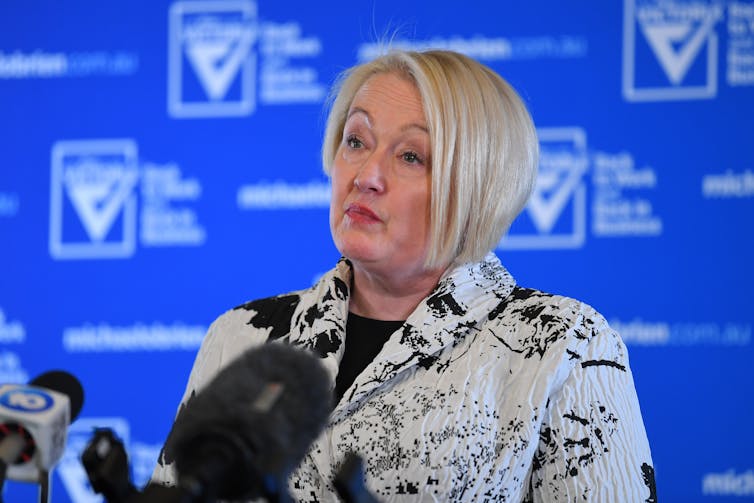
Shadow Treasurer Louise Staley has been leading the opposition’s questions about Andrews’ fall.
James Ross/AAP

Australia’s professional mass media – television, radio, newspapers – have followed this course.

They have reported Staley’s raising of the conspiracy theory and her formulation of a series of questions to the government, while at the same time quoting condemnation of her antics by Merlino and others in the state government.

Even Sky News, notorious for its anti-Labor politics, has been circumspect. It has contented itself with references to a “torrent” of “amazing rumours” before retreating to safer and more familiar ground by describing Andrews as a Soviet-style paramount leader.

It reflects well on the Australian media – perhaps reinforced in their caution by the oppressiveness of Australia’s defamation laws – that they have handled this nasty outbreak of fakery with decency, accuracy and fairness.

The result is that, in this case, the manufacturing process has been cut off at the point of distribution.

For the record, Andrews slipped on wet stairs at a holiday house in Sorrento on the Mornington Peninsula on March 9, sustaining several broken ribs and a fractured vertebra. He is expected to return to work some time this month.

The Conversation

Denis Muller does not work for, consult, own shares in or receive funding from any company or organisation that would benefit from this article, and has disclosed no relevant affiliations beyond their academic appointment.

ref. Liberals’ Dan Andrews questions are a perfect case study in how to manufacture fake news – https://theconversation.com/liberals-dan-andrews-questions-are-a-perfect-case-study-in-how-to-manufacture-fake-news-162511

PODCAST – Manning and Buchanan on NZ’s National Security Strategy – Also Peru Voters Go Left

Selwyn Manning and Paul G. Buchanan present their podcast A View from Afar.
A View from Afar
A View from Afar
PODCAST - Manning and Buchanan on NZ's National Security Strategy - Also Peru Voters Go Left
Loading
/

A View from Afar: Selwyn Manning and Paul Buchanan present this week’s podcast, A View from Afar, where they analyse New Zealand’s national security strategy.

There has been no defence white paper since the John Key National-led governments and no comprehensive review of New Zealand’s strategic priorities, nor assessment of the region’s threat landscape both internal and external.

Now, with hybrid threats like cyberwarfare and terrorism adopting an “intermestic” (international and domestic) characteristic due to on-line recruitment and radicalisation, the perceived need is to develop a holistic national security strategy that addresses defence, security and intelligence needs of the 2020 decade.

But what does this all mean for New Zealand’s defence forces, intelligence community, and cyber-defence agencies?

ALSO: World Watch – The latest/recent round of elections in places like Peru, Mexico and Israel can be viewed as referendums on neoliberalism and national populism.

For example: You can see how Israel prime minister Benjamin Netanyahu has adopted Donald Trump-like rhetoric to describe his opponents.

A similar style has been used by the right wing in Peru as well as in Brazil.

The Peru election pits a socialist native Indian against Peru’s former dictator Fujimori’s daughter. She is a neoliberal conservative.

Both national populism and various socialist approaches have something in common: both ideologies reject neoliberal economic theory in principle and in fact.

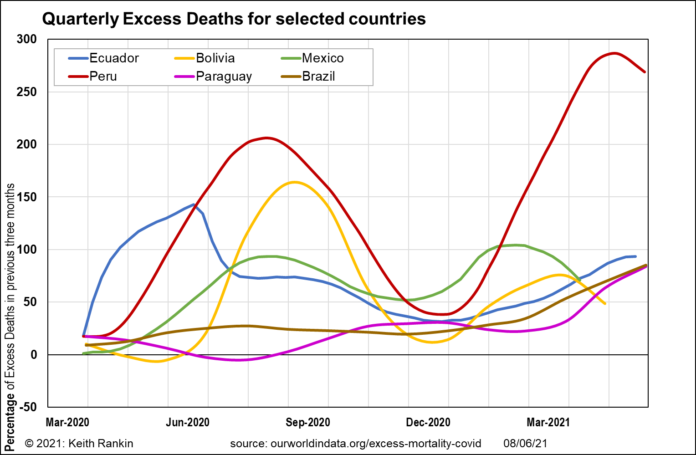
With the left most likely to win the elections in Peru, and considering the challenges that Peru faces (including a pandemic where Covid-19 has raged through its communities positioning Peru as having suffered the highest recorded death rates in the world) the question begs, has neoliberalism run its course?

WE INVITE YOU TO PARTICIPATE WHILE WE ARE LIVE WITH COMMENTS AND QUESTIONS IN THE RECORDING OF THIS PODCAST:

You can comment on this debate by clicking on one of these social media channels and interacting in the social media’s comment area. Here are the links:

If you miss the LIVE Episode, you can see it as video-on-demand, and earlier episodes too, by checking out EveningReport.nz or, subscribe to the Evening Report podcast here.

The MIL Network’s podcast A View from Afar was Nominated as a Top  Defence Security Podcast by Threat.Technology – a London-based cyber security news publication.

Threat.Technology placed A View from Afar at 9th in its 20 Best Defence Security Podcasts of 2021 category. You can follow A View from Afar via our affiliate syndicators.

Listen on Apple Podcasts
 

Melbourne lockdown: why can’t gyms open yet but hospitality venues can?

Source: The Conversation (Au and NZ) – By Brett Mitchell, Professor of Nursing, University of Newcastle

Shutterstock

Melbourne is once again emerging from lockdown but fitness fans may be wondering: how come gyms remain closed for another week, while hospitality venues are allowed to open?

It’s true in most lockdowns around the world, gyms have often been one of the last places to re-open. From an infection control perspective, the rationale is gyms may, in general, present certain risks that restaurants and cafes don’t.

Imagine your gym

Picture yourself at the gym. It might be a reasonably confined space, sometimes with limited fresh air. People are huffing and puffing, ventilation may be poor, everyone is moving around the room to use different pieces of equipment. You might be there quite a while.

After your workout, you might spend a fair bit of time in an equally confined changeroom area showering, changing and getting ready to go back to the outside world.


Read more:
The pressure is on for Australia to accept the coronavirus really can spread in the air we breathe


So in this scenario, spending a decent chunk of time in such a confined space milling around with other people represents an elevated risk for COVID-19, which is spread mostly by aerosols and/or droplets.

People doing exercise tend to create a lot more aerosols, and it’s not just the exhalation. There’s also a lot of inhalation with all that huffing and puffing.

People doing exercise tend to create a lot more aerosols.
Shutterstock

Gyms are also often have classes, although of course they could be stopped. But in general you don’t want lots of people next to each other in a confined space breathing heavily.

And it’s not just about the workout room; gyms have a lot of shared facilities. There are showers, toilets, changing areas, hair dryers, a lot of communal areas that would present another risk in terms of people gathering in small spaces for long periods of time. And some people do spend quite a lot of time in the change room, re-doing hair and make-up or having a shave.

Early on there was a thought the equipment itself might pose a bigger risk but surface transmission is now probably less of a concern that other transmission routes. So with gyms, it’s not so much about sharing the weights, it’s more about the time spent together in a confined area.


Read more:
Heading back to the gym? Here’s how you can protect yourself and others from coronavirus infection


Hospitality venues, in general, present less risk

Many hospitality settings have confined spaces too, but many in Melbourne have been encouraged and taken up the option to seat people outdoors or in better ventilated areas. And some can be quite large.

Of course, a lot of gyms may not be confined at all and may have excellent ventilation and outdoor areas. But in general, a great many do not.

In a hospitality setting, you can ensure people stay seated in one spot and remain distanced. That’s not really possible in a gym; it sort of defeats the purpose. The moving around creates extra risk because it means if there is a positive case there, they could be moving all over the room and to different parts of the building. They could spread virus around the entire gym as opposed to just the next table.

It’s true we have seen cases of transmissions in restaurants in this pandemic. So it certainly can happen that a super spreader transmits SARS-CoV-2 to a lot of people in a restaurant. But overall, the risks in a restaurant with other control measures, is probably less than in a gym because of all the movement that occurs. A gym has been linked to a large cluster in Hong Kong.

You can understand why gym owners feel it is not fair and many say they are happy to do anything they can possibly do to reduce the risk, just so they can run their business. You could see how the risk might be reduced by moving the weights to an outdoor area, if there was space.

A staged opening will always have the lower-risk settings and activities come back first. Gyms will come back, but for now it seems that is just a little longer yet.


Read more:
If you don’t have a COVID vaccination certificate, could you be banned from restaurants, shops and theatres?


The Conversation

Brett Mitchell has received research funding from the NHMRC, HCF Foundation, Medtronics, Australasian College for Infection Prevention and Control, Nurses Memorial Centre, Senver, GAMA Healthcare, Ian Potter Foundation and Commonwealth (Innovation Connections grant). Professor Mitchell is a Fellow of the Australasian College for Infection Prevention and Control and a Fellow of the Australian College of Nursing. He has run infection prevention and control programs for hospitals and at a State level, and is a credential Expert by the Australasian College for Infection Prevention and Control.

Philip Russo receives funding from the National Health and Medical Research Council, and has received research funding from the Rosemary Norman Foundation, Cardinal Health, Australian College of Nursing and the Cabrini Institute. He is the President of the Australasian College for Infection Prevention and Control, a member of the COVID19 Evidence Taskforce Steering Committee, the Australian Strategic and Technical Advisory Group on AMR, the Healthcare Associated Infection Advisory Committee to the Australian Commission on Safety and Quality in Health Care, a member of the Australian College of Nursing, is a credentialed Expert by the Australasian College for Infection Prevention and Control, and was involved in a review of hotel quarantine for the Victorian Department of Health.

ref. Melbourne lockdown: why can’t gyms open yet but hospitality venues can? – https://theconversation.com/melbourne-lockdown-why-cant-gyms-open-yet-but-hospitality-venues-can-162501

How much longer do we need to wait for Australia to implement a sugary drinks tax?

Source: The Conversation (Au and NZ) – By Gary Sacks, Associate Professor, Deakin University

Shutterstock

The Australian Medical Association (AMA) has once again called for a tax on sugary drinks in Australia. This time, the proposed tax is a key part of the AMA’s blueprint to make Australia the healthiest country in the world.

The strong call for a sugary drinks tax echoes the concerted campaign by 2020 Australian of the Year, Dr James Muecke.

And it follows years of advocacy from public health groups and think tanks that have long-argued the many potential benefits of a sugary drinks tax for Australia.


Read more:
Let’s ‘declare war on type 2 diabetes’ – Australian of the year James Muecke on why we need to cut back on sugar


What does the evidence say?

A sugary drinks tax is consistently identified as a critical part of efforts to improve our diets and prevent obesity.

There is strong evidence linking sugary drink consumption to a range of negative health effects including tooth decay, excess weight gain, and increased risk of developing obesity and type 2 diabetes.

International evidence clearly shows sugary drinks taxes are effective in reducing consumption of the taxed products.

Available evaluations have also consistently shown taxes on sugary drinks lead to increases in purchases of untaxed drinks, particularly bottled water. These effects have been shown to persist over many years.

What tax design works best?

The AMA proposes Australia implement a tax of A$0.40 per 100 grams of sugar (per unit of product). Under the proposed tax rate, the amount of tax paid on a 375ml can of Coke with 40g sugar (sugar content is 10.6g/100ml) would be A$0.16.

This tax rate is consistent with global recommendations that price increases of at least 20% are needed to have a meaningful health effect.

Higher prices encourage people to choose healthier options, like bottled water.
Shutterstock

The proposed AMA tax design is also in line with international evidence that shows sugary drink taxes work best when the tax rate is based on sugar content.

These taxes can incentivise people to switch to healthier (lower sugar) substitutes while simultaneously incentivising manufacturers to reformulate their products (lowering the sugar content) to avoid a higher tax rate.

For example, the UK has documented success with a tiered approach, whereby products with sugar content above particular thresholds attract high tax rates. The UK tax has led to decreases in consumption and impressive levels of reformulation.


Read more:
Sugary drinks tax is working – now it’s time to target cakes, biscuits and snacks


The products to be taxed under the AMA proposal include all non-alcoholic drinks containing free sugars, but exclude 100% fruit juice, milk-based and cordial drinks.

Given the international and Australian evidence of the fierce opposition to sugary drinks taxes from the food industry, practical decisions such as this are likely to help reduce resistance to the tax (from fruit growers, for example, and the dairy industry).

Impact of a sugary drinks tax in Australia

The AMA estimates the proposed tax would lead to reduced sugar consumption, improved diets and a 2% reduction in obesity.

Over a 25-year period, modelling has shown this would result in 16,000 fewer cases of type 2 diabetes, 4,400 fewer cases of heart disease, 1,100 fewer cases of stroke, and 1,600 fewer deaths.


Read more:
Australian sugary drinks tax could prevent thousands of heart attacks and strokes and save 1,600 lives


These health benefits would translate to health-care expenditure savings of between A$609 million and A$1.73 billion.

The AMA estimates the tax would raise government revenue of around A$800 million each year. This revenue could be earmarked for preventive health initiatives.

International groundswell of support for sugary drinks taxes

There is global momentum behind sugary drinks taxes.

Sugary drinks taxes are now in place in more than 45 countries around the world. The majority of these taxes have been implemented in the last five years.

Orange sodas from Mexio in esky.
Sugary drinks taxes now operate in 45 countries, including Mexico.
Shutterstock

While Australia led the world in preventive health for many decades through strong action on tobacco control, it is now lagging far behind in efforts to address unhealthy diets.

Arguments against sugary drinks taxes

The food industry routinely parades a range of arguments against sugary drinks taxes. But their arguments have been thoroughly debunked.


Read more:
Don’t believe the myths – taxing sugary drinks makes us drink less of it


For example, the food industry has argued a sugary drinks tax would leave disadvantaged people poorer.

But rigorous studies indicate lower socioeconomic groups would likely experience a disproportionate health benefit as a result of the tax.

Industry has also claimed there would be job losses for sugar producers.

The AMA report makes it clear a sugary drinks tax in Australia would have minimal impact on Australia’s sugar industry. This is because about 80% of Australia’s domestic sugar production is exported.

Time to put health above corporate profits

The failure of the Australian government to implement a sugary drinks tax is a clear case of putting corporate interests ahead of population health.

Given the powerful evidence indicating the likely benefits and strong public support for a sugary drinks tax, its implementation in Australia feels inevitable.

All that’s needed is political leadership that recognises the value of prioritising health above the profits of a select few multinational soft drinks manufacturers.


Read more:
Sweet power: the politics of sugar, sugary drinks and poor nutrition in Australia


The Conversation

Gary Sacks receives funding from the National Heart Foundation of Australia, National Health and Medical Research Council, Australian Research Council and VicHealth

ref. How much longer do we need to wait for Australia to implement a sugary drinks tax? – https://theconversation.com/how-much-longer-do-we-need-to-wait-for-australia-to-implement-a-sugary-drinks-tax-162434

Wenda accuses Jakarta’s military of ‘massacre’ after killing of 3 Papuans

The United Liberation Movement of West Papua has accused Indonesian “colonial forces” of a new massacre with the killing of three civilians, “adding to the hundreds of thousands of West Papuans killed during six decades of occupation”.

Interim president Benny Wenda of the ULMWP has also claimed that Jakarta has put the entire population of 4.4 million “at risk of being swiped out” by Indonesian security forces by being labelled “terrorist”.

In a statement, Wenda said a husband and wife, Patianus Kogoya, 45, and Paitena Murib, 43, had been killed at Nipuralome village, along with another Papuan man, Erialek Kogoya, 55.

“They were shot dead by joint security services on June 4 in Ilaga, Puncak regency. Three others, including a five year old child, were wounded during the massacre,” he said.

“Local churches have confirmed the incident, even as the colonial Indonesian police have spread hoaxes to hide their murders.”

Wenda said cold blooded murder was becoming the culture for the security forces.

“West Papua is the site of massacre on top of massacre, from Paniai to Nduga to Intan Jaya to Puncak. This is heart-breaking news following the killing of our religious leaders like Pastor Zanambani,” he said.

‘Count more of our dead’
“We now have to count more of our dead. How much longer will this continue?”

Wenda said Indonesia had labelled the OPM (Free Papua Moivement) “terrorist”.

“The OPM is all West Papuans who have hopes for freedom and self-determination, all organisations that fight for justice and liberation in West Papua,” he said.

“I am OPM, the ULMWP is OPM. If you label the OPM ‘terrorist’, you are labelling the entire population of West Papua ‘terrorist’.

“The Indonesian state is targeting all West Papuans for elimination – the evidence is there in Ilaga last week, with unarmed civilians being gunned down.

“How do they justify this killing? With the ‘terrorist’ label.”

Wenda claimed these “stigmatising labels” were part of Jakarta’s systematic plan to justify its presence in West Papua and the “deployment of 21,000 troops to our land”.

He said that the ULMWP continued its urgent call for Indonesia to allow the UN High Commissioner for Human Rights into West Papua.

“Intervention is needed now. What is happening in Palestine is happening in West Papua,” he said.

Wenda appealed to solidarity groups in the Pacific and internationally to speak up for “freedom and justice”.

Article by AsiaPacificReport.nz

Fiji frontline healthcare workers can’t stay home, says Dr Sahukhan

By Koroi Tadulala, FBC News multimedia journalist

Fiji’s Ministry of Health says it is aware of concerns about the high number of frontline healthcare workers testing positive.

However, Health Protection Head Dr Aalisha Sahukhan said these people played a critical role in the war against the virus.

The frontline healthcare workers cannot stay home because of the role they play, she said.

“If our frontline workers stayed home, there would be no response to this outbreak. And there would be nobody left to care for sick patients whether they have covid or not. They protect themselves as best as they can.”

Dr Sahukhan said some of the staff from the Incident Management Team (IMT) had been impacted on by the virus recently.

“This concern is understandable and I know what you’re thinking. How are they getting infected?

“Aren’t they following the advice that they are giving us? First of all, covid-19 is a highly transmissible and contagious virus. It spreads very easily in crowded spaces.”

Dr Aalisha Sahukhan said the frontline healthcare workers were swabbed twice a week because of the nature of the work they did.

She said most of them have not seen their families for weeks as they pushed on with their groundwork in testing and swabbing Fijians.

Health authorities reported 35 new cases of covid-19 yesterday for a total of 880 and four deaths since the virus first impacted on Fiji.

Republished with permission.

Print Friendly, PDF & Email

Article by AsiaPacificReport.nz

Climate Commission report gives NZ dairy industry ‘free pass to pollute’, say critics

By Katie Todd, RNZ News Reporter

Critics have hammered the Climate Change Commission’s agriculture goals in New Zealand, saying it has missed the mark on methane targets.

In a final 419-page report handed to Parliament yesterday, the commission urged the government to get tough on the way New Zealanders live, move and work, through implementing 33 recommendations.

To help keep global warming below 1.5C it said there should be no more new or used petrol or diesel cars imported, made or assembled in New Zealand by 2035.

The commission asked for substantially more government investment in cheap, accessible public transport, cycle paths and walkways, and no more coal boilers “as soon as possible”, with at least 95 percent renewable electricity used by 2030.

Greenpeace head of campaigns Amanda Larsson said it was all a bit disappointing because the report missed a major weak spot.

“Despite thousands of submissions in favour of climate action, despite huge public mandate out there for climate action, the commission has failed to really take responsibility for the industry that is causing the most climate pollution in New Zealand – and that is the dairy industry,” she said.

“There’s been no real change in its recommendations and the dairy industry still gets basically a free pass to pollute.”

Mechanism to reward farmers
The commission wants the government to decide next year on a pricing mechanism for rewarding farmers who reduce emissions.

It suggests technologies including methane inhibitors – vaccines which can reduce the amount of carbon dioxide burped by cows into the atmosphere – could reduce the country’s biogenic methane emissions by more than 50 percent.

It also sets an overall biogenic methane reduction target of 10 percent by 2030 – which Dairy NZ called “incredibly challenging” and a “big ask” for farmers, saying New Zealand milk already had the lowest carbon footprint in the world.

“We do remain concerned agriculture may be asked to do the heavy lifting if we don’t see urgent action to reduce CO2 emissions. We are all in this together and we must have a fair and balanced plan that requires our communities to contribute equally,” its chief executive Dr Tim Mackle said.

Dairy NZ chief executive Tim Mackle
Dairy NZ chief executive Dr Tim Mackle … “We are all in this together and we must have a fair and balanced plan.” Image: RNZ/Victoria University of Wellington

However, Larsson said there could have been strict limits on stock numbers, among other measures.

“We need to cut synthetic fertiliser and we need to cut imported feed and we need to support farmers to transition to regenerative and organic ways of farming.”

Hard-line approach in other sectors
Oxfam New Zealand campaign lead Alex Johnston said the commission was already taking more of a hard-line approach for other sectors.

“The pathways for reducing emissions in agriculture are simply not consistent with keeping to 1.5 degrees,” he said.

“Even if we go as hard as we can on transport and other sectors, if we don’t directly regulate emissions from agriculture and step up our actions in that area, then we’re not going to be able to do our fair share to contribute to this global problem.”

Forest & Bird spokesperson Geoff Keey agreed that agriculture was still getting “a bit of an easy ride” and the measures should be stricter, but he believed there was another blind spot in the report.

He wanted kelp and shellfish beds re-established on coastlines, and measures to stop wetlands drying out, to ensure more carbon did not go into the atmosphere.

“One of the big things that comes out of the report is once we start looking beyond 2030 and 2040, we’re going to need to protect our carbon stores in forests, in the sea and in wetlands. Right now the rules are not strong enough to allow that to happen,” he said.

Someone who felt more optimistic about the report was Niwa chief scientist Dr Sam Dean, who called it “a breath of fresh air”.

Traction on policies
He said there was finally traction on a more “comprehensive” range of climate policies.

“Up ’till now we’ve based our response on the emissions trading scheme, which is incentivised plantation and forestry. Moving away from that to a broader range of policies that are going to actually reduce emissions, especially carbon dioxide, is especially important. It’s something we’ve not managed to do, to date. And it’s something we’re going to have to do really quickly,” he said.

Dean said the difficult part was not writing the report – it was up to the government to rise to the challenge.

He said his plea for the government was to embrace all the recommendations with urgency and he challenged all New Zealanders to show their support and willingness to make changes.

This article is republished under a community partnership agreement with RNZ.

Print Friendly, PDF & Email

Article by AsiaPacificReport.nz

Nauru president defends Samoa contract decision for USP chief

Asia Pacific Report newsdesk

Nauru President Lionel Aingimea has rejected a Fiji minister’s claim that the decision of the University of the South Pacific to reappoint its vice-chancellor and base him in Apia, Samoa, instead of Suva is illegal.

“I don’t see how it can be illegal,” said President Aingimea, who is also the university’s chancellor, in defending the decision to relocate Professor Pal Ahluwalia to Samoa after he was deported by the Fiji government in February in widely condemned circumstances.

“I am also a lawyer and I’ve also read the USP charter and statutes and the [USP] Council has the authority in making appointments.

Professor Pal Ahluwalia
USP vice-chancellor Professor Pal Ahluwalia with students and staff … council has agreed on a new contract with location now in Apia, Samoa. Image: Linked-In

“There’s nothing in the statutes or the charter to suggest we have broken any rule by reappointing the vice-chancellor or issu[ing] him with a new contract.

“There is nothing illegal about it; council offered him a new contract and it can, as the employer.”

As chancellor of the 12-nation regional university, Aingimea said in statement issued by the Nauru government that the council had acted within the guidelines of the USP charter and statutes in response to a claim by Fiji’s Attorney-General Aiyaz Sayed-Khaiyum last week that USP had acted illegally.

On Tuesday, the university’s two staff unions and the students’ association also issued a joint declaration that USP had acted legally.

Offer of new contract
A sub-committee chaired by President Aingimea presented six recommendations to the USP Council which convened a special meeting on May 25 and June 2 and agreed to offer a new contract to Professor Ahluwalia as vice-chancellor and president (VCP) of the USP.

Students and staff were pleased with the recommendations and the outcome of the council deliberations in re-appointing the VC, said Aingimea.

“The council stands for what’s right and that’s what the students and staff want.”

President Aingimea agreed that it was Fiji’s decision when it came to terminating work visas. However, he added that the issue of contract termination lay with the council as the vice-chancellor’s employer.

“We [USP Council] looked at the USP statutes and charter and we have not broken any rule in offering a new contract to the VC.”

Since the sub-committee was established, President Aingimea said he had received a lot of correspondence from staff, students and the Fiji media inquiring about the status of the VC.

As chairman of the sub-committee, President Aingimea respected the process and considered it inappropriate to respond to those enquiries — until now, saying that any communication and developments arising from the sub-committee must first be reported to council.

Contract renewal precedence
He said there was precedence when former VC Professor Rajesh Chandra’s contract was renewed by the council without advertising the position.

President Aingimea also defended Samoa as an established USP hub — as Emalus campus in Vanuatu was. Relocating the VC to Samoa would not be a disadvantage in terms of the VC carrying out his work.

As a former lecturer at USP, said President Aingimea, the reports and issues facing the university were not new. He described them as “longstanding issues”.

“So maybe it’s about time the region spoke out,” Aingimea said.

“This is a regional university. It doesn’t belong to any one country.”

Fiji has the highest number of students attending USP and is thus the highest contributor to university grants with an annual contribution of $34.4 million.

It also benefits the most through income tax, rent, travel, transport, medical, and the purchase of goods and services by the staff and students that attend and are employed by the university.

Fiji not paid up
In reality, however, said the Nauru government statement, the Fiji government had not paid the full amount in recent years.

In 2019, it was short $7.8 million and $17.75 million in 2020. This year, a contribution has not been made by Fiji, which gets back nine times its contribution.

President Aingimea said all member countries of the USP had the right to an equal voice in the decisions and operations of the USP.

“USP belongs to all of us, not just one country.”

Print Friendly, PDF & Email

Article by AsiaPacificReport.nz

Vanuatu judge stays Speaker’s vacation of PM plus 18 parliamentary seats

RNZ Pacific

Vanuatu Supreme Court judge Justice Oliver Saksak has granted a stay on the vacation of 19 seats in the country’s Parliament.

On Tuesday, the Speaker of Parliament, Gracia Shadrack, declared the seats of Prime Minister Bob Loughman and 18 of his MPs vacant because they had been absent from Parliament on three consecutive occasions in breach of standing rules.

The MPs were absent on the third occasion to avoid a vote of no confidence motion, but they had also been striving through the past week to remove Shadrack, after he appeared to side with the opposition.

Shadrack encouraged the MPs to seek a court ruling on his actions and now Justice Saksak has issued a stay on the actions of the Speaker, with a court hearing to be heard from 10am tomorrow.

Meanwhile, the Speaker has adjourned Parliament until Friday when debate on his actions, and the motions that are in play, can begin.

RNZ Pacific’s correspondent in Vanuatu said the shutout of the government MPs was all people were talking about in the kava bars.

He said everyone in Vanuatu knew that under normal practice, it was the opposition that would boycott parliamentary sessions.

This article is republished under a community partnership agreement with RNZ.

Print Friendly, PDF & Email

Article by AsiaPacificReport.nz

If you don’t have a COVID vaccination certificate, could you be banned from restaurants, shops and theatres?

Source: The Conversation (Au and NZ) – By Maria O’Sullivan, Senior Lecturer, Faculty of Law, and Deputy Director, Castan Centre for Human Rights Law, Monash University

Vaccine passports are an increasingly likely proposition in Australia. Last week, national cabinet “welcomed” a new COVID-19 digital vaccination certificate, which will be made available through the Medicare app or myGov.

This week, government services minister Linda Reynolds confirmed Australians who have had two doses would be able to access a certificate. Australians are already able to see their immunisation history online. But the new certificate will only show COVID vaccination status, so it could easily be turned into a “passport”.

Countries all over the world are currently developing digital vaccination passports to facilitate international travel.

In Australia, we are also discussing whether they can be used to open up interstate movement (which will depend on the agreement of state and territory authorities).

However, there is also a legal question as to whether these vaccination certificates can be used for other purposes.

Could businesses ask to see the passport to prevent unvaccinated people from entering restaurants, shops, theatres and other venues? If so, what issues would this raise?

What are vaccine passports?

Vaccine passports are certificates that show the holder has been immunised against COVID-19. Currently they are being developed primarily for travel. For instance, the European Union is set to make available its COVID vaccination passport for all EU citizens and residents by July 1.

EU residents will get vaccination passports next month.
Vojtech Vlk/AP

The certificate is designed to allow freedom of movement within the EU by allowing holders to avoid internal travel restrictions, such as entry bans and quarantine obligations.

Every certificate will contain a unique QR code which will allow verification of its authenticity, the digital signature and the vaccination details (the name of the vaccine and manufacturer, number of doses administered and the date(s) of vaccination).

A passport to dine out?

In addition to travel, other countries have taken a further step and started using vaccination certificates for internal purposes, such as entry into restaurants and events.

For instance, Israel started a “green pass” system earlier this year, which allowed vaccinated people access to theatres, concert halls, indoor restaurants and bars.

People would show the “green pass” on an app to gain entry to places. The app could also display proof someone had recovered from COVID-19.

With most adults in Israel now vaccinated, the government retired the pass last week.

But before this, the pass raised privacy concerns. For instance, Orr Dunkelman, a Privacy Israel board member, argued the certificate revealed information that was not necessary for others to know, such as the date a person recovered from COVID or received the vaccine.

Legal considerations for Australia

The first legal point to note is that vaccinations (and certifications of vaccine status) are seen as facilitating the right to health. Widespread vaccination and the use of vaccination passports are viewed as necessary to protect the community from COVID.

Related to this is the argument that vaccination passports will permit greater freedom of movement — which is a recognised human right.


Read more:
A COVID ‘vaccine passport’ may further disadvantage refugees and asylum seekers


However, there are two main legal concerns with using a COVID certificate to regulate entry into events, restaurants and other businesses.

First, both governments and corporations need to abide by anti-discrimination laws. There will be a relatively small group of people who are unable to have the vaccination for medical reasons. A business that excludes such a person could risk breaching these laws.

The government must therefore consider how to reflect valid exemptions in the COVID certificate. One way to deal with some of the discrimination concerns would be to give unvaccinated individuals with a medical exemption an “unvaccinated with exemption”-type certificate.

What if you don’t want to get vaccinated?

The more difficult question is whether this would be lawful for those who simply do not want to get the vaccination. As I have argued previously,
there is no recognised right to conscientious objection to vaccinations under Australian law. Therefore, it may be lawful for businesses to refuse entry to such persons who do not have a COVID certificate.

More generally, however, it would not be lawful for businesses selling essential goods (such as Coles and Woolworths) to refuse entry to unvaccinated persons (whether or not they have a valid exemption). This is due to the fact this would deny persons access to basic food items.

Privacy and equity issues

The use of a digital certificate or app also raises privacy issues. This system will create a significant new store of data of potentially sensitive personal information. This is of particular concern if it is linked to other information on the myGov plaftorm or contains additional data to that of vaccination status.

Finally, government and businesses need to be aware of the equity issues surrounding both the vaccine rollout and any associated certification scheme. In my opinion, enforcement of vaccination passports could not occur before everyone in Australia has been given the opportunity to have the COVID vaccination.

The Conversation

Maria O’Sullivan does not work for, consult, own shares in or receive funding from any company or organization that would benefit from this article, and has disclosed no relevant affiliations beyond their academic appointment.

ref. If you don’t have a COVID vaccination certificate, could you be banned from restaurants, shops and theatres? – https://theconversation.com/if-you-dont-have-a-covid-vaccination-certificate-could-you-be-banned-from-restaurants-shops-and-theatres-162248

A quantum hack for microscopes can reveal the undiscovered details of life

Source: The Conversation (Au and NZ) – By Warwick Bowen, Professor of Quantum and Precision Technologies, The University of Queensland

Warwick Bowen, Author provided

You’ve probably seen images of scientists peering down a microscope, looking at objects invisible to the naked eye. Indeed, microscopes are indispensable to our understanding of life.

They are just as indispensable to biotechnology and medicine, for instance in our response to diseases such as COVID-19. However, the best light microscopes have hit a fundamental barrier – the bright laser light used to illuminate tiny objects can also destroy them.

In research published in Nature today, our team of Australian and German researchers has shown that quantum technologies offer a solution. We built a quantum microscope that can more gently probe biological samples, which allowed us to observe biological structures that would otherwise be impossible to see.

Creating a damage-evading microscope like ours is a long-awaited milestone on international quantum technology roadmaps. It represents a first step into an exciting new era for microscopy, and for sensing technologies more broadly.

The problem with laser microscopes

Microscopes have a long history. They are thought to have been first invented by the Dutch lens-maker Zacharias Janssen around the turn of the seventeenth century. He may have used them to counterfeit coins. This chequered beginning led to the discovery of bacteria, cells and basically all microbiology as we now understand it.

The more recent invention of lasers provided an intense new kind of light. This made a whole new approach to microscopy possible. Laser microscopes allow us to see biology with truly exquisite detail, 10,000 times smaller than the thickness of a human hair. They were awarded the 2014 Nobel Prize in Chemistry, and have transformed our understanding of cells and of molecules like DNA within them.

However, laser microscopes face a major problem. The very quality that makes them successful – their intensity – is also their Achilles’ heel. The best laser microscopes use light billions of times brighter than sunlight on Earth. As you might imagine, this could cause serious sunburn!

In a laser microscope, biological samples can become sick or perish in seconds. You can see this happening in real time in the movie of a fibroblast cell below, taken by our team member Michael Taylor.

A cell getting uncomfortable and then dying under a laser microscope.

Spooky action at a distance provide the solution

Our microscope evades this problem. It uses a property called quantum entanglement, which Albert Einstein described as “spooky action at a distance”.

Our microscope uses pairs of ‘quantum correlated’ photons to achieve clarity that would be impossible with regular light sources.
Aleksandr Kakinen

Entanglement is an unusual sort of correlation between particles, in our case between the photons that make up a laser beam. We use it to train the photons that leave the microscope to behave themselves, arriving at a detector in a very orderly fashion. This reduces noise.

Other microscopes need to increase the laser intensity to improve the clarity of images. By reducing noise, ours is able to improve the clarity without doing this. Alternatively, we can use a less intense laser to produce the same microscope performance.


Read more:
Experiment shows Einstein’s quantum ‘spooky action’ approaches the human scale


A key challenge was to produce quantum entanglement that was bright enough for a laser microscope. We did this by concentrating the photons into laser pulses that were only a few billionths of a second long. This produced entanglement that was 1,000 billion times brighter than has previously been used in imaging.

When used in a microscope, our entangled laser light provided 35% better image clarity than was otherwise possible without destroying the sample. We used the microscope to image the vibrations of molecules within a living cell. This allowed us to see detailed structure that would have been invisible using traditional approaches.

The improvement can be seen in the images below. These images, taken with our microscope, show molecular vibrations within a portion of a yeast cell. The left image uses quantum entanglement, while the right image uses conventional laser light. As I hope you agree, the quantum image is clearer, with regions where fats are stored within the cell (the dark blobs) and the cell wall (the semi-circular structure) both more visible.

Example of quantum enhancement possible with our microscope.
Warwick Bowen

Towards applications of quantum sensing technologies

Quantum technologies are expected to have revolutionary applications in computing, communications and sensing. Australia’s Commonwealth Scientific and Industrial Research Organisation (CSIRO) estimates they will create an A$86 billion dollar global industry by 2040.

Quantum entanglement underpins many of these applications. A key challenge for quantum technology researchers is to show that it offers absolute advantages over current methods.

Entanglement is already used by financial institutions and government agencies to communicate with guaranteed security. It is also at the heart of quantum computers, which Google showed in 2019 can perform calculations that would be impossible with current conventional computers.

Quantum sensors are the last piece of this puzzle. They are predicted to improve pretty much every aspect of how we see the world, from better navigation to better health care and medical diagnostics.

About a year ago quantum entanglement was installed in kilometre-scale gravitational wave observatories. This allows scientists to detect massive objects further away in space.

Our work shows that entanglement can provide an absolute sensing advantage at more normal size scales and in widespread technologies. This could have big ramifications – not only for microscopy, but also for many other applications such as global positioning, radar and navigation.


Read more:
The ‘second quantum revolution’ is almost here. We need to make sure it benefits the many, not the few


The Conversation

Warwick Bowen would like to acknowledge the continued support of the United States Air Force Office of Scientific Research and the ARC Centre of Excellence for Engineered Quantum Systems, without whom this research would not have been possible. He also receives funding from the Australian Research Council, Australian Defence, and the United States Army Research Office. He is a founder and director of the scientific instrumentation company Elemental Instruments.

ref. A quantum hack for microscopes can reveal the undiscovered details of life – https://theconversation.com/a-quantum-hack-for-microscopes-can-reveal-the-undiscovered-details-of-life-161182

The COVID-19 lab leak theory highlights a glaring lack of global biosecurity regulation

Source: The Conversation (Au and NZ) – By Alexander Gillespie, Professor of Law, University of Waikato

The revived debate over whether COVID-19 could be the result of an accidental release from the Wuhan Institute of Virology may never be adequately resolved. Either way, we risk not seeing the wood for the trees.

While the World Health Organization (WHO) reported in February such a leak was “extremely unlikely”, it later advised more work was needed to rule it out.

But the real problem is not what might have happened in China — it’s that there is no meaningful international legal oversight in the first place.

The United Nations’ Convention on Biological Diversity puts the onus on individual countries to regulate their own biotech industries. While there are protocols for the safe handling and transfer of living modified organisms, there are still no agreed international standards governing laboratory safety, monitoring and information sharing.

This is concerning, given the long history of disease breaches at both civilian and military research establishments.

Laboratory escapes have included smallpox (1966, 1972 and 1978), H1N1 “swine flu” (1977 but probably a 1950s-era sample), Venezuelan Equine Encephalitis (1995) and at least six outbreaks of SARS (with two distinct events at the same Beijing laboratory in 2004).

In 2014, it was thought up to 75 workers might have been exposed to anthrax after an accident at the US Centers for Disease Control and Prevention in Atlanta, raising real concerns about pathogen safety. The same year, five researchers died while working on West African Ebola in Sierra Leone.

Accidents will happen

Rapid advances in biotechnology and the decentralisation of research industries have only increased the potential risks. Without greater control, it’s feared a new or revived disease could be inadvertently released.

Already, researchers have accidentally created a lethal mouse-pox virus, intentionally developed a synthetic strain of the polio virus, resurrected the virus that caused the 1918 influenza, and recreated an infectious horse-pox virus by ordering DNA fragments online.


Read more:
Why politicians should be wary of publicly pursuing the Wuhan lab-leak investigation


The potential risk from hostile state or terrorist acts in this area is clear, which makes the lack of global oversight all the more alarming.

This is true for even the highest risk “biosafety level 4” laboratories, such as the one in Wuhan. Analysis suggests these facilities can be operated safely, but individual countries and regions such as Europe are setting their own standards. There is also a preparedness gap between wealthy and poor countries.

The risk of bioterrorism

Beyond the WHO’s guidelines, however, there is no universal law, regulation or international oversight mandating even basic requirements, such as external independent inspections. We don’t even know how many level 4 laboratories exist. Officially there are 54, but some probably remain undisclosed for national security reasons.

The exclusion of military establishments from independent oversight compounds the problem. An international convention prohibits the creation, stockpiling and use of bioweapons, but there are only soft commitments to compliance and monitoring. Attempts to create a binding verification protocol have so far failed.


Read more:
Biden’s new Wuhan lab leak investigation ramps up US-China blame game


The UN Security Council, which monitors this regime, has noted a disturbing trend of countries not participating in its voluntary mechanisms and a lack of effective controls.

In any case, many countries lack the capacity to adequately detect disease outbreaks. Those that do have the capacity are often unco-ordinated and ineffective.

The general failure of effective oversight makes the risk of bioterrorism higher than it should be.

Global agreement urgently needed

Whether or not the conclusive truth about Wuhan ever emerges, if the international community is serious about minimising the risk of biotech accidents it could look to the Convention on Nuclear Safety as a model.

This would mean a system for enforcing global standards, independent inspections and support for best scientific practice.


Read more:
Covid-19: why the lab leak theory must be formally investigated


It would need to cover any location or establishment where there is a significant risk from human activity that could intentionally, accidentally or recklessly cause an outbreak.

All countries would have to become more transparent to accept such a rules-based international order. And while it’s possible, even probable, that China needs to improve its own systems, it is certainly far from alone in that.

The Conversation

Alexander Gillespie does not work for, consult, own shares in or receive funding from any company or organisation that would benefit from this article, and has disclosed no relevant affiliations beyond their academic appointment.

ref. The COVID-19 lab leak theory highlights a glaring lack of global biosecurity regulation – https://theconversation.com/the-covid-19-lab-leak-theory-highlights-a-glaring-lack-of-global-biosecurity-regulation-162419

A history of blood clots is not usually any reason to avoid the AstraZeneca vaccine

Source: The Conversation (Au and NZ) – By Sant-Rayn Pasricha, Division Head, Population Health and Immunity, Walter and Eliza Hall Institute

Shutterstock

As haematologists, we look after many patients who have had blood clots in the past or take blood thinners. They often ask: “should I have the AstraZeneca vaccine?”

The answer is usually a definitive “yes”. The blood clots we’ve seen following the AstraZeneca vaccine are completely different to other types of blood clots, such as deep vein thrombosis or a pulmonary embolism, or the clots that cause heart attacks and strokes.

People with a history of these sorts of conditions don’t appear to be at any increased risk from the AstraZeneca vaccine.

In fact, people in this group could be at greater risk from COVID-19, so shouldn’t delay getting vaccinated.

First, how does blood form clots?

Blood flows through our body’s vessels as a liquid, carrying oxygen, nutrients, proteins and immune cells to every organ. But if we get injured or undergo surgery, our body needs to plug the wound to stem bleeding.

Our blood contains components that allow it to quickly transform from a fluid into a semi-solid clot in a few seconds.

At the first sign of damage, the smallest of the blood cells — the platelets — stick to the damaged vessel wall, and together with the damaged wall itself, attract a legion of clotting proteins, which amass on the damaged site and bind the wound.


Read more:
How rare are blood clots after the AstraZeneca vaccine? What should you look out for? And how are they treated?


Venous clots

Sometimes theses natural clotting and anti-clotting processes in the blood become unbalanced, putting a person at risk of developing blood clots in their veins. This can occur in people:

  • with cancer or an infection

  • who are pregnant

  • who are taking an oestrogen-containing contraceptive pill

  • who are immobilised during and after surgery or following major trauma

  • who have certain inherited conditions.

In all of these cases, an abnormal blood clot can develop in the deep veins of the thigh and groin (deep vein thrombosis), or the lung (pulmonary embolism).

Very rarely, blood clots occur in other places — for example, the veins of the abdomen or the brain.

An illustration of a blood clot.
Our blood needs to clot to a degree.
Shutterstock

Arterial clots

Arteries supplying blood to the heart, brain and lower limbs can become narrowed, usually due to risk factors including smoking, diabetes, and high blood pressure and cholesterol.

A clot forming in these sites can obstruct blood flow, causing, for example, a heart attack or stroke.

What is TTS?

The AstraZeneca vaccine is associated with a rare condition called thrombosis with thrombocytopenia syndrome, or TTS. Cases of the condition have also been reported following the Johnson & Johnson COVID vaccine, though this one isn’t available in Australia.

We now know a lot more about this condition than we did a few months ago.

TTS is caused by an abnormal immune response, resulting in the development of an antibody directed at the platelets (blood cells which prevent bleeding). This causes the platelets to become hyperactive, which triggers blood clots in the body, including in places we don’t normally see clots, like in the brain or the abdomen.

This process also consumes platelets, which results in a low platelet count. In the name “thrombosis” refers to clots, and “thrombocytopenia” to low platelet count.


Read more:
What is thrombocytopenia, the rare blood condition possibly linked to the AstraZeneca vaccine?


The Australian Technical Advisory Group on Immunisation (ATAGI) recently estimated the risk of TTS in Australia at around 1.6 in 100,000 doses of the AstraZeneca vaccine administered in people 50 and older, although this data may change as more people are vaccinated.

Fortunately, diagnosis and treatment for TTS has progressed rapidly. Doctors now know the symptoms to look out for, and haematologists have identified treatments for the condition. These include intravenous immunoglobulin (a concentrate of antibodies from healthy donors) and blood thinners.

Outcomes for people with TTS have improved significantly worldwide since the condition was first recognised earlier in the year. In Australia, most patients with TTS have recovered or are recovering.

Don’t delay getting the vaccine

There’s no evidence people who have previously experienced blood clots, have an inherited risk of blood clots, or who take blood thinners or related medications, have any increased risk of TTS.

As an immune-driven disease that causes platelet over-activity, the mechanism for TTS is completely different from other types of blood clots.

In this light, ATAGI recently advised the AstraZeneca vaccine is safe for these people.

As a precaution, Australian guidelines recommend certain people should avoid the AstraZeneca vaccine and have the Pfizer jab instead. These include people:


Read more:
People with coronavirus are at risk of blood clots and strokes. Here’s what we know so far


It’s crucial to remember that people with risk factors for heart attacks and strokes, including diabetes and high blood pressure, are at increased risk of developing severe COVID-19 if they are infected. Further, COVID itself makes the blood more “sticky” and significantly increases the risk of blood clots.

So we advise our patients: even if you’ve had deep vein thrombosis, a pulmonary embolism, a heart attack or a stroke previously, you’re not at increased risk of TTS from vaccination. You should get vaccinated as soon as you’re eligible.

The Conversation

Sant-Rayn Pasricha receives funding from the National Health and Medical Research Council Australia, and the Bill and Melinda Gates Foundation.

Paul Monagle receives funding from NHMRC, NBA. He is in discussion with AstraZeneca to try and identify the cause of TTS, but has received no funding/consulting fees or honorarium from any company.

ref. A history of blood clots is not usually any reason to avoid the AstraZeneca vaccine – https://theconversation.com/a-history-of-blood-clots-is-not-usually-any-reason-to-avoid-the-astrazeneca-vaccine-161889

Check your mirrors: 3 things rooftop solar can teach us about Australia’s electric car rollout

Source: The Conversation (Au and NZ) – By Bjorn Sturmberg, Research Leader, Battery Storage & Grid Integration Program, Australian National University

Shutterstock

Governments and car manufacturers are investing hundreds of billions of dollars on electric vehicles. But while the electric transport revolution is inevitable, the final destination remains unknown.

The electric vehicle transition is about more than just doing away with vehicles powered by fossil fuels. We must also ensure quality technology and infrastructure, anticipate the future and avoid unwanted outcomes, such as entrenching disadvantage.

In Australia, the electric vehicle rollout has been slow, and federal action limited. But some state governments are working to electrify bus fleets, roll out public charging networks and trial smart vehicle charging in homes.

Australia’s world-leading rollout of rooftop solar power systems offers a guide to help navigate the transition. We’ve identified three key lessons on what’s gone well, and in hindsight, what could have been done differently.

solar panels on roofs
Australia’s rooftop solar boom offers insights into the electric vehicle revolution.
Shutterstock

1. Price isn’t everything

Solar systems and electric vehicles are both substantial financial investments. But research into rooftop solar has shown financial considerations are just one factor that guides purchasing decisions. Novelty, concerns about climate change and a desire for self-sufficiency are also significant – and electric vehicle research is producing similar findings.

When considering the electric vehicle rollout, understanding these deeper motivators may help avoid a race to the bottom on price.

About one in four Australian homes has rooftop solar, with almost three million systems installed. Solar companies have often sought to highlight the low price of rooftop systems over other considerations. This has created consumer demand for low-priced, lower-quality products – and led to potentially hundreds of thousands of substandard installations across Australia.


Read more:
On the road again: here’s how the states can accelerate Australia’s sputtering electric vehicle transition


So what are the lessons here for the electric vehicle rollout? First, when planning public infrastructure where electric vehicles can be charged, construction costs should not be the only consideration. Factors such as night-time safety and disability access should be prioritised. Shortcuts today will reinforce barriers for women and people with disabilities and create complex problems down the track.

Like rooftop solar, the point of sale of electric vehicles offers a unique opportunity to teach customers about the technology. Companies, however, can only afford to invest in customer education if they aren’t too stressed about margins.

“Smart” charging is one measure being explored to ensure the electricity network can handle future growth in electric vehicle uptake. Smart chargers can be remotely monitored and controlled to minimise their impact on the grid.

The point of sale is a pivotal moment to tell new owners of electric vehicles that their charging may at times be managed in this way.

EVs on charge
Electric vehicle charging infrastructure should be safe and accessible.
Shutterstock

2. Plan ahead

The uptake of rooftop solar in Australia has been a raging success. In fact, rooftop solar is now the largest generator in the national power system.

This raises issues, such as how rooftop solar systems will respond to a major disturbance, such as the failure of a transmission line. A large amount of solar power feeding into the grid can also challenge electricity network infrastructure.

In response, electricity networks have implemented changes such as limiting solar exports and therefore, returns to solar system owners, and charging fees for exporting solar.

Such retrospective changes have been unpopular with solar owners. So to maintain reliable electricity supplies, and avoid angering consumers, it’s vital to plan where and when electric vehicles are charged.

If every vehicle in Australia was electric, this would add about a quarter to national power demand. The rise in demand would be greatest near bus and logistics depots and ultra-fast highway chargers.


Read more:
Owners of electric vehicles to be paid to plug into the grid to help avoid blackouts


Timing is key to maximising the use of a network connection without overloading it. For example, if everyone charged their vehicle in the evening after they get home from work, as this would put further pressure on electricity supplies at this peak time.

Governments and electricity providers should encourage electric vehicle charging during the day, when demand is lower. This might mean, for example, providing vehicle charging facilities at workplaces and in public areas.

Until Australia’s power grid transitions to 100% renewables, the use of solar energy should be strongly encouraged. This would ensure the vehicles were charged from a clean, cheap energy source and would help manage the challenges of abundant solar.

The question of road user charges for electric vehicles drivers is another example where it’s best to avoid retrospective changes. Such charges are necessary in the long run and best introduced from the outset.

woman's arm holds EV charger on car
Vehicle charging during the day, when power demand is lowest, should be encouraged.
Shutterstock

3. Coordination is key

Electric vehicle policy spans many government portfolios: transport, infrastructure, energy, planning, environment and climate change. Nationally, and from state to state, different ministers are in charge.

This makes coordination difficult, and creates the risk of policies undermining each other. For example, one policy might encourage the charging of electric vehicles from rooftop solar, to reduce carbon emissions. But because solar energy is so cheap, this might encourage more private vehicle use, which worsens road congestion.

So policies to encourage electric vehicle uptake should not come at the cost of creating more attractive and efficient public transport networks.

And new technologies can entrench societal disadvantage. For example, the rooftop solar rollout often excluded people who could not afford to buy the systems. Without policies to address this, the electric vehicle transition could lead to similar outcomes.

traffic queues in Sydney
Encouraging electric vehicle use could worsen road congestion, if not well managed.
Shutterstock

Lessons in the rear-view mirror

As Australia’s experience with rooftop solar has shown, successful technology transitions must be carefully planned and attentively steered.

In the case of electric vehicles, this will ensure the benefits to owners, society and the environment are fully realised. It will also ensure a smooth-as-possible transition, the gains from which all Australians can share.


Read more:
The US jumps on board the electric vehicle revolution, leaving Australia in the dust


The Conversation

Bjorn Sturmberg has received funding from the Australian Renewable Energy Agency for electric vehicle projects.

Kathryn Lucas-Healey has received funding from the Australian Renewable Energy Agency for electric vehicle projects, and is on unpaid leave from working at Chargefox.

Laura Jones has received funding from the Australian Renewable Energy Agency for electric vehicle projects.

Mejbaul Haque has received funding from the Australian Renewable Energy Agency for electric vehicle projects.

ref. Check your mirrors: 3 things rooftop solar can teach us about Australia’s electric car rollout – https://theconversation.com/check-your-mirrors-3-things-rooftop-solar-can-teach-us-about-australias-electric-car-rollout-162085

4 reasons schools should let students wear sports uniforms every day

Source: The Conversation (Au and NZ) – By Matthew Mclaughlin, PhD Candidate, School of Medicine and Public Health, University of Newcastle

Shutterstock

Many students across Australia wear traditional school uniforms. These consist of button-up shirts, tailored trousers, pleated skirts or tunics, and black leather shoes.

Girl wearing traditional uniform, and same girl wearing sports uniform.
Traditional school uniform (left) and sports uniform (right) can both include the school logo.
Dr Steven Fleming, Author provided

This is despite the fact most students, teachers and parents support a move away from traditional uniforms to ones more comfortable for students and more supportive of a range of activities they do at school.

Schools across Australia set their own uniform policy, informed by their jurisdiction’s education authority. Here are four reasons schools should consider offering students the option to wear sports-like uniforms every day, starting with the savings for parents.

1. Traditional uniforms are expensive

The average cost in Victoria for a primary-school student uniform appropriate for summer and winter, as well the sports uniform, is around A$330 on average. For secondary schools this increases to around an average of $526 per student. Catholic and independent school uniforms are consistently more expensive than ones in government schools.

The biggest saving that comes from shifting to an everyday policy of sports uniforms is that parents don’t need to buy multiple uniforms. If parents only need to buy a sports uniform, this could save around $167 for primary-aged and $363 for secondary-aged students (based on Victorian figures).

Sports uniforms are cheaper than traditional uniforms. Most sports uniforms consist of a tracksuit, polo shirt with school logo, sport shorts and trainers – at a total average cost of $163. Increasing mass-production of a sports uniform may reduce this cost even further.


Matthew Mclaughlin, Author provided

2. Teachers, students and parents prefer sports uniforms

In a positive step, all government schools across Australia must now offer a shorts or trouser option to both boys and girls. Most schools choose to offer tailored shorts or trousers.


Read more:
School uniforms: what Australian schools can do to promote acceptance of gender diversity


Students don’t like wearing traditional uniforms. Studies show 62% of primary school students and 72% of secondary school students would prefer to wear a sports uniform every day.

Overall, four in five parents and six in ten teachers support a change in uniform policy allowing students to wear sports uniforms every day.


Matthew Mclaughlin, Author provided

3. Sports uniforms support physical activity

Most students think they would be more active if they could wear their sports uniform every day. Older students, who are generally less active, more strongly agree they’d be more active wearing sports uniforms every day.

Nine in ten parents agree school uniforms should support physical activity.

Most Australians recognise physical activity is good for physical and mental health. Beyond health, active students do better in class, having better concentration, attention and classroom behaviours, which can lead to improved academic performance.

Giving students the choice to wear sports uniforms every day can help them be active.
Photo Credit: Dr Steven Fleming

Research suggests by changing from a traditional uniform to a sports uniform, primary-aged students can improve their physical activity. Changing to sports uniforms may be even more important for Australian girls, who are typically less active than boys.

But uniform changes are just one ingredient to increase young people’s physical activity. Combining factors such as the option to wear sports uniforms daily with classroom energisers, such as short active breaks from seated teaching, safe active travel routes to school (such as bike lanes) and subsidised cost of sport increases students’ physical activity.


Read more:
Short exercise breaks during class improve concentration for senior students


The sports uniforms make it easier for students to engage in these other types of activities on a daily basis.


Matthew Mclaughlin, Author provided

4. Traditional uniforms are uncomfortable

Students in traditional uniform and sports uniform.
Students could still wear the traditional uniform if they choose to.
Dr Steven Fleming, Author provided

“Uniforms hold me back from running”, was one of a number of reasons given by South Australian secondary school students to not being active at recess.

Unlike schools in other countries, we’ve heard some Australian primary schools do not have changing facilities to allow students to switch between active wear and traditional uniforms at recess.

Workplace dress policies are almost always appropriate for the type of work required by employees. For example, tradies wear reflective active wear. So why not in schools? In a country with a climate like Australia’s, we must ask if traditional school uniforms are fit for purpose.

Challenges and next steps

Only one-third of school principals support swapping to sports uniforms every day. Among the two-thirds who don’t support the change are those who they say sports uniforms are inappropriate for formal occasions. Half also say there is no evidence to support making a change.


Read more:
Should school uniforms be compulsory? We asked five experts


We strongly encourage uniform suppliers to work with school departments to design sports uniforms that encourage physical activity, and that are also smart and appropriate for formal school occasions.

As a parent or student, you can ask your school to consider offering the option to wear a daily sports uniform.

The Conversation

Matthew ‘Tepi’ Mclaughlin is affiliated with the International Society for Physical Activity and Health, the Australasian Society for Physical Activity and Newcastle Cycleways Movement.

Luke Wolfenden receives funding from NHMRC, NIB Foundation and The National Heart Foundation.

Nicole Nathan receives funding from the NHMRC Medical Research Future Fund.

Nicole McCarthy does not work for, consult, own shares in or receive funding from any company or organisation that would benefit from this article, and has disclosed no relevant affiliations beyond their academic appointment.

ref. 4 reasons schools should let students wear sports uniforms every day – https://theconversation.com/4-reasons-schools-should-let-students-wear-sports-uniforms-every-day-161653

People’s odds of loneliness could fall by up to half if cities hit 30% green space targets

Source: The Conversation (Au and NZ) – By Thomas Astell-Burt, Professor of Population Health and Environmental Data Science, NHMRC Boosting Dementia Research Leadership Fellow, University of Wollongong

Photo: Thomas Astell-Burt , Author provided

One in four Australians feel lonely on three or more days a week. Our longitudinal study, just published in the International Journal of Epidemiology, finds adults in neighbourhoods where at least 30% of nearby land was parks, reserves and woodlands had 26% lower odds of becoming lonely compared to their peers in areas with less than 10% green space. For people living on their own, the associations were even greater – in areas with 30% or more green space the odds of becoming lonely halved.

Chart showing decreasing odds of becoming lonely with increasing green space

Chart: The Conversation. Data: Astell-Burt et al 2021, CC BY

This is good news for cities around the world – including Barcelona, Canberra, Seattle and Vancouver – that have set targets of 30% green cover. It’s even better news for the City of Sydney and the City of Melbourne, which have targets of 40% green cover by 2050 and 2040 respectively.

Our study used data from the HILDA Survey on 6,766 adults in cities across Australia who were not lonely in 2013. We assessed association between urban green space availability within 1.6km of home (a commonly used “walkable” distance in public health and urban planning) at the start and the cumulative incidence of loneliness reported four years later, which was about 12% overall. We took into account competing explanations for loneliness, such as differences in age, income, employment and disability.

We focused on publicly accessible green space categorised as parkland by the Australian Bureau of Statistics. This green space data focuses on discrete green spaces where gatherings and chance encounters with neighbours might occur. This meant the analysis excluded private gardens, which offer alternative spaces where people might gather but are not always available (e.g. for people living in apartments).


Read more:
Lonely in lockdown? You’re not alone. 1 in 2 Australians feel more lonely since coronavirus


Benefits are even stronger for people living alone

Loneliness can affect anyone – it’s the state of feeling alone, not simply being alone. You can feel perfectly content and connected while in solitude. You can also feel lonely in a crowded room.

That said, our study did find the odds of becoming lonely doubled among adults living alone compared with those in a couple. Lone-person households have become more common in many countries. One in four Australian homes were lone-person households in the 2016 Census.

It is good news, then, that our study also found the odds of becoming lonely went down 52% among adults living alone in areas with more than 30% green space compared with those in areas with less than 10%. In other words, meeting urban greening targets could be especially important for the large numbers of people who live alone.

Chart showing decreases in odds of loneliness among adults living alone compared to areas with less than 10% green space

Chart: The Conversation. Data: Astell-Burt et al 2021, CC BY


Read more:
‘I really have thought this can’t go on’: loneliness looms for rising numbers of older private renters


Why reducing loneliness matters

Reducing loneliness has many potential impacts on health. Increasing evidence links feeling lonely with increased risks of depression, heart disease, inflammation, dementia and death.

Research indicates there is no one-size-fits-all treatment for loneliness. Some have called for a “precision health” approach using machine learning of biomarker data to afford new understandings of loneliness.

However, we need to be careful not to “medicalise’” loneliness, as if it were a disease that could be simply treated with medication.

Better evidence is needed to develop effective and scalable public policies focused on prevention. Some of our best options might actually come from outside the health sector.


Read more:
Designing cities to counter loneliness? Let’s explore the possibilities


Does more green space equal more social contact?

International evidence affirms the importance of protecting nature for supporting population health and for minimising climate change. Evidence in Australia indicates urban greening – and urban reforestation in particular – could also help to reduce risks of psychological distress, lack of sleep, cardiometabolic diseases, subjective memory complaints and maybe even dementia. Reducing loneliness might be an important way in which contact with green space produces these potential benefits.

A possible mechanism to explain the link between green space and loneliness is the sharing of familiar natural settings that help to enhance mood and interrupt rumination. This is thought to provide collective relief from social anxieties and enable people of all ages to play and connect with each other in meaningful, life-affirming ways.

These opportunities can be much rarer in less restorative environments, such as parts of cities with few trees and sparsely vegetated areas. Our research indicates that this is more often the case in socioeconomically disadvantaged communities in Australian cities. Urban greening strategies must address this disparity to help reduce population health inequities.


Read more:
Spending time in nature has always been important, but now it’s an essential part of coping with the pandemic


Green spaces provide natural settings where everyone can play and connect.
Photo: Thomas Astell-Burt

Anecdotal and survey evidence in Australia and the UK indicates how important our local green spaces are for connecting and coping with COVID-19 lockdowns. Despite this, evidence actually remains limited on the extent to which green space may reduce loneliness and how.

Another possible mechanism is that some people may prefer to “lean on green”. This refers to seeking contact with nature, in the absence of other people, for what many feel is more dependable, non-judgmental support.

However, a surprising finding from our study was that more green space did not provide relief from loneliness among the 1,282 adults in our sample who were lonely in 2013. We hypothesise, but were unable to test, that this was due to decreased visits to green space. Urban greening might help to reduce the odds of becoming lonely, but those who are already lonely might need more support.

Woman sits alone on a bench next to lake and trees in a park
Some people may seek solitude in nature for non-judgmental support.
Josephine Baran/Unsplash


Read more:
Green prescriptions: should your doctor send you for a walk in the park?


Should we be ‘prescribing’ nature?

This support may come in the form of providing regular social activities in green space, such as nature therapy walks. In some cases this might even take the form of a “nature prescription” from a general practitioner. This is a form of “social prescription”, which has recently been discussed by the Royal Australian College of General Practitioners and is being tested in the UK’s National Health Service.

Approaches like these hold great promise for helping to reduce loneliness and inequities in well-being, if they enable regular contact with nature in safe, positive and sustained ways for people who didn’t have this before.

Better research is needed to fully understand what nature prescriptions are acceptable. Economic, cultural and climatic differences might matter greatly.

We also need to know what nature prescriptions are cost-effective and sustainable at scale, in comparison to alternative strategies for reducing loneliness. Co-benefits of nature contact should also be factored in, such as potential improvements in mental health, health-related behaviours like sleep, and nurturing of pro-social and pro-environmental behaviour such as recycling.

Regular contact with nature has many benefits for health and well-being.

Investment in randomised controlled trials is needed to ensure programs are based on the best possible evidence of what works, where, when and for whom, to ensure everyone reaps the rewards of urban greening.


This article is based on a study led by the authors, who wish to acknowledge their co-authors, Terry Hartig, Simon Eckermann, Mark Nieuwenhuijsen, Anne McMunn and Howard Frumkin.

The Conversation

Thomas Astell-Burt is employed by the University of Wollongong and receives funding from the National Health and Medical Research Council and Hort Innovation Ltd.

Xiaoqi Feng is employed by the University of New South Wales and receives funding from the National Health and Medical Research Council and Hort Innovation Ltd.

ref. People’s odds of loneliness could fall by up to half if cities hit 30% green space targets – https://theconversation.com/peoples-odds-of-loneliness-could-fall-by-up-to-half-if-cities-hit-30-green-space-targets-161989

Moved by words: how poetry helps us express our feelings

Source: The Conversation (Au and NZ) – By Maria Takolander, Associate Professor in Creative Writing and Literary Studies, Deakin University

Patrick Semansky/AAP

Poetry has made something of a comeback in popular culture, thanks to America’s Amanda Gorman, who read her performance poems at a presidential inauguration and this year’s Super Bowl. Gorman has been described as bringing poetry to the masses.

However, when it comes to the mainstream, poetry has long been hiding in plain sight. Gorman’s spoken-word performances, which have been compared to hip hop, drew attention to poetry in music lyrics. But poetry is also visible in movies and on TV.

These media representations are interesting because they show how poetry is popularly understood in connection with feelings. And that popular wisdom chimes with findings in cognitive neuroscience about how language and, by extension, poetry work.


Read more:
Ode to the poem: why memorising poetry still matters for human connection


Aside from films or TV series about poets, such as Dickinson or Paterson, poetry makes a cameo in some of our most iconic films, where it is said to represent or intensify a range of emotions. These include love (Before Sunrise), mad ambition (Citizen Kane), nostalgic patriotism (Skyfall), pride (Invictus), nihilism (Apocalypse Now) and trauma (The Piano).

Poetry, representative of emotion, is also frequently used to symbolise humanity. This is particularly apparent in films about clones.

In the Tom Cruise blockbuster Oblivion, when the clone Jack Harper recites a poem from Thomas Babington Macaulay’s Lays of Ancient Rome this reinforces his legitimacy. In Blade Runner, Rutger Hauer’s Roy Batty misquotes William Blake:

Fiery the angels fell; deep thunder rolled around their shores; burning with the fires of Orc.

What emerges from poetry’s onscreen appearances, then, is a popular understanding of it as an expression of human feeling and evidence of genuine humanity.

Cognitive neuroscience

This intuitive understanding of poetry resonates with findings in cognitive neuroscience. Leaving behind theories of the brain that suggest it operates like a computer and theories of language that focus on “mental grammar”, many scientists now acknowledge the body and emotion as the foundations of both cognition and speech.

Of particular interest is the role of mirror neurons. These brain cells fire when an action is observed or performed, and they tell us a lot about how we understand the actions of others. They suggest understanding comes from a mirroring or imitation that takes place in the brain but is acted out or felt in the body.

An example is the contagious effect of a smile. When we observe someone smiling, we mirror that action to understand it.

Something similar happens when understanding language. Words contagiously move us. As neuroscientist Christian Keysers explains in The Empathic Brain, if you hear or read the word “lick”, the part of your brain that moves your mouth is activated to aid understanding. The same happens if you hear or read the word “kick”. As a result, we feel the meaning of these words in our bodies.

What about producing words? Speech is fundamentally a motor activity, which evolved from gesture. We are moved to speak, and we literally move — our lips, our tongue, our lungs, our stomach muscles, and often even our hands — to express ourselves.

As infants, we begin learning language in interaction with a caregiver, imitating the shapes of their mouth, and waving our arms and legs in excitement and frustration at the repetitive noises they make, until eventually we are able to imitate their sounds. Those sounds are accompanied by feelings, related most strongly to a desire to communicate beyond the boundaries of ourselves.

Of course, language develops into a more abstract system for communication. It can often remain a struggle, however, to give expression to feelings that are powerfully felt in the body, such as loneliness or grief or trauma. As John Hannah’s character says in Four Weddings and a Funeral, when trying to articulate his feelings about his dead partner, “Unfortunately there I run out of words”.


Read more:
On poetry and pain


Rhymes and rhythms

This is where poetry comes in, making use of the rhymes and rhythms that have helped us find speech from infancy, calling attention to the auditory qualities of language to convey meaning through feeling.

If we can’t do it ourselves, we quote someone else’s words, instinctively and ritualistically associating poetry with the expression of emotion.

This link to emotion, as well as child-like speech, undoubtedly goes some way to explaining another popular idea about poetry: that it signals “madness”. Biopics of poets feed this stereotype by overwhelmingly choosing poets with mental illnesses as their subjects — for instance, Sylvia and Pandaemonium, portraits of Sylvia Plath and Samuel Taylor Coleridge respectively.

However, cognitive neuroscience — and popular wisdom — suggest poetry actually exemplifies an important truth about language and human nature.

While poetry is regularly denounced for “not making sense”, our cognition and our language do not arise according to purely rational principles.

We are bodies wrought by feeling. Robin Williams’ character simplifies this truth in Dead Poets Society:

We read and write poetry because we are members of the human race. And the human race is filled with passion.

The Conversation

Maria Takolander does not work for, consult, own shares in or receive funding from any company or organisation that would benefit from this article, and has disclosed no relevant affiliations beyond their academic appointment.

ref. Moved by words: how poetry helps us express our feelings – https://theconversation.com/moved-by-words-how-poetry-helps-us-express-our-feelings-161892

Samoa’s caretaker PM Tuila’epa sued for contempt of court

Asia Pacific Report newsdesk

In the latest twist in Samoa’s political rollercoaster, the FAST party has accused the rival HRPP leader of contempt of court, reports Pacific Media Network News.

Tuila’epa Dr Sa’ilele Malielegaoi has been accused of ignoring a Supreme Court ruling to convene Parliament, when FAST should have been sworn in as government.

Also accused alongside Tuila’epa is the Speaker of Parliament, the Clerk of the Legislative Assembly and the Attorney-General.

The motion was filed by Prime Minister-elect Fiame Naomi Mata’afa, leader of the FAST party, who has also accused Tuila’epa of undermining the judiciary through disparaging comments.


Fiame Naomi Mata’afa speaking on 531pi’s Pacific Days. Video: PMN News

Speaking on 531pi’s Pacific Days, Fiame claimed her opposite number was still refusing to accept his defeat in the April 9 general election.

Negotiations between Fiame Naomi Mata’afa and Tuilaepa Sailele Malielegaoi broke down earlier this week after they disagreed on a transition to a new government

Fiame claims there was nothing out of the ordinary regarding her request.

Transition to new government
“We were looking for a discussion to transition to a new government and then moving out.

“It’s not as though he [Tuila’epa] should be surprised. I think the man is in serious denial, as though it’s very unusual for a party that has won the election to say, ‘Listen mate, these are the results and you should be moving out and let’s have a discussion about that’.”

Fiame doubts there will be further negotiations given the stance taken by herself and her opposite, Tuila’epa.

“Well, you never say no to a negotiation if there’s some rational outcome to be gained from it, but from the positions that we’ve taken and especially the interpretations of the appeal court’s decision, I don’t see it.”

Fiame told Pacific Days that she found it an irony about what was being discussed between the two political party leaders.

“This whole impasse is centered around representation for women, so as a woman, I’m quite fascinated,” she said.

“I’m always pleased if there’s an increase of women in Parliament, but people need to understand that this is a particular provision within the law and there are issues around it.”

Prepared for court rulings
The FAST party leader said she was prepared to go through the formal process of the court ruling on election petitions in order to come to a resolution.

“He’s [Tuila’epa] wanting to delay the process of government, of Parliament meeting and for us to move in and he was saying to us, it was in our interest to cut short this process and do what he was offering of 26 members each going into the House,” Fiame says.

“So I said to him, ‘Listen, however long it takes, you can be sure that we will be pursuing that and through the law’.”

When asked whether the FAST party would be willing to go through a second election, Fiame replied: “Why would we? We won the election. We’re not silly.”

Print Friendly, PDF & Email

Article by AsiaPacificReport.nz

View from The Hill: the Morrison government has escape hatch in Tamil family case – if it wants to use it

Source: The Conversation (Au and NZ) – By Michelle Grattan, Professorial Fellow, University of Canberra

Foreign Minister Marise Payne said on Tuesday the government was considering two overseas resettlement options for the Biloela Tamil family, whose daughter Tharunicaa is in a Perth hospital after being medevaced from Christmas Island.

These were sending the family to New Zealand or to the United States.

It’s now said Payne was confused about where things stood. Nor had earlier comments that day by the Home Affairs Minister Karen Andrews been precise. In fact, the situation is clear as mud.

The family, whom the government wants to deport, has been held on Christmas Island since 2019 while a legal battle over the handling of the visa application of Tharunicaa drags on. The parents have been found not to be refugees, but their two children were born in Australia.

It emerged on Wednesday that Immigration Minister Alex Hawke is currently considering a court requirement to look at the question of lifting the statutory bar preventing the family from applying for another sort of visa.

Such requirements are not unusual but it could give the government an escape hatch – if it wants one. Hawke has been a hardliner on borders, but it’s being noted he’s also the father of four children under six.

If Hawke lifted the bar, the family would presumably get a visa allowing them to return to Biloela.

If he doesn’t remove it, and Tharunicaa later won legal protection, the government could pursue resettlement in a third country.

But for it to try to dispatch the Murugappan family offshore, even to a nearby and welcoming place like New Zealand, would be an outrageous example of saving “face” at virtually any cost. It has already wasted millions of dollars of taxpayers’ money on incarcerating this family for years, just because it can, not because the national interest requires it.

Obviously if the family were relocated to a third country, it would be infinitely better off than it is now.

But a government decision to take this torturous route rather than the simple one would be bizarre and frankly appalling. As has been the Murugappans’ detention for this long.


Read more:
As a young child is evacuated from detention, could this see the Biloela Tamil family go free?


The argument that third country resettlement is necessary in this case for deterrence purposes, as part of protecting the border, is absurd.

The people smugglers are not about to snap back into action, assaulting our borders (that are proving impenetrable for many Australian citizens). Anyway, in the unlikely event some people smugglers somewhere were energised, we can be confident the navy and Australian Border Force would be up to the challenge of dealing with the situation.

If the government took the logical course – to draw a line under the issue, and make an early decision on humanitarian grounds to send the family back to Biloela – what would be the consequence?

Yes, there would be a couple of days of “back down” stories. Not the end of the world for a government receiving extensive criticism over the more immediate issue of the vaccine rollout. Maybe some in the Coalition’s base mightn’t be happy but it’s hard to see them changing their vote.

There would be a relieved family, with the pause button on their lives released, and a happy local community.

And we could say that the values Australia is supposed to stand for had – at last, ever so belatedly – come to the fore.

Morrison and his government like to talk a lot about values. But it’s action that matters. One depressing aspect of this affair is the negative message it sends about Australia, which we want to be seen as a compassionate society committed to upholding human rights. And then there’s the message about the Liberals as a party.

Once, within memory, the parliamentary Liberal party had a strong, vocal and courageous band of small-“l” liberals willing to speak up for the decent treatment of people without protections, notably (but not exclusively) asylum seekers.

Ask John Howard, for whom the likes of Petro Georgiou and Judith Troeth, among a number of others, were sharp thorns in his side.

Where are the small-“l” liberals now? More or less an endangered species. Those that exist in the government’s most senior ranks – Payne would probably count herself as one – are rather like people who used to actively practise their religion but now have become nominal believers.

Payne, for example, was reluctant about receiving public praise for an initiative on foreign aid. She feared the “base” being upset.

It is possible cabinet ministers like Payne and Senate leader Simon Birmingham, also regularly named as a leading moderate, speak up in the government’s inner sanctum. If so, they make sure the door is not just closed but locked as well.


Read more:
It’s time to give visas to the Biloela Tamil family and other asylum seekers stuck in the system


When Morrison meets US President Joe Biden during the G7 summit, he could inquire how the president is progressing with his effort to reunite families who (in the words of the US administration) “were unjustly separated at the United States-Mexico border under the prior administration”.

The process is slow and difficult. A report released this week indicated more than 2,000 children were waiting for reunions, and only a handful had been reunited so far.

It is a huge effort, with all sorts of policy ramifications and obstacles. Yet our government fiddle-faddles over the fate of a single family when, objectively, there are no complications.

The Conversation

Michelle Grattan does not work for, consult, own shares in or receive funding from any company or organisation that would benefit from this article, and has disclosed no relevant affiliations beyond their academic appointment.

ref. View from The Hill: the Morrison government has escape hatch in Tamil family case – if it wants to use it – https://theconversation.com/view-from-the-hill-the-morrison-government-has-escape-hatch-in-tamil-family-case-if-it-wants-to-use-it-162433

Keith Rankin Chart Analysis – Charts on excess deaths in the era of Covid19

Chart by Keith Rankin.

Analysis by Keith Rankin.

Covid-19: Excess Deaths, the picture in Europe and the Americas – Last Friday I posted this chart showing ‘excess deaths’ in 2020 and early 2021, as quarterly averages. The chart showed New Zealand and Australia alongside three Scandinavian countries and South Korea. These are all countries with low Covid19 death tolls, and are countries which have been assiduous in collecting accurate statistics. In the process, the chart analysis revealed that New Zealand has been performing poorly on the non-covid front, with many excess deaths not attributable to Covid19.

The charts I am posting today look at:

  • North Atlantic countries with much higher levels of Covid19 mortality
  • Eastern Europe
  • Latin America

Chart by Keith Rankin.

The charts are generally self-explanatory, though I will make a few points.

Firstly, the first data point on each chart covers the three months ending 31 March 2020; so, with a few early exceptions, this data point represents a pre-covid benchmark, providing context for the subsequent datapoints.

Secondly, a chart value of 100% means that – for that three-month period – total deaths were double the normal level of deaths; ie that ‘at least’ half the deaths were due to Covid19, and the remainder to other causes. I say ‘at least’, because the lockdowns and other restrictions clearly reduced other-cause mortality in all countries/

Thirdly, some countries keep very poor death records, so adequate data on excess deaths is not available. India is a country that falls into this category. Other countries are slow to report their death data; Australia, Canada, and Uruguay fall into this ‘late reporting’ category.

On individual countries, we may note that Hungary – worst in the world for official Covid19 death statistics in the first quarter of 2021 – was not as bad as some of its neighbours. (This is also true for Ireland.) It means that Hungary was more assiduous in counting Covid19 deaths than were many other countries. Another country to note is Uruguay, which on the statistics presented (2020 only) performed better than New Zealand. However, in the second quarter of 2021, Uruguay surpassed Hungary as the worst country in the world for Covid19 deaths; for Uruguay from April 2021, look at Paraguay and then add some.

Finally, we need to note that – of countries for which good death statistics are available – by far the worst affected country in the world has been Peru, a country I enjoyed the hospitality of over Christmas and New Year in 2016/17. I really feel for Peru, and believe that no other country (eg India) will come close to having suffered so much.

SCHEDULED LIVE: Manning and Buchanan on NZ’s National Security Strategy – Also World Watch

A View from Afar: Selwyn Manning and Paul Buchanan present this week’s podcast, A View from Afar, where they will analyse New Zealand’s national security strategy.

There has been no defence white paper since the John Key National-led governments and no comprehensive review of New Zealand’s strategic priorities, nor assessment of the region’s threat landscape both internal and external.

Now, with hybrid threats like cyberwarfare and terrorism adopting an “intermestic” (international and domestic) characteristic due to on-line recruitment and radicalisation, the perceived need is to develop a holistic national security strategy that addresses defence, security and intelligence needs of the 2020 decade.

But what does this all mean for New Zealand’s defence forces, intelligence community, and cyber-defence agencies?

ALSO: World Watch – The latest/recent round of elections in places like Peru, Mexico and Israel can be viewed as referendums on neoliberalism and national populism.

For example: You can see how Israel prime minister Benjamin Netanyahu has adopted Donald Trump-like rhetoric to describe his opponents.

A similar style has been used by the right wing in Peru as well as in Brazil.

The Peru election pits a socialist native Indian against Peru’s former dictator Fujimori’s daughter. She is a neoliberal conservative.

Both national populism and various socialist approaches have something in common: both ideologies reject neoliberal economic theory in principle and in fact.

With the left most likely to win the elections in Peru, and considering the challenges that Peru faces (including a pandemic where Covid-19 has raged through its communities positioning Peru as having suffered the highest recorded death rates in the world) the question begs, has neoliberalism run its course?

WE INVITE YOU TO PARTICIPATE WHILE WE ARE LIVE WITH COMMENTS AND QUESTIONS IN THE RECORDING OF THIS PODCAST:

You can comment on this debate by clicking on one of these social media channels and interacting in the social media’s comment area. Here are the links:

If you miss the LIVE Episode, you can see it as video-on-demand, and earlier episodes too, by checking out EveningReport.nz or, subscribe to the Evening Report podcast here.

The MIL Network’s podcast A View from Afar was Nominated as a Top  Defence Security Podcast by Threat.Technology – a London-based cyber security news publication.

Threat.Technology placed A View from Afar at 9th in its 20 Best Defence Security Podcasts of 2021 category. You can follow A View from Afar via our affiliate syndicators.

Listen on Apple Podcasts
 

Why it took 20 years to ‘finish’ the human genome — and why there’s still more to do

Source: The Conversation (Au and NZ) – By Melissa Southey, Chair Precision Medicine, Monash University

Webridge/Wikimedia Commons, CC BY

The release of the draft human genome sequence in 2001 was a seismic moment in our understanding of the human genome, and paved the way for advances in our understanding of the genomic basis of human biology and disease.

But sections were left unsequenced, and some sequence information was incorrect. Now, two decades later, we have a much more complete version, published as a preprint (which is yet to undergo peer review) by an international consortium of researchers.

Technological limitations meant the original draft human genome sequence covered just the “euchromatic” portion of the genome — the 92% of our genome where most genes are found, and which is most active in making gene products such as RNA and proteins.

The newly updated sequence fills in most of the remaining gaps, providing the full 3.055 billion base pairs (“letters”) of our DNA code in its entirety. This data has been made publicly available, in the hope other researchers will use it to further their research.

Why did it take 20 years?

Much of the newly sequenced material is the “heterochromatic” part of the genome, which is more “tightly packed” than the euchromatic genome and contains many highly repetitive sequences that are very challenging to read accurately.

These regions were once thought not to contain any important genetic information but they are now known to contain genes that are involved in fundamentally important processes such as the formation of organs during embryonic development. Among the 200 million newly sequenced base pairs are an estimated 115 genes predicted to be involved in producing proteins.


Read more:
Explainer: what is the Human Genome Project?


Two key factors made the completion of the human genome possible:

1. Choosing a very special cell type

The newly published genome sequence was created using human cells derived from a very rare type of tissue called a complete hydatidiform mole, which occurs when a fertilised egg loses all the genetic material contributed to it by the mother.

Most cells contain two copies of each chromosome, one from each parent and each parent’s chromosome contributing a different DNA sequence. A cell from a complete hydatidiform mole has two copies of the father’s chromosomes only, and the genetic sequence of each pair of chromosomes is identical. This makes the full genome sequence much easier to piece together.

2. Advances in sequencing technology

After decades of glacial progress, the Human Genome Project achieved its 2001 breakthrough by pioneering a method called “shotgun sequencing”, which involved breaking the genome into very small fragments of about 200 base pairs, cloning them inside bacteria, deciphering their sequences, and then piecing them back together like a giant jigsaw.

This was the main reason the original draft covered only the euchromatic regions of the genome — only these regions could be reliably sequenced using this method.

The latest sequence was deduced using two complementary new DNA-sequencing technologies. One was developed by PacBio, and allows longer DNA fragments to be sequenced with very high accuracy. The second, developed by Oxford Nanopore, produces ultra-long stretches of continuous DNA sequence. These new technologies allows the jigsaw pieces to be thousands or even millions of base pairs long, making it easier to assemble.

The new information has the potential to advance our understanding of human biology including how chromosomes function and maintain their structure. It is also going to improve our understanding of genetic conditions such as Down syndrome that have an underlying chromosomal abnormality.

Is the genome now completely sequenced?

Well, no. An obvious omission is the Y chromosome, because the complete hydatidiform mole cells used to compile this sequence contained two identical copies of the X chromosome. However, this work is underway and the researchers anticipate their method can also accurately sequence the Y chromosome, despite it having highly repetitive sequences.

Even though sequencing the (almost) complete genome of a human cell is an extremely impressive landmark, it is just one of several crucial steps towards fully understanding humans’ genetic diversity.


Read more:
How much ‘junk’ is in our DNA?


The next job will be to study the genomes of diverse populations (the complete hydatidiform mole cells were Eurpean). Once the new technology has matured sufficiently to be used routinely to sequence many different human genomes, from different populations, it will be better positioned to make a more significant impact on our understanding of human history, biology and health.

Both care and technological development are needed to ensure this research is conducted with a full understanding of the diversity of the human genome to prevent exacerbation of health disparities by limiting discoveries to specific populations.

The Conversation

Melissa Southey receives funding from the NHMRC, NBCF, PCFA, NIH (USA), VCA, CCV, DJPR (VIC) and Monash University. She is affiliated with Cancer Council Victoria and The University of Melbourne.

Tu Nguyen-Dumont is a recipient of a Fellowship from the National Breast Cancer Foundation (ECF-17-001).

ref. Why it took 20 years to ‘finish’ the human genome — and why there’s still more to do – https://theconversation.com/why-it-took-20-years-to-finish-the-human-genome-and-why-theres-still-more-to-do-162418

Research now backs routinely offering pregnant women the mRNA COVID-19 vaccine

Source: The Conversation (Au and NZ) – By Michelle Wise, Senior Lecturer, Department of Obstetrics and Gynaecology, University of Auckland

Shutterstock/MIA Studio

New Zealand and Australia will now routinely offer the Pfizer COVID-19 vaccine to women at any stage of pregnancy, following an update of vaccination advice.

This comes as research suggests the risk of severe outcomes from infection is significantly higher for pregnant women compared to the general population. At the same time, data from pregnant women who have already been vaccinated around the world have shown no safety concerns associated with COVID-19 vaccines.

Vaccination during pregnancy may also protect the baby. Research has identified antibodies in cord blood and breast milk, suggesting temporary protection (passive immunity) for babies before and after birth.

This is similar to influenza and whooping cough vaccines given during pregnancy to protect pēpi. There are no safety concerns for breastfeeding women receiving a COVID-19 vaccine, and women trying to become pregnant do not need to delay vaccination or avoid becoming pregnant after vaccination.

Prioritising pregnant women

When the New Zealand government announced its vaccine rollout plan in March, pregnant women were designated as a priority in the third group, which includes 1.7 million people who are at higher risk if they catch COVID-19.

This decision reflected the available information at the time from international research showing pregnant women with COVID-19 were more likely to be hospitalised and admitted to intensive care, compared to the rest of the population.

Breastfeeding baby
Vaccinating women during pregnancy is likely to provide temporary protection for babies as well.
Shutterstock/Natalia Deriabina


Read more:
COVID-19 vaccines are highly effective for pregnant women and their babies – new study


The higher risk of hospitalisation is similar to other priority populations, including people aged 65 and over, and those with underlying health conditions or disabilities. People in these groups are also more likely to get very sick if they get COVID-19.

New Zealand’s decision was part of a principled strategy that aims to provide fair and equitable care based on scientific evidence, acknowledging research that places pregnant women in a high-risk group if they were to be infected.

Changing advice to pregnant women

Initial advice from the Immunisation Advisory Centre was that women could receive the vaccine at any time during pregnancy, but for those at low risk of exposure, they recommended delaying vaccination until after birth.

The Royal Australian and New Zealand College of Obstetricians and Gynaecologists (RANZCOG) published similar early advice, stating that women could choose to have the vaccine at any stage of pregnancy, particularly if they were in a high-risk population. But they did not recommend routine universal vaccination if levels of community transmission were low.

So what has changed since March? It became urgent to review the early advice as local vaccination centres have started vaccinating people in the third group of the rollout. Also, travel bubbles with Australia and the Cook Islands meant people were possibly more exposed to transmission.

The early advice in New Zealand and Australia was also diverging from other countries, such as Canada. And more research is coming out about the risks of COVID-19 infection in pregnancy, while international experience with mRNA-based vaccines (such as Pfizer-BioNTech) in pregnant women is growing.


Read more:
COVID-19 and pregnancy: what we know about what happens to your immune system


Pregnant women were not included in the original clinical trials to test COVID-19 vaccines for safety. But there is no evidence of any harm associated with the vaccine during pregnancy.

Vaccine trials in the US are now actively recruiting pregnant women. We can expect research results by the end of this year. In the meantime, we can be reassured by registries, which are studies that track women who have had the vaccine during pregnancy and have given consent to have information collected about them and their babies.

Researchers in the US found women who received the vaccine during pregnancy had outcomes similar to background rates for the mother (regarding rates of miscarriage, diabetes, high blood pressure) and the baby.

Side effects from receiving the vaccine were also the same in pregnant and non-pregnant women, and it is safe to take paracetamol as needed to manage these.

Other countries, including the UK, have published decision aids to help with this important decision. I encourage professional groups to create one for New Zealand women planning or going through pregnancy.

Research supports routinely offering the vaccine to pregnant women, and it is up to individuals to decide whether to receive it or not, as part of a shared decision-making process with their midwife or doctor.

The Conversation

Michelle Wise does not work for, consult, own shares in or receive funding from any company or organisation that would benefit from this article, and has disclosed no relevant affiliations beyond their academic appointment.

ref. Research now backs routinely offering pregnant women the mRNA COVID-19 vaccine – https://theconversation.com/research-now-backs-routinely-offering-pregnant-women-the-mrna-covid-19-vaccine-162179

Victoria’s COVID lockdown reminds us how many rely on food charity. Here’s how we plan for the next inevitable crisis

Source: The Conversation (Au and NZ) – By Fiona McKay, Senior Lecturer in Public Health, Deakin University

Sara Carpenter/www.shutterstock.com

Melbourne’s latest lockdown and increased demand for emergency food aid reminds us how many people don’t have enough food for themselves and their family.
We’ve also seen this in past lockdowns.

However, our research shows many Australians rely on emergency and community food relief for years, not just for short periods.

So how do we make emergency food aid available whether or not there’s a lockdown or other crisis?


Read more:
Too many Australians have to choose between heating or eating this winter


Why are people turning to food aid?

Australian cities have some of the highest costs of living in the world. Housing costs are increasing and wage growth is stagnant. So many people are running short and turning to charity to fill the gaps in their budgets.

The food charity sector has grown in Australia since the 1990s and more rapidly so over the past decade.

Four main organisations — FareShare, OzHarvest, SecondBite, and Foodbank — distribute over 50,000 tonnes of food each year to charities in Australia. And it’s these charities that provide subsidised and free food parcels, school breakfasts, and prepared meals to their communities.

People use food charity for many reasons including: poor health, long and short-term unemployment, high costs of living, domestic violence, family breakdowns, and emergencies including fires, floods, and pandemics.

For instance, our research with single mothers tells us low levels of government welfare and high costs of housing in Australia mean some go without food so they can afford to pay other bills.


Read more:
The average Australian wastes 200kg of food a year – yet two million of us also go hungry. Why?


During COVID, many turn to food aid

As Melbourne has gone in and out of lockdown over the past year or so, many casual workers, including international students, found themselves out of work and needing assistance for the first time.

Our research, conducted during the second COVID-19 lockdown in Melbourne in May 2020, confirmed more people needed food assistance.

Foodbank Australia also reported a huge increase in the number of people needing food assistance since the start of the pandemic; 1.4 million people sought food aid during May 2020 up from 815,000 before the pandemic.

But the COVID-19 pandemic exposed vulnerability in Australia’s emergency and community relief sector.

COVID exposed vulnerabilities

The increase in need for food charity, stresses on food supply chains in Australia and globally, and the impact of panic buying, meant some charities had food shortages.

An increase in demand

We saw queues of people lining up at Centrelink in the first weeks of the pandemic. However, many people were protected from the worst of the economic impacts, and protected from poverty and food insecurity. This was thanks to the temporary increase in social welfare through the introduction of the JobKeeper wage subsidy and doubling of the JobSeeker employment-seeking benefit in 2020.

However, according to treasury figures, within four weeks of JobKeeper ending in March 2021, about 56,000 people lost their jobs.

The impact of panic buying

Australia produces enough food to feed itself. However, during COVID-19, many Australians saw bare supermarket shelves.

Panic buying, which reflected the uncertainty many people felt, meant those who could afford to, hoarded more food than they needed. This put pressure on supermarkets and left those on lower incomes reliant on whatever food was left available, often at an increased price, or on charity.

Fewer volunteers

Several food charities also reported a drop in volunteers. Without volunteers to collect and distribute food, food charities struggled to meet the increased demand.

Here’s how we could do this better

To ensure we can assist all in need during the next inevitable crisis, we need to make sure charities are better funded, and can quickly respond to increased need.

Many charities apply for short-term funding often tied to helping a specific group of people. But governments need to provide long-term funding, and more of it, so charities can feed anyone who is in need. This is important if we are to cater for people, as we’ve seen during the pandemic, who have never had to worry about food before and are turning to food charity for the first time.

Most food charities are non-profit and rely heavily on volunteers. And finding volunteers will continue to be a challenge. We have seen the Army pick up some of the slack, but this is not a long-term solution. So finding creative ways to increase the numbers of volunteers will be essential.

Food assistance is also usually just one part of a complex web of people’s needs. Food charities also provide a range of other services, including referring clients to accommodation, family support/domestic violence, medical and mental health care, and financial services. So we need a network that allows people to be referred to other services when they need them.


This story is part of a series The Conversation is running on the nexus between disaster, disadvantage and resilience. It is supported by a philanthropic grant from the Paul Ramsay foundation. You can read the rest of the stories here.

The Conversation

Fiona McKay has received funding from the Give Where You Live Foundation.

ref. Victoria’s COVID lockdown reminds us how many rely on food charity. Here’s how we plan for the next inevitable crisis – https://theconversation.com/victorias-covid-lockdown-reminds-us-how-many-rely-on-food-charity-heres-how-we-plan-for-the-next-inevitable-crisis-160777

The ‘most significant’ police operation in Australian history — how it worked and what it means for organised crime

Source: The Conversation (Au and NZ) – By Terry Goldsworthy, Associate Professor in Criminology, Bond University

AAP/Victoria Police/supplied

The Australian Federal Police made global news this week with the revelation its Operation Ironside had help sting organised crime gangs around the world.

This was part of a broader, three-year operation with the FBI and other law enforcement agencies. Home Affairs Minister Karen Andrews described it as the “most significant operation in policing history here in Australia”.

How did it start?

Operation Ironside started with an investigation and closing down by the FBI of a company called Phantom Secure in 2018.

The Vancouver-based company provided modified Blackberry phones that operated on an encrypted network that could not be decrypted or wire-tapped by police. These devices were used exclusively by criminal networks to conduct various criminal enterprises on a global scale.

Clients included the Mexican Sinaloa drug cartel and the Hells Angels outlaw motorcycle gang in Australia. Some 20,000 devices were believed to be in use at the time the company’s CEO, Vincent Ramos, was arrested in February 2018.

Next, the AFP and FBI worked together to fill the void left by Phantom Secure with a new encrypted device named ANoM.


Read more:
How an app to decrypt criminal messages was born ‘over a few beers’ with the FBI


Under Operation Trojan Shield, police distributed ANoM among criminals, using a confidential human source — a convicted narcotics importer. This source had been working with FBI agents since 2018 in exchange for the possibility of a reduced sentence for other charges he was facing.

This source has previously distributed Phantom Secure devices and agreed to distribute the devices to his existing network of distributors and clients.

As the AFP explained:

You had to know a criminal to get hold of one of these customised phones. The phones couldn’t ring or email. You could only communicate with someone on the same platform.

Little did criminals know that law enforcement and the source had built a master key into the existing encryption system. This master key surreptitiously attached to each message, enabling police to decrypt and store messages as they were transmitted. So, ANoM was a Trojan horse, not with Greeks inside, but law enforcement.

Australia’s role

Court records unsealed this week provide a fascinating insight into how the operation unfolded.

In October 2018, the source distributed 50 devices to targets in Australia. In this test phase, Australian police saw 100% of the ANoM users were using the app for criminal activity.

Intercepted conversations also showed targets were willing to provide the devices to senior members of organised crime groups overseas. So, a global criminal investigation was now underway.

Since October 2019, the FBI has catalogued more than 20 million messages from a total of 11,800 devices in more than 90 countries. The top five countries where ANoM devices are currently used are Germany, the Netherlands, Spain, Australia, and Serbia.

AFP officers talk about Operation Ironside.

With the assistance of Europol – the European Union’s law enforcement agency — the FBI identified more than 300 transnational organised crime groups using the ANoM devices for criminal enterprises.

The sophistication of the criminal operations is revealed by the fact criminal organisations compartmentalised their activities with multiple brands of hardened encrypted devices.

For example, some users assigned different types of devices to different parts of drug trafficking transactions. In some instances, ANoM was used for the logistics of the drug shipments, but Ciphr or Sky were used to coordinate the concealment of the illicit proceeds.

This compartmentalisation shows how connected the encrypted communications device industry is to organised criminal activity.

Implications for Australia

The haul from Operation Ironside is impressive.

It has led to the arrest of 224 offenders on 526 charges in every mainland Australian state. Since 2018, 3.7 tonnes of drugs, 104 weapons, A$44,934,457 million in cash, and assets worth millions of dollars have been seized.

The AFP also responded to 20 threats to kill, potentially saving the lives of innocent bystanders, with intelligence referred to state police. For example, last week, police rescued former bikie Dillon Mancuso, who was allegedly snatched from his Sydney home by a group of armed men.

The challenge ahead

But the operation has also shown how Australia has become a destination of choice for transnational organised crime groups.

In its annual report, the Australian Criminal Intelligence Commission notes about 70% of Australia’s serious and organised criminal threats are based offshore or have strong offshore links.

There is also a strong market for illegal drugs. As AFP Commissioner Reece Kershaw acknowledged:

Organised crime syndicates target Australia, because sadly, the drug market is so lucrative. Australians are among the world’s biggest drug takers.

Examples of this are the Mexican drug cartels expanding into Australia’s lucrative methamphetamine market.

Law enforcement should be congratulated for the outcome of this operation — but this is far from the end of their work. While we have dealt transnational organised crime a heavy blow, the war will continue as law enforcement seek to stay one step ahead in the race against organised crime.

The Conversation

Terry Goldsworthy does not work for, consult, own shares in or receive funding from any company or organisation that would benefit from this article, and has disclosed no relevant affiliations beyond their academic appointment.

ref. The ‘most significant’ police operation in Australian history — how it worked and what it means for organised crime – https://theconversation.com/the-most-significant-police-operation-in-australian-history-how-it-worked-and-what-it-means-for-organised-crime-162342

Leading NZ newspaper warns nation against complacency over covid

Pacific Media Watch newsdesk

New Zealand’s leading daily newspaper has warned the country against complacency over the covid-19 pandemic and to look to Fiji for an example of how things can easily go wrong.

In an editorial today, The New Zealand Herald has also criticised the government over its communication strategy and failure to counter a disinformation campaign threatening the national vaccination rollout.

“Complacency is our greatest enemy, particularly while the director-general of health continues to report no community transmissions in his regular briefings and with just 5 percent of the population having received a second vaccine shot,” said the Herald.

“Fiji has discovered geographical isolation is not enough to avoid the increased transmissible variants of covid. Vigilance and adherence to official advice remains crucial as the best mechanism we have to the defeating this damned thing.

“Raising our prevention and contact tracing game after it has arrived is too late.”

From early on in the covid-19 pandemic, it was obvious that consistent communication was essential for New Zealanders to maintain compliance with key measures to limit transmission of the virus, said the newspaper.

“Now we know ‘influencers’ were deployed in Auckland’s March [2020] lockdown to push messages into social media as the government fretted about online posts undermining the pandemic response,” the Herald said.

Jeopardising NZ’s response
“It appears it was thought overly harsh critics condemning infected people for not self-isolating could truly jeopardise the country’s response. A newly released Cabinet paper said ‘social licence’ was crucial to a strong covid-19 response.

“Such hostility could undermine the overall pandemic response, wrote covid-19 Response Minister Chris Hipkins. ‘Public reaction to particular individuals who have not used the covid-19 Tracer app or otherwise failed to follow good practices suggests a possible erosion of this.’

“So, the Government sought help from social media figures who were deemed to have sway in Māori, Pacific, Indian and youth communities. Hosts from radio stations Tarana, Flava, The Edge and Hauraki subsequently posted reassuring photos and messages, using the campaign’s hashtag #stayinforit.

“Contrast this social media influencing tactic with the lack of action around countering misinformation on the vaccine.

“Most will have by now seen or heard of the leaflets put in mailboxes in a concerted campaign to raise unfounded fears about the vaccine and undermine the protection offered by mass immunity.

“The flyer was produced and distributed by a group called Voices for Freedom. Co-founder Claire Deeks ran as a candidate for Advance New Zealand at the last election, and was third on the party list.

“The group claimed to be putting out two million flyers to coincide with the government’s vaccine campaign.”

Information investigation
The Herald noted how investigative journalist David Fisher had sought any communications about what government agencies might do to address the false claims being disseminated about the vaccine and was told “the information does not exist”.

“For all its efforts and expense, Voices for Freedom failed to register as a threat.”

The government itself had not always been clear in all its communications, with some “casual contacts” of positive cases being upgraded to “casual plus” without announcement or explanation in March this year, the newspaper said.

“The Prime Minister was also accused of neglecting her own advice to ‘be kind’ when she publicly criticised a covid-infected person who continued to work at a KFC store.

“Ultimately, the government is well aware the greatest risk is the public passively drifting off the necessary precautions rather than active resistance.”

Print Friendly, PDF & Email

Article by AsiaPacificReport.nz

Angry male student mob targets media over UPNG sexual abuse protest

By Charlie Dumavi in Port Moresby

Women students at the University of Papua New Guinea silently suffering from persistent sexual harassment and abuse in the vicinity of the Waigani campus have become as national issue with a protest leading to a clash with media.

The issue was brought to public attention when a woman student was held up by a group of about 10 male students in front of the Toluan female dormitory when a male student grabbed her butt and her breast.

Her friend posted on Facebook condemning the sexual harassment. The post was shared and attracted much criticism of male students of UPNG.

Women students then staged a mini peaceful protest at Waigani campus with the media invitated to show their frustration about the treatment from a minority of male students. They also wanted the administration to address the issue.

Some male students attempted to prevent the protest from happening and the media from reporting it.

UPNG Student Representative Council (SRC) women’s vice-president Nancy Poglau, leading her fellow students during the protest with tears yesterday, cried out to the student body and the administration that the issue had been faced by female students for many years.

“We want to address this issue. We want our voices to be heard. We came to UPNG because of our knowledge and why are you harassing us?” she asked.

“Most male students don’t harass females on the campus but those few who are doing this — please see us as your sisters and mothers.

“We must put an end to this issue.”


The UPNG protest meeting today. Video: Michael Kabuni


Angry mob attacks media
The forum was interrupted by an angry mob of male students that verbally insulted and attempted to physically harass media workers comprising a journalist, camera man and photographers from several media organisations.

The media workers were chased on foot by a group from UPNG’s Forum square to the new Student Services office.

University security and administration staff were present but were overpowered by the mob.

The mob demanded the media not give coverage to the issue, saying that it was an “internal matter” and would be dealt with by the UPNG administration.

The media workers left the scene without harm.

Charlie Dumavi is a PNG Bulletin journalist.

Some 'good men' students
A placard displayed by women students shows not all male students at UPNG harass female harassing female students on campus. Image: Charlie Dumavi/PNG Bulletin
Print Friendly, PDF & Email

Article by AsiaPacificReport.nz

The US stake in Nicaragua and Honduras’s 2021 elections

Source: Council on Hemispheric Affairs – Analysis-Reportage

Print Friendly, PDF & Email

By John Perry
From Masaya, Nicaragua

Both Honduras and Nicaragua hold presidential elections in November 2021 and the US government has a strong interest in both, although for rather different reasons. Both have incumbent presidents who will either stand again or, in the case of Honduras, more likely be replaced as candidate by a successor seen as reliably committed to the same style of government. Given that both countries are economically and militarily tiny, it might be thought that Washington would be unconcerned by their internal affairs, but in reality it sees much at stake.

Promoting democracy or promoting “polyarchy”?

The issues that concern the US in Central America are rooted in more than a century of intervention in its politics. The forms of intervention have changed, of course, but always based on the fundamental aim of pursuing US corporate interests. For decades this meant supporting dictators like Nicaragua’s Anastasio Somoza or Guatemala’s Efraín Ríos Montt, but later it was more convenient to “promote democracy” until, two decades ago, democratic elections in Latin America produced the “wrong” results. This brought a further shift in US intervention, towards what William Robinson (who worked in Nicaragua in the 1980s) called promoting polyarchy,[1] a limited form of democracy with “elite rule by transnational capitalists and agents or allies, in which the participation of the masses is limited to choosing among competing elites in tightly controlled elections” (a system which has applied in Honduras for several decades). Robinson added that “democracy promotion” and electoral intervention programs were combined with “coercive and other forms of diplomacy, economic aid or sanctions, international media and propaganda campaigns(…) military or paramilitary actions, covert operations and so on” to destabilize undesirable left-wing governments. Timothy Gill argues that this policy now has a further twist,[2] towards “supporting opposition actors to unseat democratically-elected far leftist leaders,” using agencies like USAID and the National Endowment for Democracy. Such measures have been deployed in Nicaragua for the last 15 years.[3]

Support this progressive voice and be a part of it. Donate to COHA today. Click here

In considering the dilemmas Washington faces in pursuing its interests, this article sets aside for the moment the obvious case for respecting the sovereignty of both countries as the US has no legitimate right to interfere in them. Not only is this argument correct but it is one deployed by the US itself in relation to its own elections: it has complained loudly about alleged Russian interference and has strict laws in place to deter foreign influence in US politics. Yet it openly tries to influence other countries’ elections and condemns as ‘repressive’ those governments which deploy similar laws. A former US Congressman, the libertarian Ron Paul, is reported to have said that “It is particularly Orwellian to call US manipulation of foreign elections ‘promoting democracy.’ How would we Americans feel if for example the Chinese arrived with millions of dollars to support certain candidates deemed friendly to China?”[4]

US concerns in Central America

What are US concerns in Central America? Foremost in its effect on US domestic politics is the issue of migrants crossing its southwest border, which in 2021 has hit levels not seen for two decades[5] and is forecast by officials to reach one million arrivals over the course of the year,[6] with many of these coming from Honduras but few from Nicaragua. Drug trafficking is another concern related to the US’s porous border, with Central America used as a staging post for shipments from Colombia and elsewhere. A third concern is that, despite their small size, the US considers both countries to be of strategic importance. Honduras is a US military asset because its base at Soto Cano (one of 76 in Latin America), gives it quick access to the rest of the region. In contrast, Nicaragua is categorized as “an extraordinary and unusual threat” to US security which, according to Admiral Fuller,[7] head of the US Southern Command, is “trying to destabilize democracies in the area.” Fourth, in terms of human rights, the US categorizes both countries as deficient, although the State Department’s recent 2020 reports suggest far greater concern with Nicaragua (to which it devotes 39 pages) than Honduras (just 27 pages).[8]

The fifth factor driving US interest in the outcome of the November elections is one largely unmentioned in official discourse but is perhaps the most important: that the two countries represent completely different economic models. While both are open to international markets and for both the US is their main trading partner, Honduras is pursuing an extreme, neoliberal development model based on the extraction of natural resources at whatever cost to local communities, a minimal role for the public sector, and maintaining the continent’s second most unequal income distribution (after Brazil)[9]. On the other hand, Nicaragua has a mixed economy, with policies focused on public sector and social investment, anti-poverty initiatives, and promotion of small enterprise and food sovereignty, which have cut extreme poverty by more than half since 2007[10].

Given the importance of this fifth factor, the US might be expected to support the present governing model in Honduras while favoring the opposition in Nicaragua. Indeed, as far as the latter is concerned, this is what is happening: the US has maintained an antagonistic stance towards Daniel Ortega’s government with sanctions aimed both at Nicaragua’s economy and at individual government officials; it has persuaded allies such as the European Union and the UK to follow suit; it is proactively funding opposition groups and local media through the National Endowment for Democracy and USAID, and it has instituted the “RAIN” programme (“Responsive Assistance in Nicaragua”)[11] which is explicitly aimed at achieving Ortega’s electoral downfall.

However, while this may be the obvious stance for the US to take, with clear precedents from the 1980s and earlier, it is far from clear that it really serves US interests, as we shall see.

The US dilemma in Honduras

In Honduras, the US faces a dilemma. Its president, Juan Orlando Hernández (JOH), was favored by the Trump administration principally because he is a strongman (utilizing la mano dura, in Spanish) who is willing to forcibly stop Honduran migrants from leaving the country and who signed an absurd “safe country” agreement implying that Honduras was a haven for asylum seekers. A similar agreement with Guatemala led a Trump-era official to declare that “The Guatemalan border with Chiapas [in Mexico] is now our southern border.”[12] In return, Trump was willing to acquiesce in the disastrous domestic policies being pursued by JOH even though they are pushing more Hondurans to attempt to leave.

Part of President Joe Biden’s problem in dealing with Honduras is that the blame for its disastrous policies extends back to Barack Obama’s presidency when, in 2009, he turned a blind eye[13] to the military coup which deposed the progressive President Manuel Zelaya. The coup led to a succession of neoliberal governments and legitimized a series of flawed elections which culminated, in 2017, with JOH being returned as president even though the counting of the vote was clearly fraudulent.[14] Since 2009, opposition has been suppressed by increasingly militarized police forces (the country has several different ones)[15] which, far from preventing the endemic gang violence, appear to have fostered it, so that many migrants say they are literally running for their lives. Human rights abuses were brought to international attention by the murder of Indigenous land rights activist Berta Cáceres in 2016,[16] the most notorious of a continuing series of assassinations and disappearances of community activists. Corruption is also rife, with the US-favored elites able to steal from the state with virtual impunity after the failure and disbanding of a US-sponsored anti-corruption body known as the MACCIH (Misión de Apoyo Contra la Corrupción y la Impunidad en Honduras).[17] Since it was closed, 93% of those accused in corruption cases begun by the MACCIH have been freed.[18]

Honduras, a new “narcostate”

Nothing has illustrated Biden’s dilemma more clearly than two recent US prosecutions for drug-running which have implicated numerous Honduran government officials and led to it being labelled a “narcostate”. The first was the conviction of JOH’s brother Tony,[19] who faces at least 30 years in prison for bringing 200,000 kilos of cocaine into the US. The prosecution concluded that drug traffickers “infiltrated” and “controlled” the Honduran government.[20] The defendant in the second case, Geovanny Fuentes, claimed that his drug labs were protected by the military on the orders of JOH himself,[21] quoting him as saying that he would “shove the drugs right up the noses of the gringos” by flooding the US with cocaine. While JOH was quick to deny the allegations and to remind Biden of their past friendship, the new administration has been obliged to distance itself, saying that “We are committed to partnering (…) with those in the Honduran Government that are committed to working with us to root out the corruption that has become really endemic to that country.”[22] A US Special Envoy recently went on a four-day visit to Guatemala and El Salvador to investigate the root causes of migration, but not to Honduras.[23] To worsen matters, Honduras is reported to have been “flooded” with Colombian cocaine since the start of 2021.[24]

Corruption affects fight against COVID-19

A combination of natural disasters has highlighted the ways in which the narcostate fails not just the poor but the majority of Hondurans. In November 2020, two hurricanes hit a country totally unprepared for them, destroying 6,000 homes and seriously damaging 85,000 more.[25] Six months afterwards, the international organization Médecins Sans Frontières said the government’s response had been “inadequate”, leaving more than 55,000 people still living in temporary shelters.[26] Poverty in Honduras increased to 70% in 2020,[27] up 10.7 percentage points from 59.3% in 2019, driven by tropical storm damage and by the COVID-19 pandemic.

The massive disruption has provoked a fresh peak of coronavirus infections in 2021. Honduras has the lowest COVID-19 vaccination rate in Central America, to the point where mayors in seven cities near the border with El Salvador asked for and received vaccines from their Salvadoran counterparts.[28] Hondurans living near the Nicaraguan border are crossing it to get vaccinated.[29] Weakened by corruption and underfunding, the health service has been overwhelmed. In April, a senior doctor reported “the collapse of the hospital network” which is now on a “war footing.”[30] Of seven mobile hospitals ordered last year to fill the gaps, only two are working properly. The head of the agency which made the $47 million deal to buy the hospitals, accused of corruption, was sacked. People protested at one of the mobile units under the banner: “If it were a narco lab, it would be working.”[31]

Despite its terrible track record, the National Party, in power since the 2009 coup, faces a divided opposition, posing further dilemmas for the US. Opinion polls suggest that the left-of-center LIBRE party, headed by Xiomara Castro, wife of Manual Zelaya who was deposed in the 2009 coup, is best-placed to threaten the National Party.[32] Her position could have been strengthened via an alliance with other opposition parties but this has not happened. Although the Liberal Party represents the traditional opposition, its candidate Yani Rosenthal served a prison sentence in the United States in 2017 for money laundering, meaning that Biden cannot easily back him. In any case, most observers think that JOH’s National Party will prevail, either through renewed electoral fraud[33] or by buying votes, or both, as it did in 2017. JOH has resisted pressure for transparency in election funding,[34] was accused by opponents of having no interest in electoral reform,[35] and pushed through purely cosmetic changes to electoral law on the last possible day in the election timetable.[36]

Nevertheless, the US State Department urged the Honduran Congress[37] to approve the new law and, when it did, the Organization of American States (OAS) called it a “significant step forward.”[38] They did this despite having produced clear evidence of fraud in the last elections, which the OAS said had “low integrity,” even calling for the elections to be rerun.[39] Maneuvers like these suggest that the US might well swallow its objections to corruption and back the National Party, while insisting that it choose a candidate to replace JOH. But – if his successor governs in the same mold – corruption, poverty, and violence are likely to continue, spurring fresh migration.

The US dilemma in Nicaragua: Ortega leads the polls

Notwithstanding its political hostility towards Daniel Ortega’s government, the US cannot avoid noting that few Nicaraguans head north towards its southwest border. Nicaragua is also more successful than its neighbors in combating the drug trade.[40] It recently regained its status as one of the safest countries in Latin America,[41] despite the violent protests of 2018, even while Honduras remains one of the most dangerous. After a two-month peak of COVID-19 infections and deaths in mid-2020, Nicaragua has had a much lower incidence of the virus than its neighbors; as a result, the  economic damage it experienced in 2020 was about half the average for Latin America generally.[42] The two November hurricanes, which hit Nicaragua first, caused relatively few deaths and aid was quickly sent to the regions most affected.[43]

As in Honduras, the Nicaraguan opposition is divided, but this gives the US a different problem: should it urge Ortega’s opponents to unite behind a single candidate whom it backs to win, or should it denounce the election as a fraud (as it last did in 1984), persuade the opposition to stand down, and attempt to delegitimize the winner? The latest opinion poll gives Ortega a substantial lead (69% of voting intentions compared with 21% for the opposition if it has a single candidate), making Washington’s dilemma worse: as things appear now, barely six months from the polls, there might be a decisive Sandinista win that would be difficult for the US to discredit, especially as several political parties are now committed to taking part. Inevitably Washington is laying the groundwork to do this, joining the OAS in criticizing Nicaragua for not implementing radical electoral reforms, even though there were no more than minor criticisms of the electoral process last time around (the OAS said at the time that any faults in the 2017 election “have not substantially affected the will of the people as expressed at the ballot box.”)[44]

Most recently, Washington has had new opportunities to attack the Nicaraguan electoral process as its authorities have moved to take legal action against opposition figures involved in corrupt practices. Washington alleges that the Ortega government is trying to debar them from standing in the elections, describing as ‘candidates’ those accused of the crimes, even though no party has yet selected who will stand. The most notable case is that of Cristiana Chamorro, under investigation for illegal use of foreign funds sent to the Nicaraguan non-profit that she controls. The money came from USAID and other US or European sources of the kind noted by Timothy Gill (see above), and was redirected to right-wing media outlets hostile to the Sandinista government. Chamorro closed her non-profit foundation in February this year, ostensibly to avoid compliance with a new Nicaraguan law controlling the receipt of funds from foreign governments which is very similar to the US’s own Foreign Agents Registration Act. In other words, Nicaragua is now, and perhaps belatedly, using the same measures to control foreign influence over its politics as the US government has had in place since 1938. Ben Norton, who has analyzed in detail the sources of Chamorro’s funding, says that the Nicaraguan media it finances “are an integral part of a political opposition that Washington has carefully managed, trained, and funded with millions of dollars over the past decade.”

The US faces a deeper dilemma in Nicaragua of which it must surely be aware, even if it ignores it in public discourse. None of the Nicaraguan opposition groups which it supports have so far put forward any platform other than vague intentions to “promote democracy.” But several were Trump supporters or have befriended right-wing US politicians such as Ted Cruz, Marco Rubio, and others. Many were also prominent figures in Nicaragua’s neoliberal governments between 1990 and 2006, under which poverty deepened and corruption became rampant. The opposition coup attempt in 2018 was fueled by the free flow of money, weapons, and drugs to those who held cities under siege when the country was paralyzed by roadblocks.[45] It therefore seems highly likely that if Sandinismo were to be displaced, the outcome would be a neoliberal government of the kind that has produced social collapse in Honduras.

In 2005, when neoliberal policies were at their worst, surveys suggested that almost 70% of Nicaraguans wanted to emigrate, compared with fewer than half that number now.[46] This could easily change. It can hardly be in the interest of the US for “caravans” of Nicaraguan migrants to start heading north towards its southwest border, along with their neighbors from Honduras. Yet  Washington’s conflicted policies in Central America are likely to drive more migration, not reduce it.

John Perry is a writer living in Masaya, Nicaragua.

[Main Photo-Credit: Public domain, U.S. Joint Task Force – Bravo Soto Cano Air Base in Honduras. Flickr.com]


Sources

[1] “Promoting polyarchy: 20 years later,” https://journals.sagepub.com/doi/abs/10.1177/0047117813489655a

[2] “From Promoting Political Polyarchy to Defeating Participatory Democracy: U.S. Foreign Policy towards the Far Left in Latin America,” https://jwsr.pitt.edu/ojs/jwsr/article/view/750/1020

[3] “How the USAID prepared the conditions for a non-violent coup,” https://bbackdoors.wordpress.com/2018/11/06/how-the-usaid-prepared-the-conditions-for-a-non-violent-coup-detat-against-the-nicaraguan-government-part-i/

[4] Quoted in “America’s new regime change formula,” http://dailyalochona.blogspot.com/2011/02/alochona-americas-new-regime-change.html

[5] “Southwest border crossings on pace for highest levels in 20 years, Biden admin says,” https://www.nbcnews.com/politics/immigration/southwest-border-crossings-pace-highest-levels-20-years-biden-admin-n1261192

[6] “More than a million migrants expected at U.S.-Mexico border this year – U.S. official,” https://www.reuters.com/article/us-usa-immigration-border-idUSKBN2BM3FN

[7] “Admiral Says U.S. Aims to Expand Competitive Space in Latin America,” https://www.defense.gov/Explore/News/Article/Article/2473739/admiral-says-us-aims-to-expand-competitive-space-in-latin-america/

[8] Available at https://www.state.gov/reports/2020-country-reports-on-human-rights-practices/

[9] “Income distribution inequality based on Gini coefficient in Latin America as of 2017, by country,” https://www.statista.com/statistics/980285/income-distribution-gini-coefficient-latin-america-caribbean-country/

[10] Paper presented by Nicaraguan Government to the Virtual High-Level Meeting on Poverty Eradication “Trends, Options And Strategies In Global Poverty Eradication,” United Nations, 30 June 2020.

[11] “The US contracts out its regime change operation in Nicaragua,” https://www.coha.org/the-us-contracts-out-its-regime-change-operation-in-nicaragua/

[12] “Our southern border is now with Guatemala,” http://latinalista.com/general/historic-partnership-agreements-signed

[13] “Yes, it was a coup,” http://latinalista.com/general/historic-partnership-agreements-signed

[14] “Low integrity,” https://www.lrb.co.uk/blog/2017/december/low-integrity

[15] “The plunder continues,” https://www.lrb.co.uk/blog/2018/december/the-plunder-continues

[16] “The Murder of Berta Cáceres,” https://www.lrb.co.uk/blog/2016/march/the-murder-of-berta-caceres

[17] “A Death Foretold: MACCIH Shuts Down in Honduras,” https://insightcrime.org/news/analysis/a-death-foretold-maccih-shuts-down-in-honduras/

[18] “El 93 por ciento de acusados por la extinta MACCIH fueron puestos en libertad,” https://elpulso.hn/2021/05/19/el-93-por-ciento-de-acusados-por-la-extinta-maccih-fueron-puestos-en-libertad/

[19] “The Hernández Brothers,” https://www.lrb.co.uk/blog/2019/october/the-hernandez-brothers

[20] “Honduran President’s Brother Is Found Guilty of Drug Trafficking,” https://www.nytimes.com/2019/10/18/world/americas/honduras-president-brother-drug-trafficking.html

[21] “If it were a narco lab, it would be working,” https://www.lrb.co.uk/blog/2021/february/if-it-were-a-narco-lab-it-would-be-working

[22] “Canciller Rosales discute sobre migración y daños de Eta e Iota con el titular de Seguridad Nacional de EEUU,” https://proceso.hn/canciller-rosales-discute-sobre-migracion-tps-y-danos-de-huracanes-con-el-secretario-de-seguridad-nacional-de-eeuu/

[23] “Subrayan que la no visita a Honduras de Ricardo Zúñiga, deja claro el rechazo del gobierno de Juan Orlando Hernández,” https://confidencialhn.com/subrayan-que-la-no-visita-a-honduras-de-ricardo-zuniga-deja-claro-el-rechazo-del-gobierno-de-juan-orlando-hernandez/

[24] “Carteles colombianos inundan de cocaína a Honduras,” https://proceso.hn/carteles-colombianos-inundan-honduras-de-cocaina/

[25] “Hurricane Eta hits the Mosquito Coast,” https://www.lrb.co.uk/blog/2020/november/hurricane-eta-hits-the-mosquito-coast

[26] “Respuesta de gobierno a seis meses de Eta y Iota ha sido insuficiente, alerta MSF,” https://proceso.hn/respuesta-de-gobierno-a-seis-meses-de-eta-e-iota-ha-sido-insuficiente-alerta-msf/

[27] “La pobreza en Honduras subió a 70 % en 2020 por culpa de Eta, Iota y la COVID,” https://proceso.hn/la-pobreza-en-honduras-subio-a-70-en-2020-por-culpa-de-eta-iota-y-la-covid/

[28] “Honduras recibe 17 mil dosis de vacunas,” https://www.elheraldo.hn/pais/1463583-466/honduras-vacunas-donadas-salvador-bukele-alcaldes

[29] “Hondureños ven a Nicaragua como destino de vacunación,” https://www.elheraldo.hn/pais/1466318-466/hondurenos-nicaragua-destino-vacuna-covid

[30] “HOSPITALES ACTIVAN “CÓDIGO DE GUERRA” ANTE COLAPSO POR COVID,” http://www.web.ellibertador.hn/index.php/noticias/nacionales/2825-honduras-hospitales-activan-codigo-de-guerra-ante-colapso-por-covid

[31] “If it were a narco lab, it would be working,” https://www.lrb.co.uk/blog/2021/february/if-it-were-a-narco-lab-it-would-be-working

[32] “Esposa de Zelaya en empate técnico por presidencia de Honduras,” https://www.radiotelevisionmarti.com/a/honduras-manuel-zelaya-esposa/18968.html; but see also this more recent poll showing the National Party in the lead: http://cespad.org.hn/2021/05/13/analisis-fragmentacion-y-necesidad-de-articulacion-politica-un-analisis-sobre-la-fidelidad-partidaria-y-la-intencion-del-voto-en-honduras/

[33] “Denuncian que el oficialismo se opone a nueva Ley Electoral para “cometer fraude” en noviembre,” https://elpulso.hn/2021/04/30/denuncian-que-el-oficialismo-se-opone-a-nueva-ley-electoral-para-cometer-fraude-en-noviembre/

[34] “Demandan organizaciones ante IAIP: Resolución que reserva información sobre campañas políticas debe ser anulada,” https://pasosdeanimalgrande.com/es-co/contexto/item/3161-demandan-organizaciones-ante-iaip-resolucion-que-reserva-informacion-sobre-campanas-politicas-debe-ser-anulada

[35] “Jari Dixon: El más interesado en no tener nueva Ley Electoral es el Partido Nacional,” https://confidencialhn.com/jari-dixon-el-mas-interesado-en-no-tener-nueva-ley-electoral-es-el-partido-nacional/

[36] “Nueva Ley Electoral de Honduras no garantiza evitar una nueva crisis, según analistas,” https://contracorriente.red/2021/05/27/nueva-ley-electoral-de-honduras-no-garantiza-evitar-una-nueva-crisis-segun-analistas/

[37] See https://twitter.com/WHAAsstSecty/status/1395873650386014215

[38] “OEA califica como avance significativo aprobación de la nueva Ley Electoral de Honduras,”  https://proceso.hn/oea-califica-como-avance-significativo-aprobacion-de-la-nueva-ley-electoral-de-honduras/

[39] “Low integrity,” https://www.lrb.co.uk/blog/2017/december/low-integrity

[40] “GameChangers 2020: The Resurgence of the Central American Cocaine Highway,” https://insightcrime.org/news/analysis/resurgence-central-american-cocaine-highway/

[41] “Balance de InSight Crime de los homicidios en 2020,” https://es.insightcrime.org/noticias/analisis/balance-insight-crime-homicidios-2020/

[42] See https://statistics.cepal.org/yearbook/2020/

[43] “Hurricane Eta hits the Mosquito Coast,” https://www.lrb.co.uk/blog/2020/november/hurricane-eta-hits-the-mosquito-coast

[44] See the OAS preliminary report at https://www.oas.org/es/centro_noticias/comunicado_prensa.asp?sCodigo=C-079/17

[45] “Objetivos y estrategias en el intento de golpe de Estado en 2018,” ​https://www.unan.edu.ni/index.php/articulos-entrevistas-reportajes/las-estrategias-en-el-intento-de-golpe-de-abril.odp

[46] See https://www.myrconsultores.com/nicaragua-rumbo-a-noviembre-2021/

Climate change is making ocean waves more powerful, threatening to erode many coastlines

Source: The Conversation (Au and NZ) – By Thomas Mortlock, Senior Risk Scientist, Risk Frontiers, Adjunct Fellow, Macquarie University

Shutterstock

Sea level rise isn’t the only way climate change will devastate the coast. Our research, published today, found it is also making waves more powerful, particularly in the Southern Hemisphere.

We plotted the trajectory of these stronger waves and found the coasts of South Australia and Western Australia, Pacific and Caribbean Islands, East Indonesia and Japan, and South Africa are already experiencing more powerful waves because of global warming.

This will compound the effects of sea level rise, putting low-lying island nations in the Pacific — such as Tuvalu, Kiribati and the Marshall Islands — in further danger, and changing how we manage coasts worldwide.

But it’s not too late to stop the worst effects — that is, if we drastically and urgently cut greenhouse gas emissions.

An energetic ocean

Since the 1970s, the ocean has absorbed more than 90% of the heat gained by the planet. This has a range of impacts, including longer and more frequent marine heatwaves, coral bleaching, and providing an energy source for more powerful storms.

Since at least the 1980s, wave power has increased worldwide as more heat is pumped into the ocean.
Shutterstock

But our focus was on how warming oceans boost wave power. We looked at wave conditions over the past 35 years, and found global wave power has increased since at least the 1980s, mostly concentrated in the Southern Hemisphere, as more energy is being pumped into the oceans in the form of heat.

And a more energetic ocean means larger wave heights and more erosive energy potential for coastlines in some parts of the world than before.


Read more:
Ocean warming threatens coral reefs and soon could make it harder to restore them


Ocean waves have shaped Earth’s coastlines for millions of years. So any small, sustained changes in waves can have long-term consequences for coastal ecosystems and the people who rely on them.

Mangroves and salt marshes, for example, are particularly vulnerable to increases in wave energy when combined with sea level rise.

To escape, mangroves and marshes naturally migrate to higher ground. But when these ecosystems back onto urban areas, they have nowhere to go and die out. This process is known as “coastal squeeze”.

These ecosystems often provide a natural buffer to wave attack for low-lying coastal areas. So without these fringing ecosystems, the coastal communities behind them will be exposed to more wave energy and, potentially, higher erosion.

Mangrove forests are among the most imperilled ecosystems as sea levels rise and ocean waves crash harder against the coast.
Shutterstock

So why is this happening?

Ocean waves are generated by winds blowing along the ocean surface. And when the ocean absorbs heat, the sea surface warms, encouraging the warm air over the top of it to rise (this is called convection). This helps spin up atmospheric circulation and winds.

In other words, we come to a cascade of impacts: warmer sea surface temperatures bring about stronger winds, which alter global ocean wave conditions.


Read more:
Curious Kids: why are there waves?


Our research shows, in some parts of the world’s oceans, wave power is increasing because of stronger wind energy and the shift of westerly winds towards the poles. This is most noticeable in the tropical regions of the Atlantic and Pacific Oceans, and the subtropical regions of the Indian Ocean.

But not all changes in wave conditions are driven by ocean warming from human-caused climate change. Some areas of the world’s oceans are still more influenced by natural climate variability — such as El Niño and La Niña — than long-term ocean warming.

In general, it appears changes to wave conditions towards the equator are more driven by ocean warming from human-caused climate change, whereas changes to waves towards the poles remain more impacted by natural climate variability.

Ocean waves are generated by winds blowing across the ocean surface.
Shutterstock

How this could erode the coasts

While the response of coastlines to climate change is a complex interplay of many processes, waves remain the principal driver of change along many of the world’s open, sandy coastlines.

So how might coastlines respond to getting hit by more powerful waves? It generally depends on how much sand there is, and how, exactly, wave power increases.

For example, if there’s an increase in wave height, this may cause increased erosion. But if the waves become longer (a lengthening of the wave period), then this may have the opposite effect, by transporting sand from deeper water to help the coast keep pace with sea level rise.

Sandy beaches, including those around South Australia and Western Australia, may see greater risk of erosion in coming decades as wave power increases.
Shutterstock

For low-lying nations in areas of warming sea surface temperatures around the equator, higher waves – combined with sea level rise – poses an existential problem.

People in these nations may experience both sea level rise and increasing wave power on their coastlines, eroding land further up the beach and damaging property.
These areas should be regarded as coastal climate hotspots, where continued adaption or mitigation funding is needed.

It’s not too late

It’s not surprising for us to find the fingerprints of greenhouse warming in ocean waves and, consequentially, along our coastlines. Our study looked only at historical wave conditions and how these are already being impacted by climate change.

But if warming continues in line with current trends over the coming century, we can expect to see more significant changes in wave conditions along the world’s coasts than uncovered in our backward-looking research.

However, if we can mitigate greenhouse warming in line with the 2℃ Paris agreement, studies indicate we could still keep changes in wave patterns within the bounds of natural climate variability.


Read more:
Seabirds are today’s canaries in the coal mine – and they’re sending us an urgent message


Still, one thing is abundantly clear: the impacts of climate change on waves is not a thing of the future, and is already occurring in large parts of the world’s oceans.

The extent to which these changes continue and the risk this poses to global coastlines will be closely linked to decarbonisation efforts over the coming decades.

This story is part of Oceans 21

Our series on the global ocean opened with five in depth profiles. Look out for new articles on the state of our oceans in the lead up to the UN’s next climate conference, COP26. The series is brought to you by The Conversation’s international network.

The Conversation

Nobuhito Mori receives funding from Ministry of Education, Culture, Sports, Science and Technology, Japan.

Rodolfo Silva receives funding from CEMIE-Oceano.

Itxaso Odériz and Thomas Mortlock do not work for, consult, own shares in or receive funding from any company or organisation that would benefit from this article, and have disclosed no relevant affiliations beyond their academic appointment.

ref. Climate change is making ocean waves more powerful, threatening to erode many coastlines – https://theconversation.com/climate-change-is-making-ocean-waves-more-powerful-threatening-to-erode-many-coastlines-160998

The proposed new maths curriculum doesn’t dumb down content. It actually demands more of students

Source: The Conversation (Au and NZ) – By Penelope Baker, Professor, Mathematics Education, University of New England

In recent days, dozens of maths professors and teachers wrote an open letter airing concerns about a new draft national maths curriculum. Their concerns include dropping “mastery” of times tables and a “faddish” emphasis on student-led learning.

A proposed curriculum for foundation to year 10 Australian students was released for consultation at the end of April. For maths, it is actually an improvement on the one we have and demands more of students.


Read more:
A ‘crowded curriculum’? Sure, it may be complex, but so is the world kids must engage with


If applied in the proposed form, the new curriculum would result in a deeper understanding of key concepts. It expects students to be able to explain their maths reasoning rather than present their answer without justification. And talking about maths is important. Students learn better when they’re able to articulate what they are thinking and explain this to another person.

It helps students overcome hurdles

The proposed curriculum is based on research that demonstrates the importance of building an understanding of concepts, such as multiplication, rather than just teaching kids to memorise times tables.

With every new concept, students experience a hurdle as they need to completely shift the way they previously perceived the concept. For instance, a child will need to move from seeing a triangle as a pointy shape to focusing on the relationship between the length of sides and angles, as well as its properties (such as symmetry).

The proposed curriculum design acknowledges these kinds of learning hurdles. It provides teaching sequences in key areas such as algebra, measurement and numbers, to help teachers make informed decisions about where to target their teaching.

Say a student reaches the hurdle of needing to focus on the relationships among properties of triangles, which is necessary before they can solve geometric proofs. Here, the proposed curriculum prompts teachers to consider a range of real-word examples. It also provides student-centred activities to support the kids in getting over the hurdle.

Triangles marked up with algebraic terms.
Younger students need to completely shift the way they perceive a triangle if they want to learn about the relationship between the length of its sides and angles.
Wikimedia Commons

Another criticism is that the new curriculum apparently delays linear equations — such as x + 3 = 11 (find the value of x) — from year 7 to year 8.

But the proposed curriculum expects year 7 students to use “algebraic expressions to model situations and represent formulas. Students substitute values into these formulas to determine unknown values and interpret these in the context.”

So, rather than confining students to solving simple linear equations, the new curriculum wants students to consider more complex relationships between numbers. It expects them to understand these, rather than showing them the trivial act of solving simple equations first.

It helps students build their understanding

Three content strands in the current curriculum (number and algebra, measurement and geometry, and statistics and probability) have become six (number, algebra, measurement, geometry, statistics, and probability).

Each of these strands appears in all grades, allowing students to build their understanding gradually.

In year 1, students build algebraic understanding by exploring number patters.

The current year 1 curriculum requires students to:

Investigate and describe number patterns formed by skip-counting and patterns with objects.

Skip-counting is counting forward by numbers other than one. For example 2, 4, 6, 8, 10 and so on.

The proposed curriculum adds more detail, requiring students to:

recognise, describe, continue and create growing number patterns formed by skip-counting, initially by twos, fives and tens starting from zero.

Growing patterns this way is a building block for times tables. In this case, the two-times table.

By year 4, students have progressed to dealing with more complex patterns and numbers, including those in multiplication tables. They are developing increasingly efficient mental strategies such as doubling and halving. Research shows these are effective approaches for everyday computations.


Read more:
Jump, split or make to the next 10: strategies to teach maths have changed since you were at school


Research also shows it is important to build a solid foundation from the early school years, while building students’ confidence and success from grade to grade.

The new curriculum sets higher standards

The new maths curriculum actually sets higher standards for students. For example, compare the achievement standards for year 2 geometry:

The current achievement standards are that:

  • students compare and order different shapes and objects using informal units (for example, measuring the length of a table using handspans or paperclips)

  • they use calendars to identify dates and seasons

  • they draw two-dimensional shapes and describe one-step transformations (such as rotating a shape or image or flipping it along a line).

Wooden blocks.
Patterns in number sequences are the building blocks of learning times tables.
Shutterstock

Proposed achievement standards are that:

  • students use consistent informal units repeatedly to compare different measurements of shapes and objects (that is, students need to use a single repeated unit, such as a paper clip, rather than mixing units, which children commonly do when learning to measure)

  • explain the effects of one-step transformations and compare shapes and objects describing features and properties using spatial terms (such as sides, angles, symmetry, location and direction)

  • identify relative positions, locate things on two-dimensional representations (flat shapes) and move within a space by giving and following directions and pathways (using slides, turns and flips).

Opportunities for students to explain their reasoning using more complex language helps them to build connections between maths ideas and lays the foundations for deeper understanding. Listening to students provides guidance for teachers in planning their lessons.

More training for teachers

Neither the current nor proposed curriculum prescribes a particular approach to teaching. Teaching is not a one-size-fits-all activity. Teachers remain free to approach teaching maths in ways that suit their students, using a wide range of activities and resources.

In Australia, many schools struggle to attract qualified secondary maths teachers. Many teachers for whom maths is not a specialisation may fall back on the way they were taught. For instance, they could show students a few worked examples, followed by asking them to complete every second exercise.

Research shows schools successful in maths focus on helping students develop a deep understanding of concepts, using a variety of teaching approaches.

Despite the adoption of a well-structured curriculum, Australia needs to develop a targeted strategy for increasing the number of qualified secondary mathematics teachers in our schools.


Read more:
1 in 4 Australian year 8s have teachers unqualified in maths — this hits disadvantaged schools even harder


The implementation of the new curriculum will also require professional learning for teachers to understand the teaching implications of how students develop maths concepts. Research shows professional learning that is relevant to teachers, and requires teachers to develop their teaching, results in improved maths outcomes.

The proposed maths curriculum has the potential to provide a bridge between teaching, learning and assessment that should, in time, lead to improved maths outcomes.

The Conversation

Rosemary Callingham has received research funding from the Australian Research Council and the Australian Federal Government and the Tasmanian State Government in the past. She is not currently in receipt of any external funding.

Penelope Baker does not work for, consult, own shares in or receive funding from any company or organisation that would benefit from this article, and has disclosed no relevant affiliations beyond their academic appointment.

ref. The proposed new maths curriculum doesn’t dumb down content. It actually demands more of students – https://theconversation.com/the-proposed-new-maths-curriculum-doesnt-dumb-down-content-it-actually-demands-more-of-students-162088