Page 819

‘I don’t want realism. I want magic’: behind the fantasy fueling our real estate voyeurism

Source: The Conversation (Au and NZ) – By Andrew Toland, Senior Lecturer in Landscape Architecture, University of Technology Sydney

alice kang/Unsplash

In 2014, a Florida real estate group began advertising its latest in a series of luxury condominiums designed by global “starchitects”.

The ads featured photorealistic computer-generated imagery inhabited by rich and beautiful people lounging by the rooftop pool; staring languidly out towards the endless view of the sea from expansive balconies; working out in the lavishly appointed gym.

Its marketing slogan? “I don’t want realism. I want magic.”

This world of magical hyper-luxury also underpins the appeal of reality television shows like the new Luxe Listings Sydney, Sunset Selling, Million Dollar Listing and the soon to be revived MTV Cribs.

The real estate voyeurism of these shows — and, pre-reality TV, of glossy magazines like Architectural Digest (which now has its own luxury YouTube channel), World of Interiors, Belle or Vogue Living — uses the eye of the camera to place us inside these otherwise hidden and inaccessible worlds.

A similar voyeuristic impulse might drive us to slip into our neighbours’ homes when they are up for sale. Instead of twitching the curtains and pretending we were never looking at all, an open-for-inspection allows us to wander through the most private aspects of another’s domain while imagining: “What if I lived here, instead of them?”

Nary a penny to spend

Despite all the disruptions of the pandemic, property prices in Australian cities have continued their rise and housing affordability has become even more out of reach. But our current pandemic era seems to be witnessing an intensification of the escape into fantasy.

Why do we exhibit an insatiable appetite for property voyeurism and fantasy at a time when young people, especially, are less and less likely to be able to afford housing at all? Why do we love to scroll, watch, swipe and drool over luxury property on television, in magazines and via social media?

In May, New Yorker writer Anna Wiener explored Instagram feeds of “renderporn”: hyperrealistic computer-generated architectural renderings of pure fantasy luxury interiors which will never be built.

They represent the denial of real-world constraints and the promise of not just escapism, but of financial escapism. Puzzling over the strangely soothing effect of such images, she wrote:

nothing is unaffordable in a [computer-generated] dreamscape, and rent is never due.

From Louis’ court to Trump’s penthouse

Showing off via property — even unbuilt property — has a long history.

In the 18th century, the opulence of the “Louis-style” of the French court was captured in engravings and pattern books compiled by artists and architects circulated throughout Europe (and even further afield — Jesuit designers brought Baroque style to the Imperial Court in Beijing).

interior of the palace with figures walking along the gallery with murals on the ceiling, arched windows at left, mirrored panels at right, several figures seated on benches
This etching and engraving illustrates of Gallerie des Glaces, Versailles was published in the eighth volume of ‘Heath’s Picturesque Annual’ in 1839.
© The Trustees of the British Museum, CC BY-NC-SA

The mania for wide-scale luxury consumption began on the cusp of the Industrial Revolution through the dissemination of images of luxury in books and prints. It accelerated throughout the 19th century with its diffusion into the upper realms of the emergent bourgeoise.

The château, hôtel particulier, villa, townhouse, country house and, eventually, apartment became the perfect vessels for the display of fashionable luxury. Architects and other designers were called upon to transform these images into built realities (or, in the language of MTV, “pimp my crib”).


Read more:
Going for gold: Trump, Louis XIV and interior design


All too often, desire outpaced means. Even wealthy individuals plunged themselves into crippling debt in their efforts to, literally, keep up appearances.

Over the period of the Trump presidency, much was made of large portions of the American electorate retreating into the realm of conspiracy theories, magical thinking and belief in wishful narratives baring little relationship to truth or reality.

President Donald J. Trump and Prime Minister Shinzo Abe in the President’s private residence at Trump Tower in New York City, 2018.
Official White House Photo by Shealah Craighead

Some psychologists say this flight into fantasy is the direct result of declining economic prospects and of certain social groups feeling like unnecessary bit-players in the national story.

Whatever the complex underlying reasons, note this: Trump was a figure who had built a global brand on the associations of luxury property, supercharged by reality television.

Trading in fantasies

Small tokens of luxury, or even images of luxury, might provide some satisfaction and solace beyond just signalling one’s aspirations, however unrealistic.

Perhaps especially when such aspirations are wildly unrealistic.

When stable employment, sick pay and annual leave, wages growth, housing security and affordability have been eroded for decades, the economy of images might feel more dependable than the real economy.

A large part of sustaining a market that fundamentally depends on speculation in the financial sense is the encouragement of speculation in a more personalised sense: the speculation of fantasies.

Fantasy and escapism are well documented responses to stress and anxiety. What better way to soothe one’s rising panic at the level of debt required to buy even a basic Australian suburban home, or the prospect of even that being permanently out of reach? Switch on the TV and stream someone else’s home. I don’t want realism. I want magic.

This line was not dreamed up by a Florida marketing team. It comes from the brute theatrical naturalism of Tennessee Williams’ A Streetcar Named Desire.

It is the desperate and wishful plea of Blanche DuBois as she clings to the façade of her supposed Southern gentility, the mask concealing her precipitous downward social spiral.

Maybe we are all a little bit Blanche now. Our cultural preoccupation with luxury property television, magazines and Instagram images would certainly seem to suggest so.

The Conversation

Andrew Toland does not work for, consult, own shares in or receive funding from any company or organisation that would benefit from this article, and has disclosed no relevant affiliations beyond their academic appointment.

ref. ‘I don’t want realism. I want magic’: behind the fantasy fueling our real estate voyeurism – https://theconversation.com/i-dont-want-realism-i-want-magic-behind-the-fantasy-fueling-our-real-estate-voyeurism-164708

View from The Hill: Morrison shakes money tree again in bid to avoid second recession

Source: The Conversation (Au and NZ) – By Michelle Grattan, Professorial Fellow, University of Canberra

BlueSnap/Shutterstock

As NSW on Wednesday extended its lockdown for another month and the federal government shelled out more money, it was as if we were back in 2020 and Victoria’s long incarceration.

Thankfully, one big difference is that the Sydney outbreak, where the latest figure is 177 new locally acquired cases, hasn’t had (at least so far) a high death rate.

Some deaths are occurring, including a woman in her 30s, but the nursing homes now seem substantially protected, although there remains concern immunisation of aged care workers has a long way to go.

In its latest funding, the federal government has resisted calls for the reinstatement of JobKeeper, but there is help for both individuals and businesses.

Scott Morrison announced the maximum COVID disaster payment for workers who lose hours would rise from $600 to a maximum of $750 (the original JobKeeper level). There will also be $200 for people on welfare payments who lose more than eight hours work.

The Prime Minister argued JobKeeper did not have the flexibility now required.

JobKeeper was “not the right solution for the problems we have now,” he told his news conference (held at The Lodge, where he’s isolating, with reporters clutching umbrellas).


“What we are doing now is faster [paying the money direct to workers rather than through the employers], it’s more effective, it’s more targeted, it’s getting help where it is needed
far more quickly.

“We’re not dealing with a pandemic outbreak across
the whole country.

“What we need now is the focused effort on where the need is right now. And so it can be turned on and off to the extent that we have outbreaks.

“JobKeeper was a great scheme. But you don’t play last year’s grand final this year. You deal with this year’s challenges.”

The cost of boosting the disaster payment and the welfare top up will depend on how long the NSW lockdown lasts – and what other (if any) future lockdowns occur there or elsewhere.


Under an expanded package for businesses hit by the NSW restrictions, more businesses will be covered, with the maximum turnover threshold increased from $50 million to $250 million.

Those eligible – including not-for-profits – will be able to receive $1,500 to $100,000 a week (compared to $1500 to $10,000 previously).

The government says up to an extra 1,900 businesses employing about 300,000 people could benefit from the widening of eligibility.

The total cost of the NSW package – funded on a 50-50 split with the state – is $600 million a week, up from $500 million in the previous package.

Morrison said Commonwealth support to NSW amounted to $750 million a week.

There is also a new joint federal-state package (funded on a 50-50 basis) to give Victorian small and medium businesses extra support to recover from the recent lockdown. This will total an extra $400 million.


On the vaccine front the NSW government, having failed to get more Pfizer from other states, has decided to divert some Pfizer doses from regional areas to inoculate Year 12 students in the COVID hot spots.

These students will be able to return to face to face learning on August 16.

We’ve yet to see how the reallocation decision will go down in the regions.

Morrison was upbeat in predicting Australia’s economy would bounce back strongly, as it did after the earlier dive. It’s crystal ball territory. The September quarter is set to be negative. The December quarter result is unforeseeable.


Read more:
Now that Australia’s inflation rate is 3.8%, is it time to worry?


Treasurer Josh Frydenberg said what happens in the December quarter, “will largely depend on how successful NSW is in getting on top of this virus.”

The government is trying to judge what it will take to keep the economy out of a second recession, which would likely kill many businesses that just managed to hold on through the earlier one.

A second recession would inflict a major hit on the government politically, only months before an election that must be held by May.


Read more:
View from The Hill: Labor wouldn’t disturb tax cuts, negative gearing in ‘small target’ strategy


A poll done by Utting Research in NSW on Monday underlines the message of other polls: COVID currently is taking serious skin off the PM. Only 37% were satisfied with the job he is doing handling the COVID crisis; 51% were dissatisfied.

Morrison said on Wednesday: “I would expect by Christmas we will be seeing a very different Australia to what we’re seeing now”.

He knows if we don’t, he could be in dire straits.

The Conversation

Michelle Grattan does not work for, consult, own shares in or receive funding from any company or organisation that would benefit from this article, and has disclosed no relevant affiliations beyond their academic appointment.

ref. View from The Hill: Morrison shakes money tree again in bid to avoid second recession – https://theconversation.com/view-from-the-hill-morrison-shakes-money-tree-again-in-bid-to-avoid-second-recession-165245

Now that Australia’s inflation rate is 3.8%, is it time to worry?

Source: The Conversation (Au and NZ) – By John Hawkins, Senior Lecturer, Canberra School of Politics, Economics and Society and NATSEM, University of Canberra

ABS/Shutterstock

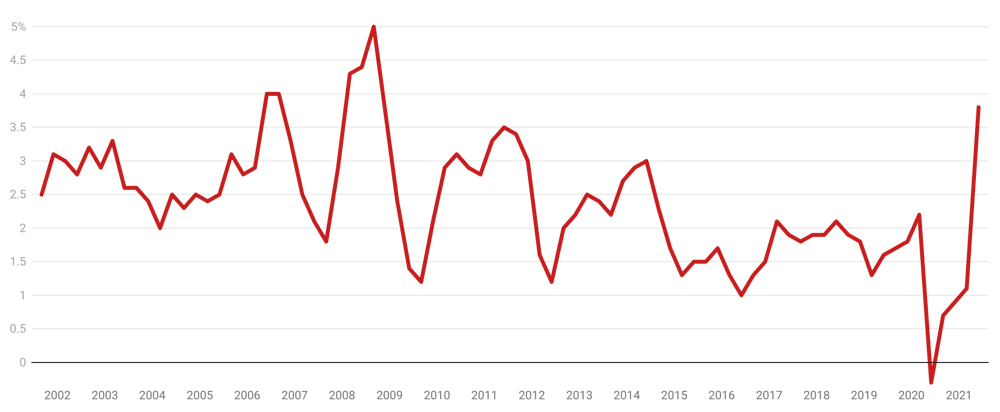
Suddenly, Australia’s annual inflation rate is 3.8%, having jumped from 1.1% for the twelve months to March.

The June quarter jump follows a jump in the United States to 5.4% and a jump in New Zealand to 3.3%, sparking a debate between leading pundits such as former US treasury secretary Larry Summers and Nobel Prize winner Paul Krugman about whether high inflation is on the way back, after years of playing dead.


Annual inflation, Australia


Australian Bureau of Statistics

The best advice is not to worry. Most of the jump is only temporary, the result of several one-offs.

As the Reserve Bank told us back in May, a main cause is that in the depths of COVID lockdowns last year, the government heavily subsidised child care, pushing the effective price to near zero.

With removal of those subsidies the price has bounced back. This is a one-off — it can’t be repeated.

Reasons to not worry

Petrol prices also collapsed as cities locked down last year, and have since returned to pre-COVID levels. This is another one-off that won’t be repeated.

There were also big jumps in the prices of some fruit and some vegetables due to a shortage of pickers and heavy rainfall. They are also best seen as one-offs.

The “trimmed mean” measure of so-called underlying inflation used by the Reserve Bank to see through transient influences was only 1.6%. It’s a better guide to what is going on.

Reserve Bank Governor Lowe.

This also true in other countries. The Bank for International Settlements concluded this month that a common thread in recent increases in inflation was that they were “likely to be temporary”.

The Reserve Bank is expecting inflation back below 2% by the end of the year. The bank forecasts consumer prices to rise by 1.5% through 2022.

Most economists broadly agree. The average forecast from The Conversation’s panel was an inflation rate of 2.1% in 2022.

What about the traders in financial markets, whose pay depends on trying to guess inflation right?

The traders’ average forecast can be derived from what they will pay for inflation-indexed compared to non-indexed bonds.

Over the next ten years, they expect inflation to average 2%.

But isn’t too much money being printed?

Yes, there have indeed been such claims, often by people trying to talk up the value of cryptocurrencies through internet memes.

It is true that as the Reserve Bank sought to steady the economy last year, there was a period of rapid monetary growth. In times of uncertainty, people tend to want to hoard some money.

But the same thing happened during the global financial crisis in 2008. It didn’t end up leading to high inflation then. It is unlikely to do so now.

Concerns have also been expressed that central banks have been buying too many government bonds — so-called “quantitative easing”. These fears were expressed internationally during the global financial crisis. They proved unfounded.

What else might push up inflation?

There are some longer-run structural changes. After the global financial crisis, the effective supply of workers in the global economy grew due to demographic factors and the re-engagement of China.

Some of the demographic factors may be reversing, but the effect will be gradual.

It is also true that many economies, including Australia’s, rebounded from last year’s COVID lockdowns faster than expected. This has led some commentators to talk about overheating.


Read more:
What’s in the CPI and what does it actually measure?


But now the emergence of the more contagious Delta strain has seen a new round of lockdowns. The Australian economy is likely to contract in the September quarter, making our recovery look W-shaped rather than V-shaped as it did.


The Conversation, June 2 2021

A big rise in inflation is unlikely unless wages grow strongly. There is no sign of this. Australia’s wage price index is climbing by just 1.5%.

But what if the experts are wrong?

Contrary to some claims, the Reserve Bank has not promised to keep interest rates on hold at 0.1% until 2024.

As the bank’s governor has made clear, if inflation accelerates into its target band it will raise interest rates earlier.

Since the Reserve Bank introduced its 2-3% target, inflation has averaged 2.4%. There is no reason to think it won’t continue to act to keep it moderate.

But if I still fear inflation, what should I do?

You should look for a good “inflation hedge”, an asset that will increase in price with inflation.

It is possible to buy indexed government bonds.

Rents and dividends also tend to rise with inflation, meaning houses and shares have proved reasonable inflation hedges in the past.

Assets with no returns, such as gold and cryptocurrencies, are less reliable. The price of Bitcoin has more than halved in two of the past seven years, so beware.

The Conversation

John Hawkins has been an economic forecaster in the Reserve Bank, the Australian Treasury and the Bank for International Settlements,

ref. Now that Australia’s inflation rate is 3.8%, is it time to worry? – https://theconversation.com/now-that-australias-inflation-rate-is-3-8-is-it-time-to-worry-165098

From colonial cavalry to mounted police: a short history of the Australian police horse

Source: The Conversation (Au and NZ) – By Stephen Gapps, Conjoint Lecturer, University of Newcastle

Aboriginal and Torres Strait Islander readers are advised this article contains names and/or images of deceased people.


Images of mounted police contending with anti-lockdown protesters on the weekend have now gone viral around the world. In fact, mounted police have a long history in Australia.

They have certainly been used as a method of crowd control at countless demonstrations in living memory — from anti-war protests to pro-refugee rallies and everything in between.

But the history of mounted police in Australia goes much deeper.


Read more:
Enforcing assimilation, dismantling Aboriginal families: a history of police violence in Australia


Mounted reconnaissance and messengers

In early colonial Australia, horses were at a premium. In the 1790s, policing of convicts and bushrangers in the confined region of the Sydney basin was conducted on foot by night watchmen, constables and the colonial military.

By 1801, the then Governor King formed a Body Guard of Light Horse for dispatching his messages to the interior and as a useful personal escort.

By 1816, at the height of the Sydney Wars of Aboriginal resistance, the numbers of horses in the colony had grown.

Their importance as mounted reconnaissance and for use by messengers was critical to Governor Macquarie’s infamous campaign, which ended in the Appin Massacre of April 17, 1816.

Mounted police, gold escort guard/ sketched on the spot by S.T. Gill.
Along with firearms and disease, the horse was a key element in occupying Aboriginal land and controlling the largely convict workforce on the frontier.
NLA/Trove

The horse as a key element of occupation

Along with firearms and disease, the horse was a key element in occupying Aboriginal land and controlling the largely convict workforce on the frontier.

In the early 1820s, west of the Blue Mountains, the use of horses in the open terrain of the Bathurst Plains was critical in capturing escaped convicts and bushrangers, as well as defending remote outstations against attacks from Wiradjuri people.

Early intrusions into Wiradjuri land were not so much by British colonists, but by the animals they brought with them. In what is now recognised as “co-colonisation”, cattle and sheep did a lot of the hard yards for the British, often well before they arrived in Aboriginal lands.

In 1817, Surveyor General John Oxley thought he was well beyond the limits of settlement when, as he wrote:

to our great surprise we found the distinct marks of cattle tracks [that] must have strayed from Bathurst, from which place we were now distant in a direct line between eighty and ninety miles.

From a colonial cavalry to mounted police

During the first Wiradjuri War of Resistance between 1822 and 1824, calls were made to the colonial authorities for the formation of a civilian “colonial cavalry” to assist the beleaguered and overstretched military forces. My (Stephen Gapps) forthcoming book, developed in consultation with Wiradjuri community members in central west region of NSW, The Bathurst War, looks in deeper detail at this period.

It was hoped colonial farmers would be their own first line of defence against Aboriginal warrior raids on sheep and cattle stations.

Governor Brisbane wrote to London that in 1824 a mounted force was becoming “daily more essential [for the] vital interests of the of the Colony”.

But by August that year, heavily armed and mounted settlers, overseers and their armed convict workers had decimated Wiradjuri resistance before a formal cavalry militia was established.

After possibly hundreds of Wiradjuri people had been massacred by heavily armed and mounted settlers, a “Horse Patrol” was created in 1825, which soon formally became the Mounted Police.

The Mounted Police were critical during a spree of bushranging soon after — a largely unanticipated side-effect of arming of convict stockworkers to defend themselves against Wiradjuri attacks in 1824.

Mounted Police and prisoner, 1840-1872, Samuel Thomas Gill
The Mounted Police were critical during a spree of bushranging.
Dixson Library, State Library of New South Wales

By the 1830s, the force had proved useful as a highly mobile quasi-military unit in combating Aboriginal resistance as well as bushranging.

As the colony continued to expand with an insatiable desire for running cattle and sheep on Aboriginal lands, three regional divisions were based at Bathurst, Goulburn and Maitland.

After conflict between colonists and Gamilaraay warriors on the Liverpool Plains, commander Major Nunn led a Mounted Police detachment on a two-month campaign around the Gwydir and Namoi Rivers, resulting in the Waterloo Creek Massacre on January 26, 1838. Armed colonists soon followed suit, ending in the Myall Creek Massacre in June that year, where colonists killed at least 28 Aboriginal people (possibly more).
The Mounted Police’s military functions came with heavy expenses, which included uniforms, equipment and barracks. During the 1840s, a Border Police force of ex-convicts equipped only with a horse, a gun and rations was created and attached to Commissioners of Crown Lands.

It was funded by a tax on squatters (whose interests they protected) and proved a much cheaper policing option for the frontier.

The Native Mounted Police

By 1850 the “Mounted Police” were disbanded. Another relatively cheap and what proved to be a tragic, if remarkably successful, option had been found — the creation of a “Native Mounted Police” force of Aboriginal men with British officers.

The troopers were provided with uniforms, guns and rations. By the 1860s, particularly in Queensland, the main problem on the frontier was not policing colonists but stopping Aboriginal resistance. So arming Aboriginal fighters was part of a tried and tested British method of exploiting existing hostilities by rewarding those who collaborated and punishing those who resisted.

As Bogaine Spearim, Gamilaraay and Kooma man, activist and creator of the podcast Frontier War Stories has noted, the Queensland Native Mounted Police (NMP) were not only feared by bushrangers such as Ned Kelly, but known for their violence toward the Aboriginal population of Queensland.

The NMP united incredible bush skills with military capability. Their legacy has been the focus of a recent project by Australian researchers Lynley Wallis, Heather Burke and colleagues.

The role of animals in colonisation and policing

From 1850, the colonial police force (and then from 1862, the NSW Police force) incorporated mounted police as mobile units in mostly remote locations.

But they also found them useful in urban areas, especially with growing numbers of strikes, political disturbances, protests and riots in the rapidly industrialising cities in the late 19th century.

The use of horses in crowd control has a long history in policing, which itself has a long history in warfare. Among the other issues this presents, we might also consider horses’ long suffering histories of being placed in the front lines of conflict.

Like the inexorable march of sheep and cattle as part of the invasion of Aboriginal lands, understanding the role of animals in colonisation and policing is crucial to a broader understanding of Australian history.


Read more:
Make no mistake: Cook’s voyages were part of a military mission to conquer and expand


The Conversation

Stephen Gapps is affiliated with the University of Newcastle and is a Senior Curator at the Australian National Maritime Museum. He is the author of The Sydney Wars (NewSouth Books) and of the forthcoming book, Gudyarra – The First Wiradjuri War of Resistance, the Bathurst War 1822-1824, which was developed in consultation with Wiradjuri community members in the central west region of NSW.

Angus Murray does not work for, consult, own shares in or receive funding from any company or organisation that would benefit from this article, and has disclosed no relevant affiliations beyond their academic appointment.

ref. From colonial cavalry to mounted police: a short history of the Australian police horse – https://theconversation.com/from-colonial-cavalry-to-mounted-police-a-short-history-of-the-australian-police-horse-165087

Can eating hot chilli peppers actually hurt you?

Source: The Conversation (Au and NZ) – By Christian Moro, Associate Professor of Science & Medicine, Bond University

Shutterstock

We all know the burning sensation we get when eating chillies. Some can tolerate the heat, while others may be reaching for the milk carton.

Some people even actively choose to participate in chilli-eating competitions, seeking out the world’s hottest chillies, such as the Carolina Reaper.

The global hot sauce market has grown substantially in the last few years. It sits at around US$2.71 billion (A$3.68 billion), and is expected to grow to $4.38 billion (A$5.95 billion) by 2028.

But can the heat harm our bodies?

Let’s take a look.

Girl choosing whether to add a hot chilli to a meal
The major active compound in chillies, capsaicin, is associated with multiple health benefits.
Christian Moro, Author provided


Read more:
Explainer: why chilli burns, and milk helps soothe the pain


The heat is a ‘trick’

For all their health benefits, eating hot chillies may cause a bit of discomfort.

This includes swelling, nausea, vomiting, eye pain, diarrhoea, abdominal pain, heartburn from acid reflux, and headaches.

But the feelings we get are simply from our body’s response, not anything the chilli is doing to actually burn us. As such, many of the side effects we notice when eating hot chilli, such as sweating and pain, are a result of the body considering the stimulus to be a real burn.

This is why the heat can be “fun”. Our body senses capsaicin, the major active compound in chillies, and immediately responds to it. But there’s no serious physical damage occurring to the cells. Capsaicin is “tricking” the body into thinking it’s experiencing a real burn.

But what could be an advantage of this? Well, this burning sensation is felt by mammals, but not birds. Therefore, a common theory is the capsaicin response was developed by plants to deter mammals from feeding, while still encouraging birds to eat the fruit and carry the seeds far and wide.

However, although a real burn is not taking place, individual cells in the mouth and digestive system might respond to the stimulus by releasing chemicals which induce a small amount of additional irritation. The response is usually relatively short-lived, and tends to subside once the burning sensation quiets down.

Other than that, there’s not much strong evidence to support any major injury or negative effects from a balanced and moderate consumption of hot chilli.

A weak correlation does exist for a high intake of chillies being somehow associated with cognitive decline. In this study, chilli intake of more than 50g/day (3.5 tablespoons) was reported in more people who exhibited memory loss than others. However, this was self-reported data, and the results have not yet been repeated by further research.

No long-term dangers

Chilli is an integral spice used in many cuisines. And there are many benefits to a regular intake of the spice, with its great source of antioxidants. In addition, those who add chilli to meals tend to add less salt, meaning enjoying a bit of heat could become a healthy habit for some people.


Read more:
Getting hot and sweaty: how heat and spice might affect our appetite


Overall, although eating chilli can cause discomfort, in some cases for many hours after eating, there doesn’t seem to be any long-term dangers from eating hot chilli in moderation.

You may have noticed the more heat you eat, the more heat you can tolerate. This is because the pain nerves start to become less sensitive with increased and prolonged stimulation. Additionally, some people can naturally tolerate much higher heat levels which is, in part, regulated by genetics.

Nonetheless, although others may be eating much hotter chillies than you enjoy, the current recommendation is to stay within your comfort zone.

The Conversation

The authors do not work for, consult, own shares in or receive funding from any company or organisation that would benefit from this article, and have disclosed no relevant affiliations beyond their academic appointment.

ref. Can eating hot chilli peppers actually hurt you? – https://theconversation.com/can-eating-hot-chilli-peppers-actually-hurt-you-163489

What Olympic gymnasts can teach us about improving our balance

Source: The Conversation (Au and NZ) – By Anthony Blazevich, Professor of Biomechanics, Edith Cowan University

The acrobatic handsprings, somersaults and twists performed by world-class gymnasts at the Tokyo Olympics are among the most complex skills humans can perform.

But at their heart is an instinctive process that can help teach us mere mortals how to stay safe from falls as we move much less spectacularly around our own environment.

To complete acrobatic manoeuvres, gymnasts need energy. In most cases, this energy comes from the jump performed at the start of the element, often after a run-up to gain momentum.

But the power in the jump has less to do with the power output of the gymnast’s muscles, and more to do with the power generated by the springy floor, or by the springboard in the case of a vault, as well as the elasticity of the gymnast’s own tendons.

To optimise the power of the spring from the floor or springboard, the gymnasts have to perfectly set the stiffness of their own spring — the spring of their legs — to get the most power. You can see this process in slow motion in this video.

When walking or running on a hard surface such as concrete, our joints flex and extend a lot in each jump as our muscles control the joints — compare the video below to the one linked above. But on a springy trampoline we don’t flex our joints much, instead keeping our legs straighter and using less muscle work. That’s why we can jump for much longer without tiring on a trampoline.

When jumping on a hard surface, we flex the joints considerably so our ‘leg spring’ is less stiff than on a sprung surface.

To perfectly “tune” their leg spring to make the most of the springy surface, gymnasts pre-activate their muscles before hitting the floor to begin their jump, using dozens of muscles to adopt a very specific joint configuration that delivers the perfect leg stiffness.

Then, when hitting the ground immediately before takeoff, a variety of reflexes can be triggered that can influence muscle force and alter leg spring stiffness. The gymnast has to compensate for these in advance because the contact time with the ground is too short to make any reactive adjustments during takeoff.

Getting this right takes countless hours of practice, over many years.

What happens when the gymnast then moves to the beam, which is much less springy? They have to adapt their muscle activation to generate a different amount of leg stiffness. They have to be able to tailor their jumping technique with exquisite accuracy to cope with different surfaces.

It sounds technical, but we all do it to a certain extent. We walk, run and jump on surfaces with vastly different stiffnesses, from concrete to carpet, to grass or sand. Failing to adjust our own leg spring stiffness can increase the energy cost of moving, leading to fatigue, and potentially increase our risk of falling. This can be life-threatening – falls leading to hip fractures in older people massively increase the risk of death in following months and years.

Both in early childhood, when we’re first learning to move, and in older age, when walking costs more energy and the risk of falling is greater, it’s hugely valuable to practise walking across a range of different surfaces. You can do it by taking walks along forest tracks (especially if rocks and concrete paths intermingle with dirt or grass) or sandy beaches (walking in shallow moving water is also a nice way to stay cool in summer while honing your balance). Your local park might also have equipment designed to practise balancing.

Two hikers on mountain trail
Hiking on rough terrain is a great way to keep your legs working at their best.
Toomas Tartes/Unsplash, CC BY-SA

Do the twist

Gymnasts need to know how to complete a variety of somersaults and twists. For this they need lots of rotational energy, most of which comes from the initial run-up and jump. Once airborne, you can’t grab more energy!

So gymnasts have to launch off the floor, springboard or beam with the perfect amount of rotation to execute their acrobatic manoeuvre. This requires tremendous precision — “sticking” the landing requires completing the planned number of rotations in perfect time for their feet to hit the floor and avoid toppling over.


Read more:
How do Olympic athletes stack up against invertebrates? Not very well


Amazingly, elite gymnasts can also transition in mid-air between different types of tumbling, perhaps moving from a straight somersault to an angled twist. But how do they do this, if they can’t take on more energy halfway?

They do it by rotating their arms to change their direction of rotation. This can be seen clearly in this slow-motion video.

We all do the same thing, especially if we’re trying not to fall over. Newton’s third law says every action has an equal and opposite reaction. So by rotating our arms in the opposite direction to the way we’re falling, we can attempt to push our body back upright. Notice how a gymnast on a beam uses their arms to make sure they don’t fall off.

Angelina Melnikova during a beam routine
Russian gymnast Angelina Melnikova, demonstrating the importance of arms.
Ashley Landis/AP

This is another tip we can all learn from elite gymnasts. Using your arms is an important part of maintaining balance, particularly during exercise.


Read more:
Explainer: how do our bodies balance themselves?


You can practise balancing every day by standing on one leg to do daily tasks, walking along lines in the concrete or on balance beams in the play area at your local park, or even by standing up to put on pants and socks rather than sitting on the bed or a chair.

Children and adults alike can also play sports or exercise in the playground — we’re never too old to play, and play is the best way to learn any physical skill.

The Conversation

Anthony Blazevich does not work for, consult, own shares in or receive funding from any company or organisation that would benefit from this article, and has disclosed no relevant affiliations beyond their academic appointment.

ref. What Olympic gymnasts can teach us about improving our balance – https://theconversation.com/what-olympic-gymnasts-can-teach-us-about-improving-our-balance-165171

The policing of Australian satire: why defamation is still no joke, despite recent law changes

Source: The Conversation (Au and NZ) – By Jacci Brady, PhD Candidate, School of Political and Social Sciences, The University of Melbourne

Screenshot/YouTube

Changes to Australian defamation laws that came into effect this month in several states could provide some respite for political satire as a mode of political communication.

In recent years, the defamation lawsuit risk for Australian comedians has been real.

The treatment of YouTube personality Jordan Shanks and his producer Kristo Langker is a case in point. FriendlyJordies, Shanks’ popular YouTube channel, had mockingly depicted NSW Deputy Premier John Barilaro as Mario, the fictional video game character who wins races by cheating. Shanks’ satirical stunts and commentary included content about alleged incompetence and corruption.

In response, Langker was arrested by no less than the Fixated Persons Investigations Unit of the NSW police, which is normally concerned with rooting out extremists and terrorists, and subjecting them to psychological assessment. Furthermore, Shanks is now being sued by Barilaro for defamation.


Read more:
NSW deputy premier threatens to sue FriendlyJordies, reminding us that parody hits in a way traditional media can’t


How will new defamation laws protect satirists?

The reformed defamation laws came into effect on July 1 in New South Wales, Queensland, Victoria and South Australia. They will become nationally uniform by the end of this year.

The reformed laws now include a public interest defence and a serious harm provision, both of which promise room for manoeuvre for political satirists.

The changes mean more protection for satire highlighting matters of interest to the public. The only exception is that representations can’t make accusations without factual basis. And the new serious harm provision means that satirical insult does not automatically equate to reputational damage.


Read more:
Why defamation suits in Australia are so ubiquitous — and difficult to defend for media organisations


How this will be tested in law remains to be seen, particularly as it relates to the implied right to freedom of political expression. These legal reforms may be welcome relief, reducing some risk to satirists.

But in terms of power relations, the defamation issue may still come down to who has the money to mount a defence. For grassroots and citizen satirists without the funds to access legal advice, this is still problematic.

Limits to the modern court jester

Whether or not one approves of Shanks’ potentially racist depiction of Barilaro, the actions against him and his producer do seem to be disproportionate and a far cry from the past.

For example, back in 2004, in a stunt that resonated with the satirical series The Chaser’s War on Everything, a man named Patrick Coleman distributed pamphlets in Townsville with the words “Get to know your local corrupt type coppers”. He was arrested and convicted under vagrancy laws for use of insulting language in a public place (among other charges).


Read more:
Friday essay: why is Australian satire so rarely risky?


However, the High Court overturned the charge of insulting police, saying the police should be expected to resist the sting of insults directed at them.

Indeed, tolerance for even more risqué political satire stretches a long way back, from the no-holds-barred comedy of The Big Gig and The Comedy Company, to the rogue and surreal inversion of Australian politics and culture in the series DAAS Kapital.

In the past, many politicians have even supported or engaged in satire themselves, such as former Victorian Premier Joan Kirner’s self-mocking performance on The Late Show in 1993.

Joan Kirner singing Joan Jett’s ‘I Love Rock n’ Roll’ on the Late Show.

There have also been notable instances of resistance, too. In the late 1990s, Pauline Hanson mounted legal challenges against the work of satirist Simon Hunt, aka Pauline Pantsdown. ABC’s The Glasshouse was also cancelled in 2006 — some say at the request of John Howard — arguably because the political commentary got too pointed for the prime minister’s office.

Attempts to criminalise impersonations before

In recent years, the concerns of increasingly sensitive politicians seem to have found greater weight in law.

In 2017, Attorney-General George Brandis fired a serious warning shot at those who may dare to satirise government officials.

The government’s proposed legislation would have replicated existing laws that already made proper impersonation illegal and was an extremely broad-brush approach to defining impersonation. In his submission to the parliamentary inquiry reviewing the changes to the law, Melbourne Law School professor Jeremy Gans warned about legislative overreach.

He pointed out the draft legislation could have led to the criminalisation of satirical conduct as political expression,

and to say otherwise is silly, confusing and (perhaps) ambiguous as to which party will bear the evidential burden on this issue.

While those reforms didn’t get up, they may be reflective of a broader desire on the part of government to sanitise public political comment.

Comedian Max Gillies impersonating former Prime Minister Bob Hawke.

Continued risks to satirists, despite the changes

Attempts such as this to regulate satire are concerning in multiple ways. First, they enhance the powers of already powerful governmental officials relative to more vulnerable actors.

Even with the new changes to defamation laws, many up-and-coming satirists without the legal backing and expertise of media or production companies will still face challenges to safely practice their craft.

And satirists will almost certainly continue to experience heightened pressure to self-censor due to the risk of lawsuits. This undermines a key medium for articulating legitimate political critique and protest.

Comedian, writer and broadcaster Wendy Harmer once observed that what we see on TV and in other media “tells you where your society is at”.

If media artists are too afraid to express what our communities feel through satire for fear of government or legal reprisal, then surely we come to know less about who we are.

The Conversation

The authors do not work for, consult, own shares in or receive funding from any company or organisation that would benefit from this article, and have disclosed no relevant affiliations beyond their academic appointment.

ref. The policing of Australian satire: why defamation is still no joke, despite recent law changes – https://theconversation.com/the-policing-of-australian-satire-why-defamation-is-still-no-joke-despite-recent-law-changes-164076

Scheduled LIVE: Buchanan + Manning on Cyber-Attacks and the Evolution of Hybrid Warfare

A View from Afar: Selwyn Manning and Paul Buchanan will present this week’s podcast, A View from Afar, LIVE at midday Thursday and will do a deep-dive into cyber-attacks and hybrid warfare – Especially how 2021 has witnessed a Cold War II styled stand-off between global powers.

To re-cap, there has been:

  • Allegations of a global-scale hack by the People’s Republic of China.
  • There’s the Pegasus spyware scandal, where Israel has exported deep-tracking and targeting spyware to despots and authoritarian governments.
  • Then there’s been the relatively silent mission-creep of Palantir as a Western-oriented Public Private Partnership-styled signals “facilitator”.

Paul and Selwyn will discuss how all of this sets 2021 apart and adds up to an evolution of hybrid warfare capabilities.

WE INVITE YOU TO PARTICIPATE WHILE WE ARE LIVE WITH COMMENTS AND QUESTIONS IN THE RECORDING OF THIS PODCAST:

You can comment on this debate by clicking on one of these social media channels and interacting in the social media’s comment area. Here are the links:

If you miss the LIVE Episode, you can see it as video-on-demand, and earlier episodes too, by checking out EveningReport.nz or, subscribe to the Evening Report podcast here.

The MIL Network’s podcast A View from Afar was Nominated as a Top  Defence Security Podcast by Threat.Technology – a London-based cyber security news publication.

Threat.Technology placed A View from Afar at 9th in its 20 Best Defence Security Podcasts of 2021 category. You can follow A View from Afar via our affiliate syndicators.

Listen on Apple Podcasts
 

Samoa’s first female leader has made history — now she faces a challenging future at home and abroad

Source: The Conversation (Au and NZ) – By Patricia A. O’Brien, Visiting Fellow, School of History, Australian National University, and Adjunct Professor, Asian Studies Program, Georgetown University

After nearly four months of being taken to the brink of dictatorship, Samoa’s constitutional crisis ended on July 26 when the prime minister for the past 23 years, Tuilaepa Sa’ilele Malielegaoi, conceded defeat.

With the April 9 election loss, the 40-year dominance of Samoan politics by Tuilaepa’s Human Rights Protection Party (HRPP) ended too.

Samoa’s new leader, Fiame Naomi Mata’afa, might be the country’s first female prime minister, but she is a veteran politician. As she attempts to bring her nation out of its greatest test in the 59 years since independence, she will need all the deep experience she brings to the role.

A political dynasty

Fiame was born in 1957 into one of Samoa’s leading chiefly and political families. Her parents were both trailblazers, too. Her father, Mataʻafa Faumuina Mulinuʻu II, served as Samoa’s first prime minister over two terms (1959-1970 and 1973-1975).

When he died in office in 1975, Fiame’s mother, La’ulu Fetauimalemau Mata’afa, represented his constituency of Lotofagu. She was just the second woman to be elected to Samoa’s parliament.


Read more:
Samoa’s stunning election result: on the verge of a new ruling party for the first time in 40 years


After serving in parliament, La’ulu was appointed Samoa’s consul general to New Zealand in 1989 and then served as Samoa’s high commissioner to New Zealand from 1993 to 1997.

Fiame also has strong ties to New Zealand. From age 11, she attended Marsden College in Wellington before studying political science at Victoria University, graduating in 1979.

A veteran and trailblazer

Fiame’s own political career began in 1985 when she won her parents’ former parliamentary seat of Lotofagu. Since then, Fiame’s career has ridden the wave of the HRPP’s popularity.

Under former prime minister Tofilau, she became the country’s first female cabinet minister, holding the education portfolio for 15 years. Fiame has also overseen the Ministry of Women, Community and Social Development, and the Ministry of Justice and Courts Administration, as well as other government appointments.

In 2016, she again broke new ground when she was appointed Tuilaepa’s deputy prime minister. She held this position until her resignation in September 2020 in protest at Tuilaepa’s controversial “three bills” (which gave the Lands and Titles Court additional powers over the bestowal of lands and titles within families and villages and undermined judicial independence and the rule of law).


Read more:
Samoan democracy hangs in the balance as a constitutional arm wrestle plays out — with the world watching


The bills and their rushed passage into law ignited widespread protests and the formation of the Fa’atuatua i le Atua Samoa ua Tasi (FAST Party), which Fiame joined as leader in March 2021. Ultimately they led to Tuilaepa’s political demise.

The bitter election campaign and its protracted aftermath, when Tuilaepa went to extraordinary lengths to retain power, has tested Fiame’s mettle as a national leader.

Throughout, she has embodied the same faith that justice would prevail that she asked of Samoa’s people as they witnessed the alarming twists and turns of Tuilaepa’s power play.

The challenge of power

Her impressive track record and admirably steady temperament will continue to be called upon as she faces multiple challenges as leader.

Firstly, Fiame will have to contend with something Tuilaepa never had to during his long term — a viable opposition, whose leader just happens to be Tuilaepa. True to form, he has already questioned the legitimacy of Fiame’s FAST government.

How much power Tuilaepa can wield in parliament is yet be to determined. Seven by-elections have been triggered so far due to petitions stemming from the general election. FAST currently holds 26 seats and the HRPP 17, with one independent.


Read more:
Has the door finally opened for Samoa’s first female prime minister, after weeks of constitutional crisis?


There will also be a by-election for the 52nd parliamentary seat created since the April 9 election — the seat designated for a woman candidate to meet a constitutionally mandated 10% quota of female parliamentarians. It was by creating this seat and “weaponisinggender politics that Tuilaepa hoped to keep Fiame out of power.

Fiame must also contend with Tuilaepa’s residual powers beyond parliament. His son, Leasiosio Oscar Malielegaoi, was appointed CEO of the Ministry of Finance in 2018, as well as various other positions, by his father.

The bureaucracy is staffed by other Tuilaepa loyalists. Reinvigorating national power structures will be a delicate operation for Fiame. But she is aided in her nation-building by the grassroots, village-level support for her government that has seen a succession of leaders calling on Tuilaepa to concede over the past weeks.

This support will be critical, not only for the pending by-elections but also to ward off the threat of COVID-19, now tragically playing out in neighbouring Fiji.

Samoa’s place in the world

While no deaths have been attributed to COVID-19 in Samoa, vaccinations are vital to keep it that way. Currently, only 18.6% of the population are fully vaccinated and vaccine hesitancy persists.

Ameliorating the devastating impact of the pandemic on Samoa’s tourist economy is another major challenge. And Fiame will also need to negotiate China’s considerable economic influence, encouraged by Tuilaepa but which Fiame has signalled she will not emulate.


Read more:
With five countries set to quit, is it curtains for the Pacific Islands Forum?


Regionally, Fiame has an opportunity to be a constructive presence at a time when the pandemic has exacerbated frayed relations between Pacific democracies and China, and within the Pacific Islands Forum, which has recently seen a third of its member nations quit.

None of which detracts from the historical significance of Fiame’s election. She joins an exclusive group of women political leaders and can encourage other women in the region aspiring to political office.

As US Vice President Kamala Harris said of her own election, “I may be the first woman to hold this office. But I won’t be the last.” For Fiame, perhaps, that is the ultimate challenge.

The Conversation

Patricia A. O’Brien received funding from the Australian Research Council and New Zealand’s JD Stout Trust.

ref. Samoa’s first female leader has made history — now she faces a challenging future at home and abroad – https://theconversation.com/samoas-first-female-leader-has-made-history-now-she-faces-a-challenging-future-at-home-and-abroad-165083

Confused about which English subject to choose in year 11 and 12? Here’s what you need to know

Source: The Conversation (Au and NZ) – By Kirsten Lambert, Lecturer, Edith Cowan University

Shutterstock

This article is part of a series providing school students with evidence-based advice for choosing subjects in their senior years.

English (or an equivalent literacy requirement) is a compulsory subject for all secondary students in Australia. In years 11 and 12 there are several types of English subjects to choose from.

There are different versions of “English” in different states, with various titles and levels of difficulty.

There’s English, English studies, general English, foundation English, English standard, English advanced, English language, English and literature extension and literature. It is important to choose the right version of English to reach your desired destination.

Different types of English

The Australian Curriculum is the base for the development of state and territory senior secondary courses. It breaks English down into four broad categories: English, literature, EALD (English as an Additional Language or Dialect) and essential English.

Literature is known as the most challenging of the four and focuses on literary texts such as poetry, prose and drama. Literature explores the creative use of language through in-depth study of culturally important literary works.

Book cover
In a literature course, you could be asked to explore representations of race in Joseph Conrad’s Heart of Darkness.
Drümmkopf/Flickr, CC BY

For example, students may explore colonial representations of race in Joseph Conrad’s novella Heart of Darkness, the beauty and unsettling nature of Shakespeare’s sonnets, or Australian cultural identity in Jack Davis’ play No Sugar.

Literature is more like philosophy or history than what we think of as English from NAPLAN (grammar and comprehension).

Literature used to be a popular subject in some states, but its popularity has been falling. Recent figures from Victoria show while literature was the 15th most commonly studied subject in 2015 in the senior years, it tumbled to 19th in 2019. In 2020, it fell off the top 20 list entirely.

In Western Australia, some schools have dropped literature because of low enrolments. A report in 2018 noted the percentage of year 12s studying literature fell from 26% in 1998 to 11% in 2017.

Theories about this fall include the fact literature is seen as an elitist subject, that you have to be someone who reads all the time to take it, and you have to love great 19th and 20th century literature.

These things aren’t true. Anyone interested but willing to challenge themselves should and can take literature. And some examples of recent texts include Breath (Tim Winton), The Handmaid’s Tale (Margaret Atwood) and The Book Thief (Marcus Zusak). There are many “fun” texts students can study and while literature is challenging it can also be enriching, and can cultivate a love of reading.


Read more:
5 Australian books that can help young people understand their place in the world


Also, my research showed some students found studying literary texts to be an empowering experience. One year 12 student said:

I’m the black sheep in my household. I identified with Rose (a character from Tim Winton’s Cloudstreet) quite a bit as the strong girl who was being resilient and was trying to break out of where she was. I do performing and everyone else does engineering or chemistry.

English develops analytical and creative skills through studying a range of literary and non-literary texts (including oral, multimedia and digital “texts” such as documentaries, graphic novels and feature articles).

If you’re not in love with reading or writing but want to study subjects such as commerce or engineering at university, this may be the course for you.

Girl lying on the couch reading magazine
In English, you can study a range of texts, such as magazine feature articles.
Shutterstock

Although it’s seen as easier than literature, not everyone finds it that way. One Victorian student who had taken both literature and English wrote actually found the latter harder. This is because she felt she had more freedom in literature while English “wasn’t really compatible with tangents”. She found it harder to be more concise in her expression.

English as an additional language is designed for students with English is their second language. This is an ATAR subject in some states such as Western Australia and Victoria.

Essential English develops students’ use of language, but it is not an ATAR subject. Essential English and general English are tailored to students who would like to graduate from high school but don’t want to go to university.

How do I decide which to take?

The first question you can ask is: “Do I want to go to university?”. If the answer is “yes”, you are likely to choose an English subject that will go towards your ATAR.

It’s worth noting you can still get into university without an ATAR, or without a very high one, but it does give your more options.


Read more:
Don’t stress, your ATAR isn’t the final call. There are many ways to get into university


ATAR subjects are traditionally seen as more difficult than non-ATAR ones, although for anyone who has ever studied non-ATAR subjects, this is debatable.

So, let’s take an example student, Mia. She is tossing up between medicine, mechanics or music teaching.

If Mia wants to become a mechanic, she does not need an ATAR to get a school-based apprenticeship. She may be better off studying general English, which focuses on the skills students need to become competent communicators in everyday life, or at work.

A woman mechanic.
If Mia wants to become a mechanic, she doesn’t need to do an English subject that contributes to an ATAR.
Shutterstock

But if Mia wants to be a music teacher or doctor, she is better off choosing an English subject that contributes to an ATAR. If she would like to be a teacher, she could choose something like English standard or English advanced and will need an ATAR score over 70 (but more than likely around 85).
If she would like to study medicine, she will need an ATAR closer to 99.

What about scaling?

Some English subjects are scaled higher, while others lower.

Scaling uses an algorithm to make subject scores more or less comparable to each other. This also makes sure if a student takes a difficult subject, they aren’t disadvantaged. It’s easier to get an A in an easier subject than a harder subject, so scaling generally adds more points to students doing harder subjects.

ATAR literature, a traditionally more difficult course, is usually scaled up. In Western Australia in 2020, for instance, English was scaled down about two points and literature was scaled up by nearly seven.


Read more:
Choosing your senior school subjects doesn’t have to be scary. Here are 6 things to keep in mind


But students shouldn’t just take a subject like literature because it’s scaled up. Because it’s harder, they may get a lower mark and the scaling won’t make much difference. You should do what interests you, and what you think will contribute best to your future while ensuring a good senior school experience.

What could I do with English?

English is compulsory because you need it for everything in life, from social communication to employment.

Studying literature, which isn’t compulsory, can be useful for occupations that require an advanced command of language such as journalism, research, law, public relations, philosophy and politics.

Read the other articles in our series on choosing senior subjects, here.

The Conversation

Kirsten Lambert does not work for, consult, own shares in or receive funding from any company or organisation that would benefit from this article, and has disclosed no relevant affiliations beyond their academic appointment.

ref. Confused about which English subject to choose in year 11 and 12? Here’s what you need to know – https://theconversation.com/confused-about-which-english-subject-to-choose-in-year-11-and-12-heres-what-you-need-to-know-163978

We’ve heard of R numbers and moving averages. But what are k numbers? And how do they explain COVID superspreading?

Source: The Conversation (Au and NZ) – By Adrian Esterman, Professor of Biostatistics and Epidemiology, University of South Australia

Forest Simon/Unsplash

First thing in the morning, or come 11 o’clock, countless Australians anxiously wait for the daily COVID-19 case numbers, trying to understand whether their outbreak is under control, and how much longer they will be in lockdown.

As well as daily case numbers, people want to know what proportion of cases were infectious in the community, and whether there were any unlinked or “mystery” cases.

People have also been following the daily Reff, or effective reproduction number, hoping it will get below 1, showing public health measures are working to halt the spread.

However, to have a good understanding of the dynamics of an outbreak, it is also necessary to understand k, which shows how much variability there is in daily case numbers.

COVID-19 superspreaders

Many superspreading events have occurred in the current pandemic. An infectious volunteer dressed as Santa Claus, for example, visited a care home in Antwerp in December 2020, and infected 40 staff members and more than 100 residents.

Even more drastic is a South Korean woman who caused a superspreading event resulting in more than 5,000 cases in the South Korean city of Daegu.


Read more:
How to prevent COVID-19 ‘superspreader’ events indoors this winter


Meanwhile in Australia, we have seen many examples of cases being detected, but not infecting a single other person.

So, how can this disparity be explained?

Remind me, what’s the Reff?

The effective reproduction number Reff, also called Re or R(t), tells us, on average, how many people an infected person will pass it on to. Unlike the basic reproduction number, R0, Reff takes into account that some people will be vaccinated or immune, and social distancing is in place.

So, if a virus has a Reff of 2, each infected person (primary case) will on average infect two others (secondary cases).

However, this average hides a huge amount of variability. Most infected people simply infect no one, whereas others (the superspreaders) infect many people.


Read more:
A few superspreaders transmit the majority of coronavirus cases


We’re unsure why this is the case. It could be some people are naturally social animals, or fail to maintain social distancing, mask-wearing, or hygiene.

Alternatively, it could simply be that some people have a much higher viral load than others or tend to emit virus particles as aerosol clouds more than others.

Daily case numbers can vary substantially

During periods of outbreaks, health authorities report daily case numbers. Here they are for Victoria when the fifth lockdown began:

Average daily count

The average (mean) daily count over these ten days is 10.7 cases per day (you can calculate it yourself by adding up all the cases and dividing by ten).

However, there is a lot of variability, with numbers going up and down like a yo-yo from zero to twenty. Because of this variability, we often use moving averages to try and smooth things out.

7 day moving average

For a seven-day moving average, we add up the cases from July 12 to the 18 and divide by 7, to get 8.4. Then we do the same for July 13 to the 19 to get 10.3.

This way, we end up with a much smoother series of numbers without all the up and down jags, that allows us to see trends much more easily. Importantly, I also use the moving average to calculate the Reff.

Variance

We measure the amount of variability in the daily case numbers by a statistic called the variance. This measures how far apart the daily counts are from their average value of 10.7. For most count data (for example, the number of days each month you exercise), the average and variance are the same. So, if the average count is 10.7, the variance is 10.7.

However, for this epidemic, because of the superspreaders, the variance is much greater – we call this overdispersion.

So what is the k?

An estimate of how much extra variability or overdispersion there is, is measured by a statistic called k. A small k means the variability is higher than the average daily count, whereas a large k means the variability is closer to the average daily count.

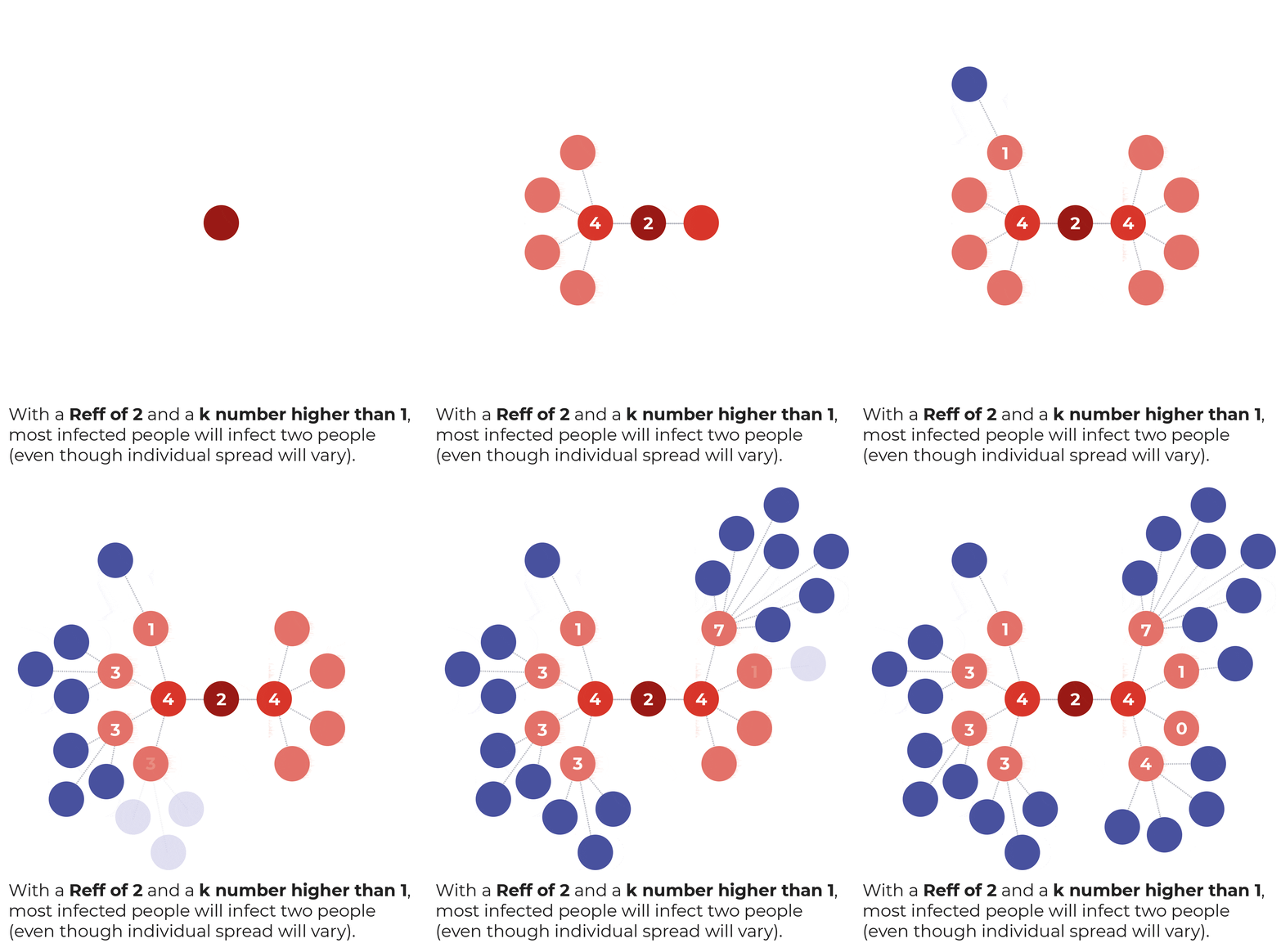
So, with a high value of k (say 2), and a Reff of 2, most infected people would typically infect two others, but it could of course be higher or lower than this.


Source: The Conversation/Adam Kleczkowski (CC-BY-ND)

In the above diagram, the number of people a case infects is shown in each circle. The original maroon (primary) case infects two others (red). Each of these secondary cases infects three or four others (pink), and so the outbreak continues. Typically, most infected people, infect at least one other person.

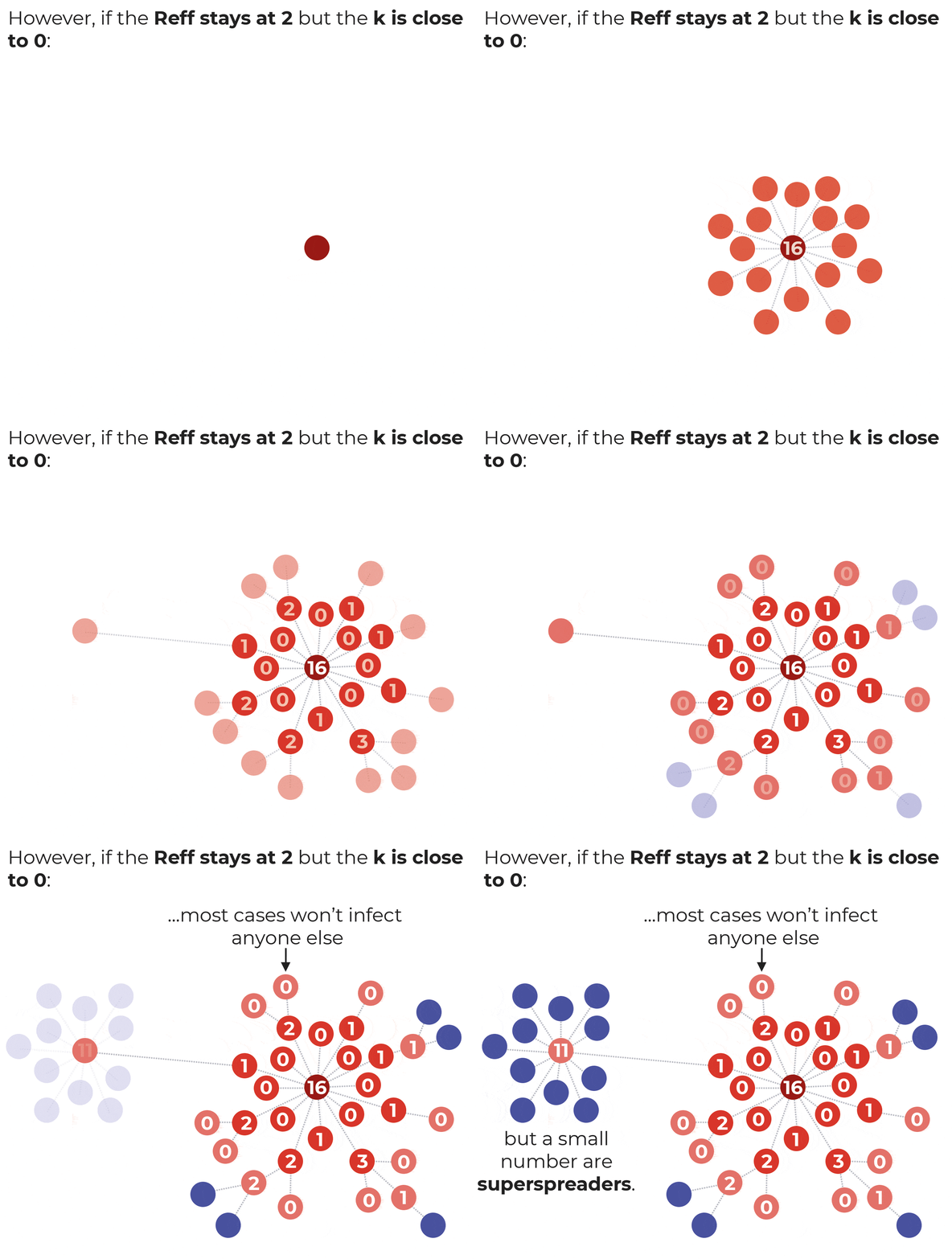
However, with k close to 0 and a Reff of 2, most people would infect no one else, and there would be one or more superspreaders.


Source: The Conversation/Adam Kleczkowski (CC-BY-ND)

In the above diagram, the primary case (maroon) is a superspreader, infecting 16 other people. Although most of these secondary cases do not infect anyone else, one of the tertiary cases is also a superspreader, infecting 11 others.

In both diagrams the Reff was 2. So, you can see that knowing the Reff is only part of the story.

Estimates of COVID-19’s k range from 0.1 to 0.5. These are very small values, and indicate 80% of secondary infections are caused by around 10% of primary cases. This means the majority of infectious people do not infect anyone.


Read more:
Is the K number the new R number? What you need to know


Why is it useful to know the k?

When an infected person is diagnosed, contact tracers immediately try and find their close contacts. These are then tested and put into isolation. This is called forward contact tracing.

However, in the context of superspreaders, it’s equally important to find out who infected the original diagnosed case, as that person could potentially be a superspreader.

Forward contact tracing of that potential superspreader would likely lead to many more cases being detected. In fact, modelling has found looking backwards as well as forwards could prevent two or three times as many infections. This is known as backward contact tracing and is now widely used in Australia.

The k number shows us the importance of backwards as well as forwards contact tracing.

The Conversation

Adrian Esterman does not work for, consult, own shares in or receive funding from any company or organization that would benefit from this article, and has disclosed no relevant affiliations beyond their academic appointment.

ref. We’ve heard of R numbers and moving averages. But what are k numbers? And how do they explain COVID superspreading? – https://theconversation.com/weve-heard-of-r-numbers-and-moving-averages-but-what-are-k-numbers-and-how-do-they-explain-covid-superspreading-164858

Fiji student son tells of his pregnant nurse mum’s losing struggle with covid

By Josefa Babitu in Suva

The dream of putting a smile on his mother’s face on his graduation day from university has become one that will never happen for Gabriel Gade, after his mother succumbed to the coronavirus that has killed dozens of people in Fiji.

“My ultimate dream was to make her proud of all her sacrifices, battles in life and the love she gave me over the last 21 years of my life,” he told Asia Pacific Report.

“My mother had to work all the time to pay off the mortgage, and I could tell that she was exhausted most of the time, but I think it was her love for her children that kept her going every day.

His mother, Suliana Bulavakarua, worked as a registered nurse at the Colonial War Memorial Hospital (CWMH), the largest healthcare facility in the country, where his family believes she contracted the virus while pregnant.

After she tested positive for covid-19 on July 16, she was transported to the Covid-care facility in Suva, leaving behind Gade and his sister at home as their father was working outside of the mainland.

Her children also tested positive for the virus but have recovered. Gade was vaccinated with the first dose of the AstraZeneca vaccine while his mother was awaiting the Moderna vaccine that was to be administered to pregnant women.

Her daughter was not eligible for the vaccine as she was under the age of 18.

Her condition worsened
Her condition got worse on July 18 and was advised by attending physicians to deliver her baby by caesarean section.

The 44-year-old gave life to a baby girl but the battle with covid-19 was so intense that it soon ended her life.

“It was late at night on Wednesday [July 21] when my phone rang and I did not answer because it was a new number and it was late as well. However, little did I know the hospital was calling me to inform us of our mother’s passing,” says Gade.

Suliana Bulavakarua and family
Gabriel Gade with his mother, Suliana Bulavakarua, and sister at the time of his 21st birthday last year. Image: Wansolwara

“A team from the hospital knocked on our doors on Thursday morning and relayed the news that broke my sister and I into tears. The world suddenly stopped as I lost the one person I owe everything to.

“My mind ran wild but hours later I had to compose myself for my family, especially my sisters who will now grow up without a mother.

The Lau native said the teachings of his mother was something he would hold dear to his heart and would use in the upbringing of his sisters.

“My mother taught me to be generous, loving and to care for people that needed my help.

“I remember a night where I would do my assignments on my study table in our living room and during her days off she would sit on the couch and then she would try and make small talk.

“My mom and I had this relationship where she would always be pressed to do things like for me to graduate. My mom was always supportive of my endeavours.

“I love you so much mom.”

The “fallen hero” is survived by her husband and three children.

Healthcare workers remember fallen hero
The loss of Bulavakarua was not only for the family but for healthcare workers around the country as they took to social media to express their feelings.

A nurse posted on Facebook that Bulavakarua was the talk of the operation room at the hospital she worked in as they all reminisced her dedication to saving lives in the country.

Health Secretary Dr James Fong, in a televised address, announced the passing of the healthcare worker and said she was one of the many who risked their lives to save people from the deadly delta variant of the virus.

“This current crisis is demonstrating the essential, tireless, innovative and too-often undervalued role of health workers and our frontline colleagues in ensuring strong, resilient health systems for everyone, everywhere,” he said.

“They work long hours, sacrifice time with their families, and endure the stresses that this pandemic places upon them as individuals, professionals, and upon the entire health system.

“Delivering health services in an environment of constraint resources will often mean providing access to life saving care at the expense of comfort.

Meanwhile, healthcare workers are currently looking after 17,937 people living with the deadly virus in the nation where 195 people have died.

Fiji’s covid-19 case count stands at 24,424 since March 2020 with 6191 recoveries.

Josefa Babitu is a final-year student journalist at the University of the South Pacific (USP). He is also the current student editor for Wansolwara, USP Journalism’s student training newspaper and online publication. He is a contributor to Asia Pacific Report.

Print Friendly, PDF & Email

Article by AsiaPacificReport.nz

Macron launches cyclone shelter project in French Polynesia

RNZ Pacific

France and French Polynesia have agreed to jointly spend US$60 million to build 17 cyclone shelters across the Tuamotu archipelago.

This was announced on Manihi atoll, where the visiting French President Emmanuel Macron inaugurated the construction site for a shelter for the atoll’s 600 inhabitants.

The shelters are scheduled to be built by 2027 to extend protection for a further 8000 residents. So far 27 shelters have been erected.

Macron stopped on Manihi on his way back to Tahiti after a visit to Hiva Oa.

The French Polynesian President, Edouard Fritch, who is travelling with Macron, told local media that he asked Paris for another loan to cope with problems at the social welfare agency CPS and Air Tahiti Nui.

Wallis delegation to meet Macron in Tahiti
A delegation from Wallis and Futuna is expected to fly to French Polynesia today to meet President Macron.

According to the French Prefect in Wallis, Macron originally had Wallis and Futuna on his itinerary, but called off a visit because of the restrictions linked to the covid-19 pandemic.

Prefect Herve Jonathan told local television Macron had wanted to mark this week’s 60th anniversary of the territory’s current status as a French overseas collectivity.

He said the 14-member delegation would include representatives of the three traditional kingdoms as well as the Catholic archbishop.

In March, Wallis and Futuna had a covid-19 community outbreak, which prompted a strict lockdown.

An immediate immunisation drive inoculated about half the population within two weeks but almost half the population rejected the vaccination offer.

Four hundred people caught the virus and seven died.

Detention for Tahiti man insulting Macron
A man in French Polynesia has been taken into custody for questioning for insulting President Macron shortly after he had arrived at Tahiti’s airport.

Tahiti-infos reports the individual joined demonstrators lined up along the route of the presidential convoy to Tahiti’s hospital.

Demonstrations by anti-nuclear groups and the pro-independence opposition are banned for the duration of the president’s four-day visit.

Reports say the groups distanced themselves from the individual, saying he was not one of their members.

He is due in court and expected to be tried for insulting a person in public authority.

This article is republished under a community partnership agreement with RNZ.

Print Friendly, PDF & Email

Article by AsiaPacificReport.nz

More livestock, more carbon dioxide, less ice: the world’s climate change progress since 2019 is (mostly) bad news

Source: The Conversation (Au and NZ) – By Thomas Newsome, Academic Fellow, University of Sydney

Back in 2019, more than 11,000 scientists declared a global climate emergency. They established a comprehensive set of vital signs that impact or reflect the planet’s health, such as forest loss, fossil fuel subsidies, glacier thickness, ocean acidity and surface temperature.

In a new paper published today, we show how these vital signs have changed since the original publication, including through the COVID-19 pandemic. In general, while we’ve seen lots of positive talk and commitments from some governments, our vital signs are mostly not trending in the right direction.

So, let’s look at how things have progressed since 2019, from the growing number of livestock to the meagre influence of the pandemic.

Is it all bad news?

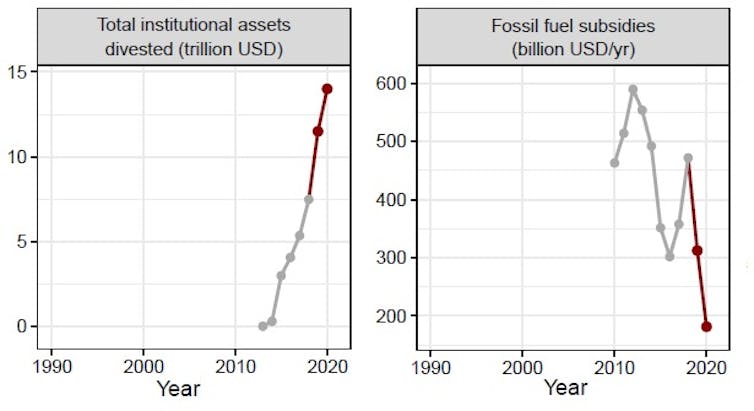
No, thankfully. Fossil fuel divestment and fossil fuel subsidies have improved in record-setting ways, potentially signalling an economic shift to a renewable energy future.

The graph on the left shows an increase in fossil fuel divestment by 1,117 organisations based on data from 350.org, and the graph on the right shows a decrease in subsidies for fossil fuels based on the International Energy Agency subsidies database. The red lines show changes since our original publication in 2019.

However, most of the other vital signs reflect the consequences of the so far unrelenting “business as usual” approach to climate change policy worldwide.

Especially troubling is the unprecedented surge in climate-related disasters since 2019. This includes devastating flash floods in the South Kalimantan province of Indonesia, record heatwaves in the southwestern United States, extraordinary storms in India and, of course, the 2019-2020 megafires in Australia.

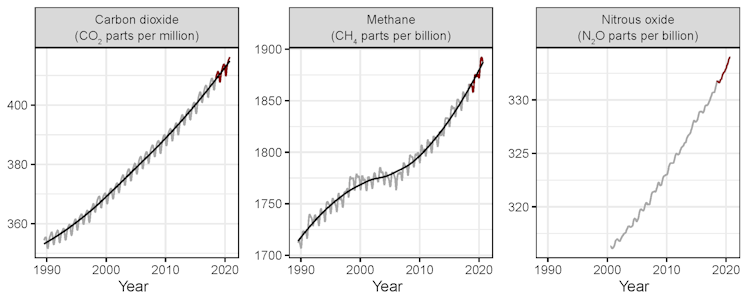
In addition, three main greenhouse gases — carbon dioxide, methane and nitrous oxide — set records for atmospheric concentrations in 2020 and again in 2021. In April this year, carbon dioxide concentration reached 416 parts per million, the highest monthly global average concentration ever recorded.

Time series of three climate-related responses. The red lines show changes since our original publication in 2019.

Last year was also the second hottest year in recorded history, with the five hottest years on record all occurring since 2015.

Ruminant livestock — cattle, buffalo, sheep, and goats — now number more than 4 billion, and their total mass is more than that of all humans and wild mammals combined. This is a problem because these animals are responsible for impacting biodiversity, releasing huge amounts of methane emissions, and land continues to be cleared to make room for them.

There are now more than 4 billion livestock on Earth.
Flickr

In better news, recent per capita meat production declined by about 5.7% (2.9 kilograms per person) between 2018 and 2020. But this is likely because of an outbreak of African swine fever in China that reduced the pork supply, and possibly also as one of the impacts of the pandemic.

Tragically, Brazilian Amazon annual forest loss rates increased in both 2019 and 2020. It reached a 12-year high of 1.11 million hectares deforested in 2020.

Ocean acidification is also near an all-time record. Together with heat stress from warming waters, acidification threatens the coral reefs that more than half a billion people depend on for food, tourism dollars and storm surge protection.

Map of land-ocean temperature index anomaly in June, relative to the 1951-1980 baseline.
Oregon State/NASA

What about the pandemic?

With its myriad economic interruptions, the COVID-19 pandemic had the side effect of providing some climate relief, but only of the ephemeral variety.

For example, fossil-fuel consumption has gone down since 2019 as did airline travel levels.

But all of these are expected to significantly rise as the economy reopens. While global gross domestic product dropped by 3.6% in 2020, it is projected to rebound to an all-time high.

So, a major lesson of the pandemic is that even when fossil-fuel consumption and transportation sharply decrease, it’s still insufficient to tackle climate change.

There is growing evidence we’re getting close to or have already gone beyond tipping points associated with important parts of the Earth system, including warm-water coral reefs, the Amazon rainforest and the West Antarctic and Greenland ice sheets.

Warming waters are threatening West Antarctic and Greenland ice sheets.
Flickr

OK, so what do we do about it?

In our 2019 paper, we urged six critical and interrelated steps governments — and the rest of humanity — can take to lessen the worst effects of climate change:

  1. prioritise energy efficiency, and replace fossil fuels with low-carbon renewable energy

  2. reduce emissions of short-lived pollutants such as methane and soot

  3. curb land clearing to protect and restore the Earth’s ecosystems

  4. reduce our meat consumption

  5. move away from unsustainable ideas of ever-increasing economic and resource consumption

  6. stabilise and, ideally, gradually reduce human populations while improving human well-being especially by educating girls and women globally.

These solutions still apply. But in our updated 2021 paper, we go further, highlighting the potential for a three-pronged approach for near-term policy:

  1. a globally implemented carbon price

  2. a phase-out and eventual ban of fossil fuels

  3. strategic environmental reserves to safeguard and restore natural carbon sinks and biodiversity.

A global price for carbon needs to be high enough to induce decarbonisation across industry.

And our suggestion to create strategic environmental reserves, such as forests and wetlands, reflects the need to stop treating the climate emergency as a stand-alone issue.

By stopping the unsustainable exploitation of natural habitats through, for example, creeping urbanisation, and land degradation for mining, agriculture and forestry, we can reduce animal-borne disease risks, protect carbon stocks and conserve biodiversity — all at the same time.

A kangaroo in burnt bushland
There has been a worrying number of disasters since 2019, including Australia’s megafires.
Shutterstock

Is this actually possible?

Yes, and many opportunities still exist to shift pandemic-related financial support measures into climate friendly activities. Currently, only 17% of such funds had been allocated that way worldwide, as of early March 2021. This percentage could be lifted with serious coordinated, global commitment.

Greening the economy could also address the longer term need for major transformative change to reduce emissions and, more broadly, the over-exploitation of the planet.

Our planetary vital signs make it clear we need urgent action to address climate change. With new commitments getting made by governments all over the world, we hope to see the curves in our graphs changing in the right directions soon.


Read more:
11,000 scientists warn: climate change isn’t just about temperature


The Conversation

Thomas Newsome is a member of the Australian Mammal Society and Ecological Society of Australia, is on the Council of the Royal Zoological Society of NSW, and is acting President of the Australasian Wildlife Management Society. No funding beyond support from The University of Sydney (employer) was provided specifically for this work.

Christopher Wolf and William Ripple do not work for, consult, own shares in or receive funding from any company or organisation that would benefit from this article, and have disclosed no relevant affiliations beyond their academic appointment.

ref. More livestock, more carbon dioxide, less ice: the world’s climate change progress since 2019 is (mostly) bad news – https://theconversation.com/more-livestock-more-carbon-dioxide-less-ice-the-worlds-climate-change-progress-since-2019-is-mostly-bad-news-165168

1981 Springbok tour protests revisited – and now Palestine is the new struggle

Asia Pacific Report newsdesk

After his release from prison in South Africa and he became inaugural president of the majority rule government with the abolition of apartheid, Nelson Mandela declared in a speech in 1997: “We know too well that our freedom is incomplete without the freedom of the Palestinians.”

Founding Halt All Racist Tours (HART) leader John Minto invoked these words again several times in Hamilton on Sunday as veterans and supporters of the 1981 Springbok Rugby Tour anti-apartheid protests gathered to mark the 40th anniversary of the historic events.

Starting at the “1981” tour retrospective exhibition at the Hamilton Museum – Te Whare Taonga o Waikato, the protesters gathered for a luncheon at Anglican Action and then staged a ceremonial march to FMG Stadium – known back then as Rugby Park – where they had famously breached the perimeter fence and invaded the pitch.

The exhibition features photographs by Geoffrey Short, Kees Sprengers and John Mercer of that day on 25 July 1981 when about 2000 protesters halted the second match of the tour.

“The Kirikiriroa protests were the outcome of months of planning, counter-planning and public discontent,” said curator Nadia Gush.

“1981 documents a period of unrest, with New Zealanders of all ages expressing their solidarity with marginalised black South Africans.”

Hamilton Springbok protest march 2021
The 1981 anti-apartheid protest march reenactment from Hamilton’s Garden Place to Rugby Park (FMG Stadium Waikato) on 25 July 2021. Image: David Robie/APR


PSNA’s John Minto talks about the ongoing apartheid struggle over Palestine. Video: David Robie/APR

Their courage and determination led to a tense stand-off in the middle of the park with about 500 protesters huddled together with linked arms and defiantly facing both police squads and a 30,000 crowd baying for their blood.

Match called off
The match was called off by the authorities – interrupting the first ever live broadcast of a South African rugby match from New Zealand. And this triggered unprecedented violent scenes when rugby enthusiasts attacked protesters.

“Amandla Ngawethu!” – “power to the people!” (the cry of the African National Congress) – chanted John Minto, who has lost none of his powerful protest voice, amplified by a megaphone, as the crowd left Garden Place 40 years on.

“Remember racism… Remember Soweto… Remember Mandela,” came other cries from march marshals.

And a fresh addition this time was “Remember Palestine … Remember Gaza. … Freedom for Palestine” in recognition of the new struggle over Israeli apartheid in the Palestinian Occupied Territories and Gaza under military siege.

John Minto and Nelson Mandela
“Remember Mandela” … John Minto talking about apartheid at the FMG Stadium Waikato, formerly Hamilton’s Rugby Park. Image: David Robie

Marchers were decidedly much slower than in the original protest four decades ago and a cloudburst dampened the straggling ex-protesters. However, they were revived by the sight of a Tristram Street mural at the stadium devoted to the Springbok tour and the cancellation of the game.

Among the stragglers was Invercargill mayor Sir Tim Shadbolt who described the protests against 1981 Springbok Tour as an important historical event for Aotearoa New Zealand.

“I’ll remember those days for the rest of my life,” Shadbolt told Stuff reporter Aaron Leaman.

‘Victory for better NZ’
“It was a victory in a way and changed New Zealand for the better.”

John Miller and Nelson Mandela
Protest photographer John Miller with tour images of his, including a photo of President Nelson Mandela when he visited New Zealand in 1995. Image: David Robie/APR

Stuff also quoted Angeline Greensill, who along with her mother, the late Eva Rickard, was among the group of anti-tour protesters who made their way onto the pitch at Rugby Park.

Standing up to the “icon of rugby” took courage, Greensill said.

The group passed around three sides of the stadium in the rain as Minto pointed out the “safe house” across the road – “opened up by a courageous man, Dr Anthony Rogers” – where he, Mike Law, Dick Cuthbert and many others were bashed by rugby supporters. A makeshift ambulance driving injured people to hospital was also attacked.

Twenty three people were treated for injuries in Waikato Hospital and police arrested 73 people.

1981 Hamilton Springbok tour protest Patu!
Then, 1981 … the protester huddle in the middle of Hamilton’s Rugby Park. Image: Screenshot from Merata Mita’s documentary Patu!
Police at Hamilton's Rugby Park
Then, 1981 … police position themselves for the baton charge order against protesters that never came at Hamilton’s Rugby Park. Image: David Robie of stadium historical display/APR

Minto praised the Waikato Rugby Union for recognising this vital event in New Zealand history.

Then the entourage moved into the stadium’s Bronze Room for speeches and sharing of memories of that fateful day.

Cheered loudly
They cheered loudly as they marked 3.10pm – the exact time that the match between the touring Boks and Waikato had been called off.

Speakers, including Minto, spoke about both apartheid and the 1981 Springbok tour and 70 years of apartheid and Israeli oppression in Palestinian.

FMG Stadium
Now, 2021 … FMG Stadium Waikato … renamed from Rugby Park. Image: David Robie/APR

Speakers, including Minto, spoke about both apartheid and the 1981 Springbok tour and 70 years of apartheid and Israeli oppression in Palestinian.

“Both Nelson Mandela and Bishop Desmond Tutu said, ‘Our freedom in South Africa will not be complete without the freedom of the Palestinians’,” declared Minto.

“It’s unfinished business.”

“This is the new anti-apartheid struggle,” added Minto, who is also national chair of the Palestine Solidarity Network Aotearoa (PSN). He challenged participants to join him in this ongoing campaign.

NZ petition to close Israeli embassy
A Palestinian child writes on a “Call it apartheid and boycott” petition to Prime Minister Jacinda Ardern asking her to close the Israeli embassy, saying: “Dr Jasenda (sic), save Palestine and ignore Israel. From Khaled, 7 years old.” Image: David Robie/APR
Print Friendly, PDF & Email

Article by AsiaPacificReport.nz

Census 2021 is almost here — what’s changed since #censusfail? What’s at stake in this pandemic survey?

Source: The Conversation (Au and NZ) – By Liz Allen, Demographer, ANU Centre for Social Research and Methods, Australian National University

David Crosling/AAP

Australian households will begin receiving instructions on how to fill out the 2021 census from early August.

The Census of Population and Housing is held every five years in Australia — and counts every person and household in Australia. But this is the first time the count will be held during a global pandemic amid lockdowns and rising health and economic impacts of COVID-19.

Census data are crucial to what we know about Australia: who lives here, and how and where people live. Data from census informs vital services and infrastructure including, education, healthcare, transport, and welfare.

Census 2021

August 10 is the official census date, but things will be done a little differently in 2021. This year, Australia’s 10 million households will receive census login information or hard copy forms in the mail from next week.

The Australian Bureau of Statistics is encouraging people to complete the census as soon as they receive their instructions, if they know where they’ll be on August 10. In previous years you had to fill in your form on census night.

The 2016 ‘fail’

Australia’s last census was associated with great controversy stemming from the “digital-first” strategy (where the majority of Australians would do the census online for the first time) and bureau plans to keep names and addresses for up to four years, to boost anonymous links with other data.

This was accompanied by federal politicians saying they would refuse to put their names on the census, citing privacy concerns, and a campaign to deface census forms.

A screen shot of a blocked census form in 2016.
The #censusfail in 2016 was a huge embarrassment for the federal government.
Joel Carrett/AAP

Then came #censusfail.

Distributed denial of service attacks on census night saw the online questionnaire platform shut down and remain offline for nearly two days.

While data quality was not compromised, it was nevertheless a huge embarrassment for the bureau and the Turnbull government.

What’s changed in terms of set-up?

Lessons have since been learned and these are seen in preparations for Census 2021.

The new window to complete the census, rather than a one-night burst, will help ease online bottlenecks and external threats. It will also reduce pressure on the many Australians in lockdown, juggling paid work and home schooling.

Commuters crowd into Town Hall station in Sydney.
The 2021 Census will collect information about more than 25 million Australians.
Peter Rae/AAP

Neighbourhoods won’t be graced by an army of census workers, this time, either. The bureau is expecting the overwhelming majority of people to complete the census online, with reminders sent out by mail.

So the digital-first strategy that caused such a stir in 2016 was an important trial run for the contactless conditions necessary during a pandemic. Some other countries have postponed their national census programs (like Scotland) and even risked COVID-19 exposure by going ahead regardless (like Indonesia). But Australia’s preparations will enable a vital undertaking to continue safely.

What’s changed in terms of the questions?

According to the bureau, this year will include the “first significant changes to the information collected in the census since 2006”. (Funding cuts since the 2001 have previously prohibited questionnaire refreshes.)


Read more:
Census 2016 reveals Australia is becoming much more diverse – but can we trust the data?


2021 will see new questions about long-term health conditions and defence force service. Sex beyond the binary of male/female will be also collected for the first time for all. These new additions to census have been made possible by the removal of the household internet connection question.

Improvements have also been made to better capture language and ancestry of First Nations Australians.

Census questions still have some way to go to better reflect contemporary Australia. But any changes to the census need to be understood by all.

Sexual orientation and gender identity, living in more than one place, and ethnicity are among improvements identified by demographers and social researchers for Census 2026, for example.

What will we get out of Census 2021?

The census has the power to say much about a nation and how populations are changing. While there will be no specific questions on COVID-19, the data will provide valuable insights into the impacts of the coronavirus on Australians. With the 2016 data now five years old, more up-to-date information is needed to make plans for the future.

With so many people in Australia in lockdown, the census will gauge the economic and social impacts of COVID-19 in a way no other data undertaking has been able to achieve yet. Individuals, communities and economic activities affected by COVID-19 will be reflected.

Census 2021 is no ordinary population survey – it will lay the foundation for Australia’s post-pandemic future by informing the nation’s social and economic recovery, including measuring the success of the vaccination rollout through improved population data. It’s more important than ever that we get this census right.

Results from Census 2021 will become available from June next year.

The future of the census

A number of countries, such as The Netherlands, have moved away from traditional census taking. Instead opting for data compilation performed using routine government data collected through administrative interactions. Like Medicare and Centrelink data being compiled by government for your census submission.

The Australian Statistician David Gruen, has foreshadowed such a possibility for Australia. The United Kingdom is also thinking about it. This approach is a concern as it excludes individuals and communities from a vital participatory undertaking, and the data quality suffers as people can no longer self-report information.


Read more:
In a world awash with data, is the census still relevant?


In its current form, census data is accessible, and contributed to, by all. Australia’s census data enable everyone from researchers, to policymakers, to ordinary individuals the power to hold government to account.
It belongs to all of us.

The Conversation

Liz Allen worked at the Australian Bureau of Statistics (ABS) between 2006 and 2007. Liz has no ongoing employment or financial links with the ABS. Liz is a user of ABS data for research purposes.

ref. Census 2021 is almost here — what’s changed since #censusfail? What’s at stake in this pandemic survey? – https://theconversation.com/census-2021-is-almost-here-whats-changed-since-censusfail-whats-at-stake-in-this-pandemic-survey-164784

Growing evidence suggests Russia’s Sputnik V COVID vaccine is safe and very effective. But questions about the data remain

Source: The Conversation (Au and NZ) – By Megan Steain, Lecturer, School of Medical Sciences, Faculty of Medicine and Health, University of Sydney

Antonio Calanni/AP/AAP

Russia was the first country to register a COVID vaccine, with its health ministry giving emergency approval to the Sputnik V vaccine in August 2020.

This decision was met with scepticism from the international scientific community because it came a month before results of phase 1 and 2 trials were published.

Growing data from clinical trials and real world rollouts suggests the vaccine is safe and very effective. But there are several outstanding questions around the vaccine, such as whether it’s associated with the very rare blood clotting condition seen with AstraZeneca’s vaccine, and how well it performs against variants of the coronavirus.

So what kind of vaccine is Sputnik V, how does it work, and what data are we missing?

How does Sputnik V work?

Sputnik V was designed by The Gamaleya National Research Center for Epidemiology and Microbiology. It has its very own Twitter account advertising its status as the “world’s first registered COVID-19 vaccine” and approval in 69 countries including Russia, South Korea, Argentina and the UAE.

Like the Oxford-AstraZeneca vaccine, the basis for the vaccine is a harmless form of adenovirus, one of several viruses that can cause the common cold.

The adenovirus acts as a packaging system for DNA to deliver instructions to our cells. This DNA instructs cells to make the spike protein from SARS-CoV-2. The immune system is then trained to generate an immune response to the spike protein, which provides protection against the real SARS-CoV-2 virus.

Unlike the other adenovirus-based vaccines, Sputnik V uses two different adenoviruses for the first and second dose. This is done as people can develop an immune response against the adenovirus vector used in the first shot of the vaccine, which could possibly reduce the overall effectiveness.

The two doses are separated by three weeks, rather than the 8-12 weeks usually recommended for the Oxford-AstraZeneca vaccine.

Sputnik V doesn’t require the ultra-cold temperatures like the mRNA-based vaccines, which makes it an attractive candidate for many countries desperate for vaccines. Gamaleya has been open to sharing its manufacturing platform, unlike some other vaccines.

How well does Sputnik V work against COVID-19?

Data from the phase 1 and 2 clinical trial was published in September in the highly reputed medical journal The Lancet. The data showed no major adverse reactions, and side effects that were common to the other COVID-19 vaccines. These were primarily fever, headaches and pain at the injection site.

Most impressively were the results of the larger phase 3 trial published in The Lancet in February this year, which reported 91.6% efficacy against symptomatic infection. This places Sputnik on par with the mRNA vaccines by Pfizer and Moderna, for which the original efficacies were 95% and 94.1% respectively.

The results from the phase 3 trial also suggested a single dose was protective, with an efficacy of 79.4%. This led to the approval of “Sputnik Light” in some countries, a single dose regimen that overcomes some of the issues manufacturing the second dose of Sputnik V. The two different adenoviruses used in the first and second dose of Sputnik V need to be produced using separate cell cultures. Only having to produce a single type of adenovirus streamlines the production.

Outside of these trials, a press release from Gamaleya says real world analysis of the vaccine given to nearly 3.8 million Russians reported an efficacy of 97.6% against infection. This led Gamaleya to claim Sputnik V is “the world’s most effective vaccine”.

Despite the encouraging efficacy results, there are still some concerns. Both the phase 1 and 2 safety trials, and the phase 3 efficacy trials, have been criticised for not sharing their raw data or the full details of their study design, as well as inconsistencies in the published data.

Sputnik V isn’t yet approved by the European Medicines Agency (EMA) or the World Health Organization, meaning it cannot be used by COVAX, the COVID vaccine global access initiative. Gamaleya has yet to provide the EMA with all the necessary manufacturing and clinical data necessary to gain this approval.

What are the unanswered questions about Sputnik V?

There are a number of outstanding issues with the vaccine.

Of particular importance is the question of whether it’s associated with the very rare blood clotting condition that’s been linked to the AstraZeneca and Johnson and Johnson vaccines, which also use adenovirus vectors.

Gamaleya claims there have been no reports of this occurring in individuals given Sputnik V. Analysis following the administration of 2.8 million doses of Sputnik V in Argentina supports this. The results, announced via a press release by the Argentine health ministry, reported no deaths associated with vaccination and showed mostly mild adverse events.

And there was no indication of an association between Sputnik V and this condition in the clinical trials.

However, there hasn’t been enough published real world data to be completely confident researchers would be able to pick up on the condition if it did emerge.

It’s also unclear how well Sputnik performs against the rapidly spreading variants of concern, such as Delta. Some of these variants are partially able to escape from the immune response generated by COVID vaccines.


Read more:
Why is Delta such a worry? It’s more infectious, probably causes more severe disease, and challenges our vaccines


Research published in July examined antibodies in the blood of people vaccinated with Sputnik V to see how it performed against the Alpha, Beta, Gamma and Delta variants. It found there was a reduction in the ability of their antibodies to block infection. It’s unclear how this reduction would impact the vaccine’s effectiveness against hospitalisation and death, as we’re still waiting to see published real world data on this.

We need further studies which directly compare blood samples from people vaccinated with the different vaccines before Sputnik’s claims of being highly effective against variants can be confirmed. We’ll also need to see real world analysis of its effectiveness against variants, such as that performed with Pfizer and AstraZeneca.

The Conversation

Megan Steain receives funding from the Medical Research Future Fund (MRFF).

Jamie Triccas receives funding from Medical Research Future Fund (MRFF) and The National Health and Medical Research Council (NHMRC)

ref. Growing evidence suggests Russia’s Sputnik V COVID vaccine is safe and very effective. But questions about the data remain – https://theconversation.com/growing-evidence-suggests-russias-sputnik-v-covid-vaccine-is-safe-and-very-effective-but-questions-about-the-data-remain-164392

Artificial refuges are a popular stopgap for habitat destruction, but the science isn’t up to scratch

Source: The Conversation (Au and NZ) – By Darcy Watchorn, PhD Candidate, Deakin University

Shutterstock

Wildlife worldwide is facing a housing crisis. When land is cleared for agriculture, mining, and urbanisation, habitats and natural refuges go with it, such as tree hollows, rock piles and large logs.

The ideal solution is to tackle the threats that cause habitat loss. But some refuges take hundreds of years to recover once destroyed, and some may never recover without help. Tree hollows, for example, can take 180 years to develop.

As a result, conservationists have increasingly looked to human-made solutions as a stopgap. That’s where artificial refuges come in.

If the goal of artificial refuges is to replace lost or degraded habitat, then it is important we have a good understanding of how well they perform. Our new research reviewed artificial refuges worldwide — and we found the science underpinning them is often not up to scratch.

What are artificial refuges?

Artificial refuges provide wildlife places to shelter, breed, hibernate, or nest, helping them survive in disturbed environments, whether degraded forests, deserts or urban and agricultural landscapes.

Nest boxes are a commonly used artificial refuge for tree-dwelling animals.
Ed Reinsel/Shutterstock

You’re probably already familiar with some. Nest boxes for birds and mammals are one example found in many urban and rural areas. They provide a substitute for tree hollows when land is cleared.

Other examples include artificial stone cavities used in Norway to provide places for newts to hibernate in urban and agricultural environments, and artificial bark used in the USA to allow bats to roost in the absence of trees. And in France, artificial burrows provide refuge for lizards in lieu of their favoured rabbit burrows.

An artificial burrow created for a burrowing owl.
AZ Outdoor Photography/Shutterstock

But do we know if they work?

Artificial refuges can be highly effective. In central Europe, for example, nest boxes allowed isolated populations of a colourful bird, the hoopoe, to reconnect — boosting the local genetic diversity.

Still, they are far from a sure thing, having at times fallen short of their promise to provide suitable homes for wildlife.


Read more:
DIY habitat: my photos show chainsaw-carved tree hollows make perfect new homes for this mysterious marsupial


One study from Catalonia found 42 soprano pipistrelles (a type of bat) had died from dehydration within wooden bat boxes, due to a lack of ventilation and high sun exposure.

Another study from Australia found artificial burrows for the endangered pygmy blue tongue lizard had a design flaw that forced lizards to enter backwards. This increased their risk of predation from snakes and birds.

And the video below from Czech conservation project Birds Online shows a pine marten (a forest-dwelling mammal) and tree sparrow infiltrating next boxes to steal the eggs of Tengmalm’s owls and common starlings.

The effects of predation should be considered when using artificial refuges.

So why is this happening?

Our research investigated the state of the science regarding artificial refuges worldwide.

We looked at more than 220 studies, and we found they often lacked the rigour to justify their widespread use as a conservation tool. Important factors were often overlooked, such as how temperatures inside artifical refuges compare to natural refuges, and the local abundance of food or predators.

Alarmingly, just under 40% of studies compared artificial refuges to a control, making it impossible to determine the impacts artificial refuges have on the target species, positive or negative.

This is a big problem, because artificial refuges are increasingly incorporated into programs that seek to “offset” habitat destruction. Offsetting involves protecting or creating habitat to compensate for ecological harm caused by land clearing from, for instance, mining or urbanisation.

For example, one project in Australia relied heavily on nest boxes to offset the loss of old, hollow-bearing trees.

But a scientific review of the project showed it to be a failure, due to low rates of uptake by target species (such as the superb parrot) and the rapid deterioration of the nest boxes from falling trees.


Read more:
The plan to protect wildlife displaced by the Hume Highway has failed


The future of artificial refuges

There is little doubt artificial refuges will continue to play a role in confronting Earth’s biodiversity crisis, but their limitations need to be recognised, and the science underpinning them must improve. Our new review points out areas of improvement that spans design, implementation, and monitoring, so take a look if you’re involved in these sorts of projects.

We also urge for more partnerships between ecologists, engineers, designers and the broader community. This is because interdisciplinary collaboration brings together different ways of thinking and helps to shed new light on complex problems.

Some key steps arising from our research which suggest a way forward for artificial refuge science and implementation.
Author provided

It’s clear improving the science around artificial refuges is well worth the investment, as they can give struggling wildlife worldwide a fighting chance against further habitat destruction and climate change.


Read more:
To save these threatened seahorses, we built them 5-star underwater hotels


The Conversation

Darcy Watchorn receives funding from the Hermon Slade Foundation, Parks Victoria, the Conservation and Wildlife Research Trust, the Ecological Society of Australia, the Victorian Environmental Assessment Council, and the Geelong Naturalists Field Club. He is a member of the Ecological Society of Australia and the Society for Conservation Biology Oceania.

Dale Nimmo receives funding from the Australian Research Council, the Department of Environment, Land, Water and Planning, the Department of Biodiversity, Conservation and Attractions, Department of Agriculture, Water and the Environment, the World Wildlife Fund, Consolidated Minerals, the Hermon Slade Foundation, and the National Environmental Science Program (Threatened Species Hub)

Mitchell Cowan receives funding from the Department of Biodiversity, Conservation and Attractions, and Consolidated Minerals.

Tim Doherty receives funding from the Australian Research Council, Hermon Slade Foundation, NSW Environmental Trust, Australian Academy of Science and WWF Australia. He is Chair of the Policy Committee for the Society for Conservation Biology Oceania and a member of the Ecological Society of Australia.

ref. Artificial refuges are a popular stopgap for habitat destruction, but the science isn’t up to scratch – https://theconversation.com/artificial-refuges-are-a-popular-stopgap-for-habitat-destruction-but-the-science-isnt-up-to-scratch-164401

We can put city and country people on more equal footing at uni — the pandemic has shown us how

Source: The Conversation (Au and NZ) – By Robyn Eversole, Professor and Director, RegionxLink, Centre for Social Impact, Swinburne University of Technology

Shutterstock

University study is out of reach for many people in regional Australia. Most of our universities are based in a handful of capital cities. The result is persistent educational inequity between our capital cities and regions.

The COVID-19 pandemic has forced universities to move their activities online. This shift has created challenges for students, but has also temporarily erased the longstanding disparity in university access between cities and regions. Internet connections permitting, regional students have been able to participate on equal footing with their city colleagues.

As universities look to return to campus, the temptation is for city campuses to abandon the video link and rush back to business as usual. Yet this misses a once-in-a-lifetime opportunity to tackle longstanding inequities for regional students. The innovations in online delivery forced on universities by the pandemic now point to ways to permanently improve regional students’ access and experience of tertiary education.

Regional people – the 32% of Australians living outside a capital city – are a recognised equity group in higher education. They are less likely to attend university than their metropolitan counterparts – only one in five Australian university students is from a regional area. And if born in a remote area, they are only one-third as likely to go to university as those born in a major city.


Read more:
New research shows there is still a long way to go in providing equality in education


What obstacles do regional students face?

The educational divide is the result of the multiple barriers to university access that regional students face. Many of their disadvantages relate to the economic, social and cultural costs of moving away from home to study, particularly to a large and distant city.

Students face a raft of changes at once: they must leave family and community behind and fend for themselves in unfamiliar environments. Families must find money for housing and other costs. For “mature age” students who already have families and local commitments, moving away to study is often simply impossible.


Read more:
Four barriers to higher education regional students face – and how to overcome them


Regional university campuses play an important role supporting equitable access to education. These campuses can offer great face-to-face study experiences, but many are small and have limited course options.

And across the width and breadth of Australia, we have few regional campuses. Most regional Australians do not live near a campus.

map of Australia showing locations of university main campuses and other campuses

Universities Australia


Read more:
Why regional universities and communities need targeted help to ride out the coronavirus storm


Online study is often mooted as an alternative, but it often has poorer outcomes than on-campus study. Internet connectivity in regional areas can be a problem, too. And online study can be isolating; new students in particular often need interaction and support to succeed.

To reduce these systemic inequities, we need to do regional education differently.

We’ve had a glimpse of the solutions

In response to the pandemic, many universities have moved coursework and community engagement activities fully online. Lectures, tutorials, seminars, workshops and even graduations have gone on-screen. While not the same as face-to-face interaction, these online engagements have had the unexpected benefit of opening access for those who previously couldn’t participate at all.

Universities have learned to use video conferencing and online platforms in new ways to maximise interactivity for students at a distance. In some cases “hybrid” activities mix face-to-face and digital participation all at once: some participants gather in the room and others join from the screen.


Read more:
Digital learning is real-world learning. That’s why blended on-campus and online study is best


When done well, with good technology and good manners, hybrid interactions are fluid and the hierarchy between “here” and “there” disappears. These hybrid activities suggest a new way to approach the challenge of providing university education across distance.

For the first time, regional students and communities have had access to activities and resources previously available only on capital city campuses. So long as internet connections are reliable, it no longer matters if the student is five kilometres from the city centre or 500.

Now, with universities planning to move back to campuses, we find ourselves at a vital crossroad. To bring campuses back to life, students are being urged back into classrooms. Video links disappear. Expectations of a physical presence on city campuses return.


Read more:
Where are the most disadvantaged parts of Australia? New research shows it’s not just income that matters


A once-in-a-lifetime shot at equitable education

For regional students, this “return to campus” means we risk reverting to inequity as usual. Policymakers and universities must not miss this window of opportunity to reduce longstanding inequities for regional students. We have a chance to retool our approach to make the future of higher education an equitable one.

On a vast lightly populated continent like Australia, there will never be a university campus near every town. Yet university education can be hybrid, multi-sited and inclusive. There can be local places for students to gather and interact, and hybrid classrooms where students can join their preferred course without moving house.

A few towns already host spaces where regional students can enjoy in-person interactions with other students and academics. These also provide free work spaces and fast internet speeds – which students might not have at home. Regional university campuses, country university centres, regional study hubs and even online centres and libraries can provide the infrastructure for a hybrid and multi-sited university presence that includes regional students on equal footing.

Frustrated looking man sits at laptop next to window
Low-speed and unreliable internet connections frustrate many people trying to study online in regional Australia.
Shutterstock


Read more:
Will Australia’s digital divide – fast for the city, slow in the country – ever be bridged?


However, effective hybrid classrooms require buy-in and participation from all sites – including city campuses. There has to be a commitment to investing resources in excellent, interactive digital learning. Local infrastructure and in-person academic support in regional towns need to be strengthened too.

As universities navigate the current landscape of scarcity and uncertainty, there is a real risk regional students will drop off the radar. Before rushing back to business as usual, let’s consider the alternative: equitable access to education, no matter where you live.

The Conversation

Robyn Eversole does not work for, consult, own shares in or receive funding from any company or organisation that would benefit from this article, and has disclosed no relevant affiliations beyond their academic appointment.

ref. We can put city and country people on more equal footing at uni — the pandemic has shown us how – https://theconversation.com/we-can-put-city-and-country-people-on-more-equal-footing-at-uni-the-pandemic-has-shown-us-how-164492

Yes, Naomi Osaka is Japanese. And American. And Haitian

Source: The Conversation (Au and NZ) – By Aoife Wilkinson, PhD candidate, The University of Queensland

Netflix

On Friday, Naomi Osaka lit the cauldron at the 2020 Tokyo Olympics opening ceremony. This honour sent an important message to the world: Osaka represents a diversifying Japan.

Yet, some still question whether she really is Japanese.
The question we should be asking instead is: who is Naomi Osaka, really?

Netflix’s new three-part documentary series attempts to answer this question. Director Garrett Bradley followed the tennis player over two years from her first grand slam win in 2018 to her third in 2020.

The documentary touches on her tennis career, her mental health and her call to change the format of post-match press conferences.

But it also gives viewers a closer look at Osaka finding her voice in the world as a young, mixed-race Japanese Haitian woman.

The difference between nationality and race

In the documentary, Osaka speaks about her decision to renounce her American nationality in 2019. Reflecting on the public’s response to her decision, she felt “people really don’t know the difference between nationality and race”.

She is right when she says there is a difference.

Nationality is a form of legal identification specifying our membership to a nation. Race refers to physical appearances, and is often described as a social construct: not determined by scientific fact, but rather by the social meaning collectively attributed to biological traits. To avoid uncomfortable conversations, some choose to use the word “ethnicity” instead of race, a term used to define groups based on invisible factors like language or customs.

Osaka holding a tennis racquet.
The documentary follows Osaka as she plays tennis, but also as she finds her way as a young woman.
Netflix

Despite the difference in their meanings, race, nationality and ethnicity are deeply interconnected in the ways we discuss identity.

Osaka was born in Japan in 1997 to her Japanese mother and Haitian father. She moved to the United States when she was three and grew up there as a Japanese-American dual national.

During the two years when the documentary was in production, Osaka celebrated her 22nd birthday. According to Japanese Nationality Law, dual Japanese nationals are required to renounce one of their nationalities before they turn 22.

For many, the decision to forfeit one nationality is tricky, uncomfortable and, where possible, avoided by dual nationals only showing their Japanese passport at Japanese airports.

In my research on mixed-race Japanese youth in Australia, participants told me their dual nationality opens up economic and personal opportunities for them to live or work in Japan without the restrictions of a visa.

But perhaps more importantly, the thought of forfeiting their nationality was a great concern for those who saw it as an intrinsic part of their identity.

In the documentary, Osaka says her decision to become a sole Japanese national was an obvious one. “I’ve been playing under the Japanese flag since I was 14”, she says. “It was never even a secret that I was gonna play for Japan for the Olympics.”

But while it was obvious, it wasn’t easy. Some people saw this renouncing of her American citizenship as a decision to forfeit her Black identity:

I don’t choose America and suddenly people are like, “your Black card is revoked”. And it’s like, African American isn’t the only Black, you know?

Despite choosing to become a sole Japanese national, Osaka is both Japanese and Haitian, and holds deep connections to America, Haiti and Japan. The film follows her as she plays for Japan, wears face masks to the US Open in support of the Black Lives Matter movement, and travels with her family to the Osaka Foundation — a school for Haitian children established by her parents.

Navigating identity and expectations

Osaka isn’t the only person facing interrogation into their identity.

Many people of mixed-race heritage often have a sense of “racial impostor syndrome”: the sense of doubt they feel when others question the authenticity of their mixed-race background.

It is common for young persons of Japanese background living outside of Japan to only be beginner to intermediate speakers of Japanese. Speaking about her self-confessed “broken” Japanese skills, Osaka worries she is “doing something wrong by not representing the half Black, half-Japanese kids well.”

But Osaka’s openness about these difficulties is exactly how the half Black, half Japanese kids need to be represented.


Read more:
When Naomi Osaka talks, we should listen. Athletes are not commodities, nor are they super human


It is important for us to challenge static ideas of race, ethnicity and nationality by sharing the voices of people of mixed backgrounds like Osaka.

Our identities are complex, and they change over time. There is more to being Japanese than fluently speaking the Japanese language, looking Japanese or holding a Japanese passport.

We shouldn’t forget who Naomi Osaka is. A strong tennis player, a passionate activist, and a mixed-race woman who represents contemporary Japan.

The Conversation

Aoife Wilkinson receives PhD scholarship funding through University of Queensland and Department of Education (RTP).

ref. Yes, Naomi Osaka is Japanese. And American. And Haitian – https://theconversation.com/yes-naomi-osaka-is-japanese-and-american-and-haitian-165011

Aggressive marketing has driven the rise of the double-cab ute on New Zealand streets — time to hit the brakes?

Source: The Conversation (Au and NZ) – By Kirsty Wild, Senior Research Fellow, Public Health, University of Auckland

www.shutterstock.com

“Explore your inner beast.” That was the slogan used last year to sell the Ford Ranger. At 2.4 tonnes, that’s a lot of “light” truck, but the stakes are rising. This year, the 3.5 tonne Ram 1500 “eats utes for breakfast”.

Super-sized light trucks have landed in Aotearoa New Zealand. Eight out of the ten top-selling passenger vehicles are now utes or SUVs, with two-thirds registered for personal use.

According to the Household Travel Survey, many journeys previously made using much smaller cars (such as shopping trips) are now made in these vehicles.

And despite the recent protests from farmers and tradies about the so-called “ute tax”, the double-cab light truck has become very much an urban vehicle.

When we looked at the marketing videos for these vehicles in New Zealand, utes or pickups enjoyed the most “masculine” marketing strategies. Themes of dominance and violence are strong: vehicles have names like “Raptor” and “Gladiator”, and are referred to as “muscular” and “beasts”.

Much of the advertising involves images of aggressive driving — skidding and jumping, with the vehicle generally shot from below, travelling fast at the camera. SUV marketing is slightly more unisex and emphasises safety, luxury and envy.

Trucks versus cars

But here’s the problem: climate change is also super-sizing, as the recent extreme heat wave in the Pacific Northwest of the US and Canada and severe floods in Europe and elsewhere have reminded us.

Light trucks on city streets are bad for the climate in two ways. Due to their weight and size, they emit more CO₂ than other vehicles: in a year’s typical driving, 100 Ford Rangers would emit 90 tonnes more CO₂ than the same number of Toyota Corollas.

And large vehicles affect the urgent shift to low-carbon modes of transport, by obstructing footpaths because they’ve outgrown car parking, making cycling and walking more difficult and dangerous.

Cyclists and pedestrians struck by one of these vehicles are roughly twice as likely to die or be seriously injured compared with a crash involving a small car.

Nature as marketing tool

Ironically (but deliberately), nature and the ability to connect with the countryside are an enduring marketing theme for selling large four-wheel-drive vehicles to urban dwellers.

As cultural historian William Rollins has pointed out, SUV marketing has exploited and twisted a “developing environmental consciousness” into demand for high-emission vehicles. In the process, time needed to develop cleaner vehicles was lost.


Read more:
Nature is a public good. A plan to save it using private markets doesn’t pass muster


In New Zealand, the shift to larger SUVs and utes has largely wiped out the fuel efficiency gains made over the past ten years. Globally, the SUV market was the only industry sector last year where CO₂ emissions continued to rise despite the pandemic.

The growth in SUV sales has been identified as the second-most-important reason why CO₂ is continuing to rise.

Not a new story

But this isn’t a new story. Detroit auto journalist Keith Bradsher’s 2002 book, High and Mighty: SUVs – the world’s most dangerous vehicles and how they got that way, documents the now familiar risks: high emissions, deadly to other drivers and pedestrians, and prone to fatal “rollovers”.

He also provides an extraordinary ethnography of the advertising strategy that formed around these vehicles — some of which now rival the size of a WWII tank.


Read more:
Extinction Rebellion’s car-free streets showcase the possibility of a beautiful, safe and green future


Marketed at our “reptilian” instincts for safety, dominance and connection to the natural world, it had a strong Hobbesian flavour. Life – particularly city life – is nasty, brutish and short. One must dominate or be dominated, even on that trek to the supermarket in search of cat food.

Bradsher’s interviews with marketing executives revealed a deliberate strategy to market these vehicles to consumers with higher levels of egotism, insecurity and status anxiety. New Zealand research with SUV drivers has also shown they were more likely to agree with the statement that “most people would like a vehicle like mine”.

Auto industry goldmine

New Zealand has been a dream market for urban light trucks. With weak emission standards and vehicle safety ratings that prioritise drivers over other road users, the regulatory frameworks have created an environment ripe for vehicle super-sizing.

This, too, is a familiar story. The American pickup famously came about as a result of a trade war with Europe that locked foreign competitors out of the US market. The all-American pickup truck came to enjoy a range of exemptions from environmental and safety regulations.


Read more:
How the Ford F-150 became king of cars


Since then they’ve been a gold mine, with profits on SUVs and utes much higher than on cars, and the auto marketing machine swinging in heavily behind these vehicles.

Around 85% of Ford’s ad spend is now devoted to SUVs and utes. The US$35 billion global auto marketing industry is now largely focused on selling them, including into emerging markets in India and Brazil.

Change is coming

Big-budget marketing campaigns for these high-emission vehicles are now becoming a flashpoint over the role of the advertising sector in climate change.

UK organisation Badvertising, which has called for an ad ban on the dirtiest third of these vehicles, argues advertising should be “named and shamed” like other industries that indirectly contribute to climate change (such as banking and investment).

But the advertising industry itself may be part of the solution. Creatives working with governments on ambitious decarbonisation targets are speaking up about the “tide of misinformation” they face from corporate advertising.


Read more:
Mass-market electric pickup trucks and SUVs are on the way


While marketing spends may still be weighted heavily in favour of the auto industry, there are ways of promoting smaller, cleaner, safer vehicles:

  • make planetary health warnings compulsory in all advertising of high-emission products

  • ban the marketing of the dirtiest third of those vehicles

  • bring forward New Zealand’s import ban on those same vehicles from 2035 to 2025

  • establish low-emission zones in cities

  • ban marketing of diesel vehicles that don’t meet latest European emission standards.

And finally, a big one: adopt new advertising codes of ethics to end the promotion of high-carbon lifestyles and products.


Mia Wisniewski, Master of Public Health candidate at the University of Auckland, contributed to the research for this article. Analysis of SUV/ute advertising themes in New Zealand was undertaken as part of her MPH thesis.

The Conversation

Kirsty Wild is a member of Women in Urbanism Aotearoa, and has received funding from Waka Kotahi, Auckland Transport, and MBIE.

Alistair Woodward receives funding from the Health Research Council and the Ministry for the Environment for research on climate change and health. He is affiliated with Bike Auckland.

ref. Aggressive marketing has driven the rise of the double-cab ute on New Zealand streets — time to hit the brakes? – https://theconversation.com/aggressive-marketing-has-driven-the-rise-of-the-double-cab-ute-on-new-zealand-streets-time-to-hit-the-brakes-165075

Whipping cream canisters have many uses beyond ‘nangs’. Banning them isn’t necessary

Source: The Conversation (Au and NZ) – By Stephen Bright, Senior Lecturer of Addiction, Edith Cowan University

Shutterstock

Australia’s Therapeutic Goods Administration (TGA) has been considering whether whipping cream canisters containing nitrous oxide should be placed in Schedule 10 of the Poisons Standard.

Schedule 10 is the most restrictive category within the Poisons Standard, reserved for “substances of such danger to health as to warrant prohibition of sale, supply and use”.

The canisters contain nitrous oxide, which, when mixed with cream in a whipping cream dispenser, creates high-quality whipped cream. This method is used by bakers and chefs worldwide.

There’s no evidence whipping cream canisters pose any risk to people who use them for their intended purpose.

So why has an application been made to the TGA to prohibit whipping cream canisters?

While the applicant hasn’t been named, the proposal is based on increasing concern about people using the canisters to get high.


Read more:
Explainer: what is nitrous oxide (or nangs) and how dangerous is it?


Is nitrous oxide harmful?

Nitrous oxide has been used in medicine and dentistry as an analgesic (a drug which relieves pain) and anaesthetic since it was first found to assist with the extraction of a tooth in 1844.

Commonly referred to as “laughing gas”, nitrous oxide continues to be used in clinical environments in Australia as a Schedule 4 Medicine.

However, no drug is risk-free. There are some harms associated with the recreational use of nitrous oxide (sometimes called “nangs”).

For example, there’s evidence regular heavy use of nitrous oxide can lead to a deficiency in vitamin B12 resulting in peripheral neuropathy. Peripheral neuropathy can be caused by a range of toxins and nutritional deficiencies. Symptoms include unexplained pain, burning and numbness.

In unpublished data submitted to the TGA, 6% of almost 1,900 young Australians who reported nitrous oxide use (surveyed in 2018-2019) reported persistent numbness or tingling, consistent with peripheral neuropathy.

A large global study of people who reported nitrous oxide use found persistent numbness/tingling in the hands or feet was rare (3%) and heavily dependent on dose.

There have also been reports of misadventure resulting in death following its use.

A woman receives nitrous oxide for pain relief during labour.
Nitrous oxide is often used in medical settings.
Shutterstock

Some numbers

The 2019 National Drug Strategy Household Survey found roughly 1.7% of Australians had used inhalants in the previous 12 months. But this survey doesn’t specify which inhalants are used, so this number is likely to include many different inhalants, not just nitrous oxide.

The National Drug and Alcohol Research Centre has interviewed people who regularly use MDMA and psychostimulants annually for nearly 20 years to understand more about the drug use habits of this group.

Around one-quarter reported nitrous oxide use from 2003 to 2015. But this proportion doubled to 50% by 2018, and has remained at a similar level in 2020 (54%).

It’s important to note people who use nitrous oxide do so infrequently (on average less than once per month).

As use of nitrous oxide has increased among certain groups, we’ve also seen indications of increased rates of harm. For example, in New South Wales, emergency department presentations associated with nitrous nitrous oxide increased from ten cases per year in 2016 to 60 cases in 2018.


Read more:
Weekly Dose: from laughing parties to whipped cream, nitrous oxide’s on the rise as a recreational drug


A proportional response?

If the TGA was to make whipping cream canisters Schedule 10 under the Poisons Standard, these products would become prohibited in Australia.

Australian bakers and chefs could be forced to use carbon dioxide canisters, which are sold for Soda Stream machines. But use of carbon dioxide canisters has been reported to result in whipped cream that tastes acidic. It also creates large bubbles in the cream due to the different properties of the two chemicals.

We believe it’s unlikely the TGA will classify whipping cream canisters as being of such danger to health that their sale, supply and use becomes prohibited.

However, the TGA could make whipping cream canisters a Schedule 7 Dangerous Poison. This would mean culinary aficionados could be required to obtain a license to access whipping cream canisters from a limited number of suppliers licensed to sell them. We believe this would also be a disproportionate response.

There’s some evidence that when a drug becomes harder to access, people will substitute that drug with a more harmful drug. Making whipping cream canisters Schedule 7 or Schedule 10 could lead young people to use volatile substances more harmful than nitrous oxide instead (for example, spray paint, deodorant or petrol) since these are likely to be more accessible.

A person preparing tarts with whipped cream on top.
Nitrous oxide is used to make whipped cream.
Shutterstock

We’ve made submissions to the TGA arguing classifying whipping cream canisters as Schedule 10 in the Poisons Standard would be a disproportionate response to the harms associated with their use as a recreational drug.

Given they’re widely used by Australian bakers and chefs, we suggested the most pragmatic solution would be for the TGA to place the products in Schedule 5 or 6 of the Poisons Standard.

If the TGA was to list these products in Schedule 5, they would be required to contain warnings on the labelling. If they were placed in Schedule 6, similar restrictions to spray paint would apply, where retailers are required to limit access to the products to minors.

Next steps

The TGA is set to announce its interim decision on this proposal any day now.

The evidence indicates a minority of people, predominantly those who use nitrous oxide at very high doses, are at risk of developing serious neurological problems.

We should be raising community awareness of this risk as we carefully consider the consequences of tighter restrictions on the availability of a product which is generally safe, if used as directed.

The Conversation

Stephen Bright is a Director of the not-for-profit company Psychedelic Science In Medicine & Research (PRISM) and a Director of the not-for-profit organisation Students for Sensible Drug Policy.

Monica Barratt receives (or has recently received) funding from Australian (National Health and Medical Research Council, the Australian Institute of Criminology, the National Centre for Clinical Research into Emerging Drugs) and international (US National Institutes of Health, NZ Marsden Fund) sources. She has conducted commissioned research for the NSW Coroner’s Office, the WA Mental Health Commission and the Victorian Department of Health. In addition to her role at RMIT, Monica is a visiting fellow at the National Drug and Alcohol Research Centre, UNSW Sydney. She is an editor for two peer-reviewed journals, the International Journal of Drug Policy and Drug and Alcohol Review. She also has leadership roles at two not-for-profit harm-reduction organisations: The Loop Australia and Bluelight.org.

ref. Whipping cream canisters have many uses beyond ‘nangs’. Banning them isn’t necessary – https://theconversation.com/whipping-cream-canisters-have-many-uses-beyond-nangs-banning-them-isnt-necessary-164870

What’s in the CPI and what does it actually measure?

Source: The Conversation (Au and NZ) – By Peter Martin, Visiting Fellow, Crawford School of Public Policy, Australian National University

Nils Versemann/Shutterstock

So you don’t believe the official inflation figures. Why would you? They show prices climbing at an annual rate of 1.1%

On Wednesday the update for June quarter is likely to show prices climbing at an annual rate three times as high — somewhere between 3% and 4%, which will probably be another reason you won’t believe them.

(As it happens, most of the “jump” will be because of a different starting point. The 1.1% figure reports what happened after the three months to March 2020. The update will report what’s happened since the three months to June 2020, when coronavirus restrictions triggered a plunge in petrol prices and a temporary childcare subsidy cut the price of most care to zero.)

Most of us don’t believe 1.1% or anything like it because it doesn’t accord with our experience. We see petrol prices climbing. We are presented with bills for electricity, gas and rates we find hard to pay.

But here’s the thing. As hard to believe as we find it, electricity, gas and petrol don’t cost us that much over the course of a year.

Petrol prices command attention.
michaket/Shutterstock

We notice petrol prices because they are displayed clearly on well-lit signs of a specified size, as is required by law. We notice electricity bills because they are large and usually arrive only four times each year.

And because we don’t like them. We pay less attention to spending we like.

Every few years the Bureau of Statistics surveys 10,000 households to determine what they spent over the course of a fortnight, and for less frequent expenses over the course of a year.

It uses what results to create a “basket” of representative goods and services, weighted according to actual expenditure.

Food accounts for the bulk of the basket — 17.3%. Alcohol accounts for another 5.3%. That’s right, 5.3%.

Compare the 5.3% of the basket we spend on alcohol to the 3.2% of it we spend on petrol, or the 3.8% on electricity and gas taken together.

Alcohol and food big ticket items

We spend almost as much on alcohol as on health, and more than on clothes.

If you reckon that’s not your household, fair enough. The basket represents the average household, as does the consumer price index (CPI) which measures the prices of the goods and services in the basket in the proportions they are in the basket.

And if your reckon you’d never admit to spending that much on alcohol, you’re also right. Alcohol and tobacco are two of the rare instances where the bureau nudges up what people report to take account of what’s actually sold.


Made with Flourish

Contrary to a widely-believed myth, the cost of housing is in the index, both in the form of rents and in the cost of building houses, rather than the cost of land (that’s regarded as an investment, as is the ownership of shares which are also not included in the index).

Most things included, though not illegal drugs

Some things aren’t the index but should be — superannuation management fees (the bureau is working on it) and recreational drugs and prostitution, which are excluded because it is “very difficult and indeed dangerous to obtain estimates of prices and expenditures, or to measure quality change”.

Shrinkage makes comparisons difficult.

Quality matters. When Cadbury shrank its large blocks of chocolate from 250g to 200g a few years back and then to 180g, it wouldn’t have been right to merely record the price change.

The bureau adjusted up the recorded price to take account of the fact that people were getting less chocolate. But other changes are less straightforward. What do you do when VB reduces the strength of its beers (as it did) or the new model laptop has twice as much memory as the one it replaced?

For computers the bureau adjusts down the recorded prices of new models in line with a US formula.

For cars — which these days have features not previously dreamed of — it consults a panel of experts.

For other changes it lets improvements go through to the keeper, leaving recorded prices unadjusted even though they are clearly getting better.

Beneath the hood, the CPI is changing

The bureau used to record prices using handheld devices in supermarkets and by ringing up suppliers and getting quotes. In the last few years it has moved to getting almost everything electronically — stores hand over data from checkout scanners, petrol stations report when prices have changed and upload sales data, and the bureau “scrapes” advertised prices from the web.

With those changes has come a revolution in what it is able to do. It used to collect prices in only a small number of representative outlets (which is why the index was limited to capital cities) and it used to record only the prices of “representative” items.

The stand-in for bread was a sliced white loaf.

The stand-in for bread was the average price of a sliced white 650-750g loaf.

Better still, for the first time the bureau has information on how much is bought of each product at each price each quarter. This enables it make real-time adjustments to weightings in accordance with actual behaviour.

In 2011 when Cyclone Yasi destroyed banana crops in Queensland, the price of “fruit” recorded in the consumer price index surged to an unprecedented high. But the prices actually paid for fruit didn’t surge. Shoppers bought other fruits or canned fruit instead.

Next time that happens the CPI will scarcely move.

It’s making the index more of a cost of living index and less of a “cost of a fixed basket” index. It is happening for petrol too. The bureau is reporting the prices people actually pay, instead of the prices on offer.

None of this is to say that the CPI is perfect, but it would be wise to take the figure to be released on Wednesday seriously. It probably does a better job of recording changes in our cost of living than we’d do ourselves.

The Conversation

Peter Martin does not work for, consult, own shares in or receive funding from any company or organisation that would benefit from this article, and has disclosed no relevant affiliations beyond their academic appointment.

ref. What’s in the CPI and what does it actually measure? – https://theconversation.com/whats-in-the-cpi-and-what-does-it-actually-measure-165162

Public protest or selfish ratbaggery? Why free speech doesn’t give you the right to endanger other people’s health

Source: The Conversation (Au and NZ) – By Hugh Breakey, President, Australian Association for Professional & Applied Ethics. Senior Research Fellow, Moral philosophy, Institute for Ethics, Governance & Law, Law Futures Centre., Griffith University

Thousands of demonstrators took to the streets in major Australian cities at the weekend, to protest the rolling lockdowns that have formed a central part of the government response to the COVID pandemic.

In some cases, the protests were illegal and in breach of lockdown orders. More seriously still, the protests in Sydney took place even as the Delta variant spreads ominously across New South Wales.

Commentators and political leaders called out the protesters, asserting they were “selfish boofheads” engaging in “ratbaggery”.

But what are the ethics of protesting lockdowns in a time of lockdowns? There are several issues to unpack: free speech, science denial, and the health threat the rallies pose to the public. And it’s the last of these three that presents significant ethical problems.

Why should we protect protests?

There are three important arguments in favour of giving people the right to free speech, especially when it takes the form of protesting government policy.

First, free speech is a human right. Article 19 of the United Nations’ Universal Declaration of Human Rights proclaims the respect we are owed as humans includes being able to speak out and share our ideas with others.

Second, speaking out and protesting are important parts of living in a democracy. Just as we must all be allowed to vote, so too should we be free to come together in open and honest debate.

Third, as the philosopher and politician John Stuart Mill famously argued in On Liberty, if we don’t allow dissenting and unpopular views to be heard, we lose the opportunity to challenge and hone our own beliefs.


Read more:
Is protesting during the pandemic an ‘essential’ right that should be protected?


Do wacky and unscientific views also deserve protection?

These three arguments are at their strongest when people are doing their best to think carefully and rationally. In fact, being “endowed with reason” is invoked in the very first article of the Universal Declaration, to support human freedom and dignity. As such, we arguably have a duty to think responsibly, alongside our right to speak freely.

So should views that seem to spurn rationality and scientific evidence be tolerated? There’s good reason to think the answer is still “yes”.

Even if we agree that science provides an extraordinary mechanism for unearthing truths about the world, scientists are still human beings, and their institutions remain vulnerable to mistake, bias, groupthink, corruption and (yes) even conspiracy. Indeed, scientific progress occurs precisely because its findings remain open to challenge, and are rigorously reviewed before they are published.


Read more:
Coronavirus anti-vaxxers aren’t a huge threat yet. How do we keep it that way?


Moreover, public policy is never purely about science. Science can only tell us what is, not what we should do. Justifying lockdowns is also a matter of moral judgements about the importance of life and health, freedom and rights, livelihoods and fairness, and more. Reasonable people can disagree about these matters.

What about when protest is harmful?

The above arguments imply we should be wary of outlawing political protest. But at the same time, they don’t imply speech can’t be limited to prevent harm.

The most ethically worrisome part of the protests in Melbourne and Sydney (apart from specific instances of violence, against both people and animals) was the danger they presented to the community.

By defying lockdown orders, and masking and social-distancing requirements, the marchers created an opportunity for community transmission of COVID. In Sydney, in particular, there is every chance some protesters were infectious with the virus.

Besides risking serious harm to others, further outbreaks might force the NSW government to extend the current lockdown — the polar opposite of what the protesters wanted.

Still, there may be cases in which harmful protests are justified. Many ethicists argued this was true of the Black Lives Matter protests in the United States in the wake of George Floyd’s murder, where the need to respond to racial injustice arguably outweighed the risks of spreading COVID.

Several commentators observed the conceptual whiplash when public health officials who had been decrying lockdown protests suddenly encouraged the Black Lives Matter marches.

Perhaps the difference simply comes down to some grievances being more genuine, informed, and socially important than others. But even if this rightly shapes how we morally judge the protesters in each case, it remains unsettling if official responses and arrests are based on how ethically worthy political leaders think protesters’ grievances are.

Harm, belief, and the rule of law

There is one key difference between the Black Lives Matter protests and Australia’s anti-lockdown protests that is worth considering. At least some of the anti-lockdown protesters seemed to behave as if they were entitled to decide what was or wasn’t harmful to the community at large, and to proceed on that basis. Many of the protesters evidently don’t believe the coronavirus is a serious danger, so they felt free not to worry about spreading it.

But this isn’t how democracy or the rule of law works. Citizens can’t act on their own opinions about the harms they are happy to inflict on others, precisely because we will all have different views on such matters. That’s why we need laws, and democratic processes to create them.

If that’s right, the problem isn’t just that protesters were “selfishly” putting their interests ahead of other people’s. The deeper concern is that they acted as if their beliefs could rightly determine the harms they were willing to visit on others. And that is a much more serious charge.


Read more:
Many anti-lockdown protesters believe the government is illegitimate. Their legal arguments don’t stand up


The Conversation

Hugh Breakey does not work for, consult, own shares in or receive funding from any company or organisation that would benefit from this article, and has disclosed no relevant affiliations beyond their academic appointment.

ref. Public protest or selfish ratbaggery? Why free speech doesn’t give you the right to endanger other people’s health – https://theconversation.com/public-protest-or-selfish-ratbaggery-why-free-speech-doesnt-give-you-the-right-to-endanger-other-peoples-health-165079

Why governments will have to consider the costs of long COVID when easing pandemic restrictions

Source: The Conversation (Au and NZ) – By Richard Meade, Research Fellow in Economics, and in Social Sciences & Public Policy, Auckland University of Technology

www.shutterstock.com

With governments worldwide under pressure to ease pandemic restrictions as vaccination rates rise and impatience with border restrictions grows, new threats become clearer.

One of the costliest, it is now feared, could be a tsunami of “long COVID” cases.

Long COVID is a serious ongoing illness that follows an acute episode of the disease. It is characterised by extreme fatigue, muscle weakness, post-exertional malaise and an inability to concentrate (“brain fog”), among many other symptoms.

The focus, therefore, needs to shift towards protecting quality of life as much as saving lives in the first place.

In the UK it is reported two million people have experienced long COVID. Around 385,000 having suffered symptoms for a year or more.

The nation’s so-called “Freedom Day” on July 19 went ahead despite expert warnings of soaring infections, especially among younger and unvaccinated people. A further 500,000 long COVID cases have been predicted during the current wave of infection.

These numbers far outstrip the already staggering 150,000 deaths attributed to the virus in the UK — and the associated costs will be significant.

Putting a price on long COVID

The social costs of long COVID should not be underestimated. For example, suppose an elderly person contracts COVID-19 and dies, when they might otherwise have lived in full health another five years. A health economist would say their early death has cost society five “quality-adjusted life years” (QALYs).

This is usually expressed as a monetary amount that can then be weighed against the cost of saving that person’s life when deciding on appropriate pandemic protections.

Contrast this with a young person contracting COVID-19 and not dying, but suffering long COVID for 10 years, with their estimated quality of life effectively halved while unwell.


Read more:
Long COVID: with one in three patients back in hospital after three months, where are the treatments?


They too will have lost an estimated five QALYs — the same social cost as the elderly person who died.

This means if we ease pandemic restrictions on the basis that people are no longer dying, we might be facing equally serious social costs from long COVID.

If long COVID is chronic and much more common than death from COVID (as the current data strongly suggest), the costs rise further. If sufferers of long COVID also face shortened lives, having endured years of debilitation and misery, the costs rise again.

Rough first estimates suggest the overall economic cost of long COVID could be almost half the cost of COVID-related deaths in the UK.

For younger people, however, the social costs of long COVID are estimated to far outstrip those of dying, meaning they will carry a disproportionate burden of the pandemic’s long-term costs.

Comparison with chronic fatigue syndrome

Long COVID is often likened to chronic fatigue syndrome (CFS), which is sometimes called ME (for myalgic encephalomyelitis). Both are characterised as a form of “post-viral fatigue syndrome”, with CFS leaving sufferers seriously debilitated and unable to maintain normal lives — often for years, even decades.

While we have no long-term data to gauge how chronic or serious long COVID might be, we should be mindful that it could be as long-lived as CFS.

Furthermore, long COVID is also reported to affect multiple organs in measurable ways, including damage to major organs like the heart and lungs.

Consequently, long COVID could shorten lives, if not end them. This distinguishes it from CFS which – frustratingly, for sufferers wanting to be taken seriously – lacks recognised objective markers.


Read more:
The mystery of ‘long COVID’: up to 1 in 3 people who catch the virus suffer for months. Here’s what we know so far


Protecting quality of life

On a personal note, I suffered CFS for 11 years and recovered in 2004. It emerged after a flu-like illness in 1993, which evolved into a constellation of symptoms that defied explanation or treatment.

Recovery required years off work and, with the care and support of family and friends, patient and determined rebuilding of my ability to lead a normal life.

The condition involved huge personal, social and professional costs. I was unable to maintain a normal life, relationships and work commitments. Constant ill health, with no end in sight, was enormously frustrating and miserable.


Read more:
I went from regular TV commentator on COVID to long COVID sufferer in just a few months


It never helped that medical practitioners were either incredulous or believed I was unwell but had no real solutions to offer.

Like CFS, long COVID is a serious condition that cannot be taken lightly. Even if not fatal, it can still seriously affect the sufferer’s quality of life. Hence, policymakers need to consider the social costs of long COVID when deciding when and how to ease pandemic restrictions.

Our pandemic response will need to be as much about protecting quality of life as it has been about saving lives. We need to take serious steps to keep long COVID at bay.

The Conversation

Richard Meade does not work for, consult, own shares in or receive funding from any company or organisation that would benefit from this article, and has disclosed no relevant affiliations beyond their academic appointment.

ref. Why governments will have to consider the costs of long COVID when easing pandemic restrictions – https://theconversation.com/why-governments-will-have-to-consider-the-costs-of-long-covid-when-easing-pandemic-restrictions-164944

Yarns from the heart: the role of Aboriginal English in Indigenous health communication

Source: The Conversation (Au and NZ) – By Celeste Rodriguez Louro, Senior Lecturer and ARC DECRA Fellow, Discipline of Linguistics, The University of Western Australia

Indigenous Australians experience poorer health outcomes than non-Indigenous Australians. They are sick more often, die younger and are at higher risk of serious health complications, including heart disease.

One way to improve health outcomes is through targeted health communication in local languages.

The COVID-19 pandemic has seen increased attention given to the use of Indigenous languages in health settings around the world, including Australia.

Many COVID-19 resources have been developed in partnership with local communities, including in widely-spoken Australian Aboriginal languages such as Kriol. Other initiatives have inspired new Indigenous health professionals to effectively communicate complex medical terminology and concepts to communities.

A frequent assumption among non-Indigenous people in Australia is that mainstream English media should work well for the almost 80% of Indigenous people in Australia for whom Aboriginal English is their first language.

However, communities that use Aboriginal English as their language in daily interactions require health communication messages in the same language to be meaningful and accessible.


Read more:
We’re not all in this together. Messages about social distancing need the right cultural fit


Exploring how to yarn about health

In the past 18 months, we have been working with the Heart Foundation on the production of two videos about heart health that were fully scripted and produced in Aboriginal English (the first of which can be viewed here).

When we were initially approached, the brief was to create a video in “simple English” to ensure the health message would be available to First Nations communities across Western Australia.

However, Glenys Collard (one of the authors of this piece) says this is not the language of choice for most Aboriginal people:

I never felt the need to want to learn or to speak mainstream Australian English; it didn’t come out my mouth easily. None of the people that I loved or looked up to in my life spoke mainstream Australian English. It didn’t feel right to me to speak differently to the rest of my family and friends. I wouldn’t have been able to truly respectfully represent my people.

Both of the videos we created include a host of features that characterise Aboriginal English: the words “mob”, “fellas”, “crook” and “youse” are only some examples. The videos were also designed to include communication between a group of First Nations people gathered together outdoors. The entire video is presented as a yarn.

The practice of yarning is a form of conversation and storytelling that includes repetition as a way to emphasise what is important in the message. The video features repetition and use of familiar language as a way to warm the audience up to the medical message. These features made it possible to communicate important medical information in a culturally safe way.


Read more:
10 ways Aboriginal Australians made English their own


The work we completed on these videos gave us a unique opportunity to use our experience and linguistic expertise to create materials the community can relate to. We used a yarning style to present messages about attending heart health checks and the potential signs of a heart attack.

The scripting process was slightly different from what it would have been if the script had been written in Australian English. Collaboration, inclusion and Indigenous leadership were essential to its success.

The benefits of this research

We received positive feedback on these videos. To evaluate the success of the project, the Heart Foundation administered a survey to various Indigenous communities across Australia. A consistent comment during this consultation was that the people in the video “talk like us.”

This initiative has created opportunities for Indigenous health professionals to communicate complex terminology to their Indigenous patients in medical consultations. However, these efforts to create culturally and linguistically inclusive resources have not been available for all communities.

Language is fundamental to a sense of identity. Producing a video in Aboriginal English allows First Nations communities to relate to media directly and to feel the messaging is intended for them.

This is especially important during the global pandemic, when some Aboriginal Australians were feeling apprehensive about vaccination.

Organisations wishing to work this way will need to ensure First Nations people with the relevant expertise join the project from the beginning and become fundamental players in the planning and design stages. Organisations must also ensure that remunerated positions are created to complete this important work.

In producing these videos, we hope to have contributed to addressing the lack of Aboriginal English from medical media and to emphasise the importance of collaborative work. Working across cultures on materials the community will relate to is one more way to safeguard Indigenous health and well-being.

The Conversation

Celeste Rodriguez Louro receives funding from the Australian Research Council.

Glenys Dale Collard is affiliated with University of Western Australia and Mallee Aboriginal Corporation.

ref. Yarns from the heart: the role of Aboriginal English in Indigenous health communication – https://theconversation.com/yarns-from-the-heart-the-role-of-aboriginal-english-in-indigenous-health-communication-163892

Ancient brains: a look inside the extraordinary preservation of a 310-million-year-old nervous system

Source: The Conversation (Au and NZ) – By John Paterson, Professor of Earth Sciences, University of New England

Javier Ortega-Hernández, Author provided

Charles Darwin famously discussed the “imperfections” of the geological record in his book On The Origin of Species. He correctly pointed out that unless conditions are just right, it’s unlikely for organisms to be preserved as fossils, even those with bones and shells.

He also said “no organism wholly soft can be preserved”.


Read more:
Guide to the classics: Darwin’s On the Origin of Species


However, after more than a century of fossil hunting since his book was published, we now know the preservation of soft creatures is indeed possible — including some of the most fragile animals, such as jellyfish.

But what about the really delicate anatomy of animals, such as their internal organs? Can they be fossilised too?

Our study, published today in Geology, shows how even the intricate brains of ancient aquatic arthropods (invertebrates with jointed legs) can be preserved in remarkable detail.

The discovery of a 310 million-year-old horseshoe crab in the US, complete with its brain intact, adds to a recent string of fossil finds which have unearthed some of the oldest arthropods with a preserved central nervous system.

The horseshoe crab fossil we document in our study sheds new light on how these fragile organs — typically prone to very rapid decay — can be preserved with such fidelity.

(A) Specimen of the fossil horseshoe crab Euproops danae from Mazon Creek, Illinois, USA, preserved with its brain intact. (B) Close-up of brain, as indicated by box in image (A). (C) Reconstruction of Euproops danae, including the position and anatomy of the brain.
Russell Bicknell

Brain freeze: how to fossilise an arthropod brain

Most of our knowledge of prehistoric arthropod brains has been sourced from two key types of fossil deposit: amber and those of Burgess Shale-type.

Amber is fossilised resin that oozes through tree bark and is known to trap a variety of organisms. The entombed individuals are commonly represented by arthropods such as insects — made famous in the original Jurassic Park movie.

These fossils preserve an incredible amount of anatomical detail, as well as behaviours, mainly because very little decay takes place after the organism is rapidly trapped in the resin.

A centipede and a neighbouring ant suspended in roughly 23 million-year-old Mexican amber.
Greg Edgecombe

Using sophisticated imaging technology on these amber fossils, palaeontologists can study tiny arthropod brains in 3D at minuscule scales. However, the oldest arthropods in amber only extend back to the Triassic Period (around 230 million years ago).

Burgess Shale-type deposits are much older, being Cambrian in age (typically 500 to 520 million years old). They contain an abundance of exceptionally preserved marine arthropods.

These fossils are very important as they represent what are unmistakably some of the oldest animals, and can therefore inform us on their origins and earliest evolutionary history. Their remains are primarily preserved as carbon films in mudstone.

The Cambrian arthropod Chengjiangocaris kunmingensis from China. See the bead-like ventral nerve cord preserved in the fossil (A) and its central position in the reconstruction (B).
Javier Ortega-Hernández

The fossilisation process starts with storm-induced mudflows that sweep up the delicate animals and bury them in the seafloor in low oxygen conditions. Over time, the mud turns to stone and is compressed, leaving the animals pancaked in the rocks.

Many Burgess Shale-type arthropod specimens preserve internal organs, especially the gut. But fewer show parts of the central nervous system, such as the optic nerves, ventral nerve cord or the brain.

Mind-boggling preservation

Our new fossil demonstrates arthropod brains can be preserved in an entirely different way. The specimen of the horseshoe crab, Euproops danae, comes from the world-famous Mazon Creek deposit of Illinois, in the US. Fossils from this deposit are preserved within concretions made of an iron carbonate mineral called siderite.

Some of the Mazon Creek animals, such as the bizarre “Tully Monster”, are entirely soft-bodied. This suggests special conditions must have been in place to preserve them.

We have shown, for the first time, that the Mazon Creek animals were not only moulded by the rapid formation of siderite that entombed their entire bodies, but also that the siderite quickly encased their internal soft tissues before they could decompose.

Notably, the brain of Euproops is replicated by a white-coloured clay mineral called kaolinite. This mineral cast would have formed later within the void left by the brain, long after it had decayed. Without this conspicuous white mineral, we may have never spotted the brain.

A fossil no-brainer

One of the challenges of interpreting ancient arthropod anatomy is the lack of close modern relatives available for comparison. But luckily for us, Euproops can be compared to the four species of living horseshoe crabs.

Even to the untrained eye, a comparison of the fossil’s nervous system with that of a modern horseshoe crab (below) leaves little question that the same structures are found in both species, despite them being separated by 310 million years.

(A) The fossil and (B and C) interpretive drawings of the Euproops danae brain, and (D) the brain of a modern juvenile horseshoe crab, Limulus polyphemus.
(A-C) Russell Bicknell, (D) Steffen Harzsch

The fossil and living nervous systems match up in their arrangements of nerves to the eyes and appendages, and show the same central opening for the oesophagus to pass through.

Uncovering these exceptional specimens gives palaeontologists a rare glimpse into the deep past, enhancing our understanding of the biology and evolution of long-extinct animals. It seems Charles Darwin need not have been so pessimistic about the fossil record after all.


Read more:
Our 500 million-year-old nervous system fossil shines a light on animal evolution


The Conversation

John Paterson receives funding from the Australian Research Council.

Greg Edgecombe receives funding from the Australian Research Council.

Javier Ortega-Hernández receives funding from the National Science Foundation (NSF), and Harvard University.

Robert Gaines receives funding from the US National Science Foundation, the Gordon and Betty Moore Foundation, and Pomona College.

Russell Dean Christopher Bicknell receives funding from the Australian Research Council and the University of New England.

ref. Ancient brains: a look inside the extraordinary preservation of a 310-million-year-old nervous system – https://theconversation.com/ancient-brains-a-look-inside-the-extraordinary-preservation-of-a-310-million-year-old-nervous-system-164321

Fiji opposition MPs pledge not to be silenced, despite arrests over criticism

RNZ Pacific

Fiji’s opposition MPs who were arrested after their criticism of a government land bill say they will not be intimidated or silenced.

Police have since released several leaders of the opposition who were arrested late Sunday.

One of those arrested, the National Federation Party leader Professor Biman Prasad, said he was wanted in relation to his party’s criticism of government moves to amend the iTaukei Land Trust Act in Parliament in recent days.

After two hours of questioning, he was later released, telling RNZ Pacific that it felt like an attack on Fiji’s democracy.

“We don’t blame the police. This is coming from the government. They are using police to oppress the opposition’s political leaders, and that’s not the way democracy works.”

Prasad said the government failed to consult the public properly over the bill, and there are now calls to withdraw it because it is seen as abusing the rights of indigenous landowners.

“We are elected members of Parliament. Our job is to continue to speak and we are not going to be intimidated by such tactics by the government to silence the opposition who have an important contribution to make in the process of any lawmaking in the country.”

Accused of ‘malicious act’
Another leading opposition MP, Lynda Tabuya, was also taken into custody and accused of a “malicious act” by police for her social media posts about the Land Bill.

She said she was accused of a malicious act by police for criticising the government’s moves to push through an indigenous Land Bill.

Critics claim that an amendment removes a protection provided via the iTaukei Land Trust Board which was set up to protect indigenous landowners’ rights.

Tabuya had given a blunt message to Prime Minister Voreqe Bainimarama via social media:

“We are sick and tired of all the bullying and fear mongering. We are sick and tired of all the death and destruction allowed on your watch because of your recklessness,” she said.

“We are sick and tired because you don’t give a damn. You don’t give a damn about iTaukei, you don’t give a damn about human rights.”

Fiji's Prime Minister Frank Bainimarama.
Fiji’s Prime Minister Voreqe Bainimarama … criticised on social media for “not giving a damn about iTaukei”. Image: RNZ/Facebook/Fiji govt

The Fiji government and police have been approached for comment, but there has been no response for an interview.

However, over the weekend – before the arrests were made – Bainimarama did speak out for the first time condemning his opposition leaders on Facebook.

“These are a bunch of urban elite who are nothing but stirrers. Only a few control the show, and they become the gatekeepers of what is right and what is wrong.”

Bainimarama defended the government’s planned amendment to land legislation.

“Even this amendment makes ultimately iTaukei land a lot more attractive. It removes bureaucracy without undermining any of the protections. We should not be concerned about a piddly thing such as this when we should all be happy about it.”

Meanwhile, Acting Police Commissioner, Rusiate Tudravu said his officers were not questioning the politicians for the purpose of intimidation, but as a pro-active means to find out the truth.

He was reported in local media as saying not everyone who was brought in for questioning would be charged.

This article is republished under a community partnership agreement with RNZ.

Print Friendly, PDF & Email

Article by AsiaPacificReport.nz

How the Groundhog Day grind of lockdown scrambles your memory and sense of time

Source: The Conversation (Au and NZ) – By Adam Osth, Senior Lecturer, The University of Melbourne

YouTube

With roughly half of Australia in lockdown at the moment, a common experience is a warped sense of time and poor memory. What day is it? What week is it? Did I go to the supermarket yesterday, or was it the day before? Am I actually in the movie Groundhog Day and experiencing the same day over and over?

While lockdown can have a range of impacts such as anxiety and depression — both of which can impair memory — these aren’t the whole picture. There is increasing theoretical and experimental evidence that suggests both memory and time perception are based on the same underlying principle: a change in your physical and/or mental state.

So it follows that when there is less change, it becomes harder to determine how much time has passed, or to remember what happened and when.

Cognitive scientists are increasingly embracing an elegant theory of memory with profound implications, known as contextual-binding theory. According to this theory, memories are formed by linking what you experience to the context in which it occurred.


Baca juga:
Here’s why memories come flooding back when you visit places from your past


But what is context? Well, everything!

Let’s say an event happens to me: a strange cat walks into my house. I form a memory of this event by linking the cat to the context — in this case, the context includes the physical surroundings (my house) and my mental state (surprise and excitement, because I love cats).

Because my memory has linked all the various aspects of this event together, when I experience a piece of that event (being in the room where I saw the cat, or feeling excited when seeing another cat), it prompts my memory to recall all the other aspects of the event too, triggering a reconstruction in my head of that time a strange cat walked into my house.

Cat sitting on dining room table
Remind you of anything?
Paul Hanaoka/Unsplash, CC BY

But there’s a catch. As we link more and more memories to the same cues, it becomes harder to find a memory with those cues. This is like a Google search – it’s easiest to find what you’re looking for if your search term is unique to that particular thing.

That’s why we often have the best memory for events that occur in different contexts. Imagine you go on holiday and spend an amazing week in the Caribbean. Among your entire lifetime’s memories, relatively few of them happened in the Caribbean, so it’s easy to remember what you did on your holiday.

Lockdown is the exact opposite of this. In lockdown, the events we experience all have more or less the same context. If you’re spending almost all your time in your house, it’s harder to pinpoint individual memories of the things that happened there. It’s like doing a Google search where everything matches your search terms.


Baca juga:
Ah, memories of 2020. Why it’s important to remember our COVID holidays, good or bad


But where does time come in?

Time isn’t something our minds can measure directly. We don’t have clocks or hourglasses in our brains.

Fortunately for us, our minds are very good at constructing concepts we can’t directly measure. Our eyes can’t measure depth directly — instead, we estimate it with the help of cues in our surrounding environment.

So how can we measure how much time has elapsed? We approximate it by evaluating how much has changed between a remembered event and the present moment. When I remember an event, there are things that might be different from the present moment. Was I in a different place? Did I feel different, or look different? The sum total of these changes can produce an estimate of how much time has elapsed between then and now.

This was demonstrated in an intriguing experiment by US psychology researchers Lili Sahakyan and James Smith. Participants learned words in three different lists. Some participants experienced mental context change between each list, whereby they were instructed to think about other things than the previous list. Another group did not experience mental context change, and were instructed simply to keep the previous list in mind.

When there was more context change, memory was better for the words learned in the most recent list. Interestingly, when participants were asked how much time had elapsed since the beginning of the five-minute-long experiment, the “context change” group estimated that the experience was about a minute longer than the group who experienced no context change between lists.

When there was less context change between episodes, which is similar to the conditions of lockdown, subjects had worse memory for the most recent event, and reported that less time had elapsed. Other experiments have demonstrated similar results with changes in physical location..


Baca juga:
Don’t know what day it is or who said what at the last meeting? Blame the coronavirus


So how do we get around this problem and improve our memories? The obvious solution is to create change. Mix up your physical surroundings, or try different exercises or routines on different days to make them more distinct.

And rest assured, your lockdown memory fog is almost certainly temporary. Once lockdown lifts and go back to experiencing events in different places, we will start remembering what day it is again.


Baca juga:
What Groundhog Day (and my time in a monastery) taught me about lockdown


The Conversation

Adam Osth receives funding from the Australian Research Council.

ref. How the Groundhog Day grind of lockdown scrambles your memory and sense of time – https://theconversation.com/how-the-groundhog-day-grind-of-lockdown-scrambles-your-memory-and-sense-of-time-164951

How Australia’s fickleness on COVID vaccines is perpetuating global vaccine inequity

Source: The Conversation (Au and NZ) – By Sarah Joseph, Professor of Human Rights Law, Griffith University

Despite assurances from Prime Minister Scott Morrison that Australia was at “the front of the queue” for COVID-19 vaccines, Australia’s rate of vaccination ranks last in the OECD.

Nevertheless, Australia is still ahead of scores of other nations when it comes to vaccination rates, with many countries in the developing world unlikely to be able to vaccinate significant numbers of their people before 2023.

Global vaccine inequity is a “catastrophic moral failure”, according to the director-general of the World Health Organization, Tedros Adhanom Ghebreyesus.

But we are too focused on our own situation in Australia to realise the damage our fickle approach to vaccines is doing to global vaccine equity. We are also forgetting our human rights obligations to help speed up access to vaccines for all.

South Africa is averaging over 10,000 new cases per day, yet has only fully vaccinated about 4% of its population.
Alet Pretorius/AP

Vaccine access and international human rights law

Australia has international human rights obligations to protect the health and life of its own people. This means taking reasonable steps to prevent COVID-19 infections and mitigate the impact of the virus on Australians, including by acquiring and administering vaccines.

However, Australia also has obligations to the people of other nations to facilitate access to vaccines for all.

These duties are not only about global humanism — there is also a strong global health argument to ensure everyone around the world is vaccinated. As GAVI, one of the organisations leading the global COVAX vaccine initiative, has reminded us, “no one is safe until everyone is safe”.

While large populations remain unvaccinated, variants of concern such as Delta will continue to evolve and may compromise global vaccine protection. Furthermore, global economic and social activity cannot return to anything like normal without extensive COVID-19 vaccination in all nations.

Global vaccine equity makes public health and economic sense for all countries, both rich and poor. Thus, Australia has an obligation — both to those in poorer countries and to its own people — to do what it reasonably can to increase vaccine access all over the world.

Vaccine procurement and hoarding

One of the main reasons for vaccine inequity is the shortage of vaccines. Access is a zero-sum game where one nation’s vaccine supply reduces the availability of doses for others.

The COVAX initiative was established last year to enable global access to COVID-19 vaccines. COVAX’s role is to procure and allocate vaccines with an aim of vaccinating 20% of the people in participating countries by the end of 2021 — a target it is unlikely to reach due to lack of supply. Once the 20% threshold is reached, COVAX intends to distribute its vaccines according to need.


Baca juga:
The best hope for fairly distributing COVID-19 vaccines globally is at risk of failing. Here’s how to save it


Despite COVAX, many nations have pursued their own procurement policies directly with vaccine manufacturers. In April, the UN Committee on Economic, Social and Cultural Rights suggested such “vaccine nationalism” breached countries’ human rights obligations by undermining equitable access to vaccines.

However, the terms of the COVAX facility do not ban such bilateral deals. It is difficult, therefore, to maintain that it must dictate worldwide procurement.

But the hoarding of scarce vaccines does constitute a breach of countries’ obligations to protect global human rights. Indeed, the rights of a country’s own people are harmed by hoarding, as this perpetuates vaccine scarcity and delays the end of the global pandemic for everyone.

In this respect, it is wrong for rich countries to negotiate deals for vaccine booster shots before poorer countries have achieved significant vaccination rates. Tedros, the WHO chief, has rightly condemned this.

Why AstraZeneca hesitancy has an impact beyond our borders

Australia has procured enough AstraZeneca doses to vaccinate the entire country. In addition, we have advance-purchased enough Pfizer and Moderna doses to cover the entire population again, and enough Novavax to do so yet again.

The only vaccine currently available in large amounts in Australia is AstraZeneca because the local biotech company CSL manufactures it, and the government failed to prioritise its other deals last year.

The shifting official advice on AstraZeneca, however, has fuelled hesitancy in Australia, and has had an unintended impact on global vaccine supply, further disadvantaging those in poorer countries.

The AstraZeneca vaccine is safe and highly effective, bearing in mind that almost all medicines entail risks. However, under advice from the Australian Technical Advisory Group on Immunisation (ATAGI), it is not the preferred vaccine for people under 60. Most Australians, including many over 60, are now waiting for Pfizer.

That is not surprising given the ATAGI advice, and the messaging from the federal government and some state governments, together with negative inputs from many medical professionals and the media.

This has induced an exaggerated perception of the risk of blood clots caused by the vaccine. The reputation of the AstraZeneca vaccine has been wrongly and perhaps irreparably tarnished here.

The ATAGI advice has been influenced by Australia’s low COVID infection rate. And it has now changed its advice for all adults in NSW, given the state’s large outbreak at the moment.

ATAGI has faithfully fulfilled its mandate of assessing risks on an individual basis, but that mandate is not entirely suitable for a pandemic affecting all of society. The advice does not seem to account for the societal benefits for all — health, social and economic — of a more rapid vaccination rollout with an overwhelmingly safe and effective vaccine.

Unsurprisingly, ATAGI took no account of the impact of Australia’s AstraZeneca hesitancy on global vaccine access. Yet, Australia is now rapidly commandeering more Pfizer doses as a result, which is pushing other nations further down the vaccine queue. And this is while we eschew our plentiful AstraZeneca supplies.

Addressing the zero-sum game

Beyond issues regarding the sharing of vaccines, a bigger imperative is to address the root of the problem: vaccine scarcity. All nations, including Australia, must do what they can to increase the production of vaccines so the supply can more swiftly meet the demand.

Hence, those countries with vaccine manufacturing capacity must utilise it more effectively. For example, Australia must ensure CSL continues to manufacture as much AstraZeneca as it can, at least until it switches production to another vaccine (possibly Novavax).


Baca juga:
Over 700 health experts are calling for urgent action to expand global production of COVID vaccines


We are concerned over reports CSL has slowed its AstraZeneca manufactureing, though hopefully this is only temporary.

It is a major public policy failure that AstraZeneca has been perceived as “not good enough” for Australians. If we won’t take it, we must donate it to save lives elsewhere, especially while we queue-jump for more Pfizer doses.

Australia has human rights obligations to greatly enhance its support for global vaccine equity. Failure to do so not only harms global health, but also the reputation and safety of our country.

The Conversation

Para penulis tidak bekerja, menjadi konsultan, memiliki saham atau menerima dana dari perusahaan atau organisasi mana pun yang akan mengambil untung dari artikel ini, dan telah mengungkapkan bahwa ia tidak memiliki afiliasi di luar afiliasi akademis yang telah disebut di atas.

ref. How Australia’s fickleness on COVID vaccines is perpetuating global vaccine inequity – https://theconversation.com/how-australias-fickleness-on-covid-vaccines-is-perpetuating-global-vaccine-inequity-165001

When will we reach herd immunity? Here are 3 reasons that’s a hard question to answer

Source: The Conversation (Au and NZ) – By Julie Leask, Professor, University of Sydney

As we try to control COVID-19, many people are keen to know what proportion of the population will need to be vaccinated in order to reach “herd immunity”.

It’s a reasonable question. People are asking because they want to know when we’ll see an end to lockdowns; when they’ll be able to reunite with loved ones overseas; when their businesses will have more security; when headlines will no longer be dominated by COVID-19.

Right now expert modellers are plugging in numbers and looking at various scenarios to estimate the scope of protection different levels of vaccination coverage will give us. We’re expecting to see the results of this modelling from the Doherty Institute as early as this week.

But it’s important to acknowledge it’s difficult to pin down a single magic number for herd immunity.

What is herd immunity again?

To understand why experts often avoid pinpointing a single vaccination figure needed to reach herd immunity for COVID-19, let’s first recap the concept.

Herd immunity is when immunity in a population is high enough to block the pathway for the ongoing transmission of the disease.

While vaccination provides each of us with direct protection against disease, with herd immunity, even people who are unvaccinated benefit from that blocked transmission pathway.

Different diseases have different thresholds for herd immunity. For measles, for example, the herd immunity threshold is 92%-94%. Estimates for COVID-19 have varied, with some putting it at 85% or higher.

However, many hesitate to give a single number. Here are three reasons why.


Read more:
What is herd immunity and how many people need to be vaccinated to protect a community?


1. Variations in the vaccines, and the disease itself

A single herd immunity figure is difficult to estimate when the infectiousness of SARS-CoV-2 (the virus that causes COVID-19) remains so variable.

We understand the infectiousness of a disease by looking at the R0, or reproduction number — the average number of people infected by one case where no control measures are in place. The ancestral strains of SARS-CoV-2 have an R0 of 2-3, but Delta is estimated to be twice as infectious, with an R0 around 4-6.

The type of vaccine, doses given (whether one or both), and how well the vaccines cover the different variants all factor in.

Estimates from the United Kingdom show two doses of the Pfizer vaccine are between 85% and 95% effective against symptomatic disease with the Alpha variant, while two doses of AstraZeneca are 70% to 85% effective. Overall vaccine effectiveness appears to drop about ten percentage points with the Delta variant.

The lower the vaccine effectiveness, the higher the level of coverage we’ll need to control COVID well.

2. We cannot cover the entire population yet

The Pfizer vaccine has now been provisionally approved for 12-15-year-olds in Australia. If it becomes routinely recommended for this age group, it will still take time to vaccinate them. Even once that occurs, there will remain a gap in our population protection among younger children.

Children should benefit somewhat from adult vaccination. In England, where overall vaccine uptake is 48.5% for two doses, there was initially a decline in infections for children aged under ten years. This is partly due to indirect protection offered by adults being vaccinated.


Read more:
How well do COVID vaccines work in the real world?


3. Population protection will vary in time and space

There is rarely a neat threshold after which everything changes for good. Vaccine protection in individuals is likely to wane over time. With that and new variants appearing, we will almost certainly need boosters to sustain population protection against COVID-19.

With influenza vaccination, we rarely even talk about herd immunity, because the duration of protection is so short. By the next flu season, immunity from the current season’s vaccine will be much less effective against the newest viral strain.

Spatially, protection can vary across localities and demographics. Even in a country that has reached a herd immunity threshold for vaccination coverage against measles, you can see small outbreaks in pockets of lower coverage in kids, or where a cohort of teens and adults weren’t adequately vaccinated as children.

The capacity to achieve herd immunity is also affected by population density and how much people in a population mix with a variety of others — what’s called heterogeneity of mixing.

A group of children playing a game of tug-of-war in a park.
We don’t yet have a COVID vaccine approved for children under 12.
Shutterstock

Life will gradually change as more people are vaccinated

Given these factors, it’s understandable experts often avoid giving a single figure for herd immunity.

With the infectiousness of Delta, we will need very high vaccination rates. Then, life will look different, particularly once this happens globally. Australia will be able to relax its border restrictions. We will likely see modified forms of quarantine, such as home quarantine, for those who are fully vaccinated.

COVID outbreaks will happen, but they will be less risky, with fewer people susceptible to serious illness. City or state-wide outbreaks will be replaced by more localised ones.

We will still require good public health measures like rapid contact tracing and isolation. Rapid tests may be used more often. New treatments may be found.


Read more:
The best hope for fairly distributing COVID-19 vaccines globally is at risk of failing. Here’s how to save it


All the while, we need to be as concerned about global vaccine coverage as we are about national coverage. Because all people, regardless of means, have a right to the freedoms and security that come from COVID-19 protection.

And as we’ve heard from global leaders, “None of us will be safe until everyone is safe”.

The Conversation

Julie Leask receives funding from the World Health Organization and UNICEF.

James Wood receives funding from the NHMRC and the Commonwealth Department of Health. He is also a member of ATAGI and an unpaid member of the Moderna COVID-19 Variants Advisory Board.

ref. When will we reach herd immunity? Here are 3 reasons that’s a hard question to answer – https://theconversation.com/when-will-we-reach-herd-immunity-here-are-3-reasons-thats-a-hard-question-to-answer-164560

A wet winter, a soggy spring: what is the negative Indian Ocean Dipole, and why is it so important?

Source: The Conversation (Au and NZ) – By Nicky Wright, Research Fellow, University of Sydney

Shutterstock

This month we’ve seen some crazy, devastating weather. Perth recorded its wettest July in decades, with 18 straight days of relentless rain. Overseas, parts of Europe and China have endured extensive flooding, with hundreds of lives lost and hundreds of thousands of people evacuated.

And last week, Australia’s Bureau of Meteorology officially declared there is a negative Indian Ocean Dipole — the first negative event in five years — known for bringing wet weather.

But what even is the Indian Ocean Dipole, and does it matter? Is it to blame for these events?

What is the Indian Ocean Dipole?

The Indian Ocean Dipole, or IOD, is a natural climate phenomenon that influences rainfall patterns around the Indian Ocean, including Australia. It’s brought about by the interactions between the currents along the sea surface and atmospheric circulation.

It can be thought of as the Indian Ocean’s cousin of the better known El Niño and La Niña in the Pacific. Essentially, for most of Australia, El Niño brings dry weather, while La Niña brings wet weather. The IOD has the same impact through its positive and negative phases, respectively.

Positive IODs are associated with an increased chance for dry weather in southern and southeast Australia. The devastating Black Summer bushfires in 2019–20 were linked to an extreme positive IOD, as well as human-caused climate change which exacerbated these conditions.

Negative IODs tend to be less frequent and not as strong as positive IOD events, but can still bring severe climate conditions, such as heavy rainfall and flooding, to parts of Australia.

The Indian Ocean Dipole (IOD) index, used to track the variability of the Indian Ocean Dipole. An event occurs after the index crosses the threshold for 8 weeks.
Bureau of Meteorology

The IOD is determined by the differences in sea surface temperature on either side of the Indian Ocean.

During a negative phase, waters in the eastern Indian Ocean (near Indonesia) are warmer than normal, and the western Indian Ocean (near Africa) are cooler than normal.


Baca juga:
Explainer: El Niño and La Niña


This causes more moisture-filled air to flow towards Australia, favouring wind pattern changes in a way that promotes more rainfall to southern parts of Australia. This includes parts of Western Australia, South Australia, Victoria, NSW and the ACT.

Generally, IOD events start in late autumn or winter, and can last until the end of spring — abruptly ending with the onset of the northern Australian monsoon.

The negative phase of the Indian Ocean Dipole.
Bureau of Meteorology

Why should we care?

We probably have a wet few months ahead of us.

The negative IOD means the southern regions of Australia are likely to have a wet winter and spring. Indeed, the seasonal outlook indicates above average rainfall for much of the country in the next three months.

In southern Australia, a negative IOD also means we’re more likely to get cooler daytime temperatures and warmer nights. But just because we’re more likely to have a wetter few months doesn’t mean we necessarily will — every negative IOD event is different.

Rainfall outlooks for August–October suggest that large parts of Australia will likely experience above-median rainfall.
Bureau of Meteorology, CC BY

While the prospect of even more rain might dampen some spirits, there are reasons to be happy about this.

First of all, winter rainfall is typically good for farmers growing crops such as grain, and previous negative IOD years have come with record-breaking crop production.

In fact, negative IOD events are so important for Australia that their absence for prolonged periods has been blamed for historical multi-year droughts in the past century over southeast Australia.

Negative IOD years can also bring better snow seasons for Australians. However, the warming trend from human-caused climate change means this signal isn’t as clear as it was in the past.

A negative IOD may mean a better snow season in the High Country.
Shutterstock

It’s not all good news

This is the first official negative IOD event since 2016, a year that saw one of the strongest negative IOD events on record. It resulted in Australia’s second wettest winter on record and flooding in parts of NSW, Victoria, and South Australia.

The 2016 event was also linked to devastating drought in East Africa on the other side of the Indian Ocean, and heavy rainfall in Indonesia.

Thankfully, current forecasts indicate the negative IOD will be a little milder this time, so we hopefully won’t see any devastating events.

The number of Indian Ocean Dipole events (per 30 years) based on climate models.
Modified from Abram et al. (2020)

Is the negative IOD behind the recent wet weather?

It’s too early to tell, but most likely not.

While Perth is experiencing one of its wettest Julys on record, the southwest WA region has historically been weakly influenced by negative IODs.

Negative IODs tend to be associated with moist air flow and lower atmospheric pressure further north and east than Perth, such as Geraldton to Port Hedland.

Outside of Australia, there has been extensive flooding in China and across Germany, Belgium, and The Netherlands.

It’s still early days and more research is needed, but these events look like they might be linked to the Northern Hemisphere’s atmospheric jet stream, rather than the negative IOD.

The jet stream is like a narrow river of strong winds high up in the atmosphere, formed when cool and hot air meet. Changes in this jet stream can lead to extreme weather.

What about climate change?

The IOD — as well as El Niño and La Niña — are natural climate phenomena, and have been occurring for thousands of years, before humans started burning fossil fuels. But that doesn’t mean climate change today isn’t having an effect on the IOD.


Baca juga:
Why drought-busting rain depends on the tropical oceans


Scientific research is showing positive IODs — linked to drier conditions in eastern Australia — have become more common. And this is linked to human-caused climate change influencing ocean temperatures.

Climate models also suggest we may experience more positive IOD events in future, including increased chances of bushfires and drought in Australia, and fewer negative IOD events. This may mean we experience more droughts and less “drought-breaking” rains, but the jury’s still out.

When it comes to the recent, devastating floods overseas, scientists are still assessing how much of a role climate change played.

But in any case, we do know one thing for sure: rising global temperatures from climate change will cause more frequent and severe extreme events, including the short-duration heavy rainfalls associated with flooding, and heatwaves.

To avoid worse disasters in our future, we need to cut emissions drastically and urgently.


Baca juga:
You may have heard the ‘moon wobble’ will intensify coastal floods. Well, here’s what that means for Australia


The Conversation

Nicky Wright receives funding from the Australian Research Council and industry sources.

Andréa S. Taschetto receives funding from the Australian Research Council.

Andrew King receives funding from the Australian Research Council.

ref. A wet winter, a soggy spring: what is the negative Indian Ocean Dipole, and why is it so important? – https://theconversation.com/a-wet-winter-a-soggy-spring-what-is-the-negative-indian-ocean-dipole-and-why-is-it-so-important-164957

Yes adult literacy should be improved. But governments can make their messages easier to read right now

Source: The Conversation (Au and NZ) – By Cath Ferguson, Senior research fellow, Edith Cowan University

Shutterstock

A parliamentary inquiry is looking into how to improve adult literacy in Australia.

Having a low level of literacy is not the same thing as being illiterate. The definition of “illiterate” is the inability to read or write. A low level of literacy is more complex and relates to people’s abilities to read, write and understand a range of information that allows them to fully participation in society.

According to the OECD, 40–50% of adults in Australia have literacy levels below the international standard required for participation in work, education and society.

Together with literacy, the inquiry will also look at numeracy and problem-solving.

While it’s important the inquiry look at ways to improve literacy for those struggling with it, the government could start acting now to make its information and services more accessible. One way is to present information in plain English, and make services like Centrelink easier to navigate.

Why are we having this inquiry?

The inquiry will consider both economic and social aspects of literacy. But its focus is on increased labour market participation, and increased productivity.

It was initiated after a 2020 Productivity Commission report showed Australia’s falling rates of educational achievement, compared to other countries in the OECD, were related to our levels of productivity — particularly as compared to the United States.


Read more:
Josh Frydenberg has the opportunity to transform Australia, permanently lowering unemployment


The OECD numbers show our literacy rates are similar to New Zealand and actually better than in the United Kingdom and US.

In a survey of adult skills conducted by the OECD in Australia from October 2011 to March 2012, Australian adults scored fifth out of participating countries for literacy — after Japan, Finland, the Netherlands and Sweden. The United Kingdom and the US scored at 15th and 17th respectively.

Person reading book with a cup of tea.
A low level of literacy isn’t the same as not being able to read. It is about accessing information in a way that allows a person to participate in society and the economy.
Shutterstock

But for numeracy Australia ranked 14th, the UK 17th and the USA 21st.

Adults with low literacy come from different cultural or language backgrounds. Those born in Australia could have low literacy due to various circumstances including:

  • learning difficulties

  • alternative preferences for learning

  • social circumstances that prevent school attendance or lead to many school changes

  • health issues during childhood

  • childhood trauma (including family/domestic violence)

  • a lack of interest or motivation to learn.

What are we doing to improve the issue?

A number of programs are available to train adults in certain skills to increase labour market participation. One example is the government’s Job Trainer Fund that provides free or low-cost courses as part of its economic response to COVID.

There are government programs too that focus on literacy and numeracy skills. They include

While these program are good to have, there is stigma attached to low literacy and this can inhibit help-seeking at all ages.


Read more:
To lift literacy levels among Indigenous children, their parents’ literacy skills must be improved first


Schools are increasingly recognised as the best place to improve the educational outcomes for adults. Early childhood education is especially important as the earlier in life issues are identified, the better the outcomes.

Kindergarten kids listening intently to the teacher as she reads from book.
A good early learning system can help ensure most people learn the literacy skills they need at a young age.
Shutterstock

Still, people with learning difficulties are often experts at hiding their challenges and some people will slip through the school system without their issues being addressed.

Services can be more accessible

The inquiry has received around 100 submissions from a range of organisations and individuals.

A submission from Read Write Now (where I am a tutor) — a West Australian organisation that provides free one on one support for adults in areas such as filling out forms, or reading aloud to their children — notes new arrivals are more likely to seek literacy help than those born in Australia. This is not always a case of demand, but one of stigma around illiteracy.

Their submission also notes there is little consistency of such services across Australia.

Many of our clients, especially people from Indigenous backgrounds, live a transient lifestyle. We find that often when they move there is no literacy program to link them into at their new location, so they fall out of the system.

A few submissions highlighted the difficulty many adults have filling out forms and navigating government services such as Centrelink. A submission from the NSW Council of Social Service noted the “increased digitisation of government services is a compounding factor”. It points to the need for government agencies to adhere to requirements for plain English and easy access material.

In this, the government can start making changes now.

Our recent analysis of government information on COVID-19 found many documents were written in a way that is inaccessible to struggling readers.


Read more:
Most government information on COVID-19 is too hard for the average Australian to understand


The problem lies in not only helping to improve adults’ literacy but in making services more accessible, as well as reducing unnecessary hurdles. For instance, in one submission, a woman talks of her husband who is a recent migrant with dyslexia. Although he can speak English well, he struggles with complex writing tasks that prevent him from being able to get the kind of jobs he has the skills to do.

She writes:

he could fulfil a handyman role offered recently by our local council — but only if the job were offered to him. He would not be able to provide a written CV and selection criteria responses during an online application process without significant assistance from me.

Organisations need to be aware of such issues, to not prevent skilled people from doing a job due to the application process alone. We also need to encourage those who need support to access the available services.

The House Employment, Education and Training Committee is continuing to hold public hearings for the inquiry into adult literacy.

The Conversation

Dr Cath Ferguson is affiliated with Read Write Now a West Australian organisation that provides free volunteer tutor support for adults who have literacy needs. She has been a volunteer tutor with this organisation since 2004. Read Write Now is funded by the Department of Training and Workforce Development.

ref. Yes adult literacy should be improved. But governments can make their messages easier to read right now – https://theconversation.com/yes-adult-literacy-should-be-improved-but-governments-can-make-their-messages-easier-to-read-right-now-164621

How a new trade deal could make it harder to improve life for Australians in aged care

Source: The Conversation (Au and NZ) – By Patricia Ranald, Honorary research associate, University of Sydney

Prime Minister Morrison and Trade Minister Birmingham sign the Regional Comprehensive Economic Partnership agreement in November 2020, Canberra. Lukas Coch/AAP

The 16-nation Regional Comprehensive Economic Partnership agreement signed in November 2020 between Australia and 14 nations including Singapore, Japan and China could make it harder to tighten the regulations relating to aged care.

This isn’t because of any special provisions the agreement contains, but because of a special provision that is missing.

As is common with trade and investment deals signed by the Australian government, the text was only made public after it was signed.

It will not have legal force until the parliament passes implementing legislation after a recommendation from the parliament’s Joint Standing Committee on Treaties, which will hold public hearings on Tuesday, Wednesday and Friday.

The Regulatory Impact Statement presented to the inquiry by the Department of Foreign Affairs and Trade says the chapter on trade in services contains provisions that would “lock-in” existing regulation and require signatories to “not adversely modify existing regulation in particular services sectors”.

The provisions apply to all services other than those specifically exempted.


Read more:
We’ve just signed the world’s biggest trade deal, but what is the RCEP?


Australia included in an annex to the agreement a list of services that are specifically exempted, being “the specific sectors and sub sectors or activities for which Australia may maintain existing, or adopt new or more restrictive, measures”.

The list includes income security or insurance, social security or insurance, social welfare, public education, public training, health, childcare, public utilities, public transport and public housing. It does not include aged care.

The omission is puzzling, since childcare is included.

The footnotes add “for greater certainty” that the measures listed include
the protection of personal information relating to health and children, and adds “for the avoidance of doubt”, that they include measures relating to the collection of blood and subsidies under Medicare and the Pharmaceutical Benefits Scheme.

There are no footnotes for the avoidance of doubt about aged care.

Protection for aged care not ensured

It might be that the government believes its ability to regulate for improved aged care standards is protected by the exemptions for “health services” and “welfare services”.

But United Nations classifications used in trade agreements code aged care differently from health care and social welfare services.

If the government really does intend to protect its ability to legislate for improved aged care standards, it would be well advised to add in a specific exemption for aged care, for the avoidance of doubt.

The royal commission wants tougher protection


kazoka/Shutterstock

The Royal Commission into Aged Care Quality and Safety exposed multiple scandals caused by a lack of qualified staff and poor quality care, and recommended increases in staffing levels, increases in qualifications of staff and changes to licensing arrangements.

These are the types of tighter regulations the agreement could prevent, unless aged care is specifically exempted.

The Regional Comprehensive Economic Partnership will bind Australia, New Zealand, China, Japan, South Korea, Brunei, Cambodia, Indonesia, Laos, Malaysia, Myanmar, the Philippines, Singapore, Thailand, and Vietnam.

Companies considering investing in industries in those countries that aren’t specifically exempted (as aged care appears not to be in Australia) will be given an assurance that state and federal governments won’t tighten rules relating to

the total number of natural persons that may be employed in a particular service sector or that a service supplier may employ and who are necessary for, and directly related to, the supply of a specific service in the form of numerical quotas or the requirement of an economic needs test

As well, measures relating to qualification and licensing requirements must be “not more burdensome than necessary to ensure the quality of the service”.

The omission of a specific exemption for aged care might be an oversight.

Australia could be placing itself at risk

When negotiations for the Regional Comprehensive Economic Partnership began in 2012, the aged care industry was dominated by local not-for-profits.

The sector is now dominated by for-profit providers, with a jointly-owned Singapore company, Opal, one of the largest.

Singapore is a party to the RCEP, giving it the right to initiate a state-to-state dispute before an international tribunal if it believes Australia has violated the agreement.

If the tribunal found in Singapore’s favour it could ban or tax Australian products. It is a possibility there might be time to avoid.

The Conversation

Patricia Ranald is an honorary research associate at the University of Sydney and the convener of the Australian Fair Trade and Investment Network

ref. How a new trade deal could make it harder to improve life for Australians in aged care – https://theconversation.com/how-a-new-trade-deal-could-make-it-harder-to-improve-life-for-australians-in-aged-care-164947

If I could go anywhere: Greek cake shops, the Athenian countryside and the sanctuary of Artemis at Brauron

Source: The Conversation (Au and NZ) – By Alastair Blanshard, Paul Eliadis Chair of Classics and Ancient History, The University of Queensland

Konstantinos Livadas/Shutterstock

In this series we pay tribute to the art we wish could visit — and hope to see once travel restrictions are lifted.

In Book Two of the Republic, Plato famously describes the “fevered” city, a town bustling with artists, musicians, actors, butchers, barbers, courtesans, and … confectionery!

Plato was clearly talking about the Athens of his day, but, over 2,000 years later, he could have easily been talking about modern Athens.

The city remains just as hectic and sweet treats remain just as much a part of the city’s landscape.

Sweet retreat

There are few words more wonderful in the Greek language than zacharoplasteio, the Greek word for a cake shop.

Literally meaning “a place of sugar sculpture”, these shops treat the subject of cake-making with the seriousness it deserves. How I miss the great piles of silver and gold foil-wrapped chocolates, the baklava and kataifi pastries dripping in syrup, and, most of all, the trays of halvas farsalon caramelized on top and studded with almonds quivering in amber unctuousness.

greek cake shop
Towers of sweet treats on offer in Athens.
Shutterstock

Yet, as much as I love all the chaos of modern Athens, it also a place that can quickly become overwhelming. This is especially the case in summer when crowds clog up the streets and the baking heat extends well into the evening.

Fortunately, a trip to the countryside of Athens allows you to escape the pandemonium. It is also home to a wide variety of fascinating archaeological sites.


Read more:
Unearthing Falerii Novi’s secrets in the hot Italian summer: an archaeologist reports from the dig


Ancient wandering

Within an hour’s drive from the centre of Athens, you can wander among the extensive remains of an ancient town at Rhamnous, or stroll among seas of wild flowers bursting with colour on the plains that witnessed the battle of Marathon.

Nearby you can visit the shrine of the Greek hero Amphiaraos, where Greeks would sleep in the hope that the hero would visit them in their dreams and provide them with oracular visions.

South of Athens you can explore a cave devoted to the wild god Pan and nymphs. The sanctuary was built by a passionate devotee called Archedemus, literally the world’s first nymphomaniac. Alternatively, you can visit one of the oldest surviving stone theatres at Thorikos or watch the sun set into the sea by the ruins of the Temple of Poseidon at Sounion.

One of my favourite sites is the sanctuary of Artemis at Brauron. Like many sanctuaries to Artemis, it is located in a marsh. The Greeks were always fascinated by places where fresh water turned salty. It seemed a great mystery to them why fresh water rivers kept running into the sea, yet the ocean remained permanently undrinkable.

A sunny day to walk the site.


Read more:
If I could go anywhere: Florence’s San Marco Museum, where mystical faith and classical knowledge meet


A goddess of puberty and fertility

Artemis was the virgin goddess of the hunt. Yet, this sanctuary acknowledges another aspect of the deity, her strong connection with childbirth.

statue head of goddess
A statue head thought to depict huntress Artemis at the Brauron archaeological museum.
Wikimedia Commons

Artemis was particularly associated with puberty and the transition to fertility. Women worried about issues of fertility or the dangers of childbirth would make offerings to the goddess. These were particularly grave concerns in a culture where women were primarily valued in terms of their ability to produce children, and where every woman would know someone who had not survived their pregnancy.

The nearby Brauron museum preserves many of the gifts made by these women. These include numerous statues of children. Many survive intact.

The museum also features cases of disembodied children’s marble heads and limbs. Depending on your feelings towards children, it is one of the cutest or creepiest exhibitions on display in Greece.

The sanctuary played an important role in the lives of young Athenian girls. It was here that an important coming of age ritual was staged. At some point, around the age of ten, young girls came to the sanctuary and “became bears”. The precise details of this ritual remain unclear. The most plausible suggestion involves the young girls dressing up in bear costumes or wearing bear masks as well as taking part in naked races and dances.

Scholars looking for a metaphorical explanation of the ritual point to the way that “becoming a bear” symbolises the wild, dangerous, untamed nature of pubescent girls. Parents with teenage daughters might be able to relate.

ancient greek statues
Statues of children in the Archaeological Museum of Brauron.
Wikimedia Commons/tomisti, CC BY


Read more:
If I could go anywhere: Japanese art island Chichu, a meditation and an education


Working up an appetite

Only the foundations of the temple to Artemis survive. The most intact remains are a row of columns associated with dining rooms that would have housed the feasts of visitors to the sanctuary. Standing in an open field, below a rocky outcrop, they make a picturesque sight amongst the reeds, the croaking of the frogs, the humming of the cicadas, and the occasional banging sounds of amorous tortoises.

There is also a shrine to Iphigenia, the daughter of King Agamemnon, who was offered as a human sacrifice to Artemis by her father in order to get fair winds to allow his fleet to sail to Troy and begin the Trojan War. Fortunately, Artemis swapped Iphigenia with a deer at the last moment and whisked the girl to safety.

After a number of adventures, Iphigenia was eventually rescued by her brother Orestes and came to Brauron, where she spent her remaining days as a priestess of Artemis.

The site makes a wonderful day trip from Athens. Close to the sea, the nearby tavernas are replete with local seafood. Perfect for a late lunch of fava, ouzo, and octopus or fried fish and a Horiatiki (Greek) salad or, better yet, horta. Just make sure that you leave room for a slice of karidopita.

Athens view
Sometimes you can have too many cakes and need a retreat from bustling Athens.
Shutterstock

The Conversation

Alastair Blanshard does not work for, consult, own shares in or receive funding from any company or organization that would benefit from this article, and has disclosed no relevant affiliations beyond their academic appointment.

ref. If I could go anywhere: Greek cake shops, the Athenian countryside and the sanctuary of Artemis at Brauron – https://theconversation.com/if-i-could-go-anywhere-greek-cake-shops-the-athenian-countryside-and-the-sanctuary-of-artemis-at-brauron-164357

Samoa’s FAST party gets quickly down to work after court ruling

RNZ Pacific

Samoa’s new FAST Party government has got down to work this morning, meeting with the heads of government departments, more than 100 days after it had won the election.

FAST MPs were forced to swear themselves in because the Head of State had barred them from entering Parliament.

The court ruled that the swearing in complied with the Constitution and so it was legitimate.

The judges wrote “that the swearing in, is in and of itself Constitutional and lawful, and there is no need to consider the doctrine of necessity.”

They also said the Head of State, Afioga Tuimalealiifano Vaaletoa Sualauvi II, had shown a lack of understanding of his constitutional role and an equally basic lack of understanding of the role of the Supreme Court.

The judges said the Supreme Court is “the guardian of the Constitution and it will continue to protect and maintain the rule of law and democracy under the Supreme law.”

While the FAST cabinet has been at work, the HRPP party, which has been reduced to 17 seats to FAST’s 26 through the electoral petition process, is continuing to grumble about the decision.

Local media have reported caretaker prime minister Tuilaepa Sailele Malielegaoi is refusing to concede.

One of the first to congratulate the Prime Minister-elect, Fiame Naomi Mata’afa, on her victory, was New Zealand’s leader, Jacinda Ardern.

This article is republished under a community partnership agreement with RNZ.

Print Friendly, PDF & Email

Article by AsiaPacificReport.nz

John Minto: Ben & Jerry does right thing – will Mahuta agree to UN call?

COMMENT: By John Minto

US ice cream manufacturer Ben and Jerry has announced it will no longer sell icecream in the occupied Palestinian Territories.

This is a welcome development while Israel is continuing to flout international law with their new government approving the building of 31 more illegal Jewish-only settlements in the occupied West Bank alongside the destruction of Palestinian homes and on-going ethnic cleansing of Palestinian families from occupied East Jerusalem to make way for Jewish settlers. 

It appears this move may be linked to last week’s request from the UN Special Rapporteur, Michael Lynk, for countries to recognise Israel’s sponsoring of Israeli settlers on Palestinian land in the Occupied West Bank as “a war crime under the Rome Statute of the International Criminal Court.”

The Special Rapporteur calls these settlers (680,000 across almost 300 illegal settlements) “the engine of Israel’s 54-year-old occupation, the longest in the modern world”. 

This UN report gives the government the opportunity to make public New Zealand’s abhorrence at these ongoing racist policies against Palestinians.  

New Zealand has been silent since 2016 when the last National-led government co-sponsored United Nations Security Council resolution 2334 which declared Israel’s illegal settlements to have “no legal validity” and constitute a “flagrant violation of international law”.  

The next step — as requested by the United Nations last week, is for New Zealand to declare this Israel settler policy as a “war crime”.

Five years of silence is complicity with Israel’s war crimes. It is not acceptable.

Palestine Solidarity Network Aotearoa (PSNA) has written this week to the Minister of Foreign Affairs about this. We are expecting the government to speak out.

John Minto is national chair of the Palestine Solidarity Network Aotearoa (PSNA).

Print Friendly, PDF & Email

Article by AsiaPacificReport.nz

Yes, there’s confusion about ATAGI’s AstraZeneca advice. But it’s in an extremely difficult position

Source: The Conversation (Au and NZ) – By Hassan Vally, Associate Professor, La Trobe University

Daniel Pockett/AAP

One can totally understand the frustration around where the AstraZeneca vaccine fits in our vaccine rollout in Australia.

At a time when we’re grappling with so much uncertainty, we need unambiguous information from the federal government about who should have this vaccine.

Instead, it feels very much like we’re swirling in a murky sea of information that is confusing and, at times, seems to be contradictory.


Read more:
Morrison government orders Pfizer ‘boosters’, while hoping new ATAGI advice will warm people to AstraZeneca


The confusion is compounded by the changing advice from ATAGI. ATAGI, the Australian Technical Advisory Group on Immunisation, is the group of vaccine experts which advises the government.

There is no doubt that for many people, some of its language has been difficult to make sense of, including the use of vague terms like “preferred”. As in, the Pfizer vaccine is the “preferred vaccine” for those under 60 years of age.

How exactly this should be interpreted by someone trying to make the important decision about whether to get the vaccine is unclear, and raises more questions than it answers.

The public commentary from a number of political leaders, including the prime minister, that ATAGI has been too conservative and too risk averse hasn’t helped either, with the implication ATAGI cannot be fully trusted to provide sensible advice.

The reality is, ATAGI is in an extremely difficult position and is grappling with competing concerns, considerable uncertainty, and a constantly changing landscape.

What is ATAGI’s role?

ATAGI can only give general advice to the government for the whole population.

Its task is to think about the whole population as if it were merged into a single person, or in the case of AstraZeneca, a series of people of different age ranges. It then has to formulate advice based on population-based averages of the benefits and risks of getting the AstraZeneca vaccine, which has a number of limitations.

It’s important to understand context plays a key role in formulating this advice to the government. The risk of the blood clotting and bleeding condition, called thrombosis with thrombocytopenia, from the AstraZeneca vaccine is slightly higher for younger people.

This is only part of what’s driven the advice for Pfizer to be the preferred vaccine for those under 60.

In fact, the risk of dying from this condition is incredibly rare whatever your age.


Read more:
Concerned about the latest AstraZeneca news? These 3 graphics help you make sense of the risk


What has been the bigger driver of the advice is the fact you’re less likely to develop severe disease from COVID if you’re younger, which means the corresponding benefits of vaccination are much lower if you take a narrow view of the benefits of the vaccine being solely the prevention of severe disease.

How did ATAGI draw its conclusions on AstraZeneca?

ATAGI initially said Pfizer was the preferred vaccine for under-50s in April, and then changed this to under-60s in June.

There are several assumptions in ATAGI’s advice which need to be understood.

Firstly, it calculated the risks and benefits of AstraZeneca across three scenarios — low, medium and high exposure risk. ATAGI has presented its advice assuming a low amount COVID circulating in the community, which has been the case until Sydney’s latest outbreak.

A low amount of COVID in the community means there’s a low chance of severe COVID, which is even smaller for younger people. This means there’s less of a benefit of being vaccinated for younger people, which is what has driven the advice for the Pfizer vaccine to be preferred for younger people.

However, the problem with this low prevalence assumption is we’re vaccinating to protect us not just right now, but also against the future risk of COVID, and future lockdowns, like the situation we’re seeing in Sydney now.

Once you’re in this situation, even if ATAGI changes its recommendations in response to more COVID circulating, which it did on Saturday, in some sense the horse has already bolted.

Another assumption implicit in ATAGI’s advice that it prefers under-60s get Pfizer, is that Pfizer is available and you have the option to get it now.

However, given the limited supply of Pfizer vaccine, the decision to hold off on the AstraZeneca vaccine is not one to get Pfizer, it is one to hold off on getting vaccinated at all. This leaves you exposed and vulnerable to COVID. This is an important distinction to make, which of course will change as we get more Pfizer vaccine.

Another major limitation in the ATAGI advice is the panel, in dealing with population-level data, takes a very narrow view of the benefits of vaccination: the prevention of severe disease.

It doesn’t take into account other benefits that may be relevant to many people. It doesn’t take into account the prevention of long COVID; the benefits of being vaccinated allowing travel and other freedoms; and, most glaringly, the importance many people place on getting vaccinated to protect their loved ones and the community.

These may weigh heavily on individuals but aren’t taken into account when you look at the risk-benefit calculation from a narrow perspective.

So what’s the bottom line on AstraZeneca?

We must remember the AstraZeneca vaccine is a fantastic vaccine.

It’s safe and effective, and two doses offer almost complete protection against severe disease and death from COVID, including the Delta variant.

It does carry a small risk of the blood clotting and bleeding condition, but this risk is incredibly small. COVID is much more of a threat to your health than the vaccine, as we are seeing in NSW right now.

If you’re under 60 years of age, the decision to have the AstraZeneca vaccine is one only you can make. But if you do make it, you should understand the benefits go beyond just preventing severe disease.

The Conversation

Hassan Vally does not work for, consult, own shares in or receive funding from any company or organisation that would benefit from this article, and has disclosed no relevant affiliations beyond their academic appointment.

ref. Yes, there’s confusion about ATAGI’s AstraZeneca advice. But it’s in an extremely difficult position – https://theconversation.com/yes-theres-confusion-about-atagis-astrazeneca-advice-but-its-in-an-extremely-difficult-position-164633