Page 763

Universities must act to prevent espionage and foreign interference, but our national laws still threaten academic freedom

Source: The Conversation (Au and NZ) – By Sarah Kendall, PhD Candidate in Law, The University of Queensland

Shutterstock

This week, the Parliamentary Joint Committee on Intelligence and Security released its much anticipated report on national security threats affecting the higher education and research sector.

The 171-page report found the sector is a target for foreign powers using “the full set of tools” against Australia, which can undermine our sovereignty and threaten academic freedom. It made 27 recommendations to “harden the operating environment to deny adversaries the ability to engage in the national security risks in the sector”.

The committee’s recommendations, when correctly implemented, will go a long way towards combating the threat of espionage and foreign interference. But they are not enough to protect academic freedom. This is because the laws that make espionage and foreign interference a crime could capture legitimate research endeavours.

National security risks to higher education and research

The joint committee found there are several national security threats to the higher education and research sector. Most significant are foreign interference against students and staff, espionage and data theft. This includes theft via talent recruitment programs where Australian academics working on sensitive technologies are recruited to work at foreign institutions.

These threats have been occurring through cyber attacks and human means, including actors working in Australia covertly on behalf of a foreign government.


Read more:
Kylie Moore-Gilbert is one of hundreds of victims of state attacks on academic freedom


Foreign adversaries may target information on research that can be commercialised or used for national gain purposes. The kind of information targeted is not limited to military or defence, but includes valuable technologies or information in any domain such as as agriculture, medicine, energy and manufacturing.

What did the committee recommend?

The committee stated that “awareness, acknowledgement and genuine proactive measures” are the next steps academic institutions must take to degrade the corrosive effects of these national security risks.

Of its 27 recommendations, the committee made four “headline” recommendations. These include:

  1. A university-wide campaign of active transparency about the national security risks (overseen by the University Foreign Interference Taskforce)

  2. adherence to the taskforce guidelines by universities. These include having frameworks for managing national security risks and implementing a cybersecurity strategy

  3. introducing training on national security issues for staff and students

  4. guidance for universities on how to implement penalties for foreign interference activities on campus.

Other recommendations include creation of a mechanism to allow students to anonymously report instances of foreign interference on campus and diversification of the international student population.

What about academic freedom?

Espionage makes it a crime to deal with information on behalf of, or to communicate to, a foreign principal (such as a foreign government or a person acting on their behalf). The person may also need to intend to prejudice, or be reckless in prejudicing, Australia’s national security.

In the context of the espionage and foreign interference offences, “national security” means defence of Australia. It also means Australia’s international relations with other countries. “Prejudice” means something more than mere embarrassment.

So, an academic might intend to prejudice Australia’s national security where they engage in a research project that results in criticism of Australian military or intelligence policies or practices; or catalogues Australian government misconduct in its dealings with other countries. Because “foreign principals” are part of the larger global audience, publication of these research results could be an espionage offence.


Read more:
Academic freedom is paramount for universities. They can do more to protect it from China’s interference


The academic may even have committed an offence when teaching students about this research in class (because Australia has a large proportion of international students, some of whom may be acting on behalf of foreign actors), communicating with colleagues working overseas (because foreign public universities could be “foreign principals”), or simply engaging in preliminary research (because it is an offence to do things to prepare for espionage).

Even communicating about research with overseas colleagues could fall foul of espionage and foreign interference laws.
Shutterstock

Foreign interference makes it a crime to engage in covert or deceptive conduct on behalf of a foreign principal where the person intends to (or is reckless as to whether they will) influence a political or governmental process, or prejudice Australia’s national security. The covert or deceptive nature of the conduct could be in relation to any part of the person’s conduct.

So, an academic working for a foreign public university (a “foreign principal”, even if the country is one of our allies) may inadvertently commit the crime of foreign interference where they run a research project that involves anonymous survey responses to collect information to advocate for Australian electoral law reform. The anonymous nature of the survey may be sufficient for the academic’s conduct to be “covert”.

Because it is a crime to prepare for foreign interference, the academic may also have committed an offence by simply taking any steps towards publication of the research results (including preliminary research or writing a first draft).

The kind of research criminalised by the espionage and foreign interference offences may be important public interest research. It may also produce knowledge and ideas that are necessary for the exchange of information which underpins our liberal democracy. Criminalising this conduct risks undermining academic freedom and eroding core democratic principles.

So, how can we protect academic freedom?

In addition to implementing the recommendations in the report, we must reform our national security crimes to protect academic freedom in Australia. While the committee acknowledged the adequacy of these crimes to mitigate the national security threats against the research sector, it did not consider the overreach of these laws.


Read more:
New foreign interference laws will compound risks to whistleblowers and journalists


Legitimate research endeavours could be better protected if a “national interest” defence to a charge of espionage or foreign interference were introduced. This would be similar to “public interest” defences and protect conduct done in the national interest. “National interest” should be flexible enough so various liberal democratic values – including academic freedom, press freedom, government accountability, and protection of human rights – can be considered alongside national security.

In the absence of a federal bill of rights, such a defence would go a long way towards ensuring legitimate research is protected and academic freedom in Australia is upheld.

The Conversation

Sarah Kendall does not work for, consult, own shares in or receive funding from any company or organization that would benefit from this article, and has disclosed no relevant affiliations beyond their academic appointment.

ref. Universities must act to prevent espionage and foreign interference, but our national laws still threaten academic freedom – https://theconversation.com/universities-must-act-to-prevent-espionage-and-foreign-interference-but-our-national-laws-still-threaten-academic-freedom-180319
Why Governor Lukas Enembe is inviting Russia’s Putin to Papua

COMMENTARY: By Yamin Kogoya

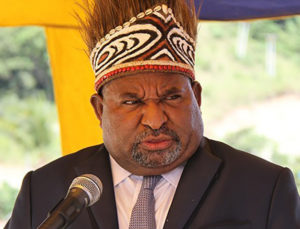
Papuan Governor Lukas Enembe had an hour-long meeting with Russian Ambassador Lyudmila Vorobyeva, accompanied by the director of the Russian Centre for Science and Culture in Jakarta this week. On the table, an invitation for President Vladimir Putin to visit Papua later this year.

The governor also had his small team with him — Samuel Tabuni (CEO of Papua Language Institute), Alex Kapisa (Head of the Papua Provincial Liaison Agency in Jakarta) and Muhammad Rifai Darus (Spokesman for the Governor of Papua).

As a result of this meeting, social media is likely to run hot with heated debate.

This isn’t surprising, considering Russia’s invasion of Ukraine, hotly condemned in the West.

Speculation is rife whether Indonesia — as chair of the G20 group of nations — will invite President Putin to attend the global forum in Bali later this year.

Governor Enembe is not just another governor of another province of Indonesia — he represents one of the biggest settler-colonial provinces actively seeking independence.

Considering Enembe’s previous rhetoric condemning harmful policies of the central government, such as the failed Special Autonomy Law No.21/2021, this meeting has only added confusion, leaving both Indonesians and Papuans wondering about the motives for the governor’s actions.

Also, the governor has invited President Putin to visit Papua after attending the G20 meeting in Bali.

Whether President Putin would actually visit Papua is another story, but this news is likely to cause great anxiety for Papuans and Indonesians alike.

So, what was Monday’s meeting all about?

Governor Lukas Enembe
Papuan Governor Lukas Enembe … “The old stories are dying, and we need new stories for our future.” Image: West Papua Today

Papuan students in Russia
Spokesperson Muhammad Rifai said Governor Enembe had expressed deep gratitude to the government of the Russian Federation for providing a sense of security to indigenous Papuan students studying higher education in Russia.

He thanked the ambassador for taking good care of those who received scholarships from the Russian government as well as those who received scholarships from the Papua provincial government.

The scholarships were offered to Papuan students through the Russian Centre for Science and Culture, which began in 2016 and is repeated annually.

Under this scheme, Governor Enembe sent 26 indigenous Papuans to the Russian Federation on September 27, 2019, for undergraduate and postgraduate studies.

As of last year, Russia offered 163 places for Papuan students, but this number cannot be verified due to the high number of Indonesian students seeking education in Russia.

The ambassador also discussed the possibility of increasing the number of scholarships available to Papuan students who want to study in Russia. Governor Enembe appreciates  this development as education is a foundation for the land of Papua to grow and move forward.

The governor also said Russia was the only country in the world that would be willing to meet Papua halfway by offering students a free scholarship for their tuition fees.

Along with these education and scholarship discussions, Rifai said the governor wanted to talk about the construction of a space airport in Biak Island, in Cenderawasih Bay on the northern coast of Papua.

The governor was also interested in the world’s largest spaceport, Baikonur Cosmodrome in Kazakhstan, which is still operating today and he hoped to gain insight from the Russian government.

Building a Russian cultural museum in Papua
As part of strengthening the Russia-Papua relationship, Governor Enembe asked the Russian government to not only accept indigenous Papuan students, but to also transfer knowledge from the best teachers in Russia to students in Papua.

As part of the initiative, the governor invited Victoria from the Russian Centre for Science and Culture to Papua in order to inaugurate a Russian Cultural Centre at one of the local universities.

However, Governor Enembe’s desire to establish this relationship is not only due to Russian benevolence toward his Papuan students studying in Russia.

The Monday meeting with the Russian ambassador in Jakarta and his invitation to President Putin to visit Papua were inspired by deeper inspiration stories.

The story originated more than 150 years ago.

Governor Enembe was touched by the story he had heard of a Russian anthropologist who lived on New Guinea soil, and who had tried to save New Guinean people during one of the cruellest and darkest periods of European savagery in the Pacific.

Indigenous hero

Nicholas Miklouho-Maclay
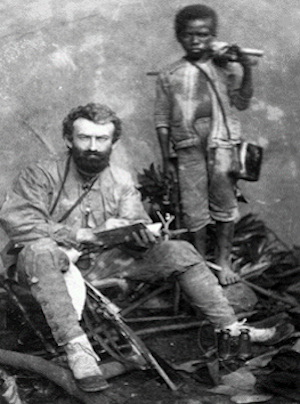
Nikolai Miklouho-Maclay pictured with a Papuan boy named Ahmad in this image taken c. 1873. Image: File

His name was Nikolai Nikolaevich Miklouho-Maclay (1846 –1888) — a long forgotten Russian messianic anthropologist, who fought to defend indigenous New Guineans against German, Dutch, British, and Australian forces on New Guinea island.

His travels and adventures around the world — including the Canary Islands, North Africa, Easter Island, China, Thailand, Malaysia, Australia, the Philippines, and New Guinea — not only expanded his knowledge of the world’s geography, but most importantly his consciousness. This made him realise that all men are equal.

For a European and a scientist during this time, it was risky to even consider, let alone speak or write about such claims. Yet he dared to stand in opposition to the dominant worldview of the time — a hegemony so destructive that it set the stage for future exploitation of islanders in all forms: information, culture, and natural resources.

West Papua still bleeds as a result.

His campaign against Australian slavery of black islanders — known as blackbirding — in the Pacific between the 1840s and 1930s, and for the rights of indigenous people in New Guinea was driven by a spirit of human equality.

On Sunday, September 15, 2013, ABC radio broadcast the following statement about Nikolai Miklouho-Maclay:

He was handsome, he was idealistic and a mass of disturbing contradictions. He died young. That should have been enough to ensure his story’s survival – and it was in Russia, where he became a Soviet culture hero, not in the Australian colonies where he fought for the rights of colonised peoples and ultimately lost.

ironic and tragic
The term Melanesia emerged out of such colonial enterprise, fuelled by white supremacy attitudes. As ironic and tragic as it seems, Papuans in West Papua reclaimed the term and used it in their cultural war against what they consider as Asian-Indonesian colonisation.

It is likely that Miklouho-Maclay would have renamed and redescribed this region differently if he had been the first to name it, instead of French explorer Jules Dumont d’Urville (the man credited with coining the term). He arrived too late, and the region had already been named, divided, and colonised.

In September 1871, Nikolai Miklouho-Maclay landed at Garagassi Point and established himself in Gorendu village in Madang Province. Here he built a strong relationship with the locals and his anthropological work, including his diaries, became well known in Russia. The village where he lived has erected a monument in his name.

Miklouho-Maclay’s diaries of his accounts of Papuans in New Guinea during his time there have already been published in the millions and read by generations of Russians. The translation of his dairies from Russian to English, titled Miklouho-Maclay – New Guinea Diaries 1871-1883 can be read here.

C.L. Sentinella, the translator of the diaries, wrote the following in the introduction:

The diaries give us a day-to-day account of a prolonged period of collaborative contact with these people by an objective scientific observer with an innate respect for the natives as human beings, and with no desire to exploit them in any way or to impose his ideas upon them. Because of Maclay’s innate respect, this recognition on his part that they shared a common humanity, his reports and descriptions are not distorted to any extent by inbuilt prejudices and moral judgements derived from a different set of values.

In 2017, the PNG daily newspaper The National published a short story of Miklouho-Maclay under the title “A Russian who fought to save Indigenous New Guinea”.

The Guardian, in 2020, also shared a brief story of him under title “The dashing Russian adventurer who fought to save indigenous lives.” The titles of these articles reflect the spirit of the man.

After more than 150 years, media headlines emphasise his legacy. One of his descendants, Nickolay Miklouho-Maclay, who is currently director of Miklouho Maclay Foundation in Madang, PNG, has already begun to establish connections with local Papuans both at the village level and with the government to build connections based on the spirit of his ancestor.

Enembe seeks Russian reconnection
Governor Enembe believes that Nikolai Miklouho-Maclay’s writings and work profoundly influence the Russian psyche and reflect how the Russian people view the world — especially Melanesians.

This was what motivated him to arrange his meeting with the Russian ambassador on Monday. The Russians’ hospitality toward Papuan students is connected to the spirit of this man, according to the governor.

It is a story about compassion, understanding, and brotherhood among humans.

The story of Nikolai Miklouho-Maclay is linked to the PNG side of New Guinea. However, Governor Enembe said Nikolai’s story was also the story of West Papuans too now — because he fought for all oppressed and enslaved New Guineans, Melanesians, and Pacific islanders.

Nikolai Miklouho-Maclay’s ideas, beliefs and values — calling for the treatment of fellow human beings with dignity, equality and respect — are what are needed today.

This is partly why Governor Enembe has invited President Putin to visit Papua; he plans to build a cultural museum and statue in honour of Nikolai Miklouho-Maclay.

“The old stories are dying, and we need new stories for our future,” Governor Enembe said. “I want to … share more of this great story of the Russian people and New Guinea people together.”

Yamin Kogoya is a West Papuan academic who has a Master of Applied Anthropology and Participatory Development from the Australian National University and who contributes to Asia Pacific Report. From the Lani tribe in the Papuan Highlands, he is currently living in Brisbane, Queensland, Australia.

Print Friendly, PDF & Email

Article by AsiaPacificReport.nz

Does the pre-election budget address ways to realistically ‘close the gap’ for Indigenous people?

Source: The Conversation (Au and NZ) – By Bronwyn Carlson, Professor, Indigenous Studies and Director of The Centre for Global Indigenous Futures, Macquarie University

Getty Images

As Treasurer Josh Frydenberg handed down the federal government’s pre-election budget on Tuesday night, I watched in anticipation to see what it would hold for Aboriginal and Torres Strait Islander peoples and communities.

It’s an important issue, particularly in light of the government’s 2020 commitment to new targets to address the ever-growing disparities between Indigenous peoples and the rest of the population that have yet to be adequately addressed.

It was no surprise to see a strong budget focus on the cost of living. Petrol prices have surged past A$2 a litre, and the cost of food is rising because of COVID-19, floods and climate change.

Opposition Leader Anthony Albanese was quick to criticise the budget, likening it to “fake tan” and claiming that the one-off cost-of-living payments are more about winning the upcoming election than planning for the future. The problem with fake tan, he said, is that “it fades pretty quickly”.

Unfortunately, Indigenous people are used to disappointing budgets that lack the strategic planning needed to address real issues that Indigenous communities themselves constantly raise.

True, the cost of living is soaring for many Australians. But like all things, this is never an even playing field. The cost of living in remote Aboriginal communities beggars belief. It is so outrageous that it triggered a federal parliamentary inquiry in 2020.

Perhaps not unexpectedly, the inquiry failed to deliver any meaningful results. Petrol prices have also been extremely high in rural and remote locations for a long time, significantly impacting Indigenous communities. For example, petrol prices have reached as high as $3 a litre in Arnhem Land.


Read more:
There’s $1.3 billion for women’s safety in the budget and it’s nowhere near enough


What’s in the budget for us?

So, what’s in the 2022 pre-election budget that will address the new targets set by the government? Federal Minister for Indigenous Australians Ken Wyatt said in his budget-night press release that the Morrison government has embarked on “the most ambitious Indigenous policy reform agendas”.

The federal budget should address the needs in the broader community, but also the targeted commitments that the government makes, such as those outlined in the Closing the Gap scheme.

The government has pledged $636.4 million in the 2022 budget over six years to expand Indigenous land and sea management on Country. This will provide more education and employment opportunities in remote and regional Australia. Given the lack of any real commitment to climate change, I guess the government is hoping Indigenous rangers will do the work so urgently required.

Housing in remote Aboriginal communities in the Northern Territory has been allocated $408 million. The funding will be used for addressing overcrowding, homelessness and much-needed improvements to homes. The government has also allocated $183 million over the next three years to improve economic, social and health outcomes for Indigenous people in the NT.

Although homelessness and affordable housing is a major concern for Indigenous people across Australia, no funding was committed to other locations. Yet most Indigenous people live in urban areas. In Victoria, for example, the number of Indigenous people seeking help from services for housing issues has increased by 33.6% over four years – the highest rate for Indigenous people anywhere in Australia.

Is the budget addressing the Indigenous health gap?

The budget promises an estimated $16.2 million for Indigenous health spending across 2022-23. Specifically, the funding is to combat blood-borne viruses and sexually transmissible infections in the Torres Strait, and improving trachoma control services. Australia is the only developed country where trachoma still exists. It only impacts Indigenous people, and is directly related to overcrowding and poor housing conditions, including access to clean water and sanitation.

The federal government has also pledged $12 million towards combating rheumatic fever and rheumatic heart disease in Indigenous communities, which continue to have one of the highest rates in the developed world. The ABC 4 Corners report Heart Failure highlighted the ongoing impacts of racism in the health system and the appalling lack of healthcare provided.

The National Aboriginal Community Controlled Health Organisation (NACCHO) has expressed disappointment at what it describes as the budget’s failure to adequately fund Indigenous health, even though the disparities in health between Indigenous peoples and other populations in Australia are supposedly one of the key areas of the government’s commitment.

The organisation’s chief executive, Pat Turner, said:

As long as this $4.4 billion funding gap remains and as long as there are funding gaps elsewhere – in particular, in housing – we cannot expect the unconscionable health gap to close. This Budget is an opportunity lost. NACCHO calls upon the government to close the funding gap for Aboriginal and Torres Strait Islander people.

Last year, Prime Minister Scott Morrison said the “ultimate test” of closing the gap would be that Aboriginal and Torres Strait Islander children in particular would have the same opportunities as other children in Australia.

On this scale, the federal government has failed miserably. Indigenous children in Australia are ten times more likely to be removed from their families.

Catherine Liddle, chief executive of SNAICC, the national peak body for Aboriginal children and families, expressed the frustration Indigenous people have on this issue:

People have been saying this for a long time, yet the change in investment and transformation to the system that’s required to fix it hasn’t followed through.

Turner and Liddle both also highlighted the considerable shortfall in the commitment needed to meet the ambitious targets set out in the Closing the Gap agreement.

Overall, the budget falls short of adequate investment across key areas such as health, housing, education and employment. It also fails to provide funding to address the high number of Indigenous deaths in custody and to support families facing the financial burden of seeking legal justice.

Frydenberg acknowledged the women’s safety crisis in Australia, and the government has reiterated its support for a dedicated Aboriginal and Torres Strait Islander Action Plan led by the Aboriginal and Torres Strait Islander Advisory Council on family, domestic and sexual violence. But the budget fails to fund Aboriginal family violence and legal services where resources are urgently needed.

The co-chair of the First Nations-led coalition Change the Record, Cheryl Axleby, said that if a budget was a reflection of a government’s priorities, it’s clear that First Nations’ needs are a long way down the list.

The Conversation

Bronwyn Carlson does not work for, consult, own shares in or receive funding from any company or organization that would benefit from this article, and has disclosed no relevant affiliations beyond their academic appointment.

ref. Does the pre-election budget address ways to realistically ‘close the gap’ for Indigenous people? – https://theconversation.com/does-the-pre-election-budget-address-ways-to-realistically-close-the-gap-for-indigenous-people-180312

What are ‘binaural beats’ and do they affect our brain?

Source: The Conversation (Au and NZ) – By Monica Barratt, Vice Chancellor’s Senior Research Fellow, Social and Global Studies Centre and Digital Ethnography Research Centre, RMIT University

Shutterstock

You might have seen online or heard about “binaural beats”, which have been described as “digital drugs”.

Listening to binaural beats has been claimed to help with sleep, stress, anxiety and cognition, and there’s much discussion online about whether or not they can cause a “high” similar to drugs.

But what actually are they? And what’s the evidence for beneficial or mood-altering effects?

What are binaural beats?

The perceptual phenomenon of binaural beats was discovered by Heinrich Wilhelm Dove in 1841 and first described in scientific literature in 1973.

The perceptual auditory illusion created by binaural beats occurs when two pure tones of slightly different frequencies are presented to each ear. These two tones are then processed within our brains to sound like a third frequency. This third frequency is thought to produce a range of effects, including relaxation and attentiveness.

Academic research has focused on two main uses for binaural beats:

1) as a medical treatment or therapy

2) as a substitute for or complement to psychoactive drug use (drugs that affect the nervous system and alter perception, mood, cognition or behaviour).


Read more:
Sounds like hype: there’s scant evidence the ‘binaural beats’ illusion relaxes your brain


Binaural beats as therapy

Research investigating binaural beats has found positive effects for pain alleviation, anxiety reduction, and memory. However, there have been conflicting findings around its effects on concentration.

For example, a meta-analysis that included 22 studies on the effect of binaural beats on memory, attention, anxiety and pain relief found across all studies a statistically significant and consistent effect. A dose-response effect was found, meaning greater exposure to the sounds increased their effectiveness as a therapy.

Studies using high-quality designs have also consistently shown effects: using a double-blinded randomised control cross-over trial (the gold standard of clinical study), binaural beats reduced pain intensity, stress and use of analgesic drugs in chronic pain patients, compared with a placebo stimulation.

Man meditating with headphones on
Studies have found binaural beats have an effect on stress, anxiety and memory.
Shutterstock

Studies looking at improving attention haven’t found evidence of an effect.

Binaural beats can be positioned within a range of other commonly used digital sound-based therapies such as ASMR (Autonomous Sensory Meridian Response). Emerging research indicates ASMR may have therapeutic benefits for mental health, which highlights the broader potential of digital sounds.

Binaural beats as digital pleasures

Binaural beats have also been incorporated into music, soundscapes and other consumer-facing products, including meditation tracks.

Some of these soundscapes have been marketed via mobile phone apps as digital drugs. Binaural beat tracks available to download are sometimes named after specific drugs, for example “Molly Rave Riot” (reference to MDMA) or “Roofie Enhanced calm” (reference to Rohypnol).

There is limited literature concerning digital drugs as substitutes for, or used in combination with, psychoactive substances. For example, binaural beats were mentioned in a paper investigating drug combinations on a public internet forum. Participants “frequently described listening to binaural beats while using substances to enhance the experience”.

Our paper, released today, surveyed over 30,000 respondents via the Global Drug Survey, finding 5% reported binaural beat use in the last 12 months.

Supporting the idea these binaural beat tracks are used to enhance drug use experiences, we found respondents who had recently used cannabis, psychedelics or novel drugs were more likely to also report use of binaural beats.


Read more:
It’s not all in your mind: how meditation affects the brain to help you stress less


Woman covering her face with her hands and a blurred effect
People who had used psychedelic drugs were more likely to report using binaural beats.
Shutterstock

The most common reported reasons for use of binaural beats in this sample included to relax or fall asleep, to change mood-state and to get a similar effect to that of other drugs. Qualitative responses also indicate use for pain relief for common ailments such as headaches and migraines.

In this survey sample, binaural beats were accessed primarily through video streaming sites on mobile phones.

Are binaural beats psychoactive?

Currently it’s unclear whether binaural beats are similar in effect to the psychoactive drugs they are promoted to simulate.

Given there are studies showing some effects of reducing anxiety and relieving perceptions of pain in medical contexts, it may also be possible binaural beats marketed as producing psychoactive drug effects could be perceived by consumers as providing similar sensations.

Controlled laboratory studies comparing ingestible psychoactive drug effects with those of binaural beat substitutes would be useful to answer this question.

Our research demonstrates some people who responded to our survey, and already consume drugs, are also using binaural beats to augment or substitute psychoactive substances.

Depending on their actual efficacy, a future where drug experiences can be downloaded (or streamed), rather than obtained from illegal markets, is intriguing, and poses questions that will traverse legal, clinical, and social domains.


We would like to acknowledge the other coauthors of our study, including Lachlan Goold, Adam Winstock and Jason Ferris.

The Conversation

Monica Barratt receives funding from the National Centre for Clinical Research on Emerging Drugs.

Alexia Maddox, Jenny L. Davis, and Naomi Smith do not work for, consult, own shares in or receive funding from any company or organisation that would benefit from this article, and have disclosed no relevant affiliations beyond their academic appointment.

ref. What are ‘binaural beats’ and do they affect our brain? – https://theconversation.com/what-are-binaural-beats-and-do-they-affect-our-brain-180235

What is the PBS safety net and is it really the best way to cut the cost of medicines?

Source: The Conversation (Au and NZ) – By Yuting Zhang, Professor of Health Economics, The University of Melbourne

Shutterstock

Earlier access to free or cheaper medicines is on the cards, after a federal budget announcement made earlier this week.

Improved access to subsided prescription drugs through the Pharmaceutical Benefits Scheme or PBS will benefit Australians who need multiple medicines throughout the year. This is particularly so for people with chronic conditions or who have multiple members in the family who need scripts.

From July 1, access to free or cheaper medicines will kick in sooner, under the so-called PBS safety net, as the threshold for access has been lowered.

However, this isn’t the only way to reduce the costs of medicines.


Read more:
Health budget 2022 spends a little on favoured interest groups but misses a chance for real reform


What’s changed?

If you only fill a script now and again, concession card holders pay A$6.80 and general patients pay up to $42.50 for a PBS-subsidised medicine.

However, if you need multiple scripts throughout the year, once you reach a certain threshold, the PBS safety net can kick in. Then, medicines are free for concession card holders and cost $6.80 for general patients.

The PBS safety net is calculated by calendar year and is reset on January 1 each year.

As of July 1, the PBS safety net threshold will be reduced to $244.80 (down from $326.40) for concession card holders and $1,457.10 (down from $1,542.10) for general patients.
You can reach the PBS safety net sooner each year if you combine your family’s PBS accounts. In other words, if you or your partner or children require multiple medicines, your family may have quicker access to free or cheaper medicines for the rest of the year.

The PBS safety net is not to be confused with the Medicare safety net. This relates to doctors’ fees charged for out-of-hospital services.


Read more:
Explainer: what is Medicare and how does it work?


Who will benefit?

An average patient pays about $121 out-of-pocket costs per year on medicines, way below the PBS safety net thresholds.

So the PBS safety net only affects those who continuously use many prescription drugs. Under changes announced in the budget, concession card holders who fill more than 36 prescriptions a year (three per month) or general patients who fill about 34 scripts a year will benefit from the reduced thresholds.

A large proportion of these are older than 65, with chronic conditions, who require medicines continually.

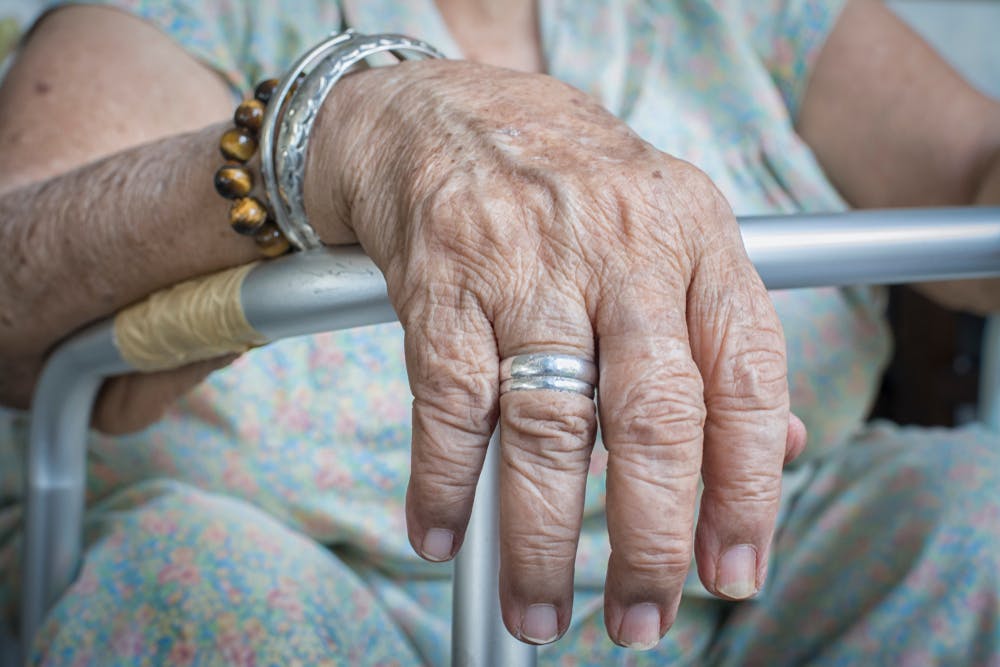
Elderly woman's hand resting on walking frame
Elderly people on multiple medications are among those expected to benefit from the latest changes.
Shutterstock

For elderly patients, some medications are essential to control their symptoms and prevent them from being admitted to hospital. These medications include those to treat heart or mental health conditions.

So the money spent on improving access to these essential medicines could be offset by lower hospital costs.


Read more:
Last year, half a million Australians couldn’t afford to fill a script. Here’s how to rein in rising health costs


Other ways to cut costs

Australia uses a range of mechanisms to manage the costs of prescription drugs, in addition to the PBS safety net. In general, these relate to how the government assesses drugs and sets prices.

After a new drug enters the market, the Pharmaceutical Benefits Advisory Committee reviews its clinical effectiveness, safety and cost-effectiveness (or “value for money”) compared with other treatments before recommending it for listing on the PBS.

For clinically-equivalent drugs with different brands, the PBS only subsidises up to the price of the lowest priced brand. If a patient needs the more expensive medicine, they pay a brand premium.

However, this brand premium cannot count towards the PBS safety net threshold.


Read more:
Can’t pronounce the name of your medicine? Here’s why


How about cheaper generic drugs?

Assessing drugs for “value for money” and only subsidising clinically equivalent drugs to the price of the lowest priced brand are among measures allowing Australians access to cheaper brand-name drugs than countries without price controls.

However, Australians pay a higher price for generic prescription drugs – drugs no longer under patent protection – than many other countries.

Generic drugs are often not subsidised because they are cheaper than the PBS general co-payment of $42.50. So patients pay the full cost.

In fact, about 30% of all PBS-listed medicines cost less than $42.50, many of them generic drugs.

The cost of these PBS-listed, cheaper, non-subsidised generics counts towards your PBS safety net threshold.

To control prices for generic drugs, the government requires manufacturers to disclose how much they charge pharmacies. The government then reduces the amount it pays to pharmacies for each generic drug.

This price disclosure policy has been effective to lower the prices of generic drugs. But this price disclosure policy does not guarantee Australians get the best prices for generic drugs some other countries enjoy.

Instead, the government could set a price for each generic drug, by using the best price obtained by other comparable countries. This international benchmarking pricing strategy is used by other countries such as Canada, New Zealand, Japan and many member states of the European Union.

If the Australia government can get cheaper generic drugs as these countries, it would mean substantial savings for many Australians.

The Conversation

Yuting Zhang receives funding from Australian Research Council, Department of Veterans’ Affairs, and National Health and Medical Research Council.

ref. What is the PBS safety net and is it really the best way to cut the cost of medicines? – https://theconversation.com/what-is-the-pbs-safety-net-and-is-it-really-the-best-way-to-cut-the-cost-of-medicines-180315

The Gap will never close if Aboriginal and Torres Strait Islander students don’t feel safe on university campuses

Source: The Conversation (Au and NZ) – By Sharlene Leroy-Dyer, Associate Director (PRME) Indigenous Engagement, The University of Queensland

Getty Images

Readers please be advised this article contains references to sexual assault.


Aboriginal and/or Torres Strait Islander students are more likely to be sexually harassed in a university context than any other students. This is one finding from the 2021 National Student Safety Survey report, released this month.

The report found 7.8% of Aboriginal and/or Torres Strait Islander students, compared with 4.5% of other students, had been sexually assaulted in a “university context” such as at events, places or social occasions arranged or supported by a university, or where students or staff from a person’s university were present.

This includes both on and off campus, in person or online. Aboriginal and/or Torres Strait Islander students (6.3%) were found to be more likely than other students (3.9%) to be told or suspect another student had been sexually assaulted and more likely to experience or witness sexual harassment.

Sexual assault and sexual harassment are widely recognised as human rights issues, and marginalised populations such as Aboriginal and Torres Strait Islander women are at particular risk of having human rights abuses perpetrated against them.

Education is a human right, and the lack of educational outcomes for Aboriginal and Torres Strait Islander peoples in this country is alarming.

Addressing such violence is not only a safety issue, but ensures there is not another barrier standing in the way of educational self-determination.


Read more:
Consent education needs Blak voices for the safety and well-being of young First Nations people


The findings of the report

The report, which surveyed 43,819 students from 38 universities across Australia, found troubling patterns of sexual assault and sexual harassment in greater numbers towards students who identify as Aboriginal and/or Torres Strait Islander, LGBTIQA+ or with a disability. Sexual harassment and assault often intersect with other forms of harassment including racism, homophobia and ableism, further compounding the experience and impact on victim/survivors.

Sexual harassment is an unwelcome sexual advance, request for sexual favours or other conduct of a sexual nature which offends, humiliates and/or intimidates a person. Whereas sexual assault refers to sexual contact or behaviour that occurs without explicit consent of the victim.

The study found one in five (21.4%) Aboriginal and/or Torres Strait Islander students had been sexually harassed in a university context, compared with 16% of students who did not identify as Aboriginal and/or Torres Strait Islander. In addition, one in eight (12.0%) Aboriginal and/or Torres Strait Islander students had been sexually harassed in a university context in the past 12 months compared with 8.0% of other students and are more likely to witness this happening to others.

Aboriginal and/or Torres Strait Islander students were less likely than other students to feel safe on campus (76.2%) and felt less respected by staff (83.9%) and by other students (81.2%). How can we ever “Close the Gap” on educational outcomes for Aboriginal and/or Torres Strait Islander peoples with statistics like this?

Impacts on education and safety

The report states that majority of Aboriginal and Torres Strait Islander students in higher education in Australia identify as a female.
As the (Wiyi Yani U Thangani Report reflects, “Aboriginal and Torres Strait Islander women and girls have remarkable skills, knowledge and boundless potential”. These are strong future matriarchs on their educational journey to fulfil their dreams and assist their communities. However, university spaces have historically been and continue to be places of under-representation for Aboriginal and/or Torres Strait Islander students.

According to federal government figures, only 1.8% of the higher education student population is Aboriginal and Torres Strait Islander, with an attrition rate of 35% in 2019.

A person sits in the sun, having a discussion with other students.
A majority of Aboriginal and Torres Strait Islander students in higher education in Australia identify as female.
GettyImages

Even with the positive impacts of Indigenous centres, the findings of the survey demonstrate Aboriginal and Torres Strait Islander students face potentially unsafe classrooms and unsafe environments within the broader university. The Australian higher education sector needs to ensure that university spaces are culturally safe, inclusive and welcoming.

A whole of university approach to sexual violence on campus has proven unsuccessful, despite enacting plans to ensure our campuses are safer. What is being done to influence better behaviour in the broader society?

Surely federal and state governments must bear some of the responsibility. However, if Brittany Higgins is any indication, the government is failing women on several levels.


Read more:
Increased incarceration of First Nations women is interwoven with the experience of violence and trauma


Recommended ways forward

The federal government in particular, must respond to the sexual violence faced by Aboriginal and/or Torres Strait Islander higher education students and implement the Respect@Work Sexual Harassment National Enquiry Report 2020 recommendations prioritising the safety of students on university campuses.

The National Student Safety Survey report calls for the acknowledgement of the role of gender, as well as intersecting discrimination and marginalisation in driving sexual harassment and sexual assault.

The sector must take proactive measures to promote safety and respect in: residential colleges, between staff and students and in learning environments for Aboriginal and/or Torres Strait Islander students, gender and sexuality diverse students and those with a disability.

All students should be aware of how to report instances they have experienced or witnessed and feel safe, supported and respected to do so. Students should never feel that they are facing blame or have their experience minimised.

The Conversation

Sharlene Leroy-Dyer is the Acting President of the National Aboriginal and Torres Strait Islander Postgraduates Association (NATSIPA). She is affiliated with the National Aboriignal and Torres Strait Islander Higher Educaiton Consortium (NATSIHEC), is the Chair of the National Tertiary Education Union (NTEU’s) Aboriginal and Torres Strait Islander Policy Committee and sits on the Board of the Council of Australian Postgraduates Association (CAPA).

Sadie Heckenberg receives funding from Australian Research Council (ARC). She is the President-Elect of the National Aboriginal and Torres Strait Islander Higher Education Consortium and sits on the ARC’s College of Experts. She is affiliated with the National Tertiary Education Union, as the Victorian representative on the Aboriginal and Torres Strait Islander Policy Committee.

ref. The Gap will never close if Aboriginal and Torres Strait Islander students don’t feel safe on university campuses – https://theconversation.com/the-gap-will-never-close-if-aboriginal-and-torres-strait-islander-students-dont-feel-safe-on-university-campuses-180234

Why arts and culture appear to be the big losers in this budget

Source: The Conversation (Au and NZ) – By Guy Morrow, Senior Lecturer in Arts & Cultural Management, The University of Melbourne

Jean Wimmerlin on Unsplash

While one more A$20 million round of the Restart Investment to Sustain and Expand (RISE) Fund was announced as part of the 2022-23 budget to support reactivating the arts and entertainment sector post-Covid-19 lockdowns, this scheme is coming to an end.

With funding cuts forecast out to as far as 2025-26, the arts and culture appear to be big losers in this budget.

In addition to the $20.0 million in 2022-23 to phase down the RISE Fund, the budget includes:

  • $9.3 million over two years for the National Museum of Australia to support its services impacted by COVID 19

  • $9 million in 2021-22 for a second round of the Supporting Cinemas’ Retention Endurance and Enhancement of Neighbourhoods (SCREEN) Fund to support independent cinemas affected by COVID 19

  • an extension of the Temporary Interruption Fund, which provides insurance to screen projects shut down due to COVID-related issues, for a further six months to 30 June 2022, and

  • $316.5 million over five years to build an Aboriginal and Torres Strait Islander cultural precinct, Ngurra, on the shores of Lake Burley Griffin in the Parliamentary Triangle, on Ngunnawal country (Canberra).

With the loss of COVID stimulus measures, the big losers under arts and culture in the budget are:

  • the end of the RISE fund, represented in the cut to “arts and cultural development”, receiving $2.4 million in 2023-24, down from $159 million in 2021-22

  • the loss of $6.4 million in contemporary music related COVID measures, and

  • Screen Australia: its funding will be reduced from a high of $39.5 million in 2021-22 to $11.6 million in 2023-24, reducing funding to the pre-COVID baseline.

The decline in arts funding fits Treasurer Josh Frydenberg’s big picture narrative that the time for “crisis level” spending is now over, and the budget forecasts such as those for arts and culture only “appear” to be bleak due to the tapering down from the crisis level funding.


Portfolio Budget Statements 2022–23 Budget Related Paper No. 1.10


Read more:
A cost-of-living budget: cuts, spends, and everything you need to know at a glance


The end of RISE funding

The government’s biggest arts and culture investment during the pandemic was the RISE fund, which saw $200 million go towards 541 projects.

The RISE fund represented a move away from the “arms-length” independent funding decisions made by the Australia Council peer assessors. Instead, the arts minister had the ultimate authority regarding RISE.

This aspect of RISE was reminiscent of George Brandis’ 2015 shock annexation of Australia Council funding to the then National Programme for Excellence in the Arts (which then became Catalyst). But the baseline Australia Council funding has remained steady in this year’s budget, rising only in line with inflation.

While RISE was a short-term crisis level funding initiative using the arts as an instrument to stimulate the economy, support for the Australia Council in the budget is for the support of “excellent art” for “audiences in Australia and abroad”.

The difference in these programs meant RISE funding went not only to not-for-profit arts organisations and individual artists, as the Australia Council primarily supports, but also to commercial creative activity.


Read more:
Latest arts windfalls show money isn’t enough. We need transparency


A loss of over-all funding

According to the government, the expected decrease in overall cultural funding from 2021-22 to 2022-23 is predominantly driven by the loss of temporary arts funding for economic stimulus.

Expenses under the arts and cultural heritage are estimated to decrease by 10.6% in real terms from 2021-22 to 2022-23, and decrease by 13.1% in real terms from 2022-23 to 2025-26.

It is not clear why this scaling down of crisis level funding appears to be uneven.

In particular, many of Australia’s cultural institutions – who are already under pressure when it comes to preserving cultural heritage – are facing significant cuts.

The National Museum of Australia is projected to receive $51 million in 2023-24, losing its $9.3 million in COVID support. The National Gallery of Australia’s funding will drop from $49.6 million in 2021-22 to $45.7 million in 2022-23. Funding for the National Library Australia will fall from $61 million in 2022-23 to $47.1 million in the following year.


Read more:
Staff cuts will hurt the National Gallery of Australia, but it’s not spending less on art. It’s just spending it differently


A commercially driven future?

Over the last two years, the arts were valued by the federal government to the extent that they were able to be used to stimulate the economy.

The assumption appears to be that, now that the creative and cultural industries have received a $200 million shot in the arm, they will now be able to stand back up and walk on their own two feet – and help those businesses around them do likewise.

It doesn’t appear the RISE Fund, and its ultimate decision making power by the minister, is a template for the future of arts funding in any literal sense because it is due to disappear.

But it may have changed the culture of arts funding in this country, explicitly focusing funding on cultural activities and initiatives informed by an overtly commercial mindset.

With many artists and organisations still struggling in this “COVID normal” landscape, this budgetary pendulum swing away from funding artistic projects and events paints a bleak picture.

The Conversation

Guy Morrow consults to Science Gallery International and the Association of Artist Managers in Australia. He receives funding from organisations for contract research projects.

ref. Why arts and culture appear to be the big losers in this budget – https://theconversation.com/why-arts-and-culture-appear-to-be-the-big-losers-in-this-budget-180127

The budget hands out $21 billion for ‘regional Australia’, but a quarter of it is going to a single project in Queensland

Source: The Conversation (Au and NZ) – By Stewart Lockie, Director, The Cairns Institute, James Cook University

This years’s budget has offered up “unprecedented” funding for regional Australia, according to the Morrison government’s budget sell.

The headline figure is A$21 billion and is widely assumed to be part of the deal Nationals leader Barnaby Joyce made with Prime Minister Scott Morrison in exchange for backing the Liberals’ net zero emissions plan late last year.

More than $20 billion of additional investment in Australia’s regions sounds like a lot of money. But at the same time, regional Australia is a big place.

What will this money do? How might it be received by voters?

What’s the $21 billion for?

The funding includes $3.7 billion for fast rail, $1 billion to protect the Great Barrier Reef, $678 million to seal roads on the Outback Way, and $1.3 billion on mobile and broadband coverage.

But instead of spreading the money thinly across the country, there is a heavy investment in a small number of big projects.

The lion’s share of the funding is swallowed up by four major projects. About $7 billion is set aside “turbocharging” four regions the government says already create wealth for Australia. These are: the Pilbara in Western Australia, North and Central Queensland, the Northern Territory, and the Hunter region in New South Wales (perhaps surprisingly, these areas include very few key marginal seats).

In fact, just one project accounts for a quarter of all new expenditure.

This is the $5.4 billion for construction of the Hells Gates Dam near Townsville, and a further $1.7 billion for water and supply chain infrastructure to support agriculture in the surrounding region.

Once complete, Hells Gates is expected to deliver enough water to support 60,000 hectares of irrigation and $1.5 billion per year in increased agricultural output. A 2018 feasibility study estimated it would create 12,647 construction jobs and 4,673 ongoing jobs, although concerns have been raised about the environmental impact on the Great Barrier Reef.

The Hells Gates fine print

The Hells Gates project is ambitious, but there’s a long way to go before construction is confirmed and money starts to flow.

With an election around the corner, the Coalition will be hoping regional voters see this commitment as a great example of government planning, rather than a distraction from more immediate needs. Whatever the business case, stumping up $7 billion plus for dam building and irrigation in the Burdekin is going to make the investments in other regions look positively anaemic.

Many regional voters may be left wondering how the government’s claim to be strengthening the regions with $21 billion to ensure they have the critical transport, water and communications infrastructure they need to grow adds up when so much of that investment is going into one region.

What’s left out?

We confront much the same issue in relation to the $1 billion to safeguard the Great Barrier Reef. Considering this investment is spread over ten years and addresses both marine and land-based management, as well as research, it’s arguably quite modest.


Read more:
Poor policy and short-sightedness: how the budget treats climate change and energy in the wake of disasters


It also begs the question why similar investment isn’t flagged to safeguard the Wet Tropics of Queensland (located in the marginal seat of Leichhardt) and all the other Australian ecosystems threatened by global environmental change.

Part of the answer is there is already money allocated in the budget for a suite of environmental and natural resource management programs. There is $27 million flagged for agricultural biodiversity stewardship and an extra $27 million for Commonwealth National Parks. But is the right amount of funding going to the right places?

Beyond the headline figures

In principle, regional Australians benefit just like anyone else from budget measures designed to ease cost-of-living pressures and provide essential services. They will likely benefit more than most city-based Australians from the temporary reduction in fuel excise.

Prime Minister Scott Morrison visiting a farm, outside of Townsville in 2019.
Cameron Laird/AAP

The more time you spend in the budget documents, the more programs you find that are relevant to regional Australia but haven’t been labelled as such.

There is more than $600 million to expand the Indigenous Ranger Program over the next six years. This will support the employment of an additional 1,089 Indigenous Rangers and formation of 88 new ranger groups. These will overwhelmingly be located – and contribute to improved natural and cultural resource management – in regional areas.

The Home Guarantee Scheme will be expanded and modified to include a Regional Home Guarantee intended to help 10,000 eligible applicants into new homes in regional locations.


Read more:
People and issues outside our big cities are diverse, but these priorities stand out


If it is successful, the Critical Minerals Strategy ($200 million over five years) will help diversify the Australian mining sector. Whether this helps regional workers will depend on the extent of automation, where jobs are located, and how much reliance is placed on fly-in, fly-out workers. We can’t take it for granted that the mere fact of economic activity leads to good employment or regional development outcomes.

Look beyond the fanfare about large infrastructure projects like Hells Gates, and what we are left with is a largely business-as-usual budget for regional Australia. The overarching narratives of transformational investment and water security fail to capture this continuity while, at the same time, offering a vision that excludes most regions.

What might this mean for voters?

What might this mean come election time?

The Coalition may fancy its chances of picking up a marginal seat like Hunter (held by Labor on a margin of 3%), but most seats in the regions targeted for “turbocharged” growth are considered safe.

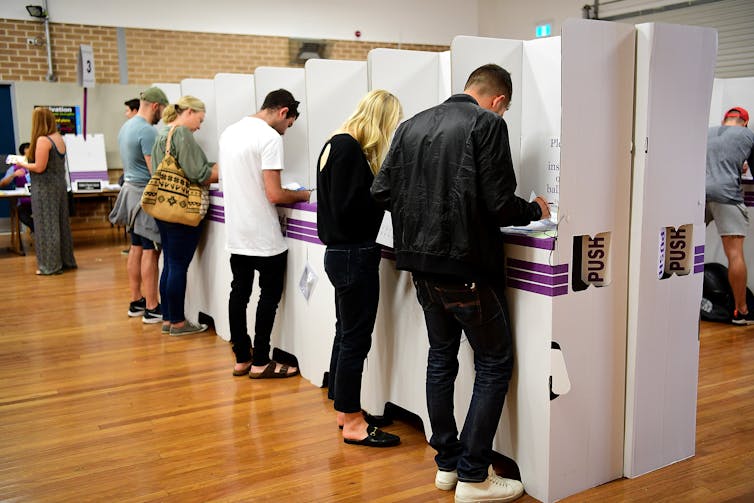
Voters at polling booths on election day.
The big regional spend does not appear to be about targeting key marginal seats.
Bianca De Marchi/AAP

The main exceptions are Kennedy in North Queensland, held by the Katter Australia Party on 13.3%, and Herbert, centred on Townsville, which is held by the Liberal National Party on 8.4%. But travel north to Leichhardt, held by the LNP on a margin of 4.2%, and people are asking “what’s in the budget for us?”

Whatever the electoral strategy here, it’s not sandbagging marginal seats. In fact, it risks leaving voters in more marginal seats feeling ignored.

Big infrastructure spending is more likely to be about selling the Coalition’s credentials on economic recovery and nation-building. Whether this message cuts through may depend on whether voters believe the strategy will work, and whether they trust the Coalition to deliver it.

The Conversation

Stewart Lockie receives funding from the Australian Research Council, the Australian Government’s Future Drought Fund, and the Reef Trust Partnership/Great Barrier Reef Foundation.

ref. The budget hands out $21 billion for ‘regional Australia’, but a quarter of it is going to a single project in Queensland – https://theconversation.com/the-budget-hands-out-21-billion-for-regional-australia-but-a-quarter-of-it-is-going-to-a-single-project-in-queensland-180400

Parliament protest donations went to bank account of man with history of unpaid debt

SPECIAL REPORT: By Tim Brown, RNZ News reporter

A man whose personal bank account was used to receive donations for New Zealand’s Parliament protest is bankrupt and has been declared insolvent three times.

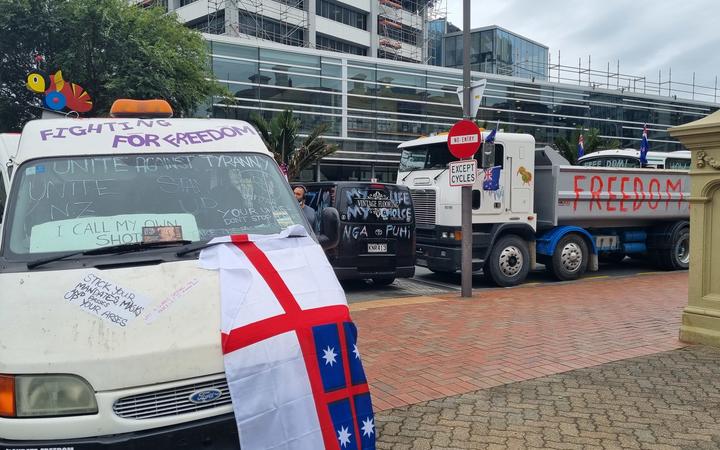
The protest lasted for 23 days before ending in a riot on March 2 when police cracked down on the protesters.

Jamie Patrick Mansfield has built a social media following by posting antivax and conspiratorial content as Jae Ratana.

He often livestreamed events from the protest in Wellington, but also posted similarly conspiratorial content for months before the occupation.

However, the 35-year-old, who is also known as Jamie Murray, has a history of unpaid debt.

Mansfield was first declared bankrupt after applying for the process himself in the Rotorua District Court in December 2008, at which time he listed his occupation as unemployed.

Mansfield was automatically discharged as bankrupt in December 2011 but again applied for bankruptcy in July 2012, this time listing his occupation as a student.

He was again automatically discharged three years later and remained solvent for five years until again applying to be declared bankrupt in June 2020.

Mansfield’s latest bankruptcy remains current.

He also had a tenancy terminated in early 2020 after failing to pay rent.

The Tenancy Tribunal awarded the landlord $2770 — $1650 of which was recovered via a bond, but the balance remains outstanding.

Parliament protest
The Parliament protest lasted for 23 days before ending in a riot on March 2. Image: RNZ

Despite Mansfield’s background, his bank account was used to receive donations for Convoy NZ 2022, the group which instigated what became the protest and later occupation at Parliament grounds through February and early March.

RNZ understands Mansfield never disclosed his financial history to the group, and used the name Jae Ratana.

It was by no means the biggest group seeking donations in New Zealand’s antivax and anti-mandate circles, however, RNZ has seen evidence that thousands of dollars of donations to the group came flooding into Mansfield’s bank account by early February.

At least $14,000 had been deposited in just a few days.

How much was ultimately deposited into Mansfield’s bank account, where that money ended up and how it was spent remains unclear.

Mansfield and the organisers of the convoy group fell out, and just a few days into the occupation were not communicating.

Donations ‘signed off, triple checked’
RNZ attempted to contact Mansfield to get his side of the story.

When we first approached him via social media he responded there was “absolutely nothing to discuss”.

Parliament protest 2022
Jamie Patrick Mansfield’s bank account was used to receive donations for Convoy NZ 2022. Image: RNZ

When pushed about the money raised and how it was spent, he responded: “There were so many people/groups collecting the pūtea [funds] and there also is a difference between koha and donation and as far as the groups I’m part of have [sic] concerned [sic] they have been signed off and accounted for and it’s been tripled check so as far as I’m concerned there is nothing further to talk about nor will the team be happy me speaking to a reported [sic] but I unfortunately do not trust any reporters either as story’s [sic] love to be twisted.”

When asked what he meant by the groups he was part of having things signed off, accounted for and triple checked, he responded: “No further questions thank u”.

He followed up with: “When u are ready I would love to see the so called information u have got”, “Then we will correct what is needed because I can guarantee you you do not have truthful information” and “I can probably stomp on what Information-hearsay you have”, before subsequently blocking this reporter from contacting him on Facebook.

Rumours have swirled on social media about the whereabouts of the money raised since the early days of the occupation.

Mansfield took to Facebook on March 8 to address the rumours: “Just to clarify and get that story straight, obviously the Convoy and occupation of Parliament I did help fund out of my personal money. For anyone who knows me personally, can back me up there.

“So I did help sponsor and donate to convoy. I did not steal any money. I did not help myself to any money,” he claimed in the livestream.

RNZ spoke to people who had known Mansfield personally and they say he has a long history of leaving people out of pocket.

‘An exceptionally bad tenant’ – landlord
One such person was the landlord who took Mansfield to the Tenancy Tribunal and ultimately had him evicted for unpaid rent and bills, and damage to the property.

He told RNZ he had still not seen the balance of the money he was owed by Mansfield.

“Jamie … was an exceptionally bad tenant who continually made promises he didn’t keep … I hope to never see him again,” the landlord, who RNZ agreed not to name, said.

Problems with the tenancy became clear almost as soon as Mansfield moved in as he was late with his rent for five of the first six weeks he lived in the rental and arrears grew from there, the landlord said.

“I knew he was a bad egg from the start and I was like ‘What the hell have I done letting this guy move into my house’ and then it was just a matter of following due process to get him out.

“He left the place in an absolute state. There was broken furniture and broken beds. I’ve got photos of a mountain full of rubbish that I had to drag out of the house, then get a company . . . come to pick it up to the tune of $300.

“He made no attempt to clean up after himself and just doesn’t give much regard to other people.”

RNZ again tried contacting Mansfield through his back-up accounts on social media to clarify how he came to be the one receiving donations, what aspects of his history he disclosed to the Convoy group and to find out how much money was received and how it was used.

He did not respond to those messages.

Group raises more than $60,000 by early March
The financing of the Parliament protest and occupation remains murky.

Weeks ago RNZ asked Voices For Freedom and The Freedoms and Rights Coalition for information on their finances — they did not respond.

One group that did give a glimpse into the huge sums of money involved was Profest.

Profest NZ Limited was incorporated on February 21 with Paul Currie as its sole director and shareholder.

Profest’s website publicly showed it raised more than $20,000 in online donations in just a few days and had raised more than $66,000 by March 4.

Currie, a Whangārei resident with business and property interests around New Zealand, said Profest was created to try to tie together the disparate and sometimes differing voices and movements at the protest.

He said he set it up because it was necessary to give the occupation “a little bit more of a format”.

Profest did not start collecting donations until over a week after the occupation began.

“Profest was late in the piece, involved more for directing some of the donations that were contributed but was by no means the most significant — financially — donation collector,” Currie told RNZ.

Police undertake an early morning operation to restore order and access to the area around Parliament.
Profest says it did not start collecting donations until more than a week after the occupation began. Image: RNZ

Unlike Voices For Freedom, The Freedoms and Rights Coalition or Jamie Mansfield, Currie spoke to RNZ freely and over a 38-minute conversation offered details about how donations to Profest were spent.

He could not offer a definitive sum on how much money was raised between on-the-ground cash donations, online donations and BitCoin, however, he said the group was committed to providing a financial summary to all who donated and that would occur in “due course”.

Only a “nominal” sum of what was donated remained and accounts were still being settled, Currie said.

Some of the larger infrastructure costs and ongoing food costs of the protest had fallen on Profest to pay, Currie said.

A sausage sizzle and coffee and tea station, with a generator being set up for protesters.
A sausage sizzle and coffee and tea facilities set up during the protest. Profest says its fundraising was paying for some of the food costs of the occupation. Image: RNZ

He had not taken any director’s fees or remuneration related to Profest NZ Ltd.

“I’m not in it for any personal financial gain,” Currie said.

When the protest ended Profest stopped calling for donations and closed the donation function on its website, unlike Voices For Freedom and The Freedoms and Rights Coalition which were still collecting donations.

Currie also said he was unaware of who Jae Ratana or Jamie Mansfield was. He did not believe he met him at the protest and he did not believe Mansfield had contributed financially to Profest.

RNZ understands a complaint was made to police regarding the whereabouts of money given to Mansfield.

“While investigations are ongoing we are not in a position to provide any comment relating to particular individuals/ groups,” police said in a statement to RNZ.

This article is republished under a community partnership agreement with RNZ.

Print Friendly, PDF & Email

Article by AsiaPacificReport.nz

Grading students may be as easy as ABC, but evidence shows better ways to improve learning

Source: The Conversation (Au and NZ) – By Joanna Tai, Senior Research Fellow, Deakin University

Shutterstock

Swinburne University recently announced it will remove grades from core aspects of its design degree. Instead it will focus on learning design processes and feedback throughout the semester.

The “ungrading” movement, led by author Jesse Stommel, is gaining momentum internationally. A growing number of teachers are abolishing grading scales and negotiating more meaningful ways of judging individual pieces of work with students.

Earlier in the COVID-19 pandemic, some saw ditching grades as helpful in a crisis situation. Adam Rosenblatt, a professor at Duke University in the US, wrote

Just as COVID-19 has cast a stark and urgent light on the failures of our healthcare system, our economy and other basic structures of American life, the wave of emergency ungrading allows faculty members to think about whether we ever want to go back to reading papers with half of our thoughts already occupied in justifying the grade we’re going to give.

So, what does the research say about grades? Do they improve or hinder motivation? And are there more constructive ways to “judge” a student’s work?

Why we use grades

Categorising student performance is a long-standing tradition but in recent years, grades have assumed a greater significance than they deserve.

Grades serve a number of functions for course admission and progression, scholarship selection, graduation, and employers’ ranking and selection of employees. For most of these instrumental purposes, it is far quicker to use an easily sorted list than ponder what the categories mean.


Read more:
Why A to E grades don’t tell the whole story


Grades can also act as a crude form of feedback to students but are a blunt way of describing performance. Think about all the different aspects of performance condensed into a single letter. For instance, should a civil engineer being able to produce good drawings make up for a lack of understanding of bridge construction? Or should medical students graduate if they have an excellent understanding of biochemistry but poor communication skills?

Distilling all the different aspects of a student’s performance into one letter means accuracy itself suffers.

Motivation, competition and anxiety

Awarding grades can have unintended consequences. They can influence students to focus on quick win opportunities to score more marks and ignore useful feedback once they have found out their score.

But not all students are alike – they have individual motivations and goals. Some students are motivated to achieve the highest grades, particularly because it is a system of reward they are used to. Others are satisfied with having learned from the process of completing the assessment or having achieved a “pass” grade.

Grades have been shown to increase anxiety and lead some students to avoid challenging courses. Importantly, they do not communicate sufficient information to enable students to meet the requirements of a course.

Simply removing grades isn’t enough to promote learning

To support student learning, students need a broader range of feedback to understand how they are progressing, and to motivate them to improve what they do.

We conducted a review of studies showing the impacts of feedback on written tasks in higher education. We found it is important for assessment tasks to be designed in ways that support students to feel like they have a relationship with their teachers, to have choice in the task, and for the task to support a sense of competence and achievement.


Read more:
I no longer grade my students’ work – and I wish I had stopped sooner


The emotional impact of grades and feedback also needs to be considered – they can be demotivating for many as much as they are motivating for a few.

So, while removing grades may be one step, we also need to look carefully at the overall assessment design. Feedback needs to come before students submit their final task for assessment so they have an opportunity to improve. This is something which Swinburne has also committed to.

Not all students are motivated by competitive grading.
Shutterstock

We must also keep in mind that assessment tasks shouldn’t only focus on the here and now. Discussing qualities of work and how to produce it with students helps students develop a better understanding of what quality work looks like.

Once students graduate from university, they won’t have lecturers to formally assess them every few weeks. A move away from grades to get students more engaged in understanding and judging the quality of their work may better develop graduates who can take up meaningful roles and responsibilities in work and society.

All disciplines can ditch the grades

While it’s easy to imagine how student learning in a design course such as Swinburne’s might benefit from removing grades, it can also work in other disciplines. Researchers in computer science and maths have successfully done this through also adopting a portfolio approach. They demonstrated students achieve their learning goals and are more satisfied when they shifted to a clear outcomes-based system rather than one focusing on marks.

Ditching grades entirely will require some rethinking of ingrained systems and beliefs about how we measure and track student performance. But it is worthwhile when we consider the benefits to student learning and therefore our future graduates.


Read more:
Algorithms can decide your marks, your work prospects and your financial security. How do you know they’re fair?


The Conversation

Joanna Tai received funding from the National Centre for Student Equity in Higher Education for research on re-imagining exams. She is a member of the Australian Association for Research in Education, the Australian and New Zealand Association for Health Professional Educators, and the European Association for Research on Learning and Instruction.

David Boud has received funding from the Australian Research Council and the Office for Learning and Teaching

Margaret Bearman received funding from the National Centre for Student Equity in Higher Education for research on re-imagining exams. She is currently also receiving funding from the Royal Australasian College of Surgeons and the College of Intensive Care Medicine to investigate feedback cultures. She has received funding: to research feedback in clinical environments from the Royal Australian College of General Practitioners and the Australian College of Rural and Remote Medicine: and to research assessment design from the Office for Learning and Teaching. She is currently serving on the educational advisory board of Health Education Australia Limited, a health education non-profit.

ref. Grading students may be as easy as ABC, but evidence shows better ways to improve learning – https://theconversation.com/grading-students-may-be-as-easy-as-abc-but-evidence-shows-better-ways-to-improve-learning-179650

Volcanoes, diamonds, and blobs: a billion-year history of Earth’s interior shows it’s more mobile than we thought

Source: The Conversation (Au and NZ) – By Nicolas Flament, Senior Lecturer, University of Wollongong

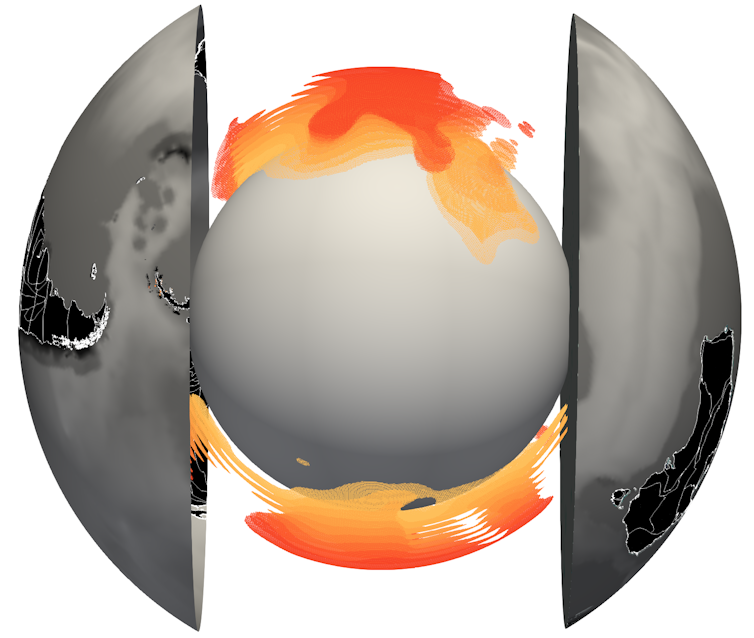
Earth’s interior 80 million years ago with hot structures in yellow to red (darker is shallower) and cold structures in blue (darker is deeper). Ömer Bodur/Nature

Deep in the Earth beneath us lie two blobs the size of continents. One is under Africa, the other under the Pacific Ocean.

The blobs have their roots 2,900km below the surface, almost halfway to the centre of the Earth. They are thought to be the birthplace of rising columns of hot rock called “deep mantle plumes” that reach Earth’s surface.

When these plumes first reach the surface, giant volcanic eruptions occur – the kind that contributed to the extinction of the dinosaurs 65.5 million years ago. The blobs may also control the eruption of a kind of rock called kimberlite, which brings diamonds from depths 120-150km (and in some cases up to around 800km) to Earth’s surface.

Scientists have known the blobs existed for a long time, but how they have behaved over Earth’s history has been an open question. In new research, we modelled a billion years of geological history and discovered the blobs gather together and break apart much like continents and supercontinents.

Earth’s blobs as imaged from seismic data. The African blob is at the top and the Pacific blob at the bottom.
Ömer Bodur

A model for Earth blob evolution

The blobs are in the mantle, the thick layer of hot rock between Earth’s crust and its core. The mantle is solid but slowly flows over long timescales. We know the blobs are there because they slow down waves caused by earthquakes, which suggests the blobs are hotter than their surroundings.

Scientists generally agree the blobs are linked to the movement of tectonic plates at Earth’s surface. However, how the blobs have changed over the course of Earth’s history has puzzled them.

One school of thought has been that the present blobs have acted as anchors, locked in place for hundreds of millions of years while other rock moves around them. However, we know tectonic plates and mantle plumes move over time, and research suggests the shape of the blobs is changing.

Our new research shows Earth’s blobs have changed shape and location far more than previously thought. In fact, over history they have assembled and broken up in the same way that continents and supercontinents have at Earth’s surface.

We used Australia’s National Computational Infrastructure to run advanced computer simulations of how Earth’s mantle has flowed over a billion years.

These models are based on reconstructing the movements of tectonic plates. When plates push into one another, the ocean floor is pushed down between them in a process known as subduction. The cold rock from the ocean floor sinks deeper and deeper into the mantle, and once it reaches a depth of about 2,000km it pushes the hot blobs aside.

The past 200 million years of Earth’s interior. Hot structures are in yellow to red (darker is shallower) and cold structures in blue (darker is deeper).

We found that just like continents, the blobs can assemble – forming “superblobs” as in the current configuration – and break up over time.

A key aspect of our models is that although the blobs change position and shape over time, they still fit the pattern of volcanic and kimberlite eruptions recorded at Earth’s surface. This pattern was previously a key argument for the blobs as unmoving “anchors”.

Strikingly, our models reveal the African blob assembled as recently as 60 million years ago – in stark contrast to previous suggestions the blob could have existed in roughly its present form for nearly ten times as long.

Remaining questions about the blobs

How did the blobs originate? What exactly are they made of? We still don’t know.

The blobs may be denser than the surrounding mantle, and as such they could consist of material separated out from the rest of the mantle early in Earth’s history. This could explain why the mineral composition of the Earth is different from that expected from models based on the composition of meteorites.

Alternatively, the density of the blobs could be explained by the accumulation of dense oceanic material from slabs of rock pushed down by tectonic plate movement.

Regardless of this debate, our work shows sinking slabs are more likely to transport fragments of continents to the African blob than to the Pacific blob. Interestingly, this result is consistent with recent work suggesting the source of mantle plumes rising from the African blob contains continental material, whereas plumes rising from the Pacific blob do not.

Tracking the blobs to find minerals and diamonds

While our work addresses fundamental questions about the evolution of our planet, it also has practical applications.

Our models provide a framework to more accurately target the location of minerals associated with mantle upwelling. This includes diamonds brought up to the surface by kimberlites that seem to be associated with the blobs.

Magmatic sulfide deposits, which are the world’s primary reserve of nickel, are also associated with mantle plumes. By helping target minerals such as nickel (an essential ingredient of lithium-ion batteries and other renewable energy technologies) our models can contribute to the transition to a low-emission economy.

The Conversation

Nicolas Flament receives funding from the Australian Research Council and from De Beers.

Andrew Merdith was supported by the Deep Carbon Observatory and the Richard Lounsbery Foundation.

Ömer F. Bodur receives funding from the Australian Research Council and from De Beers.

Simon Williams receives funding from the Australian Research Council and the National Natural Science Foundation of China.

ref. Volcanoes, diamonds, and blobs: a billion-year history of Earth’s interior shows it’s more mobile than we thought – https://theconversation.com/volcanoes-diamonds-and-blobs-a-billion-year-history-of-earths-interior-shows-its-more-mobile-than-we-thought-179673

Is the budget good for women? The paid parental leave change takes us backwards and childcare costs were ignored

Source: The Conversation (Au and NZ) – By Elizabeth Hill, Associate Professor Political Economy and Deputy Director, The Gender Equality in Working Life Research Initiative, University of Sydney

Shutterstock

Among the many budget papers is the Women’s Budget Statement, a booklet outlining what the federal government is doing for Australian women. This includes A$2.1 billion for measures on domestic violence, women’s health, training and leadership.

As Prime Minister Scott Morrison and Women’s Minister Marise Payne write, the 2022 budget

demonstrates the Government’s continued commitment and action to achieving greater gender equality in Australia, and puts women at the centre of the economic and social recovery.

Does this stack up? One of the headline budget measures was an “enhanced” parental leave scheme. But the overhaul will not support gender equality in work and care. Meanwhile, the lack of reform to childcare is the biggest missed opportunity of the budget.

Paid parental leave

The budget combines two existing parental leave schemes into one. It merges two weeks of dad and partner pay with 18 weeks of parental leave pay (for the primary carer). Now, either parent can take the leave of up to 20 weeks in a bid to increase “choice and flexibility for families”.

The women's budget statement
The women’s budget statement was released on Tuesday night.
Mick Tsikas/AAP

This will especially benefit single parents, most of whom are women. But by removing the specific provision for dads and partners, it undoes good policy architecture designed to “nudge” men to take leave when a baby arrives.

Global research shows parental leave policies available to both parents on a “use it or lose it” basis deliver the best health and economic outcomes for children, women and men. These schemes mean dedicated leave for one parent cannot be taken by the other, pushing both parents to take leave to care.

Policy that supports the shared care of young children has been found to promote women’s participation in paid work and a more equitable division of unpaid care work over the long term.

Dad pay should not have been dumped

Global and Australian research also shows men are most likely to take parental leave when it is at income replacement level.

With the paid parental leave scheme paid at the national minimum wage rather than at wage replacement levels, there is a real risk men will not take up their new leave entitlement. Current cost-of-living pressures mean households are under increased economic strain and unable to afford any drop in income.


Read more:
There’s $1.3 billion for women’s safety in the budget and it’s nowhere near enough


So, the dad and partner pay should not have been dumped. Instead, it should have been developed to increase the incentives for men to take up more of the care load that will support women in the workforce, children’s health and men’s well-being.

This is on top of other necessary reforms – parental leave needs to be more generous in time and income. Superannuation also needs to be paid on the national scheme.

This will not change traditional caring roles

Even as the government removes the old categories of “primary” and “secondary” carer in the revised payment, the new scheme still risks entrenching Australian women as primary carers.

Australian women already do the majority of care and domestic work, and this is unlikely to shift without some strong incentives. The pandemic reminded us of just how “sticky” the unequal division of care work is as women shouldered the lion’s share of the pandemic care load.

The bottom line is this is not the kind of policy change that will drive an inclusive economic recovery and a gender equal economy.

Another blokes’ budget

As in previous years, this budget is focused on hard infrastructure such as cyber security, defence and traditional male trades.

These are important, but a better-balanced budget would deliver new investment in the essential care infrastructure our economy relies on. Countries such as Canada and the United States are developing new national care systems to drive productivity and an inclusive pandemic recovery.

A huge missed opportunity with childcare

This has been billed as a “cost-of-living” budget, but early childhood education and care have been overlooked. Even with a record spend of $10.3 billion this financial year, Australia has one of the most expensive early learning systems (for consumers) in the world. Childcare payments are one of the biggest costs to households, alongside housing costs and food.

A 2021 Mitchell Institute report found childcare is unaffordable for almost 40% of families. It is also difficult to access, especially in remote and regional areas.

Father with baby in baby carrier.
Childcare costs put huge pressure on families and can see mums in particular cut down their paid working hours.
www.shutterstock.com

This makes the $19.4 million allocation for 20 new childcare centres in known childcare “deserts” a welcome budget initiative. But much more is required.

There is widespread consensus amongst economists, business, civil society and community groups about the urgent need for free or more affordable early learning and care services for all children, regardless of what the parents do or do not do for work.

In The Conversation’s annual pre-budget survey of economists, one-third of respondents agreed increasing public subsidies for early learning and care was an appropriate way to spend money, even if it added to the deficit.


Read more:
The 2018 childcare package was partly designed to help families work more. But the benefits were too modest to matter


Investment in early learning is a key productivity measure – it will drive the pandemic recovery and support women to work at a level that suits their skills and aspirations. It is also a critical investment in our future, supporting all kids to have the best start in life no matter what their background.

Our system is not working for families and children, and this budget just tinkers at the sidelines.

The Conversation

Elizabeth Hill receives funding from The Australian Research Council.

ref. Is the budget good for women? The paid parental leave change takes us backwards and childcare costs were ignored – https://theconversation.com/is-the-budget-good-for-women-the-paid-parental-leave-change-takes-us-backwards-and-childcare-costs-were-ignored-179766

We’re two physios who ran away with the circus. Here’s what we learned

Source: The Conversation (Au and NZ) – By Charlotte Ganderton, Physiotherapy lecturer, Swinburne University of Technology

Circus fuses extreme athletic performance, diverse artists and stunning spectacles with a truly global appeal.

Circus is exciting, although sometimes unpredictable. At any moment during rehearsal, performance or travel, injuries can occur.

The task of looking after the health of circus performers is unique. And we’ve been privileged to do that, as physiotherapists treating and helping coordinate artists’ medical care.

We’ve done this in well over 100 cities through 30 countries across North and South America, Europe, Australasia, Asia and the Middle East. While we’ve mainly toured with professional circuses, we’ve also advised junior artists and circus training facilities.

This is what it’s like to work behind the scenes of some of the greatest shows on Earth.


Read more:
Circus Oz is to close after 44 years. They irrevocably changed Australian circus, and brought it to the world


A diverse crew

Circuses and their performers are diverse. Disciplines include ground acrobatics (for instance, tumbling, hand balancing, contortion); aerial acrobatics (trapeze, silks, straps); manipulation (juggling); character (clowning); and music. Rehearsals and performances may feature fire, ice, water, heights or a range of props and equipment.

You could compare the cast of a large show to an Olympic squad, with a variety of ages, body shapes, sizes and injury risk.

At the elite level, performers may come from a range of different countries, languages and cultural backgrounds. This can add potential challenges such as differing belief systems and attitudes about injury cause and management, training and performance.

Circus performers, including clown, juggler
Circuses and their performers are diverse, as are their injuries.
Shutterstock

A diverse set of injuries

While headline-grabbing falls and catastrophic injuries do occur, they are fortunately rare. Most injuries are chronic (long-term) injuries and less-serious acute ones.

The most commonly reported circus injuries are to the spine and ankle. We also see sprains, strains, and sore lower backs and shoulders.

You might be familiar with many of these injuries. However, circus performers have unique skills, and sometimes require extreme ranges of movement, coordination and strength. They need their bodies to function in ways you or I don’t. This influences how we work with performers to get them back on their feet (or hands).


Read more:
Hot pack or cold pack: which one to reach for when you’re injured or in pain


Circus injury rates are 7.37-9.27 per 1,000 artist exposures (the number of training/performance hours, or number of training sessions/shows). Acrobatic injuries are the most common.

However, the limited research we have on circus injuries suggests
circus is safer then many other sports. That includes having lower injury rates than contact football (rugby, American football and Australian rules), and gymnastics.

In professional circus, injuries tend to be minor, requiring seven or fewer treatment sessions and resulting in one or no missed shows.

Fit woman in exercise wear clutching sore lower back
Injuries, such as sore backs, are common, and not always reported.
Shutterstock

However, injuries are likely under-reported. Common definitions of injury rely on artists missing training or shows, or seeking formal medical care. Some injuries don’t meet these criteria.

Our research looked at performers’ self-reported lower-limb problems, regardless of whether they missed work or saw a health-care practitioner. We asked them about injuries and/or symptoms such as pain, ache, stiffness, clicking/catching, swelling and instability.

In any given week, we found more than 50% of performers reported problems. In an 18-week period, 86% of performers reported having had at least one week with work-related lower limb problems.


Read more:
Friday essay: from delicate teens to fierce women, Simone Biles’ athleticism and advocacy have changed gymnastics forever


A diverse range of issues

Some performers also face barriers to recovering from their injuries. One study found financial constraints and a lack of health-care support were issues.

For instance, full-time artists may have access to travelling medical staff with experience working with circus performers. These artists may also have paid injury leave and comprehensive health insurance.

However, artists performing on short-term contracts or doing gig-based work may need to source their own medical care and are more likely to suffer financial loss if they miss performances.

Other researchers have also reported how aspects of circus culture influence how we manage circus injuries. In one study, performers said they didn’t always trust health-care practitioners’ knowledge of work demands. This includes circus skill requirements, and training or show schedules.

Athlete's taped wrist and ankle
To tape or not? Some performers may prefer colleagues’ and coaches’ advice.
Shutterstock

Some performers may prioritise advice from colleagues and coaches over medical recommendations. This may be partly because circus is a historic art form where, in many disciplines, training methods have been passed down through generations of performers.

For health-care practitioners, this knowledge can be valuable. So clinicians need to work with artists to come to a shared understanding of how to manage injuries.

Acknowledging the unique nature of circus training and performance, as well as the lack of evidence base to guide medical decision-making in the field, can also help build rapport and ensure a collaborative approach to managing injuries.


Read more:
Are clowns scary? Ha ha aaaargh


Preventing injuries is the goal

Circus performers are generally adept at managing their bodies, using strength, flexibility and conditioning training to try to prevent injuries and improve their acts.

We have worked with performers to promote self-management, using techniques from more established fields such as sports and dance medicine.

For instance, we looked at adding self-directed endurance exercises to a performing, touring show. This was welcomed by many performers.


Read more:
Health Check: do ice baths after sport help recovery or improve results?


A lot goes on behind the scenes

For the shows to go on, much behind-the-scenes work is needed from the artists and dedicated support staff.

For those involved in the care of circus artists, this provides not only a uniquely challenging and fascinating workspace, but an amazing view of some of the greatest shows on Earth.

The Conversation

Charlotte Ganderton is a research consultant for the National Institute of Circus Arts. Charlotte was previously employed for Cirque du Soleil in its performance medicine team.

Michael Henry receives funding from the Australian Government in the form of RTPd fee offset and stipend scholarships. He was previously employed by Cirque du Soleil in its performance medicine team.

ref. We’re two physios who ran away with the circus. Here’s what we learned – https://theconversation.com/were-two-physios-who-ran-away-with-the-circus-heres-what-we-learned-177739

Why can floods like those in the Northern Rivers come in clusters?

Source: The Conversation (Au and NZ) – By Margaret Cook, Lecturer in History, University of the Sunshine Coast

Right now, Lismore residents are going through their second major flood in a month.

On February 28th, the devastating first flood peaked at 14.4 metres, fully two metres higher than the previous record of 12.27 metres in 1954, and well above the town’s 10-metre-high levee wall, constructed in 2005. Four people died, with 2000 homes destroyed or unlivable of the city’s 19,000.

Even as Lismore and Northern Rivers residents struggle to recover from the first flood, the floods are coming again. On March 29th, more heavy rain began falling onto the soaked catchment feeding into Wilsons River. Once again, Lismore’s traumatised community had to evacuate, with predictions of floods of 10.6 metres. The flood only reached 9.7 metres. But then a further 279mm of rain fell between 9am Tuesday and 6am Wednesday 30 March, with an 11 metre flood predicted. Once again, residents had to evacuate.


Read more:
‘One of the most extreme disasters in colonial Australian history’: climate scientists on the floods and our future risk


Is this unprecedented? While the height of the first flood is a new record, back to back floods have happened before. Brisbane suffered three of the largest floods then recorded in rapid succession, back in 1893. Floods can come in clusters.

As the world warms, the atmosphere can hold more water. That means we are more likely to see larger floods. It is time to consider relocating flood-prone towns.

We’ve seen clusters of floods before

Lismore is no stranger to floods. The town was built on the meeting place of Wilsons River and Leycester Creek. Lismore’s deep bowl shape has seen the town nicknamed “The Wok”. As many as 30,000 people live on low-lying land at risk of flood.

The last major flood in Lismore took place in 2017, reaching 11.59 metres. Only five years later came these devastating floods. That’s an unusually small gap, and many locals were shocked at the small intermission between major floods. Then the second one hit, with almost no break between inundations.

While it is unusual, clusters of floods have happened before. In a scenario eerily familiar to the people of Lismore, Brisbane experienced three floods in a month. What’s more, two of these were the largest on record.

On February 5th 1893, Brisbane experienced a flood of 8.35 metres. It was the second highest recorded flood since 1841. Bridges, railway lines, businesses and whole streets of houses were destroyed. Roads became canals as the city lay submerged under water. Houses and shops were left coated in foul-smelling mud. There was very little time to recover as the city flooded again on February 11th, though only to 2.4 metres.

Just four days later, as the recovery was beginning again, a major new flood swept through the city. Newspapers reported the damage in this 8.09 metre flood was much less than the first, as much of the possible damage had already been done. This was not quite true as many buildings had been significantly weakened from the first inundation. The sodden land and roads were more prone to landslides and collapse.

These floods killed 35 people, and left hundreds of people homeless and unemployed. The back to back floods took a psychological toll, with newspapers reporting people were feeling despair and wretchedness. Many in Brisbane in 1893 would have been able to identify with the feeling Lismore Mayor Steve Krieg recently described as “flood fatigue”.


Read more:
‘I simply haven’t got it in me to do it again’: imagining a new heart for flood-stricken Lismore


Why does Australia suffer from flood clusters?

Australia has highly variable rainfall. That’s because of the well-known El Niño–Southern Oscillation, a natural climate phenomenon able to make Australia drier or wetter. In El Niño years, rainfall is significantly reduced, leaving us more vulnerable to drought. But in La Niña years, wet weather sets in, making floods more likely.

Both 1893 and 2022 are La Niña years. We’re seeing the result of wet summers saturating our river catchments and soils, leaving them less able to absorb heavy rains and more prone to flooding.

In La Niña years, large floods are more likely to come in clusters with dry periods in between. We can see this clearly in Lismore’s history.

Between 1887 and 1893, the town experienced three major floods, ranging between 10.43 and 12.46 metres.

Between 1962 and 1965, the town endured three more floods over 10 metres.

And in 1967, Lismore flooded five times between March and June, with floods ranging from 5.09 to 10.27 metres.

While La Niña years often come in pairs, the Bureau of Meteorology has warned it is possible to have three consecutive La Niña years, as we’ve seen in 1954-57, 1973-1976 and 1998-2001. All of these caused flooding in Lismore. Thankfully, at this stage it’s considered unlikely that our two years of La Niña will stretch to three.

So what can we learn?

As the world warms, floods are becoming increasing hard to predict. While dams and levee banks can reduce flood damage, they work best in minor and moderate floods. In catastrophic events such as the February flood, there is little they can do.

While La Niña years and soaked catchments make floods more likely, they do not guarantee a flood occurring.

Scientists have repeatedly warned us climate change can both dry out soils and intensify rainfall depending on the area. That means smaller floods may become less common, but floods that do occur are likely to be more frequent and more intense.

As I write, flood records in some parts of northern NSW are tumbling again. The floodwaters at Ballina, Bellingen and Lennox Head are metres above previous heights.

While it may not result in another catastrophic flood in Lismore, this will not be the town’s last flood. In fact, the record may be surpassed. It is time to discuss relocating the town away from the floodplain.


Read more:
Want to help people affected by floods? Here’s what to do – and what not to


The Conversation

Margaret Cook does not work for, consult, own shares in or receive funding from any company or organisation that would benefit from this article, and has disclosed no relevant affiliations beyond their academic appointment.

ref. Why can floods like those in the Northern Rivers come in clusters? – https://theconversation.com/why-can-floods-like-those-in-the-northern-rivers-come-in-clusters-180250

Inflation has already eroded tomorrow’s minimum wage rise – NZ’s low-income workers will need more support

Source: The Conversation (Au and NZ) – By Murat Ungor, Senior Lecturer in Economics, University of Otago

Shutterstock

Tomorrow’s minimum wage increase to NZ$21.20 an hour should help a significant number of New Zealand’s lowest paid workers and their families – 300,000 people, according to the government.

Just how much it will help, however, is less certain.

At 6%, the increase is in line with with the 5.9% annual rise in the consumer price index (CPI) in the December 2021 quarter. But inflation is still rising, with domestic and global pressures meaning it’s likely to keep rising for some time.

Those minimum wage gains, along with simultaneous increases to other benefits and superannuation payments, are already eroding.

The food price index rose 6.8% in February from the previous year. International commodity and oil prices have soared since the Russian invasion of Ukraine. Some estimates suggest an annual CPI rise of between 7% and 8% in this year’s March quarter.

It’s clear low-income households will continue to struggle to keep pace with the rising cost of living. For that reason, the minimum wage increase must be accompanied by other support measures, and not viewed as a solution in its own right.

Minimum wages and employment

In fact, there are those who don’t see a minimum wage as being productive at all. One school of economic thought proposes that minimum wages actually undermine job creation by making employers avoid paying for more expensive labour at the same time as encouraging more workers into the job market.

This view was articulated by Nobel laureate economist George Stigler, who wrote in 1976:

One evidence of professional integrity of the economist is the fact that it is not possible to enlist good economists to defend protectionist programs or minimum wage laws.


Read more:
Does raising the minimum wage kill jobs? The centurylong search for the elusive answer shows why economics is so difficult – but data sure helps


But other economists have argued against this – for example, David Card and Alan Krueger, who published several controversial empirical works in the 1990s finding increasing the minimum wage doesn’t necessarily lead to fewer jobs.

Not everyone agrees with Card and Krueger, however. David Neumark and William Wascher evaluated the evidence and argued minimum wages do reduce employment opportunities for less skilled workers, “especially those who are most directly affected by minimum wage”.

So, there is no real academic consensus on minimum wages – and not even much agreement on what the research literature really says.

Effects on poverty

Given all this, perhaps the better question is whether minimum-wage policies reduce poverty overall. But again, the research has been contradictory.

In one New Zealand study in 2012, researchers found minimum wages do not guarantee people will escape poverty. Another study using Irish data also concluded that minimum wages may be “a blunt instrument” for tackling poverty.


Read more:
New Zealand’s health restructure is doomed to fall short unless its funding model is tackled first


On the other hand, a 2021 US study found significant positive employment effects for single mothers with aged children five and under, suggesting minimum wages at least have potential as a policy instrument for reducing child poverty.

This is particularly relevant in New Zealand for two reasons: one in five Māori children and one in four Pasifika children meet the criteria for material hardship, and Pacific people and Māori represent 10% and 20% of minimum wage earners, respectively.

Minimum wage just one tool

What does seem clear is that minimum wage policies are most effective as part of a complementary income support bundle, as some overseas research has shown and which was supported by a comprehensive review of minimum wage policies in New Zealand.

Examining the effects on various economic outcomes since 2000, the authors argued that minimum wage policies should be “designed and evaluated in the context of other income support policies”.

Those other supports include the Families Package introduced in 2018, which included an increase to the accommodation supplement, designed to help low income earners with rent, board or mortgages (but is not available to those in public housing).


Read more:
No silver lining for climate change: pain at the petrol pump will do little to get us out of our cars


The same authors recently investigated the impact of increases in the maximum accommodation supplement rates to see if these had simply been swallowed by rising accommodation costs.

Their findings were encouraging: more than 90% of the increase in assistance was captured by the recipients as an increase in after-rent income. A minimum wage policy has a greater chance of success when coupled with successful support policies such as this.

But it’s important such complementary policies are synchronised, especially given only some other social policies, such as Working for Families, are inflation-adjusted.


Read more:
The pandemic exposes NZ’s supply chain vulnerability – be ready for more inflation in the year ahead


Getting the mix right

Elsewhere, these policy combinations have been effective. In the United States, for example, the Earned Income Tax Credit (EITC) – as its title suggests, a refundable tax credit similar to New Zealand’s Working for Families policy – has been shown to benefit low-wage workers and families in combination with a modest increase in the minimum wage.

Again, the combination of policies works better than either in isolation, and some recent studies suggest EITC expansions and minimum wage hikes should be thought of in tendem as complementary policies.

However, one of the big challenges of integrating minimum wage settings with other policies is that each tool affects many economic outcomes. What should be the optimal level of minimum wages? How do minimum wage hikes interact with other supporting policies?

While there have been some official efforts to measure the relationship between the minimum wage and other state interventions, this needs to go further in order to find the right policy mix – especially during a year that will see continued high inflation, low growth and economic uncertainty.

The Conversation

Murat Ungor does not work for, consult, own shares in or receive funding from any company or organisation that would benefit from this article, and has disclosed no relevant affiliations beyond their academic appointment.

ref. Inflation has already eroded tomorrow’s minimum wage rise – NZ’s low-income workers will need more support – https://theconversation.com/inflation-has-already-eroded-tomorrows-minimum-wage-rise-nzs-low-income-workers-will-need-more-support-178749

View from The Hill: Budget week punctuated by distractions

Source: The Conversation (Au and NZ) – By Michelle Grattan, Professorial Fellow, University of Canberra

In the middle of budget week, Scott Morrison and Anthony Albanese boarded a VIP aircraft bound for Melbourne to attend Shane Warne’s Wednesday evening memorial service.

Their hostilities, moving towards fever pitch for the imminent election, were put aside for the purpose of celebrating the life of a national hero.

Morrison took Tim Wilson, who was Warne’s local member. Albanese was accompanied on the plane by his deputy Richard Marles and Senator Don Farrell, shadow minister for sport.

Both leaders knew that, whatever the exigencies of this budget week, the trip was essential. Warne was far more popular than either of them.

Budgets these days are prone to disappear quickly but having this one register – and positively – with voters is vitally important for Morrison. But there are problems cutting through.

One is public cynicism – the “you’re just trying to buy us” reaction. Another is that other stories are grabbing attention including, but not only, the Warne service.

The run up to that service saw the morning TV shows give less attention than usual to budget follow up, with high profile TV presenters abandoning visits to Canberra in favour of doing their interviews remotely.

For Morrison, budget night itself had been soured by an extraordinarily strong, personal attack on him by one of his backbenchers, Senator Concetta Fierravanti-Wells.

Fierravanti-Wells denounced the prime minister “an autocrat and a bully”. “It is his way or the highway,” she told the Senate.

“He is adept at running with the foxes and hunting with the hounds, lacking a moral compass and having no conscience.”

“In my public life I have met ruthless people,” she said, “Morrison tops the list […] Morrison is not fit to be prime minister.”

Some context is needed. Fierravanti-Wells has been a trenchant critic of Morrison right back to the days of his preselection, which was mired in a bout of nasty party infighting (that she reprised in her speech).

At the weekend, Fierravanti-Wells was bumped, in favour of Senator Jim Molan, in a battle for a winnable place on the NSW Senate ticket.

“I have known for a number of years of the machinations involving the PMO [prime minister’s office] and others to move me on,” she said.

While her loss happened in a mass vote of Liberal Party members, the dysfunctional NSW division’s preselection process more generally has seen an appalling factional imbroglio, in which Morrison and his factional henchman Alex Hawke have been central players.

A certain discount will be applied to Fierravanti-Wells’ attack, for a range of reasons. But her criticism feeds into the narrative about the toxic Parliament House culture, which has been recently re-fuelled on the Labor side by friends of the late senator Kimberley Kitching, who allege she was bullied by colleagues on her own side.

In an earlier speech this week, Fierravanti-Wells identified with Kitching, making it clear they’d discussed how they both felt ill-treated within their respective parties.

The Liberals, especially Morrison, have been using the claims about the alleged behaviour towards Kitching to take shots at Albanese. Fierravanti-Wells has effectively muzzled them.

For Morrison, the Fierravanti-Wells diatribe is dangerous because it goes to the criticism of his character that has potency with some voters. Some of the scathing assessments have come from his own side, for instance revealed in leaked text messages sent by Gladys Berejiklian and Barnaby Joyce.

The other distraction of the week is yet to come, and of itself entirely welcome. However, from Anthony Albanese’s standpoint, it is unfortunately timed.

Ukraine’s president Volodymyr Zelenskyy is due to address the federal parliament late Thursday. He’s scheduled to speak just two hours before Albanese delivers his budget reply, which will contain a major policy announcement.

Zelenskyy has captured the attention of people everywhere as he leads his nation in its David and Goliath battle. Delivering a budget reply that competes with the appearance of an international super-hero will be hard going.

The Conversation

Michelle Grattan does not work for, consult, own shares in or receive funding from any company or organisation that would benefit from this article, and has disclosed no relevant affiliations beyond their academic appointment.

ref. View from The Hill: Budget week punctuated by distractions – https://theconversation.com/view-from-the-hill-budget-week-punctuated-by-distractions-180336

Word from The Hill: Next step for Morrison is visit to governor-general

Source: The Conversation (Au and NZ) – By Michelle Grattan, Professorial Fellow, University of Canberra

As well as her interviews with politicians and experts, Politics with Michelle Grattan includes “Word from The Hill”, where she discusses the news with members of The Conversation politics team.

In this podcast, Michelle and politics + society editor Amanda Dunn talk about treasurer Josh Frydenberg’s ‘big spend’ budget, Anthony Albanese’s coming budget reply speech, a Liberal senator’s scathing review of Scott Morrison, and what the parties’ key issues will be at the election that’s about to be called.

The Conversation

Michelle Grattan does not work for, consult, own shares in or receive funding from any company or organization that would benefit from this article, and has disclosed no relevant affiliations beyond their academic appointment.

ref. Word from The Hill: Next step for Morrison is visit to governor-general – https://theconversation.com/word-from-the-hill-next-step-for-morrison-is-visit-to-governor-general-180337

Budget 2022: $9.9 billion towards cyber security aims to make Australia a key ‘offensive’ cyber player

Source: The Conversation (Au and NZ) – By Paul Haskell-Dowland, Professor of Cyber Security Practice, Edith Cowan University

MICK TSIKAS/AAP

In the 2022 federal budget, Treasurer Josh Frydenberg launched a range of vote-winning initiatives – one of which included a breathtaking A$9.9 billion for cyber security over ten years.

Bundled under the acronym REDSPICE (which stands for resilience, effects, defence, space, intelligence, cyber and enablers), the program is expected to help build Australia’s intelligence and defensive (and offensive) capabilities.

But what does this mean, where is the money coming from and just how offensive are we planning to be?

What’s REDSPICE?

REDSPICE is a program to grow and enhance the intelligence and cyber capabilities of the Australian Signals Directorate (ASD) — the chief agency responsible for foreign signals intelligence, cyber warfare and information security.

Headline figures include 1,900 new recruits and delivering three times more offensive capability within the ASD.

The REDSPICE program aims to bolster cyber capabilities across a range of areas.
ASD website

A key justification given for the program is, according to Defence Minister Peter Dutton, the “deteriorating strategic circumstances in our region” and “rapid military expansion, growing coercive behaviour and increased cyber attacks” from Australia’s adversaries.

This was also reinforced in a pre-budget comment from Dutton, who warned of China’s cyber warfare capability to launch “an unprecedented digital onslaught” against Australia.

Potential outcomes

The plans for the program will have effects beyond Canberra. They could see more Australian technologies being made available to our intelligence and defence partners overseas, as well as opportunities for increased data sharing (which is key to fighting against cyber threats).

Further investment in advanced artificial intelligence and machine learning will likely be used to detect attacks earlier than currently possible – potentially allowing automated responses to cyber incidents.

Identifying previously “unseen” attacks is another significant challenge, and using advanced technologies to detect such incidents is essential for a strong defence.

Similarly, a doubling of “cyber-hunt activities” will see an increase in the analysts and automated systems actively looking for vulnerabilities in critical infrastructure. This is essential in protecting the services we depend on day-to-day.

A major attack against our water, electricity, communications, health care or finance services could have devastating consequences – first for the most vulnerable among us, and subsequently for everyone.

All of these technologies will be of value in reducing the large number of threats and incidents seen on a daily basis, and prioritising certain threats so they may be better handled by limited human resources in agencies.

The program will reportedly ensure a distribution of key functions both nationally and internationally, with a focus on building resilience in the “critical capabilities” of the ASD’s operations.

Some new money, but mostly old money

A$10 billion sounds like a significant windfall for our defence and intelligence agencies. However, a closer look indicates the “new” money is perhaps only worth around A$589 million in the first four years.

The majority of the balance comes from redirecting existing defence funding to the ASD.

Also, since the funding is spread over a ten-year period, it will only realise a proportion of the intended outcomes in the next government’s term. In fact, only A$4.2 billion falls within the next four years.

Future governments can always revisit these funding commitments and decide to make changes.

Is Australia ready to be an offensive cyber player?

Offensive cyber is perhaps the inevitable consequence of the increasing levels of cyber threats around the globe.

Not only have we seen global cyber crime increasing, but there is growing evidence of nations being willing to engage in cyber warfare. Recently this has been illustrated through Russia’s cyber attacks against Ukraine.

Australia has had a publicly acknowledged cyber offensive capability for some time. This was even outlined in the government’s April 2016 cyber security strategy (and this was just the first official acknowledgement). It’s likely Australia has had this capability for even longer.

Offensive cyber represents a significantly different approach to a purely defensive or reactive approach. Initiating an attack (or retaliating) is a dangerous endeavour which can have unpredictable consequences.

Launching a highly targeted attack from Australia is certainly possible, but with such attacks we often see consequential damage that affects individuals and systems beyond the target. For example, the NotPetya malware, first identified in 2017, rapidly moved outside of the target country (Ukraine) and had significant financial impact around the world.


Read more:
As Russia wages cyber war against Ukraine, here’s how Australia (and the rest of the world) could suffer collateral damage


In the 2016 strategy there was specific reference to the importance of legislative compliance:

Any measure used by Australia in deterring and responding to malicious cyber activities would be consistent with our support for the international rules-based order and our obligations under international law.

But this is largely absent in the (brief) REDSPICE blueprint. Also, due to the covert nature of operations conducted by the ASD, we are effectively being asked to accept Australia operates ethically in the absence of any recorded or published data on operations to date.

Although there have been limited reports of legitimate cyber engagements, a 2016 Address to Parliament by then Prime Minister Malcolm Turnbull referred to offensive attacks conducted by Australia in relation to operations against Islamic State (in partnership with UK and US allies):

While I won’t go into the details of these operations […] they are being used … they are making a real difference in the military conflict […] all offensive cyber activities in support of the ADF and our allies are subject to the same Rules of Engagement which govern the use of our other military capabilities in Iraq and Syria […]

Will it make a difference?

We all want Australia to be a safe place, so any investment in intelligence and cyber security will be welcomed by most people. That said, it’s worth remembering this battle can never really be won.

Cyber defence is a constant game of cat-and-mouse. One side builds a better weapon, the other builds a better defence, and so it goes. As long as our adversaries are prepared to invest in technologies to infiltrate and damage our critical infrastructure, we will have a continued need to invest in our defences.

The increased focus on offensive initiatives may give us (and our allies) the upper hand for a while, but the cyber world doesn’t stand still. And the pockets of some of our cyber adversaries are also very deep.

The Conversation

Paul Haskell-Dowland does not work for, consult, own shares in or receive funding from any company or organization that would benefit from this article, and has disclosed no relevant affiliations beyond their academic appointment.

ref. Budget 2022: $9.9 billion towards cyber security aims to make Australia a key ‘offensive’ cyber player – https://theconversation.com/budget-2022-9-9-billion-towards-cyber-security-aims-to-make-australia-a-key-offensive-cyber-player-180321

Poor policy and short sightedness: how the budget treats climate change and energy in the wake of disasters

Source: The Conversation (Au and NZ) – By Tony Wood, Program Director, Energy, Grattan Institute

Shutterstock

This year’s federal budget is characterised by an avalanche of immediate handouts in response to cost-of-living pressures, some sound initiatives and deferral of more fundamental decisions. This is precisely reflected in how the budget treats energy and climate change.

The A$1 billion to expand Australia’s low emission technology capabilities, such as green hydrogen, is welcome. But cuts to the fuel excise represent poor policy on fiscal and environmental grounds.

From the devastating bushfires of 2019-2020 to this year’s shocking floods, unprecedented climate-related disasters have wrought havoc across Australia.

It is deeply regretful that the budget and forward estimates do not specifically recognise the ongoing, and escalating, scale and the fiscal impact of these disasters.

Fuel excise is poor policy

For six months, the government will halve fuel excise to 22.1 cents per litre to offset soaring petrol prices. This short-term reduction will undoubtedly be welcomed by anyone with a petrol or diesel vehicle, and may provide the sort of political boost the government seeks ahead of the election.

Yet, it is poor fiscal policy. First, the outlook for global oil prices is as unpredictable as the outcome of the Ukraine war. That means the cut in fuel excise will quickly be either too strong a response or insufficient.

Second, restoring the level will not be politically simple. As a relief for households under financial stress, the measure is poorly targeted.


Read more:
A cost-of-living budget: cuts, spends, and everything you need to know at a glance


It is also a stark illustration of how motorists today would already be financially better off if Treasurer Josh Frydenberg was able to implement his proposed fuel efficiency standards in 2017, when he was the minister for energy and the environment.

At that time, the benefit to motorists was calculated to be more than $500 per year by 2025 – and that was based on prices below $1.50 per litre, well short of current levels above $2. And of course, we would have been making tangible progress on reducing emissions in the transport sector.

Funding low-emissions technologies

Development and deployment of low-emission technologies – such as clean hydrogen, green steel and carbon capture and storage – will be critical to meeting Australia’s commitment to net-zero carbon emissions by 2050.

The government’s commitment of more than $1 billion to projects to support these technologies is welcome, as is the allocation of $84 million to support the development of microgrids.

These investments are generally aligned with the government’s technology investment roadmap, released in 2020. However, it would be better for these projects to be selected via an independent agency with criteria set by the government.


Read more:
Floods left thousands without power. Microgrids could help communities weather the next disaster


The government emphasises a “technology, not taxes” approach to bringing Australia’s emissions to net zero. But funding the net-zero transition from government coffers is not sustainable.

We need policies such as a price on carbon that encourage the market to deploy these technologies at scale. The recent history of such policies in Australia means this will be a big challenge for whoever is energy minister after the looming federal election.

Australia’s extensive renewable energy and critical minerals resources mean we could be a global leader in manufacturing, for instance, downstream processing or iron ore, copper, lithium and similar metals critical in a low emissions world.

So the $1 billion in the budget to boost our manufacturing capability is another step in the right direction.

But again, good governance should include a clear framework that determines which projects get selected. This process should be based primarily on Australia’s potential competitive advantage.

The primary source of such advantage lies in our renewable energy and minerals resources, while specific regions may also have advantages based on existing infrastructure such as ports and skilled workforces.


Read more:
Federal budget: $160 million for nature may deliver only pork and a fudge


Investments in low-emission technologies and manufacturing is closely aligned with this budget’s focus on Australia’s regions.

Investment in new opportunities will be welcomed in the regions. It should be accompanied by an equally strong commitment to working with regional communities that may suffer job losses and other economic harms in the transition away from fossil fuel industries.

Short-term climate thinking

Frydenberg’s budget acknowledged the devastation wrought in Australia by floods, drought and bushfires. Yet it failed to acknowledge the future cost of such disasters on the budget under climate change.

The budget includes measures to make regional Australia more resilient, to mitigate the impact of these disasters and support insurance coverage. But these are short-term commitments.

Even if we manage to stop global warming beyond 1.5℃ this century, the frequency and severity of natural disasters will only worsen. Australia is already feeling the damage.

The economic and fiscal consequences of these disasters will only increase. And there will be other risks from a changing climate such as rising health spending and reduced government revenues from key exports, including liquefied natural gas.

So what should the government do differently?

At the very least, the federal government should move to better understand and quantify the fiscal risks from climate change.

First, it should include some of the immediate risks of climate change in the budget’s “Statement of Risks”, which outlines the general fiscal risks that may affect the budget.


Read more:
Climate change has already hit Australia. Unless we act now, a hotter, drier and more dangerous future awaits, IPCC warns


Second, it should adjust medium-term fiscal projection models to factor in declining revenue from fossil fuels, higher cost of debt, and higher expenditure on health and natural disaster supports.

Third, the longer-term impacts of climate change on the budget must be modelled. This should inform the next Intergenerational Report in 2025, which provides an economic outlook for Australia over coming decades.

Climate change ultimately challenges governments to reconsider their fiscal strategy. The many climate-related uncertainties make a strong case for preserving fiscal flexibility and firepower to cushion the direct impacts of climate change, including natural disasters.

The Conversation

Through his superannuation fund, Tony Wood owns shares in several companies related to the energy and resources sectors.

ref. Poor policy and short sightedness: how the budget treats climate change and energy in the wake of disasters – https://theconversation.com/poor-policy-and-short-sightedness-how-the-budget-treats-climate-change-and-energy-in-the-wake-of-disasters-180179

Federal budget: $160 million for nature may deliver only pork and a fudge

Source: The Conversation (Au and NZ) – By Peter Burnett, Honorary Associate Professor, ANU College of Law, Australian National University

ANU

Treasurer Josh Frydenberg’s cash-splash budget has a firm eye on the upcoming federal election. In the environment portfolio, two spending measures are worth scrutinising closely.

First is a A$100 million round of the Environment Restoration Fund – one of several grants programs awarded through ministerial discretion which has been found to favour marginal and at-risk electorates.

Second is $62 million for up to ten so-called “bioregional plans” in regions prioritised for development. Environment Minister Sussan Ley has presented the measure as environmental law reform, but I argue it’s a political play dressed as reform.

It’s been more than a year since Graeme Samuel’s independent review of Australia’s environment law confirmed nature on this continent is in deep trouble. It called for a comprehensive overhaul – not the politically motivated tinkering delivered on Tuesday night.

man in glasses stands behind woman with hand in air
The Samuel review called for more than politically motivated tinkering.
Mick Tsikas/AAP

A big barrel of pork?

The Environment Restoration Fund gives money to community groups for activities such as protecting threatened and migratory species, addressing erosion and water quality, and cleaning up waste.

The first $100 million round was established before the 2019 election. In March 2020 it emerged in Senate Estimates that the vast majority had been pre-committed in election announcements. In other words, it was essentially a pork-barelling exercise.

The grants reportedly had no eligibility guidelines and were given largely to projects chosen and announced as campaign promises – and mostly in seats held or targeted by the Coalition.

Given this appalling precedent, the allocation of grants under the second round of the fund must be watched closely in the coming election campaign.


Read more:
A cost-of-living budget: cuts, spends, and everything you need to know at a glance


two men in crowd high five
Environmental grants announced before Morrison’s 2019 election win were exposed as pork-barrelling.
Mick Tsikas/AAP

A tricky Senate bypass

Australia’s primary federal environment law is known as the Environmental Protection and Biodiversity Conservation (EPBC) Act.

Under provisions not used before, the need for EPBC Act approval of developments such as dams or mines can be switched off if the development complies with a so-called “bioregional plan”.

Bioregions are geographic areas that share landscape attributes, such as the semi-arid shrublands of the Pilbara.

In theory, bioregional plans deliver twin benefits. They remove the need for federal sign-off — a state approval will do the job – and so eliminate duplication. And national environmental interests are maintained, because state approvals must comply with the plans, which are backed by federal law.

But the government’s record strongly suggests it’s interested only in the first of these benefits.

Since the Samuel review was handed down, the government has largely sought only to remove so-called “green tape” – by streamlining environmental laws and reducing delays in project approvals.

Bills to advance these efforts have been stuck in the Senate. Now, the government has opted to fund bioregional plans which, as an existing mechanism, avoid Senate involvement.

Meanwhile, the government has barely acted on the myriad other problems Samuel identified in his review of the law, releasing only a detail-light “reform pathway”.


Read more:
Let there be no doubt: blame for our failing environment laws lies squarely at the feet of government


here
Bioregional plans remove the need for federal sign-off on developments such as mines.
Dan Himbrechts/AAP

A rod for the government’s back?

Ironically, bioregional plans may create more problems for the government than they solves.

First, the surveys needed to prepare the plans are likely to spotlight the regional manifestations of broad environmental problems, such as biodiversity loss.

And the EPBC Act invites the environment minister to respond to such problems in the resulting plans. This implies spelling out new investments or protections – challenging for the government given its low policy ambition.

The federal government would also need to find state or territory governments willing to align themselves with its environmental politics, as well as its policy.

Of the two Coalition state governments, New South Wales’ is significantly more green than the Morrison government, while Tasmania is not home to a major development push.

Western Australia’s Labor government has been keen to work with Morrison on streamlining approvals, but fudging environmental protections is another thing altogether. And Labor governments, with a traditionally more eco-conscious voter base, are particularly vulnerable to criticism from environment groups.

The government may fudge the bioregional plans so they look good on paper, but don’t pose too many hurdles for development. Such a fudge may be necessary to fulfil Morrison’s obligations to the Liberals’ coalition partner, the Nationals.

Tuesday’s budget contained more than $21 billion for regional development such as dams, roads and mines – presumably their reward for the Nationals’ support of the government’s net-zero target.

Bioregional plans containing strict environmental protections could constrain or even strangle some of these developments.

Four men and a woman exit glass doors
The budget contained $21 million for the regions – a move that will please the Nationals.
Mick Tsikas/AAP

But on the other hand, the government may be vulnerable to court challenges if it seeks to push through bioregional plans containing only vague environmental protection.

For a government of limited environmental ambition bioregional plans represent more a political gamble than a reform.

Morrison has clearly rejected the safer option of asking Ley to bring forward a comprehensive response to the Samuel review, casting streamlining as part of a wider agenda.

Such a reform would have better Senate prospects and created room to negotiate.

Morrison could also have promised to reintroduce the streamlining bills after the election. But he must have concluded that the measure has no better chance of getting through the next Senate than this one.

What price fundamental reform?

If the government successfully fudges bioregional plans, the result would be watered-down national environmental protections.

This would run completely counter to the key message of the Samuel review, that to shy away from fundamental law reforms:

“is to accept the continued decline of our iconic places and the extinction of our most threatened plants, animals and ecosystems”.

Clearly, good reform is too expensive — politically as well as fiscally — for this budget.


Read more:
A major report excoriated Australia’s environment laws. Sussan Ley’s response is confused and risky


The Conversation

Peter Burnett does not work for, consult, own shares in or receive funding from any company or organisation that would benefit from this article, and has disclosed no relevant affiliations beyond their academic appointment.

ref. Federal budget: $160 million for nature may deliver only pork and a fudge – https://theconversation.com/federal-budget-160-million-for-nature-may-deliver-only-pork-and-a-fudge-180096

Politics with Michelle Grattan: Jim Chalmers on the budget Labor can’t oppose

Source: The Conversation (Au and NZ) – By Michelle Grattan, Professorial Fellow, University of Canberra

The opposition is criticising the government’s “giveaway” budget but, predictably, with the election close, is not opposing its cost of living package, which includes a temporary cut in full excise and billions of dollars for low and middle income taxpayers, pensioners and welfare recipients.

Jim Chalmers is shadow treasurer, and he tells this podcast, “It’s a vote seeker budget in the sense that it’s got a shelf life of six or seven weeks.

“The government is temperamentally incapable of seeing beyond the election, and that’s the difference [with Labor]. I think there was a real appetite in the community for something that said, ‘we’ve been through a lot together. And what does the future look like?’”

Chalmers argues voters will “see through it in the same way they see through the prime minister”.

Like the Treasurer Josh Frydenberg, Chalmers rules out extending the petrol excise cut beyond its September expiry date.

“I’ve said, to be upfront to the Australian people, it’s difficult to see a government of either political persuasion being able to afford to extend that excise relief forever. We’re just being upfront about it because we believe in being responsible with the people’s money.”

He dodges when asked about a Labor government’s response, after the budget didn’t renew the tax offset for low and middle income earners. But the signal is that Labor would not seek to restore it.

“We don’t want to pre-empt decisions that a future government may take,” he says.

“The reality is this government is going to the election with the worst set of books that any government has ever taken to an election in Australia. There’s not room in our alternative budget, even for all of the good ideas. And so we’ve got to prioritise and sequence and make sure that whatever we do is delivering maximum bang for buck.

“This is the inheritance if government changed hands and so my responsibility if I was the treasurer […] is to weigh up all of those pressures to implement our election commitments.”

The Conversation

Michelle Grattan does not work for, consult, own shares in or receive funding from any company or organisation that would benefit from this article, and has disclosed no relevant affiliations beyond their academic appointment.

ref. Politics with Michelle Grattan: Jim Chalmers on the budget Labor can’t oppose – https://theconversation.com/politics-with-michelle-grattan-jim-chalmers-on-the-budget-labor-cant-oppose-180329

Budget 2022: the government spends big on its ‘khaki election’ strategy, but neglects diplomacy and other ‘soft’ power

Source: The Conversation (Au and NZ) – By Peter J. Dean, Chair of Defence Studies and Director, UWA Defence and Security Institute, The University of Western Australia

The Morrison government has been signalling for some time that it wants the 2022 federal election to be a so-called “khaki election”: one big on defence and national security.

So what was in the budget to support this aim?

The big funding announcement on budget night was an additional A$9.9 billion over ten years for the Australian Signals Directorate (ASD) for offensive and defensive cyber capabilities. That will mean a doubling of ASD’s budget over the next few years.

Interestingly, 85% of ASD’s funding will come from defence funding – specifically, out of Defence’s Integrated Investment Program (IIP) or its capability acquisitions. This is an interesting offset, and points to a freeing up of funding in the IIP that may well be due to the cancellation of the French-designed attack class submarine program.


Read more:
A cost-of-living budget: cuts, spends, and everything you need to know at a glance


At the moment, defence has no contract for a new submarine. Under the “AUKUS” agreement with the United States and United Kingdom, the 18-month consultation phase is still ongoing. The budget papers note that “the costs of [this] consultation will be met from within the existing Defence budget”.

The focus on cyber is a sage investment from the government. It comes off the back of the launch of ASD’s new cyber and foreign intelligence facility on March 22, and Prime Minister Scott Morrison’s announcement of a cyber and critical technology centre inside our peak intelligence assessment agency, the Office of National Intelligence.

In his speech on Monday night at a Parliament House dinner to mark the 70th anniversary of the ANZUS security pact, Morrison announced:

This multi-agency centre will ensure Australia, working with our allies, can better anticipate and capitalise on emerging technologies.

These two initiatives seem intricately woven into the fabric of the AUKUS deal announced last year. They represent a focus on “critical investment[s] in our digital sovereignty”.

The Australian Signals Directorate has received a huge boost to its funding in the federal budget.
AAP/Mick Tsikas

A less rosy outlook for veterans’ affairs

It is worth noting it was not all smooth sailing in the preparation of the budget in terms of defence. While Morrison and Defence Minister Peter Dutton were happy to splash money on defence capabilities, over in veterans’ affairs things were not so rosy.

Veterans’ Affairs Minister Andrew Gee launched a very public attack on his own government, revealing he had been on the verge of resigning because he was being refused funding for his department.

This has long been an area of great concern for the defence community. In his spray, Gee revealed he had 60,000 unprocessed claims within his department, labelling the situation a “national disgrace”.

Off the back of a Royal Commission into Defence and Veterans Suicide, and the underperformance of veterans’ affairs, this pre-election internal battle was both colossally bad policy and ham-fisted politics.

Veterans’ Affairs Minister Andrew Gee revealed he had been on the verge of resigning over a funding shortfall for his department.
AAP/Mick Tsikas

Meanwhile, diplomacy is neglected

One of the key aims of the 2020 Defence Strategic Update was a focus on “shaping” Australia’s strategic environment. A key part of defence’s international engagement is defence cooperation. But as journalist Andrew Green noted, Australia is spending $2.5 million less on this than last year.

Given the concerns about a potential Chinese base in the Pacific, however, Greene also notes the government has budgeted $24,000 more this year for the Solomon Islands.

One of the key tools for Australia to shape the regional environment is through diplomacy. It’s hard to believe Morrison when he argues that:

…in these uncertain times it is vital that Australia is well-positioned to tackle the challenges our country and our region face,

while his government continues its woeful neglect of DFAT, with spending on diplomacy cut from $1.33 billion this year to $1.25 billion in 2025-26.

This continues the long-term underfunding of diplomacy and foreign aid at the very time the government is shrieking about competition in China and a deteriorating international environment.

What this part of the budget reveals is the ongoing problem of the lack of an integrated, whole of government approach to national security. We do not have a national security strategy to guide and direct government efforts. Instead, we are seeing large injections of funds into hard power through defence while soft power, aid, diplomacy, education, climate policy and a host of other key areas are bled of funds or stagnate.

This means that despite the strong rhetoric from the government on the risk and threats we face in international security, there is only piecemeal national security policy-making.


Read more:
The Morrison government wants a ‘khaki’ election. How do the two major parties stack up on national security?


Magical numbers and the federal election

As noted in a previous column , the government has been running hard on defence and national security in the shadow election.

It wants voters to focus on its record spending on defence and Labor’s supposed failures in this area in their last term in office. In fact, Treasurer Josh Frydenberg led his budget speech with the government’s main line of attack on the opposition during his budget speech:

…those opposite let defence spending to fall to its lowest levels since 1938.

Frydenberg was specifically referencing Labor’s defence spending in 2013 as percentage of gross domestic product (GDP): 1.56%. This contrasts with the government’s commitment of 2% of GDP and its realisation of 2.11% in the 2022-23 budget. This is the government’s “magical number”, and it will continue to hammer this home to the electorate at any chance.

However, GDP is rather an odd measure for defence spending. It compares it to the total cost of goods and services in the economy. There is no automatic link between the security of a nation and the percentage of its GDP spent on defence, it doesn’t make for good strategic planning and its highly misleading as a form of historical and regional comparison.

What’s more, few portfolios in government are measured this way – does anyone know the percentage of spending on housing, education, health care or social services related to GDP?

Labor will mostly likely zero in on 6.1% as its “magical number”. That is the percentage of actual government spending on defence in the budget. Since Morrison became treasurer and then prime minster, this has been on a downward trend.

Spending on defence has fallen as a percentage of government outlays in the budget, from 7.53% in 2015-16 to 5.1% in 2020-21. It is now estimated at 6.1% in 2022-23.

Labor, in its last year in office in 2012-13, spent 6.65%. Its average spend on defence in its six years in office (2007-13) was 7.15%. During Morrison’s past six years as treasurer and prime minister it was only 6.42%.

In the end, the government is right to say it is spending records amounts on defence. However, Labor is also right to say that as a percentage of the actual budget, it spent considerably more than this government has.

As we move from the shadow to the real election campaign in the coming days, expect to hear a lot more about the ins and outs of defence spending.

The Conversation

Peter J. Dean receives funding from Department of Defence, DFAT, ARC and the US State Department.

ref. Budget 2022: the government spends big on its ‘khaki election’ strategy, but neglects diplomacy and other ‘soft’ power – https://theconversation.com/budget-2022-the-government-spends-big-on-its-khaki-election-strategy-but-neglects-diplomacy-and-other-soft-power-180033

Budget cuts to the Australian Human Rights Commission couldn’t have come at a worse time

Source: The Conversation (Au and NZ) – By Amy Maguire, Associate Professor in Human Rights and International Law, University of Newcastle

The budget for Australia’s national human rights institution, the Australian Human Rights Commission, will fall significantly over the next four years.

These cuts are outlined in the budget statements from the attorney-general’s portfolio:


Budget papers

These budget cuts couldn’t have come at a worse time, for two important reasons.


Read more:
A cost-of-living budget: cuts, spends, and everything you need to know at a glance


The Australian Human Rights Commission is already struggling

First, the commission is already struggling.

Earlier this month its president, Rosalind Croucher, reported the Australian Human Rights Commission was already severely underfunded to perform its statutory functions.

The commission is an independent statutory agency, established by Commonwealth legislation. It has many responsibilities related to its core purpose of protecting and promoting human rights in Australia and internationally. These include:

  • the investigation and conciliation of discrimination complaints

  • law reform advocacy

  • human rights education, and

  • monitoring of Australia’s human rights performance in the context of its international legal obligations.

Even before the budget, Croucher expected the Australian Human Rights Commission would need to reduce its staffing by 33% to operate within budget.

Over the course of the pandemic, there has been a dramatic increase in the number of complaints made to the Australian Human Rights Commission.

The Australian Human Rights Commission’s 2020-21 annual report noted growing capacity constraints in dealing with this increase in complaints within its allocated budget.

Australia is already distinguished from like countries by its lack of comprehensive domestic human rights protection. This heightens the significance of the commission’s work.

Most Australians have very little recourse to complaints for human rights violations beyond the Australian Human Rights Commission.

Australia has committed to strengthening human rights institutions

Secondly, cutting the Commission’s resources affects more than its capacity to address complaints.

In 1993, the UN General Assembly resolved principles relating to the status of national human rights institutions, known as the Paris Principles.

These are minimum standards for the independent operation of national institutions. Australia has been committed to upholding them through the Australian Human Rights Commission since the principles were first agreed.

The principles say, in part:

The national institution shall have an infrastructure which is suited to the smooth conduct of its activities, in particular adequate funding. The purpose of this funding should be to enable it to have its own staff and premises, in order to be independent of the government and not be subject to financial control which might affect its independence.

This provision indicates that independence from government is essential to the status of a national human rights institution.

The Attorney-General’s department website notes the Australian Human Rights Commission is accredited as an “A status” institution, meaning that it is fully compliant with the Paris Principles.

An organisation known as the Global Alliance of National Human Rights Institutions is responsible for that process of accreditation. It will review the Australian Human Rights Commission’s status this year, and may be compelled to downgrade it to “B status” as only partially compliant with the principles.

That’s because the commission faces a range of threats to its standing and independence, on top of the budget cuts.

In recent years, the Australian government has more than once handpicked a new commissioner for the Australian Human Rights Commission, rather than complying with the obligation to run a transparent, merit-based appointment process.

Former Australian Human Rights Commission president Gillian Triggs was subjected to extraordinary attacks from government ministers – including former prime minister Tony Abbott – particularly in response to a report it released criticising the treatment of children in immigration detention.

Former attorney-general George Brandis was later censured by the Senate over his failure to defend Triggs or the independence of the commission, and for trying to induce her to resign as president.

As she left office, Triggs called the government “ideologically opposed to human rights”.

All of these developments undermine a central pillar of Australia’s voluntary commitments to the UN Human Rights Council, when it commenced its first ever term as a member state on that body in 2018.

Australia pledged to build capacity and strengthen national human rights institutions, particularly in the Indo-Pacific region.

Twin crises

The Australian Human Rights Commission now faces twin crises of insufficient funding and threats to its global standing. The potential consequences are not only reputational.

If the Australian Human Rights Commission is downgraded to a “B status” institution, it will lose its right to vote or hold office in the Global Alliance of National Human Rights Institutions.

It will be restricted to observer status before the UN Human Rights Council, and stripped of its current independent participation rights across UN human rights institutions.

Having made an historic commitment to human rights leadership through its 2018-20 Human Rights Council term, Australia is increasingly sending an opposite message at home regarding its interest in the protection and promotion of human rights.


Read more:
Josh Frydenberg’s budget is an extraordinary turnaround – but leaves a $40 billion problem


The Conversation

Amy Maguire does not work for, consult, own shares in or receive funding from any company or organisation that would benefit from this article, and has disclosed no relevant affiliations beyond their academic appointment.

ref. Budget cuts to the Australian Human Rights Commission couldn’t have come at a worse time – https://theconversation.com/budget-cuts-to-the-australian-human-rights-commission-couldnt-have-come-at-a-worse-time-180308

Still coughing after COVID? Here’s why it happens and what to do about it

Source: The Conversation (Au and NZ) – By Natasha Yates, Assistant Professor, General Practice, Bond University

Shutterstock

Coughing is a socially awkward symptom, particularly since the COVID pandemic hit.

The problem is, coughing may persist for weeks or months after the infection has gone. Around 2.5% of people are still coughing a year after being infected with COVID.

A recurrent cough can undermine your capacity to work, leave you with medical bills, and prompt a withdrawal from social situations because you don’t want others to fear you’re spreading COVID.

As a GP, I have patients ask whether there’s anything that can fix their post-COVID cough. Here’s how I answer.

What causes a COVID cough?

It’s not surprising COVID causes a cough, because the virus affects our respiratory tract, from our nasal passages right down to our lungs.

Coughing is one of the body’s ways of getting rid of unwanted irritants such as viruses, dust and mucus. When something “foreign” is detected in the respiratory tract, a reflex is triggered to cause a cough, which should clear the irritant away.


À lire aussi :
How does Omicron compare with Delta? Here’s what we know about infectiousness, symptoms, severity and vaccine protection


While this is an effective protective mechanism, it’s also the way the COVID virus spreads. This is one reason the virus has so effectively and quickly travelled around the world.

Why do coughs drag after the infectious period?

Inflammation is a defensive process our immune system uses to fight off COVID. Inflamed tissues both swell up and produce fluid. This can last a long time, even after the virus has gone.

Coughing may persist for any of four key reasons, all of which involve inflammation:

  1. if the upper airways (nasal passages and sinuses) stay inflamed, the fluid produced drips down the back of your throat causing a “post-nasal drip”. This makes you feel the need to “clear your throat”, swallow and/or cough

  2. if the lungs and lower airways are affected, coughing is the body’s way of trying to clear the fluid and swelling it senses there. Sometimes there isn’t a lot of fluid (so the cough is “dry”), but the swelling of the lung tissue still triggers a cough

  3. the neural pathways may be where inflammation is lurking. This means the nervous system is involved, either centrally (the brain) and/or peripherally (nerves), and the cough isn’t primarily from the respiratory tissues themselves

  4. a less common but more serious cause may be the lung tissue being scarred from the inflammation, a condition called “interstitial lung disease”. This needs to be diagnosed and managed by respiratory specialists.

Interestingly, people may experience a range of post-COVID symptoms, including coughing, regardless of whether they were sick enough to be hospitalised. Some patients tell me they weren’t particularly unwell during their COVID infection, but the post-infective cough is driving them crazy.

Man on train coughs into his mask
People with mild COVID symptoms can have lingering coughs.
Shutterstock

When should you get it checked out?

We need to be wary not to label a cough as a post-COVID cough and miss other serious causes of chronic coughs.

One thing to watch out for is a secondary bacterial infection, on top of COVID. Signs you may have a secondary infection include:

  • a change in the type of cough (sounds different, more frequent)
  • change in the sputum/phlegm (increased volume, blood present)
  • developing new symptoms such as fevers, chest pain, racing heart or worsening breathlessness.

Other potentially serious illnesses can cause a chronic cough, including heart failure and lung cancer, so if you’re in any doubt about the cause of your cough, have a check-up.


À lire aussi :
We can expect more colds and flu as COVID restrictions lift. 5 germs to look out for


What has evidence for helping the cough?

If the cough is mainly from post-nasal drip, it will respond to measures to reduce this, such as sucking lozenges, saline rinses, nasal sprays, and sleeping in an upright posture.

Some people may develop cough hypersensitivity, where the threshold of the cough reflex has been lowered, so it takes a lot less to set off a cough. It’s a common response to colds and it can take a while for our bodies to “reset” to a less sensitive state.

If a dry or tickly throat sets off your cough reflex, solutions include sipping water slowly, eating or drinking honey, and breathing slowly through your nose.

By slow-breathing through your nose, the air hitting the back of your throat is warmed up and moisturised by first passing through the nasal cavities. Your cough reflex is therefore less likely to be triggered, and over time the hypersensitivity should settle.

Sipping water or having some honey in your tea might help.
Unsplash/Nitish Meena

If the cause originates from inflammation in the lungs, controlled breathing exercises and inhaled steam (in a hot shower or via a vaporiser) may help.

Thick mucus can also be made more watery by inhaling saline through a device called a nebuliser, which turns liquid into vapour and delivers it directly to the mucus built up in your lungs. This makes it easier to clear out with a cough.


À lire aussi :
At home with COVID? 5 easy tips to help you breathe more easily


Are there other options?

Budesonide (a steroid inhaler), when given early after a COVID diagnosis, has been shown to reduce the likelihood of needing urgent medical care, as well as improving recovery time.

Unfortunately, there are no good trials on using budesonide inhalers for a post-COVID cough.

However, anecdotally, it has been of help to some patients who have a post-COVID cough, when nothing else is helping them.

Trials on steroid tablets to treat a post-COVID cough are still underway, and won’t be recommended unless they’re shown to result in significant improvement.

Colourful surgical masks in a pile
There’s still a lot we’re yet to uncover about COVID treatments.
Anton/Unsplash

Antibiotics won’t help

Concerningly, some countries have guidelines that suggest using antibiotics to treat COVID, showing just how prevalent this misunderstanding is.

Unless there is a secondary bacterial infection, antibiotics are not appropriate and may contribute to the development of antibiotic resistance.

Post-COVID coughing can last for weeks, be debilitating, and have a variety of causes. Most of the ways to manage it are simple, cheap and can be done without needing medical intervention.

However, if you have any doubts about the cause or the progression of your cough, it is worth a visit to your GP to have it checked out.


À lire aussi :
When the drugs don’t work: how we can turn the tide of antimicrobial resistance


The Conversation

Natasha Yates is affiliated with the RACGP

ref. Still coughing after COVID? Here’s why it happens and what to do about it – https://theconversation.com/still-coughing-after-covid-heres-why-it-happens-and-what-to-do-about-it-179471

There’s $1.3 billion for women’s safety in the budget and it’s nowhere near enough

Source: The Conversation (Au and NZ) – By Kate Fitz-Gibbon, Director, Monash Gender and Family Violence Prevention Centre; Associate Professor of Criminology, Faculty of Arts, Monash University

Protesters rally against against gendered violence and domestic violence in Newcastle on Tuesday. Darren Pateman/AAP

Halfway through his budget speech on Tuesday night, Treasurer Josh Frydenberg acknowledged the women’s safety crisis in Australia.

one in four women are subject to domestic violence and tragically, every 11 days, an Australian woman loses her life at the hands of her current or former partner.

He announced A$1.3 billion for women’s safety, a slight increase from the $1.1 billion committed last year.

However, in the absence of a new National Plan to end Violence against Women and Children, the commitments are piecemeal and lack detail. Many are not even new.

What has the government announced?

The $1.3 billion budget spend includes:

  • $222 million in prevention initiatives, including the previously announced $104.4 million over 5 years to support the work of Our Watch, Australia’s leading prevention organisation and a funds for consent education

  • $52.4 million over 4 years to protect victim-survivors against cross-examination by family violence perpetrators

  • $20 million over 4 years to establish a women’s trauma recovery centre at the Illawarra Women’s Health Centre

  • $3.4 million to support the implementation of recommendations from the Respect@Work report

  • $6 million over 4 years to update the federal government’s respectful relationships education online platform

While these are positive moves, we must compare priorities.

Take for example, $3.7 billion for fast rail in the budget, or $9.9 billion for cyber capabilities. The rhetorical commitment to the importance of women’s safety is not borne out by financial investment.

Where does the budget focus attention?

We also have ongoing concerns about the way violence against women is framed by the budget.

Treasurer Josh Frydenberg.
Treasurer Josh Frydenberg handed down his fourth budget on Tuesday night.
Mick Tsikas/AAP

The Women’s Statement (a separate budget booklet) focuses on prevention as a women’s issue, with targeted efforts for key populations. It never mentions men as central to this work.

Prevention work is absolutely critical to reducing violence against women, but we need men to be a core part of this, and we need to name the problem of men’s violence.

Funding for First Nations services

The budget repeats the announcement for a dedicated Aboriginal and Torres Strait Islander Action Plan led by the Aboriginal and Torres Strait Islander Advisory Council on family, domestic and sexual violence.

This is an important step, but the commitment is overshadowed by stark omissions elsewhere in the budget. Efforts to better support First Nations women experiencing family violence will not be helped by the budget’s failure to adequately fund Aboriginal family violence and legal services.


Read more:
A cost-of-living budget: cuts, spends, and everything you need to know at a glance


As peak groups such as Change the Record note:

Aboriginal and Torres Strait Islander Legal Services are suffering from a demand we cannot meet due to severe under-resourcing [and] understaffing […] Adequate funding for [Aboriginal and Torres Strait Islander Legal Services] means that Aboriginal and Torres Strait Islander people can access culturally safe legal support when and where they need it.

The budget also announced the continuation of financial and legal support for temporary visa holders if they experiencing family violence. But there is no extension of this measure. Again, it remains a piecemeal response that does not fix the limited access to support for temporary visa holders, or the need for reform to the visa and migration pathways for non-citizens who experience family violence.

Who is accountable?

The budget includes a previously announced $22.4 million over five years to establish the National Domestic, Family and Sexual Violence Commission. This would monitor and oversee the implementation of the next national plan.

The commission could be an important accountability mechanism, but we need to get this right. If we’ve learned anything from developing the new national plan, it is that politics and bureaucracy can often get in the way of urgent work.

The current national plan expires in July and as yet, there is no set date for the release of the next one.

Our verdict

Our key message is the detail matters. We need to pay careful attention to implementation, to sustained commitments and to evaluation of what works in practice.

We need to ensure conversations about violence against women always include men. We must recognise it is men’s violence that we are primarily seeking to address and eliminate. Men have been largely absent from the commitments made to address violence against women. The budget repeats this mistake.

We need a federal commitment that is not focused on announcements and addressing the key headline “issues”. Instead, we need a commitment to recognising the systemic ways women’s inequality is linked to violence, and how violence and abuse is sustained via inequality.

Women’s safety does not exist in a vacuum. Glaring concerns continue, around un- and underemployment, slow wage growth, the cost of living, gender inequality and superannuation and the long-term impact on women working in the least valued jobs.

As Frydenberg rightly acknowledged in his speech, the human cost of not getting this right is ever present. In the last week, five women have been killed in Australia, allegedly by male violence.

This is urgent and the budget is not offering the transformational level of funding required to match the Morrison government’s stated objective to “eliminate” violence against women and children.

The Conversation

Kate currently receives funding for family violence related research from the Australian Research Council, Australian Institute of Criminology, Australia’s National Research Organisation for Women’s Safety and the Department of Social Services. This piece is written by Kate Fitz-Gibbon in her capacity as Director of the Monash Gender and Family Violence Prevention Centre and are wholly independent of Kate Fitz-Gibbon’s role as Chair of Respect Victoria.

Marie Segrave receives funding from ANROWS and the Australian Research Council.

ref. There’s $1.3 billion for women’s safety in the budget and it’s nowhere near enough – https://theconversation.com/theres-1-3-billion-for-womens-safety-in-the-budget-and-its-nowhere-near-enough-180256

As cryptocurrencies take hold, NZ must address the climate impacts of their colossal energy demand

Source: The Conversation (Au and NZ) – By Nathan Cooper, Associate Professor of Law, University of Waikato

Anthony Kwan/Getty Images

Since its debut in 2009, Bitcoin and other cryptocurrencies have seen explosive growth and some dramatic downturns.

Cryptocurrencies now inhabit an increasingly prominent niche in the global financial landscape, offering “pastime” opportunities for young investors, channelling donations to Ukraine’s war effort or simply providing cheaper and faster alternatives to mainstream banking.

In Aotearoa New Zealand, the Reserve Bank recently decided to investigate crypto as part of a wider conversation about how New Zealanders will pay and save in the future.

So far, crypto has benefited from light regulation in New Zealand, but it’s essential we have a clear picture of all pros and cons, including the risk of criminal behaviour and climate change impacts.

Cryptocurrencies offer a variety of investment and transaction benefits, but concerns about dangers are also growing. Crypto’s volatile track record presents significant risk to investors (alongside significant reward) and the relative anonymity of Bitcoin, Ethereum and others is proving attractive to organised crime, money laundering and tax evasion.


Read more:
Crypto theft is on the rise. Here’s how the crimes are committed, and how you can protect yourself


To date, crypto has largely avoided the traditional forms of financial regulation banks face and it has capitalised on its ability to eschew territorial borders, being everywhere and nowhere at once.

As calls for effective regulation get louder and major markets in the US, EU and Asia seek to subject crypto to greater oversight, it is particularly important to highlight crypto’s growing but often hidden environmental impact.

Bitcoin uses more energy than most countries

How do companies with only virtual assets contribute to environmental damage? The answer is data mining.

Cryptocurrencies and assets use blockchain technology. In essence, transactions are verified and recorded on a blockchain, a public digital ledger that contains information about all transactions.

Blockchain technology ensures the integrity of crypto transactions, but it does so by using huge amounts of electricity. Bitcoin’s annual electricity consumption is more than three times that of New Zealand. This is due to blockchain’s distributed nature and use of cryptography and complex processing, which require considerable computational power.


Read more:
Bitcoin: China’s crackdown isn’t enough – only a global effort can stop crypto’s monstrous energy demand


Verifying transactions, or mining, is so energy intensive it has caused concerns about the resilience of some countries’ electricity supply. Earlier this year, Kazakhstan cut off crypto miners because of the country’s energy crisis.

When the electricity used by crypto comes from fossil fuels, the connection to climate change becomes clearer. Recent developments in the US are setting a worrying trend. Crypto’s colossal energy needs may be met by electricity from coal-fired power stations, at a time when the energy sector should pivot towards renewables.

In Kentucky, a new crypto “blockchain farm” is being built close to four coal-fired power plants, for easy energy supply. Meanwhile, another coal-fired power station in Montana has been brought back from the brink of closure after agreeing to act as the sole electricity supplier to a Bitcoin mining company, Marathon, adding hundreds of thousands of tons of carbon dioxide to the atmosphere.

Cryptocurrencies and climate change

The need to act decisively on climate change has never been more urgent. Last year, New Zealand announced its new Nationally Determined Contribution to cut emissions by 50% on 2005 levels by 2030 as part of collective efforts to limit global temperature rise to 1.5℃ above pre-industrial levels.

This is an improvement on the previous pledge, but Climate Action Tracker still rates New Zealand’s overall contribution to climate change mitigation as “highly insufficient”.

The latest report from the Intergovernmental Panel on Climate Change (IPCC), released last month, details the impacts of overshooting the 1.5℃ target. For Australasia, these include increased heat-related deaths and disease for people and wildlife, loss of livelihoods and a drop in income from agriculture and loss of low-lying coastal areas as a result of rising sea levels. Insufficient action on climate change now will have serious consequences, including close to home.

According to a recent survey, most New Zealanders accept the need to take action to combat climate change. But all too often people’s lifestyle decisions still seem disconnected from their environmental impacts. Confusion remains around what people can meaningfully do to make positive change.


Read more:
Cryptocurrency has an impact on economies. That’s why some are afraid of it – and some welcome it


Regarding crypto, to make informed and responsible choices, New Zealanders need a clear picture of how our consumer and investment decisions affect the planet. Public and private sectors should explore more environmentally friendly blockchain technology based on “proof-of-stake” which uses less energy because of lower processing requirements.

Indeed, the European Parliament considered banning the more energy-hungry “proof-of-work” mechanism Bitcoin and other popular cryptocurrencies use. While it backed off the proposal, cryptocurrencies will likely face further scrutiny as the EU tries to tackle the climate crisis.

Aotearoa also needs a future-facing regulatory framework to limit the use of energy-hungry encryption and support a safer and more sustainable model for consumers and the planet.

The Conversation

The authors do not work for, consult, own shares in or receive funding from any company or organisation that would benefit from this article, and have disclosed no relevant affiliations beyond their academic appointment.

ref. As cryptocurrencies take hold, NZ must address the climate impacts of their colossal energy demand – https://theconversation.com/as-cryptocurrencies-take-hold-nz-must-address-the-climate-impacts-of-their-colossal-energy-demand-179187

Health budget 2022 spends a little on favoured interest groups but misses a chance for real reform

Source: The Conversation (Au and NZ) – By Stephen Duckett, Honorary Enterprise Professor, School of Population and Global Health, University of Melbourne, The University of Melbourne

Luke Jones/Unsplash

The 2022 budget is an election-year budget. So stakeholders have been pushing their wheelbarrows up the hill to Parliament House to lobby for extra largesse to flow their way.

But while plenty of taxpayers’ money was allocated this year to give an ailing government the greatest possible advantage in the upcoming election, health fared poorly.

Although health stakeholders should expect a lean year every now and again, the reform agenda in health is large, and each budget where no progress is made is an opportunity lost.

Small sums for favoured interest groups

A characteristic of all health budgets – and this one is no exception – is there are lots of little throwaways for favoured interest groups.

Commonwealth health spending is big: about A$100 billion a year, with aged care spending an additional A$25 billion.

So an extra A$50 million a year – for programs delivering early intervention for psychosis or better treatment for endometriosis – are enough to get headlines, especially when multiplied by four because the spend is over the “forward estimates”.

But A$50 million a year is still only an 0.05% increase in funding, colloquially referred to as “rats and mice” of the budget.


Read more:
Early intervention for psychosis might cost more initially but delivers a greater return on investment


Announce things you’d do anyway

Another trick is to announce the ordinary as the extraordinary.

Health Minister Greg Hunt has made an art form of politicising decisions about new listings on the Pharmaceutical Benefits Scheme.

This year’s budget doesn’t disappoint. It announced that Trikafta – a new life-extending treatment for cystic fibrosis approved for use in Australia in March 2021 – has been approved for taxpayer subsidy.

Cue grateful patients and drug manufacturers to explain the wondrous benefits of this generous government.

No thanks to the bureaucrats and advisers who assessed the cost effectiveness of the new drug and appear to have recommended the listing back in December 2021.

Nor criticism of the delay between advice to the minister and the approval announcement, a delay which maximised political advantage.

Aged care and mental health

Last year’s budget was a big one for health, with significant investments in aged care and mental health. In 2021, the government committed more than A$5 billion extra each year to aged care in response to the Royal Commission into Aged Care Quality and Safety, and A$550 million annually for mental health (both amounts are when the initiatives are fully rolled out).

Although the 2021 budget’s aged care commitment is not enough to “fix” the system, it was very welcome and further expansion of services should not have been expected in last night’s budget.


Read more:
Budget package doesn’t guarantee aged-care residents will get better care


Last night’s budget did provide for a once-off expansion of vocational education places to help address contemporary staff shortages in aged care, and A$14.9 million to support clinical placements for nursing and other health sciences students in aged care.

But staff shortages will persist until wages are addressed. A significant item of unfinished business is the pending increase in pay for aged care staff currently before the Fair Work Commission. This will be resolved before the 2023 budget, so the government should have been explicit that it will meet the costs of the increase, and provided an estimate – even as a range – as to the expected cost. Unfortunately, there was no mention of this, despite it being the most critical issue for the aged care workforce.

The 2021 mental health initiative is still being implemented, so again, the additional “rats and mice” spending here is an unexpected bonus. The 2022 budget includes a raft of “rats and mice” initiatives in mental health prevention, suicide prevention, mental health treatment (including A$1.6 million for a youth treatment service in Minister Hunt’s electorate), mental health support for multicultural and other communities, and enhancing the mental health workforce.

But there are still gaps

There’s plenty of work to do in other areas of health which unfortunately didn’t attract any attention in this year’s budget.

In the Grattan Institute’s pre-election Orange Book, we argued for a commitment to roll out universal dental coverage. Dental care is a huge gap in Australia’s health system – an estimated 1.7 million Australians missed out on oral health care in 2020-21 because of cost.

We also called for reform in other areas, such as care by medical specialists, where people are also missing out on care because of cost.

A short-term funding injection for public hospitals is also needed to help states deal with the care deficit caused by widespread deferral of procedures and check-ups at the height of the COVID pandemic.

Primary care

The one area where hopes were particularly raised for extra funding in this budget was primary care, especially general practice.

A recent discussion paper hinted at directions for reform. General practice is under pressure as fewer new medical graduates choose the specialty, preferring higher-paid, narrower specialties.

High out-of-pocket costs for patients when they see allied health professionals and psychologists is also a cause for concern and should have been addressed in the budget.

General practice reform, including progress on voluntary patient enrolment, is desperately needed and yet this has been put in the too hard – or maybe too costly – basket for another year.

Where to next?

Despite the upcoming election, 2022-23 is a standstill year for health and aged care.

The health system adapted well to the pandemic, with innovations such as a pivot to telehealth being implemented remarkably quickly. These changes need to be embedded and made routine across the health sector – rural and urban, for hospital outpatients and in primary and specialist care – and this may require incentives and encouragement, neither of which was forthcoming in the budget.


Read more:
COVID-19 and telehealth may be changing how much you know about your therapist


Australia’s health-care system is good, but it is not perfect. Evidence of public hospitals being under pressure can be seen in every state, with ambulance ramping and long waits for elective procedures.

The answer is not simply shovelling more money at hospitals, it’s for the federal government to get its house in order to fix primary care and aged care, areas of its direct responsibility. Fixing both sectors would reduce demand on admissions and beds.

Unfortunately, progress on both sectors was absent in the 2022 budget.

The Conversation

Stephen Duckett is the outgoing Director, Health and Aged Care Program, Grattan Institute. Grattan Institute began with contributions to its endowment of $15 million from each of the Federal and Victorian Governments, $4 million from BHP Billiton, and $1 million from NAB. In order to safeguard its independence, Grattan Institute’s board controls this endowment. The funds are invested and contribute to funding Grattan Institute’s activities. Grattan Institute also receives funding from corporates, foundations, and individuals to support its general activities, as disclosed on its website.

ref. Health budget 2022 spends a little on favoured interest groups but misses a chance for real reform – https://theconversation.com/health-budget-2022-spends-a-little-on-favoured-interest-groups-but-misses-a-chance-for-real-reform-179835

Drones over Ukraine: fears of Russian ‘killer robots’ have failed to materialise

Source: The Conversation (Au and NZ) – By Brendan Walker-Munro, Senior Research Fellow, The University of Queensland

Drones have played a starring role in Ukraine’s defence against the ongoing Russian attack. Before the invasion experts believed Russia’s own fleets of “killer robots” were likely to be a far more potent weapon, but to date they have hardly been seen.

What’s going on? Ukraine’s drone program grew from a crowd-funded group of hobbyists, who appear to know and like their technology – even if it isn’t the cutting edge. Russia, on the other hand, seems to have swarms of next-generation autonomous weapons, but generals may lack faith in the technology.

Drone vs drone

Ukraine is using Turkish Bayraktar TB2 armed drones, provided under a deal inked last year. Operated by a crew on the ground, these are essentially remote-controlled planes armed with rockets or missiles. Ukraine is also using commercially available drones.

Less is known about Russia’s drones, particularly new models with artificial intelligence (AI) capabilities. Last year, the Russian Ministry of Defence announced the creation of a special AI department with its own budget, which would begin its work in December 2021.

Just before invading Ukraine, Russian forces were seen testing new “swarm” drones, as well as unmanned autonomous weapons capable of tracking and shooting down enemy aircraft. However, there is no evidence they have been used in Ukraine for that purpose.

This isn’t the first time these types of drones with lethal capability have featured on the world stage. Russia deployed “interceptor” drones to defend against hostile aircraft when it annexed Crimea in 2014; and, in 2020, Azerbaijan used drones against Armenia during the Nagorno-Karabakh conflict. And the US has committed to providing Ukraine access to its highly portable “suicide drone”, the Switchblade.

Are drones the future of warfare?

The world has been grappling with the concept of “killer drones” for more than two decades. Despite international and domestic law concerns, defence forces around the world are investing heavily in autonomous weapon technologies because they cost far less than a similar crewed weapon, like a tank or aircraft, and don’t place drivers or pilots at risk.

As military warfare becomes more technologically advanced than ever before, AI-powered drones are creating a new concept of power.

As far back as 2017, Russian President Vladimir Putin said the development of AI raises “colossal opportunities and threats that are difficult to predict”, warning that “the one who becomes the leader in this sphere will be the ruler of the world”.

The Russian leader predicted future wars would be fought by drones, and “when one party’s drones are destroyed by drones of another, it will have no other choice but to surrender”.

Homemade drones

Putin has previously identified the development of weapons with elements of AI as one of Russia’s five major military priorities.

Yet since Russia invaded Ukraine, it seems to be Ukrainian drones that are being used to greatest effect – predominantly by targeting Russian logistic elements supplying fuel or ammunition to frontline forces.


Read more:
Eyes on the world – drones change our point of view and our truths


Ukrainian soldiers have reportedly been using drones bought off the shelf to locate Russian military targets and to help coordinate artillery strikes. Reports have even emerged of Ukrainian soldiers jury-rigging explosives to homemade drones before flying them at Russian tanks.

Footage of drone strikes are also proving a potent information weapon, with Ukrainian soldiers uploading them to social media.

Where are Russia’s drones?

It’s hard to know exactly why we haven’t seen a Russian drone onslaught.

One possible reason is that drones are being held in reserve for a later escalation in the conflict. Drones can deliver chemical, biological or even nuclear weapons without endangering a human pilot – and Russia’s current strategy suggests it may not shrink from using banned weapons.

Another possible reason is logistics. Given widespread reports of Russian military vehicles breaking down, Russia may not be able to support drone operations in Ukraine.

According to RAND Institute experts, however, one of the biggest reasons may be a lack of trust in the technology.

Why is trust so important?

All modern military forces involve trust: trust in subordinates to follow orders, and trust in commanders to give lawful orders. When a machine is used in the place of a human, a commander must be able to trust that machine as much as a human being.

This produces significant problems. Researchers have long been aware of “machine bias”: the idea that we trust machines to make decisions, simply because they’re machines. Yet misplaced trust in machines – especially if they are making life-and-death decisions – can have catastrophic results.

One way to improve trust in military drones could be to limit them to simple roles. A drone acting simply as an airborne camera can’t fake what it sees, whereas a drone scanning video footage to identify targets (what the military call a “decision support system”) is far more likely to make a fatal mistake.


Read more:
Lethal autonomous weapons and World War III: it’s not too late to stop the rise of ‘killer robots’


Another way to improve trust in drones is to refuse to arm them with lethal weapons, or program them to disarm enemy soldiers. In 2007, John Canning, a researcher at the Naval Surface Warfare Center, suggested future autonomous weapons might attack rifles or ammunition instead of attacking the human holding them.

In the age of autonomous warfare, the limit will be how far we trust machines. As lethal drones become more common and familiar, how satisfied are we that these drones will make the right decisions? To use these weapons we will need to trust them, but first we will need to make sure that trust is justified.

The Conversation

Brendan Walker-Munro receives funding from the Australian Government through Trusted Autonomous Systems, a Defence Cooperative Research Centre funded through the Next Generation Technologies Fund.

ref. Drones over Ukraine: fears of Russian ‘killer robots’ have failed to materialise – https://theconversation.com/drones-over-ukraine-fears-of-russian-killer-robots-have-failed-to-materialise-180244

Feeling socially anxious about returning to the office? You’re not alone

Source: The Conversation (Au and NZ) – By Libby (Elizabeth) Sander, Assistant Professor of Organisational Behaviour, Bond Business School, Bond University

studio republic/unsplash, CC BY-SA

While there is a general consensus hybrid work is here to stay, going back to the office even some of the time might feel strange and overwhelming. Returning to the commute and re-establishing routines and relationships in the workplace is likely to be partly energising and partly exhausting.

Since research has shown employees can work effectively at home, workers are likely to be coming to the office for different reasons, including collaboration, learning and connecting with others.

And while many are looking forward to some time with their colleagues that isn’t on Zoom, there are downsides to manage. With employers giving up floorspace as more and more companies adopt a hybrid work model, the new office might be smaller, and noisier. For many employees, returning to the office will mean a return to the noise and distraction that is among the leading complaints employees have about their offices.


Read more:
Even Google agrees there’s no going back to the old office life


Managing noise and interruption

In addition to not having to commute, for many employees, fewer interruptions and less noise from coworkers were some of the key benefits of working from home. So returning to the office might feel like quite a shock.

My own research has measured the effects of typical open-plan office noise, finding significant increases in physiological stress and negative mood, even after a short exposure time.

Research has shown it can be difficult to concentrate in large open-plan office spaces. Using headphones and working in quieter break away spaces can help.

Taking breaks and getting outside is essential: spending time in nature has evidence-backed benefits for our physical and mental health.

Reconnecting

In a landscape of virtually no conferences or live work events for the past two years, and long periods of working from home, many employees might feel uncertain about building relationships face-to-face. And with many employees having started their careers or moved jobs during the pandemic, a lot of us have never met some of our co-workers. It’s natural we might be feeling a bit rusty.

Getting out for a coffee, doing a walking meeting in nature or having a team lunch can be good ways to ease back into face-to-face interactions.

Two women in business attire walking
Going straight into face-to-face work could induce anxiety in some people. Try starting with a team lunch or walking meeting.
linkedin/unsplash, CC BY

Managing stress and anxiety

If you’re feeling stressed or anxious about returning to the office, you’re not alone.

Anxiety is the most common mental health disorder in Australia, and can have a significant effect on both work and our lives. And social anxiety – anxiety associated with social or performance situations – affects up to 13% of Australians.

As experts point towards an end to the pandemic, concerns have been raised about a looming mental health pandemic. Data from the World Health Organisation suggests the COVID pandemic has triggered a 25% increase in the prevalence of anxiety and depression worldwide, with young people and women most affected.

Studies by the American Psychological Association prior to the pandemic showed that for 64% of American adults, work was a significant source of stress, and the most common personal stressor. As we return to the office, this issue is more important than ever. In a June 2021 study by McKinsey of 245 employees who had returned to the office, one-third reported negative mental health impacts.


Read more:
Dressed for success – as workers return to the office, men might finally shed their suits and ties


Mindfulness – focusing our attention and awareness in the present – can be a useful tool for managing stress and anxiety in the workplace. Research has shown mindfulness practices are beneficial for our well-being – including emotional exhaustion, psychological detachment, and stress.

Mindfulness has organisation benefits as well, including for intrinsic motivation, work engagement, creativity, and conflict management.

To introduce mindfulness into your work day doesn’t mean you have to sit down for a 20 minute meditation (although that will help). Taking small breaks away from your desk and phone and focusing on your breath or a view of nature is a great start. While taking a few minutes to do this regularly in the day might not seem like much, the benefits add up.

Taking small breaks away from your desk can help with mindfulness in the office.
marvin meyer/unsplash, CC BY

It’s also essential organisations have clear support structures in place to provide assistance to employees, such as knowing who to talk to if they are facing difficulties and access to counselling services in employee assistance programs.

How to make it work

Employers can take practical steps to make the return to the office easier. Starting slowly, with just one day in the office to begin with, can help employees adjust. Retaining flexibility around work hours on the days in the office will be important for employees who have benefited from the increased ability to balance their work and lives while working from home.

There is no one-size-fits-all approach and employers should be cautious about setting blanket policies. Creating a culture where employees feel comfortable to have conversations and to ask for help is essential. While there has been progress around the perceived stigma in discussing mental health at work, it’s important to recognise there is a long way to go.

It’s important to remember there are options outside of just home or office. Third locations such as co-working spaces give employees the ability to connect with others when they choose, as well as to create new networks and enjoy social connection.

The Conversation

Libby (Elizabeth) Sander does not work for, consult, own shares in or receive funding from any company or organisation that would benefit from this article, and has disclosed no relevant affiliations beyond their academic appointment.

ref. Feeling socially anxious about returning to the office? You’re not alone – https://theconversation.com/feeling-socially-anxious-about-returning-to-the-office-youre-not-alone-179757

Terra nullius has been overturned. Now we must reverse aqua nullius and return water rights to First Nations people

Source: The Conversation (Au and NZ) – By Melissa Kennedy, Research Fellow – Participatory research and engagement, The University of Melbourne

Environmental Justice Australia, Author provided

Terra nullius has been overturned. Now we must reverse aqua nullius and return water rights to Traditional Owners.

In recent decades, important progress has been made on land rights for Traditional Owners, with more than 50% of Australia under some form of Indigenous title (including non-exclusive native title). But until now, we’ve had much less progress on water rights.

For millennia, Indigenous Australians maintained all water in Australia. After European colonisation, the rights to water were stolen. Almost none of it has come back. Where did the rest of the water go? Overwhelmingly, to settlers who used them to expand their agricultural interests.

Victoria has now begun to return water to Traditional Owners. Last week, the government returned 2.5 gigalitres (GL) to Gunditj Mirring in Victoria’s south-west. Earlier this year, 1.36GL was set aside for Traditional Owners in northern Victoria, and in late 2020, 2GL from the Mitchell River was returned to Gurnaikurnai in Gippsland. While welcome, this is only a start.

Victoria’s recent returns make it the leader in the eastern states, but competition is scarce. To date, there have been no tangible water handbacks in New South Wales and Queensland.

Tati Tati Traditional Owners and MLDRIN staff conducting an Aboriginal Waterways Assessment. Tati Tati Country, 2021.
Tati Tati Kaiejin

Why are water rights so important?

Water rights go well beyond commercial and economic gains. For First Nations people, water and the health of waterways are fundamental to health and well-being, including reviving cultural flows, improving physical health, restoring connection to spirit and culture, aiding self-determination, and making it possible to care for Country.

Land is important. But Australia is a dry country, and without water, there is no life. For instance, before colonisation, Gunditjmara in south-western Victoria created one of the world’s oldest and most extensive aquaculture systems to farm short-finned eels. The Budj Bim complex is now UNESCO-listed.

Most Australians are aware of terra nullius, the legal fiction that Australia belonged to no one before European settlement.

But very few know about aqua nullius, a similar fiction suggesting Traditional Owners had no rights to the water they had used for millennia.

To challenge this, First Nations people have long called for redistribution of water, particularly in the Murray-Darling Basin.

Since European colonisation, there have been vanishingly few opportunities for Indigenous communities in Australia to advance and strengthen their economies. It is vital that we recognise the central role played by aqua nullius and the long history of colonial resource rationing in stymieing Indigenous enterprise.


Read more:
Australia, it’s time to talk about our water emergency


These first allocations are welcome. But they cannot be an afterthought. Without more, the Victorian government could recreate the water version of the rations regime of government-controlled food distribution Indigenous Australians lived with until the 1960s.

For decades, Indigenous Australians were not permitted to have a voice in how our nation’s water is allocated and used.

Tati Tati elder and grandson at Margooya Lagoon, a culturally significant wetland on Tati Tati Country.
Tati Tati Kaiejin

While these recent water returns in Victoria are vital first steps, the volumes of water are still too small to underpin the restorative justice approach needed for the environment and Aboriginal peoples.

Tinkering around the edges

In the Murray-Darling Basin, Australia’s most important agricultural catchment, just 0.2% of all surface water entitlements are owned by Aboriginal organisations, and 0.02% of all available groundwater.

Of this tiny fraction, the majority is low reliability. That means Aboriginal people are unlikely to get access to their water at all unless it has been a particularly wet year.

figure
Murray-Darling Basin surface water entitlements held by First Nations and Traditional Owners.
MLDRIN and NBAN

Four years ago, the federal government announced A$40 million to buy water rights for Traditional Owners in the Murray-Darling Basin. Not a dollar has been spent.

In New South Wales, unused water rights across 55 different sources have recently been listed for sale. Not one of these was returned to Traditional Owners.

In the Northern Territory, delays in water allocation planning processes continue to limit access to the Aboriginal Water Reserve – the policy that is supposed to provide Aboriginal people in the NT access to water resources and opportunities for economic development. New laws could make this problem even worse.

Handing out water rights: a new form of rations?

Colonisation of Australia resulted in Europeans gaining control over Aboriginal populations and the resources they relied on. This had a devastating effect on Aboriginal access to traditional resources. From the 19th century until the mid-20th century, Europeans introduced a regime of government distributed rations for Indigenous Australians.

As a result, First Nations peoples were rewritten, both in law and in society, as landless people trespassing on Country once their own.

Given this history, you can see why First Nations groups might be sceptical about these recent handbacks. While the announcements sound good, they represent a very small volume of overall water flows.

Take the recent announcement of 1.36GL set aside for Traditional Owners in Northern Victoria. Where did this water come from? From an extra 4GL of water recovered from the Connections irrigation modernisation project. While that sounds laudable, the allocation for Indigenous use represents just 0.5% of the total volume of water (433GL) recovered from this 12-year project.

Breakdown of how recovered water has been shared in Victoria’s irrigation modernisation Connection Project.
Author supplied

What would real progress look like? Over in Western Australia, a major 2020 Indigenous land use agreement in the Geraldton region included rights to around 17% of the available water.

So while Victoria’s recent announcements are a step in the right direction, we cannot help but point out that they reinforce longstanding inequality by giving agricultural interests, who already hold vast land and water entitlements, even more water. By contrast, Victoria’s Aboriginal nations, who have barely any land and water, must divide up these miniscule offerings.

Overturning aqua nullius requires much more

We now have clear pathways for the return of water in ways which adequately tackle the staggering and ongoing injustice of aqua nullius.

To achieve water justice, we would have to see significant transfers of power and agency in water governance.


Read more:
Victoria just gave 2 billion litres of water back to Indigenous people. Here’s what that means for the rest of Australia


There are positive signs. The Victoria government is working with Traditional Owners on a new roadmap for Indigenous access to water. Advocacy groups are helping tailor the shift of water management functions to each Indigenous nation to match their capacity.

These recent handbacks are only the start of what’s needed. In the ongoing quest for self-determination, water is key. If governments are serious about tackling the harm caused by the forced takeover of Indigenous waters and lands, we need more significant transfers of power, agency, and water.

The Conversation

Melissa Kennedy is the CEO of Tati Tati Kaiejin, an Indigenous-owned organisation, and is on a part-time secondment to the Department of Environment, Land, Water, and Planning (Victoria). Melissa receives funding from the Australian Research Council’s Centre of Excellence for Children and Families over the Life Course (Project ID CE200100025) where she is a Research Fellow in the Places Program.

Brendan Kennedy Is the Director of Tati Tati Kaiejin and Deputy Chair of Murray Lower Darling Rivers Indigenous Nations (MLDRIN). Brendan receives funding from the Australian Research Council’s Centre of Excellence for Children and Families over the Life Course (Project ID CE200100025) where he is an Enterprise Fellow in the Places Program.

Sangeetha Chandrashekeran receives funding from theAustralian Research Council’s Centre of Excellence for Children and Families over the Life Course (Project ID CE200100025) where she is Senior Research Fellow in the Places Program.

ref. Terra nullius has been overturned. Now we must reverse aqua nullius and return water rights to First Nations people – https://theconversation.com/terra-nullius-has-been-overturned-now-we-must-reverse-aqua-nullius-and-return-water-rights-to-first-nations-people-180037

The coming storm for New Zealand’s future retirees: still renting and not enough savings to avoid poverty

Source: The Conversation (Au and NZ) – By Claire Dale, Research Fellow, University of Auckland

GettyImages

A large number of New Zealanders are facing a perfect storm at retirement, with minimal savings and no house, raising the risk that thousands will enter old age in poverty.

According to the latest retirement expenditure guidelines from Massey University, a two-person retiree household living an urban “choices” lifestyle, which includes some luxuries, would need to have saved NZ$809,000. In the provinces, a couple would need to have saved $511,000.

New Zealanders have traditionally relied on owning a home to support themselves during their retirement years. But many of the New Zealanders now aged between 50 and 65 – a cohort of almost half a million people – will go into retirement as renters after skyrocketing house prices over the last three decades put home ownership out of reach.

At the same time, this generation were already working adults when the Labour government introduced KiwiSaver in 2007, and are less likely to have a significant savings cushion.

woman in red jacket stands in front of men in high visibility vests
Then prime minister Helen Clark introduced KiwiSaver in 2007 as a way to address New Zealand’s low rate of savings.
Phil Walter/Getty Images

Last year, Treasury raised concerns that this mixed group of baby boomers and generation X will not be able to financially manage retirement on their own.

Declining home ownership

Home ownership in New Zealand has fallen to the lowest rate in 70 years, with just 65% of people living in houses they own, down from the peak of 74% in the 1990s.

According to the 2018 Census, around one in four people between 50 and 65 don’t own the home they live in.


Read more:
How New Zealanders miss out on hundreds of thousands in retirement savings


Research by Kay Saville-Smith from the Centre for Research Evaluation and Social Assessment suggests that by 2053 almost half of over-65s would be renting. That would mean 640,000 over-65s renting, including 326,000 renters aged over 85.

This issue of declining home ownership disproportionately affects those who have remained on low incomes throughout their working life. This, in turn, has stark consequences for Māori and Pacific people in New Zealand.

Between 1986 and 2013 the proportion of Māori and Pacific peoples living in owner occupied housing fell at a faster rate than the overall population (down 20% and 34.8%, respectively).

Skyrocketing rents

Also, in the last five years nationwide rents have risen 28% across all property types and regions.

City scape with river
High rents make it harder for New Zealanders to save for a house.
Getty

For increasing numbers of people, housing – whether through ownership or renting – has become unaffordable.

The rapidly increasing rental costs have also reduced the ability of people to save for their own home.

KiwiSaver came too late

In 2007, the government of the day set up KiwiSaver as a voluntary savings scheme to help New Zealanders save for their retirement and to lift New Zealand’s low national savings rate.

But New Zealanders aged 50 to 64 were already adults and mid-career when KiwiSaver was launched. In our low-wage economy, they are likely to have contributed only 3% of wages, in addition to the employer’s 3%.


Read more:
NZ’s fossil fuel investment ban for popular KiwiSaver funds is more political than ethical


While some will have used their KiwiSaver account plus the government subsidy to put a deposit on a home purchase, few will have saved a significant nest egg for retirement. The 2021 Financial Markets Authority KiwiSaver Report showed average balances of only $26,410.

Squeaking by on superannuation

There is some support for retirees. When a person reaches the qualifying age of 65 years, they receive New Zealand Superannuation, currently $437 per week after tax for a single person.

But superannuation is predicated on owning your home rather than renting. Home ownership means effectively living rent free, with only rates and maintenance as regular necessary expenses in addition to food, power and phone.

Auckland city skyline with the sky tower visible.
A couple looking to retire comfortably in the city in New Zealand would need to have $809,000 saved, while the same couple looking to retire in the provinces would need $511,000.
Didier Marti/Getty

Those people renting are currently confronted by a median weekly rental for a small house or apartment of $390 per week. While they may also be able to access the accommodation supplement and temporary additional support to assist with costs, a new threat has emerged in the form of inflation.

Consumer price index inflation peaked at close to 6.35% in early 2022, its highest level in three decades.

As well as steady increases in the price of electricity, petrol prices increased by 10% over the past year, and annual food prices rose 6.85% in February year-on-year. Fruit and vegetables are the largest contributors to the price rise. Car use can be contained with less recreational outings, but electricity, fruit and vegetables are needed for health.

None of this is going unnoticed. Treasury has raised the alarm about the increase of old age poverty. Many in the 50-65 age group share those concerns, and are approaching retirement with rational trepidation.

The Conversation

Dr Claire Dale is Research Fellow with the Retirement Policy and Research Centre at the University of Auckland.

ref. The coming storm for New Zealand’s future retirees: still renting and not enough savings to avoid poverty – https://theconversation.com/the-coming-storm-for-new-zealands-future-retirees-still-renting-and-not-enough-savings-to-avoid-poverty-179661

Solomon Islands police complete combat drill with Chinese trainers

Solomon Islands police officers being trained by China in combat skills and controlling public disorder in Honiara. Image: SBM/RSIPF

By Robert Iroga in Honiara

Fourteen officers of the Royal Solomon Island Police Force (RSIPF) have completed the first public order management (POM) training conducted by Chinese instructors.

During the two week course, the Police Response Team (PRT) and Operational Safety Training (OST) officers were trained in unarmed combat skills, advanced use of long sticks, round shields, tactical batons, T-shaped batons, handcuffs, basic rifle tactics and crowd control.

They were trained by the Chinese Police Liaison Team (CPLT) at Rove Police Headquarters.

All the training was “relevant and practical” aimed at increasing the capability of RSIPF officers to respond to different kinds of emergencies, a statement said amid controversy over a leak of a security pact between China and Solomon Islands.

At the end of the training last Friday, the instructors from CPLT and RSIPF assessed all 14 officers.

A second POM training course will be conducted for Central Response Unit (CRU) and Provincial Response Unit (PRU) officers from May 2-15.

Deputy Commissioner (National Security and Operation Support) Ian Vaevaso said he was “extremely happy” that the RSIPF was receiving such policing capacity development training.

This would help boost the capability of police officers to handle various situations during public disorder, he said.

Deputy Commissioner Vaevaso thanked the Chinese instructors for the commitment and dedication in making making the first training a success.

Robert Iroga is publisher and editor of SBM Online. Republished with permission.

China pact leaked by ‘lunatics’ and ‘agents of foreign regimes’
RNZ Pacific reports that Solomon Islands Prime Minister Mannasseh Sogavare says the leak of a draft security pact between Beijing and Honiara was done by “lunatics and agents of foreign regimes” with “no regard for secrecy”.

The Pacific country has drawn criticism from Australia and New Zealand after a draft copy of the security agreement being brokered with China was leaked.

In a parliamentary statement today, Sogavare brushed off accusations that a new China-Solomon Islands security treaty would diminish the role of its traditional security partners in the region.

Sogavare said his country’s relationship with allies in Australia and New Zealand will “always remain important”.

This article is republished under a community partnership agreement with RNZ.

Print Friendly, PDF & Email

Article by AsiaPacificReport.nz

NZ public health chief encouraged in spite of 34 covid deaths and ‘Mexican wave’ cases

In spite of a record 34 covid-related deaths being reported in New Zealand today, Director of Public Health Dr Caroline McElnay says it is encouraging to see an overall and sustained drop in case numbers.

“For three days last week, case numbers were reported at over 20,000 … today’s case number is up a bit [on Monday] but that is to be expected as testing rates are always a bit low over the weekend,” she said.

The Ministry of Health reported 17,148 new cases of covid-19 in the community and the reported deaths were over a period of 10 days, taking the covid-19 related death toll to 303.

One person was in their 30s, one person was in their 50s, five were in their 60s, nine were in their 70s, seven in their 80s and 11 were in their 90s.

Seventeen were male and 17 were female.

The reduction in case numbers has been most pronounced in Auckland. Cases have fallen from just under 4300 reported cases last Monday to 2300 yesterday.

Dr McElnay said while numbers overall were dropping, regional spikes were occurring.

The so-called “Mexican wave of cases” is being reflected the most in Canterbury, she said. “We’re seeing those numbers roll down the country.”

Overall, numbers were expected to continue to decrease over the week.

Rest of NZ lagging
The only district health boards (DHBs) with increases in numbers are Whanganui, MidCentral, Taranaki and the South Island DHBs.

“That probably tells us that the rest of New Zealand is about a couple of weeks behind Auckland,” Dr McElnay said.

“It gives us a signal of where we hope to be in the next couple of weeks.”

“We are optimistic that in the next couple of weeks the rest of the country will follow the same pattern as Auckland and we will see a drop in hospitalisation and a decrease in pressure on our health services.”

Dr McElnay said that once a person tested positive for covid-19, they should not test again for 28 days.

If you develop new symptoms after that, then test. If you test positive, you are considered a new case and you must isolate again.

This weekend was the start of eased restrictions which the government announced early last week.

Meanwhile, more than 1300 doses of Novavax’s covid-19 vaccine, which has been available since March 14 for those who cannot have the Pfizer jab or would prefer not to, have so far been administered.

This article is republished under a community partnership agreement with RNZ.

Print Friendly, PDF & Email

Article by AsiaPacificReport.nz

Sogavare denies ‘insulting’ claim on Chinese military base for Solomons

Solomon Islands Prime Minister Manasseh Sogavare ... “Where does the nonsense come from?” Image: SBM Online screenshot APM

By Robert Iroga in Honiara

Prime Minister Manasseh Sogavare has denied allowing the Peoples Republic of China (PRC) to establish a military base in the Solomon Islands in a security treaty that he confirmed today as having already been finalised.

“We denied it totally. We don’t know where it came from,” Sogavare said when responding to a question in Parliament today.

Sogavare took about 30 minutes to defend the security treaty with China which was leaked on social media and has caused waves of concern, especially in Australia and New Zealand.

Among the concern is a claim that the treaty allows China to establish a military base in Solomon Islands.

Sogavare said the Australian media had focused on Solomon Islands being pressured by China to build a military base in Solomon Islands, which was only 2000km away from the northern coast of Australia.

“Where does the nonsense come from?” he asked.

Sogavare said the security treaty was pursued at the request of Solomon Islands and “we are not pressured. We are not pressured in any way by our new friends”.

Sogavare said: “There is no intention whatsoever to ask China to build a military base in Solomon Islands.

“We are insulted by such an unfounded stories and comments.”

Meanwhile, he said the treaty has already been finalised and approved by cabinet.

Robert Iroga is publisher and editor of SBM Online. Republished with permission.

Print Friendly, PDF & Email

Article by AsiaPacificReport.nz

Covid trends around the Pacific – deaths, lockdown and easing rules

RNZ Pacific

A snapshot of how the covid-19 pandemic is impacting on Pacific nations and territories today:

Second Covid-19 death in American Samoa
American Samoa has recorded its second covid-19 related death.

The death was of a woman in her mid-50s, who also had pre-existing health conditions.

Over the weekend, 265 cases were recorded, bringing the total number of active covid cases to 2779.

Seven people are in hospital with covid-19.

Vanuatu health authorities record 296 new positive cases
Vanuatu Minister of Health Bruno Leingkon announced that 2577 covid-19 cases have been recorded.

Five people have been hospitalised for Covid-related illnesses. But there have been no Covid-related deaths in Vanuatu, which remains under alert level 3.

The lockdown has been extended for a further five days.

Samoa records more community cases
Samoa now has a total of 1239 active community cases of covid-19, as another 182 people tested positive.

The Ministry of Health said 97 percent of community cases are located in Upolu and the remaining 3 percent in Savai’i.

No community cases have been recorded in the islands of Manono and Apolima Tai.

The ministry said women make up 58 percent of confirmed community cases and 15 to 35 year olds have recorded the most infections.

No additional cases have been detected at the border.

Mandatory testing for travellers to Tahiti to be abolished
Although another 190 covid-19 cases have been recorded in French Polynesia in the last 48 hours, Tahiti is easing testing requirements for travellers.

The electronic registration system for travellers, as well as mandatory tests for arriving passengers at Tahiti’s airport, will be abolished from tomorrow.

The health authorities say six patients are in hospital, but none are in intensive care.

The number of active cases has continued to decline and is now 516.

The death toll stands at over 640, with most of the fatalities occuring during last year’s delta variant outbreak.

Two in intensive care in New Caledonia
New Caledonia has recorded another 32 covid-19 cases, confirming the trend of declining numbers.

The latest figure, issued on Friday, brings the total number of cases since September to 60,167.

Sixteen covid patients have been hospitalised, 2 of whom are in intensive care.

From today it will be possible to visit patients in hospitals and care centres without a health pass, although masks must still be worn.

Masks are no longer mandatory to be worn in public, but their continued use is recommended.

So far the pandemic has claimed 310 lives in New Caledonia, all of them during the delta outbreak in September.

CNMI drops indoor masking requirement
The Commonwealth of the Northern Marianas will no longer require people to wear face masks indoors.

The governor’s Covid-19 Task Force and the Commonwealth Healthcare Corporation (CHCC) have downgraded the US territory’s CDC community level from high to medium.

Local health authorities have cautioned immunocompromised individuals to still wear masks indoors. The same advice stands for people whose family members are immunocompromised.

“In Community Level Medium, people who are considered immunocompromised or at high risk for severe illness should talk to their healthcare provider about whether they need to wear a mask and take other precautions. Also, people who live with or have social contact with immunocompromised individuals should wear a mask when indoors with them,” the CHCC said in a statement.

The CHCC also said it would continue to require visitors and clinic patients to wear masks in patient-serving areas.

Last Thursday, the task force and CHCC also confirmed the CNMI’s 33rd Covid-19-related death.

Twenty six additional cases have been recorded, bringing the CNMI total to 11,022 cases since March 28, 2020.

All 26 cases were identified on March 24, 2022. As of March 25, 2022, three individuals have been hospitalised from covid-19.

This article is republished under a community partnership agreement with RNZ.

Print Friendly, PDF & Email

Article by AsiaPacificReport.nz

PM says Honiara’s growing China relationship is ‘gravely concerning’

RNZ News

New Zealand Prime Minister Jacinda Ardern says there is “very little” reason for China to station military forces on Solomon Islands, describing developments as “gravely concerning”.

A draft agreement — leaked online — indicated Solomon Islands would allow Beijing to send military forces there and make regular ship visits.

The New Zealand and Australian governments have both expressed concern at the development.

“We see such acts as the potential militarisation of the region and also see very little reason in terms of the Pacific security for such a need and such a presence,” Ardern said.

Ardern said during the recent unrest experienced in Solomon Islands both Australia and New Zealand had personnel, vessels and a presence there to support the country’s stability.

She said that demonstrated there was no need to reach beyond this region for such support.

“So we do see this as gravely concerning.”

Relationship building
Ardern said the Solomon Islands relationship with China had been building.

She said there were leadership level talks between New Zealand and Solomon Islands at the end of last year and at that time there was talk to China’s presence as the Solomons looked to regain stability after recent disruptions in the country.

“We expressed some concern over the direction of travel that Solomons was taking in terms of their security arrangements with China,” at that time, Ardern said.

But Ardern said it is vital to recognise these were sovereign nations which were entitled to form their own security arrangements.

“But actually, as a region, and I say as a region, the Pacific island nations in particular actually coming together and asking the question, ‘well what gaps are there, what needs are there and how can we support one another to fill those so that we’re not having to look beyond our own Pacific family?’”

Ardern rejected comments from former foreign minister Winston Peters that his successor should have visited Pacific neighbouring countries sooner and more frequently.

Foreign Minister Nanaia Mahuta is set to travel to Fiji today — her first trip as minister in the region, aside from Australia.

Borders closed
Ardern said New Zealand has not visited the Pacific recently because their borders were closed due to covid-19.

“Now that we have the opportunity to travel into the Pacific safely and be welcomed, we are doing so.”

Ardern said Peters seemed to be implying that the relationship between Solomon Islands and China is new, but that was not the case.

She said Solomon Islands switched its relationship to China from a previous relationship they had had with Taiwan in 2019 when Peters was foreign minister and even then the development had been building for some time.

Ardern said New Zealand would not be able to outspend other countries on military defence, but its relationships in the Pacific were longstanding.

“We have to make sure that we are respecting the sovereignty of our neighbours while working closely alongside them to make sure our region’s needs are met.”

There was no need for new military arrangements to ensure that needs are met, Ardern said.

Needed the support
An international politics expert said the reason why Solomon Islands wanted a security deal with China was because it needed the support.

Victoria University of Wellington professor of Political Science and International Relations Jon Fraenkel said it was still too early to see how things would pan out.

The draft agreement talks about Chinese security assistance in a way that was similar to agreements Australia and New Zealand had reached with Solomon Islands about the deployment of military and policing personnel, Fraenkel said.

He said Australia and New Zealand both built up the local police force between 2003 and 2017, but Solomon Islands still needed a boost.

“The reason why the Solomon Islands is accepting this kind of agreement is because of the extreme riots that were experienced last year in late 2019, not for the first time — Solomon Islands has a lot of experience of urban rioting,” he said.

“Chinese vessels already move around the Pacific and dock at various ports and indeed dock at both New Zealand and Australia ports.

“China’s been wary about putting straight military vessels into the Pacific … and of course the draft agreement, if that’s what gets agreed, says any such deployment would have to be on a mutual agreement of the two countries.”

This article is republished under a community partnership agreement with RNZ.

Print Friendly, PDF & Email

Article by AsiaPacificReport.nz

Hundreds more may die in NZ’s first omicron wave, covid modeller says

By Hamish Cardwell, RNZ News senior journalist

A covid-19 modeller says hundreds more people could die in Aotearoa New Zealand’s first wave of the omicron outbreak.

Health officials reported today that 11 more people with covid-19 had died in New Zealand, with 12,882 new community cases reported and 861 people in hospital with the coronavirus — including 21 in ICU or HDU.

The total death toll stands at 269, with the current average of 12 deaths a day of people with covid-19.

Professor Michael Plank from the University of Canterbury and Covid-19 Modelling Aotearoa expected this death rate to continue for a few more weeks, and ultimately between 300 and 500 people to die by the end of the first omicron wave.

“Because although it looks like cases have peaked, deaths [lag behind],” Professor Plank said.

The death total was at about the lower to middle end of projections from earlier this year — which picked between 400 and 1200 deaths, he said.

A reason for New Zealand’s low death rate high booster uptake among older people and young people comprising a large amount of those infected.

New covid-19 variants
But Professor Plank said there still could be new covid-19 variants or second waves which could affect the numbers.

If the virus took hold in communities with low booster rates, for example Māori, or high risk populations such as those in aged care facilities, that could cause the rate to increase again, he said.

Overall, there have been fewer deaths than usual in New Zealand since the pandemic started because lockdowns basically eliminated influenza.

But with borders opening soon bringing in travellers with infectious diseases, and winter coming, there are still difficult times to come.

University of Otago epidemiologist Professor Michael Baker said it was likely to be a bad influenza season, and it was crucial people get the flu jab.

Big picture — NZ has done well
Professor Baker said it was prudent that older people and those in poor health thought about cutting back on socialising for a few weeks while the omicron outbreak ran its course.

While nationwide case numbers appeared to have peaked, many in the community were infected with the virus, he said.

But the big picture was that New Zealand’s covid-19 response had been effective, with the death toll among the lowest in the world, Baker said.

There were five times the number of deaths in Australia and Singapore, which also implemented strong measures to combat the spread of the virus.

Baker said the death toll was 20 times higher in Hong Kong, Denmark and Canada and 50 times higher in the UK.

This article is republished under a community partnership agreement with RNZ.

Print Friendly, PDF & Email

Article by AsiaPacificReport.nz