Page 714

Hidden gems: Translators and interpreters in Australia play a critical if seldom seen role

Source: The Conversation (Au and NZ) – By Jinhyun Cho, Senior Lecturer in Translation and Interpreting at Macquarie University, Macquarie University

D B CE DB AFA A

Is Australia an English-speaking country? The answer seems obvious.

Although Australia does not have an official language, English is so pervasive that a full life in Australia is virtually impossible if you’re unable to speak English.

However, census data show more than 20% of Australiansspeak languages other than English at home and over 300 languages are spoken in Australia.

Many of those who speak other languages are not proficient in English and need translators and interpreters to manage their day-to-day lives. Translators and interpreters play an important role in promoting social harmony in Australia, yet so little is known about this group of people.

In fact, many people do not even know the difference between translation and interpreting. The biggest difference between interpretation and translation is that interpreters translate spoken language orally, while translators translate the written word. Both groups possess expert knowledge of a foreign language as well as clear communication skills.


Read more:
Squid Game and the ‘untranslatable’: the debate around subtitles explained


It is perhaps not an exaggeration to say that translators and interpreters are invisible in Australia. Considering their low public profile here, it may surprise some to learn that in some other parts of the world, interpreting is perceived as glamorous and very high profile.

Interpreters as celebrities in Korea

In South Korea, some interpreters, particularly English-Korean interpreters, enjoy celebrity status. They appear frequently in local media as role models for their mastery of English, an extremely popular language in Korea.

One example is Ahn Hyun-Mo, an interpreter who has risen to stardom after interpreting for a series of high-profile events, including the 2018 US-North Korea Summit, the Grammy Awards, and the Oscars. She is a regular guest on various television programs and even models in advertising.

Another example is Sharon Choi, known as the interpreter for Bong Joon-Ho, the director of the Oscar-winning movie, Parasite. Choi’s flawless and eloquent interpreting attracted high praise, with fans across Korea and beyond giving her the title “perfect translator in the world”.

Interpreter Sharon Choi (left) and Parasite director Bong Joon-ho speak at the 35th Film Independent Spirit Awards.
AP

Being an interpreter in Korea usually means that the person has mastered the language “to perfection” through dedication and hard work, hence the high levels of praise. In bookstores, it is not uncommon to find books written by interpreters as well as autobiographies of famous interpreters where they spill their secrets on how to master a foreign language. What a contrast to Australia.

Popularity of interpreting in China

The interpreting profession is also highly regarded in China. Some high-profile interpreters have achieved fame for their excellent interpreting and desirable English accents amid the popularity of English language learning among Chinese people.

A good example is Zhang Jing, known as “China’s most beautiful interpreter”. Zhang’s excellent interpreting and aesthetics became hot news during a bilateral meeting between China and the US in Alaska in 2021. Following the summit, her name became one of the most searched topics on Weibo, China’s social media platform.

Another celebrity interpreter is Zhang Lu, an English-speaking career diplomat who has served a number of Chinese leaders and has attracted dedicated followers thanks to her flawless interpreting. There was also popular television drama The Interpreter, featuring Chinese-French interpreters, which attracted 100 million views in one week after its release in 2016.

Chinese translator Zhang Jing interprets at a press conference in Beijing, 2016.
AP

Why are translators and interpreters invisible in Australia?

Considering the popularity of interpreters in other countries, it is natural to ask why so little attention is paid to translation and interpreting in Australia. A major factor may be the lack of interest in foreign language learning in Australian society.

Public interest in language learning is dishearteningly low in Australia. A 2018 report showed that only 8% of Australian students say they are learning two or more foreign languages, compared to 50% of students across OECD countries.

Additionally, because English is so prevalent here, fluency in another language is often not appreciated. Under these circumstances, translation and interpreting is usually reserved for people from migrant backgrounds. The dominance of migrants in the translating and interpreting profession may also be another reason why the professions are seldom acknowledged.


Read more:
Australian students say they understand global issues, but few are learning another language compared to the OECD average


Why do we need to care?

The invisibility of translators and interpreters in Australia is not a problem limited to the profession but a social issue. People with little or no English rely on translators and interpreters to manage their day-to-day lives. The profession needs to attract good people to help maintain social harmony in multicultural Australia, but this is a challenge when there is little social awareness or acknowledgement of the important work done by interpreters and translators.

Language is a valuable resource that migrants bring to Australia, and Australia should use its linguistic diversity wisely to build a truly multicultural society. A successful multicultural society is one where value is accorded to all its residents, and translation and interpreting are an ideal place from which to build a more resilient and united Australia.

The Conversation

Jinhyun Cho does not work for, consult, own shares in or receive funding from any company or organisation that would benefit from this article, and has disclosed no relevant affiliations beyond their academic appointment.

ref. Hidden gems: Translators and interpreters in Australia play a critical if seldom seen role – https://theconversation.com/hidden-gems-translators-and-interpreters-in-australia-play-a-critical-if-seldom-seen-role-188603

‘I’ve never actually met them’: what will motivate landlords to fix cold and costly homes for renters?

Source: The Conversation (Au and NZ) – By Michaela Lang, Postdoctoral Researcher, Monash Sustainable Development Institute, Monash University

Kindel Media/Pexels, CC BY

Cold weather and rising energy costs, combined with poor-quality housing, have left many renters struggling to keep warm this winter. The Cold and Costly report released this week by Better Renting shows how cold, mouldy homes and high energy bills take a toll on the physical and mental health of renters who live in homes that have often been likened to “glorified tents”.

Landlords are responsible for maintaining and improving rental properties. We interviewed landlords in Victoria about how they make decisions that affect the energy efficiency of their rental properties. Some might be surprised by what our research revealed: landlords who retrofit homes generally do it to improve renters’ comfort, rather than being motivated by increased rents.

However, a major issue is that many landlords who use property managers are unaware of tenants’ discomfort.


Read more:
People are shivering in cold and mouldy homes in a country that pioneered housing comfort research – how did that happen?


Many rented homes are dangerously cold

Renters are more likely than home owners to live in cold houses. The cold is typically due to substandard insulation and a lack of energy-saving features and solar panels to keep energy costs down.

The World Health Organisation recommends that homes be kept at or above 18℃. By that standard, about one in five renters live in homes that are dangerously cold. Low-income renters are especially likely to live in homes they can’t keep warm.

Cold homes contribute to respiratory illnesses and even deaths. In fact, cold plays a role in almost 7% of deaths in Australia.


Read more:
Forget heatwaves, our cold houses are much more likely to kill us


Improving rented homes is landlords’ responsibility

While there are some things renters can do to keep warm in a cold home, they don’t have much power to make property improvements. Tenancy rules vary across Australia, but generally tenants are not allowed to make permanent changes to the house.

However, landlords do not benefit directly from improving the comfort or energy efficiency of their rental properties. So why do some landlords retrofit?

Our interviewees included landlords who had retrofitted improvements and those who had not, as well as landlords who owned high-cost and low-cost rental properties.

Our research shows that, in general, landlords are not motivated to retrofit for increased rent. Nor are they motivated by environmental benefits. However, they are motivated to retrofit to improve renters’ comfort, particularly thermal comfort.


Read more:
If you’re renting, chances are your home is cold. With power prices soaring, here’s what you can do to keep warm


What did landlords tell us?

Improving renters’ comfort can benefit the landlord financially if renters stay longer in the property because this avoids vacancies and advertising costs. One landlord explained:

“I get loyalty out of them. It’s difficult always to find new tenants. It’s time. It’s money involved. I prefer that I have tenants who stay for the long run.”

Landlords also said they felt a responsibility to meet renters’ needs. For example, one landlord told us:

“I think you have to be attentive to your tenants’ needs. It’s pretty much as simple as that.”

However, landlords can only make changes to improve renters’ comfort if they are aware of renters’ discomfort. We found landlords who used a professional property manager – as about three-quarters of landlords do – generally knew very little about the conditions in their property and the people living in it. As one landlord said:

“I know their name and that’s about it. I’ve never actually met them.”

Landlords who use property managers are generally unaware of problems until renters submit a formal complaint or ask for improvements. Renters are often reluctant to request improvements because they worry about eviction or rental increases, or because their previous requests have not been met.

We also found some landlords are not concerned about renters’ comfort. These landlords are unlikely to make improvements unless governments require rental properties to meet a prescribed standard.


Read more:
Chilly house? Mouldy rooms? Here’s how to improve low-income renters’ access to decent housing


What can governments do?

Governments across Australia are looking at ways to improve the energy efficiency of rental properties. Specifically, governments are considering requiring that energy performance be disclosed to prospective tenants and for rental properties to meet minimum energy efficiency standards.

While energy performance disclosure may allow landlords to charge higher rents for efficient properties, our research suggests this will not motivate them to retrofit. This is consistent with findings from Europe that energy disclosure requirements are not a strong driver of retrofitting.

To improve the poorest-performing rental properties, energy efficiency disclosure must be combined with enforceable minimum standards. Some standards have been introduced in recent years. For example, rental homes in Victoria are required to have a fixed heater and those heaters will be required to meet energy efficiency standards by 2023.

Governments can also encourage landlords to do more than the bare minimum. Comprehensive retrofitting is needed to create healthy, low-energy homes. Government programs should aim to:

  • educate landlords about conditions in their properties

  • support property managers to organise retrofits

  • protect renters from eviction or rent increases if they speak out about uncomfortable, inefficient rental properties.

When introducing new energy-efficiency policies and incentives, governments should emphasise comfort and other benefits for tenants. Change is urgently needed to ensure Australians from all walks of life can live in comfortable, healthy and climate-resilient homes.

The Conversation

Michaela Lang undertook this research as part of a PhD that was supported by the Australian Government Research Training Program and the Victorian Government Department of Environment, Land, Water and Planning.

Ruth Lane receives funding from the Australian Research Council and the National Environmental Science Program

Rob Raven does not work for, consult, own shares in or receive funding from any company or organisation that would benefit from this article, and has disclosed no relevant affiliations beyond their academic appointment.

ref. ‘I’ve never actually met them’: what will motivate landlords to fix cold and costly homes for renters? – https://theconversation.com/ive-never-actually-met-them-what-will-motivate-landlords-to-fix-cold-and-costly-homes-for-renters-188827

Warming oceans may force New Zealand’s sperm and blue whales to shift to cooler southern waters

Source: The Conversation (Au and NZ) – By Frédérik Saltré, Research Fellow in Ecology for the ARC Centre of Excellence for Australian Biodiversity and Heritage, Flinders University

Author provided

The world’s oceans are absorbing more than 90% of the excess heat and energy generated by rising greenhouse gas emissions.

But, as the oceans keep warming, rising sea temperatures generate unprecedented cascading effects that include the melting of polar ice, rising seas, marine heatwaves and ocean acidification.

This in turn has profound impacts on marine biodiversity and the lives and livelihoods of coastal communities, especially in island nations such as New Zealand.

In our latest research, we focused on great whales – sperm and blue whales in particular. They are crucial for maintaining healthy marine ecosystems, but have limited options to respond to climate change: either adapt, die, or move to stay within optimal habitats.

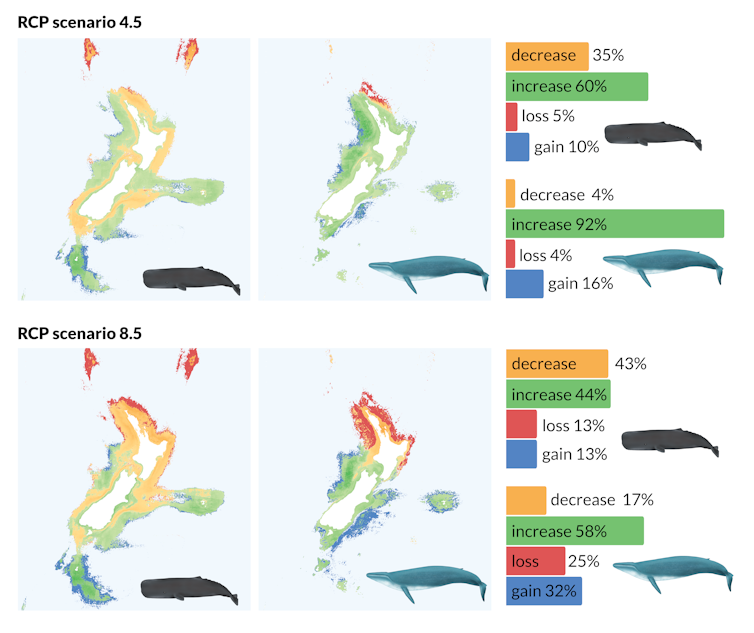
We used mathematical models to predict how they are likely to respond to warming seas by the end of the century. Our results show a clear southward shift for both species, mostly driven by rising temperatures at the sea surface.

Sperm whales (left) and blue whales (right)
Sperm whales (left) and blue whales (right) are both affected by rising ocean temperatures.
Author provided

Computing the fate of whales

Data on the local abundance of both whales species are deficient, but modelling provides a powerful tool to predict how their range is likely to shift.

We used a combination of mathematical models (known as correlative species distribution models) to predict the future range shifts of these whale species as a response to three future climate change scenarios of differing severity, as outlined by the Intergovernmental Panel on Climate Change (IPCC).

Aerial view of a blue whale
Blue whales forage off the coast of New Zealand.
Author provided

We applied these models, using the whales’ present distributions, to build a set of environmental “rules” that dictate where each species can live. Using climate-dependent data such as sea-surface temperature and chlorophyll A (a measure of phytoplankton growth), as well as static data such as water depth and distance to shore, we applied these rules to forecast future habitat suitability.

We chose a scenario of “modest” response to cutting greenhouse gas emissions (the IPCC’s mitigation strategy RCP4.5), which is the most likely given the current policies, and a worst-case scenario (no policy to cut emissions, RCP8.5), assuming the reality will likely be somewhere between the two.

Projected change in habitat suitability by 2100, for sperm (left panels) and blue (right panels) whales under two IPCC climate scenarios: modest mitigation (RCP4.5) and no mitigation (RCP8.5). Percentages are expressed as relative to each species' present
Projected change in habitat suitability by 2100, for sperm (left panels) and blue (right panels) whales under two IPCC climate scenarios: modest mitigation (RCP4.5) and no mitigation (RCP8.5). Percentages are expressed as relative to each species’ present-day distribution.
Author provided

Our projections suggest current habitats in the ocean around the North Island may become unsuitable if sea-surface temperatures continue to rise.

These range shifts become even stronger with increasing severity of climate change. For sperm whales, which are currently abundant off Kaikōura where they support eco-tourism businesses, the predicted distribution changes are even more evident than for blue whales, depending on the climate change scenario.

While our results do not predict an overall reduction in suitable habitat that would lead to local extinctions, the latitudinal range shifts are nevertheless bound to have important ecological consequences for New Zealand’s marine ecosystems and the people who depend on them.


Read more:
Sea creatures store carbon in the ocean – could protecting them help slow climate change?


How whales maintain ecosystems

Great whales are marine ecosystem engineers. They modify their habitats (or create new ones), to suit their needs. In fact, these activities create conditions that other species rely on to survive.

They engineer their environment on several fronts. By feeding in one place and releasing their faeces in another, whales convey minerals and other nutrients such as nitrogen and iron from the deep water to the surface, as well as across regions. This process, known as a “whale pump”, makes these nutrients available for phytoplankton and other organisms to grow.

This is very important because phytoplankton contributes about half of all oxygen to the atmosphere and also captures about 40% of all released carbon dioxide. By helping the growth of phytoplankton, whales indirectly contribute to the natural ocean carbon sink.

On top of this, each great whale accumulates about 33 tonnes of carbon dioxide in their body, which they take to the ocean floor when they die and their carcass sinks.


Read more:
Bottoms up: how whale poop helps feed the ocean


Ultimately, the impact of warming oceans on whale distribution is an additional stress factor on ecosystems already under pressure from wider threats, including acidification, pollution and over-exploitation.

An aerial view of a blue whale
Blue whales convey nutrients between different parts of the ocean during their migration.
Author provided

A way forward to help whales

Sperm whales are the largest toothed whales (odontocetes) and deep-diving apex predators. They primarily feed on squid and fish that live near the bottom of the sea.

Blue whales are baleen whales (mysticetes) and filter small organisms from the water. They feed at the surface on zooplankton, particularly dense krill schools along coastlines where cold water from the deep ocean rises toward the surface (so-called upwelling areas).

These differences in feeding habits lead to divergent responses to ocean warming. Blue whales show a more distinct southerly shift than sperm whales, particularly in the worst-case scenario, likely because they feed at the surface where ocean warming will be more exacerbated than in the deep sea.

A fluke of a diving sperm whale.
A population of sperm whales is currently resident off the coast of Kaikōura.
Author provided

Both species have important foraging grounds off New Zealand which may be compromised in the future. Sperm whales are currently occurring regularly off Kaikōura, while blue whales forage in the South Taranaki Bight.

Despite these ecological differences, our results show that some future suitable areas around the South Island and offshore islands are common to both species. These regions could be considered sanctuaries for both species to retreat to or expand their habitat in a warming world. This should warrant increased protection of these areas.

The Conversation

Frédérik Saltré receives funding from the Australian Research Council

Karen Stockin is a Professor of Marine Ecology at Massey University (New Zealand) and a Rutherford Discovery Fellow (Royal Society Te Aparangi). Karen is further professionally affiliated with the International Whaling Commission (United Kingdom) and the Society for Marine Mammalogy (USA)

Katharina J. Peters is a postdoctoral researcher at the University of Canterbury (New Zealand). She is also professionally affiliated with Massey University (New Zealand), the University of Zurich (Switzerland), and Flinders University (Australia).

ref. Warming oceans may force New Zealand’s sperm and blue whales to shift to cooler southern waters – https://theconversation.com/warming-oceans-may-force-new-zealands-sperm-and-blue-whales-to-shift-to-cooler-southern-waters-188522

Australia may be heading for emissions trading between big polluters

Source: The Conversation (Au and NZ) – By Ian A. MacKenzie, Associate Professor in Economics, The University of Queensland

Veeterzy/Unsplash, CC BY-SA

Could Australia soon have a form of emissions trading? Yes, if Labor’s much-anticipated paper on fixing Australia’s mediocre emissions-reduction framework, released today, is any guide.

At present, Australia relies on the controversial safeguard mechanism to encourage big emitters such as fossil fuel power plants and manufacturers to reduce their pollution. This framework – alongside the Emissions Reduction Fund – was introduced during the Coalition years to reduce carbon dioxide pollution at low cost.

The problem is, it didn’t work. Emissions from large polluters have remained high since it was introduced in 2016. As the discussion paper states:

Emissions limits, known as baselines, have allowed business-as-usual operations and aggregate emissions from Safeguard facilities to grow.

Labor’s discussion paper flags ways to make the mechanism work as intended – most significantly by letting companies sell credits created by cutting emissions by more than they are required to. Companies finding it harder to slash emissions can buy these. Creating this market would effectively create a very useful carbon currency.

You might think this sounds abstract. It’s not. Fixing this mechanism would have a major impact on our future emissions – and the likelihood of reaching our committed emission goals. Getting this right matters.

emissions
The current safeguard mechanism has not worked as intended, with emissions still high.
Pexels, CC BY

So what is the safeguard mechanism and why does it matter?

The safeguard mechanism is a framework to control emissions from large polluters – defined as those emitting more than 100,000 tonnes of carbon dioxide equivalent annually.

This includes industries such as electricity generation, mining, and oil and gas extraction.

It works by giving each facility a benchmark level of emissions they are not allowed to exceed.

If a facility does exceed their benchmark, the regulator gives them a few easy options: reduce emissions, ask for their benchmark to increase, or buy and surrender Australian Carbon Credit Units. These credits come from someone else’s emissions reductions, which the original polluter has to pay for.

The problem is the current safeguard mechanism is not fit for purpose.

As I’ve previously pointed out, the system is easily gamed. Many high-polluting firms have simply asked for larger benchmarks – and often got them. You can see the incentive – asking for a larger, “better fitting” benchmark is the cheapest option of all, requiring absolutely no change on the company’s part.

This is the fundamental flaw: there is no economic incentive for large polluters to cut their emissions.

Better systems already exist in other countries. For instance, large polluters in the United States and European Union are targeted using pollution markets that have robust economic incentives.

In such schemes, companies that find it very expensive to reduce pollution can buy pollution credits from the market. Alternatively, companies that find it cheap to reduce emissions can sell their credits and make money. Labor’s new discussion paper draws heavily on these successful schemes.

Even better, the government can raise serious revenue from this market by initially auctioning off pollution credits. It’s a win-win: polluters pay and gain a strong incentive to reduce emissions, and the government obtains much-needed revenue at a time when budgets are stretched from the pandemic.

The public funds raised can be significant: the carbon market set up by 12 states in the eastern US has auctioned off pollution allowances since 2008, raising A$5.45 billion to date.

If we want to reach Labor’s target of cutting emissions by 43% (relative to 2005 levels) over the coming eight years, we need a fully functional market-based approach.

So what are the proposed changes?

The paper sets out the main proposals for developing the safeguard mechanism, including how to set a baseline of emissions for polluters (and how this should decline over time), the use of offsets, and the introduction of trading.

Trading would be the most significant change. Some companies will pursue emissions reduction with greater vigour – or may find it easier to do so than those in harder-to-abate sectors such as aluminium smelting or steel-making. The ability to sell these avoided emissions rewards these companies. The companies buying the credits have an incentive to cut emissions over time to avoid this cost.

Another proposal is to allow banking and borrowing of these credits over time. This would allow firms reducing emissions today to save credits for the future or, if needed, borrow some from the future.

The big question: will it work?

From an economist’s perspective, this is good news.

Allowing firms to trade credits will make the safeguard mechanism more cost-effective and create incentives to actually cut emissions – something lacking in the old version.

But it could work even better.

Under the current proposal, companies in the scheme cannot trade with firms outside it. This cuts the number of market participants and could limit the cost-effectiveness of the scheme. Labor should look at widening the scope and creating a fully fledged market.

And while banking and borrowing pollution credits has been shown to work reasonably well in other countries, we know it has to be managed well.

If the scheme isn’t properly managed, companies could borrow credits and simply never pay them back. Banked carbon credits could actually lead to higher emissions in the future, when companies draw down on them.

In the EU this became a real concern when the stockpile of banked allowances grew too large. In response, the European scheme’s regulator had to remove them from the market. The Australian government must learn from this and design the scheme carefully.

But overall? Take this as good news. It is a step towards a goal that has long been out of reach: a well-functioning pollution market.

The Conversation

Ian A. MacKenzie has received funding from Australian Research Council focusing on managing
carbon offsets to improve Australian climate policy effectiveness..

ref. Australia may be heading for emissions trading between big polluters – https://theconversation.com/australia-may-be-heading-for-emissions-trading-between-big-polluters-188799

We asked children how they experienced poverty. Here are 6 changes needed now

Source: The Conversation (Au and NZ) – By Sharon Bessell, Professor of Public Policy, Crawford School of Public Policy, Australian National University

Photo by Orlando Vera/Pexels, CC BY

An eight-year-old boy is often hungry, but knows if he tells his mum, she will eat less herself and go hungry. He hates the thought, so he stays quiet.

An 11-year-old girl knows once rent is paid, there is almost nothing left over, so she tries not to ask for too much. She never takes school excursion notes home in case the cost is too much.

A 10-year-old boy’s dad has been angry since he was injured at work; he can no longer support his family, and awaits compensation. It makes this boy feel sad, but he understands and tries not to add to his dad’s stress.

This is how children have described their experiences of poverty in research I have done over several years.

Children have also told us relationships are essential. They talk about the importance of family, the strength of community, and people helping one another.

These help buffer children from the effects of poverty – but none can address its structural drivers, or the ways systems fail many people.

Decades after then prime minister Bob Hawke declared that by 1990, “no Australian child will live in poverty”, the problem remains very real in Australia.

So what is that experience like for children, and what needs to be done?


Read more:
Richer schools’ students run faster: how the inequality in sport flows through to health


Three key themes

My research shows that when we listen to children about their experiences of poverty, three themes almost always emerge.

First, not having the material basics – enough food, a safe and secure home, transport – is a near-constant problem for far too many children.

Some of these things can be bought if money is sufficient, but some – like secure housing and transport – require investment in public infrastructure and equal distribution of resources. These are structural problems, not individual ones.

My colleagues and I have found children are more likely to talk about the importance of food than toys or electronic devices. Hunger shapes priorities powerfully.

Second, poverty limits children’s ability to participate in activities and services (such as sport, public library time and health care).

This can be due to families not having the money – but often the barriers are, once again, structural. Schools in low-income areas are often under-resourced, playgrounds are less likely to be maintained, services are limited, and public transport is inadequate.

Third, relationships are deeply affected by the pressures poverty creates. This is exacerbated by factors such as:

For children, time with the people they love – particularly parents – is always a priority. Poverty eats away at that time.

The pressure of poverty eats away at the time children can spend with their parents.
Photo by Sarah Chai/Pexels, CC BY

A culture of shame

Another, perhaps even more harmful, theme has emerged in Australia over recent decades – the discourse around poverty often attaches blame and stigma to individuals.

Anyone deemed to be part of the “undeserving poor” is shamed. Children experience this in the names targeted at them, their families and communities. Policy settings around welfare can be unbelievably punitive.

As a society, we are diminished by this blaming and shaming rhetoric. It undermines our ability to care for others, and to recognise the value of care.

6 changes needed now

There is no quick fix, but here are six changes that would help immediately.

1. Boost welfare benefits

Children in families dependent on working-age benefits will grow up in income poverty. Children in single-parent (usually single mum) families dependent on income support are most likely to be in poverty. The policy response is clear – we must raise the rate of working age benefits and reform the child support system.

2. Recognise the importance of strong and supportive relationships

Relationships are crucial to children but undue pressure on parents – through welfare conditions or child-unfriendly, insecure working conditions – undermines those relationships.

Some countries, such as New Zealand, are undertaking child impact assessments, which aim to work out whether a given policy proposal will improve the wellbeing of children and young people.

Australia should do similar assessments of all policies, particularly those linked to social security and labour markets.

Undue pressure on parents undermines relationships.
Photo by Maria Lindsey/Pexels, CC BY

3. Build child-friendly communities

As governments respond to the housing crisis through greater numbers of social housing it is critical we adhere to principles of child-friendly communities.

This means providing safe, welcoming places for children to play, building footpaths so children can easily and safely get around, creating communal, child-inclusive spaces to bring people together across generations, and creating child-friendly services close to home.

4. Reform education funding

Education funding must be more equitable, and ensure all children can access and enjoy high-quality schooling.

5. Change the narratives and language around poverty

We must recognise poverty is not the fault of the individual. Debates and policies should be based on empathy, not blame.

6. Put children at the centre of policy

This could include approaches like the European Child Guarantee, which aims to guarantee every child access to essential services.


Read more:
Attending school every day counts – but kids in out-of-home care are missing out


The Conversation

Sharon Bessell receives funding from The Australian Research Council; Paul Ramsay Foundation. This article is part of The Conversation’s Breaking the Cycle series, which is supported by a philanthropic grant from the Paul Ramsay Foundation.

ref. We asked children how they experienced poverty. Here are 6 changes needed now – https://theconversation.com/we-asked-children-how-they-experienced-poverty-here-are-6-changes-needed-now-180567

A new national cultural policy is an opportunity for a radical rethinking of the importance of culture in Australia

Source: The Conversation (Au and NZ) – By Julianne Schultz AM, FAHA, Emeritus Professor of Media and Culture, Griffith University, Griffith University

Unsplash

As the cut-off for the government’s consultation on a National Cultural Policy (NCP) approaches, thousands in the sector are putting the finishing touches to their three-page submissions. These are directed around “five pillars” drawn from Creative Australia, the national cultural policy announced in the last months of the Gillard regime, but ignored by the Abbott, Turnbull and Morrison governments thereafter.

Coalition arts ministers showed little interest in cultural policy. Over the last nine years, national cultural institutions lost funding, the Australia Council’s budget was diverted to programs under ministerial control, and key board appointments reflected a lack of sector expertise.

As Gideon Haigh wrote in The Australian,

The pattern of the past 30 years in arts and culture is for Labor to initiate and the Coalition to dismantle.

The new government’s consultation process has been a long time coming and it is welcome.

Creative Nation to Creative Australia

Creative Australia built on Creative Nation, Paul Keating’s National Cultural Policy, which launched in 1994. It emerged from Kevin Rudd’s 2020 Summit, two major inquiries and a reference group of several dozen people from all parts of the sector. It was designed to enable systematic engagement with culture in all its manifestations.

But much has happened in the nation, the economy and society since 2013. And while the recently announced 15-member NCP advisory panel includes people with deep knowledge, there are some gaps.

Creative Australia drew together a range of competing perspectives and had a broad enough base to start giving culture the clout it needed to be taken seriously as an object of policy. After it was adopted, more money flowed to the Australia Council and other cultural agencies and institutions.


Read more:
Australia should have a universal basic income for artists. Here’s what that could look like


In a fraught world a new national cultural policy needs an even wider framework. Culture touches every part of our public and private lives.

A cultural policy should include an arts policy, but also policies addressing national institutions, heritage, the commercial cultural industries, soft power diplomacy, education, community groups and charities, as well as areas of public administration like First Nations, health, welfare, and education where cultural activity is a valued tool.

It must be able to align with state and local governments as active partners in this domain.

A robust arts policy is a first step in developing an expansive, nationally-appropriate cultural policy. Art for its own sake, yes. But art that binds, stretches, and challenges contemporary society.

Above all, a new national cultural policy needs conceptual depth. Culture was once seen as a public good, but has been hollowed out. The Australia Council’s consultation framing document defines its benefits largely in instrumental terms (mental health, social cohesion, education, tourism, the creative economy). Meanwhile, the substance of culture’s intrinsic value remains unaddressed.

A ministry of culture?

One of the key insights from the Creative Australia consultation process was the need for a federal ministry of culture.

Over the past two decades the arts has been tacked on to many other ministerial portfolios: communications, transport, environment, local government, the attorney general’s, and now employment. They should be at the heart of a culture portfolio that draws together elements scattered across the cabinet.

Currently, the arts are buried at the bottom of a drop-down menu, while media and communications (including public and commercial broadcasting) is the responsibility of another minister.

A culture ministry would allow effective aggregation of the significant expenditure made in culture across government. They exist in most comparable countries. A properly constituted ministry could assess the cultural impact of new policy proposals from any department.


Read more:
It is time for Australia to establish a national Ministry for Culture


In the 1990s, Australia was ahead of the global curve in redefining art and culture for a new democratic, multicultural era. The 2020s present different problems: climate change, digitisation, globalisation, inequality and a growing distrust in democratic institutions. A dedicated cultural ministry is the best way of addressing them with a perspective that touches lives and builds strong institutions.

This is not just a challenge for Australia. As Professor Hans Mommaas, Director of The Netherland’s Environmental Assessment Agency, put it to us recently:

In the midst of our various problem agendas… there is no clear place… any longer for the role of culture in the sense of creating and celebrating collective forms of imagination (and) communication… We must have a rich cultural sphere… for culture to be instrumental to these other agendas… Why not start with redeveloping the story-line that in the midst of the crises we find ourselves in, we urgently need a revival of a cultural sphere and that the current lack of this… is producing (a) distrust in the future and (a) lack of collective imagination.

Breathing new life into a decade-old national cultural policy is a useful beginning. But as Arts Minister Tony Burke has said of the current consultation process, “it is a trajectory, not a destination”. What is required now is an in-depth gestation period to position culture as a public good in the life of the nation.

The right of citizens to participate in, and contribute to, the cultural activities of the community is accepted in a number of the international agreements to which Australia is signatory. In an age of streaming platforms, public funding cuts and rising inequality, these cultural rights must be revisited and reasserted.

A new national cultural policy is an opportunity for a radical rethinking of the importance of culture to a troubled age. More than ever, we need creativity and an understanding of cultural heritage to imagine our collective future.

The Conversation

Julianne Schultz AM, FAHA chaired the reference group for the 2013 NCP, Creative Australia.

Justin O’Connor receives funding from the Australian Research Council

Julian Meyrick does not work for, consult, own shares in or receive funding from any company or organisation that would benefit from this article, and has disclosed no relevant affiliations beyond their academic appointment.

ref. A new national cultural policy is an opportunity for a radical rethinking of the importance of culture in Australia – https://theconversation.com/a-new-national-cultural-policy-is-an-opportunity-for-a-radical-rethinking-of-the-importance-of-culture-in-australia-188720

Former Kiribati president warns judicial crisis could undermine democracy

RNZ Pacific

A former president of Kiribati warns the crisis involving the island nation’s government and the courts has left the country with a “dysfunctional judiciary” and put a question mark over its democratic system.

The Kiribati government suspended its chief justice in July and last Thursday immigration and police detained and attempted to deport High Court Judge David Lambourne.

They were unsuccessful after the country’s highest court ordered the Australian-born judge to be released.

The Court of Appeal stopped the government from deporting Lambourne pending a further hearing expected to be held this week, escalating further acrimony between the executive and judicial arms of the state.

Anote Tong, who was president of Kiribati from 2003 to 2016, says the issue of Judge Lambourne has clear “political connotations” because he is married to the leader of the opposition.

But, he said, the actions of President Taneti Maamau’s government bordered on contempt of court.

“The deportation order by the president [Maamau] is really in direct contravention to the decision by the court. So, whether the government is now in contempt of court is the question that really needs to be addressed,” Tong told RNZ Pacific.

“To be in direct conflict with the decision of the court here, I think we know what that means.”

‘Abiding by the laws of Kiribati’
In a statement, the government maintained that Judge Lambourne had breached his visa conditions and national laws and raised concern “by the overreach of the Court of Appeal” to issue an injunction to prevent his deportation.

Kiribati's Australian-born judge David Lambourne
Kiribati’s Australian-born judge David Lambourne … his wife, Tessie, is leader of the opposition. Image: Pacific Islands Legal Information Institute

The government said it “abides by the laws and the Constitution of Kiribati … to protect the interest of the people of Kiribati”.

It blamed “neocolonial forces” for “weaponising the laws enacted to protect” the i-Kiribati people “to pursue their own interest and suppress the will of the people”.

But Tong said the separation of powers is a fundamental principle of a democratic society.

“We have a constitution. We have the laws in place, and we have a court. The question is: are we adhering to these legal provisions?,” he asked.

“It looks like the government is crossing that boundary and delving into the purview of the judiciary.”

Tong said the problem between the government and Judge Lambourne began after the 2020 elections when his wife, Tessie Lambourne, was elected as leader of the opposition.

“There is no question about it,” he said, adding it did not “give an excuse for the government to ignore a court decision”.

He said until Kiribati amended its laws and constitution “to recognise that the separation of powers is fundamental to its democratic system of government, everything else that has been done will become illegal”.

International condemnation
The Commonwealth Magistrates’ and Judges’ Association (CMJA), the Commonwealth Legal Education Association (CLEA), and the Commonwealth Lawyers Association (CLA) have all raised concerns and said they were “alarmed” at the situation.

The associations have urged the Kiribati authorities to respect the rule of law and comply with orders of the courts.

“The associations are alarmed that the tribunals set up to investigate alleged misbehaviour by Judge David Lambourne and the Chief Justice William Hastings have yet to report on any findings,” they said via a joint statement.

“The associations are further alarmed that there has been an attempt to deport Judge Lambourne without due process being followed and he has subsequently now been arbitrarily detained by the authorities in Kiribati.”

CMJA, CLEA and CLA are urging the Commonwealth Ministerial Action Group (CMAG) to consider the actions of the Kiribati government as a matter of urgency.

This article is republished under a community partnership agreement with RNZ.

Print Friendly, PDF & Email

Article by AsiaPacificReport.nz

What good is a new national cultural policy without history?

Source: The Conversation (Au and NZ) – By Michelle Arrow, Professor of History, Macquarie University

National Library of Australia. Shutterstock

Alongside much else that is being revised, reimagined or recast by the Albanese government, Australia is to have a new cultural policy. Consultation has involved town hall meetings and a call for submissions. The arts minister, Tony Burke, has established five review panels to consider feedback.

First Nations artists and culture are at the centre of Burke’s invitation. The emphasis on the artist not just as creator but as worker responds to the pandemic’s devastating impact on the already-parlous circumstances in which artists and writers often live and work.

The other pillars of this cultural-policy-in-the-making highlight the diversity of stories and artists, building audiences and the strengthening of cultural institutions.

The review panels are brimming with respected and innovative creators and producers, with decades of collective experience.

But their coverage of the sector is patchy. Our concern as historians is with history, publishers and the “GLAM” sector – galleries, libraries, archives and museums.

While there is representation from galleries and collecting institutions on the panels, there is not a single historian, publisher or archivist whose feedback will help shape Australia’s cultural policy.

Given the importance of history in defining our sense of national selfhood, and the role publishers, libraries, archives and museums play in preserving, collecting and presenting Australian histories and stories, these fields being absent from the national cultural policy panels is a disappointing oversight.

A sense of belonging

History and historians play a crucial role in Australian culture. They are foundational to other fields in the arts, with historical research often underpinning film, theatre, literature and even, on occasion, dance.

A government serious about implementing a cultural policy for the future must make space for history and historians in the formulation of that policy.

History is both a scholarly pursuit and a widely shared leisure activity. Millions of Australians visit museums, archives, libraries and galleries each year, both in person and online.

Family history has become much more than just a popular hobby. It is integral to people’s sense of self and belonging, with First Nations people and migrant communities increasingly active.

Australians are involved in history and heritage in their communities. These activities are integral to identities of people and places, and especially regional places. They keep people active and connected with one another.

Community history and heritage needs to be at the heart of a democratic and inclusive cultural policy.


Read more:
When it comes to heritage, family history trumps museums


The place of history

Historians feature in our media as expert commentators. They speak at writers’ festivals and in documentaries.

They publish histories and biographies that attract readers outside the circle of their colleagues and students. Some make podcasts and television programs.

Historians provide policy advice to government. They judge literary prizes and contribute to the making of the school curriculum. Historians work with community groups, including with Indigenous communities in native title cases, and they advise on cultural heritage.

The Prime Minister’s Literary Awards include a dedicated prize for Australian history. History is one of five subjects mandated in the national curriculum. Days of national commemoration, from Sorry Day to Anzac Day, mark significant events in Australia’s collective national memory.

Morning at the Australian National Maritime Museum, overlooking Pyrmont Bay. Features lighthouse, moored boats and modern high-rise buildings. Some visitors around.
Collecting institutions, like the Australian National Maritime Museum in Sydney, represent a priceless possession of the nation.

Both state and Commonwealth governments fund institutions which collect and preserve Australian history. At the federal level, the national cultural institutions perform this work. Together with the public broadcasters the ABC and SBS, they represent a priceless possession of the nation.

Writing and knowing Australian history would be impossible without them, and we would be a different – and lesser – people without such places.

Struggling institutions

Governments from both sides of politics have subjected these institutions to humiliating funding cuts. Labor first created “efficiency dividends” to reduce expenditure on our national cultural institutions in the late 1980s.

This initiative meant that every year, they received less funding, which a 2019 parliamentary business committee found had a “significant and compounding effect”.

It got worse in 2015-16, when the Turnbull government disastrously imposed an additional 3% “efficiency target” on these cultural institutions.

Such funding cuts no longer drive “efficiencies”. They diminish the quality of the user experience. Researchers at the National Archives report long delays – sometimes years – in gaining access to records that under the law of the land are supposed to be made available within 90 business days.

Our national cultural institutions no longer have sufficient funds to preserve the collections they maintain on our behalf.

The Archives only received an urgent injection of funds to preserve unique audio-visual records after a public campaign in 2021.

In June, it was reported the maintenance backlog at the National Gallery of Australia is estimated to be A$67 million. The ABC recently announced plans to slash specialist archives and librarians.

A James Turrell work at the gallery.
The maintenance backlog at the National Gallery of Australia is estimated to be A$67 million.
Shutterstock

Cuts to funding came with the leaching of historical expertise from the boards and councils established to advise the national cultural institutions.

In the past, many distinguished historians have served on these bodies. Today, they are more likely to be defined by political appointees.

As Tony Burke commented recently:

I don’t see how you have a national museum with a board that does not include a single historian.

Neither do we. We further urge a stronger presence for history in cultural policy generally – and right now for the presence of historians in the constructing of a new policy document.

History is the very kind of creative and democratic practice that must be central to any reimagining of Australia in an age of anxiety and of promise.


Read more:
Our history up in flames? Why the crisis at the National Archives must be urgently addressed


The Conversation

Michelle Arrow receives funding from the Australian Research Council. She is the Vice-President of the Australian Historical Association.

Frank Bongiorno is President of the Australian Historical Association.

ref. What good is a new national cultural policy without history? – https://theconversation.com/what-good-is-a-new-national-cultural-policy-without-history-188741

Lying down, sitting, leaning over? What science says about the best way to take your medicine

Source: The Conversation (Au and NZ) – By Elise Schubert, Pharmacist and PhD Candidate, University of Sydney

Shutterstock

When pharmacists dispense tablets or capsules they commonly advise when and how often to take them, and if this needs to be with or without food.

You generally don’t hear them tell you to lean to one side when swallowing. But preliminary research from Johns Hopkins University in the United States suggests this might improve how fast your medicine is absorbed and gets to work.

The results are based on a computer simulation, rather than in actual patients, and may not equate to the real world. So it’s too early to suggest you strike a yoga pose when taking your medicine.

But your posture can be important when taking pills or capsules, for comfort or safety.


Read more:
What time of day should I take my medicine?


What happens when you swallow your medicine?

Once you swallow a tablet or capsule, it moves down the throat to the stomach. There, a tablet swells and disintegrates, or a capsule breaks open. The drug can then dissolve and your body can absorb it.

Most drugs do not start being absorbed until they reach the small intestine. However, some drugs, such as aspirin, are likely to be absorbed in the stomach because of its acidic environment.

A number of other factors can also affect where and how a drug is absorbed.

These include how fast the tablet disintegrates to release the drug, how fast the swallowed contents move from the stomach to the small intestine, the amount of food and drink consumed before taking the medicine, and how easily the drug is absorbed across the gut lining.

How about this latest study?

The US researchers used computer simulations to investigate how posture affects how drugs are absorbed.

The researchers used software they developed to simulate several ways of taking a pill: staying upright, leaning to the left or right, or leaning backwards.

They showed leaning 45 degrees to the right favoured a faster movement of stomach contents into the duodenum (the first part of the small intestine). This would allow the pill to be absorbed more quickly and start to take effect.

The results could be important for medicines that you’d want to act quickly, such as pain medicines, or ones used to treat a heart attack.

There is already some earlier evidence from real patients suggesting posture may influence how medicines are absorbed. This includes the option of leaning to the right. But the authors acknowledge many factors influence absorption, not just posture.


Read more:
Health Check: is it OK to chew or crush your medicine?


When is it best to sit or stand?

Sometimes your pharmacist may advise you to swallow your medicine sitting, standing, or lying down for reasons other than speeding up absorption.

For example, certain drugs are more likely to cause side effects such as heartburn, where stomach acid leaks from the stomach and moves up into the oesophagus (food pipe).

These include non-steroidal anti-inflammatory drugs, such as ibuprofen (Nurofen), diclofenac (Voltaren), and iron supplements.

So if this is a problem for you, it may help to take these medicines sitting or standing, and not lying down straight away afterwards. That’s because your stomach acid is less likely to leak back up into your oesophagus.

Elderly woman sitting down at table with pill and cup
Some medicines can irritate the throat or cause heartburn. So it’s best to take these upright.
Shutterstock

Some medicines can irritate the throat if they become stuck. This is because they damage the protective mucosal barrier that lines your oesophagus and stomach, causing irritation and inflammation.

For these medicines it is important to take these sitting up or standing, and remaining upright for 30 minutes afterwards.

These include the antibiotic doxycycline, and drugs known as bisphosphonates (for osteoporosis), such as risedronate (Actonel) and alendronate (Fosamax).


Read more:
Why older people get osteoporosis and have falls


How about lying down?

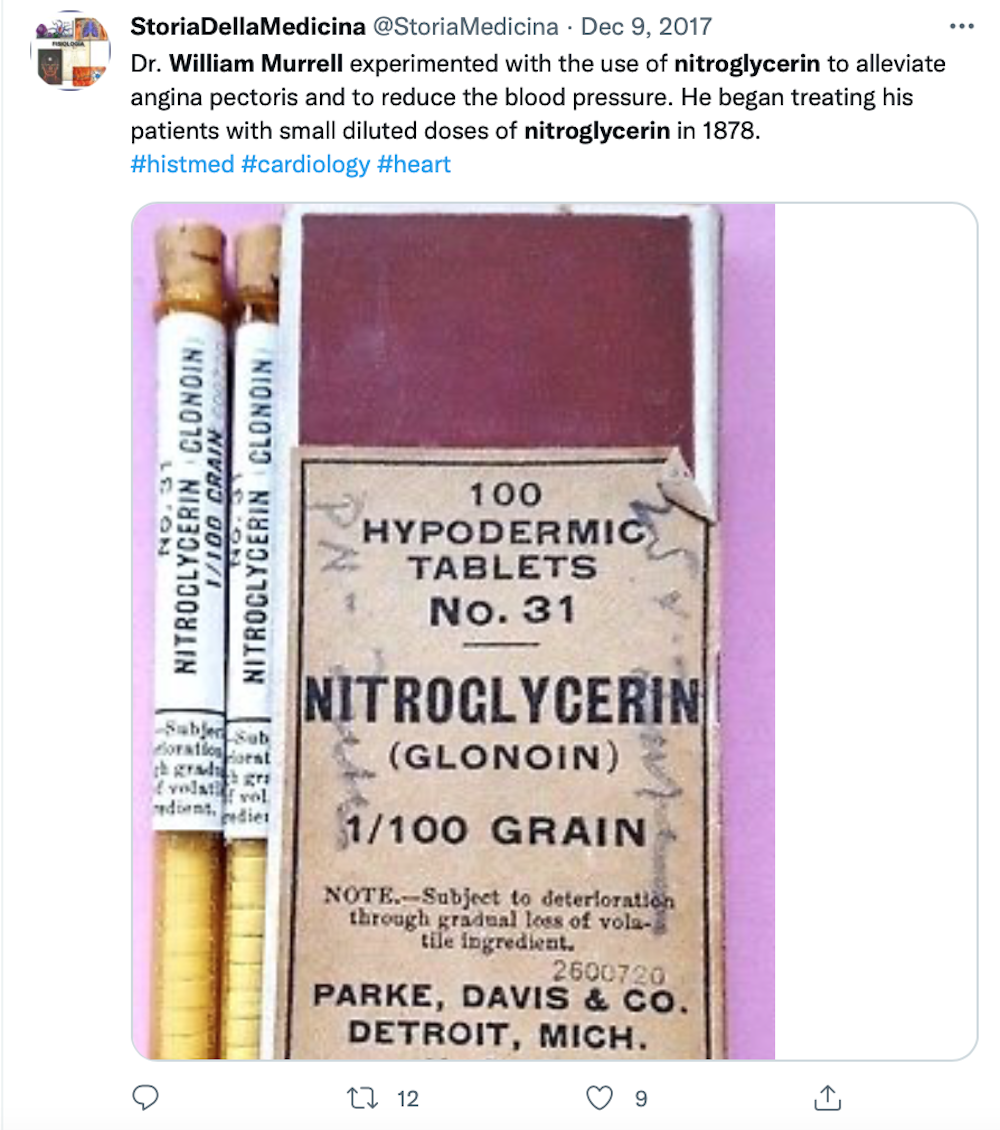
Glyceryl trinitrate (Nitrolingual) is an under-the-tongue spray. It’s prescribed to people with angina, a type of chest pain caused by an underlying heart problem.

Pharmacists advise patients to sit or lie down before using this spray as it can cause a sudden drop in blood pressure, making you feel very dizzy.

Other heart medicines, such as diuretics, are also known to cause dizziness. Although you don’t usually need to take these medications lying down, if you do become dizzy it is best to sit or lie down, and ensure you stand up slowly afterwards.

There are also medications that can cause drowsiness or make you feel “woozy”. These can include strong pain killers (such as opiates), sleeping tablets, some epilepsy medications, or drugs for certain mental health conditions, such as anxiety or schizophrenia.

These don’t need to be swallowed while lying down, but lying down can help if you become dizzy or drowsy.

Woman lying on side in bed holding glass of water and a pill
Some medicines can make you dizzy. So you can lie down after taking them.
Shutterstock

What if I’m not sure?

Next time your pharmacist dispenses your medicine, unless they provide specific guidance about sitting, standing or lying down, you are generally safe to take it whichever way is most comfortable.

So how about this latest evidence suggesting leaning to the right might help? At this stage, you likely won’t hear your doctor or pharmacist recommend you should lean over to take your medicines until further research is done.

But next time you need to take a medicine for pain, as long as it is not uncomfortable, feel free to try this to see if your pain is relieved faster.

The Conversation

Elise Schubert is a registered pharmacist and a PhD Candidate receiving scholarship from the University of Sydney and Canngea Pty Ltd.

Associate Professor Wheate in the past has received funding from the ACT Cancer Council, Tenovus Scotland, Medical Research Scotland, Scottish Crucible, and the Scottish Universities Life Sciences Alliance. He is a Fellow of the Royal Australian Chemical Institute, a member of the Australasian Pharmaceutical Science Association, and member of the Australian Institute of Company Directors. Nial is the science director of Canngea Pty Ltd, chief scientific officer of Vairea Skincare LLC, and a Standards Australia panel member for sunscreen agents.

Associate Professor Tina Hinton has previously received funding from the Schizophrenia Research Institute (formerly Neuroscience Institute of Schizophrenia and Allied Disorders). She is currently a Board member of the Australasian Society of Clinical and Experimental Pharmacologists and Toxicologists.

ref. Lying down, sitting, leaning over? What science says about the best way to take your medicine – https://theconversation.com/lying-down-sitting-leaning-over-what-science-says-about-the-best-way-to-take-your-medicine-188601

Ancient megalodon super-predators could swallow a great white shark whole, new model reveals

Source: The Conversation (Au and NZ) – By Stephen Wroe, Associate Professor, University of New England

J.J. Giraldo, Author provided

In a new 3D modelling study published this week in Science Advances, we show that the giant extinct shark, Otodus megalodon, was a true globetrotting super-predator.

It was capable of covering vast distances in short order, and could eat the largest of modern living super-predators, the killer whale, in five gargantuan bites. It could have swallowed a great white shark whole.

The largest shark that ever lived

Megalodon was the largest shark that ever lived, and it was around for a long time – from around 23 million to 2.6 million years ago. At one time its range was enormous: its fossilised teeth have been found on every continent except Antarctica. These teeth are not hard to recognise if you come across them, as they can be up to 18 centimetres long.
Two hands showing an enormous tooth on the left and a small triangular tooth on the right
Comparison of a fossilised megalodon tooth (left), and a tooth from a modern great white shark.
Mark_Kostich/Shutterstock

Just why this formidable predator went extinct remains a mystery. It could have been linked to global cooling, or competition from other predators such as orcas (killer whales). This is just one of many unanswered questions.

One thing we know for sure is that the megalodon was big – but just how big has remained a point of contention among scientists, because previous estimates have been effectively based on just fragmentary remains.

And its size really matters, because it helps us to interpret its biology – the kinds of prey an animal can kill and eat, the amount of food it needs to survive and the speed at which it can travel.

The question of diet is particularly important as it determines an animal’s role and impact on its ecosystem. Historically, many thought megalodon took very big prey, including large whales.

But it has recently been argued that it may not have been quite the super-predator it had been cracked up to be, concluding that it concentrated on lesser prey such as seals, dolphins and small whales between around two and seven metres in length. If correct, this would have major implications for our understanding of how the marine ecosystems of the time functioned.

Our new model now suggests it did in fact prefer to take on much larger prey.


Read more:
Millions of years ago, the megalodon ruled the oceans – why did it disappear?


A scene of whales underwater, with enormous megalodon preying on them
The reconstructed megadolon was 16 metres long and weighed over 61 tons.
J.J. Giraldo

Car-crushing bite force

I’ve long had an interest in megalodon. I published a paper with colleagues back in 2007 wherein we built a computer simulation to predict its bite force.

Our estimate – a car-crushing 18 tonnes – was dependent on the assumed body mass of the animal, so I was delighted when colleagues from overseas asked me to help with an attempt to develop a more accurate model of the whole shark. From there, we could more reliably determine its size.

Previous estimates of the body mass and proportions of megalodon have largely just extrapolated on data from single fossilised vertebrae, which leaves a lot of room for error. Others were based on direct comparison with the living great white shark; however, it’s now pretty clear that the two weren’t closely related.

In our new study, we based our estimates on 3D modelling of the most complete specimen known, represented by a largely intact vertebral column held in a Belgian museum. We quantified its total length, weight, and the size of its gape from the complete digital model.

Lastly, we estimated the megalodon’s cruising speed, the volume of its stomach, its daily energetic demands and the rate at which it likely encountered prey.

We concluded that this particular megalodon was around 16 metres long and weighed in at more than 61 tonnes. This is considerably larger than recent estimates of a mere 48 tonnes.


Read more:
Making a megalodon: the evolving science behind estimating the size of the largest ever killer shark


A whale for breakfast

Based on other isolated fossil vertebrae, it’s likely the largest megalodon grew to 20 metres in length. We further determined that the Belgian specimen’s maximum gape was around 1.8 metres and that its stomach could have held 9.5 cubic metres of food.

This suggests it could have entirely consumed the largest of living killer whales (around 8 metres) in just five bites.

Hypothetically, it could have eaten another iconic super-predator, the Tyrannosaurus rex, in just three bites. As for great white sharks, a megalodon could have swallowed a large one whole.

Our results suggest megalodon could have comfortably cruised at over 5 kilometres per hour. This is much faster than the largest living fish, the filter-feeding whale shark, or even the great white shark, which cruises at around 3 kilometres per hour.

Megalodon was the biggest shark that ever lived, and needed enormous amounts of food to sustain itself.

This ocean-spanning super-predator could travel vast distances in short order, increasing prey encounter rates and allowing it to quickly move to take advantage of seasonal changes in prey abundance.

Results from our analysis of energetics suggest that having eaten a big killer whale for breakfast, this megalodon could have travelled around 7,000km before needing to feed again.

In short, our results show that megalodon really was the super-predator it’s been cracked up to be, and more.

No creature, no matter its size, was safe from the jaws of this super shark. Its extinction likely sent tremendous cascading effects through marine environments of the time.


Read more:
Friday essay: The Meg is a horror story but our treatment of sharks is scarier


The Conversation

Stephen Wroe does not work for, consult, own shares in or receive funding from any company or organisation that would benefit from this article, and has disclosed no relevant affiliations beyond their academic appointment.

ref. Ancient megalodon super-predators could swallow a great white shark whole, new model reveals – https://theconversation.com/ancient-megalodon-super-predators-could-swallow-a-great-white-shark-whole-new-model-reveals-188749

An autism minister may boost support and coordination. But governments that follow South Australia’s lead should be cautious

Source: The Conversation (Au and NZ) – By Samra Alispahic, PhD, Western Sydney University

Twitter/Peter Malinauskas

This week, the South Australian government announced the appointment of Emily Bourke to the role of assistant minister for autism. It’s the first portfolio of its kind in Australia.

The appointment of a minister specifically responsible for autism matters is a landmark moment. But it also raises questions about why a government has chosen a specific focus on autism.


Read more:
Therapy for babies showing early signs of autism reduces the chance of clinical diagnosis at age 3


Autism in Australia

Autism is diagnosed in people who show differences in social communication, repetitive behaviours, intense or focused interests and/or sensory differences.

Twenty years ago, autism was a relatively rare diagnosis, identified in around one in every 2,000 people.

The turn of the 21st century saw a steep increase in the numbers of people being diagnosed with autism. The factors that drove this increase included broader diagnostic criteria, greater awareness of autism among parents and clinicians and a reduction in stigma associated with the diagnosis.

An increase in the incidence of autism was observed, and some estimates now put the prevalence of autism in Australia at one in every 50 people – a 40-fold increase in 20 years.

Today, approximately 34% of all participants within the National Disability Insurance Scheme (NDIS) have a primary diagnosis of autism. This figure increases to 55% of NDIS participants under 18 years of age.

boy plays on floor
Autism is a neurodevelopmental condition that affects communication and social skills.
Pexels, CC BY


Read more:
It’s 25 years since we redefined autism – here’s what we’ve learnt


Governance and autism

Autistic people can face significant barriers in learning, community participation and wellbeing, and often require support to maximise their quality of life. This can be because of a combination of developmental differences and societal factors, such as a lack of autism-friendly environments.

But the way governments in Australia manage and provide autism support services and funding is complex.

Support for autistic people can be provided within health, disability and education systems – or a combination of these departments – which may have different responsibilities at state, territory and federal levels. A child may be diagnosed within state health services, then receive funding for clinical services through the NDIS, and also be supported by the state education system (through federal funding).

At first glance, this cross-jurisdictional approach seems sensible and beneficial: support for autistic individuals is everyone’s business. A broad coalition of departments can reinforce that message.

But in reality, matters relating to autism can fall between the cracks, with systems uncertain about their areas of responsibilities, creating gaps in the coordination of supports.

An autism minister

The appointment of an autism minister in South Australia is designed to address two major issues.

First, the South Australian government has outlined a number of initiatives to support the increasing numbers of autistic children. This includes an investment for an autism “lead teacher” within public primary schools. Additional investment for clinical health services such as additional speech pathologists, occupational therapists, psychologists and counsellors will bolster support for autistic children in the community.

A recent article in Autism Research showed that due to social isolation and limited variety of in-person social interactions, young autistic Australian adults exhibit different perceptual patterns when processing speech. They report spending 2.7 hours per week interacting with people outside of their immediate circle of family and friends. This is in stark contrast to the 18.3 hours reported by the non-autistic individuals. The investments outlined in the South Australian announcement could address this imbalance.

Second, the autism minister will provide coordination of matters relating to autism across government systems. In theory, this means not only will administrative matters not fall between the cracks of different systems, but the minister will also be an advocate for autism at the senior levels of government.

But what about other conditions?

One question raised in response to this appointment is whether one particular disability group needs a dedicated ministry. Will a focus on autism mean a reduced focus on other disabilities, which also require support?

While some portfolios like finance, health and defence endure over time, others are chosen, added or removed based on the priorities and policies of the government of the day. Other portfolios relating to other health and disability groups may be added over time.

The selection of a minister of autism signals to the community that autism is a current priority for the state government. The appointment does not mean the portfolio won’t change over time. While the appointment has focused on announcing support relating to children and families, it is important the government broadens its focus to also include matters relating to autistic adults.


Read more:
Most adults with autism can recognise facial emotions, almost as well as those without the condition


Does SA’s autism minister provide a template?

Given the relatively high prevalence of autism, and the administrative problems that have plagued autism supports for years, the appointment of an autism minister should be welcomed.

However, this appointment must come with a note of caution. Autism is one neurodevelopmental diagnosis, and there are many other children with developmental challenges that also require support. Returning to the NDIS numbers quoted above, 45% of children receiving disability supports through the NDIS do not have a diagnosis of autism.

The appointment of an autism minister presents a wonderful opportunity for increased support and inclusion of all people. It may well provide a template for how other state, territory and federal governments can govern complex administration structures to support a large community.

The appointment must not be used as means to create a new administrative category that excludes support for other people who need it.

To make this a positive appointment, it needs to add support for everyone rather than be a “reductive” approach to manage complex humanity. Finding that balance will take constant vigilance by governments and advocates.

The Conversation

Samra Alispahic receives funding from the ARC.

Andrew Whitehouse receives funding from the NHMRC, ARC, Autism CRC and National Disability Insurance Agency (NDIA). Andrew Whitehouse is a member of the Children, Young people and Families Reference Group for the Independent Advisory Council of the National NDIA.

ref. An autism minister may boost support and coordination. But governments that follow South Australia’s lead should be cautious – https://theconversation.com/an-autism-minister-may-boost-support-and-coordination-but-governments-that-follow-south-australias-lead-should-be-cautious-188885

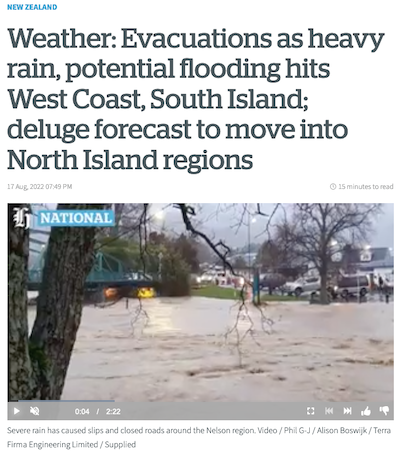
Hundreds evacuated in NZ’s South Island floods – state of emergency

RNZ News

Hundreds of people in Nelson in Aotearoa New Zealand’s South Island spent the night out of their homes and a state of emergency was declared after the Maitai River burst its banks.

Occupants of 233 homes near the Maitai River were evacuated and cordons put in place at Tasman and Nile Streets.

Soldiers have been patrolling the streets to keep an eye on evacuated properties and all residents are being asked to stay home if possible.

Coverage of the floods by The New Zealand Herald
Coverage of the floods by The New Zealand Herald. Image: Screenshot APR

The country’s largest insurer, AIG, said building in flood-prone areas had to stop.

IAG has released a three-part plan to try speed up efforts to reduce flood risk from rivers.

It said climate change was having an enormous impact on the insurance sector, and there needed to be simple, practical, concrete actions quickly.

IAG has released a three-part plan to try speed up efforts to reduce flood risk from rivers.

There have been 10 major floods in the past two years with total insured losses of about $400 million, while the wider economic and social costs extend into the billions.

People in 160 homes in low-lying parts of Westport were been asked to leave so they would not have to be rescued if their homes were flooded.

On the West Coast, the Buller River levels are dropping but civil defence remains on alert with more rain forecast.

This article is republished under a community partnership agreement with RNZ.

Print Friendly, PDF & Email

Article by AsiaPacificReport.nz

Bosch & Rockit is a sincere and sweet coming of age film, with a kind of simple magic

Source: The Conversation (Au and NZ) – By Ari Mattes, Lecturer in Communications and Media, University of Notre Dame Australia

Madman Entertainment

Review: Bosch & Rockit, written and directed by Tyler Atkins.

Sometimes a film comes along that simply feels right. From the opening shot, it envelops us in its world with a commitment that allows us to forgive any shortcomings.

Bosch & Rockit is such a film. Written and directed by actor Tyler Atkins – his first time helming a feature film – it’s a coming of age story following teen surfie Rockit (played by pro surfer Rasmus King) and the ups and downs of his relationship with his father, heart-of-gold pot farmer Bosch (Luke Hemsworth).

When a fire encroaches on Bosch’s crop, he’s forced to flee the law, including the corrupt cops with whom he’s in business.

With his son in tow, Bosch goes to a postcard perfect Byron Bay, where he has a fling with Deb (Isabel Lucas), daughter of the owner of the Sails Motel where they’re staying.

Meanwhile Rockit, left largely to his own devices, surfs a lot, eats fish and chips, and begins a friendship of his own with waif Ash (Savannah La Rain), also from a broken home.

As the police close in, Rockit is palmed off on his mother, Liz (Aussie screen stalwart Leeanna Walsman), but she struggles to provide the care Rockit needs – she’s an alcoholic – and she ends up dumping him back with his dad.

Angry with his parents, Rockit takes a job on a prawn trawler, Ash returns to his life, and their relationship blossoms.

A kind of simple magic

If it sounds cheesy, it’s because it is. The film is sentimental, formulaic, and unevenly paced – the first two-thirds as they dodge the police feels pleasurably compressed, occurring over a few weeks. The last third seems to merely drift along on the current with several years unfolding.

But it’s also incredibly sweet, with charming characters and stellar performances from the two key actors. The lesser-known Hemsworth is rock solid as the macho but sensitive dad, giving a full-bodied performance that convinces us of the tenderness within the egotistical facade.

A dad and son on a bike.
Luke Hemsworth is rock solid as the macho but sensitive dad, and Rasmus King is exceptional.
Madman Entertainment

Teenager King is exceptional as the naïve and goofy Rockit. Unsurprisingly, his surfing is superb, and they obviously didn’t need to use a double for him.

One of the highlights of the film is the awesome surf photography, and at times it feels like a surfing video with a plot tacked onto it. The stunning underwater images in the opening sequence alone would make the film worth watching.

Maybe it’s all a bit too perfect, a bit too clean. We’re talking about drug dealers, corrupt cops and neglectful parents, and yet the whole thing is characterised by a kind of dreamy and ethereal quality, replete with amazing drone footage of surfing, slow-motion images of waves breaking, whales, dolphins, and time-lapse galore staging the coastal terrain in all its glory against the elements. Perhaps it’s all a little too Instagrammatic.

And yet, because the film is filtered through the subjectivity of young Rockit, we buy it. As he looks at the ocean with his father and sees a kind of simple magic in it, so does the film look at these characters and scenarios with a simple sensibility.


Read more:
Friday essay: why there’s still something about Byron, beyond Insta influencers and beige linen


Sincere and earnest

Rife with nostalgia, the film embraces an Australian (east) coast aesthetic from an earlier time unspecified, though we assume it’s the late 1990s or early 2000s – there’s dial-up Internet and don’t seem to be mobile phones. Beach bums can still afford to live near the beach in this world; Byron Bay looks far different from the auctioneer’s paradise it is today.

A boy and girl under a sunset.
This is Byron Bay in all its instagramable beauty.
Madman Entertainment

Like the most effective coming of age and nostalgia films, Bosch & Rockit taps into the interiority of its protagonist as he looks out at the world, capturing that faintly melancholic moment when a teenager becomes thrilled with big bad life but also realises they’re in it for the most part alone.

Bosch & Rockit is a sincere and earnest coming of age film with an understated quality that makes it better than many of its ilk. Its dreamy images unfold in the context of a genuinely touching relationship between father and son.

If you like gritty films, or clever films, then you probably won’t like this. There’s nothing knowing about Bosch & Rockit. The plot is rudimentary, but the tone is totally compelling, the characters are likeable, and the surf photography first rate.

It’s a film that hits the right notes, even if these aren’t exactly unexpected.

Bosch & Rockit is in cinemas from today.


Read more:
Surf music – in praise of strings, sand and the endless swell


The Conversation

Ari Mattes does not work for, consult, own shares in or receive funding from any company or organisation that would benefit from this article, and has disclosed no relevant affiliations beyond their academic appointment.

ref. Bosch & Rockit is a sincere and sweet coming of age film, with a kind of simple magic – https://theconversation.com/bosch-and-rockit-is-a-sincere-and-sweet-coming-of-age-film-with-a-kind-of-simple-magic-188146

Review bombing is a dirty practice, but research shows games do benefit from online feedback

Source: The Conversation (Au and NZ) – By Christian Moro, Associate Professor of Science & Medicine, Bond University

John Petalcurin / Pexels

Online user reviews have come to play a crucial role in our decisions about which products to buy, what TV to watch, and what games to play.

But after initial enthusiasm, many platforms have pushed back against them. Netflix’s star ratings and written user reviews are a distant memory, and even YouTube no longer shows the number of “dislikes” a video receives.

Negativity in particular is a no-no. Instagram and Facebook will let you “like” a post, but if you dislike it they don’t want to know. Steam, the world’s largest distributor of PC games, has also struggled with negative reviews – in particular, co-ordinated negative campaigns known as “review bombing”.

However, in recent research published in The Internet and Higher Education we put a video game up for community review. After thousands of players and hundreds of written reviews we found that user feedback, properly managed, can lead to significant improvements.

Review bombing

One reason community reviews have become less popular is the rise of “review bombing”, the co-ordinated practice of leaving large numbers of negative user reviews on a game or product in order to reduce its aggregate review score.

Most review-bombing incidents appear to stem from more than just not enjoying a game. They may be driven by ideological disagreement with the content of the game or dislike of the actions of a developer.

Other times this activity is automated by bots to suppress media or send a warning to companies. To take one example, a gaming review YouTube channel called Gamer’s Nexus recently reported that one of its videos exposing a scam had received an attack of co-ordinated “dislikes”.

Gamer’s Nexus comment on the automated review bomb. Also, did you note that only the like counts are visible on this post?


Read more:
Holographic teachers were supposed to be part of our future. What happened?


Is removing reviews the answer?

When community reviews work, the consumer benefits by getting real-world information from the users of a product.

On YouTube, for example, the removal of dislike counts makes it hard to quickly assess the quality of a video. This is particularly important information for DIY or crafting videos.

The removal of dislikes also makes it more likely that a viewer will be caught out by clickbait, or tricked into watching a video that does not host the content promised.

When the system works

Our new study shows the advantages of community reviews. It demonstrates how, when handled carefully and objectively, community feedback can go a long way towards helping a game develop.

We made an educational game called The King’s Request for use in a medical and health sciences program. The aim was to crowdsource more feedback than we could get from students in our classes, so we released the game for free on Steam.

Of the 16,000 players, 150 provided written reviews. We analysed this feedback, which in many cases provided ideas and methods, to improve the game.

The King’s Request: a game that has been enhanced for learning through community reviews.

This is one example of where feedback from the gaming community, although opinionated in many cases, can genuinely help the development process, benefiting all stakeholders involved. This is particularly important as “serious” or educational games are a growing component of modern curriculums.

Censoring community reviews, even if the aim is to prevent misinformation, does make it harder for developers and educational designers to receive feedback, for viewers to receive quick information, and for paying customers to have their voice.


Read more:
Technology and learning in the classroom: six tips to get the balance right


What is the future for community reviews?

The trend has been to remove negative community ratings. YouTube CEO Susan Wojcicki defended the removal of dislike counts earlier this year, and Netflix appears to have no interest in bringing back its five-star rating system.

However, not all outlets are following this trend. TikTok has been testing a dislike button for written contributions in a way that enables the community to filter out unhelpful posts.

TikTok argues that, once released, this will foster authentic engagement in the comment sections.

And the Epic Games Store, a competitor of Steam, recently implemented a system of random user surveys to keep community feedback while avoiding review bombing. Google has also been trying new things, finding some success in tackling review bombing through artificial intelligence.

The Conversation

The authors do not work for, consult, own shares in or receive funding from any company or organization that would benefit from this article, and have disclosed no relevant affiliations beyond their academic appointment.

ref. Review bombing is a dirty practice, but research shows games do benefit from online feedback – https://theconversation.com/review-bombing-is-a-dirty-practice-but-research-shows-games-do-benefit-from-online-feedback-188641

10 images show just how attractive Australian shopping strips can be without cars

Source: The Conversation (Au and NZ) – By Matthew Mclaughlin, Research Fellow, Telethon Kids Institute, The University of Western Australia

Author provided

Think of a typical Australian shopping street: parked cars occupy the prime public space in front of the shops. But we could instead create a place that’s good for business and is beautiful too. It would attract customers while being good for our physical, mental and social health.

This isn’t a new idea. Realising they can make better use of the space next to businesses to boost sales, shopping centres design places to attract people. That’s why they provide seats, air-conditioning, music, artwork, cafes and plants outside their shops.

Online shopping is even comfier, but it lacks human contact.

We know what works to create people-friendly local shopping streets. Safer speeds, improving lighting, replacing parking with “parklets”, planting street trees and widening pavements — these are just some of the ways.

Below we’ll discuss four reasons to reallocate parking space next to shops. But first, we’ve re-imagined ten car-centric Australian streets to illustrate the benefits of reallocating space to people … to shoppers, diners, riders, children, prams and the mobility-impaired.


Read more:
Japan’s Old Enough and Australia’s Bluey remind us our kids are no longer ‘free range’ – but we can remake our neighbourhoods


Transforming 10 car-centric shopping streets

These re-imagined streets show thriving liveable communities, supporting friends and families to meet, creating local jobs and providing access to fresh food. (Click on and move the sliders to compare the actual and re-imagined streets.)

1. Chapel Street, Windsor, Melbourne, Victoria

2. Beaumont Street, Hamilton, Newcastle, New South Wales

3. Darby Street, Newcastle, Newcastle, NSW

4. Hall Street, Bondi, Sydney, NSW

5. Princes Highway, Woonona, Wollongong, NSW

6. Belvidere Street, Belmont, Perth, Western Australia

7. Oxford Street, Leederville, Perth, WA

8a. Parklet, South Terrace, Fremantle, Perth, WA

8b. South Terrace, Fremantle, Perth, WA

9. Musk Avenue, Kelvin Grove, Brisbane, Queensland

The elephant in the room

Typically a car transports just one or two customers. A parked car occupies about 13 square metres. That’s about the size of an elephant lying down.

In the same space, 20 shoppers can be walking, 12 diners can sit outside a cafe, or 12 customers can park their bikes.

Before re-imagining the streets, we calculated that car parking (27%) and travel lanes (46%) took up nearly three-quarters of the street space, comparable to other research.

Reducing car parking and travel lanes allowed us to increase green space (up 18%), seating (up 17%) and footpaths (up 6%) in our re-imagined streets.

Made with Flourish


Read more:
Using valuable inner-city land for car parking? In a housing crisis, that just doesn’t add up


Creating beautiful and healthy shopping streets that provide safe and equitable access is key to attracting more business.

Encouraging motorists to park on neighbouring side streets or in off-street car parks can free up space for people. In any case, motorists rarely find parking right out the front of a shop — the (rising) number and size of cars makes that impossible.

Parking on side streets along Belvidere Street, Redcliffe, Perth, Australia. The red lines show where the majority of on-street parking is. The black shaded area shows where parking spaces can be better used for people and businesses.

4 reasons to redesign shopping streets

1: Local businesses benefit

Just this week, Perth’s lord mayor proposed ripping out a pedestrian mall in the CBD and opening it to cars. But this logic doesn’t stack up to get more customers.

It’s important to remember: cars don’t buy things from shops, people do. Shopping streets that prioritise people and beauty over cars will attract higher sales, higher retail rental values and reduced shop vacancy rates.


Read more:
Parking isn’t as important for restaurants as the owners think it is


But where will shoppers park? Shoppers are already used to walking short distances from parking on side streets and in off-street car parks.

Switching to other modes of transport for short journeys to the shops is another option.

2. More attractive for COVID-19 dining

We now know that COVID-19 is airborne — meaning we can inhale the virus. Improving ventilation is key to reducing the spread, but this can be a challenge indoors.

The evidence suggests gathering outdoors is safer than indoors.

Almost half of Australians have a family dog, so being able to have a coffee outside opens up further business benefits of outdoor dining space.

Trialling more people-friendly streets can be a great way to demonstrate their benefits. NSW has already run trials of “streets as shared spaces” encouraging outdoor dining.


Read more:
What next for parklets? It doesn’t have to be a permanent switch back to parking


3: For kids and families

Great streets are enjoyable and safe places for kids and their families. Streets like this make it easier to get active and have fun.

We should listen to kids’ ideas when it comes to building healthy streets — they want their local streets to be active and fun places to meet their friends.

Shopping streets should make everyone feel welcome. By this we mean streets that:

  • are safe and easy to cross
  • have shade and shelter
  • provide rest stops and benches
  • are quiet, walkable and rideable
  • have interesting things to see and do
  • are relaxing
  • have fresh, clean air.

4: Boost our physical activity and mental health

More than half of city car journeys are shorter than 5km — and many are even shorter. Ongoing under-investment in safe walking and cycling means Australians feel forced into driving short distances, even though they might prefer to walk or cycle.

Increasing walking is a cost-effective investment to boost Australia’s physical activity levels. It would reduce the one in ten deaths and A$15.6 billion-a-year burden of inactivity.

Riding or walking to the shops can be a relaxing and enjoyable experience, and shopping streets can be destinations that people enjoy walking around, staying a while and spending more.

When Australians have better access to local destinations, they walk more.

More people on the streets builds a sense of community, essential for optimal mental health.

Take-home message

For shopping streets to compete with larger shopping centres, they need to be more beautiful places to visit, which provide safe and inclusive access for people to spend money locally.

Towns and cities around the world are realising this. Tens of thousands of on-street car parking spaces are being reallocated to people, including in Auckland, Stockholm, Paris, Amsterdam, Milan. Australia can learn from their successes.


The authors encourage the open access reuse of the re-imagined streets. They are freely available to download in multiple formats.

The Conversation

Matthew ‘Tepi’ Mclaughlin (preferred name: Tepi) is affiliated with the Telethon Kids Institute, the International Society for Physical Activity and Health and the Asia-Pacific Society for Physical Activity.

Hayley Christian receives funding from the National Health and Medical Research Council, Australian Research Council and Health Promotion Foundation of Western Australia (Healthway). Hayley Christian is supported by an Australian National Heart Foundation Future Leader Fellowship (102549).

Jasper Schipperijn has received funding from the European Union, the Danish Cancer Society, KOMPAN, RealDania and TrykFonfen. Jasper Schipperijn is affiliated with the University of Southern Denmark and the International Society for Physical Activity and Health (ISPAH).

Trevor Shilton has received grants from the NHMRC, ARC and Healthway. While working for the Heart Foundation he received grants from the Commonwealth Government and Western Australian Government. He is a member of the Board of the Australasian Society for Physical Activity, and a Member of the Advocacy Committee for the World Heart Federation.

ref. 10 images show just how attractive Australian shopping strips can be without cars – https://theconversation.com/10-images-show-just-how-attractive-australian-shopping-strips-can-be-without-cars-186460

To hit 82% renewables in 8 years, we need skilled workers – and labour markets are already overstretched

Source: The Conversation (Au and NZ) – By Chris Briggs, Research Director, Institute for Sustainable Futures, University of Technology Sydney

Evgeniy Alyoshin/Unsplash, CC BY-SA

In just eight years time, the Labor government wants Australia to be 82% powered by renewable energy. That means a rapid, historic shift, given only 24% of our power was supplied by renewables as of last year.

To make this happen, we must rapidly scale up our renewable energy construction workforce. Last week’s energy ministers’ meeting calls for assessment of the “workforce, supply chain and community needs” for the energy transition. The government’s jobs and skills summit in early September will tackle the issue too. While it’s positive the government is focused on these challenges, the reality is we’re playing catch-up.

Why? Because Australia is already stretched for workers, and it takes time to give new ones the skills they will need. Our research estimates the renewable energy transition will need up to 30,000 workers in coming years to build enough solar farms, wind farms, batteries, transmission lines and pumped hydro storage to transform our energy system. Most of these jobs will be in regional areas.


Read more:
Labor’s renewable target is much more ambitious than it seems. We need the best bang-for-buck policy responses


In coming decades, Australia will invest around A$66 billion in large-scale renewables and $27 billion in rooftop solar and battery storage. This creates openings for industry development like the $7.4 billion market opportunity for an integrated battery supply chain and manufacturing which builds on our strengths, such as wind towers.

If we get this right, we can create new manufacturing and supply chain jobs and reverse the long drift of these jobs overseas. But if we get it wrong, skill shortages could derail the vision of a new energy system by 2030.

What jobs will we need and where?

Much of the debate on the energy transition to date has focused on technical challenges like integrating renewable energy into the grid.

But as a new report from Construction Skills Queensland points out: “The biggest challenge in delivering the (renewable energy) boom could be the scale of the construction workforce required.”

Across the eastern states in the National Energy Market, the construction workforce needs to scale up rapidly to build wind and solar farms, rooftop solar, battery storage and transmission lines throughout the 2020s. As the volume of renewable energy grows, our modelling finds the share of operations and maintenance jobs will increase, making up around 50% of all jobs by 2035 based on the Australian Energy Market Operator’s roadmap for the energy system.

This figure shows the numbers of jobs needed by technology and type, transmission construction, electricity generation and storage under a 2021-2035 step change scenario.
AEMO 2020 Integrated System Plan

Notably, our projections include very few jobs in manufacturing. That’s because at present, most renewables manufacturing is done offshore. But as the country which pioneered key solar technologies, we could harness these investments to build local production.


Read more:
Historic new deal puts emissions reduction at the heart of Australia’s energy sector


Skill shortages could cripple the renewables boom

While it sounds simple in theory, the hard part is making this a reality. How can we best scale up the construction workforce in regional areas? How can we best leverage public and private clean energy investment to increase local manufacturing jobs?

It’s going to be a challenge. That’s because we are already facing widespread skill shortages in key jobs such as engineers, electricians and transmission lineworkers.

Australia is in the midst of an “unprecedented” boom in infrastructure. Think of the huge transport projects like inland rail and metro projects in major cities.

Our regions are already struggling to supply workers for these projects. Infrastructure Australia has projected a shortage of 41,000 engineers and 15,000 trades in the next few years. This is a real worry for the renewables industry. Where will the new workforce come from?

windfarm building
The fuel is free – but building renewables needs skilled workers.
Shutterstock

As the labour market tightens, there’s a risk skill shortages will become a constraint on construction timetables. There are industry reports of bidding wars as companies vie to secure skilled workers by offering higher wages. That’s great for the workers with the skills, but it also speaks to the fact the pool of skilled people is too small – even before we launch this major transition.

People in many regional communities are concerned the renewable boom could follow the mining boom with a reliance on fly-in, fly-out workers. This approach overheats local economies and housing and ultimately leaves little benefit, as towns like Karratha have found.

Road sign karratha
Regional towns like Karratha have found the mining boom a mixed blessing. We need to tackle this to make sure the renewable boom has lasting impact.
Shutterstock

What do we need to do?

Governments will need to roll out regional programs to increase the size of this workforce, by creating direct training pathways to help school leavers get into the renewables sector. This can slow the well known “youth drain” of country kids to the cities.

Specific programs could also help First Nations people in remote areas into jobs close to their communities such as in best-practice solar farms and transmission projects.

We’ll also need urgent investment in regional training facilities, courses and apprenticeships.

While the federal government has committed to fund energy apprentices, we will also need more industry-government partnerships like the pioneering Energising Tasmania initiative to train and redeploy new and existing workers backed by government support.

And we will also need skilled migration as part of the solution. That’s because the regions cannot supply the full scale of the workforce required and time is short. But regional communities will want to see programs encouraging workers and businesses to put down roots. If renewables become another FIFO-boom, we risk community backlash.

While the government has many other things to juggle, this is a big one. Without skilled workers, we won’t reach the goal of transforming our energy system by 2030.


Read more:
How an Aussie invention could soon cut 5% of the world’s greenhouse gas emissions


The Conversation

The article draws on research undertaken by the Institute for Sustainable Future which has been commissioned by the Clean Energy Council, Infrastructure Australia and the NSW Renewable Energy Sector Board. ISF is currently undertaking research on renewable and skills for the NSW Department of Education and Training and EnergyCo.

This article draws on research undertaken by the Institute for Sustainable Future which has been commissioned by the Clean Energy Council, Infrastructure Australia and the NSW Renewable Energy Sector Board. ISF is currently undertaking research on renewable energy and skills for the NSW Department of Education and Training and EnergyCo.

ref. To hit 82% renewables in 8 years, we need skilled workers – and labour markets are already overstretched – https://theconversation.com/to-hit-82-renewables-in-8-years-we-need-skilled-workers-and-labour-markets-are-already-overstretched-188811

People are shivering in cold and mouldy homes in a country that pioneered housing comfort research – how did that happen?

Source: The Conversation (Au and NZ) – By Rachel Goldlust, Adjunct Research Fellow, School of Archaeology and History, La Trobe University

Lisa Fotios/Pexels

The poor state of Australia’s residential, and particularly rental, housing stock is attracting increasing attention. This week it has been reported many renters are living in unhealthily cold and damp housing. The head of UNSW’s School of the Built Environment, Philip Oldfield, recently described the average Australian home as “closer to a tent than an insulated eco-building”.

A joint statement by more than 100 property, community, health and environmental organisations has called on next week’s meeting of the nation’s building ministers to increase the energy efficiency of new homes. The alliance wants to lift National Construction Code standards, such as raising the minimum thermal performance to seven stars, alongside a “whole-of-home” energy budget. The statement said Australia lags far behind international energy-efficiency and building standards.


Read more:
If you’re renting, chances are your home is cold. With power prices soaring, here’s what you can do to keep warm


These concerns coincide with a growing housing shortage, rising building costs and a changing climate. But these circumstances are no reason to defer housing reforms. In the past, in a remarkably similar set of circumstances, Australia became a global innovator through a dedicated government agency focused on thermal comfort and performance.

We once led the way in building for the climate

We must go back to the second world war, though, to see Australia at the vanguard of housing built for the climate. The Ministry of Post-war Reconstruction’s substantial and alarm-raising Commonwealth Housing Report of 1944 had forecast a shortfall of 300,000 dwellings by war’s end. On top of a materials shortage and a rapidly growing population, Chifley’s Labor government was keen to tackle the housing crisis head-on and to demonstrate Australia’s scientific prowess across a range of technical industries.

As the magnitude of the looming housing shortage became clear, a group of architects established a Small House Bureau to reinvigorate the housing landscape. In Victoria, the director was celebrated architect Robin Boyd. He advocated for smaller homes, notably if the main building material could be earth.

Boyd told a growing readership desperate for cost-effective and accessible alternatives that earth walls were “cheap, strong, weatherproof, and highly insulating”. The materials are already on “your vacant building site”, he cried. Thus, it seemed reasonable to “make it of mud!”.

At the same time, the Commonwealth Experimental Building Station was set up on 16 hectares of bushland in Ryde, north of Sydney. Its mandate was to carry out experimental construction in different climatic and geographic locations. It was also to advise regulators, housing authorities and government departments.

Engineers, builders, architects and the public welcomed the innovative scientific approach to housing design across the nation’s varied and extreme weather and seasonal conditions. Post-war architects and scientists were keen to place a climatically defined framework on both the layout and construction of Australian homes.

A map of Australian climate zones from a study of the thermal performance of housing
A map of Australian climate zones from a 1950 study of the thermal performance of housing.
J.W. Drysdale, The Thermal Behaviour of Dwellings Technical Study/Commonwealth Experimental Buildings Station, Author provided

One of the station’s main directives was to address “heating, lighting, ventilation, sound and thermal transmission, and performance generally”. The station developed an advanced thermal modelling program to enhance indoor comfort. The modelling took into account solar radiation, the value of shading, strategic ventilation and insulation.


Read more:
House hunters are rarely told the home energy rating – little wonder the average is as low as 1.8 stars


The cover of Build Your House of Earth by George F. Middleton
Build Your House of Earth by George F. Middleton.

Amidst a slew of controlled experiments, the station’s chief technical officer, English architect and engineer George Middleton, championed the practical application of earth walls. Following a scoping tour of England, America, Russia and across Australia, Middleton examined the structural integrity, durability and effective function of “Pisé” or rammed earth.

A devotee of the aesthetic qualities and durability of earth, he produced several technical papers that placed earth walls “high among the accepted building methods”.

Continuing to advocate for earth over prefabricated materials, Middleton released Build Your House of Earth in 1953. It remains the authoritative text on rammed-earth building in Australia.

In just a few short years, the station researched, experimented and built dozens of prototypes. Its thermal response analysis tool (replicated 20 years later by UK building authorities) was ground-breaking.

Australia needs to make up lost ground

Despite the station’s record of achievement, its funding for such investigations was cut in 1955. Some thermal investigations were all but abandoned. Without ongoing testing and field application, the capacity to influence material and performance standards waned.

The station did continue to provide regulations and standards for building systems and materials, and it was restructured in the mid-1980s into the National Building Technology Centre. It was later absorbed into CSIRO’s Division of Building, Construction and Engineering, which still oversees the Building Code of Australia.

At the centre of building research in Australia, the station was innovative and experimental. It was created decades before the energy conservation movement began to investigate building efficiency in North America and England.

But our innovation and desire for experimentation have faded. Decades of industry lobbying, toothless enforcement, a lack of investment in and subsidies for refurbishing existing dwellings, and an outdated rating scheme (NatHERS) have left many Australians out in the cold.


Read more:
Keen to retrofit your home to lower its carbon footprint and save energy? Consider these 3 things


In a continent notorious for its extremes, it is time to invest again in thermal research and testing. Australia needs to build resilience into new and existing houses. In a rapidly changing climate, we must consider the capacity and efficiency of earth and other natural materials as a viable and proven alternative to prefabricated materials.

The Conversation

Rachel Goldlust is affiliated with the Renters and Housing Union.

ref. People are shivering in cold and mouldy homes in a country that pioneered housing comfort research – how did that happen? – https://theconversation.com/people-are-shivering-in-cold-and-mouldy-homes-in-a-country-that-pioneered-housing-comfort-research-how-did-that-happen-188809

Having ‘good’ posture doesn’t prevent back pain, and ‘bad’ posture doesn’t cause it

Source: The Conversation (Au and NZ) – By Peter O’Sullivan, Professor of Musculoskeletal Physiotherapy, Curtin University

Unsplash/Studio Republic, CC BY-SA

Back pain is the leading cause of disability worldwide. Most people experience an episode of back pain in their lifetime. It often emerges during adolescence and becomes more common in adults.

For 25% of people who develop back pain, it can become persistent, disabling and distressing. It can affect a person’s ability to participate in activities of daily living, physical activity and work. Activities such as sitting, standing, bending and lifting frequently aggravate back pain.

There is a common belief that “good” posture is important to protect the spine from damage, as well as prevent and treat back pain. Good posture is commonly defined as sitting “upright”, standing “tall and aligned”, and lifting with a squat technique and “straight back”.

Conversely, “slump” sitting, “slouch” standing and lifting with a “round back” or stooped posture are frequently warned against. This view is widely held by people with and without back pain, as well as clinicians in both occupational health and primary care settings.

Surprisingly, there is a lack of evidence for a strong relationship between “good” posture and back pain. Perceptions of “good” posture originate from a combination of social desirability and unfounded presumptions.

Systematic reviews (studies looking at a number of studies in one area) have found ergonomic interventions for workers, and advice for manual workers on the best posture for lifting, have not reduced work-related back pain.


Read more:
Ouch! The drugs don’t work for back pain, but here’s what does


Sitting and standing posture

Our group has conducted several studies exploring the relationship between spine posture and back pain. We investigated whether “slump” sitting or “non-neutral” standing postures (overarching or slouching the back, for example), in a large population of adolescents, were associated with, or predicted future back pain. We found little support for this view.

These findings are consistent with systematic reviews that have found no consistent differences in sitting or standing posture between adult populations with and without back pain.

People adopt a range of different spine postures, and no single posture protects a person from back pain. People with both slumped and upright postures can experience back pain.

Poster showing man squatting to lift a box with a tick, bending over to lift a box with a cross
Many of us have posters like this in our workplaces. However these guidelines are without an evidence base.
Shutterstock

Lifting posture

Globally accepted occupational health practices about “good” or safe back postures during lifting also lack evidence. Our systematic review found no evidence lifting with a round-back posture is associated with or predictive of back pain.

Our recent lab study found people without back pain, employed in manual work for more than five years, were more likely to lift with a more stooped, round-back posture.

In comparison, manual workers with back pain tended to adopt more of a squat lift with a straighter back.

In other words, people with back pain tend to follow “good” posture advice, but people who don’t lift in the “good” way don’t have more back pain.

In a small study, as people with disabling back pain recovered, they became less protective and generally moved away from the “good” posture advice.

If not posture – what else?

There is no evidence for a single “good posture” to prevent or reduce back pain. People’s spines come in all shapes and sizes, so posture is highly individual. Movement is important for back health, so learning to vary and adopt different postures that are comfortable is likely to be more helpful than rigidly adhering to a specific “good” posture.

While back pain can be intense and distressing, for most people (90%) back pain is not associated with identifiable tissue damage or pathology. Back pain can be like a sprain related to awkward, sudden, heavy or unaccustomed loads on our back, but can also occur like a bad headache where there is no injury.

Woman in chair holding back
There is currently no evidence for a single ‘good posture’ to prevent pain or injury.
Shutterstock

Importantly, people are more vulnerable to back pain when their health is compromised, such as if someone is:

Back pain is more likely to persist if a person:


Read more:
Put down the paracetamol, it’s just a placebo for low back pain


What can people do about back pain?

In a small group (1-5%), back pain can be caused by pathology including a fracture, malignancy, infection or nerve compression (the latter is associated with leg pain, and a loss of muscle power and sensation). In these cases, seek medical care.

For most people (90%), back pain is associated with sensitisation of the back structures, but not identifiable tissue damage.

In this situation, too much focus on maintaining “good” posture can be a distraction from other factors known to be important for spine health.

These include:

  • moving and relaxing your back

  • engaging in regular physical activity of your preference

  • building confidence and keeping fit and strong for usual daily tasks

  • maintaining healthy sleep habits and body weight

  • caring for your general physical and mental health.

Sometimes this requires some support and coaching with a skilled clinician.

So if you are sitting or standing, find comfortable, relaxed postures and vary them. If you are lifting, the current evidence suggests it’s OK to lift naturally – even with a round back. But make sure you are fit and strong enough for the task, and care for your overall health.

The Conversation

Peter O’Sullivan is a Director at Bodylogic.physio in Perth where he reviews and treats patients with low back pain. He sometimes receives fee’s for teaching on evidence based care of people with pain.

Leon Straker and Nic Saraceni do not work for, consult, own shares in or receive funding from any company or organization that would benefit from this article, and have disclosed no relevant affiliations beyond their academic appointment.

ref. Having ‘good’ posture doesn’t prevent back pain, and ‘bad’ posture doesn’t cause it – https://theconversation.com/having-good-posture-doesnt-prevent-back-pain-and-bad-posture-doesnt-cause-it-183732

Morrison’s multiple portfolios: why the law has nothing to do with it

Source: The Conversation (Au and NZ) – By Frank Bongiorno, Professor of History, ANU College of Arts and Social Sciences, Australian National University

Wes Mountain/The Conversation, CC BY-ND

The go-to defence of pretty much everyone who is entangled in the scandal of Scott Morrison’s self-appointment to five ministerial portfolios other than his own is that no laws were broken. But this alleged legality – which remains unclear – is barely relevant to any judgement that might be offered on the affair.

Australia’s system of government would cease to function without its actors being willing to observe conventions that do not have the status of law. It is no defence of one’s behaviour to say that no law was broken as a result of it.

Australia has a written constitution, but any casual reader of its text would gain little idea of how the political system actually works. Ministers hold office “during the pleasure of the Governor-General”. The document does not mention the office of prime minister. It does not speak of a cabinet.

The lifeblood of the system is convention and practice. They are not to be found in the ink of the Constitution. Many of these conventions and practices were inherited, and then adapted, from Britain. In Australia, following developments in Canada in the late 1830s and ‘40s, this agreed practice was sometimes called “responsible government”.

“Responsible government” was a colonial adaptation of a model that was also evolving in Britain. That is why we use the term “Westminster system” as a catch-all for Australia’s system of parliamentary government.


Read more:
View from The Hill: The Liberals would be better off with Morrison out of parliament


The most famous and influential account of the Westminster system appears in Walter Bagehot’s The English Constitution (1867). Its central feature, he said, distinguishing it from the more drastic separation of powers and antagonism between branches of government characteristic of the presidential system of the United States, was “the close union, the nearly complete fusion, of the executive and legislative powers”.

The lower house of a parliament, ostensibly elected to make laws, would in practice find “its principal business in making and in keeping an executive” that “should be chosen by the legislature out of persons agreeable to and trusted by the legislature”. Under Westminster convention, a cabinet required the confidence of the popularly elected chamber which, in turn, was the mechanism for the government’s accountability to the nation.

Morrison did not apparently see that in secretly having himself sworn into a range of portfolios, he was misleading parliament and preventing the accountability that Bagehot saw as the essence of the system. Instead, in seeking to justify his behaviour, he used a phrase that US President Harry S. Truman had as a sign on his desk: “The buck stops here”.

In this vein, during his press conference yesterday, Morrison referred multiple times to the popular expectations of him. He was responsible for “every drop of rain”. Morrison seems to imagine the public believed government started and ended with him.

President Harry S Truman’s famous sign on his desk – a saying from which Scott Morrison seems to have borrowed.
Harry S. Truman library

Morrison has since apologised to cabinet colleagues for not having told them he signed up to their portfolios in secret. But it is telling that he has not apologised to the parliament for misleading it, nor to the Australian people for misleading them.

There was a time, not all that long ago, when phrases such as “individual ministerial responsibility” and “collective ministerial responsibility” were meaningful. The first was the principle that ministers were responsible to parliament and therefore to the people for what went on in their portfolios. They could not pass the buck to advisers or public servants, even if an error or misdeed had occurred in those quarters.

Collective ministerial responsibility referred to cabinet’s responsibility as a body for its own decisions. If a minister felt so strongly opposed to a decision agreed by cabinet that they could not publicly support it, the solution was clear. They would need to resign.

These were textbook concepts in high school Australian politics classes. It was widely understood that they were ideals and theories, that they would be applied differently according to context.

But they were understood as Westminster conventions with genuine force and importance, even if an abrogation of convention did not carry the same consequence as a breach of law.


Read more:
Parliament must act to ensure Australia never has ‘secret ministers’ again


In contrast, we now seem to have a system in which it is considered a legitimate defence of one’s highly unconventional behaviour to say that no law was broken. But this is not a legitimate defence in a system of parliamentary government that rests substantially on convention. It is rather a serious menace to democracy.

The electorate’s concerns with institutional integrity were manifested in this year’s federal election result. But Morrison’s highly secretive, underhanded accumulation of power would likely not be the fodder of a federal anti-corruption commission. This is all the more reason to be concerned at his “nothing to see here” attitude.

When the agreed way in which our politics is conducted is eroded, what happens then? Conventions are enforced by their usage. As the parliamentary practice guide notes, “conventions are subject to change by way of (political) interpretation or (political) circumstances and may in some instances be broken”.

But they cannot simply be set aside without serious and detrimental effects on the way we are governed.

The Conversation

The authors do not work for, consult, own shares in or receive funding from any company or organisation that would benefit from this article, and have disclosed no relevant affiliations beyond their academic appointment.

ref. Morrison’s multiple portfolios: why the law has nothing to do with it – https://theconversation.com/morrisons-multiple-portfolios-why-the-law-has-nothing-to-do-with-it-188892

View from The Hill: Morrison reverts to type in an unconvincing defence

Source: The Conversation (Au and NZ) – By Michelle Grattan, Professorial Fellow, University of Canberra

One of the more bizarre things Scott Morrison said in his hour-long, sometimes combative, Wednesday news conference was that he’d had a “wonderful” conversation with Josh Frydenberg on Tuesday.

Morrison contacted Frydenberg after the revelation the former prime minister had himself sworn into the treasury portfolio in May last year and never told the treasurer. On the same day he’d inserted himself in the home affairs ministry, unbeknown to occupant Karen Andrews.

When she learned this week of his action, Andrews exploded and called for Morrison to leave parliament. Frydenberg, now in the investment banking world although retaining a hankering for politics, acted with more restraint.

But for the ex-treasurer and ex-member for Kooyong, the affair must raise the “what if” question.

What if the story of Morrison’s extraordinary power-grab had come out a few months before the election?

At that time some colleagues, fearful for their prospects, had sounded out Frydenberg about a possible move on Morrison. Frydenberg didn’t entertain the idea, staying loyal to Morrison (as he had to PMs Turnbull and Abbott).

It’s just possible the power-grab story might have toppled Morrison, the Liberals under Frydenberg might have contained their losses, and Frydenberg might have held his seat.


Read more:
View from The Hill: Morrison’s passion for control trashed conventions and accountability


Of course none of that might have happened. But if you were Frydenberg, Tuesday’s conversation would have seemed less than “wonderful”. Morrison, however, portrays the world just as he wants it to be seen.

Scott Morrison stripped of power is not so different from Scott Morrison clothed in the garb of office. On Wednesday there were elements of preacher and salesman. Except no one was buying the messages.

His news conference did nothing to counter the damage from what’s been revealed about his putting himself into five ministries, without announcement and in most cases without the occupants knowing. In many observers’ eyes, it left him worse off.

Meanwhile, Peter Dutton and even Morrison’s close mate Stuart Robert distanced themselves from the former PM’s actions. Teal independent Sophie Scamps said there should be a parliamentary inquiry.

Governor-General David Hurley, caught up in the imbroglio, indicated he’d had “no reason to believe that appointments would not be communicated”.

On the power-grab, Morrison’s explanation amounted to saying that everyone expected he was responsible for everything, so he acted accordingly. Understanding public expectations, “I believed it was necessary […] to have what were effectively emergency powers, to exercise in extreme situations that would be unforeseen”.


Read more:
Word from The Hill: On Scott Morrison’s bizarre power grab


There’s irony here. Morrison says he was responding to expectations about responsibility, but a chief criticism of him during the last term was that he dodged responsibility.

The pandemic played strongly to Morrison’s preferred command-and-control style.

“As prime minister, only I could really understand the weight of responsibility that was on my shoulders and on no one else, and as a result I took the decisions that I thought I needed to take.”

A revealing line came in his retort to one persistent journalist. “You’re standing on the shore after the fact. I was steering the ship in the middle of the tempest.”

But a ship is operated by a crew, not just a captain. Why not tell his cabinet colleagues he’d had himself put into multiple ministries?

“I did not want any of my ministers to be going about their daily business any differently”, he said. “I was concerned that these issues could have been misconstrued and misunderstood and undermine the confidence of ministers in the performance of their duties.”

This doesn’t bear scrutiny. If Morrison’s argument for his extraordinary action was so compelling, ministers would presumably have accepted the case. But it was full of holes and illogical. Indeed, he now says “in hindsight” it had been unnecessary to put himself into treasury and home affairs.

While Morrison’s behaviour can be seen as the weirdest of aberrations, looked at from another angle it is just the most extreme example of his default mode of secrecy.


Read more:
View from The Hill: The Liberals would be better off with Morrison out of parliament


There were cover-ups on everything from his Hawaii holiday to who knew what and when about the Brittany Higgins matter. The cover-ups were accompanied by lies, dissembling, and dodgy investigations.

In those cases, Morrison was trying to hide things from the media and the public. With his special ministerial arrangements, it was ministers, individually and collectively, who were to be kept in the dark (as well as media and voters). Morrison did not just think cabinet colleagues didn’t have a right to know. He apparently thought they could become flaky if they did know.

But while eschewing scrutiny, Morrison also wanted to have the story of his prime ministership told in a way that would put him in the best light.

So he gave extensive co-operation for the book Plagued, written by Simon Benson and Geoff Chambers, journalists from The Australian. Morrison had a long and close relationship with Benson.

He said at his news conference:“That book was written based on interviews that were conducted at the time, “in the middle of the tempest,” which was what made it an “interesting read”.

Plagued broke the initial story of Morrison’s secret arrangements, and then further information quickly came out. In another irony, the book Morrison hoped would put some shine on his legacy became the source of its latest tarnishing.

As for his future, Morrison said: “As a former prime minister, I intend to go on being a quiet Australian in the Shire and in St George doing my job as a local
member”.

The Conversation

Michelle Grattan does not work for, consult, own shares in or receive funding from any company or organisation that would benefit from this article, and has disclosed no relevant affiliations beyond their academic appointment.

ref. View from The Hill: Morrison reverts to type in an unconvincing defence – https://theconversation.com/view-from-the-hill-morrison-reverts-to-type-in-an-unconvincing-defence-188911

Should we bring back the thylacine? We asked 5 experts

Source: The Conversation (Au and NZ) – By Signe Dean, Science + Technology Editor, The Conversation

Tasmanian Museum and Art Gallery

In a newly announced partnership with Texas biotech company Colossal Biosciences, Australian researchers are hoping their dream to bring back the extinct thylacine is a “giant leap” closer to fruition.

Scientists at University of Melbourne’s TIGRR Lab (Thylacine Integrated Genetic Restoration Research) believe the new partnership, which brings Colossal’s expertise in CRISPR gene editing on board, could result in the first baby thylacine within a decade.

The genetic engineering firm made headlines in 2021 with the announcement of an ambitious plan to bring back something akin to the woolly mammoth, by producing elephant-mammoth hybrids or “mammophants”.

But de-extinction, as this type of research is known, is a highly controversial field. It’s often criticised for attempts at “playing God” or drawing attention away from the conservation of living species. So, should we bring back the thylacine? We asked five experts.

The Conversation

ref. Should we bring back the thylacine? We asked 5 experts – https://theconversation.com/should-we-bring-back-the-thylacine-we-asked-5-experts-188894

Australia’s inflation rate is about to go monthly. Be careful what you wish for

Source: The Conversation (Au and NZ) – By John Hawkins, Senior Lecturer, Canberra School of Politics, Economics and Society, University of Canberra

Shutterstock

Australia’s consumer price index is about to go monthly, meaning Australia will join most of the developed world in getting an update on inflation at the end of every month, instead of once every three months as at present.

Until now Australia has been the only member of the Group of 20 leading industrial nations not to provide monthly updates, and one of only two members of the Organisation for Economic Co-operation and Development, the other being New Zealand.

It has been a particular concern for the Reserve Bank, which meets monthly to set interest rates based on its assessment of inflation, but gets the inflation figures only quarterly, and with a lag.

Laughing stock

Many of the prices are collected monthly but “not published until as much as three months later, and then only as part of a quarterly average,” the Bank complained in one of its missives to the Bureau of Statistics.

In June the governor told a Swiss audience about Australia’s “bad difference” and was met with incredulous giggles. “You may laugh”, he said.

Until now it’s been too expensive to produce monthly figures. Traditionally many of them have been collected by hand, though Bureau of Statistics “shadow shoppers” entering supermarkets and other stores and writing down the prices they see or recording them on handheld devices.

But scanner data, web scraping, and reports from service stations on petrol prices and real estate agents on rents have automated much of the process.

Tuesday’s information paper says items making up 43% of the consumer price index are already collected monthly or more frequently.

More frequent, more volatile

The new monthly index, to be published alongside the quarterly index, will include updated prices for items comprising 62-73% of the quarterly index.

It will be more volatile, and will not always provide a better guide.

A “dummy run” presented on Tuesday showed that in early 2022 a monthly index would have provided advance warning that inflation was rising.

But in late 2019/early 2020 the monthly index suggested inflation was rising sharply when the quarterly index turned out not to.


The monthly swings often reflect swings in the volatile prices such as petrol, fruit and vegetables rather than underlying trends. The prices of things such as international travel move in a saw-tooth pattern.

The Bureau of Statistics recommends against placing too much weight on month-to-month changes. The Reserve Bank avoids this when analysing inflation in other countries, averaging out monthly inflation into three-month blocks.

In the US last month, the net price increase was zero, but it didn’t portend annual inflation of zero.

The Melbourne Institute already produces a monthly Australian inflation gauge but it isn’t much quoted, perhaps for this reason.

Too much information?

One plus (or minus) with the monthly index is that it will be revised in the light of new or delayed information. The quarterly index is hardly ever revised, because it is used in contracts and the indexation of government benefits.

In a speech entitled Economic news: do we get too much of it? former Reserve Bank Governor Ian Macfarlane expressed doubt about the usefulness of monthly rather than quarterly information.

He said it enabled reporters to report how something “soared one month, then plunged the next one before soaring again” but could disguise rather than reveal what was really happening.


Read more:
Inflation hasn’t been higher for 32 years. What now?


And the monthly index might create the impression there’s more inflation than there is. Behavioural economics says people are loss averse. They pay more attention to bad news than good news. The monthly figures will present inflation news 12 times a year.

The media might amplify things. When the monthly change is high they might succumb to the temptation to “annualise” it, multiplying by 12, presenting an alarming, but misleading, picture, and not bother when monthly inflation is low.

The Reserve Bank’s task of restraining inflationary expectations might be about to become harder.

The Conversation

John Hawkins formerly worked as a senior economist in the Reserve Bank and Australian Treasury.

ref. Australia’s inflation rate is about to go monthly. Be careful what you wish for – https://theconversation.com/australias-inflation-rate-is-about-to-go-monthly-be-careful-what-you-wish-for-188706

Why do my feet smell? And what can I do about it?

Source: The Conversation (Au and NZ) – By Caroline Robinson, Associate Professor Podiatry, Charles Sturt University

Shutterstock

“Smelly” might be the first word that comes to mind when you think of feet.

Why do some people’s feet have no smell, yet other feet are so pungent they could almost knock you out?

Let’s go through what causes smelly feet, what you can do about it, and when to seek professional advice.

Sweaty feet

Sweaty feet can lead to smelly feet.

Feet can become sweaty in hot weather, especially if we wear a closed-in shoe or boot and the sweat doesn’t evaporate.

Anxiety and emotional stress also increase the activity of sweat glands due to the release of stress hormones such as adrenaline, causing sweaty hands and feet.

Sweaty feet are common, but some people have an excessive sweating condition called “hyperhidrosis”. It’s very distressing and can lead to social awkwardness, reduced self-confidence and poor mental health.

But sweat usually doesn’t have a smell by itself. It’s the bacteria that feast on sweat that cause the bad smell.

Bacteria and sweat

Humans have around 1,000 species of bacteria living on our skin. Bacteria thrive in moist environments such as our armpits, groin and also in between our toes. The bacteria living on our skin are mostly harmless (and some are even good for us), but they can also cause odour when they interact with sweat.

Foot odour is associated with several types of bacteria. When these bacteria eat the sugars and fats in sweat, they produce chemicals with a noxious smell.

The most common chemical compounds are:

  • “isovaleric acid”, which has a distinctive cheesy, sweaty feet odour

  • “propionic acid”, which smells sour.


Read more:
Why do my armpits smell? And would using glycolic acid on them really work?


A type of bacteria called “brevibacteria” also cause foot odour. They eat dead skin on our feet, producing a gas which has a distinctive sour smell.

Cheesemakers will often add this bacteria to the surface of cheese to develop texture and flavour. This explains why many cheeses smell like feet, and feet smell like cheese!

Biologist Bart Knols received an “Ig Nobel” Prize (for unusual scientific achivements) in 2006 for demonstrating that a type of mosquito known for transmitting malaria has an equal preference for Limburger cheese and the smell of human feet.

Woman smells man's smelly feet
There’s a reason feet sometimes smell like cheese.
Shutterstock

What else can cause smelly feet?

Foot odour is made worse by socks and shoes that don’t allow sweat to evaporate from the skin. When sweat can’t evaporate from the skin, the temperature and relative humidity rise inside footwear, particularly in shoes such as work boots.
Bacteria prefer a warm, damp environment.

A bacterial skin infection called “pitted keratolysis” may also cause bad foot odour. It typically affects the soles of the feet and in between toes, and makes the skin white and soggy, often with clusters of small punched-out craters or “pits”. These pits are caused by bacteria digesting the skin and producing sulphur compounds.

It’s more common in men than women and is associated with sweaty feet, poor foot hygiene, diabetes and immunodeficiency. Pitted keratolysis will respond to treatment with antiseptic agents and topical antibiotics.

Foot odour can also be caused by tinea, a fungal skin infection often called athlete’s foot, which a podiatrist will be able to diagnose. It can be treated with an anti-fungal cream or lotion.

What you can do to manage sweaty and smelly feet

The first things to consider if you have smelly feet are foot hygiene and footwear.

Feet don’t wash themselves in the shower. In fact, bacteria from the rest of your body are washed down to your feet. So, it’s important to wash your feet with soap – including between your toes!

Drying your feet thoroughly after bathing is also important to prevent the build-up of sweat and bacteria.

It’s ideal to alternate your footwear so that shoes and boots have a chance to dry out before you wear them again. Damp footwear is the perfect place for bacteria to thrive and create those smelly chemicals.

Regular washing and drying of anything your wear on your feet will remove bacteria and stale sweat.

Bamboo has a natural antimicrobial effect (meaning it may have some ability to slow bacteria or mould growing), and socks made from this fibre may be helpful, but it’s unclear whether the benefits translate to bamboo clothing products.

There’s conflicting views on the best material for shoes and socks to improve smelly feet, so more research is needed.

Treatments for sweaty and smelly feet

If your feet are stubbornly sweaty and smelly even with good foot hygiene and attention to footwear, you may need to consider some other options.

An expert opinion from a podiatrist will help you make an appropriate treatment choice and ensure more serious issues aren’t missed.

Most of the available treatments for body odour target sweat production:

  • a strong antiperspirant containing aluminium chloride hexhydrate, which can be purchased from a pharmacy without a prescription and applied directly to your feet

  • iontophoresis” is a procedure offered at specialist clinics to reduce sweating in the hands and feet. A mild electrical current is passed through skin soaked in tap water. One study found around 75–80% of participants had reduced foot sweating after 20 days of this treatment

  • Botox treatments are highly effective in reducing foot sweating. Botox works by blocking the nerves that activate sweat glands. However, injections into the sole of your foot can be very uncomfortable

  • a topical cream containing a small amount of “glycopyrronium bromide” can help to control excessive sweating.


Caroline Robinson would like to thank Anna Horn from Charles Sturt podiatry, for her contribution to researching this article.

The Conversation

Caroline Robinson is affiliated with the Australasian Council of Podiatry Deans and the Australian Podiatry Association.
She’d like to thank Anna Horn from Charles Sturt podiatry, for her contribution to researching this article.

ref. Why do my feet smell? And what can I do about it? – https://theconversation.com/why-do-my-feet-smell-and-what-can-i-do-about-it-184561

A researcher asked COVID anti-vaxxers how they avoid Facebook moderation. Here’s what they found

Source: The Conversation (Au and NZ) – By Damilola Ayeni, PhD Candidate, Swinburne University of Technology

Dan Himbrechts/AP

How are social media platforms managing vaccine misinformation at this stage in the pandemic?

Anti-vaccine sentiment has been building since 2020, and hasn’t gone anywhere. In fact, it will have intensified following the recent approval of COVID-19 vaccinations for some babies and children under five, and the recommendation for a fourth booster shot for people over 30.

And although anti-vaxxers can be found in most online spaces, Facebook has historically been one of their platforms of choice.

Swinburne PhD student Damilola Ayeni has been interviewing anti-vaccine activists since 2019, to learn about how they grow their audience on Facebook and how they evade moderation.

Her findings help shed light on the tug-of-war between Facebook’s content moderation efforts and an unrelenting slew of vaccine misinformation.

A very young girl with pig-tails is wearing a mask and flashing a thumbs-up to the camera.
The Australian Technical Advisory Group on Immunisation has recommended vaccinations for certain at-risk children aged six months to five years.
Shutterstock

What’s been happening?

Facebook has been moderating content under the COVID-19 and vaccine policy. It does this by warning group admins and moderators, deleting offending accounts or groups, and flagging posts containing misinformation.

In its first response to Australia’s DIGI Misinformation and Disinformation Code, Facebook said it had “removed over 14 million pieces of content that constituted misinformation related to COVID-19” – of which 110,000 were from Australian pages.

Despite this, Facebook’s moderation approach has loopholes that anti-vaxxers continue to exploit. For instance, the ABC recently fact-checked anti-vaxxers who were spreading misinformation on Facebook by claiming COVID-19 vaccines were responsible for the sudden death of a Queensland toddler.

Ayeni’s research found anti-vax Facebook groups are now “self-moderating”. This means they predict what Facebook’s automated moderation tools and independent fact-checkers will be looking for, and change their posting techniques accordingly.

Group members share in-house “rules” to help guide content strategies. In some cases, group administrators will allow content to stay up for a short time, so there’s opportunity to see it before it’s flagged by Facebook.

One anti-vaxxer told Ayeni they now conduct more research on other members’ posts; if the content is obviously untrue or controversial, they delete the post themselves.

Ayeni also found content that’s likely to be targeted by fact-checkers or automated moderation is creatively manipulated. For instance, users may use screenshots or images to avoid text-based moderation. Or they may intentionally misspell key words such as “anti-vaccine”, or leave them out altogether.

Satire and sarcasm are also used in an effort to misdirect Facebook’s fact-checkers, while “signalling” the poster’s vaccine beliefs to like-minded users. One post seen by Ayeni sarcastically challenged the government to get a “real” COVID-19 vaccine before administering it to the public.

Are anti-vaxxers moving away from Facebook?

Interviewees said they initially gravitated towards Facebook because it met some of their privacy needs, including the ability to create private and secret groups.

In 2019, Facebook began a platform redesign focused on improving users’ privacy. Its goal was to encourage more encrypted and intimate forms of communication through Messenger and in Facebook groups. And this brought along features that attracted anti-vaxxers to the platform early in the pandemic.

Moderators told Ayeni Facebook groups provided an environment where they could safely offer support to other members and build communities for “like-minded” individuals.

However, Facebook’s increased moderation has undoubtedly made it less attractive. Some users said they want to leave altogether due to the consistent reporting of their accounts and difficulty fighting platform decisions.

Many were looking to migrate to less moderated platforms such as Telegram, Parler, MeWe, Mighty Networks and Wimkim. All of these are uncensored, unmoderated and all too easy to access.


Read more:
Far-right groups move to messaging apps as tech companies crack down on extremist social media


Telegram in particular is now favoured by far-right and conspiracy groups. It has also attracted high-profile anti-vaxxers including former TV presenter Pete Evans and former Liberal MPs George Christensen and Craig Kelly – individuals who were repeatedly moderated and eventually de-platformed from Facebook’s products.

In April 2021, Facebook banned Kelly for breaching its misinformation policies in relation to COVID-19 and vaccinations. At the time he claimed Facebook “burnt and torched and incinerated” his voice, but his following on Telegram has swelled from 10,000 back then to about 74,000 now.

What can be done?

Facebook has become increasingly reliant on automated moderation during the pandemic. This experiment has not gone well for it. Machine-learning algorithms still can’t detect wordplay, sarcasm, and embedded messaging in images as well as human moderators can.

We believe platforms need to recognise anti-vaxxers’ tactics are evolving to keep pace with moderation tools. And meaningful push-back will require more investment in human moderators, not just AI.

At the same time, it would make sense to ensure other platforms operating in Australia – such as Telegram, for instance – are subject to the same regulatory scrutiny as Facebook is. Until these smaller platforms also take responsibility for vaccine misinformation, they will continue to be a magnet for it.


The Conversation

The authors do not work for, consult, own shares in or receive funding from any company or organisation that would benefit from this article, and have disclosed no relevant affiliations beyond their academic appointment.

ref. A researcher asked COVID anti-vaxxers how they avoid Facebook moderation. Here’s what they found – https://theconversation.com/a-researcher-asked-covid-anti-vaxxers-how-they-avoid-facebook-moderation-heres-what-they-found-186406

5 drugs that changed the world (and what went wrong)

Source: The Conversation (Au and NZ) – By Philippa Martyr, Lecturer, Pharmacology, Women’s Health, School of Biomedical Sciences, The University of Western Australia

Shutterstock

It’s hard to measure the impact of any one drug on world history. But here are five drugs we can safely say made a huge difference to our lives, often in ways we didn’t expect.

They have brought some incredible benefits. But they’ve usually also come with a legacy of complications we need to look at critically.

It’s a good reminder that today’s wonder drug may be tomorrow’s problem drug.

1. Anaesthesia

In the late 1700s, English chemist Joseph Priestley made a gas he called “phlogisticated nitrous air” (nitrous oxide). English chemist Humphry Davy thought it could be used as pain relief in surgery, but instead it became a recreational drug.

It wasn’t until 1834 that we reached another milestone. That’s when French chemist Jean-Baptiste Dumas named a new gas chloroform. Scottish doctor James Young Simpson used it in 1847 to assist a birth.

Soon anaesthesia was more widely used during surgery, bringing better recovery rates. Before anaesthesia, surgical patients would often die of shock from the pain.

But any drug that can make people unconscious can also cause harm. Modern anaesthetics are still dangerous because of the risks of suppressing the nervous system.

Chloroform bottle on display
Before anaesthesia, surgical patients would die of shock from the pain.
dynamosquito/flickr, CC BY-SA


Read more:
A short history of anaesthesia: from unspeakable agony to unlocking consciousness


2. Penicillin

What happened in 1928 to Scottish physician Alexander Fleming is one of the classic stories of accidental drug discovery.

Fleming went on holiday, leaving some cultures of the bacterium streptococcus on his laboratory bench. When he came back, he saw some airborne penicillium (a fungal contaminant) had stopped the streptococcus from growing.

Penicillin growing on Petri dish
Antibiotics saved millions of lives but we’re now suffering from their popularity.
Antony Scimone by MMU Engage/flickr, CC BY-SA

Australian pathologist Howard Florey and his team stabilised penicillin and carried out the first human experiments. With American financing, penicillin was mass-produced and changed the course of World War II. It was used to treat thousands of service personnel.

Penicillin and its descendants are enormously successful front-line drugs for conditions that once killed millions of people. However, their widespread use has led to drug-resistant strains of bacteria.


Read more:
Five of the scariest antibiotic-resistant bacteria in the past five years


3. Nitroglycerin

Nitroglycerin was invented in 1847 and displaced gunpowder as the most powerful explosive in the world. It was also the first modern drug to treat angina, the chest pain associated with heart disease.

Factory workers exposed to the explosive began to experience headaches and flushing in the face. This was because nitroglycerin is a vasodilator – it dilates (opens) the blood vessels.

Tweet about Dr Murrell's experimentation with nitroglycerin
London physician William Murrell experimented with nitroglycerin on himself and tried it on his angina patients.
Twitter

London physician William Murrell experimented with nitroglycerin on himself and tried it on his angina patients. They got almost immediate relief.

Nitroglycerin made it possible for millions of people with angina to live relatively normal lives. It also paved the way for medications such as blood pressure-lowering drugs, beta-blockers and statins. These medicines have extended lives and increased the average lifespan in Western countries.

But because people’s lives are now extended, there are now higher rates of deaths from cancer and other non-communicable diseases. So nitroglycerin turned out to be a world-changing drug in unexpected ways.


Read more:
How Australians Die: cause #2 – cancers


4. The pill

In 1951, US birth control advocate Margaret Sanger asked researcher Gregory Pincus to develop an effective hormonal contraceptive, funded by heiress Katharine McCormick.

Pincus found that progesterone helped to stop ovulation, and used this to develop a trial pill. Clinical trials were conducted on vulnerable women, notably in Puerto Rico, where there were concerns about informed consent and side effects.

The new drug was released by GD Searle & Co as Enovid in 1960, with US Food and Drug Administration approval. This was granted because the risk of pregnancy was seen as greater than the risk of side effects, such as blood clots and strokes.

It took ten years to prove a link between oral contraceptive use and serious side effects. After a 1970 US government inquiry, the pill’s hormone levels were lowered dramatically. Another outcome was the patient information sheet you will now find inside all prescription drug packets.

The pill caused major global demographic changes with smaller families and increased incomes as women re-entered the workforce. However, it’s still raising questions about how the medical profession has experimented on women’s bodies.


Read more:
What to expect when coming off the pill, and 5 things to do before you do


5. Diazepam

The first benzodiazepine, a type of nervous system depressant, was created in 1955 and marketed by drug company Hoffmann-La Roche as Librium.

Valium bottles and dropper
Valium was onced used to help people engage with psychotherapy.
Roche/Science Museum/flickr, CC BY-NC-SA

This and related drugs were not sold as “cures” for anxiety. Instead, they were supposed to help people engage in psychotherapy, which was seen as the real solution.

Polish-American chemist Leo Sternbach and his research group chemically altered Librium in 1959, producing a much more powerful drug. This was diazepam, marketed from 1963 as Valium.

Cheap, easily available drugs like these had a huge impact. From 1969 until 1982, Valium was the top-selling pharmaceutical in the United States. These drugs created a culture of managing stress and anxiety with medication.

Valium paved the way for modern antidepressants. It was more difficult (but not impossible) to overdose on these newer drugs, and they had fewer side effects. The first SSRI, or selective serotonin reuptake inhibitor, was fluoxetine, marketed from 1987 as Prozac.


Read more:
The chemical imbalance theory of depression is dead, but that doesn’t mean antidepressants don’t work


The Conversation

Philippa Martyr does not work for, consult, own shares in or receive funding from any company or organisation that would benefit from this article, and has disclosed no relevant affiliations beyond their academic appointment.

ref. 5 drugs that changed the world (and what went wrong) – https://theconversation.com/5-drugs-that-changed-the-world-and-what-went-wrong-186042

‘Just a power grab’ claim over Vanuatu PM’s no-confidence vote boycott

By Koroi Hawkins and Lydia Lewis, RNZ Pacific journalists, with reporting and photography from RNZ correspondent Hilaire Bule in Port Vila

The Vanuatu Prime Minister Bob Loughman has confirmed he will attend the next sitting of an extra-ordinary Parliament session on Friday to face a motion of no-confidence in his leadership.

Loughman and 20 MPs loyal to his government boycotted Parliament yesterday, forcing an adjournment to Friday — because of a lack of a quorum — effectively thwarting the opposition’s attempt to move the motion against him.

In response to the boycott opposition leader Ralph Regenvanu said Loughman was only delaying the inevitable.

“We think it’s just a power grab, it’s a last ditch attempt to try in stay in power beyond this week because the numbers have shifted,” Regenvanu said.

Regenvanu also said a request, from the Council of Ministers, conveyed by the Prime Minister over the weekend to the Head of State, calling for the dissolution of Parliament was equally futile.

RNZ Pacific’s reporter in Vanuatu, Hilaire Bule, reported yesterday afternoon that the Head of State, Nikenike Vurobaravu, has now declined the request for a dissolution of Parliament, effectively setting the scene for a showdown in Parliament on Friday.

Bob Loughman said he is prepared to defend himself on the floor.

“We will be there during which time I will have the opportunity to respond to allegations raised against me and I am very confident that the allegations raised against me are baseless,” he said.

Part of Loughman’s confidence also stems from the make up of the 17 government MPs who crossed the floor to join the opposition.

Vanuatu PM Bob Loughman speaks during independence celebrations
Vanuatu PM Bob Loughman speaks during independence celebrations. Image: Hilaire Bule/RNZ Pacific

The only complete political party grouping to shift is a handful of MPs from the Reunification Movement for Change Party led by former prime minister Charlot Salwai.

The rest of the MPs to cross over have done so as individuals leaving their party members still aligned with the government, many of them in ministerial roles.

“That to me will continue to provide instability because you cannot satisfy all of the members at any one time,” Loughman said.

“My view is rather than going to other motions coming in the next one-and-a-half-years (the next election will be in 2024) that it would be in the best interest of this country to go for a fresh election,” he said.

But Regenvanu said deliberations among the MPs that had helped shift the balance of power in the House were already well advanced.

“We expect that we will be able to form government on Friday quite peacefully and efficiently and we are currently finalising the policy platform for the new government for the remaining 18 months or so of the legislature,” Regenvanu said.

Ralph Regenvanu, leader of the opposition in Vanuatu.
Opposition leader Ralph Regenvanu … “We expect that we will be able to form government on Friday.” Image: Hilaire Bule/RNZ Pacific

Both leaders had messages for Vanuatu citizens in the country and around the world watching the political developments unfold.

Regenvanu called for calm and urged citizens to respect the democratic process.

“We have the interest of the people at heart and we are making the changes for the better (sic) of the public,” Regenvanu said.

Prime Minister Loughman also reiterated that the motion of no confidence was a normal parliamentary process but he urged the public to ensure their leaders were making these moves for the right reasons.

“What concerns me though is members, individual members of Parliament moving across from one side of the house to the other for their personal interests as compared to national interests,” Loughman said.

This article is republished under a community partnership agreement with RNZ.

Print Friendly, PDF & Email

Article by AsiaPacificReport.nz

Costco will change the way New Zealanders shop: 4 expert tips for getting the most out of a bulk buy

Source: The Conversation (Au and NZ) – By Megan Phillips, Senior Lecturer (Assistant Professor) in Retailing, Auckland University of Technology

Getty Images

Multiple delays and a NZ$60 entry cost have done little to quench enthusiasm for New Zealand’s first Costco, with New Zealanders lining up for more than 90 minutes recently for a chance to buy a membership to the store.

A members-only warehouse retailer, the store will sell a wide range of products including food and grocery items, clothing, electronics, furniture and more. Commentators and people familiar with the brand have claimed the store will disrupt the duopoly that currently dominates New Zealand’s grocery sector.

But to enter the warehouse you must pay a membership fee, set at $60 a year or $55 if you own a business.

Just going by what is currently open – the petrol station – shoppers would need to spend $1,494 on petrol to gain enough savings to make up for the membership. A saving of 10 cents per litre on a 60 litre tank will require ten fills. That said, in the US, replacing one tyre would allow you to break even.

Considering the upfront cost for shoppers, will Costco actually be worth it?

Are prices really cheaper?

Research shows that club store prices can be 22.5% lower than traditional supermarkets.

Already, Costco’s store-adjacent petrol station in Auckland, which opened in April, has had a significant impact on fuel prices in the neighbouring community.

As the world’s third largest retailer, Costco has significant buying power to support its everyday low pricing strategy.


Read more:
What’s really driving the future of retail?


Costco buys in bulk, allowing the store to achieve economies of scale creating savings which can then be passed on to members. The company limits the mark-up on merchandise to between 14 and 15% above costs. In comparison, department stores typically mark up their products by 30% or above.

Costco also has a no-frills self-service store environment and an extremely low marketing budget – which save around 2% a year in costs.

But shoppers will need to get used to a smaller range of each product. Instead of eight brands of toothpaste offered by Countdown online, for example, you might only find four in Costco. Fewer brands in a category allows Costco to buy more of a single product and push for discounts from suppliers.

Inside a Costco warehouse
Costco, the world’s third largest retailer, is set to open its first New Zealand store later this year.
John Greim/Costco

Costco will push a behaviour change

Costco differs from traditional supermarkets in that it is a warehouse-style shopping experience where you shop from pallets and buy in bulk. Package sizes are often three times larger compared with traditional supermarkets. So, instead of a 405 gram jar of mayonnaise, Costco sells a 1.8 kilogram jar.

Kiwis typically visit the supermarket one to three times per week. Costco members shop on average every two to three weeks to stock up on bulk items.

Shopping in bulk might not fit with our current shopping culture. The Costco way of shopping will require behaviour changes to make sense.


Read more:
How the future of shopping was shaped by its past


The company also pushes the use of grocery coupons, common in the United States but less so in New Zealand.

People go crazy for Costco

Overseas, Costco is a destination store and research suggests that travel distances can be almost 12 times longer compared with traditional supermarkets.

Once at the store, people usually spend considerable amounts of time to do their shopping. There are no in-store signs or directories and shopping can feel like a scavenger hunt.

That said, Costco has a massive following. One fanatic even tattooed the Costco’s private label brand (Kirkland Signature) on himself, and other loyal shoppers have proposed or even tied the knot in the warehouse.

The adoration seems to be building in New Zealand with 70,0000 followers on a local fan page.

How to save

To get the most out of the membership, shoppers are likely to visit the store more frequently and more visits can mean more money spent. If you decide the opportunity for bulk buying is worth the joining fee, here are some tips for resisting the urge to splurge.

Shopping trolly filled with bulk grocery items
Big warehouses encourage bulk buying, but the average New Zealand home may not have the space to store the items.
Getty Images

1. Buy only what you need

The chance to buy in bulk is a novelty for many Kiwis, so try to temper the temptation by making a list and sticking to it. Remember, whatever you buy you have to store somewhere and will need to use before it expires.

Kiwi fridges and pantries tend to be small compared to US storage space. The standard New Zealand fridge, for example, is 60 centimetres wide, while the average fridge in the US is 90cm wide.

The long travel distance for some is a sunk cost, so shoppers will buy more than they need to ensure the visit is worthwhile.

2. ‘Limited time only!’ offers aim to empty your wallet

The highly edited assortment that is only offered for a limited period creates a sense of urgency – buy now or it will be gone tomorrow.

Of the 4,000 products available at a typical Costco warehouse, 25% are considered treasure hunt products. These are seasonal or speciality items that are constantly changing.

An interesting part of this strategy is the sense of scarcity it creates. Shoppers are more likely to buy if they realise goods are not going to be on offer the following week. This can be exciting and enhances the treasure hunt feeling, but it can also lead to increased spending.


Read more:
Turning supermarkets into public utilities could be the solution to New Zealand’s grocery problem


3. Beware of impulse buying

Although prices are very low, a study found that people who shop at Costco-like stores don’t necessarily reduce their total spending. The savings from planned purchases usually free up budget to be spent on impulse items.

Licensing theory suggests that once shoppers have made progress toward their goal (maybe finding what they need), they then give themselves permission to indulge in a treat.

4. Take the savings and stick to what you will actually use

The larger product sizes can lead to greater purchase quantities. Larger families and heavy buyers are more susceptible to this. Buying more than you need can accelerate consumption. It might also lead to food waste if you don’t consume it all before it expires, especially fresh food items such as a massive bag of salad.

The Conversation

My undergraduate retail class is currently working on a project for Costco’s entry to the market.

ref. Costco will change the way New Zealanders shop: 4 expert tips for getting the most out of a bulk buy – https://theconversation.com/costco-will-change-the-way-new-zealanders-shop-4-expert-tips-for-getting-the-most-out-of-a-bulk-buy-188284

John Minto: RNZ and the news media – asking the hard questions

COMMENTARY: By John Minto

The last 10 days has seen the entire media focus (aside from the ubiquitous concern for the All Black prospects in a rugby test and then the fate of coach Ian Foster) has been on allegations of bullying by new opposition National MP Sam Uffindell and bullying of first term Labour government MP Gaurav Sharma.

Sam Uffindell’s future is still up in the air while Dr Sharma’s political career has resembled a meteorite — a brief, bright burn.

Meanwhile, over this time we were visited by US Deputy Secretary of State Wendy Sherman, who was on a whirlwind visit through the Pacific which the US has just rediscovered after finding China has been courting our Pacific neighbours.

Sherman was here to remind us the US fought in the Pacific 75 years ago, that it is ready to fight here again (on the side of “democracy” and “freedom” of course) and probably assessing when best for the US to launch a destabilising campaign against Solomon Islands Prime Minister Manasseh Sogavare, who has had the audacity, from the US point of view, to sign a development agreement with China.

There is a host of good, hard questions that should have been put to Sherman by our journalists but alas there is nothing of substance anywhere.

Here for example is RNZ’s Morning Report interview with Sherman.

Calling it a “soft” interview doesn’t describe it well — “cringing embarrassment” would be better.

Full of talking points
Sherman was full of US talking points such as the importance of the “[US] rules-based international order developed after World War II” and “no country should decide the political future of another country or bend that country to their political will”.

Just read that last Sherman quote again. She is aiming at China but probably three quarters of humanity have experienced precisely that interference at the hands, guns, banks and bombs of the US since World War II — democracies included.

Suspended backbench Labour MP Dr Guarav Sharma
Suspended backbench Labour MP Dr Guarav Sharma … a “meteoric career”. Image: Prime News screenshot APR

RNZ let it all go unchallenged. The US is already on the record as saying they will “not sit by” and allow China to get a foothold in the Solomon Islands or the Pacific.

Why wasn’t Sherman interrogated on this? Why weren’t hard questions asked? The danger signs for our corner of the world are everywhere — but invisible to RNZ.

Instead the hard questions were saved for the hapless thug Uffindell and those responsible for Dr Sharma’s meteoric career.

Aotearoa New Zealand got closest to an independent foreign policy in the mid-1980s but there seems no journalistic memory. Instead of asking about US intentions in the Pacific and suggesting that New Zealanders don’t want to see superpower rivalry on our doorstep, RNZ simply asks what are the prospects of New Zealand joining the AUKUS alliance (Australia, the UK and the US who are joining forces to arm Australia with nuclear submarines to counter China)

Meanwhile, Aotearoa New Zealand moves insidiously closer to the US military.

Here in Christchurch, protests will accompany the Rocket Lab presence at the 2022 Aerospace Summit.

In case anyone hasn’t caught up with developments, Rocket Lab is now majority owned by the US military and has launched numerous rockets for direct military purposes.

The protest will have some hard questions for Peter Beck — don’t expect them from the news media.

John Minto is a political activist and commentator. This article was first published by The Daily Blog and is republished with the author’s permission.

Print Friendly, PDF & Email

Article by AsiaPacificReport.nz

COVID changed drop-off and pick ups – but parents can still have a strong relationship with their child’s educators

Source: The Conversation (Au and NZ) – By Katherine Bussey, Research Fellow, Early Childhood and Teacher Education, Deakin University

One of the most obvious changes COVID has made to early childhood education in Australia has been around drop-offs and pick-ups.

Pre-pandemic, parents would come into centres and help their child settle in every day. During this time, they could see where their child spent their day and chat informally to educators.

But COVID has seen this stop or become sporadic. It is now common for parents to just drop their children off at the front door or gate, as centres and preschools/kindergartens try and control the spread of the virus. Understandably, this can leave families feeling disconnected from their child’s early learning and their educators.

We are researchers in early childhood education. Here’s why is it important for parents to have strong relationships with their child’s teachers – and how can you keep them going in the pandemic.

Our research

During lockdowns in 2020, we did a study with a group of 40 kindergarten (preschool) teachers and student teachers in metropolitan Melbourne.

We wanted to know how their work changed during the pandemic.

The results are published in a newly released book about early education and childcare around the world during COVID.

Why is the relationship between parents and educators so important?

Some parents may think they just need to drop their children off and pick them up each day. But in reality, the closer and more communicative their relationship is with their child’s teacher, the better.

Research has shown strong relationships support children’s academic learning, including early literacy and numeracy knowledge.


Read more:
How the early childhood learning and care system works (and doesn’t work) – it will take some fixing


Other studies show stronger family-teacher relationships and communication enhances children’s persistence, levels of attention, motivation, and emotional regulation.

When families are involved in what children are learning in their centre, this shows them how to continue this learning at home. In turn, if families share what they are doing at home, teachers can continue this learning in the classroom. This supports shared involvement in children’s learning and development.

What changed during COVID?

More than two years of the pandemic has seen centre closures and parents banned from classrooms. This has made it much more difficult for parents and teachers to interact.

Teachers in our study talked about moving online to communicate with parents, using digital platforms, such as Storypark, Kinderloop and Playgound. These allow teachers to upload photos and messages about the day and children’s wellbeing and development. Like other professionals, Zoom has also been used to meet children and parents outside the classroom.

These methods really helped teachers and families stay connected but they were no replacement for in-person interactions. The long breaks from centres increased the challenges around making children comfortable at their centre or preschool.

What did this mean for drop-offs?

The changes brought by COVID made it more difficult to keep to routines and unsettled some children. However, as our study found, other children benefited from more independence at drop-offs.

As one teacher noted:

Some children haven’t quite gotten into the routine of things so in the morning, they might have a little bit of a cry […] you can tell they’re a bit confused and they’re still getting used to things.

Another interviewee added:

Kids are obviously finding it hard to come back […] Some kids are quite upset or the other direction [in terms of behaviour], they’re just bouncing off the walls.

However, once children got used to coming back to in-person learning, not having parents do drop-offs in the classrooms had some unintended benefits. As one teacher told us:

I’ve missed the parents, but I tell you what, the children are much more settled.

Another teacher noted, when the children come into the classroom, “they’re more independent” for example, they take responsibility for their own belongings.

In fact, the new opportunities for increasing children’s independence led to some teachers deciding to continue the practice of families farewelling children at the gate.

How can you build a relationship with your child’s educator?

Early childhood educators are passionate about your child’s learning and want to work with you. They know strong relationships with parents are a key part of their jobs.

Here are some ways you can facilitate a good relationship:

  • if you have to drop your child at the gate, ensure you communicate clearly that you are leaving and what the pick-up arrangement will be later today. For example: “I’m going now, and Nana will pick you up after lunch”

  • ask your child’s educator open-ended questions about your child’s day, such as “What was the highlight of Archie’s day?” or “What is something Millie learned today?”

  • tell your child’s educator what you did over the weekend or during family holidays, to help them engage with your child about home life

  • share information about cultural events celebrated in your family

  • if you are using digital sharing platforms, instead of just “liking” a post, share something similar or relevant that happens at home.

A sector under pressure

In 2022, there remains significant disruption and uncertainty around early childhood education, due to ongoing staff and child illnesses.

There are also staff shortages which are causing centres to close for days at a time.

These pressures have exacerbated existing challenges, with high numbers of staff leaving the workforce and others experiencing workload pressures.

Building relationships with your child’s educators and centre has never been more important. If you support them, they can better support your child’s learning.

The authors would like to acknowledge Early Childhood Management Services as a partner in the research informing this article.

The Conversation

Katherine Bussey is affiliated with Infant and Toddler Advocacy Network Australia (ITANA), a not for profit organisation.

Deborah Moore received funding from the Department of Education and Training (DET), Victorian Government, for the implementation of the study this paper is based on.

Natalie Robertson received funding from the Department of Education and Training (DET), Victorian Government, for the implementation of the study this paper is based on

Shelli Giosis works as a teacher for Early Childhood Management Services.

ref. COVID changed drop-off and pick ups – but parents can still have a strong relationship with their child’s educators – https://theconversation.com/covid-changed-drop-off-and-pick-ups-but-parents-can-still-have-a-strong-relationship-with-their-childs-educators-187685

Jordan Peele is Hollywood’s most inventive horror voice. It’s a shame Nope is a backward step

Source: The Conversation (Au and NZ) – By Ben McCann, Associate Professor of French Studies, University of Adelaide

Universal Pictures

Jordan Peele has only made three films, over a five-year period, but in that time he has emerged as a master of a new kind of genre: high-concept black horror-thrillers with a social edge and bitingly satirical takes on race, class and gender.

Peele began his career as a comedian in the sketch series Key & Peele alongside Keegan-Michael Key, spoofing horror classics like The Exorcist (1973). But it was his directorial debut in 2017 – Get Out – that catapulted him to fame.

Get Out follows Chris (Daniel Kaluuya), a young black man who uncovers a horrific secret when visiting the rich parents of his white girlfriend. A creepy mash-up of The Stepford Wives (1975) and Guess Who’s Coming to Dinner (1967), Get Out shed disturbing light on America’s slave past and barely concealed prejudices.

If America was supposed to be living in a blissful state of post-racial harmony, Peele was not buying the lie. Get Out used jump scares and odd camera angles to unsettle us: in one scene, the housekeeper, playing a white woman trapping a black woman in her own body, smiles so hard she cries.

An Oscar followed, plus commercial success, and a reputation was forged for smart, socially inflected horror that peeled back the façade of white America to show its terrible secrets beneath.

Peele won an Academy Award for Best Original Screenplay, along with nominations for Best Picture and Best Director. The film grossed over $250 million at the box-office. A new horror auteur had arrived.


Read more:
We’re in a golden age of black horror films


Smart horror and Us

Peele continued to explore a double-edged American society with Us (2019). This time around, a young black woman encounters her own violent doppelganger. The twisting narrative unpacks complex social issues such as poverty, the disenfranchised, and the locked-away traumas of American’s past.

“Who are you people?”, asks one frightened character. The matter-of-fact answer: “We’re Americans”: the murderous villains are our own mirror images, living in the shadows.

By now, Peele had become a by-word for smart black horror that explored America’s insidious racism and inequality. He subsequently co-produced the Candyman remake in 2021 (another horror film with a harsh social edge), and worked on horror drama Lovecraft Country, plus a reboot of The Twilight Zone.

A huge nope to Nope

Unfortunately Peele’s latest film, Nope (2022) is a terrible disappointment in comparison to his previous work: a film brimming with ideas (lots of them silly), innumerable homages to better ones (Jurassic Park (1993), King Kong (1933), Jaws (1975)), and lacking the tautness of Get Out, or the inventiveness of Us.

It’s an intriguing story about two siblings, OJ and Emerald – Kaluuya and Keke Palmer – who run a horse wrangling business for film productions in California. When they see what appears to be an UFO, the owner of a nearby theme park spots an opportunity to profit.

I don’t wish to reveal too much, but it is difficult to sum up Nope’s plot – there is enough in the opening 40 minutes alone to fill five films.

What is Peele trying to say here? Why does the central “monster” want to watch, but never be watched? Is Peele critiquing our 21st-century surveillance culture? Have we become a society intent on monetising the past, selling death and destruction to the masses (the celebrity gossip site TMZ does not fare well)? How foolish are we in trying to tame nature?

OJ and Emerald also claim to be descendants of the unnamed black jockey featured in Eadweard Muybridge’s famous The Horse in Motion animation. Once again, forgotten history, the emergence of cinema, and America’s black past are immediately brought to mind.

Perhaps Nope (that title is an acronym for Not Of Planet Earth) is just an old-fashioned monster movie. Two names that spring to mind are Steven Spielberg and M. Night Shyamalan.

Any film that deals with UFO sightings and alien encounters will always hark back to Spielberg’s Close Encounters of the Third Kind (1977) (and there are clear visual references throughout Nope to big skies and high spectacle). And Nope’s slow-burning twists and switches remind us of Signs (2002) and The Sixth Sense (1999).

There are certainly moments of dread in Nope – a flashback scene with a chimpanzee is particularly chilling – but the overall effect feels baggy and repetitive. Perhaps the slowly increasing running time of Peele’s films is an indicator of their decreasing quality – Get Out was 104 minutes, Us 121, and now Nope clocks in at 135.

Is that the sign of a writer-director brimming with ambitious ideas, or an artist whose earlier successes have made them immune to the importance of tight editing and focused storytelling?


Read more:
Jordan Peele’s Us: black horror movies and the American nightmare


Despite this misfire, Peele’s name brings audiences to see his films. Nope made $44 million on its opening weekend last month, the best wholly original film opening in America since April 2019 (and that film was Us).

That is compelling evidence of Peele’s transformative effect on Hollywood’s fragile ecosystem. At a time when cinema is relying on comic book adaptations, remakes and sequels, Peele is offering a robust form of counterprogramming: visually impressive, inventive tales about contemporary America. His horror auteur status is secure.

But as for Nope? Well… nope.

The Conversation

Ben McCann does not work for, consult, own shares in or receive funding from any company or organization that would benefit from this article, and has disclosed no relevant affiliations beyond their academic appointment.

ref. Jordan Peele is Hollywood’s most inventive horror voice. It’s a shame Nope is a backward step – https://theconversation.com/jordan-peele-is-hollywoods-most-inventive-horror-voice-its-a-shame-nope-is-a-backward-step-188222

Scientists are turning data into sound to listen to the whispers of the universe (and more)

Source: The Conversation (Au and NZ) – By Jeffrey Cooke, Professor, Centre for Astrophysics and Supercomputing, Swinburne University of Technology

CSIRO , Author provided

We often think of astronomy as a visual science with beautiful images of the universe. However, astronomers use a wide range of analysis tools beyond images to understand nature at a deeper level.

Data sonification is the process of converting data into sound. It has powerful applications in research, education and outreach, and also enables blind and visually impaired communities to understand plots, images and other data.

Its use as a tool in science is still in its early stages – but astronomy groups are leading the way.

In a paper published in Nature Astronomy, my colleagues and I discuss the current state of data sonification in astronomy and other fields, provide an overview of 100 sound-based projects and explore its future directions.

The cocktail party effect

Imagine this scene: you’re at a crowded party that’s quite noisy. You don’t know anyone and they’re all speaking a language you can’t understand – not good. Then you hear bits of a conversation in a far corner in your language. You focus on it and head over to introduce yourself.

While you may have never experienced such a party, the thought of hearing a recognisable voice or language in a noisy room is familiar. The ability of the human ear and brain to filter out undesired sounds and retrieve desired sounds is called the “cocktail party effect”.

Similarly, science is always pushing the boundaries of what can be detected, which often requires extracting very faint signals from noisy data. In astronomy we often push to find the faintest, farthest or most fleeting of signals. Data sonification helps us to push these boundaries further.

The video below provides examples of how sonification can help researchers discern faint signals in data. It features the sonification of nine bursts from a repeating fast radio burst called FRB121102.

Casey Law/Youtube.

Fast radio bursts are millisecond bursts of radio emission that can be detected halfway across the universe. We don’t yet know what causes them. Detecting them in other wavelengths is the key to understanding their nature.


Read more:
A brief history: what we know so far about fast radio bursts across the universe


Too much of a good thing

When we explore the universe with telescopes, we find it’s full of cataclysmic explosions including the supernova deaths of stars, mergers of black holes and neutron stars that create gravitational waves, and fast radio bursts.

Here you can listen to the merger of two black holes.

LIGO/YouTube.

And the merger of two neutron stars.

LIGO/YouTube.

These events allow us to understand extreme physics at the highest-known energies and densities. They help us to measure the expansion rate of the universe and how much matter it contains, and to determine where and how the elements were created, among other things.

Upcoming facilities such as the Rubin Observatory and the Square Kilometre Array will detect tens of millions of these events each night. We employ computers and artificial intelligence to deal with these massive numbers of detections.

However, the majority of these events are faint bursts, and computers are only so good at finding them. A computer can pick out a faint burst if it’s given a template of the “desired” signal. But if signals depart from this expected behaviour, they become lost.

And it’s often these very events that are the most interesting and yield the biggest insight into the nature of the universe. Using data sonification to verify these signals and identify outliers can be powerful.

More than meets the eye

Data sonification is useful for interpreting science because humans interpret audio information faster than visual information. Also, the ear can discern more pitch levels than the eye can discern levels of colour (and over a wider range).

Another direction we’re exploring for data sonification is multi-dimensional data analysis – which involves understanding the relationships between many different features or properties in sound.

Plotting data in ten or more dimensions simultaneously is too complex, and interpreting it is too confusing. However, the same data can be comprehended much more easily through sonification.

As it turns out, the human ear can tell the difference between the sound of a trumpet and flute immediately, even if they play the same note (frequency) at the same loudness and duration.

Why? Because each sound includes higher-order harmonics that help determine the sound quality, or timbre. The different strengths of the higher-order harmonics enable the listener to quickly identify the instrument.

Now imagine placing information – different properties of data – as different strengths of higher-order harmonics. Each object studied would have a unique tone, or belong to a class of tones, depending on its overall properties.

With a bit of training, a person could almost instantly hear and recognise all of the object’s properties, or its classification, from a single tone.

Beyond research

Sonification also has great uses in education (Sonokids) and outreach (for example, SYSTEM Sounds and STRAUSS), and has widespread applications in areas including medicine, finance and more.

But perhaps its greatest power is to enable blind and visually impaired communities to understand images and plots to help with everyday life.

A close-up photo of a green walk signal on a traffic light.
The ‘ticking’ noise that plays with the walk signal at traffic lights is one example of how sonification can assist blind and visually impaired people.
Shutterstock

It can also enable meaningful scientific research, and do so quantitatively, as sonification research tools provide numerical values on command.

This capability can help promote STEM careers among blind and visually impaired people. And in doing so, we can tap into a massive pool of brilliant scientists and critical thinkers who may otherwise not have envisioned a path towards science.

What we need now is government and industry support in developing sonification tools further, to improve access and usability, and to help establish sonification standards.

With the growing number of tools available, and the growing need in research and the community, the future of data sonification sounds bright!


Read more:
Digital inequality: why can I enter your building – but your website shows me the door?


The Conversation

Jeffrey Cooke does not work for, consult, own shares in or receive funding from any company or organization that would benefit from this article, and has disclosed no relevant affiliations beyond their academic appointment.

ref. Scientists are turning data into sound to listen to the whispers of the universe (and more) – https://theconversation.com/scientists-are-turning-data-into-sound-to-listen-to-the-whispers-of-the-universe-and-more-188699

Media partnerships ‘vital for growing Pacific awareness’, says Vanuatu finance chief

By Geraldine Panapasa, editor-in-chief of Wansolwara News

Media partnerships are an important part of the region’s journey and narrative as a Pacific family, says Vanuatu’s Finance and Economic Management Director-General Letlet Augustus in a message to news media.

Opening the Forum Economic Ministers Meeting (FEMM) Media Workshop in Port Vila last week, he said the skillset of media practitioners in ensuring information made sense in Pacific languages for growing awareness was also important for those leading economic recoveries.

“The Vanuatu FEMM is a historical moment for media and public access to this meeting. [Media] will have new access to the private sector and civil society dialogues,” he said.

Wansolwara student editor Sera Tikotikoivatu-Sefeti
Wansolwara student editor Sera Tikotikoivatu-Sefeti. Image: Wansolwara

“This bodes well for quality reporting of the FEMM as the space where we must set and share our plans for economic resilience and stability,” he told participants of the workshop organised by the Pacific Assistance Media Scheme (PAMS), Pacific Islands News Association (PINA) and the Pacific Islands Forum (PIF).

Wansolwara student editor Sera Tikotikoivatu-Sefeti was one of four journalists from the region selected by PIF to attend the masterclass and report on the FEMM proceedings in Vanuatu.

She said the opportunity to be part of the media workshop would boost her journalism knowledge and training to report on FEMM fairly and accurately.

“The masterclass will enable and equip me with the right skills to understand and formulate questions relating to the economy and its impact on the community,” said the final-year journalism student at the University of the South Pacific’s Laucala campus, who is also a freelance writer for Islands Business.

‘Upskill my knowledge’
“It would also upskill my knowledge on the various economic jargon and how to best relay this to the public,” she said.

“The workshop would also allow us access to leaders in decision-making roles, especially relating to economic development.”

PIF Secretary-General Henry Puna said media partnerships helped cement awareness of the Forum and its members, on the importance of regionalism and leaving no one behind.

“The core message is that as a sea of islands we are stronger when we are together. We are in unprecedented times and face unprecedented challenges and opportunities,” he said.

“The onus now lies with us to seize these opportunities and with it, heighten our visibility as an influential bloc at the global level.”

Republished under a student partnership between Asia Pacific Report and the University of the South Pacific’s Wansolwara.

FEMM participants, Port Vila, August 2022
Islands Business editor Samantha Magick (from left), Pacific Islands News Association’s Pita Lagaiula, Fiji Television Limited’s Mereoni Mili (USP journalism alumni) and Wansolwara‘s Sera Tikotikoivatu-Sefeti. Image: Wansolwara
Print Friendly, PDF & Email

Article by AsiaPacificReport.nz

PNG elections show that there is still a long way to go to stamp out violence and ensure proper representation

Source: The Conversation (Au and NZ) – By Ron May, Emertius Fellow, attached to the State, Society and Governance in Melanesia Program, Australian National University

Paramilitary police and soldiers patrol ballot boxes at Tari airport, Southern Highlands, PNG AAP Image

Despite Australia “stepping up” its relations with the Pacific since the election of the Albanese government, one of the notable things about the recent national election in Papua New Guinea (PNG) was the almost complete lack of coverage of it in Australian media – except for the odd report of violence.

2022 election outcome

For the record, voting took place across the country from July 4 to 22. Counting was supposed to be completed and writs returned by July 29, but that was extended to August 4. On August 9, with 99 of the 118 seats declared, the National Parliament met to elect a prime minister.

As leader of the party with the largest number of endorsed candidates elected (Pangu Pati with 36 members at August 9), outgoing prime minister James Marape was invited by the governor-general to form government and was re-elected to the office. Unusually, he was elected unopposed.

Like all other prime ministers before him, Marape heads a coalition government, including at least 17 parties and some independents. Most of the 17 parties have only one or two MPs and, with the independents, will probably merge with the larger parties in the early months of the new parliament.

Prime Minister James Marape was re-elected to office in 2022.
AP

The new parliament will include two women, better than the zero in 2017-2022, but still a disappointing result given the efforts to promote women candidates, whose numbers were fewer in 2022 than in 2017.


Read more:
Why Papua New Guinea urgently needs to elect more women to parliament


Previous volatility

In many parts of the country, this year’s elections were carried out without incident or drama. The previous election, in 2017, was widely described as the worst in the nation’s history, with inaccurate electoral rolls, vote-buying and intimidation of voters in some parts of the country.

The election was also afflicted by delays in polling and counting, theft and destruction of ballot boxes, and violence throughout. This included an estimated 200 “election-related deaths” (though “election-related deaths” are difficult to measure in a country where intergroup and domestic violence are endemic).

Some observers have suggested the 2022 election was more flawed and more violent than that of 2017, despite a substantial security presence and logistic support from the Australian Defence Force. A clearer picture will emerge once the reports of the ANU-coordinated domestic monitoring teams have been processed. However, the number of “election-related deaths” to date has been put at 50.

Counting has been delayed in several electorates, and elections may have failed in at least three electorates due to allegations of vote fixing and other problems. Two of the potential failed election cases are in Morobe Province, while counting has been delayed in electorates of the National Capital District (Port Moresby) where violence has occurred.

Societal and political context of election violence

To understand the problems of elections in Papua New Guinea, and the violence associated with them, it is necessary to appreciate the social and political context in which elections take place.


Read more:
Volatile times as rivals claim throne in Papua New Guinea: expert reactions


Around 80-85% of Papua New Guineans live in rural villages and hamlets with limited involvement in the cash economy. Politics therefore tends to be heavily localised.

Around 80% of PNG’s population live in rural villages.
Getty Images

Political parties play a very minor role in how electors vote. Voters tend to vote for candidates they believe will give them access to government and bring them local services and other benefits – usually members of their clan or former public servants or businessmen who have a good local record.

Competition to get elected is intense, with large and growing numbers of candidates contesting in most electorates (on average 29 per electorate in 2022, but over 70 in two electorates). Some candidates invest large sums of money campaigning, including vote buying.

In the lead-up to the 2022 election, as in 2017, there were reports of sophisticated weapons being imported and distributed among candidates’ supporters in the highlands. The weapons were presumably for use in case of confrontations between rival candidates and their supporters.

Voting shifts

In 2007, Papua New Guinea shifted from a first-past-the-post system of voting, where the voter casts a single vote for the candidate of their choice, to one of limited preferential voting, where voters can indicate an order of preference for three candidates on their ballots.


Read more:
Explainer: political crisis in Papua New Guinea


This change was made in the hope of encouraging cooperation between candidates and reducing confrontation. However, there has been little evidence of changed behaviour. In some electorates, candidates have sought to prevent rivals from campaigning in the candidate’s core support area, even to the point of shooting at a helicopter bringing in a rival candidate.

Treacherous terrain, poor road networks and remote locations in much of the country have made it difficult and expensive to organise polling and to transport ballot boxes safely to counting centres. These physical conditions also contribute to the difficulties of compiling accurate electoral rolls, a continuing source of anger among voters whose names cannot be found on the rolls.

Corruption, control and other factors

However, the problems of inaccurate rolls and delayed polling are not just the result of geography and terrain, or even of inadequate or tardy payments from the government to the Electoral Commission and from the Electoral Commission to polling officials.

The ability of the Electoral Commission in Port Moresby to control what goes on at the local polling level is limited. Domestic monitoring in 2017 reported a number of instances where politicians appointed partisan polling officials. In other cases, supporters of candidates, sometimes in association with polling officials, filled out multiple ballots for one candidate – a reason that ballot boxes have sometimes been stolen of destroyed.

In 2022, almost 10,300 police and defence force personnel were deployed to provide security for polling; in designated “hotspots,” polling was limited to one day to maximise the coverage of security details. These efforts undoubtedly had an impact but were not sufficient to completely eliminate violence from frustrated would-be voters or supporters who believed that their candidate had been cheated.

After being elected, Marape promised to review and reform the voting process. However, it is difficult to see what can be done without a fundamental change in the behaviour of candidates, their supporters, and the voters themselves.

The Conversation

Ron May does not work for, consult, own shares in or receive funding from any company or organisation that would benefit from this article, and has disclosed no relevant affiliations beyond their academic appointment.

ref. PNG elections show that there is still a long way to go to stamp out violence and ensure proper representation – https://theconversation.com/png-elections-show-that-there-is-still-a-long-way-to-go-to-stamp-out-violence-and-ensure-proper-representation-188715

Even a ‘limited’ nuclear war would starve millions of people, new study reveals

Source: The Conversation (Au and NZ) – By Ryan Heneghan, Lecturer in Mathematical Ecology, Queensland University of Technology

US Department of Energy

Even a relatively small nuclear war would create a worldwide food crisis lasting at least a decade in which hundreds of millions would starve, according to our new modelling published in Nature Food.

In a nuclear war, bombs dropped on cities and industrial areas would start firestorms, injecting large amounts of soot into the upper atmosphere. This soot would spread globally and rapidly cool the planet.

Although the war might only last days or weeks, the impacts on Earth’s climate could persist for more than ten years. We used advanced climate and food production models to explore what this would mean for the world’s food supply.


Read more:
As Putin puts nuclear forces on high alert, here are 5 genuine nuclear dangers for us all


Catastrophic scenarios

Conflicts between nuclear-armed powers are an ongoing concern in multiple parts of the world. If one of these conflicts escalated to nuclear war, how would it affect the world’s food supply? And how would the impacts on global food production and trade scale with the size of such a war?

To try to answer these questions, we used simulations of the global climate coupled with models of major crops, fisheries and livestock production. These simulations let us assess the impacts of nuclear war on global food supply for 15 years after the conflict.

We simulated six different war scenarios, because the amount of soot injected into the upper atmosphere would depend on the number of weapons used.

The smallest war in our scenarios was a “limited” conflict between India and Pakistan, involving 100 Hiroshima-sized weapons (less than 3% of the global nuclear arsenal). The largest was a global nuclear holocaust, in which Russia and the United States detonate 90% of the world’s nuclear weapons.

The Australian bushfires of 2019–20 injected a million tonnes of soot into the upper atmosphere, but even a ‘limited’ nuclear war would have a much greater impact.
NASA Earth Observatory

The six scenarios injected between 5 million and 150 million tonnes of soot into the upper atmosphere. For context, the Australian summer bushfires of 2019–20, which burned an area greater than the United Kingdom, injected about one million tonnes of smoke into the stratosphere.

Although we focused on India and Pakistan for our regional-scale war scenarios, nuclear conflict involving other nations could result in similar amounts of smoke and thus similar climate impacts.

Widespread starvation

Across all scenarios, impacts on the world’s climate would be significant for about a decade after a nuclear war. As a consequence, global food production would decline.

Even under the smallest war scenario we considered, sunlight over global crop regions would initially fall by about 10%, and global average temperatures would drop by up to 1-2℃. For a decade or so, this would cancel out all human-induced warming since the Industrial Revolution.


Read more:
What countries have nuclear weapons, and where are they?


In response, global food production would decrease by 7% in the first five years after a small-scale regional nuclear war. Although this sounds minor, a 7% fall is almost double the largest recorded drop in food production since records began in 1961. As a result, more than 250 million people would be without food two years after the war.

Unsurprisingly, a global nuclear war would be a civilisation-level threat, leaving over five billion people starving.

In this scenario, average global temperatures would fall by 10-15℃ for the first five years after the war, while sunlight would crash by between 50–80% and rainfall over crop regions would drop by over 50%. As a result, global food production from land and sea would fall to less than 20% of pre-war levels and take over a decade to recover.

No such thing as a limited nuclear war

Behavioural change could avert some starvation after a relatively small nuclear war, but only regionally. We found that reducing household food waste and diverting feed from livestock to humans would lessen a regional nuclear war’s effect on food supply, but only in major food-exporting countries such as Russia, the United States and Australia.

Although great improvements have been made in recent decades, global food distribution remains a major challenge. Despite present-day food production being more than sufficient to nourish the world’s population, over 700 million people suffered from undernutrition worldwide in 2020.

In a post-nuclear-war world, we expect global food distribution would cease entirely for several years, as exporting countries suspend trade and focus on feeding their own populations. This would make war-induced shortages even worse in food-importing countries, especially in Asia, Europe and the Middle East.

Our results point to a stark and clear conclusion: there is no such thing as a limited nuclear war, where impacts are confined to warring countries.

Our findings provide further support for the 1985 statement by US President Ronald Reagan and Soviet General Secretary Mikhail Gorbachev, reaffirmed by the current leaders of China, France, the UK, Russia and the US this year:

A nuclear war cannot be won and must never be fought.


Read more:
‘I still cannot get over it’: 75 years after Japan atomic bombs, a nuclear weapons ban treaty is finally realised


The Conversation

Ryan Heneghan does not work for, consult, own shares in or receive funding from any company or organisation that would benefit from this article, and has disclosed no relevant affiliations beyond their academic appointment.

ref. Even a ‘limited’ nuclear war would starve millions of people, new study reveals – https://theconversation.com/even-a-limited-nuclear-war-would-starve-millions-of-people-new-study-reveals-188602

Is fake meat healthy? And what’s actually in it?

Source: The Conversation (Au and NZ) – By Katherine Livingstone, NHMRC Emerging Leadership Fellow and Senior Research Fellow at the Institute for Physical Activity and Nutrition, Deakin University

Shutterstock

The popularity of plant-based proteins, or “fake meat”, has increased in recent years as consumers look to eat fewer animal products. In fact, plant-based protein is projected to be a A$3 billion opportunity for Australia by 2030.

Many consumers believe these fake meats are better for their health, as well as better for the environment, but is that right?


Read more:
4 plant-based foods to eat every week (and why science suggests they’re good for you)


What is fake meat?

It may sound obvious, but the first thing to say is that fake meat is not meat. Referring to these products as meat has been widely criticised by the meat industry, resulting in a recent Senate Committee report recommending mandatory regulation for the labelling of plant-based products.

Fake meats fall into two categories: plant-based proteins and cell-based proteins.

The plant-based burgers and sausages found on supermarket shelves are made by extracting the protein from plant foods, often pea, soy, wheat protein, and mushrooms.

But a myriad of additives are needed to make these products look and taste like traditional meat.

For example, chemically refined coconut oil and palm oil are often added to plant-based burgers to help mimic meat’s soft and juicy texture. Colouring agents, such as beetroot extracts, have been used in Beyond Meat’s “raw” burger to mimic the colour change that occurs when meat is cooked. And the additive soy leghemoglobin, produced by genetically engineered yeast, has been used to create the Impossible Foods “bleeding” burger.

Something not yet available on supermarket shelves in Australia is cell-based or “cultured” meat. This fake meat is made from an animal cell that is then grown in a lab culture to create a piece of meat. While it may sound like a far-off concept, Australia already has two cell-based meat producers.

Packet of meat saying it's lab grown
Lab grown meat is yet to hit supermarket shelves in Australia, but it’s probably not far off.
Shutterstock

Is fake meat healthier?

Not necessarily.

In good news, an audit of over 130 products available in Australian supermarkets found plant-based products were, on average, lower in calories and saturated fat, and higher in carbohydrates and fibre than meat products.

But, not all plant-based products are created equal.

In fact, there are considerable differences in the nutrition content between products. For example, the saturated fat content of plant-based burgers in this audit ranged from 0.2 to 8.5 grams per 100 grams, meaning some plant-based products actually contained more saturated fat than a beef patty.

Salt levels in plant-based products are high, but vary between products. Plant-based mince can contain up to six times more sodium than meat equivalent products, whereas plant-based sausages contain two thirds less sodium on average.

The question then is, does swapping animal-based foods for plant-based foods improve health?

An eight week trial of 36 US adults investigated this, and researchers found switching to eating more plant-based products (while keeping all other foods and drinks as similar as possible) improved risk factors for heart disease, including cholesterol levels and body weight. However, research in this area is still in its infancy, and longer term trials are needed.

The bottom line is most fake meats are classified as ultra-processed foods.

They have undergone extensive industrial processing and include substances of “no or rare culinary use”, which means you would not find them in your average kitchen cupboard.

There is an opportunity for government and the food industry to ensure these highly processed plant-based products are re-formulated to contain less saturated fat and sodium, and to minimise the use of chemically derived additives.

Burger
Fake meats are engineered to look, cook, taste and sometimes even bleed like real meat.
Shutterstock

Is fake meat better for the environment?

Yes, it can be.

The US Beyond Meat burger claims to use 99% less water, 93% less land and produce 90% fewer greenhouse gas emissions than a traditional beef patty.

Yet, the environmental footprint of plant-based products is a contentious topic, especially since ultra-processed foods have been widely criticised as being environmentally unsustainable.

A study published this month in The Lancet Planetary Health looked at the ethical and economic implications of eating more plant-based products. Researchers concluded switching from beef to plant-based products would reduce the carbon footprint of US food production by 2.5–13.5%, by reducing the number of animals needed for beef production by 2–12 million.

However, researchers noted any benefits to the agricultural workforce and natural resources were less clear.


Read more:
Meat and masculinity: why some men just can’t stomach plant-based food


So, should we be eating fake meat?

Fake meats can be enjoyed as part of a healthy diet as a “sometimes food”.

When choosing plant-based products, check the label to choose lower salt and higher fibre options.

If you are looking for an alternative to meat that is both healthy for you and the environment, then whole plant foods are by far the best option for a plant-based or flexitarian diet.

Fresh or canned legumes, beans and chickpeas can be used to make your own meat-free burgers, and herbs and spices can add flavour to tofu.

Eating these whole plant foods also aligns with the Australian Guide to Healthy Eating, that recommends choosing lean meats and poultry, fish, eggs, tofu, nuts and seeds, and legumes/beans, and eating fewer processed meats such as salami, bacon, and sausages.

The Conversation

Katherine Livingstone receives funding from a National Health and Medical Research Council Investigator Grant (APP1173803).

Laura Marchese receives funding from a Deakin University Postgraduate Research Scholarship and a CSIRO Top-Up Scholarship.

ref. Is fake meat healthy? And what’s actually in it? – https://theconversation.com/is-fake-meat-healthy-and-whats-actually-in-it-187532

One Health: why we need to combine disease surveillance and climate modelling to preempt future pandemics

Source: The Conversation (Au and NZ) – By Arindam Basu, Associate Professor, Epidemiology and Environmental Health, University of Canterbury

Yang Jianzheng/VCG via Getty Images

Within less than three years, the World Health Organization (WHO) has declared two public health emergencies of international concern: COVID-19 in February 2020 and monkeypox in July 2022.

At the same time, extreme weather events are being reported continuously across the world and are expected to become more frequent and intense.

These are not separate issues. We will have a better chance of suppressing infectious diseases only if we adopt what the WHO calls a One Health approach and integrate predictive modelling and surveillance used in both infectious disease control and climate change.

Public health experts have relied on disease surveillance systems to track emerging diseases since the 19th century. Their methods have become increasingly sophisticated, including genomic surveillance to track how pathogens evolve.

But as long as these surveillance systems depend on diseases that have already emerged, they remain behind the curve and we risk “sleepwalking” into the next pandemic.

Given the impacts of a changing climate on ecosystems, any surveillance of new disease outbreaks must include humans, animals and planetary changes.


Read more:
One Health: A crucial approach to preventing and preparing for future pandemics


New and re-emerging pathogens

COVID-19 will continue to evolve into new variants despite high vaccination rates in some countries and the availability of antiviral treatments. At the same time, new diseases will continue to emerge.

In the first week of August, more than 25,000 cases of monkeypox were registered worldwide and new reports of deaths continue to emerge. Ghana has declared an outbreak of Marnburg virus disease in July and Mozambique reported its first case of polio in 30 years in May.

Polio has now also been detected in wastewater samples in New York and public health authorities in other wealthy countries are racing to head off the re-emergence of a virus that had been almost eliminated.

While the latter is most likely due to a global drop in vaccinations, health experts are warning that new pathogens, particularly those that jump between animals and humans, will become more frequent as habitats change in a warming world.


Read more:
NZ children face a ‘perfect storm’ of dangerous diseases as immunisation rates fall


Health scientists refer to diseases such as COVID-19 and monkeypox as zoonoses – pathogens known to be transmitted from animals to humans. Close contact between humans and wild animals is increasing as forests are destroyed to make way for agriculture and trade in exotic animals continues.

At the same time, the thawing of permafrost is releasing microbes hidden beneath the ice. Taken together, there is an ever growing risk of new pathogens.

The link between human, animal and environmental health

Global climate models are increasingly sophisticated at projecting how climate change will affect Earth systems and ecosystems. There are efforts to “connect the dots” by integrating human and animal health and the “sickness of the planet”, as described by the late Norwegian physician Per Fugelli in his 1994 essay, In Search of a Global Social Medicine.

Incremental steps in integrating disease and planetary surveillance are under way. In 2008, the WHO, the Food and Agriculture Organization (FAO), the World Organisation for Animal Health (WOAH) and other organisations jointly drafted a framework for how best to diminish the risk and minimise the global impact of pandemics.

In 2014, a manifesto published in the Lancet called for an urgent transformation in our values, based on the recognition of our “interdependence and interconnectedness of the risks we face”.


Read more:
Most laws ignore ‘human-wildlife conflict’. This makes us vulnerable to pandemics


In 2021, the One Health high level expert panel adopted a definition of an integrated, unifying approach that aims to balance and optimise the health of people, animals and ecosystems.

A One Health approach to disease surveillance is now used by the African Centers for Disease Control and the global network to address antimicrobial resistance. In 2019, the UN’s interagency coordinating group on antimicrobial resistance recognised that microbes that infect animals and humans share the same ecosystems and their prevention therefore requires a coordinated approach.

These are relatively recent initiatives in our effort to understand and track past, present and future outbreaks. There may be a long way to go in integrating disciplines, but the answer to predicting and preempting future outbreaks and pandemics lies in a One Health approach.

The Conversation

Arindam Basu does not work for, consult, own shares in or receive funding from any company or organisation that would benefit from this article, and has disclosed no relevant affiliations beyond their academic appointment.

ref. One Health: why we need to combine disease surveillance and climate modelling to preempt future pandemics – https://theconversation.com/one-health-why-we-need-to-combine-disease-surveillance-and-climate-modelling-to-preempt-future-pandemics-187923

In a year of sporting mega-events, the Brisbane Olympics can learn a lot from the ones that fail their host cities

Source: The Conversation (Au and NZ) – By Anthony Halog, Lecturer/Research Group Leader in Industrial Ecology and Circular Economy, The University of Queensland

The Brisbane 2032 Olympic organising committee board Darren England/AAP

In a year of major sporting events – the Commonwealth Games, the FIFA World Cup, cricket’s T20 World Cup, the Winter Olympics – conversations on greening such events are more essential than ever. While the Brisbane Olympics are a decade away, lessons from events like these need to be applied from the start to maximise the benefits of the city’s transformation for the 2032 Games. Good planning can produce a positive environmental legacy for years to come.

In recent years, the focus on the impacts of such events on host cities, specifically the environmental impacts, has sharpened. As the costs of environmental degradation and climate change mount, Olympic plans must adapt to the host city’s sustainable development or redevelopment, as opposed to the city being developed around the Olympics.

Of course, these considerations are not new. Sustainability has been established as the third pillar of the Olympics since the 1990s.


Read more:
Leaner, cost-effective, practical: how the 2032 Brisbane Games could save the Olympics


So what has been achieved so far?

Past Olympic hosts have tried to reduce their environmental impacts. Whether it’s planting trees to offset carbon emissions, cleaning up rivers, recycling materials to reduce waste, increasing public transport use, or using renewable energy, host cities have been making efforts and claims to be green for years.

And yet behind each host’s proclaimed success lies a multitude of shortcomings.

For example, host cities often need to improve or redevelop their transport systems. Most development projects in the past have been Games-specific rather than focused on improving the city for residents. The priorities are usually in areas most impacted by the event, so often don’t match residents’ ongoing needs.

We saw this in Rio de Janeiro, host of the 2016 Olympics. Projects were constructed in poorly planned locations with limited transport access. Only 15 of the original 27 venues hosted some sort of post-Olympics event. Others became deteriorating white elephants.

In London, multiple projects such as the Crossrail project were postponed before the 2012 Olympics. Residents’ needs were downgraded.

One must also wonder how the Olympics can be environmentally friendly when so many resources are diverted or newly invested in projects dedicated to an event lasting a couple of weeks at most.

Some Games, such as the 2008 Beijing Olympics, did improve aspects such as air quality that benefited all residents. However, these improvements were short-term, which is typical among host cities. Even for this year’s Beijing Winter Olympics, where organisers used renewable energy, retrofitted venues and considered a range of emissions, a more holistic approach would have improved outcomes.


Read more:
Reduce, re-use, recycle: how the new relaxed Olympic rules make Brisbane’s 2032 bid affordable


What would a holistic approach look like?

Host cities haven’t been approaching design, planning and hosting in the most comprehensive and sustainable way. They have tended to focus on the obvious tip-of-the-iceberg environmental impacts. However, many other issues are lurking beneath the surface, with interrelated knock-on effects.

Graphic of full range of environnmental impacts of a mega-event – the obvious tip-of-the-iceberg issues and the hidden ones beneath the surface.
Event organisers typically target the obvious environmental issues – the tip of the iceberg – neglecting the hidden impacts.
Drawn by Manudi Periyapperuma, Author provided

For example, planting trees (as Beijing did) can help offset emissions and establish new habitat. However, it has been reported that the clearing of habitat in Songshan National Nature Reserve to house the National Alpine Ski Centre could affect vulnerable species. Planting trees as offsets does not excuse such irreversible impacts.

To host truly environment-friendly events, cities must consider the whole picture of emissions, resource consumption, waste production, transport links, habitat impacts and more. This requires a system-thinking approach that considers the life cycle of the product or project. It means planning where construction takes place, which venues can be retrofitted or recycled, what materials are used and where they are sourced. It also means deciding how construction projects will be powered and, ultimately, ensuring the resources invested in projects are not wasted after the event.

Graphic comparing traditional thinking based on simple cause and effect and systems thinking, based on a complex web of interactions.
Systems thinking is built on the understanding that every element, aspect or action is part of a constantly evolving web of interactions.
Adapted from M. Seibert (2018)/Solutions, CC BY

For the 2000 Olympics, Sydney set the standard by:

  • using materials with low environmental impacts and minimised waste

  • using solar power for venues and Olympic villages

  • conducting life-cycle assessments of environmental emissions and resource consumption

  • designing infrastructure to maximise energy-efficiency and more.

How can Brisbane do better?

So, how can Brisbane build on Sydney’s success? The detailed planning is still being resolved, but Brisbane’s more holistic approach gives the city a head-start. Its “climate-positive” commitment has four core principles:

  1. repurposing and upgrading existing infrastructure

  2. encouraging residents to change behaviours and be more environmentally conscious

  3. implementing pollution and waste management incentives

  4. better transport planning.

An overview of the Brisbane 2032 master plan.

The master plan isn’t simply responding to selected environmental issues. Instead, Brisbane is on the path to a climate-positive Games through a combination of:

  • integrating public transport services

  • strategically locating venues across Queensland – 80% of the venues already exist

  • ensuring community needs across the state are met

  • investing in innovative solutions such as a sustainable hydrogen industry

  • promoting policy and behavioural changes to help solve deep-rooted issues.

However, Brisbane needs to go further by committing to life-cycle assessments of Olympic projects and following up on promised outcomes over the years.


Read more:
The Brisbane Olympics are a leap into an unknowable future


One shortcoming stands out in particular. Energy consumption and sourcing are not among the core principles for hosting the Olympics. Even if Brisbane were to achieve a zero-emissions event by using renewable energy, that doesn’t cover emissions from the next ten years of construction. And Queensland is still a mostly coal-powered state.

Pie charts showing sources of energy generated in Queensland and breakdown of renewable generation.
More than 80% of energy generated in Queensland in 2020–21 was from fossil fuels.
Source: Queensland Audit Office analysis, CC BY

Brisbane is treating the Olympic Games as a platform for urban development that can transform how we travel, integrate multiple urban centres across South-East Queensland, and result in lasting changes to policies and behaviours. These goals stem from the importance of leaving a climate-positive legacy that will last.


This article would not have been possible without the research assistance of Manudi Periyapperuma and the funding support of UQ’s 2022 Global Change Youth Research Program.

The Conversation

Anthony Halog does not work for, consult, own shares in or receive funding from any company or organization that would benefit from this article, and has disclosed no relevant affiliations beyond their academic appointment.

ref. In a year of sporting mega-events, the Brisbane Olympics can learn a lot from the ones that fail their host cities – https://theconversation.com/in-a-year-of-sporting-mega-events-the-brisbane-olympics-can-learn-a-lot-from-the-ones-that-fail-their-host-cities-187838

How to help your child write a speech (without doing it for them)

Source: The Conversation (Au and NZ) – By Joanne O’Mara, Associate Professor in Education, Deakin University

Shutterstock

It’s hard for parents to help kids with homework without doing it for them. It can be especially difficult to work out where to start when your child is preparing a speech for school.

You might find your child is procrastinating more about getting started with a speech than about other homework. This could be because they are anxious about it.

Having something that they want to say to their class can help to increase your child’s confidence and motivation when they deliver the speech. A positive speechmaking experience can increase confidence for next time, which is why some schools teach public speaking in a systematic way.

It’s important to keep in mind that public speaking has two parts to it: writing the speech, and delivering it.

Here are some tips for how to help your kid with both aspects of preparation.

Having something that they want to say to their class can help to increase your child’s confidence and motivation when they deliver the speech.
Shutterstock


Read more:
What’s the point of homework?


Writing the speech

First, help your child find something they want to say to their audience.

When a child is delivering a speech to the class, they are being listened to, observed, and watched by their peers. Most other classwork is only read by the teacher. In a speech, they are sharing their ideas with the whole class.

That’s why it is really important they own what they are saying, and say it in their own words.

It’s key they own the topic (if it is a free choice of topic) or that they own the stance they are taking (if the topic is set by the teacher).

As a parent, it’s tricky to support your child to find their own words to say – but it’s very important you don’t write the speech for them.

Help them to think about what they care about and what they think is important to share with their class.

Apart from the fact the teacher will spot a parent-written speech a mile away, if your child has no ownership of their speech, they will not care about communicating the ideas to the class.

Next, help your child to think about organising their ideas.

It’s good to have a hook or a catchy introduction into the main idea of the speech. That could be a rhetorical question, an anecdote or an amazing fact. They can then think of around three main points about the topic.

Ask your child questions that help them to think about some examples or evidence that support their ideas.

Finally, help them to finish their speech. Often, the ending might return to the beginning to round off the point being made – a kind of “I told you so”!

It is really important the child owns what they are saying, and says it in their own words.
Shutterstock

Delivering the speech – 4 tips for parents

1. Encourage your child to focus on communicating their idea to their audience.

If they focus on sharing their ideas, rather than worrying about themselves, everything will come together. Encourage them to think about looking at the audience and making sure everyone can hear them.

2. Practise the speed of delivery and time their speech.

One of the easiest things to practise that makes a big difference to the delivery of the speech is the pacing.

The big tip is to slow down. When speakers feel nervous they tend to speed up, sometimes just a little — but often students will deliver their speeches at breakneck speed, racing to just get it done so they can go and sit down.

I’ve listened to thousands of student speeches and have never heard one delivered too slowly. But I have heard many that sound like a horse-race call.

3. Be an affirmative audience to their speech.

Listen to your child practise when they feel ready to share with you, but don’t push them if they are resistant.

Focus on building their confidence by talking to them about the moments you felt they were connecting with you as an audience member. Be appreciative of their jokes or show you share their feelings about ideas they care about.

Your children seek your approval – don’t be stingy with it.

4. If they are feeling confident, suggest they work on nuancing their delivery.

Once they are feeling confident about delivering the speech, the child can add variety and texture.

For instance, they might slow down for emphasis on certain words, add a pause after asking a question, or think about some moments where they might speak more softly or loudly.

Variation will add interest to the delivery of the speech and help to grab and keep the audience’s attention. It also helps further convey your child’s ideas.

It’s hard to get the balance right when supporting your child to prepare their speech.
Shutterstock

Good support takes time

It’s hard to get the balance right when supporting your child to prepare their speech. The trick is to understand that it will take more than one sitting.

So, plan for a few chunks of time, and work on building their ideas and enthusiasm.


Read more:
Should parents help their kids with homework?


The Conversation

Joanne O’Mara receives funding from The Australian Research Council and the Social Sciences and Humanities Research Council of Canada.

ref. How to help your child write a speech (without doing it for them) – https://theconversation.com/how-to-help-your-child-write-a-speech-without-doing-it-for-them-186903