

Source: The Conversation (Au and NZ) – By Craig Stanbury, PhD Candidate, Monash University
Shutterstock
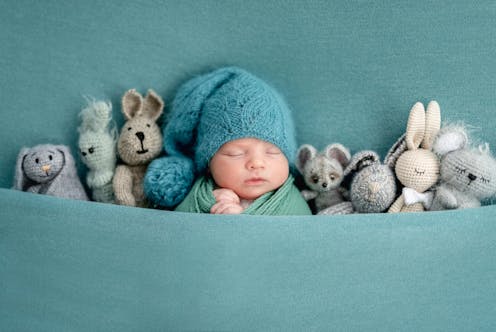
Do you want to have a baby? But, on a planet rocked by the climate crisis, ecosystem collapse, famine and poverty, is having one just adding to the problem – and therefore unethical?
I am a PhD Candidate at Monash Bioethics Centre, and I research the ethics of procreation in a time of climate change. I’ve found there’s no simple “yes” or “no” answer to whether we should produce more children when Earth is in such dire straits.
People who want to have children are faced with a dilemma. Creating a child who will be responsible for high emissions over their lifetime requires others to stay in poverty (if the planet is to operate within its physical limits). This, it can easily be argued, furthers injustice and inequality.
But many of us want to have children – doing so can be one of the most meaningful things we do with our life.
What should we do? Ethics can provide an answer. It shows there is a moral obligation to consider the effects of child-bearing without obliging people to not have children as a result.
Natacha Pisarenko/AP
What is overpopulation?
Many people argue the world has an overpopulation problem. Overpopulation has been defined as the state where there are more people than can live on Earth in comfort, happiness, and health and still leave the world a fit place for future generations.
But this definition is open to interpretation. Overpopulation is not just about numbers, but also values. If people in affluent countries value their lifestyles – and the opportunity for others to have the same lifestyle – then the world is overpopulated.
I live in inner-city Melbourne. When I calculate my ecological footprint, it’s confronting to discover we would need about four Earths for everyone to live like me. If everyone lived like the average American, we would need more than five Earths.
Indeed, estimates by ecologists and philosophers show a person born in the developed world can enjoy their lifestyle only if there are no more than two or three billion people on the planet. There are now more than eight billion.
Read more:
Why we should be wary of blaming ‘overpopulation’ for the climate crisis

Shutterstock
So what do we do?
We could address the dilemma by decreasing per capita emissions of greenhouse gases. However, this on its own won’t be sufficient.
Why? First, it’s difficult to reduce emissions at the speed required to mitigate catastrophic climate change. The goal of the Paris Agreement is to prevent the world from warming by 2℃ from pre-industrial levels. To achieve this goal, we must halve emissions by 2030, halve them again by 2040, and again by 2050.
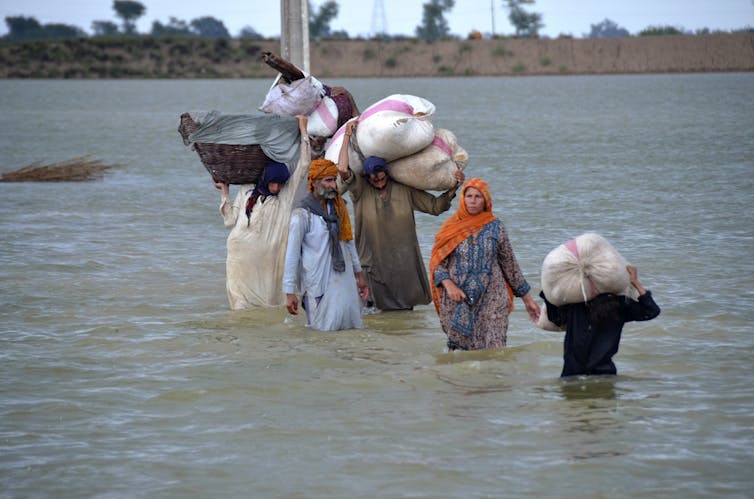
Unfortunately, we are not on track to achieve the Paris goals. This failure will cause significant suffering and millions of deaths. And the most disadvantaged people will be affected first and most severely. This is unjust.
Second, developing countries must be allowed to increase their emissions to escape poverty. People in poverty consume very few resources. To stay at this low-level of consumption is dehumanising. We should be advocating for many people to consume more.
Third, having fewer children helps solve the injustices caused by climate damage. If global fertility rates dropped by only 0.5 births per woman, about 5.1 billion tonnes of carbon would be saved each year by the end of the century. This would contribute to between 16% and 29% of the emissions savings needed to avoid catastrophic climate change.
Zahid Hussain/AP
Fourth, even if the world’s average per capita emissions decrease, a growing population multiplies emissions.
Emissions tend to grow on a one-to-one ratio with rising populations. Between 1975 and 2009, for example, both population and emissions rose by 43% in the United States. Not addressing population growth means we may undo good work achieved by reducing per capita emissions.
And finally, we cannot address per capita emissions without addressing reproduction. The decision to not bring someone into the world is about 20 times more effective at reducing individual emissions than the sum total of many other “green” acts we can do, such as recycling and driving less.
For instance, in a developed nation, having one fewer children saves about 58 tonnes of emissions per year. The next best decision someone can make to limit their emissions is to live car-free. But, this will only save about 2.4 tonnes of emissions per year.
As ethicists have recently pointed out, if there is any duty to reduce our per capita emissions, there is a duty to limit the amount of children we have.
Read more:
Bob Brown is right – it’s time environmentalists talked about the population problem

James Ross/AAP
Resolving the dilemma
I should acknowledge here that I don’t have the lived experience of being a woman or person who can carry a child, nor do I have children yet.
However, I do believe the world must address overpopulation. I say this knowing it is not an easy or comfortable topic to broach. It involves sexuality and contraception, personal rights and religion.
And I realise there is no way forward that can solve all injustices.
If people in affluent nations keep bringing children into the world, there will not be enough resources for many current and future people to live and flourish.
But it would also be unjust to demand an individual give up reproducing. The freedom to decide whether to bring someone into the world is central to many people’s dignity and life’s meaning.
And the United Nations Declaration of Human Rights recognises that every man and woman has the fight to found a family.
So the most appropriate answer is not one that seeks to eliminate injustices altogether. Rather, it should minimise injustice as much as possible.
Telling people not to have children, or to have fewer children, is too strong. The solution must tread a finer line. But how? By placing a moral obligation on people to consider the environmental and justice issues of bringing someone into the world.

Shutterstock
For a person wanting children, this means it’s no longer enough to only ask questions such as: can I be a good parent? Do I have the means to support a child?
Anyone with the means to control their fertility now has an obligation to also ask themselves the following five questions:
-
Will my child have a high-emissions lifestyle and will this mean others must live in poverty? If so, is this justifiable?
-
Do I have biological parenting desires – that is, the desire to parent someone who has my genes? Or do I simply have parenting desires – that is, the desire to raise someone in a loving environment according to my values, regardless of their genes?
-
Even if I might discover a strong biological connection once I have a child, could I be fulfilled in my life if I raised someone who is not biologically connected to me?
-
If I have only parenting desires, can this be satisfied in other ways such as through fostering, teaching, mentoring or, if possible, adopting?
-
Does satisfying my parenting desires in other ways particularly apply to me if I already have one biological child?
Often people who choose not to have children feel the need to explain the decision to others. The above approach would mean the reverse: requiring that people who wish to ethically bring someone into the world must themselves address difficult questions.
A just society values everyone being able to pursue having a child if they wish to. Yet, it also demands that everyone consider the ramifications of doing so.

Craig Stanbury does not work for, consult, own shares in or receive funding from any company or organisation that would benefit from this article, and has disclosed no relevant affiliations beyond their academic appointment.
– ref. Thinking of having a baby as the planet collapses? First, ask yourself 5 big ethical questions – https://theconversation.com/thinking-of-having-a-baby-as-the-planet-collapses-first-ask-yourself-5-big-ethical-questions-196388









































































Health NZ chair fired over ‘political’ post, but says govt ‘overreacted’
Health New Zealand’s board chairperson Rob Campbell has been sacked over a political attack he made about the National Party’s Three Waters policy. Video: RNZ Checkpoint
“I thank Mr Campbell for his contribution since the establishment of Te Whatu Ora last year.”
In a statement, Campbell said the removal from his position was “an inappropriate reaction to statements made in my private capacity”.
“I have spoken to [opposition leader] Christopher Luxon who has accepted my apology for any personal offence my statements may have caused. He accepted my apology.
“I have also apologised to Minister Verrall for any difficulty which my statements may have caused for her and the government.”
Campbell defends actions
Speaking to RNZ Checkpoint, Campbell continued to defend his actions.
“I’ve received a letter from the minister which responded to a letter from my lawyers, indicating that she has removed me from that position as chair of Te Whatu Ora. I think that’s a mistake and an overreaction to the statements I made in a private capacity but nevertheless that’s what she’s done,” he said.
“I think I’m entitled to make comments as a private citizen, which I did in the LinkedIn post.
“And secondly, the suggestion is that I’ve somehow got offside with the opposition, which given that I spoke to Christopher Luxon earlier today, we discussed the issues. I made an apology to him for any personal offence he had taken, he accepted that apology. We had a very nice discussion about it.
“So I don’t believe there’s any issue there. I’ve seen Richard Prebble from the ACT Party saying that he believes I have the right to make statements of this kind.”
He said the comments that he made were on a public forum, but he made them in a private capacity.
“I didn’t make those statements as chair of Te Whatu Ora … I always have to have regard to the interests of Te Whatu Ora and I don’t see anything in the statements I’ve made which was in any way damaging to Te Whatu Ora.”
Strong commitment to kaupapa
“The comments showed my political position, but there is nothing in the code of conduct which suggests you should not do that,” he said.
Campbell said emphasised his strong commitment to the kaupapa of the Pae Ora legislation and the work which Te Whatu Ora and Te Aka Whai Ora were doing to implement that legislation.
“I have devoted huge energy and time and involvement to that end. I am disappointed that I will not be working directly with the thousands of health sector staff, patients and whānau with whom I have been actively engaged. My support for them is undiminished.
“The principle of working in Tiriti partnership to achieve equity in the lives of all New Zealanders is core to my beliefs and I make no apology for that.”
Campbell would not rule out taking legal action over the matter saying it was one possible line of action.
This article is republished under a community partnership agreement with RNZ.
Article by AsiaPacificReport.nz