Page 601

We found out when the Nullarbor Plain dried out, splitting Australia’s ecosystems in half

Source: The Conversation (Au and NZ) – By Maximilian Dröllner, Research associate, Curtin University
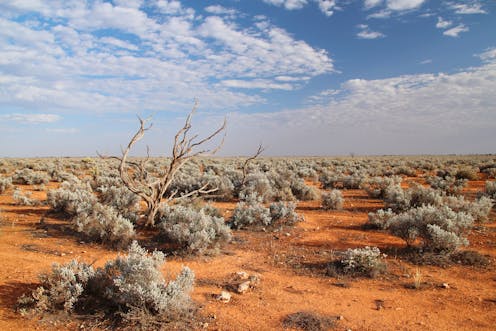
A typical view on the Nullarbor Plain: an expansive, treeless landscape that captures the relentless dryness of Australia’s interior. Matej Lipar, Author provided

Australia’s western and eastern ecosystems are biodiversity hotspots, separated by a dry desert interior. Yet millions of years ago, many species roamed more freely between connected habitats across the continent.

Our new research, published in Geophysical Research Letters, provides insights into ancient climate change that shaped our modern landscapes and ecosystems.

We have developed a new way to reconstruct the timing of great drying episodes on the continents of our planet. This work helps to gain knowledge about drylands that are particularly impacted by current climatic stresses.

Billions of people live in drylands

Drylands cover almost half of Earth’s land surface and are home to around 3 billion people. Dramatic, record-breaking droughts are increasingly occurring around the globe.

As the driest inhabited continent, Australia (70% is considered arid or semi-arid) also faces many challenges, including droughts and bushfires. Understanding the history of dry regions and their response to past climate change is important to mitigate the impact of our warming planet’s future.

Hidden beneath the ‘rusty’ Nullarbor Plain, in ancient patterned beach sands, lie clues to past climatic disturbances that shaped our modern world.
Iluka Resources, Author provided

Southern Australia’s Nullarbor Plain covers an area about the size of Great Britain (roughly 200,000 square kilometres). However, it is starkly different in almost every other aspect: extremely flat, very little rain, and almost no trees. These conditions and its size make the Nullarbor Plain a natural “biogeographic barrier”, separating rich and diverse ecosystems in west and east Australia.

Today, the dusty Nullarbor Plain bears little resemblance to its vibrant past. Before roughly 14 million years ago it was covered by ocean and host to reefs. More recently, it would have been a lush home to an exotic menagerie, including the world’s biggest cuckoos.


Read more:
The world’s biggest cuckoos once roamed the Nullarbor Plain


The drying of the Nullarbor

We know Earth is constantly evolving, but often have a poor idea of exactly when environmental changes occurred in the distant past. Fortunately, some minerals that record past climatic events can be dated.

For most people, rust is something they want to avoid, as it damages our cars, fences, and steel appliances. But rust can be useful in understanding climate change. In our work, we used an iron-bearing mineral called goethite – the main part of rust – to unlock the timing of drying on the Nullarbor.

We found goethite in rocks some 25 metres below the Nullarbor Plain. These rocks mark the past level of groundwater. By dating the age of the goethite minerals, we can understand how past groundwater levels shifted in response to climate change.

Scanning electron microscope images of iron-rich rocks used for our new research. The chemical and textural features of these rocks contain much information about the complex climatic history of the Nullarbor Plain.
Maximilian Dröllner, Author provided

We fired a laser beam into tiny pieces of goethite, roughly the size of a grain of salt, to release their atomic building blocks. We then measured the helium isotopes – variants of helium – that had accumulated since mineral formation. This provided us with a type of “clock”.

We calculated groundwater drastically declined on the Nullarbor Plain between 2.4 and 2.7 million years ago – at the same time as a period of global cooling.

As the climate shifted, the drying changed the local ecosystems, effectively creating a wall for many species. As large swathes of Australia changed from forest to dry grassland, habitat and food availability shrunk for many species.

Significantly, this barrier cut the once continuous link between the species of southwest and southeast Australia.

Splitting of the species

The evolution of many familiar species was influenced by this separation. There is the yellow-tailed black cockatoo from southeast Australia with yellow cheeks, and Carnaby’s black cockatoo with white cheeks in the southwest. Genetically, these two cockatoos are close relatives, but today live thousands of kilometres apart.

A separated duo with a shared ancestry. Left, the Carnaby’s cockatoo (Calyptorhynchus latirostris) and right, the yellow-tailed cockatoo (Calyptorhynchus funereus).
Modified after kookr/flickr and jean_hort/flickr. CC BY-NC

Through isolation, the drying of the Nullarbor played a key role in creating the species richness of southwest Australia. This region is one of only 35 biodiversity hotspots on Earth and home to more than 6,000 native species, with many found nowhere else.

Measuring the timescales of drying landscapes is important for conservation biology. Many native species are already facing or will face existential problems due to climate change and habitat degradation – including the iconic Carnaby’s cockatoo.

A history locked in minerals

By studying minerals formed during groundwater decline, we improve our understanding of our continent’s past and its biosphere. These minerals form as a direct result of continental drying, often in sediment with fossils of interest.

Previously, we often relied on indirect information like the chemistry of marine sediments to date continental landscape processes.
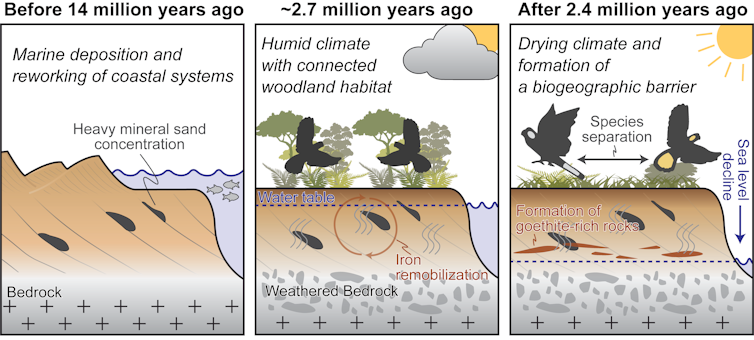
Throughout its history, the Nullarbor Plain has undergone remarkable transformations: once an ocean, later a lush landscape, and now a dusty expanse where numerous species have dramatically separated.
Maximilian Dröllner, Author provided.

More broadly, having information on the timing of past drying events could help test theories about human evolution too. Changing landscapes and extreme drying were likely important for our own species development.

Determining the timing of environmental change lets scientists see how these events have impacted biodiversity and species evolution over time. Studying the past is also vital to understand how Earth responds to climate change. If we understand how ecosystems dry out, we can develop strategies to limit the damage.

The Conversation

Maximilian Dröllner receives funding from Minerals Research Institute Of Western Australia.

Chris Kirkland receives funding from Australian Research Council and the Minerals Research Institute of Western Australia.

Milo Barham receives funding from the Minerals Research Institute of Western Australia, collaborating with Iluka Resources Ltd. to investigate mineral sands, including on the margins of the Nullarbor Plain.

ref. We found out when the Nullarbor Plain dried out, splitting Australia’s ecosystems in half – https://theconversation.com/we-found-out-when-the-nullarbor-plain-dried-out-splitting-australias-ecosystems-in-half-203052

Jakarta should ‘learn from the Aceh, Philippines exerience’ and talk to West Papuan rebels, says researcher

By Singgih Wiryono in Jakarta

An Indonesian human rights researcher has cricitised his government’s failure to negotiate with West Papuan rebels, saying security officials should learn from the 2005 Aceh peace pact.

The Commission for Missing Persons and Victims of Violence (Kontras) research and mobilisation division head, Rozy Brilian, said the Indonesian government had always refused to hold a dialogue with Papuan pro-independence fighters.

He gave this message during a virtual public discussion titled “Failing to Address the Roots of the Conflict and the Window Dressing of a Development Illusion” last Friday — just two days before several Indonesian soldiers were believed to have been killed in a clash with West Papua National Liberation Army (TPNPB) rebels in the Papuan highlands.

The Indonesia soldiers were searching for New Zealand hostage pilot Philip Mehrtens who has been held captive since early February.

“The government always refuses to hold a dialogue with armed groups that the government refers to as KKB [armed criminal groups] even though the push for dialogue has often been encouraged by different parties,” said Brilian.

Yet, according to Brilian, the model of dialogue with an armed group has successfully been pursued by the Indonesian government in the past.

Aceh peace talks
Brilian gave the example of the Aceh peace talks conducted during the era of former president Susilo Bambang Yudhoyono (SBY).

“This dialogue then concluded in negotiations that produced a Memorandum of Understanding (Mou), or agreement, between the Indonesian government and GAM [Free Aceh Movement] in Helsinki,” said Brilian.

That pact brought peace after three decades of warfare.

According to Brilian, the current government should learn from earlier experiences of holding dialogue with armed groups.

In addition to this, said Brilian, Indonesia could also learn from the Philippines which succeeded in “taming” armed independence groups through dialogue.

“Learn from other experiences in the Southeast Asia region, dialogue between the government and pro-independence armed groups were once held by the Philippines government with the pro-independence Moro Islamic Liberation Front group,” he said.

Translated by James Balowski for IndoLeft News. The original title of the article was “Pemerintah Dinilai Selalu Menolak Usul Dialog Damai dengan KKB Papua”.

Print Friendly, PDF & Email

Article by AsiaPacificReport.nz

View from The Hill: Albanese should not try to make the Voice the only game in town in Indigenous affairs

Source: The Conversation (Au and NZ) – By Michelle Grattan, Professorial Fellow, University of Canberra

There are two huge issues in Indigenous affairs at the moment: the Voice and the problems in Northern Territory Indigenous communities, especially but not only in Alice Springs.

Prime Minister Anthony Albanese’s attention is laser-like on the Voice, and trying to get up a yes vote. Opposition Leader Peter Dutton, for a mix of motives, is focusing on the NT situation, as he campaigns against the Voice.

The issues are intertwined, not least because the government argues the Voice would help solve problems on the ground. But they are also separate, and in the near term they should be treated as such.

Dutton’s Tuesday appointment of NT Indigenous Senator Jacinta Nampijinpa Price, as tough an opponent of the Voice as you could get, will probably assist the opposition leader’s no campaign. (That is not to say the no side will prevail – it’s far too early for predictions.)

Price, who will attract a lot of media, will put doubts into the minds of some voters, who may think that if this prominent Aboriginal figure sees no merits in the Voice, perhaps they should vote against it. On the other hand, Price is inexperienced and so a risk, if she lets her emotions get the better of her when provoked. And she will be countered by many Indigenous advocates for the yes case.

As matters stand, of the two leaders, Dutton and the prime minister, it is Dutton who is losing more skin in the referendum fight.

The most recent attacks on him, by Labor and other critics, are over his latest claims, after his trip to Alice Springs last week, of widespread child sexual abuse of Indigenous children – allegations critics see as a ploy in the battle over the Voice.

That said, the government’s wish to downplay the NT’s array of horrendous problems is both wrong in principle and perhaps ultimately a mistake tactically.

Albanese and other Labor figures have invoked a common line: if Dutton knows of cases of child sexual abuse, he should report them to the police.

This really doesn’t pass muster. It’s clear Dutton was not dealing forensically with particular cases (how could any visiting politician?), but with general information (accurate or not) he gathered during his latest visit to Alice Springs. He has said his information was “anecdotal” and that he’d spoken with police and social workers.


Read more:
Your questions answered on the Voice to Parliament


Dutton says that, earlier, he passed on information directly to Albanese, something the PM denies.

On November 30, Dutton canvassed the issue in a question to Albanese in parliament. He referenced a recent meeting with the PM “to discuss the unprecedented and tragic levels of sexual abuse of children in Alice Springs and elsewhere in the Northern Territory.” He asked Albanese to support a royal commission into the “sexual abuse of Indigenous Australians”.

But when Albanese was asked this week on the ABC’s 7:30 whether any information had been brought to him by Dutton “about children abused, children being returned to their abusers” he said “No. Not that I’m aware of. That is the first I’ve heard of it.”

Albanese went on to say he had no idea what Dutton’s recent assertions were based on. “I don’t know what the basis of it is. But certainly he has not raised any specific issue about any claim, about any individual circumstance with me. If he did, I would say to him that he should report that to the police.”

This does seem a deliberate avoidance of the issue.

Albanese’s own backbencher, Labor Senator Marion Scrymgour, formerly NT deputy chief minister, this week highlighted two issues – child protection and youth crime.

While very critical of Dutton for “irresponsible publicity-seeking claims” which cast suspicion on everyone, she said child neglect threw up “really high-risk issues”.

“If a child is being neglected, then they are more likely to be at risk of sexual abuse. So we need to unpack all of that and have a look at what is happening with those children that are falling into that category of neglect, because those numbers are increasing and not just in Alice Springs, but right throughout the Northern Territory,” she told Sky.

This, surely, is what Albanese and his government should be acknowledging.

The Voice is important. But there are serious problems here and now, and the government is negligent, or worse, if it doesn’t admit and confront that reality. The situation is obviously beyond the NT (Labor) government.

The extent of the problems needs to be assessed (and that would reveal, incidentally, whether Dutton is exaggerating). Then a strategy needs to be determined.


Read more:
People in the Kimberley have spent decades asking for basics like water and homes. Will the Voice make their calls more compelling?


Dutton wants a royal commission; Price has suggested a Commonwealth takeover of child protection responsibility. More modestly, Scrymgour has urged a Family Responsibility Commission, along the lines of the Queensland body, headed by a judicial figure, and with Indigenous leaders on it, to manage dysfunctional family situations, including 100% of their welfare income.

There is resistance to all these ideas, including from some Indigenous figures. The debate has a long way to go.

But it is already clear the Voice issue has taken the scrutiny of Indigenous affairs into areas that make governments uncomfortable. And that’s a good thing.

The Conversation

Michelle Grattan does not work for, consult, own shares in or receive funding from any company or organisation that would benefit from this article, and has disclosed no relevant affiliations beyond their academic appointment.

ref. View from The Hill: Albanese should not try to make the Voice the only game in town in Indigenous affairs – https://theconversation.com/view-from-the-hill-albanese-should-not-try-to-make-the-voice-the-only-game-in-town-in-indigenous-affairs-204038

Voice support increases in Essential and Resolve polls

Source: The Conversation (Au and NZ) – By Adrian Beaumont, Election Analyst (Psephologist) at The Conversation; and Honorary Associate, School of Mathematics and Statistics, The University of Melbourne

In the latest Essential poll, support for the Aboriginal and Torres Strait Islander Voice to parliament increased slightly to 60-40, from 59-41 in March. But hard “no” support was up two to 26%, soft “no” was down three to 14%, while 27% remained soft “yes” supporters.

Asked about Opposition Leader Peter Dutton and the Liberals’ decision to oppose the Voice, 52% said they were playing politics, while 48% thought they had genuine concerns.

On voting intentions, federal Labor had a 52-43 two-party lead, including undecided (down slightly from 53-42 last fortnight). This poll was conducted April 12-16 from a sample of 1,136 people.

Primary votes were 34% Labor (up one), 31% Coalition (up one), 14% Greens (steady), 6% One Nation (steady), 3% United Australia Party (up one), 9% for all others (down one), and 4% undecided (down one).

Prime Minister Anthony Albanese’s ratings dropped slightly to 51-36 approval, from 52-35 last fortnight. For the first time, Essential included an approval question on Dutton, finding him at 44% disapproval, 36% approval.

On social media usage, 57% of poll respondents they used Facebook at least once a day, followed by YouTube at 38% and Instagram at 35%. Only 14% used Twitter once a day. By 53-25, respondents did not think their right to privacy was adequately protected in law.


Read more:
Why can’t we just establish the Voice to Parliament through legislation? A constitutional law expert explains


Resolve poll: Voice support at 58-42

Voters supported the Voice by 58-42 when asked to choose “yes” or “no” with no option for undecided, as part of a Resolve poll for Nine newspapers conducted April 12-16 from a sample of 1,600 people. Support was up one point from 57-43 in March.

In surveys combined from March and April, a majority in each state were in favour, as well as nationally.

Initial preferences were 46% “yes” (steady since March), 31% “no” (down one) and 22% undecided (steady).

In a question on turnout in a referendum, 81% said they were likely to vote, 10% unlikely and 9% were undecided.

Morgan poll: 56-44 to Labor

A Morgan poll, conducted April 10-16, gave Labor a 56-44 lead. This was unchanged from the previous week but a 1.5-point gain for Labor since last fortnight. Primary votes were 37% Labor, 33% Coalition, 12% Greens and 18% for all others.

Newspoll Voice survey over three months

The Poll Bludger reported on April 5 that aggregate data from three Newspoll surveys on the Voice to parliament, conducted between February and April, gave “yes” to the Voice an overall 54-38 lead.

State breakdowns had “yes” leading by 55-36 in New South Wales, 56-35 in Victoria, 49-43 in Queensland, 51-41 in Western Australia, 60-33 in South Australia and 55-39 in Tasmania. The number of people polled per state ranged from 334 in Tasmania to 1,414 in NSW.

A “yes” vote at a referendum requires majority support in at least four of the six states, as well as majority support nationally.

Newspoll has also released its voting intentions demographic data from February to April. The Poll Bludger reported on Saturday that Labor led overall by 55-45, in Victoria by 58-42, in SA by 56-44, and in NSW and WA by 55-45. In Queensland, there was a 50-50 tie.

Queensland remains the most pro-Coalition state after it was the only state to vote for the Coalition at the last election (by a 54-46 margin).

Animal Justice now a good chance to win final NSW upper house seat

The NSW upper house has 42 members, with 21 up for election every four years, so members serve eight-year terms. All 21 are elected by statewide proportional representation with optional preferences. A quota for election is 1/22 of the vote or 4.5%.

With the NSW upper house check count complete for the March 25 election, Labor won 8.05 quotas, the Coalition 6.55, the Greens 2.00, One Nation 1.30, Legalise Cannabis 0.81, the Liberal Democrats 0.78, the Shooters 0.69, Animal Justice 0.48 and Elizabeth Farrelly 0.29.

Both major parties were short of their expected totals in the initial count, with the Coalition expected to win 6.60 quotas and Labor 8.10. As a result, Animal Justice needs to close only a 0.07 quota gap on preferences, instead of the expected 0.12 – see analyst Kevin Bonham’s commentary.

Although the final seat is clearly a contest between the Coalition’s seventh candidate and Animal Justice, a few parties will take votes that might otherwise reach the Coalition or Animal Justice. This includes Legalise Cannabis, the Shooters, Fishers and Farmers, and Liberal Democrats, as all are well short of a full quota.

So the Coalition will be competing with two other right-wing parties, while Animal Justice will be competing with Legalise Cannabis for left-wing preferences.

Bonham does not think there is a clear favourite between the Coalition and Animal Justice. However, Animal Justice won in similar circumstances from just behind on primary votes in both the 2015 and 2019
elections.

The “button” press to electronically distribute preferences is scheduled to occur at 11am Wednesday. A win for Animal Justice would give the left an overall 22-20 majority in the upper house, while a Coalition win would tie it at 21-21.

In the lower house, the Liberals won the Ryde recount by 54 votes on Saturday, a marginal difference from the original 50-vote Liberal margin. This confirms the lower house result of 45 Labor out of 93 seats, 36 Coalition, three Greens and nine independents, with Labor two seats short of the 47 needed for a majority.

The Conversation

Adrian Beaumont does not work for, consult, own shares in or receive funding from any company or organisation that would benefit from this article, and has disclosed no relevant affiliations beyond their academic appointment.

ref. Voice support increases in Essential and Resolve polls – https://theconversation.com/voice-support-increases-in-essential-and-resolve-polls-203839

Tahiti’s pro-independence party tops vote — another winning streak?

SPECIAL REPORT: By Ena Manuireva in Pape’ete

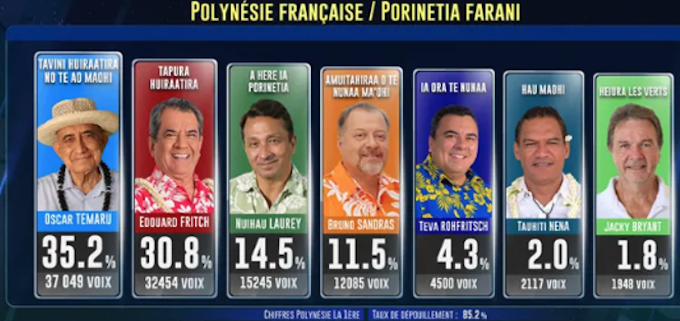
As the ballots were counted after the first day of voting in Mā’ohi Nui/French Polynesia territorial election first round, the “blue wave” of the pro-independence party Tavini Huira’atira led by Oscar Temaru topped the seven party lists competing.

Tavini was followed by the pro-French incumbent governing party Tapura Huira’atira of Édouard Fritch and the surprise alternative group led by a former finance minister under Fritch, Nuihau Laurey.

As for the other autonomist-leaning political parties who did not reach the 12.5 percent threshold required to enter the second round, they would probably encourage their followers to vote for autonomy.

In this first round, 56 percent of the population voted for the members of the Parliament, who will then elect the territory’s President.

This first result has come as no surprise to Oscar Temaru, giving him and his party a two-week campaign to entice the other 44 percent who did not vote in the first round to choose “blue” on April 30.

Undemocratic voting system
When I interviewed Oscar Temaru before the elections, he repeated to me that it should be one vote, one person and that’s the way democracy should work.

However, because France decides on the voting system, it also decides on the allocation of bonus seats (33 percent) for the party that wins most votes in the 57-seat chamber.

This extra bonus seat ploy appeared in 2004 under Gaston Flosse under the pretence of achieving political stability.

This strategy only favours big parties and is likely to keep the same party in power for a long time.

It is part of France’s responsibility to decide the type of vote, to dictate when to vote and how to organise the voting system.

The 33 percent bonus seats was geared to favour the autonomist parties but had the opposite effect in 2004 — despite all predictions — and put the UPLD (union for Democracy, which included Tavini) in power.

Temaru is hoping for a repeat of 2004. By the end of the second round on April 30, we will have the answer on who is going to govern Mā’ohi Nui for the next five years.

How the seven Tahitian party lists fared
How the seven party lists fared in the first round of the Ma’ohi Nui territorial elections. Image: EM

Temaru’s winning strategy
Riding on the back of their win at the last French national elections that saw all three seats allocated to Mā’ohi Nui/French Polynesia in the French Parliament won by pro-independence representatives, Temaru says it was a historic surprise for the French administration and for his people in Tahiti.

He knows that if he uses the same strategy for the territorial elections, he has a good chance of winning.

His approach is to concentrate on what he calls the “disillusioned youth”.

By applying the same approach, he is pitting youth against age because he noticed that the young people weren’t interested in the election because they were not given a voice.

When Oscar Temaru talks about young people, he means 18 to 35 years old — those who the governing administration do not see as potential voters and who rely on their “old guard” approach.

Temaru also talks about how the return of the Tahitian language during political meetings and rallies has had a huge influence on the Tahitian population that still represents about 75 percent of the electorate.

By giving the stage to young, committed and fluent speakers of both Tahitian and French, a whole new communication gap appears.

Fluent bilingual speakers
The pro-independence party offers a space for fluent bilingual speakers compared to the other sides’ representatives who are only fluent in French and speak hardly any Tahitian.

Temaru sees communication in politics as the winning formula.

If you control communication, you are in luck. That is what he did in the last elections in the capital city of Pape’ete for the first time and it was an important victory.

Temaru has also played on the generation gap that exists between the various candidates who are presenting themselves.

He cited veteran politician Gaston Flosse as the main example, emphasising that the future of the Mā’ohi people belongs to the young generation.

When Flosse presented himself in the last elections, he was 91 years old and the youngest lawmaker in the whole of the French Republic from Tavini was only 21 years old. There is a difference of more than three generations between these two candidates.

‘Disrespectful behaviour’
According to Oscar Temaru, the polls show that a huge number of people are against the Fritch government because of:

People now look to the idea of independence as an alternative. Winning these elections would give the Tavini a historic majority in both the Territorial Parliament and the French National Assembly as the only representatives of Mā’ohi Nui would be pro-independence.

Oscar Temaru sees both victories as a stronger mandate enabling Mā’ohi Nui to go to the United Nations and discuss the issue of independence.

He says that every time he talks about Mā’ohi Nui as an independent country, the representatives for France stand up and leave — they don’t want to discuss it.

President Édouard Fritch would go to the UN and say that the population supported their attachment to the French state.

So, this is why it’s really critical for Oscar Temaru to win these elections and change many things in this country.

Internal discords at the Tavini
Is there a tug war between factions of the Tavini Huira’atira after one of the party’s pillars, Eliane Tevaitua, was replaced by a newcomer?

“No. Everybody understands that we have to work together – the older generation and new generation, we need to mix them up,” Temaru says.

“The young generation understands that they need the experience of people who know what is going on. It’s very easy to make them quickly operational because they are smart young people and very interested in politics.”

What Tahiti Infos reported on 28 March 2023
What Tahiti Infos reported on 28 March 2023 – wrongly: “After 4 years as the general secretary of the Tavini Huira’atira, Vannina Crolas has given her resignation last week after the political upheavals that happened among the Tavini ranks that shook the party. The leader of the Tavini Huira’atira has yet to accept her resignation.” (Translation). Image: Tahiti Infos/APR

When the long serving Tavini Huira’atira member of the Territorial Assembly was replaced, the online Tahiti Infos ran an article claiming that Tavini’s general secretary Vannina Ateo had offered her resignation to Oscar Temaru.

However, Ateo said she had never offered her resignation and this was a campaign of disinformation.

Tavini’s vision
Oscar Temaru: “If we win the territorial elections, we will be able to tell France, let’s sit around the table and talk about the future of our country in the presence of the UN as a referee.

“We will put on the table everything that concerns the people of this country. Let’s talk together step by step about agreements of cooperation in the different areas for the future.

“The UN will be the referee between us and France regarding those agreements.
“For us this will not be a repeat of the Noumea Accords because I am one of those who knew what happened exactly to the New Caledonia issue.

“In 1986 after the resolution was adopted by the UN to put New Caledonia on the list of countries to decolonise, there was no talk about going to Paris and meeting with the right-wing Jacques Lafleur.

“It was a decision taken by Jean-Marie Tjibaou and we knew after that the freemason people were the ones who worked behind the scenes to organise that meeting in Paris.

“So, it took more than 30 years from 1986 to 2008. And from 2008 until today the Noumea Accord has become a stalemate.

“We don’t want that kind of accord because while the Noumea Accord was being discussed, at the same time we have had a statute of autonomy which started in 1977 and is now 46 years.

“So, after the autonomy — call it as you like, autonomy management, autonomy intern, self-governance — no we don’t want any of those new titles for our country.

““We will not go through the nearly 40 years of negotiations that New Caledonia went through. For us the UN will fix the date for the referendum so maximum, let’s say 10 years.

“We want to put the economy of this country on the right track, to educate our people — that’s the main point, how to change the mindset of our people and that is a hard job.

“It won’t an easy discussion so we will need top people to go to the UN to talk to the French, because they don’t want to lose their stronghold on this country that is as huge and as big as Europe, with all the resources.

“So that’s why the French administration don’t want to lose it.

“Thanks to the UN for having adopted the last two resolutions in 2020 and 2021 which tell the French to respect our sovereign right and our rights on every resource on this country.

“If France loses this part of Ma’ohi Nui, it will lose everything and Noumea will follow suite when their turn comes again.”

In response to the last question, about Oscar Temaru himself — what is going to happen to him, he says “we will wait and see what God decides, aye!”

At the age of nearly 80, he still has the fighting spirit and he hopes that in five years’ time he will still be here.

“Maybe there will be a new leader for this country. I don’t know, but at the moment I am still fighting.”

Ena Manuireva is an Aotearoa New Zealand-based Tahitian doctoral candidate at Auckland University of Technology and a commentator on French politics in Ma’ohi Nui and the Pacific. He contributes to Asia Pacific Report.

Print Friendly, PDF & Email

Article by AsiaPacificReport.nz

Voice support increases in Essential and Resolve polls; Animal Justice could win final NSW upper house seat

Source: The Conversation (Au and NZ) – By Adrian Beaumont, Election Analyst (Psephologist) at The Conversation; and Honorary Associate, School of Mathematics and Statistics, The University of Melbourne

In the latest Essential poll, support for the Aboriginal and Torres Strait Islander Voice to parliament increased slightly to 60-40, from 59-41 in March. But hard “no” support was up two to 26%, soft “no” was down three to 14%, while 27% remained soft “yes” supporters.

Asked about Opposition Leader Peter Dutton and the Liberals’ decision to oppose the Voice, 52% said they were playing politics, while 48% thought they had genuine concerns.

On voting intentions, federal Labor had a 52-43 two-party lead, including undecided (down slightly from 53-42 last fortnight). This poll was conducted April 12-16 from a sample of 1,136 people.

Primary votes were 34% Labor (up one), 31% Coalition (up one), 14% Greens (steady), 6% One Nation (steady), 3% United Australia Party (up one), 9% for all others (down one), and 4% undecided (down one).

Prime Minister Anthony Albanese’s ratings dropped slightly to 51-36 approval, from 52-35 last fortnight. For the first time, Essential included an approval question on Dutton, finding him at 44% disapproval, 36% approval.

On social media usage, 57% of poll respondents they used Facebook at least once a day, followed by YouTube at 38% and Instagram at 35%. Only 14% used Twitter once a day. By 53-25, respondents did not think their right to privacy was adequately protected in law.


Read more:
Why can’t we just establish the Voice to Parliament through legislation? A constitutional law expert explains


Resolve poll: Voice support at 58-42

Voters supported the Voice by 58-42 when asked to choose “yes” or “no” with no option for undecided, as part of a Resolve poll for Nine newspapers conducted April 12-16 from a sample of 1,600 people. Support was up one point from 57-43 in March.

In surveys combined from March and April, a majority in each state were in favour, as well as nationally.

Initial preferences were 46% “yes” (steady since March), 31% “no” (down one) and 22% undecided (steady).

In a question on turnout in a referendum, 81% said they were likely to vote, 10% unlikely and 9% were undecided.

Morgan poll: 56-44 to Labor

A Morgan poll, conducted April 10-16, gave Labor a 56-44 lead. This was unchanged from the previous week but a 1.5-point gain for Labor since last fortnight. Primary votes were 37% Labor, 33% Coalition, 12% Greens and 18% for all others.

Newspoll Voice survey over three months

The Poll Bludger reported on April 5 that aggregate data from three Newspoll surveys on the Voice to parliament, conducted between February and April, gave “yes” to the Voice an overall 54-38 lead.

State breakdowns had “yes” leading by 55-36 in New South Wales, 56-35 in Victoria, 49-43 in Queensland, 51-41 in Western Australia, 60-33 in South Australia and 55-39 in Tasmania. The number of people polled per state ranged from 334 in Tasmania to 1,414 in NSW.

A “yes” vote at a referendum requires majority support in at least four of the six states, as well as majority support nationally.

Newspoll has also released its voting intentions demographic data from February to April. The Poll Bludger reported on Saturday that Labor led overall by 55-45, in Victoria by 58-42, in SA by 56-44, and in NSW and WA by 55-45. In Queensland, there was a 50-50 tie.

Queensland remains the most pro-Coalition state after it was the only state to vote for the Coalition at the last election (by a 54-46 margin).

Animal Justice now a good chance to win final NSW upper house seat

The NSW upper house has 42 members, with 21 up for election every four years, so members serve eight-year terms. All 21 are elected by statewide proportional representation with optional preferences. A quota for election is 1/22 of the vote or 4.5%.

With the NSW upper house check count complete for the March 25 election, Labor won 8.05 quotas, the Coalition 6.55, the Greens 2.00, One Nation 1.30, Legalise Cannabis 0.81, the Liberal Democrats 0.78, the Shooters 0.69, Animal Justice 0.48 and Elizabeth Farrelly 0.29.

Both major parties were short of their expected totals in the initial count, with the Coalition expected to win 6.60 quotas and Labor 8.10. As a result, Animal Justice needs to close only a 0.07 quota gap on preferences, instead of the expected 0.12 – see analyst Kevin Bonham’s commentary.

Although the final seat is clearly a contest between the Coalition’s seventh candidate and Animal Justice, a few parties will take votes that might otherwise reach the Coalition or Animal Justice. This includes Legalise Cannabis, the Shooters, Fishers and Farmers, and Liberal Democrats, as all are well short of a full quota.

So the Coalition will be competing with two other right-wing parties, while Animal Justice will be competing with Legalise Cannabis for left-wing preferences.

Bonham does not think there is a clear favourite between the Coalition and Animal Justice. However, Animal Justice won in similar circumstances from just behind on primary votes in both the 2015 and 2019
elections.

The “button” press to electronically distribute preferences is scheduled to occur at 11am Wednesday. A win for Animal Justice would give the left an overall 22-20 majority in the upper house, while a Coalition win would tie it at 21-21.

In the lower house, the Liberals won the Ryde recount by 54 votes on Saturday, a marginal difference from the original 50-vote Liberal margin. This confirms the lower house result of 45 Labor out of 93 seats, 36 Coalition, three Greens and nine independents, with Labor two seats short of the 47 needed for a majority.

The Conversation

Adrian Beaumont does not work for, consult, own shares in or receive funding from any company or organisation that would benefit from this article, and has disclosed no relevant affiliations beyond their academic appointment.

ref. Voice support increases in Essential and Resolve polls; Animal Justice could win final NSW upper house seat – https://theconversation.com/voice-support-increases-in-essential-and-resolve-polls-animal-justice-could-win-final-nsw-upper-house-seat-203839

Why is there an inquiry into the Bruce Lehrmann trial? Legal experts explain

Source: The Conversation (Au and NZ) – By Ben Livings, Associate Professor of Criminal Law and Evidence, University of South Australia

There’s yet another twist in the Bruce Lehrmann saga. On Monday, opening statements were delivered in an inquiry into the prosecution of Lehrmann over the alleged rape of Brittany Higgins.

Lehrmann has always maintained his innocence, pleading not guilty to a charge of sexual intercourse without consent.

The inquiry will investigate the handling of the case by Australian Capital Territory authorities. It will start hearing evidence on May 1.

The first trial was abandoned by the judge in October 2022 due to juror misconduct. A second trial did not proceed due to prosecutors’ fears for Higgins’ mental health.

This investigation is separate to the ongoing defamation cases Lehrmann is pursuing against a range of media outlets.

Also on Monday, trial judge and ACT Chief Justice Lucy McCallum announced she would be maintaining a suppression order that keeps secret some elements of the case involving Higgins. McCallum said “I have no doubt that any further exacerbation of the level of media attention directed to her carries a risk to her life”.


Read more:
Lehrmann retrial abandoned because of ‘a significant and unacceptable risk’ to Brittany Higgins’ life


‘Inappropriate interference’

It’s been revealed that in November 2022, the ACT director of public prosecutions (DPP), Shane Drumgold, raised concerns about the conduct of police and their interference in his handling of the prosecution.

The Office of the DPP is an independent statutory authority created by parliament. It prosecutes criminal cases in the ACT, operating free from government influence. That is, free from the parliament and the executive, which includes police ministers and police commissioners.

In other words, the DPP is to remain above politics, and stick entirely to principles of law, and agreed prosecutorial guidelines.

The letter emerged following a freedom of information request from The Guardian. In it, Drumgold alleged there had been “inappropriate interference” by police in the case, namely that he had been pressured not to continue the prosecution.

The inquiry will investigate Drumgold’s allegations. It will try to determine whether any matters extraneous to the trial, and the attempted retrial, interfered with the fairness of the process, or disrespected the rights of those involved.

Former Queensland solicitor-general Walter Sofronoff has been appointed to head the inquiry. He said he will report back to the government by the end of June.

The task ahead

Sofronoff has quite the task ahead of him. Into this mix come a number of players, themes and factual disagreements.

For starters, there is the essential pillar of prosecution independence that prevents the government of the day (and their police) deciding who is to be prosecuted and under what circumstances. Section 20 of the Director of Public Prosecutions Act 1990 (ACT) allows the Attorney-General to “give directions or furnish guidelines” to the DPP, but these are to be “of a general nature and shall not refer to a particular case”. The decision as to whether to proceed with a prosecution remains with the DPP.

The prosecution policy of the ACT will also come under scrutiny. That is, the discretionary guidelines given to the DPP by legislation in relation to their choice to prosecute.

The role of Victims of Crime Commissioner Heidi Yates in the entire episode is likely to be examined. The role of this commissioner is to act as a victim advocate, and Yates was a prominent supporter of Higgins, appearing at numerous court hearings alongside her.

More than one politician was drawn into the matter, albeit with marked reluctance. Media celebrities weighed in. Criminologists pointed to the very low rate of guilty verdicts in prosecutions alleging sexual improprieties.


Read more:
Can juries still deliver justice in high-profile cases in the age of social media?


All of these players may fall under the scrutiny of Sofronoff as he tries to determine what influence may have been exerted by these diverse factors in the interactions between the police and the DPP.

Sofronoff is likely to want to know more about the fact that police disclosed a brief of evidence to Lehrmann’s defence lawyers, which included sensitive information such as Higgins’ counselling notes. This occurred before Lehrmann had entered a plea.

He may wish to examine the appropriateness of an apparent close engagement during the trial between the investigating officers and Lehrmann’s legal team. Sofronoff will be assisted by his reference to more than 140,000 pages of documentation.

Rarely has there been such an “after the event” examination of the way a prosecution has been conducted. In many respects, the trial is being heard all over again.

The Conversation

Rick Sarre is affiliated with the SA Labor Party, and is a Patron of the Justice Reform Initiative.

Ben Livings does not work for, consult, own shares in or receive funding from any company or organisation that would benefit from this article, and has disclosed no relevant affiliations beyond their academic appointment.

ref. Why is there an inquiry into the Bruce Lehrmann trial? Legal experts explain – https://theconversation.com/why-is-there-an-inquiry-into-the-bruce-lehrmann-trial-legal-experts-explain-200738

We need a National Energy Transition Authority to help fossil fuel workers adjust

Source: The Conversation (Au and NZ) – By Fergus Green, Lecturer in Political Theory and Public Policy, UCL

Australia’s coal-fired power stations are exiting the grid. This transition is already well underway, as cheaper renewables displace coal and older generators close. Australia’s oldest coal plant, Liddell, is about to close. Eleven coal-fired power plants closed between 2013 and 2020, and at least seven others are slated to close between now and 2030.

Closing a power station sounds bloodless. But if it’s not done well, it can be devastating for affected workers and their families, and economically and socially disruptive to the communities in which they are based. Many towns grew up around coal mines and power plants. We cannot simply leave it to the market to smooth the transition.

To better manage the vital human part of our transition to a low-carbon electricity system, the Australian Council of Trade Unions (ACTU) recently proposed a solution. It called on the federal government to establish an independent National Energy Transition Authority.

This is an excellent idea, and well overdue given the rate at which our coal plants are closing. Countries that have embraced this approach, such as Spain, have seen the benefits, economic, social – and even political.

What would this authority do?

An energy transition authority, as envisaged by the ACTU, would have three main functions:

  • develop schemes to support affected workers, including through redeployment into similar facilities, or retraining and recruitment into sustainable industries

  • support, coordinate and partly finance plans to develop new industries in coal-dependent regions such as Gippsland in Victoria and the Hunter Valley in New South Wales, including attracting federal and state investment and incentives to drive investment in local sustainable industries

  • ensure education and training programs and infrastructure are in place to support industrial diversification in these regions.

wonthaggi coal mine
Towns like Wonthaggi in Victoria sprung up around coal mining.
Darge Photographic Co/State Library of Victoria, CC BY

Do we actually need a new authority?

This isn’t the first time we’ve seen proposals for authorities like this. The union movement has proposed several variants in the past, and Labor backed a similar initiative before the 2022 federal election.

After it won government, Labor set up a net zero economy taskforce aimed at advising on how to best support regional communities during the low-carbon transition.

The Greens have also proposed an expanded version of this authority, which would take on extra advisory and law-reform functions. An inquiry into the Greens’ proposed bill by a Labor-majority committee last month described the measure as “premature”, given the government’s taskforce is exploring options to help regions.

Labor, of course, would prefer its own version gets up. That’s entirely possible – the proposed authority has broad support beyond the labour movement.

But some have been critical, with Australian Energy Council experts questioning whether such an authority would be needed, given regional development programs already exist.

Regional industrial transitions are complex, requiring sustained governance over long periods. Australia’s existing programs are not enough, and are often fragmented across a patchwork of federal, state and local government departments.

A new federal authority would help coordinate existing programs across all levels of government, bring the additional capabilities of the federal government, and take a sustained, long-term focus to the challenging task of regional transition.

In a few weeks, we’ll find out whether the Albanese government decides to fund such a body in its May budget.


Read more:
NSW’s biggest coal mine to close in 2030. Now what about the workers?


The moral case for a transition authority

An authority dedicated to smoothing the path of the energy transition is, in my view, justified on moral grounds. It would elevate the voices of workers and regional communities who are most affected by the low-carbon transition, helping to ensure the benefits and burdens of the transition are fairly shared.

Those whose jobs are at risk have a moral claim to government support to help them adjust to these changes. But so do residents in these regions who never enjoyed the benefits of highly paid unionised jobs in the fossil fuel industry in the first place. They, too, should share in the benefits.

That’s why the ACTU is right to propose a wider, community-level mandate for the authority, to spur regional development that’s not only more environmentally sustainable but also more socially diverse.

gwalia ghost town
If not managed well, a transition away from mining could lead to poverty – or even the abandonment of mining towns, as Australia saw after the gold rush. This photo shows the gold-mining ghost town of Gwalia in Western Australia.
Shutterstock

The political case

Residents of coal and gas regions are often sceptical of the low-carbon transition, and may view it as a threat. An authority like this could build local support by demonstrating what comes next.

In Spain, for instance, the incumbent Spanish Socialist Party is reaping the political benefits of the “just transition agreement” it negotiated with unions, employers and community representatives in coal regions in 2018.

This agreement made clear coal-mining would be phased out by the end of 2019. In return, the government agreed to provide €250 million (A$407 million) in support for workers and community-level investment over the next eight years.

At the April 2019 national election, the incumbents won. Interestingly, our research found their vote share in coal-mining regions covered by the agreement increased relative to comparable rural areas not covered.

Spain and Australia obviously have different political contexts. But our research does suggest there are potential political benefits – not just costs – on offer to governments that provide climate leadership grounded in a just-transition strategy.

An Australian transition authority will only be politically successful if it works with local bodies with similar mandates, such as the Latrobe Valley Authority and the Collie Delivery Unit – or helps establish them.

Working with locally supported groups is common sense. It is also backed up by research showing that fossil fuel communities do not like the idea of having their futures dictated to them by Canberra. But if they feel heard and see their concerns tackled in the transition, they are more likely to be supportive.

For years, organisations such as The Next Economy and the Real Deal project have been working on the energy transition in communities like Gladstone, one of the Queensland towns most reliant on gas and coal. This community-building expertise would be vital for the authority to draw on.

From the power stations to the mines?

If Australia creates an energy transition authority, the immediate task is to help catalyse just and politically smooth transitions in coal power-generating regions.

But there’s a bigger task lying ahead. Australia’s domestic emissions are dwarfed by the emissions from its coal and gas exports. If the authority proves itself, it could begin to support workers and communities to wind down Australia’s export-oriented coal mines and fossil-gas production industries.


Read more:
Regional towns are at risk of being wiped out by the move to net-zero. Here’s their best chance for survival


The Conversation

Fergus Green does not work for, consult, own shares in or receive funding from any company or organisation that would benefit from this article, and has disclosed no relevant affiliations beyond their academic appointment.

ref. We need a National Energy Transition Authority to help fossil fuel workers adjust – https://theconversation.com/we-need-a-national-energy-transition-authority-to-help-fossil-fuel-workers-adjust-203333

Explainer: why has fighting broken out again in Sudan and what does it mean for the region?

Source: The Conversation (Au and NZ) – By Anne L. Bartlett, Associate Professor, United Arab Emirates University

Marwan Ali/AP

In the last few days, a deadly conflict has erupted in Sudan’s capital, Khartoum, between rival factions of the armed forces, leaving at least 180 people dead and at least 1,800 civilians and combatants injured.

The fighting, which broke out between the Sudan Armed Forces led by General Abdel Fattah al-Burhan and the Rapid Support Forces led by General Mohamed Hamdan Dagalo, saw fighter jets take to the skies over the capital and armed fighters take to the streets.

Militia vs military

The latest fighting comes as no surprise to many in Sudan, where a power struggle has been brewing for some time between the two generals, al-Burhan and Dagalo (also known as Hemedti). It has a historical tail of more than 20 years, right back to the early days of the Darfur conflict and the rise of the notorious Janjaweed militia.

From that time, Hemedti, a leader of the Janjaweed militia group from the Abbala Rezeigat tribe in northern Darfur, came to prominence for his willingness to carry out raids on villages leading to mass killings, rapes and looting on a grand scale.

What he learned very early on was that strength came from doing things that no reasonable person would do. In contrast to the army, his fighters were “free range” – able to roam around and kill people at will.


À lire aussi :
Sudan conflict: Hemedti – the warlord who built a paramilitary force more powerful than the state


aerial picture of smoke emerging from air crafts on runway
Fighting in the capital city also caused damage to aircraft on the runway at the Khartoum International Airport.
Maxar Technologies handout/ EPA

His work had another function, too. Because he was “free range” and out of a direct chain of command, it meant that he could do the government’s bidding, but do it with maximum deniability.

It was this ruthless mindset and operational flexibility that brought him into the favour of the then-president of Sudan, General Omar al-Bashir, who needed an informal paramilitary group to protect him from enemies within his party, the National Islamic Front.

This militia became the Rapid Support Forces, which is currently fighting Sudan’s military. It was given special status in 2017 as an “independent security force”, not part of the regular armed forces.

It wasn’t just al-Bashir who benefited from this relationship, either. In return for his assistance, Hemedti was given free rein to access gold mines in Darfur, which has made him immensely rich.

Contrast this with al-Burhan of the Sudan Armed Forces. A career general, he has been involved in the army since 1991, running multiple campaigns. He was in Darfur since the early days of the conflict coordinating a “counter-insurgency” campaign, but he is neither as entrepreneurial as Hemedti, nor as cashed up.

Yet, as former president al-Bashir was running into trouble at the start of 2019, Hemedti was the one to stab his former patron in the back by supporting the other side. This has never been forgotten by the Islamists of Sudan.

Al-Bashir was subsequently ousted in a coup, but the generals have never been comfortable bedfellows. While they have worked together, there have been clear cases where Hemedti has attempted to undermine al-Burhan.

The region wants more business, less war

All of these developments are taking place in what are increasingly choppy geopolitical waters for Sudan, where old alliances are rapidly changing.

While Hemedti managed to forge strong ties with Saudi Arabia and an alliance of countries in the Persian Gulf by sending soldiers to fight in the war in Yemen, there are now hopeful signs this eight-year-long conflict may be coming to an end. Fuelling this hope is a détente between Saudi Arabia and Iran recently brokered by the Chinese.


À lire aussi :
Explainer: what Sudan’s coup is about and why the rest of the world needs to act


The United Arab Emirates, who hosted al-Burhan in February, has called for restraint in Sudan and for the two sides to work towards a peaceful solution to the current crisis.

Egypt, which has traditionally supported al-Burhan and the army, has also expressed its willingness to work for peace, calling for an immediate ceasefire before things spiral out of control.

Russia, which has been consolidating relations with Sudan over recent years, has also called for restraint. Russia has provided arms to Sudan’s military.

For many of the countries in the region, the overall approach to Sudan can be summed up as more business, less war. The country’s Gulf neighbours are seeking to diversify their oil-based economies and are looking to Sudan for business opportunities. Conflict disrupts those opportunities.

Sudan’s neighbours called an emergency meeting in Cairo, Egypt, to call for restraint.
Khaled Elfiqi/ EPA

As the generals fight for power, civilians struggle for food

In Sudan itself, it is difficult to assess what the appetite is among the public for more fighting. Hemedti has declared himself to be the wronged party, and says he is against civilian killings and in favour of civilian rule.

Al-Burhan sees Hemedti as a criminal and an upstart.

Undoubtedly, both are aware that the longer the situation goes on, the more unsustainable their activities will become.

Yet, while the generals fight it out, the economy continues to decline and the cost of living soars. Since the coup, basic household goods such as bread are ten times more expensive than before, with other items increasing by up to 300%.

As one woman in the market in Khartoum pointed out in a recent Reuters report, as they fight to loot the country, we fight for food.

The Conversation

Anne L. Bartlett ne travaille pas, ne conseille pas, ne possède pas de parts, ne reçoit pas de fonds d’une organisation qui pourrait tirer profit de cet article, et n’a déclaré aucune autre affiliation que son organisme de recherche.

ref. Explainer: why has fighting broken out again in Sudan and what does it mean for the region? – https://theconversation.com/explainer-why-has-fighting-broken-out-again-in-sudan-and-what-does-it-mean-for-the-region-203928

From platypus to parsecs and milliCrab: why do astronomers use such weird units?

Source: The Conversation (Au and NZ) – By Laura Nicole Driessen, Postdoctoral researcher in radio astronomy, University of Sydney

NASA / ESA / J. Hester / A. Loll

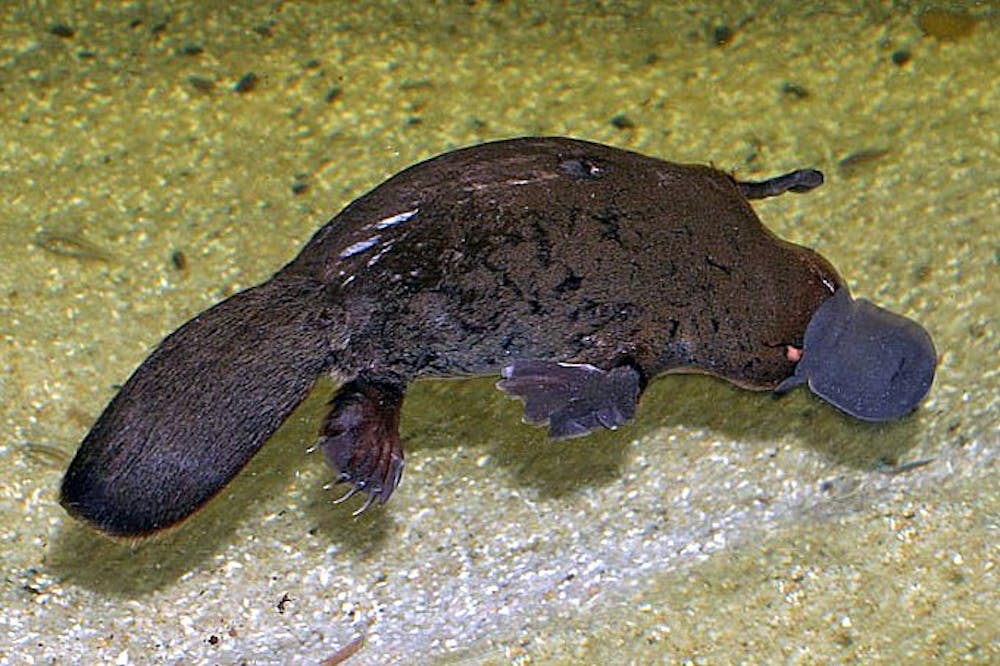
You may have heard about an asteroid set to fly near Earth that is the size of 18 platypus, or maybe the one that’s the size of 33 armadillos, or even one the size of 22 tuna fish.

These outlandish comparisons are the invention of Jerusalem Post journalist Aaron Reich (who bills himself as “creator of the giraffe metric”), but real astronomers sometimes measure celestial objects with units that are just as strange.

The idea of a planet that’s 85% the mass of Earth seems straightforward. But what about a pulsar-wind nebula with a brightness of a few milliCrab? That’s where things get weird.

A top down image of a platypus swimming.
A platypus that is approximately 1/18th of the size of Asteroid 2023 FH7.
Stefan Kraft / Wikimedia, CC BY-SA

Why do astronomers use such strange units?

The basic problem is that lots of things in space are way too big for our familiar units.

Take my whippet Astro, who is 94cm long. Earth’s radius is about 638 million cm, or 7.5 million Astros.

Jupiter’s radius is 11.2 Earths, or 85 million Astros. That number of Astros is a bit ridiculous, which is why we adjust our unit choice to one that makes more sense.

A white whippet with a brown splotch over his eye is lying down in the grass with a blue sky with puffy clouds in the background. He's staring off into the distance.
Astro the whippet contemplating the wonders of the Universe (probably).
Laura Driessen

At an even larger scale, consider the star Betelguese: its radius is 83,000 Earths, or 764 times the radius of the Sun. So if we want to talk about how big Betelgeuse is, it’s much more convenient to use the radius of the Sun as our unit, instead of the radius of Earth (or to describe it as 632 billion Astros).

Heavy stuff

If we want to measure how heavy an asteroid is, we could do it with camels – but in space we’re more interested in mass than in weight. Mass is a measure of how much stuff something is made of.

On Earth the weight of an object, like Astro, depends on the mass of Astro and the gravitational force pulling him down to the ground.


Read more:
Explainer: what is mass?


We can think of weight in terms of how hard it is to lift an 18kg Astro off the ground. This would be easy to do on Earth, even easier somewhere with lower gravity like the Moon, and much harder somewhere with higher gravity like Jupiter.

On the other hand, Astro’s mass is how much stuff he’s made of – and it’s the same no matter which planet he’s on.

Astronomers use Earth and the Sun as handy units to measure mass. For example, the Andromeda galaxy is approximately three trillion times the mass of the Sun (or 3×1041 – that’s a 3 followed by 41 zeros – Astros).

Astronomical units and parsecs

Astronomers also use comparisons to measure how far apart things are. The Sun and Earth are 149 million kilometres apart, and we give this distance a name: an astronomical unit (AU).

For an even twistier unit of distance, we use the parsec (insert Han Solo Kessel run joke here). Parsec is short for “parallax second”, and if you remember your trigonometry, this is the length of the hypotenuse of a right-angle triangle when the angle is 1 arcsecond (1/3,600 degrees) and the “opposite” side of the triangle is 1 AU.

Parsecs are handy for measuring even bigger distances because 1 parsec = 206,265 AU. For example, the centre of our very own galaxy, the Milky Way, is about 8,000 parsecs away from Earth, or 1.6 million AU.

Magnitudes

If we want to measure how bright something is, astronomical units of measurement get even weirder. In the second century BC, the ancient Greek astronomer Hipparchus looked up at space and gave the brightest stars a value of 1 and the faintest stars a value of 6.

Notice here that a brighter star has a lower number. We call these brightness values “magnitudes”. The Sun has an apparent magnitude of –26!

A image of the Sun as an orange ball with dark spots and bright loops.
An image of the Sun taken by NASA’s Solar Dynamics Observatory.
NASA/SDO

Even more confusing than a negative brightness, each single step in magnitude is a 2.512 times difference in brightness. The star Vega has an apparent magnitude of 0, which is two and a bit times brighter than the star Antares with an apparent magnitude of 1.

At last, the milliCrab

The light we see with our eyes is, for obvious reasons, called “visible” light. The light we use to take pictures of your bones is called X-ray light.

When astronomers use X-ray light to observe the sky we sometimes measure brightness in “Crabs”.

The Crab is a rapidly spinning neutron star (or pulsar) in the remains of an exploded star that is extremely bright when we look at it using our X-ray telescopes. It’s so bright in X-ray light that astronomers have been using it to calibrate their telescopes since the 1970s.

A bright, multi-coloured supernova remnant with dusty, wispy filaments and something resembling a tornado (the pulsar wind nebula) in the centre.
Image of the Crab Nebula where red is radio from the Very Large Array, yellow is infra-red from the Spitzer Space Telescope, green is visible from the Hubble Space Telescope, and blue and purple are X-ray from the XMM-Newton and Chandra X-ray Observatories respectively.
NASA, ESA, G. Dubner (IAFE, CONICET-University of Buenos Aires) et al.; A. Loll et al.; T. Temim et al.; F. Seward et al.; VLA/NRAO/AUI/NSF; Chandra/CXC; Spitzer/JPL-Caltech; XMM-Newton/ESA; and Hubble/STScI

So every X-ray astronomer knows how bright a Crab is. And if we’re talking about a particular object, say a black hole binary system called GX339-4, and it’s only five thousandths as bright as the Crab, we say it’s 5 milliCrab bright.

But buyer beware! The brightness of the Crab is different depending on what energy of X-ray light you’re looking at, and it also changes over time.

Whether we use lions or tigers or Crabs, astronomers make sure to define the units we’re using. There’s no use using an armadillo, or even your local whippet, unless you’ve made sure the definition is clear.


Read more:
Beating heart of the Crab Nebula


The Conversation

Laura Nicole Driessen is part of MeerTRAP, which is supported by the European Research Council (ERC) under the European Union’s Horizon 2020 research and innovation programme (grant agreement No 694745).

ref. From platypus to parsecs and milliCrab: why do astronomers use such weird units? – https://theconversation.com/from-platypus-to-parsecs-and-millicrab-why-do-astronomers-use-such-weird-units-203061

Penny Wong said this week national power comes from ‘our people’. Are we ignoring this most vital resource?

Source: The Conversation (Au and NZ) – By Joanne Wallis, Professor of International Security, University of Adelaide

During her speech at the National Press Club this week, Australian Foreign Minister Penny Wong argued that the “unprecedented” circumstances our region faces “require a response of unprecedented coordination and ambition in our statecraft”.

Wong identified many key tools of Australia’s statecraft:

  • development assistance
  • infrastructure investment
  • security cooperation
  • multilateral diplomacy, and
  • military capability.

She also singled out Australia’s much-debated plan to spend A$368 billion to acquire and develop nuclear-powered submarines under the AUKUS security partnership as a key way Australia will “play our part in collective deterrence of aggression”.

Importantly, Wong also also observed that “our national power, more than anything else, comes from our people”. Yet, she noted, the number of Australian diplomats working in the Pacific had actually shrunk under the previous government.

It’s worth reflecting on this in light of the government’s massive spending on submarines – will it have enough left to invest in the people it entrusts to practice its statecraft?

What is statecraft?

Statecraft is a word increasingly used by leaders, officials and commentators to describe the actions that states take to try to influence:

  • the global political or economic environment
  • the policies or behaviours of other countries, or
  • the beliefs, attitudes or opinions of other countries.

The concept of statecraft is having its moment as the Australian foreign and strategic policy community contemplates how to counter China’s increasingly activist role in the Indo-Pacific region.

Many believe that, to earn the most influence, Australia’s tools of statecraft should come with big price tags and flashy announcements. In the Pacific, for instance, the government is fond of announcing big pledges of developmental aid, infrastructure projects and military assistance. There’s a reason Australian officials spruik fervently on social media every time dollars are promised or spent.

But who are these Australian officials on the coalface of implementing Australia’s statecraft?

Diplomats are not all the same

If you look at their social media accounts, Australian officials are treated as interchangeable: an incoming ambassador or high commissioner takes over the account of their predecessor and assumes their persona.

The old pronouncements of their predecessor become their pronouncements. The past openings of Australian-funded facilities become their announcements, even though the person in the social media thumbnail is not same as the one in the commemorative photos.

Officially, foreign policy is as emotionless and cut-and-paste as these official Twitter accounts. Heads of mission should simply take the baton from their predecessor and run with the responsibility of implementing the government of the day’s foreign policy for a while before handing it over to someone else.

There is no mention of the differences between these individuals. It is as if Australian foreign policy officials are grown from pods in the basement of the R.G. Casey Building, the home of the Department of Foreign Affairs and Trade in Canberra.

This is of course nonsense. Australian officials are – just like the rest of us – human beings. Each has their own foibles, habits, strengths and weaknesses. Their individual personalities are adjudicated and assessed intensely in the capital cities where they work, as are those of the Australian police officers, military officials and assorted contractors implementing their programs.

But this reality attracts surprisingly little attention in much of the analysis that is done on the effectiveness of Australia’s statecraft.


Read more:
Can Australia recapture the spirit of middle power diplomacy?


Why kindness and empathy matter

This is why we’re studying the role individuals play in implementing Australian statecraft in the Pacific Islands and Timor-Leste.

Through our work on the first season of our Statecraftiness podcast, we’ve found it is individuals, not policies, that are the most important determinants of whether Australia’s statecraft succeeds.

Two examples from our first episode illustrate our point. One senior minister in the Timor-Leste government, Fidelis Leite Magalhães, told us that when a Timor-Leste minister comes back from a meeting with their partners, the first thing they say is not what line the officials peddled or how much money was pledged, but instead what they were like.

It’s the same story in Papua New Guinea. Bridi Rice, the CEO of the Development Intelligence Lab in Canberra, reflected on research that analysed the style and approach of expatriate advisers in PNG. For PNG officials, it wasn’t the technical acumen of the advisers that stuck in their memory. It was the emotional intelligence (or otherwise) these individuals brought to the job.

We’ve heard again and again during our project that the diplomats, aid workers, governance advisers, defence officials and police officers who implement Australia’s programs overseas are not clones that can be so easily substituted. It matters if they are kind, thoughtful and empathetic.

The converse is also true. It is the kiss of death to a project if an individual is arrogant or patronising or somehow offends their hosts.


Read more:
Despite its Pacific ‘step-up’, Australia is still not listening to the region, new research shows


Roads and mobile networks only go so far

This points to an uncomfortable truth. Australia can build roads, train police, buy telcos and build submarines, but if the people representing the country and implementing its policies aren’t polite, respectful and trustworthy, then it might as well not bother.

As Angus Campbell, the chief of the Australian Defence Force, observed last month in India, “If we find ourselves in a setting in which more and more of national wealth is expended more narrowly in the military space […] statecraft is weakened.”

Our project is a reminder that Australia’s security depends on how well the people implementing its statecraft perform. Whether or not the government’s investments in submarines and other expensive tools of statecraft are wise, they shouldn’t come at the expense of investments in people power.

The Conversation

Joanne Wallis receives funding from the Australian Research Council and the Australian Department of Defence.

This activity was supported by the Australian Government through a grant by the Australian Department of Defence. The views expressed herein are those of the authors and are not necessarily those of the Australian Government or the Australian Department of Defence.

Gordon Peake receives funding from the Department of Defence

ref. Penny Wong said this week national power comes from ‘our people’. Are we ignoring this most vital resource? – https://theconversation.com/penny-wong-said-this-week-national-power-comes-from-our-people-are-we-ignoring-this-most-vital-resource-203145

Made in Australia? The electric vehicle revolution gives us a chance to revive an industry

Source: The Conversation (Au and NZ) – By Timothy Minchin, Professor of History, La Trobe University

Electric vehicle sales are surging. Australian sales doubled in 2022 to 3.8% of all new vehicle purchases, and were up 780% in the first two months of 2023 compared to a year ago.

In the United States, Europe and China, the market share of electric vehicles is much higher, helped by greater government support. As industry journal Automotive News put it:

The electric vehicle revolution isn’t coming – it’s already here.

And the revolution is accelerating. US moves to adopt strict new vehicle emissions standards could drive up electric vehicle sales tenfold. Old carmaking plants have already been revived.

There are bound to be flow-on effects in Australia, where the government is about to release a national electric vehicle strategy and new vehicle emission standards.

The rise of electric vehicles creates significant job opportunities, especially for nations with car-making experience – like Australia. A 2022 report by the Australia Institute’s Carmichael Centre identified it as a “once in a lifetime opportunity” to resurrect Australia’s car industry in an “environmentally and socially transformative way”.


Read more:
A rapid shift to electric vehicles can save 24,000 lives and leave us $148bn better off over the next 2 decades


But what’s left of vehicle manufacturing?

More than 34,000 Australians still work in the industry, making parts for global companies. Sections of the car factories – the last closed in 2017 – remain intact. “All the bones are there,” said a former site operations manager at Holden’s Elizabeth plant in 2021.

Toyota’s former plant in Altona, Victoria, even houses a “Centre of Excellence” where products for the local market are planned, designed and engineered.

If the industry is to be revived, however, political and business leaders need to act quickly and decisively. Developers have bought the old Ford sites in Broadmeadows and Geelong in Victoria, along with Holden’s Elizabeth plant in South Australia. They have plans for a mixed-use future with some industry – but no specific plans for a return to making cars.

Other challenges include finding enough workers in a tight post-COVID labour market and upgrading the skills of former car workers, plus a large number of brands limiting domestic market share of any model.

The fragmented market issue could be overcome if the industry had an export focus, particularly for valuable vehicle parts.

As for labour costs, plenty of electric vehicles – or their parts – are being made in other high-wage markets. And, as a high-wage industry, it has traditionally faced few problems recruiting workers.


Read more:
Australia’s electric vehicle numbers doubled last year. What’s the impact of charging them on a power grid under strain?


So what’s happening in the US?

The US experience – where President Joe Biden has declared half of all vehicles sold there must be emissions-free by 2030 – suggests opportunities exist to convert existing facilities. Many electric vehicles are made in factories that once made conventional vehicles, reviving parts of America’s “Rustbelt” in the process.

While Elon Musk proclaims Tesla’s flagship plant in Fremont, California, to be the “factory of the future”, it is actually a former General Motors plant. It was later operated jointly by GM and Toyota. From 1962 to 2009, Fremont made conventional cars.

In 2010, when Tesla took over the facility, it rehired many former workers. Since Tesla began production in June 2012, the same buildings have been used for a highly productive assembly line.


Read more:
Boosting EV market share to 67% of US car sales is a huge leap – but automakers can meet EPA’s tough new standards


General Motors’ compact electric vehicle, the Chevrolet Bolt, is made at a Michigan factory where workers have built 15 different models since the 1980s. They build cars with internal combustion engines alongside the Bolt, including the Chevrolet Sonic. “Everything is run down the same line, AV, EV, Sonic,” explained team leader Quentin Perea.

Japanese makers have also used existing facilities to shift into electric vehicles. Nissan’s ground-breaking Leaf is made in Smyrna, Tennessee, at a plant that has operated since the early 1980s and still makes four conventionally powered SUVs.

While not a full electric vehicle, Toyota’s best-selling RAV4 hybrid model is made in Georgetown, Kentucky. The factory has turned out petrol-fuelled cars since the 1980s. Its more than 9,000 workers now build both hybrid and conventional models.

“Electric vehicles are great,” said Dan Turke, a 50-year-old employee in Warren, Michigan. “Somebody’s still got to build them.”

Some of these factories offer unlikely comeback stories. As NBC reported, the Fremont factory “was derided as one of the industry’s worst, with reports of drinking on the job, high absenteeism, low morale and even sabotaging of cars”.

The company’s factory in Lordstown, Ohio, also has a chequered past. There was a famous strike against increased line speeds in 1972, and the factory faced closure on several occasions. Now it’s home to a landmark GM battery plant – in partnership with LG Energy.

The US experience also highlights that governments need to spend big to attract investment in electric vehicles. In early 2022, new electric car maker Rivian – backed by Amazon – announced it would build a US$5 billion plant, creating over 7,500 jobs. Georgia offered US$1.5 billion in subsidies to secure the facility.

Also in 2022, a Hyundai electric vehicle plant near Savannah, Georgia, received a government package worth US$1.8 billion. The package included free land, property tax breaks and income tax credits.

US think tank Good Jobs First estimates state and local governments have in recent years provided US$13.8 billion in incentives to land at least 51 electric vehicle and EV battery plants.

These moves reflect a longer history of subsidies to lure foreign car makers to the US. Supporters argue the long-term payoff is worth it. Car industry jobs were high-paying, strategically important and boosted the wider economy. As one US business leader said, it’s the “crown jewel in economic development”.

Australia must act decisively

In Australia, reviving the car industry will take similar bold investment and risk-taking. Another recent Carmichael Centre report concluded Australia needs a “concerted, systematic industrial policy for EV manufacturing” to take advantage of the “enormous” and “exciting” opportunities.

Australia has crucial advantages, especially as vehicle makers place high value on the availability of a workforce with industry experience. These workers are ageing, however, as are the buildings where they toiled. Time is of the essence.

The Conversation

Timothy Minchin receives funding from the Australian Research Council.

ref. Made in Australia? The electric vehicle revolution gives us a chance to revive an industry – https://theconversation.com/made-in-australia-the-electric-vehicle-revolution-gives-us-a-chance-to-revive-an-industry-203909

When did you have your last tetanus vaccine? A booster dose may save your life

Source: The Conversation (Au and NZ) – By Nicholas Wood, Associate Professor, Discipline of Childhood and Adolescent Health, University of Sydney

Shutterstock

NSW Health recently reported three cases of tetanus and the tragic death of a woman in her 80s – the first tetanus fatality in the state in 30 years.

Tetanus is a rare but potentially fatal disease. Thankfully, it’s preventable – being up to date with tetanus vaccination is your best protection.

What is tetanus and how do you get it?

The bacteria that causes tetanus is called Clostridium tetani. Spores can enter your body usually following a skin wound, puncture or injury.

Tetanus cannot be transmitted from person to person.

The spores are ubiquitous, found in soil, dust and animal waste. They can persist in the environment for months to years, and are remarkably hardy – they’re even resistant to boiling and a number of disinfectants.

Person gardens in soil with their bare hands
The bacteria that causes tetanus can remain in soil for years.
Sandie Clarke/Unsplash

Once in a wound, the bacteria can grow and produce a toxin. It is the toxin that acts on your nervous system to cause muscle rigidity and painful spasms.

What are the symptoms?

One classic symptom of tetanus is “lockjaw”, where the muscles around your mouth go into spasms. This makes it difficult to eat and speak but patients maintain full consciousness or awareness. The muscle contractions and spasms are intensely painful and can be triggered by loud noises, physical contact or even light.

Patents with tetanus are commonly treated in an intensive care unit and require cleaning of the wound, antibiotics and injections of anti-toxin, known as human tetanus immunoglobulin, as well as a vaccine.


Read more:
(At least) five reasons you should wear gardening gloves


In severe cases, spasms of muscles surrounding your airways and lungs, alongside high and low blood pressure and heart rhythm abnormalities can lead to death.

Despite the best treatment, about 210% of patients die.

How does the vaccine work?

In Australia, tetanus is rare because of high vaccination coverage, with around 14 cases reported to health authorities a year.

Tetanus can occur at any age, but is more common in older adults who have never been vaccinated or were vaccinated more than ten years ago.

The vaccine is very effective in preventing tetanus. Tetanus vaccination stimulates the production of antibodies, also known as antitoxin. This means vaccination doesn’t stop Clostridium tetani growing in contaminated wounds. Rather, it protects against the effects of the toxin.

Nurse vaccinates child
Vaccination protects you from the effects of the toxin.
Shutterstock

When do we need a tetanus shot?

Tetanus vaccination has been available in Australia since 1925. It’s currently on the National Immunisation Program (NIP) as an initial five-dose schedule for infants and children until five years of age, administered as a combined diphtheria-tetanus-acellular pertussis (DTPa) vaccine.

Most children (97%) in Australia complete this primary immunisation schedule.

The level of antitoxin needed for protection from tetanus is 0.1-0.2 international units (IU) per millilitre (mL). This level is reached following a fifth dose, at age four to six years.

But by middle age, about 20% of Australians have low or undetectable levels of antitoxin. This places them at risk of contracting tetanus after a wound or injury.


Read more:
Health Check: are you up to date with your vaccinations?


A single dose of tetanus vaccine produces protective levels of antitoxin in these people. This is why a booster dose of tetanus vaccine is recommended for the following people if their last dose was more than ten years ago:

  • adults at 50 years of age

  • adults aged 65 years or over

  • travellers, of any age, to countries where it may be difficult to access timely health services if you sustain a tetanus-prone wound (any wound other than a clean, minor cut).

If you have a tetanus-prone wound and there is any doubt about your tetanus immunisation status, you should receive tetanus immunoglobulin as soon as possible. You should also receive a tetanus vaccine.

If you’re overseas, it could be hard and expensive to get access to both tetanus immunoglobulin and tetanus vaccine.

How do I check my vaccination status?

If you’re over 14 years of age, you can check your vaccine history:

  • online, by setting up a myGov account and accessing your Medicare online account through the Express Plus Medicare mobile app

  • by calling the Australian Immunisation Register on 1800 653 809

  • by asking your doctor or immunisation provider to print a copy of your immunisation records.

If it has been more than ten years since your last dose, ask your GP about getting a booster. It could save your life.

The Conversation

Nicholas Wood has previously received funding from the NHMRC for a Career Development Fellowship.

Helen Quinn does not work for, consult, own shares in or receive funding from any company or organisation that would benefit from this article, and has disclosed no relevant affiliations beyond their academic appointment.

ref. When did you have your last tetanus vaccine? A booster dose may save your life – https://theconversation.com/when-did-you-have-your-last-tetanus-vaccine-a-booster-dose-may-save-your-life-203763

Jacinta Nampijinpa Price to be Peter Dutton’s right-hand campaigner against the Voice

Source: The Conversation (Au and NZ) – By Michelle Grattan, Professorial Fellow, University of Canberra

Opposition Leader Peter Dutton has given his campaign against the Voice added horsepower by elevating high-profile Indigenous Senator Jacinta Nampijinpa Price to become shadow minister for Indigenous Australians.

Price has been one of the loudest, most trenchant opponents of the Voice – at the opposite end of the Coalition spectrum from Julian Leeser, whom she replaces. Leeser resigned from the frontbench last week to campaign for the yes case, triggering the frontbench shakeup.

In a significant reshuffle, Dutton has also brought the Coalition’s other Indigenous MP, South Australian Senator Kerrynne Liddle, into the shadow ministry. Like Price, Liddle, a former journalist and businesswoman, entered parliament at last year’s election.

She will become shadow minister for child protection and prevention of family violence. Dutton has brought this issue to the fore in relation to Indigenous communities with allegations of sexual assault against Indigenous children in Alice Springs.

The reshuffle also sees Karen Andrews, who has been spokeswoman on home affairs (and previously the minister), step down to the backbench. Dutton said Andrews has recently told him she would not run again and would be happy to go to the backbench when there was a reshuffle.

Andrews will be replaced by Senator James Paterson, who under the Coalition government chaired the powerful parliamentary joint committee on intelligence and security. He is already shadow minister for cybersecurity and shadow minister for countering foreign interference.

Senator Michaelia Cash becomes shadow attorney-general, returning to an area she held in government. She retains her present responsibilities for employment and workplace relations.

The choice of Price had not seemed to be Dutton’s original plan. Coming from the Northern Territory Country Liberal Party, she sits with the Nationals.

Her promotion, following talks between Dutton and Nationals leader David Littleproud, means the Nationals’ representation is above their quota under the Coalition agreement.

Apart from the quota issue, there were other arguments against Price – that she was too inexperienced and that elevating her would put noses out of joint among Liberals who had been around longer.

But over the past week, calls increased for her appointment from vocal supporters, and she featured widely in the media including on the ABC’s Insiders on Sunday.

Dutton described Price as “a warrior for Indigenous Australians”.

“She’s always fought hard to improve the lives of Indigenous women and kids. She’s done an incredible amount of work to tackle tough issues like the scourge of sexual abuse, domestic violence and the crisis of law and order in some Indigenous communities, particularly Alice Springs most recently.”

Dutton also insisted he had raised the issue of child sexual abuse with the prime minister, despite Anthony Albanese on Monday denying this.

Dutton told his news conference: “There is a systemic problem in Alice Springs, the NT and other parts of the country and a big part of the decision to put Jacinta Price into this portfolio and Kerrynne Liddle into her portfolio is because we want to provide a brighter future for those kids.

“We can’t have a situation where we have young children being sexually abused, the impact psychologically on them, the difficulties it creates within a home environment.

“As we know, in Alice Springs at the moment, there are very significant issues.”

Andrews said that having decided “to call time” on her political career, “I wanted to ensure the Coalition has maximum time to have a replacement in the crucial home affairs portfolio, and the best replacement candidate for [her Queensland seat of] McPherson in place”.

She said in a statement she would continue to to support the Liberals’ position on the Voice. But she told a later news conference: “I won’t be out there wearing a shirt that says vote no. When people speak to me I will go through what
my concerns are, but I want to do that in a very neutral way so that
people are in a position that they can make their own mind up.”

She said she could not support the current words for the referendum, but she was open to working to get a proper set of words.

The Conversation

Michelle Grattan does not work for, consult, own shares in or receive funding from any company or organisation that would benefit from this article, and has disclosed no relevant affiliations beyond their academic appointment.

ref. Jacinta Nampijinpa Price to be Peter Dutton’s right-hand campaigner against the Voice – https://theconversation.com/jacinta-nampijinpa-price-to-be-peter-duttons-right-hand-campaigner-against-the-voice-204016

From the basement to the big screen: how Dungeons & Dragons evolved from a game to a multi-media franchise

Source: The Conversation (Au and NZ) – By Premeet Sidhu, PhD Student in Media and Communications, University of Sydney

IMDB

Death, dramatic diversions and dark wizards: the new Dungeons & Dragons film successfully adapts aspects of the famous tabletop game of the same name to the big screen.

Making US$71 million (A$106 million) globally and taking out the top box office spot during its opening weekend, Dungeons & Dragons: Honor Among Thieves is a film that follows a group of thieves who must choose between heroism and riches in order to topple an evil sorceress.

The film is one of the latest examples of a largely well-received game adaptation. It knows which parts of the game are best portrayed through the film medium – sprawling fantasy landscapes and visual depictions of magic and monsters. It also knows which parts are best left out for film audiences, such as continual dice rolls and extended meta-narratives.

Dungeons & Dragons: Honor Among Thieves is a great example of why the storytelling world of Dungeons & Dragons has persisted and thrived for so many years: its adaptability to a broad range of different mediums and styles of narrative.

What is Dungeons & Dragons?

Originally published in 1974, Dungeons & Dragons (also colloquially known as D&D) is a tabletop role-playing game where groups of players meet to role-play characters, fight monsters and play make-believe with their friends – usually using dice rolls to decide how things play out.

Though traditionally played over a physical tabletop, online D&D play has become more commonplace and is an accessible alternative for players who can’t participate in person.

Historically, Dungeons & Dragons was often viewed as a complex high fantasy hobby and was stigmatised when it became associated with the Satanic Panic of the 1980s. This association began when unproven claims linked the death of two teenagers back to their Dungeons & Dragons play.

However, the game’s reputation, rules and player base have evolved since then, and it is experiencing a modern resurgence in play and popularity.


Read more:
‘Satanic worship, sodomy and even murder’: how Stranger Things revived the American satanic panic of the 80s


Even though there are official published rulebooks that help guide play, Dungeons & Dragons publishers have consistently emphasised the importance of imagination and collaboration. They have encouraged players to cater their games to their own interests by developing rules that allow for various types of gameplay to be valid. The most recent edition of the player’s handbook even states:

D&D is your personal corner of the universe, a place where you have free reign to do as you wish […] Read the rules of the game and the story of its worlds, but always remember that you are the one who brings them to life. They are nothing without the spark of life that you give them.

A tabletop game of Dungeons & Dragons.
Wikimedia, CC BY

The modern trend of transmedia storytelling

In his book on convergence culture, media scholar Henry Jenkins describes “transmedia storytelling” as the act of telling a story across multiple formats.

At a time where we are consuming larger volumes of content across various digital and non-digital platforms, transmedia storytelling offers audiences multiple points of entry into media properties based on their own preferences. Beyond the strong financial motives, transmedia storytelling also delivers content to audiences that may not have been targeted or interested otherwise.

Dungeons & Dragons has been widely adapted over the years and many of these representations have directed greater interest and attention towards the original game.

Although the animated TV series from the early 1980s and the original trilogy of Dungeons & Dragons films from the 2000s were met with critical reviews, both adaptations lean into the strong visual affinities of their respective mediums.

The Dungeons & Dragons animated series from 1983 focuses on a group of six friends from Earth who are transported into the realm of Dungeons & Dragons.
IMDB

This can also be seen in The Record of Lodoss War. The independently created series originated as a published campaign log of a Japanese Dungeons & Dragons game. It has since evolved into a multi-media franchise which includes manga, animation and video game adaptations.

Actual-play is a term that is used to describe how people play tabletop role-playing games like D&D for audiences. It’s growing into one of the most popular types of content for live-streaming and podcast media.

Notable and popular examples of actual-play D&D adaptations include The Adventure Zone, Critical Role, Dimension 20 and The Dragon Friends. The stories told can range from classic Dungeons & Dragons campaigns to unique and adapted stories that simply use the rule system.

Though they vary in genre, run time and production methods, these actual-play representations of Dungeons & Dragons games appeal to audiences that are interested in the players and play of Dungeons & Dragons, just as much as the stories, characters or worlds that are explored.

Dungeons & Dragons in popular culture

In addition to the game’s fantasy worlds and gameplay dynamics, Dungeons & Dragons’ capacity for social connection and personal growth has also been covered in popular culture and media.

Stranger Things, Freaks and Geeks and Community are just some examples of how popular media has successfully incorporated the social dynamics of Dungeons & Dragons play.

Characters within these shows use the game to develop skills to overcome various challenges or connect with others. Research has indicated that representations of Dungeons & Dragons in popular culture have helped reshape perceptions of the game and have likely played a part in the game’s modern resurgence.

Dungeons & Dragons game depicted in Netflix’s Stranger Things.
Netflix

The continued importance of D&D’s open gaming license

Dungeons & Dragons content and media is not solely created or distributed by the game’s official publishers. Since 2000, the game’s open gaming license (known as the OGL) has let audiences create content that is compatible with some of the game’s core mechanics.

However, the longevity of original and independently created content was put into jeopardy earlier this year when a new version of the license was proposed. This version of the OGL was perceived to be more restrictive and anti-competitive than the initial version, leaving the future of Dungeons & Dragons adaptations unknown.

What we do know is that Dungeons & Dragons is experiencing a resurgence in play and popularity because it’s able to leverage the way audiences currently consume content: across multiple forms and through diverse narratives.

The Conversation

Premeet Sidhu is a recipient of the NSW Education Waratah Scholarship.

ref. From the basement to the big screen: how Dungeons & Dragons evolved from a game to a multi-media franchise – https://theconversation.com/from-the-basement-to-the-big-screen-how-dungeons-and-dragons-evolved-from-a-game-to-a-multi-media-franchise-203552

Want to see a total solar eclipse? Here’s how to plan for it – and how to set your expectations in case of clouds

Source: The Conversation (Au and NZ) – By Nick Lomb, Honorary Professor, Centre for Astrophysics, University of Southern Queensland

Jim Strasma

This week, eclipse chasers will be visiting the small town of Exmouth, at the tip of North West Cape in Western Australia. Weather permitting, they are coming to see one of nature’s greatest sights – a total eclipse of the Sun on Thursday April 20.

Whether staying at hotels, resorts or camping sites, many would have made travel arrangements a year or more in advance. But don’t be too disappointed if you can’t be there; other opportunities to see total eclipses are coming up in the next few years. Here’s what you need to know.

A fully immersive experience

A total solar eclipse occurs on those rare occasions when the Moon lines up with the Sun and passes in front of it from our vantage point here on Earth. The bright disc of the Sun is entirely hidden for a short period – seconds or minutes. During this time, called the totality, eclipse watchers will see a dark hole in the sky where the Sun had been, surrounded by a faint glow – our star’s corona.


Read more:
Explainer: what is a solar eclipse?


This is what eclipse chasers seek to witness. The string of locations where a total eclipse will be visible to observers is called the “path of totality”. People will often travel thousands of kilometres to be in the right place at the right time. They are not only treated to the magnificent sight of the corona, but get a fully immersive experience.

The sky rapidly darkens, the temperature drops, birds stop twittering and animals start going to sleep. The gathered observers, whether from your own group or from distant countries, are united in the experience.

The dark spot of the eclipsed Sun is surrounded by a broad ring of white light, the corona
Totality in 2002, as seen from the Woomera Rocket Range. Contrast has been slightly stretched to emphasise the shadow and the corona.
Nick Lomb, Author provided

An addictive hobby

There are two warnings associated with total solar eclipses. One is that chasing them is addictive. Often people who have seen their first eclipse immediately want to start planning to see their second.

I can vouch for this personally – after watching my first total eclipse on December 4 2002 from the Woomera Rocket Range, I became most keen to observe another. Seeing the corona surrounding the dark Sun come into view was an awe-inspiring experience, heightened by the fascinating location and the elation of fellow observers. My next eclipse was on August 1 2008 at an even more interesting location – a beach on the shore of the Novosibirsk Reservoir in Siberia; and most recently, I watched the Far North Queensland eclipse on November 14 2012.

The other warning is this: the only time it’s safe to look directly at the Sun is during the brief period of totality. All other times, during the partial phases before and after, it is necessary to take precautions.

For this, special eclipse glasses are available from planetariums, public observatories, amateur astronomy groups and astronomy stores. Just make sure the glasses have the CE European standard mark.

Taking photographs is safe, though only during totality unless you have the appropriate filters. A tripod is essential, as the corona is faint and you will need long exposures. Seasoned eclipse observers arrive at eclipse sites loaded with professional-grade cameras and telephoto lenses. But if it’s your first time, it’s probably better to just watch and absorb the event, rather than try photographing it.

Several people wearing black paper glasses looking at the sky in awe
Tourists and locals gaze in awe at the partial solar eclipse in Midtown Manhattan’s Bryant Park on August 21 2017.
Mihai O Coman/Shutterstock

Plan ahead and stay mobile

After this week’s eclipse in Australia, the next total solar eclipse will be visible on April 8 2024 from the United States and Mexico. After passing through Mexico, the path of totality sweeps across the United States from Texas to Maine, before moving to parts of Canada.

There are many potential viewing spots along the path. However, before picking a site, it’s important to study the “climate report” for the eclipse. This grants the best chance of avoiding the eclipse watcher’s greatest enemy – clouds.

However, even with the best advance planning, last-minute clouds are possible. Seasoned observers try to stay mobile, so that if the weather forecast is bad for their location, they can move to another location to avoid the clouds.

The US total solar eclipse will be followed on August 12 2026 with one where the path of totality passes over Spain and Iceland. Then there will be one on August 2 2027, visible from Egypt and Saudi Arabia.

An upcoming eclipse of greatest interest to Australians is the total solar eclipse on July 22 2028, for which the path of totality passes from WA through the Northern Territory to New South Wales towns such as Bourke, Dubbo and Mudgee before reaching Sydney. It is rare for a major city to be in the path of totality, and the five million people of Sydney will get a once-in-a-lifetime opportunity to view a total solar eclipse from their homes or backyards.

A small cloud covering an edge of the corona surrounding the dark disc of the eclipsed Sun
At the start of totality for the 2012 eclipse, a small cloud was in front of the Sun, but moved quickly away.
Nick Lomb, Author provided

Of course, like at any other eclipse, clouds are a possibility, so keep a lookout for weather reports closer to the date. Before eclipse day, look at the forecasts from the Bureau of Meteorology and specialised astronomy websites.

As mentioned, for serious eclipse observers, mobility before a total eclipse is essential. For example, at the November 14 2012 eclipse in Far North Queensland, a Sydney Observatory group made a successful last minute dash inland to avoid the forecast poor weather.

Clouds, however, are not all bad. For the same eclipse, I was at Palm Cove Beach and fortunately, the clouds parted just at the start of totality. The excitement involved made for a fantastic and unique experience.

If you are not at North West Cape this week and want to experience the wonders of a future total solar eclipse, you may want to start planning now.


Read more:
A century ago, Australia was ground zero for eclipse-watchers – and helped prove Einstein right


The Conversation

Nick Lomb does not work for, consult, own shares in or receive funding from any company or organisation that would benefit from this article, and has disclosed no relevant affiliations beyond their academic appointment.

ref. Want to see a total solar eclipse? Here’s how to plan for it – and how to set your expectations in case of clouds – https://theconversation.com/want-to-see-a-total-solar-eclipse-heres-how-to-plan-for-it-and-how-to-set-your-expectations-in-case-of-clouds-200540

Why can’t we just establish the Voice to Parliament through legislation? A constitutional law expert explains

Source: The Conversation (Au and NZ) – By Paul Kildea, Associate Professor, Faculty of Law & Justice, UNSW Sydney

We asked our readers what they would like to know about the proposed Indigenous Voice to Parliament. In the lead-up to the referendum, our expert authors will answer those questions. You can read the other questions and answers here.


It would be possible for the federal parliament to establish an Indigenous Voice by passing ordinary legislation. But such a body would be fundamentally different from the constitutionally enshrined Voice we are being asked to approve at a referendum later this year.

First, only a constitutional Voice responds to the call for reform set out in the Uluru Statement from the Heart. That document was endorsed at the 2017 National Constitutional Convention at Uluru, which was the culmination of a grassroots process comprising 13 regional dialogues and involving more than 1,200 First Nations people.

The Uluru Statement calls for “the establishment of a First Nations Voice enshrined in the Constitution” as the first step of a reform process that also encompasses treaty-making and truth-telling.

Second, the act of establishing a Voice in the Constitution provides Aboriginal and Torres Strait Islander peoples with a form of constitutional recognition. This is explicit in the proposed amendment released by the government. Currently, the Australian Constitution makes no mention of the continent’s first peoples.

Third, constitutional change gives the Voice security and certainty. Once established, the Voice could only be abolished if Australians agreed to that at another referendum. By contrast, a legislative Voice would be far more vulnerable. A future government could get rid of it by passing an ordinary law. To do that, it would only need to win the support of a majority of members in the House of Representatives and the Senate.

Fourth, constitutional change will confer on the Voice a strong popular legitimacy that is not achievable through ordinary legislative change. The direct approval of the people at a referendum would bestow on the Voice a special credibility and authority. That would give additional political force to the representations of the Voice, even as the parliament and government would be free to ignore them. And the presence of the Voice in the nation’s highest law would speak to its standing.

Finally, constitutional change gives the Voice the best chance of being effective. A body that has been endorsed by First Nations people and the wider public, and enjoys the security and legitimacy that constitutional amendment provides, promises to have the most lasting and meaningful impact.

The enshrinement of an Indigenous Voice to Parliament in the Australian Constitution was a specific call of the Uluru Statement from the Heart.
Lukas Coch/AAP

Why can’t the Voice be legislated and piloted for a few years, then put to a referendum?

It would be possible to establish an Indigenous consultative body by legislation and then subsequently hold a referendum to enshrine it in the Constitution. We could imagine this might help to familiarise some Australians with the idea of an Indigenous Voice before voting on it.

However, there are shortcomings to this approach that arguably outweigh any benefits it might bring. As the Uluru Statement makes clear, First Nations people have called for a Voice that is enshrined in the Constitution. That demand is not met by a legislated body.

Even if a sincere government pledged to put a legislated Voice to a vote after a trial period, there would be no guarantee the referendum would go ahead. After all, the priorities and composition of our governments and parliament change rapidly. There would be a risk that Indigenous people would be stuck with another representative body that, like ATSIC before it, could be dissolved with the stroke of a pen.

The lessons of any pilot period would also be limited. A statutory Voice would have a relatively weak standing and legitimacy. It could not be expected to speak as loudly as a constitutional body. As such, Australians could come to the end of the pilot period without a clear idea of the impact that a constitutional Voice might have on laws and policies.

Moreover, a pilot period would not necessarily provide Australians with greater certainty about the details of the Voice’s operation. The fact remains that parliament would retain the power to alter the Voice’s composition, functions, powers and procedures. The people might vote at the referendum with the “pilot” Voice in their mind, only to find the subsequent constitutional version takes a different shape.


Read more:
What happens if the government goes against the advice of the Voice to Parliament?


What legislation is ever debated in parliament that does NOT affect indigenous people?

The proposed Voice covers a broad range of policy areas. It would be able to make representations to the parliament and the executive government “on matters relating to Aboriginal and Torres Strait Islander peoples”.

As the Explanatory Memorandum to the Constitution Alteration Bill explains, this wording captures both matters specific to Indigenous peoples (such as native title) as well as more general matters “which affect Aboriginal and Torres Strait Islander peoples differently to other members of the Australian community”. For instance, general election laws would fall within the scope of the Voice because of the disproportionately low enrolment and participation rates of First Nations people.

Some have argued this remit is too broad, potentially allowing the Voice to give advice on almost any issue. The opposition has said the Voice could present its views, for example, on the setting of interest rates or the formulation of climate policy.

Supporters of the government’s proposal argue it is both necessary and appropriate for the Voice to be able to speak on a wide range of matters. It is said that a broad remit will ensure that the Voice facilitates the participation of Indigenous peoples in the making of laws and policies that affect them.

Proponents say it is impossible to know in advance the sorts of issues that First Nations people will see as being of interest or concern, and that those issues are likely to evolve over time. They also argue that a narrow remit could prompt legal challenges as disputes arise over what matters fall within scope.

In practical terms, the proposed Voice will not be able to make representations on all matters that fall within its remit. It will need to decide which matters deserve priority and focus its attention and resources on them.

And if the Voice wishes to be heard, and not just to speak, it may find that it can have most impact by focusing on matters that have specific significance for Indigenous peoples. Under the government’s proposal, it will be up to the Voice to make that calculation. As Robert French, former Chief Justice of the High Court of Australia, has observed: “[The Voice’s] limits are likely to be defined by common sense and political realities”.

The Conversation

Paul Kildea has previously received funding from the Australian Research Council.

ref. Why can’t we just establish the Voice to Parliament through legislation? A constitutional law expert explains – https://theconversation.com/why-cant-we-just-establish-the-voice-to-parliament-through-legislation-a-constitutional-law-expert-explains-203652

Turn around, bright eyes. Here’s how to see the eclipse and protect your vision

Source: The Conversation (Au and NZ) – By Hessom Razavi, Associate professor, The University of Western Australia

A solar eclipse will occur across the whole of Australia on Thursday morning. It will be most visible in the Ningaloo region of Western Australia. Thousands of people will visit the small coastal town of Exmouth to witness this spectacular event, while Australians elsewhere will experience a partial eclipse.

It is imperative to take steps to protect your eyes from solar retinopathy – permanent eye damage caused by looking at directly at the sun. Expert guidelines advise people to never look at the sun or an eclipse with the naked eye. Any direct viewing should only be done with the correct use of approved solar eclipse glasses that meet an international safety standard known as ISO 12312-2.

Also known as sun blindness, solar retinopathy has been recognised since Ancient Greece. It affected astronomers including Sir Isaac Newton, who once used a mirror to look at the sun and saw “afterimages for months”.

Looking too closely

In Türkiye in 1976, 58 patients sought treatment for eye damage after an eclipse. While some experienced initial improvements, the damage in others was unchanged 15 years later.

In 1999, 45 people presented to the Eye Casualty of Leicester Royal Infirmary after an eclipse seen there. Retinopathy was confirmed in 40 of them. Seven months later, four people could still see “the ghosts of the damage” in their visual field.

And after the solar eclipse of August 2017, 27 patients in the American state of Utah presented with concerns about vision.

For those people affected by solar retinopathy, the results can be devastating and lifelong.

microscopic layers of the eye's retina. Pink dotted structure
Light can damage the retina at the back of the eye.
Shutterstock


Read more:
Humans have been predicting eclipses for thousands of years, but it’s harder than you might think


What happens to your eye when you stare at the sun?

Solar retinopathy is damage to the back of the eye (the fovea centralis in the retina) from exposure to intense light. It is typically caused by sungazing or eclipse viewing but can also result from welding without a shield, looking at laser pointers and from some surgical and photographic lighting.

A process called “phototoxicity” happens when the energy in the light forms damaging free radicals and reacts with oxygen within the retina. This disrupts the retinal pigment epithelium (a layer of supportive cells beneath the retina) as well as the choriocapillaris (blood vessels) beneath.

Fragmentation of the photoreceptors, nerve cells within the retina that detect light and colour, follows and can result in permanent loss of central vision.

Some wavelengths of light that cause solar retinopathy – such as Ultraviolet-A radiation and near infrared wavelengths – are not visible to humans, yet cause solar retinopathy in as little as a few seconds. This exposure doesn’t necessarily hurt at the time.

So eclipse gazing – even with little or no visible light and viewed briefly without pain – can lead to loss of vision.

There is no effective treatment

There is no proven treatment for solar retinopathy. Steroid medications have been tried without evidence of success, and may make things worse in some patients. Antioxidant medications are used in some eye diseases, but there are no studies showing a benefit in solar retinopathy. Vision may improve over time without treatment but many patients are left with residual deficits.

The mainstay of management is therefore prevention.


Read more:
A ‘hybrid’ solar eclipse is about to be visible in Australia. Here’s when and where you can see it


How to spot proper eclipse specs. 5 tips:

Only approved glasses will absorb the appropriate wavelengths of visible, ultraviolet and infrared light. They must:

  1. be purchased from reputable vendors to ensure they are not counterfeits
  2. display the correct safety certification (ISO 12312-2)
  3. not be scratched, cracked or show any other signs of damage
  4. fit your face properly so no gaps let light in (check they fit over your usual glasses if you need these to see normally)
  5. be checked by looking at a lamp or light bulb – only light from the sun should be visible through genuine eclipse glasses. This check doesn’t risk eye damage provided the previous steps have been followed.

In Exmouth in WA, the Chamber of Commerce and Industry has purchased some 20,000 eclipse viewing glasses, which meet the international ISO safety standard.

Regular sunglasses, polaroid filters, welding shields, X-ray film, neutral density filters, red glass filters, mobile phones and homemade sun filters are not safe for viewing the sun or an eclipse.

What if you think the damage is done?

Symptoms to watch out for include blurred vision in one or both eyes within one to two days of exposure.

People may also experience blind spots, altered colour vision, visual distortion (straight lines appearing kinked or wavy), micropsia (objects appearing smaller than normal), light sensitivity and headache. There may be no symptoms at all in the first few hours to a day.

If you have symptoms, abstain from further eclipse viewing. Use dark sunglasses and painkillers (such as paracetamol) for light sensitivity and headaches. Arrange an urgent appointment with an ophthalmologist (or an optometrist, GP or emergency department, who may then refer you to a specialist).


Read more:
Explainer: what is a solar eclipse?


What about totality though?

A total solar eclipse may potentially be viewed without eye protection, but only during the brief period while the moon completely covers the sun (the period of totality).

This will only occur over the Ningaloo region of Western Australia, including Exmouth, just before 11.30am (AWST) and last between 54 and 58 seconds, depending on exact location. The Astronomical Society of Australia has an interactive map which eclipse viewers should visit, to determine the precise timing of totality in their location.

But this still has risks. Eclipse glasses should only be removed after totality has commenced, when the moon has completely covered the sun and it suddenly becomes dark. Just prior to the sun reappearing, eclipse glasses must be replaced, to keep observing the remaining partial eclipse.

Remember, totality will only occur over the Ningaloo region, so it not safe to view the eclipse without protection anywhere else in Australia.

A solar eclipse is a rare occurrence. People will naturally be curious to observe it. Following the right advice will mean they can do it safely.

The Conversation

Hessom Razavi does not work for, consult, own shares in or receive funding from any company or organisation that would benefit from this article, and has disclosed no relevant affiliations beyond their academic appointment.

ref. Turn around, bright eyes. Here’s how to see the eclipse and protect your vision – https://theconversation.com/turn-around-bright-eyes-heres-how-to-see-the-eclipse-and-protect-your-vision-203571

Antarctica’s heart of ice has skipped a beat. Time to take our medicine

Source: The Conversation (Au and NZ) – By Edward Doddridge, Research Associate in Physical Oceanography, University of Tasmania

Australian Antarctic Program Partnership, Author provided

The rhythmic expansion and contraction of Antarctic sea ice is like a heartbeat.

But lately, there’s been a skip in the beat. During each of the last two summers, the ice around Antarctica has retreated farther than ever before.

And just as a change in our heartbeat affects our whole body, a change to sea ice around Antarctica affects the whole world.

Today, researchers at the Australian Antarctic Program Partnership (AAPP) and the Australian Centre for Excellence in Antarctic Science (ACEAS) have joined forces to release a science briefing for policy makers, On Thin Ice.

Together we call for rapid cuts to greenhouse gas emissions, to slow the rate of global heating. We also need to step up research in the field, to get a grip on sea-ice science before it’s too late.

The seasonal expansion and contraction of Antarctic sea ice (Animation by NASA/GSFC Science Visualisation Studio)

The shrinking white cap on our blue planet

One of the largest seasonal cycles on Earth happens in the ocean around Antarctica. During autumn and winter the surface of the ocean freezes as sea ice advances northwards, and then in the spring the ice melts as the sunlight returns.

We’ve been able to measure sea ice from satellites since the late 1970s. In that time we’ve seen a regular cycle of freezing and melting. At the winter maximum, sea ice covers an area more than twice the size of Australia (roughly 20 million square kilometres), and during summer it retreats to cover less than a fifth of that area (about 3 million square km).

In 2022 the summer minimum was less than 2 million square km for the first time since satellite records began. This summer, the minimum was even lower – just 1.7 million square km.

Made with Flourish

The annual freeze pumps cold salty water down into the deep ocean abyss. The water then flows northwards. About 40% of the global ocean can be traced back to the Antarctic coastline.

By exchanging water between the surface ocean and the abyss, sea ice formation helps to sequester heat and carbon dioxide in the deep ocean. It also helps to bring long-lost nutrients back up to the surface, supporting ocean life around the world.


Read more:
Torrents of Antarctic meltwater are slowing the currents that drive our vital ocean ‘overturning’ – and threaten its collapse


Not only does sea ice play a crucial role in pumping seawater across the planet, it insulates the ocean underneath. During the long days of the Antarctic summer, sunlight usually hits the bright white surface of the sea ice and is reflected back into space.

This year, there is less sea ice than normal and so the ocean, which is dark by comparison, is absorbing much more solar energy than normal. This will accelerate ocean warming and will likely impede the wintertime growth of sea ice.

Headed for stormy seas

The Southern Ocean is a stormy place; the epithets “Roaring Forties” and “Furious Fifties” are well deserved. When there is less ice, the coastline is more exposed to storms. Waves pound on coastlines and ice shelves that are normally sheltered behind a broad expanse of sea ice. This battering can lead to the collapse of ice shelves and an increase in the rate of sea level rise as ice sheets slide off the land into the ocean more rapidly.

Made with Flourish

Sea ice supports many levels of the food web. When sea ice melts it releases iron, which promotes phytoplankton growth. In the spring we see phytoplankton blooms that follow the retreating sea ice edge. If less ice forms, there will be less iron released in the spring, and less phytoplankton growth.


Read more:
Smoke from the Black Summer fires created an algal bloom bigger than Australia in the Southern Ocean


Krill, the small crustaceans that provide food to whales, seals, and penguins, need sea ice. Many larger species such as penguins and seals rely on sea ice to breed. The impact of changes to the sea ice on these larger animals varies dramatically between species, but they are all intimately tied to the rhythm of ice formation and melt. Changes to the sea-ice heartbeat will disrupt the finely balanced ecosystems of the Southern Ocean.

Three Adelie penguins and a leopard seal on the sea ice
Sea ice provides habitat for marine life, ranging in size from microbes to the largest animals on the planet. Here Adelie penguins approach a leopard seal.
Wendy Pyper AAD, Author provided

A diagnosis for policy makers

Long term measurements show the subsurface Southern Ocean is getting warmer. This warming is caused by our greenhouse gas emissions. We don’t yet know if this ocean warming directly caused the record lows seen in recent summers, but it is a likely culprit.

As scientists in Australia and around the world work to understand these recent events, new evidence will come to light for a clearer understanding of what is causing the sea ice around Antarctica to melt.

A chart of monthly sea ice extent showing the difference between the long-term average sea ice and the observed sea ice in each month
Antarctic sea ice is highly variable, but there has been less ice than normal for almost all of the last seven years. This chart of monthly sea ice extent anomaly shows the difference between the long-term average sea ice and the observed sea ice in each month. By removing the annual cycle due to sea ice formation and melt, we can see the longer term variability underneath, and the extreme low sea ice events in recent years.
Dr Phil Reid, BoM, Author provided

If you noticed a change in your heartbeat, you’d likely see a doctor. Just as doctors run tests and gather information, climate scientists undertake fieldwork, gather observations, and run simulations to better understand the health of our planet.

This crucial work requires specialised icebreakers with sophisticated observational equipment, powerful computers, and high-tech satellites. International cooperation, data sharing, and government support are the only ways to provide the resources required.

After noticing the first signs of heart trouble, a doctor might recommend more exercise or switching to a low-fat diet. Maintaining the health of our planet requires the same sort of intervention – we must rapidly cut our consumption of fossil fuels and improve our scientific capabilities.

The Conversation

Edward Doddridge receives funding from the Australian Research Council and the Australian Government.

ref. Antarctica’s heart of ice has skipped a beat. Time to take our medicine – https://theconversation.com/antarcticas-heart-of-ice-has-skipped-a-beat-time-to-take-our-medicine-202729

Poorer countries must be compensated for climate damage. But how exactly do we crunch the numbers?

Source: The Conversation (Au and NZ) – By Andrew King, Senior Lecturer in Climate Science, The University of Melbourne

Thoko Chikondi/AP

As the planet warms, a key concern in international climate negotiations is to compensate developing nations for the damage they suffer. But which nations should receive money? And which extreme weather events were influenced by climate change?

Most nations last year signed up to an agreement to establish a so-called “loss and damage” fund. It would provide a means for developed nations – which are disproportionately responsible for greenhouse gas emissions – to provide money to vulnerable nations dealing with the effects of climate change.

Part of the fund would help developing nations recover from catastrophic extreme weather. For example, it might be used to rebuild homes and hospitals after a floods or provide food and emergency cash transfers after a cyclone.

Some experts have suggested the science of “event attribution” could be used to determine how the funds are distributed. Event attribution attempts to determine the causes of extreme weather events – in particular, whether human-caused climate change played a part.

But as our new paper sets out, event attribution is not yet a good way to calculate compensation for nations vulnerable to climate change. An alternative strategy is needed.

What is event attribution?

Extreme weather events are complex and caused by multiple factors. The science of extreme event attribution primarily seeks to work out whether either human-caused climate change or natural variability in the climate contributed to these events.

For example, a recent study found the extreme rain that triggered New Zealand’s February flooding was up to 30% more intense due to human influence on the climate system.

Attribution science is progressing quickly. It’s increasingly focused on extreme rain events, which in the past have been tricky to study. But it’s still not a consistent and robust way to estimate the costs and impacts of extreme events.


Read more:
COP27: one big breakthrough but ultimately an inadequate response to the climate crisis


Why can’t we use it?

Event attribution science draws on both observational weather data and climate model simulations.

Most commonly, two types of climate model simulations are used: those that include the effects of human-caused greenhouse gas emissions, and those that exclude them. Comparing the two types of simulations allows scientists to estimate how climate change influences the likelihood and severity of extreme events.

But climate models primarily simulate processes in the atmosphere and ocean. They don’t directly simulate the damage caused by an extreme weather event – such as how many people died due to a heatwave or infrastructure loss during a flood.

turbulent ocean under stormy sky
Climate models primarily simulate processes in the atmosphere and ocean.
Shutterstock

To directly simulate the effects of an extreme event, we need to know the exact extent to which weather components such as temperature and rainfall caused damage.
In some cases, this can be determined. But it requires high-quality data, such as hospital admissions, that’s rarely available in most parts of the world.

Also, climate models are not good at simulating some extreme events, such as thunderstorms or extreme winds. That’s because such events are sporadic and tend to occur across small areas. This makes them harder to model than, say, a heatwave that affects a large area.

So if “loss and damage” funding decisions relied too much on event attribution, then a low-income nation hit by a heatwave may receive more support than a nation damaged by storms or high winds, relative to the damage caused.

What’s more, event attribution is not yet able to estimate how climate change causes damage associated with so-called “compound” extreme events.

Compound events refer to cases where more than one extreme event occurs simultaneously in neighbouring regions, or consecutively in a single region. Examples include a drought followed by a heatwave, or sea level rise which makes damage from a tsunami even worse.


Read more:
‘Teaching our children from books, not the sea’: how climate change is eroding human rights in Vanuatu


How do we move forward?

Event attribution is not yet advanced enough to calculate “loss and damage” from climate change.

Instead, our paper suggests “loss and damage” funds are used alongside foreign aid spending to support recovery in low-income nations following any extreme events where human-caused climate change may have played a role.

We also present four major recommendations for using event attribution to estimate “loss and damage” in future. These are:

  1. Help developing countries use event attribution techniques: to date, event attribution has largely been conducted by wealthy countries in their own regions

  2. Address more types of extreme events: tornadoes, hailstorms and lightning are largely beyond the capability of climate models used in event attribution because they are localised and complex. New techniques to examine these events should be attempted

  3. More research into the impacts and costs of extreme events: few studies have attempted to attribute the costs of extreme events to climate change. Further efforts are needed, especially in low-income nations

  4. Combine event attribution with other knowledge: scientists and experts in aid and policymaking must collaborate on a strategy for using event attribution information. Better understanding of the needs of policymakers and the limitations of event attribution science could lead to more useful studies.


Read more:
Climate change is white colonisation of the atmosphere. It’s time to tackle this entrenched racism


foamy ocean crashes onto foreshore and car
Event attribution is not yet advanced enough to calculate ‘loss and damage’ from climate change.
Halden Krog/AP

A growing burden

Low-income nations have contributed relatively little to global emissions. Compensation from richer nations is vital to helping them manage the growing burden of climate harms.

But distributing these funds in a fair way is challenging. Until the field of event attribution advances, putting too much reliance on event attribution is a risky strategy.


The authors acknowledge the contribution of Izidine Pinto to the research underpinning this article.

The Conversation

Andrew King receives funding from the National Environmental Science Program.

Joyce Kimutai receives funding from Kenya’s Ministry of Environment, Forestry and Climate Change

Luke Harrington receives funding from New Zealand’s Ministry for Business, Innovation and Employment.

Michael Grose receives funding from National Environmental Science Program.

ref. Poorer countries must be compensated for climate damage. But how exactly do we crunch the numbers? – https://theconversation.com/poorer-countries-must-be-compensated-for-climate-damage-but-how-exactly-do-we-crunch-the-numbers-202387

Australia’s barley solution with China shows diplomacy does work

Source: The Conversation (Au and NZ) – By Weihuan Zhou, Associate Professor, Co-Director of China International Business and Economic Law (CIBEL) Centre, Faculty of Law and Justice, UNSW Sydney, UNSW Sydney

The agreement between Australia and China to resolve a dispute over Chinese tariffs on Australian barley without World Trade Organization (WTO) adjudication is evidence of a distinct improvement in relations.

It raises confidence Australia can maintain a constructive relationship with China even as US-China relations continue to deteriorate.

China imposed an 80.5% import tariff on Australian barley in May 2020, on the grounds Australian barley was sold in the Chinese market at a price lower than its price in Australia (known as “dumping”) and was subsidised, harming China’s barley growers.

China’s Ministry of Commerce began an anti-dumping and anti-subsidy investigation into barley in November 2018. At the time it was perceived as retaliation for more than a dozen anti-dumping actions taken by Australia against Chinese imports over a decade.


Read more:
Barley is not a random choice – here’s the real reason China is taking on Australia over dumping


But the timing of the tariff decision, just weeks after Australia called for an international investigation into the origin of COVID-19, meant it was perceived as part of a broader campaign of Chinese economic coercion that included actions against Australian coal, beef, lobster and wine.

In December 2020, Australia lodged its claim against the barley tariffs with the WTO. The breakdown in the official relationship at the time made it impossible for the dispute to be resolved via consultation.

Last week (on April 11) both parties requested the WTO suspend proceedings. This follows nearly a year of efforts to repair the relationship following the election of the Albanese government.

The agreement came in the same week that Australia hosted China’s deputy foreign minister, Ma Zhaoxu, the highest-level Chinese official to visit Canberra in more than six years.

Official visits by China’s Foreign Minister, Qin Gang (who met Australia’s Foreign Minister Penny Wong in March on the sidelines of a G20 meeting in New Delhi) and senior officials from other ministries like agriculture and education, are expected to follow.

What the barley agreement means

Digging into the details of the barley deal, China has agreed to conduct an expedited review of barley tariffs in the next three or four months.

China’s Ministry of Commerce initiated a review
on April 14, based on an application lodged by the China Alcoholic Drinks Association. The review is needed for the ministry to find a reasonable ground to remove the duties. The standard time frame for such a review is 12 months.

For Australia, this offers a quicker path to get barley back in the Chinese market than proceeding with the WTO case.

While a decision from the WTO panel hearing the dispute was expected in just days, a finding that Australia wasn’t dumping barley on China could have meant another year before the tariffs were terminated. This is because China would retain the option of appealing the decision. Even if it then lost the appeal, it could still have dragged out removing the tariffs.


Read more:
Taking China to the World Trade Organisation plants a seed. It won’t be a quick or easy win


The approach sets a useful template for how Australia might similarly get China to remove the tariffs (of 116% to 218%) imposed on Australian wine in March 2021.

Australia initiated WTO proceeding in June 2021, with the WTO panel established four months later. It is expected to issue its decision by mid-2023. But continuing with the process will also take much longer for the tariffs to be removed.

This approach can also potentially be a template for the parties to suspend WTO dispute proceedings brought by China against Australia for its anti-dumping and anti-subsidy tariffs on selected Chinese imports.


Read more:
It might look like China is winning the trade war, but its import bans are a diplomacy fail


Knocking on the Trans-Pacific Partnership’s door

For China, a more strategic goal behind the agreement might be alleviating Australia’s resistance to China joining the Comprehensive and Progressive Agreement for Trans-Pacific Partnership (CPTPP).

The trade pact involves 11 Pacific-rim nations and now Britain, whose request to join was approved by the other signatories in March.


China lodged its application to join after the UK, in September 2021. It too needs consensus approval from all CPTPP parties, and Australia has made its position crystal clear: China must end its trade sanctions and show a capability and willingness to live up to the CPTPP’s high standards.

Resolving the barley dispute is a starting point. It will also demonstrate that a rules-based global trading system can influence China’s behaviour. That’s not unexpected, because no country has a bigger stake in global trade. Last year China’s goods trade reached $US6.3 trillion, nearly $US900 billion more than the US.

For Australia, beginning a discussion about China joining the CPTPP may speed up regaining market access for its exports, and be an opportunity to secure China’s commitment to a rules-based agreement that exceeds WTO minimums.

From cautious optimism to reasonable confidence

The anticipated resolution of the barley dispute is not an isolated achievement. It demonstrates the effectiveness of the Albanese government’s diplomatic approach to China.

This has involved incrementally rebuilding economic cooperation while managing disagreements on values and security issues through calm and professional engagement. Amid geopolitical tensions with the US, China is also looking to stabilise its external environment.

Economic cooperation remains a standout area of common interest. Add in political willingness and diplomatic wisdom, and an assessment of cautious optimism can be replaced by one of reasonable confidence in the upward trajectory of the bilateral relationship.

The Conversation

The authors do not work for, consult, own shares in or receive funding from any company or organisation that would benefit from this article, and have disclosed no relevant affiliations beyond their academic appointment.

ref. Australia’s barley solution with China shows diplomacy does work – https://theconversation.com/australias-barley-solution-with-china-shows-diplomacy-does-work-203898

Early educators around the world feel burnt out and devalued. Here’s how we can help

Source: The Conversation (Au and NZ) – By Marg Rogers, Senior Lecturer, Early Childhood Education, University of New England

Anne Nygard/Unsplash

South Australia’s royal commission into early childhood education led by Julia Gillard has released an interim report. The key recommendation is preschool for all three-year-olds (in a move similar to other states). But the report notes one of the critical considerations around this change will be the early education workforce.

SA’s report comes as the Productivity Commission begins a wide-ranging inquiry into early childhood education and care in Australia.

As part of this, the commission is looking at the workforce. We already know there are high rates of turnover and burnout among early childhood educators. This makes it difficult for people to make a sustainable career in the sector.
It also makes it harder for services to find staff and for families to find a childcare place for their children.

Our new research looks at why early childhood educators are burning out and how we can fix this.


Read more:
More than 1 million Australians have no access to childcare in their area


Educator turnover

Like other essential sectors the issue of burnout in early education has become more pressing since the beginning of the pandemic.

A 2021 a union survey of 4,000 educators revealed 73% planned to leave the sector within the next three years due to excessive workload, stress, low pay and status, lack of professional development and career progression.

It also found 82% “always” or “often” felt rushed when performing key caring tasks in the past month.

As of, 2022, educator job advertisements had doubled since the pandemic.


Read more:
COVID chaos has shed light on many issues in the Australian childcare sector. Here are 4 of them


What is burnout?

Burnout is complex and can involve many things, including:

Burnout matters, because it harms educators’ wellbeing, the quality of children’s education, leads to educators leaving and then the ability of parents to work (especially women), and businesses to thrive.

An educator in a sandpit with children and plastic buckets.
Early educators report feeling rushed and stressed in their work.
Shutterstock

Our new study

We wanted to understand what causes educator burnout, with the aim of helping policymakers and governments plan better support for the sector.

To do this, we reviewed 39 studies about the drivers of early childhood educator burnout from 13 countries, including Australia.

This type of a study – called a “systematic review” – is a powerful way for researchers to provide a full and clear summary of what we know about a topic.

What leads to burnout?

We found educator burnout can be driven by a range of factors.

Certain personal circumstances make an educator more likely to experience burnout. For example, those with lower household income, or those with increased family responsibility report higher feelings of burnout. This category includes those who are single, widowed, divorced or separated.

Younger, less experienced educators were particularly vulnerable to depersonalisation. Male educators were more likely to experience burnout than their female colleagues.

Educators said poor mental health (particularly depression and mental distress) played a crucial role in their burnout. More socially connected educators who are supported by friends, family and/or their faith were less likely to experience burnout.

How services treat staff matters

Educators from services where there was little or no focus on wellbeing were more likely to report burnout.

This included services with scarce emotional support strategies – such as being able to debrief with peers, or access counselling or coaching. These services also showed a lack of respect for educators’ work-life balance – such as demanding they do extra unpaid hours or not being flexible about leave for family reasons.

Educators discussed the fatigue caused by “surface acting”, where they had to pretend they were (or were not) experiencing certain emotions to please children, staff and parents. For example, an educator might be feeling exhausted and overwhelmed due to their workload, but they had to pretend to feel energetic and enthusiastic when engaging with children and families.

Poor professional relationships were associated with feelings of stress. This included feeling undermined by parents, teaching children with behavioural challenges, and negative relationships with colleagues and directors.


Read more:
How a Canadian program that helps educators ‘thrive’ not just ‘survive’ could help address Australia’s childcare staff shortage


Funding and status

Our research showed educators experienced stress when they had few resources, but very high expectations to produce “quality” learning environments and experiences for children.

Some work was more likely to cause exhaustion, such as constantly trying to prove to authorities they were providing a “quality” service by collecting data.

Inadequate income can push educators to leave their positions. It can also lead to reduced motivation, and increase the number of sick days.

Educators’ feelings of burnout were also linked to a belief they had a low status in society. This was more pronounced if they taught younger children, or if they had been working in the sector a long time.

Both groups reported being affected by a lack of professional development and opportunities for promotion.

A woman reading to a baby.
Educators who taught younger children were more likely to feel like they had a lower status in society.
Lina Kivaka/Pexels

How can we reduce burnout?

Our review showed there are some effective ways to improve educators’ wellbeing, prevent burnout and keep them from leaving their jobs.

These include coaching, so educators can get feedback and develop their careers, peer mentoring so they know they are not alone and counselling, so they have an emotional outlet to reflect on their work.

If we want to keep educators in these vital roles we need to actively support them to stay.

The author acknowledges the work of Joanne Ng (lead researcher) and Courtney McNamara for their research on the systematic review.

The Conversation

Marg Rogers is a Research Fellow with the Commonwealth-funded Manna Institute that builds place-based research capacity to improve mental health in regional, rural, and remote Australia through the Regional Universities Network (RUN).

ref. Early educators around the world feel burnt out and devalued. Here’s how we can help – https://theconversation.com/early-educators-around-the-world-feel-burnt-out-and-devalued-heres-how-we-can-help-202513

From Trump to Winnie the Pooh: how we use diagnosis as a narrative tool to make sense of dysfunction and deviance

Source: The Conversation (Au and NZ) – By Annemarie Jutel, Professor of Health, Te Herenga Waka — Victoria University of Wellington

diagnosis

During these pandemic times, the importance of diagnosis is driven home forcefully. Being diagnosed with COVID makes sense of symptoms, determines what we should do about them, and shapes our collective responsibility to the community.

Diagnosing seems a pretty straightforward business. You have symptoms, the doctor examines or tests you, you get a name for what ails you.

But the reality is far more complex. Diagnoses are actually social agreements about what counts as disease.

Of course, there’s dysfunction of some kind at the start, but not all dysfunctions get diagnostic status, some diagnoses shift over time from one category to another and different diagnoses will have different connotations.

Even a diagnosis as seemingly clear-cut as COVID is more than just a label stuck to a virus. You can have presumed COVID, historical COVID, alpha, delta or omicron. You can have long COVID.

The latter is diagnosed as COVID, even when the virus is long gone and it could in fact be something else: chronic fatigue syndrome or fibromyalgia. Long COVID may be a particularly visible form of post-viral fatigue. That would require yet another diagnosis.


Read more:
COVID testing led to new techniques of disease diagnosis: progress mustn’t stop now


Diagnosis as storytelling

Diagnosis is so important to understanding our lives and those around us that it’s often applied outside of the health setting.

“Doing diagnosis” has become a popular form of entertainment. TV shows such as House use diagnostic mysteries to underpin plots – less Whodunit and more Whatisit.

Surgeons in the operating theatre
TV shows like House play on diagnostic mysteries to drive the plot.
Getty Images

Does Donald Trump have a narcissistic personality? Was Joan of Arc schizophrenic? What was the cause of Richard III’s hunchback? And even, does Winnie the Pooh have obsessive compulsive disorder?

What is interesting in this fascination with Trump’s presumed narcissism, or even the psychic health of Jesus, is less whether these diagnoses are valid and explanatory, but more how diagnostic frameworks have become dominant ways of telling stories.

A diagnosis is a story, in and of itself. When a doctor says “you have pneumonia”, they have actually said:

You have an infection of your lungs, probably caused by bacteria or a virus and possibly triggered by that cold you had last week. It will incapacitate you but is likely to be self-limiting if all goes well. Stay at home and take your antibiotics.

You can repeat that story by saying the same thing to your employer or your friends. They will know the narrative arc.

Stories and deviance

Diagnostic stories are explanations of deviance. By “deviance” we mean the sociological sense of the term: an inability to meet social expectations of behaviour, belief or experience.

To explain deviance, we often defer to diagnosis. Having visions, having an inflated sense of self-worth, being lethargic and unable to keep up with the pace of others are all somehow outside of normal expectations. Diagnosing them as psychosis, narcissism or depression is one way of making sense.

Diagnosis is also used as a storytelling technique for dead people, fictional characters and politicians. Vincent Van Gogh, for example, who died of a self-inflicted gunshot, has received retrospective diagnoses ranging from depression to bipolar disorder, temporal lobe epilepsy and acute intermittent porphyria.

People in front of a large-scale self portrait of Vincent van Gogh.
Many people have attempted to diagnose the painter Vincent van Gogh posthumously.
Uriel Sinai/Getty Images

More than 150 scientific authors have thrown themselves at finding a diagnosis to explain his deviance. Each diagnostic proposition is an example of the desire to understand Van Gogh.

In similar style, the analysis of Arthur Fleck in the film Joker is replete with learned specialists picking up what the film got wrong, what diagnosis he might actually have or what the impact of his candidate diagnoses might be on real-world sufferers.


Read more:
The Joker’s origin story comes at a perfect moment: clowns define our times


The diagnoses proposed for Joker include psychopathy, pseudobulbar affect, schizotypal personal disorder and many more. But, Fleck doesn’t exist and the cinematic objective of suspending disbelief constructs a character, not a patient.

Similarly, Winnie the Pooh does not have obsessive compulsive disorder, Roo is not autistic and Tigger does not have ADHD. They are make believe. While one could argue these stories serve as ways of helping children to see themselves, stories are sometimes just stories. Not everything is a cautionary tale, an educational tool or a self-reflexive device.

Medicalising experiences

The social practice of diagnosis as a way of talking about characters reflects our contemporary understanding of disease and illness as the master narrative to explain deviance, and to legitimise the diagnoses themselves.

These stories say more about us, the diagnosers, and our contemporary views, than the lives of those they seek to describe. But this practice is not without its downsides.

By using diagnosis to explain people, we medicalise our experience of the world and shut down other avenues of explanation. Calling someone a narcissist to explain political behaviour means we’ve given up on politics. We see pathology as the undergirding explanation for unpalatable policy, rather than structural failure.

Just as explaining an imaginary character via diagnosis means we’ve lost faith in stories. Winnie the Pooh is simply a child’s toy “of very little brain.”

The Conversation

The authors do not work for, consult, own shares in or receive funding from any company or organisation that would benefit from this article, and have disclosed no relevant affiliations beyond their academic appointment.

ref. From Trump to Winnie the Pooh: how we use diagnosis as a narrative tool to make sense of dysfunction and deviance – https://theconversation.com/from-trump-to-winnie-the-pooh-how-we-use-diagnosis-as-a-narrative-tool-to-make-sense-of-dysfunction-and-deviance-174056

NZ boosts support for ‘grassroots’ climate action in Solomon Islands

By Susana Suisuiki, RNZ Pacific journalist

The New Zealand government has committed $15 million to support Solomon Islands provincial administrations to strengthen climate resilience at the grassroots level.

Deputy Prime Minister Carmel Sepuloni, who is on a three-country Pacific tour, made the announcement in Honiara today, with the funding coming out of the $1.3 billion climate finance commitment for 2022-2025.

The money — guided by the Tuia te Waka a Kiwa, New Zealand’s international climate finance strategy — will go directly into the existing Solomon Islands Provincial Capacity Development Fund that assists with developing climate adaptation plans and managing climate adaptation projects at a local level.

The funding has been made available though the Local Climate Adaptive Living (LoCAL) Facility designed by the United Nations Capital Development Fund (UNCDF).

LoCAL builds on the existing Solomon Islands Provincial Capacity Development Fund by providing performance-based climate resilience grants to cover costs of adapting to climate change — particularly small projects at a local level that reach the people who need help the most, such as women and youth.


Sepuloni said effective climate actions requires partnerships.

“Climate change is a global challenge that requires global and collective action,” Sepuloni said.

“That’s why we’re stepping up to provide climate finance to support provincial governments to build climate resilience at the grassroots.

“At the heart of this mission and our shared focus as a Pacific region, is the importance of supporting local and indigenous-led solutions to support effective climate action.”

She said the support delivered on that and doubled down on Aotearoa’s focus to tackle the threat of climate change in the Pacific.

Empowering provincial governments to integrate climate change resilience and adaptation into their planning, as well as accessing additional sources of climate finance to respond and adapt to climate change at the community-level is a priority of the Solomon Islands government, Sepuloni said.

She said the support was also an immensely practical investment in building climate resilience in the region.

Climate Change Minister James Shaw said most Solomon Islanders lived in rural, low-lying coastal areas of the country, where provincial governments, churches and other community groups deliver essential services.

“These communities are among those on the frontline of the climate crisis – but are those who have contributed the least to climate change,” Shaw said.

He said the support package was aimed at reaffirming New Zealand’s efforts to ensuring the response to the climate crisis is inclusive and supportive of local leadership and support communities’ right across Solomon Islands.

“We also welcome the opportunity this creates for others to invest in Solomon Islands provincial government programmes to respond to climate change,” he added.

Meeting with PM Sogavare
Sepuloni’s first stop on the Pacific tour marks the return of the government’s regional visits which, prior to the pandemic, had been undertaken annually.

She was scheduled to meet with Prime Minister Manasseh Sogavare and Foreign Minister Jeremiah Manele later today.

Her delegation of New Zealand MPs, government officials, community leaders and journalists will also attend various presentations and events led by the local community with a focus on early childhood education, climate change, youth development and labour mobility.

Over the course of the week, Sepuloni will also be visiting Fiji and Tonga.

These annual Pacific missions are described as an integral part of the New Zealand government’s commitment to maintaining its relationship with Pacific Island countries through consultation and helping them respond to ongoing challenges.

This article is republished under a community partnership agreement with RNZ.

Print Friendly, PDF & Email

Article by AsiaPacificReport.nz

Both sides ‘satisfied’ with Paris talks on New Caledonia’s political future

By Walter Zweifel, RNZ Pacific reporter

New Caledonia’s rival pro- and anti-independence factions both say they are satisfied with the week of separate talks with French government ministers in Paris.

After the rejection of full sovereignty in three referendums and the expiry of the 1998 Noumea Accord, a new statute for Kanaky New Caledonia needs to be created.

While the pro-independence parties want Paris to give a timetable to full independence, the anti-independence parties want Paris to realign the territory with France.

The discussions will be continued in Noumea in June when French Interior Minister Gerald Darmanin plans his next visit.

His ministry said he would go to the United Nations in New York in May to discuss the situation in New Caledonia.

The territory has been on the UN decolonisation list since 1986, based on the Kanak people’s internationally recognised right to self-determination.

After this week’s talks in Paris, Victor Tutugoro of the pro-independence Kanak and Socialist National Liberation Front (FLNKS) told the AFP news agency all points raised by his side had been accepted for the negotiations in June.

FLNKS accepted invitation
The anti-independence parties expressed satisfaction that the FLNKS accepted the French invitation for this week’s bilateral discussions after shunning a dialogue in France since the third and last independence referendum in 2021.

The pro-independence side largely abstained from the third vote because of the pandemic and refuses to recognise the result as the legitimate outcome of the decolonisation process.

The anti-independence parties want the June talks to be trilateral after the pro-independence parties insisted on negotiating only with France about a path to sovereignty.

The president of the Southern Province, Sonia Backes, said Darmanin’s visit would make sense only if the pro-independence parties joined the anti-independence parties for discussions.

On key points, the two sides remain far apart.

The pro-independence parties say the restricted rolls for provincial election, which define New Caledonian citizenship and are enshrined in the French constitution, must stay.

The anti-independence parties want France to open the rolls for next year’s provincial elections to include people who settled since 1998.

They also want a statute preventing any future option for self-determination.

According to a New Caledonian member of the French National Assembly, Nicholas Metzdorf, Darmanin said either time would do the job, or he would do the job.

This article is republished under a community partnership agreement with RNZ.

Print Friendly, PDF & Email

Article by AsiaPacificReport.nz

West Papuan rebels claim 9 soldiers killed in Jakarta bid to free NZ pilot

RNZ Pacific

West Papuan rebels seeking independence in the Indonesian-ruled Melanesian region claim to have killed nine soldiers after Jakarta did not respond to a request to negotiate the return of hostage New Zealand pilot Philip Mehrtens.

But the military said one soldier died during the attack on Saturday.

Indonesian military spokesperson Rear Admiral Julius Widjojono said yesterday other soldiers were dispersed to several sites in the search for captured Susi Air pilot Philip Mehrtens and they were having communication difficulties due to bad weather.

“As of 2.03pm (local time) the information we have is one died. We have not received any other information because it is difficult to reach the area, especially with the uncertain weather,” Admiral Widjojono said when asked about the higher casualty numbers.

The Jakarta Post reports that at least one soldier has been killed in the Papuan Highlands on Saturday during a clash with the rebel group.

The Post quoted Admiral Widjojono as saying that First Private Miftahul Arifin had been shot after he fell into a 15m deep ravine as other soldiers, who were trying to evacuate Miftahul, were reportedly stuck in the field and bombarded with bullets.

Admiral Widjojono said the military would intensify the operation to rescue Mehrtens as they hde identified the pilot’s location.

Erratic weather
Erratic weather had made the effort challenging, he said.

The West Papua National Liberation Army (TPNPB) abducted the New Zealand pilot on February 7. The group initially demanded Jakarta recognise the Papua region’s independence but told news agencies this month they were prepared to drop that demand and seek dialogue.

“We asked the Indonesian and New Zealand governments to free the hostages through peaceful negotiations,” rebel spokesperson Sebby Sambom said in a recorded message on Sunday.

“But the Indonesian military and police attacked civilians on March 23. Because of that the TPNPB troops said they would take revenge and it had already started,” Sambom said, adding that fighting was continuing on Sunday.

A military spokesperson in Papua, Herman Taryaman, denied the allegation of a March attack on civilians, saying the security forces were protecting civilians who were chased away by the rebels.

A low-level struggle for independence from Indonesia has been going on for decades in the remote and resource-rich Papua region, with the conflict intensifying significantly in recent years, analysts say.

The conflict began after a contested 1969 vote supervised by the United Nations saw the former Dutch territory brought under Indonesian control.

This article is republished under a community partnership agreement with RNZ.

Print Friendly, PDF & Email

Article by AsiaPacificReport.nz

Paul Keating accuses Penny Wong of ‘platitudes’; she says he’s ‘diminished his legacy’

Source: The Conversation (Au and NZ) – By Michelle Grattan, Professorial Fellow, University of Canberra

Former prime minister Paul Keating has launched an extraordinary fresh barrage of criticism against Foreign Minister Penny Wong, accusing her of delivering “platitudes” in her major foreign policy speech on Monday.

In a statement shortly after Wong addressed the National Press Club on “Australia’s interests in a regional balance of power”, Keating said she had provided no policy answers and had adopted the “binary” approach – in her case favouring the United States against China – that she warned others to avoid.

“Never before has a Labor government been so bereft of policy or policy ambition,” he said.

Earlier, answering a question about Keating’s recent cutting description of her “running around the Pacific Islands with a lei around her neck” handing out money, Wong said the former PM had “diminished” his legacy and the subject.

The latest vitriolic exchange reflects the long-running policy animosity between the two, particularly Keating’s hostility to Wong over the issue of China.

In her address Wong condemned commentators and strategists who viewed what was happening in the region “simply in terms of great powers competing for primacy.

“They love a binary. And the appeal of a binary is obvious. Simple, clear choices. Black and white. But viewing the future of the region simply in terms of great powers competing for primacy means countries’ own national interests can fall out of focus.

“It diminishes the power of each country to engage other than through the prism of a great power.”

Wong stressed the need for countries “with an existential interest in regional peace and stability to press for the responsible management of great power competition”.

She said “strategic competition is not merely about who is top dog, who is ahead in the race, or who holds strategic primacy in the Indo-Pacific.

“It’s actually about the character of the region. It’s about the rules and norms that underpin our security and prosperity, that ensure our access within an open and inclusive region, and that manage competition responsibly.”


À lire aussi :
Paul Keating lashes Albanese government over AUKUS, calling it Labor’s biggest failure since WW1


She said Australia employed its own statecraft “toward shaping a region that is open, stable and prosperous.

“A predictable region, operating by agreed rules, standards and laws. Where no country dominates, and no country is dominated. A region where sovereignty is respected, and all countries benefit from a strategic equilibrium.”

In her speech Wong flagged she would not be drawn into discussion of timelines and scenarios about Taiwan. That was “the most dangerous of parlour games”.

“A war over Taiwan would be catastrophic for us all,” she said; “our job is to lower the heat on any potential conflict”.

Wong said of the China relationsip: “the Albanese government will be calm and consistent”, co-operating where it could, disagreeing where it must and managing differences wisely. “We start with the reality that China is going to keep on being China.”

She said that in the pursuit of “strategic equilibrium with all countries exercising their agency to achieve peace and prosperity, America is central to balancing a multipolar region. Many who take self-satisfied potshots at America’s imperfections would find the world a lot less satisfactory if America ceased to play its role.”

Keating said: “In facing the great challenge of our time, a super-state resident in continental Asia and an itinerant naval power seeking to maintain primacy – the foreign minister was unable to nominate a single piece of strategic statecraft by Australia that would attempt a solution for both powers”.

Keating said Wong “went out of her way to turn her back on what she disparaged as ‘black and white’ binary choices, speaking platitudinally about keeping ‘the balance of power’, but having not a jot of an idea as to how this might be achieved.”

Wong had said she was “steadfast” in refusing to talk about regional flashpoints – “that is, refusing to talk about the very power issue which threatens the region’s viability.

“She told us she will turn her back on reality, speaking only in terms of ‘lowering the heat’ and the ‘benefit from a strategic equilibrium’, without providing one clue, let alone a policy, as to how that might be achieved”.


À lire aussi :
Time to grow up: Australia’s national security dilemma demands a mature debate


While Wong had eschewed “black and white” binary choices she had then made such a choice herself.

She had extolled the virtues of the US, “of it remaining ‘the central power’ – of ‘balancing the region’, while disparaging China as ‘intent on being China’”.

She had gone on to say “countries don’t want to live in a closed, hierarchical region, where the rules are dictated by a single major power to suit its own interests”, Keating said.

“Nothing too subtle about that,” he said. “She means China and is happy to mean China.

“This is the person claiming she does not wish to make binary choices. Yet tells us ‘we have to press for the management of great power competition’, while saying, ‘we want partners and not patriarchs’ but articulating not a jot of an idea of how that great power competition can be settled without war.”

Keating, who has been a strong critic of AUKUS, said Wong had said the advent of capability under AUKUS “will ‘change the calculus for any aggressor’ – of course, meaning China.

“As a middle power, Australia is now straddling a strategic divide, a divide rapidly becoming every bit as rigid as that which obtained in Europe in 1914. Australia’s major foreign policy task is to soften that rigidity by encouraging both the United States and China to find common cause and benefit in a peaceful and prosperous Pacific, ” Keating said.

“Nothing Penny Wong said today, on Australia’s behalf, adds one iota of substance to that urgent task.”

The Conversation

Michelle Grattan ne travaille pas, ne conseille pas, ne possède pas de parts, ne reçoit pas de fonds d’une organisation qui pourrait tirer profit de cet article, et n’a déclaré aucune autre affiliation que son organisme de recherche.

ref. Paul Keating accuses Penny Wong of ‘platitudes’; she says he’s ‘diminished his legacy’ – https://theconversation.com/paul-keating-accuses-penny-wong-of-platitudes-she-says-hes-diminished-his-legacy-203929

A newly uncovered ancient Roman winery featured marble tiling, fountains of grape juice and an extreme sense of luxury

Source: The Conversation (Au and NZ) – By Emlyn Dodd, Lecturer in Classical Studies, Institute of Classical Studies, University of London; Assistant Director of Archaeology, British School at Rome; Honorary Postdoctoral Fellow, Macquarie University, Macquarie University

Roman mosaic illustrating a winemaking scene from the fourth century CE at Santa Costanza, Rome E. Dodd, Author provided

Recent excavations at the Villa of the Quintilii uncovered the remains of a unique winery just outside Rome.

The mid-third-century CE building located along the Via Appia Antica portrays a sense of opulence and performance almost never found at an ancient production site.

This exciting complex illustrates how elite Romans fused utilitarian function with luxurious decoration and theatre to fashion their social and political status.

I was one of the specialist archaeologists to study this newly excavated site. The details of this discovery are outlined in our new article in Antiquity.

View of the excavated winery at the Villa of the Quintilii on the Via Appia Antica, Rome.
S. Castellani, Author provided

The Villa of the Quintilii

From names stamped on a lead water pipe, we know the 24 hectare ancient Roman villa complex was owned by the wealthy Quintilii brothers, who served as consuls in 151 CE.

Bust of Commodus in the Glyptothek, Munich.
Wikimedia Commons

The Roman emperor Commodus had the brothers killed in 182/3 CE.

He took possession of their properties, including this villa, initiating long-term imperial ownership.

The site has been long known for its decorative architecture, including coloured marble tiling, high-quality statuary recovered over the last 400 years, and a monumental bathing complex.

Less known is an enormous circus for chariot racing built during the reign of Commodus.

From 2017-18, during an attempt to discover the starting gates of the circus, the first traces of a unique winery were revealed.


Read more:
Unearthing Falerii Novi’s secrets in the hot Italian summer: an archaeologist reports from the dig


A luxury Roman imperial winery

This large complex was built on top of the circus starting gates, which dates it after the reign of Commodus.

The complex possesses features commonly found in ancient Roman wineries: a grape treading area, two wine presses, a vat to collect grape must (the juice of the grapes along with their skins, seeds and stems) and a cellar with large clay jars for storage and fermentation sunk into the ground.

However, the decoration and arrangement of these features is almost completely unparalleled in the ancient world.

Aerial view of the excavated winery at the Villa of the Quintilii. Production areas are at the top (A–D), and the cellar (E) with adjacent dining rooms (F) in the lower half of the image.
Photo by M.C.M s.r.l and adaptation in Dodd, Frontoni, Galli 2023, Author provided

Nearly all the production areas are clad in marble veneer tiling. Even the treading area, normally coated in waterproof cocciopesto plaster, is covered in red breccia marble. This luxurious material, combined with its impracticalities (it is very slippery when wet, unlike plaster), conveys the extreme sense of luxury.

Reconstructed ancient Roman wine press at the Villa of the Mysteries, Pompeii, Italy.
E. Dodd, Author provided

Two immense mechanical lever presses sit either side of the treading area to press the already trodden grape pulp.

The size and scale of these presses working up and down in harmony would have contributed to the theatre of the production process.

The grape juice produced from treading and pressing flowed from these areas into a long rectangular vat, where an impression from a stamp named the short-reigning emperor Gordian (deposed 244 CE). This confirms a date of construction or renovation.

But it is here the real performance would have begun.

The liquid grape must poured like a striking fountain out of the vat and through a facade around one metre in height that closely resembles a Roman nymphaeum (a monumental decorated fountain).

View from the excavated dining room over the cellar with its facade of niches and fountains and up to the raised production areas.
E. Dodd, Author provided

While must flowed out of the three central niches, water flowed out of those on either end and was then channelled back underground through a system of lead pipes.

This niched facade was originally clad in a decorative veneer of brightly coloured white, black, grey and red marble. Some pieces remain attached and more were found loose in the excavated layers.

The cellar with marble-lined distribution channels and eight buried clay jars reinstated in their original positions.
E. Dodd, Author provided

A system of thin open white marble channels conveyed the grape must from the facade into an open-air cellar area.

Here it was fed into 16 buried clay jars (dolia defossa) large enough for a person to fit inside. The remains of eight were uncovered during excavations.

Three rooms paved in opulent geometric marble tiling, like those found in other areas of the villa, were arranged around the cellar.

We might imagine the emperor and his retinue reclining, eating and watching the spectacle of production and tasting freshly pressed must.

Geometric coloured marble floor tiling (opus sectile) discovered in one of the dining rooms.
S. Castellani, Author provided

Theatrical vintage ritual in ancient Italy

The only other example like this facility can be found at Villa Magna, 50 kilometres to the south-east near Anagni.

This similarly opulent marble-clad winery was in use just before the Villa of the Quintilii, from the early second to early third century CE, with an area for dining that enabled a view of the production spaces.

In Marcus Aureliusletters to his tutor Fronto, we are given a rare glimpse into the activities of Villa Magna around 140-145 CE. He describes the imperial party banqueting while watching and listening to the workers treading grapes.

Roman sarcophagus (ca. 290 CE) illustrating a vintage scene with cherubs harvesting grapes and treading on them in a basin to make wine.
Getty Villa Museum, Malibu. Wikimedia Commons

It is likely this formed part of a vintage ritual, tied to the ceremonial opening of the harvest. Perhaps this ritual also occurred at the slightly later Villa of the Quintilii facility.

Lavish marble-clad spaces marked areas fit for the imperial party and the winery was the “theatre” for this sacred performance.

One tantalising question remains unanswered: was the Roman emperor’s spectacular, ritual winery moved in the early third century CE from Villa Magna to the Villa of the Quintilii?


Read more:
Pompeii is famous for its ruins and bodies, but what about its wine?


The Conversation

Emlyn Dodd does not work for, consult, own shares in or receive funding from any company or organisation that would benefit from this article, and has disclosed no relevant affiliations beyond their academic appointment.

ref. A newly uncovered ancient Roman winery featured marble tiling, fountains of grape juice and an extreme sense of luxury – https://theconversation.com/a-newly-uncovered-ancient-roman-winery-featured-marble-tiling-fountains-of-grape-juice-and-an-extreme-sense-of-luxury-199670

We make thousands of unconscious decisions every day. Here’s how your brain copes with that

Source: The Conversation (Au and NZ) – By Gina Cleo, Assistant Professor of Habit Change, Bond University

agsandrew/Shutterstock

Do you remember learning to drive a car? You probably fumbled around for the controls, checked every mirror multiple times, made sure your foot was on the brake pedal, then ever-so-slowly rolled your car forward.

Fast forward to now and you’re probably driving places and thinking, “how did I even get here? I don’t remember the drive”. The task of driving, which used to take a lot of mental energy and concentration, has now become subconscious, automatic – habitual.

But how – and why – do you go from concentrating on a task to making it automatic?

Habits are there to help us cope

We live in a vibrant, complex and transient world where we constantly face a barrage of information competing for our attention. For example, our eyes take in over one megabyte of data every second. That’s equivalent to reading 500 pages of information or an entire encyclopedia every minute.

Just one whiff of a familiar smell can trigger a memory from childhood in less than a millisecond, and our skin contains up to 4 million receptors that provide us with important information about temperature, pressure, texture, and pain.

And if that wasn’t enough data to process, we make thousands of decisions every single day. Many of them are unconscious and/or minor, such as putting seasoning on your food, picking a pair of shoes to wear, choosing which street to walk down, and so on.

Some people are neurodiverse, and the ways we sense and process the world differ. But generally speaking, because we simply cannot process all the incoming data, our brains create habits – automations of the behaviours and actions we often repeat.


Read more:
Neurodiversity can be a workplace strength, if we make room for it


Two brain systems

There are two forces that govern our behaviour: intention and habit. In simple terms, our brain has dual processing systems, sort of like a computer with two processors.

Performing a behaviour for the first time requires intention, attention and planning – even if plans are made only moments before the action is performed.

This happens in our prefrontal cortex. More than any other part of the brain, the prefrontal cortex is responsible for making deliberate and logical decisions. It’s the key to reasoning, problem-solving, comprehension, impulse control and perseverance. It affects behaviour via goal-driven decisions.

For example, you use your “reflective” system (intention) to make yourself go to bed on time because sleep is important, or to move your body because you’ll feel great afterwards. When you are learning a new skill or acquiring new knowledge, you will draw heavily on the reflective brain system to form new memory connections in the brain. This system requires mental energy and effort.


Read more:
Here’s what happens in your brain when you’re trying to make or break a habit


From impulse to habit

On the other hand, your “impulsive” (habit) system is in your brain’s basal ganglia, which plays a key role in the development of emotions, memories, and pattern recognition. It’s impetuous, spontaneous, and pleasure seeking.

For example, your impulsive system might influence you to pick up greasy takeaway on the way home from a hard day at work, even though there’s a home-cooked meal waiting for you. Or it might prompt you to spontaneously buy a new, expensive television. This system requires no energy or cognitive effort as it operates reflexively, subconsciously and automatically.

When we repeat a behaviour in a consistent context, our brain recognises the patterns and moves the control of that behaviour from intention to habit. A habit occurs when your impulse towards doing something is automatically initiated because you encounter a setting in which you’ve done the same thing in the past. For example, getting your favourite takeaway because you walk past the food joint on the way home from work every night – and it’s delicious every time, giving you a pleasurable reward.

A row of fried noodle dishes with a person filling up a foil container in the foreground
Before you know it, picking up a delicious takeaway on your way home can become a regular habit.
James Sutton/Unsplash

Shortcuts of the mind

Because habits sit in the impulsive part of our brain, they don’t require much cognitive input or mental energy to be performed.

In other words, habits are the mind’s shortcuts, allowing us to successfully engage in our daily life while reserving our reasoning and executive functioning capacities for other thoughts and actions.

Your brain remembers how to drive a car because it’s something you’ve done many times before. Forming habits is, therefore, a natural process that contributes to energy preservation.

That way, your brain doesn’t have to consciously think about your every move and is free to consider other things – like what to make for dinner, or where to go on your next holiday.


Read more:
‘What shall we have for dinner?’ Choice overload is a real problem, but these tips will make your life easier


The Conversation

Gina Cleo does not work for, consult, own shares in or receive funding from any company or organisation that would benefit from this article, and has disclosed no relevant affiliations beyond their academic appointment.

ref. We make thousands of unconscious decisions every day. Here’s how your brain copes with that – https://theconversation.com/we-make-thousands-of-unconscious-decisions-every-day-heres-how-your-brain-copes-with-that-201379

If you buy it, why can’t you fix it? Here’s why we still don’t have the ‘right to repair’

Source: The Conversation (Au and NZ) – By Leanne Wiseman, Professor of Law, Griffith University, Griffith University

Shutterstock

When you buy a product, you expect to be able to repair it. The problem is, many modern products are designed so that you can’t fix them. Vital parts are inaccessible. Or you have to go through the manufacturer, which may well just give you a new one. The end result: millions of expensive products, from cars to phones to appliances, end up in the rubbish tip. At the most extreme, manufacturers actively prevent you from repairing their products at the local mechanics.

You can see why some manufacturers prefer the world to work like this. If you can’t repair your washing machine, you have to buy a new one. But it’s a hidden cost to all of us – and a huge source of avoidable waste.

That’s why many countries and jurisdictions are introducing laws enshrining your right to repair products. Last month, the EU passed a “right to repair” policy. In the United States, 26 states have proposed laws.

But Australia is dragging its heels.

So what’s the hold-up?

In July 2021, Australia passed its first right to repair laws, a mandated data-sharing scheme to make it possible for independent mechanics to get access to diagnostic information. This was a good start, but limited to one sector.

The Productivity Commission assessed the case for a broader right to repair almost two years ago and released its final report in late 2021.

Here, it pointed to the opportunity to give independent repairers

greater access to repair supplies, and increase competition for repair services, without compromising public safety or discouraging innovation.

mechanic
Mechanics repairing modern cars often need to access diagnostic data – and that means manufacturers have to share it.
Shutterstock

In October last year, the new environment minister Tanya Plibersek and state environment ministers put out a joint commitment, calling for Australia to recognise the scale and urgency of environmental challenges and

design out waste and pollution, keep materials in use and foster markets to achieve a circular economy by 2030.

A circular economy would mean effectively ending waste. Instead, waste streams are turned back into useful products. Many other countries are working to cut waste to a minimum.

The design of products is also a vital way to reduce waste going to landfill or, worse, the oceans. Redesigning products to make them repairable will prolong their useful life, value and functionality.

Labor has made positive sounds. But we are yet to see the promised action.


Read more:
The Productivity Commission has released proposals to bolster Australians’ right to repair. But do they go far enough?


What are other countries doing?

Plenty.

America’s proposed right to repair laws vary by state in terms of what industries they cover. They range from the first ever right to repair agricultural equipment in Colorado through to all-encompassing consumer-focused laws.

Less than a month ago, the European Union passed a right to repair policy aimed at making it easier to access repairs for appliances and electrical goods. EU justice commissioner Didier Reynders estimated the laws would save consumers €176 (A$288) billion over the next 15 years. But consumer advocates say the laws don’t go far enough.

Canada is looking to reform its copyright act to introduce a consumer right to repair electronics, home appliances and farming equipment.

India, too, is exploring right to repair laws.

Why have these laws taken so long?

The main reason? Is it just government inaction or opposition by industry?

There is a long and predictable list of opponents to right to repair laws.

By and large, opposition comes from the manufacturers who see these laws as a hit to their bottom line.

Companies often deny there are any obstacles to repairing their products. Or they cite concerns over intellectual property, safety, security or environmental grounds.

But underlying all these arguments is a simpler reason: companies would make less money if consumers repaired rather than bought a new product, and less money again if they lose their hold on who can repair specific products.

broken tractor
Fixing your tractor often isn’t as easy as it should be.
Shutterstock

At present, companies win and consumers lose. When companies can direct you to only use an authorised repair outlet, there’s no risk of competition driving down the cost of repairs.

Manufacturers often respond with industry-led, voluntary initiatives such as the recent agreement between tractor giant John Deere and lobby group American Farm Bureau.

The problem is, voluntary agreements often don’t work and regulation is needed for the manufacturers to act upon their promises.

As Australia grapples with its thorny plastic waste crisis, it’s a timely reminder of the need to go faster. Environment minister Tanya Plibersek used the collapse of the soft-plastics recycling Redcycle to call on industry to do more on recycling – or see new recycling regulations introduced.

What would right to repair laws mean for Australia?

If we gain the right to repair, we could:

  • expect new products to be able to be repaired
  • expect to be able to repair products anywhere – not just at manufacturer centres.

This would save us all money, and divert significant volumes of waste from landfill.

If we return to the old ways of repairing rather than throwing out products, we would also trigger a rebirth of repair-based businesses, employment growth and up-skilling.

But these benefits will only arrive if the government ensures any such laws are binding.


Read more:
In rural America, right-to-repair laws are the leading edge of a pushback against growing corporate power


The Conversation

Leanne Wiseman receives funding from the Australian Research Council (ARC) Future Fellowship Scheme for her project, Unlocking Digital Innovation: Intellectual Property and the Right to Repair .

John Gertsakis receives funding from the Australian and Queensland governments, and sits on the Australian government’s new circular economy advisory group

ref. If you buy it, why can’t you fix it? Here’s why we still don’t have the ‘right to repair’ – https://theconversation.com/if-you-buy-it-why-cant-you-fix-it-heres-why-we-still-dont-have-the-right-to-repair-203236

The social determinants of justice: 8 factors that increase your risk of imprisonment

Source: The Conversation (Au and NZ) – By Ruth McCausland, Associate Professor, UNSW Sydney

You might have heard the phrase “social determinants of health”. It’s the idea that social factors – such as poverty, access to education, where you live and whether you face discrimination – have a huge influence on your health and life expectancy.

These determinants explain why worse health outcomes persist for some groups of people, despite incredible advances in medical care. This understanding has helped improve health policy in Australia and overseas.

We wanted to explore that idea in relation to incarceration. That is, to quantify what social factors increase a person’s chance of ending up in prison, and to use that to improve policy and reduce the harms and costs of incarceration.

Because while crime rates are decreasing and governments have committed to reducing reoffending, the incarceration rates of certain groups of people remain shamefully high. These groups include Indigenous people, those with mental and cognitive disability, and people experiencing addiction and homelessness.

Our findings, published today, reveal a criminal “justice” system that is far from just.


Read more:
Giving ex-prisoners public housing cuts crime and re-incarceration – and saves money


What we did

We analysed studies of a data set containing information on 2,731 people who have been incarcerated in NSW.

The data comes from government agencies: NSW police, courts, corrections, and health and human services agencies such as housing and child protection. The data set is longitudinal. That means we can see the contact people had with services and institutions over time – from brushes with child protection services and police, to admissions to hospital and time spent in custody.

We identified eight factors as “social determinants of justice”. Our analysis showed that your chance of ending up in prison is greatly increased by:

  1. having been in out of home (foster) care
  2. receiving a poor school education
  3. being Indigenous
  4. having early contact with police
  5. having unsupported mental health and cognitive disability
  6. problematic alcohol and other drug use
  7. experiencing homelessness or unstable housing
  8. coming from or living in a disadvantaged location

And importantly, we found the more of these factors you experience, the more likely you are to be incarcerated and reincarcerated.

The people in our data set are often in custody on remand (not yet sentenced) and for minor offences, going in and out of the system on a criminal legal conveyor belt. This damages lives and doesn’t make our communities safer long term.

Why these factors?

We know from decades of work on the social determinants of health that our health outcomes are greatly affected by our social and economic context.

People working in this area have developed the concept of the social determinants of health inequity. Poor nutrition can contribute to chronic disease, but we’ve learned it doesn’t help to just tell people to eat healthier food because there are many barriers to being able to do that. Policy needs to focus on making nutritious food affordable and accessible to really make a difference.

For justice outcomes, there are also structural factors at play. For example, a person with cognitive disability who grew up in a middle class family with access to early support is very unlikely to go to prison, even if they are involved in offending. They have greater access to social advantages than, say, an Aboriginal person with cognitive disability from a remote town that has many police officers but few social services.

We can see from government data how many people end up in youth and adult detention after child protection, education, disability and health services fail them. Activists and advocates from racialised and disadvantaged communities have been speaking up about this for many years.

All this highlights that we need broader system and policy changes to reduce the unacceptable social and economic costs of incarceration.

We have further developed the concept of the social determinants of justice to identify the “causes of the causes” of who goes to prison. These are:

  • entrenchment of poverty and unequal access to resources in families and neighbourhoods

  • structural racism and discrimination, in particular experienced by Aboriginal and Torres Strait Islander communities and people with disability

  • failure to adequately respond to the abuse, violence and trauma experienced by so many children and young people

  • operation of the criminal legal system itself in the way that it is criminogenic; that is, it increases rather than reduces the likelihood of future incarceration.

The social determinants of justice.
McCausland & Baldry, 2023

The social determinants of justice show up in the over-surveillance of certain communities, lack of access to well-resourced legal representation, not being granted diversionary options and bail, and limited specialist services and support.

What now?

To really make a difference to one of the most pressing policy challenges in Australia – the shamefully high rates of incarceration of Indigenous people and those with disability and mental health issues – we need to focus efforts and resources on addressing these social determinants.

To truly reduce the harms and costs of incarceration, we can’t just roll out behaviour-change programs in prisons. And we can’t just focus on what police are doing or what happens to people in court – though these are important.

As well as a major overhaul of the criminal legal system, we also have to make sure other government agencies and non-government organisations are being held accountable; that people are getting the services and support they need before they end up in prison.

The social determinants of justice could inform policy to ensure police are not the frontline service for people in crisis.

It could lead to changed government procurement processes that recognise the value of Aboriginal community-controlled organisations providing culturally led support.

It could guide a holistic case management model for people at risk of contact with the criminal legal system. It could be used in evaluating a diversion program to inform improvements.

It could inform a whole-of-government approach to enabling people to thrive in their communities instead of wasting lives and billions of dollars through incarceration.

The Conversation

Ruth McCausland receives funding from the Paul Ramsay Foundation and NHMRC and is affiliated with the Community Restorative Centre.

Eileen Baldry receives funding from the Australian Research Council. She is affiliated with the Justice Reform Initiative.

ref. The social determinants of justice: 8 factors that increase your risk of imprisonment – https://theconversation.com/the-social-determinants-of-justice-8-factors-that-increase-your-risk-of-imprisonment-203661

The ‘otherness’ of Jacinda Ardern – by doing politics differently she changed the game and saved her party

Source: The Conversation (Au and NZ) – By Jennifer Curtin, Professor of Politics and Policy, University of Auckland

Getty Images

This week marks the beginning of Jacinda Ardern’s life outside parliament, since she officially ceased to be an electorate MP at midnight last Saturday. Her legacy as prime minister will be discussed and disputed, but there’s no doubt her influence will continue be felt, both in Aotearoa New Zealand and internationally.

When Ardern delivered her valedictory statement earlier this month, I was in Canada as a visiting speaker at the University of Alberta. My lectures and workshops included sessions on gender politics and the pandemic, media representations of women leaders, and the possibilities for leading with kindness. Invariably, audiences wanted to know more about Jacinda Ardern.

People questioned why New Zealanders appeared to have forgotten their country’s internationally recognised success in the fight against COVID-19. They were curious about why New Zealanders were reportedly feeling antipathy towards a prime minister whose commitment to tolerance and multilateralism was praised overseas.

As citizens of a country that is home to three constitutionally recognised Aboriginal groups and numerous treaties, Canadians asked why the Ardern-led government’s Indigenous policy initiatives seemed so “unsettling for settlers”.

And they wondered whether it was inevitable that Ardern would face hostility from a noisy minority that disliked being governed by a young woman, who became a mother while in office and who used the language of kindness.

There was also some bemusement. The coverage they had seen of Ardern’s leadership experience sat at odds with their perception of New Zealand as an egalitarian and liberal society where women prime ministers and party leaders were almost commonplace.

More in common than gender: Finnish leader Sanna Marin with Jacinda Ardern in November 2022.
Getty Images

Gender politics

In response, I drew on evidence demonstrating how the media often view women as a novelty in the upper echelons of politics. For example, in her study of news coverage of four women prime ministers from New Zealand, Australia and Canada, Linda Trimble reveals that gender is explicitly referenced.

As she notes, we seldom see men asked about the challenges of being a male leader, and this informs assessments of female leaders’ performance. The research also shows this use of gender references is most common when a country experiences its first female political leader.


Leer más:
Jacinda Ardern says goodbye to parliament: how her politics of kindness fell on unkind times


Yet when Ardern became Labour leader, throughout her tenure and on her departure from politics, it seemed her gender continued to have news value: we first read about “Jacindamania” just two hours after she became leader, followed by questions from talk show hosts about her motherhood intentions.

The following year, a BBC interviewer asked about Ardern’s feminist credentials in light of her intention to marry her partner, and whether she felt guilt about being a working mother.

Even in late 2022, Ardern had to respond to a journalist’s suggestion that her meeting with then Finnish Prime Minister Sanna Marin was about them both being young female leaders. Needless to say, both women rejected this outright, with Ardern pointing out the same question hadn’t been directed at John Key and Barrack Obama.

Ardern’s ‘otherness’

The combination of being both a woman and the youngest prime minister in 161 years may have led to this personalised coverage. Certainly, having a baby while in office accentuated her as novel and newsworthy, nationally and internationally.

In her valedictory statement, Ardern implicitly addressed this “otherness”:

I leave knowing I was the best mother I could be. You can be that person and be here […] I do hope I have demonstrated something else entirely. That you can be anxious, sensitive, kind, and wear your heart on your sleeve. You can be a mother, or not, an ex-Mormon or not, a nerd, a crier, a hugger – you can be all of these things, and not only can you be here, you can lead.

New Zealanders will recall that Ardern did not seek the party leadership ahead of the 2017 election. Furthermore, when all votes were counted, Labour was a distant second to the centre-right National Party in both votes and seats.

But by navigating Labour into an unlikely coalition with New Zealand First, Ardern positioned Labour to win at least two terms in office. Had National formed a government in 2017, it may have gone on to win again in 2020. After all, that party’s leadership had considerable experience in managing crises.


Leer más:
Anniversary of a landslide: new research reveals what really swung New Zealand’s 2020 ‘COVID election’


Great expectations

That said, Ardern’s version of an ethics of care and her emphasis on kindness were new to New Zealand politics and important to pandemic management. This eventually became intolerable to those who opposed vaccine mandates and managed isolation, and those disturbed by policies and programs aimed at realising the United Nations Declaration on the Rights of Indigenous Peoples and Te Tiriti o Waitangi.

But Ardern’s non-adversarial, inclusive communication style, and her demonstrable competence, helped Labour win back a large number of women voters who had steadily abandoned the party during its time in opposition under a series of male leaders.


Leer más:
‘The shoes needing filling are on the large side of big’ – Jacinda Ardern’s legacy and Labour’s new challenge


Not long after Ardern became party leader in 2017, one political columnist wrote
that she did not “have to become Labour’s Joan of Arc to succeed”. Those “expecting her to be the party’s salvation and deliver them the government benches”, the columnist went on, “have set their expectations too high”.

Perhaps by promising policy “transformation”, Ardern set her own expectations too high. And by being a relentlessly positive young woman leader, perhaps the gendered media coverage was inevitable.

But ultimately she succeeded in saving Labour from ongoing opposition, becoming the legend it was suggested she could be. And, as I witnessed in Canada, there are young people elsewhere who Jacinda Ardern has inspired to lead with kindness.

The Conversation

Jennifer Curtin received funding from the Canada Social Sciences and Humanities Research Council to study pathways to the premiership in Australia and Canada (with Linda Trimble). The University of Alberta sponsored Jennifer as a Distinguished Visitor in March-April 2023. For data on the NZES 2020 gender gap, please contact the author.

ref. The ‘otherness’ of Jacinda Ardern – by doing politics differently she changed the game and saved her party – https://theconversation.com/the-otherness-of-jacinda-ardern-by-doing-politics-differently-she-changed-the-game-and-saved-her-party-203326

Plastic action or distraction? As climate change bears down, calls to reduce plastic pollution are not wasted

Source: The Conversation (Au and NZ) – By Yolanda Lee Waters, PhD Candidate and Research Assistant, The University of Queensland

Ocean Image Bank / Naja Bertolt Jensen, CC BY-NC

Climate change, pollution and overfishing are just a few problems that need addressing to maintain a healthy blue planet. Everyone must get involved – but it’s easy to feel overwhelmed and unsure where to start.

Of course we can start with the obvious – making sure we reduce, reuse and recycle. Yet, given the scale of the challenge, these small, relatively simple steps are not enough. So, how can we encourage people to do more?

There is controversy about the best approach. Some argue focusing on easy actions is distracting and can lead people to overestimate their positive impact, reducing the chance they will do more.

However, our new research found promoting small and relatively easy actions, such as reducing plastic use, can be a useful entry point for engaging in other, potentially more effective actions around climate change.


Read more:
6 reasons 2023 could be a very good year for climate action


The plastic distraction debate

Marine plastic pollution is set to quadruple by 2050 and efforts to reduce this have received a lot of attention. In this arena, Australia is making significant progress.

For example, last year scientists discovered the amount of plastic litter found on Australian coasts had reduced by 30% since 2012-13. Seven out of eight Australian states and territories have also committed to ban single-use plastics.


Read more:
Why bioplastics won’t solve our plastic problems


Yet, some scientists are concerned all this fuss about plastic distracts us from addressing the more pressing issue of climate change, which is degrading marine ecosystems at an alarming rate and making oceans hotter than ever before.

For example, without an urgent reduction in greenhouse gas emissions, coral reefs could lose more than 90% coral cover within the next decade. This includes our very own Great Barrier Reef.

Coral gardens on the Great Barrier Reef
Climate change is the major threat to the Great Barrier Reef.
Yolanda Waters

When it comes to climate action, Australia is behind. Many Australians are also unsure which actions to take. For example, a 2020 study asked more than 4,000 Australians what actions were needed to help the Great Barrier Reef. The most common response (25.6%) involved reducing plastic pollution. Only 4.1% of people mentioned a specific action to mitigate climate change.

‘Spillover’ behaviour

We ran an experiment to test whether we could shift this preference for action on plastic into action on climate change.

Our experiment was based on a theory known as “behavioural spillover”. This theory assumes the actions we take in the present influence the actions we take in future.

For example, deciding to go to the gym in the morning may influence what you decide to eat in the afternoon.

Some experts argue focusing on reducing plastic use – a relatively simple action – can help build momentum and open the door for other environmental actions in the future. This is known as positive spillover.

Conversely, those in the “plastic distraction” camp argue if people reduce their plastic use, they might feel they have done enough and become less likely to engage in additional actions. This is known as negative spillover.

Experimenting with spillover from plastic to climate

To test whether we could encourage spillover behaviour in the context of the Great Barrier Reef, we conducted an online experiment with representative sample of 581 Australians.

Participants were randomly allocated to one of three experimental groups or a control group. The first group received information about plastic pollution on the reef along with prompts to remind them of their efforts to tackle the problem in the past week (a “behaviour primer”). The second group received the reef plastic information only. The third group received information about the reef and climate change. The control group received general information about World Heritage sites, with no call to action or mention of the Great Barrier Reef.

Participants were then asked whether they would be likely to take a range of climate actions, such as reducing personal greenhouse gas emissions and talking to others about climate change. They also had the opportunity to “click” on a few actions embedded within the survey such as signing an online petition for climate action.

Participants were asked how likely they were to take a range of climate actions. (Note: this graphic was not used in the survey.)
Yolanda Waters

Compared to the control group, those provided with information about plastic pollution were more willing to engage with climate actions, particularly when they were reminded of positive past behaviours. Whereas those provided with information about climate change showed no significant difference.

Plastic messages also had a stronger positive effect on climate action for those who were politically conservative, compared to those more politically progressive.

But the approach didn’t work for everyone. We repeated the experiment with 572 self-identified ocean advocates, many of whom already engaged with marine conservation issues. For this audience, talking about plastic and their past efforts made them less likely to engage with climate action compared to the control group.

Coral bleaching on the Great Barrier Reef with diver in the background.
The ocean is warming at an alarming rate, bleaching coral on the Great Barrier Reef. Should we still be talking about plastic?
The Ocean Agency / Ocean Image Bank

So what does all this mean?

Our results suggest it’s possible to motivate climate action for the reef without slipping back into conversations about plastic. Here are four ways to help achieve this:

  1. Remind people of the small actions they already take: reminding people of their positive contributions and making them feel like they are capable of doing more can open the gateway to further action.

  2. Connect the dots between plastic and climate: plastics are primarily derived from fossil fuels and production alone accounts for billions of tonnes of greenhouse gas emissions each year. Making it clear that a fight against fossil fuels is a fight against both plastic and climate can help guide people towards those extra climate actions.

  3. Provide clear calls to (climate) action: research shows most people are unable to identify climate actions on their own. As a result, they tend to get stuck on common behaviours such as recycling. Giving people clear advice on how they can contribute to mitigating climate change is crucial.

  4. Know your audience: spillover from plastic to climate is more likely in a general audience. If your network is full of ocean advocates, it might be better to skip the plastic conversation and dive straight into conversations about climate change actions.

It’s important to remember that people’s first steps don’t have to be their only steps. Sometimes, they just need a little guidance for the journey ahead.


Read more:
Households find low-waste living challenging. Here’s what needs to change


The Conversation

The authors do not work for, consult, own shares in or receive funding from any company or organisation that would benefit from this article, and have disclosed no relevant affiliations beyond their academic appointment.

ref. Plastic action or distraction? As climate change bears down, calls to reduce plastic pollution are not wasted – https://theconversation.com/plastic-action-or-distraction-as-climate-change-bears-down-calls-to-reduce-plastic-pollution-are-not-wasted-202780

Why do people crave the approval of an abusive or narcissistic parent? And what can they do about it?

Source: The Conversation (Au and NZ) – By Gery Karantzas, Professor in Social Psychology / Relationship Science, Deakin University

In the phenomenally successful TV show Succession, wealthy media magnate Logan Roy (played by Brian Cox) is frequently cruel to his adult children. He insults them, pits them against each other and can be cold or menacing. Despite the years of torment, the Roy children clearly crave their father’s approval.

The show highlights a struggle some adult children face: the need for approval from an abusive parent.

Some would suggest the solution is simple: cut ties with the parent, limit contact, rid your life of this difficult relationship. But this is often not realistic.

Research into relationships can help us understand why some people desire the approval of a parent who is abusive, insensitive or inconsistent in their love – or who rate high on what’s known as “dark trait” tendencies (narcissism, psychopathy and Machiavellianism).

Attachment anxiety

Studies into parent-child relationships based in attachment theory (a widely researched theory of human bonding) suggest the need for approval is a feature of people who experience an insecure attachment style known as attachment anxiety.

People experiencing attachment anxiety tend to crave relationship closeness, which includes obsessing over a parent or romantic partner, and can hold strong fears of being rejected or abandoned.

According to attachment theory, attachment anxiety can develop when the care provided by parents or guardians early in life is inept or inconsistent.

Inept or inconsistent care

Inept care is when a parent provides some type of help, but the care provided does not meet the needs of the child.

For example, a child may need encouragement in achieving a challenging task. Instead, the parent provides sympathy and says the task is too hard for the child. The parent may even try to do the task for the child, which can make them feel helpless or even incompetent.

Inconsistent care is when the parent sometimes provides care that meets the child’s needs, triggering happiness or relief in the child. They feel seen, validated, and understood.

On other occasions, however, the parent may respond in ways that do not meet the child’s needs.

The parent may withdraw, avoid, or neglect the child in their time of need. On other occasions, the parent may blame the child for asking for help – or make them feel guilty by framing their request for help as a burden that affects the parent’s own well-being.

Parenting and the dark traits

Some believe these responses by parents are methods to manipulate their children to behave or feel a certain way. Research into the dark traits suggests those who score high on these qualities lack emotional warmth, act in hostile ways, and exert control over their children.

People with these tendencies have been shown to dehumanise others, even those closest to them. This can involve treating family and romantic partners as if they have no feelings, as if they are irrational, stupid, rigid like a robot, or as a means to an end.

Our own work has shown people can act this way because their own parents were hostile towards them some 20 years prior.

Intergenerational transmission

For some parents, however, engaging in inept and inconsistent care is not driven by conscious motivations to manipulate and hurt their children.

Rather, they may not know how to parent differently. It may be that they too had parents who provided inept or inconsistent care.

Many of these parents have difficulties controlling their own distress when parenting their children. For some, their own worries and concerns become so intense they end up focusing on their own worries over those of their children.

This is an example of intergenerational transmission, where patterns of attachment and parenting can be passed from one generation to the next.

A ‘partial reinforcement schedule’

Irrespective of the reason, the fallout of inept or inconsistent caregiving is that children are placed on what’s known as a partial reinforcement schedule.

This is where the child’s cries for help are sometimes attended to. They sometimes receive the love and support they require. But other times, the child experiences invalidation, neglect, or gets the message they are not understood or are harming their parent.

Because of this partial reinforcement schedule, children work harder to gain the attention and love of their parents. The child might think: “If I try that little harder to get their attention and approval, they’ll see what I really need, and they’ll provide me with the love, comfort, acknowledgement I desire”.

How can we break the spell?

The need for approval is powerful for good reason, rooted in a long relationship history with our caregivers. Addressing this need often requires psychological intervention.

Therapies with a strong relational focus can be especially useful in working through issues such as a chronic need for approval. Such therapies include interpersonal therapy and schema therapy.

Schema therapy aims to help people understand why they have such a strong need for approval.

It uses cognitive, behavioural and emotion-focused strategies to help increase a person’s tolerance of disapproval. It might involve helping someone develop a better sense of their own identity, or use imagery techniques and affirmations to help clients validate themselves rather than seeking approval from an insensitive parent.

For people facing these struggles with a parent, try to identify when your need for approval is triggered, the emotions you feel, and what approval-seeking behaviours you engage in. It can help to write a pros and cons list about how the need for approval affects your life. Self-awareness can help lead to behaviour change.

It can also help to celebrate your own successes and identify your own skills and achievements. Doing so can provide you with evidence that challenges your need for approval from others. Developing self-compassion can also help.

Finally, positive affirmations can help challenge your own negative self-beliefs and increase your tendency to be self-approving. This can be as simple as writing down a series of truthful positive statements about yourself. You can refer to these statements when self-doubt creeps in, or when the need for approval of others becomes loud in your mind.

If this article has raised issues for you, or if you’re concerned about someone you know, call Lifeline on 13 11 14.

The Conversation

Gery Karantzas receives funding from the Australian Research Council. He is a couples therapist and founder of www.relationshipscienceonline.com

ref. Why do people crave the approval of an abusive or narcissistic parent? And what can they do about it? – https://theconversation.com/why-do-people-crave-the-approval-of-an-abusive-or-narcissistic-parent-and-what-can-they-do-about-it-203664

Humans have been predicting eclipses for thousands of years, but it’s harder than you might think

Source: The Conversation (Au and NZ) – By Aaron Robotham, Research Associate Professor & UWA Research Fellow, The University of Western Australia

Antikythera mechanism in National Archaeological Museum, Athens, Greece. Viacheslav Lopatin/Shutterstock

The coastal town of Exmouth in Western Australia is due to experience one of the most spectacular astronomical phenomena on April 20 2023 – a total solar eclipse.

Eclipses have entranced us for millennia. But it turns out calculating exactly when and where we can watch an eclipse in its full glory can be surprisingly hard.


Read more:
Since the late 19th century, adventurous female ‘eclipse chasers’ have contributed to science in Australia


Watching the Sun and the Moon

Being so dominant in the sky, the Sun and the Moon were the most captivating celestial bodies for ancient cultures to observe. Naturally, they also tried to anticipate and predict their motions.

While the Sun’s movement is quite simple, the Moon moves across the sky with much more complexity. For one thing, it has phases; it also grows and shrinks in apparent size as it travels on an elliptical orbit around Earth.

On top of this, the Moon appears to rock and wobble quite haphazardly on its journey across the sky, making it extremely challenging to accurately describe its orbit. In fact, explaining the Moon’s motion was the only problem that made Isaac Newton’s head hurt.

Since eclipses are so startling to witness, many ancient peoples both noted their occurrence in writing and art, and discovered the repeating characteristics of such events.

During a lunar eclipse, where Earth blocks sunlight that would otherwise illuminate a full moon, the dimmed Moon takes on a bloody hue. Many cultures attached foreboding to such events (like the partial lunar eclipse seen during the Fall of Constantinople in 1453) and quite reasonably wondered when the next such event might occur.

A moon shaded orange with a brighter white edge on top on a black background
A lunar eclipse visible in Miami, Florida in 2010.
FloridaStock/Shutterstock


Read more:
‘Like blood, then turned into darkness’: how medieval manuscripts link lunar eclipses, volcanoes and climate change


The not-so-mythical Saros cycle

Various cultures around the world have independently discovered eclipses seem to occur on an 18-year cycle. It was mentioned in written records by the Babylonians and Assyrians (of ancient Mesopotamia and modern Iraq), and oral tradition suggests the cycle was used for ceremonial purposes by Torres Strait Islanders in what is now Australia.

This 18-year cycle, which can persist as a sequence for over a thousand years, is now known as a Saros cycle. The word “Saros” was referenced in the 10th-century Byzantine Suda encyclopedia, and possibly has a Greek origin (“saro” meaning “sweep”, perhaps relating to how eclipses sweep across the sky).

The Saros cycle represents how long it takes for the Sun-Earth-Moon system to return to almost exactly the same triangular configuration. So, if you see a lunar eclipse, you can expect another one 18 years later, visible from most places on Earth.

If you were an ancient culture that happened to observe a total solar eclipse, you would have been very lucky indeed (they occur roughly every 375 years at a given region on Earth). But would you have seen a similar event 18 years later? Alas, no. While there probably was another total solar eclipse 18 years later, it would have been over a completely different part of the planet.

After 54 years – three Saros cycles – the eclipse region should have returned to roughly the same position on Earth. But only very roughly, as it could be thousands of kilometres away from the previous observation spot.

Worldwide, there is a total solar eclipse visible somewhere roughly every 18 months during one of two possible “eclipse seasons” per year. This is much more frequent than an 18-year Saros cycle, and is possible because multiple repeating Saros sequences overlap at once (roughly a dozen), each offset by at least six months. For example, the 2028 total solar eclipse that will be visible in Sydney is part of an entirely different Saros sequence than this year’s eclipse.

After about a thousand years, when one long-term Saros sequence ends, another will begin with slightly different timing.

From antiquity to modern day

So could our ancient ancestors actually predict eclipses? Yes, if we are talking about lunar eclipses, and perhaps even partial solar eclipses.

A famous predictive example is the Eclipse of Thales in 585 BCE, although the fact that a total solar eclipse happened over Greece was almost certainly more luck than science. That is, they wouldn’t have predicted that 18 years later (567 BCE) a total solar eclipse was visible in what is now the United States.

It is likely the famed Greek Antikythera Mechanism, an astoundingly complicated 2,000-year-old mechanical device that was used to predict the night sky, could calculate the 18-year Saros accurately. But significantly, it could not predict total solar eclipses at a precise place on Earth – just their timing.

A jagged piece of material with embossed writing across it
The Saros period (marked with a red rectangle) is visible on a fragment of the ‘user manual’ of the Antikythera mechanism.
Xmoussas/Wikimedia Commons, CC BY-SA

In summary, it is clear ancient people could predict timings for lunar eclipses and partial solar eclipses, but there is no convincing evidence of people predicting the times and locations of total solar eclipses.

The path of the eclipse as described by Halley in 1715.
University of Cambridge, Institute of Astronomy Library

Entering the modern era of science, the first true prediction of a total solar eclipse (both in time and location) occurred in 1715. Edmond Halley (of comet fame) correctly predicted, to within four minutes and 20 miles, a total solar eclipse that rather conveniently passed over his own house in London. He did this by making full use of Isaac Newton’s new theories of gravity and orbital mechanics: the Principia.

Today, we don’t rely on calculating the orbits of the whole Solar System to predict eclipses. For example, NASA uses a highly advanced form of an ancient technique – pattern recognition. Using some 38,000 repeating mathematical terms, NASA can predict both solar and lunar eclipses for 1,000 years into the future. Beyond that, the Moon’s wobble and Earth’s changing rotation make eclipse prediction less accurate.

So for those of you lucky enough to witness a total solar eclipse this month, take a moment to think about what this shared experience has meant to humans around the world for thousands of years.

Trying to predict and explain this phenomenon has directly driven advancements in mathematics and orbital mechanics, and with its beauty we have been forced to embrace the limits of our scientific knowledge.

The Conversation

Aaron Robotham receives funding from the Australian Research Council (ARC).

Sabine Bellstedt does not work for, consult, own shares in or receive funding from any company or organisation that would benefit from this article, and has disclosed no relevant affiliations beyond their academic appointment.

ref. Humans have been predicting eclipses for thousands of years, but it’s harder than you might think – https://theconversation.com/humans-have-been-predicting-eclipses-for-thousands-of-years-but-its-harder-than-you-might-think-202034

Unpapering the cracks: sugar, slavery and the Sydney Morning Herald

Source: The Conversation (Au and NZ) – By Sally Young, Professor of Political Science, The University of Melbourne

South Sea Islander women, Cairns, circa 1895 National Museum of Australia

In a splash of articles published over the past two weeks, the British Guardian has acknowledged and apologised for its historical links with slavery. The Scott Trust, owners of the newspaper that became a global news website, outlined how the Guardian’s founders were linked to transatlantic slavery and announced a programme of restorative justice.

John Edward Taylor, the journalist who founded the Manchester Guardian in 1821, profited from partnerships with cotton manufacturers and merchants who imported raw cotton produced by enslaved people in Jamaica and in the Sea Islands along the coast of South Carolina and Georgia.

In Australia, our oldest surviving newspaper has its own historical links to the shameful practice of slave labour.

In 1841, John Fairfax (1804-1877) became the first of five generations of Fairfax family owners of the Sydney Morning Herald, which had been founded in 1831 as the Sydney Herald.

John Fairfax c 1861.
Wikicommons

The Fairfax family also became major shareholders in Colonial Sugar Refining Company (CSR). CSR was founded in Sydney in 1855 by Edward Knox, but it descended from the Australasian Sugar Company, established in 1842. The precise date on which the Fairfax family became sugar investors is not known, but the family was certainly involved by 1855, when John Fairfax’s daughter, Emily, married the general manager of CSR.

In the 1870s and 1880s, CSR expanded into milling cane in Queensland and Fiji. It profited from the use of what was effectively slave labour through the abduction and importation of tens of thousands of South Sea Islanders, who were disparagingly called “Kanakas” (a Hawaiian word meaning “man”).

According to the Australian Human Rights Commission, between 1863 and 1904, “an estimated 55,000 to 62,500 Islanders were brought to Australia to labour on sugar-cane and cotton farms in Queensland and northern New South Wales”. They were forced to perform backbreaking labour in appalling conditions.

Most came from Vanuatu and Solomon Islands, but they also arrived from more than 70 other Pacific Islands. CSR chartered ships for the express purpose of “recruiting” labourers from these islands. Men, women and children, some as young as nine, were forced, coerced or tricked into coming to Australia. The practice of kidnapping them was known as “blackbirding” (“blackbird” was another word for slave).


Read more:
Friday essay: a slave state – how blackbirding in colonial Australia created a legacy of racism


Although a system of indentured labour was later established, Pacific Islanders were still exploited, denied basic rights, and paid miserable wages. In 1901, two acts of parliament facilitated their mass deportation as part of establishing the White Australia Policy.

Although the Sydney Morning Herald was normally a strong supporter of the White Australia Policy, the paper wanted it suspended in the case of the cane fields. In August 1901, it argued there was a special need for “black” labour in the sugar fields of Queensland because the task was not suitable for white men.

The Sydney Morning Herald wrote:

The sun, so deadly to the white man, is to (the ‘kanaka’) only the source of a genial warmth […] these islanders are (like) the Australian aborigine (sic) […] just sufficiently intelligent for work in the canefield […] cheap, and […] inured to outdoor labour in a tropical climate.

The paper argued that “white men” were still getting “all the work calling for intelligence”. And, if the “kanakas” had to go, then the sugar planter should be given some other form of help such as a duty on sugar. At no stage did the paper declare its owners’ interest in the issue.

Pacific Islanders were brought in to work in the cane fields.
Queensland State Archives

Like the mining giant Broken Hill Proprietary (BHP), CSR became a powerful monopoly in Australia. Both were helped along by friends in the press, newspaper owners who were heavily invested in companies they were promoting and demanding government assistance for. (Aside from CSR, the Fairfaxes were also shareholders in BHP, as were other newspaper families, including the Symes and the Baillieus).


Read more:
Australian politics explainer: the White Australia policy


Although most Pacific Island labourers had been deported from Australia by 1908, CSR continued to prosper off the back of indentured (mostly Indian) labourers in Fiji, where there were severe working conditions and high mortality rates. By 1910, CSR was one of the three largest companies in Australia.

In 1915, the federal government granted CSR protection via an embargo on imported sugar. In 1923, the Queensland state government signed an agreement with CSR that meant the company effectively had a monopoly on sugar production (which lasted until 1989).

By 1930, CSR was the wealthiest company in Australia and the Fairfaxes were among the country’s wealthiest families. The family’s links with CSR were still active in the 1960s. By then, CSR had branched out into industrial chemicals, building materials and, disastrously, asbestos.

The longstanding connection between CSR and the Fairfaxes was not widely known in the mid 20th century, and nor would it have attracted much interest, then, let alone condemnation on the basis of CSR’s history of forced labour.

On the contrary, in a newspaper industry filled with ruthless proprietors, including liars, thugs and crooks, the Fairfaxes had a reputation for being decent, moral and ethical. They were known for being cultured, civically-minded and philanthropic.

The Fairfaxes controlled the Sydney Morning Herald for 149 years, until 1990 when a misguided takeover action mounted by young Warwick Fairfax ended in financial disaster.

Since 2019, the Sydney Morning Herald (along with The Age and The Australian Financial Review) have been owned by the Nine group, a television company that was founded by the Fairfaxes’ nemesis, Frank Packer, a rival newspaper and magazine owner in Sydney. Packer was not known for his philanthropy, nor for holding enlightened attitudes on racial equality.

Racism was often blatantly expressed in newspaper pages, encouraging oppression, discrimination and inhumane treatment to occur, including in the sugar plantations of Queensland. In 1935, the Sydney Morning Herald conceded that “blackbirding” – a practice it had implicitly supported in the 1890s and early 1900s – was actually a “type of slavery”. Now would be a good time for Australia’s oldest newspaper to follow the lead of the Guardian and investigate and acknowledge how its own growth in the 19th and 20th centuries was connected to that slavery.

Sally Young is the author of Paper Emperors (UNSW Press, 2019) and its sequel, Media Monsters: The Transformation of Australia’s Newspaper Empires (UNSW Press), which will be out in June. Comment was sought from the editor of the Sydney Morning Herald for this article but no reply was provided at the time of writing.

The Conversation

Sally Young has received research funding from the Australian Research Council and the State Library of NSW. Between 2013-15, she wrote a monthly column for The Age (previously owned by Fairfax Media, now owned by Nine).

ref. Unpapering the cracks: sugar, slavery and the Sydney Morning Herald – https://theconversation.com/unpapering-the-cracks-sugar-slavery-and-the-sydney-morning-herald-202828

Turning down the volume of pain – how to retrain your brain when you get sensitised

Source: The Conversation (Au and NZ) – By Joshua Pate, Senior Lecturer in Physiotherapy, University of Technology Sydney

Pexels, CC BY

For every feeling we experience, there is a lot of complex biology going on underneath our skin.

Pain involves our whole body. When faced with possible threats, the feeling of pain develops in a split second and can help us to “detect and protect”. But over time, our nerve cells can become over-sensitised. This means they can react more strongly and easily to something that normally wouldn’t hurt or would hurt less. This is called “sensitisation”.

Sensitisation can affect anyone, but some people may be more prone to it than others due to possible genetic factors, environmental factors or previous experiences. Sensitisation can contribute to chronic pain conditions like fibromyalgia, irritable bowel syndrome, migraine or low back pain.

But it might be possible to retrain our brains to manage or even reduce pain.


Read more:
One in three people with chronic pain have difficulty accessing ongoing prescriptions for opioids


‘Danger!’

Our body senses possible threats via nerve endings called nociceptors. We can think of these like a microphones transmitting the word “danger” through wires (nerves and the spinal cord) up to a speaker (the brain). If you sprain your ankle, a range of tiny chemical reactions start there.

When sensitisation happens in a sore body part, it’s like more microphones join in over a period of weeks or months. Now the messages can be transmitted up the wire more efficiently. The volume of the danger message gets turned way up.

Then, in the spinal cord, chemical reactions and the number of receptors there also adapt to this new demand. The more messages coming up, the more reactions triggered and the louder the messages sent on to the brain.

And sensitisation doesn’t always stop there. The brain can also crank the volume up by making use of more wires in the spinal cord that reach the speaker. This is one of the proposed mechanisms of central sensitisation. As time ticks on, a sensitised nervous system will create more and more feelings of pain, seemingly regardless of the amount of bodily damage at the initial site of pain.

When we are sensitised, we may experience pain that is out of proportion to the actual damage (hyperalgesia), pain that spreads to other areas of the body (referred pain), pain that lasts a long time (chronic or persistent pain), or pain triggered by harmless things like touch, pressure or temperature (allodynia).

Because pain is a biopsychosocial experience (biological and psychological and social), we may also feel other symptoms like fatigue, mood changes, sleep problems or difficulty concentrating.

little girl clutches tummy in pain
Community education about pain might teach good habits from an early age.
Shutterstock


Read more:
For people with chronic pain, flexibility and persistence can protect wellbeing


Neuroplasticity

Around the clock, our bodies and brain are constantly changing and adapting. Neuroplasticity is when the brain changes in response to experiences, good or bad.

Pain science research suggests we may be able to retrain ourselves to improve wellbeing and take advantage of neuroplasticity. There are some promising approaches that target the mechanisms behind sensitisation and aim to reverse them.

One example is graded motor imagery. This technique uses mental and physical exercises like identifying left and right limbs, imagery and mirror box therapy. It has been tested for conditions like complex regional pain syndrome (a condition that causes severe pain and swelling in a limb after an injury or surgery) and in phantom limb pain after amputation. Very gradual exposure to increasing stimuli may be behind these positive effects on a sensitised nervous system. While results are promising, more research is needed to confirm its benefits and better understand how it works. The same possible mechanisms of graded exposure underpin some recently developed apps for sufferers.

Exercise can also retrain the nervous system. Regular physical activity can decrease the sensitivity of our nervous system by changing processes at a cellular level, seemingly re-calibrating danger message transmission. Importantly, exercise doesn’t have to be high intensity or involve going to the gym. Low-impact activities such as walking, swimming, or yoga can be effective in reducing nervous system sensitivity, possibly by providing new evidence of perceived safety.

Researchers are exploring whether learning about the science of pain and changing the way we think about it may foster self-management skills, like pacing activities and graded exposure to things that have been painful in the past. Understanding how pain is felt and why we feel it can help improve function, reduce fear and lower anxiety.


Read more:
Health Check: what causes headaches?


But don’t go it alone

If you have chronic or severe pain that interferes with your daily life, you should consult a health professional like a doctor and/or a pain specialist who can diagnose your condition and prescribe appropriate active treatments.

In Australia, a range of multidisciplinary pain clinics offer physical therapies like exercise, psychological therapies like mindfulness and cognitive behavioural therapy. Experts can also help you make lifestyle changes to improve sleep and diet to manage and reduce pain. A multi-pronged approach makes the most sense given the complexity of the underlying biology.

Education could help develop pain literacy and healthy habits to prevent sensitisation, even from a young age. Resources, such as children’s books, videos, and board games, are being developed and tested to improve consumer and community understanding.

Pain is not a feeling anyone should have to suffer in silence or endure alone.


Read more:
5 tips for building kids’ resilience after bumps, scrapes and other minor injuries


The Conversation

Joshua Pate is the author of the pain science children’s book series titled Zoe and Zak’s Pain Hacks.

ref. Turning down the volume of pain – how to retrain your brain when you get sensitised – https://theconversation.com/turning-down-the-volume-of-pain-how-to-retrain-your-brain-when-you-get-sensitised-202850

A dive into the deep past reveals Indigenous burning helped suppress bushfires 10,000 years ago

Source: The Conversation (Au and NZ) – By Alan N Williams, Associate Investigator, ARC Centre of Excellence for Australian Biodiversity and Heritage, UNSW Sydney

Joseph Lycett, Aborigines using fire to hunt kangaroo (c.1817) National Library of Australia

Indigenous Australians have conducted cultural burning for at least ten millenia and the practice helped reduce bushfire risk in the past, our new research shows.

The study provides more evidence of the very long history of cultural burning in southeast Australia. While the burning was probably not specifically used to manage bushfires, our data suggest it nonetheless reduced fire extremes.

Indigenous cultural burning involves applying frequent, small and low-intensity or “cool” fires to clean out grasses and undergrowth. But the scientific evidence for when in history Indigenous Australians used cultural burning, and what they were seeking to achieve, is unclear.

Our findings suggest Indigenous cultural burning in the past may have helped reduce the intensity of bushfires. These findings are important because evidence suggests cultural burning can assist modern land management as climate change worsens.

woman and child against smoke-filled sky
The findings are important as bushfires worsen in future.
Dan Peled/AAP

When did cultural burning start in Australia?

Some experts suggest cultural burning was adopted in the Pleistocene period, about 50,000 to 10,000 years ago.

Increases in charcoal in sediments have been linked to the arrival of humans, and subsequent vegetation change, on the Atherton Tablelands in northeast Queensland from about 45,000 years ago.

However, similar changes occurred on some Pacific Islands at times when humans were not present. This has cast doubt on whether past fires in Australia were the result of human activity.

Another point of view suggests cultural burning was adopted only in the last few thousand years.

Some current cultural burning programs in Australia were only established or re-established in the second half of the 20th Century. But they mostly take place in arid and tropical environments, and it’s not certain whether they can be readily applied to temperate regions.

Our research sought to shed light on when cultural burning in southeast Australia began, and what effect it had. We focused on a site in the Illawarra region of New South Wales. In particular, we examined sediments from the bed of Lake Courijdah in the Thirlmere Lakes National Park, which holds a unique record into the past.

mountain behind scenic lake
Lake Courijdah holds a unique record into the past.
Martin Krogh

A spotlight on charcoal

Sediments in Lake Courijdah cover two time periods: one before Aboriginal people are thought to have arrived in Australia, and one after.

The older sediments, from about 135,000 to 105,000 years ago, included a period known as the Last Interglacial. This climatic period was very similar to today’s and would have produced similar environmental conditions. Importantly, humans were not present at this time.

Above this layer were deposits dating to the last 18,000 years, extending from the end of a cool and probably arid period known as the Last Glacial Maximum up to about 500 years ago.

It’s well-documented that in this time period, Indigenous people were living across the Sydney Basin, including the Illawarra region.

From these sediments, we examined the accumulation of charcoal – a common method used to determine the frequency and relative size of bushfires. We also used a new method known as “Fourier Transform Infrared spectroscopy”. It determines bushfire severity based on the chemical composition of the charcoal produced.

Using this new method is important. Recent research by our UNSW lab showed how traditional charcoal techniques may mask evidence of human fire use (in the form of cool fires).


Read more:
New research in Arnhem Land reveals why institutional fire management is inferior to cultural burning


indigenous man and a dog walk among burning leaf litter
Cultural burning can assist modern land management. Pictured: an Indigenous man conducts cultural burning at Cape York.
Alan Williams

Our results

So what did we find? During both periods, climatic change was the main driver of fire activity. This suggests human-caused climate change will continue to influence overall fire conditions in future.

But we found a marked difference between the two time periods when looking at the severity of fire. Despite significant climatic change over the last 18,000 years, fire severity remained lower, when compared to the earlier period without humans.

As such, we conclude that Indigenous cultural burning practices undertaken around Thirlmere Lakes from about 10,000 years ago may have suppressed extreme wildfires.

Cultural burning in the region may have begun earlier than this. However, data from before 10,000 years ago is variable – probably as a result of sea-level change – so we can’t say for sure.

Indigenous people using cultural burning were probably not focused on wildfire suppression. Early explorer records, and even more recent work, suggests burning improved hunting prospects and the diversity of resources. However, cultural burning nonetheless appears to have reduced wildfires in this case.

Looking ahead

El Niño conditions are predicted to return to Australia this year. Inevitably, thoughts return to the massive Black Summer bushfire season of 2019-2020 and how to prevent such disasters in future.

Our findings suggest when it comes to future fire management in eastern Australia, traditional practices by Indigenous people should be taken into account in policy and decision-making.

Adopting cultural burning as part of our toolkit is likely to minimise wildfires and help keep people safe.


Read more:
What to expect when you’re expecting an El Niño (the answer might surprise you)


The Conversation

Alan N Williams is an associate director and a Technical Lead, Aboriginal heritage for EMM Consulting Pty Ltd, an international employee owned company specialising in environmental investigation and assessment

Scott Mooney was part of a group that received funding from the NSW Office of Environment and Heritage Thirlmere Lakes Research Program ‘Thirlmere Lakes: the geomorphology, sub-surface characteristics and long-term perspectives on lake-filling and drying’ 2017-2019. His charcoal research has received funding from the Australian Research Council Discovery Program grant ‘Shaping a sunburnt country: fire, climate and the Australian landscape’ 2020-2022.

Mark Constantine IV does not work for, consult, own shares in or receive funding from any company or organisation that would benefit from this article, and has disclosed no relevant affiliations beyond their academic appointment.

ref. A dive into the deep past reveals Indigenous burning helped suppress bushfires 10,000 years ago – https://theconversation.com/a-dive-into-the-deep-past-reveals-indigenous-burning-helped-suppress-bushfires-10-000-years-ago-203754