The University of the South Pacific’s vice-chancellor and president, Professor Pal Ahluwalia, was given a rousing welcome at Nadi International Airport today returning to Fiji from exile.
He returned two years after he and wife Sandra Price were detained and deported by the former FijiFirst government for allegedly breaching provisions of the Immigration Act.
“We have arrived in Nadi. What a fabulous reception. USP staff, students and so many well wishers to meet us fills out hearts with joy. Beautiful singing and prayer. Thank you Fiji,” he wrote on Twitter, as the couple were received by USP deputy vice-chancellors and vice-presidents, Professor Jito Vanualailai and Dr Giulio Paunga.
USP Council Secretariat representative Totivi Bokini-Ratu, Lautoka campus director Pramila Devi, and representatives from the USP Students Association, USP Staff Association and Association of the USP Staff were also at the airport to greet Professor Ahluwalia.
“I’m so humbled to see everyone. It is an absolute joy to be back and an opportunity for us to continue serving USP,” he said in a statement.
We have arrived in Nadi. What a fabulous reception. USP Staff, Students and so many well wishers to meet us fills our hearts with joy. Beautiful singing and prayers. Thank you Fiji.
“The support from staff, students and regional governments has just been incredible.
“It was so beautiful to see how much our staff fought. The fight wasn’t just for me; it was for a bigger cause and I’m just a catalyst for the bigger change they wanted to see.”
Next step for students Professor Ahluwalia said the next step was to work with his senior management team to ensure they got the best out of their students and the region.
He is expected to visit the USP Pacific TAFE Centre in Namaka and Lautoka campus today with other events and meetings scheduled for the coming week, including a launch of the Alumni Relationship Management Service, and the welcoming of international students.
Professor Ahluwalia and wife Sandra Price at the Nadi International Airport today. Image: USP/Wansolwara
Professor Ahluwalia and his wife’s controversial exile from Fiji followed months of increased tensions between USP and the previous government over allegations of financial mismanagement and corruption.
With the new People’s Alliance-led coalition government in power after ousting the FijiFirst administration in the 2022 general election, Prime Minister Sitiveni Rabuka has vowed to right the wrongs of the past administration.
Last December, he declared that Professor Ahluwalia and Dr Padma Lal, widow of another exiled academic, the late Professor Brij Lal, were free to enter the country.
“I am ready to meet Dr Lal and Professor Ahluwalia personally. I will apologise on behalf of the people of Fiji for the way they were treated,” Rabuka had said.
Working from Samoa He said prohibition orders against Professor Ahluwalia, Dr Lal and the late Professor Lal, were “unreasonable and inhumane”, and “should never have been made”.
Professor Ahluwalia has been working out of USP’s Samoa campus since 2021, and said he looked forward to working with the coalition government to strengthen the relationship between USP and Fiji.
“As a regional institution, USP will continue to serve its island countries — particularly Fiji — and work hard to shape Pacific futures,” Professor Ahluwalia said.
Meanwhile, USP and the Fijian government are expected to conduct a joint traditional welcome ceremony for Professor Ahluwalia, followed by a thanksgiving service at the Japan-Pacific ICT Multipurpose Theatre, Laucala campus next Tuesday.
Geraldine Panapasa is editor-in-chief of the University of the South Pacific’s journalism newspaper and websiteWansolwara News. Republished in collaboration with the USP journalism programme.
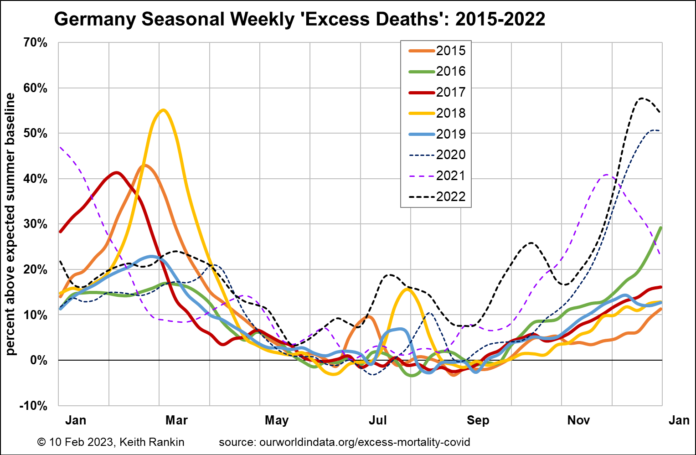
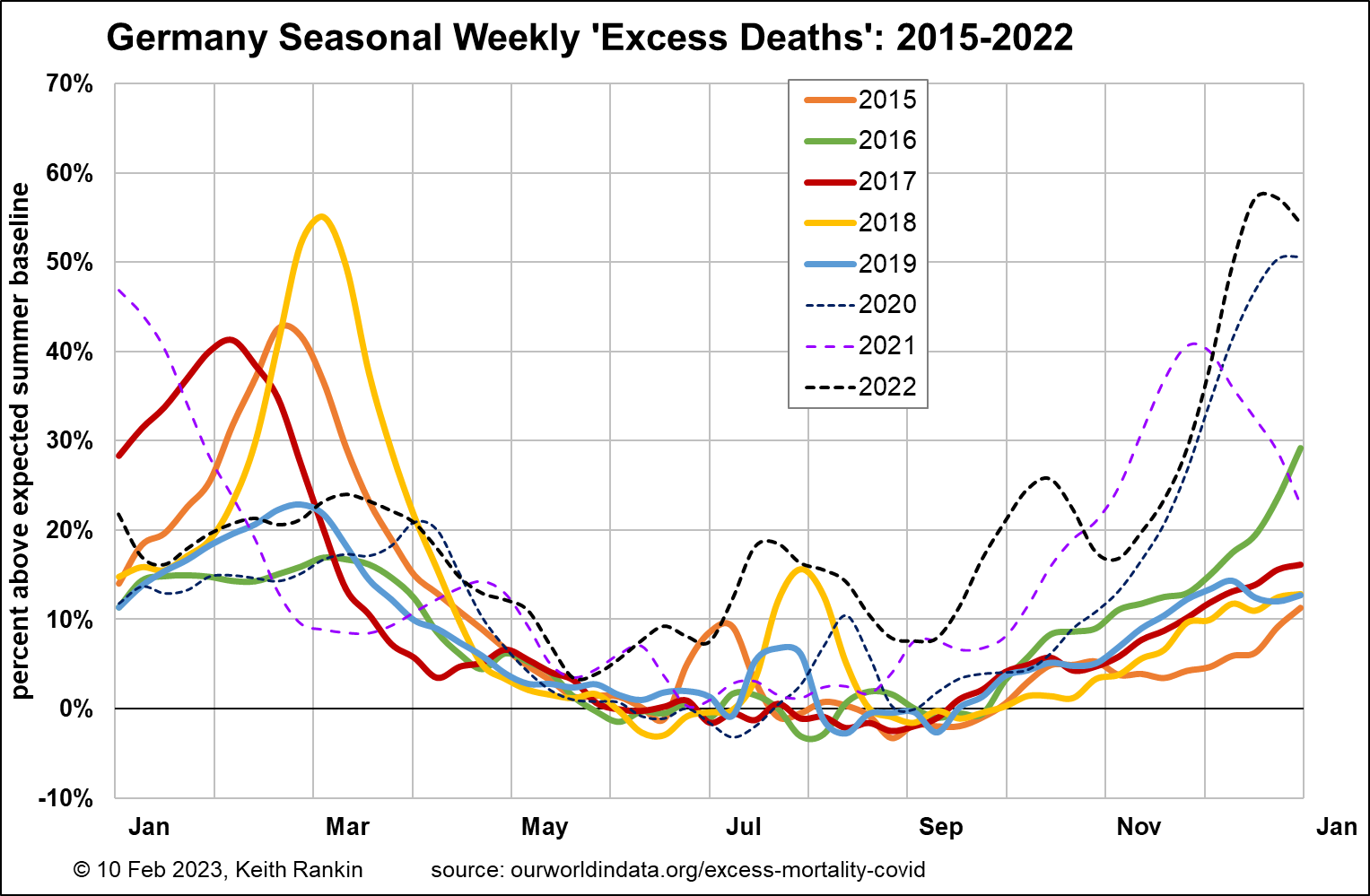
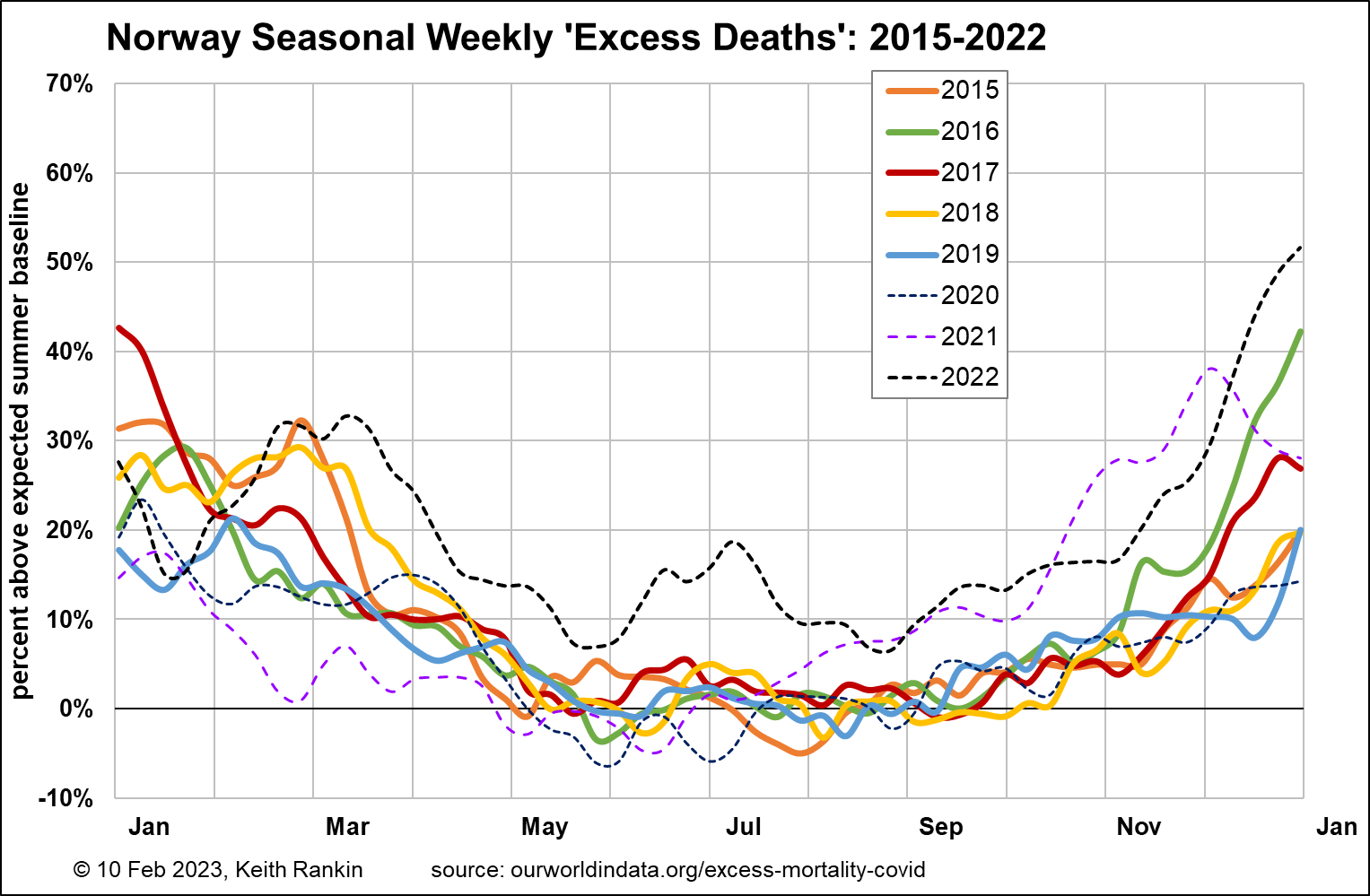
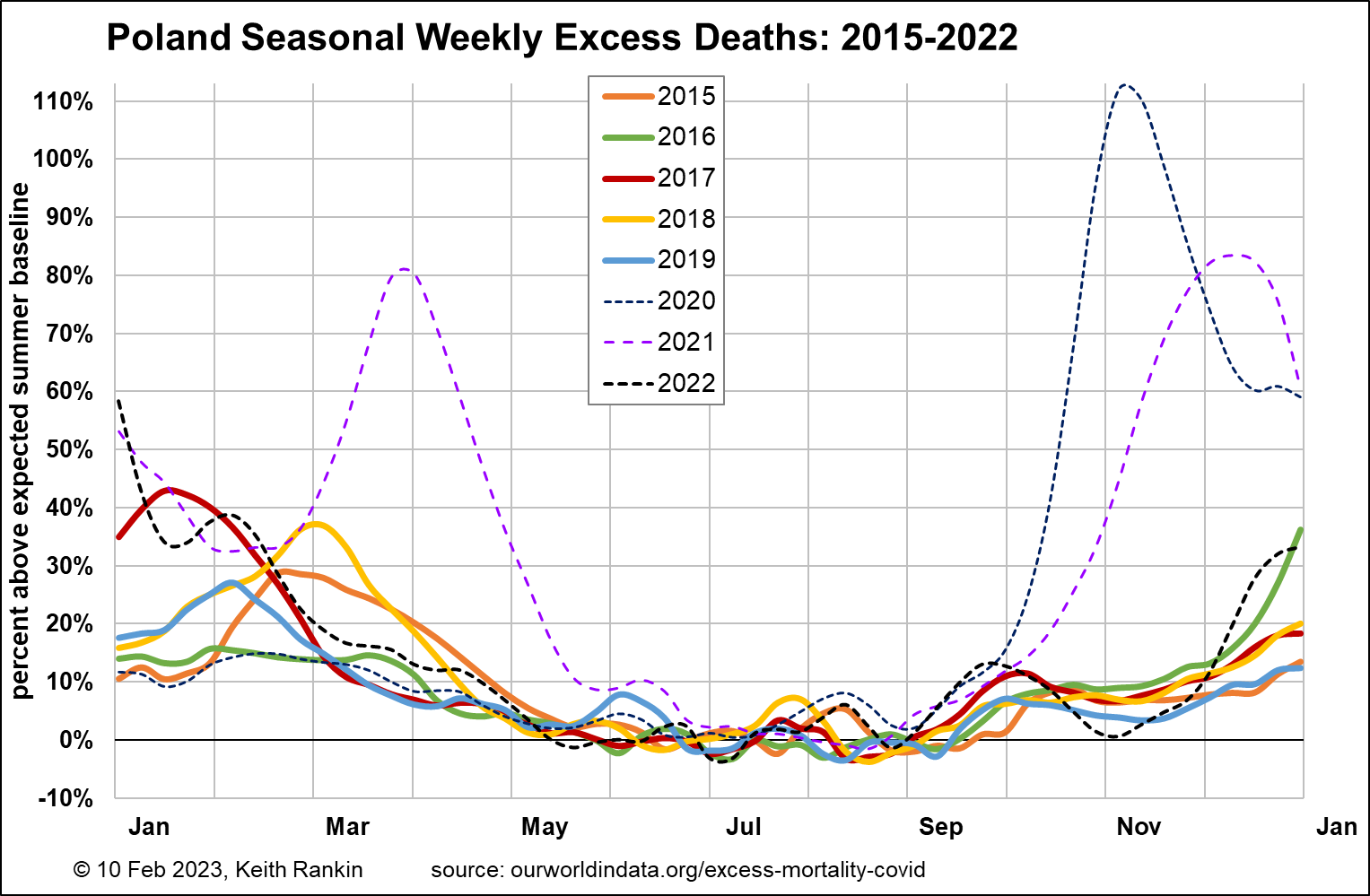
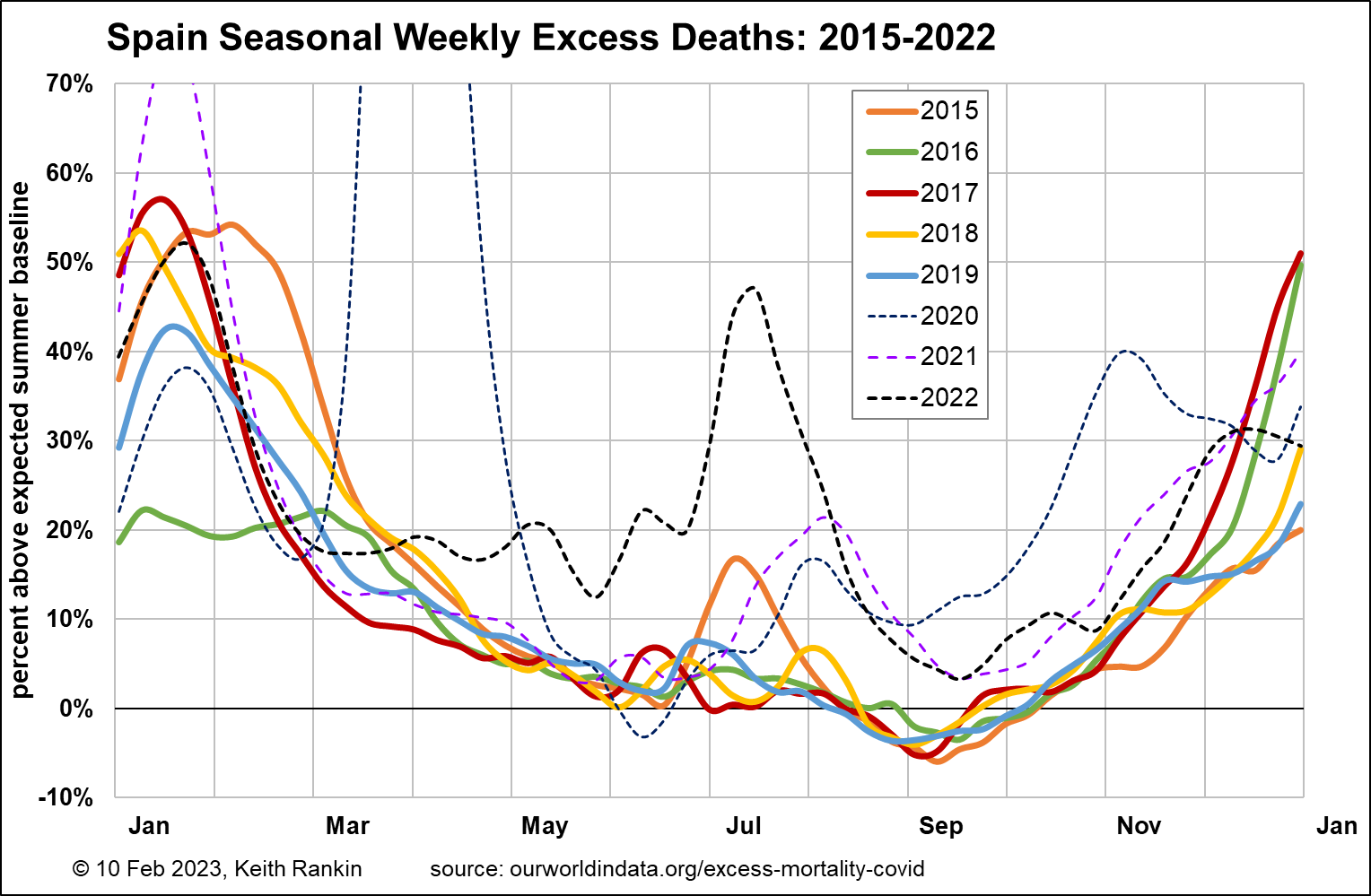
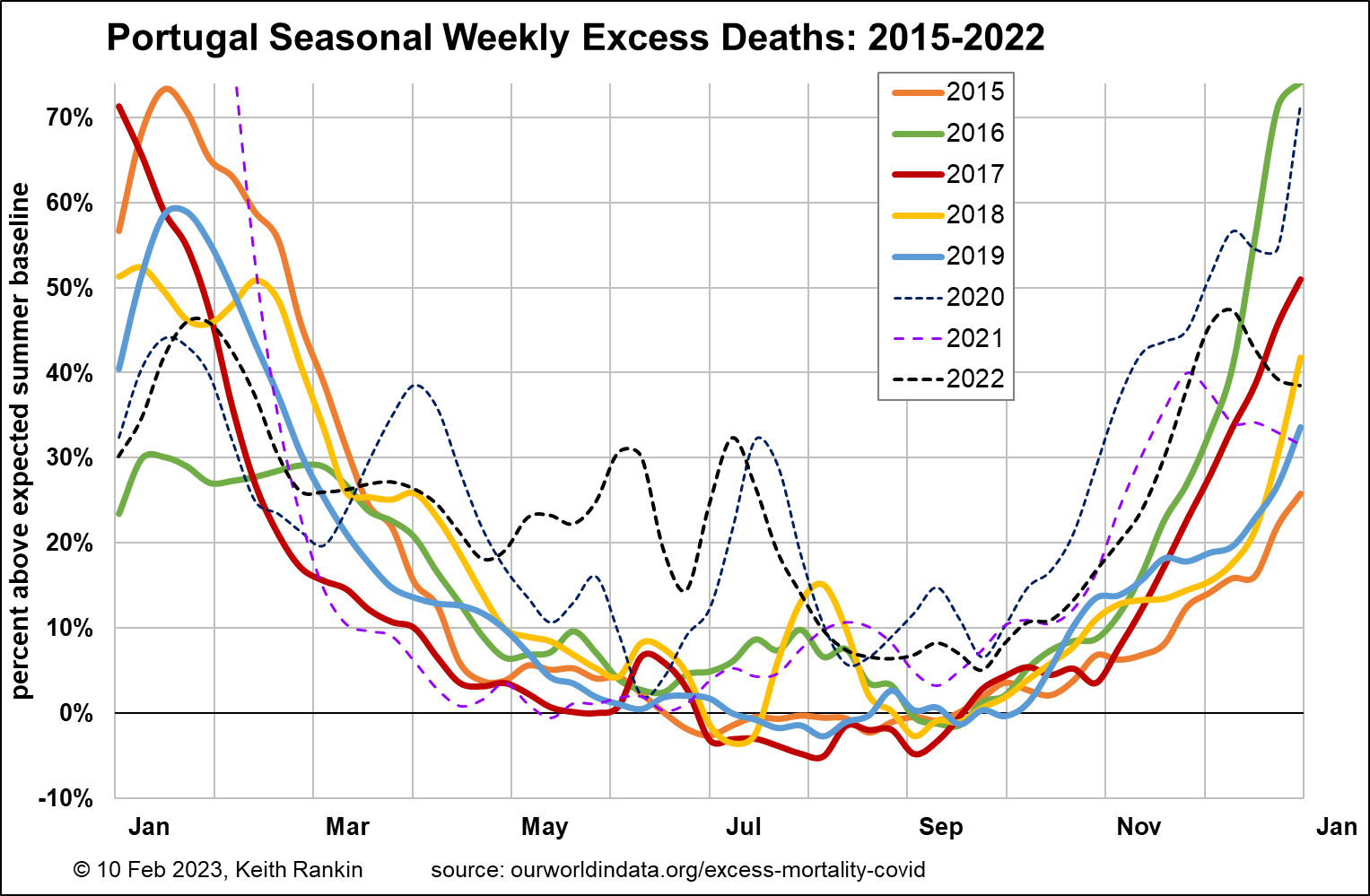
Those countries which are most efficient at reporting demographic information now have complete deaths’ data for last year. Some information revealed is worth noting. (With the exception of Poland, further below, all countries’ charts have a scale of excess deaths ranging from -10% to +70%.) Most of these are countries that ‘performed’ well on Covid19 mortality in the first year of the pandemic, due in that year to public health mandates.
Germany experienced its worst ever wave (since 2015) of epidemic mortality at the very end of last year, even exceeding deaths in the big influenza outbreak of early 2018. More generally, 2022 was easily Germany’s worst year for pandemic-related mortality. We also note that Covid19 seems to be especially problematic in the late autumn months, whereas influenza has done its ‘killing’ mostly in the late winter. Germany also reveals smaller mid-summer mortality peaks which reflect the greater mingling of people from around the world.
Chart by Keith Rankin.
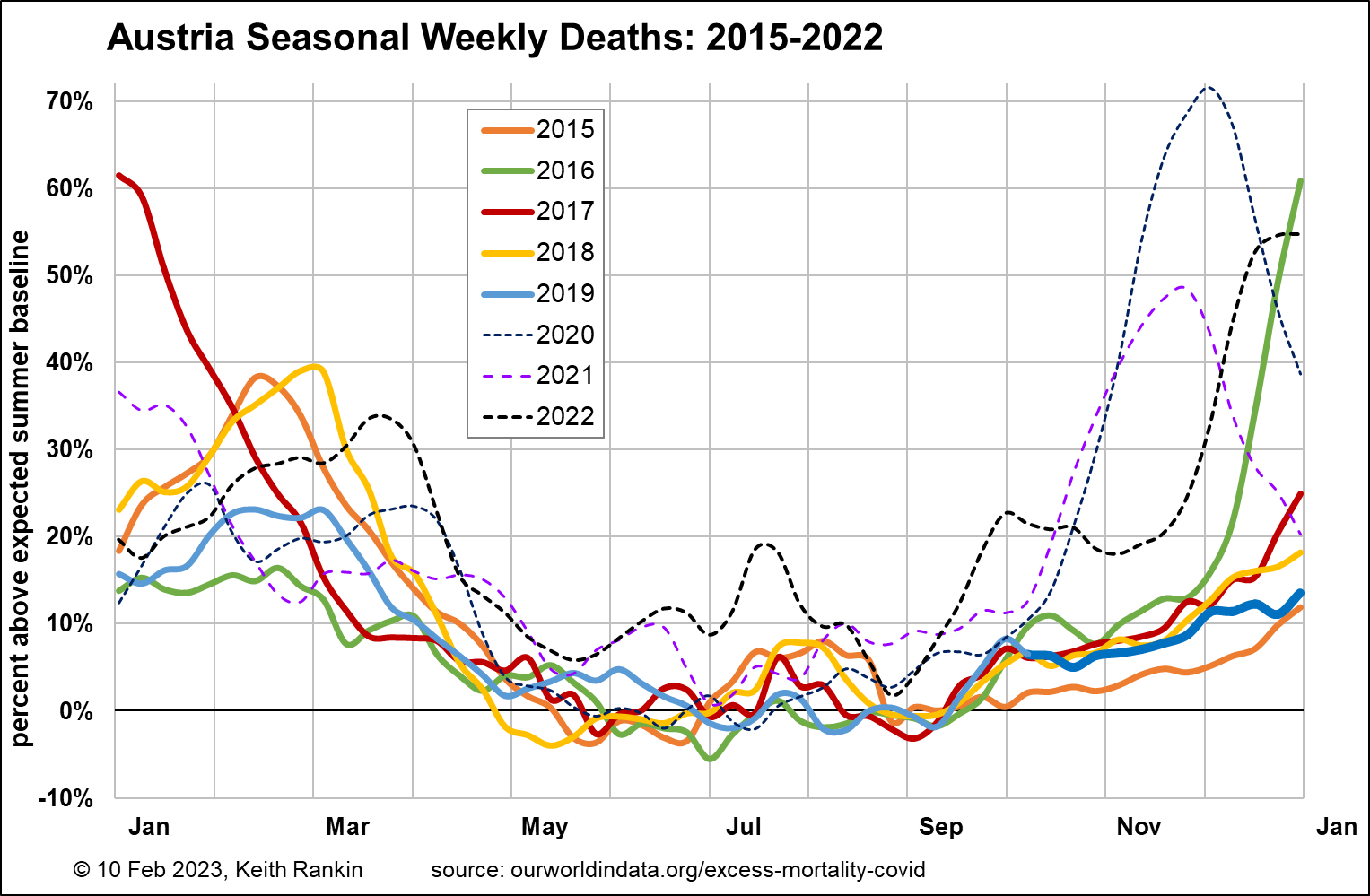
Austria shows epidemic death patterns similar to Germany, though slightly more accentuated (probably) due to Austria’s smaller population. Additionally, Austria suffered much more than Germany from the initial 2016/17 blast of the 2016‑2018 global influenza epidemic.
Chart by Keith Rankin.Chart by Keith Rankin.
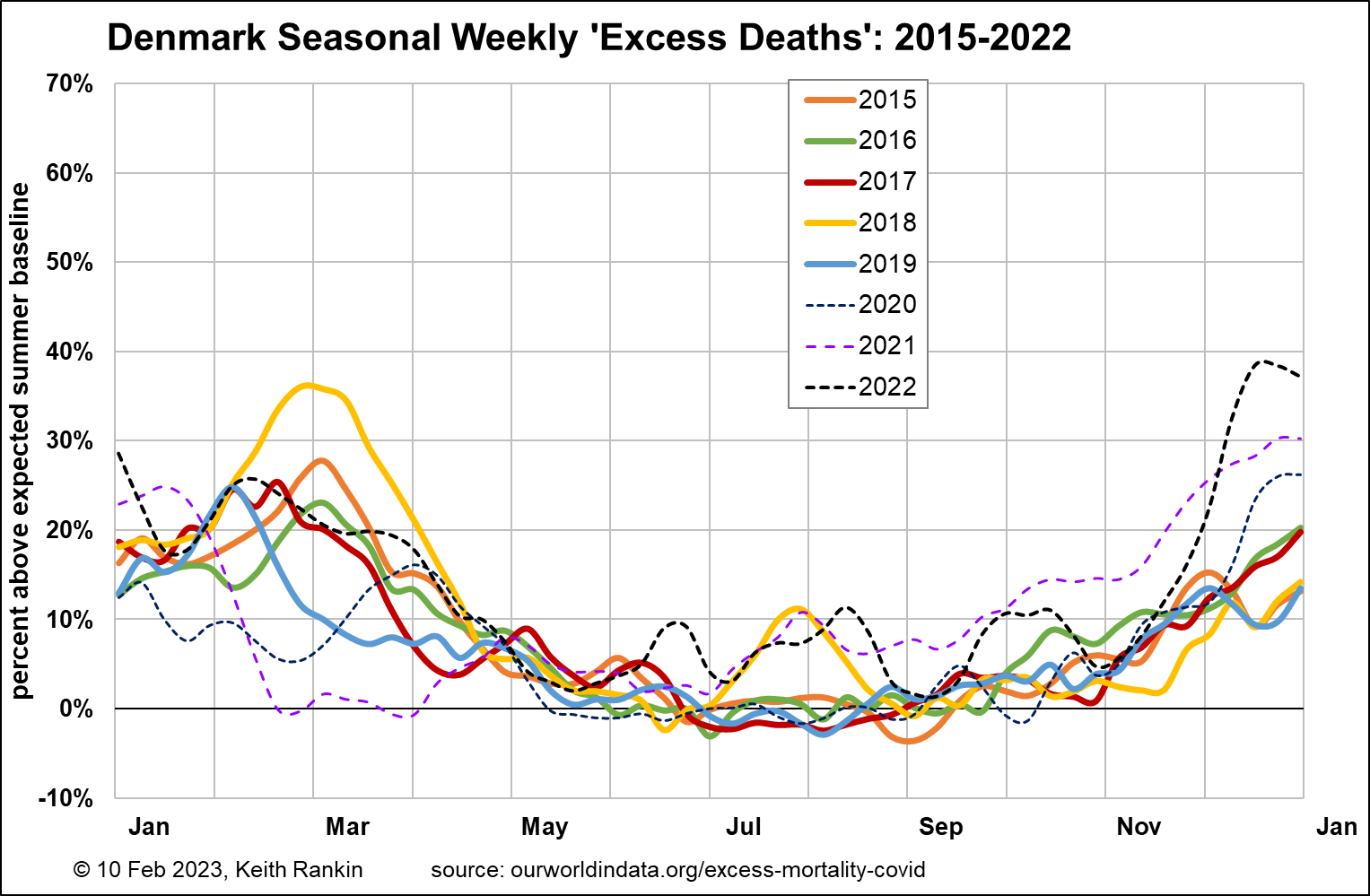
Denmark, as is the case with Scandinavia more generally, shows lower epidemic mortality in both the 2010s (influenza) and 2020s (coronavirus). Nevertheless, as with Germany, December 2022 was Denmark’s worst month for excess deaths in the whole of the eight-year period 2015-2022. Likewise, Norway, which had no excess deaths in 2020, had a disappointing 2022.
Chart by Keith Rankin.
On the other hand, Poland, which had no excess deaths for the first six months of the pandemic, also had a normal epidemic year in 2022. Quite unlike the previously mentioned countries. Instead, Poland had a really bad 15 months, from October 2020 to December 2021. Poland, like most other Eastern European countries, appears to have suffered initially – in late 2020 – from an unusually weak level of general immunity. And then, by 2022, most of the people most vulnerable to Covid19 had already died, mostly in 2021.
Chart by Keith Rankin.Chart by Keith Rankin.
Finally, Spain and Portugal. These two countries were more severely impacted in the first year of the pandemic than any of the previously mentioned countries. Portugal proved to be particularly vulnerable to the alpha variant of the coronavirus, in January 2021. (We also note that, like Austria, Portugal shows more general seasonal variation than its larger neighbour, again simply because it is much smaller than its neighbour.) While Covid19 deaths have conformed with the general pattern of winter deaths in these two countries, summer last year was problematic in the Iberian Peninsula. In mid-2022, the Covid19 problem – linked to tourism – was compounded by likely excess deaths arising from the heatwaves and wildfires.
The lesson for Aotearoa New Zealand is that pandemic-consequent mortality is not over yet. As much as locals prefer not to believe it, New Zealand and New Zealanders are not exceptional. The mortality experience of New Zealand in the southern autumn and early winter of 2022 was not unlike that of Norway in its northern autumn and early winter of 2021. It is quite possible that New Zealand’s experience this coming autumn and winter will be similar to that of Norway in late 2022. New Zealand still has many vulnerable people.
______________
Keith Rankin (keith at rankin dot nz), trained as an economic historian, is a retired lecturer in Economics and Statistics. He lives in Auckland, New Zealand.
After lifting interest rates for a record nine times in a row, and flagging more raises still to come, the Reserve Bank of Australia’s latest set of forecasts make for grim reading.
The forecasts are part of the central bank’s quarterly Statement on Monetary Policy, its main communication (aside from interest rates) on how it sees the economy faring over coming few years.
The bad news is the bank tips economic growth to slow, inflation to remain high, spending to stagnate, unemployment to increase, and real wages to fall further.
The good news is that it could be wrong.
1. Growth is expected to slow
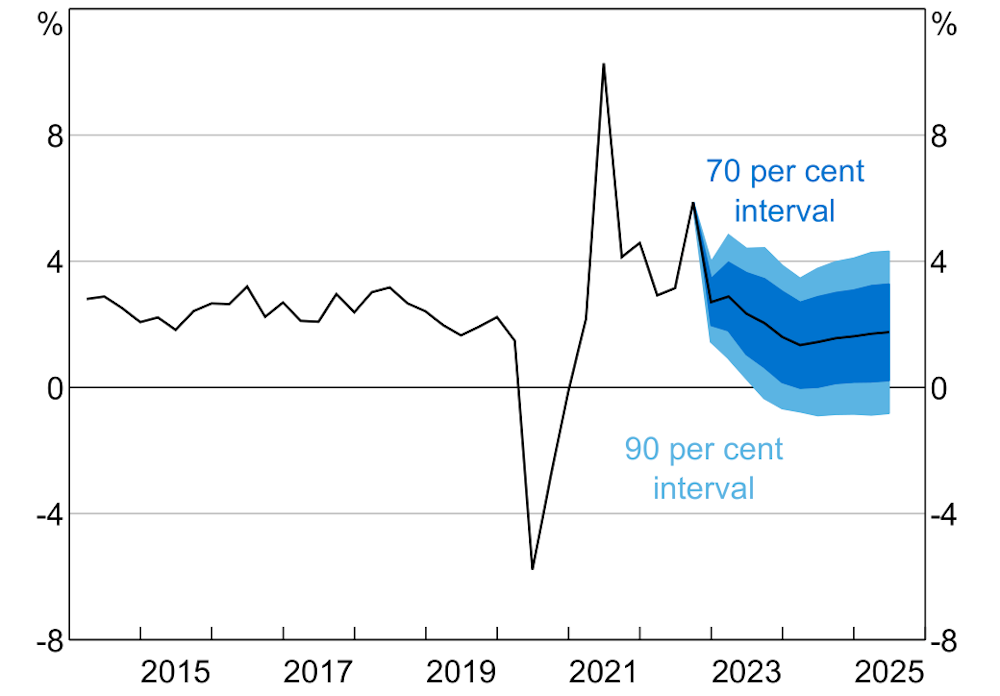
The central bank expects Australia’s economy to slow this year due to rising interest rates, higher cost of living, and declining house prices. It tips GDP growth for 2022 will be 2.75% (the Australian Bureau of Statistics won’t publish this data until March), and 1.5% over 2023 and 2024. This compares to the RBA’s expectation three months ago of 3% growth in 2022 but the same prediction for this year and the next.
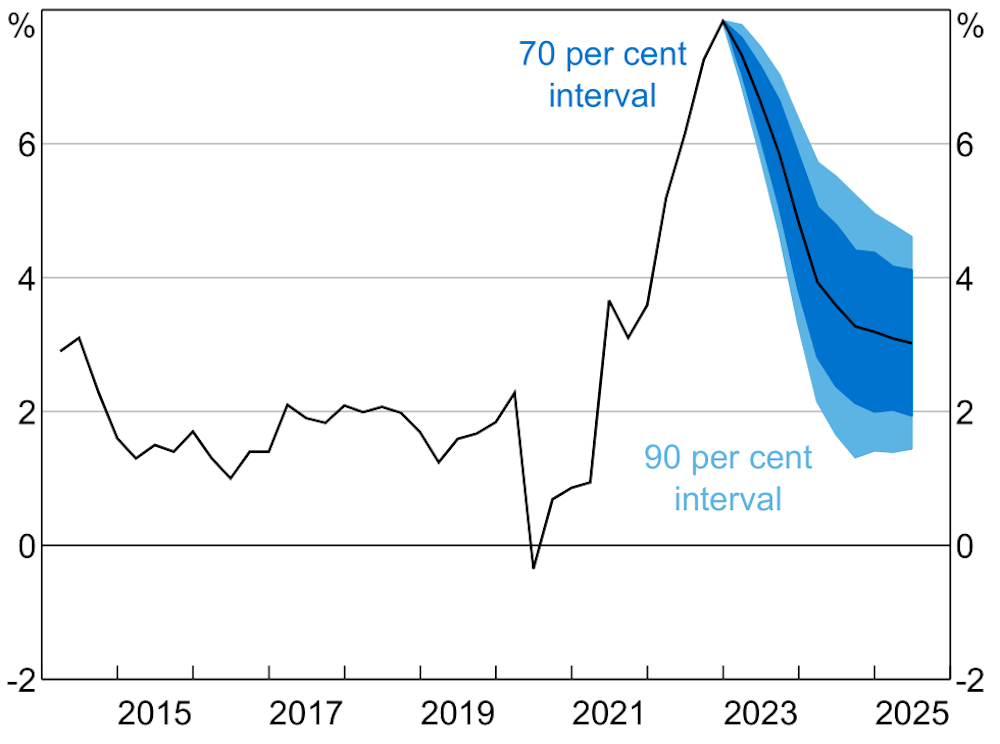
The bank says inflation, which hit 7.8% in 2022, is likely to have peaked and predicts it will stay high for several months, but will decline to 4.5% by the end of 2023. By mid-2025 it should be back to 3% – the top end of the bank’s inflation target range of 2-3%.
However, the pace of this fall depends on wages and prices. The central bank acknowledges it could be quicker or slower. Its outlook for household spending is also uncertain, due to factors such as rising interest rates, higher inflation and declining housing prices.
Australia’s consumer price inflation has been high due to factors including global supply-chain disruptions caused by the pandemic, Russia’s invasion of Ukraine, strong domestic demand, a tight labour market, and capacity constraints.
The RBA expects rising energy prices will continue to drive inflation but that this will be offset by the federal government’s Energy Price Relief Plan, which involves price caps on gas and coal, and bill subsidies for households and businesses.
This is the main reason the RBA has flagged more interest rate hikes this year. It is determined to get inflation back to its target band, and will keep increasing borrowing rates until it is sure this goal will be achieved.
The monetary policy statement expects higher consumer prices, higher interest payments and lower household net wealth to curb consumer spending in 2023.
But it expects spending to improve once interest rate rises stop, household wealth recovers and disposable incomes are boosted by tax cuts. The household saving ratio (which doubled during the pandemic) is expected to decline then increase, returning to pre-pandemic levels in 2024.
4. Unemployment will rise
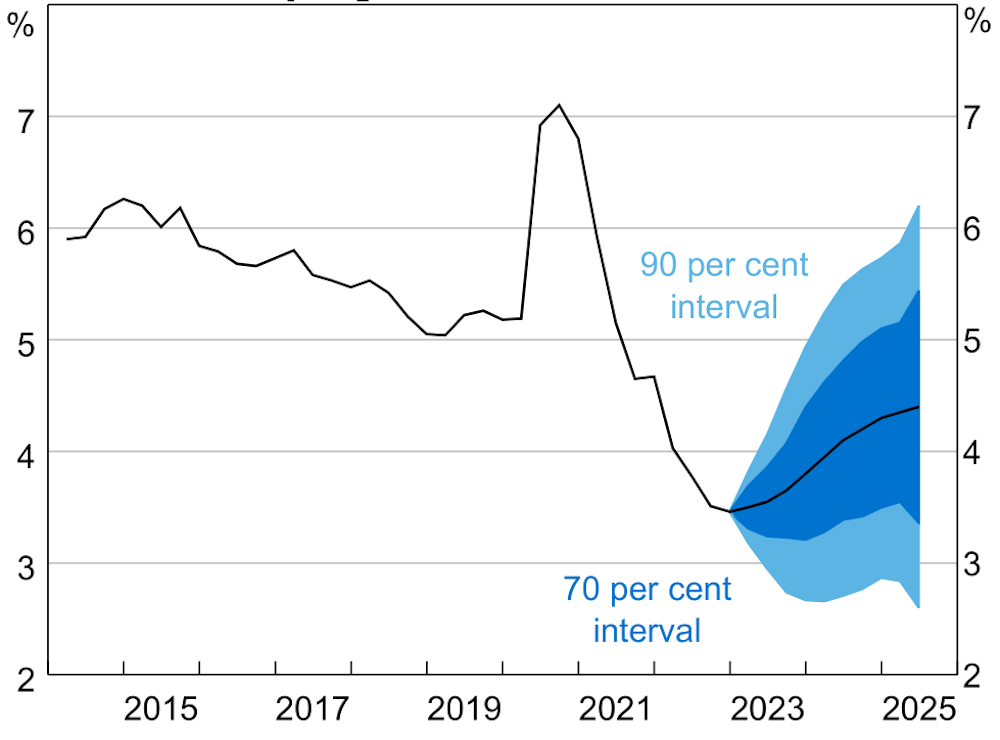
The RBA expects the unemployment rate to remain at about 3.5% until mid-2023, and then to rise to 4.5% as demand for labour moderates.
RBA unemployment rate forecasts
Confidence intervals reflect RBA forecasting errors since 1993. RBA
Jobs growth is forecast to slow from 4.8% in 2022 to about 1% by mid-2024. Despite this, the participation rate in the labour force is not expected to fall, due to structural trends such as higher female and older worker participation.
5. Real wages will still fall
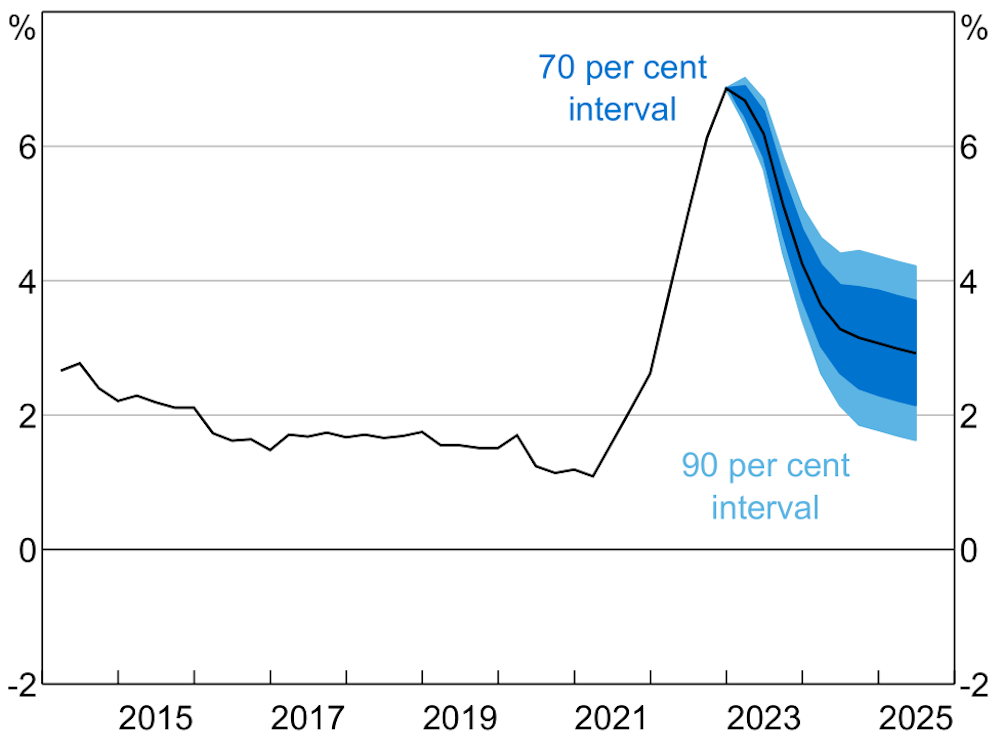
The RBA’s forecast for wages growth is now higher than three months ago, due to a tight labour market, higher staff turnover, higher inflation outcomes and Fair Work Commission wage decisions. It tips the Wage Price Index (WPI), which hasn’t been above 4% in a decade, to hit 4.25% in late 2023.
Given the inflation rate, however, this won’t be enough to stop real wages from continuing to fall. The WPI is then tipped to decline to 3.75% in mid-2025 as the demand for labour subsides and the unemployment rate rises.
Uncertainty remains high
These forecasts make for grim reading. But they could all be quite wrong.
As the saying goes, it’s tough to make predictions, especially about the future. Huge uncertainties hang over the global economy, including the war in Ukraine, the emergence of new COVID variants, and the unique challenges of recovering from the pandemic.
That means all these forecasts could be – and likely will be – wrong in one dimension or another. Even the RBA governor’s very clear message that there will be more interest rate rises this year could change if the prevailing circumstances do too. Only time will tell.
Isaac Gross does not work for, consult, own shares in or receive funding from any company or organization that would benefit from this article, and has disclosed no relevant affiliations beyond their academic appointment.
A group of US scientists this week proposed an unorthodox scheme to combat global warming: creating large clouds of Moon dust in space to reflect sunlight and cool the Earth.
In their plan, we would mine dust on the Moon and shoot it out towards the Sun. The dust would stay between the Sun and Earth for around a week, making sunlight around 2% dimmer at Earth’s surface, after which it would disperse and we would shoot out more dust.
The proposal, which involves launching some 10 million tonnes of Moon dust into space each year, is in some ways ingenious – and if it works as advertised from a technical perspective, it might buy the world some vital time to rein in carbon emissions.
Unfortunately, but also unsurprisingly, the story of Moon dust reflection isn’t as simple as it seems.
Why Moon dust?
Proposed measures to cool Earth by reducing the amount of sunlight reaching the surface are often called “solar geoengineering” or “solar radiation management”.
Moon dust looks pretty good compared with these ideas: Moon dust is plentiful, and launching dust clouds from the Moon’s lower gravity would require substantially less energy than similar launches from Earth.
So, what’s the problem?
Too slow, too clumsy
One of solar geoengineering’s core selling points is supposed to be speed. Reflecting sunlight is at best a way to rapidly stave off short-term catastrophic warming impacts, buying time for renewable energy transitions and removal of greenhouse gases from the atmosphere.
Global injection of aerosols into the atmosphere, for instance, may require development of special aircraft. This is certainly no trivial task, but definitely doable in the next decade or so.
Moon dust ambitions would be much slower. There are several major engineering and logistical hurdles to overcome.
Developing technology to inject aerosols into the upper atmosphere would take some time, but building the tools to put millions of tonnes of Moon dust into space would take much longer. Shutterstock
At minimum, we would need Moon bases, lunar mining infrastructure, large-scale storage, and a way to launch the dust into space.
No human has even set foot on the Moon in more than 50 years. While China is looking to establish a Moon base by 2028, followed by the US in 2034, a well-functioning mining and dust launching system is likely many decades away.
Another advantage of solar geoengineering is meant to be fine tuning.
To make matters worse, the world currently has little in the way of coherent policy or governance for space and the Moon. Many fundamental questions about human activity in space, such as how to manage the growing layer of bullet-speed space junk orbiting the Earth, are unanswered.
Also unanswered is another fundamental question: is Moon mining even legal? Who “owns” space, and the resources in it?
At present, we have a patchwork of contradictory policies.
The 1967 Outer Space Treaty prohibits “appropriation” of space resources (implying a ban on mining), and Article 11.3 of the 1979 Moon Treaty states that the Moon’s resources cannot become property of a country, group or person.
With such contradictory policy in place, lunar mining is a fundamental legal grey area. Shooting Moon dust off into space is another legal dilemma several steps down the line.
As above, so below
Such a legal patchwork exists because of broader political firewalls.
Similarly to how the 20th-century space race reflected Cold War geopolitics, contemporary space governance is shaped by today’s political rifts. Russia and China have not joined the Artemis Accords, deciding (ironically together) to go it alone. But disagreements over a non-binding agreement are just the tip of the iceberg.
Political disagreements over Moon dust deployment could prove far more dangerous. Different countries could prefer different extents of cooling, or whether Moon dust cooling should be used at all.
Like the space race of the 20th century, development of the Moon will be enmeshed in terrestrial politics. NASA
Even the proposed “launch system” for dust, essentially a giant electromagnetic railgun (of the kind currently used to launch fighter jets), could spark security and weaponisation concerns.
These disagreements could leak into terrestrial politics, further exacerbating political divisions. At worst, these disagreements may cascade into armed conflict or sabotage of lunar infrastructure.
Space is another frontier for political conflict, and one that Moon dust reflection schemes could worsen. Such conflict also compromises a cooperative and altruistic Moon dust deployment.
Prime space real estate
Even if the implementation and political issues were resolved, there are plenty more.
For example, the Moon dust would linger around the “Lagrange point” between Earth and the Sun, where the gravitational forces of the planet and the star balance out.
In sum, the Moon dust proposal does address some of the problems with Earth-based solar geoengineering. But it would likely be too slow to dampen the short-term impacts of climate change, and would in any case face diplomatic obstacles that may well be insurmountable.
To their credit, the authors do acknowledge their work has limitations, saying in a press release:
We aren’t experts in climate change, or the rocket science needed to move mass from one place to the other. We’re just exploring different kinds of dust on a variety of orbits to see how effective this approach might be.
So instead of worrying about displacing satellites, we are better off focusing on replacing fossil fuels. The solutions to climate change are right in front of us, not in the stars.
Aaron Tang has received funding from the Australian Government Research Training Program Scholarship.
The ACT is changing how it calculates car registration fees. Instead of being based on a car’s weight, the fee the owner pays will be based on the greenhouse gas emissions it produces.
Up to now, owners of cleaner but typically heavier electric vehicles have paid more for registration than those of high-polluting but lighter vehicles powered by petrol or diesel engines. Emissions-based fees will reverse that situation.
The ACT was already offering two years of free registration for electric vehicles up to mid-2024. Under the new policy, from May 25 this year, owners of new and used electric vehicles will pay a discounted fee once their two years of free registration is over. The remaining car fleet will transition to the new system on July 1 2024.
An emissions-based registration fee is a sensible policy worth adopting Australia-wide. It’s already in place in many other nations that have much higher uptakes of electric vehicles.
Targeted policies and incentives do speed the uptake of electric vehicles. Shutterstock
Why is this policy change important?
Transport is Australia’s third-largest – and fastest-growing – source of greenhouse gas emissions. Cars produce about half of these transport emissions.
Most of Australia’s vehicles use polluting fossil fuels. A switch to electric vehicles, coupled with a transition to renewable energy, is vital for Australia to meet its commitments to tackle climate change.
One of the quickest ways to reduce transport emissions is to accelerate the current slow uptake of electric vehicles. In 2022, Australian sales totalled 39,353. There are now about 83,000 light electric vehicles on our roads.
Although sales almost doubled between 2021 and 2022, they represented only 3.8% of all new vehicle sales in 2022. That’s well below the global average of 12-14%. And it’s way behind world leader Norway where 87% of cars being sold now are electric.
In China, about 5.67 million electric cars, or a quarter of all new cars, were bought in 2022. By the end of the year, 35% of the cars being sold were battery-powered or plug-in hybrids. In the UK, more than 265,000 electrical vehicles were registered in 2022, a 40% increase on 2021.
The global outlook for electric vehicles remain strong. Total sales of 8.6 million vehicles are expected in 2023. That’s expected to rise to almost 12 million by 2025.
Australia will pass the milestone of 100,000 electric vehicles on the road this year. But that’s well short of the target of 1 million by 2027 set by an industry alliance headed by the Electric Vehicle Council, and the Albanese government’s target of 3.8 million by 2030. Best practice policies will help to accelerate the transition.
The importance of the new policy is that it will help to reduce costs for buyers. Cost is one of the main barriers to buying an electric vehicle in Australia. In 2022, less than 20% of electric vehicles sold for less than A$65,000. While some Australians are willing to pay the hefty price tag, it remains an obstacle for others.
Government interventions play a big role in reducing purchase costs and annual fees. Higher taxes on polluting vehicles are also likely to impact consumer choice so more drivers make the switch.
What is best practice in emissions-based vehicle policies?
Policies that reduce registration fees and provide tax benefits to electric vehicle owners have been widely implemented overseas during the past few decades.
Norway first introduced registration fee exemptions in 1990. This, along with a range of other measures and incentives, helped to increase electric vehicle sales to 50% of the market in 2020, and 79% by 2022. No other nation comes close.
In the European Union, 21 of 27 member countries levied car taxes partially or totally based on CO₂ emissions in 2022.
The EU-wide policies provide a range of financial benefits to owners of electric vehicles. They apply to both vehicle acquisition (value-added tax, sales tax, registration tax) and vehicle ownership (annual circulation tax, road tax).
How much difference can these policies make?
A number of studies of the effectiveness of CO₂-based car taxation policies have found evidence they contribute to lowering transport emissions.
For example, Ireland first introduced an emissions-based car taxation policy in 2008. An analysis of its impacts found it produced a cumulative CO₂ saving of 1.6 million tonnes from 2008 to 2018.
In 2018, Irish-licensed vehicles travelled a total of 47.5 billion kilometres. The study found average carbon intensity of the car fleet had reduced from 189gCO₂/km in 2007 to 164gCO₂/km in 2018. It would have been 168gCO₂/km without the tax intervention, according to the analysis.
A similar study that evaluated Norway’s CO₂-based taxes found them to be powerful policies applied aggressively at levels ten times the EU Emissions Trading System quota prices. The analysis found these policies also delivered other improvements, with the largest impacts being reductions in air pollution.
What else needs to be done in Australia?
A measure such as introducing an emissions-based registration system is a step in the right direction. But to be effective it needs to be part of a holistic national effort to accelerate adoption of electric vehicles.
In 2023, Australia needs to speed up efforts on two major initiatives that were introduced in 2022.
The federal government began consultations on Australia’s first National Electric Vehicle Strategy last September. More than 500 submissions were received, representing the views of over 2,150 Australian individuals and organisations.
Commitments were also made to develop an ambitious set of mandatory fuel-efficiency standards to help increase the supply of electric vehicle models.
Both initiatives are key policy pillars of an effective strategy to reduce transport emissions.
Building on this momentum and urgently implementing bold policies will demonstrate Australia’s commitment to embrace the transition to electric vehicles and accelerate emission reductions.
Hussein Dia receives funding from the Australian Research Council, the iMOVE Cooperative Research Centre, Transport for New South Wales, Department of Infrastructure, Transport, Regional Development, Communications and the Arts, and Beam Mobility Holdings.
Source: The Conversation (Au and NZ) – By Chay Brown, Research and Partnerships Manager, The Equality Institute, & Postdoctoral fellow, Australian National University
shutterstock
Content warning: this article contains mentions of racial discrimination against First Nations people, and themes of domestic violence.
Let us tell you about our town, our home. Mparntwe/Alice Springs is a small town on Arrernte Country in the red hot heart of the land now called Australia. Our town, our home, is a place of beauty: spinifex-speckled red sand dunes; black limestone after the rain; emerald waterholes nestled between the ranges; a wonderfully alive desert in one of the most remote places on Earth.
We hear more than 100 Indigenous languages being spoken on our streets every day, including Arrernte, Warlpiri, Luritja and Alawyerre & Pitjantjatjara. We are vibrant and multicultural. We are entrepreneurial. We love our sports, and our arts – and we cannot believe how much talent there is in our home.
But these are not the reasons our home has been plastered across national media for the past month. These are not the reasons you have clicked on this article.
Sensationalised media headlines and political pressure seem to be what prompted Prime Minister Anthony Albanese to make an impromptu trip to Alice Springs to meet with a handful of people, and introduce yet more alcohol restrictions.
However, the media reports contain little to no context regarding the issues, and reinforce the same negative stereotypes that made the Northern Territory Emergency Response (or what we call “the Intervention”) possible.
What was the Intervention?
In 2007, in response to allegations of child sexual abuse in remote NT communities, the Australian government suspended the racial discrimination act of 1975 to make special laws for Aboriginal people in prescribed areas in the territory, and the military was rolled in.
The Intervention included a raft of measures such as compulsory income management in the form of the BasicsCard, imposing alcohol prohibition on Aboriginal communities (although many of these communities already had self-determined dry policies), and mandatory health checks for Aboriginal children.
Alcohol policy in the NT has been driven by the harmful stereotype that all Aboriginal people are alcoholics. This is despite evidence non-Indigenous people in the territory also consume disproportionately high amounts of alcohol. This is what the NT government means when it says it wishes to move away from “race-based policy”.
And while some Aboriginal Community Controlled Organisations support alcohol restrictions, many don’t.
Alcohol restrictions never stopped drinking in the NT. Instead, they prompted on-selling from within the NT and from other locations, or more harmful forms of drinking such as mouthwash and hand sanitiser.
Police and governments often claim alcohol leads to domestic violence-related assaults. However, administrative data, like that captured by police, is very subjective and potentially unreliable.
The classification of “alcohol-related assaults” and “domestic-violence related assaults” are determined at the individual discretion of the attending police officer. In interviews we conducted for soon-to-be-published research, some police officers stated they determined these classifications on whether they could smell alcohol, others because the person was slurring their words, and others because there were alcohol bottles present.
When questioned about whether the perpetrator or victim had to be drinking in order to make the classification of “alcohol-related assault”, the answer was invariably “either”, meaning we do not know from police data whether the perpetrator was actually using alcohol. This begs the question: if the perpetrator is sober, should an assault against an intoxicated victim be included in alcohol-related statistics?
Alcohol alone does not cause domestic violence, although it can exacerbate it. As stated by Australia’s national violence prevention organisation Our Watch, alcohol is often used as an excuse for domestic violence, rather than blaming the perpetrator.
There are also reports of women being breathalysed when they present with domestic violence assaults to hospital. This means many may choose not to go, to avoid the shame and blame.
Despite domestic, family and sexual violence rates in the NT being the highest per capita in Australia, the territory only receives a miniscule amount of funding compared with other states.
In 2022 the Northern Territory received about $14 million in national partnership funding to address domestic, family and sexual violence. This was roughly 1.8% of federal funding to address domestic or sexual violence.
And when shelters and specialist services such as Women’s Safety Services of Central Australia and Tangentyere’s Men’s Behaviour Change Program are chronically underfunded, understaffed and under-resourced, this leaves very few resources for prevention or early intervention.
Domestic, family and sexual violence intersects and worsens other issues that already disproportionately impact the NT, such as overcrowding, homelessness, poor infrastructure, and lack of access to goods and services.
Children who interact with police often end up in out-of-home care, removed from family and culture, and some end up in youth detention. Children who end up in youth detention are more likely to reoffend and go on to have further interactions with police and the judicial system.
The issue of young people and sometimes very small children roaming the streets late at night is distressing, and Alice Springs has been calling for a response to this for years.
Many young ones travel in from the bush to stay in town to access services and visit family, and some get stuck here. And when unsupervised by adults, some young people do destructive things. Some of these children have grown up in overcrowding and poverty, and some are affected by foetal alcohol spectrum disorder.
In Alice Springs, there’s basically nowhere kids can go and just bounce a ball with their mates that’s accessible to everyone at any hour. Facilities are locked up, fenced off or out of reach financially for many children.
Alice’s problems are from years of successive government and policy failure, chronic underfunding and under-resourcing. Harmful, reductive and racist reporting has been detrimental to Alice and all who live here, particularly First Nations people.
We urge the federal and territory governments to invest in our remote communities. And to fund and support a community-led codesign of a response to the problems in Alice Springs. The response must be designed and led by local people. This must include the voices of young people, who have been unheard in all this noise.
Places such as Bourke have successfully addressed similar problems through justice reinvestment (redirecting money for prisons to the community), and could inform local decision-making processes in Alice Springs, too.
Introducing a policy of needs-based funding would ensure the NT receives the funds it needs to begin to address domestic, family, and sexual violence, overcrowding, support for those struggling with addiction, and programs to engage young people.
Alice’s story is a story about geographic disadvantage. Alice needs community-led solutions, rather than punitive responses that bring shame, stigma and trauma. It’s time we had the courage to do things differently.
Mandy Taylor from SNAICC – National Voice for our Children also contributed to this article.
Chay Brown receives funding from ANROWS, Northern Territory Government, Department of Social Services, Australian Government, Gender Institute.
You are affiliated with Tangentyere Women’s Family Safety Group and Tangentyere Council,
Kayla Glynn-Braun works for the Equality Institute and owns shares in Her Story Consulting
Shirleen Campbell receives funding from NTG and ANROWS. Shirleen is affiliated with Tangentyere Council.
If you’re really feeling the heat this summer, it might be down to more than the temperature outside.
Some types of medicines can increase your core body temperature or make you feel hotter than you really are. Some can affect your body’s ability to cool down.
Here’s what you need to know about heat intolerance and medicines.
Some people simply dislike the feeling of feeling hot, while others feel hot at temperatures most people find comfortable. Both are examples of heat intolerance.
Typical symptoms during warm weather include excessive sweating (or not sweating enough), exhaustion and fatigue, nausea, vomiting or dizziness, and changes in mood.
A number of factors can cause heat intolerance.
This includes the disorder dysautonomia, which affects people’s autonomic nervous system – the part of the body that regulates the automatic functions of the body, including our response to heat.
Conditions such as diabetes, alcohol misuse, Parkinson’s disease, the autoimmune disease Guillain-Barré syndrome and mitochondrial disease can cause dysautonomia. People in old age, those with some neurological conditions, or people less physically fit may also have it.
But importantly, medications can also contribute to heat intolerance.
Some medicines directly increase your body temperature, which then increases the risk of heat intolerance.
These include stimulant medications to treat ADHD (attention deficit hyperactivity disorder), such as methylphenidate, dexamfetamine and lisdexamfetamine.
Antipsychotic medications (such as clozapine, olanzapine and quetiapine) used to treat mental health conditions, such as schizophrenia and bipolar disorder, are other examples.
These ADHD and antipsychotic medicines raise your temperature by acting on the hypothalamus, the region of the brain essential for cooling.
The drug levothyroxine, used to treat an under-active thyroid, also increases your body temperature, this time by increasing your metabolism.
Some medicines raise your body temperature directly by acting on the hypothalamus region of the brain. SciePro/Shutterstock
2. Your blood flow is affected
Other medicines constrict (tighten) blood vessels, decreasing blood flow to the skin, and so prevent heat from escaping this way. This means your body can’t regulate its temperature as well in the heat.
Examples include beta-blockers (such as metoprolol, atenolol and propranolol). These medications are used to treat conditions such as high blood pressure, angina (a type of chest pain), tachycardia (fast heart rate), heart failure, and to prevent migraines.
Decongestants for blocked noses (for example, pseudoephedrine and phenylephrine), triptans for migraines (such as sumatriptan and zolmitriptan) and the ADHD medications mentioned earlier can also act to decrease blood flow to the skin.
Other medicines can cause dehydration, which then makes you more susceptible to heat intolerance. The best examples are diuretics such as furosemide, hydrochlorothiazide, acetazolamide and aldosterone.
These are used to control high blood pressure and heart failure by forcing your kidneys to remove more fluid from your body.
Laxatives, such as senna extract and bisacodyl, also remove water from your body and so have a similar effect.
Other medicines have a drying effect. This can be needed for medicines to do their job (for instance, to dry up a runny nose). For others, it is an unwanted side effect.
This drying reduces the amount you sweat, making it harder to lose heat and regulate your core temperature. A number of medicines have these effects, including:
some antihistamines (such as promethazine, doxylamine and diphenhydramine)
certain antidepressants (such as amitriptyline, clomipramine and dothiepin)
medicines used to treat urinary incontinence (for example, oxybutynin and solifenacin)
nausea medicine (prochlorperazine)
medicines for stomach cramps and spasms (for instance, hyoscine)
the antipsychoptics chlorpromazine, olanzapine, quetiapine and clozapine.
Finally, some medicines, such as the antipsychotics haloperidol and droperidol, can aggravate heat intolerance by reducing your ability to feel thirsty.
If you don’t feel thirsty, you drink less and are therefore at risk of dehydration and feeling hot.
People taking some medications just don’t feel thirsty. Shutterstock
If you are feeling hot this summer and think your medicine may be contributing, it’s very important you keep taking your medicine.
Speak to your pharmacist or doctor about your symptoms. They will offer advice and discuss alternatives.
Associate Professor Wheate in the past has received funding from the ACT Cancer Council, Tenovus Scotland, Medical Research Scotland, Scottish Crucible, and the Scottish Universities Life Sciences Alliance. He is a Fellow of the Royal Australian Chemical Institute, a member of the Australasian Pharmaceutical Science Association, and a member of the Australian Institute of Company Directors. Nial is the chief scientific officer of Vairea Skincare LLC and a Standards Australia panel member for sunscreen agents.
Jessica Pace does not work for, consult, own shares in or receive funding from any company or organization that would benefit from this article, and has disclosed no relevant affiliations beyond their academic appointment.
“Phil Mehrtens is the nicest guy, he genuinely is – no one ever had anything bad to say about him”, says a colleague of the New Zealand pilot taken hostage this week by members of the West Papuan Liberation Army (TPN-PB) in the mountainous Nduga Regency.
How such a nice guy became a pawn in the decades-long conflict between West Papua and the Indonesian government is a tragic case of being in the wrong place at wrong time. But it is also a symbolic and desperate attempt to attract international attention towards the West Papuan crisis.
A joint military and police mission has so far failed to find or rescue Mehrtens, and forcing negotiations with Jakarta is a prime strategy of TPN-PB. As spokesperson Sebby Sambom told Australian media this week:
The military and police have killed too many Papuans. From our end, we also killed [people]. So it is better that we sit at the negotiation table […] Our new target are all foreigners: the US, EU, Australians and New Zealanders because they supported Indonesia to kill Papuans for 60 years. Colonialism in Papua must be abolished.
Sambom is referring to the international complicity and silence since Indonesia annexed the former Dutch colony as it prepared for political independence in the 1960s. Mehrtens has become the latest foreign victim of the resulting protracted and violent struggle by West Papuans for autonomy.
Violence and betrayal
The history of the conflict can be traced back to 1962, when the US facilitated what became known as the New York Agreement, which handed West Papua over to the United Nations and then to Indonesia.
In 1969, the UN oversaw a farcical independence referendum that effectively allowed the permanent annexation of West Papua by Indonesia. Since that time, West Papuans have been subjected to violent human rights abuses, environmental and cultural dispossession, and mass killings under Indonesian rule and mass immigration policies.
New Zealand and Australia continue to support Indonesian sovereignty over West Papua, and maintain defence and other diplomatic ties with Jakarta. Australia has been involved in training Indonesian army and police, and is a major aid donor to Indonesia.
Phil Mehrtens is far from the first hostage to be taken in this unequal power struggle. Nearly three decades ago, in the neighbouring district of Mapenduma, TPN-PB members kidnapped a group of environmental researchers from Europe for five months.
Like now, the demand was that Indonesia recognise West Papuan independence. Two Indonesians with the group were killed. The English and Dutch hostages were ultimately rescued, but not before further tragedy occurred.
At one point, negotiations seemed to have stalled between the West Papuan captors and the International Committee of the Red Cross (ICRC), which was delivering food and supplies to the hostages and working for their release.
Taking matters into their own hands, members of the Indonesian military commandeered a white civilian helicopter that had been used (or was similar to one used) by the ICRC. Witnesses recall seeing the ICRC emblem on the aircraft. When the helicopter lowered towards waiting crowds of civilians, the military opened fire.
The ICRC denied any involvement in the resulting massacre, but the entire incident was emblematic of the times. It took place several years before the fall of former Indonesian president Suharto, when there was little hope of West Papua gaining independence from Indonesia through peaceful negotiations.
Then, as now, the TPN-PB was searching for a way to capture the world’s attention.
Losing hope
Since the early 2000s, with Suharto gone and fresh hope inspired by East Timor’s independence, Papuans – including members of the West Papuan Liberation Army – have largely been committed to fighting for independence through peaceful means.
After several decades of wilful non-intervention by Australia and New Zealand in what they consider to be Jakarta’s affairs, that hope is flagging. It appears elements of the independence movement are again turning to desperate measures.
In 2019, the TPN-PB killed 24 Indonesians working on a highway to connect the coast with the interior, claiming their victims were spies for the Indonesian army. They have become increasingly outspoken about their intentions to stop further Indonesian expansion in Papua at any cost.
In turn, this triggered a hugely disproportionate counter-insurgency operation in the highlands where Phil Mehrtens was captured. It has been reported at least 60,000 people have been displaced in the Nduga Regency over the past four years as a result, and it is still not safe for them to return home.
It is important to remember that the latest hostage taking, and the 1996 events, are the actions of a few. They do not reflect the commitment of the vast majority of Indigenous West Papuans to work peacefully for independence through demonstrations, social media activism, civil disobedience, diplomacy and dialogue.
Looking forward, New Zealand, Australia and other governments close to Indonesia need to commit to serious discussions about human rights in West Papua – not only because there is a hostage involved, but because it is the right thing to do.
This may not be enough to resolve the current crisis, but it would be a long overdue and critical step in the right direction.
Negotiations for the release of Philip Mehrtens must be handled carefully to avoid further disproportionate responses by the Indonesian military. The kidnapping is not justified, but neither is Indonesia’s violence against West Papuans – or the international community’s refusal to address the violence.
Camellia Webb-Gannon has received funding from the Australian Research Council.
A jaunty yet dramatic piano-driven soundtrack motif; a view of the Golden Gate Bridge; a series of location shots around San Francisco. The generic title sequence of the 2003 film The Room barely hints at what follows.
The Room is a straightforward melodrama centred around a love triangle between Johnny (Tommy Wiseau, who also directs), Lisa (Juliette Danielle) and Mark (Greg Sestero). Described as “the worst movie ever made”, it continues to draw sellout crowds worldwide.
One might rightfully wonder: what is the ongoing appeal of a film dubbed “the Citizen Kane of bad films” 20 years on?
Cult audiences
Scholars have debated the key features of cult film for decades, with poor quality (narrative, aesthetic or both), quotable dialogue, word-of-mouth spread and box-office failure all cited.
Most agree an adoring audience is vital to maintaining cult status. The Rocky Horror Picture Show (1972) is the most recognisable example of a cult film, distinguished not by its content but by the devotion of an audience “beyond all reason”.
The Room follows this tradition. Wiseau self-funded the film, a gigantic billboard of his face in Los Angeles, and a two-week run of screenings at the Laemmle Fairfax and Fallbrook Theatres in June 2003.
Word of mouth quickly spread among film fans, attracted by dire reviews such as “watching this film is like getting stabbed in the head”.
The poor reviews inspired new fans, who would come along and shout at the film, lip-sync the worst lines and throw spoons at the screen – a reference to the stock images of spoons that appear as decor in Johnny and Lisa’s apartment. Celebrity fans followed, with actors Kristen Bell and Paul Rudd hosting private screenings.
Fan-driven demand led to the film’s eventual release on DVD in 2005, coinciding with the launch of YouTube.
Clip compilations focusing on the film’s so-bad-it’s-good credentials allowed those unable to attend cinema screenings to consume portions of the film.
Cinemas such as The Prince Charles in London provided “viewing guides” to costume-clad audiences, instructing audience members of what to call out (or throw) when. Most attendees brought their own spoons, demonstrating the ritualisation of the active audience response.
The audience response to The Room also points to a wilful misreading of Wiseau’s intent. The cult of The Room is distinguished by the “cruelty” of laughing at “an immigrant filmmaker’s misbegotten passion project”.
But perhaps it is Wiseau who is having the last laugh.
As I have argued elsewhere, the growing profile of The Room resulted in a shift to interest in Wiseau as a cult auteur – as the long legal stoush over unauthorised documentary Room Full of Spoons (2016) demonstrates.
While early interviews with Wiseau indicate his belief in the film’s quality, over time he has reframed his authorial intent and now claims the film is a comedy.
While we can never know Wiseau’s true intent, his reframing of the film’s reception is a fascinating part of its history, which anchors the narrative of its most well-known paratext: James Franco’s The Disaster Artist (2017), a comedy that follows Sestero (Dave Franco) and his friendship with Wiseau (James Franco) during the creation of the film.
Notably, Franco as Wiseau proclaims at the film’s fictional premiere:
I’m glad you like my comedic movie – exactly how I intended. I have vision for this movie.
The enduring cult
Sestero’s book The Disaster Artist (2013) and Franco’s adaptation describes the pair’s meeting, their unconventional friendship, and Wiseau’s aspirations for Hollywood acceptance.
Rather than a cruel “takedown” or exposé, the book documents Sestero’s affection for Wiseau, and despite the reviews, his fondness for the film that ultimately made his name.
Although initially a source of friction with Wiseau, he has grown to support Sestero’s book, referring to it as “the red bible” for its red cover seen clutched in the hands of fans during signings and appearances.
The film adaptation of The Disaster Artist arguably resulted in the attainment of Wiseau’s long-held desire for Hollywood credibility, with James Franco declaring the universality of the story: “In so many ways, Tommy c’est moi”.
The Disaster Artist was widely praised, and the film and Franco went on to win Golden Globe Awards in 2018.
There, the highlight for many was Wiseau’s appearance on stage during Franco’s acceptance speech. Perhaps Hollywood dreams can come true.
A better place
As The Room turns 20, I argue it is still beloved by audiences because we love an underdog.
The Room might be a “bad film”, but it’s also about pursuing our dreams.
You can love [something] deep inside your heart and there is nothing wrong with it. If a lot of people love each other, the world would be a better place to live.
An endlessly quotable text, a mysterious creator, and a community of similarly invested viewers – what could be bad about loving that?
The Room is back in select cinemas in Australia this week.
Renée Middlemost does not work for, consult, own shares in or receive funding from any company or organisation that would benefit from this article, and has disclosed no relevant affiliations beyond their academic appointment.
Mother of four Kataraina Toka’s Mount Roskill home is yellow-stickered after being damaged by flooding on January 27.
For now, she is living in a two-bedroom hotel room in Onehunga.
“We’re getting there. It’s hard, it sucks you know being cooped up in somewhere so small with four kids. But better than not having a roof over our heads at all I suppose.”
Toka is looking for a new rental home but like many others is struggling.
“If you think it was bad before, it’s worse now. It’s hard, especially when you know you’ve lost all your ID because somebody dropped their phone in the water or we’ve got no car to get around so it’s just making it to where we can.
“But we’re just grateful for the support that we’ve got.”
Displaced whānau Māori health provider Waipareira Trust has been helping many whānau in West Tāmaki who have been displaced.
Management lead Jole Thomson said one family in particular stood out.
“Their house was one of the first ones to be red stickered — it was destroyed. Kuia, kaumātua, and they’ve got care and custody over their mokopuna who has special needs and house concerns.
“They’re getting kicked out, basically, of their emergency accommodation.”
Other whānau stayed at schools such as Mount Roskill’s Wesley Primary School which was turned into an evacuation centre when the floods hit.
But some tamariki haven’t been able to return to kura.
Wesley School principal Lou Reddy has noticed the absence of some of his students.
High-risk situation “We’ve got six that we know are in that high-risk situation where they lost their car, lost their home, are in a temporary housing situation and we haven’t been able to get them here.
“The others, there’s 10 that we haven’t been able to get a hold of at all.”
Wesley Primary School principal Lou Reddy (right) with a team from the Ark Project which has been distributing kai parcels. Image: Ashleigh McCaull/RNZ News
Thomson said that was a common situation, with some whānau no longer having the resources they need.
“We’re working with a number of whānau, helping them pay for things like school uniforms and a lot of that we’re supporting, they don’t want help. I was watching people trying to dry school shoes so the kids could wear them to school.
“But they’d been destroyed, they had been in raw sewage.”
The Ark Project in Mt Roskill, which works to assist vulnerable families, was a massive part of the evacuation effort and organisers estimate it helped more than 5000 people with kai parcels.
Barely anything left Co-ordinator Peter Leilua said each day they started off with plenty of supplies but by the end there was barely anything left.
The team did not have enough resources to keep providing for whānau, he said.
“That’s our biggest push to the government, Ark needs a lot of that support, because in our community and Wesley, Puketāpapa, Mount Roskill, we got hit the most.
Food collected by the Ark Project in Mt Roskill is piled in a room at Wesley Primary School for distribution in kai parcels following Auckland’s floods. Image: Ashleigh McCaull/RNZ News
Many families were being placed temporary accommodation some distance from their community.
“It’s not just around the corner. They’re placing them at Greenlane, Onehunga, some are out South or East and that’s just too far for them to travel,” Leilua said.
Damage from the flooding has extended beyond financial and material loss.
Thomson said whānau have had to throw away taonga or family treasures.
“The photo albums, the whānau heirlooms, the korowai that have been handed down for generations just absolutely destroyed and that’s heartbreaking for whānau.
“Ashes, you know whānau not knowing how to manage those sorts of things, the remains of their loved ones,” Thomson said.
While whānau such Kataraina Toka’s continue to try to rebuild, many know they’ve got a long journey ahead.
This article is republished under a community partnership agreement with RNZ.
On the shores of Lake Victoria in Kenya, a short valley extends south towards the looming Mount Homa. From it have emerged some of the oldest-known stone tools used to butcher large animals, as well as the oldest remains of one of our early cousins, Paranthropus – a genus we think co-existed with our direct ancestors.
Similar tool and fossil discoveries had been made before, in different places and at different times. But to find these all together in one place, as old as they are, is truly extraordinary.
In research published today in Science, we explain how findings at the Nyayanga site are changing the way experts think about carnivory among hominins – a group that includes modern humans, extinct humans, direct ancestors and close cousins.
It also raises doubt about who was really responsible for making the stone tools we’d previously attributed to Homo and closely related species.
Fossils on the Homa Peninsula
Nyayanga is a typical pastoral valley situated on the Homa Peninsula in western Kenya. This peninsula has long been known to produce various fossils. In 1996, a multidisciplinary team led by one of us (Thomas) began work on a two-million-year-old site called Kanjera South. This work produced a wealth of fossil remains from large mammals, as well as stone tools associated with our genus, Homo.
Excavations at Kanjera South provide evidence of two-million-year-old stone tools, and butchered antelopes. Julien Louys
During a field season at Kanjera South, a local man named Peter Onyango who was working with the team suggested we investigate some fossils and stone tools eroding out of a valley on the shores of Lake Victoria. This new site, named Nyayanga after the nearby beach, was situated on a donkey track leading to the lake.
The first stone tools and fossils we collected were eroding out from the gully walls. Beginning in 2015, a series of excavations eventually returned a trove of 330 artefacts and 1,776 animal bone fragments from a range of species characteristic of open savannah and open woodland environments.
The site of Nyayanga was primarily used as a track for donkeys and cattle, leading to the shores of Lake Victoria. Julien Louys
The bones included animals we’re familiar with today, such as giraffes, antelopes, elephants and hippos. But they also included extinct megafauna such as Eurygnathohippus, an extinct horse ancestor, Pelorvis, the giant buffalo, and Megantereon, the sabre-toothed cat.
Of particular interest were the remains of two teeth from the extinct hominin Paranthropus – nicknamed the Nutcracker Man as its large flat teeth are thought to have been used to process tough vegetable matter. These teeth, one intact and the other a fragment, were the first direct evidence of an extinct hominin on the Peninsula.
Two Paranthropus teeth were recovered from Nyayanga. S. E. Bailey, Homa Peninsula Paleoanthropology Project, Author provided
What made their recovery even more surprising were the tools we found associated with them. Alongside Paranthropus’s teeth were some stone tools belonging to a technology known as the Oldowan, characterised by three main forms: hammerstone, core, and flake.
Oldowan tools had long been associated with our own genus, Homo, and were once considered a marker for the beginnings of human modernity. While we can’t demonstrate Paranthropus actually made these tools, this species is so far the only suspect at the scene of the crime.
We found stone tools belonging to the Oldowan technology found at Nyayanga. T.W. Plummer, J.S. Oliver, and E. M. Finestone, Homa Peninsula Paleoanthropology Project, Author provided
Early signs of butchery
So, what was a nutcracking, plant-chomping hominin using these tools for? Well it turns out in addition to processing plants – the evidence of which we could see on the tools’ edges – these lithics were also used to make hippo tartare.
We found evidence of meat cutting on the edges – but the smoking gun was the cut and percussion marks found on several hippo individuals associated with these stone tools.
Hippo skeleton excavated at Nyayanga. This probably represents a single individual, and shows evidence of butchery. T.W. Plummer, Homa Peninsula Paleoanthropology Project, Author provided
Of course, this wasn’t the first time cut marks had been found on megafauna. In fact, some of the earliest evidence of megafauna butchery was reported on by our team at Kanjera South back in 2013.
However, our comprehensive dating program at Nyayanga revealed the site’s deposits to be about 2.9 million years old. This means they’re probably the oldest stone tools found to have butchered hippos and processed plant material.
Not only that, but this is about two million years before the first evidence that people used fire. This suggests raw hippo was on the menu for the hungry hominins.
Adding to that, the tooth fossils are the oldest Paranthropus remains ever found, and the associated tools are the oldest-known Oldowan tools. The second-oldest were uncovered some 1,200 kilometres away in Ethiopia, and dated to about 2.6 million years.
There’s no evidence Paranthropus was actively hunting megafauna. But it would have been competing with sabre-toothed cats, hyenas and crocodiles for access to carcasses, at the very least.
The Nyayanga deposits provide a glimpse into an ancestral world that’s possibly radically different from any we had pictured. In doing so, they’ve raised even more questions about hominin evolution.
Who were these resourceful toolmakers? How far back does carnivory go? And just how old and widespread is the innovative Oldowan toolkit? Despite more than 100 years of research on the Homa Peninsula, much remains unearthed.
Julien Louys receives funding from the Australian Research Council. He was formally at Liverpool John Moores University
Thomas Plummer receives funding from the National Science Foundation, the LSB Leakey Foundation, the Wenner-Gren Foundation, and the PSC-CUNY Research Award Program. He is research associate in the Human Origins Program of the Smithsonian Institution.
The buzz around artificial intelligence (AI) technologies like ChatGPT is palpable. People are both optimistic and frightened by the possibilities of these tools. Clearly, these technologies will change how people write. But in terms of what people write, these technologies seem to be embracing the status quo.
In fact, the way these tools are currently built appears to homogenise writing – making everything sound the same. And writing that sounds the same is not just boring; it also perpetuates inequity.
When writing tools prioritise one way of writing over another, they reinforce existing hierarchies that unfairly position Standard American English (SAE) and the Queen’s English over other languages and ways of writing.
How does ChatGPT work?
Technologies like ChatGPT are called large language models (LLMs). LLMs provide textual responses to human commands, by using machine learning to study patterns of words in a massive archive of texts.
Crucially, however, ChatGPT does not know the meaning of words. ChatGPT generates definitions by sorting through a mountain of definitions and then collating those into a single response that suits the context of a query.
In other words, without meaning as its guide, ChatGPT responds to queries by relying on context clues, stylistic structures, writing forms, linguistic patterns and word frequency.
This functionality means that, by default, ChatGPT perpetuates dominant modes of writing and language use while sidelining less common ones.
Erasing diversity
Dominant modes of writing don’t become dominant by accident. They become dominant because one social group wants to assert power over another social group.
Similarly, in Aotearoa New Zealand, the Queen’s English became dominant not because it’s intrinsically better than te reo Māori. Rather, European colonisers wanted to stamp out Māori culture, and writing in the Queen’s English became a key tool for furthering that objective. In the 20th century, students were regularly beaten for speaking Māori in schools.
Supporters of ChatGPT will be quick to note that ChatGPT can read, analyse and generate content in many languages, including in Black English and te reo Māori.
But the concern is not about what ChatGPT can do.
It’s about what its default settings are. It’s about how ChatGPT is configured to treat some forms of writing as normal, typical and expected. And it’s about how ChatGPT requires a special request to generate non-normative forms of writing.
This problematic default behaviour also occurs in ChatGPT’s sister programme, Dall-E 2. This image-generating AI was asked to create an image for this article based on this prompt: “close up photo of hands typing on a laptop.” The programme created four images. All had white masculine hands.
The programme needed a more specific prompt to generate an image that included a person of colour because even the ways that AI visualises writing is dominated by white men.
AI created image to depict a close up of someone writing on a keyboard. Initial efforts to create this image returned images of white male hands. Provided by author, Author provided
Ultimately, this kind of algorithmic bias continues to make white English-speaking men the standard of writing culture, while ushering everyone else to the margins.
How did it get like this?
It’s no surprise that ChatGPT’s default functionality seems to prioritise forms of English writing developed by white people. White English-speaking men have long dominated many writing-intensive sectors, including journalism, law, politics, medicine, computer science and academia.
These white English-speaking men have collectively written billions of words, many times more than their colleagues of colour. The sheer volume of words these authors have written means that they likely constitute the majority of ChatGPT’s learning models, even though ChatGPT’s parent company, OpenAI, doesn’t publicly reveal its source material.
So when users ask ChatGPT to generate content in any of these disciplines, the default output is written in the voice, style and language of those same white English-speaking men.
Some people will say that we need defaults and standards in writing. They argue that we need to teach people to write in the Queen’s English or SAE so that people don’t miss out on jobs and promotions because they write in a different way.
But that line of thinking just means capitulating to workplace prejudice and reinforcing an unjust system through our participation in it. Instead, other scholars say we need to challenge those unfair writing standards and encourage writers to embrace the rich rhetorical possibilities in their linguistic diversity.
Educators who want to embrace linguistic diversity might be tempted to ban text-generating AI from their schools and universities.
In response to this threat, however, Professor Somerville does not advocate abandoning writing altogether. Rather, she insists on using the tool of writing critically and creatively to resist oppression.
Taking her lead, educators might instead encourage students to develop new ways of deploying these tools to compose a more equitable future. Doing so means, as Professor Vershawn Young says in Black English
that good writin gone look and sound a bit different than some may now expect. And another real, real good result is we gone help reduce prejudice.
Collin Bjork does not work for, consult, own shares in or receive funding from any company or organization that would benefit from this article, and has disclosed no relevant affiliations beyond their academic appointment.
Source: The Conversation (Au and NZ) – By Henry Cutler, Professor and Director, Macquarie University Centre for the Health Economy, Macquarie University
Last financial year, the Australian government spent more than A$37 billion on primary care – a patient’s usual first contact with the health system when sick or injured. Every year, this spending increases.
Last week, the Strengthening Medicare Taskforce released its much-anticipated report on how to improve the primary health-care system. The report provided broad-brush recommendations mostly focused on delivering patient-centred care, supported by better health data and information technology.
Medicare is set for an overhaul
An important subtext of the report is to overhaul Medicare, Australia’s national public health insurance scheme. Medicare pays a proportion of costs for every Australian that receives subsidised primary care services.
There has not been a major reform to Medicare since its introduction in 1984. If successful, reforming Medicare will be the greatest change to primary care in decades.
It will help governments usher in long sought-after integrated care pathways – with patients cared for by a team of health professionals that better meet their needs, especially those with chronic conditions.
But let’s not celebrate just yet. Major funding reform is not a given. Health Minister Mark Butler concedes there’s a long road ahead, telling the ABC this week that we’re not going to fix Medicare in one budget.
A potential battle between health providers and the Australian government looms on the horizon.
That’s because the most ferocious national health-care debates are often about how GPs should get paid. Medicare needs to pay providers based on patient health outcomes. Some providers, like GPs, may be worse off financially if they perform poorly.
That will be a hard pill to swallow. Pressure from strong lobby groups that represent primary care providers may water down reform. That runs the risk of worsening patient outcomes compared to what could be achieved.
A bulk-billing GP has become harder to find. So we need widespread reform to improve access to quality, value-for-money care. Shuang Li/Shutterstock
Successive governments over the past 30 years have tried to tighten the reins on runaway Medicare spending. Most attempts have failed.
The Hawke government introduced a $2.50 co-payment in 1991, which GPs could charge to non-concessional patients when they received bulk-billed services. In 1992, Keating abolished this when he became prime minister. The Abbott government tried to introduce a $7 co-payment in 2014, but dumped the budget announcement against fierce community opposition in 2015.
The Abbott government did manage to freeze the annual increase in Medicare Benefits Schedule fees (fees doctors are paid to perform certain subsidised services) between 2015 and 2020. This led to fierce opposition from primary care providers.
The Australian Medical Association (AMA) suggested this would force GPs to increase co-payments and reduce bulk billing to maintain their business returns.
While co-payments have increased, annual bulk billing rates have only declined in the past year.
It’s clear Medicare is no longer “fit for purpose”. Some patients avoid care because they cannot afford it. Patients with higher incomes, and patients living in more affluent areas, often pay more if not bulk billed, but can access primary care easier.
A financial incentive for providers to deliver care of little value to patients will remain. Providers will still be paid regardless of the health outcomes they achieve, and care misaligned with best practice will continue to be funded.
A complete rethink of Medicare is required to support the vision presented in the Strengthening Medicare Taskforce report. The Australian government must start now, as the health-care system adjusts to a post-pandemic world.
Medicare reform should be accompanied by public hospital funding, private health insurance and co-payment reform – the three other major funding sources for health care – to ensure Medicare does not remain siloed while governments seek to integrate care.
An independent national health payment authority should be developed and tasked with designing and coordinating the implementation of funding reform. This would work closely with state and federal governments, primary health networks and local health networks.
It would also clarify who is responsible for which elements of funding reform and reduce the potential for duplicating efforts across states.
We need to do things differently
Australia could benefit from payment models being explored internationally. These include funding a pathway of multiple, integrated health providers – let’s say a GP working with a physio and nurse practitioner – to provide cheaper care that improves outcomes.
In such “value-based” payment models, there’s an incentive to improve health outcomes and reduce costs. Providers share the cost savings compared to what it would have cost using the current Medicare Benefits Schedule.
If we’re to reform Medicare towards paying for value, then we’ll need much more data on patient health outcomes, other factors that impact health outcomes but are outside the control of providers (such as socioeconomic factors), and data on the cost of delivering care.
That requires reforming the way data is collected and shared, and investment in better information technology infrastructure.
The government will need to work closely with providers to ensure they are equipped to manage the transition towards value-based payment models. It will also need to help providers connect and work together to coordinate different types of care.
Henry Cutler does not work for, consult, own shares in or receive funding from any company or organisation that would benefit from this article, and has disclosed no relevant affiliations beyond their academic appointment.
If you’ve been visiting the same beach for a few summers, you’ll have seen it change. While beaches look static, they’re actually one of the most dynamic regions on Earth. Winds, waves and tides stir and push sand around constantly. Storms can claw out huge volumes of sand and move it elsewhere.
On top of these changes is a hidden force – the El Niño Southern-Oscillation (ENSO) climate cycle. Our new research explores how this cycle affects beaches around the Pacific Rim. Using cutting-edge satellite technology, we tracked changes over 40 years.
What did we find? The cycle matters a great deal. While the natural ENSO Pacific climate phenomenon affects weather patterns around the world, we haven’t fully understood how it affects beaches.
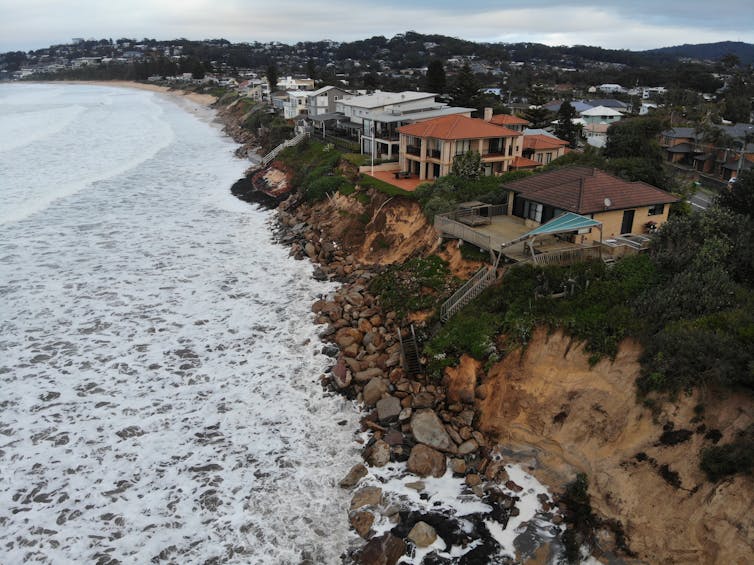
The main impact? Coastal storms intensified by the ENSO cycle. Storms can rapidly strip sand from beaches to create sandbars, dump it out at sea, or replenish another beach. These changes threaten to undermine beachfront properties and roads as well as beach habitats.
For Australia, if a La Niña is predicted to arrive in the next six months, coastal communities prone to erosion should prepare for storms stripping away sand. Our recent repeat La Niñas brought large waves and heavy erosion along the New South Wales and southern Queensland coast. During this period, houses almost fell into the sea in the NSW Central Coast, while wild waves made a new passage through Bribie Island.
During El Niño, Australia’s beaches recover, while beaches from California to Chile erode.
But as climate change ramps up, the effects of these ENSO cycles may become more intense.
Extreme beach erosion during a coastal storm in 2020 at Wamberal, Central Coast, NSW. Christopher Drummond/UNSW Water Research Laboratory.
What did we find?
We analysed millions of satellite images, looking for changes in beach width during El Niño and La Niña periods in southeast Australia, New Zealand, Chile, Peru, Mexico, California and Japan.
Lying in the satellite data was clear evidence of cyclical change. Along southeast Australia’s coastline, beaches tended to erode during prolonged La Niña periods, while regaining sand and recovering during El Niño years.
The reverse was true on the other side of the Pacific, around 13,000 kilometres away. From California down through Mexico to Chile and Peru, we saw beaches narrow during El Niño periods and widen out again during La Niña periods.
Why? Storms and sea levels. During El Niño events, large storms develop in the northern Pacific, sending energetic waves crashing onto the coastlines of California and Mexico — creating the perfect conditions for big wave surfing. During this period, the sea level is well above average too. Combined, bigger waves, storms and a higher baseline pillage sandy beaches. This is particularly pronounced in the eastern Pacific.
Knowing this, we can be better prepared. If you’re in Australia and the ENSO outlook suggests a La Niña is coming, it might be time for councils to replenish erosion prone beaches.
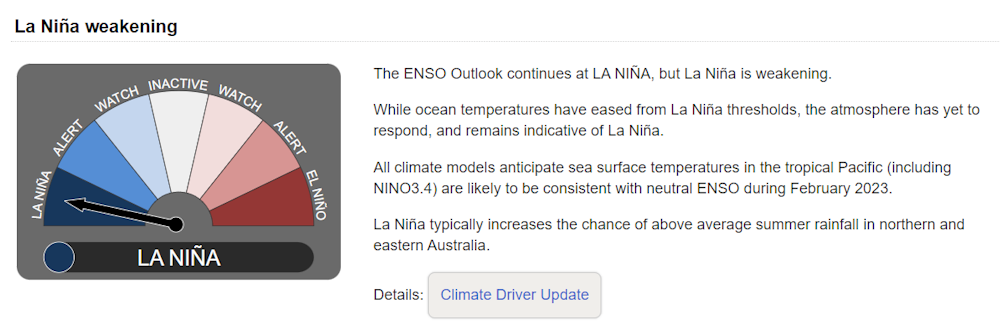
ENSO outlook for February 2023. Australian Bureau of Meteorology
Monitoring the many moods of a beach
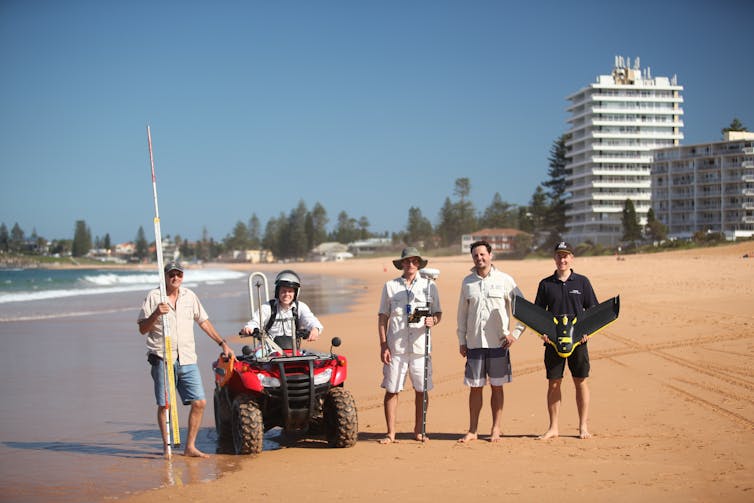
Monitoring coastal change has long been carried out with on-ground techniques, such as GPS equipment, quadbikes and drones. These methods require human operators, which makes them expensive and limits the area and duration of observations. That’s why we have very limited on-ground observations of beach change along much of the world’s coastline.
On-ground survey techniques to monitor beaches. Larry Paice/UNSW Water Research Laboratory.
That’s where satellites can help. Earth observation satellites have been capturing regular images of the world’s coastlines for four decades. Now we have the tools to interrogate the satellite images and track the evolution of sandy beaches.
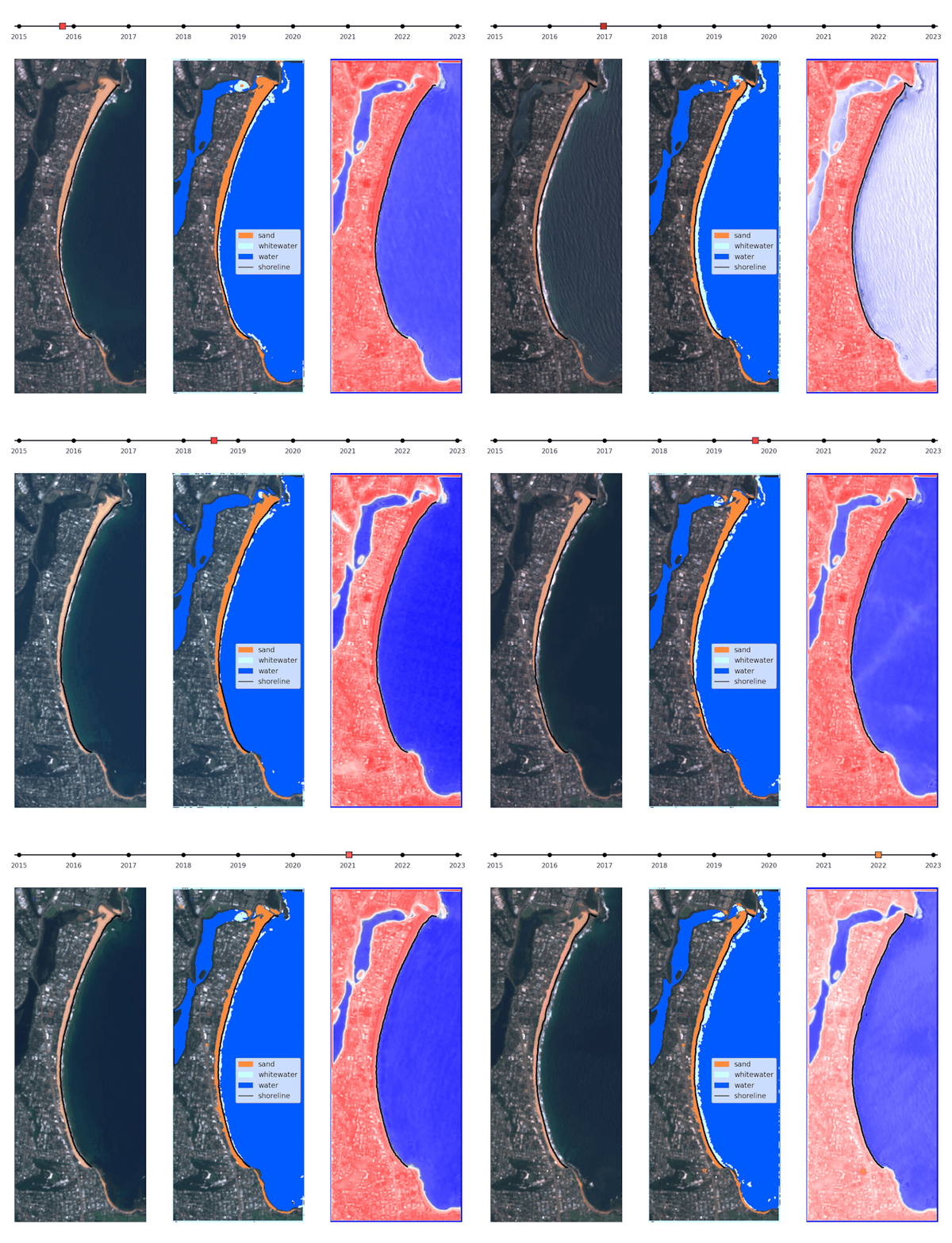
We developed the open-source tool CoastSat to automatically map the position of the shoreline on freely available satellite images, using cutting-edge image processing and machine learning techniques.
Changes to the shoreline can be automatically detected, as in this animation of changes at Narrabeen-Collaroy beach, Sydney. Killian Vos
With tools like these, we can monitor coastal changes across thousands of beaches over the last 40 years. You can see how your local beach has changed on the interactive CoastSat website.
The surgeon general is the “nation’s doctor” in the United States. They are tasked with giving Americans the “best scientific information” about their health.
Late last month, the current US surgeon general, Vivek Murthy, warned 13 is too young to join social media. He said it poses a risk to young people’s “self-worth and their relationships”, adding:
I, personally, based on the data I’ve seen, believe that 13 is too early […] the skewed and often distorted environment of social media often does a disservice to many of those children.
Is 13 too young? What should parents think about when it comes to their kids about social media accounts?
Why are we talking about 13?
Major social media platforms, including Twitter, Instagram, Facebook and TikTok, require users to be at least 13. This includes those in Australia and New Zealand.
This minimum age requirement stems from 1998 US legislation which banned the collection of children’s personal data without parental consent.
For many parents, schools and cybersafety experts, this minimum age has become something of a benchmark. Many assume it comes with the implicit assurance social media platforms are appropriate and safe for children once they turn 13. Conversely, they also assume they are unsafe for children under 13.
Stories documenting the potentially harmful effects of social media are rarely out of the news. Studies claim links between social media and poor mental health and low self-esteem.
These findings are concerning, and there is no doubt social media may negatively affect some young people’s wellbeing. However, it is not straightforward question.
While these studies might find a correlation or link between excessive social media use and poor self-esteem, for example, they rarely point to direct causation. Young people already experiencing low self-esteem and depression may use social media significantly more than others.
Murthy acknowledges it is difficult to keep kids off their devices and social media. But he suggests parents band together,
and say you know, as a group, we’re not going to allow our kids to use social media until 16 or 17 or 18.
But any increase in the age – whether formal or informal – will not necessarily keep children safer online. Children can easily falsify their ages (many already do). And young people are good at finding creative and secretive ways of doing what they want regardless.
Why can’t parents just say no?
It is often suggested – by cyber safety experts – that parents just say no. This message has been reinforced by celebrity commentators such as British actress Kate Winslet, who recently told the BBC:
My children don’t have social media and haven’t had social media.
While these approaches may work with younger kids, older children are unlikely to simply comply. Blanket bans and restrictions not only lead to family conflict, but are also more likely to lead to children using social media without parental consent or knowledge.
This is a problem because parents play an important role in helping children navigate online spaces, including the sometimes fraught nature of peer relationships on social media.
If a child has a social media account without parental permission, they are much less likely to seek out their parents for help if they have a problem online, for fear of getting into trouble or having their device taken away.
Children also have a right to be online
Discussion about risks also tends to ignore the potential benefits of being online.
Social media is incredibly important for many young people. It keeps them connected with friends and extended family, provides a platform for creativity and self-expression, and enables civic participation and activism.
Social media does come with risks, but there are potential benefits, too. Julie Ricard/Unsplash
Social media also provides access to like-minded individuals and communities who may provide solidarity and support, especially for marginalised teens.
Children, particularly teenagers, also have a right to participate in online spaces, including use of social media.
The United Nations’ Committee on the Rights of the Child notes children have the right to “meaningful access to digital technologies” as a way of realising the full range of their civil, political, cultural, economic and social rights.
So, when should my child get a TikTok account?
There is no one-size-fits-all approach here. Children vary tremendously in terms of their maturity, skills, life experience and judgement.
On top of this, online risk is not equally distributed, as children who are more vulnerable offline are more vulnerable online. For example, children with with mental health problems, learning difficulties, a disability or who have problems at home are more likely to experience high-risk situations online.
In deciding whether your child is ready for a social media account, parents might consider:
Is my child especially vulnerable to online harms?
Does my child have the required maturity and resilience to manage potentially negative online social interactions?
Does my child listen to advice and follow rules?
Is my child aware of the risks, and do they have strategies for managing them?
Will my child come to me with any problems they encounter online?
Parents might also consider their children’s offline lives, as these often carry over into online spaces. This includes what their friendships are like, their propensity for taking risks, and their ability to consider the consequences of their actions.
Start talking early
The best thing that parents can do is initiate conversations about social media and the internet early and often.
Many issues that play out on social media are extensions of young people’s existing peer relationships. Parents can talk to their children about their friends and peers, show an interest in their child’s online activities, and openly discuss their child’s rights and responsibilities online.
Some parents may wish to set reasonable expectations and rules about appropriate use of social media. Documenting these expectations through a “family technology agreement” that is negotiated democratically as a family, rather than through top-down rules, is more likely to succeed .
Catherine Page Jeffery received funding from the Australian Government via the Online Safety Grants Program. She is affiliated with Children and Media Australia.
The Albanese government’s efforts to address the gender pay gap are laudable. Despite all the attention given to the issue over the past decade or so, sectoral pay discrimination is very real and workplace biases persist.
But the federal government’s new tool to address the problem, the Workplace Gender Equality Amendment Bill, may not achieve much.
The amendment to the Workplace Gender Equality Act (enacted by the Gillard Labor government in 2012) requires all companies with more than 100 employees to report their “gender pay gap”.
Much like the Modern Slavery Act, the idea is that public reporting will concentrate employers’ attention on the problem, leading to greater gender equality.
But will it?
The problem is the type of data companies must report to the Workplace Gender Equality Agency, which has been publishing pay-gap statistics since being established by the Workplace Gender Equality Act in 2012.
As with the other statistics the agency has published over the past decade, the new amendment requires only publishing simple aggregates:
The Agency must publish aggregate information, for each relevant employer for each reporting period, for the purpose of showing the employer’s performance and progress in achieving gender equality in relation to remuneration for the employer’s workforce”
This may seem like a positive step. But aggregate numbers – which in practice translates into reporting summary statistics – do not help us to either identify or understand the pay gap. Those aggregates also don’t help us come up with the right fixes.
To do that requires better data that enables more precise analysis for the factors affecting pay disparities.
The problem with averages
Averages are ubiquitous in statistics. They can serve a important service, such as identifying trends. I’ll even be using averages to illustrate a few points.
But their limitations should be understood. They are particularly problematic when it comes to areas of endemic inequality, such as income.
Consider a company with 101 employees, one being the founder and chief executive. The other 100 employees, split 50/50 between men and women, are all paid the same salary.
But suppose the chief executive pays himself ten times as much as the other employees. This isn’t ridiculous; the average CEO of a listed company in Australia is paid 132 times the average income. This creates a 17.6% gender pay gap.
Now consider a similar company, run by a “tech bro” who doesn’t draw a salary but does pay every single women 2% less than every man. The aggregate numbers will show no gender pay gap.
In the first case, where there’s no explicit gender discrimination, aggregate numbers can be misread as indicating there is. In the second case, actual gender discrimination is obscured.
The widespread use of averages often skew our sense of things. If you compare your own income to the Australian average (A$90,324 a year in 2021), the probability is you’ll feel left behind. But if you compare yourself to the median income – the income at which half the population earns more, and half less – you’ll feel much better: it’s only $62,868 a year.
Bad data leads to bad analysis, and bad policy responses.
Here’s another scenario. Consider our first company again. The CEO is concerned about the publicity from reporting a 17% gender pay gap to the agency. So he employs his wife as deputy CEO, paying her five times the rest of the staff, and cuts his own salary by half. He no longer has a gender pay gap to report.
This is progress of a kind, but not the progress needed to address the complex causes of gender pay inequality for ordinary people.
So how then to improve the reporting of gender pay statistics generally?
Reporting median statistics would help mitigate the skewing problem with averages. Unless the government demands this, the agency will more than likely keeping taking the same approach as over the past decade – relying on averages.
There’s also a case for companies to report other relevant factors that could influence pay, such as qualifications, skill, tenure, seniority and productivity.
This would enable the Workplace Gender Equality Agency to provide more sophisticated analysis, breaking down the factors contributing to the figures that get the headlines.
The agency defines equal pay as “men and women performing the same work are paid the same amount”. To achieve this, it is essential to ensure apples are being compared with apples. This is only possible if we control for the factors that can influence pay, and don’t lose the necessary nuance.
Blunt data does not properly inform us about the pay gap, why it arises, nor how to solve it. This risks policy responses that focus on the wrong issues and which achieve little.
Decision-makers, both in public and private sectors, risk making bad decisions on poor-quality data. The wrong fixes could even make things worse. We will not eradicate the gender pay gap using bad statistics.
Mark Humphery-Jenner does not work for, consult, own shares in or receive funding from any company or organization that would benefit from this article, and has disclosed no relevant affiliations beyond their academic appointment.
The Chinese “spy balloon” shot down over the United States has brought the seemingly strange methods of surveillance and espionage into news headlines. Balloons have long been used for espionage – and not just for surveillance, as appears to be the case with this one.
In the 1950s, Soviet soldiers in East Germany often saw white balloons overhead. Rather than spying, these balloons dropped propaganda leaflets produced by US-backed groups in West Germany.
But the history of surveillance includes many operations that now appear strange or even absurd. Intelligence organisations often try creative solutions to outwit their targets. Many of these schemes remain classified. But from declassified material and the stories of former intelligence officers, we know the real world of Cold War espionage could be even stranger than fiction.
Intelligence agencies have long used not just human agents, but animal ones too. Operation Acoustic Kitty was a US Central Intelligence Agency (CIA) program to use cats as listening devices during the 1960s. Robert Wallace (former technical services director at the CIA) and H. Keith Melton, an intelligence historian, described the operation in their book Spycraft.
The CIA came up with the idea while monitoring an unnamed head of state. Officers noticed that during this leader’s confidential meetings, cats often wandered in and out of the room. No one would suspect a cat of being a trained spy. So the CIA trained and surgically implanted cats with transmitters and microphones, to send them to listen in on people’s conversations.
It’s not clear exactly what happened to the acoustic kitties. One former officer claimed the first cat was run over when they deployed it, but others dispute this. The only available official document on the program is heavily redacted. It indicates that the project was eventually abandoned – but the cats were trained and probably deployed.
And so were many other animals: the CIA also trained ravens and pigeons, and the US Navy, Soviet intelligence, and maybe intelligence agencies in Putin’s Russia have used whales and dolphins for surveillance work.
The spy seal
Intelligence organisations were not opposed to working with animals – or with children. The US Embassy in Moscow was covered in listening devices and microphones planted by the KGB, the Soviet security agency – including in the wall plaster. But the KGB’s most lucrative embassy bug was planted in the ambassador’s study. It had been hand-delivered by a group of Soviet schoolchildren in 1945. They were unaware that they carried a listening device when they presented the ambassador with a large, wooden US Great Seal for his study.
The seal spent the next seven years on the ambassador’s wall and sound waves entered through two tiny holes under the eagle’s beak. US intelligence officers smashed the eagle open when they discovered the device in 1952. But at first they couldn’t figure it out – it had no battery or power source.
The sophisticated device transmitted information when Soviet officers in a van parked outside bombarded it with microwaves. During the Cold War, you had to beware anyone bearing gifts – even schoolkids.
Replica of the seal which contained a Soviet bugging device, on display at the NSA’s National Cryptologic Museum. Wikimedia
ASIO in the ceiling
In Australia, surveillance sometimes involved unlikely agents too. One of the earliest surveillance targets of the Australian Security Intelligence Organisation (ASIO) was a flat in Sydney’s Kings Cross, where Soviet press representatives lived. But these press representatives also often worked for the KGB on the side.
ASIO rented the flat above the Russians and a married couple, Joan and Dudley Doherty – both ASIO officers – moved in. While they lived there, they had two children. The kids grew up padding around in slippers, learning to whisper and stay quiet, so the officers in their living room wearing giant headphones could listen to what was happening below.
But the operation almost never got started. When ASIO installed the listening device, drilling down into the ceiling of the Russians’ flat, they dislodged some plaster. After a persuasive chat with the building’s caretaker and a quick patch-up job, they were ready to go – but it was a close call.
And after two years of gathering intelligence, one of the Russians did spot the device in their ceiling. He confronted Joan Doherty about it and even tried, unsuccessfully, to enter her apartment. The operation had to be suspended for months afterwards. But it was eventually reactivated. The bug was never as useful as they hoped, but hundreds of pages of intelligence came from the Doherty’s family home into ASIO’s files.
Necessity is often the mother of invention in the world of surveillance. Intelligence agencies need to avoid detection. Officers work to outsmart their targets and collect information on what the target does and says, a process that can lead them to deploy everything from balloons to children and even cats.
Ebony Nilsson does not work for, consult, own shares in or receive funding from any company or organisation that would benefit from this article, and has disclosed no relevant affiliations beyond their academic appointment.
The Papua New Guinea government’s top legal adviser, Dr Eric Kwa, has been arrested and charged on allegations of dangerous driving causing death.
Dr Kwa, the Secretary for the Department of Justice and Attorney-General, was allegedly involved in a fatal road accident that caused a death on October 17, 2022, and was the subject of a police investigation for the past three months.
He was eventually charged under the Criminal Code Act (Section 328) for dangerous driving causing death yesterday.
Police were not allowed to release him on bail yesterday because of the severity of the offence.
In a media briefing yesterday, National Capital District (NCD) Metropolitan Superintendent Silva Sika said the severity of the offence committed under the Act did not allow him to be released on police bail.
He said Kwa’s lawyers were advised to apply for a bail application at the National Court for him to be released.
‘No one above law’ “No one is above the law, and therefore, due process must be followed,” Sika said.
He said all processes had been followed and Dr Kwa had been very co-operative with the police.
The PNG Post-Courier front page today. Image: Screenshot APR
“He understands the process very well since he is an intellect [sic] and that he will have to bear with the circumstances,” Sika said.
It was alleged that on October 17 Dr Kwa and his officers were travelling along the Hiritano Highway on their way to attend an official engagement with the Constitutional and Law Reform Commission at Bereina when the accident happened.
He was in the second vehicle with three of his officers, when the accident allegedly happened.
A female passenger who was part of his entourage died at the Port Moresby General Hospital from severe injuries sustained in the accident.
Others treated, discharged The others were treated and discharged.
The matter was immediately reported to police where a complaint was lodged with several investigations undertaken.
On Tuesday, January 24, 2023, Dr Kwa received a request from Police Commissioner David Manning for a record of interview at the Police Headquarters.
On Friday, January 27, he presented himself before the police hierarchy where an initial interview took place.
Late last night, Kwa’s lawyers managed to have him bailed out.
The Melbourne outer suburban seat of Aston, set for a byelection after former Liberal minister Alan Tudge’s resignation, has already made its mark on history.
The Howard government was on the ropes in 2001 when Aston’s then Liberal MP, Peter Nugent, died suddenly of a heart attack. The July byelection was hard-fought but the Liberals hung on. There were other, more important, events on the road to John Howard’s November election win, but the Aston victory has gone down in the narrative as a crucial turning point.
Now Peter Dutton faces his own Aston test, which comes with risks and opportunities.
The risks for the opposition leader are obvious. Dutton’s natural stomping ground is Queensland. Victorians don’t much like him. He didn’t venture into the recent state election. A loss would be catastrophic for him.
Dutton will be relieved Josh Frydenberg doesn’t have his eye on Aston. If the former treasurer were the candidate, the media chatter from now until the byelection would be about the implications for the Liberal leadership if Frydenberg were back in the parliament.
Frydenberg’s decision is wise. Given the volatility of politics these days, he couldn’t be certain of winning and if he did, the resulting destabilisation in the Liberals would only benefit Labor. It’s better for Frydenberg to wait and re-contest Kooyong, where teal independent Monique Ryan might be vulnerable next time.
While Dutton has most on the line in Aston, the byelection (likely to be after Easter, in April) will in part give an early “real time” reading on whether cost-of-living issues are harming the Albanese government. This is despite the fact Aston, according to ABC election analyst Antony Green, is no longer the mortgage-belt seat of old.
Aston voters showed their disapproval of Tudge, Morrison and the Liberals last year with a swing of more than 7%, leaving the seat on a 2.8% margin. Green observes that one would expect it to revert to a more comfortable position on the Liberal spectrum.
But in politics perceptions matter. If Dutton secured a decent swing after a strong “cost of living” campaign it would be a morale boost for the Liberals and shine attention on the potential damage that issue – not yet hitting Labor in the polls – could do in vulnerable government seats.
Labor knows the financial squeeze on families is a slow burn. ALP national secretary Paul Erickson, in a briefing this week, told caucus members the most important issue voters want the federal government to focus on is helping households with their cost of living.
The Tudge resignation was the second shock of 2023’s first federal parliamentary week.
Senator Lidia Thorpe’s jump from Greens to crossbench has made the Senate much trickier for the government to manage.
The biggest loser immediately is ACT independent David Pocock. Until this week, Pocock had been Labor’s automatic port of call for the single vote it needed from the non-Green crossbench to pass legislation supported by the Greens but opposed by the Coalition.
The government and Pocock have had a cosy relationship. He’s a progressive, broadly aligned with Labor in his views.
He’s not difficult to negotiate with, although he’s wanted his political money’s worth, so has extracted some concessions in exchange for his vote. One was important. The prime minister agreed to set up a committee to report publicly before each budget on the adequacy of income support payments. Jim Chalmers will soon be wrestling with the first of those reports.
With Thorpe’s defection the government requires two non-Greens crossbenchers to secure contested legislation (although Thorpe says she will vote with the Greens on climate bills).
Pocock says the change in the Senate’s makeup “increases all of our capacity to push the government for more ambition and better outcomes on contested legislation”.
In fact, the net effect is to reduce his capacity and boost that of Tasmanian crossbencher Jacqui Lambie, who commands two votes.
Labor can’t in practical terms look to Hanson and her Senate offsider, Malcolm Roberts, or Victorian UAP senator Ralph Babet. Thorpe will likely be a challenge, and could only provide one vote anyway.
Lambie and her colleague, Tammy Tyrrell, can give the government the numbers it needs on particular pieces of legislation. From the government’s point of view, this would means just a single negotiation (as distinct from the double negotiation needed to get, say, Pocock and Thorpe).
Lambie will be delighted to be back at the centre of things. In recent months she has been overshadowed by Pocock.
But in negotiations she can be difficult, demanding and at times shrill, and is at odds with Labor on some issues, such as aspects of industrial relations. She has been questioning on the Voice. The government may try to work through the easier-going Tyrrell where it can.
Apart from legislation, the enhanced numbers give the Senate more scope for making trouble for the government. The Coalition and the seven non-Green crossbenchers now have the numbers to form an absolute majority.
Though Thorpe has dealt herself into the Senate play, there will be constraints on her. She’d presumably find it hard in ordinary circumstances to vote with the Coalition on legislation, and if she abstains, the government will be back to needing only a single extra vote to pass contested bills (cue Pocock).
Thorpe’s defection has also increased the ability of the opposition to exert influence in the legislative process. Given the greater Senate uncertainty, the government may on occasion prefer to wrangle the Coalition than the crossbenchers.
We saw that this week when Anthony Albanese agreed to Dutton’s call to change the referendum machinery bill, so the usual pamphlet outlining the yes and no cases would be sent out.
The concession is welcome. The government’s argument that the pamphlet is unnecessary because everything is on the internet was spurious, not least became voters in remote communities, who have a special interest in the Voice, probably have poor access to the internet.
Meanwhile the Senate this week delivered the government a first significant parliamentary defeat.
In a vote that saw even the Greens deserting Labor, the Senate disallowed its removal of the requirement for superannuation funds to provide detailed information on how they spend members’ money.
The Senate vote, on a motion lodged by Lambie, was a victory for transparency – something Labor professes to support. As the late Don Chipp, founder of the long-gone Australian Democrats might have said, it was a case of the Senate, and particularly the crossbench, “keeping the bastards honest”.
Michelle Grattan does not work for, consult, own shares in or receive funding from any company or organisation that would benefit from this article, and has disclosed no relevant affiliations beyond their academic appointment.
Indonesian police and military have launched a joint mission to rescue a New Zealand pilot who was seized by rebels as a hostage in Indonesia’s Papua region on Tuesday, media reports say.
The rebels have threatened to execute him if their demands are not met.
Reuters reports that the West Papua National Liberation Army had claimed responsibility for the attack, saying the pilot would not be released until the Indonesian government acknowledged the independence of the Melanesian region of West Papua.
Merthens also had five passengers on board and it was unclear what had happened to them.
TheJakarta Post reports that the operation, codenamed Peaceful Carstensz, was launched by Indonesia police and the Indonesian military (TNI). The name Carstensz alludes to the mountainous region where the incident occurred.
Merthens’ location was still unclear due to conflicting information issued on Wednesday, the report said.
Consular support The Ministry of Foreign Affairs and Trade also earlier said it was providing consular support to the Merthens’ family and said it would not comment further because of privacy reasons, The New Zealand Herald reports.
Prime Minister Chris Hipkins told RNZ he had been given preliminary details and said the New Zealand embassy in Indonesia was working to help free Merthens, according to TheHerald.
Researcher Andreas Harsono knew the main spokesperson of the rebel group, Sebby Sambom, after decades of research in the field.
He made a call to him personally to let the hostages go.
A former New Zealand pilot, who flew for Susi Air for just over a year ending in 2017, said pilots were warned by the airline to take precautions in the region — things such as keeping a low profile, travelling in groups, finding a driver to take them around, and not leaving compounds at night.
This article is republished under a community partnership agreement with RNZ.
Indonesian security forces do not know the whereabouts of the New Zealand pilot taken hostage by the West Papua National Liberation Army (TPNPB) on Tuesday,
Captain Philip Mehrtens, a pilot for Susi Air, was taken hostage following the burning of his aircraft in Paro district, Nduga regency, in a rugged part of Indonesian-ruled Papua province on Tuesday.
One of the obstacles in finding Mehrtens is the lack of telecommunications facilities in Paro and there is no Indonesian military post in the area, says a police spokesperson.
Papua Police spokesperson Senior Commander Benny Prabowo said security forces continued to track the whereabouts of the pilot.
According to Commander Prabowo, the Nduga police were preparing to go to Paro district.
“Until now, the investigation is still being carried out by the police assisted by the Cartenz Peace Task Force,” he said.
Earlier on Tuesday, a Susi Air aircraft was burned after landing in Paro district.
The local leader of the TPNPB Ndugama-Derakma, Egianus Kogeya, said the plane was burned by his men. Kogeya also stated that his group had captured and held Captain Mehrtens hostage.
Preceded by threats Benny said that before the burning of the plane, rumours had been circulating since Saturday that the TPNPB had threatened 15 construction workers who were building a health center in Paro district.
Commander Prabowo said the Nduga police had received a report from the Nduga regent who said the construction workers were questioned by TPNPB because they did not have complete identities.
“We got information that 15 people had left Paro district and headed to Mapenduma. But their whereabouts are still being investigated by the Cartenz Peace Task Force,” he explained.
Commander Prabowo hoped that the public would entrust the handling of the hostage case to the police.
“Telecommunication access there is still very limited, so there is very little information. I hope all parties will be patient,” he said.
The TPNPB rebels are fighting for independence in West Papua and say they will not release the pilot until their demands are met.
Republished from Jubi with permission.
The hijacked Susi Air aircraft . . . reportedly shortly before the Papuan rebels set fire to it. Image: Papuan media
A researcher at Human Rights Watch in Jakarta is calling for the immediate release of the six hostages — including a New Zealand pilot — being held by a rebel group in Indonesia’s Papua region.
The rebels in Highlands Papua are threatening to execute Susi Air pilot Phillip Mehrtens if their demands are not met.
The West Papua National Liberation Army (TPNPB) has posted an ultimatum on social media demanding Jakarta negotiate with them over independence for the region.
“Pilot is still alive and he will be held hostage for negotiations with Jakarta, if Jakarta is obstinate, then the pilot will be executed,” the statement read.
“We will take the New Zealand citizen pilot as hostage and we are waiting for accountability from the Australian government, the New Zealand government, the European Union governments, and the United Nations, because for 60 years these countries have supported Indonesia to kill Indigenous Papuans.”
Researcher Andreas Harsono knows the main spokesperson of the rebel group, Sebby Sambom, after decades of research in the field.
Personal appeal He made a call to him personally to let the hostages go.
“I call on this group to immediately release all of the hostages including the pilot — it is a crime to kidnap anyone including this pilot,” he told RNZ Pacific.
“I do not know how to measure the seriousness of such a threat but this is a hostage situation, things could be out of control. So the best way is to negotiate and ask them to release the pilot.”
Human rights researcher Andreas Harsono . . . “The best way is to negotiate and ask [the rebels] to release the pilot.” Image: Human Rights Watch/RNZ Pacific
Harsono noted the difficulties for New Zealand attempting to negotiate with the group, particularly given their demands.
“I don’t think it is easy or even internationally accepted to pressure the New Zealand government to negotiate for West Papuan independence from Indonesia,” he said.
“It is way too complicated for any country in the world, including New Zealand, to negotiate the independence of this particular territory. But, of course, the Papuan people have suffered a lot and the Indonesian government should do more to end impunity and human rights abuses in West Papua.
“But this is a hostage situation. The most important thing is to call on this group to immediately and unconditionally release all of the hostages, including the New Zealand pilot.”
Very remote region Harsono said he did not know whether the passengers had been taken hostage, nor did he know if they were indigenous Papuans.
“The area is very remote, only certain people go there, mainly construction workers, and there were killings against Indonesian workers back in 2018,” he said.
Indonesian authorities say they are facing difficulties locating Merhtens because of the lack of telecommunications facilities in Paro district and the absence of any Indonesian military or police post in the area.
Jubi News quotes Papua Police spokesperson Ignatius Benny Ady Prabowo, saying they were continuing to track the whereabouts of Mehrtens and were preparing to go to Paro district.
He said that before the burning of the plane, rumours had been circulating that a rebel group had threatened 15 construction workers who were building a health centre in the district.
New Zealand’s Prime Minister, Chris Hipkins, told Radio New Zealand: “The New Zealand embassy in Indonesia is working on the case.”
This article is republished under a community partnership agreement with RNZ.
The recently released Strengthening Medicare Taskforce report found more people are delaying care or attending emergency departments because they can’t get in to see a GP.
And it’s likely to get worse. General practice is shrinking rapidly, with estimates Australia will be 11,500 GPs short by 2032. This is one-third of the current GP workforce.
So why is it harder to access and afford GP care? Here are six key reasons why.
The population is ageing, and more people with multiple chronic diseases – such as cancer, diabetes and heart disease – are living longer in the community. Rates of mental illness are also rising.
This not only increases GPs’ clinical workload, it also shifts a greater load of care coordination onto the GP. This decreases the number of patients a GP can see.
GPs have also been under increasing pressure from administrative and compliance activities for Medicare, as well as paperwork for the aged care, disability, social security, health and workplace sectors.
Patients have increasingly complex health issues, which take up more time. Shutterstock
2) General practice is no longer financially viable
GP clinics are less financially viable than they used to be. One survey of doctors found 48% of respondents said their practices were no longer financially sustainable. As a result, many are closing.
While this was a huge saving for the government, a low rebate meant the gap between the cost of care and the rebate had to be passed on to GPs and their patients.
A GP’s fee has to cover the costs of the whole practice. There are growing operating costs for insurance, rent, wages, information technology and consumables like gowns, gloves and single-use clinical equipment. When a GP bulk bills, their businesses absorb the gap between the cost of care and the Medicare rebate. The rebate is now so low (for example, the rebate for a 45 minute consultation for mental health is A$76), and costs are high, few GPs are able to afford to bulk bill patients. This means people on low incomes have trouble affording the care they need.
The suicide rate for female doctors is more than twice the national average, and rates of depression are high. It can be difficult for doctors to access care, particularly if they work in rural practice.
Abuse and violence is also more common, with one survey finding at least 80% of GPs saw or experienced a form of violence at their place of work.
We cannot attract young doctors to a profession that is constantly under public and political attack. Education Minister Jason Clare recognised this in teaching, saying “It’s also about respect. […] We need to stop bagging teachers and start giving them a wrap.” We need this for GPs too.
5) Rural GPs are leaving
It has always been challenging to attract GPs to country practice. Rural practice often involves a wider scope of practice, personal isolation and increased workloads with less professional support.
Rural GPs often work long hours and have on call responsibilities. Jobs, schools and services for GP families can be difficult to access.
There is a global shortage of all health-care workers, which is expected to worsen. Supply of international medical graduates may drop as their options for work in other countries increases. Border closures during COVID have also reduced supply.
While the Strengthening Medicare Taskforce supports GP care, it doesn’t identify the specific changes required to improve accessibility and affordability and requires significant structural change.
It will be months before the recommendations of the report can be translated into policy, and it may be years before radical changes can be implemented. Without addressing the GP shortage in the meantime, there may be a much smaller workforce to strengthen.
Louise Stone is a Fellow of the Royal Australian College of General Practitioners and the Australian College of Rural and Remote Medicine
Jennifer May is a GP and Director of the University of Newcastle Dept of Rural Health which is in receipt of Commonwealth funding under the Rural Health Multidisciplinary Funding Training Programme.She is the co chair of the Medical Workforce Advisory Reform Committee
Former Coalition minister Alan Tudge has announced he will quit parliament, creating a byelection in the Melbourne seat of Aston.
The seat of Aston. AEC
In a statement to the House of Representives, Tudge said the decision, cemented after his father’s recent death, was necessary for his health and for his family, “amongst other reasons”.
His teenage daughters had “had to put up with things that no teenager should have to, including death threats. The most recent of which was last week. My son is a bit younger but equally I want to be a good father to him,” Tudge said. He broke down at one point during his speech.
The byelection will be a major test for opposition leader Peter Dutton, who is particularly unpopular in Victoria.
Aston, in the outer eastern suburbs of the city, was formerly a rock solid seat for the Liberals. But Tudge in the 2022 election had a two-party swing against him of more than 7%. The seat is now on a margin of 2.8%. Tudge, 51, has held it since 2010.
Former treasurer Josh Frydenberg, who lost the nearby seat of Kooyong at the election to teal independent Monique Ryan, will not seek preselection for Aston. He has yet to decide whether he will contest the next election. If he does, he would run in Kooyong.
Among his posts in the Coalition government, Tudge served as human services minister, minister for citizenship and multicultural affairs, minister for cities, urban infrastructure and population, and education and youth minister. Since the election he has been shadow minister for education.
Most recently he has appeared at the royal commission on Robodebt, when he was quizzed about his involvement as human services minister in the scheme, which was found to be illegal.
He admitted in his evidence he was aware the Robodebt income averaging system “had the potential to create inaccuracies”.
During the Coalition government, Tudge was mired in scandal after his former staffer, Rachelle Miller, revealed they had had an affair. She later alleged Tudge had been emotionally, and on one occasion physically, abusive, kicking her out of bed. This led to Tudge, who denied the allegation, standing aside from the ministry in 2021.
Miller also gave evidence to the royal commission, telling how when she worked for Tudge, she placed stories with friendly media outlets containing private information about people who had publicly contested Robodebt notices they had received. She said this was to correct the record, and led to fewer stories of people speaking out.
Before Tudge made his announcement to parliament, the Minister for Government Services, Bill Shorten, denounced the illegal scheme. “The architects of Robodebt believe that the ends justified the means,” Shorten said in question time. “The only remaining question for me is, when will all of the architects at the top of the Robodebt tree take full accountability and take full culpability and responsibility for the most illegal administrative scheme run by any government in the history of the Commonwealth?”
Tudge told parliament his passion had always been in social policy, rather than the traditional Liberal focal areas of economic and national security.
“I’ve always believed that while the economy is the foundation of our society, that social policies determine whether individuals are given the opportunity and responsibility to realise their potential.”
Both Anthony Albanese and Dutton referred to the pressures on MPs families in their remarks following Tudge’s statement.
Aston saw a crucial byelection in 2001 when the Howard government, embattled at the time, held the seat. This was seen as the start of its recovery which culminated in its 2001 election win.
Michelle Grattan does not work for, consult, own shares in or receive funding from any company or organisation that would benefit from this article, and has disclosed no relevant affiliations beyond their academic appointment.
The investigation into the downing of Malaysian Airlines flight MH17 has found “strong indications” that Russian President Vladimir Putin authorised the supply of the missiles used by separatists to shoot down the plane.
However, the joint investigative team leading the investigation said it has reached the limits of its investigation, largely due to Russia’s refusal to cooperate. At this time, it will not initiate further prosecutions.
What investigators looked at
On July 17 2014, flight MH17 was travelling from Amsterdam to Kuala Lumpur when it was shot down over eastern Ukraine. All 298 people onboard were killed.
This atrocity shocked the international community and raised many questions of legal responsibility that are still being grappled with today.
One early response was the formation of the joint investigative team, which brought together investigators and prosecutors from five countries most affected by the tragedy – The Netherlands, Ukraine, Malaysia, Australia and Belgium. Its role was to carry out the “full, thorough and independent international investigation” called for by the UN Security Council.
The reconstructed wreckage of Malaysia Airlines Flight MH17 in 2015. Peter Dejong/AP
The team’s work was complex and protracted, particularly as the crash site was located in a conflict zone. It was mid-2015 when the investigators gained proper access to the site in Ukraine. They subsequently questioned 200 witnesses and intercepted and analysed 3,500 conversations. The team also studied 20 weapons systems and scrutinised five billion internet pages.
Ground samples were taken in various international locations and missile launch sites were simulated in the five countries leading the investigation. Thousands of parts from the plane wreckage were examined.
The key initial finding was the plane was shot down by a missile launched by a BUK-TELAR system, located on farmland in an area of Ukraine controlled at the time by pro-Russian separatists. The investigators determined the missile and launcher were transported from Russia before the attack and returned there afterwards.
Prosecutor Digna van Boetzelaer of the Netherlands announcing the suspension of the investigation. Peter Dejong/AP
Dutch criminal prosecution
One important outcome of the team’s work was the prosecution of four separatist fighters in the Netherlands. Three of them – Igor Girkin, Sergey Dubinskiy and Leonid Kharchenko – were found guilty last year of bringing down the plane and murdering all 298 people onboard.
Prosecutors did not allege the men had pressed the launch button for the missile, but that they played significant roles in transporting, positioning and returning the missile launcher to Russia.
The men received sentences of life imprisonment and were ordered to pay more than 16 million euros (A$24.7 million) in compensation to the victims’ families. But since they were tried in absentia, it is highly unlikely any of them will face a real penalty.
The report released this week by the MH17 investigation team focused on the crew members responsible for the missile launcher and those above them in the chain of command.
While the investigators uncovered considerable information about the decision-making before the plane was shot down, the evidence was insufficient to prosecute further suspects. The key problem is access to information: Russia has consistently refused to accept responsibility and has prevented the investigators from gathering evidence from Russian nationals. Russia is also accused of falsifying evidence.
Investigators believe the launcher crew were members of the 53rd brigade of the Russian military, based in Kursk. It seems likely those crew members, if they were available for questioning, could explain what their assignment was in Ukraine and why MH17 was shot down.
The team also found evidence the separatists were in touch with Russian intelligence and the Kremlin. They requested, and were granted, access to heavier air defence systems. Investigators believe Russia was actually in control of the “Donetsk People’s Republic” separatist movement in July 2014. Russia denies this.
According to investigators, there are “strong indications” Putin decided to supply the BUK-TELAR launcher to the separatists.
Intercepted phone calls served as evidence that Putin is the only person with authority to approve the provision of heavy air defence systems like the BUK-TELAR to the separatists. The team believes Putin authorised the delivery of even heavier air defence systems, but it does not have conclusive enough evidence to pursue charges.
In any case, at the moment, Putin enjoys head of state immunity.
Can Russia still be held accountable?
While the investigation is now suspended, it could be revived in the future. Investigators said they are available to receive evidence from the Russian authorities or Russian witnesses, and that further information could lead to future prosecutions.
Digna van Boetzelaer, deputy chief public prosecutor of The Netherlands, reflected on what the team has achieved to date:
The purpose of this investigation was to find out the truth, and I think we have come further than we ever imagined in 2014.
The bar for establishing individual criminal liability is high. At the moment we do not meet that bar for the persons discussed in the remaining investigation.
The findings we have uncovered about the Russian involvement up to the highest level can play an important role in proceedings where the liability of this state is at issue.
Van Boetzelaer’s last comment references other judicial actions that are still ongoing in relation to MH17.
One of these is an action launched by Ukraine and The Netherlands against Russia in the European Court of Human Rights. That court delivered an interim ruling last month that attributes some responsibility to Russia for crimes committed on Ukrainian territory.
Meanwhile, Australia and The Netherlands have launched a separate action against Russia before the International Civil Aviation Organization.
Ukraine is also pursuing an action against Russia before the International Court of Justice. It claims Russia financed terrorist acts by separatists and is responsible for gross humanitarian violations against Ukrainian civilians.
All of these actions are operating in the increasingly complex and tragic circumstances of Russia’s full-scale invasion of Ukraine and the ongoing war there. But as Australian Foreign Minister Penny Wong stressed this week, the countries impacted by the tragedy remain committed to holding Russia accountable.
Amy Maguire does not work for, consult, own shares in or receive funding from any company or organisation that would benefit from this article, and has disclosed no relevant affiliations beyond their academic appointment.
Federal Environment Minister Tanya Plibersek has formally rejected mining magnate Clive Palmer’s proposed Central Queensland Coal Project. Her decision was based on the risk of damage to the Great Barrier Reef, freshwater creeks and groundwater.
The 20-year open-cut mine project would have extracted up to 10 million tonnes of metallurgical coal – used to make steel – each year.
Plibersek’s decision is significant. It’s the first time a coal mine has been refused in the two decades our federal environment law has been in place. But those hoping the decision sets a precedent for other mine proposals are likely to be disappointed.
Palmer’s mine was not refused on climate change grounds. Objectors to coal mines will still need to persuade the federal government of the link between future coal mine developments and global warming.
Clive Palmers coal mine has been rejected. Shutterstock
A rare decision indeed
Australia’s federal environment law is known as the Environment Protection and Biodiversity Conservation (EPBC) Act. It came into force in 2000 to provide federal oversight of large projects.
Under the law, proponents must refer a proposal to federal environment authorities if it’s likely to significantly impact so-called “matters of national environmental significance”. These matters include the Great Barrier Reef.
But it’s extremely rare that any development is refused under the EPBC Act. As of July last year, more than 7,000 projects had been referred to the federal government under the law, for assessment of the proposal’s impacts. Just 13 were ultimately refused.
So why did Palmer’s proposed mine cross this exceptional hurdle for refusal? Largely because of its location. The proposed site was just ten kilometres from the Great Barrier Reef world heritage area.
[…] risks to the Great Barrier Reef, freshwater creeks and groundwater are too great. Freshwater creeks run into the Great Barrier Reef and onto seagrass meadows that feed dugongs and provide breeding grounds for fish.
Plibersek said the mine posed unacceptable risks to the Great Barrier Reef. Shutterstock
The thin end of the wedge?
Plibersek’s decision has triggered calls for the federal government to reject other fossil fuel projects.
For example, Greens environment spokeswoman Sarah Hanson-Young on Wednesday described Plibersek’s decision as “the thin edge of the wedge”. She went on:
There [were] 118 new coal and gas projects in the pipeline. One down, 117 to go.
From Narrabri’s double-whammy new coal and gas projects, Woodside’s North West Shelf offshore gas extension, billionaire miner Gina Rinehart’s proposed CSG expansion in the Surat Basin, or the Mount Pleasant coal project extension in the Hunter, the Minister has many projects left to rule out.
Approving more coal and gas in the midst of a climate crisis is reckless and dangerous.
However, persuading the federal minister to reject these mines will not be easy.
That’s because the law contains no explicit requirement for the minister to consider the climate change impacts of a proposal.
This certainly hasn’t stopped litigants from challenging projects on climate grounds. But to date, none have succeeded.
Other legal objections – such as one brought by the Australian Conservation Foundation against the Adani mine – have taken a different tack. They’ve sought to show the carbon emissions resulting from burning coal from a mine would harm a matter of national environmental significance.
The ACF argued the Adani mine was inconsistent with Australia’s international obligations to protect the Great Barrier Reef. But the challenge was unsuccessful.
Such arguments are difficult to run. That’s partly because they string together a number of causal links. In other words, they rest on the assumption that one action is definitively responsible for another, and so on down the chain.
Such links may be possible to show in cases such as the Palmer mine, when a development is close to the coast and its direct operation might pollute waterways. But it’s harder to show that coal from a single mine, burnt by a third party, will damage the Great Barrier Reef.
Plibersek’s decision is unlikely to set a precedent for federal mine approvals.
The EPBC Act could, in theory, be strengthened to give the minister more power to reject a proposal on climate grounds. But unfortunately, the Albanese government’s promised reforms of the law fail to do so.
First, the reforms failed to include a “climate trigger” – a mechanism by which development proposals are not approved unless their climate impact has been considered.
Second, the reforms fail to make so-called “scope 3 emissions” a mandatory consideration in environmental approvals. These types of emissions are produced indirectly – such as when a company’s coal is burned for energy.
There is room for hope, however. The federal government’s Climate Change Act enshrines in law Australia’s goal of reaching net-zero emissions by 2050. Under this policy position, the approval of large coal mines will become increasingly difficult to reconcile.
And in recent years, some state courtshave been convinced by causal arguments linking mines to climate change. So future federal decisions are unlikely to be immune from further challenge.
Plibersek’s decision comes during a bad few months for Palmer. In November last year, Queensland’s Land Court recommended Palmer’s proposed Waratah coal project in Queensland also be rejected due to its likely contribution to climate change, and subsequent erosion of human rights.
Palmer can seek a judicial review of the latest decision. But success would rest on whether it could be shown Plibersek’s decision involved a legal error. These types of challenges are notoriously difficult – so there’s a good chance this proposed mine has reached the end of the road.
Australian indie-rock trio Camp Cope announced yesterday they are splitting up. They leave behind an industry forever changed by their fearless feminist activism, and a legacy of empowered young fans.
Over the past few years, the issue of the Australian music industry’s “chronic gender inequality” has gained prominence. Public call-outs, grassroots initiatives and numerous reports show the significant disadvantage women are faced with, on and off stage.
Sexual harassment, violence and discrimination are rife across the industry – for audiences and musicians alike. Its prevalence, according to academic Rosemary Hill, is “a catastrophe for women’s musical participation”.
This lack of representation is inextricably linked to broader issues of sexual harassment, abuse and discrimination. These inequalities are, of course, far greater for Aboriginal women, women of colour, and LGBTIQ+ and gender-diverse cohorts.
As the industry reckons with its #MeToo moment, Camp Cope, along with other musicians like Jaguar Jonze, have been at the forefront of hundreds of women tirelessly working for safer, more equitable conditions.
Despite music scenes having a reputation for being progressive, inclusive and tolerant, they remain male-dominated and masculine-coded spaces, and women who do participate in these spaces, as musicians, creative workers or audiences, are faced with significant systemic risks.
The findings of the 2022 Raising their Voices Report are bleak, but not surprising: pay disparity, high rates of sexual harassment, harm and bullying, and a culture that facilitates abuse and protects perpetrators.
The report emphasised that “Entrenched industry norms, culture, systems and behaviours which disadvantage and discriminate against women underpin their low representation in the music industry…” and that “..Women’s overall lack of power and influence in the music industry has broad ramifications for their experiences and treatment”
It is this culture that Camp Cope have tirelessly stood up to (often to their own personal and professional detriment), and in so doing, helped change the trajectory of an Australian music industry that has for too long been male, pale, and stale.
Who are Camp Cope?
Formed in 2015, Camp Cope is comprised of three women, Georgia “Maq” McDonald (guitar/vocals), Kelly-Dawn Hellmrich (bass) and Sarah “Thomo” Thompson (drums).
Their music is honest and heartfelt, with leading basslines and a distinctly Australian punk-rock twang. Nominated for a slew of awards, including the ARIA Best Rock Album in 2018, the group has been known as much for their outspoken resistance to sexism and discrimination in the industry as they have for their music.
Camp Cope made headlines across the Australian music scene when they called out the popular Falls Festival, held across multiple locations on the East Coast of Australia, for the lack of women in the lineup while on stage.
From spearheading the #ItTakesOne campaign for increased safety at gigs and festivals, and demanding equal representation on festival lineups, to publicly calling out sexism, Camp Cope has done significant work to fight entrenched sexism in the industry, and broader society.
At least, they have raised public awareness, which has helped to prioritise women’s safety and equal participation in government cultural policy, as well as in local music scenes. At most, they have equipped a generation of fans with the strength and vocabulary to do the same.
Following the unexpected announcement of the split, obituaries poured out on Twitter from industry peers and fans expressing sadness and celebrating the profound and lasting impact Camp Cope had on the industry and their lives.
They’re just a band though, right?
Wrong. The impact of Camp Cope on their audience cannot be understated. My 2020 study on the impact of Camp Cope on young women’s idea and identity formation highlights the real and lasting significance on these participants’ lives. The response to Camp Cope’s split from fans on Twitter yesterday further demonstrates this.
Over the course of eight years and three albums, Camp Cope defined a feminist agenda for a generation of female music fans who seldom saw themselves, their stories and values articulated in the mainstream.
My research interviewed fans of Camp Cope on their experiential and emotional connection to the band. The findings show a real and lasting impact on young women’s understanding of themselves and their worlds. Through engaging with Camp Cope, fans forged and activated self and collective feminist identities, becoming empowered to challenge sexism in their everyday lives.
Camp Cope’s music imbued messages of rage, love and solidarity. Their message inspired fans to speak out against injustices, to be angry, to take up space, and to even start their own bands.
Their song The Opener became a battle cry for fans. The scathing, irony-drenched song calling out self-proclaimed progressive men in the scene who reinforce inequality through everyday sexism and only booking women as the opening act – if at all. When Camp Cope shouted, their audience shouted back in unity.
Encouragement and visibility are key to engaging and empowering other women to participate in music. Fans saw confidence, outspokenness and strength in Camp Cope and that helped them to become more confident, outspoken and strong in their own personal identities. Through shared emotional and experiential connections, fans also established collective identities, aligning themselves with Camp Cope’s feminist beliefs and feminism within the #MeToo era more broadly.
Beyond confidence and inspiration, Camp Cope represents a safe space for fans to heal from sexual harm. Songs like The Face of God assure fans that “yes, that was abuse”, and that “sexual assault was never your fault”.
Camp Cope’s split may well leave a hole in the hearts of fans, but their legacy is an industry on notice and the promise that maybe, someday soon, it will be different.
The study of Camp Cope fans’ idea and identity formation mentioned in this article was undertaken at The University of Adelaide, with Dr. Kim Barbour.
Today, if you want to find a good moving company, you might ask your favourite search engine – Google, Bing, or DuckDuckGo perhaps – for some advice.
After wading past half a page of adverts, you get a load of links to articles on moving companies. You click on one of the links and finally read about how to pick a good ’un. But not for much longer.
In a major reveal this week, Google announced plans to add its latest AI chatbot, LaMDA, to the Google search engine. The chatbot has been called the “Bard”.
I hope William Shakespeare’s descendants sue. It’s not the job of arguably the greatest writer of the English language to answer mundane questions about how to find a good moving company. But he will.
Ask the Bard how, and he will reply almost immediately with a logical eight-step plan: starting with reading reviews and getting quotes, and ending with taking up references.
No more wading through pages of links; the answer is immediate. To add Shakespearean insult to injury, you can even ask the Bard to respond in the form of a sonnet.
Welcome to the AI race!
Microsoft responded swiftly to Google, saying it would incorporate the ChatGPT chatbot into its search engine, Bing.
It was only recently that Microsoft announced it would invest US$10 billion in OpenAI, the company behind ChatGPT, on top of a previous investment of a billion or more in 2022.
ChatGPT has already been added to Microsoft’s Teams software. You can expect it to turn up soon in Word, where it will write paragraphs for you. In Outlook it will compose entire emails, and in PowerPoint it will help you prepare slides for your next talk.
Not to be outdone, Chinese web giant Baidu has also sprung into action. It recently announced its latest chatbot would be released in March. Baidu’s chatbot is will be trained on 50% more parameters than ChatGPT, and will be bilingual. The company’s share price jumped 15% in response.
AI-driven search
Google, along with the other tech giants, has been using AI in search for many years already. AI algorithms, for example, order the search results Google returns.
The difference now is that instead of searching based on the words you type, these new search engines will try to “understand” your question. And instead of sending you links, they’ll try to answer the questions, too.
But new chatbot technology is far from perfect. ChatGPT sometimes just makes stuff up. Chatbots can also be tricked into saying things that are inappropriate, offensive or illegal – although researchers are working hard to reduce this.
Existential risk
For Google, this has been described by the New York Times not just as an AI race, but a race to survive.
When ChatGPT first came out late last year, alarm bells rang for the search giant. Google’s founders, Larry Page and Sergey Brin, returned from their outside activities to oversee the response.
Advertising revenue from Google Search results contributes about three-quarters of the US$283 billion annual revenue of Alphabet, Google’s parent company.
If people start using AI chatbots to answer their questions rather than Google Search, what will happen to that income?
Even if Google users stick with Google, but get their answers directly from the Bard, how will Google make money when no links are being clicked anymore?
Microsoft may see this as an opportunity for its search engine, Bing, to overtake Google. It’s not out of the question that it will. In the 1990s, before Google came out, I was very happy with AltaVista – the best search engine of the day. But I quickly jumped ship as soon as a better search experience arrived.
Will the AI race lead to cutting corners?
Google had previously not made its LaMDA chatbot available to the public due to concerns about it being misused or misunderstood. Indeed, it famously fired one of its engineers, Blake Lemoine, after he claimed LaMDA was sentient.
There are a host of risks associated with big tech’s rush to cement the future of AI search.
For one, if tech companies won’t make as much money from selling links, what new income streams will they create? Will they try to sell information gleaned from our interactions with search chatbots?
And what about people who will use these chatbots for base purposes? They may be perfect for writing personalised and persuasive messages to scam unsuspecting users – or to flood social media with conspiracy theories.
Not to mention we’ve already seen ChatGPT do a good job of answering most homework questions. For now, public schools in New South Wales, Queensland, Victoria, Western Australian and Tasmania have banned its use to prevent cheating – but it seems unlikely they could (or should) ban access to Google or Bing.
When Microsoft launched Windows, it was the start of a revolution. Rather than typing cryptic instructions, we could just point and click on a screen. That revolution continued with the launch of Apple’s iPhone – an interface that shrunk computers and the web into the palm of our hand.
Perhaps the biggest impact from AI-driven search tools will be on how we interact with the myriad ever-smarter devices in our lives. We will stop pointing, clicking and touching, and will instead start having entire conversations with our devices.
We can only speculate on what this might mean in the longer term. But, for better or worse, how we interact with computers is about to change.
Toby Walsh receives funding from the Australian Research Council in the form of a Laureate Fellowship on “Trustworthy AI”
Today, if you want to find a good moving company, you might ask your favourite search engine – Google, Bing, or DuckDuckGo perhaps – for some advice.
After wading past half a page of adverts, you get a load of links to articles on moving companies. You click on one of the links and finally read about how to pick a good ’un. But not for much longer.
In a major reveal this week, Google announced plans to add its latest AI chatbot, LaMDA, to the Google search engine. The chatbot has been called the “Bard”.
I hope William Shakespeare’s descendants sue. It’s not the job of arguably the greatest writer of the English language to answer mundane questions about how to find a good moving company. But he will.
Ask the Bard how, and he will reply almost immediately with a logical eight-step plan: starting with reading reviews and getting quotes, and ending with taking up references.
No more wading through pages of links; the answer is immediate. To add Shakespearean insult to injury, you can even ask the Bard to respond in the form of a sonnet.
Welcome to the AI race!
Microsoft responded swiftly to Google, saying it would incorporate the ChatGPT chatbot into its search engine, Bing.
It was only recently that Microsoft announced it would invest US$10 billion in OpenAI, the company behind ChatGPT, on top of a previous investment of a billion or more in 2022.
ChatGPT has already been added to Microsoft’s Teams software. You can expect it to turn up soon in Word, where it will write paragraphs for you. In Outlook it will compose entire emails, and in PowerPoint it will help you prepare slides for your next talk.
Not to be outdone, Chinese web giant Baidu has also sprung into action. It recently announced its latest chatbot would be released in March. Baidu’s chatbot is will be trained on 50% more parameters than ChatGPT, and will be bilingual. The company’s share price jumped 15% in response.
AI-driven search
Google, along with the other tech giants, has been using AI in search for many years already. AI algorithms, for example, order the search results Google returns.
The difference now is that instead of searching based on the words you type, these new search engines will try to “understand” your question. And instead of sending you links, they’ll try to answer the questions, too.
But new chatbot technology is far from perfect. ChatGPT sometimes just makes stuff up. Chatbots can also be tricked into saying things that are inappropriate, offensive or illegal – although researchers are working hard to reduce this.
Existential risk
For Google, this has been described by the New York Times not just as an AI race, but a race to survive.
When ChatGPT first came out late last year, alarm bells rang for the search giant. Google’s founders, Larry Page and Sergey Brin, returned from their outside activities to oversee the response.
Advertising revenue from Google Search results contributes about three-quarters of the US$283 billion annual revenue of Alphabet, Google’s parent company.
If people start using AI chatbots to answer their questions rather than Google Search, what will happen to that income?
Even if Google users stick with Google, but get their answers directly from the Bard, how will Google make money when no links are being clicked anymore?
Microsoft may see this as an opportunity for its search engine, Bing, to overtake Google. It’s not out of the question that it will. In the 1990s, before Google came out, I was very happy with AltaVista – the best search engine of the day. But I quickly jumped ship as soon as a better search experience arrived.
Will the AI race lead to cutting corners?
Google had previously not made its LaMDA chatbot available to the public due to concerns about it being misused or misunderstood. Indeed, it famously fired one of its engineers, Blake Lemoine, after he claimed LaMDA was sentient.
There are a host of risks associated with big tech’s rush to cement the future of AI search.
For one, if tech companies won’t make as much money from selling links, what new income streams will they create? Will they try to sell information gleaned from our interactions with search chatbots?
And what about people who will use these chatbots for base purposes? They may be perfect for writing personalised and persuasive messages to scam unsuspecting users – or to flood social media with conspiracy theories.
Not to mention we’ve already seen ChatGPT do a good job of answering most homework questions. For now, public schools in New South Wales, Queensland, Victoria, Western Australian and Tasmania have banned its use to prevent cheating – but it seems unlikely they could (or should) ban access to Google or Bing.
When Microsoft launched Windows, it was the start of a revolution. Rather than typing cryptic instructions, we could just point and click on a screen. That revolution continued with the launch of Apple’s iPhone – an interface that shrunk computers and the web into the palm of our hand.
Perhaps the biggest impact from AI-driven search tools will be on how we interact with the myriad ever-smarter devices in our lives. We will stop pointing, clicking and touching, and will instead start having entire conversations with our devices.
We can only speculate on what this might mean in the longer term. But, for better or worse, how we interact with computers is about to change.
Toby Walsh receives funding from the Australian Research Council in the form of a Laureate Fellowship on “Trustworthy AI”
Source: The Conversation (Au and NZ) – By Peter Thompson, Associate Professor of Media Studies, Te Herenga Waka — Victoria University of Wellington
Getty Images
The government’s decision to abandon the Aotearoa New Zealand Public Media (ANZPM) Bill came as no surprise after months of increasingly negative speculation. Officially, it stems from the prioritisation of “bread and butter issues” during a cost-of-living crisis, but it’s hard not to see this as a significant policy failure for Labour.
The bill had proposed to establish a multi-platform media entity comprising RNZ and TVNZ, with substantial public funding. The proposals were controversial, however, and generated over a thousand select committee submissions.
Key criticisms included the new entity’s governance and independence, the balance between its commercial and public charter obligations, its long-term funding and its impact on the rest of the media market.
But most of these were remediable. Revisions proposed by the Economic Development Science and Innovation committee largely addressed the concerns about political independence, and improved the provisions for under-served audiences. Questions about long-term governance and future funding could have been addressed after the entity was established.
Unfortunately, the work of the Strong Public Media Programme, which underpinned the bill, was sidelined by the pandemic (ironically while measures to support the commercial media sector were developed). Otherwise, there would have been considerably more time to make the necessary refinements before and after the bill’s first reading.
But in an election year, political polls and campaign tactics too often outweigh considered deliberation. The Labour government certainly has to take some responsibility for not articulating the potential benefits of the ANZPM model more vigorously and coherently.
Lost opportunities
Ironically, the media were part of the problem, too, especially when they had vested interests in the outcomes of the bill. Amid the cacophony of criticism, the possible merits of the ANZPM model – or consideration of the alternatives were it not to proceed – were frequently overlooked.
So what do we stand to lose? For all its faults, the ANZPM model was not just about merging TVNZ and RNZ so they would continue their existing services. It was intended to provide a framework for the future development of multi-platform public media services capable of addressing the needs of a wide range of audiences.
Particularly for TVNZ, the new charter represented a significant shift in its operational priorities. This was not straightforward, given it would have continued to generate commercial revenue.
But the new model recognised the gradual decline of a commercial business model based on linear schedules geared to selling mass audiences to advertisers. The question of what purpose a commercial TVNZ will serve in the long term has been left unresolved.
Politically unviable
An unprecedented NZ$109 million was earmarked for delivering a multi-platform public charter. Coupled with the reallocated component of the NZ On Air contestable fund and the existing RNZ funding, the new entity would have received around $200 million per year in public subsidies.
This investment was essential to the provision of a full range of content capable of meeting the needs of diverse communities on all platforms. Claims that such expenditure was outrageous and unjustified in a cost-of-living crisis presumed public media services are merely “nice to have” rather than a cornerstone of democracy.
Such assertions also ignore the fact that New Zealand has historically under-invested in its public media services. Even with the additional funding, we would still lag well behind other comparable democracies such as Denmark, Sweden or Finland.
Given that the previous TVNZ charter was undermined by inadequate funding (Treasury extracted more in dividends than the Ministry of Culture provided in charter subsidies), one might have hoped Labour would have learned a lesson: under-investing in public media will never deliver the services we need as citizens, not just as consumers.
The prime minister has indicated NZ On Air and RNZ will receive some additional funding. But the decision to ditch ANZPM makes it unlikely substantial spending on public media will be deemed politically viable by any government for the foreseeable future.
With two government terms of public media policy work now potentially wasted, can anything be salvaged from the wreckage? One possibility could be to use the additional RNZ/NZ On Air funding to establish a “public service publisher” model.
This could solve one of the big structural limitations in the current public media arrangements. Eligibility for the contestable NZ On Air fund currently requires a guarantee of broadcast or distribution.
Effectively, this means the commercial broadcasters and platforms act as content gatekeepers. They frequently decline proposals that carry commercial opportunity costs (children’s programs, educational content and material aimed at niche audiences being especially vulnerable).
A public service publisher model would see NZ On Air provide contestable funding for typically under-provided genres, with a guarantee of distribution on RNZ’s non-commercial platforms.
This would significantly increase the scope of local content. If one of TVNZ’s digital channels were designated non-commercial, that too could become part of a public service publisher framework (similar to the former TVNZ7).
In fact, this model has already been piloted. The temporary Joint Innovation Fund set up in 2018 saw NZ On Air and RNZ collaborate to commission and distribute a range of content. One of the spin-offs is the local democracy reporting scheme that funds journalists to report on local government and other civic issues.
This required no new legislation, no structural overhauls and relatively little funding. If the alternative is “let them watch Netflix”, then the government surely has nothing to lose.
Peter Thompson is a board member of the Better Public Media Trust.
He has previously undertaken commissioned research on behalf of the Ministry for Culture and Heritage, NZ On Air and the Department of Internal Affairs.
Source: The Conversation (Au and NZ) – By Evangeline Mantzioris, Program Director of Nutrition and Food Sciences, Accredited Practising Dietitian, University of South Australia
Beetroot is gaining popularity as a performance-enhancer for athletes and those wanting to gain a competitive advantage in running and cycling.
Some people juice beetroot, some eat it, others mix up a drink from the powdered form. But will it make a noticeable difference on how quickly we run a race or cycle up a hill?
Small benefits for some
A large systematic review in 2020 included 80 clinical trials, in which the included studies had participants randomly assigned to consume beetroot juice or not. It found consuming beetroot juice provided performance benefits for athletes.
In sports where every second or centimetre counts, this can be a significant improvement. In a 16.1 kilometre cycling time trial the gains linked to beetroot consumption were equivalent to 48 seconds.
But when the authors analysed subgroups within these studies they found beetroot juice wasn’t effective for women or elite athletes – though this could be because there were too few study participants in these groups to draw conclusions.
Another large systematic review in 2021 of 73 studies that looked at endurance athletes (who run, swim or cycle long distances) found similar results. Supplementation with beetroot (and other vegetables rich in nitrate) improved their time to exhaustion by an average of 25.3 seconds and the distance travelled by 163 metres.
This improvement was seen in recreational athletes, but not in elite athletes or sedentary people. This analysis didn’t look specifically at women.
What is it about beetroot?
Beetroots are rich in nitrate and anthocyanins. Both provide health benefits but it’s primarily the nitrates that give the performance benefits.
Once ingested, the nitrate is converted in the mouth by the local bacteria into nitrite. In the acidic conditions of the stomach, the nitrite is then converted to nitric oxide, which is absorbed into the bloodstream.
Nitric oxide dilates blood vessels, which delivers oxygen more quickly to the muscles, so energy can be burned to fuel the exercising muscles.
The result is that less energy is used for performance, which means it takes longer to tire.
The Australian Institute of Sport (AIS) has assessed beetroot and classified it as a Group A supplement. This means there is strong scientific evidence for use in specific situations in sport.
The AIS advises beetroot supplementation can be beneficial for exercise, training and competitive events that lasts 4–30 minutes and in team sports with intermittent exercise.
For performance benefits, the AIS advises the beetroot product (be it juice, powder or food) should have between 350–600mg of inorganic nitrate in it. Check the label. There are several concentrated juices available on the market.
You need to consume a large portion of beetroot to have the same effect. Shutterstock
To give the nitrates time to be converted to nitric oxide and absorbed into your bloodstream, you need to consume the product 2–3 hours before training or competition. You may get added benefits drinking beetroot juice for several days leading up to training or competition.
However, don’t use antibacterial products like mouthwashes, chewing gums or lollies. These will kill the bacteria in your mouth needed to convert the nitrate to nitrite.
Are there any downsides?
Your urine will turn red, and this will make it difficult to determine if you are dehydrated. Your poo may also turn red.
Some people may experience an upset stomach when consuming beetroot juice. So try drinking it while training to determine if you have any problems. You don’t want to find this out on competition day.
What about nitrate from the rest of your diet?
While it’s difficult to consume enough nitrate to boost your athletic performance directly from vegetables before an event, consuming five serves of vegetables a day will help keep the nitric oxide levels elevated in your blood.
Vegetables higher in nitrate include celery, rocket, spinach, endive, leek, parsley, kohlrabi, Chinese cabbage and celeriac. There isn’t clear evidence about the effect of cooking and storage on nitrate levels, so it’s probably best to eat them in the way you enjoy the most.
However, it’s best to avoid cured meats with added nitrate. The additive is used to stop the growth of bacteria and adds flavour and colour, but the resulting sodium nitrite can increase the risk of cancer.
While beetroot may give you a small performance boost, don’t forget to tailor the rest of your training as well. Ensure you have enough carbohydrates and protein, and that you drink enough water. You may need to consult an exercise scientist and an accredited practising sports dietitian to get the best outcome.
Evangeline Mantzioris is affiliated with Alliance for Research in Nutrition, Exercise and Activity (ARENA) at the University of South Australia. Evangeline Mantzioris has received funding from the National Health and Medical Research Council, and has been appointed to the National Health and Medical Research Council Dietary Guideline Expert Committee.
Veteran Fijian journalist Netani Rika and his wife were resting in their living room when he was suddenly woken, startled by the sound of smashed glass. “I got up, I slipped on the wet surface,” he recalls.
He turned on the lights and a bottle and wick were spread across the floor. It was one of the many acts of violence and intimidation he endured after the 2006 military coup.
Back then, Rika was the manager of news and current affairs at Fiji Television.
No news at 6pm, no news at 10pm Back then, Rika was the manager of news and current affairs at Fiji Television.
He vividly remembers the time his car was smashed with golf clubs by two unknown men — one he would later identify as a member of the military — and the day he was locked up at a military camp.
“We were monitoring the situation . . . once the takeover happened, there was a knock at the door and we had some soldiers present themselves,” he said.
“We were told they were there for our protection but our CEO at the time, Ken Clark, said ‘well if you’re here to protect us, then you can stand at the gate’.
“They said, ‘no, we are here to be in the newsroom, and we want to see what goes to air. We also have a list of people you cannot speak to … ministers, detectives’.”
Rika remembered denying their request and publishing a notice on behalf of Fiji TV News that said it would “not broadcast tonight due to censorship”, promising to return to air when they were able to “broadcast the news in a manner which is free and fair”.
“There was no news at six, there was no news at 10, it was a decision made by the newsroom.”
Organisations like Human Rights Watch have repeatedly criticised Voreqe Bainimarama, who installed himself as prime minister during the 2006 coup, for his attacks on government critics, the press and the freedom of its citizens.
Fiji’s media veterans recount intimidation under the former FijiFirst government . . . they hope the new leaders will reinstall press freedom. Image: ABC screenshot
Fear and intimidation Rika reported incidents of violence to Fiji police, but he said detectives told him his complaints would not go far.
“There was a series of letters to the editor which I suppose you could say were anti-government. Shortly after … the now-honourable leader of the opposition (Voreqe Bainimarama) called, he swore at me in the Fijian iTaukei language … a short time later I saw a vehicle come into our street,” he said.
“The next time (the attackers) came over the fence, broke a wooden louvre and threw one (explosive) inside the house.”
The ABC contacted Bainimarama’s Fiji First party and Fiji police for comment, but has not received a response.
The following year, Rika left his job to become the editor-in-chief at The Fiji Times, the country’s leading independent newspaper. With the publication relying on the government’s advertising to remain viable, Rika said the government put pressure on the paper’s owners.
“The government took away Fiji Times’ advertising, did all sorts of things in order to bring it into line with its propaganda that Fiji was OK, there was no more corruption.”
Rika said the government also sought to remove the employment rights of News Limited, which owned The Fiji Times.
“The media laws were changed so that you could not have more than 5 percent overseas ownership,” Rika said.
Rika, and his deputy Sophie Foster — now an Australian national — lost their jobs after the Media Act 2011 was passed, banning foreign ownership of Fijian media organisations.
‘A chilling law’ The new law put in place several regulations over journalists’ work, including restrictions on reporting of government activities.
In May last year, Fijian Media Association secretary Stanley Simpson called for a review of the “harsh penalties” that can be imposed by the authority that enforces the act.
Penalties include up to F$100,000 (NZ$75,00) in fines or two years’ imprisonment for news organisations for publishing content that is considered a breach of public or national interest. Simpson said some sections were “too excessive and designed to be vindictive and punish the media rather that encourage better reporting standards and be corrective”.
Media veterans hope the controversial act will be changed, or removed entirely, to protect press freedom.
Retired journalism professor Dr David Robie, now editor of Asia Pacific Report, taught many of the Pacific journalists who head up Fijian newsrooms today, but some of his earlier research focused on the impact of the Media Act.
Dr Robie said from the outset, the legislation was widely condemned by media freedom organisations around the world for being “very punitive and draconian”.
“It is a chilling law, making restrictions to media and making it extremely difficult for journalists to act because … the journalists in Fiji constantly have that shadow hanging over them.”
In the years after Fijian independence in 1970, Dr Robie said Fiji’s “vigorous” media sector “was a shining light in the whole of the Pacific and in developing countries”.
“That was lost … under that particular law and many of the younger journalists have never known what it is to be in a country with a truly free media.”
‘We’re so rich in stories’ Last month, the newly-elected government said work was underway to change media laws.
“We’re going to ensure (journalists) have freedom to broadcast and to impart knowledge and information to members of the public,” Fiji’s new Attorney-General Siromi Turaga said.
“The coalition government is going to provide a different approach, a truly democratic way of dealing with media freedom.” But Dr Robie said he believed the only way forward was to remove the Media Act altogether.
“I’m a bit sceptical about this notion that we can replace it with friendly legislation. That’s sounds like a slippery slope to me,” he said.
“I’d have to say that self-regulation is pretty much the best way to go.”
Reporters Without Borders ranked Fiji at 102 out of 180 countries in terms of press freedom, falling by 47 places compared to its 2021 rankings.
Samantha Magick was the news director at Fiji radio station FM96, but left after the 2000 coup and returned three years ago to edit Islands Business International, a regional news magazine.
“When I came back, there wasn’t the same robustness of discussion and debate, we (previously) had powerful panel programs and talkback and there wasn’t a lot of that happening,” she said.
“Part of that was a reflection of the legislation and its impact on the way people worked but it was often very difficult to get both sides of a story because of the way newsmakers tried to control their messaging … which I thought was really unfortunate.”
Magick said less restrictive media laws might encourage journalists to push the boundaries, while mid-career reporters would be more creative and more courageous.
“I also hope it will mean more people stay in the profession because we have this enormous problem with people coming, doing a couple of years and then going … for mainly financial reasons.”
She lamented the fact that “resource intensive” investigative journalism had fallen by the wayside but hoped to see “a sort of reinvigoration of the profession in general.”
“We’re so rich in stories … I’d love to see more collaboration across news organisations or among journalists and freelancers,” she said.
Lice Movono is a Fijian reporter for the ABC based in Suva. An earlier audio report from her on the Fiji media is here. Republished with permission.
An Indonesian human rights researcher has condemned the Papuan rebels who have taken a New Zealand pilot hostage and gone into hiding in a remote mountainous region.
Andreas Harsono of Human Rights Watch urged the rebels to release the pilot, named as Captain Philip Mehrtens of the Indonesian airline Susi Air.
Diplomatic efforts were underway today to try to secure the release of Captain Mehrtens.
He was the sole pilot when his Susi Air plane with five passengers was captured by the West Papua National Liberation Army (TPNPB) rebels who torched the aircraft after it landed at Paro airstrip near Nduga yesterday.
The rebels, fighting for independence in the Melanesian region of Papua, say that his life is at stake, and dependent on negotiations with Jakarta.
This article is republished under a community partnership agreement with RNZ.
New Zealand Parliament Buildings, Wellington, New Zealand.
Analysis by Dr Bryce Edwards.
Political Roundup: Hipkins’ very smart policy bonfire needs to be bolstered with substance
Prime Minister Chris Hipkins’ policy bonfire yesterday is exactly what the Labour Government needed to do. It sends the most powerful signal yet that with Jacinda Ardern’s departure, a new direction is being embarked upon – one that is less concerned with ideological pet projects, and more about delivering the things that matter to the public.
Ditching or kicking down the road policies that seemed half-baked around media mergers, hate speech laws, biofuel mandates, and social insurance, was the right thing to do politically. These are policies very few voters care about, so they won’t be missed by many. The big question is what Hipkins will replace the jettisoned policies with.
Focused on the things that matter
Very broadly, the first big policy reset continues the theme that this government is less about woke politics and more about working people and focusing on the cost-of-living crisis. That’s an oversimplification, but largely it will come through that under Hipkins this is a more no-nonsense administration focused on traditional Labour concerns.
Hipkins once again used the phrase “bread and butter” to explain the focus of his Government and this reset. And in his press conference repeated the phrase “cost of living” numerous times.
Increasing the minimum wage at the same time as axing other policies was a very smart move. The $1.50 increase is quite substantial, and the message underlines his attempts to reposition Labour as being more about working class concerns and the economy.
Leftwing commentator Chris Trotter says the minimum wage increase “was the new Labour Leader’s pièce de résistance. Nothing could better signal Labour’s return to its political roots – a movement dedicated to the welfare and uplift of ordinary working-class New Zealanders. For these voters, Hipkins’ turn away from wokeism will have been the ‘bread’ of this afternoon’s announcements, but his announcement of a new $22.70 per hour Minimum Wage was, unquestionably, the butter.”
A U-turn that signals Labour is listening to the public
Usually when governments carry out U-turns they attempt to underplay how significant the change in direction is. They are normally viewed as a sign of weakness – an admission of an error, diminishing the credibility of the politicians in charge. And usually, it’s their opponents who emphasise the significance of the shift.
Yesterday it was the other way around. It was Labour emphasising the magnitude of these changes, and National playing them down, suggesting they were minor and merely deferred until after the election.
So this U-turn isn’t embarrassing for Labour – quite the opposite. It will be read as a sign that the Government is listening. It is likely the public will reward Labour for this U-turn, and Hipkins has given voters greater reason to trust his judgement. It underscores that Hipkins is the new broom, fixing the mistakes of the previous leader (even though Hipkins has been in the inner circle of leadership the whole time).
Hipkins needed to underline that the 2023 Labour Government is different to the failing Ardern Government of last year. So far he has managed to differentiate himself and show that he’s ruthless, listens to and acts upon public feedback, and is able to make tough decisions.
Peter Dunne argues today that effectively Labour wants to give the impression that they are a brand new government, and therefore there’s no need for change in October: “Hipkins is aiming to pull off a change of government within a government. He hopes this will stave off any need for that to happen at this year’s election.”
Momentum for further change
This gives Hipkins momentum, and he will therefore be able to stamp his authority further, and make some even bigger changes in the near future – such as substantial changes to the Three Waters reforms, and pulling back from the co-governance agenda.
There was no consensus amongst commentators on how big Hipkins’ policy bonfire was – for example, broadcaster Rachel Smalley said “the party’s direction hasn’t so much pulled a u-turn…. more a backflip and a triple somersault”. In contrast, Peter Dunne argues the reset has been completely over-sold, and the policy areas are still being overseen by “the same Ministers who championed and staunchly defended the government’s unpopular policies”.
But most commentators do agree that yesterday’s announcement heralds further change. As Luke Malpass puts it, “the iron laws of political arithmetic surely mean there will be more to come.”
The Herald’s Thomas Coughlan says there will now be greater anticipation about other Labour pet projects that might be cancelled: “This places almost all of the Government’s policy agenda in limbo until Hipkins is able to draw a line under the refocusing and move forward. This needs to happen sooner rather than later. It’s not tenable for there to be question marks hovering over everything from light rail, to the fuel tax review, to the Lake Onslow hydro scheme, to the future of local government review.”
Some on the political left and in progressive institutions such as unions and NGOs, have expressed disappointment today with the demise of the hate speech laws and social insurance proposals. But the more that the public hears such complaints about Labour’s U-turns, the more this will actually help Labour.
Are the policy changes big enough?
Some commentators aren’t convinced these policy changes are enough. Even a substantial 7 per cent increase in the minimum wage needs to be weighed against the rate of inflation at the moment. Such workers will be merely standing still – so Labour couldn’t really have justified giving minimum wage workers anything less.
BusinessDesk’s Dileepa Fonseka points out today that, although a big increase to the minimum wage is useful for those at the bottom, it’s “a poor form of wealth redistribution mainly because it targeted people on the minimum wage rather than people on low incomes. While these two groups might sound like the same thing, they are not… A significant proportion of people on the minimum wage were actually teenagers living in relatively well-off households.”
And what about climate change? Dropping the half-baked bio-fuels policy might be sensible, but it will need to be replaced by something more substantial, otherwise Labour is simply failing to fulfill its promise to make meaningful progress on emissions.
Also, at this stage most of these policies have been deferred rather than dumped. Social insurance and hate speech laws have been parked but not ditched entirely.
In reality, these policies are probably dead in the long-term as well, and it was only diplomacy that stopped Hipkins pronouncing them to be completely gone. But it does leave the door open for attacks from opponents about whether those issues will be revived in the future.
National will be particularly keen to push the idea that a vote for Labour is a vote to bring these deferred policies back during a third term of power. Thomas Coughlan puts this well today: “If Hipkins isn’t careful, the election could turn into a referendum on these half-binned policies. If the Government is convinced they are truly harmful to its electoral prospects, it may be forced to bin them entirely.”
Similarly, Stuff political editor Luke Malpass says: “That still makes it potent territory for National to campaign on. The jobs tax? Could be next term. Hate speech? More consultation.”
The Problem of a small target strategy
It’s hard to see Hipkins’ policy bonfire as anything other than pure pragmatism – he’s ditched distracting and fringe parts of the policy programme with the aim of winning a third term. But will this kind of realpolitik be enough to enthuse voters?
Getting rid of unpopular policies is a start, but the question is what he will replace them with, if anything. Labour now appears to be emulating National’s “small target strategy”, in which they have very few substantial policies in the hope that this will reduce what they can be criticised over.
But the problem for Labour is that they have been in office now for nearly six years, and yet they have carried out very few big reforms. What have they got to show for their time in government, and what reform programmes will they implement if they keep on ditching key parts of their work programme? Can Labour properly differentiate itself from National?
As Dileepa Fonseka argues today, “adopting your opponent’s agenda carries the unfortunate side-effect of making it look like you’ve left the people who voted for you high and dry.”
Fonseka also comments on the cynicism involved: “Perhaps Hipkins wagers that if it comes down to a contest of two parties with virtually indistinguishable agendas, the public will prefer his own, and judging from recent polls he may not be wrong. Thursday’s mass-jettisoning has the makings of creating an environment for not just a small target election but a micro-target one. Those who wanted better have every right to feel annoyed.”
It’s going to be a very empty election campaign if all the parties suddenly start dumping their policies as soon as they come in for criticism. So, yes, it’s good that Hipkins has listened to public feedback and is re-orientating towards the cost-of-living crisis – but he’s going to have to deliver something of substance that convinces the public Labour has a plan beyond U-turns.
A hyacinth macaw (Anodorhynchus hyacinthinus).Tristan Barrington/Shutterstock
As owners of some of the biggest brains in the animal kingdom, we humans often assume cognitive performance, task solving and social interactions were the basic ingredients that promoted the evolution of our complex brains.
Our new study, recently published in the Proceedings of the National Academy of Sciences, challenges this intuitive assumption.
Taken together with other biological and ecological factors, cognitive and social factors lose their leading role in driving increased brain sizes. Instead, it is the amount of parental care the offspring receives that supports a larger brain.
Brains are expensive
The brain is one of the most costly organs in an animal’s body – neural activity requires large amounts of energy. The bigger the brain is, the more energy it needs to sustain itself.
Biologists have long assumed this large cost has to come with some solid benefits provided by being large-brained. Some of the proposed advantages were cognitive skills, the ability to solve difficult problems and engage in complex social interactions.
There is one problem with this reasoning. Large brains take a long time to grow and while they do so, they still need substantial amounts of fuel (even more than in adulthood). They are also significantly less powerful before they reach their final size and complexity. Growing animals would therefore have to “pay” for growing brains, but would not be able to use the brains’ power for a considerable time.
Bird brain investigations
To solve this apparent paradox, we decided to look away from mammals, which are traditionally used in brain research – but also have almost exclusively been studied in the context of cognition. Instead, we dived into the bird world. Birds are amazing models in many evolutionary studies: they are extremely diverse, have a wide range of lifestyles, and live in nearly all wild habitats on Earth.
Bird brain sizes are also hugely variable, ranging from relatively small-brained chickens and ostriches to some of the smartest large-brained species such as parrots and corvids.
Relative to their large body size, ostriches are among the smallest-brained birds. Shutterstock
Note that we are referring here to relative brain size. In other words, we are interested in the size of the brain in relation to the animal’s whole body. After all, it is easy to have a large brain (in absolute terms) if you are a large animal in general. Such body-size-related increases in brain size also would not necessarily lead to improved cognition.
Our analysis included more than 1,000 bird species for which we had data on brain size. We also collected many other variables that might be relevant as potential drivers of brain size: the climate each species lives in; whether it is migratory or not; how it feeds and what its main food source is.
Most importantly, for all included species, we were able to find records on how social and co-operative they were, and how much parental care they provided to their offspring.
It starts in the nest
Our analysis revealed that, in combination with all included variables, social factors were only weakly related to brain size variation in birds.
It turned out that co-operation and living in larger groups – circumstances commonly assumed to be strongly linked to large and complex brains – almost did not matter as causes of exceptional braininess.
Of all analysed species traits, only those directly linked to parental care and offspring provisioning showed strong relationships with brain size. Our data showed species that fed their young for a longer time were species with some of the biggest brains (again, relative to body size).
The development style mattered a lot, too. Birds can be easily divided into two large groups. Precocial species are those where juveniles hatch from eggs already relatively well developed (such as chickens, ducks, geese), requiring little to no feeding.
Altricial birds are born helpless, but being fed for long periods by their parents lets them grow bigger brains. Shutterstock
Altricial birds, in contrast, hatch severely underdeveloped. Usually their hatchlings are blind, naked and fully dependent on their parents’ care. This group includes some of the best-known bird groups we encounter every day, such as sparrows, tits, robins and finches.
Because altricial birds receive relatively more care from their parents, we predicted that they should also be able to evolve bigger brains – a pattern that we see clearly in our data.
Even if challenging from the point of view of other existing hypotheses (such as the “social brain hypothesis” mentioned earlier), our results make a lot of sense.
As said earlier, brains are huge consumers of energy. If this energy cannot be provided in the usual way (because a juvenile has an underdeveloped brain and cannot feed itself independently), it must be supplied by parental feeding.
Did human brain evolution follow the bird path?
Our results raise an interesting question – did the evolutionary history of mammalian and human brains follow the same logic? Did it depend more on parental care than on the expansion of social behaviours and co-operative interactions?
It also seems mammalian brain size is indeed constrained by the amount of energy mothers can transfer to their offspring until weaning. When it comes to having a large brain, it appears parental love and care come before any subsequent learning.
Szymon Drobniak receives funding from the Australian Research Council and the National Science Centre, Poland. Co-authors of the paper were also supported by the Heisenberg grant from the German Research Foundation DFG (Michael Griesser) and the Max Planck Fellowship (Carel van Schaik).
When Warren Mundine, one of the lead “no” campaigners of the Voice to parliament, suggested that migrants be recognised in the Constitution along with Indigenous Australians, it was criticised as a diversionary and potentially destabilising intervention.
It did, however, focus momentary attention on how Australia’s culturally diverse communities were being engaged on the Voice referendum – and whether they would support it.
Mobilising support in culturally and religiously diverse communities
The Voice campaign must capture the support of a majority of electors in a majority of states. In the referendum, there will be three possible voting choices – yes, no or an informal vote. The yes vote effectively requires an absolute majority to succeed, while the no vote can depend on unconvinced or confused voters to boost its impact.
Although the informal vote was less than 1% in the 1999 republic referendum, it can be high in multicultural communities. For example, the electorate of Fowler in western Sydney, which has large Vietnamese and Chinese populations, had an informal vote of 10.5% in last year’s federal election.
Recognising how important the multicultural vote is, the “yes” campaign has already identified several broad coalitions whose support is critical.
First is the Federation of Ethnic Communities Councils of Australia (FECCA), which announced its full support of the Voice at its annual conference in late 2022.
Its chair, former Victorian state MP Carlo Carli, has been using the media to push back at Mundine’s comments, saying there is no interest in ethnic community organisations for a multicultural Voice to parliament.
FECCA is a federation of state and regional councils, each of which comprises many individual ethnic organisations. As such, it neither controls nor completely reflects the opinions of the broad masses of unaffiliated ethnic voters.
However, in the case of the Voice, these bodies may well influence how voters think – this will be tested in coming months.
While FECCA is an important body, individual ethnic community organisations have much closer relationships with the electors who will vote in the referendum. And within these smaller groups, trust in government is sometimes lacking and support for progressive causes less assured. Many of the important conversations about the Voice will also need to be in people’s native languages.
The various Chinese communities offer a good example here. They are increasingly dominated by university-educated mainland China or Hong Kong migrants. And they’ve been badly hurt by the upsurge in anti-Chinese rhetoric and harassment over the past few years of the pandemic.
This very diverse community does not have a necessary attachment to the Voice. On the one hand, many Chinese migrants may have a shared experience of racism that helps shape their attitudes. But on the other hand, some may retain a suspicion and anxiety about Indigenous people, as well.
Another coalition that matters is religious-based. The heads of various religious congregations gathered last year to decide whether a consensus on the Voice would be possible. They soon reached agreement on supporting the referendum, finding in all faiths a moral, if not religious, imperative to endorse Indigenous aspirations for recognition.
Mundine argued that migrants rejected the idea Australia was deeply racist – a notion the “no” campaign will try to seize on.
However, my research into the political mobilisation of ethnic communities over many years has shown that immigrant communities have a more complex relationship with the politics of race.
Some communities, for example, have questioned the ideology of integration that was reintroduced by conservative governments in recent years in response to earlier multicultural movements of the 1970s to 1990s.
COVID also disproportionately affected migrant communities. In early 2022, it was revealed that deaths from COVID were three times higher among migrants than those born in Australia. For those born in the Middle East, death rates were 13 times higher.
This caused trust in government to erode among the most badly affected groups – largely working class, non-English-speaking people, often born overseas.
And in 2020, the Black Lives Matter movement ignited similar action in Australia. Although driven by Aboriginal activism, BLM rallies also attracted many Australians with backgrounds from Africa, the Middle East, the Americas and the Pacific, in particular.
These events may have heightened the awareness in immigrant communities of the prevalence of racism in Australia. They may also have enhanced empathy for Indigenous people’s struggles, and potentially, support for the Voice.
So far, the Albanese government has called for citizens to support the concept of the Voice and trust parliament to get the details sorted. Yet, research shows trust in government has declined significantly over the past year or so after being very high early in the pandemic.
So, how best to engage with multicultural communities?
The central challenge is to detach support for the Voice from the broader idea of trust in government. To do this, the “yes” campaign has to galvanise grassroots engagement by demonstrating how the Voice is important not only to Indigenous Australians, but also to every citizen from every background.
To this end, some local government initiatives, such as that in Sydney’s inner west, have been running training courses that both educate people about the Voice and enable them to become advocates in their communities.
This approach recognises that group dynamics supporting individuals to do the “right thing” can have far more impact than endorsements from distant elites. This was successfully used in Independent MP Dai Le’s campaign for parliament in the Fowler electorate in last year’s election.
Moreover, teams of advocates from diverse communities will also need to be mobilised to create narratives convincing voters of the need for a Voice. Otherwise, the trust deficit that has been so apparent in these communities may contribute to their turning away from the idea.
The “no” campaign is already aware that confusion and mistrust are useful weapons in their armoury. The “yes” campaign needs to recognise this danger and ensure multicultural communities understand how the Voice can combat wider issues of racism and discrimination to their common benefit.
Andrew Jakubowicz received funding from the Australian Research Council for studies of ethnic politics in Australia, and cyber racism. He is retired from the University of Technology Sydney and now provides consultancy services to government, community organisations and business, in areas associated with cultural and linguistic diversity.
Source: The Conversation (Au and NZ) – By Kate Anderson, Associate Head of School, Teaching and Learning (Health, Disability & Inclusion), Deakin University
This month, Victoria became the latest Australian state to ban single-use plastics, including straws. While this is a win for the environment and marine life, it will come at a price for social inclusion.
Disposable straws enable many people to safely enjoy drinks without prior planning or assistance. Sustainable alternatives to plastic are available, but these options are often unsafe or unusable for consumers with complex medical needs.
And while the new ban makes exceptions for people with medical requirements to purchase plastic straws, these items will no longer be accessible at supermarkets, bars, or restaurants without staff assistance. The ban also lacks measures to guarantee continued availability of plastic straws at these venues for people who need them.
Input from the disability community could help Australia wage an effective war against single-use plastics and combat discrimination in the process.
Doing away with straws won’t be a big deal for lots of people – but the ban will create new barriers to inclusion for people with disability. Until now, having plastic straws available in public venues has been an affordable and simple accessibility measure.
It’s easy to take the act of drinking for granted, but conditions affecting this delicate task have significant risks to health and well-being. For some people, straws can reduce choking risk by encouraging a safer posture or controlling the flow of liquid.
By using a straw, many people with disability are able to avoid spills and drink without help or specialist equipment. Straws can also provide relief from mouth ulcers or injury, and can make medications or supplemental nutrition more palatable.
The strategies used by someone who has difficulty drinking are honed through careful trial and error. While some people have found success with sustainable straw designs, none of these currently match the usefulness or safety benefits of the single-use plastic straw.
Plastic is more durable than paper and cooler than metal, allowing safe, prolonged use with hot or cold liquids. Plastic has a low allergy and sensory profile, and is safer than metal, wood or pasta when bite reflexes are present.
Finally, reusable straws require careful cleaning to avoid food-borne illness. This can make them a risky and impractical choice for people with restricted movement or fatigue to maintain independently. For these reasons, plastic straws remain simple but critical tools for many in the disability community.
Some sources say plastic straws can be put in recycling bins if they are packed together inside a bottle or container made of the same type of material. Check with your local council.
Plastic straws have a better safety profile and less sensory issues than metal or paper ones. Shutterstock
Government material encourages Victorians with disability to carry their own straw to venues, and to seek help in sourcing plastic straws if required.
When a straw is an essential tool for hydration, the weight of this responsibility for individuals is heavy. Forgetting your straw can mean missing out on social drinks, or becoming dehydrated when plans change unexpectedly. And when accessible tools require making a “special request” to venue staff, the risks of stigma and discrimination are high. As disability activist Alice Wong explains, “you never know what attitudes you’ll encounter: indifference, pity, or outright rejection”.
Discrete and affordable accessibility measures are key to Universal Design. This approach aims to make products and environments usable by all people, to the greatest extent possible, without adaptation.
Such measures are also enshrined in Australia’s Disability Discrimination Act. While complying with the straw ban, businesses can honour this principle by:
stocking bendy plastic straws for those who need them
not asking for proof of medical need. This principle also applies to patrons with service animals, mobility devices, and other access requirements
providing and talking about plastic straws in a way that does not stigmatise the people who need them
using simple language and pictures to tell people straws are available. Many people with a swallowing disorder also have difficulty with speech or language, so accessible communication is critical.
Victoria has joined other Australian states and territories banning single-use plastic. AP/Jeff Chiu
The war on straws, and its outsized impact on people with disability, exemplifies a broader phenomenon known as “eco-ablism”.
Eco-ablism arises when environmental policy, design, or campaigns discriminate against people with disability. It’s also seen when products like straws, disposable wipes, and pre-cut vegetables are publicly vilified, despite being critical to the health and independence of many consumers.
People with disability are not opposed to sustainability. In fact, a 2021 UK survey revealed 93% of respondents with disability were committed to minimising their environmental impacts in the home. But 17% weren’t able to make sustainable consumer choices due to poor accessibility.
The disability community is resourceful and tenacious in the face of adversity. This makes it a powerful ally and design leader in environmental causes. Inclusive environmentalism harnesses this strength, driving sustainable innovation through collaboration and co-design.
Programs such as Sustainability Through an Inclusive Lens (Canada) prove an inclusive approach can deliver powerful wins for the planet and its diverse occupants in tandem. And research consistently shows that inclusive design is good for business too.
Ultimately, for sustainable practice change that protects fundamental human rights, inclusive environmentalism is Australia’s best shot.
Darryl Sellwood needs to use plastic straws to drink due to his physical disability.
Kate Anderson does not work for, consult, own shares in or receive funding from any company or organization that would benefit from this article, and has disclosed no relevant affiliations beyond their academic appointment.
The fight against climate change is full of inconvenient truths. The latest? Coal is going to be harder to get rid of than we had hoped. Every victory like the rejection of Clive Palmer’s proposed Rockhampton coal mine seems to be offset by coal’s gains elsewhere.
Potsdam Institute experts this week published research suggesting we have less than 5% chance of actually ending coal use by 2050. That would make the Paris Agreement goal of keeping global heating under 1.5℃ all but impossible.
Why? Supply and demand coupled with domestic policies and priorities. While coal power is likely to drop sharply, coal use will rebound in other sectors, according to the research. Why? As some countries move to clean energy, the price of coal will fall. Once coal is cheaper, other countries or domestic sectors such as steelmaking are likely to seize the opportunity and buy more. The researchers estimate for every 100 joules of coal not burned in power plants, an extra 54 joules will be burned in other sectors, in a trend they dub “coal leakage”.
Leakage poses a new challenge, just as the world seems set to accelerate climate action. The only answer? Accelerate even faster.
Fossil fuels are extraordinarily resilient
What this study tells us is our current efforts won’t be enough – even with the current tailwinds of Europe’s gas crisis and plunging renewable costs.
In 2017, nations at the annual United Nations climate talks launched the Powering Past Coal Alliance in an effort to speed up action. But according to the Potsdam research, efforts by the 48 nations and 49 sub-national regions involved could be counterproductive.
That’s because members of this alliance haven’t taken steps to avoid the risk of rebound coal use – even elsewhere in their own economies.
Depressingly, this is part of a trend. The fossil fuel sector is proving powerfully resistant to change. The world keeps on burning more fossil fuels despite the COVID lockdown drop in 2020. Coal burning increased by 6.3% in 2021, and the International Energy Agency estimates this figure will have increased again by 1.2% in 2022 to reach a historic high.
Russia’s invasion of Ukraine saw coal use soar, as Europe weaned itself off Russian gas. Germany had to delay its plans to quit coal power within 15 years and fire up coal plants again over the winter, while Japan’s reliance on coal has only grown in recent years.
In developing countries, coal is seen as a cheap, convenient and proven way to power the economy. China is far and away the world’s largest coal user – and producer. The downside has been terrible air pollution. That forced the government to force millions of households to replace coal with natural gas or electricity for heating, while supercharging its renewable sector, which now produces almost 30% of its electricity.
But as China’s economy slows and energy shortages increase, the government has backtracked and approved 300 million tonnes of new coal production capacity in 2022, on top of 220 million tons of capacity added in 2021. That’s more than all of Australia’s coal exports in 2021 (478 million tonnes).
New coal power projects have also been boosted, with 65 gigawatts of new coal power projects approved by the Chinese government in the first 11 months of 2022 – more than three times the capacity approved in 2021.
It’s no wonder coal and other fossil fuel producers are enjoying windfall profits. Australian coal exporters earned A$45 billion over 2021–22 thanks to soaring prices in the international market.
China has tried to shift away from coal burning to cut air pollution – but last year moved to mine more than before. Shutterstock
What about the huge investment in renewables?
You might read this with your heart sinking and think – wait, wasn’t 2022 the first year the world invested more than US$1 trillion (A$1.44 trillion) in clean energy? How can coal rebound while we switch to clean energy?
Yes, we’ve seen stunning and welcome growth in green energy technologies and related industries. This has been driven by government policies, corporate demand for clean energy and the ever-increasing market competitiveness of solar, wind and offshore wind.
Unfortunately, what this new research tells us is that both are true. Renewables are racing ahead. But the world’s demand for energy grows and grows as nations get richer and the population grows. To phase out fossil fuels remains the hardest challenge we face. The solutions will have to be hashed out politically.
After all, we now have almost all the technologies we need to stop burning fossil fuels. (Aviation, cargo ships and steelmaking are some of the hardest sectors to clean up.)
What do we do?
Put simply, we’re almost out of time. Any delay in ending our reliance on coal and keeping those carbon-dioxide dense rocks safely stored in the ground is extremely dangerous.
Sustained political effort does work. Even though Germany had to reopen some coal plants, their reliance on coal for electricity fell from 60% in 1985 to below 30% in 2020.
To end coal means clamping down on free-riders. Australia is a good case study. The companies which own our doddering old coal stations are heading for the exit as quickly as they can. Even the newest coal power stations are expected to have shorter lifetimes than anticipated. But to date, there’s been little effort to ensure coal doesn’t simply get burned in, say, steelworks.
Internationally, developed countries should offer greater financial incentives to help developing countries switch to renewables. In 2021, rich countries offered billions to South Africa to quit coal. Last year, they made a similar offer to Indonesia. This is welcome – but we need more.
Worldwide, 770 million people still live without access to electricity. For years, China used this as a justification for funding coal plants overseas. But in 2021, President Xi Jinping announced this would end.
Moves like this are essential. We can’t simply expect markets to end the burning of coal as quickly as we need. That means we’ll need policies to do the work.
To nail down the coffin on fossil fuels, we have to embrace what economists call “creative destruction” – the ability for technologies to disrupt the old and create the new. Coal and oil ended centuries of reliance on horses for transport. Now it’s time to end our reliance on fossil fuels – to destroy the old and make room for the new.
Hao Tan receives funding from the Australia Research Council (ARC) Discovery Project 2019-2023. He previously received fundings from the Academy of the Social Sciences in Australia, from Enova Community Energy Ltd, and funding from the Confucius Institute Headquarters under the “Understanding China Fellowship” in 2017.
Until now, the New Zealand Curriculum has focused almost exclusively on the development of technical reading skills. Simply reading for pleasure hasn’t been a priority, which makes its inclusion in the draft version of a refreshed curriculum particularly welcome.
There is no question that basic reading skills are a necessary component of education. But too narrow a focus on skills alone has not served the children and young people of New Zealand well. The broader intent of Te Mātaiaho: the refreshed New Zealand Curriculum, released late in 2022 with the inclusion of reading for pleasure, is an important step towards remedying this.
If the goal of literacy education is to encourage young people to want and choose to read, then enjoyment needs to be supported and valued alongside skill. Being able to read words, reading competently for meaning, and wanting to read are not the same things.
Rates of reading for pleasure have been in decline, alongside reading achievement as measured by international assessments. So for those who realise the value of reading for pleasure, its inclusion in the draft curriculum as an essential practice is especially welcome.
Pleasure as well as skill
The presence of reading for pleasure in the curriculum will require schools and teachers to ensure it is happening. They cannot define some children as readers and others as not, or leave reading for pleasure to chance.
Our research for the Pūtoi Rito Communities of Readers initiative, and later using data from the Growing Up in NZ (GUiNZ) longitudinal study, challenges the view that reading for pleasure is a pastime for quiet, passive individuals sitting alone. Reading for pleasure is an inherently social activity.
Te Mātaiaho requires children to be sharing their reading experiences with others from the beginning of schooling. By the end of year six, learners are expected to be members of communities of readers.
School leaders and teachers will therefore need to ensure sufficient time and priority is given to these activities. In the recent past, pressure to develop competent (but not necessarily motivated) readers has led to teaching focused on skill development, leaving little time for enjoyment.
Reading as social activity
To meet the new curriculum goals, teachers first need an understanding of reading for pleasure and those who engage in it – including that those who do it are active, social people in other ways.
Recent analysis of the GUiNZ data, up to and including eight years of age, has shown those more likely to read frequently outside school were also more likely to attend other organised and interest-based activities, such as arts and sports. These activities were also related to greater levels of enjoyment of reading.
Children less likely to be engaged in reading for enjoyment could also be active, but their activity was less goal-directed. A similar pattern is seen in their use of electronic devices. Children who weren’t reading for pleasure spent more time on their devices, often passively consuming media.
Those who read for enjoyment more often did spend time online, but in active engagement with online material. The overall picture is one of readers as active people engaged with the world around them, and reading for pleasure as a purposeful social activity.
Putting it into practice
The fact readers are active people should not be a surprise. We have known for some time that good reading is goal-directed and strategic. Studies that have looked at individual reading styles and dispositions have identified that good readers are not focused on decoding text, compared with those focused on mastering the process of reading itself.
Early reading instruction therefore needs to avoid sucking the fun out of reading. It should focus on developing readers who value and enjoy reading, with all the personal and societal benefits that go with it.
For those in social groups (often boys) where active pursuits such as sports are valued more highly, a view of reading as something for quiet passive individuals is particularly problematic. The evidence shows that reading should be portrayed as part of an active lifestyle, not an alternative to it.
Teaching styles that privilege skills and don’t actively promote the enjoyment of reading for its own sake have been called “pedagogies of poverty”. They are often used where learners are facing challenges with reading, yet further alienate those children from the enjoyment of reading.
Given the inclusion of reading for pleasure in Te Mātaiaho, those approaches will not meet the demands of the refreshed curriculum. It’s important, too, that the explicit inclusion of reading for pleasure doesn’t become a missed opportunity. This happened in the UK, where teaching did not change to match a curriculum that included reading for pleasure.
The Ministry of Education needs to be mindful of this risk as it develops a common practice model that will map and guide the teaching of reading laid out in Te Mātaiaho. The progress made so far must not be lost or diminished at this crucial stage.
John Milne receives funding from the Ministry of Social Development and the National Library of New Zealand.
Celeste Harrington receives funding from the Ministry of Social Development and the National Library of New Zealand.
Jayne Jackson receives funding from the Ministry of Social Development and the National Library of New Zealand.
Ruth Boyask receives funding from Ministry of Social Development and National Library of New Zealand.
Source: The Conversation (Au and NZ) – By James Bushell, PhD Candidate and Research Associate, Institute of Transport and Logistics Studies, University of Sydney
Shutterstock
Melburnians know Myki, Sydneysiders know Opal. These two electronic ticketing systems for public transport may be streets ahead of what they replaced, but are now decidedly old-fashioned compared with systems elsewhere in the world.
In the Netherlands you can buy a single card and use it on public transport anywhere in the country. In Japan you can buy a card to travel on the majority of public transport options.
Why can’t Australian public transport work the same, starting with Myki and Opal?
These two systems cover about 40% of Australia’s population. Melbourne and Sydney are the two cities most visited by international and domestic tourists, and travel between the two cities is one of the world’s busiest routes.
Research shows the easier it is to use public transport, such as through integrated ticketing, the more people will use it. It stands to reason more travellers will use public transport if they can use the card they already have in their wallet or purse. Few Australians hold more than the card from their home city.
Upgrading Opal and Myki
Now is the time to do something about this, before NSW and Victoria spend hundreds of millions of dollars upgrading (and reduplicating) Opal and Myki.
The NSW government committed almost A$570 million in its last budget to upgrade Opal. The Victorian government is looking at options to upgrade Myki and will sign a new contract with an operator this year. The current contract is worth about $100 million a year. How much it will commit to upgrading the system is still unknown, but it is reasonable to assume it’s comparable to NSW.
You can only imagine the duplication happening in these parallel processes.
Moving to a system as in the Netherlands and Japan is not without its challenges. It means overcoming the same constitutional arrangements and state-based cultures that once led to incompatible rail gauges, and why we have state-based driver’s licences and vehicle registrations.
But the potential benefits of national integrated ticketing include lower ticketing costs and ease of transport access, leading to better service provision, cheaper fares and overall greater public transport use.
Japan and the Netherlands have shown what’s possible with public-transport ticketing integration. Shutterstock
Implementing account-based systems
Both NSW and Victorian governments are touting the benefits of moving from their wallet-based systems to what are known as “account-based systems”.
Instead of buying a standalone card (which you or anyone else can use), account-based systems tie your card (or credit card, or “tappable” device) to your travel account. You can pay using a credit card in some cities in Australia (Melbourne isn’t one of them – one reason for the Myki upgrade) but they are just a payment mechanism, without other benefits.
Account-based ticketing brings with it a far more powerful back-end system upgrade, providing better fare and payment flexibility and data collection.
Most importantly it can enable greater integration between transport operators. Data collected on how and when people use public transport enables operators to better plan and integrate services. For travellers combining several transport legs, it could mean cheaper fares. For operators in the system, it could open new ways of working together to make better journeys for passengers. This greater collaboration may also lead to benefits we can’t yet predict.
Yet there appears to be no attempt to discuss collaboration across state lines.
Our research, using a survey of 715 people in across all capital cities (except Darwin), indicates intercity travellers would choose public transport over private car options at a ratio of about two to one, if given the option to use their home card when travelling in another city.
It may be argued public transport in Australia is very different to the Netherlands or Japan, notably in terms of population densities. But similar single account systems are also under development in New Zealand, Britain and California.
So how do we get a common system?
Constitutional arrangements are not insurmountable. And while there are differences between Australia’s cities, they are not so wildly different that ticketing needs differ. The basics of tapping on and off for most trips are the same. Fares are programmable.
The greater challenge will be in overcoming the institutional inertia of state-based bureaucracies.
The first step is for the states (and territories) to talk to one another and develop a common understanding of the benefits of collaboration. Starting with NSW and Victoria makes sense, though it is also worth starting a conversation about a national system.
The challenge will be for states to look past their immediate self-interest, and for transport ministers to agree on the same policy directions.
But this is all quite possible. They’ve done it before, as evidenced by the fact you can now get a train from Melbourne to Sydney without needing to change at the border. Though that did require some federal intervention.
James Bushell is affiliated with the University of Sydney.
He received a PhD scholarship which was in part funded by Metro Trains Melbourne.