Page 576

Wide verandas, picket fences or the CBD? How coastal cities near the capitals could ride post-COVID waves of growth

Source: The Conversation (Au and NZ) – By Akshay Vij, Senior Research Fellow, University of South Australia

Shutterstock

The COVID-19 pandemic triggered population growth in regions at the expense of capital cities. Regional migration has since stabilised, but the pandemic has left its mark. Australians reassessed where they wanted to live and work.

Our research released today shows Australian cities and regions are continuing to change beyond the initial pandemic impacts. It’s likely there will be a long-term effect on where we choose to live and work.

We found the pandemic has increased the attractiveness of regional cities that are large, coastal and close to a major capital city. Our research found most Australian households would prefer to live in such a regional city if they could find comparable work there. These preferences are likely to lead to two waves of decentralisation that drive growth in these cities.

We also predict the long-term impacts of the pandemic will be limited for regional cities that are either small, inland or far away from a capital city.
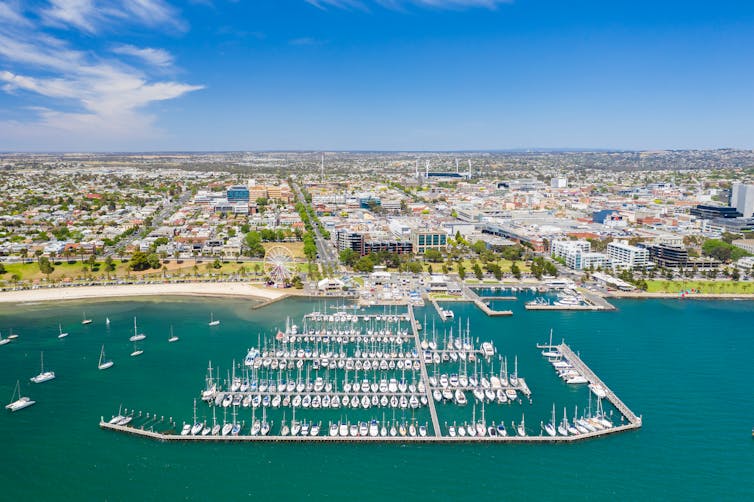
aerial view of Geelong looking inland from the bay
Most households would prefer to live in a large regional coastal city, such as Geelong, if they can find suitable work there.
Shutterstock


Read more:
‘Let’s just do it’: how do e-changers feel about having left the city now lockdowns are over?


Businesses still love the CBD

To discover the impacts of the pandemic on residential and business location choices, we surveyed over 2,900 households and 900 businesses Australia-wide in 2022 and 2023. We coupled this with extensive interviews and focus groups. We also examined multiple datasets.

We found businesses still want CBD locations in the largest capital cities. They believe regional centres lack access to the high-quality premises, labour and markets they need to succeed.

Businesses are willing to pay an extra $700 per square metre a year to be in a capital city CBD rather than a suburb in the same city. (This is significantly higher than current differentials in market rents).

The short-term impacts of the pandemic and lockdowns were especially harmful for businesses in capital city CBDs. Some 11% of these businesses reported downsizing, compared to 4% in regional cities.

However, we predict high levels of CBD vacancies that occurred through the pandemic won’t last. We found the underlying demand for commercial real estate in CBDs is still strong.

While predictions that Melbourne and Sydney will remain our most populous cities are strong, we have evidence that the pandemic has eroded their relative attractiveness. Brisbane has emerged as the most attractive destination for businesses. Adelaide and Perth have held steady, compared to pre-pandemic trends, and Melbourne and Sydney are now less favoured than before.
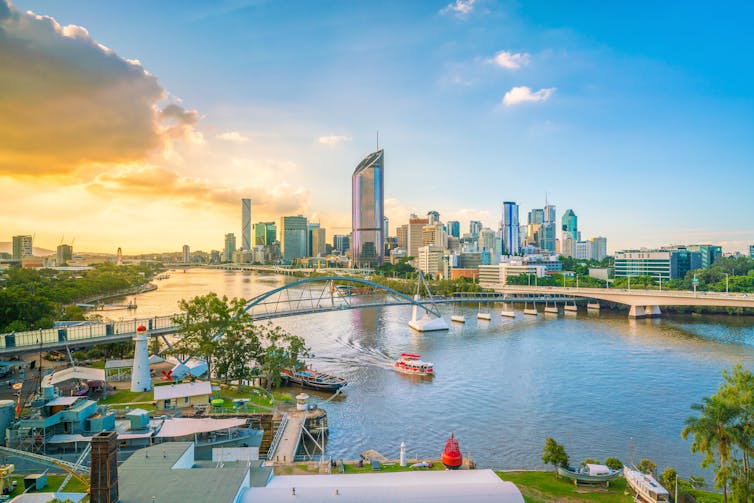
View across river of Brisbane CBD at twilight
Brisbane is emerging as a preferred location for businesses.
Shutterstock


Read more:
‘We haven’t built it, and they’ve come’: the e-change pressures on Australia’s lifestyle towns


I’m working from home. Where will I get my coffee?

In terms of where people prefer their homes to be, the pandemic has increased the relative long-term popularity of middle and outer suburbs, at the expense of inner-city neighbourhoods. Workers strongly prefer suburban locations roughly 10km from the CBD. People not in the workforce want much more distance between them and the CBD – they prefer around 20-35km.

Our research shows uptake of remote work has stabilised at 20-25%. This is much higher than the pre-pandemic levels of 2-8%.

With more people working from home, and more preferring suburban neighbourhoods and the quality of life they offer, our dependence on the retail shops and restaurants associated with inner-city life will be reduced. In the long term, this is likely to change the composition of CBDs and move some of these supporting services to the suburbs. In other words, the more time we spend at home, the more services we need nearby, including a range of local choices in barista coffee.

While Melbourne and Sydney remain our most populous cities, since the pandemic, Brisbane, Adelaide and Perth have become Australia’s most popular capital city destinations for residents. With these cities being attractive to both residents and businesses, we are likely to see growth in Brisbane, Adelaide and Perth.

Conceptual framework of how pandemic-related long-term changes are likely to affect business and residential location patterns.
Conceptual framework of pandemic-related long-term changes that are likely to affect business and residential location patterns.
Source: Authors


Read more:
Regional Australia’s time has come – planning for growth is now vital


Two waves of decentralisation

The combined effect of residential and business preferences means there are likely to be two waves of population decentralisation. Large coastal cities near the capitals are likely to benefit most from this.

In the short term, people not in the workforce and those with fully remote jobs will lead the first wave of population decentralisation. Without being tied to a work site, they are free to pursue the benefits of living in a regional location.

Then, as people move, jobs and businesses will follow. The result will be a second wave that includes a broad range of people, including those with jobs that cannot be done remotely.

These two waves of decentralisation will lead to population movement out of inner-city addresses, and growth in the suburbs. Large urban areas such as Sydney and Melbourne will continue to expand. Capital cities will swallow up surrounding smaller cities such as Wollongong and Newcastle.

And what about the wide verandas of our small, remote inland cities? Without industry diversification and government intervention, these places are unlikely to benefit from the predicted population and economic growth.


Read more:
Why do small rural communities often shun newcomers, even when they need them?


The Conversation

Akshay Vij receives funding from the Commonwealth of Australia as represented by the Department of
Infrastructure, Transport, Regional Development, Communications and the Arts (DITRDCA); and the
iMOVE Cooperative Research Centre (CRC)

Lynette Washington does not work for, consult, own shares in or receive funding from any company or organisation that would benefit from this article, and has disclosed no relevant affiliations beyond their academic appointment.

ref. Wide verandas, picket fences or the CBD? How coastal cities near the capitals could ride post-COVID waves of growth – https://theconversation.com/wide-verandas-picket-fences-or-the-cbd-how-coastal-cities-near-the-capitals-could-ride-post-covid-waves-of-growth-210716

Disease in the dirt: how mange-causing mites decimated a Tasmanian wombat population

Source: The Conversation (Au and NZ) – By Scott Carver, Associate Professor, Wildlife Ecology, University of Tasmania

More than 80% of Australian mammals are found nowhere else in the world. Many of these unique, iconic creatures are under threat.

The most important and well-known threats are invasive species (such as cats and foxes) and human-driven changes to the environment (such as land clearing and climate change).

Invasive pathogens – parasites, viruses, bacteria, fungi – often attract less attention, but they too can pose a significant threat to native animals.

Take sarcoptic mange, a parasitic disease that affects mammals around the world. In a new study published in the journal Biology Letters, we report on a sarcoptic mange outbreak in a population of bare-nosed wombats in central Tasmania, which caused a population decline of more than 80%.

What is sarcoptic mange, and where did it come from?

Sarcoptic mange is caused by the parasitic mite Sarcoptes scabiei, which burrows into the skin. These mites are happy to infest many mammals, including humans (in which case the disease is called scabies).

A microscope image showing a tiny translucent bug.
A Sarcoptes scabiei mite seen under the microscope.
Arthur Goldstein / Wikimedia, CC BY-SA

Research suggests the spread of the mites around the world is associated with European colonialism, although where they originally evolved is uncertain. In Australia, the mites were likely introduced multiple times over the past 230 years.

In southern Australia, sarcoptic mange is mostly a concern for wildlife health. It can be deadly to bare-nosed wombats, as well as some other species including koalas and quenda (also known as western brown bandicoots). In tropical northern Australia, scabies is a significant (although rarely life-threatening) human health issue.

How does sarcoptic mange spread among solitary wombats?

In some animals, the mange-causing mites move directly from one animal to another when the animals come into direct contact. However, wombats are relatively solitary. It is rare for them to touch one another outside of mating.

Nevertheless, the mites still spread via “environmental transmission”. Wombats change burrows quite frequently, usually staying in one burrow for somewhere between one and nine days before changing.

When a mite-infested wombat stays in a burrow, it leaves some mites behind. Research shows mites can survive in the cool, humid soil of the burrow for between five and 16 days. If another wombat comes along during this period, the mites have found themselves a new host.

The ratio of wombats to burrows may be the key

When scientists study how pathogens are transmitted among animals, we often assume it will depend on the population density of the animals in question. At higher densities, individual animals come into contact more often so the pathogen is more likely to spread. And if population density is too low, a pathogen may “die out”.

However, it’s a different story for environmentally transmitted pathogens like S. scabiei. In our research, we found individual wombats continued to be infected and diseased even when population density declined.

Our research suggests the number of burrows per wombat likely influences how often they can encounter mites in the environment.

Because infested burrows are the likely source of the infections, the number of available burrows per wombat should be a more important determinant of whether a population decline from sarcoptic mange occurs.

How big a problem is sarcoptic mange?

Our study is the third formally documented decline in a bare-nosed wombat population from a sarcoptic mange outbreak.

Does this mean bare-nosed wombat populations are threatened everywhere by this invasive pathogen – or even worse, at risk of going extinct? This does not appear to be the case.

There is no doubt mange causes immense suffering to wombats and is a serious wildlife health issue. However, a combination of factors such as wombat-to-burrow ratios and environmental conditions mean declines appear to be occasional events.


Read more:
Mangy marsupials: wombats are catching a deadly disease, and we urgently need a plan to help them


Understanding the spread and effect of the disease is not simple, but a growing body of research is revealing why some wombat populations are free of sarcoptic mange, some have disease but don’t decline, and why occasionally some do decline.

Another finding of our study was a potential indicator of the risk of population decline from sarcoptic mange. When more than 25% of a population show signs of the disease, based on systematic population surveys from multiple studies, it may mean population decline is possible.

What can be done?

Can anything be done to help wombats and other wildlife affected by sarcoptic mange? The answer is yes for individual wombats and sub-populations, but not yet for larger scales.

Across southeast Australia a significant number of wildlife carers, rehabilitators, and rescue organisations make important contributions to the welfare of bare-nosed wombats. A small number of researchers also work on the issue, and the health of wombats has increasingly been supported by investments from state governments and industry, particularly over the past decade.

Help for wombats is predominantly through the use of treatments delivered to captive and wild individuals.


Read more:
What’s happening to the southern hairy nosed wombats?


There are significant practical challenges in treating free-living wombats. To improve the chances of success, decisions must be made based on data and with collaboration among all stakeholders. Indeed, the last decade has seen significant advances through collaboration, research and engagement that are benefiting wombats.

There are also challenges that persist, such as confirmation-biases leading some well intended wildlife groups to treat sarcoptic mange in wombats with drug doses many times higher than the needed or recommended amount. This can have unintended results, such as toxicity to the wombat, pharmaceuticals entering the environment, and mites developing a resistance to the drugs.

The Australian Pesticide and Veterinary Management Authority makes important decisions about granting permits for management of mange in wombats. The authority must be astute in interpreting the strengths and limitations of evidence when making these decisions, and seek input where additional expertise is needed.

The Conversation

Scott Carver has received funding toward understanding and managing the impacts of sarcoptic mange in wombats from the Australian Research Council, state governments in Tasmania, ACT and NSW, local government in Tasmania, wildlife organisations, private industry, and philanthropic donations.

ref. Disease in the dirt: how mange-causing mites decimated a Tasmanian wombat population – https://theconversation.com/disease-in-the-dirt-how-mange-causing-mites-decimated-a-tasmanian-wombat-population-211992

Benny Wenda says dream of MSG full membership ‘will happen’ in Port Vila

By Kelvin Anthony, RNZ Pacific journalist in Port Vila

The leader of the United Liberation Movement for West Papua (ULMWP), Benny Wenda, has expressed confidence that the leaders’ meeting in Vanuatu will grant the ULMWP full membership of the Melanesian Spearhead Group.

Wenda is in Port Vila for the 22nd MSG Leaders’ Summit, the first full in-person MSG Leaders’ Summit since 2018.

“I’m really confident,” he said, adding “the whole world is watching and this is a test for the leaders to see whether they will save West Papua.”

MSG chair and Vanuatu Prime Minister Alatoi Ishmael Kalsakau has confirmed the ULMWP’s application to become a full member will be a top priority for the leaders.

Wenda told RNZ Pacific the West Papua liberation movement has been lobbying to be part of the MSG’s agenda for more than a decade, without success. The movement currently has observer status within the MSG.

However, he believes this year they are finally getting their chance.

Wenda said all branches of the ULMWP were in Port Vila, including the West Papua Council of Churches and tribal chiefs, and “we are looking forward to becoming a full member”.

“That’s our dream, our desire. By blood, and by race, we’re entitled to become a full member,” he said.

Indonesia, an MSG associate member, is also present, with the largest delegation of all countries in attendance at the meeting.

Benny Wenda at the 22 Melanesian Spearhead Group Leaders' Summit in Port Vila. 22 August 2023
ULMWP leader Benny Wenda (left) with the ULMWP interim prime minister at the 22nd Melanesian Spearhead Group Leaders’ Summit in Port Vila yesterday. Image: RNZ Pacific/Kelvin Anthony

RNZ Pacific has been in contact with an Indonesian official for an interview in Port Vila.

Benny Wenda said they were not asking for independence, but to become a full member of MSG.

“We’ve been killed, we’ve been tortured, we’ve been imprisoned [by Indonesian security forces],” he said.

Members of the Indonesian delegation at the Melanesian Leaders' Summit pre-meeting of the Foreign Ministers' in Port Vila. 21 August 2023
Members of the Indonesian delegation at the Melanesian Leaders’ Summit pre-meeting of the Foreign Ministers in Port Vila this week. Image: RNZ Pacific/Kelvin Anthony

‘No hope’ in Indonesia
“So, it’s live with Indonesia for 60 years and there is no hope. We’re not safe. That’s why it is time for the [Melanesian Leaders’ Summit] to make a right decision.”

Wenda said it was “unusual” for Indonesia to bring “up to 15 people” as part of its delegation.

Melanesian leaders, he said, were capable of dealing with their regional issues on their own.

“Why are [Indonesia] here — [what] are they scared about,” he asked.

“When we become full members we are ready to engage [with Indonesia] and find a solution, that is our aim. This is a part of a peaceful solution.”

This article is republished under a community partnership agreement with RNZ.

West Papuan rallies in support of membership
Meanwhile, an ULMWP statement reports that thousands of POapuans held peaceful rallies throughout the territory of West Papua yesterday in support of the ULMWP application for full MSG membership.

“This action was held in order to support the full membership agenda of the United Liberation Movement for West Papua (ULMWP) in the Melanesian Spearhead Group (MSG),” the statement said.

The rallies were held simultaneously in all the seven regions of the West Papua government.

In the Lapago Region, thousands of Papuans took to the streets of Wamena City and gathered at the Sinapuk-Wamena field to deliver a statement.

“The masses came down wearing various traditional clothes and dyed their bodies with the Morning Star flag pattern and the five permanent member flags of the MSG.

“They also carried and waved a number of flags from the Melanesian member countries — Fiji, Solomon Islands, Vanuatu, PNG and Kanaky (FLNKS), including the flag MSG flag.”

Support rallies also took place in the Lapago region in several districts such as Puncak Jaya, Tolikara, Gunung Bintang and Lani Jaya regencies.

Print Friendly, PDF & Email

Article by AsiaPacificReport.nz

‘My brother will pick it up, what’s your PayID?’ How to avoid this scam when selling stuff online

Source: The Conversation (Au and NZ) – By Cassandra Cross, Associate Dean (Learning & Teaching) Faculty of Creative Industries, Education and Social Justice, Queensland University of Technology

Jenny Ueberberg/Unsplash

You’ve done it. You’ve finally bought that new sofa you wanted so much. The old one is still perfectly good to sit on, so you jump online to try and get a little bit of cash for it.

Every day, thousands of Australians list their unwanted things on online trading sites such as Facebook Marketplace and Gumtree. It’s a fast and convenient option, not to mention it helps us to divert goods from landfill.

Unfortunately, scammers constantly target unsuspecting buyers and sellers. More than A$45 million was reported lost through fraudulent buying and selling schemes in 2022.

The popularity of online marketplaces has made them a fertile ground for fraudsters. There have been recent reports of offenders using these platforms to physically attack those selling goods.

However, it is more likely scammers will try to gain money through payment methods. The PayID scam is a popular example of this, with Australians losing more than $260,000 through this specific approach in 2022.

What is PayID?

PayID is a legitimate form of electronic payment introduced in Australia in 2018 to overcome incorrect payments as well as reduce fraud – by showing the recipient’s name to the person making the transaction. It aims to simplify the transfer of money. Importantly, PayID reduces the need to remember bank account and BSB numbers, and overcomes the issue when these are entered incorrectly.

To set up a PayID, consumers can use their phone number, email address or ABN as a form of identification. The bank will verify the person owns this information, and then link the person’s bank account to this unique identifier.

A black and blue text box outlining how the service works and warning people it has been the target of scams.
Screenshot of the official PayID website.
PayID, CC BY-SA

To transfer money using PayID, most online banking systems will ask for the PayID of the recipient. By simply typing in the phone number, email address or ABN, it will show the name of the intended recipient. If it is correct, the customer can authorise payment to be made. If the name shown is incorrect, the customer can easily cancel the transaction.


Read more:
PayID data breaches show Australia’s banks need to be more vigilant to hacking


How does the PayID scam work?

If you’re advertising an item online, a scammer will make contact to purchase the item. They usually will not question the price, and they are unlikely to even want to view the item. In many cases, they will say a family member or friend will collect it from you.

The offender will then urge you to accept payment through PayID. Once you’ve shared your PayID (usually phone number or email address) and the scammer has this information, a few things may happen.

Two messages in various styles stating a family member will pick up an item and asking for payID details
Examples of PayID scam messages received via Facebook Marketplace.
The Conversation, CC BY-SA

The offender will say they have made the payment, but it cannot be processed because you don’t have a suitable PayID account. You will be told you either need to “upgrade” the account and/or make an additional payment to release the funds.

The offender will then say they have paid the extra amount required and ask you to reimburse the additional funds they have spent. If you do transfer any money, it will go straight to the scammer and be lost.

As part of this, offenders will create text messages and emails that appear to be from PayID, confirming payments or advising of problems. Scarily, such messages may even appear in an existing SMS thread with your bank. You may think they are genuine, but they are fake, designed to deceive you into transferring money to the offender.


Read more:
Scammers can slip fake texts into legitimate SMS threads. Will a government crackdown stop them?


How do I avoid a PayID scam?

There are several warning signs to look out for when selling goods online:

  • PayID is a free service. There are no costs associated with using it, and therefore no fees will ever need to be paid

  • PayID is administered through individual banks. PayID will never communicate directly with customers through texts, emails, or phone calls. Any correspondence which says it is “from PayID” is fake

  • a genuine buyer will usually inspect and collect any goods. A buyer who says they will send a family member or friend to collect the item is a red flag, especially if they are unwilling to pay in cash.

What to do if you have been scammed?

If you think you have been a victim of a PayID scam, you should contact your bank or financial institution immediately. The quicker you can do this, the better.

You can report any financial losses to ReportCyber, an online police reporting portal for cyber incidents.

You can also report the incident to Scamwatch to assist with education and awareness activities.

If you have had any of your personal information compromised, you can access support from IDCARE.

In 2023 so far, Australians have reported more than $32 million lost to buying and selling schemes, including the PayID scam. Stay vigilant when buying or selling goods online, and consult the Scamwatch website for details on other types of scams.


Read more:
Being bombarded with delivery and post office text scams? Here’s why — and what can be done


The Conversation

Cassandra Cross has previously received funding from the Australian Institute of Criminology and the Cybersecurity Cooperative Research Centre.

ref. ‘My brother will pick it up, what’s your PayID?’ How to avoid this scam when selling stuff online – https://theconversation.com/my-brother-will-pick-it-up-whats-your-payid-how-to-avoid-this-scam-when-selling-stuff-online-211665

A male character on Heartstopper has an eating disorder. That’s more common than you might think

Source: The Conversation (Au and NZ) – By Vivienne Lewis, Assistant professor – Psychology, University of Canberra

Netflix

Season two of the series Heartstopper on Netflix brings out an issue that is often hidden – male eating disorders. Centred on two teenage boys in love, the show helps bust the common perception that eating disorders are only seen in girls and women.

In one episode of the series, based on a series of graphic novels, Nick asks Charlie about his eating because he is becoming worried about him. Charlie responds, saying

Some days I’m fine and other days I control it. I used to do it a lot last year when everything at school was really bad. Sometimes it feels like the only thing I can control in my life.

Although under represented in research, statistics indicate one third of people with an eating disorder are male and body image in boys is a major concern. Eating disorders affect mental and physical health. Shame and stigma are among the reasons people who identify as male don’t seek help.

A range of disorders

Body dissatisfaction comes from not liking one’s size, shape and weight and leads some boys and men down the dangerous path to an eating disorder.

An eating disorder is an unhealthy relationship with one’s body and eating and includes such disorders as anorexia nervosa (fear of weight gain and deprivation of food), bulimia nervosa (which typically involves eating large amounts and then purging) and binge-eating disorder.

Binge-eating disorder is the most common of these for both males and females. It involves a preoccupation with eating, often rapidly, an amount of food much greater than someone would eat in a short amount of time, to the point of feeling uncomfortable. Disgust with oneself often follows in the aftermath.

What drives it

This obsession with one’s body and its perceived faults comes from our society’s obsession with appearance particularly around a person’s weight, size and shape.

Male media images promote an idealised body that is often unattainable. Seeing one’s own body as inferior in comparison can lead to attempts to change it.

Over half those diagnosed with an eating disorder also receive a diagnosis for at least one psychiatric disorder such as depression, anxiety disorders (including obsessive-compulsive disorder), post-traumatic stress disorder and personality disorders. This makes treatment even more complex.

Other factors involved in the development of an eating disorder can be parental or peer teasing about appearance, especially about weight. Poor self esteem, a need for control (as articulated by Heartstopper character Charlie), experiencing sexual trauma and identity disturbance are also drivers. Eating disorders are more common for LGBTIQ+ people.


Read more:
When I work with people with eating disorders, I see many rules around ‘good’ and ‘bad’ foods – but eating is never that simple


Dangerous methods

Boys and men may engage in dieting and other weight-loss methods to try and change or control their body. They may also exercise excessively. Some may even turn to drugs to try and alter their body.

They can become consumed by thoughts about their body to the detriment of their schooling, socialising, work, family life and physical health, not to mention the financial impact.

Eating disorders are detrimental to a person’s physical health with increased risk of injury due to over exercising, rotting teeth due to purging, osteoporosis due to calcium loss and unstable hormones. They can be deadly, causing heart attack, malnourishment, liver and kidney issues, gastrointestinal disturbances, loss of fingers and toes due to poor circulation, as well as death by suicide.

Getting help early

Early intervention is the key to fostering a positive body image and self-esteem in young males. This involves recognition by parents, teachers and peers of unhealthy talk about and behaviour towards one’s body and eating.

Warning signs might include skipping meals, excessive time spent on grooming, social avoidance, body consciousness and appearing sad and anxious. Education in schools about eating disorders helps young people understand what eating disorders are and normalises help-seeking.

As adults, we need to be aware our talk about dieting and comments about people’s bodies is influential. So is modelling healthy eating and exercising behaviour.


Read more:
Some Ozempic users say it silences ‘food noise’. But there are drug-free ways to stop thinking about food so much


Doctors and health professionals need to be better educated on warning signs and what to look out for in their male patients and clients. Teachers and parents can learn more and be on the look out for signs too.

Early intervention is backed by evidence but help often comes too late. People who get help early, particularly in their adolescent years when eating disorders often first start, have a good success rate with the right treating team. This usually consists of a doctor, psychologist, dietitian and psychiatrist.

Families and people with eating disorders can find treatments and support in both the public and private sectors. Enhanced cognitive behavioural therapy is usually used. It involves changing destructive behaviours and thoughts around the body, self and eating so a person can become healthier and happier. Family-based approaches for children and adolescents are also used to counter behaviour such as food refusal. Of course, as with many mental health conditions, more funding for more support services is needed.

If you or someone you know may be suffering from an eating disorder getting help fast is important before the eating disorder really takes hold. If you are worried about a friend, talk to an adult, such as a teacher or school counsellor. Starting a conversation with someone to ask them if they’re OK, how they are feeling and showing a non-judgmental attitude is also key. The character of Nick models this well on Heartstopper.

Education about and becoming more aware of this issue and knowing how to get help is critical. As is reducing the stigma often associated with male eating disorders.

If this article has raised issues for you, consider contacting the Butterfly Foundation on 1800 33 4673 or Lifeline on 13 11 14.

The Conversation

Vivienne Lewis is a Clinical Psychologist working with people of both genders with eating disorders. She has recently written a book to assist health professionals and trainees working in this field called Eating Disorders – A practitioner’s guide to psychological care.

ref. A male character on Heartstopper has an eating disorder. That’s more common than you might think – https://theconversation.com/a-male-character-on-heartstopper-has-an-eating-disorder-thats-more-common-than-you-might-think-211912

Better than net zero? Making the promised 1.2 million homes climate-friendly would transform construction in Australia

Source: The Conversation (Au and NZ) – By Jason Alexandra, Senior research fellow, Institute for Climate, Energy and Disaster Solutions, Australian National University

The national cabinet has announced plans to build an extra 1.2 million homes by July 1 2029. The construction, operation and maintenance of buildings accounts for almost a quarter of greenhouse gas emissions in Australia. If these new homes are built in a business-as-usual fashion, they will significantly increase national greenhouse gas emissions.

What if we committed to building homes that produced net negative emissions?
Put simply, such buildings remove more carbon dioxide (CO₂) from the atmosphere than are emitted during their lifecycle. This includes emissions from producing building materials and construction through to the end of building life and demolition.

Building net-negative-emissions homes can be done. Examples have already been built overseas.

Building these homes in Australia would do much more than reduce national emissions. It would be a tangible symbol of our commitment to integrated problem-solving, in this case involving both housing and a climate-friendly future. We could produce houses that are part of the climate solution, not a big part of the problem.


Read more:
National Cabinet’s new housing plan could fix our rental crisis and save renters billions


So how do we build these homes?

Building homes that reduce rather than add to CO₂ emissions will require different planning, design, materials and construction methods.

For a start, the orientation of the buildings will have to be improved. In southern Australia, for example, ensuring living areas face north will reduce the need for heating by achieving greater sun exposure in winter. In summer, shade from the eaves of rooftops or awnings will help keep the home cool.

The design would use passive house principles. These require much better insulation to keep heat in during winter, and out during summer. Building airtight homes – known as a tight building envelope – avoids unwelcome heat gain or loss.

A house built like this massively reduces energy use in both winter and summer. Better thermal comfort is good for the occupants’ health too.


Read more:
Feeling frozen? 4 out of 5 homes in southern Australia are colder than is healthy


Better planning includes providing tree cover and green space to moderate increasingly extreme temperatures and flooding. Tree cover and green space also encourage active travel such as walking and cycling, which has many benefits.

Using materials such as low-emission concrete and negative-emission plasterboard, which absorbs CO₂ from the air, can reduce the emissions associated with construction. Homes with solar panels or solar tiles, integrated with batteries and all-electric appliances, can produce more energy than they use during their operation. They’re budget-friendly too.

At the end of the building’s life, recycling the materials in a circular economy will reduce waste. Currently, building activity accounts for 40% of our landfill waste.


Read more:
Turning the housing crisis around: how a circular economy can give us affordable, sustainable homes


Have we the capacity to do most of this right now? Yes. Examples of buildings with low, zero or negative net emissions already exist in the United Kingdom and the European Union.

And more options are coming online every day. There are so many opportunities to demonstrate best practice and produce houses of the future efficiently.

Even now, sustainable buildings cost little more upfront. The premium for sustainability ranges from -0.4% to 21% compared to a conventional building. And they save from 24% to 28% on running costs over their lifetime.

View of cycle path, benches and gardens running along the edge of white modern apartment buildings
In the 116-hectare Bahnstadt development in Germany, every building complies with passive design principles – from apartments and laboratories to shops, daycare facilities and schools, even the fire station and cinema.
HDValentin/Wikimedia Commons, CC BY-SA

And what is the role of government?

The benefits of aiming for net-negative-emissions housing are many. It would reskill the building sector, generate new industries, build confidence in public policy, boost national pride and show that governments can solve problems in ways that tackle social equity, health and environmental concerns.

However, realising such ambitions requires action on several fronts.

First, it requires political will to take ambitious action on climate change. Implementation calls for skilful execution and sharing of risks between government and industry. This can be done by, for example, subsidising training and certification in the use of new building materials and approaches and supporting the industry to make these changes.

Climate-friendly building technology is now demonstrated in buildings across Australia. Building 1.2 million homes that use such technology would scale it up, driving down costs. Building this many climate-friendly homes would be good for developing future-ready trade and professional skills and the capacity of the local building industry supply chain.

Second, the Commonwealth would need to adopt clear targets and criteria. The states, territories and building industry should then be left to work out how best to meet them in different local circumstances.

Third, any national housing programs should be a catalyst for good design and innovation in construction. This includes mandating emission and energy targets for the promised new housing stock. For example, New Zealand mandates that new buildings are constructed to provide thermal resistance.

New housing programs should also promote innovative designs. This could include sponsoring prizes for excellence in sustainable housing.


Read more:
How ‘net-zero’ and ‘passive’ houses can cut carbon emissions — and energy bills


Fourth, new housing programs should deliver system-wide solutions integrated with energy and water networks. Progress has begun on updating urban systems in line with climate-friendly design principles for water and energy.

For example, Hornsby Shire Council has been applying water-sensitive urban design principles since the 1990s through the use of rainwater tanks, biofilters and raingardens, stormwater harvesting and wastewater recycling and reuse. The ACT government has adopted these principles in its Territory Plan.

The knowledge exists to create suburbs that generate and store their own electricity. Community batteries are operating in North Fitzroy and in suburbs across Western Australia. The ACT has plans for a community battery serving the whole territory.

As anyone with a mortgage knows, houses are long-term commitments. Building all of the promised 1.2 million homes in a future-friendly way would show our governments recognise both the long-term imperative of climate action and this immediate opportunity.

The Conversation

The authors do not work for, consult, own shares in or receive funding from any company or organization that would benefit from this article, and have disclosed no relevant affiliations beyond their academic appointment.

ref. Better than net zero? Making the promised 1.2 million homes climate-friendly would transform construction in Australia – https://theconversation.com/better-than-net-zero-making-the-promised-1-2-million-homes-climate-friendly-would-transform-construction-in-australia-211825

Can I take my child out of school to go on a holiday?

Source: The Conversation (Au and NZ) – By Brian Moore, Lecturer, Educational Psychology & Child Development, School of Education, Charles Sturt University

Shutterstock.

As the school term stretches on, many parents might be tempted to take their children out of school. Perhaps they want to beat the crowds at the snow or enjoy off-season prices at the coast. Maybe they just need a break.

As parents, we have certainly experienced this dilemma.

But what are the rules around taking your child out of school in term time? And is it a good idea?

You do need to send your child to school

The precise rules around school attendance differ slightly from state to state. But by law you are required to send your child to school every day.

For example, in New South Wales, the state Education Act says

all students who are enrolled at school, regardless of their age, are expected to attend that school whenever instruction is provided.

The act also says parents are responsible for ensuring their children attend school and must explain absences within seven days. It’s an offence not to send your child to school and parents can be prosecuted.

Habitual school absences can be considered a form of neglect. This is defined as “a minimum of 30 days absence within the past 100 school days”. However, this should only be taken as a guide, because “a range of contextual factors may impact the level of risk”.

Obviously if a child is sick and cannot attend school, it will not be counted. There are some other exemptions, such as if a student is employed in the entertainment industry or participating in elite arts or sports events.

But exemptions around travel are less clear cut.

The NSW Department of Education and NSW Association of Independent Schools both say travel does not qualify as an exemption. However, principals can approve leave on a case-by-case basis. In the public system, if students are away for more than 100 days, a senior education department employee needs to provide approval.

The Catholic Education Office says “extended absence in relation to children of travelling families” may be a “reasonable excuse”.

For longer trips, such as taking students out of school for a term or a year, families can consider home schooling or distance education.

A man makes a snow angel in the snow, surrounded by a child and a woman.
Parents are supposed to make sure their kids go to school during term time.
Shutterstock

Why a trip can be a good idea

There can be educational benefits around taking your child out of school in term time. There is potential for learning that cannot be easily replicated in schools.

Education psychologists Jerome Bruner and Jean Piaget developed “discovery learning”, believing it is best for learners to discover facts and relationships for themselves. For example, visiting Uluru and taking a tour with local First Nations groups is arguably a better way to learn about Indigenous cultures and history than by reading about them in a book.

This approach can see children develop deeper conceptual understanding, stronger interest in particular topics and an increased sense of responsibility for their own learning.

School excursions are an example of experiential learning, and depending on what trip you’re planning, you might be able to provide your child with invaluable experiences.

Of course, it’s important to note teachers still have a role in this type of learning. They know how to ask the right questions, guide, support, and make connections between real-world and theoretical learning.

So it is not necessarily “educational” to simply present an experience and leave it at that.

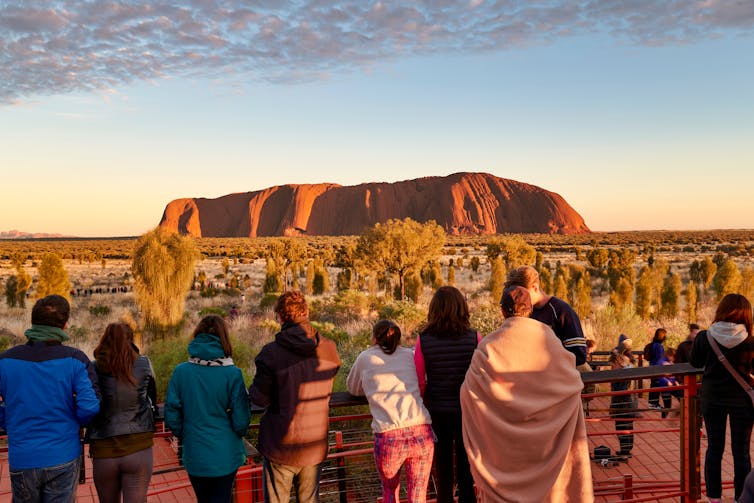
Tourists watch the sun rise over Uluru.
Travel can provide students with learning experiences they will not have in the classroom.
Shutterstock


Read more:
‘I spoke about Dreamtime, I ticked a box’: teachers say they lack confidence to teach Indigenous perspectives


Potential negatives

It’s also important to be aware of potential negatives when planning to take your child out of school in term time.

When students miss school, they miss lessons and fall behind. There is a wide body of research on the relationship between school attendance and academic achievement, with some studies suggesting school attendance is the best predictor of academic achievement. While there isn’t a specific threshold here, more absences are associated with higher failure rates.

In some instances, taking your child out of school could exacerbate any school refusal tendencies when they return to school. If your child already has a fear of separation, tests, or just being at school, taking them out for an unscheduled break could unintentionally reinforce this pattern of behaviour.

It may also impact the development of social skills. School refusal in early schooling is correlated with more negative social behaviours such as a lack of cooperation and self-control and increased aggressive behaviours.


Read more:
You can’t fix school refusal with ‘tough love’ but these steps might help


But is a cheeky long weekend OK?

Taking a mini break or even a longer holiday can provide opportunities for family rest, relaxation and bonding (even though at times, we may question our sanity for choosing to do so).

There is no clear answer around taking your child out of school during term time. It will of course depend on what you are planning to do and for how long. And on your family circumstances.

But it is important to remember the value of setting positive attendance habits early. If children are missing school frequently or for long periods, there is likely to be an impact on your child’s learning. Make sure you contact your school beforehand, so any leave or exemptions can be discussed and approved.

You might be tempted to ask your child’s teacher to provide work to complete while travelling. While COVID school closures may have normalised teachers providing detailed lessons for home use, we’d suggest this now goes beyond the scope of a teacher’s job description.

You might also be tempted to fulfil this role yourself (and all the power to you), but as was also observed during lockdowns, the role of teaching is easier said than done.

The Conversation

The authors do not work for, consult, own shares in or receive funding from any company or organization that would benefit from this article, and have disclosed no relevant affiliations beyond their academic appointment.

ref. Can I take my child out of school to go on a holiday? – https://theconversation.com/can-i-take-my-child-out-of-school-to-go-on-a-holiday-211103

Higher prices have hit most people but homeowners have felt it harder than renters

Source: The Conversation (Au and NZ) – By Ben Phillips, Associate Professor, Centre for Social Research and Methods, Director, Centre for Economic Policy Research (CEPR), Australian National University

This article is part of The Conversation’s series examining Australia’s cost of living crisis. Read the other articles in the series here.


Cost of living pressures are acute for some, but in different ways for different types of household.

The Australian Bureau of Statistics consumer price index has climbed by 6% per year for each of the past two years.

In the decade before that, it only climbed by an average of 1.8% per year.

So, on the figures, cost of living pressures suddenly became acute, but if you had been paying attention to the media for those previous ten years you would have thought Australia had been in a cost of living crisis the entire time.


Some people have been under financial pressure the entire time, but it’s instructive to look at whose living costs have increased the most.

The best guide is a different set of indexes to the consumer price index, also produced by the bureau.

Called selected living cost indexes, they are better because they include mortgage costs, which the consumer price index does not, measuring the cost of home ownership by the cost of purchasing a home instead of the upfront cost of building a new home.

The bureau presents living cost indexes based on the spending patterns of:

  • employees

  • beneficiaries on pension-like payments

  • beneficiaries on other payments including JobSeeker

  • age pensioners

  • self-funded retirees.

But it turns out the main factor that differentiates the new price pressures facing households is whether or not they have a mortgage, and in particular how recently they bought their first home.

At the Australian National University, my team has used the Bureau of Statistics’ methodology and data to calculate cost indexes based on the spending patterns of different types of households including those headed by:

  • first homebuyers and recent buyers who’ve bought in the past three years

  • all homeowners with a mortgage

  • outright owners

  • renters.

Homeowners with a mortgage turn out to have experienced a very large cost increase over the past two years of 17.5% – much more than renters who have had an average increase of “just” 10.8%, and outright owners who’ve had 11.7%.

First homebuyers who bought within the past three years faced the biggest living cost increase, of 20.5%. Those who bought within the past three years but were “changeover” buyers had an increase of 18.4%.


Younger Australians (under 35) are more likely to rent than have a mortgage. As a result, their costs increased by “only” 13.1% over the past two years, whereas the living costs of older Australians (aged 50–64) increased by 15.1%.

Perhaps for the same reason, the living costs of group households increased by “only” 13.1%, while the living costs of couples with children increased 15.2%.

Those on benefits are best protected

We found very little difference in the percentage cost of living increase based on income level alone, and also very little difference based on gender. But the source of income mattered.

Households whose main income was wages suffered cost increases of 14.6%, whereas households whose main income was government benefits had a lesser increase of 12.7%.


Read more:
Rent crisis? Average rents are increasing less than you might think


Each of these increases was far more than the average increase in incomes of 4.7%, but Australians on benefits got much bigger increases in incomes because their payments were linked to the consumer price index, meaning their incomes increased roughly in line with their costs.

Longer term, renters, homeowners treated the same

Although in the past two years costs have turned against mortgage holders more than renters and outright owners, this isn’t the case in the longer term.

The first years of COVID, 2020 and 2021, were especially good for mortgage holders (and renters), with mortgage rates (and rents) cut to long-term lows after years of very little growth.

The chart below shows that over the longer term, the living costs associated with all three types of housing have climbed more or less together, and have climbed by less than household income.


This isn’t to say those households whose living costs have climbed sharply over the past two years (mortgaged households) are suffering. Many have built up significant financial buffers in the years when interest rates were ultra-low, and many have high incomes and substantial wealth.

Nor is it to say that those households whose living costs have increased less sharply (renters) are not suffering.

Lower-income households, single parents and welfare recipients’ households were in the greatest financial stress five years ago, 10 years ago and 20 years ago, and remain in the greatest financial stress today.

The Conversation

Ben Phillips does not work for, consult, own shares in or receive funding from any company or organization that would benefit from this article, and has disclosed no relevant affiliations beyond their academic appointment.

ref. Higher prices have hit most people but homeowners have felt it harder than renters – https://theconversation.com/higher-prices-have-hit-most-people-but-homeowners-have-felt-it-harder-than-renters-211200

Champagne is deeply French – but the English invented the bubbles

Source: The Conversation (Au and NZ) – By Garritt C Van Dyk, Lecturer, University of Newcastle

In 1889, the Syndicat du Commerce des Vins de Champagne produced a pamphlet promoting champagne at the Exposition Universelle in Paris, claiming that Dom Pérignon, procurator of the Benedictine Abbey of Hautvillers from 1668, was the “inventor”, “creator” or discoverer” of sparkling champagne.

“Come, Brothers! I drink stars!” is the famous quote often attributed to him.

The story of a blind monk having an epiphany, accidentally happening upon the secret to effervescence, was seductive. It combined divine revelation and French winemaking expertise to produce a national symbol deeply rooted in the French landscape.

However, the truth is slightly different. Dom Pérignon did contribute to improving the still wines of the Champagne region, but he did not discover effervescence – he was trying to get rid of the bubbles.

Jean François de Troy’s 1735 painting Le Déjeuner d’Huîtres (The Oyster Luncheon) is the first known depiction of champagne in painting.
Wikimedia, CC BY

The champagne myth

The expo where the champagne myth was propagated marked the 100-year anniversary of Bastille Day and is best known for the debut of another icon of French culture, the Eiffel Tower. The Pérignon story gained traction at the same moment these other symbols of nation-building reinforced the uniqueness of French culture and history.

The basis for the myth can be traced to a letter from Dom Grossard of Hautvillers Abbey to the mayor of Aÿ, in the heart of the Champagne region. Grossard claimed that Pérignon had perfected the method for making perfectly white wine from pinot noir grapes (blanc de noirs), pioneered the technique for effervescence, and championed the use of bottles and corks.

Only the first of these claims is true. At the abbey, wooden stoppers and canvas soaked in grease were used to seal bottles, and French glass was too weak to contain the pressure from effervescence. A bigger problem was that French winemakers – and consumers – considered bubbles a fault, a trick to distract the drinker from bad wine.

Prominent French wine merchant Bertin de Rocheret advised a client who inquired about sparkling wine:

effervescence obscures the best characteristics of good wines, in the same way that it improves wines of lesser quality.


Read more:
No, putting a spoon in an open bottle of champagne doesn’t keep it bubbly – but there is a better way


Bubbles, bottles and corks

The method for effervescence, strong glass bottles and the use of corks all came from England in the 17th century. English consumers imported wine in barrels from France because bottles were taxed at a higher rate than wine imported in bulk.

The wines often deteriorated during the journey across the channel and once opened, they oxidised quickly, developing an unpleasant flavour. To improve the taste, consumers added honey, syrup made from raisins or sugar. The additional sugar content caused a secondary fermentation – and effervescence.

In 1662, Christopher Merrett, a founder of the Royal Society, published a paper titled “Some Observations Concerning the Ordering of Wines”, in which he described the method for effervescence:

Our winecoopers of latter times use vast quantities of sugar and molasses to all sorts of wines, to make them drink brisk and sparkling, and to give them spirits, as also to mend their bad tastes.

To produce sparkling wine and retain the effervescence, three things are necessary: bubbles, strong glass bottles and corks.

Merrett’s method provided the fizz, and corks were already used in England for bottling cider and perry. Strong glass in England was a by-product of a prohibition on using wood in industrial furnaces, decreed by King James I in 1615.

Timber was too valuable to be burned for glassmaking, reserved for building ships for the merchant fleet. Using sea coal, English glass furnaces reached higher temperatures and produced stronger glass. These bottles could withstand pressure (as much as a car tyre) without bursting.

Statue of Dom Pérignon at Moët et Chandon.
Wikipedia

The paradox?

The only ingredient the English lacked was wine, prompting French wine historians to refer to their contribution as “The English Paradox”. How could a country with no winemaking tradition pioneer the technique for effervescence? The “paradox” label, however, only makes sense if the traditions and standards of French winemaking are presumed to be superior.

Bound by tradition, French winemakers were unwilling to contemplate a fault as a desirable innovation. Driven by necessity, and without any winemaking rules, English consumers were free to experiment.

But necessity was only part of the equation – English culture did play a part in the success of effervesce. Reserving timber for the English fleet made for stronger glass, and cider and perry production provided corks to seal the bottles.

The French champagne industry now claims effervescence was not invented, but is a natural product of the soil and climate in a strictly defined region.

Natural fermentation does produce some fizz, but rarely enough to pop a cork without the intervention of a winemaker. The emphasis on nature reinforces the exclusivity and unique geographic attributes to distinguish champagne from all other sparkling wines.

A more complex history of the origin of effervescence challenges preconceptions about national identity, even in matters of taste. This does not diminish champagne’s luxury status, but it does reveal the influence of cultural traditions on innovation, and the many influences that pave the way to novelty.

The Conversation

Garritt C Van Dyk works for the University of Newcastle.

ref. Champagne is deeply French – but the English invented the bubbles – https://theconversation.com/champagne-is-deeply-french-but-the-english-invented-the-bubbles-208569

Slow train coming: only a genuine shift to rail will put NZ on track to reduce emissions

Source: The Conversation (Au and NZ) – By Philip Laird, Honorary Principal Fellow, University of Wollongong

Both the Labour government and the opposition National Party have now released major transport polices that put the emphasis on maintaining and expanding roads.

The cost and priority of various projects will clearly be an election issue. But at the heart of the debate lies an inconvenient truth about climate change: encouraging road transport while needing to reduce carbon emissions simply does not add up.

We can see this tension in transport agency Waka Kotahi’s own policy statements: road safety and better travel options on the one hand, addressing sustainability on the other. But transport is responsible for 17% of New Zealand’s total greenhouse gas emissions.

Furthermore, road vehicle use has been increasing, as has the popularity of larger cars and SUVs that create more emissions per kilometre. Road congestion has become worse, with the popular response being to expand road capacity.

Hence the present government’s recently announced plans for a second harbour crossing in Auckland involving two road tunnels. And the main thrust of National’s Transport for the Future policy is on more urban and intercity roads. Both Labour and National favour a second Mount Victoria tunnel in Wellington.

In the background sits the government’s Rail Plan, which sets out the “vision and priorities for rail over the next decade and beyond”. But given the clear need for New Zealand’s transport policies to change, the planned improvements need to be on a fast track.

Light rail right next door

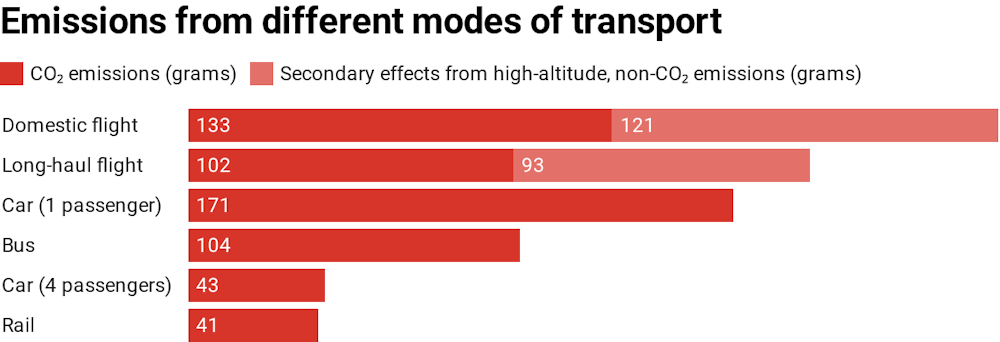
Cars and planes are convenient, but both have low energy efficiency compared to rail.


Data source: Greenhouse gas reporting: conversion factors 2019

A car’s carbon emissions per passenger kilometre can be around four times that of domestic rail (as shown by the graph above, based on UK data).

The government’s transport plans for Auckland do include light rail, but National has promised to scrap the scheme if elected. Looking across the Tasman, however, there is good evidence that light rail should not be this contentious.

Few might have predicted that Queensland’s Gold Coast light rail network – G:link, which opened in July 2014 – would see six million riders in its first 12 months of operation. Work started on a second stage within 24 months, with construction of a third stage now under way.


Read more:
70 years of road-based policies created today’s problems – does National’s transport plan add up?


The system has now seen more than 73 million paid passenger trips since it opened, with upwards of ten million trips likely in the 2022-23 year.

In 2019, three other new light rail systems opened in Australia: a short section in Newcastle, another in Canberra (where post-COVID patronage is recovering), and Sydney’s CBD and south-east line (where patronage is also bouncing back). Adelaide’s single line was also extended during the 2010s.

However, the combined patronage of all of these new light rail systems is far exceeded by Melbourne’s trams, now building back to pre-COVID levels of 205 million rides in 2018-19.

This is all part of a remarkable renaissance of light rail around the world. New Zealand could be part of this – if the will was there.

The freight factor

New Zealand’s historical shift from rail to road as the primary mode of freight transport has seen an ever-increasing dependence on trucks. While road freight grew steadily in the first two decades of this century, rail freight in 2021-2022 was the same as it was in 1999-2000.

Road freight does have some advantages, including point-to-point delivery and flexibility. But for many freight movements, using trucks rather than rail increases emissions by a factor of three. If reducing freight emissions is the goal, shifting some from road to rail is a logical solution.


Read more:
New Zealand must get over its obsession with big cars and go smaller or electric to cut emissions


Rail will therefore have to increase its own energy efficiency, including through more electrification of rail routes such as the Auckland-Hamilton-Tauranga and Palmerston North-Waikanae links.

While this was hinted at in the government’s 2023 budget, it doesn’t appear in the recently released draft government statement on land transport.

Increasing the allowable axle loading for freight wagons across the rail network would also allow trains to carry heavier loads, improve efficiency and reduce emissions.

Finally, the North Island main trunk needs upgrading to make the track straighter and allow trains to go faster. In turn this will make rail more attractive and help reduce emissions.


Read more:
To get New Zealanders out of their cars we’ll need to start charging the true cost of driving


When’s the next train?

Clearly, roads need to be maintained, and New Zealand’s road network has to be made more resilient to adverse weather impacts. But expanding road capacity at the expense of a more efficient rail system and improved public transport is a recipe for increasing emissions.

While road congestion in major cities is a problem, overseas experience tells us that more road capacity only increases vehicle use. The net result is more, not fewer, transport emissions.


Read more:
Why restoring long-distance passenger rail makes sense in New Zealand – for people and the climate


It would make more sense to upgrade the rail network to move more freight and transport more urban and intercity passengers. In fact, the Transport and Infrastructure Select Committee has recently recommended that the Ministry of Transport investigate how the Rail Plan could better incorporate inter-regional passenger rail.

But New Zealand needs to move beyond recommendations. As the International Energy Agency has noted: “Rail transport is the most energy-efficient and least carbon-intensive way to move people and second only to shipping for carrying goods.”

Whichever parties form the next government have an opportunity to put New Zealand transport on the right track. On the evidence so far, however, it could be a slow train coming.

The Conversation

Philip Laird owns shares in some transport companies. He is affiliated with the Chartered Institute of Logistics and Transport, the Railway Technical Society of Australasia, and the Rail Futures Institute. The opinions expressed are those of the author.

ref. Slow train coming: only a genuine shift to rail will put NZ on track to reduce emissions – https://theconversation.com/slow-train-coming-only-a-genuine-shift-to-rail-will-put-nz-on-track-to-reduce-emissions-211662

NZ women’s peace group protests over imminent Fukushima nuclear wastewater release

Asia Pacific Report

The Women’s International League for Peace and Freedom (WILPF) Aotearoa, the longest running women’s peace group in New Zealand, has called on the Japanese government to change its plan to release treated nuclear wastewater from the Fukushima Daiichi nuclear power station into the Pacific Ocean.

The protest comes as Pacific leaders remain undecided over the controversial — and widely condemned — Japanese move as reports suggest the start of the wastewater release could begin in the next few days.

“Releasing more radioactive materials is a wilful act of harm that will spread further radioactive contamination into the global environment,”said WILPF in its protest letter sent to Japanese Ambassador Ito Koichi last weekend.

“The treated water contains tritium, which cannot be removed. Tritium will be dumped into the ocean for several decades.

“There has been no assessment of future biological impacts. Nor has there been a review of less expensive and safer alternatives.”

An RNZ Pacific report said today that the past, present and future Pacific Islands Forum (PIF) chairs — known as “the Troika” — had not decided if they were for or against the imminent discharge.

The Melanesian Spearhead Group (MSG) meeting in Port Vila, Vanuatu, this week has been urged to call on Japan to drop plans for the wastewater release.

Accident reminder
WILPF reminded the Japanese government in its protest letter that after the 2011 earthquake and tsunami which caused the accident at the power station, the radioactive contaminated water was treated by a multi-nuclide removal system (ALPS) and stored in more than 1000 tanks on the power plant site.

It also reminded Tokyo of its pledge about Fukushima at the time.

The Japanese government and the operating company, TEPCO, stated that this water would not be disposed of in any way without the understanding of the concerned parties and would be stored on land.

The London Convention, which Japan ratified in 1980, strictly regulates the dumping of radioactive waste into the ocean.

“Therefore,” said the protest letter, “the release of treated water is a violation of international law.

“Such an action would also damage the trust between Japan and its neighbours and the Pacific Islands.”

Print Friendly, PDF & Email

Article by AsiaPacificReport.nz

Age pension cost to ease by 2060s but super tax breaks to swell: Intergenerational report

Source: The Conversation (Au and NZ) – By Michelle Grattan, Professorial Fellow, University of Canberra

Shutterstock

Australia’s comprehensive superannuation system means spending on the age pension will decline by 2062-63 despite a doubling of Australians aged 65 and over, according to the government’s Intergenerational Report to be released on Thursday.

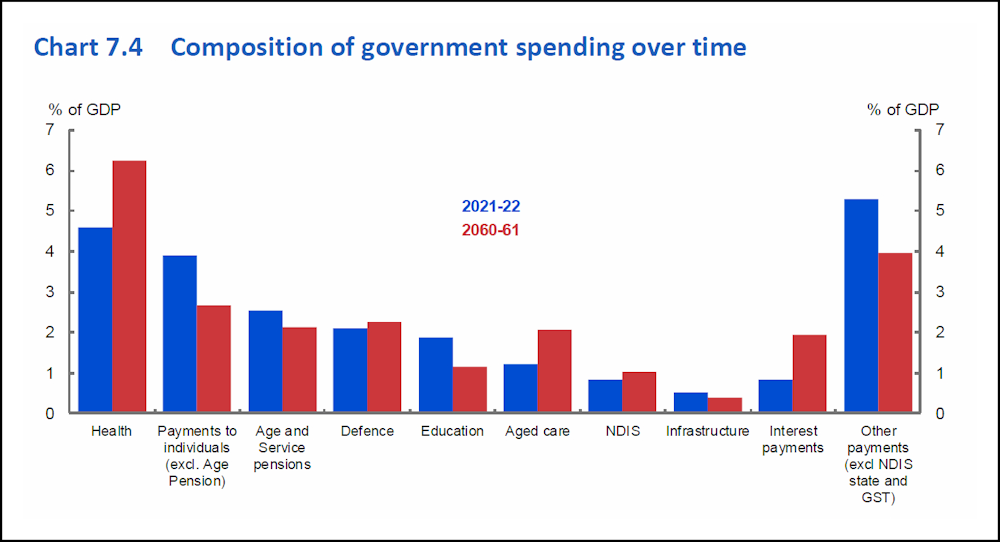
Expenditure on age and service pensions is projected to fall from about 2.3% of GDP in 2022–23 to 2% in the early 2060s.

On the other hand, superannuation tax concessions are projected to rise substantially as a proportion of GDP – from about 1.9% in 2022–23 to 2.4% in 2062–63.

These tax concessions are projected to overtake spending on the age pension in the 2040s. The increase is driven primarily by earnings tax concessions rising from about 1% of GDP in 2022–23 to 1.5% in 2062–63.

The figures will refocus attention on the generous tax breaks for superannuation, although attempting change is politically fraught. Both the former Coalition government and the current government faced sharp backlashes when they tightened concessions.

The intergenerational report puts the number of people 65 and over at about nine million by the early 2060s – up from nearly 4.4 million in the 2021 census.

But a smaller share of them will receive the pension or another income support, falling by about 15 percentage points by 2062–63.

The age pension is among the federal government’s largest spending programs, so the decline will significantly help the budget’s sustainability, the report says.

It says the superannuation system is “maturing”. About 17 million people own a total of about $3.5 trillion in superannuation assets. By the mid-2040s most people retiring will have received the Superannuation Guarantee at 9% or more all their working lives.

Australia’s compulsory superannuation system was introduced in the early 1990s by the Labor government. It provided for regular rises in the rate although the Coalition paused the rises for some time. The rate increased from 10.5% to 11% from July 1.

“Australia currently has the fourth largest pool of retirement assets in the world, with total superannuation balances projected to grow from 116% of GDP in 2022–23 to around 218% of GDP by 2062–63,” the report says.

Treasurer Jim Chalmers said the fact spending on the age pension would fall while the population aged was “the intergenerational genius of super”.

“Super is delivering on its promise – providing a better retirement for more Australians and a better outcome for the budget over the next 40 years. Labor built the super system and we’ve always worked to protect it and make it stronger,” Chalmers said.

Chalmers has been anxious to encourage superannuation funds to invest in areas such as affordable housing, but there is some reluctance by them,

Assistant Treasurer Stephen Jones said the report “shows that our super system is improving the lives of Australians.

“Our government wants to make it even stronger by boosting performance, improving access to retirement advice and improving the service members receive from their super funds.”

Jones has repeatedly been blunt about superannuation funds needing to lift their game.

He said in a speech in July: “Service standards in the superannuation system need to improve. Funds have to do better. And now.” Five million Australians were retired or nearing retirement, with the average Australian now retiring with more than $200,000 in super.

“When the time comes to retire, there are huge decisions to be made about how to manage that money and get the most out of it. Australians expect that their super fund will be ready to help them navigate it.”

But a report into complaints handling had found nearly 20% of funds failed to consistently respond to complaints within the mandatory 45-day deadline, and 80% of funds were poorly set up to deal with systemic issues, Jones said.

Chalmers is releasing the Intergenerational Report in stages, before its formal unveiling on Thursday, and wants to use it to kick start as much discussion as possible about Australia’s long term economic directions and issues, as well as its budgetary challenges.

THE SHORT TERM CHALLENGES

In the short term, the government still remains firmly focused on inflation – which has moderated encouragingly – while facing an economy which is set to slow substantially over coming months, after the multiple interest rate rises.

Growth in the coming three or four quarters is expected to be flat: the government hopes a recession can be avoided although a “technical recession” (two quarters of negative growth) is not out of the question.

Consumption, which is 60% of the economy and a “lagging” indicator, is coming off. Consumption in Australia is weakening faster than in some European countries where people are on fixed interest rates. The current high level of net migration, with students and tourists returning faster than anticipated, is preventing an even greater fall in consumption.

Unemployment has started to rise and is expected to increase further, although the government doesn’t expect it to spike.

Externally, eyes are particularly on the Chinese economy, which is now softer than was earlier anticipated.

Looking to the longer term, the government this year will release its employment white paper, a migration review, and an economic strategy for engaging with south east Asia, looking for opportunities for investment to flow in both directions.

Work is being done to encourage investment generally – particularly important in the Australia’s transition to cleaner energy – which will include streamlining processes under the Foreign Investment Review Board.

Beyond the Stage 3 tax cuts, which Anthony Albanese has said repeatedly will go ahead, the government is not contemplating other income tax changes this term. And despite the Business Council of Australia’s call for comprehensive tax reform, the government favours any longer term tax reform to be in bite size increments.

While much talk is around the need to boost productivity, the government stresses that while vital, this is a complicated challenge, with productivity in the care economy hard to measure, and slow productivity growth a feature internationally.

The Conversation

Michelle Grattan does not work for, consult, own shares in or receive funding from any company or organisation that would benefit from this article, and has disclosed no relevant affiliations beyond their academic appointment.

ref. Age pension cost to ease by 2060s but super tax breaks to swell: Intergenerational report – https://theconversation.com/age-pension-cost-to-ease-by-2060s-but-super-tax-breaks-to-swell-intergenerational-report-212012

Senior MSG official calls for Melanesia to remain neutral in geopolitical battle

By Kelvin Anthony, RNZ Pacific journalist in Port Vila

The Melanesian Spearhead Group Secretariat’s Director-General, Leonard Louma, says the Pacific region continues to be the centre of geopolitical interests by global superpowers.

The 22nd MSG Leaders’ Summit is taking place in Port Vila this week– the first full in-person meeting since the covid pandemic.

The prime ministers of Fiji, Solomon Islands, Papua New Guinea and the president of the FLNKS (Kanak and Socialist National Liberation Front) of New Caledonia are confirmed to attend the leaders’ session on Wednesday.

Louma said the battle for influence “impels the region to take sides, but it does not protect Melanesia and the region”.

“There are some who would like us to believe that taking sides in that geopolitical posturing is in our best interest. May I hasten to add, I tend to defer — it is not in our best interest to take sides,” Louma said.

Vanuatu's deputy prime minister Matai Seremaiah, left, and MSG director general Leonard Louma at the opening of the 22nd MSG Leaders's Summit Foreign Ministers' Meeting in Port Vila. 21 August 2023
Vanuatu’s Deputy Prime Minister Matai Seremaiah (left) and MSG Director-General Leonard Louma at the opening of the 22nd MSG Leaders’ Summit Foreign Ministers’ Meeting in Port Vila yesterday. Image: RNZ Pacific/Kelvin Anthony

The director-general also took aim at MSG member countries for not moving with “urgency” on issues that have been on the Leaders’ Summit agenda.

“Certain decisions also made by leaders and the foreign ministers of past continue to languish on the shelf and there seems to be no real sign of a desire to implement.”

Free trade
Louma said the MSG Free Trade Agreement had “somehow been tethered to other training and commercial arrangements”.

“Our enthusiasm to cooperate appears to have waned. We need to rejuvenate this enthusiasm and appetite for industrial cooperation that once was the hallmark of MSG,” he said.

Vanuatu’s Foreign Minister Matai Seremaiah has urged Vanuatu and Papua New Guinea to sign up to the trade agreement which has already been signed by Fiji and Solomon Islands.

Prime Minister Ishmael Kalsakau told RNZ Pacific he shared the concerns of his deputy on the issue of the free trade agreement.

“Vanuatu must adhere quickly. If you look at the theme of the meeting it’s about being relevant and being relevant means that we’ve got got to participate as a core group so that we can advance all our interests together,” he said.

Leonard Louma said the MSG needed to make concessions where it was needed in the interests of MSG cohesion.

“The nuclear testing issue in the Pacific could not have proceeded the way we had proceeded without MSG taking a strong position on it.”

Melanesian Spearhead Group flags
The Melanesian Spearhead Group flags . . . will the Morning Star flag of West Papua be added? Image: RNZ Pacific/Kelvin Anthony

Declarations
On Monday, MSG Secretariat officials said there were up to 10 issues on the agenda, including West Papua.

In his opening statement at the Foreign Minister’s session on Monday, Seremaiah said there were two key draft declarations that would be put for the leaders’ consideration.

The first one would be on climate action and “urging polluters not to discharge the treated water in the Pacific Ocean,” he said.

“Until and unless the treated water is incontrovertibly proven to be safe to do so and seriously consider other options.”

The second was a declaration on a MSG region of peace and neutrality, adding that “this declaration is aimed at advancing the implementation of the MSG security initiatives to address national security needs in the MSG region, through the Pacific way, talanoa or tok stori and binded by shared values and adherence to Melanesian vuvale, cultures and traditions”.

West Papua
This year’s agenda also includes the issue of the United Liberation Movement for West Papua (ULMWP) application to become a full member of the sub-regional body.

The movement is present at the meeting, as well as a big delegation from Indonesia, represented by its Vice-Minister for Foreign Affairs.

However, neither Seremaiah nor Louma made any mention of West Papua in their opening statements.

West Papua observers and advocates at the meeting say the MSG is like a “custom haus or nakamal” for the Melanesian people.

They say Vanuatu has the opportunity to make this more than a “normal MSG” if it can be the country that gets the MSG Leaders’ Summit to agree to make the ULMWP a full member.

West Papua delegation at the 22nd MSG Leaders' Summit pre-meeting in Port Vila. 21 August 2023
The West Papua delegation as observers at the 22nd MSG Leaders’ Summit pre-meeting in Port Vila yesterday. Image: RNZ Pacific/Kelvin Anthony

This article is republished under a community partnership agreement with RNZ.

Print Friendly, PDF & Email

Article by AsiaPacificReport.nz

Murray-Darling Basin Plan to be extended under a new agreement, without Victoria – but an uphill battle lies ahead

Source: The Conversation (Au and NZ) – By Jamie Pittock, Professor, Fenner School of Environment & Society, Australian National University

Shutterstock

Federal Minister for Water Tanya Plibersek today announced a new agreement to restore Australia’s largest and most important river basin. It comes just months before the original Murray-Darling Basin Plan was to be completed.

This was a plan to benefit people and nature, to protect river communities, industries and the environment against future droughts. It was forged in response to the gruelling Millennium Drought, when the Murray River stopped flowing to the sea.

It was clear too much water was being taken out of the system and everyone would suffer if Basin states could not find a better way to share. But it has been much harder to strike the right balance than first hoped.

When it became clear in July it was no longer possible to deliver the plan in full and on time, the federal government started hatching a new plan.

Now Plibersek is offering “more time, more money, more options, and more accountability”, acutely aware that “the next drought is just around the corner”. But she faces an uphill battle, with Victoria still holding out. Further, the legislation is yet to go before parliament and needs to be passed before Christmas.


Read more:
With less than a year to go, the Murray-Darling Basin Plan is in a dreadful mess. These 5 steps are needed to fix it


How did we get here?

Management of the Basin rivers today is a far cry from the hope engendered in 2007 when Prime Minister John Howard announced the National Plan for Water Security, at the peak of the Millenium Drought.

He proposed reforms to Basin water governance, saying “nothing can change the basic facts of our continent” and calling for action to end “the tyranny of incrementalism and the lowest common denominator” governance. These “once and for all” reforms were intended to prevent “economic and environmental decline”.

But the Basin states were loathe to hand their powers over to the Commonwealth. Victoria and New South Wales resisted reallocating water from agriculture. Amid navigating the complex science and trade offs, it was another five years before the controversial Basin Plan was adopted in 2012.

Unfortunately, the plan then languished over the past decade as the federal, New South Wales and Victorian governments frustrated measures originally agreed to return water from agricultural use to the environment.

This week’s announcement represents the federal government taking firm steps to implement the first part of Prime Minister Anthony Albanese’s five-point election commitment for the Basin.

darling river
A plan for the water: the politics of the Murray-Darling Basin have long been fraught.
Shutterstock

Now the federal government has reached agreements with most states who share management of the river system – Queensland, New South Wales, the Australian Capital Territory and South Australia – but not Victoria. The Victorian government appears to be rivalling the National Party in its opposition to buying more water entitlements from irrigators (water buybacks).

The federal government is looking to purchase water entitlements from willing sellers. This is because past investments in water efficiency projects have proven to be too slow, very expensive and have had unexpected outcomes for agricultural industries and the rivers.

Victoria continues to argue its irrigation-based industries would be harmed by more water buybacks, and that the state has borne an unfair share of the burden compared to New South Wales. The Victorian government has knowledgeable staff and is well resourced, and resistance could be fierce.


Read more:
Water buybacks are back on the table in the Murray-Darling Basin. Here’s a refresher on how they work


Plibersek appears to be counting on her alliance with other states enabling required amendments to the Water Act and Basin Plan to be passed before Christmas. Given almost certain rejection by the Opposition of more water reallocation, she will require the support of cross bench Senators who may demand stronger environmental measures. The Greens have already criticised the minister’s announcement as a move that “kicks the can down the road”, but buying such a large volume of water will take years.

If the legislation is not amended, and existing deadlines remain, the federal government may be forced into recovering even more water. In particular, they would need to respond to the states’ failure to deliver on projects that are supposed to conserve wetland with less water by building water supply infrastructure.

A welcome development

The new agreement is welcome in doubling down on the original plan to recover 3,200 billion litres a year of additional water essential to maintain the health of the rivers and the people who rely on them. The federal government has focused on recovering 450 billion litres a year of water within this target that was agreed with the former South Australian premier. Premier Jay Weatherill drew on scientific advice to insist the minimum volume of water was recovered that is needed to keep the lower River Murray floodplain, lower lakes and Coorong healthy.

Unfortunately, the past decade of stalling by the federal, NSW and Victorian governments means the 2023-24 Basin Plan deadlines must be extended by two to three years if key projects are to be completed.

Much greater public assurance with transparency and accountability measures is needed if the new targets are to be met. The federal government needs to find more effective carrots and sticks to engender state compliance. This time it would be wise to withhold payments to the states until they deliver the promised action.

murray darling rivers meeting
The muddy waters of the Darling meet the clearer Murray at Wentworth in New South Wales.
Shutterstock

The federal government’s intention to redouble efforts to “relax constraints” and enable more water to flow to where it’s most needed to conserve flora and fauna is crucial. This is essential to get the most benefits for freshwater ecosystems by allowing environmental water to spill out of river channels onto floodplain wetlands. Despite a recent flurry of activity, NSW and Victoria have not delivered promised agreements with river side land owners to enable this watering.

The one disappointing aspect of the agreement is the proposal to allow more water offset projects (under the Sustainable Diversion Limit Adjustment Mechanism). These ecologically dubious projects have been problematic, with at least one being abandoned and many delayed. It is inconceivable that new projects could be identified and delivered by 2026.

But the new agreement only deals with the most immediate problems in implementing the Basin Plan. The Plan is due to be revised in 2026. The current measures do not deal with two major issues. First, ways need to be found to restore the rights of Indigenous nations to own and manage water. Currently they hold only 0.2% of issued entitlements. Second, a new Plan is needed to manage the project loss of a lot of water to climate and other environmental change.

The federal government’s agreement with most states (but not Victoria) is a really welcome initiative to get Basin Plan implementation back on track. However, even harder decisions await.


Read more:
Victoria’s plans for engineered wetlands on the Murray are environmentally dubious. Here’s a better option


The Conversation

Jamie Pittock is a member of the Wentworth Group of Concerned Scientists. Jamie holds roles in a number of non-government environmental organisations. He is also the independent Chair of the ACT Natural Resources Management Advisory Committee.

ref. Murray-Darling Basin Plan to be extended under a new agreement, without Victoria – but an uphill battle lies ahead – https://theconversation.com/murray-darling-basin-plan-to-be-extended-under-a-new-agreement-without-victoria-but-an-uphill-battle-lies-ahead-212002

Worried you’ll lodge a late tax return? At least 80,000 Australians can’t afford tax advice

Source: The Conversation (Au and NZ) – By Ann Kayis-Kumar, Associate Professor, UNSW Sydney

Shutterstock

If you’re struggling to complete your tax return, you’re not alone. There are cases of Australians being years, even decades behind in their tax returns. And the poorer you are, the more likely you’ll need but can’t afford some professional help.

While tax debts and tax stress transcend socioeconomic boundaries, poorer people are more likely to be late on their tax returns – in some cases up to 30 years behind.

Our research shows about 37% of people in financial hardship seen by financial counsellors need tax help but are unable to afford it. That’s at least 80,000 Australians.

That’s a huge problem, because individuals and small businesses with outstanding returns are often ineligible for many types of government support. While the cost of tax advice is tax-deductible, you need to have the spare cash in the first place.

So if you’re worried about meeting this year’s tax return due date – or have a backlog of returns – here’s what you need to know about accessing free advice, and how we could help far more Australians, all year around.

Who can get free tax help now?

The Australian Tax Office offers a free Tax Help service to those with incomes of less than A$60,000.

This service is an important part of the landscape and assists about 30,000 people with simple tax affairs each year.

However, it is only offered between July and October. And the eligibility criteria exclude anyone working as a contractor (such as gig workers) or running a business, including as a sole trader.

This leaves a tax advice gap between those eligible for Tax Help and those who can afford professional advice to navigate the tax and transfer system.

So many people in hardship fall through the cracks – especially sole traders and micro-businesses in financial distress. For example, if your small business is cash-strapped and you’re already struggling financially and psychologically, you may not have the cash to pay for necessities, let alone an accountant.

There are other penalties as well. For example, you need to be up to date on your tax returns to claim Centrelink entitlements, or to access your superannuation early on “severe hardship grounds”.


Read more:
myTax is fast and free – so why do 2 in 3 Australians still pay to lodge a tax return?


What financial counsellors told us

We quantified the need for tax help in Australia through a nationwide survey of financial counsellors. This survey, conducted in 2019, was the first of its kind in the world to identify and quantify the prevalence of tax issues faced by the financially disadvantaged.

Financial counsellors are different to financial planners or financial advisers. Their job is to help people in debt or financial difficulty.

As such, they are the front line in helping people experiencing hardship. Thanks to the support of Financial Counselling Australia, about 20% of the 890 financial counsellors in Australia responded to our survey.

We asked what specific type of tax advice was needed. About 93% of clients wanted advice on lodging tax returns, and 88% wanted advice about tax debts.


Financial counsellors based in lower socioeconomic communities were more likely to have clients with long-term overdue tax returns. This is particularly troubling, because it means the most disadvantaged people in hardship cannot navigate the system without professional advice, which they cannot afford.

About 75% of financial counsellors observed the unmet need for tax advice was increasing. Reasons given for this included declining levels of financial literacy, the increase in “gig economy” workers, and contractors with more complicated tax issues and compliance burdens, such as collecting the goods and services tax.

Survey respondents noted the increasing number of sole traders with little knowledge. Most clients needed help to lodge multiple years of outstanding tax returns and advice on tax debts.


Read more:
Sometimes people can do with a break: 3 ways tax debt relief rules are too tough


Why we need free tax help all year around

While financial counsellors reported financial stress across different levels of income, those on low incomes are less likely to be able to afford independent tax help and face the most barriers to accessing free tax advice.

Financial counsellors are not able to complete or lodge tax returns. This presents a major gap in advice available to those in need.


Read more:
Does paying for tax advice save money? Only if you’re wealthy


As well as the Australian Tax Office’s Tax Help service, the federal government provides funding for the National Tax Clinic Program, in which university students studying tax-related courses and qualified tax experts offer free tax advice and support to people in need. By 2025, this program is set to expand to 20 clinics across all states and territories.

But our research showed the need for free tax advice went well beyond what these tax clinics can support with current funding levels.

One largely untapped opportunity is for the tax accounting profession to emulate the law profession. Australia has almost 200 community legal centres, providing pro bono (free, for the public good) advice to those who cannot afford a lawyer.

We recommend federal funding for a nation-wide free tax clinic program so that existing clinics can operate full time, year-round – like that national network of community legal centres.

The effect could be life-changing. As noted by one client of the UNSW Tax and Business Advisory Clinic:

I really don’t think people understand the magnitude of offering this assistance to people in hardship & situations where financial abuse is a factor […] it really has made a difference to my life and my children’s lives.


For information about the Australian Taxation Office’s tax help program go here. To find a university tax clinic in your state or territory, go here.

The Conversation

Ann Kayis-Kumar receives funding from the Australian Government’s Australian Taxation Office National Tax Clinic Program, the Ecstra Foundation’s Financial Capability Program, and the NSW Department of Communities & Justice’s Investing in Women Funding Program.

Michael Walpole receives funding from the Australian Government’s Australian Taxation Office National Tax Clinic Program, the Ecstra Foundation’s Financial Capability Program, and the NSW Department of Communities & Justice’s Investing in Women Funding Program. He has also previously had funding from the Australian Research Council.

Youngdeok Lim receives funding from the Australian Government’s Australian Taxation Office National Tax Clinic Program, the Ecstra Foundation’s Financial Capability Program, and the NSW Department of Communities & Justice’s Investing in Women Funding Program.

Gordon Mackenzie and Jack Noone do not work for, consult, own shares in or receive funding from any company or organisation that would benefit from this article, and have disclosed no relevant affiliations beyond their academic appointment.

ref. Worried you’ll lodge a late tax return? At least 80,000 Australians can’t afford tax advice – https://theconversation.com/worried-youll-lodge-a-late-tax-return-at-least-80-000-australians-cant-afford-tax-advice-211267

Worried you’ll lodge a late tax return? At least 80,000 Australians can’t afford tax advice – here’s how to help more

Source: The Conversation (Au and NZ) – By Ann Kayis-Kumar, Associate Professor, UNSW Sydney

Shutterstock

If you’re struggling to complete your tax return, you’re not alone. There are cases of Australians being years, even decades behind in their tax returns. And the poorer you are, the more likely you’ll need but can’t afford some professional help.

While tax debts and tax stress transcend socioeconomic boundaries, poorer people are more likely to be late on their tax returns – in some cases up to 30 years behind.

Our research shows about 37% of people in financial hardship seen by financial counsellors need tax help but are unable to afford it. That’s at least 80,000 Australians.

That’s a huge problem, because individuals and small businesses with outstanding returns are often ineligible for many types of government support. While the cost of tax advice is tax-deductible, you need to have the spare cash in the first place.

So if you’re worried about meeting this year’s tax return due date – or have a backlog of returns – here’s what you need to know about accessing free advice, and how we could help far more Australians, all year around.

Who can get free tax help now?

The Australian Tax Office offers a free Tax Help service to those with incomes of less than A$60,000.

This service is an important part of the landscape and assists about 30,000 people with simple tax affairs each year.

However, it is only offered between July and October. And the eligibility criteria exclude anyone working as a contractor (such as gig workers) or running a business, including as a sole trader.

This leaves a tax advice gap between those eligible for Tax Help and those who can afford professional advice to navigate the tax and transfer system.

So many people in hardship fall through the cracks – especially sole traders and micro-businesses in financial distress. For example, if your small business is cash-strapped and you’re already struggling financially and psychologically, you may not have the cash to pay for necessities, let alone an accountant.

There are other penalties as well. For example, you need to be up to date on your tax returns to claim Centrelink entitlements, or to access your superannuation early on “severe hardship grounds”.


Read more:
myTax is fast and free – so why do 2 in 3 Australians still pay to lodge a tax return?


What financial counsellors told us

We quantified the need for tax help in Australia through a nationwide survey of financial counsellors. This survey, conducted in 2019, was the first of its kind in the world to identify and quantify the prevalence of tax issues faced by the financially disadvantaged.

Financial counsellors are different to financial planners or financial advisers. Their job is to help people in debt or financial difficulty.

As such, they are the front line in helping people experiencing hardship. Thanks to the support of Financial Counselling Australia, about 20% of the 890 financial counsellors in Australia responded to our survey.

We asked what specific type of tax advice was needed. About 93% of clients wanted advice on lodging tax returns, and 88% wanted advice about tax debts.

Financial counsellors based in lower socioeconomic communities were more likely to have clients with long-term overdue tax returns. This is particularly troubling, because it means the most disadvantaged people in hardship cannot navigate the system without professional advice, which they cannot afford.

About 75% of financial counsellors observed the unmet need for tax advice was increasing. Reasons given for this included declining levels of financial literacy, the increase in “gig economy” workers, and contractors with more complicated tax issues and compliance burdens, such as collecting the goods and services tax.

Survey respondents noted the increasing number of sole traders with little knowledge. Most clients needed help to lodge multiple years of outstanding tax returns and advice on tax debts.


Read more:
Sometimes people can do with a break: 3 ways tax debt relief rules are too tough


Why we need free tax help all year around

While financial counsellors reported financial stress across different levels of income, those on low incomes are less likely to be able to afford independent tax help and face the most barriers to accessing free tax advice.

Financial counsellors are not able to complete or lodge tax returns. This presents a major gap in advice available to those in need.


Read more:
Does paying for tax advice save money? Only if you’re wealthy


As well as the Australian Tax Office’s Tax Help service, the federal government provides funding for the National Tax Clinic Program, in which university students studying tax-related courses and qualified tax experts offer free tax advice and support to people in need. By 2025, this program is set to expand to 20 clinics across all states and territories.

But our research showed the need for free tax advice went well beyond what these tax clinics can support with current funding levels.

One largely untapped opportunity is for the tax accounting profession to emulate the law profession. Australia has almost 200 community legal centres, providing pro bono (free, for the public good) advice to those who cannot afford a lawyer.

We recommend federal funding for a nation-wide free tax clinic program so that existing clinics can operate full time, year-round – like that national network of community legal centres.

The effect could be life-changing. As noted by one client of the UNSW Tax and Business Advisory Clinic:

I really don’t think people understand the magnitude of offering this assistance to people in hardship & situations where financial abuse is a factor […] it really has made a difference to my life and my children’s lives.


For information about the Australian Taxation Office’s tax help program go here. To find a university tax clinic in your state or territory, go here.

The Conversation

Ann Kayis-Kumar receives funding from the Australian Government’s Australian Taxation Office National Tax Clinic Program, the Ecstra Foundation’s Financial Capability Program, and the NSW Department of Communities & Justice’s Investing in Women Funding Program.

Michael Walpole receives funding from the Australian Government’s Australian Taxation Office National Tax Clinic Program, the Ecstra Foundation’s Financial Capability Program, and the NSW Department of Communities & Justice’s Investing in Women Funding Program. He has also previously had funding from the Australian Research Council.

Youngdeok Lim receives funding from the Australian Government’s Australian Taxation Office National Tax Clinic Program, the Ecstra Foundation’s Financial Capability Program, and the NSW Department of Communities & Justice’s Investing in Women Funding Program.

Gordon Mackenzie and Jack Noone do not work for, consult, own shares in or receive funding from any company or organization that would benefit from this article, and have disclosed no relevant affiliations beyond their academic appointment.

ref. Worried you’ll lodge a late tax return? At least 80,000 Australians can’t afford tax advice – here’s how to help more – https://theconversation.com/worried-youll-lodge-a-late-tax-return-at-least-80-000-australians-cant-afford-tax-advice-heres-how-to-help-more-211267

Camp David summit turns attention to North Korea, as well as China

Source: The Conversation (Au and NZ) – By Craig Mark, Adjunct Lecturer, Faculty of Economics, Hosei University

While China’s relationship with the region and the world is a constant focus of attention and scrutiny, world leaders have also been closely watching North Korea, particularly for its steadily increasing ballistic missile capability.

It was the primary focus of last week’s trilateral summit held at Camp David between US President Joe Biden, South Korean President Yoon Suk Yeol and Japanese Prime Minister Fumio Kishida.

This was the first time Biden hosted foreign leaders at the historic presidential retreat. It was a major diplomatic step in the Biden administration’s strategic policy to ramp up deterrence against China and also Russia.

A joint statement released at the summit’s conclusion condemned China’s recent military actions in the South China Sea and around Taiwan. It also opposed any changes to the territorial status quo of the Indo-Pacific through the threat or use of force.

Russia’s war against Ukraine was also condemned. The leaders pledged continued support for Ukraine in its resistance to the Russian invasion.

North Korea has increased the rate of its missile testing to record levels, with over 80 launches since the beginning of 2022. The most concerning of these tests were of its solid-fuel road-transportable Hwasong-18 ICBMs in April and July 2023. These can be quickly prepared for launch at short notice and have the range to strike the entire United States (and Australia).


Read more:
Solidarity and symbolism the order of the day as US, Japan and South Korea leaders meet at Camp David


Eyes on North Korea

In its commemoration of the 70th anniversary of the armistice marking the end of the Korean War last month, North Korean leader Kim Jong-un hosted Russian Defence Minister Sergei Shoigu as part of a visiting delegation of senior Russian and Chinese officials.

North Korea has also been accused of supplying weapons to Russia for its war in Ukraine, which the DPRK denies. The Camp David summit therefore showed the determination of the Biden administration to reinforce alliances with its democratic partners in the Indo-Pacific.

This in turn is designed to deter the deepening level of co-operation between autocratic China, Russia and North Korea. China responded angrily to the summit, accusing the US of bringing “bloc confrontation” to the region.

Estimated to have the eighth-most-powerful military capabilities in the region, North Korea’s increasing belligerence has been noted at the United Nations. The UN Security Council was briefed last week that the “increasing militarisation” of North Korea is causing the human rights situation in the country, already one of the most oppressive in the world, to deteriorate even further.

North Korea has been under UN Security Council sanctions since 2006 for its unlawful nuclear weapons program and severe human rights abuses. Any opposition to Kim Jong-un’s totalitarian regime is brutally suppressed. The Australian Defence Forces are involved in enforcing these sanctions through Operation Argos, patrolling out of bases in Japan.



Read more:
North Korea: fears of a new famine after three years of COVID isolation and harsh repression


Even before the Camp David summit, the armed forces of the US, Japan and South Korea had been engaged in trilateral co-operation and military drills in response to North Korean missile launches.

To counter this mutual threat, the Camp David summit outlined a range of plans for the US to transform its existing bilateral military alliances with Japan and South Korea into trilateral security co-operation. Specific measures include intelligence sharing for an early warning system, a “hotline” between the three leaders, and co-ordination of anti-ballistic missile capabilities.

While no formal agreement was made, the principles espoused at Camp David to counter North Korea will aim to be institutionalised through annual trilateral leaders’ summits. Larger-scale military exercises will be conducted annually. And the broader area of economic security, an early warning system to identify threats to supply chains of resources like batteries and critical minerals, will also be established.

Relations between Japan and South Korea thaw

All this was made possible by the recent thawing of the diplomatic deep freeze between Japan and South Korea. This was largely driven by the grievances of the administration of former Democratic Party President Moon Jae-in.

The dramatic improvement in relations between Japan and South Korea were enabled by Moon’s successor, the conservative-aligned Yoon. His willingness to brave domestic political opposition and move on from the historical legacy of Japan’s imperial colonisation of Korea, particularly compensation for wartime sex slaves and forced labour, was eagerly reciprocated by his Japanese conservative counterpart Kishida.

Yoon’s visit to Tokyo last March and his state visit to the US in April, plus Kishida’s visit to Seoul in May, paved the way for the Camp David summit.

Ever since Japan and South Korea established diplomatic relations in 1965, the US has often been frustrated with the prickly relations between its two key allies in North-East Asia. It has frequently encouraged reconciliation that would allow greater trilateral military co-operation.


Read more:
What South Korean president Park’s political demise means for the region’s geopolitics


The Biden administration appears to have finally achieved this long-desired strategic objective. However, in the news conference closing the summit, Biden expressed his intention to strengthen the US alliances of the region, despite the isolationist policies of his predecessor, Donald Trump. This allusion reminds of the instability Trump threatens to bring again to US foreign policy.

Yoon also faces the prospect of his People Power Party losing control of the South Korean parliament in elections next year. Defeat could result in his impeachment.

Kishida could also be ousted if he loses the leadership ballot for the ruling Liberal Democratic Party due in September next year.

Domestic political ructions in any of the three partner countries could yet undermine the outcomes of the Camp David summit.

The Conversation

Craig Mark does not work for, consult, own shares in or receive funding from any company or organization that would benefit from this article, and has disclosed no relevant affiliations beyond their academic appointment.

ref. Camp David summit turns attention to North Korea, as well as China – https://theconversation.com/camp-david-summit-turns-attention-to-north-korea-as-well-as-china-211875

Beginning of the end: how Elon Musk’s removal of the block function on X could trigger its hellish demise

Source: The Conversation (Au and NZ) – By Jay Daniel Thompson, Lecturer (Early Career Development Fellow) and Program Manager, Professional Communication program, RMIT University

Shutterstock AI

On Saturday, X (formerly Twitter) chairman Elon Musk tweeted he would be removing the microblogging platform’s block function. It would remain intact for direct messages, but would otherwise become obsolete.

This is the latest in a series of controversial and often confusing moves from Musk since he took ownership of the platform in October 2022. Why does Musk want to block the block function? And what might the consequences be for users, and indeed the future of the platform?

Why block the ‘block’?

Simply, the block function on X prevents one user from interacting with another. With the click of a button, the blocker can deny another user the ability to read their tweets or reshare their content.

Musk’s dislike of this feature isn’t new. In June he remarked that “blocking public posts makes no sense”. He has also condemned campaigns among users to block subscribers paying for a Twitter Blue subscription (which grants them perks such as a blue tick beside their name and the ability to edit posts).

Musk’s latest pronouncement might be related to his self-styled “free speech absolutist” persona. Last year, after he announced the deal to purchase X (then Twitter), Musk remarked:

Free speech is the bedrock of a functioning democracy, and Twitter is the digital town square where matters vital to the future of humanity are debated.

Accordingly, Musk then restored accounts that had been banned for what previous site moderators classified as dangerous content. These high-profile reinstatements included rapper Kanye West (removed for anti-Semitism), congresswoman Marjorie Taylor Greene (removed for spreading COVID misinformation) and right-wing personality Dominick McGee (who posted child abuse material).

In June of this year, Musk publicly said “distasteful” content – including tweets celebrating a migrant boat accident in the Mediterranean Sea in which lives were lost – could remain online as long as they weren’t illegal.

Of course, “blocking” someone on social media isn’t the same as removing their account or deleting content. Blocking is not censorship as this is commonly understood in a social media context; it does not involve, say, removing users or their content from a platform, or even shadow-banning (whereby a platform reduces the visibility of certain posts among a large number of users).

That said, blocking does threaten the pugilistic model of free speech Musk endorses. He has called X the “player versus player” (a kind of duelling mode in online video games) of social media. The likelihood of skirmishes is reduced when “players” can block one another.

What would the consequences be?

Perhaps blocking the “block” function would allow lively and heated (but not harmful) debate to flourish on X. Or perhaps not. As Adi Robertson writes in an article for The Verge:

Blocking provides some very tangible benefits, helping users (especially high-profile ones) do anything from avoiding harassment to simply cleaning up spam in their replies.

It can also prevent exposure to hate speech, which has risen since Musk took ownership. According to the Centre for Countering Digital Hate, X “fails to act on 99% of hate posted by Twitter Blue subscribers”. Musk has disputed the findings and filed a lawsuit against the group (an action that sits uneasily alongside his free-speech absolutism).

The inability to block hate speech could help normalise it and create a hostile environment for people in groups that are often targeted, such as women, LGBTQ+ people, Indigenous people and migrants.

X has long been labelled a “hellsite” on account of the toxicity that appears on the platform. In a post-block era, it might become even more hellish.

What happens beyond the block?

Musk has suggested “a stronger form of mute” could replace the block function. The mute function currently allows users to avoid seeing the activities of certain other users – but the muted person can still interact with the muter (such as by commenting on their posts) in a way that a blocked person can’t.

What would “a stronger form of mute” look like? Musk hasn’t said. His plans to remove the block and implement this function seem particularly unclear when you consider he has already fired so many of the company’s workers, including technical staff.

Further, both the Apple Store and Google Play have guidelines stipulating that platforms hosting user-generated content must allow the blocking of other users. Removing this capacity might lead to the app stores dropping X, which could spell economic death for the platform.

Worded differently, Musk might succeed in “blocking” X from its users permanently. Or he may argue a stronger form of mute fulfils the same requirements as the block function. Either way, the signs point to a strong likelihood of X becoming a particularly nightmarish town square.


Read more:
Why Elon Musk’s first week as Twitter owner has users flocking elsewhere


The Conversation

Jay Daniel Thompson receives funding from the Australian Research Council for a collaborative study entitled ‘Addressing online hostility in Australian Digital Cultures’ (DP230100870). Dr. Thompson is also the recipient of a 2023 Herbert & Valmae Freilich Project ECR Small Grant for a project entitled ‘Digital citizenship and ethical journalistic representations of online hostility directed at women and girls’.

ref. Beginning of the end: how Elon Musk’s removal of the block function on X could trigger its hellish demise – https://theconversation.com/beginning-of-the-end-how-elon-musks-removal-of-the-block-function-on-x-could-trigger-its-hellish-demise-211897

PNG’s Marape condemns ‘jungle justice’ after 6 gunmen shot dead

By Cretilda Alokaka in Port Moresby

Six hired gunmen in Enga were shot dead by men from the Ambulin tribe on Friday in what Papua New Guinea Prime Minister James Marape has described as “jungle justice”.

Police alleged that on Friday around 5am, the six men sneaked into Ambulin tribal territory to ambush them but were caught. The Ambulins surrounded them in a culvert and shot five men.

Security force members intervened and rescued the sixth man, but he died later in hospital.

Bodies of three of the shot gunmen being dragged out on the road
Bodies of three of the shot gunmen being dragged out on the road with their legs tied. Image: The National, PNG

Police said the gunmen were from the Silin and Kaekin tribes.

Provincial police commander Acting Superintendent George Kakas said one was from Sirunki in Laiagam, one was from Kompiam and four from Wapenamanda.

“According to the Ambulin tribe, these six men were hired to go into their territory and ambush them,” he said.

“They [Ambulins] said the killing of the six men was a warning to other tribes, especially from Kompiam, Laiagam or Wapenamanda not to get involved in their tribal warfare.”

Bodies dragged
Commander Kakas said the bodies of the five men were dragged out of the culvert and had their hands and legs tied to the back of a vehicle.

“Their bodies were then thrown on the road as a message to other tribes sending gunmen not to get involved in another tribe’s warfare.”

He said investigations were underway, with 70 policemen being deployed at the site.

Meanwhile, Commander Kakas warned businessmen, educated elites and other people funding activities to hire gunmen, buy guns and bullets to stop the practice.

He said that operational plans were being drawn up to focus on the “manipulators” of the bloodshed “while we are increasing the number of security force personnel deployed to hotspots to minimise killings and property damage”.

“Through their respective commanders, security force personnel have been instructed to use all means necessary to detain gunmen and to use lethal force when warranted,” he said.

Police Commissioner David Manning has advised Prime Minister Marape and Internal Security Minister Peter Tsiamalili of additional measures being taken to strengthen security in Enga.

Engan hot spots
He said Assistant Commissioner, Operations, Samson Kua would lead the operation.

“It is important that ramping up personnel in hot spots in Enga does not undermine security presence in other areas,” Commissioner Manning said.

“As such, I have appointed Assistant Commissioner Anthony Wagambie Jr to focus on enhancing security operations to support the reopening of the Porgera mine, while force strength in areas such as Hela and the Southern Highlands will be maintained.”

Commissioner Manning said the approach being taken in Enga was “a break from the colonial methods of the past”.

“While we bring the full weight of the state to bear on those who perpetrate these heinous acts, we must be honest and acknowledge that security forces cannot arrest or kill our way out of tribal fighting in Enga.

“We have to deal with the cause of these conflicts at the root and stop this senseless violence where it starts.”

Cretilda Alokaka is a reporter with PNG’s National newspaper. Republished with permission.

Print Friendly, PDF & Email

Article by AsiaPacificReport.nz

The beginning of the end: Elon Musk’s removal of the block function on X could trigger its hellish demise

Source: The Conversation (Au and NZ) – By Jay Daniel Thompson, Lecturer (Early Career Development Fellow) and Program Manager, Professional Communication program, RMIT University

Shutterstock AI

On Saturday, X (formerly Twitter) chairman Elon Musk tweeted he would be removing the microblogging platform’s block function. It would remain intact for direct messages, but would otherwise become obsolete.

This is the latest in a series of controversial and often confusing moves from Musk since he took ownership of the platform in October 2022. Why does Musk want to block the block function? And what might the consequences be for users, and indeed the future of the platform?

Why block the ‘block’?

Simply, the block function on X prevents one user from interacting with another. With the click of a button, the blocker can deny another user the ability to read their tweets or reshare their content.

Musk’s dislike of this feature isn’t new. In June he remarked that “blocking public posts makes no sense”. He has also condemned campaigns among users to block subscribers paying for a Twitter Blue subscription (which grants them perks such as a blue tick beside their name and the ability to edit posts).

Musk’s latest pronouncement might be related to his self-styled “free speech absolutist” persona. Last year, after he announced the deal to purchase X (then Twitter), Musk remarked:

Free speech is the bedrock of a functioning democracy, and Twitter is the digital town square where matters vital to the future of humanity are debated.

Accordingly, Musk then restored accounts that had been banned for what previous site moderators classified as dangerous content. These high-profile reinstatements included rapper Kanye West (removed for anti-Semitism), congresswoman Marjorie Taylor Greene (removed for spreading COVID misinformation) and right-wing personality Dominick McGee (who posted child abuse material).

In June of this year, Musk publicly said “distasteful” content – including tweets celebrating a migrant boat accident in the Mediterranean Sea in which lives were lost – could remain online as long as they weren’t illegal.

Of course, “blocking” someone on social media isn’t the same as removing their account or deleting content. Blocking is not censorship as this is commonly understood in a social media context; it does not involve, say, removing users or their content from a platform, or even shadow-banning (whereby a platform reduces the visibility of certain posts among a large number of users).

That said, blocking does threaten the pugilistic model of free speech Musk endorses. He has called X the “player versus player” (a kind of duelling mode in online video games) of social media. The likelihood of skirmishes is reduced when “players” can block one another.

What would the consequences be?

Perhaps blocking the “block” function would allow lively and heated (but not harmful) debate to flourish on X. Or perhaps not. As Adi Robertson writes in an article for The Verge:

Blocking provides some very tangible benefits, helping users (especially high-profile ones) do anything from avoiding harassment to simply cleaning up spam in their replies.

It can also prevent exposure to hate speech, which has risen since Musk took ownership. According to the Centre for Countering Digital Hate, X “fails to act on 99% of hate posted by Twitter Blue subscribers”. Musk has disputed the findings and filed a lawsuit against the group (an action that sits uneasily alongside his free-speech absolutism).

The inability to block hate speech could help normalise it and create a hostile environment for people in groups that are often targeted, such as women, LGBTQ+ people, Indigenous people and migrants.

X has long been labelled a “hellsite” on account of the toxicity that appears on the platform. In a post-block era, it might become even more hellish.

What happens beyond the block?

Musk has suggested “a stronger form of mute” could replace the block function. The mute function currently allows users to avoid seeing the activities of certain other users – but the muted person can still interact with the muter (such as by commenting on their posts) in a way that a blocked person can’t.

What would “a stronger form of mute” look like? Musk hasn’t said. His plans to remove the block and implement this function seem particularly unclear when you consider he has already fired so many of the company’s workers, including technical staff.

Further, both the Apple Store and Google Play have guidelines stipulating that platforms hosting user-generated content must allow the blocking of other users. Removing this capacity might lead to the app stores dropping X, which could spell economic death for the platform.

Worded differently, Musk might succeed in “blocking” X from its users permanently. Or he may argue a stronger form of mute fulfils the same requirements as the block function. Either way, the signs point to a strong likelihood of X becoming a particularly nightmarish town square.


Read more:
Why Elon Musk’s first week as Twitter owner has users flocking elsewhere


The Conversation

Jay Daniel Thompson receives funding from the Australian Research Council for a collaborative study entitled ‘Addressing online hostility in Australian Digital Cultures’ (DP230100870). Dr. Thompson is also the recipient of a 2023 Herbert & Valmae Freilich Project ECR Small Grant for a project entitled ‘Digital citizenship and ethical journalistic representations of online hostility directed at women and girls’.

ref. The beginning of the end: Elon Musk’s removal of the block function on X could trigger its hellish demise – https://theconversation.com/the-beginning-of-the-end-elon-musks-removal-of-the-block-function-on-x-could-trigger-its-hellish-demise-211897

Obituary: Meraia Taufa Vakatale – anti-nuclear activist and feminist trailblazer

By Asenaca Uluiviti and Sadhana Sen

Fiji recently lost Dr Meraia Taufa Vakatale, a monumental woman leader who broke many glass ceilings with her numerous firsts. As an educationalist, diplomat and politician, she profoundly impacted on the lives of tens of thousands in Fiji and the Pacific region, particularly young women in politics and anti-nuclear activists.

Dr Vakatale was Fiji’s first woman deputy prime minister, the first woman to be elected as a cabinet minister, the first female to be appointed as a deputy high commissioner, and the first Fijian woman principal of a secondary school in Fiji.

Dr Vakatale was also a fervent anti-nuclear activist. In 1995 she took a costly stand against her party and the then Sitiveni Rabuka government on renewed French nuclear testing on Moruroa Atoll in “French” Polynesia.

Joining a protest march against French testing led to her losing her cabinet position in the Rabuka-led government, in which she served as a member of the Soqosoqo ni Vakavulewa ni Taukei (SVT) party.

She held the portfolio of Education, Science and Technology in two stints — from 1993 to 1995 and then, after being reinstated, from 1997 to 1999. In 1997, she was appointed Deputy Prime Minister.

In 2000, she resigned as President of the SVT party over the 2000 coup fallout.

She was a woman ahead of her time. Dedicated to her principles, she “paid it forward” to Pasifika generations by her fight to keep the Pacific a nuclear-free zone.

Idealism inspired thousands
Dr Taufa Vakatale’s spirited and unwavering determination, her activism, idealism and her principles inspired thousands of women and youth to fearlessly pursue their dreams.

The name Taufa Vakatale was first linked to the renowned all-girls Adi Cakobau School when she became a pioneer student there in 1948, aged 10 years. She was also the first female student at the all-male Queen Victoria School.

She completed her 6th form year at Suva Grammar School, where she became the first Fijian female to pass the NZ University Entrance. She entered the University of Auckland and in 1963 was the first Fijian woman to graduate with a Bachelor of Arts degree, privately funding her studies from her wages as a teacher in Fiji.

Taufa Vakatale went on to further studies in the United Kingdom from 1963 to 1971. On return to Fiji, she became the first Fijian woman president of the Fiji YWCA and principal of her old school, the Adi Cakobau School.

The YWCA in Fiji was the driving force of the anti-nuclear protest movement in the early 1970s, while she was president.

In her time as an educator, Dr Vakatale disciplined fairly, understood her students, and entrusted them with positive goals for their future, instructing them to “leave the world better than we found it”.

She was respected and honoured. Her feats helped ease the students’ own steps, to bring to life the Adi Cakobau School motto.

Towering moral stature
Of petite and elegant frame, in moral stature Dr Vakatale towered above many. In diplomacy she served as Fiji’s Deputy High Commissioner to the UK in 1980, while single-handedly raising her daughter to become a lawyer.

The University of St Andrews in Scotland awarded her an Honorary Doctorate of Letters for her contribution to the cause of Pacific women, while Fiji bestowed her with the Order of Fiji in 1996.

The extraordinary Dr Meraia Taufa Vakatale died on 24 June 2023, aged 84. She leaves behind her only daughter Alanieta Vakatale, three granddaughters, and many more following in her footsteps to leave this world a better place.

Thirty eight years on from the sinking of the Rainbow Warrior and the adoption of the Pacific nuclear-free zone treaty, the Rarotonga Treaty, and with the imminent release of Japan’s Fukushima nuclear plant radioactive waste into the Pacific ocean, the leadership and sacrifices of Dr Vakatale must be hailed, and her life celebrated.

Asenaca Uluiviti is a community legal officer in Auckland. She has worked as a state solicitor in Fiji and at its diplomatic mission in the UN, and has served as chairperson of Fiji YMCA, and on the NZ board of Greenpeace. She went to the Adi Cakobau School.

Sadhana Sen is regional communications adviser at the Development Policy Centre. Republished from the DevPolicy blog through a Creative Commons licence.

Print Friendly, PDF & Email

Article by AsiaPacificReport.nz

Sustainability is often an afterthought in space exploration – that needs to change as the industry grows

Source: The Conversation (Au and NZ) – By Priyanka Dhopade, Lecturer in Mechanical Engineering, University of Auckland

. NASA/Bill Anders

Aotearoa New Zealand is the latest country to enter the expanding and competitive international space market.

In the aerospace strategy and national space policy, the government lays out how it intends to grow the domestic space sector by launching rockets and satellites and promoting Earth observation research.

The documents indicate the government’s general priorities in “protecting New Zealand’s national interests” and the “responsible use of space”.

Sustainability is a focus in both strategy and policy but is used interchangeably in three different contexts:

  • To “sustain” the economic development of the industry

  • to describe the benefits of aerospace technology for sustainability efforts, like monitoring climate change

  • to describe the environmental impacts of aerospace activities, largely focused on space debris, while reducing emissions (though the latter is largely a concern for the aviation industry, not space).

When a part from India’s recent rocket launch landed on Australian shores last month, it captured people’s attention – and delivered a reminder that Earth’s orbits are teeming with the discards of human endeavours in space.

Space debris indeed poses long-term threats to space activities and Earth’s environment. But sustainability should have a wider focus than the pollution of Earth’s orbital space.

Our new research provides key recommendations for expanding our view on the sustainable use of space – and this could reveal unforeseen risks and opportunities for businesses, governments, communities and Indigenous peoples.


Read more:
Harpoons, robots and lasers: how to capture defunct satellites and other space junk and bring it back to Earth


What does sustainability in space mean?

The worsening impacts of climate change and biodiversity loss have taught us that we cannot easily clean up our messes retrospectively and that pollution has inter-generational consequences.

But factoring in sustainability is usually an afterthought as we continue to compromise environmental, societal and cultural wellbeing for the sake of economic development. The ambiguity in what we mean by sustainability is part of the problem.

Nowhere in New Zealand’s aerospace strategy or policy documents is sustainability actually clarified. What is included, what is excluded, and whose concept of sustainability are we operating with?

Without clarity, it is difficult to develop techniques and targets for sustainability or to be held accountable for missing them.

Balancing priorities with values

It is also difficult to draw parallels between different knowledge systems or sectors. But this could help us avoid the mistakes that have led to the current climate and biodiversity crises.

The way economic priorities are balanced with values through a holistic relationship with the Earth, sea and sky is already embedded in many Indigenous cultures around the world, including Māori.


Read more:
Why do different cultures see such similar meanings in the constellations?


Aotearoa New Zealand’s founding documents outline the co-existence of two distinct authorities – Māori, represented by hapū (the primary political unit in traditional Māori society at the signing of Te Tiriti o Waitangi) and the British Crown. While the national space policy is committed to recognising and reflecting Māori interests in the space sector, it is not clear how these interests will translate into a genuine partnership approach to decision making.

Our research makes recommendations about how we might consider what we are trying to “sustain”, for whom and over what timeframe, what the requirements are to do so, and who needs to be at the decision-making table.

Earth, its atmosphere and beyond

Are we thinking about our future activities just on Earth, or further afield, including planetary exploration and asteroid mining?

Closer to Earth, commercial satellite technology is now a well established method to observe our planet from space. It helps to monitor weather and climate effects and provides crucial telecommunication services. But at what environmental cost to Earth?

There are currently no mandatory regulations for the space industry to report their greenhouse gas emissions or consider the life-cycle impact of their products on Earth’s environment. Without this information, how can we perform any cost-benefit calculations, on Earth or elsewhere?


Read more:
A rapidly growing rocket industry could undo decades of work to save the ozone layer – unless we act now


We are getting better at sending objects on a one-way trip to Mars, and even to the edge of the solar system. Is space ultimately a dumping ground for waste from human activity?

Society and culture

For millennia, the night sky has been a sacred environment, a repository of knowledges and a source of connection for people. It is now threatened by increasing light pollution from mega constellations of satellites and accumulating space debris.

In Australia, Aboriginal oral traditions provide a unique insight into what the sky may have looked like more than 10,000 years ago – and what that teaches us about human history. In Aotearoa, the ongoing revitalisation of Māori astronomical traditions symbolises the necessary bicultural constitutional foundations, as set out in Te Tiriti o Waitangi, for a rapidly emerging space sector.

This foundation means having authentic partnerships with tangata whenua, the Indigenous peoples. It means ensuring Māori voices are welcomed and respected at the decision-making stage and on what we choose to do in space.


Read more:
Major changes coming over the horizon for the global space industry


Māori are already paving a new way to space and deep tech. They are gaining significant funding and inspiring the next generation of rangatahi (young people) to be space professionals, while simultaneously grounded in their Māori astronomy. Broadening our view of sustainability could be the difference between oppression and recognition of Māori interests in the domestic space sector.

So far, space exploration has been propelled by competition. Throughout history, this has been sustained by cold wars and national pride, without much thought about consequence. But it is time to reconsider this and start to think of space as a commons – something more than just a resource to exploit. Space is something we all have a stake in, together on our pale blue dot.

With credit to our co-authors in our research publication: Adam Morris, Nicholas Rattenbury, Cody Mankelow, Alice Gorman, Stevie Katavich-Barton.

The Conversation

The authors do not work for, consult, own shares in or receive funding from any company or organisation that would benefit from this article, and have disclosed no relevant affiliations beyond their academic appointment.

ref. Sustainability is often an afterthought in space exploration – that needs to change as the industry grows – https://theconversation.com/sustainability-is-often-an-afterthought-in-space-exploration-that-needs-to-change-as-the-industry-grows-211335

Ballet flats are back. Here’s what the research says about how they affect your feet

Source: The Conversation (Au and NZ) – By Kristin Graham, Lecturer in Podiatry, University of South Australia

Ballet flat shoes – those thin-heeled lightweight slip-on shoes – are making a fashion comeback. And it’s not hard to see why: they’re versatile, easy to wear, soft, flexible and often worn by celebrities.

We have often been warned of the dangers of high-heeled shoes, so you might think ballet flats are problem-free.

When you look at the research, however, a complicated picture emerges. There’s no definitive evidence to show ballet flats are generally harmful to foot health in the long-term. But ill-fitting ballet flats can be a problem.

Ballet flats are back.
Shutterstock


Read more:
Do high top shoes actually reduce ankle sprain risk? Here’s what the research says


Make sure it fits, especially in the toe box

An estimated 70% of the population are wearing ill-fitting shoes. This mismatch between foot and shoe shape can increase foot pain, reduce stability, and can mean more blisters, corns and calluses. And habitual wearing of tight shoes has been associated with bone changes in the toes and feet over time.

Many flats feature a shallow and narrow toe box (the part of the shoe where the toes go). A too-small toe box often doesn’t align with the shape of a foot and ends up squishing the toes. It can also increase pressure on top of and under the foot, and restrict the movement of the forefoot during walking.

But a too-big toe box is also a problem. Too much foot movement within the shoe can cause pressure and friction on the skin, which can also lead to calluses, corns, blisters, and wounds.

A poorly fitting toe box can also cause micro trauma to toenails which, ultimately, can change their look and thickness.

So if you’re wearing flats, make sure you choose a shoe with the right sized toe box.

Flats are often accused of lacking support.
Shutterstock

What about the heel?

Health professionals often recommend a small heel over a completely flat shoe. Very flat shoes can place more strain on the soft tissues that support the foot arch – specifically, the plantar fascia.

Research has shown moving from a completely flat shoe to a small, raised heel reduces the tension force on the plantar fascia during standing activities.

On the other hand, other research has shown most people will adapt their ankle and knee motion to accommodate shoes of different heel heights.

What about support?

Ballet flats tend to have very flexible, thin soles and heel counters (the part, coloured red in this picture, that hugs the heel and the back part of the foot).

The heel counter here is coloured red.
Shutterstock

These thin and flexible structures mean flats are often accused of lacking support. But debate rages among foot and shoe experts about how important support is in the first place.

Research on barefoot-style shoes has shown walking in these types of shoes significantly reduces some loads on the knee compared to more stable supportive shoes.

Minimalist shoes have also been found to increase strength in certain foot muscles used when we push off during walking, running or jumping.

However, other research found stable supportive shoes can improve knee pain when walking more than flat flexible shoes.

The thin soles in flats mean there is little cushioning under the foot. While more cushioning can improve comfort, and reduce stress and strain on your foot sole skin, there is no evidence it reduces loads across the lower leg.

In fact, walking in cushioned shoes has been shown to increase the load on the knee compared to flat, flexible shoes.

We have often been warned of the dangers of high-heeled shoes, so you might think ballet flats are problem-free.
Shutterstock

So, what’s the verdict?

The verdict is mixed. Yes, there’s evidence poorly fitting shoes and a flat heel can be detrimental, with consequences seen in the rearfoot (around the ankle) and knee.

But there’s also no hard evidence ballet flats cause long-term foot health problems.

What matters is choosing a well-fitted shoe to suit your foot shape and needs.

If you’re shopping for ballet flats, try to:

  • choose a pair with a toe box that does not cramp your toes and has a sole at least as wide as your foot

  • choose flats that offer at least some structure and support

  • choose a pair with a small heel rather being than completely flat.

The Conversation

Kristin Graham is affiliated with Australian Podiatry Assocaition.

Saravana Kumar Is a member of Physiotherapy Association of Australia, Services for Australian Rural and Remote Allied Health and Health Services Research Association of Australia & New Zealand.

Helen Banwell does not work for, consult, own shares in or receive funding from any company or organization that would benefit from this article, and has disclosed no relevant affiliations beyond their academic appointment.

ref. Ballet flats are back. Here’s what the research says about how they affect your feet – https://theconversation.com/ballet-flats-are-back-heres-what-the-research-says-about-how-they-affect-your-feet-207806

Keith Rankin Analysis – Financial Literacy, Compound Interest, and the Veneration of Money

Keith Rankin, trained as an economic historian, is a retired lecturer in Economics and Statistics. He lives in Auckland, New Zealand.

Analysis by Keith Rankin.

Keith Rankin, trained as an economic historian, is a retired lecturer in Economics and Statistics. He lives in Auckland, New Zealand.

In New Zealand, both Labour and National want the teaching of ‘financial literacy’ to become compulsory in schools. (See Labour pledges compulsory financial literacy classes in schools and National also aiming to make financial literacy compulsory in schools from One News, 20 August 2023. On the 6pm news, Prime Minister Chris Hipkins explicitly mentioned “compound interest”.)

The politicians should be careful what they wish for. Financial literacy, as understood by its advocates, has many of the elements of a scam. In the fantasies if the finance industry, the favoured many or few accumulate money at exponential rates, at the expense of the payers of interest. The one depends on the other; interest is a zero-sum game.

Pseudo-Science

Mercantilism is to economics what astrology is to astronomy and alchemy is to chemistry. They are pseudo-sciences, albeit precursors to these modern sciences. The discipline of Finance remains deeply rooted in the pseudo-science of mercantilism. (We may note that George Soros’ most famous book is titled ‘The Alchemy of Finance’.)

Few economists know anything about mercantilism, just as few astronomers have knowledge of astrology, and few chemists know much about alchemy. The people who do know (or should know) about these harbingers of science are the historians of economics, astronomy, and chemistry. (Such historians are becoming increasingly scarce, as mentioned to me by an Australian friend who is a semi-retired senior academic, specialising in the history of economics. Disciplinary history courses have been culled, even in top universities such as the ANU, in part because of a lack of student demand, but also because higher education today is seen by the technocrats as little more than training for specific technocratic careers.)

‘Classical’ mercantilism conceives of nation-states as economic territories whose purpose is simply to ‘make money’; in particular it focuses on policies favouring trade surpluses, meaning exports exceeding imports. The underlying issue is the veneration, indeed the deification, of money; the perception that conflates ‘money’ with ‘wealth’, leading to the false conclusion that money serves more as a store of wealth than as a medium of exchange. (Properly trained economists understand that money is a ‘social technology’ which derives its utility from circulation rather than stasis.) From this mercantilist perspective, money should only be spent if such spending (‘investment’) yields even more money; money becomes an instrument for making money. Under mercantilism, we ‘live to make money’ rather than ‘make money to live’.

The Myth of Compound Interest

The ‘miracle’ of compound interest generally features early in any educational course on financial literacy; the myth of compound interest is a core proposition of ‘financial literacy’ dogma. (We note that a ‘myth’ is not the same as a ‘lie’. Rather a myth is a compelling ‘story’, or parable, which often contains some contextual truth.)

The ‘miracle’ is that of exponential growth, and is predicated on the idea that an above-zero risk-free rate of return on money-in-the-bank is an entitlement that amounts to a human right. The zealots who most promote this believe that there should be a right to a positive real rate of interest, risk-free; meaning that the entitled rate of interest should always be above the rate of inflation (ie not simply above zero).

The two most famous promoters of the myth, in history, were Benjamin Franklin (American founding father) and Albert Einstein (a scientific wizard, though not a financial wizard). Franklin apparently said “Money makes money. And the money that money makes, makes money”. Einstein reputedly said that “those who understand it, earn it and those who don’t, will pay it”. At least Einstein recognised that interest is paid by somebody, and not the ‘free money’ which the quote from Franklin suggests. What Einstein did not appreciate was that, if the average interest rate on bank deposits is below the average rate of inflation, then in fact those who ‘understand it’ lose, and it is those who don’t understand it get something for nothing. Further, at least in the history of the twentieth century (and also Franklin’s eighteenth century; though not so much the nineteenth century) bank deposit interest rates have generally been below inflation rates.

Some examples.

If we look at the year 1936 (when there was a census of incomes), the equivalent to today’s minimum wage would have been $100 per year. If that sum was saved in the bank in 1936, today it would have compounded to $7,000 if the after-tax interest yield had been 5% every year. That would be a break-even on our usual measure of inflation. But the minimum wage for a person working 40-hours per week today is $47,000. $7,000 would be regarded today as a very poor return on the substantial sum (to a wage-worker) of $100 (£50) in 1936.

However, if the $100 could have been invested in 1936 at 10% risk-free after tax (more like 12% before tax) for 87 years, the compounded nest-egg today would be $400,000. That’s what the miracle of compound interest is about. The reality, though, is that a compounding risk-free yield of 10% per year for 87 years would have been a fantasy. Even an interest yield of 5% every year for 87 years would have been unrealistic.

For another example, the average salary in 1973 – fifty years ago – was about $4,000. Today it’s more like $70,000. Further, based on the Reserve Bank’s inflation calculator, $4,000 in 1973 is equivalent to $59,481 in 2023. Wages have increased more quickly than prices in the last 50 years; though both rates of increase are similar: wages have increased by about 5.9% a year, whereas prices have increased on average by 5.547% each year. So, for compound interest to increase the value of a term deposit faster than the rate of wage increases, then the average interest rate would have had to be over six percent after tax. To have got a miraculous return from compound interest, the bank deposit interest rate before tax would need to have been more than ten percent every year. Unrealistic.

Given the now known inflation rate, money saved in the bank for those 50 years at five percent every year before tax would have resulted in a 50% depreciation of what that money could buy. That’s a more realistic outcome of safe saving. The reality of the past 50 years is that savers have lost, and borrowers have gained. For the most part, compound interest has come at a high opportunity cost. In-control debt would have yielded more happiness.

The proper context of saving

Can financial literacy education be useful, especially the promotion of thrift, despite the falsity of the compound interest miracle? Yes, because some people can fund their needs and wants without spending their entire salaries. For those people, the ‘present utility’ (ie enjoyment) from spending not-needed money is quite low; so, by saving for a day when they will need extra money, then the saved money will come in handy, even if it has depreciated in value in the meantime.

The reality, however, is that a large portion of peoples’ savings ends up in their estates when they die. They never spend it. Indeed, for many, saving money is a form of insurance, and not a plan to consume less when they are young and more when they are old. If the ‘insurance’ is not required, the money is passed onto the next generation, or in other forms of bequest.

So, an important question to raise is: What should a youngish person do if they receive a lump-sum of money in a will, or a lottery. My analysis suggests that they are better off spending it than trying to save-and-compound it. Though, the ‘present utility’ of spending the windfall all at once would be low. A financially literate person would spend the money over a period of time. Specialist insurance products probably make more sense than using compound interest as a form of alternative insurance; although, like the quest for compound interest, many people get a low return on their insurance premiums. Much insurance costs too much.

The proper and improper context of investing

Investing is the process of risk-taking; of risk, and hoped-for reward. Some people who think that an above-inflation rate of return is a right (or a reward for abstinence) rather than a gambling reward will end up taking naive risks. This situation will be less likely in the event of well-structured financial literacy education. This is the proper context.

Unfortunately, people who already have much – often too much – have had the financial power to gain near-certain rewards through processes of speculation (often disguised as ‘investing’) and otherwise taking advantage of people who have too little. The most prominent of these situations is the use of market-power to make money from trading in real-estate; ie trading in land. This kind of ‘investment’ for high returns substantially undermines the housing market.

Any worthwhile financial literacy education would need to properly deal with the issues of land use and land speculation. Yet my sense is that the financial literacy curriculum in New Zealand will end up pushing people to use KiwiSaver as an opaque means to promote both compound interest and real estate speculation. Many people who rent or buy their homes for exorbitant market prices are also themselves property speculators, because such speculation drives up returns in their higher-yield-strategy KiwiSaver accounts. KiwiSaver yields derived from land speculation come at a high cost to people trying to make a home for themselves and their families.

Back to Mercantilism

The rhetoric of KiwiSaver – and other savings’ products – is that of using money to make money. The reality is that the over-purchase of ‘financial products’ makes high profits for the finance industry. This is the mercantilist mirage – even ‘scam’ – at the heart of industrial finance. It’s the modern version of the pot of gold at the end of the rainbow. Mercantilism is the cult of money, not the science of money.

Real compound interest is economically unsustainable; and requires an exorbitant demand for debt, the flipside of bank deposit interest. It represents a monetary transfer from the vulnerable to the privileged, from the needy to the greedy. People like Roger Douglas in the 1980s tried to create a revolution in New Zealand underpinned by real compound interest. They have achieved both unsustainable inequality, and also much resourcefulness by ordinary people trying to live their best indebted lives.

It is a patrician fantasy to create a global economic system whereby the poor perpetually pay real compound interest to the rich. For capitalism to survive, interest rates need to be less than or equal to inflation rates. Under those conditions, debt doesn’t look so bad and unproductive saving doesn’t look so good. Indeed, if somehow ordinary people are able to shun debt, then interest rates must fall far too low to generate real compound interest. Ultimately, interest rates are set in the marketplace, not by the authorities.

*******

Keith Rankin (keith at rankin dot nz), trained as an economic historian, is a retired lecturer in Economics and Statistics. He lives in Auckland, New Zealand.

Anger in Hawai’i over threat of land grabs after wildfire disaster

By Finau Fonua, RNZ Pacific journalist

Fears are rife in Hawai’i of predatory land buying after the recent wildfires have left many locals homeless and in dire financial straits.

The wildfires incinerated the town of Lāhainā, destroying 2200 homes and businesses and leaving hundreds unaccounted for. At least 114 people are confirmed dead.

The disaster has shed light on Hawai’i’s housing crisis which has prompted many to leave the state for the US mainland.

According to Hawai’i’s Senate Housing Committee, an average of 14,000 Hawai’ians leave the state every year. The state also has one of the highest homeless rates in the country — in 2022, close to 6000 people experienced homelessness.

Hawai’i — a state notorious for high mortgage rates and rent — was already in a housing crisis before the disaster occurred. In fact, it was only last month that Hawai’i’s Governor Josh Green declared a housing emergency — announcing plans to build 50,000 homes before 2025.

“Homeowners have been reached out to by developers and realtors offering to buy their land…and this is disgusting and we just want to let people around the world to know that Lahaina is not for sale,” Maui community leader Tiare Lawrence told US media.

Lawrence accused out-of-state developers of taking advantage of the disaster, by buying up multi-generational lands from residents forced into financial desperation by the wildfires.

Honolulu, Hawaii, 2023
Hawai’i’s numerous luxury Hotels have been blamed for pushing up property costs. Image: RNZ Pacific/Finau Fonua

Lāhainā evacuee John Crewe told RNZ Pacific local inter-generational property owners were already struggling to keep up with costs before the wildfires destroyed their homes.

“People feel that they will be forced to sell out because they’re desperate, and then that will mean there is no place for them to return to,” said Crewe.

“Certain people may try to take advantage of the disaster to gain more real estate because it’s a vacation destination, people like to buy properties for vacation and that drives up the cost of everything.

“This is something that should have been addressed long ago.”

In response to the public concerns, Hawai’i’s Governor Josh Green announced he had organised attorneys to assist local landowners.

“I’ve asked my attorney to watch out for predatory practices,” Green said last week.

“We’ll also be raising incredible amount of resources to protect us financially so that none of that land falls into anyone else’s hands,” he added.

The governor even suggested the state government would look to acquire the land in devastated parts of Maui.

That comment caused a social media backlash from critics who accuse the administration of protecting the interests of lucrative hotels and tourism developers — blamed by many for making the Hawai’i’s property markets so expensive.

“Some people have taken out of context a comment I made about purchasing land — that is to protect it, to protect if for local people so that it is not stolen by people on the mainland,” said Green.

“This is not about the government getting land, this is the people’s land and the people will decide what to do with Lāhainā.”

Hawaii Governor Josh Green poses after signing Housing Emergency Proclamation, July 19, 2023
Hawai’i Governor Josh Green poses after signing the Housing Emergency Proclamation last month. Image: Office of Hawaii Governor Josh Green

But many remain doubtful. In the days following the disaster, thousands of Lāhainā evacuees were forced to live in gymnasiums, churches, community shelters and their cars while Maui’s many hotels and resorts remained open to tourists.

Governor Green did announce that he had arranged with hotels for more than 500 rooms to be made available for evacuees to use.

Lāhainā evacuee and Native Hawai’ian Kanani Higbee told RNZ Pacific she had no choice but to leave Hawai’i for another state where the costs of living were cheaper.

John Crewe said he prayed the community which had existed for generations in Hawaii’s historical city would remain intact.

“People might have the tendency to leave the island and go somewhere else. We should build it so that people will come back and make Lāhainā a vibrant society and not just a tourist destination,” he said.

According to Hawai’i’s Senate Housing Committee, one resident emigrates from Hawai’i every 36 minutes.

This article is republished under a community partnership agreement with RNZ.

Print Friendly, PDF & Email

Article by AsiaPacificReport.nz

A retiring NZ MP has suggested joining Australia – we should at least think about it (before saying no)

Source: The Conversation (Au and NZ) – By Dominic O’Sullivan, Adjunct Professor, Faculty of Health and Environmental Sciences, Auckland University of Technology, and Professor of Political Science, Charles Sturt University

Big policy ideas usually don’t come up in parliamentary valedictory speeches – they’re for saying goodbye and thank you. So departing Labour MP Jamie Strange was the exception last week when he made a case for New Zealand and Australia becoming one country.

The main problem, he joked, would be integrating the Australian cricket team. But he talked up the potential economic benefits, and the option does remain open under sections 6 and 121 of the Australian Constitution.

In fact, New Zealand did seriously consider joining the Australian federation in the 1890s. After all, it had been administered as part of the colony of New South Wales for about a year after the signing of the Treaty of Waitangi in 1840.

And the relationship was already close. Maori traders began visiting Sydney from the 1790s. Settlers moved back and forth across the Tasman from the earliest contact.

Quite how such a union might be forged in the 21st century, however, raises some interesting questions about how similar – or dissimilar – the two countries have since become.

A simplified relationship

Political union would simplify the relationship: trade would be more efficient, social and cultural ties might be strengthened, passports wouldn’t be needed and banking would be easier.

Indeed, an Australian parliamentary committee recommended political union in 2006, but the Zealand prime minister at the time, Helen Clark, rejected the idea. The then opposition leader, Don Brash, said it should at least be considered, but found little support.

The committee’s second preference was for a common currency to make trans-Tasman business easier.

But close relationships don’t require political union. Australia and New Zealand hold regular ministerial meetings, share various regulatory standards, and there is military and intelligence cooperation.

There are also important policy differences – such as over the AUKUS security pact and New Zealand’s nuclear-free policy. Union wouldn’t mean the two countries coming together as equals. New Zealand members of an Australian government would influence those policies, but they wouldn’t determine them.

From nation to state

Current constitutional arrangements would mean New Zealand simply became a state of the existing Commonwealth of Australia. It would elect members to the federal parliament, but it would no longer have an independent voice in international forums.

Under the Australian Constitution, the New Zealand state parliament would be responsible for schooling, hospitals and transport, among the reserve powers of the Australian states.

Foreign policy, defence, monetary policy, higher education, pharmaceutical and GP funding would be among the responsibilities transferred to Canberra. A better cricket team might not be compensation enough.

But thinking seriously about the idea would also require both countries to consider how they might forge a different commonwealth together. And that would require an assessment of underlying national values that rarely troubles political discourse in either country.


Read more:
What Australia could learn from New Zealand about Indigenous representation


The Voice and the Treaty

Nowhere would this be more evident than in the respective debates about whether democracy should be properly inclusive of Indigenous peoples.

In Australia, opinion polls are showing the proposed Aboriginal and Torres Strait Islander Voice to Parliament doesn’t have the support it needs to pass a referendum later this year. The tone of that debate also shows just how differently Australia and New Zealand think about such issues.

In my book Sharing the Sovereign, I argued that while the guaranteed Māori seats in parliament (introduced in 1867) and the role of the Treaty of Waitangi are sharply contested in New Zealand, their influence is gradually increasing.


Read more:
The Voice isn’t apartheid or a veto over parliament – this misinformation is undermining democratic debate


Political resistance to the ACT Party’s policy of marginalising the Treaty in public life is likely to be intense if it forms part of the government after the election in October. But even then, the idea that Māori people have a voice in government is largely accepted.

Australia’s prime minister argues that the Voice is a matter of justice because “it is common courtesy to consult people when you’re taking a decision that affects them”. The inference being that while First Nations people can have “their” say, “we” are still in charge.

As Wiradjuri scholar Stan Grant observed about the country he grew up in: “we lived in Australia, and Australia was for other people”.

Culture and public life

Based on population, New Zealand would be entitled to about one-sixth of the seats in the Australian House of Representatives. Like the other states it would elect 12 senators. There is no guaranteed Indigenous representation in either house and Australia would no doubt struggle to accept Māori representation. At best, there might be two or three Māori seats in the lower house.

In reality, the Māori presence in public life gives New Zealand a cultural certainty and security that is not so evident in Australia.

And the Treaty of Waitangi extends that place to all migrants. Samoan, Tongan, Chinese and Dutch MPs (among others) occasionally speak their languages in parliament as statements of identity and belonging.


Read more:
New Zealand claims Barnaby Joyce as one of its own, in new dramatic citizenship turmoil


Meanwhile, section 44(1) of the Australian Constitution says people who hold dual or multiple citizenships are not eligible for election to parliament. Although more than half the Australian population was either born overseas or has a parent born elsewhere, this multicultural demographic is not represented in its parliament.

Indeed, then-deputy prime minister Barnaby Joyce was forced to leave parliament in 2017 after it was discovered he held New Zealand citizenship. He was one of many forced out in similar circumstances – a citizen of a “foreign power” only by descent but apparently therefore a threat to national security.

Cultural insecurity seems the more likely explanation. In an article on the section 44 scandal, I pointed out the absurdity by describing myself as “a citizen of Australia, Ireland and New Zealand who supports the All Blacks, drinks Guinness and looks forward to fighting for Tamworth when Dunedin invades”.

Australia and New Zealand may well be similar enough for political union to be an idea worth considering, but rejecting – if only to help us each to understand ourselves better.

The Conversation

Dominic O’Sullivan does not work for, consult, own shares in or receive funding from any company or organisation that would benefit from this article, and has disclosed no relevant affiliations beyond their academic appointment.

ref. A retiring NZ MP has suggested joining Australia – we should at least think about it (before saying no) – https://theconversation.com/a-retiring-nz-mp-has-suggested-joining-australia-we-should-at-least-think-about-it-before-saying-no-211728

Our older population will triple in 40 years. But a social insurance model won’t fix the aged care funding crisis

Source: The Conversation (Au and NZ) – By Henry Cutler, Professor and Director, Macquarie University Centre for the Health Economy, Macquarie University

Shutterstock

Preliminary data from the 2023 Intergenerational Report shows Autralia’s population aged 85 and over is set to more than triple over the next 40 years. This will exacerbate existing strains on the aged-care system.

The government’s Aged Care Taskforce is investigating aged-care funding options to develop a “fair and equitable” system, while exploring efficiency, affordability and sustainability.

The government will spend more than A$146 billion on aged care in the next four years. General tax revenue will cover that cost, mostly funded by individual income tax receipts. But the government is concerned general tax revenue won’t be enough to fund the expected growth in aged care, in the near future and longer term.

There are three primary options to increase aged-care funding. The government can either increase its contribution, ask consumers to pay more, or use a combination of both.

The need for more consumer contributions has dominated recent aged-care debates. The less asked, but more important, question is whether the general tax revenue model the government uses to fund aged care is an appropriate model to promote sustainability.

While a social insurance model is the main alternative, it won’t be the silver bullet we’re looking for to fix our aged-care funding crisis.


Read more:
Aged-care funding reforms must ensure users pay their fair share


How would social insurance work?

A social insurance model would use either voluntary or compulsory contributions from worker salaries to cover the cost of aged-care services.

It could include a prior build-up of funds, where consumers draw on accumulated savings to purchase aged-care services. Alternatively, it could operate as a pay-as-you-go (PAYG) system, where consumers draw on worker contributions each year, with an understanding that workers will draw on future contributions when they require aged care.

The first social insurance model was established in 1883 by the first chancellor of the German Empire, Chancellor Otto von Bismarck. He wanted blue-collar workers to remain healthy and productive by providing access to health-care services.

The “Bismarck” model has since permeated throughout Europe, funding health-care systems in Germany, France, Switzerland and the Netherlands.

While this model works reasonably well in these countries, whether a social insurance model is right for funding aged care in Australia is debatable. How social insurance levies are applied matters to efficiency and equity.

Is social insurance efficient?

An efficient funding model collects and distributes revenue for the least cost possible. A social insurance model would require new legislation and a government agency managing reserves, increasing administration costs.

Less visible but more substantial funding model costs are from market distortions associated with the revenue collection mechanism such as personal income tax or a levy.

Whether a social insurance model is more efficient from a market perspective depends on how the government would otherwise increase general tax revenue.

The impact on efficiency from a social insurance model would be equivalent to an increase in income tax rates under a general tax revenue model. Both would reduce take-home pay and potentially reduce the incentive to work, for example, by reducing the willingness to work overtime.

Efficiency differences would occur if the government increased tax rates faced by businesses. This could distort business decisions, potentially reducing investment.

The size of the impact would depend on the size of the tax increase. The Victorian government introduced the mental health and wellbeing surcharge on payroll tax in 2022 to raise funds for improved mental health-care services. While business suggested it would harm growth, there is no indication this has occurred.


Read more:
Money’s tight for young people. Adding a Medicare-style levy to everyone’s tax bill is the wrong way to increase aged-care funding


Is social insurance equitable?

Other differences exist between general tax and social insurance models when assessed against equity. An equitable funding model requires people with similar financial means to pay similar amounts, and those with greater financial means to pay more.

Differences primarily result from our ageing population. Under a general tax revenue model, current workers pay for current aged-care services, but may receive more and better quality aged care when older. They will pay less compared to their future cost of care.

Nurse helps elderly man in a wheelchair
It’s difficult to measure future aged-care costs.
Shutterstock

A social insurance model that builds up funds may better match contributions with future costs. But this requires a big ask from workers, to simultaneously build up the fund for future aged-care costs and pay for current aged-care costs.

Future aged-care costs are also uncertain. Underestimating costs mean the government will still need to spend more on aged care. Overestimating costs means workers contributed more funding than needed, losing some opportunity to spend on other goods and services, such as holidays.

What else should the government consider?

A social insurance model is a departure from our broader tax system. The government does not ask workers to contribute to their future health-care costs, nor to future social payments such as the aged pension. Both are funded by general tax revenue.

A social insurance model that required a prior build-up of funds would also take years to establish. It would not help with current underfunding problems in aged care, which have provoked poor quality and provider financial distress.

There is no strong evidence to suggest social insurance is more efficient or equitable than a general tax revenue model. Like general tax revenue models, social insurance models are exposed to shifting political winds.

The best path toward sustainable aged-care funding is for the government and consumers to pay more. The problem of securing aged-care funding may lie less in the funding model and more in securing government commitment when fiscal priorities change.


Read more:
The aged-care budget delivers for workers but meeting our future needs will require bold funding reforms


The Conversation

Henry Cutler does not work for, consult, own shares in or receive funding from any company or organisation that would benefit from this article, and has disclosed no relevant affiliations beyond their academic appointment.

ref. Our older population will triple in 40 years. But a social insurance model won’t fix the aged care funding crisis – https://theconversation.com/our-older-population-will-triple-in-40-years-but-a-social-insurance-model-wont-fix-the-aged-care-funding-crisis-211191

I’ve spent 40 years studying Antarctica. The frozen continent has never needed our help more

Source: The Conversation (Au and NZ) – By Dana M Bergstrom, Honorary Senior Fellow, University of Wollongong

Patti Virtue

After decades immersed in Antarctic science, I’ve learned that physical and biological changes rarely occur smoothly. More often than not, they unfold in sharp steps. Right now, Antarctica’s climate and ecosystems are experiencing disturbing changes.

Much of this winter’s sea ice is missing. A crucial ocean current is slowing down, and glaciers and ice shelves are disintegrating.

On land, fragile moss ecosystems are collapsing. Majestic emperor penguins may be headed for extinction. And pollution from human activity in Antarctica has left a toxic legacy.

It’s almost certain things will get worse. On Friday, hundreds of international scientists called for an urgent expansion – not contraction – of Southern Ocean science in response to the emerging climate crisis. This adds to the scientific chorus claiming we have only a narrow window to save the planet.

I’ve spent 40 years in Antarctic and subantarctic research. Some 22 of those were spent at the federal government’s Australian Antarctic Division; my final day there was last Thursday. No longer a public servant, I feel compelled, as a private citizen now, to publicly stand up for the icy continent and the benefit of Antarctic science to society.


Read more:
Antarctic alarm bells: observations reveal deep ocean currents are slowing earlier than predicted


Crucial to life as we know it

Antarctica matters. What happens there affects global weather patterns and sea levels.

But Antarctica’s climate is changing. Record-breaking stored heat is melting ice shelves from underneath, setting off a chain reaction. Without the buttressing of the ice shelves, glaciers flow faster to the sea. In West Antarctica, the Thwaites “doomsday glacier” is melting faster than predicted. In East Antarctica, lesser-known ice shelves have collapsed and glaciers are shrinking, adding to sea-level rise.


Read more:
Antarctica’s ‘doomsday’ glacier: how its collapse could trigger global floods and swallow islands


Antarctica is governed by the Antarctic Treaty, negotiated by 12 countries, including Australia, during the Cold War in 1959. Australia’s territory in Antarctica comprises 42% of the continent.

In my view, the treaty is magnificent. It represents a grand vision: a continent set aside for conservation, peace and science.

But Antarctica remains under threat. And the biggest threat of all is climate change.

In June this year, all treaty nations, including Australia, collectively stated:

changes in Antarctic and Southern Ocean environments are linked to, and influence, climate impact drivers globally.

They added “further irreversible change is likely” without “accelerated efforts” to reduce greenhouse gas emissions.

Scientific research is crucial in the face of these threats, to help better understand these changes now and over the longer term, and to feed into policy interventions.

Surprisingly a budget shortfall appears to be inadvertently curtailing plans for science this summer, according to the Guardian Australia.

In July, the ABC reported the Antarctic Division told staff A$25 million in budget savings was needed this financial year. This led to a review of plans for field research this summer. Reportedly, two out of three permanent research stations (Mawson and Davis) will not be filled with the normal number of scientists this season. That means some planned and approved projects will not be going ahead this year, including surveys on sea-ice thickness and landfast sea ice.


Read more:
Fractured foundations: how Antarctica’s ‘landfast’ ice is dwindling and why that’s bad news


The Greens claim the $25 million hit to the Antarctic Division represents a 16% cut to its operating budget for the current financial year.

Seizing an opportunity, the Greens and Liberal Party established a Senate inquiry into what they refer to as funding cuts, to report by November 30.

Generally speaking, Antarctic activities receive overwhelmingly bipartisan support. For many decades Australia’s record in Antarctic protection has been impressive. For example, Environment Minister Tanya Plibersek recently tripled the size of the marine protected area around Macquarie Island.

Former Labor environment minister Peter Garrett advanced whale conservation. He was instrumental in the campaign against so-called “scientific whaling” in the Antarctic, backed by government scientists, which culminated in Australia’s successful challenge to Japanese whaling in the International Court of Justice in 2014.

Liberal prime minister Malcolm Turnbull funded Australia’s new icebreaker and feral pest eradication from Macquarie Island. And Labor prime minister Bob Hawke, with treasurer Paul Keating, collaborated with French prime minister Michel Rocard in 1991 to ensure a mining ban and sign the Madrid Protocol to protect Antarctic ecosystems.

Support for Antarctic Division activities contributed to curtailing the illegal toothfish fishing in Antarctic waters. A regulated, sustainable industry is now in place. Krill fisheries operate according to science-based decisions. Efforts to reduce albatross bycatch in longline fishing were also led by Antarctic Division scientists.

A photo of icy mountains looming over Ross Sea in east Antarctica
Mount Martin looms over the Ross Sea in east Antarctica.
Dana M Bergstrom

Cleaning up the mess in Antarctica

The story of Antarctica serves as a compelling reminder humanity must end our reliance on fossil fuels. We must also do a far better job of environmental stewardship – including paying for the scientific research so urgently needed.

Failing to fully support vital Antarctic science in a rapidly unfolding climate emergency, in my view, is unwise.

The Conversation

Dana M Bergstrom has received funding from the Australian Antarctic Program. As well as her university affiliation, her recent past position was a Principal Research Scientist with the Australian Antarctic Division.

ref. I’ve spent 40 years studying Antarctica. The frozen continent has never needed our help more – https://theconversation.com/ive-spent-40-years-studying-antarctica-the-frozen-continent-has-never-needed-our-help-more-211520

Prices are up and the supply of things we need is in flux. How did we get here?

Source: The Conversation (Au and NZ) – By Flavio Macau, Associate Dean – School of Business and Law, Edith Cowan University

Shutterstock

This is the second article in The Conversation’s series examining Australia’s cost of living crisis. Read the first article in the series here.


Australia is in a cost-of-living crisis. We know that because the prices typical Australians pay for typical products have been climbing much faster than typical wages, as acknowledged in the standard briefing provided to members of parliament by Australia’s Parliamentary Library.

For most of the last century, and certainly for most of the past 20 years, wages have consistently climbed faster than prices, with minor exceptions in 2009 and 2014 when the difference between the two was small – less than 1%.

But since March 2021 prices have been climbing faster than wages.

When inflation peaked in late 2022, the annual consumer price index was climbing 4.4 percentage points faster than wages – a gap that has since shrunk, but remained at 2.4 percentage points in the latest figures for the year to June.


COVID has played an important part. In the beginning, the pandemic brought prices down, and by a lot. Remember paying 80 cents per litre for petrol?

In the first year of COVID, to the June quarter 2020, Australia went through its first year of negative inflation since 1997. That means that, taken together, prices actually fell.

Fast-forward only two years, and the quarterly consumer price index hit 7.8% in December (and the more experimental monthly index hit 8.4%.)

For those born after the 1980s, this was a first. Going from bottom to top at such a speed only increased the pain.

It began with broken supply chains

The acceleration in inflation began with a mismatch between supply and demand.

Before COVID, the world experienced more than three decades of stability and high predictability in supply chains, thanks to an intense move towards globalisation.

Countries became more specialised, industries and agriculture moved away from the United States and Europe, and manufacturing became leaner by using the just-in-time production model which ensured they met demand, but didn’t get stuck with inventories.

This prosperity was based on the assumption that goods and people could move freely across the globe. Until COVID.

Overnight, ports, railroads and trucks saw their operations slashed as people isolated. Air travel came close to a complete shutdown. With insufficient availability, transport prices skyrocketed.


Then governments sprayed us with money

Then there was a huge increase in demand for products as governments splashed around money in an effort to keep their economies afloat.

Being unable to travel, dine out or get a proper haircut, people went online to buy bicycles, air fryers and hair dryers like never before. Online shopping accelerated faster than expected, with big waiting lists for items as diverse as cars, video games, pool chlorine and pet food.

And supply was constrained by workers having to stay home. Factories couldn’t operate at capacity. Because different regions were affected at different times, and most businesses work with low inventories, “just-in-time” struggled.

Parts, components and materials suddenly became scarce. For businesses such as abattoirs, health rules in states like Victoria restricted beef, lamb and pork processing to two-thirds of normal output.


Read more:
Floods, pandemics, wars and the market: what’s driving the price of milk


Too many people buying, not enough products to sell, and difficulty moving goods created an imbalance between supply and demand, which pushed up prices globally from late 2020 onwards.

Then Russia invaded Ukraine

In early 2022 just as the world was preparing to open up, Russia invaded Ukraine.

The war triggered an energy crisis. Russia, a major global supplier of gas and oil, was driven out of several markets by international sanctions in what is a textbook trigger for inflation.

In the first wave, petrol, gas and electricity skyrocketed. In Australia, petrol stations reflect changes in international markets in a matter of days. We paid $2.50 per litre at the pump.

People stand in a square carrying a torn Ukrainian flag
As the world was emerging from lockdowns, Russia invaded Ukraine, triggering an oil supply crisis.
Shutterstock

The second wave came as long-term contracts were renegotiated. Industries lock in prices with energy providers months in advance, meaning an increase in costs today takes time to make its way through the system.

The third wave came as prices for parts, components and materials increased downstream in a domino effect.

As an example, the increase in energy prices in early 2022 led to a rise in steel prices in late 2022, reaching home appliance prices in early 2023, and the price of goods sold in shops only in recent months.

And climate change accelerated

The pandemic’s disruptive effects lasted about two years. The war in Ukraine may go for longer, hopefully not. But the time span of both pales when confronted with something that will impact Australians for generations: climate change.

One significant consequence is extreme weather.

The Bureau of Meteorology’s report on the State of the Climate 2022 highlights the ongoing changes for Australia including amplified storms, floods, droughts, heatwaves and blizzards with “one in a 100 year” events multiplying.

Each brings disruption to supply chains, pushing up prices.

Take the rollercoaster ride of an iceberg lettuce going from $2.50 to $12.50 due to floods in Australia last year. Now it’s back to about $3.90.


Read more:
Why is lettuce so expensive? Costs have shot up, and won’t return


Or the shortage of frozen chips due to droughts in Europe and floods in New Zealand earlier this year.

Or the recent ban from India on rice exports due to extreme monsoons in South Asia, set to increase international rice prices above the 14% increase already seen in the past year. Supply uncertainty fuels inflation.


Read more:
What’s driving the potato chip shortage and when will it pass?


The move to renewables, which is fundamental to mitigating climate change, has a price tag attached to it at the moment. Net-zero targets require considerable investment by businesses as they move to green energy and materials.

While there will be a long-term return, there are costs now.

Preparing the factory floor against heatwaves (installing fans), floods (relocating sites), and disruptions (building inventory) drive up prices. On top of that, insurance premiums are on the rise, some becoming prohibitive.

Yet there’s a silver lining

This list of inflation drivers is not exhaustive as there are more forces at play, among them labour shortages, population growth and the housing crisis.

But there is good news. Supply chains are more robust after the pandemic, evidenced by container transport prices going back to what they were in 2020. The world is moving away from fossil fuels faster after the invasion of Ukraine.

Wind and solar energy are becoming cheaper at a remarkable rate, and there is promising news on hydrogen as a fuel. Business continuity plans to minimise disruptions in the face of extreme weather are stronger than before.

Supply and demand should soon find a new lasting equilibrium.

Prices will not go back to what they were, but there is every reason to believe the increases will be tamed sooner rather than later. It will be a welcome relief.


Read more:
You don’t have to be an economist to know Australia is in a cost of living crisis. What are the signs and what needs to change?


The Conversation

Flavio Macau is affiliated with the Australasian Supply Chain Institute (ASCI)

ref. Prices are up and the supply of things we need is in flux. How did we get here? – https://theconversation.com/prices-are-up-and-the-supply-of-things-we-need-is-in-flux-how-did-we-get-here-210888

Calories and kilojoules: how do we know the energy content of food, and how accurate are the labels?

Source: The Conversation (Au and NZ) – By Lauren Ball, Professor of Community Health and Wellbeing, The University of Queensland

Shutterstock

Everything we consume contains energy our bodies use to move, grow and maintain health. To work out how much energy is in different foods and drinks, we need to first look at a few core concepts.

Firstly, you’ve probably heard of the units of measurement for energy – calories – as well as the metric equivalent, which is joules. One calorie is defined as the amount of energy required to raise the temperature of 1 gram of water by 1℃.

In human nutrition, the amounts of energy needed to maintain health, and to fuel a body, are much larger than the tiny singular calories used to heat up a gram of water. So, the term “calorie” in nutrition commonly refers to a kilocalorie (or kcal), which is 1,000 calories. When you see the word “calories” on a nutrition label, it’s likely referring to kcals.

The energy stored in food and drinks is released when the body breaks down one or more of the four macronutrients inside the food (carbohydrates, proteins, fats, alcohol). The body then uses that energy for activities such as keeping our heart beating, our lungs breathing and our muscles moving.

When energy in food is estimated, it is the amount of energy food and drinks provide for these bodily processes. The four macronutrients provide different amounts of energy:

  1. 1 gram of carbohydrate provides about 4 kcal of energy
  2. 1 gram of fat provides about 9 kcal of energy
  3. 1 gram of protein provides about 4 kcal of energy
  4. 1 gram of alcohol provides about 7 kcal of energy.

How are calories estimated?

There are two ways to estimate the amount of energy in food and drinks.

The first is called “bomb calorimetry”. This gold-standard method involves placing a small sample of food or drink inside a device known as a bomb calorimeter. The food is burned in the presence of oxygen, releasing heat.

The amount of heat released is directly related to the amount of energy in the food, allowing a calculation to be made. This method is most commonly used for foods rich in fats and is considered the most reliable (but expensive) method.

The second method, the Altwater system, is a much less expensive method for estimating energy content. It is more commonly used when calculating energy of most food and drinks sold in supermarkets. Named after legendary food researcher Wilbur Altwater, this system uses a standard conversion factor for each macronutrient found in food and drinks. By estimating the amount of each of the four macronutrients, an approximate calculation of the total energy can be made.

However, this method requires detailed knowledge of the ingredients within composite foods (such as muesli bars or hamburgers) – which may reduce accuracy. There is also a margin of error to expect with the Altwater system, because it assumes each ingredient is always the same in composition.

For example, a cup of oats grown in one part of the country won’t necessarily have the exact same nutritional content as another cup of oats grown elsewhere, due to climate and soil differences. So, this system is an estimation based on an average.

Importantly, both methods estimate the amount of energy in food and drinks. But the actual energy our bodies extract from these foods and drinks can vary due to factors such as individual differences in digestion and absorption, as well as food processing and cooking methods.

Why do foods have calories written on them?

In Australia, it’s a legal requirement for packaged food items to have a nutrition information panel that displays the number of kcal it contains.

However, homemade food items sold at places like a fresh market may not be required to provide a nutrition information panel. This will depend on the type of food being sold and the scale of the business operation.

Fresh foods such as fruit, vegetables and meat also don’t require a nutrition information panel. To find out the number of kcal in them, you can either run an experiment with a bomb calorimeter or look up an estimated value in an online nutrition database.

Food composition databases such as CalorieKing compile information about the energy and nutrient content of various foods. Dietitians and other health professionals often use these databases to estimate the energy content of foods to inform dietary recommendations.

Different international standards

Both kJ and kcal refer to energy – they are just two different units of measurements (such as how inches and centimetres are two different units for measuring length). Kilojoules (kJ) is part of the International System of Units (SI).

Australia, New Zealand and some parts of Europe use kJ. The United States and the United Kingdom use kcal. To convert between calories and kilojoules you use the conversion factors:

  • 1 kcal = 4.184 kJ
  • 1 kJ = 0.24 kcal (about ¼).

For example, if you have a packet of chips with an energy content of 200 kcal, you can convert it to kJ as follows: 200 kcal × 4.184 = 836.8 kJ.

As for how many calories are acceptable to eat, the Australian Guidelines for Healthy Eating estimate the average adult requires about 7,000kJ or 1,670Kcal every day. However, differences in age, gender, size, health and physical activity will influence how much energy a person needs.

To estimate your personal energy requirements, you can use this nutrients and dietary energy calculator.


Read more:
It’s time to bust the ‘calories in, calories out’ weight-loss myth


The Conversation

Lauren Ball works for The University of Queensland and receives funding from the National Health and Medical Research Council, Queensland Health, Royal Australian College of General Practitioners and Mater Misericordia. She is a Director of Dietitians Australia, a Director of the Darling Downs and West Moreton Primary Health Network and an Associate Member of the Australian Academy of Health and Medical Sciences.

Emily Burch works for Southern Cross University.

Katelyn Barnes works for The University of Queensland and ACT Health.

ref. Calories and kilojoules: how do we know the energy content of food, and how accurate are the labels? – https://theconversation.com/calories-and-kilojoules-how-do-we-know-the-energy-content-of-food-and-how-accurate-are-the-labels-211613

Intergenerational report to warn of slow growth and pressures on revenue

Source: The Conversation (Au and NZ) – By Michelle Grattan, Professorial Fellow, University of Canberra

New extracts released ahead of the government’s Intergenerational Report show it warns Australia’s economy will grow more slowly in the coming 40 years than in previous decades.

At the same time, there will be pressures on the revenue base, and changes in revenue sources.

Real gross domestic product is projected to grow at an average annual rate of 2.2% from 2022-23 to 2062-63 – which is 0.9 percentage points lower than the average rate over the previous four decades.

The lower growth reflects a slowdown in Australia’s rate of population increase, reduced participation in the workforce as the population ages, and assumed slower long-term productivity growth. Other advanced economies also face slow growth.

The full report will be released by Treasurer Jim Chalmers on Thursday.

By the early 2060s, when Australia’s population is forecast to be more than 40 million, the economy is expected to be about two and a half times bigger than now, in real terms.


Read more:
The intergenerational report will prepare us for 2063 – but what exactly is it?


The report projects total receipts (tax and non-tax) to rise from 25% of GDP to 26.3% in 2033-34, as predicted in this year’s budget, before gradually declining to 26% by 2062-63.

Tax receipts are projected to climb to 24.4% of GDP by 2033-34, as in the budget.

But the report then assumes the tax-to-GDP ratio remains at this level right through to 2062-63.

It describes this as a technical assumption and says assumptions that limit long-term tax-to-GDP growth have been a feature of every intergenerational report.

Without them, “taxes would rise significantly as a share of GDP over the projection period” as income and wages increased and the progressive income tax system operated. The result “would not be realistic”.

In government the Coalition adopted a tax-to-GDP “cap” of 23.9%, but Chalmers, before the 2022 election, rejected the notion of a cap, describing it as “arbitrary” and “imposed for political reasons, rather than good economic reasons”.

The report says the tax-to-GDP ratio averaged around 23.9% over the eight years to 2007–08 (the period between the introduction of the GST and the global financial crisis) before climbing to 24.2% during the mining boom in 2004–05 and 2005–06.

It says since 2007–08 the economy has been affected by significant external shocks, including the financial crisis and COVID.

The report points to structural changes to the economy it says will put pressure on the revenue over coming decades. It says:

Indirect sources of revenue are expected to decline as the decarbonisation of the transport industry and changing consumer preferences erode fuel and tobacco excise bases.

On the other hand, company tax and other taxes including GST are projected to broadly track economic growth, with personal income taxes increasing as a share of GDP, reflecting rising incomes and wages and population growth, but with the increase limited by the technical assumption about the tax-to-GDP ratio.

Chalmers said Australia’s future prosperity would depend on revitalising productivity growth, delivering high quality essential services and ensuring the budget was sustainable.

Earlier on Monday, he told a news conference the intergenerational report was “all about making the big shifts in our economy and our society work for us and not against us”.

He said the report was aimed at building understanding of five big shifts,

from globalisation to fragmentation, from hydrocarbons to renewables, from information technology to artificial intelligence, from younger to older, and what that means them for our industrial base and in particular for a bigger role for the care economy.

Chalmers welcomed an economic reform blueprint released by the Business Council of Australia on Monday, although he said the government did not agree with all of it.

One area of disagreement was its call to put more of the tax burden on the GST.

There was “a huge amount of common ground that we can work with the Business Council on outside the GST,” he said.

The Conversation

Michelle Grattan does not work for, consult, own shares in or receive funding from any company or organisation that would benefit from this article, and has disclosed no relevant affiliations beyond their academic appointment.

ref. Intergenerational report to warn of slow growth and pressures on revenue – https://theconversation.com/intergenerational-report-to-warn-of-slow-growth-and-pressures-on-revenue-211916

PNG opposition calls for emergency over Highlands naked body killings

PNG Post-Courier

Papua New Guinea’s opposition has called on Prime Minister James Marape to immediately recall Parliament to address the escalating killings in the upper Highlands provinces.

The opposition also wants the debate to include other law and order issues that have spiralled out of control in other parts of the country.

The call was made by Deputy Opposition leader Douglas Tomuriesa following images of victims lined up along the highway in the Enga Province.

“I strongly urge the Prime Minister to recall Parliament for us leaders to come together as one and discuss the possibility of passing an Emergency Act as allowed for by the Constitution to address this serious issue,” he said.

“These gruesome images of human beings been murdered, stripped naked and lined up next to the highway by their enemies or criminal elements, especially in the upper Highlands provinces of Enga, Hela and Southern Highlands, is becoming a regular activity and the government and elected leaders must not take this lightly, its human lives we are talking about.

“It’s a national emergency and I call on the Prime Minister to immediately recall Parliament for a bipartisan committee to be formed to address this issue,” Tomuriesa said.

He said parliamentarians were elected to lead and address such serious issues affecting citizens and the country as a whole.

‘Killings too frequent’
“We as elected leaders shouldn’t be taking long breaks — these killings are becoming too frequent and we should be addressing them head on during Parliament sessions.

“We just cannot ignore it as fake social media posts,” he said.

Tomuriesa said he was making this call as a concerned citizen, a Papuan leader and deputy opposition leader.

“The spillover effects of what is happening up in the upper Highlands region will be felt everywhere — in Mamose, New Guinea Islands and the Southern Region. So as mandated leaders we must do something.”

Republished from PNG Post-Courier with permission.

Print Friendly, PDF & Email

Article by AsiaPacificReport.nz

LNP takes lead in Queensland Resolve poll, but Labor still far ahead in Victoria

Source: The Conversation (Au and NZ) – By Adrian Beaumont, Election Analyst (Psephologist) at The Conversation; and Honorary Associate, School of Mathematics and Statistics, The University of Melbourne

The Queensland state election will be held in October 2024. A Resolve poll for The Brisbane Times, conducted from May to August with a sample of 947, gave the Liberal National Party 38% of the primary vote (up five since January to April), Labor 32% (down three), the Greens 11% (down one), One Nation 8% (up one), independents 8% (down two) and others 3% (up one).

Resolve doesn’t give a two-party estimate until near elections, but The Poll Bludger estimated a 51.5–48.5 lead for the LNP from this poll, a 4.5-point gain for the LNP since April.

Since the May 2022 federal election, Resolve has had better results for Labor in its federal and state polls than other pollsters, so this is a particularly bad result for Labor. The only other recent Queensland poll was an early July Freshwater poll that gave the LNP a 52–48 lead.

Labor Premier Annastacia Palaszczuk’s net likeability has deteriorated this year. She was at net +8 in the poll conducted in late 2022, net -5 in early 2023 and now net -15 in this poll. LNP leader David Crisafulli’s net likeability improved six points from April to +7. Crisafulli led Palaszczuk by 37–36 as preferred premier, reversing a Palaszczuk lead of 39–31 in April.

Labor has governed in Queensland since early 2015, but federally, Queensland is the most conservative state. It was the only state the Coalition won at the 2022 federal election.

By the October 2024 state election, Labor will have governed for almost ten years, so there could be an “it’s time” factor for voters.

Victorian Resolve poll: Labor down but still far ahead

A Victorian state Resolve poll for The Age, conducted with the federal July and August Resolve polls from a sample of 1,047, gave Labor 39% of the primary vote (down two since June), the Coalition 28% (up two), the Greens 13% (down two), independents 13% (up one) and others 7% (up one).

The Poll Bludger estimated this poll would give Labor a 60–40 lead, a 2.5-point gain for the Coalition since June.


À lire aussi :
Woeful Victorian poll for state Coalition; Victoria and NSW to lose federal seats as WA gains


Labor Premier Daniel Andrews’ net likeability was down eight points since June to -7, while Liberal leader John Pesutto’s net likeability was up four points to -9. Andrews led Pesutto as preferred premier by 44–29 (49–26 in June).

In questions asked only of the August sample, voters opposed the cancellation of the Commonwealth Games by a 39–35 margin, but those supporting the cancellation would include people who thought Victoria should not have offered to hold the games in the first place.

Respondents were opposed by 44–30 to the decision to ban gas connections to new homes from next year. By 49–30, they supported freezing rent levels so owners can only increase rent every two years.

The July federal Resolve poll was conducted entirely before the games cancellation was announced on July 18, so only the August part of this poll would include reaction to this decision.


À lire aussi :
Victoria’s Labor Party plunges in a Morgan poll after Commonwealth Games axed


Federal Morgan and Redbridge polls give Labor large leads

In last week’s Morgan federal poll, conducted August 7–13 from a sample of 1,452, Labor led by 54.5–45.5, a one-point gain for Labor since the previous week. Primary votes were 35.5% Labor, 34.5% Coalition, 12% Greens and 18% for all others. Labor’s lead in Morgan has increased recently from a low of 52–48 in late July.

The Poll Bludger reported on Sunday that a Redbridge federal poll, conducted last week from a sample of 1,000, gave Labor a 55.6–44.4 lead, from primary votes of 38% Labor, 32% Coalition, 10% Greens and 21% for all others.

Additional federal Resolve questions

I previously covered the slide in Labor’s vote, Albanese’s ratings and support for the Indigenous Voice to parliament in a federal Resolve poll for Nine newspapers that was conducted August 9–13 from a sample of 1,603.

In additional questions from this poll, 54% wanted the next federal election after a full term is served in early 2025, while 20% wanted an early election in 2024. By 35–33, respondents did not think Labor’s housing policy important enough to call a special early election of both houses of parliament.

On housing policy, 30% agreed with Labor’s position, 24% with the Coalition, 18% with the Greens and 28% were undecided.

On climate change, 45% (down six since October 2021) thought it a serious and urgent problem that we should be taking action on now, even if that involves significant costs, 29% (up two) thought gradual action adequate, and 16% (up four) said we shouldn’t take action that has significant costs “until we are sure climate change is a real problem”.

By 59–19, respondents supported Labor’s 43% emissions reduction target by 2030, but support for specific climate change measures dropped since October 2021. For example, 29% (down eight) supported the Greens’ proposal to ban all coal mining and exports by 2030.

The poll article in The Age blames cost-of-living increases for undermining support for climate action.

Newspoll to be administered by a new pollster

The Poll Bludger reported on Sunday that Pyxis Polling will conduct Newspoll. Pyxis was formed after two senior staff at YouGov, which used to conduct Newspoll, resigned to start their own polling company.

I do not know when the first new Newspoll will appear, but it has now been five weeks since the last YouGov-conducted Newspoll.

The Conversation

Adrian Beaumont ne travaille pas, ne conseille pas, ne possède pas de parts, ne reçoit pas de fonds d’une organisation qui pourrait tirer profit de cet article, et n’a déclaré aucune autre affiliation que son organisme de recherche.

ref. LNP takes lead in Queensland Resolve poll, but Labor still far ahead in Victoria – https://theconversation.com/lnp-takes-lead-in-queensland-resolve-poll-but-labor-still-far-ahead-in-victoria-211674

‘It was a tough battle’, says Radradra after Flying Fijians’ defeat to France

By Rohit Deo

The Flying Fijians were defeated by World Rugby Cup hosts France 34-17 in a pre-tournament build-up test in Nantes, France, yesterday.

The Semi Radradra-captained side scored a try in the first spell through hooker Tevita Ikanivere while flyhalf Caleb Muntz added a conversion and penalty as Fiji trailed the second-string French team 21-10 at the break.

Radradra, who has been signed up for the French club Lyon, scored Fiji’s lone try of the second spell as France got points on the board through a try and a couple of penalties after the break.

“It was a tough battle out there for our team, Radradra said after the match.

“We knew they would come out strong. We made a few mistakes which put the home side on the front foot.”

Planet Rugby commented: “After the previous matches of the weekend the visit of Fiji to France must have put a smile on the faces of all who watched the game as both teams produced a little crackerjack of a match that saw Les Bleus successfully explore their depth and the Flying Fijians demonstrate they are an outstanding team with ball in hand.”

Fiji will now play England at Twickenham next Sunday in their last warm-up match before the Rugby World Cup opener against Wales on September 11.

In other pre-Rugby World Cup matches at the weekend, Ireland defeated England 29-10 while South Africa thrashed Wales 52-16.

Georgia beat the United States 22-7 and Italy thrashed Romania 57-7.

Republished with permission.

Print Friendly, PDF & Email

Article by AsiaPacificReport.nz

What harm could one coal mine do? Plenty – 1.7 million Hiroshima bombs of heat for starters

Source: The Conversation (Au and NZ) – By Simon Campbell, Senior research fellow and lecturer, Monash University

Shutterstock

This year, the Australian government rejected Clive Palmer’s coal mine proposal – but approved three others. Over 100 more fossil fuel projects are in the decision pipeline.

Why are we still approving coal projects when climate impacts are intensifying? There is, as the International Energy Agency has pointed out, no place for new fossil fuels if we have a chance of holding global heating to 1.5℃ above pre-industrial levels. Our existing fossil fuel infrastructure is enough to blow our remaining carbon budget.

Unusually, Environment Minister Tanya Plibersek and her department were required to account for climate impacts in a recent decision.

They decided the climate effects did not have “relevant impact”. One of the key reasons they gave for this was that the emissions from burning the coal from a single mine will, they claim, have a “very small” impact on warming – just 0.00024℃ over the lifetime of the mine.

As a physicist, this argument does not stack up. What seems like a minuscule amount of warming to a politician is, to scientists, very concerning. It’s no wonder environmental organisations are filing lawsuits to try to stop these mines.

coal power
It might not sound like a lot of extra warming – but on a planetary scale, it’s huge.
Shutterstock

One new mine is the same as millions of nuclear bombs of heat

Right now, Plibersek and her department are weighing up final approval for the expansion of the Mount Pleasant coal mine in New South Wales’ Hunter Valley. If approved, it would let the mine’s owners MACH Energy Australia double its extraction rate to 21 million tonnes of coal per year.

So far, the project has breezed through environmental approvals. But how can Australia’s environment minister reason that new coal mines won’t do too much damage to the climate?

Plibersek gives two main arguments. One is the assumption that if we don’t dig up fossil fuels, someone else will. Known as “the drug dealer’s defence”, this rationale has been rejected in a growing number of fossil fuel court cases, for example in in NSW, Queensland and the United States.

The second – the “very small” impact on warming – is worth a closer look.

By the mining company’s calculation, the expanded project will add 535 million tonnes of carbon dioxide equivalent (CO₂e) to our atmosphere over the lifetime of the mine. That’s about a year’s worth of Australia’s entire domestic emissions.

The department took this CO₂e figure and estimated how much this would change Earth’s global temperature. That’s where they got the “very small” figure of 0.00024℃.


Read more:
Earth’s energy budget is not in balance. Should we be concerned?


To a politician, this small number may seem insignificant. But to a physicist it is truly remarkable. What it actually means is we are able to alter an entire planet’s temperature with this single mine extension.

Changing a planet’s temperature takes an enormous amount of energy.

If it weren’t for the greenhouse effect, Earth would be too cold for life. The problem is humans have been steadily increasing the amount of greenhouse gases in the atmosphere, causing Earth to retain more and more of the Sun’s vast energy, heating the planet to dangerous levels.

Burning fossil fuels is responsible for most of this.

Our planet is now warming at a rate of 0.018℃ per year.

If we compare that to the department’s figure of 0.00024℃, we see the total warming effect from the Mount Pleasant mine would be about 1.3% of one year’s global warming.

Doesn’t sound like much? Consider this. Human activity is causing about 7.8 zettajoules of extra heat to be added to the Earth’s climate system every year. So, 1.3% of a year’s global warming gives roughly 0.1 zettajoules worth of extra heat through burning the output of an expanded Mount Pleasant coal mine.

Now, a zettajoule is 1,000,000,000,000,000,000,000 joules of energy. This number is so large we can’t relate to it. We can think of it instead as around 1.7 million Hiroshima bombs worth of extra heat. From one single mine extension.

So, it is not a “very small” amount of energy. And that’s just one mine. If the 25 proposed new coal mines and three recently approved projects go ahead, they would add 12,600 million tonnes of CO₂ emissions to the atmosphere. That, in turn, would trap heat equivalent to roughly 43 million Hiroshima bombs. And this doesn’t even count the planned gas and oil projects, or projects approved at the state level.


Read more:
Two trillion tonnes of greenhouse gases, 25 billion nukes of heat: are we pushing Earth out of the Goldilocks zone?


We can’t claim we don’t know

New fossil fuel project approvals at a time when global heating is accelerating seem like a remarkable disconnect.

It’s for this reason we’re seeing a spike in climate lawsuits. The Environment Council of Central Queensland is taking Plibersek to court, aided by Environmental Justice Australia.

This NASA visualisation shows carbon dioxide being added to Earth’s atmosphere over the course of the year 2021, split into four major contributors: fossil fuels in orange, burning biomass in red, land ecosystems in green, and the ocean in blue. The dots on the surface also show how atmospheric carbon dioxide is also being absorbed by land ecosystems in green and the ocean in blue.

Central to their case will be the claim the minister acted unlawfully when she “refused to accept the climate harm these projects are likely to cause, as outlined in thousands of scientific reports, including from the IPCC and her own department.”

The lawsuit has stopped the Mount Pleasant extension and Whitehaven’s Narrabri mine from proceeding further until the case has been heard.

We can’t predict the outcome of the case – it could go either way.

But we can predict the outcome of new fossil fuel projects. Dig up coal, burn it, heat the planet. We can’t argue our way out of the laws of physics.


Read more:
Tanya Plibersek killed off Clive Palmer’s coal mine. It’s an Australian first – but it may never happen again


The Conversation

Simon Campbell receives funding from the Australian Research Council. He is affiliated with Australian Parents for Climate Action (AP4CA).

ref. What harm could one coal mine do? Plenty – 1.7 million Hiroshima bombs of heat for starters – https://theconversation.com/what-harm-could-one-coal-mine-do-plenty-1-7-million-hiroshima-bombs-of-heat-for-starters-210384

The interactive art of Rafael Lozano-Hemmer: psychic resonance, surveillance and a murmuration of lights

Source: The Conversation (Au and NZ) – By Prudence Gibson, Author and Research Fellow, UNSW Sydney

“They stole my face,” shouts a ten-year-old boy into a microphone, before stomping away.

We are in the Rafael Lozano-Hemmer exhibition Atmospheric Memory at the Powerhouse in Sydney. The boy’s photograph was taken as soon as he entered the exhibition and then publicly projected onto his shadow.

Like the social media it replicates, the exhibition content is a product of its users – which can feel like theft.

The main exhibition room, Atmospheres, contains a number of different works including a water-spray wall. The mist coming from the wall is a response to changes in the concentration of carbon dioxide in the atmosphere over time. It forms cloud-like visual texts whenever audience members speak into a microphone.

On the walls and floor of the main exhibition room, there are projected outsize images – a moving feast of text and data. These images and data represent the chaos of the digital world and the ubiquity of digital tracking technologies in urban environments.

All this digital imagery and scrambled text is a bit manic and unsettling.

Some of these elements from the Mexican-Canadian artist Lozano-Hemmer have been separately exhibited in Australia and internationally before. But brought together, the frenetic activity of so many competing elements in one room compromises their individual effect, especially as some recording components were not working on the day.

Themes of surveillance

The main work in the exhibition is called Zoom Pavilion. A tower supports 24 robotic cameras, which track visitors as we enter the space and report our appearance to the projectors, throwing our images onto the floor and the walls around us.

This work is a collaboration between Lozano-Hemmer and the pioneering Polish projection artist Krzysztof Wodiczko, and presents Wodiczko’s well-known theme of surveillance.


Read more:
Not Big Brother, but close: a surveillance expert explains some of the ways we’re all being watched, all the time


This type of art is what Lozano-Hemmer calls “relational architecture”, invoking the ideas of engagement and social experimentation (the “relational”) and the built environment.

He has also described these works as “platforms for public participation” and “technological theatre”: artworks that try to augment public space with gigantic interactive projections designed to bring people together in a playful way.

In another room, Field Atmosphonia is a dynamic light display accompanied by 3,000 different sound channels, including field recordings of insects and hundreds of types of birds. It is the complexity of the natural world transposed into the digital.

Imagine a murmuration of lights accompanied by sounds. Visitors walk in confused patterns, in sync with the pulses of light. Several toddlers, enchanted by the sounds and lights, run frantically away from their parents and back again.

Lost connections

This Sydney version of the show incorporates an eccentric variety of objects from the Museum of Applied Arts and Sciences’ collection.

These objects include a boomerang, two terrariums with plants and rocks, three glass-blown bush-plum shapes by artist Yhonnie Scarce and, in the foyer, a slow-moving photographic panorama of late-19th-century misty Blue Mountains from the collection of Charles Kerry.

The connections between these collection items and Lozano-Hemmer’s work are hard to understand, except that they all connect to the atmosphere in various ways … at a stretch. The inclusion of the boomerang and glass shapes smacks of First Nations tokenism.

Recreated, reformed and re-presented

The overarching idea for Atmospheric Memory is that voice activation and image recording can be stored then endlessly recreated, reformed and re-presented to the audience.

Lozano-Hemmer attributes the origins of this idea to British 19th-century engineer and inventor Charles Babbage, who claimed perfect recollection is a calculation of the movement of all air molecules and could be rewound to reveal hidden voices.

Lozano-Hemmer has repositioned Babbage’s interest in psychic resonance and spirit reflection alongside his technological forecasting.


Read more:
What was the first computer?


It is arguable that Babbage’s ideas really were the precursor to the digital interconnection and uncanny surveillance tactics of the 21st century, as suggested by this exhibition. But Babbage also fell for the late-19th-century mystic allure of life-death illusionism, replayed here as the virtual/real dichotomy.

Both elements (illusionism and technology) are in play in the exhibition, but are not resolved.

Still, the rooms were packed with families enjoying the interactive elements. Even the kids who were worried about their stolen faces seemed to be having a fun time.

After pointing out the central problem of the show, the same boy returned to the mic to shout “Bye!” as he scurried off after his mother.

Atmospheric Memory is at the Powerhouse Museum, Sydney, until November 5.

The Conversation

The authors do not work for, consult, own shares in or receive funding from any company or organisation that would benefit from this article, and have disclosed no relevant affiliations beyond their academic appointment.

ref. The interactive art of Rafael Lozano-Hemmer: psychic resonance, surveillance and a murmuration of lights – https://theconversation.com/the-interactive-art-of-rafael-lozano-hemmer-psychic-resonance-surveillance-and-a-murmuration-of-lights-211430

Painting the unfamiliar: why the first European paintings of Australian animals look so alien to our eyes

Source: The Conversation (Au and NZ) – By Janelle Evans, Senior Lecturer, Critical and Theoretical Studies, Victorian College of the Arts, Faculty of Fine Arts and Music, The University of Melbourne

The Kongouro from New Holland, 1772, George Stubbs National Maritime Museum, Greenwich, London

In 1772, Joseph Banks commissioned the foremost painter of animals in England, George Stubbs, to paint a dingo and a kangaroo.

To our modern eyes the paintings lack the vitality and strength of the animals we are familiar with in Australia. The kangaroo more closely resembles a rodent than a bipedal marsupial. The dingo’s glassy-eyed stare lacks any animation.

Stubbs was renowned for how well he captured horses and dogs. Even today, those paintings of his capture the lifelike individual essence of his subject. So why did his paintings of the dingo and kangaroo – some of the earliest European representations of Australian animals – look so strange?


Read more:
It’s Australia v England, in battle over Stubbs masterpieces


‘To compare it would be impossible’

Stubbs had not travelled with the 1768 Endeavour expedition to the South Seas. Instead, Banks commissioned him to paint from skins collected during the voyage.

While the journey was officially to chart the transit of Venus across the Sun from the vantage point of Tahiti, King George III also secretly instructed James Cook to search for the fabled Terra Australis Incognito and

with the consent of the Natives […] to take possession of a Continent or Land of great extent […]in the Name of the King of Great Britain.

Banks collected the skins of a “large dog” and a “kongouro” (thought to be a misinterpretation of the Guugu Yimidhirr word gangurru, which refers to the Grey Kangaroo) when the Endeavour pulled into safe harbour for repairs after striking the Great Barrier Reef in June 1770.

Banks recorded his first impressions of this very unfamiliar animal in his journal entry dated July 14 1770.

To compare it to any European animal would be impossible as it had not the least resemblance of any one I have seen. Its fore legs are extremely short and of no use to it in walking, its hind again as disproportionately long; with these it hops 7 or 8 feet at each hop in the same manner as the Gerbua, to which animal indeed it bears much resemblance, except in size […]

A simple pencil sketch.
The first European drawing of a kangaroo, by Sydney Parkinson in 1770.
Trustees of the Natural History Museum, London

Sydney Parkinson, one of the artists who accompanied Banks, made five sketches of the dead animal after it was shot by one of the ship’s gamekeepers.

These sketches, the flayed (and possibly inflated) skins, Banks’ journal entry and his personal memories were the material that informed Stubbs as he made his preparations to paint these very unfamiliar animals.


Read more:
Friday essay: the art of the colonial kangaroo hunt


The semantic memory

Stubbs was lauded for his anatomically correct forms of horses and dogs. On occasion, Stubbs also painted exotic animals like the lions housed in the Royal Menagerie.

A beautiful horse
Whistlejacket by George Stubbs, 1762.
National Gallery

But his paintings of the dingo and kangaroo were the first time he painted animals he had never studied from life.

Stubbs capitalised on the swell of interest in the return of the Endeavour by exhibiting the paintings at the Society of Artists in London 1773.

This brought the dingo and the kangaroo to the scientific community and public’s attention. The animals became the two most associated with the new world of Australia – adding greatly to Great Britain’s sense of national pride as the conqueror of new worlds.

Portrait of a Large Dog (dingo) by George Stubbs, 1772.
National Maritime Museum, Greenwich, London

Stubbs’ kangaroo painting set the standard for future representations of the animal until well into the 19th century, serving as a model for engravings and illustrations used in scientific and popular publications.

But Stubbs’ kangaroo more closely resembles the rat-like Gerbua of Banks’ description than the creature we know today. This can perhaps be explained by Stubbs’s unfamiliarity with the animals.

An animal of a new species found on the coast of New South Wales. 1773 engraving based on Stubbs’ painting.
National Museum of Australia

As an artist who had made a lifelong study of the anatomy and movement of animals, he would normally have relied on what psychologists refer to as “implicit memory” when painting his subject in the studio. That is, the unconscious memory he would instinctively rely on from years of painting animals he was familiar with.

It’s a bit like riding a bicycle: once learned, it’s never forgotten.

In this case, Stubbs primarily relied on “semantic memory”, or general knowledge of his experiences in the world, to paint the unfamiliar by utilising the knowledge, written material and personal recollections Banks had given to him.

Having been told a kangaroo was a giant rat-like gerbua by Banks, it is understandable that Stubbs also relied on his implicit memory of rats and gerbuas to depict the kangaroo.

A kangaroo with a joey.
An animal found on the coast of New Holland called kanguroo, 1809, by Thomas Thornton, based on Stubbs’ painting.
National Library of Australia.

Rendering the unfamiliar

As an artist, I can relate to this. My paintings of unfamiliar landscapes in Scotland and Ireland always seem to depict trees that look like eucalypts.

Despite using the same brand of watercolours I have used my whole artistic life, the way I paint the interplay of light, shadow and hue on mountain passes, birch groves and fields of heather and gorse usually seems more gaudy than the dull blue-grey colours of the Australian bush.

Unconsciously, I overlay the hues of the Australian landscape onto my paintings of the British landscape in order to tone the gaudiness down – much like the English painters who conversely depicted the Australian bush as English landscapes.

Rendering the unfamiliar familiar.


Read more:
Terra nullius interruptus: Captain James Cook and absent presence in First Nations art


The Conversation

Janelle Evans does not work for, consult, own shares in or receive funding from any company or organisation that would benefit from this article, and has disclosed no relevant affiliations beyond their academic appointment.

ref. Painting the unfamiliar: why the first European paintings of Australian animals look so alien to our eyes – https://theconversation.com/painting-the-unfamiliar-why-the-first-european-paintings-of-australian-animals-look-so-alien-to-our-eyes-202719

The intergenerational report will prepare us for 2063 – but what exactly is it?

Source: The Conversation (Au and NZ) – By Michael Woods, Professor of Health Economics, University of Technology Sydney

Shutterstock

Treasurer Jim Chalmers is preparing to release the Treasury’s sixth Intergenerational Report on Thursday.

Whereas the first, in 2002, made projections out to 2042, this one will take us beyond the middle of the century, to 2062-63.

Already, Chalmers has spent some of the weekend pre-releasing headline numbers. More on those numbers later.

But first: what is the Intergenerational Report and why do we have it?

What is an intergenerational report?

Australia is one of many countries to produce such reports. They had their genesis in the 1980s, when much of the world became concerned that baby boomers (born in the years after the second world war) would be reaching older ages in the second decade of the 21st century.

At that time they would start leaving work and stop paying income tax.

But – and this was important – it was also the time they would also be needing more taxpayer-funded health care and aged care.


United Nations, 1982

In 1982, the United Nations held a World Assembly to discuss these challenges. By the mid-1990s, four countries – New Zealand, Norway, the United Kingdom and the
United States – were producing long-term fiscal projections.

In 1998 the Australian parliament made a similar commitment, legislating the Orwellian-sounding Charter of Budget Honesty. This required an intergenerational report within every five years to assess where Australia will be in 40 years’ time.

To date, Australia’s five reports have focused on the key drivers of economic growth, including the size and structure of the population, workforce participation, and productivity.

Some big expenditure items have also been looked into, including the three big supports of the care economy: health care, aged care and disability care. More recently, interest payments and defence spending have also gained prominence. These analyses have allowed the Treasury to compare the proportion of national income it is spending now with the proportion it is likely to be spending in 40 years’ time.


Extract from 2021 Intergenerational Report


Commonwealth Treasury

Some things included, others not

I am one of a number of public policy experts who have just published a book, More than Fiscal, analysing the strengths and weaknesses of Australia’s 2021 Intergenerational Report.


ANU Press, June 2023

While we concluded it had some value, we also identified significant shortcomings.

One was that nearly all of the reports to date have been very narrow in their scope. Many of the issues the public wants addressed have been missing.

Apart from the 2010 report, produced by the Rudd Labor government, the reports have included little about climate change, or about such other topics as social and economic inequality, housing availability and affordability.

They have said little about the performance of our cities, life in regional and rural Australia, geopolitical tensions and coping with natural disasters.

One clue that this year’s intergenerational report might be an improvement is Chalmers’ reference at his press conference on Monday to a report that would build our understanding of five big shifts, from

globalisation to fragmentation, from hydrocarbons to renewables, from information technology to artificial intelligence, from younger to older, and what that means them for our industrial base and in particular for a bigger role for the care economy

And yet a flurry of “backgroundings” issued over the weekend have largely served to update data on the topics the report usually covers.

Population growth is projected to slow, but is expected to reach 40 million by the early 2060s. As predicted in previous intergenerational reports, Australia will have a greater proportion of older people.

The budget pressures identified in previous reports – health care, aged care, disability care, interest payments and defence spending – are projected to grow from one-third of total Commonwealth government spending today to one-half of all Commonwealth government spending by 2062-63.

The care economy in particular is expected to almost double from around 8% GDP to around 15% in 2062–63. Further pre-announcements are expected over the next few days.

Too political, and still lacking input from Australians

Another serious concern identified by the expert group is that the reports have at times shown a decidedly political bias. In 2015, this went as far as making projections based on the Abbott government’s unlegislated policy and contrasting them with projections made if the policies weren’t adopted.

Yet another is that the reports have been focused on Commonwealth government spending. This is despite Australia being a federation, in which the states and territories play a very significant role – including running hospitals and schools and having responsibility for legislation relating to housing.

There is no sign Treasurer Chalmers will address these concerns this time, despite solutions being fairly easy to implement.


Read more:
Intergenerational reports ought to spark action, as well as scare us


The next intergenerational report will be published in three years, as Chalmers has increased the frequency to once every three years. It would be great if that and future reports were prepared by an independent body, such as the Productivity Commission, and spanned the full range of government activity across all jurisdictions.

A final thought centres on a key role for the intergenerational reports – to generate widespread discussion about the direction Australia is taking.

Why not require the independent body issue a draft report, which could be debated by all parts of society, with that public input taken into account in the final publication?

Thursday’s report has already fallen short of what it could have been, but there will be another one – and fairly soon.

The Conversation

Michael Woods is a Professor of Health Economics at the University of Technology Sydney and was a former Deputy Chair of the Productivity Commission. He currently receives funding from governments and organisations in relation to ageing research.

ref. The intergenerational report will prepare us for 2063 – but what exactly is it? – https://theconversation.com/the-intergenerational-report-will-prepare-us-for-2063-but-what-exactly-is-it-211694