Page 576

Yes, the 1.5 million Australians getting rent assistance need an increase, but more public housing is the lasting fix for the crisis

Source: The Conversation (Au and NZ) – By Liam Davies, PhD Candidate, Centre for Urban Research, RMIT University

Image: David Kelly, Author provided

Australia is in the grip of a housing crisis, with low-income households hit hardest by rising rents and falling vacancy rates.

Social housing tenants were insulated from the 10.2% jump in advertised private rental prices in 2022. However, the proportion of people in social housing (an umbrella term covering public and community housing) fell by a fifth, from 4.6% to 3.7%, over the past decade. The Productivity Commission reports social housing waiting lists grew by over 17% in just three years, from 148,520 in 2019 to 174,624 in 2022.

The Albanese government has tabled a legislative package to address the housing crisis. The flagship $10 billion Housing Australia Future Fund is intended to help pay for 30,000 social and affordable housing units to be built in its first five years. That’s far less than the estimated 216,000-dwelling gap between the level of need for social housing and the current supply.

In the lead-up to the federal budget in May, advocates are pushing for other measures to provide faster relief for low-income households in housing stress. At the forefront are calls to increase Commonwealth Rent Assistance (CRA). Some academics have made the case for doubling rent assistance, as have the Greens.

However, primarily advocating for an increase in rent assistance risks prioritising short-term and partial relief over much-needed systemic change in how Australia delivers affordable housing. Social housing is a more cost-effective and lasting way of ensuring low-income households have affordable and secure housing.


Read more:
The rent crisis is set to spread: here’s the case for doubling rent assistance


Subsidies reflect state shift away from providing housing

The Commonwealth provides financial assistance to eligible individuals or families in private rentals or community housing (where rents are generally set below 30% of income). The payment is meant to help people on low to moderate incomes meet the cost of renting a home in the private market.

To be eligible for the program, an individual or family must be receiving a qualifying social security payment and paying rent to a private landlord or community housing provider. The amount of rent assistance depends on their income, rent and household circumstances.

The program plays a similar role to rental assistance overseas. These programs include the Housing Benefit in the United Kingdom, the Rent Supplement in Ireland and the Housing Allowance in France. All provide assistance directly to people on low incomes in private rental housing. Section 8 in the United States and the Housing Benefit in Canada differ in paying a portion of low-income households’ rent directly to landlords.

These programs are part of a sustained trend away from governments directly providing housing and towards subsidising market participation.


Read more:
The market has failed to give Australians affordable housing, so don’t expect it to solve the crisis


Can increasing rent assistance solve housing insecurity?

Commonwealth Rent Assistance cost the government about A$4.9 billion in 2021–22. Since eligibility was broadened in 1985, the amount has increased from $250 million a year, paid to roughly 500,000 people, to nearly $5 billion paid to roughly 1.5 million people today.

By comparison, the National Housing and Homelessness Agreement provides $1.7 billion to the state housing authorities and community housing organisations that provided 439,386 tenancies across Australia in 2022.

Despite rent assistance increasing over time, 43.9% of recipients are paying more than 30% of their income in rent – the benchmark for housing stress. So, while government CRA spending is similar to what it spends on social housing on a per-dwelling basis, rent assistance is not as effective at ensuring low-income households have access to affordable and secure housing. This indicates a need to fix the structural problems that are worsening the housing crisis.

Australia’s rental housing system has issues that increases in rent assistance cannot fix. Most CRA recipients rent in the tightening private market. With so few vacancies and rents soaring, finding a new private rental is near-impossible for low-income households.

Adding to their difficulties are tenancy laws that fail to offer long-term tenant security. Some states and territories have ended “no grounds” or “no fault” evictions. Even so, renters can still face housing uncertainty when a lease ends.


Read more:
How 5 key tenancy reforms are affecting renters and landlords around Australia


Issues with housing quality in lower-cost private rentals are also widespread. In a recent ACOSS survey, 89% of Centrelink recipients said they couldn’t keep their homes cool in summer and sometimes or always felt unwell as a result.

Renters also often fear eviction or rent increases in response to asking for repairs. As a result, 51% live in homes in need of repairs.

Rent assistance also does little to reduce the concentration of disadvantage in certain areas, as shown below. Lower-income households are increasingly pushed to seek housing in cheaper areas, which have poorer access to infrastructure, services and amenities.


Lasting solution is to rebuild public housing stock

A 2020 Australian Housing and Urban Research Institute (AHURI) study modelled the effects of increasing the maximum rate of Commonwealth Rent Assistance by 30%. It found this would “improve affordability outcomes” for 623,800 private renters, but at a cost of $1 billion to the federal budget.

No doubt a supplementary housing payment akin to rent assistance will be a useful interim measure. Expanding eligibility and a higher rate would both help struggling households.

However, this should be considered a temporary step towards easing housing stress. It needs to be implemented alongside long-term measures that tackle the root causes of the housing crisis. The best systemic solution is a sustained reinvestment in public housing on a scale that matches the hundreds of thousands who need it.

The Conversation

Liam Davies receives funding from the Australian Housing and Urban Research Institute. He is a member of the Planning Institute of Australia.

Alistair Sisson has received funding from the Australian Council of Social Services, Shelter NSW, QShelter, National Shelter, Mission Australia and Australian Housing and Urban Research Institute. He is a member of Shelter NSW.

David Kelly receives funding from the Australian Research Council and the Australian Housing and Urban Research Institute.

Priya Kunjan receives funding from the Australian Research Council. They are a member of the Antipoverty Centre.

ref. Yes, the 1.5 million Australians getting rent assistance need an increase, but more public housing is the lasting fix for the crisis – https://theconversation.com/yes-the-1-5-million-australians-getting-rent-assistance-need-an-increase-but-more-public-housing-is-the-lasting-fix-for-the-crisis-200908

Why Lent is the perfect time to spiritually prepare for revolution

Source: The Conversation (Au and NZ) – By Kristie Patricia Flannery, Research Fellow, Institute for Humanities and Social Sciences, Australian Catholic University

Francisco V. Coching’s Rendition of Gabriela Silang Charging on a Mount, 1986 (Ayala Museum).

It was around this time of year back in 1763 that Filipino rebels rode into Sinait on horseback, shouting “in God’s mercy, the time has come to leave our slavery!”

The residents of this coastal village in Ilocos were among the tens of thousands of peasants across the big northern island of Luzon who joined the armed revolt against Spanish colonial rule that year. The insurgency attracted men and women from diverse ethno-linguistic groups. They were Ilocanos, Pangasinanes, Cagayanes and Tagalogs. Theirs was the biggest rebellion to erupt in the Philippines in the 18th century. It was simultaneously a very radical and profoundly Catholic social movement.

The rebellion coincided with the Christian season of Lent: the 40 days of sombre prayer and self-discipline leading up to Holy Week and Easter, when Christians remember the death and resurrection of Jesus Christ. Did this sacred time of year make ordinary Filipinos more willing to challenge the empire?

The British invasion of Manila at the end of 1762 triggered the revolt. The walled city had been the seat of the Spanish government in the islands since 1571, until British forces attacked and drove the Spanish governor into exile in the countryside.

This humiliating defeat of the Spanish struck many Filipinos as a rare opportunity to demand a better colonial bargain, or even to try and permanently overthrow the Spanish empire which had intruded into their lives.

Map: The Attack of Manilla, October 1762.
Library of Congress

Mobs of protesters raided government and convent armouries and marched on government buildings, brandishing weapons and demanding urgent change. They wanted to abolish the tribute, the annual head tax that Indigenous Filipinos (whom the Spaniards called indios) and Chinese migrants were forced to pay to the Crown. They also wanted to get rid of the polo, the system of forced labour that funnelled native men into stints of gruelling work for the state, building forts and cutting down trees to build galleons.

Colonial officials refused to negotiate, and the rebels decided to go to war to secure their demands. Battles broke out between rebel militias and those that remained loyal to Spain.

Lent inspired peasants to join the revolt against empire. The British invasion of the year before had destabilised the colonial government and prompted the armed rebellion. But it was Lent that inspired many peasants to join the rebel uprising.


Read more:
Lent is here – remind me what it’s all about? 5 essential reads


A Catholic revolution

The rebellion’s leaders included the husband-and-wife team Diego and Gabriella Silang. The couple are are well known in the Philippines today, where they are celebrated as heroes.

Diego Silang urged his followers to observe Lent. He encouraged fighting men to pray the Rosary, and prohibited them from getting drunk, having sex, or gambling on playing cards or cockfights during this sacred season. Silang was evidently trying to curry God’s favour through these collective sacrifices and devotions, hoping to secure a heavenly intervention that would protect his army and deliver them victory.

Bust of Diego Silang at the Rizal Park, Manila.
Wikimedia

Like many Indigenous people in the islands, Silang would have also viewed asceticism in the Lenten season as a method of transferring power to people and to protective amulets known as anting anting, which they believed could potentially shield bodies from enemy cannon shot and arrows. Lots of different objects could be anting anting, including crucifixes and other religious medals or pieces of metal engraved with Catholic images, as well as pieces of paper inscribed with prayers. In this sense, Lent was the perfect time to spiritually prepare for revolution.

Convictions in such potent objects blended Filipino conceptions of power as a real force that could be physically accumulated in physical things, and European Catholic traditions of miraculous objects, including those that purport to cure sickness or protect soldiers in battle.

An example of some anting-anting pendants.
Wikimedia, CC BY

Christ the general

The Catholic character of the Silang rebellion manifests in other ways. Diego Silang declared that the life-sized wooden statue of Jesus Christ whose sanctuary was in Sinait was the general of the rebel army.

This was a famous miraculous statue. It sweated scented oils and cried salty tears, and locals believed it had ended devastating epidemics. These feats were inexplicable by the laws of nature and were therefore attributed to a divine agency. Silang’s followers fashioned a sceptre and small golden helmet for this image of Christ – symbols of military and political power in the islands – to acknowledge and honour its role in their war.

This statue of Jesus became a defining element of Silanista culture. Soldiers in the rebel Catholic army marched into battle under flags bearing its image. They also wore tiny carved copies of the statue tied to rope necklaces into battle.

The Silang rebellion was ultimately defeated by force. Militant missionaries opposed the rebellion. Priests went on strike, denying Catholic sacraments to communities that supported the revolt. They also helped the Spanish government rally a huge loyalist army that beat the enemy in battle.

Loyalists also believed God was on their side. At the decisive battle of Vigan in Ilocos, the spires of churches appeared as the sails of tall ships carrying an army that was coming to defeat the rebels, terrifying them into submission. This was another miracle.

The Spanish empire would endure in the Philippines until 1898, when the United States invaded and supplanted Spain as the ruling colonial power.

Lent could inspire Catholic anti-colonial uprisings in the early modern Philippines, yet this special religious season also energised movements to destroy them.

The Conversation

Kristie Patricia Flannery receives funding from the Australian Research Council.

ref. Why Lent is the perfect time to spiritually prepare for revolution – https://theconversation.com/why-lent-is-the-perfect-time-to-spiritually-prepare-for-revolution-200715

Word from The Hill: Reactions to AUKUS, next steps on the Voice, NSW election

Source: The Conversation (Au and NZ) – By Michelle Grattan, Professorial Fellow, University of Canberra

As well as her interviews with politicians and experts, Politics with Michelle Grattan includes “Word from The Hill”, where she discusses the news with members of The Conversation’s politics team.

In this podcast Michelle and politics + society editor Amanda Dunn canvass the reactions, inside and outside Labor, to the AUKUS submarine agreement; the government and Coalition reaching a deal on the Voice to Parliament referendum machinery bill; and Saturday’s NSW election, with Labor leading in the polls and the fate of teal candidates of special interest.

The Conversation

Michelle Grattan does not work for, consult, own shares in or receive funding from any company or organisation that would benefit from this article, and has disclosed no relevant affiliations beyond their academic appointment.

ref. Word from The Hill: Reactions to AUKUS, next steps on the Voice, NSW election – https://theconversation.com/word-from-the-hill-reactions-to-aukus-next-steps-on-the-voice-nsw-election-202362

Xi’s Moscow trip shows peace in Ukraine isn’t China’s main concern

Source: The Conversation (Au and NZ) – By Jingdong Yuan, Associate Professor, Asia-Pacific security, University of Sydney

Chinese President Xi Jinping’s trip to Moscow this week has been more about reiterating China and Russia’s shared interests, and less about any concrete pathway towards ending the war in Ukraine.

While a joint statement issued by the two countries yesterday said Russia aims to restart peace negotiations as soon as possible, Russian President Vladimir Putin said settling the conflict would only happen “whenever the West and Kyiv are ready for it”.

Indeed, while Russia made note of China’s 12-point peace plan and appreciated Beijing’s good will, no concrete proposal to end the war has emerged in bilateral discussions. Both sides were critical of Western sanctions.

The two countries resolved to further strengthen their “comprehensive strategic partnership of coordination in the new era”.

Economic cooperation has dominated the visit. China has gained significant economic wins as Russia continues to face sanctions and is eager to look for assistance. Moscow welcomes Chinese businesses to replace Western companies that have vacated the Russian market due to sanctions. The two sides will also expand cooperation in the financial sector and in Eurasia.

Xi’s visit is also symbolically significant. This will be the 10th anniversary of his first visit to Russia after assuming the position of China’s president in 2013, and the first since securing an unprecedented third term as president earlier this month.

Resentment over US dominance

China-Russia relations have evolved over the past three decades to become a unique strategic partnership.

The countries’ relationship is firmly anchored in their opposition to the United States’ dominance of the international system. They promote “multipolarity”, the notion of multiple superpowers sharing power in the global arena, as opposed to one. And they’re vehemently opposed to “unilateralism”, the idea of any one country taking action alone without consulting the global community.

They often coordinate their policies on issues ranging from humanitarian intervention to opposing sanctions on North Korea.

The most important pillar of their relationship is cooperation on security and defence, marked by technology transfers and joint military exercises. Russia has historically been a major supplier of arms and military technology to China.

Their economic ties have made rapid progress in recent years, with bilateral trade reaching USD$190 billion (A$283 billion) in 2022.

Several factors explain this. One is the complementary nature of their economic ties. China imports oil and natural gas from Russia, while Russia imports many of its consumer goods from China.

Western sanctions since Russia’s seizure of Crimea in 2014, and jacked up further since the invasion of Ukraine last year, have forced Russia to turn to China to compensate for its economic losses.

This partnership is further cemented by the strong personal friendship between Xi and Putin, who have met more than 40 times.


Read more:
Russia wants military aid from China – here’s why this deal could help China, too


China’s dilemmas

The quagmire of Russia’s bogged-down invasion of Ukraine presents China with uncomfortable policy dilemmas.

While sharing Russian resentment over US dominance, China is less interested in openly disrupting the international system. It’s much more integrated into the global trade and financial structure. China would risk sanctions if it was to offer explicit economic and military assistance to Russia.

At the same time, Beijing remains reluctant to openly condemn Russian actions and can ill afford to cut off ties, given its growing strategic rivalry with the US.

Washington is further imposing restrictions on technology exports to China, and continues to build up regional security arrangements, from AUKUS to its Quad partnership with Australia, India and Japan. So Beijing would prefer to keep Moscow on its side rather than face the US and the West alone.

These explain why there’s little room for China to play an honest mediator between Ukraine and Russia to end the war.

The recent Iran-Saudi Arabia diplomatic truce brokered by Beijing heightened expectations of Xi’s visit and China’s ambition to play a peacemaker role. But the Ukraine case is vastly different and it’s much more difficult to arrive at any quick solution.

Xi’s reported upcoming virtual meeting with Ukrainian President Volodymyr Zelenskyy will provide another opportunity, but no more promise, for China to demonstrate its credentials as a peacemaker.

The Conversation

Jingdong Yuan does not work for, consult, own shares in or receive funding from any company or organization that would benefit from this article, and has disclosed no relevant affiliations beyond their academic appointment.

ref. Xi’s Moscow trip shows peace in Ukraine isn’t China’s main concern – https://theconversation.com/xis-moscow-trip-shows-peace-in-ukraine-isnt-chinas-main-concern-202149

‘Cultural expression through dress’: towards a definition of First Nations fashion

Source: The Conversation (Au and NZ) – By Treena Clark, Chancellor’s Postdoctoral Indigenous Research Fellow, Faculty of Design, Architecture and Building, University of Technology Sydney

This May, Wiradjuri woman Denni Francisco and her label Ngali will be the first Indigenous designer to have a solo show at Australian Fashion Week.

This is a long time coming for the First Nations fashion industry and the designers and artists who have laboured in the fashion space for many years.

In 2003, Dharug woman Robyn Caughlan was the first Indigenous designer to show her ready-to-wear collection at Australian Fashion Week. Over the past 20 years, many Indigenous designers have shown their work in group shows. Francisco’s solo show is an important step forward for the industry.

But First Nations fashion is not just about the catwalk. It is a politically charged practice. We need to have a discussion on what we mean when we say “First Nations fashion”.


Read more:
How Indigenous fashion designers are taking control and challenging the notion of the heroic, lone genius


What is ‘fashion’?

During the European colonial reign from 1788 into the 1860s, Australian administrators were shocked at the appearance of Indigenous populations, often imposing new forms of clothing.

To them, Indigenous peoples were generally seen as wearing insufficient, “unsophisticated” and “static” clothing.

From the 19th to early 20th century, sociologists argued only modern, urban societies like France had a fashion “system” of production, business and the trickle down of styles.

By the 1970s, UK and US researchers started to use the word “dress” instead of “fashion” to connect wider forms of clothing, bodily and cultural practices.

“Fashion” has, however, been used as far back as the 1970s to describe Australia’s emerging First Nations textiles, garment and runway shows.

Recently, First Nations researchers in Canada and the United States discussed using “Indigenous fashion-art-and-dress” to describe First Nations clothing practices, fashion design and integration of art.

In Australia we have not yet had a conversation about a term that could encompass fashion design, textiles and art. Important First Nations fashion associations, organisations, groups, and projects have attempted their own terms and strategies.

We need a phrase which includes everything from wearing Aboriginal flag t-shirts in the city, self-designed outfits in the Tiwi Islands and commissioned garments in galleries and museums.

Many First Nations designers are not designing for the fashion industry or galleries which sell their work as art. They are designing to break colonial bonds, share cultural stories, and provide a wearable form of wellbeing.

A matter of style

We have been exploring the words that Australian First Nations fashion researchers, designers, artists and producers use to describe their work and the industry.

The new millennium has motivated a great flowering of new First Nations designers and artists.

They describe themselves using words such as fashion designer, artist, curator and their work as fashion and art and fashion labels.

They variously describe their work as being Aboriginal, Torres Strait Islander or First Nations owned, or specifically emphasise their cultural Nations and groups.

Artist Elisa Jane Carmichael (Quandamooka) calls traditional and cultural clothing and adornment “the first creations of Australian fashion”.

Writer Tristen Harwood (First Nations) has written about the difference between “style” and “fashion”. He defines First Nations fashion as the marketing and buying of Indigenous designed fashions. By style, Harwood means the dynamic process of dressing that touches on identity, politics, self-creation and culture.

Style is about wearing attire, in all its complexity, and includes the long history from forced clothing to the revival of cultural garments and looks.

This distinction between fashion and style also informs Magpie Goose co-owner and director Amanda Hayman (Kalkadoon and Wakka Wakka). She notes how “Aboriginal cultural identity was systematically repressed” from the early 1800s to the late 1960s. With this repression, she argues, “cultural expression through dress was significantly impacted”.

Now, a new generation of fashion figures such as teacher and designer Charlotte Bedford (Wiradjuri), National Gallery of Victoria curator Shanae Hobson (Kaantju) and @ausindigenousfashion founder and curator Yatu Widders Hunt (Dunghutti and Anaiwan) prefer the terms “Indigenous fashion” or “First Nations fashion”.

Moving forward

While there is a wide range of terminologies and languages used within the First Nations fashion sector, it is time for a bigger discussion about a collective and holistic term.

By embracing a holistic term, First Nations fashion would have a new and inclusive definition. It could acknowledge both traditional and contemporary practices of our First Nations peoples, including the role of artists, and encompass everything from fashion runways to creating garments for galleries, as well as everyday First Nations style.

First Nations fashion is political. If you dig deep into fashion stories you will also hear many tales about racism, exclusion and discrimination, as well as survival and healing.

We are moving into a new chapter of truth telling and the sharing of how racism and discrimination have influenced First Nations clothing practices and the fashion industry.

In landing on a collective term we might better represent First Nations peoples’ fashion, art and style stories as well as their community, cultural and design contributions – the business of fashion in Australia itself.


Read more:
Indigenous Fashion Week Toronto designers are showcasing resistance and resurgence


The Conversation

Treena Clark has received funding through the University of Technology Sydney Chancellor’s Postdoctoral Research Fellowship scheme.

Peter McNeil has received funding from Centre for Public History, University of Technology Sydney.

ref. ‘Cultural expression through dress’: towards a definition of First Nations fashion – https://theconversation.com/cultural-expression-through-dress-towards-a-definition-of-first-nations-fashion-201782

Yes, we see you. Why a national plan for homelessness must make thousands of children on their own a priority

Source: The Conversation (Au and NZ) – By Catherine Robinson, Associate Professor in Housing and Communities, University of Tasmania

Shutterstock

Thousands of children end up being homeless in Australia without a parent or guardian. In 2021-22, 12,812 children (aged 10-17) were on their own when they sought help from homelessness services, according to Specialist Homelessness Services Collection data. And that’s just the ones who had the knowledge and capacity to contact a service.

The true number of children who are homeless and on their own is sure to be higher. In any given town, community and neighbourhood there will be children, sometimes as young as 10, who are surviving without the effective care and protection of parents or guardians.

These kids have nowhere safe and stable to call home. They may sleep rough, couch surf with extended family, friends and acquaintances, or turn to specialist homelessness services – mostly providers of short-term accommodation.

Because of their young age and lack of support, it’s likely they won’t have enough money. They will struggle to attend school regularly and get health care. They have limited access to the places and services that offer care and safety at the very time they are likely to be experiencing poor sleep and nutrition, psychological distress and violent victimisation.


Read more:
Insecure housing and overcrowding risk children’s health. But we’ve found a way to help


Given the impacts being alone and homeless can have on a developing child, the Australian government’s new National Housing and Homelessness Plan should provide much-needed recognition of these children.
Distressingly, they are yet to appear as a priority group in early discussion of the plan.

There is a need for a clear national signal that unaccompanied children’s experiences of homelessness matter and are solvable. The plan could offer a strategic vision and target the resources needed to end their homelessness. Otherwise, the risk is they will continue to fall through the cracks in state and territory services.

How do kids end up homeless and alone?

Children end up homeless and alone because of a lack of effective care and guardianship by families, or by state governments that are charged with stepping up into a “parental” role when needed. Many factors can affect these children’s routes into and through homelessness. Family violence, abuse, neglect and a lack of government-provided care and protection all feature in their stories.

To make matters even worse, these children’s lack of an effective guardian and transport options makes it hard for them to access traditional health, education and support services. These often require active caregiver involvement and stable housing. Unaccompanied homeless children can be seen as “too hard” and “too risky” to work with – especially those who are struggling with their mental health.


Read more:
Homeless numbers have jumped since COVID housing efforts ended – and the problem is spreading beyond the big cities


Isn’t this a child protection problem?

Child protection services are not universally available for all children who experience abuse, neglect and family breakdown. Despite broad legislation, children’s experiences of unaccompanied homelessness may not in practice meet the high threshold for triggering the legal processes for providing temporary or long-term care.

These children consistently go to homelessness services because they’re easier to access than child protection services. The problem is there is no clear child homelessness service system. It’s long been assumed homeless children are with their parents – “family homelessness” – or are “homeless youth” aged 16-25.

Youth homelessness services have historically been designed to help young people transition into independent living. They are not set up to support children on their own, resolve guardianship issues and provide ongoing therapeutic residential care.

These children can flounder in youth services not designed or regulated for them. This entrenches the issues they already face.


Read more:
6 steps towards remaking the homelessness system so it works for young people


These children are everybody’s business

It’s well established in federal policy that the protection, care and support of Australia’s children is everybody’s business. Yet children who end up homeless on their own can end up being nobody’s business.

There is no lead government agency held responsible and accountable for their care. The homelessness sector in particular is left to look after kids without the legal authority to do so.

Ending these children’s homelessness looks different to ending adult homelessness or solving the housing crisis. It requires a suite of responses. These range from preventive family support and education-based screening to intensive, long-term, holistic care.


Read more:
Youth homelessness efforts get a lowly 2 stars from national report card


Homelessness services already play a crucial role in delivering targeted care for these children. However, this is being done unevenly across states and territories. Most often it’s in the context of services for older youth.

Peak bodies and services are calling for change. Clear national policy is needed to acknowledge the unique nature of unaccompanied child homelessness and the role and cost for the homelessness sector in continuing to respond.

Let’s not spend another ten years looking away from children who uncomfortably cross department, program and service boundaries. The National Housing and Homelessness Plan offers an opportunity to look straight into the eyes of these children and the professionals who work with them and say yes, we see you.

The Conversation

Catherine Robinson receives funding from Anglicare Tasmania and the Australian Research Council. She is a non-executive director of Homelessness Australia.

ref. Yes, we see you. Why a national plan for homelessness must make thousands of children on their own a priority – https://theconversation.com/yes-we-see-you-why-a-national-plan-for-homelessness-must-make-thousands-of-children-on-their-own-a-priority-200918

Credit Suisse is an anomaly: why Australia and New Zealand are safe from ‘bank run’ contagion

Source: The Conversation (Au and NZ) – By John Hawkins, Senior Lecturer, Canberra School of Politics, Economics and Society, University of Canberra

There has been a lot of talk about the risk of financial contagion following the collapse of California’s Silicon Valley Bank. Perhaps too much talk.

While the frequency of
bank runs in the past shows the power of emotions to move markets, there’s little reason to panic.

We’re not looking at anything like the circumstances that precipitated the global financial crisis of 2008. If you’ve got your savings in any bank or credit union in Australia or New Zealand, the greatest fear is fear itself.

Just two other US banks, the New York-based Signature Bank and First Republic in San Francisco, have been caught up in the trouble. Internationally, the only casualty is Credit Suisse in Switzerland, whose customers have been saved by loans offered from Switzerland’s central bank and takeover by Switzerland’s largest bank, UBS.

It is likely that until a few weeks ago you’d never heard of Silicon Valley Bank (or Signature or First Republic). But Credit Suisse, founded in 1856, is known around the world. It was regarded as one of 30 systemically important global banks.

What does its troubles have to do with Silicon Valley Bank? Not much, except that fear is contagious, and the bank already had problems that made it extra susceptible to panic.

Interest rates and bond debts

Apart from fear, the one common factor in these bank failures is the impact of higher interest rates on government bonds.

Bonds are a form of debt. Governments issue them to raise money in excess of their tax revenue. Bond buyers are paid regular fixed interest (known as a “coupon”) until the bond matures, when the issuer repays what the original buyer paid for the bond.

Banks like bonds, particularly in uncertain times. Even though they pay less interest than on other forms of debt, there’s an extremely low risk of default. Governments rarely go broke. They can always raise funds through taxation, or issuing more bonds, to meet their obligations.


Read more:
We’ve just sold $15 billion 31-year bonds. What’s a bond?


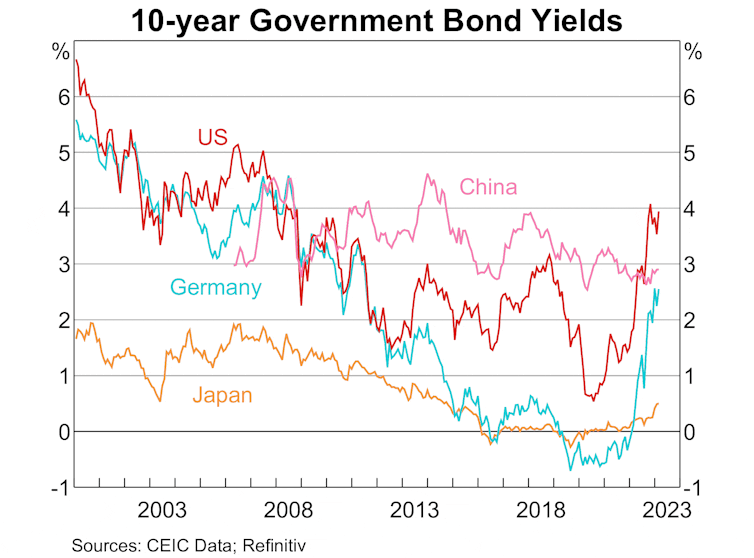
In the early months of COVID, as central banks slashed interest rates as much as possible to sustain economic activity, the already low rate of interest that governments paid on bonds dropped further. In some cases this meant bond yields were even negative. But they were still attractive to banks because of the low default risk compared to, say, lending money to companies facing tough times.

10-year government bond yields

Reserve Bank of Australia

But then came 2022 and unexpected inflation, as economies recovered and Russia’s war on Ukraine pushed up global energy prices. In response, central banks began quickly pushing up interest rates. Bond interest rates rose too. The interest rate on a ten-year US treasury bond, for example, was about 1.5% in November 2021. A year later it was more than 4%.

These higher yields on new bonds have lowered the value of existing bonds that pay less interest. Any bank wanting to sell those bonds (on a secondary market) must do so for less than what it paid.

What happened with Silicon Valley Bank

This is what happened with Silicon Valley Bank. The early stages of the pandemic were great for it. Deposits by customers, concentrated in northern California’s high-tech industry, tripled. The bank then invested heavily in US government bonds, intending to hold them until they matured.

Then came inflation and the tech industry downturn, with many companies announcing layoffs. Customers started drawing down their deposits to pay their bills.

To cover those withdrawals, the bank had to sell bonds at a loss. This reduced market confidence in the bank, leading to further withdrawals by depositors worried it might collapse. Fear of a collapse became a self-fulfilling prophecy.

Customers queue outside a Silicon Valley Bank branch Wellesley, Massachusetts, March 13, 2023.
Customers queue outside a Silicon Valley Bank branch Wellesley, Massachusetts, March 13 2023.
Steven Senne/AP

But the outcome of a classic “bank run” – with fear spreading through an interconnected financial system – was prevented by the US Federal Reserve stepping in to guarantee deposits.

What happened with Credit Suisse

So what has this to do with Credit Suisse? Like Silicon Valley Bank, which had poor risk controls, it too had specific problems indicative of poor management.

It has been implicated in providing banking services to corrupt and criminal clients. In June 2022 it was convicted in Switzerland’s Federal Criminal Court for failing to prevent money-laundering by cocaine trafficker.

In short, Credit Suisse was a disaster waiting for a catalyst. The collapse of Silicon Valley Bank, and the talk of a global banking crisis, was enough to send already jittery customers to the exit. Credit Suisse’s largest shareholder, Saudi National Bank, then bluntly and publicly refused to contribute more capital.


Read more:
The European Central Bank seems to have got away with raising interest rates in the middle of a banking crisis – here’s why


Stronger in Australia and New Zealand

In my view, the chances of any bank in Australia and New Zealand following this trajectory is effectively zero.

There’s a lot of crossover between the two countries’ financial sectors and the principal banking regulators, the Australian Prudential Regulation Authority and the Reserve Bank of New Zealand. To prevent bank runs developing, the RBNZ and APRA set minimum levels of liquid assets that can be quickly converted to cash to cover withdrawals.

It is almost a century since any depositor in an Australian bank lost even a portion of their money.

This not to say there haven’t been crises. For example, in 1979 the Bank of Adelaide faced collapse. The RBA organised massive loans from other banks. It was then taken over by ANZ Bank. Depositors kept their savings.

In 1990 the troubled State Bank of Victoria was taken over by the Commonwealth Bank of Australia (then still owned by the Commonwealth government). Again, depositors didn’t lose.


Read more:
Worst bank turmoil since 2008 means Federal Reserve is damned if it does and damned if it doesn’t in decision over interest rates


In the very unlikely event a bank did fail, Australian depositors are also protected by a federal government deposit insurance scheme called the Financial Claims Scheme. This was set up during the global financial crisis to protect customers of banks, credit unions, building societies and general insurers. It guarantees that every depositor with up to $250,000 will get their money.

The NZ government has a similar scheme in the works, with legislation expected to become law later in 2023.

The Conversation

John Hawkins formerly worked for the Reserve Bank of Australia.

ref. Credit Suisse is an anomaly: why Australia and New Zealand are safe from ‘bank run’ contagion – https://theconversation.com/credit-suisse-is-an-anomaly-why-australia-and-new-zealand-are-safe-from-bank-run-contagion-202126

Pacific needs to sit up and pay close attention to AUKUS, says Dame Meg Taylor

A Pacific elder and former secretary-general of the Pacific Islands Forum says Pacific leaders need to sit up and pay closer attention to AUKUS and the Indo-Pacific strategy and China’s response to them.

Speaking from Port Moresby in Papua New Guinea, Dame Meg Taylor said Pacific leaders were being sidelined in major geopolitical decisions affecting their region and they need to start raising their voices for the sake of their citizens.

“The issue here is that we should have paid much more attention to the Indo-Pacific strategy as it emerged,” she said.

“And we were not ever consulted by the countries that are party to that, including some of our own members of the Pacific Island Forum. Then the emergence of AUKUS — Pacific countries were never consulted on this either,” she said.

US President Joe Biden (C), British Prime Minister Rishi Sunak (R) and Australian Prime Minister Anthony Albanese (L) hold a press conference during the AUKUS summit on March 13, 2023, at Naval Base Point Loma in San Diego California. - AUKUS is a trilateral security pact announced on September 15, 2021, for the Indo-Pacific region. (Photo by Jim WATSON / AFP)
Australian Prime Minister Anthony Albanese (left), US President Joe Biden (centre) and British Prime Minister Rishi Sunak hold a press conference during the AUKUS summit at Naval Base Point Loma in San Diego California on 13 March 2023. Image: RNZ Pacific/AFP

Last week in San Diego, the leaders of the United States, the UK and Australia — President Joe Biden, Prime Minister Rishi Sunak and Prime Minister Anthony Albanese respectively — formally announced the AUKUS deal.

It will see the Australian government spending nearly $US250 billion over the next three decades to acquire a fleet of US nuclear submarines with UK tech components — the majority of which will be built in Adelaide — as part of the defence and security pact.

Its implementation will make Australia one of only seven countries in the world to have nuclear-powered submarines alongside China, France, India, Russia, the UK, and the US.

“We believe in a world that protects freedom and respects human rights, the rule of law, the independence of sovereign states, and the rules-based international order,” the leaders said in a joint statement.

“The steps we are announcing today will help us to advance these mutually beneficial objectives in the decades to come,” they said.

Following the announcement, China’s foreign ministry spokesperson Wang Wengbin said by going ahead with the pact the US, UK and Australia disregarded the concerns of the international community and have gone further down “the wrong path”.

“We’ve repeatedly said that the establishment of the so-called AUKUS security partnership between the US, the UK and Australia to promote cooperation on nuclear submarines and other cutting-edge military technologies, is a typical Cold War mentality,” Wang said.

“It will only exacerbate the arms race, undermine the international nuclear non-proliferation regime, and hurt regional peace and stability,” he said.

The 2022 Indo-Pacific Strategy is the United States’ programme to ” advance our common vision for an Indo-Pacific region that is free and open, connected, prosperous, secure, and resilient.”

Fiji prime minister Sitiveni Rabuka
Fiji Prime Minister Sitiveni Rabuka . . . Albanese assured him the nuclear submarine deal would not undermine the Treaty of Rarotonga. Image: Fiji Parliament

The Rarotonga Treaty
On his return from San Diego, Australia’s Albanese stopped over in Suva where he met his Fijian counterpart Sitiveni Rabuka.

After the meeting, Rabuka told reporters he supported AUKUS and that Albanese had assured him the nuclear submarine deal would not undermine the Treaty of Rarotonga — to which Australia is a party — that declares the South Pacific a nuclear weapon free zone.

But an Australian academic said Pacific countries cannot take Canberra at face value when it comes to AUKUS and its committment to the Rarotonga Treaty.

Dr Matthew Fitzpatrick, a professor in international history at Flinders University in South Australia, said Pacific leaders need to hold Australia accountable to the treaty.

“Australia and New Zealand have always differed on what that treaty extends to in the sense that for New Zealand, that means more or less that you haven’t had US vessels with nuclear arms [or nuclear powered] permitted into the ports of New Zealand, whereas in Australia, those vessels more or less have been welcomed,” he said.

Professor Fitzpatrick said Australia had declared that it did not breach it, or it did not breach any of those treaty commitments, but the proof of the pudding would be in the eating.

“I think it’s something that certainly nations around the Pacific should be very careful and very cautious in taking at face value, what Australia says on those treaty requirements and should ensure that they’re rigorously enforced,” Professor Fitzpatrick said.

Parties to the Rarotonga Treaty include Australia, Cook Islands, Fiji, Kiribati, Nauru, New Zealand, Niue, Papua New Guinea, Samoa, Solomon Islands, Tonga, Tuvalu, and Vanuatu.

Notably absent are three north Pacific countries who have compacts of free association with the United States — Palau, Marshall Islands and the Federated States of Micronesia.

Dame Meg Taylor said Sitiveni Rabuka’s signal of support for AUKUS by no means reflected the positions of other leaders in the region.

“I think the concern for us is that we in the Pacific, particularly those of us who are signatories to the Treaty of Rarotonga, have always been committed to the fact that we wanted a place to live where there was no proliferation of nuclear weapons.

“The debate, I think that will emerge within the Pacific is ‘are nuclear submarines weapons’?”

Self-fulfilling prophecy
Meanwhile, a geopolitical analyst, Geoffrey Miller who writes for political website Democracy Project, said the deal could become a “self-fulfilling prophecy” for conflict.

“Indo-Pacific countries all around the region are re-arming and spending more on their militaries,” Miller said.

Japan approved its biggest military buildup since the Second World War last year and Dr Miller said New Zealand was reviewing its defence policy which would likely lead to more spending.

“I worry that the AUKUS deal will only make things worse,” he said.

“The more of these kinds of power projections, and the less dialogue we have, the more likely it is that we are ultimately going to bring about this conflict that we’re all trying to avoid.

“I think we do need to think about de-escalation even more and let’s not talk ourselves into World War III.”

Miller said tensions had grown since Russia invaded Ukraine and analysts had changed their view on how likely China was to invade Taiwain.

This article is republished under a community partnership agreement with RNZ.

Article by AsiaPacificReport.nz

What to expect when you’re expecting an El Niño (the answer might surprise you)

Source: The Conversation (Au and NZ) – By Carly Tozer, Senior Research Scientist, CSIRO

Dean Lewins/AAP

La Niña and El Niño are well-known terms in Australia these days. Linked to them are certain expectations: we expect wet conditions in La Niña and dry conditions in El Niño.

These expectations have certainly been met over the past couple of years, when regions across Australia experienced record-breaking rains and severe floods during consecutive La Niña events.

It might surprise you to learn, however, that not all La Niñas have been wet, nor El Niños dry. Step back to spring 2020, for example, and Australia was relatively dry and warm, despite a La Niña.

Officials have declared the recent La Niña as over, and now we’re on an El Niño watch. You might therefore be wondering: how often can we expect it to be dry in Australia during El Niño? Our new research sought to answer this question, and the converse for La Niña.

We found La Niña and El Niño are good indicators of wet and dry conditions in eastern Australia as a whole. But at some locations, including Sydney, they do little to shift the normal odds of wet and dry conditions.

dry grass and basketball court with palms
We expect El Niños to be dry – but that’s not always the case.
Eugene Tan/AAP

What we did

We focused on the spring season because spring rainfall has the strongest historical relationship with La Niña/El Niño. We used a simple approach known as “tercile analysis”.

First, we ordered the past 72 years of rainfall data from the wettest spring to the driest. We then split the data into thirds. Springs with rainfall totals in the bottom third are considered “dry”; springs in the middle third are considered “average”; and springs with rainfall totals in the top third are “wet”.

Splitting the data in this way means we can say that any spring normally has a 33% chance of being dry, 33% chance of being average and 33% chance of being wet. Our aim was to see if these “normal” odds change during El Niño and La Niña events.


Read more:
The flap of a butterfly’s wings: why autumn is not a good time to predict if El Niño is coming


Do La Niña and El Niño change rainfall odds in eastern Australia?

For rainfall averaged across eastern Australian states, the short answer is yes.

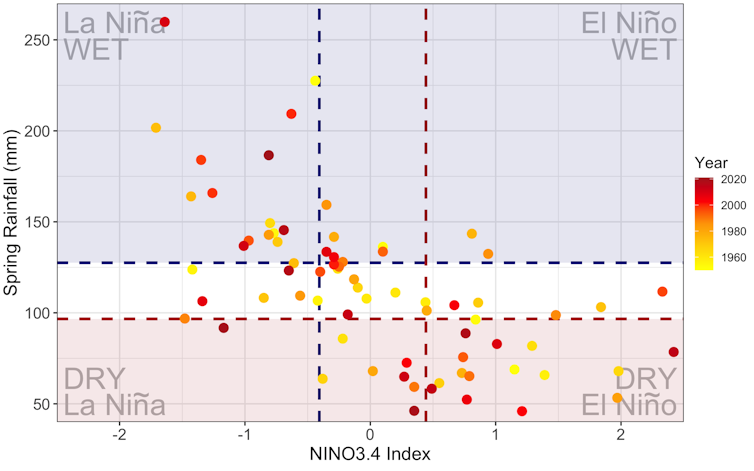
The figure below shows the rainfall data split into wet, average and dry boxes and also La Niña, neutral and El Niño boxes. If La Niña and El Niño did not change the rainfall odds, we would expect to see an even number of dots spread across all the boxes. However, this is not the case.

Dry conditions during La Niña or wet conditions during El Niño are rare across eastern Australia as a whole.

The almost empty “dry” box in La Niña and “wet” box in El Niño show very low odds in eastern Australia of experiencing dry conditions in La Niña or wet conditions in El Niño. On the other hand, La Niña approximately doubles the normal 33% chance of experiencing wet conditions and El Niño doubles the chance of dry conditions.

This result is helpful in setting broad expectations across eastern Australia. But it doesn’t necessarily apply in all locations, as we discuss below.

What about individual locations?

We applied the analysis approach described above to 5km grids across Australia.

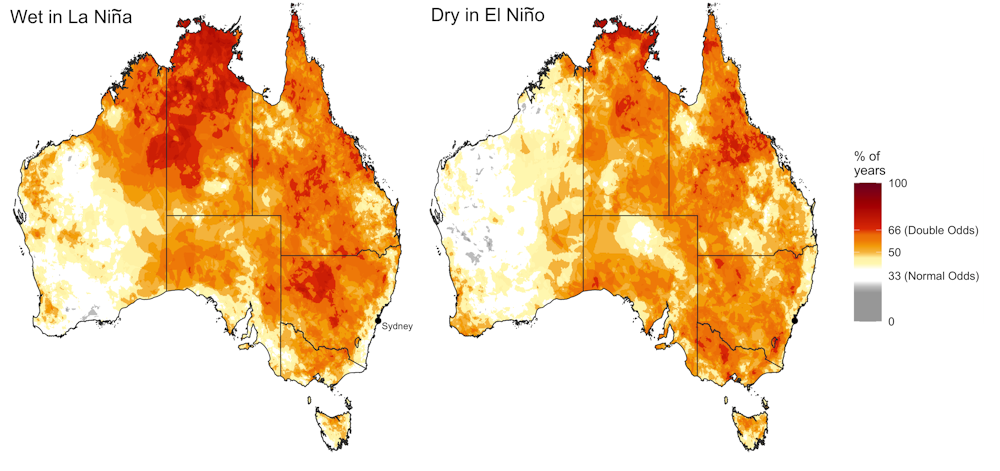
For parts of northern and southeastern Australia, including the Murray-Darling Basin, La Niña and El Niño significantly increase the normal odds of wet and dry springs respectively (orange and red areas).

But in some places, La Niña and El Niño do not markedly change the normal odds of wet or dry conditions. These locations include large parts of Western Australia, southwestern Tasmania, and southern and eastern coasts of mainland Australia, including the eastern seaboard (yellow and white areas).

The eastern seaboard is the easternmost part of Australia, between the east coast and the Great Dividing Range. The seemingly weak relationship between La Niña and El Niño and the eastern seaboard might seem surprising. After all, just consider the large amount of rain that’s fallen on the east coast over the past couple of years during La Niña, including Sydney’s record-breaking 2022.

Historically, though, rainfall on the eastern seaboard has had a weak relationship with La Niña and El Niño. Why? Because the rainfall in this region is particularly sensitive to the frequency with which the local winds blow from the east to west. But that wind flow is not necessarily strongly linked to La Niña.

In 2022 there were more of these east-to-west wind-flow events than usual, resulting in high rainfall in Sydney.

In the Sydney region, the normal chance of experiencing a wet spring is 33% – and this increases only slightly in a La Niña to 38%. It suggests La Niña is not a strong indicator for wet conditions in this region.


Read more:
Millions of satellite images reveal how beaches around the Pacific vanish or replenish in El Niño and La Niña years


Map showing odds of experiencing wet conditions in La Niña or dry in El Niño across Australia
The odds of experiencing wet conditions in La Niña or dry in El Niño change depending on where you’re located in Australia.
Author provided

When you’re expecting an El Niño, location matters

The declaration of an El Niño watch this early in the year carries considerable uncertainty. But it’s still got people thinking about the possibility of dry conditions.

The odds of experiencing dry conditions in El Niño, however, change according to where you’re located in Australia.

In the above-right map, regions in orange and red could expect an increased chance of dry conditions. Regions in red are very likely to be dry, based on historical relationships. The chance of a dry spring is around normal (33%) in other regions.

Of course, while El Niño plays a large role in moderating Australia’s climate, it is not the only driver of dry conditions in Australia. Processes including the Indian Ocean Dipole, Southern Annular Mode and other related or unrelated weather systems all contribute to Australia’s climate variability.

So it’s important to consider these factors, as well as your specific location in Australia, when interpreting what an El Niño forecast means for you.


Read more:
On our wettest days, stormclouds can dump 30 trillion litres of water across Australia


The Conversation

Nandini Ramesh has previously received funding from the Australian Research Council, the US Department of Energy, and NASA. She is a Research Affiliate at the The University of Sydney.

Carly Tozer does not work for, consult, own shares in or receive funding from any company or organisation that would benefit from this article, and has disclosed no relevant affiliations beyond their academic appointment.

ref. What to expect when you’re expecting an El Niño (the answer might surprise you) – https://theconversation.com/what-to-expect-when-youre-expecting-an-el-nino-the-answer-might-surprise-you-198510

Throwing voting-age legislation onto the ‘policy bonfire’ only delays a debate that has to happen

Source: The Conversation (Au and NZ) – By Claire Breen, Professor of Law, University of Waikato

Getty Images

There might have been pragmatic political reasons behind the government throwing voting-age legislation onto its recent policy bonfire, but it remains a sadly wasted opportunity.

The announcement reversed former prime minister Jacinda Ardern’s promise to introduce legislation to lower the voting age to 16. That was in response to the Supreme Court’s ruling last year that the current voting age of 18 was an unjustifiable restriction on the right of 16- and 17-year-olds to be free from age discrimination.

As the court acknowledged, ultimately it is up to parliament or New Zealand voters to decide if and how to respond. But the court’s “declaration of inconsistency” had a bit more constitutional heft due to a recent amendment to the Bill of Rights Act.

Along with parliament’s standing orders (its “rules of procedure”), the law change created a procedural pathway requiring parliament to respond to and debate such a declaration within six months. Last year’s introduction of a bill to lower the voting age was a first step in that democratic process.

The withdrawal of the bill leaves that process looking uncertain. The immediate reason given was the apparent impossibility of it gaining the 75% super-majority the bill needed to pass (the National Party and Act said they would not support the legislation).

Not pushing a doomed bill through an expensive political process when the country faces a cost-of-living crisis was clearly part of the government’s thinking, too. But there will still be a price paid by young New Zealanders denied the right to vote.

Why the U-turn matters

In practical terms, the withdrawal of the bill presents a lost opportunity for public and political debate around the fundamental rights to vote and to be free from discrimination.

Voting is a core democratic right. Deciding who can exercise the right is an intensely political matter on which there is a range of views. But, as the Supreme Court noted, there were strong reasons for issuing the declaration of inconsistency.

Firstly, the case involves a minority group, and the ongoing discrimination means that group’s fundamental rights are afforded less protection. This position was aptly described by the Royal Commission on the Electoral System in 1986.


À lire aussi :
Parliament now has to justify keeping the voting age at 18 – it’s a hard argument to make


It concluded that the voting age should be lowered, saying “children’s rights are not often the subject of public attention and must therefore be a particular concern of governments and the law” – even if the public was not ready for such change.

Secondly, New Zealand’s legal obligations under the United Nations Convention on the Rights of the Child mean it must implement the child’s right to freely express their views, taking into account the child’s age and maturity.

This is especially important given the Supreme Court’s consideration of research submitted by the Children’s Commissioner indicating that 16-year-olds have the cognitive capacity to make informed voting choices.

The 1986 royal commission also found it was hard to sustain the argument that children lacked the required competence to exercise their right to vote. Research at the time already showed the social and political world view of 15- or 16-year-olds was similar to that of adults.


À lire aussi :
Lowering New Zealand’s voting age to 16 would be good for young people – and good for democracy


A step in the right direction

One brighter note is the government’s promise to introduce legislation to lower the voting age in local body elections. This could be progressed by the sitting of the next parliament, and only requires the support of half of MPs.

There also appears to be greater support across the political spectrum for this initiative. And the recent draft report of the government’s review of reforming local government recommended the voting age for local elections be 16.

Denying young people the right to vote is based on a perceived need to protect young people, adult voters and representative democracy from naivety or incompetence. Yet by mounting a successful legal challenge all the way to the Supreme Court, young people demonstrated ample maturity and cognitive ability.

The political and public debates to come must be informed by the wide and longstanding body of research that challenges prevailing attitudes opposed to young people gaining the right to vote. And then the law needs to catch up.

The Conversation

Claire Breen ne travaille pas, ne conseille pas, ne possède pas de parts, ne reçoit pas de fonds d’une organisation qui pourrait tirer profit de cet article, et n’a déclaré aucune autre affiliation que son organisme de recherche.

ref. Throwing voting-age legislation onto the ‘policy bonfire’ only delays a debate that has to happen – https://theconversation.com/throwing-voting-age-legislation-onto-the-policy-bonfire-only-delays-a-debate-that-has-to-happen-201754

Does public safety trump free speech? History’s case for banning anti-trans activist Posie Parker from NZ

ANALYSIS: By Bevin Veale, Massey University

The impending arrival of Kelly-Jean Keen-Minshull — aka Posie Parker — has put the spotlight on the tension between free speech and protecting vulnerable communities in Aotearoa New Zealand.

In particular, it raises questions about Immigration New Zealand’s role in limiting who can visit and speak in the country.

Keen-Minshull is an anti-transgender rights activist and founder of a group called Standing for Women. On the back of a controversial Australian tour, she is planning to speak at a series of events across Aotearoa at the end of March.

But Immigration New Zealand is now reviewing her status after about 30 members of the far-right Nationalist Socialist Movement supported her rally in Melbourne, clashing with LGBTQI supporters.

The Melbourne police were also criticised by legal observers, accused of protecting and supporting the neo-Nazis while focusing “excessive violence” on the LGBTQI supporters.

Meanwhile, National Party leader Chris Luxon has said Keen-Minshull should be allowed into New Zealand on the grounds of free speech. He argued there should be a “high bar” to stop someone entering the country because of what they say.

At the same time, Prime Minister Chris Hipkins has said he condemned people who used their right to free speech in a way that deliberately sought to create division. Therein lies the core of the debate.

Threat to public order
Keen-Minshull has allegedly had ties to white supremacist organisations, featuring in videos with Jean-François Gariépy, a prominent far-right YouTuber, and posting a selfie with Hans Jørgen Lysglimt Johansen, a Norwegian neo-Nazi known for Holocaust denial.

Keen-Minshull has also tweeted racist diatribes against Muslims.

The key question is whether the threat of unrest seen at Keen-Minshull’s events poses sufficient risk to public order to justify revoking her visa. It turns out there is a precedent for blocking entry to controversial figures.

In 2014, hip hop collective Odd Future was prevented from entering New Zealand on the grounds they and their audience had been implicated in violence against police and directing harassment towards opponents.

In one instance, members of Odd Future reportedly urged fans to attack police, leaving one officer hospitalised.

Odd Future member Tyler the Creator also unleashed a tirade against an activist who tried to have his Australian concert cancelled. Both instances were offered as reasons to prevent the collective from entering New Zealand.

Rapper Tyler
Rapper Tyler the Creator of the Odd Future collective was banned from entering New Zealand. Immigration New Zealand said the group posed a risk to public order. Image: Scott Dudelson/FilmMagic

Character judgements
The Immigration Act stipulates that individuals who are likely to be “a threat or risk” to security, public order or the public interest should not be eligible for a visa or entry permission.

In the past, good character requirements outlined by the act, including criminal background or deportation from other countries, have been used as a reason to block controversial speakers from entering New Zealand.

For example, Steven Anderson of the Faithful Word Baptist Church was denied entry to New Zealand after being deported from other countries.

Anderson has been known to promote Holocaust denial and has confirmed he believes in “hating homosexuals”.

On the flip side, alt-right speakers Stefan Molyneux and Lauren Southern were granted entry visas in 2018 after meeting character requirements, despite calls for the pair to be banned from entering New Zealand.

Potential harm
Arguably, Keen-Minshull should not be granted entry under the banner of free speech. Rallies like those recently held in Australia do appear to cause concrete harm.

Research after the Christchurch Call, a political summit initiated by former prime minister Jacinda Ardern in 2019 after the Christchurch massacre, found expanding extremist communities increased the risk of physical attacks in the future.

According to the 2018 Counting Ourselves survey, some 71 percent of trans people reported experiencing high or very high rates of mental distress, and 44 percent experienced harassment during the 2018 survey period.

Research shows that trans people experience “minority stress” — high levels of chronic stress faced by socially marginalised groups, caused by poor social support, low socioeconomic status and prejudice.

A key part of “minority stress” is linked to anticipating and attempting to avoid discrimination.

Being consistent
Beyond the question of free speech, Immigration New Zealand needs to be consistent in its application of the law. In the case of Odd Future, an Immigration official admitted it was unusual to ban musical acts:

Generally it’s aimed at organisations like white supremacists and neo-Nazis, people who have come in here to be public speakers, holocaust deniers – those kinds of people.

However, Immigration stood by its decision based on the lead singer’s incitement of violence against police and harassment of an activist. Considering the ruling on Odd Future as a risk to public order, it would surely be inconsistent to allow Keen-Minshull entry.

In 2018, she was spoken to by UK police for making videos criticising the chief executive of transgender charity Mermaids. And, in 2019, Keen-Minshull recorded herself in Washington DC confronting trans advocate Sarah McBride after breaking into a private meeting.

Encouraging the far-right?
In the post-covid era, New Zealand has already seen a more visible far-right anti-LGBTQI movement. There has been a rise in harassment and attacks against LGBTQI communities across the country, including the arson of the Tauranga Rainbow Youth and Gender Dynamix building.

We need to listen to those targeted by hate groups — it is their safety that is at risk from speakers who deny their existence and humanity.

The line between free speech and causing harm is complicated to draw. But this case seems clear cut. Whether you agree or disagree with the 2014 decision to bar Odd Future entry to New Zealand, the precedent has been set for visitors who pose a threat to public order.The Conversation

Kevin Veale, Lecturer in Media Studies, part of the Digital Cultures Laboratory in the School of Humanities, Media, and Creative Communication, Massey University. This article is republished from The Conversation under a Creative Commons licence. Read the original article.

Print Friendly, PDF & Email

Article by AsiaPacificReport.nz

Antarctic ice age survival story: life seeking ice-free refuges imitates art in Ice Age, the movie

Source: The Conversation (Au and NZ) – By Mark Stevens, Adjunct Associate Professor, University of Adelaide

Antarctica is an icy place today, but the ice extended even further during past ice ages. The question of how and where life survived on land in the icy continent, through the ages, has long puzzled biologists.

Ever since the first expeditions to Antarctica, the persistence of life in this inhospitable environment has remained a mystery. Until now.

We assembled data to test our theory of how life survived previous ice ages. We argue that life forms including invertebrates, vertebrates and plants persisted by retreating to numerous ice-free areas, called nunataks, that were not buried by advancing glaciers.

Then when Antarctica gradually warmed up again, life expanded from these nunatak refuges to repopulate larger ice-free areas. Our approach explains the uneven distribution of Antarctic terrestrial life, and identifies new research priorities to test our theory further.

The coming age of ice

Ice Age the movie (clips): With the impending ice age almost upon them, a mismatched trio of prehistoric critters – Manny the woolly mammoth, Diego the sabre-toothed tiger and Sid the giant sloth – find an orphaned human infant and decide to return it.

For many, the term “Ice Age” conjures up memories of the animated adventures of Manny, Sid and Diego (and don’t forget that squirrel-rat, Scrat!) trying to escape the advancing ice.

There may be some truth to this story. The idea of a mammoth, sloth, sabretooth tiger (and pesky humans) migrating south for warmer climes is becoming well known in the Northern Hemisphere. And research published this month suggests early humans sat out the last ice age in the ice-free refuges of southern Europe.

But in Antarctica, land-loving life forms had nowhere to go. Or so it seemed, until now.

As scientists began to learn more about life in Antarctica, they began to consider the possibility of survival in ice-free refuges. But there was a problem. Any ice-free land in coastal regions, where life exists today, would have surely been consumed by the expanding ice. So how did life survive?

Unusual ice-free refuges

Using evidence from the biology and geology of Antarctica, we describe how ice-free refuges (nunataks) could have provided respite for coastal species.

Image of Antarctica from above showing land elevation topography and locations where springtails were sampled, also schematic of mountains comparing glacial maxima (ice age) and minima (before/after ice age).
The nunatak refuge hypothesis is that life retreated during ice ages to ice-free refuges on mountain tops (nunataks) and moraines, across the continent. Evidence for this theory comes from springtail specimens and geological records. This map of an ice-free Antarctica (a) reveals land above sea-level (green/yellow/brown). Every known springtail sampled is shown (coloured circles within the ellipses). Ice-free refuges indicated by cosmogenic dating (red/orange diamonds). Survival of springtails (colours represent isolated species) in ice-free terrain shown in (b and c) shift with glacial margins as ice expands and retreats.
Biology Letters, CC BY

We discounted previous research suggesting geothermal sites provided sufficient ice-free refuges on the coast. That’s because these would have been short-lived – compared to an ice age lasting around 100,000 years – and too few in number to explain the survival of life on the continent today.

We provide the first testable evidence-based hypothesis for the existence of life on continental Antarctica for millions of years. And we achieved this using the most well-known of all Antarctic invertebrates, a small creature that inhabits ice-free land year-round: springtails.

Springtails are an important contributor to soil health globally. They were among the first animals collected during early expeditions to the Antarctic Peninsula and the northern coast of Victoria Land from 1897-1900.

We collated a database of distribution records for Antarctic springtails from these first discoveries more than a century ago to the present.


Read more:
200 years of exploring Antarctica – the world’s coldest, most forbidding and most peaceful continent


The springtail Cryptopygus sverdrupi is one of many species found in Antarctic ice-free locations. This species is from Dronning Maud Land, and survives on the numerous nunataks that stick out of the ice cap that covers the Antarctic continent.
Cyrille D’Haese

We also delved into an existing resource that has not been previously used to explore these questions of survival. By exploring the Informal Cosmogenic-nuclide Exposure-age Database (ICE-D) for Antarctica, we were able to demonstrate that ice-free conditions persisted across the last (and previous) ice ages at a large number of locations.

Cosmogenic-nuclide dating is normally used to improve the understanding of ice sheets’ response to climate change, by revealing when a rock was last covered by ice. But it had not been used to identify ice-free glacial refuges, until now.

Jamey Stutz samples two ice-transported cobbles (rocks) at Hughes Bluff in Victoria Land, Antarctica.
Dating rocks in Antarctica has provided a unique way to identify where life could have survived repeated ice ages. Jamey Stutz samples two ice-transported cobbles (rocks) at Hughes Bluff in Victoria Land, Antarctica. The cobbles were deposited thousands of years ago, when the ice was thicker than today.
Andrew Mackintosh, Author provided

We show that some of these ice-free refuges persisted above the expanding ice during past ice ages. Some contained all species found in a region.

But how did life move from these refuges, to repopulate habitats such as coastal areas? Clues to this remarkable survival story comes from well-known alpine and polar studies, showing life present in ice-free ecosystems near glacial margins shifts as the ice expands or contracts.

Mount Suess, nestled within the Mackay Glacier in Victoria Land, provides one of the best examples of survival of life on nunataks across the last ice age. Dating rocks in the area reveals it remained ice-free.
Kevin Norton and Richard Jones

Learning life lessons

Antarctic life faces an uncertain future as the climate changes. The region is experiencing more extreme events such as the catastrophic breakup of ice shelves, the highest observed Antarctic air temperature, and the least extensive sea ice ever recorded. It seems we are now living in the sequel “Ice Age: The Meltdown”. Let’s hope we fare as well as Manny and his friends.


Read more:
The Antarctic ice sheet is melting. And this is bad news for humanity


Antarctica will change forever, and limiting that change will take a “mammoth” collective effort at a global scale to rapidly reduce greenhouse gas emissions. This is a daunting and unprecedented challenge, but one which is required to secure Antarctica’s future. Life endured past ice ages, but can it survive us?

The Antarctic Dry Valleys region is one of the driest places on earth. Today, it has the greatest amount of ice-free areas in Antarctica. These, and other regions around Antarctica, are expected to be dramatically affected by climate changes leading to large volumes of fresh water from the melting glaciers.
Mark Stevens


Read more:
Troubling new research shows warm waters rushing towards the world’s biggest ice sheet in Antarctica


The Conversation

Mark Stevens is an adjunct Associate Professor at The University of Adelaide who works at the South Australian Museum. He receives funding from the Australian Research Council SRIEAS grant SR200100005, Securing Antarctica’s Environmental Future.

Andrew Mackintosh receives funding from the Australian Research Council SRIEAS grant SR200100005, Securing Antarctica’s Environmental Future.

ref. Antarctic ice age survival story: life seeking ice-free refuges imitates art in Ice Age, the movie – https://theconversation.com/antarctic-ice-age-survival-story-life-seeking-ice-free-refuges-imitates-art-in-ice-age-the-movie-201231

Why do animals living with humans evolve such similar features? A new theory could explain ‘domestication syndrome’

Source: The Conversation (Au and NZ) – By Ben Thomas Gleeson, Doctoral Candidate, Australian National University

Luz Rovira / Flickr, CC BY-NC-ND

In the 19th century, Charles Darwin was one of the first to notice something interesting about domesticated animals: different species often developed similar changes when compared to their ancient wild ancestors.

But why would a host of seemingly unrelated features repeatedly occur together in different domesticated animals?

Scientists call this collection of shared changes “domestication syndrome”, and the reason it occurs is still hotly debated.

In a new paper in Proceedings of the Royal Society B, we argue that currently popular explanations aren’t quite right – and propose a new explanation focused on big changes in the way domesticated animals live. Along the way, our theory also offers insights into the unexpected story of how we humans domesticated ourselves.

Shared changes under domestication

The most commonly shared change is tamer behaviour. All domesticated animals are calmer than their wild ancestors naturally were.

That’s probably not very surprising. Ancient humans would’ve preferred docile animals, and likely selected breeding stock for tameness.


Read more:
Why so many domesticated mammals have floppy ears


But other common changes don’t seem at all useful to humans – or to the animals themselves. Like shorter faces, smaller teeth, more fragile skeletons, smaller brains, and different colours in skin, fur, and feathers.

Not all domesticated animals share all these features. For example, dogs have many, and camels only a few.

But each change occurs in more than one domesticated species.

Wild self-domestication

Surprisingly, very similar changes sometimes also appear in wild animals, leading some scientists to think they “self-domesticated” in some way.

The bonobo (a great ape closely related to the chimpanzee) is one famous example of an animal that has undergone these changes without human intervention. Urban foxes are another.

Bonobos are a species who are believed to have ‘self-domesticated’.
Shutterstock

Wild self-domestication is most common in isolated sub-populations, like on islands, and may overlap with a similar phenomenon known as the “island effect”.

Perhaps more surprisingly, modern humans also show features of domestication syndrome, when compared to our ancient ancestors. This suggests we also self-domesticated.

Some scientists argue these changes made us more sociable, helping us to develop complex languages and culture.

So a clearer understanding of domestication syndrome in animals might improve our knowledge of human evolution too.

What causes domestication syndrome?

In recent years, two main possible explanations for domestication syndrome have dominated scientific discussion.

The first suggests it was caused when ancient humans selected animals for tamer behaviour, which somehow triggered all of the other traits too.

This idea is supported by a famous long-running Russian fox-breeding experiment which began in 1959, in which caged foxes were selected only for tameness but developed the other “unselected” features as well.

The second hypothesis complements this first one. It suggests selection for tameness causes the other features because they’re all linked by genes controlling “neural crest cells”. These cells, found in embryos, form many animal features – so changing them could cause several differences at once.

More than selection for tameness

However, our new research suggests these two ideas oversimplify and obscure the complex evolutionary effects at play.

For one thing, there are problems with the famous Russian fox experiment. As other authors have noted, the experiment didn’t begin by taming wild foxes, but used foxes from a farm in Canada. And these pre-farmed foxes already had features of domestication syndrome.

What’s more, the experimenters didn’t only select for tameness. They bred other foxes for aggression, but the aggressive foxes also developed domestication syndrome features.

And in a similar experiment conducted in the 1930s, caged rats developed the same common changes, including tamer behaviour, despite no deliberate selection for tameness, or aggression.

So, it seems domestication syndrome might not be caused by humans selecting animals for tameness. Instead, it might be caused by unintended shared effects from the new domestic environment.

A new hypothesis for domestication syndrome

Crucially, it’s not just new forces of selection, such as a human preference for tameness, that matters. The removal of pre-existing selection is just as important, because that’s what naturally shaped the wild ancestors in the first place.

For example, domesticated animals are often protected from predators, so wild traits for avoiding them might be lost. Competition for mating partners is also often reduced, so wild reproductive features and behaviours could decline, or disappear.

Domesticated animals are also usually reliably fed. This might alter certain features, but would certainly change natural metabolism and growth.

Caged rats have also been seen to develop signs of domestication syndrome.
Oxana Golubets / Unsplash

In effect, we argue there are multiple selective changes at work on domesticated animals, not just “selection for tameness”, and that shared shifts in evolutionary selection would often cause shared changes in features. Even across different species.

Our new hypothesis highlights four ways that selection shaping wild animals is often disrupted by domestication. These are:

  1. less fighting between males
  2. fewer males for females to choose between
  3. more reliable food and fewer predators, and
  4. elevated maternal stress, which initially reduces the health and survival of offspring.

Several of these might resemble “selection for tameness”, but using this one term to describe them all is misleadingly vague, and obscures other changes in selection.

So how did we domesticate ourselves?

Well, one current theory is that sociable “beta males” began cooperating to kill alpha bullies. This changed how competition worked among males, leading to fewer big and aggressive males.

But our hypothesis suggests other effects also played a role. For example, our early ancestors evolved the capacity for shared infant care. In our chimpanzee relatives today, sharing care of an infant would likely trigger extreme stress for the mother – but our ancestors adapted to this increased stress and gained an effective survival strategy.

Adapting to the increased maternal stress that accompanies separation from infants (either for shared care or domestication) may be one of the drivers of ‘domestication syndrome’.
Shutterstock

More reliable food access due to group foraging and sharing, plus collective defence against predators, might also have made us more sociable, more cooperative, and more complex, while promoting other changes commonly seen in non-human domesticated animals.

Whatever the specific drivers in each species, recognising multiple selective pathways better explains the domestication syndrome, and reaffirms the complexity of evolutionary effects shaping all life on Earth.

The Conversation

Ben Thomas Gleeson receives funding from an Australian Government RTP Scholarship.

Laura A. B. Wilson receives funding from the Australian Research Council.

ref. Why do animals living with humans evolve such similar features? A new theory could explain ‘domestication syndrome’ – https://theconversation.com/why-do-animals-living-with-humans-evolve-such-similar-features-a-new-theory-could-explain-domestication-syndrome-201765

Popular fertility apps are engaging in widespread misuse of data, including on sex, periods and pregnancy

Source: The Conversation (Au and NZ) – By Katharine Kemp, Senior Lecturer, Faculty of Law & Justice, UNSW Sydney

New research reveals serious privacy flaws in fertility apps used by Australian consumers – emphasising the need for urgent reform of the Privacy Act.

Fertility apps provide a number of features. For instance, they may help users track their periods, identify a “fertile window” if they’re trying to conceive, track different stages and symptoms of pregnancy, and prepare for parenthood up until the baby’s birth.

These apps collect deeply sensitive data about consumers’ sex lives, health, emotional states and menstrual cycles. And many of them are intended for use by children as young as 13.

My report published today analysed the privacy policies, messages and settings of 12 of the most popular fertility apps used by Australian consumers (excluding apps that require a connection with a wearable device).

This analysis uncovered a number of concerning practices by these apps including:

  • confusing and misleading privacy messages
  • a lack of choice in how data are used
  • inadequate de-identification measures when data are shared with other organisations
  • retention of data for years even after a consumer stops using the app, exposing them to unnecessary risk from potential data breaches.


Read more:
Proposed privacy reforms could help Australia play catch-up with other nations. But they fail to tackle targeted ads


The data collected

The apps in this study collect intimate data from consumers, such as:

  • their pregnancy test results
  • when they have sex and whether they had an orgasm
  • whether they used a condom or “withdrawal” method
  • when they have their period
  • how their moods change (including anxiety, panic and depression)
  • and if they have health conditions such as polycystic ovary syndrome, endometriosis or uterine fibroids.

Some ask for unnecessary details, such as when a user smokes and drinks alcohol, their education level, whether they struggle to pay their bills, if they feel safe at home, and whether they have stable housing.

They also track which support groups you join, what you add to your “to-do list” or “questions for doctor”, and which articles you read. All of this creates a more detailed picture of your health, family situation and intentions.

Confusing or misleading privacy messages

Consumers should expect the clearest information about how such data are collected, used and disclosed. Yet we found some of the messaging is highly confusing or misleading.

Some apps say “we will never sell your data”. But the fine print of the privacy policy contains a term that allows them to sell all your data as part of the sale of the app or database to another company.

This possibility is not just theoretical. Of the 12 apps included in the study, one was previously taken over by a drug development company, and another two by a digital media company.

Other apps explain privacy settings using language that makes it almost impossible for a consumer to understand what they are choosing, or obscure the privacy settings by placing them numerous clicks and scrolls away from the home screen.

Keeping sensitive data for too long

The major data breaches of the past six months highlight the risks of companies holding onto personal data longer than necessary.

Breaches of highly sensitive information about health and sexual activities could lead to discrimination, exploitation, humiliation or blackmail.

Most of the apps we analysed keep user data for at least three years after the user quits the app – or seven years in the case of one brand. Some apps give no indication of when user data will be deleted.

Can’t count on ‘de-identification’

Some apps also give consumers no choice regarding whether their “de-identified” health data will be sold or transferred to other companies for research or business. Or, they have consumers opted-in to these extra uses by default, putting the onus on users to opt out.

Moreover, some of these data are not truly de-identified. For example, removing your name and email address and replacing it with a unique number is not de-identification for legal purposes. Someone would only need to work out the link between your name and that number in order to link your whole record with you.

When supposedly de-identified Medicare records were published in 2016, University of Melbourne researchers showed how just a few data points can connect a de-identified record to a unique individual.


Read more:
Post Roe, women in America are right to be concerned about digital surveillance – and it’s not just period-tracking apps


Need for reform

This research highlights the unfair and unsafe data practices consumers are subjected to when they use fertility apps. And these findings reinforce the need for Australia’s privacy laws to be updated.

We need improvements in what data are covered by the Privacy Act, what choices consumers can make about their data, what data uses are prohibited, and what security systems companies must have in place.

The government is seeking submissions on potential privacy law reforms until March 31.

In the meantime, if you’re using a fertility app, there are some steps you can take to help reduce some of the privacy risks:

  1. when launching the app for the first time, don’t agree to tracking of your data, or you can limit ad tracking via iPhone device settings
  2. don’t log in via a social media account
  3. don’t answer questions or add data you don’t need to for your own purposes
  4. don’t share your Apple Health or FitBit data
  5. if the app provides privacy choices, opt out of tracking and having your data sold or used for research, and delete your data when you stop using the app
  6. bear in mind that every article you read, and how long you spend on it, and every group you join and comment you make there may be added to a profile about you.


Read more:
After Roe v Wade, here’s how women could adopt ‘spycraft’ to avoid tracking and prosecution


The Conversation

Katharine Kemp receives funding from The Allens Hub for Technology, Law and Innovation. She is a Member of the Advisory Board of the Future of Finance Initiative in India, and the Australian Privacy Foundation.

ref. Popular fertility apps are engaging in widespread misuse of data, including on sex, periods and pregnancy – https://theconversation.com/popular-fertility-apps-are-engaging-in-widespread-misuse-of-data-including-on-sex-periods-and-pregnancy-202127

USP still the ‘bedrock’ for Pacific regionalism, says university chief

The Fiji Times

“The University of the South Pacific (USP) has been and continues to be a bedrock for regionalism. A resource owned by the region; for the region and a precious institution that needs to be protected in line with the vision of our forebearers.”

This was the message by USP vice-chancellor and president Professor Pal Ahluwalia during his speech at the Pacific Education Ministers Conference (CPEM) at Auckland University this week.

The conference theme was “Empowering Education for Pacific People”.

“I am acutely aware that we stand on the shoulders of giants; Pacific leaders who had the prescience of their ancient navigating forbearers, to set up an institution of higher learning and to set it on a course over the horizons in pursuit of two things excellence and equity,” he said.

Professor Ahluwalia said USP graduates had filled critical roles and many had gone on to be leaders across all sectors in their countries.

“This visionary foundation laid down by our Pacific forebearers has made USP the greatest success story of regional cooperation, where the richness of diversity of experiences has formed the foundation of hope and choice; and has established a network for learning to know; learning to do; learning to be; and learning to share,” Professor Ahluwalia said.

The main focus in the early years of USP had been on teacher education to support member governments with their education workforce as they gained their independence, over the years.

Shifts in regional priorities
However, USP had expanded its offerings in response to shifts in regional priorities and needs.

Professor Ahluwalia added that as these regional needs had become more divergent, the prospects of adequately meeting them — “while remaining true to our ongoing commitment to excellence and equity” — had become increasingly become a difficult challenge with diminishing resources.

“I am immensely proud of USP’s achievements and profoundly passionate about the exciting possibilities before us and over our horizons,” he said.

“However, I am under no illusions that we face sizeable challenges and to realise our full potential as a regional university, we need to be at our best to efficiently and effectively teach, learn and research in the service of our regional family.”

Professor Ahluwalia stressed the need to listen to the people as well as stakeholders, valuing relationships and partnerships in new and innovative ways — “and caring for regional communities and natural resources that we haven’t collectively cared enough for”.

“It is our responsibility now to ensure a cohesive articulation of tertiary qualifications across this network that address specific national needs of members of our family, while also pooling resources so that we can do things together where it makes sense to do so.”

Professor Ahluwalia said USP had had to be responsive and resilient and had much more to gain than to lose from genuine innovation.

“We are best positioned to claim leadership in areas no other organisation has the regional mandate, capability, need or courage to pursue,” he added.

Republished with permission.

Print Friendly, PDF & Email

Article by AsiaPacificReport.nz

PNG family kicked out of their home after 46 years – with 24-hour notice

By Claudia Tally in Port Moresby

A Papua New Guinean family who have been renting a property from the National Housing Corporation for the past 46 years have been served with a 24-hour eviction notice by a different owner who had obtained an eviction notice from the Port Moresby District Court.

Yasling Akianang is a former public servant who has been a tenant of the NHC since 1977, occupying the three-bedroom unit in Tamaku Crescent, Gerehu Stage 1.

Akianang said yesterday he was “sad” that he and his family had been given an eviction notice to move out.

He said he had always maintained his rental payments and had called it home for more than four decades.

“I moved into the house in 1977. I have always maintained my direct fortnight deduction rental payment since then.

“No one told me I had any outstanding debts or anything. As far as I know I don’t have any debt,” he said.

“We went to court and because I do not have a title because NHC is the legal title owner I was not able to say anything.”

Eviction notice
The eviction notice was signed by two people noted as joint owners or landlords.

The notice stated, “…hereby serve you a copy of the eviction court order granted by the POM District Court on Wednesday 01st of March 2023.

“Please be advised you are given 24 hours to vacate the property.

“Note that we have also requested police assistance in this matter. Should you fail to comply, police will immediately carry out the eviction exercise forthwith. Your 24 hour notice deadline is at 5 pm 28 March, 2023.”

Today, three generations of the Akianang family occupy the three bedroom unit.

“I have my three children living with me and my grandchildren and my relatives living here too. Where are we going to go, it is my home,” said an emotional Akianang.

The PNG Post-Courier has asked the National Housing Corporation for comment.

Claudia Tally is a PNG Post-Courier journalist. Republished with permission.

Print Friendly, PDF & Email

Article by AsiaPacificReport.nz

Does it matter what time I go to bed?

Source: The Conversation (Au and NZ) – By Frederic Gachon, Associate Professor, Physiology of Circadian Rhythms, Institute for Molecular Bioscience, The University of Queensland

Gregory Pappas/Unsplash

Some of us love to be tucked up in bed by a particular time every night, ensuring a certain number of hours of sleep. Others go to bed when they start to feel tired, or when they’ve finally finished everything they wanted to get done, and get up when they need to in the morning.

But does it matter what time you go to bed?

Why prioritise sleep?

Getting a good night’s sleep can improve brain function, mood, metabolic health and immunity.

Not getting enough sleep or having poor sleep quality increases the risk of infections and other health problems such as depression, dementia, weight gain, diabetes and high blood pressure.


Read more:
Health Check: three reasons why sleep is important for your health


Recent studies even suggest not getting enough sleep at night can also increase the risk of developing long COVID.

Perhaps surprisingly, sleeping for seven to eight hours is associated with better health outcomes than shorter or longer sleeps.

How does our body clock work?

The timing of our sleep is orchestrated by the so-called “circadian clock”, the body’s internal biological timekeeper. It helps regulate many processes on a daily basis including the timing of our sleep-wake cycle.

During evolution, living species – from bacteria and plants to humans – have acquired a circadian clock to optimise bodily processes in an environment that changes throughout the day. Consequently, almost all aspects of behaviour, physiology and metabolism are rhythmically organised to anticipate these daily changes.

Man sits at a computer at night
Our circadian clock regulates when we sleep and wake.
Unsplash/Nicolas Flor, CC BY

While we are, in theory, able to sleep at any time during the day as long we’re sufficiently tired, our circadian clock dictates us to be “diurnal”, meaning we’re active during the day and sleep during the night.

Working against this default stage – by doing shift work, where we work regular shifts at night or alternate between shifts, or staying up longer/waking up later over the weekend – can result in poorer health because it disconnects our physiology and behaviour from our internal circadian clock that is supposed to organise it.

Even the apparently harmless weekend sleep-in after a late night increases the risk of obesity and mental health issues. Indeed, this regular shift in our sleeping schedule every weekend creates a so-called “social jetlag” that, to some extend, mimics the effect of shift work.


Read more:
Why does night shift increase the risk of cancer, diabetes and heart disease? Here’s what we know so far


But do you like to get up early or late?

Our individual biological night (when our body thinks it’s night) may differ substantially from the actual environmental night (when it’s actually night time).

But our modern society doesn’t really support going to bed late and waking up later in the day. It can be even considered a sign of poor self-discipline and laziness. We’re told “the early bird catches the worm”, or that early risers have an advantage over late risers and tend to be more productive and successful.

Woman wakes up, tired
Our society doesn’t value waking up later in the day.
Kinga Cichewicz/Unsplash

But our sleep preferences are not really a matter of choice: they are mainly driven by our genes and depend on our chronotype. The chronotype is the natural tendency of a person to sleep or be active at a certain time during the day according to their circadian rhythms.

While most of us already know the expression that people can be either larks (early types) or night owls (late types), these chronotypes are the two extremes on the spectrum. Most people are somewhere in the middle.

As our chronotype depends on individual differences in our circadian clock properties, it is not really possible to actively alter our chronotype.

However, it can change over a lifetime: children are larks, adolescents tend to be night owls, and after the age of 20 and as we increase in age, we become lark-like again.


Read more:
Morning lark or night owl? How our body clocks affect our mental and physical performance


The chronotype itself does not affect how much sleep we need, which is also mainly influenced by other factors and genetics.

Rather, our chronotype interacts with our social obligations such as school, work or family responsibilities, which can affect how much sleep we get. Later chronotypes may have a disadvantage due to the pace of modern life as their natural chronotype conflicts with the demands of their schedule.

Consequently, a late chronotype is often associated with poor cardiometabolic health (affecting your heart and blood vessels) and the higher risk of depression.

Boy walks down a road
Adolescents tend to be night owls.
Jesus Rodriguez/Unsplash

In this context, there is a growing call from scientists for schools to delay the start time for teenagers to ensure sufficient sleep and improve health outcomes and school performance.

So there is no simple answer to the question of when to go to bed. While a regular good night’s sleep with an average of seven to eight hours is important for general health and wellbeing, our optimal bedtime depends on our internal circadian clock and other factors including genetics that control how long we need to sleep.

The Conversation

Frederic Gachon is currently receiving funding from the National Health and Medical Research Council (NHMRC) and has received funding from the French Institute for Medical Research and Health (INSERM: 2006-2008), the Swiss National Science Foundation (2010-2012), the European Research Council (2011- 2015) and the Leenaards Foundation (2012-2014). He also worked for Nestlé (2012-2017) where he received industry funding.

Meltem Weger has received funding from the German Academic Scholarship Foundation (PhD fellowship; 2010-2012) and from the European Commission (Marie Curie Curie Postdoctoral fellowships; 2014-2016, 2017-2019).

ref. Does it matter what time I go to bed? – https://theconversation.com/does-it-matter-what-time-i-go-to-bed-198146

25-million-year-old fossils of a bizarre possum and strange wombat relative reveal Australia’s hidden past

Source: The Conversation (Au and NZ) – By Arthur Immanuel Crichton, PhD candidate, Flinders University

Relative of _Chunia pledgei_ named _Ektopodon serratus_ (top left), with _Wakaleo oldfieldi_. Reconstruction of the early Miocene Kutjumarpu faunal assemblage by Peter Schouten, CC BY-SA

Imagine a vast, lush forest dominated by giant flightless birds and crocodiles. This was Australia’s Red Centre 25 million years ago. There lived several species of koala; early kangaroos the size of possums; and the wombat-sized ancestors of the largest-ever marsupial, Diprotodon optatum (around 2.5 tonnes).

A window onto this ancient time is provided by a little-studied fossil site near Pwerte Marnte Marnte, south of Alice Springs in central Australia. This late Oligocene site yielded the earliest-known fossils of marsupials that look similar to modern ones, as well as fossils from wholly extinct groups such as the enigmatic ilariids, which were something like a koala crossed with a wombat.

While excavating this site from 2014 to 2022, Flinders University palaeontologists have found fossils from many more wonderful animals. In a pair of recently published studies, we name two of these species: a strange wombat relative and an even odder possum.

A dry orange landscape with small shrubs and a group of people sifting through rocks in the foreground
Flinders University palaeontologists at Pwerte Marnte Marnte fossil site.
Arthur Crichton, Author provided

A toothy wombat

We discovered 35 specimens, including a partial skull and several lower jaws, from an animal that would have looked a bit like a modern wombat crossed with a marsupial lion (Thylacoleo carnifex).

Weighing in at around 50kg, it was among the largest marsupials of its time. We named it Mukupirna fortidentata.

Two isolated photos of a similarly shaped bone with large protruding teeth at the front
Left lower jaw of Mukupirna fortidentata compared with that of the southern hairy-nosed wombat.
Arthur Crichton, Author provided

Everything about its skull and jaws shows this animal had a pretty powerful bite. Its front teeth, for example, were large and spike-shaped, being more like those of squirrels than wombats. These would have enabled them to fracture hard foods, like tough fruits, seeds, nuts and tubers. Its molars, by comparison, were actually quite similar to those of some monkeys, such as macaques.

Mukupirna fortidentata is only the second known member of a new family of marsupials described in 2020 called Mukupirnidae. These animals are thought to have diverged from a common ancestor with wombats over 25 million years ago. Sadly, they went extinct shortly thereafter.

Illustration of a flat landscape with an odd, grey wombat-like animal with slender legs standing by a pond
Close relative of Mukupirna fortidentata named Mukupirna nambensis.
Reconstruction of the Pinpa faunal assemblage by Peter Schouten, CC BY-SA

A nutcracker possum

The second species we described is a newly discovered early possum, named Chunia pledgei. It had teeth that would be a dentist’s nightmare, with lots of bladed points (cusps) positioned side by side, like lines on a barcode. This tooth shape is characteristic of species in the poorly known, extinct possum family called Ektopodontidae.

The new species is unusual in that it has pyramid-shaped cusps on its front molars. These might have been useful for puncture-crushing hard foods — a bit like a nutcracker.

Fragmented yellow bone with strange serrated-looking teeth along the top
Chunia pledgei cheek teeth preserved in right lower jaw.
Arthur Crichton, Author provided

So what did ektopodontids eat? We don’t really know for sure – there’s no animal like them alive today anywhere in the world. Based on aspects of their molar morphology, we infer they were probably eating fruits and seeds or nuts. But they may have been doing something totally different!

Unfortunately, ektopodontids are tantalisingly rare in the fossil record, known only from isolated teeth and several partial jaws. The fossils show they had a lemur-like short face, with particularly large, forward-facing eyes. But until we find more complete skeletal material, their ecology will likely remain mysterious.

What remains astonishing is just how little we know about the origins of Australia’s living animals, owing in no small part to a 30-million-year gap in the fossil record – half the time between now and the extinction of the dinosaurs.

At the same time, it’s inspiring to think about the countless strange and fascinating animals that must have once lived on this continent. Fossil evidence of these creatures may still be sitting somewhere in the outback, waiting to be discovered.


Read more:
Ancient bilby and bandicoot fossils shed light on the mystery of marsupial evolution


The Conversation

Gavin Prideaux has received funding from the Australian Research Council.

Aaron Camens and Arthur Immanuel Crichton do not work for, consult, own shares in or receive funding from any company or organisation that would benefit from this article, and have disclosed no relevant affiliations beyond their academic appointment.

ref. 25-million-year-old fossils of a bizarre possum and strange wombat relative reveal Australia’s hidden past – https://theconversation.com/25-million-year-old-fossils-of-a-bizarre-possum-and-strange-wombat-relative-reveal-australias-hidden-past-200262

Does public safety trump free speech? History suggests there is a case for banning anti-trans activist Posie Parker from NZ

Source: The Conversation (Au and NZ) – By Kevin Veale, Lecturer in Media Studies, part of the Digital Cultures Laboratory in the School of Humanities, Media, and Creative Communication, Massey University

Getty Images

The impending arrival of Kelly-Jean Keen-Minshull – aka Posie Parker – has put the spotlight on the tension between free speech and protecting vulnerable communities. In particular, it raises questions about Immigration New Zealand’s role in limiting who can visit and speak in Aotearoa New Zealand.

Keen-Minshull is an anti-transgender rights activist and founder of a group called Standing for Women. On the back of a controversial Australian tour, she is planning to speak at a series of events across Aotearoa at the end of March.

But Immigration New Zealand is now reviewing her status after about 30 members of the far-right Nationalist Socialist Movement supported her rally in Melbourne, clashing with LGBTQI supporters.

The Melbourne police were also criticised by legal observers, accused of protecting and supporting the neo-Nazis while focusing “excessive violence” on the LGBTQI supporters.

Meanwhile, National Party leader Chris Luxon has said Keen-Minshull should be allowed into New Zealand on the grounds of free speech. He argued there should be a “high bar” to stop someone entering the country because of what they say.

At the same time, Prime Minister Chris Hipkins has said he condemned people who used their right to free speech in a way that deliberately sought to create division. Therein lies the core of the debate.

Threat to public order

Keen-Minshull has allegedly had ties to white supremacist organisations, featuring in videos with Jean-François Gariépy, a prominent far-right YouTuber, and posting a selfie with Hans Jørgen Lysglimt Johansen, a Norwegian neo-Nazi known for Holocaust denial. Keen-Minshull has also tweeted racist diatribes against Muslims.


Read more:
Being transgender is not a mental illness, and the WHO should acknowledge this


The key question is whether the threat of unrest seen at Keen-Minshull’s events poses sufficient risk to public order to justify revoking her visa. It turns out there is a precedent for blocking entry to controversial figures.

In 2014, hip hop collective Odd Future was prevented from entering New Zealand on the grounds they and their audience had been implicated in violence against police and directing harassment towards opponents.

In one instance, members of Odd Future reportedly urged fans to attack police, leaving one officer hospitalised. Odd Future member Tyler the Creator also unleashed a tirade against an activist who tried to have his Australian concert cancelled. Both instances were offered as reasons to prevent the collective from entering New Zealand.

Rapper Tyler the Creator of the Odd Future collective was banned from entering New Zealand. Immigration New Zealand said the group posed a risk to public order.
Scott Dudelson/FilmMagic

Character judgements

The Immigration Act stipulates that individuals who are likely to be “a threat or risk” to security, public order or the public interest should not be eligible for a visa or entry permission.

In the past, good character requirements outlined by the act, including criminal background or deportation from other countries, have been used as a reason to block controversial speakers from entering New Zealand.

For example, Steven Anderson of the Faithful Word Baptist Church was denied entry to New Zealand after being deported from other countries. Anderson has been known to promote Holocaust denial and has confirmed he believes in “hating homosexuals”.

On the flip side, alt-right speakers Stefan Molyneux and Lauren Southern were granted entry visas in 2018 after meeting character requirements, despite calls for the pair to be banned from entering New Zealand.

Potential harm

Arguably, Keen-Minshull should not be granted entry under the banner of free speech. Rallies like those recently held in Australia do appear to cause concrete harm.

Research after the Christchurch Call, a political summit initiated by former prime minister Jacinda Ardern in 2019 after the Christchurch massacre, found expanding extremist communities increased the risk of physical attacks in the future.


Read more:
Polarising, sensational media coverage of transgender athletes should end – our research shows a way forward


According to the 2018 Counting Ourselves survey, some 71% of trans people reported experiencing high or very high rates of mental distress, and 44% experienced harassment during the 2018 survey period.

Research shows that trans people experience “minority stress” – high levels of chronic stress faced by socially marginalised groups, caused by poor social support, low socioeconomic status and prejudice. A key part of “minority stress” is linked to anticipating and attempting to avoid discrimination.

Being consistent

Beyond the question of free speech, Immigration New Zealand needs to be consistent in its application of the law. In the case of Odd Future, an Immigration official admitted it was unusual to ban musical acts:

Generally it’s aimed at organisations like white supremacists and neo-Nazis, people who have come in here to be public speakers, holocaust deniers – those kinds of people.

However, Immigration stood by its decision based on the lead singer’s incitement of violence against police and harassment of an activist. Considering the ruling on Odd Future as a risk to public order, it would surely be inconsistent to allow Keen-Minshull entry.

In 2018, she was spoken to by UK police for making videos criticising the chief executive of transgender charity Mermaids. And, in 2019, Keen-Minshull recorded herself in Washington DC confronting trans advocate Sarah McBride after breaking into a private meeting.

Encouraging the far-right?

In the post-COVID era, New Zealand has already seen a more visible far-right anti-LGBTQI movement. There has been a rise in harassment and attacks against LGBTQI communities across the country, including the arson of the Tauranga Rainbow Youth and Gender Dynamix building.


Read more:
Trans rights and political backlash: five key moments in history


We need to listen to those targeted by hate groups – it is their safety that is at risk from speakers who deny their existence and humanity.

The line between free speech and causing harm is complicated to draw. But this case seems clear cut. Whether you agree or disagree with the 2014 decision to bar Odd Future entry to New Zealand, the precedent has been set for visitors who pose a threat to public order.

The Conversation

Kevin Veale does not work for, consult, own shares in or receive funding from any company or organisation that would benefit from this article, and has disclosed no relevant affiliations beyond their academic appointment.

ref. Does public safety trump free speech? History suggests there is a case for banning anti-trans activist Posie Parker from NZ – https://theconversation.com/does-public-safety-trump-free-speech-history-suggests-there-is-a-case-for-banning-anti-trans-activist-posie-parker-from-nz-202118

New asteroid sample study offers further hints of space origin for the building blocks of life on Earth

Source: The Conversation (Au and NZ) – By Trevor Ireland, Professor, School of Earth and Environmental Sciences, The University of Queensland

MASCOT / DLR / JAXA

How did life come about? The answer to this question goes to the very heart of our existence on planet Earth.

Did life simply arise from chemical reactions among organic compounds in a primordial soup left after Earth clumped together from space rubble? If so, where did the organic compounds come from?

Some of the so-called “building blocks of life” may have been surprisingly common in the early Solar System.

A team of Japanese and American scientists led by Yasuhiro Oba has analysed samples taken from the asteroid Ryugu in 2018 by the Hayabusa2 mission and found uracil, one of the five key bases of the RNA and DNA molecules that are crucial to life as we know it. Their study is published today in Nature Communications.


Read more:
The Hayabusa2 spacecraft is about to drop a chunk of asteroid in the Australian outback


Building blocks

At the most basic level, the development of life is a matter of combining simple organic molecules into increasingly complex compounds that can participate in the myriad reactions associated with a living organism.

Simple amino acids are believed to act as building blocks in the construction of these more complex molecules. But this isn’t just a simple random combination exercise.

The largest “chunk” of the human genome, chromosome 1, is made up of 249 million base pairs (the rungs on the twisted ladder of the DNA molecule). Each base pair is made of two bases: either guanine and cytosine, or adenine and thymine.


Read more:
Explainer: what is RNA?


Building from the simple base pair chemicals to a full strand of DNA is a massive undertaking. A strand of DNA also has a complex structure, which varies from one individual to another. Life on Earth uses the structure of DNA to memorise the construction of the life form involved.

Alongside DNA, life uses a molecule called RNA for making proteins and doing other odds jobs inside cells. RNA is also made of a long string of bases: guanine, cytosine and adenine (like DNA), but instead of thymine it has uracil – which is what turned up in the sample from Ryugu.

Ryugu

Ryugu is what’s called a C-type or carbonaceous asteroid. These are the most common type in the asteroid belt, making up about 75% of the asteroids we can see.

The Hayabusa2 mission established that C-type asteroids like Ryugu are the source of a kind of rare meteorite sometimes found on Earth, called a carbonaceous chondrite.

Uracil and other organic molecules have previously been found in these meteorites, but there has been no way to rule out the possibility that some of the molecules had a terrestrial origin. The meteorite samples could have been contaminated here on Earth, or their chemistry might have been changed by heating as they fell through the atmosphere.


Read more:
What are asteroids made of? A sample returned to Earth reveals the Solar System’s building blocks


However, since the Ryugu sample was taken from the surface of an asteroid and brought back in a tightly sealed container, scientists are confident it is free of contamination or any effects of coming to Earth.

Furthermore, the presence of these amino acids on Ryugu shows that even on asteroid surfaces, exposed to solar wind, micrometeorites and cosmic rays, organic molecules can survive transportation through the solar system.

A huge variety of different organic compounds have already been found in Ryugu samples.

Many organic molecules, such as amino acids, come in two forms: left-handed and right-handed. Life on Earth relies on left-handed amino acids, but both forms are equally common in Ryugu samples – which indicates the molecules found on Ryugu are not signs of life.


Read more:
Is there life through the looking-glass? The riddle of life’s single-handedness


The big picture

The Solar System formed around 4.57 billion years ago from a molecular dust cloud that was exposed to UV radiation and particle bombardment from protons.

The molecular cloud contained simple molecules such as methane (CH₄), water (H₂O) and ammonia (NH₃). These would have been fragmented by the radiation, and the fragments would have reassembled into more complex molecules such as amino acids.

C-type asteroids like Ryugu are believed to have formed so far from the Sun that the water and carbon dioxide they contain would have remained frozen. However, as the asteroids warmed up and the ice melted, liquid water would have been able to react with the rocks and minerals.

Whether these conditions led to the creation of more complex organic molecules is an open question, but certainly these conditions would be conducive to further reactions. In addition, these conditions could affect the survival of different compounds.

The Hayabusa2 samples from Ryugu provide a new context for understanding the origin of organic compounds that may have been the start of life on Earth. It is still a big step from having these organic compounds available to early Earth, and the formation of life itself.

The Conversation

Trevor Ireland receives funding from The Australian Research Council for research into the Ryugu samples. He is affiliated with the Hayabusa2 mission.

ref. New asteroid sample study offers further hints of space origin for the building blocks of life on Earth – https://theconversation.com/new-asteroid-sample-study-offers-further-hints-of-space-origin-for-the-building-blocks-of-life-on-earth-201960

Why is Australia buying hundreds of missiles?

Source: The Conversation (Au and NZ) – By James Dwyer, Associate Lecturer, School of Social Sciences, University of Tasmania

Flying under the radar of last week’s AUKUS submarine announcement was the revelation that the United States had agreed to sell Australia up to 220 Tomahawk cruise missiles.

This follows Australia’s purchase in January of “high mobility artillery rocket systems”, known as HIMARS, which have been used by Ukraine on the battlefield in response to Russia’s invasion.

And in 2020, the US approved the sale of up to 200 long-range anti-shipping missiles (LRASM) to Australia.

But what are these missiles, and what purpose do they serve?

Do they contribute to an evolving arms race within the Indo-Pacific?


Read more:
AUKUS submarine plan will be the biggest defence scheme in Australian history. So how will it work?


What are these missiles?

Tomahawks

Tomahawks are long range, subsonic (that is, slower than the speed of sound) cruise missiles. They’re designed to strike targets on land at long-range, around 1,600km.

Newer Tomahawk variants, such as those being purchased by Australia, can also strike moving targets at sea. These missiles have been used in combat over 2,300 times.

They will be deployed on three Australian warships, known as Hobart class destroyers. These ships are primarily designed to defend the navy from aerial threats such as aircraft and missiles, but adding Tomahawks would allow them to strike targets on land or sea.

What’s more, the Virginia class nuclear-powered submarines Australia is purchasing from the US under the AUKUS agreement are also capable of launching Tomahawks. It’s safe to assume Australia’s future AUKUS class nuclear-powered submarines will also be able to deploy Tomahawks.

This would provide Australia with a potent deterrent. It would mean Australia could conduct long-range precision strikes against potential adversaries, using a stealthy platform that would be extremely difficult to detect.

LRASM

Australia’s purchase of long range anti-shipping missiles (LRASM) is intended to increase the strike range of two types of Australia’s fighter jets. This would allow Australia to accurately strike hostile shipping at long range.

They will replace Australia’s ageing Harpoon anti-shipping missile. They have a range of about 560km, which is approximately four times greater than the Harpoon.

This capability is highly desirable given that, in the event of a regional conflict, the greatest threat to Australia is a blockade of its key trade routes.

HIMARS

Unlike the two missiles discussed above, high-mobility artillery rocket systems (HIMARS) are artillery systems for battlefield use. They use rockets instead of shells.

The advantage of rocket artillery such as HIMARS is threefold:

  1. It can provide greater range than “conventional” artillery, which generally speaking maxes out around 20-30km. It can strike targets ranging from 70km-300km away from the launch point, depending on the munition used.

  2. It’s precise, minimising collateral damage.

  3. It’s highly mobile. Troops can quickly fire its munitions, and then promptly relocate, which decreases an opponent’s ability to hit it with counterfire.

Why does Australia need them?

Australia has had a gap in long-range strike capabilities, arguably since it retired the F-111 long range strike aircraft in 2010.

The F-111 could fly up to about 6,000km, but the aircraft brought in to replace the F-111 have significantly lower ranges. The F/A-18F has a range of 2,700km, while the F-35A is even worse off, with a range of only 2,200km.

What’s more, these are the ranges aircraft can fly in a non-combat environment (for example, cruising in a straight line). Their range is far lower in a combat scenario.

So the addition of long range, precision strike missiles allow these platforms to pack greater punch at longer distances.

In particular, the Tomahawks and LRASM allow aircraft and warships to launch the missiles further from potential danger. This is particularly important as countries such as China are heavily investing in military systems designed to prevent access and freedom of operation in contested waters such as the South China Sea, a strategy referred to as Anti-Access/Area Denial, or “A2AD”.

Crucially, these missiles (within the broader context of other defence procurements) offer Australia two things. Firstly, they provide an increased deterrent in an increasingly turbulent region.

If Australia can hold key targets under threat, then a potential adversary is less likely to undertake a hostile action, or at the very least think more carefully before doing so.

It also facilitates what’s called “interoperability” with key allies such as the US, so Australian and US forces can operate more easily in a joint manner if need be.

Secondly, these platforms allow Australia to have our own “A2AD” capabilities. While an invasion of Australia is extraordinarily unlikely, it’s possible an adversary may try to block shipping routes to prevent our people and/or goods from free navigation (a naval blockade). Or, they may attempt to close strategic chokepoints and navigation routes to Australia’s north, such as the Malacca Strait.

Having the ability to strike targets at long range holds those undertaking such actions under threat, increasing the difficulty in sustaining a blockade, or making it unappealing to attempt to do so due to high potential costs.

Of course, these systems also come with significant costs. The purchase of approximately 220 Tomahawks will cost A$1.3 billion, while 20 HIMARS launchers and missiles attracts a bill of $558 million. About 200 LRASMs costs a further $1.47 billion.


Read more:
China’s military might is much closer to the US than you probably think


Contributing to an arms race?

There is a question about whether these purchases contribute to a regional arms race. There’s no doubt China is rapidly building its military capabilities, and this is making other countries in the region apprehensive about the long-term purpose of such an arms build-up.

Even if China held no hostile intentions within the region, it’s prudent for states such as Australia to be able to defend themselves and their interests, just in case.

While many are decrying the enormous outlay for submarine procurement under AUKUS, and others are criticising Australia for being subservient to US interests or “warmongering”, the reality is that all states maintain offensive and defensive capabilities just in case the worst happens. In other words, we hope for the best, but plan for the worst.

Deterrence is a foundational concept of international relations, and these purchases are Australia maintaining its ability to deter potential adversaries. It’s not about warmongering, but about being ready just in case the worst occurs.

The Conversation

James Dwyer does not work for, consult, own shares in or receive funding from any company or organization that would benefit from this article, and has disclosed no relevant affiliations beyond their academic appointment.

ref. Why is Australia buying hundreds of missiles? – https://theconversation.com/why-is-australia-buying-hundreds-of-missiles-202123

Doctors may soon get official ‘endorsements’ to practise cosmetic surgery – but will that protect patients?

Source: The Conversation (Au and NZ) – By Christopher Rudge, Law lecturer, University of Sydney

Unsplash/Olga Guryanova, CC BY

Disturbing reports about botched cosmetic surgeries and injuries in Australia – from breast augmentations causing chronic pain to liposuction leaving patients with lifelong injuries – have sparked concerns in recent years. Several high-profile cosmetic surgeons alleged to have fallen short of expected professional standards have been disciplined.

Last year, a class action was commenced against one clinic in the Victorian Supreme Court.

People who are interested in exploring whether cosmetic surgery is appropriate for them are right to feel wary and confused. Now, the introduction of a scheme to officially endorse doctors who practise in the area of cosmetic surgery promises to allay patients’ doubts. But the idea remains contentious for those in the field.


Read more:
Thinking about cosmetic surgery? At last, some clarity on who can call themselves a surgeon


The story so far

In the wake of cosmetic surgery controversies, two significant but separate responses have been adopted by medical regulators. First, the country’s health ministers began a consultation to decide whether to stop doctors promoting themselves as “surgeons”.

The consultation acknowledged a gap or “loophole” that allows any registered medical practitioner to call themselves a surgeon in Australia, even with no specialist training beyond their medical degree.

The second response was initiated in December 2021, by AHPRA, which accredits and registers doctors, and the Medical Board of Australia, which regulates the practices of registered medical practitioners. Together, they commissioned an independent review into the regulation of medical practitioners who perform cosmetic surgery in Australia.

Although informed by each other, these separate initiatives wrought distinct solutions. While one has been embraced, the other remains controversial.

Ministerial reforms

After nearly two years of consultation, the health ministers decided last December to restrict the use of the title “surgeon”. Soon, only medical practitioners holding a specialist registration, such as ophthalmology, will be permitted to use the title.

In a meeting late last month, health ministers approved a draft bill to give effect to this decision. While the draft remains unpublished, no stakeholders in the health sector appear to have criticised the change.

But the health ministers approved another, more controversial, reform as well. They welcomed a new model of accrediting cosmetic surgery practitioners known as an “endorsement of registration”. This proposal came from the AHPRA and Medical Board review.

AHPRA and the Medical Board’s ‘endorsement model’

Among its 16 recommendations (all of them accepted by AHPRA and the Medical Board), the independent review’s first and most significant reform proposal was to establish an “area of practice endorsement” for cosmetic surgery.

The technical language of “endorsement” comes from consistent national laws enacted, with minor variations, in each state and territory.

In a nutshell, “area of practice endorsement” would introduce new minimum standards for the education, training and qualification of Australian medical practitioners seeking to practise as cosmetic surgeons.

Currently, the Medical Board uses codes of conduct and guidelines to regulate most doctors’ practices.

But these “soft law” instruments permit doctors to decide for themselves whether they are competent enough to perform procedures like brow lifts or tummy tucks.

The new endorsement model would require doctors to apply to the Medical Board to qualify to practice in the area of cosmetic surgery. To be approved, the doctor-applicant would need to furnish evidence of their qualifications. Such an endorsement arrangement already exists for acupuncture.

Together with restricting the title “surgeon” and some other reforms (such as improved information campaigns), it is now hoped the endorsement model would manage risky cosmetic surgeries by requiring practitioners to be endorsed by the Medical Board. But not everyone thinks it’s the way to go.


Read more:
Who’s the best doctor for a tummy tuck or eyelid surgery? The latest review doesn’t actually say


What’s the problem with endorsement?

Fresh forms of old tensions have arisen, based on how endorsement will be designed. At the core of these tensions is a debate about how the Australian Medical Council, which is responsible for setting the accreditation, training and education standards for the medical profession, will determine the curriculum and assessment regimes for cosmetic surgery study programs.

What was once a debate about an unregulated area of practice is now about what kind of training cosmetic surgeons should have before wielding their instruments.

Some experts suggest defining cosmetic surgery could help regulation and safety discussions. Meanwhile, the Royal Australasian College of Surgeons says it will oppose any study program of a lesser standard than that required of specialist surgeons.

Although the Australian Medical Council has not yet published its education standards for cosmetic surgery, it has proposed six draft qualification standards and is consulting with the profession.

What this could mean for patient safety

On the one hand, the proposed changes are a continuation of a long-running turf war. On one side are the surgeons with special accreditation, approved by the Royal Australasian College of Surgeons and typically engaged in reconstructive plastic surgeries. On the other, stand the so-called “non-surgeons” or “wannabees”.

The debate is also about protecting patients and legislative reform.

It is too early to determine whether the Australian Medical Council’s endorsement standards will improve patient safety. But the slow process of reforming the cosmetic surgery “industry” – in the face of explosive increases in demand, fuelled in part by seductive social media claims – illustrates how complex medical regulation is in Australia. With so many regulatory actors involved in our polycentric system, feuds over governance are unsurprising.

Today, the cosmetic surgery industry is estimated to be worth more than one billion dollars a year. It is crucial regulators ensure the public is protected from unscrupulous – or unqualified – operators.

The Conversation

Christopher Rudge was previously a researcher at the Medical Council of New South Wales. He is a chief invstigator on a project concerning patient decision-making about stem cell treatments funded by the Australian government’s Medical Research Future Fund.

ref. Doctors may soon get official ‘endorsements’ to practise cosmetic surgery – but will that protect patients? – https://theconversation.com/doctors-may-soon-get-official-endorsements-to-practise-cosmetic-surgery-but-will-that-protect-patients-202136

New research reveals how forests reduce their own bushfire risk, if they’re left alone

Source: The Conversation (Au and NZ) – By Philip Zylstra, Adjunct Associate Professor at Curtin University, Research Associate at University of New South Wales, Curtin University

Shutterstock

Fire management in Australia is approaching crisis point. Seasons such as the Black Summer three years ago showed how our best efforts in fire-fighting and prescribed burning are insignificant in the face of a changing climate.

But what if forests have their own tools to manage bushfire risk, and we could tap into them?

We know long-unburnt mountain forests in south-east Australia are far less fire-prone than more recently burnt areas. And forests in south-west Australia have the lowest fire risk when they’ve not been subjected to prescribed burning.

Our study just published set out to understand why this occurs, by modelling fire behaviour in iconic red tingle forests of south-west Australia. Our findings offer a clear set of tools for living with fire, even in a warming climate.

The ‘fuel load’ dilemma

Most bushfires in the south-west forests of Western Australia occur in areas burned specifically to reduce fuel loads.

Current fire management by government agencies focuses on broadscale burning to reduce fuel load. The practice is also known as prescribed, planned, controlled or hazard-reduction burning. It aims to reduce the intensity of future fires at a location by burning leaf litter and other fine surface matter.

Fuel-load reduction is premised on the idea that the amount of fuel in a forest determines how flammable it is. The idea comes from early attempts at fire behaviour modelling imported from the United States in the 1960s.

But more recent work has shown prescribed burning can lead to catastrophic outcomes. This includes the near-destruction of critically endangered wildlife populations and the destruction of homes when prescribed burns escape.

So what can be done? Our study on the iconic red tingle (Eucalyptus jacksonii) deals with this dilemma.


Read more:
Bad fire science can kill our threatened species. It’s time to cooperate with nature


Getting to know the red tingle

Red tingles are among the tallest eucalypts, growing up to 70 metres. They grow only in a 6,000-hectare stretch along the high-rainfall south coast of Western Australia.

Red tingles can live for more than 400 years. They regenerate well after fire – even an intense fire – and form naturally mixed aged forests dominated by large old trees.

But red tingles are sensitive to frequent fires, no matter how mild. Flames can enter the tree and hollow it out, eventually causing its collapse.

a large tree, left, and a collapsed tree after fire, right
Left: A red tingle tree. Right, a collapsed red tingle after repeated fire.
M Howe

The understorey of red tingle forest consists of tall, long-lived shrubs that germinate prolifically after fire. These understoreys thin and open as they age.

The goal of our research was to understand how these changes in red tingle forests affect fire behaviour. To do this, we used an advanced fire modelling tool developed by the lead author of this article, Phillip Zylstra, and his colleagues.

The tool doesn’t use a simple number to characterise a forest’s fuel load. Instead, it uses hundreds of thousands of calculations to determine which plants will ignite – and importantly, which plants won’t ignite but will instead calm the flames.

So what did we find? As the understorey of red tingle forest ages and thins, the lower branches of taller plants “self-prune” – in other words, they shed dead leaves and twigs.

When this litter is on the ground, it begins to decay and poses a lower fire risk than if it were still suspended.

The lower branches of taller plants, once self-pruned, are then less likely to ignite as fuel. Instead, they act as “overstorey shelter” that reduces wind speed and fire severity. In this way, mature forests control fire rather than drive it.

Our study showed that, due to this calming effect, fires in mature red tingle forests could be extinguished by firefighters most of the time.

By contrast, our study showed that prescribed burning in red tingle forests creates dense regrowth, which burns severely during bushfires. In such cases, our study showed firefighters are often unable to extinguish the flames and must resort to backburning – a risky fire suppression technique.


Read more:
New modelling on bushfires shows how they really burn through an area


left to right, a burnt tree, a regrowth forest and a mature forest
Left to right, a red tingle forest after a prescribed burn, the resulting regrowth, and mature forest.
M Howe; P Zylstra

Making peace with the bush

Contemporary fire management approaches, and their dependence upon broadscale prescribed burns, contrast starkly with the approach of Australia’s First Nations people.

Menang and Goreng Traditional Owners of red tingle and surrounding forests say fire should be used in specific locations, burning only what is needed in small, strategically placed patches. Wadandi Pibulmun Yunungjarlu Elder Wayne Webb advised our team that Traditional Owners deliberately excluded fire from tall red tingle forests.

In our contemporary context, we can co-operate with the landscape – balancing the effects of climate change by using specialist fire-fighting skills and technological advances to reinforce safe forest havens.

The fire risk in WA’s south-western forests, and many other eucalypt forests, is so much lower if they’re left unburnt and allowed to mature. Our analysis of red tingle forests helps explain why.

One thing is clear: if we still want forests in our flammable country, we must stop burning their defences away.


Read more:
Contrary to common belief, some forests get more fire-resistant with age


The Conversation

Philip Zylstra received funding for this project from The Koorabup Trust, The Wettenhall Environment Trust, San Diego Zoo Wildlife Alliance via the Australasian Network for Plant Conservation, and a private donation from Drs Beth and Phill Schultz and family.

Grant Wardell-Johnson has received funding from the Australian Research Council and was employed by the Forests Department and Department of Conservation and Land Management (CALM) before joining the university sector. He collaborates with staff in industry, government, university and conservation NGO sectors.

ref. New research reveals how forests reduce their own bushfire risk, if they’re left alone – https://theconversation.com/new-research-reveals-how-forests-reduce-their-own-bushfire-risk-if-theyre-left-alone-201868

Species don’t live in isolation: what changing threats to 4 marsupials tell us about the future

Source: The Conversation (Au and NZ) – By William Geary, PhD Student, Deakin University

Once abundant, woylies – or brush-tailed bettongs – are now critically endangered. John Gould, CC BY-SA

Conserving native wildlife is a challenging task and Australia’s unenviable extinction record shows us we urgently need more sophisticated and effective approaches.

Too often we focus on saving individual threatened species. But in the wild, species do not live neatly in isolation. They are part of rich ecosystems, relying on many other species to survive. To save species often means saving this web of life.

Our new research models what’s likely to happen to four well-known Western Australian marsupials in the biodiversity hotspot of south-western Australia, by identifying key drivers of their populations over time.

In the past, these species were most at risk from habitat loss. But when we ran our models forwards, we found all four species would be at more risk from climate change, which is bringing heightened fire risk and a drying trend to the region. Even better control of foxes – a major predator – did not offset the trend fully.

Our work adds further weight to efforts to protect ecosystems in all their complexity. The way species – including feral predators – interact takes place against a changing climate, fire regimes, and human-made change, like logging and grazing.

To give native species their best chance of survival, we have to embrace ecosystem-based conservation, rather than focusing on rescuing individual species.

What did we find?

We looked at long-term monitoring data to find out what was having the most impact on the woylie (brush-tailed bettong), chuditch (western quoll), koomal (western brushtail possum) and the quenda (southern brown bandicoot), four animals living in Upper Warren jarrah forests.

Our study species, left to right and clockwise: the koomal (western brushtail possum), chuditch (western quoll), quenda (southern brown bandicoot) and the woylie (brush-tailed bettong).
The Department of Biodiversity, Conservation and Attractions (DBCA)

All four have undergone considerable population change over the last few decades and some are now threatened due to predation by foxes and feral cats, habitat loss and increased frequency of droughts and bushfires. To add to that, controlled burns, lethal fox control and timber harvesting have all taken place in our study region within this time. What we didn’t know was how these threats and conservation efforts interact.

To find out, we built a complex statistical model of the ecosystem to pinpoint what was driving population change geographically and over time.

We found the abundance of these species were affected most by the historical impact of habitat loss, as well as less food in the form of vegetation or prey due to the area’s ongoing decline in rainfall.


Read more:
Australia’s south west: a hotspot for wildlife and plants that deserves World Heritage status


Of the habitat lost here, most was cleared during the 19th and early 20th centuries. But now it has more or less stopped, the legacies of this change continue through the effects of habitat fragmentation and increased incursion by introduced species. That means the main falls in abundance took place decades ago.

What about fire and foxes? These threats had less effect than habitat loss and rainfall declines, which we attribute to the broad management of both of these in the region. It was also difficult to quantify the effects of fox control because of the lack of control areas – essentially, comparable areas without poison baits in the region.

Our work shows there’s not one simple answer for managing this ecosystem. Everything is connected. We need to embrace this complexity so that we can better pinpoint where our actions can make a difference.

This jarrah forest is typical of our study region.
The Department of Biodiversity, Conservation and Attractions (DBCA)

What’s likely to happen?

While habitat loss was the major historical threat, the future looks to be different. Severe fire is set to increase and rainfall reduce due to climate change. This indicates all four species will see falling populations.

Annual rainfall in south-western Australia has already fallen at least 20% below the historical average and further declines are expected. If severe fires arrive more often – and overlap with reduced rainfall – we could see even greater population loss.

These threats mean local conservation managers will be less able to help. Controlling fox numbers may help at present, but in a drier, fierier future, things will get harder.

Our modelling suggests that for woylie and koomal, lethal fox control could boost their resilience to severe fire and reduced rainfall, but not completely offset the expected losses.

Jarrah forests are now experiencing more bushfires.
The Department of Biodiversity, Conservation and Attractions (DBCA)

What does this mean for ecosystem management?

It’s long been a goal for conservationists to manage ecosystems as a whole. In reality, this is often incredibly difficult, as we need to consider multiple threats (such as fire and invasive species) and conflicting requirements of different species, in the face of uncertainty about how some ecosystems work, as well as limited budgets.

Ecosystems are complex webs of interacting species, processes and human influences. If we ignore this complexity, we can miss conservation opportunities, or see our actions have less effect than we expected.

Sometimes, well-intended actions can actually produce worse outcomes for some species, such as fox control leading to a boom in wallabies who strip the forest of everything edible.

Studies like ours wouldn’t be possible without the careful collection and synthesis of data over decades. As global climate change accelerates and the effects on ecosystems become increasingly unpredictable, conservation managers are flying blind if they do not have long-term monitoring to inform decisions on where and when to act.

So what can our conservation managers do? They can help ecosystems survive by doing two things. First, keep managing the threats within our control – such as invasive predators and ongoing habitat loss – to help reduce damage from other threats. Second, model and anticipate the effects of future change, and use that knowledge to be as prepared as we can.


Read more:
Drying land and heating seas: why nature in Australia’s southwest is on the climate frontline


The Conversation

William Geary is a PhD student at Deakin University, and affiliated with the Victorian Department of Energy, Environment and Climate Action, and a member of the Ecological Society of Australia.

Adrian Wayne receives funding from the Federal Government (National Landcare Program). He is a Research Fellow at the University of Western Australia and an employee of the WA Government Department of Biodiversity, Conservation and Attractions. He is a member of the Ecological Society of Australia and the Australian Mammal Society.

Euan G. Ritchie is a Councillor within the Biodiversity Council, and a member of the Ecological Society of Australia and the Australian Mammal Society.

Tim Doherty receives funding from the Australian Research Council, NSW Environmental Trust and WWF Australia. He is a member of the Society for Conservation Biology and Ecological Society of Australia.

ref. Species don’t live in isolation: what changing threats to 4 marsupials tell us about the future – https://theconversation.com/species-dont-live-in-isolation-what-changing-threats-to-4-marsupials-tell-us-about-the-future-200990

The National Skills Agreement needs time in the policy spotlight and it must include these 3 things

Source: The Conversation (Au and NZ) – By Pi-Shen Seet, Professor of Entrepreneurship and Innovation, Edith Cowan University

ThisIsEngineering/Pexels , CC BY-NC

Australia continues to grapple with acute skills shortages. Businesses are struggling to find workers with the skills they need. Meanwhile, workers struggle to get jobs because of the mismatch between available training and occupations.

There is currently a high-profile debate about the university sector’s role in this via the Universities Accord review process.

But the role of vocational education and training is not getting the same level of attention, even though the National Skills Agreement) is also being developed this year.

This is timely. While enrolments in vocational education and training courses increased during the pandemic, the latest national data shows in the first nine months of 2022, there was a decrease of 6.1% in government-funded enrolments in these courses, compared with the same period in 2021.

This is despite the fact that seven of the current top ten jobs facing skills shortages require vocational qualifications, rather than university degrees.


Read more:
Yes, we know there is a ‘skills shortage’. Here are 3 jobs summit ideas to start fixing it right away


What is the national skills agreement?

The federal government is proposing a five-year National Skills Agreement to start in January 2024. This will be with the states and territories, with the aim of developing “high quality” vocational education to “boost productivity and support Australians to obtain the skills they need to participate and prosper in the modern economy”.

Its predecessor was the National Agreement for Skills and Workforce Development (NASWD), established in 2012. Under this, the federal government provided about A$1.6 billion per year to governments to help deliver vocational education services and run training systems.

But a 2021 Productivity Commission review found that the NASWD was not increasing skill levels and qualifications. The former Coalition government had planned to finalise a new National Skills Agreement in the second half of 2022. But the election changed the timeline.

After the Jobs and Skills Summit in September last year, the new Labor government signed an interim 12-month agreement. This one-year agreement provides $1.2 billion to support 480,000 fee-free vocational education and training places (mainly in TAFEs).

This is a welcome start but the longer-term National Skills Agreement needs to focus on three key areas if it is to succeed.

1. Retaining more apprentices

The latest national data shows about half of apprentices drop out before they complete their training, with a quarter quitting in their first year.

Completion rates have been in decline for a decade now, from a high of 61.6% in 2012.

One of the key reasons for this are low wages. Starting apprenticeship wages are generally below the national minimum wage of $21.38 per hour. Increasing apprenticeship and traineeship wages to a competitive level will provide an incentive for apprentices to stick with their employer and complete their training

Other reasons apprentices drop out are poor relationships with colleagues and not enjoying the work. This means we also need to look at improving work experience opportunities and changes to workplace culture to ensure apprentices go in with a good understanding of what apprenticeships will involve and complete their training in a supportive environment.

2. Making training more flexible

Recent reviews like the 2019 Joyce review and a 2020 Productivity Commission review have highlighted the lack of flexibility in the current apprenticeship model.

The OECD also found Australian apprenticeships were rigid and seem to depend on duration rather than competence. Meanwhile, training has not been able to keep up with technology or changes in market demand.

This makes it hard for employers to meet skills shortages by upgrading employees while they are still on the job. They may have to wait until apprentices complete their qualifications before they train them in more updated technologies and processes.

Micro-apprenticeships are mini qualifications done in smaller blocks. As our research shows, they can be done on the job, instead of going through vocational education providers. They are flexible and can allow apprentices to be rapidly trained to meet ongoing technology and market changes.

If these are going to work in Australia, the new skills agreement will need to support employers who want to “top up” their workers’ qualifications.

3. Encouraging more vocational-uni collaboration

The Universities Accord is currently looking for ideas on how universities and the vocational education sector can collaborate more.

A key ongoing challenge is lack of cooperation between the two sectors. Both often see each other as competitors for school leavers and government funding.

However, our research shows we need closer collaboration between the two. Thanks to changes in technology, Australian workers will increasingly need both “hard” or technical skills and “soft” or non-technical skills. So the current defined boundary between higher education and vocational education will be unhelpful.


Read more:
The Universities Accord will plan for the next 30 years: what big issues must it address?


The vocational and university sectors have already proven they can work together. For example, Swinburne University has worked with the Australian Industry Group and Siemens to establish the Advanced Manufacturing and Design Centre, to give students the opportunity to use the latest manufacturing and design techniques and technologies. The centre provides vocational education (including certificates and diplomas) which can lead to bachelor and higher degrees.

Victoria University, BAE Systems Australia and the Australian Industry Group have also collaborated on a “degree apprenticeship”. These programs combine university study with on-the-job training.

Why it matters

With both the Universities Accord and the National Skills Agreement being developed, this year can be the catalyst for the vocational and university sectors to collaborate more and for governments to make changes to keep more apprentices in training and make it easier for them to keep training.

There are huge challenges to get the skills we need in nursing, disability, aged care, garages, retail, construction, and hospitality. It is worth getting this right, both for now and into the future.

The Conversation

The authors do not work for, consult, own shares in or receive funding from any company or organization that would benefit from this article, and have disclosed no relevant affiliations beyond their academic appointment.

ref. The National Skills Agreement needs time in the policy spotlight and it must include these 3 things – https://theconversation.com/the-national-skills-agreement-needs-time-in-the-policy-spotlight-and-it-must-include-these-3-things-201183

Trans people aren’t new, and neither is their oppression: a history of gender crossing in 19th-century Australia

Source: The Conversation (Au and NZ) – By Robin Eames, History PhD candidate, University of Sydney

Portrait of De Lacy Evans and his wife (1870) State Library Victoria

This article contains references to anti-trans, colonial and institutional violence, and includes information about an Aboriginal person who died in the early 20th century.


Anti-transgender hatred is on the rise. Driven by pseudoscience and backed by well-funded far-right pressure groups, part of the premise of the anti-trans “gender critical” movement is that trans people are new and unnatural. History shows us this is not the case.

The “trans” prefix emerged in 1910 with Magnus Hirschfeld’s research on “transvestism” (initially a medical term). Hirschfeld was a gay German Jewish doctor whose research centre, the Institut für Sexualwissenschaft, has been called the world’s first trans clinic. The institute was destroyed by Nazis in 1933. You might be familiar with this image of Nazi book-burning – the books in question were Hirschfeld’s research.

A uniformed member of the Nazi SA and a student of the Academy of Physical Exercise examine materials plundered from the library of Dr. Magnus Hirschfeld, director of the Institute for Sexual Science in Berlin on May 6, 1933.
Wikimedia

In the 1800s, people who crossed gender categories were not understood to be “transvestites” or transgender, but were referred to as “masqueraders”, “impersonators”, “men-women” and “freaks”. As such, I consider my research to be a work of shared queer and trans history, but not necessarily a history of trans people. I am not interested in how people in the past might have identified today, but in how they lived and how their communities responded to them.

Gender variance in First Nations communities

Far from being new, gender variance on this continent predates Europeans’ arrival in Australia.

Several Aboriginal nations have traditions of culturally specific gender categories. In 2015 the organisation Sisters and Brothers NT noted the terms “Kwarte Kwarte” in Arrernte, “Kungka Kungka” in Pitjantjatjara and Luritja, “Yimpininni” in Tiwi, and “Karnta Pia” in Warlpiri, which can be interpreted as “like a girl”, while “Kungka Wati” in Pintipi and “Girriji Kati” in Waramungu literally mean “woman/man”.

Sandy O’Sullivan, a Wiradjuri trans scholar and professor, notes that the imposition of European gender norms on First Nations peoples was part of a broader colonial project that sought to eliminate Indigenous cultures and kinship systems.

Gender transgression in colonial Australia

In colonial Australia, gender transgression was structurally managed via carceral systems such as lunatic asylums, police and prisons.

Although there was no formal legislation against cross-dressing or gender-crossing, people were often charged with vagrancy, fraud, sodomy, impersonation or indecent behaviour. A lot of Australian legislation was inherited from or influenced by British legislation, including the 1533 Buggery Act and the 1885 Criminal Law Amendment Act, also known as “An Act to make further provision for the Protection of Women and Girls”, which strengthened existing legislation against homosexuality and sex work.

In the 19th century there was no formal or medical process for gender transition. When people crossed gender categories, they did so socially, sometimes for their entire lifetimes.

On a local level, gender crossers were frequently accepted in their communities if they met certain conditions. People were more likely to be accepted if they were white, transmasculine, and contributing to the productive workforce. People who were socially marginalised or lacking in support from family and friends were more likely to have hostile interactions with the law and with medicine.


Read more:
‘A place to dance and a place to cry’: Pride (R)evolution is an authentic exhibition for queer communities


Madness, medicalisation, and criminalisation

Gender transgression over years or decades was often interpreted as evidence of insanity. There were cases such as Tom Hurly, institutionalised in Parramatta Lunatic Asylum in 1861, and Edward de Lacy Evans, institutionalised in Bendigo Hospital and Kew Asylum in 1879. Edward Moate – referred to in the press as “another De Lacy Evans” – was institutionalised in Beechworth Asylum in 1884.

The lunatic asylum was a structure that maintained and restored the colonial order. To be discharged and re-enter the community, patients had to demonstrate that their insanity had been “cured”, which for gender transgressors generally meant being forced to detransition.

Edward de Lacy Evans was made to return to dressing as a woman and was discharged only a few months after his admission. Edward Moate, on the other hand, refused to provide a female name or reassume a female gender expression, and died in the asylum three years later, still under the name Edward Moate.

Portrait of Edward De Lacy Evans (1870)
State Library Victoria

Vagrancy charges were the most common way of criminalising gender crossing. This was frequently applied to people who lived as women, who were more likely to be seen as dangerously deviant than tolerably eccentric. In 1863, Ellen Maguire was charged with vagrancy in Melbourne for “personating a woman”. Officially, the vagrancy charge was one of “having no visible means of support”, despite most of the court trial focusing on her employment as a sex worker and her supposed deception of her male clients. She was eventually convicted of sodomy and died in prison after six years.

Sometimes the twin modes of medicalisation and criminalisation were applied simultaneously. In 1896, the Warengesda Aborigines’ Mission reported an Aboriginal (probably Wiradjuri) youth named H Paroo for “masquerading in the garb of a man”.

Paroo was ordered to leave the station, but refused to comply. The station wrote a letter to the Aborigines’ Protection Board asking if Paroo could be removed, either by being “given in charge as a vagrant” or “as not fit to be at large” (that is, as a “wandering lunatic”).

Kew Asylum in the 19th century, where Edward De Lacy Evans was sent.
Wikimedia Commons

Full and authentic lives

Not everyone who was exposed in the press was vilified or incarcerated as a result. Some people lived full lives in their chosen gender categories, and were only outed after their deaths.

In 1893, a farmer named Jack Jorgensen died in Elmore, near Bendigo, and was promptly exposed in the press as yet “another De Lacy Evans”. Jorgensen had suffered an injury at work but refused to go to Bendigo Hospital. He signed his will as Johann Martin Jorgensen, and died at home under the care of his housemates, who knew about his gender but kept the secret until after his death.

These stories are important because they show that the criminalisation and pathologisation of gender transgression is not a new phenomenon. Medicine and the justice system have a long history of being weaponised against trans people and anyone trespassing from the gendered status quo.

If we are to work towards trans liberation in the present, we must reckon with these histories and address their structural legacies.

The Conversation

Robin Eames does not work for, consult, own shares in or receive funding from any company or organisation that would benefit from this article, and has disclosed no relevant affiliations beyond their academic appointment.

ref. Trans people aren’t new, and neither is their oppression: a history of gender crossing in 19th-century Australia – https://theconversation.com/trans-people-arent-new-and-neither-is-their-oppression-a-history-of-gender-crossing-in-19th-century-australia-201663

Some Pacific nations ‘won’t survive’ if NZ and world drop the climate ball

By Hamish Cardwell, RNZ News senior journalist

There is “is much to win by trying” to take action on climate change — that is a key finding in a major new international climate report the UN chief is calling a “survival guide for humanity”.

It is something of a mic drop moment for the army of scientists who wrote it — the culmination of seven years’ work and three previous lengthy reports.

Thousands of scientific studies and nearly 8000 pages of findings have been boiled down in the latest UN Intergovernmental Panel on Climate Change report, released overnight.

In a nutshell, it said huge changes were needed to stave off the worst climate predictions but it was not too late.

Pacific Climate Warriors Te Whanganui-a-Tara coordinator Kalo Afeaki agrees there is no time for despair.

“My family live in Tonga, my father has an export business, my brother works with [him], his family depends on that livelihood,” he said.

“We do not have the luxury of being able to turn our backs on the climate crisis because we are living with it daily.”

The IPCC authors were optimistic significant change can happen fast — pointing to the massive falls in the price of energy from the sun and wind.

New Zealand has seen a big increase in the number of renewable energy projects in the works.

University of Otago senior lecturer Dr Daniel Kingston said the world had the tools it needed to reduce emission.

“We can still do something about this problem, and every small change that we make makes a difference and decreases the likelihood of major, abrupt, irreversible changes in the climate system.”

Those impacts need to be avoided at all costs — there are tipping points after which comes staggering sea level rise, storms and heat waves that could imperil swathes of humanity.

No country too small
Aotearoa New Zealand has an important role to play. It is one of the largest emitters per capita in the OECD, and its emissions, combined with the other smaller countries, adds up to about two-thirds of the world’s total.

New Zealand’s gross emission peaked in 2005 and have essentially plateaued, while other countries, including the UK and US, have actually made reductions.

Dr Kingston said Aotearoa finally had comprehensive emissions reduction plans on the books.

“Now’s the time to be doubling-down on our climate change policies, not pressing pause or scaling them back in any way.”

Action would never be cheaper than it was now, and not making enough cuts would be far more expensive in the long run.

Humans at fault
Meanwhile, the reports showed human activities had unequivocally caused global surface temperatures to rise: No ifs, no buts.

Massey University emeritus professor of sustainable energy and climate mitigation Ralph Sims said emissions needed to be slashed in the cities and the countryside alike.

Without a doubt farmers needed to cut methane emissions, but people also needed to eat less meat, he said.

Professor Ralph Sims
Massey University emeritus professor of sustainable energy and climate mitigation Ralph Sims . . . “Design the cities around… public transport.” Image: RNZ News

Professor Sims said cities had a huge role to play.

“Design the cities around… public transport. [Putting] it onto the cities to plan for a more viable future means that local people can get involved locally.”

Afeaki said some Pacific nations would not survive unless the world got real about cutting emissions.

“When people are feeling disheartened they really need to understand the humans on the other side of this crisis,” he said.

“It is easy to be deterred by numbers, by the science, which isn’t always positive, but you have to also remember that this is happening to someone.”

Afeaki said Pacific communities’ experience living with climate change meant they should be given lead roles in coming up with solutions.

The IPCC scientists have now done their part, there likely will not be another report like this until the end of the decade. It is now time for the government, and for everybody, to act.

This article is republished under a community partnership agreement with RNZ.

Print Friendly, PDF & Email

Article by AsiaPacificReport.nz

How can Australia pay $368 billion for new submarines? Some of the money will be created from thin air

Source: The Conversation (Au and NZ) – By Peter Martin, Visiting Fellow, Crawford School of Public Policy, Australian National University

Australia’s decision to buy three nuclear-powered submarines and build another eight is so expensive that, for the A$268 billion to $368 billion price tag, we could give a million dollars to every resident of Geelong, or Hobart, or Wollongong.

Those are the sort of examples used by former NSW treasury secretary Percy Allan on the Pearls and Irritations blog, “in case you can’t get your head around a billion dollars”.

Such multi-billion megaprojects almost always go over budget.

For instance, when Prime Minister Malcolm Turnbull announced the Snowy Hydro 2.0 pumped hydroelectricity project in 2017, it was supposed to take four years and cost $2 billion. The latest guess is it’ll actually take 10 years and cost $10 billion.

So to pay for those two megaprojects alone, there’s an awful lot of money we will need to find from somewhere. Or will we?

‘No simple budget constraint’

In the first year of the pandemic, Australians were given a glimpse of a truth so unnerving that economists and politicians normally keep to themselves.

It’s that, for a country like Australia, there is “no simple budget constraint” – meaning no hard limit on what we can spend.

“No simple budget constraint” is the phrase used by Financial Times’ chief economics commentator Martin Wolf, but he doesn’t want it said loudly.

The problem is, he says, “it will prove impossible to manage an economy sensibly once politicians believe there is no budget constraint”.

A quick look at history shows he is correct about there being no simple budget constraint, despite all the talk about the need to pay for spending.

As you can see below, Australia’s Commonwealth government has been in deficit (spent more than it earned) in all but 17 of the past 50 years. The US government has been in deficit for all but four of the past 50.


Commonwealth government surpluses and deficits since 1901


Ashley Owen, Stanford Brown

There is no hard limit on how the Commonwealth can spend over and above what it earns, just as there’s no hard limit on how much you and I can spend. But whereas you or I have to eventually pay back what we have borrowed, governments face no such constraint.

Because the Commonwealth lives forever, it can keep borrowing forever, even borrowing to pay interest on borrowing. And unlike private corporations, it can borrow from itself – borrowing money it has itself created.

Governments create money

That’s what the Morrison government did in 2020 and 2021, in the early days of COVID.

To raise the money it needed for programs such as JobKeeper, the government sold bonds (which are promises to repay and pay interest) to traders, which its wholly-owned Reserve Bank then bought, using money it had created.

The government could have just as easily cut out the traders and borrowed directly from its wholly-owned Reserve Bank, using money the bank had created – effectively borrowing from itself. But the Reserve Bank preferred the appearance of arms-length transactions.

And there’s no doubt the Reserve Bank created the money it spent, out of thin air.

Asked in 2021 whether it was right to say he was printing money, Governor Philip Lowe said it was, although the money was “created”, rather than printed.

People think of it as printing money, because once upon a time if the central bank bought an asset, it might pay for that asset by giving you notes, you know, bank notes. I’d have to run my printing presses to do it. We don’t operate that way anymore.

These days the Reserve Bank creates money electronically. It credits the accounts of the banks that bank with it.

One way to think about it (the way so-called modern monetary theorists think about it) is that none of the money the government spends comes from tax.

The government creates money every time it gets the Reserve Bank to credit the account of a private bank (perhaps in order to pay a pension), and destroys money every time someone pays tax and the Reserve Bank debits the account.

If it creates more money than it destroys, it’s called a budget deficit. If it destroys more than it creates, it’s called a budget surplus.

Too much spending creates problems

Can the government create more money than it destroys without limit? No, but where it should stop is a matter for judgement.

If it spends too much money on things for which there is plenty of demand and a limited supply, it’ll push up prices, creating inflation.

Where to stop will depend on how much others are spending.

If there’s little demand (say for builders, as there was during the global financial crisis) the government can safely spend without much pushing up prices (as it did on builders during the global financial crisis).

If it wants to spend really big (say on building submarines), it might have to restrain the spending of others, which it can do by raising taxes.

What matters is what others are spending

But it’s not a mechanical relationship. The main function of tax is not to pay for government spending, but to keep other spenders out of the way.

If the economy is weak in the decades when the subs are being built, the burst of government spending will be welcome, and needed to create jobs. There will be no economic need to offset it by raising tax.


Read more:
Explainer: what is modern monetary theory?


But if the economy is strong, so strong the government would have to bid up prices to get the subs built, it might have to push up tax to wind other spending back.

This truth means there’s no simple answer to the question “how they are going to pay for subs?” – just as there was no simple answer to questions about how to pay for a much-needed increase in the JobSeeker, or anything else.

The deeply unsatisfying answer is that, from an economic perspective, it depends on who else is spending what at the time.

The Conversation

Peter Martin does not work for, consult, own shares in or receive funding from any company or organisation that would benefit from this article, and has disclosed no relevant affiliations beyond their academic appointment.

ref. How can Australia pay $368 billion for new submarines? Some of the money will be created from thin air – https://theconversation.com/how-can-australia-pay-368-billion-for-new-submarines-some-of-the-money-will-be-created-from-thin-air-202150

Australia’s 116 new coal, oil and gas projects equate to 215 new coal power stations

Source: The Conversation (Au and NZ) – By Richard Denniss, Adjunct Professor, Crawford School of Public Policy, Australian National University

Australia has 116 new coal, oil and gas projects in the pipeline. If they all proceed as planned, an extra 1.4 billion tonnes of greenhouse gases would be released into the atmosphere annually by 2030.

To put that in perspective, Australia’s total domestic greenhouse gas emissions in 2021–22 were 490 million tonnes. So annual emissions from these new projects would be the almost three times larger than the nation’s 2021-22 emissions. That’s the equivalent of starting up 215 new coal power stations, based on the average emissions of Australia’s current existing coal power stations.

The reason we can get away with this is the current global framework for emissions accounting only considers emissions generated onshore. And almost all of the coal, oil and gas from these new projects would be exported. But as we share the atmosphere with the rest of the people on the planet, the consequences will come back to bite us.

This week the Synthesis Report from the Intergovernmental Panel on Climate Change (IPCC) described how fossil fuels are wreaking havoc on the planet. The science is clear: the IPCC says fossil fuel use is overwhelmingly driving global warming.

“The sooner emissions are reduced this decade, the greater our chance of limiting warming to 1.5℃ or 2℃. Projected CO₂ emissions from existing fossil fuel infrastructure (power plants, mines, pipelines) without additional abatement exceed the remaining carbon budget for 1.5℃,” the IPCC says, let alone new coal, oil and gas projects.

In the words of UN Secretary General António Guterres:

Every country must be part of the solution. Demanding others move first only ensures humanity comes last.

Guterres added that “the Acceleration Agenda calls for a number of other actions”, specifically:

  • No new coal and the phasing out of coal by 2030 in OECD countries and 2040 in
    all other countries

  • Ending all international public and private funding of coal

  • Ensuring net zero electricity generation by 2035 for all developed countries and
    2040 for the rest of the world

  • Ceasing all licensing or funding of new oil and gas – consistent with the findings of the International Energy Agency

  • Stopping any expansion of existing oil and gas reserves

  • Shifting subsidies from fossil fuels to a just energy transition

  • Establishing a global phase down of existing oil and gas production compatible
    with the 2050 global net zero target.

Introducing the latest IPCC climate report.


Read more:
‘It can be done. It must be done’: IPCC delivers definitive report on climate change, and where to now


Hidden in plain sight

Our new research, released today by the Australia Institute, reveals the pollution from Australia’s 116 new fossil fuel projects. These are listed among the federal government’s major projects.

The government’s analysts estimate each project’s start date and annual production figures. If they are correct, by 2030 the projects would produce 440 million tonnes a year of coal and 15,400 petajoules of gas and oil.

Then it’s fairly straightforward to calculate emissions. We simply multiplied these enormous new fossil fuel volumes by their “emissions factors”. When one tonne of coal is burned it releases approximately 2.65 tonnes of carbon dioxide or its equivalent (CO₂-e) into the atmosphere, and burning one terajoule (0.001 petejoules) of natural gas results in 51.5 tonnes CO₂-e.

Combined with the 164 million tonnes of emissions that the mining of these fuels would cause, the result is a planet-warming, but spine-chilling, total of 4.8 billion tonnes by 2030.

This amount is 24 times greater than the ambition of the federal government’s key emissions reduction policy, the so-called Safeguard Mechanism. That aims to reduce emissions by 205 million tonnes over the same period.

Column graph comparing the tall stack of emissions from new fossil fuel projects to the small amount of emissions covered by the Safeguard Mechanism.

Author provided

Rather than embrace the task of decarbonising the Australian economy, the Albanese government has continued down the path laid out by the former Coalition government. It’s a path that relies more heavily on the use of carbon offsets than curtailing coal and gas.

Even though the rest of the world is committed to burning less fossil fuels, there are more gas and coal mine project proposals in Australia today than there were in 2021.

Note also that this list does not include several large, advanced projects actively supported by Australian governments, including Santos’s Barossa gas field, Shell’s Bowen Gas Project, Chevron’s Cleo Acme, and several vast new unconventional gas basins including the Beetaloo, Canning and Lake Eyre basins.

3 reasons to change our ways

Climate Change Minister Chris Bowen argues that Australians are not responsible for the emissions from our fossil fuel exports. That’s because the international accounting rules distinguish between the emissions that occur within our borders (known as scope 1 and 2 emissions) and those that occur when other countries burn the coal and gas we sell them (known as scope 3 emissions).

Extinction Rebellion protesters are seen pushing an animatronic burning Koala puppet called Blinky through the streets of the CBD in Brisbane, Wednesday, March 15, 2023
No matter where in the world Australian fossil fuels are burned, the emissions will harm our nation’s wildlife (including endangered koalas), people and properties.
DARREN ENGLAND/AAP

But if Bowen really wants to tackle climate change, there are three reasons both he and Australians should bear this responsibility:

First, there’s the moral argument. Australia didn’t ban whaling and asbestos mining because we wanted to stop Australians from eating whales or building hazardous homes. We stopped these activities because they were dangerous. Countries can and do shape the world they live in.

Second, even just the emissions in Australia from these 116 new fossil fuel projects (their methane leaks, fuel use and other relevant emissions in Australia) will pour 344 million tonnes of greenhouse gas emissions into the atmosphere by 2030. That dwarfs the 205 million tonnes of emissions the entire Safeguard Mechanism is supposed to save over that same period.

And finally, leaving aside the risks of catastrophic climate change, which is admittedly a big ask, it is hard to overstate the risks to the Australian economy of continuing to focus our investment on the expansion of export industries that the rest of the world is committed to transitioning away from. If we aimed the $11 billion per year we spend on fossil fuel subsidies at decarbonising our economy, we would slash emissions in no time.


IPCC

No new coal, oil and gas

The Australian government continues to support unlimited growth in fossil fuel production and export, despite clear statements from the United Nations,
International Energy Agency (IEA) and IPCC that new fossil fuel projects are incompatible with global temperature goals.

No matter where in the world Australian fossil fuels are burned, they will turn up the heat. We can’t escape the simple truth that humanity must stop burning fossil fuels. It’s the only path to a liveable future.

The Conversation

Richard Denniss is the Australia Institute’s chief economist. He has also worked as a strategy adviser to the Australian Greens when Senator Bob Brown was leader.

ref. Australia’s 116 new coal, oil and gas projects equate to 215 new coal power stations – https://theconversation.com/australias-116-new-coal-oil-and-gas-projects-equate-to-215-new-coal-power-stations-202135

What Australia could learn from New Zealand about Indigenous representation

Source: The Conversation (Au and NZ) – By Dominic O’Sullivan, Adjunct Professor, Faculty of Health and Environmental Sciences, Auckland University of Technology, and Professor of Political Science, Charles Sturt University

A referendum will be held later this year to enshrine a First Nations’ Voice to Parliament into the Australian constitution. The draft question for the referendum is “Do you support an alteration to the Constitution that establishes an Aboriginal and Torres Strait Islander Voice?”

Prime Minister Anthony Albanese said in a speech last month the Voice should give First Nations’ people a “say” in public policy. He said “it is common courtesy to consult people when you’re taking a decision that affects them”.

But a “say” is still not the power to make decisions. An ongoing question is whether the proposed Voice should instead make First Nations peoples authoritative participants in the rights and responsibilities of government.

In New Zealand, Māori are represented in parliament through designated seats. This arrangement was established in 1867, to ensure a Māori voice in rather than to parliament. Being in parliament means being able to serve as a minister or, if a member of the oppostion, being able to participate in holding the government to account.

The proposed Voice won’t have the power to make decisions because it won’t be a parliamentary chamber, as the House of Representatives and the Senate are. The government is formed in, and responsible to, the House of Representatives. The Voice won’t be able to pass laws and its members will not be ministers in government.


Read more:
Waitangi Day 2023: why Article 3 of the Treaty deserves more attention in the age of ‘co-governance’


What could Australia learn from New Zealand?

New Zealand is not a perfect model for good relations between Indigenous people and government. But the Māori seats in parliament at least ensure Māori people can bring distinctive and culturally contextualised perspectives to parliamentary decision-making.

New Zealand public life is influenced by its founding treaty, te Tiriti o Waitangi, signed in 1840. Its terms and contemporary meaning are sharply contested, but Māori seats in parliament mean there is a constant voice to make sure Te Tirit (the treaty) is “always speaking”.

Te Tiriti allowed the British Crown to establish government over its own people. Māori were promised full authority over their own affairs and resources, and granted the rights and privileges of British subjects.

In 2023, New Zealanders are no longer British subjects, but New Zealand citizens. Citizenship is a stronger political status, carrying the right to participate in government. It emphasises political authority belonging to the people rather than a distant sovereign. Te Tiriti means Māori should be distinctively included among the people to whom political authority belongs.

These treaty promises for Māori self-determination pre-date democracy. But they make democracy work better. This is through something political theorist Nancy Fraser calls participatory parity – where everybody has the same opportunity to influence public decisions.

The general idea that Māori are present in the political community is well established in New Zealand. There is a distinctive Māori Health Authority, to make decisions about how to deliver primary health care, and distinctive schools to teach in the Māori language.

Te Tiriti justifies Māori voice at every level of the policy-making process. A major review into the future of local government is considering what it means in that sphere.

But on the other hand, Te Tiriti routinely fails to work as Māori think it should. There are points of difference with government that can be seen in the number and breadth of claims put to the Waitangi Tribunal, which has been established to consider alleged Tiriti breaches.

Since its fist report in 1978, the Tribunal has reported on more than 3,000 claims. A recurring point of contention is over how much authority Te Tiriti gives the government as opposed to how much authority Māori retain.

Recent examples include the tribunal finding government overreach in the care and protection of Māori children, which led to large numbers of children being unjustifiably removed from their families.

Another is that breaches of the agreement have contributed to poorer Māori health outcomes.

There are many reports dealing with the alienation of Māori land and making recommendations for compensation, many of which the NZ government has accepted. Though these never amount to full compensation or the return of everything that was taken.


Read more:
With 11 Indigenous politicians in parliament, why does Australia need the Voice?


Testing democratic fairness

My work in New Zealand focuses on strengthening participatory parity in public life.

For example, my colleagues and I developed Critical Tiriti Analysis. This is a policy evaluation method that asks questions about a policy to see if it is consistent with Te Tiriti.

Adapting our questions to the Australian context could see a Voice to Parliament asking questions like these about proposed policies, but also about who makes policy for whom and why:

  • How have First Nations’ people contributed to this policy?

  • Does this policy reflect First Nations’ peoples’ priorities?

  • Could this policy disadvantage First Nations’ people in ways it doesn’t disadvantage other citizens?

  • Does this policy preserve First Nations’ sovereignty as the relevant communities understand it?

  • Is this policy consistent with the UN Declaration on the Rights of Indigenous Peoples (and with treaties that may, in time, be negotiated)?

  • Why is the government presuming to make this decision? Why does the decision not, in part or whole, belong to a First Nation or other Indigenous entity?

Through facilitating questions such as these, the right to be consulted in a government project is replaced by more meaningful political voice. If people have contributed to a policy, rather than just been consulted before somebody else makes the decision, the policy has potential to be better informed and more likely to work.

Although only partially implemented in New Zealand, Te Tiriti supports the expectation that Māori leadership in Māori policy should always occur.

If a policy reflects what First Nations’ people actually want, this would better support their self-determination. This could also be an effective way of avoiding future policies and decision-making that exclusively disadvantages First Nations’ people.

Participatory parity, through political voice, is quite different from governments saying “we will ask you want you think before making the decision for you”.

The Conversation

Dominic O’Sullivan does not work for, consult, own shares in or receive funding from any company or organisation that would benefit from this article, and has disclosed no relevant affiliations beyond their academic appointment.

ref. What Australia could learn from New Zealand about Indigenous representation – https://theconversation.com/what-australia-could-learn-from-new-zealand-about-indigenous-representation-201761

Taoist rituals via video call and Tarot readings over WeChat: China’s spiritual market is going digital

Source: The Conversation (Au and NZ) – By Haoyang Zhai, PhD Candidate, The University of Melbourne

Alexander Schimmeck/Unsplash

Since its inception in 1921, the Chinese Communist Party (CCP) has officially promoted an atheist and materialist ideology. But belief systems in China are making a comeback – and this comeback is largely happening online.

From traditional Taoist rituals conducted via video call to Western-influenced practices like online tarot reading, the digital spiritual market is growing and new online cultures are emerging.

China has a diverse spiritual landscape with five officially recognised religions including Taoism, Buddhism and Islam, as well as various folk belief systems.

Spiritual practices have evolved with political, social and cultural changes throughout China’s history. The origins of Chinese spirituality can be found in a variety of sources like ancestor worship, Heavenly worship, and traditional philosophies, shaped by the nation’s multi-ethnic nature and cultural integration.

Now, China’s spiritual landscape is undergoing a transformation in the digital age.


Read more:
Finding your essential self: the ancient philosophy of Zhuangzi explained


Diversity and evolution

Identifying this increasing spiritual trend through official government data is challenging.

Many Chinese people practice spirituality without officially identifying with a religion or belief system. This is because most Chinese have learned practical ways of religion, without necessarily being taught these as part of a specific set of beliefs.

One common practice is burning incense money, believed to provide financial assistance to spirits in the afterlife.

Burning money
Burning incense money is believed to provide financial assistance to spirits in the afterlife.
Shutterstock

The growing popularity of online fortune-telling applications such as Cece, and spiritual influencers on social media, such as the astrologist Uncle Tongtao with millions of followers, provide a glimpse into the diverse and vibrant spiritual landscape in modern China.

Online spiritual practice is associated with youth culture, and the shift towards digital spaces is largely due to the growth of social media in China.

Before social media, online religions were limited to static websites with little interaction. Now, social media platforms allow users to connect and engage with others who share similar spiritual interests and beliefs.

This has also enabled practitioners to reach a wider audience.

New practices

Currently, China’s online spirituality market comprises both old and new, indigenous and foreign practices.

Online spiritual services like Taoist talismans and virtual rituals are making more money than traditional temple practices.

As part of my PhD research, Taoist Luosong* told me how 300 rituals were performed for people in the temple during Zhongyuan Jie (Hungry Ghost Festival). During the same time frame, they received more than 2,700 orders on WeChat.

In the past, Taoists would perform lengthy rituals in temple that required worshippers to kneel and bow.

Today, Taoists can offer their services more conveniently by sharing recordings or performing rituals via video call.

Tarot divination is popular among young people. Yanzi*, a Buddhist and tarot reader, provides advice and guidance online for people’s emotions, career and education.

Yanzi explained her service process to me. Texting on WeChat, Yanzi asks her clients what questions they would like to ask. She then texts back a picture of the tarot spread with an interpretation and report.

Three tarot cards.
Tarot readings can now be shared online.
Shutterstock

The online divination market in China has created new and unique businesses such as “fortune-telling outsourcing”. Some social media fortunetellers secretly outsource divination work to religious personnel in traditional institutions such as Taoist temples via agents.

Luosong introduced this business to me and showed me his chat with an agent who forwarded birth time and other information of the seeker to him for a financial fortune reading.

Regulation and self-censorship

Despite the rising popularity of spirituality in China, practitioners of both officially recognised and folk belief systems face strict censorship and moderation.

The Chinese government tightly controls online content related to religion and spirituality. Websites and applications that display such content must clearly label it as “entertainment only”.

Online platforms have to actively monitor and remove any material deemed to be in violation of government laws and regulations.

As a result, some spiritual practitioners self-censor their discussions around sensitive topics to avoid being flagged.

This could mean replacing sensitive keywords in text content and using heavy filters in video content. They also avoid posting on specific days such as March 15, a day for cracking down on fraudulent practices. Such measures are taken to prevent their services or products being labelled as fraudulent or in violation of the law.

While there is a tension between the diversified spiritual practices and mainstream ideology in China, the flourishing spiritual market continues to highlight the ongoing evolution of China’s spiritual landscape in the digital era.


Read more:
There’s a religious revival going on in China — under the constant watch of the Communist Party


*Names have been changed.

The Conversation

Haoyang Zhai does not work for, consult, own shares in or receive funding from any company or organization that would benefit from this article, and has disclosed no relevant affiliations beyond their academic appointment.

ref. Taoist rituals via video call and Tarot readings over WeChat: China’s spiritual market is going digital – https://theconversation.com/taoist-rituals-via-video-call-and-tarot-readings-over-wechat-chinas-spiritual-market-is-going-digital-199989

Google and Microsoft are bringing AI to Word, Excel, Gmail and more. It could boost productivity for us – and cybercriminals

Source: The Conversation (Au and NZ) – By Mohiuddin Ahmed, Senior Lecturer in Cyber Security, Edith Cowan University

Shutterstock

Google and Microsoft are on a mission to remove the drudgery from computing, by bringing next-generation AI tools as add-ons to existing services.

On March 16, Microsoft announced an AI-powered system called Copilot will soon be introduced to its 365 apps including Word, Excel, PowerPoint, Outlook and Teams.

The news came about two days after Google published a blog explaining its plans to embed AI into its Workspace apps such as Docs, Sheets, Slides, Meet and Chat.

Collectively, millions of people use these apps each day. Bolstering them with AI could provide a major productivity boost – as long as security isn’t an afterthought.

The advent of generative AI

Until recently AI was mainly used for categorisation and identification tasks, such as recognising a number plate using a traffic camera.

Generative AI allows users to create new content, by applying deep-learning algorithms to big data. ChatGPT and DALL-E, among others, have already taken the world by storm.

Now, Microsoft and Google have found a more concrete way to bring generative AI into our offices and classrooms.

Like other generative AI tools, Copilot and Workspace AI are built on large language models (LLM) trained on massive amounts of data. Through this training, the systems have “learned” many rules and patterns that can be applied to new content and contexts.

Microsoft’s Copilot is being trialled with just 20 customers, with details about availability and pricing to be released “in the coming months”.

Copilot will be integrated across 365 apps to help expedite tedious or repetitive tasks. For example, it will:

  • help users write, edit and summarise Word documents
  • turn ideas or summaries into full PowerPoint presentations
  • identify data trends in Excel and quickly create visualisations
  • “synthesise and manage” your Outlook inbox
  • provide real-time summaries of Teams meetings
  • bring together data from across documents, presentations, email, calendar, notes and contacts to help write emails and summarise chats.

Assuming it executes these tasks effectively, Copilot will be a massive upgrade from Microsoft’s original Office Assistant, Clippy.

Google’s Workspace AI will offer similar capabilities for paying subscribers.

What’s under the hood?

Microsoft described Copilot as a

sophisticated processing and orchestration engine working behind the scenes to combine the power of LLMs, including GPT-4 […].

We don’t know specifically which data GPT-4 itself was trained on, just that it was a lot of data taken from the internet and licensed, according to OpenAI.

Google’s Workspace AI is built on PaLM (pathways language model), which was trained on a combination of books, Wikipedia articles, news articles, source codes, filtered webpages, and social media conversations.

Both systems are integrated into existing cloud infrastructure. This means all the data they are applied to will already be online and stored in company servers.

A close-up of a laptop screen, which has a window open with information about Microsoft's 365 Copilot software.
Microsoft says users’ content and prompts won’t be used to train the Copilot AI.
Shutterstock

The tools will need full access to the relevant content in order to provide contextualised responses. For instance, Copilot can’t distil a 16-page Word document into one page of bullet points without first analysing the text.

This raises the question: will users’ information be used to train the underlying models?

In relation to this point, Microsoft has said:

Copilot’s large language models are not trained on customer content or on individual prompts.

Google has said:

[…] private data is kept private, and not used in the broader foundation model training corpus.

These statements suggest the 16-page document itself won’t be used to train the algorithms. Rather, Copilot and Workspace AI will process the data in real-time.

Given the rush to develop such AI tools, there may be temptation to train such tools on “real” customer-specific data in the future. For now, however, it seems this is being explicitly excluded.


Read more:
Evolution not revolution: why GPT-4 is notable, but not groundbreaking


Usability concerns

As many people noted following ChatGPT’s release, text-based generative AI tools are prone to algorithmic bias. These concerns will extend to the new tools from Google and Microsoft.

The outputs of generative AI tools can be riddled with inaccuracies and prejudice. Microsoft’s own Bing chatbot, which also runs on GPT-4, came under fire earlier this year for making outrageous claims.

Bias occurs when large volumes of data are processed without appropriate selection or understanding of the training data, and without proper oversight of training processes.

For example, much of the content online is written in English – which is likely the main language spoken by the (mostly white and male) people developing AI tools. This underlying bias can influence the writing style and language constructs understood by, and subsequently replicated by, AI-driven systems.

For now, it’s hard to say exactly how issues of bias might present in Copilot or Workspace AI. As one example, the systems may simply not work as effectively for people in non-English-speaking countries, or with diverse styles of English.


Read more:
ChatGPT threatens language diversity. More needs to be done to protect our differences in the age of AI


Security concerns

One major vulnerability in Microsoft’s and Google’s AI tools is they could make it much easier for cybercriminals to bleed victims dry.

Whereas before a criminal may have needed to trawl through hundreds of files or emails to find specific data, they can now use AI-assisted features to quickly collate and extract what they need.

Also, since there’s so far no indication of offline versions being made available, anyone wanting to use these systems will have to upload the relevant content online. Data uploaded online are at greater risk of being breached than data stored only on your computer or phone.

Finally, from a privacy perspective, it’s not particularly inspiring to see yet more avenues through which the biggest corporations in the world can collect and synthesise our data.


Read more:
ChatGPT is a data privacy nightmare. If you’ve ever posted online, you ought to be concerned


The Conversation

The authors do not work for, consult, own shares in or receive funding from any company or organisation that would benefit from this article, and have disclosed no relevant affiliations beyond their academic appointment.

ref. Google and Microsoft are bringing AI to Word, Excel, Gmail and more. It could boost productivity for us – and cybercriminals – https://theconversation.com/google-and-microsoft-are-bringing-ai-to-word-excel-gmail-and-more-it-could-boost-productivity-for-us-and-cybercriminals-202046

Papuan liberation group calls for more ‘serious’ global efforts to end violence

Tabloid Jubi in Jayapura

The United Liberation Movement for West Papua (ULMWP) has called on the international community to “pay serious attention” to the escalated violence happening in West Papua.

Head of ULMWP’s legal and human rights bureau, Daniel Randongkir, said that since the West Papua National Liberation Army (TPNPB) — a separate movement — took New Zealand pilot Philip Mehrtens hostage last month, tensions in the Papua’n central mountainous region had escalated.

The New Zealand government is pressing for the negotiated peaceful release of Mehrtens but the Indonesian security forces (TNI) are preparing a military operation to free the Susi Air pilot.

Randongkir said the TPNPB kidnapping was an effort to draw world attention to the ongoing humanitarian crisis in Papua, and to ask the international community to recognise the political independence of West Papua, which has been occupied by Indonesia since May 1, 1963.

Negotiations for the release of Mehrtens, who was captured on February 7, are ongoing but TPNPB does not want the Indonesian government to intervene in the negotiations.

Randongkir said that in the past week, there had been armed conflict between TPNPB and TNI in Puncak Papua, Intan Jaya, Jayawijaya, and Yahukimo regencies. This showed the escalation of armed conflict in Papua.

According to Randongkir, since 2018 more than 67,000 civilians had been displaced from conflict areas such as Intan Jaya, Nduga, Puncak, Puncak Jaya, Yahukimo, Bintang Mountains, and Maybrat regencies.

Fled their hometowns
They fled their hometowns to seek refuge in other areas.

On March 16, 2023 the local government and the military began evacuating non-Papuans in Dekai, the capital of Yahukimo Regency, using military cargo planes.

“Meanwhile, the Indigenous people of Yahukimo were not evacuated from the city of Dekai,” Randongkir said in media release.

ULMWP said that the evacuation of non-Papuans was part of the TNI’s preparation to carry out full military operations. This had the potential to cause human rights violations.

Past experience showed that TNI, when conducting military operations in Papua, did not pay attention to international humanitarian law.

“They will destroy civilian facilities such as churches, schools, and health clinics, burn people’s houses, damage gardens, and kill livestock belonging to the community,” he said.

“They will arrest civilians, even kill civilians suspected of being TPNPB members.”

Plea for Human Rights Commissioner
Markus Haluk, executive director of ULMWP in West Papua, said that regional organisations such as the Pacific Islands Forum and the African Caribbean Pacific bloc, have called on the United Nations Human Rights Council to immediately send the UN High Commissioner for Human Rights to West Papua.

ULMWP hoped that the international community could urge the Indonesian government to immediately stop all forms of crimes against humanity committed in West Papua, and bring about a resolution of the West Papua conflict through international mechanisms that respect humanitarian principles, Haluk said.

Haluk added that ULMWP also called on the Melanesian, Pacific, African, Caribbean and international communities to take concrete action through prayer and solidarity actions in resolving the conflict that had been going on for the past six decades.

This was to enable justice, peace, independence and political sovereignty of the West Papuan nation.

Mourning for Gerardus Thommey
RNZ Pacific reports that Papuans are mourning the death of Gerardus Thommey, a leader of the liberation movement.

Independence movement leader Benny Wenda said Thommey was a regional commander of the West Papuan liberation movement in Merauke, and since his early 20s had been a guerilla fighter.

He said Thommey was captured near the PNG border with four other liberation leaders and deported to Ghana, and lived the rest of his life in exile.

Wenda said that even though he had been exiled from his land, Thommey’s commitment to a liberated West Papua never wavered.

Republished with permission.

Print Friendly, PDF & Email

Article by AsiaPacificReport.nz

IPCC report: world must cut emissions and urgently adapt to climate realities

ANALYSIS: By Bronwyn Hayward, University of Canterbury

This decade is the critical moment for making deep, rapid cuts to emissions, and acting to protect people from dangerous climate impacts we can no longer avoid, according to the latest report by the Intergovernmental Panel on Climate Change (IPCC).

The synthesis report is the culmination of seven years of global and in-depth assessments of various aspects of climate change.

It reiterates that the world is now about 1.1℃ warmer than during pre-industrial times. This already results in more frequent and more intense extreme weather, causing complex disruption and suffering for communities worldwide.

Many are woefully unprepared.

The report stresses our current pace and scale of action are insufficient to reduce rising global temperatures and secure a liveable future for all. But it also highlights that we already have many feasible and effective options to cut emissions and better protect communities if we act now.

Many countries have already achieved and maintained significant emissions reductions for more than ten years. Overall, however, global emissions are up by 12 percent on 2010 and 54 percent higher than in 1990.

The largest rise comes from carbon dioxide (from the burning of fossil fuels and industrial processes), followed by methane.

The world is expected to cross the 1.5℃ temperature threshold during the 2030s (at the current level of action). Already, the effects of climate change are not linear and every increment of warming will bring rapidly escalating hazards, exacerbating more intense heatwaves and floods, ocean warming and coastal inundation.

These complex events are particularly severe for children, the elderly, Indigenous and local communities, and disabled people.

But in agreeing to this report, governments have now recognised that human rights and questions of equity, loss and damage are central to effective climate action.

This report also breaks emissions down to households — 10 percent of the highest-emitting households contribute 40-45 percent of global greenhouse gas emissions, while 50 percent of the lowest-emitting households (including small islands communities), contribute less than 15 percent of overall greenhouse gases.

Climate-resilient development
The report points to solutions for climate-resilient development, a process which integrates actions to reduce or avoid emissions with those to protect people to advance sustainability. Examples include health improvements that come from broadening access to clean energy and contribute to better air quality.

But the choices we make need to be locally relevant and socially acceptable. And they have to be made urgently, because our options for resilient action are progressively reduced with every increment of warming above 1.5℃.

This report is also significant for recognising the importance of Indigenous knowledge and local community insights to help advance ambitious climate planning and effective climate leadership.

Cities can make a big difference
Cities are key drivers of emissions. They generate around 70 percent of carbon dioxide emissions globally, and this is rising largely through transport systems relying on fossil fuels, building materials and household consumption.

But this also means urban spaces are where we can really exercise climate leadership. Decisions made at the level of local councils are going to be significant globally in terms of bringing national and global emissions down and protecting people.

Cities are sites for solutions where we can decarbonise transport and increase green spaces. While tackling climate risks can feel overwhelming, acting at the city level is a way communities can have more control over reducing emissions and where local action can really make a difference to our quality of life.

We know there is much more money flowing into mitigation than adaptation. But we have to do both now, and move beyond adaptation focused on physical protection (such as sea walls).

We also need to be thinking really carefully about green infrastructure (trees and parks), low-carbon transport and social protection for communities, which includes income replacement, better healthcare, education and housing.

This report was particularly difficult to negotiate because we now live in a changed reality. More and more countries are experiencing very significant losses and damages. As countries face increasingly extreme weather events, the stakes are higher.

Governments everywhere, in my view as a political scientist, are now facing hard choices about how to protect their own national interests while also making significant efforts to tackle our global climate crisis.

In negotiations, larger countries can dominate debate and it can take a long time to get to agreement. This puts enormous pressure on smaller nations, including Pacific delegations with fewer people and diplomatic resources.

This is yet another reason to ensure action is inclusive, fair and equitable.

For authors of the IPCC core writing team, the past 18 months have been intense. We all felt significant responsibility to accurately summarise years of work, completed by hundreds of our global scientific colleagues, who contributed to six reports in this assessment cycle: on physical science, adaptation and vulnerability, mitigation, and special reports on land, global warming of 1.5℃, and ocean and cryosphere.

These reports show the choices we make in this decade will impact current and future generations, and the planet, now and for thousands of years.

  • Fear & Wonder is a new climate podcast, brought to you by The Conversation. It will take you inside the IPCC’s era-defining climate report via the hearts and minds of the scientists who wrote it. The first episode drops on March 23. Learn more here, or subscribe on your favourite podcast app via the icons above.The Conversation

Dr Bronwyn Hayward, Professor of Politics, University of Canterbury. This article is republished from The Conversation under a Creative Commons licence. Read the original article.

Print Friendly, PDF & Email

Article by AsiaPacificReport.nz

Our mysterious night parrot has terrible vision – but we discovered it might be able to hear like an owl

Source: The Conversation (Au and NZ) – By Elen Shute, Researcher, Flinders University

One bird bucks the stereotype of Australia’s raucous parrots – the mysterious and critically endangered night parrot (Pezoporus occidentalis). Rather than flying around in noisy flocks or eating fruit in trees, the night parrot roosts all day in a clump of sharp spinifex grass. When darkness falls, it scurries about on the ground to forage, almost like a little rodent.

For eight decades, we thought it might be extinct. But then, in 2013, it was photographed. Now we know this vanishingly rare nocturnal bird still lives in parts of the remote outback.

Because it’s so rare, it’s very hard to study. In our work in palaeontology, we recently identified some fossil leg bones as probably belonging to the night parrot. Because there were no modern skeletons to compare them with, we had to CT-scan a museum specimen.

What we intended to do was compare the leg anatomy to our fossil leg bones. But then we found something bizarre. The night parrot’s skull was wonky and the ears were asymmetrical. Predatory owls have this too, as a way to boost their hearing and hunt better. But why would a seed-eating parrot need superb hearing?

night parrot illustration
The night parrot is one of only two nocturnal parrots, alongside New Zealand’s kakapo. This 1890 illustration is by Elizabeth Gould, illustrator and wife of ornithologist John Gould.
Wikimedia, CC BY

Of wonky skulls and offset ears

In our new research, we offer the first anatomical description of the night parrot’s skull. In this, we were fortunate to be allowed to scan the precious type specimen held by the Natural History Museum in London. This is the original skin used by John Gould, the preeminent 19th century English ornithologist, to formally describe and name the night parrot in 1861.


À lire aussi :
Still here: Night Parrot rediscovery in WA raises questions for mining


We used high-resolution CT scans to look inside this museum “skin”, a dried specimen with internal organs removed, feathers on the outside and a partial skeleton on the inside.

The scans showed the left side of the skull did not mirror the right. Skull asymmetry isn’t unheard of in nocturnal birds. Many species of owl have offset ears and dramatically distorted skulls, which allows them to pinpoint any sound made by intended prey. But we certainly weren’t expecting it in a parrot.

The type specimen of the night parrot
We CT-scanned the night parrot’s type specimen – and found something unexpected about its skull.
Mark Adams, copyright Natural History Museum, UK, Author provided

Wired for sound?

When we looked closely at the night parrot’s skull, we spotted telltale clues of a bird specialising in hearing. Asymmetry is part of it: the left ear opening is flat while the right one arches out to the side.

In uneven-eared owls, one ear is typically placed higher than the other. In flight, sound waves travelling from ground level hit each ear at slightly different times. This tiny difference in timing allows the owl’s brain to calculate precisely the sound’s origin on a vertical plane.

You can see the ears of the night parrot in this digital model created from a CT scan of the night parrot skull.

But night parrots don’t hunt fast-moving prey. They mostly eat seeds, so they probably don’t use asymmetrical ears to locate food.

While owl ears are positioned at different heights on the skull, this isn’t the case for the night parrot. The major difference between the parrot’s ears is how far they stick out sideways. This might help them locate the direction a sound comes from horizontally, which would make sense for a bird living almost entirely at ground level.

This could be useful to listen for predators, keep contact with their mates and young, find new potential mates, or to scan their habitat for competitors.

Adding to the evidence for excellent hearing is the size of this parrot’s ear chambers. Compared to other parrots, an unusually large volume of the night parrot’s skull is devoted to the external ear chamber – fully one third of the length of its head. These enlarged ear chambers may act like amplifiers, increasing the volume of sound transferred to the inner ears. This suggests it would be wise to keep the noise down in their habitat until we know more about their hearing.

Bigger ears, smaller eyes

A previous study found the night parrot has small optic nerves and reduced optic lobes in the brain for processing vision. From this, the researchers inferred the nocturnal parrot probably sees poorly in the dark. Despite this, it expertly navigates its dark world, flying up to a 30 kilometre round trip in a night to find food and water, before returning home to the same spinifex hummock where it roosts before sunrise.

Now that we’ve examined the skull, we can see the same clues. Vision appears to have been traded for hearing. Inside an animal skull, real estate is precious. Heads are heavy and cumbersome, and there’s only so much you can evolve to fit inside one. Enlarged ear chambers appear to constrain the maximum size of a night parrot’s eyes.

Even so, this bird has crammed in as much as it can. It has an outsized head compared to its body. Gould described the parrot’s “thick bluffy head” as one of the features defining the species.

When we measured the scleral ring – the circular bone supporting the eyeball – and compared it to other birds, we found telling differences. A night parrot’s cornea is about as small as it can possibly be while still allowing visually guided nocturnal flight. A millimetre or two smaller and they wouldn’t get enough light into their eyes to see in the dark.

This remarkable parrot is one of 22 threatened birds prioritised by the federal government for recovery. We hope ecologists can make the most of this to find out what we need to do to bring night parrots back from the brink. We’re only beginning to learn how unusual they are.


À lire aussi :
Found: world’s most mysterious bird, but why all the secrecy?


The Conversation

Elen Shute previously received a PhD scholarship from Flinders University and a fee-waiver scholarship via the Federal Government. She is employed by Flinders University and the Nature Conservation Society of South Australia.

Alice Clement receives funding from the Australian Research Council and is employed by Flinders University.

Gavin Prideaux receives funding from the Australian Research Council and is employed by Flinders University.

ref. Our mysterious night parrot has terrible vision – but we discovered it might be able to hear like an owl – https://theconversation.com/our-mysterious-night-parrot-has-terrible-vision-but-we-discovered-it-might-be-able-to-hear-like-an-owl-200058

No, gamblers don’t ‘need’ cash. Our research isn’t an argument against cashless gaming reform

Source: The Conversation (Au and NZ) – By Sally Gainsbury, Deputy Director, Gambling Treatment and Research Clinic, Senior Lecturer, School of Psychology, University of Sydney

shutterstock

The Perottett government’s promise to introduce mandatory “cashless gambling” in New South Wales by 2028 – something for which anti-gambling activists and public-health experts have long lobbied – has elicited a strong response from those with an interest in maintaining the revenue that flows from the 86,650 poker machines installed in NSW clubs and hotels.

There are claims and counterclaims. My own research on digital gambling payment methods has even been cited in press releases in support of the status quo, on the grounds that “physical notes and coins are the most powerful harm-minimisation tool available to gamblers”.

While it’s nice for me and my colleague Alex Blaszczynski to be heralded as Australia’s leading anti-gambling researchers, our research absolutely does not “state very clearly that cash has big advantages for gamblers”.

Our research findings on digital gambling payments methods are much more nuanced than this.

What our research shows

A major factor driving problem gambling is “positivity bias” – the tendency of gamblers to forget their losses but remember their wins.

Electronic payments can lead to greater spending than when a person hands over cash, due to reduced friction (increased ease), reduced awareness of spending, and less “pain of paying”.

However, research also shows electronic gaming machines have the highest association with gambling problems. So cash on its own is no solution to problem gambling.

There is nothing in our research findings that contradicts the rationale for cashless gambling systems. These should more accurately be called account-based gambling systems. Their key feature is not removing cash but requiring gamblers to do their gambling through an identified account.

Such a system could greatly reduce gambling harms if designed well, with mandatory harm-reduction features built in. Anything that enables a gambler to more accurately track their gambling spend should help them spend less. As our research concluded:

In contrast to cash payments, digital transactions contain features that can be effectively used to advantage as a means to prevent or detect excessive expenditure among individuals. As opposed to cash, electronic transactions can be readily
tracked, and expenditure patterns made available through player activity statements.

Greater losses, worse estimates

In more recent research, published in 2022, my colleagues and I sought to quantify the positivity bias in Australian gamblers.

We sent a survey to 40,000 customers of a large Australian online wagering operator. About 500 responded. We then compared their estimates of wins/losses with their actual outcomes (provided by the company).

Just 4% reported their results with any accuracy; 65% underestimated their losses. Significantly, the more they lost, the more they tended to underestimate how much they lost.

Cash-based gambling is likely even harder for individuals to track accurately. We would expect pokies players be even less aware of how much they lose, given the current design of electronic gaming machines and venues does little to discourage problem gambling.

Four key harm-minimisation features

The account-based cashless gambling payment system promised by the Perrottet government would involve an app to verify the gambler’s identity and a digital wallet into which they transfer funds from their bank account.

This is meant to achieve two things: reduce the potential for money laundering, and reduce problem gambling.


Read more:
Pubs and clubs – your friendly neighbourhood money-laundering service, thanks to 86,640 pokies


To do the latter will require four key features.

First, it should link with a self-exclusion system and allow the user to set their own binding limits on how much they want to spend.

Second, it must enhance awareness of their gambling spend by providing accurate statements clearly summarising wins and losses. These should be supplemented with customised information showing the user how their gambling compares to others and what actions are recommended for them.

Third, it should use algorithms to identify potentially harmful play such as chasing losses or escalating betting (with safeguards against gambling companies accessing and using this data) and notify individuals and venues to enable appropriate intervention.

Fourth, it must be designed to prevent easy access to funds. For example, deposits into a digital wallet should not be allowed from the gaming floor. There could be time limits or delays between deposits on the same day. Restrictions will also be needed on the sources of funds deposited into gambling wallets.

It should be easier to withdraw funds than to make deposits, and customers should be encouraged to regularly withdraw funds from their gambling wallets, potentially even automatically when they win.


Read more:
Gamblers bet more when in the dark: feedback can curb their online losses


Trials should not be a delaying tactic

Trials will be needed to ensure account-based gambling payment systems do not have unintended negative consequences. There are important issues to test and consider, including which interventions and system design are most effective to reduce harm, but this need should not be used as a delaying tactic for what is an important and long-overdue reform.

About 1% of Australian adults experience severe gambling problems. About 7% of them experience moderate harm. For every person with a gambling problem, an estimated six to ten people are affected. This is a large proportion of the community.

The aim of account-based digital gambling payment systems is to reduce gambling harms by putting the customer in charge of their gambling. The focus is on helping customers monitor and manage their own play.

They will not prevent problem gambling. But they can help reduce the harm done.

The Conversation

Sally Gainsbury has received funding (2019-2023) from the Australian Research Council, Star Entertainment, KPMG, GambleAware, Behavioural Insights Team. QBE, Australian Cricketer’s Association, Norths Collective, Senet Legal, Washington State Council, Leagues Clubs Australia, CAMH, Entain, Sportsbet, Aristocrat, NSW Office of Responsible Gambling, Cambridge Health Alliance, Responsible Wagering Australia, Wymac Gaming Solutions.
She is holds voluntary positions with NSW Liquor & Gaming, QLD Office of Liquor & Gaming Regulation, Behavioural Insights Council, International Gambling Studies, Asian Racing Federation Council on Anti-Illegal Betting and Related Financial Crime

ref. No, gamblers don’t ‘need’ cash. Our research isn’t an argument against cashless gaming reform – https://theconversation.com/no-gamblers-dont-need-cash-our-research-isnt-an-argument-against-cashless-gaming-reform-199515

Australia’s electric vehicle numbers doubled last year. What’s the impact of charging them on a power grid under strain?

Source: The Conversation (Au and NZ) – By Thara Philip, E-Mobility Doctoral Researcher, The University of Queensland

The number of electric vehicles (EVs) in Australia doubled in 2022 and Tesla’s Model 3 emerged as the best-selling mid-size car, the first time an EV has held this title. Despite these headlines, Australia is off to a slow start with electric vehicles. They accounted for only 3.8% of all vehicle sales in 2022, rising to 6.8% of new car sales in February 2023.

The federal government is working on the first National Electric Vehicle Strategy to make them more accessible to Australians. With tax exemptions, more affordable models and the expansion of a limited charging network, 3.8 million electric vehicles are expected to be on Australian roads by 2030.

As the numbers grow, an increase in electricity demand for charging is inevitable. Careful planning is needed to manage this growth at a time when concerns have been raised about the power grid’s capacity to meet the demand for electricity.

However, early findings from our ongoing research on the use and charging of electric vehicles suggest they will have a more limited impact during peak demand periods than some have feared. Ultimately, they could improve grid stability, with “batteries on wheels” feeding in electricity at times of need.


Read more:
Australia is failing on electric vehicles. California shows it’s possible to pick up the pace


How much are EVs driven and when?

The impact on the grid depends on the number of electric vehicles and how much and when they are driven and charged. Another factor in the future will be how they transfer energy back into the grid.

To date, information on how these vehicles are being driven and charged in Australia is limited. The UQ Teslascope Project, launched in 2021, aims to fill this knowledge gap. Our new report offers preliminary insights.

We collected and analysed minute-by-minute data on driving and charging from 230 electric cars across Australia. We found the average daily distance driven is 30 kilometres. That’s about the same as for all passenger vehicles in Australia.

On weekdays, most driving happens during morning and evening peak hours. On the weekends, a relatively high proportion of driving is in the daytime.


Read more:
Why a shift to basing vehicle registration fees on emissions matters for Australia


How much are EVs charged and when?

We estimate each vehicle uses just under 10 kilowatt-hours of electricity per day. That’s about 40% of the daily use of a four-person house in Queensland.

Importantly, only 25% of energy consumption from charging occurs during peak hours (6-8am and 4-8pm) when the grid is under the most strain. This suggests owners are generally charging their cars in a grid-friendly manner.

Around 31% of charging occurs overnight (8pm-6am). This could be a result of people taking advantage of lower electricity costs overnight on time-of-use tariffs and/or charging their vehicles at a convenient time and place.

About 44% of charging happens during non-peak daytime hours (8am-4pm). As more than half the study participants had rooftop solar, this suggests owners are already timing their charging to take advantage of solar energy.

Average energy use is higher on weekdays than weekends. As expected, more top-up charges (small volume charges that don’t necessarily fill the battery) occur on weekdays.

What does this mean for the future?

Our research reveals electric car users are, consciously or not, mostly charging them in ways that don’t stress the grid. As the numbers of these vehicles grow, encouraging a higher proportion of charging events outside peak hours will be beneficial.

Proper management of charging could help better integrate renewable electricity sources with the grid, save millions of dollars in grid investment and open up low-cost charging opportunities to electric vehicle users.

In Australia, almost one-third of homes having installed panels, one of the highest rates in the world. By 2050, two-thirds are expected to have rooftop solar. As the number of electric vehicles and the share of renewable energy increases, incentives to encourage users of these vehicles to charge during specific hours of the day are likely to be beneficial.


Read more:
A rapid shift to electric vehicles can save 24,000 lives and leave us $148bn better off over the next 2 decades


In the future, these vehicles may help integrate renewables into the grid by acting as batteries on wheels. The vast majority of cars in our study have 50% or higher battery charge at the start of a driving event. That’s much more charge than an average trip requires. This suggests a good amount of spare battery capacity is available.

This spare capacity could help to smooth variable electricity output from renewables. Vehicles could charge at times of high renewable production, then supply energy back to their homes or the grid during peak demand hours or times of low renewable output. In this way, they could help support a grid with high renewable penetration.


Read more:
Owners of electric vehicles to be paid to plug into the grid to help avoid blackouts


How can EV owners help?

We’ve received funding from the Energy Consumers Australia’s Grants Program to continue exploring how shifting EV charging can benefit consumers and the grid. If you have an electric vehicle, you can help with this research by signing up on our website.


We would like to acknowledge Dr Jake Whitehead’s efforts in establishing the UQ Teslascope project in 2021, and for continuing to provide external advisory support.

The Conversation

Thara Philip receives funding from iMOVE CRC and Energy Consumers Australia’s Grants Program.

Andrea La Nauze receives funding from Energy Consumers Australia’s Grants Program.

Kai Li Lim is the inaugural St Baker Fellow in E-Mobility at The University of Queensland’s Dow Centre for Sustainable Engineering Innovation. His position is endowed through the St Baker Energy Innovation Fund, but he does not receive any income from it or any of its portfolio companies.
As part of this project, Kai Li Lim receives funding from Energy Consumers Australia’s Grants Program.

ref. Australia’s electric vehicle numbers doubled last year. What’s the impact of charging them on a power grid under strain? – https://theconversation.com/australias-electric-vehicle-numbers-doubled-last-year-whats-the-impact-of-charging-them-on-a-power-grid-under-strain-201478

Why peace negotiations haven’t gained any traction in the Ukraine war – and how the stalemate could be broken

Source: The Conversation (Au and NZ) – By Paul Komesaroff, Professor of Medicine, Monash University

Libkos/AP/AAP

A year after Russia’s invasion, Ukraine is in ruins. At least 8,000 civilians have died, with millions displaced. Generations of infrastructure have been destroyed. Large tracts of the environment and agricultural land have been devastated. A world food shortage has been created. The global economy is in crisis mode. The world has drawn closer to the unspeakable catastrophe of a nuclear war.

To paraphrase the classical Roman historian Tacitus, the war is producing a wasteland that will be called peace.

In this lose-lose situation, it would be reasonable to suppose that desperate efforts were being made on all sides to engage in productive dialogue and end the devastation. Incredibly, exactly the opposite is occurring.

In the West, apart from Germany, the media have settled into war-propaganda mode. Instead of calls for peace, demands for more weapons prevail, with any tempering of militant urgency treated as akin to appeasement of Russia.

NATO countries have already provided well over a hundred billion dollars in aid, a large proportion of which is for military purposes. They’ve also sent the message the flow will continue “for as long as it takes”. It is impossible to guess the cost for the Ukrainian and Russian people, just as we never read of the numbers of deaths of Ukrainian or Russian soldiers.

Despite the critical need for negotiations, none of the protagonists is able to take even small steps. Where there should be careful analysis of differences and proposals for addressing them, there are mutual taunts, threats and insults. A peace proposal by China has been met – by some, at least – with derision, scorn and cynicism.

Why have peace negotiations stalled?

What has gone wrong? Any well-informed observer can trace how trust was eroded. It has given rise to diametrically opposite narratives to which the warring sides are committed.

From the Russian point of view, repeated warnings that the eastward expansion of NATO would be seen as an existential threat were ignored. The failure to honour the 2015 Minsk agreements and the refusal of the western powers to negotiate on Russia’s strongly stated concerns exposed NATO’s underlying objective to enforce military and economic dominance.

On the Western and Ukrainian sides, the Russian invasion is seen as the work of a cruel dictator who aspires to destroy democracy, disregard the sovereign rights of a neighbouring country and rebuild Russian imperial control of post-Soviet eastern Europe.

The protagonists are undoubtedly far apart, but why have the global institutions of peace been unable to bring them together?

The United Nations — which was founded precisely to prevent such disasters — has been paralysed. This is partly because the conflict directly involves Russia –and, by proxy, the US, France, Britain and even China, all permanent members of the Security Council – and partly because member states have conflicting interests and divided loyalties.

Russia’s UN ambassador, Vassily Nebenzia, listens before the General Assembly vote in February upholding Ukraine’s territorial integrity and calling for a cessation of hostilities.
Bebeto Matthews/AP

Sporadic attempts by countries such as France, Germany, Israel, Turkey and now China to encourage negotiations have failed. No country is prepared to respond to the global forces driving the conflict, which include competition between the great powers for economic and political hegemony. Diplomats – arguably those with the skills most finely honed to respond to such challenges – have been blocked by their primary obligations to advocate for their governments’ interests.

As events have spun out of control, the expression in the media of dissenting points of view about the causes of the war and how to end it has been subdued in many countries, including the United States, Ukraine, Russia and Australia, to a remarkably similar degree.

Disastrous policies continue to be pursued by all sides even when the elements of a workable solution are readily apparent. As many external observers acknowledge, ultimately, there is a path toward ending the conflict if all parties can find agreement on a neutral and secure Ukraine, a degree of autonomy for the eastern Donbas region, and a process to heal the wounds and re-establish economic and cultural ties.

The inevitability of these outcomes notwithstanding, the runaway logic of the conflict for the moment appears to place them far out of reach.


Read more:
Peace in Ukraine doesn’t ultimately depend on Putin or Zelensky – it’s the Ukrainian people who must decide


How humanitarian diplomacy can help

How can the stalemate be broken? In principle, a government, such as Australia’s, could call the warring parties together to initiate a process of reconciliation. Sadly, the chances of such an imaginative leap appear remote.

Could a humanitarian organisation such as the Red Cross facilitate peace negotiations between Russia and Ukraine?
International Committee of the Red Cross/AP

The alternative is an initiative from civil society itself. Since the formation of the Red Cross in 1863, the concept that non-state entities can help alleviate the effects of crises has been carefully refined.

Although focused almost entirely on protecting the victims of violence and disasters and delivering humanitarian assistance, hundreds of non-governmental organisations around the world — including the Red Cross, Médecins Sans Frontières, Save the Children and others — also engage in private and public dialogues to mitigate the impacts of conflicts.

The practitioners of such humanitarian diplomacy are skilled at facilitating ethical conversations and fashioning mutually beneficial compromises. Unlike the UN and formal diplomatic processes, humanitarian diplomats can engage with the full range of stakeholders, including religious, cultural, professional and other civil society organisations.

Now is the time for this resource to be mobilised to establish reconciliation dialogue in Ukraine. Humanitarian diplomacy, which views the safety and welfare of civilians as a high priority, is key to this effort.

The Ukraine conflict, like many others in the world today, has highlighted the need for a new mechanism led by trusted neutrals to come into effect. Let us hope we can move forward in this way.


Read more:
How can Russia’s invasion of Ukraine end? Here’s how peace negotiations have worked in past wars


The Conversation

Paul Komesaroff is Executive Director of Global Reconciliation, an international NGO that administers the Desmond Tutu Reconciliation Fellowship which is currently seeking nominations of people working to promote reconciliation in Ukraine.

Paul James is affiliated with Global Reconciliation, an organization that works in this area, and is currently seeking nominations for the Desmond Tutu Reconciliation Fellowship for creative activity in relation to ending the war in Ukraine.

Christopher Lamb does not work for, consult, own shares in or receive funding from any company or organisation that would benefit from this article, and has disclosed no relevant affiliations beyond their academic appointment.

ref. Why peace negotiations haven’t gained any traction in the Ukraine war – and how the stalemate could be broken – https://theconversation.com/why-peace-negotiations-havent-gained-any-traction-in-the-ukraine-war-and-how-the-stalemate-could-be-broken-200913