Page 567

It’s not easy, but history shows minority government has worked in NSW before. Here’s what Chris Minns must do

Source: The Conversation (Au and NZ) – By David Clune, Honorary Associate, Government and International Relations, University of Sydney

Although Labor has returned to power in NSW, it will be in a minority government, with probably 45 seats, two short of a majority, to the Coalition’s 36 (assuming the Liberal Party wins the seat of Ryde, where it is currently ahead as counting continues).

Labor’s position could be further diminished as the government has to provide a speaker. The obvious strategy will be to offer the position to a crossbencher to maintain its numbers on the floor of the lower house. Independent MP for Lake Macquarie, Greg Piper, is a likely candidate, as he was appointed assistant speaker by the previous government.

Incoming premier Chris Minns has said:

It’s always been the case, at least for the last 15 years, that the NSW upper house has been controlled by the crossbench and that will be the situation in the lower house, as well. So legislation will have to be navigated through those two parliaments but it’s not necessarily difficult or different from what’s been in place for the last two years.

In fact, no government has had a majority in the Legislative Council since 1988, a situation that looks set to continue in the new parliament.

It is true that towards the end of its term, the Coalition government slipped into a minority position in the lower house, but it could count on the support of a former Liberal on the crossbench. Despite his optimistic prediction, Minns may find the situation he faces in the lower house more complex and difficult, particularly as he has a large legislative agenda to implement.


Read more:
The long history of political corruption in NSW — and the downfall of MPs, ministers and premiers


Fluid, complex and hard to predict

There are 12 crossbenchers, ranging across the spectrum: Greens and progressives, disenchanted or disendorsed Liberals, ex-Shooters, other regional MPs.

The government will need crossbench votes to win divisions. Three sitting independents – Alex Greenwich, Joe McGirr and Piper – have already offered to support Minns on confidence and supply motions, which will give the government stability in office.

This accords with the principle that independents having the balance of power should support the party with the majority of seats. However, like the other crossbenchers, they will vote on other measures according to their assessment of merit.

It is tempting to divide the crossbenchers according to assumed left or right sympathies. Their voting pattern, in reality, will be more fluid, complex and harder to predict.

Of the three MPs combining to guarantee the government in office, for example, one is a progressive (Greenwich), the others are moderates. The crossbenchers may also band together on issues of common concern, such as procedural reforms to give them more influence in the House.

The government’s lack of control of the lower house means it will potentially operate in an entirely different way.

The government will have no assurance its legislative proposals will be passed unamended – or passed at all. It will not routinely be able to gag debate or silence opposition or crossbench MPs. After years of being dominated by the executive government, power has returned to the parliament.

History shows it can work

The most relevant precedent is the Legislative Assembly from 1991-95. After that election, the Coalition had 49 seats (48 after appointing a speaker) and Labor 46. Four independents held the balance of power in the 99-seat house.

In return for implementation of a charter of reform, three of them – John Hatton, Peter Macdonald and Clover Moore – agreed to support the government on appropriation and supply bills and confidence motions, except where “matters of corruption or gross maladministration” were involved.

Otherwise, the unaligned independents were free to vote as they saw fit, which they certainly did.

The government was forced to negotiate regularly with the independents. It was a slow and sometimes tortuous process. The independents needed time to make their own assessment of proposals and consider the views of interest groups and the opposition.

Under this regime, committees were often established on legislation and other matters, whether the government liked it or not. Debate was unfettered.

In previous parliaments, governments were rarely, if ever, defeated in the lower house; that was not the case between 1991 and 1995.

Government bills were carefully scrutinised and, in some cases, heavily amended; in many instances, better legislation emerged.

The process may at times have been chaotic but the government usually got what it wanted, although it had to accept negotiation and compromise as the price.

Another NSW precedent for coping with a large crossbench is the upper house after the 1999 election.

The balance of power was held by 13 independent and minor party members of the Legislative Council, ranging across the ideological spectrum.

It seemed a recipe for legislative chaos; in fact, it proved to be a relatively stable, even productive, period.

Much of the credit is due to treasurer and leader of the government in the Legislative Council, Michael Egan. He was a skilful parliamentarian and accomplished negotiator who had the ability to accommodate most of the various interests in the house.

His deputy, John Della Bosca, commented perceptively:

I think the idea of having a lot of different crossbenchers actually made it easier, even though in theory they were a block on the government’s program. Generally speaking, because there were so many of them, it was easier to negotiate proposals about amendments or not amending the legislation as proposed. You would think that the more crossbenchers there were, the more difficult it would be, but I think the more crossbenchers there are, in some ways it makes it easier.

Della Bosca believes better legislation resulted from negotiation with the crossbenchers:

There were days when we were pretty frustrated with the crossbench, of course, and probably there were many days that they were very frustrated with us, but I think on the whole it achieved exactly that outcome. I do not think there was any legislation you just could not get through because of the crossbench. I do not think we ever brought anything in that did not eventually get passed, though sometimes in a highly modified form.

To govern effectively, the Minns government needs to accept the crossbenchers have legitimate concerns that should be listened to.

Communication and compromise should be the new order. It may be a wild ride, but democracy is the potential beneficiary.


Read more:
It’ll be tough for Perrottet to win the NSW election. But Labor won’t romp home either


The Conversation

David Clune does not work for, consult, own shares in or receive funding from any company or organisation that would benefit from this article, and has disclosed no relevant affiliations beyond their academic appointment.

ref. It’s not easy, but history shows minority government has worked in NSW before. Here’s what Chris Minns must do – https://theconversation.com/its-not-easy-but-history-shows-minority-government-has-worked-in-nsw-before-heres-what-chris-minns-must-do-203138

3 ways to help the $15 billion National Reconstruction Fund revive manufacturing

Source: The Conversation (Au and NZ) – By Jarryd Daymond, Lecturer, University of Sydney

Australia’s federal parliament has approved a A$15 billion National Reconstruction Fund, intended to reverse the nation’s dwindling manufacturing sector. It is the “first step” in Prime Minister Anthony Albanese’s election promise “to revive our ability to make world-class products”.

The fund will focus on investing in high-tech manufacturing. There are seven priority areas:

  • clean energy
  • medical science
  • transport
  • value-added manufacturing in agriculture, forestry and fisheries
  • value-added manufacturing in mining
  • military equipment, and
  • “enabling capabilities”.

The fund is expected to operate commercially and deliver a return on its investments. Its approach will be similar to the Clean Energy Finance Corporation, which over the past decade has provided more than $10 billion in grants and loans to low-emission energy projects.

Investments will be in the form of loans, equity and guarantees. It will be a co-investment model, meaning private investors will have to match funds provided.

It will start with $5 billion. The other $10 billion will provided in instalments over the rest of the decade. After 2030, investments are expected generate enough revenue to support new projects. These decisions will be made by a board that will be independent of the federal government.

Criticisms of the fund

There is support for the fund from employer groups and trade unions. But there are also criticisms.

More broadly, some economists argue government-supported investment schemes misallocate resources, give certain businesses an unfair advantage, and slow down innovation over time by investing too much in one area and starving other innovative ideas of resources. As The Economist has put it, trying to “pick winners” can also mean investing in losers.

But government-backed investments do play a crucial role in providing financial support to commercialise new technology, for which attracting private investment is typically tough.

The federal opposition has complained the Albanese government should focus on more immediate challenges facing manufacturers, such as high energy prices and labour shortages.

Opposition frontbencher Paul Fletcher has expressed concern the fund will finance projects that “would not succeed in getting private sector finance – but which for political reasons the government wants to fund”. A factory in a marginal seat, for example.

There are precedents for such concerns. The Morrison government, of which Fletcher was a senior member, did such things with funding for car parks and sporting facilities.

But it is also the case that such pork barrelling didn’t happen with the Morrison government’s $1.3 billion Modern Manufacturing Initiative, which provided grants in roughly the same priority areas as the new fund.

Despite political and financial incentives to find fault with it, the Albanese government has endorsed the Modern Manufacturing Initiative’s expenditure. It has criticised only the way the Morrison government manipulated the timing of funding announcements.

Nor has the Clean Energy Finance Corporation, established by the Gillard government in 2012, faced such criticisms. It is regarded as a success story across the political spectrum, from groups such as the Australian Conservation Foundation to mining magnate Clive Palmer.

The establishment of the National Anti-Corruption Commission should further give confidence that Albanese, a longtime champion of making things in Australia, is sincere about “complete transparency” for the National Reconstruction Fund.


Read more:
Australia’s national anti-corruption agency arrives. Will it stand the test of time?


3 ways to improve the fund

To but to improve the fund’s chance of success, there are three things that can be done.

First, to achieve the transparency Albanese has promised, the fund should publicly share the reasoning behind its investment decisions, similar to how the Reserve Bank of Australia’s board publishes minutes of its monthly policy meetings. Being open about decision-making will build public trust in the fund’s transparency and fairness.

Second, the National Reconstruction Fund’s investment board will need to clearly outline investment priorities while staying flexible, so projects that span multiple sectors or applications don’t fall between the cracks. Breakthrough ideas may not fit neatly into a single category. For instance, synthetic biology technology can be used in food manufacturing and plastic recycling. It doesn’t belong to just one priority area.

Third, supporting individual projects isn’t enough. Here’s where those “enabling capabilities” are crucial. Changing the trajectory of manufacturing in Australia requires a supportive ecosystem that aligns things like funding and policy priorities in education and training, research being done in universities, immigration settings, and natural advantages.


Read more:
To become an innovation nation, we really need to think smaller


Projects won’t succeed without skilled workers, strong research backing, and easy access to suppliers and customers.

Australia’s renewable energy sector is an example of a supportive environment that can lead to success. Australia has plenty of sun and wind, a growing number of skilled workers in the renewable energy field, top research institutions, a knowledgeable investor base thanks to the Clean Energy Finance Corporation, and a growing number of people who care about eco-friendly energy solutions.

By setting clear goals, encouraging innovation, and making decisions transparent, the fund stands the best chance to achieve what it has been created to do.

The Conversation

Jarryd Daymond does not work for, consult, own shares in or receive funding from any company or organisation that would benefit from this article, and has disclosed no relevant affiliations beyond their academic appointment.

ref. 3 ways to help the $15 billion National Reconstruction Fund revive manufacturing – https://theconversation.com/3-ways-to-help-the-15-billion-national-reconstruction-fund-revive-manufacturing-202834

A short history of doomed second harbour crossing proposals for Auckland – and a quicker, cheaper option

Source: The Conversation (Au and NZ) – By Timothy Welch, Senior Lecturer in Urban Planning, University of Auckland

Shutterstock

New Zealand is a small country that suddenly has big ideas about public transportation projects for its largest city. In February, the physical work began for a partially tunnelled light rail line under the Auckland CBD that will eventually connect to the airport. The project could ultimately have a price tag nearing NZ$30 billion.

Things went big again last week with the release of five options for a second harbour crossing. Four of the five will cost at least $20 billion and involve building another bridge and one or more tunnels for light rail and cars.

While the project is said to be on the fast track, with construction to begin in six years, Aucklanders would be forgiven if they didn’t buy into this timeline. The new options are just the latest in a long line of proposals that date back at least 35 years.

It’s worth reviewing the long and tumultuous history of second Auckland harbour crossing proposals. In the process, we might ask whether a sixth option might, in fact, be the best: apply congestion charging to the Auckland CBD, and give public transport, walking and cycling better access to the existing bridge.

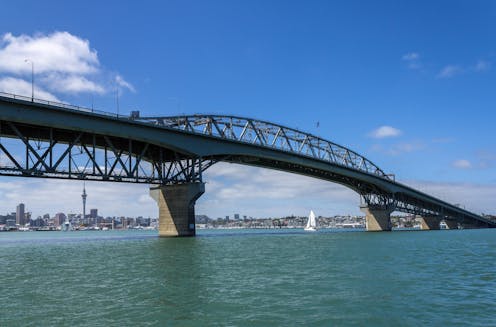
The bridge is the main connection between Auckland’s CBD and its growing North Shore.
Getty Images

Bridges and tunnels

The Auckland Harbour Bridge officially opened on May 30 1959. Construction took four years and cost nearly $250 million (in today’s money), but the structure was already too narrow for traffic volumes. Within a decade, extra lanes built in Japan were bolted to the bridge – the so called “Nippon clip-ons”.

From 1988 until 2010, various second crossing options were studied and presented, including:

  • 1988: a plan was developed for either tunnelled public transport or a second bridge

  • 1997: 11 options for a second crossing were studied and sent out for public consultation, including different tunnel or bridge alignments, with the most expensive option being a tunnel at roughly $2.6 billion in today’s dollars

  • 2003: a followup to the 1997 study suggested a combination of a second bridge and a tunnel, costed at around $4.5 billion in today’s dollars

  • 2008: a study of 159 crossing options was narrowed to three options, included either a new bridge or two possibilities for tunnels

  • 2010: a business case was developed for three crossing options, including a second bridge, tunnelled heavy rail, and a tunnelled road, with the highest cost estimate just under $6 billion.

Walking and cycling

The original plans for the bridge had also included tolled cycle lanes, but these were eventually rejected for cost. In 2011, the idea was revived, with the New Zealand Transport Agency (now Waka Kotahi) announcing a “SkyPath” plan to add walking and cycling lanes to the clip-ons. This was added to Auckland Transport’s strategic priority list the same year.

Resource consent for the SkyPath was lodged in 2015 and approved in 2016. The new Labour-led government in 2017 said it would fund the project, with a revised design for the path to sit on its own piers revealed in 2019.


Read more:
Using valuable inner-city land for car parking? In a housing crisis, that just doesn’t add up


In 2021 Waka Kotahi pulled the plug on the SkyPath plan, citing engineering complexity. The same year, a $685 million standalone cycling and walking bridge was announced. The cost estimate quickly rose to $785 million before it was cancelled just four months later – but not before the government spent $51 million on designs, consultants and engineering plan fees.

Since then, it has been a tale of stop-start (but mostly stop) initiatives, including:

November 2021: Waka Kotahi decided against a cycling and walking “trial” across the bridge but endorsed a series of events for cyclists and walkers in December.

August 2022: Waka Kotahi announced a planned $700,000 one-day trial for walking and cycling would be scrapped, primarily citing concerns about the 6% bridge gradient allowing cyclists to reach speeds of 60km per hour and the potential for pedestrian collisions. (Ironically, one of the new cycling bridge options “would be of a similar gradient” to the current bridge.)

December 2022: Waka Kotahi announced a series of “Walk it, Wheel it” events for three Sundays in March for up to 60,000 Aucklanders to cross the bridge on foot or bike. But this was postponed in early 2023, with no future date announced.


Read more:
Electric cars alone won’t save the planet. We’ll need to design cities so people can walk and cycle safely


Back to the future

The five new harbour crossing options are now out for public consultation, with a decision due by mid-year and construction to begin in 2029. But given the long history of studying, gathering feedback and then doing nothing about a second crossing (or improving public and active transport options on the existing bridge), some scepticism is warranted.

With projected finish dates ranging from 2039 to 2044, and costs up to $25 billion (assuming no delays or budget blowouts), the options also create more vehicle lanes just a few years before the Emission Reduction Plan’s 2050 target for net zero emissions.


Read more:
To get New Zealanders out of their cars we’ll need to start charging the true cost of driving


Surely a more sustainable solution would be to institute the long-discussed Auckland CBD congestion charge and reallocate a few lanes on the existing bridge for public transport, cycling and walking.

This would reduce the number of CBD car trips and contribute to meeting those climate goals. If a second crossing is still needed, taking this more immediate action would at least offer additional – and more climate-friendly – travel options in the meantime.

Future-proofing part of Auckland’s transportation network may not require billions of dollars and decades of planning and construction. It could simply mean finally embracing a version of what was planned for the Auckland Harbour Bridge almost 65 years ago.

The Conversation

Timothy Welch does not work for, consult, own shares in or receive funding from any company or organization that would benefit from this article, and has disclosed no relevant affiliations beyond their academic appointment.

ref. A short history of doomed second harbour crossing proposals for Auckland – and a quicker, cheaper option – https://theconversation.com/a-short-history-of-doomed-second-harbour-crossing-proposals-for-auckland-and-a-quicker-cheaper-option-203140

Major study reveals two-thirds of people who suffer childhood maltreatment suffer more than one kind

Source: The Conversation (Au and NZ) – By Daryl Higgins, Professor & Director, Institute of Child Protection Studies, Australian Catholic University

Shutterstock

The following story deals with reports of childhood maltreatment, including neglect and physical and sexual abuse.


This week, we released results from the Australian Child Maltreatment Study. It is the first national survey of the population aged 16 years and older about their experiences of child maltreatment. It’s also the first study globally to examine combined exposure to all five specific domains of child maltreatment and associated family risk factors for multiple types of child maltreatment.

We surveyed 8,500 randomly selected Australians aged 16 and over. We found 8.9% had experienced neglect; 28.5% sexual abuse; 30.9% emotional abuse; 32.0% physical abuse; and 39.6% exposure to domestic violence.

While it is shocking to learn more than three in five Australians have experienced child abuse or neglect, there’s more to consider. Many Australians have experienced more than one type. This is critical to understanding the burden of maltreatment and its impacts across life.

What does ‘maltreatment’ mean?

We explored five types of maltreatment that participants experienced up to age 18:

  • physical abuse: the use of force likely to cause injury, harm, pain, or breach of dignity

  • sexual abuse: contact and non-contact non-consensual sexual acts inflicted on a child by another person (adult or child)

  • emotional abuse: acts by parents or carers that convey to a child they are worthless, flawed, unloved, unwanted

  • neglect: when parents or carers repeatedly fail to provide the basic developmentally appropriate necessities of life such as food, shelter or health care

  • exposure to domestic violence: hearing or seeing acts of violence towards parents or carers in the home.

For Australians who experience any childhood maltreatment, experiencing more than one type is the “typical” experience (almost two out of three who report any maltreatment). Our data show Australian children are more likely to experience multi-type maltreatment (reported by 39.4% of our participants) than single-type maltreatment (22.8%).


Read more:
Paramedics could sound early warnings of child abuse or neglect – but they need support and more training


Four family factors that double the risk

Four types of family adversity each more than doubles the risk of multi-type maltreatment:

  • parental separation/divorce
  • living with someone who is mentally ill, suicidal, or severely depressed
  • living with someone who had a problem with alcohol or drugs
  • family economic hardship.

Girls are more likely to experience multi-type maltreatment (43.2%) than boys (34.9%). The highest prevalence was for those with diverse gender identitites: two-thirds experienced multi-type maltreatment (66.1%).

Although harrowing, our data also reported rates of physical and sexual abuse (in some contexts) are showing some recent declines. One way we determined this was that the younger participants in our study (aged 16–24) had a lower prevalence of sexual abuse (25.7%) than the full sample (28.6%). Similarly, fewer participants aged 16–24 reported physical abuse (28.2%) than all those surveyed (32.0%).

This suggests current policies might be helping. But the continued high rates of most forms of maltreatment, and of experiencing multiple types, shows the need for greater investment in prevention to stop harm from occurring in the first place.


Read more:
Our child protection system is clearly broken. Is it time to abolish it for a better model?


We need to stop focusing on single types of abuse

Our view of child maltreatment has typically focused on the experience of individual types, without considering the possibility of their overlap. We now know multi-type maltreatment is common.

We also found girls were at greater risk of most forms of child maltreatment, but particularly multiple types of maltreatment and their associated health consequences. So, as well as population-wide strategies, we need to put extra effort into ensuring the safety of girls, and those who are gender diverse.

We can approach childhood maltreatment on three fronts:

1. Prevention

Child protection services are overwhelmed, so simply asking them to do more is destined to fail. Instead, we need to shift our focus to primary prevention strategies across the community. Global evidence shows violence against children is preventable.

Our attitudes towards children must change, to value them, uphold their rights, and prioritise their safety.

Parents and caregivers need access to evidence-based supports to improve parenting skills, provide safe environments for children and young people, to stop maltreatment from happening in the first place.

Australia’s strategies for creating child-safe organisations to prevent institutional child sexual abuse needs to be adapted for creating safety for children in the home too. Parents could “assess” the suitability of adults to care safely, to understand and address situational risks (depending on the places, the people, and the activities involved), to equip their children with knowledge about sexuality and skills regarding consent and respect, and be prepared to listen and respond to all safety concerns – including harmful sexual behaviour from other children.

National strategies for addressing sexual abuse, child maltreatment and domestic and family violence need to recognise the high likelihood of exposure to multiple harm types. Child maltreatment prevention efforts need to link with points of vulnerability, including when parents separate, suffer mental illness, substance misuse, economic hardship, or family violence.

woman sits with hands on head in domestic setting
Families need evidence-based parenting support.
Shutterstock

2. Responding to adversity

When we see families struggling, we need to keep the focus on children as well as their parents. When working with families who are going through adversities – including mental illness, addiction, poverty, family violence, or separation – we need to ask child-centred questions about parents’ care responsibilities.

If we pay closer attention to what’s going on in young people’s lives, we can identify vulnerability early. We can gently convey information about the increased risk of multiple types of maltreatment. And we can provide families with support that works, tailored to their circumstances and challenges.

3. Better treatment for adult survivors

Clinicians need better training to identify and respond to risks.

When working with clients struggling with mental health issues or substance misuse, practitioners should recognise this group is likely to be primarily victim-survivors of multiple forms of child maltreatment.

Teachers, doctors, therapists, parents and carers should learn about how child maltreatment impacts on health throughout life.

Prevention, protection, and treatment services must coordinate to create safety and recovery from all forms of child maltreatment, particularly when they occur in combination. Our results make it clear we need urgent action.


Read more:
Infographic: a snapshot of Australia’s child protection services


If this article has raised issues for you, or if you’re concerned about someone you know, call Lifeline on 13 11 14 or contact Kids Helpline on 1800 55 1800.

The Conversation

Daryl Higgins receives funding from the Australian Research Council, the National Health and Medical Research Council and a range of government departments, agencies, and service providers. He is a Chief Investigator on the Australian Child Maltreatment Study, which is supported by a National Health and Medical Research Council Project Grant (APP1158750). The ACMS receives additional funding and contributions from the Australian Government Department of the Prime Minister and Cabinet; the Department of Social Services; and the Australian Institute of Criminology The lead Chief Investigator on the ACMS is Ben Mathews, from QUT. Other Chief Investigators are: Rosana Pacella, James G. Scott, David Finkelhor, Franziska Meinck, Holly E. Erskine, Hannah J. Thomas, David Lawrence & Michael P. Dunne. Thanks to Divna M. Haslam & Eva Malacova for assistance with project management and data analysis.

ref. Major study reveals two-thirds of people who suffer childhood maltreatment suffer more than one kind – https://theconversation.com/major-study-reveals-two-thirds-of-people-who-suffer-childhood-maltreatment-suffer-more-than-one-kind-202033

Victoria’s gold rush ended in the 19th century. So why are people still finding so much gold?

Source: The Conversation (Au and NZ) – By Eleanor Green, Senior Lecturer In Computational Petrology, The University of Melbourne

An amateur gold prospector in Victoria, Australia, recently discovered a gold nugget big enough to hold in two hands, worth around A$240,000. It was a lucky find, but he had chosen the right place to look.

Central Victoria was home to one of the world’s great gold rushes in the 19th century, which was focused mainly on the “golden triangle” northwest of Melbourne.

While that gold rush saw the extraction of thousands of tonnes of gold from Victorian soil, there is still plenty left. What some have called a “second gold rush” is now under way, as large mining companies and amateur fossickers use modern technology.

A rush and a boom

A road trip through Central Victoria’s Goldfields region takes you to 19th-century boom towns like Bendigo, Ballarat and Castlemaine. They are handsome towns, with elegant municipal buildings and graceful churches, the products of decades of wealth built on gold.

Rambling farther through Victoria, here and there you will find the ghost towns, such as Steiglitz, or the optimistically named Eldorado. These were less fortunate – their gold soon ran out.

Victoria’s first gold rush took place during the 1850s and 1860s. Miners and prospectors poured into Victoria from across the world, colonising the lands of the traditional owners.

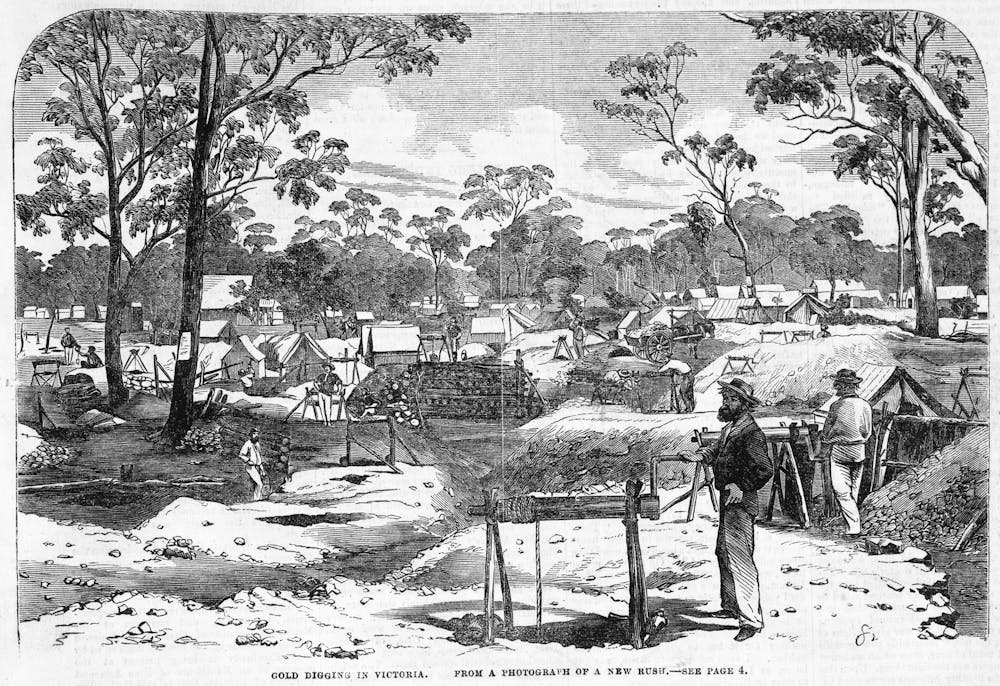
An 1862 engraving shows an encampment on the Victorian goldfields.
Samuel Calvert / State Library of Victoria

Some of these early gold hunters shovelled for small nuggets of gold sitting on the ground, or panned for flakes of gold floating in waterholes and creeks.

Others sought the underground source of the gold. They knew subterranean gold does not occur at random, but would be found in certain rocks.

When they found gold-bearing rocks breaking the surface, they dug for more. Then, they crushed the rock to get the gold out. It was skilled, difficult work that took a brutal physical toll.

How to hunt gold

In Victoria, most underground gold is found in “quartz reefs”: bands of hard white quartz. Formed some 400 million years ago, these gold-bearing reefs may be kilometres long, but are typically less than a metre wide, and slant steeply into the ground.

The places where these reefs break the surface were hard to find. But if the gold hunters were lucky and discovered a new reef, they could follow it a long way, along the surface and underground. The deeper the miners dug, the greater the risks of mine collapse, flooding, or other disasters.


Read more:
How gold rushes helped make the modern world


Victoria’s remarkable gold rush history is the subject of a World Heritage bid. You can learn about the gold rush at Sovereign Hill in Ballarat, the Eureka Centre in Melbourne, and the Golden Dragon Museum in Bendigo, among other places. These places tell moving stories of the gold rush era: of colonial theft, of cruelty and exploitation, of skill, courage and hope.

Across the Victorian goldfields the gold rush had died down by the late 19th century. Even so, the most prosperous gold mines, such as the Central Deborah mine in Bendigo, continued to produce gold well into the 20th century.

But after the gold rush was over, the gold was still there underground. It was just harder to find, or harder to get at.

The second gold rush

Victoria’s second gold rush is less eye-catching and more high-tech than the first.

Mining companies from across the world are coming to Victoria, believing with modern methods they can find and dig up more of Victoria’s unusually pure gold.

Modern mines work with a current understanding of how rocks form, and of how the outer part of Earth deforms during the movement of tectonic plates. They use these ideas to predict the three-dimensional shape of the gold-bearing quartz reefs as they slant into the ground, making it easier to locate them deep underground.

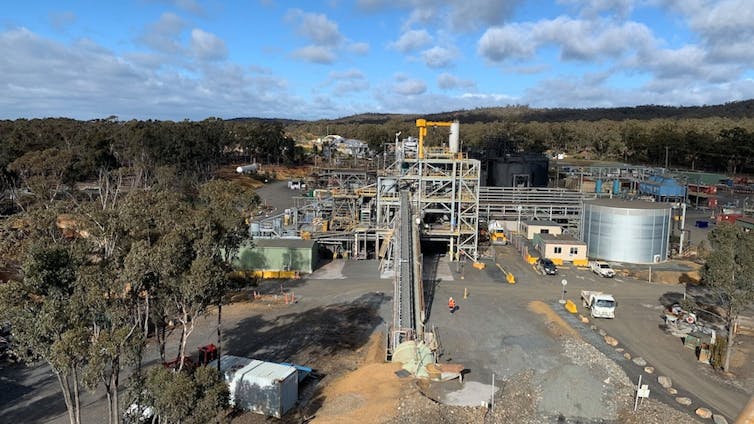
Modern gold mining is a much more high-tech operation than the gold rush of the 19th century.
Fosterville Gold Mine / Agnico Eagle

Modern drilling methods make it easy to sample rocks, using machines like giant apple corers. And today’s techniques can extract more of the gold from the quartz that hosts it.

Today, Victoria’s gold mines produce around 650,000 ounces of gold each year, or about 20 tonnes. For comparison, at the height of the first gold rush, some 3 million ounces or around 90 tonnes were produced in 1856.

Many working mines hold open days for interested visitors, such as the Fosterville gold mine near Bendigo.

What to know if you’re hunting gold

Amateur gold hunting also flourishes on the Victorian goldfields today. “Fossicking”, or recreational prospecting, is a popular way to enjoy walks in the bush, with the possibility of taking home some gold or other treasure.

Dedicated fossickers may well invest in a metal detector, at a cost of several thousand dollars. For a more traditional approach, gold pans and sieves provide hours of fun for the patient, and are considerably cheaper than a metal detector.

Would-be fossickers should check their local regulations to find out if they need a licence. Once you have a licence, you must comply with its terms, which may put limits on fossicking activities, such as where you can look, what you can keep, and whether or not you can sell any finds.

A photograph of a tiny gold nugget resting in the palm of a hand.
Fossicking may not make your fortune, but it can still be a fun hobby.
Shutterstock

You are still responsible for getting permission from the relevant landowners. As with any outdoor activity, you should be aware of the risks around you, including those posed by the weather.

In popular fossicking areas, you may be able to get advice on all of these things, as well as pointers towards finding gold, by joining a fossicking club.

If you aren’t lucky enough to live on a goldfield, don’t despair. You may still enjoy amateur prospecting or treasure hunting, looking for other precious metals or minerals, or even for hoards of gold coins.


Read more:
Discovering a Viking hoard: a day in the life of a metal detectorist


The Conversation

I am exploring a research collaboration agreement with Kirkland Lake Gold Australia Pty Ltd.

ref. Victoria’s gold rush ended in the 19th century. So why are people still finding so much gold? – https://theconversation.com/victorias-gold-rush-ended-in-the-19th-century-so-why-are-people-still-finding-so-much-gold-202846

What actually is a treaty? What could it mean for Indigenous people?

Source: The Conversation (Au and NZ) – By Harry Hobbs, Associate professor, University of Technology Sydney

This is the second article in our series explaining Voice, Treaty and Truth. Read the first article in the series here.


The Uluru Statement from the Heart calls for Voice, Treaty and Truth. These aspirations are intended as a sequence of reforms, that advance towards a just settlement with First Peoples.

The federal government is committed to holding a referendum later this year to put an Aboriginal and Torres Strait Islander Voice in the Australian Constitution. The government has also agreed to implement the Uluru Statement “in full”.

Following the referendum, it’s expected attention will shift towards a Makarrata Commission to “work on a national process of treaty-making and truth-telling”. In fact, reports suggest the government might move even faster.

For generations, Aboriginal and Torres Strait Islander peoples have called for a formal treaty or treaties to recognise their sovereignty “and set out mutually agreed terms for our relationship with the Australian government”.

But while Treaty has long been part of the political landscape, it is not well understood. Many Australians wonder what a Treaty is, what it would achieve, who it would be negotiated with, or for whom, and how. We’ll explore some of these questions here (in brief).

Why does Australia not have a Treaty?

When European colonial powers encountered Indigenous peoples, they often negotiated treaties. These agreements dealt with a range of matters, including trade and military alliances. They also set out rules to share the land and maintain peaceful relationships.

These colonial-era treaties were regularly broken. However, they recognised Indigenous peoples had the right to deal with land and exercised sovereignty over that land.

The British did not engage in treaty talks in Australia. They never sohttps://theconversation.com/the-voice-what-is-it-where-did-it-come-from-and-what-can-it-achieve-202138ught to negotiate with the owners of this land. Instead, they claimed the land belonged to no one and took it for themselves.

Historians have debated why the British took this approach. Some have argued as a penal colony with a substantial military force there was no need to negotiate trading relationships with the original owners. Others have argued the racist attitudes of the day were influential.

Nobody knows why the British didn’t negotiate a Treaty with the First Peoples, as was custom at the time. But Australia is now an outlier. ‘The Founding of Australia. By Capt. Arthur Phillip R.N. Sydney Cove, Jan. 26th 1788’, oil sketch painted in 1937, by Algernon Talmage.
Wikimedia Commons, CC BY

Whatever the reason, the result is Australia is an outlier. As a result, many Aboriginal and Torres Strait Islander peoples believe the moral and legal basis of the nation is “a little legally shaky”.

What is a Treaty?

The absence of a Treaty is one of the major challenges facing the Treaty debate in Australia. Without a history of treaty-making, the concept of what a treaty is or involves remains vague for many people, including government.

It means some people can argue a Treaty is dangerous or it would lead to the breakup of the nation. This makes little sense because a Treaty is a marriage not a divorce. It’s about bringing communities together and building strong relationships based on self-determination.

Governments might argue they’re already engaged in treaty-making. There are many examples of bureaucracy adapting its policy formulation and delivery to reflect community aspirations for a greater say in the delivery of services.

Such “partnerships”, “co-design” and local decision-making with government are valuable. They mark an important shift in promoting Aboriginal and Torres Strait Islander peoples’ participation in policy development and service delivery. But simply calling an agreement a “treaty” doesn’t make it a treaty.

Australia has signed up to a range of international legal instruments that concern the rights of Indigenous peoples. These legal instruments set a clear standard for what makes an agreement a treaty. A treaty must satisfy three conditions.

  1. A treaty acknowledges Indigenous peoples are a distinct political community different to other Australians. This is because Indigenous peoples are the only group of Australians who owned, occupied, and governed the continent before colonisation. This recognition also acknowledges the historic and contemporary injustices that invasion has caused

  2. A treaty is a political agreement reached by a fair process of negotiation between equals. Negotiation helps ensure everyone’s interests can be considered. But securing a fair negotiation process can be difficult. In Victoria, the First Peoples Assembly and State government have agreed to a Treaty Negotiation Framework that sets out principles to guide Treaty talks

  3. Treaties involve both sides committing to responsibilities, promises and principles that bind the parties in an ongoing relationship of mutual obligation and shared responsibility. Most importantly, while the outcomes of any negotiation will differ according to the parties, a treaty is built on the recognition of Indigenous peoples’ inherent sovereignty. As part of this, a treaty will provide for some degree of self-government. What this looks like in practice will be worked out in negotiations.

A treaty will also include a range of other elements. It could include financial compensation, return of land, formal recognition of historic wrongs, and symbolic gestures of reconciliation, such as apologies.

Treaties are unique agreements. As Professor Megan Davis explains, they are aimed at “settling fundamental grievances, and establishing binding frameworks of future engagement and dispute resolution”.

Modern treaties are different from historic treaties

There is a long history of treaty-making all over the world from which Australia can draw lessons. But it’s important to note modern treaties differ from those negotiated in colonial periods. They are more technical and legally complex. They are also negotiated against a long history of inequitable relationships.

They will also be subject to Australian law. While colonial-era treaties were international agreements between two sovereign communities, modern treaties will be subject to Australian law.

Treaty is happening now

Treaty is a longstanding aspiration of First Peoples in Australia. It is only in recent years, however, governments have decided to talk treaty.

Progress has been slow, but important steps have been taken at the state and territory level. For instance, in February this year, the Queensland government introduced the Path to Treaty Bill 2023 into the state parliament. The bill will establish and finance an independent First Nations Treaty Institute to “help prepare and support First Nations people for treaty negotiations with the state”.

That same month, the South Australian government introduced a bill to establish a Voice to the Parliament, with a treaty process to follow.

In Victoria, after several years of patient work, negotiations between the First Peoples Assembly and state government are expected to begin by the end of the year. Similar processes are underway in the Northern Territory, Tasmania and the ACT.

Every treaty process has its own challenges and complications and it’s too early to tell whether these processes will result in meaningful settlements. Nevertheless, they demonstrate two key things.

First, Treaty is a matter of political will, not legal impossibility. Second, looking towards the referendum later this year, the existence of treaty processes across the country suggests Australians may be willing to deal with the unfinished business of colonisation and its consequences.

The Conversation

The authors do not work for, consult, own shares in or receive funding from any company or organisation that would benefit from this article, and have disclosed no relevant affiliations beyond their academic appointment.

ref. What actually is a treaty? What could it mean for Indigenous people? – https://theconversation.com/what-actually-is-a-treaty-what-could-it-mean-for-indigenous-people-200261

Most people thinking about suicide don’t tell anyone. Here’s why and what we can do about it

Source: The Conversation (Au and NZ) – By David John Hallford, Senior Lecturer and Clinical Psychologist, Deakin University

Shutterstock

Many people at risk of suicide are going undetected and unsupported in our community, our research suggests.

Our recently published study found under half of people tell anyone they’re thinking of suicide, making plans or had attempted suicide.

Here are some of the reasons why people don’t often talk about this, and what you can do to help a friend or loved one get the support they need.


Read more:
R U OK day is coming up, but what do you do if someone says ‘no’?


We’re getting no better at predicting

In 2021 in Australia, 3,144 people died by ending their life (2,358 males and 786 females).

Worldwide, more than 700,000 people take their life each year. Globally, suicide is the fourth leading cause of death among 15-29 year-olds.

But our ability to predict who might have suicidal thoughts and behaviours or end their life has not really improved over 50 years of research.

Because suicide is relatively infrequent (as a percentage of the population), it is difficult to identify robust risk factors for suicide we can generalise across the population.


Read more:
Suicide risk is high for military and emergency workers – but support for their families and peers is missing


We need to know who’s at risk

One of the most crucial steps in understanding and managing the risk of suicide is for individuals to disclose their suicidal thoughts and behaviours to other people. It also gives us a chance to mobilise support.

However, when colleagues and I looked at the evidence, we found less than 50% of people tell anyone else about their suicidal thoughts or behaviours.

Even if they had these thoughts or behaviours over the past month, only an estimated 38% of people told anyone. Most people don’t ever disclose any suicidal thoughts or behaviours, however long ago these occurred.

Older woman comforting older man, hands on his shoulders
Most people don’t ever disclose suicidal thoughts or behaviours, however long ago these occurred.
Shutterstock

Our study was a meta-analysis, which combined information from almost 100 studies to estimate how commonly people disclosed.

Women were slightly more likely to disclose than men and disclosure was more likely when associated with a psychiatric disorder.

Notably, among studies of people who had died by suicide, close to 60% of people had no documented evidence of telling someone they had thoughts or plans of ending their life.

Put simply, the findings suggest a large number of people at risk of suicide are undetected and unsupported.


Read more:
Why are we losing so many Indigenous children to suicide?


Why don’t people say anything?

Reasons people don’t disclose thoughts of suicide include: stigma and shame about having the thoughts, fear of rejection or unsupportive reactions from others, concerns about burdening other people, and believing nothing can be done.

Worrying about the consequences of telling other people, such as being hospitalised or receiving unwanted treatment, might be particularly important where people have had negative experiences with disclosure in the past.

A lack of confidence in expressing oneself is another significant barrier. Some people avoid thinking or talking about it as their main way of coping.

Having more social support can increase the likelihood of disclosing suicidal thoughts. This is important given most disclosures are made to family or friends. Increased understanding and knowledge about suicide seems to also be linked with a higher likelihood of disclosure.

How do we start conversations?

Public campaigns to increase mental health literacy and normalise discussions about suicide have likely been helpful in facilitating disclosures. Most times, this means talking about it.

Asking someone about suicide risk indirectly can be more comfortable, such as checking in on how they are feeling or how they are doing. But the question might be misunderstood or answered in a “socially desirable” way.

A conversation might go, “How are you doing?”, with a response, “Yeah, not bad.”

Are you OK?
General questions, such as ‘Are you OK?’ might not work. Asking more direct questions might.
Shutterstock

But research shows asking more direct questions does not increase their distress and does not cause someone to have more suicide-related thoughts or behaviours.

So, clear questions – such as “Are you having thoughts of ending your life?” or “Are you thinking about hurting yourself?” – may help draw out an answer.

Asking about how safe they feel now can also be useful: “Do you feel safe at the moment?”

Offering the choice of not responding might lead to opportunities to ask about it later. You can say, “It’s OK if you don’t want to answer that right now.”

Talking about suicide can be difficult. But knowing we don’t need to be perfect at it, and we’re not tasked with trying to solve all of a person’s problems, is important.


Read more:
How to ask someone you’re worried about if they’re thinking of suicide


You can really help

For some people, thoughts of suicide reflect a negative or hopeless mental state, but not an intent to harm themselves. Most people who have thoughts of suicide do not end their life.

But what you can do for someone is significant.

First, the emotional support and acceptance you show by simply asking and listening is immensely important to helping people feel understood and cared for. This can help normalise and de-stigmatise their experience. Depending on your relationship, you may want to know more about what is driving those thoughts, and being curious and non-judgemental can help.

Second, you can give simple practical support by asking someone what they might need. You could try, “Is there anything you need right now? How can I help?”. You could encourage them to tell loved ones, and support them to find professional help. This might be their GP, mental health professional, to call a helpline, or 000 if the person seems very unsafe.


If this article has raised issues for you, or if you’re concerned about someone you know, call Lifeline on 13 11 14. In an emergency, call 000.

The Conversation

Dr David John Hallford is a board member for the Australian Clinical Psychology Association

ref. Most people thinking about suicide don’t tell anyone. Here’s why and what we can do about it – https://theconversation.com/most-people-thinking-about-suicide-dont-tell-anyone-heres-why-and-what-we-can-do-about-it-197402

Capitalising on climate anxiety: what you need to know about ‘climate-washing’

Source: The Conversation (Au and NZ) – By Laura Schuijers, Deputy Director, Australian Centre for Climate and Environmental Law and Lecturer in Law, University of Sydney

Shutterstock

People are increasingly making choices about which products to buy and which service providers to use on climate change grounds. With concerns about climate change now affecting most Australians, businesses that promote climate-aligned practices and make emissions-reduction promises have a competitive advantage over those that don’t.

But sometimes these claims fail to live up to reality. Climate-related greenwashing, or “climate-washing”, communicates a message that exaggerates or misrepresents climate credentials through advertising, branding, labelling or reporting.

Examples include where corporate marketing and government campaigns promising “net-zero emissions by 2050” are not backed by a credible plan. Or products are promoted as “carbon neutral” or “climate friendly” when they’re not. It also includes where banks and other investors claim to fund a “cleaner future” when this is not completely true, potentially masking climate-related financial risk.

Climate-washing is a problem because the offending businesses capitalise on climate anxiety. It also allows businesses lacking robust credentials to gain customers and market advantage on false pretences. Ultimately, it also hinders rather than helps progress towards emissions reduction goals.

In March, the Australian Competition and Consumer Commission (ACCC) announced a crack-down on climate-washing and greenwashing. This followed an ACCC report revealing claims made by more than half the 247 Australian businesses reviewed in an internet sweep raised concern. The ACCC has said it will now undertake enforcement, compliance and education activities.

On Wednesday the Senate agreed to establish an inquiry into greenwashing by corporations in Australia. The inquiry will investigate the impacts of greenwashing on consumers and the environment and will identify the legal and regulatory actions needed to stop it.


Read more:
Greenwashing: how ads get you to think brands are greener than they are – and how to avoid falling for it


The credibility gap

The imperative to reach net-zero emissions by mid-century has been consistently reinforced by climate science. This includes, most recently, this month’s report by the Intergovernmental Panel on Climate Change.

One of the upshots has been a deluge of net-zero strategic marketing. Particularly in the case of large climate change contributors – such as fossil fuel companies, airlines and the meat industry – adopting a net-zero narrative switches public perception that the company is part of the solution, rather than the problem.

Climate-washing essentially describes a gap between what’s promised and what’s likely to be achieved. This “credibility gap” can be due to factors such as over-reliance on speculative technology, offsetting, and modelling that’s outdated or hasn’t been properly verified. Although there’s a big global push toward transparency, many entities don’t adequately disclose the data and assumptions behind their promises.

Complaints and court cases

Last week, a group called Flight Free and their lawyers approached the ACCC over Etihad Airways advertising that said, “flying shouldn’t cost the earth” and “net zero emissions by 2050”. The ads were shown prominently at a soccer match in Melbourne last year. Flight Free says the advertising is misleading.

The Etihad complaint follows the Australasian Centre for Corporate Responsibility’s Federal Court proceedings against gas company Santos. Currently afoot, this complaint challenges Santos’ “clean fuel” and “net-zero by 2040” claims.

Earlier this year, corporate watchdog ASIC (the Australian Securities and Investment Commission) initiated proceedings against super fund Mercer for allegedly misleading investors into thinking their investments in a “sustainable” investment option excluded fossil fuels.

Around the world, there’s been a recent rise in climate-washing litigation. Multiple complaints allege that the football association FIFA falsely advertised the Qatar World Cup as “fully carbon neutral.”

In aviation, there’s a pending court case against KLM targeting its “fly responsibly” campaign, and there’s also been a successful challenge to RyanAir’s low-carbon campaign.

Product complaints have ranged from allegedly climate-neutral bin liners, to “climate-controlled pork” in Denmark, and “climate-neutral croquettes” in Germany.

How is climate-washing regulated?

Climate-washing is a form of misleading and deceptive conduct, which is regulated in Australia under federal competition and consumer law.

Climate-washing that relates to financial products and services is regulated under securities and investments law.

Both the ACCC and ASIC monitor climate-washing.

Globally, concerns over climate-washing have led to action by the United Nations. A High-Level Expert Group on the Net-Zero Emissions Commitments of Non-State Entities was formed last year to target climate-washing. The group has a “zero tolerance for net-zero greenwashing” mantra, and delivered a report at November’s Climate Change COP in Egypt, which contains a “how-to” guide for credible, accountable net-zero pledges.


Read more:
‘Toxic cover-up’: 6 lessons Australia can draw from the UN’s scathing report on greenwashing


What you can do

There’s every reason to support businesses taking genuine and meaningful climate action. But as a consumer, it’s hard to fact-check simple statements that are in reality pretty complex claims.

If you’re suspicious of climate-washing, you can report it to the ACCC here. You can also monitor the work of non-profits investigating and reporting on climate-washing. For example, stay informed by following sites such as ClientEarth’s The Greenwashing Files. And follow the public interest law centres taking action, such as Environmental Justice Australia, the Environmental Defenders Offices, and Equity Generation.

When buying a product or service, it never hurts to ask questions and to be sent more information. If you’re a shareholder, look closely at annual reports. And make the most of voting opportunities.

Have a say on government proposals targeting climate change and climate-washing. The initial consultation process for the Australian government’s action on climate disclosure and reporting has recently closed, but submissions on new reporting requirements will open later this year.

Ultimately, it’s a good thing that governments and corporations want to align with a smooth transition toward a net-zero future. And jumping on the net-zero bandwagon is certainly a welcome step away from climate denialism.

But in order for net-zero goals to actually be achieved in a way that avoids a last-minute scramble and significant losses along the way, it’s important for everyone that pledges and promises are made frankly, earnestly and credibly.


Editor’s note: In response to the misleading advertising claim, Etihad said it “runs a comprehensive research, development, and innovation programme to address aviation decarbonisation, and is committed to achieving net zero emissions by 2050”.

The Australian Centre for Corporate Responsibility case against Santos is before the courts.

Super fund Mercer said in a statement: “We have co-operated with ASIC on their enquiries and take their concerns very seriously. As this matter is before the courts, it would be inappropriate for us to comment further at this time.”

The Conversation

Laura Schuijers does not work for, consult, own shares in or receive funding from any company or organisation that would benefit from this article, and has disclosed no relevant affiliations beyond their academic appointment.

ref. Capitalising on climate anxiety: what you need to know about ‘climate-washing’ – https://theconversation.com/capitalising-on-climate-anxiety-what-you-need-to-know-about-climate-washing-202507

‘I started walking the long way’: many young women first experience street harassment in their school uniforms

Source: The Conversation (Au and NZ) – By Bianca Fileborn, Senior Lecturer in Criminology, The University of Melbourne

Can you remember the first time you were harassed in a public space? What comes to mind? Can you remember how old you were, or what you were doing? Perhaps this is not something you have personally experienced, although we know 87% of young Australian women have been harassed in public.

We spoke to 47 adult women and LGBTQ+ people in our recent study on street-based and public harassment about their earliest memories of feeling sexualised, uncomfortable or unsafe on the street. Many mentioned they first experienced street harassment in their school uniforms. We heard variations of the phrase “it happened when I was in my school uniform” repeatedly from participants.

For many, street harassment began or became more frequent when they started wearing a high school uniform. Some participants, however, reflected on experiences from when they were even younger, wearing a primary school uniform.

Studies from the United Kingdom have shown 35% of girls wearing school uniforms have been sexually harassed in public spaces. Despite the importance of schools in the daily lives of young people, and the high rates of street harassment they experience, there’s been surprisingly little attention paid to the harassment of young people in school uniform.

Findings from our new research show school-related harassment is a serious issue that has largely flown under the radar in Australia.


Read more:
Catcalls, homophobia and racism: we studied why people (and especially men) engage in street harassment


It happens beyond the school gates

We know young people experience sexual, homophobic and transphobic harassment from their peers and even teachers while they’re at school.

But participants also told us about harassment occurring outside their school grounds. This was perpetrated by strangers (usually individual adult men, or groups of adult men), while they were in uniform and, therefore, clearly identifiable as school children.

This took many forms, ranging from catcalling, staring or leering, wolf-whistling, and being followed by men in cars while walking to school, through to public masturbation and men rubbing themselves against victim-survivors (usually while travelling to school on public transport), sexual assault and rape. As one interviewee told us:

walking from high school to home […] that’s where most of the harassment I’ve experienced happened […] As soon as I stopped wearing a school uniform it happened less. So that’s disgusting for a lot of reasons.

As another interviewee shared, these experiences were really scary not just because of what was happening at that moment but because the perpetrator “knows which school you go to” because of the uniform worn.

Close-up of a uniform jacket, shirt and tie.
UK research has found 35% of girls have been harassed while in school uniform in public.
Robin Worrall/Unsplash, CC BY-NC

The ‘sexy schoolgirl’

Why is it that young people – and particularly young women and girls – are so routinely harassed in school uniform? We found harassment of schoolgirls was seen as being culturally sanctioned through the “sexy schoolgirl” trope. As one interviewee noted:

when you go on Google images and search for ‘school boy’ it will come up with a five-year-old boy but then ‘school girl’ it will come up with the sexy school girl costume.

Participants discussed being targeted because they were viewed as vulnerable and (paradoxically) as both sexually innocent and sexualised:

that was part of the allure for them [the perpetrators], the innocence of a schoolgirl, a fearful schoolgirl in that situation, was like hot to them, they were really getting off on it.

Another interviewee told us:

I went from being an innocent child to a child that felt uncomfortable and didn’t know why I was sexualised – and I didn’t understand it because I didn’t understand what sex really was.

Because they were so young, many participants often lacked a framework or language to understand their experiences. For many, these experiences were also so routine they simply formed part of the background hum of everyday life.

It was often not until years after these formative experiences that participants were able to articulate them as sexual harm and reflect on the impacts.

Trying to avoid harassment

Across our interviews, many participants discussed changing the way they presented themselves or changing the routes they took to school. They often focused on changing their own behaviour and made their lives smaller in an attempt to avoid further harassment. For example:

I started walking the long way. I started just going through the main roads, avoiding the back streets, even though it was a longer walk to be extra safe.

In the longer-term, participants commonly described feeling unsafe, hyper-vigilant, and distrustful of men in public spaces.

‘What if there’s a paedophile on the tram?’: school responses

Unfortunately, the view that victim-survivors are responsible for their own harassment was often reinforced by schools if harassment was reported.

Numerous participants told us how they were reminded of school uniform policies (such as mandated length of skirts and dresses) when they went to teachers for help. One participant recounted an experience where her teacher asked:

Why would you wear your skirt like this [short]? Whose attention are you trying to get? […] what if there’s a paedophile when you’re on the tram home from school […] thinking ‘this is the best day of [my] life’.

Others did not seek help from their teachers because of this focus on students’ appearance at school – they felt they would simply be blamed for what happened.

These types of responses teach young people to think street harassment and other forms of gendered violence are their fault. It also tells them their bodies are sites of risk that need to be managed and contained to avoid harassment.


Read more:
Should school uniforms be compulsory? We asked five experts


School uniform harassment is not ‘normal’

While schools and school-related contexts were often sites of harm for our participants, schools nonetheless have a vitally important role to play here. Harassment in school uniform should not be seen as a “normal” part of growing up.

There is an urgent need to provide young people with a framework to understand their experiences.

Educational efforts must challenge the idea that harassment must simply be endured. Instead, schools should help young people understand harassment as a form of violence, and offer safe and supportive spaces to talk with peers and adults about their experiences. This should be incorporated into existing sex and relationships education in an age-appropriate way.

Importantly, responses to harassment should never blame or implicate young people themselves. It’s time for outdated practices such as measuring school uniform length to be relegated to the past where they belong.

In the words of one participant, “the length of my skirt is not influencing how much I learn”.


If this article has raised issues for you, or if you’re concerned about someone you know, call Kids Helpline on 1800 55 1800 or 1800RESPECT on 1800 737 732. In an emergency call 000.

The Conversation

Bianca Fileborn receives funding from the Australian Research Council, ACON, and the Victorian Department of Justice and Community Services.

Jess Hardley does not work for, consult, own shares in or receive funding from any company or organisation that would benefit from this article, and has disclosed no relevant affiliations beyond their academic appointment.

ref. ‘I started walking the long way’: many young women first experience street harassment in their school uniforms – https://theconversation.com/i-started-walking-the-long-way-many-young-women-first-experience-street-harassment-in-their-school-uniforms-202718

NZ kids will be at school for just 8 days in April – but there are ways for parents to C.O.P.E. with the holiday juggle

Source: The Conversation (Au and NZ) – By Candice Harris, Professor of Management, Auckland University of Technology

Getty Images

April is set to be a challenging month for New Zealand’s working parents. Their children will be in school for a total of eight days thanks to the timing of Easter, Anzac Day and the school holidays. But it doesn’t have to be all bad.

Media coverage and parenting groups on social media have focused on parents’ concerns over what to do with children while trying to work. The catchphrase “8 for April” has taken off.

None of this is helped by the general silence in wider society about how working parents and organisations might better manage school holidays.

But there is a different way to look at this problematic month – and any other period when school holidays require parents to juggle childcare and work. It just requires a bit of planning and cooperation between individuals, their support networks and organisations.

The work-school mismatch

The “8 for April” dilemma is really an issue parents have faced quietly for decades. Under the Holidays Act, all workers are entitled to at least four weeks paid leave. But primary and secondary school-aged children have at least 12 weeks of holidays each year. You do the maths, as they say.

Little is really known about the solutions working parents use to organise children during the school holidays. Nor do we have a clear understanding of how organisations’ flexible work initiatives could be used to help employees cope with school holiday periods.


Read more:
Parents, take the school holidays pressure off yourself. Let the kids embrace the boredom


These gaps in research are surprising given the number of working parents, frequency of school holidays, and the growth of organisational initiatives to support work-life balance, wellbeing and flexible employment.

While it may take time for research to catch up on this, parents can start tackling the school holiday juggle by using a “C.O.P.E” model.

Learning to C.O.P.E

The C.O.P.E. model has four elements: construct, optimise, perspective and evaluate. Following this model could help parents sort school holidays in an organised and calm manner.

Construct – plan early what will happen for children for each day of the holiday period.

Optimise – try to develop a solution that meets the wants of children, needs of parents and demands of employers. It may not be perfect for all, but should be helpful and liveable.

Perspective – while a challenging time for parents, children are resilient and won’t necessarily even recall the solutions found for all holidays.

Evaluate – consider what worked and what didn’t and use this information to plan the next round of holidays.

Managing children during the school holidays has long been a challenge for working parents.
Vera Livchak/Getty Images

Success starts with a plan

Potential fixes for the holiday juggle tend to be pitched at the individual household level, including school holiday programmes. The cost of these programmes can vary widely, from NZ$15 to more than $100 a day.

While we need to be developing a better understanding of how to help working parents as a group, there are some things individuals can do to help the juggle between parenting and children.

  • Voice your expectations as early as possible with managers to see if work can be organised to accommodate the holidays (not having major projects due during the holiday period, for example). Don’t assume your employer won’t try to be supportive.

  • Understand that one size does not fit all. You are the best judge of what would work for your children for holiday fun. You should consider factors such as time, logistics, cost, enjoyment, restoration, technology, friends, exercise and home dynamics.

  • Choice matters. Formulate a jigsaw of approaches including using annual leave, work-from-home days if possible, paid and unpaid options for childcare. The jigsaw may well be different for each holiday period.

  • It takes a village. Share care with other working (paid and unpaid) parents, grandparents, neighbours, friends and supporters.

  • Give yourself a break. Try to find some time for rest and relaxation. Remember also that children won’t be young forever, so the pressure of school holidays will likely diminish as they age.

Employers can help

While parents will take the lead in planning for school holidays, organisations can also step up and help.

  • Support staff. Accept the school holiday may well not affect all employees, but for those it does, the impact could be significant. Consider also that other employees such as grandparents may value work flexibility during these periods.

  • Try new approaches. For example, if an organisation is considering the idea of a four-day work week, perhaps trial it with some employees during the school holidays.


Read more:
Structured school days can keep kids healthy. How can we maintain it over school holidays?


  • Link flexibility to recruitment and retention. Promote the fact you are “school holiday friendly” as an employer, which can help with staff recruitment and retention.

  • Bring kids in. If staff must be on site, explore whether they can bring the kids to work at certain times. Consider if a workplace school holiday programme for employees’ children could be offered – or at least a room with WiFi!

  • Clarify work expectations. When discussing flexibility, also agree on the key work expectations during holiday periods.

Changing conversations in society about school holidays, accompanied with practical solutions could help alleviate parents’ fears. As COVID-19 lockdowns proved, work and parenting can be combined when required. Broader conversations are also needed to find solutions for parents whose jobs simply cannot be done at home.

Being school holiday savvy would recognise that perhaps different ways of working could be used for that quarter of the year taken up with school holidays.

The Conversation

Candice Harris does not work for, consult, own shares in or receive funding from any company or organisation that would benefit from this article, and has disclosed no relevant affiliations beyond their academic appointment.

ref. NZ kids will be at school for just 8 days in April – but there are ways for parents to C.O.P.E. with the holiday juggle – https://theconversation.com/nz-kids-will-be-at-school-for-just-8-days-in-april-but-there-are-ways-for-parents-to-c-o-p-e-with-the-holiday-juggle-203035

Far from the ‘ludicrously capacious’: what the fashion of Succession tells us about the show – and about society

Source: The Conversation (Au and NZ) – By Grace Waye-Harris, PhD Candidate in History, University of Adelaide

Peter Kramer/HBO

Imagine if the person you’re dating invites you to their great-uncle’s birthday party. This is not just any family gathering. The great-uncle in question is a billionaire and the party is at their New York City penthouse. To fit in, you wear your best dress and carry your most expensive handbag – a large, four-figure Burberry tote.

Unbeknown to you, your Burberry tote is a major fashion faux pas. It immediately distinguishes you as someone who is not part of this super elite. It is not the price tag or brand that has betrayed you: it’s the size of the bag.

This is what unfolded in a scene from the season-four premiere of HBO’s Succession. While attending patriarch Logan Roy’s birthday, Cousin Greg is mercilessly mocked by Tom Wambsgans for his date’s “ludicrously capacious” handbag. Bridget’s handbag, Tom scoffs, is “monstrous” and “gargantuan”.

The biting humour between Tom and Greg is an entertaining and engaging feature of Succession. In this scene, however, their repartee reveals much about the power structures within elite society.


Read more:
How ‘Succession’ feeds the hidden fantasies of its well-to-do viewers


Money talks, wealth whispers

While many would consider Bridget’s Burberry tote the epitome of luxury and elegance, the functionality of bag and its iconic check pattern was entirely gauche to the Roys.

The size of the bag implied Bridget did not have staff catering to her every whim. She must carry everything she needs for the day with her. According to Tom Wambsgans, this includes her lunch (implying she can’t afford to dine at restaurants) and appropriate shoes for the subway (indicating she doesn’t have a driver).

This is a stark comparison to Shiv Roy, who is rarely seen with a bag or any accessory except her phone. Unlike Bridget, Shiv is not plagued with the stresses of life. She has people for that.

Shiv talks on the phone.
Shiv Roy is rarely seen with accessories, other than her phone.
Claudette Barius/HBO

The iconic Burberry tartan that covered Bridget’s bag was also, according to Tom, an “enormous faux pas”. Visible brand names and patterns have become associated with people who try to emulate wealth but are not familiar enough with elite society to understand its sartorial nuances. The upper elite favour quiet but luxurious fashions.

This style is often referred to as the old money aesthetic.

The old money aesthetic

Since the early 20th century, the old money aesthetic has been a symbol of wealth and privilege. Characterised by polo shirts, chinos and a knit sweater over the shoulders, this style romanticises country club, yacht and equestrian cultures. Think Ralph Lauren and the Kennedys.

The old money aesthetic is also deeply entwined with notions of nobility.

Historically, royals and aristocrats were considered superior to all others. This social hierarchy was enforced by laws that regulated what people could wear based on their class. Clothing was an immediate visual representation of social standing and power. In 16th-century England, only kings, queens and dukes were allowed to wear gold cloth. If you weren’t part of the nobility, you weren’t allowed to wear crimson or blue.

Oil painting of the Tudors
If you weren’t part of the nobility, you weren’t allowed to wear crimson or blue.
Yale Center for British Art, Paul Mellon Collection

Dressing above your station had serious ramifications. Henry VIII’s Acts of Apparel made it illegal for anyone except “The King and his Family” to wear purple. In 1513, one of Henry’s noblemen defied this law to signal his own claim to the English throne. Not long after, Henry had him executed for treason.

In more recent times, the nobility’s penchant for tailored jackets, woollen sweaters and tweeds have become reflective of a leisure class who are exempt from work. The innate historical connection between dress and class has resulted in these items becoming inseparable from notions of social superiority. They are seen as timeless, stylish and sophisticated.

The Roys and everyone else

The intrinsic connection between dress and social superiority is regularly deployed in TV shows like Succession. Costume is an important tool by which creators can demonstrate hierarchy between characters. While almost all the characters in Succession belong to the wealthy upper class, they are clearly not equal.

Cousin Greg’s date, Bridget, is wealthy enough to afford a four-figure bag. Its size and loud pattern, however, mark her as nouveau riche and tawdry.

Tom’s mockery of Bridget is somewhat ironic, given he too was ridiculed for his sartorial inferiority. Tom always presents a polished, buttoned-up appearance in designer suits and ties. This is contrasted against Kendall and Roman, who rarely wear ties, often pair suits with sports shoes and baseball caps and, in more recent episodes, have favoured a combination of jeans, t-shirts and blazers.

Kendall in a suit jacket, white shirt and baseball hat.
Kendall is unlikely to be seen in a tie – he doesn’t need to impress.
Macall B. Polay/HBO

Tom’s refined and agreeable appearance reflects his eagerness to please Logan and secure position in the family. When mocking his suit in season two, the Roy children allude to this desperation and reaffirm his status as less than their own.

The costumes of the Roy family situate them firmly at the top of the social elite. They are often in cashmere knitwear and tailored blazers. When in the country, caps and Barbour jackets are in keeping with their casual, conservative, old-money appearance.

Unlike those outside the family, they don’t need to impress anyone. Their clothing denotes a stealth wealth, and its historical significance infers social superiority.

Next time you tune into Succession, pay close attention to subtleties in the characters’ costumes. They reveal much about the fabric of society.


Read more:
Celebrity, money and power: TVs obsession with the Murdoch family dynasty


The Conversation

Grace Waye-Harris does not work for, consult, own shares in or receive funding from any company or organisation that would benefit from this article, and has disclosed no relevant affiliations beyond their academic appointment.

ref. Far from the ‘ludicrously capacious’: what the fashion of Succession tells us about the show – and about society – https://theconversation.com/far-from-the-ludicrously-capacious-what-the-fashion-of-succession-tells-us-about-the-show-and-about-society-202744

‘Calm in crisis’ Koroi Hawkins steps up as RNZ Pacific’s first Melanesian editor

By Sri Krishnamurthi

Highly respected and convivial Koroi Hawkins has become RNZ Pacific’s first Melanesian editor after arriving in New Zealand in 2010 and says he is “truly humbled” after nearly a decade at RNZ.

“It is a great honour. I am a Pacific journalist from the school of hardknocks so it was already a massive achievement just making it into the RNZ Pacific team,” Hawkins tells Asia Pacific Report.

“Never in a million years did I imagine I could ever become the editor when I arrived here. It is testament to all of the support and mentoring I have received here at RNZ Pacific that I was even confident to put my hand up,” he says humbly.

But what made RNZ Pacific’s manager Moera Tuilaepa-Taylor choose Hawkins for the role of editor in the first place?

Pacific Waves presenter Koroi Hawkins
“Koroi’s time as producer and presenter of Pacific Waves has allowed him to develop his leadership and mentoring skills”, says RNZ Pacific manager Moera Tuilaepa-Taylor. Image: RNZ Pacific

The deciding factor was RNZ Pacific’s flagship daily current affairs programme Pacific Waves that delves into issues of Pacific peoples wherever they are in the world, and airs proudly and loudly across Pacific at 8pm (NZT) every weeknight, she says.

“Koroi’s time as producer and presenter of Pacific Waves has allowed him to develop his leadership and mentoring skills within the team, in particular with some of our younger reporters who had never worked in radio,” Tuilaepa-Taylor said.

“There’s respect and trust in his leadership and skills by the team, and that’s when we knew that he was the right candidate for the role. He had the right cultural attributes,” she said.

Science aspirations
However, Tuilaepa-Taylor was not the manager who hired Hawkins in the first place. Instead, it was former RNZ Pacific manager Linden Clark and ex-news editor Walter Zweifel who brought him to RNZ Pacific.

Ironically, Hawkins never wanted to be journalist originally — he studied science in high school.

“I never aspired to be a journalist. I was a science student through high school and wanted to be a marine biologist,” he said.

“But, I had a keen love for storytelling thanks to my mum Effie Hawkins, who is a retired early childhood teacher and who would always read me books.

“When I was old enough she encouraged me to read and to write letters to our family members overseas.

“I think that is when I realised as a working journalist that we could give a voice to the voiceless and hold those in power to account. That is when I found my passion for the craft,” says Hawkins.

Hawkins started working as a journalist in the Solomon Islands under the tutelage and guidance of Solomon’s legendary journalist Dorothy Wickham.

Start-up TV in Honiara
“I started as a news presenter for local start-up TV outfit One Television Solomon Islands under Dorothy Wickham.

“I was on holiday in Malaita with my wife and our newly born daughter Janelle and I wrote a small sport story on a futsal tournament at Aligegeo which was well received by the news department — and the rest is history they say.

He developed photography and videography skills for which is renowned for whenever on assignment covering events in the Pacific.

“I started with RNZ Pacific as an intermediate reporter. I brought with me photography and videography skills which I mostly used on reporting assignments in the region,” he says matter-of-factly as if it were nothing.

However, that wasn’t the only skill he mastered. When I worked with him he was adept and very helpful when doing digital web stories, knowing where the photo goes and how to web edit.

He was also very helpful to the younger reporters when it came to mastering audio for radio.

The one thing you notice about Hawkins when you meet him is a sense of calming presence about him when all else would be chaos around. That was the case in 2018 covering the Fiji elections, especially when covering about-to-become PM Sitiveni Rabuka’s court case just two days before the election.

‘Calmness from my mother’
“My calmness comes from my mother, she was always calm in a crisis and it also comes from operating in our Pacific newsroom situations where when things go wrong they are literally operation halting things like cyclones, power cuts and equipment breakdowns, riots, and coups,” he says.

“Things over which we have no control and just have to work around.”

“By comparison, the crises in New Zealand newsrooms are relatively manageable. I think also it must be an age thing, as I grow older both at home and at work I find myself always seeing solutions rather seeing obstacles.

“Some of it just comes with experience and I am always open to learning new things and trying new ways of doing things better than we did in the past.”

He rates his career highlight was when while calling his mum and dad in the Solomon Islands they told him they had heard him on air.

“I think the two main highlights in my career is calling my mum and dad in Munda and them telling me they heard me on the radio.

“And bringing my family out here to New Zealand to join me. They are my biggest fans and harshest critics and the reason I get up each day and head out the door,” Hawkins says.

Pacific journalist Koroi Hawkins
Journalist Koroi Hawkins . . . does he hail from the Solomon Islands or elsewhere? “That’s probably a whole article in itself.” Image: Koroi Hawkins/FB

Cyclone Pam, Papua assignments toughest
By far the most difficult assignments he has done was covering Cyclone Pam in 2015 as well as travelling to West Papua with RNZ Pacific’s legendary Johnny Blades.

“Cyclone Pam in 2015 was the most difficult in terms of length of time on the ground in challenging circumstances,” he says.

And Tuilaepa-Taylor agrees with him .

“His coverage of tropical cyclone Pam in Vanuatu, and also coverage of the Fiji elections with Sally Round and Kelvin Anthony — these are the things that come to my mind,” says Tuilaepa-Taylor.

Then there was the harrowing trip he went on to Jayapura in “untamed” West Papua in 2015 with Johnny Blades.

“Shooting video for Johnny Blades on a trip to West Papua was the most difficult in terms of operating in a hostile environment,” he said

“It was harrowing in the sense that you were being watched (by the Indonesian authorities) who were surveillng you.

‘Unnerving being watched’
“There was no harassment but it was very unnerving knowing you were being watched,” he says.

“But I would say reporting on political situations in the region like the most recent election in Fiji are the most challenging journalistically in terms of getting the facts and local context correct,” Hawkins says.

While in contrast he found the gentle and joyous Pacific creativity a very enjoyable experience.

“Our cultural festivals like the Festival of Pacific Arts or even Pasifika in Auckland and Wellington are the most enjoyable assignments for me seeing our Pacific cultures and languages celebrated gives me so much pride and hope for the future which my own children will inherit long after I am gone.”

It is that very depth of experience he brings to the vastness of his role as editor.

“I think the most important thing I bring to the role is my experience I have worked my way up the ladder form the bottom in Pacific and New Zealand newsrooms.

“I have affinity to a few Pacific cultures through my own heritage, my partner Margret’s heritage and through our extended families,” Hawkins says.

Consultative style
He seeks in his editorial stye to be fair and yet firm, but not authoritative but rather being consultative.

“ I believe we are stronger if everyone in the team contributes and I like to gather as much information and input as possible from my team before making decisions,” Hawkins said.

“Because I literally started from the bottom, I am very empathetic to people’s journeys and believe that where someone is now is not where they will be in a few years’ time.

“A lot of people took a chance on me and invested in me and gave me opportunities that helped me advance in my own career and I aspire to pay that forward,” Hawkins says.

With his time likely to be in high demand he will not continue doing Pacific Waves.

“No I will not be. The future of this role is still being decided. I am excited for whoever will be stepping into this role as it has been a transformative one for me.

“The programme has a huge regional and international following and we hope to continue building on the great work that was started by current and former RNZ Pacific colleagues.

And, does he hail from the Solomon Islands or elsewhere?

“That is probably a whole article in itself,” he said.

“In short, I was born in Nadi to a Fijian father and a part-Fijian part-Solomon Islands mother. I was adopted when I was three-weeks-old by my great aunt, who I call my mum, and who raised me in Honiara, Australia and Muna in the Western Solomons in that order.

“I speak English, Roviana and Pidgin and understand very basic Fijian. Although I am keen to learn more.

Fond Aotearoa memories
He speaks fondly of Aotearoa and he remembers the first time he came to the country.

“The first time I ever came to New Zealand was actually in 2010, thanks to Professor David Robie and the AUT Pacific Media Centre.

“I presented on the ethnic crisis in Solomon Islands and was accompanied by my partner Margret little did we know then that our future lay in Aotearoa. I first came to New Zealand to work for RNZ International in 2014,” he said.

The knowledge he intends to impart to his younger journalists to help them in the search for knowledge and experience comes from having been there and done that.

“I think sharing my experiences and being accessible has been well received so far. I am a living breathing example of how far you can come in this field if you apply yourself,” Hawkins says.

“Just letting them know I am in their corner I think is important. Every chance I get I love to introduce and connect people and not just within RNZ Pacific but in the wider region.

“It gives me great joy to see someone succeed of the back of an introduction or a contact reference.

“This work is hard but know we are all in it together makes it a little more bearable. It really is about the person next to you,” he says.

Sri Krishnamuthi is an independent journalist, former editor of the Pacific Media Watch project at the Pacific Media Centre and a contributor to Asia Pacific Report.

Print Friendly, PDF & Email

Article by AsiaPacificReport.nz

Super has become a taxpayer-funded inheritance scheme for the rich. Here’s how to fix it – and save billions

Source: The Conversation (Au and NZ) – By Joey Moloney, Senior Associate, Grattan Institute

Shutterstock

Australia’s A$3.3 trillion superannuation system is supposed to boost people’s retirement incomes. The government says as much in its proposed leglislated objective for superannuation. The system is supported by billions of dollars of tax breaks each year, ostensibly to that end.

But there’s just one problem – increasingly, much of what is saved is never spent.

Our new report, Super savings: Practical policies for fairer superannuation and a stronger budget, points out that without an overhaul, super tax breaks are set to do little more than boost the inheritances of Australians with well-off parents.

Super contributions and super earnings are both taxed more lightly than other income. These tax breaks cost the budget about $45 billion (2% of Australia’s gross domestic product, or GDP) each year.

Treasury predicts that figure will hit 3% of GDP by 2060, and that the cost of super tax breaks will overtake the cost of the age pension by as soon as 2036.


Click for notes

Super tax breaks are also unfair: about two-thirds go to the top 20% of earners.

This means the tax breaks provide the biggest boost to the super accounts of high earners, who will almost all have a comfortable retirement regardless, and who tend to save the same regardless of the tax rate imposed.

The wealthiest 10% of Australians get a bigger boost to their retirement savings from super tax breaks than poorer Australians get from the age pension.


Click for notes

But much of what is saved for retirement never actually gets spent in retirement.

Earlier research by Grattan Institute and the 2020 Retirement Income Review found that, for a variety of reasons, spending falls substantially during retirement. Retirees often end up leaving much of their nest egg untouched, bequeathing it to their children.

This means billions of dollars in super tax breaks simply end up boosting the inheritances received by the children of well-off parents. It makes super a taxpayer-funded inheritance scheme.

This problem is set to get worse. With the rate of compulsory superannuation legislated to rise from 10.5% of wages to 12% by 2025, future generations of retirees are set to retire with even larger nest eggs that they will never spend.

Treasury projects that by 2059, one in every three dollars paid out of the super system will be a bequest, up from one in every five today.


Click for notes

Big inheritances boost the jackpot from the birth lottery. They help richer children get richer. Among the Australians who received an inheritance over the past decade, the wealthiest fifth received on average three times as much as the poorest fifth.

To help reverse this, the government needs to rein in the super tax breaks.

How to make super fairer

The government’s policy, announced in February, of taxing the earnings on balances bigger than $3 million at 30%, instead of 15%, will help.

But the threshold ought to be lowered to $2 million. Balances between $2 million and $3 million are very unlikely to be spent in retirement, so winding back tax breaks on earnings on balances bigger than $2 million would further wind back taxpayer-funded bequests.

And there’s more. Currently, many wealthier Australians receive a larger tax break per dollar contributed to super than many low income earners.

Yet low earners have more to be compensated for. Putting money into their super cuts their age pension in retirement, and they live shorter lives, meaning less time to enjoy their super in retirement.


Read more:
The super giveaway that allows the wealthy to amass even more tax-free


The pre-tax contributions of people earning more than $220,000 a year should be taxed at 35%, instead of the 30% charged to those earning more than $250,000 currently. That would still offer a 10% tax break on super contributions for high earners (given the top marginal rate of 45%) and at least a 15% break on the contributions of low and middle earners.

And the annual pre-tax contributions cap should be lowered from $27,500 to $20,000. Contributions above this level tend to be made by people close to retirement with already-high balances.

Tax earnings in retirement the same as while working

On the earnings side, the tax-free earnings enjoyed by retirees on their first $1.7 million ($1.9 million from 1 July this year) of their super should go.

Superannuation earnings in retirement should be taxed at 15%, the same as superannuation earnings before retirement. This would save the budget at least $5.3 billion a year, and much more in future, and make taxing super more simple.

More than 70% of this revenue would come from the top 20% of retirees. The top 10% would pay an extra $7,000 to $7,500 a year on average, wereas the poorest half would no more than $200 more each.

Both sides of politics say they agree that super shouldn’t be a taxpayer-funded inheritance scheme. But there’s a long way to go before that vision is reality.


The Grattan Institute’s new report, Super savings: Practical policies for fairer superannuation and a stronger budget. was released on Monday

The Conversation

The authors do not work for, consult, own shares in or receive funding from any company or organization that would benefit from this article, and have disclosed no relevant affiliations beyond their academic appointment.

ref. Super has become a taxpayer-funded inheritance scheme for the rich. Here’s how to fix it – and save billions – https://theconversation.com/super-has-become-a-taxpayer-funded-inheritance-scheme-for-the-rich-heres-how-to-fix-it-and-save-billions-202948

View from The Hill: the Liberals talk about ‘rebuilding’ but how, exactly?

Source: The Conversation (Au and NZ) – By Michelle Grattan, Professorial Fellow, University of Canberra

Peter Dutton and his demoralised team, shocked beyond belief by their Aston drubbing, say the party has to “rebuild”.

But there are no obvious foundation stones for this mammoth task.

Ideally, the party needs a leader who potentially has appeal when, as will inevitably happen at some point, the gloss goes off the government.

Many voters, well beyond Aston, have made up their minds against Dutton. The chances of turning those perceptions around – notwithstanding the example of John Howard’s personal reinvention – are low. It’s the dog-with-a-bad-name syndrome.

One example. People with Chinese heritage are an important voting group in many areas (like Aston). They are unlikely to ever have a positive view of Dutton.

This not to say Dutton should be replaced. The alternatives (primarily Angus Taylor) would be even less likely to get the party back on its feet.

The best solution would be for the Liberals to get a new leader a year out from the election. But even looking to a younger generation, there is no attractive candidate with broad appeal.

Dutton, who presumably is not a Morrison-type believer in miracles, must realise the chances of his ever becoming prime minister are somewhere under minimal.

So he has little to lose by taking risks in trying to reform the party organisation, in which most state divisions are dysfunctional, faction-ridden and devoted to in-fighting. Ironically, the Queensland LNP is the most efficient (and effective – Queensland is the state where the Coalition is strongest).

The general dysfunction has led to poor candidates, candidates chosen late, and bad ground games that can’t match Labor.

The malaise in the Liberal organisation might not be the problem that is most obvious at a “retail” political level. But it is fundamental, and Dutton – if he has the determination – could knock heads together. That’s even taking into account that in the Liberal party, power resides in the state divisions, with the federal organisation relatively weak.

Most difficult for the Liberals is finding a response to the question: what do you stand for?

Seeking answers to this opens up a complex set of issues, including internal ideological battles, and vast differences among the constituencies to which it must pitch (outer suburban, teal urban).

In former years, Labor faced a similar problem – caught between its traditional working class voters in the outer suburbs and regions, and the progressive inner city voters. It was a challenge as late as the Shorten years. Under Anthony Albanese, Labor has found a sweet spot.

The Liberals are unlikely to light on such a spot before the internal culture wars rage for some time between the conservatives and what’s left of the moderates.

Meanwhile, policy positions have to be crafted – which often, at this stage of the electoral cycle, amount to reactions to government policy.

The Liberals’ constant naysaying has turned off voters who have just elected a fresh government and want the losers to give it a go.

That seems one obvious message out of the byelection.

A skilled opposition mixes the positive and the negative – as Albanese did as opposition leader.

He also resisted (often to taunts from the then-government and sometimes the media) pressure to release policy too early. His crucial climate policy, for example, came very late.

But he did have some policy out for a long time, for instance on child care. The Liberals should do the same, in their search for policy sweet spots.

Housing affordability is an obvious opportunity. It ticks all the boxes. It’s a crucial issue on voters’ minds. It particularly preoccupies the under-40 age group, who have deserted the Liberals. It fits Liberal Party values, going right back to Robert Menzies.

The opposition already is committed to allowing people to use some of their superannuation for a first home. Building around this, including with a policy that addresses the rental crisis, could provide something positive to sell in “the sensible centre”.

Getting down to intense work on a range of individual policies might be a more productive way for the Liberal party to tackle its positioning problems than a generalised debate about conservatism-versus-progressivism. Having the ideological debates around specific policy directions might help achieve practical approaches and compromises.

The Coalition also needs to avoid paths with landmines. Its current flirtation with nuclear power, beloved by the Nationals, is one. The Labor ads could be written now if that was taken to the election. A savvy opposition would quickly rule it out, citing economic grounds.

Behind this must lie a better Liberal party connection with the Australian electorate, especially the younger part of it. It might not be surprising that people aged 18-24 don’t travel with the Liberals, but when they are failing with the under-40 cohort, it is disaster territory.

The baby boomers are becoming a smaller part of the voting public. It’s fruitless for the Liberals to hark back to the Howard days. And yet they give every impression of (as Scott Morrison might say in another context) putting their heads under the doona and living in the past.

Speaking of Morrison, there’s speculation he is preparing to quit parliament. That means another byelection. Just when the Liberals thought things couldn’t get worse.

.

The Conversation

Michelle Grattan does not work for, consult, own shares in or receive funding from any company or organisation that would benefit from this article, and has disclosed no relevant affiliations beyond their academic appointment.

ref. View from The Hill: the Liberals talk about ‘rebuilding’ but how, exactly? – https://theconversation.com/view-from-the-hill-the-liberals-talk-about-rebuilding-but-how-exactly-203125

Labor’s unexpected Aston win is body blow for Dutton

Source: The Conversation (Au and NZ) – By Michelle Grattan, Professorial Fellow, University of Canberra

The rout of the Liberals in Aston is a disaster for Peter Dutton.

The party has defied history – in the worst possible way. This is the first time in more than a century that a government has taken a seat off an opposition at a byelection.

Both government and opposition expected a Liberal win, although they predicted a tight result. In the event Labor had a comfortable victory.

The centrepiece of Labor’s campaign was targeting the opposition leader, and Aston voters responded with a resounding ‘no’ when asked for a judgement on Dutton.

In 2001, a byelection in Aston put then prime minister John Howard back into the electoral game. In 2023, this byelection has undermined what authority the opposition leader has had.

There are no obvious alternatives to Dutton (although deputy Liberal leader Sussan Ley and shadow treasurer Angus Taylor have aspirations).

But over coming months it’s likely there will be muttering and undermining of Dutton.

Dutton prides himself on having held together a party that is divided over whether to go to the right or the left. This defeat can be expected to intensify that internal argument.

It will also reduce Dutton’s ability to reform the debilitated party organisations, including and especially in Victoria.

On Saturday night Dutton made the point that “it’s a tough market for us in Victoria”. Aston will feed into what has been a strong narrative – that Dutton, from Queensland and the right, is unelectable in this progressive southern state.

The timing of Alan Tudge’s departure from parliament was, certainly in retrospect, the worst possible. As if Tudge had not previously done enough damage to the Liberal party. Aston voters had already punished it over his behaviour with a big swing at the general election.


Leer más:
Labor wins Aston byelection; NSW election and Trump polling updates


In the byelection, many voters were frustrated they were at the ballot box for the third time in less than a year.

While the cost of living is at the front of people’s minds, Aston showed they are not blaming the Albanese government. They accept that the interest rate hikes and price rises are being driven by factors almost all outside the government’s control.

The Liberals had a strong candidate in Roshena Campbell, but she was parachuted into this outer-eastern suburban seat from Brunswick, seen as a long way away when localism is increasingly the electoral flavour. One is reminded of the fate of Labor’s Kristina Keneally when she was parachuted into a seat that wanted a local in last year’s election.

Labor’s Mary Doyle does not live in Aston but has resided in the region for some 35 years.

The Aston outcome reinforces the point that the Labor government’s honeymoon continues to flourish. The news of the past fortnight’s parliamentary sitting showed a government that was busy and chalking up wins, most notably this week’s deal to get its safeguard machinery legislation in place, which is key to implementing its climate policy.

One achievement of the Labor government that would have resonated with some Aston voters is the improvement in Australia’s relations with China. This electorate has a high proportion of residents of Chinese heritage.


Leer más:
View from The Hill: Dutton saddles up for Aston race amid Victorian Liberal infighting


Dutton has promised to listen to the messages from the byelection, and to rebuild the party. It’s one thing to recognise there are lessons, but another to decipher precicely what they are, and yet another to put solutions in place.

It does, however, seem likely that voters are unimpressed with the Opposition’s constant negativity – which just deepens Dutton’s problem as he comes closer to having to formally declare his position on the Voice to Parliament.

The Conversation

Michelle Grattan no recibe salario, ni ejerce labores de consultoría, ni posee acciones, ni recibe financiación de ninguna compañía u organización que pueda obtener beneficio de este artículo, y ha declarado carecer de vínculos relevantes más allá del cargo académico citado.

ref. Labor’s unexpected Aston win is body blow for Dutton – https://theconversation.com/labors-unexpected-aston-win-is-body-blow-for-dutton-203116

Labor wins Aston byelection; NSW election and Trump polling updates

Source: The Conversation (Au and NZ) – By Adrian Beaumont, Election Analyst (Psephologist) at The Conversation; and Honorary Associate, School of Mathematics and Statistics, The University of Melbourne

Morgan Hancock/AAP

With 44% of enrolled voters counted in today’s Aston federal byelection, the ABC has Labor expected to win by 53.4-46.6 over the Liberals, a 6.3% swing to Labor from the 2022 general election. This includes ordinary election day votes only, no pre-polls or postals.

Labor is very likely to win Aston, but I will update this article tomorrow morning when the pre-polls and most postals have been counted. At the NSW election last week, Labor greatly underpeformed their election day votes on pre-polls.

Update: The pre-poll booths are in on primary votes, and there are swings against the Liberals in all three. This confirms that Labor will gain Aston from the Liberals.

Labor gaining Aston is only the second time a government has gained a seat at a federal byelection – the first time was in 1920. Labor had performed badly in previous byelections during the early years of the Bob Hawke and Kevin Rudd governments.


Read more:
Liberals likely to win Aston byelection; Voice support increases in Essential poll


Labor is currently polling honeymoon levels of support, and this explains the strong Aston result. The next federal election is still about two years away, and by then Labor may not be polling so well. This byelection is not predictive of the next election result.

However, the byelection is a terrible result for the Liberals and their leader, Peter Dutton. It will put him under pressure to keep his job.

Labor won’t win a NSW election majority

The New South Wales state election was held on March 31. The ABC is now calling 45 of the 93 lower house seats for Labor, 35 for the Coalition, three Greens and nine independents.

The large count of postals today confirmed that the Coalition would retain the three seats they looked likely to win as of Wednesday’s article: Terrigal, Goulburn and Holsworthy. Only one seat remains in doubt: Ryde, where the Liberals took a small lead on today’s postals, but Labor could regain the lead.


Read more:
NSW Labor unlikely to win majority after flopping on pre-poll votes


Even if Labor wins Ryde, they would finish with 46 of the 93 seats, one short of the 47 needed for a majority. As I wrote Wednesday, Labor will still form the next NSW government.

As the combined vote share for the major parties declines and the number of seats won by non-major party candidates increases, hung parliaments where one major party has at least a few more seats than the other, but is short of a majority, will become more common.

Postal votes from today’s counting have not yet been added to the upper house count. These votes will assist the Coalition in their attempt to win seven upper house seats, but late counting of absents and new enrolment votes may bring Animal Justice back into contention for the final upper house seat.

NSW One Nation leader Mark Latham made a homophobic and sexually crass tweet on Thursday. At this election, One Nation were expected to at least match the two upper house seats they won in 2019, but have only won one seat after their vote dropped 1.2% from 2019.

Owing to half of the upper house being elected every four years for eight-year terms, One Nation will have three total upper house seats, but would have expected four.

Trump indicted, but Republican primary polls are swinging in his favour

Former US president Donald Trump was indicted on Thursday (Friday AEDT) over hush money payments made to a porn star before the 2016 election.

Republican primaries to select their nominee to contest the November 2024 general election start in early 2024. There is disagreement over the size of Trump’s lead, with recent polls rated B+ or better by FiveThirtyEight giving Trump between a five-point and a 30-point lead over Florida Governor Ron DeSantis when other candidates are included.

It’s very likely that either Trump or DeSantis will be the Republican nominee, as no other potential Republican candidate polls higher than mid single digits.

While the polls disagree on the current size of Trump’s lead, they agree there’s been a recent swing to Trump. A Fox News poll had Trump by 15 points in February, and it now gives Trump a 30-point lead. A Quinnipiac poll gave Trump an eight-point lead in February; now Trump leads by 14.

On the Democratic side, there has so far been no credible challenge to incumbent President Joe Biden.

If Trump is the Republican nominee, he has a good chance of defeating Biden. Biden’s disapproval rating has been higher than 50% in the FiveThirtyEight aggregate since October 2021. He will be almost 82 by the November 2024 election, while Trump will be 78.

The Conversation

Adrian Beaumont does not work for, consult, own shares in or receive funding from any company or organisation that would benefit from this article, and has disclosed no relevant affiliations beyond their academic appointment.

ref. Labor wins Aston byelection; NSW election and Trump polling updates – https://theconversation.com/labor-wins-aston-byelection-nsw-election-and-trump-polling-updates-202716

Labor likely to win Aston byelection; NSW election and Trump polling updates

Source: The Conversation (Au and NZ) – By Adrian Beaumont, Election Analyst (Psephologist) at The Conversation; and Honorary Associate, School of Mathematics and Statistics, The University of Melbourne

Morgan Hancock/AAP

With 44% of enrolled voters counted in today’s Aston federal byelection, the ABC has Labor expected to win by 53.4-46.6 over the Liberals, a 6.3% swing to Labor from the 2022 general election. This includes ordinary election day votes only, no pre-polls or postals.

Labor is very likely to win Aston, but I will update this article tomorrow morning when the pre-polls and most postals have been counted. At the NSW election last week, Labor greatly underpeformed their election day votes on pre-polls.

If Labor gains Aston, it would be only the second time a government has gained a seat at a federal byelection – the first time was in 1920. Labor had performed badly in previous byelections during the early years of the Bob Hawke and Kevin Rudd governments.


Read more:
Liberals likely to win Aston byelection; Voice support increases in Essential poll


Labor is currently polling honeymoon levels of support, and this explains the strong Aston result. The next federal election is still about two years away, and by then Labor may not be polling so well. This byelection is not predictive of the next election result.

However, the byelection is a terrible result for the Liberals and their leader, Peter Dutton. It will put him under pressure to keep his job.

Labor won’t win a NSW election majority

The New South Wales state election was held on March 31. The ABC is now calling 45 of the 93 lower house seats for Labor, 35 for the Coalition, three Greens and nine independents.

The large count of postals today confirmed that the Coalition would retain the three seats they looked likely to win as of Wednesday’s article: Terrigal, Goulburn and Holsworthy. Only one seat remains in doubt: Ryde, where the Liberals took a small lead on today’s postals, but Labor could regain the lead.


Read more:
NSW Labor unlikely to win majority after flopping on pre-poll votes


Even if Labor wins Ryde, they would finish with 46 of the 93 seats, one short of the 47 needed for a majority. As I wrote Wednesday, Labor will still form the next NSW government.

As the combined vote share for the major parties declines and the number of seats won by non-major party candidates increases, hung parliaments where one major party has at least a few more seats than the other, but is short of a majority, will become more common.

Postal votes from today’s counting have not yet been added to the upper house count. These votes will assist the Coalition in their attempt to win seven upper house seats, but late counting of absents and new enrolment votes may bring Animal Justice back into contention for the final upper house seat.

NSW One Nation leader Mark Latham made a homophobic and sexually crass tweet on Thursday. At this election, One Nation were expected to at least match the two upper house seats they won in 2019, but have only won one seat after their vote dropped 1.2% from 2019.

Owing to half of the upper house being elected every four years for eight-year terms, One Nation will have three total upper house seats, but would have expected four.

Trump indicted, but Republican primary polls are swinging in his favour

Former US president Donald Trump was indicted on Thursday (Friday AEDT) over hush money payments made to a porn star before the 2016 election.

Republican primaries to select their nominee to contest the November 2024 general election start in early 2024. There is disagreement over the size of Trump’s lead, with recent polls rated B+ or better by FiveThirtyEight giving Trump between a five-point and a 30-point lead over Florida Governor Ron DeSantis when other candidates are included.

It’s very likely that either Trump or DeSantis will be the Republican nominee, as no other potential Republican candidate polls higher than mid single digits.

While the polls disagree on the current size of Trump’s lead, they agree there’s been a recent swing to Trump. A Fox News poll had Trump by 15 points in February, and it now gives Trump a 30-point lead. A Quinnipiac poll gave Trump an eight-point lead in February; now Trump leads by 14.

On the Democratic side, there has so far been no credible challenge to incumbent President Joe Biden.

If Trump is the Republican nominee, he has a good chance of defeating Biden. Biden’s disapproval rating has been higher than 50% in the FiveThirtyEight aggregate since October 2021. He will be almost 82 by the November 2024 election, while Trump will be 78.

The Conversation

Adrian Beaumont does not work for, consult, own shares in or receive funding from any company or organisation that would benefit from this article, and has disclosed no relevant affiliations beyond their academic appointment.

ref. Labor likely to win Aston byelection; NSW election and Trump polling updates – https://theconversation.com/labor-likely-to-win-aston-byelection-nsw-election-and-trump-polling-updates-202716

Indonesian police move to stem rise in Papuan freedom fighter attacks

Jubi News in Jayapura

Indonesia’s Papua police chief Inspector-General Mathius D Fakhiri has called for action to ensure that “security disturbances” in the Puncak Jaya highlands do not widen in the face of escalating attacks by pro-independence militants.

“For Puncak, we will take immediate action,” he said.

According to General Fakhiri, attacks by the West Papua National Liberation Army (TPNPB) had happened repeatedly since early 2023.

A number of attacks had caused casualties with soldiers, police, and civilians.

General Fakhiri urged civilians not to travel to places far from the observation of security forces, both the police and the Indonesian Military (TNI).

“I have also called on TPNPB members to immediately cooperate with all stakeholders, while providing security guarantees so that security disturbances do not recur,” General Fakhiri said.

Cited incidents
He cited these “disturbances” in Puncak Regency:

  • On January 23, 2023, an armed group shot dead a motorcycle taxi driver on the Ilame Bridge, Wako Village, Gome District.
  • On January 24, 2023, armed groups attacked a member of the Indonesian military (TNI) at Sinak Market, Sinak District.
  • On February 18, 2023, armed groups burned down a house and engaged in a shootout with security forces in Ilaga.
  • On March 3, 2023, armed groups attacked a TNI post and shot dead one TIN soldier and a civilian in Pamebut Village, Yugu Muak District. However, TPNPB claimed that the civilian was shot by security forces.
  • On March 22, 2023, armed groups shot dead a motorcycle taxi driver at the Kimak road junction, Ilaga District.

General Fakhiri also reminded his forces not to respond excessively to the burning of houses and the Gome District Office, Puncak Regency, Central Papua Province last Tuesday.

Arson ‘a strategy’
According to him, such arson was a strategy of the militants to provoke the security forces into pursuing them

“I ask the officers in the field not to respond excessively. Because usually the motive for the West Papua National Liberation Army armed group to burn is hoping that the officers will respond and then be shot at,” General Fakhiri said.

“I have reminded every rank, if there is an incident in the afternoon or evening do not respond immediately. Wait for the afternoon, then respond and carry out crime scene processing,” he said.

General Fakhiri said that the series of incidents in several vulnerable areas was motivated by an attempt to show the existence of each armed group.

He considered that the various attacks were uncoordinated.

“That’s why I hope the authorities in the field can scrutinise them well. Except for the incidents in Nduga and Lanny Jaya, of course it is of more concern, because it can interfere with the efforts of the authorities to rescue the Susi Air pilot who is currently still being held hostage by the Egianus Kogoya group,” he said.

New Zealand hostage pilot Phillip Merhtens was captured by a TPNPB group on February 7 and has remained a captive since.

Meanwhile, the United Liberation Movement of West Papua (ULMWP) has claimed that Indonesian authorities have arrested 32 Papuans taking part in fund-raising for the Vanuatu tropical cyclones.

Republished from Tabloid Jubi with permission.

Print Friendly, PDF & Email

Article by AsiaPacificReport.nz

What went wrong in Peter Bol’s doping case? A sport integrity expert explains

Source: The Conversation (Au and NZ) – By Catherine Ordway, Associate Professor Sport Management and Sport Integrity Lead, University of Canberra

Lawyers for Australian 800-metre star Peter Bol say allegations the runner engaged in doping should be dropped after two independent labs found no evidence he used a banned substance.

Bol has always strongly denied the allegations.

So what went wrong?

How we got here

Bol is a national champion, Commonwealth Games silver medallist, and finished fourth at the Tokyo Olympics in 2021.

He was provisionally suspended from the sport in January 2023 after testing suggested he was using a banned substance called “synthetic EPO”.

EPO stands for erythropoietin, which occurs naturally in the body. It’s secreted in the kidney, and stimulates red blood cell production in bone marrow.

Synthetic EPO (or rEPO) is made in a lab, and is known to enhance athletic performance. It was most famously abused by disgraced cyclist Lance Armstrong.


Read more:
Lance Armstrong charged with ‘blood doping’ and EPO-use … so how do they work?


On October 11 2022, Bol provided an out-of-competition urine sample which was analysed for a range of prohibited substances, including synthetic EPO.

The timing is important. While athletes seeking to cheat commonly use prohibited substances in the off-season to increase their training load, Bol suggested this date is outside of the time when an athlete could benefit from taking synthetic EPO (roughly a three-month window).

On January 10 2023, Bol was advised his A-sample from October 2022 had returned a positive result for synthetic EPO, and was provisionally suspended.

Bol was also told that another previous sample that had been analysed for EPO, collected at some time in 2021, had returned an uncertain result.

Bol’s team believes this is evidence the athlete may have naturally occurring high levels of EPO, which may have been wrongly interpreted as synthetic EPO.

Bol requested the B-sample from 2022 be analysed.

On February 14 2023, Sport Integrity Australia found the B-sample returned an atypical result (not positive or negative, but an indication further investigation is required).

Bol’s provisional suspension was lifted, but Sport Integrity Australia said the investigation “remains ongoing”.

Natural vs synthetic EPO

An athlete is unable to take whatever is left of their original urine sample to have it retested by another lab.

Athletes can, however, be provided with the data, photographs and detailed documentation of the procedure followed by the lab, known as the “lab pack”. The athlete then needs to find an expert to translate the complex documentation.

Two independent labs analysed Bol’s lab pack.

One was David Chen, Professor of Chemistry at the University of British Columbia, and the other was a group of four experts from Norway.

Both assert there was no evidence of synthetic EPO in Bol’s sample.

The Norwegian group found “a large amount of natural EPO” in Bol’s sample, and hypothesised his atypical result may be due to high naturally occurring levels of EPO.

In an interview with Channel 7 in early March, Bol speculated it could be a Sudanese gift:

It’s in our genetics, of course. We’re fitter, we’re faster, we’re more resilient because of how much we’ve been through and gone through. It’s our genetics, it’s who we are. We can get back in shape pretty fast; [it] doesn’t mean we’re cheating. It’s how we’re born.

While there have been studies on the effect of ethnicity in patients receiving synthetic EPO treatment, it’s not known whether there are ethnic variations in EPO production among elite athletes.

There are different ways of manufacturing synthetic EPO, and the source materials vary too. So identifying variations in what’s within the “normal” range and what’s synthetic EPO becomes increasingly difficult.

Synthetic EPO is also made by legitimate manufacturers, as it’s used to help some patients with chronic anaemia (who don’t have enough healthy red blood cells).

Research suggests even legitimate products can vary significantly, let alone what’s produced on the black market.

The different methods of manufacturing synthetic EPO appear to be causing issues with identifying synthetic EPO, and in interpreting the results of analyses.

It’s possible, then, that naturally occurring EPO could (incorrectly) appear as though it’s a variation of one of the synthetic EPO products.

A ‘catastrophic blunder’?

Bol’s legal team, in a letter to Sport Integrity Australia, said “inexperience and incompetence at the Australian Sports Drug Testing Laboratory (ASDTL) led to an incorrect determination”, accusing Sport Integrity Australia of making a “catastrophic blunder”.

David Chen, from the University of British Columbia, suggested the World Anti-Doping Agency’s (WADA) method for testing for synthetic EPO needs to be amended, including for the amount of urine used in the analysis. Under WADA’s rules, it is possible to challenge the validity of the tests.

Quoted in the letter, Chen said all tests performed for Bol used 15ml of urine, but that “an experienced lab person should have understood that this was the upper limit”.

While this means the lab followed WADA guidelines, Chen’s concern is that “for many athletes, this amount is too high”.

What’s not explained in the letter, in what is publicly available at least, is why 15ml of urine is too much for “many athletes”.


Read more:
Snubbing Chinese swimmer Sun Yang ignores the flaws in the anti-doping system


Technically, the investigation into Bol could be closed on the basis the B-sample didn’t confirm the A-sample, so the evidence may be insufficient to comfortably establish a doping violation.

However, Sport Integrity Australia will undoubtedly be as keen as Bol and his team to get to the bottom of this.

It’s important for all athletes, and for trust in the anti-doping system, that the validity of the EPO test and the interpretation of the analysis can be transparently relied on.

The Conversation

Catherine Ordway was an employee of the Australian Sports Anti-Doping Authority (ASADA) between 2006 and 2008.

ref. What went wrong in Peter Bol’s doping case? A sport integrity expert explains – https://theconversation.com/what-went-wrong-in-peter-bols-doping-case-a-sport-integrity-expert-explains-202957

‘I feel vindicated’ – Vanuatu Daily Post in landmark work permit win

Vanuatu’s Supreme Court has ruled in favour of Trading Post Ltd, the owner of the Vanuatu Daily Post newspaper, BUZZ FM96 and other media outlets, in a case against the government’s refusal to renew the company’s former media director’s work permit.

Dan McGarry, who served as a director of the company when he had his visa revoked in 2019, said the ruling was a “big win for independent media”.

McGarry’s work permit application was rejected by then Prime Minister Charlot Salwai’s government.

The reason given by the Labour Commissioner Murielle Meltenoven at the time was that McGarry’s role — who at the time had lived and worked in Port Vila for 14 years — could be taken up by a ni-Vanuatu person and that he had failed to train his local staff.

The Daily Post claimed that the decision to revoke McGarry’s visa was made after the newspaper had published stories concerning the arrest and arbitrary deportation of a group of Chinese nationals, some of whom had been granted Vanuatu citizenship.

McGarry and the company claimed that Meltenoven’s decision was a political one and argued that the government had no right to meddle in their lawful hiring decisions and appealed the decision.

The issue had escalated and he was barred by the government from returning to the country, a decision which was later overturned by the Supreme Court.

Acted unlawfully
On Tuesday, March 28, Justice Dudley Aru ruled that both the Labour Commissioner and the Appeals Committee acted unlawfully in barring McGarry’s employment.

“After three long years, I feel vindicated,” McGarry, who testified in the case, said in a statement.

“Sadly, it took so long to get justice that I had to move on to other work, but this is a crucial principle that had to be defended.”

The use of bureaucratic measures to meddle in private business decisions and stifle our free and independent media is unacceptable in a free and democratic society,” he said.

“I’m grateful to the owners of the Daily Post and to all my colleagues and friends there who have never wavered in their stalwart defence of our right to chart our own course,” he said.

“This is a big win for the Daily Post, and a big win for independent media in Vanuatu.”

McGarry said it was not known whether a state appeal is forthcoming.

RNZ Pacific has contacted the Vanuatu’s labour office for comment.

This article is republished under a community partnership agreement with RNZ.

  • Editor’s Comment: Dan McGarry has been a valued contributor to Asia Pacific Report for several years. We congratulate him and the Vanuatu Daily Post for this victory for media freedom in Vanuatu and the Pacific.

Article by AsiaPacificReport.nz

Listen! The simple thing the finance sector can do for Indigenous customers that can change people’s lives

Source: The Conversation (Au and NZ) – By Clare JM Burns, Assistant Professor and Non-executive Director, Bond University

Shutterstock

The story of the Aboriginal Community Benefit Fund, whose name and marketing misled thousands of customers into believing it was Indigenous owned and run, is a stark example of how Australia’s financial regulations have let down Indigenous people.

It took a financial royal commission to expose how the fund had exploited regulatory loopholes and the significance of “Sorry Business” in some Indigenous cultures to line the pockets of its non-Indigenous owners over three decades.

Those loopholes were finally closed in 2020 (the royal commission reported in 2019). The corporate regulator, the Australian Securities and Investments Commission (ASIC), then went to the Federal Court seeking a A$7.5 million fine for deceptive and misleading conduct.

The fund, rebranded as Youpla, went into liquidation in March 2022, leaving thousands of families unable to pay for Sorry Business.


Read more:
From body snatchers to dodgy marketers: the dirty history of funeral schemes


But it’s not just dodgy schemes sold “by the unscrupulous to the unsophisticated and vulnerable” (in the words of Commissioner Ken Hayne) that Indigenous people have had to contend with. The royal commission also exposed the difficulties many face just with the normal financial rules, particularly when they live in remote areas.

Financial hurdles

Consider something relatively simple: meeting identification requirements. If you’ve got a birth certificate, driver’s licence, or passport, no problem. But what if you don’t?

As Nathan Boyle, a senior analyst with ASIC’s Indigenous Outreach Program explained to the royal commission, the legacy of government policies – notably child removal – means many births, deaths and marriages in remote communities may not have been registered. Even when a person does have identification, names on documents may differ – between their traditional “skin” or “kin” name”, birth name or adoptive name.

The royal commission reported problems rooted in a lack of cultural understanding and culturally appropriate
communication. One example was the “needless difficulty” a Northern Territory customer had switching to a basic account, being made to make multiple three-hour trips to a bank branch in Katherine “to achieve what should have been the simplest objective”.

Listening to customers

But not every story from the royal commission was bad. An exemplar of good service was QSuper, the Queensland superannuation scheme, now part of Australian Retirement Trust. In his evidence Boyle praised QSuper senior executive Lyn Melcer as a “champion of Indigenous superannuation issues”.

What was the key to QSuper’s approach? It’s actually common sense. Melcer started listening to the stories of Indigenous customers, and ensured others in the organisation heard those stories too.

Melcer is an industry veteran of 40 years.

In 2014 Boyle invited her, as QSuper’s head of technical services, which involves ensuring organisational processes meet regulatory requirements, to join him on a visit to the Lockhart River in far north Queensland, to hear the problems people faced accessing their super.

About 2,500 km north of Brisbane, Lockhart River is just 300 km from the tip of Cape York. This is Uutaalnganu country. The town’s 700 residents represent six local clans, known as the Pama Malnkana (people of the beach), their forebears having been drawn together at the site of an Anglican Church mission.

Boyle wanted Melcer to see and hear firsthand the problems people faced in accessing their superannuation funds. For example, to gain early access to super for medical reasons may require certificates from two independent medical experts – which Lockhart River doesn’t have.

Hearing these stories firsthand had a profound impact, as Melcer later told the royal commission: “I thought we treated all our customers equally because we had exactly the same rules for everyone. What Lockhart River showed me is not everyone starts in the same place.”

Lockhart River township,
Lockhart River township is on the site of a former mission.
Lockhart River Aboriginal Shire Council, CC BY

Upon returning to QSuper’s Brisbane office, Melcer committed to ensuring the rest of the organisation heard those stories too. She realised reports about numbers wouldn’t cut it. “I never talk about statistics only,” she told us. “I talk about stories, the human side.”

Listening, and acting

We interviewed Melcer and 28 other people to understand how actively listening to customers changed QSuper’s culture and processes.

The fund started sending out teams to remote communities – Thursday Island, Horn Island, Bamaga, Yarrabah, Darnley Island, Doomadgee – to help customers with their superannuation issues.

From these experiences came greater awareness within the organisation of all the ways the standard rules and regulations could disadvantage clients in remote areas.

“You need to spend time to understand the challenges faced in our remote communities around accessing basic services, such as a phone, the internet,” one call-centre leader (also Indigenous) told us. “It’s so different.”

Since 2014, QSuper has engaged in more than 100 activities such as cultural training, developing a Reconciliation Action Plan, sharing their experiences at Indigenous finance summits and Australian Taxation Office forums, working with Indigenous finance counsellors, sponsoring a “Big Super Day Out” in Cairns as part of NAIDOC Week, and worked with the Queensland Registry of Births, Deaths and Marriages to expedite cases where documents needed to access superannuation can’t be found.

Melcer and her colleagues also worked to change the rules about identification imposed by Australia’s financial-crime regulator, AUSTRAC. This led to AUSTRAC changing its guidelines in 2016 to allow the use of non-conventional forms of identification, such as a referee’s statement or an Indigenous organisation membership card. This has benefited others as well, such as women fleeing domestic violence or those who have lost everything in a flood or fire.

Listening to people’s stories, not just treating them as numbers on a spreadsheet, may seem like common sense, but it’s not something the finance industry has done. Nor, for that matter, many others.


Read more:
It’s time we moved the goalposts on Indigenous policies, so they reflect Indigenous values


The power of storytelling is something at the heart of all Indigenous cultures. It is how Indigenous Australians have passed on their knowledge and wisdom from one generation to the next for 60,000 years. It’s something from which we can all learn.

The Conversation

Clare JM Burns received $5000 funding from ECSTRA and the Australasian Business Ethics Network to explore ethical decision making in Indigenous finance.

No direct or indirect commercial benefits to the researchers conducting this study occurred; however, in the spirit of full disclosure, the lead researcher, Clare JM Burns, wishes to state she was employed by the Queensland Government from 2012 to 2014, where QSuper was the default super fund.

Cindy Shannon, Deborah Delaney, and Luke Houghton do not work for, consult, own shares in or receive funding from any company or organisation that would benefit from this article, and have disclosed no relevant affiliations beyond their academic appointment.

ref. Listen! The simple thing the finance sector can do for Indigenous customers that can change people’s lives – https://theconversation.com/listen-the-simple-thing-the-finance-sector-can-do-for-indigenous-customers-that-can-change-peoples-lives-195565

Has GPT-4 really passed the startling threshold of human-level artificial intelligence? Well, it depends

Source: The Conversation (Au and NZ) – By George Siemens, Co-Director, Professor, Centre for Change and Complexity in Learning, University of South Australia

agsandrew/Shutterstock

Recent public interest in tools like ChatGPT has raised an old question in the artificial intelligence community: is artificial general intelligence (in this case, AI that performs at human level) achievable?

An online preprint this week has added to the hype, suggesting the latest advanced large language model, GPT-4, is at the early stages of artificial general intelligence (AGI) as it’s exhibiting “sparks of intelligence”.

OpenAI, the company behind ChatGPT, has unabashedly declared its pursuit of AGI. Meanwhile, a large number of researchers and public intellectuals have called for an immediate halt to the development of these models, citing “profound risks to society and humanity”. These calls to pause AI research are theatrical and unlikely to succeed – the allure of advanced intelligence is too provocative for humans to ignore, and too rewarding for companies to pause.

But are the worries and hopes about AGI warranted? How close is GPT-4, and AI more broadly, to general human intelligence?


Read more:
Evolution not revolution: why GPT-4 is notable, but not groundbreaking


If human cognitive capacity is a landscape, AI has indeed increasingly taken over large swaths of this territory. It can now perform many separate cognitive tasks better than humans in domains of vision, image recognition, reasoning, reading comprehension and game playing. These AI skills could potentially result in a dramatic reordering of the global labour market in less than ten years.

But there are at least two ways of viewing the AGI issue.

The uniqueness of humanity

First is that over time, AI will develop skills and capabilities for learning that match those of humans, and reach AGI level. The expectation is the uniquely human ability for ongoing development, learning and transferring learning from one domain to another will eventually be duplicated by AI. This is in contrast to current AI, where being trained in one area, such as detecting cancer in medical images, does not transfer to other domains.

So the concern felt by many is at some point AI will exceed human intelligence, and then rapidly overshadow us, leaving us to appear to future AIs as ants appear to us now.

The plausibility of AGI is contested by several philosophers and researchers, citing that current models are largely ignorant of outputs (that is, they don’t understand what they’re producing). They also have no prospect of achieving consciousness since they are primarily predictive – automating what should come next in text or other outputs.

Instead of being intelligent, these models simply recombine and duplicate data on which they have been trained. Consciousness, the essence of life, is missing. Even if AI foundation models continue to advance and complete more sophisticated tasks, there is no guarantee that consciousness or AGI will emerge. And if it did emerge, how would we recognise it?


Read more:
Futurists predict a point where humans and machines become one. But will we see it coming?


Persistently present AI

The usefulness of ChatGPT and GPT-4’s ability to master some tasks as well as or better than a human (such as bar exams and academic olympiads) gives the impression AGI is near. This perspective is confirmed by the rapid performance improvement with each new model.

There is no doubt now AI can outperform humans in many individual cognitive tasks. There is also growing evidence the best model for interacting with AI may well be one of human/machine pairing – where our own intelligence is augmented, not replaced by AI.

Screenshot of an example where GPT-4 analyses visual input – a photo of eggs, flour, milk and cream – and the question of what can be cooked with those, and offers several ideas such as pancakes.
GPT-4 is also ‘multimodal’ – it can take visual input and answer questions based on that.
OpenAI

Signs of such pairing are already emerging with announcements of work copilots and AI pair programmers for writing code. It seems almost inevitable that our future of work, life, and learning will have AI pervasively and persistently present.

By that metric, the capacity of AI to be seen as intelligent is plausible, but this remains contested space and many have come out against it. Renowned linguist Noam Chomsky has stated that the day of AGI “may come, but its dawn is not yet breaking”.

Smarter together?

The second angle is to consider the idea of intelligence as it is practised by humans in their daily lives. According to one school of thought, we are intelligent primarily in networks and systems rather than as lone individuals. We hold knowledge in networks.

Until now, those networks have mainly been human. We might take insight from someone (such as the author of a book), but we don’t treat them as an active “agent” in our cognition.

But ChatGPT, Copilot, Bard and other AI-assisted tools can become part of our cognitive network – we engage with them, ask them questions, they restructure documents and resources for us. In this sense, AI doesn’t need to be sentient or possess general intelligence. It simply needs the capacity to be embedded in and part of our knowledge network to replace and augment many of our current jobs and tasks.

The existential focus on AGI overlooks the many opportunities current models and tools provide for us. Sentient, conscious or not – all these attributes are irrelevant to the many people who are already making use of AI to co-create art, structure writings and essays, develop videos, and navigate life.

The most relevant or most pressing concern for humans is not whether AI is intelligent when by itself and disconnected from people. It can be argued that as of today, we are more intelligent, more capable, and more creative with AI as it advances our cognitive capacities. Right now, it appears the future of humanity could be AI-teaming – a journey that is already well underway.


Read more:
Bard, Bing and Baidu: how big tech’s AI race will transform search – and all of computing


The Conversation

George Siemens does not work for, consult, own shares in or receive funding from any company or organisation that would benefit from this article, and has disclosed no relevant affiliations beyond their academic appointment.

ref. Has GPT-4 really passed the startling threshold of human-level artificial intelligence? Well, it depends – https://theconversation.com/has-gpt-4-really-passed-the-startling-threshold-of-human-level-artificial-intelligence-well-it-depends-202856

Curious Kids: what happens if you don’t get enough sleep?

Source: The Conversation (Au and NZ) – By Sarah Blunden, Professor and Head of Paediatric Sleep Research, CQUniversity Australia

Shutterstock

What would happen to a person if they didn’t get the sleep they needed? Hedya, age 11, Australia

This is a really good question Heyda, because it makes us think about how important sleep is. Actually, sleep is one of the most important things we do.

While you were sleeping …

When we sleep our bodies are really doing quite a lot of work. In the first few hours, we go into a very deep sleep. That’s when our body is resting and repairing. It’s when we fill up our energy stores for the next day.

At different times of the night, we also have a lot of lighter sleep. This includes something called “rapid eye movement” sleep or REM sleep. That’s when someone’s eyes flicker and move, even when shut.

During this type of sleep, we dream. Our brain is very, very active. It’s busy sorting and organising information, storing memories and even working out problems.

So there’s a lot of really important things that go on when we sleep.


Read more:
Why do kids hate going to sleep, while adults usually love it?


So what happens if we don’t sleep?

The first most obvious thing that happens when we don’t sleep is we get sleepy. When we don’t get enough rest, it’s also harder to be active, want to do things, or get excited about things.

No wonder a lack of sleep can make us grumpy and irritable.

If we don’t get enough REM sleep, it makes it harder to concentrate and learn. It makes it harder to remember school work from one day to the next. All these things make it harder to do well in school.

So having the right amount of sleep is really important.

Your brain waves tell us what’s going on while you sleep.


Read more:
Curious Kids: What happens to your brain if you don’t get enough sleep?


How about if I have a few bad nights?

If we don’t get good sleep on one night or two, we can probably catch up. Our bodies and brains will recover and we will be fine.

But if we don’t have enough sleep or not good quality sleep for a long time, that’s different. As sleep controls so many aspects of our health, this can really mess with our bodies and brains.

We are more likely to fail a year at school, put on weight, become depressed and get pretty sick for a long time, just to name a few examples.

So it’s really best to set up good sleep patterns early in life so that doesn’t happen to us.


Read more:
Curious Kids: Do animals sleep like people? Do snails sleep in their shells?


How much is enough sleep?

Not everybody needs exactly the same amount of sleep. But people who study sleep, like me, think someone in your age group, Heyda, usually needs between nine and 11 hours a night.

We also need good quality sleep. This means it needs to be restful, without too much waking up at night. It also means we need to make sure we go to bed and wake up around the same times every day.


Hello, curious kids! Do you have a question you’d like an expert to answer? Ask an adult to send your question to curiouskids@theconversation.edu.au

The Conversation

Sarah Blunden does not work for, consult, own shares in or receive funding from any company or organisation that would benefit from this article, and has disclosed no relevant affiliations beyond their academic appointment.

ref. Curious Kids: what happens if you don’t get enough sleep? – https://theconversation.com/curious-kids-what-happens-if-you-dont-get-enough-sleep-201467

Vanuatu hails ‘historic resolution’ in climate battle on the world stage

By Barbara Dreaver in Port Vila

Vanuatu is in celebration mode after winning a significant battle on the world stage over climate change.

In a United Nations resolution spearheaded by Vanuatu, the world’s top court will now advise on countries’ legal obligations to fight climate change.

It also means the International Court of Justice can advise on consequences for those countries which do not comply. The resolution was passed overnight on Wednesday.

Vanuatu Prime Minister Ishmael Kalsakau was ecstatic. He was in New York for the vote.

He called it a “historic resolution” and the beginning of a new era in multilateral climate co-operation.

“I celebrate today with the people of Vanuatu who are still reeling from the devastation from two back-to-back cyclones this month caused by the fossil fuels and greenhouse emissions that they are not responsible for,” he said.

His country is still picking up the pieces from Cyclone Judy and Cyclone Kevin, which struck within a couple of days of each other earlier this month.

Meanwhile, Foreign Minister Nanaia Mahuta has been in Vanuatu looking at what support New Zealand can give — and ensuring help gets to those who need it.

She has witnessed first-hand the climate challenge that the people are facing. Mahuta said New Zealand had supported Vanuatu’s drive to get the UN resolution across the line.

NZ’s Foreign Minister Nanaia Mahuta . . . “”We have to acknowledge Vanuatu’s leadership.” Video: 1News

“We have to acknowledge Vanuatu’s leadership,” Mahuta told 1News.

“It’s not really the size of the country, but it’s the size of the vision, and Vanuatu’s voice has clearly put front row centre an aspiration to have the ICJ recognise the impacts of climate change on vulnerable countries.”

Accompanying New Zealand’s delegation is a 10-member Pasifika Medical Association PACMAT team. They will be based at the Aotearoa-funded Mindcare Mental Health facility for the next 28 days helping those traumatised by the two cyclones.

New Zealand has announced $12 million to add to a funding pool for the region to help people get back on their feet quicker after the disaster.

In Vanuatu, New Zealand is offering $18.5 million for a clean drinking water project, $4 million for tourism recovery and $3 million for general budget support.

Barbara Dreaver is 1News Pacific correspondent. Republished with permission.

Print Friendly, PDF & Email

Article by AsiaPacificReport.nz

FLNKS message to French PM about Kanak ‘humiliation’ over referendum

By Jan Kohout, RNZ Pacific journalist

New Caledonia’s Kanak and Socialist National Liberation Front (FLNKS) say they will tell the French Prime Minister of the Kanak people’s “sense of humiliation” over the last independence referendum.

The pro-independence alliance is set to talk to the French state from April 7-15.

The secretary-general of the Caledonian Union, Pascal Sawa, told La Premiere television they need to discuss what happened in the referendum vote in 2021, which was boycotted by the indigenous Kanak people due to the effects of the covid-19 pandemic.

“The first thing to discuss is the conflict in relation to December 12, 2021,” he said.

“We cannot ignore what happened then. The state says there is a right for independence and that the accord is now past.

“We don’t believe it has finished because we feel still feel a sense of humiliation.”

In Paris, the alliance is set to meet French Prime Minister Elizabeth Borne.

In a statement, the FLNKS said they would discuss crucial topics such as the restricted electoral roll based on the Noumea Accord of 1998 which allows only people with 18 years presence in the territory to vote.

“The FLNKS reaffirms that the electoral citizens body is irreversible from the Noumea Accord, and that its modification could break the social peace in the country.”

They will also choose the next phase in order to progress the Noumea Accord, which in the eyes of the FLNKS remains unfinished.

“The next phase is how we will come out constructively of the Noumea Accord to rebuild something that resembles us and that brings the people of New Caledonia together,” the statement said.

The FLNKS statement affirms that all future discussions about the future of the country will be decided and acted in New Caledonia not France.

‘We will not reproduce the Accords’
New Caledonia’s High Commissioner Louis Le Franc said that France would not reproduce the Noumea Accords.

Seven months after taking his role in Noumea, the commissioner said he was optimistic about future trilateral discussions.

He said it was a shame the last meeting did not involve the anti-independence side.

“We are in a period, post-Noumea Accord, we will not reproduce the accords and we will hopefully find an intelligent solution for the sake of future generations.

“The French Minister of the Interior and French Overseas Minister only have one voice, therefore the framework put down is very hard to be respected.”

This article is republished under a community partnership agreement with RNZ.

Print Friendly, PDF & Email

Article by AsiaPacificReport.nz

As the US pushes to make daylight saving permanent, should Australia move in the same direction?

Source: The Conversation (Au and NZ) – By Guzyal Hill, Senior Lecturer, Charles Darwin University

Shutterstock

Sunday will mark the end of the Daylight Saving Time (DST) in eastern Australia, but there are many who would like to see it last longer or permanently.

Twice a year, New South Wales, Victoria, Australian Capital Territory, Tasmania and South Australia make this shift. Queensland, Western Australia and the Northern Territory do not change times. In those states the issue has been hotly debated for years. But what would be the benefit of making time permanent, and is it feasible?

In the United States, the push to fix time has gathered pace, with a bipartisan bill reintroduced to the House this month. The Sunshine Protection Act is set to bring uniformity in fixing the time, starting from November 2023. If enacted, it means daylight saving would be permanent across the US.

The bill passed the Senate in March 2022. It was received at the House, but Americans are split on whether they prefer permanent daylight saving time or permanent standard time – the bill then expired and so had to be reintroduced.

The proponents argue the biannual ritual of switching time is a health hazard leading to insomnia, decline in mental health, increased risk of hospitalisations and accidents. The solution, they argue, is to restore permanent, year-round standard time.

Would fixing time permanently have benefits in Australia?


Read more:
Why daylight saving time is unhealthy – a neurologist explains


Why the US is considering fixing permanent time

One of the US policy’s goals is to reduce energy consumption. However, according to the latest research, contrary to the policy’s intent,daylight saving caused increased electricity demand in the US. Research has also found it does not conserve electricity in Australia.

Overwhelmingly, recent research opposes the current situation of changing the clocks twice year. In particular, the loss of one hour of sleep in spring has been linked to an increase in heart attacks, strokes, road accidents and negative mood.

Moreover, with mobile phones available in offices and bedrooms, the shift to daylight saving was shown to result in a dramatic increase in “cyberloafing”.

Thanks to mobile phone use, research shows daylight saving has caused an increase in ‘cyberloafing’.
Shutterstock

On the Monday following the switch, employees sustain more workplace injuries and injuries of greater severity, according an analysis of data from the US Department of Labor and Mine Safety and Health Administration between 1983-2006, although there is a decrease in injuries when employees are gaining one hour of sleep.

In a study of Australian suicide data from 1971 to 2001, researchers found a rise in male suicide rates in the weeks following the commencement of daylight saving, concluding the shifts could be destabilising for vulnerable people.

The health evidence is, in fact, contrary to idea behind the current legislation and instead suggests a permanent switch to standard time may offer the maximum health and public safety benefits.

Florida Senator Marco Rubio, who is strongly supporting the bill, told the Senate:

There’s some strong science behind it that is now showing and making people aware of the harm that clock-switching has. I know this is not the most important issue confronting America, but it’s one of those issues where there’s a lot of agreement. If we can get this passed, we don’t have to do this stupidity anymore. Pardon the pun, but this is an idea whose time has come.

Australian legislation – move to uniformity

Standard time legislation dates back to 1890s. That is when jurisdictions enacted uniform legislation related to standard Greenwich Mean Time. For example, Tasmania fixed the time of the 150th meridian of longitude east of Greenwich and Western Australia declared the mean time of the 120th meridian as the standard time. At that stage, the legislation was consistent. This continued until the daylight saving debate commenced.

Daylight saving was first considered at the Premiers’ Conference in May 1915. During the first and second world wars, national daylight time operated in Australia. Tasmania and Victoria introduced daylight saving in 1916. In Tasmania, the act was repealed by the Daylight-Saving Repeal Act 1917 (Tas). In 1967, Tasmania again introduced daylight savings.

By 1990, the jurisdictions were changing the dates on which to introduce daylight savings, and their positions were not uniform.

Liberal Senator Paul Calvert described the “maze of different times” as a “shackle on the economy, as well as causing interruptions to work and family balance”.

Then-prime minister John Howard stated: “I think it’s a great pity that we have this month when Tasmania and NSW and Victoria are on different time zones.”

Starting from September 1 2005, all jurisdictions adopted the Coordinated Universal Time (UTC) standard. Following long deliberations, in April 2007 they agreed on a uniform start and end date.

Queensland, WA and the NT have fixed permanent time.

South Australia became an international anomaly by having 30 minutes difference, rather than full hour, to achieve a compromise between strong advocacy groups within the jurisdiction.

One of the arguments against fixing is geographical location. Tasmania has more drastic variation in sun activity compared to Northern Territory. The scientific solution would be to fix the time but reassign the regions to the actual sun-clock based time zones.

Where does all this leave us? While daylight saving is not the most pressing problem facing Australia today, it may be that soon enough, the scientific evidence and practical convenience of fixing time might be preferred to biannual shifts.

The Conversation

Guzyal Hill does not work for, consult, own shares in or receive funding from any company or organization that would benefit from this article, and has disclosed no relevant affiliations beyond their academic appointment.

ref. As the US pushes to make daylight saving permanent, should Australia move in the same direction? – https://theconversation.com/as-the-us-pushes-to-make-daylight-saving-permanent-should-australia-move-in-the-same-direction-202627

What does Trump’s indictment mean for his political future – and the strength of US democracy?

Source: The Conversation (Au and NZ) – By Emma Shortis, Lecturer, RMIT University

Alex Brandon/AP

Events often seem inevitable in hindsight. The indictment of former US President Donald Trump on criminal charges has been a possibility since the start of his presidency – arguably, since close to the beginning of his career in New York real estate.

But until now, the potential consequences of such a cataclysmic development in American politics have been purely theoretical.

Today, after much build-up in the media, The New York Times reported that a Manhattan grand jury has voted to indict Trump and the Manhattan district attorney will now likely attempt to negotiate Trump’s surrender.

The indictment stems from a criminal investigation by the district attorney’s office into “hush money” payments made to the adult film star Stormy Daniels (through Trump’s attorney Michael Cohen), and whether they contravened electoral laws.

Trump also faces a swathe of other criminal investigations and civil suits, some of which may also result in state or federal charges. As he pursues another run for the presidency, Trump could simultaneously be dealing with multiple criminal cases and all the court appearances and frenzied media attention that will come with that.

These investigations and possible charges won’t prevent Trump from running, or even serving as president again (though, as with everything in the US legal system, it’s complicated).

But what will the political fallout be – will his indictment hurt Trump, or help him? And what does it mean for American democracy?

Can Trump survive multiple investigations at once?

There are almost too many hypotheticals and “what ifs” to count. Even the immediate fallout of Trump’s indictment isn’t clear.

It is certainly plausible Trump will manage to derive political benefit from the media spectacle – he has a long history of successfully weaponising investigations into his dealings as “witch hunts”, effectively tapping into conservatives’ obsession with “government overreach”.

It’s equally possible multiple investigations and charges will eventually hurt Trump, forcing him off the campaign trail and into situations out of his control, where he doesn’t perform so well. This could go as badly for him as the few hostile media interviews he did as president and open the door for a successful challenge by another aspiring candidate.

Democrats and others opposed to Trump and the movement he heads are also divided on the fallout and risks.

Some legal experts and political pundits have expressed concern about the particular case that led to Trump’s indictment.

The Daniels case is murky and focused on technical election laws, raising questions about whether it would have been less risky to prioritise a more straightforward case, such as the Georgia investigation into Trump’s attempt to influence the outcome of the 2020 presidential election. Indictments may soon be forthcoming in that case, too.

Whatever happens with these investigations and Trump’s reactions to them, it’s already clear his supporters will whip themselves into a frenzy of misinformation, hysteria and perhaps even violence, further destabilising the political landscape.

Are presidents above the law?

There’s a much bigger question to ask, though: where does all of this fit into the deep, ongoing crisis surrounding American democracy and its institutions?

Since the 2016 election, the questions of whether a candidate should be subject to criminal investigations and whether a sitting president can be charged with an offence have plagued US politics.

When then-FBI director James Comey sent a letter to Congress on the eve of the 2016 election about the private email server presidential candidate Hillary Clinton used as secretary of state, it led to a great deal of soul-searching about the impact of perceptions – valid or otherwise – of politically motivated “interference” in the electoral process.

The longstanding reluctance of federal agencies to engage in such “interference”, alongside the established consensus that a president should not be charged while in office, survived until almost the very end of the Trump administration.

The so-called “Russia investigation”, led by Special Counsel Robert Mueller, declined to recommend specific charges against Trump, despite there being ample evidence he had allegedly obstructed justice. The basis for this decision: Mueller said Justice Department policy prevented him from charging a sitting president with a crime.

But between the release of Mueller’s report and Trump’s incitement of an insurrection of the US Capitol on January 6, 2021, attitudes to charging a president or former president appear to have changed dramatically. Trump’s indictment this week makes that abundantly clear.

The shared understanding that has, until now, protected Trump (and predecessors like Richard Nixon), has been turned on its head. Now, there’s a belief among many Democrats and a few anti-Trump Republicans that not pursuing these investigations to their logical ends – that is, an arrest, trial and potential imprisonment – presents a much greater threat to the integrity of American democracy and democratic institutions than the risk of appearing to “interfere”.

This logic argues that, particularly when American democracy is in crisis, even presidents and former presidents cannot be seen to be above the law.

If this perception was widespread, how many Americans would completely lose faith in a political system they already don’t trust entirely? Even more importantly, how would the perpetrators of crimes – and their supporters – respond if they believed they could break the law without consequences?

If, as many experts have argued, January 6 was a test run, what are the consequences of no consequences?

A dangerous and unstable time

We can be fairly certain of the answer to that question. Trump’s reaction to his pending indictment two weeks ago was eerily reminiscent of his incitement of the riot on the Capitol: “Protest, take our nation back!”

The potential for further violence – which is a feature, not a bug, of American politics – is very real.

While the logic behind the criminal pursuit of the ex-president is entirely sound – and necessary to the ongoing integrity of American democratic institutions – that does not necessarily mean the survival of those institutions is assured as they are forced to respond to ongoing attacks.

Trump’s indictment, and the frenzy it has already created, demonstrate just what a dangerous and unstable time this is for American democracy. The road is probably about to get even rockier.

In a 1977 interview, Nixon said in response to a question about why he had authorised illegal actions against anti-Vietnam war protesters,

Well, when the president does it […] that means that it is not illegal.

Almost half a century later, we’re as close as we’ve ever been to finding out if he was right – and if American democracy can survive the answer.


Read more:
Trump’s unprecedented call for protests is the latest sign of his aim to degrade America’s institutions


The Conversation

Emma Shortis is a member of the Independent and Peaceful Australia Network (IPAN).

ref. What does Trump’s indictment mean for his political future – and the strength of US democracy? – https://theconversation.com/what-does-trumps-indictment-mean-for-his-political-future-and-the-strength-of-us-democracy-202231

Clout-lighting: pranking your partner for likes is a surefire way to get dumped this April Fools’ Day

Source: The Conversation (Au and NZ) – By Gary Mortimer, Professor of Marketing and Consumer Behaviour, Queensland University of Technology

Media Whale Stock/Shutterstock

What would you do to get more likes or shares on your favourite social media platform this April Fool’s Day?

Would you blast an airhorn in your partner’s ear while they’re sleeping, record and upload their reaction online? Would you put hot chilli in their food, then film and share their distress?

Online prank videos are nothing new, and while many are lighthearted, a concerning sub-genre called “clout-lighting” has been emerging across the internet.

But in case you might be planning to clout-light your partner this April Fool’s Day, research shows it’s a surefire way to get dumped.

What is clout-lighting?

Clout-lighting is a combination of the word “clout” (to have social influence) and “gaslighting” (systematic manipulation that leads victims to question their own beliefs and feelings).

The term was first used by British journalist Jessica Lindsay to describe the practice of intimate partners playing extreme practical jokes on one another and posting their reactions on social media.

Clout-lighting is related to, but different from an online prank. Pranks target unsuspecting people, often strangers, whereas clout-lighting involves intimate partners.

Both clout-lighting and online pranks represent “aggressive humour” or “negative humour” and its subcategory “disparagement” – they mock, tease, or ridicule innocent victims to entertain an audience.

Clout-lighting is also different from cyberbullying. “Clout-lighters” appear motivated by their emotional needs – attention seeking and gaining popularity on social media. By contrast, cyberbullies relentlessly target individuals to cause harm or distress, hidden by the cloak of anonymity.


À lire aussi :
Is it OK to prank your kids? Do they get it? And where’s the line?


Why is clout-lighting an emerging trend?

There is nothing new about filming and publishing a practical joke. US reality show Candid Camera first aired in 1948; like the more recent Punk’d and similar shows, they feature footage captured by a hidden camera of everyday people (sometimes celebrities) caught up in pranks or hoaxes.

However, social media has created a platform for people to use pranks as a means of generating more clicks and social media popularity: clout. Today, anyone can be a comedic celebrity, and YouTube is full of them.


YouTube prank channels provide a platform for pranksters to amass followers and popularity.

However, to get more likes, shares or followers, clout-lighters need to publish extreme (sometimes even cruel and painful) pranks inflicted on their closest people.

One example reportedly involved rubbing chilli on a tampon, with the resulting video reaction viewed by millions online. Others have involved secretly adding laxatives or hot chilli sauce to food, or tormenting a girlfriend with a spider.

While many of the skits appear highly produced, the genre of clout-lighting pushes beyond the boundaries of comedic entertainment, towards promoting intimate partner abuse and misogyny.

Passive voyeurism

Concerningly, many of these cruel and embarrassing clips have been downloaded hundreds of thousands of times, suggesting our appetite for passive voyeurism. Just as reality television illustrates suffering and loss and a preoccupation with personal trauma for the sake of entertainment, clout-lighting videos do the same thing.


À lire aussi :
Why are so many people delighted by disgusting things?


Studies have indicated viewers who are drawn to extreme forms of entertainment have the sensation-seeking personality trait – a tendency to constantly seek varied and intense viewing experiences. Passive voyeurism of human pain increases as our compassion fades, and we become sensitised to the footage. Accordingly, we watch even more extreme footage to attain the same level of sensation.

By that token, clout-lighters need to post even more painful and humiliating content to keep driving traffic to their channel.

Who are clout-lighters?

A 2020 study found that regardless of age, clout-lighters tended to have low self-esteem and were “higher social media users”. Males were over four times more likely to engage in clout-lighting than females.

The study also indicated that couples engaged in clout-lighting were more likely to have “low levels of satisfaction” in their relationship, and more likely to break up.

Canadian researchers found some online pranksters tended to be motivated by sadism – a desire to harm others to boost their own positive feelings.

Relational dialectics theory explains contradictions in relationships – the point between harmony and possible separation. As two people come together as partners, they begin to experience internal tensions – they each want different things, express different values and life goals. Research finds that people perceive negative relational humour as a sign of diminished relationship satisfaction.

Relating this theory to clout-lighting, pranking a partner and posting the results on social media can increase the level of perceived insecurity in a relationship, especially when the prank is demeaning and socially embarrassing. Hence the likelihood the partners will separate.

These studies reject the notion that clout-lighting is nothing more than light-hearted pranks directed at a loved one. At a much deeper level, such pranks could be indicative of relationship dissatisfaction.


The Conversation is commissioning articles by academics across the world who are researching how society is being shaped by our digital interactions with each other. Read more here

The Conversation

Les auteurs ne travaillent pas, ne conseillent pas, ne possèdent pas de parts, ne reçoivent pas de fonds d’une organisation qui pourrait tirer profit de cet article, et n’ont déclaré aucune autre affiliation que leur organisme de recherche.

ref. Clout-lighting: pranking your partner for likes is a surefire way to get dumped this April Fools’ Day – https://theconversation.com/clout-lighting-pranking-your-partner-for-likes-is-a-surefire-way-to-get-dumped-this-april-fools-day-198405

Indigenous knowledge offers solutions, but its use must be based on meaningful collaboration with Indigenous communities

Source: The Conversation (Au and NZ) – By Tara McAllister, Research Fellow, Te Herenga Waka — Victoria University of Wellington

Shutterstock/Guy Hasler

As global environmental challenges grow, people and societies are increasingly looking to Indigenous knowledge for solutions.

Indigenous knowledge is particularly appealing for addressing climate change because it includes long histories and guidance on how to live with, and as part of, nature. It is also based on a holistic understanding of interactions between living and non-living aspects of the environment.

However, without meaningful collaborations with Indigenous communities, the use of Indigenous knowledge can be tokenistic, extractive and harmful.

Our newly published work explores the concept of kaitiakitanga. This is often translated as guardianship, stewardship or the “principle and practices of inter-generational sustainability”.

We want to encourage Western-trained scientists to work in partnership with Māori and meaningfully acknowledge Māori values and knowledge in their work in conservation and resource management.

Kaitiakitanga is more than guardianship

Indigenous knowledge includes innovations, observations, and oral and written histories that have been developed by Indigenous peoples across the world for millennia.

This knowledge is living, dynamic and evolving. In Aotearoa New Zealand, mātauranga Māori is the distinct knowledge developed by Māori. It includes culture, values and world view.

The concept of kaitiakitanga is often (mis)used in the context of conservation and resource management in Aotearoa. In our work, we highlight how kaitiakitanga is inherently linked to other concepts. It is difficult to translate these concepts directly but they include tikanga (Māori customs), whakapapa (genealogy), rangatiratanga (sovereignty) and much more.

One of the key conceptual differences between kaitiakitanga and conservation is that for kaitiakitanga, we consider being part of te taiao (the environment) and manage our relationships accordingly. Conservation is characterised by humans managing the environment as if they were separate from it.


Read more:
Why we should release New Zealand’s strangled rivers to lessen the impact of future floods


The Honourable Justice Joe Williams describes kaitiakitanga as “the obligation to care for one’s own”, indicating the intrinsic link between people and the environment.

We caution against simplistic definitions of kaitiakitanga. They often divorce it from its cultural context. Simplistic definitions reduce the richness of the concept and also fail to recognise the differences in how kaitiakitanga is conceptualised and practised.

Instead, we encourage Western-trained researchers to gain a deeper understanding of concepts that underpin kaitiakitanga and work with mana whenua to further develop understanding.


Read more:
When rehoming wildlife, Indigenous leadership delivers the best results


Kaitiakitanga and conservation in practice

There is a growing number of examples of successful collaborations between mana whenua and researchers. Exploring these projects will allow researchers to gain insights into how to contribute in an effective and respectful way.

For instance, a study of the traditional harvest and management of sooty shearwater in the Marlborough Sounds shows the importance of including cultural harvest in species conservation management.

Similarly, putting Indigenous knowledge at the centre of the translocation of rare species improves conservation outcomes.

Rāhui to fight kauri dieback: biosecurity workers inspect and record information about a kauri in the Waitakere Ranges.
Getty Images

Rāhui in conservation

Rāhui is a customary process that can be used by mana whenua to restrict access to a certain resource or area of land to allow recovery. It includes an holistic understanding of the environmental problem, and social and political control.

Rāhui has been used to reduce the spread of kauri dieback disease in the Waitakere Ranges. It has also been used to protect kaimoana (including scallops, mussels, crayfish and pāua) on Waiheke Island.

Other examples include rāhui covering forests, lakes, beaches and marine areas for durations from days to decades. Rāhui are widely used but highly specific to local conditions. For iwi to be able to implement rāhui, they need to have rangatiratanga, as kaitiakitanga is both an affirmation and manifestation of rangatiratanga.


Read more:
Let’s choose our words more carefully when discussing mātauranga Māori and science


An effective way forward

Empowering Māori researchers and communities is central to worthwhile collaborations. We encourage non-Māori researchers to approach partnership with an awareness of the limits of their training and knowledge.

Embracing a mindset of intellectual humility will more likely create conditions for meaningful co-created work. While establishing and maintaining collaborations can be time-consuming, our collective experience is that taking time to develop trust and understanding is essential for successful outcomes.

We hope our work will provide some inspiration and guidance for established practitioners and students alike.

There are a number of other examples of how mātauranga and ecology can work together. The New Zealand Journal of Marine and Freshwater Research has dedicated a special issue to mātauranga Māori and how it is shaping marine conservation. Others have explored how respectful collaborations can support better teaching of science and better research outcomes.

The Conversation

Tara McAllister has received funding from the Vision Mātauranga Capability Fund.

Cate Macinnis-Ng has received funding from Te Pūnaha Hihiko: Vision Mātauranga Capability Fund and Te Pūnaha Matatini.

Dan Hikuroa has received funding from Marsden, MBIE, Te Pūnaha Matatini and Ngā Pae o te Māramatanga. He is UNESCO New Zealand Commissioner for Culture, member of Ngā Kaihautū Tikanga Taiao and interim Pou Herenga.

ref. Indigenous knowledge offers solutions, but its use must be based on meaningful collaboration with Indigenous communities – https://theconversation.com/indigenous-knowledge-offers-solutions-but-its-use-must-be-based-on-meaningful-collaboration-with-indigenous-communities-201670

Attention plant killers: new research shows your plants could be silently screaming at you

Source: The Conversation (Au and NZ) – By Alice Hayward, Molecular Biologist, The University of Queensland

Shutterstock

If you’re like me, you’ve managed to kill even the hardiest of indoor plants (yes, despite a doctorate in plant biology). But imagine a world where your plants actually told you exactly when they needed watering. This thought, as it turns out, may not be so silly after all.

You might be familiar with the growing body of work that provides evidence for plants being able to sense sounds around them. Now, new research suggests they can also generate airborne sounds in response to stress (such as from drought, or being cut).

A team led by experts at Tel Aviv University has shown tomato and tobacco plants, among others, not only make sounds, but do so loudly enough for other creatures to hear. Their findings, published today in the journal Cell, are helping us tune into the rich acoustic world of plants – one that plays out all round us, yet never quite within human earshot.

Plants can listen, but now they can talk!

Plants are “sessile” organisms. They can’t run away from stressors such as herbivores or drought.

Instead, they’ve evolved complex biochemical responses and the ability to dynamically alter their growth (and regrow body parts) in response to environmental signals including light, gravity, temperature, touch, and volatile chemicals produced by surrounding organisms.

These signals help them maximise their growth and reproductive success, prepare for and resist stress, and form mutually beneficial relationships with other organisms such as fungi and bacteria.

In 2019, researchers showed the buzzing of bees can cause plants to produce sweeter nectar. Others have shown white noise played to Arabidopsis, a flowering plant in the mustard family, can trigger a drought response.

Now, a team led by Lilach Hadany, who also led the aforementioned bee-nectar study, has recorded airborne sounds produced by tomato and tobacco plants, and five other species (grapevine, henbit deadnettle, pincushion cactus, maize and wheat). These sounds were ultrasonic, in the range of 20-100 kilohertz, and therefore can’t be detected by human ears.

Stressed plants chatter more

To carry out their research, the team placed microphones 10cm from plant stems that were either exposed to drought (less than 5% soil moisture) or had been severed near the soil. They then compared the recorded sounds to those of unstressed plants, as well as empty pots, and found stressed plants emitted significantly more sounds than unstressed plants.

In a cool addition to their paper, they also included a soundbite of a recording, downsampled to an audible range and sped up. The result is a distinguishable “pop” sound.

Plant sounds.
Khait et al, CC BY-SA282 KB (download)

The number of pops increased as drought stress increased (before starting to decline as the plant dried up). Moreover, the sounds could be detected from a distance of 3-5 metres – suggesting potential for long-range communication.

But what actually causes these sounds?

While this remains unconfirmed, the team’s findings suggest that “cavitation” may be at least partially responsible for the sounds. Cavitation is the process through which air bubbles expand and burst inside a plant’s water-conducting tissue, or “xylem”. This explanation makes sense if we consider that drought stress and cutting will both alter the water dynamics in a plant stem.

Regardless of the mechanism, it seems the sounds produced by stressed plants were informative. Using machine learning algorithms, the researchers could distinguish not only which species produced the sound, but also what type of stress it was suffering from.

A small succulent in a colourful striped pot sits on a wooden table, with a black table mic to the left.
We now have the first research evidence that plants can make airborne sounds, heard up to a few metres away.
Shutterstock

It remains to be seen whether and how these sound signals might be involved in plant-to-plant communication or plant-to-environment communication.

The research has so far failed to detect any sounds from the woody stems of woody species (which includes many tree species), although they could detect sounds from non-woody parts of a grapevine (a woody species).

What could it mean for ecology, and us?

It’s temping to speculate these airborne sounds could help plants communicate their stress more widely. Could this form of communication help plants, and perhaps wider ecosystems, adapt better to change?

Or perhaps the sounds are used by other organisms to detect a plant’s health status. Moths, for example, hear within the ultrasonic range and lay their eggs on leaves, as the researchers point out.

Then there’s the question of whether such findings could help with future food production. The global demand for food will only rise. Tailoring water use to target individual plants or sections of field making the most “noise” could help us more sustainably intensify production and minimise waste.

For me personally, if someone could give a microphone to my neglected veggie patch and have the notifications sent to my phone, that would be much appreciated!


Read more:
Rosemary in roundabouts, lemons over the fence: how to go urban foraging safely, respectfully and cleverly


The Conversation

Alice Hayward receives funding from The Australian Research Council Linkage Scheme, and various industry partners. Her salary is paid by The Queensland Alliance for Agriculture and Food Innovation (a partnership between The University of Queensland and The Department of Agriculture and Fisheries, Queensland). In the past she has received funding from The Queensland Government, The Australian Government, The Chinese Academy of Sciences, UQ and Hort Innovation Australia. She is a member of Native Plants Queensland and The Australian Branch of International Association of Plant Biotechnology.

ref. Attention plant killers: new research shows your plants could be silently screaming at you – https://theconversation.com/attention-plant-killers-new-research-shows-your-plants-could-be-silently-screaming-at-you-202833

Telehealth has much to offer First Nations people. But technical glitches and a lack of rapport can get in the way

Source: The Conversation (Au and NZ) – By Centaine Snoswell, Senior Research Fellow Health Economics, The University of Queensland

Di Vincenzo/Shutterstock

Telehealth has been a game changer for many First Nations people globally, including in Australia.

It has allowed First Nations people to access health care close to home – whether that’s screening for health issues, diagnosing illness or monitoring existing conditions. It has done this while minimising exposure to COVID.

But a recent review of telehealth for First Nations people – in Australia, Canada, New Zealand and the United States – shows we could do better.

Unreliable internet access, services designed without meaningful First Nations’ input, and concerns about establishing rapport with health workers were some of the concerns.

Here’s where we could lift our game to ensure reliable, equitable and culturally safe telehealth for First Nations people in Australia, whether living remotely or in our cities.


Read more:
Video and phone consultations only scratch the surface of what telehealth has to offer


What exactly is telehealth?

Telehealth uses information and communication technology to deliver health care at a distance. In Australia, this is mainly via phone and video consultations.

Telehealth can be delivered by any health-care provider including doctors, nurses, and allied health or ancillary health providers. Telehealth is not a complete replacement for in-person care. But it can be used instead of some face-to-face appointments.

Aboriginal Community Controlled Health Organisations have traditionally provided primary (initial) health care and some specialist care for First Nations people in Australia. Telehealth allows them to provide a greater range of specialist services. So, this allows First Nations people access to care close to home, with optional support from an Indigenous health worker.


Read more:
First Nations people in the NT receive just 16% of the Medicare funding of an average Australian


Where it’s working well

Telehealth services for First Nations people have improved social and emotional wellbeing, clinical outcomes, access to health services, and boosted screening rates.

During COVID, telehealth increased the number of First Nations people able to access health care, while reducing the potential for transmission of the virus. For clients, telehealth reduces time away from usual activities, travel and associated out-of-pocket expenses.

Telehealth can contribute to culturally safe health care. Practically, this means care that does not challenge identity or experience of First Nations people. It’s when both the provider and the person receiving the care communicate with respect, to share knowledge and to improve overall health.

It allows a person to stay on Country while accessing some health-care services. Telehealth can also reduce the trauma associated with travel, reduce the disruptions to family and reduces stress associated with using health care.

Telehealth also allows family and other supports such as an Indigenous health worker to attend specialist consultations, and for the person to receive care in a supportive environment.

But First Nations communities need a bigger say

But for telehealth services to be provided in a culturally safe manner that improves health, it is essential services are co-designed with First Nations people. First Nations communities also need to have ownership of the services.

Co-designing is a highly collaborative approach where researchers, industry stakeholders and Aboriginal communities work together to achieve a goal, and where there is sustained and equitable engagement with the community.

True co-design puts Aboriginal voices and lived experiences first, aiming to empower communities through shared decision making toward goals defined by the community. When done well, co-design leads to services and outcomes authentically aligned with the needs and preferences of the community.

Co-designing culturally safe telehealth solutions would mean Aboriginal people working closely with industry and researchers to determine what currently works, what doesn’t work well and where gaps lie. This is so solutions – simple or highly innovative – can be developed for the community.


Read more:
Aboriginal – Māori: how Indigenous health suffers on both sides of the ditch


… and more reliable internet

Access to reliable internet is a barrier to providing videoconsultations, particularly for remote communities. Investment in infrastructure by government, NGOs and private industry could resolve such connectivity issues.

However, solutions are often expensive. So centralising telehealth services at Aboriginal Community Controlled Health Organisations may provide economies of scale.

Investing in training Indigenous health workers in telehealth may also increase the uptake and scope of telehealth appointments.

First Nations people want that connection

One barrier to telehealth for First Nations people is concerns about establishing trusting therapeutic relationships with their health provider via telehealth.

Evidence suggests rapport can be improved by the provider visiting communities and conducting the initial consultations in-person.

Providers should familiarise themselves with local services available in the communities they are providing care for, as this will improve their ability to integrate care with local services.

Cultural awareness training for all providers is also desirable.


Read more:
Birthing on Country services centre First Nations cultures and empower women in pregnancy and childbirth


It’s not just about rural communities

Gone are the days of telehealth being used exclusively for rural and remote people. So providers should offer telehealth to First Nations people regardless of where they live.

The benefits of telehealth – such as cultural safety, reduced travel, ability to involve family – are just as relevant for First Nations people living in metropolitan areas as they are for those in rural and remote locations.


Read more:
Urban Aboriginal people face unique challenges in the fight against coronavirus


The Conversation

Centaine Snoswell receives funding from UQ and NHMRC.

Jonathan Bullen receives funding from WA Department of Health’s Future Health Research and Innovation fund.

Liam Caffery receives funding or has received funding from the NHRMC, the Commonwealth Department of Health, Queensland Health, Cooperative Research Centre for Developing Northern Australia and from the University of Queensland. Liam Caffery is the Vice President of the Australian Telehealth Society.

ref. Telehealth has much to offer First Nations people. But technical glitches and a lack of rapport can get in the way – https://theconversation.com/telehealth-has-much-to-offer-first-nations-people-but-technical-glitches-and-a-lack-of-rapport-can-get-in-the-way-201872

The Millionaires’ Factory lays bare the good and bad about Australia’s millionaire manufacturer – Macquarie bank

Source: The Conversation (Au and NZ) – By Kevin Davis, Emeritus Professor of Finance, The University of Melbourne


Allen & Unwin

The Millionaires’ Factory, subtitled “the inside story of how Macquarie Bank became a global giant” by financial journalists Joyce Moullakis and Chris Wright is an impressive, informative book that I enjoyed reading.

As well as providing insights into the Australian financial giant’s evolution, organisation, scope and success, it says a lot about Australia’s financial history.

The large number of Macquarie alumni (the book suggests around 100,000) and current staff (more than 18,000 globally in 2022) will provide a ready market.

But for others, despite the many interesting character sketches and well-written “travelogue” through Macquarie’s exploits, the book may be somewhat heavy going – for one main reason.

Macquarie is a mammoth organisation that has been involved in a huge number of complex financial activities across the international stage.

Macquarie’s 2022 annual report says it operates across 33 markets in

  • asset management

  • retail and business banking

  • wealth management

  • leasing and asset financing

  • market access

  • commodity trading

  • renewables development

  • specialist advice

  • access to capital, and

  • principal investment.

Outlines of key transactions alone, necessarily, form a large part of the book.

Unfortunately, most need virtually an entire book each to explain and, in any event, require a high level of financial expertise to properly understand.

Those who are not finance experts can skip over the specific deals and will still find much value in (at least) two parts of the book.

One is the information on the management and governance of the organisation, including the adaptability of its divisional structure to opportunities and challenges.

Macquarie has consistently shown a willingness to expand into new (generally “adjacent”) activities suggested by staff (rather than from the top) under a strict risk-control framework.

A second (related) element is its emphasis on the quality of its staff and its dependence on its staff to investigate, generate and develop new activities.

Turning staff into millionaires

The remuneration arrangements bring the promise of rich personal rewards if successful, while failure in a new activity that has received the go-ahead under strict risk controls is not a career-limiting outcome.

Some readers may find strange the continued recitation of names and characteristics of key Macquarie personnel – but it is the people involved who have made Macquarie what it is today. As the saying goes, in financial institutions the main assets walk out the door every night (or early morning in many cases).

One thing the book does not do is provide any tables or graphs showing the enormous growth of Macquarie since its creation out of Hill Samuel in 1985, its integral role in Australia’s financial system and its successful overseas expansion.

Of course, given the scope of Macquarie’s activities, relevant metrics for comparison purposes are not easy to identify. For example, Macquarie Bank (the “commercial banking” part of the group) is small compared to the four major banks, with resident deposits about one-third of the smallest of the big four, ANZ.

The Macquarie Group overall has about half the number of employees of ANZ, but its overall personnel expenses in 2022 were around 15% higher than the ANZ (reflecting the words “millionaires’ factory” used in the book’s title).

Pushing boundaries

The authors hint at, but do not address, several questions posed by Macquarie Group’s critics.

First, to what extent have Macquarie’s profits come from pushing the boundaries of tax arbitrage (such as moving profits from high-tax locations to low-tax locations and moving losses in the other direction), such that its resulting profit isn’t a reward for adding social value but is instead generated at the expense of taxpayers?

There are always loopholes in tax law due to imperfect drafting, or grey areas that fall between what is clearly within or outside of the law. The opportunity to exploit such loopholes is greater when several jurisdictions are involved, and the book refers to several, such as the “cum-ex” dividend arbitrage. There are others.


Read more:
The robbery of the century: the cum-ex trading scandal


The profit motive underpinning Macquarie and its remuneration structure naturally lead towards attempts to exploit such opportunities even if the private gains are purely at the expense of government tax revenue and not involving any (or much) creation of social value.

The authors quote former Treasurer Peter Costello saying “they engineered tax breaks to within an inch of their lives”, which often led to changes to tax laws to prevent such activities. How much this is ethical behaviour is a matter of opinion!

Heavily charging customers

The second question is: in constructing value-adding deals with clients and customers, how much of the net benefit has accrued to Macquarie, and how much to its customers?

As well as the nickname of “Millionaires’ Factory”, Macquarie has also been referred to as the “fee factory”.

For example, in its now-abandoned infrastructure trust structures, various parts of Macquarie would obtain fees: when purchasing assets for the trust (and “clipping the ticket” via a profit on the sale price into the trust), fees from managing the trust, commissions from selling units in the trust to investors, etc.

Macquarie’s position as an innovative creator of financial products and structures has often given it a first-mover advantage, such that with no competing supplier, Macquarie has been able to extract a major part of the value created.

Obviously, some value for the client needs to be provided, and concerns that a perceived unfair distribution of benefits would make it hard to repeat the exercise limit the amount of value extraction possible. But what is “fair” is a matter of opinion!

Exploiting the poorly informed

The third question is: to what extent did Macquarie benefit from exploiting poorly informed (wholesale and retail) consumers and users of its financial products – as the Hayne Royal Commission found to be the case for the four major banks and others?

Macquarie escaped from the Royal Commission with its image barely tarnished compared to the big four. One reason was that its then-chief executive, Nicholas Moore, was able to point to the remediation activities it had put in place prior to the commission once it had recognised the problems.

Macquarie Group chief Nicholas Moore leaving the Hayne Royal Commission in 2018.
Joel Carrett/AAP

But Macquarie was also lucky in that the Royal Commission’s terms of reference only required it to look back as far as the global financial crisis. Had it been required to look back further, its findings might have been different.

Prior to the financial crisis, Macquarie (and other banks) created highly financially engineered, structured products and marketed them to retail (and other) investors. Even financially literate investors could not have possibly understood the risks or value of the products they were sold.

A vast majority of these products would not have met current design and distribution obligation requirements aimed at protecting consumers.

This was typical of the time and Macquarie was not particularly different to other purveyors of such products. But whether, in the absence of effective regulation, Macquarie would revert to pushing these boundaries is a matter of opinion!

An Australian success nevertheless

There is no question that Macquarie is an Australian success story.

Its 2022 annual report indicates that A$100 invested in its shares at the time of its stock exchange listing in 1996 would have grown to $10,000 in 2022.

More importantly, it has provided or enabled funding for many investment projects of its customers, which might not otherwise have gone ahead.

By taking an active role in the management and governance of large projects (such as toll roads and utilities), it has enabled more efficient operation of such projects than might have otherwise occurred.

It currently is near the forefront of financiers focusing on “green finance”, where activities generating social and environmental benefits can be consistent with profiting from a first-mover position.

There will, no doubt, remain many critics of Macquarie’s profit orientation and a resulting possible conflict with broader social goals. They would gain much from reading this book, both to find specific instances of that conflict, but also to see that profit-seeking is not always inconsistent with social goals.

The Conversation

Kevin Davis does not work for, consult, own shares in or receive funding from any company or organisation that would benefit from this article, and has disclosed no relevant affiliations beyond their academic appointment.

ref. The Millionaires’ Factory lays bare the good and bad about Australia’s millionaire manufacturer – Macquarie bank – https://theconversation.com/the-millionaires-factory-lays-bare-the-good-and-bad-about-australias-millionaire-manufacturer-macquarie-bank-202101

A horse died on the set of The Rings of Power: more needs to be done to ensure the welfare of horses used in entertainment

Source: The Conversation (Au and NZ) – By Karen Luke, PhD candidate, CQUniversity Australia

Amazon

The recent death of a horse on the set of Amazon’s The Lord of the Rings: The Rings of Power is the latest incident raising questions about how humans use horses for entertainment and sport.

While a statement from producers said the horses’s cardiac arrest occurred before the day’s filming began, animal rights activists PETA used the death to call on all screen producers to replace on-set horses with CGI and mechanical rig alternatives.

The incident feeds into growing public concern about horse welfare on film and TV sets, at the track and in equestrian sports.

But improving horse welfare is about more than just reputation repair – too often it’s about survival for horses and humans.

Horse welfare in film and TV

The riding of a horse over a cliff to its death for the movie Jesse James (1939) led to the establishment of American Humane, which now oversees around 100,000 animals on more than 1,000 productions each year.

While things have improved since the early days of film and television, deaths and mistreatment of horses still occur.

In 1987, on the set of The Man From Snowy River II, a seriously injured horse was killed using the blunt end of an axe.

More recently, the high-profile series Luck, starring Dustin Hoffman, was cancelled following the deaths of three horses.

The good and bad of unprecedented global exposure

In 2021, the Tokyo Olympics beamed to a global audience the excessive whipping and punching of modern pentathlon horse Saint Boy and show jumper Kilkenny’s spectacular nosebleed during the controversial show jumping program.

While the bleed must have been obvious, officials did not intervene to stop the ride.

Confronting images, and the perceived failure of organisers to protect the horses involved, brought into clear and global focus the indisputable welfare issues faced by horses competing at the elite level.

The global outcry led to actress Kaley Cuoco offering to buy Saint Boy and the withdrawal of the equestrian phase from modern pentathlon.


Read more:
‘The Rings of Power’: Every adaptation is re-interpretation so ignore the haters


Risk to humans and horses

Horse welfare does not just impact animals.

Since the 1840s, 873 jockeys are known to have died in race falls in Australia.

Internationally, the sport of eventing (where competitors complete three phases: dressage, show jumping and cross-country) reported 38 rider and 65 horse fatalities during or after competition between 2007-15.

Riding horses is considered one of the most dangerous of all sporting pursuits, and the deaths of riders and jockeys, usually from falls, are common.

Public concern about risk to horses and humans through horse racing and equestrian sports, as well as screen production, also threaten these industries’ social licence.

Better horse welfare is related to better rider safety

Our research offers hope for the horse industry and for those passionate about riding horses.

Last year, we published a paper demonstrating the link between horse welfare and rider safety. We asked riders how they cared for their horses and how their horses behaved when ridden – for example, we wanted to know how often horses were bucking or rearing.

From this information, we calculated a relative welfare score for each horse. We also asked riders about their accidents and injuries.

After analysing the data from over 400 riders, we found the higher the horse welfare score, the fewer accidents and injuries a rider reported.

In a subsequent study, we found horses with better welfare scores are more enjoyable to ride, most likely because they perform better and riders feel more in control, creating a win-win for horses and riders.


Read more:
People hate cruelty to animals, so why do we do it?


Good horse welfare means more than good health

Often good welfare is thought of in terms of an animal being healthy.

While this is part of good welfare, good health alone is not enough – especially for a horse competing at the elite level or taking part in a film.

Horses are neophobes – this means they find new things frightening – so most horses are likely to find a movie set or travelling to a new location stressful. The most up-to-date understanding of welfare tells us that stress and poor mental health means poor animal welfare.

When a horse is stressed or in pain they behave in a very predictable way – they run away, panic, kick out or buck and rear.

Yet, anecdotally and in the media, people seeing a horse behaving in this way often claim the horse is crazy, unpredictable or just plain mean.

More likely, an “unpredictable” horse is suffering from poor welfare.

As part of our research program, we have developed a new framework to help horse owners identify aspects of their care and training that diminish horse welfare.

This information can be used to make modifications to improve horse welfare, and, importantly, can be applied to horses in any equine sector, including racing, sport and film and television.

Horses played a pivotal role in the narrative of Lord of the Rings: The Rings of Power.
IMBD

Investing in the future of horses in entertainment and sport

Although a veterinarian assessed the recent horse death on the set of The Rings of Power as “unlikely to be associated with the horse’s participation in the film”, more can be done to protect horses and the industry.

In Australia, no specific standard exists for the use of animals in filmed media, and each state and territory has differing risk management guidelines.

An opportunity now exists for the industry to set a new standard for horse care and training.

An easily executable first step for the industry could be to insist a scientifically trained and credentialed equine behaviour expert be involved in the recruitment and supervision of horse actors and their trainers at all stages of production.

This would ensure horse actors are appropriately trained to be on set and that horses are trained using the most up-to-date ethical methods.

Horse behaviour experts could also help in scene design to minimise horses’ exposure to stressful situations and identify tasks that are incompatible with good horse welfare.

If these suggestions were to be adopted, the film and television industry would be setting the benchmark for horse welfare – and pressure other horse industries to follow suit.

The Conversation

Karen Luke runs equine welfare and safety consultancy, Just Equestrian Solutions.

ref. A horse died on the set of The Rings of Power: more needs to be done to ensure the welfare of horses used in entertainment – https://theconversation.com/a-horse-died-on-the-set-of-the-rings-of-power-more-needs-to-be-done-to-ensure-the-welfare-of-horses-used-in-entertainment-202939

More Pacific rugby league stars are opting to play for their homelands over Australia or NZ – that’s good for the game

Source: The Conversation (Au and NZ) – By Sierra Keung, Lecturer in Sport and Recreation, Auckland University of Technology

With this year’s National Rugby League (NRL) season now up and running, the prevalence of Pacific players in the tournament is again obvious to see. All NRL teams now feature stars with Pacific nations heritage – indeed, it’s hard to imagine the game without them.

That pride in playing in the top leagues is now extending to which nation those Pacific players choose to represent at the international level.

In 2017, the International Rugby League (the sport’s global governing body) changed the eligibility rules, allowing players with ancestral lineage from more than one country the right to choose which nation they represent.

The ripple effect has been significant. Many Pacific players have decided to play for their motherlands. This is despite many of them being eligible to play for Australia or New Zealand, traditionally the more conventional career goal for these elite athletes.

On the field, the impact has been evident too. Last year’s Rugby League World Cup saw Toa Samoa become the first Pacific nation to reach the final. Samoa’s success built on the rise of Mate Ma’a Tonga at the previous world cup in 2017.

It has been a validation of the decision by so many Pacific players to pull on their ancestral home’s jersey – and an inspiration for younger, ambitious footballers now kicking off their own seasons at the grassroots level.

Hearts before bank balances

For many of those top players, changing allegiance during the peak of their careers has meant sacrificing the substantial monetary rewards of contracting to the Australian or New Zealand national sides.

It has also meant choosing their ancestral homeland over their country of birth. As New Zealand–born Tongan Sio Taukeiaho has said, it is a tough decision but one that involves following their hearts:

It shows how much they want to put this jersey on, and how much they want to represent their family and people back in Tonga.


Read more:
How rugby league’s relaxed rules for diaspora players gave the sport a new lease of life


The choice to represent that inter-generational familial legacy also highlights the role of cultural values in the arena of professional sports. As we have written about this phenomenon, “Many [players] are forced to work in an environment which privileges individual capitalism over their cultural values of service.”

One player who knows what this means in practice is Michael Jennings, former NRL star and seven-time Australian international, who chose to play for Tonga in 2017:

It’s been an honour and a privilege to represent Australia in seven tests […] I’ll always cherish those memories. But it’s a very different feeling playing for Tonga. There’s more emotion in the Tonga jersey. You know what your family has been through, and you think about them every time you put it on. We’re not representing ourselves. We’re representing our families and our heritage.

Growing the game

To put this revolution in context, at the 2022 Rugby League World Cup, 22 of Toa Samoa’s 24-strong squad would have been eligible to play for Australia or New Zealand; all but one of the Mate Ma’a Tonga squad had dual eligibility.

While not all of these players might have made the bigger nations’ national sides, of course, several notable players opted to choose their heritage nation over Australia or New Zealand, including Brian To’o, Martin Taupau, Joseph Sua’ali’i and Addin Fonua-Blake.


Read more:
In both schooling and sport, Australia has slowly come to recognise its Aboriginal talent pool


In turn, high-profile Pacific players who choose to play for their homelands increase awareness of the game’s place in the Pacific, and help grow the code internationally – something commentators have long said needs to be a priority.

All of these trends within the modern game were evident in February this year, when Rotorua hosted the first NRL Indigenous and Māori All Stars tournament, featuring both wāhine (women) and tāne (men).

For wāhine Māori All Star and Parramatta Eels player Kennedy Cherrington, pulling on the Māori jersey was the “pinnacle of my career”. For tāne Māori All Star and Canterbury-Bankstown Bulldogs regular Hayze Perham, returning home to Rotorua to debut for a national Indigenous side in front of his family was a “dream come true”.


Read more:
Why the winners of rugby league are not trying hard enough to expand the international game


For New Zealand-born players now based in Australia, as well as visiting Indigenous players, the tournament’s emphasis on te reo Māori (Māori language) and cultural protocols such as pōwhiri (welcoming ceremonies) can only have deepened the game’s connection to values beyond the purely commercial.

If the trend continues, and more top players make decisions based on factors other than pay and country of birth, the chances of a Pacific nation winning the World Cup will only increase. That will be cause for celebration at home, of course, but it will also be good for the game on the global pitch, now and for future generations.

The Conversation

Sierra Keung has worked as an adviser to the NRL’s wellbeing programme, including evaluating the inaugural Pacific Advisory Wellbeing Group conference.

Dion Enari does not work for, consult, own shares in or receive funding from any company or organisation that would benefit from this article, and has disclosed no relevant affiliations beyond their academic appointment.

ref. More Pacific rugby league stars are opting to play for their homelands over Australia or NZ – that’s good for the game – https://theconversation.com/more-pacific-rugby-league-stars-are-opting-to-play-for-their-homelands-over-australia-or-nz-thats-good-for-the-game-200437

Grattan on Friday: We need more tax revenue, but don’t ask the major parties how we’ll get it

Source: The Conversation (Au and NZ) – By Michelle Grattan, Professorial Fellow, University of Canberra

Teal candidates again fell short in the NSW election. Only one who was so labelled was successful, and she rejects the terminology. This followed the Victorian state election in which no teal won.

Inevitably, the two state polls raise the question of whether the teal phenomenon, which saw six win federally last May, was such a product of special circumstances that the balloon might now have burst.

The story is likely to be more complicated.

The federal teals’ campaigns were awash with money – different laws at state level limited resources available to them, even though Climate 200 continued to help. In NSW, optional preferential voting also worked against them.

The specific issues driving the federal teals’ wins (climate change, integrity, women’s equality) were particularly intense in 2022, and the anti-Morrison factor was huge.

When the federal teals seek re-election, there will be no Morrison factor.
But the benefits of incumbency will work for them, as will the general and continued disillusionment with the major parties, which means many voters are looking favourably on independent alternatives.

While the changed electoral scene in 2025 (compared to 2022) could make it harder for new teal candidates to win, so might an overhaul of the electoral funding regime.

If, for example, Labor decided to cap candidates’ spending, which would be desirable to stop the financial arms race we now see in elections, that would harm teal candidates struggling for name recognition. On the other hand, given the teal movement, directed at Liberal seats, has benefited Labor, the federal government might keep its changes modest.

The federal teals, although they liaise and collaborate, are not one bloc, and their parliamentary votes have shown they are ideologically diverse. Labor’s lower house majority has meant they do not, to their disappointment, hold the balance of power there.

But they are proving adept at using the forums provided by parliament, making a contrast with many backbenchers from the major parties who, although they might do admirable work in their electorates and sometimes on committees, give the impression of being just numbers in their respective parties. Serious policy discussions in the Labor caucus or the Coalition party room are rare.


Leer más:
Former treasury head Ken Henry says we need ‘big bang’ tax reform rather than incremental change


The backbenchers in the government and opposition are at their worst in the House of Representatives question time, which continues to be as uninformative as ever.

This government (like its predecessor) uses question time to parade what it is doing, with endless so-called Dorothy Dixers, which must be embarrassing to ask. Apart from questions on the Voice, the opposition asks variations on a common range of questions about cost of living, energy prices and the like, often with a slogan attached – “why do Australian families always pay more under Labor?”

The Coalition questions are predictable and repetitive so the prime minister and practised senior ministers have little trouble batting them away. In the last parliament, question time was frequently painful for the Morrison government; in this parliament, it is seldom difficult for the Albanese government.

Rarely does the opposition produce anything from its own independent research with which to surprise a potentially vulnerable minister. Nor does it effectively use question time to extract information.

Crossbenchers (not just teals) do seriously probe for information and sometimes test ministers.

Question time is frustrating, when you think what it could be. But a much more important fault in current federal politics is this: despite the general recognition that big economic reforms are needed, neither government nor opposition dares go there.

Taxation is the standout example. Over the coming years, total tax will have to increase if we continue to want the services from government we are demanding.

Some 59 leading economists were asked, in a survey by the Economic Society of Australia and The Conversation, for ways to find an extra $20 billion a year. They nominated new or increased land taxes, increased resources tax, winding back negative gearing, and broadening the GST as their top four options.


Leer más:
Grattan on Friday: Trimming the tail of the superannuation tax tiger is no easy task


The Albanese government is hamstrung by its election promise to not increase taxes (apart from cracking down on multi-nationals’ tax avoidance). That’s for this term, but its narrow majority is likely to make Labor wary at the next election of bold tax reform promises.

One way of tackling the issue would be to have a comprehensive inquiry into the tax system, but treasurer Jim Chalmers has made it clear he doesn’t want one. Chalmers was a staffer to then treasurer Wayne Swan when the Henry tax inquiry was held and is seared by the experience – the aftermath didn’t go well for Labor.

Nor can we expect the opposition to lead the way on tax. The risks of being a big target are obvious. John Howard, having lived through the disaster of the Coalition under John Hewson offering major reform with its “Fightback” program at the 1993 election, pledged before the 1996 election “never ever” to introduce a GST, only to reverse that after he won government (and nearly lost the subsequent election).

Small target is today’s fashion, the road to power for Anthony Albanese and Chris Minns.

Teal crossbencher Allegra Spender is free of responsibility for a party, although she does have an eye on what the constituents in her Sydney electorate of Wentworth want her to do. She judges them open to a policy discussion about tax.

Spender on Friday hosts a roundtable on the tax system, to which she has attracted a who’s who of experts, including former treasury secretary Ken Henry (of THAT review) and Grattan Institute executive director Danielle Wood.

In her speech to the roundtable, Wood will say: “Australia’s tax system is failing us a nation. It fails us because it cannot deliver the revenue we need to fund the services we expect. Australia has a revenue problem. Without policy change, we only have two solutions: let budget deficits grow ever larger, or continue to push up taxes on labour income.

“This is unchartered territory for tax reform: we need changes to the system that both boost revenue and improve the efficiency of tax collections. There is simply no opportunity to ‘buy reform’ through overly generous compensation packages – we need to raise more and we need to raise it smarter.”

At least roundtables like Spender’s provide an airing for initiatives that we should be considering. It’s just unfortunate the leading politicians in the major parties are not the ones giving them ventilation, let alone support.

The Conversation

Michelle Grattan no recibe salario, ni ejerce labores de consultoría, ni posee acciones, ni recibe financiación de ninguna compañía u organización que pueda obtener beneficio de este artículo, y ha declarado carecer de vínculos relevantes más allá del cargo académico citado.

ref. Grattan on Friday: We need more tax revenue, but don’t ask the major parties how we’ll get it – https://theconversation.com/grattan-on-friday-we-need-more-tax-revenue-but-dont-ask-the-major-parties-how-well-get-it-202954

Indonesia ‘makes humanitarianism illegal’ for West Papuans – 20 arrests

Asia Pacific Report

Twenty West Papuans who were fundraising for the victims of tropical cyclones in Vanuatu were today arrested by Indonesian police in Jayapura, the Papuan provincial capital, reports a West Papuan advocacy group.

“This was a peaceful, compassionate action, with Papuans taking to the streets to raise money for those affected by this latest Pacific natural disaster,” said Benny Wenda, president of the United Liberation Movement for West Papua (ULMWP).

“The Indonesian response was to disband the march at the barrel of a gun.

“Armed Indonesian police sought to block activists at several points, forcibly disrupted the procession, and eventually conducted a series of arbitrary arrests.”

Vanuatu was hit by two successive cyclones within 24 hours earlier this month. Homes and schools were destroyed, many were forced to flee to evacuation centres, and people lost access to water and electricity for several days.

West Papuans see ni-Vanuatu as “family” — “we naturally want to support them in their hour of need, just as they have always supported us in ours,” said Wenda.

“By criminalising this act of solidarity, Indonesia has demonstrated it will not accept any form of Papuan assembly or self-expression.”

Not political protest
Wenda said this was not a political protest. Participants did not raise the Morning Star flag or call for independence.

“They only raised awareness and money for a fellow black Melanesian nation that has always supported the West Papuan struggle.

“Indonesia, like the ULMWP, is a member of the Melanesian Spearhead Group (MSG) along with Vanuatu. They have an obligation to allow West Papuans to raise money to stop the suffering of their fellow member.”

Indonesia has behaved like this before.

In March 2015, after Vanuatu was hit by a large cyclone, Papuans in the Yahukimo regency held a similar solidarity fundraiser. In response, police violently broke up the meeting, shooting six Papuan civilians and killing one.

“We must remember that climate change is the sole reason Vanuatu is so vulnerable to cyclones and other natural disasters. Despite producing zero carbon emissions, Vanuatu is being punished for the actions of rich countries and big corporations,” Wenda said.

“West Papuans stand with all Pacific nations in our joint fight against this existential threat. Our island is the lung of the world, with its third largest rainforest and thousands of unique plants and animals.

‘Ripping down forests’
“But Indonesia is ripping down our forests and mountains to build highways, mines, and palm oil plantations.

“To fight for climate justice we must also fight for West Papuan independence and the fulfillment of our Green State Vision.”

Wenda said he also wanted to alert the world about the alleged murder of another Papuan child. Enius Tabuni, a 12-year-old boy, was killed by Indonesian soldiers who then videoed his dead body, branded him as “OPM” — the Papuan Freedom Movement.

“The way that Tabuni was killed is the logical conclusion of Indonesia labelling OPM and all Papuan resistance fighters as ‘terrorists’. If we are stigmatised as terrorists, then we can be killed like terrorists.”

Criminalising this act of solidarity
“By criminalising this act of solidarity, Indonesia has demonstrated it will not accept any form of Papuan assembly or self-expression,” says ULMWP president Benny Wenda. A wall poster displays the Vanuatu flag. Image: ULMWP

Tabuni was not OPM — he was a schoolboy, said Wenda.

“His death is a continuation of the last few years, as Indonesian occupation forces have committed unprecedented atrocities against civilians,” he said. Other incidents cited:

“None of these people were combatants. The Indonesian occupation kills all West Papuans equally.”

‘Deliberately targeting’ youth
In an attempt to crush the Papuan spirit, Indonesia was “deliberately targeting” the next generation of West Papuans, Wenda claimed.

“This kind of military violence is the reason that 100,000 West Papuans have been forcibly displaced since 2019, and why tens of thousands are still in the bush, unable to return to their homes,” he said.

Wenda reiterated his call for Indonesia to immediately withdraw their military from West Papua.

“Demilitarising West Papua is a precondition for this situation to be resolved peacefully. They must also release all 20 Papuans arrested today, alongside all political prisoners including Victor Yeimo.

“International journalists must be allowed to report on West Papua.

“Lastly, I repeat the call of 84 countries for Indonesia to finally allow the UN High Commissioner for Human Rights to visit West Papua.”

This was an important moment for the world to reflect on what Indonesia was doing to West Papua, Wenda said.

“In reclaiming our sovereignty, we are aiming to restore our fundamental human rights – the right to show solidarity, to exercise freedom of assembly, and the rights of our children to live without fear.”

The Jakarta government had not responded at press time.

Benny Wenda is interim president of the United Liberation Movement for West Papua (ULMWP) provisional government.

Print Friendly, PDF & Email

Article by AsiaPacificReport.nz

Today FM hosts abruptly taken off air and told ‘play music’ in radio shock

RNZ News

The Mediaworks’ radio station Today FM abandoned scheduling today when presenters broke from programming to question the future of their employer.

Broadcasters told their audience they were going off air and had been instructed to play music.

Today FM hosts Duncan Garner and Tova O’Brien told listeners before 9am the station and staff were being cut.

“We’ve been told to play music.”

“This is it, folks.”

While still on-air, O’Brien said the station had not been given a chance.

Staff had been told they had the support of the chief executive, the board, the executive “and they have f…..d us”, she said.

Garner responded: “This is betrayal.”

Crying staff
“He said other staff had joined the two radio hosts in the studio and several of them were crying.

“Radio is one of those projects, where you have to settle in, and slowly but surely get your numbers, get your ratings, get your revenue,” Garner said.

He said the company was “bleeding cash”.

A short time later the station began playing music.

Show producer Tom Day tweeted that the Mediaworks board had made a proposal to shut down Today FM.

“They have given us only until the end of this afternoon to make submissions. I have no words.”

‘Gutting’ to be axed
Day told RNZ it was gutting to have their station axed by Mediaworks.

He confirmed the Mediaworks board had proposed to close down the Today FM Brand in a meeting this morning.

He wished they had been given more time to build their brand after being on the air for just over a year.

He said staff had attended a meeting with Palmer and HR staff this morning and it seemed clear the station would be shut down.

“It’s pretty much a done deal.”

Staff had been told there was a five-year plan for the station but instead it looked like it would close after just one year.

“We feel pretty gutted and let down,” he said.

‘Serious uncertainty’
A story on Today FM’s website says it is facing “serious uncertainty”.

It also references the appearance just before 9am of its key broadcasters Garner and O’Brien who went on air and used a swear word banned in most circumstances by the Broadcasting Standards Authority to describe their current situation.

In the on-air segment O’Brien said that following the resignation of Mediaworks head of news Dallas Gurney, soon after the sudden departure of chief executive Cam Wallace, the team had not been able to get the same level of assurance from the board or acting chief executive Wendy Palmer about the future of the radio station.

“We’ve got to hold out hope here, but we’re scared,” she said.

Duncan Garner asks the chief censor why he banned the manisfesto.
Today FM Co-host Duncan Garner . . . “This is betrayal.” Image: RNZ/Screenshot/AM

Tim Murphy, the co-editor of Newsroom, wrote that today’s development was shocking and gutting for many journalists and the industry.

Station-wide meeting
A station-wide meeting had been called with Palmer, the story said.

In a statement, Palmer said: “This morning at the MediaWorks board’s request, we have taken Today FM off air while we consult with the team about the future of the station.

“This is a difficult time for the team and our priority is supporting them as we work through this process.”

She said more information would be released at a later date.

Today FM was set up a year ago to replace Magic Talk, which had struggled to make inroads in the ratings.

MediaWorks also operates the Edge, the Breeze, Mai FM and the Rock among other stations.

Media commentator blames poor ratings
RNZ Mediawatch commentator Colin Peacock told Midday Report the company had spent a reported $6 million to $9 million to set up Today FM in a bid to compete with talkback radio market leader NewstalkZB.

The station needed to build its own news operation because Newshub and the TV channels had been sold to Discovery in 2021.

“The ratings didn’t work out bluntly over the past year,” he said.

The departures of Wallace and Gurney within the last month meant the biggest supporters of the station had left and current management was determined to cut costs.

He said “there was a lot to sort out” because the company would want to use the frequency and there would probably need to be payouts to any staff made redundant.

“They’ve really burned bridges with their staff so there will be fallout from this that will be financial as well.”

This article is republished under a community partnership agreement with RNZ. 

Print Friendly, PDF & Email

Article by AsiaPacificReport.nz