My daughter came into the kitchen early today to tell me her friends were downtown in Auckland at Britomart, the transit hub of New Zealand’s biggest city, and that a construction worker had just run past them saying a man with a gun was shooting people.
I immediately swept all the online news media and saw nothing and was in the process of suggesting to her that maybe her friends were pranking her when it broke on Breakfast TV.
I know the area this shooting occurred in well — I was there a few days ago; most Aucklanders will know it as it is a vital entry point to downtown Auckland. To have a mass shooting event there is utterly outside the norm for Aucklanders.
As the reverberations and shock ease, there will of course be immediate political fall out.
Before all that though, first, let us acknowledge the uncompromising courage of our New Zealand police and emergency services. We all saw them sprint into that building knowing someone was armed and shooting people.
I am the first to be critical of the NZ Police, but on this day, their professionalism and unflinching bravery was one of the few things we can be grateful for on such a poisoned morning.
Let us also pause and mourn the two who were killed and 10 wounded. These were simply good honest folk going about their day of work and not one of them deserved the horror visited upon them by 24-year-old Matu Tangi Matua Reid.
Now let’s talk about Matu.
Troubling pump-action shotgun access The media have already highlighted that he was on home detention for domestic violence charges and was wearing an ankle bracelet. This is of no surprise nor shock, many on home detention have the option of applying for leave to work — we do this because those on home detention still need to pay the rent, far more troubling was his access to a pump-action shotgun he didn’t have a gun licence for.
We know he had already been in a Turn Your Life Around Youth Development Trust programme.
Political partisans will try and seize any part of his story to whip into political frenzy for their election narrative and we should reject and resist that.
The banality of evil always tends to be far more basic than we ever appreciate.
There is nothing special about Matu; he is simply another male without the basic emotional tools to facilitate his anger beyond violence. In that regard Matu is depressingly like tens of thousands of men in NZ.
His background didn’t justify this terrible act of violence today and his actions can’t be conflated to show Labour are soft on crime.
Another depressing violent male Matu is just another depressing male whose violence he could not control. There are tens of thousands like him and until we start focusing on building young men who have the emotional tools to facilitate their anger beyond violence, he won’t be the last.
He has shamed himself.
He has shamed his family.
He has shamed us all.
Today isn’t a day for politics, it is far too sad for that, the politics will come and everyone will be screaming their sweaty truth, but at its heart this is about broken men incapable of keeping their violence to themselves.
Andrew Leigh won’t have made himself many friends in Labor with his attack this week on the stifling power of the party’s factions.
Then again, when it comes to political advancement, Leigh’s non-factional status has, in opposition and government, left the well-credentialed Assistant Minister for Competition, Charities, Treasury and Employment relatively friendless. To ascend to the higher reaches of the ladder in Labor, you need to march in either the right or left battalion.
Leigh’s Wednesday speech, denouncing the factional “duopoly” and pointing to its downsides, received little attention among colleagues. The system suits very well those it benefits.
Labor has a long history of factions. What is distinctive about them now is how professionally they operate, as two powerful machines of control in an alliance of mutual convenience.
Under a proportional representation system, the factions carve up all the spoils – ministries, seats, trips. In the federal caucus, they keep the troops in line, so there are few notable breakouts.
That (as Leigh says) such an arrangement can undermine democracy within the party, suppress internal policy debate, and make it harder to attract and advance good candidates – who cares? That’s the way politics works, isn’t it?
It may be. But that doesn’t mean it should be, at least to the extent that it is.
Factions within broad-based political parties have their place in bringing together people with common views, playing an organising role, managing conflict.
But when they become over-tight, as in Labor, they can eventually corrode democracy more generally. Or where, as in the Liberals, they are warring fiefdoms, resorting to “whatever it takes” behaviour (as in the NSW division), they are seriously dangerous to their host party. “Community candidates” are attractive to some voters fed up with over-factionalised parties.
Currently, Labor’s factional system works very nicely for Prime Minister Anthony Albanese (who hails from the left). In contrast, factions in the Liberal Party are a nightmare for Peter Dutton, trying to keep together a party split on fundamentals.
In Labor, right and left have converged on the centre as they have become less ideological and found common interest in an orderly sharing of spoils. In the Liberals, the factions have increasingly diverged and formalised, with the right becoming more assertive and ideological and the moderates losing ground in most parts of the party.
Within the federal Labor caucus, not only is everyone factionalised apart from Leigh and fellow ACT MP Alicia Payne, but as they have become all-pervasive, the factions have been tamed. Debates in caucus over policy are virtually non-existent; a few questions to the frontbench can be seen as a lively caucus meeting.
Leigh argues the factionalism at the party’s grass roots risks forcing recruits into an “uncomfortable choice”. Uncomfortable or not, the members make that choice, at least when it comes to the party’s national conference.
Voting for delegates to the conference, to be held in Brisbane on August 17-19, has just finished. There’ll be 402 delegates, half of whom are chosen directly by the rank and file. Of the 402, only about 20 are unaligned with either broad faction.
For the first time since the 1980s, the left will be the largest faction at the conference, with 49% of the total delegates, compared to the right’s 45%. In theory, this gives the unaligned delegates a balance of power. In practice, the factional chiefs will wrangle deals and trade offs. The debate about AUKUS is set to be a major test at the conference, but the factional heavyweights will manage it in a way that ensures it doesn’t embarrass Albanese (one insider makes the point this isn’t new, but how successful conferences have operated historically).
Labor’s blanket factionalism, with its modus operandi, is part of a wider development – the extensive professionalisation of modern politics generally, and the priority it gives to control. This has been a creeping phenomenon.
The government has an army of propagandists (titled “media advisers”) in ministerial officers to control and promote its messages, which are crystallised into comprehensive “talking points” (or swot sheets) for frontbenchers and backbenchers. Ministers are deployed with military precision to occupy the daily media landscape. No trench is left without a soldier.
The sheer volume of the government’s media presence (mainstream and social) disguises the large void in our current knowledge of what is happening behind the scenes.
Once, the media had much more access to the public service to discuss policy (we’re talking about background information, not “leaks”). Governments shut this down, as far as they could, years ago. Ministerial offices jealously guard the flow of information; if public servants are called in to do any media briefing, it is strictly overseen.
There is access to material through freedom of information, but this has its strict limits and needs reform.
The media know very little about the internal dynamics of the Albanese cabinet. From Albanese’s point of view, this is a triumph. It is a product of a high degree of genuine unity, but it is also a mark of iron discipline.
Sometimes, when journalists hear what’s said in a cabinet, it’s a sign of leadership destabilisation. Remember the spectacular leaks from Tony Abbott’s cabinet, driven by the Turnbull camp’s (successful) undermining. It was the same in the latter days of Bob Hawke.
At other times during the Hawke government, there was a steady flow of information about ministers’ positions on issues and the arguments they were putting, which told a lot about the policy-making process and relations among ministers. For example, from early on in that government, much was known about the relationship between treasurer Paul Keating and Hawke.
We have little insight into the dynamic between the current PM and Treasurer Jim Chalmers. We do know they differed over the Stage 3 tax cuts. But that was early – what about other issues? We’re aware there’ve been strains between Resources Minister Madeleine King and Industry Minister Ed Husic, but they haven’t been given much media attention.
Significantly at the moment: what, if any, cabinet debate is going on about the strategy to boost the Voice, now its support is flagging? If there is not that debate, this says something about the cabinet. In general, we have minimal detail about the Albanese cabinet’s remit. For instance, what was the degree and timing of the full cabinet’s involvement in the planned AUKUS spend? Is the government’s decision-making effectively done in the expenditure review committee and the national security committee, as well as at leadership level?
Of course we can’t put all our ignorance down to control – we, as media, are not marshalling our own forces sufficiently.
It’s an irony. The PM and his ministerial team swarm into every corner of the media. But the media know less about the entrails of decision-making than we often did before the 24-hour news cycle.
Michelle Grattan ne travaille pas, ne conseille pas, ne possède pas de parts, ne reçoit pas de fonds d’une organisation qui pourrait tirer profit de cet article, et n’a déclaré aucune autre affiliation que son organisme de recherche.
US President Joe Biden has the heart condition atrial fibrillation. This increases his risk of having a stroke five-fold and doubles the risk of a heart attack or dementia.
More than 37.5 million people globally also have atrial fibrillation, but many don’t realise they have it.
For most, the condition has few symptoms and does not limit daily life. However, identifying it and treating it is the only way to reduce its serious health consequences.
Our research, just published in the journal Heart, looks at the importance of managing blood pressure in reducing such risks.
Atrial fibrillation is when the heart beats irregularly, sometimes fast, sometimes slow. It’s the most common heart rhythm disorder and is more common as you get older. But some people develop it in their 30s and 40s.
The abnormal heart rhythm starts in the top chambers of the heart, meaning the heart does not propel the blood forward properly. This, and the erratic movements of these heart chambers, result in blood pooling, and occasionally clots.
The heart can go into atrial fibrillation for short periods of time, and then return to normal rhythm, or stay in this abnormal heart rhythm continuously.
Here’s what happens if you have atrial fibrillation and your heart beats irregularly.
How do I know if I have it?
Some people have lots of symptoms, such as heart palpitations (a feeling of fluttering or pounding heart), breathlessness or even discomfort, and know exactly when they have gone into atrial fibrillation. Their symptoms can stop what they would normally do. But others have no symptoms and don’t know they have atrial fibrillation. We know very little about why some people have symptoms and others do not.
If you have symptoms, discuss these with your GP. Your GP will ask about triggers for your symptoms, your general health and other risk factors, and will likely organise an electrocardiogram (also called an ECG). This is a type of non-invasive test where 12 leads are attached to your chest to measure the electrical activity of the heart.
Generally, your GP will refer you to a cardiologist (heart specialist) or a hospital clinic if they suspect you have a heart rhythm problem, including atrial fibrillation, for further testing and treatment.
Some people say you can detect atrial fibrillation using consumer wearables, such as smartwatches. However, it’s not clear how accurate these are.
An ECG measures the electrical activity of your heart. Shutterstock
Once diagnosed with atrial fibrillation, you will be assessed for serious potential complications, such as an increased risk of stroke.
You’ll be advised to manage any risk factors that worsen atrial fibrillation and increase your risk of stroke. This includes cutting down on alcohol, managing your weight and doing more exercise.
Some people at higher risk of a stroke will be started on blood thinning medicines. Some people may also need to take medicines to control their heart rhythm or have a procedure called “ablation”. This is when wires are passed into the heart to identify and treat the electrical origin of the condition.
More than three in five people with atrial fibrillation also have high blood pressure (hypertension). This is another major cause of stroke and heart attack. So managing blood pressure is very important.
In our new research, we analysed data from the electronic medical records from about 34,000 Australian GP patients with both atrial fibrillation and hypertension. We found one-in-three had poorly controlled blood pressure. This places a group already at a high risk of stroke at an even greater risk.
When someone’s blood pressure is poorly controlled, this is usually because their medicines are not adequately bringing down their blood pressure. This could be because doctors are not increasing the number of different types of medicine when needed, or because patients cannot afford their medicines, or forget to take them.
We also found that people who visited the same GP regularly were more likely to have their blood pressure controlled, so were at lower risk of stroke.
Our research highlighted the importance of seeing the same GP regularly. Shutterstock
It is important people at the highest risk of stroke – such as those with both atrial fibrillation and high blood pressure – are receiving appropriate treatment to minimise their risk.
Strokes, heart attacks and dementia are still leading causes of death and ill health in Australia. Prevention is so much better than treating them when they develop.
Ritu Trivedi is a recipient of the Commonwealth Government Research Training Program Stipend Scholarship to support her PhD studies.
Clara Chow receives funding from National Health and Medical Research Council. Dr Chow is affiliated with the Cardiac Society of Australia and New Zealand.
Liliana Laranjo receives funding from the National Health and Medical Research Council.
Slower employment growth, faster population growth and a steady rate of unemployment are the main stories from the Bureau of Statistics’ labour force update, released on Thursday.
Employment climbed by 32,600 between May and June, while the population grew 49,900. The rate of unemployment (happily) remains fixed at 3.5 per cent, although to two decimal places, it fell from 3.55% to 3.47%.
This story isn’t new. The waning of the Delta wave of COVID-19 from late 2021 brought a strong recovery in the demand for workers. Even after the immediate bounce-back from lockdowns, employment grew impressively.
In the nine months from November 2021, total employment increased by an average of 55,000 per month – double the 20,000 to 30,000 common before COVID.
Thereafter, employment growth has grown more slowly, by an average of 35,600 per month since August 2022.
Population growth has climbed as employment growth has slowed. During the nine months to August 2022, in which major restrictions on immigration remained, it averaged 37,200 per month.
After that time, with those restrictions removed, population growth averaged 50,300 per month.
Who is getting work has been changing
Mid-2022 didn’t just mark a change in the pace of employment growth. It also marked a shift in the sources of employment growth.
Up to August 2022, extra workers had been drawn from unemployment and from new entrants joining the labour force, as well as from population growth.
But since August 2022, employment growth has come almost entirely from population growth. The rates of unemployment and of labour force participation have remained largely constant.
Why unemployment didn’t jump
A combination of slowing job growth and faster population growth ought to have pushed up the unemployment rate. But so far that hasn’t happened.
Having hit a low of 3.5% in August 2022, unemployment has stayed there pretty much the whole time since.
The reason is our record level of job vacancies. Fewer new jobs are being created, but an unusually high number of vacancies is keeping demand for workers high.
New entrants to the labour force have been able to take up those vacancies, rather than becoming unemployed.
Where population growth coming from
The higher rate of population growth is coming from increased immigration, a term that encompasses international students and working holidaymakers.
Net overseas migration (the extent to which arrivals exceed departures) averaged 23,270 per month in the first half of 2022, and then 35,200 in the second half.
A big part of the growth is from the return of international students and working holidaymakers.
Unsurprisingly, the biggest reductions in job vacancies came in the occupations where these temporary visa holders make up the largest shares of the workforce.
Since mid-2022, the vacancy rate for food trades workers has fallen from 4.4% to 3.0%, the largest fall by far of any occupation group.
Vacancy rates for hospitality and food preparation workers have each fallen by about three quarters of a percentage point.
Where to from here
Continued (now modest) growth in new job creation, together with the huge backlog of vacancies, might well allow the rate of unemployment to remain around its current level – even with a high rate of population growth.
Whether that does indeed happen depends on how future growth in new jobs is affected by actions of the Reserve Bank aimed at dampening economic growth.
So far, these actions have slowed the jobs market, but haven’t sent it into a tailspin.
Whether that remains the case will be the story to watch in the coming months.
Jeff Borland receives funding from the Australian Research Council.
The Medical Research Future Fund (MRFF) is a A$20 billion fund to support Australian health and medical research. It was set up in 2015 to deliver practical benefits from medical research and innovation to as many Australians as possible.
Unlike the other research funding agencies, such the National Health and Medical Research Council (NHMRC), most of the MRFF funding is priority-driven. It seeks to fund research in particular areas or topics rather than using open calls when researchers propose their own ideas for funding.
As the Nine newspapers outlined this week, researchers have criticised the previous Coalition government’s allocation of MRFF funds. There is widespread consensus the former health minister had too much influence in the allocation of funds, and there was limited and sometimes no competition when funding was directly allocated to one research group.
The current Health Minister, Mark Butler, has instituted a review. So how should the big decisions about how to spend the MRFF be made in the future to maximise its value and achieve its aims?
However, most researchers and institutions will simply argue more funding is needed for their own research. If the board seeks to satisfy such lobbying, it will produce fragmented funding that aligns poorly with the health needs of Australians.
A better approach would be to systematically assemble evidence about what is known and the key evidence gaps. Here, the board would benefit from what is known as a “value of information” framework for decision-making.
This framework systematically attempts to quantify the most valuable information that will reduce the uncertainty for health and medical decision-making. In other words, it would pinpoint which information we need to allow us to better make health and medical decisions.
There have been attempts to use this method in Australia to help inform how we prioritise hospital-based research. However, we now need to apply such an approach more broadly.
A structured framework for engaging with the public is also missing in Australia. The public’s perspective on research prioritisation has often been overlooked, but as the ultimate consumers of research, they need to be heard.
Research is a highly complex and specialised endeavour, so we can’t expect the public to create sensible priorities alone.
One approach used overseas has been developed by the James Lind Alliance, a group in the United Kingdom that combines the public’s views with researchers to create agreed-on priorities for research.
This is done using an intensive process of question setting and discussion. Priorities are checked for feasibility and novelty, so there is no funding for research that’s impossible or already done.
The priorities from the James Lind Alliance process can be surprising. The top priority in the area of irritable bowel syndrome, for example, is to discover if it’s one condition or many, while the second priority is to work on bowel urgency (a sudden urgent need to go to the toilet).
While such everyday questions can struggle to get funding in traditional systems that often focus on novelty, funding research in these two priority areas could lead to the most benefits for people with irritable bowel syndrome.
Consider our comparative advantages
Australia is a relatively small player globally. To date, the MRFF has allocated around $2.6 billion, just over 5% of what the United States allocates through the National Institute of Health funding in a single year.
A single research grant, even if it involves a few million dollars of funding, is unlikely to lead to a medical breakthrough. Instead, the MRFF should prioritise areas where Australia has a comparative advantage.
This could involve building on past success (such as the research that led to the HPV, or human papillomavirus, vaccine to prevent cervical cancer), or where Australian researchers can play a critical role globally.
However, there is an area where Australian researchers have an absolute advantage: using research to improve our own health system.
A prime example would be finding ways to improve dental care access in Australia. For example, a randomised trial of different ways of providing insurance and dental services, similar to the RAND Health Insurance Experiment conducted in the United States in the 1970s.
This could provide the evidence needed to design a sustainable dental scheme to complement Medicare. Now that is something the MRFF should consider as a funding priority.
Adrian Barnett receives funding from the Medical Research Future Fund and the National Health and Medical Research Council. He is a member of the NHMRC Research Committee; this article represents his own views.
Philip Clarke receives funding from the Medical Research Future Fund via grants held at the University of Melbourne.
The Voice to Parliament reached another milestone this week, with the official essays for the Yes and No cases published online by the Australian Electoral Commission. These will be sent to all Australian electors in the lead up to the vote, which will be in the last quarter of the year
In recent weeks, polls have suggested the “yes” vote is on the slide, and has an uphill battle if it is to be successful.
In this podcast, we talk with two Indigenous senators, The Greens’ Dorinda Cox, and Liberal Kerrynne Liddle. Cox is campaigning for the Voice, while Liddle does not believe a Voice will achieve the practical outcomes those in favour are championing.
Cox, from Western Australia, believes a Voice will deliver more and better practical results for First Nations peoples compared to the former Aboriginal and Torres Strait Islander Commission (ATSIC). She says ATSIC was a “boots and all” approach that “gave a lot of power through commissioners and through a governance structure that essentially was different from what’s being proposed”.
“I see the Voice enabling us to provide advice to all sides of parliament to talk through those representations to the executive government and to talk very specifically about what Closing The Gap is.”
Liddle, from South Australia, is a supporter of Constitutional recognition of Indigenous Australians, but has an issue with the referendum proposal. She would rather see an Indigenous Voice legislated, with the “executive government” clause removed. “I think we would blitz that if it was that single [recognition] question and the Voice was actually legislated.”
Liddle has a message for Anthony Albanese. “I would like to see this prime minister stop this divisive form and approach that he’s taken to this, and actually go back and say constitutional recognition, tick, we can all do this.”
“Because if this is defeated, the concept of constitutional recognition may not ever occur.”
Michelle Grattan does not work for, consult, own shares in or receive funding from any company or organization that would benefit from this article, and has disclosed no relevant affiliations beyond their academic appointment.
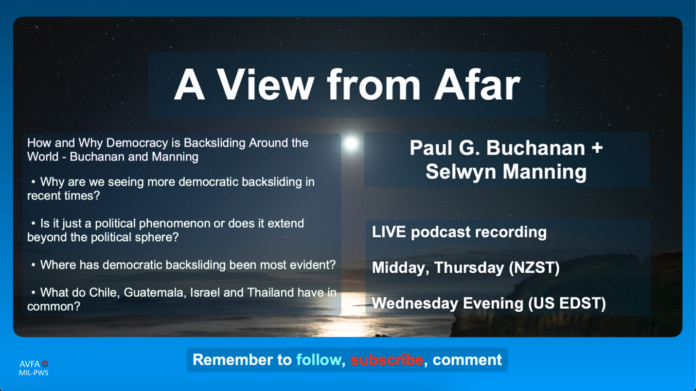
A View from Afar: Paul G Buchanan and Selwyn Manning examine democratic backsliding around the world and in New Zealand.
A View from Afar
PODCAST: How and Why Democracy is Backsliding Around the World - Buchanan and Manning
/
RSS Feed
Share
Link
Embed
In this the seventh episode of A View from Afar podcast for 2023 political scientist Dr Paul Buchanan and Selwyn Manning examine the strengths and weaknesses of democracy around the world.
In particular Paul and Selwyn consider how and why democracy in many countries around the world is on the slide.
They examine the causes of democratic backsliding and also test why the erosion of high democratic ideas have, in many cases, popular support.
First, Paul offers a context, and defines democratic backsliding. He identifies the countries that are decisively eroding their own democracies of principles that were once embraced by both power elites and citizenry.
The Questions include:
Why are we seeing more democratic backsliding in recent times?
Is it just a political phenomenon or does it extend beyond the political sphere?
Where has democratic backsliding been most evident?
What do Chile, Guatemala, Israel and Thailand have in common when it comes to backsliding?
What is occurring in the United States?
If a democracy “backslides,” what does it slide into?
INTERACTION WHILE LIVE:
Paul and Selwyn encourage their live audience to interact while they are live with questions and comments.
RECOGNITION: The MIL Network’s podcast A View from Afar was Nominated as a Top Defence Security Podcast by Threat.Technology – a London-based cyber security news publication. Threat.Technology placed A View from Afar at 9th in its 20 Best Defence Security Podcasts of 2021 category.
You can follow A View from Afar via our affiliate syndicators.
The Thai parliamentary election was held over two months ago and yet, the country still has no prime minister or government. While much remains in flux, one thing appears certain – the popular reformist leader of the party that received the most votes in the election, Pita Limjaroenrat, will not be the country’s next prime minister.
In demoralising, though familiar, scenes this week, the Constitutional Court announced Pita would be suspended as an MP until a ruling is made on allegations he knowingly held shares in a media company when he contested the May election.
The parliament then voted to void his prime ministerial nomination, preventing him from contesting a second vote in the legislature for the premiership. (He had already failed in one vote last week.)
Pita is clearly the people’s choice for prime minister. And under a more democratic system, he would already be sitting in the PM office.
So, why has the winner of the election been blocked from taking office?
Who is Pita?
The charismatic 42-year-old Pita is a Harvard-educated businessman who entered parliament in the 2019 election as a member of the Future Forward Party, led by another young, charismatic, American-educated politician, Thanathorn Juangroongruangkit.
After the election, in an almost identical complaint to Pita’s case, the Election Commission accused Thanathorn of holding shares in a media company when he registered as an MP, violating election laws. He was convicted by the Constitutional Court, disqualifying him as an MP.
Thanathorn’s party was then dissolved by the court for allegedly accepting an “illegitimate” loan. However, it was soon replaced by the newly established Move Forward Party, and Pita was elected its leader in March 2020.
Pita proved to be a talented campaigner, and the newly established party stunned political analysts in this year’s election by winning 151 seats in the House of Representatives. Even more astonishing was Move Forward’s almost clean sweep of Bangkok, winning 32 out of 33 seats. The military-backed parties of the previous government were eviscerated.
Pita then built a coalition of eight parties that together controlled 312 of the 500 seats in the House, a clear majority.
Why was Pita disqualified?
The problem for Pita, Move Forward and any democratic party in Thailand is the prime minister is elected under the 2017 constitution, which was written by the military. It gives the 250 members of the Senate, who were appointed in 2019 by the previous military junta, a vote in electing the prime minister.
This means a candidate needs 376 votes of the total 750 parliamentarians to be elected prime minister, but just 500 have been democratically elected. Of those, Pita’s coalition only controlled 312 seats. This feature of the Constitution is designed to allow the military-appointed Senate to play the role of spoiler.
Before the first round of parliamentary voting, Pita and his party were presented with two other significant hurdles – the Constitutional Court had received two cases against them.
The first complaint accused the Move Forward of “attempting to overthrow the democratic system with his majesty the king as the head of state”. The second, referred by the Election Commission, argued Pita should be removed as an MP for knowingly holding shares in a media company when he registered.
Pita was allowed to contest the first round of voting on July 13 nonetheless, but fell short, winning 324 votes. Only 13 senators supported him.
Then, before Wednesday’s second round of voting, the court announced Pita’s suspension and conservative forces in parliament joined to block him from standing again.
It should be noted both the Election Commission and the Constitutional Court are generally considered to be the vehicles of the conservative elites and have repeatedly made bogus or adverse judgements against liberal parties and politicians who might challenge the power of the military or monarchy.
Why do conservatives oppose Pita?
Pita ran on a platform of liberalising reforms in most areas of Thailand’s society and economy.
The party’s key policy proposal was to push for a referendum to establish an assembly to rewrite the Constitution and remove its anti-democratic elements, such as the appointment of the Senate and its ability to elect the prime minister.
Another key policy was to amend Section 112 of Thailand’s criminal code, the lèse-majesté law, which punishes anyone who criticises the king or other senior royals with up to 15 years in prison.
Since 2020, at least 250 people have been prosecuted under the law. A new book on the Thai king by an exiled academic, Pavin Chachavalpongpun, was also recently banned for defaming the monarchy. Anyone importing it could be imprisoned for three years and fined, despite the book not yet being published.
Pita and his party have also committed to push for a bill to legalise same-sex marriage and improve gender equality in Thailand.
Significantly, they sought to restrict the power of the military, as well. Move Forward proposed significant reductions in the defence budget, which is always a courageous stance in a country bedevilled by regular military coups.
In addition, the party planned to pass wealth and land taxes and increase corporate taxes for large companies to pay for its welfare policies focused on education, children, people with disabilities and retirees.
All of these positions made Pita popular with younger, more cosmopolitan voters. But it also made the party a target of powerful, anti-democratic, conservative forces, particularly the military, the monarchy and their supporters.
So what could happen next?
After the decision to suspend Pita and the vote to deny him a second nomination, protesters began to gather outside parliament, then later at Bangkok’s famed Democracy Monument. Many young people feel as though the conservative forces in Thai society have stifled the democratic will of the people – yet again.
It is now likely one of the three prime minister candidates of the second-place party, Pheu Thai, will be nominated in the next round of parliamentary voting, scheduled for July 27.
Despite Pita being suspended from parliament, Move Forward still commands the most seats in the House and will still be a powerful force in pursuing its agenda. There are rumours Pheu Thai could abandon its coalition with the party, though that remains to be seen.
When Pita left the parliament this week to applause from his supporters, he adopted an optimistic tone. He said Thailand had changed since the May election and “the people are now half way to victory”.
There is a chance this is true and we are on the cusp of a surge of democratic power in Thailand. But for many long-time observers of civil-military relations in Southeast Asia, this view might turn out to be overly optimistic.
Adam Simpson does not work for, consult, own shares in or receive funding from any company or organization that would benefit from this article, and has disclosed no relevant affiliations beyond their academic appointment.
Source: The Conversation (Au and NZ) – By Gail Pacheco, Professor of Economics, Director of the NZ Work Research Institute, Auckland University of Technology
Getty Images
Literacy and numeracy are under the spotlight as Aotearoa New Zealand grapples with how to improve student performance in these basic skills.
This decision followed a damning report revealed that by the age of 15, two out of five children are either only just meeting or failing to meet literacy standards.
It is clear the warning bells are ringing over student learning – maybe just not loud or urgently enough.
Our research shows just how essential it is that education policy addresses these basic skills now. If we don’t, struggling students – particularly in already disadvantaged groups – face lifelong consequences that reach well beyond educational success.
The state of New Zealand education
There is a growing sense something is wrong with New Zealand’s education system.
Level 1 National Certificates of Educational Achievement (NCEA) results have been steadily decreasing since 2017. A 2022 trial of new NCEA literacy and numeracy tests – due to become compulsory in 2024 – produced abysmal results and caused alarm for a number of principals.
Against international benchmarks, New Zealand’s trends in literacy and numeracy paint a gloomy picture.
A global study found a sharp decline in New Zealand students’ proficiency in reading and mathematics.
In 2009, 14% of students fell below the baseline threshold for literacy proficiency and 15% fell below in maths. In 2018, those falling below the baseline climbed to 19% and 22% respectively.
The OECD considers the baseline level to be one that enables students “to participate effectively and productively in life”.
For Māori students, the decline in basic literacy and numeracy is even more significant. In 2009, 24% of Māori students fell below the literacy baseline. This increased to 30% in 2018. Over the decade, the number of Māori students who fell below the baseline in maths went from 27% to 37%.
The decline was smaller for Pacific students, although their starting point was less favourable. More than a third fell below the literacy baseline in 2009, with this share increasing only slightly to 36% in 2018. For maths, 40% of Pacific students fell below the baseline in 2009, increasing to 44% in 2018.
Why literacy and numeracy matter
Our research found literacy and numeracy skills correlate to the wellbeing of individuals. As such, they significantly influence life choices and outcomes.
Our ten-year study followed a cohort of rangatahi (young people) who were 15 years old in 2009. We found those with low reading and maths skills have poorer outcomes across a range of wellbeing measures including education, employment, income, and health and justice.
That those with low literacy and numeracy skills have poorer educational outcomes, particularly in attaining bachelor’s degrees and tertiary qualifications, is unsurprising. They are also less likely to be employed and have lower earnings. The difference is particularly stark among women.
But the impact of these low skills goes beyond education and employment – it also affects wider areas of wellbeing such as health and justice.
For example, those with lower literacy and numeracy skills have higher hospitalisation rates – 59% had at least one hospitalisation between the ages of 15 and 25, compared to 46% of those with higher core competencies.
They were also more likely to engage in criminal activity: just over a quarter of this group had a conviction by time they were 25, compared to just 8% of the group with above-baseline skills.
Importantly, while life outcomes are influenced by literacy and numeracy skills, we also found that higher core skills alone do not necessarily lead to positive wellbeing outcomes.
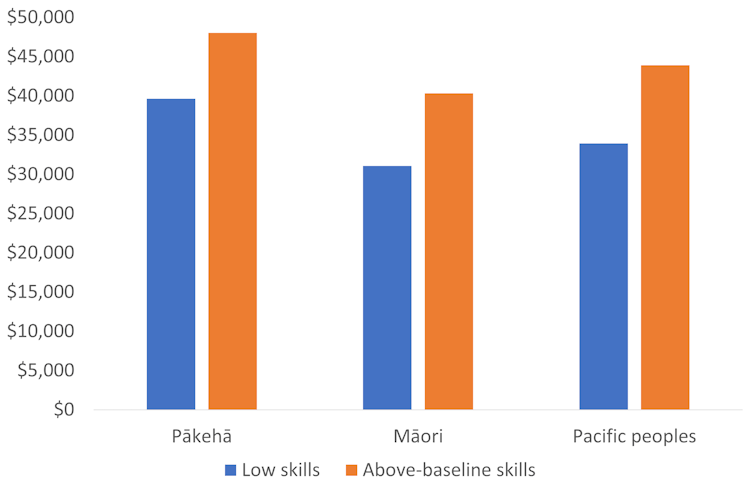
Ethnicity also plays a powerful role. For example, we found that at age 25, Māori with above-baseline literacy and numeracy skills have about the same average earnings as Pākehā with low skill levels.
Average annual earnings at age 25.
Using education to address systematic inequalities
There are myriad reasons why New Zealand needs a curriculum that ensures our future generations are equipped with the skills necessary to succeed and thrive in our fast-changing global economy.
Future generations need and deserve tools that will help them navigate the complexities of life within and beyond our shores. Failure to deliver on the government’s literacy and numeracy goals for the new curriculum will merely perpetuate the existing inequities.
Most of all, failure will undermine the yet-to-be-realised potential in our individual rangatahi and across our collective communities of Aotearoa.
This research was funded by a Ministry of Business, Innovation & Employment Endeavour grant.
The concept of the home advantage can be traced back as far as the 1870s, around the time the first professional sports leagues formed. Back then, data suggested teams experienced more success when playing at home than away.
One study looked at win-loss records in top domestic sport leagues across 65 countries between 2011 and 2015, and found most professional sports experience a home advantage. Basketball, handball and rugby union had the strongest home advantage, winning between 58-60% of their points at home. For men’s football, teams won 56.5% of their points at home.
In women’s football leagues across Europe, research between 2004 and 2010 found the home ground advantage was slightly weaker, averaging 54.2% of points won at home compared with around 60% for men’s leagues. It’s not yet known why this difference exists.
The home team in football tends to take more risks and is more proactive than away teams, and gets positive reinforcement from the crowd.
Away teams tend to attack less, attempt fewer shots, put in fewer crosses, and score fewer goals.
3 key factors
Academic research has spent considerable time exploring the factors related the home advantage.
There are three main factors that stand out.
1. The crowd effect
When playing at home, the crowd is usually filled with home fans wanting to see a big win. But as the number of supportive crowd members increases, there’s also a larger expectation placed on the team and individual athletes to perform well.
Researchers have been interested in how crowd size and density impact the home advantage. Results are mixed, but there’s some evidence to suggest that as average attendance at football games increases, the home advantage may also increase.
As crowds typically have more supporters for the home team, referees are thought to subconsciously favour the home team when making officiating decisions.
Research from Germany found crowd noise caused more referee decisions in favour of the home team. The away side is generally given more yellow cards. The authors say these effects correlate with the density of the crowd, such that the more dense (and presumably therefore louder) the home crowd is, the more likely it is the away team will receive more yellow cards.
Other research from England found “home teams consistently received fewer cards and converted more penalty kicks than visiting teams”.
When there were no crowds during the 2020 European football season due to the COVID-19 pandemic, research found the portion of home advantage that comes through referee decisions was eliminated.
It also found fewer yellow and red cards were given to away teams in this period. The authors say they “interpret these results to mean that crowds influence referee judgements about how severe an infraction is”.
2. The location matters
Disadvantages for the away team include disruptions to routine, unfamiliarity with the venue and conditions, longer travel times, and less support.
By playing at home, the Matildas and Football Ferns will experience familiar sights and sounds. They won’t need to speak a different language to communicate, they will be closer to family and friends, and they won’t have to adjust to a large time zone difference. Not having to contend with a new environment can be an advantage for the home team.
Research suggests these factors can support what are called “superior psychological states”, such as greater confidence in the self and the team.
3. Every player perceives pressure differently
When trying to understand the home advantage, it’s important not to overlook the individual athlete. While for some, playing at home may be viewed as motivating and inspiring, for others it creates extra pressure and anxiety.
Whether playing at home or away, another factor to consider is what’s at stake. Because many teams will only play three matches before being eliminated, each match of the world cup will hold great importance, with the outcome having consequences for each team.
For some players, higher stakes may present a threat, which may lead to greater anxiety and lower performance.
But other athletes might view added pressure as an opportunity to perform. Research shows such players experience much more “adaptive” thoughts, emotions and behaviours, meaning they’re more able to cope with the demands and thrive.
So, will our football stars from Australia and New Zealand be saying “there’s no place like home” when the world cup finishes? Let’s watch and see.
Amber Mosewich is an Associate Professor at the University of Alberta whose role involves research, teaching, and academic service. She receives funding from the Social Sciences and Humanities Research Council of Canada and the Sport Participation Research Initiative.
Alyson Crozier does not work for, consult, own shares in or receive funding from any company or organisation that would benefit from this article, and has disclosed no relevant affiliations beyond their academic appointment.
Source: The Conversation (Au and NZ) – By Prudence Flowers, Senior Lecturer in US History, College of Humanities, Arts, and Social Sciences, Flinders University
Production on US film and television sets has ground to a halt as Hollywood actors have joined writers in walking off sets. At issue are residuals (or royalties), streaming services and the use of artificial intelligence.
The last time there was a “double strike” was 1960, when future United States President Ronald Reagan was head of the powerful Screen Actors Guild (SAG).
Over his career he churned out over 50 films, appearing in Westerns, thrillers, war films and romantic comedies, as well as famously co-starring with a monkey called Bonzo.
In the 1930s and 1940s, Reagan was a self-proclaimed “New Deal Liberal” and a proud supporter of President Franklin Delano Roosevelt.
Reagan became a SAG member within a month of moving to Hollywood. In 1941, his then wife Jane Wyman, a member of the union’s board of directors, suggested him for a vacancy on the board.
Reagan was nominated for the SAG presidency by movie star Gene Kelly. He would go on to serve two stints as union head, from 1947–1952 and 1959–1960.
The year he first became SAG president he was part of the Second Red Scare, an anticommunist witch hunt that saw Americans fired, jailed and blacklisted over accusations of communist affiliation.
Hollywood – seen as rife with communist activity – was targeted amid fears it might produce socialist propaganda.
Reagan was fiercely anti-communist. In 1947, he appeared as a “friendly” witness for Congress, blaming industrial unrest and strikes in Hollywood on “subversive” elements.
Classified documents subsequently revealed Reagan was a confidential informant for the FBI. When he became president of SAG he provided FBI agents with dozens of actor’s files.
Leading the strike
Much like today, in the early 1950s a major issue facing Hollywood actors were residuals. During his first tenure as SAG president, Reagan was lauded within the industry when he helped secure the first residual payments for television actors.
With movie attendance plummeting and films increasingly aired on television, film actors also wanted residuals. They faced strong opposition from the movie studios.
In 1959, after negotiations ground to a halt, Reagan was asked to return as SAG president. He called for a strike in February 1960.
Actors walked off sets in March, joining the Writers Guild of America, which had been on strike since early January 1960. The actors’ strike lasted six weeks, paling in comparison to the 21-week writers’ strike.
Reagan ultimately won an agreement that residuals would be paid to actors for films produced from 1960. He also won a lump sum payment for the union of US$2.65 million, used to create SAG’s first pension and health plan for members.
Reagan was cheered by SAG members when the deal was ratified. It was approved by an overwhelming majority of members, although some Golden Age stars saw it as a betrayal.
Reagan resigned from the SAG presidency two months after the strike concluded. Unbeknown to most in the industry, he had a significant conflict of interest, working as both an actor and a producer.
While Reagan had been a registered Democrat, over the course of the 1950s his ideological views moved rightward.
He saw no tension between these beliefs and his role leading the 1960 strike, exhibiting the flexiblepragmatism scholars later identified with his time in the White House.
In the 1964 presidential election, he campaigned vigorously for Republican Barry Goldwater, a staunch conservative rejected by party moderates.
Goldwater opposed taxation and the social welfare state, voted against the Civil Rights Act on libertarian grounds, and viewed nuclear weapons as part of tactical warfare. Lyndon Johnson, his opponent, summarised the views of Democrats and many Republicans when he jibed of Goldwater, “In your guts you know he’s nuts”. Johnson defeated Goldwater in a landslide.
Yet 1964 proved to be the beginning, rather than the end, of the modern American right.
One of Reagan’s televised fundraising speeches for Goldwater, titled A Time for Choosing, catapulted him onto the national stage as the new conservative heir apparent.
Despite having no political experience, Reagan was approached by a group of influential businessmen to run as the Republican candidate for Governor of California. His last acting roles were in 1965.
Reagan’s conservative gubernatorial campaign was sharply critical of the counterculture and student protests, emphasising law and order. He won decisively and served two terms, from 1967–1975.
An anti-union president
From the mid-1970s, Reagan had his eyes firmly set on the White House. He articulated a politics that incorporated economic conservatism, hawkish anticommunism and moral traditionalism, including opposition to legal abortion. He also described “big labor” as a major problem for the US.
Reagan’s polish, charisma and sunny optimism made once politically extreme views palatable and attractive to ordinary Americans.
After a hard fought but failed bid for the Republican nomination in 1976, Reagan won the 1980 presidential election, easily defeating Democratic incumbent Jimmy Carter.
He barred them from working in their old jobs or anywhere in the Federal Aviation Administration for the rest of their lives. His administration also formally decertified their union, the Professional Air Traffic Controllers Organization (PATCO).
Reagan’s response to the PATCO strike was unprecedented in the post-World War II period. It had a chilling effect on the fortunes of unions and working conditions, contributing to ongoing wage stagnation and the loss of various forms of leave and entitlements.
Reagan is the only union leader to serve as US President. Paradoxically, he was also one of the most aggressively anti-union presidents of the 20th century.
Prudence Flowers has received funding from the South Australian Department of Human Services. She is a member of the South Australian Abortion Action Coalition.
While Christopher Nolan’s new film Oppenheimer is opening in much of the world this week, a Japanese release date has not yet been announced.
A delay in naming a release date is nothing new for Japan, where Hollywood releases often take place weeks or months later than other national markets.
Japan’s cinema industry is savvy enough to take a wait-and-see approach to blockbuster films.
If Oppenheimer fails at the box office in other markets, then Japan may decide on a quick opening in a smaller number of cinemas. If it is the global hit the producers hope, it may open across the country.
Some have speculated the tragic history of events in Hiroshima and Nagasaki make the film too sensitive for Japanese audiences. But concerns that the film contains sensitivities to Japan’s past can be easily discarded by a quick glance through Japan’s cinematic history.
The Oppenheimert trailer. Video: Universal Pictures
The Japanese film industry The Japanese film industry began in 1897, developing quickly through studios such as Nikkatsu and Shochiku. In the 1930s, the industry gained international attention with emerging filmmakers such as Yasujiro Ozu.
By the late 1930s, studios and filmmakers were drafted into the war effort, making propaganda films.
Until the end of the second world war, the Japanese government had been strictly censoring all films in line with efforts to produce this state-sanctioned propaganda. From 1945 to 1949, the US-Occupation forces set up procedures to ensure films avoided intensely nationalist or militaristic themes.
Japan’s film classification body was created in 1949 following the withdrawal of the Production Code. This gave Japanese authorities the chance to determine their own rules around film content based on themes of language, sex, nudity, violence and cruelty, horror and menace, drug use and criminal behaviour.
Japanese film was always quite progressive in terms of artistic licence, escaping the type of strictly enforced limitations found in America’s Hays Code, which put restrictions on content including nudity, profanity and depictions of crime.
Filmmakers in Japan had freedom to practice their art, so the pinku (soft pornography) films of the 1960s and 70s were the products of the major studios rather than underground independents.
These freedoms saw Japanese filmmakers absorb influences from Europe (particularly through French and Italian cinema), but saw significant content differences between Japanese and Hollywood cinema until the close of the Hays era.
Since the 1950s, censorship in the form of suggested edits or very rarely, “disallowed films”, has mostly been in response to violent or overly-explicit sexual imagery, rather than concerns over political or militaristic issues.
Japan is the third biggest box office market in the world, behind only China and North America, and cinema is dominated by local films.
While it can appear that Japanese cinema is dominated by anime and live-action remakes of manga and anime, it includes a rich array of genres and styles. The late 1990s saw a global appetite for horror films, under the mantle of J-horror. Films like Battle Royale (2000) and Ichi: The Killer (2001) created a new level of violence combining the horror genre with comic moments. Meanwhile samurai and yakuza films continue to find audiences, as do high-school themed dramas.
Internationally, the arthouse stylistics of films by Hirokazu Kore-eda, Kiyoshi Kurosawa and Naomi Kawase are feted at Cannes and Venice.
The war on screen Many Japanese filmmakers have explored the second world war.
As early as 1952, Kaneto Shindo’s Children of Hiroshima directly addressed the aftermath of the war through confronting imagery then with a gentle, humanist touch.
A year later, Hideo Sekigawa’s Hiroshima upped the political ante with a docudrama critical of the United States’ actions in a film that included real survivors from the nuclear blast acting as victims.
The obvious metaphorical imagery of successive Godzilla films reflect fears of the potential horrors nuclear activities could unleash.
The title of Shōhei Imamura’s Black Rain (1989, not to be confused with Ridley Scott’s yakuza film of the same name and same year) referenced the colour of the acid rain following the nuclear blast in Hiroshima, and was recognised with some of Japan’s highest film honours.
Anime has also directly shown the damage wrought by Oppenheimer’s device, most notably with Barefoot Gen in 1983, and its sequel in 1986.
In the style of Astro Boy and Kimba the White Lion, a young wide-eyed boy, Gen, is caught in the horrors of the conflict, watching as his mother literally melts in front of him.
Summer with Kuro (1990) and In This Corner of the World (2016) each gave their own, less graphic, anime versions of lives touched by the conflict.
Foreign films Foreign films about the second world war have also found an audience in Japan.
Alain Resnais’ intensely serious French New Wave drama, the French/Japanese co-production Hiroshima Mon Amour (1959), exposed the international implications of personal relations after the bomb.
Japan warmly welcomed Clint Eastwood’s 2006 twin-release of Letters from Iwo Jima and Flags of Our Fathers, which showed the battle from the views of Japanese and US soldiers, respectively.
Stories of the bombings of Hiroshima and Nagasaki are not a taboo topic in Japan. Of all the nations in the world to be banning films, Japan must surely be near the bottom of the list.
Whether there’s a release date or not, Oppenheimer must have the appeal to be a box office hit to determine its suitability for release in Japan.
The 2023 FIFA Women’s World Cup starts today, and more teams are taking part than ever before. The number of women and girls playing soccer around the world has also increased from about five million in 2014 to more than 13 million in 2019.
This greater participation in soccer over the years has led to an increase in injuries, including concussions. These can follow a range of situations, such as when the head hits the ball, players’ heads collide, or when the head hits the ground or goalpost.
But are women more at risk than men from such concussions? And if so, why? Here’s what the evidence says.
Concussion is a mild traumatic brain injury that usually happens when someone’s head hits something or someone. But it can also happen after being hit on the body, causing a whiplash-type motion to the head.
Common symptoms include headache, dizziness and fatigue. Most soccer players return to play within four weeks of a concussion. Although an estimated 10% of players (particularly women) will have persisting symptoms lasting several months.
Concussions are twice as likely to occur in games rather than in practice sessions. Defenders and goalkeepers have more concussions than forwards or midfielders.
Concussion is more likely as a result of contact between the head and an opponent’s elbow or shoulder, head-to-head contact, or contact of the head with the ground or goalpost.
Contact between players (whether head-to-head or elbow-to-head) is more common during a heading duel – when two or more players compete for a ball in the air.
Heading the ball, when players intentionally use their heads to redirect the ball, is unique to soccer. But concussion is more likely after the ball hits the head accidentally.
Regardless of whether such an impact is intentional, there is increasing concern that players exposed to repeated head impacts in soccer, including from headers, are more at risk of developing neurodegenerative diseases, such as dementia, in later life.
But current evidence for this only exists in men. In Australia (and other countries), soccer was deemed “medically inappropriate” for women until the 1970s. So not only have fewer women played soccer historically, their game hasn’t been so well researched.
In soccer, and other sports where men and women participate under the same rules, women appear to have much higher rates of concussion compared to men.
For every 1,000 hours of playing or practising soccer, there are about 1.5 concussions for women compared with 1.0 for men.
Women report greater number of symptoms, increased symptom intensity and greater time lost from sport after a concussion.
Concussions caused by ball-to-head contact is also much more common in women and girls, than in men.
So what might be happening in soccer? To answer this, we need to look at several factors, some biological, some related to how women are trained.
1. Neck strength
Women soccer players generally have weaker neck muscles than men. This may place them at higher risk of concussion if they cannot engage these muscles to stabilise their head if it is hit by another head, body or the ball.
The female sex hormones oestrogen and progesterone may protect women from sustaining a concussion.
Half of concussions also take place in the part of the menstrual cycle known as the late “luteal phase”. This is a seven-day window when oestrogen and progesterone levels are declining. However, the research is too limited to speculate further on the role of sex hormones.
Women and girls are less likely than men and boys to be trained in how to head the ball, according to an Australian survey of players and coaches. Adolescent players without this training are more likely to report concussion.
Most concussions in soccer occur when two players compete to head the ball. Here, their heads and arms are more likely to make contact, leading to concussion, rather then concussion resulting from hitting the ball itself.
So training players to safely head the ball should include how to position the body to minimise the risk of injury and keeping the eyes open to track the ball’s trajectory to prepare for ball-to-head contact.
But 90% of women close their eyes when heading a ball compared to 79% of men, according to one report. This potentially reduces a player’s readiness for ball contact, and makes them less aware of any players around them. As a result, they are less able to protect their head against an opponent’s elbow or head. However, further research is needed to understand the role of players having their eyes open or shut, and the risk of concussion.
Guidelines published last month aim to reduce the numbers of headers in soccer. These approaches are also likely to decrease the number of header duels, a common mechanism of concussion, as well as the long-term risks associated with ball-to-head impacts.
Recommended strategies include:
fewer players, smaller goals – small-sided play (for example five-a-side or seven-a-side) during matches and training for younger, beginner players, plus smaller goals, reduces the number of balls in the air, and headers
playing out from the back – passing the ball out from the goalkeeper to defenders rather than kicking it long the pitch leads to less high-force headers from goal kicks
short corner kicks – kicking the ball from a corner kick to a close-by team-mate is less likely to lead to header duels around the goal
neck exercises – to prepare the neck muscles for heading, neck exercises can be added to injury prevention programs. These can reduce head acceleration and potential concussion in adolescent players
red cards – enforcing red cards (being sent off the pitch) for deliberate head contact reduces the number of concussions.
Under 5% of the 211 soccer associations around the world endorse heading guidelines. So now is the ideal time to explore strategies that keep all soccer’s positive benefits while minimising the risk to current and future generations of players.
Shreya Mcleod is a Lecturer and Course Coordinator in Physiotherapy at Australian Catholic University. She is a PhD Candidate at the University of Newcastle, researching concussion in women’s contact and collision sports. She is also a Titled Sports and Musculoskeletal Physiotherapist and currently contracts with Cricket NSW. She has previously been a Contract Physiotherapist for Cricket Australia, Hobart Hurricanes WBBL, Singapore Sports Council and the WTA.
Kerry Peek is a senior lecturer (physiotherapy) and sports injury researcher from the University of Sydney. Kerry has received funding from a FIFA Research Scholarship and from Sports Medicine Australia. Kerry is currently an injury spotter (concussion) for FIFA organised tournaments (2023: U20s Men’s World Cup and Women’s World Cup). Kerry is a member of UEFA’s Heading Expert Group and Football Australia’s Expert Working Group (Heading and Concussion).
He said there was no identified “political or ideological motivation” for the shooter and as such, there was no need to change the national security risk.
The government has spoken to FIFA organisers today and the Women’s Football World Cup tournament will proceed as planned with the opening match tonight between New Zealand and Norway.
This article is republished under a community partnership agreement with RNZ.
The International Centre for Radio Astronomy Research, Author provided
Last year, we made an intriguing discovery – a radio signal in space that switched on and off every 18 minutes.
Astronomers expect to see some repeating radio signals in space, but they usually blink on and off much more quickly. The most common repeating signals come from pulsars, rotating neutron stars that emit energetic beams like lighthouses, causing them to blink on and off as they rotate towards and away from the Earth.
Pulsars emit powerful beams of radio waves from their poles, which sweep across our line of sight like a lighthouse. Joeri van Leeuwen
Pulsars slow down as they get older, and their pulses become fainter, until eventually they stop producing radio waves altogether. Our unusually slow pulsar could best be explained as a magnetar – a pulsar with exceedingly complex and powerful magnetic fields that could generate radio waves for several months before stopping.
Unfortunately, we detected the source using data gathered in 2018. By the time we analysed the data and discovered what we thought might be a magnetar it was 2020, and it was no longer producing radio waves. Without additional data, we were unable to test our magnetar theory.
Nothing new under the sun
Our Universe is vast, and so far every new phenomenon we’ve discovered has not been unique. We knew that if we looked again, with well-designed observations, we had a good chance of finding another long-period radio source.
So, we used the Murchison Widefield Array radio telescope in Western Australia to scan our Milky Way galaxy every three nights for several months.
A single tile of the hundreds that make up the Murchison Widefield Array, a radio telescope in outback Western Australia. Natasha Hurley-Walker
We didn’t need to wait long. Almost as soon as we started looking, we found a new source, in a different part of the sky, this time repeating every 22 minutes.
At last, the moment we had been waiting for. We used every telescope we could find, across radio, X-ray, and optical light, making as many observations as possible, assuming it would not be active for long. The pulses lasted five minutes each, with gaps of 17 minutes between. Our object looked a lot like a pulsar, but spinning 1,000 times slower.
The newly discovered mystery object emits pulses of radio waves in a 22-minute cycle.
Hiding in plain sight
The real surprise came when we searched the oldest radio observations of this part of the sky. The Very Large Array in New Mexico, United States, has the longest-running archive of data. We found pulses from the source in data from every year we looked – the oldest one in an observation made in 1988.
Observing over three decades meant we could precisely time the pulses. The source is producing them like clockwork, every 1,318.1957 seconds, give or take a tenth of a millisecond.
Radio images taken with the MeerKAT radio telescope in South Africa, showing one of the pulses, sped up by a factor of 20. The other nearby radio sources remain constant. Natasha Hurley-Walker
According to our current theories, for the source to be producing radio waves, it should be slowing down. But according to the observations, it is not.
In our article in Nature, we show that the source lies “below the death line”, which is the theoretical limit of how neutron stars generate radio waves; this holds even for quite complex magnetic field models. Not only that, but if the source is a magnetar, the radio emission should only be visible for a few months to years – not 33 years and counting.
So when we tried to solve one problem, we accidentally created another. What are these mysterious repeating radio sources?
What about ET?
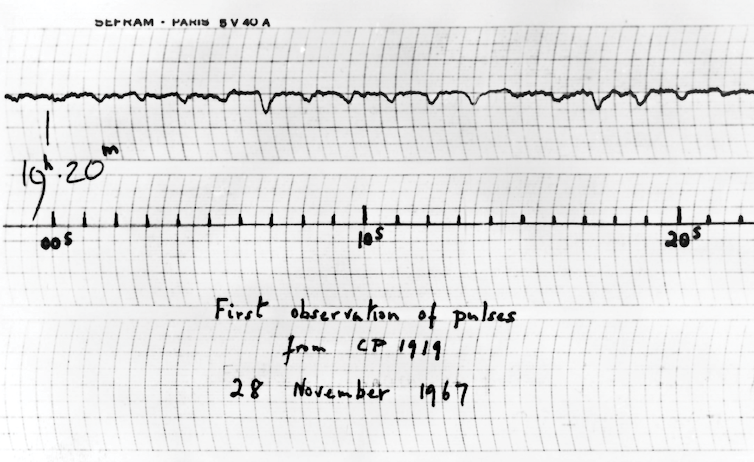
Of course, it’s very tempting at this point to reach to extraterrestrial intelligence as an option. The same thing happened when pulsars were discovered: astrophysicist Jocelyn Bell Burnell and her colleagues, who found the first pulsar, nicknamed it “LGM 1”, for “Little Green Men 1”.
Observation of pulses from the first pulsar to be discovered, CP 1919. The chart recorder shows regular deflections every 1.3 seconds. Jocelyn Bell Burnell and Anthony Hewish
But as soon as Bell and her colleagues made further detections, they knew it could not be aliens. It would be incredibly unlikely for so many similar signals to be coming from so many different parts of the sky.
The pulses, similar to those of our source, contained no information, just “noise” across all frequencies, just like natural radio sources. Also, the energy requirements to emit a signal at all frequencies are staggering: you need to use, well, a neutron star.
While it’s tempting to try to explain a new phenomenon this way, it’s a bit of a cop out. It doesn’t encourage us to keep thinking, observing and testing new ideas. I call it the “aliens of the gaps” approach.
Fortunately, this source is still active, so anyone in the world can observe it. Perhaps with creative follow-up observations, and more analysis, we’ll be able to solve this new cosmic mystery.
Natasha Hurley-Walker is funded by a Future Fellowship from the Australian Research Council.
Nomadic animal-herders from the Eurasian steppe mingled with Copper Age farmers in southeastern Europe centuries earlier than previously thought.
In a new study published in Nature, we used ancient DNA to gain new insights into the spread of culture, technologies and ancestry at a crucial juncture in European history.
How ancient DNA can help us understand change
Humanity’s archaeological record reveals massive changes in cultural practices and technologies.
However, it is not always clear how these changes moved between different groups of people. It can happen either by a spread of ideas (such as through trade), or through the migration of people.
First, there was an expansion of early farming groups from Anatolia around 9,000 years ago. This was associated with the introduction of farming practices and animal husbandry, a more sedentary lifestyle (permanent housing) and the wide use of pottery and new types of polished stone tools.
Second was the expansion of steppe herders from the Eurasian Pontic Steppes around 5,000 years ago. This is associated with the spread of pastoralism and dairying technologies, a different type of ancestry and possibly some of the Indo-European languages.
In our new research, we studied the interaction between farming and pastoralist groups from the steppe from a new angle by analysing the genomes of 135 individuals from southeastern Europe and the northwestern Black Sea region, who lived between 4,000 and 7,000 years ago.
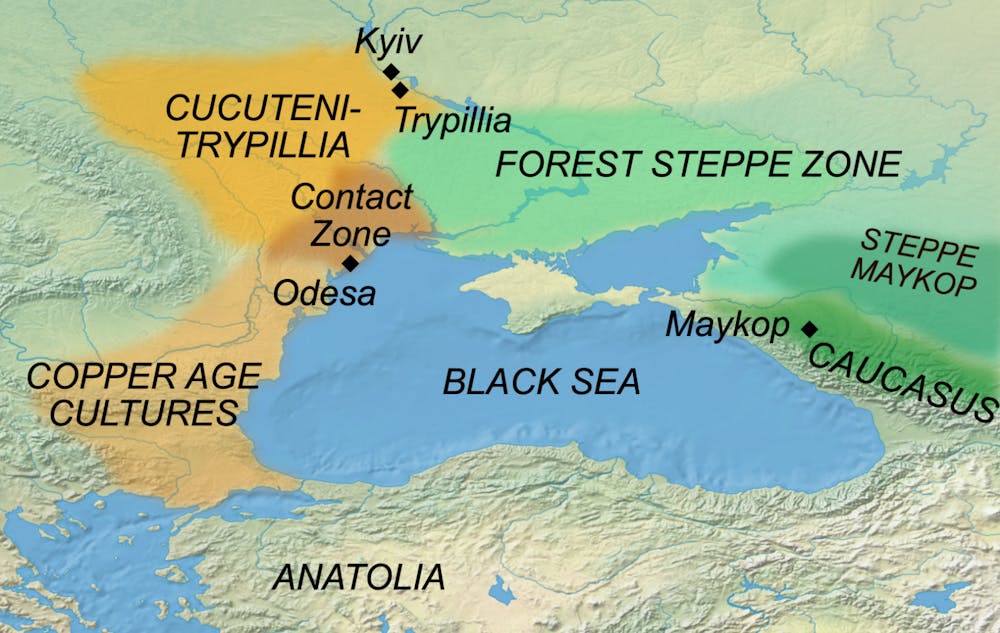
The area around Odesa was a ‘melting pot’ of cultures and ancestries. Modified from Penske et al. (2023), Author provided
We uncovered previously unknown and significant genetic changes in the people living in these regions. We also found the presence of steppe ancestry in the contact zone in the northwestern Black Sea region around 5,500 years ago, some 500 years earlier than previously assumed.
The Copper Age in southeastern Europe
Southeastern Europe played an important role in the spread of farming across Europe after early farmers from Anatolia arrived around 9,000-8,000 years ago. Approximately 1,000 years later, easy access to copper, gold and salt led to the development of many flourishing settlements in parts of today’s Bulgaria and Romania.
Settlements on the Black Sea and major rivers such as the Danube thrived through contact and trade with surrounding areas. Similarity in material culture visible in the archaeological record across a wider region indicates a period of social and political stability of approximately 500 years, between around 6,200 and 6,700 years ago.
Ninety-five of the ancient genomes we analysed were from this period and region, and this cultural similarity and stability is reflected in the absence of major genetic differences.
A new era and a melting pot of human interaction
Following this period of stability, many Copper Age settlements were abruptly abandoned around 6,000 years ago. For almost the next 1,000 years so few people lived in southeastern Europe that the period is often referred to as “the dark millennium”. The reason for this is not fully understood, but it is likely due to the depletion of resources due to unfavourable climatic conditions.
Instead, large settlements of several thousand houses emerged further north in parts of what are now Moldova and Ukraine. Located on the western end of the forest steppe zone, these mega-sites were associated with the Cucuteni-Trypillia culture.
Here, during a period called the Eneolithic spanning from 5,200 to 6,500 years ago, the region around today’s Odesa became a “melting pot” of human interaction. Numerous cultural influences appear in the archaeological record, including the waning Copper Age cultures and the Cucuteni-Trypillia culture.
Interestingly, the resulting style of pottery and other artefacts at the mega-sites showed influences from two additional groups. First, from nearby groups that could be traced to the steppe region east of Odesa. Second, from the distant Maykop culture of the North Caucasus, a mountain range east of the Black Sea.
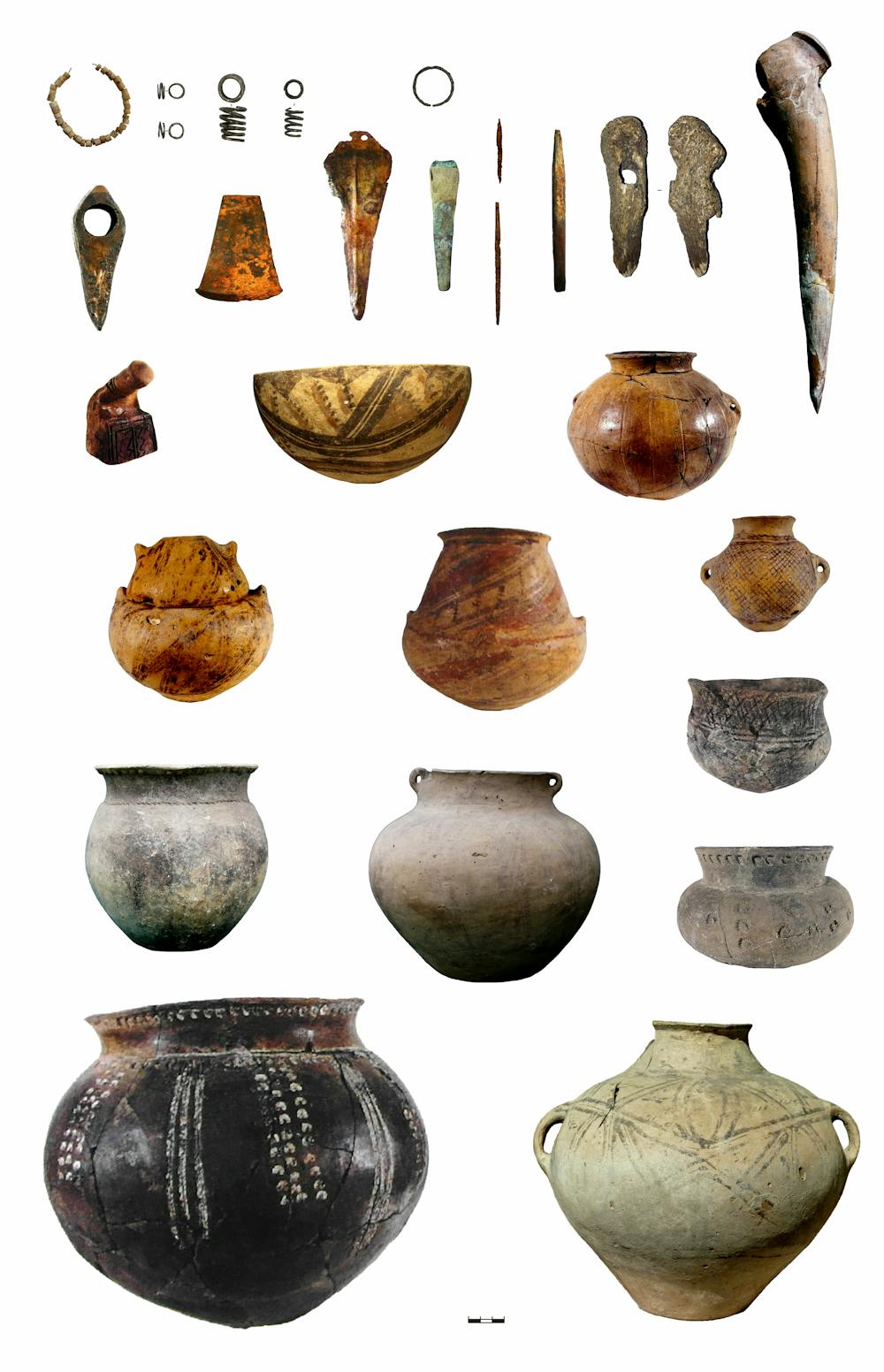
Characteristic jewellery, weapons, tools and pottery from the melting pot area around today’s Odesa. The pottery combines characteristics from numerous cultures of the area. I. Manzura (2020), History Carved by the Dagger: the Society of the Usatovo Culture in the 4th Millennium BC
The steppe groups practised a different way of life, called nomadic pastoralism. Where farmers lived on and worked the same piece of land, nomadic pastoralists kept moving to find fresh pastures for their large herds of animals.
On top of this very different lifestyle, they also carried a distinct genetic profile called “steppe ancestry”.
A surprising discovery
By analysing the genomes of 18 ancient individuals from the Odesa region from this period, we could see genetic evidence of the many cultural influences observed by archaeologists.
In addition to the previously observed Copper Age ancestry, we detected new genetic contributions from individuals from the forest steppe regions, and the North Caucasus. This new ancestry and its appearance in western Europe had been uniquely associated with the spread of a later cultural group known as the Yamnaya.
This was a huge surprise. We didn’t expect to see signs of this ancestry until at least 500 years later, when the Yamnaya arrived.
These findings show there was not only a cultural exchange between the different groups. There must have also been biological interactions of many genetically distinct people coming together in this contact zone as early as 5,400 to 6,500 years ago.
Due to this “melting pot” the Eneolithic was characterised by a number of innovations. Technologies such as wheels, wagon transportation and improved metal-working spread quickly into western Europe and Central Asia.
A mosaic of ancestries
We also analysed 21 individuals from the Early Bronze Age, approximately 4,000–5,300 years ago. In eight of these individuals we observed the expected westward expansion of steppe pastoralists, this time associated with the Yamnaya culture.
This final migration brought with it the last part of the modern Western European gene pool, likely emerging from the preceding period of contact and exchange that we identified. However, the remaining 13 individuals retained the genetic signature from the preceding Copper Age. These findings indicated a coexistence of these genetically distinct peoples.
Our study of genetic data over time reveals a highly dynamic picture of human prehistory in southeastern Europe. As more ancient DNA data becomes available, so too will more chapters of this story.
The authors do not work for, consult, own shares in or receive funding from any company or organisation that would benefit from this article, and have disclosed no relevant affiliations beyond their academic appointment.
Why, in a country of more than 330 million people, does it appear that Americans will have to choose between Joe Biden or Donald Trump at the 2024 US presidential election?
Sure, not everyone can run for president. Anyone under the age of 35 is out, as are those born overseas and non-residents of 14 years or more. It helps to be well-known, popular and to sit on an eye-watering pile of money; the 2020 presidential election cycle, for example, cost candidates a combined US$5.7 billion ($A8.37 billion), more than the GDP of several small countries.
Those who have previously served in an official role also have advantages when it comes to competing for the top job. Having a known political track record, public name recognition, and existing voter support all go a long way to financing campaigns and encouraging voter turnout.
But even with all that considered, the pool of possibles surely could not be reduced to the same two candidates as 2020. So, why then are the odds of Biden and Trump going head-to-head once again so good?
Why Biden?
The fate of the Democrat nomination process is almost certainly sealed, with President Joe Biden as the Democrats’ nominee for the 2024 election. There are two main reasons for this.
Firstly, any primary challenge from a serious Democrat contender would present undue risk to the “incumbent advantage” of the party. With only ten of the 45 former presidents unable to secure second terms, incumbent presidents generally have a pretty good shot at winning a second term in office.
The punishing reminder of Senator Ted Kennedy’s fierce and unsuccessful primary challenge to incumbent President Jimmy Carter in 1980 is no doubt curbing any Democrat’s bid to take on Biden. Combined with Carter’s low approval rating and a country bogged down in “malaise”, the challenge all but paved the way for Ronald Reagan’s walloping victory with 489 Electoral College votes to Carter’s 49.
A president, like Carter, seeming to grovel for their own party’s support after a leadership contest, is an easy target for the opposition. A Democrat party united in full faith behind the incumbent leader – Biden – has a better chance of beating the Republican nominee.
Secondly, even if a serious Democrat could shake off the cautionary tale of 1980, there is no clear persuasively electable alternative to Biden. More than half of American voters do not want Biden to run in 2024, but dissatisfaction with a sitting president isn’t new. For example, 60% of Americans did not want Reagan to run again in 1984, despite him having a relatively high approval rating at the time.
It is one thing to not want the president to run again and yet another to unanimously agree on the alternative. No prominent Democrat officeholders appear willing or have enough support from the party or the public to suggest a challenge would be successful.
Kamala Harris, as Vice President, probably has the next best chance to secure the Democratic nomination. Every sitting or former vice president who has sought Democrat leadership since 1972, including Biden, has been successful. However, Harris suffers even lower approval ratings than Biden, and her chances at winning election in November are less predictable.
The reality is, despite being 80 and sometimes appearing frail, Biden is an electable leader. He won the popular vote in 2020 by more than 7 million votes and a 4.5% victory margin. And among his own party the president maintains a high approval rating, with 82% of Democrats approving of Biden in June 2023.
For Democrats who might dislike Biden, the only thing worse than a second Biden term, is a second Trump term; while they might not like it, Biden presents the best chance at re-election next year.
Despite concerns about his age, Joe Biden remains the Democrats’ best hope in 2024. Stephanie Scarbrough/AAP/AP
Why Trump?
The story is a little different when it comes to the Republican party nomination. Trump is not as likely as Biden to secure the nomination for his party in 2024. Still, the former president remains the clear front runner ahead of the main primary season, averaging 50% of the party’s support as the preferred nominee, and maintaining a 32-point lead over his nearest rival, Florida Governor Ron DeSantis.
Trump’s campaign to reclaim office is the first attempt of any former president to regain office after losing in over 130 years. Unlike other one-term modern presidents who might have sought a second term after losing, Trump seems to have fewer issues persuading Republican voters and the party that he could be a winner once again.
Not only did Trump only lose the Electoral College by a razor thin count (the equivalent of around 44,000 votes), but an average of two-thirds of Republican voters believe Biden’s victory was fraudulent. An unforgettable 147 House Republicans also voted to reject Biden’s 2020 victory in January 2021, believing it was stolen from Trump.
Almost all the Republican primary challengers are reluctant to openly criticise the former president. They have stood him even amid the two recent criminal indictments, which would ordinarily present a golden opportunity for opponents to give their own campaigns an edge. For so-called “Teflon Don”, the scandals have done little to dissuade and unstick the Trump-loyal Republican base, and have only served to starve Trump’s opponents of media oxygen.
Of course, Trump’s nomination far from a home run, and the primary process is often long and unpredictable. But like the Democrats, the major question facing the party is, if not him, then who? And the party is coming up short with a more compelling answer.
And despite Trump’s very significant legal troubles, he retains a large Republican supporter base. Cristobal Herrera-Ulashkevich/EPA/AAP
The crowded Republican field and winner-takes-all nature of the system means it is very difficult for non-Trump-supporting Republicans to coalesce around a single alternative with a margin big enough to surpass Trump’s lead. Even DeSantis, who was once crowned “DeFuture” of the party and is supposedly the best chance of taking on Trump for the nomination, has found his popularity and momentum waning in recent weeks.
Ultimately, it is still too hard to know for sure what the election in November 2024 will look like, and any US political watcher will be loath to make any firm predictions after surprises in both the 2016 and 2020 presidential elections.
But, at this point in the election cycle, despite the wants of the majority of Americans, and no matter how uninspiring – 2024 looks to be 2020 all over again.
Victoria Cooper is affiliated with the United States Studies Centre at the University of Sydney
The cost of groceries has risen substantially over the last year. Food and non-alcoholic drinks rose by 7.9% in the year to May, with biggest increases in dairy products (15.1%), breads and cereals (12.8%) and processed foods (11.5%).
Meat costs rose by 3.8%, but the absolute increase was high, with a kilo of fillet steak costing up to A$60 for a kilogram.
Meat is a good source of protein, iron, zinc and vitamin B12.
Recommendations are for a maximum of three serves of cooked lean red meat a week. This includes beef, lamb, veal, pork, or kangaroo, with a serve being 65g cooked, which equates to 90–100g raw. This means purchasing 270–300g per person per week.
Check prices online and weekly specials. Less expensive cuts include oyster blade, chuck or rump steak ($22–$25 per kilogram). They can be tougher, making them better for casseroles or slow cook recipes, like this beef stroganoff.
One exception is mince because higher star, lower fat, more expensive products shrink less during cooking compared to regular mince, which shrinks by 25–30%.
Extend casserole and mince dishes by adding vegetarian protein sources, such as dried or canned beans and legumes.
A 400g can of red kidney beans costs about $1.50 and contains 240g of cooked beans, equivalent to 1.6 standard serves. Add a can of any type of legume (black, adzuki, cannelloni, butter, chickpeas, four-bean mix, brown lentils) or use dried versions that don’t need pre-soaking like dried red lentils at about $5 per kilogram.
This adds nutrients including protein, B vitamins, iron, zinc, calcium, magnesium and dietary fibre.
Dairy products are important sources of protein, calcium, magnesium, zinc, potassium and vitamins A, B2 and B12. Australian recommendations are for two to three serves a day for adults and four serves for women over 50. One serve is equivalent to a cup of milk or 40g cheese.
Fresh milk costs between $1.50 and $3.00 per litre depending on type and brand, while UHT milk is cheaper, about $1.60 per litre. It’s even cheaper to buy powdered milk ($10 per kilogram pack, which makes ten litres), equating to $1 per litre.
Making yoghurt at home costs about $5–6 per kilogram using a powder mix and yoghurt maker ($25). Once set, divide into smaller tubs yourself. Use as a substitute for cream or sour cream.
Fresh yoghurt varies from $11–$18 per kilogram, with individual serves and flavoured varieties more expensive (but not always). Compare per kilogram or per 100g prices and check for specials.
Cheese prices vary a lot so compare prices per kilogram. As a guide, block cheese is cheaper than pre-sliced or grated cheese. Home brand products are cheaper than branded ones. Mature cheeses are more expensive and processed cheese least expensive. But, if you cut block cheese really thick you end up using more. Block cheese ranges from $15 to $30 a kilogram, while packets of pre-sliced cheese vary from $18 to over $30.
Pre-grated cheeses range from $14 to $30 per kilo, with most around $20, and processed cheese varies from $10 to $15. Extend grated cheese by mixing with grated carrot (about $2 a kilogram) and use as a topper for tacos, wraps, pasta and pizza. Use processed cheese slices for toasted sandwiches. Most recipes work adding less cheese than specified.
A high-calcium alternative to cheese in sandwiches is canned salmon, but at $15–$30 per kilogram ($6–$7 per 210g can) you add variety but may not save money.
About 50% of household food dollars are spent on takeaway, eating out, coffee, alcohol, food-delivery services and extras, so have a budget for discretionary food items. This is where you can make big savings.
Your household might need an incentive to stick to the budget, like voting on which “discretionary” items food dollars get spent on.
Turn leftovers into tomorrow’s lunch or dinner. When clearing the dinner table, pack leftovers straight into lunch containers so it’s grab and go in the morning (or freeze for days you’re too busy to cook).
Use our resources at No Money No Time for ideas on how to help your food dollars go further. If you need food help right now, the Ask Izzy website can locate services in your area.
Clare Collins AO is a Laureate Professor in Nutrition and Dietetics at the University of Newcastle, NSW and a Hunter Medical Research Institute (HMRI) affiliated researcher. She is a National Health and Medical Research Council (NHMRC) Leadership Fellow and has received research grants from NHMRC, ARC, MRFF, HMRI, Diabetes Australia, Heart Foundation, Bill and Melinda Gates Foundation, nib foundation, Rijk Zwaan Australia, WA Dept. Health, Meat and Livestock Australia, and Greater Charitable Foundation. She has consulted to SHINE Australia, Novo Nordisk, Quality Bakers, the Sax Institute, Dietitians Australia and the ABC. She was a team member conducting systematic reviews to inform the 2013 Australian Dietary Guidelines update and the Heart Foundation evidence reviews on meat and dietary patterns.
Source: The Conversation (Au and NZ) – By Brandon Michael Sideleau, PhD student studying human-saltwater crocodile conflict, Charles Darwin University
Shutterstock
Last week, a 67-year-old man was bitten on the arm by a saltwater crocodile at a waterhole in the Northern Territory’s Top End. Predictably, the incident has prompted debate over whether a crocodile cull is needed.
The incident occurred in Litchfield National Park at Wangi Falls, a popular tourist spot. The man was hospitalised with non-life threatening injuries. Authorities later removed and killed the 2.4 metre crocodile responsible for the attack.
Fatal crocodile attacks in the NT peaked in 2014 when four people died. The last fatal incident in the territory occurred in 2018 when an Indigenous ranger was killed while fishing with her family.
Despite the low number of fatal attacks in recent years, NT Chief Minister Natasha Fyles said last week the territory’s crocodile population had risen dramatically in recent decades and “it’s time for us to consider” if culling should be reintroduced.
This is an over-reaction to a fairly isolated incident. Data suggest the saltwater crocodile population in the NT does not need to be culled and their management does not need changing.
Getting to grips with ‘salties’
Saltwater crocodiles, fondly known in Australia as “salties”, are the largest in the crocodilian order of reptiles and can grow to six metres.
Hundreds of saltwater crocodile attacks on humans are reported globally each year. This, as well as demand for crocodile skins, has resulted in the species being eradicated from much of its former range.
The saltwater crocodile was once found widely across the Indo-Pacific region. Now, there are no saltwater crocodiles in several countries including Cambodia, China, Seychelles, Thailand and Vietnam.
Current and historical distribution of the saltwater crocodile. Green = present, yellow = possibly present, orange = extinct. CrocAttack: The Worldwide Crocodilian Attack Database
Elsewhere, saltwater crocodile populations declined dramatically last century. In the Northern Territory, crocodile numbers dropped to about 5,000 before a culling ban was introduced in 1971. The species’ numbers have since rebounded to more than 100,000.
In some areas, recovering crocodile populations come into conflict with humans. This can occur when, for example, humans destroy the species’ habitat or their prey becomes scarce due human activity such as overfishing and poaching. This can force the species to relocate, bringing them closer to people.
Saltwater crocodiles have long been known to enter Wangi Falls during the wet season, when the location is closed to the public. In fact, a 3.4 metre crocodile was captured there in January this year.
It’s never 100% safe to swim at locations within the natural range of saltwater crocodiles. However, Wangi Falls is considered reasonably safe for swimming during the dry season (May to October) because park officials survey and remove crocodiles before it opens to the public each year.
So what went wrong in this case? We don’t know for sure. The crocodile in question was relatively small: perhaps it wasn’t spotted during surveys. Or it could have just arrived after surveys were conducted.
A saltwater crocodile incident last week has reignited the debate about culling. Brandon Sideleau, Author provided
The current approach works
Following last week’s crocodile attack, Fyles said culling may be needed, telling the media:
I think it’s time for us to consider: do we need to go back to culling considering the significant increase in the crocodile population, and the impact it’s happening, not just on our tourists and visitors, but also locals?
These comments are surprising. Recent data for the Top End suggests crocodile populations are stabilising. And the rarity of fatal attacks on humans indicates the territory’s crocodile management plan is effective.
The plan involves, among other measures, removing problem crocodiles, raising public awareness around safely co-existing with the animals, and monitoring their impact.
Since 2018, the NT has experienced one fatal saltwater crocodile attack while Queensland has experienced two. That’s despite an average saltwater crocodile density in the territory of 5.3 individuals per kilometre – three times more than in Queensland.
This, coupled with data from outside Australia, suggests the frequency of crocodile attacks depends more on human behaviour and population density than how many crocodiles are in a given area.
In Indonesia, crocodiles killed at least 71 people last year alone. Yet the crocodile population there is likely small and recovering, based on the limited number of surveys conducted.
And seeing saltwater crocodiles in the wild is important to the NT’s economy. Culling them could damage the NT’s reputation as an ecotourism destination.
Lastly, culling dominant male crocodiles can be dangerous. Saltwater crocodiles are the most territorial of all crocodilians. When one is removed, other large crocodiles begin to compete for the newly available territory. This can present a threat to public safety.
The crocodile population in the NT does not need to be culled. Indeed, the territory’s current crocodile management plan is an example of large predator conservation done right.
Source: The Conversation (Au and NZ) – By Peter C. Pugsley, Associate professor, Department of English, Creative Writing and Film, University of Adelaide
While Christopher Nolan’s new film Oppenheimer is opening in much of the world this week, a Japanese release date has not yet been announced.
A delay in naming a release date is nothing new for Japan, where Hollywood releases often take place weeks or months later than other national markets.
Japan’s cinema industry is savvy enough to take a wait-and-see approach to blockbuster films. If Oppenheimer fails at the box office in other markets, then Japan may decide on a quick opening in a smaller number of cinemas. If it is the global hit the producers hope, it may open across the country.
Some have speculated the tragic history of events in Hiroshima and Nagasaki make the film too sensitive for Japanese audiences. But concerns that the film contains sensitivities to Japan’s past can be easily discarded by a quick glance through Japan’s cinematic history.
The Japanese film industry began in 1897, developing quickly through studios such as Nikkatsu and Shochiku. In the 1930s, the industry gained international attention with emerging filmmakers such as Yasujiro Ozu.
By the late 1930s, studios and filmmakers were drafted into the war effort, making propaganda films.
Until the end of the second world war, the Japanese government had been strictly censoring all films in line with efforts to produce this state-sanctioned propaganda. From 1945 to 1949, the US-Occupation forces set up procedures to ensure films avoided intensely nationalist or militaristic themes.
Japan’s film classification body was created in 1949 following the withdrawal of the Production Code. This gave Japanese authorities the chance to determine their own rules around film content based on themes of language, sex, nudity, violence and cruelty, horror and menace, drug use and criminal behaviour.
Japanese film was always quite progressive in terms of artistic licence, escaping the type of strictly enforced limitations found in America’s Hays Code, which put restrictions on content including nudity, profanity and depictions of crime.
Filmmakers in Japan had freedom to practice their art, so the pinku (soft pornography) films of the 1960s and 70s were the products of the major studios rather than underground independents.
These freedoms saw Japanese filmmakers absorb influences from Europe (particularly through French and Italian cinema), but saw significant content differences between Japanese and Hollywood cinema until the close of the Hays era.
Since the 1950s, censorship in the form of suggested edits or very rarely, “disallowed films”, has mostly been in response to violent or overly-explicit sexual imagery, rather than concerns over political or militaristic issues.
Japan is the third biggest box office market in the world, behind only China and North America, and cinema is dominated by local films.
While it can appear that Japanese cinema is dominated by anime and live-action remakes of manga and anime, it includes a rich array of genres and styles. The late 1990s saw a global appetite for horror films, under the mantle of J-horror. Films like Battle Royale (2000) and Ichi: The Killer (2001) created a new level of violence combining the horror genre with comic moments. Meanwhile samurai and yakuza films continue to find audiences, as do high-school themed dramas.
Internationally, the arthouse stylistics of films by Hirokazu Kore-eda, Kiyoshi Kurosawa and Naomi Kawase are feted at Cannes and Venice.
The war on screen
Many Japanese filmmakers have explored the second world war.
As early as 1952, Kaneto Shindo’s Children of Hiroshima directly addressed the aftermath of the war through confronting imagery then with a gentle, humanist touch.
A year later, Hideo Sekigawa’s Hiroshima upped the political ante with a docudrama critical of the United States’ actions in a film that included real survivors from the nuclear blast acting as victims.
The obvious metaphorical imagery of successive Godzilla films reflect fears of the potential horrors nuclear activities could unleash.
The title of Shōhei Imamura’s Black Rain (1989, not to be confused with Ridley Scott’s yakuza film of the same name and same year) referenced the colour of the acid rain following the nuclear blast in Hiroshima, and was recognised with some of Japan’s highest film honours.
Anime has also directly shown the damage wrought by Oppenheimer’s device, most notably with Barefoot Gen in 1983, and its sequel in 1986.
In the style of Astro Boy and Kimba the White Lion, a young wide-eyed boy, Gen, is caught in the horrors of the conflict, watching as his mother literally melts in front of him.
Summer with Kuro (1990) and In This Corner of the World (2016) each gave their own, less graphic, anime versions of lives touched by the conflict.
Foreign films about the second world war have also found an audience in Japan.
Alain Resnais’ intensely serious French New Wave drama, the French/Japanese co-production Hiroshima Mon Amour (1959), exposed the international implications of personal relations after the bomb.
Japan warmly welcomed Clint Eastwood’s 2006 twin-release of Letters from Iwo Jima and Flags of Our Fathers, which showed the battle from the views of Japanese and US soldiers, respectively.
Stories of the bombings of Hiroshima and Nagasaki are not a taboo topic in Japan. Of all the nations in the world to be banning films, Japan must surely be near the bottom of the list.
Whether there’s a release date or not, Oppenheimer must have the appeal to be a box office hit to determine its suitability for release in Japan.
Peter C. Pugsley does not work for, consult, own shares in or receive funding from any company or organisation that would benefit from this article, and has disclosed no relevant affiliations beyond their academic appointment.
On Wednesday, Education Minister Jason Clare released a much-anticipated report on universities. This is the interim report of the Universities Accord review.
The review, commissioned in November 2022 and led by Professor Mary O’Kane, has been tasked with creating a “visionary plan” for Australian higher education. It is examining everything from university governance, to research, teaching, international students and student wellbeing.
But one area of great interest is what will happen to the fees students pay to attend university. For domestic government-supported students, these are called “student contributions”.
The government and the review panel are also emphasising equity of access to higher education and the report suggests major changes to how university funding works. These changes would be invisible to students, but the goal is more people from disadvantaged backgrounds enrol in university and complete their degrees.
The interim report confirms the Job-ready Graduates scheme for student fees be scrapped. This was introduced in 2021 by the Morrison government.
It was intended to steer students to courses that matched labour market demand (such as teaching or nursing) or other national priority areas (such as mathematics and foreign languages). Student contributions for these courses were discounted.
Other courses, notably arts degrees, saw price increases. The cost of most subjects more than doubled.
But this does not work. Along with other higher education policy analysts, I argue student contributions only have small effects on student choices. The main practical consequence is some students will be burdened with HELP debts that take decades to repay, if they ever are repaid.
The accord review panel agrees, noting:
the continuation of these current arrangements risk causing long-term and entrenched damage to Australian higher education.
Narrowing the list of alternative systems
The review panel has delayed any firm recommendations on what will replace Job-ready Graduates until its December 2023 final report, but some version of a multi-rate system looks set to return.
So what happens now? One option is to reverse the worst of Job-ready Graduates, and take arts students and others affected by high student contributions back to their old rates. But this would be a disappointing response for a review supposed to come up with “big ideas”. As the interim report observes, a simple reversal would “cost in the order of A$1 billion a year”.
Some university interest groups suggest going back to a flat student contribution rate, where every student pays the same fee. This was the system between 1989 and 1996. Students in longer degrees would still pay more, but the annual fee would be the same regardless of course.
Without fully ruling it out, the accord panel says this “risks unfair trade-offs”. Indigenous, regional, low socioeconomic status and female students would all pay more on average than they do now. This is because they are more likely to take courses that are currently discounted under Job-ready Graduates including nursing, teaching and agriculture.
Other interest groups favour a system where student contributions are linked to expected future income. The interim report mentions this in a neutral way.
The interim report does not directly mention my variant of this, which is also based on expected future incomes and aims to narrow differences in HELP repayment times between courses.
This would require a greater focus on the total average debt a student accumulates before starting full-time work – recognising some courses take longer or are more likely to involve additional study.
My proposal would also take into account varying patterns of post-study income. Graduates of some courses can walk straight into well-paid jobs, while others take longer to find work and have lower initial salaries. These factors can have significant effects on repayment times.
More higher education opportunities
Two key goals for the accord are to expand the higher education system to meet labour market skill needs and to provide more opportunities for people from disadvantaged backgrounds. The interim report suggests a target of parity in participation rates between the general population and people classified as low socioeconomic status, living in a regional area or with disability by 2035.
This is very unlikely. As Clare pointed out in his National Press Club speech on Wednesday, school results for some disadvantaged groups have been going backwards in recent years. He has other school-focused reviews to address this, but the interim report cites no evidence such rapid change could be achieved in just over a decade.
They do, however, have many ideas for expanding opportunity. While short on detail, they propose a “universal learning entitlement” for tertiary education, including vocational and higher education. Currently anyone who meets university entry criteria is eligible for a government subsidised place and a HELP loan, but whether they receive it depends on whether a university will accept them.
The accord panel also suggest the funding rate a university receives per student might be linked to student as well as course characteristics. This already happens in the school system. Existing higher education programs distribute fixed amounts of money between universities based on their share of enrolments of disadvantaged groups. But this funding is not linked to additional teaching and support costs.
These costs are potentially very large. They would also require substantial revision of current definitions of disadvantage. Two equity groups – low socioeconomic status and regional – are based purely on geographic measures.
They are OK as rough indicators of broad trends in the sector, but they are well-known to misclassify the disadvantage level of individual students. To reach the people who need help, we will need more precise indicators.
What now?
There is a huge amount of work and debate to happen between now and the end of the year. The interim report calls for advice on more than 70 policy ideas over 150 pages. The accord panel and Clare say they are are keeping their minds open. In his National Press Club address Clare specifically invited critique and alternatives.
Submissions containing these – or offering support – are due by September 1.
Andrew Norton works for the Australian National University, which like all universities will be affected by policy change following Universities Accord recommendations.
He is also on a the Universities Accord ministerial reference group. This is an unpaid position. He was not involved in writing the Universities Accord interim report.
As well as her interviews with politicians and experts, Politics with Michelle Grattan includes “Word from The Hill”, where she discusses the news with members of The Conversation’s politics team.
In this podcast Michelle and politics + society editor Amanda Dunn discuss Premier Dan Andrews’ surprise decision to pull Victoria out of hosting the 2026 Commonwealth Games. They also canvass the official yes and no cases issued this week for the Voice referendum, and Labor frontbencher Andrew Leigh’s strong speech warning of the excessive level of factional control within the Labor Party.
Michelle Grattan does not work for, consult, own shares in or receive funding from any company or organisation that would benefit from this article, and has disclosed no relevant affiliations beyond their academic appointment.
The cancellation of the 2026 Commonwealth Games by Victorian Premier Daniel Andrews took all stakeholders – Commonwealth Games officials, athletes, sports bodies and local government officials – by surprise.
The Andrews administration will likely deal with the political fallout from not honouring its contract to host the games, but there may be legal and reputational damage ahead.
The principal reason given for pulling out of the games was financial. The Victorian government has said that based on its projections, the costs had ballooned from the initial projection of A$2.6 billion to more than A$6 billion. Such an investment could no longer be justified.
There were hints earlier this year that a significant reassessment of Victoria’s commitment to the games was taking place.
In the state budget for 2023–24, delivered in May, the treasury admitted the risks to Victoria’s economic outlook were greater than normal. The state has a growing debt burden, with net debt forecast to grow from about $135.4 billion in 2024 to $171.4 billion by 2026–27.
These projections mean Victoria’s net debt as a proportion of the state economy would, by the time the games were to take place in 2026, be approaching 24%. This is also going to be an election year in Victoria.
Victoria’s debt is due in part to long periods of lockdown during the COVID pandemic, which necessitated significant public spending. In some senses, the Commonwealth Games could be said to be a victim of long COVID.
Other reasons behind the cancellation
Behind the financial reasons for cancelling the games, there were a number of other factors in play.
First, it would be far easier in financial, contractual and reputational terms to not honour a contact with the Commonwealth Games Federation than it would be to pull out of an Olympics or a World Cup. The revenues generated by the Commonwealth Games in terms of sponsorships, broadcasting, ticketing and sports tourism are a fraction of those generated during one of the other two mega-events.
Second, in a sporting context, the largest sports in Victoria – Australian Rules football, the football and rugby codes and cricket – will largely be unaffected by Victoria not hosting the games. Other sports such as swimming and field hockey, for which the games are important in terms of participation, broadcasting and commercial exposure for the athletes, are easier for the government to let down.
Third, the blowback from regional Victoria, which was to be the hosting hub for the games, will be softened by the fact that investment commitments will still be upheld by the government. Some $2 billion will be directed to social and affordable housing and other infrastructure commitments in the regions.
However, the issue for government lawyers as they deal with the ramifications of walking away from the host contract is that, in strict legal terms, all of this context is irrelevant to the other party, the Commonwealth Games Federation.
In signing a contract, the Victorian government was saying it was willing and financially able to host the games. And the federation had the legitimate expectation the games would be delivered, as per the contract.
It is very unlikely this matter will end up in court – it will almost certainly be settled through compensation to the federation for breach of contract.
On damages, Katie Sadleir, the chief executive of the Commonwealth Games Federation, said expected revenues would be taken into account.
There are a series of clauses [in the host contract] that articulate the kind of cash flows that would have happened if the games had gone on.
There are likely also to be discussions on compensation for the reputational damage that has been done to the Commonwealth Games brand and for the logistical nightmare of searching for a new host.
Commonwealth Games representatives are likely to question the government’s projections of cost blowouts and ask whether they had been exaggerated to provide cover for pulling out of the contract. The initial cost projections were in line with the costs of recent games in the Gold Coast (2018) and Birmingham (2022).
Plus, independent reports suggested the Birmingham games resulted in a considerable net benefit to the English Midlands region.
Moreover, the federation is likely to stress that what the Victorian government did is highly unusual in the history of mega sporting events.
Another argument the federation could make: it was the government’s decision to host the games in its regional areas (thus entailing significant infrastructure costs).
According to John Coates, vice president of the International Olympic Committee, this regional model was never workable without federal support. Now, the fact it proved unworkable is a loss the Victoria government must bear.
Reputational damage for the games themselves
There is no doubt the Victorian government is currently in an uncomfortable spot. Victoria prides itself as being the sporting centre of Australia. It hosts the Boxing Day Test, followed by the Australian Open, the Formula One Grand Prix, the AFL Grand Finals and the Melbourne Cup. There will be some collateral reputational damage associated with this decision.
In the longer term, the Commonwealth Games are also now in a confronting position. The games are not as popular or prominent as they once were. Although the Olympics can carry it off as a commercial juggernaut, hosting a multi-sports event once every four years is difficult to sustain with ever-increasing costs.
The sports world moves on quickly and to be blunt the appeal of the Commonwealth Games is struggling to maintain the pace. Even though the cancellation was a shock on Tuesday, the attention of the Australian sporting public was soon diverted to the next Ashes cricket test and the Women’s World Cup.
The inaugural edition of the Commonwealth Games – then known as the British Empire Games – was held in Hamilton, Ontario, in August 1930. A month earlier, the first edition of the men’s FIFA World Cup took place in Uruguay.
At the time, the events were of a similar magnitude. They are not anymore.
There is no doubt the centenary of the FIFA World Cup in 2030 will be a genuinely global celebration. The legacy of Victoria’s aborted 2026 Commonwealth Games may well be that the 2030 centenary edition struggles even to find a host.
Jack Anderson does not work for, consult, own shares in or receive funding from any company or organisation that would benefit from this article, and has disclosed no relevant affiliations beyond their academic appointment.
Jayapura will once again host the sixth edition of the Papua Film Festival (FFP VI), scheduled to take place next month from August 7-9, 2023.
The festival’s central theme, “Dari Kampung Kitong Cerita”(From Our Village, We Tell Our Stories), was determined by the Papuan Voices committee.
During a press conference at the Papuan Voices secretariat in Waena, Jayapura City, festival chair Iren Fatagur revealed that the event would focus on various smaller themes, including food, social change, history and identity, local wisdom, women and children, and the negative impact of land grabbing.
The festival will encompass two main components: film screenings and workshops. The workshops will explore different approaches used by filmmakers, particularly in the form of documentary films.
Participants will gain insights into the documentary cycle, covering aspects such as expedition design and film duration.
Harun Rumbarar, head of Papuan Voices, explained that the initial plan was to hold the sixth Papua Film Festival in Wamena following the Papuan Voices 2022 Congress in Biak.
However, due to circumstances and prevailing conditions in Wamena, the decision was made to relocate the festival back to Jayapura.
Shedding light on issues This year’s festival aims to shed light on simpler yet significant issues, focusing on cultural situations and social matters, highlighting stories from various villages.
Unlike previous editions, FFP VI will not feature a competition but will instead showcase a selection of documentary films produced by Papuan Voices. The films will be screened and followed by discussions to gather responses and insights from the audience, assessing each film’s potential and strengths.
“This year it’s more about telling the content and essence of the stories directly. Papuan Voices seeks to engage and empower local filmmakers, fostering storytelling capacities within the community,” Rumambar said.
FFP VI expects to attract many attendees, offering a platform for cultural exchange, celebration, and capacity building among film enthusiasts and creators alike.
The LIVE Recording of A View from Afar podcast will begin at midday Thurs July 20, 2023 (NZST) and Wednesday July 19, 8pm (USEDST).
In this the seventh episode of A View from Afar podcast for 2023 political scientist Dr Paul Buchanan and Selwyn Manning will examine the strengths and weaknesses of democracy around the world.
In particular Paul and Selwyn will consider how and why democracy in many countries around the world is on the slide.
They will examine the causes of democratic backsliding and also test why the erosion of high democratic ideas have, in many cases, popular support.
First, Paul will give us a context, and will define democratic backsliding. He will identify the countries that are decisively eroding their own democracies of principles that were once embraced by both power elites and citizenry.
The Questions:
Why are we seeing more democratic backsliding in recent times?
Is it just a political phenomenon or does it extend beyond the political sphere?
Where has democratic backsliding been most evident?
What do Chile, Guatemala, Israel and Thailand have in common when it comes to backsliding?
What is occurring in the United States?
If a democracy “backslides,” what does it slide into?
INTERACTION WHILE LIVE:
Paul and Selwyn encourage their live audience to interact while they are live with questions and comments.
RECOGNITION: The MIL Network’s podcast A View from Afar was Nominated as a Top Defence Security Podcast by Threat.Technology – a London-based cyber security news publication. Threat.Technology placed A View from Afar at 9th in its 20 Best Defence Security Podcasts of 2021 category.
You can follow A View from Afar via our affiliate syndicators.
At last week’s NATO summit, the members issued a final statement criticising China’s coercive policies, which they said challenge the interests, security and values of the bloc.
The NATO members did, however, commit to “constructive engagement” with the rapidly rising superpower.
Beijing reacted strongly to the statement nonetheless. It accused the alliance of “smearing and lying” about China and warned against NATO’s outreach efforts in the Asia-Pacific.
Foreign Ministry spokesperson Wang Wenbin said in blunt terms:
NATO must abandon the outdated Cold War mentality and zero-sum mindset, renounce its blind faith in military might and misguided practice of seeking absolute security, halt the dangerous attempt to destabilise Europe and the Asia-Pacific and stop finding pretext for its continuous expansion.
China’s strong reaction reflects its serious concerns over the global challenges it faces. These include:
the growing networks of US-led alliances and security partnerships, such as the Quad and AUKUS, which aim to constrain if not contain China
US and European Union policies of de-risking and diversifying their supply chains to reduce their reliance on China
and more restrictive export control regulations the US has enacted on high-tech transfers or exchanges. These are meant to prevent China from gaining the ability to manufacture semiconductors and slow its progress in quantum computing and artificial intelligence.
Even as it becomes more concerned over these challenges, Beijing is hopeful these US-led networks of alliances and partnerships will remain patchwork given their diversity of interests, priorities and commitments.
China also retains significant advantages given its close economic ties with America’s allies and partners. This will influence whether the US can successfully achieve what Beijing believes is its goal of containing China.
Analysts have questioned whether Beijing is smart and patient enough to be able to apply a wedge strategy to divide the US and its allies, or if its misjudgement and hubris could cause it to become overconfident and even arrogant.
Indeed, Beijing’s wolf-warrior diplomacy and assertive policies in recent years have only served to help the US and its allies grow closer to counter these actions.
Beijing may have learned its lessons. It’s now adopting a more proactive and confident diplomacy to counter US encirclement. I’ve observed at least four tactics when it comes to this shifting foreign policy.
1) China is focusing on the region and leaning into its strengths
Beijing recognises it must focus its diplomatic energies on Asia given its importance to China’s security and economic interests.
It is deepening its economic ties with ASEAN, the 10-nation regional bloc,
while also supporting ASEAN centrality in the region’s security structures. The Southeast Asian group is wary of being drawn into a US-China conflict and forced to choose sides. It is also concerned US-led initiatives such as the Quad could diminish its role in the region.
At the same time, China has been active in promoting the ASEAN-sponsored Regional Comprehensive Economic Partnership. It believes this group offers a more inclusive and cooperative approach to regional economic cooperation. The group includes the ASEAN members, China and several US allies, such as South Korea, Japan and Australia.
Beijing is billing it as an attractive alternative to the US-sponsored Indo-Pacific Economic Framework for Prosperity. This group, which includes 14 countries in the region, last month signed an agreement on making their supply chains more resilient.
Chinese Foreign Minister Wang Yi shakes hands with his Indonesian counterpart, Retno Marsudi, at the ASEAN foreign ministers’ meeting in Jakarta last week. Tatan Syuflana/AP
2) Beijing is boosting its diplomatic efforts with Europe
Since lifting its COVID border restrictions, Beijing has welcomed world leaders, hosted business groups and promoted trade and investment opportunities in China.
Europe, in particular, has been the focus of Beijing’s recent diplomacy. Premier Li Qiang’s first major international trip since taking office was to Germany and France last month, where he emphasised economic opportunities over geopolitical differences, partnership over rivalry.
European leaders such as French President Emmanuel Macron, Spanish Prime Minister Pedro Sánchez and German Chancellor Olaf Scholz have also become regular features in Beijing.
These efforts are allowing China to deepen its economic ties with Europe. In so doing, Beijing is hoping to undermine US efforts to develop a transatlantic approach toward China, including policies of de-risking or de-coupling their economies from China.
3) China is standing with Russia – for now
Beijing is likely annoyed, if not dismayed, by the fiasco Russia’s war in Ukraine has become. However, it is determined now is not the time to desert Russian President Vladimir Putin.
From energy supplies to military technology cooperation, Russia remains a vital strategic partner for China. The last thing China wants is a decimated Russia, leaving it to face the US and its networks of alliances and security groups alone. China also would not want to deal with any potential threats from Russia, given their long shared border.
Beijing has carefully, if not convincingly, presented itself as a neutral bystander in the conflict, interested in bringing it to an end. China is also taking advantage of Russia’s precarious position by expanding and consolidating its influence in Central Asia, while remaining respectful of Russia’s traditional ties to the region.
Russian President Vladimir Putin (left) speaks to Chinese President Xi Jinping during the Shanghai Cooperation Organisation summit in Uzbekistan in 2022. Sergei Bobylev/Pool Sputnik Kremlin/AP
4) China is promoting itself as a global leader
Finally, China has become more confident and active in promoting its models of global governance in security, development and community building.
Some efforts are still in the development stages, such as its Global Security Initiative, while others are more concrete. For example, Beijing sees itself as a global mediator after its success in brokering a truce between Saudi Arabia and Iran in March.
Beijing is also continuing to promote its preferred multilateral institutions, from the Shanghai Cooperation Organisation to the BRICS group, which currently includes China, Brazil, Russia, South Africa and India. Beijing has welcomed expanding the group.
Together with its ambitious and controversial Belt and Road Initiative, Beijing believes it can offer an alternative to the US-led groupings, such as the Quad. By relying on institutions in this way, Beijing can promote its interests globally while avoiding direct confrontation with the US.
Jingdong Yuan does not work for, consult, own shares in or receive funding from any company or organisation that would benefit from this article, and has disclosed no relevant affiliations beyond their academic appointment.
Source: The Conversation (Au and NZ) – By Steve Macfarlane, Head of Clinical Services, Dementia Support Australia, & Associate Professor of Psychiatry, Monash University
Trial results of a new drug to treat Alzheimer’s disease, donanemab, shows it can slow cognitive decline by 35%. The drug has been hailed as a “turning point” in Alzheimer’s treatment.
But as usual, there’s more to the story. The study only included people with early or mild disease, not more advanced symptoms. Donanemab is not a cure for Alzheimer’s. Nor is it 100% safe.
So what did the trial actually find? And how might this drug affect the lives of people with Alzheimer’s disease?
There are more than 100 types of dementia, but Alzheimer’s disease is the most common, accounting for around 70% of cases.
The disease is caused by the accumulation of two proteins: amyloid and tau. Amyloid can accumulate for at least 20 years prior to the onset of symptoms, forming clumps in the brain.
Once symptoms have started and are progressing, tau, a marker of cell damage, also begins to accumulate.
Clinical symptoms progress, on average, over seven to ten years after diagnosis. But in Australia, there is a lag of up to three years from the point at which people first develop symptoms before a diagnosis is typically made.
What have drug treatments aimed to do?
The “amyloid hypothesis”, which suggests amyloid is the key cause of the disease, has driven Alzheimer’s research for more than 25 years.
Multiple drugs targeting amyloid have, however, failed in clinical trials over most of that period, casting doubt on the validity of amyloid as a target – until recently.
Our bodies produce antibodies in response to the presence of a foreign invader such as a bacteria or virus. Mimicking the approach taken by our immune systems, scientists have developed antibodies in the lab that recognise amyloid as such an invader.
Specifically targeting amyloid, these drugs are known as monoclonal antibodies. Donanemab is one of three monoclonal antibodies targeting amyloid that have shown various degrees of success in clinical trials in slowing decline in people with early stage disease.
OK so what did the donanemab trial find?
The manufacturer’s clinical trial included 1,736 patients with very mild memory loss due to Alzheimer’s disease, and with early clinical Alzheimer’s disease.
Half received donanemab by intravenous infusion over an 18-month study, the remainder were treated with a placebo (a “dummy” version).
The results were analysed by dividing the study population into two further groups: those with low to intermediate levels of tau; and those with high tau levels (high tau correlates with the presence of more advanced brain cell damage).
Those with low and intermediate tau declined by 35% less than those treated with placebo. About half of the treatment group cleared amyloid from their brains below the threshold used to diagnose the disease, over 12 months of treatment.
The high tau group did far less well.
People may be delaying diagnosis because they think nothing can be done. Shutterstock
Participants aged under 75 and those showing only mild cognitive impairment (rather than the full clinical picture of Alzheimer’s disease) had their progression slowed by around 50% over the same period.
Patients were assessed using both cognitive measures and measures of daily function, such as the ability to do personal and household tasks. The results translated into the treatment group showing levels of decline at 18 months that were experienced by the placebo group at 10.5 to 13.6 months, depending on the participant subgroup studied.
Important examples may be that they continue to be able to drive, pay bills, or attend activities outside of the home independently.
But both the treatment and the placebo groups declined overall. In other words, it doesn’t stop the decline, it slows it, in people with mild or early disease.
At least two patients in the trial died from complications of brain swelling caused by donanemab. Around one-quarter of the treatment group showed some degree of swelling, most of which didn’t cause symptoms.
Two patients in the study died from complications from brain swelling. Shutterstock
The cost of donanemab will be significant, at US$26,500 or around A$39,000 per year.
Donanemab has already been approved by the US Food and Drug Administration.
Eli Lilly, the drug’s manufacturer, has applied to the Therapeutic Goods Administration (TGA) for approval for use in Australia.
But TGA approval is only the first step to making the drug available here. A further assessment will determine whether the Pharmaceutical Benefits Scheme subsidises the drug to make it affordable.
It’s likely any PBS listing would restrict the drug’s use to people whose disease state mirrors that of those included in the clinical trial population – people with early symptoms, who have had PET scans showing the presence of amyloid (and low and intermediate tau).
This is not a drug for everyone with Alzheimer’s disease.
Preparing for early detection and treatment
People have tended to delay seeking assessment of their memory symptoms because “nothing can be done anyway”. GPs may have been reluctant to refer to other specialists for assessment for the same reason.
The potential for early treatment means this needs to change. We also need to develop our diagnostic and treatment infrastructure (building the necessary PET scanners and infusion centres) that will be necessary to facilitate timely diagnosis and treatment when the drug does become available locally.
Steve Macfarlane has been paid to attend a number of Australian medical advisory board meetings for Eli Lilly, the manufacturer of donanemab, most recently last year. He receives funding from a number of drug companies for conducting pharmaceutical trials. He is affiliated with the RANZCP.
Mainstream conversations about artificial intelligence (AI) have been dominated by a few key concerns, such as whether superintelligent AI will wipe us out, or whether AI will steal our jobs. But we’ve paid less attention the various other environmental and social impacts of our “consumption” of AI, which are arguably just as important.
Everything we consume has associated “externalities” – the indirect impacts of our consumption. For instance, industrial pollution is a well-known externality that has a negative impact on people and the environment.
The online services we use daily also have externalities, but there seems to be a much lower level of public awareness of these. Given the massive uptake in the use of AI, these factors mustn’t be overlooked.
Environmental impacts of AI use
In 2019, French think tank The Shift Project estimated that the use of digital technologies produces more carbon emissions than the aviation industry. And although AI is currently estimated to contribute less than 1% of total carbon emissions, the AI market size is predicted to grow ninefold by 2030.
Tools such as ChatGPT are built on advanced computational systems called large language models (LLMs). Although we access these models online, they are run and trained in physical data centres around the world that consume significant resources.
Last year, AI company Hugging Face published an estimate of the carbon footprint of its own LLM called BLOOM (a model of similar complexity to OpenAI’s GPT-3).
Accounting for the impact of raw material extraction, manufacturing, training, deployment and end-of-life disposal, the model’s development and usage resulted in the equivalent of 60 flights from New York to London.
Hugging Face also estimated GPT-3’s life cycle would result in ten times greater emissions, since the data centres powering it run on a more carbon-intensive grid. This is without considering the raw material, manufacturing and disposal impacts associated with GTP-3.
Beyond this, running AI models requires large amounts of water. Data centres use water towers to cool the on-site servers where AI models are trained and deployed. Google recently came under fire for plans to build a new data centre in drought-stricken Uruguay that would use 7.6 million litres of water each day to cool its servers, according to the nation’s Ministry of Environment (although the Minister for Industry has contested the figures). Water is also needed to generate electricity used to run data centres.
In a preprint published this year, Pengfei Li and colleagues presented a methodology for gauging the water footprint of AI models. They did this in response to a lack of transparency in how companies evaluate the water footprint associated with using and training AI.
They estimate training GPT-3 required somewhere between 210,000 and 700,000 litres of water (the equivalent of that used to produce between 300 and 1,000 cars). For a conversation with 20 to 50 questions, ChatGPT was estimated to “drink” the equivalent of a 500 millilitre bottle of water.
Social impacts of AI use
LLMs often need extensive human input during the training phase. This is typically outsourced to independent contractors who face precarious work conditions in low-income countries, leading to “digital sweatshop” criticisms.
In January, Time reported on how Kenyan workers contracted to label text data for ChatGPT’s “toxicity” detection were paid less than US$2 per hour while being exposed to explicit and traumatic content.
LLMs can also be used to generate fake news and propaganda. Left unchecked, AI has the potential to be used to manipulate public opinion, and by extension could undermine democratic processes. In a recent experiment, researchers at Stanford University found AI-generated messages were consistently persuasive to human readers on topical issues such as carbon taxes and banning assault weapons.
Not everyone will be able to adapt to the AI boom. The large-scale adoption of AI has the potential to worsen global wealth inequality. It will not only cause significant disruptions to the job market – but could particularly marginalise workers from certain backgrounds and in specific industries.
Are there solutions?
The way AI impacts us over time will depend on myriad factors. Future generative AI models could be designed to use significantly less energy, but it’s hard to say whether they will be.
When it comes to data centres, the location of the centres, the type of power generation they use, and the time of day they are used can significantly impact their overall energy and water consumption. Optimising these computing resources could result in significant reductions. Companies including Google, Hugging Face and Microsoft have championed the role their AI and cloud services can play in managing resource usage to achieve efficiency gains.
Also, as direct or indirect consumers of AI services, it’s important we’re all aware that every chatbot query and image generation results in water and energy use, and could have implications for human labour.
AI’s growing popularity might eventually trigger the development of sustainability standards and certifications. These would help users understand and compare the impacts of specific AI services, allowing them to choose those which have been certified. This would be similar to the Climate Neutral Data Centre Pact, wherein European data centre operators have agreed to make data centres climate neutral by 2030.
Governments will also play a part. The European Parliament has approved draft legislation to mitigate the risks of AI usage. And earlier this year, the US senate heard testimonies from a range of experts on how AI might be effectively regulated and its harms minimised. China has also published rules on the use of generative AI, requiring security assessments for products offering services to the public.
Ascelin Gordon is employed by RMIT University. He receives funding support from the Australian Research Council, the NSW Department of Planning and Environment, and the NSW Biodiversity Conservation Trust.
Afshin Jafari is employed by RMIT University.
Carl Higgs is employed at RMIT University and receives funding support from National Health and Medical Research Council grants.
From today readers of rnz.co.nz will see a change to the home page, and a new initiative to tell the stories of Aotearoa New Zealand’s Asian community.
RNZ.co.nz has added a lineup of four sections which focus on the growing communities of Aotearoa and are placed right at the top of the home page.
Elevated links have been added to RNZ’s existing Te Ao Māori and Pacific sections.
RNZ has also launched two new sections for Chinese and Indian New Zealanders and added them at the top of the home page as well.
The sections are part of a new initiative to speak to and report on issues in the growing Asian communities of New Zealand.
The new Indian section features original stories in English by specialist reporters.
The Chinese section has stories in the simplified Chinese script. Original stories are there as well as translations of RNZ news stories of interest to the Chinese community.
NZ On Air survey RNZ is starting with the simplified script and will then scope whether it is feasible and useful to translate using the traditional script as well.
The different approaches are a response to a NZ On Air survey which found the Indian and Chinese communities had different language needs and approaches to seeking out news.
This is one of RNZ’s first steps into daily translated news. Before the launch, RNZ put systems in place to make sure it is getting translations right. The stories are double, and triple checked.
RNZ is also asking for feedback to make sure it is getting it right on each story and will conduct regular independent audits to make sure our translations are on track. RNZ is keen for feedback.
The new Indian and Chinese sections are a result of a two-year collaboration with NZ On Air. The unit of reporters and translators is being funded for the first year through the Public Interest Journalism Fund; the second year will be funded by RNZ, with a right of renewal after that.
Stories from the Asian unit will also be made available to more than 40 media organisations across the country and the Pacific.
RNZ believes that it is vital that RNZ supplies news to many different communities within Aotearoa New Zealand.
The Asian population in New Zealand is growing fast, particularly in Auckland.
In 2018, Asian New Zealanders made up 15 percent of the New Zealand population. The two largest groups are the Chinese and Indian New Zealanders, with about 250,000 people each.
This article is republished under a community partnership agreement with RNZ.
In an implicit admission that the Commonwealth budget may not measure what really matters, Treasurer Jim Chalmers is about to release what he is calling “Measuring What Matters” – Australia’s first national wellbeing framework.
The statement was to have been released as part of this year’s May budget, and an earlier hurriedly-prepared attempt was included in Chalmers’ 2022 budget.
Chalmers’ description of it as Australia’s “first” national wellbeing framework is an acknowledgement that first wellbeing statement didn’t amount to a framework. Chalmers says he is “up for the necessary conversations” needed to improve the framework further.
The one he is about to release has benefited from more than 280 submissions and the time needed to distil everything that matters for wellbeing into five broad themes, made up of about 50 indicators the treasury will track through time.
Chalmers says the themes are the extent to which Australia is
healthy
secure
sustainable
cohesive
prosperous.
In what turned out to be a parallel process, we have been developing what we call an “integrated science of wellbeing” and have just published a book with 21 contributions on the subject through Oxford University Press.
One of us has a background in psychology, one in medicine, and two in social sciences, ecology, and economics.
Among the 45 authors who have contributed chapters are specialists in a range of topics, including ageing, architecture, biodiversity, compassion, governance, Indigenous studies, population, psychology, sustainability, and trauma.
Everything is connected
All of the authors were asked to relate their work to other aspects of wellbeing, so that each chapter considered interconnections.
Behind this was an understanding that things depend on each other – meaning that giving a score to one element of wellbeing, without examining how it impacts on other elements of wellbeing, can give us the wrong idea about how to make things better.
As an example, anger is generally regarded as deleterious to wellbeing and worth minimising. But if minimising anger meant less action on climate change, minimising it might make us worse off.
And some of the things that are incredibly important for wellbeing are hard to measure, including what happens within relationships or access to sunlight.
Related to these are the design of cities and their integration with hospital and health services. These matter for the quality of dying, as well as living.
Lying behind much of what matters is inequality – which can be worsened by a misplaced focus on GDP growth at all costs – and the natural environment, most of which is missing from standard measures of GDP.
Global work on wellbeing
At the government level, wellbeing is being espoused by the Wellbeing Economy Governments (which so far includes Scotland, New Zealand, Iceland, Wales, Finland, and Canada).
It’s also being coordinated across the hundreds of groups working on this issue by the Wellbeing Economy Alliance, funded by philanthropic foundations.
While their objectives are still being refined, they (and Chalmers’ objectives) don’t differ much from the five goals identified more than 30 years ago by pioneers in the field of ecological economics:
to stay within planetary biophysical boundaries
to meet all fundamental human needs
to create and maintain a fair distribution of resources, income, and wealth
to bring about an efficient allocation of resources that allows human development and flourishing
to create governance systems that are transparent, fair, responsive, just and accountable.
We are about to find out how well Chalmers and his department have integrated these objectives, and how well they think Australia is doing.
The authors do not work for, consult, own shares in or receive funding from any company or organization that would benefit from this article, and have disclosed no relevant affiliations beyond their academic appointment.
Source: The Conversation (Au and NZ) – By Anna Hickey-Moody, Professor of Intersectional Humanities, Maynooth, National University of Ireland, RMIT University
ABC
Anika Van Cleef (Marta Dusseldorp) is a high-powered “Toorak Mum”. She is CEO of an investment company she took over from her controlling father and now runs with her new partner, Johann (Nikolai Nikolaeff).
But Anika is betrayed by Johann and becomes the target of an attempted murder. She soon discovers Johann has hired professional thugs to murder her and her children, Otis (Imi Mbedla) and Iris (Ava Caryofyllis).
A mysterious police detective, Airini (Rachel House), appears in a convenience shop. To escape the threat, Anika and her children must make the forced (and reluctant) relocation to a remote Tasmanian town.
They find themselves in Mystery Bay, humorously characterised by a Canberra politician as a place that “nobody’s ever heard of, boasts no features, and no outsider wants to visit”.
Bay of Fires, the new drama from the ABC, is arresting, dry and fast-paced. It brings new insights to national understandings of city-country divides and explores small town isolation as a means of social control.
But perhaps most interestingly is the way it advances the genre of Australian Gothic in humorous and unexpected ways.
An Australian Gothic
Mystery Bay is a quiet and insular community, nicknamed Misery Bay by the locals.
The locals observe the strangers’ arrival with forensic attention. They are variously suspicious, hostile and strange. As we get to know the townsfolk, they open the door into a Gothic world of mystery and the supernatural.
The rural Tasmanian landscape has a dark power, but the haunting vistas pale in comparison to the layers of criminal activity and depraved lives eking out an existence in entangled community relations.
Australian Gothic began in the late 19th and early 20th centuries, combining elements of traditional European Gothic literature – characterised by horror, mystery and the supernatural – mixed with the unique Australian landscape, history and cultural identity.
The locals are variously suspicious, hostile and strange. ABC
The harsh and unforgiving Australian environment provided a fertile ground for the development of a distinctive Gothic tradition.
Vast and desolate landscapes, rugged coastlines and extreme weather conditions replaced European cathedrals and graveyards. Settlers faced isolation, death and the brutal realities of the convict system. They encountered other worlds through Indigenous Australian communities.
These experiences became a central theme in Australian Gothic literature and the sub-genre Tasmanian Gothic.
There are remarkable resonances between Bay of Fires and early examples of Australian Gothic, such as Marcus Clarke’s novel For the Term of His Natural Life (1874), which portrays the horrors of the penal colony system and the brutal treatment of convicts.
The Australian environment provided a fertile ground for a distinctive Gothic tradition. ABC
As with Clarke’s novel, Bay of Fires is set against the backdrop of the harsh Tasmanian wilderness. Both explore themes of oppression and isolation. The first moments of Anika and her children’s arrival in Tasmania clearly mark the landscape as dangerous. They hit a large kangaroo on the road to Mystery Bay and their BMW is completely written off.
Machines are no match for the wild animals of Tasmania.
The genre isn’t without levity. Joseph Furphy’s Such Is Life (1903) is a darkly humorous and ironic portrayal of rural life. Mystery Bay continues this in a dry satire of country town life. The shops won’t open for the newcomers. People are highly suspicious of them, and basic life tasks are made almost impossible by the hostile nature of local culture.
The Gothic tradition is extended in Australian literature in the works of contemporary authors such as Peter Carey, Kate Grenville and Tim Winton, and in film (Picnic at Hanging Rock, The Babadook), visual arts (Arthur Boyd, Fred Williams) and music (Nick Cave, The Church).
Bay of Fires is a continuation of this significant Australian genre.
It draws on the conventions of traditional Gothic literature in its reflections of the harsh realities and haunting beauty of the Australian environment and the mysterious – indeed treacherous – characters of the cold townspeople.
However, there is a tongue-in-cheek humour and astute commentary of social class that offers a new dimension to this established settler colonial Australian tradition. Otis (Imi Mbedla) is particularly amusing, offering ongoing critical commentary on race, class and gender.
The series captures dark and mysterious aspects of the nation’s past and present. ABC
This insightful humour is a new angle on Tasmanian Gothic’s combination of horror, mystery and the grotesque. When asked by his sister why all the townsfolk are staring at them, Otis replies: “Because she’s a Toorak wanker and we are private school dickheads”.
This wry commentary breaks up the traditional dark and atmospheric tone of Tasmanian Gothic which, when it employs humour, is usually elements of gallows humour, black comedy or irony. Bay of Fires has a much stronger emphasis on humour and a comedy that is almost slapstick.
The series captures dark and mysterious aspects of the nation’s past and present which shape our national imagination and the Australian Gothic genre, all with a larrikin wit.
New Zealand Parliament Buildings, Wellington, New Zealand.
New Zealand Politics Daily is a collation of the most prominent issues being discussed in New Zealand. It is edited by Dr Bryce Edwards of The Democracy Project.
Not so long ago, if a child was home sick from school, the main screen-based entertainment was daytime television. The options were limited to The Price is Right or reruns of Home and Away.
Fast forward to the present day and we have multiple streaming services, tablets, smartphones, and an endless reservoir of content made specifically to captivate children’s attention. Managing a child’s screen time when they’re home sick from school has taken on a whole new dimension.
For many parents, the challenge of juggling work and caring for a sick child at home inevitably leads to more TV or iPad. The digital world offers a convenient solution to keep children occupied and, to an extent, comforted.
But should being unwell automatically equate to increased or even unlimited screen time?
Illness should not automatically equal unlimited screens
We are child development researchers specialising in child-technology interaction and have spent a lot of time thinking about this question. The answer depends on several factors and understanding these elements can help parents manage their child’s screen time effectively and healthily.
The comfort and distraction derived from favourite digital activities – whether it be episodes of Bluey, video games, YouTube videos, or even chatting to friends on social media – might alleviate the discomfort of being unwell. Screen use has been linked to reducing children’s anxiety and pain levels during painful procedures in the hospital.
Still, we should also try to avoid a pattern where every minor illness is seen as a gateway to endless screen time. Over time, this could lead to a situation where children might exaggerate or even feign symptoms of illness to gain extra screen time.
This may also inadvertently teach children that digital consumption is the go-to method for coping with illness-related discomfort or boredom, which could limit their ability to develop healthier coping skills. Recent research also suggests using technology to calm young children too frequently might be linked to higher levels of emotional dysregulation (such as angry outbursts).
But a child’s age should also be considered. The Australian screen time guidelines for young children and toddlers are less than those for older children.
This means more guidance and support is needed to manage younger children’s use of screens.
But older children also need to have boundaries. Recent research suggests screen use triggers the release of dopamine – which makes you seek out or want to keep doing something – which helps explain why it can be so hard to disengage. There are also continued concerns about the mental health impacts of young people’s social media use.
For many parents, juggling work and a sick child inevitably leads to screens. Tima Miroshnichenko/ Pexels
But illnesses like mild colds or conjunctivitis may not require as much additional rest, although a reasonable amount of downtime is generally beneficial.
In both scenarios, it’s important to monitor screen time, especially before bedtime. The stimulating effects of screen light can disrupt a child’s sleep, hindering the rest and recovery process.
What are the pre-existing rules in your house?
If your house already has screen time rules for non-school days (such as extra time on weekends or holidays), these can be applied or slightly relaxed when a child is home sick.
Having a baseline – even if it is more generous – makes some screen time limits during a sick day an expected norm. Maintaining these rules can help prevent a free-for-all scenario, which could complicate matters once the child recovers and needs to readjust to their regular schedule.
On the other hand, if there are no pre-existing rules for non-school days, introducing snap strict screen time regulations when a child is unwell may not be the best approach. Doing so could add an additional layer of stress for the child, who is already not feeling sick.
Instead, during these short-term illness periods, parents may choose to be more lenient with screen time, focusing on helping their child recover. Consider sitting down with your child and creating a list of other activities or possibilities that centre on rest and recuperation. Reading, playing with their pet, puzzles, art can all features on these lists.
Also, be sure to monitor what children are doing on their screens. Consider supporting decisions that help them rest and then switch off after an agreed period. For example, it might be easier to relax while watching a favourite movie rather than continuously watching new YouTube videos that change every five minutes.
It’s also of course essential to distinguish between entertainment screen use and schoolwork that must be completed on a computer or tablet.
Lastly, in full disclosure, one of the authors was sick with a stomach virus while working on this piece. So they also watched a lot of comfort television and scrolled through Twitter. We shouldn’t expect children to be better patients than adults.
Jordy Kaufman has received funding from the Australian Department of Education and Training to research children’s use of technology for education.
Jennifer M. Zosh is consulting for Sesame Workshop and has consulted with the Lego Foundation and the Lego Group.
She has even gone viral as a fashion trend known as Barbiecore, exploding across social media with people embracing vibrant pink hues and hyper feminine aesthetics. A Barbie world is upon us.
Although some have criticised this saturation strategy, it is a very deliberate marketing ploy to revitalise and redefine a brand with a contested position and history.
As well as attracting adults who grew up with Barbie and are curious to see what’s changed, the reinvention is drawing in those younger fans swept up by the tsunami of marketing and merchandise.
Despite being one of the most trusted brands with a value of approximately $US700 million, Barbie has long attracted feminist criticism for fuelling outdated and problematic “plastic fantastic” sexist stereotypes and expectations.
The Barbie backlash
Only a few years back, Barbie was a brand in crisis. Sales plummeted across 2011 to 2015 against the cultural backdrop of a rise in body positivity and backlash against a doll that represented narrow ideals and an impossible beauty standard.
After all, at life-size Barbie represents a body shape held by less than 1 in 100,000 real people. In fact, she is so anatomically impossible that, if she were real, she would be unable to lift her head, store a full liver or intestines, or menstruate.
The backlash has also been in response to growing concerns about how she influences child development, particularly how and what children learn about gender. Barbie has been identified as a risk factor for thin-ideal internalisation and body dissatisfaction for young girls, encouraging motivation for a thinner shape that damages body image and self esteem.
And despite the multiple careers Barbie has held over the decades, research highlights that girls who play with Barbie believe they have fewer career options than boys. This speaks to the power of toys to reinforce gender stereotypes, roles and expectations, and how Barbie has imported narrow ideals of femininity, girlhood and womanhood into young girls’ lives.
Reinventing a long-established icon
In response to this backlash, Mattel launched a new range of Barbies in 2016 that were promoted as diverse, representing different body shapes, sizes, hair types and skin tones. This was not without criticism, with “curvy” Barbie still considered thin and dolls named in ways that drew attention foremost to their bodies.
Barbie merchandise on sale at a clothing store in Ireland. Shutterstock
From a white, well-dressed, middle-class, girl-next-door with friends of a similar ilk, Barbie has since been marketed as a symbol of diversity and inclusion. To signify the extent of the transformation, Mattel’s executives gave this project the code name “Project Dawn”.
Mattel – like many other brands joining the “inclusivity revolution” – knew that diversity sells, and they needed to make their brand relevant for contemporary consumers.
Diversity initiatives included a line of female role model dolls, promoted as “introducing girls to remarkable women’s stories to show them you can be anything”.
Barbie was also given a voice in the form of Barbie Vlogs, where she expressed her views on issues including depression and the sorry reflex. A gender neutral collection called “creatable world” was added in 2019 to open up gender expression possibilities when playing with Barbies.
Such efforts were crucial to undoing missteps of the past, such as a “Teen Talk Barbie” that was programmed to say “Math class is tough!”, or the compulsory heterosexuality that Barbie has long advanced.
The latest step in Barbie’s transformation
Barbie the film is simply the next step in an evolution to make brand Barbie inclusive. And with a rumoured film budget of $100 million, the supporting marketing machine provides a critical opportunity to reset the Barbie narrative.
Part of the range of Barbies introduced in 2016 to promote diversity and inclusion. Shutterstock
With Greta Gerwig, acclaimed director of female-led stories such as Little Women and Lady Bird at the helm, and a diverse cast of Barbies of different races, body types, gender identities and sexual preferences, the film and its creators have sought to assure audiences of the film’s feminist leanings.
Addressing the complicated history of Barbie is crucial for audiences who grew up and played with the doll and are grappling with introducing her to the next generation of doll consumers.
Yet, Robbie Brenner, executive producer of Mattel Films, has explicitly stated that Gerwig’s Barbie is “not a feminist movie”. Indeed, the main character still represents a narrow beauty standard – tall, thin, blonde, white – with diverse characters in place to support her narrative.
Which begs the question: are these inclusion initiatives simply emblematic of diversity washing, where the language and symbolism of social justice are hijacked for corporate profit? Or do they represent a genuine effort to redress the chequered history of a brand that promotes poor body image, unrealistic ideals and rampant materialism?
What is clear is that in today’s climate where brands are increasingly rewarded for taking a stand on sociopolitical issues, brand Barbie’s attempts to reposition as inclusive have paid off: sales are now booming.
Seemingly, Barbie’s famous tagline that “anything is possible” has shown itself to be true.
Lauren Gurrieri does not work for, consult, own shares in or receive funding from any company or organisation that would benefit from this article, and has disclosed no relevant affiliations beyond their academic appointment.
Robert Oppenheimer is often placed next to Albert Einstein as the 20th century’s most famous physicist.
He will forever be the “father of the atomic bomb” after the first nuclear weapon was successfully tested on July 16, 1945 in the New Mexican desert. The event brought to his mind words from a Hindu scripture: “Now I am become Death, the destroyer of worlds”.
Robert Oppenheimer speaks those famous words.
Who was Robert Oppenheimer?
Born in 1904 in an affluent New York family, Oppenheimer graduated from Harvard majoring in chemistry in 1925.
Two years later, he completed his PhD in physics at one of the world’s leading institutions for theoretical physics, the University of Göttingen, Germany. He was 23 and enthusiastic to the point of alienating others.
Robert Oppenheimer, 1944. Wikipedia
Throughout his life, Oppenheimer would be judged either as an aloof prodigy or an anxious narcissist. Whatever his contradictions as an individual, his eccentricities did not limit his scientific achievements.
Before the outbreak of the second world war, Oppenheimer worked at the University of California, Berkeley, and the California Institute of Technology. His research concentrated on theoretical astronomy, nuclear physics and quantum field theory.
Although he confessed to being uninterested in politics, Oppenheimer openly supported socially progressive ideas. He was concerned with the emergence of antisemitism and fascism. His partner, Kitty Puening, was a left-leaning radical and their social circle included Communist Party members and activists. Later, these associations will mark him as a communist sympathiser.
As a researcher, Oppenheimer published and supervised a new generation of doctoral students. One of these was Willis Lamb, who in 1955 was awarded the Nobel Prize in physics. The Nobel Prize eluded Oppenheimer three times.
Albert Einstein and Robert Oppenheimer, c. 1950. Wikipedia
The second world war
Two years after Germany and Soviet Russia attacked Poland, the United States entered WWII. Oppenheimer was recruited to work on the infamous Manhattan Project. His ideas about chain reaction in an atomic bomb gained recognition among the US defence community. He started his work by assembling a team of experts. Some of them were his students.
Los Alamos Laboratory expanded rapidly as the project grew in complexity, with the personnel exceeding 6,000. His ability to master the large-scale workforce and channel their energy towards the needs of the project earned him respect.
He proved to be more than just an administrator by being involved in the interdisciplinary team across theoretical and experimental stages of the weapons development.
The first atomic bomb was successfully detonated at 5:29 am in the Jornada del Muerto desert. As his chief assistant, Thomas Farrell, recounted:
There came this tremendous burst of light followed shortly thereafter by the deep growling roar of the explosion.
Oppenheimer later recalled that “a few people laughed, a few people cried, most people were silent”. What he knew for sure was that the world would not be the same.
It was too late for the atomic bombs to be used against Germany in the war – the Nazis had capitulated on May 8. Instead, US President Harry Truman decided to use the bomb against Germany’s ally, Japan.
Shortly after the atomic bombs were dropped on the Japanese cities of Hiroshima and Nagasaki in August 1945, Oppenheimer confronted the US secretary of war, Henry Stimson, demanding that nuclear weapons were banned.
Similarly, when speaking with Truman, Oppenheimer talked about his feeling of having blood on his hands. Truman rejected Oppenheimer’s emotional outburst. The responsibility for the use of the atomic bombs, after all, rested with the commander in chief (himself).
Truman’s rebuttal did not prevent Oppenheimer from advocating for the establishment of controls on the nuclear arms race.
J Robert Oppenheimer and his signature cigarette. Wikipedia
Arms control
In the postwar years, Oppenheimer settled in Princeton, New Jersey, at the Institute for Advanced Study. He read widely. He collected art and furniture. He learned languages. His well-paid position enabled his pursuit of a deeper understanding of humanity though the examination of ancient scriptures. He argued for the unity of purpose between the sciences and humanities.
The Soviet Union’s first atomic bomb test in August 1949 took the US by surprise and pushed American researchers to develop a hydrogen bomb. The US government hardened its position. In 1952, Truman refused to reappoint Oppenheimer as the adviser to the Atomic Energy Commission.
After 1952, Oppenheimer’s advocacy against the first test of the hydrogen bomb resulted in the suspension of his security clearance. The investigation that followed in 1954 exposed Oppenheimer’s past communist ties and culminated in his security clearance being revoked.
McCarthyism and academic freedom
In the era of Joseph McCarthy’s witch-hunts, his fellow scientists considered Oppenheimer as a martyr of the cause of academic freedom. “In England”, commented Wernher von Braun, a former Nazi turned American pioneer of rocket technology, “Oppenheimer would have been knighted”.
After 1954, Oppenheimer did not cease to advocate for freedom in the pursuit of knowledge. He toured internationally with talks about the role of academic freedom unrestrained by political considerations. He argued that the sciences and the humanities are not separate human endeavours but interlocked and inseparable.
Oppenheimer died at the age of 62 on February 18, 1967.
Darius von Guttner Sporzynski have previously received funding from the Australian Research Council.
These days it’s necessary to have at least a basic level of English proficiency in most research contexts. But at the same time, our collective emphasis on English places a significant burden on scientists who speak a different first language.
In research published today in PLOS Biology, my colleagues and I reveal the enormity of the language barrier faced by scientists who are non-native English speakers.
English has become essential in academic life
Scientists need to know English to extract knowledge from others’ work, publish their findings, attend international conferences, and collaborate with their peers from around the world.
There’s no doubt this poses a significant challenge for non-native English speakers, who make up more than 90% of the global population.
Yet there is a shocking lack of insight into how much extra effort non-native English speakers must invest in order to survive and thrive in their fields.
Making these hurdles visible is the first step towards achieving fair participation for scientists whose first language isn’t English.
We launched the translatE project in 2019 with the aim of understanding the consequences of language barriers in science.
We surveyed 908 environmental scientists from eight countries – both native and non-native English speakers – and compared the amount of effort the individuals required to complete different scientific milestones.
Big hurdles to jump
Imagine you’re a non-native English-speaking PhD student. Based on our findings, there are several major hurdles you’ll need to overcome.
The first hurdle is reading papers: a prerequisite for scientists.
Compared to a fellow PhD student who happens to be a native English speaker, you’ll need 91% more time to read a paper in English. This equates to an additional three weeks per year for reading the same number of papers.
The next big hurdle comes when trying to publish your own paper in English.
First, you’ll need 51% more time to write the paper. Then you’ll likely need someone to proofread your text, such as a professional editor.
That is if you can afford them. In Colombia, for instance, the cost of these services can be up to half the average monthly salary of a PhD student.
The bad news doesn’t end there. On average, your papers will still be rejected 2.6 times more often by journals. If a paper isn’t rejected, you’ll be asked to revise it 12.5 times more often than your native English-speaking counterparts.
Attending international conferences is key to developing your research network. But you might hesitate to register because you “feel uncomfortable and embarrassed speaking in English”, as one of our participants told us.
If you do decide to go and give a presentation, you’ll need 94% more time to prepare for it, compared to a native-English speaker.
And to stay in academia, you’ll need to overcome all of these hurdles again and again.
Non-native English speakers (yellow) who published an English-language paper had to overcome much greater hurdles than their native English-speaking counterparts. Amano et al (2023) / PLOS Biology, Author provided
Language barriers have a widespread impact
These hurdles lead to considerable disadvantages for non-native English speakers. Our study participants expressed feeling “great stress and anxiety”. They felt “incompetent and insecure”, even as they made massive investments of time and money into their work.
We can imagine how such experiences might ultimately drive people out of scientific careers at an early stage.
One particularly unhelpful and shortsighted view is that language barriers are “their problem”. In fact, language barriers have significant consequences for scientific communities more broadly, and for science itself.
Research has shown us that diversity in science delivers innovation and impact. Scientific work conducted by non-native English speakers has been, and will be, imperative to solving global challenges such as the biodiversity crisis.
If indeed, “much research remains unpublished due to language barriers” – as one of our participants said – we could be missing out on substantial scientific contributions from a number of intelligent minds.
What the scientific community can do
Historically, the scientific community has rarely provided genuine support for non-native English speakers. Instead, the task of overcoming language barriers has been left to individuals’ own efforts.
There are a number of actions individuals, institutions, journals, funders and conference organisers can take to change this.
As a first step, journals could do more to provide English editing support to academics (as Evolution has started doing) and could accept multilingual publications (as the preprint server EcoEvoRxiv does).
Conference organisers also have myriad opportunities to support non-native English-speaking participants. For example, last year’s Animal Behaviour Society conference incorporated a multilingual buddy program to improve inclusivity.
Examples of potential solutions to reducing disadvantages for non-native English speakers in each type of scientific activity. Amano et al (2023) / PLOS Biology, Author provided
Artificial intelligence (AI) may have a role to play, too. AI was widely used by our survey participants for English editing.
The British Ecological Society recently integrated an AI language editing tool into its journals’ submission system. However, some journals have bannedthe use of such tools.
We believe it’s worth exploring how the effective and ethical use of AI can help break down language barriers, especially since it can provide free or affordable editing to those who need it.
It’s time to re-frame
I wish English was my first language.
This comment by one of our participants underscores the way non-native English speakers in science are often viewed by themselves and the whole community: through a deficit lens. The focus is solely on what’s lacking.
We should, instead, view these people through an asset lens. By transferring information across language barriers, non-native English speakers provide diverse views that can’t otherwise be accessed. They have an indispensable role in contributing to humanity’s knowledge base.
The scientific community urgently needs to address language barriers so that future generations of non-native English speakers can proudly contribute to science. Only then can we all enjoy the full breadth of knowledge generated across the globe.
Early childhood has received a great deal of attention in recent weeks, as Australia has sought to understand ways to relieve the cost pressures on the National Disability Insurance Scheme (NDIS).
The NDIS independent review has released its interim report, which noted many more young children with developmental concerns were entering the scheme than was ever anticipated when it began ten years ago.
A common explanation is the lack of services available to children with developmental concerns outside of the NDIS, making the scheme the “only lifeboat in the ocean”. This is accurate, and there is near universal recognition that families need accessible options broader than just the NDIS to seek support for their child.
However, less attention has been paid to another possibility: that there are actually more children than ever before who are struggling with developmental difficulties.
Early childhood development in Australia
Early childhood is generally considered to be the period from birth to entry into primary school – typically around five years of age in Australia.
Early childhood is a critical period of rapid growth and development in a child’s life. The skills and security that children are provided in these years lay the foundations for health and wellbeing that impact their whole life.
Recent data shows signs Australian children may be experiencing developmental concerns at a greater rate than before.
The Australian Early Development Census of more than 300,000 children entering primary school found slightly fewer children were “developmentally on track” in all areas of development – down from 55.4% in 2018 to 54.8% in 2021. At a time when Australia has never been wealthier, any backward shift in child development is a cause for concern.
It is also not just the NDIS that is receiving increased referrals for child developmental concerns. Health systems in states and territories have recently experienced unprecedented demand for child development services, leading to wait lists up to two years long.
While interpreting population-wide trends is an inherently complex task, this is clear circumstantial evidence Australian children are struggling more than ever before.
Decades of research has identified ingredients that can help promote optimal child development. These “protective” factors provide a roadmap for how we can support children and families during the early years.
Society has experienced significant change over past decades, and there is evidence these environmental changes have weakened some of the protective factors that support children during early development. Parents are under pressure, and they need help.
Weakening of protective factors in early childhood
Children learn best in the early years through a combination of play, exploration and social interaction. Critically, the conditions that enable this learning are created by the relationship between the child and the community around them, primarily parents and carers.
In supporting children’s development, parents’ most valuable commodities are time, attention and energy. But these commodities are also finite – if they are spent in one place, then they must be taken away from somewhere else.
The changes we have experienced as a society over the previous decades have put particular pressure on these commodities.
These days, it can be hard to find quality time to parent and play. Unsplash, CC BY
Further impacting this is the rise of digital technology, such as smart phones. The now ubiquitous use of smartphones means that when parents are engaged with their child – for example, play, mealtimes and bedtime routines – they are also often expected (or feel compelled) to be available to friends and work colleagues.
Connectedness to community is one other protective factor for families, linking families to broader support as well as a sense of belonging. This is particularly true for families experiencing social disadvantage or who have a child with developmental disabilities. However, there is increasing evidence within Australia, as with other Western nations, that social contact between people is declining, which weakens the power of this protective factor.
In the short-term, we are unlikely to reverse trends in parental employment or digital technology use. There is also an argument that we shouldn’t seek to do so.
Work can provide families with increased financial security, and parents with a sense of purpose and belonging outside of the demands of parenting. Digital technology has also created significant benefits to the community, including social connectedness through an online environment.
However, we must also start the process of building back these protective factors for families. Parents and families are doing all they can to create safe harbours within their own home. But we must do more to help parents undertake their most important role in a more supportive ecosystem.
Part of the solution is empowering parents with the knowledge of the importance of play, exploration and social interaction in child development.
Parents want to find every way possible to support their child. Helping parents understand the key ingredients of child development, and their critical role in creating the time and space for those activities, is a vital first step towards this goal.
But we must also build systems that meet the modern demands of parenting and child development. These would include employment systems that recognise the importance of the quality of family time, not just the quantity of it. And education systems that build communities from birth, not just from age five. The restructuring of health systems to support families within communities, rather than take families out of them. Finally, economic systems that financially support parents to connect with young children, rather than financially disadvantaging those who do.
Society has changed, and unless we change too, our children will get left behind.
It made world news last week when a small lake in Canada was chosen as the “Golden Spike” – the location where the emergence of the Anthropocene is most clear. The Anthropocene is the proposed new geological epoch defined by humanity’s impact on the planet.
It took 14 years of scouring the world before the geoscientists in the Anthropocene Working Group chose Lake Crawford – the still, deep waters of which are exceptionally good at preserving history in the form of sediment layers. Core samples from the lake give us an unusually good record of geological change, including, some scientists believe, the moment we began to change everything. For this group, that date is around 1950.
But what didn’t get reported was the resignation of a key member, global ecosystem expert Professor Erle Ellis, who left the working group and published an open letter about his concerns. In short, Ellis believes pinning the start of our sizeable impact on the planet to 1950 is an error, given we’ve been changing the face of the planet for much longer.
The other working group scientists argue 1950 is well chosen, as it’s when humans started to really make their presence felt through surging populations, fossil fuel use and deforestation, amongst other things. This phenomenon has been dubbed the Great Acceleration.
The disagreement speaks to something vital to science – the ability to accommodate dissent through debate.
Canada’s Lake Crawford was chosen because it’s a rare meromictic lake, meaning different layers of water don’t intermix. That, in turn, makes it better at laying down sediment. Shutterstock
What’s the debate about?
Would the public embrace the idea that our actions are making the world almost wholly unnatural? The answer, of course, depends on the quality of the science. Since most people aren’t scientists, we rely on the scientific community to hash out debate and present the best explanations for the data.
That’s why Ellis’s departure is so interesting. His resignation letter is explosive:
It’s […] [im]possible to avoid the reality that narrowly defining the Anthropocene […] has become more than a scholarly concern. The AWG’s choice to systematically ignore overwhelming evidence of Earth’s long-term anthropogenic transformation is not just bad science, it’s bad for public understanding and action on global change.
It’s not that Ellis thinks the way we live is problem-free. The central issue, in his view, is that there’s powerful evidence of much earlier global-scale impacts caused by pre- and proto-capitalist societies.
For instance, as Earth systems experts Simon Lewis and Mark Maslin have shown, the violent Portuguese and Spanish colonisation of Central and South America indirectly lowered atmospheric carbon dioxide levels. How? By killing millions of indigenous people and destroying local empires. With the people gone, the trees regrew during the 17th century and covered the villages and cities, expanding the Amazon rainforest.
Villages and towns dotted many parts of the Amazon before colonisation. This image shows what’s left of a village. University of Exeter, CC BY
Why we should welcome honest disagreement in science
Scientists have been debating in recent years over whether the Anthropocene should be deemed an “epoch” with a specific start date, or else an historically extended “event” caused by different human practices in different places, such as early agriculture, European colonisation and the spread of European and North American capitalism worldwide.
Ellis’ resignation stems from this debate. He’s not alone – other group members and experts have also worked to refute the epoch idea.
As philosopher of science Karl Popper and others have argued, productive scientific debate can only occur if there’s space for dissent and alternative perspectives. Ellis clearly believes the Anthropocene group has gone from debate to group think, which, if true, would challenge the free exchange at the heart of science.
Longer term, a compromise may well be reached. If the Anthropocene group were to shift tack and label the start of the epoch a multi-century event (a “long Anthropocene”), we’d still benefit from having labels for periods such as our current one where the human impact ramped-up significantly.
One issue with such tensions is what happens when they hit the media. Consider Climategate, the 2009 incident in which an attacker stole emails from a key climate research centre in the United Kingdom. Bad faith actors seized on perceived issues in the emails and used them to claim anthropogenic climate change was fabricated. The scientists at the heart of the controversy were cleared of wrongdoing, but the whole affair helped seed doubt and slow our transition away from fossil fuels.
The risk here is that if the public gets only a glancing, oversimplified view of these debates, they may come to doubt the abundant proof of our impact on Earth. It falls to journalists and science communicators to convey this accurately.
As for our trust in science, the case for declaring the Anthropocene will be subject to very close scrutiny and may not be ratified by the International Commission on Stratigraphy, the body responsible for separating out deep time into specific epochs.
Stratigraphers such as Lucy Edwards have argued that an emerging epoch isn’t a fit subject for stratigraphy at all because all the evidence cannot, by definition, be in.
This unassuming rock formation in Scotland is the site of a famous geological discovery, where James Hutton first realised the boundary between two types of rock separated geological epochs. Shutterstock
What does this tension mean for the Anthropocene?
The epoch versus event debate doesn’t mean we’re off the hook in terms of our impact on the planet. It is abundantly clear we have become the first species in Earth’s long history to alter the functioning of the atmosphere, cryosphere, hydrosphere, biosphere and pedosphere (the soil layer) all at once and very quickly. Species such as cyanobacteria or blue-green algae had huge impact by adding oxygen to the atmosphere, but they did not affect all spheres with the speed and severity we have.
While we did not set out to alter the planet, its implications are profound. Humans are not only altering the climate but the entirety of the irreplaceable envelope sustaining life on the only planet known to have life. This is a complex story and we should not expect science to simplify it for political or other reasons.
Noel Castree does not work for, consult, own shares in or receive funding from any company or organisation that would benefit from this article, and has disclosed no relevant affiliations beyond their academic appointment.
Traditional harvesting sites, or mahinga kai, continue to be used throughout New Zealand to provide food and to share skills and cultural practices between families and generations.
But our new research shows that wild foods concentrate antibiotic-resistant bacteria and could put people at risk.
While water is regularly tested at recreational sites for potential pathogens, wild-harvested foods are commonly overlooked as a source of exposure to antibiotic-resistant microbes.
Wild foods are important to all cultures in Aotearoa. Both aquatic and terrestrial mahinga kai sites provide opportunities for recreation and social bonding. Entire regions may come to rely more heavily on wild foods during disasters that disrupt supply chains.
But there are no guidelines for people who harvest wild foods to inform them about the risk of antibiotic resistance. This needs to change.
Antibiotic-resistant bacteria make gastrointestinal infections from eating wild foods or contact infections acquired during harvest or food preparation more difficult, even impossible, to treat.
It occurs when bacteria become less responsive to the antibiotics used to prevent or treat bacterial infections. Over time, populations within any species of bacteria emerge with one, then two or more resistances to antibiotics, until we get potentially untreatable super strains.
This process is happening in all bacteria, pathogenic or benign, leading to super strains that are resistant to multiple antibiotics.
Because of the way antibiotic resistance genes clump together, super strains are usually super spreaders of antibiotic resistance.
Bacteria are linked together in a horizontal gene-sharing network. Genes can transfer between members of the same and different species at high frequency. So no matter in which species the resistant gene first appears, it can potentially be transferred to a pathogen.
E. coli on watercress and in mussels and cockles
In conjunction with the local hapū Te Ngāi Tūāhuriri Rūnanga and Environment Canterbury, we monitored waterways used to harvest kai (food) such as watercress. We found both rural and urban streams have high levels of Escherichia coli, a bacterium found in human or animal faeces and commonly identified in freshwater and coastal environments in Aotearoa.
E. coli is used as an indicator for infection risk in water and food. In the sites we studied, concentrations of E. coli were consistently high over many years. These bacteria can cause diseases in their own right, but what makes them a good indicator is that they co-locate in the environment with other pathogenic bacteria and are easy to grow in the laboratory.
We identified E. coli on plants (watercress) and in animals (mussels and cockles) taken for kai. In some samples, up to 20% of the E. coli were resistant to the frontline antibiotic drug ampicillin.
This means infections by one in five E. coli might fail to respond to a frequently prescribed antibiotic, leading to more suffering or medical complications.
We also detected resistance to last-resort drugs such as ciprofloxacin. Ciprofloxacin is usually prescribed to treat bacterial infections when other antibiotics have already failed. Often, the bacteria we found were resistant to drug concentrations that exceeded what could be safely given to a patient.
Bacteria concentrate in shellfish from the water they filter. Shutterstock/Mr Hendrix
Safe to touch does not equal safe to eat
Another observation we made was that mahinga kai, particularly shellfish, concentrate bacteria from the water they filter. Large cockles can filter three litres per hour and this concentrating effect was so powerful that we found antibiotic-resistant bacteria in the cockles even when we couldn’t detect them in water samples.
Bacteria extracted from cockles were “ingested” during high tide and showed us what the water was like over that time period. In contrast, water samples, such as those used to inform swimming guidelines, represent only the conditions at the time of sampling.
This is important, because rainfall and sewage overflow events transiently increase the number of bacteria in water and may not be picked up during routine monitoring.
Our calculations suggest that existing water safety guidance does not apply to the risk of contracting an antibiotic-resistant infection and could mislead those harvesting wild foods into taking greater risks.
The shellfish in our study were collected from popular sites in Waitaha/Canterbury. Local government monitors these sites and provides guidance on swimming safety. Our work shows that swimming guidance does not substitute for making decisions about whether or not to harvest wild kai.
We need improved guidelines for the safe harvesting and use of wild foods and more strenuous monitoring to protect those who rely on mahinga kai.
To maintain the benefits of harvesting wild foods, we should take a One Health approach that formalises the links between medicine and the environment. It helps to prevent the cause – rather than just the symptoms – of infectious disease and antibiotic resistance.
The problem of contaminated water doesn’t end with aquatic mahinga kai.
These same waters can be used for drinking or irrigation. The climate is warming and resulting floods gather more contamination from cities and farms into waterways.
Mahinga kai sites are not just lifeboats in time of need. They are the canary telling us that we must change our ways.
Jack Heinemann has received funding from Brian Mason Trust, Marsden Fund, and various other government, civil society, philanthropic, and industry sources.
Sophie Joy van Hamelsveld does not work for, consult, own shares in or receive funding from any company or organisation that would benefit from this article, and has disclosed no relevant affiliations beyond their academic appointment.
The Melanesian Spearhead Group (MSG) Leaders Summit proposed to be held from yesterday until July 21 has been postponed to another date, which is yet to be confirmed.
This was confirmed by Foreign Affairs Minister and Deputy Prime Minister Jotham Napat.
He said the MSG Foreign Affairs Ministers Meeting had last month proposed this date pending confirmation from each member country.
Napat said the government of Solomon Islands noted there was a clash with the sitting of Parliament and asked for the meeting to be rescheduled.
“Vanuatu’s Prime Minister [Ishmael Kalsakau] as Chair of the MSG will write to the members for them to reschedule the meeting on another date where every leaders are available to complete their issues,” he told the Vanuatu Daily Post.
“For Vanuatu, July is already full of activities. The President of France is arriving soon. We are looking at organising the meeting in August.”
Asked to confirm whether the endorsement of the United Liberation Movement for West Papua (UMLWP) as a full member of MSG was going to be on the agenda at this Leaders’ Meeting, Napat replied that this had not been discussed at the MSG Foreign Affairs Minister Meeting.
Budget only discussed He explained that the Foreign Affairs Minister Meeting discussed only the budget and its approval.
However, the application for UMLWP full membership would be discussed in a retreat by the MSG Prime Ministers before any adoption.
Vanuatu has been strongly supporting this agenda.
The Jakarta Globe reported that Foreign Affairs Minister Napat had discussed the possibility of Vanuatu opening an embassy in Indonesia with his Indonesian counterpart during his visit there last month.
He said he told his counterpart about Vanuatu’s push for West Papua to be part of MSG.
“Indonesia has been very frank about this matter. They consider West Papua as part [of Indonesia] and they told us that we [Vanuatu] are undermining their sovereignty.
“This does not stop us to keep pushing this agenda to the MSG Leaders to decide on it. It’s a sensitive issue that needs to be agreed by all leaders.
“Every decision is to be taken by consensus, it will be very difficult if some of the leaders are reluctant to support the agenda,” he said.
Indonesia has been providing scholarships for Papua New Guineans and Fijians to study abroad.
Vanuatu’s push for West Papua Asked if such assistance could jeopardise Vanuatu’s push for West Papua, Minister Napat said: “Vanuatu is a sovereign country and it must decide on its own destiny and future.
“It is the same for PNG, it has its own sovereign right.
“Somewhere we have to find what is our interest, whether we continue pursuing the idea or we decide on a different path but continue advocate.
“You cannot be shouting from outside. You have to sit at the roundtable with them and talk so that they can hear you.
“It’s an interest for Vanuatu to pursue the matter, but when it comes to MSG its a collective decision.”
Anita Roberts is a Vanuatu Daily Post reporter. Republished with permission.