Page 529

‘We should be listening’: the long history of Liberal innovation – and failure – on Indigenous policy

Source: The Conversation (Au and NZ) – By James Walter, Emeritus Professor of Political Science, Monash University

Shutterstock

Aboriginal and Torres Strait Islander readers are advised this article contains the names and images of deceased people.


We have had compelling accounts from Indigenous activists of “the long road to Uluru”. But another perspective on the Voice debate can also be gleaned from the political insiders – especially Coalition leaders – who engaged with Indigenous communities, learned from them, sought to develop consultative and policy solutions, yet failed to “close the gap”.

The furious opposition of the current Coalition parties to the Voice disowns their own history and an initiative that was arguably their own creation. So it is illuminating to explore their divergence from some of their former leaders who were passionate about trying to fix Indigenous disadvantage.

Paul Hasluck, journalist, historian, and diplomat was elected for the Liberals to parliament in 1949. Growing up in country Western Australia with Indigenous friends, he empathised with their connection to Country.

Curiosity stimulated his masters thesis, Black Australians, an account of 19th century relations between Indigenous people and colonists in Western Australia, published in 1942. He was appointed minister for territories in 1951.

He sought first to work with the states but faced resistance: they insisted they were already doing everything possible for “native welfare” and that it was a minor problem. Hasluck tried to bring change to the Northern Territory, hoping success would induce states to follow his lead. The difficulties were considerable: a department whose efforts were desultory, an administration that dragged its feet, a lack of bureaucratic and economic infrastructure in the Territory.

Minister for Territories Paul Hasluck tried to introduce policies to ameliorate Indigenous disadvantage, but ultimately failed.
Robert Menzies Institute

Hasluck persisted, aware of key factors driving policy failure in settler-Indigenous relations: racism, inequality, disparity in administration across states, inability to ameliorate Indigenous disadvantage, denial of agency. He sought to address this through cooperative federalism.

But his was a vision of assimilation, limited by inherited patterns of thought. It discounted the affiliations that tied Indigenous people to social and group identity.

Hasluck eventually understood that he had been captured by tunnel vision.

My outlook on aboriginal welfare […] influenced by the evangelism of mid and late Victorian England […] placed emphasis on the individual. The individual made the choice and made the effort and as a result was changed. This influence […] meant that we did not see clearly the ways in which the individual is bound by membership of a family or a group.

Success in 1967 – but deep division remains

In the 1950s and 1960s, widespread recognition of the need for change led to bipartisan support for and success in the 1967 constitutional referendum.

Prime Minister Harold Holt then established the Council for Aboriginal Affairs. His successor, Billy McMahon, signalled policy change. McMahon said Indigenous peoples

should be encouraged and assisted to preserve and develop their culture, their languages, their traditions and arts so that these can become living elements in the diverse culture of Australian society.

McMahon tried to bridge divisions in his Coalition by offering a Northern Territory Land Board that could grant 50-year leases to Indigenous groups that could prove a long and continuing connection with land, rather than the land rights Indigenous groups were demanding. The fallout was such that it sparked the establishment of the Aboriginal Tent embassy in 1972.

So it was that Gough Whitlam picked up the baton, making land rights a centrepiece of Labor policy. Among his initiatives were the Racial Discrimination Act (1975) expunging state laws restricting the rights of Indigenous people. He also established a royal commission into land rights in the Northern Territory. The Whitlam government’s Aboriginal Land Rights (Northern Territory) Bill (1975) was drawn from its recommendations.

Fraser picks up where Whitlam left off

However, it was Liberal Prime Minister Malcolm Fraser who, in 1976, passed the Land Rights legislation that Whitlam had developed, but had been unable to progress in the Senate before his 1975 dismissal. He also passed the Aboriginal Councils and Association Act, allowing Indigenous bodies to register as corporations for community purposes.

This was the foundation for hundreds of Indigenous corporations, a springboard for community development that stimulated the emergence of Indigenous social entrepreneurs. Once a staunch assimilationist, Fraser had visited remote communities, met with impressive Indigenous leaders such as Galarrway Yunupingu, and now Indigenous policy reform became part of his broader Human Rights Agenda.
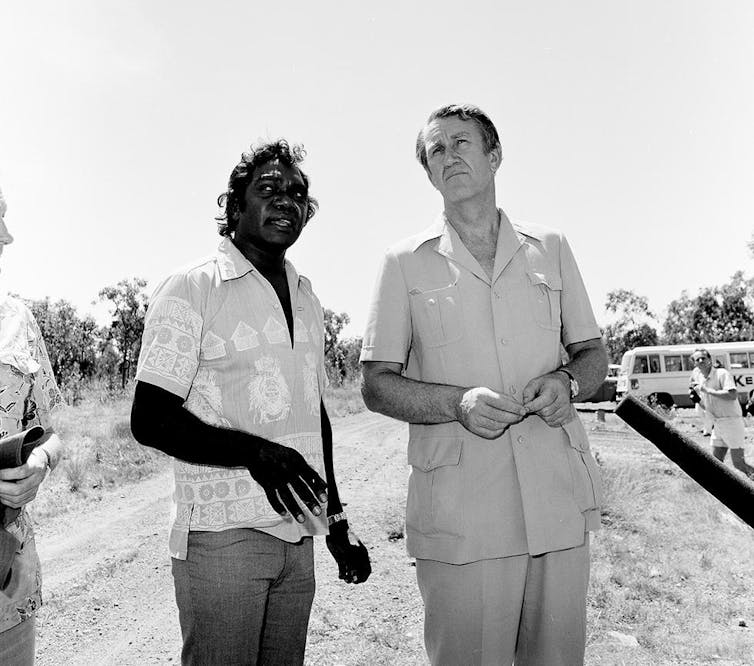
Malcolm Fraser and Galarrwuy Yunupingu in Arnhem Land, 1978.
National Archives of Australia

Fraser established an Aboriginal Development Commission, directed by Charlie Perkins, and a National Aboriginal Conference, (NAC) chaired by Lowitja O’Donoghue. His Administrative Appeals Tribunal (1977) and Human Rights Commission (1981) provided additional avenues for Indigenous scrutiny and appeal against decisions affecting them.

All of these were opposed from within the Coalition parties themselves. Their carriage required resolute action. They were radical initiatives in conservative circles. Yet, reflecting later, Fraser rued that he was too timid, that he should have acted on an idea raised by the NAC: to negotiate a treaty.

Command and control rather than community engagement

John Howard’s policy initiatives were the next significant Coalition incursion into Indigenous conditions. He provoked Indigenous leaders by refusing to apologise for the actions of past governments. He abolished Bob Hawke’s Aboriginal and Torres Strait Islanders Commission (ATSIC) – the first legislated attempt to combine consultation and program management under Indigenous leadership – announcing the “experiment” in self-determination had failed.

His legislative response to the Wik High Court decision enabled him to amend the Keating government’s landmark Native Title Act, itself a response to the High Court’s Mabo decision.

Finally, he endorsed the Northern Territory Emergency Response (NTER), a remarkable attempt to address dysfunction and restore order in remote communities by mobilising army and police intervention where Indigenous responsibility had failed. Significantly, it was also Howard who first raised the prospect of Constitutional recognition.


À lire aussi :
Ten years on, it’s time we learned the lessons from the failed Northern Territory Intervention


Howard had a clear rationale for each of these steps. Apology, Howard argued, could only be offered by the perpetrator of wrongs. ATSIC, despite research now confirming the extent of its achievement under the indomitable Indigenous public servants Lowitja O’Donoghue and Pat Turner, had later fallen under heavy scrutiny before being abolished in 2005. It was also subject to incandescent critique by Indigenous leaders and lost the faith of the Labor Party which had created it.

The Wik decision, like Mabo, demanded legislative address. The NTER was a response to a devastating report of domestic violence and child abuse, and had followed advice, and was supported, by influential Indigenous public intellectuals such as Marcia Langton and Noel Pearson.


À lire aussi :
Many claim Australia’s longest-running Indigenous body failed. Here’s why that’s wrong


It was these Indigenous advisers, too, who persuaded Howard to support Constitutional recognition. Nonetheless, major initiatives proceeded hurriedly, without explanation or consultation with the Indigenous communities affected.

The Coalition’s reconciliation agenda leads to Uluru

It is striking, if one leaves aside the inadequacy of Tony Abbott’s Indigenous Advancement Strategy (which again ignored the necessity of community engagement), or the Coalition’s outsourcing or offloading to states of Closing the Gap arrangements, that the next significant initiative was fostered by a bipartisan meeting on advancing reconciliation between Abbott (with Bill Shorten) and Indigenous leaders.

There followed a Referendum Council established by Abbott’s successor, Malcolm Turnbull, with a sub-committee of the same Indigenous leaders tasked with creating a dialogue on reconciliation with Indigenous communities nationwide. It led directly to the National Constitutional Convention that delivered the Uluru Statement in 2017.

The Uluru Statement then, responding to years of lobbying by those most closely engaged with Indigenous disadvantage, was developed by Indigenous representatives with the encouragement of successive Coalition administrations.

Yet it was Turnbull who declared that its proposal for a Voice referendum was not politically feasible. Turnbull has since endorsed the current referendum, arguing “a lot has changed since then […] the Indigenous community has backed this in for six years […] we should be listening to how they want to be recognised”.

A Coalition trapped by ‘settler liberalism’

Some of these engaged politicians looked back with remorse and saw how they had been constrained by their own political frameworks (Hasluck), hobbled by their colleagues’ policy priorities (McMahon, Turnbull), or too cautious (Fraser).

Above all, they recognised that their failure lay in not having heard what Indigenous communities told them. One might have expected the cumulative knowledge of these policy leaders to have influenced their peers. Yet what they had learned was rarely understood by their successors.

Partly it was a symptom of endemic short-termism. More significant, however, was another strand, exemplified by Hasluck’s rueful recollection: a “settler liberalism” that takes its own commitment to a particular form of individualistic liberal freedom so much for granted that it is blind to collective forms of social relations, and to the structural and institutional consequences of colonisation.

Howard and Mal Brough, the minister who so energetically drove the NTER, were undoubtedly committed to better outcomes for remote communities. They were, unlike Hasluck and Fraser, not remorseful about the trauma and dismay that is still evident as a consequence of the intervention. Instead, they were frustrated that successors had not seen it fully developed to address dysfunction in the manner proposed. Their conviction is a manifestation of the persistence of settler liberalism, now so much embedded in the contemporary Coalition’s engagement in the Voice debate.

So here we are, cycling back decades while the remorse of Liberal innovators about the limitations on what they could achieve is forgotten. With it, settler liberalism is reincarnated as a salve that Hasluck, Fraser and others would have thought discredited in their day.

The Conversation

James Walter has received funding from the Australian Research Council in the past for research on which this article is based.

ref. ‘We should be listening’: the long history of Liberal innovation – and failure – on Indigenous policy – https://theconversation.com/we-should-be-listening-the-long-history-of-liberal-innovation-and-failure-on-indigenous-policy-214960


What makes a good political leader – and how can we tell before voting?

Source: The Conversation (Au and NZ) – By Suze Wilson, Senior Lecturer, School of Management, Massey University

For many people, voting is not just a right, it’s an act of civic duty. Even more than that, some voters base their decisions on what they believe best serves society as a whole, not what might personally advantage them.

The trick, of course, is how to exercise that vote in a responsible, informed and considered manner. Understanding the policies of different parties is obviously a key part of that, in which case resources such as Policy.nz and Vote Compass can be helpful.

But what of the individual characteristics of candidates and would-be leaders? What can the research tell us about what to look for? Given they are “actors” on the political “stage”, how do we evaluate their performance?

Of course, leadership isn’t a solo act. Many things determine what leaders can and can’t do. But what makes them tick – how their personality or character informs their actions – is enduringly fascinating. In fact, we know a lot about the beliefs, attitudes and behaviours that can help distinguish between good and bad leaders.

Confusing confidence with competence

Given “good” leadership is generally accepted as being both ethical and effective, it stands to reason “bad” leaders tend to fail on one or both counts. They either breach accepted principles of ethical or moral conduct, or they act in ways that detract from achieving desired results.

This distinction helps demystify leadership by highlighting that the qualities we least admire in others are also what scholars have long flagged as danger signs in leaders: arrogance, vanity, dishonesty, manipulation, abuse of power, lack of care for others, cowardice and recklessness.


À lire aussi :
Romantic heroes or ‘one of us’ – how we judge political leaders is rarely objective or rational


Notably, though, bad leaders can appear charming, confident and driven to achieve, despite seeking power for selfish reasons.

Numerous studies have identified the ways in which narcissists and what are sometimes called corporate psychopaths can be highly skilled at manipulating people into believing they’ve got what it takes, but will typically lead in destructive and dysfunctional ways. Other studies have shown the negative effects of “Machiavellian” leadership styles.

There is also a tendency to confuse competence – the actual knowledge and skills needed to perform a leadership role – with confidence. Good leaders tend to be relatively humble about their abilities and knowledge. This means they’re better listeners, more sensitive to others’ needs, and better able to collaborate effectively.


À lire aussi :
America’s leaders are older than they’ve ever been. Why didn’t the founding fathers foresee this as a problem?


Practical wisdom

None of this fascination with leadership is new. The Classical Greek
philosopher Aristotle argued good leaders possess a range of character virtues in the “middle ground” between what he called the “vices” of excess or deficiency. Courage, for example, is the virtuous mid-point between the vices of recklessness and cowardice.

The modern character virtues leadership researchers emphasise include humanity, humility, integrity, temperance, justice, accountability, courage, transcendence, drive and collaboration.

Each attribute helps a leader deal more effectively with some aspect of their role. Humanity, for instance, enables a leader to be considerate, empathetic and compassionate. Temperance helps them remain calm, composed, patient and prudent, even in testing circumstances.

Deployed together, these character virtues help foster sound judgment, insight, decisiveness – allowing a leader to calmly handle complex, unfolding challenges.

For Aristotle, the ideal leader could demonstrate what he called “phronesis”, or practical wisdom. This wasn’t necessarily about delivering perfect, painless solutions. Indeed, phronesis might mean adopting the least-worst option – which is often the case when dealing with the complex task of running a country.

There is also no single personality “type” most suited to good leadership. But studies indicate those who are proactive, optimistic, believe in themselves and can manage their anxieties stand a better chance. Empathy, a sense of duty and a commitment to upholding positive social values also underpin the attributes of good leaders.

Evaluating political leadership

No leader will be perfect. But each character or personality flaw impedes their capacity for wise judgment and dealing with the demands of their role. A wise leader, therefore, is one who has deep and accurate insight into their personal foibles and has strategies to mitigate for those tendencies.

Political leaders will obviously seek to present their policies, parties and themselves in a positive light, something known as “impression management”. This is where critical questioning and fact checking by journalists and experts can play a vital role.


À lire aussi :
NZ Election 2023: from one-way polls to threats of coalition ‘chaos’, it’s been a campaign of two halves


But gauging a leader’s “true” personality or character is more difficult. And we first need to be aware that our impressions and evaluations of leaders are not entirely driven by reason or logic.

Secondly, we can look for recurring patterns of behaviour in different situations over time. We should pay particular heed to behaviour under pressure, when it becomes more difficult to “mask” true feelings and motives.

Thirdly, we can consider the values that underpin a leader’s policies, who benefits from them, and what messages these convey to the community at large.

In the long run, a leader’s results bear consideration. But we need to assess these fairly, accounting for what was beyond their control. We should be mindful to avoid “hindsight bias” – the tendency to imagine events were predictable because we know they’ve occurred.

It should be no surprise that what constitutes good leadership has been studied and debated for thousands of years. Leaders have power and we’ve always wanted them to use it wisely. An informed voting choice makes that more likely.

The Conversation

Suze Wilson ne travaille pas, ne conseille pas, ne possède pas de parts, ne reçoit pas de fonds d’une organisation qui pourrait tirer profit de cet article, et n’a déclaré aucune autre affiliation que son organisme de recherche.

ref. What makes a good political leader – and how can we tell before voting? – https://theconversation.com/what-makes-a-good-political-leader-and-how-can-we-tell-before-voting-214351

3 things the disability royal commission missed: health, transport, day programs

Source: The Conversation (Au and NZ) – By Sam Bennett, Disability Program Director, Grattan Institute

Roman Zaiets/Shutterstock

The Royal Commission into Violence, Abuse, Neglect and Exploitation of People with Disability has shared its final report. In this series, we unpack what the commission’s 222 recommendations could mean for a more inclusive Australia.


The disability royal commission’s final report included an expansive range of recommendations including the introduction of an Australian disability rights act, a minister for disability inclusion and a department of disability equality and inclusion.

The government says it will establish a taskforce and a staged response to dismantle barriers to inclusive education, open employment, and accessible, appropriate and safe housing.

But in three critical areas, the report barely scratches the surface of what is needed to make life more inclusive and equitable for Australians with disability.

1. Preventive health

The commission said a disability rights act would ensure equitable access to health services. But the report fails to provide a comprehensive analysis of the overall health and wellbeing of disabled Australians, or to set a reform agenda for health policy.

The commission received promising proposals early on to reform health care for people with disability. Options for strengthening preventive care, such as extending Medicare to cover dental and oral health for people with disability, and funding longer consultations for GPs and patients with disability are practical, systemic changes that could improve the health of Australians with disability.

Similarly, proposals to redesign physical environments so people with cognitive disabilities feel calm and safe did not feature (though there was mention of the value of co-design and collaborative care planning).

International examples of good practice also fell off the agenda. Last year the World Health Organization identified 40 actions to improve health outcomes for people with disability. They span policy, funding, models of care, physical infrastructure and digital technologies to improve access, participation and outcomes.

The United Kingdom’s National Health Service has acted to address the poorer physical and mental health of people with intellectual disabilities through annual health checks.


Read more:
Here’s why we need a disability rights act – not just a disability discrimination one


2. Urgent transport reforms

Transport is crucial to inclusion. In countless hearings and witness statements the commissioners heard disturbing accounts of inaccessible transport, and harassment and abuse on buses, trains and aeroplanes. But the report offers little in the way of practical reforms or recommendations for improvement.

The commissioners acknowledge deficiencies in the Disability Standards for Accessible Public Transport, which are linked to Australia’s anti-discrimination laws and human rights obligations. But their interest in reform stopped short of recommending ways to improve transport for people with disability through either legislation or policy.

Beefing up legislation, urging education for providers about the difficulties disabled passengers face and quantifying the wastage created by inaccessible transport would have been practical steps.

It’s important to note transport and health care are both areas where state and territory governments are not meeting their commitments to make reasonable adjustments for people with disability. Their failure to do so only adds to pressure on the National Disability Insurance Scheme (NDIS), which is forced to fund supports to cover the gaps. We can only hope the upcoming NDIS Review makes recommendations for managing these boundaries better.


Read more:
The disability royal commission recommendations could fix some of the worst living conditions – but that’s just the start


3. Meaningful day services

Another glaring omission in the final report is the absence of specific recommendations about the role of day programs, in which people with disability are grouped together – often behind closed doors.

The commission heard evidence of violence suffered by people with disability in these settings, including accounts of NDIS participants being subjected to sexual abuse and assault.

Testimony made it clear many day programs are essentially segregated services that offer little by way of meaningful pursuits or skills development. One witness said the day program her son attended was nothing more than “glorified babysitting”.

The commissioners missed a golden opportunity to clarify what a meaningful, inclusive experience might mean in these settings. Recommendations for reform could help people with disability lead full and purposeful lives in the community, with a range of friendships, activities and relationships – a human right they share with the rest of society.


Read more:
The disability royal commission heard horrific stories of harm – now we must move towards repair


What’s next?

Decades in the making, the disability royal commission was a once-in-a-lifetime chance to investigate the realities of life for disabled Australians. It showed current policy settings are not up to the mark. Many of its recommendations stand to improve the lives of Australians with disability.

However, when it comes to reforming the health system disabled Australians depend on, making transport more accessible and creating meaningful social and recreational opportunities, the commissioners’ report seems to have handed government a free pass.

The Conversation

Grattan Institute’s Disability Program has support from the Summer Foundation.

ref. 3 things the disability royal commission missed: health, transport, day programs – https://theconversation.com/3-things-the-disability-royal-commission-missed-health-transport-day-programs-215251

A successful energy transition depends on managing when people use power. So how do we make demand more flexible?

Source: The Conversation (Au and NZ) – By Chris Briggs, Research Director, Institute for Sustainable Futures, University of Technology Sydney

Energy security concerns are mounting as renewable projects and transmission lines are delayed.

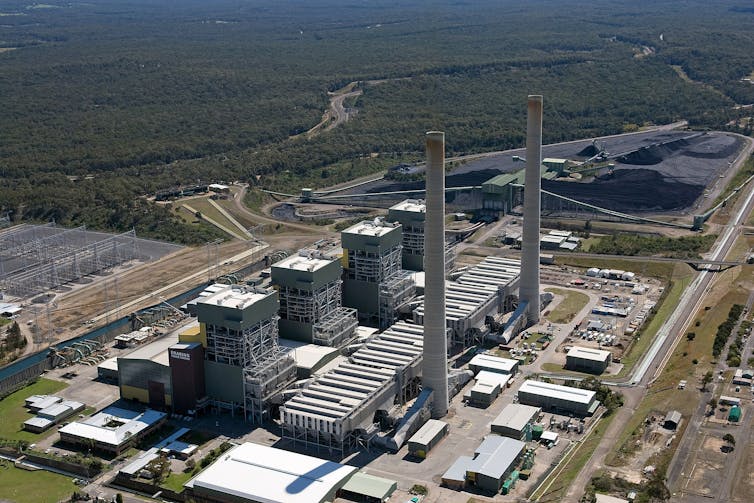
In New South Wales, for instance, the government has flagged it may defer the closure of Eraring coal power station beyond 2025.

NSW has other new policies to “get the energy transition back on track”. These include expanding “customer energy resources”, such as solar panels and batteries, and increasing “demand flexibility” (broadly, using smart technology to shift the times when businesses and homes use power).

With more variable supply from solar and wind energy, demand flexibility is a cheaper and cleaner way to keep the electricity grid stable.

Modelling for the Australian Renewable Energy Agency (ARENA) shows this approach could save consumers up to A$18 billion to 2040. Shifting demand can avoid:

  • higher-priced power use at the end of the day
  • building new poles and wires to increase network capacity to meet peak demand
  • paying coal plants to stay open.
Aerial view of Eraring power station next to coal mine and substation
There are cheaper and cleaner ways to keep the power on than paying coal power stations like Eraring to stay open.
Nick Pitsas, CSIRO/Wikimedia Commons, CC BY


À lire aussi :
Good news – there’s a clean energy gold rush under way. We’ll need it to tackle energy price turbulence and coal’s exodus


What does flexible demand involve?

Examples of flexible demand include:

  • shifting water heating from night-time (mostly coal-powered) to daytime (using solar)

  • reducing temperatures in commercial coolrooms using solar power in the middle of the day, then switching chillers off in the late afternoon until they return to standard refrigeration temperatures

  • remotely controlling air conditioners to turn them down when the grid is under stress. Households get paid and don’t notice if the aircon is briefly turned down, but across many homes it can make a big difference.


À lire aussi :
In an energy crisis, every watt counts. So yes, turning off your dishwasher can make a difference


The Australian Energy Market Operator (AEMO) estimates NSW needs an extra 191 megawatts (MW) of capacity to maintain reliability when Eraring closes.

Another way to cover that capacity shortfall is more flexible demand. Queensland already has almost 150MW of remote-controlled air conditioning. Other types of demand management that Queensland grid operators can call on total about 900MW.

In Western Australia, a newly signed contract will provide 120MW of demand flexibility.

The chilled and frozen foods section of a supermarket
Commercial refrigeration can be managed to reduce power use at times of peak demand.
TY Lim/Shutterstock


À lire aussi :
Unsexy but vital: why warnings over grid reliability are really about building more transmission lines


So what are the obstacles to more flexible demand?

ARENA commissioned the Institute for Sustainable Futures to review the pilot demand flexibility projects it has funded. Many didn’t deliver as much as hoped.

Sometimes, this was because businesses were too busy with day-to-day operations or payments for households were too low to catch their interest. But often it’s a matter of putting policies, technical standards and regulations in place to make demand management seamless and efficient.

ARENA has spent about $180 million on 55 projects with at least some focus on flexible demand. They include air conditioning, pool pumps and hot water systems in homes, commercial building air conditioning and electric vehicle charging.

4 ways to increase demand flexibility

What do these projects tell us about how to increase demand flexibility?

1. Better technical standards

The technical standards required of manufacturers often don’t ensure devices can be used to shape demand. Many air-conditioners couldn’t be controlled in ARENA pilots.

There is also no technical standard for “inter-operability” of devices within homes. Batteries, hot water systems and other devices with different companies’ technologies don’t always work well together.

Vehicle-to-grid charging for electric vehicles will be the largest opportunity for demand flexibility, but there is no common technical standard. It’s vital to have one before the mass uptake of electric vehicles.


À lire aussi :
Owners of electric vehicles to be paid to plug into the grid to help avoid blackouts


Outside Victoria, smart meters that provide real-time information on home energy use are rare. The Australian Energy Market Commission has recommended governments accelerate roll-out of smart meters to 100% by 2030.

A smart electricity meter mounted on a wall
A full rollout of smart meters will help energy providers and users to manage demand in real time.
Shutterstock

2. Simpler measurement systems

The measurement systems to calculate payments for demand flexibility are a barrier to expansion. It’s tricky as you need to measure how much electricity was used relative to what would otherwise have occurred.

ARENA pilots that tried to precisely measure residential demand flexibility found it was financially unviable at the smaller scale.

The system used for AEMO’s Wholesale Demand Response Mechanism (WDRM) effectively limits participation to businesses with predictable, flat consumption profiles. This excludes as much as 80–90% of sites. International measurement models could be trialled here to open up participation.


À lire aussi :
New demand-response energy rules sound good, but the devil is in the (hugely complicated) details


3. More certainty about payments

Earnings from providing demand flexibility depend on weather, market prices and so on. This uncertainty makes it hard to get businesses to sign up.

Overseas, some energy markets guarantee payment for making demand flexibility available. These have the highest participation.

The federal government is consulting on a capacity investment scheme. Because it will have the same measurement system as the current mechanism, participation is likely to be limited.

4. Fresh policy approaches

Businesses that sign up under the Wholesale Demand Response Mechanism make bids in the National Electricity Market to be paid for reducing their power use when demand and prices are high. This should reduce prices for all consumers and improve energy security when the grid is under stress. However, it has attracted only one participant – mainly due to the complex measurement system – and isn’t open to households.

Another incentive scheme for electricity networks to invest in demand management is chronically under-used.

There are simpler alternatives that have worked before. The national Renewable Energy Target and state energy efficiency certificate schemes fund rooftop solar or energy retrofits based on average output or energy savings from past experience. These simple calculations offer a relatively stable incentive, which could work for demand flexibility.

NSW’s Peak Demand Reduction Scheme, launched last year, could provide a model for using certificate schemes to boost demand flexibility.

Get serious about demand flexibility

The focus of NSW’s development of a customer energy resources policy appears to be on “virtual power plants”. These co-ordinate household solar and battery systems to store solar power and export to the grid when it’s most needed.

Batteries are part of the solution, but cheaper options exist. An electric water heater with a 300-litre tank can store as much energy as a second-generation Tesla battery at much less cost.

Modelling for ARENA finds hot water systems could store as much energy as more than 2 million household batteries. Retrofitting these systems will spread savings more widely to include low-income households as well as those that can afford a battery.


À lire aussi :
Using electric water heaters to store renewable energy could do the work of 2 million home batteries – and save us billions


It’s time we got serious about developing a holistic demand flexibility strategy. It will be cheaper and cleaner than paying coal plants to stay open.

The Conversation

The Institute for Sustainable Futures is the knowledge sharing agent for the Australiran Renewable Energy Agency’s demand flexibility portfolio. ARENA provided funding for the review of its demand flexibility pilots referred to in the article. The views in this article are those of the author and should not be considered the views of ARENA.

ref. A successful energy transition depends on managing when people use power. So how do we make demand more flexible? – https://theconversation.com/a-successful-energy-transition-depends-on-managing-when-people-use-power-so-how-do-we-make-demand-more-flexible-213079

Our research shows the number of history academics in Australia has dropped by at least 31% since 1989

Source: The Conversation (Au and NZ) – By Martin Crotty, Associate Professor in Australian History, The University of Queensland

Engin Akyurt/Pexels

The Australian Catholic University has recently announced it will abolish academic positions in history as part of broader cuts in the humanities. Staff are understandably shocked and dismayed by the news.

Regrettably, the plight of these academics is part of a broader decline in the study of history in Australian universities over the past few decades.

As our yet-to-be-published research shows, the ACU cuts are dramatic and extreme, but not inconsistent with the way Australian universities have treated one of their foundational disciplines for some time.

What is happening to academic historians?

In 1989, there were about 450 full-time equivalent paid positions in history disciplines in Australian universities.
In 2016, we did a detailed survey showing they had fallen to 347 – a 23% drop. This is despite a huge increase in size of the overall university sector during the same period.

At the time of our study, we attributed this drop to the effects of the commercialisation of Australian higher education, through the increasing reliance on industry funding, overseas students and fee-based courses.

There was also a misguided belief on the part of some potential students – and parents and others advising them – that humanities degrees do not lead to meaningful jobs. Political hostility from conservative governments and some sections of the media would not have helped.

We repeated the survey in 2022 to gauge the impact of COVID cost-cutting by universities and the Morrison government’s Job-ready Graduates program.

This program was introduced in 2021 and made humanities subjects, including history, 113% more expensive in a bid to steer students towards other fields such as nursing and teaching.

We asked all heads of history programs to provide us with student and staff data. We also collected the same figures from New Zealand universities for comparison.

Our findings

The results were alarming and point to a crisis in the study of history in Australian universities.

We found student enrolments (anyone studying a history course) had declined by roughly 23% since 2016.

Teaching and research staff numbers had also continued to slide, down another 8% to 319 full-time equivalent positions. This takes the overall drop in staff numbers to 31% since 1989.

However, it does not factor in the staff who are set to lose their jobs at ACU. A draft document circulated by ACU in September suggested up to ten positions in history could go. On Tuesday, ACU Deputy Vice-Chancellor Abid Khan told The Conversation the university’s plans had not been been finalised, “therefore proposed or perceived numbers about roles are not accurate”.

There are also fewer staff and students in history in New Zealand than there were in 2016. But the decline there has been half that in Australia – a 4.6% decline in staff and 10.1% reduction in student numbers.


À lire aussi :
The Job-ready Graduates scheme for uni fees is on the chopping block – but what will replace it?


Why are we seeing this decline?

The recent decline may owe something to the Job-ready Graduates package discouraging humanities study.

But other factors are also likely to be at play here. The massive size of the international student market in Australia – and its role in cross-subsidising research – distorts university decision-making about investment and resources even in good times.

This means resources are diverted away from disciplines such as history and into areas such as management, information technology and engineering (where there are far more international student enrolments).

On top of the political and commercial hostility towards the humanities, there is also a belief arts degrees do not lead to meaningful jobs. This is misguided.

A 2021 Workplace Gender Equality Agency study revealed earnings of those with undergraduate humanities degrees are comparable to positions in the science and maths sector.

In the tougher COVID era, when combined with explicit messages from the government that students should stay away from the humanities if they want well-paid and rewarding work, the effects are predictably pernicious.

Why is this a problem?

Historical perspectives are key to understanding the present. So if people are not studying, teaching and researching history, this is an enormous problem for Australia.

Consider any major issue affecting Australian society, from Indigenous affairs, to housing policy, bushfire readiness and domestic violence. Historians have produced research, informed public policy, and educated students.

Jobs today and in the future will not just need technical skills but skills taught by the humanities, including
critical thinking, creativity and expression. The rise of artificial intelligence and robotics only serves to underline this reality. The very skills taught in humanities and social sciences, including history, will be needed to discern what can and cannot be automated with advantage to society.

There is also a civic dimension. A healthy democracy relies on a large population of citizens who can discern the difference between evidence-based knowledge and wild conspiracy theories.


À lire aussi :
Australia needs a ‘knowledge economy’ fuelled by scientists and arts graduates: here’s why


What can we do about this?

If we want to protect and promote history (and other humanities disciplines), we need the support of governments and university managers. The fixes themselves are not difficult.

One immediate fix is to reverse the fee changes introduced by the Morrison government in 2021. The Universities Accord interim report has all but confirmed Job-ready Graduates will be scrapped, but we don’t yet know what will replace it.

Governments could also fund and insist universities fund foundational disciplines such as history, science and maths properly.

Another possibility might be to provide stronger incentives for study across different realms of knowledge. Why shouldn’t architects understand something of Ancient Rome, or medical students learn more about the minorities they will be working with? By the same token why shouldn’t arts students be required to grapple with commerce and science, or the latest digital technologies that might extend their reach?

If we don’t find solutions soon, we will, as the aphorism has it, not know ourselves.

The Conversation

Martin Crotty has in the past received funding from the Australian Research Council and is an historian at the University of Queensland. He has friends and former colleagues at ACU who may lose their jobs.

Frank Bongiorno is President of the Australian Historical Association

Paul Sendziuk receives funding from the Australian Research Council.

ref. Our research shows the number of history academics in Australia has dropped by at least 31% since 1989 – https://theconversation.com/our-research-shows-the-number-of-history-academics-in-australia-has-dropped-by-at-least-31-since-1989-213544

Qantas won’t like it, but Australian travellers could be about to get a better deal on flights

Source: The Conversation (Au and NZ) – By Gui Lohmann, Professor in Air Transport and Tourism Management, Griffith University

Weeks after Qantas chief executive Alan Joyce brought forward his resignation to help Qantas “accelerate its renewal”, the company’s chairman Richard Goyder today announced he too is retiring early, to “support restoration of trust”.

But the early retirement will take place “prior to the company’s annual general meeting in late 2024” – meaning Goyder will be in the chair for a while yet.

This will give him time to (among other things) help Qantas respond to the Senate inquiry into air services, which reported on Monday.

If acted on, some of the report’s recommendations would shift power away from Qantas – such as by giving travellers automatic cash compensation for delayed or cancelled flights.

But the inquiry arguably still didn’t go far enough, shying away from bolder action already taken in Europe.

What did the Senate inquiry recommend?

The Senate inquiry was set up to investigate the Albanese government’s refusal to approve extra flights into Australia sought by Qatar Airways, but broadened its scope to examine the way Qantas has been treating its customers.

Among its recommendations are that:

  • the government immediately review its decision not to increase capacity under Australia’s bilateral air services agreement with Qatar

  • when making decisions relating to bilateral air service agreements, the government have regard to cost benefit analysis, consult widely with key stakeholders, and publish a statement of reasons for decisions taken

  • the government review reform options to strengthen competition in the domestic aviation industry, including potential divestiture powers

  • the government direct the Australian Competition and Consumer Commission to conduct an inquiry into potential anti-competitive behaviour in the domestic aviation market

  • the government develop and implement consumer protection reforms as soon as reasonably practicable to address significant delays, cancellations, lost baggage and devaluation of loyalty programs.

The committee also wanted to be reappointed so it would be able to reexamine witnesses who were unable to appear, including Alan Joyce and Transport Minister Catherine King.

Consumer cashback and action on Sydney Airport

Specific suggestions in the report would shift power away from Qantas.

Automatic cash refunds are on the agenda.
Shutterstock

One is automatic cash compensation for delayed or cancelled flights, of the kind Europeans have enjoyed for almost 20 years.

Another is for the government to respond to an independent review’s recommendations on improving Sydney Airport’s “slot management system” (how air traffic is managed), which reported back almost three years ago.

Yet another concerned “cabotage”: the ability for foreign airlines to pick up domestic passengers on a domestic leg of an international flight. The committee recommended the government consider limited cabotage.

The government hasn’t yet indicated which of the recommendations it plans to act on.


À lire aussi :
Booking customers on cancelled flights – how could Qantas do that?


Open skies, or tightly-controlled skies?

The committee could have, and perhaps should have, put forward bolder recommendations.

One would have been unrestricted open skies agreements, of the kind Australia already has with China, India, Japan, New Zealand and Singapore. This would see the government remove itself from decisions about landing slots and leave that to the airports.

An alternative approach – almost the opposite – would be retaining the power to decide who lands, but using it to achieve outcomes the government wants, such as commitments from countries including Qatar on things such as workers’ rights.

The European Union has shown what could be done. It extracted key concessions from Qatar over workers’ rights and environmental protection before signing off on an Open Skies agreement in 2021.

Prime Minister Anthony Albanese, a former transport minister who understands the detail of aviation policy, might be particularly keen on this idea, given Labor’s commitment to workers’ rights.


À lire aussi :
Under ‘open skies’, the market, not the minister, would decide how often airlines could fly into Australia


Sweeping changes ahead

Next year, the government will release a white paper on aviation policy through to 2050, after obtaining feedback on a green paper it released last month.

Those next 30 years will be far from business-as-usual for airlines and airports, whatever decisions the government takes now, and however Qantas responds.

Ultra-long-haul aircraft are likely to link Paris with Perth, and even London with Sydney within a decade. They are likely to force new alliances between airlines that today seem unlikely bedfellows.

And the chorus against the excesses of long-haul travel is likely to become louder.

Prince William’s refusal to travel to Sydney for the Women’s World Cup Final because of the size of the carbon footprint might be a sign of things to come.

The Conversation

Justin Wastnage was previously director of aviation policy at Tourism & Transport Forum, that was funded by both Australian and international airlines and airports.

Gui Lohmann ne travaille pas, ne conseille pas, ne possède pas de parts, ne reçoit pas de fonds d’une organisation qui pourrait tirer profit de cet article, et n’a déclaré aucune autre affiliation que son organisme de recherche.

ref. Qantas won’t like it, but Australian travellers could be about to get a better deal on flights – https://theconversation.com/qantas-wont-like-it-but-australian-travellers-could-be-about-to-get-a-better-deal-on-flights-214718

How drone submarines are turning the seabed into a future battlefield

Source: The Conversation (Au and NZ) – By Adam Bartley, Postdoctoral Fellow, RMIT Centre for Cyber Security Research and Innovation, RMIT University

DARPA

A 12-tonne fishing boat weighs anchor three kilometres off the port of Adelaide. A small crew huddles over a miniature submarine, activates the controls, primes the explosives, and releases it into the water. The underwater drone uses sensors and sonar to navigate towards its pre-programmed target: the single, narrow port channel responsible for the state’s core fuel supply …

You can guess the rest. A blockage, an accident, an explosion – any could be catastrophic for Australia, a country that conducts 99% of trade by sea and imports more than 90% of its fuel.

As drone submarines or “uncrewed underwater vehicles” (UUVs) become cheaper, more common and more sophisticated, Australia’s 34,000km of coastline will face a significant future threat.

What can be done? Our assessment – validated through workshops with experts from across Australia – shows the same technologies can aid our maritime security, if we build them into our planning from now on.

Seabed warfare

Australia is not alone in its rising concern for submarine security. In 2022, France launched its Seabed Warfare Strategy to address autonomous underwater maritime threats. In February 2023, NATO established an Undersea Infrastructure Coordination Cell in response to the sabotage of the Nord Stream gas line in September 2022.

The war in Ukraine has seen relatively small, cheap aerial drones play an outsized role. At a smaller scale, underwater drones have also enabled Ukraine to conduct asymmetric attacks on Russian forces.

Current drones can be used in intelligence, surveillance, reconnaissance, mine countermeasures, antisubmarine warfare, electronic warfare, underwater sensor grid development and special operations, among other things.

However, their capabilities are likely to expand. China’s Haidou-1 project dived to a record depth of 10,908 metres.

A Chinese underwater glider, the Haiyan, holds the drone sub endurance record with a 3,600km voyage over 141 days across the South China Sea. Russia boasts of having a prototype nuclear-powered, nuclear-armed undersea drone, although some analysts doubt it really exists.

Nations are also developing broader programs to control underwater sea domains.

For instance, the United States’ proposed Advanced Undersea Warfare System envisions a network of fixed submarine stations able to deploy defensive and offensive drones. In the South China Sea, China is developing an “Underwater Great Wall” of ships, bases and drone (both at surface level and beneath) to monitor the area and make it difficult for foreign navies to operate in international waters.

A new age of war at sea?

Some analysts argue these developments amount to the dawn of a “new age of naval warfare”. Others suggest autonomous maritime systems, as they grow cheaper and more effective, may become preferred over crewed vehicles for national defence: by one estimate, uncrewed vessels may make up more than half of the US naval fleet by 2052.

The advent of sea drones may also encourage the further growth of hybrid or “grey zone” approaches to conflict, which avoid outright warfare, keep casualties low, and can inflict heavy costs on enemies. In this context, uncrewed marine vessels may offer states a deniable way to carry out aggressive actions to advance their aims without crossing the threshold of war.


Read more:
Ukraine: how uncrewed boats are changing the way wars are fought at sea


Put differently, drone submarines may lend themselves to creating apparent accidents and other actions that can’t be pinned on their instigators. It is worth quoting the French Seabed Warfare Strategy on this point:

an attack on the underwater part of submarine cables is a potential cause of action, with possibilities ranging from a “convenient” accident in a coastal area, to deliberate military action. In this regard, the intrinsic features of the seabed make it the ideal theatre for non-attributable actions in “grey zones”.

The road ahead for Australia

Our new research examined the threat to Australia’s trade posed by autonomous, uncrewed underwater vehicles.

With colleagues at the RMIT Centre for Cyber Security Research and Innovation, Charles Darwin University, and WiseLaw, we ran workshops with people from government, the Royal Australian Navy, Defence, industry and academia. We found a growing tension between efforts to protect ocean-borne trade and critical undersea infrastructure today, and more forward-looking strategies aimed at developing the next generation of maritime defence.

Under the AUKUS security pact, Australia has engaged the United Kingdom and the US to buy and build nuclear-powered submarines, and seeks to acquire and develop new systems “with additional undersea capabilities”. This is a good start, but the scale of the purchases has raised concerns they will become all-consuming for Australia’s military.

Australia also engages in exercises such as Autonomous Warrior to test new and emerging systems in maritime defence. However, these exercises under-examine threats to maritime trade that underwater drones are likely to produce in the future.

One result that emerged from our workshops is that mines are seen as an emerging challenge. Loitering drones with explosives – which could even be commercially available vessels carrying improvised explosives – could hold up commercial ports and traffic, bottle up naval assets, or disrupt maritime shipping routes. This would cause delays, loss of revenue, and increased insurance premiums.

As “set and forget” weapons, mines have an outsized impact as they can cause great damage for a low cost. And they are difficult and costly to find and neutralise.

For the time being, Australia is largely protected from the threat of underwater drones by distance. Current battery and communication technology mean drones would need to be deployed from relatively nearby, and Australia’s maritime environments would make operation difficult.

However, the technology is advancing quickly. The time available for the Australian Department of Defence to address the threat of underwater uncrewed vehicles is shrinking.


This article draws upon research funded under the Strategic Policy Grants Program run by the Department of Defence. The Strategic Policy Grants Program is an open and competitive mechanism for Defence to support independent research, events and activities. The views expressed herein are those of the authors and are not necessarily those of the Australian Government or Defence.

The Conversation

The authors do not work for, consult, own shares in or receive funding from any company or organisation that would benefit from this article, and have disclosed no relevant affiliations beyond their academic appointment.

ref. How drone submarines are turning the seabed into a future battlefield – https://theconversation.com/how-drone-submarines-are-turning-the-seabed-into-a-future-battlefield-215338

NZ election 2023: Two polls show boost for left bloc – Peters in kingmaker’s seat

RNZ News

Two polls out tonight both have Winston Peters firmly in the drivers’ seat for forming a government with Aotearoa New Zealand’s general election this Saturday, though the left bloc has increased its overall support.

With 1News and Newshub each releasing their final polls ahead of the election, the trends are showing a last-minute boost for Labour and the Greens — but still far short of forming a government without Winston Peters’ support — which he has vowed not to provide them.

While Newshub’s poll featured a dramatic 4.6-point fall for National, TVNZ’s had National up 1 point but ACT down by the same amount — the right bloc staying steady.

That could be partly explained by the difference in each poll’s survey period: Newshub’s was comparing to numbers from 17 days before, while TVNZ’s poll has been on a weekly release schedule — which makes for smaller shifts in the numbers.

Newshub’s poll also showed a smaller majority for the combined National-ACT-NZ First grouping, with 63 seats, and with trends showing an increase in the left vote, the final days could be crucial.

RNZ political editor Jane Patterson told Checkpoint the rise for the left bloc would be putting the pressure on National.

“Chris Hipkins has of course been talking about that, he said, ‘Look, I feel the momentum, that the left bloc is starting to pick up’ and these polls are starting to show that — however they are not being put in the position where they are in a commanding enough position to form a government.

Second election threats
“If you look at the timeframe, both of them basically covered the weekend . . .  that covered the threats of a second election on Sunday from National, it covered Chris Hipkins back on the campaign trail, and obviously a lot of policy debate we know over the tax package.”

She said Labour was also really starting to hone in on the impact of a National government on rental tenants and beneficiaries, “so there’s been a lot of very assertive, aggressive campaigning from Labour against the National Party policy platform”.

Poll mania. Video: RNZ News

Patterson said ACT and NZ First were typically battling each other for voters, and ACT would have been hoping to see their support increase to help consolidate their chances of a two-party government.

“It’s more difficult because of the rhetoric that Chris Luxon has been rolling out about Winston Peters — that tactic has not worked, on these numbers . . .  so they could basically cut New Zealand First out he was saying, ‘please, don’t vote for New Zealand First, it’s not going to be good.’”

Despite National doubling down on this by raising the risk of a second election, Peters had remained statesman-like during that time, she said, and NZ First support base were unlikely to like being told what to do.

“The supporters are anti-government, a protest against the government, and not just against Labour — an anti-establishment type vote, so I don’t think that tactic’s worked either.”

Last 1News poll before NZ election on 14Oct23
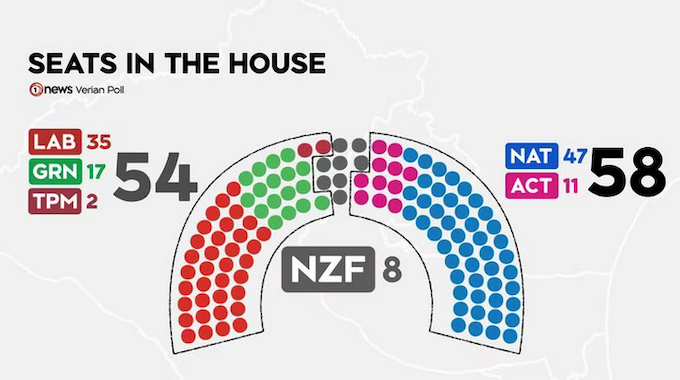
Based on the new 1News poll numbers, Labour, the Greens and Te Pāti Māori would have a total of 54 seats in the new Parliament while National and ACT would have a total of 58. That means New Zealand First’s projected eight seats could decide the new government. Image: 1News

Biggest risk
She said the biggest risk to Labour, meanwhile, would be people coming to the conclusion the election result had already been decided.

“I think they’re just going to have to keep carrying on and campaigning until Saturday.”

National also have an advantage, likely to pick up another seat after the Port Waikato by-election in November.

Both had Labour leader Chris Hipkins’ personal popularity also on the rise — but still equal with or just below that of National’s Christopher Luxon. That said, Luxon’s popularity is still well below voters’ preference for his wider party.

This all must be taken with a grain of salt, however.

Individual polls compare their numbers to the most recent poll by the same polling company, as different polls can use different methodologies.

They are intended to track trends in voting preferences, showing a snapshot in time, rather than be a completely accurate predictor of the final election result.

Because of those differences in how they collect and calculate the numbers, which includes revising the calculations to account for demographic differences compared to the wider population (known as ‘weighting’), the different companies’ polls shouldn’t be compared against one another directly.

However, with both showing similar general trends and numbers, it gives a good idea of what voters’ thinking was through to yesterday.

This article is republished under a community partnership agreement with RNZ.

Print Friendly, PDF & Email

Article by AsiaPacificReport.nz

Why has China released detained Australian journalist Cheng Lei?

Source: The Conversation (Au and NZ) – By David S G Goodman, Director, China Studies Centre, Professor of Chinese Politics, University of Sydney

The arrival of Cheng Lei back in Melbourne today is clearly a moment of celebration for the Chinese Australian journalist and her family from whom she has been separated for over three years.

But it would also seem to be a triumph for Australian diplomacy, as well as a signal of China’s serious intent to improve Australia-China relations. For some time, Cheng’s incarceration has remained a sticking point for Canberra in a more reasonable relationship emerging between the two sides.

Although born in China, Cheng has been an Australian citizen for years, having migrated to Melbourne with her parents at the age of 10. As a journalist, she found a degree of celebrity working within China’s state-owned English-language news networks. In recent years, she landed a job hosting the Global Business program on the China Global Television Network.

However, in August 2020, she was arrested and has been held since largely without access to Australian consular services.

Political pawn

Mystery surrounds the reasons for Cheng’s arrest, though shortly after she disappeared, a government official was reported as saying she had “endangered China’s national security”.

The obvious explanation was likely more political: she may have been a pawn in the megaphone diplomacy and increasingly tense relations between the two sides after then-Prime Minister Scott Morrison demanded explanations from China about the emergence of the COVID-19 virus. She was detained months later.

Effectively, Cheng had become a hostage in international relations, much as other foreign nationals living in China have in the past.

In December 2018, for instance, two Canadians, Michael Spavor and Michael Kovrig, were arrested in response to the arrest of Huawei’s Chief Financial Officer Meng Wanzhou in Canada. Shortly after Meng reached a deal for her release, the Canadians were released.

There can be little doubt that considerable Australian government effort has gone into negotiating Cheng’s return to China. Clearly, Australian diplomats have made the case to the Chinese leadership that if they desired better relations with Australia, releasing Cheng would be a good start.

And equally, Prime Minister Anthony Albanese has shown he’s being very respectful of what’s required to reestablish an appropriate relationship with the Chinese authorities. In announcing Cheng’s return to Melbourne, he not only expressed great pleasure at the outcome, but also pointed out the legal proceedings in China are now at an end.


Read more:
Australia must continue to press for humane treatment of journalist Cheng Lei after her arrest in China


Why release Cheng now?

The Australian government has indicated it is willing to engage with China again. This means cooperating where it can and differing where it must. This is clearly a more sophisticated approach than many other governments might employ with China, including the former Morrison government.

More interesting, perhaps, is why the Chinese leadership would release Cheng now. It appears to be a goodwill gesture, with Albanese confirming he will accept an invitation to visit Beijing sometime before the end of the year. But there may be other calculations behind it.

One obvious explanation is the mutual benefit in a more open relationship between the two complementary economies. Australia may suffer from the trade barriers China has imposed on our exports, but those same restrictions add significant costs to segments of the Chinese economy, such as heavy industry and energy generation.

Another possible reason for the release is that it might be part of a charm offensive designed to mitigate the Australian government’s increasing closeness to the United States.


Read more:
Bring on the Year of the Rabbit: why there’s new hope and prosperity tipped for Australia-China relations


The Conversation

David S G Goodman does not work for, consult, own shares in or receive funding from any company or organisation that would benefit from this article, and has disclosed no relevant affiliations beyond their academic appointment.

ref. Why has China released detained Australian journalist Cheng Lei? – https://theconversation.com/why-has-china-released-detained-australian-journalist-cheng-lei-215461

Operation Al Aqsa Storm: How, why, and where to now in Gaza?

ANALYSIS: By Mouin Rabbani

Almost 50 years to the day after the joint Egyptian-Syrian offensive that launched the 1973 October War, Israel has once again been caught with its pants down. On this occasion its briefs were dangling from its ankles as well.

Operation Al Aqsa Storm, as Hamas named its 7 October 2023 offensive into Israeli territory, represents an even greater Israeli failure.

Extensive and reasonably successful Egyptian and Syrian efforts to conceal their intentions, preparations, and capabilities notwithstanding, Israel in 1973 received multiple warnings about an impending Arab attack from, among others, King Hussein of Jordan, a high-level Egyptian agent, and several of its own intelligence officers.

Its primary failure was not ignorance, but the haughty dismissal of knowledge that contradicted preconceptions.

While hubris and complacency have been mainstays in Israel’s dealings with Arab military adversaries, on this occasion it additionally had no information about the impending operation.

This despite its world-leading surveillance and intelligence capabilities, and the reality that the Gaza Strip is not only miniscule in size but also the most intensively and intrusively surveilled territory and population on the planet, and one that has furthermore been under blockade for 17 years.

That Hamas and Islamic Jihad were under these circumstances able to plan and prepare an operation of such scale, scope, and sophistication, a process that will have consumed many months at the least, and will have required extensive communications among leaders, cadres, and operatives, is an astonishing achievement and testament to the legendary resourcefulness of Gaza’s Palestinians.

Launched in plain view
While we can at this point only speculate as to how Hamas managed to prepare and launch this offensive in plain view of Israel, the avoidance or effective encryption of electronic and digital communications will certainly have played an important role.

Similarly, Hamas has in recent years considerably improved its counter-intelligence capabilities to minimise infiltration, an essential feature given the nearly constant flow of Palestinians who transit through Israeli-controlled border crossings and are susceptible to recruitment by Israeli intelligence as conditions for access to health care, employment, and the like.

Rather than serving as Israel’s eyes and ears within the Gaza Strip, it seems likely at least some of these Palestinians conducted reconnaissance for Operation Al Aqsa Storm within Israel.

As for the weaponry used, much of it is either rudimentary or of local manufacture, making ingenious use of available materials such as paragliders, steel from a British ship that sunk off the Gaza coast decades ago to manufacture rocket tubes, and unexploded Israeli ordnance. More advanced capabilities will have been smuggled in, presumably with the assistance of Hizballah in Lebanon, perhaps with the cooperation of sympathetic or corrupt Egyptian border patrols.

The legendary corruption of Israel’s own border crossings with the Gaza Strip may also have played a role.

Committed to fighting the previous war, Israel constructed formidable underground obstacles to prevent Palestinian commandos from infiltrating Israel through their tunnel network. In response, Hamas and Islamic Jihad simply breached the weak points in the barriers surrounding the Gaza Strip, such as wire fences that relied on electronic monitoring rather than more sturdy concrete obstacles (some of which also appear to have been breached).

And a key objective of the initial Palestinian missile barrage, which targeted Israeli military airfields among other objectives, was to paralyze and thus delay Israel’s ability to rapidly respond.

Immediate objectives
Al Aqsa Storm’s immediate objectives were to infiltrate and seize key Israeli security installations, such as the Re’im military base which serves as the headquarters for the Gaza Division; kill or capture a significant number of Israeli soldiers; establish Palestinian territorial control over population centers within Israel’s boundaries for the first time since 1948; and present significantly improved Palestinian capabilities to the Israeli public and security establishment with a massive missile barrage at Israeli cities and the deployment of new infiltration and combat techniques.

While Israeli civilian casualties do not appear to have been an objective as such, it appears that many were killed, and others abducted. Additionally, there are reports of a massacre at a desert party.

In the event, the operation succeeded in nearly all respects, one suspects beyond the wildest expectations of those who planned and executed it. Dozens of Israeli soldiers, including a major general, were spirited into captivity inside the Gaza Strip.

Many more, including senior officers, were killed and wounded, and almost 24 hours after the operation commenced, Palestinian fighters remained ensconced in multiple locations and installations inside Israel.

Images of Israeli bulldozers and missiles deployed against the Israeli police headquarters in Sderot to dislodge Palestinian fighters within it will remain with us for some time, and as with the Egyptian military’s nearly effortless crossing of the Suez Canal in 1973, won’t be erased by subsequent developments.

A more difficult question concerns Hamas’s motives and broader aims. Seen from the movement’s perspective, Israel has simply gone too far, for too long.

Particularly under the stewardship of the Netanyahu government and its predecessor, escalation has been consistent and transformed into a strategy.

Ethnic cleansing
Ethnic cleansing of the Jordan Valley, army-enabled attacks on villages throughout the West Bank by settler auxiliaries, and increasing incursions by prominent Israeli politicians and settler groups into the Haram al-Sharif in Jerusalem’s Old City have reached new heights, and done so in the explicit service of formal annexation.

Indeed, speaking last month to the UN General Assembly, Prime Minister Benjamin Netanyahu displayed a map that showed both the West Bank and Gaza Strip as part of Israel.

Israeli Prime Minister Benjamin Netanyahu holds a map of the "New Middle East" without Palestine
Israeli Prime Minister Benjamin Netanyahu holds a map of the “New Middle East” without Palestine during his September 22, 2023, address to the UN General Assembly in New York. Image: Common Dreams

In the Gaza Strip, Israel has shown no inclination to lift or significantly relax the blockade, and treats Hamas as a force that can safely be ignored on the grounds that the movement cares about little else than maintaining its rule over the Gaza Strip.

Within Israel’s prisons, the situation of Palestinian detainees has been deteriorating by design. Yet every Israeli escalation has been normalised by Israel’s US and European partners, with each outrage met by little more than paeans to “shared values” and Israel’s “right to defend itself” and, under Washington’s leadership, a focus on an Israeli-Saudi agreement intended to render Palestine and the Palestinians irrelevant.

Within the region, a growing number of Arab states have in practice extended to Greater Israel a halal certificate, at Palestinian expense. Closer to home, Turkey has forced a number of Hamas leaders it previously hosted to leave the country, and Qatar has in recent months reduced the financial support it provides to Gaza in agreement with Israel, on the grounds that Hamas needs to find a more sustainable solution to its financial crisis.

So what is Operation Al Aqsa Storm meant to achieve? It appears that the movement concluded, some time ago, that a repeat of previous confrontations with Israel, such as during the 2021 Unity Intifada, the first that Hamas rather than Israel initiated, would be insufficient to break the logjam, and that only a spectacle on the scale of what we witnessed on October 7 would serve to concentrate minds in Israel and other relevant capitals.

In other words, the main objective would seem to be to render the status quo obsolete and put paid to the Israeli-Egyptian blockade, entirely or at least in its current form. Secondly, Hamas appears determined to free Palestinian prisoners from Israeli jails, and additionally use those it has captured and abducted as leverage in negotiations on other matters, including for example those relating to the Haram al-Sharif.

Insurmountable obstacles
It is highly unlikely that undermining Saudi-Israeli diplomacy formed an important motivation, because the proposed deal faces too many insurmountable obstacles in Washington and Israel, and both Hamas and its allies understand this.

Additionally, if Muhammad bin Salman is determined to proceed with such a deal, there’s no indication he would be deterred by a mound of Palestinian corpses any more than his Arab cohorts who preceded him, and in any case, could consummate any agreement after a decent interval.

This notwithstanding, embarrassing not Riyadh specifically but all regional capitals that maintain formal or informal relations with Israel is an added benefit for Hamas. Particularly so if mass demonstrations in the region in support of the Palestinians serve to remind its governments and the world at large that Palestine remains a live issue.

Hamas and Islamic Jihad can additionally be presumed to hope that their offensive fatally weakens the PA ensconced in Ramallah, thereby creating greater freedom of action for their movements in the West Bank.

The above notwithstanding, the timing of this operation is curious, because conventional wisdom held that Israel’s various adversaries were content with a strategy of managed escalation so as not to interrupt the growing polarisation and dysfunction within the Israeli political arena.

That Hamas nevertheless chose an unprecedented offensive at this moment may have been related to matters of operational security and fears of exposure, or an assessment that this was an opportune moment with Israel having prioritised sadism in the West Bank and reinforcement of its border with Lebanon, or indeed a revised assessment that exposing the colossal failure of Israel’s extremists and security establishment is the best way to weaken them.

It is inconceivable that Hamas would have embarked on an operation of this scale without also preparing for an unprecedented Israeli response. Together with Islamic Jihad and others, it will probably have prepared for massive Israeli incursions into the Gaza Strip launched for the purpose of significantly degrading their organisations and infrastructure, killing cadres and assassinating leaders it can locate, and leaving a massive trail of death and destruction.

Last stand thinking
Better a last stand than a slow death, the thinking apparently goes, particularly if that stand gives a renewed lease on life. Israel will presumably also conduct a massive sweep throughout the West Bank, crack down on Palestinians within Israel, and may also seek to abduct or liquidate Hamas leaders based abroad.

It’s a scenario based on the reasonable assumption that Israel remains unprepared to resume direct control of the entire territory for a protracted period of time. In other words, and as with previous assaults on the Gaza Strip, Israel’s objective may ultimately be to restore a version of the status quo that produced the present crisis.

Inflicting significant casualties in close-quarter combat, as the Palestinians succeeded in doing in 2014, could reduce the length and intensity of such incursions. The Palestinian organisations presumably know better than to believe that holding dozens of Israeli prisoners will provide them with a measure of protection from the authors of the Hannibal Doctrine, which considers a dead Israeli soldier preferable to a captive one.

It is an issue that can at most be used for psychological warfare.

A key question is whether Gaza’s militants will confront Israel only with their existing preparations, or whether Operation Al Aqsa Storm is part of a broader initiative by the self-styled Axis of Resistance, in which Hezbollah and perhaps others will join the fray if Israel crosses certain red lines to relieve the pressure on the Gaza Strip.

If Israel follows through on its demands of mass evacuations of densely populated Palestinian neighborhoods and proceeds with intensive carpet bombing to flatten them, causing mass casualties in the process, we may soon find out.

Mouin Rabbani has published and commented widely on Palestinian affairs, the Israeli-Palestinian conflict, and the contemporary Middle East. He was previously senior analyst Middle East and special advisor on Israel-Palestine with the International Crisis Group, and head of political affairs with the Office of the United Nations Special Envoy for Syria. He is co-editor of Jadaliyya Ezine.

Print Friendly, PDF & Email

Article by AsiaPacificReport.nz

Cheng Lei released by China and reunited with family in Melbourne

Source: The Conversation (Au and NZ) – By Michelle Grattan, Professorial Fellow, University of Canberra

Cheng Lei, the Australian journalist incarcerated in China since August 2020, has been freed – arriving in Melbourne to be reunited with her family.

She was met at the airport by Foreign Minister Penny Wong, with Prime Minister Anthony Albanese announcing her release at a Melbourne news conference on Wednesday.

Albanese said he had spoken with Cheng, who has two young daughters, and she was “delighted” to be back in Melbourne. He said that in the call he had welcomed her home on behalf of all Australians.

“Her return brings an end to a very difficult few years for Ms Cheng and her family,” Albanese said. He described her as “a very strong and resilient person”.

Cheng, who was born in China, was a business journalist with China’s state-run English language television station CGTN when she was detained.

She was accused of “illegally supplying state secrets overseas”. Her trial took place in secret.

Her release comes after continued representations by Australia, including by Albanese himself. It appears to be timed as a gesture ahead of Albanese’s visit to Beijing later this year, and follows the lifting of most restrictions on Australian commodities. Those left cover wine and some seafoods.

The Conversation

Michelle Grattan does not work for, consult, own shares in or receive funding from any company or organisation that would benefit from this article, and has disclosed no relevant affiliations beyond their academic appointment.

ref. Cheng Lei released by China and reunited with family in Melbourne – https://theconversation.com/cheng-lei-released-by-china-and-reunited-with-family-in-melbourne-215453

How should I add sunscreen to my skincare routine now it’s getting hotter?

Source: The Conversation (Au and NZ) – By Monika Janda, Professor in Behavioural Science, The University of Queensland

Annie Spratt/Unsplash

Sun exposure is the number one cause of skin cancer – including the most deadly form, melanoma. High levels of sun exposure cause an estimated 7,200 melanomas in Australia each year.

Too much sun exposure can also lead to premature ageing, resulting in wrinkles, fine lines and age spots.

Can a tweak to your skincare routine help prevent this?


Read more:
Sunscreen: here’s why it’s an anti-ageing skincare essential


When should I start wearing sunscreen?

In Australia, we are advised to wear sunscreen on days when the ultraviolet (UV) index reaches three or higher. That’s year-round for much of Australia. The weather forecast or the Cancer Council’s free SunSmart app are easy ways to check the UV Index.

Besides “primary sunscreens”, which are dedicated sun-protection products, a sun protection factor (SPF) is also found in many beauty products, such as foundations, powders and moisturisers. These are called “secondary sunscreens” because they have a primary purpose other than sun protection.

Primary sunscreens are regulated by the Therapeutic Goods Administration and the SPF must be determined by testing on human skin. SPF measures how quickly skin burns with and without the sunscreen under intense UV light. If the skin takes ten seconds to burn with no sunscreen, and 300 seconds to burn with the sunscreen, the SPF is 30 (300 divided by 10).

Is the SPF in makeup or moisturisers enough to protect me the whole day?

Simple answer? No. SPF 30 mixed into foundation is not going to be as effective as a primary SPF 30 sunscreen.

Also, when people use a moisturiser or makeup that includes SPF, they generally don’t do the three key steps that make sunscreens effective:

  1. putting a thick enough amount on
  2. covering all sun exposed areas
  3. reapplying regularly when outdoors for a sustained amount of time.

One study had 39 participants apply their usual SPF makeup/moisturisers and photographed them with UV photography in the morning, then again in the afternoon, without reapplying during the day. The UV photography allowed the researchers to visualise how much protection these products were still providing.

They found participants missed some facial areas with the initial application and the SPF products provided less coverage by the afternoon.

Woman applies makeup
Consider how much you’re using.
Pexels/Cottonbro Studio

Another consideration is the product type. Liquid foundation may be applied more thickly than powder makeup, which is generally lightly applied.

The Therapeutic Goods Administration tests primary sunscreens so they’re effective when applied at 2mg per 2 square centimetres of skin.

For the face, ears and neck, this is about one teaspoon (5mL) – are you applying that much powder?

It’s unlikely people will cake on their moisturiser thickly and reapply during the day, so these products aren’t effective sun protection if outdoors for a sustained amount of time when used alone.

If skin products with SPF aren’t giving me better protection, should I stop using them?

These products can still serve a protective purpose, as some research suggests layering sunscreen and makeup products may help to cover areas that were missed during a single application.

When layering, SPF factors are not additive. If wearing an SPF 30 sunscreen and makeup with SPF 15, that doesn’t equal SPF 45. You will be getting the protection from the highest product (in this scenario, it’s the SPF 30).

A good metaphor is SPF in makeup is like “icing on the cake”. Use it as an add-on and if areas were missed with the initial sunscreen application, then there is another chance to cover all areas with the SPF makeup.


Read more:
Explainer: how does sunscreen work, what is SPF and can I still tan with it on?


Should I apply sunscreen before or after makeup?

It depends on whether you’re using a chemical or physical sunscreen. Chemical sunscreens need to absorb into the skin to block and absorb the sun’s rays, whereas physical sunscreens sit on the surface of the skin and act as a shield.

When the main ingredient is zinc oxide or titanium dioxide, it’s a physical sunscreen – think the classic zinc sticks you used to apply to your nose and lips at the beach. Physical sunscreens are recommended for people with sensitive skin and although they used to be pretty thick and sticky, newer versions feel more like chemical sunscreens.

For maximum sun protection when using chemical sunscreens, apply sunscreen first, followed by moisturiser, then makeup. Give the sunscreen a few minutes to dry and sink into the skin before starting to put on other products. Chemical sunscreen should be applied 20 minutes before going outdoors.

Man puts sunscreen on his face
Give chemical sunscreen a few minutes to dry before applying moisturiser.
Pexels/August de Richelieu

When using a physical sunscreen, first apply moisturisers, followed by sunscreen, and then makeup.

When reapplying sunscreen, it’s recommended to wash off makeup and start fresh, but this isn’t going to be practical for many people, so gently patting sunscreen over makeup is another option. Physical sunscreens will be most effective for reapplication over makeup.

What type of sunscreen should I use?

The best sunscreen is the one you actually like to apply. Protecting your skin on a daily basis (and not just for trips to the beach!) is a must in Australia’s high UV climate, and should be done with a primary sunscreen.

Look for sunscreens that have the label “broad spectrum”, which means it covers for UVA and UVB, and has at least SPF30.

Then experiment with features like matte finish, milk texture or fragrance-free to find a sunscreen you like.


Read more:
How to pick the right sunscreen when you’re blinded by choice


No sunscreen provides 100% protection so you should also use other sun protection such as protective clothing, hats, sunglasses, using shade and avoiding the sun during peak UV hours.

Skin care and makeup products with SPF is better than nothing, but don’t rely solely on your morning makeup for sun protection the entire day.

The Conversation

Monika Janda receives funding from National Health and Medical Research Council, Medical Research Future Fund and Australian Cancer Research Foundation.

Katie Lee receives funding from the National Health and Medical Research Council.

Caitlin Horsham does not work for, consult, own shares in or receive funding from any company or organisation that would benefit from this article, and has disclosed no relevant affiliations beyond their academic appointment.

ref. How should I add sunscreen to my skincare routine now it’s getting hotter? – https://theconversation.com/how-should-i-add-sunscreen-to-my-skincare-routine-now-its-getting-hotter-213453

With ACT and NZ First promising to overhaul Pharmac, what’s in store for publicly funded medicines?

Source: The Conversation (Au and NZ) – By Paula Lorgelly, Professor of Health Economics, University of Auckland

Never before has Pharmac – the government’s medicine procurement agency and decision maker – featured so prominently in an election.

Many parties are pledging more funding, but two are promising to overhaul the agency as we know it. One proposal would link funding for medicines with measures of their impact on overall productivity (such as keeping people working).

But linking funding with productivity could jeopardise efforts to ensure equitable access and health improvements for all. Equity is a focus of wider health reforms and also a key recommendation in a recent review of Pharmac.

With patients waiting and sometimes dying while waiting for new health technologies to be approved, there has been increasing media criticism of Pharmac’s various refusals and delays to medicines funding.

It is clear from the Pharmac review that the agency’s success at negotiating some of the lowest medicine prices in the world has come at the expense of delivering equitable and timely access to medicines for New Zealanders.


Read more:
New Zealand needs urgent action to tackle the frightening rise and cost of type 2 diabetes


More funding or a new system?

Nearly every political party has a proposed solution. Given there are more than a hundred medicines on Pharmac’s Options for Investment waiting list – deemed to deliver value and be funded if the budget allowed – promised funding increases will be welcome. But questions remain over whether this will stretch beyond merely “keeping the lights on”.

Labour is promising to increase Pharmac’s funding by NZ$1 billion over four years, with an extra $50 million for new treatments, rising to $100 million after two financial years.

National is promising an additional $724 million over four years, plus $280 million ring-fenced to fund 13 cancer treatments. The party plans to fund these cancer drugs by reinstating the $5 prescription charge which the current government recently scrapped.

The Greens say they would increase funding for Pharmac but have not provided any dollar values. Likewise, Te Pāti Māori has promised more funding, but has not said by how much.

The Opportunities Party (TOP) has no stated policy, although it promises to fully fund contraceptives. No dollar value is given.

NZ First is promising a new medicines-buying agency and an additional $1.3 billion a year for life-saving medicines.

ACT has provided no specific funding promise, but has a policy it claims would ensure consistent and fair access to medicines. Essentially, the party proposes to overhaul regulatory approval processes and decision making.

Of all the party promises and offerings, however, it is ACT and NZ First that are promising something beyond funding increases – more akin to rewiring the whole house.

Linking access to medicines with productivity

ACT’s medicines strategy is the most detailed of any party. It is also the most radical – likely a result of candidate Todd Stephenson, number four on the party list, having spent 15 years working in the pharmaceutical industry in Australia.

It requires the Ministry of Health to publish and regularly update a medicines strategy (a recommendation of the Pharmac review), and New Zealand’s medicines regulator MedSafe to approve within one week any drug or device that has been approved by two comparable international regulatory agencies.

ACT’s strategy calls for analysis to understand New Zealanders’ unmet needs, what new medicines offer, how other countries are managing cost, and what drives price changes. Given the Ministry of Health’s revised remit under the health reforms as the kaitiaki (or steward) of the health system, this would fit well.

ACT then suggests performance bench-marking. This would require the ministry to publish evidence of the productivity gains from pharmaceutical funding decisions, and the productivity losses of waiting for treatments to be subsidised. The party also wants price performance to be compared with other countries.

ACT has expressed an interest in including productivity in healthcare evaluations, and, Stephenson has suggested productivity should feature in the decision framework.

Other countries consider productivity losses by taking a societal perspective and including both direct healthcare costs and indirect productivity costs in evaluations. But this remains a much debated topic in the field of economic evaluation.

Productivity can either be valued using the “human capital” approach (the amount of time lost due to illness, valued at the market wage) or the “friction cost” approach which takes into account unemployment and labour market reserves so workers can be replaced.

Irrespective of the approach, if a patient group happens not to be economically productive, then health technologies that target them may be deemed less cost-effective as there is no measurable productivity benefit of improving their health.

This became an issue in Sweden where the country’s societal perspective clashed with the principle of equal human value. If Pharmac were to consider productivity, it would be important to ensure it does not discriminate against the young, old, those with chronic conditions, and those on benefits. That would risk exacerbating inequities.

Outsourcing and bench-marking

NZ First recently released a seven-point plan for better healthcare. It expands on the party’s “performance not puffery” idea by replacing Pharmac “with a new agency focused on patients’ health and recovery – not cost savings and lack of essential medicines”.

The party suggests bench-marking funding against the OECD average, funding a rapid access scheme for innovative medicines, and putting in timelines for the completion of reviews and decisions. NZ First also has a policy to “end MedSafe waste” by committing New Zealand to mutual recognition agreements with peer regulators.

The issue of outsourcing approvals was raised during the COVID pandemic. Then director-general of health Ashley Bloomfield’s response was that evidence of safety and efficacy should be assessed in light of population demographics and healthcare delivery systems specific to Aotearoa New Zealand.


Read more:
Deciding what medicines to fund shouldn’t be a private affair


NZ First’s health spokesperson has suggested the evaluation and recommendation functions should be separated from the funding decision.

If Pharmac were not both the decision maker and funder (as is the case in England where the National Institute for Health and Care Excellence makes decisions and the National Health Service funds them), this may undermine the agency’s credibility. The lack of a fixed budget would also undermine New Zealand’s strong negotiating stance.

ACT and NZ First are suggesting a new approach to decision making and procurement that, despite more funding, may increase inefficiencies and further embed inequities.

The Conversation

Paula Lorgelly receives funding from the Ministry of Health.

ref. With ACT and NZ First promising to overhaul Pharmac, what’s in store for publicly funded medicines? – https://theconversation.com/with-act-and-nz-first-promising-to-overhaul-pharmac-whats-in-store-for-publicly-funded-medicines-215060

The ‘yes’ campaign is generating the most media and social media content. Yet, it continues to trail in the polls

Source: The Conversation (Au and NZ) – By Andrea Carson, Professor of Political Communication, Department of Politics, Media and Philosophy, La Trobe University

With almost a third of votes cast already in postal and pre-poll voting for the Voice to Parliament referendum, the “yes” campaign is ramping up its advertising and media efforts. Both campaigns are in the home straight ahead of Saturday’s crucial ballot.

Recent polls indicate that in the closing weeks of the campaign, support for the “no” campaign has slowed somewhat, but “yes” still sits at around 42% nationally.

This week, Professor Simon Jackman’s average of public polling placed “yes” at 42.7% nationally, with a 1.7-point margin of error. The best recent polls for “yes” continue to be those fielded by Roy Morgan and Essential, with support in the mid-40s. Newspoll (now administered by Pyxis) and Redbridge, meanwhile, have “yes” support in the high-30s.


What’s happening in online advertising?

Consistent with what we have seen during the course of the campaign, the Yes23 campaign has outpaced other paid referendum campaign groups in its online advertising spending on Meta platforms (Facebook and Instagram), the most-used platforms for online advertising during this campaign.

Four of the top five online advertisers are supporting the “yes” campaign, with A$364,000 in total advertising spending this past week. Yes23’s ad spend is distributed fairly evenly (relative to population) across the mainland states, reflecting its goal to attract national support.

The top “no” campaign advertisers on Meta spent just $46,000 this past week. This includes Fair Australia, supported by Advance Australia; Warren Mundine’s separate “Not My Voice” campaign, and Nationals MP Keith Pitt.


Read more:
The ‘no’ campaign is dominating the messaging on the Voice referendum on TikTok – here’s why


In comparison to Yes23’s blanket coverage, Fair Australia is chiefly targeting South Australia and to a lesser degree Tasmania. Assuming it will win sympathetic states like Western Australia and Queensland, the “no” campaign only needs to win one more state (either South Australia or Tasmania) to ensure the referendum fails.

Interestingly, Senator Jacinta Nampijinpa Price is no longer spending on social media advertising. Perhaps this is because she already has a sizeable presence on Meta (with a quarter million followers) and is generating millions of likes for her “no” campaign videos on the free platform, TikTok.


What’s happening in the news and social media?

During the past week, which aligns with the commencement of pre-polling, our analysis of free media coverage – print, radio, TV and social media – shows that Voice coverage has unsurprisingly increased in volume since our last data report two weeks ago.

The Voice referendum made up 7.3% of total coverage during the week, up from 6.7% reported in our previous analysis.

Recent stories getting the most attention on X (formerly Twitter) were:

  • an open letter from more than 100 health organisations advocating in favour of “yes”

  • widespread discussion of the uncivil nature of the referendum debate

  • the start of early voting

  • and Garigarra Riley-Mundine, the daughter of leading “no” campaigner Warren Mundine, publicly supporting the Voice.


How we further analysed media content

But what can we see about the distinctiveness of the campaign coverage since the referendum was announced on August 30?

One way to answer that is to look at the supply side of the debates. Supply represents what (and how much) information is in the public domain – as opposed to the demand side, which reflects how Australians engage with or react to the coverage.

To better understand this, we analysed about half a million Twitter posts and mainstream news stories from Meltwater, a global media monitoring company, combined with 50,000 Facebook and Instagram (public) posts that have appeared since the announcement of the referendum date.


Read more:
The ‘yes’ Voice campaign is far outspending ‘no’ in online advertising, but is the message getting through?


We then used an algorithm to categorise this content into one of five distinctly relevant narratives. Put simply, think of a machine that can organise a collection of many different LEGO blocks (or in our case, media items) into a predetermined number of bins (in our case, topics), based on the LEGO blocks’ similarities (in our case, the key words that make up these narratives).

The algorithm gives us a quick – and rough – estimate of what’s being said in the public sphere across our screens, airwaves and newspapers during the campaign.

As seen below, about a quarter of the data we analysed – the largest distinct category – comes from general media commentary, constituting a complex mix of positive and negative coverage reflecting Australia’s increasingly polarised media landscape.

We estimate language supporting the two main “yes” campaigns comprised over 40% of the public debate, providing mostly affirmative messages about the referendum.

The algorithm categorised the “no” camp’s distinctly negative language at well under 20% of the overall debate. This included coverage from Sky News, which has been much more negative about the Voice.

General voter information coming from a range of sources, including the Australian Electoral Commission and the Australian government, made up another about 18% of the total media and social media content during the campaign.


All this data tells us a little about what’s been said during the campaign and the evolving nature of the debate as various narratives gain and lose popularity.

So, if the “yes” side has been contributing the lion’s share of Voice content over the past six weeks, why are the polls not closer?

That’s a complicated question because not all media and messaging are equal. Nor do we know how well campaigning actually changes voter behaviour.

We are also just looking at the supply side of free media only, not paid advertising or private messaging spaces. And we know the “no” side has had millions of people engaging with and sharing its content, which is not tracked here.

Rough estimates like these efforts, though, suggest there’s much more to be learned – both about our nation and, crucially, about ourselves.

The Conversation

Andrea Carson receives funding from La Trobe University Synergy grant pogram to undertake this research.

Justin Phillips receives funding from New Zealand’s Ministry of Business Innovation and Employment, Meta (in the form of a Facebook Research Award), and the Royal Society Te Apārangi.

Max Grömping receives funding from the Australian Research Council (DP220100050; DP230101777). He is an affiliate of the International Panel on the Information Environment (IPIE), and member of the Electoral Integrity Project‘s International Advisory Board.

Rebecca Strating receives funding from a La Trobe University Synergy grant for this project. She is a recipient of external grant funding, including from the governments of Australia, United States, United Kingdom, the Philippines and Taiwan.

Simon Jackman does not work for, consult, own shares in or receive funding from any company or organisation that would benefit from this article, and has disclosed no relevant affiliations beyond their academic appointment.

ref. The ‘yes’ campaign is generating the most media and social media content. Yet, it continues to trail in the polls – https://theconversation.com/the-yes-campaign-is-generating-the-most-media-and-social-media-content-yet-it-continues-to-trail-in-the-polls-215145

If we protect mangroves, we protect our fisheries, our towns and ourselves

Source: The Conversation (Au and NZ) – By Alvise Dabalà, Research associate, The University of Queensland

Shutterstock

Mangroves might not look like much. Yes, they can have strange aerial roots. Yes, they’re surrounded by oozing mud.

But looks can be deceiving. These remarkable shrubs and trees are nurseries for many species of fish, shellfish and crabs. They protect our coastlines from erosion, storm surges, wind and floods. And that mud? It’s one of the best biological ways we know of to store carbon.

These ecosystem services are extremely valuable – but people often don’t notice what they offer until they’re lost to aquaculture, firewood or settlement.

Conserving mangroves by declaring parks and other protected areas seems like a logical solution. But often, nations can see protected areas as a cost, walling them off from human use, and ignoring their benefits to people.

What our new research shows is that you don’t have to choose between nature and humans. Protecting mangroves offers a win-win, given how valuable they are to coastal communities, fishers and the fight against climate change.

As nations aim to conserve 30% of their lands and waters by decade’s end, those lucky enough to have mangroves should look to their coasts.

Why are mangroves so important?

Mangroves thrive on the coast, poised between land and sea. They first evolved between 100 million and 65 million years ago. Each of the 65 species of mangrove is a shrub or tree which has, over time, evolved to live in salt or brackish water.

These trees are extremely resilient, surviving in brackish water and low-oxygen conditions, which would kill other trees. To survive, they’ve acquired adaptations such as aerial roots that can take in oxygen. These tangled roots make excellent hiding places for the creatures of land and sea, including mudskipper fish able to survive out of water.

Their complex roots are ideal nurseries for juvenile fish, crabs and prawns by providing shelter and places to feed. In turn, these nurseries keep populations healthy, sustaining commercial fisheries as well as direct sources of protein for coastal people.

Their robust tangles of roots protect them from the force of waves, storm surges and wind. In turn, this helps people, who can shelter behind this green wall, protecting our homes.

Mangroves also act as a natural way to tackle climate change. Their roots trap sediment, burying inorganic and organic carbon in the process. They also store carbon in their biomass. Overall, these sea forests store carbon at almost three times the rate of tropical rainforests, twice that of peat swamps, and almost seven times the rate of seagrasses.

Protecting mangroves needs a different approach

While mangroves give us a host of benefits, many of these only become apparent when these ecosystems are gone.

Unfortunately, mangroves are often cleared to make way for aquaculture, farming and human settlements, or for firewood. An estimated 20–35% of the world’s mangroves have been lost since 1980. In better news, losses have declined significantly. We now lose around 0.13% per year.

Protected areas work well as a way to cut mangrove losses. When a government sets out to create these areas, the aim is usually to protect biodiversity while minimising conflict with human use.

In our research, we found the world’s network of protected areas isn’t doing a great job in protecting either mangrove biodiversity or the ecosystem benefits mangroves give us. In fact, it’s no better than just picking areas at random.

That means high-priority mangrove forests important for both biodiversity and ecosystem services are not being properly conserved. Clever expansion of the current network could solve the problem. At present, parks and other protected areas cover about 13% of the world’s mangrove forests, which are clustered around the tropics.

Boosting this to 30% – in line with the biodiversity conservation target agreed to by 196 nations last year – would reap benefits. Our research suggests it would safeguard houses and infrastructure worth A$25.6 billion, protect six million people against coastal flooding, and store over one billion extra tonnes of carbon. Also, fishers would gain an extra 50 million days of successful fishing a year.

Even better – we found optimising conservation of both biodiversity and ecosystem services needed only 3–9% more area protected compared to mangrove protection areas based on saving species alone.


Read more:
Protecting mangroves can prevent billions of dollars in global flooding damage every year


Protect mangroves in Asia and Oceania

Mangrove forests urgently needing protection are almost all in Asia (63% of the total) and Oceania (17%), where we find large biodiverse mangrove forests which support fishing industries and many coastal communities.

Indonesia is a particular hotspot, given its 17,000-odd islands are often ringed by mangroves. Mangroves in India, Vietnam and Papua New Guinea also need better protection.

mangrove protection priority map showing Indonesia as a hotspot needing protection
This map shows the highest-priority mangroves needing protection. The darker the colour, the more important these mangroves are.
Author provided, CC BY-NC-ND

Australia does reasonably well. Around 18% of our mangroves are protected, above the global average of 13.5%. Over 20% of the areas we have flagged are high-priority for mangrove conservation are already protected. Even so, expanding the protected area network would be a good move, as Australian mangroves are some of the world’s most biodiverse and carbon-rich.

Mangroves in parts of northern Queensland need better protection.
Some mangroves are already protected by the Great Barrier Reef Marine Reserve, but there are still large unprotected tracts.

Mangroves around Darwin and Arnhem Land in the Northern Territory need expanded protected areas, as do those on the coast between the Pilbara and the Kimberley in Western Australia.

Too often, protecting nature is seen as a cost to society. What our modelling shows is that we can have a win-win. By protecting the most precious areas of mangrove, we can protect human communities and wider biodiversity at a stroke.


Read more:
After decades of loss, the world’s largest mangrove forests are set for a comeback


The Conversation

Alvise Dabalà was supported by the Erasmus Mundus Joint Master Degree in Tropical Biodiversity and Ecosystems – TROPIMUNDO.

Anthony Richardson receives funding for developing new tools for marine spatial planning from the Norwegian Government and the Waitt Foundation. He is affiliated with CSIRO Environment.

Daniel Dunn receives funding for developing new tools for marine spatial planning from the Norwegian Government, the Waitt Foundation, and the International Climate Initiative (IKI).

Jason Everett receives funding for developing new tools for marine spatial planning from the Norwegian Government and the Waitt Foundation. He is affiliated with CSIRO Environment and the University of New South Wales, Australia.

ref. If we protect mangroves, we protect our fisheries, our towns and ourselves – https://theconversation.com/if-we-protect-mangroves-we-protect-our-fisheries-our-towns-and-ourselves-214390

What is the OMAD diet? Is one meal a day actually good for weight loss? And is it safe?

Source: The Conversation (Au and NZ) – By Nick Fuller, Charles Perkins Centre Research Program Leader, University of Sydney

Shutterstock

What do British Prime Minister Rishi Sunak and singer Bruce Springsteen have in common?

They’re among an ever-growing group of public figures touting the benefits of eating just one meal a day.

As a result, the one meal a day (OMAD) diet is the latest attention-grabbing weight loss trend. Advocates claim it leads to fast, long-term weight loss success and better health, including delaying the ageing process.

Like most weight-loss programs, the OMAD diet makes big and bold promises. Here’s what you need to know about eating one meal a day and what it means for weight loss.


Read more:
What’s the ‘weight set point’, and why does it make it so hard to keep weight off?


The OMAD diet explained

Essentially, the OMAD diet is a type of intermittent fasting, where you fast for 23 hours and consume all your daily calories in one meal eaten within one hour.

The OMAD diet rules are presented as simple and easy to follow:

  1. You can eat whatever you want, provided it fits on a standard dinner plate, with no calorie restrictions or nutritional guidelines to follow.

  2. You can drink calorie-free drinks throughout the day (water, black tea and coffee).

  3. You must follow a consistent meal schedule, eating your one meal around the same time each day.

Plate of chicken and veggies, next to a cup of dried fruit
The one meal a day diet significantly restricts your calorie intake.
Ella Olsson/Unsplash

Along with creating a calorie deficit, resulting in weight loss, advocates believe the OMAD diet’s extended fasting period leads to physiological changes in the body that promote better health, including boosting your metabolism by triggering a process called ketosis, where your body burns stored fat for energy instead of glucose.

What does the evidence say?

Unfortunately, research into the OMAD diet is limited. Most studies have examined its impact on animals, and the primary study with humans involved 11 lean, young people following the OMAD diet for a mere 11 days.

Claims about the OMAD diet typically rely on research into intermittent fasting, rather than on the OMAD diet itself. There is evidence backing the efficacy of intermittent fasting to achieve weight loss. However, most studies have focused on short-term results only, typically considering the results achieved across 12 weeks or less.


Read more:
Does it matter what time of day I eat? And can intermittent fasting improve my health? Here’s what the science says


One longer-term study from 2022 randomly assigned 139 patients with obesity to either a calorie-restricted diet with time-restricted eating between 8am and 4pm daily, or to a diet with daily calorie restriction alone for 12 months.

After 12 months, both groups had lost around the same weight and experienced similar changes in body fat, blood sugar, cholesterol and blood pressure. This indicates long-term weight loss achieved with intermittent fasting is not superior and on a par with that achieved by traditional dieting approaches (daily calorie restriction).

So what are the problems with the OMAD diet?

1. It can cause nutritional deficiencies and health issues.

The OMAD diet’s lack of nutritional guidance on what to eat for that one meal a day raises many red flags.

The meals we eat every day should include a source of protein balanced with wholegrain carbs, vegetables, fruits, protein and good fats to support optimum health, disease prevention and weight management.

Woman shops for groceries
We’re likely to miss out on key nutrients if we eat one meal a day.
Kampus Production/Pexels

Not eating a balanced diet will result in nutritional deficiencies that can result in poor immune function, fatigue and a decrease in bone density, leading to osteoporosis.

Fasting for 23 hours a day is also likely to lead to extreme feelings of hunger and uncontrollable cravings, which may mean you consistently eat foods that are not good for you when it’s time to eat.

2. It’s unlikely to be sustainable.

You might be able to stick with the OMAD diet initially, but it will wear thin over time.

Extreme diets – especially ones prescribing extended periods of fasting – aren’t enjoyable, leading to feelings of deprivation and social isolation during meal times. It’s hard enough to refuse a piece of office birthday cake at the best of times, imagine how this would feel when you haven’t eaten for 23 hours!

Restrictive eating can also lead to an unhealthy relationship with food, making it even harder to achieve and maintain a healthy weight.

3. Quick fixes don’t work.

Like other popular intermittent fasting methods, the OMAD diet appeals because it’s easy to digest, and the results appear fast.

But the OMAD diet is just another fancy way of cutting calories to achieve a quick drop on the scales.

As your weight falls, things will quickly go downhill when your body activates its defence mechanisms to defend your weight loss. In fact, it will regain weight – a response that stems from our hunter-gatherer ancestors’ need to survive periods of deprivation when food was scarce.


Read more:
Is it true the faster you lose weight the quicker it comes back? Here’s what we know about slow and fast weight loss


The bottom line

Despite the hype, the OMAD diet is unsustainable, and it doesn’t result in better weight-loss outcomes than its predecessors. Our old habits creep back in and we find ourselves fighting a cascade of physiological changes to ensure we regain the weight we lost.

Successfully losing weight long-term comes down to:

  • losing weight in small manageable chunks you can sustain, specifically periods of weight loss, followed by periods of weight maintenance, and so on, until you achieve your goal weight

  • making gradual changes to your lifestyle to ensure you form habits that last a lifetime.

At the Boden Group, Charles Perkins Centre, we are studying the science of obesity and running clinical trials for weight loss. You can register here to express your interest.

The Conversation

Dr Nick Fuller works for the University of Sydney and has received external funding for projects relating to the treatment of overweight and obesity. He is the author and founder of the Interval Weight Loss program.

ref. What is the OMAD diet? Is one meal a day actually good for weight loss? And is it safe? – https://theconversation.com/what-is-the-omad-diet-is-one-meal-a-day-actually-good-for-weight-loss-and-is-it-safe-207723

‘Phantom decoys’ manipulate human shoppers – but bees may be immune to their charms

Source: The Conversation (Au and NZ) – By Caitlyn Forster, Associate Lecturer, School of Life and Environmental Sciences, University of Sydney

Shutterstock

Have you ever waited in a long queue only to find the ice cream flavour you wanted is gone? What did you choose instead?

In the field of behavioural economics, researchers have shown that people make very predictable second choices if the item they want is sold out. So much so, that it is possible to use unavailable items to nudge people into buying certain products.

These unavailable items are referred to as phantom decoys, because even though they are not available, they still influence peoples’ choices.

So much for humans. What about bees? In new research published in Insectes Sociaux, we tested whether honeybees could be influenced by the phantom decoy effect – with surprising results.

Phantom decoys in the animal world

Research has found phantom decoys influence animals including cats, Asian honey bees and monkeys.

However, it’s not all straightforward. Phantom decoys can apparently make wallabies spend more time investigating all the available food options, but the decoys don’t nudge their choices.

Testing phantom decoy effects can help us understand why animals make particular choices. This can have benefits for agriculture, conservation and even pest control.


Read more:
What bees don’t know can help them: measuring insect indecision


Western honey bees (Apis mellifera) are important pollinators of agricultural crops around the world. In Australia, the honeybee industry is worth A$14 billion a year in honey production and pollination services.

Bees visit flowers to collect nectar and pollen, which provides them with carbohydrates and protein. In this process, they also pollinate plants, which is essential for the plants to reproduce.

However, not all flowers provide bees with nectar: some are, in effect, phantom decoys. Flowers that were rich in nectar at one time may have none at others, either because other insects have already collected it or because of variation in nectar production throughout the day. Some flowers never contain much nectar at all, but attract pollinators by resembling other plants that have more nectar.

Artificial flowers, real choices

In our latest research, we tested whether Western honey bees fall for phantom decoys. Instead of real flowers, we used artificial flowers made from a laminated piece of paper with a tube containing nectar in the centre.

To create different “values” of flowers, we adjusted the nectar quality of the flowers by increasing the nectar’s sugar content. We also adjusted the accessibility of the nectar by forcing bees to crawl down tubes to get to it. Short tubes were “easy access”; longer tubes made flowers “difficult to access”.

We then trained bees to fly into a box where they had a choice of three flowers: one flower was easy to access, but had low nectar quality; a second flower had high-quality nectar, but was difficult to access; and a third flower had easy access and much higher-quality nectar than the other two flowers.

Not surprisingly, bees quickly preferred flower number three. To see whether bees were influenced by the phantom decoy effect, we then gave them the same choice between three flowers, except the easy-access, high-quality flower was empty of nectar.

Bees won’t accept second best

Unlike humans, who would likely have picked whatever available option was most similiar to the empty flower, bees did not make choices in any predictable fashion after encountering the “sold out” empty flower. This suggests that, at least in this case, they were not susceptible to phantom decoys.

Instead, when bees encountered an empty phantom decoy flower, they left all three flowers alone. This is in contrast to humans, for whom unavailable items often create a sense of urgency, making them more likely to spend money on other items.

The bees’ behaviour is like discovering your favourite ice cream flavour is sold out and, instead of buying the next-best flavour, you leave the shop with no ice cream at all.


Read more:
Bees are astonishingly good at making decisions – and our computer model explains how that’s possible


Bees also moved more between all three flowers in the presence of an empty flower, probably because the bees expected the empty flower would eventually refill.

The overall increase in movement between flowers, and eventual abandonment of patches due to phantom decoys, could have important ramifications for pollination in patches of flowers and related agricultural and conservation management practices.

Insect pollinated plants rely on insects to move pollen from flower to flower for reproduction, so empty flowers may benefit nearby flowers by increasing pollinator movement, which, in turn, increases the movement of pollen – but only if they hang around the flowers for long enough.


We would like to thank Anahi Castillo Angon and Cristian Gabriel Orlando for their contribution to this research and the writing of this article.

The Conversation

Caitlyn Forster received funding from The Australian Research Council. She is a volunteer for Invertebrates Australia.

Eliza Middleton received funding from the Australian Research Council. She is affiliated with Accounting for Nature, and is a forum member of the Taskforce on Nature-related Financial Disclosures.

Tanya Latty receives funding from The Australian Research Council and AgriFutures Australlia. She is affiliated with Invertebrates Australia (conservation organisation) and is president of the Australasian Society for the Study of Animal Behavoiur.

ref. ‘Phantom decoys’ manipulate human shoppers – but bees may be immune to their charms – https://theconversation.com/phantom-decoys-manipulate-human-shoppers-but-bees-may-be-immune-to-their-charms-213769

Let’s not kid ourselves: ‘Trumpification’ is becoming our problem, too

Source: The Conversation (Au and NZ) – By Greg Barton, Chair in Global Islamic Politics, Alfred Deakin Institute for Citizenship and Globalisation; Scholar -In-Residence Asia Society Australia, Deakin University

Shutterstock

We have a problem with the state of politics and public discourse in Australia. The appalling neo-Nazi video threat made against Senator Lidia Thorpe is a disturbing reminder of the dark undercurrents that are swirling through political discourse in Australia.

As the murder of British MP Jo Cox reminds us, threats against politicians and other public figures must not be dismissed lightly. And the threat comes not just from neo-Nazis, although the Christchurch massacre of 51 people by an Australian far-right terrorist means we can never again dismiss the threat posed by this kind of extremism.

Yet, the problem does not stop just with concerns about violence. As the ugly, all too often hateful, political conversations in the lead-up to the Voice referendum reveal, our public discourse has turned febrile and our civic climate is overheating.

Hateful extremism is both a symptom and a cause. White supremacist and other far-right extremists have been a violent, but often denied, presence in Australian society since European settlement began. This remains an ugly truth that we need to acknowledge and rise above.

But something has changed. And it is not just that COVID-19 lockdowns, climate-related disasters and cripplingly expensive housing has left the nation feeling more anxious. A very different kind of pandemic has laid siege to our body politic.

The virus that is threatening to cripple our political immune system goes by many names. But we can simply call it “Trumpification”, a name as usefully evocative as it is unscientific.


Read more:
The Trumpification of the US media: why chasing news values distorts politics


We don’t, of course, have a true Donald Trump analogue in Australian politics. For one thing, none of those politicians and political commentators who channel the angry rhetoric of Trump – and there are quite a few – have anything like the popular support and influence of the former president.

Indeed, Trump’s popularity is the reason why this populist authoritarianism is so dangerous.

Our Westminster parliamentary democracy is very different from America’s curious hybrid system of an executive and a bicameral Congress, a system that has often struggled, and in recent years has failed to function as intended.

However, the omnishambles of the past decade in Westminster should alert us to how quickly a parliamentary system can succumb to debilitating sickness. Boris Johnson, Brexit, a crippled UK Labour party, and a deeply reactionary and incompetent Conservative party speak to how quickly things can fall apart.

What America’s debilitating political malaise tells us (and it is even worse in many statehouses than it is in Congress) is that demagoguery that trades in hate and fear, and is enabled by systemic misinformation and disinformation, unleashes dark and destructive forces.

At its best, democracy struggles to enable the better angels of our nature. Demagoguery does the opposite. It corrodes not just civility but the very traditions and institutions that give substance to our values.

Extremism, whether murderously violent, or “just” hateful, grows in response to the opportunities afforded it by the breakdown of integrity, civility, respect, and kindness in our politics and public spaces. And as it grows, extremism symbiotically feeds back into the corruption of public discourse and the erosion of social cohesion.

America’s problems with white supremacist extremism did not begin with Trump, or even with the Tea Party movement before him. No sooner had the civil rights movement succeeded in overturning centuries of injustice born of slavery – a highwater mark for religious civil society – than the counter-offensive with the co-option and corruption of US Christianity began. The religious right became a powerful ally of the Republican Party, enabling the non-religious Ronald Reagan to defeat the deeply pious Jimmy Carter.


Read more:
Why government action to thwart neo-Nazi groups is far more difficult than it appears


But it also bore within itself the seeds of the destruction of conservative politics. When Trump, the billionaire and toxic narcissist, was proclaimed from the pulpits of America as a modern-day King Cyrus – as God’s instrument of salvation – the rot was well-advanced.

In the permissive environment of the Trump presidency, when hateful demagoguery from the highest office was the new normal, far-right extremist attacks dramatically increased in number and lethality.

Australia is fortunate to continue to be very different from America. But, on some fronts, the gap is closing. With so much of our broadcast media and, even more, our social media fed directly by the rivers of misinformation and disinformation that course through American society, we can not afford to kid ourselves about Australian exceptionalism.

We should be concerned about extremism. But let us not lose sight of the bigger picture. There are signs of sickness all around in our public discourse. “Trumpification”, as a term, might not catch on. But the viral pandemic that it describes has already commenced its assault on our body politic.

The Conversation

Greg Barton receives funding from the Australian Research Council. And he is engaged in a range of projects working to understand and counter violent extremism in Australia and in Southeast Asia and Africa that are funded by the Australian government.

ref. Let’s not kid ourselves: ‘Trumpification’ is becoming our problem, too – https://theconversation.com/lets-not-kid-ourselves-trumpification-is-becoming-our-problem-too-215071

From Eureka to suffrage to now: a Voice that was 169 years in the making

Source: The Conversation (Au and NZ) – By Clare Wright, Professor of History and Professor of Public Engagement, La Trobe University

“The envy of the world.”

That’s how one American journalist described Australia at the turn of the 20th century.

What was the object of global desire, the precious jewel that this very new nation at the bottom of the planet possessed and that the rest of the international community coveted?

Was it sporting prowess? Military valour? Sparkling beaches or a bounty of mineral resources?

It was democracy. In 1902, Australia had become the first country where (white) women were entitled to the same franchise as men: the right to vote and the right to stand for parliament. (Although women in New Zealand were granted the right to vote in 1893, they were not able to stand for parliament until 1920.)

There was a sting in the tail of Australia’s global democratic distinction: the same act of parliament that made Australian women the world’s most enfranchised also deliberately divested all Indigenous Australians, male and female, of their federal franchise rights. It would be another 60 years before First Nations’ people could vote in our national elections.

But it was its leading role in the women’s rights movement that made Australia the world’s “social laboratory”.


Read more:
Birth of a nation: how Australia empowering women taught the world a lesson


Australia led the way

For decades, women from Munich to Melbourne, from Westminster to Washington, had been campaigning for the same thing: a voice. The right to have a say in making the laws and policies that affected their daily lives.

What did the opponents of the idea that half the population might be consulted before legislation was drafted have to say about this wild idea?

It will be divisive.

It will be unfair, effectively giving men two votes.

Most women don’t actually want the vote. All this fuss, the nay-sayers proclaimed, was just the product of a few educated, elite women (“the shrieking sisterhood” they were branded by a febrile anti-suffrage press).

But Australia led the way in the global push for these human rights and the world watched on with curiosity, hope and admiration.

“A splendid object lesson”, President Theodore Roosevelt pronounced Australia’s achievement. (It would take America until 1920 to catch up.)

It wasn’t the first time Australia heeded the call for a voice

Remember the Eureka Stockade? “The birthplace of Australian democracy”, as we learned in school about the Ballarat gold miners of 1854.

The brief battle that came at the grisly end of a lawful community push for direct consultation with the people feeling the pinch of the Victorian colonial government’s tax and land policies.

These gold rush communities were structurally disadvantaged and discriminated against.

They decried the lack of health and other services on the goldfields, as well as the over-policing and incarceration rates of miners.

Some miners, shopkeepers and their families were looking to a “constitutional” solution: legal recognition of their existence and contribution.

The mining community was united in one thing: they wanted to be consulted in the laws that governed them.

After Eureka, Victoria became the first jurisdiction in the British empire to extend the vote to unpropertied men, rights the mother country would not fully implement until after the first world war. (Up until 1918, only two in four British men had the vote; women would not get the vote in Britain until 1928.)

1962 and 1967

It would not be until 1962, 60 years after Australia’s white women won the vote, that First Nations people in Australia got the vote federally. (It would take a few more years for Western Australia and Queensland to award state voting rights to its Indigenous population.)

Then, in 1967, a referendum was held to change the Australian Constitution so First Nations’ people could be counted in the census.

It was this act that structurally and symbolically recognised the original occupiers and traditional owners of the land on which the Australian nation was founded, without treaty.

Over 90% of Australians voted to change the Constitution to make this happen. Bipartisan political support ensured this watershed moment in Australia’s democratic history. The Liberal Party’s How to Vote Card imparts a clear direction: “yes”.

Like the paradigm-shifting women’s suffrage era, the global community watched with interest and alarm.

“The eyes of the world are on Australia and her handling of black Australians,” yes activist Faith Bandler noted.

Unlike the campaign for women’s right to vote, there were few cynics and trolls in 1967, spreading fear and spinning prophesies of doom.

Australians overwhelming understood – and their party-political leaders accepted, indeed instructed – that recognising the human rights of Australia’s Indigenous people was a positive, forward-looking move for the nation.

Australia did not want to be cast in the same light as apartheid South Africa and deep south America, embroiled in its own civil rights messes.

Today, over 80% of First Nations people still endorse the voice as the first step towards the measure of recognition and respect that will truly take Aboriginal and Torres Strait Islander Australians into account.

Australia’s Brexit moment?

National living treasure, Barry Jones, has argued the 2023 referendum to enshrine an Indigenous Voice to parliament in the Constitution will be Australia’s Brexit moment.

That, should the majority of voters (in the majority of states) return a regressive “no” vote, not only will Australians wake up on the morning after they go to the polls with “buyers’ remorse”, but the global community will also shake its head in disbelief.

How could a country that once promised so much deliver so little? A non-binding advisory body. It’s all they were asking for.

The world is still watching.


Read more:
Friday essay: 60 years old, the Yirrkala Bark Petitions are one of our founding documents – so why don’t we know more about them?


The Conversation

Clare Wright has previously received funding from the Australian Research Council. She has collaborated with the Uluru Dialogue on the Voice referendum campaign in a voluntary capacity.

ref. From Eureka to suffrage to now: a Voice that was 169 years in the making – https://theconversation.com/from-eureka-to-suffrage-to-now-a-voice-that-was-169-years-in-the-making-215333

What’s insomnia like for most people who can’t sleep? You’d never know from the movies

Source: The Conversation (Au and NZ) – By Aaron Schokman, PhD Candidate, University of Sydney

Shutterstock

This article is part of The Conversation’s six-part series on insomnia, which charts the rise of insomnia during industrialisation to sleep apps today. Read the first article in the series here.


Hollywood appears fascinated by sleep’s impact on the mind and body.
Blockbuster movies featuring someone living with insomnia include Sleepless in Seattle (1993), Fight Club (1999) and Insomnia (2002).

But how well do these and other portrayals compare with what it’s really like to live with insomnia?

As we’ll see, most movies tend to either minimise or exaggerate symptoms. Insomnia is rarely depicted as a treatable illness. And these portrayals have implications for the estimated one in three of us with at least one insomnia symptom.


Read more:
A short history of insomnia and how we became obsessed with sleep


Back in the real world

Insomnia is a common sleep disorder where a person struggles to fall asleep, stay asleep, or wakes up too early – despite having adequate opportunity for sleep.

Around 5% of adults experience significant insomnia to the degree that it causes distress or impairs daily life.

It’s a common misconception that insomnia is only a night-time issue. Insomnia can impact your ability to stay awake and alert during the day. It can also affect your mental health.

At work, you might be more prone to accidents, more forgetful, or make poorer decisions. At home, you might be irritable or short with your friends and family.

So what is it like living with insomnia? Apart from the effects of poor sleep quality, many people experience anxiety or dread about the night ahead from the moment they wake up. From early in the day, people plan how they can improve their sleep that night.

A review found
people living with insomnia felt their sleep concerns were often trivialised or misunderstood by health-care professionals, and stigmatised by others.


Read more:
A memoir of sleeplessness posits making peace with our ruptured nights – but risks becoming an exhausting read


Movies can minimise symptoms …

Nicholas Galitzine’s character in the recent romcom Red, White and Royal Blue (2023) has insomnia. We’re briefly told he struggles to fall asleep at night. However, we never see any meaningful impact on his life or depiction of the difficulty living with insomnia entails.

That said, minimising the impact of insomnia can have benefits. It shows insomnia is an invisible illness, doesn’t have obvious visual symptoms and anyone can have it.

But this can perpetuate the expectation someone with insomnia should be able to function unencumbered. Or it can fuel the misconception having insomnia may be beneficial, as in Insomnia Is Good for You (1957).


Read more:
‘Gay guys can do missionary?’ – how Red, White & Royal Blue brings queer intimacy to mainstream audiences


… or exaggerate symptoms

But most Hollywood portrayals of insomnia tend to depict the most extreme cases. These usually feature insomnia as a symptom of another condition rather than a disorder itself, as is commonly experienced.

These movies tend to be psychological thrillers. Here, insomnia is often used as an enigma to keep the audience guessing about which events are real or figments of a character’s imagination.

Take The Machinist (2004), for example. The main character is emaciated, ostracised and plagued by paranoia, hallucinations and delusions. It’s only towards the end of the movie we learn his insomnia may be the result of a psychiatric disorder, such as post-traumatic stress disorder.

In The Machinist, the main character has paranoia, hallucinations and delusions.

Hollywood’s focus on extreme cases of insomnia is a recurring pattern (for instance, Fight Club 1999, Lucid 2005).

It’s understandable why Hollywood latches onto these extreme portrayals – to entertain us. Yet these portrayals of insomnia as something more severe or threatening, like psychosis, can increase anxiety or stigma among people living with insomnia.

While it’s true other medical conditions including mental illnesses can lead to insomnia, insomnia often exists on its own. Insomnia is often caused by more mundane things like too much stress, lifestyle and habits, or longer daylight hours at higher latitudes (such as in Insomnia, 2002).

Something these exaggerated portrayals do well is highlight the impact sleep deprivation can have on safety, albeit extremely dramatised. Regardless of profession, not getting enough sleep at night can substantially impact cognitive function, increasing the chance of making a mistake.

In Insomnia, one character has insomnia because of extended daylight hours.


Read more:
Counting the wrong sheep: why trouble sleeping is about more than just individual lifestyles and habits


Movies rarely depict treatment

It is rare to see insomnia depicted as a health condition requiring medical care. Very few characters struggling with insomnia seek or receive help for it.

An exception is the narrator in Fight Club (1999). But he has to pretend to have other illnesses to receive therapy, again suggesting insomnia is not a legitimate condition.

The narrator in Fight Club pretends to have other illnesses to receive therapy for insomnia.


Read more:
Explainer: what is insomnia and what can you do about it?


Why does accurate representation matter?

Many people only learn about the symptoms and impact of sleep disorders through pop culture and film. These portrayals can affect how others think about these disorders and can impact how people living with these disorders think about themselves.

Uniform and stereotypical portrayals of insomnia can also impact people’s likelihood of seeking help.

Most of these films show young or middle-aged men experiencing insomnia. Yet women are more likely to have insomnia than men. Insomnia is also more common in older adults, people with a lower socioeconomic background and those living alone. People at higher risk of developing insomnia might not recognise their risk or symptoms if their experience doesn’t match what they’ve seen.


Read more:
Hallucinations in the movies tend to be about chaos, violence and mental distress. But they can be positive too


We can do better

While the reality of living with insomnia may not be particularly cinematic, filmmakers can surely do better than using it as a convenient plot point.

There are a number of main characters living with different health conditions across pop culture. For instance, the movie Manchester by the Sea (2016) features someone with prolonged grief disorder and the TV series Atypical (2017-2021) features someone’s experience living with autism.

But if you’re looking for an accurate portrayal of insomnia, Hollywood still has some way to go. It’s about time insomnia is depicted in a way that accurately reflects people’s experiences.

The Conversation

Aaron Schokman is a member of the Sleep Health Foundation’s Consumer Reference Council

Nick Glozier has received funding from the Australian Research Council and NHRMC for sleep health research, consults to organisations that provide digital and pharmacological insomnia treatments, and has IP in a sleep app.

ref. What’s insomnia like for most people who can’t sleep? You’d never know from the movies – https://theconversation.com/whats-insomnia-like-for-most-people-who-cant-sleep-youd-never-know-from-the-movies-211823

Why Australia urgently needs a climate plan and a Net Zero National Cabinet Committee to implement it

Source: The Conversation (Au and NZ) – By Tony Wood, Program Director, Energy, Grattan Institute

Australia has a legislated target to reduce greenhouse emissions, a federal government with commitments to increase the share of renewable electricity and reduce power prices, and a globally important economic opportunity at its feet.

In the second half of the government’s current term, delivery looks hard across the board. All is not lost, but we must transform our economy to a timetable. The unprecedented scale and pace of the economic transformation, and the consequences of failure, demand an unprecedented response.

To get things on track requires the government to develop a plan with the right mix of political commitment, credible policies, coordination with industry, and support from communities. And, critically, the plan must be implemented. Too often targets have been set without being linked to policies to achieve them, or linked so poorly that the extra cost and delay sets back the climate transition.

By the middle of this year, Australia’s emissions were 25 per cent below the 2005 level. But the trend of steady reductions has stalled, and sectors such as transport and agriculture have moved in the wrong direction.

Such ups and downs will continue in response to external events, as we have seen with COVID, droughts, and war on the other side of the world. Policies must be flexible if they are to remain broadly on course in the face of such events.


Read more:
The road is long and time is short, but Australia’s pace towards net zero is quickening


Trouble in the power department

The detail matters: national emissions reductions have slowed, as has the growth in renewable generation towards the government’s 2030 target of 82 per cent.

At the same time, the government’s target of lower power bills by 2025 looks out of reach, and electricity reliability is threatened as coal-fired generation closes without adequate replacement.

The production and use of natural gas contributes around 20 per cent of Australia’s emissions. The use of gas in industry will be covered by the Safeguard Mechanism, a policy designed by the Coalition and now revised by Labor, to drive down emissions from the country’s 200 biggest emitters.

Emissions from gas-fired power generation will fall with the growth of renewables. But there are no constraints on fossil gas use in other sectors, such as our homes.

Industrial emissions are slowly growing. The huge amount of hype about green hydrogen has so far proven to be little more than that: Australia continues to have lots of potential green hydrogen projects, but virtually none are delivered.

Finally, we remain without constraints on vehicle emissions, and with a large herd of grazing cattle and sheep whose emissions are determined more by the weather than the actions of our best-meaning farmers.

The risk of swinging from naive to negative

So, we are in a hard place. Naïve optimism about an easy, cheap transition to net zero is at risk of giving way to brutal negativity that it’s all just too hard. The warnings of early spring fires and floods in Australia and extreme heat during the most recent northern hemisphere summer will feed this tension.


Read more:
Too hard basket: why climate change is defeating our political system


The federal government’s latest Intergenerational Report provides a deeply disturbing snapshot of the potential economic impacts if we fail to get climate change under control. Yet in a world 3 to 4 degrees hotter than pre-industrial levels, economic impacts could be the least of our worries.

The task is unparalleled outside wartime. Within 30 years we must manage the decline of fossil fuel extractive sectors, transform every aspect of our energy and transport sectors, reindustrialise much of manufacturing, and find solutions to difficult problems in agriculture.

What’s to be done?

The need for a Net Zero National Cabinet Committee

We should begin with leadership across the federal government, coordinated with the states and territories. The best structure might be a Net Zero National Cabinet Committee with two clear objectives – to develop and begin implementing a national net zero transformation plan by the end of 2024.

Modern governments are more than happy to set targets and announce plans to meet them. They seem to have lost the capacity or will to implement such plans. The Net Zero Economy Agency, created in July and chaired by former Climate Change Minister Greg Combet, could be charged with that task.

The first step is being taken – the Climate Change Authority is now advising on emissions reduction targets for 2035 and perhaps beyond. The government’s work to create pathways to reducing emissions in every economic sector must be used to build a comprehensive set of policies that are directly linked to meeting the targets.

How to get electricity moving in the right direction

The electricity sector can be put on track with three actions. One, drive emissions reduction towards net zero using a sector-focused policy such as the Renewable Energy Target or the Safeguard Mechanism.

Two, implement the Capacity Investment Scheme, a policy intended to deliver dispatchable electricity capacity to balance a system built on intermittent wind and solar supply.

Three, set up a National Transmission Agency to work with the Australian Energy Market Operator (AEMO) to plan the national transmission grid and with authority to direct, fund, and possibly own that grid.


Read more:
Made in America: how Biden’s climate package is fuelling the global drive to net zero


For heavy industry, the scale and pace of change demands a 21st-century industry policy, in three parts. Activities such as coal mining will be essentially incompatible with a net-zero economy. Activities such as steel-making may be able to transform through economic, low-emissions technologies.

Finally, activities such as low-emissions extraction and processing of critical energy minerals, which are insignificant today but which in time could help Australia to capitalise on globally significant comparative advantages.

Create a plan – and stick to it

The government has made a good start by revising the Safeguard Mechanism and the Hydrogen Strategy and developing a Critical Minerals Strategy. These should be brought together in an overarching policy framework with consistent, targeted policies linked to clear goals, developed and executed in sustained collaboration with industry.

The Safeguard Mechanism will need to be extended beyond 2030 and its emissions threshold for the companies it covers lowered to 25,000 tonnes of emissions per year.

Industry funding will probably need to expand, and give priority to export-oriented industries that will grow in a net-zero global economy. And the federal and state governments should phase out all programs that encourage expansion of fossil fuel extraction or consumption.

In transport, long-delayed emissions standards should be set and implemented. Finally, government-funded research, some of it already underway, should focus on difficult areas such as early-stage emissions reduction technologies in specific heavy industries, transport subsectors, and emissions from grazing cattle and sheep.

There is little new or radical in the elements of this plan. What would be new is a commitment to its design and implementation. This is what government needs to do now. The consequences of failure are beyond our worst fears, the benefits of success beyond our best dreams.

The Conversation

Tony Wood may have a financial interest in companies relevant to the article through his superannuation fund.

ref. Why Australia urgently needs a climate plan and a Net Zero National Cabinet Committee to implement it – https://theconversation.com/why-australia-urgently-needs-a-climate-plan-and-a-net-zero-national-cabinet-committee-to-implement-it-213866

Even temporary global warming above 2℃ will affect life in the oceans for centuries

Source: The Conversation (Au and NZ) – By Tilo Ziehn, Principal Research Scientist, CSIRO

Shutterstock

There is growing consensus that our planet is likely to pass the 1.5℃ warming threshold. Research even suggests global warming will temporarily exceed the 2℃ threshold, if atmospheric carbon dioxide (CO₂) peaks at levels beyond what was anticipated.

Exceeding our emissions targets is known as a climate overshoot. It may lead to changes that won’t be reversible in our lifetime.

These changes include sea-level rise, less functional ecosystems, higher risks of species extinction, and glacier and permafrost loss. We are already seeing many of these changes.

Our newly published research investigates the implications of a climate overshoot for the oceans. Across all climate overshoot experiments and all models, our analysis found associated changes in water temperatures and oxygen levels will decrease viable ocean habitats.

The decrease was observed for centuries. This means humanity will continue to feel its impacts long after atmospheric CO₂ levels have peaked and declined.


Read more:
Ocean heat is off the charts – here’s what that means for humans and ecosystems around the world


What did the study look at?

Our analysis is based on simulations with Earth system models as part of the Coupled Model Intercomparison Project (CMIP6). The project underpins the latest assessment reports by the Intergovernmental Panel on Climate Change (IPCC).

We looked at multi-model results from two different CMIP6-developed experiments that simulate a climate overshoot.

One corresponds to a climate scenario simulating an overshoot this century.

The other experiment is from the Carbon Dioxide Model Intercomparison Project (CDRMIP). It was designed to explore the reversibility of a climate overshoot and how this impacts the Earth system.

An insight into the world of climate modelling, particularly the Coupled Model Intercomparison Project (CMIP).


Read more:
How much will our oceans warm and cause sea levels to rise this century? We’ve just improved our estimate


We studied the combined effects of changes in ocean temperature and oxygen levels. These changes are linked because the warmer the water, the less dissolved oxygen it can hold.

In this study we explored what warmer oceans and deoxygenation mean for the long-term viability of marine ecosystems. These changes have already begun under climate change.

To quantify these impacts we used a metabolic index, which describes the (aerobic) energy balance of individual organisms. In viable ecosystems the supply of oxygen needs to exceed their demand. The closer supply is to demand, the more precarious ecosystems become, until demand exceeds supply and these ecosystems are no longer viable.

Under global warming in the ocean we are already seeing an increase in metabolic demand and reduction in supply due to deoxygenation.

The index gives us the ability to assess how changing ocean temperatures impact the long-term viability of different marine species and their habitats. This allows us to explore how ecosystems across the world’s oceans respond to a climate overshoot, and for how long these changes will persist.

As conditions changed under the scenarios, we followed the evolution of the global ocean volume that can or cannot support the metabolic demands of 72 marine species.


Read more:
The Southern Ocean absorbs more heat than any other ocean on Earth, and the impacts will be felt for generations


What did the study find?

Across all climate overshoot experiments and all models, our findings show the water volumes that can provide viable habitats will decrease. This decrease persisted on the scale of centuries – well after global average temperature recovers from the overshoot.

Our study findings raise concerns about shrinking habitats. For example, species like tuna live in well-oxygenated surface waters and are restricted by low oxygen in deeper waters. Their habitat will be compressed towards the surface for hundreds of years, according to our study.

Fisheries that rely on such species will need to understand how changes in their distribution will affect fishing grounds and productivity. What is clear is that ecosystems would need to adapt to these changes or risk collapsing with significant environmental, societal and economic implications.


Read more:
Managing fish stocks shared by nations must focus on the impacts of climate change


What are the implications of shrinking marine habitats?

To date, most research has focused on ocean warming. The combination of temperature and deoxygenation we studied shows warming may harm marine ecosystems for hundreds of years after global mean temperatures have peaked. We will have to think more about resource management to avoid compromising species abundance and food security.

Climate overshoots not only matter in terms of their peak value but also in terms of how long temperature remains above the target. It is better to return from an overshoot than staying at the higher level, but a lot worse than not overshooting in the first place.

If we significantly overshoot the temperature targets of the Paris Agreement, many climate change impacts will be irreversible. Therefore, every effort should be made to drastically reduce emissions now. We can then avoid a significant climate overshoot, reach net-zero emissions by mid-century and keep warming “well below” 2℃.

Our assessment of potential future changes relies heavily on Earth system models. To better answer key questions about climate overshoots and the reversibility of the climate system, we need to further improve our models.

This includes sustained observations to validate our models. We must also develop new experimental frameworks to explore what can be done in the event of a climate overshoot to minimise its long-term impact.

The Conversation

Tilo Ziehn receives funding from the Australian Government under the National Environmental Science Program.

Andrew Lenton and Yeray Santana-Falcón do not work for, consult, own shares in or receive funding from any company or organization that would benefit from this article, and have disclosed no relevant affiliations beyond their academic appointment.

ref. Even temporary global warming above 2℃ will affect life in the oceans for centuries – https://theconversation.com/even-temporary-global-warming-above-2-will-affect-life-in-the-oceans-for-centuries-214251

Early heat and insect strike are stressing urban trees – even as canopy cover drops

Source: The Conversation (Au and NZ) – By Gregory Moore, Senior Research Associate, School of Ecosystem and Forest Sciences, The University of Melbourne

Shutterstock

Have you noticed street trees looking oddly sad? You’re not alone. Normally, spring means fresh green leaves and flowers. But this year, the heat has come early, stressing some trees.

But there’s more going on – insects are on the march. Many eucalypts are showing signs of lerp or psyllid attack. These insects hide underneath leaves and build little waxy houses for themselves. But as they feed on the sap, they can give the leaves a stressed, pinkish look. When they appear in numbers – as they are this year – they can defoliate a whole tree with a serious infestation.

How did we get here? Milder, wetter summers during three successive La Niña years mean boomtime for insects. This year, we’ve had a warm winter and a warm spring, meaning insects are up and about early and in large numbers.

This summer will be an El Niño, which usually means drier and hotter weather for most of Australia. For those of us interested in urban trees, these conditions are troubling.

But it’s more than that. The fact our urban trees are in danger should tell us something – we need to value and protect them better. As the world heats up, our urban forests will be even more at risk.

lerp insects sucking sap gum tree
Lerps and psyllid sap-sucking insects can stress or even kill a tree.
Shutterstock

What’s different this year?

In most years, insect infestations arrive later. That gives trees time to produce a flush of new growth. As a result, they’re rarely lethal. Trees can put out more leaves and recover.

But this year, they’re attacking early and in numbers. It also makes it more likely we’ll see more and more infestations over a long summer. End result: stressed trees, and even deaths from sap-sucking and other insect damage.

That’s not ideal for us either. In an El Niño summer, we’ll likely face hotter days. This year is unusually hot, due to unchecked climate change. The heatwaves to come could make us sick, hospitalise us, or even kill.

Urban trees are one of our best methods of protecting ourselves. Suburbs with greater tree canopy cover are significantly cooler. Trees shade the ground and their foliage emits water, which cools the air. Good canopy cover can cut temperatures by up to 6℃.

So, it’s not good news for us that our urban trees are looking stressed. Worse is the fact that our urban tree canopy is actually declining, due to bad urban planning of new suburbs with no space for canopy trees coupled with tree loss from subdivisions or apartment builds. Our state governments talk about this in their planning documents, but efforts to correct the problem don’t seem to be working.

What happens in hot summers with fewer trees? More air conditioner use, sending energy demand and electricity bills soaring.

We can hope this summer acts as a wake up call about the importance of healthy urban trees as we head into ever-hotter years.


Read more:
Here are 5 practical ways trees can help us survive climate change


What can you do for your trees?

It’s worth looking after your own trees in anticipation of the tough summer ahead.

As soils are already drying out, keep up the moisture and add quality mulch under trees to a good depth.

The longer you can keep them healthy and stress free, the more likely trees are to be able to cope with the summer stress and insect attacks.

If water restrictions are imposed in your town or city, it’s likely irrigating trees and gardens will be the first activity restricted.

If your plants have been kept stress free as long as possible, they are more likely to survive.


Read more:
We need urban trees more than ever – here’s how to save them from extreme heat


An irony here is that if trees are water-stressed, many species will start to defoliate by shedding leaves. That means we lose both shade and transpirational cooling when we could use them most.

Councils, state governments and water authorities face a dilemma in these situations. Save the water for human use? Or keep urban trees alive and reduce the risk of heat illness and death?

Time to value our urban trees

What this summer will show is the need for local and state governments to place greater value on their urban forests and canopy cover.

In many places, urban canopy cover is dropping by about 1-1.5% per year. Many tree removals are thoughtless and unnecessary.

Sometimes, these losses provoke outcry. Adelaide, for instance, has been losing an estimated 75,000 trees a year in recent years. That prompted a parliamentary inquiry into how to better protect urban forests.

For things to change for the better, our local governments need the ability to protect mature trees in the front and back yards of developed sites and to set out minimum areas of green space and numbers of canopy trees for new developments.

In most states, giving councils these powers would require changes to state planning laws. But without them, the urban forest and canopy cover of most major cities, regional centres and country towns will continue to decline.

With proper planning, we can have both new housing and canopy trees. If we simply aim to maximise housing, our towns and suburbs will be economically and environmentally unsustainable.

So when you see sick trees on our streets this spring, see them as a symptom. We need to value them. We would most certainly notice if they were gone.


Read more:
Urban patchwork is losing its green, making our cities and all who live in them vulnerable


The Conversation

Gregory Moore does not work for, consult, own shares in or receive funding from any company or organization that would benefit from this article, and has disclosed no relevant affiliations beyond their academic appointment.

ref. Early heat and insect strike are stressing urban trees – even as canopy cover drops – https://theconversation.com/early-heat-and-insect-strike-are-stressing-urban-trees-even-as-canopy-cover-drops-215062

Technology is changing the lives of female lawyers, in ways that are bad as well as good

Source: The Conversation (Au and NZ) – By Amy Tapsell, Research Officer, University of Sydney

Shutterstock

I can go to a hearing by Zoom or by phone, I absolutely love it – otherwise, I’d be travelling down to Sydney – Valerie, focus group

Overwhelmingly, Australian lawyers feel positive about the technological changes sweeping through their industry, and women more than men.

Whether it’s working from home or using artificial intelligence to automate routine taxes, the hundreds of lawyers we have surveyed for a new report on gender and the future of the law describe the changes as largely beneficial and in some ways liberating.

But there’s a downside too, and it might hit women more than men.

Our study, conducted as part of the University of Sydney’s Gender Equality in Working Life research initiative, was carried out through in-depth interviews with 33 senior lawyers, an online survey of 766 practising solicitors in NSW, and seven online focus groups with 30 early and mid-career lawyers.

Over the past ten years the number of women entering the profession as solicitors has climbed 67% and the number of men only 26%. Women now constitute a majority of solicitors in every Australian state and territory.

But they are underrepresented in senior leadership roles and in private practice where the dominant model of full-time work is characterised by ultra-long hours and disadvantages workers with caring responsibilities.

Most of Australia’s High Court judges are female.
Shutterstock

What lawyers told us about automation

The lawyers we spoke to talked about how technology was “bifurcating”, “segmenting” or “dividing” the industry into lower-value work that could be easily automated, and higher-value, tailored advice.

Some thought this would would be largely beneficial, liberating them from “grunt work” and allowing them to spend more time on meaningful, higher-value work.

Anything that can be repeated easily, if it’s what I call low-end repetitive work, it can be done essentially by technology, so lawyers have to move up the value chain – Lynne

But others expressed concern about the impact of automation and artificial intelligence on gender equality, noting the concentration of women in the specialisations most likely to be affected.

The legal profession is still very much about women being in the bottom end of the profession, so I think AI, if there is going to be a detrimental impact of AI, it’s going to be on the bottom end, and that’s where the majority of women are – Carrie

Several pointed to the emergence of new types of specialised legal services firms that offered greater flexibility over hours without the “harassment, bullying and ridiculous pressures and ridiculous hours” found in big firms.

Others were concerned about an “Uberisation” of legal careers.

“I guess it brings with it a precariousness,” said one. “Particularly if it means more and more firms shed full-time stable positions.”

Overall, respondents were positive about the automation of legal tasks, women more so than men (49% positive and 20% negative compared to 44% positive and 24% negative).

Promotion pathways at risk

Junior lawyers have traditionally engaged in a post-graduation “apprenticeship”, where basic legal skills are developed through the sort of high-volume, routine legal work now under threat.

This means automation presents two types of risks for female lawyers.

One is the automation of many of the lower-value legal services where women lawyers have historically been over-concentrated.

The other is a disruption to traditional training pathways, which may affect the progression of women into the senior, higher paying roles in which they are underrepresented.


Read more:
The High Court of Australia has a majority of women justices for the first time. Here’s why that matters


What lawyers told us about remote work

From online courts to hybrid and remote working arrangements, focus group participants told us that they have revelled in the “luxuries of technology” that have become available since the pandemic.

One of them valued working from home because

Not only does it reduce your overheads to nothing, but clients have been better trained now thanks to the pandemic, to accept legal advice over Zoom or Teams – Eleanor

But others said working from home had increased the intensity of their workload (62% of females compared to 49% of males), and increased their working hours (67% of females compared to 50% of males).

And there was concern that new working arrangements had created the expectation they had to be “constantly online”.

It would be a very common experience to have gotten an email at like 10 o’clock at night from somebody more senior than you, and then feeling that pressure that you’ve got to respond immediately – Melinda

Given that the home is often considered a “safe space” for lawyers due to the adversarial or distressing nature of their work, several talked of the struggle to draw a line between work and personal life.

I’m not doing this at home. You can’t call me after this hour. I’m taking emails off my phone because you’ve already taken my safe space. You can’t have all of me – Christina

In the absence of industry guidance in relation to how to handle tech-enabled work intensification, many in our focus groups reported needing to exercise “discipline”.

Those who found that hard identified it as an area for personal development or “something I need to work on”.

Several said boundaries had to come “from the top”, with senior colleagues leading by example and adopting reasonable work habits and working hours.

What lawyers want from their careers is changing, all the more so as the profession becomes majority female. Our focus groups told us they are increasingly seeing success as a career that’s sustainable, offering them meaning and work-life balance.

If technologies can be harnessed in ways that achieve that, they’re all for them.


Note: to preserve anonymity, pseudonyms were assigned to all interviewees and focus group participants in this research project.

The Conversation

Amy Tapsell receives funding from the Australian Research Council (LP190100966).

Talara Lee does not work for, consult, own shares in or receive funding from any company or organization that would benefit from this article, and has disclosed no relevant affiliations beyond their academic appointment.

ref. Technology is changing the lives of female lawyers, in ways that are bad as well as good – https://theconversation.com/technology-is-changing-the-lives-of-female-lawyers-in-ways-that-are-bad-as-well-as-good-213984

Streets of purple haze: how the South American jacaranda became a symbol of Australian spring

Source: The Conversation (Au and NZ) – By Susan K Martin, Emeritus Professor in English, La Trobe University

Shutterstock

Jacaranda season is beginning across Australia as an explosion of vivid blue spreads in a wave from north to south. We think of jacarandas as a signature tree of various Australian cities. Sydney, Melbourne, Adelaide and Perth all feature avenues of them.

Grafton in New South Wales hosts an annual jacaranda festival. Herberton in Queensland is noted for its seasonal show.

There are significant plantings in many botanic, public and university gardens across Australia. Jacaranda mimosifolia (the most common species in Australia) doesn’t generally flower in Darwin, and Hobart is a little cold for it.

So showy and ubiquitous, jacarandas can be mistaken for natives, but they originate in South America. The imperial plant-exchange networks of the 19th century introduced them to Australia.

But how did these purple trees find their stronghold in our suburbs?

Propagating the trees

Botanist Alan Cunningham sent the first jacaranda specimens from Rio to Britain’s Kew gardens around 1818.

Possibly, jacaranda trees arrived from Kew in colonial Australia. Alternately, Cunningham may have disseminated the tree in his later postings in Australia or through plant and seed exchanges.

A specimen of Jacaranda mimosifolia from Kew’s herbarium.
The Trustees of the Natural History Museum, London, CC BY

Jacarandas are a widespread imperial introduction and are now a feature of many temperate former colonies. The jacaranda was exported by the British from Kew, by other colonial powers (Portugal for example) and directly from South America to various colonies.

Jacarandas grow from seed quite readily, but the often preferred mode of plant propagation in the 19th century was through cuttings because of sometimes unreliable seed and volume of results.

Women around small trees.
The jacaranda plantation at Angorichina Hostel in South Australia’s Flinders Ranges.
State Library South Australia

Cuttings are less feasible for the jacaranda, so the tree was admired but rare in Australia until either nurseryman Michael Guilfoyle or gardener George Mortimer succeeded in propagating the tree in 1868.

Once the trees could be easily propagated, jacarandas became more widely available and they began their spread through Australian suburbs.


Read more:
Why there’s a lot more to love about jacarandas than just their purple flowers


A colonial import

Brisbane claims the earliest jacaranda tree in Australia, planted in 1864, but the Sydney Botanic Garden jacaranda is dated at “around” 1850, and jacarandas were listed for sale in Sydney in 1861.

These early park and garden plantings were eye-catching – but the real impact and popularity of jacarandas is a result of later street plantings.

Oil painting. Couple has high tea under a jacaranda
R. Godfrey Rivers, Under the jacaranda ,1903. Oil on canvas, 143.4 x 107.2cm. Purchased 1903.
Collection: QAGOMA

Jacaranda avenues, in Australia and around the world, usually indicate wealthier suburbs like Dunkeld in Johannesberg and Kilimani in Nairobi.

In Australia, these extravagant displays appear in older, genteel suburbs like Subiaco and Applecross in Perth; Kirribilli, Paddington and Lavender Bay in Sydney; Parkville and the Edinburgh Gardens in North Fitzroy in Melbourne; Mitcham, Frewville and Westbourne Park in Adelaide; and St Lucia in Brisbane.

The trend toward urban street avenue plantings expanded internationally in the mid 19th century. It was particularly popular in growing colonial towns and cities. It followed trends in imperial centres, but new colonial cities offered scope for concerted planning of avenues in new streets.

Oil painting, purple trees
Ethel Carrick, A Jacaranda avenue, (c. 1943)
National Gallery of Victoria

Early Australian streets were often host to a mix of native plants and exotic imported trees. Joseph Maiden, director of the Sydney Botanic Gardens from 1896, drove the move from mixed street plantings towards avenues of single-species trees in the early 20th century.

Maiden selected trees suitable to their proposed area, but he was also driven by contemporary aesthetic ideas of uniformity and display.

By the end of the 19th century, deciduous trees were becoming more popular as tree plantings for their variety and, in southern areas, for the openness to winter sunshine.

Black and white photograph
Jacaranda Avenue, Grafton, New South Wales, 1932.
National Library of Australia

It takes around ten years for jacaranda trees to become established. Newly planted jacarandas take between two and 14 years to produce their first flowers, so there was foresight in planning to achieve the streets we have today.

In Melbourne, jacarandas were popular in post-first world war plantings. They were displaced by a move to native trees after the second world war. Despite localised popularity in certain suburbs, the jacaranda does not make the list of top 50 tree plantings for Melbourne.

A woman next to purple flowers.
Illustrated front cover from The Queenslander, October 3 1929.
State Library of Queensland

In Queensland, 19th-century street tree planting was particularly ad hoc – the Eagle Street fig trees are an example – and offset by enthusiastic forest clearance. It wasn’t until the early 20th century street beautification became more organised and jacaranda avenues were planted in areas like New Farm in Brisbane.

The popular plantings on the St Lucia campus of the University of Queensland occurred later, in the 1930s.

A flower for luck

In Australia, as elsewhere, there can be too much of a good thing. Jacarandas are an invasive species in parts of Australia (they seed readily in the warm dry climates to which they have been introduced).

Parts of South Africa have limited or banned the planting of jacarandas because of their water demands and invasive tendencies. Ironically, eucalypts have a similar status in South Africa.

Blooming tree and sandstone buildings.
The first blooms of the jacaranda tree at the University of Sydney mark the time to study.
Shutterstock

Writer Carey Baraka argues that, however beloved and iconic now, significant plantings of jacarandas in Kenya indicate areas of past and present white population and colonial domination.

Despite these drawbacks, spectacular jacaranda plantings remain popular where they have been introduced. There are even myths about them that cross international boundaries.

In the southern hemisphere – in Pretoria or Sydney – they bloom on university campuses during examination time: the first blooms mark the time to study; the fall of blooms suggests it is too late; and the fall of a blossom on a student bestows good luck.


Read more:
Jacarandas in parts of South Africa are flowering earlier: why it’s a warning sign


The Conversation

Susan K Martin has received funding from the Australian Research Council as a CI the SRI Project, ‘Parched’ which investigates cultures of drought in regional Victoria. She is a member of Landcare Australia.

ref. Streets of purple haze: how the South American jacaranda became a symbol of Australian spring – https://theconversation.com/streets-of-purple-haze-how-the-south-american-jacaranda-became-a-symbol-of-australian-spring-214075

NZ Election 2023: from one-way polls to threats of coalition ‘chaos’, it’s been a campaign of two halves

Source: The Conversation (Au and NZ) – By Richard Shaw, Professor of Politics, Massey University

After weeks of policy debate, disputed fiscal plans, sloganeering and no small amount of rancour, the election campaign has come down to a single, uninspiring contest of negatives: use your vote to avoid uncertainty, “chaos” and even a second election.

On one level, this is a reaction from both National and Labour to the rise of NZ First and the potential for difficult coalition arrangements on the right or (less likely) the left. But at another level it feels quite in keeping with the generally dour tone of the campaign so far.

Perhaps this partly reflects a kind of exhaustion in the electorate after a difficult few years, including the economic after-effects of a global pandemic. But much of it has to do with the nature of the party political leadership on offer.

The former British Conservative politician Rory Stewart recently argued that politics is a vocation. What people expect from its practitioners are commitment, principled behaviour, new and good ideas – vision even.

Whether you agreed with it or not (and plenty did in 2020, including many who voted for Labour for the first and possibly last time), former prime minister Jacinda Ardern’s ability to articulate a vision of a better world set the emotional climate at the past two elections.

Neither of the men vying for the top job this time have had anything like the same galvanising impact on voters.

Any vision on offer from the major parties has been more of the bread-and-butter variety (to borrow a phrase): tax “relief”, cost-of-living adjustments, dental care and welfare-to-work incentives.

If voters have been looking for a bigger picture, they will likely have been drawn to other parties: the Greens, ACT, Te Pāti Māori and even The Opportunities Party (TOP). And with NZ First now polling as potential kingmaker, Labour and National find themselves painted into their own corners, both promising “stability” but not a lot more.

The old normal

In certain respects, the 2023 campaign has been a reversion to type – the reassertion of patterns that become visible if we look back further than the 2020 or 2017 elections.

For a start, we are going to see the end of single-party majority government. In 2020, charisma and COVID propelled Ardern and Labour past the 50% mark for the first time since the adoption of the mixed member proportional (MMP) system in 1996 (even if they never really behaved like a ruling party).


Leer más:
Romantic heroes or ‘one of us’ – how we judge political leaders is rarely objective or rational


Such governments were all New Zealand knew under the previous first-past-the-post electoral system. Unlike Ardern’s Labour, of course, none of those governments won a majority of the popular vote after 1951. So a single-party majority administration is even harder to achieve under MMP.

That will be increasingly the case in future, given the slow decline over recent decades in the numbers voting for either Labour or National.

Across the three elections held during the 1970s, the combined vote share captured by the two major parties was 85.7%. By the 1990s, that had tumbled to just over 71%. And although it rose to 75.7% across the 2010s, on current polling National and Labour look set to win just two-thirds of all party votes between them.

This tectonic process is opening up the electoral landscapes to the left of Labour and right of National. It is evident in both the composition of parliament (which is more diverse than it once was) and in the process of forming multi-party governments.


Leer más:
The battle for NZ’s farming heartland: Groundswell, ACT and the changing face of rural politics


In the longer term, however, there are questions about where this trend away from the political centre (at least as it is represented by Labour and National) is heading.

New Zealand hasn’t reached the levels of political polarisation and radicalisation apparent in other parts of the world. But last year’s occupation of parliament grounds, and some of the fringe movements and nastier episodes during this year’s campaign, suggest we could see a further fracturing of what has, historically, been a relatively homogeneous populace.

Turn off or turn out?

A lot of what happens after Saturday’s election will depend on how many people choose to vote.

Turnout tends to spike when an electoral contest is tight, and drop away if voters think the outcome is done and dusted. For a while, the polling gap between left (Greens, Labour, Te Pāti Māori) and an ascendant right (ACT and National) suggested a low turnout might be on the cards.


Leer más:
After the election, Christopher Luxon’s real test could come from his right – not the left


The NZ First wildcard may alter things. And with recent polls showing 10% of voters undecided, there may be more uncertainty than was assumed just a couple of weeks ago. But either way, there has been a historical trend towards lower turnouts.

Between 2011 and 2017, voter numbers climbed from 69.6% of those eligible to vote (the lowest since the late 1800s) to 79.8% (still well down on the 92.3% achieved in 1938). But turnout dipped to 77.3% of age-eligible voters in 2020, and could continue to drop this year.

The risk is more pronounced for Labour, which has been polling at lows not seen since before Ardern became leader in 2017. But low turnout could also hurt the National Party if enough voters fail to heed Christopher Luxon’s call to give it a clear mandate.

That will see Luxon and National having to negotiate with both ACT and NZ First from a weaker position, dealing with NZ First’s mix of populism and economic nationalism, and ACT holding out the possibility of supporting National on confidence only.


Leer más:
From ‘pebble in the shoe’ to future power broker – the rise and rise of te Pāti Māori


The formation – much less the day-to-day management – of a three-party government would pose a challenge for a National leader with only three years of parliamentary experience under his belt.

Yet this is what MMP was intended to do: to blunt the ability of a single political party (generally elected with a minority of the vote) to impose its policy agenda, and to reflect – in the composition of both parliament and the government – our increasingly fluid voting behaviour and changing demography.

Elections are how governments are formed, and what governments do (and don’t do) has material consequences for people’s lives. So this election matters no less than any other, and it isn’t over until the polls close on Saturday night.

The Conversation

Richard Shaw no recibe salario, ni ejerce labores de consultoría, ni posee acciones, ni recibe financiación de ninguna compañía u organización que pueda obtener beneficio de este artículo, y ha declarado carecer de vínculos relevantes más allá del cargo académico citado.

ref. NZ Election 2023: from one-way polls to threats of coalition ‘chaos’, it’s been a campaign of two halves – https://theconversation.com/nz-election-2023-from-one-way-polls-to-threats-of-coalition-chaos-its-been-a-campaign-of-two-halves-213650

RWC2023: England will be tougher opponent for Flying Fijians in quarters, says Raiwalui

By Rodney Duthie of The Fiji Times

Flying Fijians head coach Simon Raiwalui says facing England in the Rugby World Cup quarter-finals will be different from when they met last month in Twickenham.

The match in London saw Fiji topple the tier one nation 30-22 for the first time, two weeks away from the World Cup and was described as one of the lowest moments in English rugby history.

The two sides will face-off at Stade de Marseille in a week’s time at 3am.

“They [England] play rugby to win. They’re very talented. They’ll put a lot of pressure on us at set-piece time as well,” Raiwalui said.

“Tactically, they’ll look to take advantage of some of the things we’ve been doing, so they’re a very good team. It’s going to be a big challenge.”

He said he expected England to change their game a little bit.

“It’s a totally different match [to when Fiji beat England in August], playing a different team. There will be aspects of how they play that are similar but they will bring new stuff as well.

“It’s about us being efficient and doing the things we do well and giving ourselves the best chance to compete.

“We’ve played the team, the boys are comfortable. It’s not the first time, so I think it will be a good match.”

Pacific RWC results
Fiji just scraped into the quarter-finals losing to Portugal 24-23 in their final and deciding pool match in Toulouse on Monday morning.

Other quarter-finals will see Wales battle Argentina in Marseille on Sunday morning, before Ireland and New Zealand clash in Saint Denis the same day.

The fourth semi-final will be between France and South Africa in Saint Denis on Monday morning.

Samoa are out of the World Cup after Sunday’s 18-17 defeat to England and Tonga also had an early exit after ‘Ikale Tahi scored seven tries for a bonus point 45-24 win in Lille to record their only cup win.

Republished with permission.

Print Friendly, PDF & Email

Article by AsiaPacificReport.nz

Politics with Michelle Grattan: Middle East expert Ian Parmeter on the Israeli/Palestinian conflict

Source: The Conversation (Au and NZ) – By Michelle Grattan, Professorial Fellow, University of Canberra

Hamas’ attack on Israel has unleashed a horrific conflict. Breaking out over the weekend, Palestinians murdered Israeli civilians and are threatening to execute many hostages. Israel countered with mass aerial bombing and has cut off electricity, water and food going into the Gaza Strip.

Even against the history of the conflict ridden Middle East, the atrocities we’ve seen are beyond appalling. The coming days are unpredictable and alarming.

In this podcast, expert on the Middle East and former Australian ambassador to Lebanon Ian Parmeter joins The Conversation to analyse the conflict so far; explaining its background and ramifications.

Tensions between Israel and Palestine have always been high, against a backdrop of culture, religion and disputed territory. The present right-wing Israeli government

has been intent on allowing settlement expansion in the West Bank and has also indicated that it wants to eventually annexe the West Bank. This has made Palestinians feel that the peace process itself is going nowhere [in terms of their interests]. What has particularly upset the Palestinians, I think, is that a number of Arab states have just now decided to make their own peace agreements with Israel […] and that really has left the Palestinians with the sense that they are at the bottom of the queue. [Prime Minister Benjamin] Netanyahu has actually said this directly, that he will make peace with the Palestinians after making peace with all the Arab states

We need to think in terms of the religious dimension. One of the right- wing Israeli ministers made a point of visiting a holy site for Muslims, the Al-Aqsa sanctuary, which is the third most holy place for Islam. It’s the site where the Prophet Muhammad is said to have ascended into heaven, and for Palestinian Muslims, [its sanctity is paramount]. This is reflected in the fact that Hamas has called its operation that it launched on Saturday, Operation Al-Aqsa Flood, meaning that it is attempting to bring the Al-Aqsa issue to the front and centre of the way that Muslims in other parts of the Arab world, but also throughout the world, see what’s happening there at the moment.


Read more:
Why did Hamas attack, and why now? What does it hope to gain?


Netanyahu has vowed “to destroy Hamas”. By choosing to cut off essentials to the Gaza Strip, Israel’s approach has the potential to cause a humanitarian crisis – a lose-lose situation for the Israeli PM, the country’s international reputation and for the civilians in Gaza.

The difficulty for Israel is that in cutting off food, electricity and water, you could have after a relatively short time a humanitarian disaster unfolding among civilians in Gaza […] Israel has a difficult problem with its international relations in the sense that the peace process [with Palestine] has effectively stopped working – Israel is seen by many in the West as a country which is not doing enough to try to resolve the peace process.

As far as support for Palestinians is concerned, I tend to think that that’s probably baked in in many ways by people who support them. The point of support for Palestine is that those who are most adamant in that certainly believe that Palestinians have been given a very, very bad deal ever since the creation of the state of Israel in 1948, and that they’ve never been able to have their grievances properly addressed. There will, of course, be criticism of killing of [Israeli] civilians, but that will be tempered, I think, by supporters of Palestine by saying that Israel’s doing the same thing [to Palestinian civilians].


Read more:
Hamas assault echoes 1973 Arab-Israeli war – a shock attack and questions of political, intelligence culpability


On Monday night Sydney saw supporters of Palestine march to the Opera House – which was lit in Israel colours – where they chanted hateful anti-Semitic, comments. Parmeter believes that government leaders need to get on the front-foot and engage with Arab community leaders to minimise the risk of such demonstrations getting out of hand.

Australia has a significant Arab community […] A point that I’ve found out through many postings in the Middle East is that the Australian Arab community is not really united on many issues, they tend to think in terms of specific community issues. Just what will happen in terms of demonstrations? Certainly ugly demonstrations will cause Australians who have got no particular affiliation towards one side or another to feel that they really don’t like what they’re seeing. And some of the slogans have been really very offensive, they could be defined as hate speech. And that’s a very risky thing for supporters of Palestine to do because they do risk alienating people who might otherwise be [amenable] to reasoned arguments.

I think [for the government to engage with community leaders] would be a good idea […] I don’t know if [ministers] are reaching out to Arab community leaders at this point, but it could be a good idea to do so. I hope they do. Of course, there is also the state aspect to this as well. And various states, particularly New South Wales and Victoria, would have a role to play in this.

The Conversation

Michelle Grattan does not work for, consult, own shares in or receive funding from any company or organisation that would benefit from this article, and has disclosed no relevant affiliations beyond their academic appointment.

ref. Politics with Michelle Grattan: Middle East expert Ian Parmeter on the Israeli/Palestinian conflict – https://theconversation.com/politics-with-michelle-grattan-middle-east-expert-ian-parmeter-on-the-israeli-palestinian-conflict-215347

Sidelined no longer, Claudia Goldin wins the 2023 Nobel Prize in Economics for examining why gender pay gaps persist

Source: The Conversation (Au and NZ) – By Leonora Risse, Senior Lecturer in Economics, RMIT University

In an astonishing act of timing, Harvard University’s Professor Claudia Goldin published a paper on Monday titled Why Women Won. It mapped milestone moments in women’s rights in the United States from 1905 to 2023.

A few hours later, she was awarded the 2023 Nobel Prize in Economics “for having advanced our understanding of women’s labour market outcomes”.

Goldin became only the third woman to win the Nobel Memorial Prize in Economic Sciences, and the first to win it in her own right, not sharing it with a man.

For countless women in economics, and for advocates of gender equality more broadly, her recognition adds to the milestone moments she has documented in her own work.

Decades of research have seen Goldin methodically collate data and archival stories, detective style, to uncover explanations for the rise and fall (and rise again) of women’s paid employment over the centuries, including:

  • the empowering effect of the contraceptive pill

  • the removal of legal restrictions on the employment of married women

  • the influx of women into higher education

  • the shift towards a services economy.

Uncovering reasons for the gender gaps that remain, Goldin has scrutinised contemporary work culture to identify the unhealthy phenomenon of “greedy work” in which employers demand excessive hours and 24/7 availability.

This creates a gender divide by penalising those workers – predominantly women – whose caregiving role collides with excessive employer expectations.

A practical takeaway from Goldin’s research is that gender gaps in economic outcomes can’t be merely attributed to women’s “choices” or “preferences”.

Her comprehensive account of women’s experiences shows these gender gaps arise from an interplay of wider factors; among them, societal norms, technological breakthroughs, institutional structures, and policy settings that push or pull women’s workforce participation in different directions.

Why Goldin’s Nobel matters

These insights are critical for policymakers, as they point to the need to improve systems and cultures, rather than placing the onus on individual women to change their behaviour.

This recognition is also a validation of Goldin’s style of research.

The Economics Nobel prize is not usually awarded for the generation of new knowledge, but instead prioritises new theoretical and conceptual methods.

Goldin contributes both new insights and innovative methods through her investigation style, where she combs through historical archives and pays attention to the personal stories of women in order to make sense of the data.

Lived experiences and personal stories are often squeezed out of science. Goldin’s work affirms that economics – as a social science – requires them.

It also matters to economics itself

Goldin’s research carries important implications for addressing gender equality within the economics profession.

Economics has a longstanding history as a male-dominated discipline.

Despite improvements in recent years, women are still underrepresented in economics and a growing body of evidence shows that gender bias persists.

The research questions that Goldin has dedicated her career to are topics that have long been sidelined in mainstream economics, labelled by many in the profession as “special interest” topics not to be taken seriously.

In my earlier review of Goldin’s book, Career and Family : Women’s Century-Long Journey Toward Equity, I reflect on the importance of Goldin’s pioneering role for gender equality researchers like myself:

“As an economist who also researches gender equality issues – and is similarly motivated by the simple quest to better understand the reasons why we see such stark gender disparities in our economy – I find myself often confronted by accusations that my research is subjectively motivated by an ideological agenda; accusations designed to denigrate its value and question my research integrity.

“I am aware that other researchers in the field of gender equality, particularly women, encounter these disparaging blights on their professionalism too.

“The rich wealth of research and insights that Goldin has contributed to the economics profession throughout her career – arguably worthy of Nobel recognition – affirms that this stream of work is important.”


Read more:
Nobel prize in economics: Claudia Goldin’s work is a goldmine for understanding the gender pay gap and women’s empowerment


Goldin’s contribution extends beyond her academic papers.

In her role as President of the American Economic Association in 2013, Goldin put in place initiatives to more fully understand women’s low numbers in economics and to support more to join and stay in the field.

She did not merely research gender inequity from afar – she recognised where it prevailed within her own discipline and (as would be expected of an economist) took evidence-based action to address it.

While we have not yet achieved gender equity, awarding the Nobel to a female economist for dedicating her career to understanding gender inequity – and helping to solve it – counts as a win for women in economics.

The Conversation

The author spent time at Harvard University as a Research Fellow in the Kennedy School of Government.

ref. Sidelined no longer, Claudia Goldin wins the 2023 Nobel Prize in Economics for examining why gender pay gaps persist – https://theconversation.com/sidelined-no-longer-claudia-goldin-wins-the-2023-nobel-prize-in-economics-for-examining-why-gender-pay-gaps-persist-215339

NZ election 2023: National’s support ‘overstated’ in close race, says Hipkins

RNZ News

Labour leader Chris Hipkins says support for National in the polls for the Aotearoa New Zealand election next Saturday is “well and truly overstated”, predicting a much tighter race than some might expect.

Less than a week until voting is over, the most recent polls have the National-ACT bloc requiring New Zealand First to form a government.

But with the right’s polling numbers slipping, there is growing talk of a truly hung Parliament — with neither grouping able to form a government — or National and ACT failing to forge a deal with Winston Peters, forcing a second election.

With NZ First having ruled out Labour, and vice versa, Hipkins will be relying on Te Pāti Māori and the Greens to keep his job.

On Monday, he told media the election would be closer than polling suggests, saying Labour’s support ahead of the 2020 election was “understated”, and National’s was “well and truly overstated” — predicting a repeat this year.

He said Labour’s own internal polling was showing a narrowing in recent weeks between the centre-left and the centre-right.

“It is a very close race… I think the National Party threatening voters with a second election before this one is even over shows how unprepared and unready to be government they are.”

‘Sizeable bloc’ of voters
He believed a “sizeable bloc” of voters would likely make their minds up about who to vote for on election day.

Polls in the week before the 2020 election had Labour on 45.8 percent (Newshub-Reid Research) and 46 (1News-Colmar Brunton). Polls a few weeks earlier had Labour on 47 (1News-Colmar Brunton), 47.5 (Roy Morgan) and 50.1 (Newshub-Reid Research).

Labour leader Chris Hipkins speaking on Monday in the election campaign. Video: RNZ

Labour ended up on 50 percent, about 3 percent higher than the polling average. National averaged about 31 percent in those same polls, but only got 25.6 percent on election night.

If the same discrepancy between the polls and results happened this year, Labour could end up only a few percentage points behind National.

Hipkins said the right bloc’s campaign was in “meltdown”, “with David Seymour threatening to hold a potential National government to ransom on a daily basis now”.

Seymour, leader of ACT, has proposed sitting on the cross benches and only backing legislation on a bill-by-bill basis – effectively giving his party veto power over a minority Christopher Luxon-led National government’s agenda.

“If you don’t want to work properly together, that’s okay,” he told Politik. “You will still be Prime Minister, but we’ll work more distantly, and we’ll have to work through vote by vote to do it.”

‘Recipe for instability’
“That would be a recipe for instability and chaos,” Hipkins said. “The idea that you could have Christopher Luxon and Winston Peters trying to form a government with David Seymour on a daily basis threatening to veto any decisions that the government might take, show the kind of chaos you could expect under a National, ACT, New Zealand First government.”

He said he did not think New Zealanders deserved that.

“And I think the best way for them to avoid that is to give their party vote to Labour.”

He said without covid-19 “hanging over us”, Labour would like a “clear run . . . an opportunity to deliver on the things that we have put before the electorate”.

He ruled out a “grand coalition” of Labour and National, and said neither the Green Party, nor the Māori Party were threatening to force a second election if their coalition demands were not met.

This article is republished under a community partnership agreement with RNZ.

Print Friendly, PDF & Email

Article by AsiaPacificReport.nz

Trump vs Haley vs DeSantis: inside the real battle for the 2024 Republican nomination

Source: The Conversation (Au and NZ) – By Lester Munson, Non-resident fellow, United States Studies Centre, University of Sydney

Is it inevitable that Donald Trump will be the Republican nominee for US president for a third race in a row? To answer this question, we must understand the political dynamics in the United States at a deeper level than the headlines.

The Republican Party is in the midst of a nearly unprecedented drama. Not since Herbert Hoover in 1940 has a former US president campaigned for another term in the Oval Office. And this time, Trump is also managing a slew of criminal and civil charges – yet remains the frontrunner for the nomination.

Why does Trump still have such strong support?

It is political gospel in the US that voters rarely admit they made a mistake in the voting booth and will continue to support parties and candidates they voted for in the past.

This means that, for all of his personal sins, rude insults, felony indictments and electoral defeats, Trump remains relatively popular with Republican voters, the majority of whom want to see him return to his old job running the White House.

Indeed, polling indicates the indictments actually strengthened the former president’s position among Republican voters.

Because of his popularity within the party, Trump has been able to skip Republican candidate debates, define his own path to the state nomination caucuses and primaries, and keep well ahead of his rivals in the polls. He uses his criminal indictments as evidence the establishment is out to get him, further cementing the “outsider” status his voters love.

During the first Republican debate he sat down with former Fox News host Tucker Carlson for a lengthy clickbait interview. During the second debate, Trump spoke with striking auto workers in the swing state of Michigan. No other Republican candidate is strong enough even to attempt this – at least, not yet.

Who are Trump’s challengers?

For Trump’s challengers, who lack this flexibility, a great winnowing is now underway. The question today is not whether one of them can move past Trump in the polls, but rather which one will emerge as the main alternative. The previous two debates – and there will be at least one more – should be seen in this context.

Two candidates appear to be emerging from this winnowing: Governor Ron DeSantis of Florida and Nikki Haley, the former governor of South Carolina and the Trump administration’s ambassador to the United Nations. Haley and DeSantis are pursuing different constituencies within the Republican Party, particularly in their approaches to foreign policy questions.


Read more:
America’s leaders are older than they’ve ever been. Why didn’t the founding fathers foresee this as a problem?


Haley has effectively attacked the isolationist America-first policies of the previous Trump administration and vigorously defended US military aid to Ukraine. Her open appeal to the internationalist wing of the party will win her no friends among hardcore Trumpers.

DeSantis is playing a more nuanced game – attempting to appeal to isolationist Republicans by saying things like “Ukraine is a territorial dispute” and “we are not going to have a blank check” and “we will make the Europeans do what they need to do”. These statements strongly communicate scepticism of a vigorous US role in Ukraine.

The bet here, however, is that this is a feint. DeSantis is following in the footsteps of Ronald Reagan, who as a candidate in both 1976 and 1980 routinely condemned prior US presidents’ Panama Canal treaties as a giveaway to foreigners. However, once he was in office, he did not abrogate them.

DeSantis may sound like a nationalist, but there is nothing in his various statements on Ukraine that would necessitate withdrawal of US support for the fight against the Russian invasion. If he wins the presidency, look for a substantive pivot towards a more internationalist policy agenda.

The Haley-DeSantis battle is about more than foreign policy, of course. Haley is making an appeal to Republican women with a relatively moderate position on abortion – opposing a federal limit on the procedure.

DeSantis is looking to draw Trump supporters by bragging about his various efforts to fight socially liberal social policies and their corporate advocates.

The strategy for getting past Trump

In the two-person battle to be the Trump alternative, Haley may have a structural advantage over DeSantis in that she doesn’t have to pull as many of her supporters away from Trump. As the other candidates fall away, their supporters will likely side with Haley. Vivek Ramaswamy’s supporters may end up with DeSantis, although the animosity between Trump and the Florida governor may limit that.

Trump’s great political vulnerability is that since 2016, he has been an electoral loser. He lost the majority in both houses of Congress in 2018, he lost re-election to Joe Biden in 2020, and he cost the Republicans a shot at winning the Senate in 2022 by personally supporting losing candidates in Georgia and Pennsylvania.

Whether Haley or DeSantis wins the contest to be the alternative to the former president – and look for that winner to emerge just before or during the Iowa Caucus in January 2024 – they will have to challenge Trump at his weakest spot: his demonstrated inability to defeat Biden in an election.

Trump has spent the past three years denying he lost the 2020 election. As a world-class political athlete, Trump knows his Achilles heel is his loss to Biden. For Trump to be a viable candidate in 2024, he must sow doubt about that loss. He has done so effectively, at least within the primary voter base, with a majority of Republican voters still believing Biden didn’t win legitimately.

For Haley or DeSantis to prevail and become the Republican presidential nominee, they will have to dismantle that Big Lie and force voters to confront the likelihood that Trump will lose and Biden will win a second term.

If and when that battle begins, most likely between Trump and Haley, we will see the real future of the Republican Party and who will oppose Biden in the 2024 general election.

The Conversation

Lester Munson is a Non-Resident Fellow at the United States Studies Centre in Sydney. He is affiliated with BGR Group, a government relations firm in Washington, DC, and adjunct faculty at Johns Hopkins University.

ref. Trump vs Haley vs DeSantis: inside the real battle for the 2024 Republican nomination – https://theconversation.com/trump-vs-haley-vs-desantis-inside-the-real-battle-for-the-2024-republican-nomination-214864

A short history of insomnia and how we became obsessed with sleep

Source: The Conversation (Au and NZ) – By Philippa Martyr, Lecturer, Pharmacology, Women’s Health, School of Biomedical Sciences, The University of Western Australia

Shutterstock

This article is the first in The Conversation’s six-part series on insomnia, which charts the rise of insomnia during industrialisation to sleep apps today.


French author Marie Darrieussecq writes in her 2023 memoir Sleepless:

The world is divided into those who can sleep and those who can’t.

It’s a big call. But insomnia is a well-recorded preoccupation in history. It includes difficulty falling asleep, or staying asleep, and comes with daytime distress and anxiety.

There are many, varied reasons why people have insomnia. These include biological changes as we age or because of our hormones, physical or mental health issues, the medicines we take, as well as how and where we live and work.


Read more:
Explainer: what is insomnia and what can you do about it?


Insomnia is a form of torture

Sleep deprivation is literally a form of torture. Roman consul Marcus Atilius Regulus is allegedly the first person in recorded history to die of insomnia.

In about 256 BCE he was handed over to Rome’s enemies, the Carthaginians, who apparently tortured him to death. They did this by amputating his eyelids and forcing him to stare at the Sun.

As horrible as this sounds, the legend doesn’t stand up. There are no reliable accounts of how Regulus died. But even though sleep-deprivation torture may not have killed Regulus, it continues to be used in many countries today.

Regulus Returning to Carthage
Legend has it that Roman consul Regulus died of insomnia. But the evidence doesn’t stack up.
Andries Cornelis Lens/Wikimedia Commons

One of the best early descriptions of insomnia is by English clergyman Robert Burton in his book The Anatomy of Melancholy (1628).

Burton knew insomnia was both a cause and a symptom of depression. He also recommended avoiding eating cabbage, which “causeth troublesome dreams” and not going to bed straight after eating the evening meal.


Read more:
Explainer: what’s the link between insomnia and mental illness?


Then came industrialisation

But we need to look at industrialisation – when a country moves from mostly farming to mostly manufacturing using machinery – for clues to the level of insomnia we see in Western nations today.

In countries without industrialisation, insomnia is quite rare. Only around 1-2% of the population will experience it. Compare this with modern United Kingdom, where the estimated insomnia rates are 10-48%, depending on the study. A 2021 report said 14.8% of Australians had symptoms meeting criteria for chronic (long-term) insomnia.

Powerloom weaving in 1835
The shift to working in factories using machines also shifted our sleep habits.
Wikimedia Commons

As Western countries modernised, things we now associate with insomnia became part of people’s lives. These include artificial lighting and clocks. There was also more ambient noise, and changes in diet and housing. So our sleep habits shifted as a result of this new way of living and working.

At around the same time, the Enlightenment era of flourishing new sciences in the late 18th century gave us the term “insomnia” and where there is “insomnia”, there must be “insomniacs”. So “insomniacs” became a diagnostic term for people struggling with sleep.


Read more:
Did we used to have two sleeps rather than one? Should we again?


The 19th and 20th centuries

Hospital ward for insomniacs (1910),G.E. Studdy
This 1910 cartoon plays on our long-held quest for sleep.
Wellcome Collection

Medical cures for insomnia began to spread – some of them probably effective.

For example, in the 19th century Grimault & Co’s “Indian Cigarettes” were advertised in Australia. They contained cannabis.

The 19th century was also the birthplace of modern medical ideas about anxiety, which we now know can cause insomnia.

Romanian philosopher Emil Cioran (1911-1995) had chronic insomnia. His 1934 book On the Heights of Despair (the title speaks for itself) describes the loneliness and isolation of insomnia – the feeling of being cut off from the rest of humanity.

So many famous modern writers and artists had insomnia that it’s now almost a cliche. Victor Hugo, Franz Kafka, Marcel Proust and Ernest Hemingway all struggled with sleeplessness.

In Hemingway’s short story Now I Lay Me, his soldier narrator and alter ego says:

I myself did not want to sleep because I had been living for a long time with the knowledge that if I ever shut my eyes in the dark and let myself go, my soul would go out of my body.

Bottle for Veronal crystals
Veronal was one of a range of new drugs that promised easy sleep.
Science Museum, London, CC BY-SA

It’s also no coincidence the first barbiturate drugs were discovered in this era. Barbital, marketed as Veronal, was just one of a range of new drugs that promised easy sleep to those who struggled.

These drugs made people relaxed and sleepy by switching on the body’s gamma-aminobutyric acid (GABA) system. This part of our nervous system works to inhibit processes in the body that would otherwise keep us awake. But these drugs can inhibit these processes too much. Suicides and accidental deaths by sleeping pill overdose became sadly common in the following decades.

The famous home encyclopedia Enquire Within Upon Everything provided a scientific-sounding cure for insomnia:

Nervous persons, who are troubled with wakefulness and excitability, usually have a strong tendency of blood on the brain, with cold extremities. The pressure of the blood on the brain keeps it in a stimulated or wakeful state […] rise and chafe the body and extremities with a brush or towel, or rub smartly with the hands to promote circulation, and withdraw the excessive amount of blood from the brain, and they will fall asleep in a few moments. A cold bath, or a sponge bath and rubbing […] will aid in equalising circulation and promoting sleep.

Now, “sleep hygiene” means something different to taking a cold bath. It’s the process of quieting your body and mind before bedtime.


Read more:
Counting the wrong sheep: why trouble sleeping is about more than just individual lifestyles and habits


Which brings us to today

In the 21st century, Western living has added two new sleep disturbers to the mix. We drink huge amounts of caffeine. We also go to bed with handheld devices – with their bright lights and constant dopamine hits that stimulate us and stop us sleeping.

Our problems with insomnia show no signs of going away. This is partly because our economy is increasingly organised around sleep-depriving work. In the United States, production workers are the most likely to have sleep disorders, possibly because of shift work. In the United Kingdom, professional soccer players are over-using sleeping drugs to help them wind down after the adrenaline rush of a game.

In Australia, the financial cost of poor sleep is an estimated A$26 billion a year, mainly through lost productivity or accidents. This means there’s a good financial incentive to address the problem.

And if the global insomnia market is anything to go by, insomnia is big business and getting bigger. This is projected to reach US$6.3 billion by 2030, largely driven by increased diagnoses and therapy, as well as the use of sleep aids, such as sleep apps.

The Conversation

Philippa Martyr does not work for, consult, own shares in or receive funding from any company or organisation that would benefit from this article, and has disclosed no relevant affiliations beyond their academic appointment.

ref. A short history of insomnia and how we became obsessed with sleep – https://theconversation.com/a-short-history-of-insomnia-and-how-we-became-obsessed-with-sleep-211729

Does your employer have to tell if they’re spying on you through your work computer?

Source: The Conversation (Au and NZ) – By Jacqueline Meredith, Lecturer in Law, Swinburne University of Technology

Shutterstock

The COVID pandemic stimulated an irreversible shift in where, when and how we work. This 21st-century model of working – dubbed the “new normal” – is characterised by increased flexibility and productivity gains.

Yet this reshaping of work, underpinned by technology, has also eroded our work-life boundaries – and persisting 20th-century attitudes are preventing us from successfully managing the new normal.

We find ourselves struggling with “productivity paranoia”: a term used to describe managers’ concerns that remote and hybrid workers aren’t doing enough when not under supervision.

As a result, we’re seeing a surge in the use of electronic monitoring and surveillance devices in the workplace. These devices allow managers to “watch over” employees in their absence. This practice raises serious legal and ethical concerns.

Big bossware is here

In a survey of 20,000 people across 11 countries, Microsoft reported 85% of managers struggled to trust their remote-working employees. In Australia, this figure was 90%.

In 2021, American research and consulting firm Gartner estimated
the number of large firms tracking, monitoring and surveilling their workers had doubled to 60% since the start of the pandemic.

Electronic monitoring and surveillance technology can capture screenshots of an employee’s computer, record their keystrokes and mouse movements, and even activate their webcam or microphones.

On one hand, these “bossware” tools can be used to capture employee and production statistics, providing businesses with useful evidence-based analytics.

The other side is much darker. These devices are indiscriminate. If you’re working from home they can pick up audio and visual images of your private life.

Managers can be sent notifications when data “indicate” an employee is taking breaks or getting distracted.

Some aspects of electronic monitoring and surveillance are legitimate. For instance, it may be necessary to safeguard an organisation’s data access and transfers.

But where are the boundaries? Is your organisation legally obliged to tell you about electronic intrusions? Alternatively, what can you do if you find out you’re being watched without being informed?


À lire aussi :
Not Big Brother, but close: a surveillance expert explains some of the ways we’re all being watched, all the time


The legal framework

A complex array of regulation governs workplace privacy and surveillance in Australia. Proposed reforms to the Privacy Act 1988 are set to strengthen privacy protections for private-sector employees.

However, this legislation doesn’t specifically cover workplace surveillance. Instead, a patchwork of laws in each state and territory regulate this matter.

Specific legislation regulates the surveillance of workers in New South Wales and the Australian Capital Territory. Importantly, surveillance must not be undertaken unless the employer has provided at least 14 days’ notice. This notice must include specific details about the surveillance that will be carried out. Employers must also develop and adhere to a surveillance policy.

In both states, employers can only record visual images of an employee while they’re “at work”. This is broadly defined to capture any place where work is carried out.

Covert surveillance is prohibited unless the employer has obtained a court order. In this case it’s restricted to situations where the employee is suspected of unlawful activity.

Even then, a covert surveillance order would not be granted where this unduly intrudes on the employee’s privacy. Covert surveillance for the purpose of monitoring work performance is expressly prohibited.

Other states and territories don’t have specific electronic workplace surveillance laws. Employers must instead comply with more general surveillance legislation.

Broadly speaking, employees must give consent, express or implied, to any surveillance. In practice, such consent is usually obtained through the implementation of a workplace surveillance policy, which employees must agree to when they accept the job. So if you’ve signed a contract without reading the fine print, you may have agreed to being surveilled via electronic monitoring tools.

Currently, Queensland and Tasmania provide the most limited protection for employees. Their surveillance legislation is limited to the regulation of listening devices.

Enterprise agreements, employment contracts and workplace policies may also limit or prohibit the use of surveillance devices. In practice, however, most employees will lack the bargaining power to negotiate the inclusion of any such terms in their employment contract.

The law is failing to keep up

In 2022, a parliamentary select committee reporting on the future of work in NSW observed the current regulatory framework is failing to keep pace with rapid advancements in electronic monitoring and surveillance.

The report criticised legislation that simply allows an employer to notify workers surveillance will be carried out, with no mechanism for this to be negotiated or challenged. The situation is slightly better in the ACT, where employers must consult with workers in good faith about any proposed surveillance activities.

Workers who suspect their employer is spying on them should review their workplace surveillance policies. They may need to reflect carefully on how they use their work computer.

Where an enterprise agreement applies, the Fair Work Commission can arbitrate surveillance disputes. A worker who is dismissed following intrusive surveillance may be able to challenge the dismissal on the basis of it being unfair.

Workers who haven’t been informed of their employer’s surveillance practices can also lodge a complaint with the relevant authority or regulator, who may have powers to investigate and prosecute offences.

To thrive in our “new normal” work landscape, we’ll need to address the gap between the existing legal protections and the capabilities (and potential harms) of electronic monitoring and surveillance. For now, it remains a significant legal and ethical challenge.


À lire aussi :
Bunnings, Kmart and The Good Guys say they use facial recognition for ‘loss prevention’. An expert explains what it might mean for you


The Conversation

Jacqueline Meredith receives funding from an Australian Government Research Training Program Scholarship.

Peter Holland ne travaille pas, ne conseille pas, ne possède pas de parts, ne reçoit pas de fonds d’une organisation qui pourrait tirer profit de cet article, et n’a déclaré aucune autre affiliation que son organisme de recherche.

ref. Does your employer have to tell if they’re spying on you through your work computer? – https://theconversation.com/does-your-employer-have-to-tell-if-theyre-spying-on-you-through-your-work-computer-214857

The Nullarbor’s rich cultural history, vast cave systems and unique animals all deserve better protection

Source: The Conversation (Au and NZ) – By Jess Marsh, Research Fellow, Harry Butler Institute, Murdoch University

Shutterstock

The Nullarbor is one of Australia’s iconic natural places. It’s renowned as a vast and mostly treeless plain. But hidden beneath this ancient landscape is an immense network of caves.

These caves are part of the world’s largest contiguous limestone karst system. This karst landscape, created by water dissolving the limestone, spans some 200,000 square kilometres.

The caves are as important for their geological value and what they can teach us about Australia’s past, as they are for the unique animals they house, the fossils they hold and their beautiful and unusual cave decorations.

The Nullarbor Plain is the land of the Mirning people. Their Dreaming, associated with the Great Australian Bight, recalls oral histories of changing sea levels.

The Mirning have actively traversed the plain for millennia. Their artwork in its caves, extensive flint mining and artefacts scattered over its surface provide evidence of their presence.

But it’s only in modern times that the plain’s natural values have been threatened. The threats include invasive species, such as foxes, cats, camels and buffel grass, climate change and, perhaps most detrimentally, human activities. Mining, wildlife poaching, uncontrolled tourism and large-scale development, for example a proposed green energy project, could impact much of what makes the Nullarbor Plain so precious.

Greater recognition of the Nullarbor’s superlative natural features is needed to change a common perception that there is nothing out there, and to ensure the preservation of unprotected areas in the region.

Cavers prepare to head underground on the Nullarbor Plain.
Photo: Garry Smith


Read more:
A giant ‘bullseye’ on the Nullarbor Plain was created by ancient sea life


A place of spectacular cliffs and caves

Sloping gently seawards, the Nullarbor terminates spectacularly at the Great Southern Scarp, possibly the world’s longest cliff line.

The caves scattered across the plain vary from small caves to those that extend for many kilometres.

The smaller caves include blowholes, narrow smooth-walled vertical tubes named for the breathing in and out of air as atmospheric pressure changes. Sometimes the air movement feels like a gale.

Some of the deep caves contain lakes of clear, salty, blue-green water. Flooded passages lead away from these lakes. Only cave divers can reach these passages, which include the longest underwater cave systems in Australia.

Dating of stalactites and stalagmites confirms most of the caves were formed in the Early Pliocene, around 5 million to 3 million years ago. At this time, the region was much wetter and home to forests of eucalypts. It was very different from the sparse plain we see now.

One of the many stunning stalagmites that decorate the caves.
Photo: Steve Milner


Read more:
We found out when the Nullarbor Plain dried out, splitting Australia’s ecosystems in half


Home to unique and vulnerable life

With low light levels and relatively stable temperatures and humidities, caves are extreme environments.

In remote sections of some caves fragile curtains of bacterial colonies known as slime curtains hang from the roof and walls. These are unique to the Nullarbor.

Many animals found in caves can survive above ground. But some, known as troglobites, have become so specialised they can only survive underground. They often lack pigment, have elongated limbs and highly reduced or absent eyes.

One such group of cave specialists are the blind cave spiders of the genus Troglodiplura. These large, enigmatic spiders occur only on the Nullarbor Plain. And most species are known from single caves.

They are the only cave-adapted mygalomorph spiders (the primitive spiders, such as the funnel-web and trapdoor spiders) known from Australia. As with many cave-dwelling animals, we know very little about them.

Little known and rare, a blind cave spider, Troglodiplura beirutpakbarai, in her natural environment.
Photo: Steve Milner

The highly specialised and diverse animals that live in underground water, known as stygofauna, are a good example of this. Only a very small fraction of the species have been scientifically described.

Many such animals are restricted to tiny geographic areas. Some occur only in a single cave.

This means these species are at exceptionally high risk from threats to them or the fragile cave environment they rely on. These threats include predation by foxes, changes to water availability within the cave, or damage to the cave structure.

Given how little we know about cave fauna, it’s unfortunately likely extinctions are occurring unrecorded and undocumented.


Read more:
Scientist at work: I’ve dived in hundreds of underwater caves hunting for new forms of life


Nature’s time capsules

Not only do the caves give us a tantalising glimpse into life underground, they also preserve fossils of animals that were once abundant on the surface. Scattered across the floors of some caves are thousands of bones from animals that fell prey to roosting owls or were trapped after falling in.

A shaft of sunlight penetrates a cave
A shaft of sunlight penetrates a cave.
Photo: Steve Milner

These “sub-fossil” deposits are geologically young. As a result, they give us insights into the scale of biodiversity loss that followed European colonisation of Australia.

A tragic example of recent extinctions is the Nullarbor barred bandicoot. The species died out a century ago as feral predators spread across the region.

There are also much older fossils that reveal an extraordinary aspect of the Nullarbor’s distant past.

In 2002, cave explorers found large deposits of fossil bones in the “Thylacoleo caves”. Among these was a near-complete skeleton of Australia’s largest extinct marsupial predator, Thylacoleo carnifex. Hundreds of thousands of years old, these fossils also revealed previously undescribed species of giant cuckoos , megapodes and tree kangaroos.

Looking at the dry, treeless landscape today it is hard to believe tree kangaroos once called the Nullarbor home. Analysis of speleothems (mineral deposits formed from dripwater) shows why they were found there. The region’s climate was wetter during the Pliocene, paving the way for diversification of forest-dwelling vertebrates.


Read more:
The world’s biggest cuckoos once roamed the Nullarbor Plain


A delicate balance

The geology, palaeontology, cultural history and biology of the Nullarbor caves reveal a wealth of distinctive features, but the Nullarbor is much more than the sum of its parts.

Karst landscapes are integrated systems, with the surface, caves and deep aquifer intrinsically linked. An impact on any one aspect affects all others.

Beautiful and fragile cave decorations.
Photo: Garry Smith

Any changes to the land surface, through road building and large-scale development will alter forever the character of this globally significant and iconic landscape. In the era of human-driven climate change, we do need to find alternative energy sources and materials to reduce our impact, but not at the expense of our epic landscapes and biodiversity.

The Conversation

Jess Marsh is a Councilor on the Biodiversity Council, Conservation Manager for Invertebrates Australia, and Honorary Researcher at the South Australian Museum.

Clare Buswell is the Chair of the Australian Speleological Federation’s Conservation Commission.

Liz Reed is affiliated with the South Australian Museum.

Susan White is affiliated with Australian Speleological Federation inc., Victorian Speleological Association Inc.

ref. The Nullarbor’s rich cultural history, vast cave systems and unique animals all deserve better protection – https://theconversation.com/the-nullarbors-rich-cultural-history-vast-cave-systems-and-unique-animals-all-deserve-better-protection-212262

When you have a baby, can you stay friends with people who don’t have kids?

Source: The Conversation (Au and NZ) – By Catherine E Wood, Associate Professor and Clinical Psychologist, Swinburne University of Technology

Helena Lopes/Pexels

If you have a baby, does this mean you can’t be friends anymore with your child-free friends?

In a high-profile article for New Yorker magazine in September, journalist Allison Davis wrote about a “slow-rolling tectonic shift that neither side notices at first (especially the parents)”.

It becomes us vs. them. On one side: People With Kids (PWIKS: frazzled, distracted, boring, rigid, covered in spit-up; can’t talk about movies, only about how they wish they had time to see them). And on the other: People Without Kids (PWOKS: self-absorbed, entitled, attention whores, grumpy about life’s inconveniences even though their life is easy).

Davis also refers to a 2017 Dutch study which found a decline in contact with friends after having children. This decline was greater the earlier in life parents had their children.

TikTok is full of similar stories, painting children as friendship-enders.

Why is this so? And is there a way to protect against this?

A baby is a huge change

Having a baby is a new life stage like no other. Not only does pregnancy come with a new surge in hormones but parenthood also brings a great deal of uncertainty with it.

When we find ourselves in such a state, we often look for an anchor – to help create a sense of control. So new parents can turn to other parents who have similar-aged babies.

This can quickly create an in-group/out-group and friends without babies can soon feel part of the latter. They don’t have any baby sleep, poo or feeding stories to share, and this lack of a shared experience and understanding can impact the friendship.

Parents often have nothing left in the tank to give after a day of parenting. They are also simply not capable of doing some of the things they used to, such as staying out late or socialising without their children (without a lot of organisation).

The casual drop in is also no longer okay because the baby might be asleep and an unplanned visit could disrupt the routine.

Friends without kids can feel neglected without fully understanding that it is not about them.

A woman lies on a bed, holding a sleeping newborn.
New parents are exhausted and can’t party like they used to.
RDNE Stock Project/Pexels

There can be new sensitivities

As Davis also notes, friends without children can also experience grief if they have been experiencing infertility. Under these circumstances, it can be really hard to be around women who are pregnant, or with a child when this is all that you want for your own family.

The business of having children, and the associated stress and uncertainty can also mean new parents don’t always know what they need and therefore can’t (or don’t) ask for it. Rather they tend to seek comfort and reassurance from other parents.

So expectations within a friendship can change – but this might not always be clearly communicated.


Read more:
Bluey casts a tender light on being childless not by choice. Here’s what women told me about living with involuntary childlessness


How can you hold onto old friends?

If old friendships are worth hanging onto, what can new parents do to help protect these relationships from the arrival of a baby?

First try to have the conversation before the baby arrives – there might be a change in the friendship but commit to talking about it. Talk about your worries and how you might approach things differently with a baby in the picture even if this might change.

Two women sit on a bench at a bar, drinking and laughing.
Having a baby means you are not as free to catch up as you once were.
Elevate/Pexels

When the baby arrives, be as clear as you can about what you need and where you are up to (for example, “I’m sorry I can’t have dinner, I’m totally exhausted, but I want to see you soon”).

Also keep trying to engage with your friend on their terms (at least sometimes!). You’re going through a big life event, but their life is still happening, so ask about their work, their issues and their family.

For friends without kids, offer to do something that makes life easier or more enjoyable: drop off meals, or leave supplies at the door. Show you understand their life has changed. Check when might be the best time to drop offer, send texts without expecting a quick reply. When the children are older, offer to babysit.

Also make an effort to show you are interested in the baby – buy a gift, ask how the baby is going.

The key is both sides of the friendship acknowledging there will be or has been a change – and that things may be tough and challenging.

But if you keep talking and keep trying to understand the other person’s needs, you will both still have a role in each other’s lives if you want one.


Read more:
Friday essay: how philosophy can help us become better friends


The Conversation

Catherine E Wood does not work for, consult, own shares in or receive funding from any company or organisation that would benefit from this article, and has disclosed no relevant affiliations beyond their academic appointment.

ref. When you have a baby, can you stay friends with people who don’t have kids? – https://theconversation.com/when-you-have-a-baby-can-you-stay-friends-with-people-who-dont-have-kids-214277

Behind the scenes of the Voice referendum, Australia’s museums are already collecting the history of tomorrow

Source: The Conversation (Au and NZ) – By Kylie Message, Professor of Public Humanities, Australian National University

Australians are being flooded with information in the lead-up to the Indigenous Voice to Parliament referendum.

Corflute signs, printed T-shirts, graffiti and leaflets from both the “yes” and “no” campaigns are everywhere.

While this is happening, our museums are working to document the event in real time, to create the historical collections of the future.

But what should our museums collect from the sea of information and imagery to represent how Australians feel about the referendum? What obligations and challenges do our national museums face in collecting today for tomorrow?


Read more:
7 rules for a respectful and worthwhile Voice referendum


Collecting political action

Libraries, archives and museums are charged with collecting, preserving and exhibiting historical material relevant to the Australian nation. This includes collecting contemporary materials, sometimes categorised by museums as “ephemera”.

These institutions undertake the difficult task of documenting political activities in real time. They cannot know in advance which protests or demonstrations will result in a nationally significant outcome or change, and which events will fade away without impact, meaning their collections may end up deaccessioned.

Referendums provide a unique opportunity for museums to collect materials with certainty the event, whatever the outcome, will be historically relevant.

The period of pre-referendum debates and scheduling allows museums to fully document the processes and views expressed in the lead-up to the vote. It gives them more time to plan a targeted collecting strategy than when they have little advance knowledge about an action or protest.

What should museums collect?

The materials associated with collecting from contemporary political campaigns are usually everyday items of low financial value. These are more often mass-produced than individually handmade.

As surviving items become more difficult to source over time, they become more expensive, so it makes sense for museums to collect them in the moment.

The National Library of Australia is calling for Australians to donate letters, “how to vote” cards, posters, pamphlets, badges, stickers, T-shirts and hats. Campaign material from all perspectives about the Voice to Parliament debate is sought, including official “yes” and “no” campaign materials and government education materials.

They also seek materials from lobby groups and local events, including those produced by First Nations Australians, from rural and regional communities, and materials in languages other than English.

Later, the materials collected from this campaign will not only tell the story of the Voice referendum, but also be used to create strong links between and across discrete collections and across political convictions and campaigns.

A great example of an item a museum might be looking to to collect is Poppy Vandermark’s unofficial “yes” badge. Vandermark wore the badge, designed by a local artist, when she entered the Miss Wagga Wagga Quest. Following backlash for wearing the badge, she withdrew from the event.

The badge is not only a symbol of the “yes” campaign, but also can be used to tell the story of how the “yes” and “no” campaigns are debated in local communities.

Despite their lack of traditional value, the storytelling potential of these everyday items is enormous. Badges are small (don’t require much storage space), sturdy (don’t require specialised preservation), disposable (cheap to acquire) and expressive.

The earliest examples in Museum Victoria and the Powerhouse Museum date from the very early 1900s. From the 1960s, badges came to define direct action collective movements, especially around sexual politics, nuclear power and the environment, the war in Vietnam and Indigenous land rights.

A tangible expression of the democratic right to freedom of speech, badges offer accessible entry points into an exhibition or collection from which curators can direct audiences to more complex or challenging subject matter or perspectives.

Shaping history

Addressing current political events also gives museums a reason to speak to the public about their role in producing historical narratives, and the obligation democratic institutions – including museums – have in documenting the human experience.

Recording how Australians move through decision-making processes is no less important than documenting the outcome of the vote.

To do this museums need to share their storytelling responsibilities with the Australian public. Talking to people about why museums want to collect their materials and agreeing on how they will be used is a good start.

Museums are generous in recording stories of national heroism and resilience, as in the case of Australia’s “Black Summer” bushfires. Managing the ethical difficulties of collecting material on contested topics, like the range of opinions on COVID, is much more difficult.

But museums must be open about letting the public in on the role that they play in producing history. This means thinking about whose voices they record, and how to represent dissenting opinions.

Most importantly, museums need to spend the last week of the campaign visibly out in the community and engaging with people about what they think. Because, in the end, a single badge or T-shirt or sign can never be a full surrogate for a vote.


Read more:
From badges to ball gowns: how fashion took centre-stage in the 1967 and 2023 referendums


The Conversation

Kylie Message has received funding from the Australian Research Council.

ref. Behind the scenes of the Voice referendum, Australia’s museums are already collecting the history of tomorrow – https://theconversation.com/behind-the-scenes-of-the-voice-referendum-australias-museums-are-already-collecting-the-history-of-tomorrow-214265

Senate committee says government should ‘immediately review’ its rejection of Qatar flights

Source: The Conversation (Au and NZ) – By Michelle Grattan, Professorial Fellow, University of Canberra

A Senate inquiry into the Albanese government’s refusal to agree to the extra flights sought by Qatar Airways has recommended the decision be immediately reviewed.

The inquiry’s report, tabled Monday, is also sharply critical of Qantas, whose executives came under hostile questioning over its treatment of customers, when they appeared before the committee.

In its majority report the committee, chaired by the Nationals Senate leader Bridget McKenzie, asks the Senate to re-appoint it so it can bring before it former Qantas CEO Alan Joyce, who declined to appear saying he was overseas. This will require a Senate vote.

Qantas opposed the Qatar application, on the ground it would distort the market.

The report criticises Transport Minister Catherine King for not clearly articulating the factors in her decision not to approve the Qatar application. She has maintained she acted in the “national interest”, and given various reasons at different times.

“A wide range of witnesses, including key stakeholders in Australian aviation, submitted that they did not fully understand the basis for the decision,” the report says.

“The weight of evidence before the committee indicates the national interest would have been well served by agreeing to Qatar’s request.” The report also criticises the government’s refusal to provide the committee with information it sought.

Evidence suggested the decision cost the economy a loss of up to $1 billion; it was also a missed opportunity for tourism and trade, particularly agricultural exports that use passenger planes, the report says.


Read more:
Qantas chief Alan Joyce quits early, amid customer fury at the airline


The inquiry recommends that in deciding on bilateral air agreements, the government should look at a cost-benefit analysis, consult widely with stakeholders including the Australian Competition and Consumer Commission, and publish its reasons for decisions.

In the wake of the government’s rejection, Qatar has asked for consultations.

King responded to the report by denouncing the inquiry as a “political stunt” by the Coalition. The committee has repeated its request to King to appear before it, which she has declined to do.


Read more:
Grattan on Friday: Transport Minister Catherine King struggles to find a landing strip amid Qatar turbulence


The committee comprised three Coalition senators, one from the United Australia Party, two from Labor and one from the Greens.

In their dissenting report Labor senators Tony Sheldon and Linda White said many of the majority recommendations “appear blissfully ignorant of the current policy framework underpinning Australia’s aviation sector”. Green senator Penny Allman-Payne also dissented on some issues.

The report recommends reinstatement of the monitoring of the airline industry by the ACCC.

It says that in addition to this broad monitoring of competition in aviation, “the committee would support a specific investigation by the ACCC into Qantas’ actions in the aviation market.

“The committee is concerned by evidence suggesting Qantas may be especially aggressive when seeking to maintain its market share. This muscular approach towards competitors and new entrants can compound the problems that are already caused by a lack of competition.”

The Qantas group has “significant steps to take to repair trust” with consumers, the report says. “The committee expects tangible improvements regarding their behaviour toward their customers.”

The committee recommends the government develop consumer protection reforms in the aviation industry as soon as practicable to address delays, cancellations, lost baggage and devaluation of loyalty programs.

The Conversation

Michelle Grattan does not work for, consult, own shares in or receive funding from any company or organisation that would benefit from this article, and has disclosed no relevant affiliations beyond their academic appointment.

ref. Senate committee says government should ‘immediately review’ its rejection of Qatar flights – https://theconversation.com/senate-committee-says-government-should-immediately-review-its-rejection-of-qatar-flights-215263

Why did Hamas attack, and why now? What does it hope to gain?

Source: The Conversation (Au and NZ) – By Ian Parmeter, Research Scholar, Centre for Arab and Islamic Studies, Australian National University

In hindsight, the drivers of Hamas’s startlingly well-planned, land-sea-air attack on Israel on Saturday were in plain sight.

The operation reflects a pattern of four wars and regular outbreaks of violence between Israel and Hamas militants in Gaza since 2005, when Israel withdrew its military posts and forcibly removed 9,000 Israeli settlers from the territory.

Each time Hamas has launched rockets at Israel or engaged in similar provocations, it has drawn heavy retaliation from Israel in the form of major bombings on the Gaza Strip. Hamas, however, seems to regard this as a cost of doing business.

An important factor motivating Hamas towards violence is that it has to watch its flanks. Other smaller, but increasingly extremist groups, are contesting its authority in Gaza, notably Palestinian Islamic Jihad.

These groups have, at times, independently launched rocket attacks on Israel, which bring retribution on the whole territory.

On top of this, the Israeli government formed by Prime Minister Benjamin Netanyahu last December is the most right wing in Israeli history. This government has made no secret of its desire to annex the West Bank and has permitted significant expansion of Jewish settlements in the territory, which are illegal under international law.

That has led to conflict between settlers and young West Bank Palestinians, who in the past year have formed a loose grouping known as the “Lions’ Den”.


Read more:
Why the violence between Israel and the Palestinians may be entering a devastating new phase


This grouping, comprising independent militants with apparently no central control, has scant regard for the Palestinian Authority, which governs the West Bank and is led by the octogenarian Mahmoud Abbas. The Palestinian Authority has little real administrative, security or moral authority in the territory.

The “Lions’ Den” also vies with Gaza militant groups for influence among Palestinian youth – both in Gaza and the West Bank.

Added to this, a minister in Netanyahu’s coalition, Itamar Ben-Gvir, has visited the Temple Mount, the site of the Al-Aqsa Mosque, one of the holiest shrines in Islam. This was considered a provocation by all Palestinians – both in the West Bank and Gaza. Further angering Palestinians, Israeli tourists also travelled to the site over the recent Sukkot holiday.

A visit to the Temple Mount by Ariel Sharon in 2000, then the leader of the opposition in Israel’s government, is generally regarded as the spark that ignited the Second Intifada from 2000-2005.

Under an agreement predating Israel’s foundation, Jordan has custodianship of the Al-Aqsa religious complex. Israel aimed to respect Jordan’s role when it signed the Israeli-Jordanian peace treaty in 1994. But Palestinians see the visits by Israeli ministers and non-Muslim tourists as disrespectful of the sanctity of the site and counter to this undertaking.

Hamas has also claimed these visits have led to the desecration of the Al-Aqsa site, an argument obviously aimed at winning support from Muslims throughout the Arab and wider Islamic world.


Read more:
After a shocking Hamas assault on Israel, both sides brace for the devastating fallout


Why attack now?

Significantly, Hamas has named its action “Operation Al-Aqsa Flood”. This provides some clues to the primary reason for striking at this time, which emphasises what Hamas sees as Israeli acts of desecration of a holy Islamic site.

However, an additional motivating factor was likely the increasing tendency of Arab states to make peace agreements with Israel, as evidenced by the 2020 Abraham Accords, involving the United Arab Emirates, Bahrain, Sudan and Morocco.

There has recently been strong speculation that Saudi Arabia is about to make its own agreement with Israel.

This is of great concern to all Palestinians, not just those in the West Bank, as it further reduces pressure on Israel to reach a settlement with them. Netanyahu has made clear in his public statements that he prioritises peace with Arab states over eventual peace with the Palestinians.

Hamas does not recognise Israel, but has said it would observe a truce if Israel withdrew to its 1967 borders. Israel would be unlikely to take Hamas’s word on this and withdraw as demanded. But there would be even less chance of that condition ever being realised if Saudi Arabia were to conclude its own deal with Israel.

Another aspect of the timing is that it coincides almost precisely with the 50th anniversary of the start of the Yom Kippur or Ramadan War in October 1973, when Egypt and Syria attacked Israel together. The significance of a Palestinian entity being able to surprise Israel in the same way would not be lost on Hamas.

So there were several objectives for Hamas to launch an attack at this time – and possibly a combination of them.

Hamas is likely to gain much sympathy from the wider Arab world, but little in the way of material assistance. Hamas’s military operation will likely cause Saudi Arabia to hold back from normalising relations with Israel for now. That said, it’s unlikely any of the Arab states that have signed the Abraham Accords will withdraw from them now in protest over Israeli retaliation against Gaza.

Where the conflict is headed?

Where the conflict is headed is unclear. The Hezbollah militant group in Lebanon has already fired on positions in Israel’s north. But the extent to which it will become seriously involved will depend on its sponsor, Iran.

Tehran has generally been seen to want to keep Hezbollah’s considerable rocket and missile strength in reserve in case of an Israeli strike on Iranian nuclear facilities.

There is also the question of whether “Lions’ Den” militants in the West Bank will launch their own attacks, effectively creating a third front against Israel. And a possible fourth front could come from attacks on Jewish Israelis by Arab Israelis living in Israel.

US President Joe Biden has already promised support for Israel, so there can be little doubt Israel will eventually get on top of these challenges. Netanyahu has warned of a long war, but it may prove reasonably short if Israel goes all out in its retaliation.

The main constraint on Israeli action against Gaza will be the fact that an unknown number of Israeli citizens have been kidnapped by Hamas militants and taken to the strip. Indiscriminate Israeli bombing would certainly put those lives at risk.

Israel will also be reluctant to put its defence forces in Gaza because of the risk of heavy casualties. However, it may send special forces if it gains intelligence on the whereabouts of its kidnapped citizens.

A further risk for Israel in its retaliation is that too brutal an assault on Gaza could turn Western opinion against it. So far, however, Western governments are strongly supportive of Israel and unsympathetic towards Hamas.

The overall lesson for Israel is that it has to develop a policy for managing the Palestinians living in the areas it controls.

The current situation, in which hardline militants are contained in Gaza, while Israeli forces curtail the actions of Palestinians living in Israel and the West Bank, has suited the Israeli government for many years. It has been able to ignore Arab and international pressure to negotiate a two-state solution or to acquiesce in a one-state solution.

The real significance of Hamas’s operation is that such a non-policy can no longer continue.

The Conversation

Ian Parmeter does not work for, consult, own shares in or receive funding from any company or organisation that would benefit from this article, and has disclosed no relevant affiliations beyond their academic appointment.

ref. Why did Hamas attack, and why now? What does it hope to gain? – https://theconversation.com/why-did-hamas-attack-and-why-now-what-does-it-hope-to-gain-215248

Gaza blockade: Hamas’s tragic attack a response to longterm and escalating, immediate violence

COMMENTARY: By Marilyn Garson, Fred Albert, Sue Berman and Justine Sachs of the Alternative Jewish Voices (NZ)

Hamas has responded to Israel’s escalating violence with an unprecedented attack. This is not a new tragedy; it is an extension of the same old cycle.

We grieve all the losses of this calamity, and we call on our government not to speak the same old words but to finally act.

To call today’s act “unprovoked” is wilful blindness. Choose your timeframe; choose your provocation.

Israel is carrying out the longest, now-illegal, now-apartheid occupation in modern history. Gaza has been illegally blockaded for 17 years, confining more than two million mostly civilian human beings in deteriorating conditions, subjecting them to repeated bombardments and ceaseless deprivation.

More than 200 Palestinians have been killed in 2023 so far, including four the other day. The latest of Israel’s settler-state pogroms in the West Bank took place in Huwara one day before Hamas’s action.

Hamas’s attack is a response to longterm and escalating, immediate violence.

The blockade wall that was breached is an illegal structure. A million children have been born behind that wall; did you expect them to sit quietly?

Wall deserves to fall
That wall deserves to fall — but we, here in Aotearoa and throughout the world, should have brought it down with diplomatic and economic and legal sanctions long before it came to this.

Now Hamas’s violent resistance has broken through the wall.

Palestinians have a legal right to armed resistance, but no one has a right to unlimited violence. There is no honour in attacking civilians in their homes or bombing Gazan apartment buildings.

It is a core principle of international humanitarian law that the violations of one armed group do not release another armed group from its constant obligation to uphold the rights of civilians. Armed groups are responsible to the law, to the idea of minimising the harm done in this world.

We who demand the protection of Palestinian civilians can best do that by calling for the protection of all civilians: human rights are either everyone’s rights or they are nothing.

If we lose sight of that, the world becomes even more dangerous — and Palestinians have always borne the brunt of that danger.

No military solution
There is no military solution. Solutions call for political will here, outside Israel/Palestine.

The rage and despair accumulated through generations and decades of brutality will not reset. Do not call for the return to the status quo ante because it was intolerable, unjust and illegal.

We, here in Aotearoa New Zealand, need to act on the basis of law and the equal rights of human beings to protection, to justice, to self-determination.

We call on our government to initiate, to pick up the phone and lead in mustering international action.

For anyone to be safe, Palestinians must be free and civilians must be protected.

Print Friendly, PDF & Email

Article by AsiaPacificReport.nz