Source: The Conversation (Au and NZ) – By Adrian Beaumont, Election Analyst (Psephologist) at The Conversation; and Honorary Associate, School of Mathematics and Statistics, The University of Melbourne
While the tide well and truly went out on Labour on election night, there are still several factors complicating the formation of a National and ACT coalition government. Special votes are yet to be counted, with the official final result still two weeks away.
In past elections special votes have boosted the left parties. If that is the case this year, we won’t know by how much until November 3. Consequently, the preliminary results may be slightly skewed against the left.
On these figures, National won 50 seats (up 17 since the 2020 election), Labour 34 (down 31), the Greens 14 (up four), ACT 11 (up one), NZ First eight (returning to parliament), and Te Pāti Māori/the Māori party four (up two). There are 121 seats overall (up one from the last parliament).
While National and ACT currently have 61 combined seats, enough for a right majority, if past patterns hold they will lose one or two seats when the special votes are counted – and thus their majority.
Several variables in play
There are two other complications. First, there will be a November 25 by-election in Port Waikato after the death last Monday of an ACT candidate. The winner of that by-election will be added as an additional seat. National is almost certain to win the by-election.
Second, Te Pāti Māori won four of the seven Māori-roll electorates and Labour one. In the other two, Labour is leading by under 500 votes. If Te Pāti Māori wins both these seats after special votes are counted, it would win six single-member seats, three above its proportional entitlement of three.
The new parliament already has one overhang seat due to Te Pāti Māori’s electorate success. If it wins six, the new parliament will have 124 members (including the Port Waikato by-election winner). That would mean 63 seats would be needed for a majority.
National, though, would be assisted if Te Pāti Māori’s party vote increases from the provisional 2.6% to around 3% after special votes are counted, but it wins no more single-member seats. That would increase Te Pāti Māori’s seat entitlement to four and eliminate the overhang.
Then, if the right drops only one seat after special votes and National wins the by-election, National and ACT would have a majority.
While National performed better than anticipated given the late trend to the left in the polls, National and ACT are unlikely to have a combined majority once all votes are counted, and National will likely depend on NZ First in some way.
Polls understated the right
Party vote shares on the night were 39.0% National (up 13.4%), 26.9% Labour (down 23.1%), 10.8% Greens (up 2.9%), 9.0% ACT (up 1.4%), 6.5% NZ First (up 3.9%) and 2.6% Te Pāti Māori (up 1.4%).
For the purposes of this analysis, the right coalition is defined as National and ACT, and the left as Labour, the Greens and Te Pāti Māori. NZ First has sided with both left and right in the past, and supported the left from 2017 to 2020, so it is not counted with either left or right.
On the preliminary results, the right coalition won this election by 7.7 percentage points, enough for a majority despite NZ First’s 6.5%. In 2020, left parties defeated the right by a combined 25.9 points. But it’s likely the right’s lead will drop on special votes.
The two poll graphs below include a late poll release from Morgan conducted between September 4 and October 8. I have used September 22 as the midpoint. This poll gave the left parties a two-point lead over the right, a reversal of an 8.5-point right lead in Morgan’s August poll.
The current result is comparable to the polling up to late September and early October when there was a late movement to the left.
Overall, it looks as if the polls overstated the Greens and understated National. The polls that came closest to the provisional result were the 1News-Verian poll and the Curia poll for the Taxpayers’ Union.
It’s possible media coverage of the possibility of NZ First being the kingmaker drove voters back to National in the final days. By 48% to 26%, respondents in the Guardian Essential poll thought NZ First holding the balance of power would be bad for New Zealand rather than good. For now, any such concerns are on hold.
Adrian Beaumont does not work for, consult, own shares in or receive funding from any company or organisation that would benefit from this article, and has disclosed no relevant affiliations beyond their academic appointment.
Christopher Luxon and the National Party are on course to form a new government with the ACT Party in Aotearoa New Zealand, with National winning almost 40 percent of the party vote in yesterday’s general election.
That may mean the party needs New Zealand First to hit the numbers, but with special votes yet to be counted and a number of close electorate races, the final picture is not quite clear.
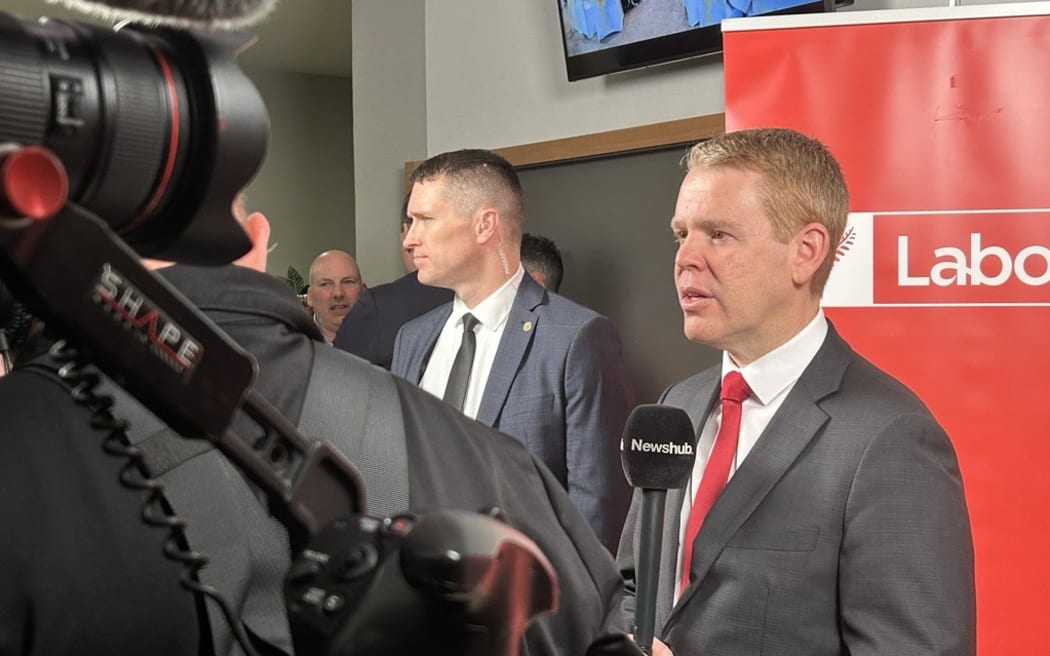
Labour was sitting at about 26.5 percent of the party vote, and Prime Minister Chris Hipkins conceded there was no chance he could form a government and that Labour was heading out after six years and two terms in office.
The Green Party was at about 10 percent, ACT at 9 percent, New Zealand First at 6.4 percent and Te Pāti Māori at 2.5 percent with 94 percent of results counted.
Te Pāti Māori was poised to win most of the seven Māori seats with new candidate Hana-Rawhiti Maipi Clarke defeating Foreign Minister Nanaia Mahuta in the Hauraki-Waikato electorate, ousting the longest serving female MP and at just age 21 becoming the youngest MP in Aotearoa in 170 years.
It is a stunning reversal from 2020’s election, when Labour hit 50 percent of the vote as Jacinda Ardern’s government won a second term and National cratered with 25.6 percent.
One Labour supporter told RNZ that “Labour expected a slap on the wrist. This is a punch in the face.”
‘A new government and a new direction’ – Luxon Greeting cheering supporters in Auckland, Luxon said the results were a mandate for change.
“You have reached for hope and you have voted for change,” Luxon told supporters. “On the numbers tonight, National will be in a position to lead the next government.”
“My pledge to you is that our government will deliver for every New Zealander, because we will rebuild the economy and deliver tax relief.
“We will bring down the cost of living, we will restore law and order, we will deliver better health care and we will educate our children so that they can grow up to live the lives that they dreamed of.
“That’s what you voted for and that’s what we will deliver.”
A joyous crowd chanted “back on track” as Luxon spoke.
‘I gave it my all, but that was not enough’ – Hipkins Earlier last night, Labour leader Chris Hipkins conceded that the party had no path to return to power, saying that “the result tonight is not one that any of us wanted”.
Hipkins replaced Jacinda Ardern in January, but he joined other prime ministers like Mike Moore, Jenny Shipley and Bill English in failing to win election in their own right after taking over from another leader mid-term.
“I gave it my all to turn the tide of history, but alas, that was not enough.”
Outgoing Prime Minister Chris Hipkins speaks to media after conceding the election . . . “”We put people first, we refused to leave people behind.” Image: RNZ/Maree Mahony
Hipkins struck a defiant note in his speech and promised Labour would remain strong in opposition.
“When the tide comes in big it almost invariably goes out big as well . . . but Labour is still here, it is not going anywhere, and we will get up again as we have done many times before.
“We put people first, we refused to leave people behind, because that is what we do, that is what the Labour Party does.”
Many electorate seats were still too close to call, with only a few hundred votes separating candidates.
This article is republished under a community partnership agreement with RNZ.
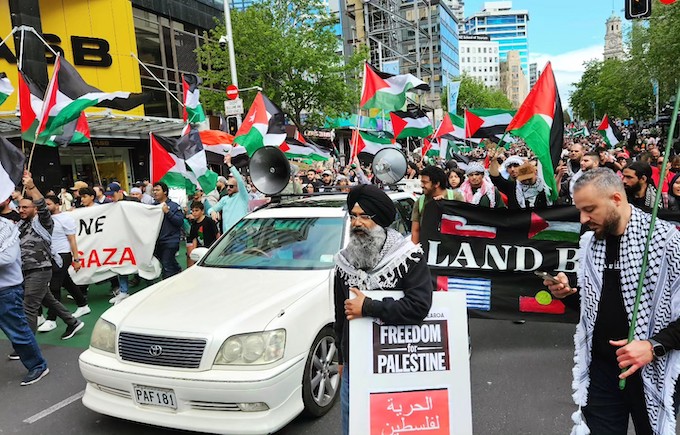
About 2000 people from Aotearoa New Zealand communities, including many families, staged a vibrant rally in Auckland’s Aotea Square and marched down Queen Street today in support of freedom for #Palestine and an end to the Gaza massacre.
Marchers held placards proclaiming “This is a massacre not war”, “Free Palestine – End the Occupation now”, “Land back” — with reference to Israel seizing Palestinian land on a banner also displaying the Aboriginal, Māori (Tino Rangatiratanga) and West Papua (Morning Star) flags.
Warning about a “new Nakba” — the 1948 forced eviction of 750,000 Palestinian refugees from their homeland — the Jewish Voice for Peace advocacy group said in a statement that the Israeli government had declared a “genocidal war” on Palestinians in Gaza.
Israeli officials are openly planning to open “the gates of hell” on Gaza, referring to the two million Palestinians trapped inside as “human animals”, the statement said.
“The Israeli military has launched non-stop airstrikes and bombing over Gaza.
“Our partners tell us of entire neighbourhoods being flattened, schools and hospitals being bombed, apartment buildings being brought down.”
At least 583 Palestinian children have been killed by the Israeli military offensive on Gaza so far, representing one-third of the total death toll with casualty count rapidly rising, reports Defence for Children International.
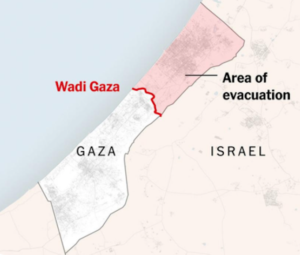
The Gaza “evacuation” zone as ordered by the Israeli military which has been condemned by global critics as a “death sentence”. Image: JVP
“The Israeli government has shut off all electricity to Gaza. Hospitals cannot save lives, the internet will collapse, people will have no phones to communicate with the outside world.
“Gaza will be plunged into darkness as Israel turns its neighborhoods to rubble. Still worse, Israel has openly stated an intention to commit mass atrocities and even genocide, with Prime Minister Benjamin Netanyahu saying the Israeli response will ‘reverberate for generations’.
“All of this with the full throated support of the US.
“End the occupation now” says a placard held by these young Palestinian women protesting in Auckland today in solidarity with the Gaza suffering. Image: David Robie/APR
“On Friday, the Israeli military called for all civilians of Northern Gaza — over one million people, including half a million children — to relocate south within 24 hours, as it amassed tanks for an expected ground invasion.
“According to the UN, it is impossible to evacuate everyone with power supplies cut and food and water in the Palestinian enclave running short after Israel placed Gaza under total siege.
The UN said this invasion would have “devastating humanitarian consequences”, the statement said.
“For 16 years, Palestinians blockaded in Gaza have lived in the most densely populated place in the world. That density is set to double, if one million Palestinians are pushed from the North into the South.
“We shudder to think what will happen if the north is vacated: Israel could annex the territory. Another Nakba could be imminent.”
Solidarity with Palestine marchers in Auckland’s Queen Street today. Image: David Robie/APR
From winning a single-party majority in 2020, Labour’s vote has virtually halved in 2023. Pre-election polls appear to have under-estimated support for National, which on the provisional results can form a government with ACT and won’t need NZ First, despite those same polls pointing to a three-way split.
While the Greens and Te Pāti Māori both saw big gains, taking crucial electorate seats, it has been at the expense of Labour. Special votes are yet to be counted, and Te Pāti Māori winning so many electorate seats will cause an “overhang”, increasing the size of parliament and requiring a larger majority to govern.
There will also be a by-election in the Port Waikato electorate on November 25, which National is expected to win. So the picture may change between now and November 3 when the official result is revealed. But on tonight’s count, the left bloc is out of power and the right is back.
Big shift in the Māori electorates
Te Pāti Māori has performed better than expected in the Māori electorates – taking down some titans of the Labour Party and winning four of the seven seats.
The party vote remained at 2.5% – consistent with 2020.
One of the biggest upsets was 21-year-old Hana-Rawhiti Maipi-Clarke’s win over Labour stalwart Nanaia Mahuta in the Hauraki-Waikato electorate. Mahuta has represented the electorate since 2008 and has been in parliament since 1996.
This was a must-win race for Mahuta, the current foreign affairs minister, after she announced she would not be running on the Labour party list.
Labour won all seven Māori seats in 2017 and six in 2020.
Advance voting
In 2017, 1.24 million votes were cast before election day, more than the previous two elections combined.
In 2020, this rose to 1.97 million people – an extremely high early vote figure attributable to the impact of the COVID-19 pandemic.
This year, more than 1.3 million New Zealanders cast advance votes before election day – higher than 2017 but significantly lower than 2020.
The comeback kid
After a dismal showing at the 2020 election, NZ First’s Winston Peters has yet again shown himself to be the comeback kid of New Zealand politics. Peters and his party have provisionally gained nearly 6.5% of the vote, giving them eight seats in parliament.
On the current numbers, the National Party will not need NZ First to help form the government. But the result is still a massive reversal of fortune for Peters, who failed to meet the 5% threshold or win an electorate seat in 2020.
The heart of Wellington goes Green
Urban electorates in Wellington have resoundingly shifted left, with wins for the Green Party’s Tamatha Paul in Wellington Central and Julie Anne Genter in Rangotai. Chlöe Swarbrick has retained her seat in Auckland Central.
The Wellington electorates had previously been Labour strongholds. But the decision by Grant Robertson to compete as a list-only MP opened Wellington Central to Paul, currently a city councillor.
Genter takes the seat from outgoing Labour MP Paul Eagle.
Both Wellington electorates have also seen sizeable chunks of the party vote – 30% in Rangotai and almost 36% in Wellington Central – go to the Greens.
October 14, 2023 will be remembered by many as the day reconciliation died.
The defeat of the referendum may not have surprised many of us, Aboriginal and Torres Strait Islander people. After all, we have become accustomed to disappointment. Nonetheless, it is a devastating and demoralising blow.
We must take stock of this political disaster and consider where it leaves us as a nation and a society of people and in what direction we walk from here.
A political disaster
I have published extensively on the impacts of disasters on Indigenous peoples, such as fires and floods.
When a disaster strikes, people’s experiences are varied and complicated. Some people escape relatively unscathed, perhaps even better off, while others are heavily and negatively impacted. It is common for those negatively impacted to experience shock and trauma.
There is much to be learned by viewing the referendum defeat as a political disaster.
The first thing to acknowledge is the impact the result will have on many of our peoples and allies. We must validate these feelings of hurt, distress and anger.
Yet the opportunities after a disaster lay in the rebuild, in learning and adapting, and in recognising systemic features of our society that produce vulnerabilities.
This is not to say every person who voted “no” on October 14 is a racist.
Motivations driving individual voting preferences are complicated, contested, perhaps even contradictory. We must be careful to not equate an individual “no” vote as a marker of individual racism. But ignoring patterns of racism and the relentless racist dialogue from some in the “no” campaign is to be wilfully, and knowingly, indifferent.
Racism is a drug, and Australia has an addiction.
Our insistence on this has elicited strong rejections from mainstream Australians who have preferred to see racist events – the Northern Territory Intervention, the 2005 Cronulla riots, the booing of AFL player Adam Goodes – as isolated instances.
For us, these instances are never isolated. They join together in a chain of prejudice which began with the arrival of the First Fleet.
We could say Australia has always been casually, or informally, racist. The resounding “no” written by the majority of Australians across a majority of states, then, formalises the informal.
Finally recognising this fundamental truth about our society will allow us to take generational steps to address it.
October 14 will be remembered by many of us as a spectacular own-goal, rivalling perhaps the Whitlam dismissal.
It was a day when rather than step towards a more kind and equitable future, Australia chose to retreat to a deeply problematic past.
Where to from here?
Within the disappointment of defeat there remain opportunities for those brave enough and willing to embrace it.
We have been denied a place within the Constitution, but it is within our collective power to reconstitute ourselves and create a self-determined Voice. We don’t even need to look far to see how this might work.
Established in 2009, The National Congress of Australia’s First Peoples was perhaps the most complete expression of what an organised and unified Voice might be.
The decline of Congress was not because it wasn’t an effective model of representation. Rather, it was disbanded in 2019 because of the withdrawal of funding by a Coalition government.
If funding is holding back a self-determined Voice such as a Congress, the “yes” campaign has shown Indigenous peoples are far from friendless or penniless.
Other opportunities may exist in plain sight. I have previously written about the sleeping electoral power of Indigenous peoples. Could Indigenous votes be mobilised beyond the Northern Territory for targeted political impact?
The largest learning from the referendum is that we require new political strategies for Indigenous advancement.
The politics of asking must cease.
Many activists will want to hit the streets once again, but this is not the 1970s. The Sorry Day rally in 2000 and the Students for Climate Action rally in 2021, each of which brought many thousands of people to the street, failed to move government. And the treatment of asylum seekers demonstrates Australia cares little for its international reputation.
What we require is a different kind of political action. This action will require support, membership, funding, and clear communication, but never asking for permission.
We need innovation and imagination for this, and our allies must be brave and willing to step into these more radical spaces with us.
Perhaps most importantly, this renewed political action requires new leadership.
Passing the baton
The generations of Indigenous leaders who have steered our communities, and the campaign for Constitutional recognition, deserve our deepest gratitude.
It takes a certain type of person to take the hits and keep standing up and moving forward.
To our leaders who have offered us strength and shone light on a righteous path, we will forever look up to you.
October 14 will not be your legacy.
A new generation of leaders has followed in your footsteps and grown up in your shadow.
Now is the time to pass the baton of leadership.
That new generation is already here – and we are hungry for the opportunity.
Hand us not the baton of defeat, but strength in the struggle.
May each “yes” vote cast at the referendum be a drop of rain that nourishes the land as it seeks to heal itself.
With concerted effort, and sympathetic yet radical activism, October 14 may be remembered as the firestorm that tore through our nation, but from which green shoots of opportunity sprung.
Bhiamie Williamson is a Director of Country Needs People
There has never been a decade without a significant Indigenous-led movement in Australia. These movements have centred on the reinstatement of Indigenous peoples’ rights as self-determining peoples, and demands for justice arising from our brutal dispossession and its contemporary fingerprints.
There has never been a successful referendum without bipartisan support. Success for the Voice to Parliament was always going to be against the odds. Tonight, we saw results track recent polls with an overall Yes vote expected in the mid 40s nationally. With New South Wales, Tasmania and South Australia called by 7:25pm, the referendum has failed.
On May 27, 2017, more than 250 community delegates from across the continent stood together and provided an invitation to the Australian people through the Uluṟu Statement from the Heart.
The statement proposed a path forward for the nation: Voice, Treaty and Truth. Today, Australia voted on the first step and in delivering a No outcome, has revealed the heart of this nation.
Let’s acknowledge the significance of the work it took to get here.
The journey here
Megan Davis and George Williams’ Everything You Need to Know About the Uluṟu Statement from the Heart, offers a heartbreaking timeline of the many forms of political claim-making First Nations’ people have engaged in since at least 1846.
In the 13 years since the 2010 Expert Panel on Constitutional Recognition, there have been seven separate processes and ten reports. In the middle of these, the sixth report was the Final Report of the Referendum Council, shortly after the delivery of the Uluṟu Statement from the Heart.
The Final Report’s recommendations focused on constitutional recognition in the form of a Voice to Parliament, because this was the most strongly endorsed option from the five options considered by the 12 regional deliberative dialogues. The Uluṟu Statement from the Heart also called for Treaty, the second most strongly endorsed form of recognition, and for Truth, out of respect for the truth-telling that was given at each and every dialogue.
Where it all went wrong
Years of bipartisan support was maintained right until the early months of this year. By February it was becoming clear Opposition Leader Peter Dutton would be unlikely to support the Voice to Parliament referendum.
In doing this, Dutton actively ignored the advice of those around him in the Liberal party. By April 5, 2023, it was announced Australia would head to its 45th referendum without bipartisan support for the proposal, knowing no referendum had never succeeded without it.
In August 2023, the Australian Financial Review’s Phillip Coorey reported a leaked text message from a coalition MP:
We can’t win the election unless we defeat the Voice solidly. i.e. we need to defeat it to get to the election starting line.
The opposition made their bet: defeat the Voice and give themselves a chance at the next federal election.
This transformed a people-driven proposal into a partisan political debate. It has made for a campaign characterised by lies, misinformation, disinformation, and outright conspiracies circulated on social media platforms. This sometimes occurred with complicit mainstream media that have either failed to fact-check basic claims or given misinformation equal weight in their presentation of “both sides”.
The “no” campaign’s decision to position two prominent Aboriginal faces as their spokespeople enabled a doubly effective claim to division: arguing the Voice would create racial division between Indigenous and non-Indigenous peoples, and that Indigenous people also couldn’t agree.
The small levels of disagreement within Aboriginal and Torres Strait Islander community were, so often, treated as media spectacle and not treated with the seriousness our diverse political views deserve, in the context of so much shared experience.
What now?
We have heard numerous thought bubbles along the way about what happens next, if not a Voice. These have included Dutton’s suggestion of a second referendum on symbolic recognition. This proposal will not have any support from First Nations’ people, and there’s likely to be little appetite from the wider Australian population. That lack of support also no doubt informs the prime minister’s decision not to pursue a legislated Voice.
Senator Lidia Thorpe is likely to call for truth-telling and Treaty making, though those involved in the Victorian processes have thrown their weight behind the necessity of the Voice to give strongest effect to treaty and truth. Whatever comes next, we now know it will happen without a protected representative connection between community and the Commonwealth parliament.
There will no doubt be a lot of commentary and analysis about the relative successes and failures of the “no” and “yes” campaigns, their strategy, and their arguments over future weeks and months. For most Aboriginal peoples and Torres Strait Islanders, however, this will be of little interest or use.
The political subjugation and further marginalisation of First Nations’ peoples is no longer historical legacy but a contemporary decision reinscribing centuries of paternalism: that we are not peoples deserving of a protected right to be heard on matters that affect us.
We asked for change. We asked to be heard. We asked the Australian people to walk with us.
And so now we are where we have always been, left to build our better futures on our own.
Sana Nakata has contributed to the Uluru Dialogues during the campaign period on an unpaid basis. She receives funding from the Australian Research Council.
The referendum has been defeated, with a “no” majority called by the ABC in at least four states.
The Constitution can only be changed if there is a double majority, meaning there must be a national majority of voters across all states and territories and a majority of voters in a majority of the states (at least four of the six states). The Northern Territory and ACT counts are not included in the majority of states, but do contribute to the overall national count.
Israeli occupation forces are intentionally targeting Palestinian journalists in the besieged Gaza Strip, media outlets warned after three reporters were killed Tuesday bringing the total number of journalists killed since Saturday to seven, reports Middle East Monitor.
The Government Media Office’s Monitoring and Follow-up Unit in Gaza has documented dozens of attacks and crimes against journalists and media outlets.
Israeli attacks have resulted in the killing of seven journalists: Ibrahim Lafi, Muhammad Jarghun, Muhammad Al-Salhi, Asaad Shamlikh, Saeed Al-Taweel, Muhammad Subh Abu Rizq and Hisham Al-Nawajaha.
In addition, “more than 10 journalists have been injured with varying degrees of severity, and they lost contact with two colleagues, Nidal Al-Wahidi and Haitham Abdul-Wahed”.
The monitoring unit added that the homes of journalists Rami Al-Sharafi and Basel Khair Al-Din had been targeted and destroyed.
In contrast, the homes of dozens of other journalists were partially damaged.
Furthermore, dozens of media institutions were either completely or partially damaged by Israeli strikes including on Palestine Tower and Al-Watan Tower, with more than 40 media headquarters being affected, the unit reported.
Despite the risks, the government media office emphasised that their journalists will continue their professional role and national duty in covering the events, exposing the crimes of the occupation and debunking its false claims.
Stuff, New Zealand’s biggest independently owned news business, today announced it will stop sharing content to X (formerly Twitter), effective immediately.
A media statement said that decision followed Stuff’s increasing concerns about the volume of mis- and disinformation being shared, and the “damaging behaviour being exhibited on and enabled by the platform”.
All Stuff brands including stuff.co.nz, and publishing mastheads brands The Post,The Press and Waikato Times will no longer post on X, with the exception of stories that are of urgent public interest — such as health and safety emergencies, said the statement.
Stuff will also publish these stories on Neighbourly, to reach communities fast and with hyper-local information.
The following message was sent to all staff from CEO Laura Maxwell:
Trusted storytelling “When Stuff returned to New Zealand ownership in 2020, we set growth in public trust as a key measure of success. Three years on, our mission is to grow our business through trusted storytelling and experiences that make Aotearoa New Zealand a better place,” she said.
“As a business we have made the decision that X, formerly known as Twitter, does not contribute to our mission.
“We are increasingly concerned about the volume of mis- and dis-information being shared on the platform, and the damaging behaviours we have observed, and experienced.
Stuff’s CEO Laura Maxwell . . . “We will also continue to assess our use of other social platforms.” Image: Linked-in/PMW
“So, as of today, we will stop sharing our content on X. An exception to this will be stories that are of urgent public interest, such as health and safety emergencies. We will also publish these stories on Neighbourly.
“We also encourage you all to consider how much you personally engage with X, if at all. The platform is diametrically opposed to our own values, as outlined in our Editorial Code of Practice and Ethics. It deliberately and actively seeks to undermine the value of our journalism.
“We are aware many of you might use X for news gathering and as a way to share information with others. However, as a company that values truth and trust, this platform is no longer a tool for us.
“As many of you know, this is not the first time Stuff has taken such a stance.
“In July 2020, Stuff paused posting activity on Facebook. The move built on the decision to stop paid advertising on Facebook in 2019, following the live streaming and widespread dissemination of footage of the Christchurch mosque shootings on the platform. We will also continue to assess our use of other social platforms.
“As New Zealand’s biggest news organisation, we benefit from a loyal audience, who engage with us every single day on our platforms, our papers, magazines and at our events.
“As restless creators, our innovation mindset is enduring and so we’ll continue to innovate and invest in our platforms to deliver high-quality, trustworthy journalism that is relevant and reflective of Aotearoa.”
When I was a child in the 1970s, seeing a satellite pass overhead in the night sky was a rare event. Now it is commonplace: sit outside for a few minutes after dark, and you can’t miss them.
Thousands of satellites have been launched into Earth orbit over the past decade or so, with tens of thousands more planned in coming years. Many of these will be in “mega-constellations” such as Starlink, which aim to cover the entire globe.
These bright, shiny satellites are putting at risk our connection to the cosmos, which has been important to humans for countless millennia and has already been greatly diminished by the growth of cities and artificial lighting. They are also posing a problem for astronomers – and hence for our understanding of the universe.
In new research accepted for publication in Astronomy and Astrophysics Letters, we discovered Starlink satellites are also “leaking” radio signals that interfere with radio astronomy. Even in a “radio quiet zone” in outback Western Australia, we found the satellite emissions were far brighter than any natural source in the sky.
An animation showing the increase in the number of satellites in Earth orbit, over the course of the space age, so far.
We found expected radio transmissions at designated and licensed radio frequencies, used for communication with Earth.
Starlink satellites emit bright flashes of radio transmission (shown in blue) at their allocated frequency of 137.5 MHz.
However, we also found signals at unexpected and unintended frequencies.
We found these signals coming from many Starlink satellites. It appears the signals may originate from electronics on board the spacecraft.
Here we see constant, bright emissions from Starlink satellites at 159.4 MHz, a frequency not allocated to satellite communications.
Why is this an issue? Radio telescopes are incredibly sensitive, to pick up faint signals from countless light-years away.
Even an extremely weak radio transmitter hundreds or thousands of kilometres away from the telescope appears as bright as the most powerful cosmic radio sources we see in the sky. So these signals represent a serious source of interference.
And specifically, the signals are an issue at the location where we tested them: the site in WA where construction has already begun for part of the biggest radio observatory ever conceived, the Square Kilometre Array (SKA). This project involves 16 countries, has been in progress for 30 years, and will cost billions of dollars over the next decade.
Huge effort and expense has been invested in locating the SKA and other astronomy facilities a long way away from humans. But satellites present a new threat in space, which can’t be dodged.
What can we do about this?
It’s important to note satellite operators do not appear to be breaking any rules. The regulations around use of the radio spectrum are governed by the International Telecommunications Union, and they are complex. At this point there is no evidence Starlink operators are doing anything wrong.
The radio spectrum is crucial for big business and modern life. Think mobile phones, wifi, GPS and aircraft navigation, and communications between Earth and space.
However, the undoubted benefits of space-based communications – such as for globally accessible fast internet connections – are coming into conflict with our ability to see and explore the universe. (There is some irony here, as wifi in part owes its origins to radio astronomy.)
Regulations evolve slowly, while the technologies driving satellite constellations like Starlink are developing at lightning speed. So regulations are not likely to protect astronomy in the near term.
But in the course of our research, we have had a very positive engagement with SpaceX engineers who work on the Starlink satellites. It is likely that the goodwill of satellite operators, and their willingness to mitigate the generation of these signals, is the key to solving the issue.
In response to earlier criticisms, SpaceX has made improvements to the amount of sunlight Starlink satellites reflect, making them one-twelfth as bright in visible light as they used to be.
We estimate emissions in radio wavelengths will need to be reduced by a factor of a thousand or more to avoid significant interference with radio astronomy. We hope these improvements can be made, in order to preserve humanity’s future view of the universe, the fundamental discoveries we will make, and the future society-changing technologies (like wifi) that will emerge from those discoveries.
Steven Tingay is affiliated with the Australian Labor Party.
Source: The Conversation (Au and NZ) – By Katharine Kemp, Associate Professor, Faculty of Law & Justice, and Deputy Director, Allens Hub for Technology, Law & Innovation, UNSW Sydney
Shutterstock
Cars with internet-connected features are fast becoming all-seeing data-harvesting machines – a so-called “privacy nightmare on wheels”, according to US-based research conducted by the Mozilla Foundation.
The researchers looked at the privacy terms of 25 car brands, which were found to collect a range of customer data, from facial expressions, to sexual activity, to when, where and how people drive.
They also found terms that allowed this information to be passed on to third parties. Cars were “the official worst category of products for privacy” they had ever reviewed, they concluded.
Australia’s privacy laws aren’t up to the task of protecting the vast amount of personal information collected and shared by car companies. And since our privacy laws don’t demand the specific disclosures required by some US states, we have much less information about what car companies are doing with our data.
Australia’s privacy laws need urgent reform. We also need international cooperation on enforcing privacy regulation for car manufacturers.
How do cars collect sensitive data?
Apart from data entered directly into a car’s “infotainment” system, many cars can collect data in the background via cameras, microphones, sensors and connected phones and apps.
These data include:
speed
steering, brake and accelerator pedal use
seat belt use
infotainment settings
phone contacts
navigation destinations
voice data
your location and surroundings
and even footage of you and your family outside your car. (Between 2019 and 2022, Tesla employees internally circulated intimate footage collected from people’s private cars for their own amusement, according to reports.)
A lot of these data are used, at least in part, for legitimate purposes such as making driving more enjoyable and safer for the driver, passengers and pedestrians.
But they can also be supplemented with data collected from other sources and used for other purposes. For instance, data may be collected from your website visit, your test drive at a dealership, or from third parties including “marketing agencies” and “providers of data-collecting devices, products or systems that you use”.
The latter is very broad since our TVs, fridges and even our baby monitors can collect data about us.
Mozilla points out these combined data can be used “to develop inferences about a driver’s intelligence, abilities, characteristics, preferences and more”.
Connected cars transmit data in real time
While cars have been collecting large amounts of information since they became “computers on wheels”, this information has generally been stored in modules in the vehicle and accessed only when the car is physically connected to diagnostic equipment.
Now, however, vehicles are being sold with connected features “in the sense that they can exchange information wirelessly with the vehicle manufacturer, third party service providers, users, infrastructure operators and other vehicles”.
This means your connected car can transmit data about you and your activities, generally via the internet, to various other companies as you go about your life.
Your internet-connected car can collect a range of data about you. Shutterstock
Where do the data go?
In Australia, we have little information about how our information can be used and by whom.
In its US-based study, Mozilla found data from consumers’ cars was being disclosed to other companies for marketing and targeted advertising purposes. It was also sold to data brokers.
Mozilla was able to uncover highly detailed information, largely because the laws of California and Virginia require specific disclosures about who personal data is disclosed to and for what purposes (among other higher privacy standards).
Australian privacy law doesn’t require such specific disclosures. This is one reason car brands often have separate privacy policies for Australia.
A look at the privacy policies of various companies supplying connected cars in Australia reveals several vague, broad statements. Aside from using your data to provide you with connected services, these companies will:
provide the data to unspecified “third parties in connection with” developing new “marketing strategies”.
Some may disclose your information to law enforcement or the government even when not required by law, such as when they believe “the use or disclosure is reasonably necessary to assist a law enforcement agency”.
Trust us – we invented a ‘voluntary code’
It’s safe to say car manufacturers generally don’t want privacy laws tightened. The Federal Chamber of Automotive Industries (FCAI) represents companies distributing 68 brands of various types of vehicles in Australia.
During the recent review of our privacy legislation, the FCAI made a submission to the Attorney General’s department arguing against many of the privacy law reforms under consideration.
For example, signatories don’t say they’re bound by the code. Nor do they promise to follow its terms. They only say its principles will “drive their approach to treatment of vehicle-generated data and associated personal information”. There are no penalties for ignoring the code.
It even states signatories will “voluntarily notify” consumers of certain matters when the Privacy Act already requires this as a matter of law.
The code also notes third parties are increasingly interested in accessing and using consumers’ data to provide services, including insurance companies, parking garage operators, entertainment providers, social networks and search engine operators.
It says companies making data available to such third parties “will strive to inform you” about this.
We need privacy law reform
The government recently proposed important and wide-ranging privacy law reforms, following the Privacy Act Review which began in 2020. These changes are long overdue.
Proposals such as an updated definition of “personal information” and higher standards for “consent” could help protect consumers from intrusive and manipulative data practices.
The proposed “fair and reasonable test” would also assess whether a practice is substantively fair. This would help avoid claims data practices are lawful just because consumers had to provide consent.
The FCAI points out many cars aren’t specifically designed for Australia’s relatively small market, so increased privacy standards might result in some vehicles not being released here. But this isn’t a reason to carve out vehicles from privacy law reform.
Privacy laws are also being upgraded in numerous jurisdictions overseas. Australia’s government agencies should coordinate with their international counterparts to protect drivers’ privacy.
Katharine Kemp receives funding from the UNSW Allens Hub for Technology, Law and Innovation. She is a Member of the Expert Panel of the Consumer Policy Research Centre, and the Australian Privacy Foundation.
Source: The Conversation (Au and NZ) – By Adrian Beaumont, Election Analyst (Psephologist) at The Conversation; and Honorary Associate, School of Mathematics and Statistics, The University of Melbourne
The referendum on the Indigenous Voice to parliament will be held on Saturday. Polls close at 6pm AEDT in the south-eastern states, 6:30pm in South Australia, 7pm in Queensland, 7:30pm in the Northern Territory and 9pm in Western Australia.
For a referendum to succeed, it requires a majority in at least four of the six states as well as a national majority. Polling suggests there is no realistic chance of a national “yes” majority, so the double majority is a moot point.
The graph below has been updated with the inclusion of national Voice polls from YouGov, Morgan and Focaldata (see below).
The Voice polls range from a six and seven point “no” lead in Essential and Morgan to a 22 and 24-point “no” lead in Focaldata and Newspoll. So the most optimistic case for “yes” is a loss by high single digits, but the actual loss is likely to be higher.
Labor’s lead widens in federal Resolve poll
I previously covered the 56–44 lead for “no” in the national Resolve poll for Nine newspapers that was conducted September 22 to October 4 from a very large sample of 4,728.
Primary votes in this poll were 37% Labor (up one since early September), 31% Coalition (down three), 12% Greens (steady), 7% One Nation (up two), 2% UAP (steady), 9% independents (steady) and 2% others (steady).
Resolve does not give a two party estimate until near elections, but applying 2022 election preference flows to this poll gives Labor a 57–43 lead, a 1.5-point gain for Labor since September. During this term, Resolve has easily been Labor’s most favourable pollster.
Anthony Albanese’s net approval improved seven points to net zero, with 43% saying he had done a good job and 43% a poor job. Peter Dutton’s net approval fell seven points to -15. Albanese led Dutton by 47–25 as preferred PM, out from 43–28 in September.
The Liberals retained a narrow 35–33 lead over Labor on economic management, in from 36–30 in September. On keeping the cost of living low, Labor led by 31–27, reversing a Liberal lead of 28–27 in September.
Federal questions other than voting intention and the Voice referendum were based on the normal sample of 1,600 respondents. Additional Voice questions below are based on a sample of over 3,100.
Further Resolve Voice questions
Among “no” voters, 33% cited dividing the country by race as the most persuasive “no” argument, while 16% selected not enough detail. Among “yes” voters, 19% cited a practical way to recognise Indigenous people in our Constitution as the most persuasive “yes” argument.
By 49–20, voters thought the Voice would create waste and inefficiency rather than reduce it. By 38–23, they thought colonisation had had a positive rather than negative impact on Indigenous Australians.
Based on a subsample of 420 Indigenous respondents from the full sample of 4,728, “yes” led by 59–41 among Indigenous people. This is down from 80% support for “yes” among Indigenous respondents in surveys by other pollsters conducted early this year.
In other demographic breakdowns, “no” led with religious voters by 64–36, while “yes” led with the non-religious by 53–47.
Full results of this Voice poll can be downloaded from the Resolve website. Self-identified progressives supported “yes” by 75–25, while conservatives supported “no” 78–22. The killer for “yes” is that those who took neither view supported “no” by 66–34. There are similar findings in a Focaldata poll.
YouGov poll: ‘no’ leads by 56–38
A YouGov national poll, conducted October 6–10 from a sample of 1,519, gave “no” to the Voice a 56–38 lead, out from 53–38 in the previous YouGov poll in late September. YouGov used to conduct Newspoll, but is now producing its own polls.
On voting intentions, Labor led by an unchanged 53–47, from primary votes of 36% Coalition (up one), 33% Labor (steady), 14% Greens (up one), 6% One Nation (not listed in September) and 11% for all Others.
Albanese’s net approval was steady at -3, while Dutton’s was up five points to -12. Albanese led Dutton by 50–34 as preferred PM (50–33 previously). By 41–39, respondents said they would support a constitutional change to make Qantas a publicly owned company.
Morgan poll: ‘no’ leads by 51–44
A national Morgan Voice poll, conducted October 2–12 from a sample of 1,419, gave “no” to the Voice a 51–44 lead (a 46–37 “no” lead in late September). Initial preferences were 46% “no” (steady), 40% “yes” (up three) and 14% undecided (down three). Undecided were then asked how they were leaning. Morgan predicts a 54–46 “no” vote by allocating two-thirds of remaining undecided to “no”.
Morgan’s weekly federal poll this week gave Labor a 53–47 lead, a one-point gain for Labor since last week. Primary votes were 34% Coalition, 33% Labor, 13.5% Greens and 19.5% for all Others. This was taken October 2–8 from a sample of 1,378.
Focaldata poll: ‘no’ leads by 61–39
A poll by British pollster Focaldata had “no” leading by 61–39. Focaldata used multi-level regression with post-stratification (MRP) to predict that 22 of the 151 electorates would support “yes”; these “yes” seats are inner city seats. This poll was conducted September 18 to October 2 from a sample of 4,608.
Adrian Beaumont does not work for, consult, own shares in or receive funding from any company or organisation that would benefit from this article, and has disclosed no relevant affiliations beyond their academic appointment.
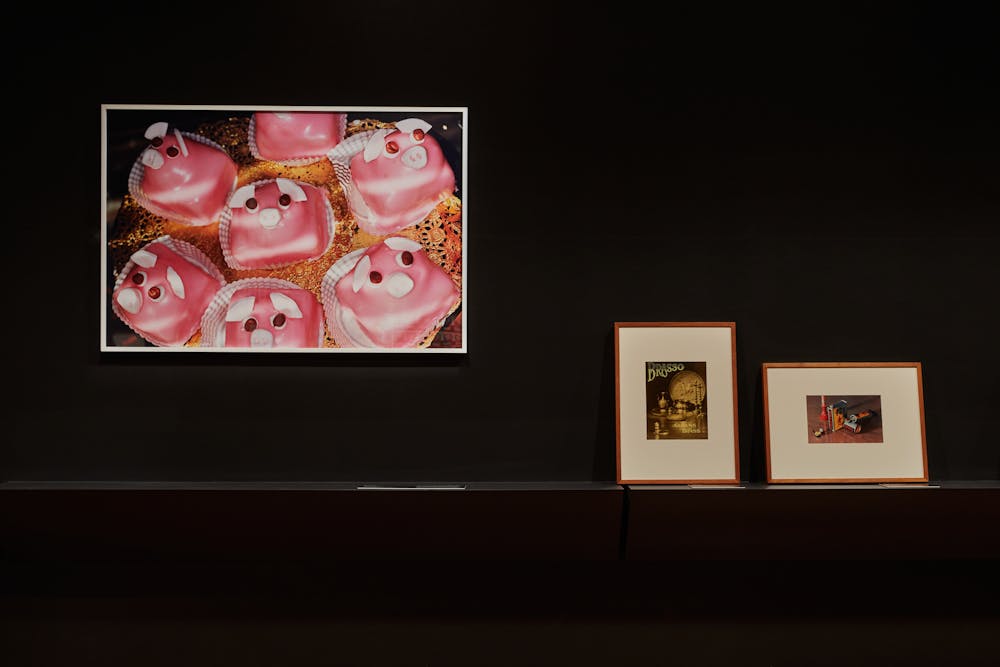
Installation view of Patrick Pound’s People who look dead but (probably) aren’t 2011–2014 on display in Photography: Real & Imagined at The Ian Potter Centre: NGV Australia from October 13 2023 – February 4 2024. Photo: Lillie Thompson
Photography is almost 200 years old and Photography: Real and Imagined at the National Gallery of Victoria (NGV) can be interpreted as an attempt to make sense of its history.
A huge and dazzling exhibition containing 311 photographs, the basic thesis of this exhibition is that some photographs record an actuality, others are purely a product of the photographer’s imagination, while many are a mixture of the two.
The parameters of the exhibition are determined, in part, by the holdings of the NGV collection and, in part, by the perspective adopted by the curator, the erudite and long-serving senior curator of photography at the NGV, Susan Van Wyk.
Mercifully, the curator has not opted for a linear chronological approach from daguerreotypes to digital, although both are included in the exhibition, but has devised 21 diverse thematic categories, for example light, environment, death, conflict, work, play and consumption.
Australian artists, international context
The categories have porous boundaries. Even with the assistance of the 420-page book catalogue, it is difficult to determine why Michael Riley’s profoundly moving photograph of a dead galah shown against the cracked earth belongs to the environment theme instead of death; why Rosemary Laing’s Welcome to Australia image of a detention camp belongs to movement, instead of being in community, conflict or narrative.
Installation view of Photography: Real & Imagined on display at The Ian Potter Centre: NGV Australia from October 13 2023 – February 4 2024. Photo: Lillie Thompson.
I felt that there was a perceived need to somehow organise the material, and the broad thematic structure allows the viewer to develop some sort of mega-narrative for the show.
There is also evident a desire to create an international context within which to display the work of Australian photographers.
It is indeed a very rich cross-section of Australian photographers assembled in this exhibition. This is not an Anglo-American construct of the history of photography; Australian photographers are presented together with New Zealanders and their Asian contemporaries.
Installation view of Photography: Real & Imagined on display at The Ian Potter Centre: NGV Australia from October 13 2023 – February 4 2024. Photo: Lillie Thompson.
Although the NGV boasts of having the first curatorial department of photography in any gallery in Australia, in the department’s 55-year history there remain serious lacunae in the collection.
For example, Russian constructivist photographers, including Aleksandr Rodchenko, who, as far as I am aware, in the NGV collection is represented by a single small booklet, but looms large in any account of the history of photography as presented by the British, European and American museums. Eastern European photographers are also generally underrepresented.
This exhibition combines the iconic with the new and the unexpected.
The expected key moments in the history of photography are generally all present with the roll-call of names including Dora Maar, Man Ray, André Kertész, Henri Cartier-Bresson, Dorothea Lange, Eadweard Muybridge, Bill Brandt, Lee Miller and László Moholy-Nagy.
They are all included in the exhibition and are represented through their iconic pieces.
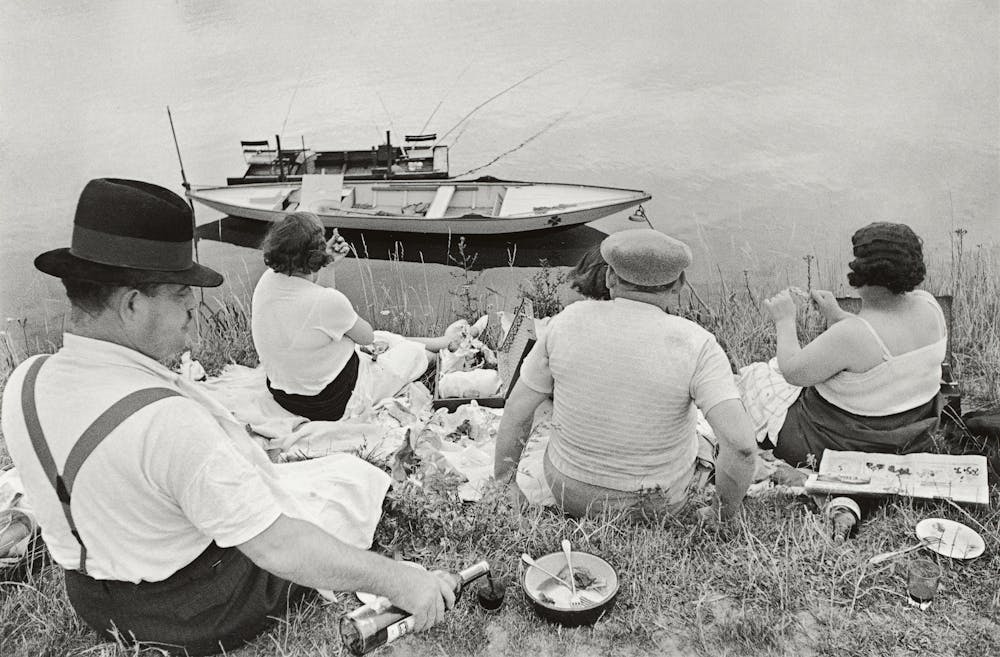
Henri Cartier Bresson’s Juvisy (1938), colloquially known as Sunday on the banks of the Marne, is an intentionally subversive image by this left-wing radical photographer.
This image, made at the height of the Great Depression, shows a victory by France’s popular left-wing government that legislated in 1936 the entitlement for French workers to have two weeks of paid vacation. Here the working class is enjoying a picnic at Juvisy, just to the south of Paris.
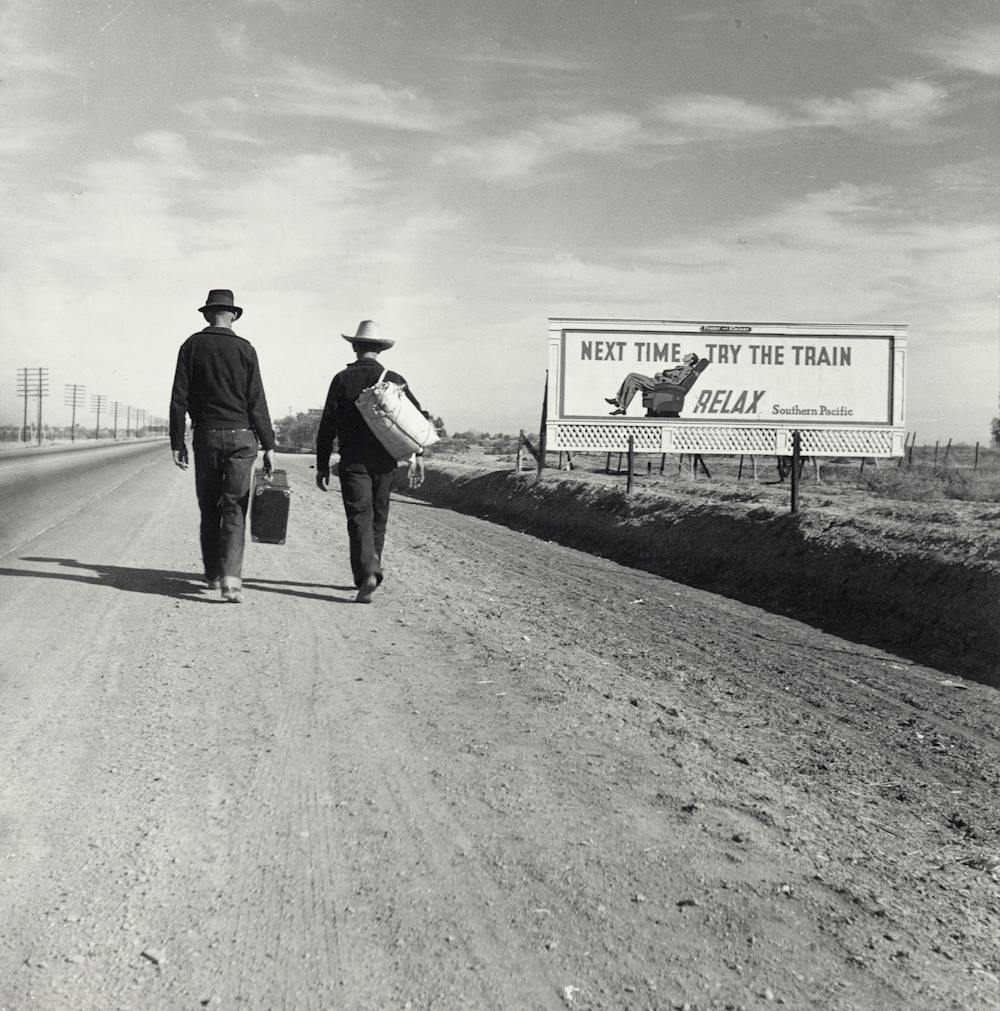
At about the same time, Dorothea Lange’s Towards Los Angeles, California (1936) contrasts the anguish of the unemployed trekking in search of work and a billboard advertising the comforts of train travel. An aphorism ascribed to her sums us much of her work:
Bad as it is, the world is potentially full of good photographs. But to be good, photographs have to be full of the world.
Man Ray’s Kiki with African mask (1926) is one of the most famous photographs in the world, also known as Noire et blanche (Black and White). The surrealist artist juxtaposes the elongated face of his Muse and mistress, Kiki (Alice Prin), with her eyes closed with that of a black African ceremonial mask.
The photograph was controversial when it was first published and continues to be controversial to the present day.
There are also numerous modern classics in the exhibition, including Pat Brassington’s Rosa (2014), Polly Borlan’s Untitled (2018), from MORPH series 2018 and Robyn Stacey’s Nothing to see here (2019), that can all be viewed as edging into the realm of the uncanny. Beyond the façade of the familiar, we are invited to enter an unexpected world.
Installation view of Polly Borland’s Untitled 2018 from MORPH series 2018 on display in Photography: Real & Imagined at The Ian Potter Centre: NGV Australia from October 13 2023 – February 4 2024. Photo: Lillie Thompson.
Reinterpreting our world
Photography’s reputation of creating a trustworthy facsimile of the real had long been eroded, even before the creation of digital software. There is an old adage, “paintings sometimes deceive, but photographs always lie” – precisely because there was a perception that they could not lie.
One of the most intriguing works in the exhibition is by the New Zealand-born photographer Patrick Pound, titled Pictures of people who look dead, but (probably) aren’t (2011–14). It is a sprawling installation of mainly found photographs where the audience is invited to create a life and death narrative.
Photography: Real and Imagined reexamines our thinking about the art of photography and explores photography’s ability to recreate and reinterpret our world.
Photography: Real and Imagined is at the Ian Potter Centre, National Gallery of Victoria, Melbourne, until February 4 2024.
Sasha Grishin ne travaille pas, ne conseille pas, ne possède pas de parts, ne reçoit pas de fonds d’une organisation qui pourrait tirer profit de cet article, et n’a déclaré aucune autre affiliation que son organisme de recherche.
It was perhaps inevitable that the shock Hamas attack on Israel would become a minor election sideshow in New Zealand. Less than a week from the polls, a crisis in the Middle East offered opposition parties a brief chance to criticise the foreign minister’s initial reaction.
But if it was a fleeting and fairly trivial moment in the heat of a campaign, the crisis itself is far from it – and it will test the foreign policy positions of whichever parties manage to form a government after Saturday.
It can be tempting to see the latest eruption of violence in Gaza and Israel as somehow “normal”, given the history of the region. But this is far from normal.
What appear to be intentional war crimes and crimes against humanity, involving the use of terror against citizens and guests of Israel, will provoke what will probably be an unprecedented response.
Israel’s declaration of war and formation of an emergency war cabinet – backed by threats to “wipe this thing called Hamas off the face of the Earth” – were the start. The bombardment and “complete siege” of Gaza, and preparation for a possible ground invasion, have catastrophic potential.
Hundreds of thousands may be forced towards Egypt or into the Mediterranean, with the fate of the hostages held by Hamas looking dire. Israel has now said there will be no humanitarian aid until the hostages are free.
There is a risk the war will spread over Israel’s northern border with Lebanon, with Hezbollah (backed by Iran) now involved. US President Joe Biden’s warning to Iran to “be careful”, and the deployment of a US carrier fleet to the Eastern Mediterranean, only ups the ante.
Rules of war
Given the suspension of some commercial flights to and from Israel, New Zealand’s most meaningful first response has been practical: arranging a special flight from Tel Aviv for citizens and their families currently in Israel or the Palestinian territories who wish to leave.
Beyond these immediate concerns, however, the world is divided. Outrage in the West is matched by support in Arab countries for Palestinian “resistance”. Despite US efforts to get a global consensus condemning the attack, the United Nations Security Council could not agree on a unified statement.
With no global consensus, New Zealand can do little more than assert and defend the established rules-based international order. This includes stating clearly that international humanitarian law and the rules of war are universal and must be applied impartially.
That’s akin to New Zealand’s position on the Russian invasion of Ukraine: the rules of war apply to all, both state and non-state forces (irrespective of whether those parties agree to them). War crimes are to be investigated, with accountability and consequences applied through the relevant international bodies.
This applies to crimes of terror, murder, hostage-taking and indiscriminate rocket attacks carried out by Hamas. But the government needs also to emphasise that war crimes do not justify further retaliatory war crimes.
International law prohibits collective punishments, and access for humanitarian relief should be permitted. To hold an entire population captive – as a siege of Gaza involves – for the crimes of a military organisation is not acceptable.
The two-state solution
It is also important that New Zealand carefully considers definitions of terrorism and legitimate force. Terrorists do not enjoy the political and legal legitimacy afforded by international law.
Whether this distinction is anything more than a fiction needs to be reviewed. If this were to change, it would mean the financing, participation in or recruitment to any branch of Hamas would be illegal. This might have implications for any future peace process, should Hamas be involved.
At some point, most people surely hope, the cycle of violence will end. The likeliest route to that will be the so-called “two-state solution”, requiring security guarantees for Israel, negotiated land swaps and careful management of Jerusalem’s holy sites.
New Zealand has long supported this initiative, despite its apparent diplomatic near-death status. An emergency meeting of the Arab League in Cairo this week urged Israel to resume talks to establish a viable Palestinian state, and China has also reiterated support such a solution.
New Zealand cannot stay silent when extreme, indiscriminate violence is committed by any group or nation. But joining any movement of like-minded nations to continue pushing for the two-state solution is still its best long-term strategy.
Alexander Gillespie does not work for, consult, own shares in or receive funding from any company or organisation that would benefit from this article, and has disclosed no relevant affiliations beyond their academic appointment.
The use of artificial intelligence (AI) by New Zealand police is putting the spotlight on policing tactics in the 21st century.
A recent Official Information Act request by Radio New Zealand revealed the use of SearchX, an AI tool that can draw connections between suspects and their wider networks.
SearchX works by instantly finding connections between people, locations, criminal charges and other factors likely to increase the risk of harm to officers.
Police say SearchX is at the heart of a NZ$200 million front-line safety programme, primarily developed after the death of police constable Matthew Hunt in West Auckland in 2020, as well as other recent gun violence.
But the use of SearchX and other AI programmes raises questions about the invasive nature of the technology, inherent biases and whether New Zealand’s current legal framework will be enough to protect the rights of everyone.
Controversial technologies
At this stage, New Zealanders only have a limited view of the AI programmes being used by the police. While some the programmes are public, others are being kept under wraps.
Police have acknowledged using Cellebrite, a controversial phone hacker technology. This programme extracts personal data from iPhones and Android mobiles and can access more than 50 social media platforms, including Instagram and Facebook.
The police have also acknowledged using BriefCam, which aggregates video footage, including facial recognition and vehicle licence plates.
Briefcam allows police to focus on and track a person or vehicle of interest. Police claim Briefcam can reduce the time analysing CCTV footage from three months to two hours.
Other AI tools such as Clearview AI – which takes photographs from publicly accessible social media sites to identify a person – were tested by police before being abandoned.
The use of Clearview was particularly controversial as it was trialled without the clearance of the police leadership team or the Privacy Commissioner.
Eroding privacy?
The promise of AI is that it can predict and prevent crime. But there are also concerns over the use of these tools by police.
Cellebrite and Briefcam are highly intrusive programmes. They enable law enforcement to access and analyse personal data without people realising, much less providing consent.
But under current legislation, the use of both programmes by police is legal.
The Privacy Act 2020 allows government agencies – including police – to collect, withhold, use or disclose personal information in a way that would otherwise breach the act, where necessary for the “maintenance of the law”.
AI’s biased decisions
Privacy is not the only issue being raised by the use of these programmes. There is a tendency to assume decisions made by AI are more accurate than humans – particularly as tasks become more difficult.
Some of the mistakes can be tied to biases in the algorithms. In the past decade, scholars have begun to document the negative impacts of AI on people with low incomes and the working class, particularly in the justice system.
AI’s use in predictive policing is also an issue as AI can be fed data from over-policed neighbourhoods, which fails to record crime occurring in other neighbourhoods.
The bias is compounded further as AI increasingly directs police patrols and other surveillance onto these already over-policed neighbourhoods.
This is not just a problem overseas. Analyses of the New Zealand government’s use of AI have raised a number of concerns, such as the issue of transparency and privacy, as well as how to manage “dirty data” – data with human biases already baked in before it is entered into AI programmes.
We need updated laws
There is no legal framework for the use of AI in New Zealand, much less for the police use of it. This lack of regulation is not unique, though. Europe’s long awaited AI law still hasn’t been implemented.
That said, New Zealand Police is a signatory to the Australia New Zealand Police Artificial Intelligence Principles. These establish guidelines around transparency, proportionality and justifiability, human oversight, explainability, fairness, reliability, accountability, privacy and security.
Under the principles, police are meant to continuously monitor, test and develop AI systems and ensure data are relevant and contemporary. Under the charter, police must have a point of contact for public inquiries and a channel for challenging or appealing decisions made by AI.
But these are both voluntary codes, leaving significant gaps for legal accountability and police antipathy.
And it’s not looking good so far. Police have failed to implement one of the first – and most basic – steps of the charter: to establish a point of inquiry for people who are concerned by the use of AI.
There is no special page on the police website dealing with the use of AI, nor is there anything on the main feedback page specifically mentioning the topic.
In the absence of a clear legal framework, with an independent body monitoring the police’s actions and enforcing the law, New Zealanders are left relying on police to monitor themselves.
AI is barely on the radar ahead of the 2023 election. But as it becomes more pervasive across government agencies, New Zealand must follow Europe’s lead and enact AI regulation to ensure police use of AI doesn’t cause more problems than it solves.
Alexandra Sims does not work for, consult, own shares in or receive funding from any company or organisation that would benefit from this article, and has disclosed no relevant affiliations beyond their academic appointment.
Source: The Conversation (Au and NZ) – By Rebecca Bentley, Professor of Social Epidemiology and Director of the Centre of Research Excellence in Healthy Housing at the Melbourne School of Population and Global Health, The University of Melbourne
Shutterstock
Although most Australian states require homes be free of mould before they are rented out, seasoned renters know that’s not always the case. In fact, an alarming number of tenants report discovering mould after they’ve moved into a rental property.
But how can you tell? Based on our research and practical experience in the field, these are 12 questions worth considering before you sign a residential tenancy agreement.
Enquire upfront if there’s a history of mould in the property. Tell the agent or landlord if a household member has a chronic condition, such as asthma or an allergy, which could be exacerbated by mould exposure. It’s worth a shot.
2. Can you see any mould?
This sounds obvious but there’s an art to spotting the clues. Carpets retain a history of mould damage. If you’re allowed and without causing damage, carefully inspect under carpet in a corner in areas that could be prone to water coming in (such as near a bathroom, external wall or window).
Single-glazed windows often experience condensation, so check windows closely. Mould problems tend to show up most significantly on the south-facing side of the house, and can sometimes be spotted on fly screens or the exterior face of blinds and curtains.
3. Are there damp smells in any room?
Check if the agent or landlord has attempted to mask odours with air fresheners or incense.
4. Has the place been recently repainted, re-carpeted or given a new floor?
If so, ask the agent why and if any mould was found in the process.
5. Do exhaust fans in the kitchen and bathroom work well?
Make sure you understand where these fans release the ventilated air and moisture. You don’t want this to be the roof space (above the ceiling but below the roof) unless there are roof vents.
6. Do the gutters leak?
Look at the roof and try to find the valley gutters (these are the things between two planes of the roof and help direct rainwater down to the normal gutters).
If a downpipe is not located near a valley, there is a risk the gutter could overflow. Look for water damage to roofs and eaves or sagging gutters.
7. Are there water stains on the walls, floor, windows or ceiling?
Check the frames and around the windows closely. Look under the kitchen and bathroom sinks for stains, blistering melamine or swelling particle board.
See if there’s swelling or peeling on the walls and skirting board on the shared wall between the shower and the adjoining room. Peeling or swelling could indicate a failed waterproofing membrane.
External walls in contact with the ground have the highest risk of rising damp, and south-facing walls tend to get the least sunlight.
8. Is the property well ventilated?
Are there fly screens so you can leave windows open? Is there anything making it hard to get fresh air? For example, do windows face a noisy main road? This means they are likely to remain closed.
9. Is the home humid?
Find out as much as you can about glazing, insulation and orientation. Is the home humid? You can find out with a thermo-hygrometer, a device often sold in hardware stores that reads temperature and relative humidity. In older houses with poor insulation, you can usually try to maintain the interior at 65% relative humidity with the help of a dehumidifier.
Are there any evaporative coolers in the home? These machines keep the room cool by evaporating water, but they add moisture to the air. Ask the agent if they can switch on any evaporative coolers to see if your sinuses feel irritated when you are near a vent.
10. Are tiles cracked, lifted, uneven or loose?
This can suggest water damage underneath, especially in the shower (or areas near the shower).
11. Have you checked behind any furniture pushed up against walls?
Having furniture pushed up like this can prevent walls from drying out. Look behind furniture for evidence of mould.
12. Is there water pooling under the house?
Are there garden beds or plants positioned right up against the walls? If the house is on a slope, does rain run off down the hill and pool under the house? See if you can go under the house to look and smell for mould.
Rebecca Bentley receives funding from the National Health and Medical Research Council and the Australian Research Council.
Tim Law is the Technical Lead for Building Sciences at Restoration Industry Consultants (RIC). He receives funding from the National Health and Medical Research Council, the Australian Building Codes Board, the Victorian Building Authority, Consumer Building and Occupation Services (Tasmania) and Commercialisation Australia.
The Royal Commission into Violence, Abuse, Neglect and Exploitation of People with Disability has shared its final report. In this series, we unpack what the commission’s 222 recommendations could mean for a more inclusive Australia.
On Wednesday, the chair of the National Disability Insurance Agency (NDIA), Kurt Fearnley, spoke passionately about the need to end segregation of Australians with disabilities, particularly in schools. “This is the way we build an entire country,” he said of the education system.
The disability royal commission was split over the issue of special schools.
When it handed down its report last week, three commissioners recommended special or segregated schools should be phased out by 2051. Another three said we should maintain special schools but, where practical, locate them close to mainstream schools so students can do some things together.
Some disability groups say inclusive education is the only way to fulfil the human rights of all Australians and students with disability should be funded and supported to attend mainstream schools.
But what is often missing from these debates is the voices of families. In our research, we spoke to parents who have children at special schools about what they think.
Special schools – sometimes called specialist schools – are for students with moderate to high learning and support needs. This includes students with intellectual disability and complex learning needs.
In Australia, special schools are run by state and territory education systems. Special schools are not homogeneous, but respond to the diverse needs of students.
Our research
Our research, recently published in the journal Support and Learning, was based on a survey of 390 parents and guardians that was initially released by the Australian Special Education Principals’ Association in 2021.
Their children attended special schools all around Australia and ranged from the first year of school to Year 12. The students had one or more disabilities, including cognitive, sensory neurological, physical and language disabilities.
Most parents are satisfied
The study found parents had high levels of satisfaction with special schools:
91% of those surveyed were “extremely satisfied” or “slightly satisfied” with the educational support their child received
90% said there were “extremely satisfied” or “slightly satisfied” with the school’s overall understanding of their child’s strengths and needs.
Teachers, supports and individual attention
We also asked open-ended questions to gain more understanding of parents’ views.
One of the key themes was how much parents valued the teachers’ experience and expertise at their special school. One parents told us:
The amount of experience the teachers have with teaching kids with special needs is obvious to us, as we have noticed a remarkable improvement in our child’s behaviour and learning […] They really know how to manage these kids and modify their teaching to get them to learn and participate.
Parents also spoke about the individual attention and support given to their children. They noted there was “no attempt to try a one-size-fits-all method”:
Our son’s schooling is very tailored to his learning style, from equipment to the amazing staff and their personal knowledge of our son.
Our survey respondents spoke about how their children could access physiotherapy at school, had pool sessions on site and had sensory needs catered for. They also emphasised the benefits of small classes.
Our daughter’s disability is very complex. The small classroom setting with a teacher and support team provide her with the correct level of support and attention. Our daughter would not be able to follow the ‘mainstream’ curriculum and the school supports her well with her adapted curriculum.
Safety and friends
Families also told us how their children were safe and supported socially at their special school.
[My son] is supported by behaviour intervention methods by support staff who understand his needs. He is given literacy and numeracy support as well as social support in the playground.
Another parent similarly said:
My child is safe, [she] has friends which she may not have in a mainstream school. She is cared for and feels that she belongs in her special school setting.
This study was not designed to challenge the concept of inclusive education – if parents decide a mainstream school is the best learning environment for their child, they should be able to attend their local school and be supported to do so.
But parents’ responses in our research show their strong satisfaction with special schools because they provide teaching expertise, tailored support and safe learning environments.
It is important to keep providing choice for families to enrol their child in a school that fits their needs and values.
In that way, the option to enrol your child in a special school is no different from a parent wishing to enrol their child in an independent or religious school.
Fiona Forbes, principal of Peel Language Development School WA, coauthored the journal article and survey research on which this article is based.
Tania Aspland and Fiona Forbes received funding from the Association of Special Education Principals’ Association to fund this research. No funds were taken personally but provided for the costs of research assistants associated with the project.
Tania Aspland is currently Vice President (Academic) Kaplan Higher Education, Australia-New Zealand.
Information is a valuable commodity. And thanks to technology, there are millions of terabytes of it online.
Artificial intelligence (AI) tools such as ChatGPT are now managing this information on our behalf – collating it, summarising it, and presenting it back to us.
But this “outsourcing” of information management to AI – convenient as it is – comes with consequences. It can influence not only what we think, but potentially also how we think.
What happens in a world where AI algorithms decide what information is perpetuated, and what is left by the wayside?
The rise of personalised AI
Generative AI tools are built on models trained on hundreds of gigabytes of preexisting data. From these data they learn how to autonomously create text, images, audio and video content, and can respond to user queries by patching together the “most likely” answer.
ChatGPT is used by millions of people, despite having been publicly released less than a year ago. In June, the addition of custom responses made the already-impressive chatbot even more useful. This feature lets users save customised instructions explaining what they are using the bot for and how they would like it to respond.
This is one of several examples of “personalised AI”: a category of AI tools that generate content to suit the specific needs and preferences of the user.
Another example is Meta’s recently launched virtual assistant, Meta AI. This chatbot can have conversations, generate images and perform tasks across Meta’s platforms including WhatsApp, Messenger and Instagram.
Artificial intelligence researcher and co-founder of DeepMind, Mustafa Suleyman, describes personalised AI as being more of a relationship than a technology:
It’s a friend. […] It’s really going to be ever present and alongside you, living with you – basically on your team. I like to think of it as like having a great coach in your corner.
Tech companies are trying to find ways to combat these issues. For instance, Google has added source links to AI-generated search summaries produced by its Search Generative Experience (SGE) tool, which came under fire earlier this year for offering up inaccurate and problematic responses.
Technology has already changed our thinking
How will generative AI tools – and especially those personalised to us – change how we think?
To understand this, let’s revisit the early 1990s when the internet first came into our lives. People could suddenly access information about pretty much anything, whether that was banking, baking, teaching or travelling.
Nearly 30 years on, studies have shown how being connected to this global “hive mind” has changed our cognition, memory and creativity.
For instance, having instantaneous access to the equivalent of 305.5 billion pages of information has increased people’s meta-knowledge – that is, their knowledge about knowledge. One impact of this is the “Google effect”: a phenomenon in which online search increases our ability to find information, but reduces our memory of what that information was.
Research also shows online searching – regardless of the quantity or quality of information retrieved – increases our cognitive self-esteem. In other words, it increases our belief in our own “smarts”.
Couple this with the fact that questioning information is effortful – and that the more we trust our search engine, the less we critically engage with its results – and you can see why having access to unprecedented amounts of information is not necessarily making us wiser.
Today’s generative AI tools go a lot further than just presenting us with search results. They locate the information for us, evaluate it, synthesise it and present it back to us.
What might the implications of this be? Without pushing for human-led quality control, the outlook isn’t promising.
Generative AI’s ability to produce responses that feel familiar, objective and engaging means it leaves us more vulnerable to cognitive biases.
The automation bias, for instance, is the human tendency to overestimate the integrity of machine-sourced information. And the mere exposure effect is when we’re more likely to trust information that is presented as familiar or personal.
Research on social media can help us understand the impact of such biases. In one 2016 study, Facebook users reported feeling more “in the know” based on the quantity of news content posted online – and not how much of it they actually read.
We also know that “filter bubbles” created by social media algorithms – wherein our feeds are filtered according to our interests — limit the diversity of the content we’re exposed to.
This process of information narrowing has been shown to increase ideological polarisation by reducing people’s propensity to consider alternative perspectives. It’s also been shown to increase our likelihood of being exposed to fake news.
Using AI to wise up, and not dumb down
Generative AI is, without a doubt, a revolutionary force with the potential to do great things for society. It could reshape our education system by providing personalised content, change our work practices by expediting writing and information analysis, and push the frontiers of scientific discovery.
It even has the potential to positively alter our relationships by helping us communicate and connect with others and can, at times, function as a form of synthetic companionship.
But if our only way to judge the future is by looking to the past, maybe now is the time to reflect on how both the internet and social media have changed our cognition, and apply some precautionary measures. Developing AI literacy is a good place to start, as is designing AI tools that encourage human autonomy and critical thinking.
Ultimately, we’ll need to understand both our own and AI’s strengths and weaknesses to ensure these “thinking” companions help us create the future we want – and not the one that happens to be at the top of the list.
Sarah Vivienne Bentley works for CSIRO, which receives funding from the Australian Government.
Claire Mason and Einat Grimberg do not work for, consult, own shares in or receive funding from any company or organisation that would benefit from this article, and have disclosed no relevant affiliations beyond their academic appointment.
This Saturday is the final day of voting in the Voice to Parliament referendum, which asks Australians to support recognition of First Peoples in the Constitution and enable First Peoples’ representation on relevant policies and programs.
Over the last several weeks, I have attended many events supporting and advocating for the Voice referendum. In these forums, my fellow Australians talk about the Constitution, the role of government and how power is exercised in modern democracy. Some have never read or thought about the Constitution before.
I’ve seen young First Nations lawyers explaining to a mixed crowd how the Constitution works, what is included in it and what a constitutionally enshrined Voice would mean. I have been invigorated by such sincere participation in understanding how our democracy works, and could work better.
This serious contemplation was getting underway at the Referendum Council’s Aboriginal regional dialogues I attended in 2017. With other Aboriginal people, we discussed what change could look like. I have supported the implementation of the Uluru Statement from the Heart and played my small part supporting the “yes” vote at my university and with my family and community.
Debates around the Voice have presented three competing narratives to the Australian public.
The “yes” position addresses the outstanding business of the place of First Peoples in the life of the nation. This position is an offer of peace, to walk together towards settlement. It also believes that if First Peoples are able to work with and through government – with power devolved to local-level decision-making – the everyday experiences of the disadvantaged will be changed.
The Voice proposal is a modest, middle path. It’s a compromise position that was believed to have the greatest chance of gaining support from progressives, liberals and conservatives.
The “no” position refuses to acknowledge the unique place of First Peoples in the life of the nation and rejects any perceived “special treatment” based on either disadvantage or cultural difference.
A third, minority group is the so-called “progressive no” vote, which rejects the Voice referendum as an unacceptable compromise with limited utility as a mechanism to advance First Peoples’ rights. It argues Voice is not enough, and it’s time instead for recognition of sovereignty.
Each of these narratives draws from competing versions of the story of the nation’s past and future. We can see that understanding our history is more important than ever in addressing the politics of disruption and disinformation and the toxic social and political discourse that has dominated the campaign.
Right-wing tactics of division
Debate over the referendum has played out in a different way to other referendums and general election campaigns. The debate has often been discourteous, relying on a swarm of cruel, derogatory and racist social media posts. Some leading “no” campaigners have presented increasingly extremist and sensational views intended to dominate the news cycle and social media.
In many ways, the “no” campaign has followed patterns of right-wing campaigning from overseas, which is intended to destabilise the social relations, trust and confidence we have in one another and seed division.
Consider the Brexit debate in the UK, and or US Capitol insurrection and claims of a stolen election by former President Donald Trump. Each provided a platform for people to express white nationalist sentiments and their deep distrust in the institutions of democratic government.
The “no” campaign’s tactics have also sought to link a host of disparate themes to the referendum, from climate change denial to anti-vaccination beliefs. The common theme is grievance against the perceived extension of the distrusted government into people’s lives. Disinformation has played a key role.
Other concerns have also been publicly raised about the Voice, such as that it would be a risk to people’s private land. These concerns are sincerely feared, but totally unfounded.
Difficulties confronting our history
What sits beneath this right-wing rhetoric in Australia is the highly charged debate over the nation’s past and its future.
Contesting views about Australia’s history should not come as a surprise. Since historians became more interested in the telling of Australian history “from the other side” and writing First Peoples back into the nation’s story, it has been met with an equal measure of resistance and shock.
The ongoing difficulty of “coming to terms” with colonial histories can be attributed to a number of things:
historical amnesia, disbelief or cultural differences over what counts as historical knowledge
the strategic use of “forgetting” to protect a social group’s self-image
and the belief that engaging in these difficult histories is somebody else’s responsibility rather than our own.
The Voice Referendum and Uluru Statement introduce a new nationalism underpinned by a different origin story: the process of a settlement between First Nations and non-Indigenous Australians with a recognition of how our continent’s much deeper history can be a gift, or inheritance, to all Australians.
In this vision for the future, the worlds of Aboriginal and Torres Strait Islanders narrate the story of the country over much longer timeframes through an entirely different archive and knowledge system.
The idea of inheritance of a much deeper and longer history of country is less concerned with colonial settler-Indigenous relations. Rather, it is a transformed sense of history that extends over thousands of generations and speaks to place.
Playing a role in the future of the nation
The aim of the Voice is to strengthen democracy by meaningfully engaging with those who have the knowledge and expertise, in local conditions and contexts, to improve government decisions in Indigenous policy and programs.
The Voice proposal eschews a rights framework in favour of providing
the impetus for a profound paradigmatic shift between Indigenous peoples and the state. While this “power of influence” on one hand seeks to improve policy and programs and services on the ground, it also seeks to shape a new and meaningful relationship between Indigenous Peoples and political institutions.
There is a legitimate and important role for government to play in First Peoples’ lives, but this role can be improved by greater participation and local-level input in the design and implementation of policy and programs.
For too long, First Peoples have experienced the worst excesses of government and its various instruments – namely the police and judiciary. There’s a reason why many people hold a deep and abiding fear and suspicion of government. It has been responsible for many traumas:
the brutal dislodging of kinship connections
the taking of land without any legal basis or compensation
the violent dispersal of people from their land, which has rendered many destitute and without means to care for their families
the removal of people’s children, denial of basic services and assistance, and management of people’s lives by a cruel and underfunded protection board
the empowering of police and military to seize people’s community assets.
And yet, the Voice referendum, supported by the overwhelming majority of First Peoples, seeks to improve the relationship with governments to achieve greater efficiency and effectiveness of policies intended to improve lives.
At one Sydney “yes” rally, we walked from Redfern Park along Cleveland Street to Victoria Park. It was a massive turnout that far exceeded expectations. The mood was serious, yet joyous. People came from all over Sydney and brought their place with them – the crew from “The Shire” got a big cheer from the crowd.
This gathering was not looking for division, but rather a heart-filled yearning to come together as a community of people and play a role in the future of a nation that’s accepting of the fact it’s our country, too.
Heidi Norman does not work for, consult, own shares in or receive funding from any company or organisation that would benefit from this article, and has disclosed no relevant affiliations beyond their academic appointment.
Coffee is well recognised as having a positive impact on long-term health. Drinking the equivalent of three to four cups of instant coffee a day reduces the risk of many health conditions including heart disease, type 2 diabetes and some cancers.
Most people gain small amounts of weight each year as they age. But can coffee help prevent this gradual weight gain?
A group of researchers examined whether drinking an extra cup of coffee a day – or adding sugar, cream or a non-dairy alternative – resulted in more or less weight gain than those who didn’t adjust their intake.
Their research (currently a pre-proof, which means it has been peer reviewed but is yet to undergo the final formatting and copyediting) found a modest link between coffee and gaining less weight than expected.
People who drank an extra cup of coffee a day gained 0.12 kg less weight than expected over four years. Adding sugar resulted in a fraction more (0.09 kg) weight gain than expected over four years.
The Nurses’ Health Studies are two of the largest cohort studies, with more 230,000 participants, and investigates chronic disease risks for women. The Health Professional Follow-up study involves more than 50,000 male health professionals and investigates the relationship between diet and health outcomes.
Participants in all three studies completed a baseline questionnaire, and another questionnaire every four years to assess their food and drink intake. Using the combined datasets, researchers analysed changes in coffee intake and changes in the participants’ self-reported weight at four-year intervals.
The study looked at associations between coffee intake and weight. Unsplash/Annie Spratt
The average four year weight-gains for the nurses’ studies were 1.2kg and 1.7kg, while participants in the health professionals study gained an average of 0.8kg.
The researchers found that increasing unsweetened caffeinated or decaffeinated coffee intake by one cup a day was associated with a weight gain that was 0.12 kg less than expected over four years.
Adding creamer (milk) or a non-dairy alternative did not significantly affect this weight change.
However, adding sugar (one teaspoon) to coffee was associated with a weight gain that was 0.09 kg more than expected over four years.
These associations were stronger in participants who were younger and had a higher body mass index at the beginning of the studies.
What are the pros and cons of the study?
This study is unique in two ways. It had a very large sample size and followed participants for many years. This adds confidence that the associations were real and can likely be applied to other populations.
However, there are three reasons to be cautious.
First, the findings represent an association, not causation. This means the study does not prove that coffee intake is the true reason for the weight change. Rather, it shows the two changes were observed together over time.
Second, the findings around weight were very modest. The average four-year weight gain averted, based on one cup of coffee, was 0.12 kilograms, which is about 30 grams per year. This amount may not be a meaningful change for most people looking to manage weight.
Finally, this analysis did not consider the variability in the amount of caffeine in coffee (which we know can be high), it just assumed a standard amount of caffeine per cup.
How could coffee help with weight management?
Caffeine is a natural stimulant which has been shown to temporarily reduce appetite and increase alertness. This may help to feel less hungry for a short period, potentially leading to reduced energy intake.
Some people consume coffee before exercise as a stimulant to improve their workout performance – if a workout is more effective, more energy may be expended. However, the benefit is largely thought to be short-lived, rather than long-term.
Caffeine has also been shown to speed up our metabolism, causing more energy to be burned while resting. However, this effect is relatively small and is not a suitable substitute for regular physical activity and a healthy diet.
Finally, coffee has a mild diuretic effect, which can lead to temporary water weight loss. This is water loss, not fat loss, and the weight is quickly regained when you re-hydrate.
Is it worth trying coffee for weight loss?
Losing weight can be influenced by various factors, so don’t get too enthusiastic about the coffee-weight link highlighted in this new study, or increase your coffee intake to unreasonable levels.
Most adults can safely consume around 400mg of caffeine a day. That’s the equivalent of two espressos or four cups of instant coffee or eight cups of tea.
If you are pregnant or breastfeeding, it is important to talk to your doctor before increasing your caffeine intake, because caffeine can be passed through to your growing baby.
Lauren Ball works for The University of Queensland and receives funding from the National Health and Medical Research Council, Queensland Health and Mater Misericordia. She is a Director of Dietitians Australia, a Director of the Darling Downs and West Moreton Primary Health Network and an Associate Member of the Australian Academy of Health and Medical Sciences.
This is costly and contributes to escalating greenhouse gas emissions, because food waste rotting in landfill produces methane. So reducing household food waste and diverting it from landfill saves money, improves food security and benefits the environment.
To address the problem, we need to understand how people generate and dispose of food waste. In our new study, we found households fell into three categories – based on the amount of food wasted, how much of that waste was avoidable and how it was sorted. These insights into consumer behaviour point to where the most worthwhile improvements can be made.
Tips and tricks for reducing household food waste from the Fight Food Waste Cooperative Research Centre.
We conducted an online survey of 939 households in metropolitan Adelaide between April and May 2021.
The sample closely matched the national Australian population in terms of gender, age and income.
We asked about the types of food waste produced, the amount of food waste typically discarded in a week and motivations towards reducing and sorting food waste.
We identified three distinct types of households:
Warriors are typically older and highly motivated to reduce and sort food waste. They generate minimal waste (9.6 litres per week), such as bones and vegetable peels, that is mostly unavoidable. This group comprised 39.6% of the sample.
Strugglers mainly consist of families with children who produce the largest amount of food waste (33.1 litres per week). They produce the highest proportion of avoidable food waste, such as uneaten fruits and vegetables, bread and cereals. They are moderately motivated to reduce and sort food waste, but more than half of their food waste still ends up in landfill. This group made up 19.6% of the sample.
Slackers are generally younger. They show little concern about reducing or sorting food waste. Slackers produce the smallest amount of food waste overall (9 litres a week), but the proportion of avoidable food waste (such as mixed leftovers) is significantly higher (38.9%) compared to warriors (24.5%). They are more than twice as likely to live in units, with 17.2% doing so, compared to just 7.8% of warriors. This group was 40.8% of the sample.
Reducing household food waste involves changing behaviours in both food management (“upstream”) and waste management (“downstream”).
Upstream measures aim to prevent food waste in the first place. For example, households can avoid buying or cooking too much food. Supporting households to plan and buy just the right amount of food is a great starting point.
Once food waste has been produced, downstream measures come into play. The focus shifts to how we handle and dispose of this waste.
When households engage in food waste recycling they start thinking more about their behaviour including purchasing and cooking.
In Australia, food waste management is mainly the responsibility of local councils.
There are three ways to target household food waste management and drive behavioural change:
providing kerbside collection of food organics and garden organics, also known as “FOGO”
changing social norms around food waste
offering economic incentives and disincentives.
1. Providing a FOGO system
The FOGO interactive map shows the local government areas that currently have a food waste collection service, data is current as of February 2023. Bright green is FOGO, dark green is garden organics only. The Department of Climate Change, Energy, the Environment and Water
Councils should provide this option at a minimum. This ensures sufficient infrastructure is available to support motivated households to sort food waste.
Most councils in metropolitan Adelaide provide access to food waste recycling through the FOGO bin. But our research indicates more than half of household food waste still ends up in landfill. So we need additional programs to promote more sustainable behaviours.
2. Changing social norms
Social norms, the unspoken rules about what behaviours are deemed appropriate, can drive behavioural change.
Examples of promoting social norms around food waste reduction include a nationwide consumer campaign on stopping food waste and the kitchen caddy for benches to increase convenience for collecting food waste.
But our research suggests some groups, like slackers, remain unmotivated without additional incentives. Economic incentives might motivate this group to engage in more sustainable behaviours.
A benchtop kitchen caddy with a compostable liner for food waste scraps, provided by Adelaide City Council. Trang Nguyen
3. Economic incentives
Currently, Australians pay for waste management through their council rates. This is a “pay-as-you-own” system.
The cost is determined by the property’s value, regardless of the amount of waste generated. Renters indirectly contribute to this cost by paying rent.
Neither owner-occupiers nor renters have any incentive to reduce waste generation when the cost is levied on property value rather than the amount of waste.
An alternative approach gaining momentum in other parts of the world is the “pay-as-you-throw” approach, such as Stockholm and Taipei. This system charges households based on the weight of their waste, usually the general waste that needs to be discarded in landfill, while the collection of food waste and other recyclables remains free to encourage waste sorting.
Recent research in Italy shows pay-as-you-throw schemes result in significant reductions in both the quantity of waste and costs associated with waste disposal in many Italian municipalities.
The reduced costs flow on to savings for councils that could potentially reduce waste management fees passed on to homeowners and renters through council rates. Giving households incentives to reduce waste and find alternatives to disposal encourages residents to place a higher value on food that may otherwise be sent to landfill.
Tackling food waste is a win-win for people and the planet. It’s worth using various approaches to encourage people to change their behaviour.
Our findings can help inform the design of interventions aimed at reducing and sorting food waste in specific segments of the Australian population.
No time to waste: Halving Australia’s food waste by 2030 (Fight Food Waste Cooperative Research Centre)
Trang Nguyen has received funding and is affiliated with the Fight Food Waste Cooperative Research Centre.
Patrick O’Connor has received funding from the Australian Research Council, the South Australian, Victorian, New South Wales and Australian governments. He is a board director of the Nature Conservation Society of SA, a committee member of the Restoration Decade Alliance and a councillor of the Biodiversity Council.
Global oil prices jumped after Israel declared war on Hamas in response to its unexpected attack on Israel on Saturday, the eve of the 50th anniversary of the 1973 Arab-Israeli War.
Back then, between late 1973 and early 1974, the world oil price almost quadrupled after the United States offered financial support to Israel in the Arab–Israeli War. The Organisation of Arab Petroleum Exporting Countries cut off oil exports to nations including the US, the United Kingdom, Canada and Japan.
While there are uncanny similarities between the events of 1973 and today, there are more important differences.
This time it’s different
The 1973 war pitted Israel against two oil-producing nations: Egypt and Syria.
When the US offered support to Israel, the Organisation of Arab Petroleum Exporting Countries instituted an oil embargo, followed by a series of production cuts that pushed up world price of oil.
This 2023 war pits Israel against Hamas, the Islamist group that controls the tiny Gaza Strip, hemmed in by Israel, Egypt and the Mediterranean Sea.
It is possible that the oil-rich nation of Iran could become involved in the conflict. It is rumoured to have helped plan the Hamas attack, although its Supreme Leader, Ayatollah Ali Khamenei has denied Iran’s involvement.
It is also possible that petroleum-exporting nations might cut supplies in a show of support for Hamas.
But there is no current reason to believe this will happen, and there has been relatively little movement in the petroleum price.
When Russia invaded Ukraine in 2022, the price of Brent crude jumped 15% from around US$95 per barrel to US$110.
Russia had been the world’s third-biggest oil producer, pumping out about 10% of the world’s supply.
In contrast, the Brent crude price closed on Friday (before the Hamas attack) at around US$84. It climbed to US$88 on Monday, then fell back to US$86 – well below even last month’s peak of US$94.
Why was there an increase at all?
Not every spike in oil prices is due to a shortage of supply.
My research shows how jumps in demand can also play a role. These can be further categorised as “precautionary demand” and “speculative demand”.
Precautionary demand is the demand for extra oil to hold in reserve, in case supply tightens. Speculative demand comes from investors expecting to profit from further price rises. Both push up the oil price.
The good news is that both effects should be relatively short-lived, unless the unexpected happens. In this case, the effects so far have been small.
As a relatively small and open economy, Australia would suffer from higher import prices if the price of oil surged.
But research suggests the type of price hikes we’ve seen so far would have only a small impact, even if the price rises were sustained.
The Hamas-Israel war pushed up oil prices by less than 5%, for about a day.
If the 5% increase had been sustained, the research suggests Australia’s inflation rate would have been (at most) 0.3 percentage points higher, Australia’s GDP would have been about 1% lower and Australia’s real exchange rate would have been 2% lower.
This means Australia’s Reserve Bank will be watching oil prices closely, but if the price remains stable (or at least no more unstable than it has been) the war is unlikely to prompt the bank to move interest rates.
Jamie Cross does not work for, consult, own shares in or receive funding from any company or organisation that would benefit from this article, and has disclosed no relevant affiliations beyond their academic appointment.
When the date of the referendum was announced, the Tasmanian Symphony Orchestra (TSO) quietly cancelled its Last Night of the Proms concert scheduled for the night before.
The reason, given by the orchestra to the media some weeks after the decision to cancel, was that:
to press ahead with a musical celebration of British pageantry on this night felt insensitive given its proximity to the Voice referendum the following day.
Yet, at the time of the decision there was no public statement. The orchestra informed ticket buyers individually. The fact that the cancellation was effected quietly raises questions about why the orchestra did not make any meaningful statement with the cancellation.
The Tasmanian Symphony Orchestra states it aspires to “serve our sector as cultural leaders”.
Indeed, many Australian arts organisations say they want to be “cultural leaders” – but they must be careful to match their words and actions.
The expectation of cultural institutions to go beyond their primary function of creating art, and take an active role in important social conversations has become widespread.
The upcoming Voice referendum has prompted many arts organisations to publicly declare their support for a “yes” vote.
But engaging in social discourse and understanding and enacting a leadership role can be challenging.
The term “cultural leadership” has been used frequently by arts organisations and their funding bodies since the 1990s, linked to an increased expectation that subsidised organisations should contribute to society by creating public value.
When outlining goals and articulating purpose, arts organisations today regularly commit to contributing to their communities by providing cultural leadership. This commitment is usually linked to activities such as outreach, education and collaboration.
The notion of cultural leadership has been subjected to scrutiny. In 2014 theatre maker and festival director Wesley Enoch questioned whether true cultural leadership existed in our major institutions.
He highlighted a lack of willingness for both individuals and their organisations to stand for something – to be bold and courageous, particularly when it came to challenging or divisive issues of social change.
Enoch called on cultural organisations to engage with burning social issues, embrace diversity of thought and contribute to the national conversation through their art-making and public engagement.
The TSO’s cancellation of a problematic program without including its stakeholders in discussion, context or explanation does not represent the vision of cultural leadership Enoch evokes.
The core programs of Australia’s orchestras are drawn from works by deceased European composers. These works can seem culturally remote and irrelevant in our relatively young country.
It is the role of orchestras to reinforce not just the transformational enrichment classical music can bring, but its relevance in our lives.
Today’s audiences are demanding examination of the origins and contemporary meaning of the works regularly performed in our concert halls. At the same time, questions of diversity, privilege and access are reshaping the organisations that make and present classical music.
In Australia, debates around cultural appropriation and representation have arisen around events like Opera Australia’s accusations of “yellowface” in its production of Turandot, and a cancelled event at Dark Mofo where a British flag would have been soaked in Aboriginal blood.
How institutions engage with these discussions is at the heart of their cultural leadership role.
Orchestras are the custodians of the canon, responsible for pushing their art forms forward and vibrant hubs of collective talent, knowledge and experience.
They can choose to harness these resources, positioning themselves at the forefront of difficult conversations – rather than backing away from them without properly developing or communicating their rationales.
Cultural paternalism
The Tasmanian Symphony Orchestra made a decision based on the moral judgement it would be insensitive to perform the Last Night of the Proms the night before the referendum, given the overtly British patriotism associated with the program.
This may be a worthy contention. But by just cancelling the concert, the orchestra took away the opportunity for important conversations.
The TSO believes strongly that art and music should transcend political debate, but we also strive to be sensitive and mindful of community expectations.
As an alternative to the cancellation, the orchestra could have managed this series of events. They could have hosted a discussion about the history of the proms, exploring the tension between the themes of the concert and current conversations.
The program could have been reshaped, reflecting a dialogue with the orchestra’s community.
Instead, the cancellation raises questions. Will the Tasmanian Symphony Orchestra ever perform the Last Night of the Proms program again? Were the themes considered when it was originally scheduled? What decision-making processes guided the call to cancel, and who was involved?
State orchestras were divested from the ABC in the late 1990s and left to redefine their purpose and place in society. The tension between artistic and non-artistic endeavours remains a source of friction.
In evolving a leadership role, orchestras and other cultural institutions could recognise that discourse brings us together as a society, and engage with difficult conversations – rather than backing away.
This could be the key to espousing a type of cultural leadership that adds real value to society, on and off stage.
The tragic events in Israel/Palestine these past few days have highlighted the absolute failure of Western governments like New Zealand to hold Israel accountable for its myriad war crimes against the Palestinian people for more than 75 years.
Even in the past year the New Zealand government has failed to speak up despite obvious signs that unbearable pressure was building in Palestine following the election in late 2022 of the most extreme far-right government in Israel’s history.
This new government has taken numerous steps to ramp up pressure on Palestinians everywhere in the occupied Palestinian territories by:
Announcing the building of more illegal Israeli settlements on Palestinian land;
Encouraging attacks on Palestinian towns villages and rural communities by illegal Israeli settlers and provided Israeli military support for the settlers;
Organising highly provocative incursions into the Al Aqsa mosque compound by Israeli government ministers; and
Justifying and casualised the killing of Palestinians resisting the Israeli occupation of their country (more than 250 Palestinians were killed in the first nine months of this year including dozens of children)
The total silence of Western governments such as New Zealand to these developments has emboldened Israel to act with impunity as it bulldozes more Palestinian land, builds more illegal settlements.
The reaction from Hamas when its attack came has shocked and appalled Israelis, Palestinians and most of the world community.
Attacks on civilians condemned Palestinian Solidarity Network Aotearoa (PSNA) has condemned the Hamas attack on civilians as a war crime under the Fourth Geneva Convention, just as we condemn any attack on civilians no matter who the attacker is.
But unlike our Prime Minister, Chris Hipkins, and most Western governments, we also condemn Israeli war crimes.
It is a war crime to use collective punishment against civilian populations. In other words it is unlawful to punish a whole group for the actions of a few.
It is also unlawful to withhold, food, water and the essentials of life from people living under military occupation as Israel is doing to Gaza.
The New Zealand government must not only condemn war crimes committed by Hamas but it must also condemn war crimes against the Palestinian people.
But Prime Minister Hipkins has not once this year condemned Israeli war crimes and even after the events of the past few days he is silent. For the government, Palestinian lives matter less than Israeli lives.
A grief-stricken Gaza man weeps for his dead loved ones and the destruction of his home in indiscriminate Israeli air strikes. Image: Al Jazeera
More war crimes Meanwhile, Israel has announced preparations to commit more war crimes against Palestinians.
“We are fighting against human animals” said Israeli Defence Minister Yoav Gallant yesterday as he announced what he called a “complete siege” on Gaza which Israel is set to impose.
Hearing racist, dehumanising, language about Palestinians from Israeli politicians is nothing new but this time Israel is using genocidal language to justify the massive death toll which they are planning to inflict on Palestinian refugees in Gaza — refugees created through war crimes committed by Israeli militias in 1948.
On Saturday, Palestinians and their supporters are holding rallies and vigils around New Zealand to demand our government speak out and condemn not only the killing of Israeli civilians but also the slaughter of Palestinian civilians in Gaza.
We will be demanding the government take action to hold Israel to account for the crimes of its occupation of Palestine in the same way we have held Russia to account for its crimes against the Ukrainian people in its occupation of Ukraine.
The start of each rally will include a minute of silence to remember all the civilians — Palestinians and Israelis — who have been killed in the last week.
John Minto is national chair of the Palestine Solidarity Network Aotearoa (PSNA).
A progressive foreign policy group is calling for the New Zealand government to condemn the siege of Gaza, and demand an immediate ceasefire to allow the establishment of a humanitarian aid corridor in the region.
Israel’s complete siege on the Gaza Strip has cut off power, food, water, electricity and fuel to the region, as the death toll from Israeli air strikes climbs over 1,100.
Human rights advocates are condemning this action as a crime against humanity.
Thousands of Palestinians — including the deaths of seven journalists bearing witness — and humanitarian workers have been targeted, injured and killed by Israeli air strikes.
Hospitals in Gaza are overwhelmed, as fuel supplies needed to run generators have been cut off, resulting in a power blackout across the region.
“We are horrified by the New Zealand government’s failure to demand an end to Israel’s genocidal campaign against Palestinians in Gaza,” said Te Kuaka co-director Dr Arama Rata.
“We call for the New Zealand government to urge an immediate ceasefire and the provision of healthcare and humanitarian assistance in Gaza.”
Reckless rhetoric Israeli Defence Minister Yoav Gallant justified the siege by claiming: “We are fighting human animals and we act accordingly.”
US President Joe Biden condemned Hamas as a “terrorist” organisation, and affirmed “Israel’s right to defend itself”.
Prime Minister Chris Hipkins and Foreign Minister Nanaia Mahuta reiterated these statements.
A member of Te Kuaka, researcher and writer Dr Max Harris, said: “There is a pressing danger right now that claims about Israel’s right to self-defence are being used as cover for profound violations of international law, and the destruction of families and communities in Gaza.”
The UN Special Rapporteur on the Palestinian Territories, Francesca Albanese, has expressed deep concern about the situation, and about UK Labour leader Keir Starmer’s comments claiming Israel’s right to self-defence justified the cutting off of electricity and supplies to Gaza.
Albanese has called the intentional starvation of civilians as part of a broader attack on civilians a “war crime and, potentially, a crime against humanity”.
Dr Harris said: “New Zealand must set other countries’ sights on the need for a humanitarian aid corridor, and our political leaders must avoid reckless rhetoric that will pave the way for war crimes and further senseless loss of life.”
Shakespeare wrote his famous narrative poem Venus and Adonis in a lockdown era when, in 1593, the bubonic plague closed the theatres in London for 18 months.
In Shakespeare’s poem Venus, the Roman goddess of love, continuously tries to seduce the human Adonis, who would rather go hunting with the lads than be caught kissing a goddess.
Shakespeare’s poem liberates female desire by having Venus lament that Adonis won’t gratify her sexually. Shakespeare makes Venus physically larger than Adonis, who struggles to defuse her lust. At one stage, Venus rips Adonis off his horse to carry him under her arm.
Although Adonis resists Venus, the sensuous eros in the verse of Shakespeare’s clever treatment certainly helped to drive its popularity:
“Fondling,” she saith, “since I have hemmed thee here
Within the circuit of this ivory pale,
I’ll be a park, and thou shalt be my deer;
Feed where thou wilt, on mountain or in dale:
Graze on my lips, and if those hills be dry,
Stray lower, where the pleasant fountains lie.
Shakespeare’s poem has been called the Fifty Shades of Grey of its day – a trite comparison in literary terms, but a fair comparison for its commercial popularity and erotic content.
Educated young men – and Queen Elizabeth I, according to Damien Ryan’s new play – kept a copy of the narrative poem under their pillow.
Copies of the poem were reportedly kept under pillows. Kate Williams/Seymour Centre and Sport For Jove
Ryan touts his Venus and Adonis as a “play within a plague”, yet it is more daring and ambitious than a mere adaptation of the poem. Here we have a speculative history play that culminates in Shakespeare (Anthony Gooley) and his actors performing his famous erotic poem before the queen (Belinda Giblin).
Ryan’s company Sport for Jove was initially forced to shoot the play as a film during COVID-19 lockdowns in 2020, so a “play within a plague” seems very apt.
With super-dynamic set design and costumes by Damien Ryan and Bernadette Ryan, Venus and Adonis is largely comical, but also tragic; wildly romantic, yet erotic and colourful.
We jump from the rooms of an Elizabethan doctor, who earns his bread-and-butter treating sexually transmitted diseases, to Shakespeare’s bedroom in London and his entanglements with his mistress Aemilia Lanyer (Adele Querol), a proto-feminist poet who became the first English woman to publish her own poetry in her own name in 1611.
Shakespeare helps Lanyer with her quest to publish (at the same time stealing her ideas for his own verse), but tragedy strikes home in Stratford with the loss of Shakespeare’s only son Hamnet. But soon Shakespeare’s company is called to perform his popular poem before the queen.
The editors of the First Folio might ask if this play is a comedy, history or tragedy. Perhaps Ryan would call on Hamlet’s Polonius to declare this play a very fine “tragical-comical-historical-pastoral”.
Ryan’s bawdy realism renders Shakespeare with many endearing quirks: his syphilis, his nakedness, his sexual affairs, his bi-curiosity, his laconic demeanour, his bewilderment at his own abilities, and the neglect of his family in Stratford.
But Ryan also consciously aims to liberate three women who influenced Shakespeare, often eclipsed by the shadow of Shakespeare’s monolithic achievements.
Ryan consciously aims to liberate three women who influenced Shakespeare. Kate Williams/Seymour Centre and Sport For Jove
Clearly attracted to verse, Aemilia Lanyer is construed as the “Dark Lady” mistress of Shakespeare’s sonnets, and Querol drives the energy of the play to become its co-protagonist.
Bernadette Ryan plays a searing Agnes Hathaway, Shakespeare’s neglected wife, too jaded by his absence to relish the sweetness of their romantic youth.
Giblin’s Queen Elizabeth is a cantankerous, yet savvy, f-Bomb-dropping patron of the arts. In one breath she pontificates as an elderly virgin queen; in the next she orders two athletic performers to her bedroom.
A vivid telling
The second act, concerning the rehearsal and performance of Shakespeare’s poem before the queen, rollicks forward like a rollercoaster that has, until then, climbed incrementally through the first act.
The second half intertwines multiple strands of drama and intrigue. The queen sits amid the audience and comments on the action (hilariously) in ways we wouldn’t dare. Her attending ladies swoon for handsome Adonis, who wishes he was Venus kissing the boys.
The performance goes off the rails, but the poetry shines, and the queen compares it to the brilliant work of a female poet she has just read – not realising the poet, Lanyer, has been playing Venus. Then enters the ghost of young Hamnet…
The play culminates in a performance of Shakespeare’s poem. Kate Williams/Seymour Centre and Sport For Jove
The action is admirably supported by Shakespeare’s leading man, Richard Burbage (Christopher Tomkinson), his leading clown Robert Armin (Kevin MacIsaac) and Shakespeare’s grown up “boy player” Nathaniel Field (Jerome Meyer), utterly appalled he must play the male Adonis instead of Venus.
Ryan capably navigates the diverse space of the cross-dressing rehearsal room and the queered space of poetic patronage and sonnet sequence circulation.
If Polonius never quite envisioned what he meant by a “tragical-comical-historical-pastoral”, Ryan’s Venus and Adonis delivers this hybrid form vividly in spades.
Venus and Adonis from Sport for Jove is at the Seymour Centre, Sydney, until October 21.
Kirk Dodd ne travaille pas, ne conseille pas, ne possède pas de parts, ne reçoit pas de fonds d’une organisation qui pourrait tirer profit de cet article, et n’a déclaré aucune autre affiliation que son organisme de recherche.
Since gay couples have fewer children, the high frequency of same-sex relationships in humans is puzzling from an evolutionary point of view. Perhaps there are social advantages such relationships confer on a group, or perhaps “gay genes” are selected for other reasons.
A group of Spanish researchers have studied same-sex sexual behaviour and social relationships in more than 250 species of mammals – and in a recent paper in Nature Communications, they conclude it arose independently many times, and is related to other kinds of social behaviour.
Darwin’s paradox
Research has shown the basis of male homosexuality in humans is at least partially genetic. I know of no work on a genetic basis for female–female sexual behaviour.
Why then is male–male sexual behaviour so common? You’d think, because gay couples have fewer children, these gene variants would be passed on rarely, and their frequency would decline over time.
Geneticists, sociologists and psychologists have advanced many possible explanations for this conundrum.
One is that gay genes are really “male-loving genes”. In this case, though gay males have fewer children, their female relatives who share these gene variants may be more inclined to mate earlier and have more children, making up the deficit.
Other hypotheses referenced in the new paper propose that same-sex behaviour has beneficial effects for human groups. One idea is that same-sex relationships are important for forming and maintaining bonds and alliances within the group. This predicts same-sex behaviour should be more frequent in social species than in non-social species.
Alternatively, same-sex behaviour may help to diminish conflict between members of the same sex, and contribute to establishing social hierarchies. If this is so, we would expect same-sex behaviour to be more common in species where aggression and killing among members is also common.
The big picture of same-sex relationships
Human aren’t the only mammals to show a high frequency of same-sex relationships. There are reports of same-sex behaviour (courtship, mounting, genital contact and copulation, pair bonding) in 261 (out of 5,747) mammal species.
Mostly this behaviour is frequent and overt, occurs in the wild, and in half the species is displayed by both sexes. It is very widespread. These species represent about half of all mammal families.
Primates are strongly represented. Fifty-one species, from lemurs to great apes, show same-sex sexual behaviour.
Same-sex sexual behaviour has been observed in 51 primate species, including lemurs. Shutterstock
The even bigger picture is given by studies on many other animals, which reveal same-sex behaviour in birds, reptiles, frogs and fish, as well as many invertebrates.
Most studies of same-sex relationships focus on a particular species, which makes it hard to test these competing hypotheses.
The new research explores same-sex relationships across a wide range of mammals. It asks whether this behaviour was ancestral to all mammals, or whether it evolved independently in response to the establishment of different social systems.
Same-sex sexual behaviour evolved many times and quite recently
It has been proposed that the common ancestor of mammals indulged in indiscriminate sexual behaviour, which manifested as a mix of same-sex and heterosexual relationships. The new study contradicts this.
Using a tree of relationships of mammals to each other – confirmed with DNA sequence comparisons – the patterns of same-sex sexual behaviour were mapped onto the relationships between species. The distribution of same-sex behaviour over all mammals didn’t fit the pattern we would expect if it were present in the common ancestor of all mammals, and was retained in some lineages but not others.
A better explanation for the evidence is that same-sex sexual behaviour was rare in mammalian ancestors overall, but evolved independently many times in many different families. Species exhibiting same-sex sexual behaviour had shared ancestors much more recently than species not showing the behaviour. This suggests same-sex sexual behaviour has been gained and lost many times, and quite recently, during mammalian evolution.
Different lineages showed different times at which same-sex sexual behaviour evolved. It became more frequent in Old World monkeys (those found in Africa and Asia today) and increased again during the evolution of the great apes.
Same-sex sexual behaviour and social organisation
Next, the researchers examined the correlation of same-sex sexual behaviour to different measures of social organisation in different mammal species. They compiled information about sociality (how the animals live together) and aggression between members of the same species, and tested for correlations with male or female same-sex sexual behaviour.
The study found same-sex sexual behaviour, both male and female, was more common in more social species. This suggests same-sex sexual behaviour was selected for in social species.
The frequency of male, but not female, same-sex sexual behaviour was also correlated with the frequency with which animals of the same sex attacked and killed each other. This supports the hypothesis that homosexuality evolved to mitigate male–male aggression in mammals.
We conclude from this study that same-sex sexual behaviour in both males and females evolved as species shifted from solitary living to sociality. It helps to establish and maintain social relationships and alliances, resolve conflicts and avoid aggression.
The high frequency of same-sex sexual behaviour in ape and monkey species suggests it was present in a social great ape ancestor, and maintained in present day social species, including humans.
Everybody might be right
Establishing that homosexuality confers selective advantages in social species such as humans and other great apes does not rule out other explanations.
There may still be fertility advantages accruing to the other sex who inherit “male-loving” or “female-loving” gene variants, for example. These benefits are not necessarily the same in different mammal lineages, and may include others that have not yet been investigated.
In any case, the ubiquity and frequency of same-sex sexual behaviour in mammals means homosexuality cannot be considered aberrant or maladaptive in humans, or any other species. It was selected because it confers different and overlapping social and fertility benefits.
Jenny Graves receives funding from the Australian Research Council.
Cheaper loans will be a key agenda for Papua New Guinea officials when Prime Minister James Marape leads a delegation of government and business leaders to China for bilateral talks next week.
Treasurer Ian Ling-Stuckey, who is going to be part of the delegation, made the announcement earlier this week when giving an update on preparations for the visit.
The announcement is likely to worry China’s geopolitical rivals Australia and the US, whose interests on loans, according to Ling-Stuckey, are higher than that of China.
“My key goals during this visit [to China] are to work as part of the government team to strengthen our cooperative relations with such a key partner and friend, the government of China,” Ling-Stuckey said.
“The focus of my work is to secure additional, cheaper funding for PNG. Chinese interest rates are currently below those in the US and Australia, and even from many of our multilateral partners.
“I look forward to meetings with China’s Export Credit Bank along with the Asian Infrastructure Investment Bank.”
Two weeks ago, Marape led another delegation to Washington, along with other leaders of the Pacific, to meet with US President Joe Biden.
US aid for Pacific In that summit, Biden announced that he is planned to work with Congress to request the release of nearly US$200 million (K718 million) for the Pacific island states, including PNG.
Ling-Stuckey said government officials were in hectic consultations with Chinese embassy officials in Port Moresby to ensure the visit to China went smoothly, compared to their recent visit to Washington.
Officials said the delegation would hold bilateral talks with senior Chinese officials, including President Xi Xinping, before engaging in the third Belt and Road Initiative (BRI) forum in Beijing.
It is expected that a big part of whatever financial assistance PNG secures from China will be centered around the BRI projects in PNG, which have been gaining momentum since Port Moresby signed up in 2018.
Chinese ambassador Zeng Fanhua a week earlier said China’s development experience and enhanced relations with PNG had laid the foundation for more cooperation and growth, and his government was looking forward to Marape and the PNG delegation’s visit to China.
“This year, we see new development in our bilateral relations. High-level exchanges have resurged,” Zeng said.
“More than a dozen PNG ministers, governors and Members of Parliament have visited China.
New wave of growth Business and trade cooperation has seen a new wave of growth.
In the first half of this year, PNG’s exports to China was nearly US$1.9 billion, up 6 percent year-on-year.”
“China highly appreciates PNG government’s firm commitment to the One-China principle and the decision to close its trade office in Taipei.
“This has laid a more solid political foundation for advancing China-PNG relations and cooperation in all areas.”
Lawrence Fong is a PNG Post-Courier reporter. Republished with permission.
Cardio, short for cardiovascular exercise, refers to any form of rhythmic physical activity that increases your heart rate and breathing so the heart and lungs can deliver oxygen to the working muscles. Essentially, it’s the type of exercise that gets you huffing and puffing – and fills many people with dread.
The World Health Organization recommends a minimum of 150 minutes of moderate-intensity or 75 minutes of vigorous-intensity cardio per week.
There are many ways to do cardio, from playing a team sport, to riding your bike to work, to going for a jog. If you’re willing and able to invest in a piece of equipment, you can also do cardio at home.
The treadmill, stationary bike and rowing machine are the most popular pieces of cardio equipment you’ll find in a typical gym, and you can buy any of these for your home too. Here’s how to know which one is best for you.
The treadmill
In terms of effectiveness of exercise, it’s hard to look past the treadmill. Running uses most of your major muscle groups and therefore leads to greater increases in heart rate and energy expenditure compared to other activities, such as cycling.
As a bonus, since running on a treadmill requires you to support your own body weight, it also helps to build and maintain your bones, keeping them strong. This becomes even more important as you get older as the risk of developing medical conditions such as osteopenia and osteoporosis – where the density of your bones is reduced – increases.
But the treadmill may not be for everyone. The weight-bearing nature of running may exacerbate pain and cause swelling in people with common joint conditions such as osteoarthritis.
Also, a treadmill is likely to require greater maintenance (since most treadmills are motorised), and can take up a lot of space.
Stationary bike
The stationary bike provides another convenient means to hit your cardio goals. Setting the bike up correctly is crucial to ensure you are comfortable and to reduce the risk of injury. A general rule of thumb is that you want a slight bend in your knee, as in the picture below, when your leg is at the bottom of the pedal stroke.
While cycling has significant benefits for cardiovascular and metabolic health, since it’s non-weight-bearing it doesn’t benefit your bones to the same extent as walking and running. On the flipside, it offers a great cardio workout without stressing your joints.
If you’re looking to the get the best cardio workout in the least amount of time, the rowing machine might be for you. Because rowing requires you to use all of your major muscle groups including the upper body, your heart and lungs have to work even harder than they do when running and cycling to deliver oxygen to those working muscles. This means the energy expended while rowing is comparable to running and greater than cycling.
But before you rush off to buy a new rower, there are two issues to consider. First, the technical challenge of rowing is arguably greater than that of running or cycling, as the skill of rowing is often less familiar to the average person. While a coach or trainer can help with this, just remember a good rowing technique should be felt primarily in your legs, not your arms and back.
A good rowing technique should be felt primarily in your legs. nullplus/Shutterstock
Second, the non-weight-bearing nature of rowing means it misses out on the same bone health benefits offered by the treadmill – although there is some evidence it still can increase bone density to a smaller degree. Nevertheless, like cycling, this drawback of rowing may be negated by offering a more joint-friendly option, providing a great alternative for those with joint pain who still want to keep their heart and lungs healthy.
It depends on your goals, what your current health status is, and, most importantly, what you enjoy the most. The best exercise is the one that gets done. So, choose whichever piece of equipment you find the most enjoyable, as this will increase the likelihood you’ll stick to it in the long term.
Saravana Kumar Is a member of Australian Physiotherapy Association, Services for Australian Rural and Remote Allied Health and Health Services Research Association of Australia & New Zealand.
Hunter Bennett and Lewis Ingram do not work for, consult, own shares in or receive funding from any company or organization that would benefit from this article, and have disclosed no relevant affiliations beyond their academic appointment.
Shakespeare wrote his famous narrative poem Venus and Adonis in a lockdown era when, in 1593, the bubonic plague closed the theatres in London for 18 months.
In Shakespeare’s poem Venus, the Roman goddess of love, continuously tries to seduce the human Adonis, who would rather go hunting with the lads than be caught kissing a goddess.
Shakespeare’s poem liberates female desire by having Venus lament that Adonis won’t gratify her sexually. Shakespeare makes Venus physically larger than Adonis, who struggles to defuse her lust. At one stage, Venus rips Adonis off his horse to carry him under her arm.
Although Adonis resists Venus, the sensuous eros in the verse of Shakespeare’s clever treatment certainly helped to drive its popularity:
“Fondling,” she saith, “since I have hemmed thee here
Within the circuit of this ivory pale,
I’ll be a park, and thou shalt be my deer;
Feed where thou wilt, on mountain or in dale:
Graze on my lips, and if those hills be dry,
Stray lower, where the pleasant fountains lie.
Shakespeare’s poem has been called the Fifty Shades of Grey of its day – a trite comparison in literary terms, but a fair comparison for its commercial popularity and erotic content.
Educated young men – and Queen Elizabeth I, according to Damien Ryan’s new play – kept a copy of the narrative poem under their pillow.
Copies of the poem were reportedly kept under pillows. Kate Williams/Seymour Centre and Sport For Jove
Ryan touts his Venus and Adonis as a “play within a plague”, yet it is more daring and ambitious than a mere adaptation of the poem. Here we have a speculative history play that culminates in Shakespeare (Anthony Gooley) and his actors performing his famous erotic poem before the queen (Belinda Giblin).
Ryan’s company Sport for Jove was initially forced to shoot the play as a film during COVID-19 lockdowns in 2020, so a “play within a plague” seems very apt.
With super-dynamic set design and costumes by Damien Ryan and Bernadette Ryan, Venus and Adonis is largely comical, but also tragic; wildly romantic, yet erotic and colourful.
We jump from the rooms of an Elizabethan doctor, who earns his bread-and-butter treating sexually transmitted diseases, to Shakespeare’s bedroom in London and his entanglements with his mistress Aemilia Lanyer (Adele Querol), a proto-feminist poet who became the first English woman to publish her own poetry in her own name in 1611.
Shakespeare helps Lanyer with her quest to publish (at the same time stealing her ideas for his own verse), but tragedy strikes home in Stratford with the loss of Shakespeare’s only son Hamnet. But soon Shakespeare’s company is called to perform his popular poem before the queen.
The editors of the First Folio might ask if this play is a comedy, history or tragedy. Perhaps Ryan would call on Hamlet’s Polonius to declare this play a very fine “tragical-comical-historical-pastoral”.
Ryan’s bawdy realism renders Shakespeare with many endearing quirks: his syphilis, his nakedness, his sexual affairs, his bi-curiosity, his laconic demeanour, his bewilderment at his own abilities, and the neglect of his family in Stratford.
But Ryan also consciously aims to liberate three women who influenced Shakespeare, often eclipsed by the shadow of Shakespeare’s monolithic achievements.
Ryan consciously aims to liberate three women who influenced Shakespeare. Kate Williams/Seymour Centre and Sport For Jove
Clearly attracted to verse, Aemilia Lanyer is construed as the “Dark Lady” mistress of Shakespeare’s sonnets, and Querol drives the energy of the play to become its co-protagonist.
Bernadette Ryan plays a searing Agnes Hathaway, Shakespeare’s neglected wife, too jaded by his absence to relish the sweetness of their romantic youth.
Giblin’s Queen Elizabeth is a cantankerous, yet savvy, f-Bomb-dropping patron of the arts. In one breath she pontificates as an elderly virgin queen; in the next she orders two athletic performers to her bedroom.
A vivid telling
The second act, concerning the rehearsal and performance of Shakespeare’s poem before the queen, rollicks forward like a rollercoaster that has, until then, climbed incrementally through the first act.
The second half intertwines multiple strands of drama and intrigue. The queen sits amid the audience and comments on the action (hilariously) in ways we wouldn’t dare. Her attending ladies swoon for handsome Adonis, who wishes he was Venus kissing the boys.
The performance goes off the rails, but the poetry shines, and the queen compares it to the brilliant work of a female poet she has just read – not realising the poet, Lanyer, has been playing Venus. Then enters the ghost of young Hamnet…
The play culminates in a performance of Shakespeare’s poem. Kate Williams/Seymour Centre and Sport For Jove
The action is admirably supported by Shakespeare’s leading man, Richard Burbage (Christopher Tomkinson), his leading clown Robert Armin (Kevin MacIsaac) and Shakespeare’s grown up “boy player” Nathaniel Field (Jerome Meyer), utterly appalled he must play the male Adonis instead of Venus.
Ryan capably navigates the diverse space of the cross-dressing rehearsal room and the queered space of poetic patronage and sonnet sequence circulation.
If Polonius never quite envisioned what he meant by a “tragical-comical-historical-pastoral”, Ryan’s Venus and Adonis delivers this hybrid form vividly in spades.
Venus and Adonis from Sport for Jove is at the Seymour Centre, Sydney, until October 21.
Kirk Dodd does not work for, consult, own shares in or receive funding from any company or organization that would benefit from this article, and has disclosed no relevant affiliations beyond their academic appointment.
For generations, the Thaua people worked with killer whales to hunt large whales in the water of Twofold Bay, on the southern coast of New South Wales. Killer whales – commonly known as orcas – would herd their giant prey into shallower waters where hunters could spear them. Humans would get the meat, but the killer whales wanted a delicacy – the tongue.
After colonists dispossessed the Thaua, Europeans began capitalising on this longstanding partnership. From around 1844, commercial whalers worked with employed Thaua and killer whales to hunt these giants. The pods of killer whales would find a prized baleen whale, herd it closer to shore and signal the whalers, who lived in the town of Eden.
The partnership has no parallel anywhere in the world: the top predator of the oceans working with the top predator on land.
One killer whale, Old Tom, became legendary due to his active role in the hunts for at least three decades. He was seven metres long and weighed six tonnes.
In 1930, he was found dead at a local beach – the last of his group in Eden. You can see his body preserved in Eden’s Killer Whale Museum. But questions have lingered. Do Old Tom’s descendants still roam the oceans, or did they die out?
Our new research suggests these famous killer whales are likely to be extinct.
The killer whales of Eden, including Old Tom at top right. Eden Killer Whale Museum, CC BY-ND
Old Tom’s origins
Adaptability, cultural traditions and female-led societies have made killer whales the ultimate ocean predator. These intelligent marine mammals are the world’s largest dolphin, and the only species known to successfully hunt adult great white sharks and the world’s largest living animal – blue whales.
But different groups can live very different lives. Some are constantly on the move, while others stay living in a particular region. Some feed exclusively on one type of prey, while others feed on many. Across the globe, killer whale vocalisations differ greatly, with different dialects and languages unique to families and regions.
To find out where these killer whales of Eden came from, we drilled into one of Old Tom’s teeth and analysed the resulting powder to sequence his DNA. We used the same methods used to extract DNA from Neanderthal remains and million-year-old mammoths.
When we compared Old Tom’s DNA to a global data set of killer whales, his genome was most similar to those of modern New Zealand killer whales. He shared a most recent common ancestor with killer whales from the northern Pacific, northern Atlantic, and Australasia.
But there was no sign of any recent descendants in our modern killer whales data set. Old Tom’s DNA is mostly distinct from modern populations. That suggests the famous killers of Eden may have died out.
Whale brothers
The ancestors of Steven Holmes, a Thaua Traditional Owner, had close ties to both the killer whales and to the colonist whalers. Steven has worked with us to give the Thaua perspective. His advocacy helped change the name of Eden’s Ben Boyd National Park to Beowa, which is Thaua for killer whale. Ben Boyd was a whaler as well as a notorious slaver, forcing Pacific people onto boats and into indentured labour.
Steven told us:
In Twofold Bay, the coastal Thaua people, part of the Yuin nation, had a connection with the killer whales through the Dreaming. Their long relationship was highly valued by the Thaua, who depended on the ocean for food and other resources. They considered the killer whales their brothers. When a Thaua died, they were believed to be reincarnated as killer whales. That way, the Thaua always remained one mob – whether whale or man.
Thaua people used specialised hunting strategies that encouraged killer whales to herd baleen whales, such as humpbacks, closer to shore for them to kill. After a successful kill, the killer whales were rewarded with the tongue while the Thaua got the rest of the carcass. This became known as the “Law of the Tongue”.
After colonisation, white whalers capitalised on this relationship. They hired many skilled First Nations whalers.
When killer whales found a whale, some would slap their tails in front of the whaling station to alert the whalers. Some killer whales would herd the target into shallower water, while others would harry and tire it out. Eventually, the whalers would harpoon the exhausted whale, following it with the killing lance to pierce vital organs.
Old Tom was active in these hunts, reported to grab the lines of the boat to pull the whalers out faster, or tug on the line to drive the harpoon deeper and speed up the whale’s death.
The whalers left the carcass on a buoy for up to two days to allow the killer whales to eat the tongue and lips.
European whalers and killer whales on a hunt towards the end of whaling in Eden, some time between 1910 and 1920. Eden Killer Whale Museum, CC BY-ND
Where did they go?
Eden’s whaling station did not process any whales after 1928, as whale numbers had plummeted. The killer whales had already begun to vanish.
Why did they leave? We don’t know for sure, but hypotheses include a lack of other food or even a breach of the Law of the Tongue by whalers.
What we do know is the group has never returned, and our new DNA evidence suggests, that Old Tom’s group does not have any descendants in our oceans today.
Since they left, there have been only a handful of killer whale sightings off Eden.
While they are gone, they are not forgotten. The legacy of the killer whales of Eden lives on among Thaua people and local communities.
The authors do not work for, consult, own shares in or receive funding from any company or organisation that would benefit from this article, and have disclosed no relevant affiliations beyond their academic appointment.
This is an all-too familiar response from those learning Indigenous histories in Australia.
The recent take-up of false claims – such as that a Voice to Parliament would result in “special privileges” — suggests large gaps in public understanding of the Indigenous political movements that preceded the Voice.
Considering what children have learnt in our schools in the past, this should not surprise us.
Our research, soon to be published in the Nordic Journal of Educational History, shows that for over 100 years, the Victorian school curriculum has failed to give generations of students the chance to learn about Indigenous political movements.
What we did
Given Australia didn’t have a national curriculum until 2010, we looked at Victorian curriculum documents from the past 120 years to get a sense of what children have been taught over this time. We compared this with what Indigenous political campaigns were expressing at the time.
We found Indigenous political movements were largely missing from Victorian curriculum materials.
When they were included, it was in very limited ways that did not accurately reflect the diversity and depth of Indigenous standpoints, methods, and objectives.
We found the Victorian curriculum had routinely failed to grapple with Indigenous sovereignty.
In particular, we noticed there were three key moments in Indigenous political history that were missing.
Coranderrk was an Aboriginal reserve established by the colony of Port Philip in 1863 on Wurundjeri land.
The Wurundjeri community at Coranderrk, which also included people from other Kulin nations, cultivated a highly successful farm. Because this farm was coveted by settlers, they pressured the colonial government to shut down the reserve and sell the land.
The Coranderrk community staged a sustained public campaign to protect their land. They wrote letters and petitions to ministers and newspapers and sent deputations to Melbourne.
The inquiry drew sustained attention to Aboriginal peoples’ aspirations for land and for the end of policies of “protection”. While ultimately unsuccessful, the inquiry and campaign created a lasting public record of Aboriginal activism and testimony. The Coranderrk campaign is crucial for understanding Aboriginal experiences of political processes.
Yet we found the Coranderrk campaign was not included at all in the historical Victorian curriculum documents we examined.
Instead, curriculum documents from this period tended to depict Aboriginal people as a “dying race”. They tended to justify settler violence as a “natural” response to adverse conditions on the colonial frontier.
2. 1960s-ending assimilation
The momentum of Aboriginal political movements grew in the post-war era.
There was the 1965 Freedom Ride (modelled on those in the US) through New South Wales, and the fight to retain the sole remaining Aboriginal reserve at Lake Tyers in Victoria in the same year. These exposed how assimilation legislation that claimed to enable Aboriginal people’s access to economic and social “equality” in fact only denied them those rights.
The modern land rights movement was born when in 1966, Vincent Lingiari – a Gurindji man upon whose lands the Wave Hill cattle station was located – led a strike in protest of the poor working conditions the Gurindji people endured. This came to be known as the Wave Hill Walkoff.
It became a struggle for control over the land. The Gurindji people who were strikers remained for seven years as illegal “occupiers” of their own Country.
We found these growing aspirations for rights and land were not reflected in the curriculum. Through the mid-20th century until the late 1960s, the curriculum focused mainly on British history.
We found celebratory narratives of figures like Captain Cook, William Dampier and Major Mitchell, and the growth of industry and the Australian “nation”.
Where Indigenous people were present in the curriculum, they were presented as relics of the past rather than political agents in their own right.
3. 1988 Treaty campaign
On January 26 1988, as Australia celebrated the 200th anniversary of the arrival of the first fleet into Kamay (now Botany Bay), over 40,000 people marched through the streets of Sydney with red, black and yellow protest banners and chants of “White Australia has a black history”.
A few months later, on Jawoyn country east of Katherine in the Northern Territory, the Northern and Central Land Councils presented the Barunga Statement to then-prime minister Bob Hawke. It called for a treaty between the Commonwealth and Indigenous nations, and for the recognition of sovereignty.
Hawke committed to work towards a treaty, but recognising prior Indigenous sovereignty proved a major stumbling block.
A later Senate Standing Committee tasked with investigating the feasibility of a treaty recommended focusing on education and attitudinal change first.
Unfortunately this history was not well represented in the curriculum material we studied. This history is crucial for understanding how national representation and treaty have long been a part of Indigenous demands for political change. After the bicentenary protests, curriculum shifted to include more Indigenous perspectives, but this was followed by backlash known as the “history wars” (a divisive public debate about whether or not acknowledging past violence against Aboriginal people represented a “black armband view” of history).
Is Australia’s curriculum changing?
A new version of the Australian curriculum (which is used by the states to guide their own curricula), was released in 2022 and will be implemented in coming years.
It includes a focus on “truth-telling” within the broader history of Australia. This could signal an important shift from past practices. (Unfortunately, this shift will occur after the Voice referendum).
But it may address some of the failings our research identified.
The revised content also lists for discussion key historical individuals, organisations, and the methods used to campaign for change.
While highlighting Indigenous political movements can help build understanding of Indigenous aspirations, the curriculum still does not directly grapple with Indigenous sovereignty as a concept.
The academic study of public opinion is a well-developed area. One foundational finding is that while the views of voters often seem contradictory and incoherent, these apparent inconsistencies have a pattern.
The views that voters express in opinion polls reveal that many voters, especially those disengaged from politics, understand key concepts such as “equality” and “disadvantage” in a very different way from political elites of both left and right.
The fact that public opinion does not align with traditional “left” and “right” viewpoints means that both progressives and conservatives have opportunities to gain majority support. The marriage equality plebiscite dashed conservatives’ dreams of a suburban “silent majority”. The Voice referendum seems likely to be disappointing for the left. The dynamics of both ballots are similar.
One key finding from the study of popular ideology is that voters often express loyalty to general principles while also supporting policies that contradict those principles.
Often these general principles are conservative. For example, Americans worry about government being too large, but when questioned about specific government programs, will support their extension.
Australians have very high levels of patriotism, but most are not aggressive nationalists. There are some left-wing general principles that attract strong majority support, such as equal opportunity and that immigration contributes to cultural enrichment. However, voters’ interpretation of these principles is not a left-wing one: affirmative action for women is very unpopular, and although voters support multiculturalism as an aspiration, they are much more doubtful about immigrant communities receiving government assistance to maintain culture and traditions.
Many aspects of the history of public opinion about Indigenous affairs, as chronicled in Murray Goot and Tim Rowse’s 2007 book Divided Nation, are consistent with this pattern. The political right is often more divided on policy than the left, but it has been successful in maintaining a coalition based on an appeal to abstract principles. The success of the “no” campaign is a case in point.
In a liberal democracy, “equality” is a powerful idea, but its meaning is contested. From the 19th century, conservatives found to their surprise that formal political equality did not mean the disappearance of the social and economic inequalities they cherished. Conservatives have mostly championed formal political equality.
The campaign against the Voice has centred themes of equality against the special treatment of Indigenous people. The theme is almost 50 years old, going back to mining industry campaigns against land rights in the 1970s.
However, the idea of equality is also a tool against institutionalised racism. At the 1967 referendum, voters supported the idea of equality, even though the same voters rejected social closeness to Indigenous people and had a low opinion of their character and abilities.
Supporters of “yes” have complained of the invocation of racist themes by some “no” campaigners.
However, since the 1990s, public attitudes to Indigenous claims have shifted from hostility to mild support. But in an Australia less racist than it has ever been, the Voice now seems destined for defeat.
The question is why were progressives unable to propose a convincing counter-narrative? The fact that initially the Voice attracted strong support suggests this was not inevitable.
Although “equality” is a deeply popular idea, voters do not understand equality as simple sameness. In other words, they do not support a narrowly libertarian view that past history and current cultural differences have no bearing on the entitlements of contemporary Australians.
Australian society is no longer, if it ever was, dominated by a culture of sameness. Voters recognise the claims of identity and difference, but only to a limited extent. As Goot and Rowse show, settlers have recognised the distinctiveness of Indigenous people, but they tend to understand it as applying only to some groups: those defined as “tribal”, remote, distinctive in appearance and so on.
They show that public support for land rights was higher when beneficiaries were defined in this sense. Both left and right have cited the disadvantaged position of Indigenous people in arguments for and against the Voice. But voters’ support for Indigenous specific programs is based less of perceptions of disadvantage than Indigenous distinctiveness.
Voters are sympathetic to identity claims when they are understood as something innate about individuals. However, they are less sympathetic when they are understood as the assertion of a collective political project.
Scott Morrison’s personal religiosity initially contributed to an image of authenticity that voters found attractive. But his attempt to grant legal privileges to religious schools in the form of exemptions from anti-discrimination legislation were unpopular.
The campaign for marriage equality appealed powerfully to ideas about the right to love.
Conservatives deviate from a libertarian script when they argue that the high number of Indigenous MPs means that that First Nations peoples are already represented, but this expresses the view of Indigeneity as a personal attribute rather than a political force.
The settler majority has come to accept Indigenous people as equal individual citizens of the nation-state. In some cases, they have supported special entitlements for some Indigenous people, rejecting a purely libertarian approach.
Early support for the Voice reflected this, but the decline in support for the Voice demonstrates settlers are resistant to the idea of Indigenous peoples as a collective subject entitled to a unified Voice. Australian democracy is not colour-blind, but it defines difference within a limited framework.
Geoffrey Robinson does not work for, consult, own shares in or receive funding from any company or organization that would benefit from this article, and has disclosed no relevant affiliations beyond their academic appointment.
This weekend, Australia will vote on the enshrinement in the Constitution of the Voice to Parliament.
The “no” campaign has expressed many concerns about how the Voice to Parliament will operate as a First Nations advisory body.
But Indigenous advisory bodies are not new in Australia. Some state governments in Australia already have Indigenous-led bodies informing policy and decision-making affecting their respective communities.
Seeing how an already existing First Nations advisory body works – the First Peoples’ Assembly of Victoria – has led one “no” campaigner to change her vote to yes. Meriki Onus, a Gunnai and Gunditjmara supporter of the “Blak Sovereignty” movement stated:
We’ve seen an example in Australia where a body similar to the Voice to Parliament already functions, and I think that they do really good work.
ACT – the Aboriginal and Torres Strait Islander Elected Body:
The ACT was the first state or territory to create an Indigenous voice to government, the Aboriginal and Torres Strait Islander Elected Body. Its main purpose is to represent the interests of Indigenous people living in Canberra in government decisions. It makes the claim, “We take your ideas and concerns straight to the changemakers”.
Indigenous representatives are elected every three years by Indigenous voters in the ACT. This body has advised on policy across key areas such as health and wellbeing, economic participation and justice. Recently, it has worked with housing and community services on housing solutions for older Indigenous people in the ACT.
Victoria – the First Peoples’ Assembly of Victoria:
The First Peoples’ Assembly of Victoria is an independent, democratically elected body overseeing the Treaty process between Traditional Owners and the Victorian government.
Thirty-two Indigenous representatives are elected to this body, which is organised into regional groupings, with 11 dedicated seats for Traditional Owners. To be eligible to vote in assembly elections, First Nations people need to be at least 16 years old and to have lived in Victoria for at least three of the last five years.
The assembly’s call to the Victorian government for a truth-telling process led to the establishment of the Yoorrook Justice Commission, which is the body overseeing and recording the historical injustices experienced by Indigenous Victorians.
South Australia – First Nations Voice to Parliament:
In March, South Australia became the first Australian government to pass legislation to establish a First Nations Voice to Parliament. The first election for this body will be held next March and Indigenous people who reside in the state will be able to vote.
The Voice will be structured into local and state-based regional groups, and Indigenous representatives will be asked to present their views and priorities to the South Australian parliament, ministers and chief executives.
Queensland – Torres Strait Regional Authority:
The Torres Strait Regional Authority (TSRA) is responsible for many social, economic and environmental programs in the Torres Strait. Twenty Indigenous representatives are elected to the TSRA board by their respective communities every four years and make decisions on the “strategic vision, policies and budget allocations” of the TSRA.
The TSRA has been vital in helping to manage the environment in the Torres Strait and the local fishing industry, as well as health and cultural programs.
The Aboriginal and Torres Strait Islander Commission (ATSIC)
The Aboriginal and Torres Strait Islander Commission operated from 1990-2005. The commission was the main national voice for Indigenous people. It was an independent authority responsible for Indigenous program delivery and reported to the minister for Aboriginal (Indigenous) Affairs.
Indigenous representatives were elected to the commission’s 35 regional councils every three years. A review of ATSIC was conducted in 2002, which recommended reform of its functions, governance and representational model. It also recommended giving greater control of the organisation to Indigenous people, who felt their powers were limited. But then-Prime Minister John Howard’s government led a push to abolish the commission instead.
The National Congress of Australia’s First Peoples
The National Congress of Australia’s First Peoples was established in 2009 as a representative member-based organisation. The congress advocated for the rights of Aboriginal and Torres Strait Islander people at a national level.
It had over 10,000 members who were responsible for electing representatives. The congress’s model ensured an equal number of male and female representatives.
The congress ceased operating in 2019 because the federal government stopped providing funding.
The congress was a strong advocate for the Uluru Statement and helped pave the way for the Voice to Parliament referendum.
How would the proposed Voice be different?
The Voice to Parliament borrows elements from the bodies discussed above. It would be independent, based on local and regional representation, have equal gender representation and include younger voices. It would also call for greater Indigenous democratic participation.
The main difference between the Voice and other bodies is it would be constitutionally enshrined. Past national bodies have not had this type of safeguard built in and have been removed at the whims of government.
What Indigenous Australians are calling for is certainty. Certainty would allow Aboriginal and Torres Strait Islander people to develop, plan and implement policy that is responsive to the challenges facing their communities.
Ken Wyatt, former minister for Indigenous Affairs said last week, “I know Canberra politicians don’t have all the answers”.
This is why a Voice is so important now. With no current national Indigenous body in place, all policymakers need a direct channel to Indigenous voices to ensure their policies are appropriate and relevant.
But for the Voice to Parliament to succeed, it must be given the assurance it can operate without existential uncertainty – which is what constitutional recognition provides.
Bartholomew Stanford does not work for, consult, own shares in or receive funding from any company or organization that would benefit from this article, and has disclosed no relevant affiliations beyond their academic appointment.
Hamas’ attack on the 50th anniversary of the Yom Kippur War was the deadliest single day in Israeli history. Showers of rockets, kidnappings and indiscriminate killings have led to a death toll already over 1,200 Israelis, leading many to describe the event as “Israel’s 9/11”.
Israel has wasted no time in its response – declaring “war” and heavily bombarding Gaza. More than 1,000 Gazans have been killed, with the death toll certain to rise. Israel’s defence minister has ordered a “complete siege” of the territory, cutting off food, fuel and electricity.
The horror of the last few days (and the horror still to come) reminds us of the importance of understanding legitimacy in this context.
What is political legitimacy and why does it matter?
Legitimacy is an essential part of comprehending the Palestinian-Israeli conflict and its intractable nature – in particular, the legitimacy of statehood, violence, political speech and governing authority.
While legitimacy is often subjective, having it is what makes political action successful. If others perceive you as powerful, you are powerful. If others perceive you as moral, you are moral.
There are many ways political movements and leaders can obtain, lose or keep their legitimacy, but it depends very much on the political entity in question as to how they claim and use it.
For example, since 1948, Israel has derived much of its legitimacy from its status as a sovereign state. As a state, it has a recognised right to protect its borders, hold legitimate elections, make its own laws and use force to defend itself.
The Palestinians, on the other hand, have no such authority or rights. They have spent the bulk of their political history trying to achieve self-determination.
In principle, the vast majority of the international community supports the self-determination of the Palestinian people, but in practice has done little to uphold it.
Without self-determination, Palestinians derive their political legitimacy from their struggle against the Israeli occupation in both the West Bank and Gaza.
Hamas has squandered whatever legitimacy it had left
Hamas’ legitimacy within Gaza is complicated. The strip has been under a heavy blockade for over 15 years. Unemployment is at 45%, and 60% of Gazans require humanitarian assistance. Some of this is provided by the United Nations, but much comes from Hamas.
Hamas also argues that violence against Israel is the only form of resistance at its disposal because the blockade and Israel’s opposition to other political movements have reduced options for peaceful resistance. In the absence of a recognised security force, Hamas does command some real political legitimacy inside Gaza.
Hamas has long had little political legitimacy outside Gaza, however. The group has not held elections in 17 years and has been labelled a terrorist organisation by the US, Australia, the European Union and others. Hamas’ military wing, Al-Qassam Brigades, has routinely targeted civilian populations in Israel, while also putting Palestinian civilians in harm’s way by encouraging the use of human shields.
Even the Palestinian National Authority, the governing body in the West Bank, does not recognise the political legitimacy of Hamas.
Last weekend’s attacks will now have a catastrophic effect on the perceived legitimacy of the Palestinian self-determination movement as a whole.
It will be near impossible for powerful allies of Israel to put meaningful pressure on the government to address the very real political concerns of Gazans in the long term. The success of Palestinian self-determination hinges on international support and Hamas’ actions have set the movement back decades.
What’s at stake for Israel
Israel has its own serious questions of legitimacy – some of which are decades old, some that have arisen from the weekend’s attack.
Yes, Israel enjoys the external legitimacy of statehood and governing authority, and it has never lost the right to defend itself.
But its decades of occupation and settlement in the Palestinian territories have brought into question its moral authority. If Israel claims to be a liberal democracy and respect international law, how can the government legitimise its policies towards the West Bank and Gaza?
Over the years, this question has faded into the background as the Oslo Accords
have fallen apart and several Arab states have normalised relations with Israel. This new era of external legitimacy has effectively led Israel to abandon negotiations with the Palestinians, accelerate settlements in the West Bank and tighten its blockade of Gaza.
But the Hamas attacks show how complacent the Israeli government has become about its own political and moral legitimacy. In neglecting its obligation to find a equitable solution to the conflict, the government has put both Israeli and Palestinian lives in danger. Kicking the can down the road is no longer an option and will only lead to more lives lost.
Now Israel needs to make a choice. Will it recognise that withholding political legitimacy from Palestinians does not keep its people safe? Or will it squander its own legitimacy by destroying Gaza?
Undoubtedly, the government will consolidate its moral legitimacy in the short term as the massacre of Israeli civilians reverberates around the world. But in the long term, this is not a foregone conclusion. Unfortunately, the most nationalist government in Israel’s history is unlikely to exercise restraint in its response.
Israel has squandered its political legitimacy through conflict before. The indiscriminate attacks on Lebanon in Operation Litani and Operation Peace for Gallileewhich resulted in the siege of Beirut in 1982 brought significant condemnation from normally staunch allies, including the United States.
More importantly, the destruction of Gaza is not a solution to this conflict and only puts the lives of civilians – both Israeli and Palestinian – at risk. The closest this conflict has ever gotten to peace was when the Palestine Liberation Organisation was given political legitimacy through the Oslo Accords.
Hamas’s acts of terror cannot and should not be legitimised, but the broader call for Palestinian self-determination is something Israel must now meaningfully acknowledge. Its own legitimacy as a democratic, cosmopolitan and secure society is at stake.
Andrew Thomas does not work for, consult, own shares in or receive funding from any company or organization that would benefit from this article, and has disclosed no relevant affiliations beyond their academic appointment.
This chart shows the anomalous economy which is Ireland. In tradingeconomics.com, Ireland and New Zealand are shown as having exactly the same population (5.15m). Yet Ireland has a GDP of $US529 billion, whereas New Zealand has a GDP of $US247 billion, less than half. (Even Sweden, with double Ireland’s population, has a GDP only 11% higher than Ireland.) GDP is a measure of the market output/income of a nation state, with all paid services being included.
As I noted two weeks ago, the reason for the big difference in living standards today between Australia and New Zealand lies in the greater economic growth in Australia in the late 1980s. Yet, in today’s chart the difference between New Zealand and Ireland is vastly greater than the difference between New Zealand and Australia. Yet nobody has noticed. Ireland does not brag about this.
(Indeed I am currently watching the TV drama Redemption, set in Dublin featuring a Liverpool detective and her deceased daughter. In the programme, the underclass in Dublin looks much like the underclass in allegedly poorer Liverpool, and in poorer Aotearoa New Zealand.)
This indicates one particular problem with GDP data which is not usually highlighted by GDP critics. Within the European Union, too much income of the EU is attributed to Ireland. It’s because of Ireland’s ‘race to the bottom’ company tax rates, and about Ireland’s strategic geography as an English language gateway to Europe.
Strictly, GDP is meant to be a measure of production (gross domestic product); in an ancillary sense, GDP is also taken to be a measure of income earned in a sovereign territory. But in large parts of the service sector, it is almost impossible to measure output; so ‘income’ is taken as a proxy measure of output, of production. In other words, the many ‘servants’ who produce very little but get paid very much are taken to produce as much as their salary indicates. Thus, a consultant receiving €100,000 per year is assumed to produce twice as much as a school-teacher earning €50,000.
(Conundrum. One team of servants produces €1,000,000 worth of policy plans, and another team provides a €1,000,000 analysis that leads to the abandonment of those plans. Is the total output €2,000,000. Or is it zero? Certainly, the national accounts will say that it’s €2,000,000.)
Ireland has an underlying economy similar to New Zealand, but a top-twenty percent of the population earning significantly more than New Zealand’s affluent top twenty percent.
It will be, though, that much of the income (and hence output) attributed to the Irish economy is in fact the income of Irish non-residents. Meaning that the Irish GDP is to some extent a statistical artefact; as was the super growth of the ‘celtic-tiger’ era (1990, late-1990s and mid-2000s), the post GFC era (2015 and 2017), and the Covid-era (2021).
One point of interest, this week, will be just how much of Ireland’s financial windfall will have been invested in Irish rugby. Rugby is an elite sport in Ireland, as it is in England and Australia. Will money talk? As I understand it the bookmakers say, ‘yes’, that Ireland will defeat the New Zealand All Blacks!
______________
Keith Rankin (keith at rankin dot nz), trained as an economic historian, is a retired lecturer in Economics and Statistics. He lives in Auckland, New Zealand.
Source: The Conversation (Au and NZ) – By Adrian Beaumont, Election Analyst (Psephologist) at The Conversation; and Honorary Associate, School of Mathematics and Statistics, The University of Melbourne
After political polls between March and August showed a clear trend towards the right, polls since late August have shown the reverse. Remove a resurgent NZ First from the mix, and the left and right blocs are now polling closely.
The emergence of NZ First as potential kingmaker has seen warnings, particularly from the National Party, of an indecisive result and even the possible need for a second election if coalition negotiations broke down.
We’ll only have a clearer picture once polling booths close at 7pm (5pm AEDT) on Saturday, when all ordinary votes cast at early voting centres or on election day will begin to be counted.
There are also “special votes”, usually cast by voters outside their home electorate (similar to absent votes in Australia). In the past, these have benefited parties on the left, which can take another one or two seats over the preliminary results.
If past practice is a guide, however, there will be no updates to the published results after election night until the official results (which include special votes) are released on November 3.
If NZ First is just above or just below the 5% threshold on election night, we’ll have to wait three weeks to know if it has made it into parliament – and what that means for the balance of power.
Left and NZ First gain in final polls
For the purposes of this analysis, the right coalition is defined as National and ACT, and the left as Labour, the Greens and Te Pāti Māori/the Māori party. NZ First has sided with both left and right in the past, and supported the left from 2017 to 2020, so it is not counted with either left or right.
Although Te Pāti Māori is well under the 5% threshold normally required to enter parliament, it is expected to win single-member seats on the Māori electoral roll. In fact, the party could benefit from an “overhang” (see below).
Since my previous analysis two weeks ago, there have been two 1News-Verian polls, a Newshub-Reid Research poll, a Guardian-Essential poll, a Curia poll for the Taxpayers’ Union, and a Talbot Mills poll.
Other than the Talbot Mills poll (which appeared to have been a leftward outlier last time), there has been a clear trend of a fall in the right’s lead over the left. Essential and Reid Research now have the left just ahead.
But with NZ First between 6% and 8% in all recent polls – above the 5% threshold – neither right nor left are likely to have a majority, and so NZ First will be the kingmaker.
Two graphs illustrate these poll trends. The first, as before, shows all polls conducted since March. As the right made gains in July and August, the trends still suggest it is gaining.
The second graph only covers polls conducted since late August, showing a clear trend to the left in all except the Talbot Mills poll.
Fieldwork for the Verian and Reid Research polls ended Tuesday, four days from the election. Voting intentions can still change in these final days.
In international elections, there have sometimes been large poll errors. Where they have occurred, the right is often understated – such as at the Greek election in May. But at the 2020 New Zealand election, the left was understated. The left parties in 2023 will hope the results are more favourable than polls imply.
In New Zealand’s mixed member proportional (MMP) system, an “overhang” occurs when a party wins more single-member seats than its total seat entitlement would be on the party vote alone. If this occurs, that party is allowed to keep its extra seats and the size of parliament is increased.
There are seven Māori-roll single-member seats. At the 2020 election, Labour won six and Te Pāti Māori one. But Labour’s vote has crashed since 2020, so it’s plausible Te Pāti Māori could win more single-member seats.
In 2020 the party won 1.2% of the party vote, but its one electorate victory entitled it to two of parliament’s 120 total seats. But if it picked up five single-member electorates and less than 2% of the party vote, for example, it would result in a three-seat overhang: parliament would be expanded to 123 seats, with Te Pāti Māori holding five.
To add to the uncertainty, there will be a November 25 by-election in Port Waikato after the death on Monday of an ACT candidate.
According to the electoral rules, only the party vote in that seat will be counted on election night. The by-election will determine the electorate candidate, meaning parliament will be expanded to 121 seats (ignoring any other overhangs).
Saturday’s election will only allocate seats in proportion to the 120 total seats that will be elected at that time. The winner of the Port Waikato by-election will take the additional 121st seat.
Although the 2020 election was a Labour landslide, National held Port Waikato, so it will almost certainly win the by-election, giving the party one seat more than it should be entitled to on the party vote. But current polls indicate this one seat won’t be enough for a National-ACT majority.
Adrian Beaumont does not work for, consult, own shares in or receive funding from any company or organization that would benefit from this article, and has disclosed no relevant affiliations beyond their academic appointment.
Fiji independence day celebrations — “Fiji Day” — this week was a jovial occasion with thousands of flag waving citizens accompanying the Republic of Fiji Military Forces Band as they marched through the streets Suva towards Albert Park for a flag raising ceremony.
October 10 marked the republic’s 53rd year since it gained independence from the United Kingdom in 1970.
Fiji’s chiefs volunteered to cede their sovereignty to the British realm in 1874, gathering in Levuka — Fiji’s old capital — to sign a Deed of Cession. There was a re-enactment of that historic moment with young Fijians dressed in 18th century outfits of British diplomats and Fijian and Tongan chiefs who signed the deed.
“We must remember with gratitude all of those [who] contributed to the development and modernisation of our beloved Fiji,” Fiji President Ratu Wiliame Katonivere said in a televised state address.
“Among the many important decisions taken by our forefathers embracing Christianity was and will continue to be our guiding light, we have continued to embrace and respect our multiculturalism and our diverse cultures and religions, our differences make us unique as one people,” he added.
Fiji President Ratu Wiliame Katonivere . . . “we have continued to embrace and respect our multiculturalism and our diverse cultures and religions.” Image: Fiji Govt/RNZ
In Albert park, a military parade took place with formations of decorated officers marching around the park to the tune of the Republic of Fiji Military Forces Band.
Fiji’s elite were in attendance from the park stands led by Prime Minister Sitiveni Rabuka. A gun salute from three Howitzers artillery guns topped off the occasions soon after crowds stood attention to the Fijian anthem.
‘Uncertain times’ Ratu Wiliame outlined some of the challenges faced by the country — re-iterating the same concerns raised by Rabuka at the UN General Assembly meeting in New York last month.
“We are living in uncertain times,” Ratu Wiliame said.
“Climate change has resulted in frequent tropical cyclones, longer dry spells, floodings and sea level rise for us in the Pacific — it has displaced communities resulting in relocations and loss of culture.
“Like the rest of the world, we cannot turn a blind eye to the current war of aggression in the Ukraine, our nation like other nations in the world are facing supply change disruptions and threats to food security being heavily reliant on food imports.”
The 21 Gun Salute at Suva’s Albert Park. Image: Fiji Govt/RNZ
The anniversary is the country’s first under the leadership of Prime Minister Rabuka who was elected in the general elections last year, ousting the 16 year long reign of his predecessor Voreqe Bainimarama, regarded by his opposition as a democratically elected dictator, who imposed autocratic policies restricting freedom of the press and for oppressing political opponents from scrutinising his FijiFirst government.
For many Fijians and pro-democracy advocates in the country, the 2022 general election symbolised a return to democracy, following a peaceful election. Fiji has a history of political turmoil, having experienced four coups in the space of four decades.
Rabuka himself led the first coup in 1987 — a notorious event which saw racially motivated attacks and rioting against Fijians of Indian heritage. In May this year, he offered a public apology to the victims in a special ceremony.
‘Peace a cornerstone’ “In our multicultural society, peace serves as the cornerstone that nurtures unity and drives progress,” Rabuka said.
“Together, as one united people, we will continue to build a Fiji that thrives economically and stands as a shining example of unity in diversity.”
Reenacting the signing of Fiji’s 1874 Deed of Cession. Image: Fiji Govt/RNZ
President Ratu Katonivere called on Fijians to “focus on the future”.
“We have had our share of pain and heartaches, we have paid highly for some decisions and actions that were taken in the past,” he said.
“We must continue to remind ourselves that lessons we have learnt from the past so that we can build a better future for the next generation.
“We must embrace our strengths and achievements, and be forward looking.
“As we reflect on our history, I urge all Fijians to celebrate the triumphs we have achieved and focus on the future.”
This article is republished under a community partnership agreement with RNZ.
Aboriginal and Torres Strait Islander readers are advised this article contains the names and images of deceased people.
We have had compelling accounts from Indigenous activists of “the long road to Uluru”. But another perspective on the Voice debate can also be gleaned from the political insiders – especially Coalition leaders – who engaged with Indigenous communities, learned from them, sought to develop consultative and policy solutions, yet failed to “close the gap”.
The furious opposition of the current Coalition parties to the Voice disowns their own history and an initiative that was arguably their own creation. So it is illuminating to explore their divergence from some of their former leaders who were passionate about trying to fix Indigenous disadvantage.
Paul Hasluck, journalist, historian, and diplomat was elected for the Liberals to parliament in 1949. Growing up in country Western Australia with Indigenous friends, he empathised with their connection to Country.
Curiosity stimulated his masters thesis, Black Australians, an account of 19th century relations between Indigenous people and colonists in Western Australia, published in 1942. He was appointed minister for territories in 1951.
He sought first to work with the states but faced resistance: they insisted they were already doing everything possible for “native welfare” and that it was a minor problem. Hasluck tried to bring change to the Northern Territory, hoping success would induce states to follow his lead. The difficulties were considerable: a department whose efforts were desultory, an administration that dragged its feet, a lack of bureaucratic and economic infrastructure in the Territory.
Minister for Territories Paul Hasluck tried to introduce policies to ameliorate Indigenous disadvantage, but ultimately failed. Robert Menzies Institute
Hasluck persisted, aware of key factors driving policy failure in settler-Indigenous relations: racism, inequality, disparity in administration across states, inability to ameliorate Indigenous disadvantage, denial of agency. He sought to address this through cooperative federalism.
But his was a vision of assimilation, limited by inherited patterns of thought. It discounted the affiliations that tied Indigenous people to social and group identity.
My outlook on aboriginal welfare […] influenced by the evangelism of mid and late Victorian England […] placed emphasis on the individual. The individual made the choice and made the effort and as a result was changed. This influence […] meant that we did not see clearly the ways in which the individual is bound by membership of a family or a group.
Success in 1967 – but deep division remains
In the 1950s and 1960s, widespread recognition of the need for change led to bipartisan support for and success in the 1967 constitutional referendum.
Prime Minister Harold Holt then established the Council for Aboriginal Affairs. His successor, Billy McMahon, signalled policy change. McMahon said Indigenous peoples
should be encouraged and assisted to preserve and develop their culture, their languages, their traditions and arts so that these can become living elements in the diverse culture of Australian society.
McMahon tried to bridge divisions in his Coalition by offering a Northern Territory Land Board that could grant 50-year leases to Indigenous groups that could prove a long and continuing connection with land, rather than the land rights Indigenous groups were demanding. The fallout was such that it sparked the establishment of the Aboriginal Tent embassy in 1972.
So it was that Gough Whitlam picked up the baton, making land rights a centrepiece of Labor policy. Among his initiatives were the Racial Discrimination Act (1975) expunging state laws restricting the rights of Indigenous people. He also established a royal commission into land rights in the Northern Territory. The Whitlam government’s Aboriginal Land Rights (Northern Territory) Bill (1975) was drawn from its recommendations.
Fraser picks up where Whitlam left off
However, it was Liberal Prime Minister Malcolm Fraser who, in 1976, passed the Land Rights legislation that Whitlam had developed, but had been unable to progress in the Senate before his 1975 dismissal. He also passed the Aboriginal Councils and Association Act, allowing Indigenous bodies to register as corporations for community purposes.
This was the foundation for hundreds of Indigenous corporations, a springboard for community development that stimulated the emergence of Indigenous social entrepreneurs. Once a staunch assimilationist, Fraser had visited remote communities, met with impressive Indigenous leaders such as Galarrway Yunupingu, and now Indigenous policy reform became part of his broader Human Rights Agenda.
Fraser established an Aboriginal Development Commission, directed by Charlie Perkins, and a National Aboriginal Conference, (NAC) chaired by Lowitja O’Donoghue. His Administrative Appeals Tribunal (1977) and Human Rights Commission (1981) provided additional avenues for Indigenous scrutiny and appeal against decisions affecting them.
All of these were opposed from within the Coalition parties themselves. Their carriage required resolute action. They were radical initiatives in conservative circles. Yet, reflecting later, Fraser rued that he was too timid, that he should have acted on an idea raised by the NAC: to negotiate a treaty.
Command and control rather than community engagement
John Howard’s policy initiatives were the next significant Coalition incursion into Indigenous conditions. He provoked Indigenous leaders by refusing to apologise for the actions of past governments. He abolished Bob Hawke’s Aboriginal and Torres Strait Islanders Commission (ATSIC) – the first legislated attempt to combine consultation and program management under Indigenous leadership – announcing the “experiment” in self-determination had failed.
Finally, he endorsed the Northern Territory Emergency Response (NTER), a remarkable attempt to address dysfunction and restore order in remote communities by mobilising army and police intervention where Indigenous responsibility had failed. Significantly, it was also Howard who first raised the prospect of Constitutional recognition.
Howard had a clear rationale for each of these steps. Apology, Howard argued, could only be offered by the perpetrator of wrongs. ATSIC, despite research now confirming the extent of its achievement under the indomitable Indigenous public servants Lowitja O’Donoghue and Pat Turner, had later fallen under heavy scrutiny before being abolished in 2005. It was also subject to incandescent critique by Indigenous leaders and lost the faith of the Labor Party which had created it.
The Wik decision, like Mabo, demanded legislative address. The NTER was a response to a devastating report of domestic violence and child abuse, and had followed advice, and was supported, by influential Indigenous public intellectuals such as Marcia Langton and Noel Pearson.
It was these Indigenous advisers, too, who persuaded Howard to support Constitutional recognition. Nonetheless, major initiatives proceeded hurriedly, without explanation or consultation with the Indigenous communities affected.
The Coalition’s reconciliation agenda leads to Uluru
It is striking, if one leaves aside the inadequacy of Tony Abbott’s Indigenous Advancement Strategy (which again ignored the necessity of community engagement), or the Coalition’s outsourcing or offloading to states of Closing the Gap arrangements, that the next significant initiative was fostered by a bipartisan meeting on advancing reconciliation between Abbott (with Bill Shorten) and Indigenous leaders.
There followed a Referendum Council established by Abbott’s successor, Malcolm Turnbull, with a sub-committee of the same Indigenous leaders tasked with creating a dialogue on reconciliation with Indigenous communities nationwide. It led directly to the National Constitutional Convention that delivered the Uluru Statement in 2017.
The Uluru Statement then, responding to years of lobbying by those most closely engaged with Indigenous disadvantage, was developed by Indigenous representatives with the encouragement of successive Coalition administrations.
Yet it was Turnbull who declared that its proposal for a Voice referendum was not politically feasible. Turnbull has since endorsed the current referendum, arguing “a lot has changed since then […] the Indigenous community has backed this in for six years […] we should be listening to how they want to be recognised”.
A Coalition trapped by ‘settler liberalism’
Some of these engaged politicians looked back with remorse and saw how they had been constrained by their own political frameworks (Hasluck), hobbled by their colleagues’ policy priorities (McMahon, Turnbull), or too cautious (Fraser).
Above all, they recognised that their failure lay in not having heard what Indigenous communities told them. One might have expected the cumulative knowledge of these policy leaders to have influenced their peers. Yet what they had learned was rarely understood by their successors.
Partly it was a symptom of endemic short-termism. More significant, however, was another strand, exemplified by Hasluck’s rueful recollection: a “settler liberalism” that takes its own commitment to a particular form of individualistic liberal freedom so much for granted that it is blind to collective forms of social relations, and to the structural and institutional consequences of colonisation.
Howard and Mal Brough, the minister who so energetically drove the NTER, were undoubtedly committed to better outcomes for remote communities. They were, unlike Hasluck and Fraser, not remorseful about the trauma and dismay that is still evident as a consequence of the intervention. Instead, they were frustrated that successors had not seen it fully developed to address dysfunction in the manner proposed. Their conviction is a manifestation of the persistence of settler liberalism, now so much embedded in the contemporary Coalition’s engagement in the Voice debate.
So here we are, cycling back decades while the remorse of Liberal innovators about the limitations on what they could achieve is forgotten. With it, settler liberalism is reincarnated as a salve that Hasluck, Fraser and others would have thought discredited in their day.
James Walter has received funding from the Australian Research Council in the past for research on which this article is based.
For many people, voting is not just a right, it’s an act of civic duty. Even more than that, some voters base their decisions on what they believe best serves society as a whole, not what might personally advantage them.
The trick, of course, is how to exercise that vote in a responsible, informed and considered manner. Understanding the policies of different parties is obviously a key part of that, in which case resources such as Policy.nz and Vote Compass can be helpful.
But what of the individual characteristics of candidates and would-be leaders? What can the research tell us about what to look for? Given they are “actors” on the political “stage”, how do we evaluate their performance?
Of course, leadership isn’t a solo act. Many things determine what leaders can and can’t do. But what makes them tick – how their personality or character informs their actions – is enduringly fascinating. In fact, we know a lot about the beliefs, attitudes and behaviours that can help distinguish between good and bad leaders.
Confusing confidence with competence
Given “good” leadership is generally accepted as being both ethical and effective, it stands to reason “bad” leaders tend to fail on one or both counts. They either breach accepted principles of ethical or moral conduct, or they act in ways that detract from achieving desired results.
This distinction helps demystify leadership by highlighting that the qualities we least admire in others are also what scholars have long flagged as danger signs in leaders: arrogance, vanity, dishonesty, manipulation, abuse of power, lack of care for others, cowardice and recklessness.
Notably, though, bad leaders can appear charming, confident and driven to achieve, despite seeking power for selfish reasons.
Numerous studies have identified the ways in which narcissists and what are sometimes called corporate psychopaths can be highly skilled at manipulating people into believing they’ve got what it takes, but will typically lead in destructive and dysfunctional ways. Other studies have shown the negative effects of “Machiavellian” leadership styles.
There is also a tendency to confuse competence – the actual knowledge and skills needed to perform a leadership role – with confidence. Good leaders tend to be relatively humble about their abilities and knowledge. This means they’re better listeners, more sensitive to others’ needs, and better able to collaborate effectively.
None of this fascination with leadership is new. The Classical Greek
philosopher Aristotle argued good leaders possess a range of character virtues in the “middle ground” between what he called the “vices” of excess or deficiency. Courage, for example, is the virtuous mid-point between the vices of recklessness and cowardice.
The modern character virtues leadership researchers emphasise include humanity, humility, integrity, temperance, justice, accountability, courage, transcendence, drive and collaboration.
Each attribute helps a leader deal more effectively with some aspect of their role. Humanity, for instance, enables a leader to be considerate, empathetic and compassionate. Temperance helps them remain calm, composed, patient and prudent, even in testing circumstances.
Deployed together, these character virtues help foster sound judgment, insight, decisiveness – allowing a leader to calmly handle complex, unfolding challenges.
For Aristotle, the ideal leader could demonstrate what he called “phronesis”, or practical wisdom. This wasn’t necessarily about delivering perfect, painless solutions. Indeed, phronesis might mean adopting the least-worst option – which is often the case when dealing with the complex task of running a country.
There is also no single personality “type” most suited to good leadership. But studies indicate those who are proactive, optimistic, believe in themselves and can manage their anxieties stand a better chance. Empathy, a sense of duty and a commitment to upholding positive social values also underpin the attributes of good leaders.
Evaluating political leadership
No leader will be perfect. But each character or personality flaw impedes their capacity for wise judgment and dealing with the demands of their role. A wise leader, therefore, is one who has deep and accurate insight into their personal foibles and has strategies to mitigate for those tendencies.
Political leaders will obviously seek to present their policies, parties and themselves in a positive light, something known as “impression management”. This is where critical questioning and fact checking by journalists and experts can play a vital role.
But gauging a leader’s “true” personality or character is more difficult. And we first need to be aware that our impressions and evaluations of leaders are not entirely driven by reason or logic.
Secondly, we can look for recurring patterns of behaviour in different situations over time. We should pay particular heed to behaviour under pressure, when it becomes more difficult to “mask” true feelings and motives.
Thirdly, we can consider the values that underpin a leader’s policies, who benefits from them, and what messages these convey to the community at large.
In the long run, a leader’s results bear consideration. But we need to assess these fairly, accounting for what was beyond their control. We should be mindful to avoid “hindsight bias” – the tendency to imagine events were predictable because we know they’ve occurred.
It should be no surprise that what constitutes good leadership has been studied and debated for thousands of years. Leaders have power and we’ve always wanted them to use it wisely. An informed voting choice makes that more likely.
Suze Wilson ne travaille pas, ne conseille pas, ne possède pas de parts, ne reçoit pas de fonds d’une organisation qui pourrait tirer profit de cet article, et n’a déclaré aucune autre affiliation que son organisme de recherche.