Page 1213

Gamato defends PNG elections in face of mounting condemnation

]]>

AsiaPacificReport.nz

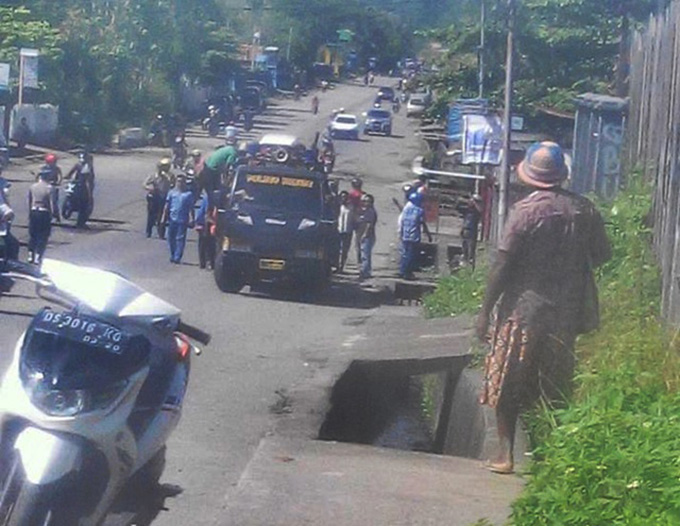
Masked gunmen ‘hijacked’ three ballot boxes in Western Highlands electorate of Mul-Baiyer. Video: EMTV News

By Elizah Palme in Port Moresby

Papua New Guinea’s Electoral Commissioner Patilias Gamato has defended the just-concluded two-week general election in the face of mounting condemnation.

Some polling is continuing in some delayed places while counting is underway in most electorates.

International election observers have reported “widespread” problems with the electoral roll that prevented thousands of people from voting.

The Commonwealth Observer Group called for an urgent review after the election to improve the accuracy of the roll.

In the interim report, chairman Sir Anand Satyanand, a former New Zealand governor-general, said: “The group was very disappointed to note that previous Commonwealth Observation Group reports that highlighted the need to address this issue of the common roll have yet to be implemented.”

-Partners-

In a press conference in Port Moresby yesterday, Gamato was asked a series of questions by the media, saying: “The issue for the funds for the allowances should not be the case now as the Electoral Commission has enough money to pay for the officers.”

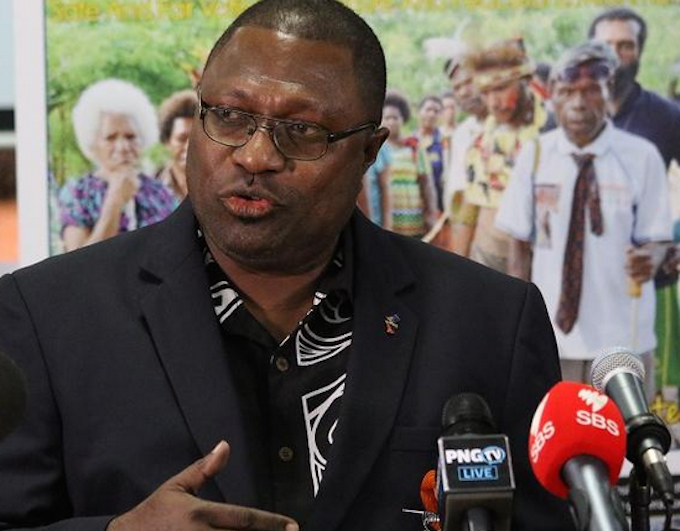
Electoral Commissioner Patilias Gamato fields questions at the media conference in Port Moresby. Image: EMTV News

Gamato was responding to questions about the K184,000 (NZ$80,000) allowance money confiscated from former NCD Election Manager Terence Hetinu, which the commissioner confirmed was with the police and undergoing investigation.

In response to the recent resignation of the Electoral Advisory Committee (EAC), the commissioner said the EC was in the process of “helping them out” in terms of logistics and finance, including the information they require.

‘Unfortunately they resigned’
“As we were processing that, it’s a pity unfortunately they resigned”.

He further said the EAC’s resignation is “premature”, stating that their role is to advise or recommend to the EC their grounds for failing of election.

“To this stage, I have not seen strong grounds across the country. Polling has progressed very well apart from issues like the issue of common roll which I’ve already addressed”

He said many people have voted “despite hiccups” with the electoral roll, but promised to address this after the election.

While stating that EAC did not have strong grounds to recommend a failed election, the EC told media the decision to fail the election was his.

“The decision to fail an election is mine”.

EMTV News coverage stories are republished with permission.

]]>

Autocracy strikes back: Media freedom under siege in Arabia

]]>

AsiaPacificReport.nz

ANALYSIS: By Dr Tarek Cherkaoui

Diplomatic quarrels in the Arabian Peninsula have a long history, and small Gulf States, such as Qatar, align themselves with stronger powers in order to confront regional threats. This was the case under Ottoman rule and British colonial rule.

However, after the British withdrawal from east of Suez in 1971, Saudi Arabia became the de facto protector of Qatar. This situation lasted until the early 1990s, when Saddam Hussein’s Iraq invaded Kuwait in 1990 and threatened to invade Saudi Arabia as well.

It became quickly apparent that the Saudis were unable to defend their own borders, let alone their neighbours’ too.

During that period, Qatar was mostly known for being “unknown”. However, its path was about to witness a major change at the hands of the Crown Prince at the time, and future Emir, Sheikh Hamad bin Khalifa Al Thani, who had a very different view on the future role of Qatar.

He sought from the onset to resist Saudi suzerainty, and relations between both parties reached their lowest points in February 1996, when an attempted coup against Qatar’s leader was foiled. Needless to say, Saudi Arabia, the United Arab Emirates (UAE) and Bahrain supported this coup attempt.

Fast-forward 20 years later, and the same players are back to square one. Only this time, the scope of hostile actions, speed of escalation, and toxic rhetoric directed at Qatar by the quartet —the aforementioned countries in addition to Egypt — has surprised most analysts.

-Partners-

In the absence of a manifest casus belli, one was swiftly manufactured. On 24 May 2017, unidentified hackers exploited a cyber-bug in the website of Qatar News Agency (QNA) to disseminate fabricated news. The fake report claimed that Qatar’s Emir was critical of the United States while praising Hezbollah and Hamas as resistance movements. The Qatari authorities immediately asked the United States for help, and a Federal Bureau of Investigations team led a thorough investigation. A few weeks later, Qatar’s attorney-general stated that communication used in the security breach originated from countries laying siege to Qatar.

Damage was done
By then, the damage was already done. Diplomatic ties were cut; Qatar’s airspace and shipping channels were blockaded; food supplies were stopped; Qatari nationals became persona non grata in three neighbouring countries at heavy human and financial costs; not to mention the other substantial economic and trade ramifications for the entire region.

Refusing to accept official Qatari denials about the fabrications planted in the QNA website, the anti-Qatar quartet issued an ultimatum of 13 demands to be fulfilled within ten days (extended by two days) before they would consider ending this blockade. The list included paying reparations, shutting down the Al Jazeera satellite-broadcasting network (AJ), curbing bilateral relations with Iran, closing a Turkish military base, and submitting to monthly external compliance checks.

In short, these demands constituted a frontal assault on Qatar’s sovereignty.

AJ’s closure was undoubtedly high in the list of demands, especially when considering that its website was also blocked by the four countries’ internet providers, and hotels were warned against airing AJ’s channels in their premises, or else they would pay hefty fines. The pressing question that comes to mind following these developments is the following: why is AJ in the crosshairs of the quartet?

In my view, there are three main reasons for this state of affairs. Firstly, AJ’s establishment in 1996 was part of a larger Qatar modernisation campaign, through which the leadership aspired to reinvigorate the state in order to accomplish noteworthy endeavours internationally, thereby asserting the country’s autonomy and distinctiveness in contrast to its Gulf neighbours in several areas, such as education, culture, sports, and media.

Concerning the latter, AJ has been a perennial irritant for autocratic leaders and dictators in the Middle East. Before AJ’s launch, government-controlled television was the defining feature of local and regional broadcasting in the Middle East. This meant that official Arab television media was no more than a mouthpiece for government policies. Their coverage consisted mainly of barren and repetitive broadcasts, mostly intended to sing the praise of the rulers’ actions. Even live interviews were not tolerated, as interviewees’ opinions had to be checked before being aired.

On the other hand, the Qatari leadership minimised any government interference with the AJ network’s affairs. Therefore, despite being launched as a state-financed satellite channel, the Qatari government’s subtle distancing made AJ look similar to the BBC rather than a state-controlled Arab network. In contrast to other Arab television networks, where little to no sensitive political, social, economic, or religious subjects were ever discussed, AJ introduced several talk shows that were fast paced, innovative, and daring.

Exemplifies the change
One weekly programme that exemplifies the change brought forward by AJ was Al Ittijah Al Mo’akis (The Opposite Direction). Launched in November 1996 (and it still airs today), this programme is presented by Faisal al-Kasim, a Syrian Druze, who had worked for the BBC for many years. The presenter spends the first two minutes asking questions that reflect positions on a chosen topic, and then opens the floor to two guests representing opposite sides of the spectrum.

Al Ittijah Al Mo’akis (The Opposite Direction) show “stirred up controversies and regularly features opponents of Arab regimes”. Image: Al Jazeera

The show stirred up controversies and regularly features opponents of Arab regimes. It also received plenty of official complaints and censure from these governments. For example, Abdullah Al Nafisi, a Kuwaiti intellectual who was the guest of this talk show, launched a salvo of criticism against the Gulf monarchs and attacked the Saudi religious establishment for ignoring major issues such as royal corruption.

As a result, Saudi authorities added more restrictions against AJ, and coerced the only Saudi journalist working for AJ to resign from the network. Also, on 27 January 1999, the programme hosted a debate about the then-raging Algerian civil war. The oppositional viewpoint clearly gained the upper hand in the debate, at which point the Algerian authorities cut the electricity supply to the capital Algiers (and other cities) to prevent the programme from screening.

Even Qatari governmental positions constituted no red line for the daring Syrian anchor, whose programme discussed Qatar’s overtures to Israel and hosted a professor of political science at Qatar University, who heavily criticised his government’s policies.

Al-Kasim wrote: “Al Jazeera’s editorial policy is so lax that I am hardly ever given orders regarding programme content. The station has an even wider scope of freedom than the BBC Arabic radio, where I worked for 10 years. I tackle issues that I never even dreamed of covering during my service at the BBC.”

With such editorial independence, AJ exposed the misdeeds of local regimes and served as a platform for opposition groups by airing controversial debates, and exposing corruption and widespread human rights abuses. The winds of freedom blown by AJ meant also that repressive regimes no longer had the monopoly over information. By transcending borders, AJ’s broadcasts were able to bypass the restrictive state media, connect with communities, challenge the official discourse, and expose the regimes’ lack of legitimacy.

This situation obliged autocratic Arab rulers to become much more attentive to public opinion. They viewed with deep scepticism this media institution, in which anchors and guests routinely deliberate democracy, good governance, and human rights. For them, AJ not only plays a big role in the development of free flowing information and freedom of expression, but also acts as an agency of representation that allow diverse social groups and classes to express their views that could, if left unchecked, start influencing decision making processes within their realms.

Everyone has a say
Arguably, AJ seems to echo the deliberative-discursive model of a Habermasian public sphere (1), for democracy is not just a voting-centric arena, in which fixed preferences and interests compete via mechanisms of aggregation. Rather, democratisation starts when everyone has a say. Voices rather than votes are the vehicle of empowerment.

Arab Spring demonstrations “called for an end to nepotism and corruption, improvement of economic conditions, establishment of democratic representation, and protection of human rights”. Image: TheDailyBlog

Secondly, when a series of uprisings and mass protests hit North Africa and the Middle East from January 2011 onwards — also known as Arab Spring — they confronted repressive regimes and military juntas. These demonstrations called for an end to nepotism and corruption, improvement of economic conditions, establishment of democratic representation, and protection of human rights.

AJ, through both its Arabic and English networks (AJA and AJE), was well positioned to cover these events. With AJA already enjoying strong pan-Arabic viewership, AJE targets different English-speaking markets, such as New Zealand where it is available on Sky and Freeview.

These networks both covered events in Tunisia, when a young vegetable cart owner called Mohamed Bouazizzi immolated himself after being humiliated by police, igniting several protests across the country. AJ was one of the first outlets to broadcast pictures of his self-immolation, even though its bureau had been closed for years by the Tunisian regime. Using mobile phone footage and social media, AJ outmanoeuvred both the regime and the competition by grasping very early the meaning and magnitude of the protests. They eventually brought about the demise of the Tunisian dictator; an outcome many in the region considered impossible.

The 24/7 coverage provided by AJ during the Arab Spring events, combined with viral social media, online blogging, and mobile telephony, vividly publicised the uprisings. This boosted the spirits of activists and encouraged more resistance and mass defiance. Jordanian Maisara Malass, an opposition activist, described AJ as a “media brigade” whose coverage had helped “to spread the revolution from one city to the other”.

AJ’s Arab Spring coverage was sharp and relentless, even if at times it was deemed more sympathetic to some forces (e.g. Muslim Brotherhood). Nevertheless, in Egypt, AJ’s reporting attracted world attention to the demonstrations and gave events a human dimension, thereby creating a bond between viewers in their living rooms and the protesters in Tahrir Square. When demonstrators ultimately forced former Egyptian President Hosni Mubarak to quit power, many people around the world embraced the narrative conveyed by AJ, whose journalistic efforts were rewarded with the Columbia Journalism Award (2011) bestowed by Columbia University’s Graduate School of Journalism.

On the other hand, the initial success encountered in some Arab Spring countries triggered heavy-handed reactions from the Gulf autocratic regimes, such as Saudi Arabia and the UAE, which felt threatened by the democratic advance in some countries (e.g. Tunisia).

Real-life Game of Thrones
Consequently, they interfered with and deteriorated the situation in these countries, inciting and materially supporting their proxies to use putsches, counter-revolutionary movements, false-flag terrorist groups, and extended repressive means. Such methods turned peaceful demonstrations into civil wars, as in Libya, Syria, and Yemen. However, even after the Saudi and UAE leaders have spent dozens of billions of dollars to restore the pre-2011 order, their proxies are still struggling to achieve dominance on the ground. Most importantly, their message has not won hearts and minds mainly because of AJ, which deconstructs the counter-revolutionary narrative at every turn.

Finally, with the election of President Donald Trump in the United States, the Middle East region is heading towards more upheavals. The Trump administration seems to have given the green light to a palace coup within Saudi Arabia, and helped the Deputy Crown Prince, Mohamed Bin Salman (MBS), jump the succession line, and establish himself as the upcoming king. Meanwhile, MBS has tied himself with the UAE, which is bent on pursuing its own regional influence as it aspires to become the little Sparta of the region.

Amid this real-life Game of Thrones, the Trump administration has also encouraged Arab allies to form a military alliance with Israel against common foes (e.g. Hamas). Governments that call for a solution to the Gaza conflict through international law (e.g. Qatar) found themselves ostracised by this new coalition. Therefore, the quartet’s blockade of Qatar aims by the same token to pre-empt AJ’s role in producing critical reporting in any expected war against the Palestinians.

It goes without saying that negative coverage of such war will be detrimental to its success, and the popularity of the participating regimes will undoubtedly suffer. One should not forget that it was the 2000 Al-Aqsa Intifada that really boosted AJ’s international profile. At that time, as dozens of Palestinians were killed by the Israeli army and thousands were injured, Western media resorted to self-censorship, while AJA aired graphic footage of death and demolition. This time around, the Israel-Arab coalition against terrorism (as coined by President Trump) wants no witnesses.

All things considered, a month after the start of the crisis, the latter continues unabated and a swift resolution seems remote. It is evident, however, that the quartet has a long standing score to settle with Qatar in general, and AJ in particular.

In my view, the illegal blockade and psychological warfare waged against Qatar are part of the on-going attempts to restore the status quo in the Middle East in favour of authoritarianism and against the advancement of media freedoms and quality journalism.

Leading NGOs, such as the Committee to Protect Journalists, Human Rights Watch and Reporters Without Borders, coupled with established news publications like The New York Times and The Guardian, noted such adverse development, and subsequently condemned the quartet’s efforts to undermine freedom of press and international law.

Dr Tarek Cherkaoui is the author of The News Media at War. He is an expert in the field of strategic communications with a career that spans a range of industries, including the creative industries, public, not-for-profit, and higher education. Dr Cherkaoui holds a master’s degree in strategic studies from the National University of Malaysia, and a PhD in media and communication studies from Auckland University of Technology, for which he obtained the 2010 Dean’s Excellence Award in Postgraduate Studies. Dr Cherkaoui’s research interests include the Arab transnational media, public diplomacy, propaganda and information control, soft power, media-military relations, political and military affairs – specifically within a Middle Eastern context. This article was commissioned by Asia Pacific Report and Pacific Journalism Review.

1. Jürgen Habermas is a German sociologist and philosopher in the tradition of critical theory and pragmatism. He is best known for his theories on communicative rationality and the public sphere. In The Structural Transformation of the Public Sphere (1989), Habermas argues that in a democracy-driven system, the activist public sphere is needed for debates on matters of public importance, and as well as the mechanism for that discussion to affect the decision-making process.

]]>

New Chinese-built Koura Way road construction on target in PNG

]]>

AsiaPacificReport.nz

NCD Governor Powes Parkop inspects Koura Way construction progress. Image: EMTV News

By Delly Waigeno in Port Moresby

Another major road construction in Port Moresby, the Koura Way, is expected to be completed in September.

It is being built by the China Harbour Engineering Company at a cost of more than K80 million (NZ$35 million) funded under a BSP Group loan.

National Capital District (NCD) Governor, Powes Parkop — who is a decisive early leader in the counting for his electorate in PNG’s 2017 general election — said the aim of the major road projects around Port Moresby was to ease traffic congestion and to promote a spread of businesses on the edge of the city.

Governor Parkop visited the construction site today to see that work progress has reached 60 percent complete.

He said the project was on schedule for the completion date of October 21.

The 4.5km four-lane road links Waigani Drive to the Hanuabada bypass. Initially, the road was supposed to connect Waigani Drive to the Badihagwa High School, but plans had changed.

-Partners-

About 250 energy saving lights will be installed to power up the road.

Other services
Parkop said the project had also provided a way for other services like water, sewerage, electricity and telecommunication services to be added to the area.

He said the project had generated about 400,000 cbm of fill materials — almost all of this being used for the Ela Beach redevelopment.

He said there were plans for another road to link Koura Way to Sir William Skate Highway to link at the Baruni Bypass.

If that materialises, them the second phase of Ela Beach would be completed.

Delly Waigeno is a senior journalist with six years of experience in the television industry. She has a Bachelor of Arts degree in literature and English communication with a minor in journalism from the University of Papua New Guinea. In 2012, she was awarded a Business Reporter of the Year commendation by the Media Council of Papua New Guinea.

]]>

150 reported arrested in new West Papua crackdown on activists

]]>

AsiaPacificReport.nz

Indonesian police making arrests in Nabire regency in the Indonesian-ruled province of Papua. Image: Tabloid Jubi

Pacific Media Watch Newsdesk

West Papuan solidarity groups have protested over reported mass arrests of Papuan activists in the Nabire regency over the past week.

Tabloid Judi reported that “hundreds of KNPB [West Papuan National Committee] activists” were arrested and transported by truck to Nabire police in Bukit Meriam, according to an eyewitness.

The Australia West Papua Association (AWPA) sent a protest letter to Foreign Minister Julie Bishop in Canberra at the weekend over the arrest and alleged torture of about 150 West Papuan people — including children — in Nabire.

The arrests reportedly happened between the June 30  and July 6, according to the Free West Papua Campaign.

Joe Collins of AWPA said: “It is pointless of governments to say Indonesia is now a democracy and human rights abuses are a thing of the past. The ongoing arrests of peaceful demonstrators prove otherwise.”

AWPA has urged the foreign minister to press the Indonesian government for the release of all West Papuan activists, human rights defenders and political prisoners.

-Partners-

AWPA letter to the Foreign Minister

The Hon Julie Bishop MP
Minister for Foreign Affairs
House of Representatives
Parliament House
Canberra ACT 2600

8 July 2017

Dear Foreign Minister,

I am writing to you concerning the arrest of approximately 150 West Papuan people, including children, in Nabire, West Papua. The arrests occurred between the 30 June and the sixth of July.

On the 30th June a West Papuan activist Yanto Waine went missing for 3 days and it emerged that he had been arrested on Mulia Road in Nabire. It was his arrest that led to a chain of events resulting in up to 150 people being arrested.

On hearing of his arrest, a peaceful demonstration was held on the 4 July calling for the release of Yanto Waine. This resulted in another 31 people being arrested. Although Yanto Waine was released on the 6th July approximately 150 people marched to the Indonesian police station in Nabire to call for the release of the remaining detainees. However, it was reported they were also arrested. The names of 104 people arrested have been confirmed.

According to members of the West Papua National Committee (KNPB), during the arrests people were kicked, punched, and beaten with guns, and rattan canes.

Previous arrests
On the 1st May this year up to 200 people were arrested by the Indonesian police in Sentani as they commemorated the tragic event in their history when the United Nations Temporary Executive Authority (UNTEA) handed the administration of West Papua to Indonesia on the 1st May in 1963 and on the 31 May another 77 members of the West Papua National Committee (KNPB) were arrested in Merauke.

It is also 19 years since the Biak Massacre. On the 6 July in 1998 the Indonesian security forces attacked peaceful demonstrators in Biak, massacring scores of people. The victims included women and children. They were killed at the base of a water tower in the town where the West Papuan people had raised their national flag. Other Papuans were rounded up and later taken out to sea where they were thrown off naval ships and drowned. No security force personal were ever charged over the killings.

It is pointless to say Indonesia is now a democracy and human rights abuses are a thing of the past. The ongoing arrests of peaceful demonstrators prove otherwise.

We urge you to use your good offices with the Indonesian government urging that all West Papuan activists, human rights defenders and political prisoners be released.

Yours sincerely
Joe Collins
AWPA (Sydney)

]]>

Gary Juffa: Why I was not on the PNG electoral roll and why we must act fast

]]>

AsiaPacificReport.nz

Oro Governor Gary Juffa … “many of the people in Papua New Guinea who had voted since Independence were unable to vote for the first time in their life.” Image: GJ-Facebook

OPINION: By Gary Juffa, Governor of Oro and a candidate in the PNG general election

Papua New Guinea’s incoming government must put a list of urgent 100 days agendas to attend to immediately upon taking office and put the necessary resources to address them and an effective management system of monitoring, review and redirection.

Right up there on that list  must be a diagnostic review of the 2017 national elections.

Basically this review will highlight what happened, what went wrong, why, who was responsible and what needs to happen to improve and ensure a democratic transparent effective election in 2022 so that the people’s constitutional rights to elect their parliamentary

Here was my experience this week:

On Wednesday, I voted at Iora, Kokoda. But only after some time.

Yes, my name was not on the Electoral Roll 2017. Even though I had made sure my details were updated. Even though I checked the website and it had my name listed and at the location and yet on Wednesday I was not on the 2017 Roll.

-Partners-

I was finally allowed to vote because I was a candidate as per provisions of the law that allowed for this. In other words, if I could not vote because I was not on the 2017 Electoral Roll that would be a blatant and very explicit fact showing that the 2017 rolls were not effectively updated.

Others should vote too
I asked if others can vote too since that was only fair. Since the Prime Minister, Peter O’Neill, who was also not on the 2017 roll was allowed to vote and I was allowed to vote, why couldn’t every other person who had voted in 2012 and before be allowed to vote.

I was informed by polling officials that they were instructed that only the 2017 Electoral Roll was to be used and not the 2012 electoral roll or the preliminary roll.

I spoke to many frustrated and angry people who declared that they had made sure their names were updated and yet they were not on the 2017 roll and thus unable to vote.

From my discussions it could be concluded that in some instances more then 40 percent of the people were turned away in some areas and in some areas even higher numbers with percentages as high as 70 percent quoted by observers and scrutineers.

Some of the stories they told were simply infuriating and one can only be bitterly aware that this People’s National Congress (PNC) government led by Peter O’Neill does not care for the people of Papua New Guinea.

Many who found their names were not in one area had to travel a fair distance to other stations to search for their names to vote. In the case of the aged and elderly, mothers who had young children to tend to or those with disabilities and those with no financial means, this was too much. How sad.

Many found the polling officials unhelpful and barely aware of their duties and functions. I noted several young high school students who had no prior work experience.

Wide open to electoral fraud
Meanwhile, the process was so wide open for electoral fraud that it would be so easy for those with some intent and planning to be able to commit electoral fraud with much ease and little chance of detection or deterrence.

Many claimed that the process of updating the roll was hindered simply because papers for recording this process “ran out”.

Not a few expressed anger that people who had no experience and qualifications and some of dubious character had been engaged to do this and some had not even bothered to go out to do their work. The work itself was so poorly coordinated that it could not be described in anyway as being “effective”.

One such person was chased and stoned today in Kokoda when sighted as he had been responsible for a significant percentage of voters being turned away.

Several of my aged aunts and uncles were visibly sad and angry as they were unable to exercise their democratic right to vote. One told me that they felt that this may be their last time to be able to vote and yet they could not vote even though they had voted ever since PNG attained independence on 16 September 1975.

In fact, many of the people in Papua New Guinea who had voted since Independence were unable to vote for the first time in their life. Many were frustrated and sad. This was a huge negative psychological experience for them

It is apparent to many that the ruling PNC and O’Neill are arrogant and totally inconsiderate of the people of Papua New Guinea to exercise their democratic right to elect their representatives into Parliament.

If they were not, they would have done everything possible to ensure that this election was not such a failure.

]]>

Strip medals from French Rainbow Warrior saboteurs, says Star-Times

]]>

AsiaPacificReport.nz

Pacific Media Centre’s Alistar Kata profiles the legacy of activism from the 1985 Rainbow Warrior voyage to Rongelap Atoll in the Marshall Islands. Video: PMC

Pacific Media Watch

A New Zealand Sunday newspaper today called on France to strip former spy Christine Cabon and other French saboteurs who bombed the Rainbow Warrior in Auckland Harbour on 10 July 1985 of their Legion of Honour medals.

The Sunday Star-Times, which devoted the front page and a double inside page spread to an exclusive interview with retired French secret service agent Cabon in a small village in the Pyrenees foothills, described the death of Portuguese-born Dutch photographer Fernando Pereira in the bombing as a “cowardly assassination”.

The editorial by editor Jonathan Milne said a past apology from France was “sullen and churlish”.

“The apology extracted from France in the UN-mediated settlement was sullen and churlish. If France wishes to show it genuinely regrets the 1985 bombing, there is one simple and meaningful action it must take: France must strip Christine Cabon and the other Rainbow Warrior saboteurs of their Legion of Honour medals

Photographer Fernando Pereira … killed in the callous French 1985 attack on the Rainbow Warrior. Image: David Robie/Eyes of Fire

“There is nothing honourable in the cowardly assassination, by combat divers in the dark of night, of a defenceless peace activist in a friendly nation.“Then, we might forget.

“Every year at Anzac Day we make a promise to our heroes: We will remember them.

-Partners-

READ MORE: Full stories at Sunday Star-Times/Stuff

‘No heroes’
“The terrorists who sunk the Rainbow Warrior are no heroes. It would be good to consign these men and women to the ignominy of mere footnotes in history.

“We should not remember them.”

The editorial also criticised NZ Prime Minister Bill English for refusing to comment on the revelations about Cabon, lest it “sour relations with France”.

Christine Cabon, a French secret service (DGSE) undercover spy, infiltrated Greenpeace New Zealand as a 34-year-old volunteer by posing as environmental activist Frédérique Bonlieu..

Her assignment was to gather critical information and travel details about the planned protest voyage of the Rainbow Warrior to the French nuclear testing site of Moruroa Atoll, southwest of Tahiti, after the Greenpeace environmental flagship arrived in New Zealand from its humanitarian mission to Rongelap Atoll in the Marshall Islands during May 1985.

In an investigation by Cecile Meier and Kelly Dennett, headlined “We are the terrorists”, Cabon, now 66, was revealed to be a town councillor – and former deputy mayor – of the small village of Lasseubetat (pop. 250) in the department of Pyrenees-Atlantiques, and highly thought of by the local community.

‘Cagey at first’
A Sunday Times front page lead-in report headed “Rainbow Warrior spy speaks out” and bylined by Cecile Meier, said about the agent’s 32-year silence: “Though cagey at first, Cabon eventually provided details of her infiltration of Greenpeace. She stood by her subterfuge, saying military officers ‘can find themselves in situations they hadn’t wished for’.

Former French spy Christine Cabon today … and in 1985. Image: Ascencion Torrent/Sunday Star-Times

“Yet to New Zealanders, she conceded, “we are the terrorists”.“Whoever ordered the mission, whatever the reasons, good or bad … what we did, it’s called an attack.”

The Sunday Star-Times interview was part of a longer report for La République des Pyrénées newspaper in France.

Cabon left New Zealand six weeks before the bombing, initially travelling to Tahiti, Israel and then on to France — and vanished from public gaze. After her espionage cover was blown, she ended up on desk jobs in the French military and retired as a colonel when she was 58.

She was decorated with the Legion d’Honneur, as were Dominique Prieur and Alan Mafart – the only agents of about 13 involved in the Rainbow Warrior bombing operation to be arrested (and jailed, albeit for a shorter term than their 10-year sentences). Both wrote books about their role in the saga.

In September 2015, the saboteur who planted the bombs on the Rainbow Warrior, Colonel Jean-Luc Kister, publicly admitted his role and “apologised” on Television New Zealand.

‘Small children’
The Sunday Times editorial said most New Zealanders did not remember the 1985 Rainbow Warrior bombing – “they were small children, or not even born”.

“And they do not remember the perversity of the deal struck with the French government for this abhorrent piece of state-sponsored terrorism: a paltry $13 million compensation, an apology begrudgingly delivered in person years later, and the promise that the only two agents apprehended would serve just three years of their 7 to 10-year prison sentences on the tropical Hao Atoll, a “Club Med” style military base in French Polynesia.

“They do not remember our own government agreeing to this limp slap on the wrist for France, fearful that if we protested it might imperil our lamb and dairy trade with the European Union.

“Crime upon crime, indignity on indignity.

“Yet maybe there is something to the blissful ignorance of younger New Zealanders, born after 1980. Little is to be achieved by dwelling on old injustices.”

Greenpeace New Zealand executive director Russel Norman told the Sunday Star-Times it was “sad” Cabon could not see her actions were wrong.

“You have one life on this planet and it’s pretty short. And that is how you want to use it — helping to kill a peace activist?”

Pacific Media Centre director Professor David Robie, author of a book about the Rainbow Warrior bombing and the Rongelap humanitarian mission, Eyes of Fire, said the Sunday Times revelations again exposed the hypocrisy of the global “war on terror”.

“This was an attack on a peaceful environmental ship by a friendly nation – state terrorism. And it included the shocking murder of a friend and colleague, Fernando Pereira, whose family never received real justice.

“Such a callous act will never be forgiven, or forgotten.”

The front page report in the Sunday Star-Times today. Image: PMC
]]>

Timor, Indonesia vote for NZ-backed ‘gift for future’ nuclear-free ban

]]>

AsiaPacificReport.nz

UN disarmament chief Izumi Nakamitsu flags new challenges facing the disarmament agenda in the 21st century. Video: UN News

Pacific Media Centre Newsdesk

Timor-Leste and Indonesia have both joined the growing international consensus to abolish nuclear weapons.

Both countries — along with New Zealand — voted in favor of a new UN treaty prohibiting nuclear weapons, reports ETAN.

The Treaty on the Prohibition of Nuclear Weapons will open for signature
by states at the United Nations in New York on September 20.

READ MORE: Background to the UN nuclear weapons prohibition treaty

Television New Zealand reports that Aotearoa/NZ and more than 120 other states voted in favour of the final text of the treaty on the Prohibition of Nuclear Weapons during the final session of the UN Conference to Negotiate a Legally Binding Instrument to Prohibit Nuclear Weapons in New York.

-Partners-

New Zealand was a vice-president of the UN conference and the Ministry of Foreign Affairs and Trade worked over the past five years on the initiative to ban nuclear weapons.

“Its potential to end the threat of nuclear destruction is a gift for future generations,” Peace Movement Aotearoa said.

However, Foreign Affairs Minister Gerry Brownlee said none of the states that took part in the negotiations actually possess nuclear weapons, reports TVNZ.

“We need to be realistic about the prospects of this treaty leading to a reduction in nuclear weapons in the short term. However, the treaty is an important step towards a world free of nuclear weapons, which has been a long-held goal for New Zealand.”

The treaty bans the development, testing, production, manufacture, possession, transfer, use or threat of use, deployment, installation or stationing of nuclear weapons and other nuclear explosive devices.

Nuclear-armed states have a “clear pathway” to join the treaty as well, and destroy their nuclear weapons in a time-bound, verifiable and irreversible manner.

“Some countries like New Zealand have already enacted a national ban on nuclear weapons. This treaty now provides the first legal prohibition on nuclear weapons at a global level,” Brownlee said.

New Zealand is expected to be one of the first states to sign and ratify the treaty when it opens for signature.

]]>

Tallis Obed Moses sworn in as President of Vanuatu

]]>

AsiaPacificReport.nz

Vanuatu’s President Tallis Obed Moses at the swearing in ceremony. Image: People’s Digest Online

By Bob Makin of Vanuatu Digest in Port Vila

Pastor Tallis Obed Moses has been sworn in as President of the Vanuatu Republic.

Nineteen votes secured this victory, which was warmly acknowledged by all dignitaries and Electoral College people present at the ceremony yesterday.

The new occupant of the highest constitutional position paid a highly articulate tribute to his predecessor, President Baldwin Lonsdale who died suddenly from a heart attack last month while serving in office.

Then President Moses, 63, took centre place as kastom ceremonies were performed outside Parliament where the election took place.

President Moses was trained in theology and evangelism in Vanuatu and Australia.

He has previously served as moderator of the Presbyterian Church General Assembly and as parish pastor in half a dozen parishes from Erromango to Luganville.

-Partners-

He stresses the need for unity in Vanuatu — the kind of unity which enabled Vanuatu leaders to achieve the unity of the republic as was desired at Independence.

In other Vanuatu news: the government, municipality and police are determined to avoid the level of violence recently experienced in a Port Vila nightclub, including two tragic deaths.

Police are taking strong action against premises which do not follow their licensed requirements, copies of which must be produced on demand to the uniformed officers.

Patrons are required to carry identity papers showing date of birth.

]]>

From ‘anticipation, excitement’ to dictatorship fears in PNG election

]]>

AsiaPacificReport.nz

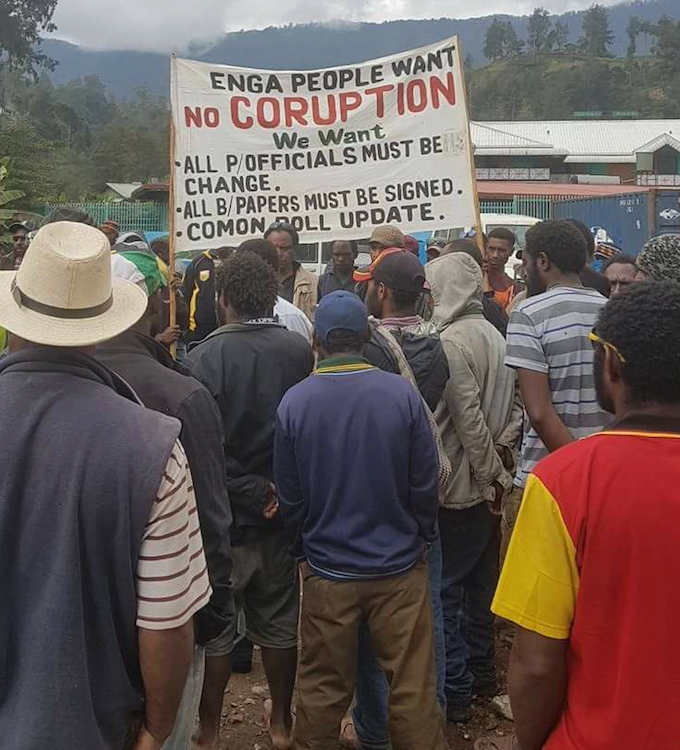
Engan voter protesters in Wabag demand “no more corruption”. Image: Peter S. Kinjap

As polling draws to a close in Papua New Guinea this weekend and with counting still underway, Pacific Media Watch looks back at the highs and lows of the country’s 2017 general election.

Feelings of “anticipation, excitement” first gripped Papua New Guinea as polling opened last month.

Auckland University of Technology doctoral candidate Stephanie Tapungu and her husband Kenneth told PMW’s weekly Southern Cross radio programme on 95bFM that rising female representation and online engagement were a source of hope.

The PNG Electoral Commission reports the number of female candidates standing in the two-week election beginning on June 24 comprised 165 of the total 3332 candidates.

The only province that did not register a female candidate is West New Britain.

Kenneth Tapungu told Southern Cross:

“There’s been a rise in women’s numbers, candidates, and this has in a way really changed the dynamic of the game itself and this has really challenged the existing status quo of elections and campaigns.”

-Partners-

But the anticipation and excitement was short-lived and quickly descended into condemnation of the state of the electoral common roll as thousands reported they had not been listed, despite registration, and also disruptions as reported a week later on PMW’s Southern Cross.

Ballot paper chaos
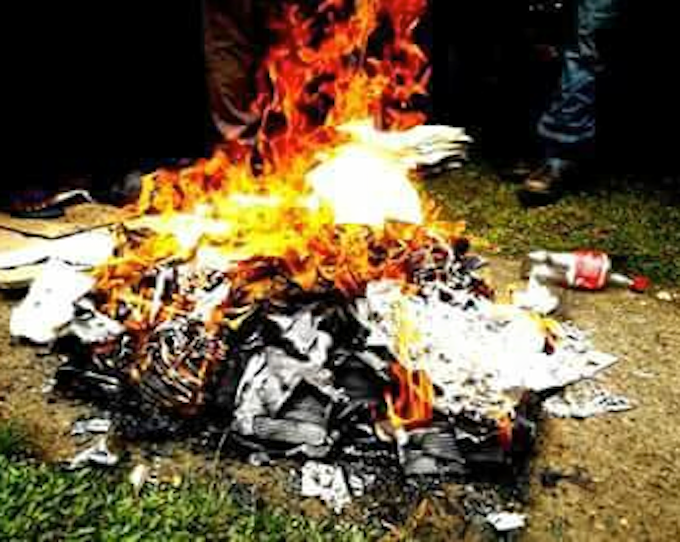
In Lae, students set fire to ballot papers in protest, while others at Unitech missed out on voting as only 1100 ballot papers arrived for a voting population of 5000.

Similar stories were echoed across Papua New Guinea as 4000 to 5000 students in Goroka were denied the chance to cast a ballot.

At the University of Papua New Guinea, voting again did not take place due to a lack of ballots.

Only 1200 ballot papers arrived from the Electoral Commission instead of the expected 5000.

Allegations of corruption, calls for resignations, and fears of a dictatorship soon emerged, even as Prime Minister O’Neill shrugged off polling chaos.

He told EMTV News the 2017 elections were a “dramatic change” from the previous three due an apparent lack of violence and no “hijacked” electoral process.

“I hear comment from election observers that delays like this are common in developing country elections, particularly with remote and rugged terrain and diverse cultures,” O’Neill said.

Fears of dictatorship
But O’Neill’s comments did nothing to dissuade Gary Juffa, Oro’s current governor and an opposition candidate in the elections, from expressing his fears Papua New Guinea was heading for a dictatorship.

“We are inching closer to dictatorship and ensuing bloodshed and violence that must come from the hostility towards it. But like lemmings and sheep, we are led to that reality with little resistance at all. Is this the Papua New Guinea we all believed in once upon a time?”

Juffa claimed the elections have been rigged – “deliberately set to fail” – due to fraud and issues at the polls.

Peter S. Kinjap reported for Asia Pacific Report that rival Ialibu candidates had also accused O’Neill of “rigging” the elections “from the start”.

The plethora of missing voter details across Papua New Guinea, despite concerted efforts made to update them, was further evidence of the country’s fall from democracy, Juffa said.

“This will mean that democracy certainly did not prevail in this instance. In fact, many will probably agree that come the end of these elections, democracy was hardly a reality everywhere in Papua New Guinea.”

PNG Attitude’s Keith Jackson said recent developments mean the international election observer team are “duty bound to investigate when reaching their conclusion on whether this election has been free and fair and provided a just result”.

Election disruptions, problems
Enga’s vote being deferred amid election disruptions and polling problems were some of the developments called to mind, he said.

Also amidst all of the chaos at the polls Electoral Commissioner Patilias Gamato told reporters he would not resign in his quest to ensure the general election is “run smoothly”.

A day after Gamato’s statement, four senior election officers were arrested for carrying K185,000 (NZD$80,000) in cash and suspicious documents, cancelling Port Moresby’s one-day polling.

There are also fears the elections could be deemed a failure, Kenneth Tapungu told Asia Pacific Report yesterday.

He says Prime Minister O’Neill voted in his village – Kauwo, in Pangia Southern Highlands province – on a Sunday, which contravenes the country’s constitution.

Stephanie Tapungu, whose countenance was positive as polling opened, now reflects:

“The elections were planned to be a failure from the start. It started out positive, but so much happened – from ballot boxes being lost and mix ups, to deferral of counting and polling, and the suspension of election managers. This election was just full of drama.”

]]>

Lone dissenting Filipino judge – ‘Why I voted against martial law’

]]>

AsiaPacificReport.nz

Philippines Supreme Court Associate Justice Marvic Leonen … the reasons for his dissenting legal opinion as shared on twitter. Image: Philippine Star

By JV Arcena of InterAksyon in Manila

Saying the Philippines needs to wage the long, hard fight against terrorism but cannot do it at the expense of rejecting all that it believes in, the lone dissenter in the Supreme Court ruling upholding the legality of martial law in Mindanao turned to Twitter this week to explain his vote.

The Philippines Supreme Court … 11-3-1 majority upheld martial law. Image: Philippine Star

Associate Justice Marvic Leonen said: “We all need to fight the long war against terrorism. This needs patience, community participation, precision and a sophisticated strategy that respects rights while at the same time using force decisively at the right time and in the right way.

“The terrorist wins when we suspend all that we believe in. The terrorist wins when we replace social justice with disempowering authoritarianism.”

The Maute Group and other extremists sowing mayhem in Marawi City should be known for what they, terrorists and not rebels with a definable cause, and therefore should be dealt with decisively by state forces – for which, he said, the military and security agencies were fully mandated and equipped to deal with. Martial law was not needed for this, Leonen said.

On Tuesday (July 4), the Supreme Court, voting 11-3-1, upheld the constitutionality of Proclamation 216 imposing martial law in Mindanao for 60 days, to allow the government to quell the Maute Group-led terrorists that laid siege to Marawi City.

Eleven justices upheld the proclamation; three upheld it, but wanted it limited only to Marawi; while one justice – Leonen – dissented.

Part of the “dissent” twitter feed. Image: PMC

-Partners-

Parts of Associate Justice Marvic Leonen’s dissenting opinion, as tweeted:
I honour the sacrifices of many by calling our enemy with their proper names: terrorists capable of committing atrocious acts. They are not rebels desirous of a viable political alternative that can be accepted by any of our societies. With their plans disrupted and with their bankrupt fanaticism for a nihilist apocalypse, they are reduced to a fighting force violently trying to escape. They are not a rebel group that can hope to achieve and hold any ground.

History teaches us that to rely on the iron fist of an authoritarian backed up by the police and the military to solve our deep-seated social problems that spawn terrorism is fallacy. The ghost of Marcos’ Martial Law lives within the words of our Constitution and rightly so. That ghost must be exorcised with passion by this Court whenever its resemblance reappears.

Never again should this court allow itself to step aside when the powerful invoke vague powers that feed on fear but could potentially undermine our most cherished rights. Never again should we fall victim to a false narrative that a vague declaration of martial law is good for us no matter the circumstances. We should have the courage to never again clothe authoritarianism in any disguise with the mantle of constitutionality.

We all need to fight the long war against terrorism. This needs patience, community participation, precision and a sophisticated strategy that respects rights while at the same time using force decisively at the right time and in the right way. The terrorist wins when we suspend all that we believe in. The terrorist wins when we replace social justice with disempowering authoritarianism.

We should temper our fears with reason. Otherwise, we succumb to the effects of the weapons of terror. We should dissent – even resist – when offered the farce that Martial Law is necessary because it is only an exclamation point.

For these reasons, I dissent.

Legal powers need
In my view, respondents have failed to show what additional legal powers will be added by Martial Law except perhaps to potentially put on the shoulders of the armed forces of the Philippines the responsibilities and burdens of the entire civilian government over the entire Mindanao region. I know that the Armed Forces of the Philippines to be more professional than this narrative.

With due respect to my colleagues, I cannot join them in their acceptance of the President’s categorisation of the events in Marawi as equivalent to the rebellion mentioned in Article VII Section 18. In conscience, I do not see the situation as providing for the kind of necessity for the imposition of Martial Law in Marawi as well as throughout the entire Philippines.

Rather, I read the situation as amounting to acts of terrorism which should be addressed in a decisive but more precise manner. The military can quell the violence. It can disrupt many of the planned atrocities that may yet to come. It can do so as it had on many occasions in the past with the current legal arsenal that it has.

The words we choose can have violent consequences.

Characterising or labeling events on the basis of the categories that law provides is quintessentially a legal act. It is not a power granted to the President alone even as commander-in-chief. It is the power wielded by this country’s judiciary with finality. Through that power entrusted to us by the sovereign Filipino people, we temper the potentials of force. We ensure the protection of rights which embed our societies values; the same values which the terrorist may want us to deny or destroy.

I acknowledge the hostilities in Marawi and the valiant efforts of our troops to quell the violence. I acknowledge the huge pain and sacrifice suffered by my many of our citizens as they bear the brunt of violent confrontations. I share the suffering of those who, in moments of callous reaction by members of a majority of our society influenced by a postcolonial culture of intolerance, have to live through the stigma of undeserved stereotypes. To be Muslim has never meant complicity with the misguided acts of fanatics who appropriate religion for irrational selfish ends.

We should dissent – even resist – when offered the farce that Martial Law is necessary because it is only an exclamation point.

#dissent

]]>

Keith Jackson: Despatches from the election front – ‘despite chaos all goes well’

]]>

AsiaPacificReport.nz

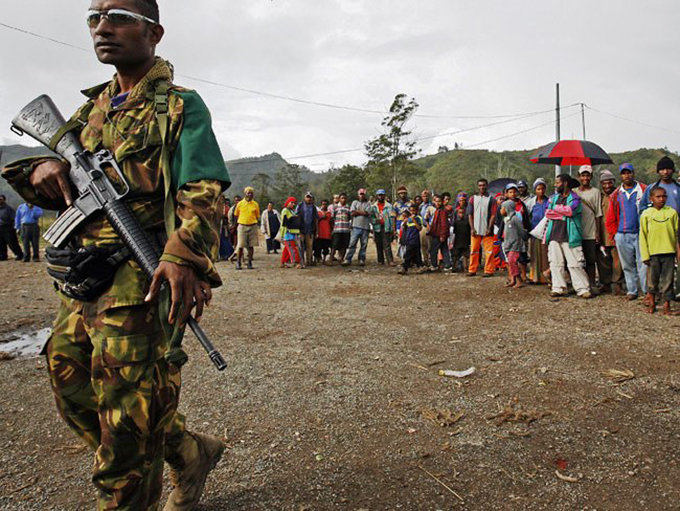
A soldier guarding the Wapenamanda polling station in Enga in the PNG Highlands. Image: PNG Attitude

BACKGROUNDER: By Keith Jackson, publisher of PNG Attitude

Papua New Guinea has long luxuriated in the bright light of the soubriquet, “Land of the Unexpected’, but this 2017 general election has exceeded all of those unexpectations.

Here are some of the more recent developments that the unfortunates on the international election observer team (already once verballed into seemingly endorsing the poll) are duty bound to investigate when reaching their conclusion on whether this election has been free and fair and provided a just result.

Enga vote deferred amid new election disruptions (Peter Kinjap – Asia Pacific Report): Polling in Enga was deferred as the majority of candidates raised grievances and electoral roll problems again surfaced. All MPs except those loyal to Peter O’Neill’s government said election manager Anton Yamau “must not hold Enga people in ransom”.

Gamato must not declare Ialibu-Pangia first (Sir Mekere Morauta, Kerenga Kua, Patrick Pruaitch, Ben Micah and Sam Basil – Joint Media Statement): Electoral Commissioner Patilias Gamato must not further undermine the integrity of the national election by declaring Peter O’Neill’s Ialibu-Pangia seat ahead of other seats. Doing so would send a clear signal to Papua New Guineans that election manipulation is continuing with the aim of forming a PNC-led government. The declaration of Ialibu-Pangia first in the 2012 election undoubtedly gave an advantage to PNC candidates in seats where voting was continuing. There must not be a repeat.

Vital initiatives to be taken to improve electoral roll (Matthew Vari – PNG Post-Courier): Electoral Commissioner Gamato said negotiations would begin with a new PNG government to undergo the vital initiatives to improve the electoral roll. He said the Electoral Commission operated like any government institution with budgetary constraints. “We requested a higher allocation of funds than that which was provided to us, but we must now work within our financial limits. We will persevere and continue to manage this election, despite these challenges,” Gamato said.

PM removed police unit trying to stop election fraud (PNG Blogs): Peter O’Neill intervened in the election process in Pangia after he told Police Commissioner Gary Baki to remove a mobile police unit from Wabag where it was tasked in looking after ballot boxes for Pangia. The unit had a confrontation with one of the prime minister’s bodyguards after a polling official removed scrutineers who were not supporting the prime minister. The bodyguard made a call to the PM who demanded the unit be removed from Pangia.

-Partners-

Polling area at University of PNG campus in Port Moresby – University students’ names not on PNG electoral roll (Radio New Zealand International): Many University of Papua New Guinea students are among those denied a chance to vote in this year’s election. Student Gerald Tulu Manu-Peni said he made sure his name was on the roll in March, but found his name missing when he and others in the National Capital District went to vote last Friday. Manu-Peni said at least a couple thousand student voters missed out on voting. “Not only students at the university but all around the country this is the same problem going on, so it seems that there is really something wrong somewhere,” he explained.

Armed attack in Hela to destroy ballot boxes (Malum Nalu & James Gumuno – The National): Armed men have attempted to destroy ballot boxes stored in containers at Tari police station. Assistant Police Commissioner Kaiglo Ambane said candidates and their supporters armed with high-powered guns exchanged fire with members of the security task force guarding the boxes. The security forces held their ground, forcing the armed men to retreat after around 30 minutes of fighting. “There are no casualties from the security forces. I do not know about the candidates and their supporters,” he said.

Police commander seeks permission to arrest candidates (Helen Tarawa – The National): Northern police commander Chief Inspector Lincoln Gerari is seeking approval from Police Commissioner Gari Baki to arrest two candidates for alleged bribery and discharging a firearm in public. Gerari said only Baki could give approval for the arrest of candidates during the elections. He said there was a direction from Baki not to carry out any arrests until after polling.

PNG election ‘progressing well’ despite polling problems (Liam Fox – ABC): Elections are progressing well despite thousands of people being prevented from voting, electoral commissioner Patilias Gamato says. He said the election could not be declared a failure. But just over halfway into the two-week polling period, thousands of voters are crying foul after being told their names were not on the electoral roll. Others have been prevented from voting because of a lack of ballot papers at some polling booths. Despite the problems, Gamato said voting was “progressing well” and would be completed on time in most electorates.

]]>

Green MP Delahunty calls for NZ action, media focus on West Papua

]]>

AsiaPacificReport.nz

Ashleigh McCaull’s video story. Video: PMC YouTube channel

Pacific Media Centre Newsdesk

Final year Bachelor of Communication Studies student journalist Ashleigh McCaull at Auckland University of Technology talks to Green MP Catherine Delahunty about the West Papuan human rights violations and lack of New Zealand political and media interest.

Delahunty calls for stronger action from the NZ government and better coverage of the issue of the Indonesian-ruled Melanesian region from the media.

“If everybody understands the story, then they’re going to show the same solidarity as Pacific nations show for the West Papuan people,” she says.

WARNING: Some viewers may find some scenes in this story distressing.

]]>

Women challenge ‘glass ceilings’ in Papua New Guinea

]]>

AsiaPacificReport.nz

Leanne Jorari interviews Susil Nelson-Kongoi, a “pawa meri”. Video: EMTV News

By Leanne Jorari of EMTV News in Port Moresby

Our society is evolving rapidly and a clear way to measure this transformation is the way Papua New Guinea women are seen and promoted.

Women across the country and the Pacific have been bolder and more vocal than ever before — shattering glass ceilings in sectors and industries across the board, and demanding gender equality and women’s empowerment.

In the current elections, the Electoral Commission says the highest ever number of women candidates are contesting for 111 seats in Parliament.

Out of a total of 3332 candidates, 165 are women — 30 more than in the last election in 2012.

In our largely patriarchal society, it’s no secret that over the years, women have faced unavoidable challenges in order to be heard and seen. Some may even argue that women face harder obstacles then men.

-Partners-

So the women that have surmounted all odds and smashed glass ceilings, while making their way to the proverbial “top”.

‘Pawa meri’
Celebrated for their accomplishments, many of these women are given the titles “Pawa Meri” — “power women”.

EMTV News spoke to Susil Nelson-Kongoi, a “pawa meri” in her own right, about her challenges and what knowledge she could impart to aspiring female leaders.

To celebrate the great leaders and to share ideas and stories, leading women across sectors in leadership across the Torres and the Pacific gathered today for a Pacific Leadership and Governance Precinct panel discussion.

The panel was held to coincide with this year’s NAIDOC week, which celebrates the history, culture and achievements of Aboriginal and Torres Strait Islander peoples.

Visiting was Vonda Malone, the first indigenous woman to be mayor for the Torres Shire Council. She shared her experiences of being a woman of colour in Australia and how she won in a male-dominated council.

EMTV News stories are republished with permission.

]]>

Deportation of NZ missionary ‘will not be taken lightly’, says archbishop

]]>

AsiaPacificReport.nz

Deported New Zealand missionary talks to Pacific Media Watch in an exclusive interview about his ousting from Papua New Guinea over alleged visa violations.

By Kendall Hutt in Auckland

The deportation of a New Zealand missionary from Papua New Guinea last month has prompted calls for a new government.

With elections firmly underway in Papua New Guinea, Rabaul Archbishop Francesco Panfilo says the deportation of New Zealand missionary Douglas Tennent remains an issue, whatever government is in power.

“I want to inform all [sitting] candidates and aspiring candidates for national elections that neither the Archdiocese of Rabaul nor the Catholic Bishops’ Conference will take this matter lightly as it seems to imply that to work for justice is outside of a ‘religious worker’ status.”

His call comes after Tennent, who has been working as an administrator for the Archdiocese of Rabaul since June 2014, was deported on June 12, 2017, over an alleged breach of visa conditions.

Authorities claim Tennent was deported due to “blatant abuse” of his special exemption/religious worker visa after engaging in “sensitive landowner issues in East New Britain Province”.

-Partners-

However, both Tennent and Archbishop Francesco Panfilo hold firm to the belief Tennent is “just doing his job”.

Tennent was deported after some landowners lodged a complaint regarding his involvement in “sensitive landowner issues”.

Palm oil involvement
It is believed the complaint comes due to Tennent’s involvement in remedying a special agricultural business lease regarding Malaysian multinational Rimbunan Hijau’s Sigite Mukus oil palm project in West Pomio.

Archbishop Panfilo states Tennent is only involved in settling these disputes on his behalf.

“Mr Tennent was providing legal advice to the archbishop, who was asked by the people of West Pomio to speak up for them.”

The actions of immigration authorities – Foreign Affairs Minister Rimbink Pato and acting Chief Migration Officer Solomon Kantha – have also raised questions about the innocence of Prime Minister Peter O’Neill’s government in the matter.

“Any ordinary person knows that orders of this kind cannot be given unless there are powerful and wealthy institutions and personalities behind.

“For the sake of the ordinary and innocent people of Papua New Guinea, we ask the Government to come clear once and for all,” says Archbishop Panfilo.

“Let us pray that the upcoming National Elections may give us leaders who are committed to the achievement of a just and peaceful society,” he says.

Religious workers role
Tennent told NZ Catholic in their latest edition last Sunday his deportation had pitted Papua New Guinea’s government against the Catholic Church.

Tennent “deported unjustly” … in this week’s issue of NZ Catholic. Image: PMC

“I think they didn’t realise when they did the deportation that it wasn’t about me. It was about the whole role of religious workers,” he said.

This is echoed by Archbishop Panfilo:

“To advocate for the vulnerable and powerless, which is the situation of the people of West Pomio, is a gospel mandate, just as it is to educate and care for sick people.

“It is the duty of any religious worker and of any Christian for that matter, to give effect to the teachings of Christ in word and action. One wonders why those who expose these evil practices should be deported and not the ones who commit them”, Archbishop Panfilo said.

Tennent remains in New Zealand, anxiously awaiting news from authorities in Papua New Guinea about whether he can return.

He is currently in the process of re-applying for a new visa and is planning court action against the government.

]]>

Keep fossil fuels in ground, say Pacific groups demanding ‘real climate action’

]]>

AsiaPacificReport.nz

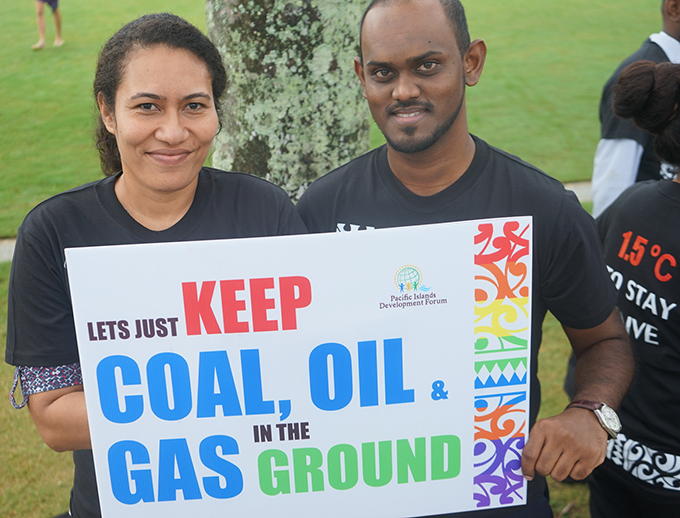
A message from PICAN activists at the University of the South Pacific in Fiji … keep fossil fuels in the ground. Image: PICAN

Pacific Media Centre Newsdesk

As Pacific leaders gather in Fiji, civil society groups are urging them to take the strongest possible climate message to the world.

Leaders from Pacific small island developing states (P-SIDS), Australia and New Zealand have just concluded a two-day Climate Action Pacific Partnership (CAPP) event.

They considered efforts to tackle climate change in the region through the spirit of collaboration and partnership, including Pacific Islands’ key demands for the UNFCCC Conference of Parties in November, over which Fiji is presiding.

Yesterday’s afternoon talanoa session at CAPP, led by the Pacific Island Climate Action Network, introduced a proposal by which Pacific Islands could leave a powerful legacy within global climate governance.

Roderick Campbell, economist from the Australia Institute; Emele Duituturaga, executive director of Pacific Island Association of NGOs; and Ambassador Albon Ishoda, from the Marshall Islands government; discussed the environmental, social and economic benefits of an international moratorium on the development and expansion of fossil fuel extraction industries, and accelerating the transition to 100 percent renewable energy.

Campbell said: “We can’t address climate change while we are still planning for new coal mines and more oil and gas exploration. A world addressing climate change needs less fossil fuel not more.

-Partners-

“A moratorium on new coal mines makes economic sense as it supports workers in existing coal mines and facilitates a gradual transition of the economy. It ensures coal prices are higher, deterring demand and reducing emissions.

“The largest coal producer in the world – China – has already implemented a moratorium on new coal mines. Fiji has a chance to take such policies to the world at COP23.”

Looking for climate leadership
Pacific Islands Climate Action Network (PICAN) coordinator Krishneil Narayan said the world was looking for climate leadership from Pacific Island nations.

“The truth is, for real climate action, the Pacific Islands need to influence global change. As custodians of the 2017 ‘Pacific COP’, and of the moral fight against climate change, it is time for us to recognise that our local action plans need to include increasing international diplomatic pressure, regardless of conflicted-interest of development finance,” Narayan said.

The talanoa session was attended by the leaders and representatives of Pacific islands governments, the civil society and the private sector.

The talanoa session recommended that a global dialogue on keeping the fossil fuels in the ground and just transitions to renewable and climate smart economies should be organised at COP23 under the high ambition Climate Action Agenda.

Pacific Islands Climate Action Network (PICAN) is a regional alliance of 55 non-governmental organisations (NGOs), civil society organisations (CSOs), social movements and not-for-profit organisations from the Pacific islands region working on various aspects of climate change, disaster risk and response and sustainable development.

]]>

Tuimalealiifano becomes new Head of State for Samoa

]]>

AsiaPacificReport.nz

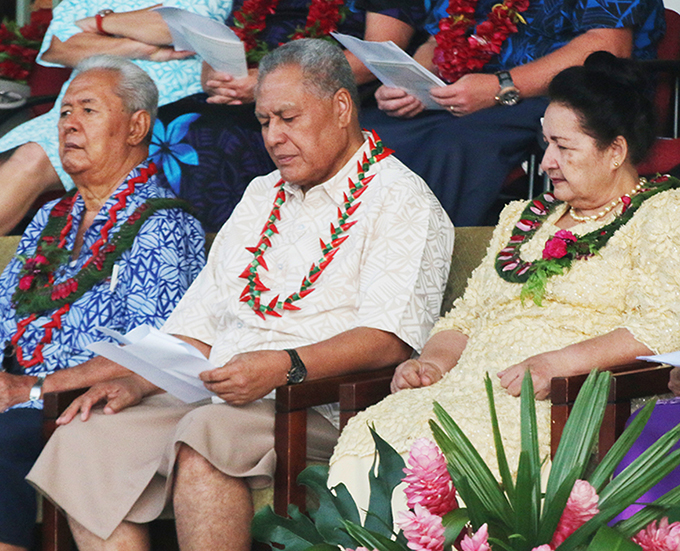
Tuimalealiifano Sualauvi II (centre) with Tuiloma Pule Lameko and Fa’amausili Leinafo at a Samoan Council of Deputies meeting. Image: Samoa Observer

By Brandon Ulfsby in Apia

The Samoan Parliament confirmed today that Tuimalealiifano Vaaletoa Sualauvi II has been elected as the new Head of State.

His appointment was announced by Prime Minister Tuiaepa Sailele Malielegaoi.

Tuimalealiifano will serve a term of five years with outgoing Head of State, Tuiatua Tupua Tamasese Efi, expected to leave his position on July 27.

Tuiatua came into his position in 2007 and served for two terms – 10 years.

Tuimalealiifano holds one of the four Tama-a-Aiga paramount chiefly titles in Samoa – the others being Tupua Tamasese, Malietoa and Mata’afa.

Brandon Ulfsby is an Auckland University of Technology student journalist in his final year of the communication studies degree and who is currently on a Pacific Cooperation Foundation internship in Samoa.

]]>

Enga vote deferred amid new PNG election disruptions

]]>

AsiaPacificReport.nz

Engan voter protesters in Wabag demand “no more corruption”. Image: Peter S. Kinjap

By Peter S. Kinjap

Polling in Enga has been deferred until tomorrow as more disruptions have hit the Papua New Guinea general election.

The polling was due to go ahead yesterday but grievances being raised by the majority of open and regional candidates in Enga and electoral roll problems have sparked a delay.

Pre-counting in Enga has been disrupted in the provincial capital of Wabag following unfavorable responses to demands presented to the Election Manager Anton Yamau in a petition signed by majority of candidates — all except those loyal to the People’s National Congress (PNC) government led by Prime Minister Peter O’Neill.

The mock counting should have commenced on Friday in Wabag. However, a protest march — led by the Opposition Leader and incumbent Kandep MP Don Pomb Polye — and demands by the opposition candidates forced a delay.

Opposition MPs said manager “must not hold Enga people in ransom” as he was running the people’s election in a bid to elect “good leaders”.

Loop PNG reports that Electoral Commissioner Patilias Gamato said Western Highlands faced the same electoral roll issues and would also vote tomorrow.

-Partners-

Voters in Jiwaka continued poilling yesterday and the Southern Highlands also completed voting.

Simbu voters started polling late — at 2pm — yesterday due to a shortage of seals and packing materials.

]]>

PKS lawmaker wants to dissolve ‘waste of money’ anti-graft, rights watchdogs

]]>

AsiaPacificReport.nz

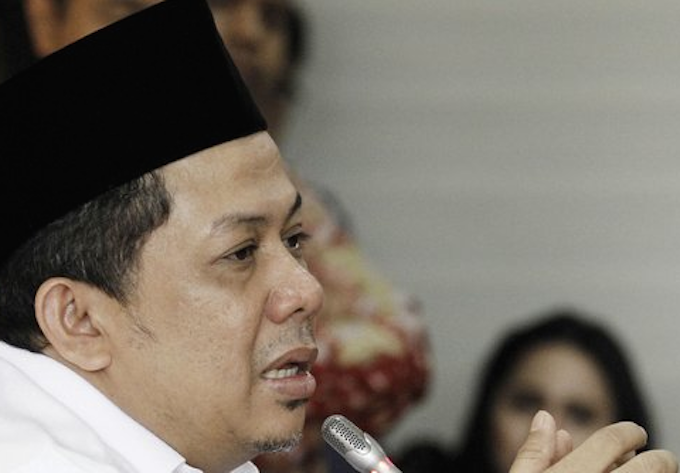
Indonesian House of Representatives Deputy Speaker Fahri Hamzah from the Islamic based Justice and Prosperity Party (PKS) … reluctant to comment on 60 human rights candidates. Image: merdeka.com

By Rizky Andwika in Jakarta

Indonesia’s Coalition to Safeguard the National Human Rights Commission has conducted research on the track record of 60 National Human Rights Commission (Komnas HAM) candidate members.

The results of the research found that there were indications that some candidates have been involved in cases of corruption, gratification, are affiliated with radical groups, or have committed sexual violence.

Although House of Representatives (DPR) Deputy Speaker Fahri Hamzah from the Islamic based Justice and Prosperity Party (PKS) was reluctant to comment on the 60 candidates, he has instead stated that Komnas HAM as a quasi-government institution is no longer needed.

Hamzah said that Komnas HAM, like the Corruption Eradication Commission (KPK), was no longer needed and called for the two institutions to be dissolved.

“[What’s happened with] the Komnas HAM is like the KPK. There’s a trend, I believe, what’s happened is like this. These institutions are actually not needed anymore because basically the state has undergone a democratic consolidation and a strengthening of its institutions in terms of quality,” he said.

Hamzah said that it was reasonable to dissolve the Komnas HAM because no one was prepared to commit human rights violations anymore. Moreover, he believed that human rights matters could now be dealt with by the Ministry of Human Rights and Justice (Kemenkum HAM) through the Human Rights Directorate General (Dirjen HAM).

-Partners-

The politikus [lit: political rat] from West Nusa Tenggara is proposing that human rights matters be handled by the Dirjen HAM which should be converted into a new institution that is not under the authority of the Kemenkum HAM so that it is independent.

Management ‘increasingly disorderly’
“Currently if there are [human rights] violations you can hire law enforcement officials. Lawyers. In the end these institution’s activities are no longer relevant. Because the activities of these institutions are no longer relevant, in the end their internal management has also become increasingly disorderly,” he said.

Because of this therefore, Hamzah will submit a proposal to President Joko Widodo to dissolve the Komnas HAM, KPK and several other semi-government institutions. He cited 106 quasi-state institutions that should be dissolved.

“Of what use are they to us? They just waste money. Including the Komnas HAM, KPK,” he said.

“Because they function within the state. So they are referred to as state auxiliary agencies because basically these functions are part of the state but in the past because they were deemed ineffective, [the Komnas HAM and the KPK] were considered necessary.

“Now if their function is within the state then what’s the point of them? Just dissolve them.”

Currently, the Komnas HAM, which is in the process of selecting candidate members for the period 2017-2022, has reached the stage of selecting the 28 best candidates. Sixty or so candidates underwent a public screening on May 17-18.

The Coalition to Save Komnas HAM’s research into the track record of the 60 candidates covered indicators of their capacity, integrity, competence and independence.

Research results
The results of the research found that 19 candidates had a good level of competence, 23 candidates had a fair level of competence and five candidates needed a deeper understanding of human rights issues.

There were also five candidates that refused to provide information and seven candidates that failed to provide complete information.

“In terms of independence, 13 candidates were found to be affiliated with political parties, 13 were affiliated with industry or corporations and nine people had links with radical groups or organisations”, said Indonesian Human Rights and Legal Aid Association (PBHI) director Totok Yulianto at a press conference in Cikini, Central Jakarta, on Monday.

According to Yulianto, if viewed in terms of capacity there were 11 candidates that had problems with cooperation issues, 16 candidates with communication issues, nine candidates with decision making issues, 12 candidates with performance issues and 12 candidates with problems in managerial principals.

“If viewed in terms of integrity five people were found to have links with corruption and or gratification issues, 11 people had issues with honesty, eight people were linked with sexual violence and 14 people had problems with the issue of religion”, he said. [noe]

Translated by James Balowski for the Indoleft News Service. The original title of the report was “Fahri Hamzah minta Komnas HAM & KPK dibubarkan karena tak berguna“.

]]>

Cook Islands plays role in Pacific research mapping media culture

]]>

AsiaPacificReport.nz

Pacific news media have not been spared dramatic changes, even if the changes may be slower. Image: UNSW

By Rashneel Kumar in Avarua, Rarotonga

The Cook Islands is part of a 12-nation research project to comprehensively map Pacific Islands journalism culture at a time of immense political, economic, technological and cultural change.

Part of the baseline research project entitled “Study of journalists, journalism culture and climate change reporting in 12 University of the South Pacific (USP) member countries”, the Cook Islands leg was conducted last week.

The high-powered research team includes Professor Folker Hanusch (University of Vienna), Professor David Robie (director of the Pacific Media Centre at Auckland University of Technology) and Dr Baljeet Singh, a specialist in social and economic survey methods at USP.

The researchers envisage that the study will provide media companies, journalism academics and policy makers a deeper appreciation of the worldviews and changes taking place in the professional orientation of Pacific journalists.

Research team leader and project manager Dr Shailendra Singh, journalism coordinator at USP in Suva, Fiji, was in the Cook Islands last week collecting data relevant to the research.

He said the news media sector in the Cook Islands had been co-operative and responded strongly to the survey.

-Partners-

Dr Singh said that in his time in the Cook Islands he had noted how the national news media faced many challenges in terms of human and technological capacity, but at the same time it was fairly robust and resourceful.

Committed media sector
“The media sector is driven by some very committed and technologically adept individuals investing personal time and funds for sometimes very little return. They see it as a hobby, a calling and a labour of love,” said Dr Singh.

Journalism, considered to be a crucial pillar of any democracy, was changing radically throughout the world, said Dr Singh.

He said rapid technological advancements and other influences, such as social media and citizen journalism were transforming the role, functions and very meaning of journalism.

Pacific news media had not been spared, even if the changes may be occurring at a slower pace, added Dr Singh.

“In this climate, the USP research seeks to provide a comprehensive overview of journalists’ professional views in order to better understand Pacific journalists and journalism.”

Factors include the conditions under which journalists operate, the kinds of pressures they face and how they might deal with them, and the social functions of journalism in a changing world.

“Such research is crucial during a time of major upheavals taking place within the institution of journalism globally and the Pacific news sector cannot be left behind during this history-making period,” said Dr Singh.

So far Samoa, Solomon Islands, Tonga and Tuvalu have been surveyed, with Fiji and Vanuatu to follow shortly.

Besides USP, the research has received funding from the United States Embassy in Suva (Fiji, Kiribati, Nauru, Tonga, Tuvalu); the Australian government-sponsored Pacific Media Assistance Scheme (PACMAS), administered by Australian Broadcasting Corporation; and the Pacific Media Centre (Auckland University of Technology).

Rashneel Kumar is a Cook Islands News journalist and a graduate of the University of the South Pacific regional journalism programme.

]]>

EMTV turns 30 – and captures a slice of PNG history

]]>

AsiaPacificReport.nz

Serah Aupong’s report on the EMTV milestones. Video: EMTV

By Serah Aupong of EMTV News in Port Moresby

While Papua New Guineans know of EMTV, many do not know how it started.

From a community television programme and children’s show Kids Kona, a television station grew.

This 6min video story looks at EMTV milestones and the parts of PNG history that it has captured since it was launched in July 1987.

In an effort to get the public behind the new TV channel as a public broadcaster, display screens were set up in markets around Port Moresby.

Tania Nugent, presenter of Kids Kona in the beginning, went on to work for the ABC and is now back with EMTV as a consultant.

-Partners-

She tells how the first programme and news went to air being produced in apartment rooms in Garden City as the broadcast studio was not ready.

“One of the bedrooms was used as the news desk, and one of the other bedsrooms was used at the Kids Kona desk, while the lounge as used as the control room,” says Nugent.

“And the news was put together in the Six Mile office … and the news editors would have to rush from Six Mile to here to get the news to air in time for 6 o’clock at night.

” And sometimes we really cut it fine.”

]]>

Polling starts in new Jiwaka province in PNG’s Highlands

]]>

AsiaPacificReport.nz

Polling starts in PNG’s Jiwaka province. Video: EMTV News

By Vasinatta Yama in Kurumul, Papua New Guinea

Polling for Papua New Guinea’s Jiwaka province — created in 2012 by being split off from Western Highlands — has started, with some parts of Jimi electorate voting yesterday.

It will continue today, with North Waghi and Anglimp South Waghi electorates going to the polls.

Polling for Jiwaka was deferred last Friday until yesterday and today after identifying issues with the updated electoral roll.

Ballot boxes for Jimi Open where dispatched from 6 am.

For some areas in Jimi that received their ballot boxes, polling began about 9am, while others are still waiting.

-Partners-

Provincial Steering Committee chairman Michael Wandil said that by last night or early today, the 184 wards in the province should receive its their ballot boxes and go to the polls.

Jiwaka province polling officials received the preliminary roll just last Thursday, which resulted in the delay in the stamping of ballot papers and cross checking of names.

Scrutineers calm
Scrutineers have remained calm and very happy that they were able to observe the pre-counting of the ballot papers.

The stamping and packing of ballot papers by the steering committee has taken longer than anticipated.

There has been tight security since last Friday.

Provincial Police commander Joseph Tondop assured the public that there was a strong police presence everywhere, and polling would not be affected.

Jiwaka was created in May 2012 , the year of the last general election, and the provincial capital is temporarily located in Kurumul. Mostly provincial matters are handled in Kurumul and a handful in Minj.

Papua New Guinea’s highest mountain, the 4509m Mt Wilhelm, is on the border on Jiwaka, Simbu and Madang provinces.

Meanwhile, Loop PNG reports that under fire Electoral Commissioner Patilias Gamato has announced plans to establish a task force to spearhead the voter registration system immediately after the 2017 general election.

There has been widespread condemnation of the state of the electoral common roll with thousands of people stating that they are not listed.

EMTV News elections coverage stories are republished with permission.

]]>

Bryce Edwards Analysis: Will Shane Jones be NZ First’s Trump card?

]]>

Bryce Edwards Analysis: Will Shane Jones be NZ First’s Trump card?

[caption id="attachment_13635" align="alignright" width="150"] Dr Bryce Edwards.[/caption] There is more than a hint of Donald Trump in Shane Jones’ political return. So, could he really fan the flames of NZ First’s populist resurgence in this year’s general election? 
Shane Jones wants to “Put New Zealand First Again”. That was the Trump-esque slogan on the baseball cap that he wore to announce he was standing for Winston Peters’ populist party. There is no doubt that New Zealand First is on a roll at the moment, and they are clearly hoping to capitalise on the revival of populism and anti-Establishment feeling throughout the world.
Could Shane Jones make himself great again as New Zealand’s Trump?
[caption id="attachment_14813" align="alignleft" width="220"] Hon. Shane Jones – New Zealand First candidate for Whangarei.[/caption] The notion of New Zealand First benefiting from the changing ideological winds being felt around the world at the moment is picked up on by Toby Manhire: “NZ First has had heaven-sent political weather in 2017. Electoral tumult in Europe and America illustrate that something-in-the air that Jones was singing about today – and for anyone not keeping up, Jones layered it on by sporting a cap wearing ‘New Zealand First Again’.” – see: Shane Jones joins Winston Peters and NZ First: genius or jeopardy?
Jones referred to the changing global atmosphere in his announcement speech on Friday: “I was coming here this morning and a mate of mine put on a song, ‘There’s Something in the Air’. And you know as well as I do, there’s something in the air. It’s been sensed by voters in America. It’s been sensed by voters in Australia. Voters in the EU. Voters all around the world.”
Manhire suggests New Zealand First is set to rise further: “The latest RNZ poll of polls puts New Zealand First at 9.4%; in May 2014 it was 5.1%, which grew into an election result of 8.7%. In the three months to come, the barnstorming Peters-Jones double-act is designed to lift the party’s vote to unscaled heights, beyond even the 1996 record of 13.5% – leaving the Green Party in their wake. Closing in, even, on the Labour Party.”
Jones has some characteristics in common with Trump which is why I said on Friday: “Shane Jones is quite a campaigner, he’s bombastic, he’s eccentric, he’s got this ability I think to be New Zealand’s Trump” – see TVNZ’s NZ First’s Shane Jones has ‘ability to be New Zealand’s Donald Trump’ – political commentator.
In contrast to this, the NBR’s Rob Hosking writes today that, although Jones is making a pitch to be New Zealand’s Trump, “that anti-establishment pitch is perhaps the central oddity about the whole thing. Mr Jones is the ultimate political insider. He has just completed a role in a plum diplomatic posting, one at the gift of the National government. What’s more, his return to politics has been a matter of widespread political insider gossip for a couple of years now” – see: Shane Jones: How good a fit is he with NZ First, really? (paywalled).
Hosking suggests that media-based commentary about Jones actually goes against the grain of the anti-Establishment mood: “If there is any New Zealand edition of the recent anti-establishment mood in Western democracies, it seems to be at least as much aimed at the news media and the insider approach to political commentary as it is at the politicians themselves. Voters in the US and UK have recently blown loud electoral raspberries when they have been repeatedly told who is and is not an attractive candidate by political commentators. It’s a constant theme of the commentary around Mr Jones that he has widespread popular appeal. This may turn out to be true. But as yet there is no evidence of it.”
Jones’ anti-liberal appeal to the provinces
Although Jones comes from a Labour Party background, his uneasiness with Labour’s more socially liberal elements has been well canvassed in the past. According to Richard Harman, Jones “retains his discomfiture with the current Labour leadership and politically correct wing of the party and remains close to MPs like David Parker, Clayton Cosgrove and Stuart Nash, all of whom oppose identity politics” – see: Shane Jones’ candidacy already creating controversy in NZ First.
Harman says Jones is a good fit with NZ First: “He is a social conservative; he wants to see the Government play an activist role in the economy, he has argued against current immigration levels, and he is concerned about the way China has been able to make inroads in the South Pacific fishing zones.”
Similar to Trump, Jones will position himself and his party as the defender of those hurt by globalisation, and other economic issues, and will combine this with a culturally conservative message on foreign affairs, immigration and social issues.
New Zealand First’s appeal on such matters could hurt Labour badly, according to Audrey Young: “It is one of several factors likely to keep the party on its upward trajectory, mainly at the expense of Labour. The former Labour MP will help Peters peel off Labour leaners for whom personality is more important in leadership than anything else and who just can’t adjust to Andrew Little. Jones will also help peel off Labour-leaning blokes who think the party is too ‘politically correct’ – which is really code for too much control by feminists and gays” – see: Shane Jones is an important part of Winston Peters’ plan to regain power.
Young also draws parallels between New Zealand First and Trump: “Peters’ supporters have a similar attitude to Trump’s. What matters more is the way he campaigns. He paints an image of a glorious bygone era that has fallen victim to the wicked ways of Government, convinces voters they are victims and that he is their salvation, as he is doing in his campaign in the provinces, many of which are thriving. There are hard-luck stories everywhere, even in the cities.”
This socially conservative but economically interventionist stance was apparent in Jones’ interview on The Nation in the weekend – see Lisa Owen and Matthew Hutching’s It’ll be a tough election, ‘but I’m a tough character’ – Shane Jones.
According to this report, Jones “says NZ First will win Whangarei voters’ favour by dealing with issues of jobs and inequality, but unlike any other party, Mr Jones says they’ll take on ‘narco criminality” and the menace of gangs’.” See also Mihi Forbes’ interview on The Hui: ‘Get up off your asses and take care of yourselves’ – Shane Jones.
Blogger Martyn Bradbury says it is actually the National Party that will be vulnerable to losing voters to Peters and Jones, arguing the provincial voters who are alienated from “cultural elitism” are currently with the National Party, not Labour – see: Why the rise of Shane Jones hurts National not Labour.
Bradbury reckons that the provincial-urban cleavage is increasing in politics: “The rupture between the provinces and Auckland isn’t just economic, it’s cultural. Look at the careful wording Jones has used to date. Mentioning politically correct and talking openly about speaking to issues that make people feel uncomfortable is the full on cultural confrontation that the provinces are demanding.”
Here’s Bradbury’s electoral forecast: “I think what we are seeing is a new provincial party in the form of NZ First and a Labour Party that effectively becomes an Urban City Party. A change of Government is now a real possibility. I think NZ First will leap frog to the 3rd largest party at the downfall of National and the most likely outcome will be a Labour-NZ First minority Government with Green Party supply and confidence for Cabinet Positions. Shane Jones is NZs truest Donald Trump and Muddle Nu Zilind will lap the Jonesy up like a prodigal son returned from making it big in Sydney. Low horizons on a flat earth. Stuart Nash will be weeping into his pillow. Winston Peters could well be the next Prime Minister.”
Some will see Shane Jones’ anti-politically correct agenda as being regressive and homophobic. But according to Phil Quin, who knows Jones, this isn’t the case – see his blog post, Let’s not weaponise homophobia against allies.
Quin’s argument is worth quoting at length: “In all my interactions with Shane, I’ve seen no evidence of sexism, but, as a man, I’ll leave the feminist critique to women. On his attitudes towards LGBT people, however, I feel somewhat qualified to comment. I’ve known Shane for a while. We’re mates. I know his amazing wife, Dot, and was privileged to meet many members of his whanau. Shane Jones is more comfortable in the company of gay men than at least two-thirds of New Zealand men of his generation and background. He is open and relaxed with it comes to discussing issues affecting gay and lesbian New Zealanders. He is no less baffled than me by persistent efforts to deprive people like me of rights otherwise available to New Zealanders. During our conversations, he may have used words than wouldn’t make the cut in Acceptable Speech canon so eagerly monitored by New Zealand’s Twitter tone police, but I can’t recall it.”
Can Shane Jones help make New Zealand First great again?
Audrey Young also believes New Zealand First’s fortunes are likely to continue to rise with Shane Jones: “Jones will help to boost support for New Zealand First in the regions and among Maori. He is widely admired in Maoridom for his command of te reo and is considered one of its best orators. He has a microscopic knowledge of Northland tribal history and families. Unlike Peters he was raised in Northland on a dairy farm. New Zealand First is on a roll. In its heyday, 1996, the party gained 13.35 per cent and 17 MPs. It is probably past that point already with just under three months to go to the election” – see: Shane Jones is an important part of Winston Peters’ plan to regain power.
Vernon Small also looks at where the party could draw more votes: “He also offers pulling power for the provinces in general – one of Peters’ main and overt targets this election – as well as appeal to some of the blue collar and Maori urban vote that Labour is still struggling to win back” – see: Jones for Whangarei is about more than winning a seat.
Of course Jones also comes with baggage: “But with women – especially after his red face from the fall out over accessing blue movies as a minister – and in particularly young ones? Ah not so much… However, not appealing more broadly to women is probably the biggest sea anchor slowing NZ First’s push towards a very strong mid-teens result on September 23 – and on that score Jones adds little.”
Newstalk ZB’s Felix Marwick is also less sure Jones will be a big advantage for his new party: “But it has to be said that Shane Jones, while gregarious and a good communicator, is possibly one of the more flawed politicians Parliament has seen in recent history. His record in the nine years he was with Labour was certainly chequered. He entered in controversy, accused of double dipping by serving as an MP while still acting for the Waitangi Fisheries Commission. And things didn’t exactly improve from there. Add into the mix his nickname as Minister for Porn over his misuse of a ministerial credit card, and his approval of citizenship for now convicted money launderer Bill Liu, and you can see Mr Jones has had more than his fair share of bad news and scandal. These are all things his political opponents will use against him” – see: Shane Jones set to return to politics.
For the ultimate discussion of the pros and cons of Jones standing for New Zealand First, see Heather du Plessis-Allan’s Peters and his Mini-Me. She believes Jones’ previous controversies won’t really be a problem, especially because rival parties will be reluctant to politicise these issues out of fear of alienating a potential post-election coalition partner.
But more importantly, in the longer term, she argues Jones doesn’t necessarily have what it takes, especially if he wishes to be Peters’ successor: “What the party’s supporters like about Peters is his old-world charm. He has the ability to make outright populism more palatable through decorum. Jones has the populism part down pat. He has no decorum at all. He’s a shabby dresser, is in my view prone to bouts of arrogance and there’s the porn thing. Party members are already running an active #neverjones Facebook page, dedicated to opposing his candidacy. What’s more, Jones has proven hard to manage. He defied orders in Labour. Peters demands discipline. He’ll expect to keep telling his lieutenants what to do. Will Jones obey?”
Of course, one way Shane Jones could make New Zealand First even greater would be to win the electorate of Whangarei off National’s Shane Reti. Most commentators suggest there’s little chance of that happening, with Reti’s 13,000 majority making an upset unlikely. But Patrick Gower is willing to go out on a limb with his 12 reasons why Shane Jones can win Whangarei.
Finally, back in 2013 before his departure from the Labour Party, Jones was the subject of one of Steve Braunias’ best secret diaries – see: The Secret Diary of Shane Jones.
Today’s content
 
All items are contained in the attached PDF. Below are the links to the items online.
Shane Jones to stand for NZ First
Heather du Plessis-Allan (Herald): Peters and his Mini-Me
Rob Hosking (NBR): And then … along comes Jones (paywalled)
Anton Skipworth  (Daily Blog): A NZ First Vice Chair slams Shane Jones
Greg Presland (Standard): He’s baaaack
Pete George (Your NZ): The Nation – Shane Jones
Election
Steve Maharey (NBR): Why the ‘missing million’ is missing (paywalled)
Pete George (Your NZ): Unions using interns
Dave Kennedy (Local Bodies): National, dead party walking…
Peter Thiel citizenship
Gordon Campbell (Scoop): On Peter Thiel’s bad attitude problem
Steve Braunias (Herald): Secret Diary of Peter Thiel
Health
Michael Hayward and Adele Redmond (Stuff): Christchurch’s cancer treatment accommodation at capacity
Sport
Lizzie Marvelly (Herald): Give our women a sporting chance
Immigration
Michael Reddell (Croaking Cassandra): Who has been getting residence visas?
Muriel Newman (NZCPR): Immigration Matters
Justice
Economy
Shannon Haunui-Thompson (RNZ): Māori economy now worth $50bn – report
Environment
Anna Connell (Newsroom): Answers to questions nobody is asking
Employment relations
Rodney Hide (Herald): Beware glass-half-full type
NZ Parliament and gender issues
Jeremy Elwood & Michele A’Court (Stuff): Tidying up our House of Representatives
Ten years of KiwiSaver
Local Government
Dominion Post Editorial: Begging and free speech
Drugs
Angela Quigan and John Hartevelt (Stuff): What would happen if New Zealand legalised cannabis?
Russell Brown (Public Address): Know Your Stuff: getting real about drug-checking
Defence Force
Media
John Drinnan (ZagZigger): Red Faces Over Blackface at Maori TV
Other
Susan Strongman (RNZ): Animal welfare and the law
Reading the Maps: Tyranny in a democracy
]]>

Tahitian anti-nuclear advocates mark 51st year since testing began

]]>
Evening Report
Evening Report
Tahitian anti-nuclear advocates mark 51st year since testing began
Loading
/

AsiaPacificReport.nz

Moruroa e Tatou’s Roland Oldham … “never ending” story of nuclear health struggles. Image: Moruroa e Tatou

Pacific Media Watch News desk

Tahitians will today mark the 51st anniversary of the first French nuclear weapons test in the Pacific as advocates still press for justice and better compensation.

The French military carried out the first of its 193 nuclear tests at French Polynesia’s Moruroa Atoll, about 1250 km southeast of Pape’ete, on this day in 1966 after the testing programme was moved to the South Pacific from Algeria due to the War of Independence.

The tests — some were also carried out at Fangataufa Atoll — ended three decades later in 1996.

The pro-independence Tavini Huiraatira party, led by former territorial President Oscar Temaru, who declared his community of Fa’aa “nuclear free” in 1983, has launched a petition for alleged human rights violations which it plans to submit to the UN Human Rights Commission in Geneva.

Roland Oldham, head of French Polynesia’s nuclear veterans organisation Moruroa e Tatou, says even though former nuclear workers were dying, their descendents continue to face the problem of nuclear fallout.

Talking to Radio New Zealand’s Dateline Pacific, he said:

-Partners-

“I would say that the story of nuclear [testing] will never end. We know when it started but we don’t know when it’s going to end. It seems to me there is no ending because of what we know exactly of the situation, of what we know about the health and about the environment is still very very alarming for the future generation.”

Oldham is just back from the UN Conference on a Treaty to Prohibit Nuclear Weapons.

Listen to Radio NZ’s Dateline Pacific:

http://podcast.radionz.co.nz/pacn/dateline-20170703-0503-french_polynesia_marks_51_years_since_first_nuclear_test-02.ogg
]]>

FSM, Marshall Islands envoys seek details on police-involved shootings

]]>

AsiaPacificReport.nz

FSM Ambassador Akillino Susaia (centre) at a welcome reception in the US … diplomatic note seeking answers over shootings of Micronesians in US. Image: FSM

By Giff Johnson in Majuro

Ambassadors to the United States from the Federated States of Micronesia and the Marshall Islands are seeking information about officer-involved shootings that resulted in the death of citizens from their nations in the US over recent weeks.

FSM Ambassador Akillino Susaia has asked the US State Department for help in accessing information on the shooting deaths of two Micronesians in Tulsa, Oklahoma in early June, while Marshall Islands Ambassador Gerald Zackios is seeking information from the family of Marshall Islander Isaiah Obet, who was shot and killed by police in Auburn, Washington on June 17.

Both ambassadors are based in Washington, DC.

“We have spoken to the Tulsa Police Department and were directed to the Detective Homicide Division, but so far have not received any information or feedback,” Susaia said.

To follow up the shooting deaths on June 2 of Micronesians Naway Willy, 18, and Rabson Robert, 36, Susaia sent a diplomatic note to the State Department last week requesting the federal government’s aid to obtain information from local law enforcement authorities about the incidents.

News reports indicated that Robert had been killed during an argument at a hotel and Willy was initially thought to be a suspect in the murder, but later police said they did not believe Willy was involved and arrested another suspect in Robert’s death.

-Partners-

News reports indicated that Willy was at the scene and fled after the shooting of Robert. Willy was shot and killed by policemen who were called to the scene of the shooting.

Charged with murder
Subsequently Tulio Alexander Aviles, 33, was charged with first-degree murder for the shooting of Robert.

In the diplomatic note, the FSM Embassy notes the “request for assistance is necessitated by the incident that took place on or around 2 June 2017 in Tulsa in which two citizens of the FSM, both of them young men, were reportedly shot to death by local law enforcement officers.”

The ambassador said he was requesting the US State Department’s assistance under the terms of the Vienna Convention on Consular Relations and the provisions of the Compact of Free Association, a treaty that closely ties the U.S. and the FSM.

The carefully worded request to the State Department also pointed out “the long history of law enforcement cooperation between FSM and the US” under the Compact that was first established in 1986.

“Their (Robert’s and Willy’s) families and friends have sought to obtain information from the Tulsa Police Department but were not successful,” the FSM diplomatic note explained.

“They have turned to the Embassy for assistance.”

The diplomatic note added that the embassy had also been unsuccessful in getting through to the Detective/Homicide Division of the Tulsa Police Department.

The embassy requested State’s help in “facilitating the process to enable the Embassy to obtain relevant information.”

Expressed condolences
Susaia expressed condolences to the families and friends of the victims. He said he did not want to “make specific judgments on the police-involved shootings while all the relevant facts of the case have yet to be confirmed.”

He took the opportunity to “remind us all about the importance of conducting ourselves appropriately to avoid harm and, just as important, for law enforcement authorities to exercise prudence or due diligence in the conduct of their duties and responsibilities to the public.”

While Susaia said the embassy did not speak for the families of the victims or “wish to prejudge the course of action that they may finally decide to pursue, the FSM Embassy will do what is necessary and appropriate. The primary objective of the Embassy is to ensure that justice to our citizens is administered fairly and to assure them and the community at large that we are doing the best we can in the interest of our citizens to the fullest extent provided by the law and Compact.”

While noting that “the Embassy is aware of the rise in police-related incidences in the United States,” Susaia said the FSM is “grateful for the basic decency and fairness of the American people, whom we hope will continue to be the advocates and tireless moral pillars of support for the friendship and historic ties between our peoples that are enshrined in the Compact of Free Association, and which serve as the foundation of the special partnership between the FSM and the US.”

For his part, Marshall Islander Isaiah Obet, 25, was killed in Auburn, Washington while attempting to carjack a vehicle. News reports of the incident said that he went into an Auburn residence holding a knife and demanded money from the woman in the house. She told him to leave and he did, after which she called the emergency number 911.

Police responded to find Obet in another nearby house. He fled and was chased by police and then attempted to carjack a vehicle with two people in it when the officer opened fire, killing the man. News reports said Obet died at the scene from multiple gunshot wounds.

Zackios said he was attempting to get information from Obet’s family in Auburn before taking possible next steps.

Giff Johnson is editor of the Marshall Islands Journal. This article is republished from the Marianas Variety with permission.

]]>

PM O’Neill casts his vote in local village, shrugs off polling delays

]]>

AsiaPacificReport.nz

Prime Minister O’Neill casts his vote in home village of Kauwo. Video: EMTV News

By the EMTV News elections coverage team

Papua New Guinea Prime Minister Peter O’Neill has finally cast his vote in the general election.

O’Neill voted in his local village, Kauwo, in Pangia Southern Highlands province yesterday, reports EMTV’s

Before polling began, the community had a church service.

Polling for Ialibu-Pangia was deferred for two days following complaints and a petition by candidates over missing ballot papers and appointment of presiding officers among other concerns.

Earlier, after Friday’s polling hold-up in the Southern Highlands, O’Neill called for election delays to be put into perspective.

-Partners-

He claimed the 2017 elections had been a dramatic change from the previous three elections where there was violence and the electoral process had been “hijacked”.

Speaking from Mendi, the incumbent Prime Minister said voting in his province had been delayed, but it is better to wait and ensure the process was run properly.

‘Understand the hardship’
“While the delay is disappointing, we understand the hardship and the difficulties that election officials are going through,” O’Neill said.

“Putting this in perspective, I hear comment from election observers that delays like this are common in developing country elections, particularly with remote and rugged terrain and diverse cultures.”

The Prime Minister said the leaders he had spoken with were pleased with the manner in which the election was taking place and the public’s reception to the election process.

“Unlike previous elections, there is relative calm in this province and other provinces,” O’Neill said.

He said there had been very good campaigning conducted in Southern Highlands province, and around the region.

“This was not the experience of 2002, 2007 and 2012 where certain candidates hijacked the election process.

“People must not forget the failures and hardship or previous elections.

“In 2002, in Southern Highlands and Hela provinces, there were seven failed elections.”

EMTV News stories are republished with permission.

]]>

Gary Juffa: Why these PNG elections are taking us towards dictatorship

]]>

AsiaPacificReport.nz

OPINION: By Gary Juffa, current Governor of Oro and a candidate in these elections

I suspect that these Papua New Guinea elections have been so deliberately set to fail, leaving much room for fraud and confusion, that we will be distracted from what is really going on – the establishment of a dictatorship.

Already Prime Minister Peter O’Neill has his own special police unit that flies around Papua New Guinea escorting him in his private airlines, he has a special army unit of 40 exclusively for his callout, he controls the media and Public Service.

And, it seems, the Police and Defence commands — and perhaps the judiciary … the signs and red flags are blinking bright red now…

Yet many people do not see it at all. We are inching closer towards dictatorship and the ensuing bloodshed and violence that must come from the hostility towards it. But like lemmings and sheep, we are led to that reality with little resistance at all. Is this the Papua New Guinea we all believed in once upon a time?

This is what I wrote on my Facebook blog this week:

FAILURE TO PLAN OR A PLANNED FAILURE?

-Partners-

Today [Wednesday in Oro province] was a demonstration of how much the PNG government is NOT for PNG.

It was also a demonstration of how democracy should not work.

For instance, the majority — between a third and a half — of Popondetta Urban voting age citizens have NOT voted because the current common roll does not have their names.

Many citizens claim they had made the effort to update their details and were still were turned away.

Meanwhile, Electoral Commissioner Patilias Gamato has advised all that the preliminary roll can be used. This means that he indirectly agrees that the EC failed to effectively update the 2017 roll. This instruction was obviously not made known to Electoral Commission officials managing the polling at the Independence Oval today.

Many who had taken time out and had travelled into vote, were turned away angry and anxious. This election was certainly costing them. They will have to come back for the last day, but the slowness will probably ensure that a large group will not have been processed by the end of the polling day — 4pm.

This will mean that democracy certainly did not prevail in this instance. In fact, many will probably agree that come the end of these elections, democracy was hardly a reality everywhere in Papua New Guinea. This should hardly be a surprise given that we have actually endured a covert dictatorship and hardly realised it.

Own effort
Meanwhile, not a few of the learned are saying that everyone should have made their own effort to ensure they were registered.

A true statement we all would like to agree in the first instance. I was tempted to think this way too. Then I thought of my people in rural PNG. My uncles and aunts who do not read or write and are at once the greatest selfless humans I know and despite whatever people think, are equal shareholders of this great nation Papua New Guinea.

They too deserve to vote. They too deserve to be informed. They too have the right to be given the opportunity to decide whether they wanted to update their details on the common role or not.

May I just say to all my learned friends making such statements as “it’s your fault if you are not on the roll! Stop whinging”, that this would be true if the awareness had been been carried out sufficiently and it would be true in a society which is totally literate and where means of communication are available to all, a society that, say, had more then just 40 years or so as an independent nation of 1000 tribes with their own language groupings and cultural peculiarities.

Such statements are also spiteful about our people, my friends. Yes our people. Many who live in rural PNG and do not have access to the benefits of technology and modern services and goods that you may have had and may have now.

Yes, our people, remember them? Well some of these are the people who will adore you and feed you and love you selflessly when or should you ever go home for a visit from time to time.

It would also be a safe statement to make if Papua New Guinea were governed by a government which allowed information access and made it possible for all. A government that made funding available for provincial governments and relevant information dissemination entities like the National Broadcasting Corporation (NBC).

Government by the people
Of course, that would have to be a government of the people, by the people, for the people…which this government clearly is not if any of its decisions made in the last 5 years are anything to go by – i.e. next to none were in the interests of the people or the nation.

Back to Elections 2017. It is clear that the Electoral Commission failed. But the commission is not entirely to be blamed because, the buck stops at the top…and that’s the People’s National Congress (PNC)-O’Neill government.

They have totally failed in the last 5 years to ensure that everyone was on the roll.

For instance, the awareness was an abysmal failure. Rural Papua New Guinea especially had virtually no knowledge of this. That’s 85 percent of PNG.

For those who state that it is the fault of the voter, let us consider our voters first before making such statements.

Who are they?

Well, they are our people.

And most of them are illiterate.

And most of them are in rural PNG.

Whole day to travel
So lets say how can it be the fault of a substance farmer in Manau, Sohe, Oro province where it takes a whole day to travel to Popondetta by dinghy if one wanted to access any services.

A farmer who never had an education because the school there was closed for an entire decade? How is it his fault if he didn’t have access to radio because NBC is the only radio service and that has been so underfunded that it is barely functioning in most of rural PNG? He is one of a population of about 4000 people of voting age in Manau.

That’s an example.

These are the stories the length and breadth of PNG for the vast majority of Papua New Guineans.

Were our people adequately informed?

They were not.

The Electoral Commission had 5 years to do this.

They failed.

Just as they did with the K200 million national identity (NID) Project. Deliberately too it appears.

This government failed.

Peter O’Neill failed

The 2017 Elections are looking very much like a failure.

A planned failure perhaps … it has to be.

Sipping champagne
From our perspective, perhaps not from the PNC government’s perspective. Maybe they are chuckling and sipping champagne and congratulating each other on a job well done. Chaos provides opportunities for those who plan it to. Who knows?

Meanwhile in stark contrast, preparations for APEC seem to be going on very well. Surprise, surprise. Funding is abundantly available and preparatory meetings, plans, strategies and training and capacity testing efforts are well in progress. Not a few MPS whose companies will be involved in various services needed have already picked up hefty contracts.

So obviously the government can do a great job.

If it suits them.

But when it suits the people…well, they hardly care. There’s nothing in it for them.

So the people are all told that this one-off event, APEC 2018, which the country can barely afford will be “beneficial” for them and the country.

Yes, that’s right APEC … an event that will cost far more then the 2017 Elections and benefit PNG next to nothing.

Democratic rights
Ask yourself, is APEC more important then the democratic rights of a people to elect their leaders to represent their interests in Parliament?

I don’t think so. But of course not a few learned experts will disagree and be outraged by my lack of interest in international trade.

Who am I but just one of millions of Papua New Guineans who are obviously of no consequence or concern to this PNC government…

This just shows how much the PNC government cares for its people. How much? In my measure, it was so weak and poor an effort, so pathetic, that it was “zilch”.

Gary Juffa’s commentaries are frequently published by Asia Pacific Report with permission. This commentary is a combination of two of his latest pieces.

]]>

‘Peaceful’ Enga ready for voting in spite of bias claim against officials

]]>

AsiaPacificReport.nz

EMTV News coverage on the PNG elections.

By Vasinatta Yama of EMTV News reporting from Wabag

Enga provincial election manager Anton Iamau says Enga is ready for polling next Tuesday in the Papua New Guinea general election.

He said this in spite of a few confrontations between the supporters of candidates and returning officers of a few electorates.

Enga provincial police commander Chief Superintendent George Kakas said the joint security forces were expecting a peaceful election for Enga.

Election manager Iamau said electoral officials could not bow down and listen to candidates and their supporters to defer polling next Tuesday.

“We are an independent body,” said Iamau.

-Partners-

Iamau said he was being confronted with supporters of some candidates from the Kombiam-Ambum electorate.

The candidates and their supporters had petitioned the PNG Electoral Commission in Wabag to change all the presiding officials, the returning officer and his assistant.

‘Biased appointments’
They claimed that the appointment of the officials was biased and was in favour of a particular candidate in the electorate.

Provincial police commander Kakas said the police and the joint security forces were managing every situation proactively and on a daily basis.

Kakas was expecting a peaceful election.

“Enga province has been passive as one of the hotspot areas in the country, in terms of tribal fighting during the election,” Kakas said.

“However, I would like to let the public know that people in Enga have changed and we will have a peaceful and successful election.”

Vasinatta Yama graduated from Divine Word University with a Bachelor’s Degree in Communication Arts, with majors in journalism and public relations and minors in international relations and diplomatic studies.

]]>

Rival Ialibu candidates accuse O’Neill of ‘rigging’ PNG general election

]]>

AsiaPacificReport.nz

Prime Minister’s protesting rival candidates Jerry Kiwai (from left), Nepoleon Rema, Tua Yasa, Stanley Liria, Justus Rapula, Leonard Pangepea and Dr Sam Kari at the Ialibu District Office in the Southern Highlands. Image: PSK/PMC

By Peter S. Kinjap  

Candidates contesting Papua New Guinea’s Ialibu/Pangia Open Electorate in the Southern Highlands province have accused Prime Minister Peter O’Neill of “rigging” the country’s national elections.

“Today confirmed everyone’s worst fears – these elections were deliberately rigged from the start,” said Stanley Liria, one of the candidates who signed a formal protest letter with election manager David Wakias before polling began in the electorate.

The open electorate is where Prime Minister O’Neill is the incumbent MP.

The rival candidates claimed in their letter the electorate was not ready for polling today.

The candidates are Jerry Kiwai, Nepoleon Rema, Tua Yasa, Stanley Liria, Justus Rapula, Leonard Pangepea and Dr Sam Kari.

At a meeting at Ialibu District Office, they unanimously agreed that certain issues be “properly addressed” before polling started.

The protest letter signed by the rival Southern Highlands candidates. Image: PSK/PMC

-Partners-

Their letter was registered with the manager Wakias.

‘Treating people like dirt’
Candidate Liria said people were fed up with corruption, dictatorship, lying, stealing, and “treating people like dirt”.

He said the people of Ialibu-Pangia were peaceful and hard working, and had the right to choose their new leader through a “fair, transparent and honest” process.

“O’Neill is denying you this constitutional, democratic right,” Liria said.

All candidates, apart from O’Neill, had “through blood, sweat and tears” visited the entire electorate on foot and seen the “disastrous lack of services and conditions” people had to endure, Liria said.

Claiming that polling day had confirmed fears that the elections had been rigged, Liria added on his Facebook page:

“No common roll, politically appointed presiding officers, failure to brief candidates, failure to select impartial political officials, failure to release lists of all polling officials — including 7 wards from Imbonggu within Ialibu-Pangia electorate [and a previously] … undefined ward in the electorate.”

These issues represented grave concerns for the integrity of the Ialibu-Pangia elections, and so the contesting candidates had served notice with manager Wakias.

“We have been robbed, and not only Ialibu-Pangia but all of PNG will suffer like never before.”

]]>

Lae police chief confirms ‘students’ set fire to PNG ballot papers – 2 detained

]]>

AsiaPacificReport.nz

Unitech ballot papers burning in Lae during the Papua New Guinea general election. Image: PSK/PMC

By Peter S. Kinjap in Port Moresby

Papua New Guinea’s Lae Metropolitan Police Superintendent Anthony Wagambie Jnr has confirmed that ballot papers were burnt at the University of Technology (Unitech) polling booth within the campus.

He said the destruction of ballot papers was an offence and any issues relating to shortage of ballot papers or common roll issues would be addressed by the Assistant Returning Officer and Returning Officer of the PNG Electoral Commission.

Two prime suspects have been apprehended by police in Lae while one is still being sought. His identity is known to the police.

The two suspects had got on a 25-seater bus parked outside the campus with a large group of people.

Police monitored them and a Mobile Squad Unit and Sector Patrol Unit intercepted them along the speedway, and then escorted the bus with the occupants to Lae police station.

The two suspects were identified and have been detained for further questioning.

-Partners-

They are from Southern Highlands and Hela provinces, while the third suspect is from Enga province.

Claimed to be students
The suspects claimed to be students while one claimed to be a former student who graduated recently and is now employed by the university. The university administration has not confirmed this.

The 25-seater bus has also been grounded at the Lae police station while the driver and crew are being questioned.

Unitech was given only 1100 ballot papers for a voting population of more than 5000 while the University in Goroka (UOG) voting population of between 4000 to 5000 was denied aa chance to cast a ballot.

UOG was never gazetted as a polling venue even though the Eastern Highlands provincial election manager included it in his recommendation to the Chief Electoral Commissioner.

At the University of Papua New Guinea (UPNG) at Gerehu, Port Moresby, voting did not take place because of a lack of ballots, Asia Pacific Report’s special campus correspondent reported. Only 1200 ballot papers arrived from the Electoral Commission instead of the expected 5000 and there were many complaints about the absence of names on the rolls of people who had registered.

Students confront election officials at the University of Papua New Guinea today. Image: Citizen Journalist

National Capital District (NCD) Elections Manager Terence Hetinu and his assistant Roslyn Tobogani have been removed and replaced with new officers for today’s polling after both had been caught on Tuesday reportedly in possession of large sums of money and a document signed between Hetinu and a Port Moresby candidate.

Although Electoral Commissioner Patilas Gamato defended his staff, saying the money was for the payment of election officials, Port Moresby police said they would continue a full investigation after the elections and lay charges.

Commissioner Gamato has appointed two senior electoral officials as replacements —  Provincial Election Manager Alwin Jimmy as the new NCD Election Manager, and Kavanamur Bale as Assistant Manager.

Candidates demand removal
Gamato announced the appointments when he met with candidates at Electoral Commission headquarters on Wednesday afternoon.

The candidates in Port Moresby had petitioned Gamato, demanding the removal of Hetinu and  Tobogani after they were detained by police on Tuesday.

While police searched Hetinu’s car, they also found an agreement signed between a Port Moresby Regional Seat candidate and the then NCD Election Manager.

New election manager Jimmy assured the media, Port Moresby candidates, voters in Port Moresby and the people of Papua New Guinea that today’s NCD election would go ahead as scheduled.

Although only one day into his new job, he said he would make sure he delivered a successful polling day for Port Moresby.

He also apologised to the people of Papua New Guinea about what had happened.

Another elections twist
In another elections twist, the Electoral Commission office has reportedly more than K36 million (about NZ$15.4 million) owing to its suppliers from the last general election in 2012. Those suppliers were reportedly not paid.

Gamato said he was aware of the outstanding payments and had put the claims through the government payment system.

In Goroka, polling in rural areas has been delayed because the helicopter company hired to dispatch ballot papers and officials to the designated polling areas wanted payments paid upfront before airlifting the ballot papers and officials to the sites.

Goroka rural voters are still waiting for the ballot papers to arrive for polling while polling in areas with road access have been completed.

Peter S. Kinjap is an Asia Pacific Report contributor.

Port Moresby election materials being set up by officials for today’s voting. Image: Peter S. Kinjap
]]>

‘We crossed 11 rivers with water up to our necks to do our job’ in PNG ballot

]]>

AsiaPacificReport.nz

Police officer Fred Rimbao (from left), polling officer Joe Bais and presiding officer Jim Inamuga with the two ballot boxes they carried on a marathon journey before being picked up by vehicles and taken to Madang in the PNG general election. Image: Zachery Per/Nationalpic

By Zachary Per in Madang

A three-member polling team has told of how they had to walk for hours carrying two ballot boxes, crossing 11 rivers and sleeping at a village to accomplish their task in Papua New Guinea’s general election.

Polling Team 52 was led by presiding officer Eric Inamuga and included polling official Joe Bais and police officer Fred Rimbao.

They were in charge of the 572 marked ballot papers for the Goroka Open electorate in the Highlands.

They were sent to remote Wessan in the Goroka electorate on the border of Eastern Highlands and Madang.

Inamuga said they travelled on Monday by helicopter to Wessan but could not land because the pilot was unable to identify the site.

“We returned to Goroka and made the second trip to Wessan the next day. We were dropped off at the Simili polling station to conduct polling there,” Inamuga told The National daily newspaper.

-Partners-

“We finished around 3 pm and waited for pick-up. The helicopter did not return so we spent the night with the locals at Wessan.”

They waited for pick-up until 1.30pm on Wednesday and decided to walk to Madang to catch transport to Goroka.

“We crossed 11 fast-flowing rivers, including the Ramu River. The water came up to our chest and neck.

“We braved through and managed to get to Kesevai along the Madang Highway about 6.30pm. A police team and an official election vehicle picked us up at 7pm on Wednesday.”

Police officer Rimbao said they had to spend around K120 (about $52) for accommodation, meals and other incidentals to do their election job.

Loop PNG reports today nearly three-quarters of Papua New Guineans have started voted, according to the PNG Electoral Commission. The rest will vote within the 14-day ballot period.

Port Moresby voters in the National Capital District (NCD) began their one-day polling today after the postponement from Tuesday.

]]>

PNG Media Council seeks opinion over Cybercrime Act’s ‘free speech’ impact

]]>

AsiaPacificReport.nz

PNG’s Media Council president Alex Rheeney (centre) talking at last year’s World Journalism Education Congress (WJEC) in Auckland. Image: Del Abcede/PMC

By Geraldine Kalabai in Port Moresby

The Media Council of Papua New Guinea is seeking a legal opinion on the effects of the government’s 2016 Cybercrime Act on press freedom, freedom of expression and public access to state information.

”The council, in its last meeting last Friday agreed that legal opinion should be sought on the impact that the August 2016 legislation will have on the ability of ordinary Papua New Guineans to express themselves through various communication platforms and whether the law hinders the ability of the PNG media to report with fear or favour,” the council said in a statement.

Media Council president Alexander Rheeney said the council supported some sections of the law that protected citizens.

However, he added the council was particularly concerned with Section 10 (on data espionage), 21 (defamatory publication), 25 (unlawful disclosure), 26 (spam), 31 (unlawful advertising), 33 (search powers), and 44 (criminal liability of ICT service providers).

The Media Council said there was no government consultation with the media industry when the legislation was first put forward before its enactment.

Rheeney said two experts would study Section 46 of the PNG Constitution on freedom of expression and provide their opinion on how the 2016 Cybercrime Act would impact on the rights of citizens.

-Partners-

The findings would be put to council members for their consideration and deliberation and to identify a course of action if needed.

Rheeney added that the current general election opened up the opportunity to the council and the media industry to lobby for changes to the legislation when the new national Parliament gets elected, depending on the advice of the legal experts.

Geraldine Kalabai is an EMTV News reporter who studied international relations and PNG studies at Divine Word University.

]]>

Chaotic PNG election scene in Moresby with cancelled polling, 4 ‘arrests’

]]>

AsiaPacificReport.nz

Voting in Abau district in Papua New Guinea’s Central Province, near Port Moresby. Image: Belinda Kora/PNGFM

Pacific Media Centre Newsdesk

Papua New Guinea’s general election has been rocked with many disruptions, the cancellation of the capital Port Moresby’s one-day polling, and the arrest of four senior election officers for carrying K185,000 (NZ$80,000) in cash and “suspicious” documents.

Electoral Commissioner Patalias Gamato vowed he would not resign in the face of a barrage of criticism, Loop PNG reports.

The National newspaper reports that the four were questioned but later released because police had to first obtain arrest warrants from the court.

National Capital District-Central police commander Assistant Commissioner Sylvester Kalaut was quoted by the newspaper as saying they have not been charged but may be re-arrested.

The drama began around dawn on Tuesday when election workers, who had been “camping” all night to prepare for the one-day polling in the three electorates in the National Capital District (NCD), decided to stage a protest strike because they had not been paid their “camping” allowance.

Commissioner Gamato, after consulting NCD Election Manager Terence Hetinu and police, deferred polling until tomorrow.

-Partners-

People who had arrived early at the various polling stations were told to return on Friday.

Cash for the workers
Then Hetinu, according to Gamato, who was bringing the cash to pay the workers, was brought in by police to brief them on the polling cancellation.

Officers became suspicious and arrested him when they found the large amount of cash in his vehicle.

In an unrelated event later, according to Kalaut, police officers arrested three other election officials in front of the Boroko Electoral Commission office allegedly trying to transport election-related materials in an official vehicle but without any official police escort.

“We have questioned and released them. We have to obtain a warrant of arrest to charge them for the relevant offences under the Criminal Code,” Kalaut said.

Kalaut said Hetinu would be questioned later on “correspondence” police allegedly found between him and a candidate.

Gamato said he would consider disciplinary action against Hetinu if he was found to be in contact with NCD candidates, The National reports.

On the cash Hetinu was carrying around, Gamato said: “We had made arrangements to organise payments for camping allowances. He was carrying that cash around when police picked him up.

3000 Port Moresby election workers
“Police also questioned me and I said I was aware of that.”

More than 3000 election workers had been engaged by the commission for polling and counting in Port Moresby.

Gamato agreed that it was “not normal” for someone to be carrying such a large amount of money around Port Moresby but “that cash was made available as soon as possible in the morning”.

Gamato said there was a system in place for election managers to pay election workers, based on the list of names provided.

]]>

Under fire PNG elections chief vows he will not resign

]]>

AsiaPacificReport.nz

Electoral Commissioner PNG’s Patilias Gamato … defiant in face of flood of complaints. Image: Loop PNG

Papua New Guinea’s under fire Electoral Commissioner Patilias Gamato says he will not step down and will continue to ensure the general election is “run smoothly”.

Gamato was grilled by reporters during a media conference in Port Moresby but remained defiant.

Since polling began on Saturday in the country, many negative reports have been made public, reports Loop PNG’s Cedric Patjole.

Among them was the late start of polling teams, resulting in fewer votes being cast and people and students being turned away due to missing names, despite registering earlier this year.

The deferral of polling in the National Capital District (NCD) – Port Moresby — from Tuesday until this Friday, the ousting and detention of the NCD Election Manager and several polling officials over suspected electoral breaches has put more pressure on the Commissioner.

Responding to a barrage of questions, Gamato was eventually asked if he would step down — and he promptly replied: “I don’t think I’ll have to resign. I’ll have to conduct these polls.”

Ten candidates contesting seats in the NCD have called on Gamato to resign and for the Deputy Electoral Commissioner, Kala Moro, to assume office.

-Partners-

They accused Gamato of being incompetent and that he had compromised his position, Patjole reported.

Gamato told the candidates that he would prepare a formal response to them.

In a separate story, Loop PNG reports the Electoral Commission today replaced NCD Election Manager Terence Hetinu and his assistant Roslyn Tabogani.

Alvin Jimmy was named as replacement, assisted by Bale Kavanamur.

]]>

Ban the bomb – how NZ’s ordinary ‘Davids’ checked the nuclear Goliath

AsiaPacificReport.nz

Pacific Media Watch editor Kendall Hutt’s video on the nuclear free law campaign.

Off The Wall: with Padre James Bhagwan in Suva

As we conclude the month of June 2017, it would be remiss of me not to draw our attention to our neighbour New Zealand, which yesterday broke a 14-year drought on the water to convincingly win the oldest trophy in international sport — the America’s Cup.

However, the emergence of New Zealand as a yachting superpower is not the only reason it makes history this month. This year marks the 30th anniversary of Aotearoa becoming a “nuclear-free” country when the NZ Nuclear Free Zone, Disarmament, and Arms Control Act came into force on 8 June 1987, the day we globally mark as World Ocean’s Day.

Professor David Robie, director of the Pacific Media Centre, believes activist movements in New Zealand through the 1980s helped spark the change needed for the country’s nuclear-free stance in the Pacific.

“What pushed NZ in the direction it did with the nuclear-free approach was the masses of activism, of just ordinary people, people getting out on their boats on Auckland harbour for example.”

Speaking at an event, “Celebrating 30 years of Nuclear-Free Aotearoa/New Zealand 1987/2017,” organised by the Women’s International League for Peace and Freedom (WILPF) — Aotearoa, Dr Robie said the process to achieve the nuclear-free stand was a David and Goliath struggle to make NZ nuclear-free against the US and global pressure.

-Partners-

“The real ‘David’ were the ordinary people of New Zealand who exerted extraordinary pressure on the government to deliver. The barrages of letters from citizens, constant lobbying by peace campaigners, local councils … declaring themselves nuclear-free, the door-knocking petitioners and, of course, the spectacular protests.”

Rongelap schoolchildren and their teacher being forced to leave their atoll in 1985 on board the Rainbow Warrior due to the ravages of the unhealthy legacy left by post-war nuclear testing in the Marshall Islands. Image: © David Robie/Eyes of Fire

Pacific ‘ahead of the game’
The author of Eyes of Fire: the Last Voyage of the Rainbow Warrior (1986, 2005 and 2015), and Don’t Spoil My Beautiful Face: Media, Mayhem and Human Rights in the Pacific (2014) also reflected on the impact of what happened in NZ on the Pacific, acknowledging some small Pacific countries and communities who were actually ahead of the game:

  • 1979 — The Republic of Palau (Belau) adopted a nuclear-free Constitution and was forced by the US to hold a further 10 referenda in attempts to undermine the document. The “father” of the Constitution, President Haruo Remeliik, was assassinated on June 30, 1985. In the end, the people of Belau were ironically forced to vote to drop their nuclear-free status for “economic survival” a month after New Zealand’s Bill became law;
  • 1980 — The newly independent nation of Vanuatu, formerly the New Hebrides, also adopted a nuclear-free Constitution and banned nuclear ships from its territorial waters. The country was led by the inspirational Father Walter Lini, who linked nuclear weapons with colonialism;
  • 1983 — Tahiti’s airport suburb of Fa’aa led by mayor Oscar Temaru, who later became president of French-occupied Polynesia several times, declared itself nuclear-free; and
  • 1987 — The first Fiji Labour Party government led by Dr Timoci Bavadra also planned to bring in a nuclear-free law but was deposed at gunpoint in the first military coup of Lieutenant-Colonel Sitiveni Rabuka in May that year.

Why is this 30th anniversary of a nuclear-free NZ and the Pacific struggle to also be nuclear-free important today?

According to ICAN (International Campaign to Abolish Nuclear Weapons), nine countries together possess around 15,000 nuclear weapons. The US and Russia maintain roughly 1800 of their nuclear weapons on high-alert status — ready to be launched within minutes of a warning.

Many times more powerful
Most are many times more powerful than the atomic bombs dropped on Japan in 1945. A single nuclear warhead detonated on a large city could kill millions of people with the effects persisting for decades.

The failure of the nuclear powers to disarm has heightened the risk of other countries acquiring nuclear weapons. The only guarantee against the spread and use of nuclear weapons is to eliminate them without delay. Although the leaders of some nuclear-armed nations have expressed their vision for a nuclear-weapon-free world, they have failed to develop any detailed plans to eliminate their arsenals and are modernising them.

Part of Gil Hanly and John Miller’s photo exhibition in Devonport this month of anti-nuclear coummunity activism, Peace Squadron flotillas and the bombing of the Rainbow Warrior. Image: David Robie/PMC

Someone, who participated in the early Pacific-wide protest movement against nuclear weapons testing and militarisation of the Pacific region, Fiji-based Vanessa Griffen says: “In the Pacific, we have collectively experienced the known and unknown consequences of nuclear weapons use, the push by non-nuclear states for a ban on nuclear weapons is the only sensible, humane and responsible course of action to take.

“Nuclear weapons states should be regarded, collectively, as lawless and flouting international humanitarian standards.”

Griffen became aware of the environmental and genetic impacts of radioactivity from French nuclear weapons testing in French Polynesia as a student at the University of the South Pacific. She joined the anti-nuclear movement ATOM (Against Testing on Moruroa) and helped form the early Nuclear Free and Independent Pacific (NFIP) network.

Concurrently, she was part of the Pacific women’s movement which was always against nuclear weapons testing and for a peaceful Pacific.

She has been a representative of FemLINKPacific, a partner member of ICAN and the Global Partnership for the Prevention of Armed Conflict (GPPAC).

Plea to use statehood
“Pacific Island states, with an unusually high experiential qualification for speaking up for nuclear disarmament, are a significant number in the United Nations and should use their statehood collectively and effectively on this global issue of nuclear disarmament,” she said.

From 1946 to 1958, the US conducted 67 atomic and hydrogen bomb tests at Bikini and Enewetak atolls in the Marshall Islands, accounting for 32 percent of all US atmospheric tests. In the 1960s, there were 25 further US tests at Christmas (Kiritimati) Island and nine at Johnston (Kalama) Atoll.

The UK tested nuclear weapons in Australia and its Pacific colonies in the 1950s. Starting in 1952, there were 12 atmospheric tests at the Monte Bello Islands, Maralinga and Emu Field in Australia (1952-57).

There were also more than 600 “minor” trials, such as the testing of bomb components and the burning of plutonium, uranium and other nuclear materials, conducted at Maralinga.

Under “Operation Grapple”, the British Government conducted another nine atomic and hydrogen bomb tests at Kiritimati and Malden islands in the central Pacific from 1957 to 1958.

After conducting four atmospheric tests at Reganne (1960-61) and 13 underground tests at In Eker (1961-6) in the Sahara desert of Algeria, France established its Pacific nuclear test centre in French Polynesia.

For 30 years between 1966 and 1996, France conducted 193 atmospheric and underground nuclear tests at Moruroa and Fangataufa atolls.

Fragile ecology
Their impact on the fragile ecology of the region and the health and mental wellbeing of its peoples has been profound and long-lasting. Pacific Islanders continue to experience epidemics of cancers, chronic diseases and congenital abnormalities as a result of the radioactive fallout that blanketed their homes and the vast Pacific Ocean, upon which they depend for their livelihoods.

As you read this, the United Nations is convening negotiations in 2017 on “a legally binding instrument to prohibit nuclear weapons, leading towards their total elimination”. This new international agreement will place nuclear weapons on the same legal footing as other weapons of mass destruction, which have long been outlawed.

The negotiations began at UN headquarters in New York for one week in March and will continue from June 15 to July 7, with governments, international organisations and civil society participating.

Despite being the most destructive, inhumane weapons ever invented, nuclear weapons are the only “weapons of mass destruction” that are not yet banned under international law. (Chemical and biological weapons are both banned internationally.)

In December 2016, the UN General Assembly took action to address this crucial gap, voting to begin negotiations in 2017 for a treaty to ban nuclear weapons.

Pacific Island governments have joined the historic talks at the United Nations that should result in an international treaty that bans nuclear weapons as the second, and possibly final round of negotiations aims to have a final text on a treaty adopted in early July.

Reverend James Bhagwan is an ordained Methodist minister and a citizen journalist. He contributes the regular “Off The Wall” column to The Fiji Times and this article is republished with permission. The opinions expressed in this column do not necessarily reflect the opinions of the Methodist Church in Fiji or the newspaper.

]]>

First report tracking Samoan youth unemployment to help policy

]]>

AsiaPacificReport.nz

Researchers working on the Samoan National Youth Council’s tracer survey seeking to create a database about youth participation in the economy. Image: SNYC

By Brandon Ulfsby in Apia

A youth employment survey report in Samoa is seeking to inform government policy decisions after its findings take a closer look at young people.

Published by the Samoan National Youth Council, the report highlights the economic and employment status of youth and the reasons behind leaving school and calls for greater inclusion of youth in policy development.

Called the Tracer Youth Employment Survey (TYES), the report was commissioned with the assistance of the International Labour Organisation (ILO) and funded by the Australian High Commission in Samoa.

The survey sampled 790 people aged 18-to-35 years from 14 villages across Upolu and Savaii and was launched to the public on Monday in Apia.

Results found that out of the sample size, 78.93 percent of young people dropped out of school at primary and secondary level.

The main reason being families could no longer afford school fees with others becoming caretakers for family members.

-Partners-

A 2015 study by the Ministry of Women, Community and Social Development’s youth division identified that just over 16 percent of Samoa’s youth were unemployed.

The TYES report found that the most significant challenge to young people in continuing their education is the increasing rate of dependent peoples – elderly and younger children.

Findings found this to be particularly challenging for rural youth.

Priority report hope
The report was funded by Australia as part of its Pacific Leadership program in the region.

Australian Deputy High Commissioner Amanda Jewell says the report gives young Samoans more of a voice and is a priority that they will be looking at with the Samoan government.

“This is like a beginning for us because this particular survey has started and it’s given us some good ideas, and they’ll be some recommendations coming out of that, that we can go forward with.”

Findings in the survey found that despite a majority of respondents being unemployed, over 30 percent of them still identified themselves as “economically active”.

These activities include, crop farming, cooking, family run canteens, part time referees and a florist.

Report recommendations call for greater inclusion of youth in policy development at local and national level.

Jewell says “the priority for the commission here is to work in partnership with the government of Samoa so anything they identify as priority, and obviously by having this report produced it is a priority that we’ll be looking at having with them”.

Brandon Ulfsby is a final year Auckland University of Technology Bachelor of Communication Studies student journalist on a two-week Pacific Cooperation Foundation internship in Samoa.

]]>

Pacific exchange journalists begin NZ media ‘awareness’ internship

]]>

AsiaPacificReport.nz

University of the South Pacific’s student journalists Linda Filiai (Tonga) and Shivika Mala (Fiji) at the Pacific Media Centre at Auckland University of Technology this week. Image: Del Abcede/PMC

By Kendall Hutt, Pacific Media Watch contributing editor

Pacific exchange journalists kicked off their two-week internship in New Zealand with a visit to the Pacific Media Centre.

Sponsored by the Pacific Cooperation Foundation (PCF), Shivika Mala, Linda Filiai and Joshua Lafoai will take an inside look at local media organisations during their stay.

Mala and Filiai from the University of the South Pacific in Fiji, along with Michelle Curran, project manager of PCF’s media programme were welcomed by Pacific Media Centre (PMC) director Professor David Robie.

“Kia ora and great to have you here with us,” he said.

Shivika Mala (Fiji) and Linda Filiai (Tonga) check out the screen screen effect in AUT’s TV studio. Image: Del Abcede/PMC

Dr Robie then went on to explain the work the Pacific Media Centre does in the Asia-Pacific region, and its place within the university.

“We’re the university that specialises in the Pacific, a lot comes out of this tiny little place,” he said during this week’s visit.

-Partners-

Curran said: “Thanks for having us, the girls are looking forward to it and they’ve got their questions all ready for you. The best way to kick off their internship.”

Inside look
The award-winning students then joined Pacific Media Watch freedom project editor Kendall Hutt on a tour of the Auckland University of Technology led by TV and radio technician Scott Creighton, where they had an inside look at AUT’s School of Communication Studies’ media facilities.

The students explored the television studios, where they discovered the ins-and-outs of a green screen, and student radio station Static 88.1.

They also visited the Media Centre and spoke to Te Waha Nui web editor Natalie Brittan about the student newspaper and the number of journalism students at the university.

Curran told Asia Pacific Report while on the tour that the PMC served as the right opening for their internship.

“Every time we’ve been here the students have really enjoyed it, learnt a lot and just taken in the exceptional facilities AUT offers. It’s great to have that connect for the students coming from the Pacific,” she said.

Curran said the aim of the internship was to raise the media’s consciousness about the Pacific and in turn enable student journalists to learn about another country’s industry.

A camera in AUT’s television studio. Image: Del Abcede/PMC

“It’s to create awareness about Pacific media, so New Zealand journalists will be more aware of what is going on in the Pacific and Pacific journalists coming into New Zealand will be more aware of how we do things here and hopefully learn things to take back to the Pacific,” she said.

Awareness of Pacific
This was also reflected by Mala and Filiai on PMC’s weekly radio programme Southern Cross.

Mala and Filiai told host Amanda Robinson their motivations behind applying for the internship. They both recognised the opportunity they had been given to take an inside look at New Zealand’s media industry.

“If we were to compare New Zealand to the Pacific, we are less fortunate, so we are so eager to take up this opportunity to experience, to learn and to share these experiences with our classmates and journalists in Tonga and the Pacific,” Filiai said.

Yesterday the team was working at Pacific Media Network, but will spend time with Tiki Lounge Productions, NZME, TVNZ and Tagata Pasifika over the course of their internship.

In the TV studio’s Green Room (from left): Kenneth Sageo-Tapungu (PNG), television technician Scott Creighton, PMC director Dr David Robie, Michelle Curran (PCF), Stephanie Sageo-Tapungu (PNG), Shivika Mala (Fiji), Linda Filiai (Tonga) and Kendall Hutt (Pacific Media Watch). Image: Del Abcede/PMC
]]>

Papua governor takes birds-of-paradise off the market

]]>

AsiaPacificReport.nz

A West Papuan bird-of-paradise — known locally as cendrawasih. Image: TopK

By Asrida Elisabeth and adapted by Basten Gokkon 

In an attempt to conserve the birds-of-paradise for which the region is famous, Papua Governor Lukas Enembe has banned the use of their body parts in anything other than traditional ceremonies.

Hunting has helped push some paradise birds — members of the family Paradisaeidae — to the brink of extinction.

Historically, indigenous groups on Indonesia’s half of New Guinea island — composed of the Papuan and West Papua provinces — have used the birds’ colourful feathers in their rituals and traditional dress.

Meanwhile, others turn their parts into souvenirs, sold to tourists or handed out by local officials at events.

Last November, a university student in Papua sparked an outcry after she posted pictures of herself holding a dead bird-of-paradise, known locally as cendrawasih, and a hunting rifle.

Governor Enembe enshrined the ban in a circular letter, a mechanism typically used to support existing laws.

-Partners-

The provincial administration plans to issue a regulation specifying the consequences for violating the ban, according to Papua Regional Secretary Hery Dosinaen.

Raids on stores
Until then, the government will use the circular to raid stores selling products made from real bird-of-paradise parts.

In addition to raising awareness about the animal’s protected status, the policy is expected to give Papua’s creative industries a nudge by turning craftspeople onto artificial bird parts.

Alex Waisimon, who runs birdwatching tours out of Jayapura, the provincial capital, welcomed the ban: “Cendrawasih is a bird from paradise that God created for us to protect together.”

But he recognised a greater threat than hunting — the destruction of the birds’ forest habitat.

Indonesia’s rapid deforestation has long been concentrated on Sumatra and Borneo islands in the archipelago country’s west. But forest loss in the Papua region is on the rise.

Korean-Indonesian conglomerate Korindo is one firm expanding there. The oil palm planter was recently the subject of a NGO report that said it was responsible for 30,000 hectares of deforestation and nearly 900 fire hotspots since 2013.

The Ministry of Environment and Forestry has said it is investigating the company.

Republished from Mongabay with permission under a Creative Commons BY-NC-ND licence.

  • WWF calls for conservation
]]>

‘Voice of the voiceless’ – Al Jazeera’s response over Saudi-led blog gag pressure

]]>

Report by David Robie. This article was first published on Café Pacific

The Doha headquarters of the global news network. Photo: Al Jazeera
An important media freedom statement: An open letter from Al Jazeera Republished on Café Pacific from the Doha-based global news network OVER two decades ago, Al Jazeera Arabic was launched with a simple mission: to provide reliable information to viewers across the Arab world. Ten years later, in 2006, Al Jazeera English began broadcasting with the same mission – to provide people around the world with accurate, balanced and impartial information. When Al Jazeera Arabic went on air in 1996, it was unique in the Arab world. Most media in the region at the time were state-controlled and often unchallenged mouthpieces for the different rulers and governments in the region. Al Jazeera was different, a truly independent voice, with a mission to hear and report the human stories that were otherwise ignored; to cover events with balance and integrity; and to hold power to account. Al Jazeera Arabic quickly gained a huge and loyal audience across the region. The information we provided became a lifeline to millions of people who wanted to know what was really going on around them. Al Jazeera Arabic has remained the most watched news channel in the Arab world throughout its history. Al Jazeera Arabic channel has more viewers than the combined total of our main competitors. Al Jazeera English is seen in more than 130 countries around the world, and is watched by tens of millions of people who respect our journalism. The global audiences are loyal to the Al Jazeera brand because of our continuous commitment to journalism; our dedication to covering stories impartially; and our determination to tell stories with no agenda and with total integrity. We at Al Jazeera believe in our mission: People have a right to be informed. They have a right to get news that is not controlled by the narrative of authorities. They have a right to know what is going on in their world. Equally, people have a right to have a voice. To have their stories told when they deserve and need to be heard. Freedom of speech – and the freedom for journalists to carry out their responsibilities – may be an accepted norm in many parts of the world, but it is a right, which is so often challenged for political gain in parts of the Arab world. The right to be informed by reliable information is one of the foundations of a healthy society. ‘Voice for the voiceless’ Throughout our long history, we have remained resolute in our commitment to storytelling, to balanced journalism, and to finding and covering stories. We have given a voice to the voiceless. We have shone a spotlight on the people and stories that would otherwise have remained in the dark. And we’ve always done so with responsibility and integrity. Journalists from all regions of the world have joined Al Jazeera because they believe in the mission of good journalism, and the responsibility that goes with it. Every day we cover stories from around the Arab world, Africa, Asia, Europe, and North and South America. We have more than 3,000 staff who are among the most talented and diverse in the world. Their commitment makes Al Jazeera what it is today. We have bureaus in more than 70 locations around the globe, including our headquarters in Doha and broadcast centres in London and Washington, DC, staffed by journalists whose courage and work ethic is unwavering They report on events first-hand. They report with integrity. They carry out their jobs with passion, and with responsibility. Their commitment to hear the voices of those caught up in events is available for all to see. Our staff are our “fabric”. They ensure our journalism is of the highest quality, is impartial, and has integrity. Our millions of viewers are a testament to the quality of our work. Every minute of every day, in tens of countries, on every distribution platform, millions of people choose Al Jazeera as their source of information. If we did not have integrity, if we were not reliable, our audience are intelligent enough to judge and would switch us off. For more than 20 years they have remained loyal to Al Jazeera, and we have always remained loyal to them and true to their demands for information. We have been accused of bias, of catalysing the Arab Spring, of having an agenda, and of favouring one group over another. We reject these allegations and our screens are a testament to our integrity. All our coverage is on show online and on TV for anyone to see and scrutinise. By covering events such as the Arab Spring, we don’t create those events. And as is the role of good journalism, we don’t take sides, instead, we hold the powerful to account for the decisions they make. Muzzling Al Jazeera We were once accused of bias because Al Jazeera Arabic was the first Arabic channel to have Israeli politicians and commentators on the air. But what we were doing was ensuring we heard and challenged all relevant voices in a quest for good journalism. We were accused of extremism when we interviewed members of the Taliban, but in fact we were asking the hard questions and ensuring we were challenging all sides of the story. We defend the freedom of expression and believe in people’s right to knowledge. We take no sides. We are no one’s messenger or spokesperson and we never have been. Al Jazeera – like all credible media organisations – has been challenged throughout its history. We have been criticised because our journalism shows what is really going on, and sometimes governments, corporations or individuals don’t want what they are doing to be seen. Our offices have been closed in the past by certain countries who didn’t want the truth to be seen. Most recently by Saudi Arabia, Bahrain, the United Arab Emirates (UAE) and Egypt. The satellite TV and online signals distributing our channels have been blocked by governments to prevent their people from seeing our content. Al Jazeera’s staff have been threatened, locked up, and killed as a consequence of carrying out their duties as journalists. Our colleagues in Iraq, Syria and elsewhere have paid the ultimate price while doing their jobs. We have also reported on critical and perhaps embarrassing issues in Qatar when they arose, including the plight of workers on construction sites and accusations of rights violations. We have covered stories that have been attacked by Bahrain, the UAE and Saudi Arabia because we showed what was really going on. Egypt not only attacked Al Jazeera for its coverage, but also, shockingly, imprisoned and sentenced our colleagues, whose only crime was their commitment to great journalism. Countries such as Saudi Arabia, Bahrain, Egypt and the UAE may silence their own media and their own people’s freedom to speak out, but because Al Jazeera is watched by so many people in the Arab world, they want us gone. Reliable journalism Despite the pressure being exerted on Al Jazeera by these countries, and their calls for our closure, we have covered the region and events with balance and with impartiality, and we will continue to do so. We are a network that exists to cover all peoples; to hear human stories from all corners of the world; and to ensure that our information stands up to scrutiny in every country and from every person who watches or reads our news. The attempt to silence Al Jazeera is an attempt to silence independent journalism in the region, and to challenge everyone’s freedom to be heard and to be informed. This must not be allowed to happen. We are deeply proud of our journalism. We respect – and give thanks to – everyone we report about, and everyone we inform. We remain resolute in carrying out our responsibility of providing reliable information, and giving those we cover a voice. We are unwavering in our resolve to continue doing so, and we will proceed to tell the stories of the world from Kabul to Caracas and from Mosul to Sydney. We will continue to do our job with integrity. We will continue to be courageous in the pursuit of the truth. And we will continue to respect people’s rights to be heard.]]>

Walkout after Idul Fitri sermon turns into tirade against ‘blasphemer’ Ahok

]]>

AsiaPacificReport.nz

Anti-Ahok tirade leads to walkout at Yogyakarta sermon. Image: Viva News

Pacific Media Centre Newsdesk

There was an unusual sight during the 1438th Idul Fitri prayers at the Wonosari Square in the Gunungkidul regency of Indonesia’s Yogyakarta province, Central Java, last Sunday. The congregation dispersed in the middle of a sermon by mosque preacher Ikhsan Nuriansyah Bajuri.

Right from the start of the sermon, Ikhsan took up the blasphemy case involving former Jakarta governor Basuki Tjahaja Purnama or Ahok. The congregation, who had been sitting and listening to the sermon, stood up in unison, folded up their prayer mats and left the grounds.

Wonosari City Islamic Holiday Committee (PHPI) chairperson Iskanto confirmed what happened.

According to Iskanto, the sermon was considered too vulgar, contained too many accusations against other parties and made an issue of the Ahok blasphemy case.

“The issues raised may have been factual but for general consumption it was inappropriate”, he said.

Regret expressed
Iskanto expressed his regret over the incident saying a preacher should be able to gauge what is appropriate to be conveyed before a congregation. He hopes that in the future sermons will contain things that are refreshing and cheerful.

-Partners-

Right from the start of the sermon, Ikhsan immediately took up the blasphemy case that ensnared Ahok.

“Ahok is a blasphemer,” he said in front of the thousand or so strong congregation.

He then said that a blasphemer should not be defended or helped, let along assisted by the state, including the police. He said he fully supported the [two-year] sentence against Ahok and hoped that it would create a deterrent effect so that no one else will commit blasphemy.

In the end, the traditional Ikrar Halal Bihalal exchange of greetings and forgiveness that had been prepared following Idul Fitri prayers was only attended by a few people because most had already left.

Translated by James Balowski for the Indoleft News Service. The original title of the report was “Khatib Singgung Kasus Penodaan Agama, Jemaah Salat Ied Bubar“.

]]>

Bryce Edwards Analysis: The Hugely damaging Barclay scandal – Police Re-Investigate

]]>

Bryce Edwards Analysis: The Hugely damaging Barclay scandal

[caption id="attachment_13635" align="alignleft" width="150"] Dr Bryce Edwards.[/caption] It’s become a received wisdom that in New Zealand political scandals don’t really hurt governments. But English is looking very damaged by the Barclay saga, and it’s no longer too far-fetched to specutulate on whether this could help deny National’s re-election.
It’s now Day Eight of the Todd Barclay saga, and it’s still the number one political story in the media. This will be hugely concerning to the National Party, especially because most of the critical coverage in the last few days has focused on Prime Minister Bill English. His integrity and leadership skills are being widely questioned and that makes this scandal damaging.
Talk of “sex and drugs” has also entered the scandal, which will propel it even further. Newsroom’s Melanie Reid has revealed this afternoon that Parliamentary Service officials told an employment lawyer that talk of “sex and drug matters” had been recorded in the electorate office – see: Parliament officials knew details of Barclay tapes.
Police investigating National again
[caption id="attachment_14716" align="alignleft" width="150"] National Party MP Todd Barclay announced his resignation over illegal taping allegations.[/caption] The decision today by the Police to re-open their investigation into Todd Barclay merely reinforces how damaging this scandal now is. In the public mind it will simply add further legitimacy to the various allegations.
According to Stacey Kirk, the Police are focusing on the fact that Barclay’s statement on Tuesday appeared to accept that Bill English’s damning version of events was correct: “That statement is one of a number of new pieces of information police were assessing, in consideration over whether to open the police investigation. It could be treated as an admission from Barclay that he made recordings of Dickson without her knowledge and without being in a conversation with her – something police did not have before. The statement may add further weight to a text from English to the Clutha-Southland electorate chair that recordings existed” – see: Police reopen investigation into Todd Barclay.
Reopening the case also raises some serious questions for the Police. Prior to the announcement, Otago University law professor Andrew Geddis was reported as suggesting it wouldn’t happen: “What’s really needed to reopen the investigation is new information and basically everything we’ve been finding out has come from the police files … if police were to go back and reopen the investigation based on what we’ve heard it would raise real questions about why they didn’t proceed in the first place. So I doubt it” – see Emma Hurley’s Serial litigant threatens action over Barclay case if police don’t act.
Bill English’s grilling from the media
There is no doubt that the media is taking the Barclay scandal very seriously – the prime minister has been getting a grilling from journalists, and commentators and editorials have been scathing.
Today’s Southland Times – the newspaper published in Barclay’s electorate – has one of the most critical evaluations of English’s handling of the scandal. The editorial is titled, English wasn’t there for us.
The paper points directly to the attempts by English to downplay and spin the scandal as a “complicated employment dispute” and  “kaleidoscopically moving series of claims and counterclaims devoid of political significance”. The Southland Times strongly rejects this notion: “This doesn’t wash. In what he has done and in what he has failed to do, English has himself become a party to the deception of the public.”
English has sent a message that he does not to regard truthfulness as important: “His reaction was not to make the MP come clean with the truth. Nor, by his account, to find out what the truth was.” This “is rubbish” according to the editorial. And English’s claim not to remember who told him about the recording “does violence to common sense.”
The paper also has a very interesting take on English’s highly-pragmatic orientation to truth and conflict. They quote a previous statement about politics from Bill English: “In a rural community, everybody has to work with everybody. You can’t choose who, because there are not enough people to do that. You need a practical approach to things. . . they don’t spend too much time arguing about the philosophy of it all.”
The response from the paper is this: “How very practical. You play the cards you’re dealt, working with the people you must. But politics is not a game in which bluffing and misdirection are to be placidly accepted as tactical necessities. Especially when straightforwardness is such an important part of your brand. It’s a brand English himself has perceptibly debased.”
Other editorials are critical too. Today’s Herald says: “This is election year and minor slip-ups are bound to be magnified. Political leaders come under intense scrutiny and rightly so. Incidents such as this are often less important in substance than for what they tell us about the qualities of those we may be about to elect” – see: Bill English puts his foot in his mouth again.
Interviewers on the weekend politics programmes have been equally savage. It’s worth watching Patrick Gower’s 15-minute Interview: Bill English, and Corin Dann’s 14-minute Bill English speaks about his vision for National after a rocky week in politics.
And even on Breakfast TV, English has been getting a good grilling – see TVNZ’s ‘You need to front up and tell us what you know’ – Hilary Barry challenges Bill English over Todd Barclay saga.
Many of these interviews have merely made English look worse, particularly because he’s tended to introduce new lines and theories about the scandal. But by the time of the PM’s post-Cabinet meeting, he was clearly keen to stop saying so much – see Nicholas Jones’ ‘I’ve got nothing to add’: Bill English on repeat over Todd Barclay controversy. According to this report, “English answered a number of questions and in doing so said he had nothing to add 12 times. He eventually refused to answer more questions.”
And the PM’s lines are being torn apart by various commentators. For example, blogger No Right Turn explains how it’s unbelievable that such a senior politician could plead ignorance about the law in regards to this case – see: Pull the other one.
For a full list of all the various statements and apparent contradictions over the scandal, see Toby Manhire’s aggregation of English’s lines: ‘No point asking me all these questions’: Bill English in his own words on the Barclay affair.
For an interesting historical account of how the PM thought very differently about the merits of another scandal, see Branko Marcetic’s Remembering ‘paintergate’, and what Bill English had to say about it.
How badly damaged is National?
Unsurprisingly, the National Party is publicly feigning confidence that this scandal isn’t hurting at all. Most starkly, the deputy prime minister, Paula Bennett, has been reported as doubting “the Barclay affair would cause any long-lasting damage for the party or the Prime Minister” – see Jane Patterson’s Barclay affair a ‘tap’, not a ‘fatal blow’ for National – Deputy PM.
Some commentators have also shrugged their shoulders about it all. About a week ago, Mike Hosking suggested on Seven Sharp that the scandal wasn’t going anywhere – watch: Todd Barclay drama won’t hurt Government in the polls – Mike Hosking. Hosking gave his optimistic advice to Barclay: “The trick in life is how you handle the tough days – if he learns from this, then he’ll be just fine.”
Not all are convinced. National Party member and columnist Liam Hehir went along to the party conference in the weekend and reported: “This gave me the opportunity to talk to members and activists about how they felt about the past week. Annoyance at the leadership and its advisers for being asleep at the switch sums it up” – see: National must watch out before the ‘arrogant’ label sticks.
Hehir elaborates: “I don’t claim to have access to fancy data, but I do make a real effort to talk to people who only have a passing familiarity with politics. The feedback I have received is very much along the lines of: ‘It’s not a good look for Bill English’. Will this affect the election? Maybe. Probably not to any material degree, though.”
Drawing attention to 2011’s Teapot Tapes scandal and 2014’s Dirty Politics, Hehir says: “those controversies failed to move the needle on the public’s voting intentions. In each case, National’s vote held despite voters generally disapproving of it in those matters. While sore losers will always blame this on voters being too dumb or venal, when it came down to that single, macro decision about how to use their sole party vote, people based their decision on other factors.”
Bill English’s credibility and integrity under threat
Will Bill English be so dogged by the scandal that he gets a new nickname? “Billshit Bill”? It seems unlikely, but Graham Adams canvasses options in his article, Will the Todd Barclay affair earn Bill English a nickname that’ll stick?
But it’s English’s reputation as a leader that really could be tarnished. His “brand” is under threat according to Tracy Watkins, who says: “He effectively put a match to his own brand, bringing himself down to the level of just another politician, someone who is prepared to dissemble and duck for cover, rather than tell the truth. The English brand was supposed to be above all that – credible, trustworthy, a safe pair of hands. But to be fair expectations are not that high. Most voters expect politicians to be economical with the truth. So English is damaged, but not fatally, and maybe not even as badly as he could have been” – see: One all on the political score card.
This brand is important, according to Audrey Young, “because over many years he has earned himself a reputation as the conscience of the party. It was mainly through his devotion to the social policy issues but the flow-on effect has been that he has been regarded as a man of substance and principle” – see: No comparison between Labour’s intern strife and National’s crisis.
Young also says this tarnishing of his leadership is crucial, because “leadership and judgment will be a huge factor in the election.” And she doesn’t believe that this was a minor fall for the PM, saying that last “Tuesday was National’s worst day in nearly nine years of Government.”
Other commentators have also shown how much English has to answer over the scandal. Jane Clifton says: “English has had months to get on top of this furore and be ready to face the inevitable public questions, as well as to discipline Barclay for his mendacity and to use his considerable influence to cool down the angry locals. He either neglected or disdained to do any of those chores. That’s a serious failure of leadership” – see: The demise of Todd Barclay and all the Gor-r-rey details.
 
Commentator Colin James doesn’t believe the scandal will have a big impact on support for National: “Of itself, the Barclay affair probably has little effect on voter decisions. Three years ago Dirty Politics didn’t stop people voting National. Voters think all politics is dirty.” But James does think that “it taints English’s Mr Reliable image”, and even a small full in support could lose National the election: “if you take the same 3% off National’s current 47% poll average that came off in 2014 between mid-June and election day, its three tiddler support parties don’t make a majority” – see: National: “Continuity and stability” into the 2020s.
Similarly, the NBR’s Rob Hosking says the scandal will cause voters to now look more critically at English and National: “Voters are going to be reassessing that package now – probably with a bit more of a beady, narrowing of the eyes” – see: Lessons from the Barclay boilover (paywalled).
Conservative blogger Michael Reddell is much more critical already: “I don’t care greatly about Todd Barclay himself. What bothers me is Bill English, long-serving Minister of Finance, now Prime Minister, about to seek election to a full term as Prime Minister in his own right. They are roles in which we should be looking for leadership with integrity. What is on display this week doesn’t look remotely like that  – not much leadership, not much integrity” – see: Leadership and accountability.
Reddell elaborates: “It is pretty shameful conduct from the Prime Minister.  And pretty feeble leadership even now. There is no sign of contrition. There has been no apology. Even now, Barclay is still not indicating that he will be cooperating with the Police, still not apologising.  And yet he still sits in the National caucus. Meanwhile, media seem to find it impossible to get the President of the National Party to face the media on the issue –  even though if the Prime Minister told him otherwise he’d surely be available almost instantly.”
Finally, for satire about the scandal, see Toby Manhire’s Rumble from the Gore jungle, and The Civilian’s Winston Peters: I would never listen to any of my employees and Todd Barclay made decision to resign after listening to himself on Dictaphone. And for an updated view of the cartoonists views, see my blog post, Cartoons about the fall of Todd Barclay (updated)
Today’s content
 
All items are contained in the attached PDF. Below are the links to the items online.
National Party Todd Barclay scandal
Southland Times Editorial: English wasn’t there for us
Martyn Bradbury (Daily Blog): Are we witnessing a very Kiwi Coup?
Patrick Gower (Newstalk ZB): Latest Barclay dodging dents ‘Brand Bill’
John Small (SmallTorque): Character, Trust and Politics
Labour Party intern scandal
Martyn Bradbury (Daily Blog): Marama Fox should be ashamed of herself!
Pete George (Your NZ): Little and Labour MPs with interns
America’s Cup
Health
Harrison Christian (Stuff): Government skips debate on sugary drink tax
Peter Dornauf (Waikato Times): The time has come for euthanasia
Environment
Nina Hall and Max Harris (Stuff): NZ must speak out for Pacific on climate change
No Right Turn: Not grovelling after all
Election
Rob Hosking (NBR): Rethinking New Zealand: the big three issues (paywalled)
Tom O’Connor (Waikato Times): Brexit/Trump could happen here
Christchurch
Bridget Rutherford (Christchurch Star): Christchurch bylaw aimed at youths may breach Bill of Rights
Housing
Immigration and refugees
Mieke Welvaert (Informetrics): Most people coming from Australia…are Kiwi
Michael Reddell (Croaking Cassandra): Immigration and economic performance
Inequality and poverty
Muriel Newman (NZCPR): Time for a Change in Welfare Policy
Other
Max Rashbrooke (Werewolf): On how to make government more open
Russell Brown (Public Address): How journalism looks now
Rodney Hide (Herald): NCEA failure repeats itself
Shamubeel Eaqub (Stuff): Why are we not unleashing productivity?
]]>