Page 1206

Mata’afa Keni Lesa: Another Pacific talkfest but what about the carbon footprint?

]]>

AsiaPacificReport.nz

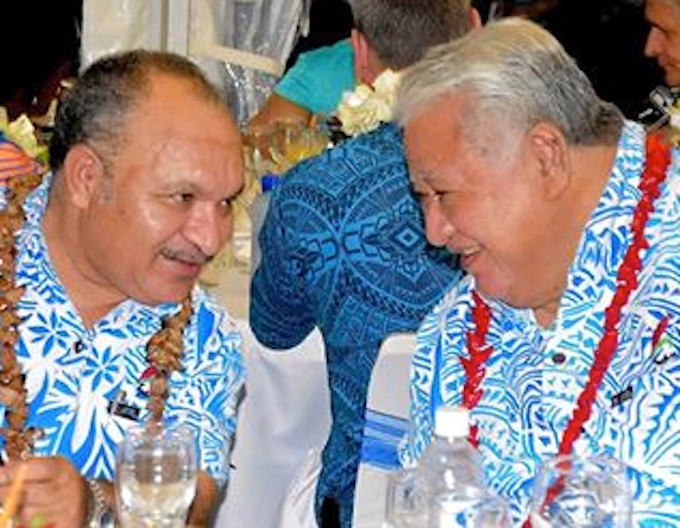
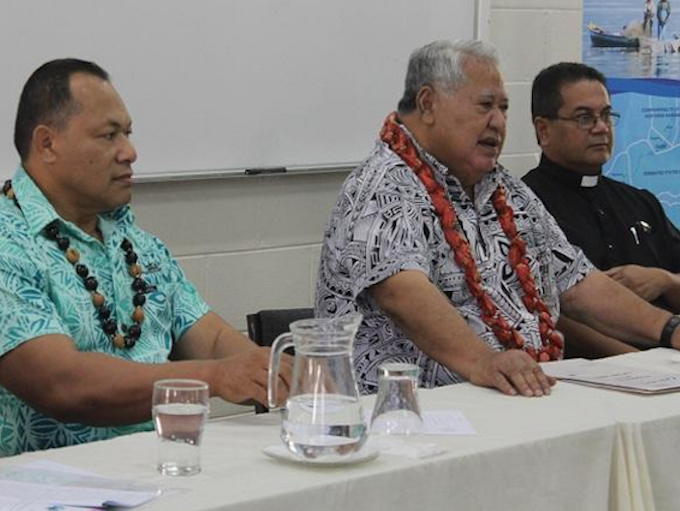
Papua New Guinea’s Peter O’Neill and PIF host Tuilaepa Lupesoliai Sailele Malielegaoi of Samoa share a joke in Apia. Image: PNGFacts

OPINION: By Mata’afa Keni Lesa in Apia

There is no doubt about it. The leaders of the Pacific Islands Forum in Apia this week have had their work cut out. Or so we hope.

As they do at these meetings, it has everything to do with trying to save our people and our part of the planet from eternal damnation.

Time will fly and with climate change taking most of the focus, this meeting is as good as finished already with the communiqué probably being written as we speak.

Keep in mind that climate change is not an issue that can be fixed overnight, you know. Truth be told, regardless of how many accords, frameworks and promises our leaders make, the fact is our islands are sinking and there is little we can do about it.

That shouldn’t stop us from pretending we are doing something about it.

And when you have a well-travelled group of officials who claim to be doing it for the sake of those poor folks in the village, we can at least rest well knowing they will have a jolly good time doing well … who knows.

-Partners-

Of course, there is a lot of noise being made about the issues.

Pretend to look busy
That’s about the best part of gatherings such as the one we are having in Apia this week. We can come together, wear our finest clothes, move from one meeting to the next and pretend to look busy.

But what does that mean for the person who is struggling to make ends meet in the village?

Does it change the prospects for the subsistence farmer who is toiling day and night to make ten tala to feed his family of 12?

Does it really empower the average woman who has to overcome so much to look after herself and family?

Let’s not forget, someone is picking up the bill for all this. What about taxpayers who are forking out for the bill, what do they get in return?

And how do we measure the return on investment?

Questions for a simple reason
We ask these questions for a very simple reason.

At the beginning of this meeting, the Secretary-General Dame Meg Taylor made the point that “Pacific people must be the recipients of the common good delivered by the policies and initiatives” discussed at such meetings.

She couldn’t have said it better.

But lets pause here for a second.

How many Forum meetings have we had now and where exactly are we today?

Looking at some of the recent developments, has the Forum become a stronger regional body to represent the voices of the Pacific? What are we to make of the emergence and strengthening of sub groups like the Polynesian Leaders Group and others? Is it possible that the emergence of these groups could spell the beginning of the end for the Forum?

Nobody wants to be the person asking these questions. But if we are serious, they have got to be asked and our leaders must respond.

Fancy closing ceremony
The fact is before you know it, this meeting will wrap up with a fancy closing ceremony and dinner at an exotic five star place where delegates and leaders will have fine wine and be merry.

That’s okay. They’ve got to have a bit of fun too, don’t you think?

You see, today in those meetings, we guarantee you that they will already be preparing for the next meeting. It’s just the way these things work. And it’s not confined to the Pacific.

The talkfests have become a way of life and you really have to wonder when it will end. If saving the planet is the goal, can you imagine the amount of carbon footprint these guys are burning in the process?

But then who cares?

The point is that somewhere somehow somebody is going to have to justify the need for one meeting after another meeting to prepare for another meeting to analyse the last meeting.

Please don’t get me wrong; we support the cause and we should never deride the value of talking about these issues. Talking about them is a lot better than not acknowledging them at all.

A line should be drawn
But we should also be mindful that a line should be drawn where talking stops and actions begin.

From our standpoint, actions are lacking. And when it comes to the Pacific islands, the reality is that a lot of so-called problems discussed during these meetings are deteriorating while our leaders are still talking.

You can pick any one of them issues whether it’s health, education, environment, governance, justice, gender and you will find that progress has been very slow, if any at all, and yet the poor taxpayers are still forking out for those beers and fine meals dished out in the name of officialdom and the pursuit for progress.

Let’s make the Apia experience a meaningful one, shall we? And tell me please that there is method in thy madness with all these meetings. Have productive Thursday Samoa, God bless!

Mata’afa Keni Lesa is editor of the Samoa Observer. This editorial coinciding with the 48th Pacific Islands Forum leaders meeting has been republished by Asia Pacific Report with permission.

]]>

Break-in ‘will not shake’ PNG’s Transparency International

]]>

AsiaPacificReport.nz

Transparency International chair Lawrence Stephens … “We’re a local non-government organisation fighting an important battle against destructive corruption.” Image: EMTV News

Pacific Media Centre Newsdesk

Transparency International Papua New Guinea (TIPNG) says its work will continue despite a break-and-entry incident that occurred at their Boroko premises earlier this week.

Staff were assaulted and close to K20,000 (almost NZ$9000) worth of goods stolen from the property. Transparency just recently moved there to a new office.

“We are a local non-governmental organisation fighting an important battle against destructive corruption and dependent on financial support from concerned citizens and donor agencies” said TIPNG chairman Lawrence Stephens.

Transparency International’s new office in Boroko … target of criminals. Image: TIPNG

“While we cannot say for certain that the theft was as a result of our work against the corrupt, we will obviously continue to fulfil our mission of speaking up for Papua New Guineans, even though we are now challenged by the loss of our project equipment.”

The Criminal Investigations Division of the Royal Papua New Guinea Constabulary (RPNGC) is investigating Monday’s break-in.

The organisation is appealing to the public for any information that will help in investigations.

-Partners-

EMTV News items are republished with permission.

]]>

Australian judge awards ‘fair’ $70m to Manus Island asylum detainees

]]>

AsiaPacificReport.nz

Manus Island prison … as reported by Leah Harding about Iranian filmmaker Behrouz Boochani and the docomentary Chauka: Please Tell Us The Time at #AJNewsgrid. Al Jazeera video

Pacific Media Centre Newsdesk

Australia will pay A$70 million (US$56 million) to asylum seekers detained in Papua New Guinea, after a senior judge has approved a major compensation package, reports Al Jazeera.

The state of Victoria’s Supreme Court awarded the funds yesterday to more than 1300 refugees held at a centre on Manus Island between November 2012 and December 2014, on the grounds of illegal detention and negligent treatment.

Manus Island detainees … an Australian outsourced centre of “inhumanity” in Papua New Guinea. Image: Green-Left

The remainder of the almost 2000 detainees from that period have been granted an extra two and a half weeks to join the class action and register for payment if they wish to.

Justice Cameron Macauley declared the decision, which is believed to be the nation’s largest human rights settlement, “fair and reasonable”.

Australia offered the compensation agreement in June, more than three years after lawyers initiated the case brought against the government and two service providers operating on the island.

-Partners-

Officials have previously declared the deal “prudent”, but denied wrongdoing.

Tough policy on asylum seekers
Australian policy dictates that asylum seekers attempting to reach the country by boat are transferred to detention facilities in the Pacific Ocean on Manus, or the island of Nauru; which was not involved in the litigation.

Speaking to Al Jazeera, Nick McKim, immigration spokesperson for the Australian Green Party, said: “The government of Australia wants to appear politically tough on refugees and tough on people seeking asylum.”

As a result, political leaders have a “political imperative” to treat the detainees inhumanely, he said, and “that’s exactly what they’ve done.”

The centre on Manus is due to close next month, following a PNG Supreme Court ruling last year that declared the holding of people on the island was unconstitutional.

The 803 men currently detained will be moved elsewhere in Papua New Guinea, or relocated to third countries, according to government officials.

Lawyers representing the refugees who generated the claim said they are seeking to secure the compensation payment before the centre shuts.

“These detainees came to Australia seeking refuge, compassion and protection, which were all denied to them by successive Commonwealth governments,” said Rory Walsh of the law firm Slater and Gordon.

“Today, the group has finally been delivered justice through the Australian legal system and the Supreme Court of Victoria. The result … will allow meaningful compensation to be paid to group members much more quickly than would otherwise have been the case.”

Distribution of the funds will be overseen by the court, with another hearing scheduled for October to determine when payments will begin.

The genesis of an Australian offshore detention centre. Graphic: Al Jazeera ]]>

What NZ’s major political parties offer on climate policy for 2017 election

]]>

AsiaPacificReport.nz

Pacific Media Watch Newsdesk

With New Zealand’s 2017 general election just two weeks away on September 23, Pacific Media Watch looks into the policies and stances of the country’s major political parties on climate change.

Despite scientific consensus that sea levels are expected to rise by a maximum of 1.5 metres, which could displace approximately 1.7 million people in the Pacific by 2050, the issue of climate change has at times been muted in this year’s election campaign, particularly in the leaders’ debates.

The party policies in a nutshell, with the “greenest” party first:

Green Party
The Greens have announced the party will attempt to pass binding climate change legislation in the first 100 days of Parliament in a move Green Party leader James Shaw described as “real climate action”.

Shaw announced on TV3’s The Nation the party would subsequently commit to a Zero Carbon Act.

Tackling climate change is an election priority for the Greens, with the party launching a plan to “truly address climate change” this Sunday on September 10.

-Partners-

The Greens say their climate change policy is “about adapting to climactic changes that are already locked in, and doing our part to help other nations, especially our vulnerable Pacific neighbours”.

The Pacific features heavily in this policy, particularly in terms of “international adaptation”, in which the party pledges to provide mitigation and adaptation funding, assist in forced relocations, and encourage international support at the UN for the Pacific in terms of its security and future survival.

On World Refugee Day – 20 June 2017 – Shaw announced within the Green Party’s immigration policy it would create a humanitarian visa for climate change refugees from the Pacific, initially available to 100 people a year, as part of its move to increase New Zealand’s refugee quota.

The Green Party’s online policy document on climate change has not been updated since 2014.

Labour Party
“This [climate change] is my generation’s nuclear free moment, and I am determined that we will tackle it head on,” says Labour leader Jacinda Ardern. However, in spite of her rallying cry and her comments that climate change was a challenge “postponed for too long” at Labour’s campaign launch, the party’s policy on climate change does not appear to be as aggressive.

While the Greens say they are committed to being carbon neutral by 2050, Labour is unclear on an exact date, choosing to wait until an independent carbon commission advises the party on a correct path.

“We will have a target, but I want to make sure that it’s not politicised, that we have that independent view and they hold us to account,” Ardern has said.

Labour’s policy on climate change aims to: ensure a just transition to a sustainable low-carbon economy with decent and secure jobs; establish an independent Climate Commission and carbon budgeting; restore the Emissions Trading Scheme (ETS) to putting an effective price on carbon; make New Zealand a leader in the international fight against climate change, and in ensuring the 2015 Paris Agreement is successfully implemented.

The party does, however, add: “More to be announced in this area”.

Māori Party
The Māori Party’s climate change policy is centred on solutions, in which a switch to renewable energy sources features.

The party says it plans to introduce, provide and develop renewable energy and alternative fuels. This includes subsidised solar panels for all homes in New Zealand and championing their installation in schools, marae, hospitals and government agencies.

The Māori Party also aims to close all coal-fired power plants by 2025 and support a proposal which will see 100,000 hectares of new forest planted over the next 10 years.

The party’s 2017 environmental policy document reveals it also wishes to enact climate change emissions targets into law, with an independent Climate Commission established to ensure this occurs, while subsidising electric vehicles for community groups.

Importantly, the party is proposing a new visa category for Pacific climate change refugees, in a policy move similar to the Greens.

National Party
New Zealand’s current coalition government leader, the National Party, says it takes climate change seriously.

The party admits it is presented with the challenge of reaching 30 percent emissions below 2005 by 2030 while continuing to grow the country’s economy and creating jobs.

Emissions have fallen eight percent since National took office, but the party does not shy away from the fact it “needs to do more”.

National therefore intends to ensure a third of its approximately 15,500 vehicles are electric or hybrid by 2021 and continuing to aim for 90 percent renewable electricity while implementing changes to the ETS to make it “fit for purpose”.

Climate change spokesperson Paula Bennet has also said National is committed to supporting New Zealand’s “Pacific cousins” in adapting to climate change.

However, the National government’s position on climate change is not without its critics. National is currently being criticised by both Labour and the Greens for delaying the release of a Ministry of Environment report on climate change impacts in New Zealand.

Green Party leader James Shaw has said: “It seems that there are inconvenient truths in this new report, which the government would rather not talk about in the lead-up to the election.”

Labour’s climate change spokesperson Megan Woods has also voiced concerns the government is being “cavalier” and “secretive”: “I want the report released immediately, so that New Zealanders can see for themselves what the risks are from not confronting the Climate Change crisis.”

National Party leader Bill English has said most New Zealanders do not wake up thinking about climate change, prompting one West Coast principal to write: “To flippantly make out it is not something New Zealanders think about suggests to some that Mr English does not really care about environmental issues such as climate change.”

New Zealand First
New Zealand First states a balance must be struck between the country’s economic progress and environmental goals.

Opposing the ETS, which New Zealand First sees as “profiteering from our environment”, is one of the party’s policies in tackling climate change.

New Zealand First says it believes wide public consultation should occur in the development of such climate policies, as the country transitions from fossil fuels to a renewable economy.

New Zealand First states within this transition, electricity retailers would purchase power generated by customers at the retail price through a “net metering” process. The party also believes New Zealand should implement similar climate legislation to the UK, in which emissions targets become law under a Climate Change Act supervised by a Parliamentary Commission for Climate Change.

New Zealand First states if effective climate change policy is not implemented the country’s trade will be at risk. “As a trading nation we cannot afford to sit on our hands. To do so would be to put our trade in primary products at risk, especially with countries that are doing their bit to reduce emissions.”

New Zealand First’s policy on climate change has allegedly been endorsed by Parliamentary Commissioner for the Environment, Dr Jan Wright, claims New Zealand First leader Winston Peters.

]]>

Mastermind behind murder of activist Munir still unknown after 13 years

]]>

AsiaPacificReport.nz

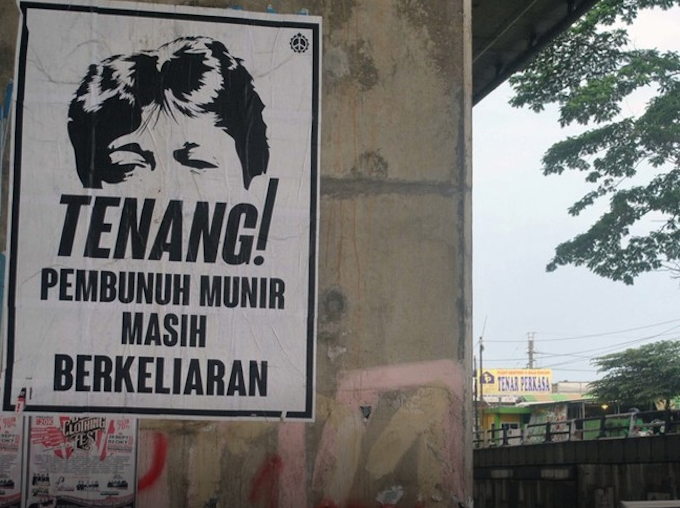
‘Beware! Mastermind of Munir’s murder is still out there!’ says a poster under an overpass in Bogor, West Java. Image: Arif Firmansyah/Antara

By  Dames Alexander Sinaga in Jakarta

Almost 13 years to the day since human rights activist Munir Said Thalib was poisoned with arsenic aboard a Garuda Indonesia flight bound for Amsterdam, his fellow activists are urging President Joko “Jokowi” Widodo to publish a report originally produced in 2005 by a fact-finding team that they believe will reveal the mastermind of the mysterious murder.

A former Garuda Indonesia pilot, Pollycarpus Budihari Priyanto, was sentenced to 14 years in prison for premeditated murder in the case.

In court, Pollycarpus was shown to have spiked fried noodles that Munir ate during his flight with arsenic. He was released on parole in 2014.

Muchdi, a deputy head at the National Intelligence Agency (BIN) at the time of Munir’s murder on September 7, 2004, was also charged with conspiracy to murder in the case but was declared not guilty by a Jakarta court in 2009.

Even before then though, Munir’s family, led by his wife Suciwati, and rights activists have been demanding that the government find the real mastermind behind the murder.

In October 2016, the Central Information Commission (KIP) demanded the government publish the report by the fact-finding team on Munir’s murder, reviving hopes the mastermind would finally be unveiled.

-Partners-

Following KIP’s recommendation, former President Susilo Bambang Yudhoyono (SBY) submitted the report to Widodo’s administration in late October last year.

Report apparently unread
Almost a year on, Widodo has apparently not yet read the report.

Suciwati said she has little hope the Jokowi administration will publish the report or try to find the mastermind behind Munir’s murder.

“I am pessimistic about President Jokowi. However, we will keep pushing him. It’s his duty as president to settle this case,” she said in a public discussion in Jakarta on Tuesday

Suciwati said she had met with government officials many times when SBY was still in power to try to persuade them to release the report, but to no avail.

“[Meeting government officials] only turned me into a political commodity. I don’t need to meet them again. I just want this case to be solved,” she said.

Suciwati said Widodo should make it a priority of his remaining two years in his first term as president to release the report.

Meanwhile, former fact-finding member Usman Hamid said Munir’s murder will not be solved until the report is opened and made public.

“Munir’s murder is still unsolved because the main actor is still out there. Without our investigation, we would not even know Munir was killed,” he added.

]]>

Forum chief promises protesters ‘voice of Papua’ will be heard in Samoa

]]>

AsiaPacificReport.nz

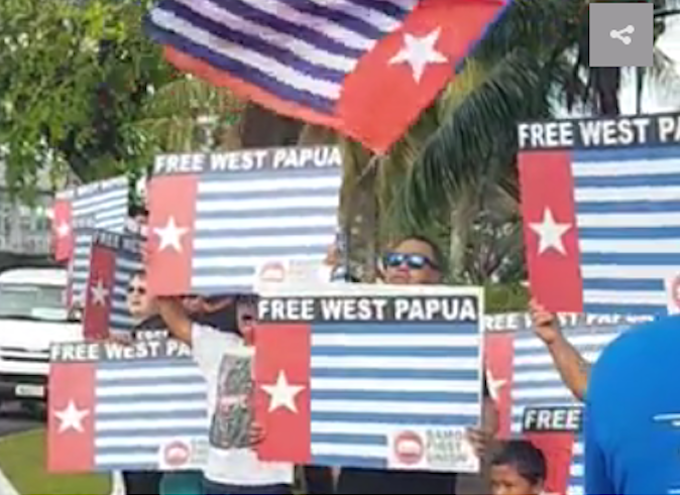
Protesters in Samoa show solidarity for West Papua self-determination at Pacific Islands Forum meeting. Image: Samoa Observer video still

By Elizabeth Ah-Hi in Apia

The Secretary-General of the Pacific Islands Forum Secretariat, Dame Meg Taylor, has promised protesters that their voice on West Papua will be heard by the leaders attending the 48th Pacific Islands Forum (PIF) leaders meeting this week.

Dame Meg delivered the promise when she personally appeared before protesters in front of the Sheraton Hotel in Apia today where the meeting is taking place.

West Papua may not have had a seat at the Pacific Leaders Forum table this week but they were not forgotten by Samoans who showed up to demonstrate on their behalf.

The protest was led by prominent lawyer, Unasa Iuni Sapolu.

VIEW VIDEO: Protesters take up West Papua’s cause at Apia Forum

Between 30 to 35 members of the New Zealand Dairy Workers Union, Samoa First Union, Pacific Climate Warriors and Free West Papua supporters joined forces to demonstrate outside the PIF meeting.

-Partners-

Dame Meg came out to personally acknowledge the protesters before heading into the Sheraton.

Supporters of the moment chanted “Freedom for West Papua” and sang songs from the Mau, making a connection back to Samoa’s ancestors struggle for independence and sovereignty against New Zealand colonial authorities.

Message loud, clear
The demonstrators made their message loud and clear to the delegates, leaders and onlookers this morning as PIF members made their way to the Sheraton to begin the first day of official talks after last night’s opening.

The group was later asked to disperse an hour into their demonstration by police spokesperson Sala’a Sale Sala’a.

The group did not have a permit to protest.

Jerome Mika from the New Zealand Dairy Workers Union spoke with Sala’a and agreed to leave the area until a permit could be processed.

The Free West Papua supporters were satisfied with their efforts today.

“We call on the other Pacific Island heads of state to join the seven countries pushing to re-list West Papua with the UN Decolonisation Committee. Samoa as a nation through our forefathers fought for self-determination, and we should stand together with West Papua. Lest we forget,” the group said yesterday.

Protests at the Forum come after West Papua action groups last week urged leaders to continue their support and take decisive action, Pacific Media Watch reports.

Elizabeth Ah-Hi is a reporter with the Samoa Observer.

]]>

Australia’s ‘dirty’ coal hypocrisy threatens Pacific climate security

]]>

AsiaPacificReport.nz

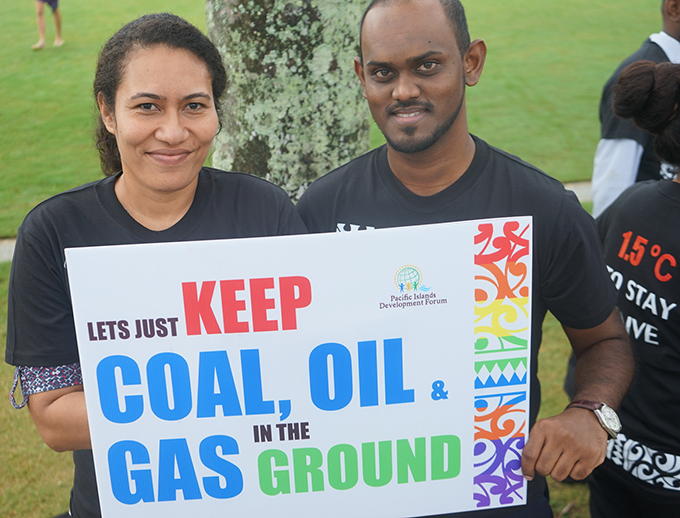
A message from PICAN activists at the University of the South Pacific in Fiji … keep fossil fuels in the ground. Image: PICAN

Pacific Media Centre Newsdesk

As Australian Prime Minister Malcolm Turnbull prepares to meet with his island counterparts this week in Apia, Samoa, Pacific civil society groups say his country’s promotion of coal puts their communities at risk.

Pacific island countries, including some of the world’s most vulnerable low-lying islands, are demanding greater ambition to tackle climate change and renewed political commitment to the 2015 Paris Agreement.

On Thursday, Pacific Islands Forum leaders will consider a “united” Pacific voice to take to the COP23 climate negotiations in November. At those talks – to be held in Bonn, Germany – the world’s eyes will be on the Pacific as Fiji takes over as president of the UN climate negotiations, the first time a small island developing state has held this important role.

However, members of the Pacific Islands Climate Action Network (PICAN) say there is a low probability of an authentic “united” Pacific voice being forged in Apia, with Australia’s presence and economic interests being historically responsible for watering-down regional climate declarations.

Australia’s continued promotion of coal – the dirtiest of the fossil fuels that are driving the world’s warming climate – jeopardises negotiation outcomes, and ultimately the safety of the entire Pacific region.

Maina Talia, from the Tuvalu Climate Action Network (TuCAN), said Pacific island leaders had again and again explained that climate change was the greatest security risk to island countries and communities.

-Partners-

“We are strong and resilient people”, said Talia. “However we can only adapt to so many changes.

Greater responsibility needed
“Stronger cyclones, coral bleaching, and rising sea levels are all causing permanent and irreparable damage in our countries. We need polluters to take greater responsibility for their actions now.”

He said countries that were committed to fossil fuel economies needed to shift to renewables as fast as possible.

Talia added that “governments and civil society organisations must work together, to build resilience to address the adverse impacts of climate change by developing a Pacific Islands Climate Change Insurance Facility that ensures our sovereign rights are well protected.”

Talia also said polluting nations needed to ensure Pacific island communities and countries that are facing permanent loss and damage from the impacts of climate change could access grant-finance simply and easily.

Australia, the largest and wealthiest member of the Pacific Islands Forum, is also the world’s largest coal exporter, and is currently planning to subsidise the development of new export coal mines and coal-fired power plants.

In October, construction is expected to get underway for what will be the world’s largest export coal mine, in the state of Queensland.

Strong language
PICAN and other members of the Pacific civil society will be looking to the outcome statements of the Apia meeting for strong language around 1.5 degrees, the UNFCCC Gender Action Plan (GAP), loss and damage finance, and other previously agreed ambitious Pacific positions in the global climate negotiations.

Last month PICAN awarded the Australian government the inaugural “Pacific Fossil Award”, for its repeated efforts to convince Pacific island countries of its dedication to tackling climate change, while actually making the problem worse by expanding coal exports, as well as promoting the use of coal abroad.

Established by the Pacific Islands Climate Action Network (PICAN), the new award is intended to call out countries that are not doing their fair share to move away from fossil fuels and to tackle climate change.

Pacific Islands Climate Action Network (PICAN) is a regional alliance of 55 non-governmental organisations (NGOs), civil society organisations (CSOs), social movements and not-for-profit organisations from the Pacific Islands region working on various aspects of climate change, disaster risk and response and sustainable development. PICAN is also the Pacific regional node of the Climate Action Network International.

]]>

Jane Kelsey: Labour and the TPPA – time to come clean before election

]]>

AsiaPacificReport.nz

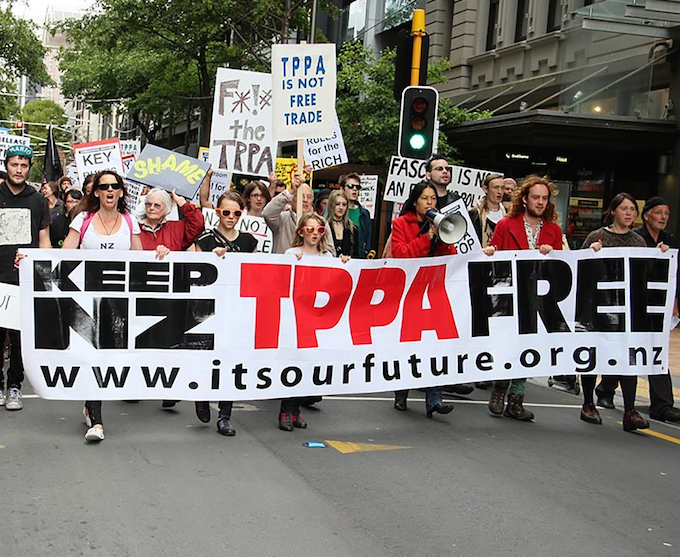
An Auckland “Keep NZ TPPA free” protest. Image: Cultural Survival

ANALYSIS: By Professor Jane Kelsey

It is now certain that any decisions on the future of the Trans-Pacific Partnership Agreement (TPPA) minus the US will take place after New Zealand’s general election this month.

Last week’s meeting of the negotiators from the remaining 11 TPPA countries rebuffed the National government’s wish to proceed with the agreement basically unchanged aside from new provisions for its entry into force.

They have all agreed to suspend (but not remove) some of the most controversial intellectual property provisions that hiked the price of medicines. Other countries want parts of the actual text and countries’ schedules reopened.

Each country has to come back with its wish-list at another meeting in Japan later this month, probably while the New Zealand government is in caretaker mode after the September 23 election.

Post-election, a Labour-led government would inherit a poisoned chalice. But its position to date gives no confidence that Labour will take a stand against the resurrection of the deal, despite the groundswell of opposition from its own core membership.

READ MORE: Response of the opposition parties to the 10 bottom lines for NZ’s future trade policy

Cartoon: Malcolm Evans/The Daily Blog

-Partners-

Labour Party leader Jacinda Adern recently defended the party’s “bloody minded” opposition to the agreement. But its only firm position is an objection to a single, very specific provision in the entire 30-chapter deal: the right to discriminate against foreign purchasers of residential property in the schedule on investment.

Does Labour really intend to agree to the TPPA-11 if that minor matter is changed (as it has been in a leaked copy I have of New Zealand’s proposed schedule to the now-suspended Trade in Services Agreement negotiations)?

Hiking the price of medicines
What about the intellectual property provisions the US insisted on that will hike the price of medicines and put taxpayer money into the pockets of Big Pharma – money Labour will desperately need to upgrade our rundown hospitals and fund primary health care for our poorest communities?

To date they will be suspended, but not removed, so they can be reactivated if the US rejoins. If the New Zealand Medical Association can call for those rules to be dropped, surely it’s a safe enough bet for the Labour Party to do so?

Or the investor-state dispute mechanism. David Parker’s position is that Labour would prefer not to have them. Grow a spine! Even Crawford Falconer, the ex-MFAT official who is now the UK’s new free trade negotiator, says it should be dropped from such deals.

Parker also insists that the Treaty of Waitangi exception is the best possible drafting imaginable, and claims the Waitangi Tribunal endorsed it. In fact the Tribunal said:

“The Crown however goes further and says that nothing in the TPPA will prevent the Crown from meeting its Treaty obligations to Māori. We have some reservations about this. … Our concern is that by qualifying the Treaty exception clause to that aspect of the Treaty relationship which may allow the Crown to adopt or implement measures more favourable to Māori, the full constitutional reach of the Treaty relationship may not be as clearly protected and preserved under the TPPA as it might be.”

A Labour Party that is pitching to reclaim all the Māori seats can, and must, do better.

So far as I can see, Labour has not even called for the government’s new modelling on the TPPA-11 to be made public, despite having pointed to the failings of the initial modelling in its minority report on the original TPPA.

Leadership on record
Labour’s leadership needs to go on record before the election with some more detailed and convincing answers to these questions, and its position on other toxic provisions affecting the right to regulate on state-owned enterprises, government procurement, financial services and taxation.

Above all, Labour needs to commit now to a genuine consultation about what position New Zealand should take on the TPPA-11 (given the massive input into the original select committee hearing that was arrogantly ignored); to publish any future mandate it takes into the negotiations (as the EU does in its negotiations); and to support its position with a comprehensive, independent and public cost-benefit analysis.

Or does Labour intend to retreat behind the same wall of secrecy as National has in these renegotiations?

Jacinda Ardern, Grant Robertson, David Parker, anyone in the Labour leadership – can we know your real position on the TPP-11 before the election please?

Dr Jane Kelsey is a professor of law at the University of Auckland and a prominent New Zealand critic of globalisation. This article is republished from The Daily Blog with permission.

]]>

‘Shared stewardship’ of ocean key to Pacific Forum strategy

]]>

AsiaPacificReport.nz

Samoan Prime Minister Tuilaepa Sa’ilele Malielegaoi … “Blue Pacific” concept provides Pacific Islands Forum with unique opportunity. Image: Loop Samoa

Pacific Media Watch Newsdesk

Leaders from across the Pacific are meeting in Apia, Samoa, this week to discuss the future of the region’s oceans.

Under the theme “The Blue Pacific: Our sea of islands provide for our secure future through sustainable development, management and conservation”, members of the Pacific Islands Forum (PIF) have gathered in Samoa for the 48th leaders meeting opening today.

Proceedings began with the Smaller Islands States leaders meeting, in which proceedings went “very, very well”, said Baron Waqa, President of Nauru.

“There were a number of matters that were discussed and a lot of very healthy interventions from leaders,” he said.

“Climate change was still very, very actively discussed in the meeting,” Waqa said.

Ahead of the meeting, incoming PIF chair and Samoan Prime Minister Tuilaepa Sa’ilele Malielegaoi said the “Blue Pacific” concept – shared stewardship of the Pacific Ocean based on a shared geography, ocean identity and resources – provided the Forum with a unique opportunity to strengthen collective action and subsequently its vision for the region.

-Partners-

“Blue Pacific provides a new narrative for Pacific regionalism and how the Forum engages with the world.

Long-term commitment
“This new narrative calls for inspired leadership by the Forum and a long-term commitment to the benefits of acting together, as one blue continent, has the potential to define a Blue Pacific economy, ensures a sustainable, secure, resilient and peaceful Blue Pacific as well as strengthens Blue Pacific diplomacy to protect the value of our ocean and our peoples,” he said.

Tuilaepa said the concept of the Blue Pacific was integral for the Forum moving forward, as the ocean was crucial for the Pacific and its people.

“Exercising a sense of common identity and purpose linked to the ocean has been critical for protecting and promoting the potential of our shared Pacific Ocean.

“It is this commonality of the fundamental essence of the region which has the potential to empower the region through collective, combined agendas and actions.

“The Blue Pacific will strengthen the existing policy frameworks that harness the ocean as a driver of a transformative social, cultural, political and economic development of the Pacific.”

Tuilaepa warned, however, that implementing the Blue Pacific required “whole Forum commitment”.

“Above all else it will require a different way of working together that prioritises the Blue Pacific as the core driver of Forum policy making and collective action. The Forum political dialogue needs to be informed by the Blue Pacific which in turn supports Forum actions in a manner that empowers the region,” he said.

Climate champions remembered
Forum leaders also held a moments silence for climate change champion Tony de Brum and government minister Mattlan Zackhras of the Marshall Islands, who died on August 24 and August 8 respectively.

Absent from this year’s meeting is Palau’s president Tommy Remengesau.

Pita Ligaiula of PACNEWS reports security issues caused by North Korea’s recent missile tests have forced Remengesau to travel to Japan to speak with US allies.

In his place is Vice-President Raynold Oilouch, who said the ocean was a “very critical component and surveillance of our jurisdictions” for Palau at this year’s meeting, Pacific Note reports.

“This is the time again to reflect on the unfinished business and what needs to be done and how best we can progress,” he said.

Radio Kiribati reports Fiji is again absent at the annual meeting, although it is “back at the table” on a ministerial level, said PIF Secretary-General Dame Meg Taylor.

The PIF meeting continues with an official opening and also the Pacific ACP leaders meeting.

The PIF was established in 1971 by New Zealand, Australia, the Cook Islands, Fiji, Nauru, Tonga and Western Samoa as a trade body. The Forum has evolved and now serves as the primary body for Pacific Island leaders to discuss the political, economic and developmental issues facing the region.

Forum members comprise Australia, Cook Islands, Federated States of Micronesia, Fiji, Kiribati, Nauru, New Zealand, Niue, Palau, Papua New Guinea, Republic of Marshall Islands, Samoa, Solomon Islands, Tonga, Tuvalu and Vanuatu French Polynesia and New Caledonia.

]]>

Pōhiva blames T$60,000 ceremony bill rejection for cabinet shakeup

]]>

AsiaPacificReport.nz

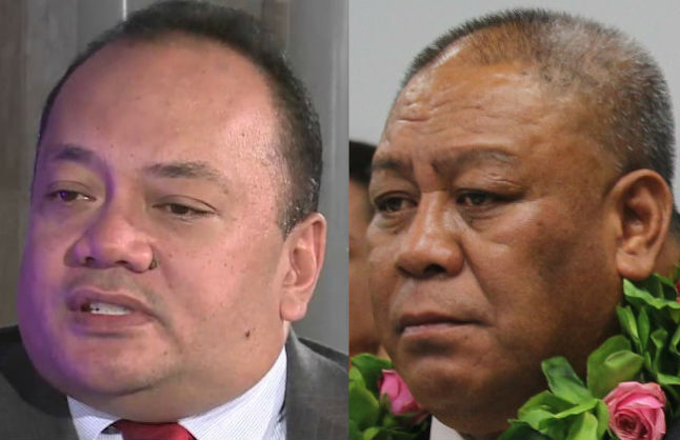
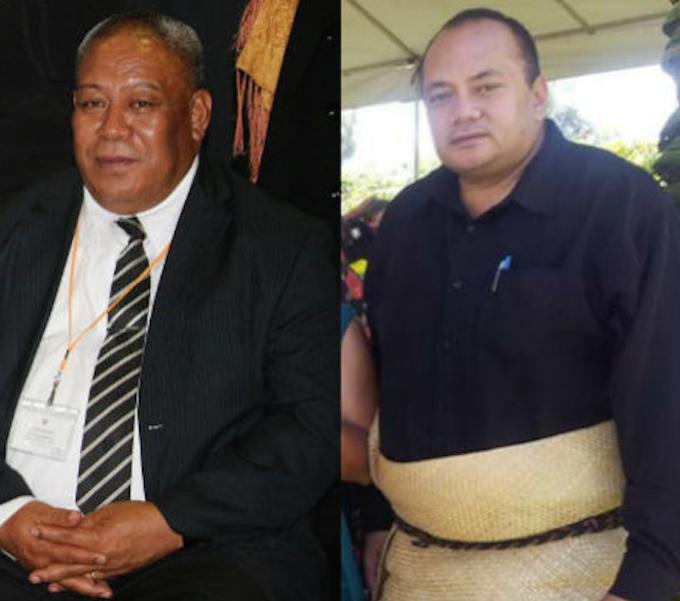
Former Deputy Prime Minister Siaosi Sovaleni (left) and former Minister of Finance Tēvita Lavemaau. Images: Kaniva News

By Kalino Latu, editor of Kaniva News

Tongan interim Prime Minister ʻAkilisi Pōhiva says he suspected his rejection of a proposal by the Deputy Prime Minister and Finance Minister to spend T$60,000 on the opening celebration of the St George Palace government building had turned the duo against him.

Pōhiva sacked Deputy Prime Minister Siaosi Sovaleni and Minister of Finance Tēvita Lavemaau on Friday before he left for Samoa to attend the Pacific Leaders Forum this week.

His son and personal assistant, Po’oi Pōhiva, told Kaniva News the Prime Minister had submitted the letter of their dismissals to the king on Friday evening.

He said they received a message from the Lord Chamberlain saying that he had handed in the letter to the King.

Po’oi said the Prime Minister was expecting a response from the King yesterday.

Lavemaau and Sovaleni proposed to the cabinet that TP$60,000 be allocated to help fund the preparations for the opening ceremony of the St George Palace on Friday.

-Partners-

Pōhiva said he and some of the ministers who attended a cabinet meeting did not approve the proposal as they thought it was a huge amount of money to be spent on the ceremony.

Parliament dissolved
King Tupou VI, who suddenly dissolved Parliament on August 24 and put Pōhiva and his government in caretaker mode, opened the new multimillion pa’anga St George Government Building on Friday.

He was welcomed by the Prime Minister during the ceremony and they shook hands before the King left the event.

The T$28 million building project was funded by the Chinese government in an agreement signed in 2012.

The fully equipped building with a floor area of around 5745 sq m has housed the Prime Minister’s Office, the Ministry of Finance and National Planning, the Ministry of Foreign Affairs and the Cabinet Chambers.

The interim Prime Minister alleged Sovaleni and Lavemaau knew about the plan of the King and Speaker, Lord Tu’ivakano, to dissolve Parliament, but they did not warn him because they were holding a grudge against him after their proposal had been rejected, he told Radio Tonga Broadcom and Tonga Daily News on Sunday night.

Pōhiva said he was disappointed with Sovaleni and Lavemaau’s action in that they should have warmed him about the dissolution.

He implied that if he had been warned of the plan to dissolve the House he might have approached the King first.

He said he found out when he arrived in New Zealand on his way to Samoa last week some people in New Zealand knew the King was going to dissolve Parliament.

Other concerns
Pōhiva said there were other things he was concerned about towards the two ministers but he did not reveal them.

It appeared the dismissals did not go through cabinet before they were made, as they shocked some of the ministers who only found about the decision from Kaniva News on Saturday morning.

It appeared Pōhiva did not approach Lavemaau and Sovaleni about their dismissals and the Prime Minister did not say whether he had proof the ministers knew about the plan to dissolve Parliament.

The two dismissed cabinet members reportedly said they knew nothing about their dismissals.

Dr Pōhiva Tu’i’onetoa, who was appointed as replacement Minister of Finance, did not know about his appointment.

He said he only knew about it from Kaniva News and he had not received any message about it.

Pōhiva confirmed on Sunday night he had also appointed Lord Ma’afu as Deputy Prime Minister and oasi Tei to the MEIDECC.

Lord Ma’afu told Radio New Zealand he was unaware of his appointment and the reshuffle.

Pōhiva said he would not appoint new ministers from outside cabinet after the dismissals of Sovaleni and Lavemaau.

Acting Attorney-General ‘Aminiasi Kefu told the radio Pōhiva still held the power to dismiss any of his ministers while the government was in caretaker mode.

]]>

Naashon Zalk: Why are New Zealand’s waters so polluted?

]]>

AsiaPacificReport.nz

Al Jazeera’s People & Power investigates disturbing claims that New Zealand’s rivers and lakes are among the most polluted in the developed world. This is a major issue in the country’s general election on September 23.

BACKGROUND: Naashon Zalk reports on his two-part documentary

I had lived in New Zealand for two years in the early 2000s. In 2015, I moved back here. And I was astonished to see how much the country had changed in those 15 years.

It has become wealthier on the back of an urban property boom, mass immigration and the explosive growth of intensive dairy farming which began back in the 1990s.

Behind the Tourism NZ hype … a disturbing secret: the country’s freshwater is in severe crisis. Image: People & Power

I also discovered that the country is harbouring a disturbing secret, little known to the rest of the world: its freshwater is in severe crisis. Two-thirds of New Zealand’s rivers are too polluted to swim in and half its lakes are irreversibly damaged.

This pollution, say many independent environmentalists, scientists and economists, is primarily a by-product of the laissez faire growth of the country’s dairy industry. The government, dairy industry, and irrigation lobby disagree. They say it’s a legacy of over 100 years of farming.

I set out to investigate why New Zealand, a country which markets itself as a clean, green paradise, has in fact got disturbing water pollution problems which only appear to be getting worse.

A third of Havelock North’s population becoming ill awakened New Zealanders to the dire state of their freshwater. Image: People & Power

-Partners-

While I was researching the story an event happened which I believe has been pivotal in awakening New Zealanders to the dire state of their freshwater. In August 2016, the tiny town of Havelock North, on the east coast of the country’s North Island, was incapacitated by an outbreak of campylobacter in their drinking water.

More than 5000 of its 15,000 inhabitants were made ill by the bug and three deaths were later linked to the outbreak.

Bigger pertinent story
Upon investigating the Havelock North water poisoning I was alerted to an even bigger, and more pertinent story in the wider Hawke’s Bay area.

The regional council had been striving for years to get a controversial billion-dollar irrigation scheme off the ground, called the Ruataniwha Water Storage Scheme. But as I found, local and national opposition to the dam, especially after the Havelock North contamination outbreak, was becoming more vocal.

I quickly realised that this was a crucial part of the story. The growth of New Zealand’s highly profitable dairy industry has, to a large extent, been made possible by irrigation schemes which deliver the massive volumes of water needed to produce milk.

Significant economic growth on the back of dairy farming but also a drastic decline in the quality of New Zealand’s waterways. Image: People & Power

Every litre of milk produced requires about 1000 litres of water. The most irrigated region of New Zealand is Canterbury, on the east coast of the country’s South Island. It has seen significant economic growth on the back of dairy farming but, over the same period of time, has also seen a drastic decline in the quality of its waterways.

Opponents of the dam in Hawke’s Bay were worried that the same environmental degradation would take place in their region if it went ahead.

They were also concerned that the council, hell-bent on the scheme, were ignoring glaring flaws in the dam’s business case.

A regional election, coming only a month after the Havelock North debacle, was gearing up to become a referendum on the dam and it gave me the perfect vehicle to explore the arguments. At the time, the nine-member council was divided between five pro- and four anti-dam representatives.

All it would take to thwart the dam was for anti-dam councillors to win a single seat. And the winning of that seat would have national repercussions, because the Ruataniwha project was seen as the poster child for other planned irrigations schemes, most of them along New Zealand’s drought prone east coast.

Eager to understand their vastly opposing views I followed the election campaigns of two local politicians.

‘Can the Dam’ campaign
Alan Dick, a regional councillor, was one of the dam project’s originators. The other, Paul Bailey, is a former bank manager turned Green Party politician. He was running for office for the first time under the slogan “Can The Dam”.

On the surface, the arguments of the pro-dam lobby sounded very reasonable. I was told the dam would alleviate drought concerns, boost economic growth and improve the quality of rivers it fed into by flushing away pollution.

In tandem with constructing the dam, much stricter environmental regulations would come into play to keep contamination below an environmental limit which was set by the Environmental Protection Agency.

But as I investigated further I found what seemed to be serious flaws in their arguments. And indeed, upon examination, the commercial case for the dam didn’t seem to add up either.

As you’ll see, these are documented in the first film – and continue into the second episode in which I also look at allegations of high-level political interference in the project and other related issues.

Over the many months, I’ve spent investigating this story, anxiety and anger about freshwater pollution has grown to make it New Zealand’s top environmental concern – and now, reflecting many of the same arguments I’d encountered in Hawke’s Bay, it’s also become a key issue in the country’s current and ongoing general election campaign, which reaches a climax on September 23.

Dairy farmers – a powerful lobby in New Zealand – are angry at what they see as unfair criticism. Image: People & Power

Barely a day goes by without the problem being reported in the media here and seemingly everyone has an opinion – whether they be environmentalists arguing for a better way of managing a vital natural resource or dairy farmers who are angry at what they see as grossly unfair criticism of their role in the crisis.

The fury of the latter – and they are a powerful lobby in New Zealand – was brought home to us several times on location when our attempts to film generic roadside shots of dairy cattle were interrupted by the animals’ suspicious owners.

My main hope is that some of the questions raised by these films will contribute to the debate around New Zealand’s freshwater problems – problems that all agree will have to be addressed by whichever party takes office after the election.

One thing is certain, urgent action on pollution cannot be delayed.

Editor’s note: On August 30, as these two Al Jazeera documentaries were being prepared for broadcast, Hawke’s Bay Regional Council announced it was withdrawing support for the Ruataniwha dam, leaving the project’s future in some doubt. Nevertheless, with the current New Zealand government and many in the powerful dairy industry continuing to be strong supporters of irrigation schemes, it may be too soon to write the scheme off entirely.

]]>

Tonga’s caretaker PM Pōhiva sacks deputy and Finance Minister

]]>

AsiaPacificReport.nz

Sacked … Tonga’s Finance Minister Tēvita Lavemaau (left) and Deputy PM Siaosi Sovaleni. Image: Kaniva News

By Kalino Latu, editor of Kaniva News

Prime Minister ‘Akilisi Pōhiva has fired Deputy Prime Minister Siaosi Sovaleni and Finance Minister Tēvita Lavemaau, says a cabinet spokesperson.

It is understood Sovaleni and Lavemaau were dismissed effective from yesterday at 5pm.

Pōhiva was “very disappointed” with the ministers, the spokesperson said today.

The ministers were allegedly involved in a conspiracy which led to King Tupou VI’s decision to dissolve Parliament and order a fresh general election in November to replace the current MPs and cabinet.

Lord Maʻafu has been appointed the new Deputy Prime Minister while Poasi Tei took over Sovaleniʻs Ministry of MEIDECC.

Dr Pōhiva Tuʻiʻonetoa is the new Minister of Finance.

-Partners-

The dismissals came after state-owned Tongan Broadcasting Commission (TBC) news producer Viola Ulakai asked Pōhiva during a press conference in Nukuʻalofa on Tuesday whether it was true some of his ministers were being investigated.

Investigation denied
The caretaker Prime Minister denied this. Pōhiva said he was satisfied and calm. All the ministers were still in cabinet.

Ulakai told Pōhiva his son-in-law, Police Minister Māteni Tapueluelu, had told TBC News some ministers had been investigated.

Pōhiva said if anything would come up it will be “dealt with accordingly”.

Sovaleni and Lavemaau have been contacted by Kaniva News for comment.

Justice Minister questions Speaker role
Meanwhile, the Minister of Justice has told Kaniva News there was no clause in the Tongan Constitution which said the king could dissolve Parliament on the advice of the Speaker.

Minister Sione Vuna Fā’otusia said this meant there was room to challenge in court the involvement of the Speaker in the decision.

King Tupou VI dissolved Parliament after he had received a recommendation from the Speaker of the Legislative Assembly, Lord Tu’ivakanō, who was Prime Minister before  ‘Akilisi Pohiva.

Acting Attorney-General Aminiasi Kefu had said the decision to dissolve Parliament was part of the king’s royal prerogatives and it could not be challenged in court.

However, Fā’otusia disagreed and said the decision by the king, based on a recommendation from the Speaker, was not a royal prerogative, but was statutory.

“The Acting Attorney-General does not think so. But I think that there is a ground for judicial review as the decision was not royal prerogative, but statutory,” Fāʻotusia told Kaniva News.

“There is nothing in the constitution to allow the king to dissolve the house based on the recommendation of the Speaker.”

Tongan news is republished by Asia Pacific Report with the permission of Kaniva News.

]]>

Toktok 35 / Winter 2017

]]>

Pacific Media Centre

http://www.pmc.aut.ac.nz/

Pacific Media Centre

ISBN/code: ISSN 1175-0472

Publication date: Thursday, August 31, 2017

Publisher: Pacific Media Centre


BENNY WENDA VISITS AUT
A lifelong campaigner for a free and independent West Papua issued a stark warning to New Zealand politicians when he visited the country recently.

Benny Wenda, a tribal chief of West Papua exiled to the United Kingdom by Indonesia, told the Pacific Media Centre’s Asia Pacific Report that time was running out for West Papua if governments such as New Zealand did not act.

“If we live with Indonesia for another 50 years, we will not be safe. We will not be safe with Indonesia.”

He said the purpose of his visit to New Zealand was to highlight the importance of West Papua returning to its Melanesian family.

“We really need Pacific Islanders, our sisters and brothers across the Pacific – particularly New Zealand and Australia – to bring West Papua back to its Pacific family. Then we can survive. Otherwise, it will be very difficult to survive with Indonesia,” he said.

Also:
Mangahas, Blades booked for PMC birthday

Climate change in Asia-Pacific, advocacy journalism in PJR

Freak office fall sidelines PMC director

PMC 2017 events in images

]]>

Papuan leaders want say in Freeport copper mine negotiations

]]>

AsiaPacificReport.nz

Security personnel keep watch at Freeport McMoran’s Grasberg mining complex in Indonesia’s Papua province. Image: Benar News/AFP

By Victor Mambor in Jayapura

The Indonesian government’s decision to allow one of the world’s largest copper and gold mines to operate in Papua province until 2041 has prompted local indigenous leaders to remind officials that their people never gave up land ownership and want a role in negotiations.

On Tuesday, the US-based firm Freeport McMoran announced it was giving up a majority of its ownership in Papua’s Grasberg mining complex in exchange for being allowed to operate there for up to 24 more years.

“We indigenous Papuans, especially from the Amungme and Kamoro tribe communities, have never released our ancestral lands to any party, neither to the government of Indonesia nor Freeport,” John Gobay, a chairman of the Customary Council in Paniai, a district in Papua province, said.

Two weeks ago, he met with Indonesian President Joko “Jokowi” Widodo in Jakarta, where Gobay expressed concerns about issues involving Freeport’s operations at the Grasberg complex.

He said neither the Amungme nor Komoro were seeking a share of the mine, but they should be valued as the owners of the mountain where Freeport has been operating for decades.

“We own the mountain and the land and the state has recognised it under the state 1945 Constitution and Law No. 21 of 2001 on Papua Special Autonomy,” Gobay said.

-Partners-

Freeport-McMoran agreed to divest 41.64 percent of its Indonesian subsidiary, PT Freeport Indonesia (PTFI), at a fair market price to allow 51 percent ownership by Indonesian interests.

Freeport’s share of the company is 90.64 percent while the Indonesian government holds the other 9.36 percent.

‘Positive for stakeholders’
“Reaching this understanding on the structure of the mutual agreement is significant and positive for all stakeholders. Important work remains on documenting this agreement and we are committed to completing the documentation as soon as possible during 2017,” Freeport chief executive Richard C. Adkerson said in a news release.

As part of the agreement, Freeport agreed to construct a smelter in Indonesia by 2022, thereby lifting a government threat to ban the company from exporting unrefined copper.

The smelter is estimated to cost US$2 billion and is a major concession for his company, Adkerson told the Wall Street Journal.

The government is not likely to have the financing to buy all of Freeport’s share being put on the market, so the divestment could be spread across many potential buyers, analysts told the Journal.

Finance Minister Sri Mulyani Indrawati Energy and Mineral Resources Minister Ignatius Jonan represented the Indonesian government and Adkerson represented Freeport at a news conference in Jakarta on Tuesday where both sides announced the agreement.

Ignatius said Indonesia had agreed to extend Freeport’s licence, which ends in 2021, by 10 years to 2031, and another 10 years to 2041 if the company met the contract’s requirements, including the smelter.

“The negotiation between the government and Freeport began in early 2017. But in the last three to four (days), the talks got intense and the two sides found an agreement,” Ignatius said.

Adkerson said Freeport would honour the agreement.

“We appreciate the leadership of President Joko Widodo and we have been listening carefully to what the government wants and its objectives,” he told the news conference.

Papuans demand role
But because Papuans own the land in and around the mining complex, they should have a role in the upcoming negotiations involving the purchase of company holdings, said Ruben Magay, a member of the Papuan Regional Legislative Council (DPRP).

“This is the time for the government to involve land owners in determining Freeport’s investments,” he said.

“There are three parties, the central government/local government, investors and indigenous people.”

He said discussions regarding Freeport should be clear on what percentage is for investors, what percentage is for the government and how much is for the indigenous people.

“During Freeport’s first work contract in 1967, until the second work contract in 1991, and this most recent one, the position of indigenous people has been unclear. The discussion has been between the central government and the investor, in this case, America,” Magay said.

Gobay expressed hope that Jokowi would hold a special negotiation session attended by the government, Freeport and the representatives of Amungme and Komoro tribes.

“If not, we will report it to the United Nations through the indigenous representatives and we will contest Freeport and the central government for not complying with its own regulation,” Gobay said.

Victor Mambor is a leading Papuan journalist and editor of Tabloid Jubi.

]]>

16 years on: Looking back on Bougainville’s Peace Agreement

]]>

AsiaPacificReport.nz

Flashback: An EMTV News video report on the Bougainville peace.

By Fabian Hakalits in Arawa

It has been 16 years this week since the signing of an important blue print document that put an end to Bougainville’s civil war in Papua New Guinea.

The Bougainville Peace Agreement paved the way for lasting peace on the war-torn island  following the 10-year conflict which erupted from disputes over the giant Panguna copper mine.

On August 30, 2001, the Bougainville Peace Agreement was signed in Arawa, Central Bougainville.

The agreement between the government of Papua New Guinea and the Autonomous Bougainville Government (ABG) was intended to further the objectives of the Burnham Truce, Lincoln and Ceasefire Agreements – brokered with New Zealand help – and other agreements.

It was aimed to be implemented through consultation and co-operation.

-Partners-

Three pillars of autonomy, referendum and weapons disposal were set as guidelines for the referendum conduct in 2019.

Several delegations from mainland Papua New Guinea visited Bougainville to restore the government’s trust and confidence to the people.

Call to surrender weapons
Among them was Papua New Guinea’s former Prime Minister, Bill Skate, who asked hardliners and warlords to surrender their weapons. This was documented in the Ceasefire Agreement.

Women were at the forefront, negotiating for peace.

The Peace Monitoring Group, comprising security forces from Australia, New Zealand, Vanuatu and Fiji were deployed on Bougainville in 1998. They monitored the peace agreement, reported on ceasefire violations, and supported the peace process and also involved in the weapon disposal programmes.

They withdraw their mission in 2000 in a ceremony at the Independence Oval in Arawa.

The signing of the Bougainville Peace Agreement in 2001 allowed the establishment of the ABG in 2005,with Joseph Kabui elected as the first president of the Autonomous Region of Bougainville.

It was a win-win solution but since 2005 the full implementation of the peace accord has never been realised.

One of the major issues was with the grants owed to Bougainville by the national government.

Outspoken President Momis
Chief John Momis, since elected as president in 2010, has been very vocal on Bougainville issues, especially the grants.

In 2014, Prime Minister, Peter O’Neill paid a goodwill visit to Bougainville.

However, the Joint Supervisory Meeting is another aspect giving value to the Bougainville Peace Agreement.

Since May last year there has been no meeting.

The new Bougainville Affairs Minister and Central Bougainville MP, Fr Simon Dumarinu said the JSB Meeting would be a priority and should be the first item on the agenda as the deadline looms.

Meanwhile, President Momis has reminded Bougainvilleans that the signing of this important blue print document paved the way for a lasting peace on the island.

Fabian Hakalits is Bougainville correspondent for EMTV News. This article was originally published by EMTV News and is republished here with permission.

]]>

‘Live, thrive in a new place’ – Financing climate adaptation in the Pacific

]]>

AsiaPacificReport.nz

By Kendall Hutt in Auckland

By the end of the 21st century, sea levels are expected to rise by a maximum of 1.5 metres as a result of climate change. Tropical cyclones will increase in frequency, intensity and severity. Climate change is also projected to leave 150 million people displaced by 2040. In the Pacific alone, the London School of Economics estimates 1.7 million people could be displaced by 2050 and in the Pacific, this is already happening.

Whole islands, communities, and villages are relocating in a move which is viewed as a form of climate change adaptation. 27,000 Carteret Islanders have relocated to nearby Bougainville, the people of Kiribati plan to relocate 2000km to nearby Fiji in 2020 after buying 6000 acres in 2014, and in Fiji itself, approximately 45 villages have been earmarked for relocation.

Julianne Hickey, director of Caritas Aotearoa New Zealand, says climate finance plays an important role in the Pacific.

“It’s critical because we need to have adaptation and mitigation measures in order to respond to the challenges of our changing environment in this region. We need to find alternative ways of doing things, cut our carbon emissions but adapt to the many changes that are around us.”

Caritas Aotearoa New Zealand director Julianne Hickey … climate finance “critical” in the Pacific. Image: Kendall Hutt/PMC

Data by the Secretariat of the Pacific Regional Environment Programme’s (SPREP) Pacific Climate Change portal reveals the Pacific currently receives climate finance from approximately ten funds which are both bilateral and multilateral. The European Union (EU), United Nations Framework Convention on Climate Change (UNFCCC) and the United Kingdom are the central players.

Stefano Manservisi, director-general of International Cooperation and Development of the European Commission (DEVCOM), told Asia Pacific Report in April climate change was the key focus of the EU’s continuing relationship with the Pacific. “Having consulted already with national level authorities on how we can step-up support, notably on climate change, we are 100 percent backing determination to do more,” he said.

-Partners-

However, New Zealand also plays a role in funding mitigation and adaptation projects in the region. The Ministry of Foreign Affairs and Trade (MFAT) says it is serious about addressing climate change in New Zealand and in the Pacific. At COP21, NZD$200 million was pledged in climate related support over four years and the government has contributed three million dollars to the UNFCCC’s Green Climate Fund. One of MFAT’s focuses is switching Small Island Developing States (SIDS) to a low-carbon economy, although New Zealand has been criticised for the lack of its own clean energy revolution and commitment to the Paris Agreement.

‘Most in need’
However, strong climate finance in the region has not always been the case, Hickey says.

“A few years ago there were very little climate finance flows. They were through more bilateral arrangements but now we’re seeing the multilaterals…we’re starting to see an impact but it’s more at the national government level and it’s not always reaching those who are the most in need.”

Climate finance in the Pacific … “it’s about reaching the poor and the vulnerable” to rising sea levels. Image: Pacific Rising

Independent website Climate Funds Update notes: “The region’s most vulnerable countries, particularly the small Pacific Island states, receive very little funding.”

Speaking at the annual conference of the Australasian Catholic Press Association (ACPA) last week, Hickey said it was important to “speak truth to power” and ask where climate finance was going. “In the beginning, none of the climate finance was reaching the Pacific, let alone the vulnerable on the margins and those most impacted. What we’re now seeing is the core of the climate finance is flowing, but we need to make sure we keep asking the questions,” she said.

Asked to expand on this when talking separately to Asia Pacific Report, Hickey explains climate finance in the region is geared towards large projects which may not be reaching the most vulnerable.

“There’s a lot of money available for climate change. For mitigation and adaptation, our biggest concern is that it’s about reaching those on the ocean edges and at the grassroots. It’s about reaching the poor and the vulnerable,” she says.

Climate funding benefits
However, one community to benefit from climate change funding is the Fijian village of Tukuraki. Located in the mountainous highlands of Ba, Viti Levu, the village was all but destroyed following a fatal landslide in January 2012. In the same year, the village was hard-hit by Cyclone Evan and in 2016 was devastated by Cyclone Winston, scattering the community far and wide across the northwest of the island.

Flashback to January 2012…mud and rock buried Tukuraki village, killing Anare Taligo and his family. Image: Janet Lotawa/Rise Beyond The Reef.

Thanks to an EU funded project in 2014 of F$600,000 (NZD$415,000) and land gifted by a nearby clan, the village, made up of 10 families, was able to relocate to a new site in July 2017. The relocation project has provided the village with 10 new homes, a community hall which doubles as an evacuation centre – it can withstand a category five cyclone – and a Methodist church. The villagers were also given access to clean, running water, showers and flush toilets.

A source from the Ministry of Economy’s Climate Change Unit stresses relocations are not possible without such external funding because they are a long and expensive process. “It can only be possible with the help of donor funds, financial institutions, and co-finance with the community itself.”

When the Bearing Witness project visited in April, Vilimaina Botitu and her family were one of three families living in the partially built village – one house was still to be built, along with the Methodist church. She told the Bearing Witness project: “Staying over here, it’s good. A source of water, everything, is just here inside the house. Especially good for us women, is the bathroom and toilet…Before we had to struggle, living the old Fijian lifestyle.”

Methodist church and family home … last two buildings to be built in unique inland village relocation. Image: Kendall Hutt/PMC

The Green Climate Fund alone has seen 68 per cent of its funding directed towards adaptation and mitigation projects. Of its 43 recent projects, six of these have been in the Pacific. The Solomon Islands, Samoa, Cook Islands, Vanuatu, Tuvalu and Fiji have received funding for adaptation and mitigation projects from hydropower development to urban water supply and wastewater management.

However, it is important to remember adapting to climate change can be bittersweet, Hickey says.

“When sea levels rise they lose their home, they lose their place of connection to the land, they lose connection to where their ancestors are buried, and often they lose access to their traditional food sources.

‘Whole new way of life’
“They need to learn a whole new way of life…to live and thrive in a new place,” she says.

For Botitu, the long, gruelling relocation process had cost Tukuraki its rich, but simple life, she said. “The old Tukuraki, it was a nice village. The relocated site just gives us a place to sleep. There is no place to do the farming.”

Climate change relocations bittersweet … new village “just a place to sleep” says mother of four Vilimaina Botitu (right). Image: Kendall Hutt/PMC

So while relocations in the Pacific may be an effective, but bittersweet, form of climate change adaptation Hickey says, it is in danger. Hickey warns if the Pacific sees a fall in funding or loses it altogether, the region will suffer.

“If the Pacific does not build up its resilience within villages, communities and cities, we stand to see loss of life, we potentially will lose food and food sources and that ultimately will affect our health and our wellbeing.

“The unpredictability of climate change means that if climate finance were not able to reach the Pacific or go to other places, the overall health or wellbeing of us as individuals and communities will be severely impacted.”

]]>

AUT’s cultural diplomacy venture with Indonesia a ‘step into future’

]]>

AsiaPacificReport.nz

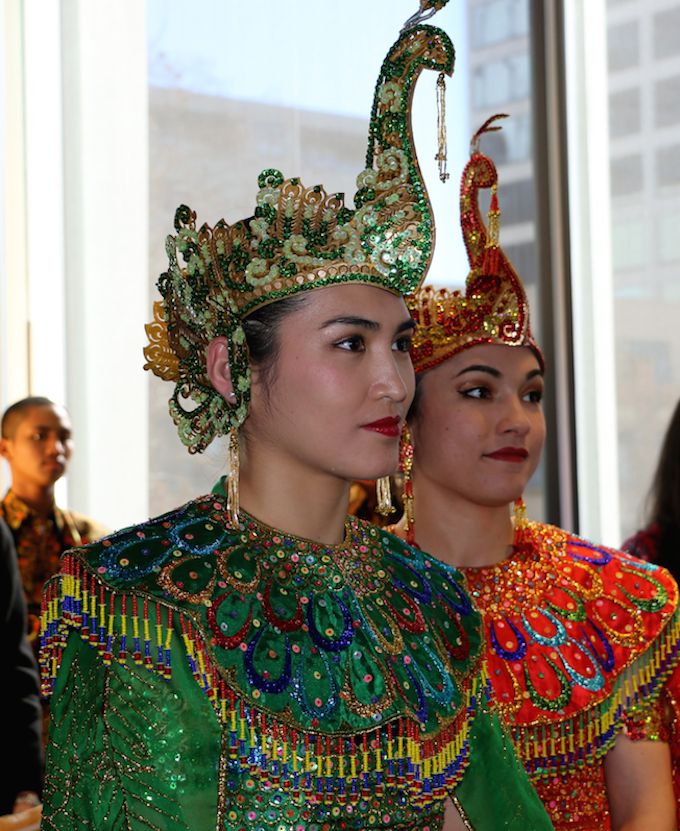
Indonesia’s rich cultural diversity on display at AUT … two of the Merak Dance – “dance of the peacock” – dancers. Image: Del Abcede/PMC

By Kendall Hutt in Auckland

Auckland University of Technology has launched a “first of its kind” Indonesia Centre in a cultural diplomacy initiative.

“This is both a celebration and a step forward into the future,” AUT’s Vice-Chancellor Derek McCormack said at last night’s launch.

“The centre is an acknowledgement of the strong relationship enjoyed between the government of Indonesia and AUT, and the acknowledgement of both parties to strengthen that relationship,” he said.

Significantly, AUT’s Indonesia Centre was also a “world first partnership”.

“This is the first centre of its type in the world. The Indonesian government sees the establishment of this centre at AUT as a significant move in cultural diplomacy and assuming that this pilot is successful…it is likely to be repeated in other cities around the globe,” McCormack added.

This was echoed by Indonesia’s ambassador to New Zealand, Tantowi Yahya, who said:

-Partners-

“The Indonesia Centre is a pilot project for promoting Indonesia in New Zealand…It is quite an ambitious undertaking and if it succeeds it will be replicated in other cities around the world. If it succeeds, it will also be the opening door for Indonesia to work with many countries through culture.”

The Merak Dance – “dance of the peacocks”. Image: Del Abcede/PMC

Centre cultural addition
It was hoped the centre will be an addition to both the cultural life of the university and Auckland, the delegates also acknowledged.

“I’m very hopeful that every visitor to this centre will be enchanted by the richness of Indonesia’s cultural diversity and it is also hoped it will become a window for New Zealanders, for Aucklanders, to know more about Indonesia and will one day get to the point of wanting to visit Indonesia and to learn.

“I’m also hopeful that cultural interactions will also take place so that it will enhance better understanding and deeper friendship between Indonesians and New Zealand people,” Yahya said.

Indonesia’s cultural diversity was on full display at the opening, where dancers performed several traditional Javanese dances and the orchestra took up wooden mallets to play on the full royal Javan Gamelan donated by Indonesia’s Ministry of Education and Culture.

Vice-Chancellor McCormack described the Gamelan as a taonga, or treasure.

“We’re getting something that is extremely special to be housed in, and be a part of, the work and the cultural events at the Indonesia Centre,” he said.

AUT’s Indonesia Centre, dubbed AUTIC, will see people able to learn Bahasa Indonesia and take part in summer schools across various areas, such as culinary art and filmmaking, in an annual program which will continue to be collaborated on, delegates said.

Engage with Indonesia
Vice-Chancellor McCormack also highlighted other AUT engagements with Indonesia, including a Pacific Media Centre partnership.

The PMC will be hosting two weeks of workshops and collaborative research with four Indonesian communication researchers from the Centre for Southeast Asian Studies (CESSAS) at Gadjah Mada University in Yogyakarta early next month.

Centre director Professor David Robie has been selected to visit the Yogyakarta university as part of the Indonesian government’s World Class Professor (WCP) programme later in the month.

Lester Khoo, director of AUT’s International Relations and Development reflected:

“We have to be engaged with Indonesia, we have to be engaged with ASEAN, otherwise we risk being irrelevant. It’s very important that we have this as a first step of a longer-term vision of being connected with Indonesia.”

A dancer and the Gamelan, described by AUT Vice-Chancellor Derek McCormack as a taonga, or treasure. Image: Del Abcede/PMC
]]>

‘Take action’ over West Papua plea to Pacific Forum leaders

]]>

AsiaPacificReport.nz

Alistar Kata’s video report on the campaign for a fact-finding mission to West Papua produced before the 2015 Pacific Islands Forum. Video: Pacific Media Centre

Pacific Media Centre Newsdesk

West Papua Action Auckland has appealed to Pacific Island Forum leaders to take action over West Papuan self-determination in an open letter in advance of next week’s summit in Apia, Samoa.

The group has also sent individual letters to each leader.

“We are pleased that West Papua is on the agenda at this year’s Forum meeting on September 4-8 and we are calling on the leaders to take decisive action to help resolve the region’s most serious human rights crisis,” the group’s spokesperson Maire Leadbeater told Asia Pacific Report.

West Papua Action Auckland has urged the leaders to do more than just express concern, as has happened in the past.

“They should follow the lead of the seven Pacific nations which have raised the issue at the UN General Assembly and at the UN Human Rights Council,” she said.

-Partners-

“Vanuatu, Nauru, Tonga, Solomon Islands, Tuvalu, the Marshall Islands and Palau have called for the UN to take account of the evidence of widespread human rights violations and conduct a systematic investigation with recommendations for actions.

“We note that the Forum has granted observer status and even full membership to other Pacific nations which are yet to achieve independence.

“In the 1980s the Forum was instrumental in having New Caledonia re-inscribed with the UN Committee on Decolonisation.

“But the Forum has turned away from addressing self-determination for West Papua, despite the fact that the people of West Papua were denied any say in the matter when Indonesia took over the territory in the 1960s.

“The Forum should grant observer or associate status to the representatives of the West Papuan people, the United Liberation Movement for West Papua (ULMWP). This would put the Forum in a strong position to mediate dialogue between the ULMWP and Jakarta.”

Decisive action needed
The open letter to the Forum leaders:

West Papua Action Auckland
PO Box 68419
Auckland
New Zealand

28 August 2017

Decisive Action needed on West Papua from the 48th Pacific Islands Forum Meeting

Dear Pacific Island Forum leaders,

We are pleased to note that the issue of West Papua is on the agenda for the 48th Pacific Island Forum being held this year in Apia, Samoa.

The suffering of the indigenous people of West Papua is the most serious human rights crisis in the Pacific region, and Pacific leaders can no longer side-step their responsibilities to their Melanesian neighbours. This year the Forum should resolve on decisive action to support the rights of the people of West Papua, recalling that they have been subject to grave human rights violations ever since 1963 when West Papua first came under Indonesian rule. The Forum leaders must also take into account the right of the Papuan people to self-determination as it has been well-established that the so-called “Act of Free Choice” of 1969 was a fraudulent exercise carried out under extreme duress.

The Indonesian security forces in West Papua have been responsible for extensive use of torture and killings, but still operate with almost total impunity. For example, there has been no justice for the well-publicised massacre of four schoolboys at the end of 2014. At the beginning of this month Brimob paramilitary police opened live fire on demonstrators in Deiyai, killing one man and injuring many others. The villagers were protesting against the actions of a local construction firm which had refused to help transport a dying person to hospital. In the weeks that have followed a police chief has been transferred but the perpetrators have not been brought to justice. Instead many young people demonstrating against this police abuse in West Papua and a number of cities in Indonesia have been illegally arrested.

International human rights groups repeatedly condemn the unlawful restrictions on the freedom of expression and freedom of assembly in West Papua. It is outrageous that those who simply want to take part in peaceful protest or express their political aspirations are unable to do so without risking arrest, beatings and worse at the hands of the security forces. Mass detentions following demonstrations have been frequent in 2016 and 2017.

It must also be noted that the proportion of indigenous Papuan people as a percentage of the total population continues to decline as a result of migration from other parts of Indonesia. This inward migration poses a threat to the well-being of the people who live in areas targeted for exploitation of minerals and forests, or for the expansion of palm oil and other lucrative agri-business projects.

West Papua is effectively off limits to international journalists, with the possible exception of tourism writers. Access is also denied to most humanitarian and human rights workers.

At the Melanesian Spearhead Group (MSG) Leaders Summit in Honiara, July 2015, the United Liberation Movement for West Papua (ULMWP) was granted Observer status in the MSG. Since this time political, church and community leaders in the Pacific have been speaking out for West Papua as never before. However, this up-swell of concern has yet to translate into any action on the part of the Pacific Island Forum.

Role of the Pacific Island Forum
Although historically, geographically and culturally there is no doubt that West Papua belongs to the Pacific Community, the Pacific Island Forum has so far made only tentative and token statements about the situation there. This has led some Pacific nations to take the issue up on their own initiative at the United Nations General Assembly and at the UN Human Rights Council.

Earlier this year in Geneva at the Human Rights Council, the Vanuatu Minister of Justice Ronald Warsal spoke for his own country and for six other Pacific nations (Nauru, Tonga, Solomon Islands, Tuvalu, the Marshall Islands and Palau). As a response to the extensive authoritative documentation of state violence against Papuans he called for the UN Human Rights Council to request the High Commissioner for Human Rights to produce a consolidated report on the actual situation in West Papua.

The time has come for PIF to take substantive action. Specifically, we urge the leaders of the 48th PIF summit to:

· Establish a regional Fact Finding Team to conduct a Human Rights Assessment in West Papua

· Support, the seven Pacific Nation call led by Vanuatu at the Human Rights Council for the UN to investigate and report on the alleged human rights abuses in West Papua.

· Call for the re-inscription of West Papua with the UN Committee on Decolonisation, (the Committee of 24).

· Support observer or associate membership at the Pacific Island Forum for the ULMWP.

We thank you in advance for acknowledging the rights and aspirations of the people of West Papua as a priority issue.

Yours sincerely,
Maire Leadbeater (for West Papua Action Auckland)

]]>

‘We’ll have final say on any mining,’ warn Panguna landowners

]]>

AsiaPacificReport.nz

A video report by Fabian Hakalits. Source: EMTV News

By Fabian Hakalits in Buka

Panguna landowners will determine any reopening of the controversial mine on Bougainville, says a local leader.

Philip Miriori, chairman of the Special Mining Lease Osikaiyang Land Owners Association (SMLOLA) in Panguna, Philip Miriori, has told EMTV News that all parties and talks would go through them.

This was because the people in the Special Mining Lease area were greatly affected by the mine’s impacts when it was operating in the 1980s before the 10-year Bougainville civil war.

“We do not want the past to repeat itself but it must be a reminder to us now to get a better deal for the SMLOLA members and the rest of Bougainville,” he said.

Miriori said the past had gone, and history should not be repeated in Bougainville.

-Partners-

He claimed meetings had been conducted with resolutions and agreements passed which the SMLOLA were not a party to.

“They do not speak for me and my people but serve other interests,” he said.

‘Disrespectful’ to landowners
He said this was very disrespectful to the people of the SML area because they had no voice in the decisions that were being discussed by outsiders about their land on which their livelihood depended.

He also highlighted any decision or document signed to reopen the Panguna mine would be in contempt of court.

The court order restrains parties to the memorandum of agreement which was going to be signed in June this year to make Bougainville Copper Limited (BCL) the preferred operator to reopen the mine.

This was because the question of the interests of landowners in the mining project would be an agenda of discussion at the court-ordered mediation in Panguna next month.

Miriori also highlighted that he had the mandate to represent his people through the SMLOLA and the National Court recognises him as chairman and not Lawrence Daveona.

Miriori maintained he was still the SMLPLA chairman until December 2018 when an election of a chairman would be held.

is EMTV News correspondent on Bougainville. EMTV News items are republished by Asia Pacific Report with permission.

]]>

British swimmers cross Lake Geneva with West Papua petition

]]>

AsiaPacificReport.nz

Under way … the Swim for West Papua across Lake Geneva, Switzerland, with a petition for the United Nations. Image: Swim for West Papua

Pacific Media Centre Newsdesk

A British team is swimming a crushing 30 hours straight across Lake Geneva to deliver a petition calling for self-determination in West Papua to the United Nations.

A message received after more than seven hours into the swim on the live Facebook page today said:

#BackTheSwim

“We, the Swim for West Papua team, want you to know why we swimming. We support the fundamental human rights, including (and especially) the right to self determination for the West Papua.

“Things on the boat are going well. We are 7.48 hours into the swim. The mood on the boat is good. We have been blessed with good weather – 26 degree water and 33 air temperature. Things are good here!

“We are gunning for West Papuan freedom! West Papua never give up your fight for freedom! We stand shoulder to shoulder with you and will support you in the fight for freedom!”

WATCH LIVE: #BackTheSwim

-Partners-

A large campaign in support of the petition has been repressed by Indonesian security forces inside West Papua, with at least one Papuan leader, Yanto Awerkion, remaining imprisoned.

The British group, Swim for West Papua, in collaboration with the Free West Papua Campaign, has been gathering tens of thousands of signatures for months across the globe.

140,000 signatures
The petition has garnered over 140,000 signatories online and an as-yet-unknown number of paper signatories. Avaaz, one of the websites hosting the petition, has been completely banned in Indonesia for its involvement in the campaign.

#BackTheSwim

West Papua, occupied by Indonesia since 1963, has been growing in international stature in recent years.

Over the past year, eight Pacific Island states have joined the Pacific Coalition for West Papua in calling for human rights and self-determination to be upheld in the territory.

In March, seven Pacific island governments called on the UN Human Rights Council to urgently consider the situation in West Papua.

Referencing the swim, the English-language daily The Jakarta Post said in an editorial the “campaign for an independent Papua has been relentless and has made significant gains in past years”.

#LetWestPapuaVote
]]>

Bryce Edwards Political Roundup: Winston Peters Vs Dirty Politics

Bryce Edwards’ Political Roundup: Winston Peters Vs Dirty Politics

[caption id="attachment_13635" align="alignleft" width="150"] Dr Bryce Edwards.[/caption] You don’t have to support Winston Peters or his party to be outraged about the treatment he appears to have received at the hands of government agencies, and possibly the Beehive. It increasingly appears that he is the victim of a dirty politics scandal – someone has leaked Peters’ superannuation overpayment details to the media, and many are now pointing the finger at government departments and National ministers. And there are now some important constitutional and democratic issues at stake.  Dirty politics? [caption id="attachment_2529" align="alignright" width="300"] New Zealand First leader Winston Peters.[/caption] Peters predicament might well lead to an elevation in the polls, possibly at the expense of the National Party, who currently look rather tawdry, given the suspicion that ministers, staffers, or party activists might have played a part in trying to bring Peters down with scandalmongering. As Audrey Young wrote this afternoon: “it is almost certain that either a public servant or a political operative leaked the bare bones of his story to some media in a bid to discredit him. It has backfired badly, especially if it was a National black ops move. It has given Peters an elevated platform to attack National and dominate the political agenda for the next few weeks in the role he champions best, victim” – see: Only one winner possible in privacy row between Peters and National … and it won’t be National. Indeed, part of the problem for National is that this whole scandal looks like a revival of the 2014 dirty politics allegations. As Young says, “National’s past form has come back to haunt them.” Even the main protagonist in Nicky Hager’s Dirty Politics investigation – Cameron Slater – makes an appearance, but this time serving up allegations of dirty tactics by the party he used to support: “The rot is set in and it has started at the top. National is rotten from the top down and now there needs to be some serious investigations into how a government can use private tax matters to attempt to silence political opponents” – see: Someone is getting axed today for sure. Slater says he doesn’t believe the Prime Minister’s statements on the issue, and suggests the leak has come from a ministerial office, meaning there will need to be a resignation: “In an exercise of spin that defies belief he claims to know nothing and believes none of his ministers have leaked. Bill English is lining someone up for an axing and trying to put distance between himself and the minister/s and/or staff who did his bidding. Some poor schmuck will be gone. The sacrificial lamb to protect Wayne Eagleson and Bill English from this shabby and ill-conceived hit job. The State Services Commissioner and the CEO of MSD both need to go in any case”. If National is responsible for the leak, what were they thinking? According to Newsroom co-editor Tim Murphy, the scandal is bad news for National, and may amount to an own-goal for the party: “It is unclear what benefit National might think it would get, at this critical stage of the campaign, by damaging and humiliating perhaps its only likely partner to get across the line to govern from September 23” – see: Peters too hot to handle. So what might have been National’s motive? According to Tracy Watkins, National may benefit from pushing down support for New Zealand First – see: Beehive knowledge of Peters’ pension problem is explosive. Here’s her main point: “National certainly has good reason for wanting to knock Peters down. If his vote suffers by an even a couple of points it will likely be National that picks them up. Risky business given that National may need Peters to govern? Actually, there is a scenario which the Nats have worked out where they could return to Government without needing any coalition allies. It relies on the Greens and TOPS party falling just short of the 5 per cent threshold and their wasted vote being divvied up between Labour and National. And it relies on Peters being a few points less popular than he is now. But National also wants to take Peters down a peg because he has cast fear into the hearts of many MPs in provincial New Zealand, where he has been making real strides.” Similarly, Barry Soper writes tonight on why National might target Peters: “National’s less than confident he’d give them a leg up into the Beehive after next month’s vote, hardly surprising given English’s recent disparaging remarks about Peters and how difficult he is to work with and not forgetting it was he who seconded the motion to kick Peters out of the National Party in the early 90s” – see: Bill English knew nothing of Winston Peters paying back money. However, Soper says “The leak of the Peters file came from National but it’s a strategy as ill conceived as Metiria Turei’s cry-me-a-river poverty plan. So politically it has the real potential of calling time for National”. Rachel Smalley also thinks that National had the motive to try and bring down Peters: “You’ve got to ask yourself, who benefits from this? If Peters takes a hit in the polls, if this blows up, who wins? National does” – see: Winston Peters super saga: I smell a rat. She also argues: “if Peters takes a hit in the polls and some of his conservative voter base desert him, where would they go? They’d go to the Nats. National would likely pick up their votes.” Peters hits back Winston Peters has now hit back forcefully at National, making strong accusations. He says: “‘You’ve got a political party that’s been deeply exposed now all the way to the Prime Minister” – see Corin Dann’s Winston slams Nats as English says Ministers knew super details. Peters adds, “This is humbug – it’s tawdry, its dirty, it’s filthy and they should not succeed on it.” He’s now threatening legal action, saying “legal subpoenas would force the truth over the leak” – see the Herald’s Winston Peters says National MPs knew of his super overpayment before he did. And even though three official inquiries have been launched about the leaks – from within IRD, MSD, and Ministerial Services – Peters has declared a lack of confidence in them all. In one report, he says “We’re not going to have an in house inquiry to political rumour and dirt… that’s not the way democracy and accountability work” – see Jo Moir, Stacey Kirk and Tracy Watkins’ It would have been better not to tell ministers of Peters’ pension info – Prime Minister. Additionally, he says, “The last thing I’m going to have is the State Services Commission investigating their own untoward behaviour.” Peters also has little time for the denials coming out of National: “He says he has no doubt National campaign chair Steven Joyce and leader Bill English were passed on his personal pension information” – see Jo Moir, Stacey Kirk and Tracy Watkins’ Winston Peters warned he was being ‘taken down’ by National. “No surprises” and the politicisation of the public service The main revelation today that has shifted the scandal in Winston Peters’ favour was that the Beehive had been supplied with the information about his super overpayment by the Ministry of Social Development. This is best explained in Jo Moir, Stacey Kirk and Tracy Watkins’ story, It would have been better not to tell ministers of Peters’ pension info – Prime Minister. They explain how the Ministry of Social Development sought the advice of the State Services Commission, who agreed that the information about Peters should be given to the Minister of Social Development, Anne Tolley, under the “no surprises” rule: “The ‘No Surprises Convention’ is set out in the Cabinet Manual and requires departments to inform Ministers promptly of matters of significance within their portfolio responsibilities, particularly where the matters may be controversial or could become the subject of public debate.” A decision was also made to inform the Minister of State Services, Paula Bennett. There appears to be a consensus today that these decisions were wrong. And even Prime Minister Bill English has spoken out against this, saying “given the personal and confidential nature of the information, it would have been better for the ministers not to have been advised” – see Claire Trevett and Audrey Young’s Peters’ super information too personal for ministers to know, says Bill English. Herald political editor Audrey Young says that Anne Tolley now needs to front up and back English’s view: “The fact that Tolley is unwilling to discuss the issue any further because it is a private matter is evidence enough that she should not have been told in the first place. It is an abuse of the no-surprises policy. No minister should have been privy to that sort of information any more than the Health Minister should receive reports on any hip replacement operation Peters might have. If Tolley had no expectation of receiving such information, she should say so publicly and conclude that the ministry’s decision was a misjudgment. If she doesn’t, it is safe to assume that she and ministers have created an expectation they should get information like that” – see: Peters’ case highlights an abuse of the ‘no surprises’ policy. Stuff political editor Tracy Watkins says that the use of the no surprises mechanism is “disturbing”, and “That was not a problem the Government needed to be aware of under the no surprises rule” – see: Beehive knowledge of Peters’ pension problem is explosive. Newstalk ZB’s Barry Soper adds that the State Services Commission’s explanation for informing ministers is “bunkum”, and use of the “no surprises” rule is “patently ridiculous” – see: Bill English knew nothing of Winston Peters paying back money. Soper also says that he doesn’t believe the ministers would have kept the gossip on Peters secret: “Knowing how the Beehive operates and knowing what a cesspit of gossip it is, particularly when Winston Peters has a bullseye on his back, that’s beyond comprehension.” Writers of both left and right are united in condemning what has happened. The NBR’s Rob Hosking says the story is alarming, and he likens it all to 2014’s dirty politics revelations: “In fact, it cuts to the heart of New Zealand’s constitution: that is, the way New Zealand conducts its political business. It does look as though there has been, at best, an abuse of rules in this case and it is not pretty. Bad habits and toadying public servants. We’ve been here before when it was revealed security intelligence staff were supplying politically damaging information to political operatives in the then prime minister John Key’s office – information which was then leaked to an attack blogger. This appears to be in the same category” – see: Winston’s warpath, and why the rest of us should be beating drums, too (paywalled). Hosking says that although there is now a public interest in Peters’ overpayments, “the corruption (as in the warping and debasement of purpose) of the public service is a far, far greater concern.” On the left, Gordon Campbell also condemns this use of the “no surprises” rule and adds: “This politicisation of state-gathered and state-managed information should be a concern to everyone. As the government’s web of surveillance expands, and the inter-departmental sharing of electronic information increases, the temptation to use private information for political purposes will increase” – see: On Winston Peters and MSD. And blogger No Right Turn says “its also a gross abuse of power by the government to use the information in this way, reminiscent of Muldoon at his worst. It shows an utter lack of ethics on the part of the National party to do this, or to permit a political atmosphere among their hacks that this was seen as an acceptable tactic” – see: Muldoonism at its worst. Finally, for the ultimate discussion of the “no surprises” rule, how it has developed and “just how rotten the policy has become” – see Ben Thomas’ No alarm? How the ‘no surprises’ policy blights everyone it touches.]]>

Keith Rankin: New Zealand Net Immigration from 1921

Immigration no Explanation for recent Real Estate Booms. Graphic copyright Keith Rankin.

Analysis by Keith Rankin: New Zealand Net Immigration from 1921.

This month’s chart shows the only factual measure of net immigration: total arrivals in New Zealand minus total departures. It measures annual net passenger flows as a percent of resident population, using monthly data. The most recent figure, for the year ending July 2017, shows a net inflow of 59,842; which is 1.25 percent of New Zealand’s resident population.

Net immigration is a very good indication of safe employment opportunities in New Zealand relative to opportunities elsewhere. It is generally well-synchronised to New Zealand’s economic growth cycle. This century has seen post-1920 peaks, in 2002 and 2014‑16. 2002 clearly followed the New York and Washington terror attacks in 2001. 2014‑16 also strongly reflects security and economic concerns in much of the rest of the world.

The chart marks the two most recent property booms in the Auckland (and subsequently New Zealand) residential land markets: 2003 to 2008, and 2012 to 2017.

The first boom is demarked by the gold spots, the second by the red spots. The general picture is that such booms are unrelated to immigration. In the first 21st-century boom, initial immigration appears to be incidental. As the boom progressed, net immigration fell and stayed low until 2009. This property boom took place under conditions of generally high (and rising) interest rates.

The second property boom got underway in 2011 at the end of a near-decade of low net immigration. Net immigration became significantly high only in 2014, well after the beginning of the Auckland property boom. This boom took place in a low (and sometimes falling) interest rate environment. Neither immigration nor interest rates serve as plausible explanations for the Auckland land-price booms.

When we go back in time, we see that net immigration closely reflects a stuttering economic cycle. In 1929‑30, there was significant immigration from Australia, where the global economic depression struck. This was more than two years before the summer of 1930/31 when it struck New Zealand. During the Depression, both immigration and emigration were very low. A construction boom in 1937‑38 restored high levels of immigration, especially workers from Australia.

New Zealand’s post‑war immigration peak was in 1952‑53. Immigration was also strong in the early 1960s and early 1970s. Robert Muldoon became Finance Minister from early 1967 to late 1972. Difficult years for New Zealand gave way to good years.

It is true that net immigration collapsed in Robert Muldoon’s first trimester as Prime Minister. This is when many later post-war baby-boomers (born in the 1950s) took the opportunity to enjoy their OE, while New Zealand got the world recession later than most other countries. Many of these people came back during Muldoon’s third term government, from 1981 to 1984. In those years New Zealand was continuing to liberalise (many liberal reforms – such as divorce laws, shop-trading hours, and open information – took place then). These were the years when returning New Zealanders contributed to growing movie-making, information technology, and restaurant-café growth. They were also years when New Zealand looked very pleasant from Thatcher’s new Britain and America’s experiment in Reaganomics.

Net immigration was negative during the period of the Lange-Douglas Labour government, a period of rapidly growing house prices despite emigration and high interest rates. Immigration resumed in 1991, when Australia had its financial crisis (ours began in 1987). Rising immigration in the mid‑1990s coincided with another residential property boom, though probably did not cause it. (Rising income and wealth inequality is in fact the root cause of land-banking mania. 1985 to 1995 was the period in which New Zealand transformed from an equal to an unequal society.) The late 1990s saw a general economic stasis, with changes in China and the USA eventually facilitating the growth boom of the 21st century.

New Zealand is a migrant nation. Immigration and emigration have always featured strongly in its economic and social history. Recent events are no exception. However, while New Zealand has a high population turnover, most people who have identified as New Zealanders remain Kiwis at heart.

What of the 2020s? I think that, for New Zealand, they will prove much like the 1920s. New Zealand will stutter as the world economy slowly implodes.

Challenge Tongan king’s royal dissolution in court, says adviser

]]>

AsiaPacificReport.nz

Former political adviser Lōpeti Senituli advocates an injunction and a judicial review of the royal proclamation. Image: Lopeti Senituli FB

By Kalino Latu, editor of Kaniva News

The government of dismissed democracy Prime Minister ‘Akilisi Pōhiva has been urged to take legal actions against King Tupou VI’s decision to dissolve Parliament, with a former political adviser to government disagreeing with the Acting Attorney-General’s claim the royal order could not be challenged in court.

Lōpeti Senituli, who was also a former government CEO, was responding to a request from Kaniva News today about a post he made on Facebook last night saying:

“If I had a say in matters, I would advise the Hon Prime Minister to seek an immediate injunction and the judicial review of His Majesty’s proclamation. God Bless Tonga!”

The rest of his response is published verbatim below:

Advice for an injunction
“I stand by my opinion that the Hon Prime Minister and Cabinet should apply to the Supreme Court for an immediate injunction on the dissolution of the Legislative Assembly and for a judicial review of His Majesty’s proclamation to ensure that it is constitutional.

“I say that with the greatest of respect to the Acting Attorney-General and his opinion that His Majesty had exercised his Personal Royal Prerogative which he says is beyond judicial scrutiny.

-Partners-

“I disagree with the Acting Attorney-General. The basis of my disagreement is the decision of the Supreme Court in 2016, (which was later endorsed on appeal by the Privy Council in 2016) relating to His Majesty’s decision to appoint the current Chief of Defence Staff of His Majesty’s Armed Forces to the Hereditary Noble title of Lord Fielakepa.

“The Supreme Court declared His Majesty’s appointment as null and void. Part of their reasoning was that although it was His Majesty’s Personal Royal Prerogative to appoint Nobles of the Realm, he still had to make those appointments according to the law (the Land Act) and the Constitution.

“So I agree that His Majesty in dissolving the Legislative Assembly was using his Personal Royal Prerogative, and is not required by the Constitution or any law to disclose reasons. However, it is my opinion His Majesty must use that Personal Royal Prerogative according to the letter and the spirit of the constitution and laws of the land.

“The Legislative Assembly is the highest democratic mechanism in the Kingdom of Tonga and the current structure was adopted after the reforms in 2010 with the full approval of His Majesty’s predecessor.

“The functioning of the Legislative Assembly therefore should only be disturbed or interfered with in extreme circumstances where the sovereignty and integrity of the country as an independent nation state is being threatened.

“I do not regard the eight reasons that the Hon Speaker had released as good enough to warrant the dissolution of the Legislative Assembly. They do not amount to a threat to the nation’s sovereignty and integrity as an independent state

“I classify the Hon Speaker’s eight reasons into two groups. The first group I have classified as:

Alleged threats to His Majesty’s Royal Prerogatives.
The draft Bill to review or amend clause 41 of the Constitution which grants His Majesty’s authority to assent to all legislation adopted by the Legislative Assembly before they become law.

“The government’s earlier plans to sign and ratify CEDAW thereby bypassing His Majesty’s authority under clause 39 to make treaties and sign conventions on behalf of the country
The government’s earlier signing of the PACER Plus agreement which is a regional convention without prior authorisation by His Majesty in accordance with clause 39.
The draft Bill to amend the Constitution to remove His Majesty’s authority (clause 31A) to appoint the Attorney General and to appoint the Police Commissioner (under the Police Act) and transfer these powers to the Prime Minister and Cabinet.

“In my view the draft Bills that the Hon Speaker referred to should be allowed to be tabled and discussed by the Legislative Assembly and if necessary the Legislative Assembly should conduct public and community meetings to discuss these proposals so that the whole country can express an opinion on it.

“Dissolving the Legislative Assembly because of the fear of these alleged threats to His Majesty’s Prerogative is an extreme knee-jerk reaction of people who are afraid of the democratic process! We should let the people hear and express their opinion on these proposals through their elected representatives in the Legislative Assembly as well as in public meetings on these proposals.

“In respect of CEDAW and PACER Plus, Hon Prime Minister Pohiva and Cabinet acted in accordance with legal advice it was given by legally qualified people in government. (I know this because I was responsible for the CEDAW initiative.)

“If that advice clashed with advice given by His Majesty than that can be resolved by going to court for a declaration as to which advice is correct. It does not warrant dissolving the Legislative Assembly.

“The second group of reasons I have classified as:

Mismanagement by Hon Prime Minister and Cabinet
Lying to the Legislative Assembly that Hon Etuate Lavulavu would be punished and not delivering on it.

“Misleading the Leg Ass on the Pacific Games 2019 and continuing to collect the foreign exchange levy though hosting the Games had been cancelled.

“Raising their own salaries in response to a tax increase whilst the rest of the country carry the extra tax burden.

“Petitions of impeachment not worth of the Legislative Assembly’s time and resources.

This second group of reasons I regard as specious. These could have been dealt with by the Hon Speaker as he has considerable powers under the Rules of Procedure of the Legislative Assembly and under the Constitution (clause 70) to punish members who behave in contempt of the Legislative Assembly.

They certainly do not warrant the dissolution of the Legislative Assembly!”

Kaniva News items are republished by Asia Pacific Report with permission.

]]>

Lord Tuʻivakanō breaks silence over why king dissolved Parliament

]]>

AsiaPacificReport.nz

Tonga’s dismissed Prime Minister ‘Akilisi Pōhiva (left) and the Speaker of Parliament, Lord Tu’ivakano. Image: Tonga Legislative Assembly

By Kalino Latu, editor of Kaniva News

The Speaker of Tonga’s Legislative Assembly has broken his silence and delivered a statement on air detailing what advice he offered King Tupou VI before the monarch dissolved Parliament.

As Kaniva News reported, the surprise dissolution last Thursday followed an approach by the Speaker, Lord Tu’ivakanō, to King Tupou VI and a decision made by the Privy Council.

According to the government gazette, fresh elections must be held by November 16.

Acting Attorney-General ‘Aminiasi Kefu said the king’s decision to dissolve Parliament was part of his royal prerogative and could not be challenged in court.

Kefu said when the king proclaimed such a royal command he was not required, according to the constitution, to explain it.

The royal command left the public in a state of limbo with many wanting to know why the king had made such a surprise decision.

-Partners-

However, it is understood the Speaker went public with the grievances he presented to the king on the Tonga Broadcasting Commission (TBC).

Speaker’s grievances posted
Former political advisor and government CEO Lōpeti Senituli has posted the Speaker’s grievances in English on Facebook.

The Lord Speaker said he was concerned “that a Bill had been submitted to the Office of the Speaker that seeks to amend the Constitution so as to revoke His Majesty’s right of assent to legislation approved by the Legislative Assembly before it could become law.

“That the intent of the Bill is in keeping with the Cabinet’s earlier plans to bypass His Majesty’s prerogative to sign treaties and conventions entrenched in clause 39 of the Constitution when they tried to sign and ratify CEDAW without His Majesty’ prior approval.

“That Cabinet had also become party to PACER Plus without His Majesty’s prior approval.

“That another Bill had also been submitted to the Office of the Speaker that seeks to amend the Constitution so as to remove His Majesty in Privy Council’s right to appoint crucial positions such as the Police Commissioner and the Attorney-General.

“That Hon Prime Minister [‘Akilisi] Pōhiva had intervened and prevented the Legislative Assembly from sanctioning former Cabinet Minister Etuate Lavulavu for abuse of office on the understanding that he would punish him instead. It later became apparent that he did not punish Lavulavu as promised.

“That several petitions have been submitted to the Office of the Speaker that seek to impeach various members of the Legislative Assembly and the Speaker feels spending time on these petitions would be a waste of time and resources.

“That Cabinet had deliberately misled the Legislative Assembly regarding the hosting of the Pacific Games in 2019 and after the legislation was passed authorising the collection of the foreign exchange levy tax in order to fund it, Cabinet cancelled the hosting of the Games and yet they continued to collect this tax.

“That Cabinet had recently approved a 5 percent salary increase for all ministers in response to a recent increase in income tax, yet the tax increase applies to the whole country, especially all the civil servants and people in private enterprises.”

]]>

Gary Juffa: The myth of PNG’s ‘Middle Bench’ – don’t be fooled

]]>

AsiaPacificReport.nz

Outspoken MP and Governor of Oro province Gary Juffa … advice for fellow MPs in Papua New Guinea, “don’t be a puppet”. Image: Gary Juffa

OPINION: By Gary Juffa

My advice for Papua New Guinea’s new MPs and their staff, minions, hangers on and supporters …

Some words about the middle bench.

It’s a myth.

I should know. I was there believing that myth for the first two years of the last term of Parliament.

The middle bench IS government.

I attended government caucus from time to time and made critical reviews of government decisions. If you are allowed to attend government caucus…you ARE government.

-Partners-

Why did I not choose the Opposition at that time?

Because I believed the myth of the “Middle Bench” …

Little difference
And I saw little difference in either side at that time…with the government seeming to be a slightly better option. I hoped I could do more to influence government decisions for the better. How wrong I was. The benefit of hindsight has since proved otherwise.

Well at that time both government and opposition seemed like bad choices, just flipsides of the same coin, and I honestly thought there was a special place in Parliament for neutral ground or a Third Way from government or opposition.

Well, I was wrong. I was naive.

FACT: “There is no neutral ground”.

Surprise surprise, there is no middle bench!

Anyway my continued critical review of the decisions made by Prime Minister Peter O’Neill’s People’s National Congress (PNC) government were pissing many off … so eventually I was removed.

That’s right, by the ruling party PNC. As I said, some of their members resented the critical review I provided. They despised my outspokenness on national issues and questioning their self interest in most decisions.

They lobbied hard and when the ruling party met and decided unanimously to kick me out. That’s right. They can do that. Which means they are in control of that part of Parliament.

‘Don’t make trouble’ message
Which means the middle bench is a myth!

Soon after I was quietly asked by a government MP to inform the government I wished to remain and would not make trouble.

If I could do this, I could stay but must remain mute and support all government decisions..good or bad.

So I decided to move to Opposition.

See I felt I was elected to speak for my people. All of Papua New Guinea. Not be a puppet and follow others blindly even when they were wrong.

So I left.

It now dawned on me that the middle bench … was only in my head … not in reality … so if you are there…you are in government..

And if they hold control over that area, they own that territory. You are their territory. You can pretend and be quiet and they will allow that pretence to be projected to the people. But speak up too often … then you will see who has control over that area and you will soon see that you are there at their will and whim.

All the best.

Gary Juffa is an Opposition MP in the Papua New Guinea Parliament and Governor of Oro province. He contributes occasional articles to Asia Pacific Report.

]]>

Clock ticking for Vanuatu’s state broadcaster – 6 months to reform

]]>

AsiaPacificReport.nz

Vanuatu Broadcasting and Television Corporation … new deadline to deliver change. Image: Vanuatu Daily Post

By Dan McGarry in Port Vila

The clock is ticking for the Vanuatu Broadcasting and Television Corporation, operator of Radio Vanuatu and TV Blong Vanuatu.

An interim board of directors met for the first time last week in the conference room of the Prime Minister’s office. The mandate: Fix what ails the VBTC within 6 months or less.

Its first order of business was to receive a recently completed independent Strategic Assessment.

The independent assessment was contracted to the Pacific Group Ltd in an open bidding process.

PGL is a consulting firm owned by former Government Chief Information Officer Fred Samuel. He hired Fiji media veteran Francis Herman and Wilma Vocor, a former executive at ANZ Vanuatu, to provide expert assistance with the study.

Samuel addressed the board members shortly before the meeting began, with the media present. He reminded the attendees that the decision to review and reform the VBTC arose from the government’s so-called 100 Day Plan. It was one of twenty objectives assigned to the Prime Minister’s Office, and one of about 130 overall.

-Partners-

The assessment, he stated, was mandated to review the VBTC’s board and objectives. In the course of its work, though, his team discovered additional issues, including staffing irregularities and “out of control expenditures”, which were also taken on board.

Content not discussed
The board was not willing to discuss the content of the assessment until they had had a chance to review it. Once that review is complete, said board chairman Johnson Naviti, the document would be submitted to the Council of Ministers and only then can public release be contemplated.

The new board was instated by order of the Prime Minister last Monday, and is composed entirely of public servants. They include chairman Johnson Naviti, Director-General of the Prime Minister’s Office (PMO); Letlet August, Director-General of Finance; Gerard Metsan, Government Chief Information Officer; John Jack, also from the OGCIO; and Government Public Relations Officer Hilaire Bule.

The assessment was originally contracted in April, but administrative delays slowed progress, with formal hand-over taking place on Friday.

The team consulted broadly, dealing with the corporation’s creditors, its technical infrastructure, its audience and content, future technological trends and their financial viability.

The assessment itself is comprehensive, looking at the corporation’s business case, its social mandate and its role as a government mouthpiece.

“We’re running against time,” said Samuel, citing a number of factors that made immediate action necessary.

Asked if he was confident that the six months allotted to the current board members was sufficient, the chair said, “Yes”.

PM’s support
He cited the support that they had received from the Prime Minister himself, and added that a task force was also being assembled to action the assessment’s recommendations, which among others would contain one or more Parliamentary Secretaries.

“If they continue to provide the mandate and give us their support, we’ll be able to get everything done,” he said.

Asked if there would be additional budget funding next year, he asked “That’s something we’ll have to take up right away”.

One veteran journalist reacted to the news that the reform process was under way by saying that the company needed to be clear about whether it was a state broadcaster, a public broadcaster or a commercial broadcaster.

Asked about how this new board saw the corporation, chairman Johnson Naviti replied half-jokingly, “Definitely all three”.

“The government has limited resources. While the VBTC provides a service to the public, at the same time it has to meet its own costs.”

Dan McGarry is media director of the Vanuatu Daily Post group. His articles are republished by Asia Pacific Report with permission.

The VBTC interim board has met for the first time and considered a strategic report. Image: Dan McGarry/Vanuatu Daily Post
]]>

Pōhiva’s cabinet stays as caretaker – NZ SAS troops to quit Tonga

]]>

AsiaPacificReport.nz

Dumped PM ‘Akilisi Pōhiva … pro-democracy supporters question lack of “solid reasons” for surprise royal dismissal. Image: Tagata Pasika

By Kalino Latu, editor of Kaniva News

King Tupou VI has proclaimed ʻAkilisi Pōhiva’s cabinet will continue on as Tonga’s caretaker government, which will run the kingdom until after the upcoming general election in November.

The Lord Chamberlain made the announcement yesterday.

The caretaker government royal proclamation. Image: Kaniva News

“His Majesty commanded that new representatives of nobles and the people to be elected to enter the Legislative Assembly at elections to be held in no later than November 16,″ the Lord Chamberlain said in a statement.

“Until those elections take place, the present government will continue as caretaker government.

“During this time, the administration of government services, especially Health and Education services to the people, should remain a priority”.

Pōhiva and his cabinet were dismissed on Friday after King Tupou VI had dissolved Parliament.

-Partners-

NZ troops in Tonga come home
Meanwhile, the New Zealand SAS troops in Tonga will be brought home as soon as possible, the New Zealand government announced.

A group of 20 SAS soldiers are in Tonga, where the Prime Minister has suddenly been dismissed by the King.

Foreign Minister Gerry Brownlee told The New Zealand Herald the troops were there for a routine exercise, and yesterday confirmed they would be pulled out of the country as soon as possible.

“Rather than continuing on to do their scheduled training exercise, we’ve concluded this is a time for Tonga to have some clear air, uncomplicated by the coincidental presence of NZDF personnel in the country.”

Pōhiva to stand again
ʻAkilisi Pōhiva plans to run for Parliament again in the November election, his son and personal assistant Poʻoi Pōhiva confirmed to Kaniva News.

The dissolution of the Parliament came after the king was advised by his Privy Council and the Speaker of Parliament.

In an interview with Pōhiva three years ago, the long-time democratic veteran campaigner said he would stand for election one last time in the 2014 general election.

The revelation of Pōhiva’s plan could give his great number of supporters in the kingdom and abroad a sense of relief, after many of them were devastated by his dismissal.

Po’oi Pōhiva did not give further details about his father’s plan but most of ‘Akilisi’s supporters had called on him to stand again for Parliament since his dismissal.

His supporters do not believe there were solid reasons for the king to dismiss the people’s first elected Prime Minister.

The Privy Council has yet to give any reasons why it made the surprising royal command.

ʻAkilisi Pōhiva’s supporters have questioned the Privy Council and the Speaker of the House over their advice to dissolve Parliament given they were only elected to their positions by the king and the only 33 members of the nobility.

]]>

Disappointment, fears of violence in wake of royal dismissal of PM Pohiva

]]>

AsiaPacificReport.nz

Sacked Tongan Prime Minister ‘Akilisi Pohiva … popular democracy leader but leader of unstable government. Image: Kaniva News

By Philip Cass in Auckland

There was disappointment and fears of violence early today in the aftermath of King Tupou IV’s dismissal of Tongan Prime Minister ‘Akilisi Pohiva.

New Zealand Foreign Minister Gerry Brownlee said the possibility of civil unrest was a concern.

A leading Tongan academic said last night there was “a very real fear of violence” following the dismissal of Pohiva.

Dr Malakai Koloamatangi, Pasifika director at Massey University, said Pohiva had a lot of support among the people of Tonga.

Dr Koloamatangi told TVNZ last night that while the kingdom had been moving towards a more democratic government, King Tupou IV’s dismissal of the Prime Minister was ”highly unusual”.

Radio New Zealand described the move as the downfall of Pohiva and noted that his government had been marred by controversy and allegations of incompetence.

-Partners-

As Kaniva News reported yesterday afternoon, the dismissal followed an approach by the Speaker of Parliament to King Tupou VI and a decision made by the Privy Council.

According to the government gazette, fresh elections must be held by November 16.

Former parliamentarian Dr Sitiveni Halapua said the people had high hopes for Pohiva’s government, but had not seen any real fruits from the democratic change.

“It’s a great disappointment all round,” Dr Halapua said.

Tongan publisher Kalafai Moala said the King’s decision was a setback for democracy, but told Agence France-Presse the dismissal had support.

“Pohiva has a core of supporters and they’re out there on social media expressing disappointment,” he said.

“But I think most people are happy and felt like this had been coming for some time.”

Meanwhile, Brownlee said New Zealand SAS troops who were in the kingdom were confined to barracks.

He said it was a complete coincidence the troops were in the kingdom.

Brownlee told The New Zealand Herald the government had had no indication the move was coming.

“We will be trying to work out over the next couple of days what it is going to mean for democracy in Tonga and what the implications will be for New Zealand,” he said.

]]>

Tongan king sacks democracy PM, dissolves Parliament for election

]]>

AsiaPacificReport.nz

King Tupou VI … surprise move to end the Tongan political impasse. Image: Kaniva Tonga

By Kalino Latu, editor of Kaniva News

King Tupou VI of Tonga has officially dissolved Tongaʻs Parliament effective from Thursday, dismissing democracy Prime Minister ‘Akilisi Pohiva and called for a new election no later than November 17.

Acting Attorney-General ‘Aminiasi Kefu has confirmed the royal command.

The Crown Law website said King Tupou VI made the decision after he had received advice from the Speaker, Lord Tu’ilakepa.

The announcement was made on the Crown Law website yesterday afternoon.

As Kaniva News reported earlier yesterday, when the Prime Minister’s Office was contacted and some noble MPs for confirmation, they said they were unaware of the dissolution decision.

The announcement:

WE, TUPOU VI, BY THE GRACE OF GOD, OF TONGA, KING:

-Partners-

HAVING CONSIDERED Advice from the Lord Speaker of the Legislative Assembly, and

HAVING REGARD to Clauses 38 and 77(2) of The Act of Constitution of Tonga (Cap. 2) DO lawfully dissolve the Legislative Assembly with effect from Thursday24 August2017 at 1700 hours and DO Command that new Representatives of the Nobles and People be elected to enter the Legislative Assembly at Elections to be held no later than 16 November 2017.

DONE by Us at Nuku’alofa, this Twenty Fourth day of August inthe Year of Our Lord Two Thousand and Seventeen and in this the Sixth Year of Our Reign.

An earlier Kaniva News report said:

The Members of Parliament were told this morning to return home as the House was closed down for the rest of this term.

The Prime Minister’s Office was unaware of any decision the King has dismissed the Prime Minister, a spokesperson from the Office told Kaniva News.

She said the Office was inquiring and would release a statement soon.

Reports on social media this afternoon cited Tangata Pasifika correspondent John Pulu as saying the King had “dissolved” Parliament and “dismissed” Prime Minister ‘Akilisi Pohiva.

But Pulu told Kaniva News “ I am still waiting on official word from Tonga – will keep you posted…”

Lord Tu’iakepa has confirmed they were told tto go home but when he was told it had been reported the King had dissolved the Legislative Assembly he said they have yet to receive any official statement about it.

“Ko e tala mai pe ia ke mau foki ki ‘api ‘e tapuni e Fale Alea ki he ta’u ni ko ia pe,” Tu’ilakepa said. (Translated: “We were told to go home the Parliament will be closed down for this year that’s it”.)

Lord Tu’ilakepa was unaware of any decision to dismiss Prime Minister ‘Akilisi Pohiva.

A lady in Parliament said the Chief Clerk and the Speaker were in a meeting.

When she was told that Kaniva News wanted to talk to one of them she hung up the phone.

The New Zealand Herald reported that 20 New Zealand SAS troops were in Tonga for a “routine exercise”.

]]>

Thousands of Filipinos demand end to killings in Duterte’s drug war

]]>

AsiaPacificReport.nz

Children as young as five have become the latest victims in what’s believed to be the bloodiest week in the Philippines since President Rodrigo Duterte’s so-called ‘war on drugs’ began.Video: Al Jazeera’s Jamela Alindogan

Thousands of demonstrators have taken to the streets of the Philippine capital of Manila to denounce President Rodrigo Duterte’s war on drugs, as they marked the death anniversary of one of the country’s pro-democracy heroes.

Human rights advocates, youth groups, and religious communities defied a tropical storm that brought steady rain to gather at the memorial of the 1986 People Power revolution to call for an end to the killings in Duterte’s war on drugs.

Amid public pressure, Duterte admitted on Monday there could have been abuses in his anti-drug war policy.

“There is a possibility that in some of police incidents there could be abuses. I admit that,” Duterte told reporters in Manila. “These abusive police officers are destroying the credibility of the government.”

READ MORE: Duterte says ‘bloodiest’ day of war on drugs ‘beautiful’

Al Jazeera’s Jamela Alindogan, reporting from Manila, said at least 4000 people joined in the rally, adding that a separate protest was also held in another part of the city.

-Partners-

Protesters are demanding an independent investigation into the summary executions and police operations that left thousands of people dead. They said the president should be held accountable for the deaths.

Demonstrators waved Philippine flags and carried banners that read: “Resist the Fascist!”, “Stop the Killings!”, and “We will fight” among others.

Monday marked the 34th anniversary of the assassination of democracy icon Benigno Aquino, who fought the 20-year dictatorship of Ferdinand Marcos. Marcos was overthrown in 1986 in a peaceful protest, which saw Aquino’s widow, Corazon, become president. Duterte is an avowed supporter of Marcos.

Leaders of Monday’s protest said the death toll in Duterte’s war on drugs had now reached 13,000 – surpassing the number of deaths of anti-government activists during dictator Marcos’ two decades in office.

Government figures show that since Duterte took office last year, an estimated 3451 “drug personalities” have been killed in gun battles with police up to July 26, 2017.

Another 2000 more died in drug-related homicides, including attacks by motorcycle-riding masked gunmen and other assaults, while 8200 homicide cases are “under investigation”.

17-year-old student killed
At the rally, demonstrators also expressed outrage over the death of 17-year-old student, Kian delos Santos, who witnesses said was falsely accused of being a drug dealer and summarily executed by police earlier this week.

In another part of Manila, hundreds of marching neighbours and activists lit candles near the spot where delos Santos was shot dead during a mass raid that left at least 80 people dead in three days.

“Please be fair,” the student’s father, Zaldy delos Santos, told police. “We are the victims here. We are the ones you should help.”

He made the appeal after authorities went on the offensive to defend the police action, saying there was information indicating the boy was a drug courier and addict.

But initial forensic evidence showed there was no gunfight, and the three bullet wounds indicated the student was shot at close range in the back of the head.

According to reports, there have been at least 30 minors killed in the drug war since June 2016, when Duterte took office.

Arrests ordered
On Monday, Duterte ordered the police to take custody of officers who were involved in the killing of delos Santos, saying he would not condone abuses, and that the police officers would have to face the consequences of their actions if that is the recommendation of a formal investigation.

The head of the Public Attorney’s Office, Persida Acosta, told reporters she was recommending murder charges against the officers involved based on the initial autopsy report.

“Murder charges will most likely be filed because of the location of the entry wounds,” Acosta said in a television interview.

Neighbours, teachers and classmates of the boy also vouched for his good character. The education ministry issued a statement condemning the police action.

]]>

Australia crowned new king of basketball in FIBA Asia Cup

]]>

AsiaPacificReport.nz

Tight game … “sweeping” Australia versus “gritty” Iran in FIBA Asia Cup final. Video: FIBA Asia Cup

By Jeremaiah M. Opiniano 

A second-tier Australian team ruled a basketball kingdom that is the world’s largest by size: Asia.

The Boomers swept past the opposition, including a gritty Iran side last night, 79-56, to claim the FIBA Asia Cup championship in Beirut, Lebanon.

Australia swept all six matches in both preliminary and knock-out phases, beating opponents by an average of 28.83 points.

In the final, Australia led 12-2 to start off the game, but Iran soon gained ground. With the margins 16-14, guard Jason Cadee made a back-to-the-basket shot over Iranian center Meisam Mirzaetalarposhti with 2.5 ticks left in the first quarter.

From there, world number ten Australia were never threatened by world number 25 Iran, three-time champions of the old FIBA Asia Championships.

-Partners-

The gold medal match was the first FIBA Asia Cup which covers the old Asia zone and the Oceania zone, which Australia ruled for decades.

The scary part is Australia’s Beirut squad had none of its eight current NBA players led by Andrew Bogut and Patty Mills. There were only two holdovers of the 2016 Rio Olympics team who barely missed the bronze medal over Spain: David Andersen and Brad Newley.

On average, Adelaide 36er Mitch Creek led the Boomers in scoring (14.7 points per game) while fellow 36er Matthew Hodgson towed Australia in the rebounding department (6.6 rebounds per game).

Australia’s offensive attack was more balanced, to the point no Boomer made it to the tournament’s mythical five and the top five players in the major statistical categories like points, rebounds, assists, steals, blocks and three-point shooting percentage – an exception is overall field goal shooting percentage, which Creek topped (68.5 per cent field goal).

That alone reflects the depth of the Australian basketball program. Asian countries like Iran, China and the Philippines had some of their best players skipping the tournament or retiring from international play. But some of their leagues’ best players played in Beirut.

Australia’s long-time Oceania rival New Zealand lost to Korea in the bronze medal game, 71-80. China snatched fifth spot over Lebanon (79-78) while the Philippines got some end-game luck to beat Jordan for seventh place (75-70).

The entire FIBA Asia Cup mattered for countries’ current world rankings. But the tournament did not create any impact on the forthcoming home-and-away qualification matches for the 2019 FIBA World Cup in China.

These matches, patterned after football’s FIFA World Cup qualifications, begin November 2017 and end November 2018. Australia is bracketed with Japan, the Philippines and Chinese-Taipei.

Jeremaiah Opiniano is an Assistant Professor with the Faculty of Arts and Letters at the University of Santo Tomas (UST) in Manila, Philippines.

]]>

RNZI hits back at Tongan media bias claims

]]>

AsiaPacificReport.nz

Critics of Tongan Prime Minister ‘Akilisi Pohiva … use media freedom issues to increase profits, help friends in Tonga Broadcasting Commission, son accuses. Image: TNews

By Philip Cass in Auckland

Radio New Zealand International’s presenter of Dateline Pacific, Don Wiseman, has suggested Prime Minister ‘Akilisi Pohiva’s son read the New Zealand broadcaster’s website more carefully before accusing it of media bias.

This comes after an attack on the region’s media by Siosiua Po’oi Pohiva, who acts as his father’s personal assistant.

In a press release, the prime minister’s personal assistant demanded journalists critical of his father’s government apologise to King Tupou VI and the Tongan people.

Siosiua singled out RNZI, Taimi o Tonga and publisher Kalafi Moala, Pacific Freedom Forum head Monica Miller and Pacific Islands News Association’ Moses Stevens for their coverage and comments on the removal of former Tonga Broadcasting Commission (TBC) General Mananger Nanise Fifita.

Wiseman, who is also RNZI’s deputy news editor, said he found Siosiua’s version of events “extraordinarily partial”.

“There are a number of statements from your father and other people that you have chosen ignore. I think a more thorough read of our website will help,” he said.

-Partners-

Fifita’s removal has been widely seen by the Pacific media as being the result of Prime Minister Pohiva’s feud with the TBC over what he perceives as biased reporting against his government.

Tongan integrity ‘damaged’
Siosiua has painted those who have been critical of the removal of Fifita as being aligned with the government’s enemies.

He said they should also apologise to his father and the Tongan government “for the damage they had caused on Tonga’s integrity”.

“Journalists and media groups in Tonga, New Zealand and the Pacific region began attacking the prime minister and his government, accusing them of threatening media freedom in Tonga,” he said.

“Those who were pro-establishment and who did not support the democratic reforms led by ‘Akilisi Pohiva are now those of who are against the new government and its new administration.”

Siosiua accused the prime minister’s critics of using the issue of media freedom to increase their profits and help their friends in the TBC.

In his press release, Siosiua referred to Lord Chief Justice Paulsen’s findings on Fifita’s application for a judicial review. The review examined the Minister of Public Enterprise’s declaration that her reappointment was void and the notice of TBC advising her of that decision.

Siosiua quoted Lord Chief Justice Paulsen as saying her reappointment was void because it required the minister’s approval, which was never obtained.

Sympathy for Fifita
However, as Kaniva News reported at the time, Lord Chief Justice Paulsen also said he had considerable sympathy for Fifita.

“She has, by all accounts, been an excellent employee,” he said.

The judge described her as “a long term, loyal and able servant of TBC” who had been general manager since October 2008.

In his report on the case, the judge said he made no comment as to whether she might still have remedies available to her in respect of any failings of the board of TBC to obtain the minister’s approval to her reappointment.

Dr Philip Cass is a research associate with the Pacific Media Centre and associate editor of Pacific Journalism Review. He is a senior lecturer at Unitec Institute of Technology and is a regular contributor for Kaniva Tonga.

]]>

Keith Rankin: Letter to Labour about Income Tax

]]>

Letter to Labour about Income Tax – By Keith Rankin.

As the fog clears, three options emerge for the 2017-2020 government:

·         conservative: National and New Zealand First (English or Peters as PM)

·         Peronista: Jacinda Ardern (as Evita) and Winston Peters (as Peron)

·         progressive: Labour, Green, Māori (Ardern as PM)

Whichever of these we get, I would like to see a government true to its parties’ philosophies, and with good twenty-first century income tax policies.

The progressive option is looking much more probable than at any other time since 1999. Jacinda Ardern can act now to make this outcome both more likely and more authentic.

Understanding the reality of the economic struggle of low- and middle-income households is critical. Among other things, these people need more money, unconditionally. No bureaucracy, no abatements. Unconditional benefits have always been delivered in liberal democracies through the income tax system. These tax benefits, in the past, have taken the form of allowances, exemptions and progressive graduations.

The Present

What can Labour announce this week, to replace the Budget 2017 income tax adjustments? It needs to do something in addition to extending existing bureaucratic benefits. A political party representing ordinary people, with a good ear for their people, would hear that the bureaucracy around the benefit system is even more frustrating than the penury of those benefits.

The following simple remedy will work for Labour in the 2017 election campaign:

·         Remove the 30% income tax bracket by joining it with the 33% bracket.

·         Reduce the rate on the first bracket from 10.5% to zero, and lower the threshold to $9,370.

Why?

This will give ‘tax cuts’ to everyone earning less than $70,000 per year, while leaving all persons earning more than $70,000 at 2017 levels of taxation. More specifically, it would give everyone earning from $14,000 to $48,000 an extra $12.69 per week of unconditional cash, over and above any other benefit increases Labour would like to provide. This would make it a policy – albeit a tentative policy – that acknowledges everyone on struggle street.

Perhaps more importantly, as a guide to future income tax policy, please note the following simple tax formula:

  • weekly after-tax personal income equals 67% of gross earnings, plus $175

This formula is the present reality for every New Zealander earning $70,000 or more per year. The simple tax change suggested above extends that formula to every New Zealander earning $48,000 or more per year, while delivering symbolically important unconditional tax benefits to every New Zealander earning less than $48,000 per year. Further, it does nothing to antagonise anybody. It raises nobody’s income tax, from 2017 levels.

Let’s do this.

The Near Future

By following the same principle, the other middle tax bracket at present (the 17.5% bracket) can also be eliminated (for example in Budget 2019). This would mean having a zero-tax bracket upto incomes of $27,500 and a 33% marginal rate on all income in excess of $27,500. (This would also displace the present Independent Earner Tax Credit.)

As a result, everybody earning above $27,500 would be subject to the simple tax formula above. This would deliver significant unconditional tax benefits to people whose annual incomes are in the $20,000 to $40,000 range; benefits to the precariat, Labour’s new natural constituency.

Just Beyond the Near Future

As productivity increases progressively, the ratio of capital income (income arising from what we own) to labour income (income arising from what we do) must increase. So, say in Budget 2021, raise the tax rate from 33% to 35%, and raise the threshold from $27,500 to $32,000. The simple tax formula, which would apply to all persons earning over $32,000 per year, would become:

·         weekly after-tax personal income equals 65% of gross earnings, plus $215

Further, extend this simple tax formula to all independent people under 25 years of age, displacing youth benefits, student allowances, and student loan living allowances. (Young adults with dependent children or with disabilities would continue to be eligible for indexed Work and Income benefits. Eligibility for accommodation benefits would not change.)

It’s not rocket science. It is the twenty-first century. Let’s do these, one simple step at a time.

]]>

Duterte inspired by ‘Petrus’ shootings, says Indonesia’s Wiranto

]]>

AsiaPacificReport.nz

President Rodrigo Duterte … green light to a shooting spree of alleged drug traffickers. Image: New Mandala

Summary execution-style killings between 1982 and 1985, known locally as penembakan misterius (mysterious shootings), or Petrus, were infamous as a means of bringing down crime rates in the country during the dictatorial regime of former president Soeharto.

More than three decades later, Petrus, considered one of Indonesia’s past gross human rights violations, is said to be an inspiration for President Rodrigo Duterte, the leader of the Philippines, in his notorious war on drugs.

This claim was made by Coordinating Political, Legal and Security Affairs Minister Wiranto, who was also a former Defence Minister and Armed Forces (ABRI) commander before the fall of the New Order regime in 1998.

According to Wiranto, Duterte revealed the source of inspiration behind his “shooting-spree” of drug traffickers to President Joko “Jokowi” Widodo during their casual conversations on the sidelines of the 30th ASEAN Summit in Manila on Saturday last week.

“Duterte joked ‘I learned from Indonesia.’ President Jokowi was confused [and asked] when President Duterte came to learn about Indonesia,” Wiranto said as quoted by kompas.com on Friday.

“President Duterte answered, ‘No, I learned from Petrus [during the administration] of Soeharto’,” he added.

“Apparently, Petrus, which in Indonesia is thought of as an unresolved case of past human rights abuse, has become an example in [the Philippines],” Wiranto said.

-Partners-

Operation Sickle
The Petrus shootings started in August 1982 under the command of then chief of the Operational Command for the Restoration of Security and Order (Kopkamtib), the late Admiral Soedomo. The operation was codenamed “Operasi Clurit” (Operation Sickle).

In March 1983, General Benny Moerdani, who replaced Soedomo as commander of Kopkamtib, took over the security operation.

The operation targeted recidivists, local gangs, unemployed youths and others considered sources of violent crime. Some were targeted by the operation simply because they had tattoos, considered a mark of criminals.

After a four-year investigation that started in 2008, the National Commission on Human Rights (Komnas HAM) announced in 2012 that the Petrus shootings were a gross violation of human rights as they involved systematic extra-judicial killings, torture and abduction.

The Indonesian Military and their territorial commanders as well as the National Police were mostly responsible for carrying out the widespread killings, which resulted in the deaths of at least 2000 people according to the state rights body.

In the Philippines, up to 9000 people have been killed in extrajudicial executions by police and vigilantes working in Duterte’s drug war campaign, according to Amnesty International.

More than 2500 people have been killed in shoot-outs during raids since Duterte took office on June 30 last year. His war on drugs has been condemned by human rights groups for what they claim amounts to crimes against humanity.

Poor targeted
Amnesty International’s report released in January reveals that the Philippine police have systematically targeted mostly poor and defenceless people across the country and have paid others to kill thousands of alleged drug offenders.

In an alarming development, Duterte’s brutal crackdown on the drug trade has inspired Indonesian security officials, including National Narcotics Agency (BNN) head General Budi Waseso, to take a tougher stance on drugs.

Recently, Jokowi instructed law enforcement officers to impose the sternest sanctions on drug dealers operating in Indonesia. The President has given law enforcement bodies the permission to gun down suspected drug dealers in the streets if necessary.

]]>

NZ’s Labour Party needs to ‘reach back into Pacific community’, says panel

]]>

AsiaPacificReport.nz

Tagata Pasifika’s first election talanoa … Labour must engage Pacific voters. Video: Tagata Pasifika

Tagata Pasifika has kicked off its election talanoa series with a panel discussion weighing-in on Jacinda Ardern’s recent appointment to leader of the Labour Party.

The panel welcomed Ardern’s abrupt rise from deputy leader to leader following Andrew Little’s resignation on August 1, continuing the media’s positive coverage.

Manukau Ward councillor Fa’anana Efeso Collins said Ardern was the “silver bullet” New Zealand had been looking for.

“I think Jacinda’s going to make a huge difference to this election,” he said.

Despite only being six weeks out from elections, Innes Logan, SPASIFIK magazine editor and publisher, said Labour had made the right decision.

“I think it’s quite a smart move timing wise.”

-Partners-

CEO of Leadership New Zealand, Sina Wendt Moore, told host Seinafolava Sanele Chadwick Ardern’s leadership was important for Pasifika women.

“This change is really positive for Labour,” she said.

Engage Pacific community
However, Fa’anana, Logan and Moore warned it was important for Labour to continue to engage with the Pacific community and retain its strong voting base.

Moore said Ardern subsequently needs to ensure her empathetic, warm and approachable leadership style extended to the Pacific community.

“She connects well with people, so if she goes out and does that across the community, including our women, then I think it’s going to work for Labour.”

Both Fa’anana and Logan agreed it was essential Labour address the “cut through” issues facing the Pacific community, such as housing, in order to retain its strong voting base.

“It’s now time to deal to some of these issues that we’re facing. If Jacinda can lead with these messages, I think we’re going to see a really good turnout, especially in South Auckland,” Fa’anana said.

Logan added the Pasifika community would continue to engage in politics despite media reports to the contrary.

“I’ve got no doubt voter turnout will be even more for this election.”

]]>

LETTERS: Operation Burnham – New Zealand Government Must Initiate Independent Inquiry

]]>

LETTERS to the Editor: Operation Burnham – New Zealand Government Must Initiate Independent Inquiry
In July It was revealed Australia Special Forces may have been responsible for the deaths of children in Afghanistan.
In response the Australia Defence Force is conducting an inquiry into the allegations-a step the New Zealand Government has been avoiding since March for our own Defence Force.
When you read the book ”Hit and Run” as I have three times now you feel uneasy & disappointed. We assume our military would do their utmost to avoid civilian deaths and to treat prisoners with dignity.
Isn’t it the ”Kiwi” thing to do and the way we carry ourselves around the world?. We need to put things right if we did something wrong in Afghanistan.
The allegations against SAS reflect poorly on New Zealand and the people=us. We know we’re better than this. If New Zealanders killed and hurt innocent civilians we need to stand-up and hold ourselves to account.
Shame that the Defence Force and Government were able to smoke screen the allegations of Operation Burnham in the book ”Hit and Run” by suggesting they had the town wrong (Baghlan) on 22 August, 2010 which then led them to drawing a long bow and saying “well if  they got the town wrong then of course they must have got other stuff wrong as well” – but really that was just obfuscation and distraction aimed at moving things away from an inquiry.
Under UN Human Rights Articles 12 and 13, convention Member states are asked to ensure competent authorities ( like the government in this case ) conduct prompt and impartial investigations where there are any allegations of torture.
In the book the claim is made six civilians were killed and 15 injured in the raid by NZ SAS .
Now the UN is calling on the New Zealand government to show how those allegations are being thoroughly addressed.
Truth may well be an elusive concept these days, especially where there is conflict, but that is no reason why we should cease to pursue the truth.
If mistakes were made (and obviously there were) an inquiry will help us understand why and how so they’re not repeated in the future.
It’s clearly the right thing to do for the families of the Afghan victims and indeed the public of New Zealand.
It would seem New Zealand could well be headed to the International Criminal Court for war crimes.
The government faces High Court proceedings over the alleged deaths of civilians in Afghanistan.
Just recently on the eve of being the anniversary of seven years 22/8/2010 the Prime Minister calls it political pressure.
Paul Mulvaney.
]]>

Bryce Edwards Analysis: Political Roundup – Bittersweet “Pollquake” for the left

New Zealand Prime Minister, Jacinda Ardern.

Bryce Edwards Analysis: Political Roundup – Bittersweet “Pollquake” for the left

[caption id="attachment_13635" align="alignright" width="150"] Dr Bryce Edwards.[/caption] New Zealand politics has been relatively stable for the last nine years. Public opinion hasn’t moved around much at all, even in the face of all sorts of scandal and chaos amongst the politicians. And when volatility hit other countries, New Zealand appeared to be comfortably unmoved. Everything has now changed. The public is suddenly shifting their support around – and on the left that has meant deserting the Greens and jumping on board Jacinda Ardern’s Labour Party. [caption id="attachment_6928" align="aligncenter" width="612"] Labour Party leader Jacinda Ardern. Image courtesy of Jacinda.org.nz.[/caption] Volatility rules Volatility now rules. The latest 1News Colmar Brunton poll exemplifies this – see 1 News Colmar Brunton poll: Greens plummet below five per cent, ‘Jacinda effect’ keeps Labour climbing. This has the Greens going from their highest support three weeks ago, to their lowest support in decades. When was the last time a party lost over two-thirds of its support in a few weeks? It seems the election campaign really is making a difference this year. Previous recent wisdom was that campaigns don’t have a particularly big impact on elections anymore. In the recent past, even though polling might have bounced around a bit in the lead-up to election day, political parties have ended up getting similar support to what they had at the start of the campaign. But, internationally– exemplified by the Corbyn and Trump campaigns – election campaigns have lately turned public opinion around considerably. People nowadays are more open to changing their votes. And the sudden closeness of this campaign has made politics so much more interesting. Last night on RNZ, I said “It is just an election that is so close, I think we’re going to see much more fascination with what’s happening … we’re going to see a higher voter turnout because people like when there’s actually a contest… This is the most dramatic election I think we’ve seen for many decades” – see RNZ’s Poll puts Greens below threshold as Labour surges. Other commentators have been saying similarly things in recent hours: “the ‘Jacinda Effect’ has redesigned the electoral map”; “Ardern’s elevation to the leadership just 17 days ago has electrified the contest”; and “the implosion of support for the Greens has transformed the election campaign”. In fact the Herald’s Audrey Young puts it best, saying that “new leader Jacinda Ardern has managed to make New Zealand politics as gripping as the dramas in the United States and Britain that captured world attention” – see: Julie Bishop may have given Jacinda Ardern an extra lift. Mike Hosking emphasises how close things have become: “So, it’s tight, tighter than most thought, which makes every day, every policy, every announcement critical” – see: National appear to be in some level of trouble. And Toby Manhire draws attention to just how much the latest 1News poll differs from the mid-August poll of 2014: “National now 44%, then 50%; Labour now 37%, then 26%; NZ First now 10%, then 5%; Green now 4%, then 11%; Māori now 2%, then 0.9%; TOP now 2%, then not a twinkle in Gareth Morgan’s eye” – see: Greens are goneburger in new poll which shows English and Ardern level pegging. Although last night’s poll “is only one poll”, the NBR’s Rob Hosking emphasises the new political territory we are now in, saying “in these days of increased global political volatility, [such polls] can swing violently again… And these are – as we have seen from overseas – volatile times. These polls could swing again, with similar statistical violence, in other directions. There is still a long way to go between now and September 23” – see: Poll shock for Greens, wake up for National (paywalled). The Greens’ pollquake Obviously the Green Party bore the brunt of this week’s pollquake. I described their dramatic decline as being due to a “perfect storm” because two factors have been at work – the “Jacinda Effect” and the “Metiria Effect” – which by themselves might not have produced such an extreme slump in the polls: “not only have they had this horrible scandal, it’s happened at a time that Labour is buoyant… People see that Labour is back in the game, that they have a credible leader, and that’s why they’re taking 37 percent of the vote” – see RNZ’s Poll puts Greens below threshhold as Labour surges. See also my interview on TVNZ’s Breakfast: ‘There’s a chance Greens might be wiped out this election’ after sharp poll fall – Bryce Edwards. So why have Green supporters deserted the party they once supported? Audrey Young says: “They are being punished for many things in the past five weeks but disunity is top of the list, or as leader James Shaw calls it, ‘messiness’.” And Mike Hosking argues it’s not only Metiria Turei at fault: “What a catastrophic mistake it will be if the Turei debacle sank the party. It is widely accepted now that James Shaw failed the leadership test. He should have cut her loose; by standing by her he looked weak and he and the rest of them are now paying the price.” Turei herself isn’t quite apologising for her impact on her party. At a public meeting on Monday night in Timaru, she is reported as being “unrepentant”, and saying that although it had been a “sad” few days “she was still confident her decision to discuss her past was the right one” – see Daisy Hudson’s Metiria Turei says admitting benefit fraud was the right thing to do. Turei does, however, say that in hindsight “she would have thought more about the impact on her family before making the announcement.” As for the Greens’ initial polling plummet, Turei maintained that “It was much less than I expected”, and pointed more to other events as causing the damage: “I absolutely expected to see a drop as a result of the resurgence in Labour”. But she is optimistic that the damage wasn’t permanent: “I’ve been really pleased to see the party continue through the campaign, we’ve got fantastic candidates, great leadership in James Shaw, the party is really rallying.” James Shaw is also putting an optimistic spin on things, suggesting that the only way is now up: “This is about as bad as it ever gets” – see Vernon Small’s Green Party out of Parliament, Labour surges in new poll. Shaw is ruling out the possibility of help from Labour: “I honestly don’t think we’ll need it.” Could support for the Greens fall further? It’s possible. First, the Greens have to fight against the “reverse-momentum factor”, in which supporters abandon the party due to the perception they’re no longer a popular or viable option. Second, the psychological effect of the Greens potentially being below the crucial 5 per cent MMP threshold means that some voters will be unwilling to risk supporting a party that might not make it into Parliament. The risk of a “wasted vote” is a significant deterrent for some. Those on the left who want to “change the government’ will now feel safer giving their support to Labour, even if they prefer the Greens. And although many commentators assume that the Greens have a loyal “core vote”, the fate of the Alliance party needs to be remembered. The Alliance went from 10% in 1996 (down from 18% in 1993 under FPP) to around 1% of the vote in 2002. In both cases – although over a much longer period for the Alliance  – resurgent support for Labour and internal divisions were key factors in the catastrophic losses. The focus will now be on whether Labour will activity help or hinder the Greens. Toby Manhire looks at the possibility of an electorate deal: “Does it mean that a Greens-Labour deal in Wellington Central is on the cards? In the Espiner Scenario – named for the RNZ host who mooted it – Grant Robertson would stand aside in the seat for Greens co-leader James Shaw. All going to plan, that would mean the Greens would go in to parliament irrespective of party vote, on the coat-tails exemption-to-the-threshold rule. Both Ardern and Shaw told TVNZ tonight that was not going to happen. Can that position sustain another couple of polls showing similar numbers?” – see: Greens are goneburger in new poll which shows English and Ardern level pegging. In any case, Manhire thinks the Greens will not disappear: “The Greens missing out altogether seems altogether unlikely. But their target now will be considerably more modest, maybe 7%. The challenge will in part be to keep spirits up.” Clearly the Greens will be desperately trying to figure out how to get themselves out of this mess. The most obvious re-orientation would be to focus again on their core reason for being and stated point of difference – the environment. This is exactly what John Armstrong suggests in his column yesterday, published prior to the shock poll – see: Greens in election no-man’s land after Metiria Turei shambles. He argues that the party needs to look seriously at “the very vexed question of the party’s positioning on the political spectrum.” This means, not only re-asserting their environmental focus, but also ditching the party’s alignment with Labour: “Expressing a willingness to at least talk to National post-election would put a whole different complexion on the election. And no party is currently in greater need of such a change in the election’s dynamics than Shaw’s crew.” Here’s Armstrong’s main point: “Labour’s resurgence means there is now only one escape route from the cul de sac in which the Greens are trapped. They need to reposition themselves in the centre of the political spectrum so that if they have the numbers to be a player in post-election talks on government formation, they have the flexibility to engage in serious negotiations with either Labour or National or both major parties.” Finally, what could happen next? Such a volatile campaign could easily produce further surprises and upsets, and so Simon Wilson outlines 10 more things that could change this election campaign.]]>

MIL Video: Message from America Trumps Waterloo – Paul Buchanan and Selwyn Manning

Message from America: Welcome to this the first episode in a four month series titled, Message from America, featuring political and security analyst Dr Paul Buchanan and host Selwyn Manning. This week we cross to Florida to discuss the vibe on the ground and the fallout for President Donald Trump over the race riots in Charlottesville. https://youtu.be/HpKCD5vdM9I Span of questions: 1) Is this Trump’s Waterloo? 2) Is he realy trying to empower and validate the alt-Right? 3) is he a racist? 4) Given that major corporate figures, senior GOP leaders and military commanders have repudiated white supremecism and indirectly in some cases, Trump himself, what does this mean for his presidency and his policy agenda? 5) Is there a crisis of civil-militaryrelations in the making? 6) Are the jobs of General Kelly (Chief of Staff) and Gen MacMaster (NSC advisor) tenable if Trump does not back down on his suport for Rightists? 7) Nazis openly marching in the streets of the US 72 years after they surrendered in Europe–who would have thought it possibel? 8) is civil war in the US imminent or possible? How large is the alt-Right/neo-Nazi/whiote supremacist movement? 9) As a diversion from the mueller investigation into his campiagn connections with Russia the alt-Right dog whistle-turned-into bugle call has backfired. But what about that investiogation? Where is it in terms of results? 10) Is Steve Bannon the puppet master and is his job safe? 11) With trump increasingly isolated and lashing out at members of his own party, is impeachment or resignation possible?]]>

Korea, Iran in with a shot to verse Australia, NZ for basketball crown

]]>

AsiaPacificReport.nz

Korean basketballers too hot, slick and tough … Philippines beaten. Video: FIBA Asia Cup

By Jeremaiah M. Opiniano in Adelaide 

Two former Asian champions earned the right to square-off for a finals ticket and possibly an opportunity to beat Australia or New Zealand in the ongoing FIBA Asia Cup in Beirut.

Former Asian Games champion Korea (world number 30) was too hot, too slick and too tough on defense in a masterful 118-86 win over previously unbeaten Philippines in the first quarterfinal yesterday.

Former three-time FIBA Asia Championships titlist Iran then broke the hearts of home fans by beating Lebanon, 80-70 in the second quarterfinal tussle.

The two countries will meet in the upper bracket of the semifinal round Saturday, August 19.

The lower bracket of the semifinal round is yet to be determined with games today pitting long-time FIBA Oceania champions Australia versus reigning FIBA Asia champions China, and New Zealand battling underdogs Jordan.

-Partners-

Winners of the last two quarterfinals matches will meet in the other semifinal match. Should the Boomers and the Tall Blacks win, only one team from the Pacific will head on to the finals slated Sunday, August 20.

Korea upset New Zealand, 76-75, in during a Group B preliminary round match. And with the way they played against the Tall Blacks and against the Philippines’ Gilas players, the Koreans may enter the finals.

Korea played with a younger batch of players. Its stalwarts in either FIBA Asia or the FIBA World Cup such as guard Yang Donggeun, shooters Cho Sungmin and Kim Taesul and the Moon brothers are have given way to the younger players like centers Oh Sekeun and Kim Jongkyu, and guard Sun Hyungkim.

Iran still has ageless Hamed Haddadi, part of a triumvirate that towed Iran’s title runs in the 2007, 2009 and 2013 FIBA Asia Championships (former name of today’s FIBA Asia Cup). That triumvirate included players who have retired from FIBA play: small forward Samad Nikkahbahrami and Mahdi Kamrani, both former mythical five selections in previous FIBA Asia tournaments.

Given the reformatting of continental tournaments, as well as qualification for the 2019 FIBA World Cup to be held in China, the former Asia and Oceania zones merged into one FIBA zone (Asia).

The merger made Australia the zone’s top team (world number 10), followed by China (number 14) and New Zealand (number 20). Australia, with a line up filled with at least six NBA players, almost won the bronze medal at the 2016 Rio de Janeiro Olympic Games.

Most of the teams at the FIBA Asia Cup did not field in their best players. Some teams are reserving these players when the FIBA World Cup qualification tournaments, featuring home-and-away games (similar to football), begin this November.

Jeremaiah Opiniano is an Assistant Professor with the Faculty of Arts and Letters at the University of Santo Tomas (UST) in Manila, Philippines.

]]>

Bryce Edwards Analysis: Political Roundup: NZ (and Australia) needs better political scandals

Bryce Edwards Analysis: Political Roundup: NZ (and Australia) needs better political scandals [caption id="attachment_14990" align="aligncenter" width="640"] Trans-Tasman rivalry between New Zealand and Australia.[/caption] [caption id="attachment_13635" align="alignright" width="150"] Dr Bryce Edwards.[/caption] The current trans-Tasman citizenship saga doesn’t warrant the level of hysteria coming from politicians in both countries, on both sides of the political divide, or the media coverage that has ensued. It’s a scandal without much substance – it doesn’t illuminate any political principles or ideologies, and therefore doesn’t help New Zealand voters in their decision-making for the upcoming general election. So why does it warrant this Political Roundup column? Because the saga does elucidate what is wrong with modern politics. It helps illustrate why so much of the public is alienated from politics and voting. So-called scandals like this, involving high levels of posturing and disingenuous game playing, mostly serve to convince people that parliamentary politics is rather pathetic. The Australian Government develops a bad case of “The Trumps” The most pathetic reaction in the whole episode has come from the Australian Government, which has wallowed in an overblown example of victimhood, making loud statements about a conspiracy against Australia. Foreign minister, Julie Bishop, has talked ominously about the “foreign power” of New Zealand meddling in their politics. Indeed, Australian Prime Minister, Malcolm Turnbull accused his Labor Party opponents of plotting “to steal government by entering into a conspiracy with a foreign power”. The best response to this came from the Australian Financial Review’s Laura Tingle: “Talk about losing it. The Barnaby vortex opened and consumed Foreign Minister Julie Bishop in a whirlpool of hysteria and conspiracy theories that would do Donald Trump proud” – see: The day New Zealand conspired to overturn Prime Minister Malcolm Turnbull. Tingle explains in plain language what really happened: “someone in the ALP dared to ask someone in New Zealand to check up on citizenship requirements”. The National Government joins in New Zealand’s National Government also has an interest in exaggerating the saga. Prime Minister Bill English has jumped in: “I can’t remember a time when an MP has done something like that that involves the politics of another country. It’s just another misjudgement about what is actually a serious issue” – see: Anna Bracewell-Worrall’s Bill English condemns Labour’s Chris Hipkins in Aussie citizenship saga. To Gordon Campbell, National is simply running the same line as the Australian Government: “The real conspiracy here isn’t the one between Hipkins and his mates in the Australian Labor Party. It’s the one between the National Party and the Liberal coalition in Australia. In both countries, the two conservative governments have found common cause in running a treasonous conspiracy theory aimed at their respective opposition parties” – see: On why Labour isn’t responsible for Barnaby Joyce. Campbell explains why “our own government has chosen to further that narrative, and make itself an accomplice. Evidently, the National government is similarly desperate for anything that might discredit or derail the Ardern juggernaut”. According to Claire Trevett, Foreign Minister Gerry Brownlee has also used the incident to suggest that if New Zealanders living in Australia lose even more rights there, then Labour would be to blame – which Trevett suggests is an argument without merit – see: Aussies accuse Labour of foul play. And it’s not just National attempting to make political gain out of it. Winston Peters has gone hard against Labour, suggesting that Labour MP Chris Hipkins – as well as Peter Dunne, who has backed him – have sunk to the levels of infamous Australian cricketers, the Chappell brothers: “The hit put on Australian Deputy Prime Minister by the Labour Party and corroborated by a Minister in the National-led government is like an underarm delivery” – see the Herald’s Barnaby Joyce citizenship ‘hit’ compared to underarm cricket. Peters concludes, “This is not how we do things this side of the Tasman. Simply put, it is not cricket.” Chris Hipkins is caught out MP Chris Hipkins was the MP who put in the written question to the Minister of Internal Affairs, which helped spark the whole saga. This is all well covered by Richard Harman in his account, NZ Government kept Barnaby Joyce’s citizenship top secret. Harman points out that Hipkins’ parliamentary questions carried special weight because, “Unlike media questions, there was a formal obligation on Internal Affairs to answer Hipkins’ questions.” National-aligned blogger David Farrar expands on this: “Here’s why Hipkins involvement was important, even though there had been media inquiries also. There is no deadline for DIA to respond to inquiries by foreign journalists. Even if it was a NZ journalist asking, they could take up to four weeks to answer under the OIA. But by having Hipkins ask a parliamentary question, the Minister is obliged to answer within five working days or one week. So Hipkins was able to get Australian Labor the information as much as three weeks earlier” – see: Labour causes rift with Australia. Of course, Hipkins has made a number of statements pleading ignorance of the role he was playing in the saga. For example, Sam Sachdeva reports that “Hipkins said it was his decision to lodge the questions as part of a broader interest in the treatment of New Zealanders living in Australia, and he did not want to affect Australian politics” – see: Accusations of meddling fly in Trans-Tasman barney. Few people seem to accept that Hipkins didn’t know what he was doing. Barry Soper says: “The story doesn’t stack up here because if Chris Hipkins wasn’t told by his fraternal comrades in Australia that the target was Joyce, then he was sucked in. And for a senior politician, that’s inexcusable. It beggars belief that he wouldn’t have asked why they wanted to know” – see: Jacinda Ardern has a John Key moment. Similarly, Mike Hosking reacts: “He argues he didn’t know what the questions were about, or who they were for. Really? So is he saying he just asks questions for the sake of it? You can get him to use his time to fire off any series of questions you like on any old subject going, and he’s not a bloke who asks questions about the questions? Does anyone really believe that?” – see: What the hell was Chris Hipkins doing? Jacinda Ardern looks strong The big winner out of the episode is probably the new Labour leader. By all accounts she has been able to make good use of the “bad news” to show leadership. For example, Gordon Campbell says: “Jacinda Ardern, for her part, has handled the first international flap under her leadership admirably and showed the same sort of steely aplomb that one used to associate with Helen Clark” – see: On why Labour isn’t responsible for Barnaby Joyce. Of course, National was trying to make use of the scandal “as a way to undermine new Labour leader Jacinda Ardern’s inexperience, just two weeks into the job”, according to Tracy Watkins – see: Everyone smeared by trans-Tasman dirt slinging. But it hasn’t’ worked out that way. Watkins gives Ardern top marks for her handling of the situation: “Ardern’s response, however, was straight out of the Helen Clark play book. Clark operated on the golden rule that no one ever lost votes by standing up to the Aussies. Ardern didn’t mince words about Hipkins, whose behaviour she said was completely inappropriate. Ardern even offered to talk to Bishop and talked up the importance of the relationship. But she would not apologise. Labour’s new leader could have had the wind knocked out of her by the force of Bishop’s attack. But she managed to look decisive and unflappable.” In fact, Ardern upped the ante, hitting out at the Australians and accusing them of making “false claims”. She met with the Australian High Commissioner yesterday to “register my disappointment”. And many New Zealanders will her cheer on – see, for example, No Right Turn’s blog post, Ardern stands up for kiwis. Overall, it seems that almost every politician has found a way to try to make the scandal work to their electoral advantage. But voters have not gained any great insight into principles or policies – probably only confirming that politicians love a good political fight to posture over. Finally, the Australian Government’s whole problem can be easily fixed, says Toby Manhire. He suggests New Zealand could establish a new law “so that anyone holding New Zealand citizenship who is successfully elected to the Australian house or senate has that citizenship automatically revoked” – see: Dear Australia. We can fix your politician citizenship crisis. Love, NZ. And all we would want in return is for Australia to “bin all the changes you’ve been stealthily introducing that discriminate against the 600,000-or-so New Zealanders – many born in Australia”.]]>