PMC Seminar: Fiji’s General Election – the calm before the storm?
Event date and time:
Wednesday, November 7, 2018 – 16:30 – 18:00ACADEMIC MEDIA ASSIGNMENT IN FIJI
Fiji is facing a General Election soon – the second post-coup election with the first in 2014 – but the date has yet to be set. Fiji-born digital media postgraduate student and journalist Sri Krishnamurthi was in Fiji to prepare a series of pre-election reports during the mid-semester break. This was his first time back in his homeland for three decades since he was forced to leave in the wake of the 1987 military coups. One of the highlights of his trip was interviewing SODELPA leader Sitiveni Rabuka, the man who staged the first two coups and ushered in Fiji’s coup culture. The irony is that Fiji’s two major political parties, SODELPA and FijiFirst, are now both led by coup leaders.
Sri Krishnamurthi has wide experience as a journalist, including 17 years with the now defunct NZ Press Association news agency, and as a communications manager. Share his insights into the political mood in Fiji and how the youth of the country are responding. He will also discuss theInternational Journalism Project that he undertook in partnership with AUT’s Pacific Media Centre and the University of the South Pacific Journalism Programme.
Who: Sri Krishamurthi
Postgraduate digital media student and journalist
When: Wednesday, 7 November 2018, 4.30-6pm
Where: TBC, Sir Paul Reeves Building, Auckland University of Technology
City Campus
Contact: Dr Sylvia Frain
Sri’s Fiji portfolio: International Journalism Project
Report by Pacific Media Centre ]]>
Tahiti’s Salmon fined for defaming president with ‘vote buying’ claim

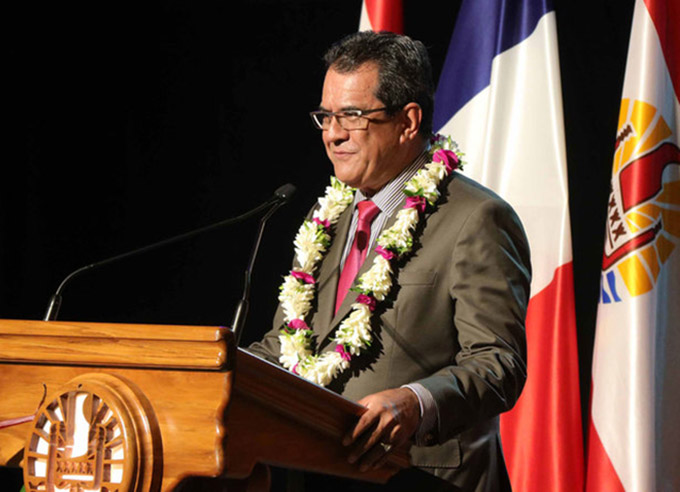 Tahiti President Edouard Fritch wins election defamation case against rival … awarded US$2000 pay out in damages. Image: French Polynesia govt
By RNZ Pacific
A senior French Polynesian politician has been fined for defaming the president Edouard Fritch during the election campaign in April.
The criminal court in Tahiti found the Territorial Assembly leader of the opposition Tahoeraa Huiraatira party, Geffry Salmon, guilty and fined him US$5,000.
He has also been ordered to pay US$2,000 to Fritch who wanted to be paid US$20,000 in compensation.
Fritch took legal action in June, saying Salmon defamed him at a news conference with claims that his party had been giving out subsidies to buy votes.
Fritch’s lawyer said Tahoeraa never lodged any complaint about any alleged abuse of funds but instead Salmon tried to damage his rivals.
Next month, Fritch is due in court with his predecessor as president, Gaston Flosse, with both accused of abusing public funds.
In the last term, Fritch was twice convicted for corruption.
This article is republished under the Pacific Media Centre’s content partnership with Radio New Zealand.

Article by AsiaPacificReport.nz
]]>It’s teamwork: how dolphins learn to work together for rewards

The Conversation (Au and NZ) – By Stephanie King, Branco Weiss Research Fellow, University of Western Australia
Cooperation can be found across the animal kingdom, in behaviours such as group hunting, raising of young, and driving away predators.
But are these cooperating animals actively coordinating their behaviour, or are they simply acting individually to accomplish the same task at the same time?
In a study, published today in Proceedings of the Royal Society B, we showed that bottlenose dolphins actively coordinate their behaviours. That is, they can learn to work together and synchronise their actions to solve a cooperation task and receive a reward.
Read more: Male dolphins use their individual ‘names’ to build a complex social network
Testing teamwork
For this study, conducted at the Dolphin Research Center in the Florida Keys, we created a task in which pairs of dolphins had to swim across a lagoon and each press their own underwater button at the same time (within a 1-second time window).
Each trial began with both dolphins and their respective trainers located at the opposite side of the lagoon from the buttons, about 11 metres away. The trainers would either both give a “press the button” hand signal at the same time, or one trainer would give the signal first, while the second trainer asked her dolphin to wait up to 20 seconds before giving the signal.
If the dolphins pressed their buttons at the same time, a computer played a “success” sound, and the dolphins returned to their trainers for fish and social praise.
If the dolphins pressed their buttons at different times, a “failure” sound was played and the trainers moved on to the next trial.
The strict timing requirement meant they had to work together. If their goal was simply “press my button”, then when they were sent at different times, they would press at different times. To succeed, they had to understand their goal as “press the buttons together”.
The question, then, was whether the dolphin sent first would wait for the other dolphin before pressing its button, and whether they could figure out a way to coordinate precisely enough to press simultaneously.
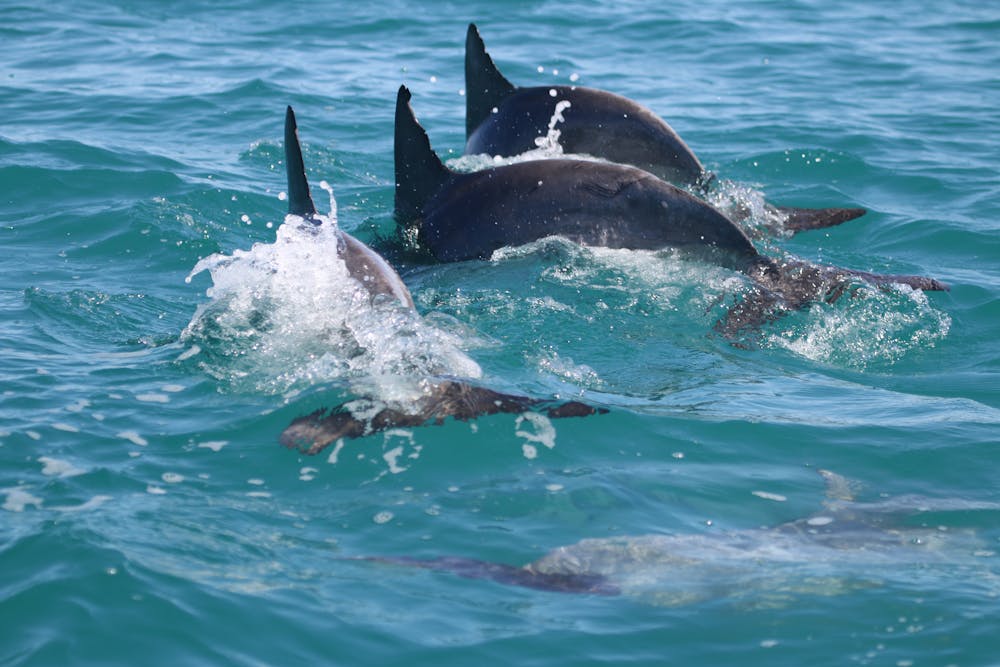
Two bottlenose dolphins (Tursiops truncatus) cooperate in a button-pressing task requiring precise behavioural synchronisation. Dolphin Research Center, Author providedSwim fast, or coordinate?
We found that the dolphins were able to work together with extreme precision even when they had to wait for their partner. Interestingly, their behavioural strategies and the coordination between them changed as they learned the task.
Keep in mind that the dolphins had to figure out that this was a cooperative task. There was nothing about the situation that told them in advance that the buttons had to be pressed at the same time.
To help them learn, we started by sending them simultaneously and gradually increased the timing difference between them.
When one dolphin figured out the game first, if their partner was sent first on a particular trial, they knew that the partner (who had not figured out the game) was not going to wait.
So in the early phases, we found that many successes were achieved not by the first dolphin waiting, but by the second dolphin swimming extremely fast to catch up.
But once both animals understood the task, this behaviour disappeared and the timing of their button presses became extremely precise (with the time difference between button presses averaging just 370 milliseconds).
This shows that both partners now understood that they didn’t need to swim fast to succeed; instead, they needed to synchronise their actions.
Wait for it… a delayed start but the dolphins still work together.Synchrony in the wild
In the wild, dolphins synchronise their behaviour in several contexts. For example, mothers and calves will surface and breathe at the same time, and males in alliances will perform the same behaviours at the same time in coordinated displays.
Triple synchronous dive by a trio of allied male bottlenose dolphins (Tursiops aduncus) in Shark Bay, Western Australia. Stephanie King / The Dolphin Alliance Project, Author providedThe synchrony in these displays can be remarkably precise, and is thought to actively promote cooperation between partners.
Read more: Tackling the kraken: unique dolphin strategy delivers dangerous octopus for dinner
The results of our study suggest that this behavioural synchronisation that dolphins show in the wild may not be a hardwired response to a specific context, but may in fact be a generalised ability that they can apply to a variety of situations.
Kelly Jaakkola, director of research at the Dolphin Research Center, contributed to this research and this article. She can be contacted at kelly@dolphins.org.
– It’s teamwork: how dolphins learn to work together for rewards– http://theconversation.com/its-teamwork-how-dolphins-learn-to-work-together-for-rewards-103331]]>
Why New Zealand was the first country where women won the right to vote

The Conversation (Au and NZ) – By Katie Pickles, Professor of History at the University of Canterbury and current Royal Society of New Zealand Te Apārangi James Cook Research Fellow, University of Canterbury
125 years ago today Aotearoa New Zealand became the first country in the world to grant all women the right to vote.
The event was part of an ongoing international movement for women to exit from an inferior position in society and to enjoy equal rights with men.
But why did this global first happen in a small and isolated corner of the South Pacific?
Read more: Women’s votes: six amazing facts from around the world
Setting the stage
In the late 19th century, Aotearoa New Zealand was a volatile and rapidly changing contact zone where British settlers confidently introduced systematic colonisation, often at the expense of the indigenous Māori population. Settlers were keen to create a new world society that adapted the best of Britain and left behind behind the negative aspects of the industrial revolution – Britain’s dark satanic mills.
Many supported universal male suffrage and a less rigid class structure, enlightened race relations and humanitarianism that also extended to improving women’s lives. These liberal aspirations towards societal equality contributed to the 1893 women’s suffrage victory.
At the end of the 19th century, feminists in New Zealand had a long list of demands. It included equal pay, prevention of violence against women, economic independence for women, old age pensions and reform of marriage, divorce, health and education – and peace and justice for all.
The women’s suffrage cause captured widespread support and emerged as the uniting right for women’s equality in society. As suffragist Christina Henderson later summed up, 1893 captured “the mental and spiritual uplift” women experienced upon release “from their age-long inferiority complex”.
Two other factors assisted New Zealand’s global first for women: a relatively small size and population and the lack of an entrenched conservative tradition. In Britain, John Stuart Mill presented a first petition for women’s suffrage to the British Parliament in 1866, but it took until wartime 1918 for limited women’s suffrage there.
Women as moral citizens
As a “colonial frontier”, New Zealand had a surplus of men, especially in resource towns. Pragmatically, this placed a premium on women for their part as wives, mothers and moral compasses.
There was a fear of a chaotic frontier full of marauding single men. This colonial context saw conservative men who supported family values supporting suffrage. During the 1880s, depression and its accompanying poverty, sexual licence and drunken disorder further enhanced women’s value as settling maternal figures. Women voters promised a stabilising effect on society.
New Zealand gained much strength from an international feminist movement. Women were riding a first feminist wave that, most often grounded in their biological difference as life givers and carers, cast them as moral citizens.
Local feminists eagerly drew upon and circulated the best knowledge from Britain, America and Europe. When Mary Leavitt, the leader of the US-based Women’s Christian Temperance Union (WCTU) visited New Zealand in 1885, her goal was to set up local branches. This had a direct impact, leading to the country’s first national women’s organisation and providing a platform for women to secure the vote in order to affect their colonial feminist concerns.
Other places early to grant women’s suffrage shared the presence of liberal and egalitarian beliefs, a surplus of men over women, and less entrenched conservatism. The four frontier US western mountain states led the way with Wyoming (1869), Utah (1870), Colorado (1893) and Idaho (1895). South Australia (1894) and Western Australia (1899) made the 19th century and, before the first world war, were joined by other western US states, Australia, Finland and Scandinavia.
Local agency
Social reformer and suffragist Kate Sheppard, around 1905. Wikimedia Commons, CC BY-NDNew Zealand was fortunate to have many effective women leaders. Most prominent among them was Kate Sheppard. In 1887, Sheppard became head of the WCTU’s Christchurch branch and led the campaign for the vote.
The campaign leaders were well organised and hard working. Their tactics were petitions, pamphlets, letters, public talks and lobbying politicians – this was a peaceful era before the suffragette militancy during the early 20th century elsewhere.
Read more: Adela Pankhurst: the forgotten sister who doesn’t fit neatly into suffragette history
The women were persistent and overcame setbacks. It took multiple attempts in parliament before the Electoral Act 1893 was passed. Importantly, the suffragists got public opinion behind the cause. Mass support was demonstrated through petitions between 1891 and 1893, in total garnering 31,872 signatures, amounting to a quarter of Aotearoa’s adult women.
Pragmatically, the women worked in allegiance with men in parliament who could introduce the bills. In particular, veteran conservative Sir John Hall viewed women’s suffrage as a way to a more moral and civil society.
The Suffrage 125 celebratory slogan “whakatū wāhine – women stand up!” captures the intention of continuing progressive and egalitarian traditions. Recognising diverse cultural backgrounds is now important. With hindsight, the feminist movement can be implicated as an agent of colonisation, but it did support votes for Māori women. Meri Te Tai Mangakāhia presented a motion to the newly formed Māori parliament to allow women to vote and sit in it.
New Zealand remains a small country that can experience rapid social and economic change. Evoking its colonial past, however, it retains both a reputation as a tough and masculine place of beer-swilling, rugby-playing blokes and a tradition of staunch, tea drinking, domesticated women.
– Why New Zealand was the first country where women won the right to vote– http://theconversation.com/why-new-zealand-was-the-first-country-where-women-won-the-right-to-vote-103219]]>
Do you ‘zombie check’ your phone? How new tools can help you control technology over-use
The Conversation (Au and NZ) – By Joanne Orlando, Researcher: Technology and Learning, Western Sydney University
Technology has undoubtedly become essential for productivity and communication in our professional and personal lives.
However, the most prominent reason users of all ages reach for their device is not to work, but to “zombie check”. These are the unthinking times you use your device throughout the day to avoid boredom. For example, pulling out your phone while in line for coffee, waiting for dinner to cook, or when there is a lull in a TV program.
We turn to our device when the task at hand becomes too difficult, too tedious, or simply unfulfilling. And we often use our smartphone for zombie scrolling because it’s always with us.
Our unproductive zombie screen hours can creep up – but they don’t need to rule us. With new tools now available to monitor your use of technology, here I’ve put together four steps to help you understand and maybe even change your tech habits.
Read more: We asked five experts: should mobile phones be banned in schools?
Health risk with some technology use
Research shows that while creative, focused technology use has an overall positive effect on us, excessive unproductive use can have negative mental and socio-emotional implications for young people and adults. For example, it can contribute to reduced mental well-being, and sleep disturbances. Ensuring our screen time is useful and not excessive is important for adults and for children.
Digital detoxes are often posed as the answer to managing screen time. However, their underlying assumption that “all technology use is the same” is not a sustainable management approach.
A one-size-fits-all recommended number of screen hours also does not work. Even professional screen time recommendations for children acknowledge that placing a number on recommended hours is too difficult because of our varied technology needs and lifestyles.
Read more: Curious Kids: Why do adults think video games are bad?
Solution: cutting ‘zombie’ screen use
Data from the UK suggests the average person checks their phone every 12 minutes. The key to effective screen time management is to weed out uses that do not have a positive impact on your life, such as zombie scrolling.
The recent release of new screen time management tools available on our devices and social media platforms can help with this.
Apple’s Screentime tool was introduced with iOS 12. Apple (screen shot September 18 2018)Apple recently introduced Screen Time to its new operating system. This is a new section of the settings menu which creates detailed daily and weekly activity reports. It shows the total time a person spends in each app they use, their usage across categories of apps, how many notifications they receive and how often they pick up their iPhone or iPad.
Googles’s new Digital Well-being dashboard for Android users has a similar design.
Newly established features on YouTube tell you how long you’ve watched YouTube videos today, yesterday and over the past seven days.
Facebook and Instagram are also in the introductory phase of a similar range of settings.
Read more: How teens use fake Instagram accounts to relieve the pressure of perfection
Step by step approach
These screen management features can help us understand and modify our technology habits. With data we may be able to see and identify our own usage “red flags” (problematic areas), and move towards better self-regulation to kick zombie screen time habits.
The following stepped plan offers a way to apply new screentime features.
Step 1: Map your use
Use the screentime features to examine how you use technology during the day, and over a week.
Identify the aspect of your zombie use that you want to change. This may be for example:
- reduce the number of minutes/hours you spend using a particular social media platform, or watching YouTube
- reduce how many times a day you pick up your phone.
Step 2: Identify your triggers
Identify what triggers the aspect of technology use you want to change.
For example, if you want to reduce how many times a day that you pick up your phone then look for the time of day you have most pick-ups, or if there are particular days in the week where your pick up tends to be higher. Do your high use times coincide with another activity – perhaps sitting on the bus, or taking children to sports training?
Step 3: Make a plan
Use this information to develop a plan.
Planning ahead may include setting specific times when you will or won’t use your device in particular ways. It may involve making sure you have other options to avoid boredom, such as having a book with you when you’re travelling or waiting for family members.
A plan is important, as it facilitates goal attainment and also increases self-control. Try the plan for one day.
Step 4: Reflect on your plan
After one day or week of using the plan, ask yourself key questions:
- did you accomplish your plan?
- under what conditions did your plan work best?
- were you distracted from your plan and how did get back onto it?
- was your plan do-able? (for example, a plan to reduce the number of times you picked up your phone from 100 per day to 20 may be too difficult to achieve in a first instance)
- do you need to adjust your plan so that it is achievable?
You can use the new activity monitoring tools to review and revise your plan, and to assist you in achieving your goals such as setting limits for how much time you allow yourself to use particular apps.
Parents and children
Screentime management is best approached in small steps; nudge your way towards use of technology that you are more comfortable with.
This approach can also be applied as a proactive, strengths-based approach to teach children screen time management.
Explain zombie technology use to your child, and team with your child to develop a plan and use these screentime features. While you may have different plans, doing it together is very supportive and a great way to model effective healthy and positive technology use.
– Do you ‘zombie check’ your phone? How new tools can help you control technology over-use– http://theconversation.com/do-you-zombie-check-your-phone-how-new-tools-can-help-you-control-technology-over-use-103042]]>
The AFL’s gender diversity policy remains an apprehensive work in progress
The Conversation (Au and NZ) – By Daryl Adair, Associate Professor of Sport Management, University of Technology Sydney
The inclusion of transgender athletes in Australian sports leagues is an issue that sporting bodies are only just coming to terms with.
In recent months, the Australian Human Rights Commission, in partnership with Sport Australia, has been working on national gender diversity guidelines, with sporting bodies awaiting their recommendations.
However, the Australian Football League (AFL), has recently announced its own Gender Diversity Policy, which is limited to transgender and non-binary athletes (but doesn’t include intersex athletes). Since its release, the policy has prompted many questions about why the AFL proposed it and how it envisages implementing the new rules.
Lack of consistency across sports
Guidelines for trans and gender diverse (TGD) athletes have existed in international sporting bodies for years. The International Olympic Committee, for instance, has allowed TGD athletes to compete since 2003. In 2015, it decided that sex reassignment surgery would no longer be required and halved the transition period prior to athletic competition to 12 months.
Other elite-level sporting bodies also have transgender protocols in place, most of which allow male-to-female athletes to compete in sports, either on the basis of sex-reassignment surgery or hormone-based transition. Female-to-male athletes face fewer constraints, as it is assumed they have no potential for competitive advantage.
Australia has lagged behind when it comes to accommodating TGD athletes. The impetus for change came last year when a transgender footballer, Hannah Mouncey, applied for entry into the AFL Women’s League (AFLW) draft and was denied.
Read more: By excluding Hannah Mouncey, the AFL’s inclusion policy has failed a key test
Mouncey, a former Olympic men’s handball player, was ruled ineligible according to Section 72(1) of the 2010 Victorian Equal Opportunity Act, which provides an exemption for excluding athletes from sporting activities if their “strength, stamina or physique” is relevant.
According to the Victorian Equal Opportunity and Human Rights Commission:
The purpose of this exception is to ensure players do not have an unfair competitive advantage in single-sex competitions.
Surprisingly, Mouncey was permitted to keep playing at lower levels of competition. In fact, transgender, non-binary and intersex athletes have long been included in community-level AFL with little fuss. In Sydney, for example, the Newtown Breakaways AFL club has provided a welcoming environment for gender diverse women.
But the AFL’s decision seemed contradictory, as well. Mouncey was deemed “likely” to have an athletic advantage over other female athletes, but that only mattered in an elite competition involving remuneration.
Body surveillance and performance evidence
Because the AFL’s policy claims to meet the “strength, stamina or physique” exemption under the VEOA, it is incumbent on the league to produce corroborating evidence.
According to the policy, a baseline requirement for AFLW athletes is that they demonstrate a level of testosterone below five nanomoles (nmols) over the previous 24 months.
It is unclear how the AFL arrived at these specifications. Most likely, the league drew on the IOC’s policy, which currently limits female athletes to 10 nanomoles of testosterone over the past 12 months, and is set to lower that to five nanomoles by the 2020 Tokyo Olympics.
The IOC’s policy has been framed on the basis of medical and scientific opinion within the organisation, rather than substantive research. This is part of a wider problem: there is no recognised body of scholarship about the performance characteristics of TGD athletes. There is apprehension within sport that they may have advantages over cis-gender athletes, but this has not been properly measured or validated.
Another problem with the AFL’s new policy is that the burden of proof is also left to athletes. In addition to the testosterone testing, the league mandates two years of physical and performance data, including:
- height
- weight
- bench press (one rep max and/or three rep max)
- squat (one rep max and/or three rep max)
- 20m sprint time
- vertical jump
- match raw GPS data (sample of three Australian Rules Football matches if available)
- 2 kilometre run time
The AFL acknowledges these data may not have been collected by all transgender athletes over the past 24 months.
Yet, paradoxically, the league also claims these data provide a robust measure of evaluating transgender athletes, and that comparisons with cis-gender athletes over a two-year period are entirely feasible.
A more scientific approach would be a prospective study, funded by the AFL (with independent researchers), which could also provide new research on the subject.
Steps toward a possible solution
In mid-August, the AFL invited athletes and advocates from the transgender community to a discussion about its proposed Gender Diversity Policy. Michelle Sheppard, a workplace diversity consultant (and transgender woman), facilitated the session. She later wrote enthusiastically that:
…the policy presented was an early draft and needs much work still but the feedback we gave was well received by the AFL’s representatives.
So Sheppard was surprised that the final version of the policy was released two weeks later, seemingly unchanged.
Last week, Sheppard met with the AFL one-on-one to ask questions. She had received feedback from some transgender athletes that they simply did not have the athletic performance data the AFL was seeking for the past 24 months, and feared being left out.
Read more: Explainer: the difference between being transgender and doing drag
Sheppard said she was assured by the AFL that it would accept less data from athletes without 24 months of record-keeping – a sign the league wants to find solutions rather than stymie applicants with hurdles.
However, according to Dale Sheridan, a lawyer and transgender woman, ongoing surveillance of transgender athletes in the AFLW is likely to stoke anxieties. In an email to me she asserted:
The AFL can review a decision at any time, which provides no certainty for TGD trans players if … they are deemed ‘too good’. How can one take the field and give their best with the threat of a decision review constantly hanging over their head?
Sheppard told me she is keen to liaise with the AFL on the policy, but the league’s decision makers will need to be receptive to input from those with lived experience of transitioning, as well as endocrinologists who specialise in transgender health.
After all, she says, the AFLW impacts how the public see transgender people. The Gender Diversity Policy says that discrimination will not be tolerated and that the intention is to support gender diverse players in a safe and inclusive environment.
But the focus on ongoing surveillance and testing may result in some being made to feel they are infringing – unfairly – on cis-gender space.
– The AFL’s gender diversity policy remains an apprehensive work in progress– http://theconversation.com/the-afls-gender-diversity-policy-remains-an-apprehensive-work-in-progress-102904]]>
I can’t sleep. What drugs can I (safely) take?
The Conversation (Au and NZ) – By Ric Day, Professor of Clinical Pharmacology, UNSW
If you’re having trouble sleeping, medicines shouldn’t be your first option. Exercise regularly, cut back on coffee (and other caffeinated drinks) after midday, eat less in the evening, ease up on “screen time” before, and in, bed, practise meditation and try to have a quiet, dark bedroom dedicated mostly to sleep.
But what if you’ve tried everything and are still struggling with sleep? Many people will want to turn to a medicine for help. Navigating the various options for effectiveness, safety and the potential to become habit-forming can be difficult.
Long-term regular use of medicines to promote sleep should be avoided, as initial effectiveness declines rapidly over a few weeks and dependence and adverse effects become problematic. But in the short short term, sleep medications do have their place. Unfortunately they are often over-used, especially in older people.
Read more: Why getting enough sleep should be on your list of New Year’s resolutions
Benzodiazepines
Benzodiazepines are drugs such as Valium, also used to treat anxiety. They are the most commonly prescribed sleeping pills.
Their effects, which include some muscle relaxing properties, are achieved by enhancing the effect of GABA, an inhibitory neurotransmitter operating throughout the brain. Rarely, some people experience the opposite and become over-excited and more anxious.
As benzodiazepines depress brain function (they depress the central nervous system), their effects add to other central nervous system depressants including alcohol, sedating antihistamines and opioid analgesics such as oxycodone (Endone). This can be very dangerous, and when combined can lead to respiratory failure, coma and even death.
Physiological and psychological dependence on the drug can develop after only a few days in some people, or weeks in most. Unfortunately, far too many people are dependent.
Read more: Weekly Dose: Valium, the ‘safer choice’ that led to dependence and addiction
Importantly, the effectiveness for inducing sleep wears off after a few weeks. It can be very hard to stop taking benzodiazepines as insomnia and often anxiety returns. The duration of “withdrawal” is related to the length of time these are taken.
Stopping suddenly after long-term use can be dangerous, with violent withdrawal reactions possible, including epileptic seizures. Ceasing these medicines needs to be managed by your doctor. Essentially, a gradual reduction in dose is needed with support and counselling to assist with the temporary increase in insomnia and perhaps anxiety.
Side effects include a “dulling” of cognitive function, memory impairment and the increased risk for accidents, especially unsteadiness and falls in older people.
Benzodiazepines should only be used for two to four weeks, or intermittently, and only in addition to good sleep hygiene (that is, practising the measures listed in the first paragraph).
Temazepam (brand names Normison, Temaze, Temtabs) and lorazepam (brand name Ativan) are reasonable choices from the many benzodiazepines available. That’s because they have a faster onset and short duration of effect so as to avoid a “hangover” the next day.
Read more: Health Check: how to soothe yourself to sleep
Z-drugs (hypnotics)
Zopiclone (brand names Imovane and Imrest) and zolpidem (brand name Stilnox) are similar in their pharmacology and effects to the benzodiazepines. These prescription-only medicines also enhance the actions of GABA to depress brain activity and have the same hazards related to excessive sedation and dependence.
Bizarre behaviours and symptoms, for example hallucinations and sleep-walking that can be dangerous, are more likely than with benzodiazepines.
Medications for sleep can’t be used long term. from www.shutterstock.comAntihistamines
Older antihistamine medicines, now known as sedating antihistamines, induce drowsiness through their central nervous system-depressing properties. These are available over the counter from pharmacies. Common examples include diphenhydramine (brand name Unisom Sleep Gels), doxylamine (brand name Restavit) and promethazine (branded Phenergan).
Especially in those with allergies such as hay fever disturbing their sleep, these may be a reasonable short-term option. Dependence on these medications to sleep is a hazard.
These medicines have side effects including dry mouth, blurred vision, constipation, confusion, dizziness and urinary retention in men with prostrate problems. All side-effects are worse in older people.
By contrast, over-the-counter antihistamines commonly used to treat hay fever (such as brand names Telfast, Zyrtec and Claratyne) are non-sedating, and therefore not likely to make you drowsy.
Analgesics
Any opioid-containing medicine, all now requiring a prescription, will induce drowsiness (depending on the dose) because they also depress our central nervous system. Codeine (in Panadeine, Panadeine Forte or Nurofen Plus), tramadol, tapentadol, morphine or oxycodone will make us sleepy, but they’re not recommended to treat insomnia.
These powerful medicines are best reserved for judicious use in pain relief, given the severe hazards of dependence and overdose. Older people are more sensitive to the central nervous system-depressing effects and also to constipation.
Read more: Health Check: five ways to get a better night’s sleep
Melatonin
Our sleep-wake cycle is dependent on the hormone melatonin released cyclically from a gland in our brain. Melatonin administered orally helps induce sleep in some people, but is not as effective as other sedatives.
However, a recent Australian study tested melatonin in people with sleep problems caused by delayed melatonin release in their brains. These people have trouble falling asleep and waking at times appropriate for proper functioning.
Taken one hour prior to bed time, melatonin (0.5mg) accompanied by a behavioural intervention (such as learning how to meditate) helped the participants get to sleep and improved common accompanying impairments such as low mood, anxiety and difficulty concentrating.
You need a prescription for melatonin in Australia. It’s best to avoid alcohol as it interferes with sleep, thereby reducing any effect of melatonin. It is worth trying as it is generally well tolerated, although some people experience back pain. It may work in other types of sleep disturbances, not due to delayed release of melatonin. A dose of 2mg, controlled release one to two hours before bedtime is most commonly used.
Antipsychotics
Antipsychotic medicines (such as quetiapine) have been increasingly used to treat insomnia.
Typically used at a lower dose, quetiapine can induce sleep but carries a significant burden of possible harmful effects. These include a fast heart rate, agitation, low blood pressure and unsteadiness. These make quetiapine not appropriate for treating common sleep problems.
Antidepressants
Antidepressants are typically prescribed at a low dose for insomnia, but the supporting evidence of efficacy (despite the wide use) is low quality and there is the risk of adverse effects such as confusion, dry mouth and blurred vision.
Herbal and complementary medicines
Herbal remedies such as valerian, lavender, passiflora, chamomile, hops and catnip are widely promoted to promote “sleep health”. Research to support their efficacy is limited.
Read more: We asked five experts: is it possible to catch up on sleep?
Many newer and emerging medicines are being tested for insomnia, so in the future more options should be available.
For now it’s important to remember none of the options listed above is without side effects, and most will cause dependence if used long term, meaning falling asleep without them will be even harder than it was before.
Improve your sleep hygiene, and if that hasn’t worked for you, speak with your doctor about what’s keeping you up at night. She’ll be able to prescribe the best type of medication for you to use in the short term.
– I can’t sleep. What drugs can I (safely) take?– http://theconversation.com/i-cant-sleep-what-drugs-can-i-safely-take-102343]]>
Eulogy for a seastar, Australia’s first recorded marine extinction
The Conversation (Au and NZ) – By Tim O’Hara, Senior Curator of Marine Invertebrates, Museums Victoria
We see the surface of the sea: the rock pools, the waves, the horizon. But there is so much more going on underneath, hidden from view.
The sea’s surface conceals human impact as well. Today, I am writing a eulogy to the Derwent River Seastar (or starfish), that formerly inhabited the shores near the Tasman Bridge in Hobart, Tasmania. It is Australia’s first documented marine animal extinction and one of the few recorded anywhere in the world.
Read more: Extinction is a natural process, but it’s happening at 1,000 times the normal speed
The Derwent River Seastar, preserved in the Tasmanian Museum and Art Gallery, Hobart. Credit: Christy Hipsley, Museums Victoria/University of Melbourne
Scientists only knew the Derwent River Seastar for about 25 years. It was first described in 1969 by Alan Dartnall, a former curator of the Tasmanian Museum and Art Gallery. It was found on and off until the early 1990s but scientists noted a decline in numbers. Targeted surveys in 1993 and 2010 failed to find a single individual.
It was listed as critically endangered by the Tasmanian and Australian governments. But now, like a long-lost missing person, it is time to call it: the Derwent River Seastar appears extinct.
It is actually quite hard to document the extinction of marine animals. There is always hope that it will turn up in some unusual spot, somewhere in that hidden world. Australia has an ambitious plan to create high-resolution maps of 50% of our marine environment by 2025. This is a formidable task. But it is a reflection of our lack of knowledge about the oceans that, 20 years after the launch of Google Maps and despite an enormous effort in the interim, much of Australia’s seafloor in 2025 will be still largely known from the occasional 19th-century depth sounding, or imprecise gravity measurements from satellites.
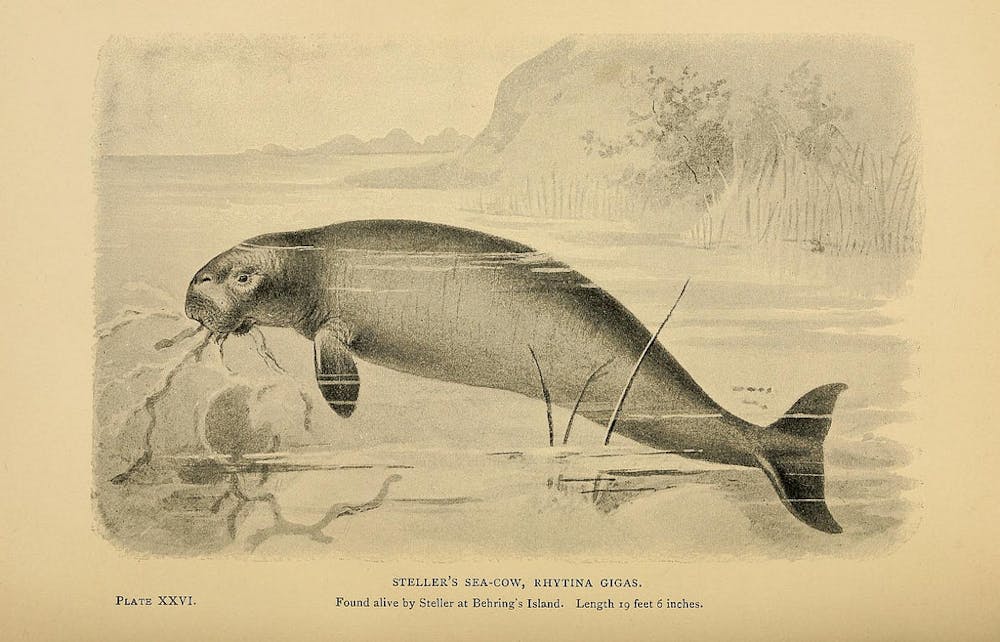
We do notice when big animals go. There used to be a gigantic dugong-like creature called Stella’s Sea Cow, which lived in the North Pacific Ocean until it was hunted to oblivion by 1768. There is no mistaking that loss.
Stellar’s Sea Cow, which grew up to 10 metres long and weighed between five and ten tonnes, was hunted to extinction in 1768. Paul K/Flickr, CC BYBut the vast majority of the estimated 1 million to 2 million marine animals are invertebrates, animals without backbones such as shells, crabs, corals and seastars. We just don’t monitor those enough to observe their decline.
We noticed the Derwent River Seastar because it was only found at a few sites near a major city. Its story is intertwined with the usual developments that happen near many large ports. The Derwent River became silty and was at times heavily polluted by industrial and residential waste. The construction of the Tasman Bridge in the early 1960s cannot have helped.
From the 1920s a series of marine pests were accidentally introduced by live oysters imported from New Zealand, or by hitching a ride on ships. Some of these pests are now abundant in southeast Tasmanian waters and eat or compete with local species.
Read more: Australia relies on volunteers to monitor its endangered species
The Derwent River Seastar has been a bit of an enigma. From the start, it was mistakenly classified as belonging to group of seastars (poranids) otherwise known from deep or polar habitats. Some people wondered whether it was an introduced species as well, one that couldn’t cope with the Derwent environment.
However, we used a CT scanner at the School of Earth Sciences, University of Melbourne, to look at the internal skeleton of one of the few museum specimens. Sure enough, it has internal struts to strengthen the body, which are characteristic of a different group of seastars (asterinids) that have adapted to coastal environments and are sometimes restricted to very small areas.
CT scan showing the internal structure of the seastar. Source: Christy Hipsley, Museums Victoria/University of Melbourne
Is this seastar like a canary in a coal mine, a warning of a wave of marine extinctions? Sea levels are rising with global warming, and that is going to be a big problem for life adapted to living along the shoreline. Mangroves, salt marsh, seagrass beds, mud flats, beaches and rock platforms only form at specific water depths. They are going to need to follow rising sea levels and reform higher up the shoreline.
Coastal life can take hundreds to thousands of years to adjust to these sorts of changes. But in many places we don’t have a natural environment anymore. Humans will increasingly protect coastal property by building seawalls and other infrastructure, especially around towns and bays. This will mean far less space for marine animals and plants.
Read more: Rising seas will displace millions of people – and Australia must be ready
We need to start planning new places for our shore life to go – areas they can migrate to with rising sea levels. Otherwise, the Derwent River Seastar won’t be the last human-induced extinction from these environments.
– Eulogy for a seastar, Australia’s first recorded marine extinction– http://theconversation.com/eulogy-for-a-seastar-australias-first-recorded-marine-extinction-103225]]>
Business as usual? The Sustainable Development Goals apply to Australian cities too
The Conversation (Au and NZ) – By Wendy Steele, Associate Professor of Sustainability and Urban Planning, RMIT University
We are still settling Australian cities on unceded Aboriginal lands. With the global agreement on the United Nations Sustainable Development Goals (SDGs) in 2015, development has finally come home to the developed world. Yet in Australia we still often proceed as if development goals are about foreign aid, somehow separate from our own development activities and civic responsibilities.
The Senate inquiry into the SDGs, for example, has been referred to the Department of Foreign Affairs, Defence and Trade. Three of the seven terms of reference relate to Australia’s Official Development Assistance program.
Reports that trade with Europe might be in jeopardy because of Australia’s failure to act responsibly on climate change – a commitment enshrined not just in the Paris Agreement but also in SDG 13: Climate Action – illustrate the naivety of thinking this country can carry on as usual while others tackle sustainable development.
Read more: Australia’s UN report card: making progress, could do better on inequality and climate
Australia’s SDG indicator framework
The National Sustainable Development Council’s focus on transforming Australia is an important starting point. The NCDC draws on the SDG Progress Report to “highlight key trends and emerging issues for policy and decision-makers and communities across Australia”. But it doesn’t go far enough.
The focus is on targets and indicators that are deemed relevant and important for Australia. This is complemented by a wheel-of-fortune-style dashboard set of aggregated results across four key benchmarks.
The result is a colourful, largely unintelligible – albeit very well-intentioned – national SDG assessment.
Australia’s SDG Indicator Scorecard. NCDCLooks like we get a C grade. But what does this actually say about Australian settlements?
Sanitised and complacent
The real issues facing Australia are sanitised and out of sight with a 6.5 score. With 90% of Australians living in urban areas, how does this assessment inform and transform the state of sustainable development in our cities?
A core sustainable development challenge for Australia is the spatial unevenness of its development – between cities and non-city regions, between the dominant cities (Sydney and Melbourne) and the rest, or between different suburbs within cities.
Our patchwork economy generates serious social inequities. The answer is not just to stimulate greater economic activity or spread the boom to “lagging” areas.
We need to recognise that the apparent success of the “bright patches” is often based on their exploitation of “dull patches”. Some areas are set up to be sacrifice zones that suffer, for example, the ill effects of resource extraction, heavy industry and waste disposal.
Read more: An environmentally just city works best for all in the end
And some regions struggle not simply because they are physically distant, but because uneven provision of infrastructure has made them functionally distant. Prioritisation of certain regions over others and an over-reliance on infrastructure provision as a proxy for development are two issues that the nation needs to tackle to deliver the SDG agenda.
Do you know all 17 Sustainable Development Goals?Beyond national silos
Australian cities rely on and impact upon these spaces and others far beyond their boundaries. Thus tackling SDG 11 on cities cannot be separated from tackling the other SDGs, including sustainably managing life on land (SDG 15), clean water and sanitation (SDG 6), affordable and clean energy (SDG 7) and life below water (SDG 14).
This means thinking not just about where and how cities access resources, but where their outputs go. For example, when China halted a major waste flow to its recycling plants this exposed the reliance of Australian cities on often distant facilities.
Read more: China’s recycling ‘ban’ throws Australia into a very messy waste crisis
This demonstrates how cities are inextricably linked to spaces beyond their city limits, and the need for Australian cities to reduce and reuse as well as just recycle waste. It also illustrates the entwining of Australian settlement development with multiple spaces beyond our borders. Australia’s responsibility for sustainable development includes attention to the nation’s own urban heartlands as well as their impact on both neighbouring and distant countries.
Putting the SDGs to work in Australian cities
The SDGs can be mobilised to help achieve sustainable development, but we are not putting them to work in Australia. We stumble our way into the challenges of our climate of change, no more nationally self-aware it seems than before.
A new sustainable development approach is needed in Australia. An SDG ethic and compass must guide our direction so no one is left behind.
The SDGs are an invitation to take seriously the sustainable development challenges we face as a nation, and the implications of our actions for other nations. Rather than look for ways to reinforce our developed country privilege with a C grade report card, we could use the SDGs as a two-fold opportunity to:
1) ask the hard questions about the sustainability of our development
2) collectively explore transformative pathways, particularly within our cities.
Both suggest the importance of connecting more genuinely with Indigenous understandings of sustainability and living ethically on Country. And what do the SDG indicator frameworks and benchmarks tell us about our progress in our sovereign relationship with Indigenous people on whose unceded land we live and work?
We are not arguing for a more parochial agenda, or that international development is not important. Indeed, Australia could usefully follow the UK in positioning national science and research priorities within broader “global challenges”.
Rather, we are pointing to the risks of framing sustainable development issues as problems “over there”. This obscures both Australia’s own acute settlement problems and its role in creating problems “over there”.
What is needed is joined-up policy, planning and research that includes Australia within the frame as a sustainable development site, as well as a funding provider.
It could also include identifying Australia as a country in need: a nation that needs to better contribute to all the SDGs. In the case of SDG 13 on climate action, that need is glaring.
In Australia we need to make sure our identity does not include an implicit assumption that our home base is not in need of SDG attention – or only in certain areas. Many if not all aspects of development in Australia are maldevelopment, which calls for strong critical evaluation and action as much as in any other space. As a nation we can do much better.
– Business as usual? The Sustainable Development Goals apply to Australian cities too– http://theconversation.com/business-as-usual-the-sustainable-development-goals-apply-to-australian-cities-too-102641]]>
Trump versus China means picking sides
The Conversation (Au and NZ) – By Giovanni Di Lieto, Lecturer of international trade law, Monash Business School, Monash University
As Donald Trump escalates his trade war with China, slapping a 10% tariff on roughly $US200 billion of imports that will climb to 25% if China retaliates, he appears to found something of a soul mate in Scott Morrison.
“We both get it,” Australia’s new prime minister said this week. What they get, he told the New York Times’ Maureen Dowd, is that some people feel left off the globalism gravy train: “The president gets that. I get it.”
His words signal a profound change of tack in Australian economic diplomacy as the new US approach threatens to break down the World Trade Organisation and universal trade agreements in general.
Under Trump, trade will depend on stronger bilateral (one on one) agreements that support US geopolitics.
It’ll mean Australia picking sides.
Double dangers in middle of the road
The status quo of relying on China for trade surpluses and on the US for security patronage might not be sustainable in the long run.
Siding with neither China or the US, attempting a “third way” of non-alignment, runs the risks losing out on both trade and security.
Broadly speaking, we can summarise the trade war between the US and China as a contest between sea and land.
The US aims to secure trade routes through the Indian and Pacific oceans. China wants to shift the bedrock of international trade to Central Asia.
Its Belt and Road Initiative is a grand strategic plan to join Eurasian economies from Lisbon to Vladivostok. The plan would end the historic era of Anglo-American hegemony founded on controlling trade routes across the Atlantic, Indian and Pacific oceans.
Read more: Is the Trump administration getting East Asia right, or just confusing it?
Australia faces an existential strategic choice.
Leaving political ideologies aside, its economic prosperity depends on trade by sea. The return of Marco Polo’s world would eventually make Australia little more than a price-taking commodity supplier to trade and investment hubs from Beijing to Venice.
This means our national interests lie with the US defence of its seaborne trading routes.
Picking a side will be costly
In the short term, especially if the trade war escalates, siding with the US will be costly. We could lose a good deal of China-related export and business opportunities. Over the longer run we could offset the losses by diversifying to trade and invest in countries with shared strategic interests, such as Indonesia and India.
We would be well advised to reconsider the diplomatic benefit of RCEP, the China-led Regional Comprehensive Economic Partnership. This mega regional trade deal between the 10 members of the Association of Southeast Asian Nations and their bilateral trade partners has been dubbed the Chinese Trans Pacific Partnership. It can be seen as an extension of Xi Jinping’s major-power agenda.
After a promising start, RCEP negotiations now appear to be stuck. The main obstacle is India’s fear of worsening its already significant trade deficit with China.
Our interests lie with the US, and India
Another sticking point is that India, the Philippines and other potential members want countries like Australia, New Zealand and Japan to open up their markets for information technology and professional services.
In pure trade terms we would lose little if the RCEP did not proceed. We already have strong bilateral ties with all the negotiating countries apart from India, with whom we are presently negotiating a free trade agreement.
We would be well advised to use our limited diplomatic resources for that and supporting the US when it comes time to pick sides.
– Trump versus China means picking sides– http://theconversation.com/trump-versus-china-means-picking-sides-102484]]>
Explainer: what does it mean to be ‘cisgender’?
The Conversation (Au and NZ) – By Joanna McIntyre, Lecturer in Screen and Media Studies, University of the Sunshine Coast
As a term and concept, “transgender” is now firmly embedded in common parlance and popular consciousness. In Australia in the last few weeks alone there have been major news stories about transgender footballer Hannah Mouncey; Prime Minister Scott Morrison’s comments regarding “gender whisperers”; and the University of Western Australia cancelling a talk by an anti-transgender US academic.
“Transgender” has an important linguistic counterpart that is not as common but is gaining prevalence. The term “cisgender” (pronounced “sis-gender”) refers to people whose gender identity and expression matches the biological sex they were assigned when they were born. For instance, the musician Moby has said he is a “run-of-the-mill, cisgender, heterosexual male”.
“Cisgender” was introduced so our language could be more fair and inclusive, and to make us more aware of everybody’s experiences of gender. However, the term has critics as well as fans.
Read more: Explainer: the difference between being transgender and doing drag
What are the word’s origins?
The prefix “trans-” comes from Latin, meaning “across from” or “on the other side of”. In contrast, the prefix “cis-” means “on this side of”. It is commonly used in chemistry and in relation to geographic features, such as in “cisalpine”.
“Cisgender” was coined in academic journal articles in the 1990s. It started to gain broader popularity from around 2007 when transgender theorist Julia Serano discussed it in her book Whipping Girl. Over the next decade, activists, scholars and online forums helped to, literally, spread the word.
It is largely used by those who are sensitive to issues of gender and identity. Nevertheless, its general acceptance and endurance as a term and concept was acknowledged when it was added to the Oxford English Dictionary in 2015.
Cisgender relates specifically to gender rather than sexuality. A person can be cisgender (often abbreviated to just cis) and have any sort of sexuality. For example, two men may both be cisgender but one straight and one gay.
Because it is a personal identity category, it is difficult to know just from looking at someone whether they are cisgender.
Moby pictured in 2009: he recently described himself as a ‘run-of-the-mill, cisgender, heterosexual male’. Estela Silva/EPAWhy is it useful?
This term is seen has having some important uses. One is that it helps us distinguish between sexual identity and gender identity. However, its most significant function is perhaps that naming something allows us to think about it more clearly.
Having a word for a “just usual” gender identity enables us to understand it is actually a specific gender identity in itself. The idea that people are cisgender therefore shows that, no matter who you are, the relationship between your body and your sense of self is particular.
Drawing attention to gender in this way can also highlight that some people are disadvantaged because of their gender identity. That is, this term can create awareness that people who are not cisgender often have a harder time in our society than those who are. For example, trans men and women report higher levels of physical and verbal abuse than cisgender people.
Detractors
Despite the inclusive potential of the word, it also has many detractors who warn about possible negative impacts. Some believe it sets up a harmful distinction between transgender people and everybody else. In this sense, the term can be counter-intuitive and work against transgender becoming more accepted and normalised.
US actor Laverne Cox, who identifies as trans. EPA/PETER FOLEYIt can also falsely imply that only transgender people experience any form of mismatch between their body/sex and their gender identity. For example, lesbian, gay and bisexual people in particular may be deemed cisgender but experience conflict between their gender identity and how society expects them to express their gender.
Others have identified the term does not properly account for intersex people. Because intersex people have atypical sex characteristics (for example genitals, hormones, reproductive glands and/or chromosomes), it is problematic to define their gender identity in relation to the sex they were born.
Read more: Surgery to make intersex children ‘normal’ should be banned
From these perspectives, cisgender is limiting and divisive because it indicates there are only two possible gender identities linked to only two sexes.
Finally, some people think “cisgender” will not be fully integrated into common language because of how unusual it is to spell and say. For this reason, clearer terms such as “non-trans” have been suggested instead.
As our understanding of gender continues to change, the words we have to describe our experiences of it will also evolve. Ideally these words will help us rectify inequalities between gender identities.
– Explainer: what does it mean to be ‘cisgender’?– http://theconversation.com/explainer-what-does-it-mean-to-be-cisgender-103159]]>
View from The Hill: Morrison’s challenge with women goes beyond simple numbers

The Conversation (Au and NZ) – By Michelle Grattan, Professorial Fellow, University of Canberra
Mutual interest is a great bonding agent, so the bromance between 2GB shock jock Ray Hadley and Scott Morrison is on again.
Morrison will once more make regular appearances with Hadley, who dumped him unceremoniously last year, with a spurious excuse, because he considered him too boring.
As treasurer Morrison was “captive to cabinet solidarity”, Hadley said on Tuesday, explaining their “parting of the ways”. But as prime minister, he was the boss and “unharnessed”.
“Unharnessed” is also one way to describe the state of the government, as MPs kick over the traces, and the still-new prime minister struggles to get a hold on the reins.
The Senate on Monday and Tuesday (and last Thursday) found itself with little to do; Morrison cancelled an October meeting with the states because more work was needed on the matters to be discussed.
In the spooked team, you’d be hard pressed to find many who think the Coalition can turn things around in time for next year’s election.
The row over bullying and the separate but now intertwined question of the under-representation of women among Liberal MPs is continuing to rip through the Liberal party, unable to be contained.
Morrison is conflicted. It’s risky for him to play down the allegations of standover tactics, let alone fail to take seriously enough the party’s need for more female MPs.
But he is attempting to sideline the bullying issue by saying the problem isn’t with the parliamentarians – rather, it lies in the party organisation.
This week he ordered that organisation to set up a complaints mechanism.
Read more: Morrison tells Liberal organisation to act on bullying after second woman flags she’ll quit
On female representation, Morrison has no answers. Yes, he says, he would like more Liberal women in parliament. But how to get them? Certainly not with quotas. And he just wants the best candidates.
Post election, Liberal women in the House of Representatives are likely to be an endangered species – perhaps around half a dozen. Currently there are 12 Liberal women in the House, and one National.
Two of the present women MPs, Ann Sudmalis, from NSW, and Julia Banks, from Victoria, have announced they’re quitting at the election, calling out bad behaviour (with Sudmalis naming a NSW state Liberal MP as her bete noire). Queensland’s Jane Prentice has lost preselection. Julie Bishop is unlikely to stand. Several women are on tight margins.
After Sudmalis’ lashing out on Monday, comments from Liberals on Tuesday sent unhelpful messages.
Minister Steve Ciobo tried to claim the Liberals really had done quite well on the women front; Senator Concetta Fierravanti-Wells invoked Harry S. Truman’s line about departing hot kitchens. Morrison said skirmishes “can happen in the local branches of a P&C”, adding “though I don’t think it probably gets as willing as what we see in politics”.
The government’s “women problem” goes beyond lack of women MPs and candidates.
In presenting its face to voters, especially female voters, Labor has two formidable female performers at the top of its team – deputy leader Tanya Plibersek and its Senate leader Penny Wong.
With Bishop’s departure from the deputyship, the Liberals have no female face in their leadership positions. Bridget McKenzie is the Nationals deputy leader, but obviously regionally focussed.
Kelly O’Dwyer is Minister for Women but doesn’t do much of the government’s broad heavy lifting. New Foreign Minister Marise Payne does virtually none of it (although in her new portfolio she’ll have to step up from her virtual invisibility while in defence). Michaelia Cash has a heap of her own political problems.
There is also the question of how Morrison will appeal to female voters.
So far, the public are still getting their heads around the fact of unexpectedly finding themselves with a new prime minister. Voters seem open-minded about Morrison: they have already put him ahead of Bill Shorten as preferred PM – probably as much a comment on their low opinion of Shorten as a definite statement about Morrison.
Women’s judgment of Morrison will take a while to shake out. He’s started out looking very blokey, with his frequent invoking use of the term “mate”, his preoccupation with rugby league, and his penchant for getting around in a Cronulla Sharks cap.
But Morrison’s chameleon quality means that he may be able to modify the blokey approach if the focus groups suggest that’s required.
The Morrison persona will be tested in the Wentworth byelection. (One Labor-aligned voter from that wealthy electorate says cruelly, “The average Wentworthian would see Morrison as a bit of a hick from The Shire”.)
Read more: View from The Hill: Morrison faces the challenge of community-based candidate in Wentworth
As is well known, Morrison wanted a woman candidate for the seat, an effort that failed. Now he is faced with the political nightmare of fighting a high profile independent female in Kerryn Phelps.
Phelps is well placed to exploit the Liberals’ women problem. One would expect many of the women of Wentworth will be interested in whether Morrison during the coming weeks can produce any plans to improve the gender balance among Liberal MPs.
As the campaign progresses, the Liberal party’s focus groups will be carefully watched for whether there is a gender difference in how voters perceive the Prime Minister. Those results would help shape campaigning later.
– View from The Hill: Morrison’s challenge with women goes beyond simple numbers– http://theconversation.com/view-from-the-hill-morrisons-challenge-with-women-goes-beyond-simple-numbers-103467]]>
Needless treatments: antipsychotic drugs are rarely effective in ‘calming’ dementia patients
The Conversation (Au and NZ) – By Juanita Westbury, Senior Lecturer in Dementia Care, University of Tasmania
From time to time, we hear or read about medical procedures or treatments that can be ineffective and needlessly drive up the nation’s health-care costs. This occasional series explores such procedures individually and explains why they could cause more harm than good in particular circumstances.
Antipsychotic medications were initially developed to treat schizophrenia, a mental health condition characterised by psychotic symptoms such as delusions and hallucinations. Because of their sedative effects, antipsychotic medications (such as risperidone, olanzapine, quetiapine and haloperidol) are often used to “manage” people with dementia.
People with dementia often experience a range of psychological symptoms and behaviour changes. These can include anxiety, sleep disturbance, pacing, wandering, crying out, agitation, delusions and hallucinations.
These are referred to as “behavioural and psychological symptoms of dementia” (BPSD) though the term “responsive behaviours” has also been adopted to help explain their cause, signalling that there are often reasons behind the behaviours. Understanding and treating these reasons is the best way to approach these behaviours.
Read more: Chemical restraint in aged-care homes linked to early death
Antipsychotic medications are known as psychotropic medications. These are drugs that alter a person’s mental state and include antipsychotics, antidepressants, benzodiazepines and anticonvulsants, which are also used to sedate patients in nursing homes. These come with significant and serious risks. Clinical guidelines recommend such medications be used only as a last resort.
Psychotropic medicines should only be considered when non-pharmacological interventions have failed and the patient has symptoms that are distressing for them, their family or fellow residents.
Responsive behaviours
Dementia is not just a single disease. It’s a term describing symptoms associated with more than 70 separate diseases, including Alzheimer’s disease and Lewy body dementia. The condition affects many brain functions including language, personality and reasoning skills, not just memory, which is usually associated with the condition.
Read more: What causes Alzheimer’s disease? What we know, don’t know and suspect
Responsive behaviours in people with dementia vary according to the type and severity of their disease. They also fluctuate over time. A Canadian study of 146 aged care residents assessed these behaviours monthly for six months, revealing a wide variation in their duration and frequency. Results showed most responsive behaviours lasted for less than three months with usual care.
Dementia affects many brain functions including langugage, personality and reasoning skills. from shutterstock.comMany responsive behaviours in people with dementia are thought to result from, or be worsened by, unmet needs (pain, hunger), the environment (over- or under-stimulation), social needs (loneliness or need for intimacy) and approaches of carers or others. Sometimes these behaviours are caused by an acute medical illness on top of the dementia, such as an infection. Other times the behaviours arise from the disease process of dementia itself.
Each cause requires different treatment. For example, an infection shouldn’t be missed, nor should pain, each requiring different strategies. So, the first step for those around the person, both health care professionals and family carers, is to work out why they are behaving a certain way rather than reaching for a script pad.
Psychotropic use in aged care
Psychotropic medications are often over-used. The main evidence for excessive use of psychotropics such as antipsychotics in dementia in Australia has been collected in aged care homes. A recent study, that one of the authors was involved in, examined antipsychotic use in 139 homes across all six states and the ACT during 2014-2015. It assessed the use of antipsychotics in more than 11,500 residents.
We found that 22% of residents were taking an antipsychotic medication every day. And concerningly, more than 10% of residents were charted for a “when required” antipsychotic. This means they could be given an antipsychotic dose when a behaviour occurred that their carer decided was necessary to medicate, or a top-up dose in addition to their regular dose.
Read more: Dementia patients’ thinking ability may get worse in winter and early spring
Excessive use of antipsychotics in older people does not appear to be confined to the residential aged care sector. A 2013 district nursing study of 221 people with dementia living in their own homes found that 18% were prescribed these medications.
Many trials have examined the effectiveness of antipsychotics to treat agitation in people with dementia. These studies show they only offer benefit to about 20% of people with these symptoms and appear to offer no benefit for other responsive behaviours such as wandering, crying out or anxiety.
Antipsychotics don’t benefit symptoms such as wandering, crying out or anxiety. from shutterstock.comBut what’s worse is that use is associated with severe adverse effects including stroke, early death, infections, Parkinson’s-like movement disturbances, falls and over-sedation.
There are times when behaviours can be severe and disabling and impact the quality of life for the person with dementia. Sometimes the behaviours may put the person or others at risk. In these cases, careful prescribing is recommended. When needed for responsive behaviours, antipsychotics should be taken at the lowest effective dose for a maximum of three-months.
If people are in pain, it is absolutely essential that this is treated. One study showed using increasingly strong analgesia was as effective in treating agitation in dementia as antipsychotics.
Advice for family members
Family members need to understand and be aware of these symptoms and behaviours, their treatment and alternatives and be part of finding out why they are happening as well as the solution.
This includes being aware that legally, psychotropics must be prescribed with consent, either from the person themselves or from their substitute decision-maker. Families should not just be finding out about use of medications when they receive the pharmacy bill.
Skilled advice for nursing homes is available across Australia, 24-hours a day from the Dementia Behaviour Management Advisory Service and the Severe Behaviour Response Teams. They support aged-care providers in improving care for people with dementia and related behaviours.
Families need to make sure that the facility their loved one resides is in is aware of and uses this service, so they don’t have to resort to using drugs first. The 24-hour helpline number is 1800 699 799.
For more information about your rights, visit empoweredproject.org.au
– Needless treatments: antipsychotic drugs are rarely effective in ‘calming’ dementia patients– http://theconversation.com/needless-treatments-antipsychotic-drugs-are-rarely-effective-in-calming-dementia-patients-103103]]>
Amnesty demands Jokowi honour pledge on Papuan human rights

 Indonesian police and military have reportedly attacked the West Papua Committee (KNPB) office in Timika and arrested seven people, including three teenagers. Image: Timika KNPB
By Budiarti Utami Putri in Jakarta
Human rights organisation Amnesty International Indonesia has demanded President Joko “Jokowi” Widodo fulfil his promises to resolve the alleged human rights violations in Papua.
Amnesty International Indonesia executive director Usman Hamid said Jokowi had earlier pledged to settle the shooting incidents involving civilians in Paniai, Papua.
“We underline one promise, one commitment delivered by President Joko Widodo following the Paniai incident that the President wants the case to be settled to prevent further incident in the future,” said Usman in a plenary meeting with the House of Representative (DPR)’s Legal Commission in the Parliament Complex, Senayan, Jakarta, last week.
READ MORE: Indonesia’s unresolved police killings in Papua
Usman said that there was an alleged excessive mobilisation of power and weapons from the security apparatus in Papua.
Between January 2010 and February 2018, Amnesty International Indonesia had recorded 69 cases of alleged extrajudicial killings in Papua.
The most dominant perpetrator was the National Police (Polri) officers (34 cases), followed by the Indonesia Armed Forces (TNI) (23 cases), joint officers of TNI and Polri (11 cases) and Public Order Agency (Satpol PP) in one case.
Custom resolution
Usman said a total of 25 cases were not investigated, 26 cases were studied without a conclusive result, and 8 cases were dealh with through custom.
“Usually, it is about certain compensations for the victim’s family,” Usman said.
Usman said this was proof that the government lacked independent, effective, and impartial mechanisms to cope with civilians’ complaints concerning human rights violation performed by the security personnel.
The former coordinator of the Commission for Missing Persons and Victims of Violence (Kontras) urged the government to create measures to resolve the human rights violation in Papua and demanded the government admit the incident and draft procedures for security officers in a bid to prevent violence in the region.
“President Jokowi expects Papua to be a peaceful land,” Usman said.
Meanwhile, the House’s Legal Commission deputy speaker Trimedya Panjaitan pledged to follow up the findings issued by Amnesty International Indonesia to the National Police Chief Tito Karnavian in the upcoming session next week.
“We will ask the police chief in the next meeting on September 24,” Trimedya said.
Timika attack, arrests
Meanwhile, Indonesian police and military attacked the West Papua Committee (KNPB) office in Timika at the weekend and arrested seven people, including three teenagers, alleged an unverified social media posting.
The arrested people were named as:
Jack Yakonias Womsiwor (39)
Nus Asso (46)
Urbanus Kossay (18)
Herich Mandobar (18)
Pais Nasia (23)
Vincent Gobay (19)
Titus Yelemaken (46)
This Tempo article is shared through the Asia-Pacific Solidarity Network (APSN).
Article by AsiaPacificReport.nz
]]>How understanding animal behaviour can liberate us from gender inequality
The Conversation (Au and NZ) – By Beatrice Alba, Research Fellow, La Trobe University
Gender inequality is very real in 2018.
Australian parliament is a toxic place for women. Women in the media and science are targeted and harassed because of their gender. Male domination of women occurs at an interpersonal level, and in our everyday interactions.
But how we behave with each other isn’t just about individual personalities and the current social and political climate. We as Homo sapiens come with a long evolutionary history – and understanding the animal roots of our behaviour can help us create positive change to achieve gender equality.
Read more: Do women take their husband’s surname after marriage because of biology?
How we behave as men and women
Research in psychology demonstrates gender differences on a broad range of personality traits, suggesting that women are less dominating than men.
On average, women score higher than men on the personality trait agreeableness, and lower on measures of social dominance orientation and self-esteem. Men are also higher on the “dark traits” of narcissism, psychopathy, and Machiavellianism.
Research that directly observes behaviour also shows clear gender differences in the expression of dominance. Women tend to interrupt less, smile more, and spend less time making eye contact when speaking and more time while listening compared to men.
Much of this behaviour occurs automatically and instinctively, without us even being aware of it. We might catch ourselves lowering our eyes when someone stares at us, dropping our shoulders and contracting our bodies to make ourselves smaller, or stepping out of someone else’s way as they approach.
These submissive behaviours are also observed among one of our closest living relatives, the chimpanzees.
And anyone with a pet dog would already be well familiar with dominance and submission behaviour in that species.
Yep, totally submissive here. Not going to challenge that big dog on anything. from www.shutterstock.comThe pecking order
Dominance hierarchies are found throughout the animal world, in humans and chimpanzees, and even in cockroaches.
Read more: Psychologist Jordan Peterson says lobsters help to explain why human hierarchies exist – do they?
With exception to the recent fame of the lobster as the poster child of social climbers, the most commonly known example of dominance hierarchies is probably the pecking order of domestic hens. In these social groups, the birds will peck at each other until one runs away, which thereafter assumes a subordinate position to the hen that stands its ground.
Chickens fighting to establish social dominance.Typically, aggressive encounters among animals are ritualised: a sufficient display of strength is often enough to cause a competitor to yield. This submissive response means that the aggression de-escalates before causing serious injury or death to either party. A dominance hierarchy is established when an animal repeatedly receives a yielding response from another in competitive encounters.
The ultimate driver of this competitive behaviour is greater access to food, space, allies, and mates that comes with being at the top of the hierarchy. These benefits mean that it is adaptive to get to the top. So evolution has selected for psychological and behavioural mechanisms that drive animals to ascend the hierarchy.
But some animals are unlikely to ever win in aggressive encounters – due to a lack of size, strength, or skill. For them, it is more adaptive to yield submissively to their opponent rather than to risk injury or death.
In evolutionary terms, it’s better to be at the bottom of the hierarchy than to be dead. Evolution has therefore also selected for submissive behaviours that are elicited when animals are faced with a more formidable opponent.
Read more: Women show sexual preference for tall, dominant men – so is gender inequality inevitable?
The origins of patriarchy
In humans and many other mammals, there is a particularly strong evolutionary incentive for males to acquire high status, since this can greatly increase their reproductive output.
High-ranking males can fend off other males from accessing females, and they also tend to be more attractive to females due to their high status. Therefore, these males can potentially produce vast numbers offspring, as some notable tyrants like Genghis Khan have done. Many of us may even have such a male as an ancestor.
Some of our submissive behaviours can be useful – such as preventing escalation of aggressive encounters. from www.shutterstock.comWhile females also benefit from high status, the payoff and the capacity for competing fiercely and recklessly for it is not as great as it is for males due to the demands of pregnancy and lactation.
These contrasting selection effects mean that males end up larger, stronger, and more aggressive than females in many species of mammal. This sex difference ultimately means that males are often able to physically and sexually dominate the females.
Therefore, females might often find themselves instinctively compelled to respond submissively to men as a strategy to protect themselves from aggression. This hierarchy is rooted in our evolutionary past, and deeply ingrained in our psychology.
The fight against patriarchy is a battle against our own minds.
Read more: Australian archaeologists dropped the term ‘Stone Age’ decades ago, and so should you
Liberation
Our evolved instincts might be one of the reasons why women feel so much internal resistance to challenging men, as well as why this is met with such backlash. The feminist movement itself collides with this “natural order” because it is a collective uprising against this male domination.
Feminists violate expectations when they refuse to be unthreatening, unchallenging, uncritical, polite, pleasant and apologetic. The unpalatability of insubordinate women might also explain the popularity of brands of feminism that refrain from making any criticism of mens’ behaviour.
Speaking at the UN in 2014, actress Emma Watson encouraged men and boys to be advocates for gender equality. Jason Szenes/AAPA minimal amount of critical thinking might compel many of us to want to resist the pressure and the compulsion to submit to male domination. The way out of this trap begins with becoming aware of our involuntary submission.
A greater awareness of these unconscious processes is likely to reveal a more immediate source of our submissive responses: the natural, instinctive, and adaptive fear that arises in the heat of the moment when faced with a very real and unpredictable threat of aggression.
Unfortunately, this fear can sometimes drive us to stay silent at times when the risks to our personal safety and economic security are low.
So what could we cultivate to help us overcome the fear that compels us to back down and stay silent when we should be speaking up?
Courage.
– How understanding animal behaviour can liberate us from gender inequality– http://theconversation.com/how-understanding-animal-behaviour-can-liberate-us-from-gender-inequality-102981]]>
Legalising medical marijuana shows no effect on crime rates in US states
The Conversation (Au and NZ) – By Yu-Wei Luke Chu, Senior Lecturer, Victoria University of Wellington
Those who oppose medical marijuana legislation often cite the strong association between marijuana use and criminal activity. This includes the US federal government, which continues to classify marijuana as a schedule one drug.
We analysed city-level data from states across the US and found that medical marijuana laws have little effect on violent or property crime in nearly all medical marijuana states. In the case of California, the crime rates actually show a substantial decrease of around 20%.
Read more: Medical cannabis users could still be criminalised in UK despite government accepting its benefits
A natural experiment
Medical marijuana laws represent a major change in marijuana policy in the US. Since California passed the first medical marijuana law in 1996, 30 US states and the District of Columbia have legalised medical marijuana.
Several recent studies have found that marijuana use has increased among the general population (including non-patients) in medical marijuana states. It is difficult to disentangle causal effects of marijuana use from spurious correlations because of individual heterogeneity. Individuals who choose to use marijuana are likely different from those who don’t.
The passage of medical marijuana laws offers researchers a good natural experiment to study the causal effects of marijuana use on a variety of health outcomes, including drunk driving, hard drug use and opioid painkiller use.
Users and crime
The perception that marijuana use leads to crime can be traced back to the 1930s. In an effort to gain public support for marijuana prohibition, the Narcotics Bureau chief Harry Anslinger collected dubious anecdotes of marijuana causing crime and violence in his infamous Gore Files.
Read more: Re-criminalizing cannabis is worse than 1930s ‘reefer madness’
There is indeed a strong correlation between marijuana use and criminal activity. For example, the Arrestee Drug Abuse Monitoring Program shows that more than half of adult male arrestees tested positive for marijuana use. Financial needs can lead to property crime for some heavy users.
Research also shows that long-term neuropsychological effects of marijuana can harm the brain, causing violent behaviours. Some studies have identified brain abnormalities in MRI images among casual and abstinent users.
Nevertheless, such correlation could be entirely spurious because marijuana users have a higher propensity to commit crimes. Only people who are willing to break laws would use marijuana under prohibition.
Effects of medical marijuana laws on crime
In our paper, we used data on criminal offence, spanning more than 25 years (1988–2013). We analysed relatively large cities with at least 50,000 residents. In addition to traditional regression analysis, we adopted the state-of-the-art synthetic control method that allows us to estimate the effects of medical marijuana laws in each city.
To make cities with and without medical marijuana laws comparable, we created a synthetic city from a pool of cities without medical marijuana laws. That way the pre-law crime rates in the synthetic city and the city of interest are as close as possible.
We then used the post-law crime rate in the synthetic city as an estimate for the medical marijuana city’s counterfactual crime rate – the rate you would expect if the medical marijuana law had not been passed. The difference in post-law crime rates between the synthetic city and the medical marijuana city is the causal effect of medical marijuana law on crime.
We found that the actual crime rates in medical marijuana cities generally move closely with the synthetic cities. This suggests no substantial effect on both violent and property crime. The results remain similar when we look at specific crimes such as murder, rape, robbery, aggravated assault, burglary and theft.
Our findings show that we can safely rule out that medical marijuana laws and the associated marijuana use cause increased crime. The strong correlation between marijuana use and criminal activity is mostly spurious.
Californian experience
Violent and property crime rates dropped by 20% since California passed medical marijuana legislation more than two decades ago. It was reported that there are more marijuana dispensaries than Starbucks or McDonalds in cities like Los Angeles.
California’s medical marijuana law may have shrunk the marijuana black market and its associated violence. It may have helped to reallocate police resources towards deterring crime instead of enforcing drug laws. The presence of dispensaries may also deter crime. They are required to deal in cash and thus invest heavily in security.
Another study found a similar decrease in violent crime in states bordering Mexico, including California. It argues that medical marijuana legislation reduced crime associated with drug trafficking through Mexican cartels.
The US experience suggests that most stigmas associated with marijuana use are not supported by empirical evidence. Although medical marijuana laws increase heavy marijuana use among non-patients, they do not lead to negative social outcomes.
Our study provides robust evidence that medical marijuana legislation does not contribute to crime, and possibly helps to reduce it. This conclusion may relieve a major concern for countries considering to legalise medical marijuana, including New Zealand and Canada. The US experience is unique, especially because of its war on drugs. But the main conclusion that increased marijuana use does not cause more crime likely applies in other countries.
– Legalising medical marijuana shows no effect on crime rates in US states– http://theconversation.com/legalising-medical-marijuana-shows-no-effect-on-crime-rates-in-us-states-102030]]>
Why NZ’s emissions trading scheme should have an auction reserve price
The Conversation (Au and NZ) – By Suzi Kerr, Adjunct Professor, School of Government, Victoria University of Wellington
While people’s eyes often glaze over when they hear the words “emissions trading”, we all respond to the price of carbon.
Back in 2010, when the carbon price was around NZ$20 per tonne, forest nurseries in New Zealand boosted production. But when prices plunged thereafter, hundreds of thousands of tree seedlings were destroyed rather than planted, wiping out both upfront investment and new forest growth.
Emission prices have since recovered but no one knows if this will last. With consultation underway on improving the New Zealand Emissions Trading Scheme (NZ ETS), the government should seriously consider a “price floor” to rebuild confidence in low-emission investment.
Read more: A new approach to emissions trading in a post-Paris climate
How a price floor works
If we want to make a smart transition to a low-emission economy, we need to change how we value emissions so people make the investments that deliver on our targets. Implementing a reserve price at auction – or a “price floor” – is a powerful tool for managing the risk that emission prices could fall for the wrong reasons and undermine much needed low-emission investments.
In New Zealand’s ETS, participants are required to give tradable emission units (i.e. permits) to the government to cover the emissions for which they are liable. A limit on unit supply relative to demand reduces total emissions and enables the market to set the unit price.
In the future, the government will be auctioning emission units into the market. A reserve price at auction, which is simple to implement, can help avoid very low prices. If private actors are not willing to pay at least the reserve price, the government would stop selling units and the supply to the market would automatically contract.
The government’s current ETS consultation document suggests that no price floor will be needed in the future because a limit on international purchasing will be sufficient to prevent the kind of price collapse we experienced in the past. However, that assessment neglects other drivers of this risk.
When low ETS prices are a pitfall
Ideally, ETS prices would respond to signals of the long-term cost of meeting New Zealand’s decarbonisation goals and achieving global climate stabilisation. With today’s information, we generally expect ETS prices to rise over time. For example, modelling prepared for the New Zealand Productivity Commission suggests emission prices could rise to at least NZ$75 per tonne, possibly over NZ$200 per tonne, over the next three decades.
However, ETS prices could also fall because of sudden technology breakthroughs or economic downturn. Even though some low-emission investors would lose the returns they had hoped for, this could be an efficient outcome because low ETS prices would reflect true decarbonisation costs. Technological and economic uncertainty imposes a genuine risk on low-emission investments that society cannot avoid.
But there is another scenario in which ETS prices fall while decarbonisation costs remained high. This could arise because of political risk. For example, if a major emissions-intensive industrial producer was to exit the market unexpectedly and it was unclear how the government would respond, or if a political crisis was perceived to threaten the future of the ETS, then emission prices could collapse and efficient low-emission investments could be derailed.
Even when remedies are on the way, it can take time to correct perceptions of weak climate policy intentions. The New Zealand government’s slow response to the impact of low-quality international units in the ETS from 2011 to mid-2015 is a vivid example of this.
A simple and effective solution
With a price floor, an ETS auction will respond quickly and predictably to unpredictable events that lower prices. A price floor signals the direction of travel for minimum emission prices and builds confidence for low-emission investors and innovators. It also provides greater assurance to government about the minimum level of auction revenue to expect.
It is important to note that ETS participants can still trade units amongst each other at prices below the price floor. The price floor simply stops the flow of further auctioned units from the government into the market until demand recovers again and prices rise.
We have three good case studies overseas for the value of a price floor.
-
The European Union ETS did not have a price floor for correcting unexpected oversupply and prices dropped because of the global financial crisis, other energy policies and overly generous free allocation. It now has a complex market stability reserve for this purpose, although that operates with less ease and transparency than a reserve price at auction.
-
To counteract low EU ETS prices, the UK created its own price floor as a “top up” to the EU ETS. Although this did not add to global mitigation beyond the EU ETS cap, it did drive down coal-fired generation in the UK.
-
California’s ETS was designed in conjunction with a large suite of emission reduction measures with complex interactions. Its reserve price at auction has ensured that a minimum and rising emission price has been maintained, despite uncertainties about the impact of other measures.
Keeping NZ on track for decarbonisation
In New Zealand, the Productivity Commission supports the concept of an auction reserve price in its final report on a transition to a low-emissions economy.
The only potential downside of a price floor is the political courage needed to set its level. It could be set at the minimum level that any credible global or local modelling suggests is consistent with New Zealand and global goals. The Climate Change Commission could provide independent advice on preferred modelling and an appropriate level. The merits of a price floor warrant cross-party support.
If the market operates in line with expectations, then the price floor has no impact on emission prices. But the price floor usefully guards against price collapse when the market does not go to plan.
The government, ETS participants and investors need to understand that international purchasing is not the only driver of downside price risk in the NZ ETS. A price floor would strengthen the incentives for major long-term investments in low-emission technologies, infrastructure and land uses in the face of uncertainty.
To reach New Zealand’s ambitious emission reduction targets for 2030 (a 30% reduction below 2005 levels) and beyond, bargain-basement emission prices need to stay a thing of the past.
This article was co-authored with Catherine Leining, a policy fellow at Motu Economic and Public Policy Research.
– Why NZ’s emissions trading scheme should have an auction reserve price– http://theconversation.com/why-nzs-emissions-trading-scheme-should-have-an-auction-reserve-price-102984]]>
World politics explainer: the Iranian Revolution
The Conversation (Au and NZ) – By Mehmet Ozalp, Associate Professor in Islamic Studies, Director of The Centre for Islamic Studies and Civilisation and Executive Member of Public and Contextual Theology, Charles Sturt University
This article is part of our series of explainers on key moments in the past 100 years of world political history. In it, our authors examine how and why an event unfolded, its impact at the time, and its relevance to politics today.
To understand what caused the Iranian Revolution, we must first consider the ongoing conflict between proponents of secular versus Islamic models of governance in Muslim societies.
It all began with the British colonisation of India in 1858, which precipitated the collapse of classic Islamic civilisation. By early 20th century, almost the entire Muslim world was colonised by European powers.
The Ottoman Empire, the last representative of the classic Islamic civilisation, collapsed after world war one in 1918. So, the first half of 20th century saw Muslim nations fight to regain their independence.
It was the secular-nationalist, western, educated elites who first led these movements, gaining political control and leadership of their respective countries. These leaders wanted to mimic Europe’s progressive leaps that took place after diminishing Christianity’s grip on society and politics. They believed Muslim societies would progress if the Islam was reformed and its influence on society reduced through separating religion and state.
A key reform enforced by the new secular Republic of Turkey, for example, was to remove the Ottoman Caliphate (the religious and political leader considered the successor to the Prophet Muhammad) from his position in 1924, sending shockwaves across the Muslim world.
This caused the emergence of alternative grassroots Islamic revivalist movements led by the ulama (Muslim scholars), who believed the very existence of Islam was in jeopardy.
These movements were non-political in their inception and gained mass support at a time when Muslim masses needed spiritual solace and social support. In time, they developed an Islamic vision for society and became increasingly active in the social and political landscape.
The impact of the Cold War
By the end of the second world war, Muslim countries had largely escaped from the constraints of western colonisation, only to fall victim to the Cold War.
Iran and Turkey were key countries where Soviet expansion efforts were intensified. In response, the United States, provided both countries with economic and political support in return for their membership in the democratic Western block. Turkey and Iran accepted this support and became democratic in 1950 and 1951 respectively.
Soon after, Mohammad Mosaddeq’s National Front became the first democratically-elected Iranian government in 1951. Mosaddeq was a modern, secular leaning, progressive leader who was able to gain the broad support of both the secular elite and the Iranian ulama.
US President Harry S Truman (left) and Prime Minister Mohammad Mossadegh, 1951. Nara.gov/WikicommonsHe was helped by a growing disdain for Shah (king) Reza Pahlavi’s reigning monarchy and Iranian anger at the exploitation of their oil fields.
Whilst Persian oil was used by Britain and Russia to survive the Nazi onslaught during the second world war and greatly helped boost the British economy, Iranians were only receiving 20% of the profits.
Mosaddeq made the bold move to address this issue through nationalising the previously British-owned Anglo-Iranian Oil Company (AIOC). This did not work out in his favour, as it attracted British and US economic sanctions. This in turn crippled the Iranian economy.
In 1953, he was replaced in a military coup organised by the CIA and British Intelligence. The Shah was returned to power and the Anglo-Iranian Oil Company became BP, British Petroleum, with a 50-50 divide of profits.
Not only did this intervention leave Iranians with a sense of bitter humiliation, betrayal and impotence, its impact also reverberated within the wider Muslim world.
It sent the message that a democratically-elected government would be toppled if it did not fit with Western interests. This narrative continues to be the dominant discourse of Islamist activists to this day, used in explaining world events that affect the Muslim masses.
Looking more closely at the developments in Iran between 1953 and 1977, the Shah relied heavily on the US in his efforts to modernise the army, Iranian society and build the economy through what he called the White Revolution.
The Shah (left) meeting with US officials including President Jimmy Carter, 1977. National Archives ARC/WikicommonsThough his economic program brought prosperity and industrialisation to Iran and educational initiatives increased literacy levels, this all came at a hefty cost. Wealth was unequally distributed, there was a development of an underclass of peasants migrating to urban centres and large scale political suppression of dissent. Disillusioned religious scholars were alarmed at the top-down imposition of a Western lifestyle, believing Islam was being completely removed from society.
The revolution – what happened?
Iranian dissidents responded finally to the Shah’s political suppression with violence. Two militant groups, Marxist Fadaiyan-e Khalq and Islamic leftist Mujahedin-e Khalq, started to mount attacks at government officials in the 1960s. More sustained and indirect opposition came from the religious circles led by Ayatollah Khomeini and intellectual circles led by Ali Shari’ati.
Shari’ati, a French-educated intellectual, was inspired by the Algerian and Cuban revolutions. He called for an active struggle for social justice and insisted on the prominence of Islamic cultural heritage instead of the Western model for society. He criticised the Shi’ite scholars for being stuck in their centuries-old doctrine of political quietism – seen as a significant barrier to the revolutionary fervour.
The barrier was broken by Ayatollah Khomeini, who rose to prominence for his outspoken role in the 1963 protests and was exiled as a result. His recorded sermons openly criticising the Shah were circulated widely in Iran.
Protesters holding Khomeini’s photo during the Iranian revolution, 1978. WikicommonsInfluenced by the new idea of an Islamic state in which Islam could be implemented fully, thus ending the imperialism of the colonial West, Khomeini argued it was incumbent on Muslims to establish an Islamic government based on the Qur’an and the example of the Prophet Muhammad.
Khomeni’s return 1979. WikicommonsIn his book Wilayat-i Faqih: Hukumat-i Islami (Islamic Government: Guardianship of the Jurist), Khomeni insisted that in the absence of the true Imam (the only legitimate leader from the linage of Prophet Muhammad in Shi’ite theology) the scholars were their proxies charged to fulfil the obligation by virtue of their knowledge of Islamic scriptures. This idea was an important innovation that gave licence to scholars to become involved in politics.
With the conditions ripe, the persistent protests instigated by Khomeini’s followers swelled to include all major cities. This culminated in the revolution on February 1, 1979, when Khomeini triumphantly returned to Iran.
The impact of the revolution
The Iranian revolution was a cataclysmic event that not only transformed Iran completely, but also had far-reaching consequences for the world.
It caused a deep shift in Cold War and global geopolitics. The US not only lost a key strategic ally against the communist threat, but it also gained a new enemy.
Emboldened by developments in Iran, the Soviet Union invaded Afghanistan in 1979. This was followed by the eruption of the Iran-Iraq war of 1980, designed to bring down the new Iranian theocratic regime. The US supported Saddam Hussein with weapons and training, helping him clinch his grip on power in Iraq.
Contemporary relevance
These two conflicts and the series of events that followed – Saddam Hussein’s invasion of Kuwait in 1991, two Gulf-Wars, the emergence of Al-Qaeda, and the 9/11 terrorist attacks on World Trade Centre and subsequent war on terror – defined geo-politics for the last three decades and continues to do so today.
World Trade Centre under attack, September 11, 2001. Ken Tannenbaum/ShutterstockThe Iranian revolution also dramatically altered Middle Eastern politics. It flamed a regional sectarian cold war between Iran and Saudi Arabia. The revolution challenged Saudi Arabia’s monarchy and its claim for leadership of the Muslim world.
The religious and ideological cold war between Iran and Saudi Arabia continues to this day with their involvement in the Syrian and Yemeni conflicts.
Another impact of the revolution is the resurgence of political Islam throughout the Muslim world. Iran’s success showed that establishing an Islamic state was not just a dream. It was possible to take on the West, their collaborating monarchs/dictators and win.
Throughout the 1980s and 90s, Islamic political parties popped up in almost all Muslim countries, aiming to Islamise societies through the instruments of state. They declared the secular model had failed to deliver progress and full independence, and the Islamic model was the only alternative. For them, the Iranian revolution was proof it could be a reality.
Was the revolution a success?
From the perspective of longevity, the revolution still stands. It has managed to survive four decades, including the eight-year Iran-Iraq war as well as decades of economic sanctions. Comparatively, the Taliban’s attempt at establishing an Islamic state only lasted five years.
On the other hand, Khomeini and his supporters promised to end the gap between the rich and the poor, and deliver economic and social progress. Today, the Iranian economy is in poor shape, despite the oil revenues that holds back the economy from the brink of collapse. People are dissatisfied with high unemployment rates and hyper-inflation. They have little hope for the economic fortunes to turn.
The most important premise of Islamism – making society more religious through political power – has also failed to produce the desired results. Even though 63% of Iranians were born after the revolution, they are no more religious than before the revolution.
Although there is still significant support for the current regime, a significant proportion of Iranians want more freedoms, and disdain religion being forced from above. There are growing protests demanding economic, social and political reforms as well as an end to the Islamic republic.
Most Iranians blame the failures of the revolution on the never-ending US sanctions. Even though Iran trades with European powers, China and Russia, they believe the West does not want Iran to succeed at all costs.
Ultimately, the world geopolitics is a competitive business driven by national interests. The challenge before Muslim societies is to develop models that harmonises Islam and the modern world in a way that is appealing and contributory to humanity rather than seen as a threat.
Hard social and political conditions and forces of time have an uncanny ability to test and smooth ideologies. While the struggle between secular and Islamic models for society continues in Iran and the greater Muslim world, it is likely that Iran will evolve as a moderate society in the 21st century.
– World politics explainer: the Iranian Revolution– http://theconversation.com/world-politics-explainer-the-iranian-revolution-100453]]>
Why it’s time to end the culture of bullying on reality TV
The Conversation (Au and NZ) – By Dr Soseh Yekanians, Senior Lecturer in Theatre/Media, Charles Sturt University
Australians have embraced reality television. This isn’t necessarily a bad thing (I watch it myself) but there’s an unhealthy appetite for seeing people psychologically tearing one another apart both on and off the screen.
On Ten’s The Bachelor, contestants’ Cat and Romy’s merciless name-calling and bullying behaviour became so vicious that they were dubbed the “mean girls”.
On Seven’s My Kitchen Rules, meanwhile, competitors Sonya and Hadil’s slurs, which included likening one contestant to a “blowfish gasping for air”, eventually led to Seven asking them to leave the show.
Seven said the pair were dismissed because their bullying antics were not consistent with their “workplace values”. But Sonya and Hadil said they were misrepresented on the show through strategic editing to create misleading sound bites.
On Nine’s The Block, recently contestants Sara and Hayden walked off the show after being heavily criticised by the judges. “It got to the point where there was no constructive criticism,” said Sara. “It just became pure insults.”
Clearly reality TV gains ratings through pitting contestants against one another. And of course, there is little “real” about this form of TV, which is heavily scripted and showcases stereotyped characters.
Read more: Teenagers who are both bully and victim are more likely to have suicidal thoughts
But there’s a dark irony at play here. Morning TV shows on the commercial networks that air reality TV shows can be found promoting messages such as “anti-bullying” in the schoolyard, yet at night, a bullying mentality can prevail.
Bullying is widely recognised as a serious issue in schools, workplaces and online. A survey by ReachOut, an online mental health organisation for young people and their parents, found that of 1,000 14-25 year olds surveyed, 23% had experienced bullying in the last 12 months. Over half (52%) were bullied at school, with a quarter at the workplace and online. Youth mental health expert Professor Patrick McGorry has warned that bullying can be just as damaging as child abuse and needs similar resources directed at it to tackle the problem.
In the UK recently, school principal Dr Helen Wright singled out reality TV shows for encouraging “an ethos of nastiness and negativity in schoolyards”. While Dr Wright admitted, “children have long resorted to hurtful playground chants”, she believes the fights between reality TV contestants are creating a culture of mean girls.
This culture of on-air bullying does seem to be spilling into off air behaviour. Cat from The Bachelor says she has since received hundreds of abusive messages including death threats. My Kitchen Rules’ Sonya and Hadil have also spoken of vile abuse and death threats sent by social media trolls. Sonya also spoke of how, as a child, she had been bullied over her race and weight.
It’s hard to know who is responsible for it. While Sonya and Hadil later apologised for their behaviour and accepted the public opprobrium, they said in April: “We fell right into the hands of producers and the manipulated drama. We will both be happy when we’re off air because MKR have bullied us enough.” (Seven denied its role in the bullying, citing “an unprecedented level of continued personal attacks and threats by one team against other teams”.)
Similarly, Cat has noted of The Bachelor, “it is very manipulative. You are told to do things, and if you don’t, you might go home”. She claims she “was pigeon-holed into a villain role”.
Read more: Do we claim ‘bullying’ too often?
I am among the ten million Australians who have fallen under the spell of reality TV because for the most part, it is amusing. We watch as everyday Australians are put into constructed scenarios – usually harmless – where they must overcome challenges to win. And as audience members, we also know the rules. We watch with some scepticism, laugh through the awkward bits and gasp at the surprises. Then, when needed, we’ll pick up our phones and redeem our pitiful actions by voting for the underdog.
As psychologist Tomasz Witkowski, has noted, viewers of reality TV shows may feel both “empathy and sympathy when watching participants we like, while at the same time finding enjoyment in seeing those we do not like in their most humiliating and embarrassing moments”. And I get this. There is, after all, a long history of public forms of humiliating crowd punishments.
But given that bullying is a real-life issue with real-world consequences, it’s time TV producers reconsidered the culture of conflict they are promoting on these shows – and their own role in it.
– Why it’s time to end the culture of bullying on reality TV– http://theconversation.com/why-its-time-to-end-the-culture-of-bullying-on-reality-tv-102246]]>
Newsletter: New Zealand Politics Daily – September 18 2018
Newsletter: New Zealand Politics Daily – September 18 2018
Editor’s Note: Here below is a list of the main issues currently under discussion in New Zealand and links to media coverage.
[caption id="attachment_297" align="aligncenter" width="640"] The Beehive and Parliament Buildings.[/caption]
Government
Simon Wilson (Herald): Why National will adopt Labour’s plan
Chris Trotter (Daily Blog): No Substance To Her Stardust: Has Jacinda Lost The Magic?
Gordon Campbell: On the Ardern pep talk
Liam Hehir (Stuff): Prime Minister Jacinda Ardern’s ability to lead dependent on coalition partners
Herald Editorial: Government in crisis? We need to see genuine unity
Claire Trevett (Herald): PM’s verdict on the three words guaranteed to annoy NZ First leader Winston Peters
Brigitte Morten (RNZ): A SuperGold move from the coalition
Bryce Edwards (Herald): Political Roundup: Jacinda Ardern’s stardust returns
David Cormack (Herald): Reports of the Government’s death have been greatly exaggerated
Lucy Bennett (Herald): Cabinet paper appendix details Government plan, indicators for defining success
Lucy Bennett (Herald): Government’s work plan lacks measurables, National says
1News: ‘Is Winston Peters undermining you at the moment?’ Jack Tame’s curly question to Jacinda Ardern gets curt response: ‘No’
Anna Bracewell-Worrall (Newshub): Jacinda Ardern’s ‘driving the car’ – Winston Peters
Stuff: Coalition government is working as it should, says Winston Peters
Dan Satherley (Newshub): Winston Peters will ‘pull the pin’ if he doesn’t get his way – Peter Dunne
Martyn Bradbury (Daily Blog): Media response to Jacinda’s empty crisis management speech as underwhelmed as you would expect
Thomas Coughlan (Newsroom): Tax and meth reports out this week
Newshub: Jacinda Ardern should tell Clarke Gayford she ‘fights her own battles’
David Farrar: Why is the Beehive website only including selective releases?
Point of Order: Some “partnership” proposals need puncturing – so plaudits, please, for Peters
Point of Order: Political appointments – see who landed jobs in the latest batch of ministerial announcements
NZ in Iraq and Afghanistan
Zane Small (Newshub): Keeping New Zealand troops in Iraq beyond June 2019 a ‘possibility’ – Jacinda Ardern
Sam Sachdeva (Newsroom): NZ’s ‘mission creep’ in Iraq creeps on
Richard Harman (Politik): Once were not warriors
Martyn Bradbury (Daily Blog): Dear Jacinda – so what does ‘victory’ in Iraq & Afghanistan look like then?
Gia Garrick (RNZ): Green Party disappointed with Iraq decision
1News: Green MP Golriz Ghahraman’s message to her Government on NZ’s Iraq troops: ‘That money could so much better be spent on humanitarian aid’
Audrey Young (Herald): Prime Minister Jacinda Ardern announces extension of NZ deployments but signals future withdrawal
Henry Cooke (Stuff): New Zealand extends Iraq and Afghanistan deployments
Jane Patterson (RNZ): NZ govt extends Iraq deployment until June 2019
Anna Whyte (1News): New Zealand’s military deployments in Iraq and Afghanistan extended
Tova O’Brien (Newshub): Jacinda Ardern’s U-turn on pulling troops out of Iraq
No Right Turn: Bring them home
Stardust and Substance: the New Zealand General Election of 2017
1News: Jacinda Ardern speaks at launch of Stardust and Substance book chronicling her rise to power
Barry Soper (Newstalk ZB): Jacinda Ardern’s rise still unprecedented a year on
Bryce Edwards (Newsroom): Stardust and Substance – how international observers view the 2017 election
Parliament
Gareth Hughes (Spinoff): Parliament can’t keep ignoring the New Zealand Wars
Madeleine Chapman (Spinoff): A soon-to-be-deleted look at New Zealand politicians’ worst tweets
Housing
Natalia Sutherland (1News): Who are NZ’s homeless? Thousands of Kiwi kids and it could be getting worse, expert warns
Isaac Davison (Herald): ‘I need to be indoors’: Homeless counted across Auckland for the first time
Zane Small (Newshub): ‘It’s a hell of an existence’: Phil Goff’s night with Auckland’s homeless
Isaac Davison (Herald): Auckland’s ‘shame’: Mayor Phil Goff says homeless problem never been this bad as first regionwide head count gets underway
Adam Dudding (Stuff): Behind the scenes of Auckland’s Homeless Count
RNZ: Auckland’s first homelessness census kicks off
1News: Volunteers hit Auckland streets to conduct city’s first official homeless count
Cleo Fraser (Newshub): Volunteers take to Auckland’s streets for first homeless count
Kate Hawkesby (Newstalk ZB): : Auckland Council needs to get its own house in order to tackle homelessness
Collette Devlin (Dominion Post): Government asked to support building ‘eco-city’ and use KiwiBuild funds for capital’s housing solution
RNZ: First look at Wellington’s new social housing units
Ben Leahy (Herald): Foreign buyer ban to hit Auckland and Queenstown house prices: Westpac
1News: Foreign buyer ban to impact Kiwi house prices and squeeze more Kiwis out of apartment market – Westpac economist
Susan Edmunds (Stuff): Policies restrict access to ‘bank of mum and dad’
Hawkes Bay Today: Havelock North Residents concerned about impact of housing development
Police and justice
Te Aniwa Hurihanganui (RNZ): Police reject claims of bias in pursuits
Press Editorial: Police recruitment target depends on trust
Jessica Long (Stuff): 15-year-old youngest person Tasered by police in 2017
Herald: Use-of-force report: NZ police fired guns 10 times in 2017
George Block (ODT): Southern police not revealing disciplinary action
George Block (ODT): Southern police draw 26 use-of-force complaints
Stuff: Ministry of Justice employees to strike nationwide
1News: Ministry of Justice workers who are PSA members to hold nationwide two-hour strike on Wednesday
Child abuse
1News: Man sexually abused from age of seven calls on Kiwis to talk ‘a lot more openly’ about this issue
1News: Men still struggling to speak out about childhood sexual abuse, advocate says – ‘We don’t like to talk about it’
Colin Williscroft (Press): Call for Catholic Church to release file it has on priest who sexually abused boys
Environment and conservation
Kate Gudsell (RNZ): At least 16 foreign investors have bought NZ sensitive land illegally
Catherine Knight (Stuff): The public is ready for environmental change. Now we need a lead from politicians
Alison Campbell (Daily Blog): So what does the actual Science say about 1080?
Hayden Donnell (Spinoff): Separating fact from fiction in the 1080 debate
Kate Gudsell (RNZ): DOC staff face more abuse after anti-1080 protests
Hawkes Bay Today: Water concerns rising as Ruataniwha aquifer level falls
Emma Hatton (RNZ): Kānuka creating hope for East Coast locals
Bridget Grace (Newshub): Environmental group slams ‘disgusting’ pollution of Auckland’s Whau River
Geoff Duffy (Kiwiblog): Parliamentary Commissioner’s Report Wrong about Livestock Methane
Thompson and Clark spying inquiry
RNZ: Inquiry into Thompson and Clark won’t be extended to police – PM
No Right Turn: The police owe us some answers on Thompson & Clark
The Standard: Police spying must be investigated
CTO role
Lucy Bennett (Herald): Prime Minister Jacinda Ardern apologises over Derek Handley recruitment process
Tom Pullar-Strecker (Stuff): ‘Country’ should take over digital strategy from Government, says NZTech
Education
John Gerritsen (RNZ): Ambassador wants better deal for Filipino students
Simon Collins (Herald): Willie Jackson’s charter school approved to stay open as integrated school
Anna Bracewell-Worrall (Newshub): All NZ charter schools now approved to become state integrated
No Right Turn: No more charter schools
Catrin Owen (Stuff): Catholic church applies for court order to trespass protesters from Hato Pētera College
RNZ: Protestors occupying school will fight legal action
Mei Heron (1News): ‘PC gone mad’ say teachers not allowed to restrain troubled, violent students
Mikaela Collins (Northern Advocate): Whangārei principal Pat Newman says child restraint rules are ‘PC gone mad’
Mike Hosking (Newstalk ZB): We know our kids better than unions do
Piers Fuller (Stuff): Small Wairarapa school with just eight students on roll to remain open
RNZ:School with eight students to remain open in 2019
1News: ‘What do you want to be?’ is not the right question to ask young people – career counsellor
Kay Sinclair (ODT): Principals gather in Dunedin
Kristin Mcfarlane (Bay of Plenty Times): Opinion: AIMS Games a winner for intermediate school children
Primary and extractive industries
Gerard Hutching (Stuff): Taxpayer costs for kiwifruit claim trial balloon out to $6m
Newshub: Major study on kiwifruit pollination wins Government funding
Susan Strongman (RNZ): Fighting back against the avocado crime wave
1News: Should mānuka honey standards be more strictly regulated in NZ? Consultation closes today
Newshub: Farming group pleased with new KiwiRail policy
Simon Hartley (ODT): Sector optimistic despite mines pledge
Bernard HIckey (Newsroom): Is it time to carve up Fonterra and sell it?
Media
Katie Scotcher (RNZ): Media barred from Women in Law Auckland conference
David Williams (Newsroom): MediaRoom: Papers, paywalls and public money
Mark Dawson (Whanganui Chronicle): Free speech is under attack – now it’s online bullying
Employment and migrant exploitation
Herald: Business owner Davinder Singh who forced staff to cook and clean his house convicted of exploitation
Skara Bohny (Nelson Mail): Exploitative employer fined $150k, sentenced to community work
Tracy Neal (RNZ): Employer sentenced to home detention for exploiting staff
1News: Indian national ordered to pay $150k to employees he exploited at Pizza Hut restaurants
RNZ: Hiding mental illness while working for minimum wage
Kiwisaver
Tamsyn Parker (Herald): New KiwiSaver tool to help investors avoid animal cruelty, gambling and porn
Rob Stock (Stuff): Animal cruelty worse than bombs and tobacco to KiwiSaver investors
Tax, economy and business
Hamish Rutherford (Stuff): Prime Minister’s office admits mistake over Ardern’s economic growth ‘hint’ claim
BusinessDesk: Dollar gains on Ardern’s mistaken comments
Dene Mackenzie (ODT): GDP data to show NZ on the rise: economist
Dene Mackenzie (ODT): Services index at lowest in five years
Greg Presland (The Standard): Someone tell the business sector, Kiwis like this Government
Mark Lister (Herald): The ugly truth about our household debt
Thomas Coughlan (Newsroom): Tax Inefficiencies only tell half the story
Herald: Drug giants in NZ dodge $21m in tax, Oxfam claims
Martyn Bradbury (Daily Blog): The coming checkmate of capitalism moment
Energy
Chris Morris (ODT): Commission taking Aurora Energy to court
RNZ: Aurora Energy facing court action
Health and disability
Teuila Fuatai (Newsroom): New legal bid in disability funding battle
Newshub: Does fast food sponsorship have an impact on kids’ obesity rates?
Scott Palmer (Newshub): ‘It’s going to take me out’: Patrick Gower’s heartbreaking cancer admission
1News: Inaction over banning surgical mesh putting Kiwi women at risk – Christine Rankin
Michelle Duff (Stuff): Doctor-patient misconduct rules tightened
Tom Hunt (Stuff): ACC looks at ‘chatbot’ to master small talk
Pacific “leeches” comments
Winnie Laban (RNZ): Pushback against du Plessis-Allan’s Pacific ‘leeches’ comments encouraging
Nicole Lawton (Stuff): Sam Neill denounces Heather du Plessis-Allen for calling Pacific people ‘leeches’
Jenny Shipley and Mainzeal reckless trading charges
RNZ: Mainzeal traded while ‘dangling by a thread’, court told
BusinessDesk: Former Prime Minister Dame Jenny Shipley accused of reckless trading as Mainzeal director
John Anthony (Stuff): Former Mainzeal director Dame Jenny Shipley defending ‘reckless trading’ allegations
Treaty settlements
John Boynton (RNZ): Ngāti Whātua Ōrākei allowed to take claim to High Court
Teuila Fuatai (Newsroom): Top Court opens door to tikanga principles
Raniera Harrison (Māori TV): Ngāpuhi in Australia prepare for Treaty consultation
Māori Cultural and Intellectual Property Right Conference
Kelvin McDonald (Māori TV): Māori intellectual property hui welcome
Tracy Neal (RNZ): Protection of Māori rights up for discussion at Nelson hui
Kelvin McDonald (Māori TV): Government to consult on rights to plants
Suffrage
Sally Blundell (Listener): The women’s suffrage movement wasn’t only a fight for the right to vote
Jessica Tyson (Māori TV): Wāhine in rugby celebrated this week
Sue Bradford (Spinoff): The Monday Extract: A brief history of suffrage and struggle by Sue Bradford
Herald: Prime Minister Jacinda Ardern to guest edit Suffrage edition of NZ Herald
1News: Q+A: 125 years since Kiwi women first got the vote, what do they want now?
Local government
Katie Fitzgerald (Newshub): Un-microchipped cat cull needs to wait – SPCA
Alexandra Nelson (Newshub): Auckland Council considering euthanasia for cats without microchips
Anneke Smith (RNZ): Plan to classify unchipped cats as pests results in death threats
Seven Sharp: Cat lovers get their claws out to fight Auckland Council
Nick Truebridge (Stuff): Council consenting troubles puts ability to support Auckland growth at risk, report says
Tom Furley (RNZ): Building consent backlog puts Auckland Council reputation at ‘risk’
Jono Edwards (ODT): Private ORC discussions continuing
ODT Editorial: Future of Otago water concerns all
Transport and road safety
Zoe Hunter and Samantha Motion (Bay of Plenty Times): SH2 campaigners threaten to block development until killer highway is fixed
Andrew McRae (RNZ): Locals frustrated at delays over deadly SH2 stretch
1News: AA calls for speeding ticket alternative as number issued in 2017 the highest in three years
Food safety
RNZ: Foodstuffs and Progressive halt all Australian strawberries distribution
1News: ‘Commercial terrorism’ has brought strawberry industry to its knees – NZ supermarket chains stop Aussie imports over needle concerns
Newshub: Needle scare unlikely to affect New Zealand strawberry market
Herald: Foodstuffs, Countdown halt distribution of Australian strawberries
Other
Henry Cooke (Stuff): Rich-listers’ wealth grows six-fold in two decades, much faster than rest of economy
Lucy Bennett (Herald): SIS launches recruitment campaign for spies
Martin van Beynen (Stuff): Antarctica NZ spent big to investigate disgraced CEO
Charlotte Graham-McLay (New York Times): Maori Language, Once Shunned, Is Having a Renaissance in New Zealand
1News: Action planned to tackle loan sharks, with Winston Peters on board
Tina Law (Stuff): Christchurch City council-owned Citycare posts its first-ever loss
Herald: What’s in John Key’s shopping trolley?
Moana Makapelu Lee (Māori TV): Severne appointed as new Māori Trustee
Julie Hardaker (Waikato Times): Gender equality: Are we there yet?
Stuff: Protesters in court over blocking access way into Defence forum
RNZ: Defence expo arrests trial begins
Jeremy Hansen (Spinoff): How to fix racial inequality in urban design (audio)
Garth Bray (1News): ‘It’s a safety issue’: Concerns not all Kiwi motel rooms fitted with smoke alarms]]>
The Beehive and Parliament Buildings.[/caption]
Government
Simon Wilson (Herald): Why National will adopt Labour’s plan
Chris Trotter (Daily Blog): No Substance To Her Stardust: Has Jacinda Lost The Magic?
Gordon Campbell: On the Ardern pep talk
Liam Hehir (Stuff): Prime Minister Jacinda Ardern’s ability to lead dependent on coalition partners
Herald Editorial: Government in crisis? We need to see genuine unity
Claire Trevett (Herald): PM’s verdict on the three words guaranteed to annoy NZ First leader Winston Peters
Brigitte Morten (RNZ): A SuperGold move from the coalition
Bryce Edwards (Herald): Political Roundup: Jacinda Ardern’s stardust returns
David Cormack (Herald): Reports of the Government’s death have been greatly exaggerated
Lucy Bennett (Herald): Cabinet paper appendix details Government plan, indicators for defining success
Lucy Bennett (Herald): Government’s work plan lacks measurables, National says
1News: ‘Is Winston Peters undermining you at the moment?’ Jack Tame’s curly question to Jacinda Ardern gets curt response: ‘No’
Anna Bracewell-Worrall (Newshub): Jacinda Ardern’s ‘driving the car’ – Winston Peters
Stuff: Coalition government is working as it should, says Winston Peters
Dan Satherley (Newshub): Winston Peters will ‘pull the pin’ if he doesn’t get his way – Peter Dunne
Martyn Bradbury (Daily Blog): Media response to Jacinda’s empty crisis management speech as underwhelmed as you would expect
Thomas Coughlan (Newsroom): Tax and meth reports out this week
Newshub: Jacinda Ardern should tell Clarke Gayford she ‘fights her own battles’
David Farrar: Why is the Beehive website only including selective releases?
Point of Order: Some “partnership” proposals need puncturing – so plaudits, please, for Peters
Point of Order: Political appointments – see who landed jobs in the latest batch of ministerial announcements
NZ in Iraq and Afghanistan
Zane Small (Newshub): Keeping New Zealand troops in Iraq beyond June 2019 a ‘possibility’ – Jacinda Ardern
Sam Sachdeva (Newsroom): NZ’s ‘mission creep’ in Iraq creeps on
Richard Harman (Politik): Once were not warriors
Martyn Bradbury (Daily Blog): Dear Jacinda – so what does ‘victory’ in Iraq & Afghanistan look like then?
Gia Garrick (RNZ): Green Party disappointed with Iraq decision
1News: Green MP Golriz Ghahraman’s message to her Government on NZ’s Iraq troops: ‘That money could so much better be spent on humanitarian aid’
Audrey Young (Herald): Prime Minister Jacinda Ardern announces extension of NZ deployments but signals future withdrawal
Henry Cooke (Stuff): New Zealand extends Iraq and Afghanistan deployments
Jane Patterson (RNZ): NZ govt extends Iraq deployment until June 2019
Anna Whyte (1News): New Zealand’s military deployments in Iraq and Afghanistan extended
Tova O’Brien (Newshub): Jacinda Ardern’s U-turn on pulling troops out of Iraq
No Right Turn: Bring them home
Stardust and Substance: the New Zealand General Election of 2017
1News: Jacinda Ardern speaks at launch of Stardust and Substance book chronicling her rise to power
Barry Soper (Newstalk ZB): Jacinda Ardern’s rise still unprecedented a year on
Bryce Edwards (Newsroom): Stardust and Substance – how international observers view the 2017 election
Parliament
Gareth Hughes (Spinoff): Parliament can’t keep ignoring the New Zealand Wars
Madeleine Chapman (Spinoff): A soon-to-be-deleted look at New Zealand politicians’ worst tweets
Housing
Natalia Sutherland (1News): Who are NZ’s homeless? Thousands of Kiwi kids and it could be getting worse, expert warns
Isaac Davison (Herald): ‘I need to be indoors’: Homeless counted across Auckland for the first time
Zane Small (Newshub): ‘It’s a hell of an existence’: Phil Goff’s night with Auckland’s homeless
Isaac Davison (Herald): Auckland’s ‘shame’: Mayor Phil Goff says homeless problem never been this bad as first regionwide head count gets underway
Adam Dudding (Stuff): Behind the scenes of Auckland’s Homeless Count
RNZ: Auckland’s first homelessness census kicks off
1News: Volunteers hit Auckland streets to conduct city’s first official homeless count
Cleo Fraser (Newshub): Volunteers take to Auckland’s streets for first homeless count
Kate Hawkesby (Newstalk ZB): : Auckland Council needs to get its own house in order to tackle homelessness
Collette Devlin (Dominion Post): Government asked to support building ‘eco-city’ and use KiwiBuild funds for capital’s housing solution
RNZ: First look at Wellington’s new social housing units
Ben Leahy (Herald): Foreign buyer ban to hit Auckland and Queenstown house prices: Westpac
1News: Foreign buyer ban to impact Kiwi house prices and squeeze more Kiwis out of apartment market – Westpac economist
Susan Edmunds (Stuff): Policies restrict access to ‘bank of mum and dad’
Hawkes Bay Today: Havelock North Residents concerned about impact of housing development
Police and justice
Te Aniwa Hurihanganui (RNZ): Police reject claims of bias in pursuits
Press Editorial: Police recruitment target depends on trust
Jessica Long (Stuff): 15-year-old youngest person Tasered by police in 2017
Herald: Use-of-force report: NZ police fired guns 10 times in 2017
George Block (ODT): Southern police not revealing disciplinary action
George Block (ODT): Southern police draw 26 use-of-force complaints
Stuff: Ministry of Justice employees to strike nationwide
1News: Ministry of Justice workers who are PSA members to hold nationwide two-hour strike on Wednesday
Child abuse
1News: Man sexually abused from age of seven calls on Kiwis to talk ‘a lot more openly’ about this issue
1News: Men still struggling to speak out about childhood sexual abuse, advocate says – ‘We don’t like to talk about it’
Colin Williscroft (Press): Call for Catholic Church to release file it has on priest who sexually abused boys
Environment and conservation
Kate Gudsell (RNZ): At least 16 foreign investors have bought NZ sensitive land illegally
Catherine Knight (Stuff): The public is ready for environmental change. Now we need a lead from politicians
Alison Campbell (Daily Blog): So what does the actual Science say about 1080?
Hayden Donnell (Spinoff): Separating fact from fiction in the 1080 debate
Kate Gudsell (RNZ): DOC staff face more abuse after anti-1080 protests
Hawkes Bay Today: Water concerns rising as Ruataniwha aquifer level falls
Emma Hatton (RNZ): Kānuka creating hope for East Coast locals
Bridget Grace (Newshub): Environmental group slams ‘disgusting’ pollution of Auckland’s Whau River
Geoff Duffy (Kiwiblog): Parliamentary Commissioner’s Report Wrong about Livestock Methane
Thompson and Clark spying inquiry
RNZ: Inquiry into Thompson and Clark won’t be extended to police – PM
No Right Turn: The police owe us some answers on Thompson & Clark
The Standard: Police spying must be investigated
CTO role
Lucy Bennett (Herald): Prime Minister Jacinda Ardern apologises over Derek Handley recruitment process
Tom Pullar-Strecker (Stuff): ‘Country’ should take over digital strategy from Government, says NZTech
Education
John Gerritsen (RNZ): Ambassador wants better deal for Filipino students
Simon Collins (Herald): Willie Jackson’s charter school approved to stay open as integrated school
Anna Bracewell-Worrall (Newshub): All NZ charter schools now approved to become state integrated
No Right Turn: No more charter schools
Catrin Owen (Stuff): Catholic church applies for court order to trespass protesters from Hato Pētera College
RNZ: Protestors occupying school will fight legal action
Mei Heron (1News): ‘PC gone mad’ say teachers not allowed to restrain troubled, violent students
Mikaela Collins (Northern Advocate): Whangārei principal Pat Newman says child restraint rules are ‘PC gone mad’
Mike Hosking (Newstalk ZB): We know our kids better than unions do
Piers Fuller (Stuff): Small Wairarapa school with just eight students on roll to remain open
RNZ:School with eight students to remain open in 2019
1News: ‘What do you want to be?’ is not the right question to ask young people – career counsellor
Kay Sinclair (ODT): Principals gather in Dunedin
Kristin Mcfarlane (Bay of Plenty Times): Opinion: AIMS Games a winner for intermediate school children
Primary and extractive industries
Gerard Hutching (Stuff): Taxpayer costs for kiwifruit claim trial balloon out to $6m
Newshub: Major study on kiwifruit pollination wins Government funding
Susan Strongman (RNZ): Fighting back against the avocado crime wave
1News: Should mānuka honey standards be more strictly regulated in NZ? Consultation closes today
Newshub: Farming group pleased with new KiwiRail policy
Simon Hartley (ODT): Sector optimistic despite mines pledge
Bernard HIckey (Newsroom): Is it time to carve up Fonterra and sell it?
Media
Katie Scotcher (RNZ): Media barred from Women in Law Auckland conference
David Williams (Newsroom): MediaRoom: Papers, paywalls and public money
Mark Dawson (Whanganui Chronicle): Free speech is under attack – now it’s online bullying
Employment and migrant exploitation
Herald: Business owner Davinder Singh who forced staff to cook and clean his house convicted of exploitation
Skara Bohny (Nelson Mail): Exploitative employer fined $150k, sentenced to community work
Tracy Neal (RNZ): Employer sentenced to home detention for exploiting staff
1News: Indian national ordered to pay $150k to employees he exploited at Pizza Hut restaurants
RNZ: Hiding mental illness while working for minimum wage
Kiwisaver
Tamsyn Parker (Herald): New KiwiSaver tool to help investors avoid animal cruelty, gambling and porn
Rob Stock (Stuff): Animal cruelty worse than bombs and tobacco to KiwiSaver investors
Tax, economy and business
Hamish Rutherford (Stuff): Prime Minister’s office admits mistake over Ardern’s economic growth ‘hint’ claim
BusinessDesk: Dollar gains on Ardern’s mistaken comments
Dene Mackenzie (ODT): GDP data to show NZ on the rise: economist
Dene Mackenzie (ODT): Services index at lowest in five years
Greg Presland (The Standard): Someone tell the business sector, Kiwis like this Government
Mark Lister (Herald): The ugly truth about our household debt
Thomas Coughlan (Newsroom): Tax Inefficiencies only tell half the story
Herald: Drug giants in NZ dodge $21m in tax, Oxfam claims
Martyn Bradbury (Daily Blog): The coming checkmate of capitalism moment
Energy
Chris Morris (ODT): Commission taking Aurora Energy to court
RNZ: Aurora Energy facing court action
Health and disability
Teuila Fuatai (Newsroom): New legal bid in disability funding battle
Newshub: Does fast food sponsorship have an impact on kids’ obesity rates?
Scott Palmer (Newshub): ‘It’s going to take me out’: Patrick Gower’s heartbreaking cancer admission
1News: Inaction over banning surgical mesh putting Kiwi women at risk – Christine Rankin
Michelle Duff (Stuff): Doctor-patient misconduct rules tightened
Tom Hunt (Stuff): ACC looks at ‘chatbot’ to master small talk
Pacific “leeches” comments
Winnie Laban (RNZ): Pushback against du Plessis-Allan’s Pacific ‘leeches’ comments encouraging
Nicole Lawton (Stuff): Sam Neill denounces Heather du Plessis-Allen for calling Pacific people ‘leeches’
Jenny Shipley and Mainzeal reckless trading charges
RNZ: Mainzeal traded while ‘dangling by a thread’, court told
BusinessDesk: Former Prime Minister Dame Jenny Shipley accused of reckless trading as Mainzeal director
John Anthony (Stuff): Former Mainzeal director Dame Jenny Shipley defending ‘reckless trading’ allegations
Treaty settlements
John Boynton (RNZ): Ngāti Whātua Ōrākei allowed to take claim to High Court
Teuila Fuatai (Newsroom): Top Court opens door to tikanga principles
Raniera Harrison (Māori TV): Ngāpuhi in Australia prepare for Treaty consultation
Māori Cultural and Intellectual Property Right Conference
Kelvin McDonald (Māori TV): Māori intellectual property hui welcome
Tracy Neal (RNZ): Protection of Māori rights up for discussion at Nelson hui
Kelvin McDonald (Māori TV): Government to consult on rights to plants
Suffrage
Sally Blundell (Listener): The women’s suffrage movement wasn’t only a fight for the right to vote
Jessica Tyson (Māori TV): Wāhine in rugby celebrated this week
Sue Bradford (Spinoff): The Monday Extract: A brief history of suffrage and struggle by Sue Bradford
Herald: Prime Minister Jacinda Ardern to guest edit Suffrage edition of NZ Herald
1News: Q+A: 125 years since Kiwi women first got the vote, what do they want now?
Local government
Katie Fitzgerald (Newshub): Un-microchipped cat cull needs to wait – SPCA
Alexandra Nelson (Newshub): Auckland Council considering euthanasia for cats without microchips
Anneke Smith (RNZ): Plan to classify unchipped cats as pests results in death threats
Seven Sharp: Cat lovers get their claws out to fight Auckland Council
Nick Truebridge (Stuff): Council consenting troubles puts ability to support Auckland growth at risk, report says
Tom Furley (RNZ): Building consent backlog puts Auckland Council reputation at ‘risk’
Jono Edwards (ODT): Private ORC discussions continuing
ODT Editorial: Future of Otago water concerns all
Transport and road safety
Zoe Hunter and Samantha Motion (Bay of Plenty Times): SH2 campaigners threaten to block development until killer highway is fixed
Andrew McRae (RNZ): Locals frustrated at delays over deadly SH2 stretch
1News: AA calls for speeding ticket alternative as number issued in 2017 the highest in three years
Food safety
RNZ: Foodstuffs and Progressive halt all Australian strawberries distribution
1News: ‘Commercial terrorism’ has brought strawberry industry to its knees – NZ supermarket chains stop Aussie imports over needle concerns
Newshub: Needle scare unlikely to affect New Zealand strawberry market
Herald: Foodstuffs, Countdown halt distribution of Australian strawberries
Other
Henry Cooke (Stuff): Rich-listers’ wealth grows six-fold in two decades, much faster than rest of economy
Lucy Bennett (Herald): SIS launches recruitment campaign for spies
Martin van Beynen (Stuff): Antarctica NZ spent big to investigate disgraced CEO
Charlotte Graham-McLay (New York Times): Maori Language, Once Shunned, Is Having a Renaissance in New Zealand
1News: Action planned to tackle loan sharks, with Winston Peters on board
Tina Law (Stuff): Christchurch City council-owned Citycare posts its first-ever loss
Herald: What’s in John Key’s shopping trolley?
Moana Makapelu Lee (Māori TV): Severne appointed as new Māori Trustee
Julie Hardaker (Waikato Times): Gender equality: Are we there yet?
Stuff: Protesters in court over blocking access way into Defence forum
RNZ: Defence expo arrests trial begins
Jeremy Hansen (Spinoff): How to fix racial inequality in urban design (audio)
Garth Bray (1News): ‘It’s a safety issue’: Concerns not all Kiwi motel rooms fitted with smoke alarms]]>
Bryce Edwards’ Political Roundup: Jacinda Ardern’s stardust returns

Bryce Edwards’ Political Roundup: Jacinda Ardern’s stardust returns
[caption id="attachment_13635" align="alignright" width="150"] Dr Bryce Edwards.[/caption]
An important new book is being launched tonight in Wellington by the Prime Minister. Stardust and Substance: the New Zealand General Election of 2017 is Victoria University of Wellington’s collection of 38 perspectives on last year’s fascinating campaign and the formation of the new government headed by Jacinda Ardern. I’ve written a series of essay reviews of the book – you can see the first one here: Stardust and Substance: the 2017 election through politicians’ eyes. And the Herald has published an excerpt from the book – Jacinda Ardern’s chapter: Labour 2017: the Prime Minister’s perspective.
[caption id="attachment_15139" align="aligncenter" width="680"] New Zealand Prime Minister, Jacinda Ardern.[/caption]
The title of the book plays on the phenomenon of Jacindamania that dominated the campaign, together with questions of to what extent Ardern epitomised style and/or substance. That question has re-emerged in terms of her major speech yesterday, which was meant to provide a “re-set” after a troubled month for the government.
It largely worked. I went on TVNZ’s Breakfast to explain why the speech can be deemed a success: “they really needed something to put them on the front foot, to show that they’re united, to give the Prime Minister a chance to be on the stage and perform the way that she does, which is brilliantly” – see: Jacinda Ardern’s major speech was all about harm reduction after NZ First went ‘rogue’, analyst says.
The speech was all about shoring up support amongst those Government voters who might have started to have doubts about the unity and coherence of the coalition, especially after the last week of instability caused by Winston Peters and New Zealand First.
Despite the stardust in Ardern’s speech yesterday, there wasn’t a lot of substance in either the speech or the new “roadmap”. As I said on Breakfast about the event, “Stylistically it was brilliant but it was fairly hollow in terms of substance”, and “I don’t think there was anything particularly in this roadmap that couldn’t have been in a National Party roadmap if they were in Government.”
Perhaps the strongest critique of Ardern’s announcement came from Toby Manhire who said the “plan was simply serving up the same ambitions-values-visions-priorities salad from a new bowl. If it felt rather hollow, it was a slick show” – see: ‘Not dysfunction junction’: what was Jacinda Ardern’s big speech really about? Furthermore, “There was nothing discernibly new there. If it was a road map, it was a pretty vague and well-thumbed map.”
Manhire draws attention to opposition leader Simon Bridges’ labelling of the event as “Trump-like”. Bridges has explained the comparison, saying the event was an “attempt to avoid tough questions with a stage-managed pep rally and carefully vetted questions”. And interestingly, Manhire gives some credence to this analysis: “it is nevertheless true that the prime minister has withdrawn from interviews on programmes where interviewers would be asking a host of difficult questions on the same weekend that she appeared before an audience of adoring supporters, who proffered a bunch of preordained, softball questions at the end.”
But Manhire does see the event as having some limited success: “It was an attempt to recapture and reignite some of the energy of the campaign, an effort to put some fresh air in tyres that had started to feel kind of flat. It was a rally. But that’s all it was.” It also “delivered the most valuable image of the day for the government: leaders of the three parties of government standing hip to hip to hip – a remarkably rare sight over the last year.”
Newsroom’s Tim Murphy is less than impressed with the stardust or the substance that was on display yesterday. He admits that “Ardern presented well, as is her way”, but says for “an evangelical gathering” the “atmosphere in the room was warm, but a furnace away from the sort of heat Ardern produced a year ago on the election campaign trail” – see: The Push-me-Pull-you Government.
Murphy also reports that Ardern’s slogan of “Let’s do this!” has been updated to the less-Zeitgeist version of “We are going to keep doing this”. Similarly, Ardern’s summation of the new agenda is “hardly a searing political ambition” – this is: “We want to be the country that we are already pretty proud of.”
In terms of the substance of the plan, he says “it was virtuous and nebulous. Everything to agree with, nothing to oppose. And it was un-detailed and unspecific and unformed and unknown.”
As with other journalists, Murphy draws attention to the degree of stage-managing that took place, especially with the question-and-answer session: “Questions were sourced from known attendees in advance, and from vetted offerings via Facebook. It was almost as if the event wasn’t for the media or the public, the voters, but for the three parties themselves. It was a kind-of-tripartite party conference.”
The Trump-like parallels are raised again by Stuff political editor Tracy Watkins: “National’s conclusion that it was a Trump-like ‘rah-rah’ rally wasn’t entirely wide of the mark as the speech to a friendly audience of about 400 people was clearly about energising the troops a year on from the election” – see: After a horror few weeks, Winston and Jacinda are all smiles for the unity show.
Watkins reports that Labour and Ardern are clearly bending over backwards to keep Winston Peters happy: “The biggest symbolism of all, however, was in what wasn’t said – like Ardern’s failure to mention even once the words Labour-led Government. In fact, Labour appears to be a dirty word in what we are told is a new era of MMP government, with Ardern’s speech notes mentioning her own party just once during a 25-minute speech”.
Yet, Watkins notes that the favour didn’t appear to be returned by Peters: “After being invited onto the stage for what media had been told would be a speech introducing Ardern, Peters failed to mention the ‘A’ word – Ardern – in his roll call of the Government’s achievements. Even the term prime minister seemed to be another dirty word since it wasn’t mentioned”.
The Herald’s political editor Audrey Young also says Ardern’s address was a success in terms of style rather than substance: “Ardern delivered her speech in Ted-talk-style, like the gifted communicator she can be. And while it was important in terms of setting out priorities, nothing in it was new” – see: Show of unity by Peters was important at Jacinda Ardern’s speech. Furthermore, “The political theatre is of greater value than the substance of the Prime Minister’s speech”.
Nonetheless, Young says that the timing of yesterday’s speech was good for the Government: “It may help to give a sense of coherence to the Government which has been looking fairly chaotic recently.”
Numerous commentators, including Young, drew attention to Winston Peters not playing a full and positive role in yesterday’s events. For example, he conspicuously left the stage once Green co-leader James Shaw arrived, which seemed to undermine the message of unity.
This morning, former politician Peter Dunne has been the AM Show to explain why he thinks Peters has become more belligerent and difficult lately: “When he was Acting Prime Minister while she was on maternity leave, he did a reasonable job. In a way that’s emboldened him and I think the contrast between the relatively calm times during her absence and the chaos that’s occurred since, is pretty stark – and he’s playing to that.”
What’s more, Dunne suggests that Ardern is entirely hostage to his demands, saying if “Peters doesn’t get his way, he’ll ‘pull the pin’ and take down the Government”, arguing “He’s done it before and he’ll do it again” – see: Winston Peters will ‘pull the pin’ if he doesn’t get his way – Peter Dunne.
Finally, for more chapters from the Stardust and Substance book, the Spinoff has published the other leader’s extracts – see: ‘Confident but paranoid’: Bill English reflects on election 2017, ‘We chose the harder path’: Winston Peters on election 2017, When the wheels came off: James Shaw on Election 2017, and ‘We didn’t pay enough attention to the brand’: David Seymour on Election 2017.]]>
Dr Bryce Edwards.[/caption]
An important new book is being launched tonight in Wellington by the Prime Minister. Stardust and Substance: the New Zealand General Election of 2017 is Victoria University of Wellington’s collection of 38 perspectives on last year’s fascinating campaign and the formation of the new government headed by Jacinda Ardern. I’ve written a series of essay reviews of the book – you can see the first one here: Stardust and Substance: the 2017 election through politicians’ eyes. And the Herald has published an excerpt from the book – Jacinda Ardern’s chapter: Labour 2017: the Prime Minister’s perspective.
[caption id="attachment_15139" align="aligncenter" width="680"] New Zealand Prime Minister, Jacinda Ardern.[/caption]
The title of the book plays on the phenomenon of Jacindamania that dominated the campaign, together with questions of to what extent Ardern epitomised style and/or substance. That question has re-emerged in terms of her major speech yesterday, which was meant to provide a “re-set” after a troubled month for the government.
It largely worked. I went on TVNZ’s Breakfast to explain why the speech can be deemed a success: “they really needed something to put them on the front foot, to show that they’re united, to give the Prime Minister a chance to be on the stage and perform the way that she does, which is brilliantly” – see: Jacinda Ardern’s major speech was all about harm reduction after NZ First went ‘rogue’, analyst says.
The speech was all about shoring up support amongst those Government voters who might have started to have doubts about the unity and coherence of the coalition, especially after the last week of instability caused by Winston Peters and New Zealand First.
Despite the stardust in Ardern’s speech yesterday, there wasn’t a lot of substance in either the speech or the new “roadmap”. As I said on Breakfast about the event, “Stylistically it was brilliant but it was fairly hollow in terms of substance”, and “I don’t think there was anything particularly in this roadmap that couldn’t have been in a National Party roadmap if they were in Government.”
Perhaps the strongest critique of Ardern’s announcement came from Toby Manhire who said the “plan was simply serving up the same ambitions-values-visions-priorities salad from a new bowl. If it felt rather hollow, it was a slick show” – see: ‘Not dysfunction junction’: what was Jacinda Ardern’s big speech really about? Furthermore, “There was nothing discernibly new there. If it was a road map, it was a pretty vague and well-thumbed map.”
Manhire draws attention to opposition leader Simon Bridges’ labelling of the event as “Trump-like”. Bridges has explained the comparison, saying the event was an “attempt to avoid tough questions with a stage-managed pep rally and carefully vetted questions”. And interestingly, Manhire gives some credence to this analysis: “it is nevertheless true that the prime minister has withdrawn from interviews on programmes where interviewers would be asking a host of difficult questions on the same weekend that she appeared before an audience of adoring supporters, who proffered a bunch of preordained, softball questions at the end.”
But Manhire does see the event as having some limited success: “It was an attempt to recapture and reignite some of the energy of the campaign, an effort to put some fresh air in tyres that had started to feel kind of flat. It was a rally. But that’s all it was.” It also “delivered the most valuable image of the day for the government: leaders of the three parties of government standing hip to hip to hip – a remarkably rare sight over the last year.”
Newsroom’s Tim Murphy is less than impressed with the stardust or the substance that was on display yesterday. He admits that “Ardern presented well, as is her way”, but says for “an evangelical gathering” the “atmosphere in the room was warm, but a furnace away from the sort of heat Ardern produced a year ago on the election campaign trail” – see: The Push-me-Pull-you Government.
Murphy also reports that Ardern’s slogan of “Let’s do this!” has been updated to the less-Zeitgeist version of “We are going to keep doing this”. Similarly, Ardern’s summation of the new agenda is “hardly a searing political ambition” – this is: “We want to be the country that we are already pretty proud of.”
In terms of the substance of the plan, he says “it was virtuous and nebulous. Everything to agree with, nothing to oppose. And it was un-detailed and unspecific and unformed and unknown.”
As with other journalists, Murphy draws attention to the degree of stage-managing that took place, especially with the question-and-answer session: “Questions were sourced from known attendees in advance, and from vetted offerings via Facebook. It was almost as if the event wasn’t for the media or the public, the voters, but for the three parties themselves. It was a kind-of-tripartite party conference.”
The Trump-like parallels are raised again by Stuff political editor Tracy Watkins: “National’s conclusion that it was a Trump-like ‘rah-rah’ rally wasn’t entirely wide of the mark as the speech to a friendly audience of about 400 people was clearly about energising the troops a year on from the election” – see: After a horror few weeks, Winston and Jacinda are all smiles for the unity show.
Watkins reports that Labour and Ardern are clearly bending over backwards to keep Winston Peters happy: “The biggest symbolism of all, however, was in what wasn’t said – like Ardern’s failure to mention even once the words Labour-led Government. In fact, Labour appears to be a dirty word in what we are told is a new era of MMP government, with Ardern’s speech notes mentioning her own party just once during a 25-minute speech”.
Yet, Watkins notes that the favour didn’t appear to be returned by Peters: “After being invited onto the stage for what media had been told would be a speech introducing Ardern, Peters failed to mention the ‘A’ word – Ardern – in his roll call of the Government’s achievements. Even the term prime minister seemed to be another dirty word since it wasn’t mentioned”.
The Herald’s political editor Audrey Young also says Ardern’s address was a success in terms of style rather than substance: “Ardern delivered her speech in Ted-talk-style, like the gifted communicator she can be. And while it was important in terms of setting out priorities, nothing in it was new” – see: Show of unity by Peters was important at Jacinda Ardern’s speech. Furthermore, “The political theatre is of greater value than the substance of the Prime Minister’s speech”.
Nonetheless, Young says that the timing of yesterday’s speech was good for the Government: “It may help to give a sense of coherence to the Government which has been looking fairly chaotic recently.”
Numerous commentators, including Young, drew attention to Winston Peters not playing a full and positive role in yesterday’s events. For example, he conspicuously left the stage once Green co-leader James Shaw arrived, which seemed to undermine the message of unity.
This morning, former politician Peter Dunne has been the AM Show to explain why he thinks Peters has become more belligerent and difficult lately: “When he was Acting Prime Minister while she was on maternity leave, he did a reasonable job. In a way that’s emboldened him and I think the contrast between the relatively calm times during her absence and the chaos that’s occurred since, is pretty stark – and he’s playing to that.”
What’s more, Dunne suggests that Ardern is entirely hostage to his demands, saying if “Peters doesn’t get his way, he’ll ‘pull the pin’ and take down the Government”, arguing “He’s done it before and he’ll do it again” – see: Winston Peters will ‘pull the pin’ if he doesn’t get his way – Peter Dunne.
Finally, for more chapters from the Stardust and Substance book, the Spinoff has published the other leader’s extracts – see: ‘Confident but paranoid’: Bill English reflects on election 2017, ‘We chose the harder path’: Winston Peters on election 2017, When the wheels came off: James Shaw on Election 2017, and ‘We didn’t pay enough attention to the brand’: David Seymour on Election 2017.]]>
Newsletter: New Zealand Politics Daily – September 17 2018
Newsletter: New Zealand Politics Daily – September 17 2018
Editor’s Note: Here below is a list of the main issues currently under discussion in New Zealand and links to media coverage.
[caption id="attachment_297" align="aligncenter" width="640"] The Beehive and Parliament Buildings.[/caption]
Government
Audrey Young (Herald): Show of unity by Peters was important at Jacinda Ardern’s speech
Toby Manhire (Spinoff): ‘Not dysfunction junction’: what was Jacinda Ardern’s big speech really about?
1News: Jacinda Ardern’s major speech was all about harm reduction after NZ First went ‘rogue’, analyst says
Richard Harman (Politik): Ardern takes charge and sets up inner cabinet
Tracy Watkins (Stuff): After a horror few weeks, Winston and Jacinda are all smiles for the unity show
Tim Murphy (Newsroom): The Push-me-Pull-you Government
Lucy Bennett (Herald): Labour, NZ First and Greens in show of unity
Barry Soper (Newstalk ZB): No wonder last four Fridays have been black for Government
Katie Bradford (1News): Coalition a show of unity as it defends itself against accusations of cracks in the government
RNZ: Winston Peters: ‘There’s only one captain on a boat’
Martyn Bradbury (Daily Blog): Jacinda’s slightly desperate ‘everything is ok’ 10 month jamboree
Steven Cowan (Against the current): Business as usual
Tracy Watkins (Stuff): A year on, a show of unity with Winston Peters as Jacinda Ardern unveils ‘coalition blueprint’
Lucy Bennett (Herald): Cabinet authorises release of paper but it’s withheld anyway
Lucy Bennett (Herald): Prime Minister Jacinda Ardern lays out coalition Government blueprint
1News: Jacinda Ardern outlines Government’s top 12 priorities for New Zealand over next 30 years
Sam Sachdeva (Newsroom): Ardern unveils government ‘blueprint’
RNZ: Government ‘of change’ reveals plan on where it is heading
1News: Watch: Simon Bridges responds to Jacinda Ardern’s big speech – ‘Ultimately there was nothing there’
Dan Satherley (Newshub): Simon Bridges wouldn’t let Winston Peters have ‘presidential veto’
Jane Patterson (RNZ): Watch: National dismisses govt blueprint as ‘nothing new’
Lucy Bennett (Herald): Government barely further ahead than a year ago, National leader Simon Bridges says
Jamie Ensor (Newshub): Simon Bridges blasts Jacinda Ardern’s speech as ‘Trump-like’ and ‘desperate’
Newstalk ZB: PM’s coalition blueprint speech compared to ‘Ted Talk’
Bryce Edwards (Herald): Political Roundup: The Winston-led government
Sam Sachdeva (Newsroom): Sam Sachdeva: Ardern’s chance to change the narrative
Audrey Young (Herald): Failings in Coalition Government become glaringly apparent
Fran O’Sullivan (Herald): Winston Peters, Jacinda Ardern – It’s time for a conversation
Tracy Watkins (Stuff): Is Winston Peters Labour’s dud Lotto win?
Duncan Garner (Stuff): Don’t write this fumbling coalition off just yet
Steve Braunias (Herald): The Secret Diary of … Jacinda Ardern
1News: 1 NEWS political reporter Katie Bradford says recent scandals ‘not a good look for the Government’
1News: ‘Never have I ever heard Winston Peters request a question in writing’- 1 NEWS political team bemused by Deputy PM’s response to grilling
Dan Satherley (Newshub): Current Government ruled by ‘three lions’ – Labour MP Kris Faafoi
David Farrar: Maybe the problem is Labour not NZ First?
1News: PM pulls out of weekend media appearances due to ‘diary issue’
David Farrar: PMs partner muddies the water
Pete George: Gayford tries to defend Ardern’s no show on Nation & Q+A
RNZ: Peters: Privilege allegations ‘legal drivel’
Eleanor Wenman (Dominion Post): Prime Minister Jacinda Ardern adds personal touch to Te Papa’s collection
Greens
Liam Hehir (Spinoff): Why are the woke set not battling to de-platform Winston Peters?
Henry Cooke (Stuff): Greens look to social issues and rivers in second year of Government
Gia Garrick (RNZ): Greens announce priorities ahead of PM’s future plan speech
Lucy Bennett (Herald): Green Party marks a year as part of government
Clare Curran, Derek Handley and CTO role
Richard Griffin (Stuff): Clare Curran’s demise has been a very public disgrace
Tom Pullar-Strecker (Stuff): Chief technology officer fiasco a spectacular own goal
Liam Dann (Herald): Don’t blame Derek Handley for CTO mess
Mike Hosking (Newstalk ZB): A Government defined by sheer hopelessness
Josephine Franks (Stuff): CTO fiasco makes it ‘hard to trust’ Jacinda Ardern, Simon Bridges says
Finn Hogan, Anna Bracewell-Worrall and Tova O’Brien (Newshub): Derek Handley paid out $100k as Govt withdraws CTO offer
RNZ: Govt to pay Derek Handley $100k after CTO offer retracted
Sam Sachdeva (Newsroom): Handley receives payout after Curran’s CTO job bungle
Tom Pullar-Strecker (Stuff): Derek Handley receives $107k in compensation after being dumped as chief technology officer
Toby Manhire (Spinoff): Derek Handley appointment as CTO ‘terminated’ after Curran controversy
David Farrar: Did Ardern fib again?
Point of Order: CTO appointment process ends with a payout and a review of the need for such a post
Paul Brislen (RNZ): Where to now for the Chief Technology Officer role?
Rod Drury (Herald): What is a government CTO? Read Rod Drury’s original idea
Vaughan Rowsell (Idealog): Why we can’t let the failed CTO appointment get in the way of New Zealand’s future
Chris Trotter: The Theatre Of Cruelty
Newshub: Clare Curran reminds voters she’s still an MP
1News: Labour MP ‘stating the obvious’ that Curran saga could have been handled better – Inside Parliament
Parliament
Andrea Vance (Stuff): Point of order: scrap Question Time or make it matter
Max Rashbrooke (Newshub): Opinion: The surprising evidence about how well government works
Charlie Gates (Stuff): Ardern likes change, Key was fond of rugby and English favoured continue. The revealing words used in PM speeches
Dan Satherley (Newshub):Simon Bridges won’t commit to sacking expenses leaker
Damien Grant (Stuff): If you don’t get out much, try 15 mins of politics
Peter Wilson (RNZ): Week in Politics: Peters is putting his party first
Point of Order: So how did the politicians dish out our money this week? Let’s check the troughs …
Stardust and Substance: the New Zealand General Election of 2017
Bryce Edwards (Newsroom): Stardust and Substance: the 2017 election through politicians’ eyes
James Shaw: When the wheels came off: James Shaw on Election 2017 excerpt)
David Seymour: ‘We didn’t pay enough attention to the brand’: David Seymour on Election 2017 (excerpt)
Morgan Godfery: Did the Māori electorates decide the 2017 election? (excerpt)
Education
Kirsty Johnston (Herald): Want to be a doctor, lawyer or engineer? Don’t grow up poor
Kirsty Johnston (Herald): Big read: The gap between the rich and poor at university
Herald Editorial: Few low-decile school students make it to university
Matt Nippert (Herald): The curious case of the burgled professor
Simon Collins (Herald): Proposal for tighter school zoning throws student funding in doubt
Lucy Bennett (Herald): Government spent more than $3 million on two education summits
John Gerritsen (RNZ): Principals fear for future of flagship education policy
Josephine Franks (Stuff): Clothes, beds, rent money: What teachers give their students
RNZ: NZ releases tool to help teachers engage with Pasifika
Donna-Lee Biddle (Stuff): The New Zealand Wars: two competing visions
Tom O’Connor (Waikato Times): NZ Land Wars should be taught in all schools
Aaron Leaman (Stuff): Tell kids about our past, but don’t make it compulsory: Brash
David Farrar: Politicians shouldn’t decide what is taught in history
Laine Moger (Rodney Times): Student challenges school’s smokefree vaping policy, or lack of it
1News: Canterbury University threatened with legal action by one of its students over car parking fees – ‘you are going into debt over this’
Te reo Māori
Philip Matthews (Press): Editorial: Where to now for te reo?
Karyn Tattersfield (Spinoff): The lasting legacy of a Pākehā teacher who believed in the power of te reo Māori
Brian O’Sullivan (Newshub): Opinion: How Māori Language Week is like Irish Week
Kristin Hall (Spinoff): How the Irish have embraced compulsory language learning
Newshub: More than half of Kiwis keen on Te Reo in schools – Statistics New Zealand
RNZ: More than half of NZers support te reo Māori in primary schools
Rukuwai Tipene-Allen (Māori TV): Auckland University normalises te reo through new policy
Moana Makapelu Lee (Māori TV): Māori translators push for a set pay rate
Michael Neilson (Herald): Scotty Morrison passing on the gift of te reo Māori
Michael Neilson (Herald): Buck Shelford on the haka and making Māori compulsory in schools
Newshub: McDonald’s worker thanks company for allowing te reo Māori to be spoken
Talisa Kupenga (Māori TV): Māori Language Week creates buzz at Beehive
Herald Editorial: Radio, TV did well for Māori Language Week
Heather du Plessis-Allan (Herald): Te reo — We’ve got a long way to go yet
Carmen Parahi (Stuff): ‘A desperate situation’: Why te reo Māori funding is failing
Mānia Clarke (Māori TV): Manukau City a melting pot of reo dialects
Paul Little (Herald): Brash and co happy if Māori stay living in the past
Lizzie Marvelly (Herald): The language of the land is being spoken
Joel Maxwell (Stuff): The week that brings some people out in a rash
Anna Connell (Newsroom): More than one way of seeing Aotearoa
Jared Nicoll (stuff): Māori and English road signs to be rolled out through Porirua
Police and justice
Te Aniwa Hurihanganui (RNZ): Māori killed and charged in police pursuits more than any other group
Eugene Bingham and Paula Penfold (Stuff): Unseen: A Stuff Circuit video investigation
Paula Penfold and Eugene Bingham (Stuff): Call for inquiry into ‘problematic’ police use of private investigators
Brad Flahive (Stuff): Kiwi youth are spending more than 48 hours in police cells
RNZ: Growing numbers of youth held in police cells in New Zealand
Emma Russell (Herald): Teenagers spending nights locked up without food ‘totally unacceptable’
Andrea Vance (Stuff): National’s Chris Bishop accuses Police Minister Stuart Nash of “paranoid behaviour”
Charlotte Carter (Stuff): Police facing uphill battle in attempt to recruit ethnic minorities and women
Energy
Isobel Ewing (Newshub): Going off the grid still an expensive option
Newshub: Low-income people should pay less for power – poverty advocate
Alex Baird (Newshub): Meridian Energy ditches early discounts for customers who pay on time
BusinessDesk: Meridian Energy axes ‘unjustifiable’ prompt payment discounts
Hamish Rutherford (Stuff): Otago lines company accused of causing power cuts due to under investment
RNZ: NZ energy use unsustainable in switch to renewables
Tess Brunton (RNZ): Electricity Authority skeptical of claims about energy generators’ profits
Susan Edmunds (Suff):
Power generators ‘made $5.4b in excess profits’
Jamie Gray (Herald): Power generators banked $5.4 billion in extra profits in 2010-16 – report
Michael Reddell: Electricity prices
Susan Edmunds (Stuff): Here’s how to game the power system
Economy and business
Liam Dann (Herald): GDP — Melbourne Cup day for economists
Hamish Rutherford (Stuff):Economic growth may be more solid than business confidence suggests, for now
Jonathan Underhill (BusinessDesk): GDP figures unlikely to impact cash rate
Brian Easton (Pundit): What the Prime Minister Should Have Said to Business
Anuja Nadkarni (Stuff): Crowdfunding leveling playing field for female entrepreneurs
Fonterra
ODT Editorial: Accountability needed at Fonterra
Martin van Beynen (Press): What a burnt-out hack can do for Fonterra
Simon Hartley (ODT): Farmers: Fonterra needs to lift its game
Herald: Creaming it: 6000 Fonterra staff earn at least $100,000
1080
Hayden Donnell (Spinoff): When anti-1080 activism grew noisy, and got ugly
John -Michael Swannix and Finn Hogan (Newshub): DOC planning biggest 1080 drop ever to combat 2019 mega-mast year
John -Michael Swannix and Finn Hogan (Newshub): Newshub Nation’s guide to 1080
ODT Editorial: 1080 debate should die but will not
Farah Hancock (Newsroom): DOC workers threatened at 1080 court hearing
Katie Doyle (RNZ):Trevor Mallard threatened with legal action over dead native birds
Environment and conservation
Thomas Manch (Stuff): Māori Land Court judge should have recused himself over Lake Horowhenua ruling, court rules
Kate Nicol-Williams (1News): Government to step in to resolve planning stoush hampering farmers
Isobel Ewing (Newshub): Critics say Waiheke Island predator-free plan lacks key details
Lucy Bennett and Bernard Orsman (Herald): Waiheke Island set to become predator-free by 2025 at a cost of $11m
Catrin Owen (Stuff): Rats and stoats to be banished from Waiheke Island by 2025
Newshub: Waiheke Island’s plan to eradicate predators without 1080 drops
1News: Government sets goal of making Auckland’s Waiheke Island predator free by 2025
RNZ: Waiheke Island wins $11 million for predator eradication
RNZ: ‘Part of my heritage to be involved in using whale bone’
Shawn McAvine (ODT): Farmers misusing trail: Doc
Jono Edwards (ODT): Water quality described as ‘horrific’
Chloe Ranford (Stuff): Weed killer wreaking havoc on New Zealand’s grass cuttings
Piers Fuller (Stuff): Popular hut to be demolished and rebuilt for $750,000
Sarah Robson (RNZ): Horowhenua council to stop collecting soft plastics in recycling
RNZ: Mapping Aotearoa in te reo Māori
Primary and extractive industries
Charlie MItchell (Stuff): What grows the grass thick can turn our streams toxic and green
RNZ: Five arrested in Karangahake mining protest
Jamie Ensor (Newshub): Protesters arrested at Coromandel mining demonstration
Alexandra Nelson (Newshub): Plans to extend Martha Mine under several Waihi homes causes controversy
Catherine Groenestein (Taranaki Daily News): Seabed mining company TTR ‘in discussion with legal advisers’ over appeal decision
Phil Taylor (Herald): Exclusive: Police net little money in alleged fishing fraud case
Jono Galuzska (Stuff): Foxton wastewater plant gets green light to take waste out of Manawatū River loop
RNZ: Call for safety first on farms following electrocution of cows
Housing
Ryan Boswell (1News): 1 NEWS investigates homelessness in New Zealand: The faces of New Zealand’s homeless
Ryan Boswell (1News): ‘Not enough is being done’ – homeless advocacy groups warn demand is on the rise
Shamubeel Eaqub (Stuff): Two new Govt policies bring hope for generation rent
RNZ: Confidence in present govt ahead of previous one
Newshub: Auckland’s homeless to be counted
Emma Hatton (RNZ): Little help for Gisborne’s homeless
Ben Leahy (Herald): NZ house prices most overvalued in world, behind only Hong Kong: report
Newshub: Large Wellington social housing development unveiled
Charlie Dreaver (RNZ): Wellington to get new inner city apartments – but still short of homes
Charlie Dreaver (RNZ): Dozens of Wellington city workers in for cheaper apartment rents
Emma Hurley (RNZ): Wellington council to offer cheap, quality apartments for ‘key workers”
Collette Devlin (Stuff): Council partners with developers to ease Wellington’s rental crisis
Michael Neilson (Herald): Notice to vacate withdrawn for family living in Papakura ‘swamp home’
BusinessDesk: Fletcher Building plans two-homes-a-day prefab plant
1News: Fletcher’s terrace homes to provide solution to Kiwi housing demands
Aine Kelly-Costello (Newshub): Opinion: New KiwiBuild apartments are affordable, but are they accessible?
Employment
Corin Dann (1News): Unions urge Labour against making changes to flagship employment reform after NZ First calls bill a ‘work in progress’
Henry Cooke (Stuff): What the upcoming employment law changes actually mean
Herald Editorial: Govt missed chance on 90-day trials
Rob Stock (Stuff): 45 and unemployable – warning to Kiwis that ‘ageism is alive and well’
Jenni Walker (Stuff): Companies on ‘shaky ground’ drug-testing staff whose jobs aren’t ‘safety-sensitive’
RNZ: Earning minimum wage and facing racism, sexism and abuse (video)
Health and disability
Michael Daly (Stuff): One-in-two New Zealand, Australian men at risk of cancer – highest rate in world
RNZ: Australasia suffers the highest cancer rate in the world
Andrea Vance (Stuff): On the table: Fast food giants could be asked to stop sponsoring childrens’ sport
Dan Satherley and Edward O’Driscoll (Newshub): Alcohol industry’s ‘proof’ advertising doesn’t drive consumption ridiculed
Kerre McIvor (Herald): School had right to be fun police
Anusha Bradley (RNZ): Hawke’s Bay DHB cans alcoholic drinks at awards night
Brittany Keogh (Stuff): ‘Generation Sensible’ still has a binge drinking problem, expert warns
Hannah Ross (Stuff): Patient upset he’s paying casual rates to see the doctor, despite being enrolled
Cherie Sivignon (Nelson Mail): Health Minister Dr David Clark coy on sugar tax during Nelson Hospital visit
Denise Taylor (Newsroom): The medicinal cannabis conundrum
John Gibb (ODT):‘Gagging’ by ACC keeps Acclaim out
Natalie Akoorie (Herald): Expectant mothers ineligible for free health care fork out millions to give birth in NZ
Matt Shand (Stuff): Bay of Plenty District Health Board silent on questions into culture report
Hannah Martin (Stuff): Surgeries cancelled as shortage of anaesthetic technicians leads to a ‘recurring nightmare’
1News: Pregnant women refusing prenatal care after children taken by social services
Hannah Martin (Stuff): New mums feel ‘alone’ as midwife shortage strains resources in Auckland
Carly Thomas (Stuff): NZ’s own Betty Ford rehab clinic, The Retreat, giving addicts hope
Scott Palmer (Newshub): Hoyts offers special ‘sensory-friendly’ screening for people with special needs
Isobel Ewing (Newshub): Auckland to ban smoking in licenced areas outside bars, restaurants
Juliet McGhie (North Shore times): i National MP Maggie Barry accused of bias during euthanasia hearings
Al Williams (Timaru Herald): Offering light to others going through dark times
Child abuse
Jehan Casinader (Stuff): Neil Sorensen’s years of abuse: ‘I had this horrible, big secret – and it was unbearable’
1News: Three brave male survivors of childhood sex abuse speak about what they endured, and how they are healing
Alison Mau (Stuff): The act of telling what happened puts the power back in your hands – it is incredibly liberating
Adele Redmond (Stuff): Call for St Bede’s College rector to resign after teacher who confessed sex abuse continued working
Megan Sutherland (Newshub): Sex abuse victim calls for St Bede’s rector to stand down for failing to investigate complaint
Phil Pennington (RNZ): Priest carried out ‘litany of offending against young boys’ – report
Foreign Affairs and trade
Hamish Rutherford (Stuff):Two years after apology, diplomat Nigel Fyfe set to be brought in from the cold
Thomas Manch (Stuff): New Zealand embassy in Sweden set for a ‘barnstorming’ opening as Winston Peters gets his way, again
Sam Sachdeva (Newsroom): Rethinking how NZ spends its overseas aid
RNZ: Pacific Islands Forum not working – Toke Talagi
Mike Williams (Herald): Politics whole lot saner on this side of the ditch
Asbestos, building and construction
Ruth Hill (RNZ): Asbestos from burnt building not being monitored in Wellington
Damian George (Stuff): Preschool children exposed to asbestos for two months after construction work
Marta Steeman (Stuff): Building owners are struggling to meet a basic new asbestos regulation
RNZ: Leading building product certifier suspended from Codemark
Earthquake safety risks, claims
Liz McDponald (Press): Council labels quake-prone buildings but says they are safe
Hamish Rutherford (Stuff): More than seven years after Christchurch earthquake, Wellington scrambles to secure dangerous facades
Collette Devlin (Dominion Post): Wellington priority buildings to be quake-strengthened in 7.5 years
RNZ: Streets with shortened deadline to fix quake-prone buildings identified
RNZ: Church looks to community for strengthening
Tracy Neal (RNZ): Engineer hopes to quake-proof buildings with old tyres
RNZ: Checkpoint: Quake hit Rakautara residents say no to moving back
Emma Hatton (RNZ): EQC claimants head to High Court on Monday
Media
Dene Mackenzie (ODT): The changing ways of news-gathering
Colin Peacock (RNZ): Media’s ministerial pile-on prompts reflection (audio)
Colin Peacock (RNZ): Channelling Kiwi content to the Pacific
Colin Peacock (RNZ): Mediawatch: Broadcaster stands by Pacific Islands ‘leeches’ claim
Stuff: Heather du Plessis-Allan under fire for saying Pacific people are ‘leeches’ on NZ
Stuff: TVNZ makes captions available OnDemand
1News: Watch: John Campbell gives emotional farewell to Checkpoint staff on final show as host
Glenn McConnell (Stuff): John Campbell leaves RNZ with praise, cake and a tribute song
Herald: Goodbye John Campbell: RNZ says farewell to host with music and highlights reel
Kate Robertson (Stuff): Pip Keane reflects on nine years working with John Campbell
Transport and road safety
Gia Garrick (RNZ): Council and transport bosses in parliament over bus shambles
Alice Wilkins (Newshub): Don’t let us die’: Frustrated Bay of Plenty locals protest deadly stretch of SH2
Sam Kelway (1News): Protesters block major Tauranga highway to call on government to fix deadly stretch of road – ‘stop letting people die like this’
Zoe Hunter (Bay of Plenty Times): Fix the Bloody Road protesters block State Highway 2 near Tauranga
RNZ: Protesters block Omokoroa bridge to demand safer highway
RNZ: Three deaths in four days on contentious road
Newshub: Protesters want ‘bloody road’ fixed
Sarah Robson (RNZ): 10,000 drone pilots voluntarily register details
Local government
Thomas Manch (Stuff): Wellington City Council considers pushing pokies out of poor suburbs
Todd NIall (Stuff): Have you tuned in to Auckland’s political soap opera of the year?
Martin Johnston (Herald): Auckland Council wants to encourage freedom camping at region’s parks
Liu Chen (Eastern Courier): Asian background ‘will help’ Auckland’s new Howick councillor connect communities
Cherie Howie (Herald): Auckland mayor Phil Goff suggests free tram travel on Queen St
Cherie Howie (Herald): Queen St: What does the future hold for Auckland’s golden mile?
Amy Ridout (Stuff): ‘Google Watts & Hughes’, contractor told mayor before Greenmeadows construction
Sarah Robson (RNZ): Only nine resource consents lodged since council botch-up
Melissa Davies (Newshub): Auckland ratepayers funding controversial Scientology Church tours
Tim Brown (RNZ): Liquidators seek millions from mayor and company founder
Immigration
Gill Bonnett (RNZ): Insight: The grandparents in immigration limbo
RNZ: Voices: Fijian overstayer’s 20-year fight for residency
Suffrage commemorations
Deena Coster (Stuff): 125 years after NZ women won the vote, the quest for equality continues
Moana Maniapoto (Herald): 125 Suffrage anniversary: Game changers, stealth bombers – Black Pearls past and present
Angela Barnett (Herald): 125 Suffrage Anniversary: Famous Kiwi women on the moment they broke down the barriers
Sarah Daniell (Herald): Postcards from the famous women around the world
Ruth Spencer (Herald): Suffrage 125: Ruth Spencer’s list of lingering annoyances
Rugby and racing
Stephanie Mitchell (Stuff): Messara Report a ‘gun to the head’ for racing clubs who own their land
Gregor Paul (Herald): The truth about New Zealand rugby’s financial problems
Other
Tom Pullar-Strecker (Stuff): ‘I hate poverty, but not the rich’ – Sir Michael Cullen
Joanne Carroll (Stuff): Pike River re-entry has high risks which can be managed, experts say
Cherie Howie (Herald): Rainbow Warrior open to public during Auckland stopover
Dene Mackenzie (ODT): The past not such a foreign country
Gareth Vaughan (Interest): Ten years after Lehman Brothers collapsed what’s its legacy?
Jonathan Milmne (Stuff): Our anthem ‘God Defend New Zealand’ is a radically subversive challenge to tradition
Kim Knight (Herald): Gil Hanly: The protest photographer who made women seen
Sasha Borissenko (Newsroom): Sparrow still fighting, still pushing
Rob Stock (Stuff): Package deal: KiwiSaver and a will
Rob Stock (Stuff): No KiwiSaver scheme scores more than C+ on ethical rating scale
Dionne Christian (Herald): Non-profit organisation Artists Alliance faces closure
RNZ: National critical of veterans’ exclusion from repatriation event
Julie Iles (Stuff): Commemoration for New Zealand’s lone French soldier
RNZ: Auckland fares badly in quality of life survey
Giles Dexter (Newshub): Aucklanders the least happy with their city in New Zealand – survey
Rob Stock (Stuff): Stress busting: The T-shirt index and the major stressors in Kiwi lives
Tom Pullar-Strecker (Stuff): Government ‘sitting on hands’ over pipeline inquiry, says National
Newshub: Dozens of bunkers possibly shipped to New Zealand could be unconsented
Newshub: Strawberries in NZ needle-free, supermarkets say]]>
There’s a gap between what people expect when they report cybercrime, and what police can deliver

The Conversation (Au and NZ) – By Cassandra Cross, Senior Lecturer in Criminology, Queensland University of Technology
Two thirds of victims of cybercrime were not satisfied with the outcome of their reported offence, according an evaluation of the Australian Cybercrime Online Reporting Network (ACORN) that has finally been made public.
There is also a relatively low public awareness of the service and little evidence to support increased reporting or reduced repeat victimisation.
The ACORN was set up in November 2014 and the evaluation by the Australian Institute of Criminology (AIC) was carried out two years later, but the report was not published when completed.
Read more: A record $340 million lost to fraud in Australia, says latest ACCC report
Given my own research, I was curious to know the findings, so I launched a Freedom of Information request. After a lengthy process, the report was released last month.
Up front, the report’s findings regarding the ACORN are not overly positive but it is important to see these in context.
What is the ACORN?
The ACORN is an online self-reporting mechanism for cybercrime offences in Australia. It is hosted by the Australian Criminal Intelligence Commission (ACIC) but works with all Australian police agencies.
The ACORN targets four main offence categories:
- online scams or fraud
- issues buying and selling online
- attacks on computer system or viruses
- cyber bullying, sexting, online harassment or stalking.
Importantly, the ACORN does not investigate any of the reports itself. It operates as a referral mechanism based on a series of rules such as the jurisdiction of the alleged offender or victim, or where the money has been sent.
The ACORN had received more than 65,000 reports from individuals when the AIC was asked to do its evaluation of the service.
Victim satisfaction
The evaluation found a lack of satisfaction with the outcome of reporting via the ACORN. While there was support for the process itself, most victims were not satisfied with the outcome of their report.
This finding affirms my latest research that examined victim satisfaction with reporting fraud and the motivation behind reporting.
Many victims report to achieve an outcome, and see justice served through the criminal justice system. But we know that for cybercrime offences, this is not usually the case.
There are many legitimate reasons why police are not able to investigate cybercrime offences and achieve similar results to offline offences. The inherent lack of borders on the internet poses genuine challenges for police to identify, arrest and prosecute offenders.
This does not change the fact that victims are reporting cybercrimes with an expectation that police will be able to achieve this. The inability of police to deliver on these expectations creates large levels of victim dissatisfaction.
The evaluation says many senior police were correct in flagging this concern prior to the introduction of the ACORN.
In terms of investigations, available data found less than 1% of ACORN reports resulted in an investigation that successfully identified an offender, and less than 1% of further reports resulted in a successful prosecution. Of the victims surveyed, only three reported that they were notified their offender had been apprehended.
Clearly, arrest and prosecution is not a likely outcome.
The quality of information
Most police agencies have changed their policies to refer all cybercrime victims to the ACORN rather than allowing police to take a complaint in person.
Removing the interaction between a victim and a police officer arguably reduces the quality of the data. From my experience, victims provide details important to them, which may not be those relevant to police. The evaluation confirms this, saying many reports “contained insufficient information to justify further investigation”.
Many incidents reported through the ACORN were only attempts, as no money or details were lost on the part of the person reporting. These attempts are more appropriate to report through Scamwatch.
Many victims do not report the amount of money they actually lost, but rather the amount they believe they were entitled to. The evaluation also found that some victims exaggerated the amount of money lost in order to increase the chance that police would investigate.
Some victims reported the same incident multiple times in order to try and get a response from police.
In addition, 37% of survey respondents reported their incident to police via another means in addition to the ACORN. This included in person or over the phone. In this way, the ACORN is not always simplifying the process to report cybercrime, but may be duplicating it and causing further confusion.
While these points are understandable, it exacerbates the challenges faced by police in processing complaints in a timely manner.
The reporting of other offences
The finding of most concern is the reporting of offences that do not fit within the main categories of the ACORN. These include offences against children and those relating to family, domestic and sexual violence.
Police have rightly prioritised the need to screen these reports and take appropriate actions. But in doing this, their ability to focus on cybercrime incidents is diminished.
Clearly a self-report, online mechanism is not appropriate for these offences and work on how to overcome this is critical.
Lessons from this evaluation
It would be unfair to blame police for all of the negative findings in the evaluation report. Instead, it points to some of the bigger conversations and decisions needed to improve responses to cybercrime at a macro level.
The ACORN is reportedly undergoing improvements to the system based on the evaluation findings, but these are not yet publicly known.
Read more: The abuse tactics fraudsters use to break the hearts and wallets of those looking online for love
The large disparity between the expectations of those reporting cybercrime compared to the reality of what police can deliver, needs immediate attention in terms of educating people about the limitations and constraints on what is realistic in their case.
The communication between police and those reporting also needs to be improved. From my research, victims overwhelmingly wish to be acknowledged on what has happened, and appreciate honesty in what can and cannot be done in their case. This stems any unrealistic expectations and alleviates the uncertainty of their case.
The evaluation brings sharply into focus the challenge of gaining justice for victims of cybercrimes. It is arguably clear the current criminal justice system is not the most appropriate vehicle for this. But this raises an ongoing question I personally struggle with, is there a viable alternative?
– There’s a gap between what people expect when they report cybercrime, and what police can deliver– http://theconversation.com/theres-a-gap-between-what-people-expect-when-they-report-cybercrime-and-what-police-can-deliver-102781]]>
New research shows Australian teens have complex views on religion and spirituality

The Conversation (Au and NZ) – By Andrew Singleton, Associate Professor of Sociology and Social Research, Deakin University
The 2016 Census suggested about a third of Australian teens had no religion. But ask a teenager themselves about religion, rather than the parent or guardian filling in the census form, and the picture is slightly different.
According to our new national survey, at least half of teens say they are “religious nones” – those who do not identify with a religion or religious group. Digging deeper, we found a more complicated picture of faith and spirituality among young Australians. Most Gen Z teens have little to do with organised religion in their personal lives, while a significant proportion are interested in different ways of being spiritual.
Migration, diversity, secularisation and a burgeoning spiritual marketplace challenge the notion that we are a “Christian” country. More than any other group, teenagers are at the forefront of this remaking of Australian religion. Their daily experience of secondary school and social media sees them bumping into all kinds of difference. Teens are forming their own strong views about existential matters.
Our national study by scholars from ANU, Deakin and Monash – the AGZ Study – comprises 11 focus groups with students in Years 9 and 10 (ages 15-16) in three states, a nationally representative telephone survey of 1,200 people aged 13-18, and 30 in-depth, follow-up interviews.
Read more: Religion in Australian schools: an historical and contemporary debate
So what do we know about the religious and spiritual lives of Generation Z teens? We deployed a powerful form of statistical analysis to identify six different “types” that move beyond conventional understandings of religious or nonreligious identity. The categories take into account religious and spiritual beliefs and practices, self-understandings and attitudes to the universe.
To ensure the types were more than computer-generated assumptions, we interviewed at least five teens from each group, checking that it all made sense.
Here are the six spirituality types we found.
This-worldly. This largest group accounts for 23% of Australian teens. “This-wordly” young people have no space in their worldview for religious, spiritual or non-material possibilities. They never or rarely go to services of worship and don’t identify with a religion.
Because none of them believes in God, they are technically atheists. But not all of them identify with that label, nor do they see themselves as humanists or secularists.
They have no truck with other spiritual possibilities, whether that is belief in reincarnation or horoscopes. The majority of them agree with the statement that the physical world is the only thing that exists. Their thinking is entirely “this-worldly”, or as one of them put it: “science-y”.
Religiously committed. Making up 17% of Australian teens, the religiously committed stand in stark contrast to the “this-worldly” teens. Religious faith, whether that is Christian (mainly Pentecostal and evangelical), Islam or something else, is a big part of their lives.
The very large majority of this group attend services of worship regularly, report affective religious experiences, and believe there is life after death. Almost all of them agree that religious faith is important in shaping how they live their lives.
Seekers. Intriguingly different from both these “committed” groups are the exploratory Seekers, a small but vital 8% of teens. Their worldview is decidedly eclectic. They almost all self-describe as “spiritual”. This finds expression in belief in life after death, and repeated experiences of a presence or power that is different from their everyday selves.
Seekers have a decidedly eclectic worldview, seeking out their spiritual truth. They most likely consult their horoscopes, have seen a psychic, or both. At the same time, they identify with a religion and believe in God or a higher being.
This-worldly, Religiously committed and Seeker teens all represent decisive groupings of religious, nonreligious and seeker spirituality. The remainder of Australia’s teens are oriented towards one of these trajectories, but with less conviction.
Spiritual but not religious. Sitting between the This-worldly and Seekers is a group we call Spiritual but not Religious, represented by 18% of teens in Australia. God, faith and religion are not important to them, but the door is open to spiritual possibilities, including issues such as life after death, reincarnation, and belief in a higher being (but not really God).
Indifferent. As might be expected, one group is largely indifferent or undecided about all of it: religion, spirituality and atheism. Following the lead from scholars overseas, we call this group Indifferent. They comprise about 15% of Australian teens.
Nominally religious. This group is largely culturally religious, following the religious identity of their parents, guardians or community (for example, a Catholic or Islamic school). Certainly, they identify with a religion, and believe in God, but faith is not important in their daily lives and they don’t often darken the door of a temple, church or mosque. At the same time, they don’t care for spiritual ideas either, such as reincarnation or horoscopes.
Read more: Census 2016 shows Australia’s changing religious profile, with more ‘nones’ than Catholics
In short, dig a bit deeper and there is a lot of diversity among our teens on matters of faith and spirituality. And that sits comfortably with them. Our data show they are genuinely open to diversity in other people. While only a minority follow a faith with strong conviction, as a whole they are not anti-religious. As we heard often: “It’s all good.”
Tellingly, teens are wary of attempts by some to dictate to others what they can and cannot do, or who are disrespectful of those not like themselves. Didactic politicians beware.
– New research shows Australian teens have complex views on religion and spirituality– http://theconversation.com/new-research-shows-australian-teens-have-complex-views-on-religion-and-spirituality-103233]]>
Genes, joules or gut bugs: which one is most to blame when it comes to weight gain?

The Conversation (Au and NZ) – By Andrew Brown, Professor, School of Biotechnology and Biomolecular Sciences, UNSW
With obesity on the rise, so too is the diet and weight loss industry, currently valued at US$70 billion in the US alone. But most of us are still confused about the factors that lead to weight gain.
Three commonly attributed factors are our genes, our microbiome (gut bugs) and our energy intake (kilojoules). So let’s examine how much each of these is to blame.
Read more: When we lose weight, where does it go?
Genes
On a species level, genes are implicated. But for individuals, genes don’t have as much of an effect as we may think. Let me explain.
Compared to our primate cousins, we humans are the “fat ape”. We store away more energy supplies in the form of body fat than gorillas, chimpanzees or orangutans. So the idea is that we have evolved to tuck away more fat energy to power our bigger brains.
However, for an individual, genes may not play such a huge role. About 100 genes so far have been linked to body weight, but together these explain less than 3% of variation in body mass index (BMI).
The biggest contributing gene, identified from genome-wide association studies, was the very logically named fat mass and obesity-associated gene (FTO). The BMI-increasing FTO variant is relatively common, present in up to 42% of the population and may add an extra kilogram or so to body weight.
However, this FTO gene only explains 0.3% variation in BMI. The even better news is people with this variant can lose weight just as easily through eating less and moving more.
So it’s good to remember genes don’t operate in isolation, but in cahoots with the food we eat and the physical activity we do.
Gut bugs
It’s a rather odd thought that we share our bodies with 30 trillion or so bacteria. That’s about one bug for each one of our human cells. Many of these bugs live in our guts and their effect on various ailments, including obesity, is being studied intensively.
Probiotic supplements contain living bacteria, such as Lactobacillus, and prebiotics are a type of fibre that may improve gut health by favouring the growth of more gut-friendly strains of bacteria.
A summary of 13 studies found taking probiotic supplements for up to three months reduced body weight by 0.6 kg on average. Another recent summary of 18 studies combining data from treatments with prebiotics and/or probiotics came to a similar conclusion. That is, there was only an average 0.6 kg decrease in body weight.
Another, perhaps less palatable way to improve the profile of our gut bugs is by poo transplantation. However, we must await large systematic studies of poo transplants on weight loss before we can say if they help or not.
Read more: Explainer: what is the gut microbiota and how does it affect mind and body?
Kilojoules
We often hear about energy intake referred to as calories, but the metric unit of measure is the joule, with one calorie equalling 4.2 kilojoules.
In theory, if you decrease the kilojoules you consume by 10%, you should lose 10% body weight.
This theory was put to the test and found to be accurate by a study on 117 healthy participants over two years.
Conversely, elevated energy intake predicted weight gain in 253 participants followed over two years. The energy intake had to be carefully and objectively measured, as self-reporting underestimated energy intake by 35%.
If a kilojoule is a kilojoule, you should also be able to lose weight just the same if the kilojoule comes from fat or from carbohydrate, as long as there are fewer kilojoules overall. And that’s pretty much what was found in a summary of 32 controlled feeding studies, which compared different ratios of fat to carbohydrate but had the same reduced energy intake.
So our genes and gut bugs can influence weight gain, but the effects are relatively modest. Kilojoules, on the other hand, hold the master key to body weight regulation. Weight gain occurs when more kilojoules are consumed as food, rather than used for fuel.
Read more: Why we regain weight after drastic dieting
– Genes, joules or gut bugs: which one is most to blame when it comes to weight gain?
– http://theconversation.com/genes-joules-or-gut-bugs-which-one-is-most-to-blame-when-it-comes-to-weight-gain-102266]]>
Giving environmental water to drought-stricken farmers sounds straightforward, but it’s a bad idea

The Conversation (Au and NZ) – By Erin O’Donnell, Senior Fellow, Centre for Resources, Energy and Environment Law, University of Melbourne
Deputy Prime Minister Michael McCormack last week suggested the government would look at changing the law to allow water to be taken from the environment and given to farmers struggling with the drought.
This is a bad idea for several reasons. First, the environment needs water in dry years as well as wet ones. Second, unilaterally intervening in the way water is distributed between users undermines the water market, which is now worth billions of dollars. And, third, in dry years the environment gets a smaller allocation too, so there simply isn’t enough water to make this worthwhile.
Read more: To help drought-affected farmers, we need to support them in good times as well as bad
In fact, the growing political pressure being put on environmental water holders to sell their water to farmers is exactly the kind of interference that bodies such as the Commonwealth Environmental Water Holder were established to avoid.
The environment always needs water
The ongoing sustainable use of rivers is based on key ecosystem functions being maintained, and this means that environmental water is needed in both wet and dry years. The objectives of environmental watering change from providing larger wetland inundation events in wet years, to maintaining critical refuges and basic ecosystem functions in dry years.
Prolonged dry periods cause severe stress to ecosystems, such as during the Millennium Drought when many Murray River red gums were sickened by salinity and lack of water. Environmental water is essential for ecosystem survival during these periods.
Under existing rules, environmental water holders can sell and buy water so as to deliver maximum benefits at the places and times it is most needed.
But during dry years the environmental water holders receive the same water allocations as other users. So it’s very unlikely there will be any “spare” water during drought. During a dry period, the environment is in urgent need of water to protect endangered species and maintain basic ecosystem functions.
We should be cautious when environmental water is sold during drought, as this compromises the ability of environmental water holders to meet their objectives of safeguarding river health. When the funds from the sale are not used to mitigate the loss of the available water to the environment, this is even more risky.
Secure water rights support all water users
In response to McCormack’s suggestion, the National Irrigators’ Council argued that compulsorily acquiring water from the environment can actually hurt farmers who depend on the water market as a source of income or water during drought.
Water markets are underpinned by clear legal rights to water. In other words, the entitlements the environment holds are the same as those held by irrigators. If the government starts treating environmental water rights as barely worth the paper they’re printed on, farmers would have every reason to fear that their own water rights might similarly be stripped away in the future.
Maintaining the integrity of the water market is important for all participants who have chosen to sell water, based on reasonable expectations of how prices will hold up.
Can taking environmental water actually help farmers?
As federal Water Resources Minister David Littleproud noted this week, environmental water is only about 8% of total water allocations in storage throughout the Murray Darling Basin. In the southern basin, it is still only about 14%. This means that between 86% and 92% of water currently sitting in storage is already allocated to human use, including farming.
There are calls for the Commonwealth government to treat the drought as an emergency and to take (or “borrow”) water from environmental water holders. But the Murray-Darling Basin Plan already has specific arrangements in place for emergencies in which critical human water needs are threatened.
The current situation in New South Wales is not an emergency under the plan. Water resources across the northern Murray-Darling Basin are indeed low, but storages in the southern basin are still 50-75% full. Although many licence holders in NSW received zero water in July’s round of allocations, high-security water licences are at 95-100%. In northern Victoria, most high-reliability water shares on the Murray are at 71% allocation.
The situation can therefore be managed using existing tools, such as providing direct financial support to farming communities and buying water on the water market.
Environmental water is an investment, not a luxury
As Australia’s First Nations have known for millennia, a healthy environment is not an optional extra. It underpins the sustainability and security of the water we depend on. When river flows decline, the water becomes too toxic to use.
Read more: Spring is coming, and there’s little drought relief in sight
Water has been allocated to the environment throughout the Murray-Darling Basin to prevent the catastrophic blue-green algal blooms and salinity problems we have experienced in the past. If we want safe, secure water supplies for people, livestock and crops, we need to keep these key river ecosystems alive and well during the drought.
In the past decade alone, Australia has spent A$13 billion of taxpayers’ money to bring water use in the Murray-Darling Basin back to sustainable levels. If we let our governments treat the environment like a “water bank” to spend when times get tough, this huge investment will have been wasted.
– Giving environmental water to drought-stricken farmers sounds straightforward, but it’s a bad idea– http://theconversation.com/giving-environmental-water-to-drought-stricken-farmers-sounds-straightforward-but-its-a-bad-idea-103238]]>
Rising cyclist death toll is mainly due to drivers, so change the road laws and culture

The Conversation (Au and NZ) – By Peter Chambers, Senior Lecturer in Criminology and Justice, RMIT University
Recent reporting paints a picture of surging road deaths and failing safety strategies for cyclists. The Australian Automobile Association’s Benchmarking report records 1,222 road deaths in the year ending June 2018. And cyclist deaths in particular remain stubbornly high, even as average speeds, which affect road deaths, continue to decline. If cars are much safer than 25 years ago, why are cyclist deaths increasing, from 25 the previous year to 45 this past year?
Of the untimely road deaths the AAA reports, 1,100 are due to how drivers were driving. In Australia, drivers are to blame for at least 79% of accidents with cyclists. And roughly 85% of reported cyclist casualty crashes involve another vehicle, not a bike or a pedestrian. Driver distraction accounts for roughly 25% of accidents.
These stats highlight a clear pattern of deadly harm: drivers hitting people, because of how they’re driving, is 90% of the problem on our roads.
Read more: Cars, bicycles and the fatal myth of equal reciprocity
What’s wrong with current safety strategies?
Calls are often made to install separation infrastructure and high-tech sensors in cars to fix the problem, as if the problem is cars and bikes mixing. These calls often follow the publication of reports or the deaths of cyclists in ways that make the news. Such claims are seldom met with critical scrutiny.
Although better infrastructure is needed and warranted, and high-tech sensors might reduce harm, people are still being needlessly killed. Mostly, that’s due to how people drive.
System-wide infrastructure and high-tech improvements are complex and take years or decades to complete. Installation has to be standardised and comprehensive to be truly effective. State-led infrastructure projects are often subject to budget blowouts. In crucial cases, the public has been left without the promised solution or service – regardless of whether it was publicly or privately led.
More deeply, calls for technical saviours are essentially wrongheaded because they disregard the root cause of the problems: driver behaviour – specifically, aggression and inattention. Separation of transport modes can’t fix aggression and inattention.
Indeed, separation contributes to irresponsibility by baking the assumption of danger and vulnerability into infrastructure. It works by diminishing the need for care and attention on the part of those responsible for the greatest harm: drivers.
This approach, we argue, reiterates a stigmatising, criminogenic understanding of bikes as inappropriate, unsafe and unwelcome on “our” roads. In this context, words are not weapons, but when they create aggressive drivers they do weaponise.
Read more: More people will cycle when everyone accepts cyclists’ right to be on the road
We need to focus on primary prevention
We’re clearly failing one another here. One way to begin responding better is by taking wisdom and insight from primary prevention approaches to male violence against women. This starts by acknowledging the root cause of systemic instances of deadly violence is banal, routine and excused and explained away because of its alignment with dominant cultural values.
Read more: Change the story: how the world’s first national framework can help prevent violence against women
The next step is to respond in ways that keep returning attention to the facts from best evidence. To repeat, whether you’re a driver, occupant, pedestrian or cyclist, roughly 90% of what causes death on Australia’s roads is driver behaviour.
For cyclists, the root cause of deadly harm is aggression and inattention. Drivers should be held to account and be pushed to change their behaviour and attitudes.
So what changes are needed?
Simple inexpensive changes in the law have been found to have dramatic effects on driver behaviour. These changes also work with existing infrastructure, technology, road conditions and our cultural expressions of human nature.
One change that’s in line with primary prevention and strong evidence of success is a move to a model of presumed liability for drivers. This would be a hard sell in light of current settings here, which support and excuse deadly violence by drivers because of the dominant motoring culture. But it’s proven to work in the Netherlands.
Read more: Cars overwhelmingly cause bike collisions, and the law should reflect that
Another welcome measure is a recent initiative to reduce urban speed limits to 30km/h. This has just been implemented in one of Melbourne’s inner urban areas without too much fuss. According to the research behind it, you’re twice as likely to survive being hit at 30km/h as at 40km/h.
Time will tell, but evidence suggests this change will reduce harm and improve traffic flows. As with moving to presumed liability, it does so without expensive infrastructure and unproven gizmos, while following the wisdom of primary prevention by putting the onus on the root cause rather than the victim.
Finally, we urge that this issue be considered as one of universal access to safe transport infrastructure. It’s not about “cars versus bikes”; it’s about the simple right to get where you’re going safely and sensibly. This shouldn’t be a privilege that’s extended only to those with the resources and bodies capable of driving.
In light of this, it’s crucial we note that cars are deadly, that 90% of the problem is driver behaviour, and that the motor car fails on its promise of delivering safe, efficient urban transport.
Read more: Contested spaces: ‘virtuous drivers, malicious cyclists’ mindset gets us nowhere
– Rising cyclist death toll is mainly due to drivers, so change the road laws and culture
– http://theconversation.com/rising-cyclist-death-toll-is-mainly-due-to-drivers-so-change-the-road-laws-and-culture-102567]]>
It’s hard to make money in aged care, and that’s part of the problem

The Conversation (Au and NZ) – By Rafal Chomik, Senior Research Fellow, ARC Centre of Excellence in Population Ageing Research (CEPAR), UNSW
Prime Minister Scott Morrison announced a Royal Commission into Aged Care Quality and Safety on Sunday, responding to concerns about the sector one day before an ABC Four Corners program which was to air them.
Aged care is where the challenges of population ageing are most apparent and where policy choices have direct impact on the lives of Australians.
So, it’s not surprising that the system is under increasing scrutiny. Various reviews have looked at different aspects of aged care since 2011 when major reforms were first ushered in, including into quality, public financing, workforce, and the overall progress of reforms.
The outcomes all point to similar conclusions. Responding to the needs of older, often vulnerable, Australians is an extremely complex business. But it is also one in which making money is tough. The danger is that a combination of cost pressures, profit incentives, and inadequate oversight encourage or force providers to cut corners.
How providers make money
Most funding for aged care comes from government. Direct government expenditure on the overall system was about A$17 billion in 2016-17, with A$12 billion going to residential care.
The users of residential care topped this up with A$4.5 billion of their own money, via regulated fees that are capped for users who pass a generous means test.
Read more: Essential reading to get your head around Australia’s aged care crisis
But costs of care are high. Providers spend more than A$11 billion on staff, yet those staff aren’t highly paid. This is in part because they are mainly females, who face an unremitting gender pay gap.
The pause that hurt
The Aged Care Financing Authority reports that profits are climbing over the long term but are precarious year-to-year.
The residential industry saw profits fall by 4% to 5% in 2016-17, partly because of a pause and then a scaling back of the indexation of government funding.
Although one quarter of residential care providers made losses in 2016-17, two thirds continued to record profits.
Bigger centres
The tighter funding was justified as a measure to drive efficiency, but it provided further impetus to the longer term trend of big providers to merging with or taking over the small ones. While the number of care places has climbed 8% in four years, the number of providers has shrunk 13%.
One reason why unprofitable providers remain in the market is because they are, by definition, not-for-profit. So the system relies heavily on good will. While still dominant, they have lost share to private, for-profit providers, some of which have the advantage of economies of scale or capital ownership structures that allow them to pay less tax.
While some of those listed on the Australian Securities Exchange saw drops in their share prices in recent years, the sharp declines when the Royal Commission was announced may reflect investor concern about the risk of greater scrutiny of the relationship between their profits and quality of care.
Uncertain quality
It will be open to the Royal Commission to examine how these trends are affecting the quality of care.
The government influences the quality of care in other ways that might attract the interest of the Royal Commission. It sets standards and helps design the incentives that discipline the market.
The standards cover indicators including management, the health and personal care of residents, resident lifestyle, and resident safety. They have been enforced by initial accreditation, subsequent re-accreditation, self-reporting, the examination of complaints and (until recently) pre-announced visits.
In 2017 the government announced a move to unannounced visits after evidence suggesting that some were “staged” in order to present the centre “in the best possible light”.
In July 2018 the government began charging for unannounced visits, raising what it expects to be A$10 million a year.
It’s hard to switch
Consumers can themselves apply market pressure on poor performers, and it is increasingly possible through a move to so-called consumer directed care, where care recipients or their carers are given a budget and the ability to decide how to spend it. If one provider turns out to deliver poor services, they can switch and spend their money elsewhere.
But the transaction cost of switching can be high. The process isn’t easy for users experiencing cognitive decline and there’s not always another centre or service to switch to.
Next steps
The Royal Commission will expose much. For providers, it will be an opportunity to examine their operations to ensure that efficiencies and profits don’t come at the cost of quality. For government, it will be a chance to examine how its funding mechanism, regulations, enforcement and market design are working out in practice.
– It’s hard to make money in aged care, and that’s part of the problem– http://theconversation.com/its-hard-to-make-money-in-aged-care-and-thats-part-of-the-problem-103339]]>
The Beehive, a documentary in 1,344 versions, explores the unsolved murder of Juanita Nielsen

The Conversation (Au and NZ) – By Kim Munro, PhD candidate, RMIT University
Review: The Beehive, ACMI Melbourne
A conventional documentary presents a singular argument or perspective. But Zanny Begg throws out the conventions in her film, The Beehive, by presenting 1,344 possible versions of the narrative. This prompts us to question how knowledge is constructed.
The Beehive is about the unsolved murder of the 38 year-old Sydney newspaper publisher and anti housing-development campaigner Juanita Nielsen in 1975. Nielsen’s body has never been found, and the identity of her murderer has long been the subject of speculation. Although no one was convicted, it is widely believed that her activism against big-town corporate development was instrumental in her murder.
The title, The Beehive, alludes to both Nielsen’s hairdo and a recurring motif of bees and their communal ways of living and working throughout the film.
Although presented in a linear form (a 30-minute documentary), the narrative of The Beehive is non-linear. It is comprised of sequences from which the viewer attempts to make sense of the landscape of Kings Cross and Sydney in the 1970s and its relationship to current issues around housing affordability and development, violence against women, Indigenous history, trade unions, activism and sexuality. But how you piece together these events depends on which version or versions you happen upon during your visit.
The film includes interviews with activists and those that knew Nielsen at the time. They give background and context, although this is only ever partial. Twelve different Juanita Nielsens, played by a refreshingly racially diverse array of actors, reflect on her persona while also giving insight into the struggles that many women today face in finding affordable housing.
The Beehive also includes re-creations at the Carousel Club in the Cross, where the murder is believed to have happened; as well as poetic and metaphoric images of bees and the rooftop beekeeper.
Narrative by algorithm
The beginning and the ending of each version are more or less the same, but the sequences in between vary. These are shuffled by an algorithm which produces one of the 1,344 possible combinations. The Beehive rewards repeated viewing. Over three visits I saw nine different versions. Each time there was new material, presented in different contexts, and increasingly varied ways.
On my first visit, I entered the gallery where the film is being exhibited midway through an interview about housing development and affordability but the subsequent few versions I watched did not include this material. Instead, they were more heavily focused on the recreations at the Carousel Club, which seemed to assume a kind of preexisting knowledge and context.
In one of the versions I watched, an interview with sex worker activist Julie Bates situated Nielsen’s campaign among other important movements of the era and within a history of grass-roots activism in Sydney.
In another, a conversation between a local Aboriginal woman and Nielsen (here played by Pamela Rabe) foregrounded the history of violence against Indigenous women. And in another version, Nielsen’s former partner David Farrell gave a more personal account of her nonconformist lifestyle.
Det Sgt Nigel Warren (left) and the former partner of Juanita Nielsen, David Farrell, speak during a 2005 media conference to mark the 30th anniversary of her disappearance and presumed murder. AAP ImageEach of these configurations, and the way certain elements are highlighted, works to create a different perspective of Juanita and a different lens through which we view her murder.
The Beehive joins a collection of recent Australian documentary works focused on unsolved murders of women. These include the ABC podcast Trace, about the murder of bookshop owner Maria James, and The Australian’s The Teacher’s Pet, about the murder of Lyn Dawson. However, rather than presenting a journalistic investigation into Nielsen’s murder, Begg uses a range of strategies in her hybrid documentary.
By presenting 1,344 versions through a randomising instrument, devised by programmer Andy Nicholson, The Beehive dismantles the idea that documentaries can impart unequivocal knowledge about the world.
While The Beehive is the important story of an unsolved murder of someone who spoke truth to power and campaigned against gentrification and the erasure of community, the film’s form makes us do the cognitive work of connecting the pieces and finding patterns.
In presenting us with more versions than we will surely watch, and an awareness of material that we will not see, The Beehive highlights not only what can be known, but also what cannot.
The Beehive is showing at ACMI, Melbourne, until November 4.
– The Beehive, a documentary in 1,344 versions, explores the unsolved murder of Juanita Nielsen– http://theconversation.com/the-beehive-a-documentary-in-1-344-versions-explores-the-unsolved-murder-of-juanita-nielsen-103156]]>
Australian tertiary education funding is not as low as it seems in OECD metrics
The Conversation (Au and NZ) – By Geoff Sharrock, Honorary Senior Fellow, Centre for Vocational and Educational Policy, University of Melbourne
This is a longer read. Enjoy!
In Paris each year, the Organisation for Economic Co-operation and Development (OECD) publishes its Education at a Glance report. And each year, local reporting highlights our incredibly low public spending on tertiary education.
In this narrative, the 2016 edition ranked Australia second-lowest in the OECD. The 2017 edition put us in the bottom four, well below countries such as Portugal and Mexico, and 40% below the OECD average.
Read more: Six things Labor’s review of tertiary education should consider
With claims such as these making headlines, few would guess Australian tertiary education is not that under-funded, comparatively speaking. New figures in the 2018 edition, released last week, confirm this.
Local trends since 2008
The top line in the chart below shows OECD estimates of total spending on Australian tertiary institutions as a share of GDP, over 2008-2015. This is the OECD’s “B2” metric for institutional revenue. It shows the level of income from all sources that flow to universities and other tertiary providers.
The line below is the OECD’s “B4” metric: total public spending on tertiary education as a whole, from a government point of view. This includes direct public grants to institutions, and also government loans or grants to students for tuition fees, living costs, and so on.
Australia compared with other tertiary systems
The chart below shows Australia’s total public spending rate in cash outlay terms, between 2010 and 2014.
Australia’s rate rose from 1.1% to 1.4% of GDP, as the OECD average rate slid from 1.4% to 1.3%. The slide reflects flat or falling rates elsewhere, notably in Ireland – which fell from 1.4% to 1.0% – as well as in Spain, Hungary, Portugal and others.
Comparing total spending on institutions
The chart below shows how, in most OECD countries, total rates for tertiary institutions (revenue from all sources, public or private) were flat or falling between 2010 and 2015. Again, Ireland’s rate fell sharply, in this case from 1.6% to 0.8% of GDP. Rates also fell in Finland, Portugal, Slovenia and others. As the OECD average slid to 1.5% of GDP, the Australian rate rose markedly, from 1.6% to 2.0%.
A government spin-doctor might say tertiary funding in Australia ranks “fourth-highest” in the OECD. But not really.
In part, Australia’s high rate reflects high private revenue from our high volume of international enrolments. As well, universities have had a domestic enrolment boom financed by uncapped government grants and loans (until 2017). Also, public loans in the now closed VET FEE-HELP scheme, which had been misused by unscrupulous providers, peaked in 2015.
Institutional resourcing: rises and falls over time
In the chart below, total spending on Australian tertiary institutions rose by 44% between 2010 and 2015. The OECD average rose 12%. In some countries (Portugal, Italy, Slovenia and others) total spending on institutions fell.
Per student, Australian institutional spending rose 20%. The OECD average rose 11%. In Ireland, Spain, Germany and others per student spending fell.
To compare institutional resource levels per student across systems in any given year, the OECD uses “purchasing power parity in US dollar” estimates to compare spending rates across diverse economies on like-for-like terms.
As seen in the chart below, Australia’s total rate of institutional spending per tertiary student in 2015 was US$23,300. The OECD average rate was US$15,700. For Spain it was US$12,600, and US$11,800 in Portugal, US$11,300 in Italy, US$10,200 in Slovenia, US$8,800 in Hungary, and US$4,100 in Greece.
How can we be “second-lowest”?
From the evidence so far, many might wonder how Australia’s funding could be lower than in most European countries. This is because local reports of “second lowest”, “bottom four” and “40% below average” rely on a single slice of data from the OECD’s data set which shows public spending on tertiary institutions.
This version of “public spending” excludes HELP loans, historically classed as a “private” source of revenue in this dataset. Using this classification, the 2016 report put our “public” rate at just 0.7% of GDP against an OECD average of 1.1%. The chart shows how, on this view, we seemed “second-lowest” in 2013, ahead of Japan.
But as the OECD has recognised, its metrics which show total spending on tertiary institutions don’t show the real public cost of student loans in the UK or Australia.
Last year, Australian higher education expert Simon Marginson estimated that the UK’s 2014 “public” and “private” spending rates in this dataset (0.6% public and 1.3% private) came closer to a 50:50 split once unrepaid student loans were taken into account.
And in Australia last year, the government reduced the estimated value of accrued student HELP debt substantially, from A$55 billion to A$36 billion. In these cases, OECD’s data understates public and overstates private spending.
As the chart above shows, these “public spending” figures on their own present only a partial picture. A further problem with the “second-lowest” tag is that the OECD’s 2016 report had no data to show for Luxembourg or Greece. And until last year’s OECD report the UK was reporting student loans as public while Australia’s were reported as private.
Other news in the 2018 report
The 2018 report reflects OECD efforts to separate apples and oranges where public loans are a major policy instrument. The UK’s revised “public” rate now sits below Australia’s, not at the OECD average. And the OECD’s updated metric for public/private spending now shows figures for “initial” government payments to institutions, including public loans for tuition.
This puts “final” government funding in context, by showing how different approaches to public financing play out for tertiary institutions.
GDP growth effects
Even then, the latest “11th-lowest” view of Australian public spending needs more context.
In metrics like these – local spending as a share of national income – high economic growth in Australia often skews comparisons with countries hit hard by the 2008 financial crisis, as in much of Europe. Over 2001-2015, Australian GDP grew by 50%. The OECD average was 28%, and the Euro area average was 14%.
Read more: OECD comparisons don’t prove our unis are underfunded
Consider Greece: over 2008-2015 it cut public funding for public universities by 58%. According to the European University Association public university funding in Italy, Spain and Hungary also fell, by 17%, 22% and 30% respectively.
So, even if their public spending rates at times look higher in OECD metrics, we can’t assume universities in these countries are better-funded.
Read more: OECD figures are not what they seem in higher education
In fact, while Australian rates in some OECD metrics have risen faster than most, in many cases our GDP grew faster as well. The chart below shows how some countries with flat or falling rates of public funding (such as Italy, Portugal, Spain and France) also had flat or falling GDP.
Australia is best served by better local knowledge
The Australian tertiary sector is better-financed than the OECD’s most popular (and most “damning”) statistics suggest. In reality, places such as Portugal do not invest more and our funding is not really 40% below the OECD average.
From government reporting and analyses by the Grattan Institute, the Mitchell Institute and others, we know Australian spending on tertiary education has risen rapidly over the years. Compared to many others, ours is a big system growth story. In the end, Australian policy and funding debates are better served by tracking domestic data, and more informed and transparent use of the most relevant OECD metrics.
– Australian tertiary education funding is not as low as it seems in OECD metrics– http://theconversation.com/australian-tertiary-education-funding-is-not-as-low-as-it-seems-in-oecd-metrics-102710]]>
Poll wrap: Labor’s lead shrinks in federal Ipsos, but grows in Victorian Galaxy; Trump’s ratings slip
The Conversation (Au and NZ) – By Adrian Beaumont, Honorary Associate, School of Mathematics and Statistics, University of Melbourne
This week’s federal Ipsos poll for the Fairfax papers, conducted September 12-15 from a sample of 1,200, gave Labor a 53-47 lead, a two-point gain for the Coalition since mid-August. Primary votes were 34% Coalition (up one), 31% Labor (down four), 15% Greens (up two), 7% One Nation (steady) and 13% for all Others (up two). The respondent allocated preference figure was also 53-47 to Labor.
Newspoll and Essential last week respectively gave Labor 42% and 37% of the primary vote, with the Greens at 10% in both polls. At the 2016 election, Ipsos consistently had the Greens higher than other polls, and the election results were in line with the other polls, not Ipsos.
Read more: Final House results and a polling critique
Ipsos is the only Australian pollster that still uses live phone interviews (mobile and landline) for its polls. All other pollsters now use either robopolling, online methods, or a combination of the two. However, live phone polling cannot be the only explanation for the high Greens vote, as Newspoll and Ipsos’ predecessor in Fairfax, Nielsen, once used live phone polling without a persistently high Greens’ vote.
While Ipsos’ primary votes are weird, the two party vote is more volatile than other pollsters, but it usually tracks other polling well. There may have been a decline for Labor because voters are no longer focused on the chaotic events leading to Malcolm Turnbull’s ousting as PM.
The last Ipsos poll (55-45 to Labor) was released on August 20, and four days later, Turnbull was gone. While this poll was not the reason for Turnbull’s downfall, it may have been the “straw that broke the camel’s back”. Two ReachTEL polls taken in the week of Turnbull’s ousting gave Labor a 51-49 and a 53-47 lead, so the 55-45 Ipsos lead was probably an outlier.
Scott Morrison debuted in Ipsos with a 46% approve, 36% disapprove rating, for a net approval of +10. The August Ipsos gave Turnbull a net -2 approval, but the July poll gave him a net +17 approval. Shorten’s net approval rose seven points to -4. Morrison led Shorten by 47-37 as better PM (48-36 to Turnbull in August).
Wentworth candidate poll
We now know that Dave Sharma is the Liberal candidate for the October 20 Wentworth byelection, and that former AMA President Kerryn Phelps will stand as an independent. A ReachTEL poll conducted August 27 correctly listed Sharma as the Liberal candidate, and asked for two prominent independents, Phelps and Alex Greenwich; Greenwich is not running.
The results in this ReachTEL poll were 34.6% for the Liberals’ Sharma, 20.3% for Labor’s Tim Murray, 11.8% for Phelps, 11.2% for Greenwich, 8.9% Greens and 13.3% for all Others.
This poll was taken on the Monday after Turnbull was ousted, and the Coalition’s polling could improve by the byelection date. Sharma could also lift his profile before the byelection.
Victorian Galaxy poll: 53-47 to Labor
The Victorian election will be held on November 24. A state Galaxy poll for the bus industry gave Labor a 53-47 lead, a two-point gain for Labor since an early August Galaxy for The Herald Sun. No fieldwork dates, sample size or primary votes have been released yet.
Going back to April, there have been three successive Victorian polls with Labor just ahead by 51-49 from Newspoll, ReachTEL and Galaxy. It is likely Labor’s larger lead in this poll was due to a backlash over the dumping of Turnbull. On my personal website, an analysis suggested that the Coalition under Morrison was vulnerable among the well-educated, the young and in Victoria.
40% approved of Premier Daniel Andrews and 42% disapproved for a net approval of -2. Just 25% approved of Opposition Leader Matthew Guy and 44% disapproved for a net approval of -19.
In July I wrote that, unless legislation to abolish the group voting ticket system for the Victorian upper house passed both chambers by September 20, group voting would be used at the state election.
Read more: Victorian ReachTEL poll: 51-49 to Labor, and time running out for upper house reform
With just three days until the final sitting date of parliament before the election, there is no proposal for upper house reform. It is very disappointing that a left-of-centre government has not even attempted to improve the upper house voting system.
Wagga Wagga final result: independent McGirr defeats Liberals 59.6-40.4
As I reported last week, a byelection in the NSW state seat of Wagga Wagga was held on September 8. The Liberals held Wagga Wagga continuously since 1957.
Primary votes were 25.5% Liberal (down 28.3% since the 2015 election), 25.4% for independent Joe McGirr, 23.7% Labor (down 4.4%), 10.6% for independent Paul Funnell (up 0.9%) and 9.9% Shooters. After preferences, McGirr defeated the Liberals by 59.6-40.4, a 22.5% swing against the Liberals. 47% of preferences from the other candidates flowed to McGirr, 15% to the Liberals and the rest exhausted under NSW’s optional preferential voting.
Trump’s approval rating falls from 42% to 40% since late August
In the FiveThirtyEight poll aggregate, Donald Trump’s approval rating has fallen from about 42% in late August to 40% now. Trump’s ratings are their lowest since February.
I wrote a detailed analysis on the November 6 US midterm elections for The Poll Bludger on Saturday. Trump’s ratings are highly correlated with Republican performance in the race for Congress, so worse ratings for Trump will result in larger Democratic leads in the race for Congress.
– Poll wrap: Labor’s lead shrinks in federal Ipsos, but grows in Victorian Galaxy; Trump’s ratings slip– http://theconversation.com/poll-wrap-labors-lead-shrinks-in-federal-ipsos-but-grows-in-victorian-galaxy-trumps-ratings-slip-103320]]>
Twenty-five years after the Oslo Accords, the prospect of peace in the Middle East remains bleak
The Conversation (Au and NZ) – By Tony Walker, Adjunct Professor, School of Communications, La Trobe University
Looking back on events 25 years ago, when the Oslo Accords were struck on the White House lawn, it is hard to avoid a painful memory.
I was watching from a sickbed in Jerusalem when Bill Clinton stood between Israel’s Prime Minister Yitzhak Rabin and Palestinian leader Yasser Arafat for that famous handshake on the White House lawn.
At that moment, I was recovering from plastic surgery carried out by a skilled Israeli surgeon and necessitated by a bullet wound inflicted by the Israeli Defence Forces. (I had been caught in crossfire while covering a demonstration in the West Bank by stone-throwing Palestinian youths.)
That scar – like a tattoo – is a reminder of a time when it seemed just possible Arabs and Jews, Israelis and Palestinians could bring themselves to reach an historic compromise.
All these years later, prospects of real progress towards peace, or as American president Donald Trump puts it, the “deal of the century”, seems further away than ever.
Read more: Russia expands in the Middle East as America’s ‘honest broker’ role fades
As a correspondent in the Middle East for a decade (1984-1993) and as co-author of a biography of Arafat, I had an understandable interest in the outcome of the Oslo process.
In hours of conversations with members of the Palestine Liberation Organisation’s historical leadership, I had tracked the PLO’s faltering progression from outright rejection of Israel’s right to exist to acceptance implicit in the Oslo Accords.
Throughout that process of interviewing and cross-referencing with Israeli sources, I had hoped an honourable divorce could be achieved between decades-long adversaries. Like many, I was disappointed.
In 1993, the so-called Oslo Accords, negotiated in secret outside the Norwegian capital, resulted in mutual recognition of Israel and the PLO. This enabled the beginning of face-to-face peace negotiations.
A devastating event
Two years after the historic events at the White House, and by then correspondent in Beijing, I witnessed another episode of lasting and, as it turned out, tragic consequences for the Middle East.
On November 4, 1995, Rabin was assassinated while attending a political rally in Tel Aviv by a Jewish fanatic opposed to compromise with the Palestinians.
That devastating moment brought to power for the first time the current Israeli Prime Minister Benjamin Netanyahu. He has distinguished himself by his unwillingness to engage meaningfully with the Palestinians through four US administrations: those of Bill Clinton, George W Bush, Barack Obama, and now Trump.
Some argue the Palestinians and their enfeebled leadership bear significant responsibility for peace process paralysis. That viewpoint is valid, up to a point. But it is also the case that Netanyahu’s replacement of Rabin stifled momentum.
Under Trump, Netanyahu finds himself under no pressure to concede ground in negotiations, or even negotiate at all. Indeed, the administration seems intent on further marginalising a Palestinian national movement, even as settlement construction in the occupied areas continues apace.
US President Donald Trump, here with Israeli Prime Minister Benjamin Netanyahu, has promised the ‘deal of the century’ in the Middle East, but the details have not yet been made clear. AAP/ Olivier Douliery/poolOn the eve of the accords, there were 110,000 Jewish settlers in the West Bank and Gaza Strip. That number has grown to 430,000 today. In 2017, those numbers grew by 20% more than the average for previous years.
The Trump administration’s decision to move the American embassy to Jerusalem without making a distinction between Jewish West or Arab East Jerusalem could hardly have been more antagonistic.
By taking this action, and not making it clear that East Jerusalem as a future capital of a putative Palestinian state would not be compromised, the administration has thumbed its nose at legitimate Palestinian aspirations.
The administration’s follow-up moves to strip funding for the United Nations Works and Relief Agency (UNWRA) and assistance to Palestinian hospitals in East Jerusalem have further soured the atmosphere.
UNWRA is responsible for the livelihoods of thousands of Palestinian refugees in camps in the West Bank, Gaza, Jordan, Lebanon and Syria. These are the ongoing casualties of Israel’s 1948 War of Independence against the Arabs.
In this context, it is interesting to note that Jared Kushner, Trump’s son-in-law and Middle East envoy, has urged that refugee status be denied Palestinians and their offspring displaced by the war of 1948.
In that year, two-thirds, or about 750,000 residents of what had been Palestine under a British mandate became refugees.
Against this background and years of conflict between Israel and the Palestinians, including two major wars – the Six-Day War of 1967 and Yom Kippur War of 1973 – the two sides had in 1993 reached what was then described as an historic compromise.
Hopes dashed
What needs to be understood about Oslo is that its two documents, signed by Rabin and Arafat, did not go further than mutual recognition of Israel and the PLO in the first, and, in the second, a declaration of principles laying down an agenda for the negotiation of Palestinian self-government in the occupied territories.
What Oslo did not do was provide a detailed road-map for final status negotiations, which were to be completed within five years. This would deal with the vexed issues of refugees, Jerusalem, demilitarisation of the Palestinian areas in the event of a two-state settlement, and anything but an implied acknowledgement of territorial compromise, including land swaps, that would be needed to bring about a lasting agreement.
Writing in the Journal of Palestine Studies in 1994, Oxford professor Avi Shlaim described the White House handshake as:
one of the most momentous events in the 20th-century history of the Middle East. In one stunning move, the two leaders redrew the geopolitical map of the entire region.
Now emeritus professor, Shlaim’s own hopes, along with those of many others, that genuine compromise was possible, have been dashed.
Referring to the recent passage through the Knesset of a “basic law” that declares Israel to be “the nation-state of the Jewish people”, Shlaim recently observed:
This law stands in complete contradiction to the 1948 declaration of independence, which recognizes the full equality of all the state’s citizens ‘without distinction of religion, race or sex’… Netanyahu has radically reconfigured Israel as the nation-state of the Jewish people, rather than a Jewish and a democratic state. As long as the government that introduced this law stays in power, any voluntary agreement between Israel and the Palestinians will remain largely a pipe dream.
Martin Indyk, now en route to the Council on Foreign Relations from the Brookings Institution, shared Shlaim’s hopes of an “historic turning point’’ in the annals of the Arab-Israeli conflict.
As Clinton’s National Security Council adviser on the Middle East, Indyk was responsible for the 1993 arrangements on the White House South Lawn. He writes:
The handshake was meant to signify the moment when Israeli and Palestinian leaders decided to begin the process of ending their bloody conflict and resolving their differences at the negotiating table.
Two decades later, in 2014, the funeral rites were pronounced on the Oslo Process after then Secretary of State John Kerry had done all he could to revive it against Netanyahu’s obduracy. Oslo had, in any case, been on life support since Rabin’s assassination.
Read more: Fifty years on from the Six Day War, the prospects for Middle East peace remain dim
“Then,” in Indyk’s words, “along came Trump with “the Deal of the Century”. Indyk writes:
His plan has yet to be revealed but its purpose appears clear – to legitimize the status quo and call it peace. Trump has already attempted to arbitrate every one of the final status issues in Israel’s favor: no capital in East Jerusalem for the Palestinians; no ‘right of return’ for Palestinian refugees; no evacuation of outlying settlements; no ’67 lines; no end of occupation; and no Palestinian state… Over 25 years, in shifting roles from witness to midwife, to arbiter, the United States has sadly failed to help Israelis and Palestinians make peace, leaving them for the time being in what has essentially been a frozen conflict.
However, as history shows, “frozen conflicts” don’t remain frozen forever. They tend to erupt when least expected.
Twenty-five years ago, I shared a bloody hospital casualty station – not unlike a scene from M.A.S.H. – with more than a dozen wounded Palestinians. Some of them would not recover from terrible wounds inflicted by live ammunition.
I asked myself then, as I do now: what’s the point of it all?
– Twenty-five years after the Oslo Accords, the prospect of peace in the Middle East remains bleak– http://theconversation.com/twenty-five-years-after-the-oslo-accords-the-prospect-of-peace-in-the-middle-east-remains-bleak-103222]]>
Reading the landscape: university publishing houses and the national creative estate
The Conversation (Au and NZ) – By Tony Hughes-D’Aeth, Associate Professor, English and Cultural Studies, University of Western Australia
Review: Reading the Landscape, a Celebration of Australian Writing (UQP).
It is actually quite difficult to imagine what Australian literature would look like without the University of Queensland Press (UQP). Since it was established in 1948, it has done as much as any Australian publisher to shape Australian creative writing. The title of this excellent anthology Reading the Landscape refers to this literary landscape rather than any thematic interest in Australia’s land.
Peter Carey. Heike SteinwegWhether writers like David Malouf, Rodney Hall, Peter Carey, Doris Pilkington-Garimara and Alexis Wright would have become the writers they became without UQP is a moot point. One assumes, with the benefit of hindsight and the stratosphere they now inhabit, that they certainly would have. How could we not have Oscar and Lucinda, Remembering Babylon, Follow the Rabbit-Proof Fence and Carpentaria? How could they not exist? But the fact is that each of these writers, and dozens of others, were first published by UQP.
Against considerable economic pressures, UQP is one of a handful of Australian university presses that continue to produce quality scholarly publications for academic and general markets. While academic scholarship is considered the natural province of a university press, UQP is distinctive in having developed significant fiction and poetry lists from the late 1960s.
Recently, the University of Western Australia’s UWAP has followed UQP in developing fiction (and creative nonfiction) and poetry lists, and last year UWAP author Josephine Wilson won the Miles Franklin for her novel Extinctions. But UQP’s record of discovering, nurturing and supporting Australian writers, is really without peer in the other Australian university presses, and unique in world terms.
Reading the Landscape is a cross-section of living writers who currently publish with UQP or have in the past. At least three generations feature — those who debuted in the 1970s and 80s, those who appeared for the first time in the 90s and 2000s, and the current range of new writers.
Julie Koh. Hugh Stewart
In the first generation, we see not only Malouf, Carey and Hall, but important writers like Nicholas Jose, Peter Skrzynecki and Gabrielle Carey. In the next generation, there are writers like Lily Brett, Melissa Lucashenko, Larissa Behrendt, David Brooks, Venero Armanno and Samuel Wagan Watson. And finally, we have writers only recently to emerge such as Jaya Savige, Julie Koh and Ellen van Neerven.
Those familiar with some of those writers will be reminded, in this anthology, of just why they have been celebrated. Rodney Hall’s Glimpses of Lost Europe, for instance, is a charming reminder of his effortless brilliance. It begins in 1954 like this:
Dr Bródy – philosopher, philologist and metaphysician – was grateful to find work in Brisbane as an umbrella salesman.
And spins outwards from there. Various trends and movements suggest themselves from these contributions. One is the turn towards factual stories in the genre now known as creative non-fiction. Another is the rise of the young-adult genre as a powerful and lucrative publishing phenomenon.
One of the creative non-fiction highlights of this anthology is Patti Miller’s riveting account of her uncle’s hang-gliding accident. Icarus is the spellbinding story of a quiet and meticulous man who becomes, in his 60s, a devoted hang-gliding enthusiast, only to have his spine shattered by an accident while landing.
Spiky and lyrical, smouldering and rueful
I was also taken by the quality of the poetry by younger writers like Savige, van Neerven and Ali Alizadeh. Their respective poems were by turns spiky and lyrical, smouldering and rueful. The way that they mix politics and memory, urgency and metaphysics, affirms the continuing possibilities of poetic expression in what often seems like an increasingly prosaic age.
Perhaps most significant, though, is the rise of Indigenous writing visible in the contributions from acclaimed authors like Lucashenko, Behrendt, Wagan Watson and van Neerven (the last three each won the David Unaipon award).
Ellen van Neerven. Bridget WoodThe appearance of modern Indigenous writing is often dated to the publication by Jacaranda Press, another largely independent Brisbane press, of Kath Walker’s (Oodgeroo Noonuccal’s) We are Going in 1965. UQP published Kevin Gilbert’s People are Legends: Aboriginal Poems in 1978, and as Bernadette Brennan reminds us in her fine introduction to Reading the Landscape, the press contributed very significantly to the emerging study of Indigenous writing with seminal monographs on the subject by J.J. Healy and Adam Shoemaker.
Many of the key Indigenous writers to follow in the wake of Oodgeroo, Kevin Gilbert, and Jack Davis have come through UQP, although the WA presses Fremantle Press and Magabala Books have also been crucial. In van Neerven, in particular, one sees a worthy successor to Oodgeroo, as invidious as that comparison might seem. Oodgeroo’s trademark mixture of acerbic humour and gut-punching honesty shines through van Neerven’s verse, and her poem 18C is a fitting conclusion to the anthology.
Written in answer to the recent controversies that have surrounded the anti-vilification provision of Australia’s Racial Discrimination Act, the poem’s 18 stanzas thread in and out of the complexities of black life. The final stanza, and the book’s last words are these:
– Reading the landscape: university publishing houses and the national creative estateCourage is telling them what you think of that play, that script they try and write us in will no longer contain us, bring me a new coat of oppression, this one’s wearing thin.
– http://theconversation.com/reading-the-landscape-university-publishing-houses-and-the-national-creative-estate-103327]]>
How PNG brought back polio and the key lessons learned

By Jamie Tahana, RNZ Pacific journalist
When Max Manape received the confirmation in Papua New Guinea his heart sank. A 22-month-old girl had been diagnosed with polio. She was paralysed.
A few days later, another confirmation came. A two-year-old boy had been taken to a clinic with weakness in his legs. Workers sent away for testing and he, too, was found to have polio. He’s undergoing physio treatment, but the virus is incurable.
“When the polio was identified, oh it was quite worrying,” Dr Manape sighed down the phone. “We thought we had eradicated it.”
READ MORE: A ‘lurking beast’: Polio casts shadow over PNG independence day
Dr Manape, who is the head of the Eastern Highlands Provincial Health Authority, has since received confirmation that four children in his province have polio.
In all, 12 children across Papua New Guinea have been diagnosed since it was rediscovered in July. The debilitating disease is in five provinces, including the capital, Port Moresby.
Polio, an incurable virus which causes paralysis in children, has been nearly eradicated from the face of the earth. Only three countries – Pakistan, Afghanistan and Nigeria – are still known to harbour wild polio virus, according to the Global Polio Eradication Initiative.
In 2017, only 22 cases of polio came to the attention of authorities worldwide. Papua New Guinea’s latest outbreak has already confirmed 12, and officials there say several more are likely to be found.
3 other countries
Syria, Somalia and Democratic Republic of Congo are the only other countries to have seen a return of polio in the past couple of years.
The government and health officials, in a series of statements and television appearances, have sought to allay fears, saying the outbreak can still be contained by the intensive isolation and vaccination campaign that is underway.
But as confirmed polio cases skip from province to province, many are asking how Papua New Guinea has become one of the few countries to buck the international trend of eradicating polio.
“Everyone’s asking that question,” said Luo Dapeng, the World Health Organisation’s representative in PNG. “I think there’s a multitude of reasons.”
Papua New Guinea, along with the rest of the Western Pacific, was declared free of polio in 2000. Its last confirmed case was in 1996, after decades of intensive vaccinations across the country – and the world.
“I think we got a bit more relaxed in terms of our vaccine programme,” said Dr Manape.
But that confidence was shattered in May when a 6-year-old boy from Lufa Mountain, a settlement in the northern city of Lae, became paralysed in his lower limbs.
Vaccine-derived form
Samples were sent to the United States for testing, and in June, fears were confirmed: Polio was back.
The Lae case is what is known as a vaccine-derived form of polio, where the weakened form of the virus used in vaccinations mutates and spreads. Samples of other children in Lufa Mountain confirmed they had the strain in their systems.
Often, one confirmed case of paralysis is considered a polio outbreak, as doctors assume hundreds of others would have been exposed to the virus.
Lufa Mountain, like much of Papua New Guinea, had the perfect conditions for an outbreak. Few children are immunised against polio, and the water supply and sanitation systems are largely non-existent.
Authorities suspect the outbreak started when the water supply was contaminated by faeces which contained the mutated virus.
Since then, the disease has skipped from Morobe province to neighbouring Madang. It’s spread up the rugged Highland interior to Enga and Eastern Highlands provinces. Last week, the first case was confirmed in the capital, Port Moresby.
 Since the outbreak was confirmed in June, a massive education and vaccination drive has got underway. Here, officials from the World Health Organisation speak to a community in Lae, where the first case was found. Image: WHO/RNZ Pacific
Dr Manape said it was not yet known how the virus managed to skip up to Eastern Highlands from Lufa Mountain. He doesn’t even know if it’s from the same outbreak.
“It’s quite worrying,” he said. “We have low vaccine coverage in the province. When we detect polio, it’s quite worrying.”
Geographic spread
Dr Manape said there was a chance polio had been circulating in his province for some time. The four cases found in Eastern Highlands are geographically spread across the province, and a strain could have been there for “quite a while.” It was only once the case was confirmed in Lufa Mountain that they started testing in his region, he said.
“With poor sanitation and the poor water, we know that this could affect every community,” Dr Manape said. “We’re on our toes trying to get to communities, to mobilise health staff.”
David Mills, a doctor in Enga Province and the president of the Society of Rural and Remote Health, said now an outbreak had started, it would be difficult to contain.
“If you leave the door even just a little bit open it can kick it wide open,” he said. “Once you get one case, then one case is all it takes for it to spread like wildfire and then you’re sort of back to step one again.”
Since the outbreak was confirmed, an army of health professionals have swarmed the country, marching from village to village to vaccinate as many children as possible and contain the outbreak.
 Polio has been confirmed in Enga province, prompting a large containment, monitoring and vaccination campaign. Here, a crowd gathers for vaccines. Image: WHO/RNZ Pacific
The World Health Organisation and the Department of Health have set up containment zones around affected communities, and embarked on mass vaccination campaigns across the provinces with polio.
In some of the provinces, Dr Dapeng said, coverage has already gone from as low as 30 percent to as high as 90 percent.
More than 50 deployed
More than 50 international polio workers have been deployed to the country, according to the World Health Organisation. A vaccination campaign will begin in Port Moresby at the end of the month, while a nationwide campaign will begin in October. Last week, health secretary Pascoe Kase said the immunisation programme would also be expanded to include all Papua New Guineans under the age of 15.
But while the response is being lauded, many are saying it could have been avoided entirely.
“To see this re-emerge is very disappointing,” said Dr Mills. “But perhaps not altogether surprising.”
“When you see these diseases re-emerge, it really is a sign that unfortunately the government has not really invested in these things.”
Polio’s return was years in the making.
In the late 20th century, vaccination programmes were well-funded and regular. Most villages would be visited by specialists who would traverse the country providing children with their three courses of droplets.
But since the eradication declaration in 2000, Dr Manape and Dr Mills both said, that programme has largely fallen by the wayside, replaced by a lackadaisical approach to vaccines. Not just for polio, but for other preventable diseases like measles and whooping cough, too.
Vaccine coverage down
In the past 18 years, nationwide polio vaccine coverage has fallen from about 80 percent to 30 percent. In some provinces, that rate is even lower.
While some children are vaccinated, they don’t receive their full doses, which also creates a danger. To be fully immunised, a child needs three courses of droplets. But Dr Manape said some children had only been receiving one course, which can spread the mutated virus while not fully vaccinating the child.
“The immunity of the population is very low,” said Dr Luo, of the World Health Organisation. “That’s why polio has come back.”
But the campaign is also the victim of the grand promises, failed visions, and savage cuts that have seen the country’s health system hurtle close to the edge of collapse.
In recent months, hospitals and clinics across the country have run out of basic medicines and supplies, the country almost ran out of the antiretrovirals used to treat those living with HIV/AIDS, and doctors have gone without pay for months.
Dr Luo acknowledged that the financial crisis, in part caused by a spending spree that started when the government was confident of a commodities boom that never came, may have had some role in the return of polio.
“PNG’s a commodity income country and they have been struggling to finance some of the health services,” he said.
Easy target for cuts
Dr Manape said it appeared vaccine programmes – especially ones for ailments like polio, thought to have been eradicated – were easy targets for savage cuts.
“Once we eliminated polio in 2000 we needed to maintain the immunisation coverage – that needs to be constant,” he said. “We do a lot of our planning and send the budgets. The government not funding its part of it has really pulled the cap for the polio to pop up.”
In June, health minister Sir Puka Temu told parliament 40 percent of the country’s remote aid posts, small clinics that treat isolated communities and provide vaccinations, had closed. He said many of those that remained had no electricity or running water.
Dr Mills said in some provinces – including those with polio – nearly all the aid posts had closed, which was “outrageous” in a country where 85 percent of the population lived in remote areas.
He said the government’s spending priorities had been in the wrong places for years, with millions of dollars – much of it donated or on loan from countries like Australia and China – had been pumped into hospitals in the big cities.
“What really needs to change is we need to reinvest in getting health workers living in these communities all the time and that’s really what collapsed in PNG,” said Dr Mills.
“You have to have those people there … so that any time they see a patient, or they see someone at the market they can say, ‘hey look come in for your vaccination tomorrow’.”
Lives changed forever
But after 18 years of cuts and neglect, polio is back, and the lives of 12 children have been forever changed.
Authorities are scrambling to contain the outbreak in a response that has been spearheaded by international agencies which has seen millions of dollars flood in.
Dr Mills said eradicating it again is possible, but the teams working across the country – including himself – have their work cut out for them.
“There’s no power supplies in most of the country and, of course, [that] challenge of keeping in place what we call a cold chain to make sure the vaccines stay cold the whole way to the patient, that’s an incredibly difficult task,” he said.
“You may have to travel a long distance just to vaccinate a couple of dozen children. That might involve flying out or walking a day or taking a motorboat ride up the river for a couple of days just to find small groups.”
“It takes will and effort to do it,” Dr Mills said.
Dr Luo said that will and effort was there, and he was confident the polio outbreak could be contained.
Know the strategy
“We know the strategy of how to do it. We know how to do surveillance. We know how to implement the intervention,” he said. “We will someday contain the outbreak.”
Medical workers are already looking beyond the containment effort, and are demanding assurances that the problems that led to polio returning will be fixed, and that vaccinations will be maintained.
“With the WHO resources and funding we’re having coverage of almost 100 percent,” said Dr Manape. “But for our normal routine, that funding was a big problem. What we are learning now is that we need more support from the government.”
Dr Mills said plenty of other countries with similar challenges to PNG had managed to stay on top of polio, and he hoped lessons would be learned.
“Let’s hope this provides the impetus to refocus our attention on these basic things.”
This article is republished under the Pacific Media Centre’s content partnership with Radio New Zealand.
Article by AsiaPacificReport.nz
]]>Curious Kids: How do you know that we aren’t in virtual reality right now?

The Conversation (Au and NZ) – By Tim Dean, Honorary Associate in Philosophy, University of Sydney
This is an article from Curious Kids, a series for children. The Conversation is asking kids to send in questions they’d like an expert to answer. All questions are welcome – serious, weird or wacky! You might also like the podcast Imagine This, a co-production between ABC KIDS listen and The Conversation, based on Curious Kids.
How do you know that we aren’t in virtual reality right now? It could be so realistic that it feels like normal life. – Erin, 13, Strathfield.
Zhuangzi Dreaming of a Butterfly. By Shibata Zeshin, Wikimedia.
Have you ever had a dream where you thought everything around you was real, and then you wake up and realise it was all a dream? If so, how do you know you’re not dreaming right now?
The Chinese philosopher Zhaungzi had this very thought more than 2,000 years ago. He woke up from dreaming that he was a butterfly, but then couldn’t be sure that he wasn’t a butterfly dreaming he was a man.
It is easy to believe the world around us is real. But it’s possible that it’s a dream or a very complex computer simulation. Maybe we’re all plugged into a very powerful computer that is providing us with a virtual reality experience that makes us think we’re somewhere else.
If the simulation is really good and looks like the real world, we might not know we’re in a simulation.
So the short answer is we cannot ever be absolutely 100% certain we’re not in a computer simulation, or that we’re dreaming instead of being awake.
But while this might seem like a strange or disturbing thought, it actually makes no difference to the way we live.
If you have friends and family, and things you enjoy doing, it doesn’t really matter if they’re a part of a dream or a simulation, because you will still behave in the same way.
You’ll still be nice to your friends, you’ll still love your family (even if they might annoy you), you’ll still enjoy the taste of your favourite foods, and you’ll still hate getting up early in the morning.
Read more: Curious Kids: Why do our brains freak us out with scary dreams?
Hello, curious kids! Have you got a question you’d like an expert to answer? Ask an adult to send your question to curiouskids@theconversation.edu.au
CC BY-NDPlease tell us your name, age and which city you live in. We won’t be able to answer every question but we will do our best.
– Curious Kids: How do you know that we aren’t in virtual reality right now?– http://theconversation.com/curious-kids-how-do-you-know-that-we-arent-in-virtual-reality-right-now-98832]]>
Young Australians’ prospects still come down to where they grow up
The Conversation (Au and NZ) – By Gerry Redmond, Associate Professor, College of Business, government & Law, Flinders University
Australia as a nation has never been richer. But it is now also more unequal than at any time since the early 1980s. This inequality takes many forms, not least between suburbs and neighbourhoods. And our research suggests the few celebrated examples of famous Australians who emerged from disadvantaged neighbourhoods are the exceptions to the rule for children who grow up in them.
The Dropping Off The Edge research program, started by the late Professor Tony Vinson in the early 2000s, identifies the most disadvantaged suburbs and local government areas in each state and territory. This shows that as few as 3% of communities bear a disproportional burden of disadvantage. They are characterised by low rates of education and employment, and high rates of disability, criminal convictions and poverty.
Read more: How the housing boom has driven rising inequality
Children growing up in these disadvantaged communities enjoy few opportunities for upwards social mobility when compared with peers in more affluent suburbs. And, significantly, the children of low-income families in better-off suburbs have higher aspirations and know what they need to do to achieve those.
Our recent research with young people in Sydney, Melbourne and Adelaide shows children in disadvantaged communities are not only more likely to live in poverty, but are also less likely to have access to sports clubs, libraries and other recreational and arts facilities, which those in more affluent suburbs appear to take for granted. Their schools are also less likely to offer extracurricular activities that enable young people to engage with others who live in different areas and have different life experiences.
Most young people see these activities as fun and a good way to connect with other young people. However, the implications for young people’s life chances of missing out on these activities stretch far beyond recreation.
‘Soft skills’ and social mobility
As Nobel Prize-winning economist James Heckman states:
Conscientiousness, perseverance, sociability and curiosity matter.
While these “soft skills” can be learned in the home and in the classroom, they are reinforced and embedded in structured out-of-school activities. Parents who recognise the long-term benefits of these activities often invest heavily in their children’s participation in them.
For young people in low-income families, access to these activities is made difficult by not being able to afford registration fees, uniforms and other equipment, or even the petrol for transport to the activities. For young people in low-income families living in disadvantaged suburbs, these challenges are multiplied.
Affluent suburbs tend to have good opportunity structures – a combination of physical facilities, institutional support and social networks that provide access to education, jobs and other valued opportunities. Poor suburbs often lack these opportunity structures.
Read more: Schools will teach ‘soft skills’ from 2017, but assessing them presents a challenge
While poor suburbs often abut more affluent suburbs with good opportunity structures, our research suggests young people in the disadvantaged suburbs do not often feel welcome there. As one girl told us when asked if she mixed with young people in the better-off neighbouring suburbs:
No, but if I did, I know it would be my fault.
Her worry is that if her interactions with better-off counterparts end in a conflict, she will be accused of something.
Young people in better-off suburbs, on the other hand, regarded their less well-off neighbours as in need of remediation. When one young man was asked if he went to the youth club in the neighbouring disadvantaged suburb where they offered a range of short workshops (for example; hip hop or graffiti skills), he replied:
Oh there, no! That’s for troubled kids.
These comments capture the social exclusion that keeps young people living in disadvantaged suburbs from connecting with young people in more affluent suburbs, or using facilities near them.
Neighbourhood overcomes lack of money
Not all poor kids live in poor suburbs. We talked with several young people living in low-income families in affluent suburbs who did take part in a range of recreational activities. Their parents struggled to pay registration fees, buy the right equipment and have petrol to take them to activities, but they were able to cobble together arrangements. Often the support of other parents helped with their children’s participation.
The contrast in outlook and aspirations between these young people and those living in the disadvantaged suburbs was notable. Most of the young people in the disadvantaged suburbs who we spoke with had low aspirations for their future careers. But most young people from low-income families in the more affluent suburbs aspired to university and knew what they needed to do to get there.
These differences in opportunities and aspirations underline how life chances are connected to young people’s community contexts as well as their individual and family situations. Young people’s perceptions of these contexts, the people they meet in their out-of-school lives and how they understand the possibilities of their own futures all have impacts on their capacity to take up opportunities.
Read more: Students’ own low expectations can reinforce their disadvantage
In order to have equal access to opportunities that improve life chances, young people in the most disadvantaged suburbs need to have access to and feel welcome in the same opportunity structures that are available to more advantaged young people. This demands investment in recreational facilities and a focus on a culture of inclusion in these facilities. Redressing this problem also requires policies that reduce inequalities more broadly, so that progressively fewer suburbs can be defined as “dropping off the edge”.
– Young Australians’ prospects still come down to where they grow up– http://theconversation.com/young-australians-prospects-still-come-down-to-where-they-grow-up-102640]]>
An artist’s surreal view of Australia – created from satellite data captured 700km above Earth

The Conversation (Au and NZ) – By Grayson Cooke, Associate Professor, Deputy Head of School (Research), Southern Cross University
There are more than 4,800 satellites orbiting Earth. They bristle with sensors – trained towards Earth and into space – recording and transmitting many different wavelengths of electromagnetic radiation.
Governments and media corporations rely on the data these satellites collect. But artists use it too, as a new way to image and view the Earth.
I work with Geoscience Australia and the “Digital Earth Australia” platform to produce time-lapse images and video of Australian landforms using satellite data.
My Open Air project, produced through a collaboration with Australian painter Emma Walker and the music of The Necks, features macro-photography of Emma Walker’s paintings set against time-lapse satellite imagery of Australia.
Open Air will be launched in Canberra on September 20, 2018.
Trailer: Open Air – showing Lake Gairdner in South Australia with turquoise desert, red salt lakes and pink clouds (Grayson Cooke 2017).Read more: Curious Kids: How do satellites get back to Earth?
Open access to satellite data
We see satellites as moving pin-pricks in the night sky, or occasionally – as with the recent return to Earth of the Chinese Tiangong space station – as streaks of light. And most us would have heard about satellite data being used for surveillance, for GPS tracking and for media broadcasting.
But artists can divert satellite data away from a purely instrumental approach. They can apply it to produce new ways of seeing, understanding and feeling the Earth.
Of course satellites are expensive to launch and maintain. The main players are either powerful corporate providers like Intelsat, enormous public sector agencies like NASA and the European Space Agency (ESA), or private sector startups with links to these groups.
Luckily, many of these agencies make their data freely available to the public.
The NASA/US Geological Survey Landsat program makes 40 years of Earth imaging data available through Earth Explorer. The ESA provides data from their Sentinel satellites to users of the Copernicus Open Access Hub.
In Australia, Geoscience Australia‘s Digital Earth Australia platform provides researchers and the public with access to Australian satellite data from a range of agencies.
Landsat 8 image acquired in Australia in May 2013 over Cambridge Gulf and the Ord River estuary in Western Australia. Visible light bands highlight the different types of water within the estuary. Shortwave and near infrared bands highlight the mangroves and vegetation on the land. Geoscience Australia, Author providedUnderstanding and processing the data
Making satellite imaging data accessible, though, is not the same thing as making it usable. There is considerable technical know-how required to process satellite data.
The Landsat and Sentinel satellites are used by scientists and the private sector to monitor environmental change over time, using what is known as “remote sensing”. They travel in the low Earth orbit range, around 700km above the Earth and circle the Earth in around 90 minutes. After numerous orbits, they return to the exact same spot every 16 days.
Landsat and Sentinel satellites are equipped with sensors that record reflected electromagnetic radiation in a range of wavelengths. Some of these wavelengths fall within the visible light part of the spectrum (between 390-700 nanometers). In that sense, satellites image the Earth in a way comparable to a digital camera.
This image shows the percentage of time since 1987 that water was observed by the Landsat satellites on the floodplain around Burketown and Normanton in northern Queensland. The water frequency is shown in a colour scale from red to blue, with areas of persistent water observations shown in blue colouring, and areas of very infrequent water observation shown in red colouring. Geoscience Australia, Author providedRead more: A sports car and a glitter ball are now in space – what does that say about us as humans?
But the satellites also record other wavelengths, particularly in the near and shortwave infrared range. Vegetation, water and geological formations reflect and absorb infrared light differently to visible light. Recording these wavelengths allows scientists to track, for instance, changes in vegetation density or surface water location that indicate drought, flood or fire.
A single satellite image is made up of numerous bands recording data in very specific wavelengths. Getting a full-colour image requires processing in a GIS application to combine them, and assign the bands to either red, green or blue in an output image.
Images collected over 12 months at the Gulf of Carpentaria – 2016. Grayson Cooke, Author providedBringing creativity to the data
This is where creativity can enter the picture. Being able to create false colour images that combine infrared and visible light in different ways allows me to produce beautifully surreal images of Australian landforms.
The image below shows the variance in environmental conditions over 12 months in 2016 at the Stirling Range National Park in WA.
A false colour image of Stirling Range National Park created by combining data relating to infrared and visible light. Grayson Cooke, Author providedBecause geoscientists need clear images of the earth’s surface to analyse, they filter clouds from the data. I chose to take the opposite approach, highlighting the incredible array of meteorological conditions experienced by the country.
Clouds passing over the Eyre Peninsula in 2016. Grayson Cooke, Author providedThere are many other artists working with satellite data. Clement Valla’s Postcards from Google Earth focuses on glitches in Google’s mapping algorithm, and bio-artist Suzanne Anker uses satellite imaging to produce extruded 3D environments in petri dishes.
Working with the Nevada Museum of Art, photographer Trevor Paglen will launch the Orbital Reflector satellite as an inflatable, visible sculpture, a prompt for wonder and reflection.
Artists place satellite data and usage in new contexts. They question surveillance practices and expose scientific tools and representations to new audiences outside science and the private sector.
The thousands of satellites winging their way around the Earth represent power and possibility, a chance to look again at the intersection between humankind and a changing planet.
“Open Air” will be officially launched at the National Film and Sound Archive in Canberra on September 20. It will also screen at the Spectra conference in Adelaide in October.
– An artist’s surreal view of Australia – created from satellite data captured 700km above Earth– http://theconversation.com/an-artists-surreal-view-of-australia-created-from-satellite-data-captured-700km-above-earth-96718]]>
After a long struggle, the Uniting Church becomes the first to offer same-sex marriage

The Conversation (Au and NZ) – By Robyn J. Whitaker, Senior Lecturer in New Testament, Pilgrim Theological College, University of Divinity
From Friday, September 21, the Uniting Church (UCA) will be the first of the three major Australian Christian denominations to endorse same-sex marriage, and thus the first to offer gay and lesbian Christians the option of a church ceremony.
This move comes nine months after same-sex marriage was made legal in Australia, and as a result of a decision made at the Uniting Church’s national Assembly in July 2018.
It permits those being married in the UCA to choose between two authorised marriage liturgies – one that continues to use the traditional language of “husband and wife” and one that speaks of the union of “two people” and is therefore open to same-sex couples.
The choice also allows clergy, like myself, to exercise individual freedom of conscience. Ministers will not be compelled to marry a same-sex couple if it goes against their personal understanding of marriage. This freedom reflects the diversity of opinion on the matter while upholding a fundamental commitment of the UCA to maintain diversity in unity.
Read more: Same-sex marriage is legal, so why have churches been so slow to embrace it?
While a shock for some, for others this change has been painfully slow. It is the result of decades of conversation, education, resourcing, discernment, and debate that began in the early 1980s.
Throughout the 1980s and 90s, the UCA Assembly – the church’s national council responsible for policy and doctrine – actively encouraged conversations about sexuality and theology.
They produced Bible studies and other resources for congregations. They also commissioned doctrinal groups to examine the matter in response to growing requests for clarity on such matters from their regional bodies.
Notable among these resources was the 1997 Report “Uniting Sexuality and Faith”, which proposed the development of liturgies to bless same-sex couples.
At a national level, motions relating to sexuality were often on the Assembly’s agenda. In 1997, the big issue was whether LGBTIQ Christians could be full members of the UCA, with the implication that such members could then serve on leadership committees and have equal status within the church.
No decision was made at that time, in part because of the UCA’s commitment to Aboriginal and Islander Christians , who were unprepared to accept such a move towards inclusion. The Assembly advised continued respectful conversation.
In 2003, the issue was whether lesbian and gay Christians could be ordained as ministers in the Uniting Church. The reality was that several gay and lesbian clergy had been ordained, some of whom were out, and others who had kept their sexuality private.
As the Assembly itself has noted at times, homosexual people have always been involved in the church. The question is, how openly and what can the church say theologically about the diversity of human sexuality?
Ordination of openly gay clergy signified a shift away from the traditional view that anything other than a heterosexual orientation was sinful and towards a view that considers diverse sexualities part of God’s good creation.
Over 75% of that meeting supported the motion that sexuality was not, in itself, a barrier to ordination, making it the first Christian denomination to allow ordination of openly gay ministers.
At each of these stages, opponents claimed decisions that increased inclusion of LGBTIQ Christians would split the church or be its demise. While such data is notoriously difficult to track, there is little evidence great numbers have left over such decisions. Nor has the church been split.
Other Christian denominations around the world already allow same-sex marriages. from www.shutterstock.comCritics of the UCA’s marriage change, both within and external to the UCA, have argued this decision sets the UCA at odds with worldwide Christianity. That is not quite accurate. While the majority of Christian institutions worldwide continue to limit marriage to the traditional arrangement of one man and one woman, several mainstream churches already marry same-sex couples.
Australia’s Uniting Church now stands with Canada’s United Church of Christ, the USA’s Episcopal Church, the Presbyterian Church in the United States (PCUSA), the Scottish Episcopal Church, the Lutheran Church of Sweden, and closer to home, the Methodist Church in New Zealand in marrying same-sex couples.
Many other churches are moving in this direction or offering blessing ceremonies for same-sex couples.
Unlike the aforementioned decisions, the 2018 Assembly vote about marriage was conducted behind closed doors in a private session. As historian, Dr Avril Hannah-Jones, points out in her recent article, one of the significant shifts that allowed the motion to go to a vote was a statement by the UCA’s Aboriginal and Islander Christian Congress that acknowledged a diversity of views in their own communities.
This meant they would not be moving to block such a change. In doing so, they embodied the “unity in diversity” that is almost a catch-cry of the UCA.
Read more: To Christians arguing ‘no’ on marriage equality: the Bible is not decisive
None of these decades-long decisions have been easy or without controversy or personal cost to many, something acknowledged by Dr Deidre Palmer, UCA President, in her pastoral letter.
But the outcome of that work can now be seen in a Christian denomination that could remarkably quickly respond to a change in the federal Marriage Act with a same-sex service of their own. Fundamental differences remain, certainly.
But I suspect the church that was birthed by bringing together three different denominations in the 1970s knows how to handle diversity and should be well equipped to live with the tension of differing views within its people.
Change of this nature is never easy for an institution and especially for the church where tradition is so highly valued. For some, same-sex marriage challenges their belief in a literalistic interpretation of the Bible, although the UCA’s own stance towards the Bible is one that takes the text seriously but not literally.
For others, this recent decision is a source of celebration and perhaps even symbolic, finally, of full equality in the church for gay and lesbian members.
– After a long struggle, the Uniting Church becomes the first to offer same-sex marriage– http://theconversation.com/after-a-long-struggle-the-uniting-church-becomes-the-first-to-offer-same-sex-marriage-102842]]>
Daily low-dose aspirin doesn’t reduce heart-attack risk in healthy people

The Conversation (Au and NZ) – By John McNeil, Professor, Head of School of Public Health & Preventive Medicine, Monash University
Taking low-dose aspirin daily doesn’t preserve good health or delay the onset of disability or dementia in healthy older people. This was one finding from our seven-year study that included more than 19,000 older people from Australia and the US.
We also found daily low-dose aspirin does not prevent heart attack or stroke when taken by elderly people who hadn’t experienced either condition before. However it does increase the risk of major bleeding.
It has long been established that aspirin saves lives when taken by people after a cardiac event such as a heart attack. And it had been apparent since the 1990s there was a lack of adequate evidence to support the use of low-dose aspirin in healthy older people. Yet, many healthy older people continued being prescribed aspirin for this purpose.
Read more: How Australians Die: cause #1 – heart diseases and stroke
With the growing proportion of elderly people in our community, a major focus of preventive medicine is to maintain the independence of this age-group for as long as possible. This has increased the need to resolve whether aspirin in the healthy elderly actually prolongs their good health.
Published in the New England Journal of Medicine today, the ASPirin in Reducing Events in the Elderly (ASPREE) trial was the largest and most comprehensive clinical trial conducted in Australia. It compared the effects of aspirin and a placebo in people over the age of 70 without a medical condition that required aspirin.
Our findings mean millions of healthy people over the age of 70, and their doctors, will now know daily aspirin is not the answer to prolonging good health.
Why aspirin for prevention?
Aspirin was first synthesised in 1898. Since the 1960s it has been known that aspirin lowers the risk of heart attack and stroke among those who have had heart disease or stroke before. This is referred to as secondary prevention.
This effect has been attributed to aspirin’s ability to prevent platelets from clumping together and obstructing blood vessels – sometimes referred to as “thinning the blood”.
It had been assumed this protective action could be extrapolated to people who were otherwise healthy to prevent a first heart attack or stroke (known as primary prevention). A number of early primary prevention trials in middle-aged people appeared to confirm this view.
However more recent trials, including the ASCEND trial in diabetes and the ARRIVE trial in younger high-risk individuals, have thrown doubt on this proposition.
Aspirin is known for its blood-thinning properties, which can also increase the risk of bleeding. from shutterstock.comIn older people, any effect of aspirin on reducing heart disease or stroke might be expected to be enhanced because of their higher underlying risk. But aspirin’s adverse effects (mainly bleeding) might also be increased as older people are at higher risk of bleeding.
The balance between risks and benefits in this age group was previously quite unclear. This was also recognised in various clinical guidelines for aspirin use, which specifically acknowledged the lack of evidence in people older than 70.
The ASPREE trial
A trial of aspirin in the elderly was first called for in the early 1990s. But since aspirin was off patent, there was little prospect of securing industry funding to support a large trial. But controversy arising around the use of aspirin for primary prevention in the mid 2000s led to Monash University receiving initial funding from the National Health and Medical Research Council.
Funding in Australia was only a part of that required to establish a trial the size and complexity of ASPREE. A grant from the US National Institute on Ageing (and subsequently from the US National Cancer Institute) made the study become feasible.
Another challenge was recruiting the necessary thousands of older volunteers who were healthy and living and often working in their community. Unlike most studies, we required participants who weren’t in hospital or sick.
Read more: Both statins and a Mediterranean-style diet can help ward off heart disease and stroke
This was addressed with the assistance of more than 2,000 GPs who collaborated with the research team supporting recruitment of their patients and overseeing their health. In Australia, 16 sites were established across south-eastern Australia, Tasmania, Victoria, the ACT and southern NSW, to localise study activity and host community events that kept our volunteers updated and involved.
ASPREE is the first major prevention trial to use disability-free survival as the primary health measure. Disability-free survival provides a single integrated measure of whether an intervention such as aspirin provides net benefit. The rationale is that there is little point for elderly people to be taking a preventive medication unless it preserves good health and unless benefits of the medication outweigh any adverse effects.
Large-scale preventive health studies like ASPREE will become increasingly important to help keep an ageing population fit, healthy, out of hospital and living independently. As new preventive opportunities arise they will typically require large clinical trials, and the structure of the Australian health system has proven an ideal setting for this type of study.
Other results from the ASPREE trial will continue to appear for some time. These will describe longer-term effects of daily low dose aspirin on issues such as dementia and cancer. It will also provide valuable information about other strategies to promote healthy ageing well into the future.
– Daily low-dose aspirin doesn’t reduce heart-attack risk in healthy people– http://theconversation.com/daily-low-dose-aspirin-doesnt-reduce-heart-attack-risk-in-healthy-people-103226]]>
How better tests and legal deterrence could clean up the sticky mess left behind by fake honey row

The Conversation (Au and NZ) – By Samuel Becher, Associate Professor of Business Law, Victoria University of Wellington
Last week’s fake honey scandal, involving Australia’s largest honey producer Capilano, prompted calls for better purity tests and regulation of the industry.
Tests by Germany’s Quality Services International allegedly showed that some of Capilano’s product, marketed as 100% honey sourced from Australia and China, had been adulterated with cheaper syrups.
Read more: What is fake honey and why didn’t the official tests pick it up?
Trust and confidence
The honey and bee products industry is fast-growing, innovative and to a significant extent based on science.
For suppliers, especially those from less regulated markets, there is a strong economic incentive to engage in false or misleading marketing. After all, claims regarding exact ingredients, or health benefits and country of origin, are “credence qualities”. They are hard (if not impossible) for the average consumer to verify. At the same time, ensuring that products are known for their authenticity and integrity is essential for the industry’s reputation and growth.
The problem is widespread. Apart from Australia, recent examples of misconduct, including dubious labelling, can be found in Europe, New Zealand, the United States and China. In a globalised world, this presents some complex challenges.
Mislabelling and misleadingly marketing products can have weighty consequences. Fraudulent behaviour reduces consumers’ ability to make informed decisions, while undermining their trust and confidence. Consumer trust in the marketplace, however, is essential for the proper functioning of markets. More generally, trust is a fundamental component in modern societies.
Spilling the honey
From an economic perspective, the misconduct of one firm can have spillover effects on other companies. When consumers learn about misleading or deceptive behaviours, they may question the integrity of other players in that market.
The reduction of trust and confidence can prompt consumers to doubt firms’ statements and may lead some to stop buying the products. As a consequence, producers have to invest more resources to convince consumers that their statements are true and honest.
Misleading conduct can also increase regulation costs when higher or stricter standards are employed. The Capilano case, with its controversy around the adoption of more effective testing methods, illustrates this. Capilano’s product passed the official Australian test method, which scientists consider substandard by international comparison.
Following media coverage of this scandal, some have called for consumer organisations to step in and be more vigilant in monitoring this market. For instance, it has been reported that former competition watchdog chairman Allan Fels called on the Australian Competition and Consumer Commission to prioritise anything involving food adulteration. Consumer law, of course, can be used to punish misleading and deceptive labelling. However, using the legal system is not a panacea, and can be costly.
Furthermore, enforcement agencies – which operate with scarce resources – cannot enforce all laws all of the time. Hence, breaches of the law are not always detected. Even when they are, they are not always followed by legal enforcement.
How to solve a sticky problem
It is in the market’s best interest to promote informal and formal self-regulation. In New Zealand, the Mānuka Honey Appellation Society Inc has filed for a certification trademark for the term mānuka honey. Accordingly, traders in New Zealand would only be able to market their products as mānuka honey if they satisfy the standard and are certified as such.
Similarly, Comvita and UMF Honey have separately filed patent applications for marker compounds that can be used to identify true mānuka honey. Such standards should be clear and unified, so not to confuse consumers.
Offsetting the economic incentive to cheat is not a simple task. It requires combining social and moral incentives with legal deterrence. Clear rules and standards, honest industry norms, and encouragement and protection for whistle-blowers all help to prevent dishonest and distrustful behaviour. At the end of the day, we want to live in an ethical and trusting society, where we can simply enjoy our honey and know that it is what it claims to be on the packaging.
– How better tests and legal deterrence could clean up the sticky mess left behind by fake honey row– http://theconversation.com/how-better-tests-and-legal-deterrence-could-clean-up-the-sticky-mess-left-behind-by-fake-honey-row-102973]]>