Page 1174

Explainer: what is Pentecostalism, and how might it influence Scott Morrison’s politics?

]]>

The Conversation (Au and NZ) – By Mark Jennings, Adjunct Lecturer in Religious Studies, Murdoch University

Since Scott Morrison became prime minister last month, much has been made about his religious beliefs and the impact they are likely to have on his leadership.

Understanding Morrison’s faith and how it influences his worldview requires some basic knowledge about Pentecostalism and how it differs from other forms of Christianity.

Pentecostalism has 300 million adherents worldwide, with most found in the United States, South America, Africa and parts of Asia. When combined with Charismatic Christians, who share many of the characteristics of the Pentecostals, this number rises to over half a billion.

As of the 2016 census, only 1.1% of Australians identify as Pentecostal. However, the religion commands significant media attention in Australia, largely because some of Australia’s largest churches – such as Morrison’s own Horizon Church – are Pentecostal.

A brief history of Pentecostalism

Pentecostalism has no universally accepted origin story. Perhaps the best-known starting point is the Azusa Street Mission in Los Angeles in 1906, where the movement emerged under the leadership of African-American pastor William Seymour.

However, some Pentecostal denominations trace their roots to the Welsh Revival of 1904. The first Pentecostal church in Australia was an Aboriginal congregation meeting in Queensland in 1904, an offshoot of the Welsh Revival.

Still another origin story dates back to a bible school in Kansas where a young woman, Agnes Ozman, spoke in an unknown language after receiving the Holy Spirit in 1901. This became known as “speaking in tongues”, or “glossolalia”, and it became an early hallmark of the movement. The first Pentecostals regarded this enigmatic phenomenon as the “initial evidence” that one had received the blessing of the baptism in the Holy Spirit.


Read more: What kind of prime minister will Scott Morrison be?


The Biblical foundation for this is a passage in Acts 2:1-13, which explains how the first Christians experienced the blessing of the Holy Spirit. As a result of this blessing, the members were able to speak in other languages, enabling them to be understood by diaspora Jews gathered in Jerusalem to observe the feast of Pentecost (from which the movement takes its name).

In the early 20th century, Pentecostals believed the blessing was a sign of the second coming of Jesus and the end of history was imminent. This led to Pentecostals being very active in evangelism, which also helps explain the movement’s rapid growth.

From their beginnings, Pentecostals have emphasised what they often call “encounter” with God – a direct experience of God’s presence.

This experience, which is central to Pentecostal worship, is understood to be the empowerment not only for speaking in tongues, but also divine healing and even exorcism. Pentecostals tend to take a literal, “common sense” approach to the Bible, believing that if speaking in tongues and miracles are recorded in the New Testament, these things should continue to be experienced today.

What does this mean for Morrison’s politics?

It might be difficult to claim that Morrison’s policies have been directly formed by his faith, as he has emphasised that the Bible is “not a policy handbook”. However, it is likely his beliefs have had some influence on his policy decisions and viewpoints.

Pentecostals tend to take a socially conservative position toward issues such as same-sex attraction and marriage. This is based on a literal approach to the Scriptures, together with a “restorationist” view that the social and ethical norms of the era of the New Testament should still apply today.

Many LGBTIQ Pentecostals have ended up leaving their congregations as a result of these views. There are, however, a handful of “affirming” (that is, inclusive of LGBTIQ people in ministry) Pentecostal churches in Australia.

The dominant conservative view on same-sex marriage is consistent with Morrison’s abstention from the marriage equality bill. He has also indicated he would enact “preventative regulation” to ensure greater religious freedoms.


Read more: ‘Welcoming, but not affirming’: being gay and Christian


Pentecostals have been accused of taking an uncritical view of money and capitalism. An often cited example of this is “prosperity theology”, which links financial success and physical wellbeing to God’s blessing. Prosperity theology is, however, a phenomenon that emerges more from American Evangelicalism rather than Pentecostalism.

A better example is the Pentecostal phenomenon of “pastorpreneurs” – a term coined to describe a neoliberal approach to faith emphasising financial growth and entrepreneurial risk-taking.

During his time in politics, Morrison has demonstrated a neoliberal view on economic policies, once referring to welfare recipients as “the taxed-nots”.

His oft-repeated mantra “a fair go for those who have a go,” while reflecting Pentecostal pragmatism, also suggests a viewpoint that only those who contribute financially to the country should reap the rewards of lower taxation.

His maiden speech as prime minister reinforces this message:

I think that’s what fairness means in this country. It’s not about everybody getting the same thing. If you put in, you get to take out. And you get to keep more.

This also relates to one of Morrison’s most controversial positions – his prominent role in the Coalition’s “Stop the Boats” policy.

In his first speech to parliament, he outlined his beliefs as such:

So what values do I derive from my faith? My answer comes from Jeremiah, chapter 9:24: ‘I am the Lord who exercises loving kindness, justice and righteousness on earth; for I delight in these things, declares the Lord’.

However, the asylum seeker policy that Morrison strongly defended during his time as immigration minister seems to run counter to this belief in compassion and justice for those in need.

Also, Morrison’s participation in a multicultural Pentecostal church has thus far not led him to publicly challenge or critique his immigration policies.

There is no unanimity in Pentecostalism on the issue of asylum seekers, and many Pentecostals have been involved in movements such as Love Makes a Way, which seek to end immigration detention.

Current Australian asylum seeker policy does not reconcile easily with the Christian tradition. In relation to this issue and other areas, our new prime minister may seek to make a sharp distinction between faith and politics.

– Explainer: what is Pentecostalism, and how might it influence Scott Morrison’s politics?
– http://theconversation.com/explainer-what-is-pentecostalism-and-how-might-it-influence-scott-morrisons-politics-103530]]>

The NDIS is delivering ‘reasonable and necessary’ supports for some, but others are missing out

]]>

The Conversation (Au and NZ) – By Carmel Laragy, Senior Research Fellow, RMIT University

The National Disability Insurance Scheme (NDIS) began a full national rollout in July, 2016 based on a fundamental principle to give those with a disability choice and control over their daily lives. Participants can use funds to purchase services that reflect their lifestyle and aspirations. Two years on, how is the scheme faring?


The National Disability Insurance Scheme (NDIS) is required by law to provide “reasonable and necessary supports” to help eligible people with a disability live more independently. Determining what supports are reasonable and necessary involves subjective assessments by the National Disability Insurance Agency (NDIA), which administers the scheme, or its contractors. This makes for a tricky process.

The NDIS has two arms. There are individual support packages available to around 475,000 people with high levels of assessed needs. There is also the more recently introduced Information Linkages and Capacity Building (ILC) program, which aims to assist all 4.3 million Australians aged 16-65 with a disability. This promotes inclusion of all people with disability into their communities by helping individuals and by building the community’s capacity to welcome them.


Read more: Understanding the NDIS: how does the scheme work and am I eligible for funding?


The NDIS hopes the links created through the ILC program will reduce reliance on specialist disability supports and individual support packages over time. Most of the media stories detailing failures concern people missing out on individual support packages and the lack of alternative supports available.

So, are NDIS participants receiving the necessary and reasonable supports they need to live a quality life?

What makes supports reasonable and necessary

The NDIS uses tight definitions when it determines reasonable and necessary supports and allocates individual support packages. It doesn’t duplicate other formal supports such as health and education. Nor does it pay for day-to-day living costs or informal supports already available from family and friends.

It is contrary to the NDIS philosophy to have a formula that dictates reasonable and necessary supports for a particular type and severity of disability – nor is it practical. Two people with the same type and severity of disability may have different goals and so different support needs. One person may want to pursue education and employment, while another may want more community activities.

The NDIA administering the NDIS is governed by the NDIS Act, the Rules and the Operational Guidelines.

These regulations require planners employed or contracted by the agency to help each applicant identify their goals and draft a plan. The plan sets out the supports needed to achieve their goals. Participants are then allocated funds for these supports, which must represent value for money. Funds can only be used to achieve the goals in the NDIS plan.

The guidelines say the NDIA will fund daily living activities, social activities, aids and equipment and home modification. Though in practice, it’s the NDIA assessor who determines what is reasonable and necessary for an individual, and whether the person gets an individual support package or misses out.

Satisfaction ratings

The NDIA commissioned Flinders University to provide an independent evaluation of how the scheme was faring. Published in February 2018, it found most NDIS participants were satisfied with their supports. It also identified a range of problems and around 9% of respondents were dissatisfied with the support they received.

These findings were based on a satisfaction survey, which asked participants, their family and carers for their opinions. Satisfaction surveys have limitations because people can be grateful for the services they receive and not know they are entitled to more. We might therefore expect the satisfaction ratings reported to be on the high side.

The findings were reassuring, in that people who were in the scheme for longer gave higher satisfaction ratings. The researchers concluded that people learned about NDIS processes and became better at negotiating the support they wanted over time. The higher levels of satisfaction correlated with people receiving increased support and having more choice and control over their support.

The lowest satisfaction scores came from adults with an intellectual disability (which includes Down syndrome), followed by those with issues related to mental health. This may have been due to the NDIS disrupting services previously provided to these two groups. Day centres, holiday camps and drop-in centres are no longer block-funded, and now rely on people with individual packages selecting them. With increased options and competition some services are considering closing. This uncertainty is causing concerns for some people using these services and their families.


Read more: Understanding the NDIS: the challenges disability service providers face in a market-based system


The highest satisfaction scores came from the families of children with a developmental or congenital disability. They received Early Childhood Early Intervention (ECEI) support for children under six years to develop skills needed for daily activities. The NDIS insurance approach is investing in young children to maximise their abilities and minimise future demands on the scheme.

There were several reasons participants gave low scores. These included having inadequate funding to meet their needs, planners not understanding their disability, planners producing inconsistent plans, and a lack of transparency as to how decisions were made. These findings support concerns expressed in the sector that staff implementing the NDIS don’t have the necessary skills, training, experience, and resources (including time) to assess reasonable and necessary supports.

Disadvantaged groups

Participants and families who were confident, educated and able to articulate their support needs were more satisfied than those who were unable to navigate the NDIA website to obtain information about services and providers. The report concluded that the NDIS needs to provide better advocacy, advice and assistance for plan development and coordination, especially for disadvantaged people.

The NDIA has since developed a new access strategy for disadvantaged groups including people with complex needs, psychological and social disabilities, those from Aboriginal and Torres Strait Islander communities, people living in remote and very remote communities and people from culturally and linguistically diverse (CALD) communities.


Read more: Understanding the NDIS: many eligible people with disabilities are likely to miss out


The strategy will offer these groups face-to-face meetings with one worker for all NDIS contacts, replacing phone contacts which was often with different workers. The allocated worker will help plan NDIS supports and liaise with other government departments such as health, education and transport services to assist the person access services and community activities.

The future

The latest Council of Australian Governments Quarterly Report tells of many positive achievements. While this is not an independent assessment and tends to emphasise the positive aspects and overlook the problems, the stories reflect the statistics in the independent evaluation. One example was a man who said:

I’ve been able to use my funding to help me find a job and settle down. The NDIS has changed my life!

The NDIS has achieved much over the past five years but acknowledging its achievements doesn’t deny its many problems. The scheme is still in its infancy and has a long way to go to change old cultures, establish new processes, train staff and shape community expectations.

A major concern is that the government will not provide enough funds for the NDIS to overcome establishment difficulties and reach its potential. The Council of Australian Governments says the NDIS is on track to stay within its A$22 billion annual budget. This is despite more people joining the scheme and less people leaving than expected.

A new NDIS price guide has increased the rates for some NDIS supports. Hopefully this will reduce workforce and service shortages by paying higher wages and costs. It may also deplete the NDIS budget faster and result in each person receiving less funding. Anecdotal reports say that funding for individual plans is being cut. This is certainly something to watch.

– The NDIS is delivering ‘reasonable and necessary’ supports for some, but others are missing out
– http://theconversation.com/the-ndis-is-delivering-reasonable-and-necessary-supports-for-some-but-others-are-missing-out-97922]]>

The planned national waste policy won’t deliver a truly circular economy

]]>

The Conversation (Au and NZ) – By Jenni Downes, Senior Research Consultant, Institute for Sustainable Futures, University of Technology Sydney

Australia’s government has announced new planned waste recycling targets, as part of its response to the crisis prompted by China’s decision to crack down on recycling imports earlier this year.

The wider goal of Australia’s plan to update the National Waste Policy is to embrace circular economy principles.

That process is now in train. Following engagement with industry and government working groups, a proposed update to the policy is now open for public comment.

So how well does the proposed new policy incorporate circular economy principles? The short answer is, not well enough.


Read more: Explainer: what is the circular economy?


A circular economy is centred on keeping products, components and materials circulating in use for as long as possible, through long-lasting design, repair, reuse, re-manufacturing and recycling. The ultimate aim is to minimise the amount of resources consumed, and waste generated, by our economic activities.

The proposed principles, targets and strategies are a good start. They will help tackle a range of issues, including:

  • dealing with China’s recycling imports crackdown by improving local capacity
  • increasing the currently limited responsibility for products at end of life
  • focusing on organic waste (such as food and textiles), one of the major obstacles to current recovery rates
  • reducing litter and marine plastic debris
  • harmonising the various disparate state policies.
Synthesis of proposed National Waste Policy. UTS Institute for Sustainable futures adapted from Department of Environment and Energy

Yet these proposals, while all crucial, represent only a moderate evolution from our current situation, rather than the revolution needed to truly embrace the circular economy.

The policy’s major focus is still on recycling and recovery, and while recycling is certainly a “circular” activity, the circular economy involves so much more than simply improving how we reclaim and reprocess unwanted materials.

A truly circular society aims to transform our whole system of production and consumption, with innovative approaches like “products as services” (through leasing or collaborative consumption) and designing for next life and new life (through repairability, modularity and disassembly).

Linear, recycling and circular economies. Adapted by ISF from Netherlands Government-wide Programme for a Circular Economy

Global changes, local opportunities

The proposed policy misses the opportunity to focus on innovation and create a step change in not only the resource recovery industry, but our whole economy and broader society.

The public arguably has more awareness of this issue than ever before, thanks to the continuing emergence of sustainability as a concept, combined with China’s shock to our recycling industry and the media focus afforded by campaigns such as the ABC’s War on Waste documentary series.

Public awareness and expectation is one thing, but to deliver on these goals the national waste policy must strengthen the explicit adoption of circular economy principles and significantly increase support to transition towards it.

This includes such things as:

  • appointment of a Commissioner for Circular Economy
  • explicit targets for reuse, repair, reassembly and remanufacture
  • “Circular” procurement of goods and infrastructure
  • support for innovation in business models for circular economy
  • standards for imports, not just local production
  • federal tax incentives, funding, and research and development to enable all of the above.

Australia has a unique opportunity to lay the building blocks for the type of economy and society we want. Let’s hope we can get it right.

– The planned national waste policy won’t deliver a truly circular economy
– http://theconversation.com/the-planned-national-waste-policy-wont-deliver-a-truly-circular-economy-103908]]>

The problem isn’t dockless share bikes. It’s the lack of bike parking

]]>

The Conversation (Au and NZ) – By Glen Fuller, Associate Professor Communications and Media, University of Canberra

It’s a local government truism that Australian city dwellers care about only three things – rates, rubbish and parking. They want lower rates, the freedom to turf out as much trash as they like, and convenient free car parking. The arrival of dockless share bikes set these attitudes towards parking and rubbish on a collision course.

Dockless bike sharing was quickly embraced as a neat solution to a complex urban transport problem and then just as quickly condemned as a blight on the landscape. Its key advantage over its docked competitor turned out to be its key weakness in the Australian market.


Read more: Oh no, oBikes are leaving Melbourne! But this doesn’t mean bike sharing schemes are dead


Our ongoing research project looks at the future of cycling in Australia. Dockless bikes are the most prominent recent re-imagining of how cycling functions in our cities. Our research indicates that culture isn’t the problem so much as infrastructure – namely, a lack of bike parking.

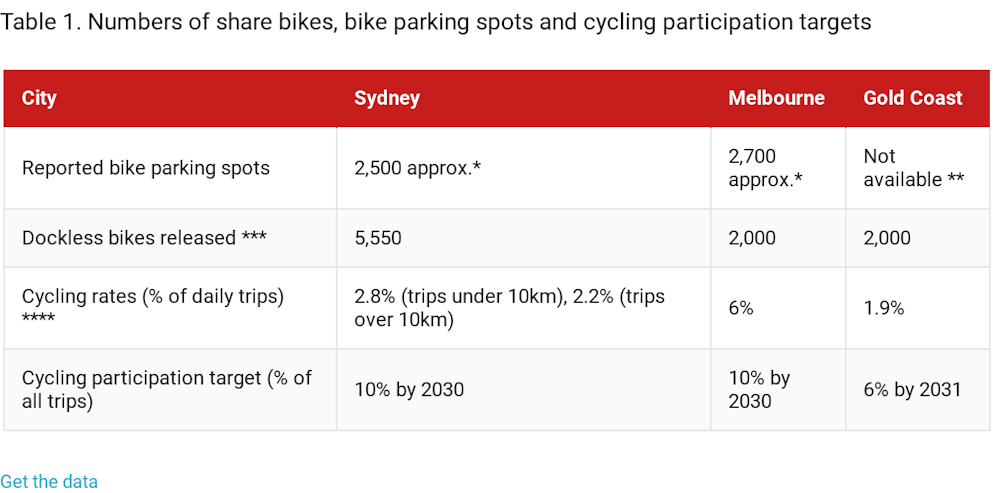
* Excludes pay-for-access Parkiteer stations or private parking. ** Light rail network has six ‘bike sheds’ with multiple parking hoops *** Numbers based on news reports at time of introduction to each city and middle-of-the-road estimates where projected numbers may not have been met **** Estimates of rates of cycling can be problematic as there is no standard or nationally applied method for determining these, and cycling is a shared concern between portfolios like transport, public health and sport/recreation Author provided

From go to whoa in a year

Singaporean company oBike launched the first commercial dockless bike venture in Australia in June 2017. Mobike, Reddy Go and Ofo soon followed. At A$2-$2.50 for 30 minutes, the bikes offered an affordable alternative to carbon-based transport for short trips within cities.

Yet, by July 2018, oBike, Ofo and ReddyGo, after placing upwards of 10,000 bikes on Australia’s streets, had announced they were leaving. The dream of enhanced city mobility was reduced to a luminous pile of unwanted bikes.

For the moment it looks like the experiment failed. The obvious reason, rarely mentioned, is the lack of bike parking in Australian cities. Dockless bikes exist in limbo between disposable and valuable, which makes them a target for abuse and abandonment.

The key attraction of dockless bikes is convenience – they can be left anywhere. However, this can be enraging for non-users who see parked bikes as rubbish, and not a standing reserve of cheap transport. They see bikes left in parks, against shop windows, in front gardens, hanging from fences and in building entrances as an unwelcome disordering of a highly ordered space.


Read more: To end share-bike dumping, focus on how to change people’s behaviour


More dockless bicycles were introduced to Sydney and Melbourne than there were parking spaces. But councils in both cities introduced guidelines that made operators responsible for bike parking and placement, requiring them to liaise with municipal authorities and public landholders to provide solutions.

In late 2017, six Sydney councils introduced guidelines on dockless bikes. Other jurisdictions followed. The Environmental Protection Authority (EPA) in Victoria introduced rules that led to oBike withdrawing from Melbourne.

That the EPA, rather than a transport authority, made rules about dockless bikes says a great deal about their status. In the eyes of many Australians the bikes are rubbish first and transport second.

A failure of infrastructure

Secure bike parking is provided in both cities, generally around public transport networks. However, Sydney has fewer than 100 individual secure spaces while greater Melbourne has around 70 secure “Parkiteer” sites.

These facilities require users to pay a bond – $50 for Parkiteer – so serve a particular kind of bicycle commuter rather than the public at large. Sydney’s main train stations, Central and Redfern, have fewer than 100 public bicycles spaces between them. It’s common to see bikes chained to fences and railings around these stations.

The failure to find a dockless bike parking solution demonstrates the naivety of the operators. It also indicates that if Sydney and Melbourne were to miraculously achieve their mode-share goals, the failures of their infrastructure’s capacity would be made painfully apparent.


Read more: Cycling and walking are short-changed when it comes to transport funding in Australia


If dockless bikes failed because they were always “matter out of place”, as Mary Douglas famously put it, then who is responsible for providing places for dockless bikes? Blame has largely been placed on users, who are deemed irresponsible. Thus, it must be a social problem.

But Australian cities don’t provide enough bike parking. The City of Sydney says it has 2,500 spaces, but these are spread out over 25 square kilometres (inner-city Copenhagen is 8.8 square kilometres).

Our cities did little to lay the groundwork for dockless bike ventures. At first glance it might seem that the bike companies should have to provide parking spaces for their bikes. By that logic car rental companies ought to provide parking spaces for their cars.

Councils provide parking spaces for cars, regardless of who owns them, so why not for dockless bikes?

Back active transport goals with investment

All major cities in Australia aim to increase active transport such as cycling and walking. Bike parking should be seen as a necessary cost of achieving that goal.

Councils once welcomed dockless bikes as a cheap private solution to a public problem. Yet they now frame regulations to contain the unwanted problem of bike parking rather than promoting the highly desirable solution of fewer cars in the city.

The Active Travel Office of Transport Canberra announced a trial of the city’s first dockless bike share program concurrently with new guidelines. The first item on the list is bike parking. The guidelines insist on a collaborative response to “enable the ACT Government to determine and mark appropriate locations where dockless share bikes may be parked”.

Underlying these guidelines is the anxiety that dockless bikes are only ever a hair’s breadth away from ceasing to be convenient forms of transport and becoming inconvenient forms of rubbish. Maintaining an orderly streetscape has clear priority over cheap, non-carbon-based public transport. Dockless bikes are to be contained as litter rather than upscaled as convenient transport.

As we’ve argued previously, Australia’s bike infrastructure won’t cope with even the smallest increase in bike trips. Policy on bike infrastructure is framed as demand-driven, but the infrastructure is already overwhelmed.

The only way we’ll see a step change in bikes replacing cars is if investment in bike infrastructure is greatly increased.


Read more: Here’s what bike-sharing programs need to succeed


The City of Sydney’s goal is for 10% of all trips in the city to be made by bicycle. On 2013 numbers this equates to 1.6 million trips a day. The City of Melbourne’s target is 8%, or 68,305 weekday bicycle trips. It has only about 2,700 bicycle parking hoops.

In both these cities, trips already made by bicycle greatly outnumber parking spaces. Despite their active transport ambitions, through lack of foresight Australian cities have laid bare the failures of their bicycle infrastructure.

What is the price of this failure? Hundreds of needless car trips every day that could easily be done by bike if adequate parking and lockers were available.

– The problem isn’t dockless share bikes. It’s the lack of bike parking
– http://theconversation.com/the-problem-isnt-dockless-share-bikes-its-the-lack-of-bike-parking-102985]]>

Hayne holds fire, but the banks’ day of reckoning is coming

]]>

The Conversation (Au and NZ) – By Andrew Linden, Sessional Lecturer, PhD (Management) Candidate, School of Management, RMIT University

The evidence presented in the first four rounds of the Royal Commission into Banking and Financial Services was harrowing.

It would be a mistake to think the appalling misbehaviour uncovered so easily by the Commission was unconnected, just a few bad apples, as the banks and their supporters had been claiming.

It’s a mistake Commissioner Hayne doesn’t make in his interim report, describing the misconduct as systemic, orchestrated as a matter of corporate policy, and against the law.


Read more: Banking Royal Commission’s damning report: ‘Things are so bad that new laws might not help’


So shocked is he about what he concludes is law-breaking sanctioned at the highest levels that he asks rhetorically whether there would be any point in new laws, given the old ones were often ignored by banks and are not enforced by regulators.

The law already requires entities to “do all things necessary to ensure” that the services they are licensed to provide are provided “efficiently, honestly and fairly”. Much more often than not, the conduct now condemned was contrary to law. Passing some new law to say, again, “Do not do that”, would add an extra layer of legal complexity to an already complex regulatory regime. What would that gain?

He makes no recommendations in his three-volume 1000 page interim report, instead drawing together a long list of questions he intends to answer in his final report, due in February.

Before then, the bank chief executives appearing in the Comission’s final round of hearings will be asked some very tough questions.

No more convivial chats

It won’t be like the convivial chats the bank executives are used to with the heads of regulators, eager to please their ministers in love with financial innovation and the concept of Australia becoming a global financial centre, a new City of London in the East.

Nor will it be like the “I’m sorry, I’ll take that on notice” parliamentary hearings the government arranged a year or two ago in an effort to fend off the Commission.

We’ve always had the evidence

For decades few have thought to ask why Australia’s big banks have been consistently among the world’s most profitable.

Certainly not shareholders who loved the returns and wanted more.

Too many middle and higher level employees were happy to take the bonuses.

Now a new treasurer, Josh Frydenberg, who wasn’t centrally involved in fending off the Royal Commission, appears to have got the message.

Whatever the criticisms are of the regulator, we should remember actually who perpetrated the wrong conduct. And that was the financial institutions themselves. So they are ultimately, and the individuals involved, ultimately the ones who must be held accountable and responsible for their actions. The regulators need to enforce the laws they have at their disposal, impose the penalties that are available to them, and in doing so we are more likely to see a culture of compliance than what we have seen.

Commissioner Hayne has framed the fundamental problem as one of greed overriding respect for the law and respect for customers.

We allowed greed to become good

Hayne asks how that could change.

We have argued with reference to AMP and IOOF that while greed might be an ever present part of the human condition, it can be suppressed or contained.

Greed-induced systemic financial crises were common before the 1940s and after the 1970s, but not during the war or in the decades immediately after the war.


Read more: Britain’s broken corporate governance regime


The 1980s saw a sea change in attitudes to greed, brought about by financial deregulation and the popularising of the view taught in economics classes that pursuit of individual self interest was in society’s best interest.

Rules, codes and views about what constituted good governance came to be based on a theory that gave a central role to greed, maximising shareholder returns and incentivising managers.

Boards were encouraged to think that putting shareholders first was more important than following directors duties and the law.

Bureaucratically, there was an unrelenting policy preference for self-governance, light touch regulation and cooperation with wrongdoers rather than enforcement.

It’s hard to change

Relying on good character (individual virtue) isn’t enough when corporate structures and policies facilitate systematic misconduct.

It’s impossible to buy organisational culture off the shelf. It is a product of many things.

Changing culture requires more than better professional credentialing, increased financial literacy and embedding regulators inside banks. By themselves, these measures are unlikely to be systemically effective.


Read more: Trust has to be as important as profit if banks and their boards are to regain their corporate legitimacy


We need to change the rules by which boards operate.

Containing greed requires many, many eyeballs, not just those of shareholders and consumers, but also employees, unions, customer advocacy organisations, regulators and the parliament, as well as clear and well-designed rules, active enforcement, appropriate rewards and strong consequences, and a new shared ethos of prudence, responsibility, honesty, service and fairness.

It is possible, but difficult.

– Hayne holds fire, but the banks’ day of reckoning is coming
– http://theconversation.com/hayne-holds-fire-but-the-banks-day-of-reckoning-is-coming-104055]]>

The great movie scenes: Darren Aronofsky’s Requiem for a Dream

]]>

The Conversation (Au and NZ) – By Bruce Isaacs, Senior Lecturer in Film Studies, University of Sydney

What makes a film a classic? In this column, film scholar Bruce Isaacs looks at a classic film and analyses its brilliance.


Requiem for a Dream, 2000.

Requiem for a Dream is often described as one of the most disturbing and “hard-to-watch” films ever made. Darren Aronofsky’s second feature film, based on Hubert Selby Jr.‘s novel of the same name, follows four characters as they plunge to depressing depths from their drug addiction. The follow up to his debut feature, Pi, established Aronofsky as a highly imaginative filmmaker with a distinctive style.

In this sequence we follow Marion (Jennifer Connelly) as she exits a building. On paper, it is a relatively simple setup. But Aronofsky’s unique style and unconventional use of camera creates a stunning scene that is almost unbearable because of its intensity.


See also:

The great movie scenes: Hitchcock’s Vertigo
The great movie scenes: Antonioni’s The Passenger
The great movie scenes: Eternal Sunshine of the Spotless Mind
The great movie scenes: Steven Spielberg’s Jaws
The great movie scenes: Hitchcock’s Psycho
The great movie scenes: The Godfather
The great movie scenes: Stanley Kubrick’s 2001: A Space Odyssey
The great movie scenes: Sofia Coppola’s Marie Antoinette

– The great movie scenes: Darren Aronofsky’s Requiem for a Dream
– http://theconversation.com/the-great-movie-scenes-darren-aronofskys-requiem-for-a-dream-103916]]>

The problem with Australia’s banks is one of too much law and too little enforcement

]]>

The Conversation (Au and NZ) – By Deborah Ralston, Professor of Finance, Monash University

Prime Minister Scott Morrison and Treasurer Josh Frydenberg moved very quickly to deliver the interim report of the Royal Commission into Financial Services to the public. It was submitted to the Governor General, tabled in parliament (out of session), and made public on the same afternoon – Friday September 28.

The three-volume report is limited to findings from the first four rounds of hearings, on consumer credit, financial services, lending to small- and medium-sized enterprises, and experiences with regional and remote communities.


So far the commission has received almost 10,000 submissions, mainly related to banking (67%), superannuation (12%), and financial advice (9%). Most address issues relating to personal finance, superannuation, or small business finance.

In receiving the interim report, Frydenberg reiterated its key message that financial institutions have put “profits before people”.

It’s about the money

According to the report, poor culture and conduct in banks have been driven by their remuneration policies, with almost every instance of misconduct being directly linked to monetary benefit.


Read more: Banking Royal Commission’s damning report: ‘Things are so bad that new laws might not help’


The interim report is also highly critical of the regulators, painting a disconcerting picture of their determination to detect and monitor misbehaviour and enforce compliance with the law.

The Australian Securities and Investments Commission comes in for particular scrutiny, with Commissioner Kenneth Hayne noting that where the law had been broken, “little happened beyond an apology from the entity, drawn-out remediation, and an infringement notice or an enforceable undertaking that acknowledged no more than ASIC had reasonable concerns about the entity’s conduct”.

The penalties imposed were often immaterial, given the size of the institutions involved.

The letter of the law can smother its spirit

It’s hard to know how to regulate. On occasions, as with the Future of Financial Advice legislation, the spirit of the law has been lost in complexity about prescribed behaviour, and of course so-called “grandfathering provisions” which ensure commissions that began in the past can continue even though they would no longer be legal.

The interim report asks whether, rather than more legislation, the answer lies in less: in simplifying the laws to better reflect their intentions.


Read more: Royal Commission shows banks have behaved appallingly, but we’ve helped them do it


It is something Labor had in the original version of the financial advice legalisation – an overarching obligation on advisers to act in their client’s “best interests”, an obligation the Coalition tried to remove on attaining office, arguing that specific provisions would do the job just as well.

On releasing the interim report, Frydenberg was asked where our regulators had been ineffective because they had been captured by industry or had inadequate resources.

Frydenberg replied that culture was indeed substandard, but that giving the regulators more resources would be seriously examined.

The government has already given ASIC and APRA more.

In August, ASIC received A$70 million in additional funding to strengthen supervision and give it the capability to embed its staff members inside major banks.

Earlier this year the government appointed a second ASIC deputy chairman, Daniel Crennan QC, to bolster its enforcement credentials.

The new chairman James Shipton appears to be reshaping the ASIC culture.

But that’s only the beginning of the changes we are likely to see.

It’s our turn now

Public submissions in response to the interim report are now open and are due by Friday October 26, 2018.

Two more rounds of hearings are yet to be held, with the final report due by February 1, 2019.

– The problem with Australia’s banks is one of too much law and too little enforcement
– http://theconversation.com/the-problem-with-australias-banks-is-one-of-too-much-law-and-too-little-enforcement-103996]]>

Royal Commission shows banks have behaved appallingly, but we’ve helped them do it

]]>

The Conversation (Au and NZ) – By Andrew Grant, Senior Lecturer, University of Sydney

The term deposit has matured. Initial scepticism over the timing, scope, and overall need for a royal commission into financial services has transformed into deep concern about the culture and practices in one of our most important industries.

Malcolm Turnbull, the (perhaps not coincidentally) ex-prime minister, admitted it had been a “political mistake” to delay the royal commission by nearly two years.

None of the major banks have escaped the Commission’s ire.

Perhaps that’s because none of them have had an incentive to behave better. There’s been little financial reward for being the bank to improve.


Read more: Banking Royal Commission’s damning report: ‘Things are so bad that new laws might not help’


Australian banks generate the second-highest returns on equity in the world, and so far none has been keen to let those returns go.

In his interim report, Royal Commissioner Kenneth Hayne pilloried them for their greed, putting profits before customers. He hinted that submissions he has not yet fully examined may uncover even more misconduct.

Conflicts in providing credit

Are loan providers offering customers what’s best for them, or what’s best for the bank?

A disproportionate share of loan products recommended by mortgage brokers working for firms affiliated with banks are produced by other firms affiliated with those banks.


Read more: Consumers need critical thinking to fend off banks’ bad behaviour


Mortgage brokers currently help originate more than half of all new loans. They operate under an opaque commission structure with rewards that are unlikely to align with the customer’s best interests.

A change to up-front, transparent commissions should be mandated, and enforced by the Australian Securities and Investments Commission.

Irresponsible Lending

ASIC guidelines merely require banks to offer customers products that are “not unsuitable” for their needs.

The guidelines allow banks to do things such as using rough guides for household expenditure rather than individually examining the circumstances of each borrower.

Some have argued that this is a better practice than making inquiries of borrowers, who are likely to exaggerate their ability to repay loans. But it runs the risk of constituting a dangerous form of financial advice.


Read more: How ‘liar loans’ undermine sound lending practices


If a loan is recommended to a customer, they might infer from that the bank has deemed it as being appropriate for their needs, rather than merely “not unsuitable”.

In several instances detailed to the commission, customers borrowed as much as they have been to allowed by banks, only to later blame the banks for not protecting them from themselves.

Banks also argue that there is a trade-off between obtaining accurate documentation and processing loans quickly.

Reformed?

Inadequate internal processes have led to customers being offered products that they can’t use, such as financial advice for dead people, or insurance that’s impossible to claim against.

These failings have been rightly condemned by the commissioner, even if they might not have affected a significant portion of the banks’ clients.

Ahead of the report, the banks have been trying to pre-empt its findings by arguing that their primary focus has moved from “sales” to “service”.

They say their internal processes have already improved, and bad apples weeded from the staff.

It’s our fault, too

Commissioner Haynes said that one obstacle to greater consumer power is an alarming lack of financial literacy among consumers, which has also been unearthed by the commission.

Banks exploit our loyalty, our inertia, and our inability to negotiate.

They also help exacerbate these things, by offering too many products that are too hard for the average person to compare.


Read more: Financial literacy is a public policy problem


If we educated ourselves, many of the problems identified by the Royal Commission would disappear.

Making public the actual interest rates paid on our loans, the fees paid to advisers and brokers, and consumer credit scores would help as well.

But it will only help us if we are willing to help ourselves.

The community rightly expects a lot from banks, but a second thread running through the Royal Commission’s interim report is that but we need to expect more from ourselves as well.

– Royal Commission shows banks have behaved appallingly, but we’ve helped them do it
– http://theconversation.com/royal-commission-shows-banks-have-behaved-appallingly-but-weve-helped-them-do-it-103998]]>

Lessons learned from the Essendon air crash: the importance of pilot checklists

]]>

The Conversation (Au and NZ) – By Geoffrey Dell, Associate Professor/Discipline Leader Accident Investigation and Forensics, CQUniversity Australia

One of the issues raised in the investigation of a Melbourne air crash that killed five people was the importance of pilots sticking to any pre-flight checklists.

Pilot Max Quartermain and four American tourists died when a Beechcraft B200 Super King Air VH-ZCR crashed into the DFO shopping centre shortly after takeoff from Essendon Airport on February 21, 2017.

The Australian Transport Safety Bureau (ATSB) report into the crash found the pilot did not detect that the aircraft’s rudder trim was not in the correct position before take-off. This rudder trim helps a pilot control an aircraft.


Read more: The black box: an Australian invention that nearly didn’t happen


With the rudder trim incorrectly set, the report found, this adversely affected the aircraft’s take-off performance and ability to climb.

While not apportioning blame, the ATSB report said the rudder trim’s incorrect position was a contributing factor to the crash.

The ATSB’s chief commissioner Greg Hood said this accident emphasised the importance of having a cockpit checklist applicable to an aircraft’s specific and current modification status.

The report said it was not known whether the pilot had used a checklist on the day of the crash, but Mr Hood added:

In this particular tragic accident there were opportunities in the checklist that existed for the pilot to ensure the rudder trim was set to neutral prior to take-off.

Checklists for pilots

The use of checklists in single-pilot operations has been a contentious issue over the years. From the beginning of flight training, pilots are taught to memorise key checklists so they can readily recall and perform the required checks accurately.

In simpler cockpits, this process can provide reliable results. As the complexity of the aircraft systems and the cockpit controls increases, the inadequacy of solely relying on memory and recall becomes evident.

To minimise the likelihood of configuration errors in two-pilot airline operations, it is usual practice in each phase of flight for the cockpit to be initially configured by the pilots by recall.

The correct configuration is then checked by the two pilots by running through the applicable checklist.

The pilot not flying will usually call the item, both pilots will then check the appropriate switch or control setting. The pilot flying will verbally respond to the call to confirm the correct setting.

For a configuration error to occur in that environment, the setting has to be made incorrectly from recall, or omitted, in the first instance. Then both pilots have to miss the incorrect setting when the checklist call is made and responded to.

This method – sometimes referred to as a “challenge and response” method – provides two levels of procedural redundancy to guard against human errors that might otherwise lead to incorrect settings.

Single pilot operations

The challenge arises when considering how to achieve the same level of error-proofing in single-pilot operations. For example, a 2005 study for the NASA Ames Research Centre said:

… the failure to execute a checklist can cause readily detectable problems to remain undiscovered. Beyond simply being required, executing checklists is recognized by everyone as being essential to safe aircraft operation, and yet, checklist processing omissions and errors continue to be a factor in aircraft incidents and accidents.

New Zealand’s Civil Aviation Authority, in its advisory on single-pilot operations, said:

… the pilot is very reliant on the use of checklists to provide a suitable structure to replace the “Challenge and Response” checklists used in the multi-pilot cockpit.

Further, in discussion of single-pilot flying techniques, the US Aircraft Owners and Pilots Association said:

… proper checklist use is a skill with some overlooked subtleties. First, though, the pilot must be committed to, and recognize the need for, disciplined checklist use. Industry working groups have recognized that single-pilot adherence to checklist usage is an area with some room for improvement. Especially in new light jets with highly automated systems, pilots can develop complacency regarding checklist usage that grows with time and familiarity.

The drift into failure

Many years ago I delivered a paper at a safety conference in which I argued that deviation from approved procedures and practices erodes the safety margins that were afforded by the system. The magnitude and criticality of the reduction in protection was unknown until the margins had eroded to zero and an accident occurred.

More recently, safety expert Sidney Dekker described this phenomenon in his 2011 book Drift into Failure: From Hunting Broken Components to Understanding Complex Systems.


Read more: SharkSpotter combines AI and drone technology to spot sharks and aid swimmers on Australian beaches


One of the biggest problems with single-pilot operations is the fact that it is very difficult to self-diagnose errors and omissions, and to recognise the associated drift into failure.

Just telling people about error, as tends to be the case sometimes in industry, does not immunise them from making errors or omissions of their own.

The systems and procedural environment in which a person functions needs to help provide those checks and balances. In short, rigorous use of checklists by pilots in single-pilot operations is really the only protection available to prevent critical errors.

– Lessons learned from the Essendon air crash: the importance of pilot checklists
– http://theconversation.com/lessons-learned-from-the-essendon-air-crash-the-importance-of-pilot-checklists-103834]]>

Speaking out about sexual violence on social media may not challenge gendered power relations

]]>

The Conversation (Au and NZ) – By Carol Harrington, Senior Lecturer in Sociology and Social Policy, Victoria University of Wellington

Feminists are celebrating a new generation of women who fearlessly share their stories of sexual violence on social media and other digital platforms, confronting established limits on talking about rape.

But as past analyses conclude, not all forms of speaking out challenge the gendered power relations that perpetuate sexual violence.

Politics of speaking out about rape

The feminist movement of the 1970s broke ground by publicly telling personal stories of sexual violence. Those women described the problem as one of patriarchal power and women’s oppression. Yet as public attention to sexual violence became increasingly common in the late 20th century, it came to be depoliticised as an issue of individual trauma, a starting point for personal self-transformation and empowerment that sat well with neoliberalism.

A new generation of sexual violence survivors have been speaking out on social media, most famously with the #MeToo movement, which gained mainstream media attention. However, ordinary people have been telling their sexual violence stories online, sometimes anonymously but in many cases not, in ways that have garnered less attention.

One trend I recently investigated is the “my rape story” genre of YouTube videos. I analysed 48 such videos by 40 individual creators, along with the creators’ YouTube channels and linked social media.

“My rape story” videos are typically produced by regular YouTubers who maintain a channel where they post stories about themselves, expound on various topics, and promote products or services while exhorting viewers to “click, comment, subscribe”. These videos mostly appear on channels where other posts seem designed to attract female viewers, with a focus on female fashion, shopping, and in some cases motherhood.

A few are on channels of aspiring singers, writers or actors. Most such YouTubers do not win huge followings or become celebrities, although many seem to hope to.

YouTubers’ rape stories

In one example, Esther’s (all names are pseudonyms) YouTube channel includes many reviews of cosmetics and links to her beauty website, which promotes various products. A vivacious speaker, Esther posts videos in which she tells stories about her life. Her rape story video begins by promoting one of her other videos and asking viewers to share her videos so her channel can grow. She concludes her story by reminding viewers she posts new content every day.

In another, Destiny’s YouTube channel markets her weight loss advice, including a self-published book on weight loss. She also offers advice on positive thinking and self-branding. She presents herself as healthy and resilient, referring to herself as a guru. She tells her rape story calmly, without tears, saying she is sharing it so others can learn from her experience.

In a third, Emogirl’s videos present her as vulnerable and in need of support. Pale, with heavy black eyeliner, her first ever YouTube video told of her rape as a teenager. She followed this up with videos telling of how she was bullied at school following her rape and how she started to self-harm and attempted suicide.

Rape stories and self-branding

In their rape story videos, creators usually show their face and speak directly to the camera, although some like Emogirl use cue cards – holding up handwritten messages and telling their story a few words at a time.

Most film themselves at home, often from their bedroom. These videos share a DIY aesthetic, which characterises much YouTube vlog content. They appear as homemade productions, crafted by ordinary people with a simple digital camera. This aesthetic, now often imitated by corporate and mainstream media, lends the content a sense of authenticity.

The videos unfold in similar ways, with the storyteller describing how she knew the perpetrator, the events leading to the rape, the rape itself in varying levels of detail, and the aftermath of the rape. Only two of the videos I analysed told of a rape by a stranger. Most told of rape by someone close to the storyteller – a relative, friend or boyfriend. Some told of rape by someone they had recently met, typically a date.

Why do people tell such personal stories on YouTube? Social media incites self-disclosure by requiring users to self-consciously construct online personae through carefully curated personal sharing. Such personal sharing serves to construct an online personal brand by creating a particular emotional experience and connection with followers.

Both Destiny and Esther say they feel an obligation to share their rape story so their followers can know them better. Their stories serve Destiny’s self-positioning as a guru who can guide others in self-transformation, and Esther’s as a girlfriend who gives cosmetic and hairstyling tips while occasionally delving into deeper territory.

Emogirl’s rape story video was her first. In subsequent videos she tells followers how important their emotional support is for her, and encourages them to visit her Instagram, where she posts her artwork. Thus, the circulation of these stories speaks to the commodification of personal experience encouraged by social media.

Wrestling with self-blame

The rape stories YouTubers tell mostly treat rape as an individual trauma perpetrated by, in the words of one, “shitty people”. The videos’ main theme typically revolves around the storyteller’s efforts to “take back control” of her life. Many tell of how the experience made them stronger and situate it as part of their journey to wisdom and self-reliance.

Few link their experience with wider social patterns or treat sexual violence as a social problem with political solutions. Rather, they treat it as a risk women must manage. They urge other women to avoid drinking too much, to watch their drink when socialising, and to be cautious about trusting men – even those they think they know. Thus, these video creators often fall into self-blame and reiterate well-worn rape myths that suggest their own behaviour (drinking, trusting too easily) contributed to their rape.

Nevertheless, some feminist influence appears in these videos insofar as the creators push back against slut-shaming and victim-blaming. Most seem painfully aware of how others could blame them for their rape. They urge other women to speak out about their own rape and to not blame themselves, no matter how drunk they were or what they were wearing.

These videos thus intertwine a kind of female solidarity and resistance to rape myths with neoliberal therapeutic thinking and social media incitements to self-branding.

– Speaking out about sexual violence on social media may not challenge gendered power relations
– http://theconversation.com/speaking-out-about-sexual-violence-on-social-media-may-not-challenge-gendered-power-relations-102563]]>

Air Niugini plane overshoots runway into Chuuk lagoon – all 47 safe

]]>

By RNZ Pacific

An Air Niugini plane which landed in a Micronesian lagoon apparently overshot the runway on landing.

The Boeing 737-800 was scheduled to stop in Chuuk on its way from Pohnpei to Port Moresby.

All 47 people on board are reported to be safe by the national police.

LATEST UPDATES AT RNZ PACIFIC

The plane was reportedly carrying 36 passengers and 11 crew.

RNZ Pacific’s correspondent Giff Johnson said small boats quickly went out to help rescue passengers from the plane before it sank in the waters off the runway in the Chuuk capital, Weno.

-Partners-

“It clearly wasn’t a crash, in the sense of a plane going down and coming apart. The plane seemed to be intact and that fits in with landing on the runway and then shooting off which we’ve had some experience with, with other airlines.”

All through Micronesia generally runways are short, according to Giff Johnson, who’s based in the Marshall Islands capital, Majuro.

“On a normal landing you end up 30 metres from the end of the runway and the end of the runway means water,” he said.

Pacnews editor Makareta Komai’s tweet on the crash landing.

An Asia Pacific Airlines Boeing 727 cargo plane overran the runway in Pohnpei 10 years ago.

According to reports it came to a rest with its nosewheel in the water of the lagoon at the end of the 1800 metre runway in May 2008.

This article is republished under the Pacific Media Centre’s content partnership with Radio New Zealand.

Article by AsiaPacificReport.nz

]]>

‘The worst kind of pain you can imagine’ – what it’s like to be stung by a stinging tree

]]>

The Conversation (Au and NZ) – By Marina Hurley, Visiting Fellow, Lecturer & Consultant (Writing Clear Science), UNSW

Sign up to the Beating Around the Bush newsletter here, and suggest a plant we should cover at batb@theconversation.edu.au.


Stinging trees grow in rainforests throughout Queensland and northern NSW. The most commonly known (and most painful) species is Dendrocnide moroides (Family Urticaceae), first named “gympie bush” by gold miners near the town of Gympie in the 1860s.

My first sting was from a different species Dendrocnide photinophylla (the shiny-leaf stinging tree). It was like being stung by 30 wasps at once but not as painful as being stung by D. moroides, which I once described as the worst kind of pain you can imagine – like being burnt with hot acid and electrocuted at the same time.

An excerpt from a French documentary ‘Plant Secrets’ by director François-Xavier Vives.

I agreed to study stinging trees even after being badly stung. The puzzle was – what was eating the stinging tree? Stinging trees often have huge holes but no-one knew what was eating them. What could possibly eat the leaves that were so painful to touch? (Read to the end to discover the answer).

My first sting was from a different species Dendrocnide photinophylla (the shiny-leaf stinging tree) Marina Hurley, Author provided

Read more: Grass trees aren’t a grass (and they’re not trees)


Stinging trees grow in light-filled gaps in the rainforest understorey and come in many different shapes, sizes and species (seven in Australia).

Dendrocnide moroides Marina Hurley, Author provided

I studied two species for my PhD, Dendrocnide moroides and Dendrocnide cordifolia which is often mistaken for Dendrocnide moroides. Both species are shrubs that grow to three metres with heart-shaped, serrated-edged, dark-green leaves that can grow from the size of a thumbnail to over 50 cm wide.

The sting is caused by stinging hairs that contain toxin and densely cover the leaves, stems and fruit. The thick covering of the hairs makes the leaves look as though they are covered with soft, downy, fur and may give the impression they are inviting to touch.

The fruit of D. moroides is similar to a bright red-dark purple raspberry with long stems, while the fruit of D. cordifolia is always green with short stems that give the fruit a clumped appearance.

The fruit and leaves of Dendrocnide cordifolia. © Marina Hurley

What it’s like to be stung

Even the slightest touch of a D. moroides leaf can cause excruciating pain. An intense stinging, burning pain is felt immediately, then intensifies, reaching a peak after 20 – 30 minutes.

The hairs can remain in the skin for up to six months, with stings recurring if the skin is pressed hard or washed with hot or cold water.

Not only do you feel pain from where you are stung, if it is a really bad sting, within about 20 minutes your lymph nodes under your arms swell and throb painfully and feel like they are being slammed between two blocks of wood.

The intense throbbing pain from both the sting and from your lymph nodes can last anywhere from 1-4 hours, depending upon what species you touched, the amount of skin that was stung, and how hard you came into contact with the plant.

How it works

The stinging hair structure is complex and consists of a tip, shaft and bulb composed of silica, calcium carbonate and calcium phosphate.

The tip of the hair is a small bulb that breaks off on contact, then the hair penetrates the skin injecting toxin. The structure and function of Dendrocnide stinging hairs is similar across five plant families and is described as similar to a hypodermic needle.

The composition of the toxin is also complex and still not well understood, including exactly what components actually cause the stinging sensation.

The toxin is stable and heat resistant and retains its pain-producing properties for decades. Dried botanical specimens collected over 100 years ago, can still sting you.

An electron micrograph of stinging hairs. © Marina Hurley

Read more: Welcome to Beating Around the Bush, wherein we yell about plants


Sting stories

My worst sting was from a dead, dried-up leaf on the forest floor. I dropped my glove and then drove my finger through the leaf when I went to pick it up. As I was alone at the time, I had to drive to the hospital with one hand.

During my research in the late 80s-early 90s, I heard dozens of stories about people getting badly stung including a letter from an ex-serviceman, Cyril Bromley, who said he was stung after falling into a stinging tree while crossing a creek near the Barron River (North Queensland) in 1941. He said the pain was so bad they had to tie him to his hospital bed for three weeks. He also recounted how an officer had shot himself because he could not stand the pain.

The less well-known and very disturbing thing about stinging trees is they cause intense sneezing, nose bleeds, and possibly major respiratory damage, if you stay close to them for more than about 20 minutes without protection.

The reaction starts with your nose tingling, then dripping continuously. After a short period, you start to sneeze – not just mild sneezing but intense, harsh and continuous bouts of sneezing.

Marina Hurley wore a particle face mask and welding gloves when working with stinging trees. © Marina Hurley

This happened to me and my field assistants when in close proximity to the plant, either in the rainforest or in the laboratory. Wearing particle face masks helps but they need to be regularly replaced. I believe that this reaction is caused by breathing in the hairs that become air-borne but I have never been able to substantiate this.

Researcher W.V. MacFarlane described his reaction in detail when working with hairs and leaves of D. moroides:

Mucous membranes are affected by dust or spray from the leaves… Initially they produced sneezing, but within three hours there was diffuse nasopharyngeal pain, and after 26 hours a sensation of an acute sore throat… aching sensations in the sinuses occurred… and a watery nasal discharge that persists for two days. The nasal mucous membranes then begin to slough together with blood, pus and inspissated (thickened) mucus… and discharge of sloughing tissue for 10 days.

Dozens of these nocturnal beetles (Prasyptera mastersi) were found eating the leaves. © Marina Hurley

The mystery solved

I found out what was eating them: a nocturnal leaf-eating chrysomelid beetle and many other leaf-chewing insects and sap-suckers.

Also, surprisingly, both species of stinging tree were voraciously eaten by the red-legged pademelons that occasionally stripped entire plants of their leaves overnight.

A red-legged pademelon. These tough guys eat stinging leaves. Shutterstock

Meanwhile, if you are out and about in the rainforest, stay on the designated paths, and wear closed shoes and long pants.

– ‘The worst kind of pain you can imagine’ – what it’s like to be stung by a stinging tree
– http://theconversation.com/the-worst-kind-of-pain-you-can-imagine-what-its-like-to-be-stung-by-a-stinging-tree-103220]]>

SharkSpotter combines AI and drone technology to spot sharks and aid swimmers on Australian beaches

]]>

The Conversation (Au and NZ) – By Nabin Sharma, Senior Lecturer, UTS School of Software, University of Technology Sydney

Four tiger sharks have now been captured and killed following two separate attacks off the coast of North Queensland last week. Despite being relatively rare, shark attacks – or the threat of attacks – not only disrupt recreational beach activities, but can affect associated tourist industries.

Shark nets are a common solution to preventing shark attacks on Australian beaches, but they pose dangers to marine ecosystems.


Read more: Not just nets: how to stop shark attacks without killing sharks


Seeking a cost-effective way to monitor beach safety over large areas, we have developed a system called SharkSpotter. It combines artificial intelligence (AI), computing power, and drone technology to identify and alert lifesavers to sharks near swimmers.

SharkSpotter was named the national AI or Machine Learning Innovation of the Year at the Australian Information industry Association (AIIA) annual iAwards this month.

The project is a collaboration between the University of Technology Sydney and The Ripper Group, which is pioneering the use of drones – called “Westpac Little Ripper Lifesavers” – in the search and rescue movement in Australia.

A shark spotting drone

SharkSpotter can detect sharks and other potential threats using real-time aerial imagery. The system analyses streaming video from a camera attached to a drone (an unmanned aerial vehicle, or UAV) to monitor beaches for sharks, issue alerts, and conduct rescues.

Developed using machine learning techniques known as “deep learning”, the SharkSpotter system receives streaming imagery from the drone camera and attempts to identify all objects in the scene. Once valid objects are detected, they are put into one of 16 categories: shark, whale, dolphin, rays, different types of boats, surfers, and swimmers.


Read more: A guide to using drones to study wildlife: first, do no harm


If a shark is detected, SharkSpotter provides both a visual indication on the computer screen and an audible alert to the operator. The operator verifies the alert and sends text messages from the SharkSpotter system to the Surf Life Savers for further action.

SharkSpotter in action.

In an emergency, the drone is equipped with a lifesaving flotation pod together with an electronic shark repellent that can be dropped into the water in cases where swimmers are in severe distress, trapped in a rip, or if there are sharks close by.

A new age of accuracy

The development of SharkSpotter involved several stages.

Among the most time-consuming tasks was collecting and annotating the necessary data. The data were collected by The Ripper Group by flying a drone with a camera attached to it above different Australian beaches.

We then manually annotated each video to indicate the specific location of sharks and other objects. The video frames and the annotations were then used to train the deep learning algorithm to correctly identify and classify objects.

These advanced machine learning techniques significantly improve aerial detection to more than 90% accuracy. That’s much better than conventional techniques such as helicopters with human spotters (17.1%) and fixed-wing aircraft spotters (12.5%).


Read more: How drones can help fight the war on shark attacks


We tested the system at different Australian beaches to determine the varying parameters, such as camera resolution, height above sea level (which can affect the vision clarity of drones), speed and flight duration.

After successful trials and fine-tuning of the system, SharkSpotter was used across a dozen popular beaches in New South Wales and Queensland last summer.

The system was developed to help Surf Life Savers monitor the beach more effectively – as opposed to replacing them – and has been received positively by end-users and communities alike, according to a survey conducted by The Ripper Group.

Saving lives

In January 2018, the Westpac Little Ripper Lifesaver was used to rescue two young swimmers caught in a rip at Lennox Head, NSW.

The drone flew down the beach some 800 metres from the lifeguard station, and a lifesaving flotation pod was dropped from the drone. The complete rescue operation took 70 seconds.

We believe SharkSpotter is a win-win for both marine life and beachgoers. From a technology perspective, it has demonstrated how to detect moving objects in a complex, dynamic marine environment from a fast-moving drone.

This unique technology combines dynamic video image processing AI and advanced drone technology to creatively address the global challenge of ensuring safe beaches, protecting marine environments, and enhancing tourism.


The authors would like to acknowledge the contributions of Dr Paul Scully Power, co-founder of The Ripper Group, who partnered in the development of SharkSpotter.

– SharkSpotter combines AI and drone technology to spot sharks and aid swimmers on Australian beaches
– http://theconversation.com/sharkspotter-combines-ai-and-drone-technology-to-spot-sharks-and-aid-swimmers-on-australian-beaches-92667]]>

How the laws of ancient Rome could help victims of sexual harassment in Australia

]]>

The Conversation (Au and NZ) – By Bede Harris, Senior Lecturer in Law, Charles Sturt University

The recent report by the Human Rights Commission that 71% of people have been sexually harassed at some point in their lives raises the question of why there appears to be no effective legal remedy for such conduct in Australia.

In the age of the #MeToo and Time’s Up movements, we seem to be finally acknowledging and coming to terms with the extent of sexual harassment in society. So, why are offenders able to engage in such behaviour with impunity?

In Australia, the answer lies in part with the limited reach of sexual harassment laws and the time-consuming procedures involved in bringing complaints. Yet if we adopted into our law a doctrine that exists in legal systems based on Roman law, victims would have an easier way to obtain redress.


Read more: Sexual harassment is too much – and not enough – about sex


The Sex Discrimination Act of 1984 makes sexual harassment unlawful only in a narrow range of circumstances. These are in employment, education, and trading in public goods and services.

Furthermore, because the Human Rights Commission is not a court, it lacks the power to award damages in cases like these. So even if a victim makes a complaint to the HRC and engages in a time-consuming conciliation process, the perpetrator may still not agree to pay compensation. The only avenue for the plaintiff to recover damages then is to incur the expense of bringing a case to the Federal Circuit Court.

State and territory tribunals can award damages, but again only after going through a lengthy process of attempted conciliation. These procedures end up being a deterrent to plaintiffs, and a shield for perpetrators.

Sexual assault, “upskirting” and indecent exposure are criminal offences, but many other forms of harassment are not. A successful criminal prosecution also requires proof beyond reasonable doubt, and does not lead to financial compensation for the victim.

If anti-discrimination legislation and criminal law do not provide a remedy, what about suing for damages under the law of torts?

Unfortunately, our English-based common law system does not offer adequate protection against sexual harassment. One can recover damages for assault, but there are few remedies for harassment falling short of that.

A different approach under Roman law

Things are very different in legal systems based on Roman law. From its earliest codification in the Twelve Tables of 450BC, Roman law gave people a right to recover damages for personal injury.

The law expanded over the centuries to protect an increasingly wide range of personal rights by means of an action known as the actio injuriarum (or action for injuries). By the time of the publication of the Digest of Justinian in 533AD, the action protected three groups of rights: corpus (bodily integrity), fama (reputation), and dignitas (dignity).

This is where the major difference lies between our English-based law of torts and Roman law: although the law of torts allows a plaintiff to sue for bodily injury and defamation, it offers no protection for dignity and therefore no right to sue for verbal insult, no matter how offensive.


Read more: We need to do more about sexual harassment in the workplace


The actio injuriarum lives on in modern legal systems. A good example is South Africa, whose legal system is based on Roman law. There, the action has been used to recover damages for sexist verbal insults, unwelcome propositioning for sexual intercourse, and unwelcome exposure to pornography. The action also protects privacy, so it has been used to recover damages in cases involving peeping Toms, stalking, and the publication of intimate facts about people’s private lives.

Whether a plaintiff can recover damages depends on the application of a test of reasonableness. The leading case on the matter in South African law states:

This is an objective test. It requires the conduct complained of to be tested against the prevailing norms of society (ie. the current values and thinking of the community)… To address the words to another which might wound his self-esteem but which are not, objectively determined, insulting … cannot give rise to an action.

This test of reasonableness is no different from that applied by courts in Australia to determine whether the language used in defamation cases harms the reputation of the plaintiff.

How this could be work in Australia

Could such an action become part of Australian law? The answer is yes, because under the common law system the courts are free to develop tort law to meet new situations. The High Court has previously indicated that a tort of invasion of privacy might be developed in a suitable case.

There would therefore be nothing to prevent the courts from expanding the range of interests protected by the law to include personal dignity.

There are good reasons why that should be done. Our law protects defamation victims for two reasons – defamatory words affect what others think about the victim, and cause emotional harm due to the knowledge that their reputation has been harmed. So, if the plaintiff in a defamation action is awarded damages (at least in part) because they have experienced an affront, why shouldn’t the same be possible in a harassment case?

There will be cases in which it will be difficult to identify perpetrators. But that is an issue of evidence, not an argument against the principle that victims should be able to recover damages.


Read more: Women in rural workplaces struggle against the ‘boys club’ that leads to harassment


In any event, identification is not as problematic as one may think. Some perpetrators will be identified because incidents are witnessed by bystanders, as happened in a much-publicised incident in Paris when a woman rebuked her harasser for suggestive comments, and he retaliated by striking her.

Others will be traceable electronically when they engage in online harassment.

Sexual harassment has devastating psychological effects on its victims. The risk of financial liability undoubtedly has a modifying effect on human behaviour. While common decency does not act as a restraint on the conduct of harassers, the threat of being subject to the sting of monetary damages certainly will.

– How the laws of ancient Rome could help victims of sexual harassment in Australia
– http://theconversation.com/how-the-laws-of-ancient-rome-could-help-victims-of-sexual-harassment-in-australia-103301]]>

Keith Rankin Analysis – Liberal Mercantilism and Economic Capitalism: an Introduction

Keith Rankin Analysis – Liberal Mercantilism and Economic Capitalism: an Introduction [caption id="attachment_1450" align="alignright" width="150"] Keith Rankin.[/caption]

Most of us realise that there is something wrong with capitalism as we know it. We also accept that capitalism is here to stay; the only practicable alternatives are evolutions of capitalism, not from capitalism.

For most of its history we have experienced capitalism as processes of inequality and contradiction. Capitalism as we know it exhibits the growth dynamics of a runaway train for which both stopping and not-stopping spell present or future disaster. We opt for future disaster. Economic growth is understood as the process of making money at an accelerated rate.

This is primitive capitalism. And it is the manifestation of a ubiquitous mode of modern thought that I refer to as liberal mercantilism. The principal metaphor of liberal mercantilism is gold, which in turn is the principal metaphor for money. Liberal mercantilism is the belief that the economic purpose of life is to make money, that the amount of money each of us makes is a measure of our success in life, and that the amount of money a country makes is the measure of its success.

There are two main strands of liberal mercantilism; conservative liberal mercantilism (which, in the past few decades, has embraced both neoliberalism and neoconservatism) and progressive liberal mercantilism (which embraces both social democracy and socialism). Progressive liberal mercantilism is about making money, taxing it, and governmental spending of it; conservative liberal mercantilism is just about making money. Progressive liberal mercantilists argue that you have to make money before you can spend it. Conservative liberal mercantilists argue that you have to spend (invest) money in order to make money. Both emphasise making money, and economic growth..

Liberal mercantilism is underpinned by a primitive capitalism that only acknowledges private property rights, or public property rights (as in state capitalism; government ownership) that are equivalent to private property rights. Primitive capitalism has no public hemisphere. It’s analogous to a single-hemisphere brain.

Liberal mercantilism represents a wrong path; indeed a false path, much as Ptolemaic astronomy and alchemy have represented false paths in the history of science. In another sense, however, it is a real path, in that liberal mercantilism is truly the existential path that modern humanity is on, and uncritically so.

The alternative to liberal mercantilism is economic capitalism. Economics began as a project to rid capitalism of mercantilism, the crude belief that the economic purpose of countries was to operate ongoing trade surpluses. (Donald Trump is an unreconstructed mercantilist; in his way of thinking, countries wage trade wars, seeking victory through ongoing trade surpluses.)

Economics both succeeded and failed; in economics, wealth is utility (and the sources of utility), not money. Economics, though liberal in its origins, is not a part of liberal mercantilism. But most economists are, to a greater or lesser extent, infused with the liberal mercantilist belief system; especially those economists who, through specialising in finance, clearly equate wealth with money and monetary derivatives.

Capitalism – proper capitalism, full capitalism, economic capitalism – represents a balanced economic order that draws on both private and public property rights; that has private and public hemispheres that complement each other. Private income sources are both private equity (property) and labour; what individuals (and groups of individuals) own, and what they make and sell. Public income is sourced from public equity (the essence of capitalism’s inchoate public hemisphere); it may be retained by public organisations (governments) to be spent on collective goods and services, or distributed, principally as benefits (using the proper capitalistic meaning of that word), to individuals (as economic citizens).

Most ‘capitalists’ are not proper capitalists; they are liberal mercantilists. Most people who advocate for capitalism as we know it are primitive capitalists. And many people who run businesses are mercantilists, drawn in the main by wanting money as an accumulating store of wealth, and not simply by wanting the means to acquire the consumer services that represent the actual purpose of market economic activity.

In economic capitalism, money is a means, not an end. It is not wealth; rather it is a social technology; arguably our most important social technology. Money is important as a technology, not as wealth. Wealth is the services that give us utility; wealth is whatever has value because of the happiness that such wealth enables us to enjoy. The economic purpose of life is to survive and prosper, where ‘prosper’ means to attain the higher forms of happiness.

Capitalism must evolve. Embrace that evolution.

]]>

What evolution and motorcycles have in common: let’s take a ride across Australia

]]>

The Conversation (Au and NZ) – By John Long, Strategic Professor in Palaeontology, Flinders University

How can the development of motorcycles have anything to do with the story of the evolution of life on Earth? You need a palaeontologist to help answer that question, and one with a love of motorcycles.

The article is part of our occasional long read series Zoom Out, where authors explore key ideas in science and technology in the broader context of society and humanity.


Thousands of people around the world will don some of their finest clothes and ride motorcycles this weekend in the Distinguished Gentleman’s Ride. The goal is to raise funds and promote awareness of men’s health issues.

I’m taking part, having been a motorcycle enthusiast since I got my first bike in 1975. Motorcycles are great fun, but there’s also a lot you can learn from riding one.

John Long on his motorcycle. John Long, Author provided

The late author Robert M Pirsig’s 1974 classic book Zen and the Art of Motorcycle Maintenance exemplified this perspective. Pirsig contrasts the rational and romantic sides of human nature as he describes his motorcycle journey of self-discovery.


Read more: Curious Kids: How many dinosaurs in total lived on Earth during all periods?


I’ve recently been contemplating similarities between the evolution of life and the early development of motorcycles, and what a motorcycle ride can teach us about the history of life.

A ride across Australia shows the deep time of evolution

The oldest life on Earth is shown in fossils of stromatolites, mounds of layered mats of blue green algae found in the Pilbara district of Western Australia, dated at around 3,500 million years ago.

Today similar life forms can be seen thriving in Shark Bay and in some of the estuarine lakes around WA.

Living colonies of stromatolites at Shark Bay in Western Australia. Dr Ken McNamara, Author provided

By sheer coincidence, the distance from Perth to Melbourne is about 3,500km, a route I travelled on my motorcycle back in 1996. Thus, every kilometre I did on that transcontinental ride represents a million years of Earth’s history since life first evolved. Thus, every metre represents a millennium, and every millimetre a year.

Let’s use this metaphor of time and distance to highlight the big milestones of the evolution of life on such a ride. Travelling along at 100kmh we’d pass through 100 million years of Earth history each hour of riding.

If we are at the origin of life in Perth (at 3.5 billion years ago), the next milestone we encounter is the development of cells with a nucleus, or eucaryotes. These appeared about 2 billion years ago, which on our ride would be around Ceduna in South Australia.

Not much happens until we cross the border into South Australia. Flickr/Brian Yap, CC BY-NC

The dawn of complex multicellular animal life (called metazoans), is seen by our famous Ediacaran fossils of the Flinders Ranges. Recent research has just proven these are the oldest true animals. This event – dated at around 560 million years ago – is the equivalent of arriving at the town of Keith, South Australia, on our ride.

If we deviate south and travel into the Coonawarra, famous today for its fine wines, we reach the time of the great Cambrian explosion of life, starting about 540 million years ago. This is when nearly all the major groups of marine animals appeared on Earth.

How a ride across Australia (about 3,500km) translates into a true analogy of evolutionary deep times, where 1km of travel represents 1 million years of time passing. John Long, Flinders University, Author provided

The origin of backboned animals (vertebrates) is another milestone represented by appearance of the first fishes. This happens as we drive across the border into Victoria on the road to Casterton.

Fishes left the sea and invaded land as early four-limbed tetrapods by the time we reach Hamilton, and we enter the age of dinosaurs and the first mammals as we cruise the backroads into Skipton, about 230 million years ago.

If our journey is to end precisely at the Melbourne Post Office (GPO) on Elizabeth Street, then the appearance of our immediate human ancestors, the australopithecines, will occur at a spot on the road about 3.5km from the GPO, on State Route 30.

Approaching the Melbourne GPO building. Wikimedia/Donaldytong, CC BY-SA

We park the bike near the GPO and walk towards it. Modern humans (Homo sapiens) appeared on Earth about 315,000 years ago, or just 315 metres from our destination. To mark the point in time when the first peoples arrived in Australia, around 60,000 years ago, we reach a point just 60 metres from our final destination.

Finally, we take five large steps, each a metre, to reach the front door of the GPO and in this final act we’ve gone through most of recorded human civilisation, taken from the first step pyramid of Djoser about 5,000 years ago in Egypt, to today.

You have reached your destination – The Melbourne GPO building is now a shopping centre. Flickr/, CC BY-NC-SA

The rate of evolution of life compared with early motorcycles

As a palaeontologist who studies life of the past, I see evolution in action all around me. Not just in species of animals and plants that have adapted as their environments, but also through fossil species that couldn’t adapt and went extinct.

I’m now going to explore the metaphor of how the history of motorcycle development shows a similar tempo for diversification as that of early life, even if it is on a totally different scale of time.

Motorcycles, like life, had a long, slow history of development – followed by sudden explosions of innovative engineering diversification. Let’s arbitrarily start the clock from the invention of the first atmospheric combustion engine, the Newcomen steam engine, in 1712.

Early steam-driven motorcycles, such as Sylvester Roper’s steam velocipede, were hazardous, as the metal boiler building up pressure was positioned between the rider’s legs – not something our safety advisers would like today.

The Roper steam velocipede, an early steam-powered motorcycle (c 1886). Wikimedia

The machine could run at speeds of 64kmh for up to an hour, becoming the first non-railed machine that could power a human at far greater speeds than just running.

The next major milestone is the creation of the fuel-air compressed combustion engine by Beau de Rochas in 1862. Our modern four-stroke engine was developed by Nicklaus Otto around 1864 with help from Eugen Langden.

The first motorcycle

The first ridden two-wheeled machine with handlebars and a combustion engine powered by this engine was Wilhelm Maybach and Gottleib Daimler’s Reitwagen or “riding car” – considered to be the world’s first motorcycle.

A test vehicle for the high-speed four-stroke engine invented by Gottlieb Daimler and Wilhelm Maybach. The ‘riding car’ is also considered the world’s first motorcycle. Daimler

The first trial ride was particularly exciting, as Daimler’s son Paul, aged 17, drove it for 12km on November 18, 1885. It was an unexpectedly eventful journey as the rider’s seat caught fire due to the hot tube ignition system wedged immediately below it.

It took another decade before Hildebrand and Wolfmuller of Germany would commercially produce a powered motorcycle that was freely available on the open market in 1894.

Just like the sudden Cambrian explosion of life, the next few years saw a sudden great explosion of motorcycle diversity as expressed by varied engine types – a time when efficient four-stroke combustion engines of many kinds and varieties were fitted into strengthened bicycle-type frames.

Motorcycles of nearly all modern configurations then suddenly appeared between 1900 and 1912 from manufacturers in England, Europe and the United States.

Varied engine positions were trialled, from up high on the handlebars, or attached to either the front or rear wheels, but eventually the engine position stabilised (evolved) in a slung frame at the centre of the bike.

The 300cc Cyclon made in Berlin (1900) had the engine mounted above the handlebars. Many experimental bike designs were trialled. John Long, with permission of NSU Museum, Neckarsulm, Germany, Author provided

We find examples of single-cylinder engines of many types (vertical, sloping, horizontal), twin engines (upright, in line V-twin, transverse and inline; flat horizontal twins), radial engines, even three and four cylinder engines.

The first working two stroke engine bikes were commercially available in 1908. The British motorcycle manufacturer Humber had an electric-powered bicycle on the scene around 1897. Even the first rotary engine motorcycle, invented by Felix Millet in 1889, went into production in 1900.

The 1912 Verdel 5 cylinder radial engine motorcycle. John Long, with courtesy Sammy Miller Museum, UK, Author provided

Rates of evolution: motorcycles vs early life

I’m now going to measure the rate of motorcycle evolution from the first atmospheric combustion steam engine in 1712 through to an arbitrary milestone in the 20th century that represents the emergence of the first highly complex modern motorcycle.

I’m choosing the appearance of Guilio Carcano’s V8 double overhead cam 499cc Moto Guzzi racer of 1955 to represent the dawn of the modern superbike.

A 1955 Moto Guzzi V8 (500cc), perhaps the world’s first superbike, at the Moto Guzzi Museum, Mandello Del Lario, Italy. John Long, Author provided

Using this analogy, the time and tempo for motorcycle development (scaled between 1712-1955) follows a very similar pattern of diversification as the evolution of life over 3.5 billion years.

Since the invention of the first steam engine in 1712, it took about 160 years for the first steam-driven motorcycle to appear (about 62% of the time), and 182 years until the first commercial combustion-engine motorcycles were sold in 1894 (about 75% of the time).


Read more: Life on Earth still favours evolution over creationism


The peak of early motorcycle diversification at around 1908 took place at exactly 80% of the time elapsed, almost exactly at the same time ratio as the Cambrian explosion of life took place since life first appeared on Earth.

A comparison showing the long slow development and then sudden diversification of life (top) with a similar pattern for the development of the combustion engine and motorcycle diversification (below). John Long, Author provided

Uncanny similarity perhaps?

I can probably find other comparison tales in the development of aircraft, ships, trains, cars or in any form of technology. But it’s a good example of how transdisciplinary knowledge can inform two disparate topics, seemingly not related, but with learning benefits on each side.

Something to think about next time you see or ride a motorcycle.

On the road! Flickr/Su Yin Khoo, CC BY-NC-SA

On Sunday September 30, 2018, more than 120,000 gentlefolk in 650 cities worldwide will take part in the Distinguished Gentleman’s Ride to raise funds and awareness for men’s health.

– What evolution and motorcycles have in common: let’s take a ride across Australia
– http://theconversation.com/what-evolution-and-motorcycles-have-in-common-lets-take-a-ride-across-australia-95880]]>

A history of sporting lingo: a linguistic ‘shirtfronting’ for lovers and haters of sports alike

]]>

The Conversation (Au and NZ) – By Kate Burridge, Professor of Linguistics, Monash University

Like sport or hate it, it’s hard to deny the role that sporting lingo plays in our daily lives.

Corporate language everywhere groans with references of people leveling playing fields, getting balls rolling, moving goal posts, lighting fires under their teams, blocking and tackling, even touching base offline – and of course it’s all done by the playbook and at close of play.

Perhaps it’s just not cricket, but politics is also rife with sporting lingo. Shirtfronting has escaped the on-field aggression of the AFL to cover diplomatic spats. Both the captain’s pick and captain’s call have slipped out of sporting jargon and onto the political football field. Political parties have even been accused of ball-tampering.

And so, we say to you, tenez! (“take, receive”), as a 14th century tennis player is believed to have called out before serving a ball (a French cry that reputedly gave tennis its name).

Allow us to bandy around (a tennis term) a few ideas here as we run with (a football term) a brief review of sporting lingo inside the bloody arena and throughout our daily lives.

Tickets and etiquette in ‘disport’

The word sport is a shortening of an earlier term disport, which from the 14th century broadly encompassed any form of relaxation or diversion.

In fact, from the 15th century, one meaning of sport was a playful reference to romance and lovemaking. This died off in the 18th century, but another 15th century meaning, “activity of skill and exertion with set rules or customs”, has withstood the test of time.

At sports events, you might see the reverse side of your ticket setting out rules of etiquette for spectators. Both derive from an Old French word estiquette meaning “note or label”. The word etiquette emerged in late 17th century French as a note detailing the rules and customs for engaging with the Spanish court.

But etiquette in modern sporting contests includes being nice to umpires. Sure, they make some tough calls, but so do we as English speakers.


Read more: Why AFL commentary works the same way as Iron Age epic poetry


After all, the word umpire actually derives from the Norman French noumpere, corresponding to “non-peer”, the one who stood out among peers. (Linguistic boundary lines have been problematic for some time — but that, as the saying goes, is a whole nother story.)

Umpires try to keep the peace, but more than a few words derive from the punishing and warlike nature of sport. Melbourne Demons coach Simon Goodwin said his team would learn from the “drubbing” they received from West Coast.

We can only hope he intended the modern meaning of drub (“beat badly in a sporting contest”), and not the meaning associated with drub‘s 17th century Arabic origins (“the flogging of feet”).

Sporting language in everyday speech

We’re surrounded by sporting language, much of it from sports to which we no longer pay much heed — some forgotten entirely.

Archery has been quiet contributor over the years. The verb to rove “wander about with no purpose in mind”, for instance, comes from a 15th century archery term meaning “shoot arrows randomly at an arbitrarily selected target”.

The original upshot was the final shot in a match (a closing or parting shot). The first bolt was a crossbow projectile.

Even those disapproving of the “sport” of hunting have to admire its contributions to language. A tryst, now “an assignation with a lover”, was originally “an appointed station in hunting”. A ruse, these days a general term for “deception”, was the detour hunted animals made to elude the hounds.

These sagacious “acute-smelling” hounds would occasionally run riot “follow the scent of animals other than the intended prey”. Retrieving was flushing out their re-found quarry and worry “seize by the throat” was what they did to it once they got it.


Read more: Get yer hand off it, mate, Australian slang is not dying


Hawking or falconry must have once played a central role in our lives for this sport has donated a number of expressions. Haggard was originally used to describe wild hawks, and to pounce derives from their pounces or fore-claws.

And reclaim or rebate referred to calling the hawk “back from flight”. It was carried out by a special pipe known as a lure, which is now a general word meaning “magnetism” or “attraction”.

Pall-mall player. Wikimedia Commons

Some sports have completely disappeared but have left behind relics in some common expressions. Pall-mall (probably from Middle French pale-mail “ball-mallet”) was a croquet-like lawn game in the 16th and 17th centuries. It gave its name to straight roads or promenades (such as Pall Mall in London), before it then morphed into the shopping malls of modern times.

Even the medieval jousting tournament is the source of a few current expressions like break a lance, tilt at and at full tilt, meaning “at full speed”. (The tilt was originally the barrier separating the combatants and later was applied to the sport itself.)

These days, jousting refers generally to any sort of banter or sparring between individuals who might have thrown down or taken up the gauntlet, meaning “challenged” or “accepted a challenge”. (The gauntlet refers to the knight’s mailed glove).

Unlucky players might end up being thrilled (originally pronounced “thirled”), which doesn’t mean ecstatic, but rather pierced by a lance or spear.


Read more: ‘Too fat to get drafted’: the worrying body-image pressures in the AFL


Up there Cazaly!: on with the ‘people’s tournament’

And so we cry Up there Cazaly! (after the famed footballer Roy Cazaly) — on with the Grand Final, a.k.a. the big dance.

A mob football match in 18th century London. Wikimedia Commons

And spare a final thought for the “people’s tournament” — the medieval game that gave us the word football. As Heiner Gillmeister points out, there is evidence this game was also opened by the cry tenez!

Whether it was played in the monastery cloisters (the arches forming the original goals) or in an open space (so-called “mob football” played between two villages — a tough gig for the boundary umpire), it was a bloody and riotous affair getting that ball full of wynde to the target area.

As Sir Thomas Elyot put it in The Boke Named the Governour (1531):

Nothinge but beastly furie, and exstreme violence

Like sport or hate it, we hope you’ve found our linguistic shirtfronting here gentle, fun and appropriate as far as captain’s calls go.

– A history of sporting lingo: a linguistic ‘shirtfronting’ for lovers and haters of sports alike
– http://theconversation.com/a-history-of-sporting-lingo-a-linguistic-shirtfronting-for-lovers-and-haters-of-sports-alike-102478]]>

Four lessons for Australia from England’s system of rating its aged care homes

]]>

The Conversation (Au and NZ) – By Lisa Trigg, Research Associate, London School of Economics and Political Science

ABC’s Four Corners coverage showing mistreatment of residents in Australia’s aged care facilities has led to much discussion about ideas to improve care. One proposal is to introduce ratings, which would provide a score reflecting the quality of residential aged care services.

Ratings have come up before in reports about aged care in Australia – in the 2004 “Hogan Review”, the Productivity Commission’s 2011 Caring for Older Australians inquiry and, most recently, in the 2017 Carnell-Paterson Review, which led to the government establishing a new Aged Care Quality and Safety Commission. These reports all refer to the ratings system used in England.

In Australia, aged care homes are expected to meet 44 accreditation standards, receiving either a pass or fail for each one. These standards will be replaced in 2019 with new aged care quality standards, but homes will still only be expected to pass or fail each standard.

In the past, virtually all providers passed accreditation. This means it has been impossible to tell the difference between providers that excel and those that just scrape through.


Read more: We’ve had 20 aged care reviews in 20 years – will the royal commission be any different?


England has had two attempts at using ratings since 2004. The current system was introduced in 2014 by the Care Quality Commission (CQC) – the body responsible for inspecting care in nursing homes. During CQC inspections, each home is given a rating against five questions: is it safe, is it effective, is it responsive, it is caring and is it well led?

The four ratings are: outstanding, good, requires improvement, or inadequate. At the end of the inspection, the home is given an overall rating. Homes are legally required to display their ratings, both at the home’s location and on its website.

Recent research shows these ratings are a good indicator of how residents feel about their quality of life in the home. Unsurprisingly, homes with lower rates of staff turnover and fewer staff vacancies also tend to perform better.

So, what are the lessons for Australia?

1. Ratings rarely affect consumer choice; they improve provider quality

Consumers don’t usually use ratings to find care. Choosing an aged care home is not like choosing a hotel or restaurant.

People looking for care are often in the middle of a crisis, such as the death of a partner or an unexpected stay in hospital. The older person is too unwell to make the decision themselves. All too often, families simply choose the closest home or settle for any home that has a place.

Ratings work mostly because they change the behaviour of care providers. When a previous system of ratings in England was abandoned in 2008, providers that had been sceptical of the ratings beforehand argued for their re-introduction.

People I interviewed for my research said this was because homes with the best ratings could negotiate better rates for care, and care home companies could use the ratings to set goals and targets for their staff.


Read more: Essential reading to get your head around Australia’s aged care crisis


2. Quality is subjective, but only for the little things

Discussions about quality in aged care often come back to the issue that everyone has personal preferences and it is difficult to agree on one definition of quality. The sort of example that comes up is whether a resident would be more interested if a home had Foxtel or Sky or if wine was served with meals.

These are not the sorts of questions that need ratings. Older people, or more frequently their families, can answer these questions themselves by visiting homes, trying the food, seeing the quality of accommodation and asking questions about, for instance, en-suite bathrooms and menu options.

Most people enter aged care when they are too unwell to shop around. from shutterstock.com

What people need help with is understanding what they cannot easily judge for themselves. Such as:

  • does the home have enough staff and the right mix of skills?
  • does the home support its staff to form meaningful and supportive relationships, not only with the residents but also with families and with each other?
  • does the home use good practice in supporting people living with dementia, or in caring for people at the end of their lives?

This is where the right sorts of ratings can help shed light on the parts of care that are difficult to assess. Most importantly, it gives providers a good steer on where to focus their efforts.


Read more: Seven steps to help you choose the right home care provider


3. Be prepared to publicise poor care

An important feature of the system in England is that the CQC regularly draws attention to poor care. It does this not just through the ratings but also through other reports it produces about care in England, such as the annual State of Care report. The CQC also provides reports on specific issues – for instance, the difficulties older people with dementia face when they move between care homes and hospitals.

In the first three years of the current ratings scheme, while most homes were rated “good”, 21% of providers received “inadequate” or “requires improvement” ratings, something highlighted in the State of Care report. While about a fifth of the homes rated “inadequate” stayed the same at re-inspection, the CQC found 82% had improved their overall rating. Of the homes rated “requires improvement”, 58% improved at the next inspection.

Such transparency is currently impossible in Australia as the Aged Care Act 1997 restricts what can be made public about poor care in the first place.


Read more: How our residential aged-care system doesn’t care about older people’s emotional needs


4. Ratings are part of a package

While not perfect, the ratings system in England has helped to communicate what good care looks like and given providers something to aim for. This is demonstrated by the popularity of practice guidance on how to get an “outstanding” rating.

But Australian policymakers need to assess other differences with England’s system. The CQC has considerable enforcement and legislative powers when compared to the Aged Care Quality Agency in Australia. The CQC can shut down providers and even bring criminal charges. Australia’s Quality Agency has to refer providers to the Health Department for action.

The UK also has a raft of rights-based legislation to protect vulnerable residents, such as the Mental Capacity Act 2005 and the Deprivation of Liberty Safeguards. In Australia, reports into human rights and elder abuse have highlighted the gaps in the legislation to protect the rights of older people.

There are also more organisations involved in care in England and the CQC’s activity is supplemented with safeguarding and quality monitoring by local councils, which organise care.

Ratings may be useful for improving quality in Australia, but should be seen as only one part of a very large and complex puzzle.

– Four lessons for Australia from England’s system of rating its aged care homes
– http://theconversation.com/four-lessons-for-australia-from-englands-system-of-rating-its-aged-care-homes-103688]]>

Will 2018 be the year of climate action? Victorian London’s ‘Great Stink’ sewer crisis might tell us

]]>

The Conversation (Au and NZ) – By Chris Turney, Professor of Earth Science and Climate Change, ARC Centre of Excellence for Australian Biodiversity and Heritage, UNSW

In the late 19th century, the irrepressible Mark Twain is reputed to have said in a speech:

Everybody talks about the weather but nobody does anything about it.

He’s said to have borrowed that quote from a friend, but if Twain were alive today he would no doubt have more to say on the subject. In a time when we are becoming increasingly accustomed to extremes in the climate system, the events of this year have risen above the background noise of political turmoil to dominate the global headlines.

While global leadership in dealing with climate change may be depressingly limited, I can’t help but wonder if 2018 will be the year our global tribe feels threatened enough to act.

Encouragingly, there may be a historical (and largely unknown) precedent for tackling climate change: Victoria London’s handling of the “Great Stink”, where growth had turned the River Thames into an open sewer.


Read more: Lowy Institute Poll shows Australians’ support for climate action at its highest level in a decade


Climate system extremes

2018 is breaking all manner of records.

In January, the eastern USA and western Europe fell under persistent frigid Arctic conditions brought about by a weakening of the polar vortex.

Six months later, the north has been experiencing exceptional hemispheric-wide summer warming and drought, most likely amplified by a weakening of Atlantic Ocean circulation – the latter (ironically) being expressed by unusually cool surface ocean waters.

In recent weeks, Florence, Mangkhut and Helene have become the latest household names to mark a succession of storms battering the USA, Asia and Europe this year.

A pastoralist stands at the bottom of one of his empty dams on his property at Langawirra Station north of Broken Hill, New South Wales in 2018. AAP Image/David Mariuz

Closer to home, New South Wales is now suffering a state-wide drought, along with other regions in Australia. Early wildfires and the threat of more to come has resulted in the earliest government total fire ban on record.

As the crisis deepens, it’s worth reflecting on Victorian London’s “Great Stink” sewage problem – where things finally got so bad that authorities were forced to accept evidence, reject sceptics, and act.

A ‘deadly sewer’

In the Victorian age, London’s growth had turned the River Thames into an open sewer. Conditions were so bad they inspired many to write on the risks to public health.

‘The silent highwayman’, an 1858 cartoon from Punch magazine, commenting on the deadly levels of pollution in the River Thames. Wikimedia, CC BY

Charles Dickens provided a lurid description in Little Dorrit, describing the Thames as a “deadly sewer” while the scientist Michael Faraday wrote to The Times of London that:

if we neglect this subject, we cannot expect to do so with impunity; nor ought we to be surprised if, ere many years are over, a hot season give us sad proof of the folly of our carelessness.

An 1855 cartoon from Punch Magazine in which Michael Faraday gives his card to ‘Father Thames’, commenting on Faraday gauging the river’s ‘degree of opacity’. Wikimedia

In 1854, medic John Snow demonstrated the source of cholera in the London suburb of Soho was a local water pump. To test his ideas, officials removed the handle on the pump, and the number of cases all but disappeared.

Sewage sceptics

But there was an intransigence about meeting the threat. Ignoring scientific evidence, “sewage sceptics” held the view that poor air quality – so called “miasma”– was the cause of the frequent outbreaks of cholera and other diseases.

They convinced the government to reject the evidence, considering there to be “no reason to adopt this belief”. The scale of the sewage problem in London was considered too large to be solved, possibly encouraged by political pressure from the thriving water industry that delivered direct to those who could afford it. For several more years, this view persisted.

That was until the year of the “Great Stink”.

The ‘Great Stink’ arrives

In the summer heatwave of 1858, the Thames’ sewage turned noses across London. Conditions were so bad, teams of men were employed to shovel lime at the many sewage outlets into the capital’s river in a vain attempt to stop the smell.

Even the national legislators were not spared, with the windows of the Houses of Parliament covered in lime-soaked sack cloths. Serious thought was even given to relocating government outside London, at least until the air had cleared. The conditions created a heady stench that cut through the politically charged rhetoric of the day, and forced a rethink.

Within nine years of the “Great Stink”, the 900-kilometre London Sewage Network was constructed – an engineering marvel of the Victorian age. The politicians at the time weren’t immediately convinced the new infrastructure would help public health but the disappearance of disease accepted as the norm for the capital convinced even the most ardent of sceptics. No one talks about miasma as a real thing anymore.

The Great Stink of 1858 overturned beliefs founded on misinformation. A challenge considered impossible, was solved.

Our generation’s ‘Great Stink’

Fast forward 160 years and the recent spate of climate headlines is on the back of an increasing trend towards greater extremes, with all the associated human, environmental, and financial costs.

In August of this year, the Actuaries Climate Index – which monitors changes in sea level rise and climate extremes for the North American insurance industry since the 1960s – reported that the five-year moving average reached a new high in 2017. This year promises to continue the trend and is no single outlier.

Will 2018 be the year when the world does something about climate change?

Will 2018 be our generation’s “Great Stink”?


Read more: While nations play politics, cities and states are taking up the climate challenge


– Will 2018 be the year of climate action? Victorian London’s ‘Great Stink’ sewer crisis might tell us
– http://theconversation.com/will-2018-be-the-year-of-climate-action-victorian-londons-great-stink-sewer-crisis-might-tell-us-102114]]>

How teachers can help support children during their parents’ divorce

]]>

The Conversation (Au and NZ) – By Linda Mahony, Senior Lecturer in Education, Charles Sturt University

Almost one in two marriages in Australia end in divorce. It’s estimated that in Australia, one in five children under the age of 18 have a parent living elsewhere. This represents around one million Australian children.

For many children, their parents’ separation and divorce is a stressful time. Children have different experiences and reactions and bring these into their classrooms. Children’s social and emotional well-being, and learning can be affected for many years. At this time, it may be difficult for parents to provide the support their children need as they deal with their own stress.


Read more: How will my divorce affect my kids?


Teachers and schools can help children make positive adjustments. Teachers see these children the most each day apart from their parents. They’re in an ideal position to provide support when needed. But they may not know how to help in these situations. Our study provides some helpful strategies that have proven to be successful for teachers.

Negative impacts of divorce

Much is known about the short-term and long-term effects of separation and divorce on children’s social and emotional well-being and learning. But there is little known about these children’s experiences at school. There is even less known about how their teachers work with them.

Separation or divorce can have long lasting negative impacts on a child’s well-being. from www.shutterstock.com

Related studies have shown having a support network that includes children’s teachers can promote resilience.

Another study found children talked to their teacher so their teachers were aware of their situation. Teachers could then offer support if needed.

Other studies showed children felt secure when the daycare and school environment was friendly, structured and predictable. While these studies provide some awareness, little is known about teachers and their interactions with these children to promote well-being and learning. This provided the motivation for our study.

Our study

Grounded theory research design was applied in this study. Grounded theory is a useful methodology to use when little is known about the topic. It explores the perspective of participants – this could be through interview, focus groups, journalling or observation, although many researchers rely on interviews.


Read more: How to tell your child you’re getting divorced


In our study, teachers from multiple government schools in regional Victoria were interviewed. During the interviews, teachers talked about their experiences with children in their class whose parents were separated or divorced.

Useful strategies for teachers

Our study showed teachers were firstly concerned with children’s social and emotional well-being. They believed when children felt safe and secure they could learn. Importantly, the support teachers in our study provided varied depending on the different needs of children and their families, as it should.

Teachers can make sure the child is included in supportive friendship groups, both in the classroom and playground. from www.shutterstock.com

Useful and effective actions teachers in our study took included:

  • developing an understanding of children’s reactions to their parents and divorce by reflecting on their observations and conversations with children

  • developing an understanding of the type and effect of parents’ stress

  • having private conversations with children, asking if they are OK, being a good listener, letting children talk, and providing reassurance

  • arranging one-on-one time with a teacher aide to provide emotional support or to help them settle into the day

  • being available for children and parents to speak to

  • creating a safe, friendly environment where children feel free to talk

  • developing friendships with children and families so they can feel safe and secure to talk to them

  • communicating with parents about how their child is going emotionally, socially and academically at school

  • referring children to the student welfare coordinator when necessary for additional support

  • talking about catastrophic scales to help children put their problems into perspective on a scale from zero to ten where zero is no problem and ten is the worst problem ever

  • being consistent with school routines, rules and expectations

  • making sure the child is included in supportive friendship groups, both in the classroom and playground

  • making activities and communication inclusive – for example, not always saying “tell mum” but instead saying “tell the person who packs your lunch” or “does your homework with you”

  • having flexible expectations with the child’s school work

  • arranging tutoring for the child with the teacher, other parents, peers, and teacher aides

  • getting financial support through the school welfare budget or community organisations for resources, food and to help pay for school excursions and camps

  • providing encouragement for children to make good decisions and to manage their own behaviour.


Read more: How to co-parent after divorce


Teachers can buffer the stress of divorce or separation and help children adjust to their changed family arrangement. The strategies for teachers identified in this study can help teachers support children and families through these unsettled times.

The actions teachers take are important in increasing the bonding between children, families and teachers. Teachers must consider the uniqueness of children and their family situation as they promote resilience and coping skills, encourage a realistic and positive outlook, and decide which of these strategies to use.

– How teachers can help support children during their parents’ divorce
– http://theconversation.com/how-teachers-can-help-support-children-during-their-parents-divorce-102900]]>

Ten lessons from cities that have risen to the affordable housing challenge

]]>

The Conversation (Au and NZ) – By Carolyn Whitzman, Professor of Urban Planning, University of Melbourne

Imagine planning a public transport system for a large city by providing one bus at a time on one route that might serve a few dozen people (but nobody knows how many). That is what planning for housing affordability looks like in most Australian capital cities: innovative projects take years to develop and never get scaled up into a system.

Who can we learn from? In July, the lead author returned to three cities comparable to Melbourne that she visited in 2015 – Vancouver, Portland and Toronto – to re-interview key housing actors and review investment and policy changes over the past three years. All have big housing affordability problems, caused by a strong economy and 30 years of largely unregulated speculative housing. A lack of federal government involvement has exacerbated these problems.

But these four cities have recently developed very different approaches to housing systems planning, with increasingly divergent results. Toronto has gone backwards. Vancouver and Portland, though, are reaping the rewards of good metropolitan policy, from which we have drawn ten lessons for Melbourne.

Before we discuss these, let’s take stock of the affordable housing challenge in Melbourne.

Who needs affordable housing, and how much of it?

The Victorian state government has recently defined affordable housing incomes and price points for both Greater Melbourne and regional Victoria for households on very low (0-50% of median income), low (50-80%) and moderate (80-120%) incomes. It has enshrined “affordable housing” as an explicit aim in the Planning and Environment Act. Better protection for renters has also been developed.

These are great steps, but we need to go further in the next term of government.

The Australian government estimated that 142,685 lower-income renter households in Victoria were in housing stress in 2015-16. Over 30% and in many cases over 50% of their income was going to rent or mortgage payments.

Our research team at Transforming Housing has more recently calculated a deficit of 164,000 affordable housing dwellings. Over 90% of the deficit is in Greater Melbourne.

A simplified version of the price points necessary for households to avoid housing stress (one that leaves out household size and additional costs and risks of poorly located housing on the city fringe) looks like this:

Palm, Raynor & Whitzman (2018), Author provided

Affordable home ownership bears no resemblance to the current market in which the median unit price is well over $700,000. Median rents are affordable to many moderate-income households, at about $420 a week. Whether such housing is available, with a vacancy rate of less than 1%, is another issue, particularly for very low-income households.

The Victorian government has a metropolitan planning strategy that states the need for 1.6 million new dwellings between 2017 and 2050. That’s almost 50,000 new homes a year. Using the new definitions, we can calculate ideal ten-year new housing supply targets to meet the needs of all residents of Greater Melbourne.

Author provided

The biggest problem is not overall supply. In the six months from February to July 2018, there were 28,602 dwelling unit approvals in Greater Melbourne. At that rate there would be 572,040 new units by 2028, which is more than the total need projected by Plan Melbourne.

The problem is that the price points of these dwellings are beyond the means of 64% of households – 456,295 would need to be affordable, appropriately sized and located to meet most people’s needs. All too many will be bought as investments and remain vacant.

Plan Melbourne doesn’t provide targets for affordability, size or location. This is left to six subregions, each with four to eight local governments, which have not produced these reports in the 18 months since the plan was released.

Affordable housing targets that exist in state documents are woefully inadequate. Homes for Victorians has an overall target of 4,700 new or renovated social housing units over the five-year period 2017-22.

An inclusionary zoning pilot on government-owned land might yield “as many as” 100 social housing units in five years. Public housing renewal on nine sites is expected to yield at least a 10% uplift, or 110 extra social housing units, in return for sale of government land to private developers. This is certainly not maximizing social benefit.

What can we learn from Vancouver and Portland?

Although Vancouver has huge housing affordability issues, it has been able to scale up housing delivery for very low-income households – about 15 times as much social and affordable housing as Melbourne over the past three years. Both Vancouver and Portland have ambitious private sector build-to-rent programs, with thousands of new affordable rental dwellings near transport lines.

Both cities have influenced senior governments. Canada is investing C$40 billion (A$42.6b) over the next ten years in its National Housing Strategy.

In contrast, Toronto has had a net loss of hundreds of units of social housing. This is due to disastrous lack of leadership at local and state (provincial) levels.

Our new report highlights 10 lessons for the Victorian government:

  1. Establish a clear and shared definition of “affordable housing”. Enabling its provision should be stated as a goal of planning. This has been done.

  2. Calculate housing need. We have up-to-date calculations, broken down by singles, couples and other households, as well as income groups, in this report

  3. Set housing targets. Ideally, you would want a target of 456,295 new units affordable to households on very low, low and moderate incomes. Both Infrastructure Victoria and the Everybody’s Home campaign have suggested a more attainable ten-year target: 30,000 affordable homes for very low and low-income people over the next decade. This would allow systems and partnerships between state and local government, investors and non-profit and private housing developers to begin to scale up to meet need.

  4. Set local targets. The state government, which is responsible for metropolitan planning, should be setting local government housing targets, based on infrastructure capacity, and then helping to meet these targets (and improve infrastructure in areas where homes increase). We have developed a simple tool we call HART: Housing Access Rating Tool. It scores every land parcel in Greater Melbourne according to access to services: public transport, schools, bulk-billing health centres, etc.

  5. Identify available sites. We have mapped over 250 government-owned sites, not including public housing estates, that could accommodate well over 30,000 well-located affordable homes, with a goal of at least 40% available to very low-income households. Aside from leasing government land for a peppercorn rent, which could cut construction costs by up to 30%, a number of other mechanisms could quickly release affordable housing. Launch Housing, the state government and Maribyrnong council recently developed 57 units of modular housing on vacant government land, linked to services for homeless people. The City of Vancouver and the British Columbia provincial government recently scaled up a similar pilot project to 600 dwellings built over six months.

  6. Create more market rental housing. Vancouver has enabled over 7,000 well-located moderately affordable private rental apartments near transport lines in the past five years, using revenue-neutral mechanisms. Portland developers have almost entirely moved from speculative condominium development to more affordable build-to-rent in recent years.

  7. Mandate inclusionary zoning. This approach, presently being piloted, could be scaled up to cover all well-located new developments. Portland recently introduced mandatory provision of 20% of new housing developments affordable to low-income households or 10% to very low-income households. If applied in Melbourne, this measure alone could meet the 30,000 target (but not the current 164,000 deficit or 456,295 projected need).

  8. Dampen speculation at the high end of the market. This would help deal with the oversupply of luxury housing. Taxes on luxury homes, vacant properties and foreign ownership could help fund affordable housing.

  9. Have one agency to drive these changes. The impact of an agency like the Vancouver Affordable Housing Agency is perhaps the most important lesson. The Victorian government has over a dozen departments and agencies engaged in some aspect of affordable housing delivery. We suggest repurposing the Victorian Planning Authority with an explicit mandate to develop and deliver housing affordability, size diversity and locational targets set by the next state government.

  10. A systems approach is essential to build capacity. It will take time, coordination and political will for local governments to meet targets, non-profit housing providers to scale up delivery and management of social housing, private developers and investors to take advantage of affordability opportunities, and state government to plan for affordable housing. Eradicating homelessness and delivering affordable housing for all Victorians is possible. But it needs a systems approach.

– Ten lessons from cities that have risen to the affordable housing challenge
– http://theconversation.com/ten-lessons-from-cities-that-have-risen-to-the-affordable-housing-challenge-102852]]>

Vital Signs: for all its worth, the banking royal commission could hurt a generation of battlers

]]>

The Conversation (Au and NZ) – By Richard Holden, Professor of Economics and PLuS Alliance Fellow, UNSW

The Royal Commission into Misconduct in the Banking, Superannuation and Financial Services Industry is set to deliver its interim report no later than September 30.

There have already been plenty of consequences for industry participants from the proceedings thus far. But the ugly facts that have been uncovered obscure the larger, and in many ways more important, picture. What will be the inquiry’s long-term economic impact?

Any royal commission has two faces. In one way it’s like a coronial inquest; the facts of the case need to be established – perhaps in gruesome detail. In another way it’s an exercise in public catharsis, shedding light on hard truths so society can collectively move forward.

If ever there was a case study in how these two aspects can conflict, it’s this royal commission. At this point we can only speculate about the precise contents of the interim report. Based on what we’ve learned from the proceedings, however, it will cover charging fees to dead people, breaches of anti-money-laundering obligations, and the relentless pushing of unsuitable financial products on unsuspecting consumers.


Read more: There is nothing sacrosanct about corporate culture; we can and must regulate it


Let’s be clear: that is all very bad, and there’s no excuse for it.

Furthermore, I’ve been consistently critical about less sensational but probably more damaging behaviours, such as imprudent lending practices. The massive amount of interest-only loans, which require borrowers to only repay the interest, risk detonating the Australian financial system the way sub-prime loans what’s this? did in the US a decade ago.

If all the royal commission achieved was to stop the financial services sector doing these unacceptable and unwise things, it would serve a useful purpose.

The danger of scaring bankers too straight

But it’s likely to do much more than that. It will causes bankers to pull back from public view like frightened turtles.

Why risk making a loan that could possibly go bad, even if on balance it’s a good idea for both borrower and lender? Why risk offering a financial product to someone who may not fully understand the implications? In short, why take much risk at all?

Now it may be that banks have taken too much risk in certain instances, but overall their job is to take risk. A bank that never makes a bad loan is not lending enough. The supply of credit in the economy depends on financial institutions being willing to balance the upsides and downsides of risk.

The royal commission has every chance of causing a big overreaction, with banks and other financial institutions being far too cautious in its wake.

The people who will lose from this excess caution are not the wealthy and financially sophisticated. They will still be prized customers – perhaps even more so. The people who will lose are the “marginal” borrowers – the young, the less affluent, the less educated, those with insecure employment, those newly arrived in Australia.

These folks face being functionally excluded from the modern economy for half a generation or more – pressed up against the glass, looking in on the benefits that accrue to those banks deem worthy credit risks in the post-commission environment.


Read more: What if we expected financial services to be more like health services?


It’s also worth reflecting on what the commission might not do.

So far the boards and directors presiding over incentive schemes both facilitating and encouraging all kinds of bad, even illegal, behaviour have escaped relatively unscathed.

What about the regulators?

The royal commission is not set up to deal with such matters. The corporate and prudential regulators are. At least in principle. Yet the commission has barely touched on their failings.

This is the commission’s big omission. The Australian Securities and Investments Commission and the Australian Prudential Regulatory Authority have been, to put it politely, asleep at the switch. All this bad stuff happened on their watch. Worse still, it was entirely predictable. And one can only presume that neither side of politics took it seriously because neither, when in government, chose to put serious people in charge of these organisations, nor resource them properly.

The US Supreme Court justice Louis Brandies once famously observed that sunlight is the best disinfectant.

Quite so. But too much sunlight gives you skin cancer. The most enduring legacy of the banking royal commission might be the cancer of caution it will engender in the financial services industry.

– Vital Signs: for all its worth, the banking royal commission could hurt a generation of battlers
– http://theconversation.com/vital-signs-for-all-its-worth-the-banking-royal-commission-could-hurt-a-generation-of-battlers-103943]]>

Friday essay: how the moral panic over ‘sexual sadists’ silenced their victims

]]>

The Conversation (Au and NZ) – By Joanna Bourke, Professor of History, Birkbeck, University of London

Between the 1920s and the 1950s, sexual sadism was widely discussed in Australian newspapers. Ironically, attempts to ban the Marquis de Sade’s books gave journalists an excuse to write about them, thus spreading knowledge of this “perversion”. Public awareness of sadism also incited social panic, provoked by a series of highly publicised murders of Australian women.

One of these was the mutilation and killing of Dorothy (“Dot”) May Everett in Newcastle in November 1937. Everett was a 27-year-old kitchenmaid who worked at the Broughton Church of England School for Boys. After a night at the theatre, she was last seen walking home.

Dorothy May Everett, who was killed in November 1937. Daily Telegraph, Saturday December 11. Trove

At eight the following morning, her naked body was found. Her clothes had been ripped from her body, there were teeth marks on her chest, and one nipple had been bitten off. She had been strangled with her own stockings.

This was a particularly brutal murder, made worse by the fact that it took place in one of the most fashionable areas of Newcastle. Women living in the city were reported to be extremely frightened: they were reluctant to go out at night without a male escort. A “School Killer” (later sensationalised as the “Vampire Killer”) was at large.

One word dominated discussions of Everett’s murder: sadism. All the newspapers agreed that the perpetrator was “of no ordinary type”: he was “someone known as a sadist”, a “person of abnormal tendencies, a pervert, and a sadist”. Newspapers warned that “A SADIST of a type not previously known in the State is being sought”, and if this “sex-maniac” was not caught soon “he might commit similar horrible crimes”.

Everett herself seems to have been a fairly typical young woman. She was a bit moody, in part because she shared a room that was only 12 feet wide and contained two beds. She was said to have been frightened after an unknown man had attacked her only a fortnight before her murder. Tragically, she had not reported this to the police “because of the fuss it might have caused”.

It was discovered that dozens of other women in Newcastle had also endured sexual attacks at the time, but none had officially reported the assaults for fear of publicity. In the words of a headline in Brisbane’s Telegraph, a “Wave of Sex Assaults Revealed After Murder of Newcastle Woman”.


Read more: Between innocence and experience: the sexualisation of girlhood in 19th century postcards


Eventually, 34-year-old Leonard (“Len”) William Roberts, a former gardener at the school, was charged with her murder. The main evidence was the bite marks. The man who had bitten Everett had no teeth in his lower jaw and Roberts had no teeth at all (although he habitually wore false teeth in his upper jaw).

After consulting leading British and American forensic texts, the detectives asked Roberts to bite the “fleshy” chest of Police Sergeant Stephen Pender in an attempt to match the teeth marks. In court, Pender claimed that Roberts had merely “simulated” biting him.

Leonard William Roberts, who was accused of killing Dorothy May Everett in 1937. Daily Telegraph, Saturday April 30. Trove

There was, however, a secret witness: “Miss X” whose identity was never disclosed on the grounds that her reputation would otherwise have been destroyed. “Miss X” regularly engaged in sexual intercourse with Roberts and claimed that he was perverted.

She told police that Roberts had beaten her with a rolled newspaper and threatened her in other ways as well. There were things he had done to her that were “too horrible to tell”. When she heard about the murder, the first thing she asked was: “Was Dot bitten?”

The problem with all this evidence was not only that it was circumstantial, but that Roberts didn’t fit the image of a sadistic monster. He made an impression in court, appearing (in the words of one journalist) “faultlessly dressed in a navy blue suit, white shirt and collar and striped blue tie. He was clean shaven. His hair was neatly brushed and he looked well.” Indeed, there were demonstrations in his favour outside the court.

At the end of the trial, Roberts left the courtroom an innocent man.

From de Sade to sadists

Reportage on the Everett murder was fairly typical and reveals a lot about the moral panic about sadism in the first half of the 20th century. Although there was huge interest in the concept of the “sadist” in Australia, journalists nevertheless felt obliged to explain what “sadism” actually involved. This suggests it was a fairly new word for many Australians. Newspapers informed their readers that a “sadist” was “a person who experienced pleasure when inflicting pain on another” and it was derived from the French nobleman, the Marquis de Sade.

They noted that there was a continuum in cruelty – from the sadist who murdered women to those who believed that naughty children should be caned. In Australian publications, as well as in British and American ones, there was also a constant conflation of sadists and homosexuals. Indeed, in 1952, the Psychiatric Section of the West Australian branch of the British Medical Association used the term “sadist” and “queerness” interchangeably.

Where were journalists getting information about sadists? In Australian publications, the most common authorities mentioned were European psychiatrists Richard von Krafft-Ebing, Albert Moll and Ivan Block.

Of these, Krafft-Ebing is mentioned the most frequently, especially his view that sadism arose from biological degeneracy. A sadist’s parents and other relatives were likely to have been insane, syphilitic, epileptic, or “constitutionally neuropathic”. Sadists possessed the “seed” of their perversion from birth.

Article by Sydney psychology professor H.T. Lovell. The Sun, Sunday July 28 1928. Trove

Read more: From reproducers to ‘flutters’ to ‘sluts’: tracing attitudes to women’s pleasure in Australia


Other commentators maintained that sadism arose from a mixture of causes. In 1930, for example, an unnamed “leading Sydney psychiatrist” interviewed about the sadistic strangling of some young girls claimed that the “Melbourne murderer” must have had his “natural instincts repressed” as a young person, and these instincts “found an unnatural outlet” in a fetish for suffocating girls with their own stockings.

This psychiatrist also believed that in “most cases of sadism” there would be “a taint of insanity in his ancestry”, a history of “intermarriage of close relatives”, or even evidence of “an injury to the head during childhood”.

The anxiety-inducing conclusion, therefore, was:

Any one of us is capable of sadism … We might acquire it through an accident, or through the repression of our natural instincts.

Monsters and men

Most commentators believed that sadists were outwardly normal men. This may seem strange, given the overblown language of monstrosity that was routinely applied to them, particularly in the sensationalist or tabloid press. After all, lurid descriptions of the “Vampire Killer” (as Everett’s killer was called) and “bestial” murderers boosted sales. It gave licence for prurient descriptions of wounds, torn flesh and gaping holes.

Rebecca May Andersen, who was killed in Sydney in May 1924. Truth, May 18 1924. Trove

One example is the way Sydney’s Truth newspaper reported the “Devilish Murder and Mutilation” of Rebecca May Andersen, who was tortured, mutilated, then killed near Long Bay Prison in Malabar (Sydney) in May 1924. Readers were told the murderer had to be “lust-mad”, or a “revengeful demonical monster with an appetite for inhuman atrocity”: he suffered from “a perverted, depraved, sexual degeneracy”.

However, at the same time, these reports suggested sadists could be “any of us” – that is, a male “us”. They possessed a normal outward appearance, the sadist being “a monster in human form”. In the words of a psychiatrist explaining a brutal abduction, rape and torture of a woman in Corrimal (northern suburb of Wollongong) in 1946:

People capable of sadistic acts like the Corrimol crime would never be noticed in a crowd. They would appear quite normal individuals. But the latent tendency to sadism comes out if the opportunity arises. Some sadists suffer from the “tough guy” complex. By inflicting pain on a weaker person, most often a woman, they boost their own ego. But usually sadists are sexually frustrated people, who express their perversion in bodily cruelty.

Alcohol abuse was often blamed for transforming a “normal” man into a sadistic one. This was the explanation given by Sir John Macpherson, the first professor of psychiatry at the University of Sydney and the author of Mental Affections: An Introduction to the Study of Insanity (1899). Referring to the sadistic attack on Andersen, Macpherson observed:

Some of the most extraordinary and dastardly crimes in history have been committed by alcoholics who, under the influence of the drink, perform deeds which, in their normal state, they would shrink from contemplating.

This was the explanation for the sadistic violence of Roy Governor, an Indigenous Australian. After drinking half a bottle of wine, Governor had raped an elderly, white, disabled woman. In his statement from the dock, Governor explained:

When I drink wine my sex controls me; I have no control over it; I am what they call a sadist; I have read a lot of books on sex things … I am a funny man when I drink wine I want with a woman.

Curiously, sadism was conceived of as an excess of normal male sexuality. In other words, a sadist would not harm anyone if he could be “relieved” of his “natural” passions by regularly engaging in sexual intercourse with a “legitimate” partner. In 1920, for example, Perth’s Truth concluded that sadism was the “Cave-Man Kink”. The journalist contended that the perversion was:

more common than is generally supposed. The nips and pinches and the playful slaps, that in many cases mark the preliminary stages of love’s young dream likewise denote a tendency towards that kink. Fortunately for the happiness of mankind, or rather womankind, this tendency becomes weaker in the vast majority of cases, and mostly dies away altogether with the satisfaction of the sexual appetite. Should it persist, however, it eventually develops into plain brutality, usually of a most revolting type.

Blaming the victims

Disturbingly, victims were often said to be partly responsible for their fate. Of course, there were degrees. The press failed to find anything salacious about Everett, for example. But Andersen was “fair game”. “Big Nose May”, as she was known, was castigated as a slut and “insatiable” alcoholic. Newspapers even speculated that she might have been murdered because she stole money from one of her customers or had given them a sexually transmitted disease.

Women gather outside the court for the inquest into Dorothy May Everett’s murder. Newcastle Sun, Tuesday January 4 1938. Trove

Finally, sadists were a type of person, as opposed to a practice. In particular, he had a racial identity: he was “foreign”. In writing about Everett’s cruel murder, readers were informed that the perpetrator had probably arrived recently in the Newcastle port. There was nothing “Australian” about such perversions.

More importantly, newspaper reports increasingly focused less on the victim’s sufferings and more on the identity of the perpetrator. In the late 19th and early 20th centuries, the perpetrator had been labelled a sadist because of the mutilation and extreme violence done to the victim. Increasingly, though, the victim’s pain became secondary to the perpetrator’s identity and, in particular, his fantasies.

Indeed, to be labelled a “sadist” a man did not even have to harm anyone. Sadistic acts became secondary to a sadistic identity, which was located in the fantasy life of the perpetrator. This medicalisation of perpetrators of extreme violence had the effect of silencing the victims of sadism.

Women like “Dot” Everett were doubly silenced – both by their murderer and by newspaper reportage that was more interested in speculating about the “sadist” than his victims.

– Friday essay: how the moral panic over ‘sexual sadists’ silenced their victims
– http://theconversation.com/friday-essay-how-the-moral-panic-over-sexual-sadists-silenced-their-victims-103445]]>

With Justin Milne gone, how does the ABC go about restoring its crucial independence?

]]>

The Conversation (Au and NZ) – By Andrew Dodd, Director of the Centre for Advancing Journalism, University of Melbourne

The ABC’s former chairman, Justin Milne, has propelled himself from obscurity to infamy in just four days. Along the way, he has ended the tenure of the ABC’s first female managing director, prompted two federal inquiries, revealed the dysfunctional relationship between the national broadcaster’s board and its upper management, and laid bare the politicised climate in which the ABC operates.

But on the positive side, it’s just possible that he has opened up a discussion that’s sorely needed about the independence of the ABC and the pressures that work to undermine it.

Milne’s position became untenable following leaks that appeared to reveal serial interventions in day-to-day management. These included petitioning former managing director Michelle Guthrie to sack senior journalist Emma Alberici and to “shoot” political editor Andrew Probyn because the government didn’t like them.


Read more: Justin Milne quits as ABC chairman after furore over attack on political editor


The leaked emails suggest Milne wanted particular staff removed to protect the ABC from its many strident critics in the federal Coalition government, and that he actively lobbied on a wide range of causes, including Triple J’s decision to move the Hottest 100 from Australia Day. He opposed the move because it offended his friend, the then prime minister Malcolm Turnbull.

The ABC board met today without Milne and asked him to stand aside. But Milne instead offered to resign. Afterwards, he told ABC journalist Leigh Sales:

Clearly there is a lot of pressure on the organisation. My aims have been to look after the interests of the corporation. And it’s clearly not a good thing for everyone to be trying to do their job with this kind of firestorm going on so I wanted to provide a release valve.

Milne’s resignation has provided some resolution. But Prime Minister Scott Morrison’s hope that “normal transmission” will now resume is the wishful thinking of a government that desperately hopes the ABC won’t become an election issue, either in the impending Wentworth by-election or at next year’s general poll.

The government has announced an inquiry, to be conducted by Mike Mrdak, secretary of the Department of Communications and the Arts. Communications Minister Mitch Fifield said it would determine the facts and restore confidence in the national broadcaster.

But as several critics have pointed out, a review conducted by someone who answers to the minister is unlikely to considered independent, especially as it was the government that Milne was seeking to appease.

Labor’s Communications spokesperson, Michelle Rowland, and others have dismissed the proposed inquiry. Paul Murphy, chief executive of the Media Entertainment and Arts Alliance, labelled it a “whitewash” and called for a full public inquiry.

The Opposition and the Greens have supported a separate Senate inquiry to investigate the issue with wider scope and greater powers. Greens senator Sarah Hanson-Young said it was needed “so we can question members of the board about what has really been going on”.

She also called for a clean sweep of the entire board because of questions about what it knew about Milne’s interventions and its failure to protect staff:

We need a broom through the board and we need to give the public broadcaster a fresh start.

ABC’s independence under threat in other ways

This chaotic week has exposed the increasingly politicised climate in which the ABC now operates and the inconsistencies in the government’s narrative about the independence of the national broadcaster.

Both Fifield and Morrison have declared their support for the ABC and suggested that Milne’s reported interventions were unacceptable. But the party they represent is at the same time attacking the ABC on numerous fronts.

It has several pieces of legislation before the parliament that seek to undermine the ABC’s role or change its editorial charter, some at the behest of Pauline Hanson’s One Nation.


Read more: A public broadcaster that bows to political pressure isn’t doing its job


It has cut the ABC’s budget by a reported A$83 million, and subjected the broadcaster to reviews into its efficiency and competitive neutrality, at the request of its commercial competitors.

Fifield is himself a regular complainant about ABC journalists on the grounds that they have not reported on the Coalition fairly.

On Monday, which now seems so long ago, the former ABC staff-elected director Matt Peacock observed that for all her faults, Guthrie did at least stand up for the ABC’s independence. He told the Media Files podcast that Guthrie understood its importance and did her best to defend it. It was an astute observation, given that independence has become the dominant theme of this unedifying week.

This is hopefully the main topic that will be explored in the impending inquiries. The issue of independence transcends the appointment of a new chairman or managing director, although clearly the next permanent occupants of those roles need to understand what a public broadcaster does and the importance of fearless, civic-minded journalism.


Read more: Why the ABC, and the public that trusts it, must stand firm against threats to its editorial independence


Questions about independence go to the way appointments are made to the board – a process that has been politicised by both major parties. It is about what a public broadcaster is and whether governments are prepared, on the one hand, to support and fortify the ABC against its critics and, on the other, to leave it alone to do its job.

Others have called today for the government to ensure board members are appointed at arm’s length, as is meant to happen under existing rules, and to appoint directors who have media experience and a passion for public broadcasting.

As Marcus Strom, president of the Media Entertainment and Arts Alliance, told ABC News, the staff deserve better and are sick of being treated like “political footballs”.

For the millions of Australians who care about the ABC, this has been a wearying week in which odd alliances have emerged. It’s a strange day, for example, when an editorial in The Australian concurs with the unanimous sentiment of ABC staff.

But the disruption won’t have been in vain if more awareness emerges about the fragility and importance of the ABC’s editorial independence.

– With Justin Milne gone, how does the ABC go about restoring its crucial independence?
– http://theconversation.com/with-justin-milne-gone-how-does-the-abc-go-about-restoring-its-crucial-independence-103987]]>

Bring on the royal commission, but we have a plan to act on aged care right now

]]>

The Conversation (Au and NZ) – By Professor John Pollaers OAM, Melbourne Enterprise Professor, Faculty of Business and Economics, University of Melbourne

There has been no shortage of inquiries into the aged care system over the past few decades. That shocking systemic problems of neglect and abuse remain, as revealed by the ABC’s recent Four Corners expose, highlights the failure of government and industry to act on the recommendations arising from these investigations.

We can only be optimistic that the royal commission into the quality and safety of aged care will help change that. A royal commission will capture the public consciousness in a way other inquiries have not. It will document hundreds, if not thousands, of individual stories. Its proceedings will lead to extensive media coverage, and invite a national conversation. Its recommendations should prove harder for governments to shelve.

But there is no reason for government and industry to wait years for the royal commission to hand down a report. They can act now to make real progress, based on what we know already.


Read more: We’ve had 20 aged care reviews in 20 years – will the royal commission be any different?


Three months ago the Aged Care Workforce Strategy Taskforce, which I chaired, delivered its report on ways to improve aged care. Based on listening to thousands of people throughout the aged-care sector over nine months, our report outlines 14 areas for action to support Australia’s aged care workforce in their essential role of caring for some of the frailest, most vulnerable members of society.

There is no need to wait on making the changes our report recommends.

By acting immediately, meaningful strategic reform can be implemented within the next three years. It can make a real difference to the quality of aged care well before the royal commission has completed its work.

Fragmented industry needs a unifying code

The aged care industry is fragmented, made up predominantly of small to medium enterprises spread across community, home and residential care settings. It relies on a diverse workforce under pressure from rising expectations and other changes much outside its direct control.


Read more: Aussies are getting older, and the health workforce needs training to reflect it


Our report’s central recommendation is the need for the aged care industry to embrace a voluntary code of practice. This code can help focus the minds of care providers on standards, workforce practices and commitments to quality and safety. This in turn will focus attention on the need to attract and retain committed, high-quality staff.

We are pleased the industry has embraced this idea. Industry leaders have also supported initiatives to improve the skills and qualifications the industry demands of its workers.

There is a need for the education and training sector to get on board, ensuring graduates have the skills and knowledge that support safe, quality care.

We need a holistic approach to care

One important finding from our investigation is that those in care, and their families, want a more holistic approach to caring. What they don’t want is narrow “clinical” care, one that treats mental health with a pill or judges a meal just on its calories. Well-designed care needs to consider all aspects of health, as well as cultural needs and aspirations around “living well”.


Read more: How our residential aged-care system doesn’t care about older people’s emotional needs


There are clear funding implications. To provide holistic care requires changing how money is spent, as well as how much.

Simply stated, as a society we have been short-changing the elderly.

That is why our first recommendation is the need for a concerted social change campaign to reframe caring and promote the importance of aged care as a work vocation.

As the report notes, shifting negative attitudes towards ageing, the elderly, death and dying is a social challenge:

It begins with understanding that care for older people is broader than organised, professional care. These factors contribute to the perception that aged care is not a career of first choice. The opportunities that ageing and aged care present in terms of employment, research, contribution to the economy and as a driver for innovation also go largely unrecognised.

The spotlight the royal commission will place on aged care should help provoke some serious social soul searching. We need a national conversation about our attitudes to ageing. We need to recognise the problems besetting the industry are but a subset of a wider attitudinal problem that has undervalued the elderly.

But the royal commission must not be used as an excuse to procrastinate. There are actions now we know we can take. We should take them.

– Bring on the royal commission, but we have a plan to act on aged care right now
– http://theconversation.com/bring-on-the-royal-commission-but-we-have-a-plan-to-act-on-aged-care-right-now-103426]]>

We need to talk about the mental health of content moderators

]]>

The Conversation (Au and NZ) – By Jennifer Beckett, Lecturer in Media and Communications, University of Melbourne

Selena Scola worked as a public content contractor, or content moderator, for Facebook in its Silicon Valley offices. She left the company in March after less than a year.

In documents filed last week in California, Scola alleges unsafe work practices led her to develop post-traumatic stress disorder (PTSD) from witnessing “thousands of acts of extreme and graphic violence”.


Read more: Facebook is all for community, but what kind of community is it building?


Facebook acknowledged the work of moderation is not easy in a blog post published in July. In the same post, Facebook’s Vice President of Operations Ellen Silver outlined some of the ways the company supports their moderators:

All content reviewers — whether full-time employees, contractors, or those employed by partner companies — have access to mental health resources, including trained professionals onsite for both individual and group counselling.

But Scola claims Facebook fails to practice what it preaches. Previous reports about its workplace conditions also suggest the support they provide to moderators isn’t enough.

It’s not the first time

Scola’s legal action is not the first of its kind. Microsoft have been involved in a similar case since December 2016 involving two employees who worked in their child safety team.

In both cases the plaintiffs allege their employer failed to provide sufficient support, despite knowing the psychological dangers of the work.

Both Microsoft and Facebook dispute the claims.

How moderating can affect your mental health

Facebook moderators sift through hundreds of examples of distressing content during each eight hour shift.

They assess posts including, but not limited to, depictions of violent death – including suicide and murder – self-harm, assault, violence against animals, hate speech and sexualised violence.

Studies in areas such as child protection, journalism and law enforcement show repeated exposure to these types of content has serious consequences. That includes the development of PTSD. Workers also experience higher rates of burnout, relationship breakdown and, in some instances, suicide.

Aren’t there workplace guidelines?

Industries including journalism, law and policing have invested a significant amount of thought and money into best practice policies designed to protect workers.

In Australia, for example, those working in child safety opt-in to the work rather than cases being assigned. They are then required to undertake rigorous psychological testing to assess if they are able to emotionally compartmentalise the work effectively. Once working, they have regular mandated counselling sessions and are routinely reassigned into other areas of investigation to limit the amount of exposure.

The tech industry has similar guidelines. In fact, Facebook helped create the Technology Coalition, which aims to eradicate online child sexual exploitation. In 2015, the coalition released its Employee Resilience Guidebook, which outlines occupational health and safety measures for workers routinely viewing distressing materials. While these guidelines are couched as specific to workers viewing child pornography, they are also applicable to all types of distressing imagery.


Read more: Facebook’s moderation rules prove it’s OK with being a hostile place for women


The guidelines include “providing mandatory group and individual counselling sessions” with a trauma specialist, and “permitting moderators to opt-out” of viewing child pornography.

The guidelines also recommend limiting exposure to disturbing materials to four hours, encouraging workers to switch to other projects to get relief, and allowing workers time off to recover from trauma.

But it’s not just about guidelines

Having support available doesn’t necessarily mean staff feel like they can actually access it. Most of Facebook’s moderators, including Scola, work in precarious employment conditions as outside contractors employed through third party companies.

Working under these conditions has been shown to have a detrimental impact on employee well-being. That’s because these kinds of employees are not only less likely to be able to access support mechanisms, they often feel doing so will risk them losing their job. In addition, low pay can lead to employees being unable to take time off to recover from trauma.

Insecure work can also impact one’s sense of control. As I’ve previously discussed, moderators have little to no control over their work flow. They do not control the type of content that pops up on their screen. They have limited time to make decisions, often with little or no context. And, they have no personal say in how those decisions are made.

According to both the filing, and media reports around Facebook’s moderator employment conditions, employees are under immense pressure from the company to get through thousands of posts per day. They are also regularly audited, which adds to the stress.

Where to from here?

Adequate workplace support is essential for moderators. Some sections of the industry provide us with best case examples. In particular, the support provided to those who work in online mental health communities, such as Beyond Blue in Australia, is exemplary and provides a good blueprint.


Read more: ‘Haters gonna hate’ is no consolation for online moderators


We also need to address the ongoing issue of precarity in an industry that asks people to put their mental health at risk on a daily basis. This requires good industry governance and representation. To this end, Australian Community Managers have recently partnered with the MEAA to push for better conditions for everyone in the industry, including moderators.

As for Facebook, Scola’s suit is a class action. If it’s successful, Facebook could find itself compensating hundreds of moderators employed in California over the past three years. It could also set an industry-wide precedent, opening the door to complaints from thousands of moderators employed across a range of tech and media industries.

– We need to talk about the mental health of content moderators
– http://theconversation.com/we-need-to-talk-about-the-mental-health-of-content-moderators-103830]]>

Man With The Iron Neck is gripping, confronting physical theatre

]]>

The Conversation (Au and NZ) – By Trevor Jones, Lecturer in Musical Theatre, Griffith University

Review: Man With The Iron Neck, Brisbane Festival (preview performance).


In the foyer of the Brisbane Powerhouse, the audience is greeted by a statement from co-creators Ursula Yovich and Josh Bond: “This story. Not black but white as well. To open up a conversation and come out the other side together.”

Legs On The Wall’s Man With The Iron Neck deals with the important but taboo topic of youth suicide, particularly in the Indigenous community. With a script by Ursula Yovich alternating between naturalistic dialogue and poetic monologues, stunning visual design by Joey Ruigrok, Matt Marshall, Emma Vine and Sam James, and extraoardinary physical performances by the cast (Ursula Yovich as Mum Rose, Kyle Shilling as Bear, Tibian Wyles as best friend Ash, and Caleena Sansbury as Evelyn), this piece gives the audience 80 minutes of gripping, confronting and moving physical theatre at its best.

Before the piece began, Uncle Stephen Coghill Senior, of the Jagera people, gave a Welcome to Country speaking of reconciliation. As the performance deals with very sensitive issues, Legs on the Wall Theatre have provided a range of support materials for the audience, including a booklet for personal reflection on the themes of the piece and counselling on hand if needed. A firepit was also planned to enable audiences to burn their own offerings in a symbolic ritual of “letting go”. This work spans much more broadly than what is being presented on stage and the company’s commitment to opening a conversation about suicide is tangible.

Brett Boardman

One of the most striking features of this production is Sam James’ stunning use of cinematic video projection on the curved back wall, immediately creating a sense of place as well as reflecting the character’s inner thoughts with evocative and sometimes disturbing imagery. The familiarity of the Australian bush engulfs the action and draws the audience into the world of the play.

One of my concerns with physical theatre, at times, is that the physical elements can outweigh the dramatic elements. Man With The Iron Neck, however, seamlessly interweaves extraordinary aerial and physical work with a beautifully written narrative. In an interview about the piece, Ursula Yovich states, “This is not just a kitchen table drama. This is a work of scale.” It is the physical elements that transcend the domestic scenes.

Yovich’s moving monologue about giving birth to twins Bear and Evelyn is breathtakingly amplified by an aerial ballet performed by Kyle Shilling and Caleena Sansbury. The iconic Australian Hill’s Hoist is used throughout the work as a type of aerial trapeze; first as Bear relives the horror of his own father’s suicide and later as Ash spins into a cyclonic whirl in the wake of Bear’s suicide.

Australian Rules Football is both the saviour and destroyer of these characters. Much of the humour and energy of the piece comes from the family’s recreation of great football moments, tagging significant Indigenous footballers such as Adam Goodes, Buddy Franklin and Daniel Rioli. The tragedy in the story, however, starts with Bear’s reaction to a racial slur on the field, with direct reference to the famous incident involving Adam Goodes in 2013, in which a 13 year old supporter called the footballer an “ape” on the field.

One of the most striking features of this production is Sam James’ stunning projections. Brett Boardman

The powerful dialogue that follows explores the ideas of assimilation and having to “pretend to be something you’re not”.

The depiction of grief and guilt in this work is heart-wrenching. Yovich is literally swallowed by the couch in her Valium haze into a nightmare world of suicide, layered with images of historic Indigenous oppression.

Sansbury’s Evelyn struggles to write her brother’s eulogy: “How can I leave anything out? He was more than that.” Wyles repeats the story of “The Great Peters”, an early 20th Century circus star who defied death as his own coping mechanism, each time layering more information about his friend’s suicide until finally asking, “Why did you do it, Bear?”.

Despite a few rogue microphone crackles in this performance, the sound design by Michael Toisuta and Jed Silver finely balances naturalistic speech with an evocative soundtrack (composed by Iain Grandage and Steve Francis) while also providing an incredibly memorable moment as Evelyn tries to chop down the tree responsible for the death of her father and brother while screaming “I’m here, Mum. I’m still here”.

Hope comes at the end of the piece when Ash asks Mum Rose how she coped with her husband’s suicide. Her simple response is “Every day I had to choose whether to give up or just keep going.” Ash letting go of his grief leads to an extraordinary moment as Bear swiftly flies into the rafters of the theatre. Although the metaphor of the morning star feels a little rushed, the final image of the night sky and Ash’s audible exhale is a fitting conclusion.

The basic premise that “physicality takes over when the words are not enough” is explored to its full extent in Man With The Iron Neck and at the conclusion of this preview performance the cast and riggers received a well-earned standing ovation.


Man With The Iron Neck is being staged as part of the Brisbane Festival until September 29.

– Man With The Iron Neck is gripping, confronting physical theatre
– http://theconversation.com/man-with-the-iron-neck-is-gripping-confronting-physical-theatre-103994]]>

Just because you’re thin, doesn’t mean you’re healthy

]]>

The Conversation (Au and NZ) – By Dominic Tran, Postdoctoral Research Associate, University of Sydney

According to the Australian Institute of Health and Welfare, 63% of Australian adults are overweight or obese.

But it’s much harder to estimate how many are within a healthy weight range but have poor diets or sedentary lifestyles. These can cause significant health problems that will often be missed because the person appears to look “healthy”.


Read more: I’m not overweight, so why do I need to eat healthy foods?


How do we judge the health of weight?

Obesity statistics often take estimates of body fat using body mass index (BMI). Although BMI isn’t perfectly correlated with body fat percentage, it’s a quick and easy method for collecting data using just the person’s height and weight. If the BMI is higher than 25, a person is considered “overweight”. If it’s above 30, they’re considered “obese”. But BMI doesn’t tell us how healthy someone is on the inside.

Using additional lifestyle measures, such as diet and exercise frequency over the last year, a recent report from the Queensland Health department estimated 23% of those who are not currently overweight or obese are at risk of being so in the future.

These figures indicate that the percentage of unhealthy-weight individuals does not accurately capture the percentage of unhealthy-lifestyle individuals, with the latter number likely to be much higher.


Read more: We asked five experts: is BMI a good way to tell if my weight is healthy?


If you’re not overweight, does a healthy lifestyle matter?

Many people think if they’re able to stay lean while eating poorly and not exercising, then that’s OK. But though you might appear healthy on the outside, you could have the same health concerns as overweight and obese individuals on the inside.

When considering risk factors associated with heart disease and stroke or cancer, we often think about health indicators such as smoking, cholesterol, blood pressure, and body weight. But poor diet and physical inactivity also each increase the risk for heart disease and have a role to play in the development of some cancers.

So even if you don’t smoke and you’re not overweight, being inactive and eating badly increases your risk of developing heart disease.

Little research has been done to compare the risk diet and exercise contributes to the development of heart disease in overweight versus skinny but unhealthy individuals. However, one study measured the risk of different lifestyle factors associated with complications following acute coronary syndrome – a sudden reduction in blood flow to the heart.

It found adherence to a healthy diet and exercise regime halved the risk of having a major complication (such as stroke or death) in the six months following the initial incident compared with non-adherence.

Unhealthy diets are bad for your body, but what about your brain?

Recent research has also shown overconsumption of high-fat and high-sugar foods may have negative effects on your brain, causing learning and memory deficits. Studies have found obesity is associated with impairments in cognitive functioning, as assessed by a range of learning and memory tests, such as the ability to remember a list of words previously presented some minutes or hours earlier.

Notably, this relationship between body weight and cognitive functioning was present even after controlling for a range of factors including education level and existing medical conditions.

Of particular relevance to this discussion is the growing body of evidence that diet-induced cognitive impairments can emerge rapidly — within weeks or even days. For example, a study conducted at Oxford University found healthy adults assigned to a high-fat diet (75% of energy intake) for five days showed impaired attention, memory, and mood compared to a low-fat diet control group.

Another study conducted at Macquarie University also found eating a high-fat and high-sugar breakfast each day for as little as four days resulted in learning and memory deficits similar to those observed in overweight and obese individuals.

These findings confirm the results of rodent studies showing specific forms of memories can be impaired after only a few days on a diet containing sugar water and human “junk” foods such as cakes and biscuits.

Body weight was not hugely different between the groups eating a healthy diet and those on high fat and sugar diets. So this shows negative consequences of poor dietary intake can occur even when body weight has not noticeably changed. These studies show body weight is not always the best predictor of internal health.

We still don’t know much about the mechanism(s) through which these high-fat and high-sugar foods impair cognitive functioning over such short periods. One possible mechanism is the changes to blood glucose levels from eating high-fat and high-sugar foods. Fluctuations in blood glucose levels may impair glucose metabolism and insulin signalling in the brain.

Many people use low body weight to excuse unhealthy eating and physical inactivity. But body weight is not the best indicator of internal well-being. A much better indicator is your diet. When it comes to your health, it’s what’s on the inside that counts and you really are what you eat.

– Just because you’re thin, doesn’t mean you’re healthy
– http://theconversation.com/just-because-youre-thin-doesnt-mean-youre-healthy-101185]]>

Why an education in visual arts is the key to arming students for the future

]]>

The Conversation (Au and NZ) – By Ted Snell, Professor, Chief Cultural Officer, Cultural Precinct, University of Western Australia

Visual skills are essential for a sophisticated workforce, yet we offer so little education in the vital skills of learning to see and developing the ability to interpret and critique our image-saturated world.

In the global marketplace, the economy of the cultural industries is growing in importance, and visual expression is part of everyday communication. For Australia to compete in this marketplace, visual acuity, visual literacy and the ability to communicate visually must be recognised as an equally fundamental skill to those of language and numeracy. These can all be taught through grounding in the visual arts.

There is a growing body of international and Australian research that demonstrates a direct link between an arts-rich education from an early age and an increase in students’ confidence, their intellectual abilities across all learning areas, problem-solving skills, and general life skills.

The visual arts provide a vital cultural component and deliver on a range of important skills otherwise missing from the curriculum. They also provide a platform for addressing the important issues of our times; they build self-reflective, empowered communities; and, let’s not forget, they also bring great joy and reassurance in times of anxiety.

Future skills

As the 2016 World Economic Forum report on The Future of Jobs predicted, the top necessary skills required for the fourth industrial revolution will be complex problem-solving, critical thinking and creativity, alongside emotional intelligence and cognitive flexibility.


Read more: Fourth industrial revolution: sorting out the real from the unreal


Highly specialised, rigidly structured degree courses aimed at a specific job outcome will be redundant in this emerging environment. But degrees with a strong visual arts foundation will ensure individuals will flourish, not flounder, under the impact of disruptive technologies and when confronted by new ways of working.

Steve Jobs said he employed people at Apple with passion, particularly for problem-solving, “having a vision, and being able to articulate it so people around you can understand it, and getting a consensus on a common vision”. It’s why Jobs also said he wanted to see applicants’ drawing portfolios before he employed them.

Work in the visual arts also generates new images and develops new ideas. These have the potential for commercialisation at a time when the government is pursuing its agenda on innovation and promoting the creative industries. For instance, several of the residencies through the Australian Network for Art and Technology Synapse program have led to further research and potential commercialisation.

More and more jobs require skills in visual literacy. Shutterstock.com

Ever-expanding digital platforms will also need more and more creative content, requiring that all employees in every profession have opportunities to develop these skills.

We must then ensure that the creative arts are a core component of the curriculum so that all students will become more resourceful and better equipped to successfully manage change.

As well as teaching us vital skills, the arts also enrich, enhance and transform individual lives. This is the intrinsic benefit of the arts, which also has a value to the wider community.

It’s not just about individual pleasure, though. The arts change attitudes, and by so doing they can transform society. An education in the visual arts provides students with a better chance of achieving these shifts in our collective consciousness.


Read more: Friday essay: can art really make a difference?


Embedding arts at universities

Studying the visual arts provides the hothouse environment that brings the instrumental and intrinsic benefits of the arts into unison. It becomes a forum in which to explore new possibilities and critique existing presumptions and preconceptions about art and life.

Our challenge is to find ways of integrating the visual arts into the core curriculum and at the heart of the student experience. This includes an object-based learning approach to teaching (for instance, including study of artworks and artefacts).

Internships, courses that integrate the arts within other disciplines, and collaborative projects designed for students across discipline areas are just some examples of strategies already employed at universities.

That is our challenge, to work collaboratively across academic disciplines to re-imagine the role of the visual arts in the 21st century university.


This article is an edited extract from a keynote address to the Australian Council of University Art & Design Schools (ACUADS) annual conference being held in Perth on September 27-28.

– Why an education in visual arts is the key to arming students for the future
– http://theconversation.com/why-an-education-in-visual-arts-is-the-key-to-arming-students-for-the-future-103844]]>

Blow that whistle: seven reasons you should respect the ref in the NRL Grand Final

]]>

The Conversation (Au and NZ) – By Kath O’Brien, PhD Candidate – School of Human Movement & Nutrition Sciences, The University of Queensland

This weekend’s rugby league Grand Final sees the Sydney Roosters face the Melbourne Storm in front of a stadium crowd of thousands – and even more on television. All eyes will be on the referee to make sure the play is fair.

Like elite athletes, the reputation of these full-time professional refs is often summarised by their performance in high-pressure, high-stakes events – watched by people they can never impress.

Over the past three years, I have spent countless hours studying how NRL referees learn their craft.

So, ahead of this year’s NRL grand final, here are some aspects that might help you see the game from a ref’s point of view.


Read more: Split-second decisions with little praise: so what does it take to ref a game of NRL


Gerard Sutton (left) refereeing the 2015 Grand Final between the Brisbane Broncos and the North Queensland Cowboys. Johnathan Thurston of the Cowboys (centre) and Justin Hodges of the Broncos (right). AAP Image/Paul Miller

1. Mt Everest moment

The Grand Final is the ultimate. It is the pinnacle of a referee’s work over the course of the year. Everyone wants to make it, to earn the right to rule.

But they may never reach that pinnacle again.

So remember that they want the best: they really want to represent the game, the two teams involved, the fans and those referees who didn’t make the final, to the best of their ability.

Referee Jon Stone (left) with Daly Cherry-Evans (right) of the Manly-Warringah Sea Eagles in a match against the Gold Coast Titans. AAP Image/Dan Himbrechts

2. You only see it once

Referees make split-second decisions. They only see things once, often only a small movement, and usually at speed.

They have to calculate the right moment to strike. They don’t have the luxury of multiple video replays to get it right.

Even without the involvement of the bunker – a centralised facility that records the game from several angles and to which refs can refer decisions for review – consider how hard this is to maintain faultlessly (and fearlessly) over two 40-minute blocks.

Refs can call on the bunker for help.

3. They never fly solo

During the course of a game, lead referees have to cope with listening to their assistant referee, two line judges, the matchday referee coach, players yelling at them, and occasionally spectators who provide their own helpful advice.

They also have to call for assistance, knowing that this may overrule something on which they have already made a ruling.

Remember, few of us hold jobs where people are simultaneously speaking to us, where we have to demand a second opinion, and where we can be called out for our mistakes on national television.

Everyone’s a critic of the refs.

4. Reading their mind

Each referee’s decision-making prowess is strongly predicated on their ability to read the game. They need to “feel” situations as they dynamically unfold with respect to players’ actions, movements and tensions.

Refs need to internally interpret, process and recall important variables and situations and to then blend these into accurate, constructive decisions that affect a given action or outcome both now and into the future of the game.

James Maloney (left) of the Panthers remonstrates with referee Gerard Sutton (right) during a match between the Penrith Panthers and the Manly-Warringah Sea Eagles. AAP Image/Dan Himbrechts

5. Collectively attuned

The lead and assistant refs in a Grand Final know their roles individually and collectively. On match day, they are tightly woven, well-attuned to each others nuances and thoughts.

Their thinking in action also imperceptibly defines and shapes a tone and rhythm for how the game unfolds.

But remember, they constantly formulate these actions in the context of the whole, never as individuals, but rather as part of the overall fabric of the game.

Daly Cherry-Evans (left) of the Sea Eagles reacts to referee Henry Perenara (centre) during a match between the Sydney Roosters and the Manly-Warringah Sea Eagles. AAP Image/Brendan Esposito

6. Refereeing is hard work

NRL referees run about 8.2km per game. They consistently manage around 282 rucks and 36 kicks in play.

They also spend a staggering 31% of their game time in high anaerobic heart rate sectors of 170 beats per minute (BPM) or above.

At the same time, referees are dynamically adjusting their field positions to continually remain alongside the play, all while making decisions at speed.

When was the last time you ran this far while also completing several intermittent sprint efforts, and making mentally taxing decisions all the while?

Jake Trbojevic (left) of the Sea Eagles disputes a decision by referee Grant Atkins (right) during a match between the West Tigers and the Manly Sea Eagles. AAP Image/Paul Miller

7. They love the game

Referees are passionate about rugby league. Many played the game as juniors, while others have family members involved.

They also love the challenge and excitement of league and the camaraderie that comes with such a high-profile sport.

But referees are expected to look serious, lack personality and ignore the distractions from both participants and spectators.

Remember, they are not permitted to publicly express their support, or otherwise, for particular teams or results, or provide insights into how they feel about their sport.

Referee Matt Cecchin blows the whistle for the start of play between the Penrith Panthers and the Canberra Raiders. AAP Image/Brendon Thorne

Be gentle

So, remember that referees are just people – albeit people who are extremely driven, focused, energetic athletes who are strongly anchored to performing the perfect game.


Read more: Whether teams win or lose, sporting events lead to spikes in violence against women and children


They work as hard as elite players, both physically and mentally, to store and retrieve rules, learn new rules, learn every player’s name, stay fit, and make correct decisions at lightning speed.

Remember too that on Grand Final Day, most fans’ satisfactions are often driven by how well their team performs – which means it is often easier (and more acceptable) to ignore the loss if it can be blamed on the referees, rather than your own team’s play.

And don’t hit the ref! Matt Moylan of the Sharks collides with assistant referee Phil Henderson during a match between the Penrith Panthers and the Cronulla-Sutherland Sharks. AAP Image/Dan Himbrechts

– Blow that whistle: seven reasons you should respect the ref in the NRL Grand Final
– http://theconversation.com/blow-that-whistle-seven-reasons-you-should-respect-the-ref-in-the-nrl-grand-final-103770]]>

How ABC chairman Justin Milne compromised the independence of the national broadcaster

]]>

The Conversation (Au and NZ) – By Peter Fray, Professor of Journalism Practice, University of Technology Sydney

Behind the extraordinary events engulfing the national broadcaster lies a rather ordinary and clear statement of principle enshrined in the ABC Act. It clearly stipulates that one of the functions of the board is to maintain the corporation’s independence and integrity.

Has Justin Milne, as chairman of the board, done that?

Reports from Fairfax Media this week revealed email correspondence between Milne and the then managing director, Michelle Guthrie. In the emails, Milne called for chief economics correspondent Emma Alberici to be sacked over a report on government funding for research and innovation.

Then Prime Minister Malcolm Turnbull had complained about the article; this followed complaints in February about two other pieces by Alberici on corporate tax, also critical of government policy. The ABC amended and reposted one of these pieces and eight days later republished the other, an analysis.

An internal ABC review found fault with both earlier articles, which had attracted considerable attention.

Another report this week in The Daily Telegraph makes further claims that Milne later demanded the resignation of ABC political editor Andrew Probyn, following anger from Turnbull. “You have to shoot him”, Milne is claimed to have said to Guthrie.


Read more: ABC Board Chair over-reaches in a bid to appease hostile government


On one view, the performance of a journalist is an operational matter for the MD or other executives, not a strategic matter, and there was no cause for intervention by Milne.

But others might ask, isn’t it the role of the board to intervene if there’s possibly severe reputational damage to the organisation and executives are not acting?

Both points seem reasonable, but this is the ABC, not a commercial operation.

It’s hardly contentious to say that its journalistic role distinguishes a news organisations from other businesses. Watchdog, fourth estate – however we describe it – news media are different. Editorial independence, along with editorial standards, is important.

But this is even more pronounced for public broadcasters. While government funds the ABC and SBS using public money, these are not state broadcasters. Being free from state control is a part of the legislation under which the ABC operates. It’s when we look at the ABC Act that we see the problem for Milne.

Although we often speak of the ABC “charter”, this is really just section 6 of the ABC Act. It sets out the functions of the ABC and it’s where we find reference to the ABC providing “innovative and comprehensive broadcasting services of a high standard”.

But important obligations are found elsewhere. The requirement to provide a news service, for example, is in a later, operational section.

And it’s section 8 where we find the twin requirements of independence and editorial standards. These are worth setting out in full:

  • 8(1)(b) to maintain the independence and integrity of the Corporation

  • 8(1)(c) to ensure that the gathering and presentation by the Corporation of news and information is accurate and impartial according to the recognised standards of objective journalism

The problem for Milne is that these obligations are not imposed on the ABC as an organisation. They are imposed on the board. The lead-in to section 8 is: “It is the duty of the Board…”


Read more: Media Files: ABC boss Michelle Guthrie sacked, but the board won’t say why


Returning then to the emails, at issue was a report by Alberici on the main 7pm television news bulletin on May 6. According to the Fairfax report, Turnbull sent an email to news director Gaven Morris the next day complaining about the report.

Morris sent it to Guthrie, who contacted Milne. Milne responded, saying “they [the government] hate her” and “get rid of her”.

This apparently is before Communications Minister Mitch Fifield complained about the same report on May 9 and before the ABC’s complaints review unit had a chance to assess the complaint. When it did, it found no problem with the article except for one inaccuracy – certainly nothing that would justify the dismissal of the journalist.

It appears Milne acted to protect the reputation of the ABC. He and the board are required to do that – protecting its “integrity” is a part of their statutory duties. And the board also has a role in upholding standards.

Had the ABC’s complaints unit found there was a serious problem for a second time and executives had failed to act, maybe the board would have been right to intervene. But that step – assessing the validity of the complaint – was skipped, and it seems the main reason for proposing Alberici’s dismissal was to appease the government.

In this case, “independence” should have trumped the reputational aspect of “integrity”, especially when the risk was political. Instead, the chairman of the ABC may have compromised both values.

– How ABC chairman Justin Milne compromised the independence of the national broadcaster
– http://theconversation.com/how-abc-chairman-justin-milne-compromised-the-independence-of-the-national-broadcaster-103985]]>

Why a separate holiday for Indigenous Australians misses the point

]]>

The Conversation (Au and NZ) – By Dominic O’Sullivan, Associate Professor of Political Science, Charles Sturt University

Prime Minister Scott Morrison has floated the idea of a new national holiday to recognise the achievements of Indigenous Australians. The proposal is a pre-emptive strike against what he called the “indulgent self-loathing” of those who want to shift Australia Day from 26 January to a date that is inclusive and respectful of Indigenous people.

There is much in Australia’s history to celebrate. There is much that is shameful. The choice of a national day is a statement about what it means to be Australian and, by extension, who is left as an outsider. This is more than just symbolism.

In recent years, the movement to “change the date” of Australia Day has gained significant momentum. Attendance at Invasion Day rallies now numbers in the thousands across the country.


Read more: Indigenous recognition in our Constitution matters – and will need greater political will to achieve


The Byron Shire Council in NSW recently announced it will stop holding Australia Day celebrations on 26 January. The federal government swiftly moved to remove the council’s rights to hold citizenship ceremonies – a common Australia Day practice that many councils across the country have discontinued in recognition of what the day may mean for Indigenous people.

In the past, public discussion about the appropriateness of the date of the national day usually only happened in the days leading up to 26 January. It is significant that only weeks into his prime ministership and four months before the day, Morrison has chosen to intervene in a debate that he could easily have left alone.

His move suggests that the balance of opinion is shifting, and some concession to Indigenous objections to Australia Day is required to preserve the acceptability of the national holiday to a growing number of Australians.

Beyond the debate over Australia Day

But an alternative holiday for Indigenous people doesn’t address the fundamental arguments against celebrating nationhood on a day that cannot avoid causing offence to some citizens.

The only moral defence in favour of celebrating Australia Day on 26 January is to somehow find a way to make it genuinely inclusive. Proponents of the day, particularly Morrison, need to show the political vision that takes the country beyond the dispossession and exclusion that Australia Day represents for some people.

In response to the idea of a separate day to celebrate Indigenous achievements, Indigenous Invasion Day rally co-organiser Tarneen Onus-Williams said :

It’s about genocide, it’s not about our achievements.

Celebration is hard when government agencies themselves admit that the systematic exclusion of Indigenous peoples from public decision-making persists and partly explains the depth of policy failure in Indigenous affairs.

The Uluru Statement from the Heart shows that this exclusion is neither necessary nor inevitable. Yet celebration is hard to align with the government’s continued rejection of a guaranteed Indigenous voice to parliament and Morrison’s false claim that this would constitute a “third chamber”.


Read more: First reconciliation, then a republic – starting with changing the date of Australia Day


Labor MP Linda Burney, the first Indigenous woman elected to the federal House of Representatives, has argued that Uluru’s substantive constitutional and political proposal is vastly more important than changing the date of Australia Day, which she says is “a very narrow way to look at the issue of Indigenous affairs”.

Indeed, raising public awareness of the lasting impacts of colonisation has been an ongoing process for many years. Reconciliation gained momentum with the Mabo and Wik decisions of the High Court, and the inquiries into Indigenous deaths in custody and the removal of Indigenous children from their families.

However, much work remains to be done. True reconciliation requires serious political transformation to allow Indigenous peoples real authority over their own affairs and capacities to participate in public decision-making.

The importance of symbolism

Celebrating Australia Day on 26 January, in its current form, is an obstacle to reconciliation.

But substance, symbol and celebration are closely related. It is still reasonable for an inclusive and respectful nation to aspire to celebrate its national day. Australia’s national day needs to be forward-looking and aspire to inclusive nationhood.


Read more: Why Australia Day survives, despite revealing a nation’s rifts and wounds


January 26 is an important day of reflection and commemoration. A day of public memory where one thinks about the good and the bad in the development of Australian nationhood. It ought not be a day where the good is celebrated and the not so good hidden away. Rather, it needs to be a day of truth-telling – a path to what the Uluru Statement calls Makarrata:

Makarrata is the culmination of our agenda: the coming together after a struggle. It captures our aspirations for a fair and truthful relationship with the people of Australia and a better future for our children based on justice and self-determination.

“Coming together” is a difficult, though worthy aspiration. Its achievement partly depends on what the country chooses to celebrate on its national day and why. This is more than just symbolically important – it has deep, practical implications for what it means to be part of a national community.

If, as Morrison has acknowledged, white settlement of Australia involved “a few scars from some mistakes and some things that you could’ve done better”, he might develop a meaningful plan for doing better.

If we need an alternative to 26 January as the day to celebrate Indigenous Australians, we are saying that a common and shared nationhood is not possible – a very clear statement of who is in and who is out.

– Why a separate holiday for Indigenous Australians misses the point
– http://theconversation.com/why-a-separate-holiday-for-indigenous-australians-misses-the-point-103835]]>

FactCheck: do ‘over a million’ people in Australia not speak English ‘well or at all’?

]]>

The Conversation (Au and NZ) – By Ingrid Piller, Professor of Applied Linguistics, Macquarie University

A growing number of people in Australia cannot speak English well or at all, over a million people.

– Senator Pauline Hanson, Senate speech, September 19, 2018

One Nation Party leader and Senator for Queensland Pauline Hanson is urging a rethink on Australia’s immigration policy, including changes to the “number and mix” of migrants coming to the country.

In a Senate speech, Hanson outlined a number of concerns she has with what she described as Australia’s “failed immigration policy”, including issues with social integration and the establishment of “culturally separate communities”.

The senator said a “growing number of people in Australia cannot speak English well or at all, over a million people”.

Is that right?

Checking the source

In response to The Conversation’s request for sources and comment, an advisor to Senator Hanson accurately cited Census data showing the number of people who self-reported they spoke English “not well” or “not at all” was 820,000 in 2016, up from 655,000 in 2011 and 560,000 in 2006.

To reach a calculation of “over a million people” in 2018, Hanson’s office:

  • added 66,000 people to the 2016 Census results, based on the assumption that the growth in the number of people in this category would be the same between the 2016 and 2021 Census as it was between 2011 and 2016, and

  • added a further 149,294 people to the 2016 results, based on the assumption that 10% of the 1,492,947 people who didn’t respond to the question in the Census about language proficiency did not speak English “well or at all”.

You can read the full response from Hanson’s office here.


Verdict

Senator Pauline Hanson said “a growing number of people in Australia cannot speak English well or at all, over a million people”.

The most up to date information available on this question comes from the 2016 Census. The data show that the number of people who self-reported speaking English “not well” or “not at all” in that year was 820,000.

Hanson was correct to say that number has been growing, from 560,000 people in 2006 to 820,000 people in 2016. This amounts to a rise from 2.8% of Australian residents in 2006 to 3.5% in 2016.

Over the same time, among people who speak a language other than English at home, the percentage of people who self-reported speaking English “not well” or “not at all” fell, from 17.5% in 2006 to 16.6% in 2016.

It’s important to keep in mind that self-reporting is not the most accurate measure. Some people will over-estimate their language capabilities, while others will under-estimate theirs.


What do the data show?

In its five-yearly Australian Census, the Australian Bureau of Statistics asks people who speak a language other than English at home to state how well they speak English.

Respondents can choose from four options: “very well”, “well”, “not well”, or “not at all”. The categories “not well” and “not at all” are reported together.

In the 2016 Census, 4.9 million people reported speaking a language other than English at home.

Of those people, the number of people who reported they spoke English “not well” or “not at all” was 820,000.

Hanson was correct to say the number of respondents who ticked the “not well” or “not at all” categories has been rising – from 560,000 people in 2006, to 655,000 people in 2011 and 820,000 in 2016.

But of course, the overall Australian population has also grown over that time. So let’s look at the numbers as a proportion of the broader Australian population. On this measure, it amounts to a rise from 2.8% of all Australian residents in 2006 to 3.5% in 2016.

Over the same time, the percentage of bilingual residents who reported speaking English “not well” or “not at all” fell slightly, from 17.5% in 2006 to 16.6% in 2016.

That means within the bilingual population, there was an improvement in perceived English language skills between 2006 and 2016.

Hanson said there were now “over a million” people in Australia who “cannot speak English well or at all”. There are two potential problems with the calculations made to come to this conclusion.

Firstly: the calculation assumes the same rate of growth in the number of people who speak English “not well” or “not at all” between 2016 and 2021 as it was between 2011 and 2016.

The number of people with little or no English language capability is largely a function of the overall migrant intake. As our overall migrant intake has increased, the absolute number of new arrivals with little or no English language capability has also increased.

However, since the 1990s, our migration program has become increasingly selective and the English language requirements for permanent residency have risen.

Second, the projected growth rate suggests that not speaking English well is an unalterable characteristic, and that new entrants with little English capability simply add to the existing number.

This assumption doesn’t account for the likelihood that many recent immigrants who responded that they did not speak English well or at all in the 2016 Census will have improved their English (or their confidence, or both) by 2021 and will respond that they speak English “well” or “very well” then.

How accurate are the data?

The Census data provide us with a rough guide to English language proficiency, but it’s not a particularly valid or reliable measure.

That’s because the judgements made in the survey are subjective. There’s no definition around what speaking English “well” or “not well” means. One person may overestimate their English proficiency, while another person may underestimate theirs.

As noted by the Australian Bureau of Statistics:

… one respondent may consider that a response of ‘Well’ is appropriate if they can communicate well enough to do the shopping, while another respondent may consider such a response appropriate only for people who can hold a social conversation.

As such, these data should be interpreted with care.

Self-assessment can be a valid tool in determining language proficiency. But for that to be the case, the questions need to be much more detailed and sophisticated.

So while we can state that 820,000 Australians reported speaking English “not well” or “not at all” in the 2016 census, it’s not possible to determine what that means in terms of their actual ability to communicate in their everyday lives.

Most bilingual residents speak English ‘well’ or ‘very well’

The vast majority of bilingual Australian residents report speaking English “well” or “very well” – more than 4 million out of 4.9 million.

Evidence of a certain level of English language proficiency is a visa requirement for most permanent migrants, and many temporary migrants. The key exceptions are humanitarian and family reunion migrants, whose reasons for admission supersede the immediate language requirements.

New citizens are also subject to an Australian citizenship test, which is an implicit English language test, requiring a certain level of English language proficiency to pass.

The number of people in Australia with little or no English language capability depends not only on the number and mix of new migrants admitted, but the English language training provisions made available to those people when they arrive. – Ingrid Piller


Blind review

I agree with the verdict of this FactCheck. The sources used and conclusions drawn are correct. – Amanda Muller


The Conversation FactCheck is accredited by the International Fact-Checking Network.

The Conversation’s FactCheck unit was the first fact-checking team in Australia and one of the first worldwide to be accredited by the International Fact-Checking Network, an alliance of fact-checkers hosted at the Poynter Institute in the US. Read more here.

Have you seen a “fact” worth checking? The Conversation’s FactCheck asks academic experts to test claims and see how true they are. We then ask a second academic to review an anonymous copy of the article. You can request a check at checkit@theconversation.edu.au. Please include the statement you would like us to check, the date it was made, and a link if possible.

– FactCheck: do ‘over a million’ people in Australia not speak English ‘well or at all’?
– http://theconversation.com/factcheck-do-over-a-million-people-in-australia-not-speak-english-well-or-at-all-101461]]>

ABC Board Chair over-reaches in a bid to appease hostile government

]]>

The Conversation (Au and NZ) – By Andrew Linden, Sessional Lecturer, PhD (Management) Candidate, School of Management, RMIT University

Reports of the contents of leaked emails written by ABC Board Chair Justin Milne provide a powerful insight into how governments of the day can exert influence over what parliament had intended to be an independent agency.

The emails have emerged in the wake of the ABC board’s termination of ABC managing director, Michelle Guthrie.


Read more: Government sets up inquiry into embattled ABC chairman’s email


Milne is correct in asserting that the ABC Act requires the board “to independently govern the Corporation, protect its best interests, ensure that it is well funded, well managed and that our content is of the highest standards”.

But it doesn’t operate in exactly the same way as other corporate boards.

The ABC board is different

For example in most corporations, commercial or otherwise, boards exercise control over management by using specific delegations and determining corporate policy.

Boards also appoint the chief executive and in some instances other members of the management group.

However that’s not the case for the ABC.

The ABC Act provides that on advice of the prime minister and communications minister respectively the governor general appoints both the chair and managing director.

Partly non-political

The Act bars former members of parliament and senior political staffers (for a time) from being appointed to either position.

Appointments to all other ABC board positions, including the chair, must follow a merit-based process with candidates interviewed in a process that the government does not control.

But that requirement does not apply to the managing director, potentially giving the government of the day the unusual ability to reach inside the organisation to appoint the most senior executive.

And partly political

This is highly problematic because of real (but usually latent) potential that a managing director might arrive with an agenda to undermine the board’s statutory role and parliamentary-determined Charter to be an independent public broadcaster.

The potential conflict is more acute because at the ABC the managing director is designated in the Act as the editor-in-chief.

Because the managing director is responsible for content, the reported instances of the Chair pressuring the managing director to remove individual journalists and approaching ABC editorial staff are inappropriate.

Setting the scene for conflict

The Act sets up a conflict between most of the ABC directors (who essentially have a trustee role) and the allegiances and agendas of a managing director who might be a non-merit based political appointee.

Governments used to avoid this conflict by sticking to the public service tradition of appointing technocrats. It has been customary for the ABC board to run the recruitment process for the managing director and then for the board to recommend the successful candidate to the government.

But over time perceptions about the appointment have become increasingly politicised.


As Marco Bass, ex head of ABC news and current affairs Victoria has written, the temptation to control the news is becoming harder to resist:

What [Guthrie and Shier] shared was an implicit brief to disrupt the ABC, dismantle internal fiefdoms and, importantly, bring the news and current affairs division under control.

Make no mistake, federal governments, regardless of political complexion, don’t care about Peppa Pig. They care about political coverage by the ABC’s journalists and broadcasters.

These idiosyrantic governance rules amplify flaws in the design of boards on which both executives and non executives sit.

Other boards have similar problems

As I and colleagues have written previously, mixing executive and non-executive directors on a single board creates governance problems.

On corporate boards managers who are also directors can (and usually do) position themselves as very powerful gate keepers and dominate both other directors and senior executives.


Read more: Solving deep problems with corporate governance requires more than rearranging deck chairs


This was a problem at the Commonwealth Bank and from some reports was becoming a problem at the ABC.

If a government can use the idiosyncrasies of the the ABC Act to cower a much-loved and very public institution like the ABC, imagine how pliable agencies like APRA, ASIC and ACCC might be in accommodating the views of a government who might not want to deal with the political fallout of, for example, tough but necessary decisions such as cancelling banking or superannuation licences.

– ABC Board Chair over-reaches in a bid to appease hostile government
– http://theconversation.com/abc-board-chair-over-reaches-in-a-bid-to-appease-hostile-government-103913]]>

Why AFL commentary works the same way as Iron Age epic poetry

]]>
Evening Report
Evening Report
Why AFL commentary works the same way as Iron Age epic poetry
Loading
/

The Conversation (Au and NZ) – By Erin Sebo, Lecturer in Medieval Literature, Flinders University

Erin Sabo reads from the epic poem Beowulf in Old English. Erin Sabo257 KB (download)

The clip above is English, more or less, as it was for the first half millennium of its existence. Although it sounds alien, the basic vocabulary is familiar. Except for the odd rune, like “þ” (which equals “th”), to read or say “Hwæt hæfst þu weorkes?” (literally, “what have you of work?”) isn’t too far from “What do you do for a job?”

Even footballers can do it; here’s ex-Saint Travis Fimmel (okay, sure, he never debuted) speaking Old English on the television series Vikings:


Read more: Guide to the classics: the Epic of Gilgamesh


More difficult than learning the language of the Anglo-Saxons is mastering the structure of their epic poetry. Take the translation of the lines you’ve just heard from Beowulf, the Old English poem celebrating the deeds of the eponymous hero, dating back more than a millennium. Not that everyday punters are out trying to learn Old English. But with vivid passages like this, maybe they should:

Spiralled into the clouds, the greatest death-fire, howled before the pyre. Heads melted, wound edges burst, then the blood gushed out; the body’s hate-bites. Flames swallowed all – the greediest guest – of those taken in the battle.

This passage is fragmented. The poet describes the action – spiralling and howling – before we have any idea what’s going on (as it happens, it’s a funeral). Then we get a smash-cut as the poet elaborates the image of fire as a greedy funeral guest at the funeral. For anyone used to reading modern texts, it’s dizzying.

But then consider a narrative more familiar to AFL fans, Fox Sports’ Adam Papalia calling Fremantle versus Collingwood in Round 23 this year:

From the wing, driving ball, up towards Taberner – ball brought to ground – Fyfe to do the roving. He slips it through to Brennan Cox – the Dockers could get the answer here! Fumbled here under pressure – Cox taken to ground and holding the ball the decision.

As soon as we try to place Papalia’s spoken English on the page/screen it becomes hard to understand and our choice of the punctuation changes how you read it. Here, there are also fast-paced topic changes, and visualising action is more important than who performs it. Like an epic poet, Papalia improvises in short phrases, not sentences, because it creates vivid images of fast action.

Action and digression

Beowulf decapitates the demon Grendel. Illustration from Hero-myths & legends of the British race, John Henry Frederick Bacon, 1910. Wikimedia

If you’re listening to the action, you need the information in a different order to written English, so the literary decisions commentators make are typical of archaic improvised or semi-improvised epic poetry. Action, characterisation and only then the person being talked about. If there’s time, maybe something about the person, too. Something like this: “Scrubs it off the deck – beautiful kick! – Dangerfield, the great man”, or Beowulf’s “Felt body-pain, the fierce aggressor”.

Like epic poets, commentators are always playing for – and with – time. Even commentators responsible for special comments – analysis more so than action – must work around the play. Papalia’s only opportunity for characterisation in that blistering passage of play in Fremantle versus Collingwood is a few word choices: “slips”, “fumbled”, “driving” and “roving”.

And yet he digresses to tell us something that isn’t happening — yet: “Dockers could get the answer here”. And that’s typical of epic poetry too.

In the heat of the fight with the monster, Grendel, the anonymous poet digresses to foreshadow the future feuds in the Scylding dynasty; ultimately human beings, not monsters, are a greater threat to the Danes.

In short, commentators and epic poets cut ruthlessly to convey action, but then digress or repeat to amplify it:

The door gave way, held fast with fire-forged bands. He touched it with his hands – evil-minded – he tore it open, now that he was enraged, the mouth of the hall.

The quick initial description “the door gave way” is restated twice (“he touched it”, “he tore it”). Similarly, in the initial commentary of a Shaun Burgoyne free kick (Hawthorn versus Melbourne semi-final, 2018), commentator Cameron Ling simply says:

Burgoyne: did he have his feet taken?

The end of the formula “… out from under him” is omitted and the interrogative phrasing is the quickest way of signalling ambivalence about the umpire’s decision.

But Ling follows up with dramatic repetition:

Brayshaw’s already on the ground. He’s going for the ball. That’s not sliding in. That’s not below the knees. That’s not a free.

Notice, too, the abrupt switch of focus at the end of the Beowulf passage, which pulls us back to the point: the monster is now in the hall.

Bruce McAvaney does the same when he calls a goal by Melbourne’s Angus Brayshaw:

Viney twists and turns, and does it magnificently, and kicks to centre half-forward. And Brayshaw takes a beauty. Oh, Viney!

Brayshaw gets the goal, but Viney is the main attraction for Bruce.


Read more: Guide to the classics: the Icelandic saga


Feeling and formula

In this kind of text, action and digression are always in tension. After Hawthorn’s Tom Mitchell injures his shoulder in the same game, Ling offers a complex response to the initial incident, to what is just, what football should be, what players owe barrackers, and to what intense competition inspires, in three phrases:

All fair. Good hard play. That’s finals footy by Neville Jetta.

Yet, often, as we’ve seen, redundancy is part of the technique. The “lic-sar”, or “body-pain”, from Beowulf is paralleled in AFL’s “body-strength”, “foot-speed” and hundreds of others.

Beowulf is tearing Grendle’s arm from his shoulder, “seonowe onsprungon·burston banlocan” (“sinews snapped apart, bonelocks burst”). Are we in doubt it’s bodily pain?

And when a commentator praises a player outdistancing another for “foot-speed”, is there any danger barrackers would think mental acuity was intended? But that’s not the point. The language emphasises the physicality, makes the image more vivid, and increases our visceral response.

Formulaic elements like these, and anything from Dennis Cometti’s “centimetre perfect” to Bruce McAvaney’s “specialllllllllllllll”, are part of what we listen for. They can be funny (people tuned in to Rex Hunt’s commentaries for the increasingly elaborate nicknames) and they’re familiar.

They are also practical. They buy the poet/commentator time to improvise something breathtaking and original for the most important moments. In fact, the faster the sport, the more commentators rely on formulae.

It’s not just phrases. Formulaic constructions also perform this function. Something like “ball brought to ground” and “Cox taken to ground” adapt easily to describe lots of different plays, just like “grew under the skies” and “raged under the skies” (“weox under wulcnum” and “wod under wulcnum”) in Beowulf.

Building legend

But back to digression. The divergences from prosaic – in all senses – sentence structure are echoed in larger, narrative “digressions”, where present deeds are understood through the past.

When Beowulf kills Grendel, the Danes improvise a poem comparing him to Sigemund, the greatest past hero; when Hrothgar advises on making difficult decisions, he tells the story of Heremod, who made the wrong decision.

Ray Winstone in the 2007 film Beowulf. IMDB

Read more: Marvel meets Mesopotamia: how modern comics preserve ancient myths


When scores were level in the 2010 AFL Grand Final, 1 minute and 13 seconds before the siren, Denis Cometti said, “Collingwood knows all about draws in a Grand Final,” invoking Collingwood’s 1977 VFL Grand Final versus North Melbourne. And when the ball then went to ground in front of the Saints’ goal, with 54 seconds to go, Leigh Matthews said, “Where’s Barry Breen?”, referring to the player who kicked the winning point in St Kilda’s only grand final triumph, in 1966.

The comparison between the unfolding here-and-now and the mythologised past explains the idea instantly, and with a complexity that would otherwise take many words to match. But it also creates a shared legendary narrative, with each new great deed on the field instantly entering a kind of narrated hall of fame.

AFL commentary developed for radio, designed to replace attendance. In most sports, commentary has modified in response to televised games. But because AFL is played over such a large space, supporters at a match have trouble seeing the action if it is taking place on the other side of the ground (how many spectators enjoy a game more if they are listening to radio commentary, even though they are at the ground?).

Television viewers, meanwhile, cannot see, say, the multiple leads a full-forward makes until ball and player are in the same screenshot. So commentary never became something that was only a vehicle for expert opinion. Even now, commentary replaces or enhances vision — which is also what epic poetry does. Both are improvised, both are devoted to conveying action and both are mesmerising for audiences, trained through long exposure, to be good at listening to them.

If the 2018 AFL Grand Final turns out to be a dud of a game, neutral observers might consider muting Bruce and Lingy and turning instead to an older epic battle.

– Why AFL commentary works the same way as Iron Age epic poetry
– http://theconversation.com/why-afl-commentary-works-the-same-way-as-iron-age-epic-poetry-103604]]>

Unexpected find from a neutron star forces a rethink on radio jets

]]>

The Conversation (Au and NZ) – By James Miller-Jones, Associate Professor, Curtin University

Just a little to the left of the leftmost part of the “W” in the constellation Cassiopeia lies a binary system of a neutron star in a 27-day orbit with a more massive, rapidly rotating star.

It’s from here we’ve detected radio jets – material travelling close to the speed of light and emitting radio waves – with details published today in Nature.

But the find was something not predicted by current theory. This particular neutron star has a very strong magnetic field, yet jets from neutron stars had only previously been observed in systems with magnetic fields about 1,000 times weaker.


Read more: Explainer: what is a neutron star?


Neutron stars are dense stellar corpses, with about one and a half times the mass of the Sun squeezed into a sphere just ten kilometres across.

With enormous densities (similar to that of an atomic nucleus), they are the densest objects that can support themselves against their own gravity. If they were any denser they would collapse to form a black hole.

A Swift discovery

This particular binary system, known as Swift J0243.6+6124, was first discovered on October 3, 2017, by NASA’s Neil Gehrels Swift Observatory. This satellite, known as Swift, continuously scans the sky looking for new, bright sources of X-ray emission.

After a bright new burst of X-rays was detected from the location of this binary system, astronomers from across the world trained their telescopes on the source to try to determine what was producing them.

It turned out that the strong gravity of the neutron star in this system was capturing material thrown off by the rapid rotation of the other star. For many years this gas had been piling up in a disk of matter swirling around the neutron star.

An artist’s impression of the binary system Swift J0243.6+6124 with a neutron star in a 27-day orbit and a more massive, rapidly-rotating donor star. ICRAR/University of Amsterdam, Author provided

When enough matter had accumulated, it all started to move inwards at once. We’re all familiar with a weight thrown from the top of a hill picking up speed as it falls. The physics behind this everyday phenomenon is the release of gravitational energy, which is converted into the energy of motion.

In exactly the same way, the gravitational energy of the mass was released as it fell in towards the neutron star. That energy was initially converted into motion, and eventually into X-ray radiation, which was what the Swift satellite detected.

Closer inspection

Our team, led by PhD student Jakob van den Eijnden from the University of Amsterdam, also detected radio waves from the source, using the Karl G Jansky Very Large Array observatory, in New Mexico.

The brightness of the radio emission tracked the brightness of the X-rays from the source as the burst rose and then faded away over a period of a few months. The behaviour of the radio emission led us to conclude that it was coming from jets.

Jets are narrowly-focused beams of matter and energy that travel outwards at close to the speed of light. They carry away some of the gravitational energy released when matter falls in towards a central object, such as a black hole or neutron star.

The jets deposit this energy into the surroundings, often at very large distances from the launch point.

In neutron stars and black holes that are only a few times more massive than the Sun, this energy can be transported many light years away. For supermassive black holes that lie at the centres of galaxies, the jets can carry away energy to hundreds of thousands of light years from the galaxy centre.

The first jet was discovered 100 years ago by the astronomer Heber Curtis, who noticed a “curious straight ray” associated with the nearby galaxy M87. Since the dawn of radio and X-ray astronomy in the middle of last century, jets have been studied extensively.

They are produced whenever matter falls onto a dense central object, from newly-forming stars to white dwarfs, neutron stars and black holes. The one exception had been neutron stars with strong magnetic fields – around a trillion times stronger than that of the Sun.

Against the theory

Despite decades of observations, jets had not been detected in these systems. This had led to the suggestion that strong magnetic fields prevented jets from being launched.

Astronomers need a new theory to explain these jets.

Our detection of jets from a neutron star with a strong magnetic field disproved the idea that had held for the past several decades. But it requires a re-examination of our theories for how jets are produced.

There are two main theories explaining how jets are launched. If a magnetic field threads the event horizon of a spinning black hole, the rotational energy of the hole can be extracted to power the jets.

But as neutron stars have no event horizon, their jets are instead thought to be launched from rotating magnetic fields in the inner part of the disk of gas surrounding it. Particles can be flung out along magnetic field lines in much the same way as a bead will move outward on a wire that you whirl around above your head.

If a neutron star’s magnetic field is sufficiently strong, it should prevent the disk of matter from getting close enough to the neutron star for this second mechanism to work. We therefore need another explanation.

Recent theoretical work has suggested that under certain circumstances it might be possible to launch jets from the extraction of the neutron star’s rotational energy.


Read more: Once upon a time … ‘sleeping beauties’ and the importance of storytelling in science


In our case, this could have been enabled by the high rate at which matter was falling inwards. It would also explain why the jets that we saw were about 100 times weaker than seen in other neutron stars with weaker magnetic fields.

Whatever the explanation, our result is a great example of how science works, with theories being developed, tested against observations and revised in light of new experimental results.

It also provides us with a new class of sources to test how magnetic fields affect the launching of jets, helping us to understand this key feedback mechanism in the universe.

– Unexpected find from a neutron star forces a rethink on radio jets
– http://theconversation.com/unexpected-find-from-a-neutron-star-forces-a-rethink-on-radio-jets-103843]]>