Page 1167

15% of students admit to buying essays. What can universities do about it?

]]>

Source: The Conversation (Au and NZ) – By Jedidiah Evans, Sessional Academic in English, Australian Catholic University

New research on plagiarism at university has revealed students are surprisingly unconcerned about a practice known as “contract cheating”.

The term “contract cheating” was coined in 2006, and describes students paying for completed assessments. At that time, concerns over the outsourcing of assessments were in their infancy, but today, contract cheating is big business.

In 2017 alone, the UK’s Daily Telegraph reported more than 20,000 students had bought professionally written essays from the country’s two largest essay-writing services.

According to a 2018 study, as many as 31 million university students worldwide are paying third parties to complete their assessments. This staggering figure was drawn by reviewing 65 studies on contract cheating. Since 2014, as many as 15.7% of surveyed students admitted to outsourcing their assignments and essays.

The growth in contract cheating speaks volumes about the modern view of education as a commodity.


Read more: Buying essays: how to make sure assessment is authentic


Who’s cheating?

A recent survey, led by the University of South Australia, found international students demonstrated proportionately higher cheating behaviours. So did students who spoke a language other than English at home.

In 2013, a large online survey on academic honesty at six Australian universities found international students were significantly less aware of academic integrity processes, and much less confident about how to avoid academic integrity breaches.

A 2015 study of US student demand for commercially produced assignments found students with English as their first language who liked taking risks were about as likely to buy an assessment as students who were reluctant risk-takers, but who spoke English as a second language.

It’s no surprise that students whom we aggressively court for their higher fees and who are working in a less familiar language environment are turning to these services at higher rates.

A recent study on contract cheating in Australia concluded that the over-representation of non-native English speaking students in cheating surveys is linked to the failure of universities to provide support for language and learning development. Students are tasked with completing assessments for which they lack the basic English language skills.

Perhaps it’s time to move on from the essay format of assessment. Shutterstock.com

What’s being done about it?

Widely used plagiarism-detection companies, such as Turnitin, can detect similarities to material that already exists. But essay-writing companies loudly promote the fact their product is original.

In February this year, Turnitin announced plans to crack down on contract cheating. Its proposed solution, authorship investigation, hopes to automate a process familiar to any human marker: detecting major shifts in individual students’ writing style that may point to help from a third party.

But despite these technological advancements, students who are turning to such services have reasons far more complicated than laziness or disregard for personal responsibility.


Read more: Universities run as businesses can’t pursue genuine learning


Is it worth it?

Despite the moral panic over grades for cash, there’s some evidence to suggest students turning to essay mill services are not getting what they pay for. A 2014 mystery shopping exercise in the UK revealed the astonishingly low standard of commissioned work produced by essay mills. Of all the essays purchased, none received the requested grade, and many fell dramatically short of expected academic standards.

Rather than buying top grades, desperate students are being exploited by companies that take advantage of the very shortcomings (lower literacy and an ignorance of plagiarism protocols) students are hoping to mitigate.

One less obvious aspect of contract cheating that can’t be fixed by intelligent software is the predatory nature of essay mill companies. According to a 2017 study on cheating websites, commercial providers rely on persuasive marketing techniques. They often repackage an unethical choice in the guise of professional help for students who are weighed down by a demanding workload.

How can we discourage it?

In recent years, several scholars have explored the legality of contract cheating, along with the possibilities of defining a new offence under criminal law of providing or advertising contract cheating.

In 2011, for example, a law was introduced in New Zealand that makes it a criminal offence to provide or advertise cheating services. Yet the criminalisation of such services leads inevitably to the prosecution of cheating students, something the legal system has so far been reluctant to do.

But even discounting the possibility of legal action, plagiarism has hefty consequences for university students under misconduct policies, including revoking course credits, expulsion, and a permanent record of cheating.

Redesigning assessments is the primary way to tackle the growing problem of contract cheating. Recent suggestions focus on the development of authentic assessments: tasks that more closely mirror the real-world demands students will face after they graduate from university.

Rather than simply completing an essay, for example, a history student might be tasked with interviewing a local non-profit organisation, and producing a podcast episode.

Teachers who use authentic assessments hope to reduce cheating by tying learning to student’s hopes for their futures, but one obvious benefit is the difficulty of cheating in such individualised tasks. One key problem for overhauling assessment design is the troubling proliferation of casual labour in universities. The development of assessments is rarely, if ever, accounted for in casual teaching rates.

Turnitin works to reduce students’ work into patterns and algorithms, weeding out supposed cheats and frauds. But a more considered response must take into account the complex reasons students turn to these services in the first place.

Understanding why students are willing to pay for assessments might also illuminate a problem at the heart of tertiary education – one that is related to our present repackaging of knowledge as a resource to be bought, rather than an ennobling pursuit that is worthy of all the energy, time, and attention teachers and students can devote to it.


Read more: Assessment design won’t stop cheating, but our relationships with students might


ref. 15% of students admit to buying essays. What can universities do about it? – http://theconversation.com/15-of-students-admit-to-buying-essays-what-can-universities-do-about-it-103101]]>

Criticism of Western Civilisation isn’t new, it was part of the Enlightenment

]]>

Source: The Conversation (Au and NZ) – By Matthew Sharpe, Associate Professor in Philosophy, Deakin University

The duelling sides in today’s cultural wars about “Western civilization” are united in one thing, at least – each is inclined to gloss over the extent to which “Western civilisation” has always been deeply complex and divided.

The fact that leading conservatives like Edmund Burke or Joseph de Maistre, as well as revolutionaries like Karl Marx or Rosa Luxembourg, all belong to “Western civilization” ought by itself to give the protagonists pause.

But take the 18th century enlightenment, for example, since it is a period of Western history central to these debates. In ways that might have surprised Voltaire and his friends, today the Right is laying claim to “the enlightenment”, for its advocacy of freedoms of speech and religion, and as a distinguishing marker of “the West”, against the rest. Parts of the Left want to denounce “the enlightenment”, for its supposed naive faith in reason and support for European imperialism.

So, does the thought and writing of this extraordinary cultural period actually fit either mould?


Read more: ANU stood up for academic freedom in rejecting Western Civilisation degree


Well, consider a now-little-known work first published in Paris in 1770, entitled The Philosophical and Political History of the Establishments and Commerce of Europeans in the Two Indies (or History of Two Indies for short).

Commissioned and coauthored by an Abbé, Guillaume-Thomas de Raynal, with notable help from leading enlightenment philosophes, the book was central to the enlightenment on any reckoning. In the decades after it was released, it was reprinted some 30 times in France and North America.

Despite everything we might expect today, the book represents one of history’s most forthright attacks on European colonisation, inspiring François-Dominique Toussaint Louverture, leader of the 1791-1804 Haitian revolt which overthrew French colonial rule.

“Among enlightenment publications none … had a greater effect on both sides of the Atlantic and the rest of the world,” writes leading scholar, Jonathan Israel.

In a famous passage, written by Denis Diderot, the History of Two Indies calls for a “Black Spartacus” to cast out the colonisers:

Where is he, this great man that nature owes its offended, oppressed and tormented children? … There is no doubt that he will appear, he will show himself, and he will raise the sacred flag of liberty … The Spaniards, the Portuguese, the English, the French, the Dutch, all their tyrants will fall prey to arms and flames … The old world will join the new world in applause. The name of the hero who will have re-established human rights will be blessed and memorials glorifying him will be erected everywhere.

After Diderot finished ghostwriting its 1780 edition, History of the Two Indies is unflinching in its attacks on the slave trade, and the greed, arrogance and violence colonisation has unleashed:

Settlements have been formed and subverted; ruins have been heaped on ruins; countries that were well peopled have become deserted… It seems as if from one region to another prosperity has been pursued by an evil genius that speaks our several languages, and which diffuses the same disasters in all parts.

There are laws of fair dealing that apply to all peoples, irrespective of colour or creed, The History of Two Indies argues. If a territory is unoccupied, it may be occupied. If it is partly occupied, the unoccupied parts may be peaceably occupied, with the consent of the previous inhabitants. If the territory is occupied, the newcomer must ask and submit to the hospitality of the hosts, who can also refuse it.


Read more: ‘Western civilisation’? History teaching has moved on, and so should those who champion it


Beyond this, there is an inalienable right to resistance, grounded in a common human nature. In the remarkable words of the Tahitian elder in Diderot’s 1772 Supplement to Bougainville’s Voyage:

We are a free people; and now you have planted in our country the title deeds of our future slavery. You are neither god nor demon. Who are you then to make slaves? … ‘This country is ours.’ This country is yours? And why? Because you have set foot there? If a Tahitian landed one day on your shores, and scratched on one of your rocks or on the bark of one of your trees, ‘This country belongs to the people of Tahiti,’ what would you think? … the Tahitian you want to seize like a wild animal is your brother. You are both children of nature. What right do you have over him that he does not have over you?

It is such moral reciprocity, blind to race or religion, that underlines the History of the Two Indies’ opposition to colonisation, and denunciation of European actions, nearly 200 years before the advent of post-colonialism and post-modernism.

“O Barbaric Europeans!” Diderot writes:

I have not been dazzled by the splendour of your deeds. Their success has not obscured their injustice … if I cease for one moment to see you as so many flocks of cruel and ravenous vultures, with as little morality and conscience as those birds of prey, may this work and my memory … become objects of the utmost contempt and execration.

As Sankar Muthu has commented, for the enlightenment philosophes, Western civilisation was not yet “fit for export”.


Read more: The concept of ‘western civilisation’ is past its use-by date in university humanities departments


But today, The History of Two Indies is hardly remembered at all — even as New Rights and Lefts debate opposing visions of Western civilisation, and throw around competing visions of “the enlightenment” that equally pass over Raynal’s work.

Perhaps history serves us better when it is able to contest, not confirm our certainties. And that is one, unsettling message that the critical study of any lasting civilisation teaches us.

ref. Criticism of Western Civilisation isn’t new, it was part of the Enlightenment – http://theconversation.com/criticism-of-western-civilisation-isnt-new-it-was-part-of-the-enlightenment-104567]]>

Calculating the odds of a Trump impeachment: don’t bet the house on it

]]>

Source: The Conversation (Au and NZ) – By Tim Trudgian, ARC Future Fellow, School of PEMS, UNSW

What are the chances of US President Donald Trump being removed from office if the Democrats do retake the House of Representatives in the upcoming midterm elections, or at least make significant gains?

These days, you can bet on anything in politics, including which White House Cabinet member might be next to leave and how many Saudi Arabia tweets Trump will send this week.

In politics, as in everything else, one should follow the money. If the betting markets give good odds, surely that means it is likely to happen, right?

Not quite. Suppose a fictitious horse, Tempestuous Daniels (named after Stormy Daniels, naturally), is running in the Melbourne Cup with odds of $3, and that some billionaire puts $10 million on her to win.

Bookmakers do not want any further bets on the horse, otherwise, if she were to win, they’d go bankrupt. So, they’ll shorten the odds to $1.01 to discourage further bets. The horse is now surely the favourite, but not due to its intrinsic chances of winning.

Odds of impeachment in the House are quite good

So, what of impeachment? The US Constitution allows for the impeachment of a president for “treason, bribery or other high crimes and misdemeanours.” The House of Representatives can vote with a simple majority to impeach a president. The impeached leader is then tried in the Senate. If two-thirds of the Senate find him or her guilty, the president is removed from office.

There are 435 voting members of the House, and 100 Senators. This means that a successful impeachment needs 218 votes in the House and a successful removal needs 67 votes in the Senate. Currently, the Republicans control both chambers, making impeachment of Trump extremely unlikely.


Read more: Why Trump hasn’t been impeached – and likely won’t be


But will the chances of impeachment change if the Democrats retake the House after the November midterm elections? The US political website FiveThirtyEight.com publishes daily forecasts of all the races and the probability of each party winning control of the House and Senate.

For example, the site predicts the Democrats have an 83.6% chance of retaking the House, while the Republicans have a 16.4% chance of retaining control (as of time of publishing). There’s a 1.7% chance the Republicans will maintain a majority of one with 218 seats; a 1.7% chance they will retain a 219-216 majority; a 1.6% chance of 220-215, and so forth.

To make the following analysis easier, we shall assume that all Democrats will always vote to impeach (in the House) and vote for guilty (in the Senate). Given this assumption, we can boil the analysis down to one number: the odds of any given Republican crossing the floor (or crossing the aisle, as they say in America) and voting against Trump.

We’ll call this probability “p”. We’ll also make the assumption that the decision of any given Republican to cross floor does not affect the decision of any other Republican to cross the floor. That is, we make the assumption that the probabilities of crossing the floor are independent.

To explain the concept of independence, consider the following. The odds of rolling a five on a standard die are 1-in-6; the odds of drawing a diamond from a standard pack of cards are 1-in-4. The die has nothing to do with the cards. Therefore, these probabilities are independent of one another.

What, then, are the odds of rolling a five and then drawing a diamond? Only one-sixth of the time do we roll a five, and only one-quarter of the time do we draw a diamond. Therefore, the odds of doing both are 1-in-24.


Read more: Why Trump hasn’t been impeached – and likely won’t be


Let’s return to the election predictions. Let’s also assume the Republicans retain a slim 218-217 majority in the House. We don’t care whether it is Peter who crosses the floor, or Mabel, or John. What we want is the number of ways of choosing one Republican to cross the floor, and all 217 others to stay loyal. There are 218 such ways for this to happen.

Doing the calculations, Fred will cross the floor with probability p. Other Republicans will stay loyal with probability 1-p. Therefore, the odds of Fred crossing the floor and all other Republicans staying loyal is p(1-p)…(1-p), with 217 (1-p)s in the product.

Similarly, we can figure out the odds of two (or more) Republicans crossing the floor. We need to figure out how many ways we can choose two “p”s (to cross the floor) and 216 (1-p)s (to stay loyal). This brings us to an area of mathematics known as combinatorics.

Crunching the numbers, we arrive at a long expression that gives us the odds of a Trump impeachment where the only variable is p.

Suppose there was even just a 1% chance of a Republican crossing the floor, that is, that p = 1%. Then the probability of impeachment according to these calculations is 83%. If p = 3%, this jumps to 90%; if p = 5% then there is a 95% chance that Trump becomes the third impeached president after Andrew Johnson and Bill Clinton.

Therefore, even if there is only a small chance of any given Republican crossing the floor, there is a very high chance of impeachment.

But… odds in the Senate are far longer

What, though, about a guilty verdict in the Senate? Remember, you need 67 senators to vote in favour of removing a president from office.

According to FiveThirtyEight.com, the Republicans currently have a 81% chance of retaining control of the Senate. The Democrats face very long odds to get even close to the 67 senators needed to impeach – they have a 0.1% chance to reach even 56 seats. Even then, they would need 11 Republicans to cross the floor – a very tall order.

This makes a guilty verdict almost impossible to achieve.

For Trump to be removed, he needs to be impeached by the House and then found guilty by the Senate. Assume these events occurring independently of one another.

If the odds of any given Republican (in either the House or Senate) defecting were 1-in-4, there would only be a 7% chance of Trump’s removal. Even if this rose to a staggeringly unbelievable 1-in-3 – meaning one-third of Republicans would try to remove their own President – the odds of removal are still not quite even money.


This article is based on a talk given in the G.S. Watson Annual Lecture at La Trobe University, Bendigo.

ref. Calculating the odds of a Trump impeachment: don’t bet the house on it – http://theconversation.com/calculating-the-odds-of-a-trump-impeachment-dont-bet-the-house-on-it-104419]]>

More than a habit? When to worry about nail biting, skin picking and other body-focused repetitive behaviours

]]>

Source: The Conversation (Au and NZ) – By Imogen Rehm, Lecturer (Early Career Development Fellow) / Psychologist, RMIT University

Nail-biting, nose-picking, mouth-chewing, skin-picking, hair-pulling – we all do some of them, some of the time. Some normal grooming behaviours help maintain good hygiene (such as picking at a dirty finger nail) and appearance (plucking that pesky grey hair). But when do these normal behaviours become bothersome habits? And when do these habits become psychological disorders?

Habits are stable, repetitive behaviours that occur automatically, without much thought. They’re stable in that, once established, they can be difficult to break. Body-focused repetitive behaviours, like those described earlier, are quite common. In one study, up to 24% of US college students reported performing some body-focused repetitive behaviours at least five times a day.

But a follow-up study reported much lower prevalence rates of 1-6%. This was because students were asked to consider if the consequences of their habit had ever required medical attention (for infections, for example) or interfered with daily functioning. This is when mental health professionals begin to see habitual body-focused repetitive behaviours as something more serious.


Read more: Pulling out your hair in frustration? What you need to know about trichotillomania


Consequences

Two specific body-focused repetitive behaviours are classified as psychological disorders by the American Psychiatric Association: hair-pulling disorder (trichotillomania), and skin-picking disorder.

These conditions can be extremely difficult to control. Baldness, painful skin infections, and scarring are common. Body-focused repetitive behaviours can also severely impact self-esteem, body image, health, relationships, and daily functioning.

A recent Australian study reported that people with clinical levels of body-focused repetitive behaviours are two to four times more likely to experience other mental health difficulties such as depression and anxiety.

The researchers expected that people with repetitive nail-biting and mouth-chewing (biting the inside of your cheek or mouth) would report better mental health than those with skin-picking and hair-pulling; this was not the case. Instead, all body-focused repetitive behaviours were related to poorer mental health and quality of life.

The causal nature of these relationships is difficult to establish. However, these behaviours typically develop during childhood or adolescence, and some studies suggest the onset of depression is due to distress caused by severe body-focused repetitive behaviours.


Read more: Unusual conditions: what is Rapunzel syndrome and why do some people eat hair?


Hair-pulling and skin picking are listed in the manual of mental disorders. from www.shutterstock.com

Causes

Body-focused repetitive behaviours are considered to be related to obsessive compulsive disorder (OCD). Like body-focused repetitive behaviours, people with OCD struggle to control compulsive behaviours like checking, cleaning, hand-washing, counting, and ordering objects.

For both conditions, people often report a build-up of tension and anxiety that’s relieved by performing their repetitive behaviour. For OCD, compulsions are typically driven by intrusive, upsetting, and irrational obsessive thoughts. But body-focused repetitive behaviours are not prompted by obsessions, demonstrating an important difference between the two conditions.

The exact causes of body-focused repetitive behaviours are unknown. A study investigating skin-picking in over 2,500 UK twins reported that genetic factors accounted for 40% of the variance in symptoms in twin-pairs.

While this and similar studies indicate strong heritability in these behaviours, no specific causal genes have been identified. Research in mice shows manipulating a gene called “SAPAP3” can cause them to repetitively groom their fur, resulting in baldness and open sores.

Human variants of SAPAP3 genes have been linked to some, but not all, cases of OCD and body-focused repetitive behaviours. These genes are involved in glutamate production, which plays a major role in facilitating brain cell communication.

N-acetyl cysteine (an amino acid that regulates glutamate in brain areas related to compulsive behaviours) has shown mixed results for reducing hair-pulling and skin-picking urges. Neurobiological research into body-focused repetitive behaviours is complex and replication studies are needed.

A range of psychological factors influences the severity of the behaviour. People with body-focused repetitive behaviours often struggle to cope with emotions such as anxiety, frustration, sadness, and boredom.

They report that touching, rubbing or biting skin, nails, and hair prompts a relaxing, trance-like state, which distracts from negative emotions. When bored, body-focused repetitive behaviours can help people feel like they’re doing something active, especially those with perfectionistic personality traits.

Our research has begun to explore how sensitivity to physical sensations might lead to body-focused repetitive behaviours. This area of research is emerging, but a recent study found people with these behaviours are more sensitive to, and bothered by, sensations associated with stress and tension.

This means that, similar to how body-focused repetitive behaviours aid distraction from negative emotions, they might also help regulate unpleasant sensations felt in the body.


Read more: When stuff gets in the way of life: hoarding and the DSM-5


Relief

Habit-reversal therapy is practical, skills-based, and can reduce body-focused repetitive behaviours severity. The acronym “SCAMP” helps mental health professionals tailor their treatment strategies to the many, highly individual factors that can make body-focused repetitive behaviours difficult – but not impossible – to break:

Sensory: creative sensory activities using sight, sound, touch, smell and taste can help to achieve pleasurable sensations like those provided by body-focused repetitive behaviours, or cope with unpleasant sensations that these behaviours otherwise relieve. Similar to how popping bubblewrap can be satisfying, using fidget toys can offer tactile stimulation to keep hands busy when faced with urges to pick or pull.

Cognitive: notice how your inner self-talk influences these behaviours. Thoughts related to body-focused repetitive behaviours are often self-critical or permission-giving, like “I’ll just pull this one hair and then I’ll stop!” Challenging the reality or helpfulness of these thoughts is a useful technique.

Affect: learning new and flexible ways of responding to emotions is key in treating body-focused repetitive behaviours. For example, using brief relaxation strategies to manage momentary stress, anxiety or urges. Doing enjoyable activities can also help to boost mood and provide rewards for making behavioural changes.

Motor: a key strategy of habit-reversal therapy is competing response. It’s harder to pick or pull when engaging in discrete activities physically incompatible with body-focused repetitive behaviours, like fist-clenching, gripping an object, or crossing your arms for one minute.

Place: picking or pulling commonly happens in the bathroom, bedroom, while driving, or at the computer. Over time, such situations become associated with body-focused repetitive behaviours, automatically prompting them to start. Changing your routines and doing things that make it more effortful to do your body-focused repetitive behaviours in these situations can help to break learned habits.

Many individuals in recovery from body-focused repetitive behaviours report that their urges remain, but lessen over time. This is why it’s important to learn diverse strategies to cope with the urges and choose to participate in valued activities, relationships, and hobbies in spite of one’s body-focused repetitive behaviours.

More information can be found at TLC Foundation for Body-Focused Repetitive Behaviors and support groups are available through ARCVic.

ref. More than a habit? When to worry about nail biting, skin picking and other body-focused repetitive behaviours – http://theconversation.com/more-than-a-habit-when-to-worry-about-nail-biting-skin-picking-and-other-body-focused-repetitive-behaviours-102263]]>

How to make work menopause-friendly: don’t think of it as a problem to be managed

]]>

Source: The Conversation (Au and NZ) – By Kathleen Riach, Associate Professor in Management, Monash University

For many, menopause conjures up feelings of embarrassment, hot flushes, mood swings and sleep disturbance. It doesn’t usually conjure up thoughts about the workplace.

Yet menopause at work is fast becoming a target of government and organisational concern.


Read more: Explainer: why do women go through menopause?


Some employers think menopause hurts productivity and is therefore a reason to avoid employing older women. But not every woman experiences menopausal transition the same way and it is wrong to assume it will always have a negative impact on work.

How work cultures deal with it plays a big part in how it affects both the individual and the organisation.

Cultural influences

Since 2013, we have undertaken surveys, interviews, focus groups and discussions with line managers in organisations about women, work and the menopause.

We have found the frequency and severity of menopausal symptoms affect how women feel engaged, satisfied by and committed to their work.

Features of the workplace culture and managerial styles may accentuate or mitigate these. For example, stressful work environments can exacerbate menopausal symptoms. Women who enjoy higher levels of support, on the other hand, report lower levels of menopausal symptoms.

It is important to remember that for some women menopause will present significant and long-term health episodes and may be covered under disability discrimination employment laws.

Respondents also stressed that menopause is part of a broader “time of life” when many women feel energised, more free from caring responsibilities and ready to go in terms of their career.

Women entering their fifties reported higher levels of mental health. This is significant considering the mental health epidemic affecting today’s organisations.

Unfortunately, older women are often invisible, overlooked or subject to “gendered ageism” – the intersection of sexist and ageist stereotypes or attitudes.


Read more: A silent career killer – here’s what workplaces can do about menopause


Simply put, even though these women might have the skills and capacities that workplaces need, they are not thought of as candidates for leadership roles.

Practical steps

We suggest there are a number of practical steps employers can take to create menopause-friendly workplaces.

Fans and easy access to temperature control were a common recommendation from our research. Women also appreciated the ability to work flexibly or from home during extreme weather or times when they were experiencing symptoms such as excessive bleeding.

Information about menopause – for both men and women – should be part of organisational health and wellness agendas. For time-poor employees, the workplace is an important place to access health knowledge and resources. Organisations should connect with important evidence-based advice, such as from the Australasian Menopause Society or Jean Hailes.


Read more: A shift in social attitudes can make menopause a positive experience


Managerial systems should put menopause on the workplace agenda rather than considering it only when it becomes an “issue” or “problem”. Including menopause in occupational health and safety and human resource policies can also challenge hidden biases.

Finally, line management training is vital. All too often how menopause is dealt with in the workplace comes down to a supervisor’s personal experience and understanding. When managerial responses remain ad hoc and unpredictable, it is not surprising that 60% of women feel unable to discuss their menopausal symptoms with their line manager.

Don’t manage menopause

These steps are not just about alleviating symptoms. They are about avoiding signalling that women of a certain age are an inconvenience or less valued as employees.

So want to know the best way to support menopause in the workplace?

  • Provide ways to start the conversation in a positive way.

  • Encourage open and honest communication that does not automatically lead to discussion of performance.

  • Think about proactive practical steps that can accommodate symptoms.

It is about enabling a positive and productive work environment for those going through menopause, not “managing” menopause and its symptoms as a problem.

Experience and potential

Overwhelmingly we came away from talking to respondents with the feeling they were highly resilient. They spoke of ways to counter perceived forgetfulness or the effects of sleep deprivation they thought might be related to their menopause.

They also had a lifetime of experiences and resources to draw on in terms of proactively and creatively negotiating the multiple demands of life and work.

Women do not want workplaces to manage their menopause. What they want is an enabling environment that supports them through the menopausal transition. Part of this is recognising older women as a valuable cohort of the workforce who are full of potential.

ref. How to make work menopause-friendly: don’t think of it as a problem to be managed – http://theconversation.com/how-to-make-work-menopause-friendly-dont-think-of-it-as-a-problem-to-be-managed-105138]]>

The resonances between Indigenous art and images captured by microscopes

]]>

Source: The Conversation (Au and NZ) – By Roger Wepf, Director, Center for Microscopy and Microanalysis (CMM), The University of Queensland

Rich visual parallels between Indigenous artworks and microscopic natural structures hidden in the world around us reveal unexpected and intriguing similarities that can deepen our respect for our country and its stories.

A new touring exhibition in Sydney, bringing microscopy and Indigenous art together, explores these images, which pass on knowledge and shape our understanding of the world. Their resonances derive from the similar perspectives of the imagery, and symmetries hidden in nature.

The microscopic images (known as micrographs) were captured on transmission electron microscopes, which create enlarged projections of a thin, sample slice and reveal a flat, top-down image, similar to many of the artworks. Another similarity comes from the natural forms and patterns found at the microscopic, landscape and cosmic scale.

In Indigenous cultures, stories shared and held in paintings record how the land and creatures were created, how they function together and how people relate to them.


Read more: ‘Dreamtime’ and ‘The Dreaming’: who dreamed up these terms?


For researchers, microscopic images reveal the tiniest structural details of the natural world. With experience and the knowledge passed down from previous generations, scientists read these stories and expand our understanding as they strive to answer the question “how and what makes the world function as it does?” (Or, as Goethe wrote in Faust, “how and what holds the world together at its innermost core”.)

Twenty one Indigenous artists from around Australia have created new works for the exhibition that demonstrate a connection between their stories and microscopic images of related parts of our country.

These artworks are paired with images of things, such as molecules or crystals, taken by scientists using microscopes. Below is a selection of images.

Birnoo country (artist Gordon Barney) and white ochre

The overlapping plates of the ochre mineral are reminiscent of the rows of hills in Gordon’s country.

White Ochre. Hongwei Liu Birnoo Country. Gordon Barney, Warmun Art Centre

Witchetty grub dreaming (artist Jennifer Napaljarri Lewis) and moth sperm

Jennifer’s painting shows women collecting witchetty grubs. These can be eaten at all stages of their life cycles. Without the structures shown in the micrograph, sperm wouldn’t function and moths’ life cycle would be broken.

Moth Sperm. Greg Rouse Witchetty Grub Dreaming. Jennifer Napaljarri Lewis, Warlukurlangu Artists of Yuendumu

Brush-tail possum dreaming (artist Judith Nungarrayi Martin) and ribosomes

The dark dots in the micrograph are ribosomes. These tiny molecular machines are responsible for producing the vast array of different proteins that make up the bodies of all living things, including possums and people.

Ribosomes. Image created at the University of Sydney Janganpa Jukurrpa (Brush-tail Possum Dreaming) – Mawurrji. Judith Nungarrayi Martin, Warlukurlangu Artists of Yuendumu

Sandhills dreaming (artist Vanessa Nampijinpa Brown) and atoms in quartz

The crystal structure revealed in the micrograph is fundamental to the sand making up the sandhills that Vanessa paints in her story.

Atoms in Quartz. Hongwei Liu Ngalyarrpa Jukurrpa (Sandhills Dreaming) Vanessa Nampijinpa Brown, Warlukurlangu Artists of Yuendumu

Gathering bush tucker (artist Kerry Madawyn McCarthy) and gum leaf cells

The cells in this gum leaf are reminiscent of the rocks and coastal landscape of Kerry’s painting. Her people move through the landscape to collect food just as carbon dioxide moves through the leaf spaces to cells, where it is converted to food for the plant.

Gum Leaf. Minh Huynh, Elinor Goodman and Margaret Barbour Gathering Bush Tucker. Kerry Madawyn McCarthy

Dry River bed (artist Kurun Warun) and blood flow in a fish eye

The red areas of Kurun’s painting indicate the life blood that still survives in the dry river bed. The parallel to the red blood cells in the fish eye are obvious.

Fish Eye – Blood Flow. Shaun Collin Dry River Bed. Kurun Warun

Skin (artist Joshua Bonson) and collagen fibrils

Joshua paints crocodile skin as a celebration of his totem, the saltwater crocodile. He also sees his paintings as a representation of landscape. Collagen is the fundamental protein found in skin and gives it its strength and toughness. This is a beautiful connection at both the physical and philosophical levels.

Collagen Fibrils. Anne Simpson Skin. Joshua Bonson

Water dreaming (artist Lola Brown) and river red gum and water transport vessel

The story in Lola’s Water Dreaming painting involves two river red gum trees. River red gums line inland water courses and are essential to Aboriginal life. The vessels that transport water up through the plants have thickened rings for support. This later becomes the wood of the trees.

River Red Gum Leaf. Minh Huynh, Elinor Goodman and Margaret Barbour Plant water transport tubes (xylem) Anne Simpson Water Dreaming. Lola Brown

Stories and Structures – New Connections has been conceived and curated by Dr Jenny Whiting from Microscopy Australia. It is on display in Sydney until November 29.

ref. The resonances between Indigenous art and images captured by microscopes – http://theconversation.com/the-resonances-between-indigenous-art-and-images-captured-by-microscopes-105120]]>

Australia’s naval upgrade may not be enough to keep pace in a fast-changing region

]]>

Source: The Conversation (Au and NZ) – By Chris Barrie, Honorary Professor, Strategic and Defence Studies Centre, Australian National University

Last year, Professor Roger Bradbury and I questioned whether or not there was an unacceptable risk of the world “sleepwalking” into war.

We cited as reasons to be concerned a lack of strong and principled leadership, the problem of a rising power contesting other major powers for influence, the rise of nationalism, and the ineffectiveness of the UN Security Council in managing conflict situations. And we said:

the peaceful domain in the landscape shrinks rapidly as risk aversion decreases, such that, at low risk aversion, even low levels of hawkishness can drive countries to war

So, in the aftermath of US Vice President Mike Pence’s recent and provocative speech to the Hudson Institute in which the US laid down the gauntlet to China over many issues, it seems timely to look at Australia’s naval shipbuilding enterprise and our readiness for the future if conflict does someday break out in our region.

Slow-moving and complacent

I have been watching developments in defence circles since the release of a series of white papers on defence in 2016.

From a naval perspective, the major thrust of these developments seems to have produced significant changes in how Australia is approaching its capability needs over the next 30 years.


Read more: Why does Australia need submarines at all?


But, in a comparative sense, we seem slow-moving and complacent in our decision-making and lack the agility to keep up with the times.

Why do I make this point?

In May 2017, the Coalition government released its Naval Shipbuilding Plan. The government announced it was embarking on a large shipbuilding enterprise to equip the nation to meet future challenges. Its vision is:

to deliver and sustain modern, capable naval vessels, on time and on budget, maximising Australian industry involvement and contributing to a secure and prosperous future for our nation.

The Turnbull government’s shipbuilding plan may not be adequate in a constantly shifting region. David Mariuz/AAP

In summary, the plan included:

  • A rolling acquisition program to produce a new submarine fleet at the Osborne Naval Shipyard in South Australia. Construction of 12 future submarines will commence around 2022-23. The last submarine to enter service will be delivered in the early 2050s. This plan means the present Collins class submarines will have to remain in service until the late 2030s. There would also be no capability gap (with at least two serviceable submarines available for operations at all times).

  • The construction of nine future frigates would commence in 2020, also at the Osborne Naval Shipyard. The last of these frigates will be delivered in 2039. These ships would allow us to create surface task groups comprising one air warfare destroyer and three frigates able to be deployed quickly, with a second surface task group able to be deployed at no more than 90 days notice for up to six months. These measures could enable us to operate in two separate geographic areas at the same time.

  • A continuous build program for minor naval vessels that was to begin with the Pacific patrol boat replacement project in 2017 at the Henderson Maritime Precinct in Western Australia and the construction of 12 offshore patrol vessels. Construction of the first two offshore patrol vessels will begin in 2018. The remainder will be built at the start of the future frigate project, with the final vessel delivered in 2030.

The key to successful delivery and sustainment of our “enhanced” naval capabilities will be a coherent national approach formed through strategic partnerships with the defence industry, state and territory governments, foreign allies and other suitable partners, commercial enterprises, academics, and science and technology research organisations.

Adequate force for a changing region?

Earlier this month, the Australian Strategic Policy Institute released a report about submarines detailing many of the problems yet to be solved in maintaining our current naval capability and simultaneously constructing a future fleet of 12 submarines.

The plan certainly looks challenging enough, but is it even adequate to meet our needs now – and in the future?

I note, for example, that the new naval surface fleet will deliver about the same level of capability that Australia has had since I joined the Navy in 1961 – one surface task group of four ships. But in 1961, we also had the possibility of adding to the mix the power of a small aircraft carrier.

To assess the adequacy of our current plans, we need to look ahead to what our region will look like in 2050.

In a snapshot: there will be an estimated 5.3 billion people in the Asia-Pacific region. Indonesia will have about 321 million people and a defence budget equal to ours. Australia’s population is expected to reach 33 million, just 0.6% of the total regional population.

And, we have little idea where China will be positioned by that time!


Read more: Is the world really sleepwalking to war? Systems thinking can provide an answer


Given these circumstances, will we have the assets to meet our needs if conflict does arise, or if there is a period of escalating tensions?

The size of our force structure has been limited since 1945. But, if war were to break out, the numbers we have been thinking about in our current naval programs will be at the low end of our needs.

From this strategic perspective, there are a range of questions:

  • Will these plans deliver sufficient capability in time to meet significant strategic challenges?

  • Will our shipbuilding enterprise be able to ramp up quickly to deliver more vessels if there is a sudden deterioration in our strategic circumstances?

  • To what extent will we be able to build more vessels that are dependent on systems supplied from other countries?

  • How dependent will these new capabilities be on the provision of spare parts and sophisticated weapons from overseas suppliers?

  • By what measures should we assess that our capability plans are adequate to meet Australia’s needs at any time?

  • And to what extent can the success of our international relationships ameliorate the need to go it alone?

I do not have answers to these questions. I raise them because I think we need to bear them in mind in today’s fast-moving strategic environment.

It’s also important to recognise that our plans require all levels of government, and many foreign governments, to pull together in a clearly defined way.

In addition, our ability to play in the big game in our region and retain a military advantage if conflict does break out depends a lot on the capabilities of our opposing forces. And even here, an analysis of the current situation is not re-assuring.

China’s new Navy

In May, the ANU Strategic and Defence Study Centre published a paper by Sam Roggeveen about China’s new Navy. It’s a reminder of the complexities of the issues that Australia will have to confront over the next three decades and is intended to be a guide for policymakers.

Chinese sailors aboard a PLA Navy frigate in Singapore last year. Wallace Noon/EPA

According to Andrew Erickson of the US Naval Institute, the Chinese PLA Navy is:

poised to become the world’s second largest navy by 2020, and – if current trends continue – a combat fleet that in overall order of battle is quantitatively and even perhaps qualitatively on a par with that of the US Navy by 2030.

The US naval predominance will continue to erode in north Asia and give way to a multi-polar balance. And in Southeast Asia, China will become predominant.

In addition, China may already be building a “post-American navy” – one designed not to confront US naval predominance in the Pacific, but to inherit it as the US balks at the increasing cost of continued regional leadership.

The final point of China’s naval ambitions is worth emphasising:

China wants a powerful surface fleet to signal to the region and the world its great-power ambitions, thereby eroding incentives to resist China’s agenda.

US aircraft carriers in the western Pacific. By 2030, the US is no longer expected to be the predominant power in the region. US Navy/EPA

What can Australia do better?

For policy recommendations, Roggeveen proposes that:

Australia must plan for a future in which its major ally is not the uncontested maritime leader in our region, and in which America’s will to maintain a preeminent place in the region will be severely tested.

Australia should follow China’s example by focusing its maritime force structure on anti-access/area-denial (A2/AD) capabilities. The plan to double the size of Australia’s submarine fleet is welcome, but given the leaps in Chinese capability, there are major questions around the pace of this program.

Australia cannot pursue an A2/AD strategy without Indonesia’s consent, and preferably its cooperation. Our defence diplomacy should be concentrated on Jakarta.


Read more: Despite strong words, the US has few options left to reverse China’s gains in the South China Sea


But it is too easy to think that China’s ambitions will be uncontested as the trade war between China and the US unfolds. The presumption about the decline of US power may well be overstated.

Also, China does not yet have global military and naval forces suited to superpower interests, though this could change in the next two decades.

For Australia, this means that we cannot be sure how we should balance our economic interests with our security requirements.

It also suggests we are not planning to do enough in this uncertain climate to assure Australians of a secure future in our region.

ref. Australia’s naval upgrade may not be enough to keep pace in a fast-changing region – http://theconversation.com/australias-naval-upgrade-may-not-be-enough-to-keep-pace-in-a-fast-changing-region-105044]]>

Planning for death must happen long before the last few days of life

]]>

Source: The Conversation (Au and NZ) – By Imogen Mitchell, Intensive Care Specialist, Canberra Hospital; Dean of Medicine, Australian National University

Our experience of death obviously shapes the final moments of our own life. It also shapes the experience and remains in the memories of those around us.

Around 160,000 Australians die each year, but few achieve the type of death they would like. Some 60% of us would like to die at home, but less than 10% are able to. Up to 30% are admitted to intensive care before they die in hospital.


Read more: When life is coming to a close: three common myths about dying


As an intensive care specialist for more than two decades, my colleagues and I do the best we can to provide high-quality end-of-life care.

But too often end-of-life planning begins in the last few days. By then it may be too late for patients to choose where they want to die, who they want to be cared by, how they want their symptoms managed, and how to access the right sort of care to make all this happen.

Lack of planning affects us all

To make meaningful decisions about end-of-life care, people need to have an idea of what will be important to them as they reach their final months and days. This is difficult and confronting in our death-denying culture.


Read more: A real death: what can you expect during a loved one’s final hours?


What becomes important toward the end of life is a sense of spiritual peace, minimising burden to others, maximising control over one’s life and strengthening relationships with loved ones.

Strengthening relationships with loved ones becomes one of the most important things at the end of life. Juliane Liebermann/Unsplash

Advanced care directives are one way of helping people think of what would be important to them in their dying months and days. These directives allow trusted decision-makers to convey one’s preferences concerning end of life when decision-making capacity is impaired. Such preferences can include whether one would want life support in the event of a life-threatening situation.

They aren’t always perfect, though, as we find they are unable to provide clear guidance for each specific patient context in the intensive care unit. However, they can provide a useful trigger for families to have conversations about end-of-life planning.

Nationally, our uptake of advanced care directives is as low as 14%. With no advanced care plans or early end-of-life care conversations, families are left to make decisions when patients are too confused or physically unable to communicate meaningfully. Sadly, I often talk to families who are unaware of their loved one’s wishes and, even worse, of just how unwell their loved one is.


Read more: Take control over the end of your life: what you need to know about advance care directives


Patients often in the dark

Families aren’t the only ones left in the dark when it comes to understanding the disease trajectory of their loved one. Too often, the patients are unaware of their disease trajectory. They may either be unable to comprehend it or are in denial.

However, in addition, doctors often avoid these discussions – wishing to cure the disease – or don’t have the time or skills to describe what the disease trajectory looks like as a patient enters the final year or months of life.

As a chronic condition deteriorates and with no clear direction for care, patients are frequently admitted and readmitted to acute hospitals with the intent of a cure. Patients with chronic heart failure, for instance, could come to hospital due to a worsening of their condition, which could be made even worse by a chest infection.

Without a clear direction of goals of care, intensive care intervenes. Snap decisions are made on the run and suddenly patients and families find themselves in the intensive care unit surrounded by machines and a bevy of doctors and nurses.

In intensive care, snap decisions can be made on the run, which can be stressful for the families of the patient. from shutterstock.com

Up to 60% of acute patients are admitted to hospital out-of-hours when frequently only junior doctors can care for them. A junior doctor can provide short-term management plans but is often poorly equipped for longer-term goals and to deliver empathetic and clear end-of-life care conversations.

During business hours, senior and more experienced doctors will review patients and provide better, longer-term management plans, which can include referral to specialist palliative care teams. These teams relieve the suffering of patients and their families by comprehensively assessing and treating physical, psychological and spiritual symptoms.


Read more: It’s not all about death: conversations with patients in palliative care


Improving the system

From 2019, the national health care safety and quality regulator will implement minimum standards for end-of-life care. These will provide guidance to hospitals, nurses and doctors on how to meaningfully engage patients and families in decisions around end of life.

This will help ensure patients are encouraged and supported to express their preferences about end-of-life care and that this care is delivered in accordance with those preferences.

Yet, there are challenges across all health-care sectors. Two recent reports from the Grattan Institute and the Productivity Commission describe how many people approach the end of their lives in hospitals where care may not align with their preferences.

The reports show demand for end-of-life care in the community, such as community-based palliative care, far exceeds its availability. Nursing homes are ill equipped to manage end-of-life care, which often results in traumatic (and costly) trips to hospital.


Read more: A good death: Australians need support to die at home


Improving the end-of-life care experience means planning, funding and delivering an integrated service across different settings and jurisdictions. Importantly, there needs to be a national conversation about end-of-life care to prompt both health professionals and patients to talk about dying so we all receive a safe and high-quality end-of-life experience.


Imogen Mitchell is a guest speaker tonight at End of Life Care: A National Conversation hosted by ANU and The Conversation – 6pm at Parliament House, Canberra.

ref. Planning for death must happen long before the last few days of life – http://theconversation.com/planning-for-death-must-happen-long-before-the-last-few-days-of-life-104860]]>

How huge floods and complex infrastructure could have triggered ancient Angkor’s demise

]]>

Source: The Conversation (Au and NZ) – By Dan Penny, Associate Professor, University of Sydney

A series of floods that hit the ancient city of Angkor would have overwhelmed and destroyed its vast water network, according to a new study that provides an explanation for the downfall of the world’s biggest pre-industrial city.

Our research, published in Science Advances, explains how the damage to this vital network would have triggered a series of “cascading failures” that ultimately toppled the entire city. And it holds lessons for today’s cities about the danger posed when crucial infrastructure is overwhelmed.

Angkor, in modern-day Cambodia, was founded in 802 AD and abandoned during the 15th century. Its demise coincided with a period of highly variable rainfall in the late 14th and early 15th centuries, with prolonged droughts and extremely wet years.

We know Angkor’s water distribution network was heavily damaged by flooding during that period. But we didn’t have an explanation of how this triggered the city’s eventual collapse and abandonment.

Flooding fate

Angkor is an unusual archaeological site because the remains of the city can still be seen on the ground and, particularly, from the air. It is thus possible to map precisely the constructed features that made up its urban fabric and, from this, to interpret the function and flow of the living city.

We used existing archaeological maps of Angkor to chart the city’s water distribution network, which was made up of hundreds of excavated canals and embankments, temple moats, reservoirs, natural river channels, and other features. This sprawling network, covering more than 1,000 square km, provided both irrigation and flood defence.

We then used a computer model to simulate the effects of flooding, such as would have occurred during huge monsoonal rains, to see how the system would have coped with the biggest deluges.

We found that large floods would have been channelled into just a few major pathways, which would have suffered significant erosion as a result. Other parts of the network, meanwhile, would have had less water flow and would have begun to fill up with sediment.

The resulting feedback loop would have caused damage to cascade through the network, ultimately fragmenting Angkor’s water infrastructure.

A watery end. Alcyon/Wikimedia Commons, CC BY-SA

There are two main messages from our research. First, it demonstrates how climatic variability in the 14th and 15th centuries could have triggered the demise of the city.

Second, it shows how Angkor’s fate resonates with today’s concerns about the resilience of our own urban infrastructure – not just to extreme weather (although that is important), but also to other potentially damaging events such as terrorism.


Read more: What’s critical about critical infrastructure?


Angkor was once the largest city on Earth. But its huge growth made it unworkable, unwieldy, and ultimately irreparable. Its critical urban infrastructure was both complex and interdependent, meaning that a seemingly small disruption (such as a flood) could fracture the entire network and bring down an entire city.

Ancient Angkor, it seems, experienced the same challenges as modern urban networks. As we move further into a period characterised by extreme weather events, the resilience of our urban infrastructure will be tested.

As cities grow, their infrastructure becomes more complex. Eventually, networks such as roads, water infrastructure or electricity grids reach a critical state that is neither predicted nor designed by those that operate them. In these networks, small errors or outages in one part of the network can quickly propagate to become a much larger failure. One example would be an electrical fault that triggers a wide-scale blackout.

Government agencies around the world have developed or are developing strategies to deal with threats to critical infrastructure, including from terrorism, natural disasters and, increasingly, extreme weather events related to climate change. Resilience can be built into infrastructural networks by increasing redundancy (or alternative flow paths) and emphasising modularity, so that cascading failures, if they occur, can be localised while maintaining the function of the wider network.

Our research on the demise of Angkor’s infrastructure sounds a warning from history about the dangers of the complex urban environments in which most humans now live, and the urgent need to prepare for a more variable future.

ref. How huge floods and complex infrastructure could have triggered ancient Angkor’s demise – http://theconversation.com/how-huge-floods-and-complex-infrastructure-could-have-triggered-ancient-angkors-demise-105126]]>

Why a wetland might not be wet

]]>

Source: The Conversation (Au and NZ) – By Deborah Bower, Lecturer in Ecosystem Rehabilitation, University of New England

Lake Eyre is one of Australia’s most iconic wetlands, home to thousands of waterbirds that migrate from all over Australia and the world. But it is often dry for decades between floods.

Many people think wetlands are swamps or ponds that die when dry. But unlike many places worldwide, most Australian wetlands have natural wet-dry cycles, with dry spells that can last for decades. Dry phases are necessary for the life cycle of the wetland itself, as well as for many of the plants and animals that live there.


Read more: Without wetlands, what will protect the Great Barrier Reef?


So, if wetlands are still wetlands when they’re dry, how do you spot one? And what do we need to know about these unique places to protect their wonderful and unique biodiversity?

Fogg Dam wetlands in the Northern Territory are a riot of colour during monsoon season. Geoff Whalan/Flickr, CC BY-NC

When the rains come

Floods are vital for a wetland. As one fills, water depth can increase rapidly, the temperature falls, and dissolved oxygen is high as turbulent raindrops or floodwaters fill the basin. Within a few hours of wetting, animals and plants that can tolerate the dry periods will hatch, sprout or resume life, and a new aquatic food web begins.

Algae begin blooming, the soil releases nutrients, and tiny aquatic animals like rotifers hatch from dried eggs. Within a week, copepods and other small crustaceans hatch and adult insects like dragonflies arrive to lay their eggs. Huge numbers of waterbirds may flock to the wetland to enjoy the abundant algae and crustaceans. Other critters emerge from hideouts in crayfish burrows, beneath leaf litter or buried in shallow sediment.

When wetlands flood they fill rapidly with life. Felicity Burke/The Conversation, CC BY

After filling, new plants emerge in distinct zones depending on water depth and how often and long they are wet. Wetland plants produce oxygen and store carbon, two services essential for life on earth. They have evolved many ways to survive through dry times and thrive during the wet.

Some plants, like pondweed, are so adapted to aquatic life that a single stem can grow thin branching leaves underwater and thicker broader leaves above water. This helps the plant to access oxygen underwater while simultaneously maximising the sunlight it receives above water. Both are necessary for growth and survival.


Read more: As communities rebuild after hurricanes, study shows wetlands can significantly reduce property damage


As the wetland dries, water temperatures increase, dissolved oxygen drops and aquatic animals either leave or prepare to survive the dry times.

Some, like mosquito larvae, have adapted to stagnant water. They breath through siphons on their tail to survive this final drying stage. Once the wetland is completely dry, microbes take over to start breaking down any remaining organic matter and the cycle starts again.

Macquarie Marshes in NSW moves between wet and dry. Margaret Donald/Flickr, CC BY-ND

Many plants and animals in the wetland die and decompose, enriching the earth. These very fertile soils are the reason why wetlands are so often drained for cropping and grazing. If undisturbed, these nutrients are stored in the soil until the next flood. When completely dry, the wetland may only be evident as a depression of fine soil with a perimeter of sedges or reeds.

Wetlands may stay dry for many decades, while eggs and seeds wait and rest until the next flood. Some eggs (such as shield shrimp) are small enough to be dispersed by the wind, or hitch a ride on waterbirds leaving the area.

The plants, animals and microbes occupying wetlands improve the surrounding landscape, providing pollination, pest control, carbon and nutrient storage, and waste removal. Wetlands store 35% of carbon in only 9% of the earth’s surface, reducing floods and recharging groundwater. Understanding how plants and animals will adapt to the extended dry periods predicted with climate change is increasingly important.

Under dry earth, many plants and creatures wait for the rains to come again. Felicity Burke/The Conversation, CC BY

A drying climate is particularly concerning for high altitude wetlands that are very restricted in the Australian landscape. They occur on the New England Tablelands and Monaro Plateau and can be rapidly degraded by grazing, cropping, diverting or storing water, or fires that can each destroy thousands of years of peat growth in a few days. Losing these wetlands brings us a step closer to losing threatened species such as the Giant dragonfly and Latham’s snipe that rely on these unique upland wetlands.


Read more: How wetlands can help us adapt to rising seas


Wetlands are largely threatened by lack of understanding that the quiet dry periods fuel the booming wet periods. It is critical that we know where wetlands are in the landscape, so we can protect them during wet and dry phases. Protecting wetlands even when they’re not wet sustains vital seed and egg banks that kickstart complex food webs linking land and water across Australia’s iconic wetland ecosystems.

ref. Why a wetland might not be wet – http://theconversation.com/why-a-wetland-might-not-be-wet-103687]]>

Re-imagining Sydney with 3 CBDs: how far off is a Parramatta CBD?

]]>

Source: The Conversation (Au and NZ) – By Tooran Alizadeh, Senior Lecturer, Director of Urban Design, University of Sydney

One of the biggest strategic planning challenges of our time in Australia is to re-imagine the Greater Sydney metropolis with more than one CBD.

My students in the capstone unit of the Master of Urbanism program at the University of Sydney have worked on preparing a strategic plan for a Central City CBD at the heart of the Greater Sydney Region. This work built on the Greater Sydney Region Plan proposed by the Greater Sydney Commission, aka Our Greater Sydney 2056 – A Metropolis of Three Cities.

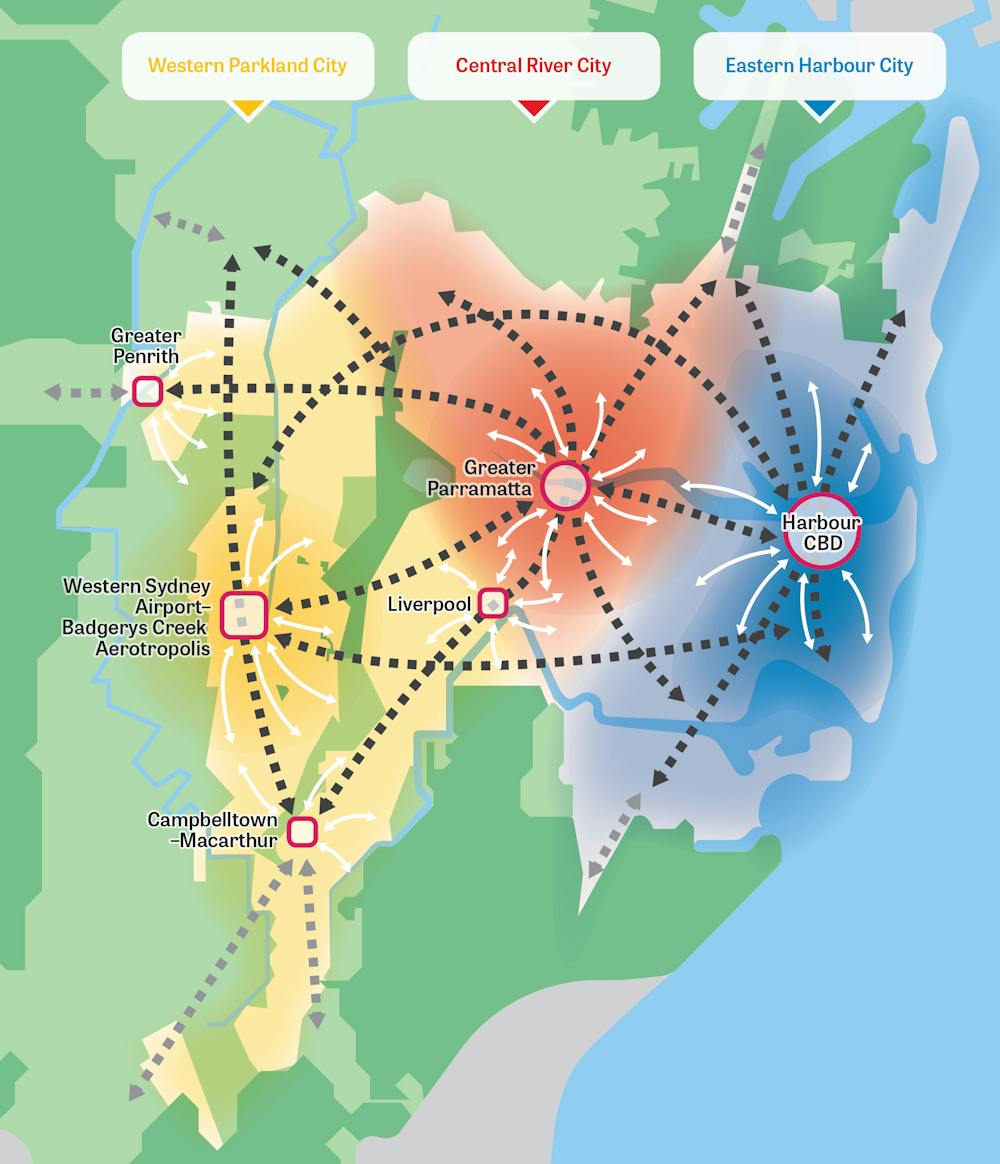
Figure 1. A Metropolis of Three Cities: the Greater Sydney Commission’s 2018 Greater Sydney Region Plan. Greater Sydney Commission

In this plan, the Sydney metropolitan region is re-imagined around three cities:

  1. Eastern Harbour City – built around the current CBD
  2. Central River City – built around a new CBD located in Greater Parramatta on the area currently known as Parramatta CBD and Westmead district
  3. Western Parkland City – built around the growth expected around Western Sydney Airport, Penrith, Campbelltown and Liverpool.

A key objective of the metropolitan plan is to rebalance economic and social opportunity toward Western Sydney and the Central River City, or “Central City”. The vision is for most residents to live within 30 minutes of their job, education, health facilities, and other services.


Read more: The future of Sydney: a tale of three cities?


The first step to fulfil this bold vision is to understand how far Western Sydney is from having its own metropolitan CBD; and to assess how the Central City (in Greater Parramatta) measures up against the existing Sydney CBD, also known as the Harbour City.

How do the Central City and Harbour City compare?

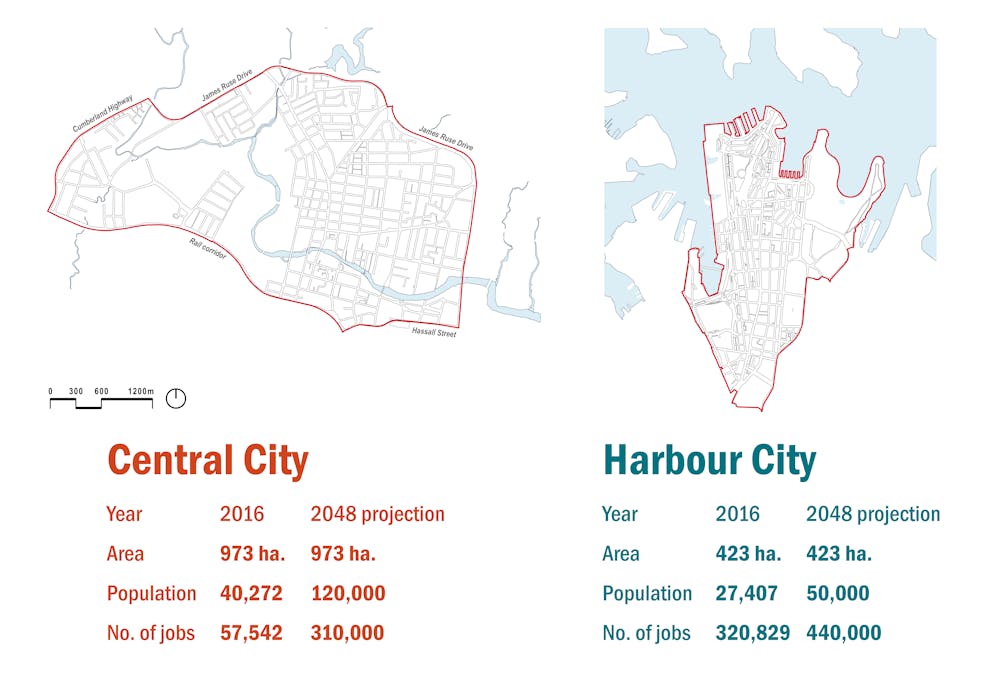
Figure 2. A snapshot of Central City versus Harbour City. Image: Jamie van Geldermalsen, Mile Ilija Barbaric, Rao Umair Afzaal, Kun Fan, Author provided

Currently, 2.6% of jobs in Greater Sydney are in Central City, compared to 14.5% located in the established Harbour City. While the Harbour City has many more jobs, the proportion of workers in the health and public sectors is much higher in the Central City – due to the presence of Westmead health precinct. While health will remain important in the Central City’s future, employment opportunities in the financial, tech and legal sectors need to grow significantly if the Central City is to become the next metropolitan centre.

Figure 3. Central City versus Harbour City: economic comparisons. Image: Jamie van Geldermalsen, Mile Ilija Barbaric, Rao Umair Afzaal, Kun Fan, Author provided

Harbour City offers significantly more regional and local connectivity than Central City. Currently, 70% of Harbour City workers commute to work by public transport and only 13.5% by private vehicle, compared to the Central City’s 30% and 55.65% respectively.


Read more: If the people can’t get to their jobs, bring the jobs to the people


Figure 4. Central City versus Harbour City: connectivity comparisons. Image: Jamie van Geldermalsen, Mile Ilija Barbaric, Rao Umair Afzaal, Kun Fan, Author provided

With the number of trips to Central City predicted to triple or quadruple during morning peak periods from current levels to 2056, forecasts indicate that Central City’s travel-to-work mode split will remain the same. This would lead to increased road congestion, impacting the economy, liveability and sustainability.

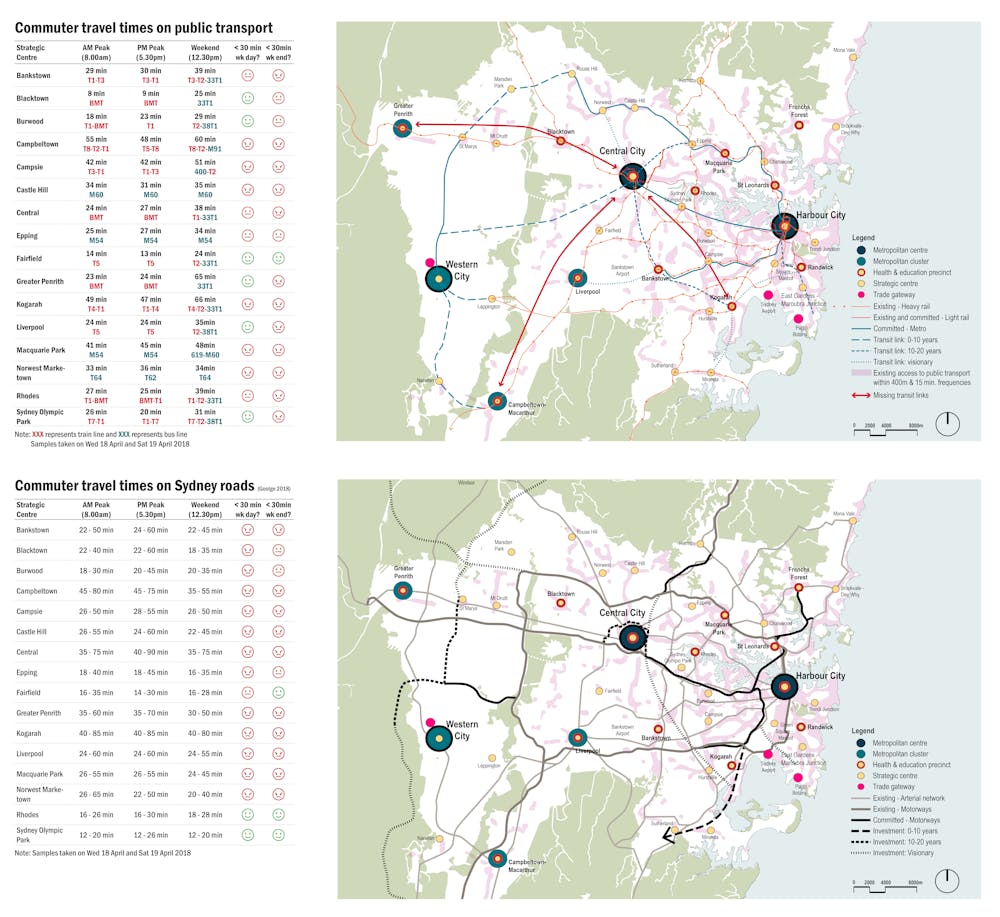
To represent the depth of connectivity problems, Figure 5 shows how long it takes to get to and from the Central City. It assesses travel times between 16 strategic centres and the Central City during peak morning and afternoon periods and on the weekend, for commuters on public transport versus those on the roads.

Figure 5. How long does it take to get to and from Central City? Image: Jamie van Geldermalsen, Mile Ilija Barbaric, Rao Umair Afzaal, Kun Fan, Author provided

The results show the public transport commuters’ travel time from most strategic centres is already greater than 30 minutes. Commute time on the roads varies, going over 30 minutes during the morning peak. Moving commuters around Greater Sydney using the road network is only a temporary measure, as it does not have the capacity to cope with any of the proposed growth.


Read more: Another tale of two cities: access to jobs divides Sydney along the ‘latte line’


Figure 6: Central City versus Harbour City: housing, cultures and services. Image: Jamie van Geldermalsen, Kun Fan, Mile Ilija Barbaric, Rao Umair Afzaal, Anjani Rao Gandra, Nithila Rajave, Rachana Chandwani, Tamanna Sultana, Author provided

Central City is culturally diverse. More than 140 languages other than English are spoken at home, with more than 65% of people born overseas.

However, social infrastructure to support and celebrate this great diversity is lacking. Access to community facilities such as aged care, child care, schools and non-Christian places of worship are limited. Without investment, the social infrastructure deficit will only be amplified as the population increases.

Harbour City has 11 museums and seven cultural centres; the Central City does not have any museums and only two cultural centres.

The final word

These assessments, from economy, connectivity, and liveability perspectives suggest the Sydney metropolis has a very long and bumpy way to go before we can re-imagine it with more than one CBD. Visionary and bold decision-making, supported by significant investment, is required for the Central City to transition to a metropolitan centre.


This article is inspired by the work of the students enrolled in the Integrated Urbanism Studio for the Master of Urbanism at the University of Sydney. I specifically would like to acknowledge the significant contributions made by Jamie van Geldermalsen, Mile Ilija Barbaric, Rao Umair Afzaal and Kun Fan.

Tomorrow, a follow-up article presents the Central City 2048 strategic plan to make a new CBD work.

ref. Re-imagining Sydney with 3 CBDs: how far off is a Parramatta CBD? – http://theconversation.com/re-imagining-sydney-with-3-cbds-how-far-off-is-a-parramatta-cbd-102197]]>

Bringing in backpackers is not the right way to get more workers onto farms

]]>

Source: The Conversation (Au and NZ) – By Stephen Howes, Director, Development Policy Centre, Crawford School of Public Policy, Australian National University

Suddenly, getting workers onto farms is a top political priority.

Over the weekend, and again in parliament on Monday, Prime Minister Scott Morrison announced plans to get more backpackers working on farms.

We don’t yet have the details, but for a month the media have been reporting that he is considering “longer visits for travellers on working holiday or backpacker visas”.

Backpackers who have had a visa for one year can already get an extension for a second year if they have worked on a farm for three months. Some 36,000 did it last year.

What’s apparently proposed

The government seems to be considering increasing that extension from one to two years.

Another suggested reform is to lift the current six-month ceiling on any single stint of employment while in Australia on a backpacker (working holiday) visa.

In my assessment, based on analysis and research over several years, these are not only bad ideas, but also ideas that would undermine all three of Morrison’s claimed objectives in the field of agricultural work.

Morrison’s three objectives

First, he has gone out of his way to stress that he wants to end worker exploitation on farms, saying:

I want to be absolutely certain that those going to work in these areas and environments are properly looked after and properly catered for.

Yet the backpacker visa scheme is broken.

The Fair Work Ombudsman undertook an inquiry into it in 2016. It found that “many backpackers are being subjected to underpayment or non-payment, unlawful deductions, sexual harassment, unsafe working conditions and other forms of exploitation”.

“Overseas workers seeking regional work to satisfy the 88-day requirement and obtain a second-year 417 visa are particularly vulnerable to exploitation,” it reported.

The working holiday visa scheme is one we should be trying to fix or shrink, rather than expand.

Second, Morrison has made it clear he wants to get more Australians working on farms. On Monday he told parliament:

Where there is a job in Australia, our view is that an Australian should do that job where an Australian is available and fit and ready to do that job.

But at present no labour marking testing is required before farmers hire a backpacker. Current backpacker visa arrangements require no preference whatsoever for local workers.

Third, Mr Morrison has declared as recently as this month that the Pacific region has to come first when it comes to providing seasonal jobs.

The Pacific Islander Scheme has the priority in our program. Of course it does.

This makes sense. Pacific island nations are poor, geographically isolated and strategically important.

But backpackers on working holiday visas compete for jobs with Pacific Islanders brought in under the Seasonal Worker Program.

Backpackers complete with islanders for jobs

The recent growth in the Seasonal Worker Program (6,400 between 2013-14 and 2017-18) corresponds closely to the decline over the same period in the number of backpackers who used farm work to get a second-year visa (9,600).

Yet there are still four times as many backpackers on farms as seasonal workers.

This means that, all else being equal, a 10% increase in the number of backpackers on farms would cut the number of arrivals from the Pacific under the Seasonal Worker Program by 40%.


Read more: Why yet another visa for farm work makes no sense


Unlike the backpacker visa, the (Pacific) Seasonal Worker Program requires labour market testing, and the research suggests that the workers it brings in are less exploited than backpackers. This isn’t surprising, because the Seasonal Worker Program is a more tightly regulated scheme.

More than 90% of the farm workers on the backpacker scheme are from rich countries. Not a single Pacific island country is able to use it.

We’ll need to make a choice

My point is simple. The prime minister cannot claim that he wants to stamp out exploitation, get more Australians onto farms and prioritise the Pacific, while at the same time supporting changes to the working holiday visa that would result in more backpackers working on farms.

It’s an important decision for us as a nation. Farmers will always want a mix of seasonal workers and backpackers, but we need to get our priorities right.

Do we want more Pacific Islanders, or more rich-country foreigners, picking our fruit and vegetables?

Our special interest in the Pacific and the strong safeguards already in place for the Seasonal Worker Program suggest that it should be the former.

ref. Bringing in backpackers is not the right way to get more workers onto farms – http://theconversation.com/bringing-in-backpackers-is-not-the-right-way-to-get-more-workers-onto-farms-105123]]>

True blue picks: a snapshot of Australia’s favourite porn

]]>

Source: The Conversation (Au and NZ) – By Paul J. Maginn, Associate Professor of Urban/Regional Planning, University of Western Australia

This article contains explicit terms which some readers (and workplaces) may find offensive.


Pornhub, one of the world’s largest online porn sites, provides us with a department store-sized window into our online viewing habits of “mainstream porn”.

In 2017 Pornhub had 28.5 billion visits, up from 23 billion (24%) in 2016. According to internet analytics firm, Alexa, Pornhub is the 27th most popular website in the world. It ranked 18th within Australia (and 14th in the US, 15th in Canada, and 16th in the UK.)

Australians made the eighth highest number of visits to the website – the same position it held in 2016. Given the comparatively small population of Australia it’s inclusion in the “top 10” suggests that Australians are, at the very least, curious about porn.

Here’s a snapshot of the geographies of online pornography down under.

Whereas two-thirds (67.3%) of Australia’s population in 2017 lived within the various state and territory capital city regions, these same areas accounted for about 90% of the unique pageviews to the multitude of porn category pages on Pornhub’s website. Melbourne and Sydney, which account for 40.6% of the population, made more than half of all visits to the site.

The significant over-representation of porn consumption from metropolitan Australia may also be explained, in large part, by better telecommunications infrastructure and faster internet download speeds compared to regional and rural Australia.


Read more: We need to talk … about porn in Australia


Australia’s top 10

Eight categories of porn were found in the top 10 most viewed categories across all Australia’s capital cities. There were: anal, big tits, hentai (a Japanese-influenced form of porn), lesbian, mature (“older women”, often 40-60+ years old), MILF (“glamourous older women”, often 30-50 years old), teen (18+), and threesome.

Lesbian was the most popular category of porn among Australians, ranking first across all state capitals. MILF ranked second for all metropolitan regions except Canberra, where hentai came in second place, pushing MILF into third spot. Teen(18+) porn proved to be more popular in Adelaide (equal second) and Brisbane (equal third) whereas threesome porn ranked third in Melbourne and Sydney. Anal took out third place in Perth.

Japanese-categorised porn made the top 10 in just three cities – Canberra (equal sixth); Melbourne (ninth) and Sydney (seventh). This was also true for Asian porn.

Transgender porn, made it into the top 10 in only two cities – Adelaide (ninth) and Brisbane (tenth) (and 11th in Perth).

Given the increased prominence of transgender porn at the 2018 AVN Adult Entertainment Expo, high-profile Australian performer Angela White recently shooting her first transgender scene with Chanel Santini, plus wider media and public debates on trans issues, more people, including heterosexual male porn viewers, will likely be watching transgender porn in the next year or two.

Transgender porn is becoming increasingly popular. Paul Maginn

What about gay porn?

Pornhub also has a separate site for gay porn. While this type of porn may be popular with gay men, it is also watched by women.


Read more: Male-on-male erotica is hugely popular among women – an expert on sex work explains why


Pornhub offers about 40 different categories of gay porn on its website. In 2017, the top 10 categories across all Australian cities were: straight guys (in which gay men have sex with “straight” men); bareback (sex without using condoms); daddy (the gay equivalent of “MILF” porn); twink (the equivalent of the category “Teen 18+”); big dick; rough sex; group; public; creampie; and Asian.

Canberra is the only city to feature muscle, hunk, and fetish porn in their gay porn top 10. Similarly, black porn only makes the top 10 in Adelaide (seventh) and Brisbane (tenth). Brisbane and Perth are the only cities to feature public porn (ninth).

From computers to phones

It should come as no real surprise that desktop computers are no longer the primary means of accessing porn on the net. Smart phones account for the majority of unique traffic to Pornhub from Australia. Brisbane leads the way with 62.4% of porn traffic coming from phones.

Nevertheless, people are still watching on computers, particularly in Canberra – the epicentre of federal politics and bureaucracy – where 38.4% of Pornhub traffic came from desktops. Tablets account for a small share of traffic, highest in Hobart and Darwin (both at 14.6%).

With the 5G mobile phone system just over the horizon, and increasingly cost-effective and larger data packages offered by mobile phone companies, smart phones will undoubtedly increase their dominance in how we access online pornography into the future.

In overall terms, our mainstream and gay porn category preferences are fairly stable, although there are some notable inter-city variations.

As porn scholar Shira Tarrant notes in her book, The Pornography Industry, “pornography has been around for as long as visual images and the written word have existed”. Given the fact that the past is arguably the best predictor of the future, our curiosity in and consumption of pornography is unlikely to disappear any time soon.

ref. True blue picks: a snapshot of Australia’s favourite porn – http://theconversation.com/true-blue-picks-a-snapshot-of-australias-favourite-porn-100595]]>

View from The Hill: Barnaby Joyce stalks Deputy Prime Minister McCormack

]]>

Source: The Conversation (Au and NZ) – By Michelle Grattan, Professorial Fellow, University of Canberra

As if the Liberals aren’t having enough trouble with the transaction costs of regime change to discourage any party from the coup road, now the Nationals are displaying angst over their leadership.

There’s unhappiness that Deputy Prime Minister Michael McCormack isn’t cutting through publicly, or throwing around enough weight within the government. Those who’d like a change back to Barnaby Joyce are stirring.

Joyce, having put his personal crisis behind him, is obviously feeling his oats. Being envoy on drought might be a minor job, but it has lifted his profile, given him a platform, and no doubt stoked his perennial enthusiasm for being out on the campaign trail.

In parliament this week, it was obvious McCormack was reacting to the pressure he’s under from the muttering and criticism.

The Nationals’ desire for a special agricultural visa might be a niche issue, but Scott Morrison’s pushback on it has been used against McCormack. Asked in question time on Tuesday for his response to a report that “a very well-known Nationals stakeholder has been ringing around for about three weeks in the face of ineffective representation on the ag visa”, McCormack launched into an extraordinary, and revealing, tirade about anonymous backgrounding.

“I’ve always been prepared to put my name to everything I’ve ever spoken to a journalist on,” he said. “I will never, ever background a journalist, and I think there is a cancer in Canberra at the moment, and it’s people who background journalists. It’s no good for politics. It’s no good for parliament.” He went on and on.

On Wednesday, Labor needled him again, taking up a fierce attack earlier in the day by shock jock Ray Hadley who, following McCormack’s I-don’t-background assertion, claimed his office had leaked during Joyce’s “trying times”.

In response, McCormack told parliament that he stood by everything he’d said on Tuesday, then veered off into how he’d stood by various constituencies.

Hadley, who had his sights aimed at McCormack when the Dutton challenge was underway, on Wednesday described him as weak-kneed, having no policy and bending any way to accommodate the Liberals – “a very unworthy person to be in charge of the National Party”.

The upheaval that led to Joyce quitting strained the Nationals but other things as well have contributed to a deeply divided, out-of-sorts party, including unfulfilled ambitions, preselection losses, and marginal seat fears.

McCormack, who was elevated to the leadership from the junior ministry in extraordinary circumstances, lacks the authority to impose unity on his party, especially when the government appears to be headed for defeat.

In 2016 the Nationals, knowing the Malcolm Turnbull messaging wasn’t going to work for them, successfully differentiated themselves from the Liberals. The ability to do that was helped by Joyce’s distinctive style and his toughness within the Coalition.

The Nationals will again need to project a distinctive identity in the coming election, which will be a challenge for McCormack.

Right now, McCormack needs to be on the front foot but, as shown by this week’s parliamentary performances, he looks and sounds like he’s on the back one.

Joyce simply signals his availability. Appearing on Sky with Labor’s agriculture spokesman Joel Fitzgibbon (who’d asked McCormack the provocative parliamentary questions) Joyce on Wednesday denied making any calls seeking votes.

There’s a fine line between being out and about and canvassing. Just being visible is all that’s needed at this stage of a bid. And Joyce doesn’t hide his ambitions for a return. “If it came up, and it was offered to me, I would take it, but I am not touting for it, I am not collecting the numbers for it,” he said.

The Sunday Telegraph’s Annika Smethurst wrote last weekend that no one in the 22-member Nationals party room could “confidently rule out” Joyce “calling for a spill of the leadership before Christmas”.

Within the Nationals, opinion is divided about whether something could happen before the end of the year. Joyce’s critics rule it out, saying he has only a handful of loyalists. Others, however, are uncertain about how things will pan out.

Seriously contemplating a change of leadership raises big questions for a party that traditionally sticks to its leaders. Especially when such a change would be returning to someone who, together with his campaigning strengths, carries significant baggage. McCormack might be looking bad but how would Joyce perform second time around? Is the party up to what would be a ride on the wild side?

And change brings fallout, usually more than anticipated. As one National says: “Is Barnaby a better leader than McCormack? Yes. But what about the transactional costs?”

If the Liberals lose Saturday’s Wentworth byelection, it will become clear just how high transaction costs can be. On the other hand, a Wentworth loss would send shock waves through the government as a whole which would probably make for more instability in the Nationals.

ref. View from The Hill: Barnaby Joyce stalks Deputy Prime Minister McCormack – http://theconversation.com/view-from-the-hill-barnaby-joyce-stalks-deputy-prime-minister-mccormack-105162]]>

Politics Podcast: Peter Jennings on Morrison’s Jerusalem move

]]>

Source: The Conversation (Au and NZ) – By Michelle Grattan, Professorial Fellow, University of Canberra

Director of the Australian Strategic Policy Institute (ASPI), Peter Jennings, says it would be “silly” to claim – as Scott Morrison does – that there is no connection between this week’s announcement about the possible relocation of Australia’s embassy to Jerusalem and Saturday’s Wentworth byelection.

This kind of decision would not have been considered by Malcolm Turnbull, Jennings says and if Julie Bishop were still foreign minister she “would have put up quite a fight”.

On Morrison’s general foreign policy approach so far, Jennings says the new PM seems to be taking a more “conciliatory tone” to China. “If we see the Prime Minister moving away from the relatively hard line position that Malcolm Turnbull evolved over several years about China, that to me would be a concern.”

ref. Politics Podcast: Peter Jennings on Morrison’s Jerusalem move – http://theconversation.com/politics-podcast-peter-jennings-on-morrisons-jerusalem-move-105143]]>

Fighting frog fungus: Lee Berger wins PM’s Life Scientist 2018 award

]]>

Source: The Conversation (Au and NZ) – By Lee Berger, University of Melbourne

Lee Berger is the 2018 recipient of the Frank Fenner Prize for Life Scientist of the Year, one of the Prime Minister’s Prizes for Science announced on October 17.

Lee’s research identified the cause of mysterious and devastating mass frog extinctions that spread across the world starting in the 1970s: it was a skin fungus.

With her colleague Lee Skerratt, here she describes the work that lead to her prize, and what is still to be achieved for frog and wildlife conservation in Australia and across the world.


Combating fungi in frogs – why is this important?

Chytridiomycosis might be the worst disease in history. In a matter of decades, the illness cut a swathe through hundreds of species of frogs, causing mass extinctions as it spread out of Asia into Australia and the Americas.

Our research was the first to identify the cause – a novel chytrid fungus called Batrachochytrium dendrobatidis – but finding ways to combat the disease requires a lot more work.

Infected frogs are lethargic and experience excess skin shedding (this species is Mixophyes fasciolatus). Lee Berger, Author provided

Here in Australia, six species have already been driven extinct, and another seven are on the brink. Fortunately, in Australia we also have the unique expertise and perspective to prevent further losses if we devote adequate resources to the problem.


Read more: Frogs v fungus: time is running out to save seven unique species from disease


The keys to our research success have been a cross-disciplinary approach and a focus on delivering conservation outcomes.

Frog declines had been seen around the world from the late 1970s on, but it wasn’t until 1998 that we identified the chytrid fungus as the cause.

Parts of the fungus poke through an infected frog’s skin – as seen here under scanning electron microscope. Lee Berger, Author provided

Why had nobody else figured this out before?

Discovering the fungus on the skin of frogs was not rocket science, but rather applying the methods from one discipline to a problem in another. An outbreak investigation approach – using the tools of medicine for frog conservation – allowed us to diagnose the cause of the frog deaths.

The main reason this approach was tried in Australia was the broad knowledge and interest of the late Rick Speare, an extraordinarily eclectic scientist, medical doctor and vet. (Like the prize’s namesake Frank Fenner, he was comfortable using his medical expertise for the environment.)

Rick’s help was sought by Keith McDonald, a chief ranger of Queensland and a herpetologist. Keith was concerned about the health of North Queensland frogs after witnessing major declines in the south.

After looking at the pattern of declines the pair thought they saw the trail of an unknown infectious, waterborne disease. They applied for funds to search for a disease.

Green-eyed treefrogs (Litoria serrata) in the Queensland rainforest have declined due to chytridiomycosis. Lee Skerratt, Author provided

The idea that an infectious disease might be responsible for frog declines met resistance because of the belief that a pathogen can never cause extinction, because hosts will evolve resistance. So while Rick and Keith did obtain funding to tackle this urgent global mystery, it was only enough to support a single PhD student.

That PhD student was me, Lee Berger. To cut a long story short, my work in pathology and disease transmission experiments in frogs led to our conclusion that a novel and unusual fungus in the frogs’ skin caused a fatal disease and the mass amphibian deaths seen in North Queensland. As this was the first fungus from the phylum Chytridiomycota found to cause disease in a vertebrate, I had to develop many new methods to be able to further study the disease.

So in summary, it was about 20 years after global amphibian declines began that we discovered chytridiomycosis as the cause of the population crashes. It took about another ten years for the disease to be accepted as the prime cause of declines.

After the discovery, what came next?

In subsequent years our research has continued towards the more challenging goal of finding solutions to manage this issue.

Our small multidisciplinary One Health Research Group has tackled diverse questions to reduce the spread and the impact. Questions such as:

Now we are focused on understanding immunity to improve survival rates of the most threatened species of frogs in the wild.

This work has only been possible due to the extraordinary dedication of our students and staff and the collaboration with specialist scientists such as herpetologists, molecular biologists, immunologists, physiologists and others who have lent their expertise.

Common mistfrogs (Litoria rheocola) in the Queensland rainforest have also declined due to chytridiomycosis. Lee Skerratt, Author provided

What does this mean for Australia’s wildlife?

Our research has clearly shown that introduced diseases can have catastrophic impacts for conservation, much like the arrival of feral predators. In fact, disease can cause extinction much more quickly than predators, within months rather than years. The catastrophe of invasive species is a cost of globalisation that will be ongoing unless we respond.

The responsibility for wildlife lies with environment departments, but because health expertise is in other institutes, wildlife health can fall between the cracks.

We argue that continued support for bodies such as Wildlife Health Australia (WHA) is important. We also need a centre of expertise for outbreak investigation and strategic research to develop new tools for wildlife health management.

Biodiversity will miss out unless we support research that promises no direct and fast commercial return but benefits our nation in the longer term. In particular, and most urgently, Australia must save its frogs before it is too late.


Other winners in the 2018 Prime Ministers Science Prizes are:

  • Prime Minister’s Prize for Science: Kurt Lambeck
  • Prime Minister’s Prize for Innovation: The Finisar team
  • Frank Fenner Prize for Life Scientist of the Year: The Finisar team
  • Malcolm McIntosh Prize for Physical Scientist of the Year: Jack Clegg
  • Prime Minister’s Prize for New Innovators: Geoff Rogers
  • Prime Minister’s Prize for Excellence in Science Teaching in Primary Schools: Brett Crawford
  • Prime Minister’s Prize for Excellence in Science Teaching in Secondary Schools: Scott Sleap

ref. Fighting frog fungus: Lee Berger wins PM’s Life Scientist 2018 award – http://theconversation.com/fighting-frog-fungus-lee-berger-wins-pms-life-scientist-2018-award-105042]]>

Senate inquiry calls for tougher rules on pet food in Australia

]]>

Source: The Conversation (Au and NZ) – By Bronwyn Orr, Veterinarian and PhD candidate, University of Sydney

Compulsory rules for the standards and labelling of pet food in Australia are among the recommendations in a Senate inquiry report released late Tuesday.

The Rural and Regional Affairs and Transport References Committee inquiry was set up in June following several cases in which dogs fell ill after eating pet food.

Currently, the pet food industry in Australia is self-regulated. The Australian Standards for the manufacturing and marketing of pet food are voluntary, and published behind a paywall.


Read more: Is your dog happy? Ten common misconceptions about dog behaviour


There is no mandatory recall system for pet food, and no mechanism for consumers to report adverse events. Essentially, there is minimal government oversight of this industry. This makes it hard for pet owners to be confident the food they feed their beloved pets is both safe and nutritious.

The Senate report makes seven recommendations including calls for:

  • the standards to be made mandatory and publicly accessible
  • a national pet food manufacturing and safety policy framework to be established
  • for the Australian Competition and Consumer Commission (ACCC) to create a consumer reporting mechanism and improved recall systems.

The inquiry considered more than 150 public submissions from veterinarians, welfare organisations such as the RSPCA, industry groups, and concerned individuals. It also included two days of public hearings. Most of those submissions and presentations called strongly for change.

Sick dogs prompt food recall

This inquiry into pet food regulation started after public outcry around the recall of Advance Dermocare dog food. The product was recalled in March this year after several dogs developed life-threating oesophageal weakness (megaoesophagus) while being fed the food.

It took the pet food manufacturer three months to announce the recall after being notified of the cluster of sick dogs in December 2017.

Although this seems slow, there are actually no specific laws in Australia that force a pet food manufacturer to initiate a recall if their food is making pets sick.

There is a system called PetFAST, which is a voluntary recall initiative between the Australian Veterinary Association and the pet food industry body, the Pet Food Industry Association of Australia (PFIAA).

The PetFAST system arose after two incidents spanning 2007 to 2009 resulted in the deaths and illnesses of dozens of cats and dogs. Irradiated cat food imported from Canada caused paralysis in cats and imported chicken-jerky treats for dogs from China caused kidney toxicity.

At the time, no recall mechanisms for pet food safety incidents existed. The PetFAST system has helped with recent recalls of both cat and dog food. But it isn’t perfect.

It relies on veterinarians to recognise a possible link between a disease and a pet food, and on the pet food manufacturer to investigate and recall a product if required. Unfortunately it isn’t able to be used by consumers to report safety incidents, only veterinarians.

There are some laws that restrict what a pet food manufacturer can and can’t claim about a particular pet food. There are also restrictions around the importation of pet food products.

But the standards around the safety and nutrition of pet food aren’t mandatory. Combined with the lack of independent oversight of the industry, this creates a situation in which consumer trust and industry transparency are thin on the ground.

We’ve been here before

This week’s Senate report isn’t the first to call for improvements in the pet food industry.

A government working group into pet food regulation was formed in 2009 after the pet food safety incidents involving irradiated cat food and chicken-jerky treats.

Another working group into pet food regulation was set up this month by the federal government, pre-empting the Senate inquiry report. Although some improvements arose from the original working group, such as the PetFAST recall system and voluntary standards, what we really need now is definitive action.

The pet food industry in Australia has a revenue of more than A$4 billion a year and pet owners want to know that food is both safe and nutritious.

Submissions to the inquiry from the main manufacturers in Australia, as well as industry body the PFIAA, show increased regulation and mandatory standards are likely to be supported if recommended by government.

These measures are also supported by veterinarians, animal welfare groups such as the RSPCA, and consumer groups such as Choice.


Read more: Whose best friend? How gender and stereotypes can shape our relationship with dogs


What are the next steps? Both federal and state governments need to take action. The RSPCA also recommends mandatory auditing against the standards and expanding the standards to cover other pets such as rabbits and birds.

We know what needs to happen and there is widespread support for change. The new working group formed by the federal government to investigate pet food safety in Australia will report within 12 months.

Let’s hope the federal and state governments are willing to act on the report this time around. It’s been a decade since this issue was brought to the government’s attention. Australian pet owners shouldn’t have to wait any longer for real change.

ref. Senate inquiry calls for tougher rules on pet food in Australia – http://theconversation.com/senate-inquiry-calls-for-tougher-rules-on-pet-food-in-australia-102410]]>

Moving the Australian embassy to Jerusalem makes sense: here’s why

]]>

Source: The Conversation (Au and NZ) – By Ran Porat, Lecturer in Israel Studies and Middle Eastern History, Monash University

Apparently looking to garner the support of Jewish constituents behind the Liberal candidate, David Sharma, in the upcoming critical Wentworth by-election on October 20, Prime Minister Scott Morrison has said he will consider moving the Australian embassy in Israel from Tel Aviv to Jerusalem.

The statement created shockwaves within Australia and internationally. Israel, pro-Israeli and Jewish organisations in Australia praised the possible policy shift. Palestinians and their supporters were critical and angry.


Read more: Shifting the Australian embassy in Israel to Jerusalem would be a big, cynical mistake


Similarly, Australian politicians from all parties responded with often highly emotional expressions of disapproval or support.

The controversy

Moving the Australian embassy from Tel Aviv to Jerusalem is controversial because it would be a strong political statement of support for Israel.

For Israelis and Palestinians, Jerusalem has a special and disputed symbolic value. Yerushalayim (the city’s name in Hebrew) is the capital of the Jewish state, and was also the Jewish capital in biblical times, where the temple, the holiest place for Jews, once stood. On the same location as the temple, Muslim rulers later built the Al-Aqsa mosque, Islam’s third-holiest place (after Mecca and Medina).

For Palestinians, affiliation with Al-Quds (the city’s Arabic name) is a central element in their national identity. The same applies for Israelis.

Compromises discussed in previous (failed) attempts to forge a peace in the region suggested, for example, declaring the Arab neighbourhoods of East Jerusalem as the Palestinian capital alongside the Israeli one in the predominantly Jewish west of the city.

Until a compromise is reached, most countries operate their official embassies to Israel from Tel Aviv, claiming that the status of the city should be determined through negotiations between Israel and the Palestinians.

However, in December 2017, US President Donald Trump declared that his government was officially recognising Jerusalem as the Israeli capital. In May, the US opened its embassy in the heart of the Jerusalem. The move provoked violent demonstrations by Palestinians.

The Australian foreign policy context

The framework of Australia’s foreign policy, argues academic Caitlin Byrne, is built on three basic principles:

the alliance with the United States, engagement with the Asian region, and commitment to multilateralism.

Examining Morrison’s recent Middle East policy announcement through the perspective of Byrne’s definition leads to the conclusion that it is not a major policy shift. Instead, it is in line with the traditional fundamentals of Australian foreign policy and international political trends, and is compatible with Australia’s national interests.

First, Morrison’s policy steps go hand in hand with current policies coming out of the White House.

President Trump’s recognition of Jerusalem as Israel’s capital fulfilled an election campaign promise, while acknowledging a reality that has actually existed since the creation of Israel in 1948. This decision, as well as other elements of US policy, is part of a paradigm shift Trump is attempting to lead with regards to the Israeli–Palestinian conflict. The idea is that by taking Jerusalem off the table and accepting Israel’s request to recognise a situation that has been in existence for decades, the onus now moves towards Israeli Prime Minister Benjamin Netanyahu to reciprocate with measures that would be considered positively by Palestinians.

At this stage, however, no deal seems imminent. The Palestinians have rejected the so-called “deal of the century”, Trump’s plan for peace in the Middle East, even before it was made public, while violent clashes in Gaza between Israel and Hamas continue.

Australia should of course not blindly follow America’s lead on this – Australia’s foreign policy is crafted in Canberra, not Washington. Yet, at the same time, the reality is that over the last few decades Australia has been, at the very least, overwhelmingly and actively supportive of American policy moves, such as when Australian military forces fought alongside US soldiers in Korea, Vietnam, Iraq, Afghanistan and Syria.

Middle powers as peace brokers

There is another foreign policy aspect that is relevant here – Australia’s self-perception as a “middle power”. Former foreign minister Kevin Rudd applied this conceptual label to Australia in his 2011 review of Australia’s foreign policy interests in the Middle East.

In Rudd’s view, middle powers are what could be considered “peace brokers”. He said:

Their strength comes from the good offices they bring to bear on regional and global problems and the persuasiveness of their arguments and the coalitions they are capable of building, not the assertion of direct power.

Practically speaking, moving Australia’s embassy to Jerusalem would be neither a game-changer, nor ground-breaking, as the US has already paved the way. There is no reason to believe that recognising west Jerusalem as Israel’s capital – a role it has served since 1950 and is not seriously disputed even by the Palestinians – would in any way pre-empt a future Palestinian capital in east Jerusalem.


Read more: Netanyahu’s visit prompts Australia to rethink its relationship with Israel


With regards to Israel, Australia would assert itself as a more influential “real friend”, whose advice should be taken seriously. The embassy move would be yet another sign of increasingly close relations between the two states. These ties are built around, among other things, the history of the ANZAC battle over Beersheba in the first world war and, more importantly, shared values and interests.

The Palestinians have already expressed their fury at the idea of moving the embassy. But Australia’s outreach into the Palestinian sphere is limited. The problem is the paralysing, deep and bloody divide between the corrupt Palestinian authority in the West Bank and Hamas in Gaza. The former is a failed entity mismanaged by Mahmoud Abbas (Abu Mazen), and the latter is a terrorist organisation (Hamas’s military wing Izz al-Din al-Qassam is listed as a terror group by the Australian government).

Changing realities

Morrison emphasised that relocating the embassy is “consistent with pursuing a two-state solution”. This perception of the end-game for the conflict being two states living side by side was, and still is, Australia’s traditional bipartisan stance.

Yet, realities on the ground have changed significantly over the past few years due to both Israeli, Palestinian and international developments. The 2016 defence white paper sombrely acknowledges that:

Given major differences between the parties, resolving the Israeli–Palestinian conflict will remain very difficult. Australia will continue to advocate a two-state solution as the only viable path to peace.

Australia could choose to remain on the sidelines and not have a significant voice or an influence in this dispute, preserving the status quo. Or, it can make a move – such as the embassy move to Jerusalem – that does not really break away from traditional Australian foreign policy, but may increase its leverage over Israel and help broker lasting peace in the Middle East.

ref. Moving the Australian embassy to Jerusalem makes sense: here’s why – http://theconversation.com/moving-the-australian-embassy-to-jerusalem-makes-sense-heres-why-105037]]>

40 luxury Maseratis for PNG, but little effort put into climate change

]]>

Papua New Guinea has shown unwavering commitment to next month’s Asia Pacific Economic Cooperation summit with its controversial purchase of 40 Maserati luxury sedans. While preparations for APEC take priority, climate change plans are in crisis, reports Pauline Mago-King of Asia-Pacific Journalism.

Early in March, Papua New Guinea began its chairmanship of next month’s Asia Pacific Economic Cooperation (APEC) summit by receiving many senior officials for the opening set of planning meetings.

The lead-up to the APEC summit, expected to become a key opportunity for PNG to unlock its economic potential, has been inundated with talks on trade and investment.

As the smallest and poorest member of APEC, Papua New Guinea has framed its chairmanship as an opportunity to cash in on the digital revolution and its benefits in connectivity and employment.

READ MORE: PNG government faces mounting pressure over Maserati splurge

The chair of APEC Senior Officials, Ambassador Ivan Pomaleu, underlined PNG’s participation in APEC as “leverage” to maintain its domestic policies according to the group.

“The work that has come out of APEC has allowed investors to come on shore and be part of our business community. You really need to think in terms of what sort of structural reform and ease of business activities we’ve been doing and that have made it possible for new investments in PNG. Those are pegged on important APEC principles.” Pomaleu told APEC Bulletin.

-Partners-

He added that conversations surrounding connectivity, particularly in sustainable development and climate change, were important to PNG.

A month before the summit, however, this agenda has seemingly been neglected with the import of 40 Maserati Quattroporte luxury sedans to be used by APEC leaders.

One of the controversial Maserati cars that have arrived in Papua New Guinea for APEC 2018. The market value is about re[orted;y about K229,000 (NZ$110,000) each. Image: EMTV NewsCondemned purchase
The revelation of the PNG government’s purchase of these vehicles, which range in cost between $209,000 and $345,000 in Australia, has been widely condemned as an example of poor governance at a time when the country faces pressing health, education, law and order, and environmental issues.

While PNG’s APEC Minister Justin Tkatchenko has told media that the costs of the Maseratis will be recovered via prospective buyers, this remains to be seen.

A common sight of Papua New Guinean villagers travelling by canoe. Image: Sally Wilson/Pixabay Creative Commons (CC)

While the minister has not disclosed the initial costs of both the fleet and cars, PNG has unveiled plans underway to build a 400 million kina (NZ$180 million) coal-powered plant – a far cry from its attentiveness to sustainable development.

According to the Post-Courier, a memorandum of agreement has been reached “to build a coal-fired power plant in Lae”, Morobe province.

Although this agreement is a step towards meeting the energy needs of Lae consumers, it takes PNG two steps back in its commitment to mitigating climate change.

PNG’s gravitation towards cheap, non-renewable energy such as coal signals a complete disregard of its pledge to the Paris Climate Agreement.

PNG is already experiencing the effects of climate change which can be seen in the need to relocate Carteret Islanders and the dwindling access to clean drinking water, to name a few issues.

Defiant action
Despite these effects and coal being a key driver of climate change, Energy Minister Sam Basil is defiantly going ahead with building the electricity plant.

According to The National, Basil said that PNG had “been denied that right (to burn coal) for a very long time”.

He added that “big nations are not reducing [coal emission]”, thus PNG needs a quota for burning coal to provide cheaper electricity which would subsequently lead to more jobs.

Chris Lahberger from the anti-coal group, Nogat Coal PNG, told Radio NZ that this move was uneconomical despite the developer Mayur Resources’ claims of increased employment and investment in a sustainable research institute.

Although PNG is not the only developing country to have resorted to coal as a source of low-cost electricity, it does have a responsibility to its people considering the Climate Investment Fund’s investment of $25 million.

As reported by Devex, this funding is the largest with a focus on delivering “transformational change in addressing the current and future threats from climate change and related hazards in” PNG.

A snapshot of the Climate Investment Fund’s assistance to PNG indicates a key focus on building resilience in the agriculture sector along with the mitigation of climate extremes.

Climate accountability
Consequently, this begs the question of accountability in climate change aid as plans like the Mayur Resources’ coal-fired power plant are counteractive.

There is a pattern of financial aid being confined to large institutions and governments while communities suffer, as noted by Caritas New Zealand director Julianne Hickey.

“We’ve heard time and time again from the Solomon Islands through to Tonga, to Papua New Guinea, that it is not reaching those who need it most and those who’ve done the least to cause the issues of climate change,” Hickey told Radio NZ.

Apart from PNG’s plan to burn coal for electricity, it has an alarming rate of illegal logging which has adverse effects for its indigenous communities.

According to Global Witness, “tens of thousands of Papua New Guinean people are having their land stolen by their own government”.

PNG’s Foreign Minister Rimbink Pato, however, refuted this claim in an interview with Radio NZ.

He emphasised that the PNG government has taken appropriate measures with regard to the illegal logging and that a policy is underway via the Minister for Forests.

Summit talking point
Looking at climate change efforts as a whole, the minister added that it is a talking point for the APEC summit.

“It’s one of the key issues there, and what we’re doing and how the world can connect. That’s why we’ve asked the rest of the Pacific Island countries, their leaders to come so that each of them can tell their story in their own way to the leaders of the world… because the impacts of climate change are unique to each country. It’s not the one and the same.”

Talking point or not, PNG’s implementation efforts are lacking and greater accountability is required of the government.

If PNG’s absence from the High Ambition Coalition is anything to go by, it indicates poor governance to the Papua New Guineans feeling the impact of climate change.

With Fiji and the Marshall Islands leading the way in climate change efforts, PNG’s status as “big brother” not only wanes but projects corruption at its very core.

Pauline Mago-King is a masters student based at Auckland University of Technology and is researching gender-based violence in Papua New Guinea. She compiled this report for the Pacific Media Centre’s Asia-Pacific Journalism Studies course.

Twitter: @iamatalau04

Print Friendly, PDF & Email

Article by AsiaPacificReport.nz

]]>

Why legislation should ban schools from discriminating against LGBTIQ+ students and teachers

]]>

Source: The Conversation (Au and NZ) – By Emily Gray, Senior Lecturer in Education Studies, RMIT University

Over the weekend, Prime Minister Scott Morrison announced his government would make amendments to discrimination legislation to make clear no student at a private or religious school should be expelled on the basis of their sexuality. This move now has bipartisan support from Greens, Labor and the Liberals.

The question now is whether this protection should also be extended to teachers and staff at religious schools. Calls to extend the proposed discrimination law amendments came first from the Greens and later from Labor. The prime minister has not yet indicated support or otherwise for the extensions.


Read more: There’s no argument or support for allowing schools to discriminate against LGBTIQ teachers


At the same time, the Wentworth by-election looms. This is a critical moment for a coalition increasingly split between moderates and conservatives and still reeling from their latest leadership spill. Wentworth emphatically supported same-sex marriage in the postal survey of 2017, with 81% voting yes. One of the contenders for the seat, Dr Kerryn Phelps, is herself in a same-sex marriage with children.

A recent nationwide Fairfax Ispos poll found 74% of Australians oppose laws allowing religious schools to discriminate against students or teachers on the grounds of sexuality, gender identity or relationship status. The current loophole for religious schools does not reflect what the majority of Australia thinks about education, religion and LGBTIQ+ people. Our government needs to start listening to the electorate on this issue.

Rights beyond marriage

Many of us from the LGBTIQ+ community experienced the same-sex marriage survey period as damaging, traumatic and hurtful. “No” campaigners likened same-sex marriage to inter-species and incestuous marriages and argued presenting students in schools with the message that it’s OK to be gay or trans was harmful, and so LGBTIQ+ people are a harmful and corrupting presence in schools.

The same-sex marriage postal survey period was a traumatic time for many in the LGBTIQ+ community. David Crosling/AAP

Public support for the proposed extensions of anti-discrimination law highlights that it’s time to challenge these beliefs. For some, like the gay teacher sacked in Perth last year, the challenge has come too late.

The state of play for LGBTIQ+ teachers

Much of the research into sexuality and schooling has historically focused on young people. But there is a growing body of work that engages with LGBTIQ+ teachers.


Read more: Talk of same-sex marriage impinging on religious freedom is misconceived: here’s why


In 2014, I carried out a study with Anne Harris from RMIT University and Tiffany Jones from Macquarie University. Our study set out to engage with the working lives of LGBTIQ+ educators in Victoria. Our findings echo previous work in the field:

  • LGBTIQ+ educators have to negotiate their private and professional lives in ways their heterosexual and cisgender (meaning your gender identity matches the sex you were assigned at birth) counterparts do not

  • support for coming out at school varies and LGBTIQ+ teachers are more likely to be out to staff than to students

  • some 79% of our survey respondents reported feeling uncomfortable at work because of their sexual and/or gender identity

  • 27% had stopped participating in work-related activities such as attending seasonal holidays

  • many participants said working in religious school environments (mainly Catholic, Islamic and Jewish) made them feel shame about who they are, which caused them to restrict the LGBTIQ+ aspects of their identity to private life.

Other research in New South Wales and Australia more broadly has similar findings. Research internationally from the US, the UK, Ireland and New Zealand also paints a similar picture.

Young Australians need good role models, and this shouldn’t be limited to heterosexual role models. from www.shutterstock.com

Being able to be open about identity and relationships at work is a luxury available to heterosexual and cisgender people. Having to hide who you are at work or being fearful of losing your job because of who you are makes work a precarious and stressful place.

It also sends a powerful message about how LGBTIQ+ people are perceived within religious and independent school settings. This message is harmful to staff, students and the whole school environment.

Diversity strengthens education

I have done research with LGBTIQ+ teachers in the UK and Australia. A key finding is the desire of many LGBTIQ+ educators to act as role models for young people in their schools – for those who are same-sex attracted and gender diverse, and also for those who are not.


Read more: Legalising same-sex marriage will help reduce high rates of suicide among young people in Australia


Research around race and education has shown us how important visibility is, and that minority groups do better at school when they see themselves reflected within the school community – including by teachers. Australian society is multicultural and includes LGBTIQ+ people. Schools should reflect this diversity to prepare students for life beyond school and the world of work.

Being forced to hide parts of our identity in the workplace is harmful to mental health. It also perpetuates the notion being LGBTIQ+ is something shameful, deviant and unwelcome in schools. If teachers feel this way, it’s no wonder same-sex attracted and gender diverse young people have negative experiences at school.

What message are we sending to young Australians if we continue to allow schools to discriminate against teachers based on sexuality? from www.shutterstock.com

Allowing religious and independent schools to continue to discriminate against LGBTIQ+ teachers means to advocate for shame. It sends a message to our young people that being gay, lesbian, bisexual, trans and/or queer is shameful and should be hidden from view within religious spaces.

We need to ask ourselves who could possibly win by allowing teachers to be sacked for simply being who they are. Dean Smith, the author of the same-sex marriage legislation, asserted that the same sex marriage survey result offered a “glimpse of the country we all yearn for, a country that is fair-minded, generous and accepting”. If this is genuinely what we want as a nation, then our anti-discrimination laws need to reflect this vision.

ref. Why legislation should ban schools from discriminating against LGBTIQ+ students and teachers – http://theconversation.com/why-legislation-should-ban-schools-from-discriminating-against-lgbtiq-students-and-teachers-104940]]>

Curious Kids: Why do we need food?

]]>

Source: The Conversation (Au and NZ) – By Amanda Devine, Professor of Public Health Nutrition, Edith Cowan University

This is an article from Curious Kids, a series for children. The Conversation is asking kids to send in questions they’d like an expert to answer. All questions are welcome – serious, weird or wacky! You might also like the podcast Imagine This, a co-production between ABC KIDS listen and The Conversation, based on Curious Kids.


Why do we need food? – Milo, age 5, Cowes, Victoria.


Just like a mobile phone needs to be recharged every day, so does your body. You need to eat food and drink water every day to keep your body going. Food gives you energy to grow, play games, be healthy and learn. Every day, you need to eat different foods from the five food groups.

The five food groups are:

  1. grains

  2. fruit

  3. vegetables

  4. milk or vegetarian choices

  5. meat or vegetarian choices

Your body also needs nuts, healthy oils and spreads in small amounts too.

Fresh food is best. Foods that are processed and contain unhealthy fats and sugar, which is why cake, lollies and soft drinks are not recommended. If you eat lots of these your body can get sick.

The food journey

The food you eat starts a journey in your mouth where your teeth and tongue chew it into smaller parts. When you swallow, the chewed food passes into a long tube called your digestive system. Here, the food is broken down into tiny pieces that can be used by your body. This is called digestion.

Foods like wholegrain bread, vegetables and fruit contain carbohydrates and fibre, whereas nuts, oils and spreads contain healthy fats. Your body uses the carbohydrates and fats as energy so you can run and play games. Fibre helps the food pass through the long tube easily so you can poo in the toilet.

Vegetables and fruit contain carbohydrates and fibre. Flickr/Sonny Side Up!, CC BY

Milk, meat, eggs and legumes are high in protein. Your body uses protein to grow hair, fingernails and skin and fix any cuts.

Vitamins and minerals are in your food in small amounts. They help your body stay healthy.

Vitamin A is found in meat and orange vegetables like carrots, and helps your eyes see in the dark. Vitamin C is found in oranges, and helps your body fight off nasty bugs that can make you sick.

Minerals like calcium, which is found in dairy foods, helps your bones grow strong. Iron, found in meats and some breakfast cereals, helps your blood carry oxygen throughout your body.

Tummy rumbles

Do you ever hear any noises like grumbling or growling in your tummy? When your tummy rumbles, it means you are hungry and need to eat food. When your tummy feels full you can stop eating – you don’t want to feel too full.

Water is the best drink for you every day, and helps your body and brain to work properly. If you have been playing sport that makes you hot and sweaty, you’ll need to drink some water.

Without food and water every day, you will feel tired and you won’t be able to play and learn well.

As long as you eat a variety of foods each day and drink water regularly during the day, you’ll be okay.

Note to teachers and carers: Refresh.ED is an online portal that prepares school teachers for nutrition education with curriculum support materials (teaching materials, classroom activities).


Hello, curious kids! Have you got a question you’d like an expert to answer? Ask an adult to send your question to us. They can:

* Email your question to curiouskids@theconversation.edu.au
* Tell us on Twitter

CC BY-ND

Please tell us your name, age and which city you live in. You can send an audio recording of your question too, if you want. Send as many questions as you like! We won’t be able to answer every question but we will do our best.

ref. Curious Kids: Why do we need food? – http://theconversation.com/curious-kids-why-do-we-need-food-98938]]>

The Modern Slavery Bill is a start, but it won’t guarantee us sweeter chocolate

]]>

Source: The Conversation (Au and NZ) – By John Dumay, Associate Professor – Department of Accounting and Corporate Governance, Macquarie University

Is the Modern Slavery Bill at present before the Senate onerous?

It is if you are Nestle, because it might make your product more expensive. Or so it suggests in its submission to the Senate inquiry.

The bill will require businesses with more than A$100 million in turnover to report annually on their actions to address slavery risks in their supply chains.

Cocoa beans are the main ingredient in chocolate. Most come from West Africa, mainly from the Ivory Coast and Ghana. The low prices paid to producers mean many harvest their cocoa using child labour and child slave labour.

Where chocolate comes from

Most child slaves on cocoa farms come from Mali and Burkina Faso, two of the poorest nations on Earth. The children, some as young as ten, are sent by their families or trafficked by agents with the promise of money. They are made to work long hours for little or no money.

While our chocolate companies have long known that children and child slaves pick their cocoa, it continues to happen to this day.


Read more: Should Australia have a Modern Slavery Act?


In 2001 a deal was reached to end the practice. Known as the Harkin-Engel Protocol in recognition of the two US senators who masterminded the agreement between the governments of West Africa, the United States, the International Labour Organisation and the cocoa industry, it has notched up achievements, but has not yet completely ended child slave labour.

It’s not yet slave-free

Nestle, which once paid insufficient attention to child labour, claims to have become one of the leaders in rooting it out. It touts its transparency policy as one of the world’s best.

Yet Nestle and other companies are complaining about the costs. The bill imposes none beyond the costs of examining the producer’s supply chain and preparing reports. The bill imposes no penalties for non-compliance.


Read more: We analysed 101 companies’ statements on modern slavery – here’s what we found


It’s an approach known as “smart legislation”. It uses roaring (public pressure) rather than biting (hefty fines) to engender change.

It might not work. Companies certainly respond to public pressure, as Nestle did in 2010 after an infamous YouTube video of an office worker biting into an orangutan finger instead of a KitKat.

It said that from then on its Australian chocolate factories would use only segregated, certified sustainable palm oil that didn’t involve the destruction of rainforest.


Read more: Why businesses fail to detect modern slavery at work


But this year Nestle was banned from the industry and non government organisation run Roundtable on Sustainable Palm Oil because of its failure to submit reports.

It said it was committed to improving supply chain practices “through intervention on the ground, rather than relying on audits or certificates”.

‘Smart’ might not be smart enough

The bill is certainly an improvement on what has gone before, but it is far from certain that “smart legislation” will be enough.

In the meantime it will help if we vote with our mouths and buy chocolate certified as slave-free because it is made from cocoa sourced from outside West Africa.

But it is hardly a perfect solution.

ref. The Modern Slavery Bill is a start, but it won’t guarantee us sweeter chocolate – http://theconversation.com/the-modern-slavery-bill-is-a-start-but-it-wont-guarantee-us-sweeter-chocolate-102765]]>

Fijian students design superheroes to challenge ‘Silence’ in comic contest

]]>

Students at Holy Trinity Primary School in Suva, Fiji, presented their superheroes designed during a workshop held on Monday. Image: UNICEF

Pacific Media Centre Newsdesk

Advocacy groups have called on children and young people to defeat the “ultimate supervillain” – silence – to help end violence in and around schools.

The Holy Trinity Primary School students’ superheroes will be entered in this global competition organised by UNICEF and Comics Uniting Nations.

During the workshop at Holy Trinity Primary School, UNICEF Pacific ambassador Pita Taufatofua said: “Every child in Fiji, in the Pacific islands and throughout the world, has the right to go to school and feel safe.

“Superhero” Love Walker. Image: UNICEF

“Let’s talk about the kind of superpowers that your superhero might have that will help every child feel safe in school.”

The students also had the chance to work with Tui Ledua, from Kanalevu Animation and Illustration.

“How will we create a superhero to prevent bullying?” Ledua told the students.

-Partners-

He responded to the students’ ideas on the characteristics his superhero should have and brought this character to life right in front of their eyes, a superhero complete with a sasa broom to be used as a magic wand to create a peaceful world.

Silencing children
Silence is a supernatural character that uses its powers to stop children from speaking up and taking action against violence in and around schools.

Children and young people aged 25 years and under have been invited to design their own comic superhero that will defeat Silence and help keep children safe in school.

UNICEF Pacific representative Sheldon Yett said: “From fighting and bullying to sexual harassment and corporal punishment, violence in and around schools can have devastating, long-term consequences for children.”

The Silence superhero comic contest will encourage children and young people in
Fiji and around the world to be part of UNICEF’s global campaign to shed light on and spark action to #ENDviolence in schools through the creative medium of comic design.

The top submissions in the contest will be chosen after the closing date on October 25 by a special panel of judges, including comic artist Gabriel Picolo and last year’s comic contest winner Sathviga “Sona” Sridhar.

The public will then have the opportunity to vote online for their favourite comic hero between November 16 and 25.

The winner will be announced in December and will work with a professional team to turn their winning idea into a full-length comic book. Their comic will be presented to World Leaders at the High-level Political Forum on Sustainable Development at the United Nations in July 2019, as well as distributed to schools and children worldwide.

Print Friendly, PDF & Email

Article by AsiaPacificReport.nz

]]>

Why R2D2 could be your child’s teacher sooner than you think

]]>

Source: The Conversation (Au and NZ) – By Kristyn Sommer, PhD Candidate, The University of Queensland

C3PO, R2D2 and Wall-E: three distinctly memorable robots that captured our hearts as they rolled and beeped across the silver screen.

But pint-sized and friendly, humanoid robots are now more than just fictional characters. They’re finding their way into new roles as teachers, ready to shape the way students learn in the classroom.

And the evidence we have to date points to robots as fantastic teachers.


Read more: How robots could help chronically ill kids attend school


Children teaching robots

From as young as 12-months-old, toddlers are learning new words from robot instructors (who also happen to sing and dance along with them). By primary school, children are capable of learning features of new languages taught to them by humanoid robots.

Robots appear to get the job done as teachers, but how do they shape up as playmates? Kids find robots engaging – so much so that even when the robot ignores them, children persist in trying to get the robot’s attention.

Children tell secrets to robots. Children even feel peer pressure from robots, going so far as to give the wrong answer to a question if that’s what all the robots did before them.

And what happens when the roles are reversed and the children became the teachers?

We have learned that children are exceptional teachers to robots. Children have been found to actually learn better when they learn the content to teach to a robot, than if they didn’t have to teach at all.

And in order to teach robots, kids must learn to program, which means they’re getting fundamental STEM skills. Kids are already doing this, even in the early primary school years.


Read more: Teaching machines to teach themselves


Humanoid robots are a unique case for teaching programming skills to students, because students desire to teach the robot how to do things without initially knowing how to do so. With a unique motivation to teach the robot, this leads students to direct their own learning towards acquiring the fundamentals of programming.

In addition to the acquisition of fundamental programming skills, it drives students towards problem solving, seeking new information and sharing their findings with their peers.

A cascading effect on learning

While robotic platforms in the classroom are still very new, and most schools are still to find their path into the robotic future, some early examples of the success of robots in the classroom are emerging. In some research to be published soon, an all girls school in South Australia has found great success in both robots as teachers and learners.

Girls in a Year 8 class decided that, for their programming project, they would program a NAO robot to teach the Year 4 girls German words. The Year 8 girls knew neither how to program the robot or how to speak German. Collaboratively, the group of girls independently researched how to program the NAO robot to speak languages, and learnt fundamental German phrases to teach to the robot.

Once the girls successfully accomplished both tasks, they sent the robot to the Year 4 classroom, so that their NAO (and their hard work) could be utilised by the younger students to learn German.


Read more: We need robots that can improvise, but it’s not easy to teach them right from wrong


So, robots do have a place in the classroom. They are highly engaging and motivating for students, and can have a cascading effect on learning across an entire school. Learning with, from and for robots generalises learning far beyond simple programming classes, and brings forth a new era of learning for Generation Z.

That said, nothing quite beats a beating heart, and humans are still notably children’s favourite and most proficient teachers.

ref. Why R2D2 could be your child’s teacher sooner than you think – http://theconversation.com/why-r2d2-could-be-your-childs-teacher-sooner-than-you-think-103284]]>

The war in Syria may be ending, but is likely to bring a fresh wave of suffering

]]>

Source: The Conversation (Au and NZ) – By Mehmet Ozalp, Associate Professor in Islamic Studies, Director of The Centre for Islamic Studies and Civilisation and Executive Member of Public and Contextual Theology, Charles Sturt University

As the war in Syria comes to its final stages, the future of the country and the whole region hangs in the balance. As Syrian President Bashar al-Assad consolidates his power by defeating all opposition, resistance runs the risk of transforming into a new wave of organised terrorism.

My analysis at the beginning of 2018 predicted an imminent end to the conflict, with Assad victorious over the rebels. The final stage of the war was foreseen to be fought over the critical city and province of Idlib, the stronghold of the rebel groups. The capture of Idlib would cement Assad’s control of Western Syria demarcated by the Euphrates River.


Read more: The Syrian ‘hell on earth’ is a tangle of power plays unlikely to end soon


Idlib and Daraa were the first places where the civil war broke out back in 2011. Daraa fell to Assad’s forces in July 2018. Inevitably, Idlib was next in line.

Since 2015, Idlib has served as a repository of insurgents escaping Assad’s forces. The strategy of Assad was clear: to overwhelm opposition forces in every city with Russian air support; destroy as many of the armed rebels as possible; allow remaining armed rebels to move to Idlib as a temporary safe haven and then launch a final attack on Idlib to wipe out all armed opposition. The plan followed exactly this path, and worked.

Millions of displaced civilians have also moved to Idlib, escaping the war elsewhere. The United Nations has warned an attack on Idlib could be “the worst humanitarian catastrophe of the 21st century”.

In July 2018, the world and the US administration waited nervously to see what the Trump-Putin Helsinki summit would bring for Syria. But the Syria issue was overshadowed by the issue of Russian meddling with the 2016 US elections and Trump astonishingly choosing to believe Putin rather than his own intelligence aides over the matter.


Read more: In the outrage over the Trump-Putin meeting, important questions were overlooked


The relative insignificance of Syria during the summit, coupled with Trump’s lack of strategic insight, must have reconfirmed with Putin that the US was continuing to take a back seat in Syria. Soon after the summit, Assad and Russia intensified their preparations to attack Idlib.

Other key people in the US administration were not as uninterested as Trump. Security adviser John Bolton, Defence Secretary Jim Mattis as well as other European powers issued repeated warnings against the use of chemical weapons.

In response, Russia has launched a PR campaign claiming that the US and Western bloc countries used a staged chemical attack as a pretext to strike Assad. At the same time, Russia was busy reinforcing its naval forces in the Mediterranean by adding 10 more battleships to its sizeable fleet.

Having pacified the US and its Western allies, Russia, Iran and Turkey met in Tehran in early September to decide the fate of Idlib and its inhabitants. Putin publicly rejected Turkish President Recep Tayyip Erdogan’s call for a ceasefire.

About a week later, Putin and Erdogan met. Putin announced an agreement between Russia and Turkey to create “a demilitarised zone of a depth of 15-20km, with the withdrawal from there of radically minded rebels, including al-Nusra”.

No-one is sure who the “radically minded rebels” are, but Turkey will act as a guarantor in the demilitarisation process, relying on its significant influence over the rebel groups.

A young refugee plays with a teddy bear on the Syrian-Turkish border. The Syrian war has seen more than 3.5 million people seek refuge in Turkey. AAP/EPA/ Zein Alrifaii

Turkey had no choice. It was facing the real possibility of another wave of hundreds of thousands of displaced civilians adding to the 3.5 million Syrians seeking refuge in Turkey. More importantly, escaped jihadist operatives were likely to regroup in Turkey, creating a massive internal security threat to that country.

As the first group started to leave the demilitarised zone on September 30, a small group of refugees returned to Syria from Lebanon. These are certainly good signs, but they don’t mean the war has ended. There is not even an official ceasefire in place, and the UN continues to issue warnings that Syria is still too dangerous a place to live and operate.

What is certain is that all parties, including Turkey, the US and some opposition groups, have now accepted the inevitability of Assad staying in power as the only legitimate government in Syria. This reality will have two main ramifications.


Read more: Syria, Russia and Turkey – the uneasy alliance reshaping world politics


Firstly, once totally free from armed opposition, Russia through the Assad regime is likely to challenge the US presence in Syria. Russia is not in Syria for a benevolent reason, but chiefly to ensure the permanence of its access to the Mediterranean Sea. A permanent US presence in Syria clashes with this objective.

By the end of 2018, and certainly in 2019, demands for the US to leave Syria will intensify – an eventuality that Trump clearly articulated back in April 2018. The US is likely to withdraw from Syria on the condition that Iran’s influence in the country is contained. Russia and Assad will make promises, but once the US is out, Iran will come back in.

Secondly, the biggest issue facing Syria is the deep feeling of resentment within a large segment of the population. They will question why the war was fought, creating 5 million refugees, displacing 6 million and killing more than 400,000, given that Assad is still in power in the end and Syria is no closer to being a democratic country advancing human rights and progress.

For some, the resentment will remain inward. But for a significant minority, the resentment will brew and turn into an unstoppable rage, perhaps manifesting in the familiar form of suicide bombing squads. They will reorganise themselves and launch a campaign of terrorism focusing mainly on easy civilian targets. This will only serve Assad’s narrative that fighting terrorism has reinforced his claims to legitimacy in the eyes of Syrians and increasingly within the international community.

The campaign of terrorism may inevitably spill over to Russia for staunchly supporting Assad, and to the US and its Western allies for allowing Russia to take the upper hand in Syria, subverting all attempts to get rid of Assad.

Civil war in Syria may be coming to an end with Assad firmly in power, but the resentment it generates is likely to evolve into a new wave of terrorism.

ref. The war in Syria may be ending, but is likely to bring a fresh wave of suffering – http://theconversation.com/the-war-in-syria-may-be-ending-but-is-likely-to-bring-a-fresh-wave-of-suffering-104635]]>

New blood test could spare cancer patients from needless chemotherapy after surgery

]]>

Source: The Conversation (Au and NZ) – By Jeanne Tie, Associate Professor, Walter and Eliza Hall Institute

Many cancer patients could soon be spared the unnecessary side effects of chemotherapy after having surgery to remove their tumour. A blood test being trialled at more than 40 hospitals across Australia and New Zealand aims to detect whether there are any cancer cells remaining in the body after surgery, which could lead to the cancer returning.

There is currently no reliable way of knowing which patients will have their cancer return after surgery. So, early stage cancer patients often receive chemotherapy after surgical treatment as a precaution – to mop up any cancer cells that could remain.


Read more: Explainer: what is chemotherapy and how does it work?


But chemotherapy comes with a host of serious side effects. Short-term, these include pain, fatigue, nausea and other digestive issues, bleeding problems and an increased susceptibility to infection. Long term side-effects may include heart, lung, nerve and memory problems, and fertility issues.

When cancer cells rupture and die – which they are always doing – they release their contents, including cancer-specific DNA, that float freely in the bloodstream. This is called “circulating tumour DNA” or ctDNA. If ctDNA is detected after surgery, this indicates there are remaining microscopic cancer cells in the patient that weren’t picked up by standard tests.

Cancer cells release DNA when they rupture. from shutterstock.com

Research shows patients positive for circulating tumour DNA after surgery have an extremely high risk of cancer relapse (close to 100%) while those with a negative test have a very low risk of relapse (less than 10%).

Current trials in early-stage bowel cancer patients started in 2015. These have shown the ctDNA test can determine whether patients can be divided into “high risk” and “low risk” groups. The trials were later extended to women with ovarian cancer in 2017 and will soon extend to pancreatic cancer.

Results from the same test could also help scale the dose for the patients who do need chemotherapy, depending on their risk of cancer returning.


Read more: My cancer is in remission – does this mean I’m cured?


Why do we need the test?

When a patient with a cancer, such as early stage bowel cancer, is diagnosed, their tumours seem to be limited to the bowel with no evidence of spread to elsewhere in the body. But after a successful surgery to remove the bowel cancer, around one-third of these patients will experience cancer recurrence elsewhere in the body in the following years.

This shows that cancer cells have already spread at the time of diagnosis, but could not be detected using our current standard blood tests and scans. If these patients had been treated with chemotherapy after surgery, these relapses would have been prevented by eradicating the microscopic residual cancer cells responsible for the cancer’s return.

In the case of bowel cancer, the decision on whether to use chemotherapy is based on an assessment of the cancer removed at the time of surgery in the lab. For example, if there are cancer cells in the lymph glands next to the bowel (a stage 3 cancer), there is an increased probability the cancer has already spread elsewhere.


Read more: A new blood test can detect eight different cancers in their early stages


For other cancers, such as ovarian and pancreatic, other methods are used to determine whether chemotherapy is necessary. But they all lack precision. Ultimately, some high-risk patients will not have cancer recurrence because their cancer has been cured by surgery alone, while other apparently low-risk patients will suffer from recurrence.

So, many bowel cancer patients are currently treated with six months of chemotherapy and its associated side effects, even though they do not need to be treated. While others that would potentially benefit from treatment do not receive the necessary chemotherapy because they appear to be at low risk.

More than 400 patients have already joined in the trials but there is hope this will grow to more than 2,000. The trials are expected to run until 2021 for bowel cancer and 2019 for ovarian cancer.

The ctDNA test was developed through a collaboration between the Walter and Eliza Hall Institute and Johns Hopkins Kimmel Cancer Centre, US.

The ability to find and measure cancer DNA in patient’s blood could revolutionise cancer care. The next step is to determine how it can be used in the clinic.

ref. New blood test could spare cancer patients from needless chemotherapy after surgery – http://theconversation.com/new-blood-test-could-spare-cancer-patients-from-needless-chemotherapy-after-surgery-104846]]>

Stressed about managing your child’s behaviour? Here are four things every parent should know

]]>

Source: The Conversation (Au and NZ) – By Anthea Rhodes, Paediatrician and Lecturer in Child and Adolescent Health, Department of Paediatrics, University of Melbourne

Around one-quarter of Australian parents feel stressed by their child’s behaviour every day and more than one-third are overwhelmed by it. These are some of the findings released today from our latest Royal Children’s Hospital National Child Health Poll – an online quarterly survey of a nationally representative sample of 2,000 Australian households with children.

The poll also reveals many parents are confused about how often their children should be on their best behaviour and that a concerning number of parents use physical discipline to manage their children.

Parenting is a tough gig and perfection is an unrealistic goal. It’s important for parents to remember they are not alone, and there are always strategies that can help. Here are four things the poll shows us each parent should know.

1. Parenting is stressful

Our poll found one in four parents (27%) feel stressed by their child’s behaviour every day, with two-thirds (69%) feeling stressed at least once a week. Almost half of parents (45%) said they spent a lot of time thinking about how to manage their child’s behaviour and a third (32%) said they often felt overwhelmed by the issue.

You’re not alone if you feel stressed about you child’s behaviour. from shutterstock.com

All parents experience stress as they attempt to meet the challenges of caring for their children. But high levels of parenting stress can also make child behaviour problems worse. Parenting websites such as raisingchildren.net.au contain tips on ways to recognise and reduce stress, which can help parents cope with the daily challenges of parenthood.

Almost half of parents (45%) said they were not confident they would know where to get help managing their child’s behaviour if they needed it. Advice and support from the GP, child health nurse or another health professional can help.


Read more: ‘No, I don’t wanna… wahhhh!’ A parent’s guide to managing tantrums


2. Your child may be acting their age, not misbehaving

Children behave in different ways depending on their age, temperament, developmental stage and the situation. Yet one third of parents believe children should always be on their best behaviour, suggesting they have unrealistic expectations about a child’s capacity to behave in certain ways.

Toddlers have different emotional responses to preschoolers. from shutter

It is normal for a toddler to have difficulty regulating their emotions and have tantrums in response to overwhelming situations. Testing limits, like having strong opinions about eating or resisting bedtime, is also a normal developmental stage for preschoolers.

As teenagers journey towards becoming independent, they will challenge parent opinion and negotiate around decision-making.

Even adults cannot be expected to be on their best behaviour all the time, so we certainly can’t expect this of our children.


Read more: How to discipline your children without rewards or punishment


3. Praise works better than punishment

Our study found that most parents use positive strategies such as praise and rewards to promote “good” behaviour. No matter how old children are, praise and encouragement will help them feel good about themselves. This boosts their self-esteem and confidence.

Praise works best to encourage desired behaviour when it is genuine and task specific – that is, when you tell your child exactly what it is they have done well. This is sometimes called “descriptive praise”. Saying “I like the way you shared your toys with your brother” is more effective than non-specific praise such as: “You’re a good girl”.

Physical discipline is not the best way to manage a child’s behaviour. Royal Children’s Hospital, Author provided

A concerning proportion of parents report using negative or punitive strategies to manage their child’s behaviour. According to parent’s reports in our study, 4% of children have been physically disciplined “quite a lot or most of the time” in the past month, 13% “some of the time” and a further 24% “rarely”.

Physical discipline was defined as anything done to cause physical pain or discomfort to a child in response to their behaviour including smacking, hitting, spanking, slapping, pinching or pulling.

Research shows physical discipline can be harmful to a child’s physical and psychological well-being. Research also shows children who experience physical punishment are more likely to develop aggressive behaviour themselves.

Physical discipline is also a less effective strategy for encouraging desired behaviour because it focuses on what not to do rather than modelling or reinforcing desired behaviour.


Read more: A wake-up call for parents who smack their children


4. Lots of parents lose their cool, but saying sorry helps

Almost half of parents (48%) said they became impatient too quickly, and one in three (36%) said they often lost their temper and later felt guilty. These feelings were more common among parents who reported using physical discipline more often.

When things are getting heated, it can be helpful to hit the pause button. Take a minute to breathe, step back, even walk away if possible. Try to see things from your child’s point of view and understand they don’t have the ability to reason and rationalise things like an adult.

Not every parent is perfect. Royal Children’s Hospital, Author provided

And if you do cross the line, take the time to reflect on what happened so you can recognise when things are heading this way again and intervene. It’s OK to say sorry to your child if you have lost your cool, as this will help them understand what has happened and it is modelling respectful behaviour too.


Read more: Should we swear in front of our kids?


ref. Stressed about managing your child’s behaviour? Here are four things every parent should know – http://theconversation.com/stressed-about-managing-your-childs-behaviour-here-are-four-things-every-parent-should-know-104481]]>

Soft power goes hard: China’s economic interest in the Pacific comes with strings attached

]]>

Source: The Conversation (Au and NZ) – By John Garrick, Senior Lecturer, Business Law, Charles Darwin University

China’s economic expansion into the Pacific Islands region raises critical questions for both the islands and Australia. What happens if infrastructure loans by Chinese banks and authorised state enterprises to vulnerable Pacific Island nations cannot be repaid? What consequences of default can be anticipated? Are there military dimensions?

The Pentagon has warned of the “potential military advantages” flowing from Chinese investments in other countries. China rejects this assertion. But if it does ever want access to foreign ports to support naval deployments in distant waters, it is laying the ground work to get it.

Belt and Road moves on the Pacific Islands

China’s grand plan to more closely link countries across Eurasia and the Indian Ocean through trade deals and infrastructure projects is known as the Silk Road Economic Belt and 21st Century Maritime Silk Road (“Belt and Road”). The plan includes Pacific pathways.


CC BY-ND

Read more: The Belt and Road Initiative: China’s vision for globalisation, Beijing-style


Along with Australia and New Zealand, seven Pacific Islands nations officially recognise the People’s Republic of China (PRC). Another six recognise the Republic of China (Taiwan). China’s strategy is both to counter Taiwan’s influence and further its own interests. It wants Pacific nations to support it in international forums. Vanuatu, for example, was the first country to support China’s claims to island territory in the South China Sea disputed with the Philippines.


CC BY-ND

The number of Chinese companies operating in the Pacific region has greatly increased since Xi Jinping came to power in 2012. Trade between China and Pacific Island nations has ballooned to more A$10 billion.

While its influence is still not as great as that of the US or even Australia, China’s growing investments cover mines, hydro-electricity projects, fishing, timber, real estate and services. Over the past decade it has also lavished the region with $US1.8 billion ($A2.4 billion) in foreign aid, including $US175,000 worth of quad bikes for Cook Island parliamentarians.

The soft power of money

China argues Chinese investment is “tactful” – that it helps developing nations build needed infrastructure with “no-strings-attached”. It contrasts this to Western aid models that require governance measures and other performance indicators to be in place in relation to aid funding.

But the credit Chinese state banks are extending to impoverished developing nations also looks a lot like a form of “debt colonialism”. The fear is that China is using the loans as leverage to expand its military footprint.


Read more: Why China’s ‘debt-book diplomacy’ in the Pacific shouldn’t ring alarm bells just yet


The Chinese loans typically offer a period of grace before an interest rate of 2-3% over 15-20 years is imposed. In Tonga, for example, China deferred loan repayments for a period after the International Monetary Fund warned it was at risk of debt distress. Repayments started again in 2018, reportedly at a higher rate than before.

Sri Lankan lessons

If Tonga and other Pacific Island nations default, China can enforce contractual conditions as a pretext to advancing wider strategic aims.

This is precisely what happened in Sri Lanka.

The Sri Lankan government had high hopes for the Hambantota Port Development Project, built by China Harbour Engineering Company, one of Beijing’s largest state-owned enterprises, and mostly funded by the state-owned Export–Import Bank of China. When the port failed to generate anticipated revenues, the government ended up owing China at least $US3 billion with no means to pay.

The Chinese then demanded a Chinese company take a dominant equity share in the port. The Sri Lankan government was also forced of hand over 15,000 acres of land around the port for 99 years.

Now China owns an Indian Ocean port strategically placed on one of the busiest shipping routes in the world.

Pacific interests

China has clear military interests in the Pacific. In 2014 Xi Jinping personally visited Fiji to sign memorandums of understanding including for greater military cooperation.

Australian intelligence sources allege China has been secretly negotiating to build a military base in Vanuatu. Both nations deny this. Such a base would give China a foothold for operations to coerce Australia and outflank the US and its base on Guam.

China’s “soft power” is being better resourced to influence foreign nations. Its moves in the Pacific means the geopolitics of the region are hardening up.


Read more: Fears about China’s influence are a rerun of attitudes to Japan 80 years ago


Globally, China’s rise has profound implications for international law and trade.

China naturally prefers bilateral relationships to leverage its power and advance its interests. It has steered away from multilateral dispute resolution, especially since the South China Sea arbitration, which ruled unanimously in favour of the Philippines. It has simply ignored the verdict and gone ahead turning the disputed rocky shoals into military outposts.

If China can ignore the legitimate claims of the Philippines, it can ignore the rights of the smaller and more fragile Pacific Island nations. Its actions flag its challenge to the international order Australia has long championed – one based on rule of law and political and economic liberalism.

Its influence is unlikely to promote democratic principles. Those holding those principles dear need to help the Pacific Island nations resist the lure of soft-power “incentives” promised with no strings attached.

There are definitely strings attached.

ref. Soft power goes hard: China’s economic interest in the Pacific comes with strings attached – http://theconversation.com/soft-power-goes-hard-chinas-economic-interest-in-the-pacific-comes-with-strings-attached-103765]]>

Our relationship with dick pics: it’s complicated

]]>

Source: The Conversation (Au and NZ) – By Andrea Waling, Research fellow, La Trobe University

Why do men send dick pics? Some research and popular commentary suggests it is for reasons of narcissism and over-confidence. Some men no doubt send them in the hopes of receiving a nude photo in kind, or because they genuinely believe that’s what women desire.

Dick pics are widely considered a form of technology-facilitated sexual violence, misogynistic and a sign of sexual pathology in the form of flashing/exhibitionism (disgraced US congressman Anthony Weiner comes to mind here).

However, research by myself and Tinonee Pym has uncovered a more complicated picture. Looking at social media, digital news articles, comics, and blogs, we examined how people, and in particular women, are “speaking back” to dick pics.

We found that while they were often understood as a form of sexual violence, they were also often regarded as funny or mocked for being gross. Some women actually liked receiving dick pics; others treated them playfully, situating them in a queer context. Men were also using dick pics to bond with each other.

In popular commentary, the dick pic is mostly seen as sexual harassment (often, rightly so); an attempt to make women feel threatened in online spaces. Women have pushed back by engaging in public shaming practices, and calling for dick pics to be prosecuted under the law. In Victoria it is now illegal to engage in malicious sexting practices.

‘Stalkre.’ Rob DenBleyker, 2015.09.01. Cyanide and Happiness @Explosm.net

Yet the dick pic can also demonstrate a playfulness around men’s bodies not generally afforded to women. Some see these photos as an expected element of online sociality. In some cases, they are also understood as a form of bonding between straight men (known as “frexting”). As one bloke put it, “if you don’t send dick pics to your boys, they’re not your boys”.

Some people regard the dick pic, and male genitalia more broadly, as being gross. Observations that male penises (especially uncircumcised ones) are unattractive and that no one actually desires the phallus, were common online.

Women React To Dick Pics! By PrankShow. (NSFW: language and sexual content.)

Yet recent research has found that women are increasingly aroused by gay male pornography, which often features the penis in erotic ways. Women have also written about enjoying receiving dick pics, and being shamed for this. As commentator Suzannah Weiss has observed,

ever since I started hearing about how gross they are and how much women supposedly hate them, I’ve become afraid of coming off like some kind of freak if I admit I enjoy them.

New Zealand-based Madeline Holden’s blog (warning: this link may be NSFW – not safe for viewing at work), CritiqueMyDickPic, invites people to send in dick pics for her appraisal. She notes that some men who approach her for a critique are in need of reassurance regarding the look of their genitalia.

Indeed research has found that some men who view mainstream pornography – which often features a particular penis aesthetic (large, circumcised, thick) – have reported increased concern about their penis size. It can be difficult for men to discuss anxieties relating to their body image and genitalia. For some men, dick pics may be an expression of these anxieties.

Holden’s blog invites all users (transgender, gay, heterosexual, those using strap-ons, etc) to submit photos. This challenges the idea that only cisgender, heterosexual men can send dick pics. She offers a space in which these photos can been seen as beautiful, artistic, and erotic, rather than inherently violent and aggressive.


Read more: Explainer: what does it mean to be ‘cisgender’?


Another blog, Yourdicklooksgreatinthoseheels (warning: this link may be NSFW), features photos of erect and flaccid penises inserted into high heeled shoes, accompanied with witty captions (“are you entertained” and “soggy but serious”). Here, the wearing of heels challenges the dick pic’s association with aggressive male heterosexuality – capturing some of the queer and erotic flexibility of the penis.

Some argue that unsolicited dick pics are common, and expected, within gay and bisexual men’s dating cultures, where “many men are happy to get such pictures, and usually respond in kind.” (Mind you, others point out that unsolicited dick pics are a no in these circles too.)

Framing the dick pic as only violent and grotesque forgets other ways in which it might be sent and received, as well as ignoring how it might be understood in non-heterosexual subcultures.

Recognising the various meanings of dick pics is not meant to undermine people’s experiences of finding them harmful, nor is it to excuse those who send unwanted, unsolicited photos. But dick pics don’t have to be creepy or even outlawed. Between consenting adults, or in certain online spaces, like Holden’s blog, they can also be queer, fun, and sexy.


Anyone seeking support or information about issues discussed above can contact National sexual assault hotline on 1800 737 732; Lifeline on 13 11 14 or crisis support chat; Qlife on 1800 184 527 or online chat; esafetywomen online; mensline on 1300 78 99 78 or online chat; Australia-Wide List of Support Services online

ref. Our relationship with dick pics: it’s complicated – http://theconversation.com/our-relationship-with-dick-pics-its-complicated-103444]]>

View from The Hill: How the government’s plan to oppose Hanson’s motion became a vote to support it

]]>

Source: The Conversation (Au and NZ) – By Michelle Grattan, Professorial Fellow, University of Canberra

For Mathias Cormann, 2018 has been the annus horribilis. After emerging badly bruised from the leadership crisis, on Tuesday he took responsibility for the disastrous snafu over Pauline Hanson’s “It is OK to be white” motion.

The government blames its voting on Monday in support of the motion on an “administrative” error.

The ordinary voters might find that explanation little short of Orwellian.

Whatever the so-called “process” problems, the public might ask: what does it say about Coalition senators that they would vote mindlessly for anything they are told to back, however inappropriate?

After all, following a short but pithy debate Coalition senators sat to be counted, with the white supremacist language there before them, if they had their notice papers, and opposition and Green senators yelling to bring their attention to it.

The motion said: “That the Senate acknowledges:

(a) the deplorable rise of anti-white racism and attacks on Western civilisation; and

(b) that it is okay to be white.”

When these Senate motions – on average there are 50-60 every sitting week – come, the government asks the relevant ministerial office to advise. In this case, it was the office of Attorney-General Christian Porter.

Porter says his staff interpreted Hanson’s as “a motion opposing racism. The associations of the language were not picked up”. An email was sent – advising support – “without my knowledge”.

Porter put the blame on his staff – in fact two were involved – for misinterpreting the motion and so failing to “escalate” it up to him.

One would have thought ministerial staff would be particularly alert to Hanson motions, and think very carefully before concluding she was doing something as unlikely as putting forward an anti-racist one.

Porter’s office gave its first advice in September, when the motion was lodged.

But in a Senate tactics meeting Cormann overrode the view from the Porter office. The Senate leadership decided the Coalition would oppose the motion, accompanying its opposition with a statement that the government condemned all forms of racism.

The motion was expected to come to a vote on September 20 but the Senate ran out of time.

When the motion was looming this week, unbeknown to Cormann fresh advice was sought from Porter’s office, which again declared it should be supported.

Cormann was paired and not in the chamber when it was dealt with; he only found out the government had voted for it after the event (it was defeated 31-29). Cormann hadn’t been informed that his earlier decision had been overridden by the latest advice from the Porter office. Another failure of “escalation”.

Cormann threw himself under the blame bus on Tuesday, but actually he’d tried earlier to stop the government being run over by the Hanson truck.

Despite the government’s handwringing on Tuesday – which led to it having the motion recommitted in the Senate so it could vote against it – on Monday night Porter was tweeting “The Government Senators’ actions in the Senate this afternoon confirm that the Government deplores racism of any kind.”

Cormann said “The Government indeed deplores racism of any kind” in a tweet quoting Porter’s.

It was when the government started feeling the heat – which it is very sensitive to before Saturday’s Wentworth byelection – that it knew it had better do something.

ref. View from The Hill: How the government’s plan to oppose Hanson’s motion became a vote to support it – http://theconversation.com/view-from-the-hill-how-the-governments-plan-to-oppose-hansons-motion-became-a-vote-to-support-it-105054]]>

Remembering Sidney Jeffryes and the darker side of our tales of Antarctic heroism

]]>

Source: The Conversation (Au and NZ) – By Elizabeth Leane, Associate Professor of English and ARC Future Fellow, University of Tasmania

Antarctica is famous for its survival stories, but one of the most compelling has languished in the shadows for over a century. An unmarked grave in the public cemetery at Ararat has been the resting place of Sidney Jeffryes, the remarkable radio operator of Douglas Mawson’s Australasian Antarctic Expedition.

Sidney Jeffryes photographed between 1912 and 1914. Wikimedia Commons

In 1913, Jeffryes achieved a world first when he made ongoing two-way wireless contact between Antarctica and Australia. However, his mental illness during the expedition, and his subsequent committal to a high-security asylum, meant his contribution was swept under the carpet.

Only now has his important role in Australian Antarctic history been recognised with the laying of a plaque on his grave.

A Queenslander, Jeffryes was working as a shipboard radio operator and already making claims to long-distance telegraphy records when in 1911 he applied for a position on Mawson’s expedition. Although another applicant was selected, Mawson considered Jeffryes a “very good man”.

It is unsurprising, then, that the following year, when the expedition vessel, the Aurora, left Hobart to bring the expeditioners back from Antarctica, Jeffryes was offered a place as its wireless operator. What he didn’t realise was that he would end up spending an unexpected year in the far south.

Mawson’s Australasian Antarctic Expedition in polar seas, 1912. E.W Searle, National Library of Australia

When the Aurora arrived at the expedition hut in Commonwealth Bay to take all the men home, three were missing: a sledging party led by Mawson had failed to return. With the season growing late, the ship’s captain had to leave to collect a group of men at another continental base. So he took most of the expeditioners with him, leaving five behind to wait for the missing party. Jeffryes agreed to stay behind and take the place of the original radio operator, Walter Hannam.

When Mawson returned to the hut, he was alone. His two companions had perished during the journey. Thus began a very trying year. Mawson was recovering from an extremely arduous journey, and he and the five men from the original expedition were mourning the loss of two beloved friends. As the only newcomer to the hut, unused to the extreme conditions, and under pressure to make the wireless work better than it had, Jeffryes was in a difficult position.

Despite these pressures, he made a success of his unanticipated role. In March 1913 the Australian press celebrated the establishment of wireless contact with Australia. The expeditioners were delighted to be able to communicate with their loved ones, although there was tension over whose messages would get priority. Jeffryes had to operate under testing circumstances, working late into the night, when reception was best, to try to pick up the faint and noisy messages.


Read more: Sledging songs, penguins and melting ice: how Antarctica has inspired Australian composers


In June 1913, after a particularly strong gale, the always troublesome wireless mast blew down, making it impossible to send or receive messages. Shortly afterwards, Jeffryes began exhibiting unusual behaviour, at one point challenging another man to a fight.

‘Delusional insanity’

Over the next few weeks he exhibited a series of symptoms – including delusions of persecution, paranoia and decline in hygiene – that are consistent with what we now classify as schizophrenia. The expedition doctor, Archie McLean, diagnosed “delusional insanity”. With none of the men able to leave the hut in the freezing, dark winter, the situation became very trying for all.

Mawson’s hut at main base, 1911. Wikimedia Commons

Believing his companions were trying to murder him, Jeffryes began sending out messages secretly on the wireless, including one saying that five others were “unwell” and he and Mawson would have to escape. Luckily, it was never received, but Mawson eventually dismissed Jeffryes – a strange situation given he was unable to leave his workplace.

Jeffryes’ cell in J-ward, Ararat Hospital for the Insane. Elizabeth Leane

The seven men struggled through the next few months, and were relieved when the Aurora arrived to pick them up towards the end of 1913. Jeffryes’ behaviour remained erratic and he took no part in the celebrations that greeted the expedition on its arrival in Adelaide in February 1914.

Nonetheless, he was allowed to board a train alone, presumably headed home to distant Toowoomba. The next that was heard of him was media reports that he had been found wandering in the bush in regional Victoria, starving despite the money in his pocket, and saying Mawson had hypnotised him.

Jeffryes was quickly committed to Ararat Hospital for the Insane (as it was then called). Initially his prognosis was hopeful, and he was transferred to Royal Park and Sunbury asylums in the hope a change of scenery would help. In Sunbury, however, he attacked a staff member, which landed him back in Ararat, this time in “J-Ward”, the facility for the criminally insane.

Life in the high-security ward was notoriously hard and the temperatures could be very low; a cell in J-Ward must have made the hut in Antarctica look like a picnic. Yet Jeffryes survived for another 28 years, until his death from a cerebral haemorrhage in 1942.

The plaque unveiled on October 16 2018 in Ararat. Elizabeth Leane

With mental illness highly stigmatized in the early 20th century, and incongruous with the heroic framework within which Antarctic explorers were viewed, Jeffryes’ part in the expedition was deliberately downplayed. He gradually vanished from exploration history, his impressive achievement largely forgotten.

This changed today (Tuesday), when Mawson’s Huts Foundation chairman David Jensen unveiled a plaque on Jeffyres’ grave, officially marking his contribution to wireless history and Australian Antarctic history.

We are moving beyond our obsession with heroes and now telling richer, more complex accounts of human presence in the far south.

This article was co-authored by Ben Maddison.

ref. Remembering Sidney Jeffryes and the darker side of our tales of Antarctic heroism – http://theconversation.com/remembering-sidney-jeffryes-and-the-darker-side-of-our-tales-of-antarctic-heroism-105034]]>

Under the hammer: artwork by an algorithm is up for auction, so does that mean AI is now creative?

]]>

Source: The Conversation (Au and NZ) – By Sven Brodmerkel, Assistant Professor for Integrated Marketing Communications, Bond University

A painting generated by artificial intelligence will go up for sale at auction later this month – raising again the question of whether a machine can be creative.

The painting, called Edmond De Belamy, is estimated to be worth between 7,000€ and 10,000€ (A$11,375-A$16,250).

The auction house Christie’s says the painting is the product of a Generative Adversarial Network, in which one artificial neural network (the so-called Generator) creates an image based on its analysis of a database of 15,000 paintings by real people.

Another network (the Discriminator) then compares the new artwork to human-made paintings. If the Discriminator cannot tell the difference, the computer-generated image has passed the test.


Read more: When AI meets your shopping experience it knows what you buy – and what you ought to buy


But isn’t art the highest expression of what it means to be human? How could machines possibly emulate truly creative practices, which are often regarded as the pinnacle of human achievement?

What is creativity?

Ultimately, the nature of creativity – and whether machines will ever be genuinely creative – is a deeply philosophical question that rests to a large degree on where we look for creativity.

If we locate creativity in the actual artwork, it is hard to deny that machines are capable of being creative.

Margaret Boden is a pioneer in the field of AI and computational creativity. In her 2016 book AI: Its nature and future she defines creativity as:

…the ability to produce ideas or artefacts that are new, surprising, and valuable.

She then distinguishes three different types of creativity: combinational, exploratory, and transformational.

Types of creativity

Combinational creativity combines familiar ideas in new ways. A good example is the AI artist Pindar van Arman, who trained his robots to paint portraits, including self-portraits. In his view, artistic creativity:

…is little more than a complex mix of competing generative algorithms.

Exploratory creativity, argues Boden, exploits some “culturally valued way of thinking” (styles, genres, and so on) and generates new work within these parameters.

For instance, The Next Rembrandt, a campaign by the Dutch bank ING, used feature-extraction algorithms to identify all the stylistic elements that characterise Rembrandt’s work. It then used this dataset to create a new portrait in the unique style of the famous Dutch painter.

Transformational creativity does not just explore a given genre, but goes beyond it. It drops, negates or complements existing styles to such an extent that new artistic conventions might be developed in the process.

This form of creativity can be achieved by so-called evolutionary algorithms that can transform themselves and evaluate their “ideas” based upon criteria provided by the programmer.

The advertising agency M&C Saatchi used these algorithms to create an outdoor poster for a fictional coffee brand that “evolved” based on the level of “engagement” it elicited from consumers.

Equipped with facial recognition technology and connected to the internet, the algorithm determined which features of the ad – colours, typography, copy, layout – were successful and worth being replicated in further “generations”.

So it can be said that machines have successfully conquered all of the conceptual domains of creativity.

The artist’s intention

If we locate creativity not in the actual artwork but in the mind of the artist, two key objections are commonly made:

  • The actual creative act does not reside in the output generated by the machine, but in its initial programming. Therefore, it is still fundamentally human ingenuity that drives the creative process.

  • The art generated by AI is not creative, because it is unintentional.

Given recent advances in the creation of deep neural networks and learning algorithms, the first objection is increasingly hard to defend.

When Google/Deep Mind’s AlphaGo beat the highest-ranked human player of the ancient Chinese board game in 2016, some of its moves had never been played before by humans and were described as “creative”.

Importantly, AlphaGo does not follow pre-programmed rules. It uses general machine learning techniques to figure out for itself how to succeed at the game. It would therefore only be fair to attribute creativity to both the human programmers and the machine.

The second objection is more difficult to dismiss. We hardly ever appreciate creative artefacts based solely on their immediate appearance and the responses they evoke.

As Ellen Winner, a professor of psychology at Boston College, argues in her upcoming book How Art Works, the notion of an unmediated experience of art is most likely a myth.

The value we ascribe to art is deeply influenced by multiple forces – an important one being what we think the artist’s intentions were when creating the work.

Just look at debate over the value of the Banksy artwork Girl With Balloon that went to auction. Some argue its value has increased after the artist deliberately part-shredded the artwork.

The artwork, now renamed Love Is in the Bin, was described by Sotheby’s Alex Branczik as:

…the first artwork in history to have been created live during an auction.

Seen from this perspective, we will accept machines as being genuinely creative only when they attain a sense of self and the capability to explain why they did what they did.

Disrupting the creative economy

But machines don’t need to be genuinely creative to have an impact on jobs and industries. According to a large survey of machine learning experts in 2015, AI is predicted to be able to write high school essays by 2026, generate a top 40 pop song by 2027, and write a bestselling book by 2049.

These experts also expected AI to beat humans at Go in 2027 – a feat AlphaGo accomplished in 2016. Do we need to worry then? Are machines going take over both the mundane tasks and the creative jobs?

While they will definitely displace humans when it comes to routine creative activities, a study by McKinsey expects that overall jobs in the creative economy will increase.


Read more: Yes, AI may take some jobs – but it could also mean more men doing care work


But job profiles will most certainly change, and established value chains in the creative economy will be disrupted. For instance, machines already compose high-quality music or imagine new video games from scratch.

How exactly these advances in machine creativity will affect the creative industries – and what economic, social and ethical consequences this entails – is an issue deserving much more attention than it receives at the moment.

But none of this will matter when the portrait of Edmond De Belamy comes up for auction. What matters then is only how much appetite bidders have for AI-generated art – keeping in mind that there might be much more of it in the future.

Portrait of Edmond Belamy, 2018, created by GAN (Generative Adversarial Network). Obvious

ref. Under the hammer: artwork by an algorithm is up for auction, so does that mean AI is now creative? – http://theconversation.com/under-the-hammer-artwork-by-an-algorithm-is-up-for-auction-so-does-that-mean-ai-is-now-creative-103424]]>

Green light for Tasmanian wilderness tourism development defied expert advice

]]>

Source: The Conversation (Au and NZ) – By Brendan Gogarty, Senior Lecturer in Law, University of Tasmania

The Commonwealth government’s decision to wave through a controversial tourism development in the Tasmanian Wilderness World Heritage Area was made in defiance of strident opposition from the expert statutory advisory body for the region’s management, it was revealed today.

In August, federal environment minister Melissa Price’s office decided the proposed luxury development on Halls Island did not need to be assessed under the Commonwealth Environment Protection and Biodiversity Conservation (EPBC) Act.

But according to documents tabled in Tasmania’s parliament by the Greens this morning, the state’s National Parks and Wildlife Advisory Council had advised the opposite, as well as recommending that the proposal should not be approved at all in its current form. The council also argued “contentious projects” like this one should not be considered for the Tasmanian Wilderness World Heritage Area without “an agreed framework to guide assessment”.

This situation is not unique, and reveals a deeper problem with our national environmental laws. They may look strong on paper, but their strength can be eroded by bureaucratic discretion.

From conservation to commercialisation

Tasmania’s wilderness has long been ground zero for the struggle between conservation and commercialisation of our natural estate. In the 1980s, the Commonwealth government nominated the area for World Heritage listing to stop the state government building a hydroelectric dam on one of Australia’s last truly wild rivers.

The “locking up” of large parts of wilderness from industrial development has prompted deep social divisions. Nevertheless, the Tasmanian Wilderness World Heritage Area (TWWHA) has since become part of Tasmania’s cultural and natural fabric. Yet this wilderness is now under renewed threat, as commercial interests seek to capitalise on its tourism potential.


Read more: Explainer: wilderness, and why it matters


World Heritage Areas must have an up-to-date management plan to ensure compliance with Australia’s obligations under the World Heritage Convention. In 2016 the Commonwealth and Tasmanian governments revised the TWWHA management plan to reflect its “socio-economic” value, allowing a range of tourism uses that were banned under the previous 1999 plan.

The World Heritage Committee warned in 2015 that without “strict criteria for new tourism development”, there would be significant risks to the area’s “wilderness character and cultural attributes”. Australia accepted the recommendation but has still not meaningfully implemented strict criteria to assess and protect wilderness values, even as it accepts proposals for tourism developments.

Proposed commercial infrastructure projects involving built structures, transport, and modification of the natural environment in the Tasmanian Wilderness World Heritage Area, which have received preliminary or final approvals at October 2018. 30 proposals have been made and additional projects are likely to be announced as the EOI process continues. (c) Nick Fitzgerald 2018.

Since both levels of government agreed to open up the TWHHA, a range of commercial interests have proposed tourism developments there. Expressions of interest for commercial developments are done behind closed doors, but it is clear that at least 30 commercial development proposals have been made for sites in the TWWHA, including projects involving permanent huts, lodges and camps, and some that would necessitate helicopter access.

Halls Island

The first of these proposals to be released for public comment and assessed under the 2016 management plan is a plan to build a “luxury standing camp and guided ecotourism experience” at Halls Island in Walls of Jerusalem National Park – a remote highland region of the TWWHA.

The plan includes a proposal to reclassify the lake surrounding Halls Island from “wilderness” to “self-reliant recreation”. On March 22, 2018, the proponent (Wild Drake Pty Ltd) referred the proposal to the Commonwealth Environment Minister to determine whether it should be formally assessed under the EPBC Act.

Upon referral the proposal met with widespread opposition from scientists, conservation specialists, civil society, and recreational users of the park, especially the fishing community. What became clear today is that it was also strongly opposed by the expert advisory council for the TWWHA.

Expert advice

The National Parks and Wildlife Advisory Council (NPWAC) is a statutory body of independent experts, with responsibility to advise on the management of the TWHHA in line with Australia’s national and international World Heritage commitments. The documents released today show that on July 13 2018, the NPWAC argued strongly against the proposal being allowed to proceed, stating that it “does not support this project progressing at this time”.

It cited a range of objections, including the fact that the development would effectively grant “exclusive private commercial use” of an area in the TWWHA, and that the opening up of airspace to helicopters would set an unwelcome precedent. It also described the development’s planned “standing camp” as a “pretence” because it would involve the construction of permanent buildings for year-round use. And it pointed to the proposal’s failure to address adequately the risk to threatened species and the fire-sensitive nature of the property.

Like the World Heritage Committee, NPWAC argued that the range of projects currently proposed for the TWWHA “should not be considered until there is an agreed framework to guide assessment”. Yet despite this, the minister’s delegate allowed the proposal to proceed without further assessment under the EPBC Act.

Commonwealth government’s decision

On August 31, 2018, the delegate of the minister decided that the referred action “is not a controlled action”, which means that it will not be subject to any further assessment, or even attention, by the Commonwealth government. No other reasons were given to reject the NPWAC’s recommendations, or the submissions from 78 individuals (including expert scientists) and 808 campaign submissions opposing the development.

Government ministers are not bound to act on expert advice. But they do have a duty to take it into account in a meaningful way. That is especially the case when expert advice is so clear, and supported by a range of relevant, independent and compelling public submissions from scientists and specialist groups.

According to the IUCN, world heritage wilderness area areas allow us to understand nature on its own terms and maintain those terms while allowing (and even encouraging) humans to experience wild nature. (c) Brendan Gogarty

In the case of Halls Island, these factors should have tipped the balance towards undertaking a proper, legal assessment of the proposal and its likely impacts.

Examined against the government’s increasingly cavalier attitude to our national estate, world heritage, and role in global environmental governance it is tempting to conclude that Tasmania’s wilderness has become yet another place where economic values trump conservation ones.

The Commonwealth is supposed to provide a check and balance on states’ self-interest in exploiting areas of outstanding universal value. But with another 29 development proposals on the list, our fear is that Tasmania’s World Heritage “wilderness” will become a lot less wild in the future.

Federal Environment Minister Melissa Price was contacted for comment, but did not respond before publication time.

ref. Green light for Tasmanian wilderness tourism development defied expert advice – http://theconversation.com/green-light-for-tasmanian-wilderness-tourism-development-defied-expert-advice-104854]]>

How catching malaria gave me a new perspective on saving gorillas

]]>

Source: The Conversation (Au and NZ) – By Marissa Parrott, Reproductive Biologist, Wildlife Conservation & Science, Zoos Victoria, and Honorary Research Associate, BioSciences, University of Melbourne

Conservationists are in a desperate fight to save the last of the world’s gorillas. Numbers of some subspecies are so low that organisations are literally saving the species one gorilla at a time.

A perhaps unlikely foe in this battle is human-borne disease, including malaria, which has the potential for transmission from people to gorillas via bites from female Anopheles mosquitoes. Central Africa, the home of the gorillas, is highly susceptible to this disease, driving poverty and desperation amongst its communities.


Read more: Curious Kids: Why do humans not have fur like chimpanzees and gorillas?


As human populations expand and deforestation increases, gorillas are brought into closer contact with people and the risk of disease transmission rises – with devastating effects.

Malaria infects people and our great ape cousins

A male mountain gorilla in Virunga National Park. Marissa Parrott/Zoos Victoria, Author provided

In 2012 and 2017, I was lucky to see the magnificent, gentle and intelligent gorillas up close in both Bwindi Impenetrable Forest in Uganda, and Virunga National Park in the Democratic Republic of Congo.

I learned about the vital work of Zoos Victoria’s partner, Gorilla Doctors, in the protection and veterinary treatment of gorillas.

Malaria is the biggest disease killer of humans of all time, having claimed billions of human lives. Roughly half of the world’s population is at risk, and around half a million people die from the disease each year.

While the effects of malaria on human communities are horrifying, the effects of this and other human-borne diseases on gorillas, with so few remaining, pose the threat of extinction.


Read more: How drones are helping in the fight against malaria


At least 10 species of malaria can infect gorillas, with three being the same or highly similar to those found in humans. In one study, more than 30% of gorillas were infected with malaria parasites. However, difficulties in studying the often remote and critically endangered gorillas means potential transmission pathways remain unknown. More research is required to determine the effects of this disease and how to protect gorillas in the future.

My own battle against malaria

Despite never feeling or seeing a mosquito bite, I learned about these issues first-hand when I caught malaria myself.

During my PhD, I taught practical classes on malaria, and it was this knowledge that led me to believe I was in trouble in 2017.

The author wearing a face mask to protect gorillas in Virunga National Park. Marissa Parrott/Zoos Victoria

Despite taking malaria-prevention medication, I had encountered one of the few diseases found in both humans and gorillas: Plasmodium ovale, a parasite that appears to be growing a resistance to some medications.

My local Australian doctors had never encountered this species, and despite blood tests showing massive liver damage, I was not diagnosed for weeks. I spent a week in hospital, hooked to intravenous fluids, and left in a wheelchair.

The effects of malaria are horrific. P. ovale has a 49-hour life cycle, bursting in their millions out of blood cells to infect and multiply. The first sign is nerve pain – every touch feels like sandpaper – followed by a loss of circulation to your arms and legs, then crippling fevers, sometimes over 41℃. You shake so violently and uncontrollably that you tear your muscles. In the aftermath, your blood pressure drops, in my case close to half of what it should have been.

Malaria is also called “Blackwater Disease”, because your urine turns the colour of Coca Cola while your body excretes all your destroyed blood cells. On one hand this was fascinating to see. On the other, it was terrifying. I really needed those blood cells.


Read more: Why Kenya isn’t winning the war against malaria in some counties


Twelve months on, I’ve been lucky with my recovery. We don’t know whether a gorilla infected with P. ovale would suffer the same symptoms, but I can’t fathom the fear a gorilla could feel with this crippling disease. Or the pain a mother could feel while watching her baby convulse with fevers. As with human children, malaria and other diseases are often most prevalent in younger gorillas.

To protect gorillas, you must protect people

Thankfully, there is hope. Gorilla Doctors monitor Eastern Lowland and Mountain Gorilla families deep in the jungles for signs of illness and injury. They deliver hands-on treatment for viral, parasitic and bacterial diseases, often via darts, or in severe cases under anaesthetic. They also support research, with PhD students studying a variety of diseases including malaria.

A young mountain gorilla in Virunga National Park. ZoosVictoria/Marissa Parrott, Author provided

With such devastating diseases, the work of organisations to protect both local communities and gorillas is paramount. Ecotourism brings new people, and potentially new diseases in contact with gorillas. But it also brings crucial funding for the species and management of national parks. It is a delicate balancing act.

Studies suggest the greatest risk of disease transmission comes from local communities. Gorillas Doctors support One Health Initiatives for local communities and their domestic livestock. You cannot care for wildlife without caring for local communities and the health of staff who work in the national parks to protect the great apes.


Read more: The origin of ‘us’: what we know so far about where we humans come from


Visiting national parks and supporting well-run ecotourism brings much-needed income and attention to these areas, although you should see your doctor for appropriate malaria prophylaxis. Zoos Victoria also supports Gorilla Doctors’ work in the wild through their mobile-phone recycling program “They’re Calling on You”.

Support organisations to protect gorillas and the people who care for and live beside them.

ref. How catching malaria gave me a new perspective on saving gorillas – http://theconversation.com/how-catching-malaria-gave-me-a-new-perspective-on-saving-gorillas-103911]]>

Fifty years later, Peter Norman’s heroic Olympic stand is finally being recognised at home

]]>

Source: The Conversation (Au and NZ) – By Tim Liao, Professor of Sociology and Director of the Center for East Asian & Pacific Studies, University of Illinois at Urbana-Champaign

Fifty years ago today, American sprinters Tommie Smith and John Carlos raised their black-gloved fists in the Black Power salute on the medal podium at the 1968 Mexico City Olympics to protest against racial inequality.

The protest became one of the most indelible sporting moments of the 20th century. Much less known, for a long time at least, was the silver medallist, Peter Norman, a white runner from Australia, who stood in solidarity with Smith and Carlos.

You may wonder why Smith raised his right hand while Carlos raised his left. Carlos forgot to bring his gloves to the ceremony. It was Norman who suggested they share the only pair they had, leaving an even stronger impact on the viewer.

Norman didn’t raise his fist, but he did wear an “Olympic Project for Human Rights” badge on his chest. After the games, he said:

I believe that every man is born equal and should be treated that way.

Norman (left), Smith and Carlos on the medal podium in Mexico City. Wikimedia Commons

Different ways of remembering someone

Whether a person is remembered, and how a person is remembered, can vary by time and space. Individual memory may not be consequential for society. However, collective memory by a group of people, especially the people of a nation, can be very influential. But collective memory is also selective, as French sociologist Maurice Halbwachs noted, as different groups of people can have different collective memories of the same person or event.

French historian Pierre Nora distinguished between what he refers to as lieux de mémoire (sites of memory) and milieux de mémoire (real environments of memory).

Examples of lieux de mémoire include monuments, memorials, museums, anniversaries and treaties. These are partially preserved memories of a person and are often fragmented. In contrast, milieux de mémoire attempt to completely preserve a person’s memory through historical depictions of their lives and accomplishments – biographies, documentaries and the like.


Read more: ‘I will stand with you’: finally, an apology to Peter Norman


When it comes to Norman, two countries have experienced different collective memories of him. He has been celebrated for his contributions to civil rights in the US, while Australia, a country that pursued a whites-only immigration policy for decades, chose to selectively forget him until recently.

The US has produced both lieux de mémoire and milieux de mémoire of Norman. Despite the initial outcry over the salute by Smith and Carlos, Norman became gradually integrated into the history of the civil rights movement in the US.

At the 2000 Sydney Olympic Games, Norman was invited as a guest, not by the Australian Olympic Committee, but by the USA Track and Field Federation.

And when he died in 2006, the federation declared October 9, the day of his funeral, as Peter Norman Day. Then, in 2012, CNN aired a documentary, The Third Man: The Forgotten Black Power Hero, about Norman’s life story.

There are also two monuments remembering the 1968 black power salute in the US. One of them is at the new National Museum of African American History and Culture in Washington DC. It includes a statue of Norman, gazing stoically from the medal stand in front of the American sprinters.

The other monument was erected in 2005 on the campus of Smith’s and Carlos’s alma mater, San Jose State University in California. For this piece, the second-place podium was left empty. Norman had declined to be depicted, to allow visitors to stand in his place in solidarity with the two Americans instead.

The San Jose State monument to Smith and Carlos, minus Norman in the silver medal spot. Author provided

Read more: Human rights and the Olympics: games of freedom or oppression?


Australia’s slow acceptance of Norman’s place in history

Australia, by contrast, has only belatedly made efforts to remember Norman and his achievements in athletics and contributions to racial equality.

When Norman returned to Australia following the 1968 Olympics, he faced intense criticism from the public and media. He was also ostracised by the Australian Olympic Committee, who decided not to send him to the 1972 Munich Olympics, even though he had met the qualifying time on numerous occasions. (The AOC maintains he was injured at the national Olympics trials and didn’t qualify.)

Norman retired soon after.

After his death in 2006, some Australians began recasting Norman’s actions in a more positive light.

In 2008, Norman’s nephew, Matt Norman, produced a documentary, Salute, retelling the sprinter’s story. It was nominated for best documentary in the Film Critics Circle of Australia Awards.


Read more: History shows Sidney Crosby could have stood up to racial injustice


But it was not until 2012 when the Australian parliament issued an official state apology to Norman. And this April, the Australian Olympic Committee bestowed an Order of Merit posthumously to Norman. It was a significant gesture, given the AOC has consistently denied blacklisting Norman after his return from Mexico.

A statue of Norman will also finally be erected outside a stadium in his hometown, Melbourne, which is due to be completed in 2019. And October 9 will also be recognised in Australia as Peter Norman Day, too.

This recognition through both lieux de mémoire and milieux de mémoire is long overdue. Remarkably, Norman’s time in the 200m from the 1968 games still stands as an Australian record today. But his contributions to society should be remembered for far longer than what he achieved on the track.

ref. Fifty years later, Peter Norman’s heroic Olympic stand is finally being recognised at home – http://theconversation.com/fifty-years-later-peter-normans-heroic-olympic-stand-is-finally-being-recognised-at-home-102112]]>

There’s no argument or support for allowing schools to discriminate against LGBTIQ teachers

]]>

Source: The Conversation (Au and NZ) – By Mary Lou Rasmussen, Professor, School of Sociology, Australian National University

Part of the Ruddock report on the review of religious freedoms was leaked last week in the media. The review was commissioned on the eve of the legalisation of same-sex marriage. The review addresses schools’ right to discriminate on the basis of sexual orientation.

There appears to be a lack of public support for any exemptions that allow schools to have policies that exclude students based on sexual and gender diversity. But this doesn’t mean discrimination will suddenly disappear.


Read more: Coalition trails 47-53% in Newspoll, as Ipsos finds 74% oppose law discriminating against gay students and teachers


Perversely, mandating that schools publicly advertise their position, as recommended by the review, might provide stronger safeguards for students and teachers. Families and young people might be able to better determine which schools are definitely not inclusive.

What do Australian teens think about religious exemptions?

Young Australians of diverse backgrounds are emphatic on this point: they don’t support this type of discrimination in education.

A team of researchers from Australian National University (ANU), Deakin University and Monash University surveyed more than 1,200 Australian teenagers. We also conducted post-survey interviews with 30 teens.

Our survey found teens strongly support the right of religious people to express their faith. But they were also overwhelmingly supportive of the inclusion of LGBTIQ issues in education. We found 80% of Australian teens surveyed believe sex education should include information relevant to LGBTIQ people and 84% think secondary students should be allowed to express any sexual or gender identification.

The majority of young Australians don’t support religious exemptions for schools. from www.shutterstock.com

In post-survey interviews, we asked 30 teenagers what they thought about religious exemptions. Specifically, whether schools should be able to discriminate in relation to what gets taught at school and the hiring or firing of staff in line with schools’ religious beliefs.

The majority of the young people we interviewed were not aware of the existence of religious exemptions. Surprise and shock were common responses to hearing about them. One participant noted: “You can still believe being gay is wrong, but you shouldn’t be able to fire someone only on the basis that they are gay.”

What we know about the review

The review makes three key recommendations about how schools should deal with discrimination based on gender and sexual diversity:

  1. the school must have a publicly available policy, which outlines its position in relation to the matter, and explain how the policy will be enforced

  2. the school must provide a copy of the policy in writing to all employees, prospective employees, students, prospective students and the parents of all current and prospective students

  3. in relation to students, the school must have the best interests of the child in mind as the primary consideration in its actions.

Until now, the federal Coalition government and the ALP have been in lockstep with regard to religious exemptions in Australian schools. After the passage of marriage equality legislation, both agreed religious exemptions should remain in place. The prospect of challenging the status quo is too high for both sides.

Philip Ruddock, the author of the report on the review of religious freedom, has said discrimination law should be contracted. Joel Carrett/AAP

At this point, religious institutions are exempt from all human rights legislation. But what some are campaigning for is for this exemption to be turned into a legislated right, fixed in law. This would provide an even stronger legal basis for exclusionary policies centred on characteristics such as sexuality or marital status. There are no publicly available statistics on how many teachers and students have been expelled from religious schools.

LGBTIQ teachers’ experiences of discrimination

A recent report on LGBTIQ teachers’ experiences of workplace discrimination and disadvantage found a high percentage of teachers experienced discrimination at school.


Read more: Ruddock report constrains, not expands, federal religious exemptions


A report published by the South Australian Law Reform Institute in 2015 included submissions from lesbian and gay teachers in religious schools in South Australia. They reported living double lives, in constant fear of being outed and losing their jobs.

A survey of lesbian and gay teachers in Australia found greater reporting of homophobia in public schools. The authors speculate public school teachers felt more able to be “out” with colleagues than in religious institutions. This may reflect an increased visibility, whereas in Catholic schools diverse sexualities are generally less visible and often explicitly forbidden, providing fewer opportunities for discussion but also observable harassment.

Many teachers who identify as LGBTIQ have experienced homophobia in the workplace. from www.shutterstock.com

Some religious schools of diverse denominations continue to support the principle that teachers need to abide by specific character and value statements in order to be appointed. Such statements are generally not explicitly about sexual and gender diversity being incompatible with a school’s mission. But among sexual and gender diverse teachers there is a strong perception that some schools use these statements to effectively exclude teachers who are “out” at school.

Teachers’ professional obligations

Australia’s professional standards for teachers mandate they are able to support students with disabilities and students from Aboriginal and Torres Strait Islander backgrounds. There are no specific AITSL standards for supporting sexual and gender diverse students.

The majority of Australian teachers also receive little to no education as part of their training related to these issues. Proficient teachers must be able to engage with parents or carers and maintain respectful collaborative relationships with parents about their children’s learning and well-being. It’s difficult to imagine how this standard could be adhered to if a school or teacher was trying to expel a student based on their gender or sexual identity.


Read more: Australia has finally achieved marriage equality, but there’s a lot more to be done on LGBTI rights


There appears to be national consensus that schools should not be able to discriminate against sexual and gender diverse students. Creating change for students but not teachers is unjustifiable. Teachers facing discrimination for their sexual and gender identity can’t support students to deal with theirs.

ref. There’s no argument or support for allowing schools to discriminate against LGBTIQ teachers – http://theconversation.com/theres-no-argument-or-support-for-allowing-schools-to-discriminate-against-lgbtiq-teachers-104765]]>

New autism guidelines aim to improve diagnostics and access to services

]]>

Source: The Conversation (Au and NZ) – By Andrew Whitehouse, Winthrop Professor, Telethon Kids Institute, University of Western Australia

New Australian autism guidelines, released today, aim to provide a nationally consistent and rigorous standard for how children and adults are assessed and diagnosed with autism, bringing to an end the different processes that currently exist across the country.

There is no established biological marker for all people on the autism spectrum, so diagnosis is not a straightforward task. A diagnosis is based on a clinical judgement of whether a person has autism symptoms, such as social and communication difficulties, and repetitive behaviours and restricted interests. This is an inherently subjective task that depends on the skill and experience of the clinician.


Read more: Why do some people with autism have restricted interests and repetitive movements?


This judgement is made even more difficult by the wide variability in symptoms, and the considerable overlap with a range of other developmental conditions such as attention deficit/hyperactivity disorder (ADHD), intellectual disability, and developmental language disorder.

Further complicating autism diagnosis in Australia is the lack of consistent diagnostic practices both within and between states and territories. This leads to patchy and inconsistent rules around who can access public support services, and the types of services that are available.

It is not uncommon in Australia for a child to receive a diagnosis in the preschool years via the health system, for instance, but then require a further diagnostic assessment when they enter the education system. This is a bewildering situation that has a significant impact on the finite financial and emotional resources of families and the state.

The new guidelines aim to address these inconsistencies and help people with autism and their families better navigate state-based support services. It also brings them into line with the principles of the National Disability Insurance Scheme (NDIS), which seeks to determine support based on need rather than just a diagnosis.

National guidelines

In June 2016, the National Disability Insurance Agency (NDIA) and the Cooperative Research Centre for Living with Autism (Autism CRC), where I’m chief research officer, responded to these challenges by commissioning the development of Australia’s first national guidelines for autism assessment and diagnosis.

We undertook a two-year project that included wide-ranging consultation and extensive research to assess the evidence.

The guidelines do not define what behaviours an individual must show to be diagnosed with autism. These are already presented in international manuals, such as the American Psychiatric Association’s Diagnostic and Statistical Manual (DSM-5) and the World Health Organisation’s International Classification of Diseases (ICD-11).


Read more: Autism diagnostic standards fall short of the mark


What the new guidelines provide is a detailed description of the information that needs to be collected during a clinical assessment and how this information can be used to inform the ongoing support of that person, including through a diagnosis of autism.

The guidelines include 70 recommendations describing the optimal process for the assessment and diagnosis of autism in Australia.

Understanding strengths and challenges

A diagnostic assessment is not simply about determining whether a person does or doesn’t meet criteria for autism. Of equal importance is gaining an understanding about the key strengths, challenges and needs of the person. This will inform their future clinical care and how services are delivered.

In essence, optimal clinical care is not just about asking “what” diagnosis an individual may have, but also understanding “who” they are and what’s important to their quality of life.

We know diagnosis of autism alone is not a sound basis on which to make decisions about eligibility for support services such as the NDIS and state-based health, education and social support systems.

Some people who meet the diagnostic criteria for autism will have minimal support needs, while other individuals will have significant and urgent needs for support and treatment services but will not meet diagnostic criteria for autism at the time of assessment.

Some people may have an intellectual disability, for example, but not show the full range of behaviours that we use to diagnose autism. Others may present with the latter, but not the former.

In the context of neurodevelopmental conditions such as autism, it is crucial that a persons’s needs – not the presence or absence of a diagnostic label – are used to determine eligibility and prioritisation of access to support services.

What may influence an autism assessment?

The guidelines also detail individual characteristics that may influence the presentation of autism symptoms.

Gender is one key characteristic. Males are more commonly diagnosed with autism than females. But there is increasing evidence that autism behaviours may be different in males and females. Females may be better able to “camouflage” their symptoms by using compensatory strategies to “manage” communication and social difficulties.


Read more: Memory and sense of self may play more of a role in autism than we thought


It is similarly important to consider the age of the person being assessed, because the presentation of autism symptoms changes during life.

The guidelines provide information on how gender and age affect the behavioural symptoms of autism. This will ensure clinicians understand the full breadth of autistic behaviours and can perform an accurate assessment.

The next step is for all clinicians and autism service providers across Australia to adopt and implement the guidelines. This will ensure every child and adult with autism can receive the optimal care and support.

ref. New autism guidelines aim to improve diagnostics and access to services – http://theconversation.com/new-autism-guidelines-aim-to-improve-diagnostics-and-access-to-services-104929]]>

Australian study reveals the dangers of ‘toxic masculinity’ to men and those around them

]]>

Source: The Conversation (Au and NZ) – By Michael Flood, Associate Professor, Queensland University of Technology

Young men who conform to traditional definitions of manhood are more likely to suffer harm to themselves, and do harm to others, according to a new survey of Australian men aged 18 to 30.

This is the first major Australian survey to map ideals of masculinity among young men, commissioned as part of the Jesuit Social Services’ Men’s Project, which is dedicated to helping boys and men live respectful, accountable and fulfilling lives.

The researchers surveyed 1,000 young men on their attitudes toward seven pillars of traditional manhood: self-sufficiency, toughness, physical attractiveness, rigid gender roles, heterosexuality and homophobia, hypersexuality, and aggression and control over women. These represent what we call the “Man Box”, or the ideals of manhood that can be both influential and restrictive to young men.

The men were asked about their perceptions of societal messages about manhood and their own endorsement of these messages.

Our findings showed that many young men remain greatly influenced by these societal messages of what it means to be a man. For example, young men were particularly likely to agree with statements that society expects men to act strong (69%), fight back when pushed (60%) and never say no to sex (56%).

However, some traditional ideals seem to be dropping away. Few young men agreed that society tells them they should use violence to get respect (35%), straight men should shun gay men as friends (36%), boys shouldn’t learn how to cook and clean (38%), and men shouldn’t do household chores (39%).


Read more: Masculinity should not be defined by the Kavanaugh hearings


There was also a consistent gap between social messages and personal ideals, with lower personal endorsement of every element of traditional manhood.

Still, a sizeable number of young men believed men should act strong (47%), be the primary breadwinners (35%) and fight back when pushed around (34%).

Fewer respondents agreed that men should have as many sexual partners as they can (25%), avoid housework and child care (23%) and use violence to get respect (20%).

In a particularly troubling finding, 27% of young men believed they should always have the final say about decisions in their relationships and 37% believed they should know where their wives or girlfriends are at all times.


The Men’s Project/Author Provided

What other researchers have found

Our findings are consistent with other research on the societal impact of traditional masculine ideals.

First, there is a consistent gap between men and women when it comes to views of gender roles. Young Australian men are less aware than young women of sexism and more supportive of male dominance and violent attitudes toward women.

Research in the US has found that young American men are also less aware than young women of the harms of traditional masculinity.


Read more: ‘Ideological masculinity’ that drives violence against women is a form of violent extremism


Second, there is diversity among men. Young men have different ways of expressing their masculine identities, depending on their peer groups. There are also large variations among young men in their endorsement of sexism and violence.

Third, men are changing. While the “Man Box” survey is not longitudinal, other research points to shifts over time in men’s attitudes toward gender roles. Other studies have shown more young men supporting gender equality and rejecting violence against women, although there are also signs of regress and backlash.

The harms of acting like a ‘real man’

Conforming to ideals of traditional masculinity has a real cost, both for young men themselves and for the women and men around them.

Our findings show that being inside the “Man Box” – having higher-than-average agreement with traditional masculine ideals – is bad for young men’s health.


The Men’s Project/Author provided

According to our survey, young men in the “Man Box” were more likely than other men to have poor mental health (including feeling depressed, hopeless or suicidal), to seek help from only a narrow range of sources, and to be involved in binge drinking and traffic accidents.

This accords with a large number of other studies that have found men who endorse dominant ideals of masculinity are more likely than other men to have greater health risks and engage in poor behaviours. They are more likely to consider suicide, drink excessively, take risks at work and drive dangerously.


Read more: Why the masculine face? Genetic evidence reveals drawbacks of hyper-masculine features


Recent media discussions of “toxic masculinity” have emphasised that patriarchal notions of manhood are dangerous not only for men themselves but for those around them.

Our survey also bears this out. Young men who agreed more strongly with the ideals of the “Man Box” were six times as likely as other men to have sexually harassed women in the last month – making sexual comments to a women or girl they didn’t know in a public place or online.

The Men’s Project/Author provided

They were also more likely to have bullied other people in the last month, physically, verbally and online. And they were far less likely to intervene when other men were acting violently.

The Men’s Project/Author provided

Again, these findings should not be surprising. Conformity to traditional masculinity is a well-documented risk factor in domestic violence. Men are also more likely to rape women if they are hostile towards women, desire sexual dominance, accept rape myths and feel entitled to women’s bodies.

Masculinity also is a significant contributing factor in male-to-male violence. Indeed, men’s violence against women and men’s violence against other men are interrelated, and both are shaped by traditional ideals of masculinity.

Beyond the ‘Man Box’

There is an urgent need to promote change in the way we view masculinity in Australia. Three tasks are vital.

First, we need to raise awareness of the harms of the “Man Box”. And in doing so, let’s avoid a focus only on harms to men. We must also address how masculinity contributes to ongoing sexism and male privilege in society.

Second, we need to confront traditional masculine ideals and try to reduce their impact on society. We need to engage men and boys in critical conversations about manhood, encouraging them to embrace identities of their own making rather than conforming to constrained masculine scripts. We should also highlight how young men are changing and adopting diverse viewpoints on what it means to be a man.

Third, let’s promote healthy and ethical alternatives to traditional masculine ideals. Whether we call it “healthy masculinity” or something else, we need to promote ideals for boys’ and men’s lives that are positive, diverse and gender-equitable.

ref. Australian study reveals the dangers of ‘toxic masculinity’ to men and those around them – http://theconversation.com/australian-study-reveals-the-dangers-of-toxic-masculinity-to-men-and-those-around-them-104694]]>