Source: The Conversation (Au and NZ) – By Nell Musgrove, Senior Lecturer in History, Australian Catholic University
Prime Minister Scott Morrison’s national apology to the victims of child sexual abuse was a moment of reckoning for the government – an admission of the country’s failures to protect children from abuse in institutions ranging from churches and schools to orphanages and foster homes.
We too often hear about child protection when there is a scandal or crisis. For young people who grow up in out-of-home care, however, we need to go beyond simply reacting to terrible incidents like these and focus more attention on whether our systems are delivering the outcomes they should on a daily basis and for the long-term benefit of young people.
Rectifying failures of the system time and again
A series of national inquiries has found that hundreds of thousands of children have suffered lifelong consequences due to the failures of the country’s child protection policies.
The Bringing Them Home report in 1997 examined the separation of Aboriginal and Torres Strait Islander children from their families, and the enormous impact this had on these communities.
All of this was hard for Australians to hear, but as a nation we bore witness. The federal government developed a National Framework for Protecting Australia’s Children 2009-2020 and we enjoyed a moment of optimism and hoped that recognising past injustices might put us on a path to a better future.
But reality returned. Indigenous children are still over-represented in the child protection system. Advocacy groups like CREATE are still helping young people leaving out-of-home care to overcome stigma and shame, educational disruption and difficulties establishing secure, independent lives.
The South Australian Child Protection Systems Royal Commission concluded in 2016 that the risk of sexual abuse in out-of-home care “has not diminished” and action to address it is “long overdue”. And the Royal Commission into Child Sexual Abuse acknowledged the extent of abuse in out-of-home care nationwide remains unknown.
A widening gap for foster care kids
Worryingly, things may actually be getting worse for young people leaving out-of-home care and trying to transition to adulthood. Let’s take three snapshots from the past 150 years: the mid-19th century, the mid-20th century and today.
By the 1860s, most Australian colonies had government-run systems to take guardianship of children through court orders. These systems were less concerned with social justice than they were with preventing children from growing up to become criminals.
This meant preparing children from ages 12 to 15 for work placements. Most girls were sent to work as domestic servants, most boys were placed as general servants or farm labourers. Importantly, welfare departments took responsibility for finding them employment after their training.
Although many children were unhappy with their situations and had little power to change their lives, they were at least entering work around the same age as their working-class peers and had long-term prospects for employment.
By the mid-20th century, the comparison looked different. Children in government systems were typically given the minimum legal education and then funnelled into the same types of jobs they had entered in the 19th century – domestic servants, farm labourers, and other low-skilled work.
However, on leaving their arranged work placements, these young people had to compete for work with their more-qualified peers, who were increasingly staying on longer at school. The long-term stability offered by these fields was no longer guaranteed.
The result was a widening gap between those who had grown up in out-of-home care and those who hadn’t.
How does this compare to today?
Our research into the history of foster care has shown that children who grow up in the system continue to suffer educational disadvantages with lifelong consequences. There are, of course, complex reasons for this.
The former foster kids we spoke with in our study said that movement between foster homes caused massive disruption to their educations. There has been more attention in recent years on bringing stability to young people in out-of-home care, including a reconsideration of adoption as a preferred alternative to foster care.
But our research subjects had mixed feelings about permanent care schemes because they often provide less financial support than foster care and fewer support services. An inquiry into local adoption by SNAICC also found that adoption can pose serious issues for Aboriginal and Torres Strait Islander children, including loss of culture and family connections.
Another systemic factor – one we could more easily address – is the problem of “aging out” of the system.
The National Framework for Protecting Australia’s Children recognised that young people need the state to act as a “good” parent for a few years after they leave care at age 18. After all, young Australians everywhere are continuing to live longer with their families to help ease their transitions to further study or long-term employment.
Victoria, South Australia and Tasmania have committed to extending payments to foster and kinship carers until young people turn 21. The royal commission in South Australia has also recommended that some aspects of government support should continue to age 25.
But the National Framework made no reference to supporting university attendance for young people leaving care. A few universities – such as La Trobe and Federation – provide bursaries, scholarships and dedicated support staff to these young people, but there is no national commitment to extend this support across the country.
This is in stark contrast to the UK and US, where efforts to increase the numbers of care leavers at university have been in place for almost two decades.
National apologies for the travesties committed in institutional care are important, but it’s also vital we recognise other severe deficiencies in the system. The gap between what the state delivers to care leavers and what a typical family might provide its own children is wider now than it has been in 150 years.
Extending financial aid and other services into young adulthood, and helping care leavers at university, are two direct ways the government can demonstrate its ongoing commitment to some of the most vulnerable people in society.
Keynote address by Pacific Media Centre director Professor David Robie at The University of the South Pacific Journalism Awards,19 October 2018, celebrating 50 years of the university’s existence.
Kia Ora Tatou and Ni Sa Bula
For many of you millennials, you’re graduating and entering a Brave New World of Journalism…
Embarking on a professional journalism career that is changing technologies at the speed of light, and facing a future full of treacherous quicksands like never before.
When I started in journalism, as a fresh 18-year-old in 1964 it was the year after President Kennedy was assassinated and I naively thought my hopeful world had ended, Beatlemania was in overdrive and New Zealand had been sucked into the Vietnam War.
And my journalism career actually started four years before the University of the South Pacific was founded in 1968.
Being a journalist was much simpler back then – as a young cadet on the capital city Wellington’s Dominion daily newspaper, I found the choices were straight forward.
Did we want to be a print, radio or television journalist? The internet was unheard of then – it took a further 15 years before the rudimentary “network of networks” emerged, and then another seven before computer scientist Tim Berners-Lee invented the World Wide Web and complicated journalism.
The first rule for interviewing, aspiring journalists were told in newsrooms – and also in a 1965 book called The Journalist’s Craft that I rediscovered on my bookshelves the other day – was to pick the right source. Rely on sources who were trustworthy and well-informed.
This was long before Robert Woodward and Carl Bernstein of The Washington Post made “deep throat’ famous in their Watergate investigation in 1972.
The second rule was: make sure you get the truth, the whole truth and nothing but…
We were told that we really needed to get a sense of when a woman or a man is telling the truth.
This, of course, fed into the third rule, which was: talk to the interviewee face to face.
Drummed into us was accuracy, speed, fairness and balance. Many of my days were spent on the wharves of Wellington Harbour painstakingly taking the details of the shipping news, or reporting accidents.
The whole idea was accuracy, accuracy, accuracy. And what a drumming we experienced from a crusty news editor calling us out when we made the slightest mistake.
If we survived this grueling baptism of fire, then we were bumped up from a cadet to a real journalist.
There were few risks to journalists in those days – a few nasty complaints here and there, lack of cooperation from the public, and a possible defamation case if we didn’t know our media law.
It wasn’t until I went to South Africa in 1970 – the then white-minority ruled country that jailed one of the great leaders of our times, Nelson Mandela – that I personally learned how risky it could be being a journalist.
Jailings, assaults and banning orders were commonplace. One of my colleagues, banned then exiled Peter Magubane, a brilliant photographer, was one of my earlier influences with his courage and dedication.
However, today the world is a very different place. It is basically really hostile against journalists in many countries and it continues to get worse.
Today assassinations, murders – especially the killing of those involved in investigating corruption – kidnappings, hostage taking are increasingly the norm.
And being targeted by vicious trolls, often with death threats, is a media fact of life these days.
In its 2018 World Press Freedom Index annual report, the Paris-based media watchdog Reporters Without borders (RSF), declared that journalists faced more hatred this year than last year, not only in authoritarian countries but also increasingly in countries with democratically elected leaders.
RSF Secretary-General Christophe Deloire said in a statement:
“The unleashing of hatred towards journalists is one of the worst threats to democracies.
“Political leaders who fuel loathing for reporters bear heavy responsibility because they undermine the concept of public debate based on facts instead of propaganda.
“To dispute the legitimacy of journalism today is to play with extremely dangerous political fire.”
Fifty seven journalists have been killed so far in 2018, plus 10 citizen journalists for a total of 67; 155 journalists have been imprisoned, with a further 142 citizen journalists jailed – a total of 297.
In July, it was my privilege to be in Paris for a strategic consultation of Asia-Pacific media freedom advocates in my capacity as Pacific Media Centre director and Pacific Media Watch freedom project convenor. Much of the blame for this “press hatred” was heaped at that summit on some of today’s political leaders.
We all know about US President Trump’s “media-phobia” and how he has graduated from branding mainstream media and much of what they publish or broadcast as “fake news” to declaring them “enemies of the people” – a term once used by Joseph Stalin.
#FIGHTFAKENEWS VIDEO INSERT
Source: Reporters Without Borders
However, there are many leaders in so-called democracies with an even worse record of toying with “press hatred”.
Take for example, President Rodrigo Duterte of the Philippines, who is merely two years into his five-year term of office and he has unleashed a “war on drugs” killing machine that is alleged to have murdered between some 7,000 and 12,000 suspects – most of them extrajudicial killings.
He was pictured in the media cradling a high-powered rifle and he admits that he started carrying a gun recently – not to protect himself because he has plenty of security guards, but to challenge a critical senator to a draw “Wild West” style.
Instead, he simply had the senator arrested on trumped up charges.
Duterte has frequently berated the media and spiced up his attacks with threats such as this chilling message he gave casually at a press conference:
“Just because you’re a journalist, you’re not exempted from assassination, if you are a son of a bitch. Free speech won’t save you.”
The death rate among radio journalists, in particular those investigating corruption and human rights violations, has traditionally been high in the Philippines.
In the Czech Republic late last year, President Miloš Zeman staged a macabre media conference stunt. He angered the press when he brandished a dummy Kalashnikov AK47 with the words “for journalists” carved into the woodstock at the October press conference in Prague, and with a bottle of alcohol attached instead of an ammunition clip.
In Slovakia, then Prime Minister Robert Fico called journalists “filthy anti-Slovak prostitutes” and “idiotic hyenas”.
A Slovak reporter, Ján Kuciak, was shot dead in his home in February, just four months after another European journalist, Daphne Caruana Galizia of Malta who was investigating corruption, was killed by a targeted car-bombing.
Last week, a 30-year-old Bulgarian investigative journalist, Viktoria Marinova, was murdered. Police said the television current affairs host investigating corruption had been raped, beaten and then strangled.
Most of the media killings are done with impunity.
And then the world has been outraged by the disappearance and shocking alleged murder of respected Saudi Arabian journalist and editor Jamal Khashoggi by a state “hit squad” of 15 men inside his own country’s consulate in Istanbul. He went into the consulate on October 2 and never came out.
The exact circumstances of what happened are still unravelling daily, but a Turkish newspaper reports that the journalist’s smartwatch captured audio of his gruesome killing.
BRIEF VIDEO KHASHOGGI INSERT:
Source: Al Jazeera’s Listening Post
Condemning the brutal act, United Nations Secretary-General, Antonio Guterres, expressed fears that enforced media disappearances are set to become the “new normal”.
While such ghastly fates for journalists may seem remote here in the Pacific, we have plenty of attacks on media freedom to contend with in our own backyard. And trolls in the Pacific and state threats to internet freedom are rife.
The detention of Television New Zealand’s Pacific correspondent Barbara Dreaver for four hours by police in Nauru at last month’s Pacific Islands Forum Leaders Summit while attempting to interview refugees is just one example of such attempts to shut down truth-seeking.
Among the many protests, Amnesty International said:
“Whether it happens in Myanmar, Iran or right here in the Pacific, detaining journalists for doing their jobs is wrong. Freedom of the press is fundamental to a just society. Barbara Dreaver is a respected journalist with a long history of covering important stories across the Pacific.
“Amnesty International’s research on Nauru showed that the conditions for people who have been banished there by Australia amount to torture under international law. Children are self-harming and Googling how to kill themselves. That cannot be swept under the carpet and it won’t go away by enforcing draconian limits to media freedom.”
Journalists in the Pacific have frequently been persecuted by smallminded politicians with scant regard for the role of the media, such as led to the failed sedition case against The Fiji Times.
The media play a critical role in exposing abuses of power, such as Bryan Kramer’s The Kramer Report in exposing the 40 Maserati luxury car APEC scandal in Papua New Guinea last week.
In this year’s World Media Freedom Day speech warning about the “creeping criminalisation” of journalism, the new UNESCO chair of journalism Professor Peter Greste at the University of Queensland, asked:
“If we appear to be heading into journalism’s long, dark night, when did the sun start to disappear? Although the statistics jump around a little, there appears to be a clear turning point: in 2003, when the numbers of journalists killed and imprisoned started to climb from the historic lows of the late ’90s, to the record levels of the present.
“Although coincidence is not the same as causation, it seems hard to escape the notion that the War on Terror that President George W. Bush launched after 9/11 had something to do with it.”
Peter Greste himself, and his two colleagues paid a heavy price for their truth-seeking during the post Arab Spring upheaval in Egypt – being jailed for 400 days on trumped up terrorism charges for doing their job. His media organisation, Al Jazeera, and rival media groups teamed up to wage their global “Journalism is not a crime” campaign.
Now that I have done my best to talk you out of journalism by stressing the growing global dangers, I want to draw attention to some of the many reasons why journalism is critically important and why you should be congratulated for taking up this career.
Next month, Fiji is facing a critically important general election, the second since the return of democracy in your country in 2014. And many of you graduating journalists will be involved.
Governments in Fiji and the Pacific should remember journalists are guardians of democracy and they have an important role to play in ensuring the legitimacy of both the vote and the result, especially in a country such as this which has been emerging from many years of political crisis.
But it is important that journalists play their part too with responsibilities as well as rights. Along with the right to provide information without fear or favour, and free from pressure or threats, you have a duty to provide voters with accurate, objective and constructive information.
The University of the South Pacific has a proud record of journalism education in the region stretching back ironically to the year of the inaugural coups, in 1987. First there was a Certificate programme, founded by Dr Murray Masterton (who has sadly passed away) and later Diploma and Degree qualifications followed with a programme founded by François Turmel and Dr Philip Cass.
It is with pride that I can look back at my five years with USP bridging the start of the Millennium. Among high points were gaining my doctorate in history/politics at USP – the first journalism educator to do so in the Pacific – and launching these very Annual Journalism Awards, initially with the Storyboard and Tanoa awards and a host of sponsors.
When I look at the outstanding achievements in the years since then with current Journalism Coordinator Dr Shailendra Singh and his colleagues Eliki Drugunalevu and Geraldine Panapasa, it is with some pleasure.
And USP should be rightly delighted with one of the major success journalism programmes of the Asia-Pacific region.
Wansolwara newspaper, which celebrated two decades of publishing in 2016, has been a tremendous success. Not many journalism school publications have such sustained longevity and have won so many international awards.
Innovation has been the name of the game, such as this climate change joint digital storytelling project with E-Pop and France 24 media. At AUT we have been proud to be partners with USP with our own Bearing Witness and other projects stretching back for two decades.
Finally, I would like pay tribute to two of the whistleblowers and journalists in the Pacific and who should inspire you in your journalism career.
Firstly, Iranian-born Behrouz Boochani, the refugee journalist, documentary maker and poet who pricked the Australian conscience about the terrible human rights violations against asylum seekers on Manus Island and Nauru.
He has reminded Canberra that Australia needs to regain a moral compass.
And activist lawyer communicator Joe Moses, who campaigned tirelessly for the rights of the villagers of Paga Hill in Port Moresby. These people were forced out of their homes in defiance of a Supreme Court order to make way for the luxury development for next month’s APEC summit.
Be inspired by them and the foundations of human rights journalism and contribute to your communities and countries. Don’t be seduced by a fast foods diet of distortion and propaganda.
Be courageous and committed, be true to your quest for the truth.
Vinaka vakalevu
Professor David Robie is director of the Pacific Media Centre and professor of journalism in the School of Communication Studies at Auckland University of Technology. He is also editor of Pacific Journalism Review research journal and editor of the independent news website Asia Pacific Report. He is a former USP Journalism Coordinator 1998-2002. david.robie@aut.ac.nz
Source: The Conversation (Au and NZ) – By Anne Tiedemann, Associate Professor, Principal Research Fellow in Physical Activity for Healthy Ageing, University of Sydney
We all know making physical activity a regular habit is important for health and well-being. But health promotion messages are often aimed at children and young people, with less focus on the importance of physical activity for older people. However, older age is a crucial time for being active every day.
Studies show physical activity, such as just increasing your daily number of steps, may help you live longer. This is the case even if you only started in older age. It can prevent and help to manage many health conditions including diabetes, some cancers, heart disease, and dementia.
Exercise is as effective as some medications in preventing or managing conditions such as heart disease and diabetes, and for rehabilitation after stroke. Besides the direct benefits, being more physically active can improve sleep, social connection, and overall feelings of happiness and well-being.
Australia’s physical activity guidelines recommend people aged 65 years and over be:
…active every day in as many ways as possible, doing a range of physical activities that incorporate fitness, strength, balance and flexibility; and should accumulate at least 30 minutes of moderate intensity physical activity on most, preferably all, days.
Too few older people do strengthening activities.from shutterstock.com
Doing something is better than nothing, even if achieving the amount recommended by guidelines is too difficult. Physical activity can include a range of options from exercise classes to active transport (such as cycling or walking), to gardening and home maintenance.
Starting small and building up the amount and intensity of activity, and choosing something enjoyable, are the best ways to start.
There are extra benefits from doing more than 30 minutes per day of activity. For those already participating in more vigorous activities, like running or cycling, turning 65 is no reason to stop.
Why be active?
Falls are common in older age. Around one in three people aged 65 and over fall each year. Falls often have lasting, devastating consequences for an older person and their family. Falls are not inevitable, and can be prevented with exercise that challenges balance. This means exercise performed in a standing position (rather than sitting) that usually involves movement of the body. Examples include knee squats, walking on the heels or toes, and stepping over obstacles.
Older people face particular barriers to being more physically active – these can be financial, physical, social or practical. Some older adults find electronic gadgets that help track daily physical activity useful for reminding and motivating them to be more active.
Residents of some Australian states can also access the Get Healthy service for free information, motivation and support for making healthy lifestyle changes, including physical activity. The NSW Ministry of Health funds the Active and Healthy website that includes a database of physical activity opportunities for people aged 50 years and over.
There are many options if you prefer to exercise in organised groups. Find out whether one of the Heart Foundation walking groups meets in your area – these groups are a way of keeping active in a fun and sociable way. Or for a bit more of a challenge, parkrun is a free, weekly 5km timed running (or walking) event in more than 300 locations across Australia.
What if I’m unwell?
Research shows that even people with health issues can gain a lot from being more active. For example, people with knee and hip osteoarthritis can benefit, in terms of reduced pain and improved function, from a range of physical activities. These include muscle strengthening, and aerobic and flexibility exercise, performed on land or in the water.
Similarly, people with diabetes can improve their glucose control from aerobic exercise (such as walking or swimming), muscle strengthening or a combination of both.
It’s important that frailer older people or people with particular health problems seek professional help to select physical activity options that are most suited to their particular abilities and health conditions. Such people should discuss plans to get more active with their GP, and then seek guidance from a physiotherapist or exercise physiologist.
The new World Health Organisation Global Action Plan on Physical Activity 2018-30 provides guidance on policy actions for governments and other organisations to make it easier for people to be more active. Safe, pleasant venues and leaders linked with health professionals and welcoming, enjoyable and affordable programs would help overcome barriers reported by older people.
Fiji Sun managing editor business Maraia Vula (middle) flanked by USP Journalism coordinator Dr Shailendra Singh (left), joint winners Koroi Tadulala and Elizabeth Osifelo and Professor David Robie (right). Image: Harrisson Selmen/Wansolwara
Solomon Islands student journalists impressed at the annual University of the South Pacific media awards marking the 50th year of the Fiji-based regional institution.
The 18th USP student journalist awards on Friday night featured 14 prizes and more than $6000 in cash awards for excellence in journalism.
Final-year journalism students Elizabeth Osifelo from the Solomon Islands, who is also president of the Journalism Students Association, and Koroi Tadulala from Fiji scooped the premier award, Tanoa Award for the Most Outstanding Journalism Students, sponsored by Fiji Sun.
“The most important thing for us is being a responsible journalist – journalism has taught us not be passive but active – to pay attention to detail, to always be on your feet and to ask questions,” said Osifelo, who was in New Zealand earlier this year and visited AUT’s Pacific Media Centre and other news sites on a Pacific Cooperation Foundation scholarship.
“We learnt that we must read to develop our thinking.
-Partners-
“At USP, we learnt that as journalists, we have a very important role to play in society. We got first-hand experience by reporting for our Wansolwara newspaper and website.
More confident “Some of us came to USP fresh out of school with no skills or experience. After three years, we are much more experienced, far more confident and more ready than ever before to take on the world.
“We are sad to be leaving but we will remain family, no matter where in the world we end up.”
The Pacific Media Centre’s Professor David Robie speaking on the contemporary dangers of journalism. Image: Harrisson Selmen/Wansolwara
Keynote speaker Professor David Robie, director of AUT’s Pacific Media Centre, spoke about the global dangers for journalists and reflected on his time at the university when he set up the USP Journalism Students Awards.
“It is with pride that I can look back at my five years with USP bridging the start of the millennium. Among high points were gaining my doctorate in history/politics at USP – the first journalism educator to do so in the Pacific – and launching these very annual journalism awards, initially with the Storyboard and Tanoa awards and a host of sponsors,” he said.
“When I look at the outstanding achievements in the years since then with current journalism coordinator Dr Shailendra Singh and his colleagues Eliki Drugunalevu and Geraldine Panapasa, it is with some pleasure.
“And USP should be rightly delighted with one of the major success journalism programmes of the Asia-Pacific region.
Filipino students protest over the killings in the presidential “war on drugs”. Image: From Dr Robie’s “future of journalism” awards talk
“Wansolwara newspaper, which celebrated two decades of publishing in 2016, has been a tremendous success. Not many journalism school publications have such sustained longevity and have won so many international awards.”
MASI president USP journalism alumni and president of the Media Association of Solomon Islands (MASI), Charles Kadamana, was also a guest speaker at the event.
MASI president Charles Kadamana (right) on the USP journalism awards night. Image: Harrisson Selmen/Wansolwara
He said the awards event was a fitting occasion for USP’s 50th anniversary.
“To those who received awards, I congratulate you. You deserve it. For others, do not be discouraged, rather you should be motivated to do better next time,” he said at the Oceania Centre for Arts, Culture and Pacific Studies pavilion where the event was held.
“USP, over the past 50 years, has been the breeding ground for nurturing future journalists to meet the needs of the region. Many graduates have taken up leadership role within the government, private sectors, institutions and in the media industry.
“My message to students is that you carry a big responsibility. My advice is to make good use of your time while studying at USP. Every year thousands of students across the region struggle to secure scholarships to pursue journalism as a career so you should regard yourselves as the luckiest ones.”
Part of the crowd at the USP journalism awards. Image: Harrisson Selmen/Wansolwara
Organised by the University of the South Pacific Journalism Programme, the event is the longest running journalism awards in the region. It is the only awards for journalism in Fiji at the moment.
Dr Singh said the event recognises and rewards students who excel in their coursework, which includes producing news for print, online and broadcast media.
Other sponsors of the awards include Fiji Times Limited, Fiji Television Limited, Mai TV, FijiLive, Communications Fiji Limited, Islands Business, Pacific Islands News Association as well as international non-profit organisation Internews and Earth Journalism Network.
Pacific Media Centre’s professor David Robie, Fiji Times editor-in-chief Fred Wesley and USP journalism coordinator Dr Shailendra Singh on the USP awards night. Image: Wansolwara
Recipients of the 14 awards were:
FijiLive Most Promising First Year Student Award – Fredrick Kusu (Solomon Islands) FijiLive Best Online Reporting Award – Chris Ha’arabe (Solomon Islands) Communications Fiji Limited Best Radio Student Award – Rosalie Nongebatu (Solomon Islands) Fiji Television Limited Best Television Student Award – Sharon Nanau (Solomon Islands) The Fiji Times Best News Reporting Award – Mereoni Mili and Anaseini Civavonovono The Fiji Times Best Sports Reporting Award – Mitieli Baleiwai and Venina Tinaivugona Islands Business Award for Best Feature Reporting – Laiseana Nasiga Mai TV Award for Best Editor – Drue Slatter Internews/Earth Journalism Network Awards for Best Mojo Documentary (Individual and Group) – Jared Koli (Solomon Islands for the Individual award) and Group 4 winners Kaelyn Dekarube (Nauru), Sharon Nanau, Eliza Kukutu (Solomon Islands), Harrison Selmen (Vanuatu) and Kirisitiana Uluwai Pacific Islands News Association Encouragement Award – Dhruvkaran Nand Wansolwara Award for Most Improved Student – Virashna Singh The Fiji Times Storyboard Award for Best Regional Reporting – Rosalie Nongebatu and Semi Malaki (Tuvalu) Fiji Sun Tanoa Award for the Most Outstanding Journalism Students – Koroi Tadulala and Elizabeth Osifelo
University of the South Pacific journalism graduating class of 2018. Image: Harrisson Selmen/Wansolwara
Source: The Conversation (Au and NZ) – By David Yeates, Director of the Australian National Insect Collection, CSIRO
Curious Kids is a series for children, where we ask experts to answer questions from kids. All questions are welcome: find out how to enter at the bottom. You might also like the podcast Imagine This, a co-production between ABC KIDS listen and The Conversation, based on Curious Kids.
Hi. Why do flies vomit on their food? – Lili, age 10, Adelaide.
Fantastic question, Lili.
It’s about that time of year where we start firing up the barbeques. Lucky for us, we have no problem eating our delicious sausage sandwiches because we have teeth (or even knives and forks if we’re feeling fancy) to help us break the food into smaller pieces, making it easier for us to swallow. But flies don’t have any teeth and rely on other ways to digest their food – like vomiting.
When a fly’s feeling hungry, it will land on its food and vomit out a mix of saliva and stomach acids. These liquids have digestive proteins that help to break down the food before it even enters the fly’s mouth, turning a solid meal into a soup. Like using a straw, the fly uses its long sucking mouthpart to slurp up its liquefied meal. Their mouthparts even have sponges at the end so they fly can suck up every last drop.
Because some species like the common bush fly and house fly are attracted to our food, they can sometimes make us sick. This is because there can be tiny disease-causing microbes that hitch a ride on fly’s feet and are left behind on our food when the fly touches it. That’s one reason why we don’t leave our food uncovered for too long. Scientists at the CSIRO’s Australian National Insect Collection are using DNA to identify which microbes are transmitted by the feet and vomit of bush flies. This will be able to answer the age old question of how dirty flies really are.
Garden-friendly flies
Bush flies and blowflies all vomit on their food, but other flies are a little more polite at the dinner table and don’t vomit at all. Did you know there are 30,000 known species of flies in Australia? Horse flies (sometimes called march flies) and flower flies have a sweet tooth and love to drink nectar! They use their mouthparts to reach inside a flower and suck up nectar, which is full of sugar and nutrients. As they move from flower to flower drinking nectar, the fly’s hairy beard gets covered in pollen. Did you know that flies help pollinate some of Australia’s favourite native plants like the tea tree, Eucalyptus and Grevillea? Some flies, like black and gold horse fly (Osca lata), drink so much nectar that their abdomens taste like honey!
Some horse flies drink so much nectar that they taste like honey.
Many flies are collected with pollen still attached to them and CSIRO Scientists are mapping the DNA from the pollen stuck to the insect’s body to identify which species of plants they pollinate.
Hard working flies
Flies have many important jobs in nature that we take for granted. The larvae of flies, affectionately called maggots, love to recycle nutrients by eating dead plants and animals, and converting them into nutrients that can be used by other plants and fungi. Without flies we would be waist-deep in waste! Mosquito larvae are an important diet for fish, frogs and birds. If we wished away mosquitoes, many of these larger animals would go hungry because they won’t be able to eat their favourite wriggling food.
So as you enjoy your sausage sanga this summer, appreciate how we digest food and spare a thought (and serviette) for the poor, toothless fly.
Hello, curious kids! Have you got a question you’d like an expert to answer? Ask an adult to send your question to us. You can:
* Email your question to curiouskids@theconversation.edu.au * Tell us on Twitter by tagging @ConversationEDU with the hashtag #curiouskids, or * Tell us on Facebook
Please tell us your name, age and which city you live in. You can send an audio recording of your question too, if you want. Send as many questions as you like! We won’t be able to answer every question but we will do our best.
Source: The Conversation (Au and NZ) – By Suranga Seneviratne, Lecturer – Security, University of Sydney
It’s been a busy few weeks for cybersecurity researchers and reporters. There was the Facebook hack, the Google plus data breach, and allegations that the Chinese government implanted spying chips in hardware components.
In the midst of all this, some other important news was overlooked. In early September, Apple removed several Trend Micro anti-malware tools from the Mac app store after they were found to be collecting unnecessary personal information from users, such as browser history. Trend Micro has now removed this function from the apps.
It’s a good reminder that not all security apps will make your online movements more secure – and, in some cases, they could be worse than doing nothing at all. It’s wise to do your due diligence before you download that ad-blocker or VPN – read on for some tips.
There are range of tools people use to protect themselves from cyber threats:
Virtual private networks (VPNs) allow you to establish a secure connection with a remote server and route all your traffic through it so it can’t be tracked by your internet service provider. VPNs are commonly used to access geo-blocked content, and for additional privacy.
Ad-blockers prevent advertisements from appearing on the websites you visit.
App-lockers allow you to set passwords for individual apps. For example, if somebody borrowed your phone to make a call, and then tried to access your Facebook app.
Tor hides your identity while you browse the internet, by encrypting and moving your traffic across multiple Tor nodes.
There are multiple dangers in using these kinds of security software, especially without the proper background knowledge. The risks include:
Accessing unnecessary data
Many security tools request access to your personal information. In many cases, they need to do this to protect your device. For example, antivirus software requires information such as browser history, personal files, and unique identifiers to function. But in some cases, tools request more access than they need for functionality. This was the case with the Trend Micro apps.
Creating a false sense of security
It makes sense that if you download a security app, you believe your online data is more secure. But sometimes mobile security tools don’t provide security at the expected levels, or don’t provide the claimed services at all. If you think you can install a state-of-the-art mobile malware detection tool and then take risks online, you are mistaken.
For example, a 2017 study showed it was not hard to create malware that can bypass 95% of commercial Android antivirus tools. Another study showed that 18% of mobile VPN apps did not encrypt user traffic at all. And if you are using Tor, there are many mistakes you can make that will compromise your anonymity and privacy – especially if you are not familiar with the Tor setup and try to modify its configurations.
Numerous free – or paid – security software is available in app stores created by enthusiastic individual developers or small companies. While this software can provide handy features, they can be poorly maintained. More importantly, they can be hijacked or bought by attackers, and then used to harvest personal information or propagate malware. This mainly happens in the case of browser extensions.
Know what you’re giving away
The table below shows what sort of personal data are being requested by the top-10 antivirus, app-locker and ad-blocking apps in the Android app store. As you can see, antivirus tools have access to almost all the data stored in the mobile phone.
That doesn’t necessarily mean any of these apps are doing anything bad, but it’s worth noting just how much personal information we are entrusting to these apps without knowing much about them.
Follow these pointers to do a better job of keeping your smart devices secure:
Consider whether you need a security app
If you stick to the official apps stores, install few apps, and browse only a routine set of websites, you probably don’t need extra security software. Instead, simply stick to the security guidelines provided by the manufacturer, be diligent about updating your operating system, and don’t click links from untrusted sources.
If you do, use antivirus software
But before you select one, read product descriptions and online reviews. Stick to solutions from well-known vendors. Find out what it does, and most importantly what it doesn’t do. Then read the permissions it requests and see whether they make sense. Once installed, update the software as required.
Be careful with other security tools
Only install other security tools, such as ad-blockers, app-lockers and VPN clients, if it is absolutely necessary and you trust the developer. The returns from such software can be minimal when compared with the associated risks.
Source: The Conversation (Au and NZ) – By Daryl Higgins, Professor & Director, Institute of Child Protection Studies, Australian Catholic University
Today, Prime Minister Scott Morrison will make a national apology to victims and survivors of institutional child sexual abuse at Parliament House in Canberra. It is not a hollow gesture.
It is important for us a nation. It is from all Australians. It provides formal acknowledgement of people who have suffered immense hurt.
Until there is recognition, it feels like people’s experiences are being denied and silenced.
It matters because it is the first time an Australian government will acknowledge the failures by governments, faith-based and other community organisations to keep children and young people safe, and to respond appropriately to allegations.
It acknowledges that this harm was not an isolated event. It was spread across myriad organisations. From a public policy perspective, it shows that as a country we failed to value children and their right to safety.
We didn’t ask questions. We didn’t seek hard enough to prevent abuse. We failed to listen to the experiences of victims and their families.
The lessons from the 57 public hearings, and the heartbreaking testimony from 8,013 private sessions, are many.
The findings highlight the significant failures of institutions, and the steps we need to take to keep children safe in organisations in future.
For the apology to be meaningful, Australians will want concrete actions to provide redress for those already harmed.
A national redress scheme for victims of child sexual abuse in organisations has already been announced. It will allow survivors access to a direct personal response, psychological counselling and compensation of up to $150,000.
But what people really need to hear is that things will change. They want to know what is changing in youth-serving organisations. How will the mistakes from the past not be repeated?
They need to hear how child-safe strategies will become standard practice. How will they, for example, be embedded into funding arrangements and accountability requirements?
If organisations won’t prioritise the safety and well-being of children, then the public purse should not be open to them.
The apology is also a significant part of the maturing of the country.
Australians stood by while abuse happened. We did not all necessarily condone individual behaviours, although the royal commission made it clear that many did.
However, we all accepted a standard in the community that allowed abuse to go unchecked and didn’t value children sufficiently. There was no rush to put in place robust systems to prevent or intervene at the earliest signs of concern.
Child sexual abuse thrives on secrecy, silence and shame.
Child sexual abuse prevention requires grooming behaviour to be understood and acknowledged, so someone can step in to stop it.
The good news is that governments have started responding. Victoria now has Child Safe Standards in place, and many jurisdictions have developed “reportable conduct” schemes that require workers to notify authorities of abusive behaviours in an organisation.
Draft National Principles for Child-Safe Organisations have been agreed to by community services ministers from across the country. They will be submitted to the Council of Australian Governments for endorsement in late 2018.
To ensure the mistakes – and the trauma – of the past are not repeated, organisations that serve young people must undergo a cultural change to value children, and listen to and respond to their views about safety and well-being. This means:
implementing training about risks and appropriate responses
understanding how grooming behaviour could occur
putting in place strategies to prevent or “interrupt” predatory behaviour.
It’s not just a matter of trying to identify and weed out “bad” people, as the behaviour is often secretive and the motive difficult to discern. Sometimes the risks are not just from adults, but from other young people.
Instead, organisations can adopt prevention strategies that focus on modifying risky environments (including physical structures, policies and supervision practices), so that it is harder for would-be perpetrators to behave as they did in the past. Governance, funding arrangements and accreditation should be contingent on serious progress towards a culture of safety.
If, in his apology, Morrison provides public acknowledgement of the harms, and hopefully a commitment to ensuring the highest standards of prevention, it will not only acknowledge the suffering past victims have endured — and continue to — but ensure their suffering was not in vain.
Source: The Conversation (Au and NZ) – By Nick Haslam, Professor of Psychology, University of Melbourne
Grief can seem desolate for those in the thick of it who often feel unable to imagine a way out of their suffering. But, as time passes, the pain usually dampens or becomes more fleeting.
Understanding the normal trajectory of grief matters for the person experiencing the grief and those treating them. Attempts to provide a map of the bereavement process have typically proposed a sequence of stages. The “five stages” model is the best known, with the stages being denial, anger, bargaining, depression and acceptance.
While there is some evidence for these stages, the experience of grief is highly individualised and not well captured by their fixed sequence. Some of the five stages may be absent, their order may be jumbled, certain experiences may rise to prominence more than once and the progression of stages may stall. The age of the bereaved person and the cause of death may also shape the grief process.
Stages of grief
The first major attempt to outline the stages of grief was made by British psychiatrist John Bowlby, father of attachment theory, an influential account of how infants and children form close bonds to their care-givers. Bowlby and his colleague Colin Parkes proposed four stages of grieving.
The first is of numbness and shock, when the loss is not accepted or seen as not real. The second stage of yearning and searching is marked by a sense of emptiness. The mourner is preoccupied with the person who has been lost, seeking reminders and reliving memories.
In the third stage, despair and disorganisation set in. This is a sense of hopelessness and sometimes anger where the bereaved person may withdraw into depression. Finally, in the re-organisation and recovery stage, hope rekindles and there is a gradual return to the rhythms of daily life.
Bowlby and Parkes’s model, first proposed in the early 1960s, may have been the first. However, it’s Swiss-American psychiatrist Elisabeth Kübler-Ross’s model coined in 1969 that has become the most widely known. Her five stages of grief – originally developed to map patient responses to terminal illness – have become famous. They have been applied not only to responses to death but also to a variety of other losses.
Kübler-Ross’s first stage, denial, resembles what Bowlby and Parkes labelled numbness and shock, but her second, anger, departs from their scheme. The affected person demands to understand why the loss or illness has taken place, and why it has happened to them. In the third stage, bargaining, the person may be consumed with “if only”, guiltily wishing they could go back in time and undo whatever may have led to the illness, or death.
Stages four and five involve depression and acceptance. Despair and withdrawal gradually give way to a sense of fully acknowledging and making peace with the loss.
Evidence for the five stages
Kübler-Ross’s stages emerged from her clinical work with dying patients rather than systematic research. Empirical support for the existence of the proposed sequence of stages has been scant but intriguing.
One study followed 233 older adults over a 24-month period after the death of a loved one from natural causes. It assessed them on experiences associated with a modified version of Kübler-Ross’s stages. In accord with her theory, each of the five experiences peaked in the predicted order.
Disbelief was highest immediately after the loss and declined gradually thereafter. Yearning, anger and depression peaked at four, five and six months respectively before declining. Acceptance of the loss rose steadily over the two-year period.
Seeking reminders and reliving memories are often part of the grieving process.Sarandy Westfall/Unsplash
Problems with the stage model
Although the sequence of peaks matched Kübler-Ross’s model, some aspects of this research also challenged it.
First, although disbelief was at its highest immediately after the loss, it was always less prominent than acceptance. Acceptance is not a late stage of resolution for people who are grieving, but an experience that prevails from the start and continues to grow.
Second, yearning was the most prominent negative experience, despite being omitted from the most well-known version of Kübler-Ross’s five stages. This points to the limitations of framing grief in the clinical terms of depression, which study participants experienced less frequently than longing.
But the study’s findings can’t necessarily be generalised as it looked only at older adults and natural causes of death. Another major study found the typical pattern of grieving among young adults was substantially different.
Yearning peaked before disbelief, and depression remained constant without resolving over two years. In addition, yearning, anger and disbelief returned with a second peak near the two-year mark, when acceptance also declined.
Moreover, young adults whose loved ones died by violent causes differed from the typical pattern. For them, disbelief dominated their first months, and depression initially declined but then rose again as the second anniversary of the death approached.
The way a person has died may shape the process of grief for their loved ones.Annie Spratt/Unsplash
All these findings represent the average responses of a sample rather than the trajectories of individual participants. Even if the Kübler-Ross’s stages partially reflect the statistical tendencies of the whole sample, they might fail to capture how individuals’ experiences of grief unfold.
That is the conclusion of a study that followed 205 adults over an 18-month period following the loss of a spouse. These adults had been interviewed for a related study prior to the loss.
The researchers found evidence of five distinct trajectories, with some people being depressed before the loss, and recovering afterwards. Some fell into a long-lasting depression, while others were fairly resilient and had experienced low levels of depression throughout.
Kübler-Ross came to acknowledge the reality that her stages compose an appealing narrative of recovery rather than an accurate sequencing of grief. Experts now place less emphasis on her stages as a series of steps on the bereavement journey, much as they have tended to lose faith in other stage theories of human behaviour.
For all its limitations, Kübler-Ross’s analysis still has value. The supposed stages of grief may be better understood as states of grief: recognisable experiences that rise to the surface in distinctive ways in each person’s sorrowful passage through loss.
Source: The Conversation (Au and NZ) – By Peter Whiteford, Professor, Crawford School of Public Policy, Australian National University
In aged care in particular we’re spending A$1 billion extra, every year.
– Prime Minister Scott Morrison, doorstop interview, Guildford, Western Australia, October 2, 2018
Preparations for the Royal Commission into aged care are now underway, with Prime Minister Scott Morrison having warned Australians to brace themselves for “pretty bruising information” about the mistreatment of elderly people in the sector.
The Royal Commission will examine the quality and sufficiency of aged care services currently being provided – including a focus on evident substandard treatment, mistreatment, abuse and systemic failures – and the challenges facing the sector more broadly as Australia’s baby boomer population begins to require its services.
Opposition leader Bill Shorten said it wasn’t possible to “repair the system whilst you’re cutting it at the same time”, with the Labor leader andotherMPs asserting the Coalition had made cuts of between A$1.2 billion and A$2 billion to aged care during Morrison’s time as Treasurer.
The Prime Minister rejected those accusations, saying the government was spending “A$1 billion extra, every year” on aged care.
Let’s look at the numbers.
Checking the source
The Conversation requested sources and comment from the Prime Minister’s office, but did not receive a response before publication.
Verdict
Prime Minister Scott Morrison’s statement that the Coalition is “spending A$1 billion extra, every year” on aged care is correct when spending is calculated in nominal terms (not adjusted for inflation).
Budget papers show that estimated nominal spending on aged care has risen by more than A$1 billion per year since financial year 2014-15, following the Coalition’s first budget in May 2014.
In real terms – adjusted for inflation – estimated spending on aged care increased by between A$679 million and A$796 million per year between 2014-15 and 2017-18.
Spending on aged care is projected to continue to increase by more than A$1 billion per year (in nominal terms) from 2017-18 to 2021-22.
Coalition spending on aged care
The Australian government is the primary funder and regulator of the aged care system, with care provided by a range of non-profit and private providers.
Budget papers show that estimated nominal spending on aged care (not adjusted for inflation) has risen by more than A$1 billion per year since financial year 2014-15, following the Coalition’s first budget in May 2014.
The table below shows estimates from each Budget of spending on aged care and services, including care and services for veterans, spending on nursing homes and other institutions, and community care services for older people, but excluding the aged pension and concessions.
In 2014-15, estimated spending was A$15.3 billion. This grew to an estimated A$18.4 billion in 2017-18.
In real terms – adjusted for inflation – estimated spending on aged care increased by between A$679 million and A$796 million per year between 2014-15 and 2017-18.
Here’s spending per person aged 85 and over:
Have there been cuts to aged care funding, as Labor claimed?
In the wake of the announcement of the Royal Commission into aged care, Opposition leader Bill Shorten said the current government had “cut A$2 billion, nearly, in aged care funding”.
Shadow Minister for Ageing and Mental Health, Julie Collins, said Morrison’s “$1.2 billion cut in the 2016 Budget came on top of the almost $500 million from aged care funding he cut in the 2015 MYEFO”.
One of these was changes to the Aged Care Funding Instrument – a measure used to assess the needs of aged care residents, and therefore how much funding the aged care providers receive as a result.
The government said it would refine the Aged Care Funding Instrument to “better align the funding claimed by providers to the level of care provided, through changes to the scoring matrix”. In other words, to make sure aged care providers weren’t receiving money for care that wasn’t required or being delivered.
The government said these changes were expected to reduce cash payments by A$472.4 million over three years to 2018‑19.
In addition, the 2015 MYEFO update noted that “improved compliance” around the provision of funding to residential aged care providers (including a focus on false claims) would lead to a net saving of A$61.9 million between 2015-16 and 2018-19.
The combination of the two initiatives were expected to lead to savings of A$534.3 million over four years.
But there were also increases in spending.
The 2015 MYEFO also noted that payments related to the Residential and Flexible Care program were rising, and were expected to:
… increase by A$162 million in 2015-16 (A$943 million over the four years to 2018 19), largely reflecting a higher than expected growth in care subsidies provided to residential aged care facilities.
Overall, the increase in payments to 2018-19 (A$943 million) was greater than the savings (A$534.3 million) over the same period.
Funding changes outlined in the 2016-17 Federal Budget
In the 2016-17 budget, the government said that by expanding on the refinements to the scoring matrix of the Aged Care Funding Instrument (outlined in MYEFO 2015-16), it would achieve savings of A$1.2 billion over four years.
(That’s the A$1.2 billion federal Labor and other groups were referring to.)
In addition, the government it would reduce indexation of the Complex Health Care component of the Aged Care Funding Instrument by 50% in 2016-17 (and establish a A$53.3 million transitional assistance fund to support providers).
The government said these measure were in response to continued higher than expected growth in spending on the Aged Care Funding Instrument, which had increased by a further A$2.5 billion over the forward estimates since the 2015‑16 MYEFO.
The next item in the Budget papers outlines higher spending for regional aged care facilities. The government said it would provide A$102.3 million over four years from 2016-17 to target the viability supplement (which address cost pressures experienced by residential care providers) more effectively to areas of greatest need.
The bottom line?
The claims that the Coalition has cut aged care spending do refer to specific saving initiatives the government has made, but they do not include other policy changes that have increased spending and variations in actual spending due to higher costs.
So while there have been decreases in aged care spending in some areas, the MYEFO and Budget papers show that these were made, in part, to offset increases in spending in other areas of aged care.
And when we look at the final figure, it shows that estimated spending on aged care has risen by more than A$1 billion per year since 2014-15, and is projected to continue to increase by more than A$1 billion per year from 2017-18 to 2021-22. – Peter Whiteford
Blind review
Politicians love to claim credit for spending more on things such as health and aged care, and it would be a rare year if more money was not spent, given the underlying economic and demographic dynamics.
Governments like to focus on inputs – such as spending – preferably not adjusted for inflation or population growth, as it makes the numbers bigger. Oppositions also like to focus on numbers – and often reductions in promised future spending – suggesting governments are chiselling consumers or the industry.
The Government is indeed spending more on aged care, as shown in this FactCheck. But although aged care spending has increased, it would have increased more but for the Government’s actions, as Labor has asserted. – Stephen Duckett
The Conversation FactCheck is accredited by the International Fact-Checking Network.
The Conversation’s FactCheck unit was the first fact-checking team in Australia and one of the first worldwide to be accredited by the International Fact-Checking Network, an alliance of fact-checkers hosted at the Poynter Institute in the US. Read more here.
Have you seen a “fact” worth checking? The Conversation’s FactCheck asks academic experts to test claims and see how true they are. We then ask a second academic to review an anonymous copy of the article. You can request a check at checkit@theconversation.edu.au. Please include the statement you would like us to check, the date it was made, and a link if possible.
Source: The Conversation (Au and NZ) – By Anja Kanngieser, Vice Chancellor’s Research Fellow, University of Wollongong
International perceptions of the Pacific Island nation of Nauru are dominated by two interrelated stories. Until the turn of the century, it was the dramatic boom and bust of Nauru’s phosphate mine, and the mismanagement of its considerable wealth, that captured global attention.
Then, in 2001, Nauru become one of two Pacific sites for Australia’s offshore incarceration of asylum seekers and refugees. As money from the extraction of phosphate began to wane, Nauru became increasingly reliant on the income generated through the detention industry.
There is a third story that is often overlooked, one that will heavily determine the island’s future. Everyone on Nauru – Indigenous Nauruans and refugees alike – is experiencing the impacts of one the greatest social, economic and political threats faced by the world today: global environmental change.
I visited Nauru earlier this month as part of my project Climates of Listening, which amplifies Pacific calls for climate and environmental justice. I spoke with public servants, community leaders, and representatives of non-governmental organisations (NGOs) about their climate mitigation and adaptation strategies. I wanted to document the changes to the island’s reefs, lagoons and landscape, and also the community initiatives to cope with these changes.
Colonial legacy
Nauru was first colonised in the late 1800s by Germany, which aimed to exploit the island’s plentiful reserves of phosphate, a prized ingredient of fertiliser and munitions. In the early 1900s Britain brokered a deal with the German government and the Pacific Phosphate Company to begin large-scale mining, which became crucial for Australia and New Zealand, who were building up agricultural and military capacity.
After the first world war, Australia, Britain and New Zealand took over full trusteeship of the island, which served as a strategic military site and was successively occupied, costing many Indigenous lives. It was not until the late 1960s that Nauru finally regained independence and took over mining activities.
By this time there were already signs that accessible land would become an issue. Nauru is small, covering just 21 square km. The mine has taken over more than 80% of Nauru’s land, and although primary production is drawing to a close, the government is considering plans for secondary mining. That would extend extraction by around 20 years before phosphate is fully depleted and Nauru’s only exportable commodity is completely exhausted, although a possible new avenue has appeared in the form of deep seabed mining.
The mine area, called “topside” by Nauruans, is like a moonscape. Huge limestone pinnacles reach skywards, punctuated by steep gullies into which, I was warned, people have fallen to their deaths. It is unbearably hot, humid and inhospitable.
Nauru’s ‘topside’ is an inhospitable moonscape after decades of phosphate mining.Anja Kanngieser, Author provided
Shrinking habitable land means that most of Nauru’s growing population is clustered along the edges of the island. Around the north, coastal erosion eats away at the beach, leaving families with nowhere to go. While sea walls protect some areas, they push the waves onto others, meaning homes are flooded either way. Periodic king tides cover the only road running around the island, limiting accesses to services and resources.
Salt from the sea leaches into the groundwater supply. The water table is already contaminated with rubbish, mining effluent, and even leaks from cemeteries. While most of Nauru gets its water from the desalination plant, the delivery of the water can take a long time and when something goes wrong, experts have to be flown in to fix it. Rainwater is another option, but not everyone has a tank to catch it, and severe droughts are increasingly common.
Despite the successful establishment of kitchen gardens, which feed several families, many people on the coast feel their soil is not adequate for growing food. Food is largely imported and I was told that there are long queues whenever a shipment of rice is due to arrive. In one supermarket, cucumbers sell for A$13 each, and a punnet of cherry tomatoes costs A$20. Most Nauruans cannot afford to buy fresh produce.
Compounding food insecurity are the depleting reef fish stocks, which the government is hoping to address through the eventual establishment of locally managed marine areas. There is a plan to rebuild milkfish supplies in people’s home ponds, a species endemic to the island. However, as the groundwater is contaminated, the fish will also become contaminated. If people use the fish to feed livestock, the contamination is passed up the food chain.
Dust from the mine still causes major respiratory issues. It covers houses near the harbour, where the phosphate is processed and shipped. Locals refer to it as “snow”.
A monument to boom and bust.Anja Kanngieser, Author provided
Many people commented to me about how much hotter Nauru seems to be now, and fondly recalled the more clement weather they remembered from childhood. Today’s children don’t want to walk to school in the heat, and when they arrive their classrooms are not air-conditioned.
I was also told that the combination of mining, heat and erosion, as well as possible coral bleaching, is taking a toll on the island’s wildlife diversity. Usually, in the tropics, there is a cacophony of birdsong at dusk. But at one mine site I heard a single bird, despite an abundance of trees and shrubs.
Environmental officers further recounted that in early 2018 the reef was littered with sick fish, and that Nauru’s noddy birds – a popular food source – had contracted a mysterious and deadly virus. Curiously, there have also been recent sightings of orcas and a beached dugong, despite Nauru not being on any known migratory path.
The many issues on Nauru add up to a grave threat to the island’s land, water and food security. While the idea of rehabilitating topside has been broached many times, there are no firm plans in place. This rehabilitation may be Nauru’s lifeline, given its precarious economic situation.
In order to fully understand the situation in Nauru, the climate impacts that everyone on the island is facing need to be addressed. The environmental disregard of wealthy nations hits frontline communities like Nauru first and, oftentimes, hardest.
The lives of those incarcerated on Nauru and of Indigenous Nauruans are all being detrimentally affected by choices that we, in Australia, make. This is true both in terms of allowing for human rights violations against asylum seekers and refugees, and in our continuing support for our national fossil fuel industry which is a massive contributor to global warming.
Australia plays a major role in the ongoing colonisation of the Pacific through aid, economics and security policies. It is our responsibility to push our governments to change Australia’s activities, and to support regional calls for self-determination and environmental justice.
We need to remember that Nauru wasn’t always like this. We helped make it what it is today.
Source: The Conversation (Au and NZ) – By Andrew Clarke, Postdoctoral Research Fellow, School of Social Science, The University of Queensland
Surveillance evokes fear of a “big brother” state watching our every move. The proliferation of closed-circuit television (CCTV) cameras in our cities and the emergence of big data have only deepened this fear. Marginalised groups such as people sleeping rough feel the impact most acutely, as their lack of shelter exposes them to constant surveillance.
Our recent research investigated the role of surveillance in coordinating responses to homelessness in Cairns. Homelessness occurs here at twice the national rate.
For rough sleepers, being surveilled can result in unwanted questioning by police, being moved on, or even being arrested. We found, however, that surveillance was also used to coordinate genuinely supportive responses by local social services.
Researchers have linked surveillance of the homeless to efforts by public and other agencies to ensure city centres are attractive spaces for consumers, tourists and private investors. We found surveillance in Cairns is largely directed at reducing the impact of homelessness on the city’s image. This can result in people who are homeless being excluded from safe and familiar areas where they have ready access to support.
However, other researchers point out that responses to homelessness are diverse and multifaceted. Genuine attempts to help the homeless often exist alongside exclusionary practices. Despite this, little research has been done on how surveillance practices may interface with these more supportive initiatives.
We argue that the exclusionary effects of surveillance on the homeless are not a fait accompli. It is important to challenge these negative effects and to harness the potential for surveillance to contribute to social justice.
A tool to manage ‘antisocial behaviour’
Driven by concerns about the fragility of Cairns’ tourism-dependent economy, surveillance is indeed used to manage and clear public spaces of people seen as disrupting the city’s image as safe and inviting. People who are homeless are disproportionately surveilled.
Public debate on homelessness in Cairns often centres on “antisocial behaviour” by so-called “itinerant” Indigenous people from remote communities who sleep rough in the city. Local media, politicians and business owners publicly lament the impact on local commerce and efforts to promote Cairns as a welcoming place for visitors.
Acting on these concerns, local police, council and social service personnel work together to manage the behaviour of people sleeping rough. They do this either through enforcement – move-ons, seizing alcohol, arrest, and so one – or through efforts to remove the homeless from public view, such as taking them to the police watch house or local sobering-up facility.
Surveillance plays a key role in coordinating these activities. Information on the location and behaviour of homeless people is gleaned from council-operated CCTV cameras and foot patrols and passed on to police and other agencies.
Help with access to services and resources
Yet homelessness in Cairns is not only seen as a problem of antisocial behaviour. Community activists and social services highlight the social and economic forces driving homelessness. These range from unaffordable housing and barriers to accessing mainstream health and welfare services, to racism and the ongoing legacy of colonisation.
Indeed, even local politicians and council staff acknowledge that responses that move people on do not resolve the issues underlying their homelessness, which call for different approaches.
Reflecting these alternative views, Cairns has some important programs that help people overcome the practical, institutional and socio-economic barriers to exiting homelessness. For instance, the Cairns Street to Home program helps rough sleepers get into permanent housing. It also provides them with health care and (re)connects them to mainstream health and welfare institutions.
Importantly, these initiatives are supported by the same surveillance practices that coordinate the more disciplinary and exclusionary responses.
CCTV camera operators provide the location of rough sleepers to outreach workers seeking to engage new clients and support existing ones. The council also uses its surveillance capacities to help service providers locate rough sleepers who have no fixed address and often no phone in urgent situations, such as when they have a limited time to accept a social housing offer or are overdue for psychiatric medications.
Surveillance is typically used to monitor ‘antisocial’ behaviour in public places but could just as easily be used to identify people in need of help.tsyklon/Shutterstock
Using surveillance for progressive ends
Our research shows that, as well as contributing to the policing and displacement of homelessness, surveillance can help overcome barriers that people face to accessing the resources they need to end their homelessness. This suggests that while surveillance comes with inherent dangers, such as the exclusion of marginalised groups, these are not necessary or essential functions.
Australian cities have invested extensive public resources in surveillance infrastructure. Greater effort should be made to harness these public assets to achieve positive social outcomes, such as enabling people who are homeless to find housing.
Source: The Conversation (Au and NZ) – By Prudence Gibson, Art writer and Tutor, UNSW
Review: David Goldblatt: Photographs 1948 – 2018, MCA Sydney.
Upon entering one of the smaller gallery spaces within this major survey exhibition of works by South African photographer David Goldblatt, the gallery attendant warns us that some viewers might find this particular series distressing.
We turn to the dark-haired, well-groomed woman standing next to us and say: “Have you ever seen photos of ex-offenders taken at the place they conducted their crimes?”
She turns to us, smiles, and says: “This is my father’s work. He did this series after he and my mother were attacked, once in the street and once at home. He wanted to meet these people, find out who they were.”
Like Goldblatt’s daughter Brenda and her family, very few South Africans are untouched by the violence that continues to plague the country.
The series Ex-Offenders is certainly troubling, but not for any explicit visual depiction of violence and crime. Instead, the black and white portraits of men and women convey a quiet earnestness. As if to contradict the calmness, the harrowing wall texts that accompany the images detail the circumstances of their criminal actions and subsequent experiences of incarceration.
In fact, following an historical tradition of social documentary photography, Goldblatt refrained from documenting chaotic scenes of violence and destruction, such as the devastating 1976 Soweto uprising where black student protests were met with deadly police gunfire. Instead, he focused his camera on the structural inequalities, everyday violence, poverty and racism of South African society both during and post-apartheid.
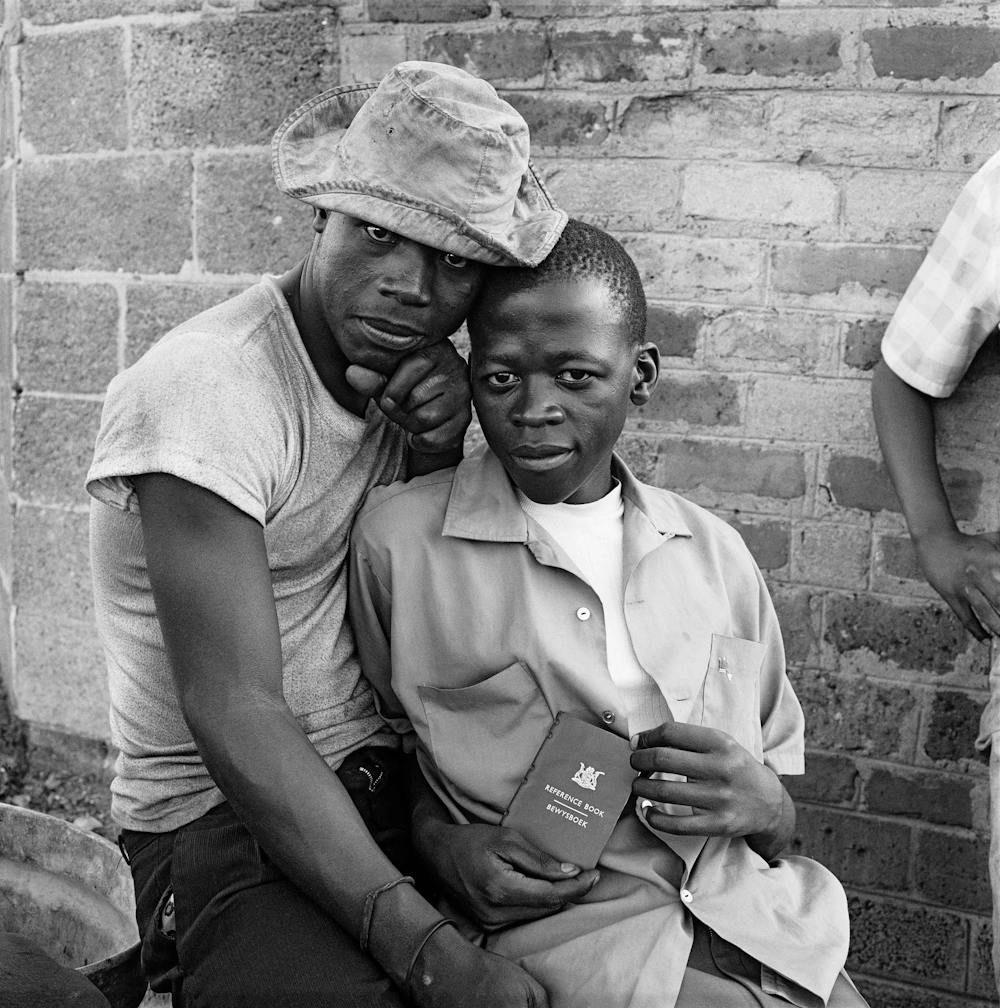
In these rooms of photographs, there is evidence of the hopes and inevitable failures of the apartheid era: street signs indicating racial division; the long bus trips of black workers commuting between the township of Soweto and the white city of Pretoria; the back-breaking labour of miners; black men clutching their “dompas” (government-issued passbooks); and the humble lives of the Indian and Malay community in Fietas who were forcibly removed in the 1970s to accommodate white people.
Goldblatt’s exhibition, curated by Rachel Kent, is consistently permeated with an empathetic kindness and sensitive calmness, which nevertheless exists within the confines of a morality minefield, where ethics are complicated and the observer is far from neutral.
In the vein of Lewis Hine, Walker Evans, Dorothea Lange and, more recently, Sebastião Salgado, Goldblatt (himself the grandson of persecuted Lithuanian Jews) was committed to documenting the lives of the less fortunate with the aim of shining a light on social injustice.
While this no doubt required empathy, relatability and even courage at times, it must also bear the indelible burden of the white, privileged gaze – a point we make less as a criticism of Goldblatt and more to underline the construction of his work.
Who will be remembered as the hero?
Considering the wealth of feminist and neo/post-colonial scholarship, this is not a new issue, but it always raises the question – who gets to tell the story? Who gets to go down as hero in history – the writer or the written? The photographer or the photographed? It is part of a common colonial story.
In an effort to remain “true” to the solemnity of apartheid, Goldblatt rarely photographed his subjects in colour, considering the rich contrast afforded by black and white photography more appropriate. However, by the early 1990s, he increasingly used colour and larger-format prints, which (not coincidentally) corresponded with the end of apartheid policies and the election of Nelson Mandela in 1994.
In fact, Goldblatt photographed Mandela. The photographic session took place at 5am. Mandela’s minders wanted him posed in his living-room chair but Goldblatt insisted on a high-backed kitchen chair, in order to impart a distinguished air to the image.
Despite Goldblatt’s turn to colour, the later photographs are far from a garish or naïve celebration of post-apartheid life. The series In the Time of AIDS, exhibited in the more cavernous spaces of the MCA, is subdued in muted greyish tones.
The motif of a red ribbon, intended to stand out and raise awareness of HIV/AIDS, instead blends with the rural landscapes to function as an indictment of the virus’s ubiquitous presence in everyday life. Goldblatt likened the ribbon to a “stale advertisement for an unwanted product”.
In a contemporary culture that is saturated with images of death, homelessness and war, it is perhaps the quiet stillness of Goldblatt’s photographs that make them a little unnerving. Perhaps it is the way the subjects directly meet our viewer-gaze that makes us feel complicit in the acts perpetrated against them.
Perhaps it is the brutality, behind the images but never fully extrapolated, that makes us a little uncomfortable, or a little plagued by white guilt? And yes, this no doubt is the point of Goldblatt’s life’s work: to insist that we do not look away and pretend it didn’t happen.
Source: The Conversation (Au and NZ) – By Michelle Grattan, Professorial Fellow, University of Canberra
Fittingly, given the perennial instability of federal politics, the Wentworth byelection looked clearcut on Saturday night only to become very murky on Sunday morning.
As things stand, although a lot of postals are still outstanding, independent Kerryn Phelps is expected to take the seat and the Coalition is poised to go into minority government, and potentially to descend into yet more infighting on the way to se bvemingly inevitable defeat next year.
In Wentworth Phelps’ support appears to have strengthened late. She improved her messaging, while the government’s shambles last week reinforced in voters’ mind why it needed a walloping.
Regardless of the narrowing in the count, the top line message is that these voters shouted their outrage at the political assassination of Malcolm Turnbull. They also strongly signalled they care about climate change and are not satisfied at the government’s policy response; as well, they want something done about the offshore refugees who have been treated inhumanely for so long.
Defenders of the leadership switch will say Wentworth isn’t Australia, voters elsewhere won’t feel so strongly, and Scott Morrison cuts through better than Turnbull.
But a large number of Australians are disgusted with the expedient coup culture that has overtaken our politics. As Liberal candidate Dave Phelps told Sky on Sunday, “Australians are sick of this [instability]”. The Coalition can’t avoid paying a price for that at the election – the question is only how high a one.
To think that the Nationals could be even remotely contemplating a coup by Barnaby Joyce against Deputy Prime Minister Michael McCormack shows that some politicians find it hard to learn the most basic lessons.
McCormack is lack lustre but cutting him down would be simply to court danger. Not least, some rural women are so against Joyce that the party might face active opposition from them. Yet, Nationals sources still don’t rule out a move before Christmas.
As for Morrison, as much as bringing him new problems, Wentworth has put up in lights the ones that were already there.
Even if those in other electorates are not as agitated about climate change as Wentworthians, that issue is more important to the broad Australian community than it is to the government.
Morrison may have held the line against the right wing Liberals arguing for quitting the Paris agreement but he errs by brushing away people’s concerns about climate change with his singleminded focus on power prices. Many voters won’t see that approach as adequate.
Morrison remains wedged between his Liberal right wing ideologues and mainstream voters. The right claims to speak for the “mainstream” on climate (and other things) but it doesn’t.
Morrison needs a way out – to show that he understands a more sophisticated policy is required – but none is in sight.
Liberal deputy leader Josh Frydenberg was holding firmly to present policies on Sunday, even though he has previously admitted his bitter disappointment at the death of the National Energy Guarantee, which in its totality integrated energy and climate policy.
The story is a little more positive on the refugees. Finally, the government shows a willingness to settle some in New Zealand, but it demands that Labor pass the legislation to close the “back door” to stop these people (and boat people settled elsewhere) ever setting foot in Australia. Labor says such a ban is too wide but the pressure is on for a deal. One “push” factor is that progress on a New Zealand solution, albeit partial, would take some weight off Bill Shorten at Labor’s December national conference.
A hung parliament, assuming it happens, will make everything harder for the government, including building a platform for the election. To pass any controversial legislation, it would have to get the support of at least one of six crossbenchers. The crossbenchers will exploit their enhanced importance.
Generally, risks will be higher. The possibility of a successful no confidence motion is remote. But Home Affairs Minister Peter Dutton might be a little more nervous about the chances of his eligibility to sit in parliament being referred to the High Court.
The government’s worsened situation may impose more discipline on its backbenchers – or it may encourage backbench grandstanding in the pursuit of survival.
Coming up on the policy front is the issue of the response to the religious freedom report. Here Morrison is on a hiding to nothing. His right wing wants more religions protections to be legislated. But in the run up to Wentworth he had to promise legislation to remove the existing right of religious schools to discriminate against gay students – and he is resisting calls to do the same for teachers. The religious freedom debate is going in quite another direction to that foreseen by the right and Morrison himself.
Morrison would do better to simply bury the (still unreleased) report. But the right won’t allow that.
Then there is the Middle East policy U-turn Morrison put on the table in the campaign’s last week – to consider shifting the Australian embassy from Tel Aviv to Jerusalem. A decision is due by year’s end. Is Morrison going to stick to this controversial path – or make an ungainly retreat? Either way, there’ll be a fresh argument.
After the Wentworth debacle Turnbull’s critics predictably are intensifying their attack on him – firstly for jumping ship ahead of the election and secondly for his failure to intervene to help Sharma. Both Morrison and Sharma appealed to Turnbull personally to come to the aid of the party.
Turnbull can say he made it clear he would quit parliament if rolled, and that ex-PMs shouldn’t hang about. The former prime minister can argue that weighing into the campaign would have been viewed cynically and would be counterproductive.
If, however, Sharma misses out by a relatively modest margin, the question will hang in the air: might Turnbull have swung a few votes? His decisions will seen even by some of his supporters as on the negative side of his legacy ledger.
Source: The Conversation (Au and NZ) – By Adrian Beaumont, Honorary Associate, School of Mathematics and Statistics, University of Melbourne
On Sunday morning, independent Kerryn Phelps leads the Liberals in the Wentworth byelection by a 50.6-49.4 margin, a swing against the Liberals of 18.4% since the 2016 election. Primary votes were 43.0% for the Liberals’ Dave Sharma (down 19.3%), 29.3% Phelps, 11.5% for Labor’s Tim Murray (down 6.2%) and 8.6% Greens (down 6.3%).
Early on election night, it appeared certain the Liberals would lose. After 11pm, pre-poll booths dramatically narrowed Phelps’ margin from 54.4-45.6 to 51.9-48.1. In particular, the Rose Bay pre-poll booth gave Sharma almost 70% after preferences, with over 6,400 formal votes at that booth. Almost 5,200 formal postals then split to Sharma by 64.4-35.6, reducing Phelps’ lead to her current 884 vote margin. Two hospital booths counted Sunday morning also damaged Phelps.
Another 1,266 postals are awaiting processing, and probably another 4,000 will arrive by the deadline for postal votes reception on November 2. If Sharma’s dominance with postals continues, he could win Wentworth after it was called for Phelps early on election night. In byelections, there are very few votes other than postals to be counted after election day; in general elections, Liberals usually perform badly on absent votes.
Analyst Kevin Bonham has identified two discrepancies in election-day booths where Phelps performed much worse on preferences than expected, given primary votes at those booths. If these booths are corrected in Phelps’ favour, she will gain enough votes to offset the postals, but there may be other errors that assist Sharma. Election-night figures will be carefully rechecked over the next few days.
If corrections to the election-night count favour Phelps, she is very likely to win. If there is no substantial correction or corrections cancel out, Sharma is about a 60% chance to win, given his dominance on postals, of which there are probably about 5,000 left to count.
Wentworth has existed since Federation, and had always been held by the Liberals or their conservative predecessors. The loss of Wentworth would deprive the Coalition of its parliamentary majority, and is thus more important than the average byelection, where the government’s majority is not threatened, allowing voters to lodge a protest vote without risking the government.
On early counting figures, there were many media commentators talking about a “record” swing against the Liberals. Bonham said that, though the swings were large, they were not a record even at that time. Talking about a “two party” swing against the Liberals is wrong, because Labor did not make the final two at this byelection.
The Poll Bludger has details of the five Wentworth ReachTEL polls, taken from August 27, three days after the change of PM, to October 15. These polls were conducted for various left-wing groups. In the August 27 poll, Sharma had 34.6% of the primary vote, but recovered to 43.0% on September 27, before slumping back to 33.4% on October 15.
Phelps had 22.5% on September 17, but slumped to 16.7% on October 2, then recovered to 26.3% on October 15. Murray was up to 25.7% on October 2, but fell back to 22.0% on October 15.
Given the disparity between the pre-poll and postal votes and election-day votes, it is likely that polling throughout the Wentworth campaign understated the Liberals’ vote; seat polls are notoriously unreliable. The Liberals’ bad parliamentary week resulted in a worse election-day performance, but pre-poll and postal votes were not as affected by last week.
Media expectations were that if Phelps made the final two, she could defeat Sharma. If Murray made the final two, Sharma would win. As a result, people who wanted Sharma defeated switched to Phelps. The electoral commission will do a two-party count between Sharma and Murray, but probably not for at least two weeks. Sharma will win this count, vindicating the switch to Phelps.
Turnbull’s personal vote was probably worth about ten points to the Liberals in Wentworth. After a large fall following Turnbull’s exit, the Liberals’ primary vote was improving in ReachTEL polls of Wentworth before the events of the last two weeks appeared to push it down again.
On my personal website, I said that the Coalition under Scott Morrison could have problems among better-educated voters, and that Morrison’s social conservatism would not appeal to an electorate that voted Yes to same-sex marriage by an 81-19 margin, the fourth highest vote for SSM in a federal seat.
Electorates like Wentworth have voted Liberal for economic reasons even though they are socially progressive. If the Liberals lose Wentworth, it would be because they had appeared to become too socially conservative and too sceptical of climate change action under Morrison. Phelps was a good fit for Wentworth, being economically conservative but socially progressive.
US midterm elections update
I wrote for The Poll Bludger on Friday about the November 6 US midterm elections. Democrats are likely to win the House, but Republicans are likely to retain the Senate. Trump’s ratings have improved.
Source: The Conversation (Au and NZ) – By Stuart Worboys, Laboratory and Technical Support Officer, Australian Tropical Herbarium, James Cook University
Sign up to the Beating Around the Bush newsletter here, and suggest a plant we should cover at batb@theconversation.edu.au.
The 1800s was a time of colonial expansion across the globe. During this time the great and the good of Britain filled their grand gardens with exotic novelties from all corners of the world.
Amongst these were many species of Asian rhododendron, a diverse and colourful genus of shrubs and small trees, whose high altitude origins made them well suited to the cool temperate climate of England and Scotland.
Throughout the 19th century, commercial collectors and field naturalists discovered rhododendron species in southern China, the Himalayas, on the high peaks of Borneo, Java and especially New Guinea.
These finds lead Victoria’s government botanist of the time, Ferdinand von Mueller, to speculate about finding rhododendrons on the high tropical mountains on the northeast coast of Queensland. He wrote:
When in 1855 [I] saw… the bold outlines of Mount Bellenden-Ker, the highest mount of tropical Australia, towering to 5,000 feet, [I] was led to think, that the upper region might prove to be the home of species of Rhododendron… forms of plants characteristic of cool Malayan sylvan regions.
But the lofty heights of Mt Bellenden Ker were unknown to European Australians. It would be another 32 years before an expedition led by naturalist W.A. Sayer reached its central peak.
Sayer’s expedition, accompanied by two indigenous assistants, reached the mountain’s high ridge after several mishap-filled attempts. It was here they confirmed Mueller’s suspicions. Sayer’s account of its discovery is interesting:
The top of the range is razor-backed, and on travelling along the range beyond the spur by which we ascended, I could not see the sides, they being, if anything, hanging over. We tumbled rocks over, but could not hear them fall.
It was here that I observed the Rhodendron Lochae growing, and asked the Kanaka to get it; but he remarked, ‘S’pose I fall, I no see daylight any more; I go bung altogether;’ so I had to get it myself.
Mueller received the hard-won specimens and named the species Rhododendron lochae (later corrected to R. lochiae) after Lady Loch, the wife of the Victorian Governor.
Since then, rhododendron plants have been found on nine peaks and tablelands in the Wet Tropics region of north Queensland. Populations on peaks south of Cairns are called Rhododendron lochiae, whilst plants growing on mountains to the north of Cairns are considered by some to be a distinct species: Rhododendron viriosum.
Both northern and southern plants are straggly shrubs that grow in thin soils or rock cracks, sometimes in open cloud-swept boulder fields, sometimes in deep shade along creeks, or rarely as epiphytes on moss-covered trees. They produce bunches of gloriously red, bell-shaped flowers, followed by dry brown capsules filled with small winged seeds that are apparently spread by wind.
They grow slowly but with relative ease from cuttings, and are often cultivated in gardens and nurseries in temperate Australia. However, over time knowledge of the precise origin of these cultivated plants has been lost, which means they are unsuitable for detailed scientific investigations.
All of Australia’s rhododendron populations are located at altitudes above 950m in National Parks within the Wet Tropics World Heritage Area. Most are difficult to access, requiring arduous climbs on rough foot tracks through leech-infested rainforest. And yet, although isolated in protected areas, they are threatened by human activities: loss of habitat due to climate change.
Recent climate modelling research published by scientists from James Cook University and the CSIRO predicts significant reductions in suitable habitat for a suite of mountaintop flora species in Australia’s tropics (our rhododendrons were not included in the analysis, but occupy the habitats assessed).
The habitat of many of these species is predicted to disappear altogether well before the end of the century.
Conservationists are racing to preserve samples of native rhododendrons.Author provided
Using rhododendron as a model, the Australian Tropical Herbarium at James Cook University is working to save these threatened species through “ex situ” conservation – cultivation in temperate zone public gardens, well outside their natural range. Because the threatening process – climate change – is not readily mitigated, establishing precautionary ex situ collections is the only viable conservation intervention for these plants.
With funding from the Australian Rhododendron Society Victoria Branch and the Ian Potter Foundation, and the support of traditional owners, Queensland National Parks and the Wet Tropics Management Authority, we have mounted expeditions to collect samples from most of the known populations.
These expeditions have put expert naturalists into rarely visited and challenging environments. Beyond gathering rhododendron samples, new moss species have been discovered and are being named, a fern previously thought extinct was rediscovered, and beautiful little epiphytic orchids have been found on a mountain where they’d not previously been recorded. Golden bower-bird bowers have been mapped in remote mountain rainforests, and a likely new species of snail has been discovered.
Australia now has a well-documented and genetically diverse collection of native rhododendron plants thriving in the Dandenong Ranges Botanic Garden.
We plan to expand this work, ensuring the preservation and public display of rhododendron and many other mountain species threatened by climate change.
Source: The Conversation (Au and NZ) – By Jana Perkovic, Sessional lecturer and researcher, University of Melbourne
Review: A Quiet Evening of Dance, Melbourne Festival
The program booklet for William Forsythe’s A Quiet Evening of Dance has an entire paragraph in the choreographer’s biography dedicated to listing his lifetime achievement awards – such is the stature of this man. It wasn’t always so.
Forsythe’s work was consistently controversial (particularly in his native United States), from the time he took over the artistic direction of Frankfurt Ballet in the 1984 until well after he left it to run his own, rigorously experimental Forsythe Company.
His choreographies were (and are) difficult, formally experimental to the absolute extreme, breaking both with the pleasing aesthetics of ballet and with the humanist bent of modern dance. The titles of his works are representative of his disinterest in playing by the book: consider In The Middle, Somewhat Elevated (1987); Limb’s Theorem (1990), and One Flat Thing, Reproduced (2008). A review in LA Times in 1991 referred to him as “arguably the most controversial choreographer in international ballet”. In 2005, police raided his house after he presented a choreography that critiqued the war in Iraq.
Forysthe’s work is contemporary dance that maintains an absolute allegiance to ballet.Bill Cooper
The last ten or so years have seen Forsythe’s repertoire of key pieces reappraised with a vengeance. It is not entirely clear how this happened – and even the choreographer himself has spoken in amused tones about it. It is possible that time has lent clarity to his formal brilliance, or that his harsh, techno-cerebral aesthetic seems less unapproachable in the era of backyard drones. Either way, today, Forsythe is considered one of the greats of contemporary dance.
Specifically, of ballet. This is an important and unusual distinction to make, because what we call “ballet” and what we call “contemporary dance” have been in philosophical opposition for at least the past 50-odd years. Contemporary dance has developed as a rebellion against the rigidity of ballet training, techniques and aesthetics, and today the two communities of dancers, institutions, and audiences coexist without a great deal of overlap.
Contemporary dance training is looser than the absolutely codified positions of ballet: dancers and choreographers come from all backgrounds, including street dance, and late bloomers are not unusual (unlike ballet, in which an early start is still a must). Forsythe, whose work is revered for its innovative and challenging nature, is a rare figure in contemporary dance to have maintained an absolute allegiance to classical ballet institutions, techniques and dancers. He classically trained and danced with Joffrey Ballet and Stuttgart Opera before he became a choreographer; and all but ten years of his long choreographic career have been spent within ballet institutions.
This long preamble is to say: however jagged, industrial and shapeless an evening of Forsythe choreography may seem to an eye used to Odette/Odile from Swan Lake, it is always grounded in ballet. “I feel like a native ballet speaker,” the choreographer has said. The vast experimentation with bodily organisation, composition, structure, that animates Forsythe’s work, unfolds through the vocabulary of five positions, pliés, and Petipa.
Bill Cooper
A Quiet Evening of Dance is a curated program of short pieces that premiered earlier this month at Sadler’s Wells in London and De Singel in Antwerp before coming to Melbourne Festival. Some of the pieces included in the program are old, others are newly created.
Dialogue (DUO2015) was originally an all-female duet created in 1996, re-choreographed in 2015 for Sylvie Gillem’s farewell program, and here re-offered on two male dancers. The impetus for the program was to give a longer shelf life to this virtuosic, but light-hearted choreography that borders on slapstick, in which two men circle each other, mimic each other’s movements, trip, fall, stand up. The delivery is easy: when something is done with great skill, it appears as if it’s done without effort. That’s because it’s done with skill, and not effort.
DUO2015, the centrepiece of the first half of the performance, is prefaced with a tryptich (Prologue-Catalogue-Epilogue). The three short works, performed to not much more than birdsong and silence, serve almost as a primer to the rest of the evening. The first is a pas de deux in blacks and long white gloves, drawing all the attention to the dancers’ expressive arms, as if they were mimes.
In the second, Jill Johnson and Christopher Roman, two fantastically skilled and surprisingly mature dancers, provide almost a mechanical sketch of ballet, by systematically performing the folding and unfolding of joints (shoulders, elbows, wrists), pressure points, counterpoint, balance, swivel. It is like a lesson in the mechanics of ballet.
Bill Cooper
This becomes significant in the Epilogue, which introduces more complex geometries and human configurations, as well as the equally rigid vocabulary of break-dancing through the appearance of Rauf “Rubber Legz” Yasit, frequent Forsythe collaborator. The juxtaposition foregrounds the similarities of the two systems of movement; but more importantly, it foregrounds their nature as systems, their mathematics.
Act 2 is an entirely new piece, Seventeen / Twenty-One which continues the same break-down of ballet to its most basic constituent elements, through juxtaposition with the movement sequences of break-dancing, but this time to a Baroque composition by Jean-Philippe Rameau. The effect is of a magic trick: the curtain fall and reveal.
Forsythe’s sparse, precise, denim-and-sneakers minimal choreography is now the 17th-century pas de troix, as courtly and codified as the Versailles of the Sun King. In one truly splendid moment, Yasit crosses the stage in a sequence of superbly executed street moves. Two of the ballet dancers look at him, point, turn away elegantly, like fauns in early ballet, only in jeans. The music gives a sense of rhythm, phrasing, tone and emotional narrative to the same choreographic movement that in Act 1 came across as dry, theoretical exercises. It is as if Forsythe has just shown us how it’s all done.
Bill Cooper
Both ballet lovers and ballet haters tend to associate the form with its Romantic period, Petipa and Tschaikovsky. But the immovable forms of this rigid dancing vocabulary were codified two centuries earlier, in the Baroque period. Pierre Beauchamps, Louis XIV’s dance teacher, codified the five positions of what was then still a dance of kings. Jennifer Homans in her recent book Apollo’s Angels refers to this moment as ballet’s “crucial leap from etiquette to art.”
It was the time of the first development of modern science, of modern mechanics, of Voltaire and Descartes, of Enlightenment and of the first modern Constitution, a time that loved maths, structure and harmony. The exceptional longevity of ballet has preserved in its forms the DNA of that time. A Quiet Evening of Dance is Forsythe’s excavation of some of this history – surprising, amusing, but precise.
A Quiet Evening of Dance is being staged as part of the Melbourne Festival until October 20.
Source: The Conversation (Au and NZ) – By Tim Doherty, Research Fellow, Deakin University
The dingo is Australia’s largest land-based predator, occurring across most of the mainland and on many nearshore islands.
Our new research, published in the journal Mammal Review, reveals the breadth and diversity of dingo diets across the continent.
We compiled and analysed 73 sets of data, containing details of more than 32,000 dingo droppings or stomach contents, to document the range of different species that dingoes eat, and how their diets vary between different environments.
A wide-ranging diet
We found that dingoes eat at least 229 vertebrate species. This includes 62 small mammals (less than 500 grams in mass), 79 medium-sized and larger mammals, 10 species of hoofed mammals, 50 birds and 26 reptiles. Dingoes also eat insects, crustaceans, centipedes, fish and frogs.
The true number of species is likely to be much higher because dingo diets have been poorly studied in many parts of Australia, such as Cape York Peninsula.
Large (at least 7kg) and medium-sized (0.5-6.9kg) mammals were the most common components of dingo diets, followed by small mammals, rabbits, arthropods, reptiles, birds and hoofed animals.
Average occurrence of eight food types in the diet of dingoes. Values represent the percentage of droppings/stomachs that contained each food type.
A range of introduced pest species also feature in dingo diets, including deer, goats, rabbits, hares, black rats, house mice, foxes and cats. In recent decades, the occurrence of sambar deer in dingo diets has increased as this invasive species has expanded its range.
Dingoes also eat sheep and cattle, although dietary samples are unable to distinguish between predation and scavenging, and hence tell us little about dingo impacts on livestock production. Dietary samples also do not reveal instances of dingoes killing livestock without eating them.
Regional variation
We found that what dingoes eat depends on where they live. For instance, in arid central Australia, birds, reptiles, rabbits, small mammals and insects form major parts of dingo diets. In contrast, these food groups are less important in temperate and subtropical eastern Australia, where medium-sized and large mammals such as kangaroos, bandicoots and possums are more important.
Frequency of different food groups in dingoes’ diet. Each circle represents a study and is scaled proportionally with dietary occurrence; larger circles represent a higher frequency of that food type. Top row: arthropods and small mammals (less than 500g); middle row: reptiles and medium-sized mammals (0.5-6.9kg); bottom row: rabbits and large mammals (at least 7kg).
The higher occurrence of medium-sized mammals in dingo diets in eastern Australia may be due to the lower extinction rates of native mammals there. In contrast, central Australia is a global mammal extinction hotspot, which probably accounts for the low occurrence of medium-sized mammals in dingo diets in arid and semi-arid areas.
Nonetheless, one medium-sized mammal was a major food item for dingoes in arid areas: the European rabbit. In some areas, more than 50% of dingo droppings or stomachs contained the remains of this invasive species. It is possible that native medium-sized mammals previously constituted a major part of dingo diets in arid Australia, but have since been replaced by rabbits.
Local prey availability plays a major role in determining what dingoes eat. For instance, in the Tanami Desert, reptiles were most common in dingo diets during warmer months when they are most active. However, very few studies have collected data on prey availability, partly because of the sheer number of different animals that dingoes eat.
This tally is higher than the number of threatened species in feral cat diets (based on a previous study that used similar methods), even though cats eat almost twice as many different species overall as dingoes (400 and 229, respectively).
Today’s threatened native species co-existed with dingoes for a long time before European colonisation, which means they were able to withstand dingo predation without going extinct.
But now a combination of small population sizes of some threatened species and exacerbating factors such as habitat loss, foxes and cats means some threatened species could be vulnerable to even low levels of dingo predation. Predation by dingoes should therefore be a key consideration when attempting to conserve or restore threatened species.
Dietary studies are one way we can understand how dingoes interact with other species. Our study also highlights that we still have much to learn about our native top predator. In many parts of Australia, the favourite foods of dingoes are still a mystery.
The authors acknowledge the contribution of Naomi Davis, Dave Forsyth, Mike Letnic, Russell Palmer, Joe Benshemesh, Glenn Edwards, Jenny Lawrence, Lindy Lumsden, Charlie Pascoe, Andy Sharp, Danielle Stokeld, Cecilia Myers, Georgeanna Story, Paul Story, Barbara Triggs, Mark Venosta and Mike Wysong to this research.
Source: The Conversation (Au and NZ) – By Samantha Hepburn, Director of the Centre for Energy and Natural Resources Law, Deakin Law School, Deakin University
“Did you think to yourself that taking money to which there was no entitlement raised a question of the criminal law?” Commissioner Kenneth Hayne asked Nicole Smith, who resigned as chair of NAB’s superannuation trustee, NULIS, a little more than a month before she fronted the banking royal commission.
Smith’s evidence related to NAB skimming A$87 million from superannuation accounts by charging 220,000 members “service fees” for which no service was provided. As head of the board of the superannuation trustee, it was Smith’s job to act solely in the best interests of the members. Instead she acted in the best interests of NAB.
Her admissions and the evidence from the royal commission that more than $A1 billion has been taken from superannuation accounts for no service show we need better supervision of the trustees who oversee more than A$2.7 trillion in superannuation assets.
Trustees are surrounded by temptation, to preference the interests of their sponsoring organisations, to act in the interests of other parts of their corporate group, to choose profit over the interests of members, and to establish structures that consign to others the responsibility for the fund and thereby relieve the trustee of visibility of anything that might be troubling.
The entrenched practice of retail super funds using superannuation trust funds as profit-making enterprises undermines the integrity of the whole superannuation sector. Focused regulatory action and oversight are imperative to protect it.
Super duties
Super trustees are subject to a range of stringent duties.
There are “equitable” duties, which arise from trustees being fiduciaries – responsible for acting in the best interests of the owners of the assets they manage. As fiduciaries, super trustees must avoid conflicts of interest and account for any profit they make.
As trustees specifically, they must act in the best interests of the beneficiaries and exercise powers conferred to them as trustees (trust powers) with real and genuine consideration.
All trustees are legally obliged to act in the best interests of the people whose money they are entrusted with. Superannuation trustees have an even greater obligation, because of the social importance of superannuation. The High Court has ruled that public expectations mean superannuation trustees have “more intense” obligations than other private trusts.
This is underlined by the “statutory” duties of the Superannuation Industry (Supervision) Act 1993. It states directors of corporate superannuation trusts must perform their duties in the best interests of their beneficiaries, superannuation fund members.
The act also establishes supervision and oversight of super trustees by the Australian Prudential Regulation Authority (APRA), the Australian Securities and Investments Commission (ASIC) and the Commissioner of Taxation.
Irregular regulation
Yet clearly this oversight has been failing. The evidence from the royal commission is that many super trustees having been ignoring their duties. They have gone along with rubber-stamping unjustifiable fees purely because their parent institutions wanted the money.
In 2017 the prudential regulator was given the power to directly disqualify directors of superannuation trustee corporations. It already had the power to do so by applying to the Federal Court. Over the past decade, however, it has sought just one disqualification.
The regulator’s deputy chair, Helen Rowell, has argued this is due to APRA trying to protect the public interest, avoiding the risk of a run on a fund. But its inaction has arguably emboldened super trustees to ignore their duties because of the low risk of being penalised.
The royal commission may result in criminal charges against banks and financial institutions. One outcome that must come is stronger oversight of super trustees.
It is therefore critical the royal commission recommend strong action, including reforms proposed by previous inquiries into the financial services sector.
These include the Financial System Inquiry, which recommended in 2015 that super funds must have a majority of independent directors on their trustee boards. It also proposed new civil and criminal penalties for directors failing to act in the best interests of fund members.
Additional reforms might include:
establishing a specific conduct regulator for corporate superannuation trustees
making it mandatory for ASIC to prosecute superannuation trustees and related entities (such as banks) for duty breaches, with much higher penalties
stronger oversight over responsibilities that corporate trustees outsource to third parties
mandatory reporting of corporate fee structures, with regular review to determine if these are justified.
The trust remains the most appropriate legal mechanism to manage savings accumulated over a long time. Much stronger behavioural controls and civil penalties are necessary to ensure super trustees act honestly and in good faith for the benefit of the beneficiaries. That they are, in short, trustworthy.
Source: The Conversation (Au and NZ) – By Richard Shaw, Professor of Politics, Massey University
Shortly before last years’s general election in Aotearoa New Zealand, a Morrinsville farmer protesting the then opposition Labour Party’s planned water tax held up a placard describing its newly minted leader, Jacinda Ardern, as a “pretty communist”.
A year on, Ardern is New Zealand’s prime minister, the third woman and the youngest person to have held the role in 150 years. She is comfortably the most popular politician in the land, and one of the brightest stars in the international political firmament.
The Labour-New Zealand First-Green coalition government led by Ardern celebrates its first birthday this week.
It has been quite the year for Ardern. It is worth reiterating just how far she has travelled since she took the reins as Labour’s leader just weeks before the election, igniting a dull campaign and resuscitating Labour’s polling.
A contemporary politician
Following the election, the conservative National Party looked odds-on to retain office. But on 19 October, after almost two weeks of negotiations, the leader of the centre-right New Zealand First (NZF) party, Winston Peters, surprised virtually everyone (including Labour’s front bench) when he used the balance of power to form a government with Labour and the Greens.
In the year since, Ardern has firmly established herself as the government’s and her party’s most valuable political asset. In an ironic turn of events, Andrew Little, the man who voluntarily stood aside so Ardern could become Labour leader, is also performing well.
An astute and effective political communicator, Ardern regularly uses Facebook Live to apprise the nation of the contents of a day in the life of the PM. The formal set pieces that have helped established Ardern as the dominant figure on New Zealand’s political landscape include her speaking on the lower marae at Waitangi, the spiritual birthplace of the nation, wearing a Māori korowai while meeting New Zealand’s head of state, and taking a seat in the United Nations General Assembly with her child, Neve Te Aroha, and partner, Clarke Gayford.
Jacinda Ardern brought her partner, Clarke Gayford, and baby to the UN General Assembly.EPA/PETER FOLEY, CC BY-ND
The informal, popular-culture moments – particularly those mediated by social media – have been just as important and reflect how Ardern occupies political time and space in a way no previous New Zealand prime minister has. She and Gayford have used Twitter to announce Ardern’s pregnancy, triggering stiff nationwide competition for the role of official babysitter. Social media also charted the birth of their child in a public hospital, the PM’s taste for mac’n’cheese, and the creation of a special UN pass for Neve Te Aroha.
But swooning international audiences do not vote in Aotearoa New Zealand, and what plays well on the Colbert Show does not necessarily resonate in quite the same way back home.
Not all smooth sailing
It is important to note that National continues to outpoll Labour on the preferred party vote. At times the political management of the coalition has been shoddy. Ardern has already had to relieve two members of her cabinet – Clare Curran and Meka Whaitiri – of their ministerial duties, to the disappointment of those hoping to see more, not fewer, women at the top table.
Ardern has also been criticised for not taking a stronger stand on the plight of refugees and on questions concerning possible Chinese involvement in domestic politics. While the government has established many reviews, it is taking some time for the material achievements to start racking up.
But there are signs the administration is starting to hit its straps. Finance Minister Grant Robertson recently announced a larger than expected budget surplus, thus meeting his promised public debt/GDP ratio four years ahead of schedule.
Since Ardern’s return from the UN, Peters and his New Zealand First party colleagues have looked uncharacteristically focused, although the call at the party’s recent conference for a Respecting New Zealand Values Bill was quickly slapped down by Ardern.
Meanwhile, the opposition National party is spiralling into nasty internecine strife that has gone global, may cost the party its leader, and will almost certainly damage its polling.
Changing the culture of politics
Standing back from the detail, what can be said about the political landscape in Aotearoa New Zealand one year on from the formation of the first Labour-NZF-Greens coalition? For one thing, on this side of the ditch we are cautiously re-familiarising ourselves with the idea that the state can be a force for good. The results at this early stage are patchy, as you would expect, but this administration’s belief that government can be benign rather than benighted feels new and different.
Second, Ardern is normalising a whole bunch of things. Being a prime minister and a new mum, breastfeeding at work, and having a male partner who is a primary carer are all becoming, well, just normal.
Third, our cultural politics are changing. Not quickly enough, to be sure, but the symbolism of the fact that Ardern and Gayford’s child carries a Māori name and will be raised speaking both te reo Māori and English has been lost on precisely no-one in this country.
Finally, the nation’s political stocks in the international arena are appreciating. That is no bad thing for a small, exporting nation. There is a powerful progressive-egalitarian narrative in New Zealand reaching back through the nation’s anti-nuclear stance in the mid-1980s to the achievement (or granting) of women’s suffrage in 1893.
As is the case with all political narratives, this one obscures as much as it reveals. But in an age of international fear and loathing, many New Zealanders take quiet pride in the sight of the “pretty communist” defending a rules-based international order, in opposition to the stance taken by the president of the US, a nation that was once the self-appointed leader of the free world. One wonders whether the farmer from Morrinsville appreciated the irony of that moment.
Source: The Conversation (Au and NZ) – By Alan Collins, Professor of Geology, University of Adelaide
Thousands of Australians travel to Thailand each year to lie on a beach at Phuket, meditate at a Buddhist temple in Ayutthaya, spot wild elephants at Khao Yai National Park, or go on some other adventure.
But how many realise that beneath their feet, the framework of the country once formed part of the same continent as Australia?
Our new research, published in Lithos, uncovered the deep links between Australia and Thailand, rebuilding the geography of this part of the ancient supersized continent Gondwana.
This was a time before the dinosaurs, when the first forests turned the land green and giant dragonflies tracked airways through the vegetation.
Our work suggests that some fictional time-travelling Phuket beach-lover could have walked to the Pilbara in Western Australia. A pre-Jurassic culture vulture in Ayutthaya could have trekked over an ancient Indonesian-like volcanic island chain, and some Khao Yai elephant-ancestor could have rampaged through the site of the Perth CBD.
On the move
Tracking these bits of continents and their dance across the globe is part of a large effort to map our planet through its history. Last year we published a map of half a billion years of Earth history.
This was one of the first forays into mapping Earth in deep time. But putting the details on these maps is far from straightforward.
To do this, scientists first try to find geological hints in the rocks of two regions to suggest they are related to each other and have similar histories.
The problem with much of Southeast Asia is that the rocks on the surface are too young – they left Gondwana between 400 million and 300 million years ago, and the rocks we need to see are now buried.
Our research gets around this by using some of these young rocks – granites that formed the roots of old volcanoes – as upside-down probes to fingerprint the deeper Earth.
The idea is that the granite magma mixed a little with the older rocks below as it worked its way up in the crust, forming a unique molten rock soup with subtle chemical differences that can help map the geological basement.
Our study in Thailand used granites, between 500 million and 80 million years old, to discover these characteristics of the older underlying basement rocks. These granites contained chemical markers from the magma that can date when it formed and separated from the mantle. In some cases, these date back nearly 3 billion years.
The three blocks of Thailand
Thailand may be one country now, but it is made up of three distinct geological regions: Sibumasu, Sukhothai, and Indochina.
Map of Thailand including the three main blocks (Sibumasu, Sukhothai and Indochina), major cities and landmarks.Romana Dew
These three blocks all originated in different parts of Gondwana and collided about 200 million years ago. That is a long time ago, but geologically not so old when you consider that the planet is 4,650 million years old.
Sibumasu makes up most of the Thai peninsula and follows north into northwestern Thailand past Tham Luang cave – where the young soccer team and coach were rescued earlier this year – and into Myanmar.
Sukhothai is a volcanic arc system like modern Indonesia or Japan. It cuts through the middle of Thailand past the historic city of Sukhothai, extending southeast to the ruby and sapphire market town of Chanthaburi.
Indochina includes everything in Thailand east of the Sukhothai block, and extends into Cambodia and Vietnam.
Three blocks, three different fingerprints
Although these three blocks form one country today, their telltale chemical fingerprints show a varied history. Sibumasu has very ancient isotopic markers, similar to parts of northwestern Australia.
But the granites from Indochina tell a different, shorter story. The chemical fingerprints from this block show that it formed from melting of the deep Earth much more recently than Sibumasu.
This eastern region formed only between 1.28 billion and 500 million years ago – still very old, granted, but not nearly as old as the Thai Peninsula and Sibumasu. Similar compositions of rocks occurred smeared along the west coast of Australia, and especially in the Margaret River wine region of Western Australia.
The Sukhothai block is chemically somewhere between Sibumasu and Indochina, with separation from the deep earth mantle modelled between 1.74 billion and 850 million years ago.
These intermediate values from the Sukhothai granites are probably a result of mixing of the more youthful Indochina with ancient recycled Sibumasu when the blocks collided and one was pushed over the other.
Thai-Australian reunion?
Australia is currently moving north by up to seven centimetres per year. As we creep towards Asia, like it or lump it, Australia’s future really is with Asia.
So Australians, just hang on, enjoy the ride, in a few tens of million years the southern Thai beaches will be a short drive away.
Source: The Conversation (Au and NZ) – By Michelle Grattan, Professorial Fellow, University of Canberra
Michelle Grattan discusses the week in Australian politics with University of Canberra’s deputy VC Nick Klomp. They discuss Scott Morrison’s announcement regarding the possible relocation of Australia’s embassy to Jerusalem, the government “administrative error” in supporting a motion from Pauline Hanson, a possible leadership challenge within the Nationals party, and the Wentworth byelection on Saturday.
BECCS involves growing plants which remove carbon dioxide as they grow and are then burned in power stations to produce electricity. The resulting carbon dioxide from this combustion is captured and stored underground. The result is carbon dioxide removal from the atmosphere.
It is the not-so-high-tech wonder many are waiting for, but it comes at a high price. It also risks delaying policies that actually reduce emissions in the first place.
Mapping the future, now
According to models, BECCS is the technology we are banking on to fix our climate disruption and safeguard our future. The models have doubled down on BECCS, but it is an unproven solution on a large scale – and one that has significant and damaging side effects.
There are three choices on the table (we will likely see a mix of at least two):
Equitable sustainability Massive amounts of low-carbon energy (solar, wind, batteries, electric vehicles), huge improvements in energy efficiency, a revolution of the food systems and a transition of society towards lower growth, both in population and economy.
Hypothetical backstop Continue down the road we are on, and hope to “overcorrect” the problem in the future by sucking carbon dioxide out of the atmosphere. A lack of political will and intense lobbying has meant what was once a fairly manageable problem has become an exercise in inventing heroic backstops.
Cowboy optimism Engineer the planet (even further) to ease the impacts of climate disruption, but not the underlying causes themselves.
The first choice means we change ourselves and alter the way we do things. The second means we continue polluting as we do now, and hope to clean up later. This option is a bit like the plastic clean-up trial currently underway in the Pacific.
Choice three means we simply paper over the cracks, perhaps saving some aspects of human civilisation but pushing large parts of nature to extinction.
Given the delay, the majority of 1.5℃ and 2℃ scenarios run by models have doubled down on the second choice. But this lessens the need for unprecedented changes today.
The reliance is so heavy that, on average, current models for meeting 2℃ suggest we will be using BECCS and afforestation to mop up total, annual global emissions by around 2070 (or 2055 for 1.5℃). This results in a massive growth in BECCS power plants through this period, from three today to 700 by 2030, and 16,000 by 2060.
Bonfire of the BECCS
But large-scale BECCS is a monumentally tricky idea. BECCS aims to fix one thing – climate disruption – but makes many other things worse.
BECCS on an industrial scale needs many resources. Plants need land, water and fertilisers (sometimes) to grow, and infrastructure to get low-density plant matter from one place to another. We already struggle to do this sustainably.
Related to this, it is reasonable to think that BECCS will increase food prices. We have to produce 70% extra food by 2050 to just keep up with population and food demand increases. Can we do this while using vast tracts of land for BECCS production? Perhaps only if we have a big change in dietary habits which frees up land?
BECCS make use of thermal power plants so inherit many problems related to running them. Power plants are heat engines and need water for cooling. We already have problems with water cooling, and it is getting worse with climate change.
Finally, BECCS power plants will produce ash, which is a “better” version than the ash from coal plants (it doesn’t take much), but will still need attention.
The role of Integrated Assessment Models
The origin story for BECCS has been told elsewhere, but how did we end up in a situation where the large majority of models point to this one problematic solution? These models are called Integrated Assessment Models, and come in two main varieties: simple and complex.
The complex ones are mostly used for investigating technology choices. The simple ones are often used to explore what the cost of carbon could be. This year’s Nobel Prize winner in economics, Bill Nordhaus, works with these simple models.
The overall weaknesses of these models have been covered in compelling and entertaining ways. Given the depth of the complex models, it is difficult to be sure why BECCS dominates. Most would agree that there are three likely possibilities.
First, these models discount future benefits and costs to a large extent. That is, they assume that future benefits and costs are much less in the future than they are today. The default rate at which models discount is 5% per year, meaning that to avoid $100 of climate damage in 2100 is only worth $3 to us today. Many have argued that this is much too high, ethically inappropriate, and misleading.
I know of only one study which performs a sensitivity analysis using so-called discount rates. It finds that carbon dioxide removal is significantly reduced with lower discount rates.
Second, these models are very sensitive to prices and since a very low price for BECCS is assumed, this is the technology that dominates. The problem is that we don’t actually know what these prices might be, especially on a large scale.
Third, these models have a difficult job estimating the damage from climate change. The risk from emitting now and paying later is fat-tailed – there is a non-negligible increased risk of catastrophe even if we do manage to implement choice two at a large scale.
Taking off the BECCS blinders
Are there technologies other than BECCS? If we must hypothesise backstop technologies, then direct air capture is a possibility. As the name implies, it sucks carbon directly from the air.
Although it doesn’t generate energy in the process (in fact it uses large amounts of energy), it doesn’t have as many of the problems faced by BECCS. A possible future consists of solar-powered direct air capture in the Middle Eastern desert pulling carbon dioxide from the atmosphere and pumping it underground into reservoirs from which oil was once pumped. This is speculative though, comes with it’s own big problems, and as yet doesn’t feature much in modelling efforts due to its high cost (though they are coming down quickly though).
Fortunately, there are an increasing number of studies which take a non-backstop approach. These still use integrated assessment modelling, but investigate other options, like very low-energy demand scenarios and large-scale behaviour change (for example to plant-based diets) which reduce other, non-CO₂ gases quickly.
There is nothing to be lost by committing to the first choice as fast as possible. In fact, many of the important solutions are better for our health too (such as using bikes instead of cars, plant-based diets, and insulating houses). And if we end up needing BECCS, then so be it, but the earlier we start moving to low-carbon economies, the more potential catastrophes we avoid.
Source: The Conversation (Au and NZ) – By Katerina Teaiwa, Associate Professor, Australian National University
Environment Minister Melissa Price has been trending on Twitter this week – and not for any good environmental reasons.
Price was introduced to the former president of Kiribati, Anote Tong, during a dinner at a Canberra restaurant hosted by Labor Senator Pat Dodson. Tong has brought global attention to his country because of the existential challenges it faces from climate change and rising sea levels.
According to Dodson, Price made what many have deemed an insulting comment to Tong:
I know why you’re here. It’s for the cash. For the Pacific it’s always about the cash. I have my chequebook here. How much do you want?
Others at the restaurant verified Dodson’s version of the incident. For his part, Tong said he has some hearing problems and others closer to Price could better hear what she said.
My response on Twitter was that in Kiribati, it’s rude to call out bad behaviour in public.
Maybe Price thought she was making a good Aussie joke. Or maybe she’d observed other members of her party laughing at the expense of the Pacific and wanted to crack one like the rest of the boys.
Peter Dutton’s foray into comedy in 2015 springs to mind. In response to a quip by then-Prime Minister Tony Abbott about how islanders are not good at being on time, Dutton said:
Time doesn’t mean anything when you’re about to have water lapping at your door.
Water lapping at the door apparently doesn’t translate into concern over climate change and global warming – a matter of urgency for the low-lying island nations in the Pacific.
Rather than share the concerns of Pacific leaders on this issue, some Australian politicians have chosen to trivialise them and accuse Pacific nations of only being interested in a cash grab.
Just last month, Liberal Senator Ian Macdonald also accused Pacific nations of swindling money from Australia to address the effects of rising sea levels. The Sydney Morning Herald reported him saying:
They might be Pacific islanders, but there’s no doubting their wisdom and their ability to extract a dollar where they see it.
If Macdonald had been listening to the Canberra speech last month by Dame Meg Taylor, the secretary-general of the Pacific Islands Forum, he would have heard a very different message:
It is absolutely essential that we work together to move the discussion with Australia to develop a pathway that will minimise the impacts of climate change for the future of all … including Australia.
So far this call has fallen on deaf ears.
Australia’s history of phosphate extraction
Australians know well how polite and friendly Pacific people are. Flights to Fiji during school holidays are packed with families seeking sun, sand and true island hospitality. But both the shallow view of the Pacific as a paradise, and political slurs of cash-hungry islanders, reveal a deep Australian ignorance of Pacific histories, environments, peoples and cultural values, and of Australia’s projects of colonial extraction in the region.
For over a century, Australia has had an intense social and cultural relationship with Oceania, paralleling its economic and geo-strategic interests, and not just with Papua New Guinea or Melanesian states.
From the start of the 20th century, Australian mining companies began extracting phosphate as fast as they could from Nauru and Banaba island (in what is now Kiribati) in order to grow the country’s agricultural industry.
Australian mining officials and workers on Banaba.National Archives of Australia/Author provided
And grow it did, exponentially, while consuming the landscapes of much smaller Pacific islands. Pacific phosphate – and the superphosphate fertiliser it produced – was the magic dust of Australian agriculture. Little could have been grown here without it, as Australia has always been “a continent of soils with a low plant nutrient supply”.
But decades of phosphate mining on Banaba stripped away about 90% of the island’s surface. By the late 1970s, when the mining operations ended, 22 million tons of land had been removed. The island wasn’t rehabilitated and all the mining infrastructure was left to rust and decay.
Many Banabans were relocated to Rabi Island in Fiji over the years, including my grandfather. It was a migration that foreshadows future relocations that many Pacific islanders face due to climate change.
It’s hypocritical for Australian leaders to accuse the Pacific of being solely after money, when Australia exploited Banaba and other Pacific islands in this way. At a time, when the future of many Pacific nations is under threat, a little compassion, responsibility and real action on climate change is in order, not jokes or barbs at islanders’ expense.
Source: The Conversation (Au and NZ) – By Jonti Horner, Professor (Astrophysics), University of Southern Queensland
Out in the depths of the Solar system, astronomers recently discovered a small, icy object, named 2015 TG387.
First observed in October 2015, it has been nicknamed “The Goblin” by its discoverers. It is currently almost 12 billion kilometres from the Sun – about 80 times the distance between Earth and the Sun (or 80au, where 1au is the distance from Earth to the Sun).
“The Goblin” is thought to be about 300km in diameter, and moves on a highly elongated orbit, far beyond the realm of the eight planets (Mercury to Neptune). It is so distant that it takes more than 34,000 years to orbit the Sun.
What’s most exciting about the new discovery, though, is that it might hold the key to helping astronomers discover an unseen planet that some believe lurks in the Solar system’s icy depths.
The history of Planet X
In 1984, research suggested that, over the past 250 million years, mass extinctions had happened on Earth every 26 million years. But what could cause such periodic extinctions?
A hypothetical red dwarf star, known as Nemesis, was proposed to orbit the Sun at a great distance. Every 26 million years, as it passed through its closest approach to the Sun, the star would scatter a deluge of comets towards the inner Solar system. The result? One or more of those comets would collide with Earth, triggering a mass extinction.
But over the years the evidence waned, and no companion star was found. Nemesis passed into history.
At the turn of the millennium, a new “Planet X” was proposed – nicknamed Tyche. Where Nemesis was the bringer of death, Tyche’s influence was more subtle, resulting in a slight increase in the number of inbound comets from certain regions of the sky, and explaining observed peculiarities in the distribution of those comets.
Still, the idea of an unseen planet beyond Neptune’s orbit rears its head every few years. In 2008 an unseen, distant Earth-mass planet was proposed to explain the distribution of small, icy bodies beyond Neptune.
Other researchers pointed out that planet-mass objects could have formed along with the Solar system’s outer planets, before being scattered outward, but never ejected.
The story of Planet Nine begins with Sedna, a dwarf planet discovered beyond Pluto in November 2003. Sedna has a highly unusual orbit, with its orbital distance varying between 76au and 936au from the Sun. This poses an obvious question: how did Sedna get captured in that orbit?
Artist’s impression of the view from Sedna, looking back towards the Sun.NASA, ESA and Adolf Schaller
At its closest, Sedna is too distant for the planets to perturb it – they cannot be responsible. At its farthest, Sedna is still just one 1/400th of the distance to the nearest star – so close to the Sun that it is very unlikely a passing star could do the deed.
To explain the odd orbit, several theorists suggested that Sedna could have been placed on its orbit when the Solar system was young. At that time, the Sun would have been embedded within a stellar cluster, and close encounters with other stars would have been more frequent.
Now, if Sedna’s orbit was the result of capture during the Solar system’s youth, one might expect other objects to have shared the same fate. The theory therefore predicted that Sedna could be one of a population of Sednoids, all moving on similar orbits.
In the past decade, several more Sednoids have been found. Peculiarly, all of their orbits seem to align, roughly, in space. In other words, the long axes of their orbits all point in roughly the same direction. This is not what you would expect of a population born of the Sun’s birth cluster. So what could be the cause?
To explain Sedna’s unusual orbit, several researchers invoked a variety of Planets X. As new objects were discovered, these theories were continually revisited, until US researchers Konstantin Batygin and Mike Brown came up with the current version, which they nicknamed “Planet Nine”.
Batygin and Brown propose that Planet Nine is comparable in mass to Neptune, moving on a highly eccentric orbit, with a period of around 15,000 years.
The orbits of six ‘detached’ trans-Neptunian objects roughly align in space. Perhaps their similar orbits are the result of Planet Nine’s influence?nagualdesign/Wikimedia
With this theory comes a prediction: as more Sednoids are found, the evidence for the planet will grow, as those objects will also have been sculpted to their current orbits by the hidden planet’s influence.
But astronomers are not universally convinced that an unseen planet is to blame for the alignment of the unusual objects. Extraordinary claims require extraordinary evidence, and there has been much debate over whether the theory stands up to scrutiny.
Simply put, we are more likely to find such faint objects in some parts of the night sky than in others. Since we find those objects at or near perihelion – when they are nearest to the Sun, so at their brightest – that would naturally create just such a cluster of orbits from the first discoveries.
How to break the impasse? More discoveries are needed. Which brings us to our newly discovered friend, “The Goblin”.
Discovering our ghoulish friend
2015 TG387 was first observed on October 13, 2015, with follow-up observations carried out over the past three years. The extended observations show TG387’s orbit is even more extreme than Sedna’s.
The orbit of 2015 TG387 is even more extreme than Sedna’s – but is oriented in roughly the same direction, adding weight to the Planet Nine hypothesis.Robert Molar Candanosa & Scott Sheppard, Carnegie Institution for Science
TG387’s orbit brings it in to around 65au, but stretches all the way out to 2,027au, and one lap takes more than 34,000 years to complete.
Like the other objects that hint at the presence of Planet Nine, TG387’s orbit is oriented just right to add weight to that hypothesis.
While this could be an extra piece of evidence for the planet’s existence, it is far from definitive. It could equally be the case that TG387 is further evidence that observational biases drive the clustering.
We need to find more objects before we can be sure, either way. Fortunately, there are likely to be millions of similar objects like TG387 – indeed, its discovers predict that it is just one of several million bodies, all moving on similar orbits in the Solar system’s icy depths.
Source: The Conversation (Au and NZ) – By Mark Blaskovich, Senior Research Officer, The University of Queensland
Bacteria are everywhere, including in and on our bodies. There are estimated to be as many bacteria in a human body as there are human cells.
Much like Pig Pen in the comic strip Peanuts, we actually carry around a cloud of bacteria in the air surrounding us.
Bacteria are found in soil, in food, and on surfaces we touch all the time – our mobile phones, for example, are teeming with them.
Bacteria can be good. Our gut is full of bacteria, which help digest food. Fermented foods such as sauerkraut and yoghurt are made with, and contain, millions of bacteria.
But bacteria can be bad, too. They may infiltrate our skin and other defences and get into the wrong places, causing infection. There are several possible reasons for this, and they depend on the nature of the bacteria themselves, the types of entry points bacteria have available to them, and other factors.
What is the human microbiome?
How do our bodies fight bacteria?
Our bodies are normally very good at keeping bacteria where they generally don’t cause damage – on skin surfaces and in the digestive tract – and away from areas that should be “sterile” – such as the urinary tract or blood. Mostly this is done by using barriers that physically prevent the entry of bacteria.
But every so often bacteria make it through. The body then relies on a variety of internal defences to identify, isolate and deactivate the invading bacteria. Bacterial infections occur when one of these mechanisms is breached.
Physical damage to the skin, such as cuts and scrapes, or surgery, can allow bacteria ready access to the inside of the body, potentially introducing more bacteria than the body’s defence systems can handle.
Bacterial infections may occur when one of the body’s protective mechanisms is compromised.From shutterstock.com
Alternatively, when the internal defence systems are damaged, such as for patients with weaker immune systems (those undergoing chemotherapy, or those with immune system disorders), bacteria can become established in places they are not meant to be.
Both cases are more likely when the bacteria are particularly opportunistic at invading and growing. These types of bacteria are called pathogenic. This is why we have infections caused by certain types of bacteria, such as Staphylococcus aureus or Escherichia coli, and not others, such as Lactobacillus bulgaricus and Streptococcus thermophilus (the bacteria in yoghurt).
The ability of bacteria and humans to peacefully live with each other explains why “superbugs” – bacteria that have become resistant to being killed by antibiotics – can be present, but not immediately dangerous.
Antibiotic-resistant bacteria on our skin
The prototypical drug-resistant bacteria – methicillin-resistant S. aureus(MRSA, or golden staph) – has been around for decades. Almost everyone has S. aureus on their skin, usually around the nose, but (depending on the country and study), anywhere from 1 in 50 to around 1 in 5 people carry a version of S. aureus that has acquired resistance to some types of antibiotics.
As long as it stays on the skin, resistant S. aureus doesn’t cause a problem, and people generally don’t know they carry it. But if it manages to breach the body’s barriers and cause an infection, it can lead to harm if the right type of antibiotic is not used to treat it. It’s usually at this point, during attempts to treat an infection, that it becomes identified as a resistant bacteria.
In a similar manner, a recent report found that another common skin bacteria found on everyone, Staphylococcus epidermidis, also has high levels of resistance. The researchers looked at patients with S. epidermidis infections predominantly acquired in a hospital setting. What is not known is how widespread the resistant bacteria are, as there has never been systematic testing for resistance in healthy individuals.
As with S. aureus, the resistant S. epidermidis only becomes a real threat when it has started an infection in the body that needs to be treated with antibiotics.
A more general threat posed by both of these resistant strains is that, as they are on the surface of the skin, they can be readily transferred between people, so the overall presence of resistant bacteria can increase.
Cuts and scrapes can allow bacteria to get inside the body.From shutterstock.com
There is significant fear about another class of bacteria that have acquired resistance to almost all antibiotics, resulting in high levels of death in infected patients. These are Gram-negative bacteria, a type of bacteria that already has an additional protective outer layer that makes it more difficult to kill with antibiotics – even before becoming resistant.
The highly resistant species of concern include E. coli, Klebsiella pneumoniae, Pseudomonas aeruginosa, Acinetebacter baumannii, and Neisseria gonorrhoeae. For example, death rates for patients with invasive infections caused by one specific type of resistant Gram-negative bacteria, carbapenem-resistant Enterobacteriaceae (CRE), are estimated to be over 40%. The CRE bacteria are resistant to one of the newer and more powerful classes of antibiotics we have – carbapenems – and are usually also resistant to most other antibiotics.
More than 20 patients died from CRE in Florida during 2008-12, while 6 out of 17 patients infected with a K. pneumoniae superbug died in a US hospital outbreak in 2011. Fortunately these cases are still very rare in Australia – for now.
But with increasing levels of international travel, when people visit countries with much higher levels of resistance in the general population and environment – places such as Greece, India, Brazil, Thailand, and China – they can be exposed to, and become silent carriers of, the deadly bacteria. It is important that, if in hospital for an infection or surgery after an overseas trip, you let your doctor know that you have been travelling.
Finally, good hand washing is one of the most effective ways to help prevent the spread of these silent assassins.
Source: The Conversation (Au and NZ) – By Edward Narayan, Senior Lecturer in Animal Science; Stress and Animal Welfare Biologist, Western Sydney University
Bear bile farms, which exist in some Asian countries like Vietnam and China, are a terrible reality for Asiatic black bears (Ursus thibetanus).
The bears spend their lives confined in tiny steel or concrete cages. They are “milked” through permanent holes in their side that allow bile to be extracted from the gall bladder.
My research, published in the journal Animal Welfare, investigated the chronic stress created by these conditions. We found that with care and rehabilitation, rescued bears in animal sanctuaries can readjust to a normal lifestyle with a reduction in stress – a highly encouraging result.
Because of this, bear bile is highly sought in traditional Chinese medicine. It is believed to reduce gall stones and improve indigestion, among other things. However, non-animal-derived and synthetic alternatives exist for urosodeoxycholic acid and other bile components.
The use of Asiatic black bears as primary sources of bile is a significant animal welfare problem that needs global awareness. Most of the bears are introduced to the trade upon poaching from the wild, and cubs as young as a few months are caged and held captive for up to 30 years.
My research investigated how successful this rehabilitation is, and whether rescued bears can recover from their experiences.
Animal cruelty causes chronic stress
Stress is defined as any unpleasant physical or psychological change that creates an uncomfortable feeling and negative outcome.
Not surprisingly, bears at bile farms in Vietnam have significantly higher levels of stress hormones than bears living in sanctuaries. This is the first scientific evidence of the chronic stress created by bear bile farming.
A young cub rescued from a bile farm in Vietnam (where the practise is illegal although widespread).ANIMALS ASIA FOUNDATION/AAP
Stress in vertebrates (like humans and bears) is a physiological response in the endocrine system, also known as the hypothalamus-pituitary adrenal axis. This is the body’s main control centre for all things related to stress.
Stress hormones like cortisol help regulate the metabolism, especially in times of short-term or acute stress such as “fight or flight” situations. In normal situations, sharp stress causes an increase of cortisol that allows an animal to react quickly to a dangerous situation. Once the danger passes, a negative feedback loop reduces cortisol production and keeps the body stable.
But chronic stress can lead to harmful changes in the stress endocrine system. Long-term cortisol overproduction weakens the body’s ability to fend off daily challenges, and increases the risk of disease and death. In humans, chronic stress contributes to problems with the cardiovascular, immune and central nervous systems.
The presence of what we call “stress biomarkers” in faeces or hair can be a very useful tool for assessing animal welfare.
We measured cortisol levels in bear faeces to rapidly and reliably check their stress levels.
This was particularly useful because we did not have to restrain the rescued bears, a process that would understandably upset them more than their peers.
Australian vets care for rescued bear Luca. Luca’s gall bladder, damaged after years of being pierced with a long needle for bile extraction, had been previously removed.BARBARA WALTON/AAP
Reversing chronic stress in bear sanctuaries
Chronic stress is a massive challenge for the successful rehabilitation of animals into their new environment. Careful monitoring of stress is essential in animal rescue and translocation programs because it can provide information on the physiological resilience of each animal, and help rescuers understand how the animals might respond to humane interventions and veterinary checks.
Rescued bears are given special veterinary care and integrated into the bear sanctuary after several months of careful physiological and behavioural assessments.
Our data show that although not all bears fully recover from living on a bile farm, they generally manage to reduce their stress hormone levels under the rehabilitation program.
Like humans, animals need love and care. Stress reseach has shown humane treatment can reverse chronic stress – and our study has found that is true even for animals who have experienced intolerable treatment.
Source: The Conversation (Au and NZ) – By Tooran Alizadeh, Senior Lecturer, Director of Urban Design, University of Sydney
Figure 1. Central City location map.Image: Jamie van Geldermalsen, Mile Ilija Barbaric, Rao Umair Afzaal, Kun Fan, Author provided
In my article yesterday showing how far Greater Parramatta is from hosting one of three metropolitan CBDs proposed by the Greater Sydney Commission, the verdict was clear:
The Sydney metropolis has a very long and bumpy way to go before we can re-imagine it with more than one CBD. Visionary and bold decision-making, supported by significant investment, is required for the Central City to transition to a metropolitan centre.
Today, I introduce a bold proposal to build a Central CBD for metropolitan Sydney, as a real complement to the City of Sydney CBD to the east.
Figure 2: An overview of Central City 2048.Image: Jamie van Geldermalsen, Mile Ilija Barbaric, Rao Umair Afzaal, Kun Fan, Author provided
Central City 2048 is a 30-year strategic plan, which builds on the Greater Sydney Commission’s Greater Sydney Region Plan. Central City 2048 presents a vision for a dynamic, connected and sustainable CBD at the heart of the Greater Sydney metropolitan region.
Employment, transport and housing targets to be achieved by Central City 2048 are listed in Table 1.
Economy
Figure 3. Key economic actions – Central City 2048.Image: Jamie van Geldermalsen, Mile Ilija Barbaric, Rao Umair Afzaal, Kun Fan, Author provided
Central City’s economy is supported by two pillars: Parramatta CBD and the Westmead health and education precinct. There is a key strategic challenge to attract finance, tech, education and creative industries, while supporting existing health and government sectors. Essential to economic growth is the provision of dedicated commercial and retail floor space, and regional access to it.
Connectivity
Figure 4. Key connectivity actions – Central City 2048.Image: Jamie van Geldermalsen, Mile Ilija Barbaric, Rao Umair Afzaal, Kun Fan, Author provided
Currently, commuter travel time to Central City from most strategic centres exceeds 30 minutes during morning and afternoon peak periods. By 2056, the number of trips to Central City is predicted to triple during these periods.
In terms of digital connectivity, existing infrastructure is limited to copper wire infrastructure. Only small pockets are connected to the National Broadband Network. A more reliable network with increased capacity is essential for Sydney’s next metropolitan centre.
Liveability
Figure 6. Key liveability actions – Central City 2048.Image: Jamie van Geldermalsen, Mile Ilija Barbaric, Rao Umair Afzaal, Kun Fan, Author provided
At 41.5 people per hectare, Central City’s residential density is much lower than the Harbour City’s 64.8 people/hectare. Highly liveable cities such as Vancouver and Copenhagen, with residential densities of 167.64 persons/hectare and 61.8 persons/hectare respectively, suggest high-density cities can be liveable too.
To support increased densities, Central City 2048 proposes increased employment opportunities and investment in transport, social and cultural infrastructure. It capitalises on Central City’s cultural diversity, heritage and landscape to create a vibrant and liveable city. Affordable housing targets of 30% are proposed to ensure Central City is an equitable city.
Invest in city shaping
Central City 2048 proposes one new rail line, three metro lines, just under 300,000 additional jobs, and a 30% affordable housing target for all new dwellings. This looks ambitious, if not shocking, to many. But it portrays a compelling image of what it takes to build a metropolitan CBD at the geographical heart of the Greater Sydney Region. This is what city-shaping, and indeed nation-building, looks like.
The decision is now ours: are we willing to invest what it takes to make it happen?
This article is inspired by the work of the students enrolled in the Integrated Urbanism Studio for the Master of Urbanism at the University of Sydney. I specifically would like to acknowledge the significant contributions made by Jamie van Geldermalsen, Mile Ilija Barbaric, Rao Umair Afzaal and Kun Fan.
Source: The Conversation (Au and NZ) – By Allan Fels, Professorial Fellow, University of Melbourne
While chairing the National Mental Health Commission I pushed hard for an all-encompassing review of mental health, and I have welcomed the recent announcement that the Productivity Commission will conduct one.
But I’ve been distressed to hear commentators dismiss it as just another inquiry, or one conducted through a narrow economic lens.
Its strength is that it won’t be limited to a narrow health lens.
Economic arguments are powerful
Instead it will take into account the broader impacts of mental illness across the entire economy on things such as workforce participation, education, productivity, justice, housing and lost production.
It is of course true there there are health, social and moral imperatives to improve mental health.
But, sadly, those arguments are not always enough to spur governments into action.
To convince key decision-makers in departments such as Treasury and Finance, we need to present an economic case that extends beyond the health system to the broader benefits available from investing in services to keep people well and out hospital.
Earlier reports have laid the groundwork
It is also true that we have had many mental health inquiries and reports over the past decade or more.
But each has added to the other, taking us forward a step at a time toward recognising the scale of the problem and putting it on the public agenda.
We should bear in mind that it has only been relatively recently that our society has openly discussed mental health. The nature of the constitution also limits how much the federal government can do.
The Productivity Commission inquiry has the potential to be the capstone of all of those previous reports.
Mental illness robs of billions
The scale of the challenge is enormous. The cost of mental illness to the economy is around 4% of GDP.
Nationally we spend about A$9 billion out of a total health budget of A$170 billion to treat and escape it. That’s less than 1% of GDP.
If we spent more and cut mental illness by 25%, we would be rewarded by an ongoing boost to the Australian economy of 1%, each and every year.
Four in every ten Australians aged 16 to 85 will have a common mental disorder at some point in their life; that’s around 8.6 million people.
People with mental illness typically die younger and are more likely to be unemployed and face homelessness.
Mental and substance use disorders account for more than 12% of the burden of disease in Australia. This makes them the third-biggest cause of ill health behind cancer and cardiovascular diseases.
It clogs up emergency departments
We know that there are few places to go for people experiencing mental ill health apart from general practitioners and the emergency departments.
The Institute of Health and Welfare reports there were a staggering 276,954 mental-health-related emergency department presentations across Australia in 2016-17.
In Victoria alone, mental-health-related emergency department presentations have jumped 20% over four years, well in excess of population growth.
Previous reports and inquiries have pointed out it is the lack of investment in cheaper treatment and recovery services in the community that is leading to people getting so unwell that they need to present to expensive emergency departments.
This inquiry will be the one we’ll need
The 18-month Productivity Commission inquiry is an opportunity to quantify the extent of new investment we need and benefits it could bring to the broader economy.
Those who argue that Productivity Commission reports don’t achieve anything need to be reminded of the role of the commission in bringing about tariff reform and presenting the case for the National Disability Insurance Scheme and exposing the appalling state of the retail superannuation industry, now on display at the financial services royal commission.
The commission’s record suggests its examination will be more than just another inquiry. It’ll be the one we need.
Source: The Conversation (Au and NZ) – By Richard Holden, Professor of Economics and PLuS Alliance Fellow, UNSW
There are two things that can happen to an asset price bubble. It can burst dramatically, or deflate slowly.
Which brings us to the Australian housing market.
Prices in Sydney and Melbourne continue to decline at a modest rate. The CoreLogic index has Sydney prices down 6.1% for the last 12 months, and Melbourne down 3.4%.
This barely dents the huge increases in previous years and is consistent with “deflate slowly” scenario.
What could cause a pop?
Interest-only loans could do it
As I have said here before, one of the worries is interest-only loans.
Around A$360 billion of these loans are due to be rolled over over the next three years. If they are not, they will convert to principal-and-interest loans, which are much more expensive to maintain.
Given that only about 15% of loans currently issued are interest-only, down from 40% in recent times, that means a lot of people are starting to pay the more expensive principal and interest. For some, the jump in repayments will be as high as 40%.
Members discussed the release of the interim report of the Royal Commission into Misconduct in the Banking, Superannuation and Financial Services Industry… Members observed that while the regulators had already overseen a tightening of lending standards, and a degree of tightening of lending standards had been implemented by banks in anticipation of the Commission’s findings, it was possible that banks could tighten lending conditions further given the issues raised in the report. Members noted that it would be important to monitor the future supply of credit to ensure that economic activity continued to be appropriately supported.
Translation: the banks have stopped lending as much, and might lend even less; this could be bad for the economy.
Could it blow up the housing market?
Well, possibly. Here’s how.
Here’s how it would happen
If the amount of housing credit available is significantly reduced, it is hard for people to buy properties.
That means it becomes hard for people to sell – or even move from one property to another. A market with fewer buyers and sellers in it (what economists call a “thin market”) means more volatile prices.
This turns the price someone gets from selling a property into more of a lottery. There’s a decent chance the seller gets much less than she thought.
Worse still, most people are highly leveraged in residential property – often putting down a deposit of just 10% to 20%.
Owners would get hit rather than their banks
All the drop in the selling price hits the owner, because the bank gets paid back no matter what.
So a 10% drop in price can wipe out all the seller’s equity in the property.
Even if the owner has paid down, say, half the loan, that’s a big hit.
It’s the prospect of this that causes people not to want to sell. If an owner can hold on, they will.
So which properties end up on the market? Precisely those of the people who really need to sell.
They would sell because they had to
Knowing this, and without much competition, buyers turn the screws, pushing down prices still further and exacerbating the problem.
Of course, for that to happen people need to sell.
Why might that be? There are are number of reasons. Their repayments could rise because of rates rising. Even without an official rise in the cash rate by the RBA, banks can, and recently have, raised rates because of their funding costs in money markets.
A borrower might need to change cities because of their job, or might lose their job and be unable to meet repayments. Or a borrower might have an unexpected expense, perhaps relating to health care. The list goes on.
We can’t be sure it won’t happen
It is hard to predict whether any of those things will happen to people in sufficient numbers to cause a meltdown.
But that’s the whole point – it is hard to be confident that it won’t happen.
And if it does occur then the consequences could be huge.
Game theory suggests it might
It might seem perverse that the big four banks could voluntarily cut back on lending and cause a collapse in prices that craters their own loan books. Yet that’s exactly the lesson from the work of John Nash, who won the 1994 Nobel Prize in economics for his work on game theory. In a strategic setting, what is best for the individual might not be best for the group.
If individual banks don’t cut back their lending but others do, they will get stuck with the worst loans.
Avoiding that fate might mean creating market conditions that hurt all existing loans.
It’s the paradox at the heart of game theory.
But I’m hoping for the best
I’m still betting on the residential property market deflating slowly, rather than popping.
But unfortunately you don’t need to get too creative to imagine scenarios that involve a very loud pop – for property owners, the banks and the economy more generally.
Source: The Conversation (Au and NZ) – By Camilla Nelson, Associate Professor in Media, University of Notre Dame Australia
“Taylen has become a brand,” says Angelica Calad, the mumpreneur behind the #influencer account #taylensmom. Taylen Biggs, age five, has more than 150,000 followers. In an era of advertising ennui, #influencers like Taylen’s mother can collect more than 3,000 likes on a single post, with some garnering sponsorships worth thousands.
“Believe in your inner Beyoncé,” declares one post, tagged “#bdaymonth #tayoncé”. The text is accompanied by a photograph of Taylen in a silver leotard topped with a gold tiara. US-based Taylen has worked with fashion labels Betsey Johnson, Sherri Hill and Little Miss Aoki, walking their shows at Fashion Week, along with the Kardashians. Between back-to-back photoshoots Angelica can be seen spruiking concepts for a television show hosted by her daughter, or even a sideline in home decor. “Tag your girls,” declares another post, this time on Facebook. “I meannnn Pay attention to that leg pose.”
A few seconds of video posted above the text features Taylen gazing at a bunny-shaped mirror in a way that’s guaranteed to set a second-wave feminist spinning in her grave. But Taylen’s mother doesn’t see it like that. Angelica understands the branding as a natural extension of her maternal caring work. “I’m a stay-at-home mom, who runs my daughter’s career,” she told Cosmopolitan last year.
And she’s far from alone. There’s six-year-old London Scout, who debuted at New York Fashion Week waving to a crowd of paparazzi-style photographers. “Just an average day in the life of my 4-year-old,” London’s mother, Sai De Silva, messages her daughter’s 105,000 followers.
Then there’s Alonso Mateo, age ten, the so-called prince of Instagram, who appeared in the Dior show at Paris Fashion Week. Mateo, commonly photographed in his signature drop-crotch pants and Ray-Ban sunglasses, has more than 600,000 followers. Mateo turned Insta-famous before the age of four.
But, for sheer numbers, few can beat Korean toddler Yebin, who went viral as a three-year-old with over 21 million views on a single YouTube video. Yebin has now moved with her parents to the United Arab Emirates, where demand for Yebin product endorsements runs high.
Of course, back in Australia there’s Roxy Jacenko who runs a well-tracked account for her daughter Pixie, boasting more than 100,000 followers and a signature line of hair bows.
Middle-class horror
There’s a special kind of middle-class horror that attaches itself to parents who make money out of their children by setting them to work as social media celebrities. It’s a qualitatively new and largely symbolic horror that bears little or no resemblance to the centuries-old spectre of children set to work as chimney sweeps or in match-making and boot-blacking factories.
“I look at this whole thing from afar and think, ‘This is not normal’ … ,” Jacenko confessed in 2015, “but if you see an opportunity, if you’re savvy, you maximise it.”
Condemnation of #influencers runs high in mainstream media, where the comment boxes invariably teem with outraged incredulity – “Wrong on so many levels,” said one commentator on a Guardian story about the high-end world of children’s fashion. “What a terrible indictment on our society,” declared another.
When New South Wales police investigated a case involving obscene photographs of Jacenko’s daughter circulating on social media in 2016, the mother received little journalistic sympathy. “You’re absolutely right to be disgusted”, Waleed Aly told Jacenko on Channel Ten’s The Project. Aly then set out to address what he called the “broader criticism” of Pixie’s Instagram account, speculating that at some point in the future Pixie may well take legal action against her mother for “commercialising her daughter as a four-year-old” and “turning her into a commodity”.
And yet, strangely enough, this same level of disapprobation does not attach itself to Zoë Foster Blake, the former Vogue Australia fashion editor and founder of @ZoTheySay, a similarly well-tracked – albeit, more restrained – site which combines pictures of Foster Blake’s luxurious lifestyle, including her spritely Bonds-clad toddler Sonny and baby daughter Rudy, with a line of “Go-To” skincare products.
A typical Instagram round up from Buzzfeed or Cosmopolitan magazine may read “29 Times Hamish Blake’s Son Was the Cutest Kid You’ve Ever Seen”, “Sonny Blake Was 100% The Cutest Part Of Hamish And Andy’s 60 Minutes Interview” or “Sonny’s got a Sister!”, but Zoë seems to have her audience on side when she insists in relation to Sonny, “we are as sure as shit not exploiting him”.
It seems Foster Blake’s squeaky-clean image falls more neatly within the bounds of acceptable maternal representation, whereas Jacenko, the founder of the Sweaty Betty public relations firm and new owner of a $6.5 million Sydney mansion, is conspicuously fond of challenging the limits of the acceptable. She recently posted a photo of her backside in a thong on Instagram.
A social media phenomenon
Typically, disapprobation of the sort expressed by men like Aly, and also by many women, lacks the awareness that the mumpreneur phenomenon is not a case of “us” and “them” – the saintly mums and the money-grubbing sinners. Rather, along with child beauty pageants and feature-length toy commercials, family #influencers are inextricably entwined with the fabric of our culture. This is a social media phenomenon generated, produced and owned by everybody.
Indeed, down the rabbit holes of the internet, you’re likely to find mothers swapping tips on how to launch their own #ad company, with many other mothers seeking guidance on how to raise their children and make ends meet.
Inflexible and unforgiving work schedules loom large as topics in mothers’ chat forums, alongside discriminatory attitudes towards part-time workers and complaints about poor-quality part-time jobs and the high cost of child care. There’s also a strong sense of stay-at-home mothers wanting to validate their life choice not just by calling it a “job” but also by turning it into a viable income-generating activity.
“It’s kind of a dream gig to be able to stay at home and get paid to do it,” says Emily Frame, the owner of the blog Small Fry. “I can be a stay-at-home mom, and I get to be creative.”
Nor is #influencing entirely confined to normative family arrangements. “We are two mums, two sets of twins and a dog living our own ‘happily ever after’ in London,” declares Meet the Wildes, a briefly lived mummy blog production with a magical fairytale quality, featuring lots of long frolicking walks and inspiring same-sex parenting advice, set against a supernaturally green landscape.
The micro-celebrity of Instagram is especially appealing to mothers who feel limited in their social and economic agency. As mothers have moved back into the workforce, a lower cultural value has been placed on their caregiving work. But on the internet, these mothers appear to turn their social identity as carers into economic capital as #influencers.
Here, what sociologist Kara Van Cleaf once called the “fantasy” that motherhood could become an “entrepreneurial act” is daily conjured as reality. In this sense, family #influencers exhibit an uncanny understanding of the logic of socio-economic life – trading emotion for personal gain begins to present itself as an apparently rational choice.
These monetised blogs seem to bring their owners not only income but also a chimerical sense of empowerment. Other mothers recognise such women as positive, resilient and creative individuals who are “entrepreneurial” and therefore deserving of value.
And yet, despite the existence of websites like Meet the Wildes, it is relatively privileged, heterosexual, middle-class women with supportive partners who tend to dominate this particular cultural meme.
Moreover, aside from the flexibility, which is deeply valued, digital mumpreneurs often find themselves working more not less. Indeed, despite the hype that exists around a handful of highly paid micro-celebrities, the work for most of them remains precarious and poorly compensated.
Conspicuous consumption
Hashtag influencers accumulate social and economic capital because they turn themselves – and their children – into brands and corporations. But the chimera of corporate branding is no antidote for lives lived in precarious times. The problem is not just that money cannot measure sentiment. Rather, it is that branding and consumption threaten to become the primary mode through which our emotional lives are shaped and measured.
Family branding encourages us to value our social world through newly rationalised forms of emotional and economic exchange – our lives become so many Likes, Tweets and Friend Requests – and we are distracted from the pursuit of more profound and far-reaching social solutions.
Thorstein Veblen, in his sociological classic The Theory of the Leisure Class, was one of the earliest social critics to attempt to grasp the paradoxical relationship between consumerism and inequality. Veblen, writing in the late 19th century, argued that the shift to a consumer society had occurred at a historic point at which commodities were valued less for their intrinsic worth and more for their role as markers of social status or success.
According to Veblen, the incidence of a lower birthrate among the “moneyed classes” stemmed from their need to use children as markers of their social superiority. Hence the “conspicuous consumption” entailed by the “reputable maintenance” of a middle-class child acted as a powerful deterrent to having more children. For Veblen, children were essentially props in a game of wealth and social positioning. But what he overlooked was the changeable, if not contradictory, potential of consumption to both oppress and empower.
In the post-industrial world, resistance to consumption – the sense of stigma attached to wild and imprudent consumption, including the rise of so-called green and ethical consumption – more often than not derives from the educated middle class. Going without can be a sign of middle-class affluence. Organic gardening, recycled clothes, and cleaning your house with vinegar and bicarbonate soda have become markers of middle-class privilege.
This is not to dismiss genuine environmental initiatives, but to recognise that in an era of ethical consumption, green products are often priced out of reach for lower-income families.
The flipside of “shopping for change” is the idea of the bad consumer. That is, working-class families – or “cashed-up bogans” in Australia – who, in their wild and unrestrained expenditure, are claimed to be buying the wrong things. Veblen argued that working-class people spend more because consumer goods operate via a law of diminishing marginal utility – the less status you have the more you’re willing to pay to get it.
What he failed to see was that struggling parents often consume on behalf of their children in order to alleviate the stigma of poverty by erasing its outward marks.
Take, for example, Channel 5’s 2014 film The 12 Year Old Shopaholic, and Other Big Spending Kids – yet another in a long line of “shockumentaries” about families who seemingly lack taste and buy the wrong things. It included struggling single mother Jackie Walsh who claimed she worked three cleaning jobs to indulge her daughters’ fondness for designer shoes. Then there’s Emma Tapping, another hardworking mother who became a UK tabloid sensation when she gave her children 300 Christmas presents last year.
There’s an ethical danger inherent in moral panics over consumerism, especially those that demonise the practices of lower-income families, blaming the symptoms of capitalism on people who are more likely to be its victims – or else, blaming them for exercising the limited forms of agency afforded to them.
A wider social shift
In “Why Isn’t Your Toddler Paying the Mortgage?” – a 2017 New York Times story about the rise of the entrepreneurial family – Katie Stauffer was photographed on the airy front porch of her family’s home in Phoenix, US. She cradled her twin daughters, Mila and Emma, aged three, whose videos – scripted by their 14-year-old sister, Kaitlin – have chalked up more than 4 million views on YouTube.
“It is really lucrative,” said Katie, before adding plaintively, “but I wish people knew this is my job now.”
In the same story, Destiny Bennett proudly recounted the achievements of her son, Caidyn, age five, who first drew marketers’ attention when his “don’t touch my dreadlocks” video went viral, and is, according to his mother at least, busy working with his baby brother on a spin-off line of retail clothing. “We are a family of entrepreneurs,” Destiny said.
The entrepreneurial family is the product of a wider social shift through which the world of work has intensified and extended. This change is driven not only by the state’s withdrawal from social welfare programs and the spread of a neoliberal ethics of self-help and overcoming. It is underpinned by the reality of rapidly evolving mobile communication technologies.
These have made it possible for an increasing number of women to work from the kitchen, park or playground, replacing the frantic childcare juggle with something popularly dubbed “the merge”. An increasingly onerous blurring of the boundaries between work and all other time, obscured, for certain women, behind a carefully cultivated appearance of “having it all”.
The rise of “mumpreneurs” draws attention to the way in which the quandary of care work continues to haunt feminist assumptions. A woman’s progress has so often been measured in terms of her ability to smash the glass ceiling and enter corporate life that there is a real risk it may have been inadvertently reduced to this. The demands of income-getting work appear to be recasting every aspect of human activity in entrepreneurial terms.
There is a dark irony in the fact that it is only when the family is recast as a business requiring management – with everybody’s earnings linked to a culture of seemingly incurable waste and disposability – that caring gets to be called a “job”.
This is an edited essay from Dangerous Ideas about Mothers edited by Camilla Nelson and Rachel Roberts (UWA Publishing).
Source: The Conversation (Au and NZ) – By Michelle Grattan, Professorial Fellow, University of Canberra
With a mix of gall and desperation, Scott Morrison appeals to the electors of Wentworth to vote for stability. He warns against sending the government into minority rule, forced to ignore the fact that if this happened the Liberals would have brought it on themselves, by dumping their former prime minister.
Saturday’s byelection is crucial for Morrison, but in the campaign’s final stage the government has had its worst week since he took over.
Politically, it blundered bizarrely when its senators voted for Pauline Hanson’s “It is OK to be white” motion, because of what was described as an “administrative error”.
At a policy level and driven by the byelection, Morrison opened the explosive issue of Australia’s Middle East policy, with unpredictable consequences and some quick blowback.
To cap it all, the Nationals spectacularly undercut the Liberals’ “stability” messaging by canvassing the prospect of ousting their own leader, Michael McCormack, as Barnaby Joyce tries to reclaim his old job.
It’s increasingly obvious that as prime minister Morrison will do whatever he thinks it takes – and plumb some dubious depths – to serve his immediate purposes. This will be significant for the way he runs next year’s election campaign, when he’ll be fighting against the odds.
His promise, after a leak from the religious freedom report, to legislate a ban on religious schools being able to expel gay students on the grounds of their sexuality had an eye to Wentworth’s large gay community.
His U-turn on Australia’s Middle East policy was squarely driven by the seat’s make up: a Jewish component of 12.5%, compared with 0.5% in NSW and 0.4% nationally.
On a very different front, on Thursday Morrison suddenly declared the government would “work towards establishing an agriculture visa”, which he had previously opposed in cabinet.
They’re not too fussed about ag visas in Wentworth but his failure to secure one has been damaging for McCormack and Morrison wanted to muffle the rumbling of the Nationals’ tumbril.
Morrison’s leadership style of pragmatic agility is veneer for the quick fix rather than a solid base for effective long-term governing. Regardless, the Liberals continue to say he is a much better salesman than Malcolm Turnbull was.
In his selling, Morrison doesn’t hesitate to make some unbelievable claims. But it was still breathtaking to hear him say the new Middle East policy – to “consider” moving our embassy from Tel Aviv to Jerusalem – had nothing to do with the byelection.
This assertion insults the intelligence of a savvy electorate. For goodness sake, the announcement was made on the very day of a Jewish-run candidates’ forum! And Morrison credited Liberal candidate Dave Sharma, former ambassador to Israel, with being the policy’s advocate.
The plan got a cheer in the party room, but there have been embarrassing leaks of a negative reaction from the Indonesian foreign minister in a WhatsApp message to Foreign Minister Marise Payne, and of an ASIO warning that the announcement might possibly provoke “some violence in Gaza and the West Bank.”
Morrison played the Jewish card overtly in responding in parliament to questions about the shift. “The Australian Jewish community can trust one party in this chamber: the Liberal and National parties,” he said on Wednesday. On Thursday he accused the NSW Labor party of “behaving in an anti-Semitic way”, referring to an incident when a Jewish leader had been turned away from a function.
The distinctive character of Wentworth underlines the multiple influences on the vote. In the main, it’s a rich and educated seat, socially progressive and elitist. It likes its members to be a big fish in the parliament; it is angry that its last MP, the biggest fish of all, was summarily tossed aside. It worries more about climate change than the current government, and cares more about refugees. But it has traditionally voted Liberal.
Single seat polls are notoriously unreliable, more so in Wentworth because mostly they’ve been commissioned by those with an interest. Liberal polling, put out presumably to frighten the tetchy back into the fold, is reported to have given independent Kerryn Phelps a 55-45% lead over Sharma.
But at the end of the campaign, no one can be confident in predicting how the result will come out. Certainly the Liberals are very worried, despite the seat’s 17.7% margin.
ABC election analyst Antony Green says Sharma needs a primary vote in the high 40s to survive being run down by preferences; Phelps has to come second to have the ability to strike. If Labor’s Tim Murray beat Phelps into number two place his chances of victory over Sharma would be much lower than Phelps’ because he would receive fewer preferences.
Turnbull this week has been telling people the Liberals won’t lose the seat. The former member, who has taken no role in the campaign beyond urging the Liberals to preselect Sharma, is on his way back to Australia, via a visit to his son Alex in Singapore. Turnbull’s arrival will coincide with the byelection’s aftermath.
In contrast to his father, Alex has been strident and active, advising Wentworth electors to vote against the Liberals. He’s denounced the party’s “crazies”, and named some (Tony Abbott, Peter Dutton, Angus Taylor, Kevin Andrews, Eric Abetz), and he has highlighted climate change as an important issue on which to send a message. On Thursday he tweeted about refugee children: “Bring them here. We don’t imprison minors, why are we doing this?”
If Phelps takes Wentworth it will be an indictment of a Liberal party that’s been out of control and a Coalition government that has been sub-optimal over two terms.
A loss wouldn’t mean the fall of the Morrison government. But it would make its operations harder, unsettle the backbench, likely add to the turmoil in the Nationals, and further strengthen Bill Shorten’s already very good prospects. It would be a devastating blow for the new prime minister.
Meanwhile a Thursday tweet by Sharma, wishing good luck to HSC students beginning exams, may offer an insight into the Liberal candidate’s own state of mind after a chaotic week in which the government made his battle harder. “Give it your best, stay calm, and remember that though this feels big now, there is also much more to life,” he advised.
Source: The Conversation (Au and NZ) – By Nick Timms, Senior Lecturer, Curtin University
The discovery of a rare mineral (reidite) at the Woodleigh meteorite impact structure in Western Australia was published this week by Curtin University honours student Morgan Cox and colleagues.
Reidite – and other minerals – are sometimes formed when meteorites crash into Earth.
This takes a particular set of circumstances. Only six prior discoveries of reidite had ever been reported.
Here’s what happens when a meteorite slams into Earth.
Yellow lines of the rare mineral reidite can be seen running across the crystal structure of zircon in this sample from a meteorite crater.Geoscience World
Rocks from space
Our planet is continuously bombarded by meteorites – rocks from space – and has been since its formation about four and half billion years ago.
Space objects range in size from tiny particles to huge asteroids. They are usually travelling towards us at velocities of many kilometres per second – so-called hypervelocities.
Fortunately for us, though, small rocks are the most common, and Earth’s atmosphere simultaneously slows them down, burns them away and breaks them up. We can often see this happening as fireballs and meteor showers. Any surviving chunks of rock free fall to the Earth’s surface to be collected as meteorites.
The Fireballs in the Sky team at Curtin University has an amazing network of cameras to track incoming fireballs and predict the final land location of meteorites – and work out where in the Solar System they came from. They’ve made some great meteorite discoveries in this way.
Some rocks never make the final landing. Some may also produce an airburst – an atmospheric pressure wave that can cause damage like at Chelyabinsk in Russia in 2013. Here, an asteroid approximately 20 metres across and travelling at 19 km per second exploded about 30 km above the ground, causing a blast that was strong enough blow out windows of buildings in six nearby cities.
Too big to slow down
Some incoming rocks are too big for our atmosphere to slow down, and these are much more rare.
These slam into the Earth at hypervelocities, which imparts a huge amount of energy and causes impact craters. The size of an impact crater mainly depends on the dimensions, density and speed of the meteorite.
There are many known impact craters in Australia, such as Wolfe Creek in the Kimberly, and Gosses Bluff near Alice Springs. We also know of craters that are now buried under layers of recent sedimentary rocks, such as Woodleigh, Western Australia.
Globally, around 190 impact craters (or their eroded remnants) have been discovered on Earth – a lot fewer than scientists predict should have formed over all of Earth’s history.
This is because the Earth’s surface is quite a dynamic place, and processes of erosion and plate tectonics act to erase evidence of impact craters over time.
The known craters range in diameter from a few metres to a few hundred kilometres across, and range in age from a few thousand years to approximately two billion years.
No impact craters have formed in recent history, so scientists rely on studying ancient craters in combination with laboratory experiments and computer simulations to figure out what happens during such catastrophic events.
Speed and pressure
A hypervelocity impact event puts the impactor (that is, the rock arriving from space) and “ground zero” target rocks under immense pressure, which propagates through the Earth as a shock wave faster than the speed of sound.
It is not uncommon for the rocks to reach pressures in the tens or even hundreds of gigapascals – equivalent to a hundred billion times the pressure of Earth’s atmosphere. Even in the fractions of a second that rocks spend at these pressures, some minerals transform into new “high-pressure” minerals.
As the shock wave passes, heat energy is produced by the release from high pressure. This can heat the rocks enough to melt, and in many cases even completely vaporise the meteorite and rocks at ground zero.
Shock waves also cause a lot of damage to rocks. They may break into fragments and get ejected high into the atmosphere and even into space, leaving behind a bowl-shaped crater.
Eventually the shock wave loses energy, so it slows down and becomes less destructive, and ripples through the Earth as seismic waves similar to those emitted during an earthquake.
Earth changed forever
In huge impact events – like the one that caused extinction of the dinosaurs and the 180 km across Chicxulub Crater in the gulf of Mexico – the centre of the crater is pushed upwards to form a central peak or peak ring.
It is quite alarming to think that all of these things occur within seconds to minutes of an impact, and can leave long-lasting scars on Earth’s surface, cause significant environmental effects, and even result in mass extinctions.
Impact craters are relics of truly catastrophic events on Earth. Rare mineral formation is just one of the possible outcomes when rocks arrive from space.
Source: The Conversation (Au and NZ) – By Jedidiah Evans, Sessional Academic in English, Australian Catholic University
New research on plagiarism at university has revealed students are surprisingly unconcerned about a practice known as “contract cheating”.
The term “contract cheating” was coined in 2006, and describes students paying for completed assessments. At that time, concerns over the outsourcing of assessments were in their infancy, but today, contract cheating is big business.
In 2017 alone, the UK’s Daily Telegraph reported more than 20,000 students had bought professionally written essays from the country’s two largest essay-writing services.
According to a 2018 study, as many as 31 million university students worldwide are paying third parties to complete their assessments. This staggering figure was drawn by reviewing 65 studies on contract cheating. Since 2014, as many as 15.7% of surveyed students admitted to outsourcing their assignments and essays.
The growth in contract cheating speaks volumes about the modern view of education as a commodity.
A recent survey, led by the University of South Australia, found international students demonstrated proportionately higher cheating behaviours. So did students who spoke a language other than English at home.
In 2013, a large online survey on academic honesty at six Australian universities found international students were significantly less aware of academic integrity processes, and much less confident about how to avoid academic integrity breaches.
A 2015 study of US student demand for commercially produced assignments found students with English as their first language who liked taking risks were about as likely to buy an assessment as students who were reluctant risk-takers, but who spoke English as a second language.
It’s no surprise that students whom we aggressively court for their higher fees and who are working in a less familiar language environment are turning to these services at higher rates.
A recent study on contract cheating in Australia concluded that the over-representation of non-native English speaking students in cheating surveys is linked to the failure of universities to provide support for language and learning development. Students are tasked with completing assessments for which they lack the basic English language skills.
Perhaps it’s time to move on from the essay format of assessment.Shutterstock.com
What’s being done about it?
Widely used plagiarism-detection companies, such as Turnitin, can detect similarities to material that already exists. But essay-writing companies loudly promote the fact their product is original.
In February this year, Turnitin announced plans to crack down on contract cheating. Its proposed solution, authorship investigation, hopes to automate a process familiar to any human marker: detecting major shifts in individual students’ writing style that may point to help from a third party.
But despite these technological advancements, students who are turning to such services have reasons far more complicated than laziness or disregard for personal responsibility.
Despite the moral panic over grades for cash, there’s some evidence to suggest students turning to essay mill services are not getting what they pay for. A 2014 mystery shopping exercise in the UK revealed the astonishingly low standard of commissioned work produced by essay mills. Of all the essays purchased, none received the requested grade, and many fell dramatically short of expected academic standards.
Rather than buying top grades, desperate students are being exploited by companies that take advantage of the very shortcomings (lower literacy and an ignorance of plagiarism protocols) students are hoping to mitigate.
One less obvious aspect of contract cheating that can’t be fixed by intelligent software is the predatory nature of essay mill companies. According to a 2017 study on cheating websites, commercial providers rely on persuasive marketing techniques. They often repackage an unethical choice in the guise of professional help for students who are weighed down by a demanding workload.
How can we discourage it?
In recent years, several scholars have explored the legality of contract cheating, along with the possibilities of defining a new offence under criminal law of providing or advertising contract cheating.
In 2011, for example, a law was introduced in New Zealand that makes it a criminal offence to provide or advertise cheating services. Yet the criminalisation of such services leads inevitably to the prosecution of cheating students, something the legal system has so far been reluctant to do.
But even discounting the possibility of legal action, plagiarism has hefty consequences for university students under misconduct policies, including revoking course credits, expulsion, and a permanent record of cheating.
Redesigning assessments is the primary way to tackle the growing problem of contract cheating. Recent suggestions focus on the development of authentic assessments: tasks that more closely mirror the real-world demands students will face after they graduate from university.
Rather than simply completing an essay, for example, a history student might be tasked with interviewing a local non-profit organisation, and producing a podcast episode.
Teachers who use authentic assessments hope to reduce cheating by tying learning to student’s hopes for their futures, but one obvious benefit is the difficulty of cheating in such individualised tasks. One key problem for overhauling assessment design is the troubling proliferation of casual labour in universities. The development of assessments is rarely, if ever, accounted for in casual teaching rates.
Turnitin works to reduce students’ work into patterns and algorithms, weeding out supposed cheats and frauds. But a more considered response must take into account the complex reasons students turn to these services in the first place.
Understanding why students are willing to pay for assessments might also illuminate a problem at the heart of tertiary education – one that is related to our present repackaging of knowledge as a resource to be bought, rather than an ennobling pursuit that is worthy of all the energy, time, and attention teachers and students can devote to it.
Source: The Conversation (Au and NZ) – By Matthew Sharpe, Associate Professor in Philosophy, Deakin University
The duelling sides in today’s cultural wars about “Western civilization” are united in one thing, at least – each is inclined to gloss over the extent to which “Western civilisation” has always been deeply complex and divided.
The fact that leading conservatives like Edmund Burke or Joseph de Maistre, as well as revolutionaries like Karl Marx or Rosa Luxembourg, all belong to “Western civilization” ought by itself to give the protagonists pause.
But take the 18th century enlightenment, for example, since it is a period of Western history central to these debates. In ways that might have surprised Voltaire and his friends, today the Right is laying claim to “the enlightenment”, for its advocacy of freedoms of speech and religion, and as a distinguishing marker of “the West”, against the rest. Parts of the Left want to denounce “the enlightenment”, for its supposed naive faith in reason and support for European imperialism.
So, does the thought and writing of this extraordinary cultural period actually fit either mould?
Commissioned and coauthored by an Abbé, Guillaume-Thomas de Raynal, with notable help from leading enlightenment philosophes, the book was central to the enlightenment on any reckoning. In the decades after it was released, it was reprinted some 30 times in France and North America.
Despite everything we might expect today, the book represents one of history’s most forthright attacks on European colonisation, inspiring François-Dominique Toussaint Louverture, leader of the 1791-1804 Haitian revolt which overthrew French colonial rule.
“Among enlightenment publications none … had a greater effect on both sides of the Atlantic and the rest of the world,” writes leading scholar, Jonathan Israel.
In a famous passage, written by Denis Diderot, the History of Two Indies calls for a “Black Spartacus” to cast out the colonisers:
Where is he, this great man that nature owes its offended, oppressed and tormented children? … There is no doubt that he will appear, he will show himself, and he will raise the sacred flag of liberty … The Spaniards, the Portuguese, the English, the French, the Dutch, all their tyrants will fall prey to arms and flames … The old world will join the new world in applause. The name of the hero who will have re-established human rights will be blessed and memorials glorifying him will be erected everywhere.
After Diderot finished ghostwriting its 1780 edition, History of the Two Indies is unflinching in its attacks on the slave trade, and the greed, arrogance and violence colonisation has unleashed:
Settlements have been formed and subverted; ruins have been heaped on ruins; countries that were well peopled have become deserted… It seems as if from one region to another prosperity has been pursued by an evil genius that speaks our several languages, and which diffuses the same disasters in all parts.
There are laws of fair dealing that apply to all peoples, irrespective of colour or creed, The History of Two Indies argues. If a territory is unoccupied, it may be occupied. If it is partly occupied, the unoccupied parts may be peaceably occupied, with the consent of the previous inhabitants. If the territory is occupied, the newcomer must ask and submit to the hospitality of the hosts, who can also refuse it.
Beyond this, there is an inalienable right to resistance, grounded in a common human nature. In the remarkable words of the Tahitian elder in Diderot’s 1772 Supplement to Bougainville’s Voyage:
We are a free people; and now you have planted in our country the title deeds of our future slavery. You are neither god nor demon. Who are you then to make slaves? … ‘This country is ours.’ This country is yours? And why? Because you have set foot there? If a Tahitian landed one day on your shores, and scratched on one of your rocks or on the bark of one of your trees, ‘This country belongs to the people of Tahiti,’ what would you think? … the Tahitian you want to seize like a wild animal is your brother. You are both children of nature. What right do you have over him that he does not have over you?
It is such moral reciprocity, blind to race or religion, that underlines the History of the Two Indies’ opposition to colonisation, and denunciation of European actions, nearly 200 years before the advent of post-colonialism and post-modernism.
“O Barbaric Europeans!” Diderot writes:
I have not been dazzled by the splendour of your deeds. Their success has not obscured their injustice … if I cease for one moment to see you as so many flocks of cruel and ravenous vultures, with as little morality and conscience as those birds of prey, may this work and my memory … become objects of the utmost contempt and execration.
As Sankar Muthu has commented, for the enlightenment philosophes, Western civilisation was not yet “fit for export”.
But today, The History of Two Indies is hardly remembered at all — even as New Rights and Lefts debate opposing visions of Western civilisation, and throw around competing visions of “the enlightenment” that equally pass over Raynal’s work.
Perhaps history serves us better when it is able to contest, not confirm our certainties. And that is one, unsettling message that the critical study of any lasting civilisation teaches us.
Source: The Conversation (Au and NZ) – By Tim Trudgian, ARC Future Fellow, School of PEMS, UNSW
What are the chances of US President Donald Trump being removed from office if the Democrats do retake the House of Representatives in the upcoming midterm elections, or at least make significant gains?
These days, you can bet on anything in politics, including which White House Cabinet member might be next to leave and how many Saudi Arabia tweets Trump will send this week.
In politics, as in everything else, one should follow the money. If the betting markets give good odds, surely that means it is likely to happen, right?
Not quite. Suppose a fictitious horse, Tempestuous Daniels (named after Stormy Daniels, naturally), is running in the Melbourne Cup with odds of $3, and that some billionaire puts $10 million on her to win.
Bookmakers do not want any further bets on the horse, otherwise, if she were to win, they’d go bankrupt. So, they’ll shorten the odds to $1.01 to discourage further bets. The horse is now surely the favourite, but not due to its intrinsic chances of winning.
Odds of impeachment in the House are quite good
So, what of impeachment? The US Constitution allows for the impeachment of a president for “treason, bribery or other high crimes and misdemeanours.” The House of Representatives can vote with a simple majority to impeach a president. The impeached leader is then tried in the Senate. If two-thirds of the Senate find him or her guilty, the president is removed from office.
There are 435 voting members of the House, and 100 Senators. This means that a successful impeachment needs 218 votes in the House and a successful removal needs 67 votes in the Senate. Currently, the Republicans control both chambers, making impeachment of Trump extremely unlikely.
But will the chances of impeachment change if the Democrats retake the House after the November midterm elections? The US political website FiveThirtyEight.com publishes daily forecasts of all the races and the probability of each party winning control of the House and Senate.
For example, the site predicts the Democrats have an 83.6% chance of retaking the House, while the Republicans have a 16.4% chance of retaining control (as of time of publishing). There’s a 1.7% chance the Republicans will maintain a majority of one with 218 seats; a 1.7% chance they will retain a 219-216 majority; a 1.6% chance of 220-215, and so forth.
To make the following analysis easier, we shall assume that all Democrats will always vote to impeach (in the House) and vote for guilty (in the Senate). Given this assumption, we can boil the analysis down to one number: the odds of any given Republican crossing the floor (or crossing the aisle, as they say in America) and voting against Trump.
We’ll call this probability “p”. We’ll also make the assumption that the decision of any given Republican to cross floor does not affect the decision of any other Republican to cross the floor. That is, we make the assumption that the probabilities of crossing the floor are independent.
To explain the concept of independence, consider the following. The odds of rolling a five on a standard die are 1-in-6; the odds of drawing a diamond from a standard pack of cards are 1-in-4. The die has nothing to do with the cards. Therefore, these probabilities are independent of one another.
What, then, are the odds of rolling a five and then drawing a diamond? Only one-sixth of the time do we roll a five, and only one-quarter of the time do we draw a diamond. Therefore, the odds of doing both are 1-in-24.
Let’s return to the election predictions. Let’s also assume the Republicans retain a slim 218-217 majority in the House. We don’t care whether it is Peter who crosses the floor, or Mabel, or John. What we want is the number of ways of choosing one Republican to cross the floor, and all 217 others to stay loyal. There are 218 such ways for this to happen.
Doing the calculations, Fred will cross the floor with probability p. Other Republicans will stay loyal with probability 1-p. Therefore, the odds of Fred crossing the floor and all other Republicans staying loyal is p(1-p)…(1-p), with 217 (1-p)s in the product.
Similarly, we can figure out the odds of two (or more) Republicans crossing the floor. We need to figure out how many ways we can choose two “p”s (to cross the floor) and 216 (1-p)s (to stay loyal). This brings us to an area of mathematics known as combinatorics.
Crunching the numbers, we arrive at a long expression that gives us the odds of a Trump impeachment where the only variable is p.
Suppose there was even just a 1% chance of a Republican crossing the floor, that is, that p = 1%. Then the probability of impeachment according to these calculations is 83%. If p = 3%, this jumps to 90%; if p = 5% then there is a 95% chance that Trump becomes the third impeached president after Andrew Johnson and Bill Clinton.
Therefore, even if there is only a small chance of any given Republican crossing the floor, there is a very high chance of impeachment.
But… odds in the Senate are far longer
What, though, about a guilty verdict in the Senate? Remember, you need 67 senators to vote in favour of removing a president from office.
According to FiveThirtyEight.com, the Republicans currently have a 81% chance of retaining control of the Senate. The Democrats face very long odds to get even close to the 67 senators needed to impeach – they have a 0.1% chance to reach even 56 seats. Even then, they would need 11 Republicans to cross the floor – a very tall order.
This makes a guilty verdict almost impossible to achieve.
For Trump to be removed, he needs to be impeached by the House and then found guilty by the Senate. Assume these events occurring independently of one another.
If the odds of any given Republican (in either the House or Senate) defecting were 1-in-4, there would only be a 7% chance of Trump’s removal. Even if this rose to a staggeringly unbelievable 1-in-3 – meaning one-third of Republicans would try to remove their own President – the odds of removal are still not quite even money.
This article is based on a talk given in the G.S. Watson Annual Lecture at La Trobe University, Bendigo.
Source: The Conversation (Au and NZ) – By Imogen Rehm, Lecturer (Early Career Development Fellow) / Psychologist, RMIT University
Nail-biting, nose-picking, mouth-chewing, skin-picking, hair-pulling – we all do some of them, some of the time. Some normal grooming behaviours help maintain good hygiene (such as picking at a dirty finger nail) and appearance (plucking that pesky grey hair). But when do these normal behaviours become bothersome habits? And when do these habits become psychological disorders?
Habits are stable, repetitive behaviours that occur automatically, without much thought. They’re stable in that, once established, they can be difficult to break. Body-focused repetitive behaviours, like those described earlier, are quite common. In one study, up to 24% of US college students reported performing some body-focused repetitive behaviours at least five times a day.
But a follow-up study reported much lower prevalence rates of 1-6%. This was because students were asked to consider if the consequences of their habit had ever required medical attention (for infections, for example) or interfered with daily functioning. This is when mental health professionals begin to see habitual body-focused repetitive behaviours as something more serious.
Two specific body-focused repetitive behaviours are classified as psychological disorders by the American Psychiatric Association: hair-pulling disorder (trichotillomania), and skin-picking disorder.
These conditions can be extremely difficult to control. Baldness, painful skin infections, and scarring are common. Body-focused repetitive behaviours can also severely impact self-esteem, body image, health, relationships, and daily functioning.
A recent Australian study reported that people with clinical levels of body-focused repetitive behaviours are two to four times more likely to experience other mental health difficulties such as depression and anxiety.
The researchers expected that people with repetitive nail-biting and mouth-chewing (biting the inside of your cheek or mouth) would report better mental health than those with skin-picking and hair-pulling; this was not the case. Instead, all body-focused repetitive behaviours were related to poorer mental health and quality of life.
The causal nature of these relationships is difficult to establish. However, these behaviours typically develop during childhood or adolescence, and some studies suggest the onset of depression is due to distress caused by severe body-focused repetitive behaviours.
Hair-pulling and skin picking are listed in the manual of mental disorders.from www.shutterstock.com
Causes
Body-focused repetitive behaviours are considered to be related to obsessive compulsive disorder (OCD). Like body-focused repetitive behaviours, people with OCD struggle to control compulsive behaviours like checking, cleaning, hand-washing, counting, and ordering objects.
For both conditions, people often report a build-up of tension and anxiety that’s relieved by performing their repetitive behaviour. For OCD, compulsions are typically driven by intrusive, upsetting, and irrational obsessive thoughts. But body-focused repetitive behaviours are not prompted by obsessions, demonstrating an important difference between the two conditions.
The exact causes of body-focused repetitive behaviours are unknown. A study investigating skin-picking in over 2,500 UK twins reported that genetic factors accounted for 40% of the variance in symptoms in twin-pairs.
While this and similar studies indicate strong heritability in these behaviours, no specific causal genes have been identified. Research in mice shows manipulating a gene called “SAPAP3” can cause them to repetitively groom their fur, resulting in baldness and open sores.
Human variants of SAPAP3 genes have been linked to some, but not all, cases of OCD and body-focused repetitive behaviours. These genes are involved in glutamate production, which plays a major role in facilitating brain cell communication.
N-acetyl cysteine (an amino acid that regulates glutamate in brain areas related to compulsive behaviours) has shown mixed results for reducing hair-pulling and skin-picking urges. Neurobiological research into body-focused repetitive behaviours is complex and replication studies are needed.
A range of psychological factors influences the severity of the behaviour. People with body-focused repetitive behaviours often struggle to cope with emotions such as anxiety, frustration, sadness, and boredom.
They report that touching, rubbing or biting skin, nails, and hair prompts a relaxing, trance-like state, which distracts from negative emotions. When bored, body-focused repetitive behaviours can help people feel like they’re doing something active, especially those with perfectionistic personality traits.
Our research has begun to explore how sensitivity to physical sensations might lead to body-focused repetitive behaviours. This area of research is emerging, but a recent study found people with these behaviours are more sensitive to, and bothered by, sensations associated with stress and tension.
This means that, similar to how body-focused repetitive behaviours aid distraction from negative emotions, they might also help regulate unpleasant sensations felt in the body.
Habit-reversal therapy is practical, skills-based, and can reduce body-focused repetitive behaviours severity. The acronym “SCAMP” helps mental health professionals tailor their treatment strategies to the many, highly individual factors that can make body-focused repetitive behaviours difficult – but not impossible – to break:
Sensory: creative sensory activities using sight, sound, touch, smell and taste can help to achieve pleasurable sensations like those provided by body-focused repetitive behaviours, or cope with unpleasant sensations that these behaviours otherwise relieve. Similar to how popping bubblewrap can be satisfying, using fidget toys can offer tactile stimulation to keep hands busy when faced with urges to pick or pull.
Cognitive: notice how your inner self-talk influences these behaviours. Thoughts related to body-focused repetitive behaviours are often self-critical or permission-giving, like “I’ll just pull this one hair and then I’ll stop!” Challenging the reality or helpfulness of these thoughts is a useful technique.
Affect: learning new and flexible ways of responding to emotions is key in treating body-focused repetitive behaviours. For example, using brief relaxation strategies to manage momentary stress, anxiety or urges. Doing enjoyable activities can also help to boost mood and provide rewards for making behavioural changes.
Motor: a key strategy of habit-reversal therapy is competing response. It’s harder to pick or pull when engaging in discrete activities physically incompatible with body-focused repetitive behaviours, like fist-clenching, gripping an object, or crossing your arms for one minute.
Place: picking or pulling commonly happens in the bathroom, bedroom, while driving, or at the computer. Over time, such situations become associated with body-focused repetitive behaviours, automatically prompting them to start. Changing your routines and doing things that make it more effortful to do your body-focused repetitive behaviours in these situations can help to break learned habits.
Many individuals in recovery from body-focused repetitive behaviours report that their urges remain, but lessen over time. This is why it’s important to learn diverse strategies to cope with the urges and choose to participate in valued activities, relationships, and hobbies in spite of one’s body-focused repetitive behaviours.
Source: The Conversation (Au and NZ) – By Kathleen Riach, Associate Professor in Management, Monash University
For many, menopause conjures up feelings of embarrassment, hot flushes, mood swings and sleep disturbance. It doesn’t usually conjure up thoughts about the workplace.
Yet menopause at work is fast becoming a target of government and organisational concern.
Some employers think menopause hurts productivity and is therefore a reason to avoid employing older women. But not every woman experiences menopausal transition the same way and it is wrong to assume it will always have a negative impact on work.
How work cultures deal with it plays a big part in how it affects both the individual and the organisation.
Cultural influences
Since 2013, we have undertaken surveys, interviews, focus groups and discussions with line managers in organisations about women, work and the menopause.
We have found the frequency and severity of menopausal symptoms affect how women feel engaged, satisfied by and committed to their work.
Features of the workplace culture and managerial styles may accentuate or mitigate these. For example, stressful work environments can exacerbate menopausal symptoms. Women who enjoy higher levels of support, on the other hand, report lower levels of menopausal symptoms.
It is important to remember that for some women menopause will present significant and long-term health episodes and may be covered under disability discrimination employment laws.
Respondents also stressed that menopause is part of a broader “time of life” when many women feel energised, more free from caring responsibilities and ready to go in terms of their career.
Women entering their fifties reported higher levels of mental health. This is significant considering the mental health epidemic affecting today’s organisations.
Unfortunately, older women are often invisible, overlooked or subject to “gendered ageism” – the intersection of sexist and ageist stereotypes or attitudes.
Simply put, even though these women might have the skills and capacities that workplaces need, they are not thought of as candidates for leadership roles.
Practical steps
We suggest there are a number of practical steps employers can take to create menopause-friendly workplaces.
Fans and easy access to temperature control were a common recommendation from our research. Women also appreciated the ability to work flexibly or from home during extreme weather or times when they were experiencing symptoms such as excessive bleeding.
Information about menopause – for both men and women – should be part of organisational health and wellness agendas. For time-poor employees, the workplace is an important place to access health knowledge and resources. Organisations should connect with important evidence-based advice, such as from the Australasian Menopause Society or Jean Hailes.
Managerial systems should put menopause on the workplace agenda rather than considering it only when it becomes an “issue” or “problem”. Including menopause in occupational health and safety and human resource policies can also challenge hidden biases.
Finally, line management training is vital. All too often how menopause is dealt with in the workplace comes down to a supervisor’s personal experience and understanding. When managerial responses remain ad hoc and unpredictable, it is not surprising that 60% of women feel unable to discuss their menopausal symptoms with their line manager.
Don’t manage menopause
These steps are not just about alleviating symptoms. They are about avoiding signalling that women of a certain age are an inconvenience or less valued as employees.
So want to know the best way to support menopause in the workplace?
Provide ways to start the conversation in a positive way.
Encourage open and honest communication that does not automatically lead to discussion of performance.
Think about proactive practical steps that can accommodate symptoms.
It is about enabling a positive and productive work environment for those going through menopause, not “managing” menopause and its symptoms as a problem.
Experience and potential
Overwhelmingly we came away from talking to respondents with the feeling they were highly resilient. They spoke of ways to counter perceived forgetfulness or the effects of sleep deprivation they thought might be related to their menopause.
They also had a lifetime of experiences and resources to draw on in terms of proactively and creatively negotiating the multiple demands of life and work.
Women do not want workplaces to manage their menopause. What they want is an enabling environment that supports them through the menopausal transition. Part of this is recognising older women as a valuable cohort of the workforce who are full of potential.
Source: The Conversation (Au and NZ) – By Roger Wepf, Director, Center for Microscopy and Microanalysis (CMM), The University of Queensland
Rich visual parallels between Indigenous artworks and microscopic natural structures hidden in the world around us reveal unexpected and intriguing similarities that can deepen our respect for our country and its stories.
A new touring exhibition in Sydney, bringing microscopy and Indigenous art together, explores these images, which pass on knowledge and shape our understanding of the world. Their resonances derive from the similar perspectives of the imagery, and symmetries hidden in nature.
The microscopic images (known as micrographs) were captured on transmission electron microscopes, which create enlarged projections of a thin, sample slice and reveal a flat, top-down image, similar to many of the artworks. Another similarity comes from the natural forms and patterns found at the microscopic, landscape and cosmic scale.
In Indigenous cultures, stories shared and held in paintings record how the land and creatures were created, how they function together and how people relate to them.
For researchers, microscopic images reveal the tiniest structural details of the natural world. With experience and the knowledge passed down from previous generations, scientists read these stories and expand our understanding as they strive to answer the question “how and what makes the world function as it does?” (Or, as Goethe wrote in Faust, “how and what holds the world together at its innermost core”.)
Twenty one Indigenous artists from around Australia have created new works for the exhibition that demonstrate a connection between their stories and microscopic images of related parts of our country.
These artworks are paired with images of things, such as molecules or crystals, taken by scientists using microscopes. Below is a selection of images.
Birnoo country (artist Gordon Barney) and white ochre
The overlapping plates of the ochre mineral are reminiscent of the rows of hills in Gordon’s country.
White Ochre.Hongwei LiuBirnoo Country.Gordon Barney, Warmun Art Centre
Witchetty grub dreaming (artist Jennifer Napaljarri Lewis) and moth sperm
Jennifer’s painting shows women collecting witchetty grubs. These can be eaten at all stages of their life cycles. Without the structures shown in the micrograph, sperm wouldn’t function and moths’ life cycle would be broken.
Brush-tail possum dreaming (artist Judith Nungarrayi Martin) and ribosomes
The dark dots in the micrograph are ribosomes. These tiny molecular machines are responsible for producing the vast array of different proteins that make up the bodies of all living things, including possums and people.
Ribosomes.Image created at the University of SydneyJanganpa Jukurrpa (Brush-tail Possum Dreaming) – Mawurrji.Judith Nungarrayi Martin, Warlukurlangu Artists of Yuendumu
Sandhills dreaming (artist Vanessa Nampijinpa Brown) and atoms in quartz
The crystal structure revealed in the micrograph is fundamental to the sand making up the sandhills that Vanessa paints in her story.
Atoms in Quartz.Hongwei LiuNgalyarrpa Jukurrpa (Sandhills Dreaming)Vanessa Nampijinpa Brown, Warlukurlangu Artists of Yuendumu
Gathering bush tucker (artist Kerry Madawyn McCarthy) and gum leaf cells
The cells in this gum leaf are reminiscent of the rocks and coastal landscape of Kerry’s painting. Her people move through the landscape to collect food just as carbon dioxide moves through the leaf spaces to cells, where it is converted to food for the plant.
Gum Leaf.Minh Huynh, Elinor Goodman and Margaret BarbourGathering Bush Tucker.Kerry Madawyn McCarthy
Dry River bed (artist Kurun Warun) and blood flow in a fish eye
The red areas of Kurun’s painting indicate the life blood that still survives in the dry river bed. The parallel to the red blood cells in the fish eye are obvious.
Fish Eye – Blood Flow.Shaun CollinDry River Bed.Kurun Warun
Skin (artist Joshua Bonson) and collagen fibrils
Joshua paints crocodile skin as a celebration of his totem, the saltwater crocodile. He also sees his paintings as a representation of landscape. Collagen is the fundamental protein found in skin and gives it its strength and toughness. This is a beautiful connection at both the physical and philosophical levels.
Collagen Fibrils.Anne SimpsonSkin.Joshua Bonson
Water dreaming (artist Lola Brown) and river red gum and water transport vessel
The story in Lola’s Water Dreaming painting involves two river red gum trees. River red gums line inland water courses and are essential to Aboriginal life. The vessels that transport water up through the plants have thickened rings for support. This later becomes the wood of the trees.
River Red Gum Leaf.Minh Huynh, Elinor Goodman and Margaret BarbourPlant water transport tubes (xylem)Anne SimpsonWater Dreaming.Lola Brown
Stories and Structures – New Connections has been conceived and curated by Dr Jenny Whiting from Microscopy Australia. It is on display in Sydney until November 29.
Source: The Conversation (Au and NZ) – By Chris Barrie, Honorary Professor, Strategic and Defence Studies Centre, Australian National University
Last year, Professor Roger Bradbury and I questioned whether or not there was an unacceptable risk of the world “sleepwalking” into war.
We cited as reasons to be concerned a lack of strong and principled leadership, the problem of a rising power contesting other major powers for influence, the rise of nationalism, and the ineffectiveness of the UN Security Council in managing conflict situations. And we said:
the peaceful domain in the landscape shrinks rapidly as risk aversion decreases, such that, at low risk aversion, even low levels of hawkishness can drive countries to war
So, in the aftermath of US Vice President Mike Pence’s recent and provocative speech to the Hudson Institute in which the US laid down the gauntlet to China over many issues, it seems timely to look at Australia’s naval shipbuilding enterprise and our readiness for the future if conflict does someday break out in our region.
Slow-moving and complacent
I have been watching developments in defence circles since the release of a series of white papers on defence in 2016.
From a naval perspective, the major thrust of these developments seems to have produced significant changes in how Australia is approaching its capability needs over the next 30 years.
But, in a comparative sense, we seem slow-moving and complacent in our decision-making and lack the agility to keep up with the times.
Why do I make this point?
In May 2017, the Coalition government released its Naval Shipbuilding Plan. The government announced it was embarking on a large shipbuilding enterprise to equip the nation to meet future challenges. Its vision is:
to deliver and sustain modern, capable naval vessels, on time and on budget, maximising Australian industry involvement and contributing to a secure and prosperous future for our nation.
The Turnbull government’s shipbuilding plan may not be adequate in a constantly shifting region.David Mariuz/AAP
In summary, the plan included:
A rolling acquisition program to produce a new submarine fleet at the Osborne Naval Shipyard in South Australia. Construction of 12 future submarines will commence around 2022-23. The last submarine to enter service will be delivered in the early 2050s. This plan means the present Collins class submarines will have to remain in service until the late 2030s. There would also be no capability gap (with at least two serviceable submarines available for operations at all times).
The construction of nine future frigates would commence in 2020, also at the Osborne Naval Shipyard. The last of these frigates will be delivered in 2039. These ships would allow us to create surface task groups comprising one air warfare destroyer and three frigates able to be deployed quickly, with a second surface task group able to be deployed at no more than 90 days notice for up to six months. These measures could enable us to operate in two separate geographic areas at the same time.
A continuous build program for minor naval vessels that was to begin with the Pacific patrol boat replacement project in 2017 at the Henderson Maritime Precinct in Western Australia and the construction of 12 offshore patrol vessels. Construction of the first two offshore patrol vessels will begin in 2018. The remainder will be built at the start of the future frigate project, with the final vessel delivered in 2030.
The key to successful delivery and sustainment of our “enhanced” naval capabilities will be a coherent national approach formed through strategic partnerships with the defence industry, state and territory governments, foreign allies and other suitable partners, commercial enterprises, academics, and science and technology research organisations.
Adequate force for a changing region?
Earlier this month, the Australian Strategic Policy Institute released a report about submarines detailing many of the problems yet to be solved in maintaining our current naval capability and simultaneously constructing a future fleet of 12 submarines.
The plan certainly looks challenging enough, but is it even adequate to meet our needs now – and in the future?
I note, for example, that the new naval surface fleet will deliver about the same level of capability that Australia has had since I joined the Navy in 1961 – one surface task group of four ships. But in 1961, we also had the possibility of adding to the mix the power of a small aircraft carrier.
To assess the adequacy of our current plans, we need to look ahead to what our region will look like in 2050.
In a snapshot: there will be an estimated 5.3 billion people in the Asia-Pacific region. Indonesia will have about 321 million people and a defence budget equal to ours. Australia’s population is expected to reach 33 million, just 0.6% of the total regional population.
And, we have little idea where China will be positioned by that time!
Given these circumstances, will we have the assets to meet our needs if conflict does arise, or if there is a period of escalating tensions?
The size of our force structure has been limited since 1945. But, if war were to break out, the numbers we have been thinking about in our current naval programs will be at the low end of our needs.
From this strategic perspective, there are a range of questions:
Will these plans deliver sufficient capability in time to meet significant strategic challenges?
Will our shipbuilding enterprise be able to ramp up quickly to deliver more vessels if there is a sudden deterioration in our strategic circumstances?
To what extent will we be able to build more vessels that are dependent on systems supplied from other countries?
How dependent will these new capabilities be on the provision of spare parts and sophisticated weapons from overseas suppliers?
By what measures should we assess that our capability plans are adequate to meet Australia’s needs at any time?
And to what extent can the success of our international relationships ameliorate the need to go it alone?
I do not have answers to these questions. I raise them because I think we need to bear them in mind in today’s fast-moving strategic environment.
It’s also important to recognise that our plans require all levels of government, and many foreign governments, to pull together in a clearly defined way.
In addition, our ability to play in the big game in our region and retain a military advantage if conflict does break out depends a lot on the capabilities of our opposing forces. And even here, an analysis of the current situation is not re-assuring.
China’s new Navy
In May, the ANU Strategic and Defence Study Centre published a paper by Sam Roggeveen about China’s new Navy. It’s a reminder of the complexities of the issues that Australia will have to confront over the next three decades and is intended to be a guide for policymakers.
Chinese sailors aboard a PLA Navy frigate in Singapore last year.Wallace Noon/EPA
According to Andrew Erickson of the US Naval Institute, the Chinese PLA Navy is:
poised to become the world’s second largest navy by 2020, and – if current trends continue – a combat fleet that in overall order of battle is quantitatively and even perhaps qualitatively on a par with that of the US Navy by 2030.
The US naval predominance will continue to erode in north Asia and give way to a multi-polar balance. And in Southeast Asia, China will become predominant.
In addition, China may already be building a “post-American navy” – one designed not to confront US naval predominance in the Pacific, but to inherit it as the US balks at the increasing cost of continued regional leadership.
The final point of China’s naval ambitions is worth emphasising:
China wants a powerful surface fleet to signal to the region and the world its great-power ambitions, thereby eroding incentives to resist China’s agenda.
US aircraft carriers in the western Pacific. By 2030, the US is no longer expected to be the predominant power in the region.US Navy/EPA
What can Australia do better?
For policy recommendations, Roggeveen proposes that:
Australia must plan for a future in which its major ally is not the uncontested maritime leader in our region, and in which America’s will to maintain a preeminent place in the region will be severely tested.
Australia should follow China’s example by focusing its maritime force structure on anti-access/area-denial (A2/AD) capabilities. The plan to double the size of Australia’s submarine fleet is welcome, but given the leaps in Chinese capability, there are major questions around the pace of this program.
Australia cannot pursue an A2/AD strategy without Indonesia’s consent, and preferably its cooperation. Our defence diplomacy should be concentrated on Jakarta.
But it is too easy to think that China’s ambitions will be uncontested as the trade war between China and the US unfolds. The presumption about the decline of US power may well be overstated.
Also, China does not yet have global military and naval forces suited to superpower interests, though this could change in the next two decades.
For Australia, this means that we cannot be sure how we should balance our economic interests with our security requirements.
It also suggests we are not planning to do enough in this uncertain climate to assure Australians of a secure future in our region.






 The Pacific Media Centre’s Professor David Robie speaking on the contemporary dangers of journalism. Image: Harrisson Selmen/Wansolwara
 Filipino students protest over the killings in the presidential “war on drugs”. Image: From Dr Robie’s “future of journalism” awards talk
 MASI president Charles Kadamana (right) on the USP journalism awards night. Image: Harrisson Selmen/Wansolwara
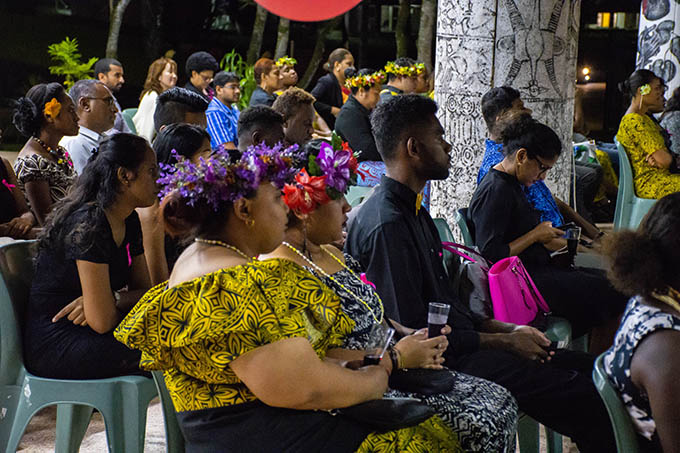 Part of the crowd at the USP journalism awards. Image: Harrisson Selmen/Wansolwara
 Pacific Media Centre’s professor David Robie, Fiji Times editor-in-chief Fred Wesley and USP journalism coordinator Dr Shailendra Singh on the USP awards night. Image: Wansolwara
 University of the South Pacific journalism graduating class of 2018. Image: Harrisson Selmen/Wansolwara